

Federal Court of Australia
Roohizadegan v Technology One Ltd (No 6) [2025] FCA 1619
File number(s): | VID 996 of 2016 |
Judgment of: | MCELWAINE J |
Date of judgment: | 18 December 2025 |
Catchwords: | INDUSTRIAL LAW – adverse action – multiple claims and multiple permutations of termination and non-termination adverse action claims contrary to s 340(1) of the Fair Work Act 2009 (Cth) – whether applicant has established some asserted workplace rights as objective facts – where other workplace rights to make complaints and to escalate matters to senior management are not disputed – whether employer took adverse action for prohibited reasons or for reasons that included prohibited reasons – whether the CEO as the decision maker was materially influenced by other executives and if so whether one or more of those executives took into account prohibited reasons – held employer has rebutted statutory presumption at s 361 and established action was taken for lawful reasons related to applicant’s performance. NON-TERMINATION ADVERSE ACTION – whether the manner of termination of employment aggravated a pre-existing Major Depressive Disorder resulting in total employment incapacity – held manner of termination not part of pleaded case and in any event a lawful termination would have had the same outcome on applicant’s mental state. TERMINATION OF EMPLOYMENT BECAUSE OF TEMPORARY ABSENCE DUE TO ILLNESS OR INJURY – illness or injury comprising Major Depressive Disorder – held no contravention of s 352. DISCRIMINATION IN EMPLOYMENT – whether applicant suffered discrimination contrary to s 351 when alleged adverse action was taken because of physical or mental disability – held no contravention. ADVERSE ACTION – whether employer injured the applicant, altered his position or discriminated against him contrary to s 342(1) – held no contraventions established. MISREPRESENTATION – whether employer contravened s 345 by failing to disclose the true purpose of applicant’s termination meeting to induce applicant’s attendance and or contrary to applicant’s duty to take reasonable care for his own health and safety whilst at work – held no contravention established. CONTRACT – whether incentive term in applicant’s employment contract on a proper construction entitled the applicant to receive a percentage of revenue for sales of products by a separate head office business unit for which applicant was not responsible – held no entitlement by application of orthodox objective construction principles. |
Legislation: | Fair Work Act 2009 (Cth) ss 323(1), 340, 340(1)(a)(ii), 340(1)(a)(iii), 340(1)(b), 341, 341(1)(b), 342, 345, 351(1), 352, 361, 546 Federal Court of Australia Act 1976 (Cth) s 37P Wrongs Act 1958 (Vic) s 28LB |
Cases cited: | Alam v National Australia Bank Ltd [2021] FCAFC 178; (2021) 288 FCR 301 Australian Education Union v Royal Melbourne Institute of Technology [2018] FCA 1985 Australian Municipal, Administrative, Clerical and Services Union v Commissioner of Taxation [2022] FCA 1225 Australian Nursing and Midwifery Federation v St Vincent’s Private Hospitals Ltd [2025] FCA 18; (2025) 187 ALD 311 Board of Bendigo Regional Institute of Technical and Further Education v Barclay [2012] HCA 32; (2012) 248 CLR 500 Buckeridge v Littlepay Pty Ltd [2023] FCA 1036 Codelfa Construction Pty Ltd v State Rail Authority (NSW) [1982] HCA 24; (1982) 149 CLR 337 Communications, Electrical, Electronic, Energy, Information, Postal, Plumbing and Allied Services Union of Australia v Australian Postal Corporation [2017] FCA 1091 Construction, Forestry, Mining and Energy Union v BHP Coal Pty Ltd [2015] FCAFC 25; (2015) 230 FCR 298 Construction, Forestry, Mining and Energy Union v Corinthian Industries (Australia) Pty Ltd [2014] FCA 239 Felthouse v Bindley (1862) 11 CB (NS) 869 Lamont v University of Queensland (No 2) [2020] FCA 720 Latec Finance Ltd v Knight [1969] 2 NSWR 79 Maritime Union of Australia v Fair Work Ombudsman [2015] FCAFC 120 Mount Bruce Mining Pty Ltd v Wright Prospecting Pty Ltd [2015] HCA 37; (2015) 256 CLR 104 Patrick Stevedores Operations (No 2) Pty Ltd v Maritime Union of Australia [1998] HCA 30; (1998) 195 CLR 1 Railpro Services Pty Ltd v Flavel [2015] FCA 504; (2015) 242 FCR 424 Rangi v Kmart Australia Ltd [2019] FCA 1778 Roohizadegan v Technology One Ltd (No 2) [2020] FCA 1407; (2020) 301 IR 1 Serpanos v Commonwealth [2022] FCA 1226 Tattsbet Ltd v Morrow [2015] FCAFC 62; (2015) 233 FCR 46 Technology One Ltd v Roohizadegan [2021] FCAFC 137; (2021) 309 IR 262 Transport Workers Union of Australia v Qantas Airways Ltd (Compensation Claim) [2024] FCA 1216; (2024) 334 IR 187 Wong v National Australia Bank Ltd [2021] FCA 671 Wong v National Australia Bank Ltd [2022] FCAFC 155; (2022) 318 IR 148 |
Division: | Fair Work Division |
Registry: | Victoria |
National Practice Area: | Employment and Industrial Relations |
Number of paragraphs: | 889 |
Date of hearing: | 30 September 2024 1 – 4, 7 – 11, 14 – 16, 18, 21 – 23 October 2024 31 March 2025 1 – 4, 7 – 10, 14 April 2025 12 – 13 August 2025 |
Counsel for the Applicant: | Mr J Hyde Page Mr J McKenna (7 October 2024) |
Solicitor for the Applicant: | Harmers Workplace Lawyers |
Counsel for the Respondents: | Mr S Wood AM KC with Mr E Gisonda and Mr P Jeffreys |
Solicitor for the Respondents: | Seyfarth Shaw Australia |
ORDERS
VID 996 of 2016 | ||
| ||
BETWEEN: | BEHNAM ROOHIZADEGAN Applicant | |
AND: | TECHNOLOGY ONE LIMITED First Respondent ADRIAN DI MARCO Second Respondent | |
order made by: | MCELWAINE J |
DATE OF ORDER: | 18 december 2025 |
THE COURT ORDERS THAT:
1. The proceeding is dismissed.
2. Any application to engage the discretion to make a costs order at s 570 of the Fair Work Act 2009 (Cth) is to be made and responded to as follows:
(a) The application is to be made in writing limited to a submission not exceeding 15 pages plus one relevant affidavit, not exceeding 20 pages inclusive of annexures, in support filed by 4 pm on 6 February 2026.
(b) Any response to an application is to be made in writing limited to a submission not exceeding 15 pages plus one relevant affidavit, not exceeding 20 pages inclusive of annexures, in support filed by 4 pm on 20 February 2026.
(c) Any reply submission limited to 5 pages is to be filed by 4 pm on 27 February 2026.
(d) Subject to any further order, the application will be determined on the papers.
Note: Entry of orders is dealt with in Rule 39.32 of the Federal Court Rules 2011.
REASONS FOR JUDGMENT
MCELWAINE J:
1. SYNOPSIS
1 Adrian Di Marco founded what is now Technology One Ltd in 1987 in a small demountable office in a suburb of Brisbane with four employees and one computer that he used to develop software. It took years to turn a profit. The business grew and was listed on the ASX in December 1999 with approximately 200 employees. As of September 2024, it had a market capitalisation of approximately $7.7 billion, and it is one of the top 100 ASX listed companies by market capitalisation.
2 Adrian Di Marco was for many years the CEO and executive chairman of Technology One. He stepped down from the CEO role in 2017 and as the executive chairman in 2022. In July 2006, he employed Behnam Roohizadegan (sometimes referenced as the applicant) as the Victorian regional manager. At least initially, Behnam was a spectacularly successful employee. Between 2006 and 2013 he increased licence fee revenue for the Victorian business unit from approximately $1.3 million to $10.1 million. Behnam was an exceptionally hard-working employee; often working 18-hour days to the neglect of his family. He received much praise from Adrian Di Marco, including several corporate awards.
3 Adrian Di Marco terminated Behnam’s employment on 18 May 2016. Five consulting psychiatrists confirm he now suffers from a Major Depressive Disorder including frequent suicidal ideation and is totally psychiatrically incapacitated for employment. These reasons are concerned with what happened, when and why to resolve a very substantial damages claim of Behnam against Technology One.
4 Behnam’s claims are prolix and multifaceted. As initially formulated in the Retrial Statement of Claim, there were more than 50 pleaded forms of complaint or conduct as amounting to dismissal or non-dismissal adverse action contrary to s 340 of the Fair Work Act 2009 (Cth) (FW Act). (Each reference in these reasons to a statutory provision is to the FW Act, unless otherwise stated). There are other statutory claims: for misrepresentation contrary to s 345; a claim for breach of remuneration entitlements pursuant to a contract of employment (s 323); discrimination contrary to s 351 and termination because of absence due to illness or injury contrary to s 352. By the time of closing submissions and 27 days of evidence between September 2024 and April 2025, several of the claims were abandoned. I granted leave to amend in the terms of the Further Amended Retrial Statement of Claim dated 13 August 2025, and the Amended Reply dated 13 August 2025. Still, there must be resolved 19 general protection dismissal claims, 22 general protection non-dismissal claims, one misrepresentation claim, a breach of contract claim and an identical safety net contract claim. That does not exhaust the permutations of the claims. In the Reply as originally formulated, a rolled-up plea was advanced that, in addition to Adrian Di Marco, up to nine members of the executive team of Technology One either made the termination decision or materially influenced it and one other employee materially influenced it. In closing submissions, this was reduced to one individual who made the termination decision and four who materially influenced it. Nonetheless, despite these reductions, the claims are put in multiple combinations or iterations of workplace right, complaint and adverse action which Mr Wood AM KC for Technology One calculated in closing submissions at 361. It is unproductive to check his mathematics.
5 The misrepresentation claim contends that contrary to s 345, Behnam was misled as to the real reason he was invited to attend a meeting with Adrian Di Marco in Brisbane on 18 May 2016, when he was unwell. He was, on his case, led to believe that it was to discuss and resolve various complaints that he had made about more senior managers, particularly Stuart MacDonald, when the real reason was to terminate his employment.
6 The breach of contract/safety net claim turns on what is meant by a reference to an incentive clause in Behnam’s contract of employment, being 7.5% of profit before tax “performance for Business Unit 03 – Victoria – Service Delivery”. The question being whether this includes revenue derived from student management services (SMS revenue), which at the time was generated by a separate unit based in Brisbane, but which included sales to Victorian customers.
7 For the adverse action dismissal claims, Behnam claims compensation of approximately $54.7 million for economic loss plus $550,000 for general damages. For the adverse action non-dismissal causes of action, the claim is $50,000 for past and future medical expenses plus $550,000 for general damages. On the contract/safety net claim the calculated amount is $2,198,210. The usual claim for pre-judgment interest is made. Pecuniary penalties are also sought pursuant to s 546.
8 This is the second trial of the Behnam’s claims. At the first trial before Kerr J in October and November 2019, Behnam succeeded and was awarded approximately $5.2 million in pecuniary penalties and compensation, exclusive of interest: Roohizadegan v Technology One Ltd (No 2) [2020] FCA 1407; (2020) 301 IR 1. An appeal to the Full Court was allowed: Technology One Ltd v Roohizadegan [2021] FCAFC 137; (2021) 309 IR 262 (Roohizadegan FC) (Rangiah, White and O’Callaghan JJ). The Full Court remitted the proceeding for a new trial. One thing is clear. The conduct of the trial before me has differed significantly to how it was conducted before Kerr J. The trial duration, for example, is approximately two times longer than the time before Kerr J and before me Behnam was cross-examined on a vast amount of material for the better part of 11 days.
9 This is in many ways a very sad case. Behnam lived for his work. It was his purpose in life, ultimately to the detriment of his family and his health. Each of the expert psychiatrists agreed during their joint evidence that Behnam suffers from obsessive compulsive personality traits. People with an obsessional personality will often use work as a diversion to suppress their symptoms. Over time, this is destructive. Ultimately, that is what I have concluded in this case. Behnam first suffered a Major Depressive Disorder, for reasons quite unrelated to his employment, in consequence of his perceived mistreatment of his daughter’s medical condition in a private hospital. His condition may be traced to first having manifested between September 2010 and July 2011. He made no disclosure of it to Technology One. His condition partially explains his deteriorating work performance to the time of his dismissal.
10 For the very detailed reasons that follow, I have concluded that Behnam’s claims are not made out. Dealing first with the adverse action claims, for some of the workplace right claims I am not satisfied with his version of events. He fails to establish the matters relied on as objective facts. The balance of the workplace right claims are evidenced in writing and there is no dispute that they had the character of workplace rights. For those complaints, the issue is whether Technology One took adverse action because Behnam had exercised or proposed to exercise a workplace right, where it carries the onus to discharge the presumption at s 361. I am satisfied that it has. I am satisfied on the whole of the evidence that ultimately Adrian Di Marco decided to terminate the employment of Behnam between 25 and 26 April 2016, but determined to delay the implementation of that decision until he could be certain that it would not jeopardise an important contract with La Trobe University.
11 I have accepted his reasons for making that decision. The decision was not made because Behnam had, had exercised or proposed to exercise his workplace rights. I am well satisfied that the reasons for the termination were perfectly lawful in that they related to Behnam’s well-established and documented poor economic performance in meeting sales targets and budgets for the Victorian region, his persistent inability to accept decisions made by more senior managers, his inability to integrate into organisational change and because of a damning assessment of morale and employee relations in the Victorian regional office that was made by Rebecca Gibbons, who was then the human resources business partner of Technology One. She reported her findings in an email of 24 April 2016. In these reasons, it will be referred to as the Rebecca Gibbons Email.
12 Once Adrian Di Marco was satisfied that the termination would not imperil the La Trobe University deal, he implemented his decision on 18 May 2016 at a meeting with Behnam in Brisbane.
13 The non-termination adverse action claims emerged in final submissions as Behnam’s preferred pathway to success. That he was lured to Brisbane under a false pretext believing that his workplace complaints were to be discussed and resolved, but instead he was terminated. In the submission of his counsel Mr Hyde Page, it is the manner in which he was induced to attend the Brisbane meeting that is critical. He was misled about his future with the consequence that termination “came as the greatest possible shock and occurred while [he] was physically sick”. This pre-termination conduct was the crucial cause of his psychiatric injury and permanent incapacity for employment. There was, on the submission, a fundamental breach of trust. I reject that aspect of the claims. It is not supported by the psychiatric evidence, the underlying facts and is inconsistent with two primary facts. Communication of the termination decision aggravated Behnam’s pre-existing psychiatric disorder and a lawful termination would have had the same consequence.
14 As to the misrepresentation claim, the contention is that Behnam was misled about his ability to take care of his workplace health and safety when he was induced to attend the termination meeting when he was sick, without disclosure of its true purpose. I am not satisfied that Behnam was misled, and in any event, he has not established that a false or misleading statement was made by Adrian Di Marco to him about the exercise or effect of that workplace right.
15 As to the contract claim, when the entirety of the pre-contract facts as were then known to the parties are considered, I am not satisfied that objectively the parties intended to include the SMS revenue in the incentive calculation.
16 In consequence, the proceeding must be dismissed.
2. APPROACH TO FACT FINDING
17 In all, I received oral evidence from twelve lay witnesses, five psychiatrists, two remuneration experts and one accounting expert. Each witness made an affidavit, a statement, or in the case of experts, a report. The experts in psychiatry and remuneration provided joint expert reports and gave concurrent evidence. After dealing with evidentiary objections, each witness adopted his or her affidavit or report as their evidence-in-chief. Occasionally some supplementary questions were asked in evidence-in-chief.
18 As part of case management, orders were made that evidence of disputed conversations or events would be excised from lay affidavits and given viva voce in the witness box, which is what occurred.
19 There are several electronic court books comprising initially agreed documents, supplemented by additional documents that were admitted during the trial. The primary court book contains all affidavits and witness statements (comprising approximately 3,300 pages) plus approximately 5,900 pages of documents. There are supplementary court books comprising respectively approximately 2,014 and 1,780 pages. This is a vast amount of documentary material. One explanation for the bulk of documentary material is the reproduction of much material that was before Kerr J at the first trial. At times, the applicant’s case lost focus on the presentation of evidence before me in exploring and re-analysing evidence that had been adduced before Kerr J. In doing so, inconsistencies were focused on between evidence that a witness had given in late 2019 about events that occurred between 2012 and May 2016.
20 As I explain in some detail in these reasons, it is quite understandable that the evidence of witnesses in late 2024 and early 2025 differed from the evidence at the first trial. Indeed, where a witness purported to give precise evidence of discussions occurring up to 10 years previously and without the assistance of contemporaneous notes, one must question the plausibility of the evidence. That is particularly so with Behnam’s evidence which, as I explain, also requires findings about the reliability of notes that he contends are contemporaneous.
21 Each party has made detailed credit submissions about some witnesses, particularly Behnam and Adrian Di Marco. That I must make credit findings is unavoidable. Of course, simply because I have concluded that a witness gave incorrect or deliberately false evidence on one topic is no reason to doubt the witness generally or as to his or her evidence on unrelated topics. In contrast, if a finding is made that a witness has consistently given false or deliberately false evidence, was evasive, was argumentative and/or refused to answer simple questions with direct answers, that is a proper foundation for a general adverse credibility finding.
22 Overall, my fact-finding places considerable reliance on contemporaneous documents where I have concluded the document authentically records the event in issue. With some critical documents, I have accepted submissions of inauthentic recording.
23 There is a vast amount of evidence to consider. Where I refer to the evidence of a witness without qualification or the subject of analysis, I should be taken to have made findings of fact in accordance with the evidence. That is also the case with documentary evidence.
3. SOME BACKGROUND ABOUT BEHNAM
24 Behnam was employed by Technology One as the Victorian regional manager in accordance with a written contract and four written contract variations. The first is dated 3 July 2006. It was employment of indefinite duration with a power of summary termination for specified misconduct or upon giving four weeks’ notice or payment in lieu. The initial remuneration comprised a base salary, inclusive of employer superannuation contributions, of $160,000. In addition, Behnam was entitled to a profit-based bonus, if certain targets were met, of 5.75% of the profit before tax of the Victorian region. The job description schedule provided that the purpose of his role was to grow the business in the Victorian region and be responsible for planning and directing the activities of his Victorian team.
25 The important variation is in the form of a letter of offer dated 26 November 2009, confirming Behnam’s position as Victorian state manager. The letter operates as a variation to the 2006 contract. The total base salary inclusive of superannuation was $176,800 plus a profit share, initially at 7.5%, of profit before tax for performance of the Victorian business unit. There was no alteration to the statement of duties.
26 There is no dispute that Behnam was very good at his job between 2006 and 2013, demonstrated by the quantum of his salary, including incentive payments in those years. It should be understood from the outset that the accounting year for Technology One was to 30 September, not the usual 30 June accounting period. His remuneration in those accounting years was approximately $409,906 in 2007, $526,300 in 2008, $605,891 in 2009, $569,105 in 2010, $632,236 in 2011, $616,328 in 2012 and $771,930 in 2013. He was responsible for the entire operations of the Victorian region. So far as is relevant to the central events in this case, in October 2014 Martin Harwood was appointed to the role of operating officer for sales and marketing and Behnam then reported directly to him. On Behnam’s case, that is when his relationship with Technology One began to deteriorate. Before then, Behnam had an exceptional relationship with Adrian Di Marco. It was one of undoubted mutual trust and confidence. Adrian Di Marco had an open-door policy, whereby Behnam was always able to escalate any issue and discuss it with Adrian Di Marco, either in person or in correspondence. That founds many of the workplace right claims.
27 In approximately September 2010, Behnam’s eldest daughter, who was then 14 years of age, developed a serious illness known as Kawasaki disease. It is a rare condition that causes inflammation of blood vessels and can lead to cardiac issues. His daughter required significant periods of hospitalisation, including two open-heart surgeries in January and June 2011. This caused Behnam much distress and anxiety and led to his depression. He caused to be commenced in the Supreme Court of Victoria in February 2014, a claim in negligence against his daughter’s treating physicians. Related to that proceeding, Behnam was reviewed by two medical practitioners in November 2015.
28 Dr Owen Latimer, a general practitioner, provided a referral to the Albert Road Private Clinic, a specialist psychiatric facility in Melbourne. The referral letter is dated 4 November 2015. It references a consultation with Behnam earlier that day and includes this assessment:
Behnam presents today with symptoms of major depression together with suicidal ideation. His symptoms have been present and worsening for the past 18 months. He describes profound low mood, overwhelming fatigue, insomnia and early-morning waking, difficulty with concentration and memory now affecting his functioning at work, together with irritability and outright anger frequently. His approach to this point in time has been to minimise and ignore his symptoms and to continue with work; he has not felt able or comfortable to discuss things with his wife or any friends or colleagues. There are no obvious symptoms of a psychotic illness.
..
His knowledge of mental illness is limited, and cultural factors have contributed to his avoiding seeking help to this point. He now accepts that he is unwell and that he requires assistance.
29 In cross-examination, Behnam did not dispute the accuracy of that recorded history, save that he did dispute the reference to not disclosing his daughter’s condition and the impact it had on him with work colleagues. I reject that evidence. It is implausible that Dr Latimer would have correctly recorded each other fact as conveyed to him by Behnam, save for the reference to not disclosing his condition with work colleagues.
30 Behnam was next reviewed by Dr Gregory White, a consultant psychiatrist, in November 2015. Dr White provided a report dated 9 November 2015. In recounting the history, Dr White recorded Behnam stated that his daughter’s health had “really impacted” on his relationship with his wife and children. It is also recorded that Behnam informed Dr White that he was “angry with the world”, had pushed his friends away and did not “trust people”. Dr White opined that Behnam described “significant symptoms of a Major Depressive Disorder … characterised by low mood and other physical, psychological and social symptoms of depression, including melancholic features, cognitive deficits and suicidal ideation” (CB 227).
31 Dr White further opined that Behnam’s diagnosed condition “appears to have been precipitated by his daughter’s serious illness, which was reportedly compounded by a delayed diagnosis, and subsequently by a number of significant medical complications and significant ongoing health risks into the future”. This caused Behnam to develop “a very significant degree of post-traumatic embitterment regarding his daughter’s situation, and until now has refused psychiatric or psychological treatments”.
32 Behnam was examined by a Medical Panel pursuant to the Wrongs Act 1958 (Vic) on 14 January 2016, and the Medical Panel produced Reasons for Determination on 11 February 2016 (SCB 1557). In recording the recounted history, the report includes:
He thinks that his reaction to his daughter’s health and treatment situation has deteriorated over time, with persistent mood-related symptoms.
He said that daily activities require more conscious effort and he has to be pushed by his wife to participate in family life or activities. He said that he buries himself in work – e.g, 18 – hour workdays. He said that he is much more irritable than he used to be at work and can be quickly roused to anger and speak harshly to people, unlike his former self. He said he is more demanding and aggressive at his workplace now.
…
He said that he started having suicidal thinking “after I found out the situation with my daughter was avoidable” – ie, in late 2011. He said he has such thoughts daily, to varying levels of severity and he tries to distract himself. He said that on one occasion in 2012 he took an overdose of sleeping tablets, six or seven tablets spontaneously with no premeditation. He left no messages. He thinks he was taken by ambulance to Monash Medical Centre and observed overnight in the emergency Department.
…
He said that he absorbs himself in work because it is “my escape”. He said he is sometimes forgetful. He said he feels less mentally agile or able to solve problems than before. He did not describe any other specific cognitive issues.
…
He said he works as general manager of a large company employing about 150 staff in Victoria, but he said his employer “doesn’t know about my psychiatric condition because I’m scared I’ll lose my job if they know”.
33 The Medical Panel concluded that Behnam then suffered from a chronic Adjustment Disorder with mixed emotional features. The Medical Panel further concluded that “the degree of psychiatric impairment resulting from the psychiatric or psychological injury to the claimant alleged in the claim is permanent and is 10% or more…”.
34 Behnam disputes aspects of the recorded history. I do not accept his evidence to the extent that it is inconsistent with this reliable contemporaneous document. It is implausible that experienced psychiatrists appointed to a Medical Panel could have misunderstood or misstated the history that Behnam provided to them.
35 This gives context to the acknowledgement in the pleaded claim that Behnam’s mental well-being suffered because of the incident with his daughter. The claim further contends that Adrian Di Marco, and other employees of Technology One, were aware of his daughter’s health issue. This is disputed, and resolution of that dispute may be put to one side for the moment.
36 Technology One does not dispute that the termination of Behnam’s employment caused his pre-existing Major Depressive Disorder to be exacerbated to the point where he is now totally incapacitated for employment.
4. THE CLAIMS IN OUTLINE
37 The exercise of workplace rights spans a significant period commencing with a complaint on 12 January 2016 and concludes with a contention that Technology One failed to investigate Behnam’s various complaints during a telephone discussion on 16 May 2016.
38 The complaints are largely in emails sent by Behnam to Adrian Di Marco and other senior managers of Technology One. Dealing first with the adverse action termination claims, the case is that Technology One contravened s 340(1)(a)(ii) and/or (b) by dismissing Behnam because he had exercised a workplace right or to prevent the exercise of a workplace right. These claims commence with an overarching contention that between 12 and 18 May 2016, Behnam suffered from a mental and/or physical disability within the meaning of s 351(1). Although that case is not pleaded with precision, it is tolerably clear that the contention is that Technology One took adverse action against Behnam by dismissing him because of that disability.
39 The next aspect of the termination related claims is that Technology One took adverse action by dismissing Behnam because he had exercised his complaint workplace rights. It is not in issue that Behnam was entitled to escalate any complaint (no matter how trivial) relating to his employment directly to Adrian Di Marco. Thus, it is not in dispute that the making of complaints was the exercise of a workplace right in each case. There are numerous complaints in issue and the subject matter is diverse. Behnam would often send long and discursive emails, sometimes at very odd hours of the evening or early morning. Where the complaints are in writing, the pleaded reliance eschews the entirety of the document and focuses upon one or two lines within each email. By way of example, the first complaint in an email of 12 January 2016 concerns a failure of Technology One to communicate to Behnam the setting of the licence fee budget for the Victorian region for 2015 to 2016 in the amount of $13 million (Behnam erroneously referred to $14.6 million in his complaint), that Behnam took great offence to comment made to him by Martin Harwood to the effect that the Victorian region could not go backwards for the fourth year in a row and that he had been given insufficient support to properly conduct the Victorian business.
40 From then, Behnam made numerous complaints on various topics relating to being marginalised, having to accept persons whom he regarded as unacceptable managers, being undermined in his conduct of the Victorian business unit and/or not being fully informed about decisions taken relating to it, being threatened when being told that he could not attend a scheduled meeting with Adrian Di Marco, being bullied, not being permitted to perform his role by the action or inaction of others, being falsely accused of not following the direction of a more senior manager, decisions relating to the Victorian region being made without his input or knowledge, being excluded from relevant decision-making, being undermined and interfered with and that, in consequence, he had suffered stress and anxiety and was unfit to attend work.
41 Another claim is that his employment was terminated because he had a right to be absent from work, on certified sick leave, or to prevent the exercise of that right. Relatedly, this is also put on the basis that he was dismissed contrary to s 352 because of his temporary absence from work due to illness or injury. Another way in which this claim is put is that his termination was in breach of s 351(1) because of his physical and/or mental disability.
42 There are further claims relating to the termination of employment. At a meeting with Rebecca Gibbons on 20 April 2016, Behnam contends that he made a verbal complaint to the effect that if some of his earlier complaints were not satisfactorily addressed, he would exercise his legal right to commence proceedings against Technology One. One of the reasons he contends he was terminated was to prevent him from taking that cause, contrary to s 340(1)(a)(iii). Another claim is that he was terminated because he proposed to exercise his “safety net contractual entitlement” to force Technology One to pay him incentives that he contended he had earned, but had not been paid, pursuant to his employment contract. That claim is put in three different ways, with the subtlety of difference in the pleading hard to discern.
43 The next group of claims contend that Technology One engaged in adverse action contrary to s 340, otherwise than by terminating his employment. These claims are variously framed as injuring Behnam in his employment, altering his position to his prejudice and/or discriminating against him. The claims turn on findings between 3 February 2016 and 16 May 2016. To an extent these claims roll up, and collectively, reintroduce the series of complaints that are relied on as establishing the adverse action termination claims. There are, however, some pleaded aspects that are different. Those matters range across a contended “scrutiny threat” of 3 February 2016, the effect of which is that Martin Harwood said to Behnam that he would “scrutinise you” and “make life difficult for you until you go from Technology One”. Another, when Stuart MacDonald said: “screw you Behnam” on 12 May 2016 coupled with an earlier 9 May 2016 “abusive meeting”. Further, a misleading request by Adrian Di Marco to attend the termination meeting (without disclosing the true purpose), a dismissive response to multiple complaints made by Behnam to the human resources director on 16 May 2016 and a direction to attend work, the termination meeting, whilst on medically certified sick leave.
44 To these components of the claims, there is also included a contention that Technology One contravened various sub paragraphs of s 340 because Behnam proposed to exercise his right to bring legal proceedings concerning the way that he had been treated and/or proposed to enforce his safety net contractual entitlement.
45 The next claim contends misrepresentation contrary to s 345. Between 13 and 18 May 2016, Behnam was unwell. He had a doctor’s certificate certifying his unfitness for work until 17 May 2016. He had a statutory responsibility pursuant to workplace health and safety legislation to take reasonable care for his own health and safety while at work. This is described in the pleading as the health and safety workplace right. The contention is that he was prevented from exercising the health and safety workplace right because Adrian Di Marco on 16 May 2016, despite expressed reluctance by Behnam, required him to attend a meeting in Brisbane on 18 May 2016. The misrepresentation aspect of this claim concerns the failure by Adrian Di Marco to disclose that the purpose of the meeting was to terminate Behnam’s employment.
46 The pleading then moves to the contractual claims. The issue pursuant to the 26 November 2009 contract variation is whether Behnam was entitled to be paid an incentive calculated at 7.5% of profit before tax of the Business Unit 03 – Victoria Service Delivery by including SMS revenue in Victoria, but where the productive work for the generation of that revenue occurred within a separate business unit in Brisbane. This claim is pleaded both as breach of an express term but also of multiple implied terms extending across an obligation to act in good faith, to cooperate and not to exercise discretions arbitrarily or unreasonably. The alternative formulation of the contract claim is that it amounts to a failure to pay contractual incentives contrary to s 323(1).
47 In large measure, that is excluding the breach of contract claims, the calculated loss is based on the counterfactual that Behnam would have continued in the employment of Technology One, or if not would have moved to alternative and equivalent employment with a different employer, until retirement in December 2027. Accordingly, the past economic loss claim consists of the period 18 May 2016 to judgment, and the future economic loss claim until 24 December 2027. On that counterfactual the particularised claim is:
Unpaid Base Salary – based on Technology One’s past increases of 1.5% for Mr Roohizadegan’ Base Salary and based on the Email and Excel spreadsheet attachment of Rebecca Gibbons’ Email to Stuart MacDonald of 21 April 2016, for Mr Roohizadegan’s future Base Salary earnings at Technology One. | |
May 2016 to 30 Sep 2016 | $54,000 |
1 Oct 2016 to 30 Sep 2017 | $213,266 |
1 Oct 2017 to 30 Sep 2018 | $216,465 |
1 Oct 2018 to 30 Sep 2019 | $219,712 |
1 Oct 2019 to 30 Sep 2020 | $223,007 |
1 Oct 2020 to 30 Sep 2021 | $226,353 |
1 Oct 2021 to 30 Sep 2022 | $229,748 |
1 Oct 2022 to 30 Sep 2023 | $233,194 |
1 Oct 2023 to 30 Sep 2024 | $236,692 |
1 Oct 2024 to 30 Sep 2025 | $240,242 |
1 Oct 2025 to 30 Sep 2026 | $243,846 |
1 Oct 2026 to 30 Sep 2027 | $247,504 |
1 Oct 2027 to 24 Dec 2027 | $61,876 |
Sub Total | $2,645,905.00 |
Unpaid Incentives based on Mr Roohizadegan’s past incentive earnings and also based on the Email and the Excel Spreadsheet attachment of Rebecca Gibbons’ Email to Stuart MacDonald of 21 April 2016, stating 20% incentive increase earnings year on year at Technology One for Mr Roohizadegan. | |
19 May 2016 to 30 Sep 2016 | $957,628 |
1 Oct 2016 to 30 Sep 2017 | $1,149,154 |
1 Oct 2017 to 30 Sep 2018 | $1,378,984 |
1 Oct 2018 to 30 Sep 2019 | $1,654,781 |
1 Oct 2019 to 30 Sep 2020 | $1,985,737 |
1 Oct 2020 to 30 Sep 2021 | $2,382,885 |
1 Oct 2021 to 30 Sep 2022 | $2,859,462 |
1 Oct 2022 to 30 Sep 2023 | $3,461,354 |
1 Oct 2023 to 30 Sep 2024 | $4,117,625 |
1 Oct 2024 to 30 Sep 2025 | $4,941,150 |
1 Oct 2025 to 30 Sep 2026 | $5,929,380 |
1 Oct 2026 to 30 Sep 2027 | $7,115,256 |
1 Oct 2027 to 24 Dec 2027 (Mr Roohizadegan’s retirement age, and intended retirement date) | $1,778,814 |
Sub Total | $39,712,210.00 |
Unpaid Retained Incentive as of April 2016, not paid by Technology One | |
Sub Total | $65,523.81 |
Unpaid La Trobe University SaaS deal 3 years upfront Revenue Recognition of 5-year contract | $623,698.88 |
Remaining 2 years of the 5 years life of contract | $346,883 |
Sub Total | $970,581.88 |
Loss of opportunity to sell Shares 133,350 Share options as at 18 May 2016 some of which already had been granted, and the rest would have been granted been granted by 1st July 2018 and vested by 1st July 2020, but for termination as per Options Awarded based on 12 months all time high of Technology One’s ASX share trading sell price of $15.45 less strike price of $1.0313 per share | |
Sub Total | $1,922,733.64 |
Loss of opportunity to sell an additional 650,000 Share Options that would have been granted and vested by 24 December 2027 but for termination based on sell price of $15.45 per share less strike price of $1.0313 per share (involving a projection of the 2014 and 2015 rate of allocation of Share Options of 50,000 per annum through to 2027 and the loss of the opportunity to sell at the $15.45 share price referred to above) | |
Sub Total | $9,372,155 |
Incurred and future medical expenses from May 2016 to 24 December 2027 (approximate) | |
Sub Total | $70,000.00 |
General damages for mental injury, psychiatric illness anxiety, shock, distress and humiliation | |
Sub Total | $550,000.00 |
Total owing to Mr Roohizadegan | $55,309,109.33 |
48 This does not, however, exhaust the extent of the non-contractual monetary claims. There is a further claim for past and future medical expenses of $50,000 and general damages of $550,000, particularised in respect of the non-dismissal adverse action claims and the misrepresentation claim.
49 The breach of contract claim particularises unpaid incentives between 2010 and 2016 of $1,624,743, and unpaid incentives from a particular aspect of Victorian sales of $252,116, $74,135 and $199,216. I mention that this aspect of the claim was significantly reduced from the original sum of $4.3 million, following the cross-examination of Chris Katehos, the forensic accountant for Behnam.
5. THE TECHNOLOGY ONE BUSINESS
50 Technology One is an Australian software company, which I have noted was founded by Adrian Di Marco as a very small enterprise in 1987. When Behnam first joined in 2006, there were approximately 450 employees according to the 2007 annual report (CB 3777). It was then an ASX listed company with revenue of approximately $80 million and net profit before tax of approximately $19.8 million. Adrian Di Marco in his report as the executive chairman for that year, noted that profit had increased by 22% from the previous financial year which met the market expectation of financial group year on growth of between 15% and 20%. He further observed that the strong result was due to “the continued strong demand for our products as evidenced by the 27% increase in new licence fees to $18.3 million and the addition of 60 new customers” (CB 3780). The reference to new licence fees assumed much significance in the evidence. At a high level of generality for present purposes, Adrian Di Marco set a target for the business of continuously increasing licence fee sales at between 10% and 15% per annum, which was announced each year to the market as profit guidance.
51 Licence fee sales were important, not only as a generator of revenue, but also because when a software licence was sold, it opened another revenue stream in the form of consulting services initially to implement the product or solution and then in the form of annual support fees. Once a customer had paid for the initial licence, they were effectively locked in to continuing consulting fees because the Technology One software products were uniquely developed by it to target its customer markets. A customer could not, for example, having implemented a Technology One software solution in one year, migrate to an off-the-shelf package from Microsoft in the next year. The driving force for all regional managers in the business was to ensure that licence fee sales met the announced target in each year.
52 On any view, Technology One has been a very successful Australian business. As of March 2023, it was listed in the ASX 100 index as one of the top 100 listed corporations in Australia by market capitalisation. The annual report for 2024 records total annual recurring revenue of approximately $470,000,000, profit before tax of $152,000,000 and net revenue retention of 117%. Within the report, the following is said (CB 10,254):
As the only company offering a true global Software as a Service (SaaS) ERP solution across the entire enterprise, we are making life simple for our community.
…
We are the only vendor that develops, sells, implements, supports, and runs a fully integrated suite of enterprise software solutions. Through SaaS Plus, leveraging the Power of One, we deliver a global SaaS ERP solution that spans across the entire enterprise and allows our customers to embrace the digital revolution and an exciting new world of possibilities in a cloud-first, mobile-first world.
53 In the evidence there is frequent reference to ‘software as a service’ and the ‘power of one’. The statement of agreed facts refers to the period 3 July 2006 to 18 May 2016 as the relevant period. It further records that at the start of the relevant period, Technology One provided software to customers by installing the software at the customer’s premises together with an on-premises licence. By the end of the relevant period, Technology One was in the process of transitioning to providing its products in the cloud under a software as a service model. Obviously, the technical details of software as a service is a trade secret, however, the following is disclosed in the Technology One annual report for 2019 (CB 9768):
Technology One is one of only a few companies globally delivering true enterprise software as a service (SaaS). We offer a fully configurable solution, based on a mass production line of servers that run our software for all our customers in a single instance of software, one global code line, which provides massive economies of scale to our customers.
54 As to the power of one, Martin Harwood described it in his affidavit (CB 3010) as follows:
During the Relevant Period, a further important market differentiator for Technology One was that it took complete responsibility for the building, marketing, selling, implementing, supporting, running and updating its software solutions for each customer. This was described and marketed as the “Power of One”.
This approach meant that Technology One did not use implementation partners or value-added resellers. This was not the normal approach for software companies. Major software companies like SAP and Oracle, which I describe in a little more detail below, develop products but then rely on other organisations to sell, distribute, implement and service the products into businesses.
…
The advantage in the “Power of One” approach for customers of Technology One is that they only needed to sign one contract with Technology One and did not need to engage sub-contractors or other organisations to implement the Product. If something went wrong for the customer or an issue arose, Technology One would provide a single point of responsibility and complete accountability for that customer, and the customer was not caught in the middle of different organisations pointing the finger at each other or skirting responsibility.
55 Martin Harwood also described in his affidavit (from CB 3003) the products sold by Technology One in 2015, comprising: financials, supply chain management, corporate performance management, asset management, human resources and payroll management, stakeholder management, business process management, enterprise content management, property and rating and student management. SMS revenue assumes significance in the analysis of the contractual claim. Martin Harwood describes the SMS product (from CB 3006) in the following general terms. It was a product developed for tertiary education institutions that could be used to manage the entire enrolment to graduation lifecycle of a student, “including enrolment applications, the creation of course structures and plans, the administration of students, case management, assessments, scholarships, and the certification and progression of students, including the management of the institution’s alumni network”. In the 2015 financial year, Technology One generated revenue of approximately $6.3 million from the licence fee sales of the SMS product.
56 Later in his affidavit, Martin Harwood addresses the SMS product in more detail (from CB 3025). At the beginning of the relevant period, the SMS product was differentially treated within Technology One. Comparatively, it was more complex and highly specialised than other products. All of the staff who worked on this product were based in Brisbane within the SMS Business Unit. No business region had responsibility for the generation of SMS product revenue. That altered in approximately October 2010 when sales revenue of the SMS product was gradually migrated to and treated like other products and managed through each region.
57 Having mentioned regions, something more needs to be said on that topic. In the relevant period the business of Technology One was organised into geographic regions comprising Queensland, New South Wales, Victoria, the Australian Capital Territory, Western Australia, South Australia/Northern Territory, Tasmania, New Zealand North, New Zealand South and Southeast Asia/Pacific. The largest regions by revenue were Queensland, New South Wales and Victoria. All of the sales and consulting staff together with the administration and support staff were based in the regions and there was a separate division in the United Kingdom, which need not be further addressed.
58 Each region had its own state manager or regional manager. Each regional manager reported to the operating officer of sales and marketing. Sales staff in each region reported to their respective regional manager. Consulting staff based in the regions did not report to the regional manager, rather they reported to the regional consulting manager. Behnam was the regional manager for Victoria between July 2006 until 18 May 2016.
59 There were other relevant management personnel. Each region had its own consulting manager who was responsible for coordinating activities in the region, known as the regional consulting manager. The regional consulting managers had responsibility for revenue targets for consulting activities in each region. Each product had a consulting product manager who was responsible for revenue targets for consulting activities related to their respective products. Most of these managers were based in Brisbane. The consulting product managers reported to the operating officer of consulting, but also had a direct line of responsibility to the operating officer of products and solutions.
60 Similarly, each solution had a solutions consulting manager, most of whom were based in Brisbane. The solutions consulting managers were responsible for revenue targets for the consulting activities related to their respective solutions. They also reported to the operating officer of consulting and had a direct line of responsibility to the operating officer of products and solutions.
61 There was a product manager for each of the products, most of whom were based in Brisbane. They reported to the operating officer of products and solutions and were responsible for forecasts and budgets for the sale of their products.
62 In the relevant period, Technology One operated in seven vertical markets that were broadly aligned with three sectors: (1) corporate, government and health/community services; (2) local government, asset & project intensive industries; and (3) education. A group general manager was appointed for each of these three sector groups. They were, respectively, Peter Gill, Peter Suchting and Matt Arnott.
63 The primary revenue streams in the relevant period were licence fees, annual support fees and consulting fees. The success of the sales team in each financial year was determined by the quantum of licence fees generated and was the most important financial metric, which Martin Harwood succinctly described as: “the gateway to other revenue streams” (CB 3026). Annual support fees were the second main revenue stream, charged at approximately 22.5% plus CPI of the original licence fee. For this fee, customers were entitled to regular software updates including repairs and bug fixes. Consulting fees were the third main revenue stream, charged out by consultants on a per-time hourly or daily basis. The main proportion of consultancy work occurred at the time of purchase of software and related to the implementation of a product or solution at a customer’s business.
64 Martin Harwood emphasised the importance of licence fees and licence fee growth as central to the business of Technology One in the relevant period (CB 3027):
The growth and spread of revenue for Technology One over time was such that during the Relevant Period, annual support fees became the biggest source of revenue for the company, representing the accumulation of licences that were sold each year. Licence fees and consulting fees were the next biggest sources of income on an annual basis. However, annual support fees and consultancy fees effectively took care of themselves once a licence was sold to a customer, hence the importance of continuing to make licence fee sales each year.
65 Adrian Di Marco in his affidavit underscored the importance of continuous growth in licence fee sales (CB 2779):
My philosophy as the founder and CEO of Technology One was always the same: to “grow, grow, grow”.
A key feature of Technology One’s success was our ability to consistently deliver on the expectations we set with our investors about growing the business. The ultimate drive of the business, and my drive as CEO and Executive Chairman, was to consistently deliver to our investors 10-15% profit growth on an annual basis. That was my mantra. Ultimately, in my mind and in my approach, everything in the business came back to that.
…
To achieve this, my focus was on licence fee growth. To achieve the 10-15% profit growth per year, we had to achieve commensurate growth in licence fees. The focus on Licence Fee growth was the magic that made our business successful, and if we got licence fee growth happening, then everything else would follow. I therefore wanted the sales team to grow licence fees by 10-15% each year. I knew that, at times, some Regions would struggle to deliver this growth, while others would exceed this target, which allowed me time to then fix the Regions that under delivered.
To deliver the growth we needed, I expected our senior staff to work hard and deliver the results, at times under a lot of pressure. To compensate them, our senior staff – especially our Regional Managers – had packages that allowed them to earn a lot of money, in some cases close to a million dollars per annum. Their packages were uncapped, so there was no limit to what they could earn. The more they sold, the more they made. Finding people that could deliver the growth I needed was very hard, so when I found someone that could, I wanted to keep them happy.
66 Adrian Di Marco next addressed the performance of Behnam, which I return to later in these reasons.
67 Martin Harwood also gave extensive affidavit evidence about the process for internal budgeting and forecasting for each of the regions (from CB 3028). The financial year commenced on 1 October, the first quarter concluded on 31 December, the second on 31 March and the third on 30 June. The annual report was published in approximately January of each year. Financial results of the previous half year would be announced in approximately May of each year. At the commencement of each financial year, internal growth forecasts were set on a company-wide basis by Adrian Di Marco and Edward Chung. A 10% to 15% growth expectation from the previous financial year target would be set. That target was imposed on Martin Harwood and in turn he was responsible for ensuring that it was met in each financial year.
68 Martin Harwood would commence with the licence fee target and allocate the target between each of the regions. This was commonly known as setting the regional budget. The allocation was determined primarily based on the market size for each region. Each regional manager was informed of the annual budget at the start of each financial year. It was not negotiable. Each regional manager was required to meet budget.
69 Within the business, each region had a “pipeline” of potential licence fee sales, otherwise known as “opportunities”. The rule of thumb that was applied was that at the start of each new financial year the pipeline would need to be worth about three times the value of the regional budget for licence fees. Within the pipeline there was a practice known as “calling” the sales opportunities that each region expected to close in each quarter, including the expected value of the revenue. When a regional manager called a particular figure, it was taken as a commitment to achieving it in the nominated quarter. Once all calls were aggregated, a forecast was set for the region. Sometimes the forecast was referred to as the regional target, which is not to be confused with the regional budget in that the budgets were imposed on regional managers, and forecasts were communicated by them.
70 The forecasting process had a quarterly focus. There were weekly executive team meetings, scheduled with Adrian Di Marco, that ordinarily occurred each Monday morning. The performance of the regions in achieving licence fee sales would be discussed. In the second half of each quarter, time was devoted to determining the “countdown”. The countdown was an important event. It was documented. It recorded licence fee deals that each regional manager had committed to close, those that were successful, those on hold and those lost. The countdown sheet particularised the name of each customer that the regional manager had forecast to close and when. The countdown sheets were used primarily to guide discussions between the operating officer for sales and marketing and each regional manager.
71 In 2014, the salesforce customer relationship management platform was introduced, having forecasting as its purpose. The platform permitted users to record details of potential deals and their value, customer information and the details of interactions between a customer and the sales team. Each regional manager was responsible for keeping the salesforce customer data up to date, though often that task would be delegated.
72 Returning to the importance of licence fee revenue and growth, there is a graph in the opening submissions of Technology One that accurately records the data (CB 9458):
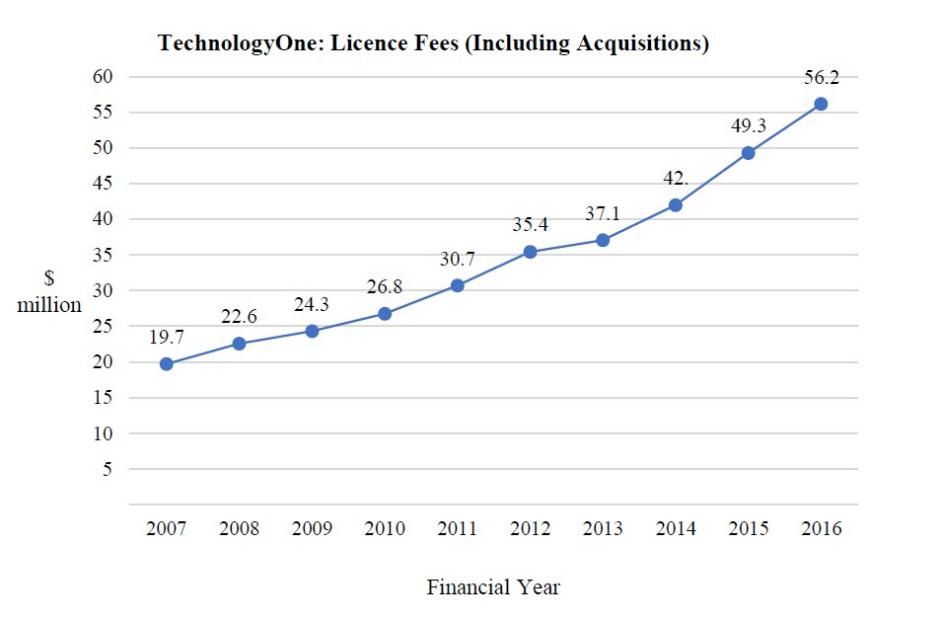
73 There is another useful graph in the opening submissions for Technology One which also accurately records the data and plots the licence fee revenue for the Victorian region between 2006 and 2018 (CB 9488):
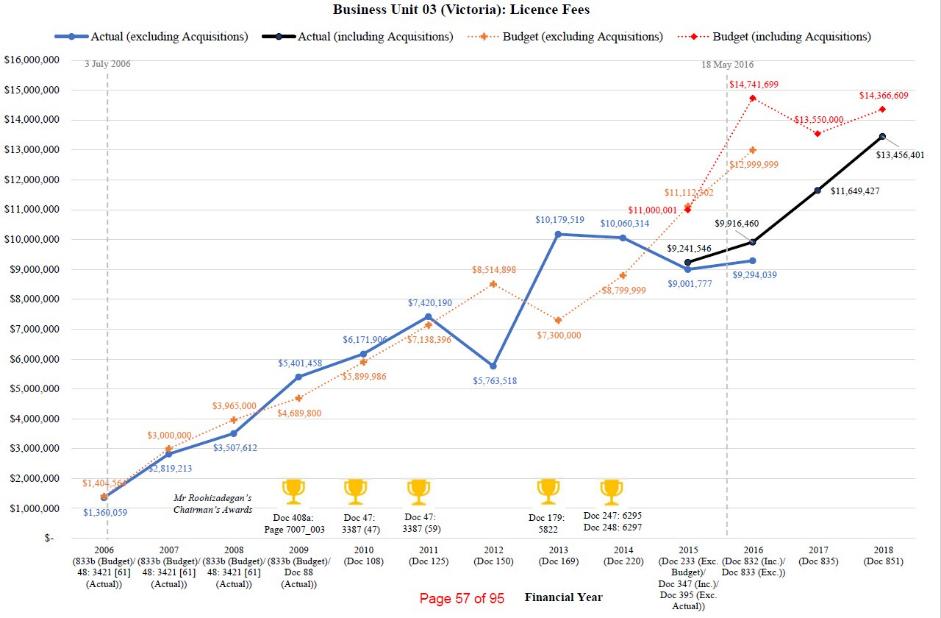
74 What will be noticed from that graph is the significant drop in licence fee revenue between 2011 and 2012, then a very significant increase between 2012 and 2014 and the flatlining and ultimate decline of licence fee growth until 2016.
6. WITNESSES AND CREDIBILITY ASSESSMENTS
6.1 Witnesses for the applicant
75 I deal first with the witnesses called for Behnam, apart from him. There were comparatively few. Boris Ivancic was employed as a regional sales manager by Technology One between February 2016 and January 2017. He gave generalised evidence about his relationship with Behnam, as well as other employees and staff morale in the Melbourne office. A significant portion of his affidavit evidence was irrelevant. The more significant aspect of his evidence concerned what he discussed with Rebecca Gibbons at a meeting on 20 April 2016. I have no reason to doubt his honesty, and it is perfectly understandable that his recollection of certain events during the period of his employment was vague.
76 Guhan Bala was employed by Technology One as a consulting director for the Victorian region between January 2013 and December 2015. Like Boris Ivancic, he too gave generalised evidence about his dealings with Behnam, the relationships between staff members in the Melbourne office and the limited contact that he had with Adrian Di Marco. His evidence was both straightforward and brief. I do not doubt his honesty.
77 Con Tsalkos commenced employment with Technology One as a customer account manager in December 2014. He was interviewed for his position by Behnam. His evidence was to the effect that during the period that he reported directly to Behnam and up until 24 June 2015, he was always provided with appropriate support. His employment was summarily terminated in June 2015 by Richard Metcalfe. He did not consider that Richard Metcalfe provided adequate support to him during the period of his employment. He was a disinterested and straightforward witness.
78 John-Henry Eversgerd gave expert evidence concerning the lost opportunity to exercise the share options claim. There was significant cross-examination about his assumptions. Like all independent expert witnesses, the value of their opinions turns on the assumptions that they are instructed to make. A number of the assumptions were not made out in the evidence, which badly affected his opinions. Nonetheless, I am satisfied that he was a well-qualified independent expert witness.
79 Paul Simms is an Executive Search Recruiter. He prepared an expert report dated 26 February 2024, concerning the future career prospects of Behnam. His evidence was given concurrently with David May for Technology One. He was a well-qualified independent expert witness.
80 Chris Katehos is a Chartered Accountant. He prepared an expert report dated 14 December 2023, which concerned the calculation of profit incentives based on various assumptions. He was significantly cross-examined about his assumptions, which were not established on the evidence. This resulted in significant amendments to Behnam’s particulars of loss. I formed the impression that he gave straightforward accounting evidence, with no independence or credibility issue.
81 Next there are the psychiatrists: Dr Gregory White, Dr John King, Associate Professor Jonathan Phillips AM and Professor Lorraine Dennerstein AO. They were all impressive witnesses who gave independent expert assessments and provided a Joint Expert Report (with Dr Nitin Dharwadkar for Technology One).
6.2 Witnesses for Technology One
82 I deal next with the witnesses for Technology One, apart from Adrian Di Marco. Some were not required for cross-examination.
83 Paul Rogers was employed by Technology One as the operating officer for consulting between February 2012 and May 2016. He provided a short affidavit, received without objection or requirement to be cross-examined, to the effect that having ceased his employment on 3 May 2016, he had nothing to do with any decision to terminate the employment of Behnam. The only reason this affidavit was necessary is that he was named as one of the persons who materially contributed to the decision in the original reply pleading.
84 Rebecca Gibbons was employed by Technology One from August 2011 until May 2017 as the human resources business partner. Her evidence concerning her visit to the Melbourne office in April 2016 was centrally important to the memorandum, in the form of an email dated 24 April 2016, that she sent to Kathryn Carr and which eventually found its way to Adrian Di Marco (the Rebecca Gibbons Email). That email, to adopt the evidence of Adrian Di Marco, was the “final straw” which caused him to make the termination decision. For Behnam, Mr Hyde Page submits that I should find that she was a very unsatisfactory witness who embellished and exaggerated discussions that she had with employees in the Melbourne office in order to portray Behnam as a poor and ineffective manager. I do not make that finding. I explain why when I address her evidence in great detail in the balance of these reasons.
85 I have concluded that Rebecca Gibbons was genuine in her evidence, though her recollection was poor as to aspects of the events in 2016, which I have concluded is an understandable consequence of the frailty of human memory over time. Very serious allegations of intentional misconduct were put to her and convincingly denied. Importantly, I am satisfied that she professionally and thoroughly interviewed a number of employees in the Melbourne office, made contemporaneous notes and from her recollection and those notes comprise an accurate report in the form of the Rebecca Gibbons Email.
86 Roger Phare was employed by Technology One between July 2001 and November 2018 in various positions. For a significant period of time, he was employed in New Zealand. In 2016 he was employed as the operating officer for the United Kingdom, based in London. His evidence concerned his early dealings with Behnam and to deny that he had any involvement in the termination decision. He gave his evidence in a straightforward, confident and direct manner. He impressed as an honest and knowledgeable witness. His evidence is of particular relevance to the breach of contract claim.
87 Stuart MacDonald has been employed by Technology One since 11 April 2016. In May 2017, he was appointed to the role of chief operating officer, which position he held when he gave evidence. Behnam makes many serious allegations against Stuart MacDonald. He is a witness who was central to the events in this proceeding. I analyse the claims and his evidence in response in considerable detail later in these reasons. Mr Hyde Page submits that Stuart MacDonald has given two different versions of critical events at the present trial and at the trial before Kerr J. He is accused of being an entirely partisan witness, motivated by a desire to protect the interests of his employer. The submission is that I should not give his evidence any weight.
88 I do not accept the submission. My conclusion from my careful assessment of his oral evidence, comparison with contemporaneous documents and with the evidence given by other witnesses is that although there were aspects of his oral evidence which were direct and abrupt, that at times he displayed a degree of arrogance, and that some of his explanations and inconsistencies in earlier affidavits were unsatisfactory, I am satisfied that generally his evidence was truthful to the extent that he was genuinely able to recall historic events without the assistance of contemporaneous notes or documents. I also have taken account of the fact that his cross-examination was often haphazard and did not proceed in chronological order with the consequence that there was a degree of confusion between the questions asked and the answers given.
89 Tony Ristevski was employed by Technology One between July 2016 and 2018 as the operating officer for corporate services. He made a very short affidavit denying any involvement in the termination decision. He was not required for cross-examination and his affidavit was received without objection.
90 Kathryn Carr was employed by Technology One between November 2009 and March 2017, in various roles including that of human resources director between October 2014 and March 2017. Her evidence ranged across a broad number of issues including her dealings with Behnam, her dealings with other staff about their dealings with Behnam and the steps taken to implement the termination decision. All of this is dealt with below. At times in her evidence, she had great difficulty in recalling what was said in relevant discussions in April and May 2016, which is understandable for the frailty of human memory reason that I have given for other witnesses. She convincingly denied serious allegations that were put to her to the effect that she was part of an agreement to manipulate a false story about why Behnam was terminated. That said, there were unsatisfactory aspects of her evidence in that she could not recall parts of the affidavit that she affirmed for the purpose of this proceeding and on many occasions answered questions with “I do not know” or “I do not recall”, in contrast to positive recollections that were set out in her affidavit. I have concluded, based on my detailed assessment of her evidence, that parts of her evidence are a reconstruction and cannot be accepted for that reason. However, I do not find that she was a dishonest or evasive witness.
91 Edward Chung is the CEO of Technology One. He was appointed to that position in May 2017. He commenced employment with Technology One in November 2007 in various senior roles of chief financial officer, operating officer for products and solutions and chief operating officer. He was a most impressive witness. His evidence was given in a direct, precise and considered manner without embellishment. I am in no doubt that his evidence was given from honest recollection to the best of his ability. His answers were always clear and concise.
92 Rodney Hooper was employed by Technology One between January 2009 and March 2017 in the role of legal counsel. His role in this proceeding was to prepare termination documents following the termination decision and to liaise with other employees to that effect. He was not involved in and did not contribute to the termination decision. He was not required for cross-examination and his affidavit was received without objection.
93 Martin Harwood was employed by Technology One between October 2008 and April 2017. He held very senior positions. He is a central witness to the events in question. He was during his employment a close confidant of Adrian Di Marco. He has known Adrian Di Marco since the early 1980’s. They first met when he was a young software developer. He commenced working for Technology One in October 2008. Between October 2009 and October 2014, he was the operating officer for products and solutions. Between October 2014 and April 2016, he was the operating officer for sales and marketing. Between April 2016 and April 2017, he was the operating officer for consulting. He retired, at age 70, in April 2017.
94 Martin Harwood gave very extensive evidence about the business structure of Technology One, the division into business units, the products and services offered and, in particular, the process of budgeting and forecasting. None of this background evidence was controversial. Martin Harwood had day-to-day dealings with Behnam from his initial commencement as the regional sales director for the central region, comprising Victoria, New South Wales and the Australian Capital Territory, in October 2008. Behnam, then known as a state manager, reported directly to Martin Harwood. Behnam ceased reporting directly to Martin Harwood in 2009, when Martin Harwood was appointed as the operating officer for products and solutions. That remained the case until October 2014. During that period, Behnam reported to Roger Phare who was the operating officer for sales and marketing. Between October 2014 and April 2016, Martin Harwood was the operating officer for sales and marketing and in that role was responsible for all sales throughout the business of Technology One with each regional manager reporting directly to him. During the entirety of this period, Martin Harwood was based in Brisbane.
95 Martin Harwood’s evidence was extensive. He was cross-examined at length. All of that is dealt with below. Mr Hyde Page submits that I should find that he was a “dishonest and unreliable witness who went out of his way to damage” Behnam’s case. That submission relies on a considerable amount of evidence referenced in closing submissions. In due course I address the points seriatim.
96 I reject that characterisation of Martin Harwood’s evidence. I closely observed him over some time in the witness box. I have carefully reflected on his affidavit evidence, the transcript of his cross-examination and the contemporaneous documents. My conclusion is that he was a polite, in part conversational, witness who genuinely gave evidence from actual recollection rather than reconstruction, despite being aged approximately 77 years in 2024. His evidence was considered, thoughtful and careful. He made concessions where appropriate. He accepted that evidence contained in earlier statements was not quite complete. He was not an evasive witness. Nor was he argumentative. He denied very serious allegations of dishonesty and intentional document destruction in a convincing way. Overall, my conclusion is that he was a forthright and credible witness, and I do not doubt his honesty.
97 Gareth Pye commenced employment with Technology One in August 2008. He remains employed by it as the group director of strategy and planning. Throughout his career with Technology One he has held senior positions such as financial controller, company secretary, deputy chief financial officer and group director of corporate development.
98 His evidence was quite detailed concerning the business of Technology One, corporate acquisitions made by it and financial management. A significant amount of his evidence was concerned with how profit was determined for each of the regions, particularly by the application of internal royalty rules. That evidence was uncontroversial. He had limited involvement in the termination of Behnam in April and May 2016. He did not make and was not involved in the making of the termination of decision.
99 Mr Hyde Page submits his credibility is “undermined” because of an aspect of his evidence involving interactions between Stuart MacDonald and Behnam. It is difficult to know what to make of the submission when, as I explain in detail below, critical questions were not put to him in cross-examination about asserted inconsistencies in his evidence concerning whether he was or was not involved in pre-termination discussions.
100 Contrary to the submission of Mr Hyde Page, in my assessment Gareth Pye was an honest witness who did his best to give evidence from actual recollection.
101 Dr Dharwadkar is a consultant psychiatrist, engaged by Technology One to review a large amount of material and express his opinions in response to certain questions. He did not interview Behnam for that purpose. He did participate in the joint psychiatric expert report and the concurrent psychiatric expert evidence session. I have no concerns about his independence.
102 David May is a human resource consultant and recruitment specialist. He was engaged by Technology One to prepare expert evidence in relation to aspects of the compensation claim. He participated in a joint expert report with Paul Simms and the concurrent evidence session on this topic. I have no concerns about his independence.
7. TWO DETAILED CREDIBILITY ASSESSMENTS
103 Very significant credibility attacks are mounted respectively against Behnam and Adrian Di Marco. Each requires separate and detailed assessment as the principal actors in this proceeding.
7.1 Behnam’s credibility as a witness
104 Technology One submits that I should conclude that Behnam was an unreliable and in part dishonest witness with three consequences: (1) his oral evidence should not be accepted on contentious issues; (2) his alleged contemporaneous written notes should be treated with suspicion; and (3) that is another reason why it should be concluded that he would not have remained as an employee of Technology One.
105 Many matters in support of those submissions are relied upon. Some of them are resolved when I address the evidence in detail in the balance of these reasons. There are other matters that I consider require analysis at the outset because they are relevant to whether I conclude that Behnam was generally an unreliable witness, as distinct from an unreliable witness as to the specific events that are in issue in the proceeding.
106 The first matter is how Behnam performed as a witness before me over approximately 11 days of intense and probing cross-examination. There are not many witnesses capable of sustaining such a prolonged period of cross-examination and due allowance must be made for lapses in concentration, failures to directly answer questions, the adoption of self-justifying and sometimes argumentative answers and giving speeches, when nothing more was required than a simple yes or no to individual propositions. There would be even fewer witnesses capable of maintaining composure where, as here, the individual suffers from a Major Depressive Disorder. Significant allowance must be made in favour of Behnam on account of these considerations.
107 Indeed, I need to take the last point a little further. At times during the cross-examination, I became concerned as to whether it had reached the point of oppression. To put that into context, the cross-examination commenced on 1 October 2024 and extended, not always to the entirety of the day, to each of 2, 3, 4, 7, 8, 9, 10, 11, 14, and 15 October 2024. On 7 October 2024, the fifth day of questioning, I raised with Mr Wood whether the questioning had traversed into the territory of oppressive conduct. I received what was then, and in retrospect, a perfectly satisfactory answer in that the claim raised many issues; much larger and broader than the framing of the issues at the first trial and with a consequent increase in damages of approximately ten-fold. On that day, Mr Hyde Page was absent from the trial (with my knowledge and agreement) and Mr McKenna, who had apparently only been briefed that morning, appeared in his place. He requested an adjournment so that this matter could be raised with Behnam. I granted the adjournment and lunch was taken. On resumption I was informed that Behnam did not feel “safe” speaking with two lawyers without a support person present. Hence, the matter that I had raised was not advanced and no application was made by Mr McKenna to, for example, limit the further cross-examination in the exercise of the powers conferred at s 37P of the Federal Court of Australia Act 1976 (Cth) (FCA Act). The cross-examination resumed. Mr Hyde Page returned to the bar table on 8 October 2024. No application was then made that I limit the extent of the further cross-examination.
108 I returned to this topic on the afternoon of 14 October 2024, the tenth day of the cross-examination. I noted that on my assessment Behnam had by then been cross-examined for 9 and a half days. I observed that even in the absence of an objection from Mr Hyde Page, my overarching obligation was to ensure that the trial was conducted fairly. At that point I was assured that the cross-examination was nearing the end point. Still, despite raising my concerns, Mr Hyde Page made no application.
109 In assessing the evidence of Behnam, I have decided that he must be given a fair degree of latitude in my credit assessment by reason of the length of his cross-examination. To this, there is the added consideration of the state of his health. It was obvious that he was not a well man, on some days he was far less of a well man than on others. He was medicated. He was not sleeping well. On 2 October 2024, he asked for permission to consult his consulting psychiatrist Dr King at the conclusion of the days evidence, which was readily agreed to.
110 During the joint psychiatric expert evidence session, I invited the experts to express views about whether the state of Behnam’s health and/or his medicated condition may have affected his ability to correctly recall historic facts, which I had raised with counsel in the absence of Behnam some days earlier. No objection was raised to my framing of questions to the experts on that topic. Indeed, the first question on that topic was asked by Mr Gisonda for Technology One (from T 1442). Dr King confirmed that Behnam was taking between 40 and 50 mg of temazepam each evening to assist with sleep, 5 mg of diazepam each morning and another 5 mg each afternoon. The first series of questions concerned whether the level of medication may have affected Behnam’s ability to accurately recall events between 2009 to 2016.
111 Dr King responded. First and his answer was premised on his subjective assessment that Behnam was “absolutely harassed” in cross-examination. That is not accurate. The cross-examination was lengthy, more so because of the very frequent inability of Behnam to answer questions directly and to refrain from making self-justifying speeches from the witness box. Dr King expressed the view that his medication can affect his memory but ultimately did not consider that it would make much difference.
112 At that point I requested the experts to more closely focus on the purpose of the questions. That is, on repeated occasions it had been put to Behnam that he was lying and in response his answer would always be to the effect that: “Your Honour, I am bound here to tell the truth on my oath and that is what I’m doing”. I then invited their respective opinions as to whether his diagnosed condition and his medication would likely have affected his ability to recall historic events when giving evidence in October 2024.
113 Dr King then opined that it would not make Behnam more likely to reconstruct his evidence and that it would not affect his accurate recall of distant events. He added that he did not “think” it would make reconstruction more likely.
114 Dr White was more direct. In his opinion there is no doubt that generally depression has an adverse effect on memory, and he would “not be at all be surprised” if his memory was not affected. He said it was possible that Behnam had not deliberately given false evidence: rather, he honestly but mistakenly falsely recollected.
115 Dr Dharwadkar opined that Major Depressive Disorder can cause cognitive dysfunction, though more so for short-term memory. He qualified his view in that the levels of medication Behnam was taking during his evidence “can have a capacity to have impacts on the memory”.
116 Professor Dennerstein agreed, subject to the impact that tolerance to medication may have. When Dr King provided clarity on tolerance, Professor Dennerstein stated that the medication was likely to have less impact on memory.
117 Associate Professor Phillips then provided what I consider to be the most satisfactory opinion on this question, as it was reasoned and followed the discussion between the other psychiatrists:
I think we need to keep in mind that Major Depressive Disorder is a very serious depression spectrum problem and the interference with cognition is really common and really important. And my view would be that this man’s cognition at that point in time would have been impaired at least at a moderate level by his medication, but I would like to add that if he was taking benzodiazepines and particularly Valium, which is diazepam, which has a long half-life, that too would have interfered with his memory functions, his concentration, his ability to think in an executive way. And he may, as a consequence, have had to reconstruct, certainly on an unconscious level, what had happened. Is he feigning or malingering? Much harder question and I don’t think that’s up to a psychiatrist to respond to.
118 I find that Behnam was inhibited in his ability to accurately recall historic events during his cross-examination to the extent opined by Associate Professor Phillips. That extends to partly explain his argumentative demeanour, repeated inability to answer questions directly and continual self-justification of the correctness of his case. It is also capable of explaining Behnam’s repeated denials that he was not lying.
119 However, the question is: to what extent? In my view, Behnam’s poor mental health and medication does not fully explain, nor completely excuse, the multiple false statements that he made in evidence, his combative demeanour and his defensive and evasive evidence in general. This conclusion requires detailed explanation.
120 First, his demeanour in general. The transcript is replete with rehearsed evidence, unnecessary elaboration, advocacy, long discursive self-justifying answers, conspiracy theories, avoidance of questions, defensive and evasive answers, repeated qualification coupled with justifications and explanations, long speeches, commentary, the drawing of fine and implausible distinctions, volunteering unprompted answers and general evasion. There are too many examples to list. Behnam exhibited this behaviour on each day that he was in the witness box. On many occasions, questions were required to be put on multiple occasions to elicit simple answers that were, very often, self-evident from contemporaneous documents. This caused multiple warnings from counsel and me about the need to focus on the question asked and to provide a responsive answer, coupled with the usual advice about the framing of submissions to the effect that he was an unsatisfactory and unreliable witness at the end of the case. Behnam proceeded, undeterred and untroubled.
121 Behnam’s oral evidence was simply tortuous, despite that on the first day of his cross-examination and shortly after it had commenced, I emphasised to him the importance of listening carefully to a question, answering yes or no if that is all the question required by way of an answer and that if some explanation or clarification is required it would be a matter for Mr Hyde Page to take up the matter in re-examination. My warnings became more explicit as his evidence progressed with little effect.
122 Second, his evidence was obviously rehearsed despite stating that he had “tried not to think about these things in the last eight years” (T 104). That is clearly incorrect, evidenced first by his long and detailed answers in examination-in-chief, repeated on multiple occasions during his cross-examination. Behnam ostensibly was able to recall the words used in conversations from 2009, without the assistance of contemporaneous documents. What is obvious is that Behnam has spent months, perhaps years, poring over the witness statements and affidavits that he made during this proceeding with the contemporaneous documents.
123 Third, I have regrettably reached the conclusion that Behnam is a fabulist who told many transparent lies in his evidence which are incapable of rational explanation as honest but mistaken recollection or reconstruction. I make many findings to that effect in the balance of these reasons. There are other examples, that I deal with at the outset as informing my conclusion.
124 Very early on the first day of cross-examination, questions were asked about Behnam having consulted Dr White in November 2015 and the content of his subsequent psychiatric report dated 9 November 2015. He was taken to the report (CB 220). Precise questions were put to Behnam to elicit confirmation that the clinical history as recorded by Dr White was correct. Behnam mostly confirmed that it was (from T 126). However, when it was put to Behnam that he didn’t tell Dr White “Anything about what was happening at work as a possible cause of the way in which you were feeling”, Behnam answered and was further questioned (T 137-138):
He never asked. The only question he asked, “Are you under performance management”, and I said, “No, I’m not under performance management.” That’s the only question I remember. He didn’t ask, “How is work? Are you being bullied? Are you being gaslighted? Are you – problems at work?” This and that. He was just asking general questions and he was the kind of gentlemen who did not allow me to elaborate or respond. Every time I wanted to say something he said, “Shush, shush. I ask questions. You just answer the question. Shush.”
You are not being honest, witness?---I am – have – I have sworn an oath to this court and I have to be truthful everything I say, Mr Wood.
125 The implausibility of the psychiatrist not permitting a patient to speak freely during an examination requires no elaboration. When Behnam’s evidence was put to Dr White, he exposed the obvious lie: “No, I don’t think in 40 years I’ve ever used the word “shush” (T 1398). Later, Dr White returned to this answer and said that it was “just beyond belief” that Behnam claimed that this had been said during the consultation (T 1447).
126 That was a direct and considered lie by Behnam which is not explicable by reference to his mental state or medication when he was under oath to tell the truth. The seriousness of this lie requires a little contextualisation. The purpose of the examination by Dr White was the preparation of an independent medical expert report for Behnam’s damages claim, commenced in the Supreme Court of Victoria concerning his daughter’s ill-health and alleged mistreatment in September and October 2010, which was the cause of psychiatric injury to Behnam and whether his injury met the statutory threshold of 10% as required by s 28LB of the Wrongs Act 1958 (Vic). There were other visits to medical practitioners around the same time: Dr Latimer on 4 November 2015, Dr Luke Ainsworth on 9 November 2015, in addition to the examination by the Medical Panel on 14 January 2016. Behnam commenced this proceeding on 19 August 2016. Amongst other things, he formulated a claim for damages for mental injury caused by the alleged adverse action, in particular the termination of his employment.
127 Behnam first consulted Dr King on 29 August 2016, upon referral by his general practitioner. Dr King provided a report to Behnam’s then lawyer on 22 December 2016, at which point in time there had been nine consultations (CB 232). There is no mention in the recorded history, as set out by Dr King, of any of those earlier consultations or the conclusions reached by the psychiatrists that it was his daughter’s illness which caused Behnam’s psychiatric injury. Nor was there any mention of the Supreme Court litigation.
128 This was pursued in cross-examination (from T 188). Behnam was evasive. He stated that Dr King never asked him about his previous mental state or his consultations with other psychiatrists. He repeatedly gave answers to the effect that Dr King did not ask him questions relevant to disclosure of those facts. He denied the direct proposition that he intentionally withheld this information from Dr King and lied to him because he wanted “to make sure what you had told the previous doctors didn’t come out”. His denial was unconvincing. On page four of the report addressed to Behnam’s solicitors for the purposes of this proceeding, Dr King states:
I believe that Mr Roohizadegan’s mental state prior to his dismissal was normal.
129 The cross-examination continued (T 189):
Do you see that?---This what is he has written?
Yes?---I can’t speak for him.
Yes. And that was untrue, wasn’t it? That was untrue?---Well, I did not write that report, Mr Wood.
But you knew it was untrue, didn’t you?---How can I say somebody’s opinion is true---
You know it is untrue because you had seen five doctors on four previous occasions during 2015 and 2016 prior to your termination. You knew it was untrue, didn’t you?---No. Incorrect. I disagree with you.
What you did in these consultations with Dr King was you purposely did not disclose anything that you had told the previous doctors about the way in which you were feeling prior to the termination?---As I stated before, he was very concerned that I was on the verge of killing myself after my termination.
Just answer the question?---So that was the focus. He did not ask me questions. If he had asked me questions, anything else, I would have told him.
You didn’t tell him you were collapsing at home from fatigue, did you?---I was – when I saw Dr King, I was already - - -
Well, before – before – just answer my question. You didn’t tell him, prior to your termination, were you collapsing at home from fatigue, did you?---He did not ask me.
You didn’t tell him that you would lie down on weekends because you didn’t feel like doing anything, did you?---I was not working at the time, Mr Wood. I was sacked.
No. Prior to termination, you didn’t tell him that, did you?---I was sacked. He was asking me questions. He was – and I was responding to him.
You didn’t tell him that, prior to termination, you were struggling to concentration at work and misjudging situations and that you were irritable?---I’m sure you will have all of his clinical notes and you can see from his clinical notes what he asked me - - -
HIS HONOUR: No, no. Did you tell him that?---He did not ask me. If he asked me a question I would have responded to him.
MR WOOD: And what you didn’t also do is you didn’t mention the sleeping pills overdose incident from 2012, did you?---Not at that time. Later on he asked me about it. I responded to it.
And you didn’t tell him that you had had suicidal ideation?---I did tell him. I came to West Gate Bridge to jump off the bridge.
No, no. Prior to termination?---He did not ask me about prior to that at that time.
Because you didn’t disclose it to him deliberately?---It’s like going to a GP. They ask you a question. You say, “My stomach hurts” - - -
He’s not a GP. He is a psychiatrist?---Yes. They ask you questions and you respond to them. So he was focussing on my - - -
130 The questions and answers continued to the same effect for some time with Behnam repeatedly denying that he did not set out to deliberately deceive Dr King.
131 It is utterly implausible that a psychiatrist engaged by a lawyer to prepare a medical report for use in this proceeding, when the psychiatrist was clearly instructed about the circumstances of the termination, would not permit the patient to give a full history of their previous psychological stressors, medical examinations and treatments. Dr King could not possibly have concluded that Behnam’s mental state prior to his dismissal was “normal” unless Behnam deceived him as to the true position. It is obvious that Behnam deliberately withheld the psychological impact of his daughter’s illness for the purpose of obtaining a report favourable to his claims in this proceeding. Behnam’s evidence discloses a pattern of deceit with two psychiatrists which cannot be attributed to his mental state whilst under cross-examination, or the medication that he was on at the time.
132 Similarly, when Behnam was interviewed by the Medical Panel he did not disclose that his work was a source of stress, claiming that: “they did not ask about my work, they just asked about my family” (T 161). To the contrary, the report of the Medical Panel (as noted above records) that Behnam disclosed his 18-hour workdays, his role as a general manager and that he had not disclosed his psychiatric condition to his employer. The Medical Panel did not make these facts up. Behnam was plainly asked about his work and his evidence to the contrary was a lie.
133 Behnam’s habit of denying aspects of his recorded history in psychiatric reports is not limited to these examples. His evidence disclosed an obvious pattern: where the history was inconsistent with the central claim that he was dismissed for unlawful reasons, rather than his performance, Behnam disagreed. I do not set out the evidence at length. In summary, he denied that he told Dr Latimer that he had not felt comfortable discussing things with his colleagues, that he was irritable towards his colleagues or superiors at work and that he was not happy at work (T 122, 124 and 149). He denied telling Dr White that he was not efficient at work but instead said that he “felt” he was inefficient (T 133). He further denied that he told Dr White that he had not been performance managed “yet”, but instead he said he had not been performance managed, and Dr White added the word “yet” (T 137). Dr White’s report is a contemporaneous record of what was said about not being performance managed by Behnam’s employer. His record is clearly a correct account of what was said.
134 Behnam claimed to have no knowledge of why he had been interviewed by the Medical Panel in January 2016 (from T 154). He denied knowing at the time that he was the second plaintiff in the Supreme Court proceeding against the medical practitioners that he caused to be commenced in 2014. Implausibly, his evidence was that he did not understand what that claim was about; that “I just engaged the lawyers, and I just left it to them”. Counsel accused Behnam of just “making stuff up as you go along”, which Behnam denied. That denial was false. The Medical Panel report includes the recorded history provided by Behnam, the impact that his daughter’s illness and alleged mistreatment had on his psychological well-being in considerable detail (SCB 1557-1560). Behnam clearly understood why he was interviewed by the Medical Panel and that it was for the purpose of, amongst other things, advancing his claim for damages in the Supreme Court proceeding.
135 The next matter concerns employee share options. An aspect of the claim for damages is the loss of valuable employee share options of approximately $1.9 million. Behnam was questioned about various assumptions that his expert had been asked to make about whether he would have taken up share options if his employment had continued. Behnam was insistent that this was his intention (T 228). His evidence went further, that having taken up the options, he would have held onto the shares. However earlier it emerged that options that he had exercised in July 2015 resulted in the issue of the shares to his wife (T 222). He insisted this was part of a joint matrimonial savings plan. His attention was directed to share registry documents which disclosed that his wife had sold down the entirety of the option shares by 19 August 2015 (CB 1963). Behnam denied any knowledge that his wife had sold the shares (T 223). It was put to him that he was “just making up this evidence about a savings plan” because his expert had been instructed to calculate his future economic loss on the assumption that the shares would have been held and not sold. Behnam said that was untrue. He then gave implausible evidence, that was obviously made up on the run, that he wanted to see evidence of the sale documents, despite what was contained in the share registry document, claimed that his wife had “many shares” and that he did not know what the share registry document meant. Further, he claimed he could not recall any discussion with his wife about her intention to sell the shares, or having sold them.
136 All of that evidence was false, as Behnam later admitted following a brief adjournment. His evidence was then that after walking around outside of the Court and recalling that he had to be truthful, he remembered that his wife did tell him about the share sale (T 233). His first version cannot simply be categorised as a memory lapse – it was a foundational assumption for the calculation of a very large component of his damages claim. It cannot be the case that his solicitors simply made this up.
137 Then there is the serious matter of the lost handwritten notes. Some background is required. In 2006, Behnam commenced a proceeding in the Supreme Court of Victoria against IP Systems Pty Ltd. He pleaded an employment contract with certain express terms; including remuneration calculated on a commission basis of 2% of gross sales. The commission term was in writing. He then pleaded that at a later point in time an oral agreement was reached to increase the commission rate, which had the effect of varying the written agreement. He claimed that in breach of the agreed variation, his employer failed to pay the agreed increased commission. The commission claim alone in that proceeding was for approximately $1.3 million.
138 In support of the claim, Behnam claimed that he had made contemporaneous handwritten notes of the critical discussions. Those notes were in a notebook, referred to as a logbook. He made that claim in his witness statement which he signed and verified as true (FSCB 10,439). Behnam swore an affidavit in that proceeding on 1 June 2009 (FSCB 10,617). In that affidavit he said that he no longer had the logbook in his possession. The effect of his affidavit was that in March 2009 the solicitors for the defendant had requested production of the logbook for a forensic handwriting examination. In response, Behnam was “very concerned” that the examination would damage the original. Some of the notes had been made using coloured pens. Behnam thought it would be “prudent” for colour photocopies of the logbook to be made before the forensic examination because black-and-white copies might give a wrong impression. Therefore, on 10 March 2009 he attended the offices of his solicitors and collected the logbook for the purpose of making a colour photocopy. To do this, he sent his wife to Officeworks in Glen Waverley where she made colour photocopies of the document. A few days later Behnam went with his family to the post office in Glen Waverley and placed the logbook and the colour photocopies in a large Australia Post envelope which he addressed to his solicitors in Lonsdale Street, Melbourne.
139 The envelope did not arrive at the solicitor’s office. This caused Behnam alarm. He made inquiries of Australia Post, but without success. He deposed that to the best of his knowledge he did not have, nor did his solicitors have, the missing original logbook.
140 Behnam was very carefully and forensically cross-examined about this evidence. He first denied that he was aware that the defendant’s solicitors had requested a forensic examination because they did not accept the authenticity of the logbook as a contemporaneous record (T 358-359). That evidence was false. Behnam swore to that fact in his affidavit of 1 June 2009 at [2], where he annexed a copy of the defendant’s solicitors letter containing the request for a forensic examination. The letter dated 4 March 2009, states on the first page that the purpose of the handwriting examination was “to determine the date upon which those handwritten annotations were made”. On the second page, each of the pages and notes the subject of the intended examination are identified.
141 Behnam further stated that he wished to make the copies himself because lawyers “charge for every single page” and his intention was to “reduce my costs” (T 360). I enquired how many pages were in the logbook, to which he answered: “maybe 200 pages… 200-250”. He further described it as “a huge logbook”. At that stage, Behnam did not explain why every page had to be copied, when the solicitor’s letter specified the entries and the pages to be copied. In fact, only 11 pages were required for forensic examination (CB 10,621,10,623). More damning, however, is that Behnam annexed a copy of the photocopying tax invoice to his affidavit which disclosed 29 single page documents and one double sided page had been copied (CB 10,629). The total cost was $41.79. That cost cannot be reconciled with Behnam’s evidence that he decided to undertake the photocopying himself to reduce the cost at a time when his remuneration from Technology One was approximately $600,000 in 2009 and 2010.
142 I conclude that Behnam lied about the reason for making the copies himself. But that does not conclude this aspect of his evidence. In his Supreme Court affidavit, he stated that the documents were lost by Australia Post, and before me said that he believed that he had used registered rather than ordinary post. The Australia Post receipt annexed to his affidavit is for regular postage (CB 10,631).
143 The entirety of Behnam’s evidence about the missing logbook is implausible and in part punctuated by demonstrable lies. I reject his explanation that he undertook the photocopying obligation because he was concerned that the logbook may be damaged and to save cost. I find that he was concerned that a forensic examination may conclude that some or all of his notes were not contemporaneous. He then took steps to ensure that the notes could not be forensically examined. His evidence about Australia Post losing the notes is also false. If the logbook was a genuine contemporaneous record of a conversation critical to prove his case, he would not have been so careless as to entrust redelivery to Australia Post. There is no plausible explanation why he posted the documents from a suburb in Melbourne, when his office was on St Kilda Road from where he travelled to collect the original in the first place.
144 As I have foreshadowed, there are many other examples of implausible and false evidence that Behnam gave in this proceeding which I address seriatim when considering the factual chronology that must be resolved. My overall conclusion is that Behnam was not an honest witness in very many respects. That does not mean that I must, for that reason alone, reject all of his evidence. There is clearly much evidence that is consistent with authentic contemporaneous documents or is corroborated by other witnesses. Where, however, when faced with the task of resolving conflicts in the evidence, I do so mindful of my overall conclusion.
7.2 Adrian Di Marco’s credibility as a witness
145 By the time of closing submissions, Behnam’s case accepted, in the Amended Reply dated 13 August 2025, that Adrian Di Marco was the only decision-maker who determined to terminate his employment. That concession must not be conflated with maintenance of the contention that one or more of four others materially contributed to the decision. Mr Hyde Page makes detailed submissions to the effect that I should conclude that Adrian Di Marco was not a credible witness and he should not be accepted as such on controversial facts. Many of the submissions concern contradictions and implausible evidence at a granular level, which I address in my detailed fact-finding. However, as with Behnam, it is necessary to address some overall credit issues at the outset.
146 The first and overarching submission is: “nobody would suggest” that Adrian Di Marco’s “main concern was to give candid and forthright answers to questions”. The first criticism underpinning that submission is that he spent an inordinate amount of time re-reading documents before answering each question and that it should be concluded that he did so to anticipate the line of cross-examination. That submission is taken a little further by pointing to many requests that he made that questions be repeated “even when it was apparent that he had heard and understood the question”. The example that is first relied upon is a question that I put to Adrian Di Marco at T 1763. The context of my question is that counsel asked a general question about whether Adrian Di Marco recalled a document described as “the countdown sheet” and followed with a question which invited him to elaborate on the role of that document in the business of Technology One in 2016. Adrian Di Marco asked for the document to be displayed to answer. I intervened and noted that counsel had not asked a question by reference to the content of the document. Further questions were put to clarify whether what was meant was a particular document, at which point I advised Adrian Di Marco to simply answer the question as framed and not anticipate the next question. With that clarification, and in answer to my open question to describe the role of the countdown sheets, Adrian Di Marco gave a very long answer. Counsel was obviously content with that answer, because no follow-up question by way of challenge was put. This passage does not make out this aspect of the submission.
147 It is correct to observe that on many occasions Adrian Di Marco requested that a question be repeated, but I do not accept that he did so when it was apparent that he had heard and understood the question. The example relied on is at T 1750. Once again, the context of the question needs to be understood. At T 1749, counsel framed two introductory questions. One, whether it was correct to understand Adrian Di Marco’s evidence that “an aspect of your motivation” for the termination decision was that Martin Harwood and Stuart MacDonald were in favour of it. Adrian Di Marco said that was correct. The next question was whether it was the case that at the termination meeting on 18 May 2016, Adrian Di Marco outlined his reasons for his decision. Adrian Di Marco did not answer that question; rather, he requested that the previous question be repeated because he might have misinterpreted it. He apologised for his request. Counsel obliged and restated the question but this time in different language. The question was then whether it was “part of the reason” for the termination decision that Martin Harwood and Stuart MacDonald were in favour of it. Adrian Di Marco again sought clarification because he wanted to be “completely clear” in understanding exactly what was being asked. Regrettably, that led to another different question being put: whether Martin Harwood and Stuart MacDonald were in favour of termination. Adrian Di Marco noticed the difference. Counsel, at least initially, did not. Understandably, Adrian Di Marco sought further clarification as to which question counsel then sought an answer to. Finally, there was clarity when counsel asked whether Martin Harwood and Stuart MacDonald were in favour of the termination, to which Adrian Di Marco responded that they were. The next question asked whether Adrian Di Marco considered their opinion “as a big part” of his reasons, to which he answered that it was not. Once all of that is understood in context, the criticism in the submissions is not made out.
148 The next submission is that Adrian Di Marco was reluctant to give categorical answers, on numerous occasions claimed that he had only skim read email communications and “accordingly could not give a precise answer about his state of personal knowledge” at defined points in time. Several passages in the transcript are referenced, commencing with T 1663. The reference is very selective. The context of the evidence relied on was the Rebecca Gibbons Email. Adrian Di Marco said that it was a concerning email and was personally gut wrenching. He was asked whether he received it on 25 April 2016, to which he did not recall. I told Adrian Di Marco to assume that was the date of receipt. He was then asked whether he recalled what he was doing when he “first saw” the email, which he did not. He was asked whether he read the entirety of the email, to which his answer was: “I skimmed the email. I skim everything”. This was followed with a question to clarify why Adrian Di Marco only skimmed an email that he found “extremely concerning and one of the worst emails you had ever seen”. Pausing there, that proposition was not put to Adrian Di Marco. In any event, he answered:
When you get 50 emails a day, it’s very hard to break habits of skimming. So I skim emails. I skim them to an extent where I can get 80% of what’s in an email, but, yes, I skimmed the email. I stand by that.
149 A little later this was followed with a question whether Adrian Di Marco was sure or not about reading the entirety of the email. That question was put on a false premise, but was not objected to, in that Adrian Di Marco did not say that he was unsure about how much of the email he read. Adrian Di Marco at the time was the CEO and executive chairman of Technology One. On many occasions in evidence his electronic diary was referenced. Adrian Di Marco was time challenged. His diary records multiple meetings on each day, often back-to-back and usually at very short intervals. He was clearly very busy and time poor in the discharge of his duties. He relied on senior managers to filter material for him. On multiple occasions he described in evidence that his practice, which he found hard to break, was to only skim emails in order to understand the gist of a point or a problem. At T 1664 he said: “after many years of running a fast-growing company, you just learn to skim, and it’s very hard to break that habit”. That evidence is entirely plausible and I accept it. I also reject the submission that it is because Adrian Di Marco only skimmed email communications, that he could not give a precise answer about his personal knowledge at points in time. That is true but has a rational explanation that I accept. What must not be overlooked in this case is that Behnam’s performance and the decision to terminate was one of a multitude of issues that Adrian Di Marco had to deal with on a day-to-day basis.
150 A submission is then made that Adrian Di Marco was unable to remember key events, which he conceded. That submission really goes nowhere. He gave evidence in April 2025 about events between nine and sixteen years earlier. A particular example that is footnoted begins at T 1690 where Adrian Di Marco was questioned whether he believed the content of the Rebecca Gibbons Email to be true. His evidence was that they were just allegations, about which he had no opinion as to their truthfulness. He confirmed that evidence in answer to another question and he was then asked whether his evidence was that he “didn’t necessarily believe” the allegations. To this, Adrian Di Marco answered:
No. My evidence – well, let me be very specific. My memory is not great, I’m sorry. It’s many years ago and it has deteriorated. I was concerned about the allegations.
151 Counsel did not further challenge that evidence and moved to a different topic. The next footnoted reference is to T 1768 where Adrian Di Marco’s attention was directed to whether he recalled his attendance at an executive leadership team meeting approximately one week prior to 18 May 2016. He said that he did not. He was taken to an extract of the transcript of his evidence at the first trial where, on a fair reading, he said no more than he did not recollect attendance at such a meeting. The questions in the present trial then continued to the point where I put a question to him about whether having stepped down from his CEO and board roles in 2017, his health had deteriorated. He answered that his memory was not great. He has not had any particular health episodes, but he did say that he now requires note taking to assist his memory because “it’s all very vague”. All that excursion into the transcript demonstrates is that Adrian Di Marco’s memory has faded over time. It does not found a submission that he was generally an unsatisfactory witness.
152 The next submission is to the effect that on numerous occasions Adrian Di Marco contradicted his own evidence. The starting point for this is a passage in his 2023 affidavit said to be inconsistent with his evidence at T 1750. The submission is that he refused to agree that Martin Harwood’s opinion was a “big part” of his reason to terminate. Adrian Di Marco said it was not. There is no inconsistency with his affidavit of 18 October 2023, where at [59]-[79] he sets out all of the matters he considered, including the view of Martin Harwood. There was no refusal to agree: the cross-examiner did not draw the finer distinction whether Martin Harwood’s views were a part or a big part of the reason to terminate.
153 Another criticism is that Adrian Di Marco would not make a concession that he perceived to be helpful to Behnam – concerning whether he accepted that Behnam was a strong and confident man (T 1619-1623). The criticism is trivial and overlooks that Adrian Di Marco praised Behnam for initially having turned the Victorian business around and in doing so did a “fabulous job” and that for many years he was loyal to and grateful for Behnam’s hard work (T 1619). The cross-examination at T 1623 concerned his view at a later period, that is, when Behnam had ceased to be a high performing employee. The same analysis applies to the contention that Adrian Di Marco did not wish to concede that Behnam was good at securing new customers (T 1623).
154 Another inconsistency that is relied on is that Adrian Di Marco refused to accept that he was aware on 16 May 2016 that Behnam was unwell (T 1708-1710, 1714-1715). Once again, the criticism is misplaced, likely because of the confusing way in which the questions were put. Adrian Di Marco was cross-examined about a long email that Behnam sent on 15 May 2016, which attached a medical certificate certifying his unfitness to attend work until 17 May 2016. Adrian Di Marco denied that the medical certificate was the first thing that he noticed when he opened the email. He correctly pointed out that it was a very long email sent late at night. He said, understandably, that “to be frank, my eyes glaze over when I see an email of that extent with that amount of detail at that time of night” (T 1710). He did not say in the course of that evidence that he was unaware that Behnam was unwell.
155 The submissions then turn to that which is characterised as “many implausible assertions and changes” in Adrian Di Marco’s account of relevant events. The first item referenced concerns whether Adrian Di Marco used budget targets as a measure of performance (T 1677). His evidence was that he did not set the budget, and he did not use it as a performance measure (T 1677). He was taken to an email that he sent on 16 February 2009 (CB 3981.001) addressed to all regional managers which contained an “observation” to the effect that he required managers to deliver against determined budgets. Adrian Di Marco disagreed that “beating the budget” was that which was important from his perspective. He explained that he expected the accounts department to “push me to send an email about budgets”, but “budgets were not something that I used at the regional level to measure performance”. That answer was not further pursued. There is no merit in the criticism.
156 The second contention is that Technology One’s case is that Behnam was not terminated because of his entitlement to remuneration. That is perfectly correct. Adrian Di Marco was questioned about minutes of a quarterly review meeting held in April 2016 (CB 7891.001), which is an email that attaches minutes of the meeting which record Adrian Di Marco’s presence together with Edward Chung, Gareth Pye and Paul Rogers. There is an oblique reference in tabular form to “cost controls” and then: “Align RMs/CDs to OO – Short term profit, EPRS the same”. Adrian Di Marco did not accept that this was a reference to cost-cutting and further stated that he did not recall the minutes and did not recollect attending the meeting. He then made the point that none of the other listed attendees had authority to change the remuneration of a regional manager (T 1661-1662). On his evidence he had not seen the document before. The submission continues that “quite transparently” the reason why Adrian Di Marco did not want to concede the significance of this minute was the allegation that Behnam was terminated because he was earning too much money. What that criticism overlooks is that it was not established that Adrian Di Marco was at the meeting, nor was it established that anyone other than Adrian Di Marco had authority to alter Behnam’s remuneration arrangement (if he even could, because Behnam had the benefit of the contract) and, moreover, it ignores all of the very clear evidence from Adrian Di Marco that he was quite unconcerned about the remuneration that Behnam was earning, because it reflected his good performance by meeting budget and increasing company revenue (for example, T 1782).
157 The next submission is that Adrian Di Marco “did not want to be pinned down” to objective evidence about licence fee forecasts in early 2016 (T 1678). There is no merit in this criticism. Adrian Di Marco genuinely could not recall the licence fee forecasts for the Victorian region in February 2016 for the full year. He frankly acknowledged that he regarded forecasts as “very important” which he closely monitored, but it is hardly a matter that adversely affects his credit that in 2025 he could not accurately recall what the February 2016 forecast was. That addresses the related criticism (T 1680) that Adrian Di Marco could not identify any contemporaneous document which evidenced his concern about the likely full year licence fees for 2016 for the Victorian region. What he said was that he had conversations during which he expressed his concern with his executive team, and with Behnam, but he was “not sure” if there were any documents which expressed that concern. The fact that Adrian Di Marco could not, when put on the spot in 2025, point to a document does not undermine his credibility as a witness. It was open to Adrian Di Marco to convey his concerns orally.
158 Next there is the issue whether Adrian Di Marco trusted forecasts in an operating report for sales and marketing prepared for the board meeting on 13 May 2016 (CB 7633). This criticism is unfounded in that it overlooks the distinction which Adrian Di Marco drew (T 1681) between forecasts and “the countdown”. When pressed to identify “a particular number” that he regarded as credible, he was unable to do so because “I can’t remember now. We’re going back a long time ago…”. There is no incredulity in that evidence.
159 The balance of the implausible assertion submissions interrogate in some detail evidence that is central to the resolution of the issues in this case, which analysis I leave to the balance of these reasons. There are however, several further higher-level submissions that may presently be addressed. A submission is that Adrian Di Marco “appeared to be highly conscious of what the legal issues are in this proceeding and concerned to give answers to questions that would advance the respondents’ case and at the same time be vague and non-specific”. What is primarily relied on is the distinction, which Adrian Di Marco frequently drew in his evidence, between the fact of the making of a complaint by Behnam and what he saw as the underlying behaviour not expected of the senior manager. I will give one example. It concerns questions that were put about the escalating behaviour of Behnam in sending numerous emails containing various complaints. At T 1736:
Is it your evidence that the escalations, the emails that Mr Roohizadegan sent to you, were not part of the reason that you terminated Mr Roohizadegan?---My recollection is that yesterday I drew a distinction. I said the escalations, the emails, had the complaint, which I couldn’t care less about, and then if you put a line through all the complaints, there’s clearly his behaviour, his escalating behaviour, behaviour that was inappropriate for an executive. And I was drawing a distinction between the complaint and the behaviours that surround it. So if you put a line through all the complaints, just ignore it and look at the words that are around the complaints, they are not the behaviours that I expect from my executive. An executive on a million dollars a year who is not taking responsibility, who is pushing back, who is causing needless angst to people, who is undermining people, who does not take no for an answer, and the list goes on. I can keep going. That’s what I am talking about. They are behaviours very distinct to the complaint.
160 The submission is that this evidence, and other evidence to the same effect, “was clearly sophisticated by a knowledge of the case law and the applicable legal tests”. The simple answer to the submission is that if this was intended to be framed as an overarching submission as to why I should reject the reasons given by Adrian Di Marco for the termination, then it should have been explored in detail in cross-examination. It was not, and it follows there is no merit in the submission.
161 A general submission is put that it should be found Adrian Di Marco “is a man who lacks candour and is prepared to take a pragmatic approach to the truth”, where the primary reliance is placed on what Adrian Di Marco said to Behnam during a telephone discussion on 16 May 2016, during which there was discussed Behnam’s attendance at a meeting in Brisbane on 18 May 2016, when the true purpose of the telephone call was not revealed. Whether it follows that Adrian Di Marco demonstrated “an obvious preparedness to make pre-meditated misleading statements” is a matter that I address in detail when assessing the misrepresentation claim. However, at this point, the fact that the true purpose of the meeting was not disclosed during the telephone call (Adrian Di Marco frankly concedes it was not) is no basis to conclude that Adrian Di Marco is a person generally lacking in candour. Indeed, it would have been very surprising if Adrian Di Marco had disclosed the true purpose of the meeting to Behnam, with the obvious outcome that the meeting would not have proceeded when Adrian Di Marco’s concern was that he had to deliver the unpleasant news in person.
162 The final matter referenced in this part of the applicant’s closing submissions is that Adrian Di Marco, despite some of his evidence, was not genuinely concerned for Behnam’s welfare. The submission focuses on a single email sent by Behnam on 14 May 2016 (SCB 8502). The email related to closing negotiations on the La Trobe University deal. In a postscript Behnam stated that he was not well, was taking medication on his doctor’s advice and did not wish this to impact on his work commitments. In a short reply email, Adrian Di Marco addressed the negotiating position but made no comment about the postscript. When questioned, he said he could not remember whether he understood that Behnam was unwell at the time. Adrian Di Marco was then taken to extracts of transcript at the first trial, and a different email of 13 May 2016 in which he had told Behnam to have a relaxing weekend and to unwind. He was next questioned about what Behnam had said to him in the telephone discussion on 16 May 2016, where on Behnam’s account, he told Adrian Di Marco that he was not well. Adrian Di Marco did not recall the details of that discussion but accepted that it was possible that this had been said. He made that concession more than once, having been directed to extracts of his affidavit made in 2017.
163 He was next questioned to the effect that Behnam told him at the termination meeting that he was unwell, which Adrian Di Marco could not recall. He accepted that at the conclusion of the meeting, after Behnam had left the room, he had a discussion with Kathryn Carr to the effect that she was very concerned about Behnam’s health and there was a reference to him possibly jumping off a bridge. Adrian Di Marco accepted that words to that effect were said, and in consequence he was concerned about Behnam’s health.
164 Next, Adrian Di Marco was taken to another email from Behnam of 15 May 2016 (CB 8551). The email is a little over three pages in length, and in the third last paragraph there is a reference to an attached medical certificate and:
I was so distressed that I had to go and see a doctor on Friday evening... I have completely fallen apart… Last year and early this year it was Martin who was continuously humiliating, bullying me…
165 Adrian Di Marco was questioned about why he did not take steps to investigate the complaints of humiliation and bullying. In answer, noting correctly that the email was sent at 11:21 pm, Adrian Di Marco answered:
But it’s the case, isn’t it, that you never investigated what Mr Roohizadegan has raised here?---So you’re saying that Behnam sends me a long email at 11.30, that goes for pages, which has lots and lots of stuff in it. And there’s one statement in there, and I’m supposed to pick that up, and I’m supposed to immediately investigate it, and – and also too at a time where I’ve already made the decision to terminate him. I – I think that’s a very unreasonable thing to expect at that time of night in this position with this amount of material and what I’m confronting. As I said, I probably, like always, skimmed the email and quite possible that didn’t come up in my radar, so – and, again, he’s referring to a meeting, if you look at it, where I was at, and that didn’t happen. So it’s quite convenient that he has put that there, isn’t it? So I mean, there’s lots of ways to look at it. I look at it from that perspective.
Can I ask you; do you actually remember seeing that paragraph that I’ve directed your attention to back in – back on 15 or 16 May 2016?---No, I don’t remember seeing that. I skimmed the email. It was – it was a long email. There’s lots of stuff in it. I’m just picking out the bits that I need to act on quickly and sort out. So whether I saw it then, later, or ever saw it, I’m not sure.
166 Adrian Di Marco was then pursued with questions as to whether he agreed that the email indicated that Behnam was in significant distress. He did not accept that. In his view it was an email that was undermining other employees and Adrian Di Marco was concerned that Behnam’s behaviour was escalating. Adrian Di Marco sent a reply on 16 May 2016 at 7:38 am. He commenced by expressing surprise at having received “this long and emotional email”, which related to matters that were discussed the previous Friday. He stated that he had spoken to Stuart MacDonald who had acknowledged that he had engaged in a heated discussion with Behnam because Behnam had contravened a specific instruction not to negotiate further with La Trobe University. He stated that he was not “taking sides here”, acknowledged how upset Behnam was and asked Kathryn Carr to undertake an investigation.
167 When all of that evidence is read in context, this submission is simply not made out. At various times Adrian Di Marco was concerned about Behnam’s health.
168 The further submission is that Adrian Di Marco was of the view that Behnam was using his threat of suicide as a type of negotiating tactic, in his affidavit of 20 December 2017 at [100]-[101]. Adrian Di Marco did not disavow that evidence and that was the extent of the questioning. The difficulty with the way in which the questions were put is that one phrase was selected from those paragraphs, the effect of which is to distort what Adrian Di Marco had said. At [100], he expressed surprise about the way in which Behnam had reacted during the termination meeting because: “I genuinely thought we would part on good terms given how generous the offer was…”. At [101], his evidence was:
After the meeting, Kathy walked out of my office with Behnam. She came back shortly afterwards and said she was concerned about Behnam. I thought to myself that Behnam would be overplaying it as a negotiating tactic. Nevertheless, I asked Kathy to stay close to Behnam and offer any assistance we could.
169 Once the entirety of that evidence is set out, the credit submission flounders.
170 My assessment of Adrian Di Marco is markedly different. In 1987 at 29 years of age he founded Technology One. He stepped down as CEO in May 2017 and in February 2022 as executive chairman. Some of his evidence required recollection of events and discussions as long ago as November 2009 with the main dispute focusing on the detail of what occurred between February 2015 and May 2016. Unlike Behnam (who claimed to have a very good recollection of the words used in discussions many years before), Adrian Di Marco very frequently could not recollect the detail of discussions; often limited to the gist of what was said even with the assistance of contemporaneous documents. His evidence was to the effect that his memory had progressively declined since he stepped down from his roles at Technology One. He was not challenged on that evidence (T 1691).
171 Mr Wood makes the valid point in closing submissions that at times the questions were unclear and imprecise. With respect to Mr Hyde Page, there are many examples where the topics for cross-examination were not sequentially or chronologically organised, answers were not immediately followed up, and the focus would often return to evidence that had been given at the first trial. On many occasions, Adrian Di Marco would express his genuine confusion about the questions that were put to him. Objectively, he was justified in doing so (without wishing to be comprehensive, see generally T 1691, 1734, 1737, and 1754). Overall, the cross-examination was disjointed.
172 I paid close attention to Adrian Di Marco’s evidence given on 7, 8 and 9 April 2025. It is certainly true that some of his evidence was vague. But I did not then form the view that his evidence was implausible, evasive or otherwise unsatisfactory. To my observation, Adrian Di Marco genuinely attempted to recall the events of 2015 and 2016. It is quite understandable that his recollection was not precise, save to the extent that he was assisted with contemporaneous documents. Very often, he would answer with the standard: “I don’t remember”, but he did not do so in my view with an intention to withhold evidence or to provide a distorted and untrue version.
173 Let me give one example. On 8 April 2025, he was taken to CB 6455, which is a series of emails of June 2015 commencing with an email from Andrea Breen, who was interviewed for a position with Technology One by Behnam. The gravamen of her complaint is that she considered she was asked inappropriate questions relating to her gender, such as how she would be able to juggle work with children. She complained about this to Kathryn Carr, who in turn forwarded the email to Adrian Di Marco. Adrian then emailed Behnam and expressed his disappointment, that he expected better from his employees “particularly in this day and age of female gender inequality”. He made it clear that he would not tolerate a repeat of such behaviour. To this, Behnam provided a response on 17 June 2015, which on any view was argumentative and defensive. Adrian replied that day emphasising that his concern was about the impression that a candidate for employment had of the working conditions at Technology One and: “She could easily go to the press or take legal action against us. Whether it’s right or fair is irrelevant, the fact is she could make a lot of trouble for us”. Adrian Di Marco was asked some peripheral questions about his concern then held that Technology One may be the subject of a legal proceeding, which he denied, with the answer that it was “just a statement of fact”. The questions then traversed whether Adrian Di Marco was concerned about whether Behnam might take legal action following his termination. Thus, the questions moved from a specific complaint in June 2015 to Behnam’s termination in May 2016. The cross-examination did not draw a logical link between these events (T 1704-1705).
174 Further questions were then put about meetings with other company executives that preceded 18 May 2016 in order to discuss the tactics of the termination (T 1705). Some answers were given, but the cross-examination did not pursue that pathway. The next topic concerned a confrontation between Behnam and Stuart MacDonald on 12 May 2016, and follow-up discussions that Adrian Di Marco had with Behnam. Rather than methodically interrogating Adrian Di Marco’s memory of that discussion, his attention was drawn to a portion of the transcript of his evidence at the first trial. Apart from confirming on multiple occasions that he had read those portions, Adrian Di Marco was unable to recall whether he told Behnam that he would cause Stuart MacDonald to provide an apology to Behnam. The purpose of these questions was obviously to undermine the credit of Adrian Di Marco, for apparently having given inconsistent evidence at the first trial. However, the follow-up question was hardly effective: “were you seeking to give truthful evidence when you – when you gave that evidence? Yes, I was.” There was no further challenge (T 1708).
175 There are multiple examples when Adrian Di Marco requested that a question be repeated so that he could clearly understand what was being asked. Contrary to the submissions of Mr Hyde Page, he did not do so in order to anticipate the line of questioning. In my view he did so to genuinely understand what was being asked and then to answer to the best of his ability.
176 My overall conclusion is that Adrian Di Marco genuinely attempted to recollect historic events but had great difficulty in doing so due to the lapse of time. He was not an evasive or unsatisfactory witness, though, that said, the approach that I adopt to his evidence is to regard as far more reliable contemporaneous documents.
8. THE EARLY YEARS OF BEHNAM’S EMPLOYMENT
177 It will have been noticed from the licence fee graph for the Victorian business unit, that revenue increased very substantially upon the appointment of Behnam in 2009, corresponding with five awards that Behnam received, marked by gold cups, in financial years 2009, 2010, 2011, 2013 and 2014. These were known as the Chairman’s Awards. Behnam gave unchallenged evidence that the Chairman’s Award was given annually to approximately four to six employees on the basis of a number of criteria including outstanding performance, attitude and teamwork. A component of the Chairman’s Award for 2014 was that Behnam and his family received an all expenses paid trip to New Zealand. In his affidavit made on 7 September 2017 (CB 354) Behnam summarises uncontroversial correspondence that he received between June 2012 and 11 May 2016 to the effect that he was doing great work and by way of congratulations. Some of that correspondence was focused on in his case as inconsistent with views formed within Technology One that he was a poor performer. That is a central aspect of the case which requires detailed consideration later in these reasons. What is presently relevant is that Technology One accepts that Behnam was an exceptional employee until 2014.
178 The most compelling evidence of praise came from Adrian Di Marco in his affidavit of 18 October 2023 (from CB 2777). Adrian Di Marco commenced with summarising the remuneration of Behnam between 2007 and 2016. In the first year it was $208,932, which increased substantially to $413,776 in the 2008 year. It remained between $506,000 and $613,000 between 2009 and 2013. In 2014 it was $937,158, in 2015 $874,713 and in 2016 $845,128. Adrian Di Marco’s evidence continued:
I was not concerned about Mr Roohizadegan’s payments and entitlements, which were generous and gave him uncapped earning potential – the more growth he delivered the more he earned. I agreed to Mr Roohizadegan’s payments and entitlements because I needed him to grow licence fee sales in Victoria. He had shown the capacity to deliver this growth and as such I was keen to keep him happy so that he would keep growing the business. This included increasing his entitlements, incentives and base from time to time over the years, giving him share options, and keeping my door open to him whenever he wanted to speak with me or raise an issue or complaint about something.
…
In exchange for their high salaries, which they were paid to deliver the growth that I needed, I expected senior staff to work hard, grow the business and deal with a high-pressure job. Mr Roohizadegan was no different. A can-do attitude was vital. I was very open with my senior staff about this. If senior staff weren’t delivering results, I held them accountable, and they needed to leave the business if they did not improve.
179 There was significant cross-examination of Adrian Di Marco to the effect that a reason for the termination of Behnam’s employment was that he was earning so much money. I address this in detail below. Presently the point is that Behnam was a well performing regional manager for Victoria. Nor was it in issue at the trial that Behnam was an exceptional negotiator amongst all the regional managers, when it came to closing a deal. In opening submissions, Mr Wood accepted on behalf of the respondents that Behnam “was brilliant at that part of the job” (T 42).
180 This is not to say that there were not aspects of his management style that senior managers considered needed to be addressed, or changes made. Martin Harwood gave evidence about this in his affidavit (from CB 3049) during the period that he was the operating officer for products and solutions. This was a period of significant business growth, and as the solutions “became more complex, we needed regional managers who could work collaboratively with the whole of the business and could communicate internally before communicating externally with our customers. We also needed regional managers who had the leadership skills to scale the business as it continued to grow”. The assessment of Martin Harwood was that Behnam did not have these skills. He formed the opinion that Behnam:
[W]as not the right leader for a business that was growing and becoming more complex. His great strength was the ability to negotiate with customers and close a deal. But in my opinion his weakness was that he was insufficiently involved in the strategy and conduct of sales campaigns. I had managers who reported to me that needed to work with the sales staff in the Regions to facilitate sales campaigns. They were reporting to me that the sales staff in Victoria (subject to a couple of exceptions) were inexperienced, and that Mr Roohizadegan was not leading, coaching or mentoring them.
The other opinion I had about Mr Roohizadegan was that his view of the world was that it was either his way in Victoria or no way. I used to think of Mr Roohizadegan like a feudal lord presiding over the Victorian Region and that he didn’t see himself as part and parcel of an integrated and complex business.
181 That evidence was not directly challenged in cross-examination.
182 Despite his daughter’s illness and subsequent treatment from September 2010, Behnam continued to successfully apply himself to his responsibilities as the regional manager for Victoria. A remarkable aspect of his character and fortitude is how he managed to do so. This is addressed extensively in the expert psychiatric evidence. I have mentioned above the report of the Medical Panel of 11 February 2016, which records Behnam’s statement that he buried himself in 18-hour workdays. Dr White in his report of 9 November 2015 (CB 225), records that Behnam told him that he had to work longer hours “because I get absolutely distracted about my daughter; I’m not efficient… Severe concentration problems… I forget things and I send the wrong emails to people… Repeatedly getting into trouble with my boss because I misjudge situations”. Dr White concluded that Behnam suffered from a Major Depressive Disorder that appeared to be precipitated by his daughter’s serious illness. Dr King in his report of 22 December 2016 (CB 233), recorded as part of the history that Behnam generally worked 16 to 18 hours per day and 8 to 10 hours on each day of the weekend. He further described Behnam as “a highly obsessional, driven and rigid workaholic whose life totally revolved around his work, and that his self-esteem was very reliant on acknowledgement of his work performance by his management”.
9. THE LATER YEARS OF BEHNAM’S EMPLOYMENT
183 This is the main area of controversy on the evidence which I resolve in detail when assessing each of the pleaded claims. What follows is a high-level summary of facts that are not in dispute. What cannot be gainsaid is that Behnam’s performance as the regional manager for Victoria deteriorated from 2014. As of 30 September 2014, the Victorian region delivered licence fee revenue of $10,060,314, which was a decline from the previous financial year. By mid-September 2015, Martin Harwood had set a target of $13,000,000 in licence fees for the Victorian region for the 2016 financial year, which figure Behnam communicated to his team members by email on 16 September 2015 (CB 6626-6627). As of 30 September 2015, the Victorian region delivered $9,001,777 in licence fees, excluding acquisitions, a further decline from the previous financial year (FSCB 9488).
184 On 4 November 2015, Behnam consulted Dr Latimer who recorded that he then presented with symptoms of major depression together with suicidal ideation, which symptoms had been present and worsening over an 18-month period (SCB 9078_274). He further noted that Behnam had reported profound low mood, overwhelming fatigue, insomnia, early-morning waking, difficulties with concentration and memory as affecting his functioning at work. He also recorded that Behnam reported being irritable and frequently angry. Similar histories were reported by Dr White on 9 November 2015 (CB 226) and Dr Ainsworth on 13 November 2015 (SCB 9078_355).
185 On 6 November 2015, Behnam emailed Martin Harwood and forecast full year licence fee revenue of $8.8 million (CB 6775). Between 9 and 11 November 2015 there was a detailed email exchange between Behnam and Martin Harwood about the necessity to meet the $13,000,000 budget for the Victorian region (CB 6783-6792). In the first quarter of the 2015 year, the Victorian business unit achieved total licence fees sales of $1,960,000 (CB 3110). On 12 January 2016, Behnam sent an email to Martin Harwood in which he copied to Adrian Di Marco with the heading: Victoria Forecast. He clearly understood the seriousness of the financial position of the Victorian business unit at that time. In the first paragraph he said:
Thank you for your email and I do agree that the current sales forecast that has been provided to you by someone else in Brisbane for Victoria looks dismal, and I also nearly had a heart attack. Under my watch and the entire sales team being under my control in totality I have never had a full year license forecast of around $4.7 million in the last four years with the exception of the present while having a regional sales manager.
186 On 6 May 2016, Behnam sent an email to his Victorian sales team with the subject: Forecast/Sales May to September 2016 (SCB 8088). He said:
Hi team,
I trust you have a had a good week (sic).
Regretfully our region (compilation of 8 salespersons) had only around $18k in licence sales in April, which is very disappointing for a region which has always been successful in the past.
We cannot stay complacent and you certainly need to change dynamics of the way you engage with your customers/prospects and do selling!
To reach a regional sales budget for the year, we need to work as a team and you need to engage Boris and/or myself at every opportunity.
Please see attached.
Good selling!
187 Attached was a spreadsheet of customers, accounts and opportunities. The objective fact is that Behnam’s performance deteriorated markedly from the 2014 year.
10. ADVERSE ACTION PLEADING: TERMINATION BECAUSE WORKPLACE RIGHTS WERE EXERCISED
188 The pleading sets out multiple alternative contentions that Technology One breached s 340(1)(a)(ii) by dismissing Behnam because he had exercised his workplace right to make complaints. Most of the complaints are in writing. The oral complaints require factual resolution. I address them seriatim in date order. The written complaints sometimes rely on the full text of an email, and on other occasions select sentences, and often parts thereof. Where the entire text is not relied on, I identify those parts pleaded as the complaints by underlined italic font.
189 Just what is relied on as the factual basis for the contraventions alleged evolved during the trial. The final iteration of the pleading is the Further Amended Retrial Statement of Claim dated 13 August 2025. Some claims have been abandoned by adoption of the conventional strike through approach. However, there remain inconsistencies. At [64], the plea is that Technology One took adverse action by dismissing Behnam because he exercised complaint workplace rights by reference to twelve identified complaints. At [69A], compensation is claimed for the general protection claims relating to his termination. Thirteen matters were initially pleaded as founding that compensation claim, five have now been struck through. They are, in order, the exclusion from the Bass Coast Shire presentation, a dinner meeting that was scheduled with a representative from the University of Melbourne on 26 April 2016, an allegation that Behnam failed to follow directions given by Stuart MacDonald on 25 April 2016, exclusion from the La Trobe University negotiations in May 2016 and a contended failure to properly investigate complaints made by Behnam to Kathryn Carr on 16 May 2016.
190 The difficulty is that the pleadings that correspond to these deleted contentions at [69A] have not been struck through. Thus, the following factual matters remain pleaded:
(a) exclusion from the Bass Coast Shire presentation at [13]-[15];
(b) the dinner meeting at [19A]-[21];
(c) the failure to follow directions allegation at [21];
(d) exclusion from the La Trobe University negotiations at [25]; and
(e) the failure to properly investigate complaints at [50]-[51].
191 The same difficulty is encountered at [71], which concerns the general protection non-dismissal claims. In addition to the strike through of allegations at [69A], there is also strike through in this portion of the pleading regarding the alleged bullying, harassing and abusive behaviour of Martin Harwood and Stuart MacDonald, the Gold Class vouchers scrutiny of 6 May 2016 and the company wide announcement, following termination, on 18 May 2016. The factual bases for the Gold Class and companywide announcement contentions remain pleaded respectively at [26]-[30A] and [62]. There is no distinct plea which is characterised as the bullying, harassing and abusive behaviour of Martin Harwood and Stuart MacDonald, which on its face is a rolled-up plea intended to incorporate multiple allegations that are dispersed within the pleading concerning the behaviour of each of these individuals.
192 In oral closing submissions, Mr Hyde Page confirmed that Behnam’s case as finally resolved is set out in his written closing submissions together with the schedule of material findings of fact (T 1950-1951). The submissions are inconsistent with matters that have been struck through in the pleading. Thus:
(a) exclusion from the Bass Coast Shire presentation is relied on as the exercise of a complaint right at [161];
(b) the dinner meeting remains referenced as the exercise of a complaint right at [165]-[166];
(c) there are general references to the abusive behaviour of Stuart MacDonald at [174]-[175] and at [506], though on a fair reading the latter can find these references to the 9 May abusive meeting in the 12 May abusive meeting; and
(d) the Gold Class ticket complaint is maintained at [179] as an impermissible reason that motivated Rebecca Gibbons.
193 How are these inconsistencies to be resolved? Contextually, the matter that I raised with Mr Hyde Page (T 1950-1951) related to my difficulty in understanding how much of the pleaded case was pressed in closing submissions. The exchange then was:
HIS HONOUR: But the difficulty at the moment is you don’t deal with 361 iterations in your written submissions. So am I to assume, therefore, that the case is now as confined by your written closing submissions?
MR HYDE PAGE : Well, the short answer is yes, your Honour.
HIS HONOUR: Right. So let’s get this on the transcript.
MR HYDE PAGE : Yes.
HIS HONOUR: That you’ve now told me that the entirety of the applicant’s contravention case is as set out in your written closing submissions.
MR HYDE PAGE : And proposed findings of material fact, yes.
194 What must be understood is that at the time of that exchange, the applicant had provided to the solicitors for Technology One and by email to my associate the proposed form of the Further Amended Retrial Statement of Claim together with an Amended Reply. When I inquired whether the amendments were opposed, I was advised that they were not and I accordingly granted leave to amend in the terms of each of those pleadings (T 1945). It was not then drawn to my attention that the closing submissions stepped outside of the amended pleading, it having been filed some weeks before the submission of the amended pleadings.
195 Having recounted that history, it is clear that the applicant must be confined to the claims as set out in the Further Amended Retrial Statement of Claim and the Amended Reply, the subject of the final grant of leave to amend. Accordingly, the matters above at [190] (b) and (d) are not part of the case and the matter at (c) is limited to the extent framed at [506] of the applicant’s closing submissions. The position as to (a) is far from clear. The closing submission at [161] frames the Bass Coast exclusion issue as the exercise of a complaint right, but in contrast the applicant’s schedule of proposed findings of fact on page 2 references the exclusion from the Bass Coast Shire presentation and the 13 April 2016 complaint to Stuart MacDonald. Inconsistently, each reference to exclusion from the Bass Coast Shire presentation has been struck out at [69A] and [71] of the Further Amended Retrial Statement of Claim, but the material facts remain pleaded at [15]. The predominate consideration is that the applicant has made the forensic choice to finally state his claims in the final version of his pleading, and in accordance with the deletions in it, is that only the 13 April 2016 complaint to Stuart MacDonald is relied on.
196 Having cleared that pathway, I turn to the pleaded adverse action case that must be resolved.
10.1. 12 January 2016 complaint
197 This complaint is contained in an email sent by Behnam to Martin Harwood and copied to Adrian Di Marco at 10:56 pm (CB 7029). I have mentioned the first paragraph above. It is a long email, concerned with the setting of the licence fee for the Victorian region for the 2015/16 financial year at $13 million. Three sentences, or parts of sentences, are relied on for the complaint. The paragraphs that contain the complaints (underlined) are:
As I wrote to Gareth, Duncan and yourself and had copied Adrian just before Christmas no one had shared or communicated the $14.6m license budget set for Victoria for FY15-16, and even the $13m that you had mentioned in your e-mail to me in November 2015, and you confirmed to Adrian in your e-mail just before Christmas, I had objected to… My reasons were based on number of sales people and their lack of performance and my sales guarded by Richard who is yet to produce solid results with them in terms of license sales.
…
At no time I have had an easy ride in Victoria and as always, I will do above and beyond to make the impossible possible for Technology One in Victoria, however having worked so hard for Technology One for nearly 10 years, I do take great offence to your comment below “Victoria cannot go backwards for a fourth year in a row”.
…
As I have said before to continue to deliver the numbers for Technology One, growing my business unit and increasing the profitability for my region:
• I need to be part of the budget decision/allocations discussions for my region (something that has not happened in the last two years to my surprise),
• To have the authority to run my business (as I successfully did in the past),
• I need to be able to select my own sales manager rather than being told who that person is or should be,
• I need to have the consulting manager and his consultants to be part of my team,
• I need to have a strategic consultant (whom I no longer have had access to since last July 2015) to assist me with the bigger deals that I have in the pipeline (a few opportunities have been lost as a direct result of not having that resource being made available to me; Swinburne University, and another one currently being at Risk; Healthscope),
• I need to have the support of my Operating Officer (you) and our Executive Chairman (Adrian) as I have had in the past…
I am afraid without any of the above we would all be struggling to achieve our numbers for Victoria even with the best of my efforts… As per my 5-year plan we have moved to a much higher plateau in Victoria (a plan that despite my efforts to present to Adrian and yourself I have not been given that opportunity yet).
198 Expressed in a compressed way, Behnam complained about not being included in the determination of the Victorian region budget, which he objected to; he took offence at being told by Martin Harwood that Victoria could not go backwards for the fourth year in a row; and the third is an interpolation to the effect that Behnam was not being “given the tools to run the Victorian region properly”.
10.2. 25 January 2016 complaint
199 This complaint is also in an email sent to Martin Harwood and copied to Adrian Di Marco at 1:07 am (CB 7109). The heading is: Victoria Forecast Confidential. It commences by referencing a meeting on 21 January 2016, and Behnam expressing his appreciation that Martin Harwood was able to take time, despite his busy schedule, to attend the meeting. The complaint identifies a portion of two sentences. With context, the relevant paragraphs include:
As for the Victorian numbers, I like to summarise some facts as I feel in (sic) being marginalised based on your previous comments/emails on the past history of the Victorian performance.
When I joined Technology One in July 2006, the total revenue was $8,400,538 and in the following year in FY06-07, I generated $11,087,492 and for subsequent years:
$15,796,148 in FY07-08;
$19,330,461 in FY08-09;
$21,880,930 in FY09-10;
$26,798,951 in FY10-11;
$28,039,170 in FY11-12;
$34,144,914 in FY12-13;
$40,027,421 in FY13-14;
$46,946,038 in FY14-15
This represents a whopping 470% increase since my start at Technology One, an average annual growth of 52% per annum or a compounded revenue growth of around 25% year on year.
…
This past year I was put in a position to accept a Regional Manager that was not my choice and this change has negatively affected my business. I needed someone who would have been able to keep up with my pace and willing to invest same commitment, drive and hunger for immediate, short-term and long-term results.
200 The gravamen of this complaint is that Behnam was being marginalised by Martin Harwood and forced to accept Richard Metcalfe as regional manager against his wishes, which negatively impacted the Victorian region business.
10.3. 27 and 29 January 2016 complaints
201 On 27 January 2016, Behnam sent an email to Adrian Di Marco and copied it to a number of other individuals at 10:35 pm (CB 7137). It concerned work undertaken by contractors to upgrade the Melbourne office. He first emailed the contractor and copied internal employees of Technology One. Kathryn Carr responded and requested that he “please deal with this stuff internally”. To this, Behnam provided his reply. The pleaded complaint is that Behnam was being marginalised by Kathryn Carr in that “she was undermining him by withholding costing and contractor information in relation to the Victorian region office expansion/update”. In my view that picks up the entirety of the email where Behnam said:
Nothing to discuss Kathy... I was very clear what I required, and I have not seen the contract, I don’t know what is in what is out? I don’t know how much this whole thing is costing us?
The costs which directly impacts me was not discussed or had/has not got my sign-off. I have been marginalized and not receiving the information that I have continuously requested… This is not good enough as I am the customer.
This brings back the unsatisfactory experience that I have had with the Technology One roof signage to me.
I was asked by the previous OO, Edward Chung to give the roof signage to corporate to look after and do, and after 6 years of paying for the signage rights which I had successfully negotiated with building owners it is still not up there?!
With the current small update to the office I am seeing a lot of wastage, and things not working to the plan that we had discussed… I accepted the good things that Tracey told me that Adrian had made to our village green etc.
However, every time I ask questions, the standard response has/is that Adrian has done this and that... I am not sure if Adrian is across these or being updated properly.
I am sure Adrian would not like to see electrical wires hanging from the ceiling to the top of the desks in the new area whereas everywhere else in the office we don’t have that issue... I understand that Joanne has sent pictures of these to Tracey... How could these things being missed out from the spec?
Today, I heard a bunch of good furniture being thrown out... Etc, etc. this only came to Joanne’s attention and then me because some staff wanted this chair or that for themselves rather than these being put in the trash tip… no communication or conversation to us on these from Brisbane.
Without my approval an email was sent out before Christmas to all Victorian staff from Brisbane that when they come back they will be coming into a new office in Victoria, etc… When staff returned to office after nearly 3 weeks office closure the only thing that they saw was the ceiling tiles had been changed, and a small strip of orange was removed from the carpet, that is all they could see.
When we moved from Level 4 to Level 6 (a much bigger job), everything was completed over a short time over the office closure during Christmas holidays in 2010/2011 at a very reasonable cost.
As a comparison with this small job, trades people are working in the office during business hours since everyone has returned to work (it does not impact me as I am out seeing customers and prospects outside the office) but it is impacting those who are staying in the office.
Last week I asked Stephanie and/or yourself to come to Melbourne this week to have a look and rectify issues, I also spoke with Gareth over the phone so that I can continue focusing on my business unit rather than being worried about the office upgrade stuff, but I understand this trip is not happening and it has been postponed to another two weeks, and by that time the job would probably been finished and to get the trades people/contractors back to rectify things could cost us even more.
Can I please ask again for the Nth time that Gareth and/or you myself please let me know what the total costs are and provide the information that I had/have requested.
202 The 29 January 2016 complaint is pleaded as having been made during a telephone conference call with Adrian Di Marco, Kathryn Carr, Gareth Pye and Tracey O’Hanlon during which Behnam “complained to Mr Di Marco of being marginalised by” Kathryn Carr “in that she was undermining him by withholding costing and contractor information in relation to the Victorian Region Office expansion/update, distracting staff over a long period of time despite numerous written requests”. This allegation is admitted on the pleadings.
10.4. 3 February 2016 complaint and the scrutiny threat
203 The pleaded case is that on 3 February 2016, Behnam was scheduled to meet with Adrian Di Marco in Brisbane. On 1 and 2 February 2016, Martin Harwood telephoned Behnam “and in a raised and aggressive voice” said to him words to the effect:
“You do not have a right to see Adrian I am your boss”. He threatened that “if you go to this meeting on Wednesday, it will be either you or me at Technology One by the end of the day. One of us has to go Behnam.”
204 The pleading continues that Behnam was distressed and felt bullied. Nonetheless, he did meet with Adrian Di Marco on 3 February 2016. During that meeting he contends that he complained to Adrian Di Marco “of the threatening phone calls and behaviour Mr Harwood had subjected him to”, which is characterised as the 3 February 2016 complaint.
205 Martin Harwood also attended the meeting and the content of the discussion is pleaded. At the conclusion of the meeting, Behnam pleads that he was approached by Martin Harwood who said:
Behnam you might have won the battle, and I lost the war this time, but I will ultimately win. I am going to scrutinise you, your work and make life difficult for you until you go from Technology One.
206 This is characterised as the “scrutiny threat”.
10.5. 13 April 2016 complaint
207 Stuart MacDonald was appointed to the position of operating officer of sales and marketing on 11 April 2016. Behnam reported to him. Behnam was scheduled to attend a presentation at the Bass Coast Shire Council, a client prospect, later that month. He contends that on 13 April 2016 Stuart MacDonald telephoned him and “demanded” that Behnam convince him as to why he should attend the presentation. The contention then is:
Mr Roohizadegan said that it was his region and his usual practice of attending such a presentation had been successful. Mr MacDonald said “you are telling me that by passing a business card you will make a difference?” Mr MacDonald directed Mr Roohizadegan not to attend and Mr Roohizadegan followed his direction.
208 Later that day Behnam sent an email to Stuart MacDonald which he copied to Martin Harwood and Adrian Di Marco and complained that he had been marginalised by Technology One employees and that his leadership of the Victorian region was being undermined. The email (CB 7529) is relied on in full as amounting to the 13 April 2016 complaint. It provides:
Hi Stuart,
Thank you for your phone call together with Martin to me this morning at around 11am.
Based on our frank conversation, I gather your instructions were for me not to attend any of the meetings with Bass Coast tomorrow, this Friday and next Monday.
As discussed and for the record, I am not happy about the recent events which Bass Coast is just one example of this (Marie Phillips an Industry Manager together with her boss, Peter Suchting, making decisions for Victoria/my Business Unit for which I am responsible for):
• Effectively being marginalized by a product general manager (Peter) and his industry manager (Marie) and being told not to attend an important presentation at a Victorian based prospect which I had planned and scheduled before to attend for half a day this Thursday (tomorrow), and my sales manager attending it this Friday,
• For your information, the way I have successfully worked with all my team in the past, has always been based having a clear sales strategy, reviewing presentations beforehand, and always attending new prospect presentations at the beginning, then get the sales process run its course, getting involved if things go south, and at the end of the process doing the contract negotiations successfully to win new business for Technology One,
• This is the model that I have worked with successfully with all the other Product General Managers in the past and now, and they always have and are supporting me in that. However in the last few months it seems that both Marie Phillips and Peter Suchting have an issue with my successful sales model and working with me,
• I firmly believe that my non-attendance, and my only opportunity to eye ball the Corporate Services Director and other senior staff will not only jeopardize any potential engagement that I could have had with him/them if the sales process does not go well, and salvage the opportunity; but also this is sending the wrong signal to all involved that any of my customer and prospect meetings in the local government sector in Victoria not only has to be vetted by Peter Suchting and Marie Phillips, but also it is to be approved by them?!
• This totally undermines my leadership for my region and ultimately who needs to be accountable?
• Loss of this sale will have an impact on my forecasted figures for this year, as was the case with the loss of another big Victorian State Government opportunity, Department of Land Water and Planning (DELWP) which again Marie was involved.
I am very sorry that you have been put into this situation in your 3rd day in the job and you have to enforce a decision, which obviously was made yesterday and today by others before your phone call to me today.
However, respecting your position as my new boss I accept your instructions, I will be cancelling my accommodation for tonight which was booked before, and will not be going to Bass Coast’s important presentation in any of the next 3 business days.
I would very much welcome the opportunity to meeting you personally here in Victoria, so that I can show you around and have the opportunity to explain to you my sales strategies, goals, and methods that have been shown to be successful in past gaining VIP customers abundant in our region... I am very much a believer that being out of office brings better fruit than sitting behind a desk and I am confident that upon our dialogue you will gain the grasp where I am coming from. Additionally I will be delighted to hear your experience and your success stories that without a doubt are also plentiful.
Looking forward to meeting you soon.
10.6. 20 April 2016 complaint to Rebecca Gibbons and 20 April complaint to Stuart MacDonald.
209 On 20 April 2016, Behnam met with Rebecca Gibbons.. He then pleads the 20 April 2016 verbal complaint as:
Mr Roohizadegan asked Ms Gibbons whether, in her opinion, as a HR professional, he was being marginalised, undermined and prevented from doing his job and whether it amounted to bullying. Ms Gibbons said yes and that it was unacceptable. Ms Gibbons said she would send Mr Roohizadegan a bullying form to complete and return to her.
210 Further, during the meeting Behnam said to Rebecca Gibbons words to the effect:
Technology One owes me a duty of care to protect me from bullying from Marie, Stuart, Peter and Martin. I have not been well since my daughter’s medical condition, which I have discussed with you and Kathy Carr previously. Technology One owes me a duty of care, and if Technology One does not intervene I will be forced to bring legal proceedings against Technology One.
211 This is characterised as the proposed exercise of the right to bring legal proceedings.
212 After the meeting, Rebecca Gibbons sent an electronic version of the workplace bullying policy to Behnam which contained a link to a complaint form. Behnam did not complete those documents. However, on 20 April 2016 he sent a further email, which he pleads amounts to the 20 April 2016 complaint to Stuart MacDonald to the effect that Peter Suchting and Marie Phillips were preventing him from doing his job. The email provides (CB 7603):
Hi Stuart,
Please see the trail of emails below, yet another example of a situation that I’d like to discuss in our one-on-one meeting next week.
I am still not happy with Marie Phillips, Peter Suchting and the whole situation around this one, Bass Coast, etc, since Marie Phillips joining Technology One, and both preventing me to do my job in Victoria.
Regards
213 The email trail referred to covers a lot of territory between 31 March and 1 April 2016. It suffices for the present to note that the subject matter concerned Behnam’s attendance at a Local Government Professionals Conference to be held on the Gold Coast and a contention that he was being discriminated against in not being permitted to attend it.
10.7. 25 April 2016 failure to follow direction allegation and the 25 April complaint to Stuart MacDonald
214 The University of Melbourne was an important client for the Victorian region. Behnam made arrangements for a dinner with Byron Collins from the University to be held on 26 April 2016. He advised Stuart MacDonald of the dinner and suggested that he should attend. Separately, Stuart MacDonald made arrangements for the dinner. There are two relevant emails that give rise to separate contentions. At 7:57 pm on 25 April 2016, Behnam sent an email to Stuart MacDonald which set out, in considerable detail, the proposed arrangement for the meeting with Byron Collins and which concluded with: “looking forward to seeing you tomorrow evening” (CB 7689-7690). Stuart MacDonald replied at 8:35 pm (CB 7689):
Sorry I am confused, I thought Sarah was booking this and just Martin and I were taking him to dinner. Thank you for the background information.
I would prefer if in the future we follow my direction.
Regards
215 On 25 April 2016 at 9.15 pm, Behnam sent an email to Stuart MacDonald (CB 7688):
Has Sarah organized a dinner for you and Martin with Byron from Melbourne University yet?
If yes, please let me know and I will either cancel the dinner that I have organized, or if you don’t want me to cancel it that is fine also, or Sarah can organize another one for Martin and you.
Even though we have not met yet in your two weeks at Technology One I have always followed your directions at all times since you have joined Technology One, albeit some of which I was not happy with (Bass Coast decision, 3rd day in your job).
You called me last Thursday afternoon that Sarah was going to organise the dinner… As discussed with you last Thursday afternoon I had set in motion the invitation to Byron since February 2016 to which when I had mentioned to Byron earlier last week that I have a new Operating Officer (you) he confirmed that he could attend a dinner next Tuesday – please see the trail of e-mails below.
Stuart, if you do NOT want me to attend tomorrow’s dinner (Tuesday evening) with Byron from Melbourne University, please tell me straight away... I asked you in my e-mail below of last Friday but never received an answer (please see highlighted part in yellow below).
I am the one who is totally confused, and I don’t know what is going on, as in my history of nearly 10 years at Technology One I was never told by an Industry Manager (Marie Philips) and a Product General Manager (Peter Suchting) so directly/being bullied not to attend a pre-scheduled prospect demonstration/meeting in Victoria, which I have always considered being part of my job!
If I am not allowed to meet my Technology One Victorian customers and prospects based on the directions that you are receiving from Marie, Peter, Martin and others, I need to understand what my job is please?
I look forward to your prompt answers so that I know.
216 Stuart MacDonald did not respond. The 25 April 2016 complaint to Stuart MacDonald is limited to the italicised and underlined portions of this email.
10.8. 25 April 2016 complaint to Adrian Di Marco
217 On 25 April 2016 at 11:49 pm, Behnam emailed Adrian Di Marco, attached the email chain with Stuart MacDonald that forms the previous two complaints and said (CB 7694-7695):
I am awfully sorry that I have to escalate to you.
I still have not received a response from Stuart – please see trail of emails below.
It is my understanding that Stuart is my new OO for sales and marketing and not Martin anymore as per Technology One announcements and what Stuart has told us over the phone.
I am really confused on the pattern of things that I see happening in a more intense way since early this year (following our meeting in Brisbane), decisions are being made for my region behind my back, as well I am being stopped to see Technology One Victorian customers and prospects.
In addition to the events of Bass Coast, as an example even though I have a good business relationship with Byron from Melbourne University, and I had organized a dinner meeting to introduce Stuart to Byron on Tuesday evening, I have been told that only Martin and Stuart will attend. How would the customer see it?
This was discussed on the phone and in writing between me and Stuart (see trail of e-mails below).
Byron/Melbourne University will be confused in seeing two Operating Officers/same position at the same time, and given that Martin has a negative background with Melbourne University (previous implementation of our Student Management System, etc) and Martin’s role has changed, i.e. Stuart is the new OO for sales & marketing, my strategy was as the Head of Technology One Region by introducing Stuart alone to Byron, this would be a fresh start.
I really believe that Martin and a few others are trying to settle old scores with me, or at least this is how it looks to me, and they are painting a pre-fabricated picture of me to Stuart which is influencing Stuart’s communication with me both verbal and in writing.
Adrian, I have always accepted and supported your decisions in hiring my OOs, whether it was Lee, Martin and now Stuart.
Even though Stuart and I have not met yet, I have been doing my best to report to Stuart, calling him on the phone, updating him first on any region account/sales activities (e.g. as was the case with La Trobe University, calling Stuart and telling him about the good news on our proposal/first gate pass, before anyone else knew), sending Stuart emails one on one, etc, but every time Stuart copies Martin back in.
I have also shared with Stuart that I feel my business went down because of Martin making decisions for my business unit last year and I am doing all I can to grow Technology One in Victoria to the next phase of even more successes in the next couple of years. I am looking forward to meeting Stuart in person and start up a productive relationship with him, I would only hope that he will not be given any preconceived ideas on how he should view me and deal with me.
I would like to request to deal with Stuart solely rather than reporting jointly to both Martin and Stuart so that we rid ourselves of any past grievances that hang in the air pulling Stuart in the direction of the wind. I would like to be back in the position of control and stability without fear that I am not welcome to see my very own client base.
218 The italicised and underlined portion of that email is pleaded as the 25 April 2016 complaint to Adrian Di Marco.
10.9. 9 May abusive meeting
219 The plea is that on 9 May 2016 at a sales forecast meeting, Stuart MacDonald swore at Behnam and his then Victorian sales manager, Boris Ivancic, yelling “you fucking two get your forecasts sorted out”.
10.10. Public abuse and the 12 May 2016 abusive meeting
220 On 12 May 2016, Behnam attended the Technology One state managers meeting in Brisbane. Negotiations to secure the La Trobe University contract were still in progress. The University wanted a price reduction. Behnam approached Stuart MacDonald to discuss the matter. The plea then is:
However, once he started asking Mr MacDonald what had occurred in his meeting with the client, Mr MacDonald said in a loud voice, “screw you Behnam”, and walked away.
221 This is characterised as the public abuse. Later that day, Behnam met with Stuart MacDonald and Gareth Pye. What occurred at that meeting forms the next contention labelled as the 12 May 2016 abusive meeting. The pleaded case is:
Mr MacDonald said to Mr Roohizadegan "I want Gareth to be my witness to this". Mr MacDonald began to shout and swear at Mr Roohizadegan about his dealings with La Trobe University earlier that day, and accused Mr Roohizadegan of having “agreed to give a discount to La Trobe University”. Mr Roohizadegan explained the circumstances and that at no point had he offered or agreed to any discounts, Mr MacDonald continued to shout abuse at Mr Roohizadegan, including saying "Fuck you Behnam. You don't get it. I told you not to negotiate with La Trobe University and not to give them a discount".
Mr MacDonald continued to shout and swear at Mr Roohizadegan. Mr Roohizadegan requested that Mr MacDonald stop using inappropriate language and swear words. Mr MacDonald replied, "I can say whatever I want to you and do whatever I like. You cannot do anything about it".
Mr Roohizadegan asked that he be able to leave the meeting. Mr MacDonald said that he could go. Mr Roohizadegan was so distraught following the meeting that he was physically shaking. He left the room. Mr Roohizadegan was aware that in addition to Mr Gareth Pye, other Technology One staff around the office were likely to have heard Mr MacDonald screaming, shouting, bullying, humiliating and inappropriate language targeted at Mr Roohizadegan
10.11. 13 May 2016 complaints to Adrian Di Marco and Edward Chung
222 The first complaint is set out in an email that Behnam sent to Adrian Di Marco at 2:40 am on 13 May 2016 (CB 8510-8515). It sets out the interactions between Behnam and Stuart MacDonald the previous day. The email is lengthy, but the complaint is limited to Stuart MacDonald’s “bullying and harassing behaviour, both at the meeting and through the events of exclusion, undermining and interference leading up to it”. At this point that this is the complaint may simply be noted. I set out the entire email in Part 15.20.
223 Moving next to the complaint to Edward Chung, the introductory paragraphs in the pleading provide:
Mr Di Marco responded by email in the early morning of 13 May that this was unacceptable behaviour from Mr MacDonald, and that Mr Chung and Ms Carr had been copied into the email. Mr Di Marco noted that they would be meeting as soon as possible in relation to this.
Mr Di Marco followed up this email with a phone call to Mr Roohizadegan., Mr Di Marco said that he had seen the email and wanted to apologise on behalf of Technology One for Mr MacDonald's behaviour, and advised that Mr Chung and Ms Carr would be contacting Mr Roohizadegan. Mr Di Marco said that everyone needs to get back to work, and asked that Mr Roohizadegan do that for him. Mr Roohizadegan responded that he was at work, even though he was not well enough to be there.
In the afternoon of 13 May 2016, Mr Roohizadegan received a phone call from Mr Di Marco, Ms Carr and Mr Chung. They advised that Mr MacDonald had been counselled in relation to the incident, and that all the parties should move on. Mr Roohizadegan described the impact the events had had on him, and that he was still physically shaking from Mr MacDonald's attack on him. He advised that Mr MacDonald should apologise to him.
Despite this, Mr Di Marco made clear to Mr Roohizadegan that the matter was finalised and all parties should move on.
On 13 May 2016 Mr Roohizadegan sent an email to Mr Chung detailing that Mr MacDonald's behaviour had hurt him deeply and caused him great angst, anxiety, stress and sadness to the extent that he was not able to function at work and would be going home. Mr Roohizadegan complained to Mr Chung of Mr MacDonald's demonstrated abusive nature and his concern that his colleagues may be subjected to it in the future.
224 The identified email was sent by Behnam to Edward Chung on 13 May 2016 at 2:41 pm (CB 8673) and provides:
Hi Edward,
As discussed I am deeply hurt, Stuart's behavior has caused me great angst, anxiety, stress, and sadness and an I am unable to function well this afternoon and I will be going home.
These events can be forgiven and forgone, but I am afraid that Stuart displayed a dangerous trait of his personality that may be very abusive in nature and it may well happen to my colleagues in the future.
You said Stuart will not be interfering with La Trobe - see Amit's email below...
Regards
10.12. 15 May 2016 complaint to Adrian Di Marco and the dismissive response
225 At 11:21 pm on 15 May 2016, Behnam sent a long email to Adrian Di Marco, the entirety of which is pleaded as the 15 May 2016 complaint (CB 8507-8509):
Hi Adrian,
I feel I need to frame this situation with you before you read the more lengthy email below.
• Based on recent events it has become obvious to me that either Stuart or some other people from Executive has an agenda to have me leave – I’m prepared to have that discussion at any time in a professional manner so that I know what the intentions of Technology One is regarding my further service at Technology One…. Instead of the toxic way things are currently managed with regards to me which is totally unacceptable and has stressed me immensely to a point that I have required medical treatment, I deserve better.
• The abuse that I have received from Stuart is unprofessional and unnecessary, it has been witnessed by a large number of people within the business and has caused me an enormous amount of stress, anxiety, humiliation and I feel belittled, to the point that I had to see a doctor on Friday evening as I was extremely depressed and stressed as a result of this interaction. I have had feedback from many sources who directly approached me that the entire Finance team and others outside of Gareth’s office heard Stuart’s abuses, yelling, bullying, etc, towards me, and it was the talk of the business last week, and this has also trickled down to Victoria. I am extremely embarrassed by this for both myself and how this event intruded and reflected on the well-established Technology One culture, values and the TechOne Way.
• This is clearly a pattern and I would suggest that you speak with others present at the regional managers meeting, the language used and the positioning of the company in Stuart’s words as “completely F…ked” was in front of the entire organization. It was portrayed as Technology One being a complete basket case, and Stuart has been brought in to save Technology One. Stuart even went to the length of showing a number of Videos /UTube on career builder monkeys (I think this is what was from?), and this is how we at Technology One were depicted.
Thank you Adrian for your e-mail below and your phone call to me on Friday morning apologizing for the behavior of Stuart towards me, and I appreciate your concerns despite your busy schedule and your Board meeting on Friday 13th May.
However, in due respect it is not you who should be apologizing, it should be Stuart MacDonald and this needs to be in writing from him: apologizing and confirming that he will not demean, swear, intimidate, humiliate, abuse and bully me again in private or public, and additionally his confirmation that he will neither marginalize me in my work responsibilities, authority as the Technology One General Manager Victoria with my Technology One customers, prospects and Technology One staff, and let me run my business unit in a manner which is outlined in my employment contract with Technology One.
Adrian, I have worked for you and Technology One for 10 years (coming July 2016), and I have consistently delivered and built the business up for Technology One in Victoria… I believe I have never let you down and all those deals that I have either created for Technology \One or been involved in, too many to list have all happened… In fact Victoria is the only region of Technology One which has worked well for you/Technology One consistently, continuously, and as long as I am at Technology One I will do so.
Stuart is a total unknown, unproven, he needs to understand he needs to support us, rather than being divisive and destructive as currently he is. I have listed just a few examples in my previous e-mail below which has happened to me in Victoria since Stuart’s third day as an employee of Technology One in April 2016. I don’t know what else he has done in other regions?! Except that I have heard the NZ General Manager/State Manager has left Technology One and the same thing has happened to the NSW General Manager/State Manager since Stuart has been on board.
Based on my recent dealings with Stuart, despite his claims to fame, which I am not sure if these have been verified/checked or not by Technology One before he was offered a job, it is disappointing that Stuart chose not to engage with me. This was despite my efforts to detail exactly where this La Trobe University deal was at and the steps that were in train to close this out; and despite my request he went behind my back and organised a one-on one meeting with Peter Nikoletatos / La Trobe University which as stated by me was the worst thing we could do at this late stage in the process by introducing a new variable risk into a deal which is being closed/done/in final gates of customer approval.
As you know I am the first one in Technology One to speak up, and to either escalate (though I do know some people at Technology One who report to you or otherwise are not happy that I let you know what is really happening) or I raise my hands up when I need help.
I have done these on many occasions… it is not about egos, it is about getting the deal done and looking after the customer/prospect which I always have front and center.
Another issue deeply concerning me but not yet spoken about was Stuart’s behavior in our Sales Forecast meeting on Monday 9th May (with my Victorian Sales Manager, Boris Ivancic and myself), when we mentioned to Stuart that we had an upside in our forecast and to increase our forecasted figures for our upcoming State Manager’s meeting in Brisbane without any valid reason Stuart swore and abused both Boris and me by saying: “you F…. two get your forecast sorted out” (there was no reason for him to abuse and bully both Boris and I). I even told Stuart at the time that both Boris and I were in Synch, and we are forecasting additional deals, so could not understand what his issue was when we were increasing the size of our Victorian forecast. After Stuart’s call concluded with us Boris was very upset at the time and I said to Boris that perhaps this was just an off-the-cuff comment from Stuart and let it go… Towards the end of the phone call we found out that Duncan was also present in that meeting, and Duncan was listening to Stuart’s abuse in the background towards us.
I am not sure if anyone has mentioned to you or not, as how many times Stuart used the “F…” word when addressing all of us in the last 1.5 days of Leaders/State Managers meeting (when you were not present), to the degree that some people said that they had never heard so many “F…” words in their entire past 10 years. Additionally Stuart virtually telling us that Technology One/we were all monkeys and showing us offensive UTube Monkey videos, saying that this is effectively how he sees Technology One, we and our sales teams at Technology One are all monkeys, and he is the human depiction in the Video who has come to rescue Technology One.
A number of people mentioned to me how offended they were... I am not sure if Stuart knows or not that Technology One has been very successful for over 30 years and he needs to build on it, rather than destroying the culture, values and other excellent pillars that you Adrian and Technology One have put in place for all of us.
With Stuart’s language track record so far I am certain that Stuart will extend his “F… culture” externally towards Technology One customers and prospects should the situation become slightly more challenging for him.
I also don’t believe Stuart understands the calibre of dedicated and committed professional people who are working in your organisation Adrian.
For your information some staff have contacted me wanting to know what happened in Brisbane, etc, and on asking them what they meant, I have been told that the Technology One Finance staff and other staff outside Gareth’s office could hear the screams of abuse and swearing that Stuart had directed at Behnam on Thursday afternoon 12th May, and people are already gossiping and spreading my humiliation, abuse and being bullied, intimated by Stuart around the corridors of Technology One now.
As you can see these gossips and other examples of humiliation that I have been subjected to as outlined in my e-mail below makes my position at Technology One very difficult to continue…. unless we can provide some workable solution… My suggestion is for Stuart to direct his focus on some other regions which are not performing/working, such as NSW and New Zealand and allow me to continue delivering the growth results from the region that I have in the past. I commit to engaging with Stuart where required and introduce him to new deals or opportunities and invite him to Victoria etc as I had done with my previous Operating Officers before, BUT this needs to be under my terms rather than Stuart’s terms which Stuart currently operates under for my region/just doing anything he likes without consultation and any due respect to me.
Please see attached my medical certificate as I was so distressed that I had to go and see a doctor on Friday evening… I have completely fallen apart… last year and early this year it was Martin who was continuously humiliating, bullying me (including earlier this year that I came to see you and escalating to you in February 2016 when Martin had said to me “either you Behnam or me will be in this Company”), marginalizing me, and making decisions for my business unit, and now Stuart in a much bigger and unbearable intensity.
With the appointment of Stuart MacDonald as my new boss in the last few weeks I naively thought I could have a fresh start with our new Operating Officer of Sales & Marketing, Stuart (whom I have now learned is being coached by Martin closely), but very unfortunately how wrong I have been!
I would like to know what disciplinary action Technology One/our HR is taking against Stuart? as a result of my official notification (my e-mail below) of Stuart’s abuse, bullying, intimidation, humiliation of me of which many people at Technology One 11th floor were witness to, and the tremendous stress and anxiety that I have and am currently suffering.
226 The reference to the attached medical certificate assumes importance in resolving a number of issues. It is dated 13 May 2016 from a general practitioner and contains the usual uninformative certification that (CB 8489):
Mr Behnam Roohizadegan has a medical condition and will be unfit for work from … to 17/05/2016 inclusive.
227 Adrian Di Marco responded on 16 May 2016 at 7:38 am (CB 8506), part of which is pleaded as amounting to the dismissive response to complaint. The entire response was:
Behnam
We discussed this on Friday, so I am a little surprised to get this long and emotional email today.
For the record this is where we are at…
I have talked to Stuart, and Ed on the matter. Stuart acknowledges it became a “heated discussion” but that you had contravened the specific instructions he had given you, not to negotiate with the customer.
I have also personally talked to Gareth who witnessed the episode you have referred to. By the way Gareth states it was not a bullying episode for the record.
I am not taking sides here, just briefing you on what I have been told, and what I have done.
Having said all of this, given how upset you clearly are, I have asked Kathy to officially investigate the matter and to do an official report back to me so that we can look at this from all aspects. Once the report is complete I will consider the disciplinary actions if necessary.
So for now I suggest lets let Kathy do her investigation and report; and that we all go back to work as normal. I have counselled Stuart (and you now), so as two professional and senior members of my staff I expect you both to go back to work and work appropriately and to restart your relationship.
Will you do this?
Jenn pls sch a 15 mt call with Kathy and Behnam and Ed for this morning at 9am.
228 The italicised and underlined portion is relied on.
10.13. Direction to attend Brisbane whilst on sick leave
229 There are two aspects to this part of the case. First, the deceptive meeting request:
At 10:30 am on Monday 16 May 2016, Mr Roohizadegan received a calendar invite on behalf of Mr Di Marco to attend a meeting with Mr Di Marco in Brisbane on 18 May 2016. Mr Di Marco said, in a separate email, "I have allocated 5 hours for our meeting Wed so we are not rushed. If it finishes earlier that’s ok'.
230 Second, the direction to attend work whilst on medically certified sick leave:
Mr Di Marco called Mr Roohizadegan on or around the time the meeting request was sent. He said words to the effect that he thought the world of Mr Roohizadegan, and wanted them all to get back to work. He advised that Mr Roohizadegan needed to come to Brisbane. Mr Di Marco advised that he had scheduled 5 hours so that they could work through and overcome the issues, and so that Mr MacDonald could apologise for his behaviour. Mr Di Marco advised that everything would be ok and not to worry, and that he would organise tickets to Brisbane for Mr Roohizadegan. Mr Roohizadegan advised that he was currently unwell but Mr Di Marco pressed upon Mr Roohizadegan to travel to Brisbane.
231 There is no pleading that Behnam provided a medical certificate to or beyond 18 May 2016. Behnam subsequently obtained a medical certificate from a general practitioner on 17 May 2016, for the period from then until 24 May 2016. Mr Hyde Page accepted in closing submissions that Behnam did not provide that medical certificate to Technology One prior to his termination (T 1889-1890).
10.14 Termination meeting
232 The pleaded facts are succinct:
Even though Mr Roohizadegan was mentally/medically unfit to attend work on 18 May 2016, Mr Roohizadegan was pressured, and he reluctantly attended the Brisbane offices for the meeting, based on representations and instructions made to him by Mr Di Marco.
On the morning of Wednesday 18 May Mr Di Marco met Mr Roohizadegan at the Brisbane office and asked "How are you?". Mr Roohizadegan responded “I am not well, but I am here because you instructed me to be here”.
In attendance at the meeting were Mr Di Marco, Ms Carr and Mr Chung. Mr Roohizadegan had not been notified that they would be attending. He was not advised that he could bring a support person.
Mr Di Marco then said to Mr Roohizadegan "Let's get straight to the point; I have decided to terminate you". Mr Roohizadegan asked why this decision had been made. Mr Di Marco said, words to the effect of:
“This has got nothing to do with Martin and Stuart. You are not the right person to grow the company.
It is not working between you and Head Office and your staff and direct reports have complained about you”.
Mr Roohizadegan had not previously been advised of any staff complaints.
Mr Di Marco advised Mr Roohizadegan that he was not to go back to work, and or his office in Melbourne, and that his stuff in his office will be sent to his home. Mr Roohizadegan left the meeting distraught. The meeting lasted for approximately 5 minutes ("the termination").
11. ADVERSE ACTION PLEADINGS: TERMINATION FOR OTHER PROHIBITED REASONS
233 These claims range across a number of broad contentions.
11.1 Mental or physical disability
234 This claim pleads that Technology One took adverse action contrary to s 351 by terminating Behnam’s employment because of his mental disability being severe stress, anxiety and depression.
11.2. Right to bring legal proceedings
235 This claim is that Technology One contravened s 340(1)(a)(iii) by terminating Behnam’s employment because he proposed to exercise the right to a bring legal proceeding against Technology One, which incorporates the pleading as to what Behnam said to Rebecca Gibbons at their meeting on 20 April 2016, which is set out above.
11.3. Safety net contractual entitlements
236 This claim turns on the construction of the November 2009 variation to Behnam’s contract of employment. If there was an entitlement to receive an incentive payment calculated at 7.5% of net profit before tax on revenue from the SMS product (incentive term), then this is pleaded as a safety net contractual entitlement and therefore a workplace right within the meaning of s 340. From that premise, two claims are formulated. First, he was terminated because he proposed to exercise his right to ensure payment of his contractual entitlements. The material facts for that are pleaded as:
The Incentive term did not exclude any particular product or service from his incentive payments. Accordingly, Mr Roohizadegan raised concerns as to why he was not receiving incentive payments for orders placed with Technology One for their services by the University of Melbourne.
Particulars
Various telephone conversations between Mr Roohizadegan, Mr Roger Phare and Mr David Orchard between late 2006 and 2009.
Mr Roohizadegan raised additional concerns as to why he was not receiving incentive payments for Student Management Services (“SMS”), despite the Incentive term not excluding any products or services.
237 Thirteen particulars of discussions and meetings are subjoined to the last paragraph in addition to identified paragraphs in an unidentified witness statement made by Behnam, of which there are four.
238 Second, there is a variation of this claim to the effect that Behnam was terminated because he had the safety net contractual entitlement and to avoid making the incentive payments. There is no attempt to grapple with how an accrued contractual right could be avoided by terminating Behnam’s employment. Nonetheless, the claim extends to future entitlements, which find expression in the particulars:
The safety net contractual entitlement and/or payable entitlements had resulted or would have resulted (had he not been terminated) in Mr Roohizadegan being entitled to large incentive payments under the incentive term including his significantly high past unpaid incentives for Student Management, Plus, etc, and a payment for the La Trobe deal which was finalised at about the same time or just after his termination. He was terminated to avoid these payments.
239 The third manifestation of this claim is next pleaded as:
Further, or alternatively Technology One has breached section 340(1)(b) of the Act by dismissing Mr Roohizadegan to prevent the exercise of the safety net contractual entitlement and/or the payable entitlements.
12. ADVERSE ACTION PLEADING: NON-DISMISSAL CLAIMS
240 The pleading then moves to three non-dismissal adverse action contraventions of s 342 in a rolled-up plea which must be subdivided in order to be comprehended.
241 The first is the contention that Technology One injured Behnam in his employment by causing mental harm and by treating him substantially differently to the manner in which he was ordinarily treated. This is both an injury claim within item (1)(b) and a discrimination claim within item (1)(d) of s 342.
242 The second is a contention that Technology One altered Behnam’s position to his prejudice by deliberately putting him in a worse situation than he was before the conduct occurred, a contravention of item (1)(c).
243 The third is a contention that Technology One discriminated in its manner of treating Behnam as compared to other employees “by engaging in the conduct as other employees were not subject to the conduct alleged” (sic). To understand that allegation, one navigates through what remains of the subjoined fourteen contentions (now reduced to seven) which embrace the entirety of these three pleas. Each is to the following effect:
(a) the scrutiny threat of 3 February 2016;
(b) the public abuse by Stuart MacDonald of 12 May 2016;
(c) the 9 May 2016 abusive meeting;
(d) the 12 May 2016 abusive meeting;
(e) the 16 May 2016 deceptive meeting request;
(f) the 16 May 2016 dismissive response to complaint; and
(g) the 16 May 2016 direction to attend work while on medically certified sick leave.
244 It is pleaded that this action was taken because Behnam had exercised his complaint workplace right by making each of his complaints between 12 January 2016 and 15 May 2016.
245 That does not exhaust non-termination, s 340 contentions. At this point the pleading is internally inconsistent in that it fails to acknowledge the abandonment of half of the specified conduct as framing the three primary contentions. Correcting for that error, and interpolating, the next series of claims are pleaded as:
Technology One has breached section 340(1)(a)(iii) of the Act because the adverse action referred to above [the deceptive meeting request, the dismissive response to complaint and the direction to attend work medically certified sick leave] occurred because Mr Roohizadegan proposed to exercise his right to bring legal proceedings.
Technology One has breached section 340(1)(a)(ii) and (iii) of the Act because the adverse action referred to above [the scrutiny threat, the public abuse of 12 May 2016, the 9 May 2016 abusive meeting, the 12 May 2016 abusive meeting, the deceptive meeting request, the dismissive response to complaint and the direction to attend work medically certified sick leave] occurred because Mr Roohizadegan had, exercised or proposed to exercise his safety net contractual entitlement.
13. MISREPRESENTATION PLEADING: S 345 CLAIMS
246 The substance of this claim may be condensed and shortly stated, at least in part. Behnam had a workplace right being a statutory responsibility under State workplace health and safety laws to take reasonable care for his own health and safety whilst at work. He exercised, or attempted to exercise, that right by communicating to Adrian Di Marco that he was not well between 13 and 16 May 2016, emailing Mr Di Marco a medical certificate certifying his unfitness for work until 17 May 2016, by expressing his reluctance to attend the meeting on 18 May 2016 and then, when he had attended, by stating that he was unwell and reluctantly attending.
247 Despite those communications, Adrian Di Marco represented to him during their telephone discussion on 16 May 2016, that the purpose of the meeting was to discuss and resolve recent issues between Behnam and Stuart MacDonald, including by having Stuart MacDonald apologise to Behnam, impliedly represented that the purpose of the meeting would be held in a safe environment and was silent as to his true intention of effecting a termination at the meeting.
248 Adrian Di Marco knew that his representations were false or misleading (or was reckless as to whether they were) and expected Behnam to rely on the representations in deciding whether to attend the meeting.
249 So far so good. The pleading is then difficult to understand. Rather than a simple contention that the effect of the representations was that Behnam did not exercise his workplace right, the contention is:
The Representations were false or misleading because the effect of Mr Roohizadegan exercising the HS Workplace Right by attending the 18 May 2016 meeting in Brisbane was:
a. not to bring about his attendance at a meeting:
i. the purpose of which was to, in a positive manner, discuss and resolve the recent issues between Mr Roohizadegan and Mr MacDonald, including by Mr MacDonald apologising to Mr Roohizadegan; or
ii. Held in a safe environment and conducted safely; but rather
b. his summary dismissal.
In reliance upon the representations, Mr Roohizadegan reluctantly attended the meeting.
250 In Part 17 of these reasons, I untangle what is meant by this part of the case.
14. CONTRACT CLAIMS
251 There are two pleaded breach of contract claims, one of which goes nowhere. The first is the incentive term breach which turns upon the proper construction of the 26 November 2009 variation to the employment contract of 3 July 2006. The primary issue is whether the 7.5% incentive extends to profit before tax on SMS revenue. There are one or two other particularised incentive claims of less significance.
252 The second is an implied term that Technology One would take reasonably practicable steps to protect Behnam from a risk to his health and safety at his workplace, including taking reasonable care to provide him with a safe place of work and a safe system of work. That is not an unusual, implied term in an employment contract, but there is no consequential plea how this term was breached and with what damage was caused in consequence, and on that basis this claim may be ignored.
253 There is a parasitic claim that failure to pay the incentives was also a contravention of s 323(1).
15. FACTUAL FINDINGS: HAVE THE COMPLAINTS AND OTHER CONDUCT BEEN ESTABLISHED?
254 Technology One does not dispute the making of each written complaint, or that Behnam had a corresponding workplace right to make complaints on any topic, at any time and to anyone, but in particular to Adrian Di Marco.
255 There is a large area of dispute about whether the oral complaints and conduct were made as pleaded, or at all.
256 It invites error to focus only on the pleaded complaints and other conduct that Behnam contends found his multiple allegations that Technology One contravened s 340 by terminating his employment because he had exercised his workplace complaint rights, because he had leave rights, because he proposed to exercise his right to bring a legal proceeding and/or because he had a safety net contractual entitlement. It similarly invites error to focus on the events that Behnam contends caused him injury or amounted to prejudice or discrimination in his employment contrary to s 342, or amounted to misrepresentations contrary to s 345.
257 What is required is an analysis of all of the evidence relevant the circumstances surrounding Behnam’s complaints, his identified contravening conduct and why his employment was terminated: Roohizadegan FC at [104]-[106]. In this case, that requires a comprehensive interrogation of sequential events.
15.1 The events of September 2014 to September 2015
258 As noted, Behnam was instrumental in delivering significant licence for the growth for the Victorian region for the financial years 2007 until 2013. The licence fee revenue flatlined thereafter. For the 2013-year, licence fee revenue was $10,179,519, in 2014 it was $10,060,314 and in 2015 it was $9,001,777, excluding acquisitions. This was not of immediate concern, reflected in the fact that Behnam received a Chairman’s Award for the 2014 financial year. Martin Harwood sent an email to Behnam on 5 February 2015, noted the success for the Victorian region in the previous financial year and recorded that Adrian Di Marco expressed his “valuable contribution to the company and acknowledges the commitment and performance needed to achieve this result” (CB 6297). The email continued in part:
Congratulations! You should be very proud of everything you achieve for FY 14 …
I would like to invite you to join myself and the company’s top performers on the annual ClubOne trip to Queenstown, April 17 – 20 this year…
I would have preferred to have given you this great news in person, and look forward to catching up with you soon to celebrate your success.
Warmest regards
259 However, Adrian Di Marco became concerned, by no later than the first half of the 2016 financial year that the Victorian region was on track to record no licence fee growth for the third consecutive year (CB 2783 [28]-[31]). Adrian Di Marco’s evidence-in-chief included:
Although the 2013/2014 Financial Year showed no licence fee growth, it came off the back of strong growth in the previous year. Coming into the 2014/15 Financial Year, I was looking for the Victorian Region, which was one of our biggest Regions for the business, to get back into growth made for licence fees. However, this did not happen. Instead, the Region’s Licence Fees went slightly backwards in the 2014/2015 Financial Year, meaning there were now two years in a row where the Region had not achieved any growth, which put a significant strain on other regions to achieve our licence fee growth targets.
I had doubts about Mr Roohizadegan’s ability to deliver licence fee growth in the 2015/2016 financial year… given my review of the numbers and the concerns that Martin Harwood… Had shared with me about this issue. At the time, Mr Roohizadegan reported directly to Mr Harwood.
260 The reference to the concerns of Martin Harwood is to an email of 20 January 2016 (CB 7073). Before turning to that email, the preceding context is relevant. There was tension between Martin Harwood and Behnam, by no later than June 2015. On 18 June 2015, Behnam sent an email to Richard Metcalfe, that he copied to, amongst others, Martin Harwood (CB 6467). Behnam said:
Hi Richard
I am not happy about this whole thing and the way things have progressed between you and Martin regarding my staff and my region, and keeping me out of the loop… I only learned on Monday 15th June that on the previous Friday 12th June that both you and Martin had decided on a Deed/getting rid of Con on Monday.
Indeed like me it was also a surprise for Rebecca that the pre-agreed plan was to get rid of Con on Monday 15th June, and Rebecca also did not know anything about getting rid of Con on Monday.
I have never agreed to give Con two months advanced pay, no one had told me about this or had asked my authorization. I cannot run my region in parallel with a fifth column.
261 In cross-examination, Behnam accepted that his fifth column reference was to his perception that others were working to undermine him (T 647). He further stated that he made this accusation because of the pressure that he was under, which he characterised as a consequence of being undermined, bullied and marginalised, which was a very frequent theme throughout the entirety of his evidence. Behnam further accepted that the fifth column reference was directed to Martin Harwood, whom he considered was responsible for the undermining conduct.
262 There were more emails. On 19 June 2015 at 8:11 am Martin Harwood emailed Behnam:
To talk about a “5 column” within your region is ridiculous Behnam and I will not tolerate you insinuating that I as your OO am somehow involved in some plot to undermine you. It beggars belief that you can be thinking that way.
I think the best answer is that I pull Richard out of any involvement in your region immediately. That way you can only hold yourself accountable for what is happening.
To say I am extremely disappointed about all of this is a major understatement.
263 Behnam replied on 19 June 2015, but his email does not record the time that it was sent. He said:
In due respect you as my OO did not call me about the agreement that you and Richard had last week… It was a surprise to both Rebecca and myself to haer (sic) on Monday about the deed of agreement as the agreement was to put Con under performance management.
It is about sharing information in time so we are all in loop before events takes place rather than afterwards… That was the main message of my email last night.
I’m very happy to discuss how we can improve efficiency in our communications not only regarding Con but all the day-to-day management that you get involved in my region so that I am always on top of things.
Some of the examples are talking to customers, potential employees, prospects, etc… This is what I do with my reports (updating them verbally or in writing) if I am in discussion with CEOs or others from their accounts.
264 Martin Harwood replied by email at 9:13 am (CB 6496):
Clearly there is a major problem that you have with me that up until now I was totally unaware off (sic).
Some of the stuff in your leanest (sic) email adds fuel to the fire, there is obviously a whole raft of things in there.
I think the best answer is you to come to HQ next week and we will trash this out one way or another.
Let me know what day suits you.
265 Behnam replied at 3:51 pm and stated, amongst other things (CB 6484):
First of all, I apologize if I have in any way unsettled you by adding fuel to the fire.
This was not my intention at all, all I have asked for was to have a more efficient communication between us so that I can maximise my time selling and reduce my time investment into administrative, regional HR and day-to-day issues.
I put often pressure on myself not to drop standard of my work performance so that quality and the outcome is never below benchmark… That in conjunction often brings frustration when resources or support mechanism is leaping behind…
As you have found out I always speak my mind and tell things as I see them when they arise and this at times might come out as too up-front and raw. That is however never my intention, as my goal is to resolve things quickly and move on to face another sales challenge transforming it into a sales success.
Martin, I have great respect for you not only as a professional but also on a personal level… We have known each other for many years by now and I must say that you have been witnessing my journey and commitments to Technology One and growing my region where I am today from humble beginnings.
There was no intention to come across as your critic and if you saw it that way, please accept my sincere apology. Nevertheless, I very much welcome your invitation to come to Brisbane so that we can discuss our strategies of achieving our goals set for Victoria and I like it to be hand in hand…
266 Martin Harwood responded by email on 19 June 2015 at 4:04 pm (CB 6493):
Hi Behnam,
Thank you for your email regarding the issues we have had over the past 24 hours. I do think that there are matters that must be discussed and it is better to do so face-to-face. To suggest that there is a fifth column within this organisation that is actively working to somehow do you or the business harm is a very serious allegation to make.
Whether you consider the fifth columnists to be me, Richard, Vanessa, Catherine or others, I do not know but you have made a serious allegation against one or more Technology One people and this needs to be investigated and resolved as true or false. All of this puts Richard in a particularly difficult position and I do not see how it is possible for him to continue to do what he is doing in Victoria, given the allegations that are being made. It puts him in an untenable position.
Also your comments about my personal behaviour in terms of how I deal with staff, customers in Victoria and how I communicate with you, is also something that I take seriously.
As I said in my previous email, I think the best course of action is for you to come to HQ next week to discuss these matters. I cannot let things stand as they are. The air must be cleared and then we can figure out what happens next.
267 Characteristically, Behnam responded to Martin Harwood on 19 June 2015 at 10:36 pm (CB 6491). In part, he said:
I have not made allegations, I have stated facts as I see them, and pointed out at matters that I like to be addressed in order to be improved
My emails below in the last 24 hours were simply around better communication, me knowing what was happening in my region beforehand and not afterwards, and giving people opportunities to improve, and not making decisions on my P&L, giving away 2 months salary that I was not made aware of beforehand.
…
In the trail of emails below, I have not referred to or made in the allegations against “Venessa Catherine or others” (who are you referring to?), I only said the decision was made between Richard and you on a Deed of Settlement for one of my sales staff in Victoria that neither myself or Rebecca Gibbons from HR were made aware of beforehand.
In the past, you have been to Victoria many times… Which I was not informed about, and at times I hear about your visit from the customers or others. I am not trying to stop your visits to Melbourne and indeed I’d like to come more often to Melbourne, but it is fair to know when you are going to be in Melbourne beforehand so that I could organise other meetings for you with other customers/prospects whilst you are here.
Based on the above experiences I simply stated that “I cannot run my region in parallel with a fifth column” – you might have taken this out of context, all I meant was that I need to have visibility of what is happening in my region which I believe is more than a reasonable request.
…
Also in your email below you are stating “you come to HQ next week and we will trash this out one way or another”, I understand the meaning of one way, as meaning that we will resolve things, but I cannot understand what you mean by another? Can you please help me understand what do you mean by another?
268 Behnam denied in cross-examination, that he understood at the time that his employment may be terminated or was at risk of termination (T 652). I reject that evidence as a lie. The explanation he gave at T 652 is implausible in that he claimed not to understand what Martin Harwood meant by thrashing “this out one way or another”. The objective fact is he accused his senior manager of engaging in undermining behaviour, which Martin Harwood categorically rejected and described as a major problem. Behnam was not behaving as a subordinate employee should, nor was he playing as a team member. I find that Behnam must have then understood that his employment was at risk. He was not unfamiliar with terminating employees in his region on grounds falling well short of his fifth column allegation.
269 This is one event which led to a deterioration in the relationship between Behnam and Martin Harwood. In his evidence-in-chief, Martin Harwood stated that he was “quite upset” by the fifth column reference which he regarded as “a serious allegation and completely uncalled for” (CB 3072-3073). He was not challenged on that evidence, and I accept it. I also accept his further evidence that at around this time he had formed the view that the manner in which Behnam was corresponding with his colleagues “was unprofessional and not the sort of conduct one would expect of a leader” (CB 3073).
270 Adrian Di Marco intervened in an email that 10:32 pm on 19 June 2015 (CB 6490):
Guys
Lets stop with the emails, and get in a room and sort it out, as this is escalating needlessly.
Whatever mistakes have been made by whom, let’s work it through and put it behind us.
Mistakes happen.
271 Adrian Di Marco’s evidence-in-chief was that he generally did not become involved in complaints as between managers, because he expected his “senior people to get in a room and sort them out” (CB 2781 [21]). He was not challenged on that evidence, which I accept.
272 Martin Harwood did as Adrian Di Marco had directed. He decided to travel to Melbourne for an in-person meeting with Behnam on 25 June 2015. Prior to the meeting, Martin Harwood received emails from Rebecca Gibbons, Kevin Preston and Paul Rogers in which each expressed views to the effect that Behnam had been informed of decisions made in relation to the Victorian region and, in particular, Paul Rogers gave as another example conduct of Behnam which evidenced his failure to take responsibility and to blame others (CB 3073). Martin Harwood resolved to discuss these matters with Behnam at the scheduled meeting.
273 Martin Harwood has no specific recollection of what was discussed during his meeting with Behnam on 25 June 2015. His affidavit evidence-in-chief was to the effect that he recalled (CB 3075):
[S]haring with him my view about the importance that new recruits be given an opportunity to grow into the role and that they be appropriately coached and mentored rather than being put under immediate pressure for not making sales. In short, I said there was no point hiring a rookie and an expecting him or her to deliver miracles in their first year.
274 Martin Harwood did however report to Adrian Di Marco by email of 26 June 2015 as follows (CB 6512):
Hi Mate,
Thank you for setting a scenario where I can have continuing constructive conversations with Behnam on how we will change how we interact and manage our people to stop the revolving door.
Behnam and I had a heart to heart yesterday afternoon where I was calm but firm in explaining what is not acceptable behaviour. It was a good conversation and we agreed that he will change the way he has been and I will help him in making the change.
275 Martin Harwood was not cross-examined on this. Behnam was and purported to give a contrary version of what was discussed. Behnam insisted that Martin Harwood agreed that he would not interfere with Behnam’s management of the Victorian region. In part his evidence was (T 584-585):
In terms of the discussion heart to heart I agree. But this – the part I don’t agree is that when he says he would change, “The way he has been, I will help him in making the change.” That was actually the other way around. I was actually telling Mr Harwood, “Please do not interfere in my region. Please do not sack people without my knowledge.” And this is what he accepted. If he has put it in a different way to Mr Di Marco, I’m not responsible. I’m under oath here, I need to say what I experienced, what I heard in my ears, what I saw. This was what I recall.
276 Later, this topic was returned to (T 653) and Behnam again insisted that he had advised Martin Harwood: “please do not interfere in my business. That’s not acceptable to me”.
277 I reject Behnam’s account of this conversation. It is inconsistent with the contemporaneous record, which I find to be accurate. Further, Behnam did not thereafter engage constructively with Martin Harwood. An issue arose about the inability to retain employees in the Melbourne office. Behnam did not accept responsibility for that which Adrian Di Marco described as the “revolving door” in the Melbourne office in an email of 30 June 2015 to Behnam (CB 6520):
It’s important that you work with Martin and Kathy and we build a high quality sales team quickly in Melb – it’s one of my biggest concern at the moment.. I am happy to throw everything at it but it must happen, and the revolving door has to stop for whatever reason. Martin and Kathy are there to help.
278 In cross-examination (T 586), Behnam asserted that he understood the revolving door reference to be directed to Martin Harwood. He remained insistent that other people were interfering in his region and when put to him that he had “utterly failed” in his obligation to recruit and retain staff, he answered:
I disagree. I failed because people made decisions for my region. That was the issue. Other people made decisions to my region.
So you failed but it was someone else’s fault?---I’ve said that at the beginning, in March 2015 or April, to Mr Di Marco and Mr Harwood, “Please, I do not want Richard Metcalfe. Please do not hold me accountable for your decisions.” I was very, very clear from the start. Even in 2016.
So in terms of the instruction Mr Di Marco gave you on 30 June 2015 to build a high quality sales team quickly in Melbourne, you failed, didn’t you?---I was dependent on other people. I could not go directly talk to people. So I was dependent on HR, I was dependent on Kevin Preston. So I did my best. I’m sure there is emails from me there at Technology One, which I’m very, very clear, I’m saying, “Guys, I’m not getting quality people.” I was doing my best to recruit the best. But I was not getting the quality people. Now I understand that Mr Harwood intentionally didn’t want me to get quality people.
I am not criticising you for doing your best. I’m simply saying that, using whatever skills you had in this facet of your job, you failed in it?---I failed because of other people. Correct.
279 Three findings follow from this evidence. One, that Behnam did not reach any understanding with Martin Harwood that there would not be “interference” with his conduct of the Victorian business unit. Two, this is clear evidence of Behnam’s inability to accept responsibility for the conduct of the Victorian business unit and to accept directions from more senior managers. Three, this is an early example of Behnam’s conspiratorial belief that senior managers, in particular Martin Harwood, were actively working to undermine him. The conspiracy theory finds no rational anchor in the contemporaneous evidence. I also accept Martin Harwood’s multiple denials in cross-examination that his intention was to undermine Behnam in order to force him out of the business (for example T 1164, 1166, 1191). It is simply implausible that Martin Harwood would take action for the purpose of adversely impacting on the sales performance of the Victorian region, for which he was ultimately responsible to Adrian Di Marco to ensure that the licence fee targets were met from year to year.
280 To 30 September 2015, the total licence fee revenue for Victoria was $9,001,777, excluding acquisitions, a decline from the previous financial year.
15.2 October 2015 – Kathryn Carr prepares a communications plan
281 In October 2015, Kathryn Carr prepared a draft document: Regional Manager Exits For Discussion (CB 6618). It is in the form of a timeline and commences with a communications plan, organisation charts, draft emails, draft scripts and “Deed for Behnam Roohizadegan”. On a date to be agreed, the document contemplates that Martin Harwood would travel to Melbourne and have a one-on-one discussion with Behnam, he would be terminated and instructed not to re-enter the office. There is a similar outline for the termination of Zakir Ahmed. The document comprises several pages, with additional text for each of the timeline steps. There is a draft script of what the departing employee should be told. The document is noted as having been last updated on 5 September 2015. It was the focus of much cross-examination of Kathryn Carr (T 1349-1354). A submission that Mr Hyde Page makes is that the existence of this document demonstrates that Adrian Di Marco and/or Martin Harwood were involved in early steps to terminate Behnam’s employment because of his complaints and that I should reject the evidence of Martin Harwood that in 2015 he was unaware of any proposal to terminate Behnam (T 1035). Contrary to that suggestion, Martin Harwood’s evidence was that in 2015, Adrian Di Marco “was urging me strongly to try to help to get Behnam to be able to succeed, not to shoot him” (T 1035).
282 Kathryn Carr denied that there was any connection between her creating this draft document and an extant plan to terminate Behnam (T 1350). Her evidence was that she prepared this plan of her own volition. She accepted that the only person who could decide to terminate Behnam was Adrian Di Marco. Her evidence was that she prepared it in the event that the decision was made to terminate Behnam. She denied that the document was prepared “for reasons unrelated to [the] performance” of Behnam. She further explained that she prepared the document “in the event” that a regional sales manager was not performing. In answer to a question from me, she confirmed that no other person within Technology One instructed her to prepare the document. My follow-up question and her answer was then (T 1353):
So what I’m not following is why it is, or how it is you were sitting down in September 2015 and anticipating, in some degree of detail, the termination process for Mr Roohizadegan on the one hand and Mr Zakir Ahmed on the other. There’s a lot of detail in this document?---Yes, I can’t explain why there was two people’s names in this document. What I can explain is my thinking. So, at the time, I used to meet with Martin Harwood regularly, and he would often tell me about his – the performance conversations he had been having with Behnam, that he had been having conversations around sales targets, that he wasn’t taking the feedback on board. So, in my mind, I thought, well, I’m just going to get it ready, because that may be where we end up. Of my own volition. No one asked me to do that. That’s about completing it.
283 What Martin Harwood was consistently concerned about was Behnam’s performance. Kathryn Carr’s evidence supports two findings. Martin Harwood was not untruthful in his evidence when he said that he was unaware of a plan to terminate Behnam in the 2015 calendar year. Kathryn Carr did not circulate a draft plan to Martin Harwood. And it supports Martin Harwood’s evidence that he had, and had expressed, his performance related concerns.
15.3 Behnam receives praise
284 Behnam’s evidence-in-chief includes many examples of congratulations that he received concerning his performance between 2009 and 20 April 2016, being Chairman’s Awards and email correspondence (CB 93-96). None of that is in dispute; more so the fact that most of the praise was communicated when Behnam was performing exceptionally at meeting (or exceeding) the licence fee targets for the Victorian region. All of that was confirmed and emphasised in Behnam’s cross-examination (T 838-840). What was challenged was the evaporation of praise and replacement with criticism commencing in the second half of the 2015 financial year (T 839). When that was put to Behnam, he stated that he did not “recall exactly” the time of the change but said that it was a result of the actions of Richard Metcalfe. There is no evidence to support that. Behnam continued in cross-examination to maintain that he strongly disagreed that it was “incontrovertible” that from June 2015 praise ended and was replaced with criticism. I reject his evidence. The documentary record speaks for itself. See for example Behnam’s fifth column email exchange with Martin Harwood of 18 June 2015 (CB 3072), Martin Harwood’s reply to Behnam’s email of 9 November 2015 (CB 6818), the dispute about licence fees for the Victorian region of December 2015 (CB 6990-7000), Adrian Di Marco’s email to Behnam of 22 December 2015 (CB 6986) and Martin Harwood’s direct email to Behnam of 12 January 2016, that “Victoria cannot go backwards for a fourth year in a row” (CB 7018).
285 Despite that clear temporal distinction, in closing submissions Mr Hyde Page placed much emphasis on an email Martin Harwood sent to Behnam on 8 April 2015, under the title: My sincere thanks (CB 6382):
Hi Behnam,
Thank you for all the work that you put in from the start of the year working with me and a long time before that.
As a result of your great work Victoria is in a good position to have a good year - even though many of your sales team are new and relatively inexperienced.
What has shone through is your personal leadership Behnam, you have shown by example what needs to be done and your personal drive is what brought the really important deals like Mercy Health across the line.
The fact that you worked so hard to bring every dollar of revenue possible into the half when you could have cruised is very much appreciated - particularly given how much pain you are in with your back. It was very inspiring to see how you showed that great leadership.
So we hit the streets for the second half from today and not that you need reminding, but I will anyway! - we have a bit of unfinished business from the first half as below that I know you are all over:
Melbourne Water 150
Lower Murray Water 80
Go TAFE 150
Royal Freemasons 150
Equity Trustees 80
Western Private Hospital 100
As I said, great effort Behnam, I hope that you will find some time to smell the roses and have a bit of fun time with your family, even though you have such a heavy workload with the stuff you are doing this quarter and for the rest of the year
Once again, many thanks for what you have done.
Regards
286 The submission is that I should reject the evidence that Martin Harwood had formed the view, from 2014, that Behnam was a poor performer; a person ill-suited to the increasing demands of his management role. What was not emphasised in the framing of that submission was the evidence given by Martin Harwood when he was taken to the email (T 1123):
When you said that, were you being forthright and candid with Mr Roohizadegan?---What I was trying to do is to catch somebody doing something good. There’s lots of emails from me to Behnam saying, “Hey, you need to lift your game.”
Now - - -
MR WOOD: Let the witness answer.
THE WITNESS: There was no doubt that in this email I was praising Behnam’s ability to push through, you know, when he was not feeling the best and – but working lots of hours to get deals across the line. That was much appreciated. He was – he was doing above and beyond at that point and I tried to acknowledge that. I sent similar emails, probably not in quite as glowing terms, to some other members of the regional management team but, you know, one of the things I learnt early on in my career is try to catch people doing good things whenever possible.
287 I accept Martin Harwood’s explanation. That single example of praise does not displace the considerable body of contemporaneous documentary evidence which is supportive of Martin Harwood’s overall assessment.
15.4 The 2016-year budget for Victoria
288 In early September 2015, Martin Harwood determined a licence fee budget for the Victorian region by setting a target of $13 million for the 2016 financial year. Behnam was aware of this by no later than 16 September 2015, as he referenced that figure in his email to his team at 7:05 pm that day (CB 6627). This budget caused Behnam difficulty and led to much correspondence and discussion.
289 Martin Harwood was under pressure from Adrian Di Marco to deliver strong sales growth in the 2016 financial year to achieve the target growth expectation for the business of between 10 and 15% annually (CB 3029). On 30 September 2015, Martin Harwood emailed each of his regional managers and said in part (CB 6650):
We have ended FY 2015. Some of you will be going through a brief time for celebration of good/successful 2015 and some of you will be looking back on not a great year but with plans for much better 2016.
As you read this email tomorrow morning, you will be 267 days from the close of 2016 and we cannot afford to waste a single one of them if we are to deliver what we must in the new fiscal year.
290 The email continued to the effect that advised deals needed to be closed, that approximately $5,000,000 in sales needed to be closed in October 2015 and that each region needed to “hit the ground running hard”.
291 On 19 October 2015, Kevin Preston sent an email to Martin Harwood providing negative feedback from a candidate who had applied to be the sales account manager in Victoria (CB 6673). The interview with Behnam did not go well, the candidate expressed the view that under other circumstances he would have told Behnam “where to go” and Kevin Preston expressed concern about market reputational damage for Technology One. Martin Harwood’s evidence-in-chief was then (CB 3091):
This type of update re-enforced the concern I had that Mr Roohizadegan was not the right person to lead the Victorian Region in circumstances where the sales team in the Region was inexperienced and understaffed.
292 Martin Harwood was not challenged on that evidence. On 22 October 2015, Behnam emailed Martin Harwood, referenced a meeting between each of them that afternoon, and expressed his belief that “our current forecast is undercooked” (CB 6680). He foreshadowed that he would undertake a more detailed assessment and update the forecast.
293 There was an email exchange between Martin Harwood and Adrian Di Marco on 23 October 2015, to the effect that Adrian Di Marco required licence fee revenue to be driven hard for the first and second quarters of the 2016 financial year. Martin Harwood expressed the view that there would need to be between $23 and $24 million of sales in the first two quarters in order to achieve the 15% growth target. Martin Harwood stated: “we have the pipeline. It is all about execution and I am driving the guys hard and some of them are not liking it” (CB 6681).
294 Martin Harwood’s evidence-in-chief then was (CB 3092):
It was my sense that Mr Roohizadegan was one of the people who was not liking my efforts to achieve our targets. Mr Di Marco’s direction to me for the 2016 financial year was to achieve growth of 15% from the licence fee sales closed in the 2015 financial year. I was determined to achieve this target. In this email, Mr Di Marco wanted to avoid us needing to close too many deals in the back half of the financial year. The risk in having too many deals in the back half is that these deals could be delayed into the following financial year, which would negatively impact the current financial year numbers.
295 He was not challenged on that evidence.
296 Martin Harwood gave other examples in his evidence-in-chief of conduct, evidenced by emails, that caused him to believe towards the end of the 2015 calendar year that Behnam had “a tendency to blame others” and in his opinion “this was not the character trait of the person who could lead the business going forward” (CB 3093). That evidence was not challenged in cross-examination. Notably, on 9 November 2015, Dr White assessed Behnam and in his report of that day he assessed Behnam as having “a tendency to blame others”. Although Behnam disputed in cross-examination (T 135-136) that this was a fair assessment, I reject his evidence as there is no reason to doubt the accuracy of the assessment as then made based on the recorded history.
297 On 6 November 2015, Behnam emailed Martin Harwood and advised the quantum of sales that would be achieved in the first and second quarters for 2016 and predicted that for the full year $8.8 million would be achieved for licence fee sales, well short of the $13 million budget (CB 6775). Martin Harwood emailed Behnam on 8 November 2015 and stated: “if you are calling $8.8 million for Victoria for FY 2106 (sic) we have a serious problem” (CB 6783).
298 Dr Ainsworth reviewed Behnam on 9 November 2015 and prepared a report on 13 November 2015 (SCB 1827). He then concluded that Behnam “displays a near full hand of depressive symptoms, namely anhedonia, social withdrawal, interrupted sleep, fatigue, poor concentration, forgetfulness, guilt and diminished confidence and self-esteem. His work has suffered and the episodes of anger at little provocation are causing social and relational problems”.
299 Between 9 and 11 November 2015, Martin Harwood and Behnam exchanged a number of emails about the $13 million target for Victoria. Amongst other things, on 9 November 2015 Martin Harwood stated to Behnam (CB 6786):
As I mentioned to you on the phone the week before last, the feedback from recruitment organisations in the region is not encouraging. They are finding that candidates aren’t interested in being put forward or considering Technology One because of things they’ve heard in the market about the leadership of the region and feedback of candidates not wanting to proceed following their interview. This is making it difficult to attract the best candidates. I think it would be good for you to review the feedback that we have received because there appears to be issues that we have to address…
The other issue is the forecast for the first and second quarters. As I indicated to Duncan and my email to him last week, it is fine for him to assume what the forecast for Victoria is going to be, but it is not his place to do so. Can you please let me know what numbers you are calling for this quarter and next quarter.
300 Martin Harwood sent a further email to Behnam on 9 November 2015 (CB 6791). He attached a spreadsheet and summarised the Victorian region position as: actual licence revenue Q1 last year: $2.22 million; total value of deals won in Q1 16 thus far: $438k; and total value of deals still to close in Q1 16: $3.98 million. He advised Behnam that he would need to “call your number up or down” and required him to “go through the deals outstanding with your sales team this week and give me the number that you are committing to for the quarter by COB this Thursday 13 November”.
301 Behnam responded late in the evening on 9 November 2015. He expressed his ability to vouch personally for certain anticipated sales and was not confident about others. He indicated a licence fee figure of $2.8 million for the first quarter (CB 6794). In response to the “serious problem” email from Martin Harwood, Behnam replied on 9 November 2015 at 10:22 pm (CB 6799). Amongst other things, he said:
I am not calling $8.8m as I was simply stating and am stating the facts as per below based on the understanding and realistic expectations from each of our salespeople regarding their sales targets…
(he then set out his understanding about information conveyed by his sales staff and continued)
Total $11m provided they all achieve their sales targets (which historically unless I do the selling for them only a very few can achieve their sales targets, even those I have been assisting continuously).
If we add 20% to $9m licenses sold in FY14-15, this becomes $10.8 million for our budgetary FY15-16, whence you can see my rationale with the above.
302 On 12 November 2015, Martin Harwood sent a response to one of Behnam’s emails of 9 November 2015, where he incorporated his response in green text. To the extent relevant to the 2016 budget, Martin Harwood said (CB 6818):
Your budget like every region budget is set based on what a reasonable expectation should be based on the size of the market, the existing customer base available for upsell, the resource investment etc. It is worth noting that if you achieve $13 million this year. The annual compound growth for Victoria for the last three years from the FY 2013 number of $10.18 million is 8.5%. If you look at a 7 year period from FY 2009 to FY 2016 you will see that the $6.51 million achieved in 2009, represents annual compound growth rate of 10.5%, assuming you hit $13 million in FY 2016. Obviously if the license fee in FY 2016 is less than $13 million then the rate of compound growth will also reduce.
…
We are all fully accountable for the outcomes our teams achieved, good and bad. I am personally accountable to Adrian and the Board for the continued growth of business across the regions in Australia, NZ and Asia-Pacific. Adrian correctly holds me solely and personally responsible I willingly accept that accountability. Likewise, I hold you and each of the other region managers accountable for the outcomes of your business. Accountability and authority to hand in hand you have the authority to choose whomever you want to work in your sales team and you are accountable for the outcomes. It’s a very simple and timeless principle.
I suggest that once we get the information I mentioned earlier from HR, that we cease sending emails to each other and talk about what needs to be done by both of us to make the business as successful as it can be.
303 On 13 November 2015, Technology One advised Behnam that his salary review had been completed and increased with effect from 16 October 2015 to a base salary of $191,884.93. The letter included: “you are part of an elite group of highly talented and passionate people who are changing the world of enterprise software. Thank you for your valuable contribution to Technology One” (CB 6829).
304 On 15 and 16 November 2015, Adrian Di Marco circulated to Martin Harwood a number of “glass door reviews” of the business of Technology One, each of which was overwhelmingly negative (CB 6831-6833). Martin Harwood expressed the view that the reviews were possibly from employees who had departed long before.
305 On 17 November 2015, Behnam emailed Duncan Kelly, the management accountant, and copied others including Martin Harwood stating in part (CB 6838):
In our sales meeting on Monday I did say to all Vic team that we need to step up and create new opportunities or bring deals forward to meet Martin’s $13m Licence budget for the year that has been set for Victoria.
306 Martin Harwood’s evidence-in-chief, which was not challenged, was that the reference to “Martin’s $13m Licence budget” demonstrated that Behnam “was not prepared to own the responsibility I had placed upon him to deliver the growth the business needed”.
307 As at 31 December 2015, Victoria had achieved first quarter licence fee sales of $1.96 million, significantly less than the 2015 first quarter of $2.216 million. Martin Harwood was then of the view that Victoria was performing poorly; Victoria had only achieved $4.7 million in sales for the three prior quarters (CB 3110).
15.5 January 2016 licence fees and complaints by Behnam
308 On 11 January 2016, Duncan Kelly circulated a draft forecast report which recorded $11.951 million as the forecast figure for Victoria, of which $7.245 million was listed beside unnamed clients (CB 7008). This caused Martin Harwood significant concern, and he sent an email to Behnam and Richard Metcalfe at on 12 January 2016 at 1:43 pm (CB 7032). He referenced “panic” and “low lights”. In part he said:
To Summarise:
• The report Adrian will currently see says:
• Full year licence revenue is going to be $11.95 million - BUT
• We can only put a name to $4.7 million of it
• It means that there is $7.25 million in the forecast that has no name against it
Victoria cannot go backwards for a fourth year in a row. Having only $4 million at the half and being 35% behind last year is bad enough, but when you see what is essentiallya blank forecast for the second half, then Adrian is going to have a heart attack.
It cannot possibly be as bad as this report reads. We need to address this urgently.
309 At 4:15 pm that day, Martin Harwood sent a correcting email for some of the figures in his previous email. The corrections were not material so as to allay his concerns. Adrian Di Marco was copied into each of the emails. On 12 January 2016, at approximately 11 pm, Behnam responded. This is his 12 January 2016 complaint, the complete text of which is (CB 7029):
Hi Martin,
Thank you for your e-mail and I do agree that the current sales forecast that has been provided to you by someone else in Brisbane for Victoria looks dismal, and I also nearly had a heart attack… Under my watch and the entire sales team being under my control in totality I have never had a full year license forecast of around $4.7m in the last four years with the exception of present while having a regional sales manager.
Having said so my plan for this Monday 11th January was to sit down with Richard Metcalfe, my sales manager to discuss a number of items and tidying up the forecast of the sales staff that report to him (Maureen, Simon, Patrick, and Shane, who are all behind their YTD targets with the exception of Patrick whom I gave the Epworth $780,000 license sale/deal on a plate to him at the end of 2015).
I also wanted to discuss with both Richard and Simon the Hume deal which was scheduled to close by end of December 2015, but due to reasons that you are aware as per my other e-mails closure did not happen, and it was postponed to end of January 2016… They opted for an easier close strategy.
As you know regretfully I fell sick at the weekend and as a result I was unable to come to work on Monday.
As advised in writing and verbally I am still off-sick at home and most probably will not be able to come to work until early next week depending on my situation and seeing my doctor at the weekend again. Nevertheless since yesterday, even though I am still sick I have tried to minimize any impact to the Technology One’s business in Victoria as much as I can via e-mails and phone calls to various people including to La Trobe University today whilst being sick in bed.
As I wrote to Gareth, Duncan and yourself and had copied Adrian just before Christmas no one had shared or communicated the $14.6m license budget set for Victoria for FY15-16, and even the $13m that you had mentioned in your e-mail to me in November 2015, and you confirmed to Adrian in your e-mail just before Christmas, I had objected to… My reasons were based on number of sales people and their lack of performance and my sales guarded by Richard who is yet to produce solid results with them in terms of license sales.
After receiving your e-mails below today, I called Richard and asked him to update the sales forecast adding Bendigo Health (around $700,000 licenses for September 2016) and put La Trobe University for around $2m for April 2016… I have also other deals that I have personally worked on and will put these in the forecast when I am back in the office (some are reliant on getting a strategic consultant to assist me to bring these into this financial year).
I also asked Richard to sit down and go through the forecast with his direct sales report/team and follow up with them on their forecasts and most importantly for them to deliver.
As I have written before if I have a sales manager, and I have to give her/him (in this case Richard) the authority to push and manage his sales team to deliver and that is why in nearly a year that Richard has been in the role of Sales Manager in Victoria I delegated to him this responsibility, and I have always supported Richard in that regard.
This afternoon in my phone discussion with Richard I asked him to update the State Manager’s forecast on my behalf whilst I am off-sick, and it was good to see that Richard has sent individual e-mails to each member of Vic sales team giving them the opportunity to go through their forecast.
At no time I have had an easy ride in Victoria and as always I will do above and beyond to make the impossible possible for Technology One in Victoria, however having worked so hard for Technology One for nearly 10 years, I do take great offence to your comment below “Victoria cannot go backwards for a fourth year in a row”.
As far as I am concerned and my results demonstrate I have over-achieved the license sales budgeted for me/Victoria during the last 4 years, as well as overachieving the profitability targets set for my region (my main KPI) for Victoria over the last 4 years… Victoria has cumulatively still achieved more than any other region during these years… Additionally I have been awarded the prestigious Chairman’s Award for each of the last 4 years which has been an honour and a great source of pride.
So I am not sure why you are making this kind of comment again, last time it was in November 2015 and I thought we had resolved it… When I get better I will send you the table of all the financial results for Victoria from July 2006 until now and you can see for yourself the tremendous growth we have had over the years. Though as we all know it comes a point in every business cycle that the region gets saturated, and that is the time to have a new strategy ready for the next phase of the growth, whence my 5-year business plan that I have put together and asked to present to you and Adrian at the sales kick-off, which reflected that scenario.
However I do agree that the only time my region appears to be going backwards has been during the last 10 months since the appointment of my new sales manager, and not the last 4 years.
As I have said before to continue to deliver the numbers for TechnologyOne, growing my business unit and increasing the profitability for my region:
• I need to be part of the budget decision/allocations discussions for my region (something that has not happened in the last two years to my surprise),
• To have the authority to run my business (as I successfully did in the past),
• I need to be able to select my own sales manager rather than being told who that person is or should be,
• I need to have the consulting manager and his consultants to be part of my team,
• I need to have a strategic consultant (whom I no longer have had access to since last July 2015) to assist me with the bigger deals that I have in the pipeline (a few opportunities have been lost as a direct result of not having that resource being made available to me; Swinburne University, and another one currently being at Risk; Healthscope),
• I need to have the support of my Operating Officer (you) and our Executive Chairman (Adrian) as I have had in the past…
I am afraid without any of the above we would all be struggling to achieve our numbers for Victoria even with the best of my efforts… As per my 5-year plan we have moved to a much higher plateau in Victoria (a plan that despite my efforts to present to Adrian and yourself I have not been given that opportunity yet).
Needless to say even if we get everything right now because of the lagging factors of lots of things not being in place yet, I am afraid this year will be a huge struggle but as always I’ll do whatever I can in my power to deliver for TechnologyOne once again… I am happy to discuss further when I feel better and am back in the office…whatever we are doing now, recruiting a new team, already started, with much higher base salaries than we had done in the past will yield much higher results in FY2017-18, and beyond for us in Victoria.
Even though I am in considerable pain I could not hold fast and not respond to your e-mail and I do hope you see it from a positive point of view… in the interim I have asked Richard to stand for me this week and do everything he can to push his sales team to be more committed to TechnologyOne (see the gravity of their nonperformance which impacts all of us), until I am well enough to return to office next week.
As always like you I have the best intentions for TechnologyOne, and at times to the detriment and to the sacrifice of my family, my heath and my personal well-being.
310 Parts of this email are simply not credible. Behnam was well aware of the $13 million budget by no later than early September 2015 and was likewise aware that the figure of $14.6 million was incorrect, which he accepted in cross-examination (T 616). Behnam then accepted that it was incorrect for him to state that the Victorian region had overachieved in the previous four financial years (T 617). He also gave unsatisfactory and unpersuasive evidence as to why he was offended by Martin Harwood’s statement that Victoria could not go backwards for a fourth year (T 618-623). That was the fact, which Behnam quite unconvincingly attempted to deny, characterising it as “absolutely misleading and is incorrect” by reference to the fact that he had received a Chairman’s Award within that period and further implausibly attempted to shift the blame to his sales representatives as the persons responsible for the sales targets. I reject this evidence; it is contrary to the clear objective facts as they were at the time. Behnam lied in this aspect of his evidence.
311 Martin Harwood responded on 13 January 2016 (CB 7028) and said:
Hi Behnam,
Let's get together when you are recovered and back at work to discuss. I don't think exchanging emails is as effective as a way of communication and it is probably not a good idea you sitting in front of a keyboard right now.
All I want is for Victoria (and every other region), to have continued success and growth.
Just to establish a framework to discuss how we can get Victoria growing it's Licence Revenue again, I think it is worth looking at how the region has gone over the past few years:
• This year Half Year Forecast is Licence Revenue of $4,049,000 compared to $6,261,000 in the first half last year
• Total Forecast for Existing Customer business for the second half is only $260,000 all up
• There are named deals for only $4,700,00 for the full year and we are already in Q2
• Last Year FY 2015 we sold Licence Revenue amounting to $9,001,077
• Prior Year FY 2014 we sold Licence Revenue amounting to $10,060,314
• Prior Year FY 2013 we sold Licence Revenue amounting to $10,179,519
So the business has sold progressively less licence revenue for the past few years and it appears that there is a problem in front of us for this year.
I hope you see why I am concerned, but as I said, this stuff can wait until you are feeling better and we can get together to figure out how we fix the problem.
Regards
312 Behnam replied simply and politely that day, thanking Martin Harwood. His email expressed that he looked forward to discussing the licence fee forecasting, and “avenues that would more efficiently support the growth in Victoria” (CB 7028).
313 On 14 January 2016, Behnam was assessed by the Medical Panel, which I have referenced in Part 3 and where I rejected Behnam’s unconvincing attempt to disown the recorded history. The fact is that in early 2016, Behnam was significantly affected by his medical condition which impacted adversely on his work performance.
314 On 21 January 2016, Adrian Di Marco sent a short email to Martin Harwood and requested that they discuss Behnam’s email of 12 January 2016 (CB 7082). Martin Harwood’s reply was (CB 7081):
Sure can,
Behnam and I have talked about this on several occasions. Just to frame the context of the issue:
Qld, NSW & Vic deliver 65% of licence revenue
Vic has not grown in 3 years, in fact it went 11% backwards last year
The forecast for Vic for the first half of this year is between 3 and 4million
Last year they did that $6.2 million in the first half - so this year we could be down up to 50%
So every other region has to kick in over the odds to make our growth numbers while Victoria is either standing still or going backwards - I can’t let that happen
Behnam takes no personal ownership - it is all somebody else’s problem
I have worked to find the right Sales Manager who can work with Behnam full time to turn this around fast and make sure Victoria delivers what we need this year – I found the guy and he will start soon.
Behnam is excited about having him rather than looking over his shoulder worrying about if I am about to fire him, so I believe this combination can work and solve the problem.
I need to keep the pressure on Behnam to deliver, he has lost his mojo somewhere along the way over the recent few years. I want to make it work rather than fire him after 9 years in the role, but if I can’t fix it, then he will have to go, but I think we can fix the issue if we all work together.
315 Adrian Di Marco’s reply was to the effect that he accepted Martin Harwood’s assessment and wanted to know what needed to be done with Victoria and the other States (CB 7081). In January 2016, progress had been made to appoint a new regional sales manager in Victoria to replace Richard Metcalfe.
316 On 21 January 2016, Behnam and Martin Harwood interviewed Boris Ivancic for the position of regional sales manager in Victoria. Behnam concluded that he should be employed and summarised his view in an email to Martin Harwood of 21 January 2016 (CB 7096). By 23 January 2016, Adrian Di Marco had approved of his employment. Behnam and Martin Harwood disagreed about the remuneration package that would be offered and exchanged a number of emails on 28 January 2016 (CB 7183-7190), which I address in detail below. The gravamen of the disagreement was that Behnam’s view was that Boris Ivancic should not receive a guaranteed financial incentive because a component of his remuneration was that he would receive commissions on existing sales. Behnam proposed a base salary of between $170,000 and $200,000 per annum and a 1.5% commission on licence fee sales which would equate to approximately $400,000 in the first year provided that he met his sales targets. The email exchanges went into considerable detail about the historic licence fee growth for the Victorian region and Behnam’s assessment that approximately $13.4 million of sales would be closed by the end of the financial year. Martin Harwood was very sceptical of that forecast. Martin Harwood considered that Boris Ivancic was capable of increasing the sales revenue in Victoria and was prepared to offer him a guaranteed commission for the first six months of his employment. Behnam was opposed to a guaranteed commission.
15.6 The 25 January 2016 complaint
317 The pleaded portion of the email of 25 January 2016 that is relied on as the complaint is set out at Part 10.2. The complete email provides (CB 7109):
Hi Martin,
Thank you for our meeting in Melbourne last Thursday 21st January 2016, and I appreciate that despite your busy schedule you agreed to meet with DWELP as well as together with me interviewing a possible regional sales manager for Victoria.
1. Regarding the loss debrief on DWELP, I do believe we can still recover from it and I will get heavily involved in it moving forward as previously I was told this was a done deal by ICON, and the team together with our Brisbane office were running with it.
2. I would also like to thank you for introducing me to Boris a suitable candidate for my regional sales manager whom you had met before, and I was impressed by his potential.
I look forward to Boris starting his work in Victoria shortly, and I trust together with this additional resource we can take TechnologyOne Victoria to the next level… In order to go to the next phase of growth for TechnologyOne in Victoria, to hire a high caliber (sic) Sales Manager who can keep with my pace was/is on my 5 year strategy plan (which I had previously requested to present to Adrian and yourself).
As for the Victorian numbers, I like to summarise some facts as I feel in being marginalised based on your previous comments/e-mails on the past history of the Victorian performance.
When I joined Technology One in July 2006, the total revenue was $8,400,538 and in the following year in FY06-07, I generated $11,087,492 and for subsequent years:
$15,796,148 in FY07-08;
$19,330,461 in FY08-09;
$21,880,930 in FY09-10;
$26,798,951 in FY10-11;
$28,039,170 in FY11-12;
$34,144,914 in FY12-13;
$40,027,421 in FY13-14;
$46,946,038 in FY14-15
This represents a whopping 470% increase since my start at TechnologyOne, an average annual growth of 52% per annum or a compounded revenue growth of around 25% year on year.
By the way the above excludes all the Student Management sales in Victoria and also excludes all the Student Management sales with the exception of the recent small Student Management sale to Box Hill Institute (TAFE) last year. Adding Student Management sales produces even a much better result for Victoria’s revenue contributions to Technology One Ltd… I have also attached the excel spreadsheet that I went through it with you in our meeting last week on Thursday 21st January.
This past year I was put in a position to accept a Regional Manager that was not my choice and this change has negatively affected my business. I needed someone who would have been able to keep up with my pace and willing to invest same commitment, drive and hunger for immediate, short-term and long-term results.
While been in full control previously, I took the full charge and responsibility for sustaining desired growth and prosperity. Upon the formulae changes, this interference reflects itself in the current results that are atypical for my region which has been always thriving on a solid pipeline, sales results, and having been ahead of its peers.
We must speed up now and catch up on a few lost months and make up for it. I feel confident in our ability to refocus and catch up on our momentum.
Just to conclude, on a personal level I’d like to make a few comments, please:
• I am very proud that I have earned every cent of my money from TechnologyOne rather than been given it.
• I have never been a cost centre both personally or as a business unit to TechnologyOne – far from it and always have assisted with and went above and beyond and even well above my annual revenue budget on many occasions and years to keep afloat other non-performing business units or regions/states… as many times my executives had asked me to put even more extra effort to bring in more to compensate for other regions that were short on their previously committed budgets to TechnologyOne.
I however regret my lack of assertiveness to being granted a fairer amount of Share Options as I believe I have contributed significantly to the success story of TechnologyOne and displayed my loyalty as a long-term servant of this company.
318 It should be recalled that this email was sent two days after Adrian Di Marco, Martin Harwood and Behnam agreed to appoint Boris Ivancic as the regional sales manager. Despite the content of the email, it did not alter Martin Harwood’s assessment that Behnam was not “the right person to lead the business into the future” although at the time he was hopeful that the appointment of Boris Ivancic would positively impact on licence fee revenue for the Victorian region (CB 3123 [507]). Although Martin Harwood does not have a specific recollection of discussing Behnam’s email with Adrian Di Marco, his evidence-in-chief was (CB 3123):
I do not recall the discussion that week I had with Mr Di Marco on his request, although at around this time I remember telling Mr Di Marco that I was hoping that Mr Roohizadegan and Mr Ivancic was a combination that would work. I said that in a context where, to date, I did not believe that Mr Roohizadegan had been an effective leader of the Victoria Region, and yet whenever I had said this to Mr Di Marco, he had told me to try and make it work with Mr Roohizadegan. I hope that with Mr Ivancic in the role, things might improve.
319 Martin Harwood was not specifically challenged on that evidence.
320 In cross-examination, Behnam was questioned about the revenue figures in his email of 25 January 2016 by reference to the graph of total revenue for the Victorian region between 2009 and 2016 as set out in the written outline of opening address of Technology One (which became FSCB 9490):
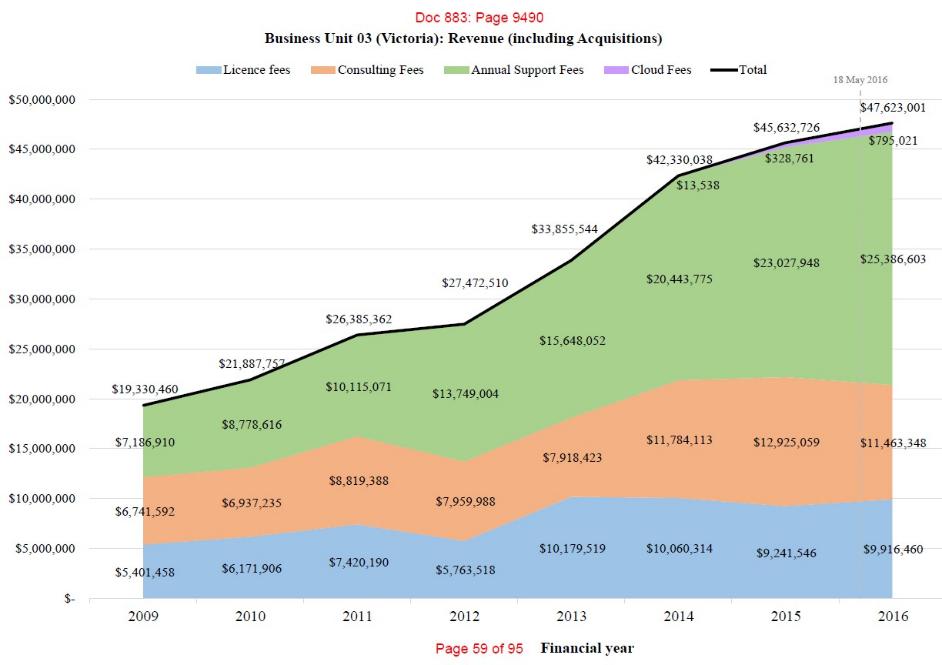
321 It was put to Behnam that his figures were for total revenue for the Victorian business unit, which is licence fees, consulting fees, annual support fees and, more recently, cloud fees (T 631). That is so, but when Behnam was challenged that, instead of engaging with Martin Harwood’s concerns as expressed in his email of 13 January 2016, he decided to introduce a different topic, being the total revenue, Behnam replied that he strongly disagreed (T 632). The cross-examination continued (T 632):
Now, every time Mr Harwood spoke to you about Victorian financial performance, it was about sales or licence fees, wasn’t it?---No, I disagree.
That’s utterly untrue, isn’t it?---I disagree.
Mr Harwood was the operating officer for sales and marketing. The only thing he was interested in and the only thing he talked to you about was sales?---It was about profitability of the region. I was - - -
No. That’s what you were interested in. You were interested in profitability because you were paid on profitability. What he was interested in was sales, wasn’t it?---I don’t know what was he – he was interested. If he was interested in licences of sales, we were talking about forecasting, we were talking about staff recruitment. You want me to agree what was in Mr Harwood’s brain.
No. I’m wanting you to agree in what – the language in which he communicated to you about financial performance and that language was only licence fees, only sales, wasn’t it?---I disagree.
Right. And instead of engaging Mr Harwood and saying, “I will do better, I agree with you, what you’ve said about my licence fees performance is atrocious”, you said, “No, I’m not going to cop what you are saying about that, I’m offended, and I’m going to point you to a different metric, revenue”; didn’t you?---I disagree.
And you said that in every email leading up to this email from October 2015 to January ’16, didn’t you?---I disagree. I was setting the record right, Mr Wood.
You were setting the record right by diverting from the metric that Mr Harwood wanted to discuss to a metric you wanted to discuss; isn’t that right?---Totally incorrect. Totally incorrect. This is what is happening in this court. We are actually diverting what the main issue is to something which is not even relevant. We wasted a lot of time, three day, talking about forecasting. I was not even sacked because of forecasting or licences.
And the reason you wanted to divert to revenue rather than to continue to discuss licence fees is you knew that conversation would be very bad for you, didn’t you?---Not at all. I have – I have stated it there myself. I said looking at forecasting I nearly had a heart attack. We take this action. I have already said the previous year. If I’m not allowed to select my own, and appoint my own sales manager, their figures for Victoria will go down. When I say figures, everything, not just licences. Everything. Everything went down when Mr Richard Metcalfe was my sales manager with sales people. And I had to give him the authority because he was the sales manager. I had to delegate it. I had, despite – I did not undermine him, basically.
322 I reject that evidence as lies. It is inconsistent with the considerable volume of documentary evidence to the effect that Adrian Di Marco relentlessly pursued licence fee sales growth as his metric of business performance, it was the primary responsibility of Martin Harwood to ensure that licence fee revenue for each region matched that metric and in turn, there is a plethora of evidence, oral and written, that Martin Harwood always focused upon the need to deliver licence fee revenue growth and communicated that on multiple occasions to Behnam. Behnam accepted as much in another email that he sent on 25 January 2016 at 2:20 am (CB 7105) addressed to Martin Harwood and Adrian Di Marco with the heading: Forecasting FY 16 – Vic. In part, he said:
I have enquired about some opportunities which should either been there/qualified, etc from the Vic Sales team and my interim sales manager Richard Metcalfe on these since Friday, and at the weekend (re: why those boxes in Salesforce were not ticked yet)…. I have also gone into our Salesforce system myself at the weekend (something that Joanne normally did/does for me).
Additionally I have allocated a few major opportunities that I have personally been working on (a few years in the making) now as a handover to our sales team (e.g. Bendigo Health to Darryl – we should win, and this is for us to loose).
The updated license sales forecast that I have gone through as of this early morning for Victoria is $11.77million at this stage until September 2016 – and I will be working with my sales team towards achieving the desired $13 million license sales even though no one had consulted with me on that budgeted figure nor I had agreed to it for Victoria.
Have a nice Australia day and kind regards.
323 It is incorrect, as set out above, that Behnam had not been consulted about the $13 million licence fee forecast for the 2016 year. Of this assertion, Martin Harwood’s evidence-in-chief (which was not challenged) was (CB 3124):
Once again, the reference to not being consulted about the target for Victoria or Mr Roohizadegan not agreeing to the target was demonstration of my belief that Mr Roohizadegan did not have the right attitude is the regional manager for Victoria.
324 I accept that evidence. There were some email exchanges in late January 2016 concerning upgrade works in the Melbourne office that provided context to the 27 and 28 January 2016 complaints, that I address in the next section. In the meantime, the next material event that received much attention during the trial is the email exchange between Behnam and Martin Harwood on 28 January 2016, which is mentioned above at [316]. At 12:21 pm, Behnam emailed Martin Harwood on the topic of the commission structure for Boris Ivancic, based on a number of assumptions including total licence fee revenue of $13.45 million to close on 30 September 2016 (CB 7188-7190). Behnam disagreed, on those projections, that Boris Ivancic should have a guaranteed commission. Martin Harwood replied at 5:19 pm (CB 7187):
I was specifically talking about the second half which is basically what Boris will be working on once he has been through induction/handover in Feb/March.
If I look at where the Reps who report to Boris are likely to be YTD at end of March, almost none of them will be at $750k i.e. 50% of their quota for the year. If I look at Pipeline in Salesforce.com for the second half, then few of them look like making $750k in the second half which constitutes what Boris will get comped on. On top of that we are targeting him to run 7 quota carrying reps in the second half, two of whom do not exist today.
So my question is simple if I look at $750k x 7 reps = a total of $5.25 million licence revenue in the second half for which he will earn $110k = 2% commission.
He can’t come in tomorrow and wave a magic wand and fix whatever pipeline/personnel issues we have. If we are asking him to trust us that he can reasonably expect to achieve $5.25 million in the second half, then it is up to us to ensure that he has a reasonable chance of doing so.
There is no point hiring him if he finds that what he inherits is a pile of soft and smelly stuff and he is expected to turn it around instantly to get paid as per his comp plan. I have no issue with what happens for the new fiscal year starting 30 Sept, he will have ample time to work with his team to make sure they have the deals and quality of pipeline to succeed.
So can we please discuss how real the expectation is that he can deliver the second half number. We need to do this before we finalise the offer if we are saying that he has to trust us that the number is there.
325 The “pile of soft and smelly stuff” reference attracted considerable focus in the evidence. In cross-examination, Behnam said this was another example of Martin Harwood interfering in the conduct of the business of the Victorian region (T 658). He also gave this as an example of conduct that led to suicidal ideation. The exchange was (T 658-659):
Now, at this point, Mr Harwood was very excited and told you that he was excited, that you had finally found a regional sales manager, wasn’t he – didn’t he?---He didn’t say he was excited. And, true, I was excited that I had a sales manager because I couldn’t get Philip Pantano.
And then the problem emerged on the Monday of the next week, before Australia Day, and then Wednesday the 27th, 28th and 29th, is that you were back to disputing with Mr Harwood about the regional sales manager, just when he had thought it had all been resolved; isn’t that the case?---Because he intervened, again. Once again. Mr Ivancic had not asked for guaranteed commission. Mr Harwood had been in that meeting. And Mr Harwood suddenly came up with this idea of guaranteed commission. I have no idea why, but I understand - - -
You do know why because he didn’t trust your forecast. He called it, “Soft smelly stuff”?---That is - - -
You reacted to it?---That’s his opinion, Mr Wood, and I responded to him. I did not appreciate that sort of language he used. That’s not a professional way to address somebody in an organisation. And I did. I said to him something like, “You should be writing about a smelly roses, what Victoria has delivered, Mr Harwood.”
So the answer to my question is yes. After a year of looking for a regional sales manager and thinking you had finally found one, the next week you return into disputation with Mr Harwood about the regional sales manager position, don’t you?---He came in dispute with me, Mr Wood. He came in dispute with me, intervened again. He had promised me earlier – a few months earlier that he would not intervene. You showed me about the email earlier in terms of my decisions and he, again, intervened. And actually that intervention, I think, it made me very suicidal again. So when I saw the panel, I think, it was around that time maybe that - - -
That was the week before?---Yes, I’m sorry. I elaborated too much, your Honour. I apologise.
You weren’t being – there was no interference, there was no intervening, you weren’t being marginalised. You and your boss were having a discussion about a person you both wanted to hire about how much they should be paid; that was it?---It is not a discussion, it was a direct intervention in the way I wanted to run my business.
It’s not your business. It is Technology One’s business. It’s not your clients. It is Technology One’s clients?---Mr Di Marco had made it very clear to me on many occasions – he didn’t say – call me mister. He said, “Behnam, consider Victoria as your own business.”
In the early days he said that?---Even later on.
In the early days when you were – when you were a lone ranger, when the licence fees were $1 million?---Even later on, up to 2016, even days before I was unlawfully terminated, he said, “Behnam, make it happen”, or, “I want this deal to happen.” There is an email from him, I think, around 12 May to me regarding La Trobe University, “Less disclosed or”, etcetera. So that’s not true. The true – I’m making a true statement, I’m under oath, Mr Wood. I need to tell the truth as far as I can – as far as my memory allows me. Mr Di Marco trusted me with what I was doing in my region.
What was happening at this stage is Mr Harwood was trying to help you to meet your numbers and he was trying to help you by getting the best possible regional sales manager he could find. That’s the truth, isn’t it?---The truth is he helped me - - -
Yes or no?---He helped me - - -
Yes or no?---I’m sorry, can you break your question down to two. It’s two question.
At this point Mr Harwood was trying help you by getting the best possible regional sales manager he could find?---That’s correct, yes.
And he was also trying to help you by making sure that the regional sales manager is paid in such a way that he wouldn’t quit and be demoralised after seeing the soft smelly stuff he was coming into, isn’t that the case?---Incorrect. I don’t know what was his – what was – I don’t know what was in his mind but that was not - - -
It’s in his emails?---I’m sorry, that’s not accurate.
It’s in his emails. He says, “I don’t want Mr Ivancic to be demoralised by the lack of sales that he will make in the first six months of his tenure.” He says that to you?---That’s of a disagreement. That’s what I’m trying to say.
326 I have set out this lengthy exchange for several reasons. It illustrates an irrational reaction by Behnam at the time to what was, objectively, a simple attempt by Martin Harwood to assist Behnam in his appointment of a regional sales manager in order to achieve the forecast licence fees for 2016. Martin Harwood’s email is a benign example of a management discussion about the terms of employment of a new employee within the business of Technology One. It was not unjustified interference by Martin Harwood in the ability of Behnam to run the business of the Victorian region. Martin Harwood was senior to Behnam and was his direct line of reporting. Behnam was responsible to Martin Harwood for his conduct of the Victorian business and, in particular, the achievement of the licence fee sales forecast for the 2016 financial year. The reference by Behnam to “my business” is one, of the many times during evidence, that Behnam made this, or similar assertions. What Behnam failed to appreciate is that the business since his appointment in 2009 had evolved. More senior managers were appointed to whom he was responsible. Behnam clearly found that transition difficult to accept. Another example around this time is Behnam’s email of 29 January 2016 to Peter Suchting (CB 3130) where he stated:
I know what I am doing, and please let me run my business as I let you run yours. Every time I allow someone meddling in my business I go backwards and I then get told off that I am responsible for my region (even when it was someone else who made a decision on behalf of my business unit!).
327 Martin Harwood gave that as a further example of Behnam’s “wrong” attitude, in that it evidenced his inability to work as a team member (CB 3130).
328 Behnam also said that he was very offended by Martin Harwood’s language (T 694). That was an overreaction; a regional manager in Behnam’s position at the time would have understood the concerns of his immediate superior based on the facts as they then were and would not have been offended, even though Martin Harwood accepted that this was probably not the best phrase to employ in professional correspondence (T 979).
329 The “soft and smelly stuff” reference was plainly a direct expression employed by Martin Harwood to express his scepticism of the forecast figures that Behnam had provided to him. That was explained by Martin Harwood in his evidence-in-chief (T 975-976):
Can you explain to the court what you meant by that in terms of the forecast that the applicant was providing to you?---Yes. It was fairly clear from the start of the fiscal year that Victoria was going to struggle to make the numbers that we were talking about. When we took on the new Victorian regional sales manager he was going to be responsible for the performance of five existing junior sales people – relatively junior sales people, and another two who were yet to be hired. So, in total, he would be managing a team of seven. The five that were there had a fairly questionable sales pipeline that had gone up fairly remarkably in the period between January before Behnam was sick with his back and when Behnam came back early February. There was a fairly significant increase in the amount of revenue being forecast and the number of deals being forecast. In total, there were about, I think, if my memory serves me right, 55 to 60 additional deals that went on in a matter of a little over two weeks worth about $7 million, and although I wanted to believe that that was true, that that was realistic, I had doubts. And why it was important to understand what we were giving Boris was that if, in fact, we were setting him up to come in with 50 per cent of his income at risk and not get it, remembering that whatever happened in the region, in terms of revenue, Mr Roohizadegan was paid on branch profit, not on revenue, he was gold on revenue, but paid on branch profit, it was of no loss to Mr Roohizadegan but a very significant loss to the new employee. And I wanted – I wanted to have full disclosure. He was not coming into a great situation and that’s fine, he is a professional, he can deal with that, but we needed to be frank, open and honest with him and say, “This is a difficult situation you are coming into, that’s fine. What we will do to look after you is that we will guarantee your income for the first six months. After that all bets are off. You’ve got to – you have got to start making, you know, your presence felt. But we will look after you for that fix six months.” That’s what I wanted to do. Behnam didn’t want to do that but it was pretty much my insistence that that’s what we were going to do.
330 That evidence went unchallenged. I accept it. It is relevant to why I have concluded that Behnam was terminated for reasons that included his performance, and not for any of the unlawful reasons that he asserts.
331 There were further email exchanges on 28 and 29 January 2016 (CB 7197-7199). Behnam assured Martin Harwood that he had personally considered, in conjunction with the sales representatives, the pipeline of prospective deals for Victoria and predicted actual sales to 30 September of $11.33 million, in addition to the closed sales of $2.5 million. Martin Harwood remained doubtful and said so in his email of 29 January 2016, including (in the context of continuing discussion about the incentive term for Boris Ivancic):
Given the fact that the total pipeline for Boris's team is only 1.35 times cover for delivering $5.25 million and a big chunk of that is not even qualified as yet, I don't see how we can expect him to to trust us that this pipeline and that he has the deals that can deliver the number if he is a good enough leader. We are both too smart to think that the pipeline these guys have will stand up to any serious scrutiny at this point.
As I said this conversation is supposed to be about how we put Boris's offer together, not about your forecast. But I also want to ensure that we don't get to the end of the year and have a conversation about we brought this guy in, gave him a great pipeline and he failed to deliver. We need to face facts and the facts are that we do not have a great pipeline or a performing team. If we did, we wouldn't need to hire Boris.
I am mad at myself that I have taken an hour of my time to fire off an email in response to the one you sent me, but it is important that we deal in facts. Every number I have quotred (sic) in the email is accurate and reflects the position of the business at this time.
I want to ensure that we don't get into a situation in 3 months time where we have a good guy who is demotivated because we have given him a mission that is not realistic in the timeframe.
We have a catch up session later on. Can we discuss this matter at the meeting.
332 Martin Harwood does not recall the discussion at that meeting. There was further email correspondence from Behnam concerning the appointment of Boris Ivancic on 1 February 2016 (CB 7177), which evidences Behnam’s inability to let go of the issue and to accept the views of Martin Harwood.
15.7 The 3 February 2016 complaint
333 Some context is required before delving into that which is pleaded as the 3 February 2016 complaint. Recall that the complaint is that Behnam contends that he complained to Adrian Di Marco about “the threatening phone calls and behaviour” of Martin Harwood. Thus, it is necessary to consider in detail what occurred on 1 and 2 February 2016 between Behnam and Martin Harwood.
334 Behnam escalated this dispute by forwarding the email chain between himself and Martin Harwood between 28 and 31 January 2016 to Adrian Di Marco and requested a meeting, which was eventually set for 3 February 2016.
335 What occurred between 1 and 3 February 2016 is substantially in dispute. Before the presumption at s 361(1) operates, Behnam must establish his pleaded contentions as objective facts on the evidence: Tattsbet Ltd v Morrow [2015] FCAFC 62; (2015) 233 FCR 46 at [119], Jessup J (Allsop CJ and White J agreeing).
336 With that background, I turn to the evidence. Behnam’s viva voce evidence-in-chief was long and discursive. It is illustrative of three of my general credit findings. Behnam rarely answered questions directly, at least when first asked, preferring to make long speeches and to argue his case. It is an example of times when his answers were so long that he forgot what question had been asked. This time, however, it is not an example of his implausible ostensible ability to recall with clarity conversations that took place years before his testimony by using the words spoken, because on his evidence he made a contemporaneous diary note of the discussions with Martin Harwood, and the diary is in evidence. Nonetheless, his evidence is disputed and must be understood in full. In doing so, I have undertaken minor editing and excision of immaterial evidence (which I employ for all extracts of the oral testimony of each witness in this part of my reasons where justified).
15.7.1 Events of 1 and 2 February 2016
337 I commence with Behnam’s evidence as to the conversations with Martin Harwood on 1 and 2 February 2016. There were multiple conversations. His evidence-in-chief was (from T 78):
MR HYDE PAGE : Mr Roohizadegan, if I could direct your attention to early in the 2016 year, did you have any meetings with Adrian Di Marco at that time?---I remember it was early February 2016. It was at a time that I was taking executive of Melbourne University and that was my usual practice, that any strategy customer, any important customer I take them to Brisbane, show them around the centre, because it was over at head office. So I asked Mr Di Marco that, basically, because I’m bringing a customer there if he could see me, and I believe he got his secretary, Ms Jennifer McCarthy, to send me a calendar invite for 3 February 2016. Yes.
Did the meeting go ahead on 3 February?---It did.
Can you tell us if there are any conversations in the lead-up to the meeting on 3 February?---I remember on 1 February 2016 it was – it was my usual practice that, whenever we had a new employee, in this case, it was Mr – it was one of my new employees. I’m sorry, his name escapes me your Honour. I might remember later on. We were having lunch across the road in a pizza type of small restaurant and I received a phone call from Mr Martin Harwood on my mobile and he said that he had just had a meeting with Mr Di Marco and why I am meeting with Mr Di Marco on 3 February. And I responded, “I’m sorry, Martin, I’m at the lunch meeting with one of my staff, can I call you back later on.” And he said, “It’s okay. I can call you back later on.”
338 That was his evidence as to the first telephone discussion with Martin Harwood. He then identified a second:
Can I ask you, Mr Roohizadegan, did you call him back?---I did. It – I had a very busy day that day. So I called him after, I think, around 6, or – after 6 o’clock. Again, the full records are at Technology One. And I was very shocked and surprised because Martin started screaming at me and he said, “I want to know why are you meeting with Mr Di Marco”, and I explained to him, “That’s my usual practice. As you know, Martin, I need to update him with various things.” And then, if I remember well, Martin said to me that I need to cancel that meeting because Adrian – his boss is not my boss and I said Adrian is both of our boss and the gist of the conversation was I said, “What are you worried about, Martin, Lee Thompson and Roger Phare, none of them had objected for Mr Di Marco to meet with me and what’s the issues?” And I believe Martin said to me at the time that basically I need to cancel the meeting.
And was anything else said during that second conversation?---Yes. I do remember now. And I said, “I’m sorry, Martin, it’s to do with – I feel I’m being bullied that you are forcing me to give guaranteed commission to Mr Boris Ivancic and this is something” - - -
…
He was new sales manager candidate which I had interviewed in January 2016 and I had found him to be very capable. I had already verbally made an offer to him. He had accepted it with a high base salary. In that meeting which I had with him, and I verbally offered him, he had not asked for any guaranteed commission and – and prior to that, Martin and I were in dispute through emails two areas. One was Martin has said to me in January 2016 that I had gone backwards in terms of my region for a fourth year in terms of the licence fees and it was misrepresentation of the facts. I was very, very upset. I had responded to him and I had said to Martin, “That’s not true. If you look at past records, I have been given chairman’s awards in 2013, 2014.” So because I calculated from 2016 going back to 2012, basically. So I found – so that was one of the reasons I wanted to see Adrian. The other reason was I didn’t want the guaranteed commission to be given to my sales manager because that would drive the wrong behaviour with another start-up company. I’m sorry, I have elaborated a bit. Can you repeat the question again?
MR HYDE PAGE : Yes. Mr Roohizadegan, if we can perhaps just focus on the second conversation you had with Martin Harwood on 1 February. I asked you if anything else was said during that conversation and you referred to Boris Ivancic. So perhaps you can, if you are able, just tell us what you remember what you said about that topic during that conversation?---Yes. I said, “I don’t want to give guaranteed commission to Boris”, and if I remember well, Martin said to me I must cancel the meeting with Mr Di Marco and I said to Martin, “Well, when you say he is your boss, you go and cancel it.” The other part of the conversation was to do with resources and I said to Martin, “You continuously want big numbers from me but you are not providing resources for me. You are taking resources away from me.” And that was very stressful for me. And he used the – he asked me for an example and at the time I said, “We have been working for a big opportunity with one of our existing customers, Healthscope, which had 52 hospitals, Australia and New Zealand.” And I said I wanted a strategy consulting person, his name was Mark Nicklin. The size of the deal was roughly about $1 million. Mr Harwood had taken that resource away from me six months before. So, effectively, I said to Martin, “You make decisions behind my back not knowing and you hold me to account for your own decisions.” And that was really the gist of conversation. Because he was asking me to give him examples how I want – how I helped him, etcetera. So that was the 1 February conversation. It is the gist of it. I may have got it a bit out of order. But his conversation – his main point to me was I need or I must cancel the meeting with Mr Di Marco on 3 February. And I was telling him basically, “Adrian has sent me a calendar invite through his secretary, it would be – I consider it to be very rude for me to go and say to Adrian I do not want to go and meet with you.” So – because he was the chairman of the company. He was the CEO of the company. I had a lot of respect for Mr Di Marco. So I felt it’s just very much unfounded. I did say that to Mr Harwood, “Look, if you want Adrian not to meet with me, you say he is your boss, please you go and cancel it.”
339 That concluded the case on 30 September 2024, and the Court adjourned. On resumption on 1 October 2024, Behnam’s evidence on these matters continued (from T 85). The questions did not crisply identify that the topic had moved to the third discussion on 2 February 2016, but that is what Behnam addressed:
MR HYDE PAGE: Mr Roohizadegan, yesterday we were talking about the conversations that occurred on 1 February 2016 that were relevant to your meeting that then occurred on 3 February. So we dealt with 1 February. Did anything occur in relation to your meeting with Mr Di Marco on 2 February?---On 2 February I did not meet Mr Di Marco. I received two telephone calls from Mr Harwood. One was around lunch time on 2 February 2016. I would like to apologise to the court, I – it is very traumatising for me to go through these events.
HIS HONOUR: I understand that. Remember what I told you yesterday. If you need breaks, just let me know?---Thank you, your Honour.
MR HYDE PAGE : Mr Roohizadegan, just focussing on that first phone call, can you tell us, to the best of your recollection, what was said?---Mr Harwood, the first thing he said to me, “Have you cancelled” – words to that effect, “Have you cancelled Adrian Di Marco’s meeting with you?” And I said, “No.” And then – then he said words to the effect that he has been thinking about it whole night, how dare I lectured him yesterday that he has not been able to support me and help me with the growth of my business, and then he said words to the effect that basically he is going to scrutinise me, he is going to – he has seen the email. I don’t know what email he was referring to. He said he has seen the email that I have sent to Mr Adrian Di Marco and he is going to make a list of all the things that I’m going to tell Mr Di Marco. And then another thing he said – and all these things were with a raised voice, at times screaming at me, and then he said, which I was shocked, he said, “One of us” – if I don’t cancel the meeting with Mr Di Marco, one of us has to go. I can’t remember whether he said by end of the day or by end of the week. So – and I responded to him in a calm manner. That’s the way I am. I said, “Martin, you tell me that Mr Di Marco is your boss and I am seeing your boss. So, please, you go and cancel the meeting with Mr Di Marco or Mr Di Marco’s meeting with me.” And then, if I remember correctly, he just hang up – hang up the phone on me. So that’s around lunchtime. And I was very traumatised. I’m sorry, very upset at the time.
HIS HONOUR: Can I just say something to help you: just listen carefully to the questions that are being asked by your barrister and just answer those questions. I mean, it’s up to your barrister to then ask you another question to take you to another matter or another conversation; do you understand that?---Thank you, your Honour.
Yes, Mr Hyde Page .
MR HYDE PAGE : Mr Roohizadegan, do you recall how long the phone conversation went?---Maybe around five or 10 minutes. I’m sure Technology One has the records of the length of the conversation.
And do you remember your reaction to what Mr Harwood said during the conversation?---I was very, very upset. I was shaken. I was very much not heard in my past near 10 years. Mr Harwood shouting and screaming at me. So that was the first occasion that Mr Harwood had shouted and had screamed at me and threatened me to basically either go and cancel the meeting or one of us has to go from Technology One.
340 The next series of questions elicited evidence about a fourth telephone discussion on 2 February 2016 (T 87):
Now, sir, you referred to there being two phone calls during the day. Can you tell us when the second phone call occurred?---The second phone call was when I arrived in Brisbane. There was a message was on my mobile to call Mr Harwood back. So I don’t know exactly what time he had called me but when I got to my hotel in Brisbane, which was very close to Technology One office, I checked my messages and there was - - -
Sorry, Mr Roohizadegan, if I could just ask you another question: did you then call Mr Harwood back?---I did.
And who introduced the conversation; do you remember?---I just – I just said, “Hi Martin, I’m returning your call”, and his first response to me was, “Have you cancelled” – I’m sorry, I apologise to the court if I’m raising my voice because I’m depicting what Mr Harwood said. He said, “Have you cancelled the meeting or not, Behnam?” With Mr Di Marco.
And did you then say something?---I said – I said, “No, I have not”, and I said, “Martin, you are in this situation because of the guaranteed commission of Mr Boris Ivancic, which I don’t want to give guaranteed commission and you are forcing me to give guaranteed commission. That’s the whole issue.” And again I said, “If you keep telling me Adrian is your boss, so you go and cancel it.” And I just felt very, very uncomfortable - - -
…
MR HYDE PAGE : Yes. The question was just about what you said. Do you remember Mr Harwood’s response after you said that?---He said, “If you don’t cancel the meeting, I’m going to scrutinise you, I’m going to make your life very difficult at work so that you leave Technology One. Either one of us or you by end of the week.” I do remember in the second – in this second conversation, on 2 February, he said, “By end of the week one of us has to go”, and then he said he is going to make a list for Mr Di Marco and I think, again, he repeated that he has seen my email to Mr Di Marco and, at that time, I did not know what email he was referring to that I’ve sent to Mr Di Marco.
Now, Mr Roohizadegan, do you remember if you said anything after he made these remarks?---I’m sorry, I’m sure there was some discussion, some remarks, but just my memory is not allowing me.
HIS HONOUR: Well, don’t feel uncomfortable about that. You are giving evidence about conversations that occurred a long time ago. So if you can’t remember, it is okay, just tell me you can’t remember?---I’m very sorry, I can’t remember - - -
You don’t need to apologise. Just tell me you can’t remember. Next question, Mr Hyde Page .
MR HYDE PAGE : So can you estimate how long the conversation went for?---The second conversation was about 10 minutes and I just remember that he said, “We need to make offer to Mr Boris Ivancic.”
Sorry, Mr Roohizadegan, the question was just about the length of the conversation?---Yes. Sorry. It was 10 minutes.
I apologise for cutting you off but it is very important that we deal with one matter at a time?---It’s around 10 minutes.
And do you recall Mr Harwood’s tone during the conversation?---He was very, very aggressive. He was shouting, screaming at me, and that really - - -
Well, how about I ask: do you recall how you felt, your reaction to the phone call?---I felt very suicidal at the time.
Can you tell us why you felt suicidal?---Because I had done – I hadn’t done anything wrong. It is just – I could not understand why he was screaming and swearing at me, whereas the solution would have been very, very simple. He could have called Mr Di Marco and say, “Do not meet with Behnam”, and – I apologise.
Sir - - -?---Nobody had spoken to me in that manner.
Sir, have you finished your response about how you felt?---I was very traumatised and stressed, suicidal and, yes, I felt, again, Martin interfering in a decision which I was – I was responsible to make. I don’t know whether I should elaborate or not. I had gone through the same process - - -
Sorry, Mr Roohizadegan, we are only asking about - - -
HIS HONOUR: Just listen to the question. These are the prompts from your barrister. Just listen to his questions.
341 The questions moved to the subsequent reaction and conduct of Behnam. There is in evidence a diary which, on Behnam’s evidence, contains a contemporaneous note of these discussions (CB 10,715-10,716). The notes are written in blue biro on the diary pages for 1 and 2 February 2016. If these notes are authentic, they corroborate Behnam’s oral evidence. Technology One submits that I should find that the notes are unreliable and conclude that they were later reconstructed by Behnam to align with his version of what occurred. I return to that submission when I analyse Behnam’s cross-examination relevant to these events.
342 Martin Harwood’s evidence-in-chief concerning his discussions with Behnam on 1 and 2 February 2016 was as follows (from T 973). His recollection of the discussions was generally poor. He only recalls only one discussion. His evidence was:
So I called him because what would normally happen, your Honour, when Adrian – it was quite normal that one of the regional managers, if they were coming to Brisbane, would seek to have a one-on-one with Adrian. That was our culture. It was encouraged that that would happen. It kept – it let Adrian keep in touch with what was happening in the regions from the regional manager’s perspective. So it was quite normal. It was also normal that Adrian would call me and say, “Look”, as he did on this occasion, and said, “Behnam is coming up. He wants to have a one-on-one while he is here. What do you think he is going to raise?” And I said, “I believe there will be two issues. The first will be the hiring of Boris Ivancic as his regional sales manager for Victoria, and the second will be that Behnam is unhappy about the target that has been assigned to Victoria for this year.”
And after you had that phone call with Mr Di Marco, did you have a phone call with the applicant?---I’m sorry, that was the phone call that I had – sorry, I had the phone call with Adrian and told Adrian what I believed Behnam was wanting to talk about.
Yes?---And then I made the courtesy call to Behnam just to say, “Look, I have spoken to Adrian and this is what I’ve told him.” And I didn’t ask Behnam, “Are there any other issues?” Because, frankly, that was a matter for him Adrian.
And it is said that, in that phone call you have just described, or other phone calls on 1 and 2 February, by the applicant, that you threatened him; what do you say, if anything, to that?---No, I didn’t threaten him. As I said earlier, I have never threatened Behnam or any of the other guys.
15.7.2 The 3 February 2016 meetings with Adrian Di Marco and Martin Harwood
343 The next sequential event is the meeting with Adrian Di Marco on 3 February 2016. Behnam pleads his case to the effect that he was distressed and felt bullied by Martin Harwood and determined to attend the scheduled meeting with Adrian Di Marco, at which he complained about the behaviour of Martin Harwood. He met with Adrian Di Marco early in the morning of 3 February 2016, in Brisbane.
344 His evidence-in-chief was that first there was a general discussion about the University of Melbourne proposal. The discussion next proceeded as follows (from T 92):
What matters did you raise with Mr Di Marco apart from that?---I remember he said to me, “How is things going? Behnam, how are things going?” That was the usual phrase he used with me and I said, “Adrian, I feel I am being – I’m not getting the tools of the trade to do my job. I feel that Mr Martin Harwood makes decisions behind my back, makes decisions for my region, makes decisions for me, and then he holds me accountable to these decisions.” And I said to Mr Di Marco, “You have always encouraged me to be frank and open with you and tell you things as they are”, and I – and I think I said to him, “As you know, I have got a P&L responsibility, Adrian”, and – and I said – I don’t recall whether I said to Mr Di Marco, “I’m sorry to say this to you”, or something like that, but I do remember that I said to Mr Di Marco that Martin – I did used to refer to Martin as Mr Harwood. I said to Adrian and to Mr Di Marco I used to call him Adrian. I said, “Adrian, Martin has called me in the last two days to cancel our meeting”, and Adrian - - -
Sorry, Mr Roohizadegan, you have just described what you said, do you recall what Mr Di Marco was doing while outlined those matters?---I’m just – I’m just trying to – to remember – trying to remember. I said to – I said, “Martin has called me in the last two days to cancel the meeting with you and if I don’t cancel the meeting it will be either me or him by the end of the week at Technology One.”
Sure. Mr Roohizadegan, my question was: do you remember what Mr Di Marco was doing while you said these things to him?---He was looking at me and his face went red. He got very angry. I could see. Because – I could see him. That was the first time that I have seen Mr Di Marco’s face actually going red.
And just before we move on, you referred to one of the things you said as being, if I recall correctly, “He”, that is, Martin, “Holds me accountable for his decisions”; do you remember saying that?---Yes, I did.
I was just wondering if those were the exact word you spoke or is that just the gist?---I believe that was exact words I said.
…
345 Behnam then described the response of Adrian Di Marco:
He said, “I’m not having any of this from Martin. I’m going to get him to come to my office but please do not tell Martin in front of me that he has said either you or him at the end of the week at Technology One.”
346 His evidence continued that Adrian Di Marco left his office and returned two or three minutes later with Martin Harwood and they all sat down. Martin Harwood sat next to Behnam and “he felt very angry or he looked very angry”. Adrian Di Marco spoke first:
I think the world of both of you and what is the issue.
347 To that, Behnam responded and gave a long explanation for his objection to the proposal that Boris Ivancic should receive a guaranteed commission for the first six months of his employment, which included some evidence about wanting to employ a different regional sales manager, Philip Pantano. He described the physical appearance of Martin Harwood as “face was already angry but I noticed his face going more red” and that in a loud and aggressive voice Martin Harwood said:
“Behnam, give me a break”, again, with a loud aggressive wording, “Behnam, give me a break. Philip, Philip Pantano, over my dead body. I don’t want him at Technology One”, words to that effect. Again, I apologise to the court if I don’t remember exact words.
348 His evidence continued to the effect that Adrian Di Marco told Behnam to accept Boris Ivancic with a six month period of guaranteed commission, which Behnam agreed to, but subject to his objection that he should not be held accountable “for the decisions that you are making for me as it was the case” with another employee – Richard Metcalfe. Martin Harwood responded to that, according to Behnam:
He raised his voice again very, very angrily and I’m not sure if I can do this but he put a finger at me, pointed finger, and he said, “Behnam, we hold you – we still hold you accountable for Victoria, even if we are making a decision who your sales manager is going to be or not. You are still accountable for Victoria.” I remember those word like yesterday. “We still hold you accountable even though we make the decisions for you.”
Did you notice Mr Di Marco’s reaction to this?---He went very red. He just – his face – I’m not – again, I’m not here to elaborate, as I have been told, but when Mr Harwood, Martin, said, “Behnam, I will hold you accountable”, Mr Di Marco went very red and he shouted at Martin. He said, “Martin, get out of my office. I want to have another five minutes alone with Behnam.”
349 Behnam then said that Martin Harwood left the office “was very, very angry” and as he passed by Behnam “he just gave me a very angry look”. Then:
Mr Di Marco looked at me, and with a soft voice, said to me, “Buddy, I know how good you are. I know how great job you have done for me but you need to understand I had to side with Martin. I need him too. Do as – as you go. I’m happy you escalate things to me. I’m happy you bring your prospects, your customers to Brisbane to meet with me. Continue to escalate things to me as you are and go and build a relationship with Martin.”
After he had said this, what did you say?---I said, “Thank you, Adrian. Thank you Adrian for making the time to see me. I very much appreciate – appreciate – appreciate your time.” I was very grateful because he was the chairman and the CEO of the company and then Adrian said to me - - -
Sorry, sir, how about I ask a question at this point: what did Mr Di Marco then say and what was it?---He – he – he said to me very soft and gentle word to me, “I am the one who should be thanking you, Behnam.”
Was that the end of the meeting?---And I said – I said, “Thank you”, and, yes, I believe I left. But I was embarrassed – I felt embarrassed that he is thanking me. Because he was the chairman and the CEO of the company. I just – I didn’t understand at that time why he is thanking me.
350 Behnam did not say that he made contemporaneous notes of this meeting. And quite unlike his usual habit of communicating by contemporaneous email to relay the content of discussions, and to raise additional issues, he sent none about this important meeting.
351 Adrian Di Marco’s evidence-in-chief concerning the discussions on 3 February 2016 was vague. He recalled the meeting with Behnam and Martin Harwood and his evidence was (from T 1616):
And can you recall what was said between you and the applicant, either before Mr Harwood joined you, and can you remember what was said when Mr Harwood joined you and the applicant, and can you remember what was said after Mr Harwood departed?---A long time ago, and – so I had lots of meetings, lots and lots of meetings in my time in Technology One so this was one of many. My recollection is that it was a fairly standard catch-up with Behnam. There was nothing controversial in the meeting. Martin joined. We discussed the issue about Boris’ incentives. Again, it wasn’t controversial. There was an agreement made on the way forward, and that’s the sum total of the meeting. It was just a normal catch-up meeting.
You say it’s a normal catch-up meeting. What do you say, if anything, about the allegation, and the evidence given by the applicant, that he told you that Martin Harwood had said to him that if the applicant went ahead with his meeting with you, “It will be” – and these are his exact words – “either me or him by the end of the week at Technology One”?---I dispute that totally. We had an open-door policy. It was my policy. I had introduced it from the very start of the company’s life. Anyone could approach me at any time. For a senior executive to have tried to stop that would have been unacceptable to me. I would have confronted the executive, would have confronted them in front of Behnam because I would want to get to the truth of the matter. And it makes no sense. I mean, there was nothing that I was not aware about the Victorian region. It was fully transparent through the emails and the conversations. Nothing new was presented by Behnam. The fact I was meeting Behnam earlier or the fact that Behnam could pick up the phone – I mean, what did it gain Martin to do that? I mean, it’s – did not happen. It’s as simple as that. And it makes no sense that it happened.
And I think - - -
HIS HONOUR: What, are you telling me you can remember it didn’t happen or are you saying, look, practices and procedures lead me to conclude it must not have happened?---No, it didn’t happen because I would remember that. I mean, that’s a significant statement to make about one of my most trusted executives, and the consequences would have been, I would have confronted Martin in front of Behnam and we would have got to the bottom of it, you know, so I could see the body language, I could see what was what was happening. And it was, as I said, a straightforward meeting. We had nothing controversial during that meeting all day.
HIS HONOUR: Yes, Mr Wood.
MR WOOD: There’s a second aspect of this meeting that the applicant says occurred. He says that – and although it’s agreed there was a conversation about the incentives that Mr Ivancic would receive, that he also said, and these were his exact words, “I have still not received my incentives for my TAFE ICT and other universities.” What, if anything, do you say about that?---I do not recall the details of such a conversation. All I can say is if he had raised it, I would have put him straight, because he wasn’t entitled to it. But I don’t recall.
352 Martin Harwood gave unremarkable evidence-in-chief about this meeting (from T 971). He recalled it in some detail. He was in his office, adjacent to that of Adrian Di Marco. The executive assistant of Adrian Di Marco advised him to go into Adrian’s office, which he did. In the presence of Behnam, the following discussion ensued:
Mr Di Marco said, “Behnam has raised a couple of issues with me that I think we need to discuss as a threesome”, and I said yes. And Mr Di Marco said, “Well, the first issue that Behnam has raised is the appointment of Boris Ivancic as the regional sales manager for Victoria, which he no longer wants to do.”
What did you say to that?---I said that, “Well, we are a long way down the pipe with this. We are making an offer to Boris. Behnam has interviewed Boris and has concluded in an email back to HR that Boris is probably the most outstanding candidate that he has had the pleasure of interviewing for a position in TechOne in all his time in the company.” And I concurred with Behnam’s view of Mr Ivancic. I thought he was the best candidate that we were going to find.
And what did Mr Di Marco or the applicant say after you said that?---Well, Behnam said that – well, he didn’t want to because he wanted to hire Mr Phil Pantano, which was somebody he had wanted to hire about 12 months earlier, when we had put a pro team manager into Victoria. And he also said that he was – he did not want to be in a position where he had to pay a guaranteed payment for the residual period from when Boris started work with us until 30 September. The package that we were offering Boris was fifty-fifty, $400,000, about half of that was at risk, and I was advocating that we should guarantee the at risk component of Boris’ package.
What did Mr Di Marco say in response to this discussion between the two of you?---Yes. Well, I can’t recollect his exact words. But his words were to the effect, “Well, you have heard what Martin has got to say, Behnam, what do you want to do? Do you want to hire the guy or not?” And I actually said, “Look, Behnam doesn’t have to hire Boris, if he doesn’t want Boris, that’s fine. We go back to market. We start looking again but I’m not going to sanction the hiring of Phil Pantano for the job.”
And what did the applicant or Mr Di Marco say in response to that?---Behnam actually said, “Well, let’s go ahead with it but I just want it recorded that I’m unhappy about having to pay this guarantee.”
What did Mr Di Marco say, if anything?---Well, that was the close of that matter.
And what then happened?---Adrian went on to the second point, which was he said that Behnam was unhappy about the target – the licence sales target that had been apportioned to Victoria for fiscal 2016. He was unhappy from two aspects: (1), that he was not consulted, it was just imposed on him; and, (2), that the target was unachievable.
And what did you say in response to these two criticisms of the applicant?---Well, I had to agree with the first point, that Behnam wasn’t consulted, nor was any other regional manager consulted with the target. The target was applied proportionately to – historically where our revenue had come from. So the largest three regions constituted about 65 per cent of our revenue. So they got proportionately a third of that 65 per cent. There is also apportioned out on the basis of the number of funded sales professionals for each region for that year. So it was on that basis that it was handed top-down to Behnam and the other regional sales managers.
And when what did you say, if anything, in response to the second aspect of what the applicant raised that the budget was unachievable?---I said at the end of the day if Victoria’s budget is reduced, the overall budget doesn’t go away. The overall target for sales doesn’t go away. And that has to be applied to somebody else. Another region has to pick that up. And that’s just patently wrong. The issue that Behnam had was that he had insufficient salespeople in his business and many of those that he did have were inexperienced. But, from my perspective, he had been in the job for eight years. He had eight years to build the team that he wanted. He hired these people and I had overall accountability to Adrian for the whole business. And Behnam had overall accountability to me for his part of that business.
And after you identified where the accountabilities lie, what did Mr Di Marco or the applicant say?---Again, I can’t remember Adrian’s exact words but his words were to the effect, “Well, Behnam, I think we have to listen to what Martin is saying, let’s just move on with life.” And that was the end of the meeting as far as I was concerned.
How long did the meeting go?---I would say about 20 minutes. It might have been slightly more or slightly less. But around 20 minutes.
And what happened at the conclusion of the meeting?---Adrian said that he needed to talk further with Behnam and he asked me to leave, which I did.
353 I now turn to the cross-examination of each witness on these discussions, commencing with Behnam.
354 The primary challenge to this aspect of Behnam’s evidence occurred on 8 and 9 October 2024 (T 473-502, 553-559). Behnam maintained his version of the events. It was first put, as a general proposition, that all of his evidence about the discussions on 1 and 2 February 2016 were lies, to which Behnam responded: “Absolutely incorrect. I strongly disagree. I’m telling the truth and it’s not a lie” (T 474). (That challenge extended to the scrutiny threat of 3 February 2016, which I address separately). The questions were then layered. Behnam was directly challenged that his diary notes were not a contemporaneous record. Behnam maintained that they were. He was reminded of his earlier evidence concerning his habit of keeping logbooks in his computer bag. His evidence was that these logbooks were handed to solicitors sometime during the course of the trial before Kerr J. When they were called for, they were not produced. Behnam’s evidence was to the effect that he made notes in a A4 spiral notebooks (one such book has been admitted into evidence, and which commences with an entry on 15 April 2016) but that he also purchased in 2016 a leatherbound diary (T 479).
355 Behnam gave implausible evidence about why he purchased a separate diary, rather than use the notebooks that were freely available at his place of employment. The diary is not leatherbound but has the appearance of faux leather. The entries in it are limited. They commence on 14 January 2016 and extend to 20 January 2016; there is then a gap from 21 January to 26 January 2016. There is an entry on 27 January 2016, and then no entry until 1 February 2016 when the entries continue until 4 February 2016. The rest of the diary is blank. There are entries that purport to record the conversations with Martin Harwood on 1 and 2 February 2016. There is no relevant entry which records the discussions on 3 February 2016.
356 Behnam said that he purchased the diary either from Officeworks or from a newsagent (T 557) and that he did so because: “I wanted to treat myself that year to a diary basically” (T 558). Initially he said that he didn’t think it was an expensive diary, the cost was between $30 and $40 (T 558). He then contradicted himself in the next answer stating that the cost was “maybe $150”. When asked to explain why the entries in the diary conclude on 4 February 2016, his evidence was that he “did not want the risk of staff seeing the diary and seeing the entries within it” and therefore he switched to an A4 spiral notebook that he kept in his briefcase (T 555). That makes no sense. All that Behnam needed to do was to keep the diary at home, and if necessary, keep it in his briefcase when at work. He had already made notes in the diary that he did not want his staff to learn about, and there is no plausible reason why he could not have continued making private notes in it. His evidence fails to plausibly explain why an A4 spiral notebook was less susceptible to being viewed by his staff.
357 Behnam further said that he discontinued using the diary after Martin Harwood threatened him (T 479). But elsewhere, he gave a different explanation – Adrian Di Marco told him not to say anything of their discussion with Martin Harwood, which he interpreted as a direction not to record anything (T 455).
358 When directly challenged that the diary notes for 1 and 2 February 2016 are not contemporaneous records but rather were made sometime after 18 May 2016 for the purpose of reconstruction, Behnam denied the proposition as: “Absolutely incorrect. Absolutely incorrect. I strongly disagree.” (T 485). He was then asked an open question as to why he switched from the diary to the A4 spiral notebook, and his answer was (T 485-486):
The reason was because I made a note of what Mr Martin Harwood told me in terms of telling me cancel the meeting, either this and that. So I didn’t want my secretary to see, especially after Mr Di Marco on the 3rd, said to me that, “Do not say to Mr Harwood what he said to you.” So that’s the main reason, basically. No other reason as I have stated before. I just didn’t want staff to see. I was actually trying to save face for Mr Harwood and also for myself that – with other staff, junior staff below me, not to be seen that I have been – I have been threatened by Mr Harwood. So that was – that was my rational and my reason, basically. So that’s why I switched it to a different diary. Especially given I trusted Mr Di Marco, he said to me, “Behnam, do not mention what Mr Harwood had said to you in front of me.” And I meant – and I thought what he meant was, “Do not record it either.” So I – so that’s the really – that’s the main reason. And this logbook stayed in my computer case with me all the time, including the new spiral diary as well, which I started taking notes from 4 February 2016.
359 That evidence is implausible, is another lie and I reject it. If Behnam truly understood that Adrian Di Marco instructed him not to make notes of the discussions on 3 February 2016, then that is all that Behnam was required to do. It does not explain why he ceased using the 2016 diary and switched to an A4 spiral notebook, as his new format for making handwritten notes of conversations.
360 It was directly put to Behnam that the diary was a total fabrication, which Behnam denied insisting that it and his evidence about the discussions was “the absolute truth”: (T 486). Behnam’s evidence was then that he took the diary, together with his laptop, in his computer bag to a meeting with his solicitors in Brisbane in May 2019. The laptop never made it to the solicitors’ office. Behnam’s evidence was that he placed it in the seat pocket in front of him on his flight and forgot to retrieve it when he disembarked (T 487-488). The diary remained in his computer bag. The laptop contained important evidence, on Behnam’s version, of his case. It is striking that the laptop was lost, but the diary was not. Nonetheless, I do not find that Behnam deliberately misplaced the laptop.
361 Behnam was then questioned about whether he attended two morning meetings with Adrian Di Marco in Brisbane on 3 February 2016 (from T 489). The purpose of the cross-examination was clear. Behnam’s case and evidence is that Martin Harwood insisted that he cancel a Brisbane meeting with Adrian Di Marco. Behnam stated that he recalled only one meeting, not a prior one to discuss the University of Melbourne proposal (T 489). That evidence conflicts with Adrian Di Marco’s diary entry for the day (SCB 7214_001) which records two meetings: one at 9:45 am “Briefing – Melbourne Uni” and one at 10 am “Discuss Melbourne Recruitment & Boris Hire”. Understandably, Behnam was cross-examined directly as to this inconsistency (T 490-491). He disagreed with the proposition that it was “quite important for your evidence” that only one meeting was scheduled with Adrian Di Marco because, if there were two meetings, his evidence to the effect that Martin Harwood demanded that he cancel the meeting would make no sense. Behnam disagreed. The questions and answers were then (T 490):
MR WOOD: “I threaten you with your job unless you cancel the meeting.” That would make no sense if there was a previous meeting at 9.30 that you were going to be – that you had been invited to and you were with Mr Di Marco, would it?---I strongly disagree with you. I didn’t analyse in terms of, “This is good for my evidence, this is not good for my evidence.” I’m just stating the truth, Mr Wood. You are asking me the questions and I’m answering truthfully.
That’s exactly what you have done with those notes of 1 and 2 February. You have just created them for the purposes of supporting your evidence. That’s exactly what you have done?---I strongly disagree with you, Mr Wood. I have stated numerous times that I wrote those notes on 1 February relating to 1 February in summary format. I wrote those notes on 2 February in summary format, as it happened, but also I contacted – I was so stressed on 2 February I contacted Mr Steve Terry. There is – I believe - - -
I haven’t asked you a question about Mr Terry….
362 Behnam further denied the proposition that he had deliberately in his evidence “run together two meetings”, to which he answered: “I just don’t recall, Mr Wood. I remember very clearly one meeting with Mr Di Marco alone. I do not recall. I just do not – do not remember” (T 492). He directly denied that his evidence about the discussions with Martin Harwood was a lie.
363 I reject this evidence as unconvincing. The contemporaneous diary entry of Adrian Di Marco records two meetings. Behnam accepted in his evidence-in-chief that Byron Collins had been invited to the Brisbane office that morning, and he accompanied him. The University of Melbourne proposal was at that time an important prospect for Technology One. There is a reason why Adrian Di Marco would wish to discuss it separately with Behnam. I find that there were two meetings, which substantially undermines the fundamental contention that Martin Harwood threatened Behnam to the effect that he had no right to meet with Adrian Di Marco, and if the scheduled meeting proceeded that one of them would not be employed by Technology One at the end of the day.
364 There are other reasons why I reject Behnam’s evidence about the discussions with Martin Harwood on 1 and 2 February 2016. Martin Harwood could not prevent Behnam from speaking with Adrian Di Marco directly on any issue. That was a fundamental aspect of the culture of Technology One. Behnam did not need to meet with Adrian Di Marco in order to discuss an issue with him: the evidence is replete with email correspondence and telephone discussions between them. Behnam was scheduled to be in the Brisbane office on 3 February 2016 with Byron Collins to advance negotiations for the University of Melbourne proposal. Martin Harwood knew that. This afforded any number of opportunities for Behnam to meet with Adrian Di Marco, which Martin Harwood could not prevent.
365 At the time, Martin Harwood was close to retirement. The Board papers for the meeting of 12 February 2016, include advice that Stuart MacDonald had been appointed as the new operating officer for sales and marketing and “Martin Harwood plans to retire in the coming year or so”. It is implausible that Martin Harwood would threaten Behnam that if he did not cancel the scheduled meeting with Adrian Di Marco one of them would not be employed by Technology One at the end of the day, being either 1 or 2 February 2016.
366 It is even more implausible that if Martin Harwood made that threat, that he and Behnam continued to be employed Technology One, even though Behnam did not cancel the scheduled meeting with Adrian Di Marco.
367 Moreover, I accept the contrary evidence of Martin Harwood. His evidence was not undermined in cross-examination. He frankly conceded that there was tension between himself and Behnam leading to 3 February 2016 (T 1036). He denied his interactions with Behnam were tense: “just normal business” (T 1036). He denied as “absolutely untrue” that he telephoned Behnam and told him to cancel the meeting with Adrian Di Marco or if not that he would drive him out of Technology One (T 1037). He accepted that he did speak to Behnam about why he was meeting with Adrian Di Marco on 3 February 2016. The questions next travelled into different topics. When the point was returned to (from T 1045), he agreed that he had “no personal issue” about Behnam speaking to Adrian Di Marco on any issue because, amongst other things: “as a company is that our culture was that people would go to whenever they needed to get information … For instance, if Adrian Di Marco wanted to know something that was pressing him about Victoria, he would call Behnam directly. He wouldn’t call me and say, ‘can you find this out from Behnam for me’ … That was just our culture” (T 1045). Thereafter, there were many objections to the line of questioning, often resolved by requesting Martin Harwood to leave the witness box and stand outside the courtroom. The cross-examination was not focused and did not proceed sequentially.
368 Counsel returned to the relevant topic (T 1169), with three short questions. Martin Harwood gave three convincing denials to rebut the evidence of Behnam as to what was said in the conversations on 1 and 2 February 2016.
369 To my observation, Martin Harwood gave measured, precise and convincing evidence on this topic. I accept it.
370 It follows, that I am not satisfied that there were telephone discussions between Behnam and Martin Harwood on 1 and 2 February 2016 as contended by Behnam. I reject his evidence. I also reject his evidence that he made contemporaneous notes of those discussions in his diary. I find that these notes were made well after the relevant events, and they do not accurately record what was discussed. These findings are also supported by my general conclusion that Behnam was an unsatisfactory witness. I find that Behnam lied in his evidence about these discussions with Martin Harwood.
371 Those findings naturally, have consequential effect as to whether I accept Behnam’s evidence as to what happened during the discussions on 3 February 2016. Having rejected his earlier evidence as false, that is a reason to cautiously approach Behnam’s evidence as to the in-person discussions in Brisbane on 3 February 2016, which I next address.
372 I reject Behnam’s evidence to the effect that when he met alone with Adrian Di Marco, he complained about being threatened by Martin Harwood on 1 and 2 February 2016, which follows from my rejection of his evidence about those discussions. There are other reasons to reject his evidence. One is my general adverse credibility findings about Behnam and his evidence. Another, is the implausibility that Adrian Di Marco became very angry, went red in the face and personally summoned Martin Harwood into his office. That is simply not the management style that Adrian Di Marco engaged in as the CEO – what all the evidence demonstrates is his collaborative “work it out” approach to problem solving.
373 Further, Adrian Di Marco, though somewhat vague in his evidence, said that this did not happen – the meeting was not controversial; rather it was a routine and normal catch-up meeting. He gave convincing evidence in answer to a question from me because the allegation, if made by Behnam, would have been a significant statement about a trusted senior executive. I find that it is something that Adrian Di Marco would have remembered if it were true.
374 Moreover, and in any event, Adrian Di Marco was not directly challenged in cross-examination on this aspect of his evidence. In contrast, Behnam was directly cross-examined on this aspect of his evidence (from T 500). When put to him that his evidence “is an utter lie”, Behnam responded: “it is absolutely true. I strongly disagree with you, Mr Wood. This is exactly words to the effect Mr Di Marco told me. As I have said before, I’m telling the truth. I am under oath and I need to tell the truth to this Court” (T 500).
375 I reject that evidence. Not only is it inconsistent with the evidence of Adrian Di Marco, but it also cannot be reconciled with Martin Harwood’s evidence that it was the executive assistant to Adrian Di Marco who entered his office and invited him to join the meeting in Adrian Di Marco’s office. It is simply not plausible that the CEO and executive chairman of Technology One at that time would leave an important discussion with a senior employee in his office, to summon a senior employee from an adjoining office when he had an executive assistant who was perfectly capable of performing that mechanical task.
376 I also reject Behnam’s evidence that he said to Adrian Di Marco that Martin Harwood was making decisions behind his back and holding him accountable and that he had threatened Behnam with consequences if he did not cancel the scheduled meeting. Once again, I accept the denial of Adrian Di Marco. His evidence is entirely consistent with the “open-door policy” (as he described it) which was part of the culture of Technology One and is entirely consistent with all the other matters that Behnam had raised directly with him prior to 3 February 2016. The fact that Behnam could always bypass a senior manager and speak directly with Adrian Di Marco was entrenched prior to 3 February 2016
377 Next, there is Behnam’s evidence about what was discussed when Martin Harwood joined the meeting. On his account, Martin Harwood was angry and aggressive and spoke loudly. There was finger-pointing and a threat to hold Behnam accountable for decisions made in the Victorian region. Adrian Di Marco does not recall this, and Martin Harwood gave a very different account to Behnam, in chief and when he was cross-examined. I have set out his evidence-in chief above. In cross-examination when questioned about his knowledge of the intended meeting between Behnam and Adrian Di Marco, he gave an answer that assumes importance in assessing whether Behnam’s account of the meeting of 3 February 2016 should be accepted. In part, Martin Harwood said (T 1036):
Mr Di Marco contacted me and advised that Behnam was having – had requested a one-on-one meeting with Mr Di Marco. Which was not unusual. I think that probably every time that Behnam came to headquarters he had a one-on-one. So that wasn’t in any way unusual. Most of the time he wouldn’t have been in there having a complaint. On this occasion, he was in there to have a complaint, or at least two that I knew of. So I – when Mr Di Marco asked me what I thought Behnam would want to raise, I told him, and then I thought it was the right thing to do to ring Behnam and let him know that, (a), Mr Di Marco had contacted me and asked me; and, (b), what I had said to Mr Di Marco.
378 That highlights the implausibility of Behnam’s evidence that Martin Harwood was very angry, aggressive and red-faced at the meeting. There was nothing unusual about it. There is more, though. When Martin Harwood was questioned directly in cross-examination as to his recollection of what he recalls being discussed during the meeting, he maintained with force his evidence-in-chief (T 1169):
And after you had come into the room, Mr Roohizadegan said that he wanted to be left alone to run the Victorian region; did he not?---That’s incorrect. What happened when I entered the meeting was that Mr Di Marco spoke and said, “Martin, Behnam has raised some matters with me that I think we need to discuss as a threesome.” And then he laid out what the first issue was and we discussed that and then we discussed what the second issue was. And then Mr Di Marco summarised what we had agreed and that meeting finished. So could you tell me again what Mr Roohizadegan alleges that he said to me at the start of that meeting?
379 Martin Harwood then said that the first issue discussed was the target that he had allocated for the Victorian region for the fiscal year 2016 without consulting Behnam. He acknowledged Behnam’s complaint that he thought that this was inappropriate (T 1170). He did not accept that Adrian Di Marco stated that he agreed that it was inappropriate. When asked to explain whether that complaint was resolved, he answered that it was: “well, the target is the target, let’s move on and work together to achieve it” (T 1170). He was not challenged on that answer.
380 Martin Harwood next said that the second issue discussed was that Adrian Di Marco summarised that Behnam had said to him that he no longer wished to employ Boris Ivancic as the new regional sales manager for Victoria and instead wished to hire Philip Pantano. He said that issue was resolved, after some discussion, by Behnam accepting that he would employ Boris Ivancic. He was not challenged on that answer.
381 He was next asked the open question, were there any other issues discussed at the meeting to which he answered: “not while I was present”. He denied that Behnam had said that he wanted more support to run the Victorian region and “be left alone” (T 1170). He was invited to give a detailed explanation as to the reason that Behnam resiled from his position concerning Boris Ivancic (T 1171). Subsequent questions which sought to challenge that evidence were ineffective, in that the direction of the cross-examination went somewhat off course into general questions about the setting of the Victorian region budget. The cross-examination did not return to Martin Harwood’s account of what was discussed when he was in the meeting with Behnam and Adrian Di Marco.
382 I reject Behnam’s evidence about what was discussed during the meeting with Adrian Di Marco and then with Martin Harwood on 3 February 2016. His evidence was unconvincing, implausible and inconsistent with the accounts of Adrian Di Marco and Martin Harwood, each of whom I accept as having given accurate evidence of what was discussed. He has not made out this aspect of his case as an objective fact. I find that Behnam lied in his evidence as to these discussions.
15.8 The scrutiny threat
383 The next matter of which Behnam complains is that following the meeting of 3 February 2016, Martin Harwood made the scrutiny threat. His pleading is:
Mr Harwood approached Mr Roohizadegan. Mr Harwood said to Mr Roohizadegan that “Behnam you might have won the battle, and l lost the war this time, but I will ultimately win. I am going to scrutinise you, your work and make life difficult for you until you go from Technology One". Mr Roohizadegan responded “you can scrutinise me all you like, I never have and never will do anything wrong by Technology One.”
384 Behnam’s evidence-in-chief was that, following the meeting, he returned to the boardroom and a presentation with Byron Collins. There were other staff present. The lunch break was taken, and Behnam was left alone in the boardroom. Then (from T 97):
Everybody left the room for lunch. So the only two people that left in the room was Mr – was Martin, Martin Harwood, and myself, and I could see, at this stage, Martin was very serious, angry face towards me and he said – he said, “Behnam, you” – some words to that effect which I had never heard of before. He said, “Behnam, you won the battle”, but I lost the war, or something like that. I couldn’t understand what he is talking about. “But I will ultimately win. I will make life difficult for you. I’m going to scrutinise you until you leave Technology One.”
And so did you make any response?---I said – I said, “Martin, it is not about winning and losing. If it is about winning and losing I feel you already won because you got the sales manager you wanted with six months guaranteed commission and I have not done anything wrong by Technology One. I won’t do anything wrong by Technology One and you can scrutinise me as much as you like.” And I left.
And did you have any other further dealings with Mr Di Marco or Martin Harwood after that on the day?---I can’t recall but I definitely did not go back to Mr Di Marco to tell him what the conversation was because he had told me, “Go and build the relationship with Martin.” So I just left it at that. And I took notes of the conversations on the day. Very summary notes.
385 The “summary notes” Behnam referred to are not in evidence. His counsel immediately moved to a different topic. In cross-examination his evidence was challenged as untrue, and he accepted that he did not make notes of the discussions on 3 February 2016 (T 458). The pathway to that admission was tortuous. Behnam initially claimed that he made no notes because (T 455):
Mr Di Marco telling me very clearly, “Behnam, do not say any of this in front of me to Mr Harwood”, and I took it like, “Do not record it.” That’s why I changed my diary to a different one in my office.
386 That answer makes no sense because the diary is the 2016 diary which contains the notes of discussions with Martin Harwood prior to meeting with Adrian Di Marco on 3 February 2016, and there was nothing to prevent Behnam making private notes of important discussions for his own purposes – not to relay the content to Martin Harwood later. A few questions later, Behnam gave another reason: that because Adrian Di Marco had told him to build a relationship with Martin Harwood, he: “was trying not to add fire to the fuel or fuel to the fire, basically” (T 456). That does not rationally explain why keeping private notes was out of the question. I reject Behnam’s evidence about why he has no note of the discussions on 3 February 2016.
387 Behnam was intensely cross-examined as to this aspect of his evidence. At the outset it must be recalled that Martin Harwood ceased to be directly responsible for Behnam once Stuart MacDonald commenced employment on 11 April 2016. Thereafter, if there was to be any scrutiny of Behnam then it would have been the responsibility of Stuart MacDonald. With that background, Behnam was invited to point to any evidence of scrutiny by Martin Harwood of him between 3 February and 11 April 2016 (T 455). He could not. Rather, he speculated that: “he was obviously working in the background”. That is nothing more than conspiratorial speculation on Behnam’s part.
388 Behnam was questioned to the effect of why he did not immediately complain to Adrian Di Marco if the scrutiny threat had been made (T 456). Behnam gave no satisfactory answer. The fact that he did not raise this serious issue with Adrian Di Marco, having earlier met with him in order to resolve these issues with Martin Harwood, is irreconcilable with his evidence that the scrutiny threat was made shortly after the conclusion of the three-party meeting. Further, despite Behnam’s regular habit of sending emails complaining about many and varied issues, he sent no email to Adrian Di Marco about the scrutiny threat. When pressed further on this aspect of his case, with the suggestion that his evidence was “nonsense”, Behnam answered (T 457):
I had already spoken with him earlier on a one – on one and one when – telling Martin Harwood marginalising me, not doing this, not doing that. It just basically – in hindsight, I should have done it, I agree. Give a concession. In hindsight, I should have sent an email. In hindsight, I should have gone to Mr Di Marco. But just basically at the time I just felt, let it go.
389 I reject that evidence as inconsistent with Behnam’s repeated history of raising any issue of concern directly with Adrian Di Marco. This was not, on his case, a trifling matter.
390 Objectively, the scrutiny threat is non-sensical in the context of what occurred during the meeting with Adrian Di Marco, Behnam and Martin Harwood. Even on Behnam’s account, the issue of the employment of Boris Ivancic was resolved in favour of Martin Harwood’s preference. Behnam lost that battle and Martin Harwood won it, which is the inverse of the scrutiny threat. When cross-examined and invited to explain this obvious inconsistency, Behnam’s evidence was unconvincing to say the least (from T 460). It was directly put to Behnam that his evidence does not make any sense, to which he answered:
I don’t understand the terminology. Perhaps I put it in the wrong way. But he said that because Mr Di Marco told him to get – to get – he said, “Martin, get out of my office.” And that’s why he was very angry, I think, because of that, basically, and because I had told Mr Di Marco that Martin had threatened me.
391 I reject Behnam’s lack of understanding of terminology evidence. The scrutiny threat is a precise and discreetly pleaded element of his case, about which Behnam had no terminological difficulties when he gave his evidence-in-chief. The cross-examination continued (T 461):
But what you are saying to the court about this meeting with Mr Harwood at lunchtime on 3 February is a lie in relation to him saying, “Behnam, you won the battle but I lost the war”, because Mr Harwood won both the issues that were up for debate that morning?---This is what he said. I can’t explain why he said that. I just cannot explain and I responded to him. I said, “You can scrutinise me as much as you like. Whatever. But I have not done anything wrong by Technology One. And I won’t.” As I said, I can only tell the court what happened, what I experienced, what I heard, what I saw. I’m not in the mind of somebody else’s – if Mr Harwood had a grudge against me, that’s up to him. I moved on.
392 I reject that evidence as well. What is telling is Behnam’s inability to explain why Martin Harwood said that which Behnam directly attributes to him. The scrutiny threat cannot be reconciled with Behnam’s acceptance of the employment of Boris Ivancic, acceptance that he would be paid a guaranteed commission and imposition of the target for the Victorian region of $13 million for the coming financial year, which all agreed to work towards being achieved.
393 Behnam’s evidence is also inconsistent with Martin Harwood’s who convincingly denied the scrutiny threat discussion in his evidence-in-chief. He said he did not recollect any subsequent discussion with Behnam and when it was directly put to him that there was, during which he made the scrutiny threat, he answered: “I have never threatened – well, I certainly didn’t that day or at any other time threatened Behnam or any other of my managers. So I absolutely deny that” (T 973). When cross-examined (from T 1175), he firmly and convincingly denied the scrutiny threat conversation:
After the meeting on 3 February concluded - - -?---Yes.
- - - did you have a separate conversation with Mr Roohizadegan later on 3 February?---No.
Mr Roohizadegan says that you approached him and said to him:
You may have won this battle but I will win the war.
Or words to that effect?---I can tell you that conversation did not happen.
And you never had a conversation on 3 February where you threatened Mr Roohizadegan in any way?---I didn’t have a conversation on 3 February or at any other time where I threatened Mr Roohizadegan.
Isn’t it the case that you did threaten him on 3 February with termination of his employment?---No.
And having threatened him with termination of his employment, you set about achieving that very objective?---No.
394 I accept that evidence and add that Martin Harwood was not cross-examined on the pleaded contention – a threat to terminate employment is not how the scrutiny threat is put.
395 For these reasons, I conclude that the scrutiny threat was made up by Behnam, and he told a web of lies about it in his evidence. It is not made out as an objective fact.
15.9 The 13 April 2016 complaint to Stuart MacDonald
396 The email containing the complaint at 1:29 pm on 13 April 2016 was to Stuart MacDonald and copied to Martin Harwood and Adrian Di Marco. The email is set out in full in Part 10.5.
397 On a broad view of the pleaded case, the entirety of the email is relied on as a complaint that Behnam was being marginalised by other Technology One employees, and his leadership of the Victorian region was being undermined. Inevitably, to understand the context, one needs to return to the disagreement between Behnam and Stuart MacDonald concerning Behnam’s attendance at the Bass Coast Shire presentation, even though this is not now relied on as a separate item of complaint in the pleading. It is, however, capable of succinct analysis.
398 In April 2016, the Victorian region regarded the Bass Coast Shire council as a prospective deal, in an amount of approximately $500,000. It was intended that employees of Technology One would make a presentation to officers of the council. Peter Suchting and Marie Phillips each raised with Behnam whether it was necessary for eleven or twelve Technology One employees to attend the presentation and suggested that Behnam’s attendance was unnecessary (email 12 April 2016 – CB 7490). Behnam objected, contending that he was accountable and responsible for his region and the decision was not one for Peter Suchting to make (CB 7489). Marie Phillips was then placed in difficulty, as she had made arrangements to travel early the next morning to attend the presentation as she had been working “very closely” on the deal (CB 7488-7489). That did not deter Behnam from maintaining his view, in a series of emails that were then exchanged between 8:56 pm and 9:52 pm (CB 7476-7472).
399 Stuart MacDonald intervened on the morning of 13 April 2016, when he telephoned Behnam. He had commenced his employment with Technology One on 11 April 2016, and had not previously met or spoken to Behnam. Martin Harwood was included in the discussion. Despite Behnam’s protestations, Stuart MacDonald had directed Behnam not to attend the presentation. Behnam accepted that he followed this instruction (T 450).
400 In closing submissions, Mr Wood makes a number of obviously correct submissions about the 13 April 2016 complaint. The case that Behnam seeks to mount is that he made the complaint to Stuart MacDonald, even though he copied the email to Adrian Di Marco and Martin Harwood. He did not request Adrian Di Marco or Martin Harwood to take any action. The complaint is that Behnam was being marginalised by Peter Suchting and Marie Phillips and the pleaded contention is a complaint made to Stuart MacDonald about each of them. Expressly in the email Behnam states that he will accept instructions from Stuart MacDonald. He did not request Stuart MacDonald to revisit or reverse his direction that Behnam not attend the Bass Coast Shire presentation. And finally, Behnam does not contend that Stuart MacDonald was to blame for what had occurred: he expressed that he was sorry that Stuart MacDonald had been put into the situation that he was in, at an early point in his career with Technology One. This complaint is not made out as an objective fact.
15.10 The 20 April 2016 complaint to Stuart MacDonald
401 The pleaded case is that on 20 April 2016, Behnam emailed Stuart MacDonald and complained that Peter Suchting and Marie Phillips were preventing him from doing his job. The covering email (CB 7603) is brief:
Hi Stuart,
Please see the trail of emails below, yet another example of the situation that I’d like to discuss in your one-on-one meeting next week.
I am still not happy with Marie Phillips, Peter Sucthing (sic) and the whole situation around this one, Bass Coast, etc, since Marie Phillips joining Technology One, and both preventing me to do my job in Victoria.
Regards
402 The emails referenced are dated 31 March and 1 April 2016 and concern two topics: the presentations for Bass Coast Shire Council (which need not be further dealt with) and attendance at the Local Government Professionals Congress that was to be held on the Gold Coast. The effect of the email exchange was that only ten Technology One employees would be attending, not including Behnam (which exhausted the allocated tickets). Behnam objected and argued in favour of his attendance. One of the emails serves to highlight the extent of his disagreement. On 31 March 2016, he emailed Marie Phillips as follows (CB 7606):
Hi Marie,
I hope you understand the importance of this event!
The objective of this event is for senior staff/executives of Technology One to engage with many Local Government CEOs, in one place, that normally we do not get the opportunity to meet with.
A number of Victorian Local Government CEOs have already told me that they look forward to seeing me and discuss business at the conference.
I am very surprised with your e-mail below (and your phone calls to my staff) effectively dictating to me and them that I could not attend a conference which I used to actively participate in for many years in the past! In other words, you are preventing me from seeing my customer CEOs base.
I know you are new to Technology One and still on the learning curve, but I was hoping that you would understand that these events are not about dinners, boozing, etc.
Especially since we are a platinum sponsor for the first time and spending so much money (I have not seen any figures yet but probably around $100,000 to $200,000 when all costs are added up) we must maximize our return on investment and plan ahead as what our objectives are.
This major Local Government conference is one of the main events that I turn my initial meetings with our Victorian Local Government customer CEOs to tangible sales, and apart from me I suggest that every other Regional General Manager should also attend.
For your information I have been very supportive of this LG Conference that I have been attending during the last 5 years. I have been able to close some significant deals for my region/Technology One as a result of meeting CEOs/CFOs/Corporate Services Directors of our customers or prospects in these events.
I recently attended a major Education Conference in Canberra with Vice Chancellors of many Universities across Australia in attendance.
Despite marketing telling me that there was no need for me to attend/I could NOT attend, I was the only Regional General Manager who actually attended at my own business unit cost. It was very disappointing for me to see that the preference to attend a dinner with the Vice Chancellors on the first night was given to a junior marketing person instead of me and regretfully I ignored to escalate that to Adrian and Martin (and on the second night I had to organize my attendance with the conference people myself).
I am not going to be quiet on this one and allow the same thing to happen here again with non-relevant people including some junior marketing staff taking the allocated 10 available spaces.
• Have you obtained a list of CEO’s/CFOs who are attending this conference yet? If not, please get me a list as I’d like to see who from Victoria is attending from our Victorian Technology One customer or prospect base.
• We have some major LG opportunities that I want to close this year.
• Who the 10 tickets have been allocated to?
• Who did the negotiations? as we should have obtained more allocated spaces.
• Any marketing people attending? If yes we need to give their allocated spaces to either Regional General Mangers or their Sales Managers.
Very unfortunately again in the last State Managers meeting in Brisbane in response to my support of this Local Government Conference and how beneficial it would be for other Regional General Managers to attend based on my previous experiences, in front of everyone you said that “Behnam you will not be attending this event this year”.
Anyhow, once I have seen the list of who is attending from our customer base from Victoria I will make the decision who and how many from Victoria will be attending and at what level. I see value in this conference even though I might have to pay for extra people to attend (outside of your allocated 10 people).
I am extremely busy and I don’t attend these conferences because I want to party. I attend these conferences, or take executives to our Brisbane office to meet with Adrian and others because I want to achieve an objective.
I’ll call you tomorrow afternoon to discuss, and please provide answers to my questions prior to my phone call to you.
403 Marie Phillips replied at 12 am on 1 April 2016 (CB 7605), expressed respect for Behnam’s views, noted that it would be her twentieth year of participation in the Congress and requested information as to what leads or opportunities from Behnam’s last Congress attendance had crystallised into pipeline deals. These questions were asked in the context of her wishing to understand how Technology One should best allocate its resources. Behnam did not answer her questions. Rather, in a terse email he simply said: “please answer my questions” (CB 7605). Marie Phillips replied to the effect that she had, that she had been given an “clear mandate” by Martin Harwood and Peter Suchting and that if Behnam had further concerns, he should raise it with them (CB 7605).
404 It is curious therefore, at the least, that Behnam chose to complain to Stuart MacDonald that he had been marginalised by Marie Phillips, when he chose not to answer her objectively reasonable questions. This was pursued in bending in cross-examination (T 764-765). He confirmed that he refused to answer the questions because Marie Phillips was not “my boss” and that he did not have any responsibility to provide answers to her, which is another example of his inability to perform as a team player.
405 There were more emails on this topic between 1 and 7 April 2016 (CB 7389). Despite Peter Suchting making the point to Martin Harwood that no other regional general managers were attending the Congress because having only regional managers “deal with senior engagement is one of our major barriers – too much control on too few and it relegates the sales guys to the lower ranks”, and the events as they occurred, Behnam was not prevented from attending the Congress and his attendance was approved of by Martin Harwood (T 766). However, ultimately, he did not attend, but it forms no part of his pleaded case that Technology One was responsible for that decision.
406 There was no written response from Stuart MacDonald to the 20 April 2016 email.
15.11 18 to 20 April 2016 Rebecca Gibbons visits Melbourne
407 Between 18 and 20 April 2016, Rebecca Gibbons visited the Melbourne office and spoke with staff, including Behnam. What she did, recorded and reported is of central importance in this proceeding.
408 At the time Rebecca Gibbons had been employed by Technology One since 2011. She reported to the human resources director, Kathryn Carr. She was based in Brisbane. Her duties included undertaking employee satisfaction surveys and the management of focus groups. On 11 April 2016, she emailed Behnam to advise that she would attend the Melbourne office the following week (CB 7426). She gave a general outline of the purpose of her attendance. Behnam raised no objection.
409 There are two aspects of her Melbourne visit that must be separately addressed in some detail. Although out of sequence they are her discussion with Behnam, the subject of two of his contentions, and her discussions with various members of the Melbourne team and her subsequent report of 24 April 2016.
15.11.1 Rebecca Gibbons meets with Behnam
410 This complaint is inseparable from the further contention that, when it was made, Behnam also advised Rebecca Gibbons that Technology One owed him a duty of care and if it did not intervene to address his claimed bullying, he would be forced to commence a legal proceeding against Technology One.
411 This component of the pleaded case has evolved over time. Initially, there was no reference to commencement of a legal proceeding, which was introduced pursuant to the Further Amended Statement of Claim filed 7 December 2017. Be that as it may, the pleaded case that must be resolved is:
On 20 April 2016, Mr Roohizadegan met with Rebecca Gibbons, who was the HR Business Partner for Mr Roohizadegan and his team. During the discussion, Ms Gibbons asked Mr Roohizadegan if he had any concerns relating to the team and company. Mr Roohizadegan raised with Ms Gibbons the recent conduct of Mr MacDonald.
Mr Roohizadegan asked Ms Gibbons whether, in her opinion as a HR professional, he was being marginalised, undermined and prevented from doing his job and whether it amounted to bullying. Ms Gibbons said yes and that it was unacceptable. Ms Gibbons said she would send Mr Roohizadegan a bullying form to complete and return to her. (“the 20 April 2016 verbal complaint to Ms Gibbons”)
At that meeting Mr Roohizadegan said to Ms Gibbons words to the effect:
“Technology One owes me a duty of care to protect me from bullying from Marie, Stuart, Peter and Martin. I have not been well since my daughter's medical condition, which I have discussed with you and Kathy Carr previously. Technology One owes me a duty of care, and if Technology One does not intervene I will be forced to bring legal proceedings against Technology One.
(“the proposed exercise of the right to bring legal proceedings”)
412 Behnam met with Rebecca Gibbons in Melbourne on 20 April 2016. His version of the discussion in evidence-in-chief is markedly different to hers. They met in Behnam’s office. They first discussed staff concerns that the business was very Brisbane centric. Later, she asked him whether he had any issues to raise. He did. His evidence was then (T 101):
I said, “I do. I feel I have been – I have been bullied. I have been – I have been stopped doing my job by Mr Stuart MacDonald. Stopping me to go to Bass Coast Shire Council. It’s part of my job and I believe Stuart’s mind was poisoned by Marie Phillips, Peter Suchting and Martin Harwood, and I feel I’m going marginalised, I’m being undermined and stopped doing my job, basically.”
413 Rebecca Gibbons asked for some examples, and Behnam replied that he had been prevented from attending a presentation at the Bass Coast Shire Council and that Marie Phillips had humiliated him in front of other people. He repeated his claim that he had been prevented from doing his job. Relevantly, his evidence then continued (T 102):
After you had outlined these matter to Rebecca Gibbons, and you asked if she considered that bullying, what was her response?---She said, “This is unacceptable and I will send you some bullying forms”, or some applications to you. Yes. She said, “I agree, this is bullying.” I definitely remember that. She said, “I agree. These are bullying and I will send you the bullying forms and the application.”
…
Mr Roohizadegan, I believe we where we are up to is Ms Gibbons said that this was unacceptable. Did you – do you recall her saying that?---Yes. After that I said, “Technology One has a duty of care toward me. I have talked about my daughter to you and Kathy Carr in the past. I don’t – I’m not well. I’m focussing on my work”, some words to that effect, “And if Technology One does not take any action or Technology One does not show any duty of care toward me as an employee, I will take legal action against Technology One, Peter Suchting, Murray (sic) Phillips and Martin Harwood.”
And after you had said this, what did Rebecca Gibbons say in response?---She just – she just closed her notebook basically. She was taking notes in her notebooks and she didn’t say anything. She just said, “I will send you – I will send you the bullying form and the application for bullying complaint”, and I said, “Thank you. I have to attend another meeting.” So she left my office and I left to attend to another meeting.
414 Behnam also said he made a contemporaneous note of this discussion in an A4 spiral notebook, which is in evidence (CB 7611). The note is one page long. It provides:
Rebecca & Behnam
Stuart is new
I feel that he had to make decisions which was pre-fabricated by Peter Suchting and Marie Philips.
Unprofessional and bridged [sic] the guidelines and responsibilities and this situation was and on the verge or harassment and bullying. As I am responsible for my own region Business Unit Costs. I am very cautious how I spend my [business unit] money and my time to get the best for Technology One.
I am not new. I know what works and I have proven my ability in the past. In order to sell I have to engage with the customers/prospects and I cannot do it from the desk. In this case I was prevented from doing by job.
Regardless of the outcome even if the deal is lost I have a self-assurance in myself that I have done my best in terms of engagements and follow ups rather than regretting it later.
Is this bullying? Rebecca said yes! Will send me a form.
What is [sic] my options — if this continues I may press legal charges against her.
415 The note does not corroborate all of Behnam’s evidence. There is no reference to any complaint about Martin Harwood or Stuart MacDonald, to the threat to bring a legal proceeding against Technology One (as distinct from Marie Phillips), any duty of care or that he was unwell and had made his state of ill-health previously known to his employer. Behnam said he made the note whilst speaking with Rebecca Gibbons (T 731), but when questioned more closely about particular sentences in the note, said he could not remember if the words noted were his commentary or a direct quote (T 732).
416 When cross-examined, Behnam repeatedly denied that he was not telling the truth about the content of his discussion with Rebecca Gibbons (T 727-738). His evidence was all over the place, but before addressing it I set out the evidence of Rebecca Gibbons.
417 In her evidence-in-chief (from T 1284), she said that the meeting commenced with Behnam asking her how her visit to Melbourne, over the preceding days, had gone. She could not recall her response. She did recall that Behnam made an allegation of bullying against Peter Suchting, and for that purpose he showed her an email that said “something along the lines of being over Behnam’s behaviour”. That is a reference to an email of 12 April 2016 (CB 7473), which is part of a series of emails concerned with who would be attending the Bass Coast Shire presentation. Peter Suchting in a reply sent to Marie Phillips at 9:28 pm said:
Unless Behnam is going to deliver your OneCouncil session you need to go Marie.
Martin/Ed - I'll come and see you first thing. I'm over this behaviour.
Thanks
Peter
418 Rebecca Gibbons said that Behnam produced his laptop for her to read that email. Her response was that if he wished to make a bullying complaint, he should read the bullying policy which she would send to him. She recollects there was a reference to Marie Phillips, to the effect that Behnam considered that “she had it in for him” (T 1285). She could not recollect anything else about the conversation.
419 There is however a contemporaneous note that she made and which is contained within the Rebecca Gibbons Email, which is the subject of extensive analysis below. Relevant to this complaint, she wrote (CB 7672):
I did catch up with Behnam whilst I was in the office. I did not raise any of the issues as I feel that would have placed the team at risk of their jobs. Whilst in conversation with Behnam, it was clear that he did not have a desire for any of them team to be successful, excluding Amit. It was clear why the team felt intimidated and within fear of their roles. Even when some of the team have had successes he felt that this was due to the role himself and Amit had played as opposed to their own engagement with the customer. He also told me he is considering a bullying claim against Peter Suchting in reference to a comment in an email that stated he was “over this behaviour”. He told me he was considering legal action due to this. It was also apparent he blamed HQ for not hitting his numbers and was not taking any accountability himself.
420 As with Behnam’s note, there is no reference to any complaint about Stuart MacDonald or Martin Harwood, nor to a threat to bring legal proceedings against anyone in particular, save that there is an obvious link between Behnam considering a bullying claim against Peter Suchting. There is no reference to Behnam stating that he was unwell and no reference to any duty of care.
421 The cross-examination of Rebecca Gibbons was unproductive (from T 1297). She could not recall any mention of Martin Harwood or Stuart McDonald but conceded that was “possible”. She was taken to her transcript from the 2017 trial and asked to read certain passages. That did not refresh her memory about any mention of Martin Harwood or Stuart MacDonald. She said that her reference to the possible mention of Martin Harwood and Stuart McDonald was no more than speculation on her part, because she did not recall (T 1298). She firmly and convincingly denied the suggestion that she intentionally omitted any reference to a legal proceeding against Technology One from her email in order to make it “easier” to terminate Behnam (T 1298). She similarly denied the suggestion that she intentionally omitted any reference to Martin Harwood, Stuart McDonald or Marie Phillips. A component of those questions required Rebecca Gibbons to read extracts of the transcript from her evidence at the first trial. The problem with that is that the extracts failed to provide the context of the questions. In any event, Rebecca Gibbons maintained her denial that Behnam had told her that he was contemplating legal action against Technology One (T 1296).
422 It was not put to her that she told Behnam that, in her assessment, he had been subject to unacceptable bullying. Thus, her version of providing a link to the bullying policy went unchallenged. It was not put to her that Behnam said that Technology One owed to him a duty of care. Nor was it put to her that he said that he was unwell. Of itself, those are sound reasons not to reject her testimony. But there is much more to consider.
423 Turning next to Behnam’s cross-examination (from T 727), he denied that he had shown the Peter Suchting email to Rebecca Gibbons, rather he had simply talked about it. He maintained his evidence that having raised that issue with Rebecca Gibbons, her immediate response by way of conclusion was to advise him that the conduct was unacceptable and she would send him a bullying form, and in doing so agreed that the outlined conduct amounted to bullying (T 729). Behnam repeatedly denied that this was a lie. It is uncontroversial that at 11:40 am on 20 April 2016, Rebecca Gibbons emailed Behnam and provided a link to the Workplace Bullying Policy (CB 7592). It is implausible that Rebecca Gibbons, who then held the position as human resources business partner, would immediately form the view that Behnam had been subject to unacceptable bullying behaviour without undertaking any form of investigation to determine the truth of the allegation or by making inquiries of the bully. What is plausible and consistent with provision of the link to the Policy is that Behnam made his allegation and Rebecca Gibbons advised him that if he wished to pursue it, he should do so in accordance with the Policy. I reject Behnam’s evidence to the contrary as false, particularly his answer to my direct question on that topic (T 736).
424 I also reject Behnam’s evidence that he complained to Rebecca Gibbons about Stuart MacDonald and Martin Harwood. There is no reference to either in Behnam’s note, or in the Rebecca Gibbon Email. Moreover, as at 20 April 2016, Behnam was yet to meet Stuart MacDonald and, on 25 April 2016 Behnam sent an email to Adrian Di Marco at 11:49 pm in which he escalated his complaints about exclusion from the proposed dinner with Byron Collins but within which he said: “I am looking forward to meeting Stuart in person and to start up a productive relationship with him” (CB 7695). Objectively, an individual does not normally look forward to meeting his or her bully in order to have a productive relationship.
425 There is another document that weighs against acceptance of Behnam’s account. On 25 April 2016, Behnam commenced drafting an email to Rebecca Gibbons to formulate his complaint (CB 7675). He did not finish it, and it was never sent. He described it in one of his witness statements as a partial contemporaneous note of his discussions with Rebecca Gibbons. He commenced by acknowledging receipt of the Policy. In the next seven paragraphs he relates events concerning Marie Phillips only. There is no reference to any of the other bullying complaints against other persons that he said he made to Rebecca Gibbons.
426 As to the duty of care statement, Behnam had never used the phrase in any contemporaneous correspondence prior to 20 April 2016. It is an odd thing for a regional sales manager to say to a human resources manager, in that it involves legal complexity. As I have observed, there is no reference to any duty of care in Behnam’s note, and logically if this had been raised it would have been recorded in the Rebecca Gibbons Email. I find that Behnam did not say that to Rebecca Gibbons during their meeting.
427 For these reasons, I reject the evidence of Behnam as to what was discussed at this meeting, save to the extent that it is consistent with the evidence of Rebecca Gibbons and her email. There is, of course, some additional evidence in Behnam’s note, particularly the references to Peter Suchting and Marie Phillips. I am prepared to accept Behnam’s evidence that this is a note of the matters discussed. What I do not accept is that Behnam wrote the note during the course of his discussion with Rebecca Gibbons. Behnam gave inconsistent evidence as to that, in answers to successive questions in cross-examination (T 730-731). First, he said that he was “writing it down some points” as the discussion progressed, but when challenged as to whether he compiled his note “at some stage after the events described therein occurred”, he answered: “I don’t think so. But I believe at the time I was very, very busy, she came into my office…”. I am not satisfied that Behnam made the note as he was talking with Rebecca Gibbons. It strains credulity that he was speaking and writing at the same time, especially in the knowledge that he was seriously mentally unwell on 20 April 2016 (T 736-737). In all likelihood, this is a note made after the event and is an admixture of components of the discussion and Behnam’s subsequent analysis and self-justification.
428 However, what I find reliable about the note is the extent to which it is inconsistent with Behnam’s evidence that he asked Rebecca Gibbons whether the conduct that he outlined amounted to bullying, which she confirmed and told him that in her opinion it was unacceptable. It is also inconsistent with his evidence that he said to her that he was owed a duty of care to be protected from bullying and that he had not been well since his daughter’s medical condition. The note makes no reference to any such claims. As to Behnam’s evidence that he mentioned or stated that he would be forced to bring a legal proceeding, the note reveals only that he said he would “press legal charges” against Marie Phillips. That leaves for consideration whether I accept that portion of the note which records the question: “is this bullying?”, to which Rebecca Gibbons replied that it was and she would send him the relevant forms. The difficulty with accepting this part of the note is that it was not put to Rebecca Gibbons in cross-examination that this was discussed and that she confirmed that Behnam had been bullied. Her evidence that she did not say this was unchallenged. In my view this component of the note reflects Behnam’s subsequent reasoning and conclusion, and I reject it as an accurate contemporaneous record of the discussion.
429 Accordingly, I am not satisfied that the 20 April 2016 complaint to Rebecca Gibbons has been made out, nor am I satisfied that the proposed exercise of the right to bring legal proceedings is made out each as objective facts.
15.11.2 Rebecca Gibbons meets with members of the Melbourne team
430 In her evidence-in-chief (from CB 2702) Rebecca Gibbons stated that whilst in Melbourne “most members” of Behnam’s sales team approached her and requested a private discussion outside of the office. She agreed. She made notes of those conversations, either shortly after they had concluded or the following day. The notes are in evidence (CB 7612-7613). The first, which is undated, provides:
Staff Feedback
Simon Dugina – Felt he had been caught in the Bass Coast crossfire i.e Behnam feeling he was banned from going. Simon had asked Marie Phillips to review an email which Behnam took exception to. Simon felt he would be pushed out by Behnam due to this as he felt people crossed Behnam got moved on. Questioned how we could say we have a great culture but allow for behaviour like Behnam’s
Daryl – was given an account that used to be Amit’s. Behnam was waiting for him to fail with this account as he felt Amit was the only one who could get the deal over the line. Told Daryl if he won the deal it was due to Amit, if he lost the deal then Daryl would have lost a dead cert. Daryl couldn’t win. He didn’t feel supported by the Regional General Manager who was meant to be there to guide and support him to be successful.
Maureen handed some accounts to T1 Direct, Behnam took them back and handed them to Amit. He did not tell Maureen why he did this just berated her for handing them to T1 Direct in the first place. Maureen felt it was a poor culture where people tried to keep their head down.
Patrick – Felt he was undermined and made to feel rubbish at his job. I witnessed the Sales Meeting – Questioning in a public forum the way he was handling accounts. Patrick referenced an email that was cc’d to many people where he felt Behnam belittled him. Personal view in isolation not that bad but as it was ongoing could amount to belittling.
Shane – not performing, advised he told me he was taken into BR’s office a while ago and told if you don’t hit your numbers this year you won’t have a job.
431 The second is also undated and provides:
Following my recent trip to Vic
Darryl - Healthcare account - Amit has done all the work. Undermines Boris. BR is a control freak, fears losing control so tries to assert his authority. When BR went on leave he told them team it was BI and Amit in charge.
Simon - Bass Coast -caught in the cross fire - accused of being disloyal to me (BR) Simon knows he is currently under target and despite having a good pipeline and close to hitting club he is fearful of his job. BR stands over me and tells me what emails to write. Usually keeps head down but it has come to the point where he fears for his job. Why does the company tolerate it? SD says worse than ever, believes when RM was there he had T1 connections so knew how to manage BI doesn't have that. BR feels threatened so controls everything, stands over him and tells him what to write word for word. How can we let him stay in th organisation??
Simon or Maureen - T1 great company but struggle to be proud when allow BR to passive aggressive, intimidate, belittle and and create such a bad culture
Boris -Undermined, won’t allow him to work at a peer level v much has to be a subordinate - sent an email cc’d Behnam and replied good email but i’m not one of your reports, you report to me! No sales admin so team having to organise own marketing - CDM ringing up trying to book events. He will not let anyone close deals so they are just transnational. The company tolerate it and i was given a heads up before i arrived i just need to keep the team shielded. I thought changes were afoot, i assume this isn't happening. Likes an audience on his email - "Boris, i thought you were emailing Simon, i haven't seen this" cc'd Stuart.
Patrick - belittles, degrades me, own observations is he is anxious when talking about BR
Shane - in tears. Not performing but so fearful of losing job he is losing focus potential stress leave
Maureen - Boris advises great potential, she has said she will look at leaving if BI cannot be left alone to manage team. BR takes glory for their work i.e Coles.
Amit - Behnam not allowed to run his region.
Region no marketing person
Perception is he is worse than ever. My own observations are he does not have a nice word to say about any of them, he is waiting for them all to fail except Amit.
432 Her evidence-in-chief continued (CB 2704):
I recall that everyone I spoke to, other than Mr Sion, gave me negative feedback about working for Mr Roohizadegan. I recall thinking that there was obviously a significant cultural problem in Mr Roohizadegan’s team. But I don’t have any other recollection about these conversations beyond what is set out in my notes and my subsequent email to Ms Carr.
433 Her evidence next addressed her meeting with Behnam and the 20 April 2016 complaint to her, addressed above. When Rebecca Gibbons returned to Brisbane, she had a discussion with Kathryn Carr who requested that she provide a report in an email that Kathryn Carr would then bring to the attention of Adrian Di Marco. She drafted the email from her notes and recollection.
15.11.3 Rebecca Gibbons meets with Boris Ivancic
434 Rebecca Gibbons did not have a recollection of her meeting with Boris Ivancic in Melbourne, beyond the content of her notes. Boris Ivancic gave evidence for Behnam of what he recalled discussing with Rebecca Gibbons. He made a witness statement dated 29 January 2018 and an affidavit dated 15 January 2024. Each was received in evidence, save for excision of his conversations with Rebecca Gibbons. His viva voce evidence was (T 914):
And just focusing on this particular date, which is 20 April 2016, do you remember having a conversation with Ms Gibbons on that day?---Yes, I do.
And can you tell us what the context was for that conversation?---Yes, indeed. She had just conducted another focus group in the office but it was with a much smaller group of people from my recollection. She had finished that group meeting and asked whether I had some time to speak with her. We went into the meeting room, from my recollection, which was across the office from where I sat – a meeting room that we used fairly regularly for confidential or private meetings.
435 His evidence continued that Rebecca Gibbons told him “I've just conducted a meeting with a few of the employees. I have some feedback that some of the employees are feeling under stress. That there is a focus on their performance and that the mood in the office is somewhat tense”. She spoke about Behnam and said that people were being critical of him and his management style, and asked Boris how he had found working for Behnam. He found the questions that Rebecca Gibbons asked him about Behnam to be quite leading in that they were more statements than questions and to him it seemed as if she was trying to get answers to support a conclusion that she had already reached (T 917).
436 Boris Ivancic could not recall the exact questions that Rebecca Gibbons asked but could recall that the general theme of the questioning was in relation to Behnam's management style and the pressure he placed on the employees to perform. He recalled that he raised with her that there were issues outside of Behnam's control in the consulting team, with people who don't work for Behnam that were in similar positions of stress (T 917).
437 He gave the following evidence of his recollection of his comments in response to Rebecca Gibbons’ inquiries (T 917):
So you have outlined your recollection of her questions. Do you recall what your comments were in response to this line of inquiry?---One of the comments I did make was that, if they had an issue with Behnam’s management style, why hadn’t they done something about it earlier because I couldn’t understand why I was being dragged into the situation given that I was fairly new. I talked about my observations of Behnam’s style, that he was a micromanager, that he spent too much time on the detail and didn’t utilise his relationships experience, effectively, and that would limit his ability to scale as the business grew.
438 Mr Hyde Page took Boris Ivancic to the Rebecca Gibbons Email, and the passage relating her account of her conversation with him. I set it out again for reference:
I spoke to Boris and asked him how he was settling into the role and he confirmed everything I had been told. He felt he was not allowed to operate as a capable manager, he did feel that he was regularly undermined and he felt that the team operated in a controlled culture of fear. I asked him what this meant for him and his future with Tech One, he also felt that the company accepted this behaviour so he was unsure. My perception is that he is a very real flight risk if nothing is resolved in the office. A point to note is that the team all spoke very highly of Boris as a leader and from a sales engagement perspective, they just felt he was not allowed to operate at his potential.
439 He did not recall saying the words attributed to him in the second paragraph beginning “he felt he was not allowed…”. They may have spoken generally about Behnam’s management style, Behnam’s need to be across every detail of significance and the need to maintain his high-level relationships but “that would have been the extent of it” (T 918). The characterisation of the conversation in the Rebecca Gibbons Email did not seem correct. He could not recall how the conversation ended.
440 He was cross-examined by Mr Gisonda. He could not recall whether he had told Rebecca Gibbons that Maureen Eldridge had great potential, but he may have done so (T 935). Nor could he recall referencing an email chain in relation to the Bass Coast Shire presentation (CB 7555-7560) and discussing with Rebecca Gibbons how Behnam would copy Stuart MacDonald to an email when criticising a sales representative (T 936-937).
441 His assessment was that Behnam did not undermine him in his employment but nonetheless accepted that Behnam always kept a close eye on him (T 938). He accepted that he said to Rebecca Gibbons that Behnam made clear to him that he was his subordinate but could not recall an occasion on which Behnam reminded him that his title sat below Behnam’s on the company organisation chart, or of telling Rebecca Gibbons of such an occasion (T 939).
442 He accepted that he told Rebecca Gibbons that the mood in the Melbourne office was flat, he could see a lot of divisiveness and members of the sales team were feeling under pressure (T 940).
443 He accepted that Rebecca Gibbons told him that she had already spoken to the sales representatives and reported to him what they had said. What she put to him were statements rather than questions (from T 941):
And you said that they were leading – she was asking you leading questions. But wasn’t she just telling you what the staff had told her?---From my recollection, the questions – or they were statements, not questions, and they were leading in the sense that she wanted to have me re-affirm that the issue was Behnam, when part of the things that we discussed was the pressure I was putting on reps, not Behnam.
She was telling – she told you the feedback that she had received from the sales reps; correct?---Correct, yes.
And that feedback was that they were feeling under stress and that the mood was tense?---Yes.
Is that correct?---Correct.
And that they were – there was a culture of fear within the sales team?---That was her statement, yes.
Yes. And she said that their feedback was that Mr Roohizadegan was the cause?---That may have been what she said, yes.
444 He did not recall passing on his observation that Behnam was vocal about his involvement and level of relationships that helped drive the close of a deal.
445 He recalled saying that he assumed there were no immediate plans to change the management of the Victorian office. He did not recall Rebecca Gibbons asking in reply what that might mean for his future. He could have, and probably did say, that he was unsure about where his future lay with the company. He would have said to her that he had previously had a discussion about Behnam moving to a different role in the company and that was not happening (T 943).
446 Mr Gisonda took Boris Ivancic to a draft statement prepared in 2016, attached to an email sent to him from the Technology One in-house senior legal counsel on 9 September 2016 (SCB 1403). Boris Ivancic agreed that the following statements accurately reflected parts of the conversation with Rebecca Gibbons (T 959-960):
…I explained to Rebecca that I found Behnam to be an unusual person and that my team was struggling to work with him.
…
I told Rebecca that there were a few performance issues in the team but overall they were reasonably dedicated and appeared to want to do their roles.
…
Rebecca told me that she had also received feedback from the Victorian team about Behnam that was not positive. Rebecca also told me that generally the team felt that there was a culture of fear, it was a negative place to work, that they did not feel respected and that they were being bullied by Behnam.
447 Mr Gisonda then took him to the Rebecca Gibbons Email and put passages of it directly to him. He denied that he said words to the effect that he “felt he was not allowed to operate as a capable manager”. He denied that he told Rebecca Gibbons that he felt regularly undermined by Behnam, save for one event when Behnam appointed Amit Sion as a co-leader for a brief period (T 963). He denied that he told Rebecca Gibbons that in his assessment “the team operated in a controlled culture of fear”; on his version, what he said was that the team “was in fear of their jobs because they weren’t performing” (T 963). Finally, he accepted that it was possible that the Rebecca Gibbons Email might more accurately record what was discussed.
448 The overall impression that I formed of Boris Ivancic was that he gave his evidence in a considered manner, to the best of his recollection and that he was a straightforward and plausible witness. In certain respects, his evidence corroborates that of Rebecca Gibbons: notably, that the Melbourne sales staff felt pressured and that some had negative things to say about Behnam, that Behnam was a micromanager who spent too much time on the detail and did not use his relationships effectively. There is no aspect of his evidence that casts material doubt on the accuracy of Rebecca Gibbons’ evidence, or which undermines her evidence of her discussion with him. The differences are explicable by the ability of humans to recollect the content of discussions over time.
15.11.4 The Rebecca Gibbons Email
449 The email was sent by Rebecca Gibbons to Kathryn Carr at 5:51 pm on 24 April 2016 (CB 7671) and provides:
Hi Kathy,
As discussed, please find a recap following my recent trip to the Melbourne office.
Whilst I intended to catch up with the sales team, every single one of them who was there asked me to catch up with them individually, before I even had chance to organise anything.
It is apparent that there is a real cultural issue within the office, which mainly comes down to them being in fear of their jobs.
Whilst a couple of them are not performing, the stress that they are under is clear to see. Shane was in tears talking to me as he has is regularly threatened with his job. Following my conversation with Shane, I spoke to Boris who confirmed that Shane is really feeling the pressure and he stated that he would not be surprised if he went on stress leave, which I am inclined to agree is a likely scenario.
Whilst speaking to Patrick Conron it was clear he was displaying signs of anxiety. He told me he is often belittled by Behnam usually in a public forum some of which is verbally, some of which is on email.
Simon Dugina is the longest serving sales guy, excluding Amit. Whenever I have visited previously, and even whilst conducting the focus group, he has had little engagement with me. On this occasion he requested that we catch up but not in the office (he did not want Behnam to see him speaking to me). He told me that he the reason he has not engaged previously is because the best way to “survive” in the Melbourne office is to keep “your head down”. However, he felt the situation in the office has become untenable and that he needed to say something.
Again, the issues raised were that the office is run on a culture of fear. As the CAM who was running Bass Coast he feels that he unnecessarily got caught in the cross fire of Behnam not been able to attend. He gave me a number of examples of the culture of fear. Simon is a solid performer, who is on track to hit club this year and he is also building a good pipeline. When I asked him if he enjoyed working for T1, his response was that we are a great company, have a fantastic office and we produce great products but he struggles to be proud of working for us when we appear to allow such a culture of fear, intimidation, bullying and passive aggressive behaviour.
He asked me outright whether we as an organisation think it was acceptable to know about Behnam’s behaviour and do nothing about it? He stated the impression in Vic, not just in the workplace but our reputation in the marketplace, is that we allow this behaviour to continue and just turn a blind eye as the figures have being so good there in previous years.
Almost everyone stated that the culture has got worse since Boris started. When I questioned why they think this was, they feel that it is because Boris is very capable and therefore Benham feels threatened. His way to respond is to try and control them all even further. The feeling is that Behnam undermines Boris at every opportunity i.e when he recently went on the cycling trip in Asia he told the team both Boris and Amit were in charge.
I spoke to Boris and asked him how he was settling into the role and he confirmed everything I had been told. He felt he was not allowed to operate as a capable manager, he did feel regularly undermined and he felt that the team operated in a controlled culture of fear. I asked him what this meant for him and his future with Tech One, he also felt that the company accepted this behaviour so he was unsure. My perception is that he is a very real flight risk if nothing is resolved in the office. A point to note is that the team all spoke very highly of Boris as a leader and from a sales engagement perspective, they just felt he was not allowed to operate at his potential.
I did catch up with Behnam whilst I was in the office. I did not raise any of the issues as I feel that would have placed the team at risk of their jobs. Whilst in conversation with Behnam, it was clear that he did not have a desire for any of them team to be successful, excluding Amit. It was clear why the team felt intimidated and within fear of their roles. Even when some of the team have had successes he felt that this was due to the role himself and Amit had played as opposed to their own engagement with the customer. He also told me he is considering a bullying claim against Peter Suchting in reference to a comment in an email that stated he was “over this behaviour”. He told me he was considering legal action due to this. It was also apparent he blamed HQ for not hitting his numbers and was not taking any accountability himself.
I believe that most of the sales team are a flight risk, even the relatively new people such as Maureen and Darryl. Everyone had great things to say about Tech One as a company but unfortunately, they are struggling to be proud to work for us due to the perception that we allow such behaviour to continue.
I believe the team would be happy to speak to Martin or Stuart directly to discuss these issues, however they are in such fear of their jobs I believe they would need assurance that it is in confidence.
Thanks
Rebecca
450 Rebecca Gibbons knew that Kathryn Carr would pass her email to Adrian Di Marco. Her evidence-in-chief was to the effect that she had very little recollection of the discussions with the team members, save for what is recorded in her notes and set out in her email.
15.11.5 Rebecca Gibbons’ cross-examination
451 Mr Hyde Page faced the considerable task of undermining the accuracy of the Rebecca Gibbons Email. If it is an accurate account, it is strong evidence that Behnam was terminated for lawful reasons, and not because of his variously pleaded complaints, conduct and mental state. From the outset, Mr Hyde Page put to her that she set out to “lay the foundations” for Behnam’s termination and was “trying to present a particular impression of what happened during your time in Melbourne”, which she denied (T 1288). These are serious allegations, as illustrated by the closing submissions of the applicant. In summary, the submission is that I should find that Rebecca Gibbons, amongst others, was a co-conspirator the purpose of which was to prepare a false narrative, an “agenda”, for the purpose of laying the groundwork for Behnam’s termination. The submission is taken further: I should find that the email was “a highly misleading communication” and that Rebecca Gibbons was not “a neutral and honest” witness.
452 The cross-examination failed to make any headway to support these serious allegations, which in any event are not pleaded and are contrary to one of my trial rulings (T 892) that Behnam’s case does not extend to a contention that the email was compiled to procure a termination or as a pre-text for it. I now explain why I have so concluded.
453 Rebecca Gibbons accepted that she had made a mistake in her earlier affidavit evidence that her purpose in attending Melbourne was to undertake a focus group discussion (T 1290-1294). That mistake hardly undermined her credibility as a witness. She was then asked a series of detailed questions about her discussion with Behnam during his visit, and which is the subject of his 20 April 2016 verbal complaint and the proposed exercise of the right to commence proceedings. I have addressed that in detail above, and I have concluded that I am not satisfied with Behnam’s account of those matters.
454 She was questioned by reference to the evidence of Boris Ivancic as follows. The questions were very general (from T 1289). She maintained her assessment that Behnam “created a controlled culture of fear”, despite the evidence of Boris Ivancic that, to his observation, Behnam treated the staff with respect and professionalism. She could not recall whether she took Boris Ivancic aside, had a meeting with him and asked him a number of leading questions that “seem designed to support a conclusion that you had already reached”. She denied that it was possible that when she was talking to him that she was trying to get him to agree with her that there was a controlled culture of fear and that Behnam was a bully. She could not recall whether Boris Ivancic had informed her that he was uncertain about whether he would stay with Technology One. I have no reason to doubt the accuracy of her answers to this series of questions, which to my observation were given from actual recollection.
455 Mr Hyde Page then returned to the substance of the Rebecca Gibbons Email (from T 1300). Rebecca Gibbons confirmed that the reference to “a real cultural issue within the office” was her perception based on her conversations with the Victorian team members (T 1301). She accepted that it was “unusual” that each team member wished to speak confidentially with her. She denied that she “deliberately” omitted from her email the fact that the employees to whom she spoke did not report directly to Behnam, but rather to Boris Ivancic (T 1303). She accepted that Amit Sion had provided positive feedback to her about Behnam, which she did not include in her email. Despite that omission, she maintained that she did not deliberately set out to “paint a negative picture” of Behnam. She accepted that the matters conveyed to her by the team members were “alarming” and “very serious” (T 1304). She accepted that the matters were such that they required immediate notification to her superiors. When her attention was drawn to the fact that it took four days for her to compile her email report, she denied that the purpose of the delay was to create a case for Behnam’s termination (T 1304). I accept her denial as honest. What the question overlooked is that her first full day in Brisbane, following her Melbourne trip, was 21 April 2016 whereupon she discussed the matters raised by the team members with Kathryn Carr and prepared the email, because Kathryn Carr requested a report. She denied, convincingly, that she had told Kathryn Carr that “there was nothing to be concerned about in Melbourne” (T 1304).
456 The cross-examination then ventured into a different subject matter: Rebecca Gibbons’ dealings with Stuart MacDonald. She was questioned about her email 21 April 2016 to Stuart MacDonald titled “RM models” to which she attached a number of spreadsheets breaking down profit, licence fees and consulting fees for each region (CB 7656). She accepted that the attachments indicated a change in the remuneration structure of the regional managers which was then under consideration. But she could not recall her discussions with Stuart MacDonald, if any, about that proposal (T 1307).
457 Her attention was next directed to her to notes, summarising her discussions with the Melbourne team members. She denied that she created each after she discussed the termination of Behnam’s employment with Martin Harwood and Kathryn Carr (T 1307). The questions then went into the area of her actions, once Adrian Di Marco had said that Behnam’s employment was to be terminated at a meeting that she attended after the sending of her email. She accepted that she was one of the persons tasked with implementing the termination decision, in particular by preparing relevant documents (T 1307-1308). She could not recall being requested to investigate Behnam’s allegations of bullying (T 1309). She accepted, that when she left her employment with Technology One in 2017, that she disposed of notebooks, amongst other documents and did not think at the time that some of the material might be relevant to Behnam’s proceeding (T 1312).
458 The cross-examination then returned to the discussions with the Melbourne team members. It was put to her that she was aware at the time that the content in her email would likely endanger Behnam’s employment, to which see answered: “it hadn’t occurred to me one way or the other” (T 1313). She denied four direct propositions that she sent the email because: (1) Behnam had an entitlement to large amounts of remuneration; (2) Behnam was in the habit of escalating matters to Adrian Di Marco; (3) Behnam had an unresolved claim for unpaid incentives; and (4) that Behnam had an issue in early 2016 about his unpaid incentives (T 1313). Each of her denials were convincing.
459 She also denied awareness that Behnam’s daughter was physically unwell. Shortly thereafter, the cross-examination ended.
15.11.6 Conclusion: Rebecca Gibbons evidence
460 What will be noticed is that the cross-examination of Rebecca Gibson failed to directly challenge the accuracy of the contemporaneous notes or the summary contained in her email by interrogation of the recorded matters individually. To the extent that she was challenged, the questions were framed at a high level of generality which, expressed politely, was completely insufficient to anchor the serious allegations that were put to her and which are expanded upon in the applicant’s closing submissions. As I have earlier explained, I have no reason to doubt the honesty of the evidence given by her, I find, consistently with her two contemporaneous notes and her email, that her summary of the matters raised with her by various team members in the Melbourne office is an accurate and reliable account.
15.12 The 25 April 2016 complaint to Stuart MacDonald
461 This complaint concerns a proposed dinner with Byron Collins from the University of Melbourne. Some of the pleaded allegations have been abandoned. I have summarised the context for what remains at Part 10.7. Behnam’s email to Stuart MacDonald sent at 9:15 pm on 25 April 2016 (CB 7688) was a further attempt by Behnam to persuade Stuart MacDonald that he should be allowed to attend the dinner with Byron Collins, despite Stuart MacDonald firmly and unequivocally advising Behnam that he must not. That advice was first conveyed in a telephone discussion on 22 April 2016, following receipt of an email from Behnam that day (CB 2739-2740). Stuart MacDonald’s evidence-in-chief was that he told Behnam:
My reason for wanting to have dinner with Mr Collins alone: I wanted to learn from our key partners what our brand looked like to them and how they perceived our people and product. I wanted the process to be transparent, meaning I didn’t want the conversation to be coloured by the involvement of others who Mr Collins had been dealing with. There were no other reasons in my decision-making. Mr Roohizadegan and said that he had the relationship with Mr Collins and the right thing was for him to be present at the meeting. He seemed worried about me meeting with Mr Collins alone. However, I thought I made my position clear to him, which was that I would meet Mr Collins without Mr Roohizadegan present.
462 Behnam did not dispute the substance of that discussion in cross-examination (T 741). Despite that Behnam emailed Stuart MacDonald (on 25 April 2016 at 7:57 pm) referenced the previous email correspondence and noted that he had booked a restaurant “for us” and gave particulars (CB 7689-7690). In the penultimate and ultimate sentences, he said:
We need to make him feel important and he does have a lot of power at Melbourne University (at least this is what I am hearing from him).
Looking forward to seeing you tomorrow evening.
463 In cross-examination, it was put to Behnam that, instead of following the direction of Stuart MacDonald, he decided to invite himself to the dinner (T 741). Behnam answered:
Is not decided, it is just a communication on what was happening and I have said that very clearly, “If you would like me not to come to the dinner” – I’m a very polite person, Mr Wood. So I was getting my secretary to organise it. So out of – how could I put it – I communicated what was happening and then I said to him, “If you don’t like me to come to the dinner” – because Mr Byron Collins had said to me he doesn’t want to meet with anybody from Technology One if I’m not there. This is the words of Mr Byron Collins to me. So - - -
There is nowhere that you say that in your emails. You have just invented that for the purpose of this case, haven’t you?---No, I have not invented that at all.
464 I reject that evidence as plainly inconsistent with the earlier discussion with Stuart MacDonald, which Behnam accepted. This is another example of Behnam’s inability to accept decision-making by more senior managers at Technology One at the time, a matter that Behnam unconvincingly denied when that was put to him (T 742). This led to the direct rebuff from Stuart MacDonald in his email sent at 8:35 pm on 25 April 2016: “I would prefer if in the future we follow my direction” (CB 7689).
465 Nonetheless, Behnam’s case remains that he made a complaint to Stuart MacDonald in his email of 25 April 2016 that he had not been allowed to meet “my” Victorian customers and prospects based on directions that Stuart MacDonald was receiving from Marie Phillips, Peter Suchting, Martin Harwood and others. There is no evidence that Stuart MacDonald made this decision based on directions from others.
15.13 The 25 April 2016 complaint to Adrian Di Marco
466 At 11:49 pm on 25 April 2016, Behnam emailed Adrian Di Marco (CB 7694), which I have set out in Part 10.8. He attached the email chain with Stuart MacDonald and Byron Collins, commencing on 24 February 2016. Adrian Di Marco opened that email early on the morning of 26 April 2016. He forwarded it to Stuart MacDonald, Jennifer McCarthy and Edward Chung with this note (CB 7693):
FYI
Interesting….
Jenn
Can you organise a meeting to discuss this as well this morning – just stuart and ed.
467 There is no evidence that this separate meeting occurred, despite a placeholder in the diaries of Adrian Di Marco and Stuart MacDonald (CB 7353, 7443). Adrian Di Marco, Stuart MacDonald and Edward Chung gave evidence that they could not recall a separate meeting. I accept that evidence as it is logically consistent with the fact that Adrian Di Marco responded by email to Behnam at 10:19 am on 26 April 2016 (CB 7712) stating briefly: “leave it with me to talk with Stuart”.
468 Behnam replied to Adrian Di Marco at 11:27 am (CB 7712) in which he reiterated that he was a dedicated employee of Technology One, that he looked forward to meeting Stuart MacDonald the next day and stated that he had received advice from Byron Collins that he could not attend the dinner and instead requested a lunch meeting the next day. Adrian Di Marco did not reply, which is explained by the next sequence of events.
469 In any event, the gravamen of the complaint of 25 April 2016 to Adrian Di Marco is that Behnam was confused by the “pattern” that he had observed in the workplace since early in 2016 in that “decisions are being made for my region behind my back as well as I am being stopped to see Technology One Victorian customers and prospects”.
15.14 The 26 April 2016 Meeting
470 On 25 April 2016, Kathryn Carr forwarded the Rebecca Gibbons Email to Edward Chung (CB 7673) and Adrian Di Marco (CB 7677-7678). In the body of her email to Adrian Di Marco, Kathryn Carr provided the following context (errors in original):
Hi Adrian
See below an from one of my team about her experience in the Victorian office this past week.
It seems that Behnam’s behaviour has escalated with the staff now openly telling HR about systemic bullying. We have had come comments in the past as you know but not to this extent. There are a couple of people now speaking up who have never done so in the past.
Can we please catch up tomorrow to discuss?
471 When Adrian Di Marco read the Rebecca Gibbons Email, his evidence-in-chief was (CB 2796):
This was a very serious email because it showed that nearly all of Mr Roohizadegan’s sales team were not happy working with him. I wanted the Victorian region to get back in the growth mode, and yet the leadership of the region appeared to be dysfunctional, and the team was in crisis. Before receiving this email, I was already losing confidence in Mr Roohizadegan for the reasons I have set out above. This email was the final straw because it showed that Mr Roohizadegan did not have the support of many of his sales team. I had tried to make things work with Mr Roohizadegan instructed Mr Harwood to help him. This email showed things weren’t working. And I needed to get the Victorian region back into growth mode. Mr Roohizadegan no longer had my confidence. He had to go. The question for me now was: when?
472 He requested that a meeting be scheduled for the following morning (CB 7681). This was separate from the executive meeting that was typically held at the beginning of each week. It was in this meeting that, in the respondents’ submission, Adrian Di Marco communicated his decision to terminate Behnam’s employment to those present. What occurred in the meeting was the subject of intense scrutiny during the trial. I separately address the evidence of each participant.
15.14.1 Adrian Di Marco’s evidence
473 Adrian Di Marco’s recollection of the meeting is poor. His affidavit evidence-in-chief in part was (CB 2797-2798):
I now have little recollection about the meeting that took place on 26 April 2016 given how long ago it was. I do recall Ms Gibbons being present in the meeting and talking about a trip to Melbourne confirming that many of these sales staff in Victoria were unhappy working for Mr Roohizadegan. I had no reason not to believe her; on the contrary I believe she was a professional and honest employee and age was her area of expertise and responsibility.
Up until this point, I had been in Mr Roohizadegan’s corner. For so long as I was a supporter of Mr Roohizadegan, his position the business was secure no matter what anyone said or thought. But now he no longer had my confidence, for the reasons set out above, he had to go.
My state of mind was that Mr Roohizadegan had to go, and I shared my view the meeting. While I can’t remember the detailed discussion that then took place and what people said, I remember that no one gave me any reason not to proceed with the termination of Mr Roohizadegan.
I also remember that even though I had decided to terminate Mr Roohizadegan, was concerned about what this would mean for a deal that we were working on with La Trobe University. I had personally met with representatives from La Trobe University who had come to Brisbane. The La Trobe deal was extremely important to the business.
…
Although I can’t remember what was said about this issue during the meeting on 26 April 2016, I remember that initially I wasn’t prepared to tell Mr Roohizadegan that I terminating him until the La Trobe deal was signed given how important it was. In my mind there was no harm in waiting a little while longer until we had closed the La Trobe deal, which was imminent, before telling Mr Roohizadegan he was being let go.
474 Adrian Di Marco was relevantly cross-examined as follows. He was first asked an open question to confirm the importance of the La Trobe University deal (T 1619). He accepted that it was “a very important strategic deal”. When asked to expand, he said (T 1619-1620):
La Trobe was very important for a number of reasons. Firstly, it was a very large software as a service contract, and it would be the first one in the higher education. This was a new area of business that we were attempting to grow. I had set very ambitious targets for the company, had made commitments to our shareholders. I had redirected the company’s resources into it. And to win such a large university and to put them on our SaaS platform would – was strategically important. It was also important because, without that deal, the company would struggle to meet its numbers for the year, because it was a large value contract for that year, and so would Victoria. So it was important on many fronts.
Now, La Trobe was an existing customer of your firm. You were trying to persuade it to move onto the cloud, and your expectation was that if La Trobe moved to the cloud, then a lot of the other universities would be likely to follow. Is that a fair summary?---That was the hope, yes.
Now, after La Trobe had been secured, was Technology One then able to get a lot of other cloud contracts with other universities?---Yes.
So, in that sense, your hopes and expectations were validated?---Yes.
Having gotten La Trobe, is it accurate to say that you had a stronger pipeline of future deals?---Generally, yes. It could help to create a stronger pipeline, yes.
475 Adrian Di Marco confirmed that receipt of the Rebecca Gibbons Email was decisive in concluding that he would terminate Behnam’s employment (T 1625). But for it, if Behnam had requested a supporting reference, he may have provided one for him (T 1625). He did not recall speaking with Stuart MacDonald prior to the meeting 26 April 2016 and nor did he recall Stuart MacDonald telling him that he was not able to work with Behnam (T 1628-1629). He denied that Behnam’s complaint of 13 April 2016 was considered in his decision to terminate Behnam’s employment (T 1630). He further denied Behnam’s 25 April 2016 email was “a significant part of your reason” for the termination decision (T 1631, 1641). A little later, as to why it was not the fact of previous complaints that informed his decision to terminate Behnam, Adrian Di Marco’s evidence was (T 1643):
What is it that you say that was the issue, if not those two complaints I took you to?---Right. It’s a long time ago, but I’m referring to Behnam’s escalating and very poor behaviours, which I found unacceptable for a person in his position. That is the problem I had with his escalating behaviours, that that email and other emails around that time demonstrate. I couldn’t care less about the absolute – the particular issue, that it was Bass Coast. I could not care less about the content of what they were talking about. What I cared about was his behaviour as an executive on a million dollars a year which I found becoming more and more inappropriate.
And the escalations that you refer to as being inappropriate, did you understand them at the time to be exercises of the open-door policy?---I have no issue with the escalations. I didn’t say an issue with escalations. He was allowed to escalate and he did escalate, and I allowed him to escalate. So I never used the fact that I had a problem with the escalations.
Then what did you use?---Just now? His behaviour. I said his behaviours that he demonstrated, okay, were not appropriate for an executive.
You’re drawing a distinction, then, between escalating an issue and the behaviour of escalating an issue?---I’m saying that there is a difference between a behaviour and a complaint. You can complain, but I have a right then to observe the behaviour that goes with that complaint. If I go into a restaurant and I order soup and I don’t like it, I can complain. But if I am rude, if I am inappropriate, that is my behaviour. And I am entitled to observe Behnam’s behaviour in all those situations, and the behaviours in all those situations were escalating and they were inappropriate for an executive of his stature.
476 Adrian Di Marco was further pursued as to that distinction, which he maintained in answer to numerous subsequent questions (examples of which are T 1644, 1736, 1737, 1757, 1760 and 1761). One deserves emphasis. He was questioned as to whether it was reasonable for Behnam to identify an issue that he had, and to escalate it to Adrian Di Marco for consideration. The question and his answer then were (T 1644):
What I’m putting to you is that raising a reasonable complaint is not a negative form of behaviour from the point of view of the CEO?---I didn’t say that. I did not say that raising a complaint was the behaviour I had an issue with. The behaviour is the stuff around that. Here’s a guy who cannot work with his peers. It’s a person who does not take no for an answer. It’s a person who gets upset easily on a million dollars a year and causes needless grief and angst for all those around him. They’re the behaviours I’m talking about. They’re not the behaviours I expect from a person on a million dollars a year. He has a right to complain. He has a right to escalate. He can do that every day of the week. But I also have the right to observe his behaviour as an executive and to say on a million dollars a year, should you not be able to sort most of these things out yourself? Should you not be able to get into a room and sort it out? Okay. So that’s the behaviours.
Sir, are you able to identify anything about Mr Roohizadegan’s conduct in connection with those two emails apart from the emails that you regarded as unsatisfactory?---I don’t think I said there was anything specifically unsatisfactory except his behaviours. I really don’t care about Bass Coast. I really didn’t care about – what was the other one? There was Bass Coast and there was another one. What’s the other one that’s in there? I really didn’t care about the topic that was being discussed. I really didn’t care about who was right or wrong. That was irrelevant. What mattered was this is an executive on a million dollars per year that I’m paying a lot of money to sort things out, to make things happen, right, and that’s not happening.
477 There were many more questions relating to whether Adrian Di Marco made the termination decision for any one or more of the pleaded prohibited reasons. For the present, I put that evidence to one side and return the focus to what was discussed during the 26 April 2016 meeting.
478 Adrian Di Marco accepted that he may have been aware from the Rebecca Gibbons Email of the possibility of a legal proceeding commenced by Behnam when he made the termination decision (T 1664). When questioned as to whether he believed the allegations in the email to be true, and that he was “concerned about the allegations”, he answered that they were “no longer relevant to the decision” (T 1691). In further answer to an open question, he said (T 1691-1692):
Rebecca Gibbons’ email was presented to me. At that point, before the email, I already had compelling reasons to terminate Behnam, Mr Roohizadegan. There were compelling reasons to do that. I had procrastinated, to my detriment, and Rebecca Gibbons’ email, as I’ve said in the past, was the straw that broke the camel’s back. It was very clear I could no longer procrastinate. I needed to make the decision, and whether the bullying allegations were correct or not were irrelevant because I had all the evidence to terminate him, all material, okay, that was there. Investigating the bullying allegations would serve no purpose because if there was proven not to have been bullying, he was still going to be terminated. Okay. It had to be done now. I mean, there was no way I could not proceed because of the evidence I had. I had a team in crisis. I had a team that – one staff member said, “How can Technology One allow this to happen?” I mean, that’s the level of crisis, and the report said I had a team now that was a flight risk. I mean, I had to act. So the allegations of bullying, whether they were true or not, played no part ultimately in that decision, because there was all that material that I had procrastinated on and now I needed to do something about it. That’s the situation. So – and I didn’t want to put the team through any more angst. I mean, this was a team that was already under enormous pressure and angst, and I was concerned about retribution as well, that Behnam may do to the team as well. So there was no point in putting the team under any further angst and possible retribution. I just had to face up that this was a decision now that I needed to make.
479 The cross-examination returned to whether Adrian Di Marco believed the allegations in the email to be true (T 1697-1699). Adrian Di Marco maintained his evidence that he accepted that the matters were reported to her by the Melbourne staff and that: “I had no reason to believe that she did not report it correctly”. Next the cross-examination moved to later events, and much later circled back to this topic (T 1753). Adrian Di Marco then said that save for the bullying allegation that Behnam had made as recorded in the email, “the other statements in the email I accepted as true” (T 1754). A little later he contradicted that evidence in the following exchange (T 1755):
Do you accept, then, that you decided to terminate Mr Roohizadegan’s employment because he was considering a bullying claim about Peter Suchting?---No.
You said a moment ago that everything else in the email was true?---That was a broad statement and, you know, that’s why I want to come back to the email and look at it in detail because there’s so much in that email. There’s so many different statements. So that statement I had forgotten about. And I’m not saying that statement is true or not true. I have no opinion on it, on that statement.
480 What will be noticed from this aspect of the cross-examination is that there was not direct and detailed interrogation of what was discussed at the meeting of 26 April 2016.
481 In re-examination, Adrian Di Marco was reminded of his evidence to the effect that he had procrastinated in making a decision prior to receipt of the Rebecca Gibbons Email and gave the following evidence (T 1776):
What were you referring to there?---Just that I – I had all the facts. They had been presented to me one way or the other. It was a decision, I should have made, but I put it on the too-hard basket, I procrastinated, and – and then finally when Rebecca Gibbons’ email arrived, it was – you know, I couldn’t procrastinate. I had a team in crisis. You know, how could Technology One allow this to happen. I was going to lose the team. I needed to now make the decision. But I had all the evidence. I was just procrastinating on it.
15.14.2 Edward Chung’s evidence
482 In his affidavit evidence-in-chief, Edward Chung commenced with his reaction to the Rebecca Gibbons Email (CB 2936):
When I read the Gibbons Email, I wasn’t completely surprised. It was like a spotlight had been shone on a dark background. As I said earlier, it was already my view that people didn’t like working with Mr Roohizadegan. And I was aware of Mr Harwood’s opinion that Mr Roohizadegan did not have the right skillset to be a leader.
Nevertheless, the Gibbons Email was a terrible email. It showed that the problems with Mr Roohizadegan were larger than I had appreciated and that there was a significant cultural problem within his team.
After reading the Gibbons Email, my view was that Mr Roohizadegan needed to leave the business. Ms Gibbon’s report about how team members were feeling was a cultural problem that I felt could only be fixed by removing Mr Roohizadegan from the business. However, for so long as he was the CEO, I believed that only Mr Di Marco could ever terminate Mr Roohizadegan.
483 He next explained that he became aware of Behnam’s emails of 25 April 2016 to Adrian Di Marco and Stuart MacDonald. He explained his attendance at the meeting on 26 April 2016, and spoke to his brief, and somewhat cryptic, handwritten contemporaneous note (CB 2942). One note records discussion of the Rebecca Gibbons Email. It is not exhaustive and was made whilst Rebecca Gibbons was talking. Relevantly, he recorded that Rebecca Gibbons had visited the Victorian office, was approached by every member of the sales team to speak about Behnam, that the staff had informed her that Behnam had become more erratic in the last couple of weeks and that the culture had become worse since Boris Ivancic had joined and that she had received feedback that Behnam engaged in controlling, intimidating, bullying and other bad behaviours. He further recollects that she spoke consistently with the matters recorded in her email. She then left the room.
484 Edward Chung does not have a specific recollection of the conversation which then took place other than Adrian Di Marco said words to the effect that: “what Rebecca said was really bad and Mr Roohizadegan has to go”. In his view, Adrian Di Marco had decided to terminate Behnam’s employment, and no participant to the meeting offered a contrary view.
485 Edward Chung was not cross-examined on this evidence, which is surprising given its importance to the issues.
15.14.3 Martin Harwood’s evidence
486 Martin Harwood’s evidence-in-chief commenced with his reaction to the Rebecca Gibbons Email (CB 3162). He said, having read it:
I had formed the view for quite some time that Mr Roohizadegan was not the right person to be the regional manager of Victoria. After reading this email, it was my opinion that Mr Roohizadegan had to leave the company as soon as possible. I thought that anyone who treated their staff in that way, and who had showed such a lack of leadership and professionalism, needed to go. The content of the email didn’t surprise me in the sense that I didn’t think it was out of character but the scale of it and depth of feeling from the staff was a surprise. It was clear to me that the dam had burst on staff sentiment towards Mr Roohizadegan.
487 He next became aware of Behnam’s email of 25 April 2016 to Adrian Di Marco. He did not receive a copy of Behnam’s separate email of 25 April 2016 to Stuart MacDonald. He attended the scheduled meeting on the morning of 26 April 2016 with Adrian Di Marco, Edward Chung, Stuart MacDonald and Kathryn Carr. Rebecca Gibbons was invited to the meeting and spoke about what occurred during her Victorian visit, consistently with the content of her email. His evidence then was (CB 3165):
Mr Di Marco looked to me to be shocked by what he was hearing and when Ms Gibbons left the room he said something to the effect that Mr Roohizadegan needed to be terminated. I agreed with Mr Di Marco’s view. I can’t recall if I said this to Mr Di Marco in the meeting or afterwards.
The one issue that followed from the decision to terminate Mr Roohizadegan was the La Trobe deal. This was a very big deal for the company and the termination of Mr Roohizadegan presented a risk for the deal because he had a relationship Peter Nikoletatos… I recall Mr Di Marco is saying that he did not want to jeopardise that deal and so we wanted to delay telling Mr Roohizadegan that he was being terminated. I can’t remember when Mr Di Marco said this, and whether it was in the meeting on 26 April or afterwards. I said to Mr Di Marco that I was confident that Mr MacDonald could handle it.
488 Martin Harwood gave different evidence in cross-examination (from T 1007). He maintained that Adrian Di Marco stated during the meeting that Behnam would be terminated. He said that there was no discussion about the La Trobe University deal, during that meeting it “wasn’t talked about at all” and that “the only thing that was talked about in that meeting was the report that HR had provided Adrian that he was unhappy about” (T 1007). He said that it was clear to him that by the end of the meeting Behnam was to be terminated.
489 That version was challenged as inconsistent with the version that he had given in his first affidavit made in December 2017. Where he had said (FSCB 11,104):
81. I was sent a copy of the email that Rebecca sent to Kathy Carr on 24 April 2016, following her trip to Melbourne from 18 to 20 April 2016. Adrian sent Rebecca's email to me on 25 April 2016 with a request that the Executive Team meet the following morning (26 April 2016) to discuss Rebecca's email.
82. The meeting took place on 26 April 2016 and the Executive Team discussed the content of Rebecca's 24 April 2016 email. From the Executive Team's discussion I believed that there were some significant issues that needed to be resolved in the TechnologyOne Victorian office. I was not surprised by the contents of Rebecca's email because it was a confirmation of what I already knew.
83. In the 26 April 2016 meeting, Stuart stated that he needed to do something about the problems brought about by Behnam's management style. Stuart told the Executive Team that he did not need anyone else in the Executive Team to get involved, but he believed that Technology One could not accept having employees feeling the way Simon Dugina expressed he felt when he spoke with Rebecca. Stuart advised the Executive Team in the 26 April 2016 meeting that he would talk to Behnam and sort the problem out.
84. I was not aware at the time of this meeting that Behnam made a complaint to Rebecca on 20 April 2016 threatening to bring legal proceedings because of alleged bullying by Stuart, Peter, Marie or myself. I did not become aware of this until these proceedings. This was not discussed in the 26 April meeting or at any other time when I was present and it played no factor in the decision to terminate Behnam's employment.
85. I recall being involved in a general discussion at executive level with Adrian, Stuart, Kathy and Edward Chung. I do not recall when that discussion took place but I do recall that it happened prior to an incident between Behnam and Stuart on 12 May 2016. In this meeting it was decided that Behnam's employment with Technology One had to be terminated. Behnam was not in my team at that time, and I was not directly involved in the subsequent discussions about his exit from Technology One, but I was aware that it was planned that Behnam's employment with Technology One was being terminated.
490 It was then put to Martin Harwood that there was nothing in his 2017 affidavit about a decision being made to terminate Behnam at the 26 April Meeting. His response was as follows (T 1008):
But you agree with me that, in paragraph 82 and 83, there is absolutely nothing about a decision to terminate?---Well, I – he did say it and, you know, it is not in – it’s not in either of those two paragraphs. But I absolutely know that Behnam – he said that Behnam was going at that meeting.
But you didn’t mention it in your affidavit?---Well, there you go. I believe this was raised at the first trial by whoever was Behnam’s barrister at that trial and I believe that I said to him that that was – that’s a significant omission, but it was an omission. But it doesn’t mean that it didn’t happen. It did happen.
491 Mr Hyde Page then directly put to Martin Harwood that he changed his testimony in the current trial because he thought it would be adverse to Behnam’s case, which he denied (T 1009-1011):
Can I ask you to have a look again at paragraph 85. In paragraph 85 you refer to a meeting at an executive level with Adrian, Stuart, Cathy and Edward Chung?---Yes.
It says:
In this meeting it was decided that Behnam’s employment with Technology One had to be terminated.
?---Yes.
You were giving testimony that a decision was made to terminate at that later meeting?---That the decision had – he had made the statement that he was firing Behnam at the 26th. I – at that particular meeting on 12 May that would have been to formalise how that was going to happen.
But it doesn’t say that. It says:
It was decided that Behnam’s employment with Technology One had to be terminated.
That indicates a decision was made at that later meeting?---Well, the decision was made on 26 April.
That’s a – so you say that - - -?---To the best of my – to the best of my recollection.
All right. And so what you say is that, really, the later meeting was just a reiteration of a decision that had already been made?---Well, I can’t recall at that meeting at all. But I would – I would assume that it was – it is one thing to say someone is leaving but then you have got to actually put it together, a sequence of events, to make that happen.
In this earlier affidavit you say that a decision was made at the later executive meeting?---I’m sorry, what are you referring to?
In paragraph 85?---85.
You say that a decision was made at this later executive meeting, not the one on 26 April?---I didn’t – in this particular affidavit, I didn’t state that Behnam had been terminated or that Adrian intended to terminate him. He stated that he intended to terminate him. I didn’t state that in my – in my affidavit, right. But he absolutely said it and I acknowledge that it is an omission from my statement but it doesn’t make it less true.
You didn’t change your testimony because you thought it would be adverse to the prospects of success of Mr Roohizadegan’s litigation, did you?---Not at all. Why – I have – I had been out of TechOne for a number of years. Why would I be bothered about what Behnam got in a settlement from his termination from TechOne? Why would I care about that?
Yes. At the time you made this earlier affidavit in 2017 - - -?---Yes.
- - - did you know what the issues were in this litigation?---Not at all.
No. But you have subsequently found out what the issues are in this litigation, haven’t you?---I don’t know what you mean here, sorry. Can you tell me?
What I’m saying, Mr Harwood, is if you know what the issues are in a case, you can change your testimony in a way that would make it harder for a man to win his court case?---Yes, of course. I understand what you are saying, yes.
And so I’m asking: did you subsequently learn what the issues are in this court case?---No.
492 Mr Hyde Page submits that Martin Harwood’s explanation for the discrepancies in his evidence was not convincing. I do not agree. Martin Harwood presented as a polite and careful witness who was careful to listen to the questions that were put to him and to give answers limited only to the immediate subject matter. He was disinterested and straightforward. He frankly acknowledged the omission from his earlier affidavit, but it does not follow that he gave untruthful evidence either then or in his version of the events before me. His evidence that the termination decision was communicated by Adrian Di Marco at the meeting is consistent with the evidence of each of the other attendees. The omission to mention that in his earlier affidavit is no more than an honest error. It does not found the serious allegation that he altered his testimony with the intention of harming Behnam’s case.
15.14.4 Stuart MacDonald’s evidence
493 Stuart Macdonald has limited recollection of the 26 April 2016 meeting. However, he does recall arriving at the office when the meeting had already started (CB 2748). He does not recall whether he said anything of substance, nor does he recall who said what to whom. He remembers that Rebecca Gibbons was brought into the meeting and spoke about her trip to Melbourne. At some point Adrian Di Marco said that Behnam “had to go”, but the meeting concluded on the basis that the details of the termination would be worked out later. Everyone agreed with his view. He does not recall any discussion about any threat by Behnam to bring a legal proceeding.
494 His affidavit evidence continued (CB 2749):
After the passage of seven years since these events, I have some difficulty distinguishing what I thought about Mr Roohizadegan’s termination before that meeting, during that meeting, and the following day (when I went to the Victorian region met the key sales staff). As I have said, my initial impression was that Mr Roohizadegan’s position was unsustainable based on what his staff were saying about him as reported in the Gibbons Email. Separately, my personal observation was that Mr Roohizadegan was a poor leader and he was not delivering results. I certainly had this view when I visited the Melbourne office on 27 April 2016, and I may well have shared that view in future meetings or conversations when we were discussing the logistics of Mr Roohizadegan’s termination. However, I cannot recall whether I had this view before 27 April 2016, nor can I recall whether it was based on my own assessment or whether it was based on what others had said in the meeting of 26 April 2016.
495 In cross-examination (from T 1212), Stuart MacDonald accepted that in his affidavit of December 2017 he stated that he informed the meeting that he could not work with Behnam, and Martin Harwood shared that view. He accepted that he had no reason to doubt his earlier evidence. He firmly denied that Behnam’s complaint about not being permitted to attend the Bass Coast Shire presentation influenced the views that he expressed during the meeting.
496 In further cross-examination he distinguished between the fact of the complaint, and Behnam’s refusal to accept direction in relation to that issue, conceding that the latter was one of the reasons that caused him to form the view that he could not work with Behnam. He denied that the fact that Behnam had made a complaint to Adrian Di Marco on 25 April 2016 had caused him to “lobby” for Behnam’s termination at the meeting (T 1215). He emphasised that it “had no bearing on my decision-making”. He was unable to express a view about whether he believed the allegations in the Rebecca Gibbons Email as true: stating that he “took them as information”.
497 He was next questioned about whether he formed the view, from his discussions with members of the sales team in Melbourne, that they were operating in a culture of fear. He answered (T 1216):
I can remember there being concern but a controlled – I don’t remember your exact words but I don’t think it was – I didn’t take from those meetings there was a controlled area of fear but there was concern in – there was definitely a – a preference of one salesperson over the rest of them and there was frustration as a result of that. So there was a salesperson there named Amit who they all very clearly explained was Behnam’s favourite and got the preferred accounts and there was frustration with that. And I vaguely remember the conversations about some of the controlling natures in the office but that’s as far as I can remember at the time.
498 That evidence was challenged by reference to the email he sent to Edward Chung and Kathryn Carr on 6 May 2016 (CB 8086), where he spoke positively about the Melbourne sales team, which Stuart MacDonald confirmed was then his honest opinion, which he qualified: “But it’s more nuanced [than] that” (T 1217 – correcting for an obvious transcription error). The difficulty with that part of the cross-examination is that it passed over the entire email and then moved to another topic. The email provides:
FYI just spent a few hours in the Melbourne office and to say Behnam is “worked up” is an understatement.
I walked in the office and he said “if you want me to resign just tell me where to sign”. Told him to calm down (because I could not find my pen fast enough) and he claims he is being micromanaged for expenses et cetera and the working situation is not realistic.
Overall the team here is good and Boris has them very focused
Some unhappy customers but not Kathy’s problem. All manageable.
499 Thus, context is revealed for the “more nuanced” evidence – the point being that Boris Ivancic was responsible for the focused team, not Behnam.
500 A little later, the questions returned to the topic of whether Stuart MacDonald formed the view that Behnam should be terminated because he threatened to bring a legal proceeding, which was referenced in the Rebecca Gibbons Email. Stuart MacDonald convincingly denied that proposition (T 1223); explaining that he had only been in the business for two weeks, it was $6 million behind budget and he had a lot of matters then on his plate. He simply did not make the connection between the potential bullying claim and the commencement of a legal proceeding. I accept his evidence.
501 There were further denials of various propositions put to Stuart MacDonald that he formed the view that Behnam should be terminated because of his remuneration and entitlements (T 1225), despite his view that it was a flawed model. The explanation which he provided, in response to the proposition that terminating Behnam would achieve the objective of restructuring the remuneration entitlements of the regional managers, was (T 1225):
Absolutely not. A couple of things: (1), all of the regional managers had the same construct so it was really a goal of mine over time to reset the construct to something that was more relevant to what we were trying to do, which is sell licence. So in – the process took, I don’t remember, but a year at least to implement. So it had nothing to do with any one individual. It was addressing what I believed to be a flawed construct. The quantum that they were paid was never in question. It was the construct of it that was the item to be addressed. And, (2), irregardless of all of these issues, I still had a number I had to achieve. I still had to do sales. I had to achieve a target. So it’s my goal to have as many people there that I believe could get us there as possible.
HIS HONOUR: Can I just ask a question: what do you mean by the, “Construct”?---So in my – it is standard that a software company renumerates its executives based on its core KPI which is licence. And what I came to find out quite early on in my – I assumed that was the case inside Technology One. What I came to find out quite early in my tenure was there – the remuneration of the lead sales manager and region was profit-based, not licence-based. And so it was my goal over time, and it took a year plus to do it, was to refocus the team and region to grow licence and focus on licence as to growth metric rather than just profit. So the dollar value they earned was never a question. It was just the make-up of it. So it is focusing on that key KPI which, in the software world, is licence.
When you were planning this, what was your view about whether it would impact on the dollar value?---We actually reverse engineered it so it wouldn’t.
You will have to explain that to me?---Okay.
Sorry, I have opened this up and now I’m not following?---That’s all right. So we – so, at the end of the day, I had to convince my regional managers to take the new terms, because they didn’t have to, and so I believe I had a few regional managers that stayed on the old terms for many, many years. So I had to give them a plan that was equal to or better than what we were on. So what we actually did was we reverse engineered. So my goal was to get 70 per cent of their remuneration, or their STI, their short-term incentive, or commission, based on licence, and then 30 per cent based on profit. And so if I knew that was the way it was going to be built, then I reverse engineered back to what their STI payment was. So let’s assume it was $100,000, I needed to make sure that they could still achieve that $100,000 on these new KPIs compared to $100,000 on the old KPI. But still getting the same $100,000.
Is that an appropriate point, Mr Hyde Page ?
MR HYDE PAGE : Yes.
HIS HONOUR: You might want to think about that answer overnight….
502 Mr Hyde Page took up my questions when the cross-examination resumed (from T 1231), but regrettably not in a way that clarified the earlier answers – that is, with a laser like focus on whether Behnam’s remuneration entitlements was a reason that influenced Stuart MacDonald’s view as expressed in the meeting on 26 April 2016. The evidence therefore is that Stuart MacDonald firmly denied: “absolutely not” the proposition that terminating Behnam’s employment would achieve his objective of restructuring the incentive entitlements of the regional managers. Accordingly, I accept his evidence.
15.14.5 Kathryn Carr’s evidence
503 Kathryn Carr’s evidence-in-chief (CB 2878) was to the following effect. She does not recall the precise sequence of events or everything that was said. She does recall that Adrian Di Marco stated that based on the Rebecca Gibbons Email the position was “bad and that the guy has to go, this is not our culture, we care about our staff”. Rebecca Gibbons spoke to the meeting as to the content of her discussion with the Melbourne staff in a way “basically consistent” with her email. Adrian Di Marco asked those present for their views, and Martin Harwood “said something like you know my views”. She recalls stating that the complaints about Behnam and the concerns of his staff should be investigated, but in response Adrian Di Marco said: “no, I don’t want to put the staff through that, we just have to make the environment safe for staff and move Behnam on”. There was a discussion about the risk posed to the La Trobe University deal, and Adrian Di Marco sought to ensure that the risk was dealt with, before implementing the termination. She recollects that Adrian Di Marco stated that the termination would only be implemented after additional work been undertaken on that deal.
504 Kathryn Carr was lightly cross-examined on this aspect of her evidence (from T 1324). She confirmed that she did not meet with other senior managers on the previous day in order to “sync” their message despite the email from Stuart MacDonald of 25 April 2016 (CB 7685). She confirmed that in all probability it was clear Behnam would be terminated in April or May 2016 (T 1324). She denied that she formed the view that the allegations in the Rebecca Gibbons Email were “rather dubious” (T 1326). She confirmed earlier evidence that during the meeting on 26 April 2016, she expressed the view that the bullying allegations required investigation, and that Adrian Di Marco stated that there would not be one. She confirmed that she could not recall the exact words used by Adrian Di Marco in conveying his decision that Behnam must be terminated, but they were certainly to that effect (T 1328
505 Her understanding from the Rebecca Gibbons Email was that Behnam was contemplating a legal proceeding against Technology One (T 1329). She denied the suggestion that she influenced the drafting of the Rebecca Gibbons Email, so that it was vague about the nature of a potential legal proceeding. She firmly denied the suggestion that the possibility of a legal proceeding by Behnam was “a major contributor” which led to the decision to terminate (T 1331).
15.14.6 Rebecca Gibbon’s evidence
506 Rebecca Gibbon’s evidence-in-chief is that she has little recollection of what was discussed during the meeting (CB 2707). Her only intention when speaking to the meeting was to explain what she had heard and observed during her visit to Melbourne.
507 In cross-examination, the questions regarding the meeting were limited to what she said about Behnam’s bullying claim against Peter Suchting, which was raised with her when she met with Behnam, but was not included in her email, which I have addressed in Part 15.11.1.
15.14.7 26 April 2016 meeting findings
508 I accept the evidence of Adrian Di Marco, Edward Chung, Martin Harwood, Stuart MacDonald, Kathryn Carr and Rebecca Gibbons, which is overwhelmingly consistent and credible, and I find according to it. I have no reason to doubt the account given by each of these individuals. The cross-examination did not materially undermine the evidence of any of them. And as I have noted, there was hardly any cross-examination of Edward Chung, who as I have found, was a most impressive and careful witness.
509 More specifically, I make the following primary findings. The Rebecca Gibbons Email caused Adrian Di Marco to call the meeting of 26 April 2016. At the meeting, the topic of discussion focused on the matters raised by the Melbourne staff as detailed in the email. Adrian Di Marco was the decision-maker. He had no reason to doubt the accuracy of the matters reported by Rebecca Gibbons. No other participant in the meeting doubted the matters as summarised by Rebecca Gibbons in her email.
510 Adrian Di Marco regarded the matters raised by the Melbourne staff as serious and reflecting a significant failure of management, for which Behnam was responsible. The Melbourne office was dysfunctional and in crisis. The content of the email was the final straw which caused Adrian Di Marco to lose confidence in Behnam. Adrian Di Marco advised in the meeting that Behnam “had to go” or used words to similar effect. There was no equivocation, nor possibility of further review.
511 The decision to terminate Behnam’s employment was not immediately effected because of concerns that his absence may jeopardise the important negotiations to finalise the La Trobe University deal. Each of Edward Chung, Martin Harwood, Stuart MacDonald and Kathryn Carr supported Adrian Di Marco’s decision. It is likely that one or more of them expressed their support verbally.
512 Whether Adrian Di Marco made his decision because Behnam had made one or more of his contended complaints, because of his incentive entitlements and/or because he suffered from a disability requires separate analysis, as does whether any of the other participants in the meeting supported Adrian Di Marco’s decision or materially influenced him for one or more of the contended prohibited reasons. For the present, I continue with the task of making chronological findings of fact.
15.15 The period 26 to 29 April 2016
513 On 26 April 2016, Stuart MacDonald travelled to Melbourne and met with the key sales staff. There was no disclosure of the decision to terminate Behnam. He first met Behnam on the morning of 27 April 2016, in the lobby of the Melbourne office. Behnam gave evidence that he asked Stuart MacDonald why he wished to meet with the Melbourne staff alone but was unable to recollect the response (T 104). But, he was able to recollect his further response:
I said, “Doing that action, it send the wrong message. It’s marginalising me as the State manager. It is belittling me and I would have liked to introduce him to my staff as the operating – the new operating officer and my boss.” Undermines me what he is doing.
What did Mr MacDonald say in response?---I think he said that he has done this with other States as well. This is something he wants to do. Something to that effect. Again, all these things have been so traumatising for me. I have tried not to think about these things in the last eight years.
Right. Well, do you remember anything else that was said during the conversation?---Sorry, I don’t recall.
514 In contrast, Stuart MacDonald’s evidence was that Behnam asked him why he intended to meet the sales staff alone, he told Behnam “not to worry” as he wanted to “understand what we had to work with” and that he had implemented the same procedure for other regions. There was no cross-examination of Behnam or Stuart MacDonald as to the inconsistencies in their recollections of what was discussed. Accepting that Behnam’s account was not questioned, I find that he objected to the proposed procedure, stated words to the effect that it undermined his position and that he felt marginalised and/or belittled. However, the fact is that this did not result in his participation in any of the staff meetings that occurred between 10 am and 4:30 pm that day (CB 2751).
515 Stuart MacDonald returned to Brisbane on the evening of 27 April 2016. His evidence was that he had assessed the state of the La Trobe University deal and concluded (CB 2752):
There was no impediment to us terminating Mr Roohizadegan and, in fact, it would be of benefit to the Region for the sales staff to have a better leadership and mentoring. I believed that Mr Roohizadegan was a poor leader and he was not delivering results. However, the La Trobe deal was too important, and I still didn’t have enough visibility of the deal. Mr Roohizadegan was leading that sales effort. I thought it was important for us to do a bit more investigation around the deal to ensure Mr Roohizadegan’s termination did not cause an issue with us closing it out.
516 This evidence was challenged in cross-examination on the premise that Stuart MacDonald was “determined to see Mr Roohizadegan lose this litigation”, to which the answer was: “I’m determined to tell you what transpired, sir” (T 1254). The subsequent limited questions simply confirmed his affidavit evidence, which I accept and find according to.
517 On 28 April 2016, Edward Chung made a note, in the form of an email that he sent to himself and which he explained in his evidence-in-chief, as referencing the need to prepare a deed to give effect to the termination of Behnam, calculate a payout model and to establish a staff communications plan (CB 2944). Later, he requested Kathryn Carr to procure a draft deed from Rodney Hooper who was the general counsel of Technology One. His cross-examination on this evidence did not undermine it (T 1808-1810).
518 Kathryn Carr and Rodney Hooper each gave evidence to the same effect, which I accept (CB 2879, 8030-8031).
15.16 The 3 May 2016 meeting
519 A meeting took place in Adrian Di Marco’s office attended by Adrian Di Marco, Edward Chung, Stuart MacDonald, Martin Harwood, and Kathryn Carr. It is unclear whether Rebecca Gibbons attended, but ultimately nothing turns on that. What occurred is contentious on Behnam’s case.
520 Adrian Di Marco’s evidence-in-chief was limited (CB 2800). He recalled the meeting, that its purpose was to address his concerns the termination of Behnam may jeopardise the La Trobe University deal and the process that would be implemented to manage the termination. He has a vague recollection that he asked whether Behnam could be given another role within Technology One, but the “unanimous consensus was that wasn’t possible” because Behnam was assessed as unable to work closely with other employees.
521 In cross-examination, he stated that he could not recall whether there was discussion at the meeting about the possibility of Behnam commencing a legal proceeding, in the event of his termination (T 1665). Much later in cross-examination, the topic of this meeting was returned to (from T 1748). He was taken to notes made by Kathryn Carr of the meeting including the entry “manipulate a story”. He could not recall that being discussed at the meeting, though he denied that there was a discussion about creating “some sort of cover story” as justification for the termination (T 1749). He did not recall a discussion about the structure of Behnam’s incentive rights. He accepted that a “motivation” in his decision to terminate Behnam was that Martin Harwood and Stuart MacDonald were each in favour. He did not accept that the “working relationship” between Stuart MacDonald and Behnam was “a big part” of his termination decision, although he did not regard it as satisfactory (T 1750).
522 He did not recall any discussion about the structure of Behnam’s incentive rights or any continuing entitlement that he may have to such rights. He had a vague recollection that someone commented that Behnam would be or might be “vicious” following his termination.
523 The cross-examination did not lay a foundation for me to doubt the, admittedly vague, evidence of Adrian Di Marco about his recollection of what was discussed at the meeting.
524 Kathryn Carr made typewritten notes during the meeting (CB 7958), which provide (errors in original):
Behnam meeting
Can take no constructive criticism
Deflects from the real issues,
Near impossible to get a benefit
If I had nothing he’d make
WE are further along the curve than he is.
He isn’t for us. Not value to him, not
Dangerous him being so far away
2 receptionist, 1 EA, bloated
Problem - $6.9 million to close behind – 4 deals
Make the change – one number $2.9 is Latrobe, have the conversation with Amit, Simon
Behnam give him a carrott. If you offer him incentive, my take - do
Manipulate a story – a strategic advisor – he will be viscious
Do it now, minimise the pain.
Latrobe very important.
Meet with Latrobe - put the timeline together.
A couple of payments to keep him quiet. maybe over 12 months.
525 She explained her notes as follows in her evidence-in-chief (CB 2881). She relied on her notes to assist with her recollection. There was a discussion to the effect that Behnam could not take constructive criticism and that he would deflect from the real issues. She could not recollect what was said in relation to her notes commencing “near impossible” and “if I had nothing”. Someone said words to the effect that Technology One was developing and maturing, ahead of Behnam hence the reference to “further along the curve”. Someone else said that Behnam had an “us vs them” attitude and was not a team player. She could not recall what was said to the effect “not value to him”. Someone said that it was “dangerous” for Behnam to be so far away and that this had led to cultural problems in the Melbourne office. It was mentioned that the La Trobe University deal was worth approximately $2.9 million, and that discussions needed to take place with Amit Sion and Simon Dugina to close the deal without further participation by Behnam. There was a discussion about providing Behnam with an incentive to depart, and Adrian Di Marco did raise whether there was another position that he could be transferred to, such as a strategic advisor. Either Martin Harwood and/or Stuart MacDonald stated that was not a possibility. It was mentioned that Behnam should be immediately terminated to “minimise the pain”, which Adrian Di Marco resisted because of the importance of the La Trobe University deal. There was a discussion that Behnam could be offered staggered payments, over a period of up to 12 months to “keep him quiet”. The meeting concluded on the basis that there would be a further meeting with representatives of La Trobe University, in order to determine the timing of the implementation of the termination decision.
526 In cross-examination, Kathryn Carr could not recall if Adrian Di Marco said that Behnam “had to go” during the meeting (T 1328). She was positive that there were no “private discussions” with other senior managers about a possible legal proceeding by Behnam (T 1330). She was taken to her 2017 affidavit and her evidence to the effect that she was not aware, until it was prepared, that Behnam proposed to commence a legal proceeding against Technology One. She denied that she said that because the threat was “a major contributor” to the decision to terminate (T 1331). That point was not further pursued, although she did accept that there were discussions about the fact that Behnam had commenced a legal proceeding against a previous employer and that he would “probably do so again”. She did not recall if there was a separate discussion about a possible legal proceeding by Behnam against Peter Suchting.
527 She accepted that she was involved, following the meeting of 26 April 2016, in the preparation of draft documentation in the form of a termination plan and a communications plan (T 1332). The cross-examination later focused on her notes and in particular the entries “manipulate a story” and “he will be vicious” (T 1336). She accepted that there was a discussion at the meeting of the likelihood that Behnam would commence a proceeding once terminated. She denied that the “manipulate a story” reference was a note that someone would construct a dishonest version of the events to explain Behnam’s termination (T 1337). That question was reformulated in various ways, and in response Kathryn Carr was very firm in her rejection of each proposition. Without placing before her the affidavit she had made in 2017, it was then put to her that she had given evidence in the first trial that she did not remember what “manipulate a story” meant, to which she answered: yes (T 1337). Then followed a question which invited her to confirm that she could now “say with certainty that you do know in the sense that you can exclude the possibility of what I just said” to which she also answered: yes. The double negative in that question is confusing, which of itself is unsatisfactory, but more so is the fact that she was not taken to the affidavit that she made in 2017, where she dealt with the 3 May 2016 meeting (FSCB 11,086). At [41] of that affidavit her evidence was:
[I]t was suggested that we needed to give Behnam an incentive in exchange for a deed of release to try and minimise the ramifications of terminating Behnam’s employment because someone made the point that Behnam would manipulate the situation and be vicious once’s employment was terminated by trying to damage the Technology One brand.
528 She accepted that she was aware at the time of the meeting that it was unlawful to terminate an employee because they had proposed to exercise the right to bring a legal proceeding. She accepted that she knew it would be unlawful to terminate Behnam because of that. She denied the suggestion that her notes were incomplete, by omission, to ensure that there would not be evidence recording an unlawful reason for the termination.
529 She was then asked a series of questions about other entries in her note, which only served the purpose of confirming her evidence-in-chief (T 1339-1340).
530 The cross-examination did not undermine Kathryn Carr’s evidence, which I accept and find according to.
531 Edward Chung also made a handwritten note of the meeting, although this is somewhat cryptic and very brief. His evidence-in-chief was that the meeting was called for several reasons, including to discuss the termination of Paul Rogers, which was implemented later that day. There was also a discussion about Gareth Pye being responsible as the operating officer for corporate services and about a Microsoft 365 software program. His fourth note (CB 2947) provides: “No doubt B has to go”. He recalled Adrian Di Marco commencing a discussion about Behnam during which he said words to the effect that there was no doubt that Behnam had to go, but he also asked, “where are we with his deals”. His next note refers to a deal with the Bass Coast Shire Council and the sixth note is a reference to the La Trobe University deal. On that note, he recollected that Adrian Di Marco stated that he needed “further comfort around the La Trobe deal” and that Stuart MacDonald said that he would “go and meet with La Trobe University and report back”. There is then a reference to “termination agreements” and “staggered payments” each of which reference a discussion about “the best way to manage” Behnam’s termination “because of concerns that [he] would turn on the company”. He also recollected that Adrian Di Marco inquired whether a new role might be created within the company for Behnam, which was not pursued because the consensus was that would be a bad idea. The meeting concluded on the basis that Stuart MacDonald would thereafter meet with the staff from La Trobe University, and if he reported favourably, then the termination decision would be implemented.
532 This evidence was hardly traversed in cross-examination (T 1803-1806). Edward Chung convincingly maintained his evidence. He confirmed his recollection that Adrian Di Marco stated that there was “no doubt” that Behnam had to go; there was no discussion about any complaints that Behnam had made to that time; no discussion about Behnam’s habit of escalating matters; no discussion about a possible legal claim by Behnam against Technology One, no discussion about preventative steps Technology One may implement to reduce its exposure to a legal claim from Behnam and confirmation that his recollection of what was discussed was accurate. Accordingly, I have no hesitation in accepting Edward Chung’s evidence about the matters discussed.
533 Stuart MacDonald’s evidence-in-chief was brief (CB 2752). His recollection was very poor. He does not recall whether Adrian Di Marco expressed concern about the La Trobe University deal at that meeting, the earlier meeting of 26 April 2016 or at some other meeting. Whatever was the case however, the termination would not be implemented if to do so would put the La Trobe University deal at risk. Later on 3 and 4 May 2016, he put in place steps to meet with Peter Nikoletatos, the chief information officer at La Trobe University.
534 His cross-examination was unproductive (T 1224-1226 and 1240), some of which I have dealt with above because it was intermingled with questions about the 26 April 2016 meeting. All that needs to be presently recorded is that he denied that the termination decision was made on 3 May 2016, but rather, it was made on 26 April 2016 (T 1240).
535 Martin Harwood’s evidence-in-chief stated that following his appointment as operating officer (consulting) in May 2016, he focussed on the challenges of his new role, did not need to be involved in implementing the termination decision and was not involved because his state of mind was that the decision had already been made. He does not recall any further meetings or discussions concerning Behnam’s termination (CB 3168-3169).
536 In cross-examination, he was taken to Edward Chung’s notes of the 3 May 2016 meeting (T 1012). He said that he did not recall being at the meeting but conceded that he may have been. Some questions were then asked about unidentified paragraphs in his affidavit of 21 December 2017, apparently to the effect that he had stated that the termination decision was made at an executive meeting after 26 April 2016 (T 1013). He did not accept that. He stated that the subsequent meetings were concerned with the implementation of the termination decision, which was the extent of the termination discussion. That portion of his affidavit evidence was not tendered. The cross-examination was otherwise unproductive as to his recollection of the matters discussed at the meeting 3 May 2016.
15.16.1 Specific findings concerning the meeting of 3 May 2016
537 There are some facts that require specific findings due to the intense focus of the applicant’s case that false evidence was adduced by witnesses from Technology One and there has been an attempt to conceal the true facts of what occurred between 26 April and 3 May 2016.
538 Dealing first with the “manipulate a story” note, in closing Mr Hyde Page makes this written submission at [130]-[131]:
It is in this context that the words ‘manipulate a story’ and ‘he will be viscious’ (ie – vicious, with the ‘he’ being Roohizadegan) appear in Ms Carr’s notes of the 3 May meeting. The meaning of the words ‘manipulate a story’ was not elucidated by the Respondents during the trial. An explanation was promised during opening submissions but it never eventuated. A clear possibility is that these words record a suggestion made during the 3 May meeting that the First Respondent should invent a rationale for the termination that could be used to justify the termination in any subsequent court proceeding. It would follow from this that the Court cannot have any confidence the Respondents have presented an honest account of why Roohizadegan was terminated.
The location of the words ‘manipulate a story’ in the 3 May notes is striking. Presumably the notes were written by Kathryn Carr sequentially. It appears somebody suggested offering Roohizadegan a ‘carrot’ (ie – ‘Behnam give him a carrott (sic). If you offer him incentive, my take – do’). Then, after this suggestion appear the words ‘manipulate a story’. This appears to be at a stage of the meeting where stratagems for dealing with the termination were under discussion.
539 To the same effect is the submission at [289](d).
540 That submission is no more than fanciful speculation untethered from an evidentiary basis. It reflects Behnam’s conspiratorial beliefs that emerged many times during his evidence. There is simply no evidence to support this very serious allegation of wrongdoing. What the evidence reveals is that officers of Technology One feared during the meeting of 3 May 2016 that it was Behnam who would manipulate a story as a component of the termination of his employment. And, further, I accept the general submission of Technology One that it is implausible that senior officers of a publicly listed company decided to engage in a conspiracy to invent a false narrative to justify an unlawful termination decision, which of itself would require compelling evidence of which there is none, but would then be so silly as to document the evidence of their wrongdoing in a file note.
541 I also find that the termination decision was not made on 3 May 2016, despite the many attempts by the applicant to elicit evidence that it was. So much is abundantly clear from the evidence of what occurred at the meeting on 26 April 2016, and the termination implementation steps taken shortly thereafter. Despite that evidence, and the applicant’s unsuccessful attempt to expose it as false, by the time of closing submissions, Mr Hyde Page did not directly answer my question as to when the applicant contends that the termination decision was made (T 1934). Eventually, he submitted that “if it is necessary to choose a date” then “it seems quite clear that by 3 May a decision existed because that was – it was at the 3 May meeting where Mr Di Marco said, ‘there is no doubt Behnam has to go’” (T 1935). He next submitted that there were reasons “not to find that a dispositive decision” was made on 26 April, because it concluded on the basis that Stuart MacDonald was tasked with determining the status of the La Trobe University deal.
542 I reject the submission. What occurred is that Adrian Di Marco decided to terminate between 25 and 26 April 2016, and communicated the termination decision on 26 April 2016, but deferred its implementation until he could be sure that the departure of Behnam would not jeopardise the La Trobe University deal.
15.17 Steps to implement the termination decision
543 Following the meeting of 26 April 2016, much work was done by employees of Technology One to prepare documentation in anticipation of Adrian Di Marco implementing his decision. As stated above, Edward Chung made a note on 28 April 2016 of the need to draft a termination deed and to calculate Behnam’s payout (CB 2944). Edward Chung engaged the internal general counsel to draft the documents. Adrian Di Marco, Edward Chung, Martin Harwood, Stuart MacDonald and Kathryn Carr attended the meeting on 3 May 2016, which I have dealt with. A draft deed of release had been prepared and circulated from early May 2016 (CB 8056).
544 On 6 May 2016, Rebecca Gibbons circulated a first draft of a communications plan in anticipation of Behnam’s termination (CB 2709). It is likely there was a meeting to discuss that plan on 9 May 2016 attended by Adrian Di Marco, Martin Harwood and Stuart MacDonald (but none of the attendees had much recollection of what was discussed). Kathryn Carr requested Rebecca Gibbons to update the communications plan on 10 May 2016 (CB 2884-2885).
545 The communications plan was settled at a meeting on 16 May 2016 which occurred by telephone. There is little evidence of who attended or what was discussed, save for a passing reference in the evidence-in-chief of Edward Chung to the effect that Adrian Di Marco told him and Kathryn Carr that: “he was now ready to tell Mr Roohizadegan that he was being terminated and that he thought it was important that he terminated Mr Roohizadegan personally in a face-to-face meeting” (CB 2974).
546 An amended version of the proposed deed of release was circulated at 9:49 am on 16 May 2016 (CB 8618). In substance it provided for a payment of three months’ salary, the forecast incentive for May and June 2016, retained incentive amounts up to April 2016 and no right to exercise share options. A further version of the deed was circulated at 1:51 pm on 16 May 2016 (CB 8657). The attachment to the deed set out the calculated termination payments: Accrued entitlements of $69,683.23, an incentive payment of $297,441, accrued incentives of $65,523 and a three-month payment of salary of $47,971, totalling $410,935 (CB 8665).
547 On 17 May 2016, a termination planning meeting took place attended by Edward Chung, Kathryn Carr and Stuart MacDonald. This resulted in a further version of the communications plan circulated by Kathryn Carr at approximately 5 pm that day. Shortly thereafter the termination payments and the communications plan together with the deed of release were finalised during the evening of 17 May 2016 and until the morning of 18 May 2016 (CB 8770, 8777 and 8782).
548 On 17 May 2016, Adrian Di Marco requested Edward Chung to speak to “some people” in Melbourne and report back to him as to what they had said about Behnam. Edward Chung understood that to be “a final check before he told Mr Roohizadegan his decision” (CB 2978). Sometime after 6:20 pm that day, Edward Chung telephoned Nilesh Singh who was then the consulting director in Victoria. He also spoke with Boris Ivancic. He made typewritten notes of that discussion (CB 8787-8788). I accept his notes as accurate together with his evidence-in-chief, which was not undermined in cross-examination. Amongst other notes that he made and by reference to his evidence-in-chief he said: there was a culture in Melbourne of throwing other people under the bus for mistakes that Behnam had made; there was a cultural issue in the Victorian office and that Behnam had a blaming culture; Behnam did not trust Martin Harwood; in one on one conversations Behnam would blame certain individuals for mistakes; there would likely be a mass exodus of staff unless something was done to fix the culture in Victoria; there was friction between Behnam and Stuart MacDonald; there was a lack of trust; Behnam was a micromanager and speaks badly of others; Behnam has no judgment on calls and deals and that Boris Ivancic’s appointment had been a positive step. Based on those discussions, Edward Chung formed this view (CB 2981):
The opinions I had of Mr Roohizadegan was that he saw the Victoria region as his own kingdom and yet did not like to accept responsibility for when things went wrong or didn’t go smoothly and would instead blame others. Thus, it didn’t surprise me to hear Mr Singh’s opinion about the culture in the Victorian region. However, his comment about not trusting Mr Sion surprised me. Mr Sion was an experienced and successful salesman and I always regarded Mr Sion as Mr Roohizadegan’s favourite team member.
549 Edward Chung concluded that the information provided by Boris Ivancic and Nilesh Singh was consistent, and he reported the substance of his conversations to Adrian Di Marco that evening.
15.18 The 9 May 2016 abusive meeting
550 There is no controversy that during a videoconference meeting on 9 May 2016 between Stuart MacDonald, Boris Ivancic and Behnam, Stuart MacDonald swore. The pleaded allegation is that he yelled at each of Boris Ivancic and Behnam: “you fucking two get your forecasts sorted out”.
551 What is controversial is whether Stuart MacDonald did so for a prohibited reason (essentially because Behnam had made prior complaints) and whether the meeting of itself constituted non-dismissal adverse action. I resolve those questions later in these reasons, where context is important. Behnam’s unchallenged evidence-in-chief as to what was said was (T 105):
Do you remember how long the meeting went for?---It was a very short meeting. Perhaps five to 10 minutes.
And do you recall how the meeting started?---I could have said, “Stuart, we have got good news. We have offside on other forecasts for Victoria.”
And how did – who spoke next and what did they say?---It was Mr Stuart MacDonald. He used swearing words. I’m sorry, your Honour, I don’t swear. So - - -
Well, can you tell us what he said?---He said, “You fucking two, get your acts – get your forecasting acts together.”
And who spoke next and what did they say?---It was me. I was very shocked with that sort of reaction. I said, “I don’t understand, Stuart. We have offside. We have additional sales forecast. I don’t understand. I don’t understand why you are reacting that way.” Words to that effect.
And who spoke next and what did they say?---I think I also added that both Boris and I are in sync or something like that, means we are synchronised in terms of other forecast, and after I said that I can’t recall if there was any more conversations on that.
Do you recall anything else said during the meeting?---I said, “I don’t understand what the issue is. We have got the upside. We have got additional sales.” It was before the State managers meetings. And I may have said that less update of a sales forecast for two days later, 11 May, and, again, I don’t recall but Mr MacDonald may have said, “It is too late”, or something to that effect.
552 To the same effect, with a little more context, Stuart MacDonald’s evidence-in-chief was (T 1202-1203):
And can you please tell the court what you remember about what yourself, Mr Roohizadegan or Mr Ivancic said in that conference call?---Sure. To give a little bit of context, the state managers was happening a few days later, would be the first state managers I have had. This is a process that was put in inside the company many, many years before I showed up and the purpose of the call was to get a handle on what they were going to present because the number they are presenting at the state managers is the subset of the numbers that I’m presenting. So I have to present everybody’s number together. So it is my job to prosecute the deals, to make sure that they are real and worth committing to. I was doing this with every other region and I was more than surprised by their lack of professionalism and preparedness for this meeting. I got frustrated. I think I remember them actually debating between themselves what they were presenting and – or the – the justification for those opportunities between themselves. And, again, I got frustrated as a result of result of their lack of professionalism and I said something to the effect of, “For fuck’s sake, get your act together”, due to the frustration that they weren’t prepared for the meeting.
553 Stuart MacDonald was not challenged on that evidence, nor was he challenged on further evidence in his affidavit to the effect that the reason for his swearing was his frustration concerning the performance of the business, where he said (CB 2761):
What I needed in the forecast review meetings on 9 May 2016 was accurate information and for the regional managers to be across all the relevant details. It didn’t matter so much if the news was bad, but I needed to know the true position so I could do my job properly, including supporting their sales efforts.
554 Thus, Behnam was verbally abused by Stuart MacDonald on 9 May 2016 in the terms alleged.
15.19 The 12 May 2016 public abuse and abusive meeting
555 On 12 May 2016, Behnam attended the state managers meeting in Brisbane. There was tension between Behnam and Stuart MacDonald, concerning the progress of negotiations for the La Trobe University contract; particularly whether Behnam had without authority offered to discount the price in order to close the deal. There are many more important aspects of the details of the negotiations with representatives of La Trobe University, which I address in some detail when considering the reasons for the termination of Behnam’s employment. It suffices for present to understand that Stuart MacDonald was frustrated with Behnam as of 12 May 2016.
556 The pleaded claim is that on 12 May 2016, Behnam received a text message from a representative of La Trobe University requesting a price reduction. He approached Stuart MacDonald to discuss the issue. During that discussion Stuart MacDonald said to Behnam in a loud voice, “screw you Behnam” and walked away. There were six or perhaps seven other Technology One colleagues in the immediate vicinity who overheard that discussion.
557 It is not in dispute that Stuart MacDonald said those words to Behnam, despite that Behnam did not give clear sequential evidence-in-chief about this conversation (T 108). His evidence was clarified in cross-examination (T 785-786). Behnam denied that Stuart MacDonald added the words: “go away and just listen, do not negotiate” (T 786).
558 Stuart MacDonald’s evidence-in-chief (T 1204) was:
I believe on the Thursday or Friday prior to that I had met with La Trobe University and I was comfortable with where that opportunity was. During the break, Behnam pulled me aside and I believe he had reference to a text that he had received from the CFO of – sorry, not the CFO – the CIO of Melbourne University, something to the effect of - - -
Sorry, just to stop you there. You said Melbourne University?---Sorry, I apologise. La Trobe University. I apologise. La Trobe University. And it was related to sharpening the pencil that the CFO of La Trobe University wanted. He then blamed me as a result of this saying, “It’s as a result of your meetings with them last week that this has happened.” And I said something to the effect of, “Screw you, Behnam.” And then after that I said, “Listen to them but do not negotiate.” They have asked for compensation, so listen to them, but in no way negotiate with them.
And was anything else said in that conversation that you recall?---No.
559 There was some cross-examination relevant to Stuart MacDonald’s credit on this issue (T 1247-1248). He was taken to his 2017 affidavit at [69] (FSCB 11,085), where he had denied the “screw you” statement. To the suggestion that he had earlier lied, Stuart MacDonald replied:
Sir, to be fair, I’m going back seven-ish years. In my mind today I feel like I said it. It could be because I have been asked this question so many times that I now believe I said it. But that is my position.
560 That evidence does not establish that he lied. He was not further challenged on this evidence. Humans often have faulty recollections and make mistakes, even in affidavits. I find that he was mistaken in 2017, but not in 2024 when he gave his evidence.
561 I find that the 12 May 2016 public abuse conduct is made out.
562 The next relevant event of 12 May 2016 concerns a meeting in Stuart MacDonald’s office with Behnam and Gareth Pye, categorised as the 12 May abusive meeting. The pleaded case provides some context:
On or around 2:00 pm on 12 May 2016, Mr Roohizadegan spoke to his La Trobe contact. Mr Roohizadegan made clear that he did not have the authority to provide the requested discount, and advised he would put it to his executive. Mr Roohizadegan emailed the details of this conversation to Mr Di Marco immediately after its conclusion at approximately 2:40pm.
Shortly after, and at the end of the State Managers meeting, Mr Roohizadegan was waiting to take a taxi to the airport. He received a call from Mr MacDonald's Executive Assistant. She said that Mr MacDonald wanted to see him immediately.
Mr Roohizadegan returned to the building and met Mr MacDonald. Mr MacDonald took Mr Roohizadegan to Mr Gareth Pye’s office. Mr MacDonald said to Mr Roohizadegan "I want Gareth to be my witness to this". Mr MacDonald began to shout and swear at Mr Roohizadegan about his dealings with La Trobe University earlier that day, and accused Mr Roohizadegan of having “agreed to give a discount to La Trobe University”. Mr Roohizadegan explained the circumstances and that at no point had he offered or agreed to any discounts, Mr MacDonald continued to shout abuse at Mr Roohizadegan, including saying "Fuck you Behnam. You don't get it. I told you not to negotiate with La Trobe University and not to give them a discount".
Mr MacDonald continued to shout and swear at Mr Roohizadegan. Mr Roohizadegan requested that Mr MacDonald stop using inappropriate language and swear words. Mr MacDonald replied, "I can say whatever I want to you and do whatever I like. You cannot do anything about it".
Mr Roohizadegan asked that he be able to leave the meeting. Mr MacDonald said that he could go. Mr Roohizadegan was so distraught following the meeting that he was physically shaking. He left the room. Mr Roohizadegan was aware that in addition to Mr Gareth Pye, other Technology One staff around the office were likely to have heard Mr MacDonald screaming, shouting, bullying, humiliating and inappropriate language targeted at Mr Roohizadegan.
563 Behnam’s viva voce evidence was (T 108);
And do you recall how the meeting started?---We entered Gareth’s office and Gareth said, “Oh, let me guess, this must be about La Trobe.”
And who spoke next and what did they say?---It was Stuart MacDonald and he said, “I want Gareth to be my witness”, and he shouted at me. And I’m very, very sorry again for using that language but this is what Mr MacDonald told me, I said – and then he said to me, “Didn’t I tell you not to negotiate with La Trobe University or not? You have given them $1 million discount. You effing Behnam”, or something like that, “Fucking Behnam.” And I said - - -
Sorry, Mr Roohizadegan, if that was the end of Mr MacDonald’s statement, who spoke next and what did they say?---I was obviously very shocked and I said, “I have not – I have not negotiated. I have not given $1 million discount. It is – I came to see you, Stuart, after receiving the text message from executive of – and you told me, ‘Screw you’, and you walked away.” And he said, “Fucking Behnam, don’t you get it?” And then he showed me my email. He said “You’ve given” – I’m sorry again, your Honour, it is very traumatising for me. So I have difficulty to remember exact word.
HIS HONOUR: Well, just do the best that you can.
MR HYDE PAGE : Mr Roohizadegan, after he showed you the email, did he say anything further?---He just said – he started swearing and screaming at me that, “This is a discount you have agreed to. You negotiated. Didn’t I tell you not to negotiate.” And I kept saying, “No, you never told me not to negotiate.” And then he said – and I said to him, “Nobody has spoken to me in this sort of language that you are speaking to me. Please don’t speak this sort of language.” Again, things may be out of place, your Honour. And I – I was very upset. I was - - -
564 Behnam’s email of 13 May 2016 to Adrian Di Marco (CB 8512) largely corroborates this account.
565 Stuart MacDonald provides more granular context in his affidavit of 17 October 2023 (CB 2764-2765) as to what occurred before and shortly after the 12 May abusive meeting:
At 2:50 pm, Mr Roohizadegan sent another email to the same group. He said:
Hi Adrian
I have just finished speaking with Peter. He was pushing for $7m further discount over 5 years.
I pushed back that we have provided our BAFO before, etc. Had a long discussion, and I have got him back to a more reasonable number of $1m over 5 years and if we were able to find $1m over 5 years do we have a deal?
Peter confirmed yes, but he needs an answer from me by this evening.
I have cleared with Peter that there would be no more commercial negotiations.
I was even more frustrated when I read Mr Roohizadegan’s email. I had been at the State Manager’s meeting for two days trying to get the numbers right and trying to nail our message. I had an important deal about to be inked for the company (La Trobe University), which was going to deliver substantial revenue for us. I had also clearly told Mr Roohizadegan not to negotiate, and yet he had gone against my instructions and proceeded to offer a $1m discount. I was also suspicious of Mr Roohizadegan’s actions because it seemed to me like he was trying to prove that he had saved the company $6m.
…
Shortly after, I tried to call him to apologise and calm things down but Mr Roohizadegan didn't answer my call or return my message. The reason I swore and raised my voice is because of the frustration that I felt, especially at what I saw as Mr Roohizadegan’s failure to follow my clear direction, and for no other reason.
566 Stuart MacDonald’s viva voce evidence-in-chief was (T 1204):
And can you tell the court about what you recall yourself, Mr Roohizadegan, or Mr Pye saying in that face-to-face conversation?---Yes. So, again, some context to it: after that conversation where I said, “Don’t negotiate”, meetings continued throughout the day, through the state manager’s meetings. I then received – I think there was an email that Behnam had sent to our chairman and CEO giving him an update related to the conversation that he just had with the CIO of La Trobe University where the CIO asked for a $7 million reduction in fees and Behnam had negotiated $1 million reduction in fees. I was frustrated as a result of him not taking my direction and so I asked somebody in the building to find Behnam, please, so we could have this discussion. Behnam arrived on the 11th floor. I then walked into the executive area of Technology One, went into Gareth’s office, I said to Gareth, “I want you to be a witness to this”, and I showed Behnam the email that he had just sent and I said, “You just negotiated with the client.” And he said, “No, I didn’t.” I said, “You did.” And he said, “No.” So I read it out to him. I said something to the effect of, “That’s negotiation, Behnam.” And he said, “No, it’s not.” And I said, “Fuck you, Behnam, you know it is”, and he said, “Well, English is not my first language.” I said, “Come on.” He then blamed me as a result of my conversation I had with the CIO, I think, on the Thursday before and clearly felt that this conversation was going nowhere quickly. I cancelled – well, I stopped the conversation. He moved away.
And did you speak to him after that conversation?---No. But about 45 minutes later I tried to call him to apologise. He didn’t answer the call. I also sent him a text and he never responded.
567 Stuart MacDonald reiterated parts of this evidence in during cross-examination but was not challenged on it by Mr Hyde Page.
568 Gareth Pye was present with Stuart MacDonald and Behnam during the meeting. He provided the following account in his affidavit dated 8 November 2023, which was not excised (CB 3223-3224):
At around the time of the end of the State Managers meeting (sometime around mid to late afternoon), Mr MacDonald came into my office.
When Mr MacDonald came into my office, he said to me words to the effect of “I would like you to witness a conversation”. Mr MacDonald then asked Mr Roohizadegan to come into my office.
I recall that, once both Mr MacDonald and Mr Roohizadegan were in my office with me, a conversation to the following effect occurred between Mr MacDonald and Mr Roohizadegan:
Mr MacDonald said I want to go over the discussion we had earlier today about La Trobe. Did I or did I not ask you not negotiate with La Trobe?
Mr Roohizadegan said yes you did and I have not negotiated with La Trobe.
Mr MacDonald said the way I interpret this email is that you have negotiated with the customer.
Mr Roohizadegan said again that he did not negotiate with La Trobe.
Stuart re-read the email from Mr Roohizadegan and said does it sound like you are negotiating?
Mr Roohizadegan said no, he asked for that, I said I would need to get approval, I did not negotiate.
Mr MacDonald said for fucks sake Behnam.
Mr Roohizadegan Said I do not appreciate you swearing at me, I did not negotiate with the customer.
Mr MacDonald said yes I did swear, but not at you.
Both Mr MacDonald and Mr Roohizadegan were speaking with raised voices. I said to both of them that they should discuss with lower voices an not shout at each other.
Mr Roohizadegan then left my office. He looked visibly angry.
After Mr Roohizadegan left, I said to Mr MacDonald that he should not leave the discussion with Mr Roohizadegan the way that it ended and that Mr MacDonald should call Mr Roohizadegan to clear things up.
569 The only part of this evidence on which Gareth Pye was substantively challenged in cross-examination was Stuart MacDonald's use of the words “for fucks sake Behnam”. Mr Hyde Page put to Gareth Pye that Stuart MacDonald had given evidence that he in fact used the words “Fuck you, Behnam” and that he was attempting to protect Stuart MacDonald by giving inaccurate accounts of his recollection of the 12 May meeting. Gareth Pye maintained that this was his recollection, that Stuart MacDonald was mistaken and denied that he was attempting to protect him (T 1588-1589).
570 I find that at the meeting on 12 May 2016, Stuart MacDonald was angry, the meeting was heated, raised voices were used by Behnam and Stuart MacDonald, and Stuart MacDonald swore at Behnam to the effect of “fuck you”. I do not find that that Stuart MacDonald also engaged in the pleaded conduct of “screaming, shouting, bullying and humiliating” which are conclusions that seek to characterise the conduct.
15.20 The 13 May 2016 complaint to Adrian Di Marco
571 These complaints were made in writing and hence are uncontroversial. First, Behnam emailed Adrian Di Marco at 2:40 am on 13 May 2016 (CB 8510-8515). The email is very long. The pleaded allegation is confined to a complaint about bullying by Stuart MacDonald and “the events of exclusion, undermining and interference leading up to” it. To understand this aspect of the case, the email requires complete reproduction:
Hi Adrian,
I have still not seen anything from Gareth as per your instructions to him in your email below.
Given your very busy schedule, I am very sorry and my apologies in advance to you for what I have to say.
• I had a very short chat with Stuart this morning (Thursday) asking him that provided he does not let others unnecessarily interfere in my business unit I will deliver to TechnologyOne those tremendous growth as I had done before... as in the last few years I have had a lot of interference into my business and despite that I still had met my budgets set for me, etc. I said to Stuart that his recent decisions in preventing me to see a Victorian prospect and to stopping me to participate (even for two hours) at our recent Bass Coast 3 days demo by Marie Philips, Peter Suchting endorsed by Stuart and Martin were disappointing... and this had totally marginalized me... Stuart just smiled, shook his head which appeared to me that he was happy with his decision, he did not say anything, and that was the end of our conversation today.
• Peter (I brought him to Brisbane and you met him and you also know him from Curtin University times) contacted me via a message early this afternoon today (Thursday) asking if he could talk with me around sharpening our pricing further, I said I was happy to talk with him (Peter scheduled a meeting with me at around 2pm today).
• I immediately went to see Stuart and said to him that Peter has contacted me regarding further pricing discount and I believe this is as a result of Stuart's visit to La Trobe last Friday (as I had foretold and had begged Stuart not to attend as there was no need for Stuart to meet with La Trobe last week) and this has wide opened us for further negotiations... and I believe as a result of that unnecessary meeting , La Trobe is now trying it on to get further discounts, and Stuart said to me "Screw you Behnam" and he walked away.
• Because of the importance of this deal, I sent an e-mail regarding La Trobe's latest development to you Adrian and others - see below.
• I also went to see Paul James, updated him on the latest discount request from La Trobe, and asked Paul if I could use his office and wait for La Trobe's phone call, which Paul kindly obliged. I asked Paul when Peter (La Trobe) calls me I'd like Paul to be the silent listener to our conversation as based on what I have witnessed in my dealings with Stuart during the last few weeks no matter what happens, Stuart is going to blame me (I was proved right once again, see below).
• Peter from La Trobe called me at 2:11pm and I asked how things were and that I am in Brisbane, etc.... Peter then said that he needs us/TechnologyOne to sharpen our pricing as our implementation is too high, and also our lift and shift figure was too high. I replied that our implementation was only $167k and the other $328k is their customer requested services which they do not to take.
• I told Peter that during his visit to Brisbane and his and Richard Frampton's meeting with Adrian we had reached agreement on commercials/pricing and based on that agreement La Trobe took our proposal to their first gate on 21st April, which was approved by La Trobe and then it went to the second gate on 6th May in the morning, and once again TechnologyOne pricing/proposal was approved by La Trobe University, so what has changed since last week and since Stuart's visit to them last Friday afternoon?
• Peter said that he is under pressure from his CFO to reduce our pricing by $7m because of their NPV figures, etc.... I said to Peter that we/TechnologyOne had presented our BAFO, both La Trobe and TechnologyOne had agreed to that, and we have been working together on the business case, etc since last year and our pricing and discounts were not a surprise to anyone.
• Peter then said that we really have to sharpen our figures to get this through otherwise he cannot get our proposal through the next phase of approvals (3rd gate FRC on 25th May before going to University Council for ratification/just rubber stamping on 6th June)... I again said to Peter, it is simply impossible to wipe out $7m from our BAFO, and I had taken our previous pricing, etc to our risk committee, and Adrian had approved that significant discount with a number of conditions as agreed such as pre-payment, 5 year contract, etc, and I cannot go and ask again for anymore discounts.
• I also answered Peter's concerns, and sold the value of our solution, what our SaaS offering provides versus just a lift and shift that he kept talking about.... we are different to Amazon, our power of one, we deliver a lot more additional services as part of our solution etc, that lift and shift providers do not do or provide, etc, etc...
• As Peter was persistent (and at the same time I saw your email below that we need "getting the deal closed") I simply asked Peter what is it that he must have to get things through, and he said at least $lm... once again I emphasized that I did not have the authority to give any further discounts, however IF TechnologyOne agreed to this, and I am not making any promises, can he get the deal approved at the 3rd gate FRC meeting, and his response was positive.... I said Okay I will ask but I cannot make any promises whatsoever.
After the phone call with Peter I went back to our Leaders/State Manager's meeting at around 2:40pm today (Thursday).
• We finished the two days session at around 3pm today (Thursday) and my sales manager Boris and me went downstairs to catch a cab to the airport.
• As we were waiting downstairs Angela called to say that Stuart wanted to see me immediately and if I had not left Brisbane yet.
• I went upstairs to 11th floor and Stuart was waiting for me.
• Stuart then took me to Gareth office and said that he wanted Gareth to be his witness.
• Stuart then shouted at me saying that did he tell me not to negotiate with La Trobe or not and why I had mentioned $lm additional discount figure to La Trobe University.
• I said I had not mentioned any figures to La Trobe University, it was in fact Peter who mentioned to me $7m and then $lm as I was not budging, and that I had NOT agreed to anything with La Trobe and I don't understand what is he getting at?
• Stuart then said "Fuck you Behnam, don't you get it" I told you not to negotiate with La Trobe, and he continued to be abusive towards me and shouting and screaming why I had talked with La Trobe and had taken Peter’s phone call.
• I said to Stuart I have not agreed to anything and the $lm figure was from Peter as per my email to Adrian, you and others (below).
• Stuart again said that why did I sent an e-mail on this to Adrian, and I said that Adrian has been across this for a long time and this is a very important sale/deal that Adrian needs to be across it as per my previous progress e-mails from start to Adrian.
• Stuart kept pushing me verbally did I tell you this and that and Fuck you Behnam, etc, and he started reading my email below to Gareth and me (which I had sent to you and others)... he was so persuasive that my e-mail says that I have given $lm discounted figure that I gave in and said look Stuart my English is not my first language and perhaps I did not convey the message clearly that Peter wants us to give him $lm discount; and by the way the reason we are at this point is not because of me but it is because of you meeting with La Trobe University last Friday afternoon despite of me asking you not to ask for a meeting with La Trobe.
• Furthermore I said to Stuart that I had said to you last Friday that there was no need, no value add from you seeing La Trobe University, and you just went ahead and any good negotiator knows that no one does this at the state/position that we are/were with La Trobe and everything was agreed and they just were going through a process... your meeting with them would open up the Pandora's box.
• As Stuart kept being abusive towards me I said to Stuart please do not talk to me with the "F word” language as this is not the way I was brought up. In front of Gareth, Stuart replied that he can say whatever he likes to me and he can do whatever he likes and I cannot do anything about this.
• Stuart kept saying that I had offered a $lm discount to La Trobe and I kept saying no that was not the case.
• I then said to Gareth and Stuart that I knew this would happen and that is why I had asked Paul James to listen to my conversation with Peter/La Trobe on the speaker phone and given that Stuart has a witness (Gareth) can I ask Paul James to come up and be my witness, but both Gareth and Stuart refused and said no.
• After a few more shouts, swearing, bullying behavior, and abuses at me by Stuart (which I am sure the entire 11th floor had heard), I asked if there was anything else and could I leave as I had to catch my flight back to Melbourne, and they said I could go.
• I had not expected "being interrogated" and I felt like I had murdered someone, and worst still being verbally abused, shouted and screamed at for something that I thought I was doing the right thing for TechnologyOne by talking to a customer (La Trobe) and listening to what our Customer wanted to say.... After all listening and looking after our customers is what was hammered into us in the last two days in Brisbane.
• When I left I was totally shaking, taken aback, distraught and stressed, and as I was leaving I said to Stuart no one has talked to me before in the manner that he behaved towards me, and I did not appreciate at all that he was using the F word on me , and I left.
• As I was passing Edward's office, Edward waved at me and I went to his office, and told him what had happened with Stuart and Gareth, and Edward like me was also surprised.
• My sales manager Boris and I caught a taxi to the airport, and I had to keep my composure in front of my sales manager, though he kept saying what was/is wrong Behnam a number of times to me.
• I arrived this evening to Melbourne and my family immediately noticed my very distraught state.
• I am very disappointed with the recent events, and I don't know what and how Stuart Has been briefed on me and what his objectives are, and I do not understand why he behaves in a state of total dis-trust and suspicion with me.
As you know what I have done for TechnologyOne with my team and others is fully documented, everyone knows and our competitors in Victoria envy us.... However based on the recent events Stuart insisting that he must meet with my sales team members alone, our Vic based customers and prospects alone (some against my recommendation and advise such as La Trobe University because of where we were/are in our engagements with them) and virtually begging Stuart that he should be patient with La Trobe and not meet with them until a few weeks-time etc it is becoming obvious to me that Stuart is trying very hard to get rid of me - see below:
• Bass Coast (I was prevented to see my VIC prospect),
• Melbourne University said they did not want to meet with Stuart without Behnam (Absolutely embarrassing meeting with Stuart, as Stuart kept looking at his iWatch whilst meeting with Byron (executive) to the degree that Byron turned around to Stuart and said Stuart if you have to go somewhere you can leave now, and I finish my lunch with Behnam)
• City of Casey (I had to get the Corporate Services Director to come to our office, which she did at short notice, and then Stuart telling her he wanted to meet alone with her without Behnam)
• La Trobe University (against very strong advice/recommendation from me last week, Stuart still met with them, this could have been the $7m lose meeting, but now it could be $lm lose meeting)
• MY expenses being sent to Stuart for approval for Gold class tickets for staff who have done a good job (Stuart telling people HR to contact me) and I should have HR pre-approval.
As you and others know Adrian, I have bled for TechnologyOne and as a result we are proud where we are in Victoria with TechnologyOne... I have had even more aspirations for TechnologyOne in Victoria, taking us to $100m business in the next few years.
It is absolutely a shame what Stuart has done to me today especially after hearing you on Wednesday and your emphasis on our great culture and values at TechnologyOne.
Adrian, I am not sure that if under these circumstances I can work under Stuart with the kind of behavior that he has been displaying towards me from the start of his employment at TechnologyOne.
Victoria is a region that is working well and has consistently been delivering...
I have built many executive relationships and a pipeline of around $100m licences for TechnologyOne that with the right team which is coming together I can get these closed for TechnologyOne in the next few years.
The swearing, shouting, unprofessional behavior from Stuart towards me is absolutely disgusting, totally unacceptable, and unwarranted.... I have never ever in my life been treated or subjected to the way that Stuart did this Thursday afternoon. He intimidated me, was demeaning, untrusting, suspicious and I feel his professional and personal conduct was far short of what I would expect from someone entrusted to represent TechnologyOne in the honourable position of the Operating Officer.
Kind Regards,
Behnam
572 To this, Adrian Di Marco replied on 13 May 2016 at 8:18 am (CB 8510):
It is unacceptable behavior from Stuart
I have copied only Ed and Kathy on this email
Stuart is not to get a copy of this email
Kathy / Ed please see me asap
Thanks Adrian
573 There is no evidence about any subsequent discussion between Adrian Di Marco, Edward Chiung and Kathryn Carr. There was, however, a discussion between Adrian Di Marco and Behnam later that morning. Behnam’s evidence-in-chief was (T 110):
Mr Adrian Di Marco called me maybe around 8, 8.30 in the morning on my mobile.
And what did Mr Di Marco say?---He said, “How are you, Behnam”, something like that. I said, “I’m not well. I’m very – very traumatised. I’m very – feel very belittled, humiliated.”
And how did Mr Di Marco respond to that?---He said, “I apologise.” He said first thing, “I have just walked out of a boardroom, board meeting, to call you to say I apologise for the behaviour of Mr MacDonald.”
And - - -?---”And is not acceptable.” Something – words to that effect, “His behaviour is not acceptable.”
And after he said that the behaviour is not acceptable, did you – what was your response?---I said, “I’m sorry, Adrian, it is not you who should be apologising because you have not done anything to me. It should be Mr MacDonald who should be calling me and apologising.”
And what did Mr Di Marco say then?---He said he would get Kathy Carr and Edward Chung to call me with Mr MacDonald to apologise to me over the phone. He said before lunchtime he will get them to call me before lunchtime. Yes. And said, “Would you get back to work for me. Behnam, would you – Behnam, can you go back to work? Would you do that for me?” And I said, “Adrian, I’m already at work. I’m already at work and despite the fact that I’m not feeling well and I feel very, very upset and very traumatised and the people in the office are already talking what happened in Brisbane yesterday.”
And what did Mr Di Marco say then?---He said, “I apologise again and I will get Kathy Carr and Edward Chung with Mr Stuart MacDonald to call you before lunchtime to apologise to you in person.”
And you – sorry, was that the end of the phone call?---Correct.
574 There was according to Behnam a second telephone discussion that morning. His evidence was (T 110-111):
You referred to a second conversation on that same day with Mr Di Marco. Was that conversation also by telephone?---Yes, it was.
And who telephoned who?---Mr Adrian – Mr Adrian Di Marco called me about an hour later, maybe an hour and a half, maybe it was around 10, 10.30 or 10.45 am, he called me on my mobile, and then he said he has Kathy Carr and Edward Chung with him for the phone call.
And do you recall what your response was?---I just listened and then he said they have counselled Stuart MacDonald and all should move on.
And after he said that he had – or they had counselled Stuart MacDonald, did you respond?---I said, “I still like Stuart MacDonald to call me to apologise to me.” I’m sorry, I don’t remember whether I said it on this occasion or Monday. I said, “I would like to work in a safe environment. I would like to work in an environment where I’m not humiliated, not bullied, not sworn at, not belittled.” I may have said Stuart MacDonald should apologise to me in writing but I don’t recall whether I said that on that phone call or on Monday.
Well, just focussing on the second phone call on 13 May, do you remember how the conversation ended?---As far as I understood was they would get Stuart MacDonald to call me to apologise to me.
Sorry, is that something they said?---Yes, I believe so.
We’re being a bit imprecise, which individual said that?---I believe it was – it was Mr Di Marco.
Do you recall either of the other two people on the call saying anything?---Maybe Mr Edward Chung said he would get Stuart MacDonald to call me and apologise to me. Again, I don’t recall whether it was one person or two people, that they said they would get Stuart MacDonald to call me and apologise to me.
575 Behnam’s account of these discussions was not seriously challenged and is corroborated by an email that he sent to Adrian Di Marco on 16 May 2016 (CB 8507). I accept his evidence and find the pleaded complaint to have been made..
15.21 The 13 May 2016 complaint to Edward Chung
576 Separately, Behnam emailed Edward Chung at 2:41 pm on 13 May 2016 (CB 8472):
Hi Edward,
As discussed I am deeply hurt, Stuart's behavior has caused me great angst, anxiety, stress, and sadness and an I am unable to function well this afternoon and I will be going home.
These events can be forgiven and forgone, but I am afraid that Stuart displayed a dangerous trait of his personality that may be very abusive in nature and it may well happen to my colleagues in the future.
You said Stuart will not be interfering with La Trobe - see Amit's email below...
577 The discussion referenced is uncontroversial in one respect. Edward Chung’s evidence was that he telephoned Behnam, inquired about his health, was informed he was not feeling well and asked if he could go home. Edward Chung said that he could.
578 What is controversial is whether Edward Chung also said that Stuart MacDonald had been directed not to contact La Trobe University. Edward Chung denies that he said this. When that was tested in the cross-examination of Behnam (T 809), he contradicted the statement that he had made in his email (you said Stuart will not be interfering with La Trobe) when he answered: “Mr Amit Sion had said Mr Chung had said earlier he would get Stuart not to interfere”. When challenged further as to that, Behnam maintained that Edward Chung did make that statement to him. Edward Chung was not in cross-examination challenged on his version. On that basis, I am not able to accept Behnam’s account of what was said.
15.22 The La Trobe University deal: 6 to 16 May 2016
579 On 6 May 2016, Stuart MacDonald advised that he had completed a meeting with Peter Nikoletatos from La Trobe University in which he stated (CB 8098):
Just had my meeting with Peter from Latrobe. No issues at all the deal and all is very good. However he did say that he invests in relationships and that if something happened to Behnam or Amit he would have to rethink his strategy. He did highlight many times his appreciation of Adrian and thus if we move forward we will need to use that card.
580 Later that day, Behnam sent an email to Adrian Di Marco in which he described that he attended work each morning in a happy mood but left at the end of the day feeling depressed and unhappy “as a result of various stupidities”. As a PS to that email, he said:
Apart from La Trobe University good news, we have received another good news today which I have just communicated to Stuart via e-mail tonight; on been selected as the preferred vendor or for our HR & P for Wesley College…
581 The email to Stuart MacDonald is not in the court book, but its effect was stated by Stuart MacDonald in his affidavit (CB 2757) that the proposal had been approved by the planning and resources committee and that the next stage was finance approval scheduled for 25 May 2016.
582 Adrian Di Marco remained concerned the termination of Behnam’s employment may detrimentally impact finalisation of the La Trobe University deal. His evidence-in-chief was (CB 2806):
What I do remember is that at some stage I was shown a communications plan that proposed Mr MacDonald notifying Mr Roohizadegan of my decision that he had been terminated, at around the time of the State Manager’s meeting, and that I gave an instruction to wait a little longer. My reason for wanting more time was that I did not want to risk the La Trobe deal. Even though Mr MacDonald thought the La Trobe deal was safe without Mr Roohizadegan, I wasn’t so sure. Mr MacDonald was new to the business. The La Trobe deal was very important. My preference was to wait until it was completed before Mr Roohizadegan was terminated.
I also remember giving an instruction that I would personally tell Mr Roohizadegan of my decision, rather Mr MacDonald, when I saw the communications plan. The main reason was that because Mr Roohizadegan was a long-standing and loyal employee, I felt that it was appropriate for me to do it, and not someone else like Mr MacDonald.
583 The state managers meeting was scheduled for 9 May 2016. The communications plan, along with a draft deed of release, and employment termination calculations, was circulating in internal emails on 6 May 2016 (CB 8056-8125).
584 On 12 May 2016, Behnam sent a general email to the senior managers, including Adrian Di Marco, Edward Chung, Martin Harwood and Stuart MacDonald that Peter Nikoletatos had requested that Technology One “sharpen our pricing even more than what we had agreed before” (CB 8348). Adrian Di Marco immediately replied limited to Edward Chung and Stuart MacDonald, stating: “leave it to you guys… Let’s be careful… Behnam is a good negotiator” (CB 8348). He replied separately to Behnam, thanking him for the update and stating: “let’s drive this home” (CB 8349).
585 As is set out in Part 15.19, Behnam sent a further email to Adrian Di Marco at 2:50 pm on 12 May 2016 in which he advised that he had spoken with Peter Nikoletatos who sought a discount of $7 million over a five-year period. Behnam stated that he managed to get him back “to a more reasonable number” of $1 million over five years. He requested Adrian Di Marco’s approval to offer that discount (CB 8361). Adrian Di Marco responded that he needed to review some updated numbers ahead of a scheduled board meeting for the following morning (CB 2808).
586 At this time, Adrian Di Marco became concerned and decided to personally intervene in the negotiations. His evidence-in-chief was (CB 2816):
I remember I was concerned about what was happening to the La Trobe deal, which included a concern about Mr Roohizadegan’s involvement in the deal in circumstances where Mr MacDonald had told me that Mr Roohizadegan had not followed his instructions and I was now concerned about Mr Roohizadegan endangering the La Trobe deal. I felt I now needed to step in and get clarity on the deal with Mr Nikoletatos, who I had known for some years. Given I had decided to take charge and get a personal commitment from Mr Nikoletatos, I would not have to wait any longer to terminate Mr Roohizadegan once I received that commitment.
587 He was not challenged on that evidence, and I find according to it. There were questions in cross-examination about when Adrian Di Marco spoke with Peter Nikoletatos (T 1688-1689, 1709). Adrian Di Marco spoke with him either on 14 or 15 May 2016, in part his evidence was (T 1688-1689):
The decision to communicate the termination to Behnam was after a call to Peter Nik, and we had agreed that we had a deal. So that is what happened. I don’t remember the exact timing of it, but that is what happened. I talked to Peter Nik because the deal had gone on for far too long. It had been, I don’t know, crazy stuff happening and I needed to close it so I talked to Peter. He gave me assurances at that stage. I decided it was time to let Behnam know. So - - -
Now, when – when you refer to Peter Nik, you’re referring to Peter Nikoletatos?---Yes, I am.
And you agree with me that at the time you terminated Mr Roohizadegan, you were confident that the La Trobe deal was secured; you had obtained it?---As confident as I could be, because I had that assurance from Peter Nik.
And you were confident that, as a result of having the La Trobe deal, Victoria would be able to secure deals with a number of other universities that would follow La Trobe in using Technology One?---Only if we worked as a team. There’s no guarantee if we can’t work as a team.
Could I suggest to you, Mr Di Marco, that when you sacked Mr Roohizadegan, you didn’t have a genuine concern about his licence fee performance at all?---I definitely did. I mean, the numbers speak for themselves.
588 Adrian Di Marco reconfirmed this evidence later in his cross-examination (T 1709). He was convincing, and his evidence was not undermined. I find according to it. He then decided to arrange for a meeting to personally communicate his decision, which is the subject of Behnam’s next complaint.
15.23 13 May 2016 Behnam seeks medical treatment
589 Behnam consulted his general practitioner on the evening of 13 May 2016, for stress and anxiety. He obtained a medical certificate to the effect that he was unfit to attend work from 13 until 17 May 2016 (CB 8800). He attached a copy of that certificate to his email of 15 May 2016 to Adrian Di Marco.
15.24 The 15 May 2016 complaint to Adrian Di Marco
590 At 11:21 pm on 15 May 2016, Behnam emailed Adrian Di Marco and copied Kathryn Carr. His pleading contends that all the events described therein caused him tremendous stress and anxiety, and as evidence attached the medical certificate he obtained on 13 May 2016. I have reproduced the email in Part 10.12.
591 Adrian Di Marco replied on 16 May 2016 at 7:38 am, which I have also reproduced in Part 10.12. It will be recalled that Adrian Di Marco expressed surprise at receiving Behnam’s “long and emotional email” about issues that had previously been discussed. The reply is characterised in the pleading without elaboration as the “dismissive response to complaint”.
15.25 The 16 May deceptive meeting request and the direction to attend work whilst on medically certified sick leave
592 On the morning of Monday 16 May 2016, Adrian Di Marco sent a calendar invite to Behnam for a meeting in Brisbane on 18 May 2016, and at approximately the same time called Behnam and discussed the proposed meeting with him. Edward Chung and Kathryn Carr were also on the call. Behnam claims that during that call, he was misled as to the true purpose of the meeting in Brisbane. This is pleaded as the 16 May deceptive meeting request. There is some overlap with another claim: the 16 May 2016 direction to attend work whilst on medically certified sick leave. The claims are factually interrelated and I consider them together.
593 The pleaded facts are:
At 10:30 am on Monday 16 May 2016, Mr Roohizadegan received a calendar invite on behalf of Mr Di Marco to attend a meeting with Mr Di Marco in Brisbane on 18 May 2016. Mr Di Marco said, in a separate email, "I have allocated 5 hours for our meeting Wed so we are not rushed. If it finishes earlier that’s ok' ("the deceptive meeting request").
Mr Di Marco called Mr Roohizadegan on or around the time the meeting request was sent. He said words to the effect that he thought the world of Mr Roohizadegan, and wanted them all to get back to work. He advised that Mr Roohizadegan needed to come to Brisbane. Mr Di Marco advised that he had scheduled 5 hours so that they could work through and overcome the issues, and so that Mr MacDonald could apologise for his behaviour. Mr Di Marco advised that everything would be ok and not to worry, and that he would organise tickets to Brisbane for Mr Roohizadegan. Mr Roohizadegan advised that he was currently unwell but Mr Di Marco pressed upon Mr Roohizadegan to travel to Brisbane ("the direction to attend work whilst on medically certified sick leave").
Based on Mr Di Marco's representations, Mr Roohizadegan agreed to attend the meeting and flew to Brisbane on 17 May 2016.
Mr Roohizadegan was absent from work on Monday 16 and Tuesday 17 May 2016 (“the temporary absence”).
On Tuesday 17th May at about 3.00pm Mr Roohizadegan saw his doctor and was told that he was unfit to go to work and a further medical certificate was given to him stating he was unfit for work for the period 17 to 24 May 2016. Mr Roohizadegan was also on heavy medication, including Valium and anti- depressant medication CilopamSescitalopam.
594 It is necessary to keep the background context and the events leading up to 16 May 2016 in mind to properly understand this claim. That is, the interactions between Behnam and Stuart MacDonald on 12 May 2016 (the public abuse and abusive meeting) and Behnam’s 13 and 15 May 2016 complaints to Adrian Di Marco and Edward Chung, each of which I have dealt with above in Parts 15.19, 15.20, 15.21 and 15.24.
595 Adrian Di Marco sent an email to Behnam on 16 May 2016 at 10:49 am after the telephone discussion (CB 8628):
I have allocated 5 hours for our meeting Wed so we are not rushed.
If it finishes earlier thats ok.
tks adrian
596 Behnam’s evidence-in-chief as to what was said during the telephone call was (T 111-112):
If it’s possible then to go forward in time to the Monday, which was 16 May, do you remember having any conversations with Mr Di Marco on 16 May?---Yes. He called me.
Did he - - -?---He could have – yes. He called me on Monday around 10 o’clock or whatever time it was.
Was Mr Di Marco the only person on the call?---I believe Kathy Carr and Edward Chung were on the call with him.
And what did Mr Di Marco say after he had introduced himself?---I believe he said something like that, “Let’s get back to work, a lot of things needs to be done.” And I said, “I’m not well and things needs to be sorted out. I don’t believe – I don’t believe my bullying complaints has been addressed about Stuart MacDonald actually bullying me and what Technology One is going to do about it.”
What was said next?---Mr Di Marco said, “I’m organising a five hours meeting on Wednesday. I will organise the trip for you, Behnam.” I said, “I’m not well”, again, and then he said he would get Mr MacDonald in person on Wednesday to apologise to me. But also they have – they have – “You have to go back to work. A lot of things still has to be done”, and he said that basically he wants to give me South Australia and Tasmania as new regions under me. And, yes, “Let’s sort this issue out on Wednesday”, and I do remember very, very clearly that he said he would get Stuart MacDonald to personally to apologise to me Wednesday.
And did you say anything further?---Again, I said, “I would like to work in an environment which is safe, I feel safe, not humiliated, not bullied and Stuart MacDonald has to apologise to me. Not only to me but also to Boris Ivancic as well.” Because he had sworn at Boris as well, to my sales manager.
597 In cross-examination, Behnam agreed that on the morning of the 16 May 2016 he was in a poor mental state described variously as “a bad state”, “not in a good state of mind”, “very upset”, and “very depressed, angry, and devastated” (T 830). He also agreed that he struggled “to some degree” to remember who said what to whom during the discussion. However, he maintained his evidence to the effect that he wished to work in a safe environment, free from humiliation and bullying. He also maintained his evidence his evidence that Adrian Di Marco had told him that Stuart MacDonald would apologise to him at the 18 May meeting and said that Adrian Di Marco had told him during the call that he was organising a five-hour meeting (T 830, 859).
598 There is in evidence a handwritten note Behnam claims to have made contemporaneously with the telephone call (CB 8379-8380). It is as follows:
10:19 am – Adrian said how I was and I responded that I was unwell and he said he was appreciative of me taking his call – Adrian said that we all need to go back to work as a lot needs to be done. I said I am not well and current situation that needs to be resolved, Stuart’s Bullying, he needs to apologise.
I said I’d like to work in a safe peaceful and mutually respectful work environment that I feel safe, not being mistrusted, bullied and abused, these things are not part of my culture & values.
Adrian said come to Brisbane on Wednesday and Stuart, Adrian and you Behnam we will have a chat to resolve this. He said Jennifer will organise it, and he will get Stuart apologising to me in person.
Adrian said Kathy has also found a few more things for us to discuss.
599 In cross-examination, Behnam agreed it was possible that the note included his own thoughts in addition to recording what was actually said (T 834):
The reference in your notebook or logbook to the calls on that Monday 16 May are to one call, that is with Mr Di Marco, at 10.19 am, and it’s written in red; is that not the case?---That’s correct.
Now, can you just explain why, in the morning of this day, you wrote in your logbook in red that in the afternoon when you were speaking to Ms Carr you wrote on scrap pieces of paper – sorry, your words, loose-leaf paper, in black and blue?---I don’t have explanation. Just I was in a state of shock. I simply don’t have explanation. As I said, I’ve showed this as well, I’ve got a four colour pen and I use different colours sometimes. I simply don’t have explanation why I did not write in my logbook.
So your notes on that Monday, because you were in a state of shock, are a mixture of your own thoughts; is that right? They include your own thoughts; is that right?---It is quite possible, yes.
And also not only your own thoughts, things you wished or thought you had said; is that right?---It is possible because I was in a state of shock.
And things that you believe were said; is that right?---I think so, yes.
You’ve also suggested on a few occasions in your evidence that you may not completely understand things because English is not your first language; you remember saying that, don’t you?---Yes, correct.
600 Behnam also agreed that the notes he made were disjointed because of his mental state (T 830-831).
601 There is another document, a note made by Katarina Roohizadegan, Behnam’s then wife, who listened into the telephone call (SCB 360), and which provides:
16/05 10:19 AM
- put on
Adrian was appreciative
of you taking the call;
he said we all need to go back
to work as a lot needs to
work be done but not under
current situation what needs
to be resolved; (constructively)
- come back on Wednesday
we discuss way you have
been mistreated and
how to resolve
602 Despite that Katarina Roohizadegan did not give evidence, her note was admitted without objection. Technology One does not dispute that her note is a contemporaneous record and accurately records the main points discussed.
603 In his evidence-in-chief Adrian Di Marco stated that he was not able to provide exact details as the call was “a long time ago” but was able to recollect the gist of the discussion. His evidence was to the effect that it was a very straightforward, simple call and details of what would occur at the 18 May meeting were not discussed (T 1618):
MR WOOD: Going forward to the Monday after that Friday, there’s no dispute on the evidence that had you a call with the applicant and asked him to travel to Brisbane that Wednesday, in two days time, for a meeting. There is some dispute about what else was said in that meeting – sorry, I shouldn’t say “meeting” – in that telephone call. What, if anything, do you recall about what was said by you to the applicant in that call when you asked him to travel to Brisbane in two days time for a meeting, or what the applicant said to you in that telephone call?---Well, it’s a long time ago, but – I can’t tell you the details, but the call, the gist of the call, was I asked Behnam to come to Brisbane to resolve the matter. He didn’t ask for any details. I didn’t provide any further details. And he accepted my request to come to Brisbane. That is my recollection. It was a very straightforward, simple call.
HIS HONOUR: When you said “the matter”, what did you mean by “the matter”?---I never went into detail and he never asked. So it was open to interpretation what “the matter” was. I can’t say they were the exact words, but I was very general in my – in my approach to Behnam, because I didn’t want to terminate him over the phone. If it had been necessary, it would have happened, but it wasn’t. So I kept it very general, the conversation, and so he didn’t ask for any details.
604 Adrian Di Marco was cross-examined on this evidence (T 1715). Consistently with his evidence-in-chief, he stated that he was unable to recall the detail. He recalled making the call to Behnam but did not recall whether Edward Chung or Kathryn Carr were included. He did not recall saying to Behnam “we need to get back to work”. He did not recall Behnam saying that he was unwell. He did not recall Behnam saying that he did not believe his bullying complaint about Stuart MacDonald had been addressed or asking what would be done about it. He only had a vague recollection of telling Behnam that he would organise a five-hour meeting, but it was “probably likely” that he had done so (T 1716). He did not recall telling Behnam that Stuart MacDonald would apologise to him. He did not recall whether the specific words “let's sort this issue out on Wednesday” were used but agreed that in substance he conveyed to Behnam that the meeting would be to resolve matters. When asked if he had any comment on Behnam’s claim that he had reiterated during the phone call that he was unwell, Adrian Di Marco said it was “possible” (T 1718).
605 As to the content of the 10:49 am email, Adrian Di Marco gave the following evidence in cross-examination to the effect that it had not been drafted with the intention of persuading Behnam to attend (T 1716-1717):
Yes. If it’s possible, please, to go to page 8628 of the court book. Mr Di Marco, you see that email there dated Monday, 16 May?---Yes.
You agree that you sent that email?---Yes.
And you see how the email is addressed to four people, including Stuart MacDonald?---Yes.
Did you include Stuart MacDonald on the email in order to create an impression that he would be at the meeting on Wednesday?---You’re asking long time ago. I don’t believe so.
…
MR HYDE PAGE : And so do you see the – in the subject line it refers to, quote:
Review meeting Wednesday.
End quote?---Yes, I do.
Did you style the email with that subject line in order to give Mr Roohizadegan the impression the meeting on Wednesday would be a meeting to work through the issues so that he would continue to work for Technology One?---My recollection is I needed to put a subject in, and I didn’t think putting a subject to say “come to be terminated” would be appropriate. I didn’t want to terminate him via email or phone call. So I put a subject that was along the lines of what we discussed.
It’s correct, isn’t it, that you had no expectation that Stuart MacDonald would be at the meeting on 18 May?---I had no idea how the meeting would pan out. So there could have been a possibility Stuart might have to come in. I don’t know. It’s a long time ago. You’re asking me to remember something that’s a long time ago. So I can’t answer that.
606 Mr Hyde Page also put to Adrian Di Marco elements of the note made by Katarina Roohizadegan (T 1717-1718). His answers were to the effect that he could not recall if the matters noted were discussed or sometimes, they possibly were, including if Behnam said that he was physically unwell.
607 When the cross-examination moved on from the contemporaneous notes of Katarina Roohizadegan, Mr Hyde Page questioned Adrian Di Marco whether he was seeking to persuade him to come to Brisbane. Adrian Di Marco maintained that he was not seeking to “persuade” Behnam to travel to Brisbane (T 1718).
608 In re-examination, Adrian Di Marco stated (T 1778-1779):
You were asked a question about this meeting, and you said:
When you asked the applicant to come to Brisbane for a meeting, did you regard yourself as seeking to persuade him to come to Brisbane?
And you said:
No, I don’t think so.
What the transcript doesn’t reveal, there was a long pause, approximately seven seconds, before you answered that question. What were you trying to achieve in asking the applicant to come to Brisbane?---I was trying to put to an end the angst, the anguish that Behnam was clearly suffering and also the pain that was now reverberating through the company, you know. There was no point for that to continue. It was not a good situation, and I wanted to – to bring it to an end, you know. I wanted to communicate the decision I had made to Behnam so that we could part and we could move on, and so could the company.
And what manner of parting did you hope to achieve?---Look, I have to be honest, I think it was confused. I was hoping to separate on good terms with Behnam, but that’s not what we achieved. And we did a bit of soul searching afterwards, because I think we were confused, but that’s my vague recollection, you know, that, you know, I was hoping to part on amicable terms, but we didn’t achieve that. And, you know - - -
And by “amicable terms”, what do you mean?---Well, to say, you know, that I had lost confidence in him, but to thank him for what he has done, that sort of thing, and offer a generous separation package, and – and for us to move on. Clearly, we didn’t achieve that. I acknowledge that. But - - -
And is there any relationship between what you’ve just said and your email setting out a time of five hours?---No, I don’t think so. I don’t think so.
HIS HONOUR: Might it be said you were intentionally misleading him as to the purpose of the meeting?---I wasn’t purposely misleading. I wasn’t going into details. You know, I asked him to come up to resolve the matter. He had - - -
Why tell him five hours, then?---Well, I thought – well, you could look at that, but I thought that he would want to talk to accounts. I thought he would want to talk to the legal department. I thought he would want to maybe say some byes, I mean, just, you know, sort things out. So – and I have to put things in perspective too, you know. Like, I think it’s important to understand, I was running a large company, I was running at a million miles an hour, I was firing emails off. You know, this was not the only thing I was dealing with. I was dealing with lots of issues, and maybe I could have done it a little bit better, differently, I don’t know. You know, in retrospect, I don’t think a lot of thought went into some stuff. It was just, you know, moving through what is always a very busy day with lots and lots of stuff happening, you know, moving at a significant pace. And now this looks like a major issue but, back then it was one of a number of issues I was dealing with.
MR WOOD: And in terms of that conversation on 16 May, did the applicant ask you anything about what you had in store for him?---No. He did not ask for more detail. I didn’t offer it.
609 Edward Chung stated in his affidavit of 18 October 2023 that he and Kathryn Carr were also participants in the telephone call, although neither he nor she spoke (CB 2974 [228]). He gave oral evidence-in-chief to the same effect (T 1791). He also said there was no discussion of the rationale for the Brisbane meeting and emphatically denied that Adrian Di Marco told Behnam that he wanted to put the South Australia and Tasmania regions under Behnam’s responsibility (T 1791-1792):
And then moving to the conversation on Monday, 16 May, this is a conversation by phone – you, Mr Di Marco, and Ms Carr in Brisbane, and the applicant in Melbourne. Do you recall this conversation?---Yes, I recall it.
And was it a short conversation or a long conversation?---Again, it was a relatively short conversation.
And who spoke in this conversation?---So this was Monday the 16th?
Yes?---Yes, so I was in Adrian Di Marco’s office with Kathy Carr again, and Adrian and the applicant spoke in this conversation.
And what do you recall having been said by Mr Di Marco or the applicant in that call?---Yes. I recall words to the effect that Adrian had asked Kathy to do an investigation, and Behnam might have asked, or Mr Roohizadegan might have asked Mr MacDonald to apologise, and then Adrian ended the call by asking if Behnam could come to Brisbane in the next few days.
And was anything said by either Mr Di Marco or by the applicant about the rationale or purpose of the request to come to Brisbane in the next couple of days?---No, not from my recollection. There was no discussion about the rationale.
One of the things the applicant says – that he says that Mr Di Marco says happened in that meeting was that the applicant says that he was told by Mr Di Marco that Mr Di Marco wanted to give him, the applicant, South Australia and Tasmania as new regions under him. What, if anything, do you say about that?---No, that was never said.
Now, why – picking up the judge’s observations, it’s a long time ago – 10 years ago. Why can you be so sure about that, Mr Chung?---Well, when I go back to that period, the Victorian region had been underperforming the last two or three years and that’s why we were – one of the main reasons we were having a termination discussion. And so it makes no sense to me that an underperforming region with a termination discussion could be talking about adding regions.
610 In cross-examination, Edward Chung recalled Adrian Di Marco asking Behnam to come to Brisbane for the meeting. He did not recall Adrian Di Marco telling Behnam that the purpose of the meeting would be to rebuild the relationship between Behnam and Stuart MacDonald and to discuss business strategy (T 1798 L 17). Mr Hyde Page then put to Edward Chung paragraph [94] of his 2017 affidavit in which he stated (FSCB 11,098):
Adrian set up a meeting with Behnam for 18 May 2016. I recall that the meeting was set up as a meeting to build bridges and discuss strategy.
611 His evidence was then (T 1799-1800):
Now that you’ve seen that, do you recall Mr Di Marco telling Mr Roohizadegan that the purpose of the meeting on the 18th would be to rebuild bridges with Stuart MacDonald and discuss strategy?---I don’t recall.
So you can’t explain where that recollection came from that you put in your earlier affidavit?---No. To be honest, I can’t. I’m not sure if that was discussed with me and Behnam – me and Adrian outside the call or on the call.
Well, you say in your affidavit – your more recent one – that the only thing that Adrian Di Marco told you was that he didn’t want to sack Mr Roohizadegan in person?---He didn’t or did?
Sorry, that he did want to sack Mr Roohizadegan in person?---Yes.
Is that your only present recollection of what Mr Di Marco told you about the rationale for the Brisbane meeting?---Yes, that’s correct.
We’ve been discussing this topic for a moment or two now. Can you think of any other way you would have gotten the impression that the meeting on the 18th was set up as a meeting to build bridges and discuss strategy?---No, I can’t recall.
612 Kathryn Carr could not recall the telephone call at all (CB 2890, [122]).
613 I find as follows. I generally accept the evidence in Katarina Roohizadegan’s note which I find to be contemporaneous and accurate as to substance of the matters discussed. I have doubts about the accuracy of Behnam’s note as a true contemporaneous record of the discussion because of his mental state at the time. Adrian Di Marco’s evidence was unhelpful due to his poor recollection. Edward Chung’s evidence was very general, and its weight diminished by the inconsistency between the accounts in his first and second affidavits. Objectively, Adrian Di Marco scheduled the meeting for the purpose of terminating Behnam’s employment, which supports the inference that it is likely that he said things to Behnam to placate him and induce his attendance.
614 Adrian Di Marco initiated the call, expressed his appreciation to Behnam for taking it and inquired about Behnam’s health and was told he felt unwell, more than once. Behnam did not disclose the seriousness of the deterioration in his health. Adrian Di Marco’s purpose was to terminate Behnam’s employment in person and then to discuss a separation package. Adrian Di Marco did not disclose the true purpose of the meeting.
615 Adrian Di Marco stated to Behnam that the employees, then in dispute, needed to go back to work because there was much to be done, but “not under the current situation”, which needed to be resolved. That caused Behnam to raise with Adrian Di Marco what was to occur with Stuart MacDonald, from whom Behnam expected to receive an apology. Adrian Di Marco said words to the effect that at the meeting, there would be a discussion about Behnam’s claims of mistreatment by Stuart MacDonald. Behnam was told there would be a constructive discussion.
616 Adrian Di Marco told Behnam that there would be an investigation into the bullying complaint to be undertaken by Kathryn Carr. There was a discussion about whether Adrian Di Marco would ask Stuart MacDonald to apologise to Behnam, but I am not satisfied that Adrian Di Marco said he would have Stuart MacDonald apologise. That is not consistent with the fact that Adrian Di Marco in his email of 7:38 am on 16 May 2016 stated that he was not taking sides and would ask Kathryn Carr to investigate. Requiring Stuart MacDonald to apologise before the outcome of the investigation was known is implausible. Also, Katarina Roohizadegan does not record this in her note. The reference to this having been said in Behnam’s note is not a reliable contemporaneous record or it may simply be Behnam’s misunderstood interpretation of what was said.
617 Behnam was told that the meeting would be scheduled for five hours. Behnam agreed to travel to Brisbane to attend the scheduled meeting.
618 I am not satisfied that Behnam said that he wished to work in a safe, mutually respectful work environment, free of bullying and mistreatment or that such conduct is not part of his culture, or words to that effect. This claim mirrors the formality of language in his evidence that he told Rebecca Gibbons that he was owed a duty of care during the meeting of 20 April 2016, which evidence I have rejected. There is no reference to this in Behnam’s detailed email of 15 May 2016, despite the repeated references to bullying and inappropriate behaviour. There is no reference to this statement in Katarina Roohizadegan’s note. This aspect of the evidence was not put to Adrian Di Marco or Edward Chung in cross-examination. Further, Behnam accepted in cross-examination that at the time he was very upset, on medication and in a poor mental state (T 810, 830-833) which provides a rational explanation as to why I am not satisfied that everything recorded in his note is a contemporaneous note of what was said, as distinct from his afterthoughts.
619 I next address the 16 May 2016 direction to attend work whilst on medically certified sick leave. It was the fact that Behnam was certified as medically unfit within the period 17 May until 24 May 2016 (CB 8800).
620 The key element to this aspect of the claim is the assertion that, after Behnam informed Adrian Di Marco that he was unwell, Adrian Di Marco “pressed upon” him to come to Brisbane which is then characterised as “the direction to attend work whilst on medically certified sick leave”. Precisely what is meant by the term “pressed upon” is unclear. No attempt was made on the applicant’s case to explain the difference between being pressed to attend a meeting and how if that was so, it was an employer direction to do so. A direction conveys the notion of formality: something an employee is bound to comply with. In contrast pressing an employee may amount to no more than urging or enjoining.
621 Behnam’s evidence-in-chief as to what was said during the call is set out above. It goes no further than a statement that certain individuals need to resume work, a five hour meeting had been arranged in Brisbane to discuss the issues and that: “you have to go back to work” as “a lot of things needs to be done”.
622 In cross-examination, Behnam further described Adrian Di Marco as “very persuasive” and “insistent” when asking him to come to Brisbane for the meeting, but did not directly address the words used (T 814):
And in that call at 9.45 am he asked you to come to Brisbane on the Wednesday?---Yes, correct.
And you didn’t – and you agreed to travel to Brisbane on the Wednesday?---He was very persuasive.
Yes or no: you agreed to travel?---Yes, I did.
And you didn’t refuse to travel, did you?---At first I said I’m not well but he was very insistent. So - - -
623 Adrian Di Marco’s evidence-in-chief (set out above) was that he did not recall Behnam telling him that he was unwell and characterised the scheduling of the meeting in Brisbane as a request which Behnam accepted.
624 Adrian Di Marco’s responses in cross-examination to questions about the content of the 16 May telephone call are set out in detail at [604]-[607] above. For present purposes, I note his evidence that he did not recall Behnam saying that he was unwell during the call but it was possible he did and that he did not regard himself as attempting to persuade Behnam to come to Brisbane (T 1718).
625 Edward Chung’s evidence-in-chief was that Adrian Di Marco “ended the call by asking if Behnam could come to Brisbane for a few days” (T 1791). He gave consistent evidence in cross-examination (T 1798):
Later on 16 May. Do you recall Adrian Di Marco saying to Mr Roohizadegan that he wanted to come to the 18th – to Brisbane on the 18th for a meeting?---Yes. I do recall that.
626 Ultimately, I have decided that it is unproductive and unnecessary to make findings about whether Behnam was directed to attend work or persuasively engaged with to agree to do so. The point for present purposes is that Behnam at the time had a medical certificate for the period 17 until 24 May 2016, but it is common ground but he chose not to disclose that to Technology One. Thus, there was no direction to attend work whilst on medically certified sick leave when no one at Technology One was aware of the certification. There was awareness that Behnam said he was unwell, which Adrian Di Marco accepted as possible (T 1715, 1718), but he did not understand that Behnam was too unwell to travel and Behnam did not make that claim, each of which is clear from the following evidence. Behnam in cross-examination accepted that he agreed to travel to Brisbane during the telephone call: he did not say he was too unwell to do so (T 814).
15.26 18 May 2016 – Behnam is terminated
627 There is no material dispute about the events in Brisbane on 18 May 2016. Draft documentation to effect the termination had been prepared in advance. On the morning of 17 May 2016, there was a planning meeting attended by Kathryn Carr, Edward Chung and Stuart MacDonald (CB 2894). Over the course of that day draft documentation was prepared and circulated between senior managers including a finalised version of a proposed deed of release, in anticipation that Behnam would agree to a negotiated departure (CB 2895-2896). Early in the morning of 18 May 2016, Adrian Di Marco met with Kathryn Carr and Edward Chung. They discussed the financial numbers in the deed of release, whether Behnam would raise at the meeting the behaviour of Stuart MacDonald of which he had earlier complained and Adrian Di Marco was of the view that this should not be discussed as it was not relevant to the termination.
628 The meeting with Behnam commenced at approximately 10:30 am. Also in attendance were Adrian Di Marco, Edward Chung and Kathryn Carr. The meeting took place in Adrian Di Marco’s office. Kathryn Carr made contemporaneous typewritten notes immediately following the conclusion of the meeting, which notes I accept as accurate. They provide (CB 8913):
Adrian spoke with Behnam
Started up front by saying that I will be terminating your employment today
Behnam said that he was very shocked by that.
Adrian said that he appreciated the service that he had given to T1 and that he had grown a very small region into to a large region and he was very appreciative of that.
In saying that the issues with staff engagement and the fractured relationship between Victoria and head office mean that I don't believe you are the person to take the region to the next level.
Adrian outlined that he had put together a very generous package, way above what he has to and this is a one and only offer.
Behnam said that:
He was not well, and was very surprised by this turn of events.
His doctor had advised him not to attend the meeting but out of respect for Adrian he would do so.
He was 54 so how can he get another job in 6 months.
He asked about Restraint.
Adrian indicated that we will be very reasonable.
He also indicated that he would be a personal reference for him. He had done a great job taking the region to where it is today and for that he thanks Behnam.
Adrian outlined the payment and reiterated that this was a one time offer. Adrian wants to part ways amicably.
Behnam said that he was in shock and not taking in much of what was being said.
Adrian went through the numbers again.
Behnam left visibly shaken. I went after him and offered to go for a coffee with him. He said to me quietly that he is not well and that he had contemplated jumping of a bridge of late. I offered to go with him in a taxi which he declined.
629 Behnam gave consistent viva voce evidence as follows (T 114-115):
Mr Roohizadegan, after you entered the office, do you recall what was said? What was the first thing said?---I entered the office. I sat down and somebody asked, I don’t know whether it was Mr Chung or Ms Kathy Carr, “How are you, Behnam?” I said, “I’m not well but because Adrian has instructed me, that’s why I’m here.” And I’ve – this is why doctor’s advice not to be here but that’s the reason I’m here.
And who spoke next and what did they say?---Straightaway was Adrian and he said, “Let’s get to the point. I’m terminating you with immediate effect. Don’t go back to your office.” He handed me an envelope – no, before that, he said, “Let’s get to the point. I’m terminating you with immediate effect. Your staff and your direct reports have complained about you. You’re not – is not working out between the head office and you.” Again, I apologise, it’s very traumatising for me, your Honour. And then he said, “All are in this envelope. It’s add on $350,000. You can go and work for SAP, Oracle, a company called Workdays. I will give you a glowing reference.” When he was saying all of these things, I said that, “I can’t take it, Adrian. I’m very surprised.” Words to that effect.
And how did he respond when you said that you were surprised?---He said – I think he said, “I want to thank you. You’ve done great work for me for the last 10 years.” I’m sorry, say the question again?
I was asking you what Mr Di Marco said after you said you were surprised?---He said – he said it has got nothing to do with Stuart, it has got nothing to do with Martin and I can go and work for these other companies and he could give me a glowing reference and – but he needs to tell everybody that he has terminated me. And then I said, “But you are telling me that you are going to give me a good reference. It is contradicting what you are saying.” And he said he has to be honest and that to tell the truth that he is terminating me, basically. And all this envelope, and he’s – again, it’s the advice of his board he has given me extra – ex gratia, he has given me my share options. I think at that stage I just said, “Is this negotiable?” He said, “No. And if you go legal on me, this is all off the table”, and then I said, “Is that it?” He said, “Yes.” I got up to leave and then. And then, as I was leaving the room, I said, “What about my bullying complaint to Stuart MacDonald? I thought I was here for Stuart to apologise to me.” And Adrian said – Adrian said, “Stuart has got one cross against his name, if he gets another two crosses, he will be out.” And as I was leaving the door, I said, “You have no idea how ill I am. I was going – I was going to jump off the West Gate Bridge on Friday and now I’m going to do it.” And Kathy Carr came out of the room with me and said – and she said, “Let’s go for a coffee”, and I said to her, “What are you talking about?” I went towards the lift. I – I – I was not crying but I was very distressed, very – very distraught, very shocked, very surprised at the turn of events because I had no warning, anything like that, and my expectation was going for five hours meeting for somebody to apologise to me and what was represented to me that they want to give me more responsibilities and then - - -
Sorry, Mr Roohizadegan. I do apologise for interrupting you but we are just focussing on what was said?---Yes.
So without any disrespect to you, have you given us an account of everything that was said at the meeting that you recall or was something else said?---It was something to do with my – to do with my risk training order. I had one year risk training order, whether I resign or get sacked, that I can’t work for – I think something about that, that Adrian said, depending which company I work for, he may consider or not consider. I am sorry, I can’t recall anything else at this stage but I stand with my – I stand with whatever I have said in my witness statement.
630 Adrian Di Marco did not have much recollection of what was discussed (T 1618-1619) and was not pressed in cross-examination. Kathryn Carr gave evidence consistent with her typewritten note (T 1322) and Edward Chung’s evidence was to like effect (T 1792-1793).
631 I find that the meeting was relatively brief, Adrian Di Marco was very direct in communicating his decision at the outset, to the extent that reasons were provided they were brief and concerned the breakdown of the relationship between Behnam and his senior managers, the deteriorating relationship between the head office in the Melbourne office and Adrian Di Marco’s assessment that Behnam was not the right person to take the Victorian region to the next level. There was a discussion about an exit package in accordance with the preprepared deed of release, which was not negotiable. Behnam was most upset when he did communicate that he was unwell. There was a discussion about a restraint of trade and that if Behnam accepted the exit package he would receive a favourable reference to assist in finding alternative employment. Behnam refused the exit offer and left the meeting in a state of significant distress.
16. RESOLUTION OF THE CLAIMS
632 On the facts as I have found them, I first turn to the termination and non-termination adverse action and misrepresentation claims. Recall that I have found that Behnam has failed to establish as objective facts the 3 February 2016 complaint, the scrutiny threat, the 20 April 2016 verbal complaint to Rebecca Gibbons and the 20 April 2016 proposed exercise of the right to bring a legal proceeding against Technology One (as distinct from his proposed exercise of a right to commence a proceeding against Peter Suchting).
16.1 Termination adverse action claims: The right to make complaints
633 Once each of Behnam’s allegations is established by Behnam’s evidence as an objective fact, Technology One carries the onus at s 361 to discharge the statutory presumption that arises that it took the action of terminating his employment for one or more of the grounds that Behnam alleges and has objectively established. That is because he had and exercised his workplace rights to make complaints, that he had a leave workplace right (or to prevent its exercise), his temporary absence from work due to illness or injury, his physical or mental disability or the proposed exercise of the right to bring a legal proceeding under a workplace law. I put aside for the moment the distinctly different safety net contractual entitlement which is logically addressed after resolution of his contract claim. There are multiple issues to resolve.
634 The Full Court very helpfully summarised the principles that apply in Alam v National Australia Bank Ltd [2021] FCAFC 178; (2021) 288 FCR 301 at [14] (White, O’Callaghan and Colvin JJ):
Several matters bearing upon the application of s 361 in relation to s 340 are settled:
(a) in order to attract the application of s 361, an applicant should allege with sufficient particularity both the action said to constitute “adverse action” and the particular reason or particular intent with which it is said the action was taken: Short v Ambulance Victoria [2015] FCAFC 55; (2015) 249 IR 217 (Dowsett, Bromberg and Murphy JJ) at [55];
(b) the party making the allegation that adverse action was taken “because” of a particular circumstance must establish the existence of that circumstance as an objective fact: Tattsbet Ltd v Morrow [2015] FCAFC 63; (2015) 233 FCR 46 at [119]. That is, it is for the applicant to establish all the elements of the alleged contravention other than the reasons of the respondent for taking the adverse action: Australian Building and Construction Commissioner v Hall [2018] FCAFC 83; (2018) 261 FCR 347 (ABCC v Hall) at [100];
(c) an employer takes adverse action in contravention of s 340 if a proscribed reason is a “substantial and operative” reason for the action or if the reasons for the action include the proscribed reason: Bendigo v Barclay at [104] (Gummow and Hayne JJ);
(d) the discharge of the s 361 onus requires proof on the balance of probabilities and usually requires decision-makers to give direct evidence of their reasons for taking the adverse action: Bendigo v Barclay at [43]-[44];
(e) the determination of why an employer took adverse action against an employee requires an inquiry into the actual reason or reasons of the employer and is to be made in the light of all the circumstances established in the proceeding: Bendigo v Barclay at [41], [45] (French CJ and Crennan J); at [101] (Gummow and Hayne JJ); Construction, Forestry, Mining and Energy Union v BHP Coal Pty Ltd [2014] HCA 41, (2014) 253 CLR 243 (CFMEU v BHP Coal) at [7] (French CJ and Kiefel J); Construction, Forestry, Mining and Energy Union v Anglo Coal (Dawson Services) Pty Ltd [2015] FCAFC 157, (2015) 238 FCR 273 (CFMEU v Anglo Coal) at [27]; ABCC v Hall at [19];
(f) while the evidence of the decision-maker as to the reasons for the taking of the adverse action may, if accepted by the Court, satisfy the s 361 onus, such evidence is not a necessary pre-condition: CFMEU v BHP Coal at [192]; Australian Red Cross Society v Queensland Nurses’ Union of Employees [2019] FCAFC 215, 273 FCR 332 at [72];
(g) the Court’s rejection of the evidence of the decision-maker as to the reasons for the adverse action will ordinarily be “a weighty consideration and often a determinative consideration” in the determination of whether the reason alleged by the applicant was a substantial and operative reason for the action (Cummins South Pacific Pty Ltd v Keenan [2020] FCAFC 204; (2020) 302 IR 400 at [116]), but such a rejection does not relieve the Court from considering all the evidence probative of whether the reason asserted by the applicant has been negated: ibid; CFMEU v Anglo Gold at [27]; Australian Licenced Aircraft Engineers Association v International Aviation Service Assistance Pty Ltd [2011] FCA 333, (2011) 193 FCR 526 at [272]. When there is evidence of a broad range of facts and circumstances, which are not dependent on acceptance of the decision-maker’s evidence about his or her asserted reason for the dismissal, such evidence must be taken into account in assessing whether the reasons asserted by an applicant were a substantial and operative reason for the action; ibid at [113]; Technology One Ltd v Roohizadegan [2021] FCAFC 137 at [105]-[106];
(h) even if the reasons advanced by a respondent as the actual reasons for the decision are accepted, the absence of evidence that there were no additional reasons or that the actual reasons did not include the alleged proscribed reasons, may result in a failure to rebut the presumption: National Territory Education Union v Royal Melbourne Institute of Technology [2013] FCA 451, (2013) 234 IR 139 at [20]; PIA Mortgage Services Pty Ltd v King [2020] FCAFC 15, (2020) 274 FCR 225 at [154] (Snaden J);
(i) the decision-maker’s knowledge of the circumstance asserted by an applicant to be the reason for the adverse action, and even its consideration, does not require a finding that the action was taken because of that circumstance: Bendigo v Barclay at [62]; Construction, Forestry, Mining and Energy Union v BHP Coal Pty Ltd (No 3) [2012] FCA 1218 at [80] (Jessup J); Shea v TRUenergy Services Pty Ltd (No 6) [2014] FCA 271, (2014) 242 IR 1 at [777]. Nor does the fact that the adverse action has some association with a matter supporting a proscribed reason: CFMEU v BHP Coal at [20], [87]-[88]; Construction, Forestry, Mining and Energy Union v Endeavour Coal Pty Ltd [2015] FCAFC 76, (2015) 231 FCR 150 at [32], [47]-[48] (Jessup J); and
(j) adverse action taken against a person because of conduct resulting from the exercise of workplace rights may not offend the s 340(1) prohibition: CFMEU v BHP Coal; Endeavour Coal at [52] (Perram J).
16.1.1 Who made the termination decision?
635 The overwhelming evidence is that Adrian Di Marco is the person who made the termination decision and, despite the management hierarchy, was the only person with authority to terminate Behnam. By the point of closing submissions, Mr Hyde Page accepted that and amended the applicant’s reply pleading accordingly (T 2021).
636 I do not engage in unnecessary fact-finding by referencing the evidence on this issue, but there is some evidence that is relevant to my overall assessment of Adrian Di Marco and which is one of the reasons why I have accepted his reasons for the termination decision. His evidence-in-chief when addressing the Rebecca Gibbons Email was (CB 2797):
Up until this point, I had been in Mr Roohizadegan’s corner. For so long as I was a supporter of Mr Roohizadegan, his position in the business was secure no matter what anyone else said or thought. But now that he no longer had my confidence, for the reasons set out above, he had to go.
637 This evidence was not traversed in cross-examination.
16.1.2 When was the termination decision made?
638 It follows from my extensive findings in Part 15.14 that Adrian Di Marco made the decision between receipt of the Rebecca Gibbons Email on 25 April 2016 and conclusion of the meeting with the senior executives on 26 April 2016. Certainly, Adrian Di Marco communicated his decision at the meeting. He delayed implementing it until he could be confident that terminating Behnam would not imperil the La Trobe University deal.
639 This notwithstanding, Mr Hyde Page submits that though the termination decision may have been made on 26 April 2016, it was affirmed and confirmed thereafter, and it would have been “possible” for complaints thereafter to have contributed to the decision (T 1933). That submission was taken further: Adrian Di Marco “may well have ... considered changing his mind” (T 1934). By the last submission I was invited to consider all of Adrian Di Marco’s subjective reasons prior to the termination meeting on 18 May 2016.
640 I reject those submissions. The pleaded adverse action case is that Technology One breached s 340(1)(a)(ii) by dismissing Behnam because he exercised one or more of the complaint workplace rights pleaded at [64] of the Further Amended Retrial Statement of Claim. The taking of adverse action for the purposes of that provision is, relevantly, dismissing an employee: s 342(1). The statutory presumption at s 361 applies to an allegation that a person took action for a particular reason or with a particular intent and if taking that action would constitute a contravention. As is well understood and summarised by French CJ and Crennan J in Board of Bendigo Regional Institute of Technical and Further Education v Barclay [2012] HCA 32; (2012) 248 CLR 500 at [5]:
The task of a court in a proceeding alleging contravention of s 346 is to determine, on the balance of probabilities, why the employer took adverse action against the employee, and to ask whether it was for a prohibited reason or reasons which included a prohibited reason.
641 The reasons for taking the action of terminating Behnam’s employment pre-date the fact of termination on 18 May 2016. The termination decision was made and communicated by the close of the 26 April 2016 meeting. It was not put to Adrian Di Marco in cross-examination that he was prepared to change his mind thereafter and which, in any event, cannot be reconciled with his firm statement at the meeting on 26 April that: “Behnam has to go”. Whilst Adrian Di Marco did raise at the executive meeting on 3 May 2016 how Behnam’s termination could be best managed, and in that context whether he could be given an alternative role where he was not required to work with other employees, that is hardly evidence that Adrian Di Marco then considered reversing his termination decision. In addition, there was some cross-examination by reference to what Adrian Di Marco had said in the first trial on 17 October 2019, when he was taken to his evidence that although the decision to terminate Behnam had been made he still “had a soft spot” for him and “I just wanted one last chance just to make sure we have not overlooked something, or there was an alternative for Behnam, another place” (T 1768). In this trial, when Adrian Di Marco was asked about his earlier evidence, he could not even recall the meeting referred to. The questions were not taken further. The context for this answer was not exposed, for example, by producing earlier or later pages from the transcript at the first trial. This submission is speculative.
642 Moreover, this is not how the case was pleaded, opened on or conducted where the focus was always on the contention that the termination decision was made for prohibited reasons. Technology One was not required to answer a case that, having made the decision to terminate, it was not thereafter revised because prohibited reasons were considered.
16.1.3 Did any person materially influence the termination decision?
643 Behnam’s case as finally refined maintains that one or more of Martin Harwood, Stuart MacDonald, Kathryn Carr or Rebecca Gibbons materially influenced the decision to terminate his employment. That pleading is at large for each individual, save for Stuart MacDonald, where the contention is that his prohibited reasons were limited to the 13, 20 and 25 April 2016 complaints to him, the 25 April 2016 complaint to Adrian Di Marco, the 13 May 2016 complaints to Edward Chung and Adrian Di Marco and the 15 May 2016 complaint to Adrian Di Marco. I have left one out of the pleaded list, being the 20 April 2016 verbal complaint to Rebecca Gibbons, as I have not found it to have been made out.
644 This rolled up plea opens a very large field of inquiry about whether each of these individuals did materially influence Adrian Di Marco to make the termination decision, and then if so whether at the time they subjectively did so for one or more of the pleaded complaints or conduct (amounting to the prohibited reasons).
645 Technology One makes the, necessarily formal, submission that I should adopt the approach of Snaden J in Wong v National Australia Bank Ltd [2021] FCA 671 at [84]-[96] and Serpanos v Commonwealth [2022] FCA 1226 at [112] and [122]. That is, as summarised by his Honour in Serpanos at [122]:
The search for the reasons animating particular conduct—especially corporate conduct—is (or can be) notoriously difficult. Nonetheless, adverse action inures in conduct—in acts or omissions—in which natural persons engage; and a person (or group of people) can engage in conduct (and, thereby, visit adverse action) because of a reason proscribed by s 340(1) of the FW Act only if that reason operates upon the state of mind with which that person (or group of people) engages in that conduct.
646 However, as his Honour immediately acknowledged at [123]:
But that is not the law as it currently stands. The case law emerging from this court, even after Barclay, BHP Coal, Endeavour Coal and Hall leaves no room for doubt: in assessing the reasons for which conduct amounting to adverse action was engaged in, the court must interrogate not merely the state or states of mind of the person or people who engaged in it; but also that of others whose contribution to that conduct rose beyond some threshold level. That threshold level has been described as “indispensable” (Kodak), “material” (Clermont Coal, Qantas) and “‘significant’, ‘plainly important’, ‘major’, ‘substantial’ or ‘essential’” (Wong).
647 Like Snaden J, I am bound to follow the law as determined by the Full Court in a number of decisions, including the appeal in Wong, Wong v National Australia Bank Ltd [2022] FCAFC 155; (2022) 318 IR 148 at [25]-[26] where Katzmann, Charlesworth and O’Sullivan JJ observed:
As the decisions in Wood, Voigtsberger and Roberts demonstrate, the word “because” as it appears in s 340 of the FW Act directs attention to the reason for an action, which is to be found in the state of mind of the person alleged to have taken the adverse action. Where (as here) that person is a corporate entity, it will in all cases be necessary to examine the state of mind of the human actor or actors who (alone or together) caused the corporation to take the action that it did or, to adopt a phrase from Wood, who “played the decision-making part in the joint administrative activities” culminating in the actual act that constitutes the adverse action. It may be convenient to refer to the person whose conduct directly visited the adverse action on the employee as the “decision-maker” but his or her decision-making process may incorporate the state of mind of other people, including by adopting facts or opinions asserted by them.
The authorities show that in asking whether an adverse action was taken by a corporate entity, the Court should remain alert to the possibility that the answer may reside in the mind of more than one natural person. The state of mind of the human actor who said or did the thing that bound the corporation to the action will of course be important, and in many cases determinative. However, the cases illustrate that a person who does the act or thing constituting the adverse action may act on information or advice the provision or content of which is actuated by a prohibited reason. The adoption of such information or advice may necessitate the conclusion that the corporation’s reasons for the adverse action include that prohibited reason. In such cases, it matters not that the person providing the information and advice does not formally possess the authority or power to effect the decision based on the information and advice. Whether the person performing the act constituting the adverse action is aware that he or she is acting on information or advice given for a prohibited reason may not be relevant in cases of that kind.
648 Adrian Di Marco’s evidence was that he had been informed by Martin Harwood that he did not believe that Behnam could lead the Victorian region into the future which in turn caused him to believe that Behnam “was not showing the leadership needed as he seemed not to be taking responsibility and would blame others for problems with performance in the Victorian region” (CB 2793). Further, that he believed the content of the Rebecca Gibbons Email as accurate and considered it the “final straw” (CB 2793, 2796) and when he communicated his decision that Behnam had to go at the meeting of 26 April 2016, his recollection was that none of the other attendees spoke against his decision.
649 On that evidence, I find that, at least in part, Adrian Di Marco’s decision was influenced by Martin Harwood, Rebecca Gibbons and each of the additional attendees at the meeting being Edward Chung and Stuart MacDonald. A more difficult question is the threshold of influence, summarised by Snaden J in Wong as within the range from essential or indispensable to material. This is not the occasion to spend more time in what is already a long judgment in analysing which is the correct adjective. I will assume favourably to the applicant’s case that no more is required than a threshold of materiality.
650 Which leads to determination whether there was material influence.
651 There is plenty of evidence that Martin Harwood considered that Behnam should be terminated and communicated that opinion to Adrian Di Marco more than once. His evidence-in-chief as to his reasons was extensive. As early as 2014 he had concluded Behnam was not the right leader to take the Victorian region forward (CB 3049). He concluded Behnam was not a team player and he lacked the skills to build and lead the sales team. He did not then move to have Behnam terminated because of Adrian Di Marco’s protective view of Behnam (CB 3049). In the written closing submissions of Technology One at [738] there is a detailed chronology of adverse assessments of Behnam made by Martin Harwood between late 2014 and 21 April 2016, where the correct submission is made that none of that evidence (largely documentary) was challenged. None of it included a consideration of any of the prohibited reasons on which Behnam relies.
652 Martin Harwood refuted each allegation of Behnam that he was of the opinion that he should be terminated, for reasons which included any of the pleaded prohibited reasons: For example, CB 3049 [249]-[252], 3063 [317], 3070 [335]-[336], 3072 [346]-[351], 3074 [353], 3081 [377], [379], 3088 [403], 3089, 3103 [452], 3110 [480], 3116 [494], 3120 [501], 3123 [507], 3130 [529], 3142 [565], 3162 [628]. This evidence was not directly challenged in cross-examination. His evidence was convincing, and I accept it.
653 Furthermore, Adrian Di Marco in re-examination said that, despite Martin Harwood’s view, he procrastinated (T 1776):
I should have done it when Martin suggested it, or offered it. I should have backed Martin. Martin is a mature, highly trained executive and I overrode him, and I didn’t do the right thing by Martin. You know, I didn’t do the right thing. I – I overrode Martin and – and I knew I was overriding him, and I knew I hadn’t done the right thing by him and I – and I respect Martin because he – he didn’t argue. He accepted my call and he let it pass to me and he wore the brunt of my decision. The decision I made, he had to live with and he had to wear the brunt of it, and now the company has worn the brunt of it. So I made a bad decision. I overrode an operating officer and I never should have done that.
654 I accept that evidence. I conclude that Martin Harwood did not materially influence Adrian Di Marco to make the termination decision for any of the prohibited reasons that Behnam identifies.
655 It was pleaded that Edward Chung was a material influence, but this was abandoned in the Amended Reply; doubtless because his evidence-in-chief, to the effect that he considered Behnam an unsuitable regional manager for perfectly valid reasons, was not challenged.
656 Rebecca Gibbons’ email was a material influence on Adrian Di Marco’s decision. The attack on her credibility, motivation and the accuracy of her account utterly failed. She was not motivated to author the email by any of the contended prohibited reasons.
657 As to Kathryn Carr, she gave clear evidence in cross-examination that she never expressed the view that Behnam should be terminated (T 1323). Her evidence was convincing, and I accept it.
658 Finally, there is the Stuart MacDonald material influence contention. Stuart MacDonald accepted in cross-examination that during the meeting of 26 April 2016, he expressed the view that he could not work with Behnam, which view was also held by Martin Harwood (T 1212). He denied that this view was related to the Bass Coast Shire presentation or Byron Collins issues, but he did accept that they were “subcomponents” (T 1213). The question which produced that answer was quite general in that it did not focus on the pleaded case: that is the making of a complaint about these issues, rather than the underlying behaviour of Behnam being his inability to accept decision-making by a more senior manager, which I have dealt with extensively above. When pressed further as to that answer he emphatically denied that Behnam’s complaint about the Bass Coast Shire presentation influenced his view (T 1213) and similarly denied the Byron Collins incident (T 1215). In re-examination, he explained that his concern was that Behnam was a micromanager; not that he should be terminated because of his right to escalate complaints (T 1264, 1267). I accept that evidence and it follows that Stuart MacDonald’s view was not influenced by one or more of the prohibited reason contentions.
659 Accordingly, I conclude that to the extent that Martin Harwood, Stuart MacDonald, Kathryn Carr and/or Rebecca Gibbons did materially influence the decision-making of Adrian Di Marco to terminate Behnam’s employment, none of them did so for one or more of the pleaded prohibited reasons.
16.1.4 Adrian Di Marco’s reasons for the termination decision
660 In Part 15.14.1 I have set out some of Adrian Di Marco’s evidence as to why he made the termination decision following receipt of the Rebecca Gibbons Email, which decision he communicated at the meeting of 26 April 2016. In summary, the email was “decisive” as evidence of behaviour on the part of Behnam. When permitted to elaborate, Adrian Di Marco’s evidence was to the effect that he had no difficulty with the fact that Behnam would escalate various matters by way of complaint to him, but what did concern him was the underlying behaviour that Behnam could not work with his peers, that as a senior executive he should be able to sort out issues in the Victorian region that arose on a day-to-day basis himself, a lack of collaboration with his team members, there was a team crisis in Victoria and of which many members were a flight risk. Behnam was not exhibiting the leadership skills required of a senior executive on a salary package of approximately $1 million per annum. The Rebecca Gibbons Email was “the last straw” in Adrian Di Marco’s thinking.
661 I now address this evidence in more detail.
662 Prior to receipt of the Rebecca Gibbons Email, Adrian Di Marco’s evidence-in-chief was that he “had been losing confidence in Mr Roohizadegan” because of concerns with his performance, for the following reasons (CB 2792).
663 First, in his view, Behnam was not meeting the licence fee growth expectations for the Victorian region. This was a “major concern” for him, as licence fee growth is critical to the success of Technology One. The goal of Technology One was to consistently deliver to their investors a 10% to 15% annual profit growth. To achieve this, the focus was on licence fee growth and Adrian Di Marco required the sales teams to grow licence fees by 10% to 15% each year. To deliver this growth, he expected the senior staff to work hard and deliver the results. He described licence fee growth as “the magic that made our business successful”, as it would also result in increased consulting and annual support fees and increased profits. He expected all his regional managers, including Behnam, to grow licence fee sales in their region.
664 Until the 2012 to 2013 financial year, Behnam delivered the licence fee growth he expected. In Victoria, there was no licence fee growth in the 2013 to 2014 financial year. In the 2014 to 2015 financial year, Victoria “went backwards”. In the first half of the 2015 to 2016 financial year (being the period of 1 October to 31 March) in the Victorian region the total sales were down by 41% compared to the first half of the previous year. It was of significant concern to Adrian Di Marco that Victoria was in a period of non-growth. Accordingly, he was losing faith in Behnam’s ability to grow the business in Victoria. As a result, he was concerned that Behnam was not the right person to consistently deliver strong licence fee growth in Victoria going forward.
665 Second, there were staffing issues in Victoria which he believed were impacting the regions’ ability to deliver licence fee growth. He gave an example of an email he sent to Behnam and Martin Harwood on 26 June 2015 (CB 6513), in which he said the following:
Guys ..this revolving door in Vic has got to stop. It is now at a point where I have recruiters telling me they will not put good sales staff up to us in Vic…
The past is the past, so lets draw a line, but it has to stop.
a> recruit the best
b> support them
c> stop the reputationa (sic) damage
Martin I am holding you accountable to stop this
666 Adrian Di Marco also received feedback about Behnam in relation to recruiting new staff. He provided two examples. The first example was an email sent to him on 1 August 2014 (CB 6082) about recruitment issues in Victoria. The second, an email Adrian Di Marco sent on 17 June 2015 (CB 6455) in relation to the negative feedback Technology One received from a female job applicant, concerning inappropriate statements made by Behnam.
667 Third, Martin Harwood told him that he did not believe Behnam could lead the Victorian region in the future, on multiple occasions. An example is an email of 21 January 2016 (CB 2835-2836), which I have set out above in Part 15.5, where Martin Harwood noted the lack of growth in Victoria and was explicit in his assessment that Behnam was not delivering and would not accept responsibility for the poor performance.
668 By that time Adrian Di Marco stated that he was that he was coming around to the view that Behnam was not showing the leadership needed, as he did not take responsibility and would blame others for the performance of the Victorian region. He wanted Martin Harwood to mentor and help Behnam, but it was becoming apparent that they were not working well together.
669 Another issue, which applied to the whole business and not just the Victorian region, was that Technology One was receiving negative feedback in online forms about whether it was a good business to work for. He was quite concerned about this issue and became proactive in trying to manage it. Whilst he believed it was only a small minority using the online forums to “attack” Technology One, he found it hard to read because it did not represent what he believed to be the Technology One culture. He wanted Technology One to have a reputation as a good place to work and it highlighted to him the importance of ensuring the staff had a positive work environment.
670 He explained that in light of these concerns, the Rebecca Gibbons Email was the final straw when it came to Behnam’s future with the company.
671 In cross-examination, Adrian Di Marco maintained his evidence regarding the reasons for Behnam’s termination. He confirmed that the Rebecca Gibbons Email “was important” in his decision to terminate Behnam (T 1625).
672 Many other reasons for Behnam’s termination were put to Adrian Di Marco during cross-examination.
673 He confirmed that the 13 April 2016 complaint and the 25 April 2016 complaint did not play any part in his decision to terminate Behnam (T 1630, 1631). He confirmed that things going “pear shaped” between Behnam and Stuart MacDonald did not inform his decision (T 1645).
674 Adrian Di Marco was asked a series of questions, though not in sequential order, about the possibility of Behnam’s remuneration being a reason for his termination. He was asked whether, at any time prior to terminating Behnam, he considered whether Technology One would save money by terminating Behnam, which he denied (T 1648). He confirmed that he had no concern about how much money Behnam was making, and that the amount of money was no part of his motivation in terminating Behnam (T 1645). It was put to Adrian Di Marco that as Technology One grew as a business, Behnam’s incentive arrangements which were uncapped, had the potential to produce “strange outcomes”, which he denied (T 1649-1650):
It’s correct, isn’t it, that in late 2014, you came under quite a bit of criticism for Technology One’s arrangements for remunerating senior staff?---I don’t remember which year, but there were many years I got criticised for that, yes.
If it’s possible, please, to go to document 265 of the court book, page 6354?---Three-six-five-four.
6354. The court officer will bring it up for you, Mr Di Marco?---Thank you.
Mr Di Marco, would you like to see the preceding email that gives some context to this email that you see in front of you?---I would just like to read that closely. Thank you, yes. I see that.
Do you recall learning at about - - -?---Sorry, is there a page before that you mentioned?
We can look at it if you would like the context?---Yes, please. I would like to, yes.
Court officer, it’s possible to scroll down, please, and scroll down to the next page, please, which is 6355.
MR WOOD: I think you have to go further down to see the first one.
THE WITNESS: Thank you for that. So if you can scroll back up – now I can see that, just scroll back up so I can see the prior one. Sorry, a bit slowly. That’s good.
MR HYDE PAGE : So you’re now looking at page 6355, having previously looked at page 6356?---Yes. Yes, I can see all that. Thank you.
Now that you have seen the context for that email, do you recall learning in – at some point in March 2015, or shortly before that, that Technology One was the only person that provided uncapped incentives for somebody in Mr Roohizadegan’s position?---I’m not sure when I found out but I was told, yes, we were – if the only one or one that provided uncapped incentives.
And this didn’t cause you to conclude at some point in the 2015 year that a set of remuneration arrangements for regional managers that had been put in place many years previously had the potential to produce strange outcomes in terms of remuneration now you that were a much bigger company?---No, not at all.
Mr Di Marco, in this proceeding, the court has seen financial modelling which shows that Mr Roohizadegan continued to receive a percentage of the Victorian region’s profits – he was earning seven per cent at the time – while at the same time the
Victorian region grew at 20 per cent per year. The consequence would be that long before Mr Roohizadegan reached retirement, he would be earning incentives of around 4 or 5 million dollars a year. Do you agree that that would be a strange outcome for Mr Roohizadegan as a sales regional manager to be earning 4 or 5 million a year?---Not for me, not at all. I was more than happy to pay. Finding good regional sales managers is almost impossible. If they can grow the business, I’m happy to pay.
And it’s correct, isn’t it, that 4 or 5 million dollars a year is twice what the CEO of Technology One is earning?---I would expect the CEO of Technology One to – today to be earning a lot more than that, because, again, it’s uncapped for him as well. Everyone shares in the growth.
675 He denied that there was a discussion between him and Martin Harwood about cutting costs at Technology One by changing the basis on which the regional managers received incentives (T 1654). He denied asking the accounts department to model the financial savings that would result if Behnam was terminated and replaced with somebody whose incentive rights were calculated on a different basis (T 1654). He denied being told that Technology One could save more than $500,000 in the 2016 financial year by terminating Behnam (T 1655).
676 It was directly put to Adrian Di Marco that he sacked Behnam as a cost cutting measure and that the Rebecca Gibbons Email was “a ruse, a cover story”, to which he responded “No, definitely not.” (T 1662). That answer is consistent with my earlier finding that Rebecca Gibbons was not a co-conspirator in a scheme to mask the true reasons for the termination and her account of her meetings with members of the Victorian team was accurate. Nor was she motivated by malice towards Behnam.
677 The questions then turned to the meeting of 3 May 2016, and whether there was any discussion of the possibility that if Behnam was terminated, he would then commence a legal proceeding. Adrian Di Marco could not recall the discussion, and in any event that was not a matter that concerned him (T 1665-1666).
678 The next series of questions simply confirmed Adrian Di Marco’s earlier evidence that Behnam’s “poor performance on licence fees was a crucial reason” for his termination (T 1676), though he reasonably conceded that one or two poor years would not of itself justify termination before understanding the underlying reasons. He denied that meeting a budget was evidence of satisfactory performance; in his assessment the key metric was achieving licence fee growth (T 1677). He confirmed that in his assessment the Victorian region was entering its third year of stagnation by early 2016. He distinguished between the numbers prepared as part of the “countdown process” and the figure that he would take it to the board, which was between 20% and 30% less. His attention was directed to Martin Harwood’s operating report for sales and marketing prepared for the board meeting on 13 May 2016 (CB 7642). That document noted that in Victoria sales for the first half of the year were down 41% or $2.5 million on the previous year. It included the observation that Victoria:
continues to be below sales headcount which has a direct impact on both revenue and pipeline generation. The other major contributor to the poor result was the fact that this year, the Victoria sales pipeline is skewed to the second half when the business normally delivers most of its license revenue in the first half in previous years.
…
The second half of Victoria will be much stronger than the first half.
…
The major risk I need to manage in Victoria for the second half is the size of the supporting pipeline. We feel confident about most of the deals above but the poor supporting pipeline must be addressed quickly to ensure we have adequate cover should any of these fail to close.
679 The deals referenced included, as the most significant, the La Trobe University deal with an estimated revenue of $2.8 million. Adrian Di Marco said that he did not necessarily regard this assessment as credible in early 2016, and when permitted gave a detailed explanation about the difference between the numbers in that forecast and the reality of delivery, which was ordinarily between 20% and 30% less (T 1681).
680 He later explained why Martin Harwood would not be privy to the forecast figures as adjusted by himself and Edward Chung (T 1686). When it was directly put to him that when terminating Behnam he didn’t have “a genuine concern” about licence fee performance, Adrian Di Marco emphatically answered: “I definitely did. I mean, the numbers speak for themselves” (T 1689).
681 He confirmed his earlier evidence that he decided to implement the termination decision only when he was confident that it would not adversely affect the La Trobe University deal (T 1688). General questions were put to him to the effect that reasons which informed his decision were that there was a bad culture in the Victorian region, which Adrian Di Marco accepted (T 1690). He explained that there were people issues and allegations against Behnam that were of concern to him. He said that prior to receipt of the Rebecca Gibbons Email he already had “compelling reasons” to terminate Behnam, and continued (T 1691-1692):
I had procrastinated, to my detriment, and Rebecca Gibbons’ email, as I’ve said in the past, was the straw that broke the camel’s back. It was very clear I could no longer procrastinate. I needed to make the decision, and whether the bullying allegations were correct or not were irrelevant because I had all the evidence to terminate him, all material, okay, that was there. Investigating the bullying allegations would serve no purpose because if there was proven not to have been bullying, he was still going to be terminated. Okay. It had to be done now. I mean, there was no way I could not proceed because of the evidence I had. I had a team in crisis. I had a team that – one staff member said, “How can Technology One allow this to happen?” I mean, that’s the level of crisis, and the report said I had a team now that was a flight risk. I mean, I had to act. So the allegations of bullying, whether they were true or not, played no part ultimately in that decision, because there was all that material that I had procrastinated on and now I needed to do something about it. That’s the situation. So – and I didn’t want to put the team through any more angst. I mean, this was a team that was already under enormous pressure and angst, and I was concerned about retribution as well, that Behnam may do to the team as well. So there was no point in putting the team under any further angst and possible retribution. I just had to face up that this was a decision now that I needed to make.
682 Next, Adrian Di Marco was questioned whether he believed the allegations in the Rebecca Gibbons Email, which evidence I have addressed in Part 15.14.1. For the present analysis, he was closely questioned about whether he made the termination decision because Behnam was considering a legal proceeding, as stated in the Rebecca Gibbons Email. He said that this did not contribute to his decision and that he would be disappointed but not concerned if Behnam did commence a legal proceeding (T 1703). He maintained that evidence despite what he had said in earlier email correspondence about a possible complaint by a job applicant, concerning how she was treated by a Behnam during an interview (T 1703-1705).
683 The next series of relevant questions probed Adrian Di Marco’s knowledge as to whether he was aware that Behnam was unwell, and certified as medically unfit to attend work, when the termination decision was implemented. Behnam did provide a medical certificate to Technology One by email on 15 May 2016 at 11:21 pm (CB 8507) which certified that he was unfit to attend work until 17 May 2016. Adrian Di Marco could not recall when he became aware of that fact (T 1708), although he accepted that he was one of the recipients to the email. As was his usual practice, he only skim read the email. He could not recall whether he was aware at the time that Behnam was “physically unwell” (T 1714), but later said he “was happy to accept” that was the fact (T 1715). The questions moved to evidence that is relevant to the misrepresentation claim, which I separately address.
684 Returning to the reasons for Behnam’s termination, Adrian Di Marco was taken to a document prepared by Kathryn Carr in September 2015 titled: Draft – Regional Manager exits For discussion (CB 6618). Behnam’s name appears on the exit list. He had no idea what the document was, he did not direct its creation and was not aware of its purpose (T 1722).
685 He was questioned about Behnam’s agitation of unpaid entitlements for SMS revenue from as early as 2010. Adrian Di Marco could not recall but speculated if the matter had been raised: “I would have put him straight because he was not entitled to it, and he would have known he was not entitled to it” (T 1731).
686 Towards the end of the cross-examination, Mr Hyde Page returned to the general topic that the complaints (the escalations) made by Behnam in his emails were not “part of the reason” which informed the termination decision (T 1736). Adrian Di Marco confirmed that was so, and once again emphasised the distinction between the fact of a complaint in an email which he “couldn’t care less about” and the underlying behaviour which was “inappropriate for an executive”. He was challenged as to whether that distinction was drawn in his 2023 affidavit, and it was put to him that this was a recent invention to justify the termination (T 1737). Adrian Di Marco denied that proposition stating: “no, not at all... I have struggled with this for nine years. And for nine years, you know, it has been the behaviours. But, yes, it has been difficult to enunciate it. It has been very difficult to enunciate it, okay, because it’s all mixed together”. That last answer was not further pursued in cross-examination.
687 A series of questions were put to Adrian Di Marco about a request that he made to Gareth Pye on or about 16 May 2016, to provide an email detailing his recollection of the interaction between Stuart MacDonald and Behnam which is the subject of the 13 May 2016 complaint. An allegation was put to him that he was “trying to create a paper trail” to justify the termination decision, which Adrian Di Marco convincingly denied, explaining that he simply wanted Gareth Pye’s version of the facts (T 1747). Adrian Di Marco further denied the proposition that he well knew what would be contained in the email.
688 Next, he was questioned to the effect that he was “motivated by a desire” in the days prior to Behnam’s termination to limit the exposure of Technology One to a subsequent legal proceeding, which he also convincingly denied (T 1748-1749). Questions were also put to him to the effect that he always sought to give “open answers that preserve your flexibility in this litigation”, which Adrian Di Marco also denied (T 1750-1751).
689 The discursive cross-examination then returned to a number of earlier themes; being whether Behnam was terminated because Adrian Di Marco thought that he would become entitled to an incentive after the La Trobe University deal was finalised, which he denied (T 1752), what he thought of the Rebecca Gibbons Email and the allegations contained in it, where he maintained his previous evidence (T 1752-1754), that he did not terminate Behnam because of the potential bullying complaint against Peter Suchting (T 1755) and nor did he terminate Behnam because of earlier complaints that he had made (T 1756-1761). At that point there was an objection that the cross-examination had become repetitive, which I upheld. The cross-examination continued during which Adrian Di Marco sometimes denied or could not remember that “in the lead up” to the termination he was concerned that it might “blow up” and cause significant loss to Technology One (T 1762), the matter of the countdown sheets was returned to and again explained by Adrian Di Marco conformably with his earlier evidence (T 1763-1765) and he could not recall a meeting of the executive leadership team which discussed the impending termination approximately one week before it was effected (T 1768-1769). The cross-examination then concluded.
690 In re-examination (from T 1769), Adrian Di Marco reconfirmed his evidence about the difference between the figures in the countdown process and the discounted figures that he would take to the board for the licence fee projections, the importance of locating and retaining high performing regional managers (T 1772-1773) and when asked to return to his evidence about procrastinating in making Behnam’s termination decision, he said (T 1776):
I had all the facts. They had been presented to me one way or the other. It was a decision, I should have made, but I put it on the too-hard basket, I procrastinated, and – and then finally when Rebecca Gibbons’ email arrived, it was – you know, I couldn’t procrastinate. I had a team in crisis. You know, how could Technology One allow this to happen. I was going to lose the team. I needed to now make the decision. But I had all the evidence. I was just procrastinating on it.
When you say you should have done something, what time period are you talking about there?---I should have done it when Martin suggested it, or offered it. I should have backed Martin. Martin is a mature, highly trained executive and I overrode him, and I didn’t do the right thing by Martin. You know, I didn’t do the right thing. I – I overrode Martin and – and I knew I was overriding him, and I knew I hadn’t done the right thing by him and I – and I respect Martin because he – he didn’t argue. He accepted my call and he let it pass to me and he wore the brunt of my decision. The decision I made, he had to live with and he had to wear the brunt of it, and now the company has worn the brunt of it. So I made a bad decision. I overrode an operating officer and I never should have done that.
691 What is demonstrated by this summary of the evidence given by Adrian Di Marco is that he was not materially undermined in his evidence-in-chief. I have found my assessment of Adrian Di Marco as a witness was overall positive. His evidence is consistent with the documented contemporaneous facts that well-supported his decision to terminate Behnam’s employment. Those reasons were Behnam’s poor performance in later years as the regional manager for Victoria; evidenced by stagnating licence fees, the failure to deliver the tender 15% revenue growth in each year, his fractured relationship with his team members, his inability to work cooperatively and constructively with his senior managers (in particular Martin Harwood and Stuart MacDonald), the fact that he was assessed as lacking the necessary management skills to take the Victorian region forward and then, as the final straw, the damning assessment of him described in the Rebecca Gibbons Email.
692 Technology One is correct to submit that Behnam’s deteriorating performance as a manager and the respective assessments that he was not the right person to take the Victorian region forward were not seriously challenged in the cross-examination of any of the witnesses called by it.
693 There is also the medical evidence to the effect that Behnam was suffering from a Major Depressive Disorder prior to his termination, which had first been diagnosed as early as 9 November 2015 by Dr White, and as set out in the joint medical expert report. The psychiatrists were in agreement that prior to Behnam’s termination of employment:
The applicant’s mental state would likely have impacted upon his capacity for employment as described by the applicant himself, as he used compensatory mechanisms such as working longer hours and at times his symptoms resulted in his being distracted and needing to take some sick leave.
694 That opinion is consistent with the contemporaneous assessments of Dr Latimer (SCB 6771), Dr White (CB 227), Dr Ainsworth (SCB 9078) and the report of the Medical Panel (SCB 9071).
695 Although the experts were also in agreement that prior to May 2016, Behnam remained “functioning at work to a large extent because of his obsessive compulsive personality traits”, that says nothing about the assessments made by Martin Harwood and Edward Chung, that Behnam was simply not performing as an effective regional manager for the Victorian region and was unsuited to the task of taking the region forward.
696 On multiple occasions in his cross-examination Behnam demonstrated that he was not a team player, consistent with numerous contemporaneous emails that I have referenced above. I do not traverse all the cross-examination passages that I have earlier referenced. However, I particularly mention his fifth column evidence, his multiple references to the Victorian region as being “my business”, his complaints that more senior managers were and did not have the right to interfere with his management of his business, his inability to accept decision-making and direction from Martin Harwood and Stuart MacDonald and his denial that he was required to work collaboratively with other members of the team (T 506). Many other examples are given in the closing submissions of Technology One at [783]-[807], which I accept.
697 For these reasons, I am well satisfied that Technology One has rebutted the presumption at s 361 in that, to the extent that Behnam has established that complaints were made and has contended that such complaints or conduct amounts to adverse action within the meaning of ss 340 and 341, when led to his termination of employment, it did not do so for any of those prohibited reasons. I am also satisfied that none of those prohibited reasons were the substantial or operative reasons within the meaning of s 361: Barclay at [103]. In so concluding, I am well-satisfied that there were multiple reasons relating to Behnam’s performance that were considered by Adrian Di Marco in deciding to terminate Behnam’s employment, all of which was brought to a head, by the matters contained in the Rebecca Gibbons Email.
16.1.5 The balance of the termination adverse action claims
698 That leaves for separate consideration the adverse action termination claims concerning Behnam’s physical or mental disability, the leave workplace right issue, his right to bring a legal proceeding and the safety net entitlements or incentives.
16.2 Was Behnam terminated contrary to s 351 or 352?
699 Section 351 relevantly provides that an employer must not take adverse action by dismissing an employee because of a physical or mental disability. Section 352 provides that an employer must not dismiss an employee because of a temporary absence from work because of illness or injury.
700 There is no doubt that Behnam suffered from a Major Depressive Disorder with physical sequalae prior to his termination. He contends that s 351 was contravened in that his termination was because of that and/or because he was temporarily absent between at least 16 and 17 May 2016, with the consequence that s 352 was contravened.
701 To contravene s 351, it must be concluded that Adrian Di Marco (or again any one of the material influencers) were aware that Behnam had a physical or mental disability at the time: Railpro Services Pty Ltd v Flavel [2015] FCA 504; (2015) 242 FCR 424 at [128], Perry J. And, Behnam has the advantage of the presumption at s 361.
702 Section 352 requires that dismissal must be because of the temporary absence: it does not prohibit dismissal during a period of temporary absence: Buckeridge v Littlepay Pty Ltd [2023] FCA 1036 at [141], O’Callaghan J. Further, as His Honour stated at [142] the inquiry is not whether it was unreasonable to require an employee to attend work during a period of temporary absence – procedural or substantive unfairness questions do not arise.
703 There is an issue about what is included in these aspects of Behnam’s claim and admitted. The pleaded case at [5G] is that Behnam suffered from a mental disability, which was ongoing, due to his daughter’s hospital treatment in 2010 and 2011. That is admitted, to an extent. In the defence to the Amended Retrial Statement of Claim filed 8 April 2025, it is admitted that from about late 2011, Behnam suffered a psychiatric injury in the form of a Major Depressive Disorder or chronic Adjustment Disorder as a result of his daughter’s illness and his personal feelings of guilt and associated anger therewith. There is a detailed pleading of the conclusions of the various psychiatrists, including the Medical Panel, in support. The history as given by Behnam to the medical practitioners is extracted, in part. Otherwise, the pleading is denied.
704 Much later in his Further Amended Retrial Statement of Claim, at [63] Behnam pleads that between 12 and 18 May 2016 he suffered from severe stress, anxiety and depression; “the mental disability”. That allegation is admitted at [63] with the further contention that Behnam “continued to suffer from the same psychiatric injury that he had been suffering from about late 2011”. The point for present purposes is that I accept the Technology One submission that they do not, and have never, admitted that Behnam suffered from two separate mental disabilities, although they accept that the termination exacerbated his pre-existing Major Depressive Disorder.
705 The extent of Behnam’s mental disability has been addressed in my consideration of the expert opinion evidence in Part 7.1 of these reasons. It is not an issue on the pleadings that Behnam was absent from work on 16 and 17 May 2016, and that such absence was temporary within the meaning of s 352. As I have noted, Behnam provided to Technology One a medical certificate certifying his unfitness to attend work for the period 16 to 17 May 2016.
706 Behnam’s pleaded case at [5H] is that employees of Technology One were aware of the health issue that had affected Behnam’s daughter and “the subsequent impact it was having” on him. That allegation is admitted to the extent of awareness of his daughter’s health issues but is otherwise denied. There are two periods to consider. The first being to 13 May 2016. Behnam told Dr Latimer during his consultation on 4 November 2015, that one coping mechanism that he had then employed was to minimise and ignore his symptoms, to continue with his work and that he did not feel comfortable to discuss his condition with, amongst others, his work colleagues (SCB 6771). I have accepted that as an accurate record of what was said. Similarly, when Behnam consulted Dr White on 4 November 2015, he stated that his employer did not know about his suicidal tendencies (CB 225).
707 He did not tell Technology One that he had been assessed by the Medical Panel in January 2016 (T 153). None of the emails that he relies upon at [5H] of his pleading as establishing knowledge of his disability do so. Eventually, he accepted in cross-examination, that he did not tell “anyone [at] Technology One” that he was unwell because of his daughters’ illness, nor did he disclose his suicidal ideation (T 196). He gave some contradictory evidence on that point, which I simply do not accept as truthful because it is inconsistent with the contemporaneous medical records and the multiple denials by Technology One employees that, although some were aware of his daughters illness, none were aware of his mental or physical disability: Martin Harwood (T 1011, 1135); Stuart MacDonald (T 1261); Edward Chung (CB 2987), Kathryn Carr (CB 2903) and Rebecca Gibbons (CB 2705). As for Adrian Di Marco as the decision-maker, in evidence-in-chief, he said (T 1614):
I want to now ask you about a conversation that happened around that time, but not dealing with the applicant’s contract claim, but another topic. You’ve given evidence that you knew in 2010 or 2011 that the applicant’s daughter was unwell, and there’s no dispute on the evidence that you and the applicant discussed the daughter’s illness around that time. The applicant says in broad terms that in one or more of these conversations around that time, he made you aware that he was suffering from a mental disability or was unwell because of the issue with his daughter’s illness. What, if anything, have you got to say to that?---Definitely not. Behnam always came across as very strong, very self-assured, to such an extent that I commented and said to other executives about how well he was handling the situation with his daughter. We had a very clear policy that even though people were expected to work hard to deliver results, family always came first, as did their personal health. Behnam was aware of that. He was told on numerous occasions about that. It was part of a culture of the company. So, no, he never said that, never gave any indication that he was suffering from mental illness.
708 He also said, in answer to a question from me, that he was not aware that Behnam was working 18 or more hours per day and: “I would say that that is not something he should have been doing” (T 1615). That evidence was unchallenged, and I accept it.
709 From 13 May 2016, there is, as detailed above, emails sent by Behnam on 13, 14 and 15 May 2016 (CB 8510, 8673, SCB 8668, 8502 and CB 8507) in which he made statements to the effect that he was suffering anxiety, stress, was distraught, was not well and on medical advice was taking medication. In the last of those emails, which dealt with the incident concerning Stuart MacDonald, he emphasised that he was stressed to the extent that he required medical treatment and he attached a medical certificate for the period until 17 May 2016. Accordingly, the recipients of those emails, Adrian Di Marco, Edward Chung and Kathryn Carr were aware that Behnam was unwell to the extent then disclosed.
710 The issue, however, is whether those individuals were aware that Behnam suffered the pleaded mental disability, being severe stress, anxiety and depression? In Flavel at [126], Perry J accepted a submission on the facts of that case that a disability within the meaning of these provisions “does not include ordinary human responses to particular circumstances, such as nervousness”. In this case, Behnam’s descriptions of his illness or disability went considerably further. For example, in his email of 15 May 2016 sent at 11:21 pm to Adrian Di Marco (CB 8507), he included this sentence:
The abuse that I have received from Stuart is unprofessional and unnecessary, it has been witnessed by a large number of people within the business and has caused me an enormous amount of stress, anxiety, humiliation and I feel belittled, to the point I had to see a doctor on Friday evening as I was extremely depressed and stressed as a result of this interaction.
711 That is direct evidence of depression, though not that Behnam was then suffering from his Major Depressive Disorder syndrome. Adrian Di Marco had a poor recollection in cross-examination of the extent to which he was, immediately prior to the termination, aware of Behnam’s illness (T 1708). What is incontrovertible is that Adrian Di Marco responded by email on 16 May 2016 at 7:38 am, where he referenced Behnam’s “long and emotional email” acknowledged “how upset you clearly are” and that he expected Behnam and Stuart MacDonald “both to go back to work”. Faced with that email, Adrian Di Marco maintained his evidence that he did not remember whether he knew that Behnam was physically sick but was “obviously happy to accept that statement that I saw that he was not well” (T 1715). Thus, Adrian Di Marco was aware from 15 May 2016, that Behnam was suffering from enormous stress, anxiety and affiliation to the extent that he was, on his subjective assessment, depressed.
712 Each of Edward Chung (CB 2987), Stuart MacDonald (CB 2770) and Kathryn Carr (CB 2903) denied knowledge that Behnam was suffering from a mental or physical disability from 13 to 18 May 2016. Their evidence was either not challenged or not effectively challenged, and I accept each of their accounts.
713 The next issue is whether Adrian Di Marco decided to terminate Behnam because of his knowledge of his mental or physical disability. The termination decision was made and communicated between 25 and 26 April 2016. At that time Adrian Di Marco was not aware of Behnam’s mental or physical disability and it follows that the s 351 case is not established: that is, the presumption at s 361 is displaced. It matters not that I have found that from 15 May 2016, Adrian Di Marco did have knowledge of Behnam’s physical and/or mental disability, to the extent disclosed in Behnam’s email of 15 May 2016. However, I am satisfied that Technology One has displaced the presumption at s 361: the termination decision had been made before Adrian Di Marco acquired the knowledge and it follows that the pleaded adverse action was not taken because of Behnam’s then known physical or mental disability.
714 In so concluding, I acknowledge an argument that potentially favours Behnam to the effect that it is the act of termination that constitutes the adverse action, and on that basis, knowledge acquired between when a decision is made to terminate and when a decision is implemented is relevant. However, even on that broad case (which is not distinctly pleaded), I remain satisfied that the implementation of the termination decision was not taken because of Behnam’s mental or physical disability, in that none of the reasons that I have found that Technology One took into account were concerned with Behnam’s illness or disability.
715 I must also resolve whether any of the contended material influencers took Behnam’s mental disability into account.
716 Martin Harwood had no knowledge of Behnam’s email which attached his medical certificate, was not aware that Behnam was absent from work due to temporary illness and Behnam’s disability was a complete surprise to him (CB 3165-3166, 3172 and T 1135-1136). I have no hesitation in accepting his evidence. Stuart MacDonald had “no idea” what Mr Hyde Page was talking about when questioned as to whether Behnam was terminated because of the exercise of his right to take temporary illness leave, and in in any event, stated that his support for the termination had “nothing to do” with Behnam’s health (T 1261-1262). I accept his evidence. I similarly accept the unchallenged evidence-in-chief of Edward Chung (CB 2987-2988) and Kathryn Carr (CB 2903). So too was Rebecca Gibbons unaware of Behnam’s disability at the time (CB 2713).
717 As to the s 352 case, it fails for several reasons. First, although Behnam was in possession of a medical certificate certifying his unfitness to attend work for the period of 17 to 24 May 2016, he does not contend that he provided it to Technology One. To the knowledge of Technology One, his certification expired on 17 May 2016. Second, although I have accepted that during the telephone discussion with Adrian Di Marco on 16 May 2016, Behnam disclosed that he was unwell, he did not disclose the seriousness of his condition. He did not disclose the fact that he was in possession of a medical certificate covering the period of the scheduled meeting on 18 May 2016. He did not disclose that he was suffering from depression. He did not say that he was too unwell to travel to Brisbane for the meeting.
718 Thirdly, and more importantly, the termination decision was not taken because Behnam was temporarily absent from work because of illness or injury: rather, the decision was implemented for all of the perfectly lawful reasons that Technology One relies on, and which I have accepted.
16.3 Was Behnam terminated because of a leave workplace right?
719 Relatedly to the ss 351 and 352 claims is the separate contention that Technology One terminated Behnam’s employment because he had a leave workplace right or to prevent its exercise. This is pleaded as the benefit of a workplace law being an entitlement to take leave due to personal injury: s 341(1)(a).
720 It follows from my findings on the ss 340 and 341 claims, that Technology One has established Behnam was not terminated because of this right.
16.4 Was Behnam terminated because he had a right to bring a legal proceeding?
721 This is separately pleaded as Behnam’s ability to initiate a process or a proceeding under a workplace law: s 341(1)(b). The focus of this claim is the contention that Behnam made that claim to Rebecca Gibbons during their meeting on 20 April 2016, which was then noted as a potential bullying claim against Peter Suchting in the Rebecca Gibbons Email.
722 His pleaded case is that when he met with Rebecca Gibbons on 20 April 2016, he stated that Technology One owed him a duty of care to protect him from bullying and if it did not intervene, he would be forced to bring a legal proceeding against it.
723 This claim fails for multiple reasons. In Part 15 I have determined that I am not satisfied that the pleaded claim has been made out. I am however, satisfied, in accordance with the Rebecca Gibbons Email that Behnam said he was considering a bullying claim against Peter Suchting. In any event, Technology One accepts in closing submissions that Behnam complained to Rebecca Gibbons about Peter Suchting and “quite possibly” also Marie Phillips.
724 Rebecca Gibbons did not make the decision to terminate Behnam, and to the extent that she materially influenced Adrian Di Marco to do so, her email speaks for itself. There is no mention of a contemplated legal proceeding against Marie Phillips. There is no evidence which supports a finding that any of Adrian Di Marco, Martin Harwood, Kathryn Carr, Edward Chung or Stuart MacDonald as attendees at the meeting on 26 April 2016, were made aware of what Behnam had said to Rebecca Gibbons beyond the content of her email, and her oral elaboration of it during the 26 April 2016 meeting Indeed, each denied any extended knowledge: Adrian Di Marco (CB 2849), Martin Harwood (CB 3157-3158, T 1009), Kathryn Carr (CB 2873), Edward Chung (CB 2933) and Stuart MacDonald (CB 2749. None of that evidence was seriously challenged or undermined in cross-examination.
725 Thus, this aspect of the claim is limited to a foreshadowed claim against Peter Suchting. Adrian Di Marco in evidence-in-chief said, in relation to this part of the Rebecca Gibbons Email (CB 2849):
I cannot remember if I read that particular paragraph or if I was told about it. However, I did not decide to terminate Mr Roohizadegan’s employment because he was considering legal action in relation to a comment made by Mr Suchting, or in relation to anything else. I was not going to sack a person because that person was being bullied or because that person was considering their legal options as a result of being bullied. Sacking a person in those circumstances would not solve anything and would only create more problems. Rather, the reason I decided to terminate Mr Roohizadegan’s employment was because of the other matters that Ms Gibbons reported in the Carr/Gibbons email dated 25 April…
726 In cross-examination, he maintained that he could not recollect whether he knew about this threat to bring legal proceedings before 18 May 2016 but conceded that it was “possible” (T 1702-1703). In answer to the next question to the effect that it was his evidence that Behnam’s contemplated legal action “did not contribute in any way to your decision to terminate” he answered firmly that it did not, he would be disappointed if such legal proceedings commenced but not concerned. Then the questions were framed in a different way, and more broadly, as the possibility of taking legal action against Technology One (T 1705). He accepted that Behnam had the right to take legal action. He maintained this denial, in various forms, that he was not concerned that Behnam may commence a legal proceeding following his termination (T 1705, 1748). What this reveals is that his evidence-in-chief was not undermined, and I accept it together with his evidence in cross-examination.
727 As to the other attendees at the meeting of 26 April 2016, similarly to the above, each of Martin Harwood (CB 3157-3158, T 1137), Stuart MacDonald (CB 2749, T 1258, Edward Chung (CB 2988-2989, T 1801, 1805) and Kathryn Carr (CB 2873, T 1330-1331) convincingly denied that a threat to commence a legal proceeding against Peter Suchting formed a component of their reasoning that Behnam should be terminated.
728 Accordingly, this claim fails.
17. MISREPRESENTATION CLAIM
729 This claim relies on s 345 and is pleaded at [72C]-[72K] of the Further Amended Retrial Statement of Claim. Stepping through those paragraphs, the claim may be reduced to the following essential elements.
730 Behnam had a workplace right, founded in statutory occupational health and safety laws, to take reasonable care for his own safety while at work. Technology One does not dispute this in that a workplace right is defined to include responsibilities arising under a workplace law: s 341(1)(a).
731 Behnam then contends that he “exercised” that right, or attempted to do so, by; first, telling Adrian Di Marco that he was unwell during telephone calls on 13 and 16 May 2016, second by emailing a doctor’s certificate certifying his unfitness to work within the period 13 to 17 May 2016, third by “expressing reluctance” to Adrian Di Marco about his attendance at the meeting in Brisbane during the telephone discussion on 16 May 2016, fourth by telling Adrian Di Marco that he was unwell at the commencement of the meeting in Brisbane and, fifth by reluctantly attending that meeting.
732 Despite those matters, and “with knowledge” of each of them, Adrian Di Marco during the telephone discussion with Behnam on 16 May 2016 expressly represented that the purpose of the meeting was to “in a positive manner, discuss and resolve the recent issues” between Behnam and Stuart MacDonald; in particular by having Stuart MacDonald apologise; impliedly represented that the meeting “would be held in a safe environment and conducted safely” and “was silent as to his intention to use the meeting to summarily terminate” Behnam’s employment. These matters are pleaded as amounting to representations.
733 The pleading continues that Adrian Di Marco expected Behnam to rely on the representations in deciding whether to attend the meeting, and knew that each was false or misleading, or was reckless (limited to the implied representation).
734 The representations in fact were false or misleading because the purpose of the meeting was not that it be conducted in a positive manner in order to resolve issues between Behnam and Stuart MacDonald, was not held in a safe environment and was for the purpose of summarily dismissing Behnam’s employment.
735 In reliance on the representations Behnam “reluctantly attended” the meeting.
736 Section 345 provides:
Misrepresentations
(1) A person must not knowingly or recklessly make a false or misleading representation about:
(a) the workplace rights of another person; or
(b) the exercise, or the effect of the exercise, of a workplace right by another person.
(2) Subsection (1) does not apply if the person to whom the representation is made would not be expected to rely on it.
737 Justice Jagot provided a summary of the relevant principles in Australian Municipal, Administrative, Clerical and Services Union v Commissioner of Taxation [2022] FCA 1225 at [453]-[459] which Horan J summarised and distilled in Australian Nursing and Midwifery Federation v St Vincent’s Private Hospitals Ltd [2025] FCA 18; (2025) 187 ALD 311 at [40], which I gratefully reproduce and adopt:
(1) section 345 is intended to protect the rights given to workers by the FW Act and ensure that neither an employer nor any other person misleads workers about their rights under that Act;
(2) the particular group to whom the representations are alleged to be directed must be identified;
(3) in order to be about a workplace right, there must be some connection or relationship between the representation and the workplace right or its exercise;
(4) a representation is misleading if it has a tendency to lead a person into error, as opposed to a tendency to create mere confusion;
(5) the state of mind required by s 345 attaches to the false or misleading quality of the representation, and not the act of making the representation;
(6) a false or misleading representation is made knowingly where the maker of the representation does so purposely or deliberately or intentionally while knowing that the representation is untrue; and
(7) a representation is made recklessly when the maker of the representation either closes their eyes to the obvious as to truth of the representation, or, knowing that it is likely that the representation is not correct, chooses to make it, not caring whether or not it is correct.
738 It is a necessary element that Behnam must establish that the identified representations be “about” the identified workplace right. It is not sufficient that the representation be made in the context of the employment relationship. As explained by Mortimer J in Communications, Electrical, Electronic, Energy, Information, Postal, Plumbing and Allied Services Union of Australia v Australian Postal Corporation [2017] FCA 1091 at [254]:
In this context, the word “about” in s 345 means “in relation to” or “concerning”: that is, it contemplates some degree of connection or relationship between the representation and (relevantly) the exercise of a workplace right: see generally Gold Coast City Council v Satellite Wireless Pty Ltd [2014] FCAFC 51; 220 FCR 412 at [38]- [39], [43] (the Court); R v Le [2002] NSWCCA 186; 54 NSWLR 474 at [59] (Heydon JA, Dunford and Buddin JJ agreeing). The connection must be sufficient for the operative false or misleading conduct to occur. That is not to say there must be a causal connection: rather it is to recognise that the core purpose of the prohibition is to protect the exercise of the identified workplace rights in the FW Act from conduct which could undermine, frustrate or otherwise adversely affect the exercise of those rights.
739 It follows from my findings in Part 15.25 that Adrian Di Marco placed the call to Behnam on 16 May 2016 for the purpose of inviting him to attend the meeting in Brisbane on 18 May 2016, at which time Adrian Di Marco intended to terminate his employment. He did not disclose that purpose to Behnam. Adrian Di Marco also said words, to the effect, that there would be a discussion at the meeting of the issues recently raised by Behnam concerning Stuart MacDonald, that such discussion would be constructive and there was mention, at least by Behnam, of a requirement that Stuart MacDonald should provide an apology. There was also discussion about whether Kathryn Carr would undertake an investigation of Behnam’s allegations that he had been mistreated by Stuart MacDonald. Behnam was told that the meeting was scheduled for a period of five hours.
740 I am not satisfied that Adrian Di Marco impliedly represented that the meeting would be held in a safe environment and conducted safely, for the reason that I am not satisfied that Behnam made statements to the effect that he wished to work in a safe, mutually respectful work environment that was free of bullying and mistreatment.
741 Thus, I am satisfied that Adrian Di Marco expressly misrepresented the purpose of the meeting to Behnam and impliedly misrepresented, by his silence, that the true purpose was to personally deliver his termination decision and to give effect to it. As is well-established, silence may amount to misleading or deceptive conduct where the circumstances are such that there is a reasonable expectation that a fact would be disclosed. That is so in this case, where on any view scheduling a summary dismissal meeting for five hours masked its true purpose in combination with the statement that there would be a discussion of the Stuart MacDonald issue: cf Construction, Forestry, Mining and Energy Union v BHP Coal Pty Ltd [2015] FCAFC 25; (2015) 230 FCR 298 at [159], Logan, Bromberg and Katzmann JJ.
742 I also find that Adrian Di Marco knew at the time that these representations were false, which is demonstrably clear from the undisclosed reason for Behnam’s attendance.
743 This leads to consideration of the more complex issues. First, were the representations about the contended workplace right? To engage the statutory provision, Behnam must establish that Adrian Di Marco knowingly (or recklessly) made those representations about his right to take reasonable care for his own health and safety while at work. As Wheelahan J observed in Australian Education Union v Royal Melbourne Institute of Technology [2018] FCA 1985 at [344]:
The state of mind required by s 345(1) of the Act attaches to the false or misleading quality of the representation, not the act of the making of the representation. What is required is that a false or misleading statement is made knowing it to be false, or recklessly indifferent as to its truth.
744 Behnam did not say in his evidence that he told Adrian Di Marco that he had a responsibility, a duty or some other form of obligation to take reasonable care for his own health and safety while at work. Adrian Di Marco did not address this in his evidence-in-chief and was not cross-examined about his state of mind of the existence of that duty at the time. The statutory presumption at s 361 does not apply to this claim. Behnam has failed to prove that either of the representations made by Adrian Di Marco was knowingly false (or that he was recklessly indifferent to truth or falsity) about Behnam’s statutory workplace right.
745 Second, I am not satisfied that either representation was about Behnam’s responsibility to take reasonable care for his own health and safety at work. The representations that were made were expressly false as to the purpose of the meeting and were silent as to its true purpose. They were representations about inducing Behnam to attend the meeting. They were not about Behnam’s separate responsibility to take reasonable care for his own health or safety. What is missing on the facts is “a clear connection between the subject matter of the representation and the existence of the workplace right”: Australian Postal Corporation at [251]. The representations did not “undermine, frustrate or otherwise adversely affect” the exercise by Behnam of his workplace right: Australian Postal Corporation at [254].
746 Third, for a representation to be misleading it must induce, or tend to induce, error in the representee: BHP Coal at [159]. Even if I am wrong in my conclusion that there was no misrepresentation about the workplace safety right, there is no evidence that Behnam was induced into error. Nothing said by Adrian Di Marco during the telephone discussion disabused Behnam of his asserted belief.
747 For these reasons this claim fails.
18. ADVERSE ACTION NON-TERMINATION CLAIMS
748 Contrary to how Behnam’s case was pleaded, opened and intensely focused during the trial, by closing submissions the emphasis shifted to the “manner” of the termination which Mr Hyde Page characterised orally as the “quickest way home” for Behnam to succeed (T 2022). That requires more explanation.
749 The submission was developed as follows. The psychiatric evidence supports a finding that the representations made to Behnam about the purpose of the meeting on 18 May 2016 and the timing of the termination is the major reason for Behnam’s incapacity. Technology One misled Behnam about his future, misrepresented the purpose of the meeting and the consequence was that the termination “came as the greatest possible shock and occurred while Mr Roohizadegan was physically sick”. This is referred to as the “pre-termination conduct” which is specified as the three forms of adverse action “associated with the termination but separate from the termination itself” comprising two emails sent by Adrian Di Marco on 16 May 2016 and his oral representations during the telephone discussion that day. Additionally, the contended contravention of s 345 is also relied on, but as I have just explained it may be put to one side as not established.
750 The end point of the submission as framed in writing is:
The Applicant’s basic contention is that the three adverse actions were taken because Mr Di Marco wanted to procure a deed of release and also wanted to sack Mr Roohizadegan as soon as possible. He was concerned about the consequences that might follow if Mr Roohizadegan was not terminated as soon as possible, such as Mr Roohizadegan accruing incentive rights in respect of the La Trobe deal, and consequences that might follow from Mr Roohizadegan’s complaints about Mr MacDonald’s bullying. The desire to sack Mr Roohizadegan as soon as possible explains why Mr Di Marco pressed Mr Roohizadegan to come to Brisbane while he was sick, rather than waiting until Mr Roohizadegan had recovered his health.
Mr Di Marco also wanted to maximise the possibility that Mr Di Marco could procure a deed of release at the termination meeting. He thought this could more easily be achieved if he terminated Mr Roohizadegan under circumstances where Mr Roohizadegan was physically sick, emotionally distressed, isolated from friend and support, and had no expectation he was about to be terminated.
751 What is relied on is the dismissive response to Behnam’s complaint made to Adrian Di Marco on 16 May 2016 (in the form of his email response: CB 8506), the deceptive meeting request and the direction to attend work whilst on medically certified leave. The direction to attend work whilst on medically certified sick leave claim is not made out in accordance with my findings in Part 15.25. In summary, Behnam failed to disclose to Technology One that he was in possession of a medical certificate certifying that he was not fit for work on 18 May 2016 and, although he did tell Adrian Di Marco during the telephone discussion on 16 May 2016 that he was unwell, he did not say that he was too unwell to travel and if he had said that, Adrian Di Marco would have postponed the meeting.
752 That leaves for analysis the dismissive response to the complaint and the deceptive meeting request. It was not made clear in submissions how the first relates to the manner and method of termination, taken from the expert report of Professor Dennerstein of 4 May 2024 (CB 2134), which is contended to have been a cause of Behnam’s incapacity. The particular opinion relied upon from the report is, commencing with the final question for her opinion (CB 2154):
(l) View on the extent that the manner and method of terminating and informing Mr Roohizadegan of his termination as described in paragraphs 48 to 62 of the Retrial Statement of Claim impacted Mr Roohizadegan and/or contributed to his psychiatric condition(s).
Mr Roohizadegan should have been offered a support person. It is reprehensible that the Chairman Mr Di Marco had insisted that his employee travel to Brisbane for a meeting while on sick leave and profoundly distressed by the bullying he had experienced. He was then not given the opportunity to discuss what had occurred. Further the nature of the meeting was dishonestly represented to Mr Roohizadegan. The manner and method of termination was a betrayal of the trust and faith that Mr Roohizadegan had in his Chairman. This betrayal has had a major impact on his mental health and also led to distrust of employers generally.
753 The fundamental difficulty with how Behnam’s case is now sought to be cast in closing submissions is that it departs from the pleaded case. There is no contention in the Further Amended Retrial Statement of Claim about breach of trust, a betrayal of trust or a lack of procedural fairness. Nor, returning to the submission of Mr Hyde Page is there any pleading that Adrian Di Marco acted as he did on 16 May 2016 for the purpose of procuring a deed of release to extinguish Behnam’s prior complaints, any financial incentives he may be entitled to on closure of the La Trobe University deal or any other accrued incentive rights pursuant to his contract of employment. To the extent that I permitted questions in cross-examination (over the objection of Mr Wood) concerning why Adrian Di Marco (or others) wanted Behnam to sign the deed of release and to accept the termination package, the questions were confined to matters of credit (T 1668). At the time Mr Hyde Page expressly acknowledged that he could go no further than posing his questions on the credit issue. But now in closing submissions, he seeks to fundamentally recast the case to raise a serious issue without notice. Self-evidently the submission must be rejected.
754 And all this notwithstanding, the credit attack wholly failed on this issue. Adrian Di Marco convincingly denied the alleged improper purpose, as did Kathryn Carr (T 1751, 1348). Procuring a deed of release was standard procedure (CB 2996).
755 There are other aspects of the submission that are within the pleaded case, being the contention that the conduct of 16 May 2016 occurred because Behnam had exercised or proposed to exercise his safety net contractual entitlement (that is the asserted contractual right to incentive payments calculated in accordance with SMS revenue), the dismissive response to complaint and the separate deceptive meeting request.
756 It is also the case that the emphasis of the submission altered when developed orally to a broad contention that the medical evidence supports the finding that the conduct of 16 May 2016 was a cause of the aggravation of Behnam’s pre-existing Major Depressive Disorder, and now his total incapacity. This was developed as the manner and method of the termination in reliance on the opinion of Professor Dennerstein, set out above. Reliance is also placed on some evidence given by her during the expert conclave.
757 During the conclave, I invited the panel members to express their respective opinions on whether Behnam would likely have suffered the same or similar aggravation to his pre-existing Major Depressive Disorder, even if he had been lawfully terminated. That is, I invited the drawing of a distinction between the fact of termination rather than his perception that he had been unlawfully treated. My exploration of this topic commenced at T 1426. The conclave evidence given by Professor Dennerstein is at T 1430. Some context is therefore required.
758 Dr King answered first. In his opinion Behnam “would be in a much better position now” in the event of a lawful termination. He also emphasised that the manner of termination was “awfully cruel”, expressed on the assumption that Behnam had been bullied and “coaxed from his home to go up into Brisbane” and then summarily terminated (T 1427). I then refined my question and sought the expression of opinions on whether Behnam’s incapacity is due to his belief that he has been unlawfully terminated and unlawfully treated before then, in the form of bullying and humiliation, as distinct from the fact that he was terminated. Dr King considered that question too difficult to answer. Dr White believed the termination was the final straw and that even if it had been lawfully effected his opinion was (T 1428):
I don’t know that we tackle that particularly, except I would say perceptions are important and if the individual perceives that they’ve been unlawfully terminated, even if they were lawfully terminated, they’re still going to be very distressed.
759 Dr Dharwadkar expressed the next opinion, which was extensive. Omitting his preamble, he said (T 1429):
I think, presuming that it was only a lawful termination, that was the main trigger for the exacerbation in May of 2016, I think termination itself carries with it multiple levels of losses, so the loss of – not just loss of the financial aspects, but the loss of face, the loss of identity, especially now that they we are almost a decade over, so there’s chronic underemployment and loss of, like, occupational identity, loss of – there’s social activation and, of course, sociocultural losses associated with that.
And I’m not going to get into the realm of whether the termination caused the family breakdown, but certainly the relationship breakdown, estrangement from children and the cumulative kind of demoralisation as a result of the termination itself, even if it was completely lawful, is a big bearing on all of that happened. Along with the fact that that has now led to a stage where the litigation is like a secondary stressor. And loss of work itself, loss of structure to the week itself and loss of not having to go to work is in itself another stressor.
760 Professor Dennerstein followed (commencing at T 1429). She commenced by relevantly opining that:
In my opinion, the problem with the termination was that it was carried out when this man was on sick leave given by his GP, who recognised that he was in an acute distressed state following whatever happened in Sydney with his manager, and was in no fit condition to go to meetings with his CEO, chairman, and was told that by his doctor.
He nevertheless obeyed his chairman because he trusted him, and the biggest factor, I think, was not – or that I think – I agree, termination has terrible effects on all sorts, because of all sorts of meanings and parameters. But what hasn’t been talked about is the betrayal of trust. He really did trust this man and he was lured, from his account – and that’s all I had, that he was lured to something on the basis of, you know, “Please come and that we will – we’re going to talk about expanding, not contracting our duties, not terminating you”, and even he was – he said he was unwell and he had a certificate to say that he shouldn’t be travelling.
HIS HONOUR: All right. I understand your point.
PROF DENNERSTEIN: So there’s a real betrayal of trust. I think that’s the biggest thing for him, and often it’s the very biggest thing in the traumas that I see, which are often more in the area of abuse, it’s a betrayal of trust by a person in authority.
761 That is the passage emphasised by Mr Hyde Page. Associate Professor Phillips then expressed his opinion (T 1430-1431):
To go back to the original question, we were talking about unlawful versus lawful dismissal. I think it’s important to think about the hierarchy of stress, and, in my view – and I think the literature would back me up – that unlawful termination is probably of a greater stressor than lawful termination. Both, however, are major stressors for a person, and I would join my colleagues who have stated that.
762 This topic was returned to when counsel asked questions of the experts. Mr Hyde Page sought the expression of opinion by contrasting two scenarios: a surprising termination that “comes out of the blue” with a termination that is anticipated, even if regarded as unfair (T 1437). Professor Dennerstein responded (which is emphasised in the submission of Mr Hyde Page):
So I think that he would have managed it differently, albeit that he was already depressed and had considerable symptoms as we know. I think that he – he would have managed it differently. I think there would have been certainly an aggravation at the time, but I don’t know that it would have been permanent as what has happened. And also if it had taken place in that way, he wouldn’t have got involved in this perpetual litigation which we’ve already described as being in itself traumatic for him. So I think there would have been a big difference if it had been managed in the way – the second scenario that you put.
763 Dr Dharwadkar disagreed. He emphasised Behnam’s pre-existing mental ill-health, which was first diagnosed in 2010 or 2011, his obsessive personality or excessive compulsive personality traits which in his opinion “is a predisposing and perpetuating factor” (T 1437). He continued, in part:
Here is a man who values – who sees his work as himself. He sees his work – there’s so much association or enmeshment of his ego and identity with work, with his role. And on top of that we have to see – understand that he has never really been well. He was already unwell. You know, I can see the reports of Dr White from, I think, end of 2015, and he had the full hand of mainly depressive symptoms. So we have to see him in that situation. And then if we see him in that situation, I accept that if the termination was surprising, the immediate effect of that would be more than if the termination was more expected.
However, that effect would go away after around six to 12 months. We are now almost a decade from that time. And we have to realise that all the other factors which I mentioned earlier – I can mention them again – the loss of a job, which is not just loss of a job and unemployment, but loss of status in the community, loss of occupational identity, loss of the relationship from the family, the fact that he now sees himself as nothing or worthless because he associated the job with his identity.
764 Dr White’s opinion was (T 1438):
I think, in my experience, being asked to take a support person with you to a meeting with an employer is terrifying, and so the acute stress would be greater, I suspect, in that situation, than being asked just to come along and have a chat about some of the issues. But I’m not sure that the end result would be different. I mean, in both cases he would be terminated and he might ruminate slightly differently about different scenarios but in terms of the actual depression, I’m not sure it would have had a major difference.
765 Dr King opined that he was largely in agreement with Professor Dennerstein, adding (T 1438):
I think to be summoned out of your sick bed interstate away from all your supports to be, you know, let’s cut to the chase, you’re terminated, which I think is extremely brutal, I mean, fairly obviously you have to be much worse and it will cause a much greater embitterment. I would think if it was done in the second way, there – there certainly would be some prospect that he was would go through a difficult period, but he might get things together and start to – to move forward.
But I think that the – I just think the trauma. It’s – to me, it seems heartless, really, to terminate somebody in that way, and I think it’s – it’s almost engineered to cause the greatest psychiatric harm, I think.
766 Finally, Associate Professor Phillips was of the opinion (T 1439):
I think I can be fairly brief. Each scenario is a tough one. However, we know we need to go back again to the issue of personality. It’s – an obsessional person responds very poorly to what that person believes is breach of trust, and the second scenario with summary dismissal or something close to that, he would have perceived as a major breach of trust, and, therefore, his reaction would have been more significant than if the first scenario had applied.
HIS HONOUR: Yes, Mr Hyde Page .
MR HYDE PAGE: Associate Professor Phillips, if I can just ask you to clarify, you referred to the first scenario and the second scenario. The first scenario was the scenario where everything comes as a terrible surprise, and the second scenario is the scenario with the performance improvement plan and the support person.
ASSOC PROF PHILLIPS: Yes, it’s late at night, and I got the – them the wrong way round. But from what I said, it’s obvious that the more significant scenario is the one which happens very quickly and without warning.
767 I do not accept the characterisation of the medical evidence, where reliance is placed on the opinions of Professor Dennerstein, as founding a finding of fact that the deceptive request to attend the termination meeting aggravated Behnam’s pre-existing Major Depressive Disorder, or caused some other form of disorder. The difficulty with Professor Dennerstein’s evidence is it is speculative and turns on her erroneous assumption as to what is the pleaded case. It forms no part of the pleaded case that Behnam should have been offered a support person, that Adrian Di Marco “insisted” that Behnam attend the meeting on 18 May 2016 in the knowledge that he had a medical certificate extending to that day and nor is it part of the pleaded case that there was a betrayal of trust. This case, despite its many complexities and permutations, is not one about the method of dismissal as being procedurally or substantively unfair.
768 Additionally, Professor Dennerstein’s opinions are inconsistent with the medical evidence that the termination (not the manner of it) is the event that caused the exacerbation of Behnam’s Major Depressive Disorder. That was first recorded by Dr King in his report of 22 December 2016 (CB 233) where, in recounting the history as then provided to him by Behnam, he wrote:
He attended the meeting in Brisbane despite his general practitioner advising him not to do so. He went to the chairman’s office who abruptly said “let’s get to the point – I’m terminating you” and warned him not to consult a solicitor as “otherwise this offer is off the table”. The patient was then in an extremely distressed state, was not allowed to return to his office or to speak to staff or clients, and he felt suicidal while flying back to Melbourne. During the flight he wrote a suicide note, and then went to the West Gate Bridge but could find no way of breaching the fence.
769 On the next page, Dr King recorded that Behnam was “extremely angry with how his employment was terminated”. In the section dealing with his diagnosis and opinion, Dr King then stated:
I believe that before the workplace incident and his sudden termination, that Mr Roohizadegan was a highly obsessional, driven and rigid workaholic whose life totally revolved around his work, and that his self-esteem was very reliant on acknowledgement of his work performance by his management.
When his employment was suddenly terminated in a way that he found humiliating and belittling, he was devastated emotionally and for a time highly suicidal.
770 That contemporaneous recitation of history by Behnam and expression of opinions by Dr King, makes no reference to the deceptive meeting request as a cause of the aggravation of Behnam’s pre-existing condition, let alone that it was a cause of his total incapacity. Similarly, there is Dr White’s report of 14 September 2017 (CB 241) where he records Behnam advising: “I have been impacted badly because I was terminated at work in May 2016”. The same history is recorded by Associate Professor Phillips in his report of 13 December 2018 (CB 263-264) that the fact of his termination “shattered” his world and that “My existence has come to nothing”. With that background, Associate Professor Phillips expressed the opinion (CB 275) that the summary dismissal:
Was a high-level psychological stressor for him. The claimant’s depression spectrum symptoms escalated rapidly at that time, and he became preoccupied with nihilistic and suicidal thoughts. At the very least, the sudden and unexpected dismissal caused the claimant to decompensate psychologically with the development of a Major Depressive Disorder…
771 Associate Professor Phillips maintained that opinion in his subsequent report of 11 October 2019 (CB 470). In a joint expert report dated 17 October 2019, authored by Dr White, Dr King and Associate Professor Phillips, in answer to the question whether Behnam suffered from a recognisable and diagnosable aggravation of an existing psychological or psychiatric condition they in part answered (CB 476):
We agree the termination of employment appears to have significantly aggravated the abovementioned depressive disorder which has been precipitated by the medical problems suffered by the applicant’s daughter.
772 Although Dr King in a later report dated 16 August 2023 (CB 479), introduced his opinion that the manner of the termination of employment was a contributing factor, that opinion is somewhat difficult to follow. He stated:
There are multiple causes of the Depressive Disorder; it was initially caused by the illness of his older daughter and related issues, with the main aggravation since being the termination of his employment by TechnologyOne. It is now being contributed to by the ongoing legal struggles over many years without resolution and further contributed to by the separation from his wife, consequent Family Court action and that he feels unsupported by his children.
The main cause currently is the manner of the termination of his employment with TechnologyOne in the ongoing unresolved legal difficulties despite many years of court cases.
773 What is meant by the “manner” of termination is unclear – on the one hand it could simply be a reference to Behnam’s retrospective grievance due to the “ongoing legal struggles” over many years. And if the “main aggravation” was the fact of termination, then Dr King makes no attempt to explain how the pre-termination conduct that is now relied on was the main cause of the aggravation of the pre-existing condition.
774 In my view, the more convincing evidence relevant to the pre-termination conduct adverse action submission as now formulated was given first by Associate Professor Phillips and then by Dr Dharwadkar during the joint conclave, which I have set out above. Their evidence was to the effect that Behnam suffered from an obsessional personality together with a Major Depressive Disorder at the time, with the consequence that he responds poorly to that which he believes to be mistreatment or a breach of trust. His work was his life: his ego and identity. The termination of his employment devastated his world.
775 Then there is Behnam’s evidence. He did not give evidence that the deceptive meeting request caused him to suffer a major deterioration in his mental health. His evidence-in-chief (from CB 76) was to the effect that he was “shocked” by communication of the termination decision, he could not comprehend the decision and was concerned about his ability to find alternative employment at his age. He continued:
I felt shocked, traumatised, humiliated, ambushed and deceived, and I could not believe I had been terminated. It came completely out of the blue. When I arrived at the Melbourne airport, I went to my car and I wrote a brief suicide note, that I planned to leave on the passenger seat in my car.
776 He gave no evidence to the effect that the deceptive meeting request injured him in his employment, as distinct from the communication of the termination decision. There is no doubt the decision was shocking and devastating for him, as reflected in the contemporaneous note that he made following the termination meeting on 18 May 2016 (CB 8868-8870).
777 Although Behnam pleads that the deceptive meeting request was communicated to him because he had made multiple complaints in the exercise of his workplace rights, commencing with the 12 January 2016 complaint and concluding with the 15 May 2016 complaint, the only person who was involved in requesting that Behnam attend the meeting was Adrian Di Marco. Each of Kathryn Carr (CB 2891), Stuart MacDonald (CB 2768), Rebecca Gibbons (CB 2713), Edward Chung (CB 2975) and Martin Harwood (CB 3172-3173) gave evidence to the effect that that they were not involved in the decision to set up the meeting or to communicate to Behnam that he should attend. Their evidence was not challenged. Adrian Di Marco gave evidence that the reason why he did not disclose the true purpose of the meeting was because he did not “want to cause any anguish for Mr Roohizadegan about what I was planning” and also wished to communicate his decision in person (CB 2825). That evidence was not challenged, and I accept it. That was the reason for his failure to disclose the purpose of the meeting. As to the multiple complaints commencing in January 2016, all my findings in Part 15 apply. The complaints were not a reason for the termination, and it follows that they were not a reason for Adrian Di Marco’s failure to disclose the true purpose of the meeting.
778 The third matter concerns the direction to attend work whilst on medically certified sick leave. I reject this submission, consistently with my earlier finding that there was no direction to attend work whilst on medically certified sick leave made by Adrian Di Marco with knowledge of that fact. Moreover, and in any event, consistently with my findings in Part 15.25 and my findings in the preceding paragraph, Adrian Di Marco did not request Behnam to attend the meeting on 18 May 2016 because Behnam had made any one or more of the workplace right complaints. He did so for the purpose of personally communicating the termination decision and in the expectation that Behnam may have considered the departure terms and compensation package that had been earlier prepared, even though the terms were not negotiable.
779 Another difficulty with Mr Hyde Page’s submission (on which the case succeeds without having to establish any of the adverse action dismissal claims) is that it glosses over the statutory requirements at s 342(1). What must be established is that the adverse actions relied on:
(a) injured Behnam in his employment by causing his mental illness/disability;
(b) by altering his position as an employee to his prejudice; and/or
(c) by discriminating between him and other employees each as pleaded at [71] of the Further Amended Retrial Statement of Claim.
780 Further, the adverse action must have been taken by Technology One because Behnam had identified workplace rights (where the presumption at s 361 applies to the alleged reason once matter relied on is established as an objective fact).
781 The direction to attend work whilst on medically certified sick leave claim is not made out as an objective fact as I have explained.
782 Dealing next with the dismissive response to the complaint of 16 May 2016, the contention is that Adrian Di Marco’s reply (CB 8526) to Behnam’s complaint of 15 May 2016 (CB 8526-8529) was dismissive. No elaboration is provided in the pleading to support that conclusion. In closing submissions, other than a reference to Adrian Di Marco’s email and the unreasoned assertion that this “answer the definitions of adverse action”, there is no attempt to grapple with why it was dismissive and how it amounts to adverse action beyond the rolled up pleading at [71] that it, together with six other matters, had a cumulative impact amounting to a contravention of s 342(1)(b), (c) and/or (d). This is most unsatisfactory when the allegation has not been abandoned. The failure to articulate this aspect of the case by the point of closing submissions is of itself sufficient reason to dismiss this aspect of the claim. However, there are more substantive reasons.
783 Behnam failed to adduce any evidence as to why the response by Adrian Di Marco injured him in his employment, altered his position to his prejudice or discriminated between him and other employees. On the medical evidence, Behnam suffered from a Major Depressive Disorder with associated sequelae well before 16 May 2016, and there is no evidence that his condition was aggravated because of Adrian Di Marco’s response. The claim is jarringly inconsistent with the medical evidence that the fact of termination caused the aggravation of Behnam’s pre-existing Major Depressive Disorder. There has been no attempt to explain why Adrian Di Marco’s response to Behnam’s complaint was “dismissive” or what this means in the context of the exchange of correspondence and the events that preceded it. In his reply Adrian Di Marco stated he had spoken to Stuart MacDonald, had obtained an acknowledgement from him that there was a heated discussion but that there was a reason for it: Behnam’s disobedience of an instruction given to him by a senior manager. Adrian Di Marco further explained that he had spoken to Gareth Pye, who had expressed the view that the incident did not amount to bullying. And finally, there is the reference to Kathryn Carr being requested to “officially investigate the matter”. None of this supports Behnam’s characterisation of the response.
784 The next matter relied on by Mr Hyde Page is the deceptive meeting request. I have found that Adrian Di Marco misrepresented the purpose of the 18 May 2016 meeting. But what flows from that is far from clear on this aspect of Behnam’s case. In oral closing submissions, Mr Hyde Page commenced with reliance on the first dot point in Behnam’s email of 15 May 2016 to Adrian Di Marco to the effect that in his view Stuart MacDonald, amongst others, had an agenda “to have me leave” and that he was “prepared to have that discussion at any time in a professional manner” so that he could be informed about his future with Technology One. Mr Hyde Page characterised that as an acknowledgement by Behnam that he understood that his position was untenable (T 1885). He then developed the submission that “the greatest contribution to the incapacitation” was that, despite Behnam being willing to have a departure discussion, he was misled into attending the meeting in Brisbane for the purpose of his summary dismissal. In a more focused way, Mr Hyde Page submitted (T 1887):
[T]he proposition is that he was prejudiced because he was made much more susceptible to a psychiatric injury as a result of being misled. But yes, it’s the same – it’s certainly the same tenure. And the third way in which the adverse action is pleaded is as discrimination between Mr Roohizadegan and other employees, and that aspect of the case is made out because other employees were not subjected to these sort of misrepresentations prior to being terminated.
785 A little later, Mr Hyde Page confirmed that his submission is that Behnam was injured because of that conduct (T 1891).
786 I am quite unable to accept the submission. It first suffers from the absence of a comparator. That is, evidence that Behnam suffered discrimination as between himself and other employees of Technology One (at or about the same level of responsibility) who were treated differently when it came to summary termination. That is, that they received some sort of forewarning as to the purpose of a meeting to summarily terminate their employment.
787 Finally, this aspect of Behnam’s case cannot be accepted conformably with my finding that the decision to terminate Behnam was not made because of one or more of the contended prohibited reasons. It was made for the lawful and justifiable reasons related to Behnam’s performance, lack of management skills to take the Victorian region forward and the damning assessment in the Rebecca Gibbons Email. It is utterly implausible that Adrian Di Marco would act as he did on 16 May 2016 because Behnam had exercised one or more or all his earlier workplace rights from 12 January 2016.
788 That leaves for consideration four more adverse action non-dismissal claims that may be shortly addressed as they turn on findings made when considering the adverse action termination claims.
789 The scrutiny threat of 3 February 2016 is not made out as an objective fact.
790 In closing submissions, Mr Hyde Page collectively addressed the 9 May 2016 abusive meeting, 12 May 2016 public abuse and the subsequent 12 May 2016 abusive meeting. The 9 May 2016 abusive meeting is made out as an objective fact: Stuart MacDonald swore at each of Behnam and Boris Ivancic “you fucking two, get your forecasts together”, which elides with the pleaded contention.
791 The public abuse by Stuart MacDonald of 12 May 2016 is also made out: in the presence of others Stuart MacDonald said “screw you Behnam” in an audibly loud voice. The 12 May 2016 abusive meeting conduct is made out to the limited extent that Stuart MacDonald was angry, the meeting was heated, and Stuart MacDonald swore at Behnam to the effect “fuck you”.
792 Mr Hyde Page submits that each incident “would be characterised by any layperson as particularly cruel instances of office bullying”. Even if one were to accept that submission, there is then no attempt to grapple with why the incidents injured Behnam in his employment or altered his position to his prejudice or amounted to discrimination as between himself and other employees. The pleaded case at [71] asserts as a conclusion that this, and other conduct, in a rolled-up way, had each of the consequences provided for at s 342(1) and no separate claim of harm is linked to these incidents. Then a general claim is made at [73] for compensation mental injury, psychiatric illness, anxiety, shock, distress and humiliation.
793 In his evidence-in-chief, Behnam elided the three separate incidents (T 108-109). Put at the highest, his evidence was that after the meeting on 12 May 2016, Behnam left the room to take his scheduled flight to Melbourne and was “very shaken” (T 109). That does not establish that the three incidents, viewed individually or collectively, caused injury to Behnam in his employment, altered his position to his prejudice or amounted to discrimination. That is not, however, the extent of the evidence. Behnam made contemporaneous complaints about the behaviour of Stuart MacDonald in his emails of 13 and 15 May 2016, which I have set out in Parts 10.11, 10.12 and 15.20. Those emails reference the impact of Stuart MacDonald’s behaviour as causing deep hurt, enormous stress, anxiety and humiliation to the point that Behnam was not able to function at work, went home, visited his doctor and obtained a medical certificate certifying his unfitness to 17 May 2016.
794 Although causing injury to an employee in his or her employment applies broadly, there are limits to perceived unfairness and being upset and suffering stress is unlikely sufficient, depending on the particular circumstances. Justice Rangiah explained why in Lamont v University of Queensland (No 2) [2020] FCA 720, where at [66] his Honour reasoned that there must be “some practical detriment or harm to the employee in his or her employment, and mere unfairness or injustice has not been regarded as enough”, which his Honour elaborated at [71] – [72]:
As the Macquarie Dictionary definition demonstrates, the ordinary conception of “injure” is to cause harm of any kind, damage, hurt or impair. A recognisable psychiatric illness clearly comes within the conception of an injury under s 342(1). Subject to qualifications which I will come to, I do not think that psychological or emotional distress falling short of a recognisable psychiatric illness is necessarily excluded. A situation can readily be imagined where an employee is bullied and harassed by a supervisor to the point where the employee experiences great distress at work on a daily basis, but that distress does not rise as high as a psychiatric injury. In my opinion, distress falling short of a recognisable psychiatric illness may be regarded as an injury if it causes sufficient harm, damage, hurt or impairment to the employee’s emotional state.
However, in the context of s 342(1), not all harm, damage, hurt or impairment to an employee’s feelings can necessarily be regarded as an injury. In my opinion, the word “injury” implies that a minimal level of harm is insufficient. For example, I do not think that a person who experiences physical pain that is slight and fleeting could be said to be injured. In the day to day conduct of any employment relationship, an employer may make decisions and take actions which result in disappointment, upset or reduction in job satisfaction. Some examples include asking an employee to improve their punctuality or performance, requiring an employee to do new or different duties, or requiring an employee to work reasonable overtime. In such a circumstance, it could not necessarily be said that the “employer...injures the employee in his or her employment”. To be described as an “injury”, there must be a sufficient level of harm, damage, hurt or impairment to the employee’s emotional or psychological welfare. A qualitative judgment must be made as to whether the level of emotional distress demonstrated by the evidence amounts to an injury.
795 However, what must not be overlooked is that in Patrick Stevedores Operations (No 2) Pty Ltd v Maritime Union of Australia [1998] HCA 30; (1998) 195 CLR 1 at [4], where Brennan CJ, McHugh, Gummow, Kirby and Hayne JJ observed of the predecessor provision at s 298K of the Workplace Relations Act 1996 (Cth) that taking action for a prohibited reason to injure an employee in his or her employment “covers injury of any compensable kind”.
796 There are two issues. First, whether the evidence establishes a sufficient level of harm in this case. There is no doubt that the three abuse incidents occurred. The more difficult issue is whether they amounted to adverse action by causing Behnam injury.
797 What should be recalled is that Behnam was diagnosed as suffering severe chronic Adjustment Disorder by the Medical Panel well before 9 May 2016. There is passing mention of the abusive behaviour of Stuart MacDonald in the recorded history in Dr King’s report of 22 December 2016 (CB 233), but his opinion was that “the sudden termination” was humiliating, belittling, caused emotional devastation and led to suicidal ideation. There is mention of the abuse incidents in the report of Professor Dennerstein of 4 May 2024, as a component of the background provided by Behnam to her (CB 2144). Her opinion was that Behnam’s pre-existing Major Depressive Disorder (in response to his daughter’s illness and treatment) was exacerbated “by bullying in his workplace and the summary dismissal in 2016” (CB 2150). Her report does not separate the impact of the abuse from that of the later pre-termination and termination conduct, more so when considered with her overall opinion that the betrayal of trust was causative of the major impact on Behnam’s mental health, which opinion as I have explained is speculative and rests on erroneous assumptions. Moreover, there is no mention of the abuse incidents as causative of psychiatric illness, shock or distress in the Joint Expert Report of the psychiatrists (SCB 9299). They opined that the termination aggravated Behnam’s pre-existing condition.
798 Returning to Behnam’s evidence as set out in his emails of 13 and 15 May 2016, there is certainly evidence of his subjective reaction to the conduct of Stuart MacDonald to the extent of leading to an inability to continue functioning at work, he departed and sought medical assistance. His general practitioner certified him as suffering from an undisclosed medical condition and certified his unfitness for work for a short period. I am not satisfied that this evidence meets the threshold of an injury of a compensable kind when considered with the expert psychiatric evidence that Behnam was already suffering a significant degree of psychiatric distress prior to the abuse incidents and it was the termination that aggravated his condition.
799 Moreover, even if that is wrong, I am satisfied for the reasons set out in Part 16.1.3 that Stuart MacDonald did not engage in the abusive conduct because Behnam had, had exercised or proposed to exercise any of the established workplace rights. Stuart MacDonald was frustrated with the performance of Behnam in not providing accurate forecasts and in not following his directions concerning negotiation of the La Trobe University deal. Contextualised, his swearing occurred in a high-pressure sales environment where a subordinate employee was not performing. Behnam was not an office junior. He was required to deliver results for the Victorian region and was accountable for his performance to Stuart MacDonald.
800 Nor am I satisfied that Stuart MacDonald engaged in the abusive conduct (and thereby engaged in non-termination adverse action) because Behnam had made any of his prior complaints. In cross-examination, he denied he was torturing Behnam for the purpose of having him terminated (T 1244) which evidence I accept. Objectively it is implausible that Stuart MacDonald, after his appointment in April 2016, busied himself in interrogating Behnam’s prior history of complaints commencing in January 2016 and then determined to swear at him in May 2016 because of the fact of making those complaints. Plainly, he swore at Behnam because he was frustrated with his poor performance as an employee in respect of events after Stuart MacDonald became his superior manager. For the same reasons, it is implausible he did so because of any claim Behnam had to receive incentives or because he had a right to commence a legal proceeding. The former was not put to Stuart MacDonald in cross-examination, and he denied the latter (CB 2749).
801 Similarly, and for the same reasons, the evidence does not support a conclusion that these incidents altered Behnam’s position to his prejudice or amounted to discrimination. Behnam worked in a high-pressure sales environment where regional managers were expected to deliver results. He also worked in a hierarchical structure with Stuart MacDonald as his superior and he was required to act in accordance with directions given to him. Stuart MacDonald was frustrated and angry with Behnam’s inability to accept direction and with the licence fee forecasts of the Victorian region. As is correctly submitted for Technology One: “Mr MacDonald was entitled to expect that information provided to him meet a particular standard of competency”. It did not and Behnam as the Victorian regional manager was responsible. Whilst harsh language was used by Stuart MacDonald, there must be identifiable injury caused to Behnam by adopting a before and after test: Rangi v Kmart Australia Ltd [2019] FCA 1778 at [38]-[40]. And, the injury must be caused in Behnam’s employment and relate to the aspects of his position as the Victorian regional manager. There was no attempt in Behnam’s case to establish these causative links.
802 As to discrimination in employment, no comparator was identified to sustain the submission that Behnam was treated differently in comparable circumstances to another employee: Construction, Forestry, Mining and Energy Union v Corinthian Industries (Australia) Pty Ltd [2014] FCA 239 at [18], Pagone J.
803 Finally, for each of these claims, Stuart MacDonald’s evidence is that he behaved as he did because of his frustration with the performance of Behnam; his failure to accept direction concerning the final stages of negotiation of the La Trobe University deal and the poor licence fee performance of the Victorian region (T 1202-1203, 1271). He also gave evidence that he did not behave in this way for any of the multiple prohibited reasons asserted by Behnam (CB 2761). It is fanciful to suggest that Stuart MacDonald behaved as he did in May 2016 because Behnam had lodged complaints between 12 January 2016 and 11 April 2016, that is, before Stuart MacDonald was employed at Technology One.
804 Some questions were put to Stuart MacDonald during cross-examination for the purpose of eliciting admissions about other motives that he may have had for his behaviour (T 1244). In very general terms it was put that an explanation for each of the three incidents was that he “enjoyed torturing a man who you believed was about to get fired”, which was firmly denied, as were two further questions to the effect that Stuart MacDonald intended to make Behnam’s position untenable, because he had made at least two complaints about him to Adrian Di Marco. Finally, in a wrap up question, Stuart MacDonald said that the complaints made about him to Adrian Di Marco “played zero part in any motivation of any type”. He was not further pursued in relation to these matters and, in any event, the cross-examination lacked specificity in that each of the three separate incidents were not put to him to extract concessions to the effect that he acted for one or more of the pleaded prohibited reasons. In all, I accept Stuart MacDonald’s evidence as truthful.
805 That disposes of each of the non-termination adverse action claims pleaded at [71] of the Further Amended Retrial Statement of Claim. But there are two more. One is that Technology One took each of the adverse actions because Behnam proposed to exercise his right to bring legal proceedings. The other is that Technology One took adverse action because Behnam had exercised or proposed to exercise his safety net contractual entitlement. Each fails for the reasons I have set out in Part 16.
806 Accordingly, all the non-termination adverse action claims fail.
19. BREACH OF CONTRACT CLAIM
807 There are interrelated aspects of this claim. The first is a claim that Technology One contravened s 323(1) by failing to pay Behnam the full amount of his contractual incentives. Technology One accepts that if the contractual claims are made out, it contravened this provision. Next there are related claims that Behnam’s employment was terminated (or non-termination adverse action was taken) because he proposed to exercise his right to seek payment of his incentive payments or because of the safety net contractual entitlement (or to avoid paying it) each contrary to s 340. In part, though not entirely, these claims depend on establishing that Behnam had a contractual right to be paid additional incentives calculated in accordance with SMS revenue for the Victorian region. There are residual claims related to unpaid incentives for Victorian PLUS, Victorian Legal Aid and Victorian Red Cross revenue.
808 I commence with the contractually claimed entitlement to be paid incentives, calculated by reference to the SMS revenue. Behnam was first employed pursuant to a formal contract entered into on or about 3 July 2006 (CB 3549). There were subsequent variations in writing on 7 March 2007 (CB 3768), 26 November 2009 (CB 4137), 12 December 2014 (CB 6284) and 13 November 2015 (CB 6829). The key document is the 26 November 2009 variation. It is in the form of a letter which includes:
I am pleased to confirm your position as State Manager with Technology One. As the terms of your employment have now changed, it is necessary to vary the terms of your Employment Agreement. This letter sets out the details of variation to your original Employment Agreement dated 3 July 2006.
Attached to this letter are Schedules 1 and 2. To the extent that any of the attached Schedules differ from your original Employment Agreement, the attached Schedules will take precedence.
….
Please be aware that in transferring to a new remuneration structure which includes a commission or incentive component that your total remuneration review will now be effected on 15 October each year in consideration of end of financial year data.
809 Schedule 1 provides:
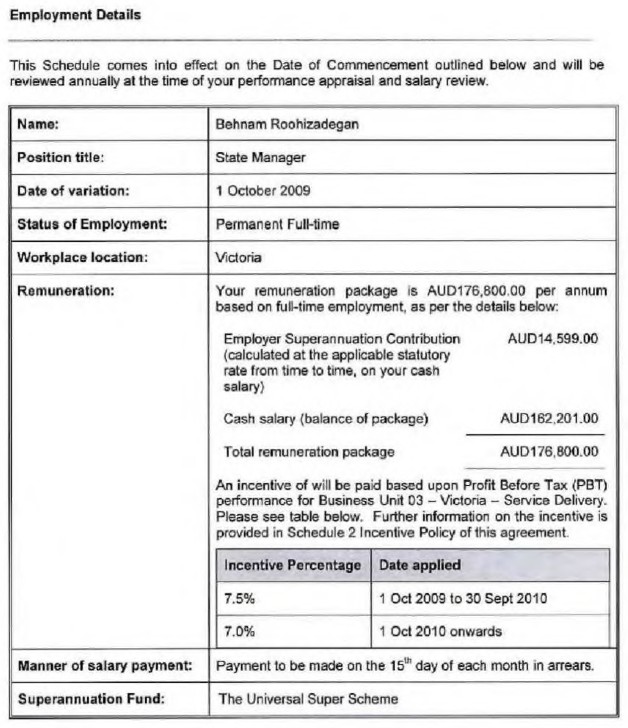
810 Schedule 2 includes:
An incentive will be paid based upon Profit before Tax (PBT) performance for the specified Product/Business Unit. The incentive will be based on an agreed percentage of the Product/Business Units PBT performance. The final incentive for each year can only be calculated once the company’s audited financial statements are available.
In order to provide our managers with a regular income stream the company will pay a portion of the incentive in advance. In most cases this will be paid monthly.
…
No incentives will be paid following employment conclusion. Where the employment of managers at Technology One concludes prior to the date on which the retentions are paid they will also not receive that retention.
The executive chairman has the discretion in exceptional circumstances to approve variations to the criteria on which incentives are paid during the employment of a manager or on employment conclusion.
811 Behnam’s case is that in breach of the profit incentive term, Technology One failed to pay him amounts for Victorian SMS revenue between 1 October 2009 and 18 May 2016, which he calculates in the amount of $1,674,743, plus amounts for Victorian PLUS services of $252,116, Victorian Legal Aid of $74,135 and Victorian Red Cross of $199,216.
812 I have touched on Martin Harwood’s evidence concerning the SMS revenue in Part 5. A more detailed analysis is now required as the parties each submit that the clause in issue in schedule 1 of the 2009 variation is ambiguous. The ambiguity is what is meant by the incentive term: Profit Before Tax (PBT) performance for Business Unit 03 – Victoria-Service Delivery? As such, the pathway to consideration of the objective matters known to the parties prior to the November 2009 variation opens: Codelfa Construction Pty Ltd v State Rail Authority (NSW) [1982] HCA 24; (1982) 149 CLR 337 at 352; Mount Bruce Mining Pty Ltd v Wright Prospecting Pty Ltd [2015] HCA 37; (2015) 256 CLR 104 at [46]-[51].
813 Gareth Pye, who was the financial controller of Technology One from August 2008 until October 2014 (he was then appointed as company secretary, and later and ultimately in December 2022 to the group director for strategy and planning), gave comprehensive background evidence concerning the SMS revenue issue in chief (CB 3180-3194). His evidence went unchallenged in cross-examination (T 1589-1691). In summary, prior to November 2009, the business operations were split into separate business units for internal accounting and financial management purposes. Each business unit had an appointed manager, although some individuals managed more than one unit. Each business unit had a unique profit and loss statement as a measure of financial performance. The business units were categorised by reference to function, product, service or geography or some combination of each. In July 2006 there were 45 business units and in May 2016, there were 84.
814 As of 1 June 2009, there were 62 units, comprised in eight groups. The first group comprised 12 business units corresponding with the 12 regions of the business at the time. There were corresponding references to “Service Delivery” in the name of each business unit to designate that these units comprised salespeople who directly sold software to customers in each region and were directly responsible for delivering the services to those customers. Behnam was designated as the manager of Business Unit 03 – Victoria – Service Delivery.
815 The other groups comprised Head Office, R&D Teams, Product Management Teams, national Consulting Teams, Student Management, ECM and Project Services. Student Management, ECM and Project Services were based in the Brisbane office and were managed by specialist teams in Brisbane.
816 The Student Management Group performed different functions relating to building, marketing, selling, implementing and supporting one product known as the SMS product. Until the 2011 financial year, the SMS product was treated differently to most of the other products of Technology One. This product provided a complete software package for tertiary institutions. Prior to 1 October 2010, the SMS business unit was exclusively responsible for developing the SMS product, selling it and providing follow-up consulting services. From 1 October 2010, the responsibility for selling the SMS product transitioned to the regions.
817 Technology One also had in place an internal system of royalty rules. This reflected that not every business unit earned revenue from customers. For example, Research and Development incurred significant costs in developing products but did not generate revenue. Other business units, particularly in the regions, derived revenue by selling products to customers and did not incur directly the costs of research and development. Thus, to measure the performance of each business unit, which is the relative contribution to profitability, Technology One implemented a system by which the revenue of the business was allocated between business units by allocating royalties between the business units. These were accounting entries, not cash payments. Royalties were treated as an expense of each business unit. Thus, if the Victorian region sold a product, it would then be charged a percentage of the revenue in favour of the business unit responsible for developing or managing that product. The royalty rules are a relatively complex system developed and reviewed annually.
818 In the 2009 and 2010 financial years, the royalty rules were recorded in spreadsheets. One example that Gareth Pye gives is for the 2010 year, during which 35% of licence fee revenue was reallocated to business unit 30 (Research and Development) and a further 5% was allocated to business unit 00 (Head Office).
819 Prior to the 2010 financial year, business unit 46 (STM sales) was solely responsible for the SMS product. In that year 100% of the revenue derived from the sale of the SMS product was allocated to business unit 46. Then, by the application of the royalty rules, that business unit only retained 60% of that revenue in that 35% was reallocated to business unit 36 (STM R & D) and 5% to Head Office. No part of the revenue derived from the sale of the SMS product was allocated to the profit of any region because no region had responsibility for generating a sale of the SMS product.
820 Once the royalty rules were determined for each year, they were communicated to the regional managers by delivery of a budget pack prior to the start of each new financial year. The delivery was accompanied by a covering memorandum.
821 From approximately 1 October 2010, Technology One commenced implementing a transition of the responsibility for selling the SMS product from business unit 46 to the regions, commencing with New South Wales and Victoria. However, it did not mean that business unit 46 ceased to be responsible for selling the SMS product in those regions. What did occur is that business unit 46 progressively reduced selling the SMS product and responsibility for the SMS sales transitioned to the regions. This reallocation was accompanied by a change in the allocation of revenue for those sales. To the extent that each region was now responsible for making a sale, a proportion of the revenue from the sale was allocated to it. This change was identified in the 2011 Budget Parameters and Instructions document (CB 4447). The document stated that Technology One was in the process of developing a new royalty split. The proposed adjustments were 30% for deals greater than $2,000,000, 40% for deals up to $2,000,000 and 60% for deals up to $1,000,000. A new proposal was also implemented for the payment of commissions for the SMS sales in each region. For Behnam, the proposal was for his incentive to be calculated on 10% of the SMS revenue (CB 4561).
822 That proposed structure was ultimately not adopted. Behnam’s incentive rate was not adjusted.
823 At this point, it is necessary to diverge and mention a matter that attracted attention in evidence but is irrelevant to construction of the 2009 variation. It is common ground that Adrian Di Marco in 2010, agreed to provide Behnam with a separate “side deal”, the effect of which was that the Victorian business unit was allocated 10% of the licence fee revenue for the life of the Victorian TAFE deal effective for the 2010 to 2014 financial years. Adrian Di Marco explained that this was “an act of good faith” on the part of Technology One, even though Behnam was not entitled to receive this payment (CB 2860). For present purposes, the important point is that this arrangement was not in place before the November 2009 contract variation.
824 Edward Chung provided more granular detail about the SMS transition in his evidence-in-chief (CB 2914). The transition formally commenced at the start of the 2011 financial year, that is from 1 October 2010. On and from that date, and specifically for Victoria, Behnam became responsible for the sale of the SMS product to tertiary institutions in Victoria, the sales staff who reported to Behnam became responsible for making sales of the SMS product and revenue from the SMS product sales was initially allocated to Business Unit 03, with a proportion of that revenue (40% pursuant to the royalty rules) then being re-allocated to other centralised business units, with the balance retained by Business Unit 03. The effect of these new arrangements was that from 1 October 2010, New South Wales and Victoria became responsible for new deals of the SMS product and related consulting services and revenue from those deals was then allocated to these regional business units.
825 Edward Chung’s evidence (CB 2912-2915) crisply highlights what is in issue on Behnam’s contractual claim. The calculated incentive claims for the period 2010 to 2016 concern revenue received by Technology One from tertiary education institutes for contracts entered into with Technology One for the provision of SMS services prior to 1 October 2010. That is, the contracts entitled Technology One to receive future revenue beyond the date that each contract was entered into. Gareth Pye gave evidence to similar effect (CB 3190). There is no issue about unpaid incentives for SMS revenue derived from new contracts entered into after 1 October 2010, as described in the previous paragraph.
826 In written closing submissions, Mr Hyde Page makes obvious, but significant, concessions on this issue. They are:
It is common ground that, by the time the 2009 Contract was executed on 26 November 2009, Mr Roohizadegan had gained a broad awareness that sales of SMS product had occurred in Victoria and been omitted from the Victorian financials. At the same time, however, he was disputing the correctness of this.
On 9 November 2009 Mr Roohizadegan had a meeting with Mr Harwood and Roger Phare where he protested the omission of SMS sales from the profit of the Victorian region. Mr Harwood and Mr Phare told him that SMS had always formed part of a different business unit within the First Respondent.
Later in the day on 9 November 2009 Mr Roohizadegan raised the omission of the SMS sales from the profit of the Victorian region in a conversation with Mr Di Marco, and Mr Di Marco agreed to look into the matter. Nothing then happened over the subsequent two weeks until 26 November 2009 when the 2009 Contract was executed. Mr Roohizadegan had raised an issue about the First Respondent’s compliance with his existing employment and Mr Roohizadegan was waiting for Mr Di Marco to get back to him about it.
At the time the 2009 Contract was executed the past exclusion of SMS sales from the profit of the Victorian region was not an uncontroversial part of the background that was known and accepted by both parties. The correctness of the First Respondent’s treatment of the SMS sales was very much in dispute.
827 What is controversial is the submission that Mr Hyde Page then makes – that a person like Behnam, “who signs a contract at a time when he or she has been disputing the counter-party’s adherence to a pre-existing contract, should not be taken to have agreed to the counter-party’s preferred construction of the pre-existing contract”. The error in that submission was exposed in Roohizadegan FC at [210]-[211]: what was or was not provided for under the earlier contract is irrelevant to the pleaded entitlement in the 2009 variation.
828 For the reasons that follow, it is clear that the objective background facts that were known to Behnam and Technology One prior to 26 November 2009, lead to the conclusion that no reasonable business person at the time and in the circumstances as they were would have understood that the incentive term in the 2009 variation conferred an entitlement to receive a percentage of revenue calculated on profit before tax for Business Unit 03 – Victoria – Service Delivery from SMS sales generated by Business Unit 46 based in Brisbane.
829 The starting point is the implicit concession that the submission of Mr Hyde Page accepts in the framing of his submission. Behnam had negotiated for inclusion of the SMS revenue which Technology One did not accept. It is fundamental contract law that acceptance cannot be imposed by silence: Felthouse v Bindley (1862) 11 CB (NS) 869; Latec Finance Ltd v Knight [1969] 2 NSWR 79. By close analogy, I do not accept that the parties can be taken to have objectively intended that Behnam’s position was agreed to absent communication from Technology One to that effect or some other manifestation of acceptance by conduct.
830 The important discussions occurred on 9 November 2009, at a Sales Kick-off Event on the Gold Coast. Behnam’s evidence-in-chief included (CB 87-88):
I attended a meeting with Martin Harwood and Roger Phare on the Gold Coast to discuss a number of matters including getting an iPhone. During this meeting, I raised my concern that the revenue from the Victoria TAFE SMS had not been allocated to Business Unit 03.
I was advised that SMS products are different to other products, and are “run from Brisbane”. I understood this to mean that any revenue generated from any SMS, despite the customer having their head office within Business Unit 03, would be allocated to the Corporate Unit.
I was informed that if I had an issue with such allocation of revenue, that I should discuss with [Adrian Di Marco].
Later, on 9 November 2009 the Gold Coast, I met with [Adrian Di Marco] regarding SMS, and also in regard to obtaining an iPhone. [Adrian Di Marco] reiterated what Mr Harwood of Mr Phare advised, being that SMS were different from other products, and “were run from Brisbane.”
…
I informed [Adrian Di Marco] that this approach was at odds with my contract, which did not exclude any product revenue from its allocation to my incentive payments. I further advised [Adrian Di Marco] that Mr Orchard told me that I would receive the incentive payment for the Victoria TAFE SMS in 2009. [Adrian Di Marco] said words to the following effect, “leave it with me, I will discuss this with Edward [Chung] and David [Orchard] and you should follow up with them up.”
831 In cross-examination, Behnam unconvincingly asserted that Adrian Di Marco “never said I would not get SMS revenue” (T 303), which did not answer the simple question to confirm the truthfulness of his evidence-in-chief.
832 Martin Harwood’s evidence of this discussion (in cross-examination), though vague in part, was to the effect that he recalled the discussion, Behnam raised the issue of the non-inclusion of the SMS revenue in the Victorian profit and loss calculations, expressed his view that such revenue should be included because the customer was based in Victoria and in response was told by Roger Phare that it would not be included because: “we have an entirely separate sales organisation, implementation organisation, the works for student management. It is sold by another part of Technology One which none of the regions have provenance over” (T 1132). Martin Harwood said that he “probably” said “yes, that’s my understanding”. He then gave evidence to the effect that it was his personal view that the arrangement should be altered going forward and that the reason why the SMS revenue had not been distributed to the regions earlier was (T 1133):
[T]he nature of the product, student management software, you had to have a really good in-depth understanding of the higher education sector to be able to sell the product, to be able to have a meaningful discussion with the customer, and, at that point, the only people who had that ability were in the Teresa Murphy business and they weren’t in the regions.
833 Roger Phare could not specifically recall the conversation in November 2009, but did state in his evidence-in-chief that in the first few years of Behnam’s employment he had a number of discussions about money. In particular (CB 2717):
[H]e would say that he wanted more incentives or more share options. One of the things he said was that he wanted revenue from the sale of SMS products in the Victorian geographical area to be recognised in his business unit (that is, Victorian region). Each time he raised this, I told him that this could not happen because SMS product sales formed part of a separate business unit.
834 That evidence was taken up in his cross-examination (from T 1829). He was asked to recall whether he ever explained to Behnam the rationale why SMS revenue was not included as part of the revenue of the Victorian region, and he answered (T 1831):
Yes, I did and it was very clear, and I hope that over the period of time that this has been going on, it has been come clear that it was through a different business unit that I was not responsible for, and, therefore, Behnam was not responsible for, that there was a different business unit that handled the area of student management sales end to end from sales to delivery, and, therefore, the remuneration accordingly.
835 A little later, on the same topic he said (T 1832):
We told him that student management was not included in his business unit. It was under the area of Richley Down. Having said that, we acknowledged his performance in the other areas and amended his particular salary incentive according.
Sure. Sir, if it’s possible for me to perhaps seem a bit pedantic, you said “we said”?---Adrian Di Marco and myself.
So you recall having conversations with Mr Roohizadegan that included Adrian Di Marco?---Absolutely, because, again, I think it’s documented the outcomes of those meetings was a change in remuneration structure on that, and I think you have those records.
836 Roger Phare distinguished between conversations before and after 2010. When invited to elaborate on that distinction (T 1833):
So the rationale was that as Technology grew as an organisation and I guess became more mature, my own role expanded too. It became logical that – there was no reason as we grew that student management would be siloed any longer because it was seen that we had regional salespeople and we believed, at that stage, that the product should be included in the – in the wider remit, if you like, for the regions. Playing to our strengths, in other words. And that was the rationale behind the change that happened in 2010, as well as a few other internal things that went on. So that was the rationale behind the change, right. It was saying that now we believe that the – you can be responsible for the salespeople, can be responsible for delivery of the product through the consulting teams and what have you, because we had become much more mature as an organisation. So that was the rationale behind the change.
837 Adrian Di Marco had little recollection of the 9 November 2009 conversation with Behnam. In his evidence-in-chief he referenced the evidence of Behnam:
I don’t recall the details of this conversation. However, Mr Roohizadegan, like all regional managers up until October 2010, was not entitled to revenue from SMS product sales under his existing contract. I would have put him straight had he ever made the point that he was entitled to that commission for sales for the SMS product before Oct 2010.
Instead, Mr Roohizadegan was consistently pressing me for more money including share options, bigger incentives, and a greater revenue stream (such as bringing the SMS product under the regions responsibilities). It was his nature to keep pushing the boundaries to get more for himself, and he was very persistent and usually he was ultimately successful. After Oct 2010 the arrangement was changed to include SMS product revenue by mutual agreement.
838 In his oral evidence-in-chief, Adrian Di Marco provided more detail (from T 1614). He said that he did not recall the specific 9 November 2009 conversation but did recall that he had discussions with Behnam about inclusion of the SMS revenue in the Victorian region financials. In part, he said:
Behnam had wanted for a while to have the student management revenue recognised through the region, but we didn’t sell student management through the region. It was sold from head office centrally because it was a very new product, it was a very large product, it was very complicated and it was a very complicated sales process. And so we wanted to keep it very close until we knew that the product was good enough and that we had the ability to sell it through the regions. So that was the gist of the conversations that I had with – with Behnam. But he was looking for that to – to be relocated into his region.
And what, if anything, did you say to him when he said to you that he should – that revenue should be allocated to the Victorian business unit and he should earn incentives on those amounts?---Well, that was something for the company to look at, at some time in the future once we felt that the product was ready to be sold through the region, but that wasn’t a decision that we had made, and it was still up for debate when it would happen.
And when did that happen?---It did happen subsequently. About a year later, we moved it into the region. There was quite a few regional managers that were lobbying for it to be done, and we felt that it was time to try that and do that.
839 That evidence was not traversed in cross-examination.
840 What this evidence establishes is that Behnam requested that the SMS revenue be included in the Victorian region profit before November 2009, was of the view that he had a pre-existing entitlement to its inclusion, but was consistently informed that it was revenue generated by a separate business unit and in consequence he was not entitled to have his incentive payment calculated by reference to profit generated on the sale of the SMS products. The evidence leads to the conclusion that the parties were in heated disagreement about the inclusion of the SMS revenue in the profit of Business Unit 03 prior to the 2009 variation.
841 There is no doubt that Behnam was aware prior to November 2009 that the SMS product was different to other products of Technology One, was developed and sold exclusively by a business unit in the Brisbane office and that the revenue generated therefrom was not allocated to any of the regions. That is clear from Behnam’s knowledge of the following (which self-evidently was also the knowledge of Technology One):
(a) The Technology One business was split into many business units, which he conceded in his evidence (T 283);
(b) Behnam’s responsibility from the outset of this employment was to manage and be responsible for Business Unit 03 – Victoria – Service Delivery which did not, prior to November 2009, have any responsibility for the SMS product in Victoria;
(c) Each business unit was separately assessed for financial performance on profit before tax. On a monthly basis, Behnam received a financial performance report, including on 17 November 2009 an email which attached the reports (T 264-265). Those reports included a document with the title P&L Statement for Business Unit 03 PBT (SCB 100, Doc 89c);
(d) That his incentives were calculated on profit before tax for Business Unit 03, which had not included SMS revenue (CB 83);
(e) His incentive statements detailed the calculation and did not include SMS revenue (CB 3768, 3870);
(f) The division into business units included specific units with defined functions and teams (CB 3992, document 81) and was subdivided into separate units for separate products. Although Behnam denied knowledge of document 81 (T 283), he nonetheless accepted that he was aware from at least June 2007 that there was a separate SMS business unit with separate financial reporting and accounting;
(g) That his regional business unit was not the only one responsible for selling Technology One products into Victoria. On his evidence the SMS product was not part of his sales, yet was sold into Victoria from the Brisbane office (T 292);
(h) That Business Unit 03 was not permitted to sell the SMS product to customers in Victoria, because that his unit did not have the “specialised resources” (T 258), and further, that SMS software was the responsibility of a separate unit within the Brisbane office (T 284, 286);
(i) That for approximately 40 months prior to his contract variation, profit before tax for his business unit did not include SMS revenue (T 292);
(j) The existence and effect of the royalty rules (T 256);
(k) That specific sales for SMS to Victoria TAFE were not recorded as revenue in Business Unit 03 in December 2006 (T 285) about which he unsuccessfully made representations for the inclusion of that revenue (CB 87-88);
(l) That pursuant to the royalty rules in place prior to November 2009, the regional business units were not allocated revenue from SMS sales (T 309-310); and
(m) In a document prepared by Behnam in May 2007, being his Business Plan FY 2008, there is a list of new business strategies but no mention of selling SMS products (SCB 3771).
842 Behnam carries the onus of establishing that the incentive term has the objective meaning that revenue from the sale of SMS products generated from 1 October 2009, was intended by the parties to include revenue generated from sales of that product made by a different business unit based in Brisbane, for which Business Unit 03 had no responsibility for and no involvement in the sale of that product. He has failed to discharge the onus. The objective facts as they were known to the parties at the time, in my view, clearly lead to the conclusion that the parties understood that the SMS revenue generated from sales made by Business Unit 46 was not to be included the calculation of profit before tax for Business Unit 03. The commercial purpose and object of the incentive term was to reward Behnam by a percentage applied to profit before tax derived from revenue generated by the Victorian region, as adjusted by the royalty rules. That is how reasonable businesspeople in the position of these parties at the time, and with the knowledge of the objective facts that I have set out, would have understood the incentive term.
843 It follows that the SMS contract claim fails. That leaves for determination three residual contract claims that may be dealt with succinctly.
844 The Victorian PLUS Services and the Victorian Legal Aid claims are related. Behnam’s evidence-in-chief is that he was not paid his incentives on these deals, and he provides his own loss calculation (CB 142). In contrast, Gareth Pye’s evidence-in-chief is that Behnam has already been paid the amounts due (CB 3279, 3281-3285), where his evidence comprehensively analyses the business records and exposes errors in Behnam’s calculations.
845 Given the significant difference in the evidence, it is surprising that Gareth Pye was not cross-examined on this issue. In any event, the same issue of interpretation concerning the calculation of his incentives by reference to the SMS revenue applies. On either basis, Behnam has failed to discharge his onus to establish his entitlement to these claims.
846 The Red Cross claim is to the effect that Behnam contends that he was paid an incentive but calculated by reference to only 30% of the revenue generated. Gareth Pye addresses this claim (CB 3286-3288). He explains that no person in Business Unit 03 was responsible for the deal and that the amount that was paid to Behnam by way of an incentive arose from “a one-off special payment” that was authorised by Adrian Di Marco and implemented pursuant to a series of emails commencing on 23 July 2012. Behnam’s evidence does not engage with this, and once again Gareth Pye was not cross-examined on it. For the same reasons, Behnam has failed to discharge his onus to establish this claim.
20. SAFETY NET CONTRACTUAL ENTITLEMENT
847 The s 323(1) claim falls with the contract claims. But that does not exhaust the permutations which must be resolved.
848 There are variations on this theme. One is Behnam was terminated in breach of s 340 (the language of the pleading is clumsy) “because of the proposed exercise of the safety net contractual entitlement and/or the payable entitlements” which is cross-referenced to a list of concerns raised by Behnam about why he was not receiving incentive payments for SMS revenue between 24 September 2009 and April 2015. The contention is that the incentive term had resulted or would have resulted, but for termination, in Behnam becoming entitled to receive large incentive payments including from completion of the La Trobe University deal.
849 Another is he was terminated in breach of s 340 to “prevent the exercise of the safety net contractual entitlement and/or the payable entitlements”. Yet, another is that Technology One engaged in non-dismissal adverse action (the 9 May 2016 abusive meeting, the 12 May 2016 public abuse and abusive meeting, the 16 May 2016 deceptive meeting request and the 16 May 2016 dismissive response to complaint and the direction to attend work whilst on medically certified sick leave) because Behnam exercised or proposed to exercise his safety net contractual entitlement.
850 These claims are conveniently considered together. Their precise basis has proved elusive. The pleaded claims are to the effect that Behnam considered that he had a right to receive further incentive payments from the SMS deals and frequently in writing and orally agitated for acceptance of his argument (CB 86-91) (it matters not on these claims that I have determined that he was not contractually entitled to the payments). That evidence overlaps with discussions before the November 2009 variation, which I have addressed above. He was not cross-examined seriatim on the numerous oral discussions that he references. Technology One accepts in accordance with Annexure A to its closing submissions that some of the discussions that Behnam references are likely to have occurred, whilst others did not. It is unproductive for me to deal with the evidence relied on for each conversation. Many witnesses for Technology One accepted that Behnam frequently agitated for the payment of more money. For example, Edward Chung’s evidence was that Behnam “was always pushing for more and, in particular, was pushing for revenue from Vic TAFE” (T 1790). Martin Harwood accepted that Behnam was a very good negotiator, even in his own financial interest: “one of his more endearing qualities” (T 1005, 1139).
851 During the trial a dispute arose about the precise scope of this aspect of Behnam’s claim. It concerned what Technology One submitted was an attempt to introduce a new claim to the effect that Behnam was terminated because his contractual entitlement was to receive an incentive based on a percentage of profit (T 892-895. That is, because the structure of his entitlement was too generous. In the submissions that followed, Mr Hyde Page made it clear that the case goes no further than a claim that a reason for the adverse action termination was to avoid paying Behnam his contractual entitlements, not because of the way in which his contractual entitlement was structured. With that clarification, objection was withdrawn (T 894 -895).
852 Thus, the issue is whether the various forms of contended adverse action were taken because Behnam agitated for increased incentive payments or to avoid paying his incentive entitlements? The overwhelming evidence is that he was not, but it is first necessary to make some findings about an issue that particularly attracted the attention of Mr Hyde Page during the trial relating to internal reviews of the remuneration structure for regional managers. This is submitted to be relevant to the avoidance claim.
853 Mr Hyde Page in closing submissions devotes much to the avoidance claim. In summary, his submissions proceed as follows. Terminating employment for the purpose of preventing enjoyment of a future contractual economic right amounts to adverse action. The “stand-out feature” of Behnam’s incentive right is that it was uncapped and if the Victorian business continued to grow at between 10% and 15% per annum, the result for Technology One would be unsustainable. For that proposition reliance is placed on the evidence-in-chief of Stuart MacDonald (CB 2771):
I knew that Mr Roohizadegan was entitled to receive 7.5% of the profit earned in the Victorian Region. My opinion was that his remuneration structure was flawed because it meant he was not properly incentivised to grow his Region by delivering increased licence fee sales each year. I also thought his remuneration structure was unsustainable. His structure may have been suitable for growing or small market, but it was wholly unsuitable for a mature and large market.
854 What the submission fails to highlight is the next paragraph in Stuart MacDonald’s affidavit:
However, the structure of Mr Roohizadegan’s remuneration, or any other regional manager, was not an immediate concern of mine. I did not terminate Mr Roohizadegan. To the extent that it is found that I had any involvement in his termination, at no stage did I form the view that Mr Roohizadegan should be terminated because of anything to do with his income and/or incentive rights and/or entitlements. I did not see anyone else say that Mr Roohizadegan should be terminated for any reason that was related to his income and/or incentive rights and/or entitlements.
855 I return to that, and evidence to similar effect from other witnesses, later. Resuming with the submission of Mr Hyde Page, various comparisons are drawn with the projected remuneration entitlements of other senior managers, in the 2018 year, in particular Mr Edward Chung ($1,396,604) and Adrian Di Marco ($1,345,705) in comparison with Behnam’s earnings in that year of $1,595,449 (CB 7660). The submission is then developed that Adrian Di Marco was aware in April 2016 that Behnam would soon be the highest paid executive of Technology One, for reasons unconnected from his performance. Reliance is placed on an email sent by Rebecca Gibbons to Stuart MacDonald on 21 April 2016 (CB 7618) in which she provided a summary of Behnam’s actual earnings for the financial years 2013 to 2016. Detailed submissions are then made to the effect that I should reject the evidence of each of the Technology One witnesses to the effect that Behnam’s remuneration entitlements were not a reason for his termination.
856 I turn to the evidence. At the outset, each regional manager was entitled to a remuneration package comprising a base salary and incentive calculated on profit before tax (CB 7656-7666). Some time prior to the commencement of the 2016 financial year, Martin Harwood had expressed a concern to Adrian Di Marco to the effect that the existing incentive structure for the regional managers should be rebalanced because of the absence of a correlation between meeting the licence fee revenue budget and the profit before tax of the region. He expressed it this way in cross-examination (T 1050):
And your difficulty with that, as I understand it, is that you believed that this meant any general manager could continue to receive an extremely generous incentive as a percentage of the existing profit of the region even when the profit of the region did not grow and even when licence fees did not grow?---No. That wasn’t my concern.
All right. What was your concern?---My concern was very simple: the way that we incented our sales people was that they got paid on the licence revenue that they generated. The way that the organisation had structured the people – the managers that they reported to was they weren’t – they weren’t paid on licence revenue growth. They were paid on gross profit of the region.
Yes?---So - - -
HIS HONOUR: Gross or net?---Gross. It wouldn’t have been net. I’m not – your Honour, I may be misleading you there. You would have to ask the financial guys whether it was on net or gross. But it was paid on profit and there was no – there was no disincentive if, in fact, you made your profit number but you didn’t – you didn’t meet your licence revenue number. So think of that logically. At the end of the day the only people within the whole organisation who would have owned accountability, if we failed to make our licence sales numbers, would be the CEO and the OO for sales and marketing because nobody else – it didn’t matter. To me, that was not the ideal way to structure incentives for regional managers and I thought there should be a more balanced way of doing so, which happened eventually.
857 Martin Harwood favoured a restructure (T 1052). From the “early part of 2016”, Edward Chung considered potentially altering the remuneration structure for the regional managers (T 1818). His thoughts were nascent and did not progress at that stage. He well understood that no change could be effected without the approval of Adrian Di Marco. Stuart MacDonald commenced his employment on 11 April 2016. His initial view about the remuneration structure is set out above. In cross-examination, when asked an open question expanding on his evidence-in-chief he said (T 1225):
If you think that something is undesirable and should be changed, and sacking Mr Roohizadegan would achieve that objective, then isn’t it a – one of the reasons to sack Mr Roohizadegan?---Absolutely not. A couple of things: (1), all of the regional managers had the same construct so it was really a goal of mine over time to reset the construct to something that was more relevant to what we were trying to do, which is sell licence. So in – the process took, I don’t remember, but a year at least to implement. So it had nothing to do with any one individual. It was addressing what I believed to be a flawed construct. The quantum that they were paid was never in question. It was the construct of it that was the item to be addressed. And, (2), irregardless of all of these issues, I still had a number I had to achieve. I still had to do sales. I had to achieve a target. So it’s my goal to have as many people there that I believe could get us there as possible.
858 Stuart MacDonald said that he sought the information concerning Behnam’s remuneration from Rebecca Gibbons (the email of 21 April 2016) because, although he had only been in the job for two weeks, he had noticed “a disproportionate amount of noise surrounding the Victorian Region and Mr Roohizadegan when compared with the other Regions and managers” (CB 2738). Following receipt of the email from Rebecca Gibbons, he sought further information from her, including a more detailed breakdown of the profit and remuneration of the other regional managers (CB 2738). Rebecca Gibbons provided the requested information in a further email of 21 April 2016 sent at 5:14 pm (CB 7656). Her email attached a breakdown of profit, including licence and consulting fees, for each region.
859 Technology One accepts that having received this information it is likely that Stuart MacDonald had a discussion with Martin Harwood about the structure of the remuneration for all the regional managers (T 1232). The content of what was discussed was not revealed in Stuart MacDonald’s evidence and Martin Harwood, beyond accepting that he must have met with Stuart MacDonald, could not recall what was discussed (T 1043). The next relevant meeting between the executive team members occurred on the morning of 26 April 2016, to discuss the Rebecca Gibbons email, which I have addressed in detail in Part 15.11.4.
860 Mr Hyde Page submits it is likely that during the meeting on 26 April 2016, Stuart MacDonald and/or Martin Harwood expressed broad views to the effect that the incentive entitlements of the regional managers, including those of Behnam, were unsatisfactory. That submission is not supported by the evidence: in particular, there is no reference to a discussion of that type in the notes made by Edward Chung (CB 7806), and, as I have set out in detail, it is obvious that the focus of that discussion was the content of the Rebecca Gibbons Email and not the remuneration and entitlements of Behnam.
861 Moreover, and more to the point, each of Martin Harwood (CB 3166, T 1084), Stuart MacDonald (CB 2771-2772), Adrian Di Marco (T1662) and Edward Chung (CB 2990) denied that the remuneration entitlements of Behnam were discussed at the meeting on 26 April 2016. Martin Harwood gave the clearest evidence about that, in cross-examination which although he was directed to the meeting of 3 May 2016, as will be seen, traversed all relevant meetings (T 1084):
MR HYDE PAGE : Mr Harwood, do you recall if, at the meeting on 3 May, you offered the opinion that Behnam should be sacked because of his incentive structure?---I did not.
You gave evidence a moment ago about your – the defect you perceived in his incentive structure and that of the general managers more broadly?---Yes.
But you say that you said nothing about that?---I’m lost now. I’m sorry. I said that I had a problem with the incentive plan for the regional managers and it was something that we, as a company, needed to fix. I never, at any stage, singled out Mr Roohizadegan, as far as that was concerned. It was a statement about that I believed we needed to change the REM policy for new managers that we brought aboard. I wasn’t suggesting a change for the ones that were aboard already and I believe that, when the change finally happened, it was only applied to new managers.
Do you say that that remark you just made – that evidence you just made applies in respect of all the meetings you attended about Mr Roohizadegan’s termination?---What’s the question, sorry?
I am asking if you, at any of the meetings where the termination was discussed - - -?---Yes.
- - - volunteered an observation about remuneration of Mr Roohizadegan or the regional managers?---Absolutely not.
Thank you. Did you regard Mr Roohizadegan’s entitlement to incentives based on profit as a reason to terminate him?---No.
862 I accept the evidence of Martin Harwood, as I do each of the other witnesses, who denied that Behnam’s remuneration was discussed at the meeting of 26 April 2016.
863 On 28 April 2016, there was a quarterly review meeting. Edward Chung made a note of the meeting in the form of an email on 29 April 2016 (CB 7851). The note is somewhat cryptic. It is in the form of a series of headings and many matters are listed. In part it refers to “cost controls”, the need to improve margins and “align rms/cd to oo - short term profit, EPRs same”. In addition to Edward Chung, a draft minute of the meeting records the attendees as Adrian Di Marco, Gareth Pye and Paul Rogers (SCB 7891_004). Adrian Di Marco did not recollect attending this meeting (T 1662). Edward Chung did not address this meeting or his notes in his evidence-in-chief. The document was introduced during the cross-examination of Adrian Di Marco. Edward Chung was not asked questions about it.
864 Some elliptical questions were put to Adrian Di Marco to the effect that there was a discussion about a proposal to alter the incentive entitlements of the regional managers (T 1661-1662, 1732-1733). The cross-examination was desultory. Adrian Di Marco insisted at one point that, as he had no recollection of the meeting, and that the questions should be addressed to Edward Chung (T 1733). Despite the note, Mr Hyde Page frames a closing submission that Technology One was actively considering adjusting the incentive requirements of the regional managers and that I should reject the evidence of Adrian Di Marco that he was not concerned about Behnam’s payments and entitlements, which though generous, were designed to provide an incentive to continue to grow the licence fees (CB 2781). A further submission to the effect that I should reject the evidence of each of Martin Harwood, Stuart MacDonald and Edward Chung that the incentive entitlements of Behnam were not considered in making the decision to terminate his employment was also put.
865 I reject this submission. There is no proper basis for it in that the author of the notes was not asked questions about it and there is much other evidence, that I referenced above and accepted, that Behnam’s remuneration entitlements were not a reason for the termination. The submission also suffers from the difficulties that it fails to explain how Technology One could have unilaterally changed Behnam’s contractual entitlements absent his consent.
866 Following Behnam’s termination, there is evidence that by early June 2016, Stuart MacDonald and Edward Chung had discussed a potential change to the incentive arrangements for regional managers (SCB 426). The essence of that proposal was to set the incentive as a percentage of licence fees, provided that a performance measure of profit was achieved (T 1245). Technology One accepts that this proposal was “likely prompted” by Behnam’s termination. It was progressed in August 2016 in the form of a presentation to the board by Stuart MacDonald (SCB 1283-1303). In broad terms the proposal was that 70% of the incentives would be calculated on licence fee performance and 30% on profit before tax, subject to a minimum of achieving at least 60% of licence fee budget. What the board decided is not in evidence, but there is evidence that sometime in the latter part of 2016, Adrian Di Marco authorised a change to the incentive structure as proposed by Stuart MacDonald (T 1818, FSCB 11,095). An aspect of this scheme was that for existing regional managers, the proposed change was adjusted such that if an existing manager accepted the new arrangement, he or she would not be financially worse off, which Stuart MacDonald explained in detail (T 1225-1226). Thus, this post event evidence establishes the falsity of the submission that steps were in play to reduce the remuneration entitlements of regional managers prior to 18 May 2016, and that was a reason for Behnam’s termination.
867 There are some residual submissions of Mr Hyde Page that can be quickly addressed. One is that at the meeting on 3 May 2016, it is likely that there was a discussion to the effect that Behnam’s remuneration entitlements were too generous. I reject the submission as unsupported by the evidence. Another is that Behnam was terminated to deprive incentives that would have been payable on completion of the La Trobe University deal. Behnam calculated those entitlements in his evidence, at a little over $970,000 (CB 139, 9029). Those calculations are not based on business records, in contrast with the alternative calculations prepared by Gareth Pye (FSCB 9425) from the business records of Technology One (FSCB Doc 949). I accept the evidence of Gareth Pye.
868 The additional incentives that would have become payable are calculated in the Technology One closing submissions, which I accept as accurate based on the disclosed methodology. The amounts would have been $111,248 in June 2016, $18,568 in July 2016, $9867 in August 2016 and $10,061 in September 2016. Gareth Pye undertook those calculations for the purpose of this proceeding. There is no evidence that anyone in Technology One considered these additional incentives when the decision was made to terminate Behnam’s employment. In any event, and once again, there is significant evidence from numerous Technology One executives to the effect that Behnam’s remuneration entitlements did not form part of the decision-making: in particular, the evidence of Adrian Di Marco (T 1662, CB 2845, 2856-2857). Further, Adrian Di Marco did not recall Behnam ever raising with him, or of being told by someone else, that he was entitled to unpaid incentives. His evidence was to the effect that if this issue had been raised, he would have ‘put him straight because he was not entitled to it” (T 1731). I accept that evidence.
869 For all these reasons, the termination because of incentive claims fail.
21. THE FLAWED COUNTERFACTUAL
870 Although it is unnecessary to address this, the evidence about what would have happened if Behnam had not been unlawfully terminated was very extensive and the parties have framed detailed submissions on this question. In deference to the time spent on this issue, I make the following brief findings.
871 Behnam’s damages claim in part assumes that he would have continued in employment until retirement at age 65 on 24 December 2027. For that, there is a calculation of lost base salary of approximately $2.645 million. The obvious error in that calculation is that there is no attempt to discount the value of future entitlements. Next there is a calculation of unpaid incentives to retirement of $39.71 million, again without discounting. There is another substantial claim of approximately $1.9 million for the lost opportunity of taking up, and then selling shares acquired through the exercise of options. These claims do not exhaust the contended future entitlements as pleaded.
872 Those calculations rest on acceptance of the large proposition that, but for the unlawful termination, Behnam would have remained with Technology One or would have relocated to another industry participant with a similar remuneration structure. Two competing remuneration experts, Paul Simms for Behnam and David May for Technology One addressed this issue. John-Henry Eversgard provided expert evidence for Behnam about the value of future share options. Chris Katehos also provided calculations of future loss based on assumptions that Behnam’s employment would have continued until retirement.
873 In closing submissions, Mr Hyde Page accepted that the task is to assess quantum by determination of what would most likely have occurred if Behnam’s employment had not been unlawfully terminated, and/or he had not been subject to the non-termination forms of adverse action. He further accepted, correctly, that discounts are usually applied to account for contingencies and the vicissitudes of life. He identifies as the four most likely scenarios that Behnam would have:
(a) remained in his position as regional manager with Technology One on his existing remuneration terms;
(b) secured similar employment in the same industry;
(c) been terminated at a later date, in which case he would have suffered a lesser impairment and, after a period of recuperation, would have resumed employment on similar terms in the same industry; and
(d) been terminated lawfully, in about May 2016, and would have suffered the same degree of permanent incapacity.
874 The final scenario is put as the least likely one.
875 Technology One, in contrast, submits it should be concluded that it was “a near certainty, or almost inevitable” that Behnam would have been terminated for lawful reasons at sometime between 18 May 2016 at the earliest on 30 May 2017 the latest. The impact of a lawful termination, consistently with the psychiatric evidence, is that Behnam would have been rendered totally and permanently incapacitated for employment by reason of psychiatric injury.
876 The correct approach to the counterfactual requires a finding as to what would likely have happened absent the contravening conduct: Maritime Union of Australia v Fair Work Ombudsman [2015] FCAFC 120 at [28]-[30], Allsop CJ, Mansfield and Siopis JJ; Transport Workers Union of Australia v Qantas Airways Ltd (Compensation Claim) [2024] FCA 1216; (2024) 334 IR 187 at [67]-[84], Lee J.
877 The overwhelming effect of the evidence that I have accepted is that as of 18 May 2016, Behnam’s continued employment as the regional manager for Victoria of Technology One was in peril. His licence fee performance was unsatisfactory. He was not considered by Martin Harwood, Edward Chung or Stuart MacDonald as having the necessary skills and ability to take the Victorian region forward. I have made multiple findings concerning Behnam’s inability to accept the management structure of Technology One, which had evolved considerably since he was first employed in 2006. When Behnam was first appointed as the Victorian regional manager, he did have considerable authority to run “his business” as he thought fit. He performed exceptionally in the early years in achieving licence fee growth. However, the business evolved over the ensuing years. It had to. More rigid management structures and procedures were developed. More senior managers were appointed in his direct reporting line. What is obvious is that Behnam did not and could not adapt to the changing management structure of the business.
878 Behnam found these changes challenging, as evidenced by my numerous findings to the effect that he could not accept the direction and management decision-making of his more senior managers. He regarded their decision-making as interfering with his ability to conduct the Victorian region as he would wish. The view had been formed by April 2016, that Behnam was not a suitable person to remain in the position of Victorian regional manager, in particular by Martin Harwood and Edward Chung.
879 It is likely that Behnam’s employment would have been terminated well before April 2016 but for the close relationship that he had with Adrian Di Marco. Whilst that relationship continued, and despite the views of Martin Harwood, Edward Chung and Stuart MacDonald, Behnam’s employment was secure subject to his ability to continue to deliver licence fee growth. He did not do so in the 2014 and 2015 financial years.
880 Behnam lost the personal confidence of Adrian Di Marco in April 2016, in consequence of the Rebecca Gibbons Email. And the content of that email brought to a head the crisis, which had been brewing for some time, in the Melbourne office of Technology One.
881 Added to this is the significant personal difficulties that Behnam faced in consequence of his diagnosis of Major Depressive Disorder, related to his daughter’s illness, which was first recorded by Dr White in his report of 9 November 2015. The Medical Panel in January 2016, noted that Behnam commenced the Supreme Court proceeding (which he did in 2014) and in it alleged that he suffered nervous shock and a Major Depressive Disorder arising from her alleged mistreatment in September and October 2010. Each of Dr White and the Medical Panel consistently recorded that, despite his condition, Behnam was working longer hours as a compensating mechanism, sometimes up to 18 hours per day. He admitted to Dr White that he became “absolutely distracted about my daughter”, is “not efficient”, suffers from “severe concentration problems” and is forgetful. Dr White further noted that Behnam “has developed a very significant degree of post-traumatic embitterment regarding his daughter’s situation, and until now has refused psychiatric or psychological treatments”. The Medical Panel recorded as part of his stated history that he was then “much more irritable than he used to be at work and can quickly be roused to anger and speak harshly to people” and “he is more demanding and aggressive at his workplace now”. His condition was so severe, that the Medical Panel recorded suicidal ideation in late 2011 and an attempted suicide in 2012.
882 In the Joint Expert Report of the psychiatrists, it was agreed that prior to May 2016, Behnam’s mental state “would likely have impacted upon his capacity for employment” and that “his mental state likely resulted in him being sensitive to the perceived bullying and inappropriate management actions”. The experts further recorded that his symptoms “were fluctuating and there was improvement overall in the full hand of Major Depressive Disorder symptoms, prior to the termination of employment” and he “remained functioning at work to a large extent because of his obsessive-compulsive personality traits. In fact his personality structure helped him to maintain his occupational functioning”. Mr Wood submits that it should be concluded that there was no significant improvement in Behnam’s condition prior to his termination. Ultimately, I have not found it necessary to resolve that issue. For present purposes, this evidence is relevant to the ability of Behnam to continue to function at a very high level and in a high-pressure sales environment.
883 What cannot be gainsaid is the obvious link between Behnam’s decline in licence fee performance in 2014 and 2015 and his then state of mental health, of which Technology One was ignorant because he chose to withhold this information from his employer.
884 Add to this, the respective adverse assessments of Behnam’s management of Martin Harwood, Stuart MacDonald and Edward Chung. Although the Rebecca Gibbons Email was the final straw in the decision-making of Adrian Di Marco, even he was losing confidence in Behnam well before he read the email. But Adrian Di Marco hesitated, in his language he procrastinated and should have made the decision sooner.
885 Moreover, Behnam knew his tenure was precarious. He said so in his email to Adrian Di Marco of 15 May 2016 where he asserted that ”people from Executive” had an agenda for his departure and was “prepared to have that discussion” (CB 8551), having earlier said to Stuart MacDonald on 6 May 2016: “if you want me to resign just tell me where to sign” (CB 8087).
886 I find that it is inevitable that Behnam’s employment would have been terminated for perfectly lawful reasons, by no later than May 2017 which is when Edward Chung replaced Adrian Di Marco as the CEO. Edward Chung did not have the same loyalty to Behnam. I also find that it is likely that Behnam’s employment would have been terminated well before that time, particularly because of the underlying management issues in the Melbourne office as evidenced by the Rebecca Gibbons Email. By April 2016, it is clear in my view that Behnam did not have long to go as the Victorian regional manager of Technology One. I find that he would have been terminated by the close of the 2016 Technology One financial year – 30 September 2016.
887 Additionally, there is the question whether a lawful termination would have had the same catastrophic psychiatric effect as the termination that was effected on 18 May 2016, assuming it was unlawful, which I have analysed and made findings about in Part 18. It is obvious that a lawful termination of Behnam, a person for whom life was his work, would have had catastrophic psychiatric consequences.
888 Drawing these findings together, even if I had found that the adverse action claims had been made out (particularly the termination), I would not have accepted the contention that Behnam would have remained in employment with Technology One for very long. And similarly, once one accepts the psychiatric impact of a lawful termination, I would not have accepted the case that Behnam would have obtained alternative employment in the same industry and upon similar terms. The large assumptions that underpin the damages claim cannot be reconciled with the objective facts.
22. RESULT
889 The proceeding must be dismissed. There may be an application to engage the discretion at s 570 and I will set a timetable in that event.
I certify that the preceding eight hundred and eighty-nine (889) numbered paragraphs are a true copy of the Reasons for Judgment of the Honourable Justice McElwaine. |
Associate:
Dated: 18 December 2025


