

Federal Court of Australia
NCL Corporation Ltd v Norwegian Brand Ltd [2025] FCA 1613
File number(s): | NSD 941 of 2022 |
Judgment of: | STELLIOS J |
Date of judgment: | 18 December 2025 |
Catchwords: | INTELLECTUAL PROPERTY – trade marks – international registration designating Australia – objection to extension of international protection to Australia – whether trade mark applicant had intention to use mark in Australia – where trade mark applicant did not participate in appeal proceeding – no intention to use found PRACTICE AND PROCEDURE – international service – service of notice of appeal on IRDA applicant – where leave given for international service pursuant to r 10.44 of the Federal Court Rules 2011 (Cth) |
Legislation: | Trade Marks Act 1995 (Cth) ss 41, 44, 56, 58, 58A, 59, 59(a), 60, 189A, 197, 215 and 221 Federal Court Rules 2011 (Cth) rr 10.08, 10.44 and 34.31(1) Trade Marks Regulations 1995 (Cth) Pt 17A, regs 17A.32, 17A.33(1), 17A.34(2), 17A.34N(1), 17A.34P Protocol Relating to the Madrid Agreement concerning the International Registration of Marks (27 June 1989) |
Cases cited: | Aston v Harlee Manufacturing Co (1960) 103 CLR 391 Bauer Consumer Media Ltd v Evergreen Television Pty Ltd (2019) 367 ALR 393; [2019] FCAFC 71 Caesarstone Ltd v Ceramiche Caesar S.p.A. (No 3) (2019) 138 IPR 386; [2019] FCA 7 Crawford v State of Western Australia [2025] FCAFC 48 Food Channel Network Pty Ltd v Television Food Network GP (2010) 185 FCR 9; [2010] FCAFC 58 Health World Ltd v Shin-Sun Australia Pty Ltd (2008) 75 IPR 478; [2008] FCA 100 OPTICAL 88 LTD v OPTICAL 88 PTY LTD (2011) 197 FCR 67; [2011] FCAFC 130 Ritz Hotel Ltd v Charles of the Ritz Ltd (1988) 12 IPR 417 Somers Enterprises Australia Pty Ltd (No 2) [2025] FCA 418 Suyen Corporation v Americana International Limited (2010) 187 FCR 169; [2010] FCA 638 Thomas v Monsoon Group Australia Pty Ltd (Costs) [2025] FCA 1106 UCP Gen Pharma AG v Mesoblast, Inc [2012] FCA 500 Robert Burrell and Michael Handler, Australian Trade Mark Law (3rd ed, 2024) |
Division: | General Division |
Registry: | New South Wales |
National Practice Area: | Intellectual Property |
Sub-area: | Trade Marks |
Number of paragraphs: | 61 |
Date of hearing: | 29 July 2025 |
Counsel for the Appellant: | C Elliott KC |
Solicitor for the Appellant: | Spruson & Ferguson |
Counsel for the First Respondent: | The First Respondent did not appear |
Counsel for the Second Respondent: | The Second Respondent did not appear |
Solicitor for the Second Respondent: | Australian Government Solicitor |
ORDERS
NSD 941 of 2022 | ||
| ||
BETWEEN: | NCL CORPORATION LTD Appellant | |
AND: | NORWEGIAN BRAND LTD First Respondent REGISTRAR OF TRADE MARKS Second Respondent | |
order made by: | STELLIOS J |
DATE OF ORDER: | 18 DECEMBER 2025 |
THE COURT ORDERS THAT:
1. The appeal be allowed.
2. The decision of a delegate of the Registrar of Trade Marks dated 13 October 2022 extending protection to the first respondent’s international registrations designating Australia, application numbers 1847335 and 1847336 (the opposed marks), be set aside.
3. Protection of the opposed marks not be extended to Australia and registration be refused.
4. The first respondent pay the appellant’s costs of the appeal in an amount to be agreed or assessed.
5. The delegate’s costs order be set aside.
6. There be no further order in relation to costs before the delegate.
Note: Entry of orders is dealt with in Rule 39.32 of the Federal Court Rules 2011.
REASONS FOR JUDGMENT
STELLIOS J:
1 This proceeding concerns a statutory appeal from a decision of a delegate of the Registrar of Trade Marks on 13 October 2022 (the delegate’s decision) to extend to Australia the protection of two internationally registered trade marks of the first respondent (Norwegian Brand). The delegate found the appellant (NCL) had not established a ground of opposition under the Trade Marks Act 1995 (Cth).
2 NCL now appeals to this Court relying on the grounds of opposition in ss 41, 44, 59 and 60 of the Act. Norwegian Brand did not put on evidence or otherwise comply with the timetabling orders made by the Court. Nor did it appear at the hearing.
3 For reasons below, I am satisfied that NCL has established the ground of opposition to the registration of the opposed trade marks in s 59(a) of the Act.
LEGISLATION
4 Where a trade mark is registered internationally, the owner of that trade mark may make a request, also known as an international registration designating Australia (IRDA), for extension to Australia of the protection resulting from that international registration. Section 189A of the Act provides for the making of regulations to implement the Protocol Relating to the Madrid Agreement concerning the International Registration of Marks (27 June 1989) (Madrid Protocol). The process for the acceptance and registration of IRDAs is set out in Pt 17A of the Trade Marks Regulations 1995 (Cth).
5 If an IRDA is accepted by the Registrar and published on the computer database maintained by the Trade Marks Office, a person may oppose the registration of that IRDA by filing a notice of opposition: regs 17A.32 and 17A.33(1).
6 Regulation 17A.34(2) provides that “[t]he extension of protection may … be opposed on any of the grounds set out in sections 58 to 61 and 62A of the Act”.
7 The Registrar must decide to refuse or extend the protection in respect of some or all of the goods or services listed in the IRDA, with or without conditions or limitations, “having regard to the extent (if any) to which the grounds on which the IRDA was opposed have been established”: reg 17A.34N(1).
8 Following a decision of the Registrar, the IRDA holder or opponent may appeal to this Court: reg 17A.34P; Act s 56.
Background
9 NCL is the operator of Norwegian Cruise Line, a cruise ship company based in Florida, USA. Norwegian Brand is part of a corporate group that operates Norwegian Airlines. It has its registered office in Dublin, Ireland.
The trade marks
10 The IRDAs filed by Norwegian Brand concern the following trade marks, registered internationally:
(1) Application number 1847335 (35 mark); and
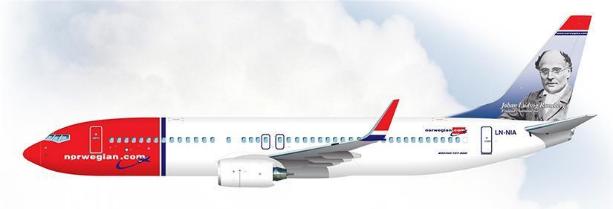
(2) Application number 1847336 (36 mark)

(together, the opposed marks).
11 Both opposed marks have a priority date of 20 January 2017.
12 Since 16 April 2014, the following trade mark has been registered for NCL (Australian trade mark number 1617618):

(the NCL mark).
Application and opposition
13 Norwegian Brand filed the IRDAs to register the opposed marks in Australia on 20 January 2017. Following initial examination, the Registrar accepted the IRDAs, advertised the applications and notified the International Bureau at the World Intellectual Property Organisation under the Madrid Protocol on 11 December 2018. NCL filed its notice of intention to oppose the registration of both opposed marks on 29 March 2019.
14 Before the delegate, NCL opposed the IRDAs on the basis of ss 44, 58, 58A, 59 and 60 of the Act. The ss 58A and 59 oppositions were not pressed, and the delegate treated them as having been abandoned (delegate’s decision at [7]). As foreshadowed, the delegate concluded that NCL had not established any ground of opposition (delegate’s decision at [74]), and made a costs order against NCL pursuant to s 221 of the Act (delegate’s decision at [76]).
Appeal to this Court
15 Before this Court, NCL relies upon the grounds of opposition in ss 41, 44, 59 and 60 of the Act. It is sufficient for the purposes of determining this appeal to refer to the s 59 ground. In its amended notice of appeal, NCL alleges that:
7. The applications to register the Opposed Trade Marks ought to be rejected pursuant to the ground of opposition in section 59 of the Act, as at the priority date of the Opposed Trade Marks, the First Respondent did not intend to use, or authorise the use of the trade marks in Australia, or to assign the trade marks to a body corporate for use by the body corporate in Australia, in relation to the goods and services covered by the Opposed Trade Marks.
16 The ground of opposition is particularised in the following way:
Particulars
7.1. As at the priority dates of the Opposed Trade Marks, the First Respondent:
7.1.1. did not intend to use the Opposed Trade Marks in Australia at all; and/or
7.1.2. did not intend to use the Opposed Trade Marks in relation to each of the goods and services covered by the Opposed Trade Marks; and/or
7.1.3. did not have a sufficient intention or a resolve or settled purpose to use the Opposed Trade Marks at all, or for each of the goods and services covered by the Opposed Trade Marks.
Service of the amended notice of appeal and Norwegian Brand’s involvement on appeal
17 As indicated, Norwegian Brand did not participate in this appeal. Nonetheless, I have proceeded to hear and determine the appeal because I am satisfied that service of the notice of appeal and amended notice of appeal was effected in accordance with the relevant rules.
18 Rule 10.08 of the Federal Court Rules 2011 (Cth) (FCR) provides that, in an appeal from a decision of the Registrar, service on a respondent may be effected at an address for service under s 215 of the Act. Subsection 215(1) states the “address for service of a person who has filed [a] … request is: (a) the address for service stated in the … request; or (b) if the person subsequently notifies in writing another address to the Registrar—that other address”. Subsection (5) states that address for service must be in Australia or New Zealand and subsection (8) permits that address to be an electronic address. The address for service listed on the IRDAs, and indeed used throughout the proceeding before the Registrar, was that of Davies Collison Cave Ltd (DCC), a law firm based in Australia.
19 In an affidavit affirmed on 11 March 2024, Katrina May Crooks, principal of Spruson & Ferguson Lawyers Pty Ltd, solicitors for NCL, stated that on 4 November 2022 she served the notice of appeal on DCC by sending it by email to Ian Drew, principal of DCC and the attorney who conducted the proceeding before the Trade Marks Office. On 18 November 2022, Mr Drew responded to that email, informing Ms Crooks that DCC did not have instructions to accept service in this matter.
20 In an affidavit dated 23 February 2024, Aisling Casey, solicitor of William Fry LLP in Dublin, deposed that she was requested by Spruson & Ferguson to effect the service of the notice of appeal on Norwegian Brand. She also deposed that, on 21 February 2024, she served the notice of appeal on Norwegian Brand by leaving it at the reception desk at Building Two, The Green Dublin Airport Central, Dublin Airport, Swords, Dublin K67 E2H3 and further by sending it by registered and tracked post to its registered office at 1st Floor, Building Two, The Green Dublin Airport Central, Dublin Airport, Swords, Dublin, K67 E2H3, Ireland.
21 On 16 April 2024, the Court ordered that leave to serve Norwegian Brand outside the jurisdiction pursuant to r 10.44 of the FCR, encompassing the service effected by Ms Casey on 23 February 2024, be granted.
22 On 13 November 2024, the Court ordered pursuant to r 10.44 that leave be granted for NCL to serve Norwegian Brand with the amended notice of appeal by sending a copy by tracked post to Norwegian Brand’s registered office at “Ground Floor, Imbus House, Dublin Airport Co. Dublin”.
23 In an affidavit dated 29 July 2025, Hannah Lowe, paralegal at Spruson & Ferguson, deposed that on 14 November 2024 she sent the amended notice of appeal by tracked registered post to Norwegian Brand at Ground Floor, Imbus House, Dublin Airport Co., Dublin, Republic of Ireland. Annexed to that affidavit was a printout of the proof of delivery on 4 December 2024.
24 In light of that evidence of service, I am satisfied that service of the notice of appeal and the amended notice of appeal was effected in accordance with the Court’s orders. Accordingly, I have exercised my jurisdiction to determine the appeal.
legal principles
25 On this appeal, the Court exercises original jurisdiction and determines the proceeding by way of de novo hearing. As Greenwood J said in Bauer Consumer Media Ltd v Evergreen Television Pty Ltd (2019) 367 ALR 393; [2019] FCAFC 71 at [37]:
The statutory jurisdiction conferred on the primary judge is an exercise of judicial power in the Court’s original jurisdiction to hear and determine questions of fact and law in controversy according to all of the evidence put on in support of, or in answer to, the relevant case, hearing all of the questions and issues afresh on the merits.
See also at [228] (Burley J).
26 As foreshadowed, I have concluded that NCL succeeds in its reliance on s 59(a) of the Act. That section relevantly provides:
59 Applicant not intending to use trade mark
The registration of a trade mark may be opposed on the ground that the applicant does not intend:
(a) to use, or authorise the use of, the trade mark in Australia; …
in relation to the goods and/or services specified in the application.
27 Given the nature of the Court’s jurisdiction, the fact that NCL did not press the s 59 opposition ground before the delegate does not preclude NCL from relying on it in this appeal.
28 In addressing this ground, I have relied on the following principles:
(1) On current authority, the time at which the requisite s 59 intention must exist is the date of filing of the application: Food Channel Network Pty Ltd v Television Food Network GP (2010) 185 FCR 9; [2010] FCAFC 58 at [74] (Keane CJ, Stone and Jagot JJ). While that position has been doubted (see Suyen Corporation v Americana International Limited (2010) 187 FCR 169; [2010] FCA 638 at [147]–[177] (Dodds-Streeton J); see also Robert Burrell and Michael Handler, Australian Trade Mark Law (3rd ed, 2024) at 245–6), a different date either before or after the filing date would make no difference in this case.
(2) Evidence “relating to use (or non-use) after the date of application may be relevant in drawing inferences as to the issue of intention as at the date of application”: Food Channel at [74].
(3) While it is not “necessary that the applicant’s intention be to use the mark ‘immediately or within any limited time’” (OPTICAL 88 LTD v OPTICAL 88 PTY LTD (2011) 197 FCR 67; [2011] FCAFC 130 at [88] (Cowdroy, Middleton and Jagot JJ) quoting Aston v Harlee Manufacturing Co (1960) 103 CLR 391 at 401 (Fullagar J)), there must be “a present intention to use” the mark (Ritz Hotel Ltd v Charles of the Ritz Ltd (1988) 12 IPR 417 at 459 (McLelland J)). It must be a “positive” intention that is “real and definite”: Health World Ltd v Shin-Sun Australia Pty Ltd (2008) 75 IPR 478; [2008] FCA 100 at [160] and [168]. It is not enough for there to be a “‘general intention’ to use the mark ‘at some future but unascertained time’” (OPTICAL 88 at [88]); “a contingent possibility of future consideration of the question whether the mark … should be used” (Ritz Hotel at 459); or a mere “uncertain or indeterminate possibility” of use (OPTICAL 88 at [87]).
(4) The onus of proof lies “squarely upon the opponent”: Food Channel at [32].
(5) The discharge of that onus “may involve the consideration of the intention of the applicant having regard to any of his or her statements of intent, prior uses consistent or otherwise with that intention, and uses shortly after the filing date”: Bauer at [247] (Burley J).
(6) It has been accepted that “the filing of an application for registration of a mark is prima facie evidence of an intention to use that mark”: Food Channel at [72] (Keane CJ, Stone and Jagot JJ).
(7) As Greenwood J said in Bauer at [45], “the subjective nature of the intention contemplated by the section, the presumption of intention flowing from the application for registration and the onus on an opponent, usually make it difficult for an opposition to succeed on this ground”: see also Health World at [161] (Jacobson J).
(8) Despite the foregoing, “[o]nce an opponent has made out a prima facie case that there was a lack of intention to use a mark, it has been held that the onus shifts to the applicant to establish that intention”: Food Channel at [72]; referring to Health World at [163].
(9) In “circumstances where an applicant for registration has been put on notice that its intention to use the mark is in issue and the applicant has not responded to the opponent’s evidence … a finding of lack of intention may be made”: Bauer at [45] (Greenwood J); see also Health World at [162] (Jacobson J). However, some care is needed if “the absence of the requisite intention to use … [is] inferred from lack of use per se”: Suyen at [207].
(10) The standard of proof is the balance of probabilities: Bauer at [44] (Greenwood J).
29 I consider that these principles apply equally to IRDA applications.
evidence
30 Relevantly to the s 59(a) ground of opposition, NCL relied on the following evidence:
(1) A declaration dated 30 April 2021 by Christoffer Sundby, Norwegian Brand’s Chairman of the Board (Sundby declaration). On 6 May 2025, the Court granted leave to NCL pursuant to r 34.31(1) of the FCR to rely on the parts of the Sundby Declaration referred to below.
(2) An affidavit dated 6 September 2024 of Hannah Lowe, paralegal at Spruson & Ferguson (Lowe affidavit).
(3) An affidavit dated 5 September 2024 of Michael Middleton, the General Manager of Cruise at Ignite Travel Group (Middleton affidavit).
(4) An affidavit dated 16 August 2024 of Gregory Wilson, the National Sales Manager of Cruiseco Pty Ltd (Wilson affidavit).
Sundby Declaration
31 The Sundby declaration contained the following statements:
(1) “My Company is a Norwegian low-cost airline and Norway's largest airline.”
(2) “My Company commenced considering expanding its flight routes to Australia in November 2016. Norwegian Brand Ltd. initiated the trademark registration process for Australia with its legal agency, Acapo.”
32 Exhibited to the Sundby declaration was an extract of an article dated 27 September 2017. The article appeared in Executive Traveller and was entitled “Norwegian plays down plans for Sydney [flights]” . The article contained the following statement (emphasis in original):
Norwegian Air has made tentative plans to commence flying to Australia, however the airline doesn’t expect flights to begin any time soon.
The low-cost airline pencilled Sydney and Melbourne onto an ambit “laundry list” of some 155 cities – 75 domestic and 80 international – which could be flown from Argentina, which would serve as a South American hub to the Europe and the USA.
However, the optimistic roster pitches significantly more routes than the airline has aircraft. A spokesperson from Norwegian Air admitted to Australian Business Traveller than [sic] even if the application to Argentina’s civil aviation authority was approved “it would still be a number of years before many of the routes move forwards.”
More likely to eventuate are rumoured plans to fly from Singapore to Sydney and Melbourne, linking both cities with the London-Singapore Boeing 787-9 service which Norwegian Air will launch this week.
…
Norwegian Airlines declined to comment specifically on plans to fly to Australia from Singapore, with a spokesperson saying only that “there are no immediate plans to serve Australia at this stage.”
33 Also exhibited to the Sundby declaration was a copy of a document described by Mr Sundby as setting out “the corporate structure of my Company and its related parties”. That information included the following paragraphs:
The Norwegian Group consists of the parent company, Norwegian Air Shuttle ASA, and its directly or indirectly owned subsidiaries in Norway, Sweden, Denmark, Finland, Ireland, Spain and United Kingdom.
…
The Group’s commercial airline activities are today organized in the parent company Norwegian Air Shuttle ASA (NAS) based in Fornebu, Norway. The fully owned subsidiaries, Norwegian Air International Ltd. (NAI) based in Dublin, Ireland, Norwegian UK (NUK) based in London, United Kingdom and Norwegian Air Norway AS (NAN) based in Fornebu, Norway each hold an AOC in their respective locations.
…
Norwegian Brand Ltd. (Dublin, Ireland) has the responsibility of developing and maintaining the Norwegian Group’s brand across all business areas.
…
Norwegian Holidays AS (Fornebu, Norway) provides holiday packages to customers in the end market through the Group’s web booking.
34 As NCL submitted, the expression “my Company” is not defined in the Sundby declaration. NCL submitted that it appeared that Mr Sundby intended to refer generally to Norwegian Air Shuttle ASA (NAS) and its subsidiaries (including Norwegian Brand) or, alternatively, to NAS.
Lowe affidavit
35 Ms Lowe deposed that, on or about 29 August 2024, she conducted a “Google Advanced” search with the keyword “Australia”, searching only on the domain name Norwegian.com for all dates. Having reviewed the results, Ms Lowe states that none referred in any way to any Norwegian Air flights to or from Australia.
36 Ms Lowe also deposed that, on or about 29 August 2024, she undertook a “Google Lens Search” for the image which is the subject of the 35 mark. She stated that 60 results were returned, none of which showed the image in question or any planes with the tail as shown in the image.
37 Ms Lowe further deposed that, on 29 August 2024, she searched the word “NORWEGIAN” on the ASIC Company Name Search and on the ASIC Business Name Search. She stated that no results appeared for “Norwegian Air”, “Norwegian Shuttle” “or similar”.
Middleton affidavit
38 Mr Middleton deposed that he was aware of an airline called “Norwegian” which he understood is a low-cost airline based in Oslo, Norway. He further stated:
As far as I am aware, Norwegian Airline has never offered any flights to or from Australian destinations. Further, I do not recall seeing Norwegian Airline ever advertising its services in Australia.
Wilson affidavit
39 Mr Wilson deposed that he had “not heard of ‘Norwegian Air’, ‘Norwegian Airlines’, or any airline which trades under the name ‘Norwegian’”. He further stated that he was “not aware of any such airline offering flights to or from Australia, or advertising in Australia to Australian consumers”.
Submissions
40 Before this Court, NCL submitted that there is, at least, a prima facie case that, at the priority date, Norwegian Brand did not have a sufficient intention to use, or authorise the use of, the opposed marks. Any intention was, at best, a vague and speculative consideration or a general intention to expand at some future but unascertainable time. I note that the relevant ground of appeal and written submissions were directed to the position at the priority date. As considered above, the accepted position in the authorities is that the requisite intention is to be assessed at the time of filing. However, nothing turns on this as those dates are the same in this case (delegate’s decision at [8]).
41 In relation to both opposed marks, that submission was supported in the following way:
(1) There is no evidence to suggest that Norwegian Brand was intending to use the opposed marks or authorise their use in Australia. Based on the Sundby declaration, it can be inferred that if any services to Australia were to be offered to Australian consumers, it would be done by NAS, and not Norwegian Brand, which is merely a brand-owning company.
(2) Mr Sundby provided no evidence that either Norwegian Brand or NAS was trading in Australia or planning to do so; in fact, his evidence “[says] the opposite when properly analysed”.
(3) Neither Norwegian Brand nor NAS has ever actually traded in Australia despite more than seven years elapsing since the priority date of the opposed marks.
(4) The IRDAs cover an exceedingly broad list of goods and services. Even if NAS or Norwegian Brand were genuinely intending to offer airline services to Australian consumers, it is highly implausible that there was a “real and definite intention” to use the opposed marks for a significant number of the goods and services listed in the IRDAs.
(5) Norwegian Brand has not taken steps to register any Australian-based companies, business names, Australian business numbers or otherwise. Certain goods and services contemplated by the IRDAs could only be offered to Australian consumers via an Australian entity, and with appropriate regulatory approval — for example, bar, café and cocktail bar services. There is no evidence that Norwegian Brand has taken any steps or made any enquiries to consider these requirements.
(6) Norwegian Brand has not sought to appear in this proceeding to address the s 59 ground of opposition.
Disposition
42 For the following reasons, I accept that NCL has made out the ground of opposition in s 59(a) of the Act.
43 First, I commence my consideration with the recognition that the onus lies on NCL to establish that, for the purposes of s 59(a), Norwegian Brand did not intend to use, or authorise the use of, the opposed marks in Australia. I am mindful “that the inquiry is directed towards establishing a negative state of affairs”: Burrell and Handler at 246.
44 Secondly, I accept that the filing of the IRDAs is prima facie evidence of an intention to use the opposed marks. However, whether, in fact, that intention existed at the time of filing will depend upon what inferences can be drawn from the evidence. Regrettably, Norwegian Brand did not participate in this de novo review and, accordingly, the necessary inferences can only be drawn by the Court from the evidence adduced by NCL.
45 Thirdly, the evidence available to the Court, albeit limited, raises doubts as to whether Norwegian Brand had any real and definite intention to use the opposed marks in Australia. The declaration by Mr Sundby, a person who, as Norwegian Brand’s Chairman, might properly be regarded as speaking to the respondent’s intentions (see Health World at [168]; Food Channel at [73]), stated that “[m]y company”, whichever that might be, had in November 2016 “commenced considering expanding its flight routes to Australia”. The Executive Traveller article (dated 27 September 2017), exhibited to the Sundby declaration, referred to “tentative” plans to commence flying to Australia and that there were “no immediate plans to serve Australia at this stage”. The article was relied on by Mr Sundby in his declaration before the delegate without further explanation or qualification. Those statements do not readily support an inference of a “present” or “positive” intention at the time of application to use the opposed marks in Australia or to authorise their use. Rather, they tend to militate in favour of an inference that any such intention at the time of application was general, or a contingent or indeterminate possibility.
46 Furthermore, the Executive Traveller article states that Norwegian Air’s “optimistic roster pitches significantly more routes than the airline has aircraft”. Again, Mr Sundby did not further explain or qualify that statement. The lack of capacity to exploit the opposed marks tends to suggest that any intention to do so was too remote: see Burrell and Handler at 250.
47 The doubts about Norwegian Brand’s intended use of the opposed marks at the time of application are reinforced by the events that have occurred after the date of filing. The combined evidence of Ms Lowe, Mr Middleton and Mr Wilson support an inference that, by the time of the date of filing, and in the approximately seven years since, neither Norwegian Brand nor a related entity has operated an airline to or from Australia, or has advertised (including by using the opposed marks) that, or any other, product or service in Australia. The lack of any evidence of business or brand presence in Australia over that extended period bears on whether there was a present intention at the time of filing to use the opposed marks or authorise their use in Australia. That Norwegian Brand has failed to participate in this proceeding is also consistent with an inference that any intention to use the mark at the filing date was general, contingent or indeterminate, and has now been abandoned.
48 Fourthly, while the foregoing might not be sufficient to positively establish that Norwegian Brand lacked the requisite intention for the purposes of s 59(a), in my view NCL has made out a prima facie case that there was a lack of intention to use the opposed marks in Australia or to authorise their use. The circumstances supporting that inference go beyond “a lack of use per se”.
49 Fifthly, according to Health World at [163] and Food Channel at [72], the onus then shifts to Norwegian Brand to establish an intention. However, having been put on notice in this de novo review proceeding that NCL’s intention to use the mark is in issue, Norwegian Brand has not responded or participated in this proceeding. In those circumstances, it is open to the Court to make a finding that, for the purposes of s 59(a), Norwegian Brand lacked an intention to use the opposed marks or authorise their use in Australia.
50 On the basis of the foregoing analysis, I am satisfied on the balance of probabilities that, at the time of the application (or at any time before or since that time), Norwegian Brand did not have the requisite intention to use, or authorise the use of, the opposed marks in Australia. Accordingly, NCL has made out the ground of opposition in s 59(a). In those circumstances, it is unnecessary for me to consider the other grounds of opposition.
Costs
Costs on the appeal
51 As a Full Court said in Crawford v State of Western Australia [2025] FCAFC 48 at [6] (Mortimer CJ, Stewart and O’Bryan JJ), “[w]hile not a rigid rule, usually the discretion to award costs is exercised in favour of a successful party”. Given that (a) NCL has succeeded on the s 59(a) ground of opposition; (b) being on notice of the appeal, Norwegian Brand has not filed any material in compliance with the timetable nor appeared at the hearing of this appeal; and (c) Norwegian Brand has not taken any other steps to bring the dispute to an end, I accept NCL’s submission that a costs order in relation to this appeal proceeding should be made in its favour.
Costs before the delegate
52 NCL also sought (a) an order reversing the costs order made against it by the delegate and (b) a costs order against Norwegian Brand in relation to the proceeding before the delegate.
53 NCL’s written submissions in support of these orders put the argument in broad terms to the effect that if NCL were successful in this appeal, then it would be entitled to the orders sought.
54 The argument was refined by senior counsel in oral submissions to a narrower contention that the orders should be made on the basis that the delegate was wrong to have ruled against NCL on the ground of opposition in s 60 of the Act. That section provides for a ground of opposition to a trade mark where another trade mark had, before the priority date for the registration of the first-mentioned trade mark, acquired a reputation in Australia and, because of that reputation, the use of the first-mentioned trade mark would be likely to deceive or cause confusion.
55 The Court has power pursuant to s 197 of the Act to vary the delegate’s costs order: UCP Gen Pharma AG v Mesoblast, Inc [2012] FCA 500 at [3] (Jessup J); Thomas v Monsoon Group Australia Pty Ltd (Costs) [2025] FCA 1106 at [9] (Hespe J); and Somers Enterprises Australia Pty Ltd (No 2) [2025] FCA 418 at [11] (Bennett J). That section provides:
On hearing an appeal against a decision or direction of the Registrar, the Federal Court or the Federal Circuit and Family Court of Australia (Division 2) may do any one or more of the following:
(a) admit evidence orally, or on affidavit or otherwise;
(b) permit the examination and cross‑examination of witnesses, including witnesses who gave evidence before the Registrar;
(c) order an issue of fact to be tried as it directs;
(d) affirm, reverse or vary the Registrar’s decision or direction;
(e) give any judgment, or make any order, that, in all the circumstances, it thinks fit;
(f) order a party to pay costs to another party.
56 In Mesoblast, Jessup J explained the approach to be applied to an exercise of discretion under s 197 in relation to the costs before the delegate (at [3]):
In the exercise of that power, the question must be whether, in light of the [Court’s] judgment … it can now be said that the applicant ought to have succeeded before the delegate, such that it would have been awarded its costs – and the respondent would not have been awarded its costs – on the conventional basis.
57 This approach to the discretion requires more than a successful outcome on appeal. In my view, that approach necessarily follows from the nature of the de novo appeal before this Court. In exercising its jurisdiction, this Court is not reviewing for legal error. Accordingly, closer attention must be given to the circumstances than mere reliance on success in the review proceeding.
58 Given that the opposed marks will not proceed to registration, I do not consider that NCL should bear the costs order made by the delegate.
59 However, for the following reasons, I am not satisfied that it can now be said that NCL ought to have succeeded before the delegate so as to warrant a costs order to be made in its favour. NCL has succeeded on a ground of opposition that was not pressed before the delegate. It was conceded in oral submissions that, perhaps, it should have been so pressed. After all, as senior counsel correctly submitted during oral argument, it is a “threshold ground”.
60 Furthermore, in relation to the narrower submission based on s 60, senior counsel for NCL submitted at the hearing that the evidence of NCL’s reputation in Australia relied on in this Court “supplemented significantly” the evidence presented to the delegate. Accordingly, even if NCL had succeeded on that ground before this Court, it would have been on the basis of a factual foundation that differed significantly from that before the delegate: see Caesarstone Ltd v Ceramiche Caesar S.p.A. (No 3) (2019) 138 IPR 386; [2019] FCA 7 at [90] (Robertson J); Somers at [13].
61 Accordingly, I will set aside the costs order made by the delegate. However, I will make no further order in relation to the costs before the delegate.
I certify that the preceding sixty-one (61) numbered paragraphs are a true copy of the Reasons for Judgment of the Honourable Justice Stellios. |
Associate:
Dated: 18 December 2025


