Federal Court of Australia
Minister for the Environment and Water v GE Grid Australia Pty Ltd [2025] FCA 1609
File number(s): | NSD 1852 of 2024 |
Judgment of: | PERRY J |
Date of judgment: | 17 December 2025 |
Catchwords: | ENVIRONMENTAL LAW – contraventions of reporting obligations under s 46(1) of the Ozone Protection and Synthetic Greenhouse Gas Management Act 1989 (Cth) – statement of agreed facts and joint submissions provided by the parties – declarations made and penalties ordered in accordance with those agreed by the parties |
Legislation: | Acts Interpretation Act 1901 (Cth), s 2C Crimes Act 1914 (Cth), ss 4AA, 4B(3) Evidence Act 1995 (Cth), s 191 Federal Court of Australia Act 1976 (Cth), s 21 Ozone Protection and Synthetic Greenhouse Gas Management Act 1989 (Cth), ss 7, 8D, 13(1)(b), 14(1)(d), 16, 46, 65AC, 65AD Ozone Protection and Synthetic Greenhouse Gas Management Regulations 1995 (Cth), regs 3(6)-(7) Explanatory Memorandum, Ozone Protection and Synthetic Greenhouse Gas Management Legislation Amendment Bill 2017 (Cth) |
Cases cited: | Australian Building and Construction Commissioner v Pattinson [2022] HCA 13; (2022) 274 CLR 450 Australian Communications and Media Authority v TPG Internet Pty Ltd [2014] FCA 382; (2014) 221 FCR 502 Australian Competition and Consumer Commission v Birubi Art Pty Ltd (in liq) (No 3) [2019] FCA 996 Australian Competition and Consumer Commission v Coles Supermarkets Australia Pty Ltd [2014] FCA 1405 Australian Competition and Consumer Commission v Jetstar Airways Pty Ltd [2019] FCA 797; (2019) 136 ACSR 603 Australian Competition and Consumer Commission v Reckitt Benckiser (Australia) Pty Ltd [2016] FCAFC 181; (2016) 340 ALR 25 Australian Competition and Consumer Commission v TPG Internet Pty Ltd [2013] HCA 54; (2013) 250 CLR 640 Commonwealth v Director, Fair Work Building Industry Inspectorate [2015] HCA 46; (2015) 258 CLR 482 NW Frozen Foods Pty Ltd v Australian Competition & Consumer Commission [1996] FCA 1134; (1996) 71 FCR 285 |
Division: | General Division |
Registry: | New South Wales |
National Practice Area: | Administrative and Constitutional Law and Human Rights |
Number of paragraphs: | 52 |
Date of hearing: | 17 September 2025 |
Counsel for the Applicant: | Ms D Forrester |
Solicitor for the Applicant: | Maddocks |
Counsel for the Respondent: | Ms T Fishburn |
Solicitor for the Respondent: | Baker McKenzie |
ORDERS
NSD 1852 of 2024 | ||
| ||
BETWEEN: | MINISTER FOR THE ENVIRONMENT AND WATER Applicant | |
AND: | GE GRID AUSTRALIA PTY LTD ACN 106 900 707 Respondent | |
order made by: | PERRY J |
DATE OF ORDER: | 17 December 2025 |
BY CONSENT, THE COURT DECLARES THAT:
1. GE Grid Australia Pty Ltd ACN 106 900 707 (the Respondent) failed to give a report to the Minister for the Environment and Water (the Minister) in relation to its reportable activity, being the importation of synthetic greenhouse gas (SGG) equipment containing sulfur hexafluoride in reportable quantities in the period of 1 July 2018 to 31 December 2018, before 15 January 2019, being the 15th day after the end of that reporting period, as required by s 46(1) of the Ozone Protection and Synthetic Greenhouse Gas Management Act 1989 (Cth) (the Ozone Act) and in contravention of s 46(2C) of the Ozone Act, which pursuant to s 46(2E) of the Ozone Act is a civil penalty provision.
2. The Respondent failed to give a report to the Minister in relation to its reportable activity, being the importation of SGG equipment containing sulfur hexafluoride in reportable quantities in the period of 1 January 2019 to 30 June 2019, before 15 July 2019, being the 15th day after the end of that reporting period, as required by s 46(1) of the Ozone Act and in contravention of s 46(2C) of the Ozone Act, which pursuant to s 46(2E) of the Ozone Act is a civil penalty provision.
3. The Respondent failed to give a report to the Minister in relation to its reportable activity, being the importation of SGG equipment containing sulfur hexafluoride in reportable quantities in the period of 1 July 2019 to 31 December 2019, before 15 January 2020, being the 15th day after the end of that reporting period, as required by s 46(1) of the Ozone Act and in contravention of s 46(2C) of the Ozone Act, which pursuant to s 46(2E) of the Ozone Act is a civil penalty provision.
4. The Respondent failed to give a report to the Minister in relation to its reportable activity, being the importation of SGG equipment containing sulfur hexafluoride in reportable quantities in the period of 1 January 2020 to 30 June 2020, before 15 July 2020, being the 15th day after the end of that reporting period, as required by s 46(1) of the Ozone Act and in contravention of s 46(2C) of the Ozone Act, which pursuant to s 46(2E) of the Ozone Act is a civil penalty provision.
5. The Respondent failed to give a report to the Minister in relation to its reportable activity, being the importation of SGG equipment containing sulfur hexafluoride in reportable quantities in the period of 1 July 2020 to 31 December 2020, before 15 January 2021, being the 15th day after the end of that reporting period, as required by s 46(1) of the Ozone Act and in contravention of s 46(2C) of the Ozone Act, which pursuant to s 46(2E) of the Ozone Act is a civil penalty provision.
6. The Respondent failed to give a report to the Minister in relation to its reportable activity, being the importation of SGG equipment containing sulfur hexafluoride in reportable quantities in the period of 1 January 2021 to 30 June 2021, before 15 July 2021, being the 15th day after the end of that reporting period, as required by s 46(1) of the Ozone Act and in contravention of s 46(2C) of the Ozone Act, which pursuant to s 46(2E) of the Ozone Act is a civil penalty provision.
7. The Respondent failed to give a report to the Minister in relation to its reportable activity, being the importation of SGG equipment containing sulfur hexafluoride in reportable quantities in the period of 1 July 2021 to 31 December 2021, before 15 January 2022, being the 15th day after the end of that reporting period, as required by s 46(1) of the Ozone Act and in contravention of s 46(2C) of the Ozone Act, which pursuant to s 46(2E) of the Ozone Act is a civil penalty provision.
8. The Respondent failed to give a report to the Minister in relation to its reportable activity, being the importation of SGG equipment containing sulfur hexafluoride in reportable quantities in the period of 1 January 2022 to 30 June 2022, before 15 July 2022, being the 15th day after the end of that reporting period, as required by s 46(1) of the Ozone Act and in contravention of s 46(2C) of the Ozone Act, which pursuant to s 46(2E) of the Ozone Act is a civil penalty provision.
BY CONSENT, THE COURT ORDERS THAT:
9. Pursuant to s 65AC of the Ozone Act, and having regard to the operation of s 4B(3) of the Crimes Act 1914 (Cth), the Respondent pay to the Commonwealth of Australia pecuniary penalties in respect of the above contraventions of s 46(2C) of the Ozone Act in the amount of $400,000, being $50,000 per contravention.
10. The Respondent pay the Applicant’s costs of, and incidental to, this proceeding, fixed in the amount of $50,000.
Note: Entry of orders is dealt with in Rule 39.32 of the Federal Court Rules 2011.
REASONS FOR JUDGMENT
PERRY J:
1. INTRODUCTION
1 The Respondent, GE Grid Australia Pty Ltd ACN 106 900 707 (formerly named Alstom Grid Australia Pty Limited), is a subsidiary of a multi-national company operating in approximately 100 countries. GE Grid operates a business in Australia that includes the wholesale distribution of high-voltage electrical apparatus and equipment used in large scale energy and transmission infrastructure across Australia for Australia’s national power grid. Relevantly, GE Grid imports equipment, including electrical switchgear, containing sulfur hexafluoride (“SF6”).
2 By an amended originating application filed on 23 June 2025, the Minister for the Environment and Water seeks declarations of contraventions by GE Grid of (then) s 46 of the Ozone Protection and Synthetic Greenhouse Gas Management Act 1989 (Cth) (the Ozone Act) together with orders imposing civil penalties pursuant to s 65AC of the Ozone Act.
3 GE Grid admitted, in its defence and subsequently in the statement of agreed facts filed 22 July 2025 (SOAF), that it failed for eight consecutive reporting periods from 1 July 2018 to 30 June 2022 to comply with its reporting obligations under s 46 of the Ozone Act with respect to the importation of electrical switchgear containing sulfur hexafluoride. The SOAF is reproduced at Annexure A to these reasons.
4 Sulfur hexafluoride is a synthetic greenhouse gas (SGG) and is one of the substances which the parties to the United Nations Framework Convention on Climate Change and the Kyoto Protocol, including Australia, have committed to regulating. The Ozone Act is intended to give effect to Australia’s obligations under these international instruments, the Vienna Convention for the Protection of the Ozone Layer and the Montreal Protocol on Substances that Deplete the Ozone Layer. As the parties submit, accurate reporting of imports under the Ozone Act is necessary in order for Australia to fulfil its international reporting obligations, to inform the formulation of domestic policy and regulatory interventions, and for the Commonwealth Scientific and Industrial Research Organisation (the CSIRO) to draft their annual report on Australian and Global Emissions of Ozone Depleting Substances and Australia’s National Greenhouse Gas Inventory: SOAF [142]; see the Explanatory Memorandum, Ozone Protection and Synthetic Greenhouse Gas Management Legislation Amendment Bill 2017 (Cth) at page 42 [198].
5 By their joint submissions filed on 29 August 2025, the Minister and the Respondent join in seeking the following orders (the Agreed Orders):
(1) declarations under s 21 of the Federal Court of Australia Act 1976 (Cth) of contraventions in the form set out in the proposed short minutes of order provided to the Court on 22 July 2025;
(2) orders pursuant to s 65AC of the Ozone Act, and having regard to the operation of s 4B(3) of the Crimes Act 1914 (Cth), that the Respondent pay pecuniary penalties totalling $400,000, being $50,000 per contravention (Agreed Penalty); and
(3) an order that the Respondent pay the Minister’s costs in the fixed amount of $50,000.
6 While the parties have reached agreement as to the terms of the final orders sought, it is ultimately for the Court to determine:
(1) whether GE Grid has contravened a civil penalty provision;
(2) the quantum of any pecuniary penalties; and
(3) any order as to costs.
7 In support of the Agreed Orders, the parties rely on the facts said to establish the alleged contraventions as set out in the SOAF pursuant to s 191 of the Evidence Act 1995 (Cth), together with the admissions by GE Grid contained in the SOAF and the defence (filed on 7 May 2025).
8 For the reasons set out below, I am satisfied that that the contraventions have been established, that it is appropriate to grant the declaratory relief sought by the parties, and that the Agreed Penalty is appropriate in all of the circumstances having regard to the primacy of general and specific deterrence in assessing penalty.
2. PROPERTIES AND NATURE OF SYNTHETIC GREENHOUSE GASES AND SF6
9 SF6 is a synthetic greenhouse gas or SGG. Thus, when released, SF6, in common with other SGGs, has the effect of trapping heat in the atmosphere and thereby contributing to climate change. Also, as is generally the case with other SGGs, SF6 has a higher global warming potential (GWP) than naturally occurring greenhouse gases such as carbon dioxide (CO2). The Department of Climate Change, Energy, the Environment and Water has identified that SF6 has a GWP of 22,800 meaning that the release of one tonne of SF6 is equivalent to the release of 22,800 tonnes of CO2 into the atmosphere.
10 Among other applications, SF6 is the industry standard gas used inside high-voltage electrical switchgear and other electrical equipment as an insulating gas and arc-quenching medium. It is agreed that:
26. Electrical switchgear:
a. is used to control, protect and isolate power systems; and
b. is equipment that generally forms part of an electrical grid or power distribution network.
27. Electrical switchgear is commonly used in the integration and management of renewable energy sources, as it is capable of:
a. acting as the interface between renewable energy generation systems (such as solar or wind power) and an electrical grid or power distribution network; and
b. being used to monitor and control the flow of electricity from multiple sources, allowing for the optimisation of energy distribution and consumption to help safeguard systems from overload and ensure reliability.
28. Electrical switchgear that contains sulfur hexafluoride is not designed to emit sulfur hexafluoride. However, emissions of sulfur hexafluoride from electrical switchgear may occur, for example, due to leakage and during the maintenance and/or decommissioning of such equipment.
29. Electrical switchgear can take different forms, and can include high-voltage circuit breakers, high-voltage disconnectors and gas insulated substations. This equipment, when fully assembled, can be very large in nature, for example these circuit breakers can span a few metres in height and weigh over a tonne.
30. While some electrical switchgear is manufactured in Australia, such equipment is also imported by GE Grid and other importers. When imported, some such electrical switchgear is “pre-charged” with an interim amount of sulfur hexafluoride for transit and is then fully-charged in Australia after importation to make it operational. While not the subject of the present proceedings, GE Grid also engages in the “bulk” importation of sulfur hexafluoride for the purpose of this post-importation charging of the electrical switchgear, which is required to make it operational.
31. Due to its harmful environmental effects, some companies, including GE Grid, promote sulfur hexafluoride alternatives for electrical switchgear or “SF6-free” high voltage equipment.
3. LEGISLATIVE FRAMEWORK
3.1 The Ozone Act
11 During the period relevant to these proceedings, the Ozone Act was amended by the Ozone Protection and Synthetic Greenhouse Gas Management Legislation Amendment Act 2017 (Cth) and Federal Circuit and Family Court of Australia (Consequential Amendments and Transitional Provisions) Act 2021 (Cth). As a result, the parties were agreed, and I accept, the following compilations of the Ozone Act applied in the period relevant to the proceeding:
(1) Compilation 31, in force from 1 January 2018 to 31 December 2019;
(2) Compilation 32 in force from 1 January 2020 to 31 August 2021; and
(3) Compilation 33, in force from 1 September 2021 to 12 June 2023.
12 The amendments made to the Ozone Act during this period did not relevantly affect the regulatory regime applying to the importation of SGG equipment. Subsequently, the Ozone Protection and Synthetic Greenhouse Gas Management Reform (Closing the Hole in the Ozone Layer) Act 2022 (Cth), which entered into force on 13 June 2023, made significant changes to the Ozone Act. I note that, while expressed in the present tense, references in this judgment to provisions of the Ozone Act are to the provisions in force from 1 January 2018 to 12 June 2023.
13 Relevantly, s 13(1)(b) of the Ozone Act prohibits the importation of “SGG equipment” by a “person” unless it is allowed by a licence held by the person. Section 16 in turn provides for the grant of an equipment licence upon application. The phrase “SGG equipment” is defined in s 8D to mean (relevantly) “equipment that contains a substance that is … sulfur hexafluoride”: see also the definition of SGG equipment in s 7. The type of licence required to import SGG equipment under the Ozone Act is an “equipment licence” which may be granted on application by the Minister: see ss 14(1)(d) and 16. A “person” includes a body corporate under s 2C of the Acts Interpretation Act 1901 (Cth).
14 Part VII of the Ozone Act concerns “Reports and records”. Subject to exceptions, s 46(1) of the Ozone Act provides that a person who relevantly imports SGG equipment during a “reporting period” must give to the Minister a report in relation to such imports by the 15th day after the end of the reporting period in accordance with s 46(1A) of the Ozone Act and the Ozone Protection and Synthetic Greenhouse Gas Management Regulations 1995 (Cth) (the Ozone Regulations). “Reporting period” is defined as “a period of 6 months starting on 1 January or 1 July”: see s 7, “Definitions”. Section 46(2) provides that a contravention of s 46(1) is a criminal offence. In addition and relevantly, s 46(2C) (which provides that a person must not contravene s 46(1)) is a civil penalty provision: see s 46(2E) of the Ozone Act; see also the definition of “civil penalty provision” in s 7. As a result of these provisions, a contravention of s 46(1) of the Ozone Act will occur where the report has not been provided fifteen days after the end of the reporting period.
15 While, having regard to Item 3 of the table in s 46(1), there are exemptions to the reporting requirement imposed by s 46(1) of the Ozone Act, it is agreed that none of the exemptions are engaged in the present proceedings.
16 Part VIII of the Ozone Act concerns “Enforcement”. Under s 65AD of the Ozone Act, only the Minister may apply to the Court for a civil penalty order, being an order under s 65AC(1). Section 65AC(3) of the Ozone Act provides that the Court may have regard to all relevant matters in determining the pecuniary penalty, including factors set out in that provision: see further below.
3.2 The Ozone Regulations
17 During the period of the admitted contraventions, regs 3(6) and 3(7) of the Ozone Regulations prescribed an importation threshold of 25 kilograms for SGG equipment containing sulfur hexafluoride, beneath which reporting obligations under s 46(1) of the Ozone Act were excluded under Item 3 of the table in s 46(1) of the Ozone Act.
4. THE CONTRAVENTIONS
18 The facts relevant to the contraventions, which GE Grid admits, are set out in the SOAF at Annexure A. These are conveniently summarised in the joint submissions as follows:
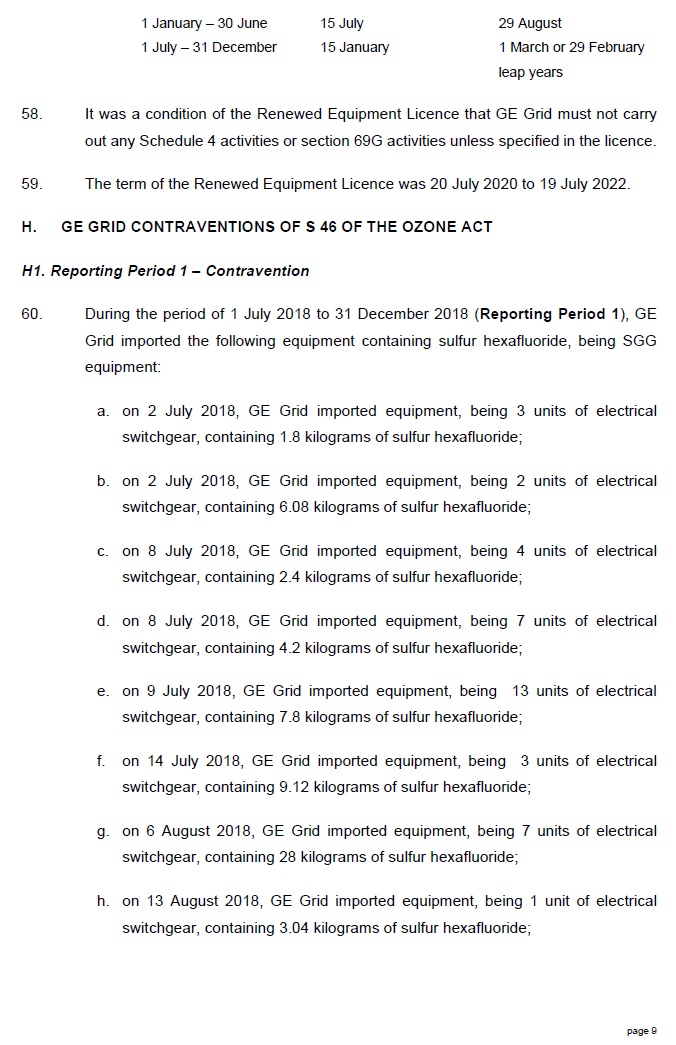
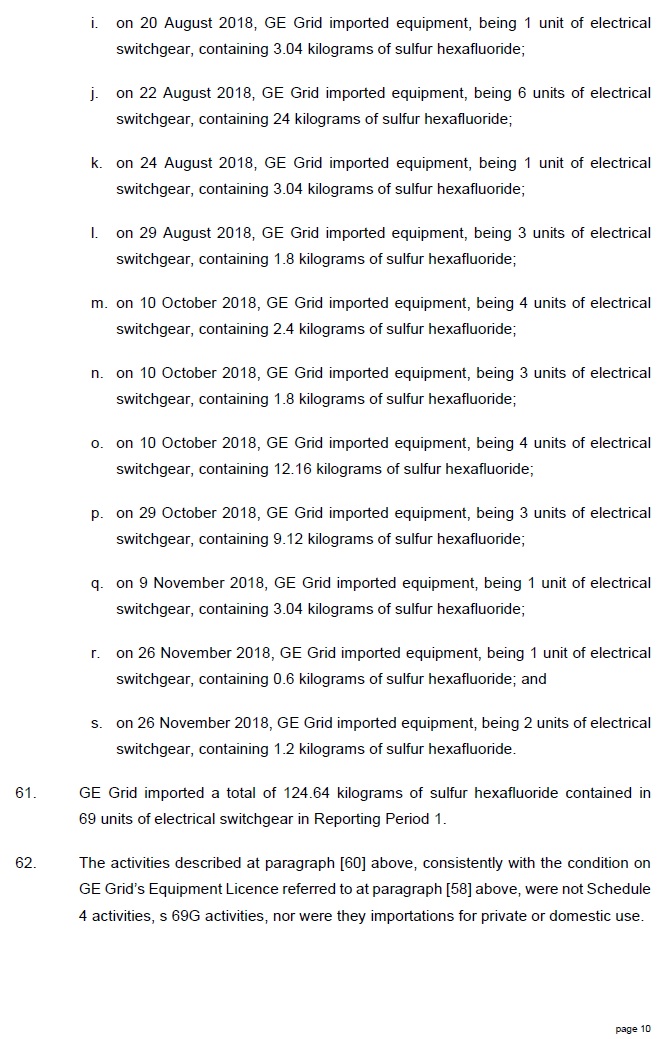
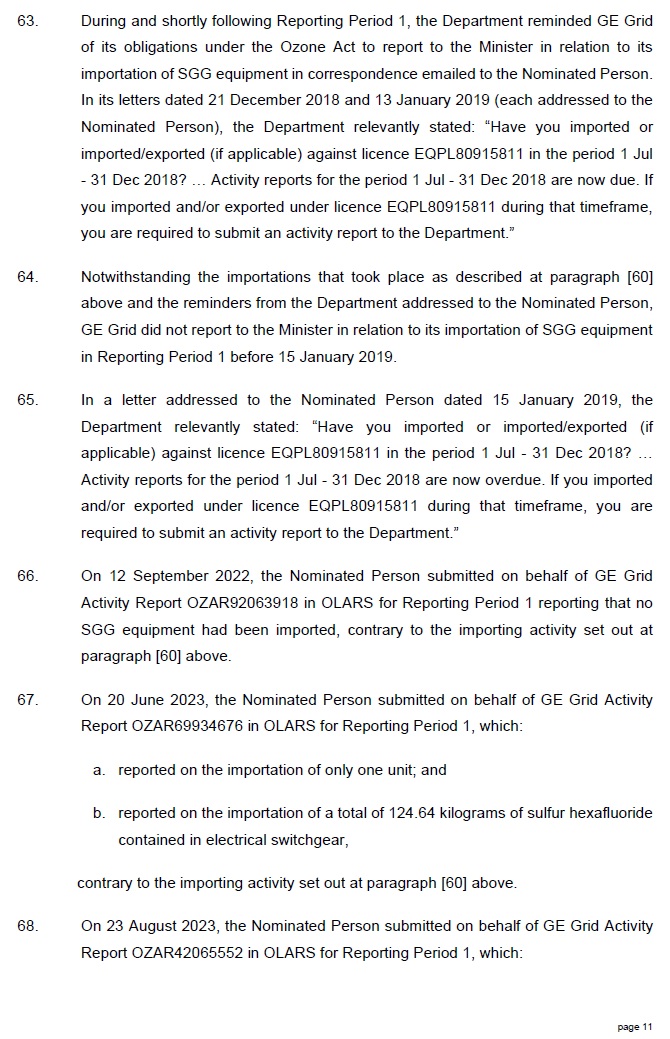
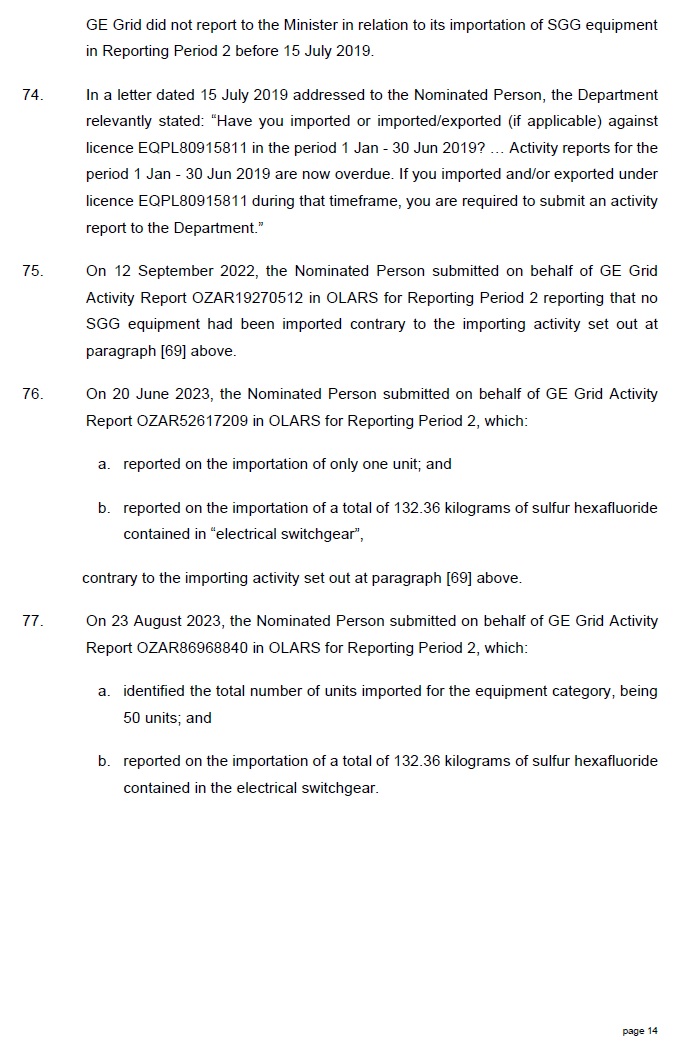
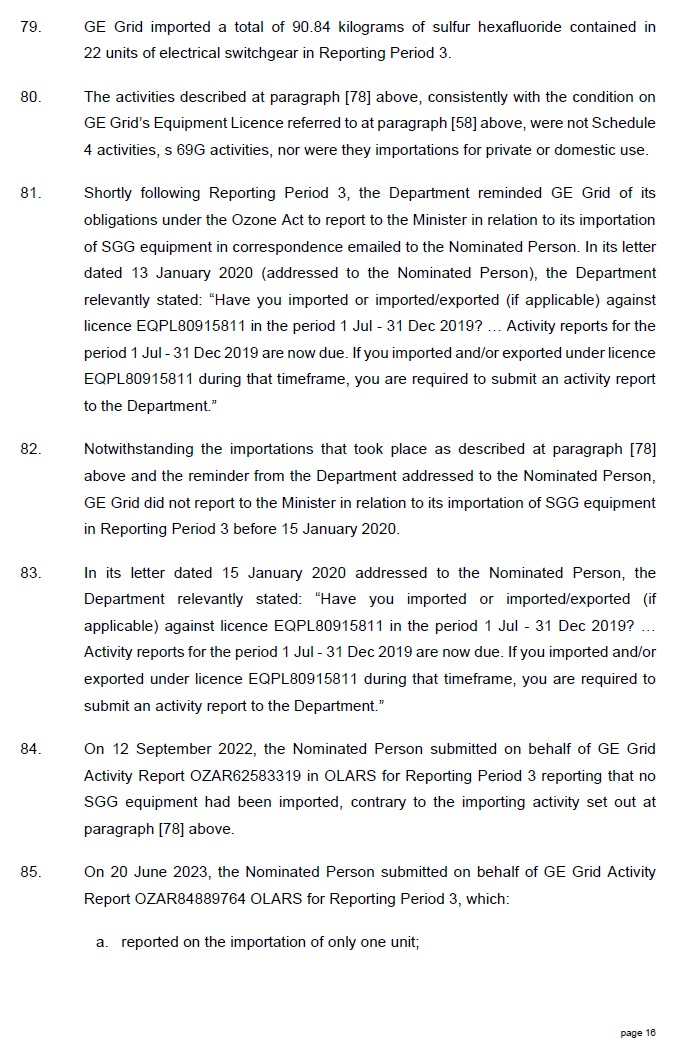
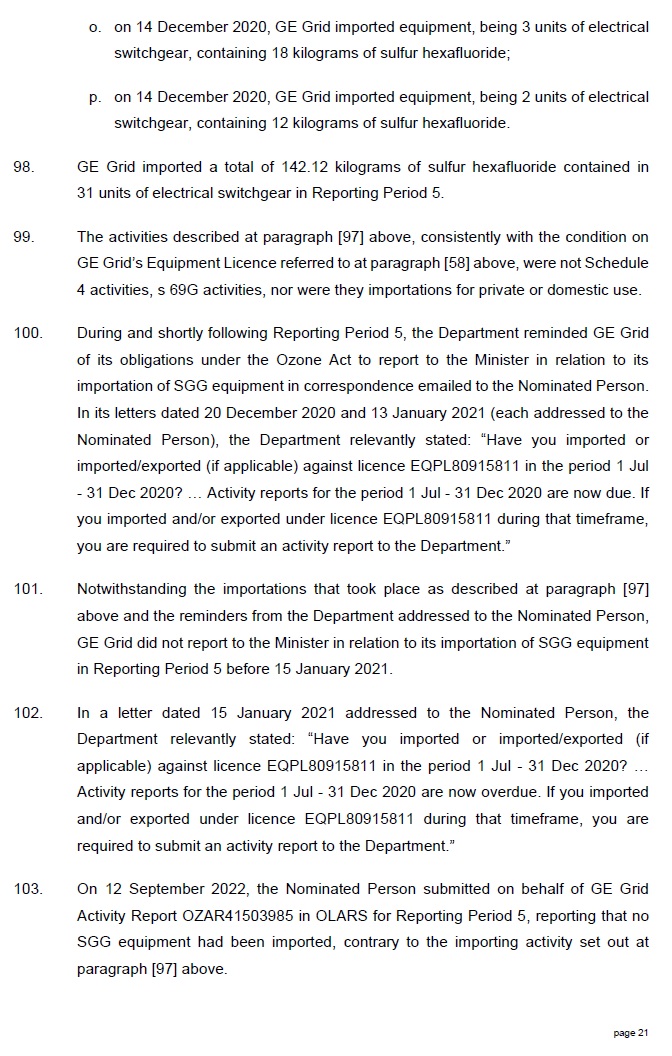
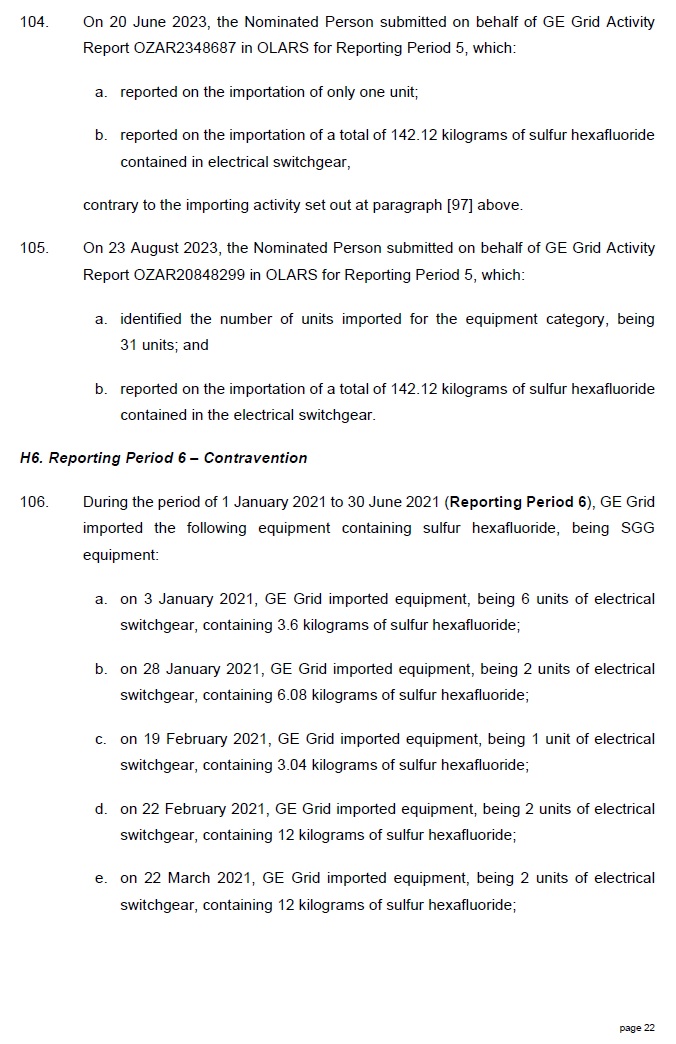
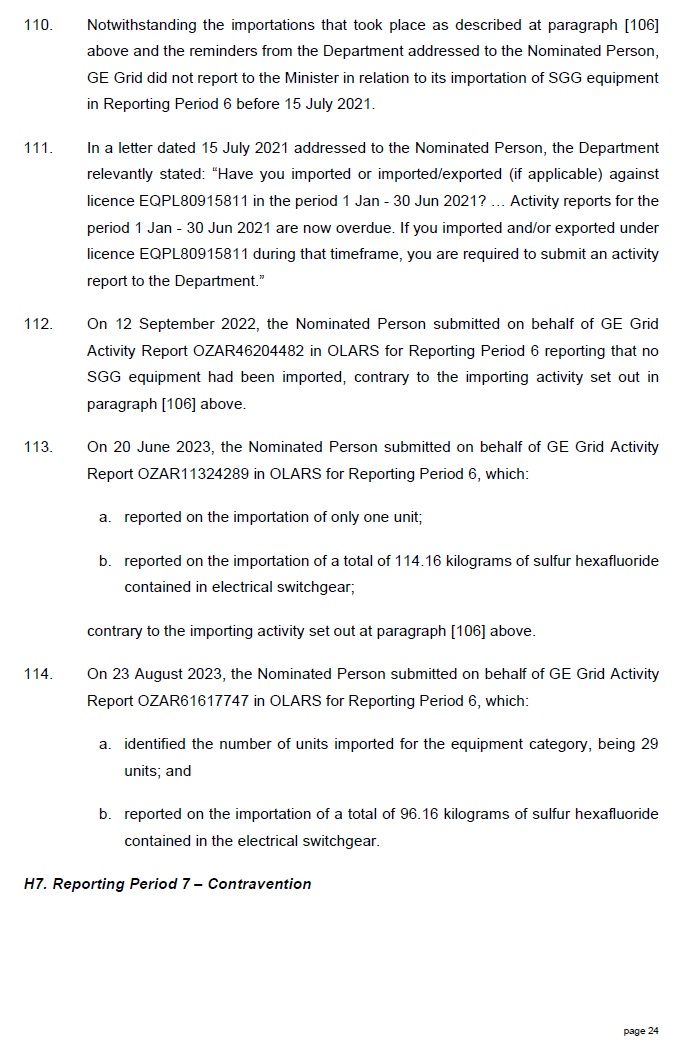
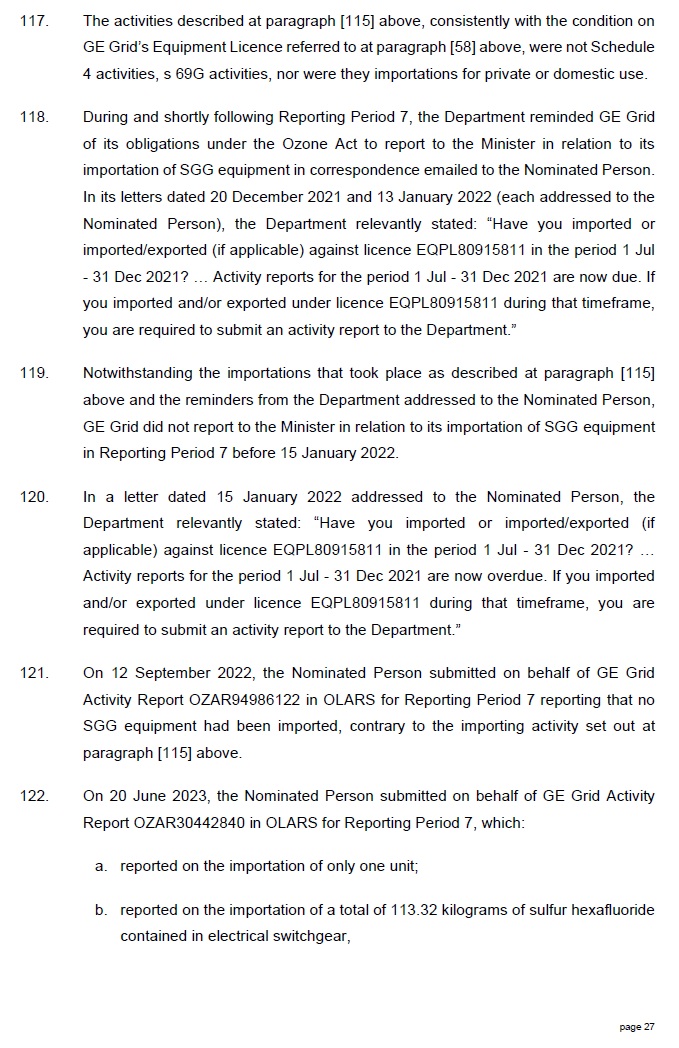
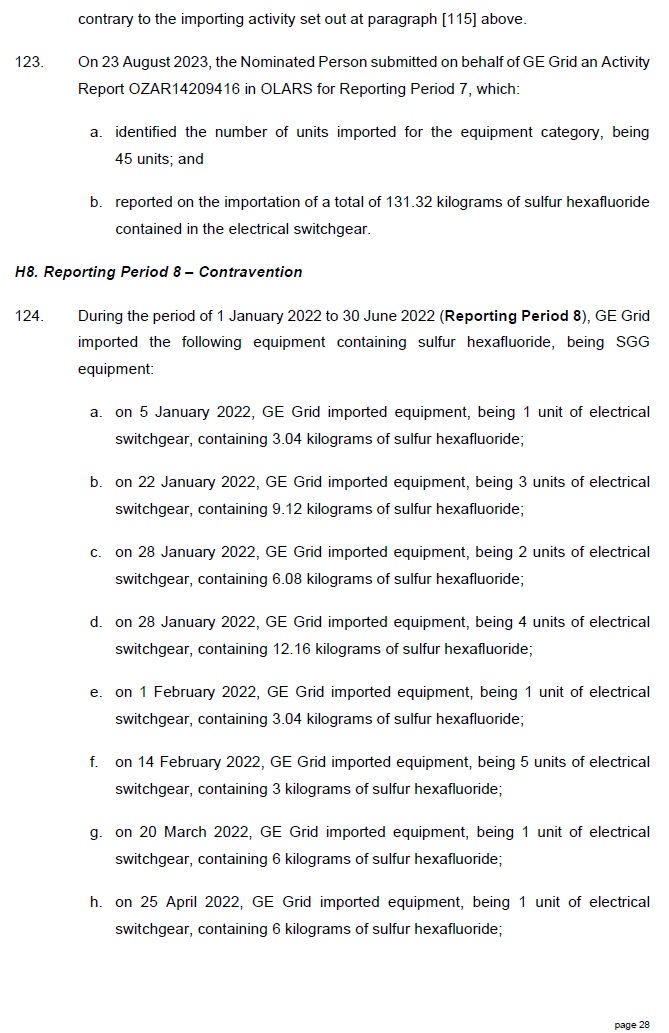
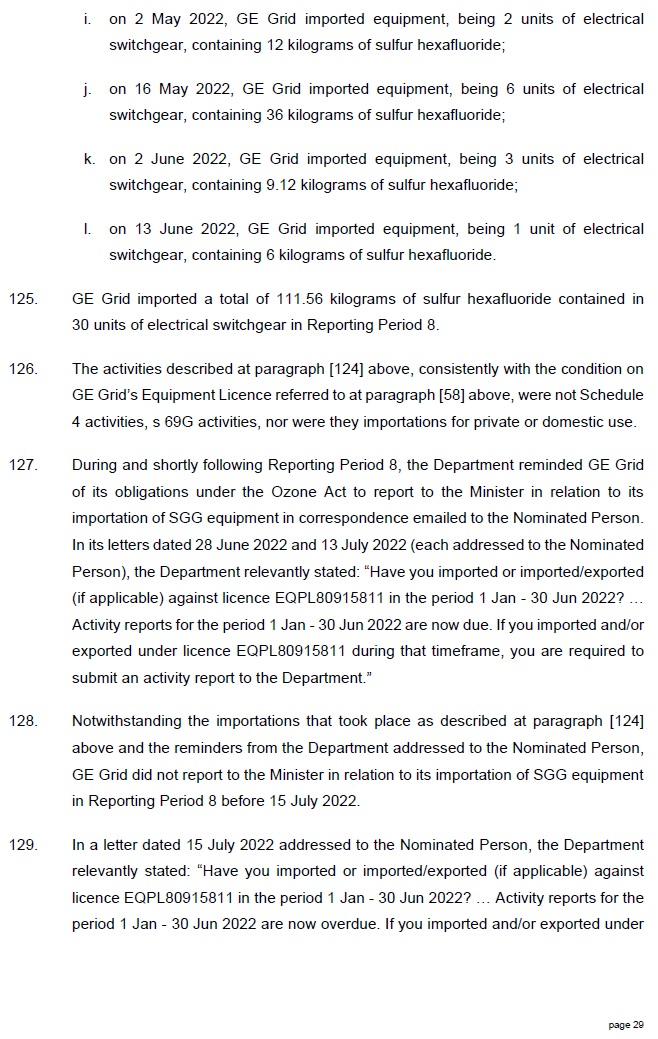
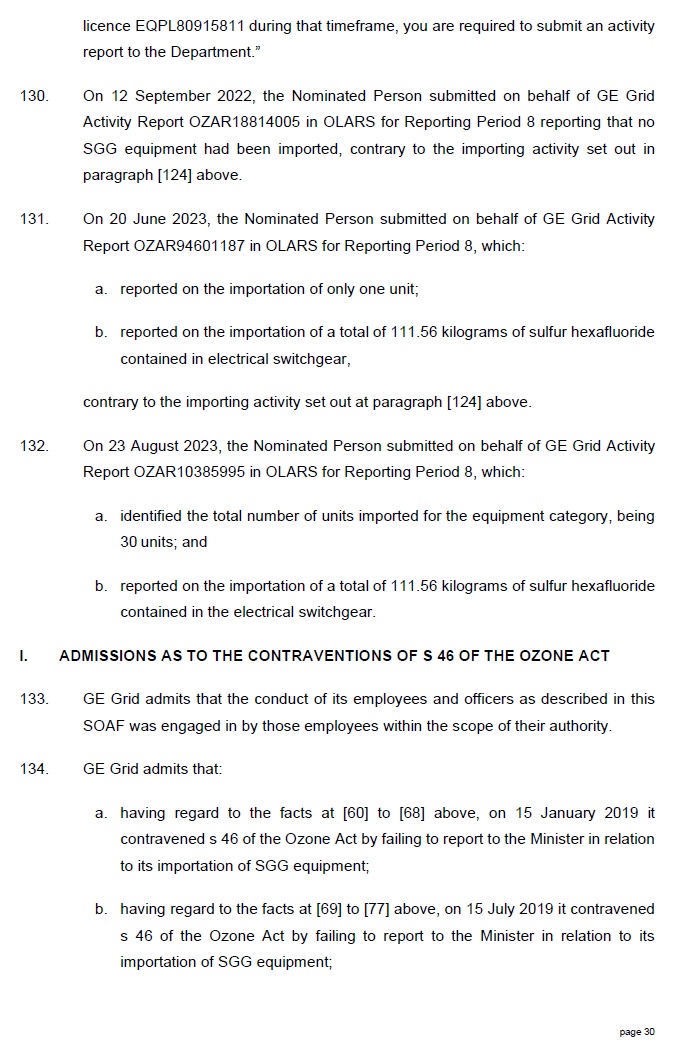
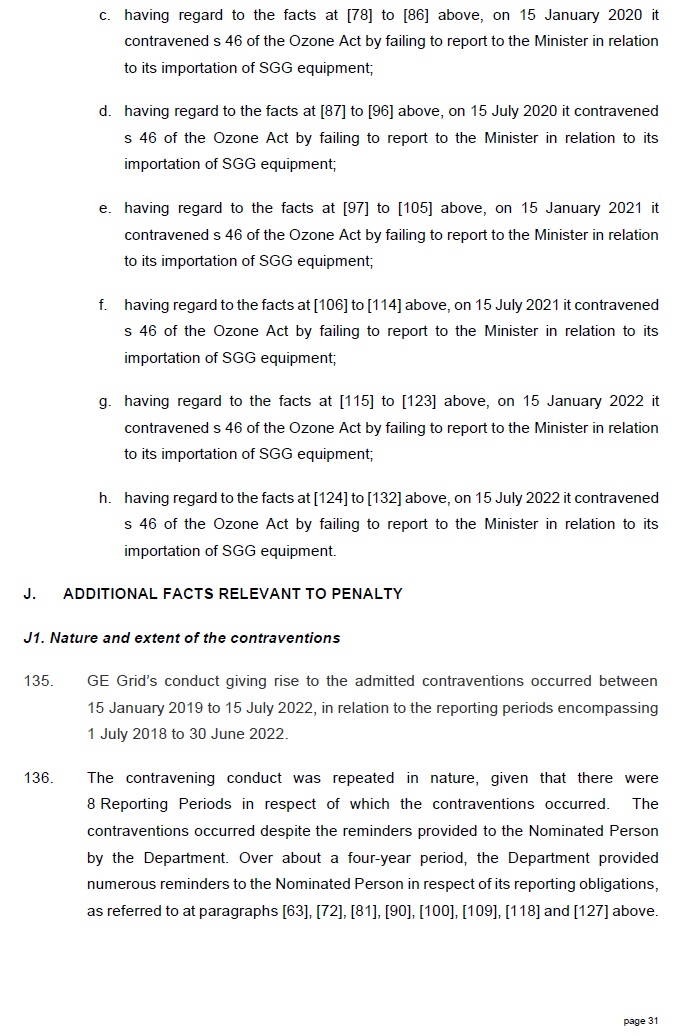
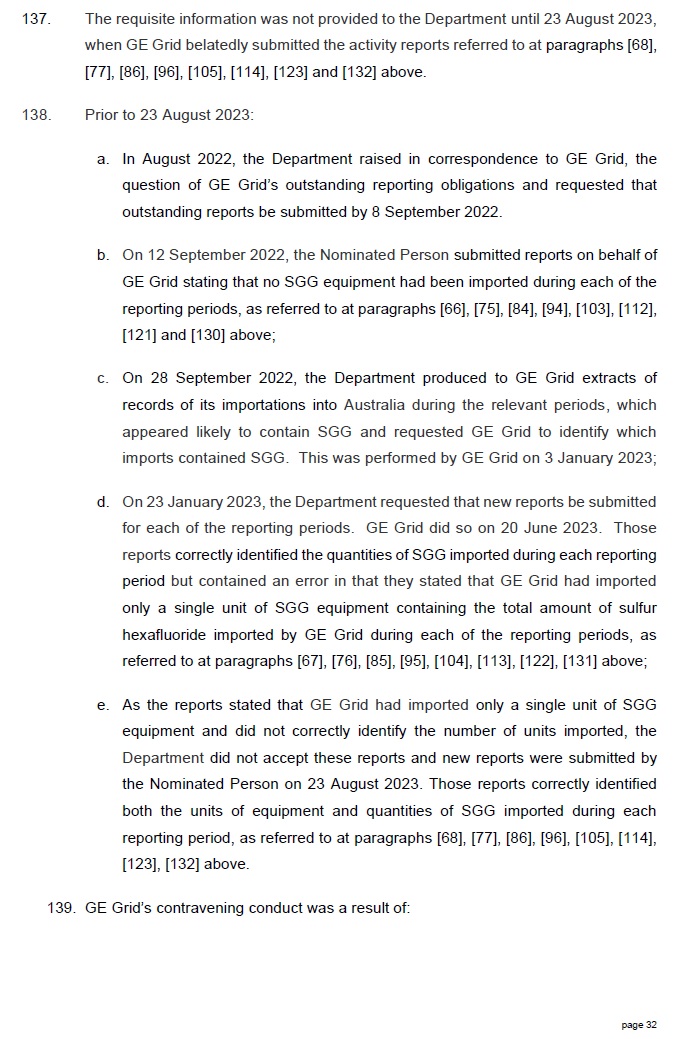
12. The background facts to the contraventions are addressed in the SOAF. It is admitted that GE Grid did not submit its reports as required by the Ozone Act. While GE Grid belatedly submitted reports, these were initially incorrect. That is, on 12 September 2022, reports were submitted on behalf of GE Grid stating that no SGG equipment had been imported during each of the eight reporting periods. The Department identified these reports as incorrect and requested the submission of new reports. On 20 June 2023, GE Grid submitted further reports for each reporting period, which contained an error, in that they stated that GE Grid had imported only a single unit of SGG equipment containing the total amount of SF6. The Department again identified these reports as being non-compliant. On 23 August 2023, after the expiration of the statutory timeframe in each case, GE Grid submitted further reports, correctly identifying both the units of equipment and quantities of SGG imported.
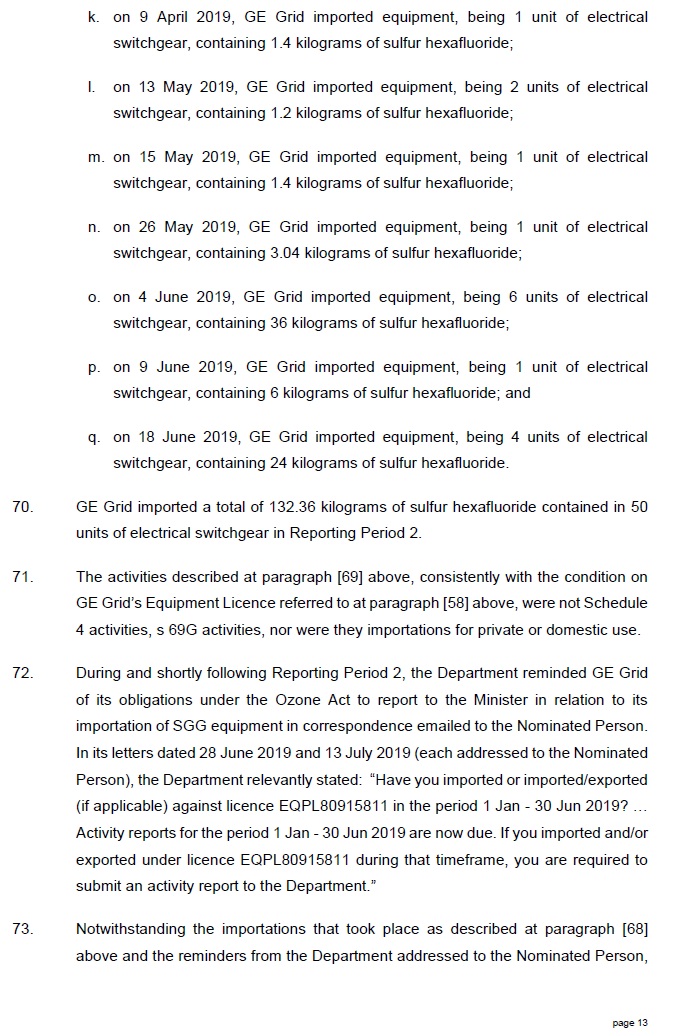
13. GE Grid admits that, during the period of 1 July 2018 to 31 December 2018 (Reporting Period 1), it imported a total of 124.64 kilograms of SF6 contained in 69 units of electrical switchgear, being SGG equipment. GE Grid further admits that it did not report to the Minister before 15 January 2019, as required by s 46(1) and that it therefore contravened s 46(2C) of the Ozone Act. No relevant exception applied.
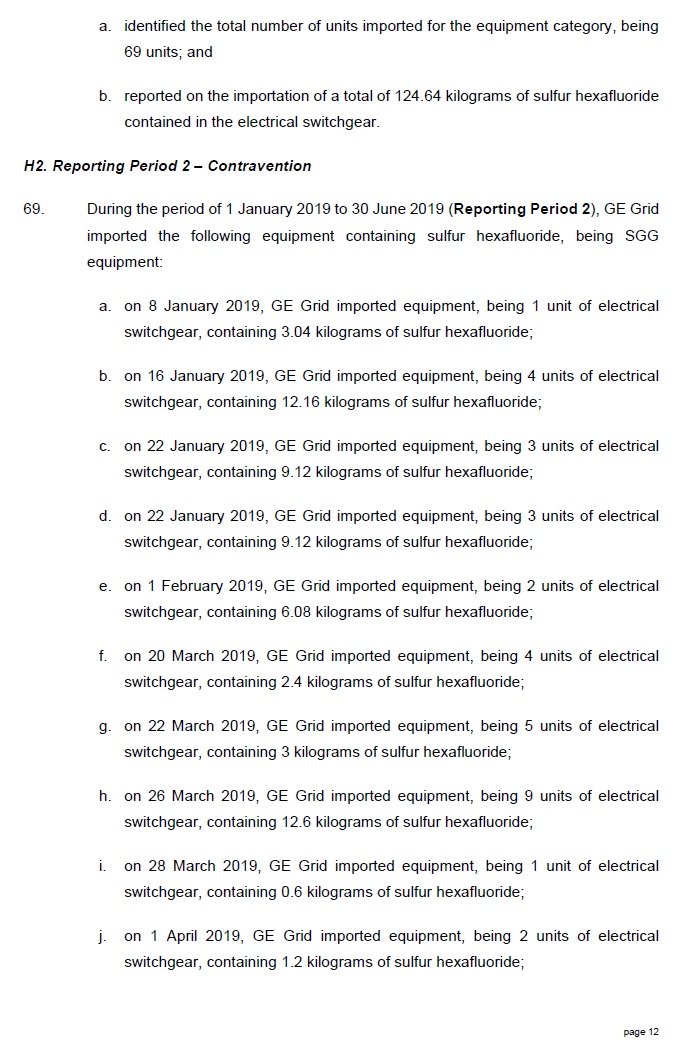
14. GE Grid admits that, during the period of 1 January 2019 to 30 June 2019 (Reporting Period 2), it imported a total of 132.36 kilograms of SF6 contained in 50 units of electrical switchgear, being SGG equipment. GE Grid further admits that did not report to the Minister before 15 July 2019, as required by s 46(1) and that it therefore contravened s 46(2C) of the Ozone Act. No relevant exception applied.
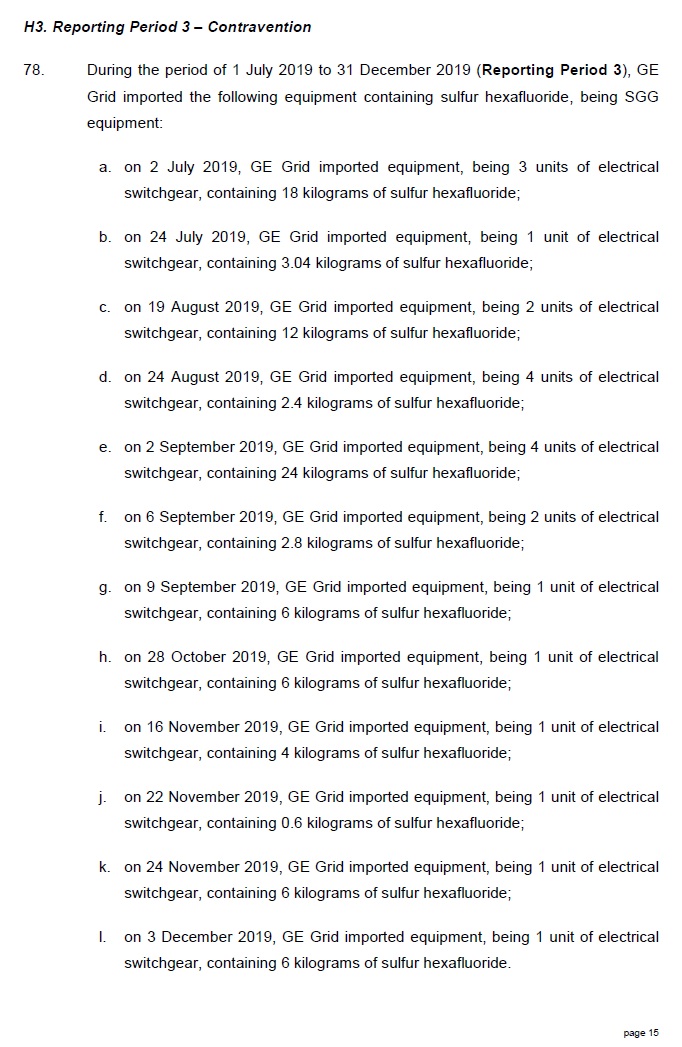
15. GE Grid admits that, during the period of 1 July 2019 to 31 December 2019 (Reporting Period 3), it imported a total of 90.84 kilograms of SF6 contained in 22 units of electrical switchgear, being SGG equipment. GE Grid further admits that it did not report to the Minister before 15 January 2020, as required by s 46(1) and in contravention of s 46(2C) of the Ozone Act. No relevant exception applied.
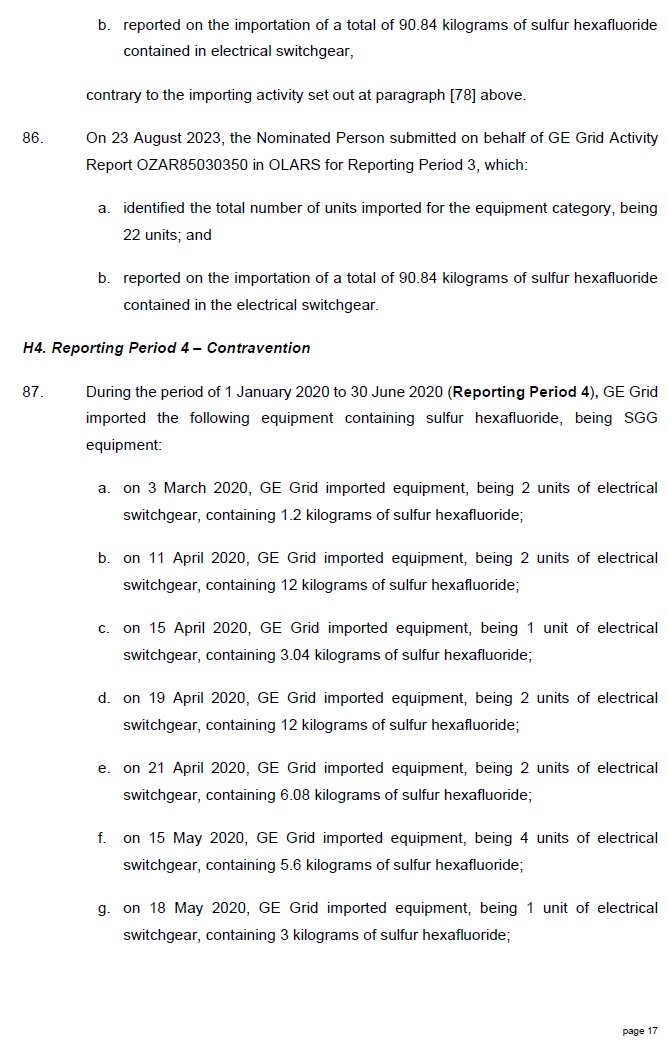
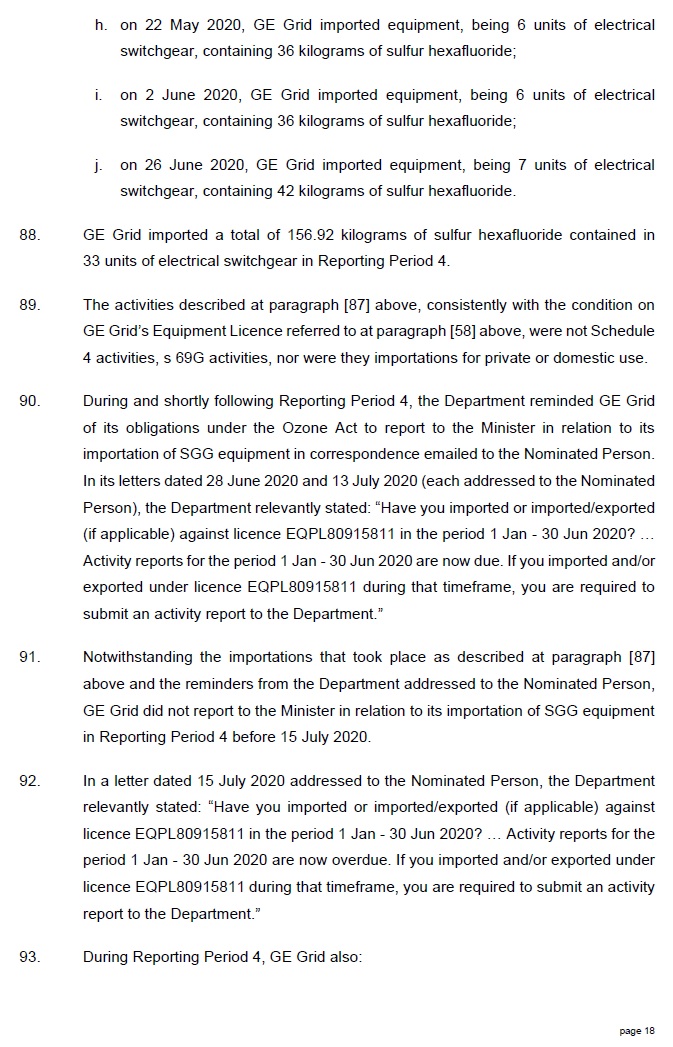
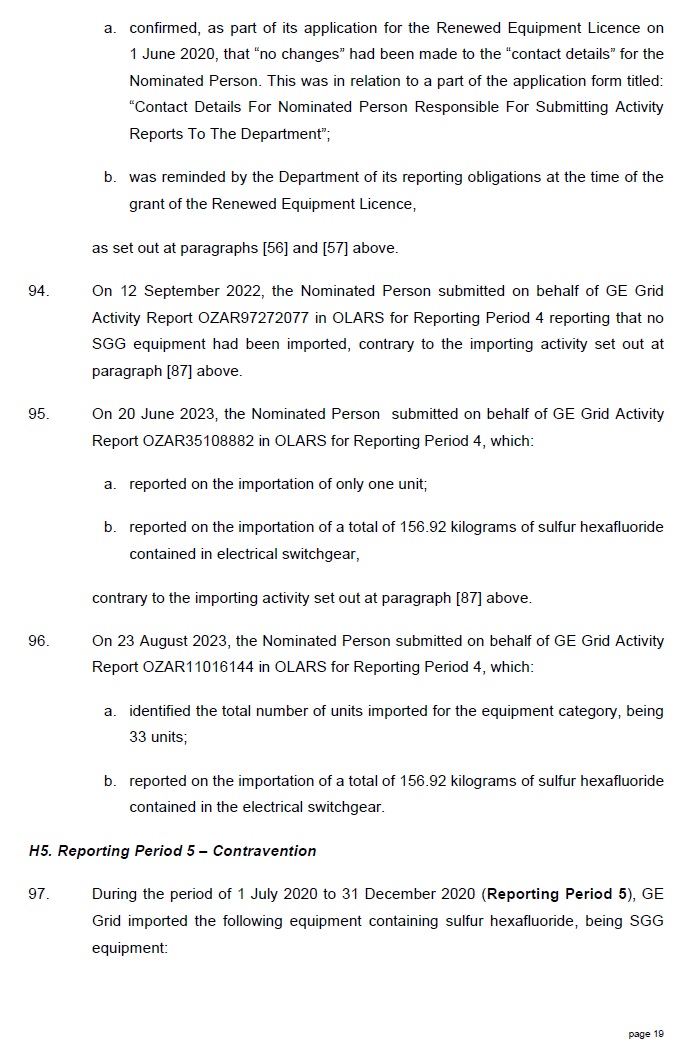
16. GE Grid admits that, during the period of 1 January 2020 to 30 June 2020 (Reporting Period 4), it imported a total of 156.92 kilograms of SF6 contained in 33 units of electrical switchgear, being SGG equipment. GE Grid further admits that it did not report to the Minister before 15 July 2020, as required by s 46(1) and in contravention of s 46(2C) of the Ozone Act. No relevant exception applied.
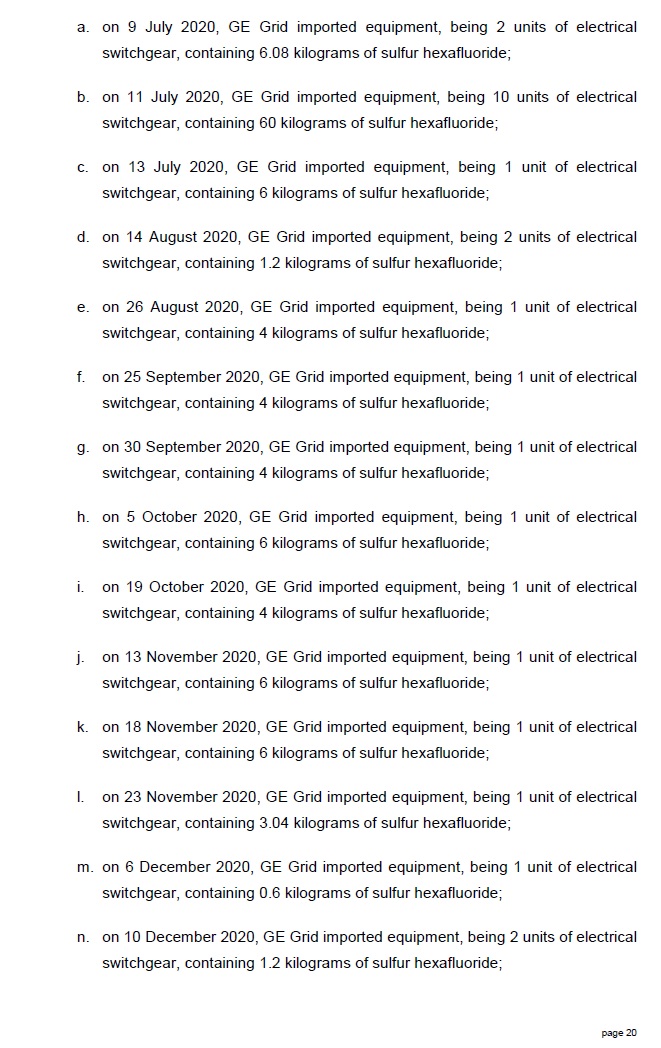
17. GE Grid admits that, during the period of 1 July 2020 to 31 December 2020 (Reporting Period 5), it imported a total of 142.12 kilograms of SF6 contained in 31 units of electrical switchgear, being SGG equipment. GE Grid further admits that it did not report to the Minister before 15 January 2021, as required by s 46(1) and in contravention of s 46(2C) of the Ozone Act. No relevant exception applied.
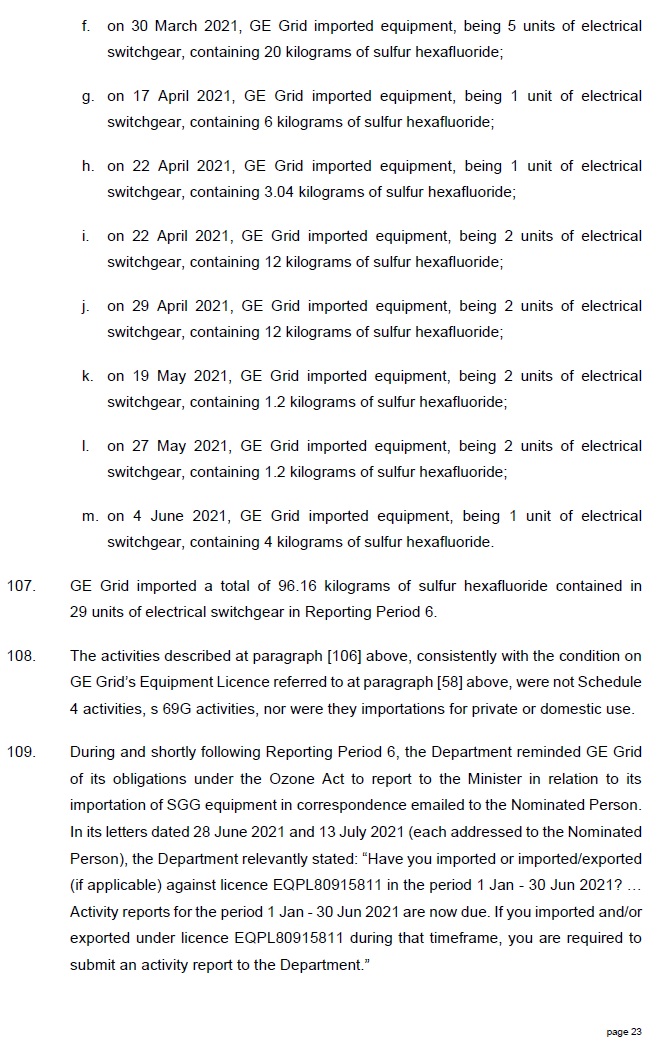
18. GE Grid admits that, during the period of 1 January 2021 to 30 June 2021 (Reporting Period 6), it imported a total of total of 96.16 kilograms of SF6 contained in 29 units of electrical switchgear, being SGG equipment. GE Grid further admits that it did not report to the Minister before 15 July 2021, as required by s 46(1) and in contravention of s 46(2C) of the Ozone Act. No relevant exception applied.
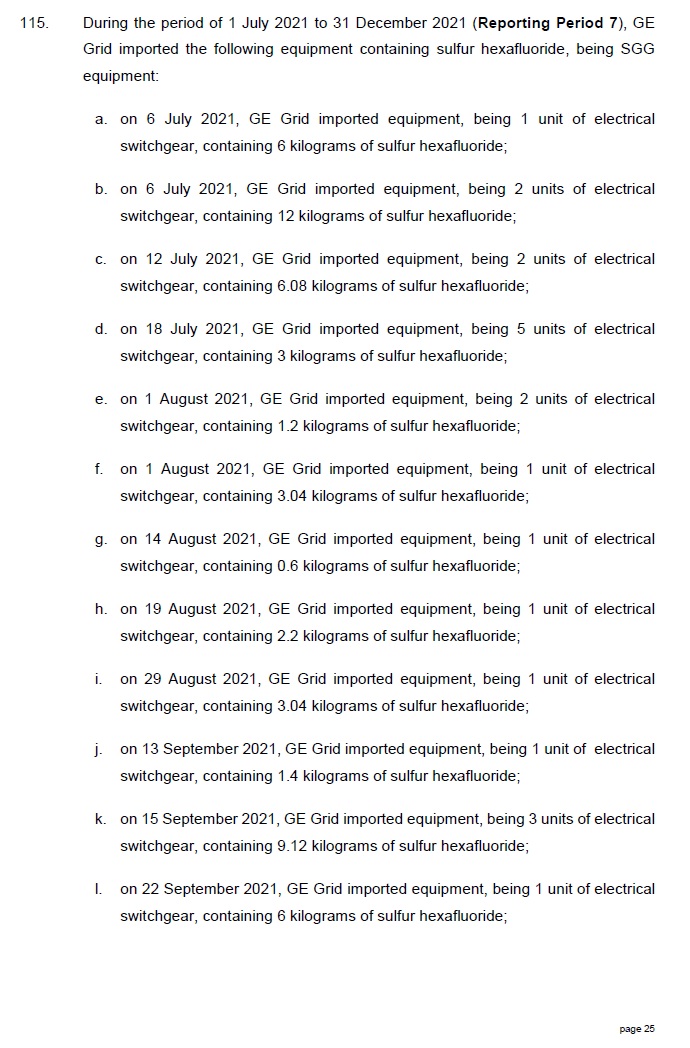
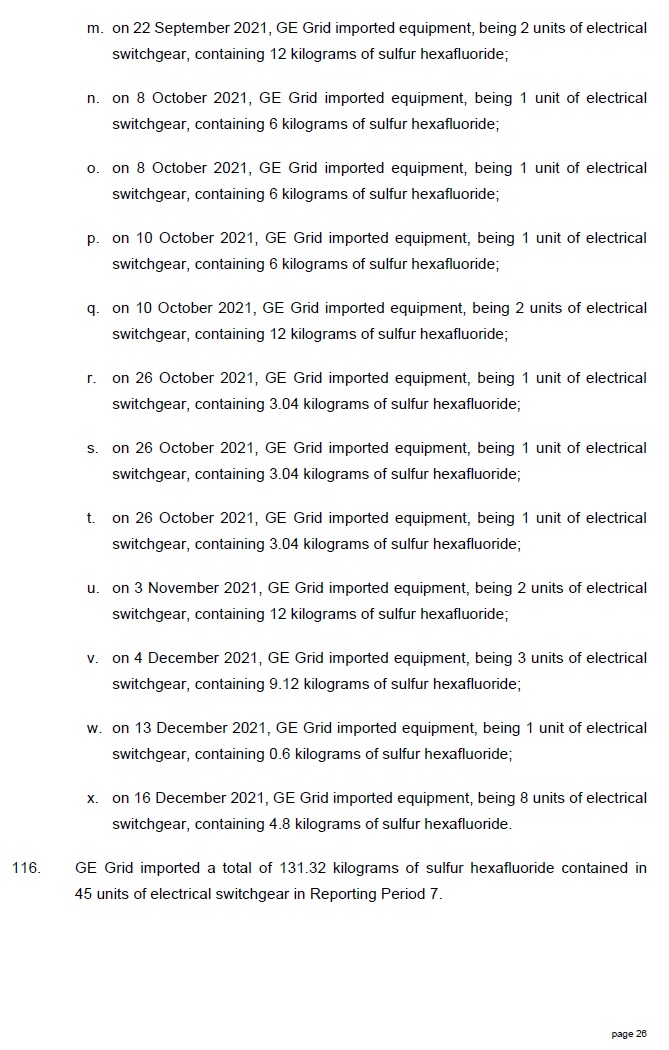
19. GE Grid admits that, during the period of 1 July 2021 to 31 December 2021 (Reporting Period 7), it imported a total of 131.32 kilograms of SF6 contained in units of electrical switchgear, being SGG equipment. GE Grid further admits that it did not report to the Minister before 15 January 2022, as required by s 46(1) and in contravention of s 46(2C) of the Ozone Act. No relevant exception applied.
20. GE Grid admits that, during the period of 1 January 2022 to 30 June 2022 (Reporting Period 8), it imported a total of 111.56 kilograms of SF6 contained in 30 units of electrical switchgear, being SGG equipment. GE Grid further admits that it did not report to the Minister before 15 July 2022, as required by s 46(1) and in contravention of s 46(2C) of the Ozone Act. No relevant exception applied.
(Footnotes omitted.)
19 I am satisfied on the basis of the agreed facts that GE Grid contravened s 46(2C) of the Ozone Act as alleged.
5. AGREED RELIEF: APPLICABLE PRINCIPLES
20 The principles which the Court must apply in considering whether to impose an agreed pecuniary penalty are well established and are accurately set out in the joint submissions.
21 In Commonwealth v Director, Fair Work Building Industry Inspectorate [2015] HCA 46; (2015) 258 CLR 482 (Director, FWBII), French CJ, Kiefel, Bell, Nettle and Gordon JJ (with whose reasons Keane J agreed at [79]) approved the practice whereby the parties may file agreed penalty submissions, holding that:
46. … there is an important public policy involved in promoting predictability of outcome in civil penalty proceedings and … the practice of receiving and, if appropriate, accepting agreed penalty submissions increases the predictability of outcome for regulators and wrongdoers… such predictability of outcome encourages corporations to acknowledge contraventions, which, in turn, assists in avoiding lengthy and complex litigation and thus tends to free the courts to deal with other matters and free investigating officers to turn to other areas of investigation that await their attention.
22 Their Honours further observed at [57] that in civil, as opposed to criminal, proceedings “there is generally very considerable scope for the parties to agree on the facts and upon consequences. There is also very considerable scope for them to agree upon the appropriate remedy and for the court to be persuaded that it is an appropriate remedy” (emphasis in the original). More specifically, while acknowledging that there may be exceptions to the general rule, their Honours explained that:
58. … There is, however, no reason in principle or practice why civil penalty proceedings should be treated as an exception. Subject to the court being sufficiently persuaded of the accuracy of the parties’ agreement as to facts and consequences, and that the penalty which the parties propose is an appropriate remedy in the circumstances thus revealed, it is consistent with principle and … highly desirable in practice for the court to accept the parties’ proposal and therefore impose the proposed penalty. To do so is no different in principle or practice from approving an infant’s compromise, a custody or property compromise, a group proceeding settlement or a scheme of arrangement.
(Emphasis in the original, citations omitted.)
23 In this regard, their Honours accepted at [59] the public interest in the imposition of civil penalties but considered that “[o]nce it is understood that civil penalties are not retributive, but like most other civil remedies essentially deterrent or compensatory and therefore protective, there is nothing odd or exceptionable about a court approving an agreed settlement of a civil proceeding which involves the public interest; provided of course that the court is persuaded that the settlement is appropriate.”
24 It follows, as the joint submissions contend, that:
In considering whether the Agreed Penalty is an appropriate penalty, it is necessary to bear in mind that there is no single appropriate penalty. Rather, there is a permissible range of penalties within which no particular figure can necessarily be said to be more appropriate than another. The permissible range is determined by “all the relevant facts and consequences of the contravention and the contravener’s circumstances” [citing Volkswagen Aktiengesellschaft v ACCC [2021] FCAFC 49; (2021) 284 FCR 24 at [127] (the Court)].
25 As the joint submissions further explain, these principles are not confined to agreed submissions on pecuniary penalties but apply equally to agreement on other forms of relief, consistently with previous authority with respect to agreement on declaratory, injunctive and other relief in civil regulatory proceedings: see e.g. NW Frozen Foods Pty Ltd v Australian Competition & Consumer Commission [1996] FCA 1134; (1996) 71 FCR 285; Australian Competition and Consumer Commission v Coles Supermarkets Australia Pty Ltd [2014] FCA 1405 (ACCC v Coles [2014]) at [75] (Gordon J).
26 In short, as for example, Gordon J in ACCC v Coles [2014] at [70]-[73] helpfully explained by way of a summary of the applicable approach:
… First, there is a well-recognised public interest in the settlement of cases under the Act: NW Frozen Foods Pty Ltd v Australian Competition & Consumer Commission (1996) 71 FCR 285 at 291. Second, the orders proposed by agreement of the parties must be not contrary to the public interest and at least consistent with it: Australian Competition & Consumer Commission v Real Estate Institute of Western Australia Inc (1999) 161 ALR 79 at [18].
Third, when deciding whether to make orders that are consented to by the parties, the Court must be satisfied that it has the power to make the orders proposed and that the orders are appropriate: Real Estate Institute at [17] and [20] and Australian Competition & Consumer Commission v Virgin Mobile Australia Pty Ltd (No 2) [2002] FCA 1548 at [1]. Parties cannot by consent confer power to make orders that the Court otherwise lacks the power to make: Thomson Australian Holdings Pty Ltd v Trade Practices Commission (1981) 148 CLR 150 at 163.
Fourth, once the Court is satisfied that orders are within power and appropriate, it should exercise a degree of restraint when scrutinising the proposed settlement terms, particularly where both parties are legally represented and able to understand and evaluate the desirability of the settlement: Australian Competition & Consumer Commission v Woolworths (South Australia) Pty Ltd (Trading as Mac’s Liquor) [2003] FCA 530 at [21]; Australian Competition & Consumer Commission v Target Australia Pty Ltd [2001] FCA 1326 at [24]; Real Estate Institute at [20]-[21]; Australian Competition & Consumer Commission v Econovite Pty Ltd [2003] FCA 964 at [11] and [22] and Australian Competition & Consumer Commission v The Construction, Forestry, Mining and Energy Union [2007] FCA 1370 at [4].
Finally, in deciding whether agreed orders conform with legal principle, the Court is entitled to treat the consent of [the respondent] as an admission of all facts necessary or appropriate to the granting of the relief sought against it: Thomson Australian Holdings at 164.
6. DECLARATORY RELIEF
27 Having regard to the admissions made by GE Grid and the matters addressed in the SOAF, I am satisfied that it is appropriate to grant declaratory relief pursuant to s 21 of the Federal Court of Australia Act 1976 (Cth) in the exercise of discretion, and that the terms of the declarations set out in the Agreed Proposed Orders are expressed with sufficient precision. In so doing, I accept the parties’ joint submission that the making of these declarations, which identify the conduct constituting the contraventions, is appropriate to record the Court’s disapproval of the contravening conduct and to deter other entities from contravening s 46 of the Ozone Act.
7. SHOULD THE AGREED PECUNIARY PENALTIES BE IMPOSED?
7.1 Maximum penalty
28 Section 65AC(1) of the Ozone Act provides that the Court may order a person to pay a pecuniary penalty to the Commonwealth where, as here, the Court is satisfied that the person has contravened a civil penalty provision. Section 65AC(4) of the Ozone Act, in turn, determines the maximum pecuniary penalty payable “by a person in respect of a civil penalty provision” and provides that:
The pecuniary penalty payable by a person in respect of a contravention of a civil penalty provision (other than subparagraph 13(1)(a)(iii), paragraph 13(1)(b) or subsection 65AB(1)) must not exceed:
(a) if an offence against a provision of this Act or the regulations corresponds to the civil penalty provision—the maximum pecuniary penalty that could have been imposed on the person if the person had been convicted of the offence; or
(b) otherwise:
(i) if the person is not a body corporate—50 penalty units; or
(ii) if the person is a body corporate—250 penalty units.
29 As the parties jointly submit, pursuant to s 65AC(4)(a) of the Ozone Act, the maximum pecuniary penalty payable in respect of the civil penalty provision of s 46(2C) is the penalty that could have been imposed if the person had been convicted of the corresponding criminal offence under s 46(2) of the Ozone Act, which imposes a penalty of 60 penalty units.
30 As the parties also submit, the body corporate “uplift” in s 4B(3) of the Crimes Act may then operate so as to increase the penalty for a body corporate for an offence under s 46(2). Subsection 4B(3) provides:
Where a body corporate is convicted of an offence against a law of the Commonwealth, the court may, if the contrary intention does not appear and the court thinks fit, impose a pecuniary penalty not exceeding an amount equal to 5 times the amount of the maximum pecuniary penalty that could be imposed by the court on a natural person convicted of the same offence.
31 It follows that the maximum penalty for a criminal offence that could have been imposed on GE Grid for an offence under s 46(2) and, therefore, the corresponding maximum pecuniary penalty payable with respect to a civil penalty contravention of s 46(2C), is 300 penalty units. The parties jointly submit that it is appropriate for the Court to apply the “uplift” for which s 4B(3) of the Crimes Act makes provision in the circumstances of the present case.
32 While there is no definition of “penalty unit” in the Ozone Act, s 4AA of the Crimes Act applies (there being no contrary intention) and provides the applicable value for the calculation of penalty units: see also the definition of “civil penalty provision” in the Acts Interpretation Act. The applicable value of penalty units pursuant to s 4AA for the contraventions is as follows:
$210 for offences committed between 1 July 2017 and 30 June 2020 (s 4AA of the Crimes Act 1914 (Cth) as amended by the Crimes Amendment (Penalty Unit) Act 2017 (Cth) – schedule 1), in relation to contraventions concerning Reporting Periods 1-3; and
$222 for offences committed between 1 July 2020 and 31 December 2022 (Notice of indexation of the penalty unit amount” dated 14 May 2020, issued by the Attorney- General under s 4AA(1A) of the Crimes Act 1914 (Cth)), in relation to contraventions concerning Reporting Periods 4-8.
33 As the parties jointly submit, applying the corporate “uplift”, a total maximum penalty of $522,000 is calculated as follows:
(1) Contraventions 1-3: $63,000 each ($63,000 x 3 contraventions = $189,000 in total);
(2) Contraventions 4-8: $66,600 each ($66,600 x 5 contraventions = $333,000 in total).
7.2 Primacy of deterrence
34 It is well established that that the purpose of civil penalties “is primarily if not wholly protective in promoting the public interest in compliance”: Director, FWBII at [55] (French CJ, Kiefel, Bell, Nettle and Gordon JJ (with whose reasons Keane J agreed at [79])); see also Australian Building and Construction Commissioner v Pattinson [2022] HCA 13; (2022) 274 CLR 450 at [9] and [15] (Kiefel CJ, Gageler, Keane, Gordon, Steward and Gleeson JJ); Australian Communications and Media Authority v TPG Internet Pty Ltd [2014] FCA 382; (2014) 221 FCR 502 at [61] (Bromberg J). There is no reason why the primary purpose of the imposition of pecuniary penalties under s 65AC of the Ozone Act should be any different.
35 It follows that the various factors under s 65AC of the Ozone Act relevant to setting the penalty amount fall to be considered in the context of setting a penalty of appropriate deterrent value so as to ensure that the penalty cannot be regarded by GE Grid and others merely as an acceptable cost of doing business or an economically rational choice: see further by analogy Australian Competition and Consumer Commission v TPG Internet Pty Ltd [2013] HCA 54; (2013) 250 CLR 640 at [66] (French CJ, Crennan, Bell and Keane JJ); and Pattinson at [17] and [66]. In other words, as the Full Court held in Australian Competition and Consumer Commission v Reckitt Benckiser (Australia) Pty Ltd [2016] FCAFC 181; (2016) 340 ALR 25 at [151], the penalty imposed needs to “make the risk/benefit equation less palatable to a potential wrongdoer and the deterrence sufficiently effective in achieving voluntary compliance”. It also follows that “the penalty should not be greater than is necessary to achieve this object; severity beyond that would be oppression”: NW Frozen Foods at 293 (Burchett and Kiefel JJ). As six members of the High Court recently held in Pattinson at [10]:
… What is required is that there be “some reasonable relationship between the theoretical maximum and the final penalty imposed”. That relationship is established where the maximum penalty does not exceed what is reasonably necessary to achieve the purpose of s 546 [of the Fair Work Act 2009 (Cth) conferring power to impose civil pecuniary penalties]: the deterrence of future contraventions of a like kind by the contravenor and by others.
(Footnotes omitted.)
36 Thus the High Court in Pattinson held that the penalties imposed by the primary judge were appropriate “because they were no more than might be considered to be reasonably necessary … to make the continuation of the CFMMEU’s non-compliance with the law, amply demonstrated by the history of its contraventions, too expensive to maintain” (at [9]) (Kiefel CJ, Gageler, Keane, Gordon, Steward and Gleeson JJ). However, as their Honours then proceeded to explain, there is no place for the notion that a civil penalty must be proportionate to the seriousness of the conduct comprising the contravention or that the maximum penalty should be reserved for the most serious examples of offending (at [10]; see also at [49]-[55]).
7.3 Relevant factors
37 With respect to the matters to which Court may have regard in determining the appropriate pecuniary penalty, s 65AC of the Ozone Act provides that:
(3) In determining the pecuniary penalty, the court may have regard to all relevant matters, including:
(a) the nature and extent of the contravention; and
(b) the nature and extent of any loss or damage suffered as a result of the contravention; and
(c) the circumstances in which the contravention took place; and
(d) whether the person has previously been found by a court in proceedings under this Act or the regulations to have engaged in any similar conduct; and
(e) the extent to which the person has co-operated with the authorities; and
(f) if the person is a body corporate:
(i) the level of the employees, officers or agents of the body corporate involved in the contravention; and
(ii) whether the body corporate exercised due diligence to avoid the contravention; and
(iii) whether the body corporate had a corporate culture conducive to compliance.
7.3.1 The nature and extent of the contravention (s 65AC(3)(a))
38 The seriousness of the contraventions in this case is heightened given that the contraventions were not isolated incidents. Rather, as the parties jointly submit, GE Grid’s reporting failures occurred in relation to no fewer than eight reporting periods over four years. This is despite GE Grid being informed by the Department of its reporting obligations when the equipment licence was initially granted and subsequently when it was renewed. It is also despite numerous reminders given to the person nominated (Nominated Person) by GE Grid to submit its reports on the following dates:
(1) 21 December 2018, 13 January 2019 and 15 January 2019 for Reporting Period 1;
(2) 28 June 2019, 13 July 2019 and 15 July 2019 for Reporting Period 2;
(3) 13 and 15 January 2020 for Reporting Period 3;
(4) 28 June 2020, 13 July 2020 and 15 July 2020 for Reporting Period 4;
(5) 20 December 2020, 13 January 2021 and 15 January 2021 for Reporting Period 5;
(6) 28 June 2021, 13 July 2021 and 15 July 2021 for Reporting Period 6;
(7) 20 December 2021, 13 January 2022 and 15 January 2022 for Reporting Period 7; and
(8) 28 June 2021, 13 July 2021 and 15 July 2022 for Reporting Period 8.
39 Nor, when the Department notified GE Grid of its failure to report, did GE Grid respond immediately by the belated submission of the reports, or immediately escalate these issues within the corporate group. Furthermore, erroneous reports were initially submitted and not rectified until August 2023: SOAF [138] and [153].
40 The parties are agreed that the contraventions occurred as a result of the Nominated Person’s failure to submit the reports despite regular reminders, and gaps and inadequacies in GE Grid’s compliance processes and systems identified in late 2023 when GE Grid undertook a substantial review of its internal compliance systems and processes. These gaps and areas for improvement included:
inadequate processes for determining whether imported equipment contained sulfur hexafluoride; inadequate processes in place with customs brokers and deficiencies in its customs clearance processes (e.g. the absence of standing operating procedures and inadequate documentation); a lack of relevant compliance training for all personnel involved in the sulfur hexafluoride equipment supply chain; inadequate allocation of compliance responsibilities, including poorly defined functions and responsibilities for relevant personnel and the lack of clear identification in relation to compliance accountability; inadequate processes for escalating compliance issues within the corporate group, including in response to regulatory notifications of potential breach; and a failure to conduct regular compliance audits.
(SOAF at [151].)
41 It follows GE Grid’s conduct was serious, systematic and of significant duration.
7.3.2 The nature and extent of any loss or damage suffered (s 65AC(3)(b))
42 No physical or economic loss or damage is alleged. Rather the loss and damage upon which the parties are agreed was the impact of the contraventions on Australia’s international and domestic reporting obligations. In this regard, I accept the parties’ joint submission that:
The electrical switchgear imported by GE Grid during the eight reporting periods contained a total of 985.92 kilograms of SF6. GE Grid failed to report, within the timeframe required by and in accordance with the Ozone Act, the actual levels of SF6 contained in the equipment that it was importing, which amounted to almost one tonne of SF6. Accurate reporting of imports under the Ozone Act is necessary in order for Australia to fulfil its international reporting obligations under the UN Framework [Convention on Climate Change] and the Kyoto Protocol, as well as to inform domestic policy and regulatory interventions. Additionally, the CSIRO uses the data collected by the reporting of imports under the Ozone Act to inform their annual report on Australian and Global Emissions of Ozone Depleting Substances and Australia’s National Greenhouse Gas Inventory.
7.3.3 The circumstances in which the contraventions took place (s 65AC(3)(c))
43 The contraventions took place in circumstances where GE Grid, as the holder of a licence under s 16 of the Ozone Act, was aware of its reporting obligations and received regular reminders of them: see Section 7.3.1 above. Further, as the parties jointly submit:
(1) the importations occurred in the course of a significant commercial undertaking, forming part of a broader global and sophisticated enterprise; and
(2) the total value of the equipment was approximately AUD$14 million (excluding duty, insurance and taxes).
(SOAF [37], [144], and [156].)
7.3.4 Whether the corporation has previously been found by a Court to have engaged in any similar conduct (s 65AC(3)(d))
44 The parties are agreed that GE Grid has not previously been found, in proceedings under the Ozone Act or Ozone Regulations, to have engaged in contravening conduct of this kind: SOAF [146].
7.3.5 The extent to which GE Grid has co-operated with the authorities (s 65AC(3)(e))
45 The parties are also agreed that GE Grid has assisted with the efficient resolution of the proceedings by:
a. making appropriate and frank admissions, at an early stage of the Proceedings, to the allegations in the Statement of Claim filed on 20 December 2024;
b. consenting to the declaratory relief sought by the Minister in the Originating Application filed on 20 December 2024;
c. agreeing with the Minister on this statement of agreed facts; and
d. agreeing to a joint submission with the Minister as to an appropriate quantum by way of pecuniary penalty.
(SOAF [154].)
7.3.6 GE Grid’s lack of due diligence and corporate culture (s 65AC(3)(f)(ii) and (iii))
46 As earlier found and having regard to the agreed facts, GE Grid did not have adequate procedures in place for sulfur hexafluoride gas importation reporting in order to fulfil its reporting obligations under the Ozone Act. Nor did it respond immediately to, or escalate within the corporate group, notifications by the Department of failures by GE Grid to comply with those obligations. Following identification of gaps and deficiencies revealed in the substantial review of its internal compliance mechanisms undertaken by GE Grid in late 2023, however, GE Grid acknowledged these gaps and deficiencies to the Department and prepared a programme of improvement initiatives. Furthermore, GE Grid then took immediate steps to commence implementation of the improvement program which was fully implemented and operational by January 2025.
7.3.7 Size and financial position of GE Grid
47 The parties jointly submit that the Agreed Penalty, in the upper range having regard to the overall maximum, is more than a mere “cost of doing business”. I agree. In reaching this view, I have taken into account that:
(1) GE Grid is a large commercial enterprise; and
(2) the 309 units of electrical switchgear GE Grid imported had a total approximate value of AUD$14 million (excluding duty, insurance and taxes).
48 These factors, as the parties jointly submit, require the amount of penalty to be sufficiently weighty to achieve the deterrent objective. In this regard, general deterrence is a factor which should carry very great weight given, in particular, that there are 723 equipment licence holders in Australia and the importance of compliance by all licence holders of their reporting obligations under the Ozone Act to the discharge by Australia of its international reporting obligations on a subject of heightened global significance. As to specific deterrence, I have taken into account GE Grid’s implementation of its improvement program in January 2025 following its review of its internal compliance mechanisms in late 2023 and the preparation of the implementation program: see above at Section 7.3.6. Nonetheless, specific deterrence remains an important factor given GE Grid’s ongoing importation of equipment containing SF6.
7.4 Conclusion: Synthesising the factors and applying the totality principles
49 As I explained in Australian Competition and Consumer Commission v Birubi Art Pty Ltd (in liq) (No 3) [2019] FCA 996 at [78] with respect to the ultimate assessment of the appropriate civil penalty:
… in common with criminal sentencing, the process of arriving at the appropriate civil penalty under the ACL (and its predecessor, the Trade Practices Act 1974 (Cth)) involves an intuitive or instinctive synthesis of all of the relevant factors rather than a sequential mathematical process: [Australian Competition and Consumer Commission v] Coles Supermarkets [[2015] FCA 330; (2015) 327 ALR 540] at [6] (Allsop CJ). This does not of course mean that all of the considerations which are relevant to criminal sentencing are also relevant to assessing an appropriate civil penalty. Rather it is the process itself which is the same. Instinctive synthesis in this sense was helpfully described by McHugh J in Markarian v The Queen [2005] HCA 25; (2005) 228 CLR 357 as meaning:
51. … the method of sentencing by which the judge identifies all the factors that are relevant to the sentence, discusses their significance and then makes a value judgment as to what is the appropriate sentence given all the factors of the case” (at [51])
(See also by analogy Barbaro v The Queen [2014] HCA 2; (2014) 253 CLR 58 (Barbaro) at [34]-[35] (French CJ, Hayne, Kiefel and Bell JJ).)
50 Furthermore, as I held in Australian Competition and Consumer Commission v Jetstar Airways Pty Ltd [2019] FCA 797; (2019) 136 ACSR 603 with respect to the totality principle:
59 … the Court must consider all of the contravening conduct and determine whether the total penalty for each offence aggregated together exceeds that which is proper for the entire contravening conduct involved (the totality principle): Mill v The Queen (1988) 166 CLR 59 (Mill) at 63 (the Court) (by analogy). As such, the totality principle operates as a final check of the penalties to be imposed on the respondent, considered as a whole. As Goldberg J explained in Australian Competition and Consumer Commission v Australian Safeway Stores Pty Ltd (1997) 145 ALR 36 (Safeway Stores) at 53:
The totality principle is designed to ensure that overall an appropriate sentence or penalty is [imposed] and that the sum of the penalties imposed for several contraventions does not result in the total of the penalties exceeding what is proper having regard to the totality of the contravening conduct involved.
60 The application of the totality principle will not necessarily result in a reduction in the penalty. Rather, as the parties submit, in cases where the Court considers that the cumulative total of the penalties to be imposed would be too high or too low, it should alter the final penalties to ensure that they are “just and appropriate”: Safeway Stores at 53 (quoting Mill at 63).
51 Applying these principles and having regard to the factors explained above, I am satisfied that the agreed pecuniary penalty of $400,000 in respect of the eight contraventions (being $50,000 per contravention) is an appropriate pecuniary penalty in the circumstances which achieves the central objective of specific deterrence in the case of GE Grid and general deterrence. In particular, the penalty is not set at such a level that it could be regarded merely as an acceptable cost of doing business or an economically rational choice.
52 Finally, I agree with the parties’ joint submission that it is appropriate to order that GE Grid pay the Minister’s costs of and incidental to the proceedings as fixed in the amount of $50,000.
I certify that the preceding fifty-two (52) numbered paragraphs are a true copy of the Reasons for Judgment of the Honourable Justice Perry. |
Associate:
Dated: 17 December 2025
ANNEXURE A: STATEMENT OF AGREED FACTS