

FEDERAL COURT OF AUSTRALIA
Australian Securities and Investments Commission v Australia and New Zealand Banking Group Limited (Treasury Bonds Case) [2025] FCA 1592
File number: | VID 1212 of 2025 |
Judgment of: | BEACH J |
Date of judgment: | 19 December 2025 |
Catchwords: | CORPORATIONS — primary market for Commonwealth Treasury bonds — secondary market for Commonwealth Treasury bonds — bank acting as duration manager — supply of financial services to the Australian Office of Financial Management, a department of the Commonwealth Treasury — unconscionable conduct concerning the issuance of December 2034 Treasury bonds — hedging strategy of bank — false or misleading representations made to the AOFM about the bank’s secondary market bond turnover — failure to make a report as to a reportable situation in relation to such turnover — breach of Australian financial services licence obligations — contraventions of ss 12CB(1) and 12DB(1) of the Australian Securities and Investments Commission Act 2001 (Cth) — contraventions of ss 912A, 912DAA and 1041H of the Corporations Act 2001 (Cth) — admitted conduct — fixing of pecuniary penalties — penalty principles — orders made |
Legislation: | Australian Securities and Investments Commission Act 2001 (Cth) ss 12BA, 12BAA, 12BAB, 12CB, 12CC, 12DA, 12DB, 12GBA, 12GBB, 12GLA Corporations Act 2001 (Cth) ss 674(2), 761A, 764A, 766D, 912A, 912D, 912DAA, 1041H, 1101B(1), 1105, 1317E, 1317G Evidence Act 1995 (Cth) s 191(3)(a) National Consumer Credit Protection Act 2009 (Cth) ss 29, 31(1), 47(1), 128, 130(1)(c) |
Cases cited: | Australian Building and Construction Commissioner v Construction, Forestry, Mining and Energy Union and Another (2018) 262 CLR 157 Australian Building and Construction Commissioner v Pattinson (2022) 274 CLR 450 Australian Competition and Consumer Commission v J McPhee & Son (Australia) Pty Ltd (No 5) [1998] FCA 310; [1998] ATPR 41-628 Australian Competition and Consumer Commission v Virgin Mobile Australia Pty Ltd [No 2] [2002] FCA 1548 Australian Securities and Investments Commission v AGM Markets Pty Ltd (in liq) (No 3) (2020) 275 FCR 57 Australian Securities and Investments Commission v Australia and New Zealand Banking Group Ltd (2017) 123 ACSR 341 Australian Securities and Investments Commission v Australia and New Zealand Banking Group Limited [2018] FCA 155 Australian Securities and Investments Commission v Australia and New Zealand Banking Group Ltd (No 3) [2020] FCA 1421 Australian Securities and Investments Commission v Australia and New Zealand Banking Group Ltd (2022) 164 ACSR 428 Australian Securities and Investments Commission v Australia and New Zealand Banking Group Limited [2023] FCA 256 Australian Securities and Investments Commission v Australia and New Zealand Banking Group Limited [2023] FCA 1150; (2023) 169 ACSR 649 Australian Securities and Investments Commission v Australia and New Zealand Banking Group Limited (No 3) [2023] FCA 1565 Australian Securities and Investments Commission v Kobelt (2019) 267 CLR 1 Australian Securities and Investments Commission v Superannuation Warehouse Australia Pty Ltd (2015) 109 ACSR 199 Australian Securities and Investments Commission v United Super Pty Ltd [2025] FCA 1453 Australian Securities and Investments Commission v Westpac Banking Corporation (No 2) (2018) 266 FCR 147 Australian Securities and Investments Commission v Westpac Banking Corporation (No 3) (2018) 131 ACSR 585 Australian Securities and Investments Commission v Westpac Securities Administration Ltd (2019) 272 FCR 170 Commonwealth v Director, Fair Work Building Industry Inspectorate (2015) 258 CLR 482 Forster v Jododex Australia Pty Ltd (1972) 127 CLR 421 Productivity Partners Pty Ltd v Australian Competition and Consumer Commission (2024) 419 ALR 30 Societe Civile et Agricole du Vieux Chateau Certan v Kreglinger (Australia) Pty Ltd (2024) 172 ACSR 357; (2024) 179 IPR 226 Volkswagen Aktiengesellschaft v Australian Competition and Consumer Commission [2021] FCAFC 49; 284 FCR 24 |
Division: | General Division |
Registry: | Victoria |
National Practice Area: | Commercial and Corporations |
Sub-area: | Regulator and Consumer Protection |
Number of paragraphs: | 320 |
Date of hearing: | 2 and 3 December 2025 |
Counsel for the Plaintiff: | Mr P Collinson KC, Mr L Livingston SC and Ms J Granger |
Solicitors for the Plaintiff: | Webb Henderson |
Counsel for the Defendant: | Mr J Williams SC and Ms S Palaniappan |
Solicitors for the Defendant: | Herbert Smith Freehills Kramer |
ORDERS
VID 1212 of 2025 | ||
IN THE MATTER OF AUSTRALIA AND NEW ZEALAND BANKING GROUP LIMITED (ACN 005 357 522) | ||
BETWEEN: | AUSTRALIAN SECURITIES AND INVESTMENTS COMMISSION Plaintiff | |
AND: | AUSTRALIA AND NEW ZEALAND BANKING GROUP LIMITED (ACN 005 357 522) Defendant | |
order made by: | BEACH J |
DATE OF ORDER: | 19 DECEMBER 2025 |
In these orders, the following definitions apply:
(a) ANZ means Australia and New Zealand Banking Group Limited ACN 005 357 522.
(b) AOFM means the Australian Office of Financial Management, a department of Commonwealth Treasury.
(c) ASIC Act means the Australian Securities and Investments Commission Act 2001 (Cth).
(d) Corporations Act means the Corporations Act 2001 (Cth).
(e) December 2034 Treasury Bonds means the Treasury bonds issued by the AOFM with a maturity date of December 2034 and which were priced on 19 April 2023.
(f) Secondary market bond turnover means the buying and selling of Treasury bonds and other Australian Government Securities to and from intermediaries (market makers) to clients, such as investment funds, asset managers, central banks, and other financial institutions.
(g) SAFA means the statement of agreed facts and admissions signed and tendered by the parties pursuant to s 191 of the Evidence Act 1995 (Cth).
(h) Treasury bonds are medium to long-term debt securities which provide a fixed rate of interest, paid semi-annually to the investor. Treasury bonds are also referred to as Australian Government bonds or Australian Commonwealth Government bonds. Treasury bonds are financial products under s 12BAA of the ASIC Act and s 764A of the Corporations Act.
THE COURT DECLARES THAT:
Unconscionable conduct
1. Between 19 April and 3 May 2023, ANZ contravened s12CB(1) of the ASIC Act by engaging in conduct as a duration manager, in connection with the supply of financial services to the AOFM (representing the Commonwealth of Australia) relating to the issuance of December 2034 Treasury Bonds, in trade or commerce, that was, in all the circumstances, unconscionable:
(a) in the context where: (i) ANZ represented to the AOFM it would be transparent with the AOFM, as set out in the SAFA; (ii) ANZ had the knowledge as set out in the SAFA; and (iii) the AOFM was situationally vulnerable, as a result of ANZ’s failure to disclose to the AOFM ANZ’s trading intentions and pre-hedging progress, ANZ’s failure to inform the AOFM of ANZ’s intention to engage in significant hedging up to and during the pricing call and ANZ’s failure to provide an opportunity to the AOFM to consult regarding the indicative time for the pricing call;
(b) where ANZ’s conduct as duration manager and ANZ’s manner of trading breached ANZ’s own policies for hedging, breached industry guidance and was outside the range of ordinary behaviour of duration managers appointed by the AOFM;
(c) where ANZ failed to inform the AOFM of the state of its hedging when proposing or confirming the time for the pricing call, as set out in the SAFA, failed to propose to delay the pricing call and/or failed to modify its strategy of being fully hedged by the time of pricing, without disclosing that to the AOFM;
(d) where ANZ’s conduct involved (i) trading a low volume of bond futures earlier in the day, despite opportunities being available for it to sell more; (ii) instead, trading a significant volume of bond futures in a compressed time period ahead of and during the pricing call, which it knew would, or was highly likely to, have a downward impact on the price of 10-year Australian bond futures, without disclosing that to the AOFM; and (iii) trading a significant volume of bond futures during the pricing call and placing downward pressure on the reference price at the time of pricing; and
(e) where ANZ made to the AOFM, post-transaction, misleading representations about the circumstances of ANZ’s trading, as set out in the SAFA.
False or misleading representations
2. On 24 occasions between 14 September 2021 and 22 June 2023, in trade or commerce, in this jurisdiction, and in connection with the supply of financial services, ANZ made representations to the AOFM about its secondary market bond turnover that were false or misleading with respect to the standard, quality, value or grade of those financial services, in contravention of s12DB(1)(a) of the ASIC Act, by submitting to the AOFM:
(a) on 23 occasions, data on a monthly basis about ANZ’s secondary market bond turnover in the period from July 2021 to May 2023;
(b) on 19 August 2022, an annual attestation about ANZ’s secondary market bond turnover for FY22 (July 2021 to June 2022);
which inaccurately represented the volumes of trading, and the counterparties and geographic locations for such trading, conducted by ANZ during the period to which each submission related, as set out in the SAFA.
Misleading or deceptive conduct
3. On 27 occasions between 14 September 2021 and 22 June 2023, in this jurisdiction, ANZ engaged in conduct in relation to financial products or financial services that was misleading or deceptive or likely to mislead or deceive, in contravention of s 1041H(1) of the Corporations Act, by:
(a) on 3 occasions between 20 April 2023 and 3 May 2023, in reports provided by ANZ to the AOFM, making representations which were misleading or deceptive in describing, or were misleading or deceptive by omission in respect of, ANZ’s trading activities as duration manager for the December 2034 Treasury Bond issuance, as set out in the SAFA;
(b) on 23 occasions between September 2021 to June 2023, submitting data on a monthly basis to the AOFM about ANZ’s secondary market bond turnover in the period from July 2021 to May 2023 which inaccurately represented the volumes of trading, and the counterparties and geographic locations for such trading, conducted by ANZ during the period to which each submission related, as set out in the SAFA; and
(c) on one occasion, on 19 August 2022, submitting to the AOFM an annual attestation about ANZ’s secondary market bond turnover which misrepresented that its monthly survey data for FY22 was accurate, as set out in the SAFA.
Failure to report a reportable situation
4. Between 13 September 2023 and 6 June 2024, in this jurisdiction, ANZ did not lodge with ASIC a report in relation to a reportable situation in relation to secondary market bond turnover data reporting, in contravention of s 912DAA(1) and s 912DAA(7) of the Corporations Act, in circumstances where ANZ had reasonable grounds to believe that it had breached a core obligation, and that the breach was significant.
Breach of AFS licensee obligations
5. Between 19 April 2023 and 3 May 2023, ANZ did not do all things necessary to ensure that the financial services covered by its Australian financial services licence were provided efficiently, honestly and fairly, and thereby contravened s 912A(1)(a) and s 912A(5A) of the Corporations Act, by reason of:
(a) engaging in the conduct in connection with the supply of financial services to the AOFM (representing the Commonwealth of Australia) relating to the issuance of December 2034 Treasury Bonds, that was, in all the circumstances, unconscionable;
(b) providing reports to the AOFM between 20 April 2023 and 3 May 2023 which were misleading or deceptive in describing, or were misleading or deceptive by omission in respect of, ANZ’s trading activities as duration manager for the December 2034 Treasury Bond issuance;
(c) failing to adequately prevent, supervise, monitor, review, or identify the conduct set out in paragraphs 1 and 3(a) above; and
(d) failing to adequately implement or enforce its policies and procedures regarding material size transactions, reference price transactions and communications with clients.
6. Between 19 April 2023 and 3 May 2023, ANZ contravened s 912A(1)(ca) and s 912A(5A) of the Corporations Act by failing to take reasonable steps to ensure that its representatives complied with the financial services laws in connection with ANZ’s conduct as duration manager for the issuance of December 2034 Treasury Bonds.
7. Between 19 April 2023 and 3 May 2023, ANZ contravened s 912A(1)(f) and s 912A(5A) of the Corporations Act by failing to ensure that its representatives were adequately trained, and were competent, to provide financial services to the AOFM in connection with ANZ’s role as duration manager for the issuance of December 2034 Treasury Bonds.
8. Between 14 September 2021 and 15 August 2023, ANZ did not do all things necessary to ensure that the financial services covered by its Australian financial services licence were provided efficiently, honestly and fairly, and thereby contravened s 912A(1)(a) and s 912A(5A) of the Corporations Act, by reason of:
(a) making the representations to the AOFM about its secondary market bond turnover that were false or misleading, as set out in paragraph 2 above;
(b) engaging in misleading or deceptive conduct, as set out in paragraphs 3(b) and 3(c) above;
(c) failing to have adequate processes and procedures in place to prepare, review and verify the secondary market bond turnover data being submitted to the AOFM to ensure that it was accurate;
(d) failing to adequately monitor and supervise staff, to ensure that the secondary market bond turnover data was submitted to the AOFM accurately;
(e) failing to ensure that staff who were responsible for the submission of the data were adequately trained or competent;
(f) failing to conduct risk or assurance reviews of the processes and procedures to ensure that misleading information was not provided to the AOFM in connection with ANZ’s secondary market bond turnover data; and
(g) failing to take adequate steps to identify and to address the root causes of the misreporting and failing to escalate the issue for further risk assessment and compliance review, even when the scale of the inaccuracies in the secondary market bond turnover data submitted by ANZ to the AOFM for FY23 was identified and the AOFM was provided updated data for that financial year on 15 August 2023.
9. Between 14 September 2021 and 15 August 2023, ANZ contravened s 912A(1)(ca) and s 912A(5A) of the Corporations Act by failing to take reasonable steps to ensure that its representatives complied with the financial services laws in connection with ANZ’s reporting of secondary market bond turnover data to the AOFM.
10. Between 14 September 2021 and 15 August 2023, ANZ contravened s 912A(1)(f) and s 912A(5A) of the Corporations Act by failing to ensure that its representatives were adequately trained and were competent, to provide financial services in connection with ANZ’s reporting of secondary market bond turnover data to the AOFM.
AND THE COURT ORDERS THAT:
11. Pursuant to s 12GBB(3) of the ASIC Act, and in respect of the contravention the subject of paragraph 1 of these Orders, ANZ pay a pecuniary penalty in the sum of $80 million to the Commonwealth of Australia within 28 days of these Orders.
12. Pursuant to s 12GBB(3) of the ASIC Act, and in respect of the contravention the subject of paragraph 2 of these Orders, ANZ pay a pecuniary penalty in the sum of $40 million to the Commonwealth of Australia within 28 days of these Orders.
13. Pursuant to s 1317G(1) of the Corporations Act, and in respect of the contravention the subject of paragraph 4 of these Orders, ANZ pay a pecuniary penalty in the sum of $2 million to the Commonwealth of Australia within 28 days of these Orders.
14. Pursuant to s 1317G(1) of the Corporations Act, and in respect of the contraventions the subject of paragraphs 5 to 7 of these Orders, ANZ pay a pecuniary penalty in the sum of $5 million to the Commonwealth of Australia within 28 days of these Orders.
15. Pursuant to s 1317G(1) of the Corporations Act, and in respect of the contraventions the subject of paragraphs 8 to 10 of these Orders, ANZ pay a pecuniary penalty in the sum of $8 million to the Commonwealth of Australia within 28 days of these Orders.
16. ANZ pay ASIC’s costs of and incidental to these proceedings fixed in the amount of $1 million.
17. Pursuant to s 1101B(1) of the Corporations Act and s12GLA(2)(b) of the ASIC Act, ANZ undertake a compliance program at its cost which involves the following steps:
(a) Within four months of the date of these Orders or such other time as agreed in writing between ASIC and ANZ, ANZ will undertake a self-assessment and prepare a report (ANZ Report), having regard to relevant Australian laws and Australian and global regulatory and industry guidance, assessing the adequacy and effectiveness of ANZ’s application of the systems, controls, policies, procedures, training, guidance and framework for monitoring and supervision of employees, and governance in ANZ Institutional Bank to prevent, detect and respond to risks of:
(i) trading, in the context of pre-hedging of Australian material size transactions, including reference price transactions, that exerts undue pressure on price or results in materially higher market volatility or disruption of the reference price around the reference time; and
(ii) disclosures to clients before, during and after the pre-hedging of Australian material size transactions including reference price transactions about that pre-hedging which are misleading or not clear, accurate and fulsome.
(b) Within two months of the finalisation of the ANZ Report or such other time as agreed in writing between ASIC and ANZ, ANZ will instruct the independent expert to:
(i) having regard to the ANZ Report, relevant Australian laws and Australian and global regulatory and industry guidance, independently assess the adequacy and effectiveness of ANZ’s application of the systems, controls, policies, procedures, training, guidance and framework for monitoring and supervision of employees, and governance in ANZ Institutional Bank to prevent, detect and respond to risks set out in sub paragraph (a);
(ii) within three months provide a written report (Expert Report) to ASIC and ANZ which sets out the results of the assessment and identifies any deficiencies and make recommendations to address those deficiencies.
(c) In relation to any deficiencies identified in the Expert Report, ANZ will action all reasonable recommendations of the independent expert to address those deficiencies within six months of receiving the Expert Report. Where applicable, ANZ will provide a statement to ASIC explaining why a recommendation has not been adopted or implemented.
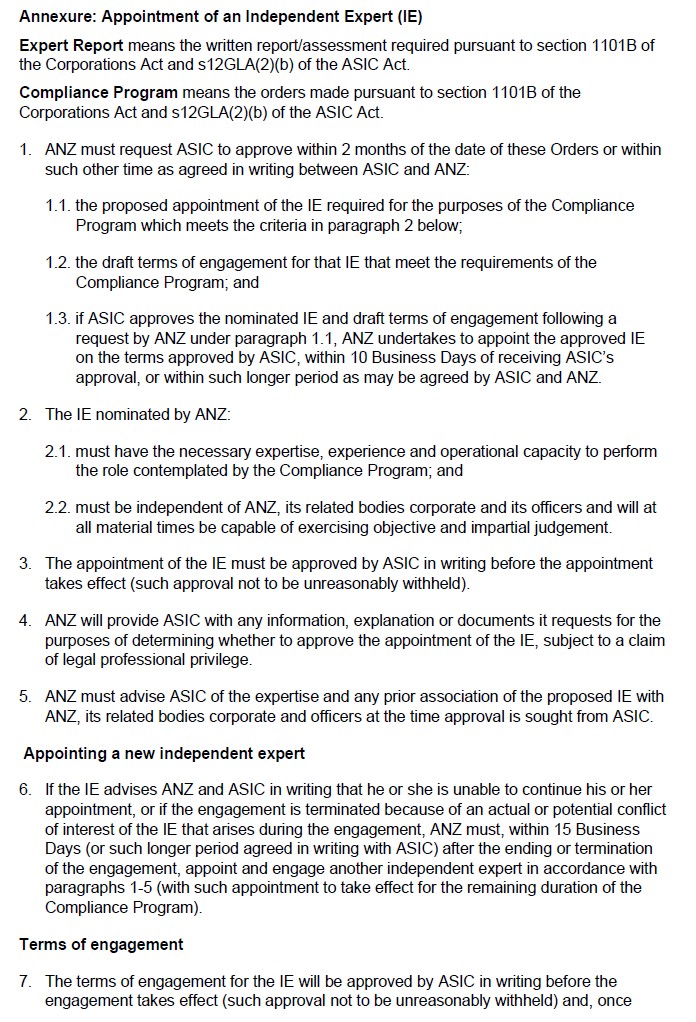
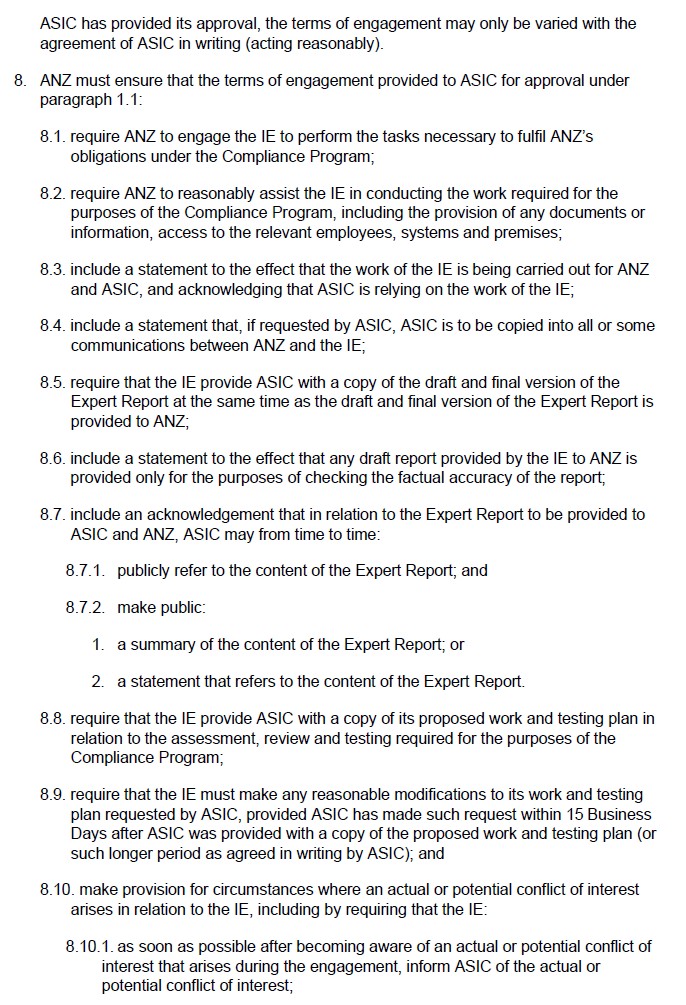
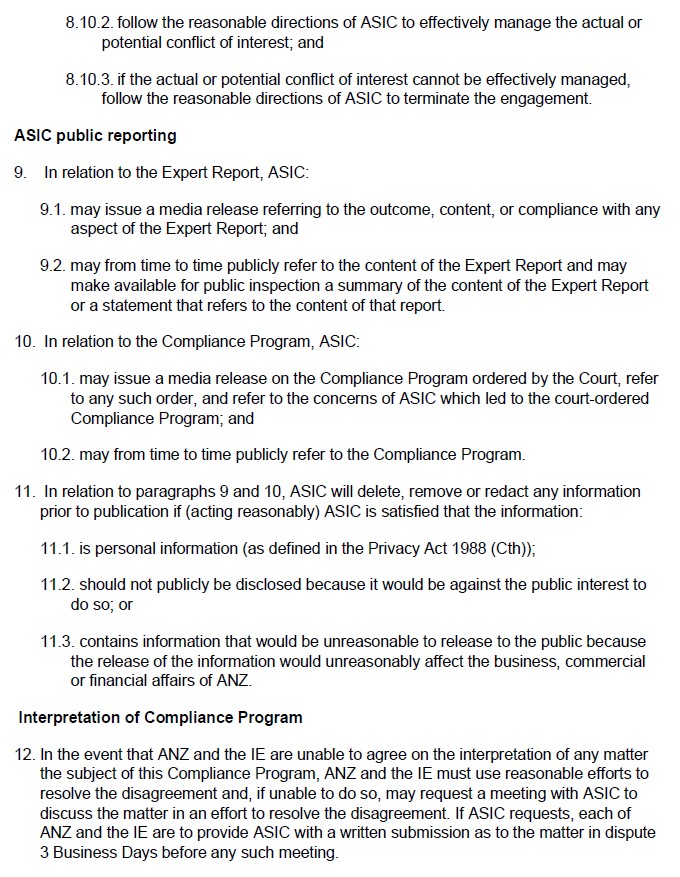
(d) The appointment and terms of engagement of the independent expert are to be approved by ASIC in accordance with the terms set out in the Annexure to these orders.
Note: Entry of orders is dealt with in Rule 39.32 of the Federal Court Rules 2011.
REASONS FOR JUDGMENT
BEACH J:
1 These reasons deal with one of four cases that I heard over two days concerning proceedings brought by the Australian Securities and Investments Commission against the Australia and New Zealand Banking Group Limited concerning contraventions of various provisions of the corporations legislation and credit legislation. The present reasons concern ANZ’s conduct relating to Treasury bonds. I have delivered a separate set of reasons dealing with the other three cases concerning what I would describe as retail conduct (see Australian Securities and Investments Commission v Australia and New Zealand Banking Group Limited (Retail Cases Omnibus) [2025] FCA 1593). Let me turn to the present case.
2 ANZ is and has been a registered bidder participating in bond tenders conducted by the Australian Office of Financial Management (AOFM), which is a department of the Commonwealth Treasury. AOFM is the issuer of Australian Government Treasury bonds to borrow money on behalf of the Commonwealth government.
3 As part of its role as a registered bidder, ANZ provided information to the AOFM about its monthly turnover in trading Australian Government securities including Treasury bonds in the secondary market.
4 As a registered bidder, ANZ also promoted itself to the AOFM for the role of joint lead manager and duration manager on syndicated issuances of Treasury bonds. The duration manager role is considered prestigious and being awarded the duration manager mandate is conducive to ANZ being perceived as a market leader in the Australian bonds business.
5 ANZ has admitted to engaging in conduct in contravention of ss 12CB and 12DB of the Australian Securities and Investments Commission Act 2001 (Cth) and ss 912A, 912DAA and 1041H of the Corporations Act 2001 (Cth) concerning its activities relevant to the primary bond market as a duration manager and the reporting of its activities in the secondary bond market. The contraventions admitted by ANZ relate to two aspects.
6 The first aspect concerns ANZ’s inappropriate conduct in executing a mandate that it succeeded in obtaining in April 2023 to act as the duration manager for the AOFM’s planned issuance of new 21 December 2034 maturing Treasury bonds via syndication in the week beginning 17 April 2023. I would note here that Treasury bonds are financial products under s 12BAA of the ASIC Act and s 764A of the Corporations Act. Further, I would note that at all relevant times, ANZ provided financial services which were supplied in relation to Treasury bonds and dealt in and made a market in Treasury bonds for the purposes of s 12BAB of the ASIC Act and s 766D of the Corporations Act. ANZ is the holder of an Australian Financial Services Licence (AFSL).
7 The second aspect concerns inaccuracies in the reporting of secondary market bond turnover which ANZ reported to the AOFM in the period from 14 September 2021 to 22 June 2023 and ANZ’s failure to lodge with ASIC a report in relation to a reportable situation in connection with those inaccuracies in circumstances where ANZ had reasonable grounds to believe that it had breached a core obligation, which is a statutory construct.
8 Now ASIC and the ANZ have tendered a statement of agreed facts and admissions (SAFA) setting out facts agreed between the parties pursuant to s 191(3)(a) of the Evidence Act 1995 (Cth). And the parties have put a joint position concerning the orders that they say that I should make concerning the ANZ’s conduct.
9 First, declarations are sought pursuant to s 21 of the Federal Court of Australia Act 1976 (Cth), s 1317E of the Corporations Act and s 12GBA of the ASIC Act.
10 Second, pecuniary penalties are sought pursuant to s 1317G(1) of the Corporations Act and s 12GBB(3) of the ASIC Act in a total amount of $125 million. I should say straight away that I have determined to increase the total amount of the penalties to $135 million for reasons which I will explain later. I would also note that I have imposed penalties in the other three retail cases totalling $115 million.
11 Third, an order for a compliance program is sought pursuant to s 1101B(1) of the Corporations Act and s 12GLA(2)(b) of the ASIC Act.
12 Let me start with some background and then delve more into the factual detail concerning the first aspect of the case dealing with the ANZ’s conduct as the duration manager in April 2023 and which I have synthesised from the SAFA.
AOFM and Treasury bonds
13 As I have said, the AOFM issues Treasury bonds to borrow money on behalf of the Commonwealth government. This is to ensure that the Australian Government can meet its spending, investment and debt payment obligations. Treasury bonds are medium to long term debt securities which provide a fixed rate of interest, paid semi-annually to the investor. Treasury bonds are also referred to as Australian Government bonds or Australian Commonwealth Government bonds.
14 The AOFM is the largest issuer of bonds in the Australian market. Some of its personnel are sophisticated participants in the Australian fixed income market. Notwithstanding this, in April 2023 the AOFM was in a position of situational vulnerability concerning ANZ’s conduct as I will later explain.
15 The AOFM regularly issues Treasury bonds through periodic auctions conducted by competitive tender, in which registered bidders submit bids.
16 From time to time, the AOFM conducts syndicated issuances of Treasury bonds, typically for a new maturity and for larger volumes than can be obtained through the tender process. A syndication involves the AOFM appointing financial institutions as joint lead managers to support and promote the transaction, with the bonds being placed directly with investors, and appointing one of the joint lead managers as the duration manager to manage the interest rate risks associated with the issuance. The duration manager assumes and manages the risk as principal, and not as agent for the AOFM.
17 In transferring the management of the interest rate risks associated with the issuance to the duration manager, the AOFM relies on the skills and expertise of the financial institution as a sophisticated market participant. Whilst the AOFM is a sophisticated market participant, it does not have the skill set nor expertise to manage this interest rate risk itself. As such, the duration management service is a significant benefit to the AOFM and Commonwealth. The duration manager is not paid a separate fee for this role, beyond the allocated joint lead manager fee. The duration manager has an opportunity to earn a profit if there is a positive spread between the average price at which it sells its futures hedge and the price at which it acquires the bond futures from investors in the bond issuance. If there is a negative spread, the risk manager may incur a financial loss. In providing the duration management, the duration manager may take on significant market risk and deploys its own capital in the management of such risk.
18 Now this all gives rise to an inherent conflict between the financial institution which seeks to manage its risk and make a profit from the provision of the service and the AOFM which will be disadvantaged by any downward price pressure on the reference price. The duration manager manages risk by selling the reference bond futures in the market during the transaction which can place downward pressure on the reference price. Accordingly, whilst the AOFM receives a significant benefit from the services provided by the duration manager, and the AOFM expects that the duration manager will seek to make some profit, it is an expected part of that role that the financial institution will conduct its hedging in such a way as to minimise market disruption, price volatility and price impact; I will elaborate further on the need for and the type of hedging in a moment.
19 At all relevant times, ANZ was a registered bidder participating in tenders conducted by the AOFM. As part of this role, ANZ provided information to the AOFM about its monthly turnover in trading Australian Government securities including Treasury bonds in the secondary market. Secondary market bond turnover refers to the buying and selling of Treasury bonds and other Australian Government Securities to and from intermediaries being the market makers to clients, such as investment funds, asset managers, central banks and other financial institutions.
20 Further, at all relevant times, ANZ promoted itself to the AOFM for the role of joint lead manager and duration manager on syndicated issuances.
ANZ’s role on the 21 December 2034 maturing treasury bond issuance by the AOFM
21 Now towards the end of 2022 and by early 2023, ANZ expected that the AOFM would be conducting a new syndicated bond issuance by April 2023. ANZ had a strong desire to be awarded the duration manager mandate on this transaction.
22 In April 2023, ANZ was appointed by the AOFM as a joint lead manager and as the duration manager for a $14 billion syndicated Treasury bond issuance by the AOFM. But before elaborating on the chronology I need to say a little more about risk and ANZ’s knowledge.
23 Now investors participating in the AOFM’s syndicated bond issuance could do so on either: (a) an outright basis, where the investor purchases the bonds; or (b) an exchange-for-physical (EFP) basis, that is, the investor purchases the bonds combined with a sale of 10-year Australian bond futures. This arrangement allows the investor to hedge the interest rate risk arising from their purchase of the bonds. EFP describes a transaction where one party buys the physical assets and sells Treasury bond futures contracts whilst the opposite party sells the physical assets and buys Treasury bond futures contracts.
24 The role of the duration manager involves accepting the risk associated with the 10-year Australian bond futures which form part of the EFP orders from investors, which may be significant; such bond futures are interest rate derivative contracts traded on the ASX24 under commodity code XT. The duration manager would buy the bond futures from the investors, but this would in turn expose the duration manager to risk. Accordingly, to manage this risk it had to sell bond futures. But of course in selling bond futures, this could place downward pressure on the reference price and the pricing of the Treasury bonds to be issued.
25 Now as part of the duration manager role in April 2023, ANZ knew the following nine matters.
26 First, it would acquire a significant number of 10-year Australian bond futures from investors who were allocated bonds on an EFP basis. This volume was expected to significantly exceed average daily traded volume in 10-year Australian bond futures.
27 Second, it was ANZ’s role, as duration manager, to manage the risk it expected to acquire associated with these bond futures. In doing so, it was permitted by the AOFM to trade before, during, and after pricing. The AOFM disclosed to the market that ANZ could do so.
28 Third, ANZ would be selling 10-year Australian bond futures to pre-hedge the anticipated risk. In doing so, it could also acquire positions in other Australian bond futures, US Treasury futures and foreign exchange positions to offset the risk to ANZ of its pre-hedging position, described as correlated hedges. This trading would be conducted in a segregated portfolio and ANZ would measure the risk of its trading positions in DV01, which is a common approach to managing and measuring risk. This risk metric measures the change in value of a position per each 1 basis point change in yield of the futures contract.
29 Fourth, the AOFM expected, including as a result of ANZ’s representations to the AOFM about how it would undertake the role of duration manager, that ANZ would manage the risk in an orderly manner to minimise market disruption, price volatility and price impact, and in a manner which promoted the fair treatment of the AOFM, and in compliance with ANZ’s policies and industry guidance.
30 Fifth, the price at which ANZ would acquire these bond futures from investors would be set, during the pricing call which commences at a time nominated by ANZ, by ANZ’s nominated trader spotting the prevailing bid-side of the futures price, which is then agreed to by the AOFM and the other joint lead managers. So, the duration manager nominates the time of the pricing call and the AOFM relies on the judgement of the duration manager to select the pricing call time.
31 Sixth, pricing of the bond means the time at which the price or level of the fixed interest rate or yield that will be payable by the AOFM on Treasury bonds for a new bond issuance is set. Pricing is determined by reference to the bid-side spread of the 10 year Australian bond futures contract at the pricing call time and expressed as yield to maturity. The yield of the bond issued by the AOFM on behalf of the Commonwealth is determined by adding a spread, which is predetermined by the AOFM, to the yield implied by the futures bid price agreed on the pricing call. This determined the amount that the Commonwealth would receive from investors who purchased the bonds issued.
32 Seventh, the ANZ would receive no fee or spread for accepting the risk of acquiring the significant number of 10-year Australian bond futures. Instead, it would make a profit or loss from the difference between the price at which it acquired the 10-year Australian bond futures from investors and the price at which it sold an equivalent volume of those contracts in the market during its hedging.
33 Eighth, each basis point reduction in the price of the 10-year Australian bond futures at pricing, and the consequential change in the yield of the bonds, would: (a) disadvantage the Commonwealth because it would reduce the proceeds received by the Commonwealth from the bond issuance; and (b) benefit ANZ because it would pay a lower price to acquire the significant number of 10-year Australian bond futures to be acquired by ANZ from investors in the bond issuance, thereby increasing ANZ’s revenue or reducing its loss associated with managing the EFP risk.
34 Ninth, in managing the risk and to minimise the price impact of its trading activity, a duration manager was expected to liaise with the AOFM on any issues that arose in the course of the trading day which might impact upon its risk management or the timing of the pricing. ANZ also knew that it could: (a) withhold some of its hedging activity, which it was common to do so, until after the time of the bond issuance pricing; and/or (b) adjust the time of the pricing call to occur later in the day to allow itself more time to trade. Withholding some of the hedging activity would cause the duration manager to hold the risk of an unhedged position for a longer period of time. Adjusting the time of the pricing call carries the risk that the reference price may rise in that period.
35 Let me turn to the relevant chronology.
36 On Friday 14 April 2023, the AOFM announced that it planned to issue new 21 December 2034 treasury bonds via syndication in the week beginning 17 April 2023, subject to market conditions; these bonds would have a maturity date of December 2034.
37 Later on the same day, the AOFM appointed ANZ, Commonwealth Bank of Australia, Deutsche Bank and National Australia Bank Limited as joint lead managers. The AOFM also appointed ANZ to be the duration manager.
38 In accepting the appointment as joint lead manager, ANZ agreed to the Syndication Common Terms which required ANZ to: (a) “act efficiently, honestly and fairly in the interests of the Commonwealth during the Bond issuance process” (Clause 7.2(a)); and (b) comply, and ensure its employees comply, with “all Australian laws applicable to the performance of its obligations under the Relevant Agreements” (Clause 17.1). The Terms also record that “The Commonwealth acknowledges that in connection with any offering of Bonds....the Joint Lead Managers … owe no fiduciary duties to, the Commonwealth or any other person.”(Clause 12.2).
39 In accepting the role of duration manager, Mr Sloane on behalf of ANZ informed the AOFM during a telephone call that Mr Christopher Corbett (Head of Rates Trading Australia, Markets) would be the nominated trader and that ANZ would:
certainly try and maintain and manage the risk in a way that is of the least impact to the market and we keep an open and consistent dialogue both with yourselves and myself and the trader who will be looking after the risk.
40 ANZ also agreed to the terms of a document provided by the AOFM titled “Procedural Aspects of Risk Management”. The document noted that the bond would price off the bid side of the 10-year Australian bond futures contract.
41 At 2:15pm on 14 April 2023, Mr Sloane informed Mr Rakesh Jampala (Co-Head of Fixed Income, Markets) in a Bloomberg chat that ANZ had been appointed as joint lead manager and duration manager.
42 At 4:29pm on 14 April 2023, Mr Jampala sent Mr Corbett an email attaching a document titled “Duration Management of Australian Physical Bond Issuance” which was a memo prepared by Mr Jampala in 2020 addressing considerations in acting as a duration manager. The document included the following passage under the heading “Conflicting interests as Duration Manager”:
Duration management execution effectively operates as a reference price transaction, where there is no margin other than being set on the bid side of the futures. ….. There are a number of ways of going about executing this, with important (and often conflicting) considerations. Clearly the least risky approach for ANZ is sell all the risk in as small as possible a window just around time of pricing. However, this course of action will certainly disturb orderly functioning of the market, likely create jump discontinuity in price, and reflect poorly on the overall market, let alone the impact to AOFM in respect of price. The converse would be ANZ selling the risk over a period of days leading into pricing. This would enable a smooth execution with very little impact to the market, but would expose ANZ to very material market risk. Risk which is not priced given we are only getting set off the bid side of futures. The correct approach therefore lies somewhere in the middle, with strategy on any particular occasion subject to market conditions and liquidity at that prevailing time.
43 At 4:31pm on 14 April 2023, Surveillance Senior Manager 1 sent an email to his direct report, Surveillance Manager 2, which forwarded an email chain commencing some time previously discussing a potential approach to intra-day risk limits applicable to the role of duration manager for AOFM transactions. The first email in the forwarded chain was sent by Surveillance Senior Manager 1 stating that he had assumed that ANZ would maintain the “same basic hedging strategy” it had used on recent AOFM transactions to develop appropriate duration manager limits. So, the following was assumed. First, the risk which ANZ would assume at the time of pricing the transaction would be the total size of the deal multiplied by the proportion of investor orders that were on an EFP basis. Second, most of ANZ’s pre-hedging would take place in the 90 minutes prior to pricing time. At the time of pricing, ANZ could typically expect to have pre-hedged up to two thirds of its risk by selling and thereby building a short position in Australian bond futures. Third, ANZ may also acquire partially offsetting positions in other products such as US Treasury futures and AUD/JPY currency trades to mitigate the risk to ANZ as it built the short pre-hedging position; these are described as correlated hedges. Fourth, the aim was to ensure that ANZ’s peak exposure at the time of pricing was kept below 50% of the total deal risk.
ANZ’s material size transaction guidelines, applicable ANZ policies, and industry guidance
44 By 17 April 2023, as required by its material size transaction (MST) guidelines, ANZ had assessed the likely risk it would acquire from the bond issuance transaction. It expected the transaction size to be approximately $10 to 15 billion, with an indicative risk size of $8 to 10 million per basis point, which is referred to in terms of DV01 as I have already said. It assessed the transaction as being material and having a market impact.
45 ANZ established a deal team for the transaction which included Mr Jampala and Mr Corbett.
46 In a call commencing at 2:09pm on 17 April 2023, Mr Jampala described to members of the Desk Risk Management and Compliance teams that: (a) ANZ’s advice to the AOFM will be to launch the transaction the next day (Tuesday), “which means pricing on Wednesday”; and (b) Mr Corbett will be the trader managing the risk of the transaction. Mr Jampala will “be with him pretty closely working – basically, doing it with him and just providing counsel right throughout which is why I’m on the deal team.”
47 ANZ’s MST guidelines and trading practice guidelines in place as at April 2023 required the following.
48 First, traders “should use reasonable endeavours to execute the MST in a manner that: is not disadvantageous to the client” and “is minimally disruptive to the market. You should manage the execution of the MST in a way that promotes the fair treatment of the Client” and pre-hedging “must be carried out insofar as possible in a way that is not detrimental to the Client”.
49 Second, hedging should be aligned with “any applicable ANZ Policy/Procedure/internal guidance and relevant market standard” and in compliance with the following general principles: (a) “When hedging, it should be conducted in a manner that has little influence on market pricing, at a pace consistent with the normal market volumes at that time of day in the relevant instrument, and does not result in undue pressure on pricing around the fixing window/ reference time/ pricing call”; (b) “Trader[s] should ensure that the sole purpose behind hedging is risk mitigation [and] should not be performed for the purpose of influencing or manipulating the fixing rate / reference price / reference rate / reoffer yield”; and (c) “Traders should comply with FMSB’s Risk Management Transactions for New Issuance Standard” and “FMSB’s Reference Price Transactions Standard”.
50 Third, there must be no over-hedging, that is, related hedging should never be more than 100% of ANZ’s risk exposure.
51 Fourth, pre-hedging must only be executed by the MST Trader and that “[t]he Deal Team can include the Senior Trading Manager (if approved by Desk Risk Manager and Compliance). The Deal Team should not include the MST Trader”.
52 ANZ’s Information Flow Guidelines outline principles governing communications from ANZ employees to clients. Relevantly, ‘Principle 3 – Communications’ notes that:
You must communicate in a manner that is clear, accurate, professional, and not misleading.
Sub-principle i) … to support the accuracy and integrity of information, you should: … not communicate false information.
53 Let me set out some other relevant standards.
54 The FICC Markets Standards Board (FMSB) was a UK-based industry body that promotes best practice standards for wholesale markets globally including by developing standards and good practice statements. In November 2016, the FMSB issued the Reference Price Transaction Standard, which relevantly provided: (a) A market participant should “balance the objectives of its hedging strategy against the possibility of putting undue pressure on the reference price, recognising that some price pressure is to be expected as risk is passed, particularly for large transactions or transactions in less liquid markets”; (b) Hedging should generally be “at a pace consistent with normal market volumes at that time of day in the relevant instrument (adjusted as necessary for the volume implicit in the RPT itself, and recognising that this may not be possible for illiquid instruments)” and “Although volatility can be due to many factors, a reasonable hedging strategy would not be expected to induce materially higher volatility of the reference price around the reference time, taking into account the size of the risk being transferred”; (c) Hedging should be designed to neutralize the risk and should not be undertaken for the purpose of creating a new significant open risk position. Further, “Intentional over-hedging (i.e. hedging more than required to cover the firm’s risk) should not take place other than where that is a necessary consequence of appropriate hedging activity, such as where the relevant hedging instrument is only available in a size greater than that required to hedge the RPT”.
55 Further, the Australian Financial Markets Association (AFMA) was a financial markets industry association which maintained codes, policies and procedures for the purpose of regulating its members' conduct in certain financial markets.
56 The AFMA Code of Conduct set out ethical principles for acceptable standards of behaviour in Australian financial markets which members were required to observe and expected to adopt. The Code of Conduct includes: (a) Ethical principle 4, which provides that members were expected to: “Act fairly and honestly when dealing with clients and counterparties”; and (b) Ethical principle 9, which provides that members were expected to: “Observe market standards and conventions, good practice and conduct expected or required of participants in markets when engaging in any form of market dealing”.
57 AFMA’s Guidance on Pre-Hedging and Debt Capital Primary Market Guidelines, which included a section titled Reference Price Transactions, relevantly set out the following: (a) The key characteristic of Reference Price Transactions is the “possibility of market pressure arising from Syndicate Manager risk management activity, and the related potential conflict of interest between the Issuer and the Syndicate Manager”; (b) Dealers should conduct hedging “in a manner that is not intended to disadvantage the Client” and communicate “their hedging practices to the Issuer in a clear manner meant to enable clients to understand their intentions and actions in the market”; (c) The sole intention behind hedging should be “risk mitigation”; and (d) In relation to acceptable hedging practices, the AFMA Guidance included the same matters as set out in the FMSB’s Reference Price Transaction Standard.
18 April 2023: December 2034 Treasury bonds launched
58 At 9:00am on 18 April 2023, the AOFM announced the launch of new Treasury bonds maturing on 21 December 2034, which would be priced on 19 April 2023. The announcement noted that the duration manager “may be involved in hedging activities before, during or after pricing”.
59 To execute the duration manager role, ANZ set up a segregated room on the trading floor. From the time that the deal was launched at 9am on 18 April 2023 until the deal was priced, Mr Corbett, as the nominated trader, and Mr Jampala, as his supervisor, were removed from normal trading activities as required by the MST guidelines. Mr Corbett traded in the segregated room. Mr Jampala was also in the room for most of that period, sitting next to Mr Corbett to provide guidance and supervision. All trades executed in connection with the transaction were recorded in a segregated trading book “R BOND AU”. The trades and offers set out below are those conducted by ANZ, and made in connection with the risk borne by ANZ, in connection with its duration manager role on this transaction.
60 ANZ did not have a documented pre-hedging plan or a formal written hedging strategy for this transaction.
61 Now throughout the course of the transaction, Mr Sloane had a live Bloomberg chat with the AOFM, and Mr Sloane had a further Bloomberg chat with Mr Corbett and Mr Jampala.
62 At about 4:44pm on 18 April 2023, Mr Sloane informed Mr Corbett through Bloomberg chat messages that the size of the bond issuance was likely to be $13 to 15 billion, of which approximately $11 billion would be EFP orders. This is the risk that ANZ would need to manage as duration manager.
63 At about 4:55pm on 18 April 2023, Mr Jampala sought confirmation from Mr Sloane through Bloomberg chat messages that the deal size was not expected to exceed $15 billion and that about 72 percent of the deal would be EFP orders.
64 Mr Corbett had commenced pre-hedging a small volume of the anticipated risk for the transaction on Monday 17 April 2023. By the evening of 18 April 2023, he had accumulated a short position of 13,934 contracts of 10-year Australian bond futures in the R BOND AU portfolio to pre-hedge the anticipated risk. This short position was equivalent to about $1.35 million of DV01 risk, that is, about 13.5 to 16.8% of an anticipated total risk of $8 to 10 million in DV01 terms. He also accumulated a long position of 23,066 contracts of 3-year Australian bond futures, 4,588 contracts of 10-year US Treasury note futures, and 500 contracts of 90-day Australian bank bill futures. His net DV01 position in AU products was equivalent to a short position of about $610,584.
19 April 2023: December 2034 bond pricing date
65 Between 4:46am and 6:10am on 19 April 2023 and before market open, Mr Corbett purchased 1,000 contracts of 10-year Australian bond futures. By buying 10-year Australian bond futures, Mr Corbett reduced his pre-hedging position. This had the effect of increasing the amount of outstanding 10-year bond futures contracts Mr Corbett needed to sell in order to hedge the anticipated number of contracts ANZ would acquire from investors in the bond issuance. Around the same time, he sold 1,000 contracts of 10-year US Treasury note futures. These trades were part of ANZ using correlated hedge products as described above. His net risk position in DV01 terms was largely unchanged as the combined result of these trades.
66 At the end of the SYCOM session on the morning of 19 April 2023, 10-year Australian bond futures were trading at 96.495.
67 ANZ knew, and AOFM reasonably would have expected, that, on this day, in connection with ANZ’s need to hedge its risk associated with a transaction of this kind, ANZ intended to sell a substantial volume of 10-year Australian bond futures between market open at 8:32am and the pricing call time nominated by ANZ which would have, or would be likely to have, the effect of placing downward pressure on the price of the bond futures. The potential for the substantial volume to have downward pressure on the price of 10-year Australian bond futures may be consistent with the need to hedge these types of transactions and risk. However, on 19 April 2023, the AOFM did not know, and could not know, without ANZ informing it, that ANZ would trade a significant volume of bond futures in a compressed time period ahead of and during the pricing call and in a manner that placed undue downward pressure on the reference price at the time of pricing, which was inconsistent with the manner of trading expected by reason of the matters set out above.
68 As a result of the orders, during the time that Mr Corbett was on the pricing call, ANZ had outstanding offers in the market to sell 10-year Australian bond futures at each of the five price levels from 96.465-96.485.
69 ANZ’s trading in the lead up to and during the pricing call applied undue downward pressure on the price of 10-year Australian bond futures at the time of pricing.
70 Shortly prior to and while on the pricing call, the AOFM was observing the market for 10-year Australian bond futures on a Bloomberg screen. The AOFM observed the prevailing price of 10-year Australian bond futures decreasing. Due to the anonymous nature of the futures market, the AOFM did not, and could not without ANZ informing it of its trading activity, know whether, and to what extent, ANZ was responsible for the trading activity in the market. Further, significant selling which was likely to place downward pressure on the price of the reference product by ANZ in close proximity to and at the pricing time would be inconsistent with: (a) the AOFM’s expectations which were understood by ANZ; (b) ANZ’s statements to AOFM about how it would manage duration management roles including this role; and (c) industry guidance including from AFMA and the FMSB.
71 The AOFM had a reasonable expectation that it would be informed if ANZ’s pre-hedging was not sufficiently advanced or if ANZ otherwise encountered difficulties in its pre-hedging prior to the indicative pricing call time, and/or that ANZ would seek to adjust the pricing call to a later time if ANZ was unable to manage its risk in accordance with its policies and industry guidance. The AOFM also relied upon ANZ to nominate the pricing call time.
72 ANZ did not disclose to the AOFM: (a) its intention to seek to be fully hedged by the time of pricing if it could do so at an acceptable price; (b) that its pre-hedging was not sufficiently advanced to achieve that intention without trading a significant volume of 10-year Australian bond futures before and leading into the nominated pricing call time of 1:50pm; and (c) therefore, it intended to engage in such trading which would have, or was highly likely to have, a downward impact on the price of 10-year Australian bond futures as at the time of pricing.
73 ANZ did not provide the AOFM with an opportunity to consult with ANZ about rescheduling the time of the pricing call in light of the progress by ANZ in its hedging. ANZ did not adjust the pricing call time to a later time to allow itself more time to pre-hedge. ANZ did not withhold some of its hedging activity until after the time of pricing.
74 To the contrary, when ANZ had substantial volume of risk still to trade, ANZ’s traders confirmed a pricing call time of 1:50pm and proceeded to sell significant volumes of 10-year Australian bond futures within a compressed time window shortly prior to and during the pricing call time nominated by it, between 1:10pm and 1:54pm.
75 Without knowing ANZ’s specific intentions and trading, and having relied upon ANZ to manage the inherent conflict in accordance with the expected behaviour of a duration manager, at the time of the pricing call, the AOFM was unable to counteract or to protect itself against ANZ’s conduct. To finalise the bond issuance, the AOFM needed to ensure that the issue of $14 billion Treasury bonds would be priced. The AOFM therefore had no alternative but to agree the price which was the bid-side of the 10-year Australian bond futures at the time of pricing on the pricing call. At the time of pricing, the AOFM had no knowledge, and no means of acquiring knowledge without ANZ providing it to the AOFM, of the matters above. As a result and to ANZ’s knowledge, at the time of pricing, the AOFM was in a position of informational and situational disadvantage and vulnerability.
76 ANZ knew, or ought reasonably to have known, that its manner of trading and the undue downward pressure of that trading on the bond futures price was contrary to the AOFM’s reasonable expectations about the pricing of the bond issuance and that ANZ’s conduct exposed the AOFM and the Commonwealth to significant risk of detriment.
77 ANZ earned revenue of $9,979,687 as duration manager and a fee of $2.8 million as joint lead manager.
78 It is convenient to make one other point here. Based on an issuance size of $14 billion, each basis point fall in the futures price, and thereby increase to the yield of the bonds, would detrimentally impact the Commonwealth by reducing the amount received from investors who purchased the bonds issued by about $13.16 million.
Other Issuances
79 Based on data collected by ASIC, between January 2017 and July 2024, the AOFM conducted a total of 21 syndicated bond issuances. Eleven of these issuances had 10-year Australian bond futures as the reference product and an EFP risk of at least $4.2m on a DV01 basis, being approximately 50% of the April 2023 issuance. Having regard only to notional positions in the reference product, that is, not assessed on a DV01 basis, and not including correlated hedging, ANZ’s trading on this transaction when compared to the other 20 issuance transactions, displays the following features.
80 First, except for one transaction in 2018 for which ANZ was also the duration manager, this is the only transaction in which the duration manager had sold reference products equal to the EFP quantity of the reference product at the time of pricing. In all other issuances, the duration manager withheld a portion of the amount of reference product to be sold until after pricing, for purposes including minimising market disruption, protecting the interests of the AOFM, and/or profiting from the anticipated rise in the price of the futures contracts. Of the other 19 transactions including another two previous transactions in which ANZ was the duration manager, the highest proportion that a duration manager sold of the EFP quantity of the reference product by the time of pricing was approximately 85%. ANZ traded a materially higher proportion of its anticipated risk in the 45 minutes prior to pricing.
81 Second, on this transaction, noting that ANZ sold a low volume of the reference product between market open and 1:10pm and a significant volume of the reference product between 1:10pm and pricing, the spotted bid price was 2 basis points lower than the best bid price at market open. Across the 10 other issuances where the reference product was 10-year Australian bond futures and where the EFP risk was greater than $4.2 million in DV01 terms, the median bid price movement was a 2.3 basis point drop and the average was a 2.6 basis point drop. Further, on this transaction, the price of the reference product moved by the widest margin (a decrease of 2 basis points) in the 45 minutes leading to pricing in all 21 issuances.
82 Further, in at least some other transactions, where unanticipated market conditions arose or the duration manager’s pre-hedging was not sufficiently advanced, this was transparently disclosed to the AOFM and a discussion occurred about the timing of the pricing call, the duration manager’s ability to retain a portion of the risk to hedge post pricing, and the potential impact on price of each course of action.
Conduct amounting to unconscionable conduct (s 12CB)
83 As to this conduct that I have elaborated on in a little detail, ANZ admits that in the period 19 April 2023 to 3 May 2023, it contravened s 12CB(1) of the ASIC Act by engaging in conduct, in connection with the supply of financial services to the AOFM representing the Commonwealth of Australia relating to the issuance of December 2034 Treasury bonds, in trade or commerce, that was in all the circumstances unconscionable.
84 Now at all material times, s 12CB(1) prohibited unconscionable conduct in the following terms:
(1) A person must not, in trade or commerce, in connection with:
(a) the supply or possible supply of financial services to a person; or
(b) the acquisition or possible acquisition of financial services from a person;
engage in conduct that is, in all the circumstances, unconscionable.
85 The parties have agreed, which I accept, that the threshold requirements of that section have been met and that the impugned conduct was in “trade or commerce”, as defined in s 12BA, and in “connection with” the supply or possible supply of financial services for the purpose of s 12CB. As s 12CB(4) makes clear, the concept of unconscionability under s 12CB is more wide-ranging than, and not limited by, the concept of unconscionability in equity. And in the context of commercial dealings, the question is whether such conduct is so far “outside societal norms of acceptable commercial behaviour as to warrant condemnation as conduct that is offensive to conscience” (Australian Securities and Investments Commission v Kobelt (2019) 267 CLR 1 at [92] per Gageler J).
86 Section 12CC sets out a non-exhaustive list of factors to which one may have regard in determining whether the conduct answers the description of being unconscionable. But I am not required to evaluate the impugned conduct by reference to the presence or absence of these factors irrespective of the relevance of those factors, but must do so if any of the factors are applicable, noting that the presence or absence of each matter is not a mandatory consideration and the totality of the circumstances dictates whether any such matter is applicable; see Productivity Partners Pty Ltd v Australian Competition and Consumer Commission (2024) 419 ALR 30 at [11] and [55] to [57] per Gageler CJ and Jagot J. I have had regard to the relevant considerations in this case.
87 By reason of the matters above taken together and in all of the circumstances, ANZ’s conduct of its role as duration manager and its manner of trading as set out were contrary to the requirements of its own policies and industry guidance issued by the AFMA and by the FMSB, and were inconsistent with ordinary trading behaviour of duration managers appointed by the AOFM in respect of syndicated bond issuances.
88 I accept, based on the agreed facts, that a trader in the position of ANZ, with the knowledge of ANZ, acting within the range of ordinary trading behaviour of duration managers described above, in all of the circumstances, would have taken one or more of the following steps: (a) sold a greater volume of 10-year Australian bond futures in the period between 8:32am and 1:10pm on 19 April 2023; (b) informed the AOFM prior to the nominated time of the pricing call of some or all of the matters above; (c) revised the chosen hedging strategy to seek to be fully hedged at the time of pricing; (d) adjusted or nominated a different time for the pricing call to allow itself more time to pre-hedge; (e) withheld some of its hedging activity until after the time of pricing; (f) traded in a manner that did not result in the sale of significant volumes of 10-year Australian bond futures in a compressed time window shortly prior to and during the pricing call and did not result in applying undue downward pressure on the price of 10-year Australian bond futures at the time of pricing.
89 But I accept that ANZ’s conduct in its role as duration manager and its manner of trading did not constitute over-hedging or market manipulation.
90 In my view, based on the facts that I have set out and admissions made by the ANZ, ANZ’s conduct in all of the circumstances was unconscionable in contravention of s 12CB(1). Let me elaborate on eight aspects.
91 First, ANZ represented to the AOFM that it would be transparent with the AOFM. It so represented in advance of the appointment as duration manager, when on 29 March 2023, ANZ emailed the AOFM expressing an interest in such an appointment, and attaching a presentation which referred to a key objective for an issuance as “transparency”, specifically a “Transparent process throughout”. And it so represented when accepting the role of duration manager. ANZ told the AOFM that ANZ would “certainly try and maintain and manage the risk in a way that is of the least impact to the market and we keep an open and consistent dialogue both with yourselves and myself and the trader who will be looking after the risk.”
92 Second, ANZ knew on 19 April 2023 that it intended to sell a substantial volume of 10-year Australian bond futures between market open at 8:32am and the pricing call time nominated by ANZ. ANZ knew that this selling would have, or would be likely to have, the effect of placing downward pressure on the price of the bond futures, in its favour and to the detriment of the AOFM. Further, by 9.30am, ANZ knew that the deal size was $14 billion and by about 11.20am that ANZ would receive approximately 84,544 contracts of 10-year Australian bond futures at the time of the issuance. Further, by 12pm, the ANZ traders were aware that they would be seeking to sell about 65,950 contracts of 10-year Australian bond futures in less than two hours until the nominated pricing call time of 1:50pm to fully hedge the contracts ANZ would acquire from investors in the bond issuance. They were also aware that selling this volume within that time period would have, or would be likely to have, a downward impact on the price of 10-year Australian bond futures. Further, by 1pm, the ANZ traders intended to be fully hedged at pricing, if they could do so at an acceptable price, and were aware that they would seek to sell about 63,850 contracts of 10-year Australian bond futures in the next 50 minutes, until ANZ’s nominated pricing call time of 1:50pm, to fully hedge the contracts ANZ would acquire from investors in the bond issuance. They were also aware that selling this volume within that time period would have, or would be likely to have, a downward impact on the price of 10-year Australian bond futures, in its favour and to the detriment of the AOFM.
93 Third, the AOFM was to the ANZ’s knowledge situationally vulnerable, as a result of not knowing ANZ’s specific intentions and trading activity and because, having relied upon ANZ to manage the inherent conflict of interest by conducting itself in accordance with the expected behaviour of a duration manager, the AOFM was unable to counteract or protect itself.
94 Fourth, ANZ breached its own policies for hedging. Those internal policies included ANZ’s MST guidelines and trading practice guidelines in place as at April 2023 which required, inter alia, the following. One aspect was that traders “should use reasonable endeavours to execute the MST in a manner that is not disadvantageous to the client” and “is minimally disruptive to the market. [Traders] should manage the execution of the MST in a way that promotes the fair treatment of the Client” and pre-hedging “must be carried out insofar as possible in a way that is not detrimental to the Client”. And another aspect was that “[w]hen hedging, it should be conducted in a manner that has little influence on market pricing, at a pace consistent with the normal market volumes at that time of day in the relevant instrument, and does not result in undue pressure on pricing around the fixing window/reference time/ pricing call.”
95 Fifth, ANZ breached industry guidance, including the following guidance.
96 The November 2016 Reference Price Transaction Standard issued by the FMSB, which as I have stated is a UK-based industry body that promotes best practice standards for wholesale markets globally including by developing standards and good practice statements, stated that market participants should “balance the objectives of its hedging strategy against the possibility of putting undue pressure on the reference price, recognising that some price pressure is to be expected as risk is passed, particularly for large transactions or transactions in less liquid markets”.
97 Further, AFMA’s Guidance on Pre-Hedging and Debt Capital Primary Market Guidelines, which included a section entitled “Reference Price Transactions”, formed part of the AFMA Code of Conduct. It stated that dealers should conduct hedging “in a manner that is not intended to disadvantage the Client” and communicate “their hedging practices to the Issuer in a clear manner meant to enable clients to understand their intentions and actions in the market”.
98 Sixth, ANZ’s behaviour was outside the range of ordinary behaviour of duration managers appointed by the AOFM. Of the total 21 syndicated bond issuances the AOFM conducted between January 2017 and July 2024 the following may be noted.
99 Except for one transaction in 2018 for which ANZ was also the duration manager, the April 2023 issuance was the only issuance in which the duration manager had sold reference products equal to the EFP quantity of the reference product at the time of pricing. In all other issuances, the duration manager withheld a portion of the amount of reference product to be sold until after pricing, for purposes including minimising market disruption, protecting the interests of the AOFM, and/or profiting from the anticipated rise in the price of the futures contracts. Of the other 19 transactions, including another two previous transactions in which ANZ was the duration manager, the highest proportion that a duration manager sold of the EFP quantity of the reference product by the time of pricing was approximately 85%. ANZ traded a materially higher proportion of its anticipated risk in the 45 minutes prior to pricing on 19 April 2023.
100 In at least some of the other transactions, where unanticipated market conditions arose or the duration manager’s pre-hedging was not sufficiently advanced, this was transparently disclosed by the duration manager to the AOFM and a discussion occurred about the timing of the pricing call, the duration manager’s ability to retain a portion of the risk to hedge post-pricing, and/or the potential impact on price of each course of action. ANZ did not do so on 19 April 2023.
101 Seventh, ANZ failed to take one or more of the following steps. It failed to sell a greater volume of 10-year Australian bond futures in the period between 8.32am and 1.10pm on 19 April 2023. It failed to inform the AOFM of its lack of progress in its hedging in light of its intention to seek to be fully hedged by the time of pricing if it could do so at an acceptable price when proposing or confirming the time for the pricing call. It failed to propose to delay the pricing call. And it failed to modify its strategy of being fully hedged by the time of pricing.
102 Eighth, ANZ was not forthcoming in its reporting to the AOFM about its conduct as duration manager after the issuance, including when the AOFM questioned ANZ about its trading, and instead made inaccurate or incomplete statements which involved misleading conduct about the circumstances of ANZ’s trading.
103 Generally, ANZ traded in the manner set out above and in the context of the circumstances as I have set out. Let me turn to the next topic of misleading and deceptive conduct and false representations.
Misleading conduct and false representations (s 1041H and s 12DB) — introduction
104 ANZ admits that on 27 occasions between 14 September 2021 and 22 June 2023 it engaged in misleading or deceptive conduct contrary to s 1041H of the Corporations Act and it admits that on 24 occasions between 14 September 2021 and 22 June 2023, it made false or misleading representations contrary to s 12DB of the ASIC Act. Those contraventions may conveniently be separated into two categories.
105 First, on and after 19 April 2023, ANZ provided reports to the AOFM which were misleading or deceptive in describing, or were misleading or deceptive by omission in respect of, ANZ’s trading activities as duration manager for the December 2034 Treasury bond issuance. Those reports were provided after the AOFM raised concerns with ANZ as to ANZ’s trading activities as duration manager for the December 2034 Treasury bond issuance and one of those reports was provided in response to queries raised by the AOFM.
106 Second, between 14 September 2021 and 22 June 2023, ANZ provided to the AOFM monthly reports about ANZ’s secondary market bond turnover for the period from July 2021 to May 2023. In those reports, ANZ materially misstated the value of ANZ’s secondary market bond turnover. Further, on 19 August 2022, ANZ provided to the AOFM the annual verification for ANZ’s secondary market bond turnover in FY2021-22. In doing so, ANZ misrepresented to the AOFM that the monthly survey data for the 2021-22 financial year it had previously provided was accurate. I will set out later details as to the 24 occasions on which misrepresentations were made in contravention of s 12DB.
107 But before proceeding further I should say something about the relevant provisions and principles.
108 Section 1041H(1) of the Corporations Act prohibited misleading or deceptive conduct in the following terms:
(1) A person must not, in this jurisdiction, engage in conduct, in relation to a financial product or a financial service, that is misleading or deceptive or is likely to mislead or deceive.
109 Further, s 12DB(1)(a) of the ASIC Act provided:
(1) A person must not, in trade or commerce, in connection with the supply or possible supply of financial services, or in connection with the promotion by any means of the supply or use of financial services:
(a) make a false or misleading representation that services are of a particular standard, quality, value or grade…
110 There are relevant differences between the provisions in respect of certain threshold elements. Section 1041H of the Corporations Act requires the conduct to be “in this jurisdiction” and in relation to either a “financial product” or a “financial service”. By contrast, s 12DB(1)(a) of the ASIC Act applies to representations “in trade or commerce” which are in connection with the supply or possible supply of “financial services”, where those representations are that services are “of a particular standard, quality, value or grade”.
111 Section 1041H(1) applies to conduct “in relation to a financial product or a financial service”. The expression “in relation to” is wide to say the least, and an indirect or less than substantial connection may be sufficient. A “financial service” is defined to include dealing in financial products; see s 766A(1)(b). The term “dealing” is defined to be constituted by, inter alia, issuing, varying or disposing of a financial product; see s 766C(1). And arranging for a person to engage in such conduct is also dealing in a financial product; see s 766C(2).
112 Section 12DB applies to conduct “in connection with the supply or possible supply of financial services, or in connection with the promotion by any means of the supply or use of financial services”. Section 12BAB(1)(g) stipulates that a person provides a financial service if they “provide a service … that is otherwise supplied in relation to a financial product”. The expression “in connection with” may require that the impugned conduct accompany or be involved in the supply of services.
113 In Australian Securities and Investments Commission v Westpac Banking Corporation (No 2) (2018) 266 FCR 147; 127 ACSR 110, I commented on the phrase “in connection with” in the context of s 12CB of the ASIC Act. I considered that whilst the specific degree of connection required understandably varies with the statutory context, a narrow or technical approach was not warranted. I said (at [2172]):
As to the requirement that conduct be “in connection with” the supply or acquisition, or possible supply or acquisition, of financial services, an analogous requirement in s 51AC of the Trade Practices Act was considered in Monroe Topple & Associates Pty Ltd v Institute of Chartered Accountants in Australia (2002) 122 FCR 110. Heerey J held that the expression required that “the conduct impugned ‘accompany, go with or be involved in’ the supply of goods or services” (at [74]). That observation does not support a narrow or technical approach to the expression. It was made in the context of distinguishing conduct directed at the recipient of the relevant goods or services, and conduct directed at (and only said to be unconscionable in relation to) an unrelated third party. Of course, the expression “in connection with” requires a relation between one thing and another, but the specific degree of connection required understandably varies with the statutory context. But a causal relationship is not required. And no narrow approach is warranted having regard to the protective objects of the provision. In particular, I agree with ASIC that there is no basis for implying into the expression “in connection with” a requirement that conduct said to be unconscionable must have occurred prior to the relevant supply or acquisition of financial services. Such a temporal constraint would be artificial and inconsistent with the following matters. First, the generality of the statutory text directs attention to “all the circumstances”. Second, the list of factors expressly identified as relevant to whether s 12CB (or s 12CC) has been breached includes “any conduct that the supplier [or acquirer] or the service recipient [or business supplier] engaged in, in connection with their commercial relationship, after they entered into the contract”; see ss 12CC(2)(j)(iv) and 12CC(3)(j)(iv) (prior to 1 January 2012), and ss 12CC(1)(j)(iv) and s 12CC(2)(j)(iv) (post 1 January 2012). Third, the terms of s 12CB(3)(a) prohibit a court from considering “any circumstances that were not reasonably foreseeable at the time of the alleged contravention”. Such a provision implicitly permits prospective matters to be taken into account. Further, the reference time is not the time of entry into of a dealing but the time of the alleged contravention. Fourth, the very terms of s 12CB(4)(c)(ii) state that “in considering whether conduct to which a contract relates is unconscionable, a court’s consideration of the contract … is not limited to consideration of the circumstances relating to formation of the contract”.
114 Given the similarities between ss 12CB and 12DB, the same approach applies equally to the latter provision.
115 There is little doubt that the threshold elements are satisfied for the alleged contraventions of ss 1041H and 12DB(1)(a). First, the relevant conduct was in this jurisdiction. Second, the relevant conduct was in trade and commerce. Third, the relevant conduct was “in relation to” (for s 1041H(1) of the Corporations Act), or “in connection with the supply of” (for s 12DB(1) of the ASIC Act), financial services.
116 Now subject to the matters just discussed, the applicable legal principles for analysing the conduct are the same under each of s 1041H and s 12DB. There is no material difference between the expression “false or misleading representations” in s 12DB(1) of the ASIC Act and the expression “misleading or deceptive conduct” in s 1041H(1) of the Corporations Act.
117 It is convenient to repeat what I said in ASIC v Westpac (No 2) at [2259] to [2286]:
Let me say the following concerning the elements of s 1041H.
First, the concept of “engaging in conduct” is broad. It is defined inclusively by s 1041H(2)(a) of the Corporations Act to include “dealing in a financial product”. Further, “this jurisdiction” is, relevantly, Australia (s 5(2)).
Second, the expression “in relation to” is of wide ambit. Now it is trite to observe that its meaning will be determined by the context. The phrase signifies the need for there to be a relationship or correlation between the two subjects formally referenced. Moreover, an indirect or less than substantial connection may be sufficient.
More generally, the relevant principles are largely the same as those which apply to s 18 of the Australian Consumer Law. In ACCC v Get Qualified Australia Pty Ltd (in liq) (No 2) [2017] ATPR 42-548 at [25]-[42], I summarised the relevant principles in the following terms which no party in the present proceeding contested.
First, there is no meaningful difference between the words and phrases “misleading or deceptive”, “mislead or deceive” or “false or misleading”.
Second, where the issue is the effect of conduct on a class of persons rather than identified individuals to whom a particular misrepresentation has been made or particular conduct directed, the effect of the conduct or representations upon ordinary or reasonable members of that class must be considered. This hypothetical construct avoids using the very ignorant (or gullible) or the very knowledgeable (or astute) to assess effect or likely effect; it also avoids using those credited with habitual caution or exceptional carelessness; it also avoids considering the assumptions of persons which are extreme or fanciful. The objective characteristics that one attributes to ordinary or reasonable members of the relevant class may also differ depending on the medium for communication being considered. There is scope for diversity of response both within the same medium and across different media.
Third, in considering the hypothetical ordinary and reasonable member of the relevant class, one considers the dominant message conveyed. The question is whether there is a real rather than a remote possibility of the member of the relevant class being misled or deceived by the relevant conduct or statement. In the present context, does the relevant conduct or statement have a tendency to lead persons of the relevant class into error?
Fourth, conduct that exploits the mistaken views of members of the relevant class may be misleading or deceptive or likely to mislead or deceive and may not be corrected by any obscure fine print, whether in content, size or location, that sets out the true position.
Fifth, for the purposes of the relevant provision, one must identify the relevant conduct and then consider whether that conduct, considered as a whole and in context, is misleading or deceptive or likely to mislead or deceive. Such conduct is not to be pigeon-holed into the framework or language of representation.
Sixth, conduct is misleading or deceptive or likely to mislead or deceive if it has the tendency to lead into error. But conduct causing confusion or wonderment is not necessarily co-extensive with misleading or deceptive conduct.
Seventh, the question is whether there was a real but not remote chance or possibility that the relevant conduct was misleading or deceptive or likely to mislead or deceive. To assess this one looks at the potential practical consequences and effect of the conduct.
Eighth, the words “likely to mislead or deceive” demonstrate that it is not necessary to show actual deception. Relatedly, it is not necessary to adduce evidence from persons to show that they were actually misled or deceived.
Ninth, there must be a sufficient nexus between the impugned conduct or apprehended conduct and the consumer’s misconception or deception. As was said in SAP Australia Pty Ltd v Sapient Australia Pty Ltd (1999) 169 ALR 1 at [51] (per French, Heerey and Lindgren JJ):
The characterisation of conduct as “misleading or deceptive or likely to mislead or deceive” involves a judgment of a notional cause and effect relationship between the conduct and the putative consumer’s state of mind. Implicit in that judgment is a selection process which can reject some causal connections, which, although theoretically open, are too tenuous or impose responsibility otherwise than in accordance with the policy of the legislation.
Subject to one qualification, the error or misconception must result from the alleged wrong-doer’s conduct and not from other circumstances for which it was not responsible. But conduct that exploits or feeds into and thereby reinforces the pre-existing mistaken views of members of the relevant class may be misleading or deceptive or likely to mislead or deceive.
Tenth, conduct that is merely transitory or ephemeral where any likely misleading impression is likely to be readily or quickly dispelled or corrected does not constitute conduct that would infringe the relevant provision.
Eleventh, and relatedly, it is one thing to say that the conduct must be more than transitory or ephemeral, but it is another thing to say that the conduct or its effect must endure up to some “point of sale” or contracting. There is no such requirement to establish a contravention.
Even if the effect of relevant pre-contractual conduct is or is likely to be dispelled prior to any transaction being effected, it may still be misleading or deceptive. In Australian Competition and Consumer Commission v TPG Internet Pty Ltd (2013) 250 CLR 640 at [50] (per French CJ, Crennan, Bell and Keane JJ) it was noted that a contravention may occur, not only when a contract has been concluded under the influence of a misleading advertisement, but also at the point where members of the relevant class have been enticed into the marketing web by an erroneous belief engendered by an advertiser. Such a contravention may be established even if the consumer may later come to appreciate the true position before a transaction is concluded. The tendency of pre-contractual conduct to mislead is to be determined not by asking whether it was apt to induce consumers to enter into contracts, but by asking whether it was apt to bring them into negotiation.
The question of whether conduct is misleading or deceptive is anterior to whether a person has entered into contractual relations. It is no answer that relevant consumers who signed up for the service or product could have been expected to understand fully the nature of their obligations by the time they contracted.
Twelfth, terms or conditions of particular offers that have significant advantage for the alleged wrong-doer and disadvantage for the consumer require due notice.
Further on this aspect, in assessing the effect and significance of conduct that diminishes or relegates to obscurity information that is necessary to qualify or correct any dominant message, one looks at the relevant course of conduct as a whole in light of the surrounding facts and circumstances.
Thirteenth, in determining whether a contravention has occurred, the focus of the inquiry is on whether a not insignificant number within the class have been misled or deceived or are likely to have been misled or deceived by the alleged wrong-doer’s conduct. There has been some debate about the meaning of “a not insignificant number”. The formulation in Campomar Sociedad Limitada v Nike International Ltd (2000) 202 CLR 45 looks at the issue in a normative sense. The reactions of the hypothetical individual within the class are considered. The hypothetical individual is a reasonable or ordinary member of the class. Does satisfying the Campomar formulation satisfy the “not insignificant number” requirement? I am now inclined to the view that if, applying the Campomar test, reasonable members of the class would be likely to be misled, then such a finding does not necessarily carry with it that a significant proportion of the class would be likely to be misled. A finding of a “not insignificant number” of members of the class being likely to be misled is conceptually speaking an additional requirement that needs to be satisfied.
Fourteenth, silence will be misleading or deceptive if “the circumstances are such as to give rise to the reasonable expectation that if some relevant fact exists it would be disclosed” …
…
The test “requires close analysis of all the circumstances” (at [91] per Heydon, Crennan and Bell JJ).
Let me make the following additional points concerning the relevant elements of s 12DA of the ASIC Act.
First, s 12BA(1) of the ASIC Act provides that “conduct has the meaning given by subsection (2)” and that “engage in conduct has the meaning given by subsection (2)”. Section 12BA(2)(a) defines “engaging in conduct” broadly as “a reference to doing or refusing to do any act”. That paragraph goes on to define the term inclusively in the remainder of that paragraph.
Second, the meaning of “trade or commerce” has been explained earlier in the context of ss 12CB and 12CC of the ASIC Act. The same principles apply under s 12DA.
Third, the meaning of both the expression “in relation to” and the term “financial services” has been explained earlier in the context of s 12CA of the ASIC Act. The same principles apply under s 12DA.
Fourth, the same principles which apply under s 1041H of the Corporations Act apply under s 12DA of the ASIC Act.
118 In relation to the thirteenth point concerning the “not insignificant number” question, I commented further in Societe Civile et Agricole du Vieux Chateau Certan v Kreglinger (Australia) Pty Ltd (2024) 172 ACSR 357; (2024) 179 IPR 226 at [408] to [418], which comments I do not need to set out here.
119 Let me now address the first category of misleading conduct concerning the bond issuance.
Misleading conduct in respect of the bond issuance (s 1041H)
120 The first category of ANZ’s misleading or deceptive conduct concerns reports submitted to, and other communications with, the AOFM between 20 April 2023 and 3 May 2023 in relation to its activities as a duration manager, which constitutes 3 separate contraventions of s 1041H of the Corporations Act.
121 The relevant background facts, as agreed between the parties, are briefly summarised below.
122 On 19 April 2023, after the bond had been priced, the AOFM queried with ANZ that the spotted price was the lowest point that the 10-year Australian bond futures traded that day with only 30 contracts trading at that price.
123 On 20 April 2023, ANZ provided a report of its activities as a duration manager to the AOFM.
124 On 21 April 2023, after reviewing the duration management report, the AOFM requested a further explanation from ANZ as to the pricing point. In response to this request, on 28 April 2023, ANZ sent a further written report to the AOFM in which it noted that it still had a substantial amount of risk to clear as pricing approached and that it had been unable to clear its risk at higher levels.
125 On 28 April 2023, after receiving the additional response, the AOFM sent a Bloomberg chat message to ANZ asking why it had not updated the AOFM as to the above issues and whether it had given consideration to delaying pricing by 20-30 minutes. On 3 May 2023, ANZ sent an email to the AOFM responding to these questions.
126 ANZ admits that the reports provided to the AOFM were misleading or deceptive in the following three respects. First, the reports described the market for 10-year Australian bond futures as having traded at lower price levels than was in fact the case. Second, the reports described ANZ as being more active in seeking to sell 10-year Australian bond futures from market open to shortly before deal pricing than was in fact the case. Third, the reports described market conditions as more difficult than was in fact the case.
127 ANZ further admits that it engaged in misleading or deceptive conduct by failing to disclose the following relevant matters in the Duration Management report, the additional response provided on 28 April 2023 or the email response provided on 3 May 2023.
128 First, ANZ traded significant volumes of 10-year Australian bond futures in a compressed period shortly before and during the pricing call, which placed undue downward pressure on the price on 10-year Australian bond futures.
129 Second, at the time of pricing, ANZ had outstanding orders in the market to sell a total of 14,591 contracts of 10-year Australian bond futures.
130 Third, shortly after pricing, ANZ cancelled those large sell orders.
131 Fourth, at the time of pricing, ANZ had sold 84,473 contracts of 10-year Australian bond futures, which slightly exceeded the 84,374 contracts that it would be acquiring from EFP orders in the bond issuance.
132 Let me turn now to the second category of conduct concerning the reporting of secondary market bond turnover. For this purpose I need to delve much more into the detail, particularly as I propose to increase the penalty over that submitted to me by the parties.
ANZ’s false reporting of secondary market turnover to the AOFM (s 1041H and s 12DB)
133 This category of conduct concerns ANZ’s misleading or deceptive conduct and false or misleading representations concerns its reports to the AOFM as to its secondary market bond turnover, which constituted 24 separate contraventions of s 1041H of the Corporations Act and s 12DB of the ASIC Act.
134 Secondary market bond turnover refers to the value of existing bonds traded between investors. This is to be distinguished from the primary market bond turnover, which refers to the value of newly issued bonds bought directly from the issuer, here the AOFM.
135 The AOFM collects and uses the secondary market turnover data it receives from market intermediaries to assess trends in secondary market activity, market makers’ ability to distribute bonds to end investors, and to assist the AOFM with its investor engagement activities. The AOFM publishes aggregated secondary market turnover data of all market intermediaries quarterly on its website. The data is published with a note that if revisions are required to the data, those revisions will be made at the time of the relevant subsequent quarterly update. The AOFM also provides to each market intermediary, on an annual basis, that market intermediary’s annual volume of secondary turnover, as a percentage of the aggregate secondary turnover and in the form of a ranking.
136 Prior to collecting this information from market intermediaries, the AOFM did not have reliable data on secondary market activity.
137 The AOFM requires market-makers to provide information as to their secondary market bond turnover as a condition of being a registered bidder to participate in the AOFM’s primary market transaction. In turn, that is a pre-condition to being considered for appointment as a joint lead manager or duration manager.
138 At all relevant times, the AOFM provided market intermediaries who report secondary market bond turnover data with a reporting template, which included instructions. Those instructions specified that the reports should be submitted monthly, and that primary market transactions, that is, transactions with the AOFM such as bonds won at tenders, be excluded. Let me delve more into the detail.
139 Since about 2017, ANZ has reported on a monthly basis its secondary market bond turnover data to the AOFM. On an annual basis, it is required to review and confirm the accuracy of the data it has provided to the AOFM for the previous financial year. As I have just said, this is a requirement of being a registered bidder to participate in the AOFM’s primary market transactions, which is a pre-condition to being considered for appointment as a joint lead manager or duration manager.
140 ANZ was, under the conditions of operation of being a registered bidder, required to provide such information as the AOFM considered appropriate regarding sale, purchase and other transactions carried out by ANZ in respect of Treasury bonds. Further, ANZ was taken to represent and warrant to the AOFM that any information provided under such a request was complete and accurate. Further, ANZ was required to provide confirmation as may be required by the AOFM as to the accuracy and completeness of the information provided from ANZ’s compliance team, auditors or equivalent.
141 ANZ was aware that the AOFM’s criteria for appointing joint lead managers and duration managers largely comprised, first, the level of support provided by a bank to the AOFM in primary tenders, second, a bank’s distribution capacity as measured by its secondary market turnover and, third, a qualitative assessment by the AOFM of the bank’s capabilities in areas such as investor relations and research. By 2022, while ANZ believed that the level of support provided by a bank to the AOFM in primary tenders was the most important criteria for the AOFM’s selection of banks for syndicated issuances, some individuals within ANZ also believed that secondary turnover data was growing in importance for the AOFM.
142 Now as I have said, the AOFM provided market intermediaries who report secondary market bond turnover data with a reporting template.
143 Between at least 1 July 2021 and 23 July 2023, ANZ’s process for compiling and verifying the data it reported to the AOFM, as recorded in its procedures, was broadly as follows.
144 First, data in respect of ANZ’s trading in Australian government bonds was not stored in ANZ’s systems by reference to the categories requested by the AOFM.
145 Second, each month, the Front Office Support team located in Bangalore, India (FOS India) extracted raw data for ANZ’s trading in Treasury bonds from ANZ’s systems using a data repository tool called Qlikview. This data was filtered and categorised in a Microsoft excel document by running a macro, which was then mapped to the template provided by the AOFM containing the categorisations in which the AOFM wished to see the data. The raw data was attributed to the categories required by the AOFM by reference to details such as the relevant trader, trading book and counterparty.
146 Third, FOS India sent the resulting excel document to members of the Rates Trading team, who reviewed it, provided relevant comments and otherwise approved it.
147 Fourth, once the spreadsheet was approved by the relevant trading representative, FOS India sent the sheets corresponding to the AOFM’s template to the AOFM, copying ANZ’s Rates Trading representatives.
148 During the relevant period, this process was documented in an internal procedure document referred to variously as “AOFM Report” or “AOFM Report – Procedure”.
149 From at least 2021 onwards, in August each year the AOFM requested that ANZ review and confirm the accuracy of the monthly data submissions provided for the previous financial year.
Change to include certain internal trades and counterparties in reported data
150 On 23 July 2021, Mr Ian Ravenscroft, the Director, Rates Trading, received a query from the AOFM about the volume of ANZ’s aggregate reported secondary market bond turnover data for the financial year ending 30 June 2021. The AOFM observed that ANZ’s reported turnover was down about 50% from its prior year submissions, whereas total turnover across all banks was slightly higher.
151 On Mr Ravenscroft’s instructions, an associate Rates Trader reporting to Mr Ravenscroft analysed ANZ’s submitted data for FY21 compared to the financial year ending 30 June 2020. Mr Ravenscroft’s instructions stated:
I need you to work on something for me. AOFM are reporting a material reduction in net turnover over the period of FY21. See chat below.
What I would like you to do is ask for the data set for FY19, FY 20 and FY21, and run a comparison on turnover. largest clients, etc etc. I suspect somewhere there has been a change in reporting that has impacted this. Potentially related to … synth repo flow. But let’s try and investigate.
152 Following the associate Rates Trader’s analysis, Mr Ravenscroft, Mr Sloane, Mr Paul White, the Head of Capital Markets, and a fixed income sales team member had a detailed discussion by email about whether to include certain internal trades. The treatment of these trades was not expressly addressed in the AOFM instructions. It was determined, with Mr White’s approval, that internal trades recorded in certain ANZ trading books should be included in the secondary market turnover reported to the AOFM as interbank flow whilst other trades related to options flow were determined to be excluded.
153 The inclusion of internal trades was on the basis that those internal trades reflected genuine price making by the Rates Trading desk traders for other ANZ books. But in the course of considering the appropriate approach, there was an issue raised that those same trading books also included offsetting back to back internal trades and as a result, whether only half of the trades should be counted. This issue was not resolved with the effect that at least some ‘back to back’ internal trades were included in the majority of the monthly turnover submitted to the AOFM until June 2023.
154 Following Mr White’s approval, the associate Rates Trader instructed FOS India to include the relevant ANZ trading books in the turnover reported to the AOFM for the month of July 2021 and onwards.
155 In implementing the associate Rates Trader’s instruction, FOS India also began to include primary market transactions with the AOFM, which were explicitly excluded in the AOFM’s instructions, and the internal ANZ trades referred to above, in the turnover reported to the AOFM.
Rates Trading desk approval of data submitted to AOFM
156 Between 14 September 2021 and 22 June 2023, ANZ provided to the AOFM 23 monthly reports about ANZ’s secondary market bond turnover for the period from July 2021 to May 2023. Each monthly report contained a representation by ANZ that ANZ’s total monthly secondary market turnover in Treasury bonds was a certain amount for that month and that the turnover attributable to certain counterparties and geographic locations was a certain amount for that month. This includes the figures set out in the table below. Further, on 19 August 2022, ANZ provided to the AOFM the annual verification for ANZ’s secondary market bond turnover in FY2021-22, and in doing so, represented to the AOFM that the monthly survey data for the 2021-22 financial year it had previously provided was accurate. These instances are set out in annexure B to the SAFA, which I have reproduced here.
Annexure B
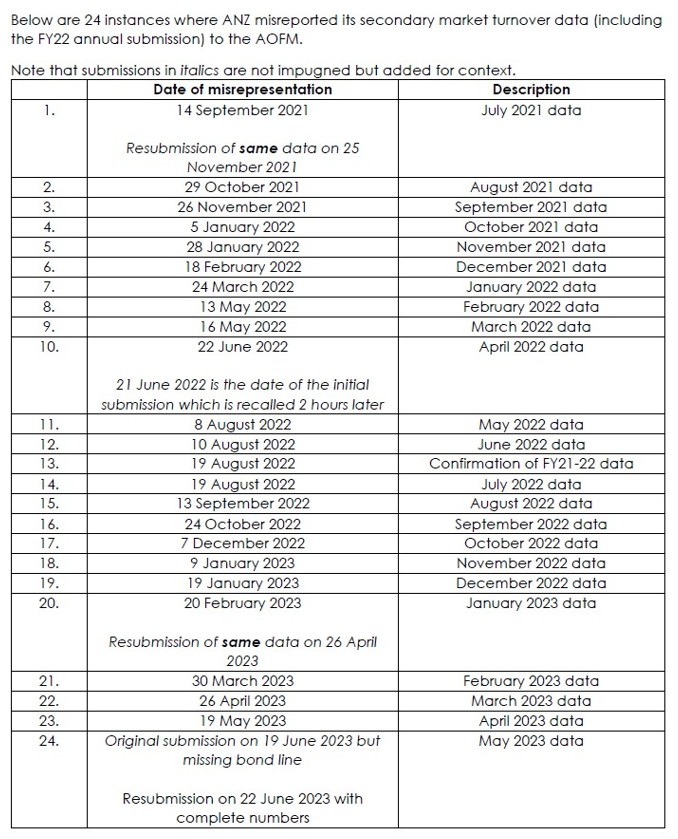
157 Further, the following tables set out the total monthly turnover data for July 2021 to May 2023 submitted by ANZ to the AOFM and the variance of that data from what should have been accurately reported to the AOFM. The table also shows the proportion of that variance which comprised primary market transactions involving the purchase of Treasury bonds by ANZ from the AOFM which were explicitly excluded by the AOFM’s instructions, and associated internal trades related to the transfer of those Treasury bonds between ANZ trading books. These primary market transactions and associated internal trades were incorrectly reported as secondary market turnover, largely as turnover with clients in the “other domestic” category and a small amount in the “interbank” category.
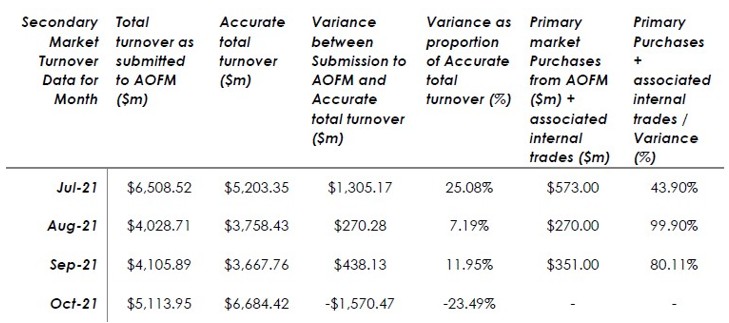
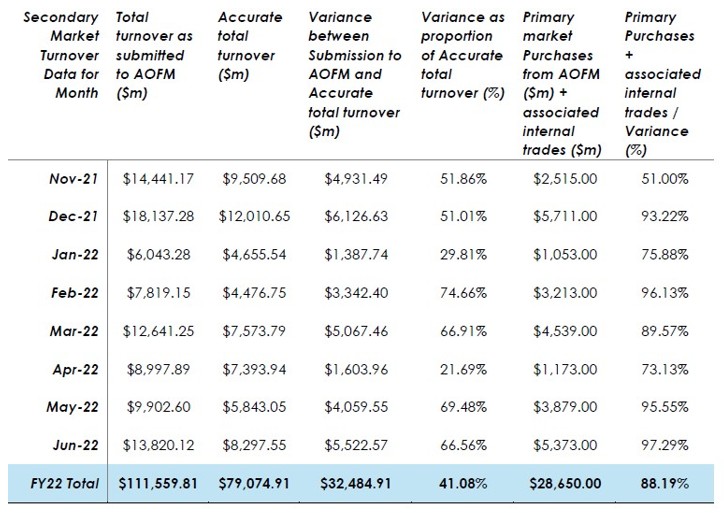
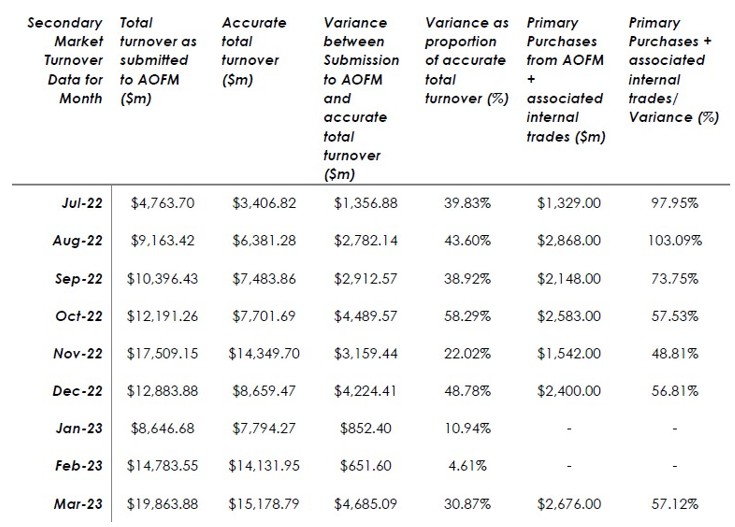
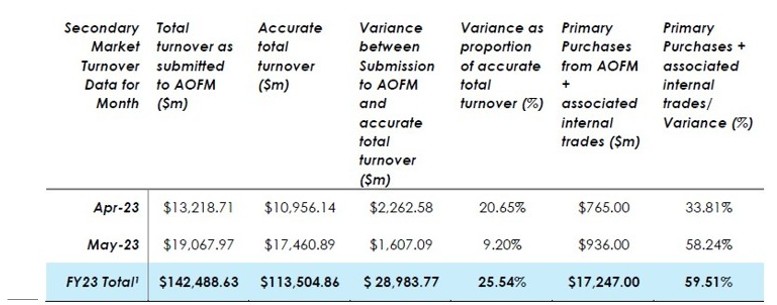
158 Each of ANZ’s representations to the AOFM referred to, and the turnover reported (as indicated in the columns entitled “Total turnover as submitted to AOFM ($m)”) above, thereby materially misstated the value of ANZ’s secondary turnover, including the counterparties and geographic locations for such trading, and were false or misleading.
159 The inaccuracies in the statements about secondary market bond turnover provided by ANZ to the AOFM as set out above were not intentional.
160 The monthly data for July 2021 was sent to the AOFM by FOS India after receiving approval from the associate Rates Trader.
161 The monthly data for August 2021 to December 2021, and also February 2022, were sent to the AOFM by FOS India after receiving approval from Mr Ravenscroft.
162 The monthly data for January 2022, and March 2022 to May 2023 were sent to the AOFM by FOS India after receiving approval from another associate Rates Trader.
163 The primary market transactions and associated internal trades did not represent secondary market bond turnover and should not have been reported to the AOFM as secondary market turnover.
164 Since the identification of inaccuracies in the secondary market turnover data reported to the AOFM, ANZ has taken the following steps.
165 First, ANZ has engaged with the AOFM regarding its reporting requirements, including receiving updated guidance from the AOFM which clarified aspects of its reporting requirements; stated that there was no requirement to amend historical data; recognised that categorisation may be complex; and requested that data be submitted on a best endeavours basis.
166 Second, ANZ has uplifted the reporting tools and governance to correct for the errors identified.
167 Third, ANZ has developed a secondary reporting tool for validation purposes and enhanced the governance of the data sign-off process, which now requires sign-off from the Markets Chief Operating Officer.
168 Fourth, ANZ has undertaken an internal review of the data submitted to the AOFM using the uplifted reporting tools and engaged an external consultant to validate the findings of its internal review.
169 Fifth, ANZ’s Internal Audit team has been engaged to review the design and operational effectiveness of ANZ’s enhanced AOFM data governance and control framework.
Summary
170 So, between 14 September 2021 and 22 June 2023, ANZ provided to the AOFM monthly reports about ANZ’s secondary market bond turnover for the period from July 2021 to May 2023. Each report contained a representation that ANZ’s total monthly secondary market turnover in Treasury bonds was a certain amount for that month and that the turnover attributable to certain counterparties and geographic locations was a certain amount for that month.
171 In each of the monthly reports to the AOFM for the period from July 2021 to May 2023, ANZ materially misstated the value of its secondary market bond turnover for that month and the turnover attributable to certain counterparties and geographic locations for that month.
172 Each of these monthly reports therefore conveyed a false or misleading representation in contravention of s 12DB(1)(a) of the ASIC Act, and constituted misleading or deceptive conduct in contravention of s 1041H of the Corporations Act.
173 In each of the monthly reports to the AOFM, except for October 2021, January 2023 and February 2023, ANZ incorrectly reported primary market transactions, that is, transactions with the AOFM which the AOFM expressly instructed ANZ to exclude, and associated internal trades as secondary market bond turnover. And by way of example, the accurate value for ANZ’s total secondary market bond turnover for July 2021 was $5,203.35 million, whilst the value which ANZ submitted to the AOFM was $6,508.52 million, representing an overstatement of 25.08%. A part of that overstatement was the inclusion in ANZ’s submission value of $573 million of primary market purchases from the AOFM.
174 Further, on 12 August 2022, the AOFM sent ANZ a spreadsheet collating ANZ’s monthly submissions as to its secondary market bond turnover in financial year 2022 and requested that ANZ “have a senior sales or trading personnel, or a compliance staff member” review and confirm the accuracy of that data by 19 August 2022.
175 On 19 August 2022, ANZ responded that it “confirm[ed] the accuracy of this data”. By submitting this response, ANZ represented to the AOFM that the secondary market bond turnover data for FY2021-22 that ANZ had previously provided was accurate. That representation was false or misleading: ANZ represented to the AOFM that its total turnover for that financial year was $111,560 million, while the true value was $79,075 million, being an overstatement of 41.08%.
176 Contrary to the AOFM’s request, no senior sales or trading personnel, or compliance staff members, were involved in ANZ’s review to confirm the accuracy of the data.
177 In July 2023, in the process of preparing the survey data for the month of June 2023, a Sydney Rates Trader at ANZ identified that survey data previously submitted to the AOFM contained significant inaccuracies. On 15 August 2023, ANZ submitted revised reports to the AOFM for each of the months in financial year 2023.
178 It is not in dispute that the representations as to ANZ’s secondary market bond turnover were representations that the services, being ANZ’s financial services, were “of a particular standard, quality, value or grade” for the purposes of s 12DB(1)(a).
179 Finally, the parties have proceeded on the basis that ANZ did not intend to be inaccurate in the secondary market bond turnover figures reported.
Failure to comply with breach reporting obligations (s 912DAA)
180 ANZ admits that it contravened ss 912DAA(1) and 912DAA(7) of the Corporations Act by failing, in the period from 13 September 2023 to 6 June 2024, to lodge with ASIC a report in relation to a reportable situation, in contravention of s 912DAA, in circumstances where ANZ had reasonable grounds to believe that it had breached a core obligation, and that the breach was significant.
181 At all material times, ss 912DAA(1), (3) and (7) provided:
Obligation to lodge a report—reportable situations in relation to the financial services licensee
Reporting a reportable situation to ASIC
(1) If there are reasonable grounds to believe that a reportable situation has arisen in relation to a financial services licensee:
(a) the financial services licensee must lodge a report in relation to the reportable situation with ASIC; and
(b) the report must be lodged in accordance with this section.
…
Period within which report must be lodged
(3) The report must be lodged with ASIC within 30 days after the financial services licensee first knows that, or is reckless with respect to whether, there are reasonable grounds to believe the reportable situation has arisen.
…
Civil penalty provision
(7) A person contravenes this subsection if the person contravenes subsection (1).
182 The report must be lodged with ASIC within 30 days after the financial services licensee first knows that, or is reckless with respect to whether, there are reasonable grounds to believe the reportable situation has arisen (s 912DAA(3)).
183 The term “reportable situation” is defined in s 912D which provides:
912D Meaning of reportable situation
(1) There is a reportable situation in relation to a financial services licensee if one of the following paragraphs is satisfied:
(a) the financial services licensee or a representative of the financial services licensee has breached a core obligation and the breach is significant;
(b) the financial services licensee or a representative of the financial services licensee is no longer able to comply with a core obligation and the breach, if it occurs, will be significant;
(c) the financial services licensee or a representative of the financial services licensee conducts an investigation into whether there is a reportable situation of the kind mentioned in paragraph (a) or (b) and the investigation continues for more than 30 days;
(d) an investigation described in paragraph (c) discloses that there is no reportable situation of the kind mentioned in paragraph (a) or (b).
(2) There is also a reportable situation in relation to a financial services licensee if:
(a) in the course of providing a financial service, the financial services licensee or a representative of the financial services licensee has engaged in conduct constituting gross negligence; or
(b) the financial services licensee or a representative of the financial services licensee has committed serious fraud; or
(c) any other circumstances prescribed by the regulations for the purposes of this paragraph exist.
(3) Each of the following is a core obligation:
(a) an obligation under section 912A or 912B, other than the obligation under paragraph 912A(1)(c);
(b) the obligation under paragraph 912A(1)(c), so far as it relates to provisions of this Act or the ASIC Act referred to in paragraphs (a), (b), (c) and (d) of the definition of financial services law in section 761A;
(c) in relation to financial services, other than traditional trustee company services provided by a licensed trustee company—the obligation under paragraph 912A(1)(c), so far as it relates to Commonwealth legislation that is covered by paragraph (e) of that definition and that is specified in regulations made for the purposes of this paragraph;
…
(4) For the purposes of this section, a breach of a core obligation is taken to be significant if:
(a) …
(b) the breach is constituted by the contravention of a civil penalty provision under any law, other than a civil penalty provision prescribed by the regulations for the purposes of this paragraph; or
(c) the breach is constituted by a contravention of subsection 1041H(1) of this Act or subsection 12DA(1) of the ASIC Act (misleading or deceptive conduct in relation to a financial product or a financial service); or
(d) …
(e) any other circumstances prescribed by the regulations for the purposes of this paragraph exist.
(5) Otherwise, for the purposes of this section, a breach of a core obligation is significant having regard to the following:
(a) the number or frequency of similar breaches;
(b) the impact of the breach on the financial services licensee’s ability to provide financial services covered by the licence;
(c) the extent to which the breach indicates that the financial services licensee’s arrangements to ensure compliance with those obligations are inadequate;
(d) any other matters prescribed by regulations made for the purposes of this paragraph.
(6) Regulations for the purposes of paragraph (4)(b) may prescribe a civil penalty provision to the extent that it relates to the following:
(a) contraventions of specified provisions;
(b) specified matters.
184 O’Callaghan J recently helpfully summarised these provisions in Australian Securities and Investments Commission v United Super Pty Ltd [2025] FCA 1453 in the following terms (at [39] to [42]):
A reportable situation relevantly arises if:
(a) the licensee or a representative of a licensee has breached or is likely to breach a core obligation, and the breach is significant; or
(b) the licensee or a representative of the licensee conducts an investigation into whether there is a breach of a core obligation and the investigation continues for more than 30 days.
Section 912D(3)(a) of the Corporations Act provides that each of a licensee’s obligations under s 912A(1)(a) is a “core obligation”.
Under s 912D(4)(b), (4)(d)(ii) and (5) of the Corporations Act, a breach of a core obligation will be “significant” if:
(a) the breach is a contravention of a civil penalty provision under any law (other than a civil penalty provision specifically prescribed by regulation as an exception);
(b) the breach results, or is likely to result, in material loss or damage to a member or members of a superannuation entity; or
(c) the breach is determined to be significant having regard to:
(i) the number and frequency of similar breaches;
(ii) the impact of the breach on the licensee’s ability to provide financial services covered by the licence;
(iii) the extent to which the breach indicates that the licensee’s arrangements to ensure compliance with its obligations are inadequate; and
(iv) any other matters prescribed by regulation.
In Australian Securities and Investments Commission v Mariner Corporation Ltd (2015) 241 FCR 502 at 552–553 [261], Beach J considered the term “recklessness” in the civil context, as follows:
At the least, what must be shown is some awareness of the risk and indifference or “not caring” as to the risk or its consequences. Recklessness is an actual advertence to risk but a conscious disregard of or indifference to the risk. Contrastingly, negligence or carelessness is where there may be no advertence to or conscious awareness of the risk at all. Accordingly, it is necessary for ASIC to establish that Mariner was aware of a substantial risk that the result identified by s 631(2)(b) would occur and that, on what was known to Mariner, it was unjustifiable to take that risk or it went ahead in conscious disregard of or indifference to the risk.
185 So, a reportable situation arises if the AFSL holder has breached a “core obligation” and the breach is “significant”: s 912D(1)(a). The obligation on an AFSL holder to comply with the financial services laws imposed by s 912A(1)(c), insofar as it imposes an obligation to comply with the prohibitions on misleading or deceptive conduct in contravention of s 1041H of the Corporations Act and the making of false or misleading representations in contravention of s 12DB of the ASIC Act, is relevantly a core obligation (s 912D(3)(b)). Section 1041H of the Corporations Act and s 12DB of the ASIC Act are “financial services laws” within the meaning of paragraphs (a) and (d) respectively of the definition of “financial services law” in s 761A of the Corporations Act.
186 Similarly, a breach is significant where it is constituted by a contravention of s 1041H of the Corporations Act (s 912D(4)(c)), and where it is constituted by the contravention of a civil penalty provision, as s 12DB of the ASIC Act is (s 912D(4)(b)).
187 Accordingly, once there were reasonable grounds for ANZ to believe that it had contravened s 1041H of the Corporations Act and s 12DB of the ASIC Act by submitting to the AOFM materially misleading reports as to its secondary market bond turnover, ANZ was under an obligation to lodge a report in accordance with the 30-day time period specified in s 912DAA(3).
188 By no later than 15 August 2023, there were reasonable grounds for ANZ to believe that the reportable situation referred to had arisen.
Contravention of s 912A of the Corporations Act
189 ANZ admits that it contravened ss 912A(1) and (5A) of the Corporations Act by failing, in the period from 14 September 2021 to 15 August 2023, to comply with its general obligations as an AFS licensee, in several respects. Before proceeding further, let me address the provisions and some relevant principles.
190 At all material times, ss 912A(1) and (5A) relevantly provided:
General obligations
General obligations
(1) A financial services licensee must:
(a) do all things necessary to ensure that the financial services covered by the licence are provided efficiently, honestly and fairly; and
…
(ca) take reasonable steps to ensure that its representatives comply with the financial services laws [subject to exceptions not presently relevant];
…
(f) ensure that its representatives are adequately trained (including by complying with the CPD provisions), and are competent, to provide those financial services…
…
Civil penalty provision
(5A) A person contravenes this subsection if the person contravenes paragraph (1)(a), (aa), (ca), (cc), (d), (e), (f), (g), (h) or (j).
191 ANZ was a holder of an AFSL so as to make it a financial services licensee for the purposes of the chapeau to s 912A(1).
192 Now as to s 912A(1)(a), in Australian Securities and Investments Commission v AGM Markets Pty Ltd (in liq) (No 3) (2020) 275 FCR 57; [2020] FCA 208, I said (at [505] to [512] and [520] to [528]):
Now in reaching this conclusion I have applied the following principles concerning s 912A(1)(a) elucidated in Australian Securities and Investments Commission v Camelot Derivatives Pty Ltd (in liq) (2012) 88 ACSR 206 at [69] per Foster J which I restated in Australian Securities and Investments Commission v Westpac Banking Corporation (No 2) (2018) 266 FCR 147 at [2347]-[2350].
First, the words “efficiently, honestly and fairly” are to be read as a compendious indication requiring a licensee to go about their duties efficiently having regard to the dictates of honesty and fairness, honestly having regard to the dictates of efficiency and fairness, and fairly having regard to the dictates of efficiency and honesty.
Second, the words “efficiently, honestly and fairly” connote a requirement of competence in providing advice and in complying with relevant statutory obligations. They also connote an element not just of even handedness in dealing with clients but a less readily defined concept of sound ethical values and judgment in matters relevant to a client’s affairs. I have emphasised here the notion of connotation rather than denotation to make the obvious point that the boundaries and content of the phrase or its various elements are incapable of clear or exhaustive definition.
Third, the word “efficient” refers to a person who performs his duties efficiently, meaning the person is adequate in performance, produces the desired effect, is capable, competent and adequate. Inefficiency may be established by demonstrating that the performance of a licensee’s functions falls short of the reasonable standard of performance by a dealer that the public is entitled to expect.
Fourth, it is not necessary to establish dishonesty in the criminal sense. The word “honestly” may comprehend conduct which is not criminal but which is morally wrong in a commercial sense.
Fifth, the word “honestly” when used in conjunction with the word “fairly” tends to give the flavour of a person who not only is not dishonest, but also a person who is ethically sound.
These observations are consistent with the express object of Ch 7 of the Corporations Act set out in s 760A as follows:
The main object of this Chapter is to promote:
(a) confident and informed decision making by consumers of financial products and services while facilitating efficiency, flexibility and innovation in the provision of those products and services; and
(b) fairness, honesty and professionalism by those who provide financial services; and
(c) fair, orderly and transparent markets for financial products; and
(d) the reduction of systemic risk and the provision of fair and effective services by clearing and settlement facilities.
Further, it is also not in doubt that a contravention of the “efficiently, honestly and fairly” standard does not require a contravention or breach of a separately existing legal duty or obligation, whether statutory, fiduciary, common law or otherwise. The statutory standard itself is the source of the obligation.
…
Let me say something about “fairly”. Judges applying s 912A(1)(a) have usually not sought to define “fairly” except to explain its structural setting in the composite phrase. This is unsurprising. And of course no dictionary definition could be adequate for the task given the intrinsic circularity with such definitions. For example, take the Macquarie Dictionary definition. First, the concept of “free from injustice” is question begging and conclusionary. It adds little to elucidate “fairly”. Second, the phase “that which is legitimately sought, pursued, done, given etc.” is also question begging. No content is given to what is legitimate. There is irremediable circularity unless legitimacy simply incorporates other statutory or common law/equitable normative standards of behaviour. Third, the phrase “proper under the rules” is also devoid of content unless “proper” means “in compliance with”. Fourth, if one construes “fair” to include “free from dishonesty”, then this all just suggests that the phrase “efficiently, honestly and fairly” should be read compendiously.
Could you convincingly define “fairly” by what it lacks? To say that fairly means free from bias, free from dishonesty, etc, is to stipulate necessary negative conditions. And to do so may give you some boundary conditions. But no positive conditions are stipulated. No content is given, let alone sufficient conditions. But to stipulate negative conditions may not be unhelpful.
Should “fairly” only be viewed from the perspective of an investor, borrower or other person interacting with the licensee? No. Fairness is to be judged having regard to the interests of both parties. Other statutory provisions may be designed to tilt the scales, but not s 912A(1)(a) and the statutory composite norm it enshrines. Disproportionate emphasis should not be given to what is the third part of a composite phrase in a manner which creates unsatisfactory asymmetry in favour of those with whom the licensee deals. This section is not a back door into an “act in the [best] interests of” obligation. Other specific provisions of the Act nicely fulfil that role. There is nothing to indicate that s 912A(1)(a) was to have that bias.
Finally, it ought not to be forgotten that s 912A(1)(a) is principally a licensee disciplinary command such that a breach thereof might sound in revocation of the AFSL, conditions being imposed on the AFSL or a pecuniary penalty being imposed. But that context gives rise to three points.
First, in such a context one would expect that the normative standard would be suitably vague and flexible. This is common when dealing with the stipulated standard of behaviour expected of licensees or regulated persons in a wide variety of contexts. But that does not invite conceptual inflation.
Second, one is looking at the licensee’s behaviour more generally rather than with regard to any one person. After all, s 912A(1)(a) is expressed:
(1) A financial services licensee must:
(a) do all things necessary to ensure that the financial services covered by the licence are provided efficiently, honestly and fairly; …
The language is in the generality of “the financial services covered by the licence”.
Third, and relatedly, one is not at all concerned to ascertain the boundaries and content of a cause of action or an element thereof sounding in damages in favour of an individual (cf claims for misleading or deceptive conduct or statutory unconscionability).
In summary, in my view it is not justifiable to take one word from a composite phrase, artificially elevate its significance and read it in a manner asymmetrically in favour of an investor.
193 There is no good reason not to apply these observations.
194 Clearly, s 912A(1)(a) does not require dishonesty in the traditional or criminal sense. A finding of contravention is determined by reference to objective circumstances. Accordingly, a contravention may be made out even though it is not shown that the contravener engaged in an intentional wrong.
195 And neither does a contravention of the “efficiently, honestly and fairly” standard require a contravention of a separately existing legal duty or obligation, whether statutory, fiduciary, common law or otherwise. The statutory standard itself is the source of the obligation.
196 The words “efficiently, honestly and fairly” must be read as a compendium describing a person who goes about their duties efficiently having regard to the dictates of honesty and fairness, honestly having regard to the dictates of efficiency and fairness, and fairly having regard to the dictates of efficiency and honesty.
197 Now in Australian Securities and Investments Commission v Westpac Securities Administration Ltd (2019) 272 FCR 170, the Full Court considered an appeal from a finding of a contravention of s 912A(1)(a) by Westpac. In this regard I said in ASIC v AGM (No 3) (at [513] to [519]):
On the question of the proper construction of s 912A(1)(a), my attention has been drawn to various observations made by the Full Court in Australian Securities and Investments Commission v Westpac Securities Administration Ltd that I discussed earlier in the context of financial product advice. But several points should be noted.
First, before the trial judge, Westpac did not question the statements of principle propounded by ASIC which in essence applied the principles discussed by Foster J.
Second, ASIC’s three appeal grounds in that matter rather concerned s 766B(3); ASIC’s notice of appeal was tendered before me in order to properly identify the s 766B(3) points that had been raised and that I have discussed earlier in my reasons. Further, to the extent that s 912A(1)(a) was raised by Westpac on any cross-appeal, as I say the parties’ positions on construction seem to have been in substance as before the trial judge.
Third, some members of the Full Court queried whether the phrase “efficiently, honestly and fairly” should be read compendiously (O’Bryan J at [422]-[426]). But as this was not decided by at least a majority, I am bound to apply the single judge decisions unless I consider them to be plainly wrong, which I do not.
Fourth, Allsop CJ said (at [172]):
Words such as “efficiently”, “honestly” and “fairly” and a composite or compendious phrase or expression such as “efficiently, honestly and fairly” do not admit of comprehensive definition. Certainly a degree of articulation of instances or examples of conduct failing to satisfy the phrase will be helpful and of guidance, as will an articulation or description of the norms involved.
With respect, I agree with that statement. He then went on to say (at [173]):
The provision is part of the statute’s legislative policy to require social and commercial norms or standards of behaviour to be adhered to. The rule in the section is directed to a social and commercial norm, expressed as an abstraction, but nevertheless an abstraction to be directed to the “infinite variety of human conduct revealed by the evidence in one case after another.” (See Gummow WMC, “The Common Law and Statute” in Change and Continuity: Statute, Equity and Federalism (Oxford University Press, 1999) at 18-19.)
Now neither Jagot J nor O’Bryan J went so far. With respect, I prefer to view s 912A(1)(a) as enshrining a statutory norm to be read conformably with s 760A and the other provisions of the Corporations Act and the ASIC Act, of course to be applied to an infinite variety of corporate delinquency and self-interested commerciality. But to say this is not to deny that it may implicitly pick up some aspects of what some might identify as social and commercial norms, although reasonable minds might differ as to where to ground such an otherwise free-floating concept.
198 It is not necessary for me to discuss further the obiter reservations on the subject in ASIC v Westpac Securities. I am bound to apply the numerous single judge decisions to the effect that the expression is to be interpreted compendiously unless I consider that they are plainly wrong, which I do not. Indeed, and with respect to the contrary views of others, I consider the single judge decisions to be correct. And this is now more so given that the provision has civil penalties attached. If there was any ambiguity in s 912A(1)(a), which there is not, it should be read in favour of a compendious approach, with its integers read as reflected in the single judge decisions.
199 Further, s 912A(1)(ca) imposes an obligation on a financial services licensee to “take reasonable steps to ensure that its representatives comply with the financial services laws”. The term “financial services laws” is defined in s 761A of the Corporations Act in a manner that includes the prohibitions on unconscionable conduct in s 12CB of the ASIC Act, misleading or deceptive conduct in s 1041H of the Corporations Act, and false or misleading representations in s 12DB of the ASIC Act.
200 What steps are reasonable will depend on the nature of the obligation to be complied with and the circumstances of the licensee. The obligation on a financial services licensee to “take reasonable steps to ensure” compliance mirrors the obligation on a licensee imposed by s 961L; see also s 963F.
201 Section 912A(1)(ca) imposes an obligation to establish an adequate system for the supervision of representatives, as well as policies and procedures that are designed to address identified or reasonably identifiable risks of non-compliant conduct by representatives.
202 It is not necessary to say anything separately concerning s 912A(1)(f).
Breaches of ss 912A(1)(a), (ca) and (f) in respect of bond issuance
203 ANZ admits that between 19 April 2023 and 3 May 2023, ANZ did not do all things necessary to ensure that the financial services covered by its AFSL were provided efficiently, honestly and fairly: (a) by engaging in conduct in connection with the supply of financial services to the AOFM relating to the issuance of the December 2034 Treasury bonds that was, in all the circumstances, unconscionable; (b) by providing reports to the AOFM between 20 April 2023 and 3 May 2023 which were misleading or deceptive in describing, or were misleading or deceptive by omission in respect of, ANZ’s trading activities as duration manager for the December 2034 Treasury bond issuance; (c) by failing to adequately prevent, supervise, monitor, review or identify the admitted unconscionable and misleading conduct and despite ANZ undertaking its own surveillance of that conduct; and (d) by failing to adequately implement or enforce its policies and procedures regarding material size transactions, reference price transactions and communications with clients.
204 Further, ANZ admits that between 19 April 2023 and 3 May 2023, ANZ did not take reasonable steps to ensure that its representatives complied with the financial services laws in connection with ANZ’s conduct as duration manager for the issuance of December 2034 Treasury bonds. Specifically, ANZ admits that it failed to take reasonable steps to prevent the conduct referred to in the SAFA, to adequately supervise and monitor its representatives as referred to in the SAFA, or to prevent its representatives from providing reports which were misleading or deceptive as described in the SAFA.
205 Further, ANZ admits that between 19 April 2023 and 3 May 2023, ANZ did not ensure its representatives were adequately trained and competent to provide financial services to the AOFM in connection with ANZ’s role as duration manager for the issuance of December 2034 Treasury bonds. ANZ accepts that this is demonstrated by the conduct of ANZ’s representatives referred to in the SAFA.
Breaches of ss 912A(1)(a), (ca) and (f) in respect of reporting secondary market bond turnover
206 ANZ admits that between 14 September 2021 and 15 August 2023, ANZ did not do all things necessary to ensure that the financial services covered by its AFSL were provided efficiently, honestly and fairly, by reason of: (a) making the representations to the AOFM about its secondary market bond turnover that were false or misleading; (b) engaging in misleading or deceptive conduct; (c) failing to have adequate processes and procedures in place to prepare, review and verify the secondary market bond turnover data being submitted to the AOFM to ensure that it was accurate; (d) failing to adequately monitor and supervise staff, to ensure that the secondary market bond turnover data was submitted to the AOFM accurately; (e) failing to ensure that staff who were responsible for the review and submission of the data were adequately trained or competent; (f) failing to conduct risk or assurance reviews of the processes and procedures to ensure that misleading information was not provided to the AOFM in connection with ANZ’s secondary market bond turnover data; and (g) failing to take adequate steps to identify and to address the root causes of the misreporting and failing to escalate the issue for further risk assessment and compliance review, even when the scale of the inaccuracies in the secondary market bond turnover data submitted by ANZ to the AOFM for FY23 was identified.
207 Further, ANZ admits that between 14 September 2021 and 15 August 2023, ANZ did not take reasonable steps to ensure that its representatives complied with the financial services laws in connection with ANZ’s reporting of secondary market bond turnover data to the AOFM. This failure to take reasonable steps included the matters identified in the SAFA.
208 Further, ANZ admits that between 14 September 2021 and 15 August 2023, ANZ did not ensure that its representatives were adequately trained, and were competent, to provide financial services in connection with ANZ’s reporting of secondary market bond turnover data to the AOFM.
Declaratory relief
209 At all material times, s 1317E of the Corporations Act has provided that:
(1) If a Court is satisfied that a person has contravened a civil penalty provision, the Court must make a declaration of contravention.
(2) The declaration must specify the following:
(a) the Court that made the declaration;
(b) the civil penalty provision that was contravened;
(c) the person who contravened the provision;
(d) the conduct that constituted the contravention;
…
(3) In this Act:
(a) a provision specified in column 1 of the following table is a civil penalty provision; …
210 Section 1317E of the Corporations Act provides that the Court must make a declaration of contravention if it is satisfied that a person has contravened one of its civil penalty provisions. Further, for conduct from 13 March 2019, s 12GBA of the ASIC Act has similarly provided that the Court must make a declaration of contravention if it is satisfied that a person has contravened one of its civil penalty provisions (see also ss 322 and 327).
211 Further, the Court also has power under s 1101B(1) of the Corporations Act to make ancillary orders, which includes declarations on the application of ASIC if a person has contravened a law relating to dealing in financial products or providing financial services or a provision in Chapter 7, provided that the proposed orders do not unfairly prejudice any person.
212 The Court has an almost unlimited discretionary power to make declarations under inter-alia s 21 of the FCA Act, which “[i]t is neither possible nor desirable to fetter … by laying down rules as to the manner of its exercise” (Forster v Jododex Australia Pty Ltd (1972) 127 CLR 421 at 437 per Gibbs J). The only limit on the power itself is that it must fit within the boundaries and content of judicial power, providing of course that there is a “matter” before the Court within which the power is sought to be exercised.
213 That being so, it naturally follows that before making declarations, three requirements should usually be satisfied being, first, there must be a real controversy, as opposed to a hypothetical or theoretical question, second, the applicant must have a real interest in raising the question and, third, there must be a proper contradictor. Clearly these conditions are satisfied here.
214 Further, there is a utility in declarations which set out the particular liability found and the basis for penalties ordered. Declarations are appropriate to record the Court’s disapproval of the conduct and satisfy in part the objective of general deterrence.
The fixing of pecuniary penalties
215 As to the proper approach to civil penalty orders which are sought on an agreed basis, there is an “important public policy involved in promoting predictability of outcome in civil penalty proceedings” which “assists in avoiding lengthy and complex litigation and thus tends to free the courts to deal with other matters and to free investigating officers to turn to other areas of investigation that await their attention” as the plurality said in Commonwealth v Director, Fair Work Building Industry Inspectorate (2015) 258 CLR 482 at [46].
216 As a result, there is generally “very considerable scope” for the parties to civil proceedings to agree upon the appropriate remedy and for the court to be persuaded that it is an appropriate remedy (at [57]).
217 Their Honours went on to state (at [58]):
Subject to the court being sufficiently persuaded of the accuracy of the parties' agreement as to facts and consequences, and that the penalty which the parties propose is an appropriate remedy in the circumstances thus revealed, it is consistent with principle and … highly desirable in practice for the court to accept the parties' proposal and therefore impose the proposed penalty. (original emphasis)
218 A further reason for courts acting upon such submissions is that they are advanced by a specialist regulator able to offer “informed submissions as to the effects of contravention on the industry and the level of penalty necessary to achieve compliance” (at [60]), albeit that such submissions will be considered on the merits in the ordinary way (at [61]).
219 Further, where the parties to a civil penalty proceeding have settled that proceeding and agreed and jointly proposed a penalty to the Court, the following observations made by Wigney, Beach and O’Bryan JJ in Volkswagen Aktiengesellschaft v Australian Competition and Consumer Commission (2021) 284 FCR 24 at [125] to [129] are pertinent:
First, the Court must be persuaded that the penalty proposed by the parties is appropriate: Fair Work at [57]. The agreement of the parties cannot bind the Court in any circumstances to impose a penalty which it does not consider to be appropriate.
Second, if the Court is persuaded of the accuracy of the parties’ agreement as to facts and consequences, and that the agreed penalty jointly proposed is an appropriate remedy in all the circumstances, it would be highly desirable in practice for the Court to accept the parties’ proposal and therefore impose the proposed penalty: Fair Work at [58]. The desirability of the Court accepting a proposed agreed penalty which it is persuaded is an appropriate penalty derives primarily from a public policy consideration; the promotion of predictability of outcome in civil penalty proceedings: Fair Work at [46]. Predictability of outcome encourages corporations to acknowledge contraventions, which, in turn, assists in avoiding lengthy and complex litigation. It should be emphasised, however, that this public policy consideration is but one of the relevant considerations to which the Court must have regard and, more significantly, it cannot override the statutory directive for the Court to impose a penalty that is determined to be appropriate.
Third, in considering whether the agreed and jointly proposed penalty is an appropriate penalty, it is necessary to bear in mind that there is no single appropriate penalty. Rather, there is a permissible range of penalties within which no particular figure can necessarily be said to be more appropriate than another. The permissible range is determined by all the relevant facts and consequences of the contravention and the contravener’s circumstances. An agreed and jointly proposed penalty may be considered to be “an” appropriate penalty if it falls within that permissible range: NW Frozen Foods at 290-291; Mobil Oil at 48,625-48,626; [47], [51]. It is unlikely to be considered an appropriate penalty if it falls outside that range.
It should be emphasised in this context, however, that even though the process in determining whether an agreed and jointly proposed penalty is an appropriate penalty involves or includes determining whether that penalty falls within the permissible range of penalties, having regard to all the relevant facts and circumstances, it does not follow that the Court's task can be said to amount to no more than determining whether the proposed penalty falls within the permissible range, as the Commission’s submission tended to suggest. Nor can it be said that the Court is bound to start with the proposed penalty and to then limit itself to considering whether that penalty is within the permissible range: Mobil Oil at 48,627; [54].
Fourth, in considering whether the proposed agreed penalty is an appropriate penalty, the Court should generally recognise that the agreed penalty is most likely the result of compromise and pragmatism on the part of the regulator, and to reflect, amongst other things, the regulator’s considered estimation of the penalty necessary to achieve deterrence and the risks and expense of the litigation had it not been settled: Fair Work at [109]. The fact that the agreed penalty is likely to be the product of compromise and pragmatism also informs the Court’s task when faced with a proposed agreed penalty. The regulator’s submissions, or joint submissions, must be assessed on their merits, and the Court must be wary of the possibility that the agreed penalty may be the product of the regulator having been too pragmatic in reaching the settlement: Fair Work at [110].
220 The following provisions confer power upon the Court to impose pecuniary penalties. For a contravention of a civil penalty provision of the Corporations Act, s 1317G confers the necessary power. And for a contravention of s 12CB or s 12DB of the ASIC Act, s 12GBB confers the necessary power.
221 The relevant statutes set out matters to which the Court must have regard in determining an appropriate pecuniary penalty: see s 1317G(6) of the Corporations Act and s 12GBB(5) of the ASIC Act. In addition, the authorities have identified various factors which inform the assessment of a penalty of appropriate deterrent value in addition to or overlapping with those mandatory factors. Not all factors that have been identified in the cases will necessarily be relevant or important in every case, and they should not be approached as a rigid catalogue or checklist: Australian Building and Construction Commissioner v Pattinson (2022) 274 CLR 450 at [18] and [19].
222 The parties have proposed a pecuniary penalty pursuant to s 1317G(1) and s 12GBB(3) of the ASIC Act in a total amount of $125 million comprising the following break-down.
223 First, an amount of $85 million on account of ANZ’s conduct in connection with the bond issuance, of which $80 million is on account of ANZ’s breach of s 12CB of the ASIC Act and $5 million is on account of ANZ’s breach of s 912A of the Corporations Act.
224 Second, an amount of $40 million on account of ANZ’s conduct in connection with the secondary market bond turnover reporting, of which $30 million is on account of ANZ’s contraventions of s 12DB of the ASIC Act, $2 million is on account of ANZ’s contravention of s 912DAA and $8 million is on account of ANZ’s contravention of s 912A.
225 Now I have accepted the agreed penalty in total of $85 million in terms of the bond issuance as an appropriate penalty. But I have not accepted the agreed penalty in terms of the secondary market bond turnover reporting. I have increased it to $50 million in total, with the s 12DB contraventions increased to $40 million from $30 million; the other components will remain the same. It is not necessary to further segment the penalties concerning each s 12DB contravention, although one can do this easily by dividing $40 million by the number of individual contraventions, assuming an equal weighting for each which seems reasonable.
226 So, the total amount is increased for both aspects of the relevant conduct from $125 million to $135 million.
227 Now the penalties that I will impose, individually and in aggregate, are necessary to impose the necessary “sting or burden” to secure “the specific and general deterrent effects that are the raison d’être of its imposition”: Australian Building and Construction Commissioner v Construction, Forestry, Mining and Energy Union (2018) 262 CLR 157 at [116] per Keane, Nettle and Gordon JJ.
Maximum penalty
228 At all relevant times, ss 12CB(1) and 12DB(1) of the ASIC Act and ss 912A(5A) and 912DAA(7) of the Corporations Act were civil penalty provisions.
229 The Treasury Laws Amendment (Strengthening Corporate and Financial Sector Penalties) Act 2019 (Cth) substantially increased penalties for breaches of civil penalty provisions in the Corporations Act and the ASIC Act. For contraventions arising from conduct which was wholly on or after 13 March 2019, the maximum penalty for such a contravention by a body corporate was increased to the higher of 50,000 penalty units, 3 times the benefit derived or detriment avoided, or 10% of annual turnover (capped at 2.5 million penalty units); see at s 2(1) item 2, Schedule 1 s 117 and Schedule 2 s 8. For each contravention, the largest of those is 10% of ANZ’s annual turnover.
230 Therefore, when penalty units are used, the maximum civil penalty for a single contravention of the relevant civil penalty provisions is 2.5 million penalty units.
231 The value of a penalty unit is set by s 4AA of the Crimes Act 1914 (Cth). It was set at $222 from 1 July 2020 to 31 December 2022, $275 from 1 January 2023 to 30 June 2023, and $313 from 1 July 2023 to 6 November 2024.
232 Accordingly, depending on the date of the contravention, the maximum civil penalty for a single contravention of the relevant civil penalty provisions ranged from $555 million to $782.5 million. The theoretical total maximum penalty that could be imposed is $19.445 billion. It is not necessary to display the arithmetic.
233 In Pattinson, it was accepted that the statutory maximum penalty is “but one yardstick that ordinarily must be applied”, and must be treated “as one of a number of relevant factors” to inform the assessment of a penalty of appropriate value (at [54]). The Court rejected (at [49]) an approach by which the statutory maximum penalty was required to be reserved exclusively for the worst category of contravening conduct. It was further emphasised that there should be “some reasonable relationship between the theoretical maximum and the final penalty imposed” (at [55]), noting that the relationship of reasonableness could be established by reference to the circumstances of the contravener and the circumstances of the conduct involved in the contravention. Either set of circumstances may bear on the extent of the need for deterrence.
The bond issuance conduct
234 In respect of the bond issuance contraventions, and largely for the reasons advanced by the parties, I am satisfied that the proposed pecuniary penalties appropriately reflect the nature and extent of the contravening conduct, and the circumstances in which it occurred.
235 The contravening conduct occurred in circumstances where ANZ was acting as a duration manager in respect of a Treasury bond issuance, such that any downward price pressure at the time of pricing would reduce the amount the Commonwealth yielded by the issuing of the bonds.
236 Further, being appointed duration manager is considered prestigious and was seen as essential to ANZ being a market leader in the Australian bonds business, which leads to opportunities for securing additional mandates from semi-government issuers and attracting broader client business.
237 Whilst the duration manager was entitled and expected to engage in trading to hedge its risk, and the AOFM announced at the launch of the issuance that the duration manager may do so “before, during or after” pricing, that entitlement was not unconstrained. There existed an inherent conflict of interest. ANZ had represented to the AOFM that it would conduct itself transparently and hedge in a way which attempted to minimise market disruption, price volatility and price impact, stating that it would seek “to ensure as smooth and limited impact to the pricing of the proposed transaction” and “manage the risk in a way that is of the least impact to the market and we keep an open and consistent dialogue with both yourselves and myself and the trader who will be looking after the risk”. The AOFM reasonably expected that ANZ would do so. The same reasonable expectation underpinned the industry guidance and ANZ’s own policies which applied to ANZ’s conduct.
238 Yet, notwithstanding the prestigious nature of the role, the potential impact on the AOFM and in turn the Commonwealth and the expectations of its behaviour, ANZ did not act conscionably, did not act transparently, nor did it trade in the way in which it said it would but, to the contrary, it conducted its hedging in a manner which caused undue pricing pressure on the reference price product at the time of pricing.
239 The relevant traders held senior roles, respectively the Head of Rates Trading Australia, Markets and Co-Head of Fixed Income, Markets. Those same traders were involved in both the impugned trading and the inaccurate post-transaction reporting to the AOFM.
240 Senior markets risk personnel were aware of the bond issuance. Two Surveillance managers, along with various members of ANZ’s compliance, surveillance and risk teams, attended the segregated room to observe the trading. The Surveillance managers failed to prevent and detect the conduct (including that one of the relevant traders traded on the other trader’s account during the pricing call), despite being in the segregated room at the time. Nor did the Surveillance managers identify the inaccuracies in ANZ’s post-transaction reporting to the AOFM.
241 ANZ’s behaviour was particularly serious when coupled with ANZ’s inaccurate and incomplete statements to the AOFM in relation to the manner of its trading and behaviour as a duration manager, when post-completion of the issuance the AOFM expressed concern about the price at which the bond issuance had priced. ANZ’s post-completion conduct reveals a lack of candour and frankness about its trading.
242 Given the anonymous nature of the market in which ANZ was conducting its hedging, ANZ’s behaviour was not able to be detected by the AOFM at the time of pricing or anytime reasonably thereafter.
243 Further, in cases where the contravening conduct is concealed and not easily detected, deterrence (both general and specific) may justify a penalty that is many multiples of the profits made from the contravening conduct.
244 In Volkswagen at [152] it was said by Wigney, Beach and O’Bryan JJ:
Indeed, in cases where the contravening conduct is concealed and not easily detected, deterrence (both general and specific) may justify a penalty that is many multiples of the profits made from the contravening conduct. If the contravening conduct is concealed and the risk of detection is low, a penalty equivalent to or just exceeding the profits earned may be regarded by the contravener as “an acceptable cost of doing business” on a strict cost-benefit analysis because of the overall likelihood of financial gain from the conduct. That principle has been long recognised in the context of cartel contraventions, which are typically concealed and difficult to detect: see for example Australian Competition and Consumer Commission v J McPhee & Son (Australia) Pty Ltd (No 5) [1998] ATPR 41-628 at 40,891-40,892; Australian Competition and Consumer Commission v McMahon Services Pty Ltd [2004] ATPR 42-031 at 49,228; [15]; Australian Competition and Consumer Commission v Qantas Airways Ltd (2008) 253 ALR 89 at [21]-[24]; Australian Competition and Consumer Commission v PT Garuda Indonesia Ltd (2019) 370 ALR 637 at [126]. The principle is equally applicable in the context of contraventions of the Consumer Law that involve concealed conduct.
245 Volkswagen referred to Australian Competition and Consumer Commission v J McPhee & Son (Australia) Pty Ltd (No 5) [1998] FCA 310; [1998] ATPR 41-628, a case which provokes a sense of nostalgia, where Heerey J said, albeit concerning price fixing:
Deterrence is especially significant in relation to price-fixing. This form of contravention commonly occurs in secret and between parties who seek a mutual benefit. The risk of detection is often low and the potential gain to the contravenors, and damage to the community, large. Therefore the penalty needs to be correspondingly high. Moreover, where the contravention takes the form of an attempt at the making of a price-fixing arrangement, it needs to be remembered that most price-fixing must start with some form of contact, however discreet, with a competitor. Those minded to engage in price-fixing might be tempted to think that if an informal and subtle approach is made, the worst that can happen is a rebuff. A penalty should reflect the fact that an attempt at price-fixing is seriously unlawful conduct in itself.
246 Further, neither the surveillance review, nor the post-trade review by the market surveillance team which was also reviewed by ANZ’s compliance team, identified any concerns about ANZ’s trading, or the misleading statements and omissions in the post-transaction reporting to the AOFM.
The secondary market reporting conduct
247 Let me turn to the other aspect of the ANZ’s conduct concerning the secondary market bond turnover reporting.
248 Now here, in respect of the secondary market bond turnover reporting contraventions, I am satisfied that the pecuniary penalties which I intend to impose and which are higher than those proposed by the parties, appropriately reflect the nature and extent of the contravening conduct, and the circumstances in which it occurred.
249 As I have indicated, the AOFM performs a public function by issuing Treasury bonds to borrow money on behalf of the Commonwealth government. This is to ensure the Australian Government can meet its spending, investment and debt payment obligations. Clearly, the AOFM requires accurate information on secondary market activity to perform its functions properly. Such information allows the AOFM to assess and monitor trends in overall liquidity. It allows the AOFM to assess and monitor trends in turnover by reference to particular types of debt securities, and by reference to categories and geographic regions of the end investors. Such information assists the AOFM to assess secondary market turnover which is an important indicator of market liquidity in relation to debt securities, which the AOFM is responsible for issuing on behalf of the Australian Government.
250 Further, as I have already indicated, the secondary market bond turnover information allows the AOFM to assess particular market makers’ ability to distribute bonds to end investors. Indeed, a bank’s distribution capacity, as measured by its secondary market bond turnover, was one of the criteria which the AOFM used to appoint JLMs and duration managers. This was a matter of which ANZ was aware, even if ANZ subjectively perceived that the most important criteria was the level of support provided by a bank to the AOFM in primary tenders.
251 Further, the significance of accurate information as to secondary market activity in the survey was reflected in the conditions of operation which the AOFM imposed to be a registered bidder. ANZ represented and warranted to the AOFM that the information which it provided was complete and accurate.
252 But notwithstanding all of this, ANZ proceeded to provide substantially inaccurate responses to the AOFM’s monthly surveys which in most cases materially overstated the ANZ’s secondary market bond turnover over a sustained period.
253 Further, as has been pointed out, in respect of the data for the 2021-2022 financial year, the AOFM expressly requested that ANZ “have a senior sales or trading personnel, or a compliance staff member” review and confirm the accuracy of the data. As noted above, ANZ confirmed the accuracy of the data despite it being overstated by 41.08%, and without any relevant senior employee having reviewed the data. This occurred in circumstances where ANZ knew that the secondary market bond turnover data was one of the criteria which the AOFM used to appoint JLMs and duration managers.
254 Moreover, I view the ANZ’s contravening conduct over a sustained period concerning the secondary market bond turnover reporting to be both serious and very unsatisfactory.
255 In respect of the secondary market bond turnover reporting contraventions, ANZ’s own review of the root cause of the misreporting found that there was a lack of accountability at both management and execution levels and inadequate senior ownership of formal framework and governance arrangements.
256 The secondary market bond turnover data which was ultimately used in ANZ’s submissions to the AOFM was prepared by FOS India and reviewed mostly by junior team members of the Rates trading desk. No senior sales or trading personnel, or compliance staff members, were involved in the review to confirm the accuracy of the FY2021-22 data. That was so despite the AOFM’s express request that that occur and despite the junior team member sending an email to the Director, Debt Syndicate and others asking for assistance to verify the accuracy of the annual data, to which no assistance was provided before ANZ verified that data.
257 Further, ANZ’s lack of accountability at both management and execution levels and inadequate senior ownership of formal framework and governance arrangements meant that ANZ did not identify inaccuracies in the secondary bond turnover data submitted to the AOFM at an earlier point in time. This is in the following circumstances.
258 First, in July 2021, the Director, Debt Syndicate and the Head of Capital Markets were involved in discussions by email as to whether to include certain internal trades in submissions to the AOFM. The treatment of certain trades was not expressly addressed in the AOFM’s instructions, and a decision was made that certain ANZ trading books should be included on the basis that those internal trades reflected genuine price making by the Rates Trading desk traders for other ANZ books. However, in the course of considering the appropriate approach, there was an issue raised that those same trading books also included offsetting “back to back” internal trades. This issue was not resolved with the effect that at least some “back to back” internal trades were included in the majority of the monthly turnover submitted to the AOFM until June 2023. These “back to back” internal trades were not secondary market bond turnover.
259 Second, since at least February 2022, the Head of Capital Markets, the Head of Franchise Markets and the Managing Director of the Markets division were members of ANZ’s Markets senior leadership team. Over the same period as set out above, members of ANZ’s Markets senior leadership team and other senior staff from time to time reviewed ANZ’s rankings on various trading platforms for its secondary market activities in Treasury bonds.
260 Third, in May 2022, the Head of Franchise Markets and the Head of Capital Markets were initially assigned responsibility for determining whether internal trades should be included. From around this time, they were aware that there was confusion about the methodology for AOFM submissions and that there were delays in reporting.
261 Fourth, on 25 May 2022 an eFICC analyst, who was not directly involved in the AOFM reporting process and who was making enquiries for the purposes of a separate internal bond turnover reporting tool, raised with the Director, Rates Trading that the draft report prepared by FOS India for ANZ’s secondary market turnover in March 2022 appeared to include trades marked as “do not use” which were primarily internal trades, and if included, would involve double counting traded volume.
262 Fifth, in around June 2022, the Head of Franchise Markets noted the “paramount” importance of accuracy and independence of the data submitted to Government/Semi-Government bodies. The Head of Franchise Markets was also aware or ought to have been aware of findings in April 2023 of errors affecting the accuracy of draft data for semi-government issuers.
263 Sixth, in June 2022, the Director, Debt Syndicate was responsible for gathering information from the AOFM (and certain other issuers) about their reporting criteria, and reconciling that with ANZ’s process and methodology. During the course of that work, the Director, Debt Syndicate had an email and Bloomberg chat exchange in which an associate Rates Trader stated that, contrary to ANZ’s procedures, ownership of the process for compiling the secondary bond market turnover data sat with FOS Bangalore and Rates Trading provided a “best endeavours reconciliation of the data”.
264 Seventh, on 2 August 2022, the Director, Debt Syndicate was involved in conversations with the eFICC analyst who expressed confusion about why certain transactions marked as “do not use” appeared to have been “used” by FOS in spreadsheets used to prepare the AOFM submissions.
265 In relation to ANZ’s admitted breach of s 912DAA by its failure to report the reportable situation to ASIC, the assessment of whether the misreporting was a reportable event was the responsibility of a desk risk manager, who incorrectly assessed the event as not meeting the relevant reputation rating threshold.
266 The misleading conduct occurred over a significant period of time, and was not identified at an earlier point in time due to ANZ’s lack of accountability at both management and execution levels and inadequate senior ownership of formal framework and governance arrangements.
267 In respect of the secondary market bond turnover reporting contraventions, the misleading conduct occurred over a lengthy period of time: from September 2021 to June 2023. Further, ANZ’s lack of accountability at both management and execution levels and inadequate senior ownership of formal framework and governance arrangements meant that ANZ did not identify inaccuracies in the secondary market bond turnover data submitted to the AOFM at an earlier point in time. In my view this all supports the higher penalty that I intend to impose rather than that put forward by the parties.
268 In my view, the nature, extent and circumstances of the secondary market bond turnover reporting contraventions justify a higher penalty than that proposed by the parties. I will draw the threads together in a moment.
The amount of loss or damage caused by the contravening conduct
269 ANZ’s conduct in respect of the bond issuance exposed the Commonwealth to significant risk of detriment. It is difficult to assess the actual or potential detriment to the AOFM (and the Commonwealth). Each basis point fall in the futures price would detrimentally impact the Commonwealth by reducing proceeds from the bond issuance by approximately $13.16 million.
270 Now before me, ASIC and ANZ did not agree as to whether ANZ’s trading caused a loss to the Commonwealth.
271 ANZ does not admit that its trading caused a loss to the Commonwealth. In ANZ’s view, there is insufficient evidence to allow me to make a finding on this issue given that I would need to consider the most likely counterfactual scenario, but for ANZ’s contraventions, and the likely reference price in that counterfactual scenario. ANZ notes that the movement in the reference price in the April 2023 issuance between market open and pricing was less than the median and mean reference price movement in the 10 other issuances where the reference product was 10-year Australian bond futures and the EFP risk was greater than $4.2 million in DV01 terms.
272 Contrastingly, on ASIC’s view the potential impact of ANZ’s trading on the Commonwealth was approximately $26 million. ASIC relies on the following matters: ANZ’s conduct exposed the AOFM and the Commonwealth to significant risk of detriment; ANZ’s trading in the lead up to and during the pricing call applied undue downward pressure on the price of 10-year Australian bond futures at the time of pricing; the price of the reference product decreased by 2 basis points in the 45 minutes prior to pricing during which ANZ sold a significant volume of the reference product, which is the widest margin across 21 AOFM issuances; and each basis point fall in the futures price would detrimentally impact the Commonwealth.
273 I am not able to make a finding on such matters as I am not able to determine the reference price in the likely counterfactual scenario absent ANZ’s impugned trading.
274 In respect of the secondary market bond turnover reporting contraventions, the AOFM relies upon the accuracy of the information provided to it in the secondary market bond turnover surveys to perform its functions. ANZ’s failure to provide accurate information to the AOFM impacted its ability to access accurate information about the manner in which its Treasury bonds were traded in the secondary market. Again this all justifies a higher penalty than that proposed by the parties before me.
The extent of any profit or benefit derived as a result of the contravention
275 ANZ earned revenue of $9.98 million from its trading as duration manager, and an amount of $2.8 million as JLM. The revenue earned by ANZ as duration manager is equivalent to approximately 1.26 basis points based on the interest rate risk adopted by ANZ. I note that ANZ has offered to pay to the Commonwealth, as a goodwill gesture, a sum equal to the revenue ANZ earned as duration manager. I have taken this into account in terms of the penalties that I am imposing for the bond issuance conduct.
276 Further, as set out in the SAFA, under the heading “Strategy to enhance ANZ’s bond business”, “[the duration manager] role is considered prestigious and was seen as essential to ANZ being a market leader in the Australian bonds business, which leads to opportunities for securing additional mandates from semi-government issuers and attract broader client business”.
277 In respect of the secondary market bond turnover reporting contraventions, ANZ’s misreporting gave the AOFM the impression that its secondary market bond turnover was significantly higher than it in fact was. That is in circumstances where a bank’s secondary market bond turnover was one of the factors ordinarily considered by the AOFM in awarding JLM and duration manager roles. Again, this all supports the higher penalty that I intend to impose over what the parties have put forward.
The size and financial position of the contravening company
278 ANZ is a major Australian bank. As at 5 September 2025, its parent company, ANZ Group Holdings Limited was the eighth largest company listed on the Australian Securities Exchange by market capitalisation. As at 30 September 2024, ANZ Group Holdings Limited’s market capitalisation was approximately $90.8 billion, and its total assets were approximately $1,229 billion. In the financial year ending 30 September 2024, ANZ reported a statutory profit of $6.595 billion (after tax).
279 ANZ’s revenue, profit before income tax and net profit for each year ended 30 September 2021 to 30 September 2024 was as follows:
280 ANZ’s annual turnover (within the meaning of s 9 of the Corporations Act) in each 12-month period since September 2019 has been sufficiently high that 10% of that figure is greater than an amount equal to 2.5 million penalty units.
281 The size and profitability of ANZ’s business are factors in favour of a significant penalty.
Previous contravening conduct
282 ANZ has previously been found by the Court to have engaged in the following attempted or actual contraventions.
283 First, in relation to conduct concerning the bank bill swap reference rate, the ANZ attempted to contravene ss 12CB(1) and 12CC(1) of the ASIC Act and contravened ss 912A(1)(a) and 912A(1)(f) of the Corporations Act (penalty of $10 million for ss 12CB(1) and 12CC(1) attempted contraventions); Australian Securities and Investments Commission v Australia and New Zealand Banking Group Ltd (2017) 123 ACSR 341.
284 Second, in relation to credit contracts and consumers’ financial situations, the ANZ contravened ss 128(a) and (d) and 130(1)(c) of the National Consumer Credit Protection Act 2009 (Cth) (Credit Act) (penalty of $5 million for s130(1)(c) contraventions); Australian Securities and Investments Commission v Australia and New Zealand Banking Group Limited [2018] FCA 155.
285 Third, in relation to the charging of bank fees, the ANZ contravened s 12CB(1) of the ASIC Act and ss 912A(1)(a) and 912A(1)(c) of the Corporations Act (penalty of $10 million for s 12CB(1) contraventions); Australian Securities and Investments Commission v Australia and New Zealand Banking Group Ltd (No 3) [2020] FCA 1421.
286 Fourth, in relation to conduct concerning misrepresentations to its customers, and its customers not receiving certain benefits, the ANZ contravened ss 12DA(1), 12DB(1)(e) of the ASIC Act and ss 912A(1)(a) and 912A(1)(c) of the Corporations Act and ss 47(1)(a) and 47(1)(d) of the Credit Act (penalty of $25 million for s 12DB(1)(e) contraventions); Australian Securities and Investments Commission v Australia and New Zealand Banking Group Ltd (2022) 164 ACSR 428.
287 Fifth, in relation to conduct concerning its “Home Loan Introducer Program” the ANZ contravened ss 29, 31(1) and 47(1)(e) of the Credit Act (penalty of $10 million for s 31(1) contraventions); Australian Securities and Investments Commission v Australia and New Zealand Banking Group Limited [2023] FCA 256.
288 Sixth, in relation to false or misleading conduct concerning the charging of fees and interest, the ANZ contravened s 12DB(1)(g) of the ASIC Act and s 47(1)(a) of the Credit Act (penalty of $15 million for s 12DB(1)(g) contraventions); Australian Securities and Investments Commission v Australia and New Zealand Banking Group Limited [2023] FCA 1150; (2023) 169 ACSR 649.
289 Seventh, in relation to conduct concerning its continuous disclosure obligations, the ANZ contravened s 674(2) of the Corporations Act (penalty of $900,000 for 1 contravention of s 674(2) (in circumstances where the maximum available penalty was $1 million); Australian Securities and Investments Commission v Australia and New Zealand Banking Group Limited (No 3) [2023] FCA 1565.
290 In relation to the AOFM bond issuance conduct, the most relevant of these previous contraventions is the BBSW case. But generally, although I have taken these other cases into account, they are of limited significance.
Co-operation
291 ANZ engaged constructively with ASIC and provided useful voluntary assistance during the investigation and engaged cooperatively in the settlement process, including by making admissions in relation to the conduct at the earliest available opportunity, acknowledging liability in respect of the admitted contraventions prior to the filing of an originating process and engaging with ASIC in the preparation of the SAFA. In so doing, ANZ’s conduct avoided the need for a contested proceeding on liability and relief.
Increasing the penalty for the false reporting concerning secondary market bond turnover
292 There are three propositions that I should state.
293 First, I accept that I should seek to promote predictability of outcome in civil penalty proceedings, and that to accept the parties’ joint position on the agreed penalty would be conducive to that objective.
294 Second, I accept that setting a penalty is not an exact science, and that usually one particular figure cannot necessarily be said to be more appropriate than another, providing of course that it is within the permissible range.
295 Third, I accept that the relevant question to ask oneself is whether the parties’ joint position can be accepted as fixing an appropriate amount. And in so posing that question, two consequences follow. The first proposition that I stated must be qualified and subordinate to the third proposition. Further, the third proposition in one sense provides the boundary condition for what is meant by permissible range in the second proposition. A penalty that is not appropriate would normally be outside the permissible range.
296 I would also refer to what was said in Volkswagen at [125] to [129] which I have already set out and which I have taken into consideration.
297 Now I have characterised the consequences of the conduct concerning the secondary market bond turnover reporting at a more serious level than the parties, leading to a different conclusion as to what is the appropriate penalty.
298 I would make the following points.
299 First, this false reporting would likely have substantially deceived the AOFM over a sustained period, even accepting that the ANZ did not intend to deceive.
300 Second, the errors in the false reporting were very substantial in both dollars and percentages. Further, with but one exception these errors were all in the ANZ’s “favour”.
301 Third, what was involved here was systemic conduct of the ANZ that was inexcusable. Moreover, it sought to engage deliberately in the problematic conduct of including “back to back” internal trades in its reporting without any transparency.
302 Fourth, the fact that no direct loss can be shown is not to the point. Accurate information is the life-blood of the AOFM in its assessment of the activities in the relevant markets and the position of the participants.
303 In summary, ANZ’s conduct has no redeeming feature whatsoever. And a very substantial penalty needs to be imposed to achieve both specific deterrence and general deterrence.
304 In that context, I consider that the parties’ proposed penalty for the s 12DB contraventions is not appropriate as it does not reflect the stronger weighting that I would give to these four points both individually and collectively. Further, even fixing the total penalty at $40 million for the s 12DB contraventions produces an amount per contravention which is very modest when considered against the permissible maximum per contravention. But in all the circumstances, I consider $40 million to be an appropriate penalty for these contraventions.
305 As I say, the appropriate penalty for the s 12DB contraventions on this aspect will be $40 million rather than $30 million, leading to a total of $50 million for this aspect of the conduct.
306 I should make two other points. First, I have not found it necessary to individually itemize the penalty for each particular contravention of s 12DB. Second, in increasing the penalty for the s 12DB contraventions, I have considered this in the totality of all the other penalties.
Compliance program
307 Section 1101B(1) of the Corporations Act provides:
(1) The Court may make such order, or orders, as it thinks fit if:
(a) on the application of ASIC, it appears to the Court that a person:
(i) has contravened a provision of this Chapter, or any other law relating to dealing in financial products or providing financial services …
308 In Australian Securities and Investments Commission v Westpac Banking Corporation (No 3) (2018) 131 ACSR 585 I said at [181] to [183]:
In Australian Securities and Investments Commission v Superannuation Warehouse Australia Pty Ltd (2015) 109 ACSR 199; [2015] FCA 1167, I exercised power under that provision to order a defendant to establish a compliance program.
Relatedly, s 1101B(1) of the Corporations Act relevantly provides that:
The Court may make such order, or orders, as it thinks fit if … on the application of ASIC, it appears to the Court that a person … has contravened a provision of this Chapter, or any other law relating to dealing in financial products or providing financial services … . However, the Court can only make such an order if the Court is satisfied that the order would not unfairly prejudice any person.
ASIC further submits that a compliance program tailored to addressing the contraventions established falls within the scope of s 1101B. It says that that provision is broad enough to empower me to make an order requiring a contravener to establish a compliance program tailored to remedying the contraventions established. I agree, and would note the following. First and generally speaking, one should not read provisions conferring jurisdiction on, or granting powers to, a court by making implications or imposing limitations which are not found in the express words. Second, it is no objection to an order requiring a compliance program to be established that it is in a form of mandatory injunction; I would note that the illustrative orders set out in s 1101B(4) contain examples that are mandatory in nature. Third, what the court “thinks fit” is not at large. The power must be exercised judicially having regard to the text, context and purpose of the Corporations Act. Now given that this is a power that must relate to a contravention, a compliance program can be readily accommodated within its scope as an order designed to ensure that a contravention of a similar kind does not occur again. And given that one of the purposes of the civil penalty regime is deterrence, a compliance program can address specific deterrence.
309 Section 1101B of the Corporations Act confers a wide discretionary power to make non-punitive orders. Section 1101B of the Corporations Act empowers the Court to make an order requiring a contravener to establish a compliance program tailored to remedying the contraventions established. The power to make an order under s 1101B as the Court “thinks fit” is broad, but not at large. It must be exercised judicially having regard to the text, context and purpose of the Corporations Act. Orders under s 1101B may be both backward and forward looking, the forward looking orders being aimed inter-alia at ensuring specific deterrence. A compliance program, focused on specific deterrence, is consistent with the purposes of the civil penalty regime.
310 Further, s 12GLA of the ASIC Act provides:
(1) The Court may, on application by ASIC, make one or more of the orders mentioned in subsection (2) in relation to a person who has engaged in contravening conduct.
(2) The orders that the Court may make in relation to the person are:
….
(b) a probation order for a period of no longer than 3 years;
…
(4) In this section:
…
“probation order”, in relation to a person who has engaged in contravening conduct, means an order that is made by the Court for the purpose of ensuring that the person does not engage in the contravening conduct, similar conduct or related conduct during the period of the order, and includes:
(a) an order directing the person to establish a compliance program for employees or other persons involved in the person's business, being a program designed to ensure their awareness of the responsibilities and obligations in relation to the contravening conduct, similar conduct or related conduct; and
(b) an order directing the person to establish an education and training program for employees or other persons involved in the person's business, being a program designed to ensure their awareness of the responsibilities and obligations in relation to the contravening conduct, similar conduct or related conduct; and
(c) an order directing the person to revise the internal operations of the person’s business which lead to the person engaging in the contravening conduct.
311 Section 12GLA(2)(b) of the ASIC Act, read together with the definition of “probation order” in s 12GLA(4), empowers the Court to make an order for the purpose of ensuring that the person does not engage in the contravening conduct, similar conduct or related conduct during the period of the order. Typically, such orders include compliance orders, which may include an order directing the defendant to establish a compliance program for its employees designed to ensure their awareness of the responsibilities and obligations in relation to the contravening (or related) conduct.
312 Any order for a compliance program should be no wider than one which is designed to prevent repetition of the contravening conduct that has been found.
313 A compliance program will assist in ensuring that the risk of further contravention is removed or at least significantly reduced as I discussed in Australian Securities and Investments Commission v Superannuation Warehouse Australia Pty Ltd (2015) 109 ACSR 199 at [103].
314 In ASIC v Westpac (No 3) I outlined the effect of s 1101B and s 12GLA and the matters to be taken into account when deciding whether to exercise power conferred by those provisions in the following terms (at [185] to [187]):
First, both s 1101B of the Corporations Act and s 12GLA of the ASIC Act confer a broad discretionary power. So much is evident from the text of s 1101B(1), which provides that the Court “may make such order, or orders, as it thinks fit”. And whilst s 12GLA is drafted differently, the same point can be made. Moreover, I must consider whether such an order “is necessary in light of the particular circumstances of the contravention, other relief proposed to be granted, and in particular in light of any existing compliance program and steps taken since the contravention occurred”.
Second, the compliance program must have a connection with the contravening conduct that has been found.
Third, I must strike the appropriate balance between prescription, so as to avoid uncertainty, and over particularity, so as to avoid unworkability.
(citations omitted)
315 In ASIC v Westpac (No 3) I made orders that required Westpac to ensure that appropriate systems, policies and procedures were in place and for the adequacy of those systems to be assessed by an independent expert. I ordered that the expert review was to be at Westpac’s expense and that ASIC was to be given the opportunity to have input on the selection of the expert and the terms of the retainer.
316 And as I have previously noted, one must strike a balance between prescription, so as to avoid uncertainty, and over particularity, so as to avoid unworkability. And as French J explained in Australian Competition and Consumer Commission v Virgin Mobile Australia Pty Ltd (No 2) [2002] FCA 1548 at [24]:
… As a general rule, mandatory orders should be expressed with sufficient precision to enable a breach of the order to be readily ascertained and effectively punished. Neither the parties nor the Court should be left, as a general rule, with uncertainty as to the scope and limits of the obligations imposed by the order. On the other hand, the Court must respect the legislative intention reflected in the definition of “probation order” in s 86C [Trade Practices Act 1974 (Cth)] which plainly contemplates that the Court will make directions for the undertaking of compliance programs where it will be neither practicable nor useful to prescribe with minute particularity the content of such programs.
317 The parties have agreed to the form of order for a compliance program, and I have no concern about its appropriateness.
318 First, the order is directed at assessing systems, controls, policies and procedures to prevent, detect and respond to future breaches of s 12CB of the ASIC Act and s 912A(1) of the Corporations Act of the kind that I have declared. It is thus closely tailored to the contraventions found.
319 Second, the order balances prescription and workability. Sufficient guidance is provided as to what must be done, without requiring this Court to sit in supervision of the order.
Conclusion
320 For the foregoing reasons, I will make the necessary declarations, impose pecuniary penalties totalling $135 million and make the other orders.
I certify that the preceding three hundred and twenty (320) numbered paragraphs are a true copy of the Reasons for Judgment of the Honourable Justice Beach. |
Associate:
Dated: 19 December 2025


