

Federal Court of Australia
Commonwealth Scientific and Industrial Research Organisation v Urrbrae Foods Pty Ltd [2025] FCA 1591
File number: | VID 545 of 2025 |
Judgment of: | BEACH J |
Date of judgment: | 16 December 2025 |
Catchwords: | PATENTS — patent application — high amylose wheat — hexaploid wheat plants with high amylose starch content — high ratio of amylose to amylopectin — synthesis of starch — enzymes being starch synthases — mutations in the three SSIIa genes on the A, B, and D genomes — triple-null mutations — product and process claims — whether support requirement met under s 40(3) of the Patents Act 1990 (Cth) — decision of delegate of the Commissioner of Patents of lack of support under s 40(3) — appeal from decision of delegate — appeal allowed |
Legislation: | Patents Act 1990 (Cth) ss 40(3) and 60(4) Item 9 of the Explanatory Memorandum to the Intellectual Property Laws Amendment (Raising the Bar) Bill 2011 (Cth) |
Cases cited: | Biogen Inc v Medeva plc [1997] RPC 1 Daiichi Sankyo Company, Ltd v Alethia Biotherapeutics Inc. [2016] FCA 1540 European Community v Commissioner of Patents (2006) 68 IPR 539 Illumina Cambridge Ltd v Latvia MGI Tech SIA [2021] RPC 12 Jusand Nominees Pty Ltd v Rattlejack Innovations Pty Ltd (2023) 300 FCR 408 Kirin-Amgen Inc v Hoechst Marion Roussel Ltd [2005] RPC 9 Meat & Livestock Australia Limited v Cargill, Inc (2018) 354 ALR 95; 129 IPR 278; [2018] FCA 51 Merck Sharp & Dohme Corporation v Wyeth LLC (No 3) (2020) 155 IPR 1 Novartis AG v Arrow Pharmaceuticals Pty Ltd (No 2) [2020] FCA 1475 Re Schering Biotech Corp’s Application [1993] RPC 249 Regeneron Pharmaceuticals Inc v Kymab Ltd [2020] RPC 22 TXU Electricity Limited v The Office of the Regulator General [2001] VSC 4; (2001) 3 VR 93 Urrbrae Foods Pty Ltd v Commonwealth Scientific and Industrial Research Organisation [2025] APO 12 |
Division: | General Division |
Registry: | Victoria |
National Practice Area: | Intellectual Property |
Sub-area: | Patents and associated statutes |
Number of paragraphs: | 162 |
Date of hearing: | 29 August and 5 December 2025 |
Counsel for the Appellant: | Ms K Beattie SC and Ms A Surkis |
Solicitors for the Appellant: | Davies Collison Cave Law Pty Ltd |
Counsel for the Respondent: | Submitting appearance save as to costs |
Solicitors for the Respondent: | Maddocks Lawyers |
Counsel for the Commissioner of Patents: | Ms L Thomas (29 August 2025 only) |
Solicitors for the Commissioner of Patents: | Australian Government Solicitor |
ORDERS
VID 545 of 2025 | ||
| ||
BETWEEN: | COMMONWEALTH SCIENTIFIC AND INDUSTRIAL RESEARCH ORGANISATION Appellant | |
AND: | URRBRAE FOODS PTY LTD Respondent | |
order made by: | BEACH J |
DATE OF ORDER: | 16 DECEMBER 2025 |
THE COURT ORDERS THAT:
1. The appeal be allowed.
2. The decision of the delegate of the Commissioner of Patents given on 14 April 2025 be set aside.
3. Australian patent application no 2017292900 proceed to grant.
4. There be no order as to costs.
Note: Entry of orders is dealt with in Rule 39.32 of the Federal Court Rules 2011.
REASONS FOR JUDGMENT
BEACH J:
1 The CSIRO appeals from a decision of a delegate of the Commissioner of Patents made on 14 April 2025 upholding the opposition of Urrbrae Foods Pty Ltd (the opponent) to the grant of Australian patent application no 2017292900 titled High Amylose wheat – III. The patent application has a priority date of 5 July 2016.
2 The invention the subject of the patent application provides for a wheat grain of the species Triticum aestivum that is hexaploid and where the grain comprises inter-alia mutations in each of its SSIIa genes such that the grain is homozygous for a null mutation in its SSIIa-A gene, homozygous for a null mutation in its SSIIa-B gene and homozygous for a null mutation in its SSIIa-D gene.
3 The grounds of opposition to the grant originally raised by the opponent concerned lack of entitlement, manner of manufacture, novelty, inventive step, utility and support. But the only grounds pressed at the hearing before the delegate were lack of manner of manufacture, entitlement and support pursuant to s 40(3) of the Patents Act 1990 (Cth). The delegate upheld the opposition on the ground of lack of support only. The CSIRO appeals from that decision under s 60(4).
4 On 23 July 2025, the opponent filed a notice submitting to any order the Court may make on the appeal save as to costs.
5 Given the opponent’s position, on 29 August 2025 I granted to the Commissioner of Patents leave to appear without needing to be troubled by the Hardiman principle; see by analogy Gillard J’s approach in TXU Electricity Limited v The Office of the Regulator General [2001] VSC 4; (2001) 3 VR 93 which I am well familiar with. I made the following orders:
1. To the extent necessary, the Commissioner of Patents is granted leave to appear and to make such submissions as the Commissioner thinks appropriate.
2. Subject to order 3, the appellant file and serve any evidence and submissions by 24 October 2025.
3. To the extent necessary, the appellant is given leave to adduce additional evidence that was not before the delegate.
4. The Commissioner may file and serve any submissions by 14 November 2025.
5. The appeal be listed for hearing at 10.15 am on 5 December 2025 on an estimate of 2½ hours.
6 The Commissioner of Patents has now declined to take any active part in these proceedings saying that the matter turns on the facts as the Commissioner described it.
7 Now as I have said previously, it is well-established that this is not an appeal in the strict sense, but is conducted as a hearing de novo in the original jurisdiction of the Court. In Meat & Livestock Australia Limited v Cargill, Inc (2018) 354 ALR 95; 129 IPR 278; [2018] FCA 51 at [6] to [8] I said the following:
The appeal is a hearing de novo on the grounds advanced and evidence adduced before me (Commissioner of Patents v Sherman (2008) 172 FCR 394 at [18] to [21] per Heerey, Kenny and Middleton JJ). Evidence before the delegate is not able to be adduced before me without leave. Further, as this is a complete re-hearing, findings made by the delegate have little separate status although I am entitled to take them into account (as I have done) given the delegate’s significant technical expertise. In this case, the delegate was Dr Lexie Press, who has worked as a molecular geneticist with the CSIRO and Stanford University prior to joining IP Australia. But I should note that I have not given her findings substantial weight given that most of the expert evidence adduced before me had not been put before her.
The following principles, as synthesised by Moshinsky J in Merial Inc v Intervet International BV (No 3) (2017) 122 IPR 128; [2017] FCA 21 at [11] to [16], apply to the present appeal. First, opposition to the grant of a standard patent may be based on the grounds set out in s 59 of the Act. Second, the opponent bears the relevant onus both before the delegate and before me on appeal to establish the relevant ground(s). Third, for the opponent’s appeal to succeed it must be “clear” or “practically certain” that the patent, if granted, would not be valid; I will discuss any significance attaching to the different formulations in a moment. Fourth, the standard of proof is generally that prescribed by s 140 of the Evidence Act 1995 (Cth), but subject to the threshold that I have just mentioned.
The basis for the requirement that an opponent must show that it is “clear” or “practically certain” that a patent if granted would not be valid was illuminated by Emmett J in F Hoffman-La Roche AG v New England Biolabs Inc (2000) 99 FCR 56, following Genetics Institute Inc v Kirin-Amgen Inc (1999) 92 FCR 106 at [17] to [21]. Because there are two stages post acceptance at which validity might be challenged, namely, pre-grant opposition proceedings and post-grant revocation proceedings, there is a distinction between the two proceedings. As his Honour said, this is “consistent with the proposition that pre-grant opposition is intended to provide a relatively inexpensive mechanism for resolving third party disputes as to validity” and that “[t]he purpose of pre-grant opposition proceedings is to provide a swift and economical means of settling disputes that would otherwise need to be dealt with by the courts in more expensive and time consuming post-grant litigation” (at [47] and see also [66]).
8 The onus rests on the opponent to establish that, if granted, the patent application would be invalid. But in circumstances where the opponent or Commissioner has not adduced any evidence before me capable of discharging that onus given their lack of active participation, the patent application post-acceptance now stands unchallenged. And in other cases, other judges have found that those circumstances without more justify allowing the patent application to proceed to grant; see for example European Community v Commissioner of Patents (2006) 68 IPR 539 at [11] to [16] per Young J; Daiichi Sankyo Company, Ltd v Alethia Biotherapeutics Inc. [2016] FCA 1540 at [5] to [9] per Burley J; Novartis AG v Arrow Pharmaceuticals Pty Ltd (No 2) [2020] FCA 1475 at [6] per Burley J. But in the circumstances of the appeal before me and after I had reviewed the delegate’s thorough analysis of the material then served up to her by both the CSIRO and the opponent, I took the different course of encouraging the CSIRO to file some evidence, which invitation it accepted. Hopefully at most I have only created ripples in the continuum of patent lore rather than law in so acting.
9 In this appeal, the CSIRO has relied on the affidavit of Professor Peter Sharp affirmed on 14 November 2025. In summary, Professor Sharp explained that he considered that by undertaking the breeding and selection program described in the patent application, he could produce grain with the claimed phenotype in any variety of bread wheat, including EGA Hume, explaining that he expected that the failure to do so in Example 4 of the patent application, which the delegate focused on, related to the small scale of that experiment. Given this evidence, which I accept, the claims of the patent application are supported across their scope.
10 Now the delegate did not have the benefit of that evidence. And through no fault of the delegate, the absence of that evidence resulted in an approach taken by the delegate which I have departed from for the purposes of this appeal as I will endeavour to explain. But first I should briefly address the legal framework.
Some statutory provisions and principles
11 Section 40 of the Act provides:
40 Specifications
Requirements relating to provisional specifications
(1) …
Requirements relating to complete specifications
(2) A complete specification must:
(a) disclose the invention in a manner which is clear enough and complete enough for the invention to be performed by a person skilled in the relevant art; and
(aa) disclose the best method known to the applicant of performing the invention; and
(b) where it relates to an application for a standard patent—end with a claim or claims defining the invention; and
(c) where it relates to an application for an innovation patent—end with at least one and no more than 5 claims defining the invention.
(3) The claim or claims must be clear and succinct and supported by matter disclosed in the specification.
…
12 The amendments to the Act as introduced under the Intellectual Property Laws Amendment (Raising the Bar) Act 2012 (Cth) apply to the patent application. And the new support requirements under s 40(3) were explicitly intended to align Australian patent law with the patent law of the United Kingdom and Europe. Item 9 of the explanatory memorandum to the Intellectual Property Laws Amendment (Raising the Bar) Bill 2011 (Cth) confirmed (at 49) that:
This item [s 40(3) amendment] is intended to align the Australian requirement with overseas jurisdictions’ requirements (such as the UK). Overseas case law and administrative decisions in respect of the ‘support’ requirement will be available to Australian courts and administrative decision-makers to assist in interpreting the new provision.
13 Section 40(3) requires that the claim or claims be supported by matter disclosed in the specification. And the test for support applied in Australia is that stated by Aldous J in Re Schering Biotech Corp’s Application [1993] RPC 249 at 252 and 253:
… to decide whether the claims are supported by the description it is necessary to ascertain what is the invention which is specified in the claims and then compare that with the invention which has been described in the specification. Thereafter the court’s task is to decide whether the invention in the claims is supported by the description. I do not believe that the mere mention in the specification of features appearing in the claim will necessarily be a sufficient support. The word “support” means more than that and requires the description to be the base which can fairly entitle the patentee to a monopoly of the width claimed …
14 Burley J in Merck Sharp & Dohme Corporation v Wyeth LLC (No 3) (2020) 155 IPR 1 at [511] to [547] has provided a pellucid and detailed analysis of this topic which it would be supererogation on my part to substantially add to save to make a few brief points; see also Perram J’s extensive discussion in Jusand Nominees Pty Ltd v Rattlejack Innovations Pty Ltd (2023) 300 FCR 408 at [161] to [177], with whom Nicholas and McElwaine JJ agreed.
15 In short, the claims must correspond to and be supported by the technical contribution to the art. The specification must support and enable the person skilled in the art to perform the invention across the whole of the relevant range of the claim(s) without invention or undue burden. And relevantly to a product claim, which I have focused on here, the technical contribution to the art is the ability of the person skilled in the art to make the product.
16 A patent may exceed the technical contribution to the art where, for example, it claims results that it does not support or enable, “such as making a wide class of products when it enables only one of those products and discloses no principle which would enable others to be made”, as Lord Hoffmann said in Biogen Inc v Medeva plc [1997] RPC 1 at 51. I should note here, although I do not need to dwell on labels, that I am concerned with “Biogen insufficiency” rather than “classical insufficiency”, which correspond with s 40(3) and s 40(2)(a) respectively; the genesis of these idiosyncratic English labels has been nicely explained by Burley J. Let me elaborate further.
17 In Kirin-Amgen Inc v Hoechst Marion Roussel Ltd [2005] RPC 9 Lord Hoffmann said at [110] and [111]:
If your Lordships agree with my view on the construction of the claims, they do not cover the TKT process and the specification need not enable it. So your Lordships need not decide whether the specification would have been sufficient if the patent had claimed every method of making EPO by recombinant DNA technology. The judge, for whom the breadth of claims question did arise, said that the TKT process was enabled by the disclosure in Table VI because it could not have been operated without the DNA sequence information. Table VI was, he said, a principle capable of general application. He cited in support the decisions of the Netherlands Court of Appeal in Kirin Amgen cs/Boehringer Mannheim cs (27 January 2000) and the Federal Court of Australia in Genetics Institute Inc v Kirin-Amgen Inc (No 3) (1998) 156 ALR 30. The Court of Appeal, for whom the question did not arise, was inclined to agree with the judge. Aldous LJ said ([2003] IP & T 697 at [69], [2003] RPC 31 at [69]):
The law contemplates that patents will not lack sufficiency even though the claims cover inventive improvements. If the law was otherwise there would be no room for patents which disclosed a principle of general application unless the specification described how to carry out later inventions using the principle.
As the question does not arise for your Lordships either, I do not propose to express a concluded view. But the judge's view was plainly influenced by his opinion that Table VI could itself be the invention. He regarded Table VI as disclosing a 'principle capable of general application' and applied a passage from my speech in the Biogen case ([1997] RPC 1 at 48–49):
If the invention discloses a principle capable of general application, the claims may be in correspondingly general terms . . . [I]f the patentee . . . has disclosed a beneficial property which is common to [a class of products] he will be entitled to a patent for all products of that class (assuming them to be new) even though he has not himself made more than one or two of them.
18 He then went on to explain at [112] what he meant in Biogen by a “principle capable of general application”:
This gave rise to a good deal of argument about what amounted to a ‘principle of general application’. In my opinion there is nothing difficult or mysterious about it. It simply means an element of the claim which is stated in general terms. Such a claim is sufficiently enabled if one can reasonably expect the invention to work with anything which falls within the general term. For example, in Genentech/Polypeptide expression Decision T0292/85 [1989] OJ EPO 275, the patentee claimed in general terms a plasmid suitable for transforming a bacterial host which included an expression control sequence to enable the expression of exogenous DNA as a recoverable polypeptide. The patentee had obviously not tried the invention on every plasmid, every bacterial host or every sequence of exogenous DNA. But the Technical Board of Appeal found that the invention was fully enabled because it could reasonably be expected to work with any of them.
19 Lord Briggs in Regeneron Pharmaceuticals Inc v Kymab Ltd [2020] RPC 22 at [56], expressed the position as follows:
…
iv) The disclosure required of the patentee is such as will, coupled with the common general knowledge existing as at the priority date, be sufficient to enable the skilled person to make substantially all the types or embodiments of products within the scope of the claim. That is what, in the context of a product claim, enablement means.
v) A claim which seeks to protect products which cannot be made by the skilled person using the disclosure in the patent will, subject to de minimis or wholly irrelevant exceptions, be bound to exceed the contribution to the art made by the patent, measured as it must be at the priority date.
vi) This does not mean that the patentee has to demonstrate in the disclosure that every embodiment within the scope of the claim has been tried, tested and proved to have been enabled to be made. Patentees may rely, if they can, upon a principle of general application if it would appear reasonably likely to enable the whole range of products within the scope of the claim to be made. But they take the risk, if challenged, that the supposed general principle will be proved at trial not in fact to enable a significant, relevant, part of the claimed range to be made, as at the priority date.
…
20 The enabling aspect of the support requirement under s 40(3) and the requirement of sufficiency under s 40(2)(a) of the Act are “two sides of the same coin” (Jusand at [222] per Perram J).
21 Before proceeding further I should make three other points, the first two of which were succinctly put by Ms Kate Beattie SC for the CSIRO.
22 First, as is well apparent from Kirin-Amgen, what was described in that case as the “cell variety objection” provides a useful analogy for how the CSIRO has put its case before me. This is clear from Lord Hoffmann’s observations at [106] and [118]:
Secondly, TKT submit that even if the claims are confined to EPO made by the expression of exogenous DNA in a host cell, they enable high-level expression only in CHO cells, which have the genetic mutation allowing Amgen’s method of amplification. The specification is insufficient to enable high-level expression in any other cell variety. I shall call this the ‘cell variety objection’.
…
Cell varieties
By contrast, I entirely agree with the Court of Appeal that the specification enabled the use of any cell for the expression of exogenous DNA. It is true that Amgen were only able to secure high-level expression in CHO cells. But the invention did not promise high-level expression and the discovery of another cell which enabled high-level expression would have been exactly the kind of improvement which the Court of Appeal said did not have to be enabled by the specification. The use of such a cell is a way of making EPO disclosed by the invention.
23 Second, given the language of the claims before me dealing with any and all varieties of Triticum aestivum and what is said to be the technical contribution to the art, it is not necessary to consider, in terms of the scope of the claims, any relevant range argument of the type discussed in Regeneron and Jusand. So, I am relieved of the need to ponder subject matter as diverse as transgenic mice or chocolate teapots.
24 Third, there is one other point to note which is that one should not simply align a patent’s technical contribution to the art with inventive step. As Perram J said in Jusand at [204] and [205], albeit focusing on method claims and drawing upon Birss J’s perspicacious analysis in Illumina Cambridge Ltd v Latvia MGI Tech SIA [2021] RPC 12 that Regeneron needs to be read subject to,:
After some missteps it is accepted at least in relation to a product claim that a patent's technical contribution to the art is the product and not the inventive step: Regeneron at [56(ii)]. Birss J explained in Illumina why some care needed to be exercised when applying that principle more generally beyond product claims at [255]:
However when it comes to specifics, the sub-paragraphs above [from [56] in Regeneron] are clearly focussed on product claims. For example principles (ii) and (viii) are of particular importance in Regeneron because (ii) defines the contribution to the art in such a case as being the ability to make the product itself and (viii) deals with consequences. One can see why this was the case given the issue in Regeneron but in other cases, even about product claims, there may be a different kind of insufficiency alleged for which the ability to make a product will not be the relevant technical contribution. In some cases the products are easy enough to make but where patent claims fall down is because the (alleged) property of those products, which was said to be the thing which made them inventive in the first place, was not shared by all the products within the claimed range. The products could be made alright but they do not do what is promised and so the claim exceeds that technical contribution for that reason. This is Agrevo (albeit Agrevo is a form of obviousness, the same principle applies to sufficiency — MYCOGEN/Modifying plan cells (T694/92) [1998] EPOR 114). It is not what Lord Briggs is talking about in these principles at all, nor do I read these principles as seeking to overturn that line of reasoning. I mention all this simply to illustrate the point that care needs to be taken when transposing these the principles summarised by Lord Briggs in one context in order to apply them to different circumstances.
Noting that caution, in a method claim such as the present concerned with a mechanical apparatus I would accept that the technical contribution of the patent to the art is the explanation of how to perform the method disclosed in the specification. The technical contribution to the art is not the same as the inventive step, although the inventive step may constitute an element of the contribution to the art.
The delegate’s decision
25 The opponent submitted below that the patent application did not comply with s 40(3) of the Act because the claims were not limited to any particular wheat variety, in spite of the demonstrated inability of at least one variety to provide the claimed amylose content at all.
26 In this regard, by way of its written submissions filed in support of the opposition after the close of evidence, the opponent relied on the experiment in Example 4 of the patent application to assert that the patent application did not enable grain with the claimed phenotype to be produced in the commercial wheat variety, EGA Hume. But the opponent did not adduce any evidence that the skilled addressee would not be able to make grain with the claimed phenotype in any particular commercial variety of bread wheat, including EGA Hume save for relying upon what was said in the patent application itself concerning Example 4. And nor did it challenge the sufficiency of the patent application. On that last point, one might have thought here that if s 40(2)(a) was not challenged by the opponent, then opposition concerning s 40(3) given the terms of this particular patent application would have been pushing the envelope. Anyway I do not need to linger on that question.
27 The delegate said (Urrbrae Foods Pty Ltd v Commonwealth Scientific and Industrial Research Organisation [2025] APO 12 at [136] to [141]):
The specification itself, to which I attach some weight, repeatedly references the Sunco line as distinct from the other two lines investigated (without elucidating the basis for this), for example:
“Comparing the triple-null mutant grain in the three genetic backgrounds, the Sunco grain contained significantly higher proportions of amylose than the other two null mutant grain samples.”
“The Sunco mutant grain contained significantly less starch than the ssIIa mutant grain in the other two genetic backgrounds.”
However, the specification provides no teaching, beyond the use of the Sunco line, and to a lesser extent the Westonia line, that leads the skilled person with some level of certainty towards the achievement of a wheat grain with all of the claimed parameters. The specification says nothing more than that the genetic background is important, the three most desirable lines were in the Sunco genetic background, and as noted above, that Sunco is statistically different from the other two lines investigated. There is no explanation for why this is, or may be, so, or what genetic backgrounds might expect similar (or any) levels of success in achieving both high amylose and the parameters concerning non-starch polysaccharides defined in the specification. As noted above, Dr Howitt says no more than that the specification shows that the claimed phenotype can be obtained in wheat with “different genetic backgrounds, e.g., Sunco and Westonia”.
While the specification lists a number of possible genetic backgrounds into which the triple null mutation could be introduced, it does not provide any indication that success in achieving the claimed phenotype is likely in those strains. In this regard the comments of Lord Hoffman in Biogen to the effect that where a patentee provides a new product with a beneficial effect but cannot demonstrate a common principle by which a beneficial effect will be shared by other products of the class, they will not be entitled to a claim to the entire class, are apposite. It is recognised in the specification that the genetic background of the wheat is important to achieving the claimed results, but there is no further elucidation of any principle associated therewith that would support a technical contribution to the art of the scope claimed.
It is apparent from the specification that the Sunco line provides particularly favourable results, and the claimed parameters were also achievable in the Westonia line. While results within the scope of the claims were achieved less frequently in the Westonia line than in the Sunco line I have no evidence as to what level of success might be expected in this art, noting that at least some degree of variability must be expected in a biological system. As such, I am not in a position to find that the technical contribution does not extend to the claimed results in the Westonia line.
The specification does not show production of any wheat grain within the scope of the claims in the EGA-Hume line. While it may be conceivable that this could be achieved upon further work, or even repetition of the experiment disclosed in the specification, the specification provides no basis to expect that it would be obtainable. While the applicant noted that the opponent has not provided evidence of any grain of the EGA-Hume (or any other line) that falls within the scope of the claims and that owes nothing to the teaching of the specification, and I acknowledge that the evidence, beyond the specification itself, is limited such I find this consideration finely balanced, I do not consider it fatal to the opponent’s case. As set out above, as I see it the fundamental issue is that determination of whether any particular genetic background will afford the claimed results is left to trial and error by the skilled person without the benefit of any guiding principle in the specification. In these circumstances I consider the technical contribution to the art to be limited to the obtention of the claimed parameters in the Sunco and Westonia wheat lines; the claims are not supported to the extent that they exceed this.
It follows that while I can accept that the specification discloses and enables the skilled person to undertake a breeding and selection program, the approach articulated by the applicant of generating, screening and selecting desired products (essentially reproducing the work reported in Example 4) without any basis for expecting to achieve the claimed phenotype in any given genetic background (other than Sunco and Westonia) seems to me essentially the setting of a research project. That is, a project involving trial and error where the outcome is uncertain – “research to find out which derivatives work”, rather than an enabling disclosure. The technical contribution, that is, what is enabled, is not in my view any wheat grain characterised by the defined parameters. While the possibility of achieving such a grain has been disclosed, this is not what the specification has put “at the disposal of the person skilled in the art” – requiring the skilled person to essentially reproduce a research project in order to (perhaps) arrive at products with the claimed desirable properties cannot be considered to “fairly entitle the patentee to a monopoly” over any products with those desirable properties in circumstances where no principle to assist the skilled person in working towards success has been elaborated.
(my italicized emphasis)
28 It is convenient to make three short points here.
29 First, the absence of relevant evidence before the delegate is reflected in the paragraphs that I have just emphasised. This led to the delegate’s conclusion that the patent application lacked support.
30 Second, the delegate further concluded at [142] that the “present circumstances seem somewhat more akin to those in Jusand, where the invention [as claimed] was able to be constructed from a range of materials but the specification showed only how to make it from one.” But in Jusand there was extensive expert evidence, informed by a joint expert report, concurrent evidence and various calculations that the person skilled in the art could not make the relevant safety system out of plastic. Contrastingly, the evidence now filed in the appeal before me establishes that to the person skilled in the art equipped with the common general knowledge, the patent application provides a proof of principle, such that it would appear reasonably likely to such a person that the claimed grain could be made in a range of different genetic backgrounds, including EGA Hume.
31 Third, the delegate said, particularly by reference to Example 4 in the specification, that it did not show production of any wheat grain within the scope of the claims in the EGA Hume line. Now that is true enough. But the fact that this was not done did not mean that it could not be done by a person skilled in the art with the disclosure in the specification coupled with the common general knowledge with a reasonable, but not unduly burdensome, non-inventive element of experimentation.
32 Now before proceeding further, let me say something about the technical background.
Wheat, genetics and a little terminology
33 Wheat is a plant from the genus Triticum. Bread wheat is the species Triticum aestivum and is hexaploid.
34 Hexaploid wheat has three sets of homologous chromosomes, with 7 pairs of chromosomes in each set defining genomes A, B and D totalling 42 chromosomes. These sets of chromosomes come from the three ancestral species that contributed to the evolutionary origin of hexaploid bread wheat. Each chromosome of a pair of chromosomes has one copy, that is, one allele of each gene.
35 The wheat grain has a number of components: the outer bran layers (aleurone, nucellar and testa), the embryo, and the endosperm, as depicted in the following diagram:
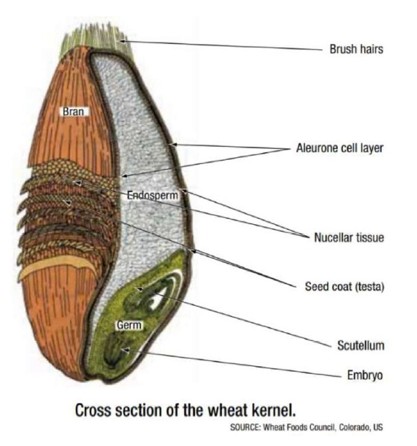
36 The endosperm is the part of the wheat grain which is used to make white flour and contains carbohydrates that is mainly starch, protein, fibre and vitamins and minerals.
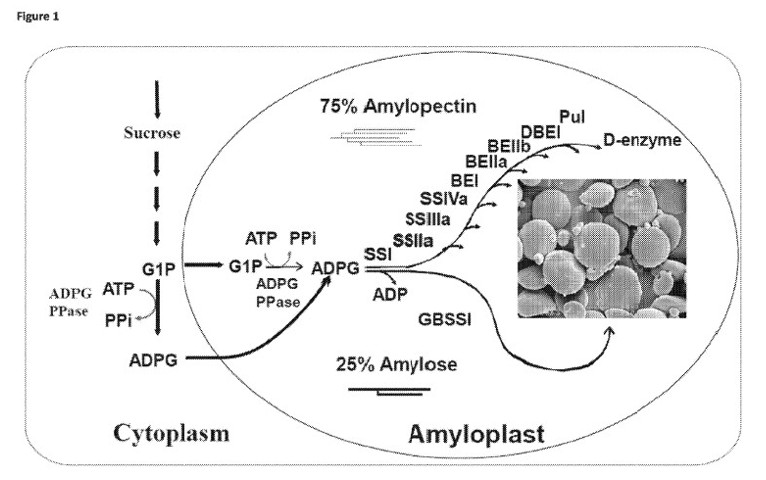
37 Starch is the main carbohydrate in wheat grain and is made up of two polymers of glucose: amylose and amylopectin. Amylose is essentially a linear polymer, whereas amylopectin has considerable branching in the polymer. There are at least 4 types of enzymes involved in the synthesis of starch in the endosperm of wheat, including ADP-glucose pyrophosphorylase (ADGP), starch synthases (SS), starch branching enzymes (SBE) and starch debranching enzymes (DBE). The focus of integer (i) in claim 1 of the patent application which I will come to concerns null mutant variants of the SSIIa gene, the expression or non expression of which ultimately affects the production of the enzyme SS.
38 Figure 1 of the patent application displays some of these enzymes as follows:
39 Let me say something about genetics that I have drawn from the expert material before me.
40 An “allele” is a variant of a gene at a single genetic locus. A “null allele” is an allele which does not encode or is not capable of leading to the production of any active enzymes, that is, the allele is non-functional. The terms “single null”, “double null” and “triple null” are used to refer to mutations across one, two or three genomes.
41 An allele can be dominant or recessive. Where the two alleles in the chromosome pair have the same mutation as each other, the organism is homozygous for that mutation. Where the two alleles in the chromosome pair have different mutations, the organism is heterozygous for those mutations.
42 Different alleles of a gene(s) may be combined. For example, two parental wheat plants with different alleles of a gene may be crossed to produce F1 progeny (i.e. first generation progeny) which contain both alleles in the heterozygous state.
43 F1 progeny can be self-fertilised (knows as “selfed”) to produce a further generation of plants, F2 progeny, which contain either one or the other allele in the homozygous state, or both alleles in the heterozygous state.
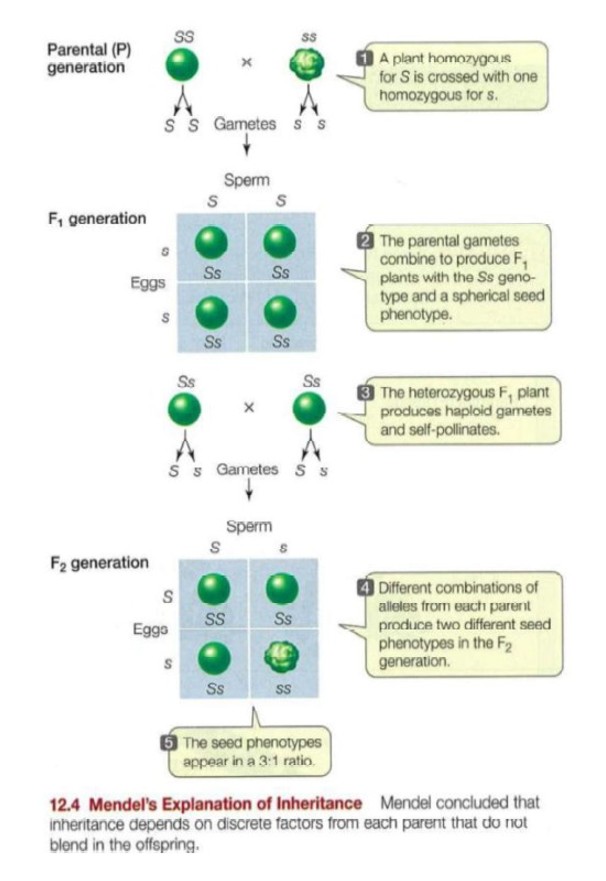
44 The genotype of progeny can be predicted based on Mendelian genetics. Where two parental plants are crossed, the progeny will take one allele of each gene from each parent. The genotype (the allele combinations) and phenotype (the observable traits) of the progeny can be predicted based on the parental lines as demonstrated by the below diagram; see Sadava, Hillis, Heller and Berenbaum, Life: The Science of Biology Volume 1 (Sinauer Associates, Inc, 9th edition, 2011) p 242. The phenotype may also be impacted by environmental factors such as growing location and conditions.
45 Backcrossing is a process under which the mutant plant and a plant with a desirable genetic background plant, for example, a commercial variety that is particularly suited to grow in certain conditions, are crossed to produce F1 progeny, and then that F1 progeny and the (parent) plant line with the desirable genetic background are crossed again to produce progeny (BC1) and so forth. With each generation of progeny (BC1, BC2, BC3 and so forth), there is an increase in the percentage of the desired genetic background in the backcrossed progeny (50% in the F1, 75% in the BC1, 87.5% in the BC2, 93.75% in the BC3 and so forth).
46 Now the hexaploidy of bread wheat is an obstacle in creating variants because often it may be necessary to have mutations across all three genomes in order to see any phenotypic effect.
47 Now as I have said, starch is the main carbohydrate in wheat grain and it is made up of two polymers of glucose: amylose and amylopectin. A higher ratio of amylose to amylopectin in the starch is beneficial in a human food product as there is an increase in resistant starch, a form of dietary fibre, which promotes intestinal health and is associated with the regulation of sugar, insulin and lipid levels in the blood, as well as satiety.
48 The other important determinate of the health benefit of wheat grain is the amount of non-starch polysaccharide in the grain, for example, raffinose, fructans, cellulose, arabinoxylan and β-glucan. These form the major component of dietary fibre which is useful for regulating blood glucose and insulin levels and bowel health.
49 Now as I have said, one type of enzyme involved in the synthesis of starch are starch synthases, which I have referred to as SS. In maize, rice and wheat, one of the SS responsible for amylopectin synthesis is starch synthase IIa (SSIIa). Before proceeding further I should note that the nomenclature that I will use, as Professor Sharp has done, for the corresponding gene to the SSIIa enzyme is SSIIa (in italics with capital SS where the gene is wild type, that is, no null mutation) or ssIIa (in italics with lower-case ss where the gene has a null mutation).
50 A null mutation (or null allele) refers to a gene that does not encode, or is not capable of leading to the production of, any active enzymes. For wheat, the terms “single null”, “double null” and “triple null” are used to refer to mutations across one, two or three of the genomes in hexaploid bread wheat.
51 Loss of function mutations in SSIIa are recessive, which means that the desired phenotype is only seen when the null mutations are in the homozygous state, that is, the two alleles in the chromosome pair have the same mutation as each other, compared with heterozygous where the two alleles in the chromosome pair have different mutations.
52 Let me now discuss in more detail Professor Sharp’s evidence and the patent application.
Professor Sharp’s evidence and the patent application
53 Professor Sharp is an emeritus professor at the University of Sydney with a PhD in genetics and over 40 years’ experience working in the field of wheat breeding, including breeding varieties of wheat with particular nutritional properties. Clearly, he is properly representative of the skilled person working in a relevant multidisciplinary team in the field of breeding wheat with particular amylose content.
54 Since 1981, Professor Sharp has authored or co-authored over 80 scientific publications, including numerous publications in the field. He has also been involved with industry partners through Cooperative Research Centres, being Australian Federal Government research programs which include government, industry and academic participants.
55 One aspect of his past research was on a project concerning the development of “waxy” wheat mutants, that is, mutants with a low amylose content. Amylose is a polysaccharide of glucose units, which is a component of starch. The other component of starch is amylopectin. In “waxy “wheat, there is very little amylose content and therefore, the starch is largely made up of amylopectin. “Waxy” wheat has a different texture to normal wheat and was proposed to be used in some noodle products, such as udon noodles.
56 The research project involved identifying mutations in genes which encode the granule-bound starch synthase I (GBSSI) enzyme. GBSSI is responsible for synthesis of amylose. The project sought to identify null mutations in the “waxy” genes, Wx-A1, Wx-B1 and Wx-D1, which would disrupt the synthesis of the GBSSI enzyme such that little to no amylose would be synthesised. I note here that, contrastingly, the patent application concerns an invention designed to increase the % of amylose.
57 In the project, Professor Sharp undertook a breeding and selection program whereby plants were generated with each of the eight possible homozygous combinations of the null alleles, being no null alleles, three varieties of a single null allele, three varieties of a double null allele, and one triple null allele. Professor Sharp developed DNA markers which could be used to identify the target null mutations in the plants so that one could select the plants with the desired mutations. He then investigated the starch properties and identified that the genotype with triple null Wx-A1, Wx-B1 and Wx-D1 had essentially no amylose in the starch.
58 Professor Sharp was provided with a copy of the patent application and he considered the patent application as at the priority date, equipped with only the common general knowledge at that date.
59 In summary, Professor Sharp’s evidence is that when he read the patent application in light of the common general knowledge at the priority date, Examples 4 and 5 provide a proof of principle such that he considered that he could produce grain with the claimed phenotype in any variety of bread wheat, including EGA Hume by undertaking the breeding and selection program described in the patent application. Let me say more about the patent application drawing also from Professor Sharp’s evidence.
Background section of the patent application
60 [0002] notes that the patent application describes methods of obtaining hexaploid wheat plants having high amylose starch, and the use of such plants and particularly, grain or starch from those plants in food and non-food products.
61 As noted at [0011], the hexaploidy of wheat is an obstacle in creating variants. This is because one often needs to have mutations across all three genomes in order to see any phenotypic effect, as a mutation in one genome could be masked by the other genomes. This is particularly the case where you are attempting to modify a biochemical characteristic of the wheat, as opposed to a characteristic such as disease resistance where a single gene is usually effective.
62 [0005] and [0006] explain that there are two important determinants of the health benefit of wheat grain being, first, the ratio of amylose to amylopectin and, second, the amount of non-starch polysaccharide in the grain, that is, the fibre components.
63 It was common general knowledge that non-starch polysaccharides in wheat, for example raffinose, fructans, cellulose, arabinoxylan and β-glucan, form the major component of dietary fibre which is not digested and absorbed in the small intestine, but passes to the colon where it undergoes bacterial degradation. Dietary fibre is useful for regulating blood glucose and insulin levels, and bowel health ([0006]).
64 A higher ratio of amylose to amylopectin in the starch contained in a food product is beneficial as there is an increase in resistant starch, a form of dietary fibre. Resistant starch is defined by its behaviour in the digestion system. As explained in [0007], resistant starch is not digested and absorbed in the small intestine, it continues to the large bowel where it will ferment and feed the intestinal microflora which promotes intestinal health. Higher levels of resistant starch are desired for humans because it is associated with the regulation of sugar, insulin and lipid levels in the blood, as well as for example, satiety ([0007]).
65 From [0009], the patent application explains the synthesis of starch in the endosperm of wheat which involves at least four types of enzymes, which I have previously described as ADGP, SS, SBE and DBE. The patent application explains that there are multiple isoforms of each of the enzymes in the endosperm and the contribution of each to the synthesis of starch differs between species.
66 At [0012], the patent application describes the enzymes responsible for amylopectin synthesis in maize, rice and wheat: starch synthase I (SSI), starch synthase IIa (SSIIa) and starch synthase IIIa (SSIIIa).
67 [0012] then notes that ssIIa wheat mutants, that is wheat plants which lack the SGP-1 protein, being a code name for the protein which later became known as SSIIa, have previously been developed by Yamamori et al. (2000), by crossing lines lacking the SGP-1 protein in each of the A, B and D genomes. By doing so, a ssIIa triple-null grain was developed with 30% to 37% w/w amylose content, which was an increase of about 8% over wild-type level (in other words, unmodified plants), and overall there was a substantial reduction in starch content (50% compared to at least 60% in wild-type). As I have already indicated, lower case ssIIa describes an SSIIa gene that has a null mutation.
68 At [0014], the patent application notes that ssIIa null mutations in wheat, barley and rice had different effects, owing to the different extent of pleiotropic effects (that is, where the genetic variation influences multiple phenotypic traits) of the lack of the SSIIa protein in the developing endosperms. As a result, observations in one cereal species could not be simply extrapolated to another cereal species in the area of starch synthesis. Professor Sharp agreed with this conclusion about extrapolation across different species. But within a species such as Triticum aestivum, the effect of a null mutation in a gene of one variety of Triticum aestivum can be more safely extrapolated to another variety of Triticum aestivum, given the much greater level of homology within a species compared to across different species.
69 At [0016], the patent application describes previous research into wheat variants with at least 50% amylose as a proportion of starch content as a result of a reduction of SBEIIa activity, that is, a particular isoform of a starch branching enzyme. It is noted that SBEIIa protein reduction was associated with increased relative amylose levels of more than 50%, and in contrast, a reduction in SBEIIb protein did not alter the proportion of amylose. The patent application states that grain of a sbeIIa triple null genotype had been produced, and therefore targeting the SBEIIa gene would be desirable for producing high amylose wheat. However, those grains did not also have an increase in non-starch polysaccharides.
70 The background section of the patent application concludes at [0017] by noting that there is a need in the art to produce “improved” high amylose wheat plants, and methods for producing such plants. Given the discussion of previous research into high amylose wheat whereby useful non-starch polysaccharides were not increased along with amylose, Professor Sharp understood “improved” high amylose wheat to mean wheat with increased amylose and increased non-starch polysaccharides, that is, each of the key determinants of health benefit noted above.
Summary section of the patent application
71 A summary of the invention is included at [0018]. The invention concerns a hexaploid wheat grain with an amylose content of at least 45%, as a weight percentage of the total starch content of the grain, and which can be produced by combining mutations in the three SSIIa genes on the A, B and D genomes of the wheat by breeding and selection. At least two of the three mutations are null mutations, and preferably all three are null mutations. I note that the claims of the patent application require three null mutations, that is, a “triple null”.
72 The inventors also found that the mutant ssIIa wheat grain had significantly increased levels of non-starch polysaccharides, particularly β-glucan, fructan, arabinoxylan and cellulose, which yielded a substantial increase in total fibre content as well as increases in protein content and other favourable phenotypes.
73 [0018] notes that loss of function mutations in the SSIIa gene are recessive, which means the desired phenotype was seen when the mutations were in the homozygous state.
74 At [0019], an aspect of the invention is described which provides certain parameters for the wheat grain of the species Triticum aestivum.
75 At [0022], a high level summary of a breeding and selection process for producing a wheat plant capable of generating this wheat grain with the favourable amylose and non-starch polysaccharides content is described as follows: (a) crossing two parental wheat plants each with a null mutation in each of one, two or three SSIIa genes selected from the group consisting of SSIIa-A, SSIIa-B and SSIIa-D, or mutagenizing (altering its DNA) a parental plant preferably comprising one or two of said null mutations; (b) screening plants or grain from the cross or mutagenesis, or subsequent progeny by analysing DNA, RNA, protein, starch granules or starch from the plants or grain; and (c) selecting a fertile wheat plant that has reduced SSIIa activity relative to at least one of the parental wheat plants.
76 Professor Sharp said that this breeding and selecting process is analogous to the breeding and selection process he undertook in his research project for low amylose wheat varieties, although he was targeting null mutations in the “waxy” genes. Wheat breeding and selection are and were at the priority date well known and routine processes in the field.
77 In the context of the patent application, the process requires identifying separate plants which each have the desired mutations in the homozygous state in one or more of the A, B or D genomes, and then undertaking a series of crosses to generate a plant with mutations in all three genomes. To assess whether the desired mutations have been achieved, chemical techniques are used to screen for the desired mutations, for example, DNA markers, and these techniques can be used in each stage of crossing to ensure the progeny have achieved the expected mutations. In Professor Sharp’s research project into low amylose wheat, he used DNA markers and agarose gels to determine if null mutations existed in the “waxy” genes. Finally, after screening, a plant or a number of plants which have achieved the desired phenotypic characteristics (e.g. amylose content) is selected. Not all plants that have the desired mutations will have the desired phenotypic characteristics. The selection of a plant or plants with the desired phenotypic characteristics is a necessary part of the process to obtain the desired product. In Professor Sharp’s research project into low amylose wheat, he used a qualitative method of iodine staining to determine if the desired waxy phenotype was achieved in a given plant.
Detailed description in the patent application
78 Following the summary of the invention, a detailed description of the invention is included from [0136], which includes a further description of the matters set out in the background and summary sections discussed above.
79 [0144] to [0150] describe various aspects of the invention. In particular, at [0144] a first aspect of the invention is described as a wheat grain of the species Triticum aestivum, the grain comprising: (a) mutations in each of its SSIIa genes such that the grain is homozygous for a mutation in its SSIIa-A gene, homozygous for a mutation in its SSIIa-B gene and homozygous for a mutation in its SSIIa-D gene, wherein at least two of the mutations in said SSIIa genes are null mutations; (b) a total starch content comprising an amylose content and an amylopectin content; (c) a fructan content which is increased relative to wild-type wheat grain on a weight basis, preferably between 3% and 12% of the grain weight; (d) a β-glucan content; (e) an arabinoxylan content; and (f) a cellulose content.
80 Further, the following parameters are specified: (a) the grain having a grain weight of between 25mg and 60mg; (b) wherein the amylose content is between 45% and 70% on a weight basis of the total starch content of the grain as determined by iodine binding assay; (c) wherein the amylopectin content on a weight basis is reduced relative to the wild-type wheat grain; (d) wherein each of the β-glucan content, arabinoxylan content and cellulose content are increased relative to the wild-type wheat grain on a weight basis; and (e) the sum of the fructan content, β-glucan content, arabinoxylan content and cellulose content is between 15% and 30% of the grain weight.
81 The criteria in paragraph 79(a) is to select a grain with a particular genotype, whereas the other criteria in paragraphs 79(b) to (f) and 80 provide a selection of a grain with a particular phenotype.
82 Further aspects of the invention include wheat plants, flour and/or wheat starch granules produced or obtained from this grain ([0145]), and food ingredients and compositions comprising the grain or material produced from this grain, and food products comprising those food ingredients ([0146]).
83 At [0147], an aspect of the invention is described as a process for producing a wheat plant that produces grain of the invention which comprises the following steps: (a) crossing two parental wheat plants each comprising a null mutation in each of one, two or three SSIIa genes selected from the group consisting of SSIIa-A, SSIIa-B and SSIIa-D, or of mutagenising a parental plant comprising said null mutations; (b) screening plants or grain obtained from the cross or mutagenesis, or progeny plants or grain obtained therefrom, by analysing DNA, RNA, protein, starch granules or starch from the plants or grain; and (c) selecting a fertile wheat plant that has reduced SSIIa activity relative to at least one of the parental wheat plants of step (a).
84 Now the patent application discloses that the wild-type SSIIa gene is dominant, and the null ssIIa mutations are recessive. As Professor Sharp went on to explain, and drawing from the patent application, in order to observe an effect of a mutation of the SSIIa gene on the phenotype, the progeny must be homozygous for the mutation. Where only one parental plant is homozygous for a null mutation in the SSIIa gene in a single genome, and the other parent is homozygous for the non-null allele, the progeny can only ever be heterozygous for the mutation in that genome as only one allele is taken from each parent. If both parents have a heterozygous null mutation in the SSIIa gene in the same genome, the progeny can be homozygous or heterozygous for the null mutation in that genome, or may not have the mutation at all. In that case, the homozygous mutation in that genome will theoretically occur in 1 in 4 progeny plants, the heterozygous mutation in that genome will theoretically occur in 2 in 4 progeny plants, while no mutation in that genome will theoretically occur in 1 in 4 progeny plants. Where both parental plants are homozygous for the mutation, the homozygous null mutation is fixed in that genome and all the progeny will be similarly fixed (i.e. 1 in 1).
85 In a process of breeding and selection for a triple-null mutation, that is, a homozygous mutation in the SSIIa gene in all three genomes, the probability of achieving progeny which are homozygous for the triple null mutation can also be predicted based on Mendelian genetics. If the parental lines are each homozygous for one of the three null mutations, which would necessitate at least 3 crosses between three parental lines and/or progeny lines, the triple null allele mutant will theoretically only be achieved in 1 in 64 plants (a quarter of a quarter of a quarter) from selfing a derived triple heterozygous plant. The probability increases if the parental plants are homozygous for the target null mutations in more than one genome and as a result, the null allele in at least one genome can be fixed in the progeny. For example, if one null allele is fixed in the first generation of progeny by crossing the parental lines, the probability of achieving a triple null mutation at the end of the crossing process is 1 in 16 plants.
86 The effect of the genotype on the phenotype is also subject to variation. In the field it is recognised that the effect of genotype on phenotype for quantitative traits such as nutritional content is generally subject to continuous variation attributed to both genotype and environmental influences, which may for example vary within plants grown in the same greenhouse or field, or even the same pot. In a breeding program looking to maximise the quantitative value of a given nutritional trait, it may be expected that, for example, only the top 5% of the generated population will be selected, that is, the proportion with the highest measure of a trait.
87 At [0222] of the patent application, it is noted that the identified mutations may be introduced into a desirable genetic background by crossing the mutant plant with a plant having a desired genetic background, and performing a suitable number of “backcrosses” to cross out the undesired genetic background from the progeny.
88 [0234] notes a desired genetic background includes considerations of agronomic yield and other characteristics and that for Australian use, one might want to cross an altered starch trait into Baxter, Kennedy, Janz, Frame, Rosella, Cadoux, Diamondbird or other commonly grown Australian bread wheat varieties. The effect of a ssIIa null mutation in one variety of Triticum aestivum, and of the triple null ssIIa mutations disclosed in the patent application, could be safely extrapolated to other varieties of the same species.
89 At [0243], a definition of “wild-type” is provided and refers to a cell, tissue, plant or plant part, preferably Triticum aestivum plant, plant part or grain, which has not been modified according to the invention, that is, not been modified in relation to the SSIIa gene. The patent application also notes that wild-type Triticum aestivum grain typically has the following.
90 First, the wild-type has 55% to 75% starch content, which is comprised of about 20% to 30% amylose, and 70% to 80% amylopectin (see [0269] and [0272]). Where amylose content is increased, the amylopectin content will correspondingly be reduced. As noted in [0269], amylose content can be determined by known methods, including size exclusion high-performance liquid chromatography, or by an iodometric method. The patent application is referring to undertaking a quantitative assessment of amylose content using an iodometric method where the concentration of amylose can be measured by the level of binding of iodine to starch and by reference to a standard curve.
91 Second, the wild-type has 0.4% to 1.4% β-glucan (see [0288]). It is also noted that β-glucan content is ordinarily measured by milling the grain to wholemeal and undertaking an assay for β-glucan for example by the method disclosed in Example 1 of the patent application. As Professor Sharp said, β-glucan assays are commercially available and are commonly used in the field.
92 Third, the wild-type has 0.6% to 2.6% fructan (see [0289]). It is also noted that fructan content is ordinarily measured by milling the grain to a wholemeal and assaying for fructan for example by the method disclosed in Example 1 of the patent application. As Professor Sharp said, fructan assays are commercially available and are commonly used in the field.
93 Further, the claimed invention has a 1.5-fold to 3-fold increase in arabinoxylan levels relative to wild-type wheat (see [0294]). It is also noted that arabinoxylan content is ordinarily measured by milling the grain to a wholemeal and assaying for arabinoxylan for example by the method disclosed in Example 1 of the patent application. As Professor Sharp said, arabinoxylan assays are commercially available and are commonly used in the field.
The patent application’s examples
Example 1
94 Example 1 provides details of the wheat cultivars, that is, wheat varieties produced by breeding, used in the studies reported in the other examples. These cultivars were: (a) three wheat cultivars comprising single null mutations in a SSIIa gene on the A, B or D genomes: (i) Chousen 57 (C57) which comprised a null mutation in SSIIa-A and therefore lacked the SSIIa-A polypeptide (i.e. the null mutation on the A genome); (ii) Kanto 79 (K79) which comprised a null mutation in SSIIa-B and therefore lacked the SSIIa-B polypeptide (i.e. the null mutation on the B genome); (iii) Turkey 116 (T116) which comprised a null mutation in SSIIa-D and therefore lacked the SSIIa-D1 polypeptide (i.e. the null mutation on the D genome); (b) Australian commercial wheat cultivars: (i) Sunco; (ii) EGA Hume; and (iiii) Westonia.
95 At [0354], the patent application notes that DNA analysis was undertaken on young leaves of the wheat plants to detect the presence or absence of mutant ssIIa or wild-type SSIIa alleles by PCR.
96 At [0367], the process adopted for the analysis of starch content of the grain is set out and is described as the AACC method 76.13, using the total starch analysis kit (K-TSTA) supplied by Megazyme. As Professor Sharp said, the AACC method is a standard method for the analysis of starch content and the K-TSTA is a standard kit for this kind of assay.
97 At [0368], the patent application notes that amylose content was determined in triplicate by the iodometric (iodine binding) method of Morrison and Laignelet (1983) with slight modifications as set out in that paragraph. Professor Sharp said that he was familiar with this method and understood these modifications.
98 At [0371], the patent application notes that resistant starch content was determined in triplicate using the resistant starch analysis kit (K-RSTARCH) supplied by Megazyme. As Professor Sharp said, the K-RSTARCH kit is a standard kit for this kind of assay.
99 At [0373], the patent application notes that β-glucan content was determined in triplicate using the K-BGLU kit supplied by Megazyme. As Professor Sharp said, the K-BGLU kit is a standard kit for this kind of assay.
100 At [0374], the patent application notes that fructan extraction and assay was performed using a modified Megazyme fructan kit (K-FRUC) and provides details of the modifications. As Professor Sharp said, the K-FRUC kit is a standard kit for this kind of assay. Professor Sharp said that he would be able to repeat this modified method. Further, at [0376] a standard process for the measurement of total arabinoxylan is described. And at [0378], a standard process for the measurement of cellulose is described.
Examples 2 and 3
101 Examples 2 and 3 describe the process of development of DNA markers which could identify the mutations in the SSIIa genes. The process begins by identifying the genes which encode the SS enzymes. Ultimately, it was identified that the SSIIa genes and SSIIa polypeptide sequences could readily be distinguished from the corresponding SSIIb / SSIIb and SSIIc / SSIIc sequences.
102 As detailed in Example 3, specific DNA markers based on the SSIIa gene sequences were designed and used. The development of the DNA markers is explained in [0389] – [0390]. Following Example 3, Professor Sharp expects that he would be able to develop, and then use, the DNA markers in accordance with the instructions in Examples 2 and 3. The development of these markers greatly increases the efficiency to select plants having the desired genotype.
Example 4
103 Example 4 describes a breeding process to generate triple-null ssIIa mutants in three genetic backgrounds: Sunco, EGA Hume and Westonia. Let me describe Example 4 in more detail drawing upon Professor Sharp’s description and observations.
104 At [0391], the patent application explains that the inventors used plants of the C57, K79 and T116 lines and plants of the Sunco, EGA Hume and Westonia lines, which are commercial Triticum aestivum varieties with desirable genetic backgrounds, in a series of crosses, backcrosses and intercrosses, and progeny selection using DNA markers as previously described in the patent application. This process is shown schematically in Figures 5 to 7. The process for developing the triple-null ssIIa mutants in the Sunco genetic background can be summarised as follows.
105 The single null allele lines, C57, K79 and T116 (each being homozygous for the SSIIa-A, SSIIa-B, and SSIIa-D null mutations respectively), were first crossed with Sunco to produce C57-Sunco F1, K79-Sunco F1 and T116-Sunco F1 lines. Given that each of C57, K79 and T116 lines were homozygous for their respective ssIIa null allele, each of the F1 progeny will be heterozygous for the null mutation. As only one of the null alleles is taken from the C57, K79 and T116 parental lines, the other allele is taken from Sunco which does not have the null mutation.
106 The K79-Sunco F1 progeny were then crossed with each of C57-Sunco F1 and T116-Sunco F1 to produce F1 progeny of that cross: C57-K79-Sunco F1 and K79-T116-Sunco F1. DNA markers are used to select the progeny heterozygous for two null ssIIa mutations, being the SSIIa-B null mutation plus either the SSII-A null mutation (C57-K79-Sunco F1) or the SSII-D mutation (K79-T116-Sunco F1). Given that only one null allele from each parent is taken, no progeny that are homozygous for the null mutations were produced. As a matter of probability, the heterozygous double null mutation will only theoretically occur in 1 in 4 plants.
107 The F1 progeny was then selfed to generate F2 progeny: C57-K79-Sunco F2 and K79-T116-Sunco F2. DNA markers are used to select the heterozygous two null ssIIa F2 progeny, which will theoretically occur in 1 in 4 plants.
108 The selected F2 progeny were then backcrossed three times with Sunco to generate BC1, BC2 and finally, BC3 lines which are heterozygous for two null ssIIa mutations (C57-K79-Sunco and K79-T116-Sunco). With each backcross, there is an increase in the amount of Sunco genetic background in the progeny (i.e. reducing the amount of the C57, K79 or T116 genetic background in the plant), however each progeny remains heterozygous for the two null mutations. Three backcrosses is a standard number of backcrosses in this kind of research. If this research were to be applied in a commercial breeding program, Professor Sharp would expect that up to 6 backcrosses might be used.
109 The BC3 lines were then crossed to generate a C57-K79-T116-Sunco BC3 F1 line. As each of the parents contained the SSIIa-B null allele from the K79 parental line, all progeny generated was homozygous for that mutation. The progeny could only be heterozygous for each of the SSIIa-A (from C57) and SSIIa-D (T116) mutations (as only one allele of each could possibly be taken from the parental lines).
110 The BC3 F1 plants were then selfed to generate BC3 F2 plants. DNA markers were used to characterise the progeny and select the homozygous triple null ssIIa mutants (the C57-K79-T1116-Sunco BC3 F2 plants). The remaining progeny included wildtype, single null ssIIa (i.e. only homozygous for the SSIIa-B (K79) mutation) and double null ssIIa (i.e. homozygous for the SSIIa-B (K79) mutation plus either the SSIIa-A (from C57) or SSIIa-D (T116) mutations), and combinations of heterozygotesfor the three SSIIa genes. The theoretical probability that a resulting BC3 F2 plant will be homozygous for the triple null ssIIa mutations is 1 in 16.
111 Following the process set out above, by applying the product rule of Mendelian genetics, the theoretical probability a plant being homozygous following the “selfing” of the BC3 F1 plants described above, for the triple null ssIIa mutation is ¼ x 1 x ¼ = 1/16 or 6.25%. The “1” factor is because the K79 null allele was homozygous.
112 The process above was repeated for the EGA Hume and Westonia background, however, the process was simplified by starting with the double null mutation Sunco lines (C57-K79- Sunco F2 and K79-T116-Sunco F2 lines) rather than starting at the single null mutation C57, K79 and T116 lines.
113 [0392] reports that 466 BC3 F2 progeny were generated across the three genetic backgrounds, and of those 466 lines, only 21 lines were homozygous for the triple-null ssIIa mutations. These 21 lines are identified as the “abd” genotype.
114 As noted above, there is only a 1 in 16, or 6.25%, theoretical chance that the BC3 F2 progeny is homozygous for the triple-null ssIIa mutations. As 21 plants were selected, that is less than the 29 plants expected but is within the range of expected theoretical outcomes.
115 [0393] records that the 21 triple-null ssIIa lines were then taken forward into three generations of single seed descent (SSD). SSD is a selfing process where a single seed is grown in a small pot and the resulting plant generates a small number of seed. This process is quick and can result in 3 to 4 generations of the plant within 1 year. The SSD process was used to generate BC3 F3, BC3 F4 and BC3 F5 generations. Following this, the BC3 F5 grain was then “bulked up” by growing three further generations to produce 10 to 20 grams of grain of the resulting BC3 F8 line. In Professor Sharp’s experience, this “bulking up” process generally takes about 18 to 24 months to complete. It is the BC3 F8 lines which are taken forward for analysis as reported in Example 5.
116 At [0394], it is noted that triple wild-type SSIIa segregants, identified at the “ABD” genotype, were generated from the crosses and selected as control lines. In total, 5 wild-type BC3 F8 lines were generated for each of EGA Hume, Sunco and Westonia genetic backgrounds. 4, 6 and 11 triple-null ssIIa BC3 F8 lines were generated in the EGA Hume, Sunco and Westonia genetic backgrounds respectively.
117 As Professor Sharp described it, the breeding process described in Example 4 is small scale which is standard for this kind of research (a proof-of-principle research project) as opposed to a commercial breeding program.
118 In a routine commercial breeding program, Professor Sharp would expect: (a) up to 6 backcrosses may be undertaken to increase the amount of the commercial genetic background in the progeny in the non-mutated parts of the genome or DNA markers would be used to identify BC plants with the highest proportion of recurrent parent genetics; (b) many more lines of the BC3 F2 progeny to be produced (in the order of thousands); and (c) more generations of the BC3 “selfed” progeny (e.g. by SSD) to be produced for the triple-null ssIIa lines so that the genetic background of the resulting seed is more uniform, and greater numbers of the mutant and wild-type lines were generated.
Example 5
119 Example 5 reports the results of analysis of grain and starch parameters of grain from each of the 21 triple-null ssIIa mutant lines and the wild-type lines. Professor Sharp summarised what could be concluded from Example 5 in the following terms.
120 At [0395] and [0396], the triple-null ssIIa mutants had a significantly lower grain weight than the wild-type.
121 At [0397] and [0398], the triple-null ssIIa mutants had significantly increased lipid content compared to the wild-type.
122 At [0399] and [0400], the triple-null ssIIa mutants had a greater amylose content as a proportion of total starch, and the differences were statistically significant. In the triple-null ssIIa mutants generated in Example 4, those generated in the Sunco genetic background contained significantly higher proportion of amylose compared to the mutants of the other two genetic backgrounds.
123 At [0401], the triple-null ssIIa mutants had less starch than the corresponding wildtype lines, and the differences were statistically significantly. The Sunco lines which had the highest amylose content also had a low starch content, which indicated that amylopectin synthesis was most reduced in those lines.
124 At [0402] and [0403], the triple-null ssIIa mutants had an increased β-glucan content of about 1.5 to 2.5-fold compared to wild-type grain. Further, the Sunco lines with the highest levels of amylose also had the highest β-glucan content which indicated a correlation between increased amylose content and increased β-glucan content in the triple-null ssIIa mutants. The inventors considered that the increased level of β-glucan was due to a diversion of carbon from amylopectin into β-glucan content relative to the wild-type.
125 At [0404] and [0405], the triple-null ssIIa mutants had increased fructan content compared to wild-type grain. For EGA Hume, Sunco and Westonia, there was 242%, 521% and 376% more fructan in the mutants compared to the wild-type, respectively. The three Sunco lines with the highest amylose content also had the highest fructan content which indicated a correlation between increased amylose content and increased fructan content in the triple-null ssIIa mutants. The inventors considered that the increased level of fructan was due to a diversion of carbon from amylopectin into fructan content relative to the wild-type.
126 At [0406], the triple-null ssIIa mutants had increased arabinoxylan content compared to wild-type grain. For EGA Hume, Sunco and Westonia, there was 35%, 65% and 43% more arabinoxylan in the mutants compared to the wild-type, respectively. The three Sunco lines with the highest amylose content also contained the highest arabinoxylan content which indicated a correlation between increased amylose content, increased β-glucan, increased fructan content and increased arabinoxylan content.
127 At [0407], the triple-null ssIIa mutants had increased cellulose content compared to wild-type grain. For EGA Hume, Sunco and Westonia, there was 19%, 43% and 29% more cellulose in the mutants compared to the wild-type, respectively.
128 At [0408], the triple-null ssIIa mutants had increased total fibre content (calculated as the sum of the β-glucan, fructan, arabinoxylan and cellulose contents) compared to wild-type grain. For EGA Hume, Sunco and Westonia, there was 68%, 125% and 88% greater total fibre in the mutants compared to the wild-type, respectively.
129 At [0409], the triple-null ssIIa mutants had an increased resistant starch content of about 5-fold compared to wild-type grain.
130 At [0410], the genetic background of the triple-null ssIIa mutants had an effect on grain composition parameters. Genetic background refers to the commercial variety of the wheat, such as EGA Hume, Sunco and Westonia. While there was variation between the three lines tested, including with respect to starch content, he did not understand this paragraph to be suggesting that the specified amylose content could not be achieved in other commercial varieties within the Triticum aestivum species.
131 The data for the analysis conducted in Example 5 is set out in Table 6 (and mean and standard deviations with respect to the Sunco lines only in Table 7), and Table 8 with respect to the resistant starch content.
132 Professor Sharp was asked whether the grains of the triple-null ssIIa mutant lines had all of the following characteristics, which are the phenotypic characteristics described earlier: (a) a total starch content comprising an amylose content and an amylopectin content; (b) a fructan content which is increased relative to wild-type wheat grain on a weight basis, preferably between 3% and 12% of the grain weight; (c) β-glucan content, arabinoxylan content and cellulose content which are increased relative to the wild-type wheat grain on a weight basis; (d) a grain weight of between 25mg and 60mg; (e) an amylose content between 45% and 70% on a weight basis of the total starch content of the grain as determined by iodine binding assay; (f) an amylopectin content which is reduced relative to the wild-type wheat grain on a weight basis; and (g) the sum of the fructan content, β-glucan content, arabinoxylan content and cellulose content is between 15% and 30% of the grain weight.
133 Professor Sharp was provided with an annotated version of Table 6 which: (a) had been rearranged to have the data for the triple-null ssIIa mutants and the wild-type for each genetic background (wheat strain) displayed alongside each other; (b) included the mean of each parameter for the wild-type lines of each genetic background; (c) was annotated with green and orange shading to indicate which parameters of the grain of the mutant lines fell within the criteria of the wheat grain of the invention described; and (d) removed the “Total Starch %” and “Lipid content %” columns which are not criteria of the grain of the invention. The annotated Table 6 is as follows:
Table 6 (as annotated)
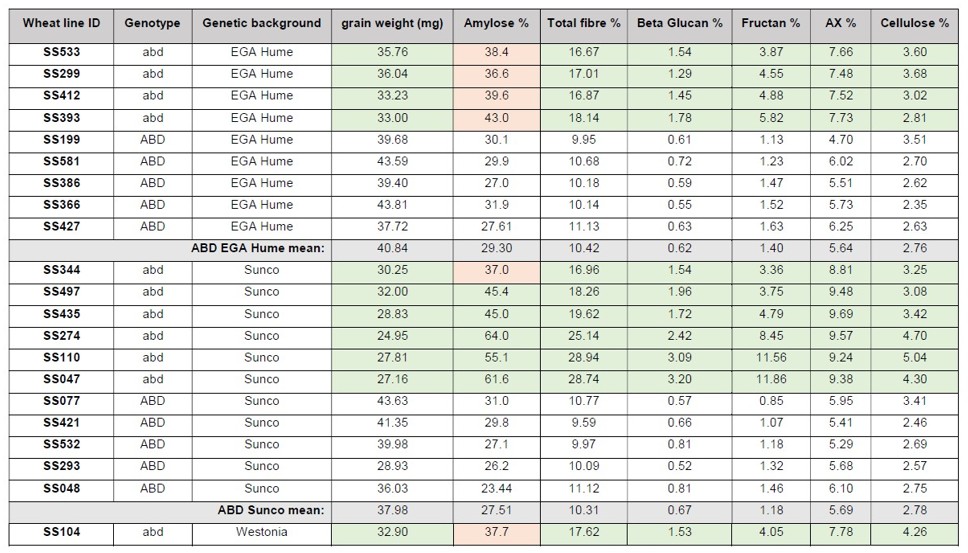
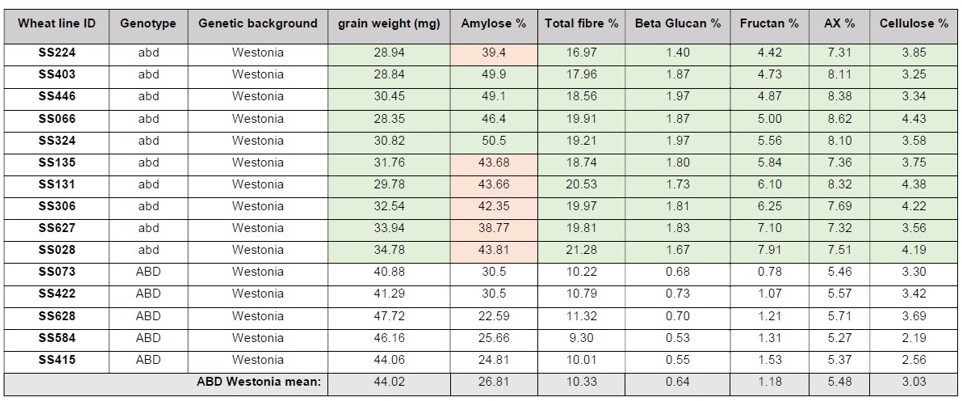
134 Professor Sharp reviewed the annotated Table 6 and confirmed that the data accurately reflects the data in Table 6 of the patent application, and further confirmed the following.
135 The grain of each of the mutant lines has a total starch content comprising an amylose content and an amylopectin content. Professor Sharp said that while there is no amylopectin data included in Table 6 or the annotated Table 6, it can be readily calculated by subtracting the amylose content (%) from 100% as starch is entirely made up of amylose and/or amylopectin as recorded in [0005] of the patent application. As no line has 100% amylose, there must also be an amylopectin content in each grain. Given that the grain of each of the EGA Hume, Sunco and Westonia mutant lines had a greater amylose content than the mean of the corresponding wild-type wheat grain, the amylopectin content must have been reduced. The grain of each of the mutant lines therefore have the characteristics identified in paragraphs 132(a) and 132(f) above.
136 The grain of each of the mutant EGA Hume, Sunco and Westonia lines have a fructan content which is greater than the mean values for the corresponding wild-type wheat grain, and within 3% and 12% of the grain weight. The grain of each of the mutant lines therefore has the characteristic identified in paragraph 132(b) above.
137 Each of the grains of the mutant EGA Hume, Sunco and Westonia lines have a grain weight between 25mg and 60mg, therefore the grain of each of the mutant lines has the characteristic identified in paragraph 132(d) above.
138 The following mutant lines have an amylose content between 45% – 70%: (a) Sunco: SS497, SS435, SS274, SS110, and SS047; and (b) Westonia: SS403, SS446, SS066, and SS324, and therefore, the grain of those mutant lines have the characteristic identified in paragraph 132(e) above.
139 The grain of each of the mutant EGA Hume, Sunco and Westonia lines have: (a) a β-glucan content; (b) an arabinoxylan content; and (c) a cellulose content, which are greater than the mean values for the corresponding wild-type wheat grain. The grain of each of the mutant lines therefore have the characteristics identified in paragraph 132(c) above.
140 The grains of each of the mutant EGA Hume, Sunco and Westonia lines have a total fibre content (in other words, the sum of the fructan content, β-glucan content, arabinoxylan content and cellulose content) which is between 15% and 30% of the grain weight. The grain of each of the mutant lines therefore have the characteristic identified in paragraph 132(d) above.
141 As a result, in the example breeding process reported in the patent application, the grain of the mutant lines SS497, SS435, SS274, SS110, SS047 (Sunco genetic background) and SS403, SS446, SS066 and SS324 (Westonia genetic background) have all of the characteristics identified in paragraph 132 above.
142 Further, given the data in Table 6, Professor Sharp agreed that all of the EGA Hume, Sunco and Westonia mutant lines demonstrated an increased amylose content and increased total fibre content and the content of each of the fibre components. Therefore, as he said, the patent application discloses there is a correlation between these parameters in triple-null ssIIa mutants. In Figure 10, there is a graph comparing the amylopectin, mean amylose and mean total starch content of the triple-null ssIIa mutants and wild-type lines in each genetic background. He said that it is evident that for the grain of each of the mutant EGA Hume, Sunco and Westonia lines, as the amylose was increased and amylopectin was therefore reduced, the total starch content was also reduced. Therefore, as he said, not only is there an alteration of the composition of starch, but the mutant lines also appear to have impaired starch synthesis such that the total starch content is reduced. If the starch synthesis process is impaired when the grain is developing, less carbon is being transported into starch and therefore, it is being diverted to other components of the grain, such as the fibre.
143 At [0410], it is noted that the genetic background of the triple-null ssIIa mutants had an effect on the grain components, including the amylose content of the starch. Professor Sharp said that in the results presented in the patent application, the three lines with the highest amylose content were all from the Sunco genetic background, but in the small-scale breeding project undertaken in Example 4 of the patent application, lines from both the Sunco and Westonia genetic backgrounds had all of the characteristics of the grain identified in paragraph 132. He said that the EGA Hume data also show the same trends with respect to each of the claimed phenotypic properties, namely, with triple-null ssIIa mutations there is an increase in amylose and fibre components. He understood these data to demonstrate that the triple-null ssIIa mutations lead to an increase in amylose and the fibre components, irrespective of genetic background.
Examples 6 to 12
144 As for Examples 6 to 12, it is not necessary for present purposes to discuss these processes or analyses.
Claims of the patent application
145 The 28 claims of the patent application are broadly consistent with the scope of the invention described above, however, claim 1 requires wheat grain to comprise homozygous null mutations in the SSIIa genes in each of the A, B and D genomes, that is, triple-null ssIIa mutations, whereas the scope of the invention as described above only noted that the grain comprised at least two homozygous null ssIIa mutations.
146 The claims are the following:
1. Wheat grain of the species Triticum aestivum, the grain comprising:
i) mutations in each of its SSIIa genes such that the grain is homozygous for a null mutation in its SSIIa-A gene, homozygous for a null mutation in its SSIIa-B gene and homozygous for a null mutation in its SSIIa-D gene,
ii) a total starch content comprising an amylose content and an amylopectin content,
iii) a fructan content which is increased relative to wild-type wheat grain on a weight basis, preferably between 3% and 12% of the grain weight,
iv) a β-glucan content,
v) an arabinoxylan content,
vi) a cellulose content,
the grain having a grain weight of between 25mg and 60mg, wherein the amylose content is between 45% and 70% on a weight basis of the total starch content of the grain as determined by iodine binding assay, wherein the amylopectin content on a weight basis is reduced relative to the wild-type wheat grain, wherein each of the β-glucan content, arabinoxylan content and cellulose content are increased relative to the wild-type wheat grain on a weight basis, such that the sum of the fructan content, β-glucan content, arabinoxylan content and cellulose content is between 15% and 30% of the grain weight.
2. The wheat grain of claim 1 which is further characterised by one or more or all of the features:
i) a starch content of between 30% and 70% of the grain weight,
ii) the amylose content is between 45% and 65% of the total starch content of the grain as determined by iodine binding assay,
iii) the starch content has a chain length distribution as determined by fluorescence-activated capillary electrophoresis (FACE) after debranching of the starch samples which is increased in the proportion of chain lengths of DP 7-10 and decreased in the proportion of chain lengths DP 11-24, relative to wild-type wheat starch,
iv) the fructan content comprises fructan of DP 3-12 such that at least 50% of the fructan content is of DP 3-12,
v) the fructan content is increased by between 2-fold and 10-fold relative to the wild-type wheat grain on a weight basis,
vi) the β-glucan content is increased by 1% or by 2% on an absolute basis, and/or is increased by between 2-fold and 7-fold relative to the wild-type wheat grain on a weight basis,
vii) the β-glucan content is between 1% and 4% of the grain weight,
viii) the arabinoxylan content is increased by between 1% and 5% on an absolute basis,
ix) the cellulose content is increased by between 1% and 5% on an absolute basis,
x) the grain has a germination rate which is between about 70% and about 100% relative to the wild-type wheat grain,
xi) the grain, when sown, gives rise to wheat plants which are male and female fertile.
3. The grain of claim 1 or claim 2, wherein the grain comprises a level and/or activity of SSIIa protein which is less than 5% of the level or activity of SSIIa protein in the wild-type wheat grain, or which lacks one or more or all of SSIIa-A protein, SSIIaB protein and SSIIa-D protein.
4. The grain of any one of claims 1 to 3, wherein each null mutation is selected, independently, from the group consisting of a deletion mutation, an insertion mutation, a premature translation stop codon, a splice site mutation and a nonconservative amino acid substitution mutation, preferably wherein the grain comprises deletion mutations in each of two or three SSIIa genes.
5. The grain of any one of claims 1 to 4, which further comprises a loss of function mutation in an endogenous gene which encodes a starch synthesis polypeptide, or a chimeric polynucleotide which encodes an RNA which reduces the expression of the endogenous gene which encodes the starch synthesis polypeptide, said starch synthesis polypeptide being selected from the group consisting of SSI, SSIIIa and SSIV, wherein said mutation is selected from the group consisting of a deletion mutation, an insertion mutation, a premature translation stop codon, a splice site mutation and a non-conservative amino acid substitution mutation.
6. The grain of any one of claims 1 to 5, which is homozygous for a null mutation in its SSIIIa-A gene, homozygous for a null mutation in its SSIIIa-B gene and homozygous for a null mutation in its SSIIIa-D gene.
7. The grain of any one of claims 1 to 6, wherein at least one, more than one, or all of the mutations are (i) introduced mutations, (ii) were induced in a parental wheat plant or seed by mutagenesis with a mutagenic agent such as a chemical agent, biological agent or irradiation, or (iii) were introduced in order to modify the plant genome.
8. The grain of any one of claims 1 to 7 having an amylose content of about 60% on a weight basis of the total starch content of the grain.
9. The grain of any one of claims 1 to 8, which is non-transgenic.
10. The grain of any one of claims 3 to 9, wherein the SSIIa level and/or activity is determined by assaying the SSIIa level and/or activity in developing endosperm, or by assaying the amount of SSIIa protein in harvested grain by immunological or other means.
11. The grain of any one of claims l to l 0, wherein the starch granules of the grain and/or the starch of the grain is characterised by one or more of properties selected from the group consisting of:
i) comprising at least 2% resistant starch;
ii) the starch characterised by a reduced glycaemic index (GI);
iii) the starch granules being distorted in shape;
iv) the starch granules having reduced birefringence when observed under polarized light;
v) the starch characterized by a reduced swelling volume;
vi) modified chain length distribution and/or branching frequency in the starch;
vii) the starch characterized by a reduced peak temperature of gelatinisation;
viii) the starch characterized by a reduced peak viscosity;
ix) reduced starch pasting temperature;
x) reduced peak molecular weight of amylose as determined by size exclusion chromatography;
xi) reduced starch crystallinity; and
xii) reduced proportion of A-type and/or B-type starch, and/or increased proportion of V-type crystalline starch;
each property being relative to wild-type wheat starch granules or wild-type wheat starch.
12. The grain of claim 1, wherein the SSIIa-A gene of the wheat grain comprises the nucleotide sequence set forth as SEQ ID NO: 52.
13. The grain of claim 1, wherein the SSIIa-B gene of the wheat grain comprises the nucleotide sequence set forth as SEQ ID NO: 53.
14. The grain of claim l, wherein the SSIIa-D gene of the wheat grain comprises the nucleotide sequence set forth as SEQ ID NO: 54.
15. The grain of claim l, wherein:
i) the SSIIa-A gene of the wheat grain comprises the nucleotide sequence set forth as SEQ ID NO: 52;
ii) the SSIIa-B gene of the wheat grain comprises the nucleotide sequence set forth as SEQ ID NO: 53; and
iii) the SSIIa-D gene of the wheat grain comprises the nucleotide sequence set forth as SEQ ID NO: 54.
16. A wheat plant, which produces, or is obtained from, the grain of any one of claims 1 to 15, wherein the wheat plant is male and female fertile.
17. The wheat plant of claim 16, which lacks all of SSIIa-A protein, SSIIa-B protein and SSIIa-D protein.
18. Flour produced from the grain of any one of claims l to 15, which is preferably wholemeal, or wheat bran produced from the grain of any one of claims l to 15.
19. A food ingredient that comprises the grain of any one of claims 1 to 15, and/or the flour, preferably the wholemeal, or wheat bran of claim 18, preferably at a level of at least 10% on a dry weight basis.
20. The food ingredient of claim 19, wherein the food ingredient is kibbled, cracked, parboiled, rolled, pearled, milled or ground grain or any combination of these.
21. A food product comprising a food ingredient at a level of at least 10% on a dry weight basis, wherein the food ingredient is wheat grain of any one of claims l to 15, and/or the flour, preferably the wholemeal, or the wheat bran of claim 18.
22. A composition comprising: (a) the wheat grain of any one of claims 1 to 15, and/or the flour, preferably the wholemeal, or wheat bran of claim 18, at a level of at least 10% by weight, and (b) wheat grain having a level of amylose lower than 45% (w/w) or flour, wholemeal, starch granules or starch obtained therefrom.
23. A process for producing wheat grain according to any one of claims 1 to 15, the process comprising harvesting wheat grain from a wheat plant according to claim 16 or claim 17, and optionally processing the grain to produce a food ingredient according to claim 19 or claim 20.
24. A process for producing a wheat plant that produces grain according to any one of claims 1 to 15, the process comprising: step (i) crossing two parental wheat plants each comprising a null mutation in each of one, two or three SSIIa genes selected from the group consisting of SSIIa-A, SSIIa-B and SSIIa-D, wherein the two parental plants together comprise null mutations in all three of SSIIa-A, SSIIa-B and SSIIaD, or of mutagenising a parental plant comprising one or two of the null mutations; step (ii) screening plants or grain obtained from the cross or mutagenesis, or progeny plants or grain obtained therefrom, by analysing DNA, RNA, protein, starch granules or starch from the plants or grain, and step (iii) selecting a fertile wheat plant which comprises a null mutation in each of the SSIIa-A, SSIIa-B and SSIIa-D genes.
25. A process for screening wheat grain or a wheat plant, the method comprising: (i) determining the amount or activity of SSIIa relative to the amount or activity in wildtype wheat grain or a wild-type wheat plant and selecting grain, or a plant which produces grain, according to any one of claims 1 to 15.
26. A process for producing a food comprising the steps of: (i) adding a food ingredient according to claim 19 or claim 20 to another food ingredient, and (ii) mixing the food ingredients, thereby producing the food.
27. A process for improving one or more parameters of metabolic health, bowel health or cardiovascular health in a subject in need thereof, or of preventing or reducing the severity or incidence of a metabolic disease such as diabetes, bowel disease or cardiovascular disease, the method comprising providing to the subject the grain of any one of claim 1 to 15, the food product of claim 21 or the food product produced by the process of claim 26.
28. A process for producing starch, comprising the steps of (i) obtaining wheat grain according to any one of claims 1 to 15, and (ii) extracting starch from the grain, thereby producing the starch.
The claims are supported
147 Professor Sharp was asked whether, based on the disclosure in the patent application read in view of the CGK, he expects that he could produce grain with the claimed characteristics in other varieties of Triticum aestivum, including EGA Hume.
148 In view of the disclosure in the patent application, he expects that he could produce grain with the claimed phenotype in any variety of Triticum aestivum, including EGA Hume.
149 First, the studies described in the patent application provided him with a proof of principle that triple-null ssIIa mutations lead to the claimed phenotype, including increased amylose content, which is correlated with increases in the fibre components. The data and other matters stated in the patent application (for example, [0222], [0234]) provide a reasonable and rational basis to expect that this proof of principle would apply equally to any variety of the species Triticum aestivum.
150 There is a scientific basis for the correlation observed in the patent application between impaired amylopectin synthesis and an increase in amylose content in the triple null mutant lines, namely, that during development of the endosperm of the grain, the triple null ssIIa mutations impair amylopectin synthesis which leads to an increase in amylose content, and diversion of carbon from amylopectin to fibre components, giving rise to an increase in fibre content. Professor Sharp considers that that would equally occur across bread wheat of all genetic backgrounds.
151 As he noted, the effect of a null mutation in a gene in one variety of Triticum aestivum, for example, Sunco, can generally be extrapolated to another variety of Triticum aestivum, for example, EGA Hume or another commercial variety given the level of homology within species. Therefore, he would expect that having generated triple-null ssIIa lines in EGA Hume, Sunco, Westonia, he would be able to do so in other varieties of Triticum aestivum and select the progeny with the target phenotype recited in claim 1 of the patent application.
152 Second, he had regard to the probability associated with achieving the target genotype, that is, homozygous for triple-null ssIIa mutations.
153 Third, the study exemplified in the patent application is a small-scale breeding program. But in a commercial breeding program, the breeding program would be of a much larger scale. As a general proposition, the more progeny generated in a breeding program, the more likely one will identify plants with the desired genotype and in turn, the more likely one will identify plants of that genotype with the desired phenotype. For instance, thousands of progeny plants of the EGA Hume, Sunco and Westonia genetic backgrounds would be generated such that there were hundreds of lines selected with the target genotype. As to EGA Hume, Table 6 demonstrates that only 4 EGA Hume mutant lines were generated, while 6 Sunco mutant lines and 11 Westonia mutant lines were generated.
154 In the small scale breeding program described in Example 4, the chance of achieving the target genotype was 6.25%. 466 progeny were generated, of which 21 lines were selected with the target genotype. As I have said, only 4 EGA Hume mutant triple null ssIIa lines were generated. Accordingly, it would be unsurprising to the skilled addressee that the small scale breeding experiment in Example 4 did not produce the claimed grain in the EGA Hume genetic background. The skilled addressee would expect, as Professor Sharp expects, if more EGA Hume mutant lines had been produced following the directions in the patent application, there would be a number of lines produced which had the phenotype recited in claim 1 of the patent application.
155 As has been indicated, the 4 EGA Hume mutant lines satisfied the criteria of the invention but for the amylose content, of which one line had 43% amylose content rather than greater than 45%. This data did not suggest to Professor Sharp that the invention could not be implemented in EGA Hume. Rather, based on the data, he would expect that if more EGA Hume mutant lines had been produced or were produced in the future following the directions in the patent application, there would be a number of lines produced which had the phenotype recited in claim 1 of the patent application. And whilst the generation of additional lines may be time consuming, he considered that such a breeding and selection program to be typical and routine for breeding programs in the field, particularly for commercial programs.
156 The patent application provides the information, being the DNA markers to use (Example 2 and Example 3) and the breeding process to undertake (Example 4), in order to generate the triple-null ssIIa lines in different genetic backgrounds, and explains how to analyse the grain of the triple-null ssIIa lines to determine which grain should be selected (Example 1 and Example 5). Professor Sharp expected that he would be able to replicate this process himself to generate triple-null ssIIa wheat lines in the EGA Hume, Sunco and Westonia genetic background, and in other genetic backgrounds within the Triticum aestivum species. That breeding program may take up to 4 years, however, this is a standard and expected timeframe in the field, including having regard to the time needed to grow the plants.
157 Generally, Professor Sharp’s evidence is that, when he reads the specification in light of his common general knowledge at the priority date, Examples 4 and 5 provide a proof of principle such that he considers that he could produce grain with the claimed phenotype in any variety of bread wheat, including EGA Hume by undertaking the breeding and selection program described in the patent application.
158 In summary, the patent application provides all information necessary to enable the skilled addressee to generate triple null ssIIa lines in different genetic backgrounds, including EGA Hume, Sunco and Westonia genetic backgrounds and in other genetic backgrounds within the Triticum aestivum species, and explains how to analyse the grain of the triple null ssIIa lines to determine which grain should be selected. Professor Sharp expects that he would be able to replicate the process to generate triple null ssIIa lines in EGA Hume and other commercial varieties.
159 Finally, the patent applicant does not need to demonstrate in the patent application “that every embodiment within the scope of the claim has been tried, tested and proved to have been enabled to be made.” (Regeneron at [56](vi)). Further and consistently, it was said in another context that the disclosure need not include specific instructions as to how all possible component variants within the relevant functional definition should be obtained (see the EPO case Genentech I/Polypeptide expression (T 292/85) [1989] E.P.O.R. 1 considered in Regeneron at [39] to [42]).
Conclusions
160 In summary, with the benefit of Professor Sharp’s evidence, it is apparent that the patent application supports and enables the person skilled in the art to perform the invention across the breadth of each of the claims, and there is no evidence that to do so in, for example, the EGA Hume genetic background would require undue burden.
161 Indeed, Professor’s Sharp’s evidence is that he expects that this could be achieved following the instructions in the patent application using a standard breeding and selection program.
162 For the foregoing reasons, in my view the patent application complies with s 40(3) of the Act. The appeal should be allowed and accordingly the patent application should proceed to grant. I will make the necessary orders.
I certify that the preceding one hundred and sixty-two (162) numbered paragraphs are a true copy of the Reasons for Judgment of the Honourable Justice Beach. |
Associate:
Dated: 16 December 2025


