

FEDERAL COURT OF AUSTRALIA
Hippi on behalf of the Gamilaraay People v State of Queensland (No 2) [2025] FCA 1580
File number(s): | QUD 290 of 2017 |
Judgment of: | COLLIER ACJ |
Date of judgment: | 16 December 2025 |
Catchwords: | NATIVE TITLE – consent determination – agreement executed under s 87 Native Title Act 1993 (Cth) – power of Court to make orders – appropriate for Court to make orders |
Legislation: | Corporations (Aboriginal and Torres Strait Islander) Act 2006 (Cth) s 29-5 Native Title Act 1993 (Cth) ss 13(1)(a), 23B, (2), (3), (7), 23C(2), 24IB, 24JA, 47, 47A, 47B, 47C, 56(1), (2), (a), (b), 57(1), 59(1), 61, 61A, 67(1), 81, 84C, 87, (1)(c), 94A, 212(2), 223, 225, 251D, 253 Native Title (Prescribed Bodies Corporate) Regulations 1999 (Cth) Ambulance Service Act 1991 (Qld) Electricity Act 1994 (Qld) Fire and Emergency Services Act 1990 (Qld) Fisheries Act 1994 (Qld) Forestry Act 1959 (Qld) Land Act 1910 (Qld) Reg 4 Land Act 1994 (Qld) Local Government Act and Local Government Regulations 2012 (Qld) Mineral Resources Act 1989 (Qld) Native Title (Queensland) Act 1993 (Qld) ss 18, 20, 21 Nature Conservation Act 1992 (Qld) Petroleum Act 1923 (Qld) Petroleum and Gas (Production and Safety) Act 2004 (Qld) Planning Act 2016 (Qld) Stock Route Management Act 2002 (Qld) Transport Infrastructure Act 1994 (Qld) Water Act 2000 (Qld) |
Cases cited: | Alvoen on behalf of the Wakaman People v State of Queensland [2023] FCA 953 Clancy on behalf of the Auburn Hawkwood People and State of Queensland [2019] FCA 1908 Dodd on behalf of the Middamia Native Title Claim Group v State of Western Australia [2024] FCA 214 Freddie v Northern Territory [2017] FCA 867 Karkdoo on behalf of the Purrukwarra Estate Group and the Arruwarra Estate Group v Northern Territory of Australia [2024] FCA 176 Lewis on behalf of the Nyalpa Pirniku Native Title Claim Group v State of Western Australia [2023] FCA 1294 Ross on behalf of the Cape York United #1 Claim Group v State of Queensland (No 2) (Kuuku Ya’u determination) [2021] FCA 1464 Sandow on behalf of the Bigambul People #5 v State of Queensland [2025] FCA 53 Sandow v State Minister for the State of Queensland [2025] FCAFC 140 Western Bundjalung People v Attorney General of New South Wales [2017] FCA 992 |
Division: | General Division |
Registry: | Queensland |
National Practice Area: | Native Title |
Number of paragraphs: | 39 |
Date of last submission/s: | 18 November 2025 |
Date of hearing: | 16 December 2025 |
Solicitor for the Applicants: | Ms Z Russellova of Queensland South Native Title Services |
Solicitor for the First Respondent: | Ms R Rigamoto of Crown Law |
Solicitor for the Second Respondent: | Ms L Guise of Holding Redlich |
Solicitor for the Third Respondent: | Ms L Guise of Holding Redlich |
Solicitor for the Fourth Respondent: | Mr M Boge of Thynne & Macartney |
Counsel for the Fifth Respondent: | Mr M Smith |
Solicitor for the Fifth Respondent: | Not represented by a Solicitor |
Table of Corrections | |
19 January 2025 | In Schedule 3 – External Boundary, the fourth line of the second paragraph, which reads “…along the external boundary of that application to…” has been amended to read “along the external boundary of that determination to…”. |
In Schedule 4 – Description of Determination Area – Part 1 Exclusive Areas, the phrase “an area of road formerly identified as Lot 1 on 21539” has been amended to read “an area of road formerly identified as Lot 1 on AP21539.” | |
In paragraph [10], at quoted paragraph (4), the phrase “…within the meaning of s 241B of the Native Title Act 1993 (Cth), which wholly extinguished native title” has been amended to read “…within the meaning of s 24IB of the Native Title Act 1993 (Cth), which wholly extinguished native title.” |
ORDERS
QUD 290 of 2017 | ||
| ||
BETWEEN: | DARRYL HIPPI & ORS ON BEHALF OF THE GAMILARAAY PEOPLE First Applicant LEROY CONNORS Second Applicant GARRY SAUNDERS (and others named in the Schedule) Third Applicant | |
AND: | STATE OF QUEENSLAND First Respondent GOONDIWINDI REGIONAL COUNCIL Second Respondent ERGON ENERGY CORPORATION LIMITED ACN 087 646 062 (and others named in the Schedule) Third Respondent | |
order made by: | COLLIER ACJ |
DATE OF ORDER: | 16 DECEMBER 2025 |
BEING SATISFIED that an order in the terms set out below is within the power of the Court, and it appearing appropriate to the Court to do so, pursuant to s 87 of the Native Title Act 1993 (Cth):
THE COURT ORDERS BY CONSENT THAT:
1. There be a determination of native title in the terms set out below (the determination).
2. Each party to the proceedings is to bear its own costs.
THE COURT DETERMINES BY CONSENT THAT:
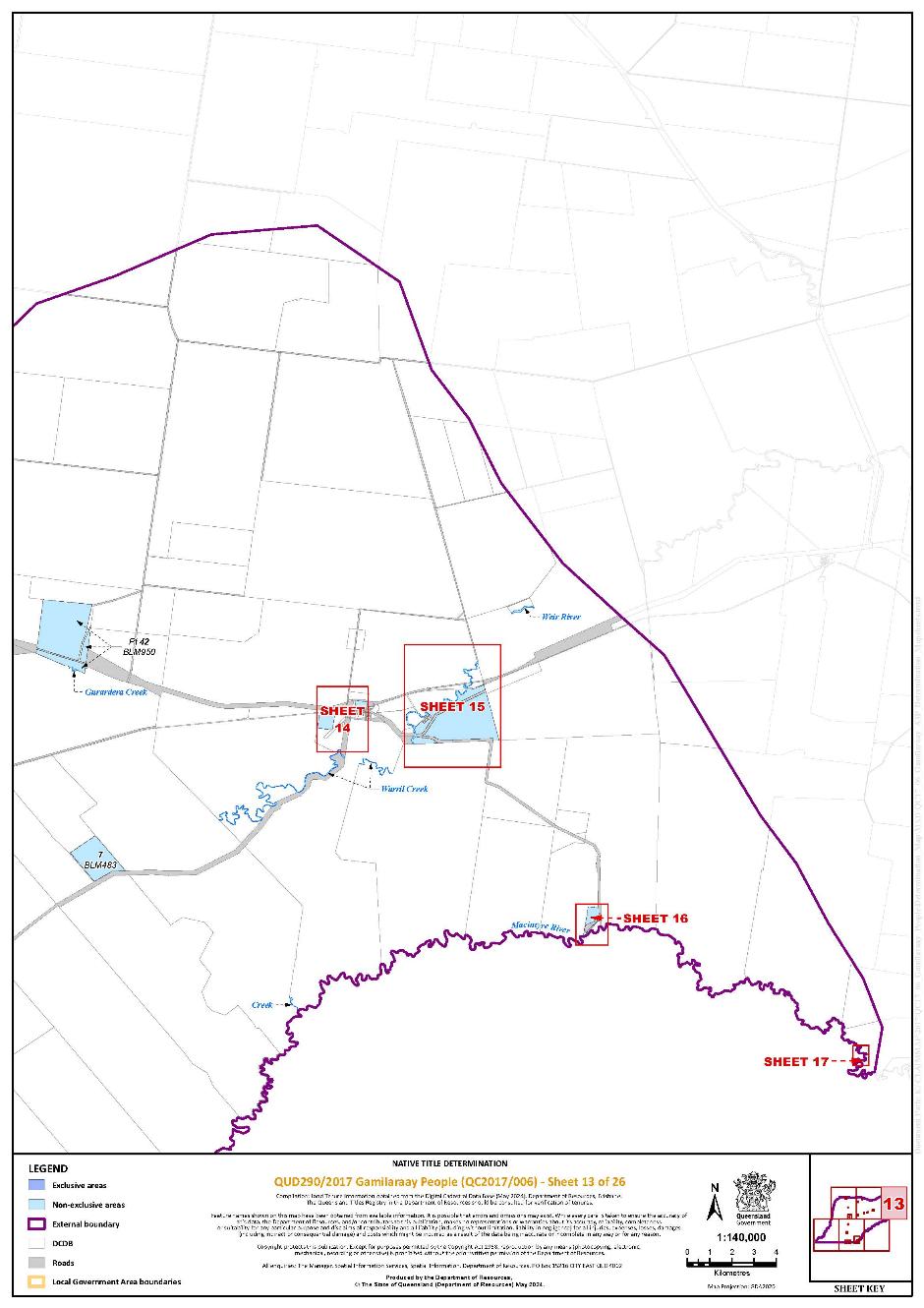
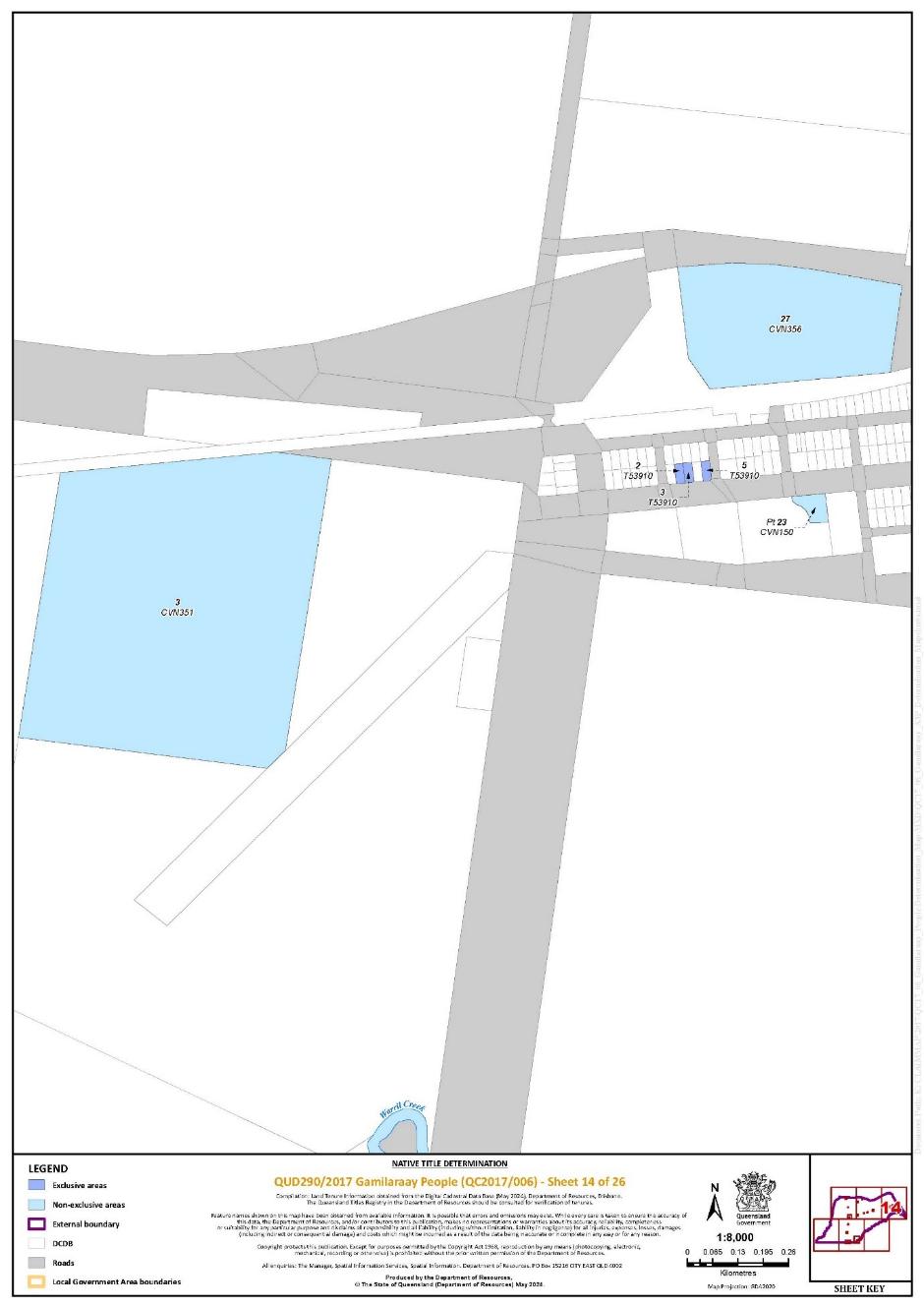
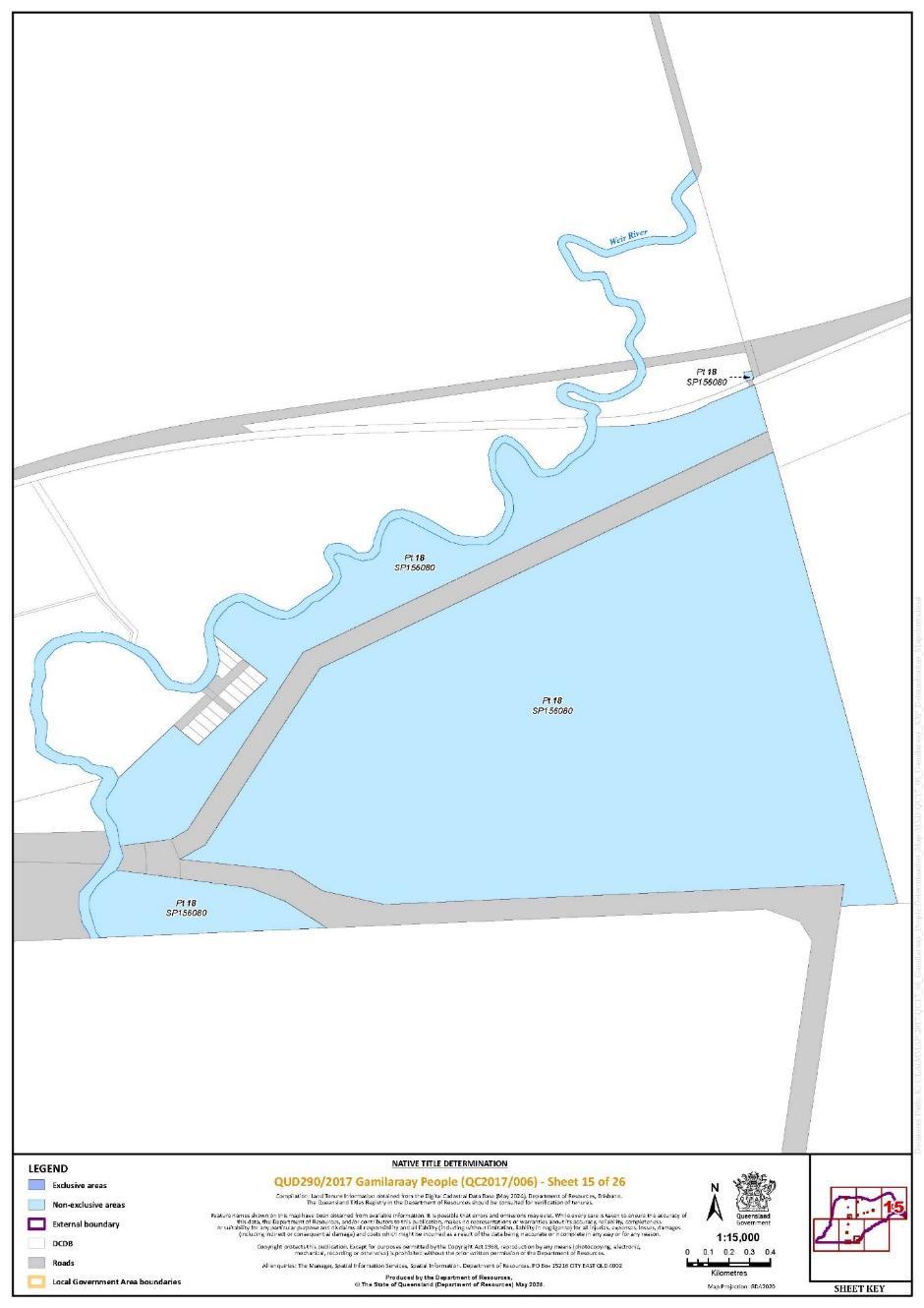
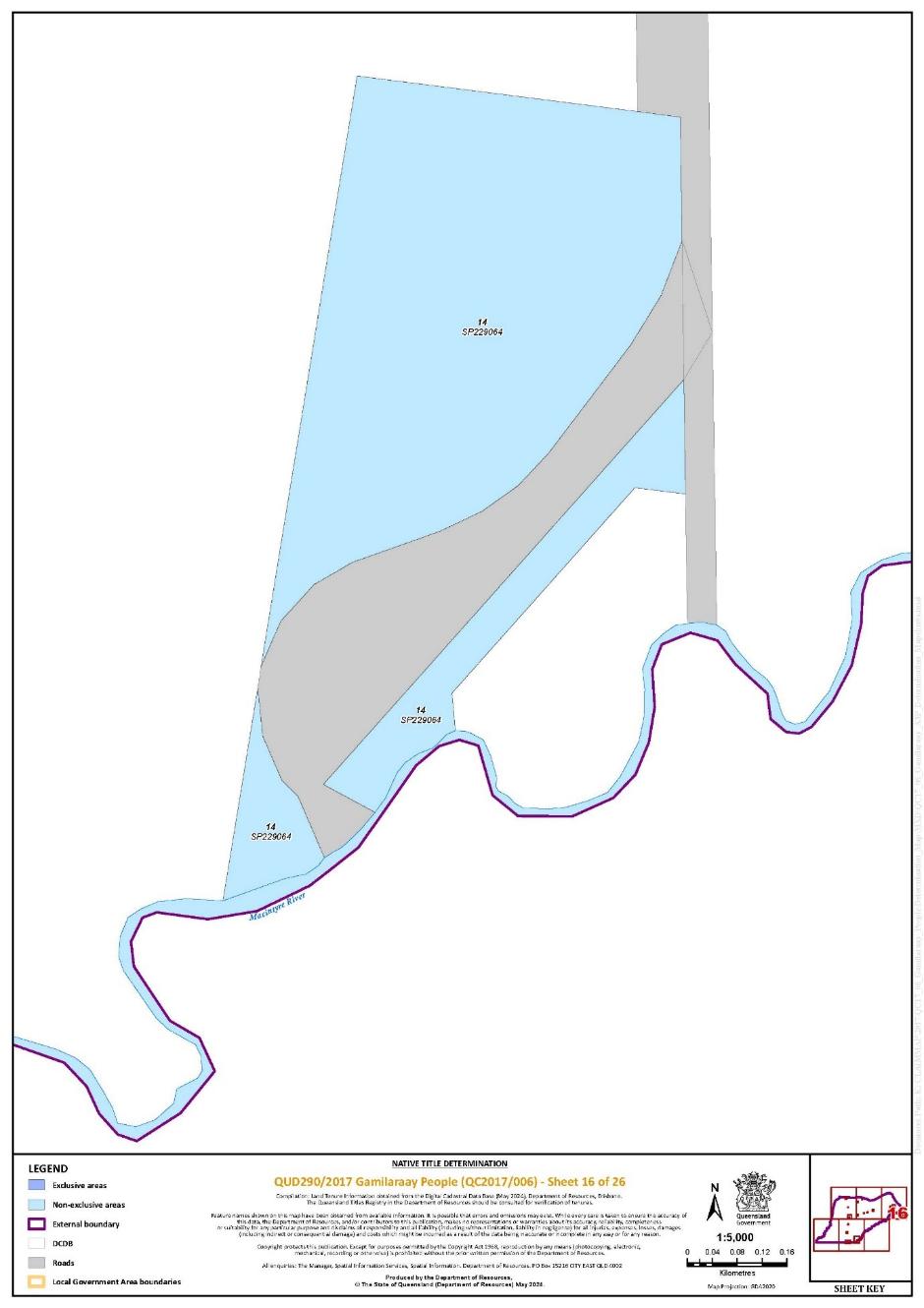
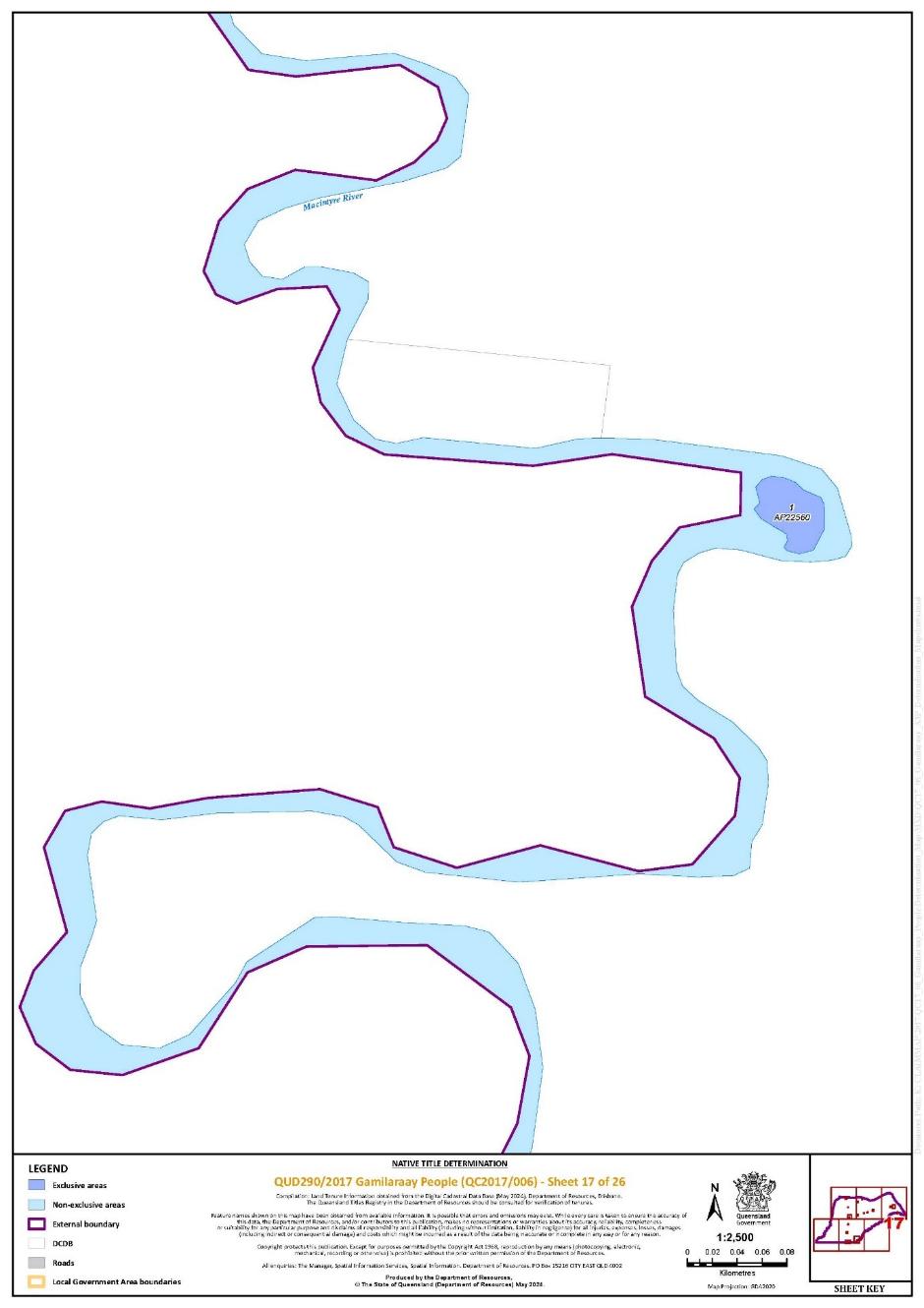
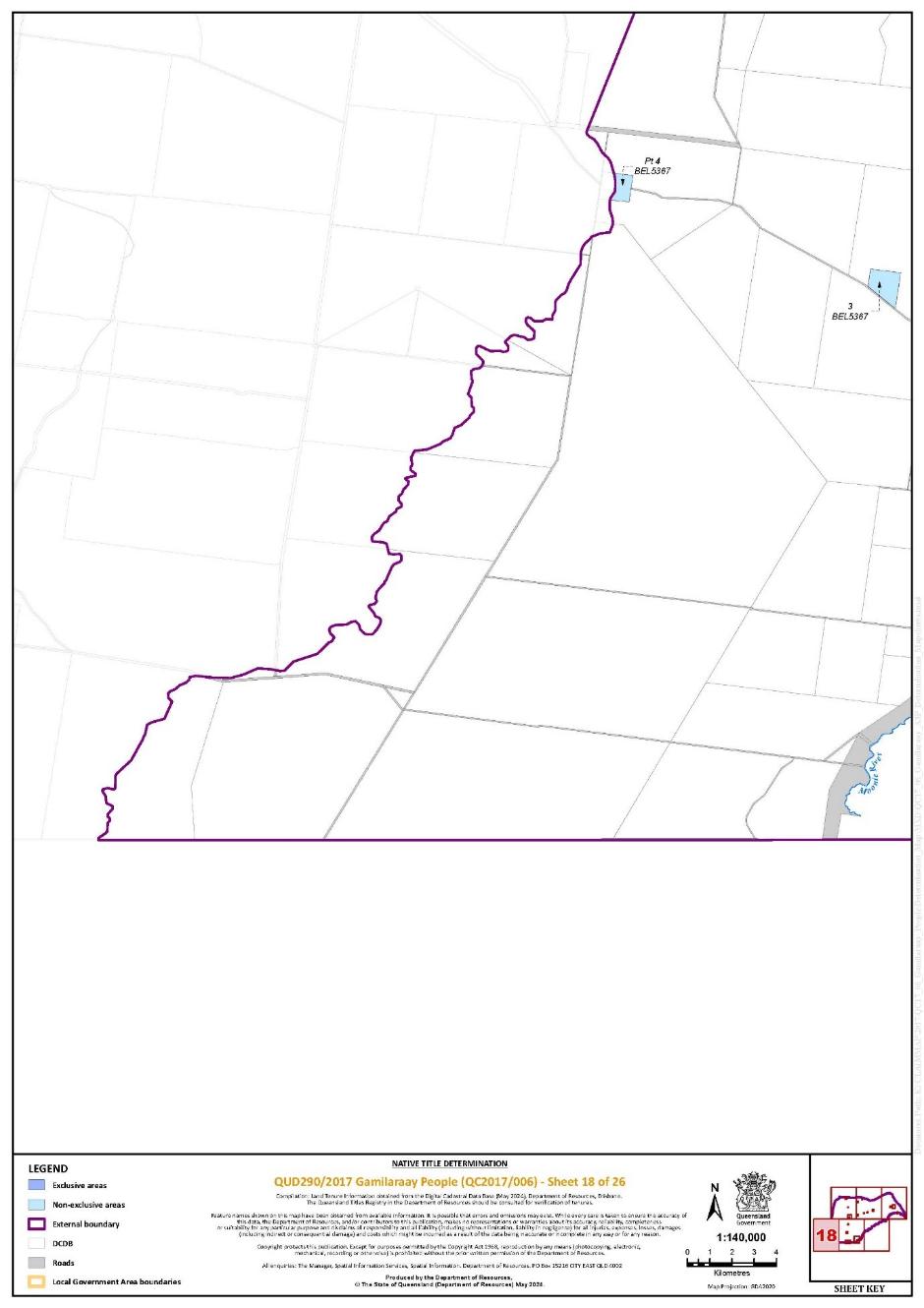
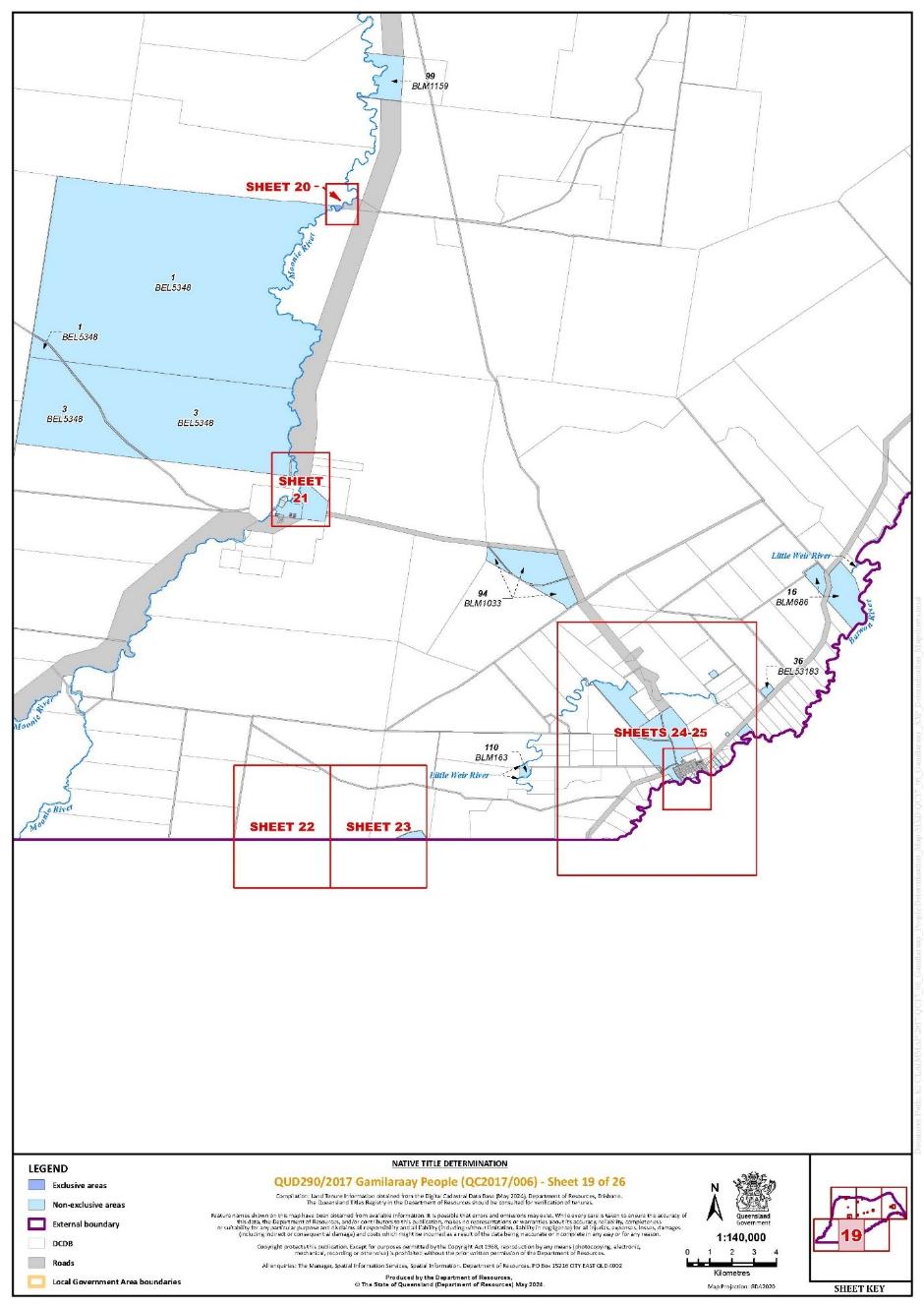
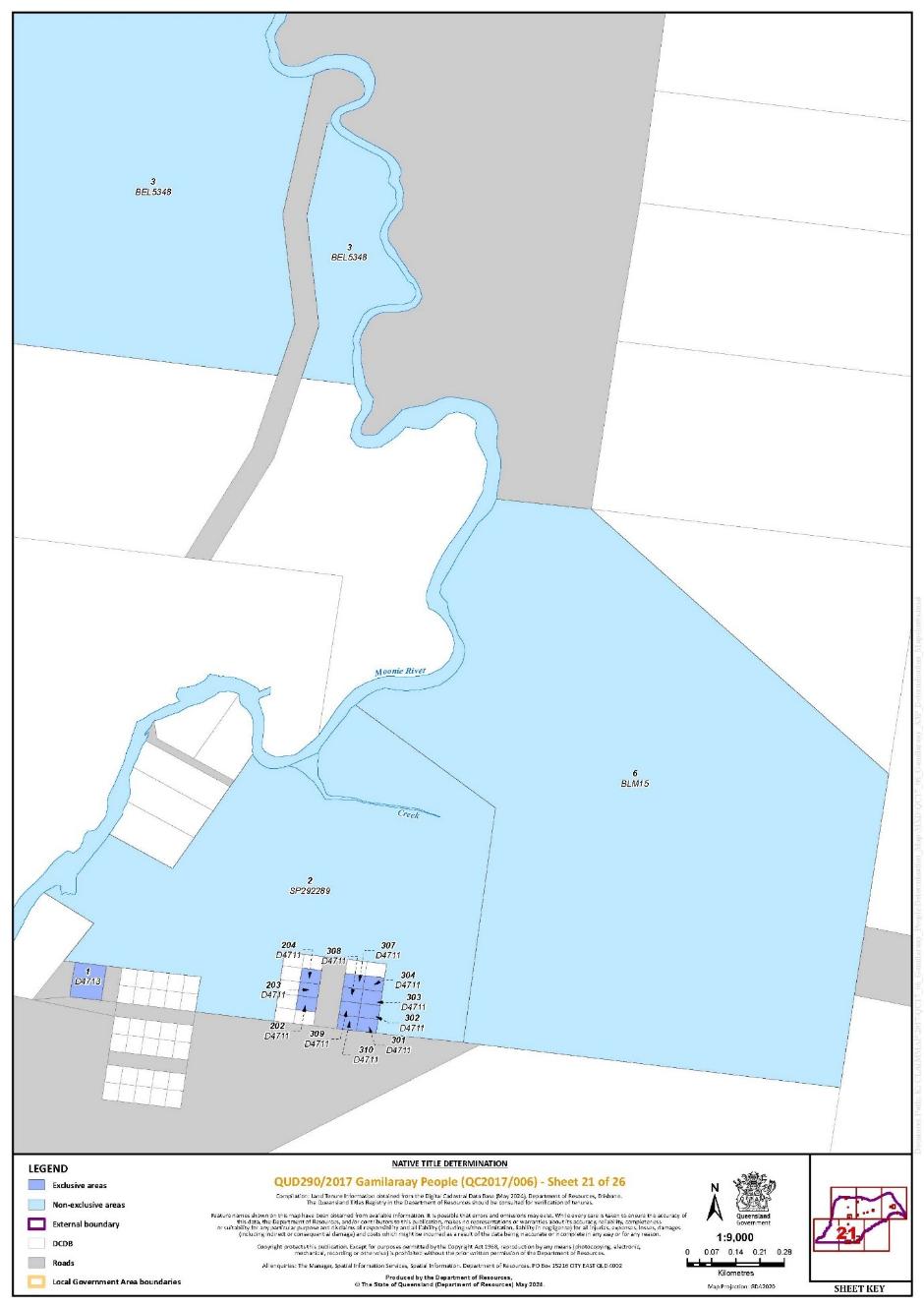
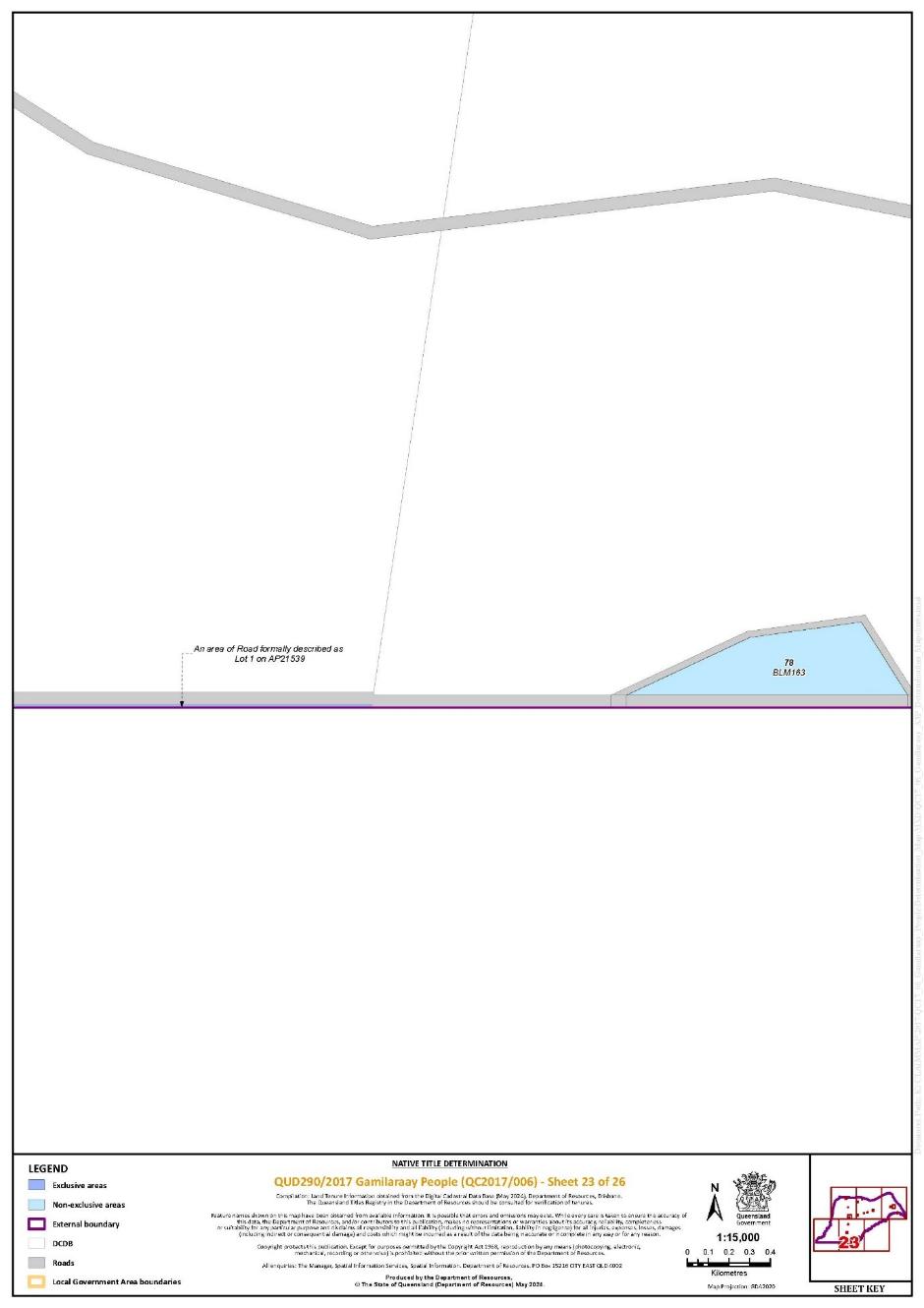
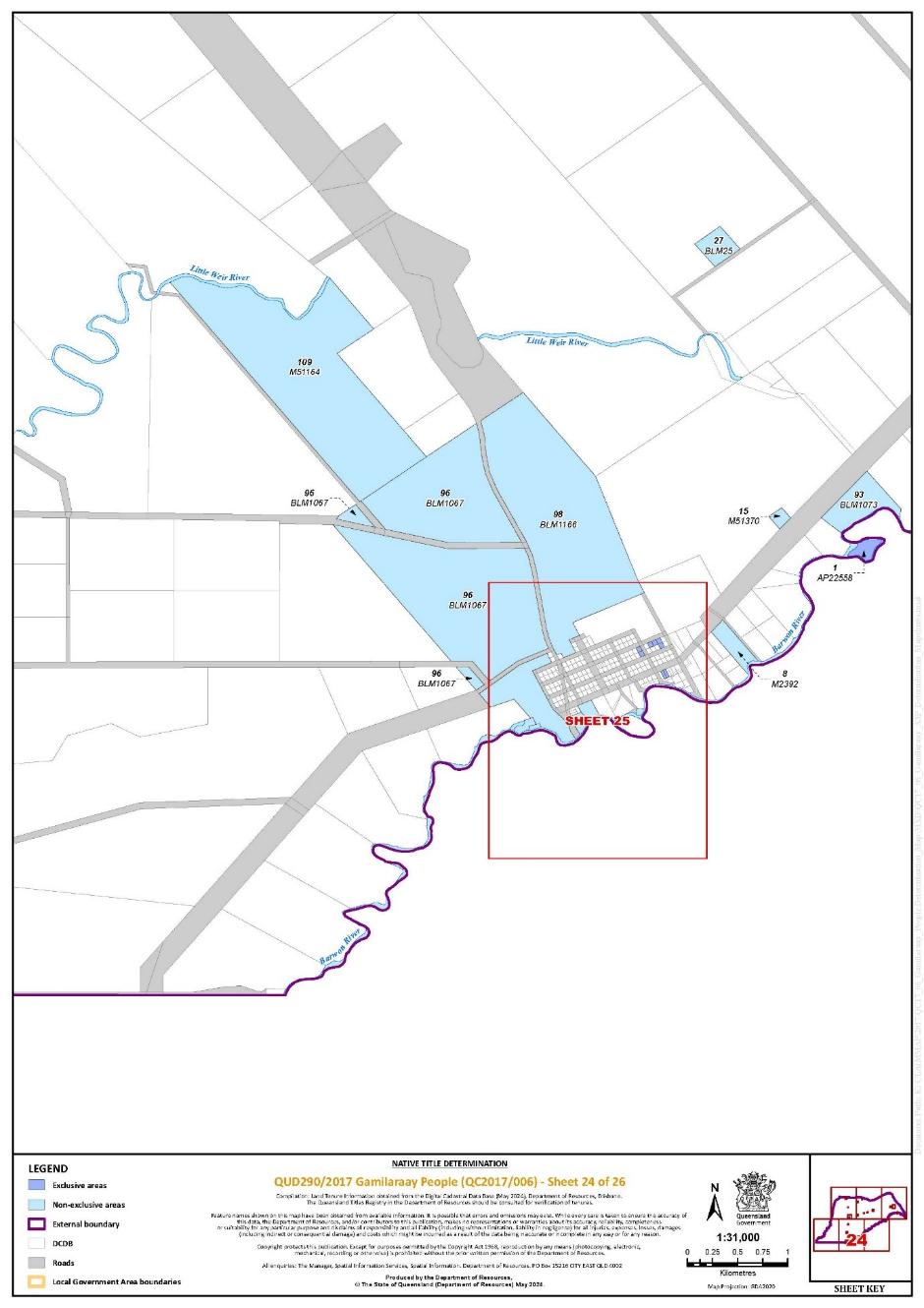
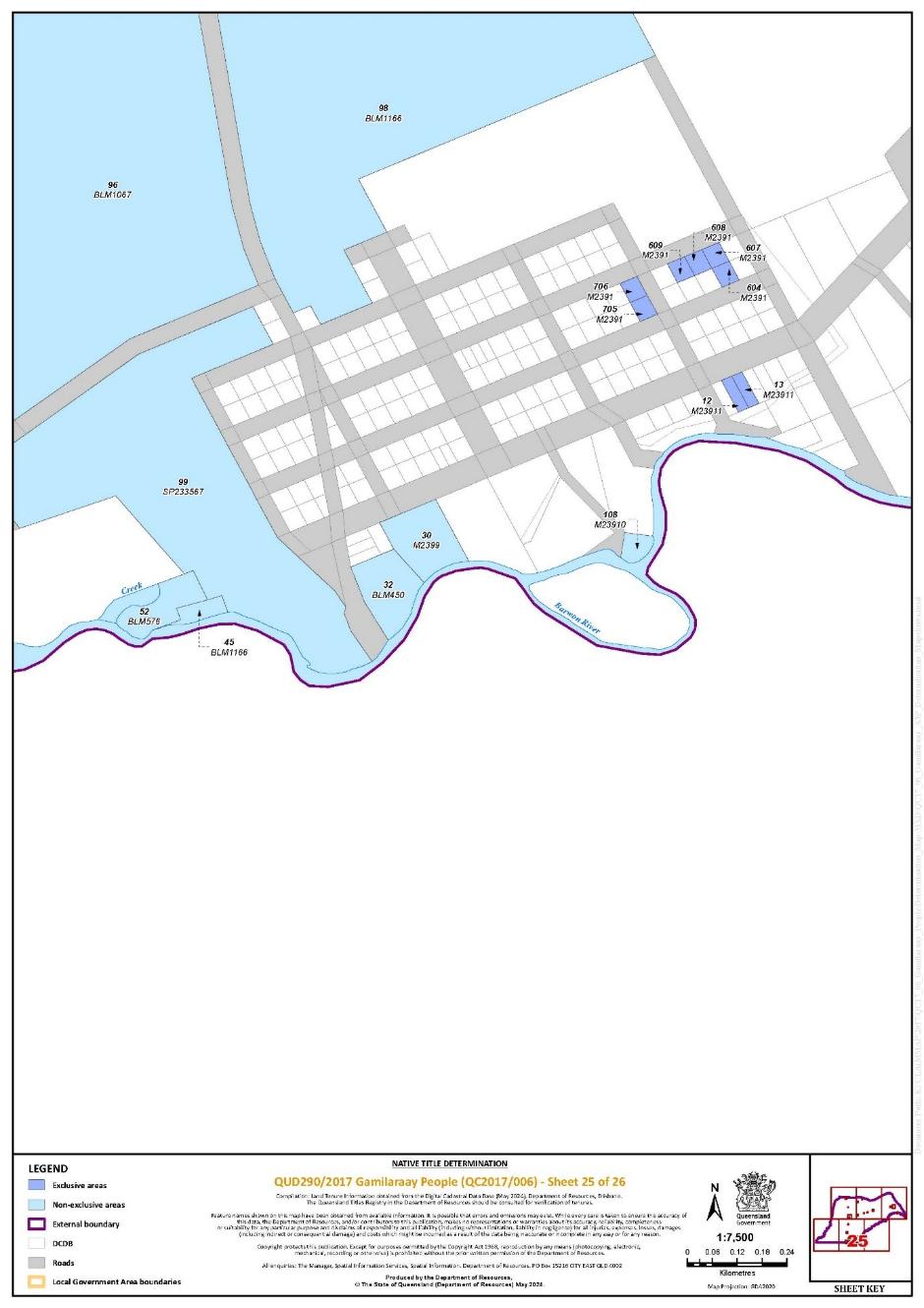
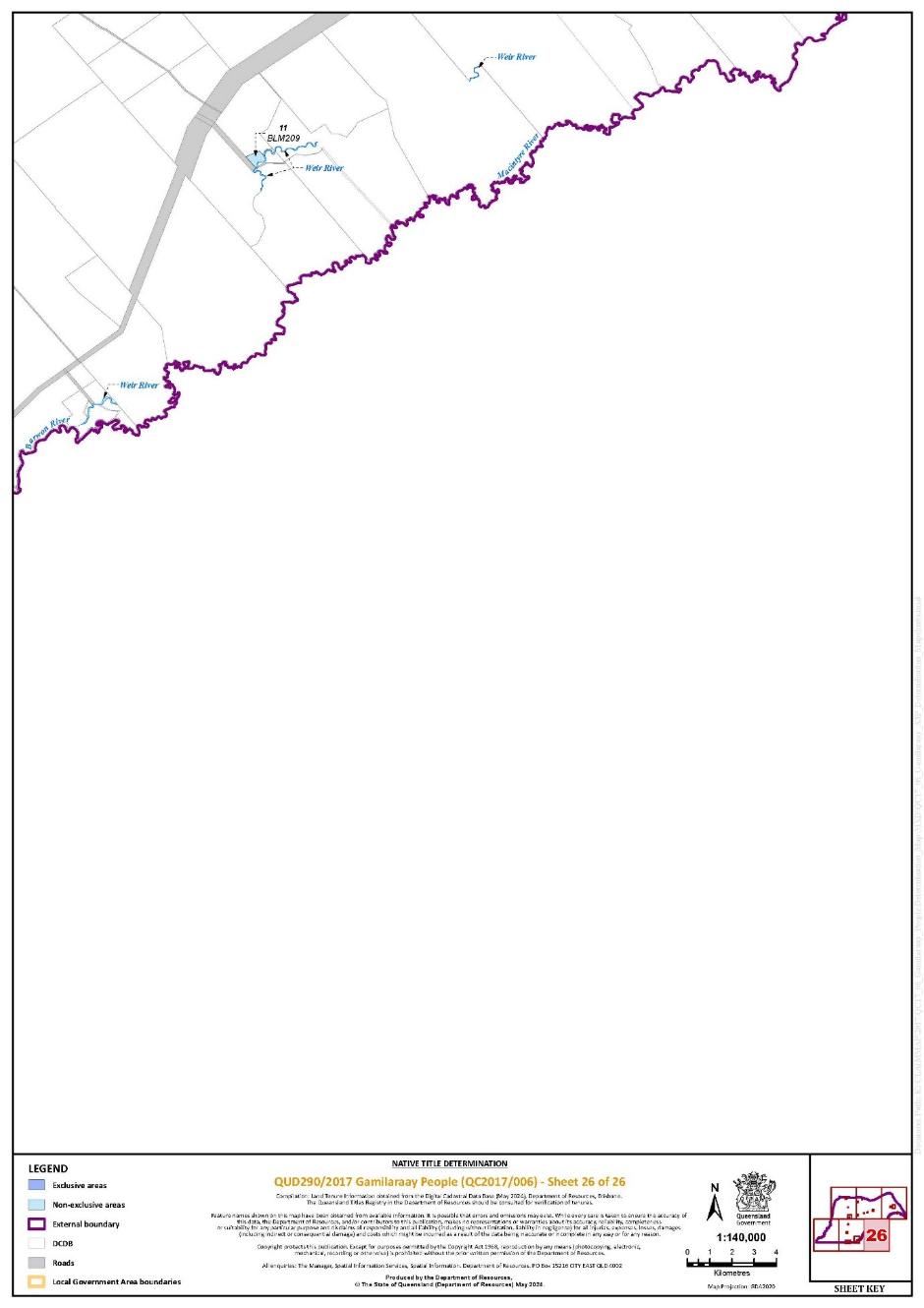
3. The determination area is the land and waters described in Schedule 4 and depicted in the map attached to Schedule 6 to the extent those areas are within, the External Boundary described in Schedule 3 and not otherwise excluded by the terms of Schedule 5 (the Determination Area). To the extent of any inconsistency between the written description and the map, the written description prevails.
4. Native title exists in the Determination Area.
5. The native title is held by the Gamilaraay People described in Schedule 1 (the Native Title Holders).
6. Subject to orders 8, 9 and 10 below the nature and extent of the native title, rights and interests in relation to the land and waters described in Part 1 of Schedule 4 are:
(a) other than in relation to Water, the right to possession, occupation, use and enjoyment of the area to the exclusion of all others; and
(b) in relation to Water, the non-exclusive rights to:
(i) hunt, fish and gather from the Water of the area;
(ii) take the Natural Resources of the Water in the area; and
(iii) take the Water of the area, for personal, domestic and non-commercial communal purposes.
7. Subject to orders 8, 9 and 10 below the nature and extent of the native title rights and interests in relation to the land and waters described in Part 2 of Schedule 4 are the non-exclusive rights to:
(a) access, be present on, move about on and travel over the area;
(b) camp, and live temporarily on the area as part of camping, and for that purpose build temporary shelters;
(c) hunt, fish and gather on the land and waters of the area;
(d) take and share Natural Resources from the land and waters of the area;
(e) take the Water of the area for personal, domestic and non-commercial communal purposes;
(f) conduct ceremonies on the area;
(g) maintain places of importance and areas of significance to the Native Title Holders under their traditional laws and customs and protect those places and areas from physical harm;
(h) teach on the area the physical and spiritual attributes of the area; and
(i) hold meetings on the area.
8. The native title rights and interests are subject to and exercisable in accordance with:
(a) the Laws of the State and the Commonwealth; and
(b) the traditional laws acknowledged and traditional customs observed by the Native Title Holders.
9. The native title rights and interests referred to in orders 6(b) and 7 do not confer possession, occupation, use or enjoyment to the exclusion of all others.
10. There are no native title rights in or in relation to minerals as defined by the Mineral Resources Act 1989 (Qld) and petroleum as defined by the Petroleum Act 1923 (Qld) and the Petroleum and Gas (Production and Safety) Act 2004 (Qld).
11. The nature and extent of any other interests in relation to the Determination Area (or respective parts thereof) are set out in Schedule 2.
12. The relationship between the native title rights and interests described in orders 6 and 7 and the other interests described in Schedule 2 (the Other Interests) is that:
(a) the Other Interests continue to have effect, and the rights conferred by or held under the Other Interests may be exercised notwithstanding the existence of the native title rights and interests;
(b) to the extent the Other Interests are inconsistent with the continued existence, enjoyment or exercise of the native title rights and interests in relation to the land and waters of the Determination Area, the native title continues to exist in its entirety but the native title rights and interests have no effect in relation to the Other Interests to the extent of the inconsistency for so long as the Other Interests exist; and
(c) the Other Interests and any activity that is required or permitted by or under, and done in accordance with, the Other Interests, or any activity that is associated with or incidental to such an activity, prevail over the native title rights and interests and any exercise of the native title rights and interests but will not extinguish them except in relation to acts that consist of the construction or establishment of a public work, done after this determination where s 24JA of the Native Title Act 1993 (Cth) applies.
DEFINITIONS AND INTERPRETATION
13. In this determination, unless the contrary intention appears:
"Animal" means any member of the animal kingdom (other than human), whether alive or dead;
"External Boundary" means the area described in Schedule 3;
"land" and "waters", respectively, have the same meanings as in the Native Title Act 1993 (Cth);
"Laws of the State and the Commonwealth" means the common law and the laws of the State of Queensland and the Commonwealth of Australia, and includes legislation, regulations, statutory instruments, local planning instruments and local laws;
"Local Government Act" has the meaning given in the Local Government Act 2009 (Qld);
"Local Government Area" has the meaning given in the Local Government Act 2009 (Qld);
"Natural Resources" means:
(a) any Animal, Plant, fish and bird life found on or in the lands and waters of the Determination Area; and
(b) any clays, soil, sand, gravel or rock found on or below the surface of the Determination Area,
that have been taken by the Native Title Holders in accordance with their traditional laws and customs,
(c) but does not include:
(i) Animals that are the private personal property of another;
(ii) crops that are the private personal property of another; and
(iii) minerals as defined in the Mineral Resources Act 1989 (Qld); or
(iv) petroleum as defined in the Petroleum Act 1923 (Qld) and the Petroleum and Gas (Production and Safety) Act 2004 (Qld).
"Plant" means any member of the plant or fungus kingdom, whether alive or dead and standing or fallen;
"Reserve" means a reserve dedicated or taken to be a reserve under the Land Act 1994 (Qld);
"Water" means:
(a) water which flows, whether permanently or intermittently, within a river, creek or stream;
(b) any natural collection of water, whether permanent or intermittent; and
(c) water from an underground water source.
"Works" has the same meaning as in the Electricity Act 1994 (Qld).
Other words and expressions used in this determination have the same meanings as they have in Part 15 of the Native Title Act 1993 (Cth).
THE COURT DETERMINES THAT:
14. The native title is held in trust.
15. The Gamilaraay Aboriginal Corporation (ICN: 9784), incorporated under the Corporations (Aboriginal and Torres Strait Islander) Act 2006 (Cth), is to:
(a) be the prescribed body corporate for the purpose of ss 56(2)(b) and 56(3) of the Native Title Act 1993 (Cth); and
(b) perform the functions mentioned in s 57(1) of the Native Title Act 1993 (Cth) after becoming a registered native title body corporate.
Note: Entry of orders is dealt with in Rule 39.32 of the Federal Court Rules 2011.
LIST OF SCHEDULES
Schedule 1 – Native Title Holders vii
Schedule 2 – other Interests in the Determination Area viii
Schedule 3 – External Boundary xii
Schedule 4 – Description of Determination Area xvi
Schedule 5 – Areas Not Forming Part of the Determination Area xxv
Schedule 6 – Map of Determination Area xxviii
Schedule 1 – Native Title Holders
1. The Native Title Holders are the Gamilaraay People. The Gamilaraay People are the descendants of one or more of the following people:
(a) Beeswing and his daughter Lucy Long;
(b) Kitty, mother of Charles, Jack and Alice Dennison;
(c) Kathleen “Kitty” Brown [Dunn];
(d) Mary Ann, mother of William Arnold;
(e) Mary Ann and Murray, parents of George and Ada Murray;
(f) Reuben Bartman;
(g) George Bennett and Mary Moodie;
(h) Charles Cubby and Lucy Ann;
(i) Harry Denham;
(j) Billy Edwards;
(k) Jonathan Flick and Mary Ann;
(l) Charlie Hippi;
(m) Eliza Kirk;
(n) Walter/William Marley;
(o) James McGowan, father of Aggie, Annie and Kate McGowan;
(p) Mary McGrady;
(q) Phoebe Munday;
(r) James Saunders and Sarah Pye/Bucknell/McGintie;
(s) Lennie Jane Smith/Rodwell;
(t) William Trapman/Troutman;
(u) Whalan Johnny;
(v) William (Billy) Wightman;
(w) Sarah Witon aka Witson/Wilson/Murphy;
(x) Eliza Weatherall; or
(y) Jimmy Hinch.
Schedule 2 – other Interests in the Determination Area
The nature and extent of the other interests in relation to the Determination Area are the following as they exist as at the date of the determination:
1. The rights and interests of the holder of rolling term lease SH 39/4892 over Lots 1 and 3 on BEL5348 (also known as Bullawarrie) granted pursuant to the Land Act 1910 (Qld).
2. The rights and interests of Ergon Energy Corporation ACN 087 646 062:
(a) as the owner and operator of any Works within the Determination Area;
(b) as an electricity entity under the Electricity Act 1994 (Qld), including but not limited to:
(i) as the holder of a distribution authority;
(ii) to inspect, maintain and manage any Works in the Determination Area;
(iii) in relation to any agreement or consent relating to the Determination Area, existing or entered into before the date these orders are made; and
(c) to enter the Determination Area by its employees, agents or contractors to exercise any of the rights and interests referred to in this clause.
3. The rights and interests of the Goondiwindi Regional Council as the local government for that part of the Determination Area within their respective Local Government Area, including:
(a) under their local government jurisdiction and functions under the Local Government Act, under the Stock Route Management Act 2002 (Qld) and under any other legislation, for that part of the Determination Area within the area declared to be their respective Local Government Area under the Local Government Act and Local Government Regulations 2012 (Qld);
(b) as the:
(i) lessor under any leases which were validly entered into before the date on which these orders are made and whether separately particularised in these orders or not;
(ii) grantor of any licences or other rights and interests which are validly granted before the date on which these orders were made and whether separately particularised in these orders or not;
(iii) holder of any estate or any other interest in land, including as a trustee of any reserves, under access agreements and easements that exist in the Determination Area;
(c) as the owner and operator of infrastructure, structures, earthworks, access works and any other facilities and other improvements which are in the Determination Area validly constructed or established on or before the date on which these orders are made, including but not limited to:
(i) undedicated but constructed roads except for those not operated by the relevant Council;
(ii) water pipelines and water supply infrastructure;
(iii) drainage facilities;
(iv) watering point facilities;
(v) recreational facilities;
(vi) transport facilities; and
(vii) community facilities; and
(d) to enter the land for the purposes described in paragraphs 3(a), 3(b), or 3(c) above by their employees, agents or contractors to:
(i) exercise any of the rights and interests referred to in this paragraph 3 or 4 below;
(ii) use, operate, inspect, maintain, replace, restore and repair the infrastructure, facilities and other improvements referred to in paragraph 3(c) above; and
(iii) undertake operational activities in its capacity as a local government such as feral animal control, weed control, erosion control, waste management and fire management.
4. The rights and interests of the State of Queensland and the Goondiwindi Regional Council to access, use, operate, maintain and control the dedicated roads in the Determination Area and the rights and interests of the public to use and access the roads.
5. The rights and interests of the State of Queensland and the Goondiwindi Regional Council in Reserves, the rights and interests of the trustees of those Reserves and the rights and interests of the persons entitled to access and use those Resen/es for the respective purpose for which they are reserved, including the rights and interests of the holders of permits validly issued by the trustees of the Reserves at, or before the date of the determination.
6. The rights and interests of the State of Queensland or any other person existing by reason of the force and operation of the laws of the State of Queensland, including those existing by reason of the following legislation or any regulation, statutory instrument, declaration, plan, authority, permit, lease or licence made, granted, issued or entered into under that legislation:
(a) the Fisheries Act 1994 (Qld);
(b) the Land Act 1994 (Qld);
(c) the Forestry Act 1959 (Qld);
(d) the Nature Conservation Act 1992 (Qld);
(e) the Water Act 2000 (Qld);
(f) the Petroleum Act 1923 (Qld) or Petroleum and Gas (Production and Safety) Act 2004 (Qld);
(g) the Mineral Resources Act 1989 (Qld);
(h) the Stock Route Management Act 2002 (Qld);
(i) the Planning Act 2016 (Qld);
(j) the Transport Infrastructure Act 1994 (Qld); and
(k) the Fire and Emergency Services Act 1990 (Qld) or Ambulance Service Act 1991 (Qld).
7. The rights and interests of members of the public arising under the common law, including but not limited to the following:
(a) any subsisting public right to fish; and
(b) the public right to navigate.
8. So far as confirmed pursuant to s 212(2) of the Native Title Act 1993 (Cth) and s 18 of the Native Title (Queensland) Act 1993 (Qld) as at the date of this determination, any existing rights of the public to access and enjoy the following places in the Determination Area:
(a) waterways;
(b) beds and banks or foreshores of waterways;
(c) stock routes; or
(d) areas that were public places at the end of 31 December 1993;
9. Any other rights and interests:
(a) held by the State of Queensland or Commonwealth of Australia; or
(b) existing by reason of the force and operation of the Laws of the State and the Commonwealth.
Schedule 3 – External Boundary
The Determination Area includes all the land and waters within the external boundary described as:
Commencing at the intersection of the Queensland - New South Wales Border and the centreline of an unnamed creek at Longitude 148.384129° East, a point on the external boundary of Yuwaalaraay/Euahlayi People Native Title Determination and extending generally north-easterly and generally northerly along the external boundary of that determination to Latitude 28.344900° South, further described as:
Extending generally north-easterly along the centreline of an unnamed Creek to Longitude 148.410856° East, Latitude 28.950027° South; then north-easterly to another unnamed Creek at Longitude 148.414026° East, Latitude 28.943127° South; then generally north-easterly along the centreline of that creek to Longitude 148.428996° East, Latitude 28.933367° South; then easterly to another unnamed Creek at Longitude 148.437976° East, Latitude 28.933557° South; then generally easterly and generally north-easterly along the centreline of that creek to Latitude 28.823247° South; then generally north-westerly along the centreline of an unnamed watercourse to Latitude 28.818847° South; then north-easterly to another unnamed watercourse at Longitude 148. 535636° East, Latitude 28.813437° South; then generally north-easterly along the centreline of that watercourse to Latitude 28.772097° South; then generally north-westerly, generally northerly and generally north-easterly along the centreline of that unnamed watercourse to Latitude 28.745427 South, then generally northerly and generally north-westerly again along the centreline of that unnamed watercourse to Latitude 28.712997° South; then generally northerly to again a point on the external boundary of the Yuwaalaraay/Euahtayi People Native Title Determination passing through the following co-ordinate points.
Longitude East | Latitude South |
148.604020 | 28.657332 |
148.615659 | 28.609742 |
148.620952 | 28.576429 |
148.622011 | 28.561624 |
148.629420 | 28.514034 |
148.640001 | 28.477020 |
148.643177 | 28.452696 |
148.650583 | 28.429959 |
148.660105 | 28.400347 |
148.679144 | 28.387657 |
148.697125 | 28.375495 |
148.714091 | 28.367298 |
148.718508 | 28.355520 |
148.720180 | 28.344900 |
Then generally easterly to a point on the centreline of the Barwon Highway (as constructed) as Longitude 148.841527 East passing through the following co-ordinate points.
Longitude East | Latitude South |
148.727130 | 28.345688 |
148.750441 | 28.348339 |
148.770655 | 28.348008 |
148.790785 | 28.347678 |
148.802462 | 28.347774 |
148.808354 | 28.348062 |
148.814247 | 28.348254 |
148.818721 | 28.348542 |
148.823959 | 28.349023 |
148.830749 | 28.349451 |
148.834720 | 28.349794 |
148.838235 | 28.349794 |
Then generally easterly along the centreline of that constructed highway to Longitude 149.161345° East, then north-westerly to a point on the southern external boundary of the Bigambul People Part A Native Title Determination at Longitude 149.195135° East, Latitude 28.389752° South. Then generally north-easterly and generally south-easterly along the external boundary of that determination to its intersection with the Queensland/New South Wales Border at Longitude 149.676698° East, further described as:
Generally north-easterly and generally south-easterly to its intersection with the Queensland/New South Wales Border at Longitude 149.676698° East passing through the following co-ordinate points:
Longitude East | Latitude South |
149.210348 | 28.389615 |
149.239670 | 28.379656 |
149.275664 | 28.359785 |
149.288144 | 28.351206 |
149.303159 | 28.343491 |
149.317896 | 28.339898 |
149.337696 | 28.320833 |
149.369326 | 28.309671 |
149.408398 | 28.292927 |
149.451190 | 28.289206 |
149.484540 | 28.311970 |
149.497513 | 28.347655 |
149.512577 | 28.367342 |
149.525597 | 28.393388 |
149.550652 | 28.425788 |
149.574192 | 28.447420 |
149.591584 | 28.462821 |
149.630508 | 28.527704 |
149.645105 | 28.547168 |
149.658079 | 28.571499 |
149.672163 | 28.593758 |
149.679796 | 28.613482 |
Then generally north-westerly, generally south-westerly and westerly along that state border back to the commencement point.
The Determination Area does not include any land and waters subject to:
Native Title Determination QUD101/2009 Bigambul People Part A as determined by the Federal Court 1 December 2016.
Native Title Determination QUD32/2017 Yuwaalaraay/Euahlayi People As determined by the Federal Court 22 November 2021.
Native Title Determination Application NSD2308/2011 Gomeroi People as accepted for registration 20 January 2012.
Data Reference and source
External boundary sourced from Commonwealth of Australia, NNTT November 2021.
Cadastral references based on cadastral data sourced from State of Queensland, Department of Resources October 2021.
Watercourses and Creeks based on 1:250k Topographic vector data © Commonwealth of Australia, (Geoscience Australia) 2008.
Centreline of the Barwon Highway (as constructed) interpreted from Bing Aerial © Microsoft Corporation 2017.
Reference datum
Geographical coordinates are based on spatial data referenced to the Geocentric Datum of Australia 2020 (GDA2020), in decimal degrees and are based on the spatial reference data acquired from the various custodians at the time.
Use of Coordinates
Where coordinates are used within the description to represent cadastral or topographical boundaries or the intersection with such, they are intended as a guide only. As an outcome to the custodians of cadastral and topographic data continuously recalculating the geographic position of their data based on improved survey and data maintenance procedures, it is not possible to accurately define such a position other than by detailed ground survey.
Prepared by Queensland South Native Title Services 30 November 2021.
Schedule 4 – Description of Determination Area
The determination area comprises all of the land and waters described by lots on plan, or relevant parts thereof, and any rivers, streams, creeks or lakes described in the first column of the tables in the Parts immediately below, and depicted in the maps in Schedule 6, to the extent those areas are within the External Boundary described in Schedule 3 and not otherwise excluded by the terms of Schedule 5.
Part 1 – Exclusive Areas
All of the land and waters described in the following table and depicted in dark blue on the determination map contained in Schedule 6:
Area description (at the time of the determination) | Determination Map Sheet Reference | Note |
Lot 103 on BLM627 | 5 | ~ |
Lot 104 on SP315810 | 5 | ~ |
Lot 109 on SP188451 | 5 | ~ |
Lot 11 on G6191 | 9 | |
Lot 12 on G6191 | 9 | |
Lot 12 on M23911 | 25 | |
Lot 13 on G6191 | 9 | |
Lot 13 on M23911 | 25 | |
Lot 14 on G6191 | 9 | |
Lot 15 on G6191 | 9 | |
Lot 16 on G6191 | 9 | |
Lot 1 on AP19892 | 2 | |
An area of road formerly identified as Lot 1 on AP21539 | 22, 23 | |
Lot 1 on AP22523 | 20 | |
Lot 1 on AP22558 | 24 | |
Lot 1 on AP22560 | 17 | |
Lot 1 on D4713 | 21 | |
Lot 1 on M6481 | 11 | |
Lot 1 on T6063 | 5 | |
Lot 1 on USL47374 | 12 | |
Lot 202 on D4711 | 21 | |
Lot 203 on D4711 | 21 | |
Lot 204 on D4711 | 21 | |
Lot 29 on T6063 | 5 | |
Lot 2 on T53910 | 14 | ~ |
Lot 2 on T6063 | 5 | |
Lot 301 on D4711 | 21 | |
Lot 302 on D4711 | 21 | |
Lot 303 on D4711 | 21 | |
Lot 304 on D4711 | 21 | |
Lot 307 on D4711 | 21 | |
Lot 308 on D4711 | 21 | |
Lot 309 on D4711 | 21 | |
Lot 30 on BLM559 | 3 | |
Lot 30 on T6063 | 5 | |
Lot 310 on D4711 | 21 | |
Lot 312 on T6061 | 5 | |
Lot 32 on G6191 | 9 | |
Lot 33 on BLM735 | 9 | |
Lot 3 on T53910 | 14 | ~ |
Lot 3 on T6063 | 5 | |
Lot 41 on T6063 | 5 | |
Lot 42 on T6063 | 5 | |
Lot 43 on T6063 | 5 | |
Lot 44 on T6063 | 5 | |
Lot 45 on T6063 | 5 | |
Lot 45 on USL45810 | 11 | |
Lot 46 on T6063 | 5 | |
Lot 46 on USL45810 | 11 | |
Lot 4 on T6063 | 5 | |
Lot 501 on D6752 | 12 | |
Lot 502 on D6752 | 12 | |
Lot 503 on D6752 | 12 | |
Lot 504 on D6752 | 12 | |
Lot 518 on D6752 | 12 | |
Lot 520 on D6752 | 12 | |
Lot 53 on T6063 | 5 | |
Lot 54 on T6063 | 5 | |
Lot 55 on T6063 | 5 | |
Lot 56 on T6063 | 5 | |
Lot 57 on T6063 | 5 | |
Lot 58 on T6063 | 5 | |
Lot 59 on T6063 | 5 | |
Lot 5 on T53910 | 14 | ~ |
Lot 5 on T6063 | 5 | |
Lot 604 on M2391 | 25 | |
Lot 607 on M2391 | 25 | |
Lot 608 on M2391 | 25 | |
Lot 609 on M2391 | 25 | |
Lot 60 on T6063 | 5 | |
Lot 61 on T6063 | 5 | |
Lot 62 on T6063 | 5 | |
Lot 68 on USL47374 | 12 | |
Lot 6 on T6063 | 5 | |
Lot 705 on M2391 | 25 | |
Lot 706 on M2391 | 25 | |
Lot 73 on T6063 | 5 | |
Lot 7 on T6063 | 5 | |
Lot 83 on SP188451 | 5 | ~ |
[~ denotes areas to which s 47B of the Native Title Act 1993 (Cth) apply]
Part 2 – Non-Exclusive Areas
All of the land and waters described in the following table and depicted in light blue on the determination map contained in Schedule 6:
Area description (at the time of the determination) | Determination Map Sheet Reference | Note |
Lot 100 on D6753 | 12 | |
Lot 107 on T6064 | 4 | |
Lot 108 on M23910 | 25 | |
Lot 109 on M51164 | 24 | |
Lot 10 on BLM775 | 1 | |
Lot 10 on T6066 | 5 | |
Lot 110 on BLM163 | 19 | |
Lot 112 on BLM1001 | 4 | |
Lot 11 on BLM209 | 26 | |
Lot 14 on SP229064 | 16 | |
Lot 15 on M51370 | 24 | |
Lot 16 on BLM686 | 19 | |
That part of Lot 18 on SP156080 excluding an area formerly identified as road on CVN355 | 15 | |
Lot 1 on BEL5348 | 19, 20 | |
Lot 27 on BLM25 | 24 | |
Lot 27 on CVN356 | 14 | |
Lot 2 on SP292289 | 21 | |
Lot 30 on M2399 | 25 | |
Lot 32 on BLM450 | 25 | |
Lot 34 on BLM1083 | 10 | |
Lot 35 on BLM167 | 9 | |
Lot 36 on BEL53183 | 19 | |
Lot 3 on BEL5348 | 19, 21 | |
Lot 3 on BEL5367 | 18 | |
That part of Lot 3 on BLM1177 that falls within the External Boundary | 2 | |
Lot 3 on CVN351 | 14 | |
That part of Lot 41 on BLM577 excluding an area formerly identified as one chain road on T6064 | 4, 5 | |
Lot 45 on BLM1166 | 25 | |
That part of Lot 4 on BEL5367 that falls within the External Boundary | 18 | |
Lot 501 on N5631 | 2 | |
Lot 502 on N5631 | 2 | |
Lot 503 on N5631 | 2 | |
Lot 504 on N5631 | 2 | |
Lot 52 on BLM576 | 25 | |
Lot 60 on BLM217 | 7 | |
Lot 62 on BLM392 | 4 | |
Lot 64 on D6752 | 12 | |
Lot 65 on BLM231 | 7 | |
Lot 65 on BLM721 | 12 | |
Lot 66 on BLM233 | 8 | |
Lot 67 on T6065 | 4, 5 | |
Lot 6 on BLM15 | 21 | |
Lot 78 on BLM163 | 23 | |
Lot 7 on BLM483 | 13 | |
Lot 8 on BLM1 | 6 | |
Lot 8 on M2392 | 24 | |
Lot 90 on BLM764 | 5 | |
Lot 93 on BLM1073 | 24 | |
Lot 94 on BLM1033 | 19 | |
Lot 95 on BLM282 | 4 | |
Lot 96 on BLM1067 | 24, 25 | |
Lot 98 on BLM1166 | 24, 25 | |
Lot 99 on BLM1159 | 19 | |
Lot 99 on SP233567 | 24, 25 | |
That part of Lot 81 on SP188451 excluding an area formerly identified as part of Portion 83 on T6061 | 5 | |
That part of Lot 1 on D6756 excluding an area formerly identified as Section 4 on D6753 and Allotment 1 of Section 4 on D6754. | 12 | |
That part of Lot 23 on CVN150 excluding an area west and south of a line drawn from the northern boundary of that lot at Longitude 149.469063° East to its eastern boundary at Latitude 28.487406° South, passing through the following coordinates: Longitude° East Latitude° South 149.469101 28.486928 149.469180 28.486994 149.469298 28.487042 149.469396 28.487135 149.469469 28.487258 149.469491 28.487419 | 14 | |
That part of Lot 42 on BLM950 excluding an area commencing on the northern boundary of that lot at Longitude 149.360142° East and extending easterly and southerly along boundaries of that lot to Latitude 28.450864° South; then south-westerly to the southern boundary of the northern severance of that lot at Longitude 149.355005° East, passing through Longitude 149.356613° East, Latitude 28.457710° South; then north-westerly along that boundary to Longitude 149.354430° East; then northerly back to the commencement point, passing through the following coordinate points: Longitude° East Latitude° South 149.356177 28.457450 149.357353 28.454826 149.358693 28.448883 | 13 | |
Save for any waters forming part of a lot on plan, all rivers, creeks, streams and lakes within the External Boundary described in Schedule 3, including but not limited to: • Barwon River • Gurardera Creek • Little Weir River • Macintyre River • Moonie River • Moonie River (branch) • Warril Creek • Weir River • Unnamed Creek adjacent to Lot 5 on SP225462 and Lot 11 on SP196497 • Unnamed Creek adjacent to Lot 2 on SP292289 • Unnamed Creek adjacent to Lot 52 on BLM576 |
Note:
Geographical coordinates listed in this schedule are referenced to the Geocentric Datum of Australia 2020 (GDA2020), in decimal degrees.
Schedule 5 – Areas Not Forming Part of the Determination Area
The following areas of land and waters are excluded from the determination area as described in Part 1 of Schedule 4 and Part 2 of Schedule 4:
1. Those land and waters within the External Boundary which, at the time the native title determination application was made, were or had been the subject of one or more Previous Exclusive Possession Acts, within the meaning of s 23B of the Native Title Act 1993 (Cth) as they could not be claimed in accordance with s 61A of the Native Title Act 1993 (Cth).
2. Specifically, and to avoid any doubt, the land and waters described in (1) above includes:
(a) the Previous Exclusive Possession Acts described in ss 23B(2) and 23B(3) of the Native Title Act 1993 (Cth) to which s 20 of the Native Title (Queensland) Act 1993 (Qld) applies, and to which none of ss 47, 47A, 47B or 47C of the Native Title Act 1993 (Cth) applied.
(b) the land and waters on which any public work, as defined in s 253 of the Native Title Act 1993 (Cth), is or was constructed, established or situated, and to which ss 23B(7) and 23C(2) of the Native Title Act 1993 (Cth) and to which s 21 of the Native Title (Queensland) Act 1993 (Qld), applies, together with any adjacent land or waters in accordance with s 251D of the Native Title Act 1993 (Cth), including, but not limited to, the whole of the land and waters described as:
(i) That part of Lot 23 on CVN150 described as the area west and south of a line drawn from the northern boundary of that lot at Longitude 149.469063° East to its eastern boundary at Latitude 28.487406° South, passing through the following coordinates:
Longitude° East | Latitude° South |
149.469101 | 28.486928 |
149.469180 | 28.486994 |
149.469298 | 28.487042 |
149.469396 | 28.487135 |
149.469469 | 28.487258 |
149.469491 | 28.487419 |
(ii) That part of Lot 42 on BLM950 described as the area commencing on the northern boundary of that lot at Longitude 149.360142° East and extending easterly and southerly along boundaries of that lot to Latitude 28.450864° South; then south-westerly to the southern boundary of the northern severance of that lot at Longitude 149.355005° East, passing through Longitude 149.356613° East, Latitude 28.457710° South; then north-westerly along that boundary to Longitude 149.354430° East; then northerly back to the commencement point, passing through the following coordinate points:
Longitude° East | Latitude° South |
149.356177 | 28.457450 |
149.357353 | 28.454826 |
149.358693 | 28.448883 |
(iii) Lot 29 on CVN351.
(iv) Lot 30 on CVN363.
3. Those land and waters within the External Boundary on which, at the time the native title determination application was made, public works were validly constructed, established or situated after 23 December 1996, where s 24JA of the Native Title Act 1993 (Cth) applies, and which wholly extinguished native title.
4. Those land and waters within the External Boundary which, at the time the native title determination application was made, were the subject of one or more Pre-existing Rights Based Acts, within the meaning of s 24IB of the Native Title Act 1993 (Cth), which wholly extinguished native title.
Data Reference and source
Cadastral data sourced from Department of Resources, Qld (14 January 2022)
Reference datum
Geographical coordinates are referenced to the Geocentric Datum of Australia 2020 (GDA2020), in decimal degrees.
Use of Coordinates
Where coordinates are used within the description to represent cadastral or topographical boundaries or the intersection with such, they are intended as a guide only. As an outcome to the custodians of cadastral and topographic data continuously recalculating the geographic position of their data based on improved survey and data maintenance procedures, it is not possible to accurately define such a position other than by detailed ground survey.
Prepared by Department of Resources (28 January 2022).
Schedule 6 – Map of Determination Area
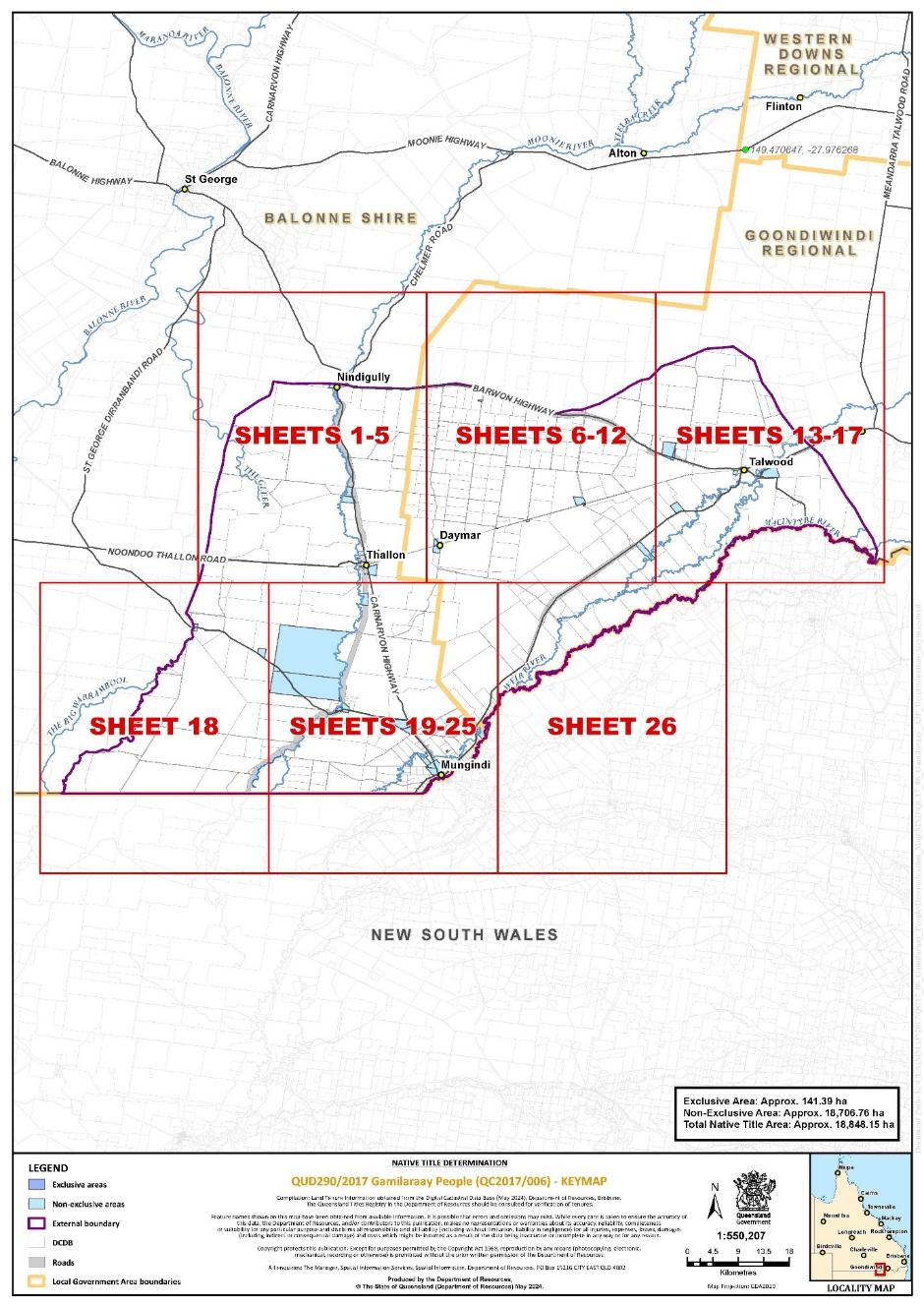
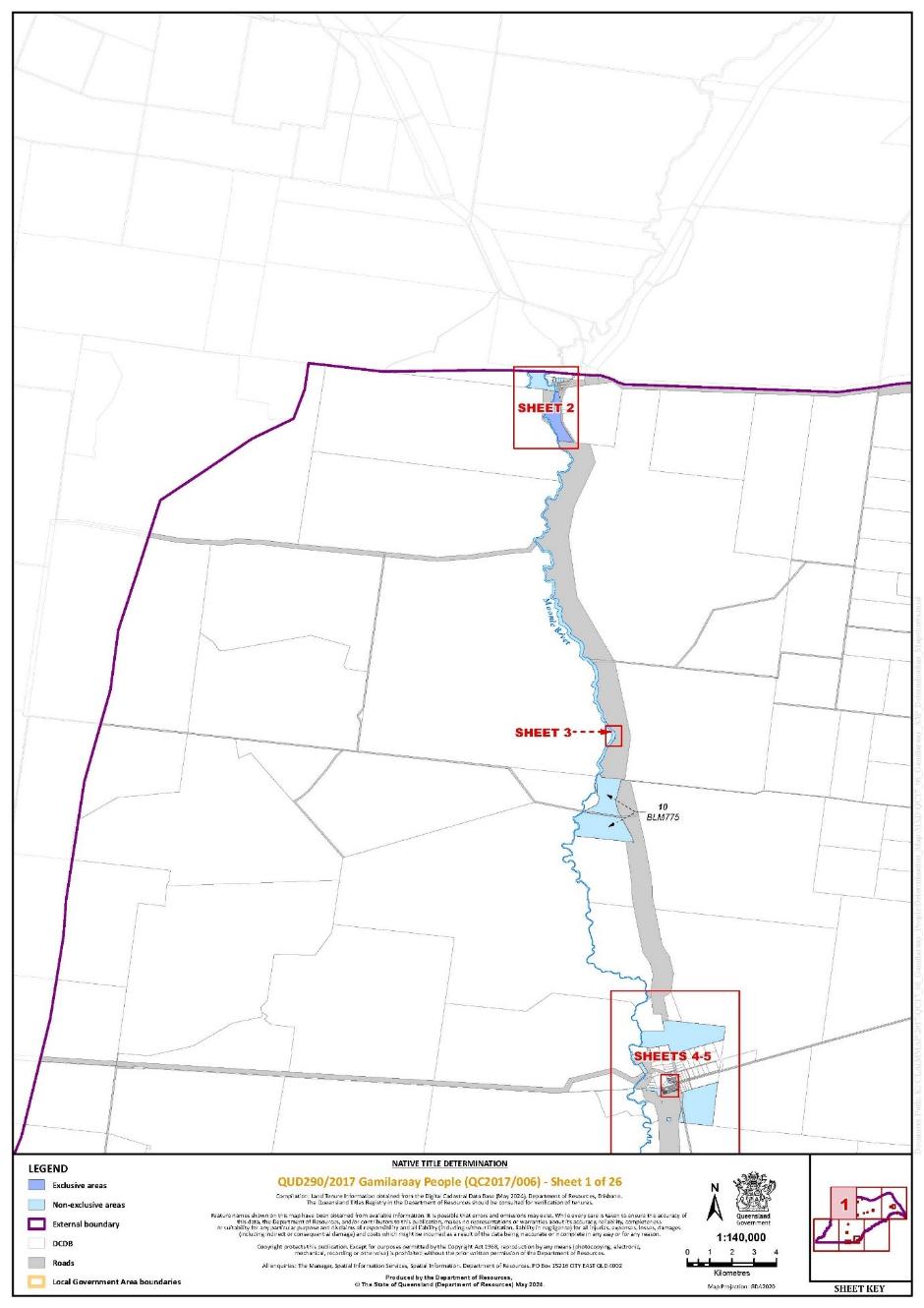
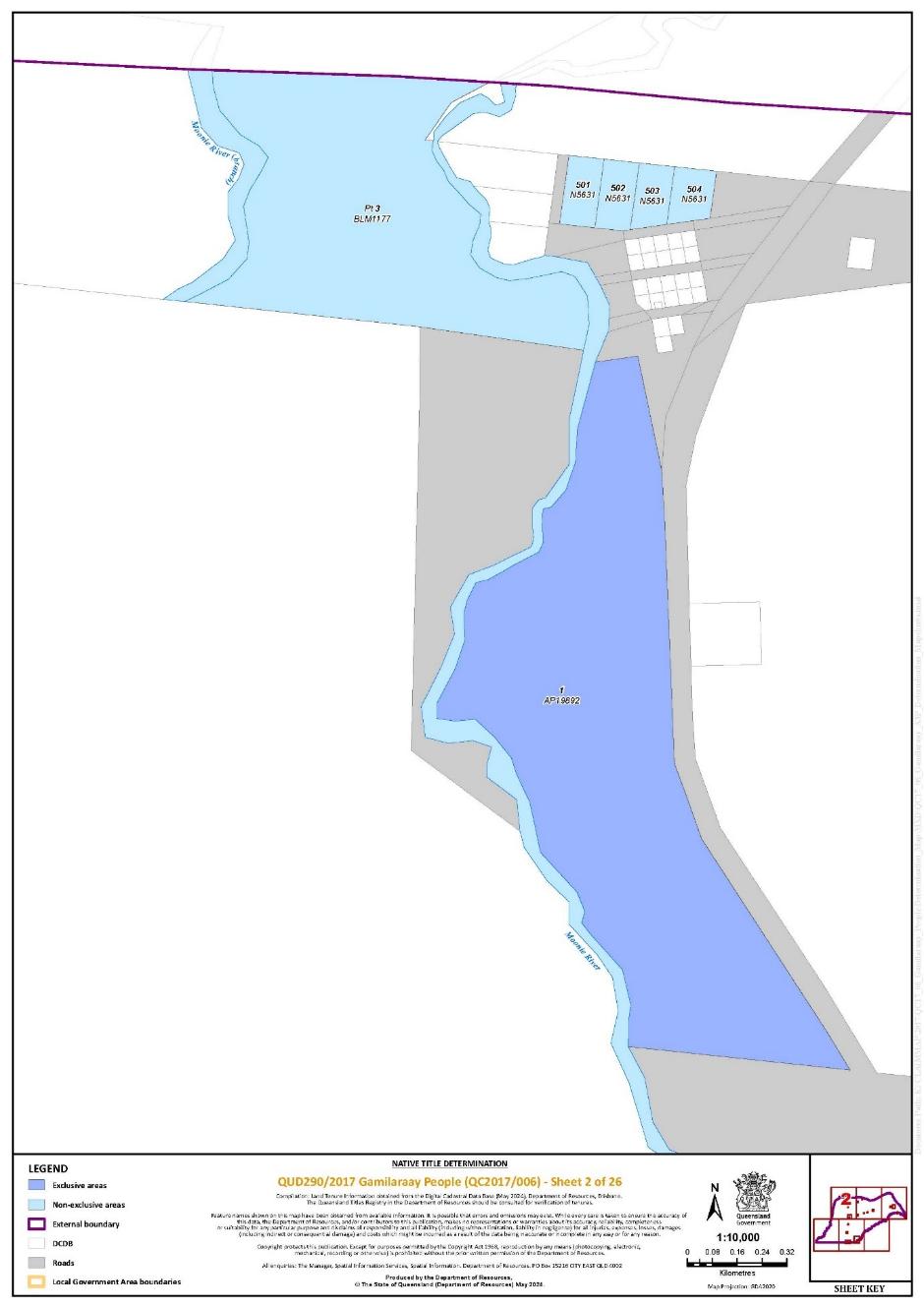
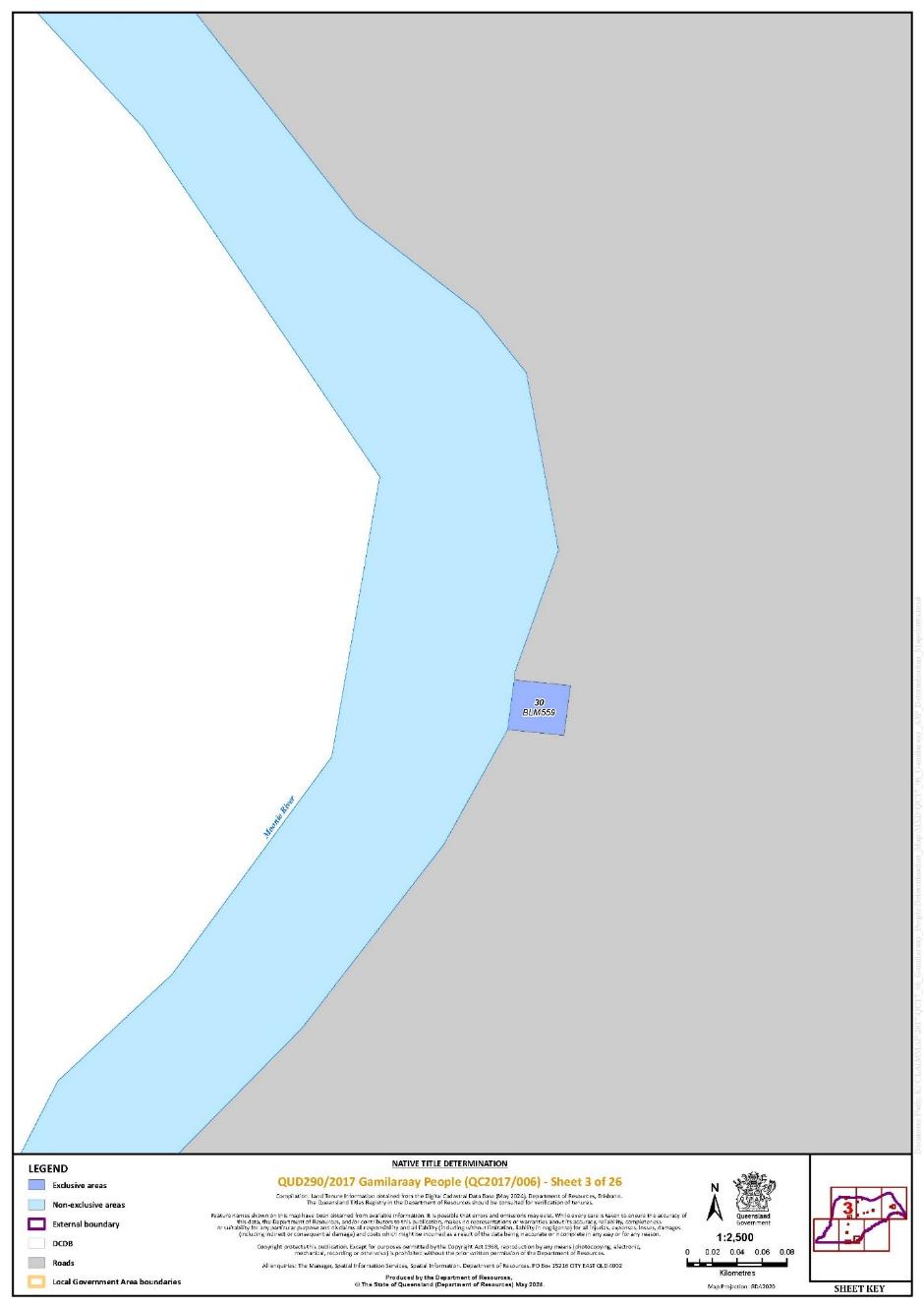
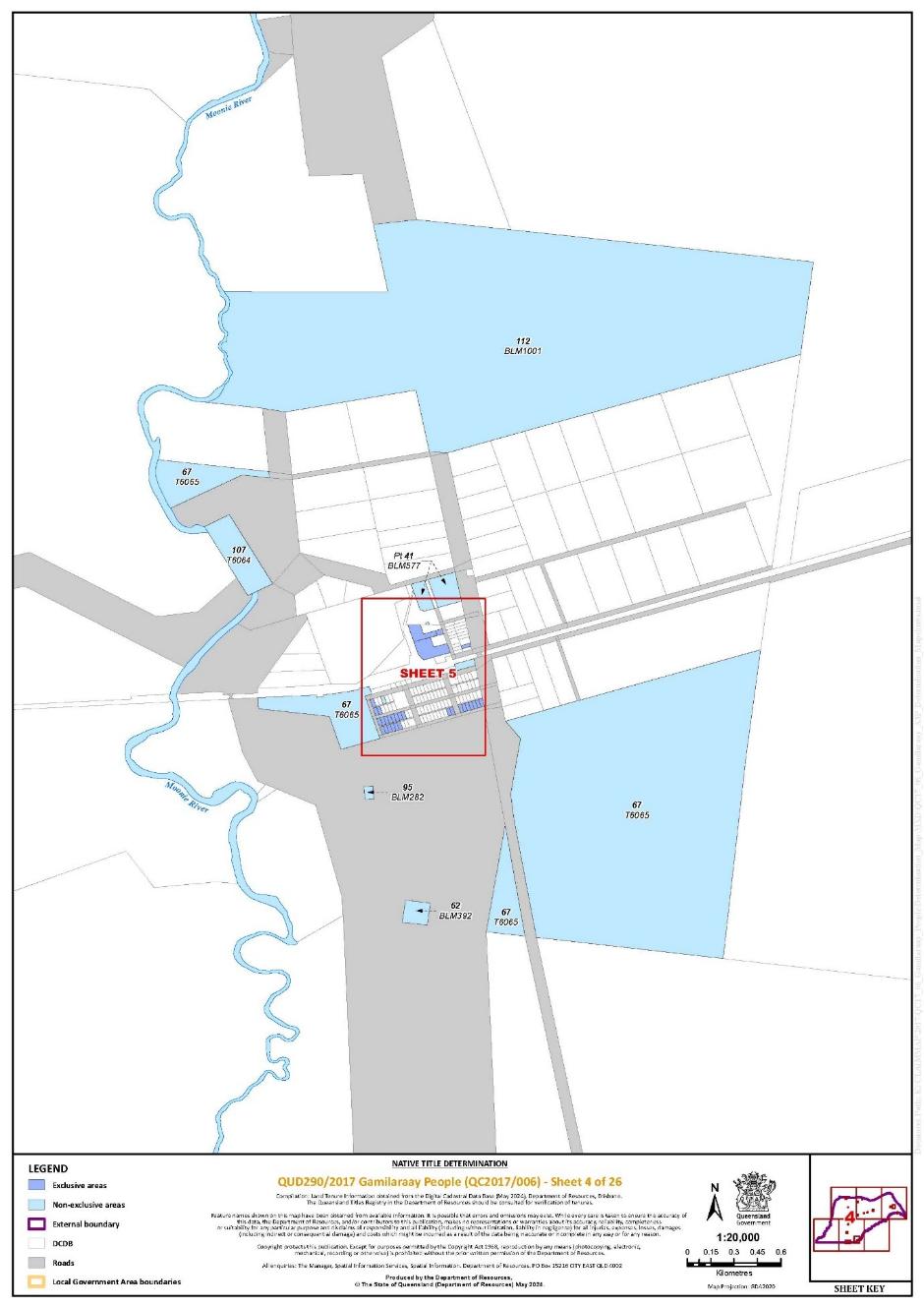
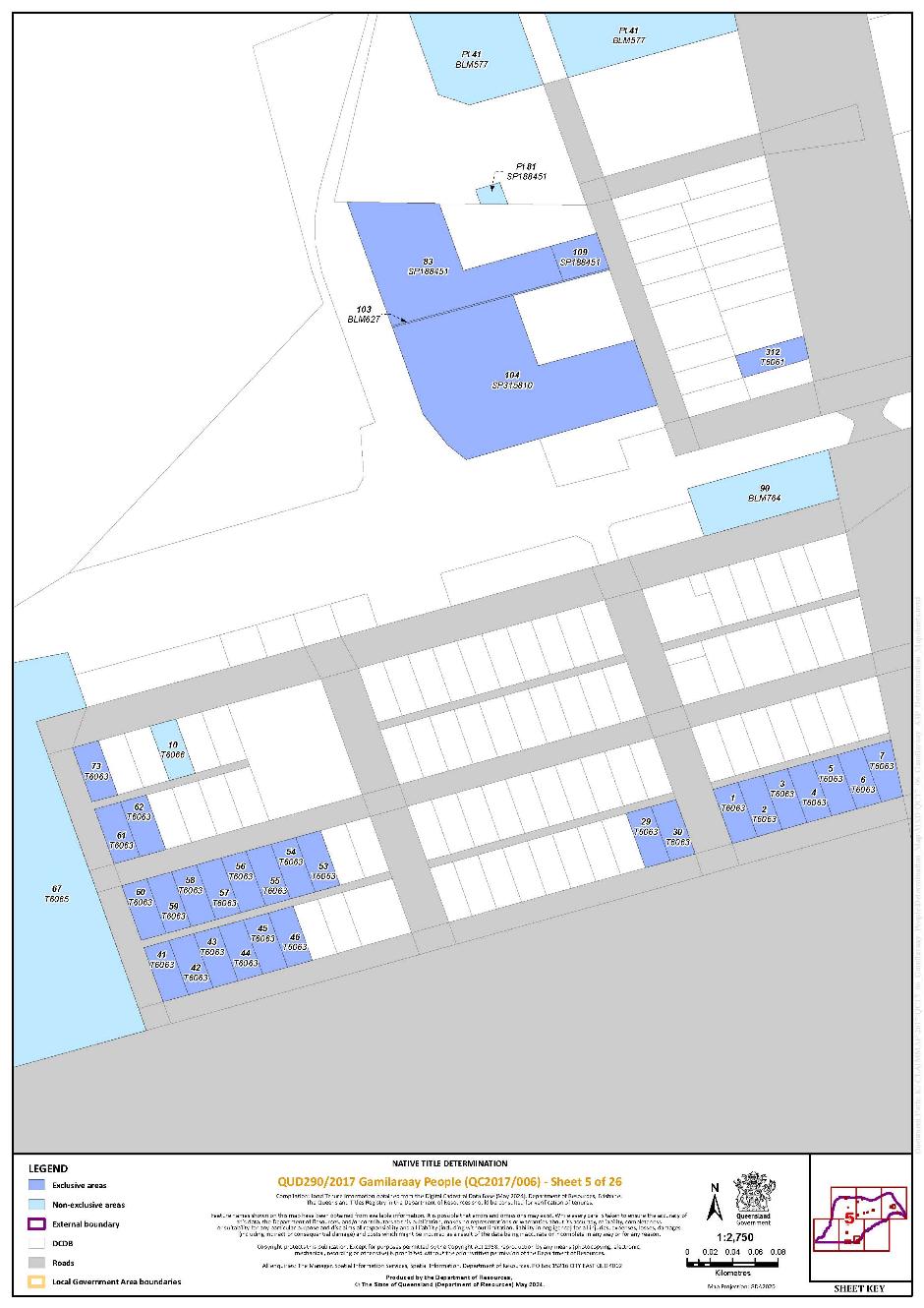
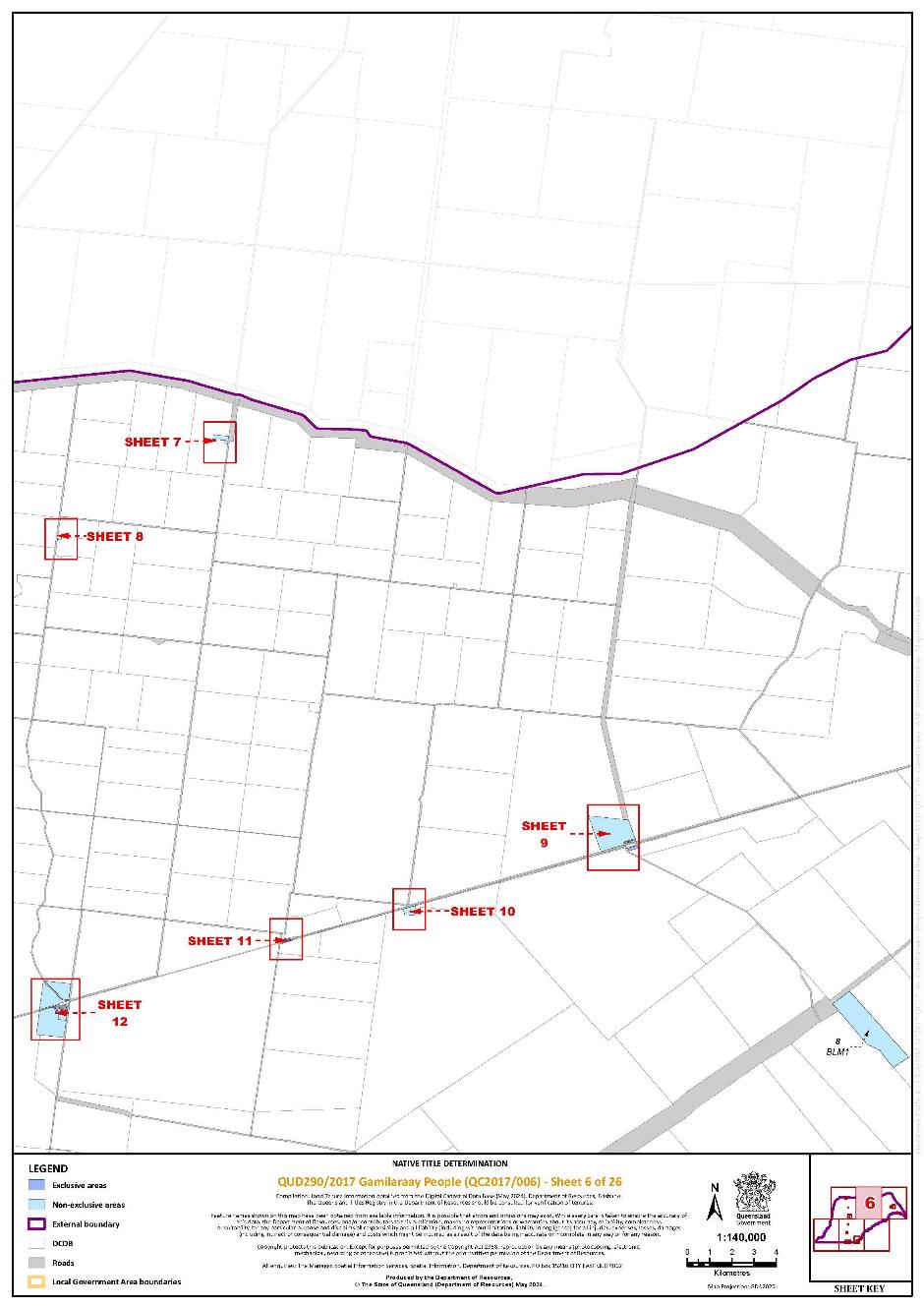
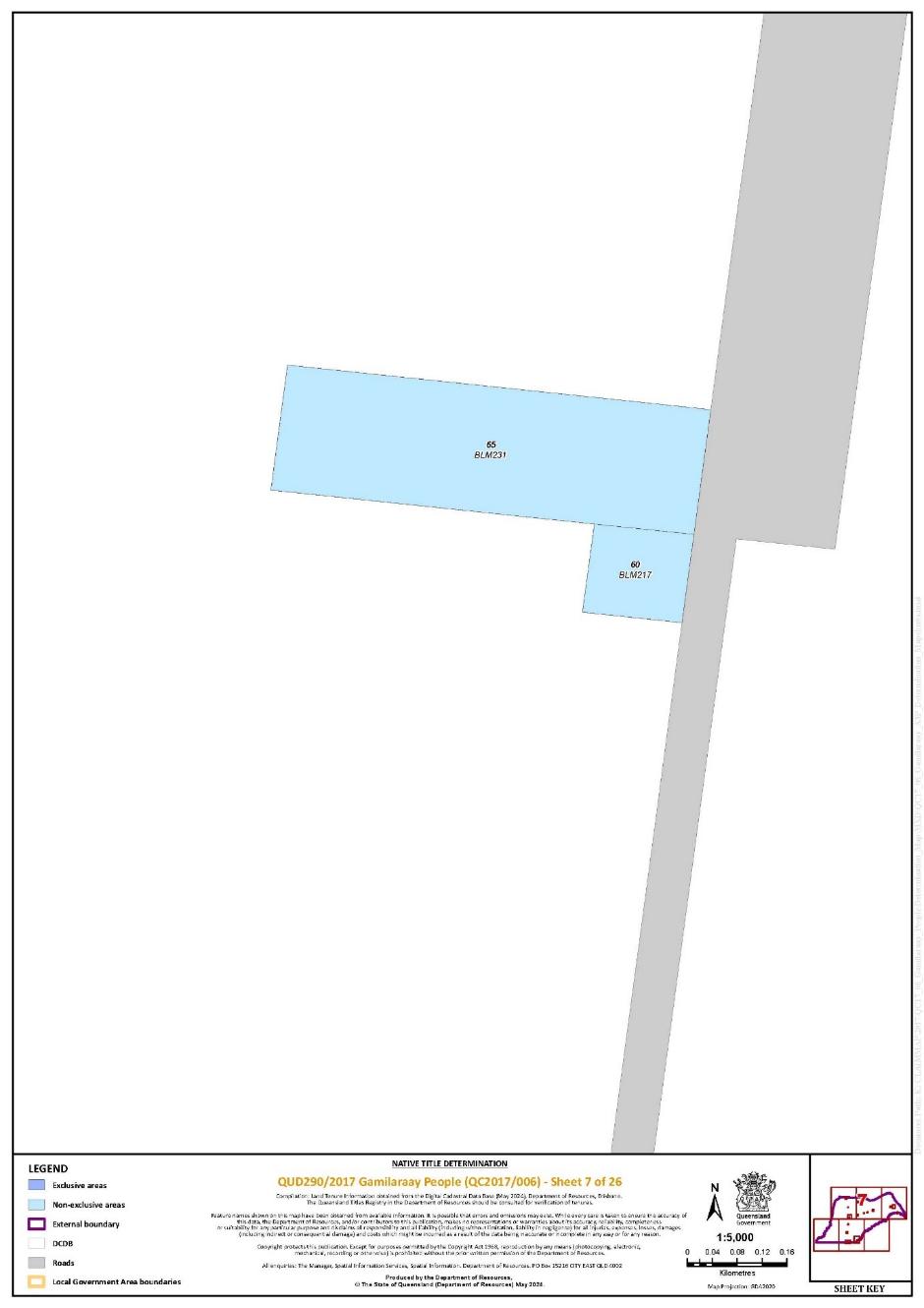
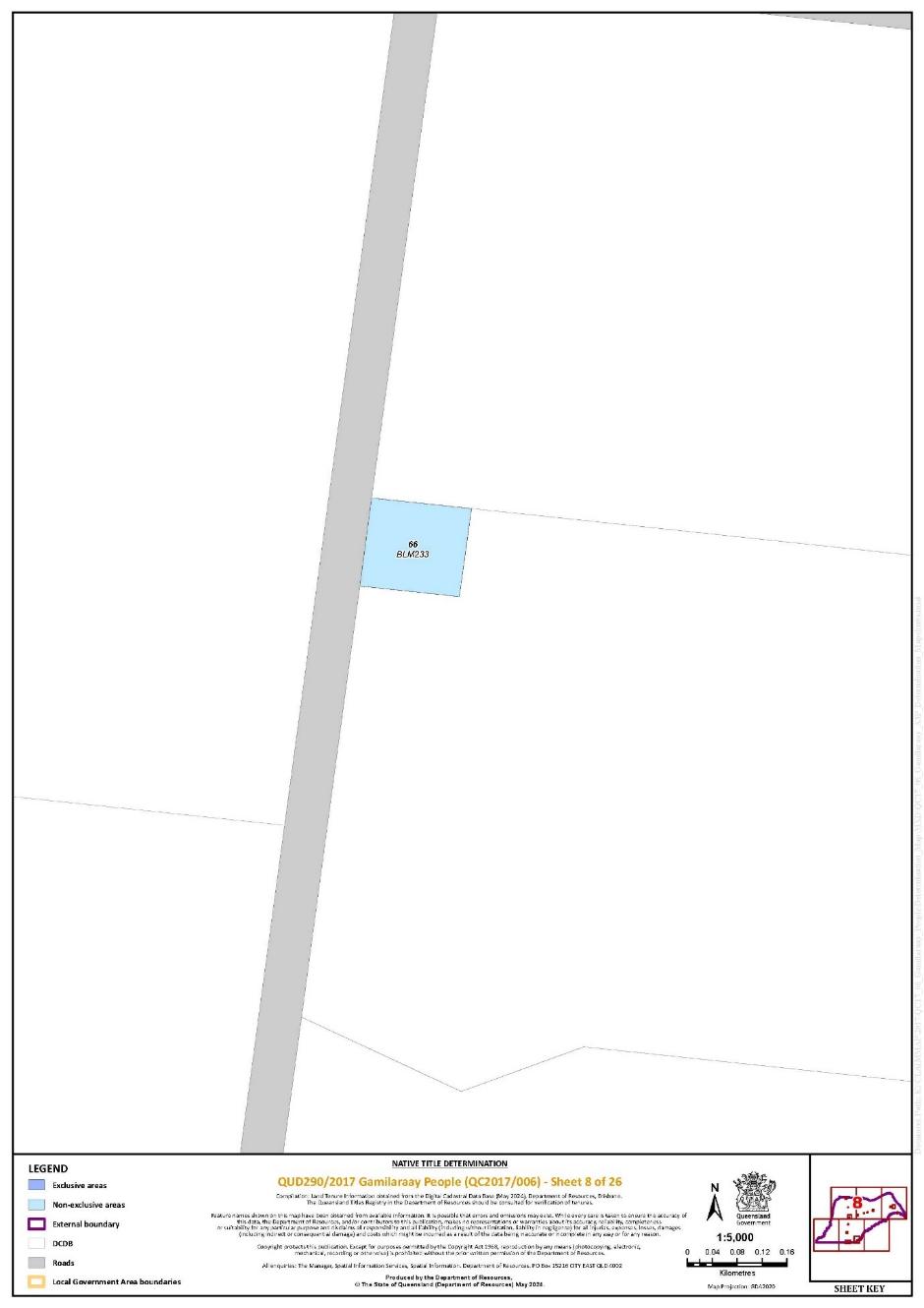
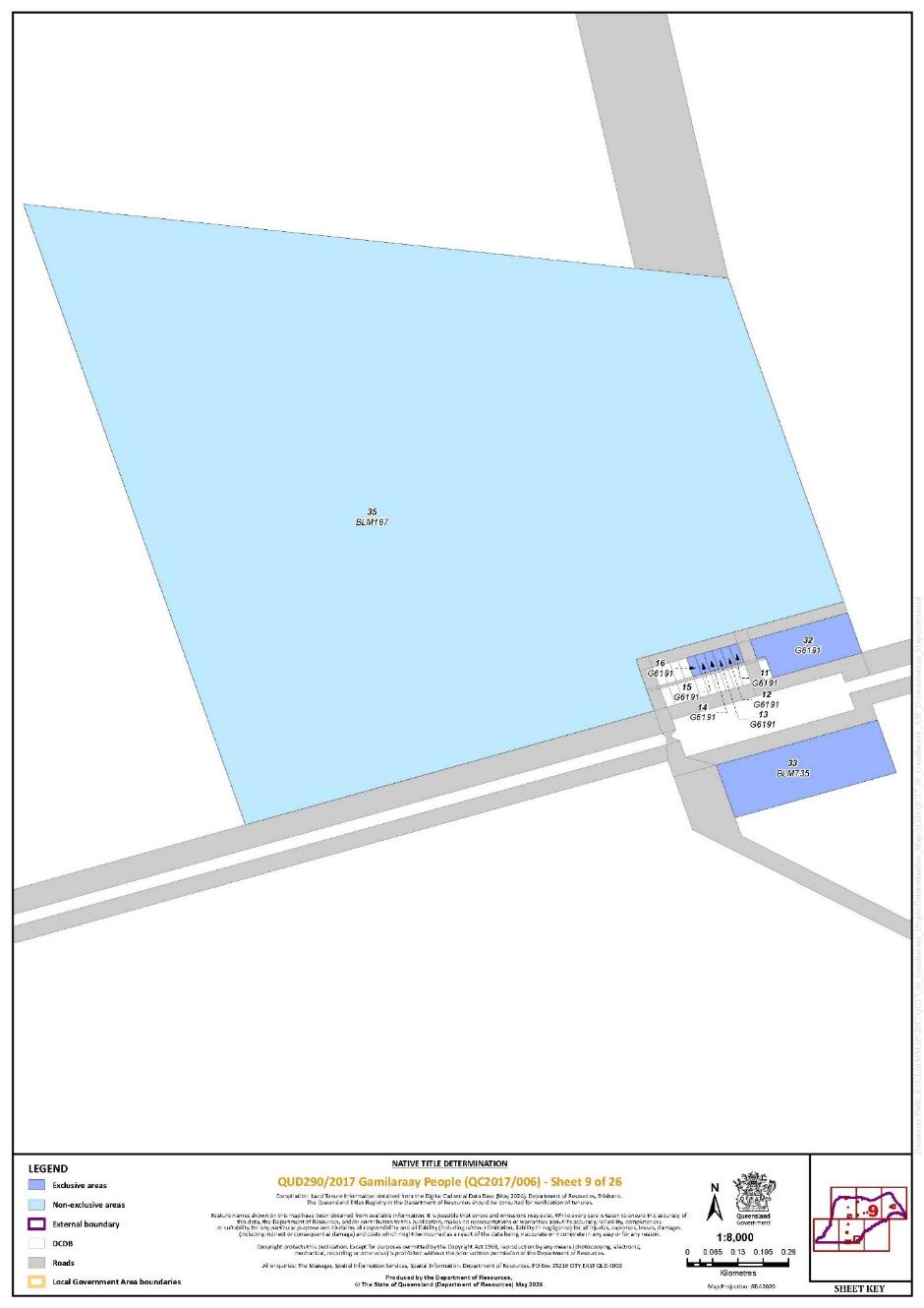

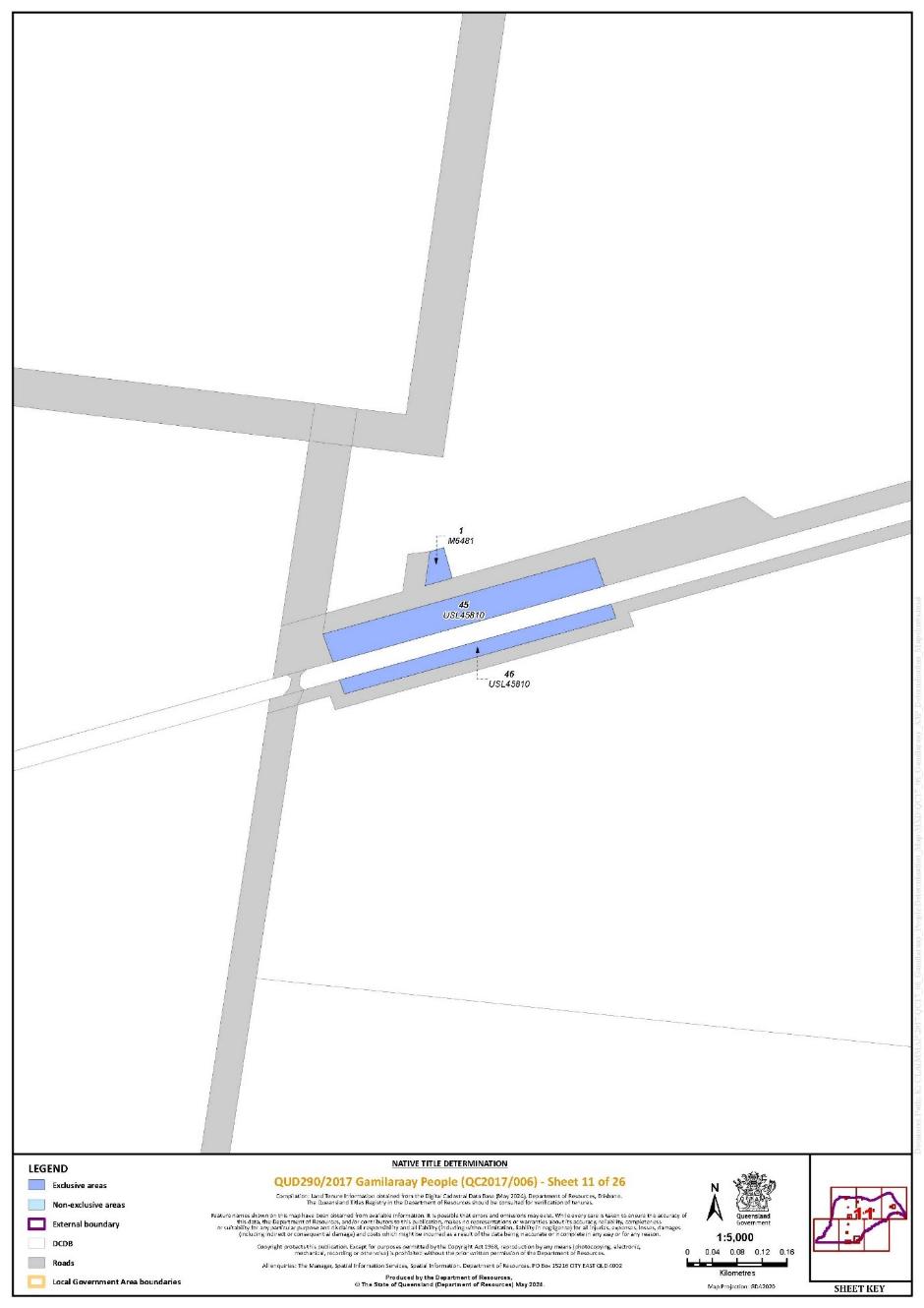
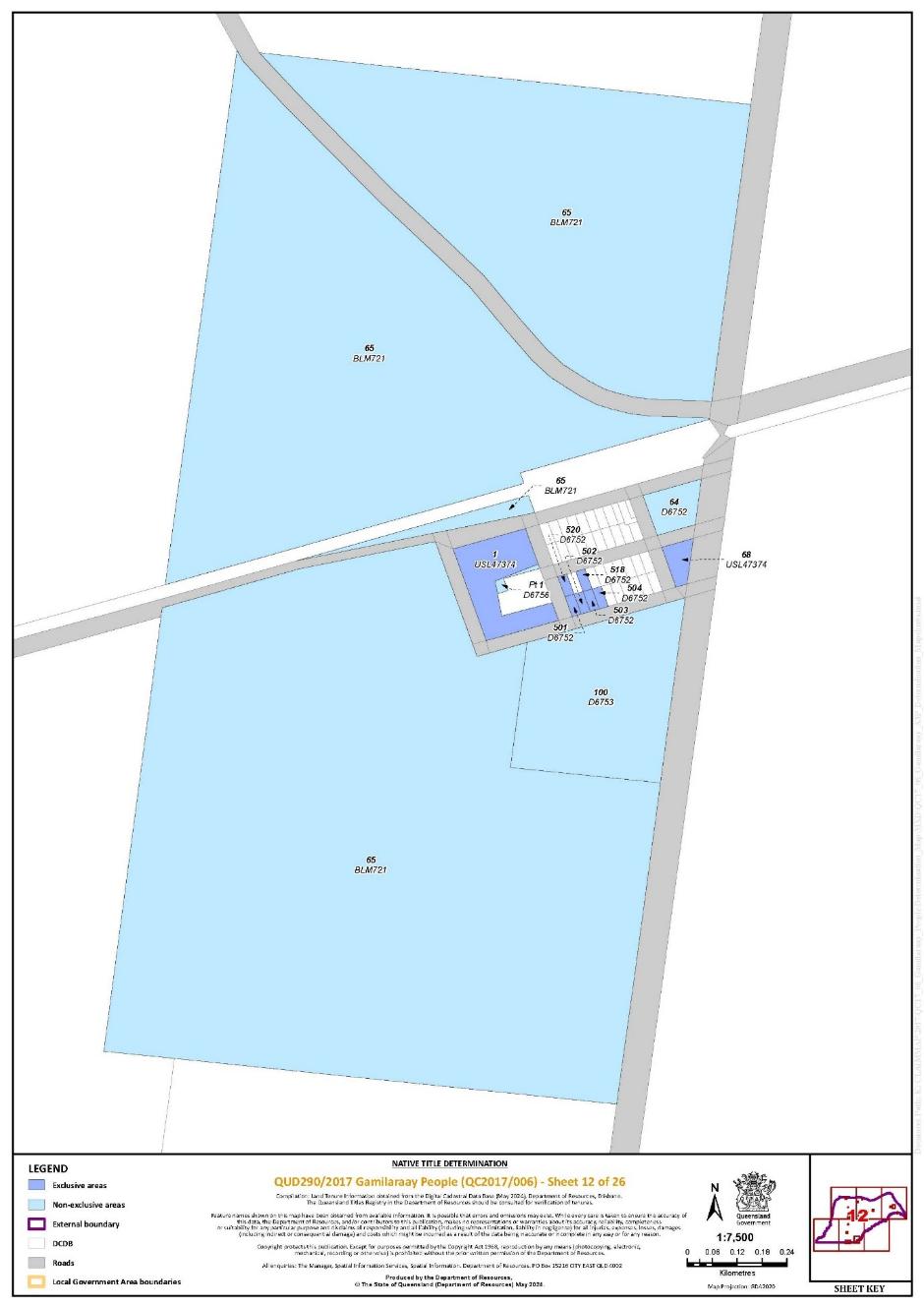


REASONS FOR JUDGMENT
COLLIER ACJ:
1 Before me is a Native Title Determination Application filed on 12 June 2017 (determination application) pursuant to s 13(1)(a) and s 61 of the Native Title Act 1993 (Cth) (the Native Title Act) by Darryl Hippi, Leroy Connors, Garry Saunders, Reginald (Reg) McGrady and Deidre Flick (Native Title Applicant) on behalf of the Gamilaraay People. In that application the Gamilaraay People seek determination of native title with the consent of all parties within the meaning of s 225 of the Native Title Act, recognising the native title rights and interests held by the Gamilaraay People in respect of parts of land and waters claimed by them (determination area). An agreement pursuant to s 87 of the Native Title Act (s 87 Agreement) has been reached by relevant parties in respect of this determination.
2 The respondents to the determination application are:
The State of Queensland
Goondiwindi Regional Council
Ergon Energy Corporation Limited
Bullawarrie Pty Ltd
Patrick Kenneth Brosnan
3 The path to the present consent determination has not been smooth. Despite earlier agreement by the present parties, a consent determination application hearing in this matter has twice been vacated by this Court, in circumstances where an overlapping native title determination application was filed on behalf of the Bigambul People (Bigambul #5 Native Title application). Most recently on 6 February 2025, I ordered that the Bigambul #5 Native Title application be struck out pursuant to s 84C of the Native Title Act, or alternatively dismissed: Sandow on behalf of the Bigambul People #5 v State of Queensland [2025] FCA 53 (Sandow decision). On 20 February 2025, the Bigambul People filed an application for leave to appeal the Sandow decision, and also to appeal it. The application for leave to appeal and the appeal were heard together on 11 August 2025 by the Full Court of the Federal Court. On 13 October 2025, the Full Court granted the application for leave to appeal the Sandow decision, however dismissed the appeal: Sandow v State Minister for the State of Queensland [2025] FCAFC 140. In the course of judgment their Honours observed:
34. Given the conclusion we have reached with respect to ground 1, and the concession made by the Bigambul #5 applicant that they need to prevail on all grounds to succeed on the appeal, it is unnecessary to consider grounds 2 and 5. We are confirmed in that view by the instructions obtained by counsel during the course of the appeal that the Bigambul #5 applicant would not seek to re-authorise a native title determination application over the overlap area, should the appeal be dismissed.
(emphasis added)
4 In those circumstances, and noting that no further overlapping Native Title Application would be filed by the Bigambul People, on 15 October 2025 I ordered that the Gamilaraay determination application be listed for a consent determination on 16 December 2025, and that no further native title determination applications be filed in respect of the whole or part of the determination area without the leave of the Court.
5 To my knowledge no such application for leave of the Court has been made, and there are no overlapping or competing native title claims over any part of the lands and waters covered by the determination application.
6 Further, I understand that there is no approved determination of native title that affects any part of the determination area, as required by s 13(1)(a) of the Native Title Act.
BACKGROUND
7 In accordance with orders of the Court, an executed s 87 Agreement was filed on 3 December 2025.
8 It is not in dispute that the Gamilaraay People are the descendants of one or more of the following people:
(a) Beeswing and his daughter Lucy Long;
(b) Kitty, mother of Charles, Jack and Alice Dennison;
(c) Kathleen “Kitty” Brown [Dunn];
(d) Mary Ann, mother of William Arnold;
(e) Mary Ann and Murray, parents of George and Ada Murray;
(f) Reuben Bartman;
(g) George Bennett and Mary Moodie;
(h) Charles Cubby and Lucy Ann;
(i) Harry Denham;
(j) Billy Edwards;
(k) Jonathan Flick and Mary Ann;
(l) Charlie Hippi;
(m) Eliza Kirk;
(n) Walter/William Marley;
(o) James McGowan, father of Aggie, Annie and Kate McGowan;
(p) Mary McGrady;
(q) Phoebe Munday;
(r) James Saunders and Sarah Pye/Bucknell/McGintie;
(s) Lennie Jane Smith/Rodwell;
(t) William Trapman/Troutman;
(u) Whalan Johnny;
(v) William (Billy) Wightman;
(w) Sarah Witon aka Witson/Wilson/Murphy;
(x) Eliza Weatherall; or
(y) Jimmy Hinch.
9 The determination area comprises an area of approximately 5402 square kilometres centred approximately 75 kilometres east of Dirranbandi in Queensland, and bordered on the south by New South Wales, including all land and waters, and any rivers, streams, creeks or lakes as identified in the s 87 Agreement.
10 The s 87 Agreement also identifies non-exclusive areas, being certain land and waters described in a table annexed to the agreement, as well as areas not forming part of the determination area, being:
1. Those land and waters within the External Boundary which, at the time the native title determination application was made, were or had been the subject of one or more Previous Exclusive Possession Acts, within the meaning of s 23B of the Native Title Act 1993 (Cth) as they could not be claimed in accordance with s 61A of the Native Title Act 1993 (Cth).
2. Specifically, and to avoid any doubt, the land and waters described in (1) above includes:
(a) the Previous Exclusive Possession Acts described in ss 238(2) and 23B(3) of the Native Title Act 1993 (Cth) to which s 20 of the Native Title (Queensland) Act 1993 (Qld) applies, and to which none of ss 47, 47A, 47B or 47C of the Native Title Act 1993 (Cth) applied.
(b) the land and waters on which any public work, as defined in s 253 of the Native Title Act 1993 (Cth), is or was constructed, established or situated, and to which ss 23B(7) and 23C(2) of the Native Title Act 1993 (Cth) and to which s 21 of the Native Title (Queensland) Act 1993 (Qld), applies, together with any adjacent land or waters in accordance with s 251D of the Native Title Act 1993 (Cth), including, but not limited to, the whole of the land and waters described as:
(i) That part of Lot 23 on CVN150 described as the area west and south of a line drawn from the northern boundary of that lot at Longitude 149.469063° East to its eastern boundary at Latitude 28.487406° South, passing through the following coordinates:
Longitude⁰ East | Latitude⁰ South |
149. 469101 | 28.486928 |
149.469180 | 28.486994 |
149.469298 | 28.487042 |
149.469396 | 28.487135 |
149.469469 | 28.487258 |
149.469491 | 28.487419 |
(ii) That part of Lot 42 on BLM950 described as the area commencing on the northern boundary of that lot at Longitude 149. 360142° East and extending easterly and southerly along boundaries of that lot to Latitude 28.450864° South; then south-westerly to the southern boundary of the northern severance of that lot at Longitude 149. 355005° East, passing through Longitude 149. 356613° East, Latitude 28.457710° South; then north-westerly along that boundary to Longitude 149.354430° East; then northerly back to the commencement point, passing through the following coordinate points:
Longitude⁰ East | L atitude⁰ South |
149.356177 | 28.457450 |
149.357353 | 28.454826 |
149.358693 | 28.448883 |
(iii) Lot 29 on CVN351.
(iv) Lot 30 on CVN363.
3. Those land and waters within the External Boundary on which, at the time the native title determination application was made, public works were validly constructed, established or situated after 23 December 1996, where s 24JA of the Native Title Act 1993 (Cth) applies, and which wholly extinguished native title.
4. Those land and waters within the External Boundary which, at the time the native title determination application was made, were the subject of one or more Preexisting Rights Based Acts, within the meaning of s 24IB of the Native Title Act 1993 (Cth), which wholly extinguished native title.
11 In respect of connection of the Gamilaraay People with the determination area, the Native Title Applicant submits that it has provided the State and the respondent parties who requested it the following material (connection material) on a confidential and without prejudice basis:
Form 1 dated 14 June 2017
The following expert material:
• Gamilaraay People Expert Anthropological Report by Jitendra Kumarage dated 24 May 2019
• Gamilaraay People Expert Anthropological Report by Jitendra Kumarage dated 27 March 2020
• Supplementary Report on the Gamilaraay People’s Right of Exclusive Possession and Unconstrained Right to Take Resources by Jitendra Kumarage dated 19 March 2021
The following affidavits:
• Affidavit of Hugh James McGrady dated 8 October 2018
• Affidavit of Reginald Owen Haines dated 8 October 2018
• Affidavit of Leonard Saunders dated 18 March 2019
• Affidavit of Garry Saunders dated 19 March 2019
• Affidavit of Deidre Ann Flick dated 19 March 2019
• Affidavit of Kevin Waters dated 19 March 2019
• Affidavit of John Ray Saunders dated 28 March 2019
• Affidavit of Lionel Cubby dated 14 May 2019
• Affidavit of Edward James Troutman dated 15 May 2019
• Affidavit of Lindsay Flick dated 15 May 2019
• Affidavit of Daphne Joan Goman dated 16 May 2019
• Affidavit of Leah Lang dated 20 May 2019
• Affidavit of Morn Joyce Draper dated 23 May 2019
• Affidavit of Garry Saunders dated 18 March 2020
• Unsigned Affidavit of Lindsay Edward Flick dated 27 March 2020
• Affidavit of Leonard Charles Saunders dated 5 April 2020
• Unsigned Affidavit of Morn Joyce Draper dated 27 May 2020
• Affidavit of Deidre Ann Flick dated 15 October 2020
• Affidavit of Lionel Cubby dated 19 February 2021
• Affidavit of Edward James Troutman dated 17 March 2021
• Unsigned Affidavit of Timothy Lewis Knox dated 19 March 2021
• Affidavit of James Edward Troutman dated 25 March 2021
• Affidavit of Kevin Waters dated 30 March 2021
The following outlines of evidence:
• Outline of Evidence of Stanley McGrady dated 11 March 2019
• Outline of Evidence of Ronald Waters dated 11 March 2019
12 The Native Title Applicant has filed limited material evidencing connection to the determination area, in circumstances where an independent assessment of connection material has been undertaken by the State, and there is no demur by the other respondents to the fact of connection of the Native Title Applicant with the determination area within the meaning of ss 223 and 225 of the Native Title Act. The Native Title Applicant has also submitted that it should not be required to file connection material on the basis that:
Connection material was provided to the State and Bullawarrie Pty Ltd on a confidential and without prejudice basis;
The connection material contains information and evidence that the Native Title Applicant considers sensitive, for example genealogical material; and
The Native Title Applicant seeks to protect the integrity of the evidence contained in the connection material in case of future litigation, for example a compensation application, and for this reason seeks to avoid the connection material forming part of the Court file.
13 No objection to this submission was made by the respondents. Importantly, the following detailed summary of the evidence of the Native Title Applicant was included in its submissions dated 29 July 2022:
1. The State of Queensland and Bullawarrie Pty Ltd have examined the connection material provided by the Applicant. All other respondents were given the opportunity to assess the Applicant’s connection material (the Connection Material).
2. The Connection Material consists of the following parts:
a) Affidavits by members of the claim group (Claimant Evidence);
b) Gamilaraay Native Title Claim Anthropological Report (Kumarage 2019);
c) Gamilaraay Supplementary Anthropological Report (Kumarage 2020);
d) Gamilaraay Supplementary Report on the Right of Exclusive Possession and Unconstrained Right to Take Resources (Kumarage 2021).
Pre-Sovereignty Society
3. Early reports depict that at effective sovereignty, land tenure within the claim area operated at a local level, below that of the language-named tribe or language group. While at effective sovereignty, Gamilaraay speaking groups occupied a large part of NSW, extending north into Queensland, the country associated with the Gamilaraay language, and closely associated dialects, was divided into small local groups. Kumarage examines the observations of early writers to conclude that some of these small local groups occupied the claim area, and had the hereditary right to exploit resources and control access by others to a hunting ground, commonly referred to as taurei. The system at effective sovereignty for recruitment in to these small local groups and the acquisition of rights in land was primarily patrilineal/patrifilial. There are also indications that totemic affiliations, which were acquired matrifilially, may have had some role in the operation of the land tenure system.
4. At effective sovereignty the forebears of Gamilaraay People acknowledged and observed a common set of traditional laws and customs in relation to their lands and waters. Gamilaraay People’s laws and customs originate in a time beyond living memory, where the creative ‘All-Father’ figure Baayami, his wives and the various other mythological beings travelled the land, created its features, imbued it with spiritual meaning and gave country, Law and language to Gamilaraay People and their neighbours.
5. The Gamilaraay People are part of a regional society that consists of members who have similar laws and customs. The kinship networks, social systems, belief systems, mythological and ceremonial networks and linguistic affiliations of the Aboriginal people occupying the claim area at effective sovereignty extended beyond it to include the members of neighbouring local groups who spoke different languages. Key to the system were the principles of trespass and permission seeking, with each Aboriginal group within the broader regions exercising the right to control access to country. Howitt, for example, wrote that the local subdivisions of the Gamilaraay: “…occupy separate portions of the tribal territory, each claiming its own taurei or food and hunting grounds, the boundaries of which are well defined, and across which a stranger might not pass in search of food.”
6. Kumarage documents the presence of Gamilaraay speaking groups occupying the claim area, shortly after effective sovereignty:
the fact that in 1855 Ridley found Gamilaraay people, but not Yuwaalaraay people, on the Moonie from Nindigully southwards, is compelling evidence that the Moonie was Gamilaraay country around the time of effective sovereignty. This is supported by Mathews’ description of Gamilaraay bora ceremonies at Talwood in the 1890s. Mathews reported that the ‘Tallwood tribe’ was Gamilaraay speaking. He identified several locations in the Talwood area that can be inferred to be part of the Talwood group’s country.
7. He concludes that:
In summary, Gamilaraay country within Queensland, at effective sovereignty, extended from the Queensland/N.S.W. border north to about Nindigully and Weengallon, west to about the tributaries of the Big Warnambool River, which is between the Narran and Moonie Rivers, and eastwards past Redbank Creek to about Lalaguli and the Boomi Creek mouth.
Contemporary Society
8. The Gamilaraay apical ancestors listed at paragraph [29] above are those whose traditional country was, as far as can be determined from the oral and documentary evidence, within (or partly within) the claim area. Their descendants have maintained their connections to the area. While many Gamilaraay People today identify as members of the bigger, and broader Gomeroi nation that extends as far south as Scone in NSW, the claim group, is made of the descendants of the apical ancestors who were traditionally associated with the claim area, and were mostly born around the time of effective sovereignty, adopted/reared-up/grown-up or incorporated into the local groups/families of the area in accordance with the laws and customs of the regional society. While minor amendments to the claim group description were made recently to reflect the views of certain family groups [see [17] above], the way in which the Gamilaraay People have described themselves pursuant to their traditional law and custom, has remained largely unchanged since the group first met to authorise their native title determination application in 2017.
9. At a broad level, Gamilaraay People have some collective rights in the whole claim area, arising from their common language identity and traditional associations with this part of Gamilaraay country and make decisions about country as a group, while at the same time, claimants also articulate their rights and interests in land at a family level. This system of localised connection is consistent with the traditional associations of the apical ancestors with particular parts of the claim area. As a result, there is some internal differentiation in the contemporary land tenure system. Gamilaraay people recognise that certain families have stronger connections to certain parts of Gamilaraay country, based on their understanding of where their ancestors’ traditional country was. Gamilaraay People today belong to families, generally identified by surname, which are associated with particular parts of Gamilaraay country. Local connections of Gamilaraay families to parts of Gamilaraay country, based on the knowledge of the origins of a forebear, and mediated by and expressed in terms of where their grandparents and parents were born, lived, worked and died, and where they themselves were born, live, work and carry out subsistence activities such as fishing, hunting and gathering, and continued spiritual knowledge of that area, are the basis of the contemporary land tenure system. Claimant evidence of being associated with a particular area of Gamilaraay country through knowledge, understandings of where their families were from and what they were told by forebears are not random or disparate – it is how they know of and express a traditional connection. The claimant evidence demonstrates clear, continued ownership of the areas identified as Gamilaraay at effective sovereignty by Kumarage.
Claimant Lenny Saunders explains:
Where our Kamilaroi ancestors were born is where Kamilaroi people lived out their lives before white people moved into this area. Where our Kamilaroi ancestors were born was important. There were birthing trees where Kamilaroi women had their children. Dad told me that there is a birthing tree along the Moonie River at Nindigully. It is near the women’s bora ring that is still there at Nindigully.
Lenny’s brother Garry adds:
My Dad told me that the other families for our patch are the Murrays, Hippis, Cubbys and Troutmans. There are a lot of other families that branch off from these main families. These families are connected to country the same way I am, through their old people. Old Dooki Hippi told me this too. That would have been 25 years ago. I remember Dad saying that these families were now based at Toobeeah, but that their country was around Thallon and Mungindi. …
As explained above, my Mum’s family and her country is located more around the NSW border area. My Uncle, Gundi Binge (Mum’s brother) and Aunty Marge told me that they came from “Barwon River country”...
10. Today, the Gamilaraay claim group is structured cognatically, where membership can be activated through either parent. Cognatic orientation of both the claim group and the family groups that comprise it and how rights and interests in land are acquired, was always present. Adoption and incorporation, based on factors such as birthplace, long-term residence and knowledge were part of the normative system at effective sovereignty. Cognatic recruitment and the diversity of ways claimants are connected to country today therefore demonstrates continuity with the past. Gamilaraay People share a common identity, based in part on the linguistic identification of their forebears but namely, a traditional association with the claim area. Gamilaraay People also continue to acknowledge and observe a common set of traditional laws and customs in relation to their lands and waters, including rules regarding group membership, kinship and marriage, totems, spiritual beliefs and practices, land tenure and protocols of access, hunting, gathering and fishing and other resource use and decision-making.
Continuity of Law and Custom
Social organization; Cognatic descent, adoption & incorporation
11. For Gamilaraay People today, local connections of families to parts of Gamilaraay country are a fundamental part of the contemporary land tenure system. The geographic origins of an ancestor, which is an indication of the location of their traditional country, is remembered and in many cases, his or her descendants have maintained both a long-term physical presence in, and/or knowledge of, that area. The claimants ownership of the claim area is based on the premise that at effective sovereignty their ancestors, owned the land and waters of the claim area, in accordance with their traditional laws and customs, and that those laws and customs have continued to be acknowledged and observed by the claimants. The principles of land tenure, being the inheritance of rights over country of their ancestors, is the basis for ownership of country and the continuing connection of claimants to country.
12. While in pre-sovereignty society land was inherited through patrilineal affiliation, today, a cognatic model operates, where country can be claimed through either parent. Where an individual was born and grew up, which parent’s family they were closest to, and choice, also mediate how connection to country is actualised. This highlights the existence and operation of multiple and intersecting pathways of connection to country and therefore ways of obtaining rights and interests in land and waters today. Adoption was also a part of the normative system of the Gamilaraay People at effective sovereignty and remains part of the laws and customs of Gamilaraay claimants today. Both adoption and incorporation, based on factors such as birthplace, long-term residence and knowledge, were part of the normative system at effective sovereignty. Cognatic recruitment and the diversity of ways claimants are connected to country today therefore demonstrate continuity with the past.
13. Arising out of the laws and customs of the claimants explained above, the principles or starting point for recruitment to the claim group for those that seek to actualise their Gamilaraay connections is summarised as follows. An individual is a member of the claim group if they:
a) Are a member of a Gamilaraay family connected to the claim area;
b) Have descent (including through adoption) from at least one Gamilaraay ancestor whose traditional connections were to the claim area. The ancestor may have been incorporated in accordance with Gamilaraay traditional laws and customs; and
c) Have maintained continuity of connection with this part of Gamilaraay country.
14. Kumarage concludes, cognatic recruitment and the diversity of ways claimants are connected to country today therefore demonstrate continuity with the past.
Kinship, totems and marriage rules
15. Knowledge of, and adherence to, the key elements of the Gamilaraay system of kinship and social organisation has continued from the time of effective sovereignty to the present. Knowledge of totems is widespread among claimants; while an individual’s main totem is acquired from their mother, claimants also have some relationship to the totem/s associated with their father. Claimants articulate their social relationships and marriage rules in terms of totems, closeness/distance of relationship and surnames. Most claimants know their own totem and the totems of their forebears, and express their relationships and some cultural beliefs and practices in totemic terms. Totems as well as kinship relationships and concepts of closeness and distance inform the social relationships and marriage rules of the claimants today. The principles of considering relatedness and distance in totemic, kinship and geographical terms, originate in the pre-sovereignty system of the Gamilaraay People. These concepts are adaptations of the restrictions based on the section and moiety systems and demonstrate continuity with the laws and customs extant at effective sovereignty.
Beliefs - Ancestral Spirits and Spiritual Connections Totemic systems and beliefs
16. The Gamilaraay claimants and their ancestors’ spiritual beliefs and practices underpin their ownership of and rights and interests in their land and waters. Gamilaraay people believe in an ‘All-Father’ figure named Baayami who created the land and waters, gave the people laws and customs and their totems, and with his wives and sons, looks over from a spirit world in the sky. The belief in Baayami pre-dates sovereignty and the Gamilaraay claimants’ spiritual beliefs and practices have continued from the time of effective sovereignty to the present. The beliefs, mythology and ceremonial practices associated with Baayami, are so widespread; Baayami is the most important creative figure in Gamilaraay mythology and is considered to be the main source of Law. Gamilaraay claimants know mythological creation stories that are connected to locations in and around the claim area and others that are about the creation of species but are unconnected to specific locations, which explain the creation of certain totemic species.
17. Gamilaraay People believe that various ghosts and spirits, little hairy men and other supernatural beings inhabit the landscape, and there are rules regarding appropriate behaviour in country inhabited by such beings as well as rules regarding accessing certain places and areas, for example gender restricted sites. An almost universal belief exists among Gamilaraay People that ancestral spirits and other supernatural inhabitants of the landscape and a belief that the spirits of the dead continue to wonder the landscape and interact with living people. Certain precautions must be taken to protect oneself from the spirits or ghosts according to Gamilaraay claimants, with stories told of what happens when protocols are not followed and how the spirits or ghosts can be malevolent if not treated properly. Today, certain knowledgeable and senior individuals are healers and are believed to have the power to communicate with the spirit world, which is a continuation of the traditional roles of the wiringin and female healers.
Rights and Interests
18. The rights and interests claimed in the application are based on the premise that at effective sovereignty the claimants’ ancestors, owned the land and waters of the claim area, in accordance with their traditional laws and customs, and that those laws and customs have continued to be acknowledged and observed by the claimants. The principles of land tenure described above are the basis for ownership of country and the continuing connection of claimants to country. While the Gamilaraay People form part of a regional society who share a common system of traditional laws and customs, only Gamilaraay People can assert native title rights and interests in the claim area, where other members of the regional society do not have these same rights. The Connection Materials demonstrate that the following rights and interests were exercised by Gamilaraay People in the claim area in the pre-sovereignty and post-sovereignty period, and continue to be exercised by Gamilaraay People today.
Right to exclusive possession
19. Kumarage opinies [sic] that the claimant evidence demonstrates an effective means, under traditional law and custom, of excluding people from the claim area. The ‘effective means’ is the fear of harm that could be caused to both persons and country; therefore, Kumarage opines there is credible evidence that the Gamilaraay People have the right of exclusive possession.
20. Claimants demonstrate a clear permission system with demonstrable consequences of any breach to the rules around access to the claim area.
As claimant Tim Knox explains:
Asking for permission is a very important rule in our Gamilaraay law. The reason why it is so important is that if you do not ask for permission to be on another mobs’ country, you will suffer the consequences. Back when our old people were here, the consequences were usually harsh physical punishments such as spearing or even death. These days you might be spoken to by an elder or shunned by the other families if you didn’t ask for permission.
There are also spiritual consequences if you break this rule and don’t ask for permission. The spirits of our old people protect our country, because they never leave their country, even when they pass away. Same goes for other mobs’ country – the spirits of their old people are there to protect their country and keep them safe. If someone did not have permission to be on Gamilaraay country, the spirits would do bad things to them, like make them or their family sick, have an accident, go crazy or even cause death. Asking for permission is a way to make sure you avoid places you should not go. If you are an outsider and you don’t speak to the right people, you don’t know which places you should avoid, like a sacred women’s site, for example. There could also be birthing places or burial sites, so it is important that you are shown by someone with knowledge of the area. By giving permission, I am protecting not only our country, but other Aboriginal people.
Claimant Edward James Troutman adds:
Where our ancestors and elders are buried should not be disturbed. Disturbing the area not only disturbs their remains, it disturbs their spirit. We fenced off and protected the Twin Bridges burial ground to stop people from going there.
Applicant Deidre Ann Flick further explains:
“Those lnverell Murris did the right thing by stopping by and asking my dad. It is just like walking in someone's yard. You wouldn't do that unless you have permission, you'd be trespassing. It is important to let the local Indigenous people know that you are on their country. These days, if someone comes on our country and uses our country and its resources without first seeking permission, we give them the cold shoulder and let them know that what they've done is wrong. The spirits of our old people have a role in keeping strangers on our country in check. I am aware of some non-indigenous people who were camping in an area that we asked them not to go to. In the light of their camp fire they saw the spirit of one of old fellas dancing. They packed up and left. The spirits have a significant role and will make their presence felt.”
Access, be present on, move about on and travel over the area
21. Kumarage opines, the right to occupy the claim area arises from the ownership of the land and waters by the Gamilaraay People in accordance with their laws and customs. There is clear evidence that these rights existed at effective sovereignty. Claimants continue to demonstrate a physical and spiritual connection to Gamilaraay country as is demonstrated in the following statements:
Applicant Garry Saunders explains:
“I feel safe on my country. Its’ a spiritual thing. I feel safe knowing that my old people are on my traditional country. I know when I’m on my country. It’s a spiritual thing. When I’m driving from the east along the Moonie Highway, when I get to the Mount Driven/Hollymount area I feel comfortable. I feel safe. I feel like I am at home.”
Claimant Edward James Troutman adds:
“I understood from a young age, that my country runs south of the Barwon River at Mungindi to Gundabloui. Every so often I have to go home to Mungindi to have a mouthful of the Barwon River to keep me going until my next visit. Mungindi is my home.”
Claimant Lindsay Flick adds:
“The earth on my country is flat. When I see flat country in that area I feel at home and at ease.”
Camping, living temporarily and building temporary shelters
22. Kumarage states that the rights of Gamilaraay people to camp on, erect shelters on, and live on their country at effective sovereignty, arose from their ownership of the land and waters in accordance with their traditional laws and customs. Claimants continue to assert that they have these rights as can be seen in the following statements:
Applicant Deidre Ann Flick further explains:
“Growing up, my family regularly fished, swam, and camped on the Barwon River and the Moonie River. Nanny and Uncle Mick described the Gamilaroi People as ‘river people’, ‘inland river people’ and ‘muddy water people’. Nanny told me that Gamilaroi People’s country followed natural landmarks. My Nanny told me that she believed Gamilaroi country would follow the Moonie River to the Balonne River at St George.”
Claimant Leonard Charles Saunders speaks about his Pop Bill Saunders:
“… He had five acres on the bend of the Moonie River at Nindigully. Dad and Pop Bill Saunders built the tin humpy that they lived in there…When I was young, we called basic tin shacks 'bough sheds'. They are just four poles with holes in them. Then poles are laid across them. Leaves and branches are then placed over the top. Dad put bough sheds together when we were working. He also built a galley to cook under. Dad built bower sheds and galleys right across our little dunhill…These days we don't need to build our own homes, but we do need shade when we go camping. When I go camping, I use rope and tarp strung up between trees for shade. Kamilaroi people built their own houses on our traditional country before white people came along. It is our traditional right to build shelters or put up shades on our country.”
Hunt, fish and gather on the land and waters of the area
23. The right to hunt, fish and gather other natural resources from the land and waters is derived in the first instance from the ownership of the land and waters in accordance with the claimants’ traditional laws and customs. Claimants continue to fish, hunt and gather bush foods, medicines and other natural resources in accordance with their traditional laws and customs as highlighted in the following statements:
Applicant Deidre Ann Flick explains:
“As a child, I regularly fished with my father and siblings at the Moonie River and the Barwon River. My siblings and I collected mussels, worms and yabbies for my father to use as bait. My father was mindful of the fish he caught and kept. My father did not take large fish or pregnant fish. As a child, my father explained to me why he returned fish to the river. He said, “She has a lot of babies, and we can get one of her babies next time.” My father did not release European carp back into the river. He said that the carp did not belong there.”
Claimant Daphne Goman adds:
“My brothers, sisters and I would constantly fish on the Moonie river with Nanna… when we were young. Nanna…taught us how to fish and where the best fishing holes were on the Moonie River.”
“Nanna…used to collect gumbi gumbi leaves when someone in our family was sick. Gumbi gumbi is a great cure for stomach ailments and relief for cancer. She would boil the leaves for us to drink. It is horrible to drink but it is good for you. I used to go out with my grandmother to collect the gumbi gumbi leaves. I know which tree to look for. It is made out of the quinine tree. My Nanna…and my mother also used the passionfruit flower to treat rashes when I was young.”
Claimant Leah Lang adds:
“The Moonie River at Thallon is my family’s river. Growing up, I spent a lot of time on the Moonie River at Thallon, mainly with my dad, uncles, siblings and cousins. I remember, as a child, collecting freshwater mussels and yabbies from the river.
Right to take resources from your country (including for commercial purposes)
24. Kumarage opines, that the unconstrained right to use resources exists under the traditional laws and customs which were acknowledged and observed at sovereignty and which continue to be acknowledged and observed by Gamilaraay People today. They include natural resources that are gathered such as ochre, seeds and grass, as well as goods that are created specifically for trade. The following statements demonstrate the ongoing practice of taking and using resources, including for commercial purposes, on Gamilaraay country today.
Claimant Timothy Knox adds:
I have personally traded coolamons that I have made from the resources on Gamilaraay country for something I wanted from another mob. For example, about five (5) years ago, I traded a coolamon I made for two (2) boomerangs with a person from another mob on the Gold Coast. I cannot remember his name, but he was from the Yugambeh mob. I have also sold boomerangs and clapsticks I have made to the tourist shop on the Gold Coast. There was a shop in Dirranbandi called Kamilaroi Kreations and we used to sell there, too. Everything I make comes from my country. I make didgeridoos, boomerangs, coolamons, clapsticks and spears, for example. They all come from my country because I am only allowed to take the timber from my country.
Claimant Lionel Cubby adds:
“We also collected shrimp and yabbies from around the weir on the Barwon River…What I do know is that Dad took all those resources without hesitation - it was on our country and Gamilaroi People can do that. The Cubby's do not need permission to take anything from our country around Mungindi. Gamilaroi People can take our resources on our country. We can take resources and use for any reason it and for any purpose. That is our right as the traditional owners.”
Applicant Deidre Ann Flick further explains:
“Dad did not need permission to take and use resources from our homelands around Thallon. We belong there. Kamilaroi People can take and use resources however and whenever we want from our land and waters. Although we have that right, we are careful not to take so much that it affects the survival of our native animals, plants, and other resources.”
Take, Water of the area for personal, domestic and non-commercial communal purposes
25. While an exclusive right to water is not recognisable by law, the right to take, use and share natural resources, including water, from the land and waters is derived in the first instance from the ownership of the land and waters in accordance with the claimants’ traditional laws and customs. Kumarage presented evidence that Gamilaraay claimants have, and their forebears had at effective sovereignty, the right to manage the land and waters of the claim area. The existence of these rights at present are demonstrated by the statement below:
Claimant Edward James Troutman adds:
“When I was a kid growing up at the Wells, we carted water from Barwon River up to our humpy to store in the well. The well was made from white fellas - it was there when Pop…bought the property so we used it to store our water from the Barwon River. We had a yoke to carry water. A yoke is a long strong stick that you run across your shoulders. There was a piece of wire on both ends tied to buckets. We walked down to the river, fill the buckets with water, and brought water back to the humpy. We used the water to drink, cook with and to wash. Uncle…had a horse and cart at the Wells. He made the cart himself out the fork of an old tree. He put a tank onto the cart and tied it on with wire. Uncle…drove the horse and cart into the water, filled the tank with a bucket and then the horse carted it back up to our humpy. Goomeroi people have taken resources including water and wood for many generations before white people came along. Goomeroi people have the right to take water and resources across Goomeroi country.”
Conduct ceremonies
26. As Kumarage opines, at effective sovereignty the claimants’ ancestors had the right to conduct and attend ceremonies, meetings and other gatherings on their country. These rights arose from the responsibilities that the claimants’ ancestors had to celebrate the creative period, to teach young men about the laws of the group and inculcate them into the esoteric knowledge of the group, and to maintain good relations with neighbouring groups. Gamilaraay claimants continue to perform burial ceremonies and dances, and hold meetings, for example, in relation to site protection, native title and water management etc., on the claim area. Kumarage opines, this is evidence that the claimants have the claimed rights to hold and attend ceremonies, cultural activities, meetings and dance on the claim area and that these are derived from the traditional laws and customs of the pre-sovereignty society. The following statements demonstrate the ongoing practice amongst contemporary claimants of conducting ceremonies within the claim area:
Claimant Edward James Troutman adds:
“I conduct a smoking ceremony at funerals for close relatives and friends. The smoke itself is spiritual – it is a ‘good fella’ that drives away bad gussy’s (spirit). I learned how to conduct smoking ceremonies from family members. All of the people at the funeral walk through the smoke before entering the cemetery to stop bad gussy’s from entering the cemetery. The smoke keeps going until the burial takes place.”
Claimant Edward James Troutman adds:
“When I hear that a relative or close friend has passed away, I start the smoking in my backyard. I light the fire through the week until the funeral and burial take place. When I am not able to go to the funeral or if the funeral is delayed for a while I keep the smoke going in my backyard until the burial has taken place. Smoking ceremonies are not just for funerals. When I am feeling down, I smoke myself. It makes me feel better, it drives away bad gussies. Smoking is also done to welcome people…”
Maintain places of importance and areas of significance and protect those places and areas from physical harm
27. Gamilaraay people continue to maintain and protect places of importance and areas of significance within the claim area in accordance with their traditional laws and customs. The existence of these rights at effective sovereignty are demonstrated by the reports of Gamilaraay People and their neighbours attending bora grounds and other sites and observing certain protocols and rules of behaviour prescribed by their traditional laws and customs, such as restricting access by certain categories of people. The existence of these rights at present are demonstrated by the claimants’ participation in the recording and protection of significant sites and areas.
Member of the Applicant, Garry Saunders explains:
One way of protecting special places is not to tell people so that they don’t go there and trample all over it. I have passed on knowledge about that site onto my children, nieces and nephews. I have spoken to the cockie that owns the property where the campsite is located. He has agreed to keep his cattle away from the site. Having a good relationship with the cockies helps us protect some of our special places. They know I’m Dad’s son. They know our family because Dad and my brothers worked for them. They respect my family and for that reason are prepared to protect some of our sites.
Claimant Leonard Charles Saunders adds:
“You can still see the groove marks at Weengallon where they sharpened their tools.
Our rock wells are important places and must be protected.”
“My dad told me that there are birthing trees along the Moonie River at Nindigully. He told me that the birthing trees are over near the women’s bora ring…We had signs put up around Nindigully to protect the area but we ended up taking them down. They were better protected if no one but Kamilaroi people know where or what they are.”
Member of the Applicant, Deidre Ann Flick explains:
“We know that area is a good fishing spot but we do not want to risk people fishing and camping there - visitors to our country might harm or cut down our scarred trees. So when people ask where to go fishing, we recommend places away from our family's important areas. Lindsay will tell people to go to Barney's Beach. He never suggests anywhere near our important places. We keep quiet on that. As the traditional owners for Thallon, we are obligated to look after those areas. We do not want attention drawn to it. Directing visitors to our country to other places, safe places, is our way of protecting our country.”
28.This right is also commonly exercised in the form of speaking for and making decisions for country.
Member of the Applicant, Garry Saunders explains:
“The Moonie River is no longer a healthy water system. The water in the Moonie River is silted and has limited flow. The Moonie River and the Balonne River have not run clear for over a forty-year period. The river system was affected by the dam at the end of the Thuraggi reserve, irrigation and European carp. I have met with representatives from the Commonwealth of Australia and the Department of Natural Resources, Mines and Energy regarding the state of the Moonie River and its tributaries.”
“Decisions like drilling for coal seam gas, or the construction of a train line must be made by the Traditional Owners for the country. By that I mean, the decisions need to be made by the people that come from that country because they have a bloodline connection to that place. A proponent or person wanting to use our country should invite us to meet with them to explain what they propose to do. All the families for that area should have a say and there should be consultation with the elders and the people with knowledge for that area. We should get a say about the impact the project will have on our land, water and cultural heritage.”
Claimant Lindsay Flick adds:
“I am regularly, and respectfully, approached by local organisations or associations about matters taking place in Thallon. I have a good relationship with…a local farmer...consults me to ensure that business is done respectfully. We…worked together to place a picture of a scarred tree on a silo at Thallon.”
Member of the Applicant, Deidre Ann Flick explains:
“The only people who have a right to speak up are the people who are from that country. If a Kooma family were to come to a meeting about a pipeline or railway on Kamilaroi country and attempted to speak, they would be asked to leave the meeting. To be honest, we wouldn't even let them in to the meeting, and if they did come in and start trying to speak for our country, they would be some pretty aggressive language directed towards them and would be physically removed. They do not have the right to speak for our country.”
Teach on the area the physical and spiritual attributes of the area
29. Kumarage documents older men and women teaching younger members of the community about sites, mythology, laws and customs regarding accessing sites. These elderly men and women themselves learnt about country from their ancestors. The following statements demonstrate the ongoing practice of teaching the physical and spiritual attributes of the area.
Member of the Applicant, Garry Saunders explains:
“My father taught me how to prepare for a number of ceremonies. Those ceremonies include pointing the bone and preparing pitchery weed. I will not share this information in detail. I do not want the wrong person to learn how to prepare for those ceremonies. It is also not for women to learn. My father did not show me how to carry out the ceremonies. My father showed me the material used and explained why it is used. My father told me the consequences of carrying out the ceremonies, the most serious being death. The purpose of the ceremonies is to punish people for wrongdoings. My father taught me to prepare for ceremonies from the age of 13 years old.”
“My mother taught me that there are more than four seasons annually. My mother told me that sets of flowering signify the change of season. Wattle for example has two sets of flowering. The first set is the women’s flowering and the second set, weeks later, is the men’s flowering. My mother talked to me about wattle flowering throughout my childhood and teenage years when they saw native plants in bloom. As the seasons change, the women’s and men’s flowering will occur.”
Claimant John Saunders adds:
“My parents taught me to make fire and smoke with sandalwood bushes so that my parents could find me easily. They taught me to follow birds to find water and I was told to stay there if I found water. My parents were teaching me how to survive on the land.”
Claimant Edward James Troutman adds:
“Old Harry taught me how to track porcupine, how to locate goannas in trees and how to trap goannas. Old Harry taught me to use mussels as fishing bait and he taught me how to scale and gut a fish with a sharp edge of a mussel shell. I learned old Aboriginal names for animals from Old Harry Hippi…I was about eight years old when I learned from Old Harry.”
“My grandchildren are still young people...When the time comes, I will tell them…I will tell them that they inherited Goomeroi through me and that they belong to Mungindi and Gundabloui and that they are right to go all across Goomeroi country to hunt, fish, camp and visit. My job as their grandfather is to teach them the traditional Goomeroi knowledge that was passed onto me from my elders and to set them on the right track in life.”
Hold meetings on the area
30. Kumarage opines, the Gamilaraay claimants have the right to hold and attend ceremonies, cultural activities, meetings and dance on the claim area and that these are derived from the traditional laws and customs of the pre-sovereignty society.
Claimant Lenny Saunders recalls:
“… the old fellas on my mother’s side of the family getting around the fire with clapsticks, guitars and having a sing. Pop Bill Saunders and Granny Cis loved to get together at dances and enjoy themselves too. Dad told me that they went to all the local balls and dances in their younger days living at Nindigully. He said that they travelled in a horse drawn buggy from Nindigully to places including Talwood, Thallon, and St George. Gathering together and celebrating is something that Kamilaroi people have done long before white people came onto our country. We have the right to continue to gather and enjoy our country with other Kamilaroi people.”
“… My father and Uncle Gundy told me that Boobera Lagoon is a meeting place. They said that ceremonies were held there – big corroborees. Uncle Clarence ‘Gundy’ Binge and he went to corroborees at Boobera Lagoon so did Uncle Billy Long. Uncle William ‘Billy’ Long is Vera Bartman’s son. Vera Bartman was a Kamilaroi woman who lived at Hollywood Island in St George.”
(footnotes omitted)
14 The Native Title Applicant submits that the connection materials provided to the State and the respondent parties who requested it conclusively supports the following findings being made:
At the time of sovereignty, there was a normative body of laws and customs operating across the wider regional society, including in respect to the area of lands and waters of the Gamilaraay Claim Area;
These laws and customs recognised the Gamilaraay People as those owning and occupying an area centred along the Moonie River, including the area claimed; and
Pursuant to those traditional laws and customs, the Gamilaraay People have maintained a connection to the claim area and continue to possess and exercise rights and interests in relation to it.
APPLICABLE LEGISLATION
15 Section 81 of the Native Title Act provides:
Jurisdiction of the Federal Court
The Federal Court has jurisdiction to hear and determine applications filed in the Federal Court that relate to native title and that jurisdiction is exclusive of the jurisdiction of all other courts except the High Court.
16 Section 87 of the Native Title Act relevantly provides:
Application
(1) This section applies if, at any stage of proceedings after the end of the period specified in the notice given under section 66:
(a) agreement is reached on the terms of an order of the Federal Court in relation to:
(i) the proceedings; or
(ii) a part of the proceedings; or
(iii) a matter arising out of the proceedings; and
(aa) all of the following are parties to the agreement:
(i) the parties to the proceedings;
(ii) the Commonwealth Minister, if the Commonwealth Minister is intervening in the proceedings at the time the agreement is made; and
(b) the terms of the agreement, in writing signed by or on behalf of the parties to the proceedings and, if subparagraph (aa)(ii) applies, the Commonwealth Minister, are filed with the Court; and
(c) the Court is satisfied that an order in, or consistent with, those terms would be within the power of the Court.
…
Power of Court
(1A) The Court may, if it appears to the Court to be appropriate to do so, act in accordance with:
(a) whichever of subsection (2) or (3) is relevant in the particular case; and
(b) if subsection (5) applies in the particular case—that subsection.
Agreement as to order
(2) If the agreement is on the terms of an order of the Court in relation to the proceedings, the Court may make an order in, or consistent with, those terms without holding a hearing or, if a hearing has started, without completing the hearing.
Note: If the application involves making a determination of native title, the Court’s order would need to comply with section 94A (which deals with the requirements of native title determination orders).
17 Section 94A of the Native Title Act provides:
94A Order containing determination of native title
An order in which the Federal Court makes a determination of native title must set out details of the matters mentioned in section 225 (which defines determination of native title).
18 Section 225 of the Native Title Act provides:
225 Determination of native title
A determination of native title is a determination whether or not native title exists in relation to a particular area (the determination area) of land or waters and, if it does exist, a determination of:
(a) who the persons, or each group of persons, holding the common or group rights comprising the native title are; and
(b) the nature and extent of the native title rights and interests in relation to the determination area; and
(c) the nature and extent of any other interests in relation to the determination area; and
(d) the relationship between the rights and interests in paragraphs (b) and (c) (taking into account the effect of this Act); and
(e) to the extent that the land or waters in the determination area are not covered by a non‑exclusive agricultural lease or a non‑exclusive pastoral lease—whether the native title rights and interests confer possession, occupation, use and enjoyment of that land or waters on the native title holders to the exclusion of all others.
Note: The determination may deal with the matters in paragraphs (c) and (d) by referring to a particular kind or particular kinds of non‑native title interests.
ORDERS SOUGHT IN THESE PROCEEDINGS
19 In accordance with the signed s 87 Agreement the parties seek that the Court make the following orders:
BY CONSENT THE COURT ORDERS THAT:
1. There be a determination of native title in the terms set out below (the determination).
2. Each party to the proceedings is to bear its own costs.
BY CONSENT THE COURT DETERMINES THAT:
3. The determination area is the land and waters described in Schedule 4 and depicted in the map attached to Schedule 6 to the extent those. areas are within the External Boundary described in Schedule 3 and not otherwise excluded by the terms of Schedule 5 (the Determination Area). To the extent of any inconsistency between the written description and the map, the written description prevails.
4. Native title exists in the Determination Area.
5. The native title is held by the Gamilaraay People described in Schedule 1 (the Native Title Holders).
6. Subject to orders 8, 9 and 10 below the nature and extent of the native title, rights and interests in relation to the land and waters described in Part 1 of Schedule 4 are:
(a) other than in relation to Water, the right to possession, occupation, use and enjoyment of the area to the exclusion of all others; and
(b) in relation to Water, the non-exclusive rights to:
(i) hunt, fish and gather from the Water of the area;
(ii) take the Natural Resources of the Water in the area; and
(iii) take the Water of the area, for personal, domestic and non-commercial communal purposes.
7. Subject to orders 8, 9 and 10 below the nature and extent of the native title rights and interests in relation to the land and waters described in Part 2 of Schedule 4 are the non-exclusive rights to:
(a) access, be present on, move about on and travel over the area;
(b) camp, and live temporarily on the area as part of camping, and for that purpose build temporary shelters;
(c) hunt, fish and gather on the land and waters of the area;
(d) take and share Natural Resources from the land and waters of the area;
(e) take the Water of the area for personal, domestic and non-commercial communal purposes;
(f) conduct ceremonies on the area;
(g) maintain places of importance and areas of significance to the Native Title Holders under their traditional laws and customs and protect those places and areas from physical harm;
(h) teach on the area the physical and spiritual attributes of the area; and
(i) hold meetings on the area.
8. The native title rights and interests are subject to and exercisable in accordance with:
(a) the Laws of the State and the Commonwealth; and
(b) the traditional laws acknowledged and traditional customs observed by the Native Title Holders.
9. The native title rights and interests referred to in orders 6(b) and 7 do not confer possession, occupation, use or enjoyment to the exclusion of all others.
10. There are no native title rights in or in relation to minerals as defined by the Mineral Resources Act 1989 (Qld) and petroleum as defined by the Petroleum Act 1923 (Qld) and the Petroleum and Gas (Production and Safety) Act 2004 (Qld).
11. The nature and extent of any other interests in relation to the Determination Area (or respective parts thereof) are set out in Schedule 2.
12. The relationship between the native title rights and interests described in orders 6 and 7 and the other interests described in Schedule 2 (the Other Interests) is that:
(a) the Other Interests continue to have effect, and the rights conferred by or held under the Other Interests may be exercised notwithstanding the existence of the native title rights and interests;
(b) to the extent the Other Interests are inconsistent with the continued existence, enjoyment or exercise of the native title rights and interests in relation to the land and waters of the Determination Area, the native title continues to exist in its entirety but the native title rights and interests have no effect in relation to the Other Interests to the extent of the inconsistency for so long as the Other Interests exist; and
(c) the Other Interests and any activity that is required or permitted by or under, and done in accordance with, the Other Interests, or any activity that is associated with or incidental to such an activity, prevail over the native title rights and interests and any exercise of the native title rights and interests but will not extinguish them except in relation to acts that consist of the construction or establishment of a public work, done after this determination where s 24JA of the Native Title Act 1993 (Cth) applies.
DEFINITIONS AND INTERPRETATION
13. In this determination, unless the contrary intention appears:
"Animal" means any member of the animal kingdom (other than human), whether alive or dead;
"External Boundary" means the area described in Schedule 3;
"land" and "waters", respectively, have the same meanings as in the Native Title Act 1993 (Cth);
"Laws of the State and the Commonwealth" means the common law and the laws of the State of Queensland and the Commonwealth of Australia, and includes legislation, regulations, statutory instruments, local planning instruments and local laws;
"Local Government Act" has the meaning given in the Local Government Act 2009 (Qld);
"Local Government Area" has the meaning given in the Local Government Act 2009 (Qld);
"Natural Resources" means:
(a) any Animal, Plant, fish and bird life found on or in the lands and waters of the Determination Area; and
(b) any clays, soil, sand, gravel or rock found on or below the surface of the Determination Area,
that have been taken by the Native Title Holders in accordance with their traditional laws and customs,
(c) but does not include;
i. Animals that are the private personal property of another;
ii. crops that are the private personal property of another; and
iii. minerals as defined in the Mineral Resources Act 1989 (Qld); or
iv. petroleum as defined in the Petroleum Act 1923 (Qld) and the Petroleum and Gas (Production and Safety) Act 2004 (Qld).
"Plant" means any member of the plant or fungus kingdom, whether alive or dead and standing or fallen;
"Reserve" means a resen/e dedicated or taken to be a reserve under the Land Act 1994 (Qld);
"Water" means:
(a) water which flows, whether permanently or intermittently, within a river, creek or stream;
(b) any natural collection of water, whether permanent or intermittent; and
(c) water from an underground water source.
"Works" has the same meaning as in the Electricity Act 1994 (Qld).
Other words and expressions used in this determination have the same meanings as they have in Part 15 of the Native Title Act 1993 (Cth).
THE COURT DETERMINES THAT:
14. The native title is held in trust.
15. The Gamilaraay Aboriginal Corporation (ICN: 9784), incorporated under the Corporations (Aboriginal and Torres Strait Islander) Act 2006 (Cth), is to:
(a) be the prescribed body corporate for the purpose of ss 56(2)(b) and 56(3) of the Native Title Act 1993 (Cth); and
(b) perform the functions mentioned in s 57(1) of the Native Title Act 1993 (Cth) after becoming a registered native title body corporate.
CONSIDERATION
20 As I have explained, the Gamilaraay People assert that, under the traditional laws which they acknowledge and the traditional customs they observe, they possess rights and interests in the determination area, and further that by those laws and customs they have a connection with the determination area as native title holders.
21 A concluded s 87 agreement has been filed with the Court. As Mortimer J (as her Honour then was) observed in Freddie v Northern Territory [2017] FCA 867:
16. The Court’s function under s 87 is quite different from its function in a contested application for a determination of native title, and this difference has been confirmed in many authorities of this Court: see Lovett on behalf of the Gunditjmara People v State of Victoria [2007] FCA 474 at [36] (North J), which has been endorsed many times; and see for example Thudgari People v State of Western Australia [2009] FCA 1334 at [25] (Barker J); Goonack v State of Western Australia [2011] FCA 516 at [25]- [26] (Gilmour J), in relation to s 87A; Wurrunmurra on behalf of the Bunuba People v State of Western Australia [2015] FCA 1480 at [27] (Barker J). In Lander v State of South Australia [2012] FCA 427 at [11], and by reference to Lovett, Mansfield J emphasised that the focus of the Court under s 87 is on the making of the agreement by the parties.
17. The Court’s function under s 87, and its discretion, must also be understood in the context of the Native Title Act’s emphasis on negotiation and alternative dispute resolution, whereby one particular object of the Native Title Act is to resolve claims to native title without judicial determination in a contested proceeding: see Munn (for and on behalf of the Gunggari People) v Queensland [2001] FCA 1229; 115 FCR 109 at [28] (Emmett J). I note in this context that the Preamble to the Act envisages that:
A special procedure needs to be available for the just and proper ascertainment of native title rights and interests which will ensure that, if possible, this is done by conciliation and, if not, in a manner that has due regard to their unique character.
(Emphasis added.)
18. The concept of “appropriateness” in s 87(1A) also recognises that the determination made by the Court is one made as against the whole world, and not just between the parties to the proceeding: Cox on behalf of the Yungngora People v State of Western Australia [2007] FCA 588 at [3] (French J). The rights conferred are enduring legal rights, proprietary in nature and in recognising them through a determination, the Court must be conscious of their character. The nature of the rights informs considerations such as the clarity of the terms of the determination (as to the claim area, the nature of the native title rights and interests and the manner of affectation on other proprietary interests); the need for appropriate notification and then the free and informed consent of all parties; and finally the State’s agreement that there is a credible and rational basis for the determination proposed.
19. The discretionary evaluation of whether orders are appropriate is a wide one, but the Court must focus on the individual circumstances of each proposed determination: see Hayes on behalf of the Thalanyji People v State of Western Australia [2008] FCA 1487 at [18] (North J).
20. I accept it is also important to see the exercise of the judicial power in s 87 in the context of the Court’s jurisdiction as a whole, and its foundational legislation, the Federal Court of Australia Act 1976 (Cth), and in particular s 37M and s 37N of that Act. In exercising the discretion under s 87, the Court should pursue the objectives there set out, of promoting “just resolution of disputes, according to law, and as quickly, inexpensively and efficiently as possible”. See the observations of Jagot J in Barkandji Traditional Owners #8 v Attorney-General of New South Wales [2015] FCA 604 at [12]; also her Honour’s similar observations in Phyball on behalf of the Gumbaynggirr People v Attorney-General of New South Wales [2014] FCA 851 at [1] and [9] and Yaegl People #1 v Attorney General of New South Wales [2015] FCA 647 at [9]- [10].
21. Since the determination made by the Court must include the matters set out in s 225 of the Native Title Act, there must be some probative material against which the Court can assess whether those matters can be stated in a determination. The principal source will be the parties’ agreed position put to the Court in the proposed orders and determination setting out the matters required by s 225, together with an agreed statement of facts filed pursuant to s 87(8), joint submissions and any supporting documents such as an expert report. That is not to suggest an expert report is always necessary, but if one has been produced and it forms part of the material upon which the State (or Territory) has relied in agreeing to a determination, it is likely to be appropriate for such a report to be before the Court. Such reports, if filed and relied on by the Court, provide an opportunity for the Court to record at least some of the material establishing connection to the claim area in a publicly accessible form. However there is no need to provide the Court with all of the evidence of the primary facts substantiating native title. Again, that is because the premise of s 87, and the Native Title Act’s emphasis on conciliation, is that the parties have freely and on an informed basis come to an agreement: see Hughes (on behalf of the Eastern Guruma People) v State of Western Australia [2007] FCA 365 (at [9]) (Bennett J), cited with approval in Peterson v State of Western Australia [2013] FCA 518 at [22] (McKerracher J). See also Ward v State of Western Australia [2006] FCA 1848 at [8].
22. In Brown v Northern Territory of Australia [2015] FCA 1268 at [23], Mansfield J described the task to be undertaken by the Court in the following way:
The Court is not required to embark upon an inquiry as to the merits of the claim to be itself satisfied that the orders are supported and in accordance with law: Cox on behalf of the Yungngora People v State of Western Australia [2007] FCA 588 at [3] per French J. However, the Court will consider evidence for the limited purpose of determining whether the State has made a rational decision and is acting in good faith: Munn for and on behalf of the Gunggari People v State of Queensland (2001) 115 FCR 109 at [29]-[30] per Emmett J.
23. The State, in particular, comes to an agreement under s 87 only after discharging its public responsibilities to ensure the agreement is in the interests of the community it represents. This must involve, but it is not limited to, satisfaction by the State that there is a sufficient basis to put forward the agreement to the Court as one which is capable of satisfying the requirements of s 225 of the Native Title Act. A s 87 agreement may be reached on behalf of the State (or Territory), and other parties, without the level of proof required in a contested application. Inherent in parties’ agreement to resolve claims by settlement rather than litigation, as in other areas of the law, is a willingness to abide by an outcome without the exhaustive and detailed investigation that accompanies a trial of contested issues of fact and law. The public interest in an outcome of this kind is considerable: see Prior on behalf of the Juru (Cape Upstart) People v State of Queensland (No 2) [2011] FCA 819 at [26], Rares J.
24. The Court is entitled to rely on the processes established by a State (or Territory) for the assessment of claims to native title and, without abdicating its task of determining that the matters set out in s 225 are present in a particular application, is entitled to proceed on the basis the State (or Territory) has made a reasonable and rational assessment of the material to which it has access in deciding to enter into a s 87 agreement: see, in relation to a similar point with respect to s 223 of the Act, King on behalf of the Eringa Native Title Claim Group and the Eringa No 2 Native Title Claim Group v State of South Australia [2011] FCA 1387 at [21] (Keane CJ).
22 I respectfully adopt her Honour’s observations, noting that her Honour’s statement of legal principles has similarly been applied in many decisions of this Court including Dodd on behalf of the Middamia Native Title Claim Group v State of Western Australia [2024] FCA 214; Karkdoo on behalf of the Purrukwarra Estate Group and the Arruwarra Estate Group v Northern Territory of Australia [2024] FCA 176;Lewis on behalf of the Nyalpa Pirniku Native Title Claim Group v State of Western Australia [2023] FCA 1294.
23 In so noting, I now find as follows.
Does the Court have power to make the orders sought?
24 For the purposes of making an order pursuant to s 87(1)(c) of the Native Title Act, the Court must be satisfied that the terms of the order sought would be within the power of the Court.
25 In the present case:
It is not in dispute that the Native Title application before the Court has been properly made;
It is not in dispute that the orders sought concern an area for which there is no approved determination of native title within the meaning of s 13(1)(a) of the Native Title Act;
There are no other proceedings before the Court that cover any part of the determination area which would otherwise require orders to be made under s 67(1) of the Native Title Act; and
In light of the detailed summary of evidence provided by the Native Title Applicant of ongoing connection to the determination area, which evidence has been accepted by the respondents (and in particular the State), I am satisfied that the proposed orders comply with ss 94A and 225 of the Native Title Act.
26 Accordingly, I am satisfied that the Court has the power to make the orders sought by the s 87 Agreement.
Is it appropriate that the Court make the consent orders sought?
27 Section 61 of the Native Title Act permits the making of a native title determination application by a person or persons authorised by all the persons who, according to their traditional laws and customs, hold the common or group rights and interests comprising the particular native title claimed, provided the person or persons are also included in the native title claim group.
28 The Native Title Applicant in this case has represented the Gamilaraay People in numerous proceedings previously before this Court. There is no basis for this Court to make any finding other than that the Native Title Applicant was authorised to bring the Native Title Application presently before the Court.
29 I am also satisfied, on the basis of the material before me, that the s 87 Agreement of the parties to the making of the orders proposed by that agreement is “rooted in reality” and has a credible basis: see Clancy on behalf of the Auburn Hawkwood People and State of Queensland [2019] FCA 1908 at [26]; Alvoen on behalf of the Wakaman People v State of Queensland [2023] FCA 953 at [78].
30 I am satisfied that the State has taken steps to satisfy itself that there is a credible basis for the application, or is satisfied as to the cogency of the evidence upon which applicants rely: Western Bundjalung People v Attorney General of New South Wales [2017] FCA 992 at [21]; Clancy on behalf of the Auburn Hawkwood People and State of Queensland [2019] FCA 1908 at [9]; Ross on behalf of the Cape York United #1 Claim Group v State of Queensland (No 2) (Kuuku Ya’u determination) [2021] FCA 1464 at [92]; Lewis on behalf of the Nyalpa Pirniku Native Title Claim Group v State of Western Australia [2023] FCA 1294 at [25].
PRESCRIBED BODY CORPORATE
31 Section 56(1) of the Native Title Act provides that one of the determinations that the Federal Court must make is whether the native title is to be held in trust, and, if so, by whom. In summary, s 56(2) requires the Court to request the representative of the native title holder to indicate whether the relevant native title is to be held in trust by nominating, in writing, a prescribed body corporate to be trustee of the native title, and including with the nomination, the written consent of the body corporate. In such circumstances the Court must determine that the prescribed body corporate is to hold the rights and interests from time to time comprising the native title in trust for the common law holders.
32 The Native Title Applicant has submitted that Gamilaraay Aboriginal Corporation ICN 9784 (GAC), incorporated under the Corporations (Aboriginal and Torres Strait Islander) Act 2006 (Cth), should:
be the prescribed body corporate for the purposes of s 56(2)(b) of the Native Title Act, and
perform the functions mentioned in s 57(1) of the Native Title Act after becoming a registered native title body corporate.
33 Section 59(1) of the Native Title Act provides that regulations may prescribe the types of body corporate that may be determined under s 56(2)(b) of the Native Title Act. Regulation 4 of the Native Title (Prescribed Bodies Corporate) Regulations 1999 (Cth) sets out conditions which must be satisfied for a corporation to be determined as a prescribed body corporate, namely:
it is an “Aboriginal and Torres Strait Islander corporation”, being a corporation registered under the Corporations (Aboriginal and Torres Strait Islander) Act 2006 (Cth);
the purpose of being a registered native title body corporate must be set out in the objects of rules of the corporation;
all members of the corporation at the time of the determination must be:
i. persons who are included, or are proposed to be included, in the proposed determination as native title holders; or
ii. persons to whom the persons mentioned in subparagraph (i) have consented;
all members of the corporation at the time of making the section 56 determination and at all times after the section 56 determination is made are:
i. persons who have native title rights and interests in relation to the land or waters to which the native title determination relates; or
ii. persons, or a class of persons, to whom the persons mentioned in subparagraph (i) have consented; and
the corporation must meet the Indigeneity requirements mentioned in s 29-5 of the Corporations (Aboriginal and Torres Strait Islander) Act 2006 (Cth).
34 I have had regard to the affidavit of Melita Jane Henderson, solicitor for the Native Title Applicant, dated 29 July 2022. From Ms Henderson’s uncontested evidence:
It is clear from the certificate of registration annexed to Ms Henderson’s affidavit that GAC is an Aboriginal and Torres Strait Islander corporation registered under the Corporations (Aboriginal and Torres Strait Islander) Act 2006 (Cth);
It is clear from the Rule Book of GAC annexed to Ms Henderson’s affidavit that the purpose of GAC is to be a registered Native Title Body Corporate; and
In accordance with r 5.2.2 of the GAC Rule Book – only Gamilaraay Persons are eligible to apply for membership of the GAC.
35 I note from evidence annexed to Ms Henderson’s affidavit that GAC was formally nominated by Mr Garry Saunders, a member of the Native Title Applicant, for the purposes of s 56(2)(a) of the Native Title Act, by letter to the Federal Court dated 3 July 2022.
36 Finally, I note annexed to Ms Henderson’s affidavit is a written statement signed by two directors of GAC confirming that GAC consented to being nominated as, and being determined to be, the body which after becoming the registered native title body corporate was to perform the functions outlined under s 57(1) of the Native Title Act.
37 In the circumstances, I am satisfied that the Court should make orders to the effect that the native title in this proceeding is to be held in trust, and that GAC should become the prescribed body corporate for the proceedings and perform the functions prescribed under s 56(1) of the Native Title Act as a registered native title body corporate.
CONCLUSION
38 On the material before me I am satisfied that the consent orders sought in the s 87 Agreement satisfy the requirements of ss 94A and 225 of the Native Title Act in circumstances where:
the persons holding the common or group rights comprising the native title are properly identified;
the nature and extent of the native title rights and interests in relation to the proposed determination areas are properly described;
the nature and extent of any other interests in relation to the proposed determination areas are properly described;
the relationship between the rights asserted and interests claimed is appropriately addressed; and
the proposed consent determination states that the native title rights and interests do not confer possession, occupation, use and enjoyment of the land or waters on the native title holders to the exclusion of all others.
39 Finally, I am satisfied that the consent orders proposed by the parties in the s 87 Agreement:
are in pursuance of an agreement under s 87 of the Native Title Act which has been freely made by the parties on an informed basis;
are within the power of the Court to make; and
are appropriate for the Court to make.
I certify that the preceding thirty-nine (39) numbered paragraphs are a true copy of the Reasons for Judgment of the Honourable Acting Chief Justice Collier. |
Associate:
Dated: 16 December 2025
SCHEDULE OF PARTIES
QUD 290 of 2017 | |
Applicants | |
Fourth Applicant: | REGINALD MCGRADY |
Fifth Applicant: | DEIDRE FLICK |
Respondents | |
Fourth Respondent: | BULLAWARRIE PTY LTD |
Fifth Respondent: | PATRICK KENNETH BROSNAN |


