

FEDERAL COURT OF AUSTRALIA
Australian Securities and Investments Commission v Green County Pty Ltd (Penalty) [2025] FCA 1571
File number(s): | NSD 204 of 2023 |
Judgment of: | SHARIFF J |
Date of judgment: | 11 December 2025 |
Catchwords: | CONSUMER LAW – civil penalty proceedings – where respondents found to have contravened s 29(1) of the National Consumer Credit Protection Act 2009 (Cth) (NCCP Act) and ss 17(4), 17(6) and 32A of the National Credit Code, being Sch 1 to that Act – appropriate penalty – where parties disagree on quantum – first respondent ordered to pay pecuniary penalties totalling $405,000 – second respondent ordered to pay pecuniary penalties totalling $105,000 CONSUMER LAW – adverse publicity orders – s 182 of the NCCP Act – orders resisted by respondents – whether orders are appropriate – whether proposed orders advance statutory purposes of s 182 – proposed orders not made –leave granted to file supplementary submissions CONSUMER LAW – orders preventing profit – s 180(1)(c) of the NCCP Act – purpose of power – power directed at preventing wrongdoer from profiting from consumer by engaging in contravening conduct – orders made |
Legislation: | Australian Securities and Investments Commission Act 2001 (Cth) ss 12GBA, 12GLB Corporations Act 2001 (Cth) ss 1317H(1), 1317H(2) National Consumer Credit Protection Act 2009 (Cth) ss 5, 29(1), 166(2), 166(3), 167(2), 167(3)(b), 167A, 167B, 180(1)(c), 180(1)(d), 180(1)(e), 180(4), 182(1), Sch 1 (National Credit Code) ss 13(1), 13(3), 17(4), 17(6), 32A(1), 111(1)(b), 111(1)(d), 111(1)(j), 113(1), 113(2), 113(4)(a), 113(4)(c), 113(4)(g), 113(4)(h), 113(5), 116 |
Cases cited: | Australian Building and Construction Commissioner v Construction, Forestry, Mining and Energy Union [2017] FCAFC 113; 254 FCR 68 Australian Building and Construction Commissioner v Construction, Forestry, Mining and Energy Union [2018] HCA 3; 262 CLR 157 Australian Building and Construction Commissioner v Pattinson [2022] HCA 13; 274 CLR 450 Australian Competition and Consumer Commission v Aveling Homes Pty Ltd [2017] FCA 1470 Australian Competition and Consumer Commission v Coles Supermarkets Australia Pty Ltd [2015] FCA 330; 327 ALR 540 Australian Competition and Consumer Commission v Equifax Australia Information Services and Solutions Pty Ltd [2018] FCA 1637 Australian Competition and Consumer Commission v Get Qualified Australia Pty Ltd (in liq) (No 3) [2017] FCA 1018 Australian Competition and Consumer Commission v High Adventure Pty Ltd [2005] FCAFC 247; (2006) ATPR 42-091 Australian Competition and Consumer Commission v Reckitt Benckiser (Australia) Pty Ltd [2016] FCAFC 181; 340 ALR 25 Australian Competition and Consumer Commission v SMS Global Pty Ltd [2011] FCA 855 Australian Competition and Consumer Commission v TPG Internet Pty Ltd [2013] HCA 54; 250 CLR 640 Australian Competition and Consumer Commission v Yazaki Corporations [2018] FCAFC 73; 262 FCR 243 Australian Ophthalmic Supplies Pty Ltd v McAlary-Smith [2008] FCAFC 8; 165 FCR 560 Australian Securities and Investments Commission v AMP Financial Planning Proprietary Ltd [2022] FCA 1115 Australian Securities and Investment Commission v Green County Pty Ltd [2025] FCA 367 Australian Securities and Investments Commission v Australia and New Zealand Banking Group Limited [2023] FCA 256 Australian Securities and Investments Commission v Aware Financial Services Australia Ltd [2022] FCA 146 Australian Securities and Investments Commission v BSF Solutions Pty Ltd (Liability) [2024] FCA 553 Australian Securities and Investments Commission v Colonial First State Investments Ltd [2021] FCA 1268 Australian Securities and Investments Commission v Commonwealth Bank of Australia [2021] FCA 423 Australian Securities and Investments Commission v Commonwealth Bank of Australia (No 2) [2021] FCA 966 Australian Securities and Investments Commission v Darranda Pty Ltd (Penalty) [2025] FCA 938 Australian Securities and Investments Commission v Fast Access Finance Pty Ltd [2015] FCA 1055 Australian Securities and Investments Commission v Layaway Depot Pty Ltd [2023] FCA 1685 Australian Securities and Investments Commission v LGSS Pty Ltd (No 3) [2025] FCA 205 Australian Securities and Investments Commission v National Australia Bank [2025] FCA 947 Australian Securities and Investments Commission v Rent 2 Own Cars Australia Pty Ltd (No 2) [2022] FCA 491; 159 ACSR 528 Australian Securities and Investments Commission v TerraCom Ltd (No 3) [2025] FCA 1017; 342 IR 453 Australian Securities and Investments Commission v Westpac Banking Corporation (No 3) [2018] FCA 1701 Chief Executive Officer of the Australian Transaction Reports and Analysis Centre v Westpac Banking Corporation [2020] FCA 1538 Commonwealth of Australia v Director, Fair Work Building Industry Inspectorate [2015] HCA 46; 258 CLR 482 Construction, Forestry, Mining and Energy Union v Cahill [2010] FCAFC 39; 194 IR 461 Grimaldi v Chameleon Mining NL [2012] FCAFC 6; 200 FCR 296 Make it Mine Finance Pty Ltd, in the matter of Make It Mine Finance Pty Ltd (No 2) [2015] FCA 1255 Markarian v The Queen [2005] HCA 25; 228 CLR 357 Mayfair Wealth Partners Pty Ltd v Australian Securities and Investments Commission [2022] FCAFC 170; 295 FCR 106 Medical Benefits Fund of Australia Ltd v Cassidy [2003] FCAFC 289; 135 FCR 1 Trade Practices Commission v CSR Limited [1990] FCA 521; ATPR 41-076 |
Division: | General Division |
Registry: | New South Wales |
National Practice Area: | Commercial and Corporations |
Sub-area: | Regulator and Consumer Protection |
Number of paragraphs: | 212 |
Date of hearing: | 4 December 2025 |
Counsel for the Applicant | Mr J Giles SC with Ms T Epstein |
Solicitor for the Applicant | Clayton Utz |
Counsel for the Respondents | Mr J Williams SC with Mr B Hancock |
Solicitor for the Respondents | Ronayne Owens Lawyers |
ORDERS
NSD 204 of 2023 | ||
| ||
BETWEEN: | AUSTRALIAN SECURITIES AND INVESTMENTS COMMISSION Applicant | |
AND: | GREEN COUNTY PTY LTD ACN 619 832 816 First Respondent MAX FUNDING PTY LTD ACN 616 549 725 Second Respondent MS IVY TANG GY NG Third Respondent | |
order made by: | SHARIFF J |
DATE OF ORDER: | 11 DECEMBER 2025 |
THE COURT DECLARES THAT:
1. Pursuant to section 166 of the National Consumer Credit Protection Act 2009 (Cth) (the NCCP Act), Green County Pty Ltd (Green County) contravened section 29(1) of the NCCP Act by engaging in a credit activity without holding a licence authorising it to engage in the credit activity by entering into a credit contract with Bernard Brady (Consumer 1) dated 27 May 2020 (Consumer 1’s Second Contract) under which Green County was the credit provider and to which the National Credit Code (being Sch 1 to the NCCP Act) (the Code) applied.
2. Pursuant to section 166 of the NCCP Act, Green County contravened section 29(1) of the NCCP Act by engaging in a credit activity without holding a licence authorising it to engage in the credit activity by entering into a credit contract with Consumer 1 dated 17 December 2020 (Consumer 1’s Third Contract) under which Green County was the credit provider and to which the Code applied.
3. Pursuant to section 166 of the NCCP Act, Green County contravened section 29(1) of the NCCP Act by engaging in a credit activity without holding a licence authorising it to engage in the credit activity by entering into a credit contract with the individual identified in Confidential Annexure A to these orders (Consumer 2) dated 17 December 2019 (Consumer 2’s First Contract) under which Green County was the credit provider and to which the Code applied.
4. Pursuant to section 166 of the NCCP Act, Green County contravened section 29(1) of the NCCP Act by engaging in a credit activity without holding a licence authorising it to engage in the credit activity by entering into a credit contract with Consumer 2 dated 14 January 2020 (Consumer 2’s Second Contract) under which Green County was the credit provider and to which the Code applied.
5. Pursuant to section 166 of the NCCP Act, Max Funding Pty Ltd (Max Funding) contravened section 29(1) of the NCCP Act by engaging in a credit activity without holding a licence authorising it to engage in the credit activity by providing a credit service to Consumer 1 in relation to Consumer 1’s Second Contract, to which the Code applied.
6. Pursuant to section 166 of the NCCP Act, Max Funding contravened section 29(1) of the NCCP Act by engaging in a credit activity without holding a licence authorising it to engage in the credit activity by providing a credit service to Consumer 1 in relation to Consumer 1’s Third Contract, to which the Code applied.
7. Pursuant to section 166 of the NCCP Act, Max Funding contravened section 29(1) of the NCCP Act by engaging in a credit activity without holding a licence authorising it to engage in the credit activity by providing a credit service to Consumer 2 in relation to Consumer 2’s First Contract, to which the Code applied.
8. Pursuant to section 166 of the NCCP Act, Max Funding contravened section 29(1) of the NCCP Act by engaging in a credit activity without holding a licence authorising it to engage in the credit activity by providing a credit service to Consumer 2 in relation to Consumer 2’s Second Contract, to which the Code applied.
9. Pursuant to section 113(1) of the Code, Green County contravened the key requirements contained in section 17(4) of the Code by entering into Consumer 1's Second Contract, which did not contain the annual percentage rate, or rates, under the contract.
10. Pursuant to section 113(1) of the Code, Green County contravened the key requirements contained in section 17(4) of the Code by entering into Consumer 1's Third Contract, which did not contain the annual percentage rate, or rates, under the contract.
11. Pursuant to section 113(1) of the Code, Green County contravened the key requirements contained in section 17(4) of the Code by entering into Consumer 2's First Contract, which did not contain the annual percentage rate, or rates, under the contract.
12. Pursuant to section 113(1) of the Code, Green County contravened the key requirements contained in section 17(4) of the Code by entering into Consumer 2's Second Contract, which did not contain the annual percentage rate, or rates, under the contract.
13. Pursuant to section 113(1) of the Code, Green County contravened the key requirements contained in section 17(6) of the Code by entering into Consumer 1's Second Contract, which did not contain the total amount of interest charges payable under the contracts.
14. Pursuant to section 113(1) of the Code, Green County contravened the key requirements contained in section 17(6) of the Code by entering into Consumer 1's Third Contract, which did not contain the total amount of interest charges payable under the contracts.
15. Pursuant to section 113(1) of the Code, Green County contravened the key requirements contained in section 17(6) of the Code by entering into Consumer 2's First Contract, which did not contain the total amount of interest charges payable under the contracts.
16. Pursuant to section 113(1) of the Code, Green County contravened the key requirements contained in section 17(6) of the Code by entering into Consumer 2's Second Contract, which did not contain the total amount of interest charges payable under the contracts.
17. Pursuant to section 113 of the Code, Green County contravened the key requirements contained in section 32A of the Code by entering into Consumer 1's Second Contract, which had an annual cost rate that exceeded 48%.
18. Pursuant to section 113(1) of the Code, Green County contravened the key requirements contained in section 32A of the Code by entering into Consumer 1's Third Credit Contract, which had an annual cost rate that exceeded 48%.
19. Pursuant to section 113(1) of the Code, Green County contravened the key requirements contained in section 32A of the Code by entering into Consumer 2's Second Credit Contract, which had an annual cost rate that exceeded 48%.
THE COURT ORDERS THAT:
Pecuniary penalties
20. Pursuant to section 167 of the NCCP Act and section 113(2) of the Code, within 28 days from the date of this order, Green County pay to the Commonwealth pecuniary penalties for its contraventions of section 29(1) of the NCCP Act and sections 17(4), 17(6) and 32A of the Code set out in declarations 1 to 4 and 9 to 19 above totalling $405,000 and comprising a penalty of:
(a) $50,000 for the contravention of section 29(1) of the NCCP Act in respect of Consumer 1’s Second Credit Contract;
(b) $100,000 for the contravention of section 29(1) of the NCCP Act in respect of Consumer 1’s Third Credit Contract;
(c) $20,000 for the contravention of section 29(1) of the NCCP Act in respect of Consumer 2’s First Credit Contract
(d) $50,000 for the contravention of section 29(1) of the NCCP Act in respect of Consumer 2’s Second Credit Contract;
(e) $15,000 for the contravention of section 17(4) of the Code in respect of Consumer 1’s Second Credit Contract;
(f) $20,000 for the contravention of section 17(4) of the Code in respect of Consumer 1’s Third Credit Contract;
(g) $5,000 for the contravention of section 17(4) of the Code in respect of Consumer 2’s First Credit Contract;
(h) $17,500 for the contravention of section 17(4) of the Code in respect of Consumer 2’s Second Credit Contract;
(i) $15,000 for the contravention of section 17(6) of the Code in respect of Consumer 1’s Second Credit Contract;
(j) $20,000 for the contravention of section 17(6) of the Code in respect of Consumer 1’s Third Credit Contract;
(k) $5,000 for the contravention of section 17(6) of the Code in respect of Consumer 2’s First Credit Contract;
(l) $17,500 for the contravention of section 17(6) of the Code in respect of Consumer 2’s Second Credit Contract;
(m) $20,000 for the contravention of section 32A of the Code in respect of Consumer 1’s Second Credit Contract;
(n) $30,000 for the contravention of section 32A of the Code in respect of Consumer 1’s Third Credit Contract; and
(o) $20,000 for the contravention of section 32A of the Code in respect of Consumer 2’s Second Credit Contract.
21. Pursuant to section 167 of the NCCP Act, within 28 days from the date of this order, Max Funding pay to the Commonwealth pecuniary penalties for its contraventions of section 29(1) of the NCCP Act set out in declarations 5 to 8 above totalling $110,000 and comprising a penalty of:
(a) $25,000 for the contravention of section 29(1) of the NCCP Act in respect of Consumer 1’s Second Credit Contract;
(b) $50,000 for the contravention of section 29(1) of the NCCP Act in respect of Consumer 1’s Third Credit Contract;
(c) $10,000 for the contravention of section 29(1) of the NCCP Act in respect of Consumer 2’s First Credit Contract; and
(d) $25,000 for the contravention of section 29(1) of the NCCP Act in respect of Consumer 2’s Second Credit Contract.
Order under section 180(1)(c) of the NCCP Act
22. Pursuant to section 180(1)(c) of the NCCP Act, within 28 days of the date of this order, Green County pay Consumer 1 the amount of $4,155.45, being the total amount paid by Consumer 1 to Green County under Consumer 1’s Second Contract and Consumer 1's Third Credit Contract minus the amount of the loan principal advanced to him.
Further submissions on s 182(1) of the NCCP Act
23. If, having regard to the reasons for judgment of Shariff J, the Australian Securities and Investments Commission (ASIC) presses the Court to make adverse publicity orders under s 182(1) of the NCCP Act in a different form to those that have been rejected:
(a) on or before 5 pm on 16 December 2025, ASIC is to file submissions in support of any revised order of no longer than 3 pages and attach the form of the revised order that is proposed; and
(b) on or before 5 pm on 23 December 2025, Green County and Max Funding are to file any submissions in reply of no longer than 3 pages.
24. If, having regard to the reasons for judgment of Shariff J, ASIC does not press the Court to make adverse publicity orders under s 182(1) of the NCCP, it is to send an email to that effect to the Associate to Shariff J on or before 4pm on 16 December 2025.
25. If submissions are made under Order 23, the question of whether any revised order should be made under s 182(1) of the NCCP Act is to be determined on the papers.
Costs
26. If the parties are unable to agree on the appropriate order to be made as to the question of costs:
(a) Green County and Max Funding are to file any submission on the question of costs together with any evidence in support on or by 5 pm on 16 December 2025, with the submissions not to exceed 3 pages; and
(b) ASIC is to file any submission in reply on the question of costs together with any evidence in support on or by 5 pm on 23 December 2025, with the submissions not to exceed 3 pages.
27. If submissions are made under Order 26, the question of costs is to be determined on the papers.
Variation to Orders 23 to 26
28. Having regard to the time of year at which these Orders have been made, if the parties wish to seek a revised timetable for the filing of submissions and materials under Orders 23 and 26, they have liberty to apply by email to the Associate to Shariff J on short notice by providing consent or competing orders.
CONFIDENTIAL ANNEXURE A
1. [NAME REDACTED]
Note: Entry of orders is dealt with in Rule 39.32 of the Federal Court Rules 2011.
REASONS FOR JUDGMENT
SHARIFF J:
1. INTRODUCTION
1 On 15 April 2025, I made findings that Green County Pty Ltd (Green County) and Max Funding Pty Ltd (Max Funding) (together, the Corporate Respondents) contravened provisions of the National Consumer Credit Protection Act 2009 (Cth) (the NCCP Act) and the National Credit Code (being Sch 1 to the NCCP Act) (Code): Australian Securities and Investment Commission v Green County Pty Ltd [2025] FCA 367 (the Liability Judgment or LJ).
2 These reasons assume familiarity with the Liability Judgment and I adopt the defined terms used therein and have not repeated the findings I made in that Judgment, other than where it has been necessary to do so or for convenience. Based on the findings I made in the Liability Judgment, the following issues now arise for determination:
(a) the quantum of pecuniary penalties that should be imposed against the Corporate Respondents pursuant s 167 of the NCCP Act and s 113(2) of the Code;
(b) the declarations of contravention that should be made against each of the Corporate Respondents pursuant to s 166 of the NCCP Act and s 113(1) of the Code;
(c) whether Green County should be ordered to make a payment to Consumer 1 pursuant to s 180(1)(c) of the NCCP Act;
(d) whether adverse publicity orders should be made against the Corporate Respondents pursuant to s 182(1) of the NCCP Act;
(e) whether the Corporate Respondents should pay ASIC’s costs as agreed or taxed.
3 The Corporate Respondents do not resist the declaratory relief sought by ASIC or the orders under s 180(1)(c) of the NCCP Act. Nor do they contend that pecuniary penalties should not be imposed. As a result, the primary issues in contest between the parties are (a) the appropriate quantum of the pecuniary penalties to be imposed, (b) whether adverse publicity orders should be made, and (c) whether the Corporate Respondents should pay ASIC’s costs. As to costs, the parties agreed that they should be given the opportunity to address the question of costs once I had determined the appropriate penalties to be imposed.
4 As to the question of the appropriate penalties, the dispute between the parties fell within a narrow compass. ASIC submitted that:
(a) Green County should pay pecuniary penalties totalling $405,000 for all contraventions, being four contraventions of each of s 29(1) of the NCCP Act and ss 17(4) and 17(6) of the Code, and three contraventions of s 32A of the Code; and
(b) Max Funding should pay pecuniary penalties totalling $110,000 for all contraventions, being four contraventions of each of s 29(1) of the NCCP Act.
5 The Corporate Respondents submit it would be open to the Court to impose pecuniary penalties in total amounts no greater than:
(a) $150,000 in respect of Green County; and
(b) $50,000 in respect of Max Funding.
6 As I explain below, the total of the maximum penalties that may be imposed against Green County is $74,100,000 and the total that may be imposed against Max Funding is $42,600,000. The difference between the parties in respect of the penalties to be imposed against Green County is an amount of $255,000 (or as between approximately 0.55% or 0.20% of the total of the maximum penalties that could be imposed), and the difference in respect of Max Funding is an amount of $60,000 (or as between 0.26% or 0.12% of the total of the maximum penalties that could be imposed). For the reasons that follow, I have determined that:
(a) Green County should pay pecuniary penalties totalling $405,000 for all contraventions;
(b) Max Funding should pay pecuniary penalties totalling $110,000 for all contraventions;
(c) declarations should be made in the form sought by ASIC and not opposed by the Corporate Respondents;
(d) pursuant to s 180(1)(c) of the NCCP Act, Green County should pay $4,155.45 to Consumer 1 to prevent Green County from profiting from its contravening conduct;
(e) the adverse publicity orders sought by ASIC should not be made, and if ASIC wishes to press a different form of order, the parties are to be given a short period of time to provide a revised form of order together with submissions in support;
(f) the parties are to provide short written submissions as to the costs orders that should be made, if they are unable to agree.
2. THE APPROPRIATE PECUNIARY PENALTIES
7 In the Liability Judgment, I found that the following contraventions had been established:
(a) Green County contravened the prohibition contained in s 29(1) of the NCCP Act by engaging in a credit activity without holding an Australian credit licence (ACL) in respect of:
(i) Consumer 1's Second Credit Contract (LJ [328]);
(ii) Consumer 1's Third Credit Contract (LJ [328]);
(iii) Consumer 2’s First Credit Contract (LJ [357]); and
(iv) Consumer 2’s Second Credit Contract (LJ [366]);
(b) Green County contravened s 17(4) of the Code by entering into:
(i) Consumer 1's Second Credit Contract (LJ [329]);
(ii) Consumer 1's Third Credit Contract (LJ [329]);
(iii) Consumer 2’s First Credit Contract (LJ [358]); and
(iv) Consumer 2’s Second Credit Contract (LJ [367]);
(c) Green County contravened s 17(6) of the Code by entering into:
(i) Consumer 1's Second Credit Contract (LJ [329]);
(ii) Consumer 1's Third Credit Contract (LJ [329]);
(iii) Consumer 2’s First Credit Contract (LJ [358]); and
(iv) Consumer 2’s Second Credit Contract (LJ [367]);
(d) Green County contravened s 32A of the Code by entering into:
(i) Consumer 1's Second Credit Contract (LJ [329]);
(ii) Consumer 1's Third Credit Contract (LJ [329]);
(iii) Consumer 2’s First Credit Contract (LJ [358]); and
(iv) Consumer 2’s Second Credit Contract (LJ [367]); and
(e) Max Funding contravened the prohibition contained in s 29(1) of the NCCP Act by engaging in a credit activity without holding an ACL in respect of:
(i) Consumer 1's Second Credit Contract (LJ [328]);
(ii) Consumer 1's Third Credit Contract (LJ [328]);
(iii) Consumer 2’s First Credit Contract (LJ [357]); and
(iv) Consumer 2’s Second Credit Contract (LJ [366]).
8 However, following publication of the Liability Judgment ASIC conducted further calculations and now no longer presses any relief in respect of the finding of contravention by Green County of s 32A of the Code in respect of Consumer 2's First Credit Contract, despite the admission at [126(a)] of the Corporate Respondents' Defence to the Amended Statement of Claim dated 2 July 2024. This is because ASIC's recalculation of the annual cost rate under that Contract indicates that the applicable rate did not exceed the permitted of maximum of 48%. Accordingly, ASIC does not seek relief in respect of this finding of contravention.
2.1 The statutory framework for and the purpose of the imposition of civil penalties
9 For the purposes of the NCCP Act, the Court’s power to impose a pecuniary penalty in respect of a contravention of a civil penalty provision is conferred by s 167(2), which provides:
Court may order person to pay pecuniary penalty
(2) If a declaration has been made under section 166 that the person has contravened the provision, the court may order the person to pay to the Commonwealth a pecuniary penalty that the court considers is appropriate (but not more than the amount specified in section 167A).
10 For the purposes of the Code, the Court’s power to impose a pecuniary penalty in respect of a contravention of a “key requirement” is conferred by s 113(2) of the Code, which provides:
Penalty orders
(2) The court may make an order, in accordance with this Division, requiring the credit provider or lessor to pay an amount as a penalty, if it is of the opinion that the credit provider or lessor has contravened a key requirement.
11 Section 29 of the Act is a civil penalty provision and ss 17(4), 17(6), and 32A(1) of the Code are “key requirements”: see s 5 of the NCCP Act (definition of “civil penalty provision”); and ss 111(1)(b), (d), and (j) of the Code. The Court therefore has power to impose a pecuniary penalty in respect of each contravention of these provisions.
12 The central, if not only, purpose of a civil penalty is “protective in promoting the public interest in compliance” with the relevant law: Australian Building and Construction Commissioner v Pattinson [2022] HCA 13; 274 CLR 450, [15] (Kiefel CJ, Gageler, Keane, Gordon, Steward and Gleeson JJ); Commonwealth of Australia v Director, Fair Work Building Industry Inspectorate [2015] HCA 46; 258 CLR 482 (the Agreed Penalties Case) at [55] (French CJ, Kiefel, Bell, Nettle and Gordon JJ).
13 As explained by the High Court in Australian Competition and Consumer Commission v TPG Internet Pty Ltd [2013] HCA 54; 250 CLR 640 at [66] (French CJ, Crennan, Bell and Keane JJ), a civil penalty “must be fixed with a view to ensuring that the penalty is not such as to be regarded by [the] offender or others as an acceptable cost of doing business”. The Court must therefore determine what penalty is “appropriate” in the particular circumstances of a given case: Pattinson at [19]. The “real task” of the Court is to fix a penalty “which it considers fairly and reasonably to be appropriate to protect the public interest from future contraventions…”: Pattinson at [71].
14 In assessing whether a penalty is appropriate, the following principles apply:
(a) a penalty of appropriate deterrent value may be guided by the list of factors identified by French J in Trade Practices Commission v CSR Limited [1990] FCA 521; ATPR 41-076 at [42] (referred to as the “French Factors”), however these considerations are not to be treated as a “rigid catalogue of matters for attention” as if a legal checklist: Pattinson at [19] citing Australian Ophthalmic Supplies Pty Ltd v McAlary-Smith [2008] FCAFC 8; 165 FCR 560 at [91] (Buchanan J);
(b) the maximum penalty prescribed by statute, although important, is but one yardstick that ordinarily must be applied when considering the quantum of a civil penalty but must not be applied mechanically: Pattinson at [53] affirming Reckitt Benckiser at [155]–[156] (citing Markarian v The Queen [2005] HCA 25; 228 CLR 357 at [31] (Gleeson CJ, Gummow, Hayne and Callinan JJ));
(c) the statutory maximum does not implicitly require that contraventions be graded on a scale of increasing objective seriousness with the maximum reserved exclusively for the worst category of contravening conduct, which tends to focus on desert rather than deterrence: Pattinson at [49], [51];
(d) considerations of deterrence and the protection of the public interest justify the imposition of the maximum penalty where it appears that no lesser penalty will be an effective deterrent against similar contraventions: Pattinson at [50]; and
(e) there must ordinarily be some reasonable relationship between the theoretical maximum and the final penalty imposed: Pattinson at [55] affirming Australian Competition and Consumer Commission v Reckitt Benckiser (Australia) Pty Ltd [2016] FCAFC 181; 340 ALR 25 at [156] (Jagot, Yates and Bromwich JJ);
(f) the relationship of reasonableness may be established by reference to the circumstances of the contravenor and the circumstances of the conduct involved in the contravention insofar as those circumstances provide insight into the extent of the need for deterrence: Pattinson at [55] affirming Reckitt Benckiser at [156]; and
(g) subject to the particular statutory scheme, retribution has no part to play in determining the appropriate civil penalty: Pattinson at [49], [51].
15 The appropriateness of the amount of a penalty must be assessed by reference to the specific civil penalty provision which has been contravened in light of its context and purpose, and the objects of the relevant statute as a whole: see Australian Building and Construction Commissioner v Construction, Forestry, Mining and Energy Union [2018] HCA 3; 262 CLR 157 at [116] (Keane, Nettle and Gordon JJ), citing the Agreed Penalties Case at [55].
16 In the present case, the licensing requirement in s 29(1) of the NCCP Act is a central prohibition. It provides as follows:
Prohibition on engaging in credit activities without a licence
(1) A person must not engage in a credit activity if the person does not hold a licence authorising the person to engage in the credit activity.
Civil penalty: 5,000 penalty units.
17 Section 29(1) is central in that a contravention of that provision is likely to lead to non-compliance with a range of obligations imposed under the NCCP Act and the Code which would not apply to the provision of credit for a non-Code purpose.
18 The obligations contained in ss 17(4), 17(6) and 32A of the Code provide as follows:
17 Matters that must be in contract document
…
Annual percentage rate or rates
(4) In the case of a credit contract other than a small amount credit contract, the contract document must contain:
(a) the annual percentage rate or rates under the contract; and
(b) if there is more than one rate, how each rate applies; and
(c) if an annual percentage rate under the contract is determined by referring to a reference rate:
(i) the name of the rate or a description of it; and
(ii) the margin or margins (if any) above or below the reference rate to be applied to determine the annual percentage rate or rates; and
(iii) where and when the reference rate is published or, if it is not published, how the debtor may ascertain the rate; and
(iv) the current annual percentage rate or rates.
Note: A penalty may be imposed for contravention of a key requirement in this subsection: see Part 6.
…
Total amount of interest charges payable
(6) In the case of a credit contract other than a small amount credit contract, the contract document must contain the total amount of interest charges payable under the contract, if ascertainable (but only if the contract would, on the assumptions under sections 180 and 182, be paid out within 7 years of the date on which credit is first provided under the contract).
Note: A penalty may be imposed for contravention of a key requirement in this subsection: see Part 6.
…
32A Prohibitions relating to credit contracts if the annual cost rate exceeds 48%
Entering into a credit contract
(1) A credit provider must not enter into a credit contract if the annual cost rate of the contract exceeds 48%.
Criminal penalty: 50 penalty units
19 These provisions are understandably designated as “key requirements”. They respectively require credit providers to ensure that the credit contracts contain important information as to the rates applicable under those contracts, and prohibit credit providers from entering into a credit contract where the annual cost rate of the contract exceeds 48%.
20 The provisions of the NCCP Act and the Code may be delineated into at least two inherently inter-related matters of concern. The first being the protection of consumers and the second being the regulation of the conduct of lenders to achieve those measures of protection that Parliament has decided are appropriate. Those two inherently inter-related matters may be seen as two sides of the one coin of promoting the object of fair and responsible lending that is protective of consumers’ interests. The Explanatory Memorandum to the NCCP Act explains that the Act “establishes a civil penalty and consumer remedy framework that promotes strong consumer protections, including a civil enforcement regime and broad civil remedies”. The objectives of the Code as described in the Explanatory Memorandum are “to ensure strong consumer protection through “truth in lending”, while recognising that competition and product innovation must be enhanced and encouraged by the development of non-prescriptive flexible laws”.
21 For present purposes, a central feature of the scheme enacted under the NCCP Act and the Code is that relating to the licensing of lenders. In relation to the licensing regime introduced by the NCCP Act, the Explanatory Memorandum explained at [2.14]:
The objectives in introducing the licensing system are to improve the conduct of the industry over time, and to address concerns such as those identified above, by having a market environment for credit in which:
• lenders and intermediaries act honestly and have adequate resources and competency to carry on their businesses;
• borrowers who suffer losses because of a breach of their obligations by lenders or intermediaries are able to obtain compensation; and
• dishonest or incompetent lenders and intermediaries are prevented from continuing to operate.
22 In Australian Securities and Investments Commission v Rent 2 Own Cars Australia Pty Ltd (No 2) [2022] FCA 491; 159 ACSR 528 (Rent 2 Own Cars) at [95]–[97], Greenwood J made the following salient observations about the NCCP Act and the Code:
The NCCP Act and the Code are beneficial statutory instruments which impose important protections for consumers dealing with “credit providers” engaging in “credit activity”. The protections include a requirement that a credit provider seeking to engage in credit activity and other related activities must hold an Australian credit licence: s 29, NCCP Act. The conditions governing applications for such a licence, what must be made out, and supervision of licences are extensive: Part 2-2, NCCP Act. The definition of “credit activity” is broad: s 6. The obligations of licensees are extensive: Division 5, Part 2-2. A licensee may authorise a person to act as the licensee's “credit representative”: s 64. As to the extensive provisions governing the appointment of credit representatives and the corresponding obligations of licensees, see Part 2-3 of the NCCP Act. As to the general rules governing licensees that apply to all credit providers under “credit contracts” see Part 3-2 of Chapter 3 (which extensively addresses the topic of “Responsible lending conduct”, ss 111-164); and s 4 of the Code. The remedies in relation to contraventions of the civil penalty provisions are contained in Part 4-1 of the NCCP Act. All of the provisions of the NCCP Act leading up to Chapter 4 addressing remedies have the purpose of establishing norms or standards of conduct on the part of persons engaging in credit activity and related activities some of which might give rise to a credit contract or the “provision of credit” for the purposes of s 5 of the Code.
All remedial provisions are beneficial by their very nature.
The Code might fairly be described as highly prescriptive. Again, the Code prescribes irreducible minimum standards and norms of conduct to be discharged by those licensed entities seeking to engage in the provision of credit (s 3 and s 5 of the Code) and activities falling within ss 7 to 13 and 13A of the Code. Immediately relevant for present purposes, Part 2 of the Code concerns credit contracts and the requirements of ss 17(4), 17(5), 23(1) and 32A. Each of these provisions of Part 2 (and many other Part 2 provisions (eight others)) are “key requirements” in connection with a credit contract. They are beneficial protective standards for and of consumers in their dealings with credit providers.
23 Further, in respect of the “key requirements” of the Code, Greenwood J observed at [110]–[112]:
The “key requirements” set out in s 17(4) and s 17(5) of the Code each impose separate requirements. Each piece of information serves a distinct purpose in enabling consumers to assess the value of the credit contract compared with other credit contracts so as to decide whether or not to enter into the credit contract at all: Make It Mine Finance Pty Ltd, in the matter of Make It Mine Finance Pty Ltd (No 2) [2015] FCA 1255 (“ASIC v Make It Mine”), Beach J at [38]. Importantly, s 17(4), as discussed, requires disclosure of the annual percentage rate or rates of interest and ensures that the consumer can easily and quickly compare different rates of interest available to them in the marketplace. […]
The statutory regime provides that it is a breach of the Code to fail to include any such key requirement in the credit contract: s 17. Each obligation plays its own important role in the statutory scheme and the Parliament has chosen to establish these features as separate key requirements.
Section 32A, as earlier mentioned, provides that a credit provider must not enter into a credit contract if the annual cost rate of the contract exceeds 48%. The effect of the section is to provide a regulatory maximum cap that can be charged as an annual cost rate under credit contracts. As described earlier, the provision is an important beneficial protective mechanism within the regime, particularly for consumers who may not be able to deconstruct the elements of a credit contract so as to identify features with the transparency contemplated by these “key requirements”.
24 In assessing the appropriate penalties to impose, I have given weight to the fact that those penalties need to be sufficient to achieve the purpose of both general and specific deterrence so as to secure compliance with the statutory scheme.
2.2 Maximum penalty
25 I dealt with the legislative machinery for determining the maximum pecuniary penalty the Court may impose for a given contravention of a civil penalty provision or key requirement in the Liability Judgment: see LJ [477]–[479] (albeit with minor slips as to matters of calculation which the parties have drawn to my attention and which I will in due course correct by way of a table of corrections).
26 In short, s 167A of the NCCP Act states that a pecuniary penalty must not exceed the “pecuniary penalty applicable to the contravention of a civil penalty provision”, which in turn is fixed by reference to one of several criteria in s 167B of the Act. The parties agreed that the relevant criterion was that in s 167B(2)(a), and that the maximum penalty for a contravention was therefore $10,500,000 in Period 2 and $11,100,000 in Period 3: see LJ [477]. As it happens, the maximum pecuniary penalty for a contravention of a “key requirement” of a credit contract is the same: see s 116 of the Code and s 167B(2)(a) of the Act.
27 The parties agreed that the maximum penalty that could be imposed for each contravention in respect of the relevant credit contracts was as follows:
(a) For Consumer 1:
(i) $10,500,000 in respect of the Second Credit Contract; and
(ii) $11,100,000 in respect the Third Credit Contract; and
(b) For Consumer 2:
(i) $10,500,000 in respect of the First Credit Contract; and
(ii) $10,500,000 in respect of the Second Credit Contract.
28 This general position is qualified by s 116 of the Code, which provides:
(1) On application being made by a credit provider, a lessor or ASIC for an order, the maximum penalty that may be imposed by the court for a contravention of a key requirement relating to a contract affected by the application is an amount calculated so that the total penalty for all contraventions of the requirement in Australia (as disclosed by the credit provider or lessor) does not exceed 5,000 penalty units.
(2) However, section 167B of the National Credit Act applies in the same way in relation to the contravention of a key requirement as it would apply in relation to a civil penalty provision under that Act.
29 In its terms, s 116 makes plain that where a person has contravened a particular “key requirement” on more than one occasion, the aggregate sum of all penalties imposed in respect of that “key requirement” must not exceed the maximum penalty that may be imposed for a single contravention of that “key requirement”. In effect, s 116 imposes a further constraint on the quantum of the penalty the Court may impose in respect of contraventions of a “key requirement”. No equivalent provision limits the Court’s power to impose a pecuniary penalty in respect of civil penalty provisions, including, relevantly, contraventions of s 29 of the Act.
30 Therefore, having regard to the contraventions I found in the Liability Judgment (other than the contravention of s 32A by Consumer 2’s First Credit Contract), the maximum possible penalties are as follows.
31 For Green County, $74,100,000 in total with a maximum penalty of:
(a) $10,500,000 for the contravention of s 29(1) of the Act in respect of the Second Credit Contract entered into with Consumer 1;
(b) $11,100,000 for the contravention of s 29(1) of the Act in respect of the Third Credit Contract entered into with Consumer 1;
(c) $10,500,000 for the contravention of s 29(1) of the Act in respect of the First Credit Contract entered into with Consumer 2;
(d) $10,500,000 for the contravention of s 29(1) of the Act in respect of the Second Credit Contract entered into with Consumer 2;
(e) $10,500,000 in the aggregate for the contraventions of s 17(4) of the Code in respect of the:
(i) Second Credit Contract entered into with Consumer 1;
(ii) Third Credit Contract entered into with Consumer 1;
(iii) First Credit Contract entered into with Consumer 2; and
(iv) Second Credit Contract entered into with Consumer 2;
(f) $10,500,000 in the aggregate for the contraventions of s 17(6) of the Code in respect of the:
(i) Second Credit Contract entered into with Consumer 1;
(ii) Third Credit Contract entered into with Consumer 1;
(iii) First Credit Contract entered into with Consumer 2; and
(iv) Second Credit Contract entered into with Consumer 2; and
(g) $10,500,000 in the aggregate for the contraventions of s 32A of the Code in respect of the:
(i) Second Credit Contract entered into with Consumer 1;
(ii) Third Credit Contract entered into with Consumer 1; and
(iii) Second Credit Contract entered into with Consumer 2.
32 For Max Funding, $42,600,000 in total with a maximum penalty of:
(a) $10,500,000 for the contravention of s 29(1) in respect of the Second Credit Contract entered into with Consumer 1;
(b) $11,100,000 for the contravention of s 29(1) in respect the Third Credit Contract entered into with Consumer 1;
(c) $10,500,000 for the contravention of s 29(1) in respect of the First Credit Contract entered into with Consumer 2; and
(d) $10,500,000 for the contravention of s 29(1) in respect of the Second Credit Contract entered into with Consumer 2.
33 The above figures are subject to one qualification. That is because, by the time Green County entered into the Third Credit Contract with Consumer 1, the maximum penalty for a contravention of a key requirement increased from $10,500,000 to $11,100,000. It may be the case, therefore, that the Court could theoretically impose penalties in respect of the contraventions of a “key requirement” that total $11,100,000. However, ASIC submitted that the Court should proceed on the basis that the limit was $10,500,000, not $11,100,000. In the circumstances of this case, the distinction is not a material one.
34 The theoretical maximum penalties that are applicable here are substantial. As noted above, they remain an important yardstick and there must ordinarily be some reasonable relationship between the theoretical maximum and the final penalty imposed: Pattinson at [55] affirming Reckitt Benckiser at [156].
2.3 Factors relevant to the assessment of penalty
35 Section 167(3) provides that in determining the appropriate pecuniary penalty for contraventions of the NCCP Act, the Court must have regard to all relevant matters including:
(a) the nature and extent of the contravention;
(b) the nature and extent of any loss or damage suffered because of the contravention;
(c) the circumstances in which the contravention took place; and
(d) whether the person has previously been found by a court (including a court in a foreign country) to have engaged in similar conduct.
36 In respect of contraventions of key requirements of the Code, s 113(5) provides that the Court must have regard to the following:
(a) the conduct of the credit provider and debtor before and after the credit contract was entered into;
(b) whether the contravention was deliberate or otherwise;
(c) the loss or other detriment (if any) suffered by the debtor as a result of the contravention;
(d) when the credit provider first became aware, or ought reasonably to have become aware, of the contravention;
(e) any systems or procedures of the credit provider to prevent or identify contraventions;
(f) whether the contravention could have been prevented by the credit provider;
(g) any action taken by the credit provider to remedy the contravention or compensate the debtor or to prevent further contraventions;
(h) the time taken to make the application and the nature of the application; and
(i) any other matter the court considers relevant.
37 Other relevant factors (including the French Factors (see [14] above) which in some respects overlap with the abovementioned mandatory matters) include:
(a) whether Green County and/or Max Funding obtained a financial gain or benefit from the contraventions;
(b) whether the contraventions arose from the conduct of senior management;
(c) whether Green County and Max Funding had a corporate culture conducive to compliance;
(d) the size and financial position of Green County and Max Funding;
(e) cooperation with ASIC; and
(f) whether Green County and Max Funding are likely to engage in further contraventions.
38 The mandatory factors prescribed in s 167(3) of the NCCP Act and s 113(5) of the Code, together with the additional relevant factors set out above have been applied in proceedings arising under the NCCP Act: see, for example, Australian Securities and Investments Commission v Westpac Banking Corporation (No 3) [2018] FCA 1701 at [49] (Beach J). In addition in Make it Mine Finance Pty Ltd, in the matter of Make It Mine Finance Pty Ltd (No 2) [2015] FCA 1255 at [42], Beach J applied the same guiding principles to the assessment of the pecuniary penalty to be imposed for contraventions of civil penalty provisions as for contraventions of key requirements under the Code.
2.4 The nature and extent of the contraventions and the circumstances in which they took place
39 It is necessary to first provide an overview of the contravening conduct and the circumstances in which it took place before turning to my assessment of the nature and extent of the contraventions.
2.4.1 An overview of the contravening conduct and the circumstances in which it took place
40 The Liability Judgment sets out in detail my findings as to the nature and extent of the contraventions and the relevant circumstances in which they took place. What follows is a summary of the facts relevant to the contravening conduct and the circumstances in which it took place.
The business of Green County and Max Funding
41 Green County was engaged in the business of providing credit to small business borrowers. Max Funding was engaged in the business referring prospective borrowers to lenders, principally, Green County. Green County’s clients were all referred by Max Funding during the Relevant Period: LJ [103].
42 Green County did not communicate directly with any of its borrowers and, instead, all communication was undertaken on its behalf by Max Funding or Mutual Mortgage Pty Ltd (Mutual Mortgage), a company which provided services to Green County, including assisting in the settlement of loans and undertaking the maintenance of loans, and which was staffed by employees of Green County. However, Green County was responsible for the loan assessment process and for approving or rejecting loan applications. Once the loan was advanced by Green County, either Max Funding or Mutual Mortgage acted as customer service agents and loan managers: LJ [104]–[106].
43 Max Funding operated a website during the relevant period, which stated that loan applicants for “small business loans” could receive a “Decision in 3 Minutes (24/7)”, “Get up to $1,000,000” and receive “Same-Day Funding”. Other representations were also made about the nature of documentation required to obtain funding: LJ [113]–[117]. The loan application process is summarised at LJ [118]–[125]. Loan applicants completed an online loan application form which was in a template form. The online form included questions with drop- down lists of pre-filled answers, as well as questions with checkboxes. The prospective loan applicant selected the purpose of the loan and the stage of development that the purported business was at. If the loan applicant selected “planning” or “buy a business” as the stage of the business, further questions were automatically added to the application form. From the inputted answers, Max Funding generated a document entitled “Business Plan” that was not created, verified or submitted by the loan applicant.
44 At all material times, Ms Ivy Ng was the sole director and secretary of Green County and, on and from 10 March 2023, Ms Ng was a director and secretary of Max Funding.
The intended and actual operation of the businesses
45 Neither Green County nor Max Funding held a credit licence under the NCCP Act. It is important to recognise that these entities did not intend, or purport, to provide loans to borrowers for “Code purposes”, which is a short-hand way of saying that they did not intend to provide credit wholly or predominantly for “personal, domestic or household purposes”.
46 The effect of this was that, in Green County’s case, it intended to be engaged in a business that provided credit for business purposes and, in Max Funding’s case, it intended to be engaged in a business that facilitated the provision of credit for business purposes. The furtherance of these purposes was attended to, in part, by the means set out above: that is, a loan application process that sought to elicit information from prospective borrowers as to their actual or intended business and the business purpose for which the loan was being sought. Importantly, the furtherance of this purpose was also attended to by Green County making it a condition of the provision of credit to borrowers that they made a “business purpose declaration” by which they declared that the purpose for which they were seeking credit and the purpose for which it would be applied was wholly or predominantly for business purposes. These aspects of the intended purpose of the respective businesses were reinforced by the policies and procedures directing staff to consider whether a prospective borrower had a genuine business loan purpose: see, generally, LJ [490]–[493].
47 The fact that Green County and Max Funding intended to be engaged in a “non-Code purpose” provision of credit is reinforced by the objective fact that, in the period from 21 February 2018 to 4 May 2021, Green County provided a total of 4,150 loans (LJ [110]) and it is only in respect of four such loans, made to two borrowers, that contraventions were ultimately found.
48 These facts are relevant in that they establish that neither Green County nor Max Funding set out with an intention to be engaged in businesses that would require them to hold a credit licence. Their conduct in this sense was not an intentional, deliberate, conscious or contumelious disregard of the requirements of the NCCP Act. To the contrary, stated at this level of generality, their intention was to ensure that their business activities would not require them to comply with the NCCP Act.
49 Yet, Green County and Max Funding came to contravene the NCCP Act. It is necessary to have regard to how that happened and, to the extent it is possible to discern, why it happened by reference to the respective consumers in question.
Consumer 1
50 I found that by early 2020, Consumer 1 was struggling with a chronic gambling addiction and had been for about 20 years. His addiction was particularly acute between April 2020 and early 2021: LJ [128].
51 Consumer 1 applied for a loan of $2,000 via Max Funding's website on 24 May 2020: LJ [129]. At the time, he was employed in a business which manufactured concrete mix and had been working there for nearly 18 months. In his online application form, he asserted he was seeking the loan to assist in the setup of a concrete business. He selected the “Setup business” option in the drop-down list titled “Purpose of Loan” and the “Planning” option in the drop-down list titled “Stage of business”. He indicated he did not yet have an ABN, but selected that he would apply for one when the form asked whether he could do so: LJ [130]. Based on the information provided in support of the application, Max Funding’s system produced a document entitled “Business Plan”, which is set out at LJ [134].
52 When submitting the loan application, Consumer 1 agreed to Max Funding's application terms and conditions, including by acknowledging that the loan was to be predominantly used for a business purpose: LJ [132]. However, Consumer 1 had no intention at the time to start any such business or any other business: LJ [135].
53 On 25 May 2020, Max Funding informed Consumer 1 that his application for a loan of $2,000 had been approved: LJ [146]. The following day, Consumer 1 entered into his First Credit Contract: LJ [147]. The second page of the First Credit Contract included a business purpose declaration signed by Consumer 1, which declared that the funds would be used for “[b]usiness operating cash flow for Construction business”: LJ [151].
54 On 26 May 2020, following a verification check undertaken by an employee of one of the Corporate Respondents to confirm that Consumer 1 had read, understood and signed the “business credit agreement”, the funds were advanced to Consumer 1: LJ [155].
55 Upon receipt, Consumer 1 immediately used the funds for gambling: LJ [155].
56 In respect of this First Credit Contract, I found that the information obtained by the Green County and Max Funding was scant and called for further scrutiny and inquiry as to Consumer 1's purpose in applying for the loan, and that further reasonable inquiries could and should have been made in the circumstances: LJ [305]–[308]. However, I found that, even if Green County or Max Funding had made reasonable inquiries at the time, it would not have led to them knowing or having reason to believe that the credit would in fact be wholly or predominantly used for Code purposes: LJ [310], [317]. I came to this conclusion based on my assessment of Consumer 1’s behaviour and conduct at the time, including his deliberate intention to mislead Green County and Max Funding as to the purpose for which he was seeking credit.
57 The position was different in relation to Green County’s and Max Funding’s conduct in relation to Consumer 1’s Second Credit Contract and, worse, in relation to the Third Credit Conduct.
58 As to the Second Credit Contract, on 27 May 2020, Consumer 1 received an email from Mutual Mortgage advising of a complimentary line of credit pursuant to which Consumer 1 could draw funds for his business “whenever needed” in an amount up to an estimated limit of $273,000: LJ [156]. Almost immediately upon receiving the email, Consumer 1 accessed the client portal and applied for a further $3,000: LJ [157].
59 In completing the application for additional funds, Consumer 1 was not asked to provide any further information in relation to the intended use of those funds. Consumer 1 received a brief phone call in connection with the application, during which he was asked why he needed more money. He said he had spent the original loan funds on setting up the business. When asked what he had spent the funds on, he said he had bought tools: LJ [158].
60 Consumer 1 was not asked to provide any detailed information about the proposed business, how the funds would be used, or his capacity to make repayments. While he was asked what he had used the earlier funds for, he was not asked about the purpose of the further funds he was seeking. In fact, Consumer 1's purpose in seeking the additional funds was to use those funds for gambling or to otherwise pay off personal debts: LJ [159], [322].
61 From the information contained in additional bank statements obtained from Consumer 1, the CRM system used by the Corporate Respondents recorded the text “low val vehicle, negative balance, gambling and short-term lender in statement”, accompanied by the emoji:  : LJ [162]–[163]. There was no indication in the bank statements or other records that Consumer 1 had either established a business or was taking active steps towards its establishment. Nor was there any indication that he had taken the simple step of applying for and obtaining an ABN. As a result, there was no evidence available to the Corporate Respondents that a business had been “set up” or was being “set up” despite Consumer 1's assertion to the contrary: LJ [323].
62 On 28 May 2020, Consumer 1 entered into the Second Credit Contract for a further loan amount of $3,000. Unlike Consumer 1's First Credit Contract, no business purpose declaration was obtained in relation to this contract: LJ [164]–[166]. Consumer 1's Second Credit Contract recorded the purpose of the loan as “[b]usiness operating cash flow for Construction business”, under which text Consumer 1 had signed the document: LJ [167]. This declaration was false, and Consumer 1 used the funds for gambling related transactions and to pay back his personal debts: LJ [168]–[169].
63 As no “business purpose declaration” had been obtained, the presumption in s 13(1) of the Code applied. I was not satisfied that Green County and Max Funding had rebutted that presumption such that it was presumed that, for the purpose of Consumer 1’s Second Credit Contract, the credit was taken to be provided or intended to be provided under that Contract for a “Code purpose”: LJ [325]. It followed that Green County and Max Funding had engaged in relevant credit activities without holding a credit licence, which was contrary to the prohibition contained in s 29(1) of the NCCP Act.
64 Separately, it also followed that Green County contravened ss 17(4) and 17(6) of the Code as none of the required matters were specified, and also contravened s 32A of the Code as the relevant annual cost rate of the contract exceeded 48%.
65 Pausing here, it is necessary to observe that the relevant contraventions relating to Consumer 1’s Second Credit Contract arose in circumstances where the statutory presumption in s 13(1) of the Code applied and Green County and Max Funding had not rebutted the operation of that presumption. Factually that position had arisen because a relevant business purpose declaration had not been obtained, but also because on the evidence before the Court there were facts known to Green County and Max Funding that cast serious doubt on Consumer 1’s assertions that he was seeking additional credit for business purposes.
66 It may be that Green County and Max Funding took the approach that they did in relation to Consumer 1’s Second Credit Contract because they made an assumption that there was no need to obtain a business purpose declaration in circumstances where they thought that the Second Credit Contract was not a separate “credit contract” for the purposes of the Code and was a drawdown on a “line of credit” approved under the First Credit Contract. Whilst that would have been consistent with the legal argument that was advanced on their behalf in the liability hearing (which I rejected), I received no evidence from Green County or Max Funding that the adoption of such an assumption would explain the relevant contraventions. As I return to below, it follows that I am left with no express explanation for the contravening conduct given by the Corporate Respondents other than that they say it is to be explained in part by Consumer 1’s deceitful conduct.
67 The circumstances leading to Consumer 1’s Third Credit Conduct are ones which I described as “troubling”: LJ [327].
68 By 3 June 2020, Green County had registered a caveat over real property that was jointly owned by Consumer 1 and his wife: LJ [170]. This step appears to have been taken in circumstances where Consumer 1 had not attended to repayment of amounts due under the First and/or Second Credit Contracts.
69 On 11 June 2020, Consumer 1 contacted Mutual Mortgage requesting postponement of his payment of the loans with Green County: LJ [172]. He did so again on 23 June 2020: LJ [174]. Despite having received these requests, on 28 June 2020, Max Funding sent Consumer 1 an email referring to the available line of credit of $266,900, which contained the statement “[f]eel free to draw-down additional funding to grow your business”: LJ [175]. On 30 June 2020, Consumer 1 responded to Max Funding, indicating he did not need the line of credit, he had never asked for it, and requested a reduction to $7,500 as soon as possible.
70 Why Consumer 1 was being informed an available line of credit in circumstances where he was in debt and seeking postponement of his debts was not explained.
71 Over the following months, Consumer 1 and his financial counsellor made repeated requests to postpone payments and impose a moratorium on penalties and charges: LJ [177]. On 2 September 2020, Consumer 1's financial counsellor emailed Mutual Mortgage about his loan, indicating the loan should never have been granted because Consumer 1 “has not and does not intend to have a Business”, that he had a gambling addiction and had been in a “gambling spiral” at the time of his loan application: LJ [178]. On 10 September 2020, Mutual Mortgage was informed by the financial counsellor that Consumer 1 was returning to employment and would be in a position to restart payments on 25 September 2020: LJ [179].
72 On 16 December 2020, Consumer 1 accessed the client portal and applied for additional funds in the amount of $1,400: LJ [181]. After having submitted his application, Consumer 1 received a brief phone call from Max Funding, in which he indicated he needed a “bridging loan of $1,400 until Christmas” and noted that his property had been sold, with a settlement date in February 2021. He indicated his loan purpose was “to complete construction projects for the next few months” and that his application for an ABN was delayed: LJ [182].
73 Further bank statements obtained by the Corporate Respondents (or Mutual Mortgage) showed prior negative account balances, payments to gambling services and payments to short term credit facilities. An Equifax report identified that Consumer 1 had made four inquiries for personal loans, in addition to seeking an overdraft facility. The CRM system appeared to note negative balances, heavy gambling habit, dishonour over limit, and short term lender or collection debt: LJ [183]–[186].
74 Consumer 1 entered into his Third Credit Contract for an amount of $1,400 on 17 December 2020. The contract contained the acknowledgement signed by Consumer 1 that the loan amount would be used for “business operating cash flow for Construction business”: LJ [189]–[193]. Consumer 1 subsequently received a deposit of $1,400 into his bank account, which he used for gambling related transactions: LJ [194]. On 23 December 2020, Consumer 1 made a final payout of all the loan funds advanced to him by Green County: LJ [196].
75 As with Consumer 1’s Second Credit Contract, as no “business purpose declaration” had been obtained, the presumption in s 13(1) of the Code applied. I was not satisfied that Green County and Max Funding had rebutted that presumption such that it was presumed that, for the purpose of Consumer 1’s Third Credit Contract, the credit was taken to be provided or intended to be provided under that Contract for a “Code purpose”: LJ [327]. It (again) followed that Green County and Max Funding had engaged in relevant credit activities without holding a credit licence, which was contrary to the prohibition contained in s 29(1) of the NCCP Act. It also followed that Green County contravened ss 17(4) and 17(6) of the Code as none of the required matters were specified, and also (again) contravened s 32A of the Code as the relevant annual cost rate of the contract exceeded 48%.
76 The circumstances of the contraventions relating to Consumer 1’s Third Credit Contract were objectively the most serious of the contraventions. As explained above, by the time the Third Credit Contract was entered into, both Green County and Max Funding were not only aware that Consumer 1 did not have, and did not intend to have, a business, but that he was suffering from a gambling addiction. Again, I received no explanation from the Corporate Respondents as to why further credit was nevertheless provided to Consumer 1, other than that it is to be explained in part by Consumer 1’s deceitful conduct. As I will return to below, whilst Consumer 1 again represented in the Third Credit Contract that the intended use of the credit was for business purposes, the facts which were conveyed to Green County and Max Funding indicated that this statement was highly likely to be untrue.
Consumer 2
77 Until September 2018, Consumer 2 worked at Coles. In September 2018, she suffered a workplace injury that left her unable to work. From that time, she received WorkCover payments from Coles and, when those payments ceased, she later received the Disability Support Pension. At the time of the relevant events, she was under financial distress: LJ [198]–[199].
78 On 15 December 2019, Consumer 2 accessed the Max Funding website and submitted an online application for a loan of $2,000. In completing the online application, Consumer 2 selected the “Business cash flow” option in the dropdown list titled “Purpose of loan”, and the “Planning” option in the drop-down list titled “Stage of business”. Consumer 2 provided certain information about the apparent business she wished to commenced, including that it was in the planning stage, would be in the business of selling seafood and did not yet have a name. Consumer 2 further said she expected the business to make $55,000 per year in profit. She indicated she had no ABN, but answered “Yes” when prompted to answer whether she would apply for one. Consumer 2 also disclosed that she had “defaults” in her credit history: LJ [200]–[201]. Based on the information provided, the Corporate Respondents’ system produced a document entitled “Business Plan”: LJ [203].
79 In submitting the loan application, Consumer 2 acknowledged the loan was to be predominantly used for business purpose: LJ [202].
80 Over the course of 15 and 16 December 2019, Green County and/or Max Funding obtained bank statements for an account held by Consumer 2, which on their face recorded low account balances and payments to short term credit facilities. The bank statements also disclosed that Consumer 2 was receiving monthly payments of approximately $3,500 in “pay/salary”: LJ [208]. An Equifax credit report was obtained which noted adverse events on file, “[d]ishonour double” notations, a payment default with Consumer 2's utility provider, a default judgment entered against Consumer 2, a personal loan held by Consumer 2, and that Consumer 2 had inquired for personal loans on 38 occasions between August 2018 and November 2019 and 6 occasions since 16 November 2019, including an enquiry for a personal loan of $15,000 in the fortnight prior to her application to Max Funding, and a $2,400 loan on the day after her application to Max Funding: LJ [209]. Some of these circumstances were recorded on the CRM system: LJ [212]–[214].
81 After submitting her application, Consumer 2 had a phone call with Max Funding in which Consumer 2 confirmed that she wished to start a business selling seafood, and that the relatively small loan amount was because Consumer 2 wanted to “try small first before committing”: LJ [210].
82 On 16 December 2019, Max Funding informed Consumer 2 that her application for a loan of $2,000 had been approved and that a “benefit” to Consumer 2 was that she had an “Estimate Line of Credit Limit: $114,000”: LJ [215].
83 On 17 December 2019, Consumer 2 signed a copy of her First Credit Contract, which included the option to access a line of credit of up to $114,000: LJ [216]–[219]. Consumer 2 also signed a business purpose declaration, which declared that the loan funds would be used for “[b]usiness operating cash flow for Retail business”: LJ [220].
84 Later the same day, an employee of one of either Green County or Max Funding called Consumer 2 to verify certain matters. During the call, Consumer 2 confirmed that she had read, understood and signed the agreement with Green County and did not have any questions about it: LJ [223]. The same day, Consumer 2 received the loan funds and used those funds to meet personal debts and household bills and expenses: LJ [224].
85 I found that the information and materials provided by Consumer 2 called for scrutiny and further inquiry. Although Green County had obtained a “business purpose declaration” and received information from Consumer 2 through the loan application process which was confirmatory of her intention to commence a “seafood” business, I was not satisfied that these were the extent of the reasonable inquiries that ought to have been made: LJ [343]–[347]. I was satisfied that for the purpose of s 13(3) of the Code, had reasonable inquiries been made, Green County and Max Funding would have known or had reason to believe that the credit would not be used for the purpose she claimed: LJ [348]–[355]. I reached that conclusion having regard to the objectively bizarre circumstances of the business that Consumer 2 was purporting to commence, especially in light of the objective facts and relatively simple inquiries that could have been made that would have exposed Consumer 2’s claimed purpose was false.
86 It followed that, in relation to Consumer 2’s First Credit Contract, Green County and Max Funding had engaged in relevant credit activities without holding a credit licence, which was contrary to the prohibition contained in s 29(1) of the NCCP Act. It also followed that Green County contravened ss 17(4) and 17(6) of the Code as none of the required matters were specified. However, ASIC now accepts that there was no contravention of s 32A of the Code in relation to Consumer 2’s First Credit Contract.
87 As was the case in relation to Consumer 1, I received no evidence from Green County or Max Funding explaining its conduct.
88 The day after receiving the loan funds under her First Credit Contract, on 18 December 2019, Consumer 2 received an email from Mutual Mortgage with the subject line “Your $114,000 Line of Credit & Client Portal Login”, which email referred to a complimentary line of credit which could be used to “draw funds for your business whenever needed”, with an estimated limit of $114,000 with $111,360 available: LJ [225]. A similar email was received on 9 January 2020 from Max Funding, with a subject line of “Line of credit of $111,200”: LJ [226].
89 On 10 January 2020, Consumer 2 called Max Funding to request a further loan amount of $5,000. At that time, Consumer 2 had not yet made any repayments in respect of the first loan advance. The records indicated that Consumer 2 said that she needed $5,000 for her business. Other than this, Consumer 2 was not asked to provide any further information in relation to the loan purpose. Updated bank statements relating to Consumer 2 had been provided. The CRM system recorded information that was relevantly the same as that recorded in relation to the initial application: LJ [227]–[228].
90 On 14 January 2020, Consumer 2 signed her Second Credit Contract for a further loan amount of $5,000. No business purpose declaration was obtained in relation to this contract. The contract included a signed acknowledgment by Consumer 2 that the amount would be used for “[b]usiness operating cash flow for Retail business”: LJ [229]–[232].
91 Consumer 2 subsequently received a deposit of $5,000 into her bank account, which she used to pay personal and household bills, expenses and debts: LJ [233].
92 Over the weeks and months from 17 February 2020, Consumer 2 made a number of requests to Max Funding and Mutual Mortgage requesting to postpone her monthly repayments due to financial difficulty and because her business did not “take off” because of ill health: LJ [234]–[238].
93 On 9 April 2021, Mutual Mortgage informed Consumer 2 that her account would be handled by a collection agent: LJ [244]. Over the following weeks and months, Consumer 2 and her financial counsellor made further requests to postpone payments and freeze penalties and charges: LJ [246]. On 13 September 2021, the financial counsellor sent a letter to Green County on Consumer 2's behalf, asserting that, on the basis of instructions given to her, Consumer 2 did not operate a retail business and did not have a business at the time of applying for the loan: LJ [248].
94 As at 18 February 2022, Consumer 2's loan balance with Green County was $22,108.80. On that day, Green County credited Consumer 2's loan account with an “interest reversal” equal to the whole sum owing and discharged the loans (LJ [249]).
95 As with Consumer 1's Second Credit Contract and Third Credit Contract, I was not satisfied that Green County and Max Funding had rebutted the presumption contained in s 13(1) of the Code in respect of Consumer 2's Second Credit Contract: LJ [364]. It followed that, in relation to Consumer 2’s Second Credit Contract, Green County and Max Funding had engaged in relevant credit activities without holding a credit licence, which was contrary to the prohibition contained in s 29(1) of the NCCP Act. It also followed that Green County contravened ss 17(4) and 17(6) of the Code as none of the required matters were specified. Green County also contravened s 32A of the Code in relation to Consumer 2’s Second Credit Contract as the annual cost rate of the contract exceeded 48%.
2.4.2 Assessment of the nature and extent of the contraventions
96 Green County and Max Funding submitted that the nature and extent of the contraventions was objectively at a low level of seriousness and otherwise warranted lower penalties than those that ASIC sought. The following submissions were made in support of that position:
(a) the contraventions found by the Court related to dealings with only two borrowers out of the many thousands of borrowers to whom Green County made loans;
(b) the contraventions arose because the loans advanced to Consumers 1 and 2 were contrary to the representations they each made and both lied to Green County and Max Funding: see LJ [152], [168], [193], [221], [310];
(c) ASIC’s case accepted that Consumer 1 and Consumer 2 lied, but that Green County and Max Funding ought to have detected the lies: LJ [4];
(d) Consumer 1 and 2’s deceitful conduct is relevant to assessment of an appropriate penalty: relying on s 113(4)(a) of the Code;
(e) a contravention arising from the intentional deception, and failure to detect the deception, is less serious than one in which a lender fails to make any inquiries as to loan purpose, and gives rise to a reduced need for deterrence;
(f) the contraventions were not deliberate;
(g) the contraventions did not occur because Green County and Max Funding had actual or constructive knowledge of the falsity of what they were told, or that the credit was to be used for a Code purpose: relying on LJ [322], [335]–[338];
(h) the advancing of credit for a Code purpose was not deliberate and the engagement of credit activity in circumstances where a licence was required, and the credit contracts were required to comply with the Code, was inadvertent;
(i) Green County had in place processes designed (albeit inadequately as it transpired in these two particular instances) to ensure that they did not provide credit for a Code purpose (LJ at [490]–[497]) which included:
(i) requiring borrowers to identify a business, through the posing of questions to “elicit truthful responses as to loan purpose”;
(ii) requiring that a borrower acknowledge and agree that they had provided truthful information and that the loan was to be predominantly used for business purposes;
(iii) requiring completion of the prescribed business purpose declaration, meaning that by the time of entry into a loan agreement “the prospective borrower had twice confirmed that the credit was to be predominantly used for business purposes”; and
(iv) policies and procedures directing staff to consider whether a prospective borrower had a genuine business loan purpose;
(j) the Court found that there was no basis for a finding that the policies and procedures that were in place were deficient, other than in their application to the two examples of Consumer 1 and Consumer 2, and the policies “were able to detect and isolate loans that were clearly for Code-purposes”: LJ [497]; and
(k) the issues that arose in respect of the two borrowers at issue in this case were isolated incidents and these matters were relevant to specific deterrence.
97 For its part, ASIC did not dispute that the contraventions here were at the lower end of the range of objective seriousness but disputed the penalties proposed by Green County and Max Funding.
98 I accept the nature of the contraventions here were at the lower end of the range of objective seriousness, but the positioning of the contraventions in this way should not be seen as lessening what were nonetheless serious contraventions. Labels and descriptions of ranges of seriousness may be useful for ultimately explaining why a trier of fact has decided to impose a particular quantum of penalty, but they are otherwise susceptible to detract from attending to the statutory purpose of promoting the public interest in securing compliance with the regulatory regime. A point similar to this was made by the Full Court in Reckitt Benckiser at [155]–[156], to which I will return.
99 Many of the submissions advanced by Green County and Max Funding may be accepted so far as they go.
100 I accept that the contraventions here demonstrate isolated events relating to two borrowers out of the many thousands of borrowers to whom Green County made loans. I also accept that the contraventions were not deliberate and that Green County and Max Funding did not seek to intentionally provide credit for Code purposes. I further accept that the conduct of Consumers 1 and 2 in lying and seeking out loans on false premises is relevant in assessing general and specific deterrence, and it is also relevant that Green County and Max Funding did not actually know that they were being lied to. I also accept that Green County had policies and processes in place to guard against the risk of the provision of credit for Code purposes, which proved to be inadequate in the case of Consumers 1 and 2.
101 However, the contraventions also fall to be considered in light of the fact that Green County and Max Funding were engaging in credit activities in the context of a regulatory regime enacted by Parliament which operates to protect consumers and impose obligations on lenders. That regulatory regime operates on the basis of a rebuttable presumption (that takes bite in any proceedings) that credit is being provided for a Code purpose. The effect of that regulatory regime brings into sharp focus that those lenders who intend to engage in the business of non-Code lending and non-Code credit activity have to exercise considerable care and give attention to the circumstances of each relevant consumer in respect of whom credit is to be advanced. Where such lenders do not hold a credit license they run the risk that in particular cases, they will fall foul of the prohibition in s 29(1) of the NCCP Act (especially where the statutory presumption as to Code purpose is unable to be rebutted in any proceedings).
102 The regulatory regime is not one where the risk of non-compliance is attended to merely by obtaining a business purpose declaration (though doing so would be an obvious and prudent step for those involved in business lending). That is because Parliament has enacted a nuanced set of presumptions in s 13 of the Code, and particularly s 13(3), whereby such declarations will be ineffective where it is established that, had reasonable inquiries been made, the lender would have known or had reason to believe that the credit was in fact to be applied wholly or predominantly for a Code purpose. This statutory regime anticipates that there may be circumstances where consumers will make inaccurate or false declarations. Those circumstances do not require the lender to have been complicit in the making of the false or inaccurate declaration, or to have had actual knowledge or awareness of the circumstances in which the declaration was made. . Rather, s 13(3) calls for a hypothetical inquiry to be made post-fact as to whether reasonable inquiries would have produced an actual or imputed state of knowledge based on those inquiries.
103 The facts of the present case demonstrate these points in multiple ways. In relation to Consumer 1’s Second and Third Credit Contracts, no business purpose declarations were obtained at all. The result was that the statutory presumption in s 13(1) operated and was not displaced.
104 In relation to Consumer 2’s First Credit Contract, the business purpose declaration was ineffective because I was satisfied that, had reasonable inquiries been made, Green County and Max Funding would have known or had reason to believe that Consumer 2 was not being honest. The fact that she had lied went only so far. The position was different in relation to Consumer 1’s First Credit Contract, in respect of which I reached a different conclusion on the facts as to whether he would have (at that time) propagated a lie.
105 What these contraventions demonstrate is the need for care and attention to the circumstances of the prospective borrower.
106 In addition, the facts of the present case also demonstrate that, where lenders are engaged in the business of short-term lending of relatively small amounts of credit to businesses or for business purposes with quick turn-around times for loan approvals, they may be likely to attract non-genuine borrowers confronting difficult financial or personal circumstances. None of this is to excuse the conduct of the non-genuine borrower but to highlight the risk of the type of prospective borrower that may be attracted to lie or mislead to obtain quick and easy finance (as promised by the lender). The propriety of the borrower and his or her conduct may be relevant, but ultimately the regulatory regime is one where, by the operation of the statutory presumptions in s 13 of the Code, there is a need for care and attention to the specific circumstances of each borrower even where the credit is intended to be advanced for non-Code purposes. Again, the facts of the present case demonstrate the point. Consumer 1 was suffering from an acute gambling addiction at the time and Consumer 2 was in a period of financial distress. Whilst not an excuse for their deceitful conduct, these facts demonstrate the legislature’s concern that the responsibility for lending by reference to the circumstances of the borrower falls upon the lender. That is so even where a business purpose declaration is obtained, as is demonstrated by s 13(3) of the Code.
107 I am satisfied that penalties need to be imposed at a level so as to ensure that they operate to secure compliance with these critical aspects of the statutory regime.
108 I also accept ASIC’s submission that it is relevant to take into account that Consumers 1 and 2 were vulnerable consumers for the reasons stated above. Consumer 1 had a gambling addiction and the funds were used for gambling or to pay off personal debts. Consumer 2 had a history of family violence and was in financial distress at the time of applying for her loans.
109 In setting an appropriate penalty, it is also necessary to have regard to the need for specific deterrence. On the whole, Green County and Max Funding operated legitimate businesses that had in place processes and policies that were designed to attend to the risks arising from the regulatory regime. However, the facts of the present case demonstrate how those policies and processes proved to be inadequate. The Corporate Respondents submitted that I made a range of findings in the Liability Judgment as to the existence, reasonableness and efficacy of these policies. However, these contentions conflate two distinct matters. My findings and conclusions about those matters were directed to the specific case that ASIC had pleaded against Ms Ng. The fact that the Corporate Respondents had contravened the NCCP Act did not mean that Ms Ng had breached her relevant duty of care. That is a different matter to whether the policies were, in fact, deficient to the extent that contraventions were established in respect of Consumers 1 and 2.
110 I accept ASIC’s submissions that Green County’s and Max Funding’s conduct cannot be characterised as mere inadvertence. Although not deliberate conduct, neither Green County nor Max Funding made adequate inquiries to scrutinise the materials they were provided given those materials begged many questions. It would be incorrect to characterise these failures as being mere instances of inadvertence.
111 It was submitted by Green County and Max Funding that there was no other need for specific deterrence in circumstances where (a) Green County was no longer entering into new loans and was merely managing the run-off of existing loans, and (b) Max Funding’s operations were almost non-existent. I was invited to accept these facts from inferences to be drawn from the most recent financial statements produced by Green County and Max Funding and also an indication on Green County’s website that it is no longer in operation. However, I received no direct evidence to this effect from any officer or employee of either entity. I am prepared to accept from the financial statements that there are objective indications that Green County and Max Funding’s operations are radically different to those they conducted in the past. However, I am not prepared to find that this will remain the case. Accordingly, I do not accept that there is no need for specific deterrence, but I have taken into account the facts (such as they are) as to the present state of the operations in determining the quantum of the appropriate penalty to be imposed.
112 Separately, each of the contraventions of the “key requirements” of the Code relating to ss 17(4), 17(6) and 32A also call for an appropriate penalty to be imposed. The equivalent annual interest rates under the various contracts were substantial and ranged between 42.72% and 122.71%. Section 32A(1) of the Code prohibits a credit provider from entering into a contract if the annual cost rate (ACR) of the contract exceeds 48%. ASIC has calculated the ACR for each of the relevant contracts as follows:
(a) 75.28% for Consumer 1's Second Credit Contract;
(b) 74.22% for Consumer 1's Third Credit Contract; and
(c) 49.37% for Consumer 2's Second Credit Contract.
113 ASIC submits that in assessing the contraventions of s 32A, it is relevant that the ACRs for each of Consumer 1's Second and Third Credit Contracts exceed the legislative cap of 48% by a significant amount. Therefore, the total amount paid under those contracts was significantly more than if Consumer 1 had obtained loans compliant with the Code.
114 The relevant calculations were not disputed by the Corporate Respondents.
115 I accept that the contraventions of the Code and especially s 32A(1) are serious and the penalties should reflect this to be the case.
116 However, the parties both accepted that the contraventions of the Code were of lesser gravity than the contraventions of s 29(1) of the NCCP Act. I agree with that assessment. The contraventions of ss 17(4), 17(6) and 32A of the Code flowed from the fact that Green County and Max Funding operated on the basis that the relevant contracts were not for Code purposes. Thus, they did not seek to comply with the Code. Whilst that makes them the lesser of the contraventions before the Court, there is nonetheless a need to impose penalties that are appropriate given the substantial rates of interest charged under the contracts.
2.5 Any systems or procedures of the credit provider to prevent or identify contraventions and awareness of Code contraventions
117 As noted above, I accept that the Corporate Respondents had in place the policies and procedures summarised at LJ [407]–[420]. However, I also accept (as I did at LJ [517]) that the Corporate Respondents should have done more by way of reasonable inquiries in respect of Consumers 1 and 2 to ascertain loan purpose and that more generally, their systems and training could have been better.
118 For similar reasons, I also accept (as ASIC submitted) that:
(a) the Corporate Respondents’ systems were insufficient to identify and prevent the proven contraventions occurring (s 113(4)(e) of the Code);
(b) the Corporate Respondents should have made further and better inquiries such that the contraventions could have been prevented (s 113(4)(f) of the Code);
(c) by reason of the lack of reasonable inquiries made by the Corporate Respondents, the Corporate Respondents ought to have become aware of the Code contraventions at the time of entering into the loans (s 113(4)(d), Code);
(d) there is no evidence of the Corporate Respondents subsequently becoming aware of the Code contraventions by reason of any audit, internal review or other compliance system that brought the contraventions to its attention.
119 I have taken these matters into account in determining the appropriate penalty.
2.6 Size of corporation and capacity to pay
120 The size of the Corporate Respondents is a key consideration in quantifying penalty, given the need to achieve specific and general deterrence.
121 The financial records for the Corporate Respondents demonstrate that Green County was the larger of the two companies, deriving greater profits than Max Funding during the two periods in which the contraventions occurred.
122 ASIC’s written submissions recorded that Green County's financial reports disclosed the following information:
FY | Loan book value | Income | Expenses | Profit before tax | Total assets | Total liabilities | Equity |
17/18 | $1,502,326 | $745,332 | $432,594 | $312,737 | $2,412,715 | $2,185,979 | $226,736 |
18/19 | $3,100,058 | $2,405,097 | $1,491,962 | $913,135 | $4,736,781 | $4,078,793 | $657,988 |
19/20 | $5,011,866 | $5,252,307 | $4,240,286 | $1,012,021 | $11,943,115 | $11,347,863 | $595,251 |
20/21 | $3,535,686 | $4,437,553 | $3,026,676 | $1,410,877 | $3,617,335 | $2,100,326 | $1,517,008 |
21/22 | $1,343,404 | $1,521,221 | $1,504,511 | $16,709 | $1,396,212 | ($2,506) | $1,398,718 |
22/23 | $141,786 | $142,661 | $1,310,733 | ($1,168,072) | $471,878 | $1,071,232 | ($599,354) |
23/24 | $70,555 | $238,074 | $288,674 | ($50,600) | $256,757 | $619,113 | ($362,356) |
123 In FY2022 and FY2023, Green County's financial records refer to expenses of $165,000 and $133,333 respectively for “interest for using investors’ funds”. Further, $27,955 and $361,900 in expenses respectively are for “referral fees”. ASIC submitted that no explanations were provided for these line entries in the financial statements. Green County did not dispute the table and invited inferences to be drawn that the relevant line item for interest was in respect of borrowings from investors. Whilst that may be so, the fact remains that I have received no evidence to explain important aspects of Green County’s business including as to its financial affairs.
124 ASIC’s written submissions recorded that Max Funding’s financial reports disclosed the following information:
FY | Income | Expenses | Profit before tax | Total assets | Total liabilities | Net equity |
16/17 | $187,280 | $178,974 | $8,306 | $22,041 | $16,018 | $6,023 |
17/18 | $598,266 | $584,743 | $13,523 | $545,878 | $530,051 | $15,827 |
18/19 | $429,115 | $366,306 | $62,808 | $816,126 | $754,763 | $61,363 |
19/20 | $1,759,028 | $1,685,783 | $73,244 | $2,648,199 | $2,533,824 | $114,376 |
20/21 | $527,615 | $496,308 | $31,307 | $153,575 | $16,033 | $137,543 |
21/22 | $575,043 | $575,075 | ($33) | $171,934 | $42,424 | $129,510 |
22/23 | $313,711 | $380,503 | ($66,792) | $56,177 | $959 | $55,218 |
23/24 | $245,742 | $246,497 | ($755) | $121,263 | - | $121,263 |
125 Similarly, Max Funding's financial statements contain expenses of $121,438 in FY2022 and $82,253 in FY2023 for “Referral fees”. The statements also record income for “Referral fees” of $524,455 in FY2022 and $309,772 in FY2023. Again, I am left in a position where I have not received any direct evidence explaining these line entries.
126 ASIC submitted that, although the financial statements record losses in the most recent financial year, the Court should approach those statements with some caution, particularly in the absence of explanation of the expenses incurred. ASIC also submitted that the Corporate Respondents had not adduced any evidence as to their sources of funding. It was further submitted that the fact that the Corporate Respondents’ financial statements record, at face value, losses in recent years is not determinative. It was submitted in this respect that the size of the Corporate Respondents, particularly at the time of the contraventions, is relevant to the quantum of a penalty that ensures that the contraventions are not seen merely as the cost of doing business. ASIC relied on the following statement made by Heerey, Finkelstein and Allsop JJ in Australian Competition and Consumer Commission v High Adventure Pty Ltd [2005] FCAFC 247; (2006) ATPR 42-091 at [11]:
Moreover, as deterrence (especially general deterrence) is the primary purpose lying behind the penalty regime, there inevitably will be cases where the penalty that must be imposed will be higher, perhaps even considerably higher, than the penalty that would otherwise be imposed on a particular offender if one were to have regard only to the circumstances of that offender. In some cases the penalty may be so high that the offender will become insolvent. That possibility must not prevent the Court from doing its duty for otherwise the important object of general deterrence will be undermined.
127 ASIC submitted that the capacity of the Corporate Respondents to meet penalties ought to be given relatively minimal weight and they should not be reduced by reason of the Corporate Respondents’ capacity to pay the penalty.
128 As noted above, Green County submitted that it has ceased writing new loans and that its loan book discloses that only nine loans remain current, with the balance having been repaid, or written off. Max Funding submitted that it has been a loss-making business since at least FY22. It was submitted that its revenues for the financial years 2022–2025 have been in decline, from $575,043 in FY22 to $137 in FY25. Max Funding has positive net assets, but a very low value of current assets. It was further submitted that there is no evidence before the Court capable of undermining the correctness of the accounts.
129 The Corporate Respondents submitted that, whilst ASIC is correct to contend that their financial position is not determinative as to the level of penalty, its submission that the financial position of the Corporate Respondents should be given little weight does not follow. The Corporate Respondents submitted that, as the penalties are to be set having regard to the need for general and specific deterrence, their quantum will, logically, be affected by the financial position of the contravening corporations most obviously so for specific deterrence. During oral submissions, the Corporate Respondents emphasised that they were small, family-run businesses that operated from offices in suburban Sydney.
130 As the parties respectively tendered the relevant financial statements without objection, I have relied on them as being accurate. However, as I have noted above, there are aspects of these financial statements that are unexplained. For example, no explanation has been provided as to the line items in the financial statements to which ASIC has drawn attention, including revenues by way of referral fees, certain expenses attributable to interest charges, and, importantly, the way in which Green County was funded and facilitated loans.
131 Whilst I am prepared to accept that the Corporate Respondents were run as small-operations by some common family-members, I am not prepared to make the other findings urged upon me by the Corporate Respondents. The evidence indicates that at various points in time, Green County’s loan book value and income were in the ranges of $2 million to slightly above $5 million, though those amounts have substantially dropped in recent years. I received no evidence to explain the circumstances in which these so-called small family run operations came to have loan books of that size or had the wherewithal to conduct lending operations.
132 I accept that Max Funding was largely loss-making, but it was deriving income in the nature of referral fees, which appear to have been paid by Green County. I have no evidence as to the extent of its other sources of income or any information from which I could make any relevant findings as to why it was largely a loss-making business.
133 Nor have I been provided with any explanation as to why there has been a decline in the Corporate Respondents’ respective businesses. There is no evidence that this has been the result of a decision made by both entities to exit the field of small business lending, or some other reason.
134 In light of these circumstances, I am not satisfied that it has been established that the present financial circumstances of the Corporate Respondents provide any basis upon which to reduce the penalties that the Court would otherwise impose. Further, in light of the paucity of the evidence, I am not satisfied that the Corporate Respondents have established any reason to warrant a departure from the principled approach that requires penalties to be set at level so that they are not seen as the mere cost of doing business.
2.7 The nature and extent of any profit or benefit derived, or loss and damage suffered, because of the contravention
135 ASIC submitted that Green County obtained a profit or benefit of $4,155.45 from Consumer 1’s Second and Third Credit Contracts and that this amount also represented the extent of any loss or damage suffered by Consumer 1 because of the contravention: s 167(3)(b) of the NCCP Act; s 113(4)(c) of the Code.
136 The Corporate Respondents submitted that this amount had been calculated by deducting from the repayments made by Consumer 1 in respect of his Second and Third Credit Contracts, the amounts loaned under the Second Credit Contract and Third Credit Contract. It was submitted that this may be an overstatement of any loss actually suffered by Consumer 1, in that it made no account for his use of the funds, or the potentiality he would have obtained funds under a different loan, if he had not entered into those contracts with Green County. Nevertheless, the Corporate Respondents accepted that this amount reflected a calculable basis for the benefit derived by Green County and loss suffered by Consumer 1, without allowing for the other matters to which attention had been drawn.
137 In respect of Consumer 2, as noted above, Green County credited Consumer 2’s loan in an amount that discharged the loan on 18 February 2022, being the amount of $22,108.80: LJ [249]. Accordingly, ASIC accepted that Green County had not obtained any quantifiable profit or benefit as a result of the contraventions relating to Consumer 2’s loans. Nor did Consumer 2 suffer any quantifiable loss or damage. ASIC submitted that, whilst the credit of Consumer 2’s loan mitigates Green County’s conduct, the amount which was otherwise claimed to be payable by Consumer 2 (of approximately $22,000 in respect of loans totalling $7,000) showed the significance of the potential profit, and likely harm, caused by the Green County’s conduct.
138 ASIC accepted that Max Funding received less by way of profit or benefit from each loan, as recorded in its financial statements.
139 I accept that Green County stood to derive a benefit from Consumer 1’s Second and Third Credit Contracts, and from Consumer 2’s First and Second Credit Contracts, and that those Consumers stood to suffer some loss by reason of those Contracts, but for the steps that Green County has taken in respect of each of Consumers 1 and 2 as outlined above. Whilst I accept there is little evidence of the benefit derived by Max Funding from the relevant contracts, I infer that it must have derived some income from a referral fee for referring Consumers 1 and 2 to Green County. I have taken these matters into account in setting the appropriate penalty, but in the circumstances I have given them little weight.
140 Separately, any action taken by Green County to compensate the debtor is also relevant under s 113(4)(g) of the Code and therefore may be taken into account in determining the penalty for the Code contraventions. ASIC submitted that no action had been taken to compensate Consumer 1. In relation to Consumer 2, ASIC accepted that Green County credited Consumer 2's account with an amount sufficient to discharge the loan balance, but submitted that Green County's conduct appeared to have been motivated by the fact that it considered recovery of the loan to be uneconomical, and therefore a decision was made not to pursue the loan further. Whilst I accept that Green County had not taken steps to compensate Consumer 1, it is difficult to ascertain what loss he has suffered and, in any event, as addressed below, he will receive the benefit of an order under s 180(1)(c) of the NCCP Act. In relation to Consumer 2, I do not have any evidentiary basis upon which to make findings either way as to why Green County discharged her loan balance. As a result, I regard these matters as having little weight.
2.8 Involvement of senior management
141 ASIC submitted that Green County's responses to notices issued by ASIC indicated that Ms Ng was responsible for approving and rejecting loan applications submitted to Green County from 2017. Ms Ng was listed as the “loan approver” for Consumers 1 and 2 in Green County's “client list”. Accordingly, ASIC submitted that the contraventions involved senior management, albeit that Ms Ng did not have direct interactions with Consumers 1 and 2.
142 The Corporate Respondents contend that Ms Ng’s involvement was, at most, minimal and she did not have any direct interactions with Consumers 1 and 2. It was submitted that these facts do not support a greater penalty than would otherwise be considered appropriate.
143 On the present facts, I accept the submission made by the Corporate Respondents that Ms Ng’s involvement in the contraventions was minimal.
2.9 The time taken to make the application and the nature of the application
144 The time taken to make the application and the nature of the application is a relevant penalty consideration under s 113(4)(h) of the Code. The Corporate Respondents submitted that ASIC commenced its investigation in December 2020, but did not issue proceedings until 8 March 2023. It was submitted that a delay of that length militates in favour of a reduced penalty: see s 113(4)(h) of the Code.
145 I did not receive any direct evidence from ASIC as to the duration of its investigation. It may be readily inferred that aspects of ASIC’s investigation involved review of thousands of consumer files and loans, policies and procedures, and also the case against Ms Ng (which failed). Nevertheless, I have given some limited weight to the period of time it took to commence proceedings in assessing the appropriate penalty to be imposed.
2.10 Cooperation, contrition and remedial steps, including action taken to compensate the debtor
146 Cooperation with ASIC in the course of investigations and subsequent proceedings can properly reduce the penalty that would otherwise be imposed. The reduction reflects the fact that such cooperation frees up the regulator’s resources, thereby increasing the likelihood that other contravenors will be detected and brought to justice, and facilitates the course of justice.
147 There was no direct evidence about the extent to which the Corporate Respondents’ cooperated with ASIC in its investigations, but it may inferred from the extensive documents produced and other materials that there was a measure of cooperation.
148 There is no other evidence to give rise to any findings that the Corporate Respondents have cooperated with ASIC. Nor has there been any expression of contrition or remorse, or the taking of remedial measures. As a result, I have not given these factors any weight in reducing the amount of the appropriate penalty that would otherwise be imposed.
2.11 Whether the person has previously been found by a court (including a court in a foreign country) to have engaged in similar conduct
149 The parties accepted that neither Green County nor Max Funding had previously been found to have engaged in similar conduct.
2.12 Penalties in other matters
150 The Corporate Respondents submitted that I should have some regard to penalties imposed in other matters. Reliance was placed on the decision of Jackman J in Australian Securities and Investments Commission v TerraCom Ltd (No 3) [2025] FCA 1017; 342 IR 453 at [43], where his Honour said (citations omitted):
The Full Court has repeatedly emphasised that, although similar contraventions should incur similar penalties, the differing circumstances of individual cases mean that a penalty in one case cannot dictate the penalty in a later case. As a result, comparisons with previous penalties will rarely be useful. The purpose of any comparison with other cases is consistent application of principle, not numerical consistency.
151 The Corporate Respondents submitted that I should bear in mind that:
(a) in Australian Securities and Investments Commission v Darranda Pty Ltd (Penalty) [2025] FCA 938, Hespe J made declarations of contraventions of various provisions of the NCCP Act and the Code, including ss 17(4) and 17(6) of the Code. Those contraventions related to 516 credit contracts. In respect of those contraventions, her Honour ordered Darranda to pay a penalty of $400,000. Contraventions occurring in respect of over 500 contracts would be expected to be substantially greater than those in respect of only four contracts; and
(b) in Australian Securities and Investments Commission v Layaway Depot Pty Ltd [2023] FCA 1685, Rangiah J imposed penalties for contraventions of s 29 of the NCCP Act and s 32A of the Code arising from entry into 70 contracts with consumers in the period 1 June 2020 to 11 August 2021: Layaway Depot at [2]. In that matter, Rangiah J ordered the respondent to pay a pecuniary penalty of $375,000.
152 The Corporate Respondents submitted that there is nothing in the circumstances of the present case that made it materially more serious than the conduct in Darranda. They submitted in relation to Layaway Depot that, in addition to the substantially larger number of contracts at issue, there were matters about the circumstances of that case that point to the contraventions being more serious than those at issue in this case. For example, the annual cost rates of the contracts in that case ranged from 123.78% to 759.87% and the amount payable under the contracts in excess of the permitted annual cost rate was over $72,000: Layaway Depot, [47]–[48].
153 Whilst comparisons to these cases is useful, I consider they do not provide any great assistance in the present case. The facts of the present case highlight particular failings in relation to Code purpose in the context of two businesses that were not seeking to provide of facilitate the provision of credit for non-Code purposes. I consider the particular circumstances here call for an independent analysis, but I have nevertheless taken the decisions in Darranda and Layaway Depot into account.
2.13 Multiple contraventions
154 Where there are multiple contraventions, two relevant principles may be applied to ensure that the overall penalties are appropriate.
155 The first is the so-called course of conduct principle, which is, in essence, a tool of analysis. Shortly stated, it is applied to ensure that where “contraventions arise out of the same course of conduct or the one transaction”, the Court should determine whether it is appropriate that a “concurrent” or single penalty should be imposed for the contraventions: Australian Competition and Consumer Commission v Yazaki Corporations [2018] FCAFC 73; 262 FCR 243 at [234] (Allsop CJ, Middleton And Robertson JJ). However, it is not permissible to impose a single penalty for multiple contraventions where there is no statutory provision empowering that course to be taken unless the parties otherwise agree to that course being taken: see Australian Building and Construction Commissioner v Construction, Forestry, Mining and Energy Union [2017] FCAFC 113; 254 FCR 68 at [149] (Dowsett, Greenwood and Wigney JJ). In the absence of such a statutory provision, the correct position is that the course of conduct of principle may be applied to guard against the risk of double punishment. Thus, as Middleton and Gordon JJ observed in Construction, Forestry, Mining and Energy Union v Cahill [2010] FCAFC 39; 194 IR 461 at [39] (Middleton and Gordon JJ):
The principle recognises that where there is an interrelationship between the legal and factual elements of two or more offences for which an offender has been charged, care must be taken to ensure that the offender is not punished twice for what is essentially the same criminality. That requires careful identification of what is “the same criminality” and that is necessarily a factually specific enquiry. Bare identity of motive for commission of separate offences will seldom suffice to establish the same criminality in separate and distinct offending acts or omissions.
(Emphasis in original.)
156 The principle is, however, only a tool of analysis which can, but need not, be used in any given case in order to ensure an appropriate deterrent effect. Its application remains subject to the Court's concern to ensure that the resulting penalty reflects the seriousness of the contraventions. In particular, and importantly to the determination of the appropriate penalties in this case, the principle does not mean that the “maximum penalty for the course of conduct is…restricted to the prescribed statutory maximum penalty for any one contravening act or omission,”: Australian Competition and Consumer Commission v Get Qualified Australia Pty Ltd (in liq) (No 3) [2017] FCA 1018 at [37] (Beach J). As Lee J explained in Australian Competition and Consumer Commission v Equifax Australia Information Services and Solutions Pty Ltd [2018] FCA 1637 at [86], the principle is ultimately:
…merely a discretionary tool or analytical expedient along the way to determining an appropriate penalty. A precise allocation of the number of courses of conduct is not some sort of calculus which results in various outcomes, depending upon the characterisation of the contravening conduct, as falling into one or other of the identified courses of conduct.
157 Although it could be said that Green County's contraventions relating to the key requirements arise from the entering into of each of the credit contracts, I accept that those contraventions of the Code are independent from Green County's contraventions of s 29(1) of the NCCP Act. The legal and factual elements relating to the Code contraventions and the NCCP Act contraventions are different. As the entity that entered into the contracts, Green County had separate obligations to ensure that the contracts contained the key requirements set out in the Code. As such, no “double punishment” would result from imposing additional penalties by reference to those contraventions.
158 However, as I return to below, I have nevertheless taken into account that the contraventions of s 29(1) of the NCCP Act were the principal contraventions.
159 Having arrived at penalties for the multiple contraventions, it is necessary to make a “final check” of the penalties, considered as a whole, to ensure that they are not excessive: see Chief Executive Officer of the Australian Transaction Reports and Analysis Centre v Westpac Banking Corporation [2020] FCA 1538 at [69] (Beach J). The totality principle requires the Court to review the aggregate penalty to ensure that it is just and appropriate, and not out of proportion to the contravening conduct considered as a whole. It involves a final consideration of the sum of the penalties determined by consideration of all the relevant factors, and requires the Court to make a “final check” of the penalties to be imposed on a wrongdoer, considered as a whole. I have taken this course of applying a final check to ensure that the penalties to be imposed are appropriate as whole.
2.14 Conclusion as to appropriate penalties
160 Having regard to all of the above matters, I am satisfied that the penalties sought by ASIC should be imposed.
161 As noted above, both ASIC and the Corporate Respondents accepted that the contraventions here were at the lower end of the scale of objective seriousness. The total of the maximum penalties in the present case for all contraventions is substantial. They are in the order of $74,100,000 for Green County and $42,600,000 for Max Funding. Characterisation of the contraventions as falling in the lower end of the range of seriousness does not mean that the contraventions are not nevertheless serious ones or that there is to be a mathematical relationship that can be sensibly transposed from that assessment to the total of the maximum penalties. As the Full Court in Reckitt Benckiser observed at [156]:
Care must be taken to ensure that the maximum penalty is not applied mechanically, instead of it being treated as one of a number of relevant factors, albeit an important one. Put another way, a contravention that is objectively in the mid-range of objective seriousness may not, for that reason alone, transpose into a penalty range somewhere in the middle between zero and the maximum penalty. Similarly, just because a contravention is towards either end of the spectrum of contraventions of its kind does not mean that the penalty must be towards the bottom or top of the range respectively. However, ordinarily there must be some reasonable relationship between the theoretical maximum and the final penalty imposed.
162 The Full Court’s reasoning at [156] was referred to with approval by the High Court in Pattinson at [53]–[55]. It is worth restating what the High Court stated at [54]–[55]:
Two aspects of the Full Court's reasoning in this passage from Reckitt Benckiser deserve particular emphasis here. The first is their Honours' recognition that the maximum penalty is "but one yardstick that ordinarily must be applied" and must be treated "as one of a number of relevant factors". As has already been seen, other factors relevant for the purposes of the civil penalty regime include those identified by French J in CSR.
The second point is that the maximum penalty does not constrain the exercise of the discretion under s 546 (or its analogues in other Commonwealth legislation), beyond requiring “some reasonable relationship between the theoretical maximum and the final penalty imposed”. This relationship of "reasonableness" may be established by reference to the circumstances of the contravenor as well as by the circumstances of the conduct involved in the contravention. That is so because either set of circumstances may have a bearing upon the extent of the need for deterrence in the penalty to be imposed. And these categories of circumstances may overlap
163 I am conscious that it may well be asked why total penalties of $405,000 are being imposed on Green County as against a total maximum of $74,100,000 (representing approximately 0.55%) and why total penalties of $110,000 are being imposed on Max Funding as against a total maximum of $42,600,000 (representing approximately 0.26%). There are occasions when the number of contraventions before the Court are of such a magnitude that the maximum penalties are of an order that the Court would not impose: e.g., see Australian Securities and Investments Commission v AMP Financial Planning Proprietary Ltd [2022] FCA 1115 at [108] (Moshinsky J); Australian Competition and Consumer Commission v Coles Supermarkets Australia Pty Ltd [2015] FCA 330; 327 ALR 540 at [18] and [82] (Allsop CJ); Australian Building and Construction Commissioner v Construction, Forestry, Mining and Energy Union [2017] FCAFC 113; 254 FCR 68 at [143] (Dowsett, Greenwood and Wigney JJ). However, this is not a case where there are a high number of contraventions. Nevertheless, the aggregate maximum penalty is one which is well beyond that which I would countenance imposing the present case. Having said that, the size of the maximum penalty is indicative of the legislature’s view of the seriousness of the rate cap obligations imposed on credit providers.
164 The plurality’s judgment in Pattinson at [54]–[55] does not call for a mathematical relationship between the penalty to be imposed and the maximum penalty, but a relationship of reasonableness “by reference to the circumstances of the contravenor as well as by the circumstances of the conduct involved in the contravention”. I am satisfied that, irrespective of what may appear to be relatively minute mathematical relationship between the penalties to be imposed and the aggregate maximum penalties, the penalties bear a reasonable relationship to the maximum and are appropriate taking into account the factors I have addressed above as to the circumstances of the contravention and the contravenors so as to secure compliance with the regulatory regime of the NCCP Act and the Code.
165 Taking these factors into account, I consider that the appropriate penalties to be as follows:
Contravention | Green County | Max Funding |
Section 29(1) of the NCCP Act | ||
Consumer 1’s Second Credit Contract | $50,000 | $25,000 |
Consumer 1’s Third Credit Contract | $100,000 | $50,000 |
Consumer 2’s First Credit Contract | $20,000 | $10,000 |
Consumer 2’s Second Credit Contract | $50,000 | $25,000 |
Section 17(4) of the Code | ||
Consumer 1’s Second Credit Contract | $15,000 | N/A |
Consumer 1’s Third Credit Contract | $20,000 | N/A |
Consumer 2’s First Credit Contract | $5,000 | N/A |
Consumer 2’s Second Credit Contract | $17,500 | N/A |
Section 17(6) of the Code | ||
Consumer 1’s Second Credit Contract | $15,000 | N/A |
Consumer 1’s Third Credit Contract | $20,000 | N/A |
Consumer 2’s First Credit Contract | $5,000 | N/A |
Consumer 2’s Second Credit Contract | $17,500 | N/A |
Section 32A of the Code | ||
Consumer 1’s Second Credit Contract | $20,000 | N/A |
Consumer 1’s Third Credit Contract | $30,000 | N/A |
Consumer 2’s Second Credit Contract | $20,000 | N/A |
TOTAL PENALTIES | $405,000 | $110,000 |
166 These penalties reflect the fact that I regarded:
(a) the contraventions of s 29(1) of the NCCP Act as warranting a greater need for deterrence than the Code contraventions;
(b) the contraventions of s 32A of the Code as warranting a greater need for deterrence than the contraventions of ss 17(4) and 17(6) of the Code given that they each involve an ACR in excess of 48% whereas the other Code contraventions relate to failure in the terms of the respective contracts;
(c) the contraventions relating to Consumer 1’s Third Credit Contract as warranting a greater need for deterrence than all other contraventions for the reasons stated above;
(d) the contraventions relating to Consumer 2’s First Credit Contract as warranting the least need for deterrence (given that the contraventions arose in circumstances where Consumer 1 had signed a business purpose declaration in respect of the First Credit Contract); and
(e) the penalties in respect of Green County should be higher than those imposed on Max Funding because of the scale and resources of the respective companies.
167 I am satisfied that the total penalties of $405,000 for Green County and $110,000 for Max Funding appropriately reflect the nature and extent of the Corporate Respondents' contraventions, having regard to the principle of totality in assessing the overall penalties.
3. DECLARATORY RELIEF
168 Pursuant to s 166(2) of the NCCP Act, the Court must make a declaration if satisfied that a person has contravened a civil penalty provision. Further, s 113(1) of the Code provides that the Court must, on an application being made, declare whether or not a credit provider has contravened a key requirement in connection with a credit contract or contracts.
169 The mandatory terms of these provisions necessarily override the discretionary considerations to which a court might otherwise have given weight in declining to make a declaration: see Mayfair Wealth Partners Pty Ltd v Australian Securities and Investments Commission [2022] FCAFC 170; 295 FCR 106 at [184] (Jagot, O’Bryan and Cheeseman JJ) (in respect of the analogous provision contained in s 12GBA of the Australian Securities and Investments Commission Act 2001 (Cth) (the ASIC Act)); Australian Securities and Investments Commission v Australia and New Zealand Banking Group Limited [2023] FCA 256 at [41] (O’Bryan J).
170 Having found that Green County and Max Funding contravened s 29(1) of the NCCP Act, the Court is required to make declarations to that effect: s 166(2) of the NCCP Act. Similarly, having found that Green County contravened ss 17(4), 17(6) and 32A of the Code, the Court is required to make declarations to that effect: s 113(1) of the Code. Section 166(3) of the NCCP Act requires the specification of particular details in the declarations including as to the “conduct that constituted the contravention”. I am satisfied that the declarations proposed by ASIC accord with this requirement, and should be made.
4. ORDER UNDER SECTION 180 OF THE NCCP ACT
171 Section 180(1) of the NCCP Act provides:
180 Orders in relation to unlawful credit activities
Court may make orders in relation to unlawful credit activities
(1) If:
(a) a person (the defendant) engages in a credit activity in relation to another person the plaintiff); and
(b) the engaging in the activity contravenes any of the following:
(i) section 29 (which requires the holding of a licence);
…
the court may make such order as the court considers appropriate against the defendant:
(c) to prevent the defendant from profiting from the plaintiff by engaging in that activity; or
(d) to compensate the plaintiff, in whole or in part, for any loss or damage suffered as a result of the defendant engaging in that activity; or
(e) to prevent or reduce the loss or damage suffered, or likely to be suffered, by the plaintiff as a result of the defendant engaging in that activity.
Note: An order may be made under this subsection whether or not a declaration of contravention has been made under section 166.
172 ASIC seeks an order under s 180(1)(c) from Green County in respect of Consumer 1 for an amount of $4,155.45. ASIC has standing to seek the order on Consumer 1's behalf: s 180(3). Consumer 1 gave his consent, in writing before the proceedings were commenced, for ASIC to make the application on his behalf: s 180(4).
173 As noted above, ASIC submitted that the amount of $4,155.45 represented the difference between the amounts advanced by Green County to Consumer 1 and the amounts repaid by Consumer 1. ASIC submitted that the order was sought to prevent Green County from profiting from Consumer 1 by engaging in activity that contravened s 29(1) of the NCCP Act.
174 In Australian Securities and Investments Commission v Fast Access Finance Pty Ltd [2015] FCA 1055, Dowsett J declined to make a compensation order under s 180 of the NCCP Act in circumstances where the consumer had fully repaid the debt. His Honour made the following observations at [289]–[290]:
Where a customer has fully repaid the debt, such an order would mean that in effect, he or she received an interest-free loan. In the case of a customer who had not fully repaid the debt, a customer who had paid more than the amount of the DCH payment would recover the excess. A customer who had not paid more than the amount of the DCH payment would receive nothing. However, in the latter two cases, the outstanding balance of the debt would still be recoverable by the FAF entity. There is presently no cross-claim by either of them, but it does not follow that they will not, in the future, seek to recover those outstanding amounts. To allow a customer an interest free loan goes beyond the three objectives identified in s 180(1). It should be kept in mind that punishment is to be inflicted by the imposition of pecuniary penalties. Although s 180(1)(c) might suggest a punitive intention, (deprivation of any profit), it requires only that the Court prevent the credit provider from profiting from the customer. Like subss 180(1)(d) and (e), subs 180(1)(c) is concerned with compensation.
Each customer has had the benefit of the advance or advances. He or she should pay the price for it, to the extent that the law allows. …
175 ASIC submitted that the approach taken by Dowsett J was inconsistent with the express terms of s 180(1)(c) as the provision is not compensatory in nature. I agree. The purpose of s 180(1)(c) is directed to ensure that the contravenor does not profit from the relevant contravening conduct, as opposed to compensating the consumer for loss. The provision does not require any causal link between the conduct of the contravenor and any loss sustained by the plaintiff (in contrast to ss 178 and 179 of the NCCP Act). The words of s 180(1)(c) may also be contrasted with ss 180(1)(d) and (e), which refer to compensation for any loss or damage and an order to prevent or reduce the loss or damage suffered, or likely to be suffered. The fact that the Court may make such order as it considers appropriate including an order that the relevant amount be payable to a consumer does not alter the character of the payment such that it is to regarded as a payment by way of compensation for loss suffered by the consumer.
176 As ASIC pointed out, the Explanatory Memorandum also confirms that s 180(1)(c) is focussed on the profits of the contravenor and not any loss or damage, stating (at [4.100]):
The person engaging in unlawful credit activity should not be able to retain fees, charges, interest, commissions, interest payments and other monetary benefits or profits from the contract while acting unlicensed (including where their licence has been suspended).
177 The Explanatory Memorandum then states (at [4.101]:
“In addition, the consumer should be able to recover or prevent any loss and damage they have suffered.”
(Emphasis added.)
178 That the focus is on the wrongdoer has been recognised in relation to the similar section of the Corporations Act 2001 (Cth), s 1317H(1) and (2), which directs attention to the analogy of relief in equity: Grimaldi v Chameleon Mining NL [2012] FCAFC 6; 200 FCR 296 at [630]–[631] (Finn, Stone and Perram JJ).
179 As noted above, Green County did not oppose the order being made. Green County expressed doubt as to whether the amount sought by ASIC was the true measure of the profit earned by Green County from entering into Consumer 1’s Second Credit Contract and Third Credit Contract, but did not oppose the quantum.
180 In those circumstances, I am satisfied that an order should be made under s 180(1)(c) of the NCCP Act requiring Green County to pay Consumer 1 an amount of $4,155.45.
5. ADVERSE PUBLICITY ORDERS
181 ASIC also sought adverse publicity orders pursuant to s 182(1) of the NCCP Act.
182 Section 182 of the NCCP Act provides:
182 Adverse publicity orders
(1) The court may, on application by ASIC, make an adverse publicity order against a person who has:
(a) contravened a civil penalty provision; or
(b) committed an offence against this Act.
(2) An adverse publicity order is an order that:
(a) requires a person to disclose, in the way and to the persons specified in the order, such information as is so specified, being information that the person has possession of or access to; or
(b) requires a person to publish, at the person's expense and in the way specified in the order, an advertisement in the terms specified in, or determined in accordance with, the order.
(3) The court may make the order only if:
(a) ASIC applies for an order under this section; and
(b) the application is made within 6 years of the contravention or the commission of the offence.
183 As will be apparent from the above, an “adverse publicity order” may be made both in circumstances where a person has contravened a civil penalty provision or has committed an offence against the NCCP Act. A “civil penalty provision” is defined in s 5 of the NCCP Act as follows:
civil penalty provision: a subsection of this Act (or a section of this Act that is not divided into subsections) is a civil penalty provision if:
(a) the words “civil penalty” and one or more amounts in penalty units are set out at the foot of the subsection (or section); or
(b) another provision of this Act specifies that the subsection (or section) is a civil penalty provision.
184 Section 29(1) of the NCCP Act is a “civil penalty provision” but ss 17(4), 17(6) and 32A of the Code are not.
185 ASIC sought an order as follows:
Adverse publicity orders
23. Pursuant to section 182(1) of the NCCPA, within 21 days of the date of this order, Green County and Max Funding (as relevant) must publish, at their own expense, a notice in the terms set out in Annexure B to this Order (Notice).
24. The Notice must:
(a) be in size 12, black and sans-serif font, which is formatted and displayed in the way the Notice appears in Annexure A to this Order and which is on a white background;
(b) be viewable by clicking a ‘click-though’ banner located on an immediately visible area of the following web addresses:
(i) https://www.greencounty.com.au (Green County Website); and
(ii) https://www.maxfunding.com.au/ (Max Funding Website),
where the ‘click-though’ banner is titled ‘Notification of Misconduct by Green County and Max Funding – Notice ordered by the Federal Court of Australia’ in size 12, bold, black and sans-serif font centred on a white background, and which ‘click-through’ banner is to operate in the form of a one-click hyperlink to the Notice;
(c) remain on the Green County Website and the Max Funding Website for a period of no less than 90 days; and
(d) be sent via email, with the subject line ‘Notification of Misconduct by Green County and Max Funding – Notice ordered by the Federal Court of Australia’, to each person who, in the period from 19 June 2017 to 4 May 2021, entered into a credit agreement (including pursuant to a ‘Line of Credit’) with Green County at that person’s last known email address.
186 As will be apparent from the above, ASIC seeks that the relevant “Notice” is to be published through a “click-through” banner located on the respective websites for Green County and Max Funding for a period of no less than 90 days and is also be sent via email to each person to whom Green County had provided credit in the period from 19 June 2017 to 4 May 2021. I will return to the significance of the intended audience of the “Notice”.
187 The content of the “Notice” proposed by ASIC is as follows:
ANNEXURE B – ADVERSE PUBLICITY NOTICE
• Green County Pty Ltd (Green County) and Max Funding Pty Ltd (Max Funding) have breached the law by engaging in unlicensed credit activity.
• Additionally, Green County breached consumer protection provisions when providing certain loans.
• You may wish to seek independent legal advice about the Court’s findings and your legal rights.
The Federal Court of Australia has found that Green County and Max Funding engaged in credit activity without a license in relation to 2 borrowers and across 4 loans, which is against the law.
In the period from 19 June 2017 to 4 May 2021, Green County operated a credit lending business and Max Funding advertised and referred prospective borrowers to Green County.
While Green County sought to only provide business loans, the Federal Court has found that four of Green County’s loans were for personal, domestic or household purposes and therefore ought not have been provided. The Court found that, in relation to one consumer, Green County and Max Funding could not rely on the ‘Business Purpose Declaration’ signed by the borrower, but had to undertake reasonable inquiries about the purpose for which the credit was provided. Had the companies made reasonable inquiries, they would have known, or had reason to believe, that the loan was not for a business purpose.
These contraventions resulted in the consumers not having the benefit of important consumer protections.
The Court has ordered that one borrower receive compensation.
Green County and Max Funding have been ordered by the Court to publish this information on their websites and send it to Green County’s clients.
What does this mean for me?
You may wish to seek independent legal advice about the Court’s findings, your legal rights and options available to you. Free legal advice may be available, see: Free legal advice - Moneysmart.gov.au.
For further information about the Federal Court’s findings, see Australian Securities and Investments Commission v Green County Pty Ltd [2025] FCA 367.
If you have any questions concerning your loan, you can contact [Max Funding] at [contact email and contact phone number].
If you are experiencing trouble with debt, or money worries in general, contact the National Debt Helpline on 1800 007 007 or via their online chat (9:00am to 8:00pm, Monday to Friday).
If you need someone to talk to, contact:
• Lifeline on 13 11 14 (24 hours) or via their online chat; or
• Beyond Blue on 1300 22 46 36 (24 hours) or via their online chat.
188 ASIC submitted that the orders were appropriate given that the evidence indicated that Max Funding continues to operate in the industry and Green County remains registered.
189 The Corporate Respondents opposed the orders. They submitted that ASIC had provided no justification for, or any real reason to think that it would be appropriate to make, such an order. It was contended that the fact that Max Funding continues to operate and Green County remains registered does not justify the order sought and it was not clear what purpose the adverse publicity orders would serve. It was submitted that there was no compelling reason to require the publishing of the notice sought by ASIC in circumstances where the contraventions related only to two borrowers (both of whom are well aware of the circumstances of this case), and it was not a case in which the Court had found that there were defective processes such that there is likely to be widespread impact of the contraventions amongst other borrowers.
190 There has been little judicial consideration given to the making of adverse publicity orders under s 182 of the NCCP Act. Orders under s 182 were made by Jackman J in Australian Securities and Investments Commission v BSF Solutions Pty Ltd (Liability) [2024] FCA 553 and by Neskovcin J in Australian Securities and Investments Commission v National Australia Bank [2025] FCA 947.
191 In Australian Securities and Investments Commission v BSF Solutions Pty Ltd (Liability) [2024] FCA 553 (ASIC v BSF Solutions), Jackman J found that the respondents had contravened s 29(1) of the Act by conducting a lending business model by which the second respondent marketed small loans to consumers and the first respondent advanced those loans. His Honour made adverse publicity orders under s 182 of the Act in the following terms:
1 Pursuant to section 182(1) of the Credit Act, within 14 days of the date of these orders, BSF must publish, at its own expense, a written adverse publicity notice in the terms set out in Annexure A to this order. The notice must be:
(a) published in an immediately visible area of the following web address: 'https://bsfsolutions.com.au/' (BSF Website) under a banner titled 'Notification of Misconduct by BSF - Ordered by the Federal Court of Australia';
(b) displayed as the only content viewable on the BSF Website;
(c) published in font no less than 12 point; and
(d) displayed on the BSF Website for a period of no less than 365 days. 2 Within 28 days of the date of these orders, BSF must file and serve an affidavit which identifies the steps taken to comply with order 1 above.
192 The notice was drafted as follows:
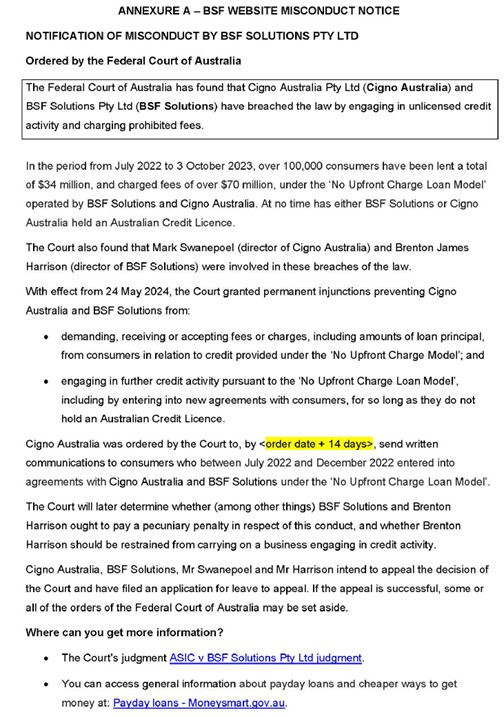
193 In Australian Securities and Investments Commission v National Australia Bank [2025] FCA 947 (ASIC v NAB), Neskovcin J found that National Australia Bank had contravened s 72 of the Code by reason of having failed to provide written responses to hardship notices given by customers within the statutory timeframe prescribed by s 72(5) of the Code. Her Honour made adverse publicity orders under s 182 of the Act in the following terms:
3. Pursuant to s 182(1) of the Credit Act, within 30 days of this order, NAB and AFSH publish, at their own expense, a written adverse publicity notice in the terms set out in the Annexure to these Orders (Written Notice), according to the following procedure:
(a) NAB and AFSH will cause the Written Notice to be published on the following webpages maintained by each of them respectively:
(i) https://www.nab.com.au/
(ii) https://www.news.nab.com.au/
(iii) https://www.advantedge.com.au/
(the websites);
(b) NAB and AFSH will ensure that each notice:
(i) appears on the landing page of the websites as a tile on the websites under the heading, “Adverse publicity order”; and
(ii) is maintained on the websites for a period of no less than 90 days from the date of these orders;
(c) NAB will send a copy of the Written Notice to the last known email or postal address of each person who gave a NAB hardship notice as set out in Schedule A of these Orders; and
(d) AFSH will send a copy of the Written Notice to the last known email or postal address of each person who gave an AFSH hardship notice as set out in Schedule B of these Orders.
194 The notice was drafted as follows:
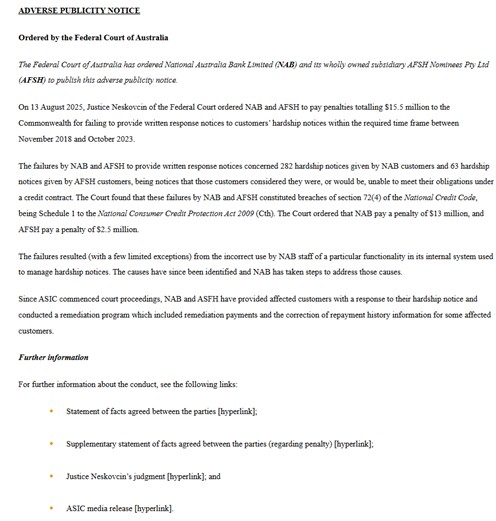
195 It appears that the making of the orders sought by ASIC in both cases were not opposed: see ASIC v NAB at [5], [88]; ASIC v BSF Solutions at [168].
196 In Australian Securities and Investments Commission v Commonwealth Bank of Australia [2021] FCA 423 at [45]–[53] (CBA 1) and Australian Securities and Investments Commission v Commonwealth Bank of Australia (No 2) [2021] FCA 966 (CBA 2), Lee J considered the making of adverse publicity orders under s 12GLB of the ASIC Act. Relevantly, s 12GLB(1) provides as follows:
12GLB Punitive orders requiring adverse publicity
(1) The Court may, on application by ASIC, make an adverse publicity order in relation to a person who:
(a) has been ordered to pay a pecuniary penalty under section 12GBB; or
(b) is guilty of an offence under section 12GB.
197 In CBA 1, Lee J stated at [46] that the heading to s 12GLB made it clear that such orders are “punitive” and that a notice issued pursuant to that provision must have regard to the audience to which the information is proposed to be communicated.
198 In CBA 2, Lee J reasoned at [11]–[15] that the statutory purpose of s 12GLB was two-fold. The first purpose being punitive: relying upon Medical Benefits Fund of Australia Ltd v Cassidy [2003] FCAFC 289; 135 FCR 1 at [48] (Stone J). His Honour stated at [13] that:
Similar to the imposition of pecuniary penalties for wrongful corporate conduct, the purpose of an adverse publicity order “does not just serve the notion of deterrence but also represents a condign curial response to what has occurred”…
199 The second purpose identified by Lee J was the broader purpose of protecting the public interest in “dispelling incorrect or false impressions created by contravening conduct”: citing and relying upon Australian Competition and Consumer Commission v Aveling Homes Pty Ltd [2017] FCA 1470 at [58]–[60] (McKerracher J). It is worth noting that Aveling Homes was a case involving the publication of a corrective notice pursuant to s 246(2)(d) of the Australian Consumer Law (being Sch 1 to the Competition and Consumer Act 2010 (Cth)), and was not a case involving s 247, which is a cognate provision to s 182 of the NCCP Act and is headed “Adverse publicity orders”. Section 246 (headed “Non-punitive orders”) relevantly empowers the Court to make various orders, including one that requires a person to publish an advertisement in a specific way: s 246(2)(d)).
200 In Australian Securities and Investments Commission v National Australia Bank [2025] FCA 947, Neskovcin J referring by analogy to s 12GLB of the ASIC Act stated that the “purpose of adverse publicity orders is both punitive and protective”: citing CBA 2 at [7]–[17] and Australian Securities and Investments Commission v Aware Financial Services Australia Ltd [2022] FCA 146 at [35] (Moshinsky J). Her Honour observed that it is not uncommon for the Court to order that corrective notices or adverse publicity orders be mailed or emailed to “affected persons” and to also be published on the contravenor’s website as doing so is more likely to bring notice of the contraventions to the attention of affected persons: relying upon Australian Securities and Investments Commission v Colonial First State Investments Ltd [2021] FCA 1268 at [86(d)] (Murphy J).
201 In Australian Securities and Investments Commission v LGSS Pty Ltd (No 3) [2025] FCA 205, O’Callaghan J stated at [142]–[143] that an adverse publicity order made under s 12GLB of the ASIC serves three purposes: the first purpose is punitive (as the heading to s 12GLB makes clear), the second purpose is not only to serve the notion of deterrence but also to provide a fitting curial response to the impugned conduct, and that the purpose is to “protect the public interest in dispelling incorrect or false impressions created by contravening conduct, alert the consumer to the fact of contravening conduct, aide the enforcement of primary orders and prevent the repetition of contravening conduct”: citing Aveling Homes at [59] (McKerracher J); Australian Competition and Consumer Commission v SMS Global Pty Ltd [2011] FCA 855 at [128] (Murphy J); Medical Benefits Fund of Australia Ltd v Cassidy [2003] FCAFC 289; 135 FCR 1 at [49]–[52] (Stone J); Australian Securities and Investments Commission v Commonwealth Bank of Australia (No 2) [2021] FCA 966 at [9]–[15] (Lee J).
202 Putting to one side the purpose of adverse publicity orders made under other statutory regimes, I have doubts as to whether it is apposite to characterise the making of such orders under s 182(1) of the NCCP Act as serving a punitive purpose when made in the context of civil penalty contraventions. As the text of s 182(1) makes clear, such orders may be made in the event that person has contravened a civil penalty contravention or has committed an offence against the NCCP Act. As was observed in the Agreed Penalties Case at [55] (French CJ, Kiefel, Bell, Nettle and Gordon JJ) in the context of the imposition of a civil penalty, criminal penalties import notions of retribution and rehabilitation, whereas the purpose of a civil penalty is “primarily if not wholly protective in promoting the public interest in compliance”: citing CSR at 52,152. In Pattinson, it was again made clear that criminal notions of punishment (including retribution) have no part to play in the imposition of a civil penalty, though some concerns familiar with “criminal sentencing may usefully be deployed in the enforcement” of civil penalty regimes: see Pattinson at [39]–[45]. It must be borne in mind that these observations were made in the context of the imposition of a civil penalty, as opposed to other forms of orders.
203 I accept that aspects of an adverse publicity order made under s 182(1) of the NCCP Act (which, unlike s 12GLB of the ASIC Act, is not headed as a punitive order) may have characteristics that appear, or are, penal in nature when made in relation to a contravention of a civil penalty provision: the order requires the publication of material that is (by definition) adverse to the contravenor; it is the contravenor that is to publish the relevant material and pay the expenses of the publication; and the order requires the contravenor to disclose aspects of their wrongdoing. To that extent, it may be said that such orders are punitive as they may be said to involve a contravenor getting their “just deserts” (by way of public embarrassment, humiliation, censure or opprobrium as a result of having to publish an adverse publicity notice). Such orders may also have a rehabilitative quality to them to the extent that they are cast in a way that requires a contravenor to confront their wrongdoing, publicly admit their conduct and make amends.
204 However, it is presently unnecessary to decide whether adverse publicity orders made under s 182 of the NCCP are to be punitive in nature. They must at least seek to promote the purpose of deterrence, securing compliance with the legislative regime and to protect and promote the public interest in dispelling incorrect or false impressions created by contravening conduct or as an aide to the enforcement of primary orders and prevent the repetition of contravening conduct. In the present case, I am not satisfied that the content of the notice proposed by ASIC or its publication in the manner that is sought would serve any of these purposes.
205 First, the only affected persons are Consumers 1 and 2, and I accept the Corporate Respondents’ contention that ASIC has not established that the contraventions need to be drawn to their attention given the circumstances of these proceedings.
206 Second, in view of the narrow class of affected persons established on the evidence before me, I do not consider it would be an appropriate exercise of my discretion that the Corporate Respondents be required to publish a notice to all other debtors during the period from 19 June 2017 to 4 May 2021. This was not a case where I made findings as to widespread failures that require attention being drawn to them to a wider class of debtors: cf ASIC v BSF Solutions at [71], [79]; ASIC v NAB at [3].
207 Third, on the evidence before me, I am not satisfied that the publication of the relevant notice on the Corporate Respondents’ websites would be effective. Green County’s website states that it is no longer in operation. As for Max Funding, I received no evidence as to the internet traffic that it receives and whether persons who visit its website are the appropriate audience on the facts that I decided in the Liability Judgment.
208 Fourth, aspects of the proposed notice proposed by ASIC appear to miss the mark and, in some respects, they have a tendency to misstate the regulatory effect altogether. For example, the proposed notice would not disclose the quantum of the penalties the Court has imposed. Additionally, it is not accurate to state that the Court has made orders that “one borrower receive compensation”. As noted above, whilst Consumer 1 will receive a payment pursuant to an order made under s 180(1)(c), it is not entirely accurate to characterise that as a payment of compensation for loss, as opposed to an order that Green County not benefit from its contraventions.
209 Fifth, allied to the other points, I am not satisfied that ASIC has established the reasons why any notice would need to inform other borrowers to seek independent legal advice. These parts of the proposed notice appear to me have the effect of seeking to encourage other debtors to consider their respective legal positions to determine whether they should seek to bring actions against the Corporate Respondents. If so, that would appear to me to extend beyond the scope of the present proceedings and what they have entailed. In other cases, a notice along these lines may promote the regulatory purpose so as to encourage affected persons to obtain advice about the matters contained in the notice. The context will be all important.
210 Stepping back from these points, I do see that the facts arising from the Liability Judgment and these reasons may promote the regulatory purpose of drawing particular aspects of the operation of the NCCP Act to the attention of other lenders, especially those that operate in the business lending market where credit is provided for non-Code purposes. For example, a differently drafted notice that highlights the operation of the statutory presumptions contained in s 13 of the Code and the effects or limits of obtaining business purpose declarations may promote and protect the public interest in securing compliance with the regulatory regime, as well as having a deterrent and/or penal effect on the Corporate Respondents. The appropriate targeted audience for such a notice would not be debtors, but other lenders. However, I received no evidence as to the appropriate forum in which such a notice might be published, and procedural fairness needs to be afforded to the Corporate Respondents. The Corporate Respondents submitted that the regulatory purposes to be served by such a notice would be best attended to by ASIC in the publications it is likely to make about these proceedings. However, the Corporate Respondents accepted that, if I were to conclude that an order under s 182(1) should be made, they would not oppose orders being made for ASIC to provide a revised form of order and make short submissions as to why that orders should be made.
211 As it presently stands, I am not satisfied that an order should be made in the form sought by ASIC. However, if ASIC wishes to seek an order in a different form, I will allow ASIC to file short submissions of no more than 3 pages in support of any revised order that it wishes to press. I will also make orders for the Corporate Respondents to file submissions in reply. I do not consider it appropriate that ASIC be given a further opportunity to file evidence in support of any revised order that it seeks. Both parties have run their respective cases and it would not be appropriate to permit one of them to lead further evidence at this stage. It follows that any revised order that ASIC seeks will need to be justified as being appropriate having regard to the evidence that I have already received and these reasons.
6. COSTS
212 The parties sought an opportunity to file short submissions on the question of costs following the publication of my reasons, in the event that they could not reach agreement as to the appropriate costs orders that should be made. I will make orders to this effect.
I certify that the preceding two hundred and twelve (212) numbered paragraphs are a true copy of the Reasons for Judgment of the Honourable Justice Shariff. |
Associate:
Dated: 11 December 2025


