FEDERAL COURT OF AUSTRALIA
Australian Competition and Consumer Commission v Google Asia Pacific Pte Ltd [2025] FCA 1554
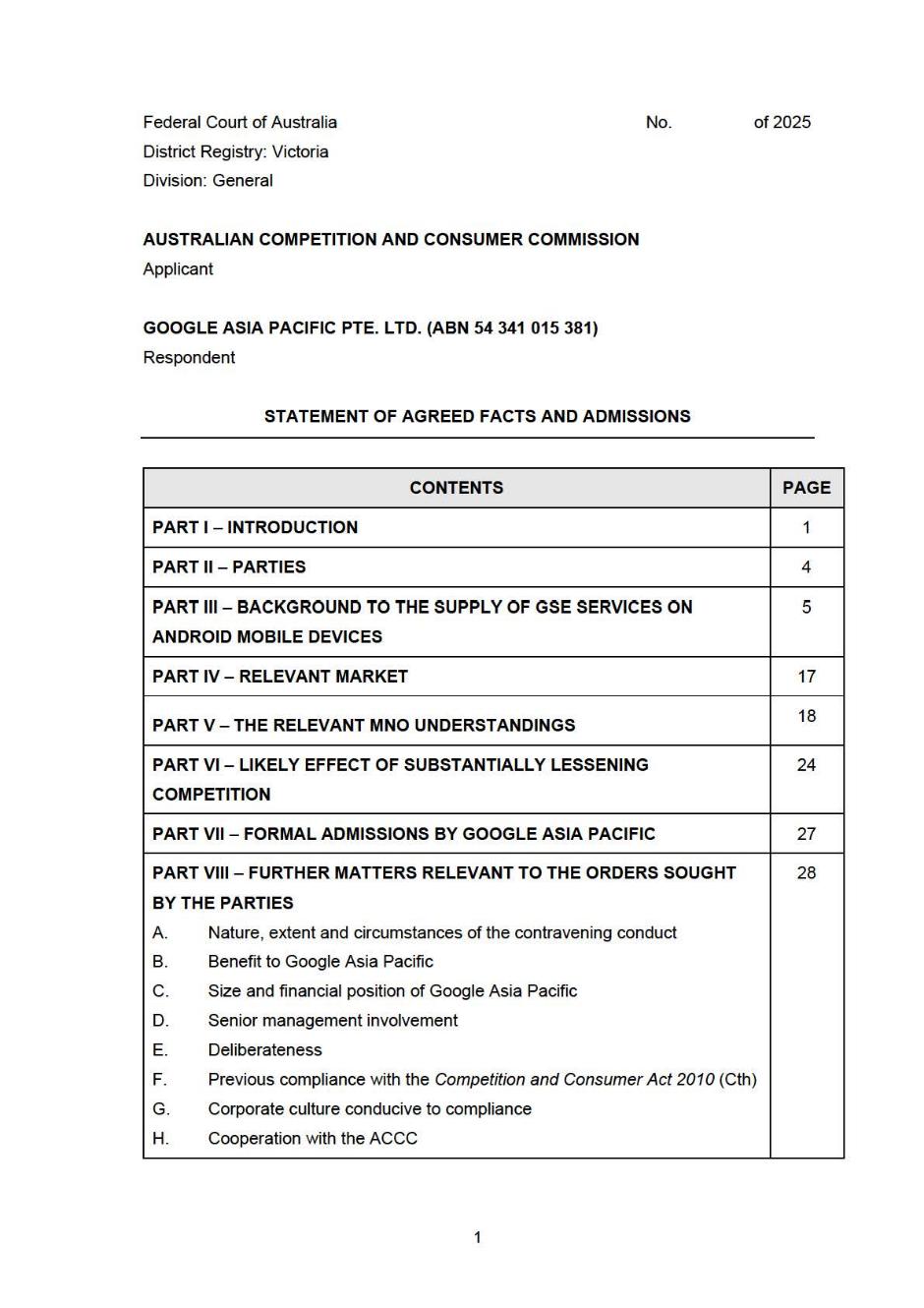
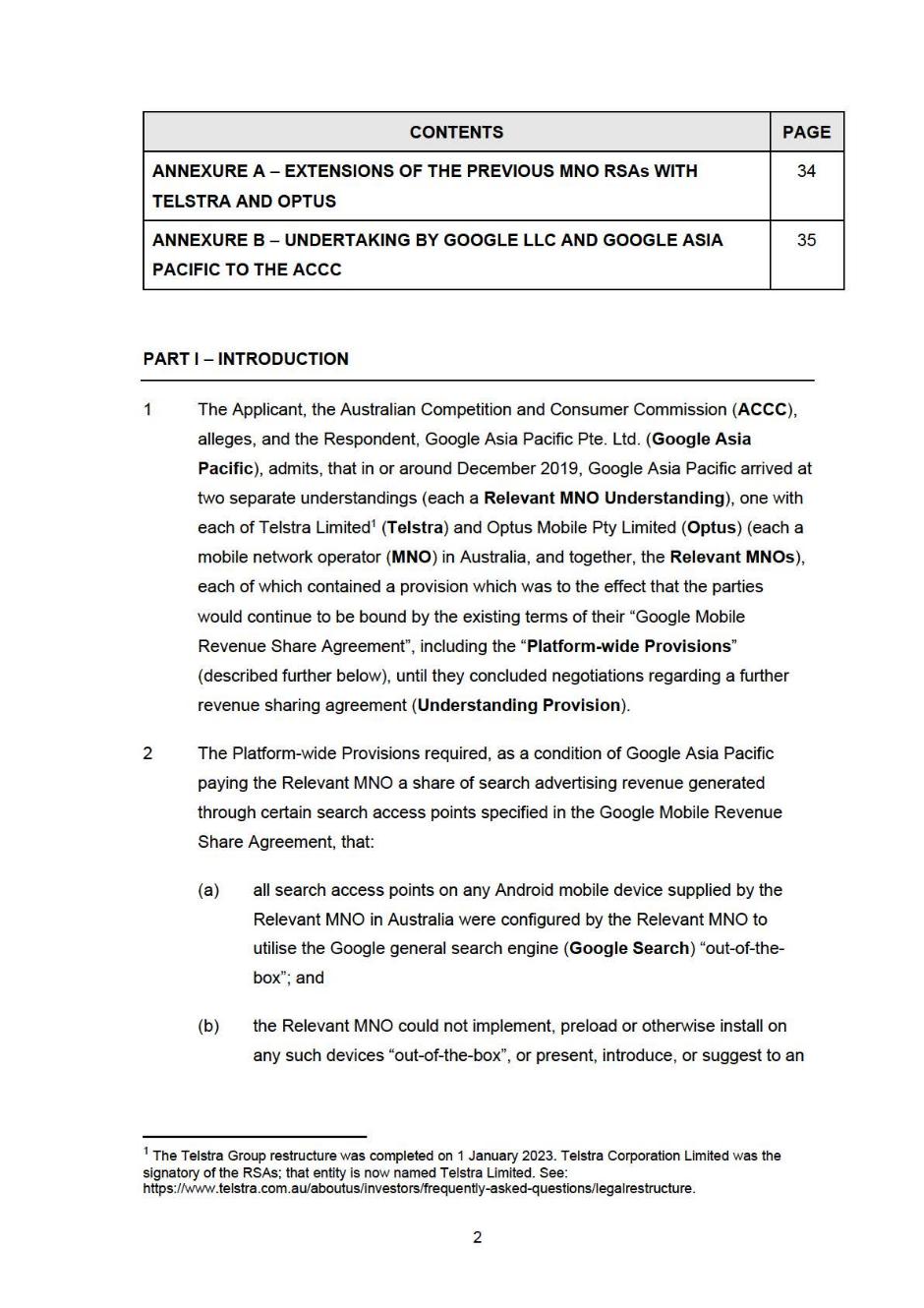
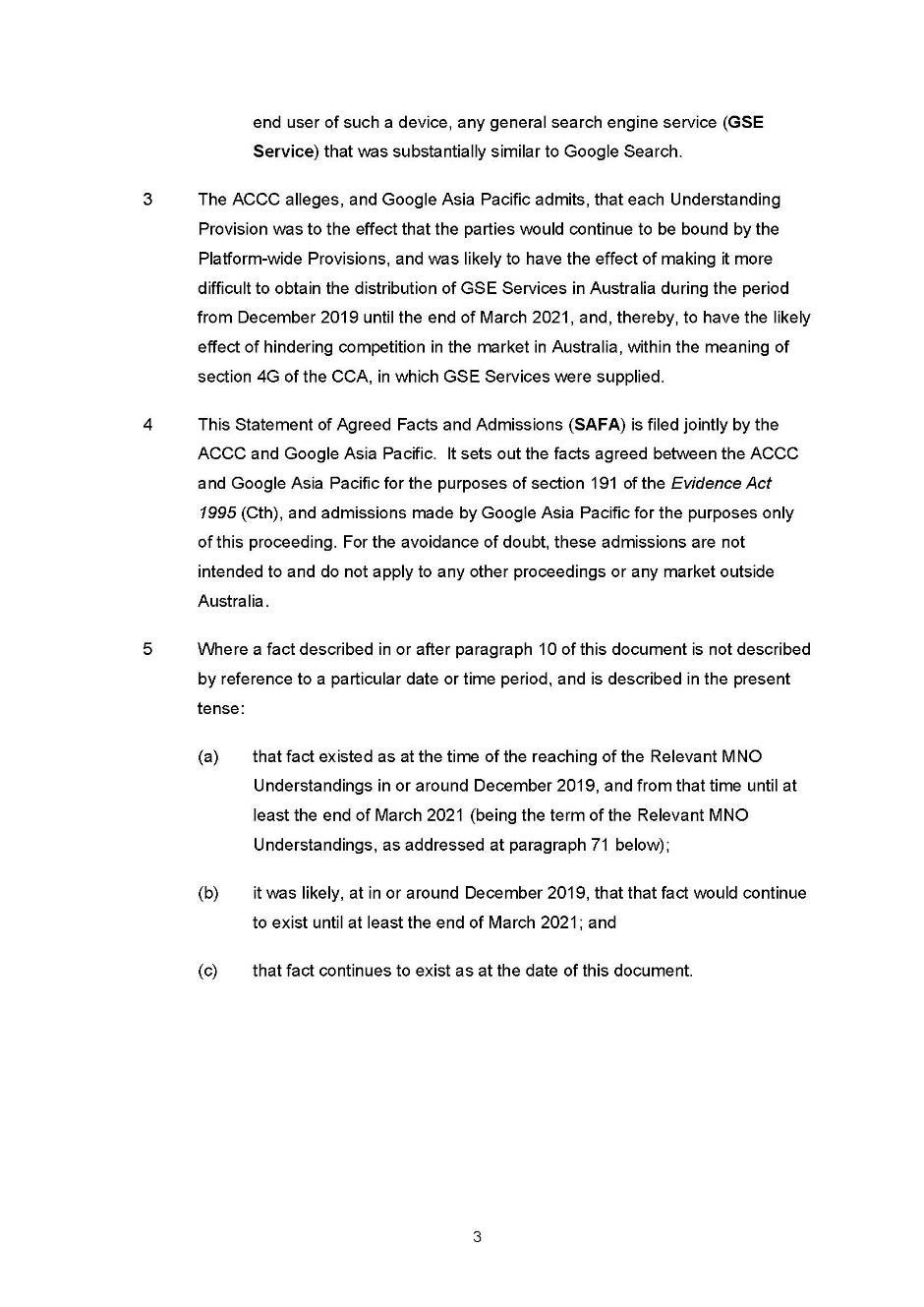
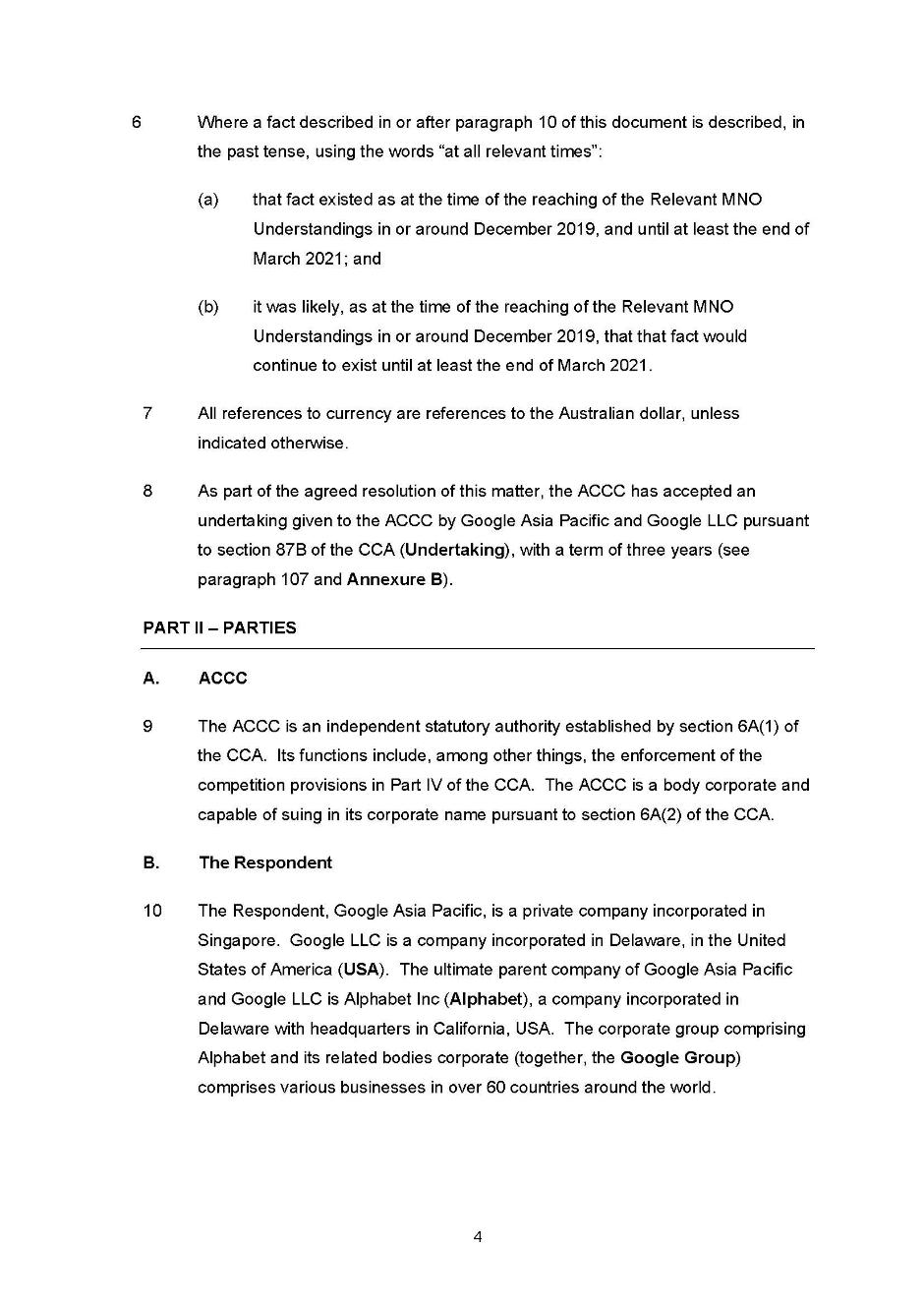
File number: | VID 1055 of 2025 |
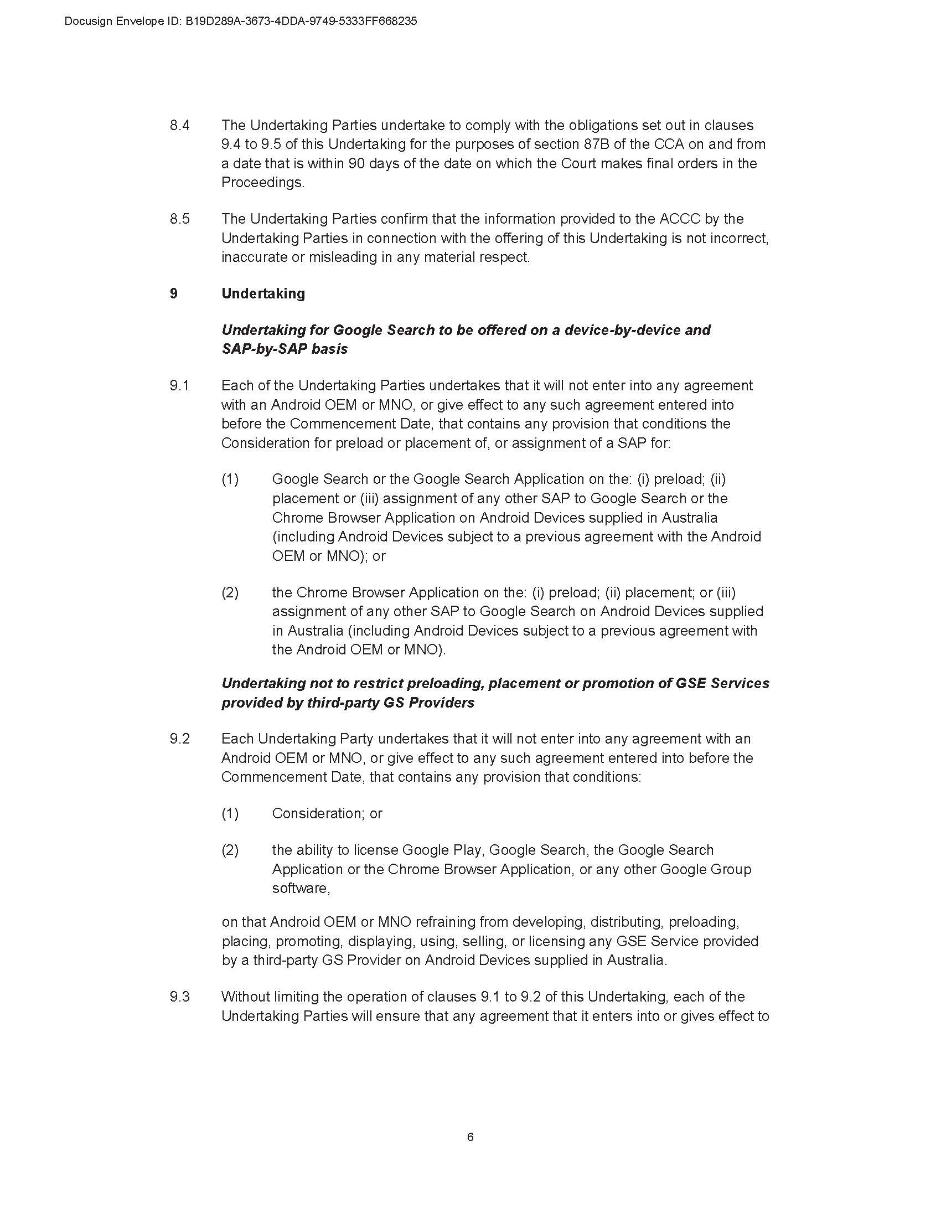
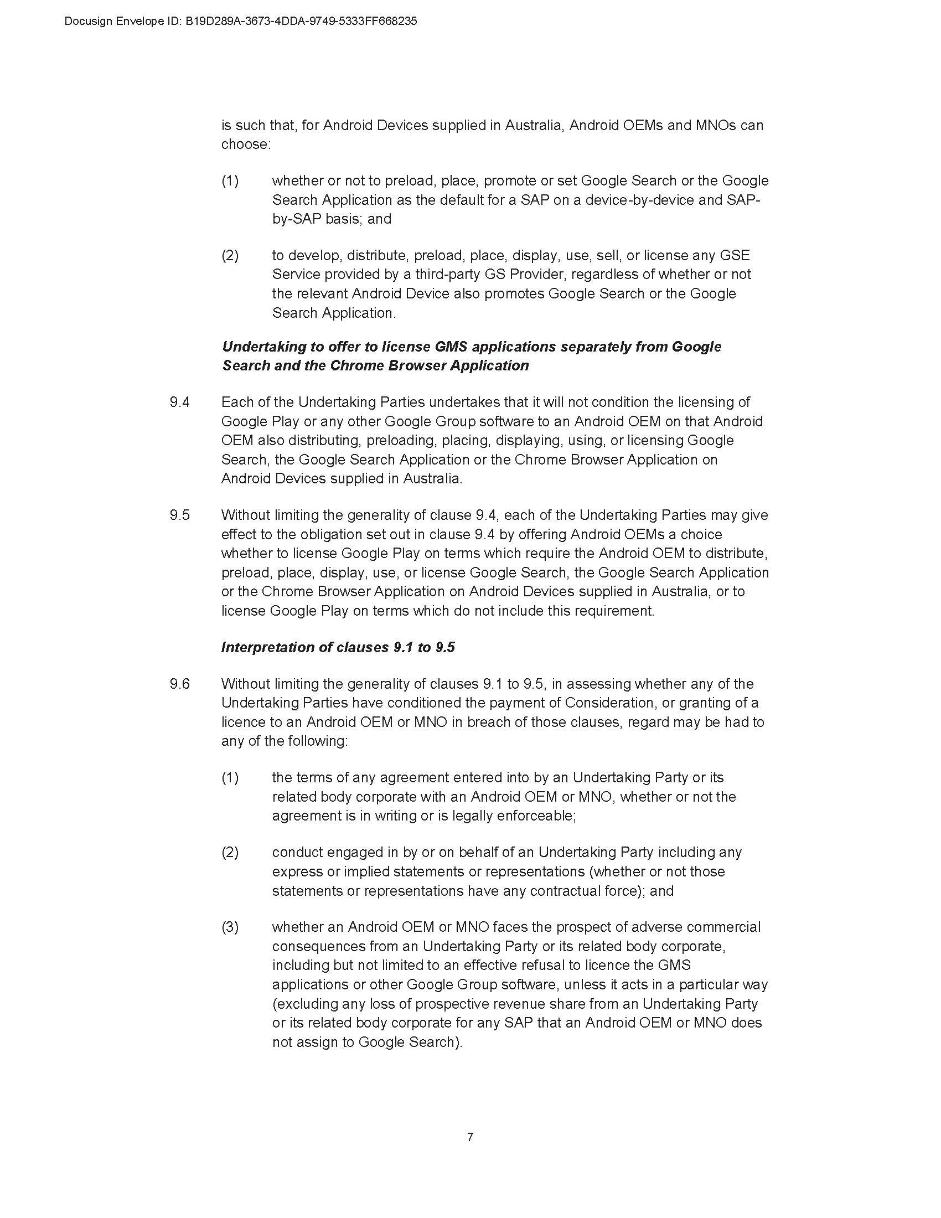
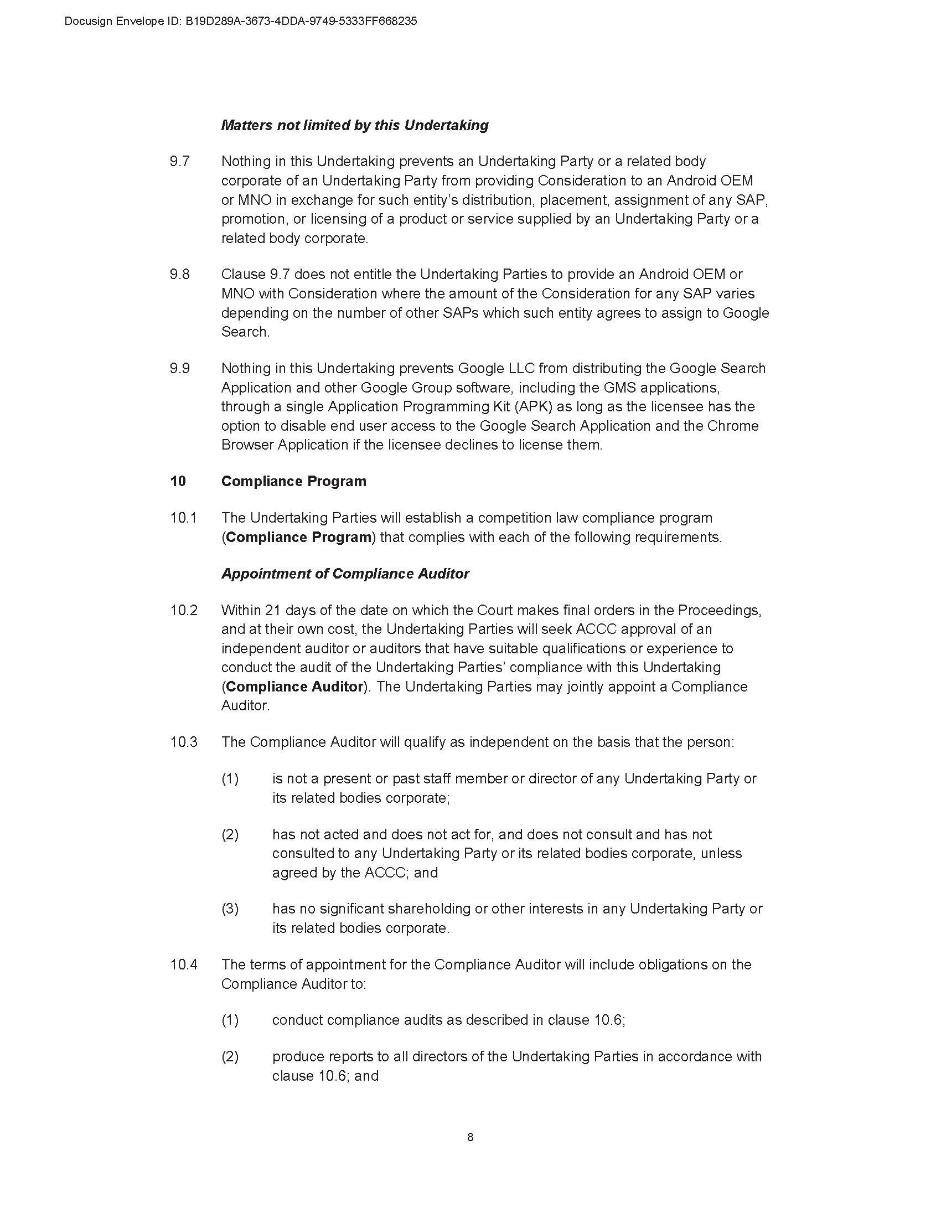
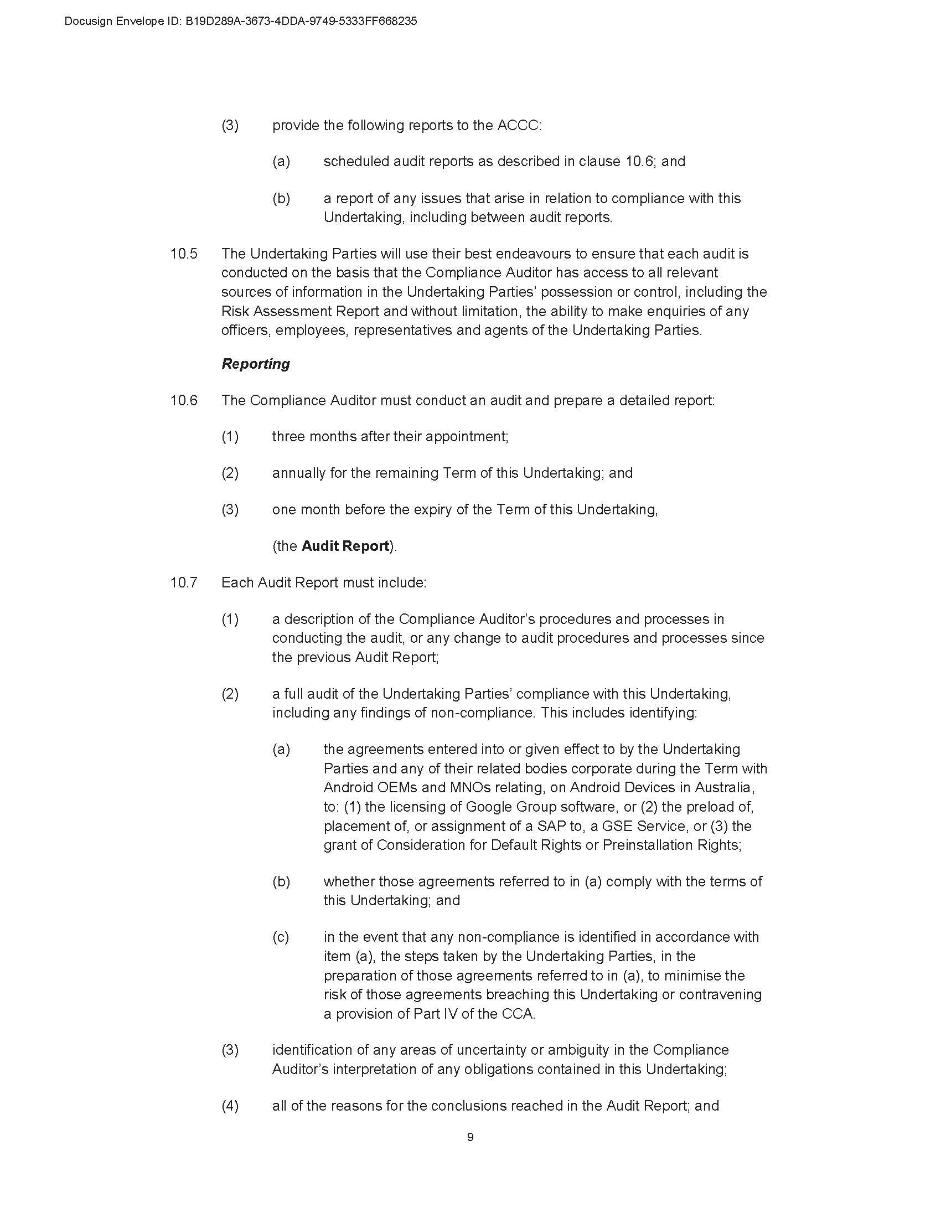
Judgment of: | MOSHINSKY J |
Date of judgment: | 2 December 2025 |
Catchwords: | COMPETITION LAW – prohibition against making a contract, arrangement or understanding in which a provision has the purpose, or would have or be likely to have the effect, of substantially lessening competition – where the respondent (Google) entered into understandings with each of Telstra and Optus which contained a provision that the parties would continue to be bound by the existing terms of their revenue share agreements – where the existing revenue share agreements included “Platform-wide Provisions” which required that all search access points on any Android mobile device supplied by Telstra or Optus (as the case may be) be configured to utilise the Google general search engine – where Google admitted that its conduct contravened s 45(1)(a) of the Competition and Consumer Act 2010 (Cth) – where the ACCC and Google jointly proposed declarations of contravention and a total pecuniary penalty of $55 million – declarations and orders made as proposed by the parties |
Legislation: | Competition and Consumer Act 2010 (Cth), ss 4E, 4G, 45, 45AB, 76, 87B |
Cases cited: | Air New Zealand Ltd v Australian Competition and Consumer Commission [2017] HCA 21; 262 CLR 207 Australian Competition and Consumer Commission v Australasian Food Group Pty Ltd [2022] FCA 308 Australian Competition and Consumer Commission v Australian Medical Association Western Australia Branch Inc [2003] FCA 686; 199 ALR 423 Australian Competition and Consumer Commission v CC (NSW) Pty Ltd [1999] FCA 954; 92 FCR 375 Australian Competition and Consumer Commission v Cement Australia Pty Ltd [2013] FCA 909; 310 ALR 165 Australian Competition and Consumer Commission v Coles Supermarkets Australia Pty Ltd [2014] FCA 1405 Australian Competition and Consumer Commission v Colgate-Palmolive Pty Ltd (No 4) [2017] FCA 1590; 353 ALR 460 Australian Competition and Consumer Commission v J Hutchinson Pty Ltd [2025] HCA 10; 422 ALR 236 Australian Competition and Consumer Commission v Optus Internet Pty Ltd [2018] FCA 777 Australian Competition and Consumer Commission v Pacific National Pty Ltd [2020] FCAFC 77; 277 FCR 49 Australian Competition and Consumer Commission v Pacific National Pty Ltd (No 2) [2019] FCA 669; (2019) ATPR 42-633 Australian Competition and Consumer Commission v Pfizer Australia Pty Ltd [2015] FCA 113; 323 ALR 429 Australian Gas Light Company v Australian Competition and Consumer Commission (No 3) [2003] FCA 1525; 137 FCR 317 Australian Wool Innovation Ltd v Newkirk [2005] FCA 290; (2005) ATPR 42-053 BlueScope Steel Limited v Australian Competition and Consumer Commission [2025] FCAFC 118 Dowling v Dalgety Australia Ltd (1992) 34 FCR 109 Eastern Express Pty Ltd v General Newspapers Pty Ltd (1992) 35 FCR 43 Epic Games, Inc v Apple Inc [2025] FCA 900 Hecar Investments No 6 Pty Ltd v Outboard Marine Australia Pty Ltd (1982) 62 FLR 159 Monroe Topple & Associates Pty Ltd v Institute of Chartered Accountants in Australia [2002] FCAFC 197; 122 FCR 110 Radio 2UE Sydney Pty Ltd v Stereo FM Pty Ltd (1982) 62 FLR 437 Re Queensland Co-operative Milling Association Ltd (1976) 25 FLR 169 Stirling Harbour Services Pty Ltd v Bunbury Port Authority [2000] FCA 38; (2000) ATPR 41-752 Trade Practices Commission v TNT Management Pty Ltd (1985) 6 FCR 1 Universal Music Australia Pty Ltd v Australian Competition and Consumer Commission [2003] FCAFC 193; 131 FCR 529 Vodafone Hutchison Australia Pty Ltd v Australian Competition and Consumer Commission [2020] FCA 117 |
Division: | General Division |
Registry: | Victoria |
National Practice Area: | Commercial and Corporations |
Sub-area: | Economic Regulator, Competition and Access |
Number of paragraphs: | 76 |
Date of hearing: | 2 December 2025 |
Counsel for the Applicant: | Dr MJ Collins AM KC with Ms CI Cunliffe and Ms A Muhlebach |
Solicitor for the Applicant: | Norton Rose Fulbright Australia |
Counsel for the Respondent: | Mr RA Yezerski SC with Mr PJ Strickland |
Solicitor for the Respondent: | King & Wood Mallesons |
ORDERS
VID 1055 of 2025 | ||
| ||
BETWEEN: | AUSTRALIAN COMPETITION AND CONSUMER COMMISSION Applicant | |
AND: | GOOGLE ASIA PACIFIC PTE LTD Respondent | |
order made by: | MOSHINSKY J |
DATE OF ORDER: | 2 DECEMBER 2025 |
THE COURT DECLARES THAT:
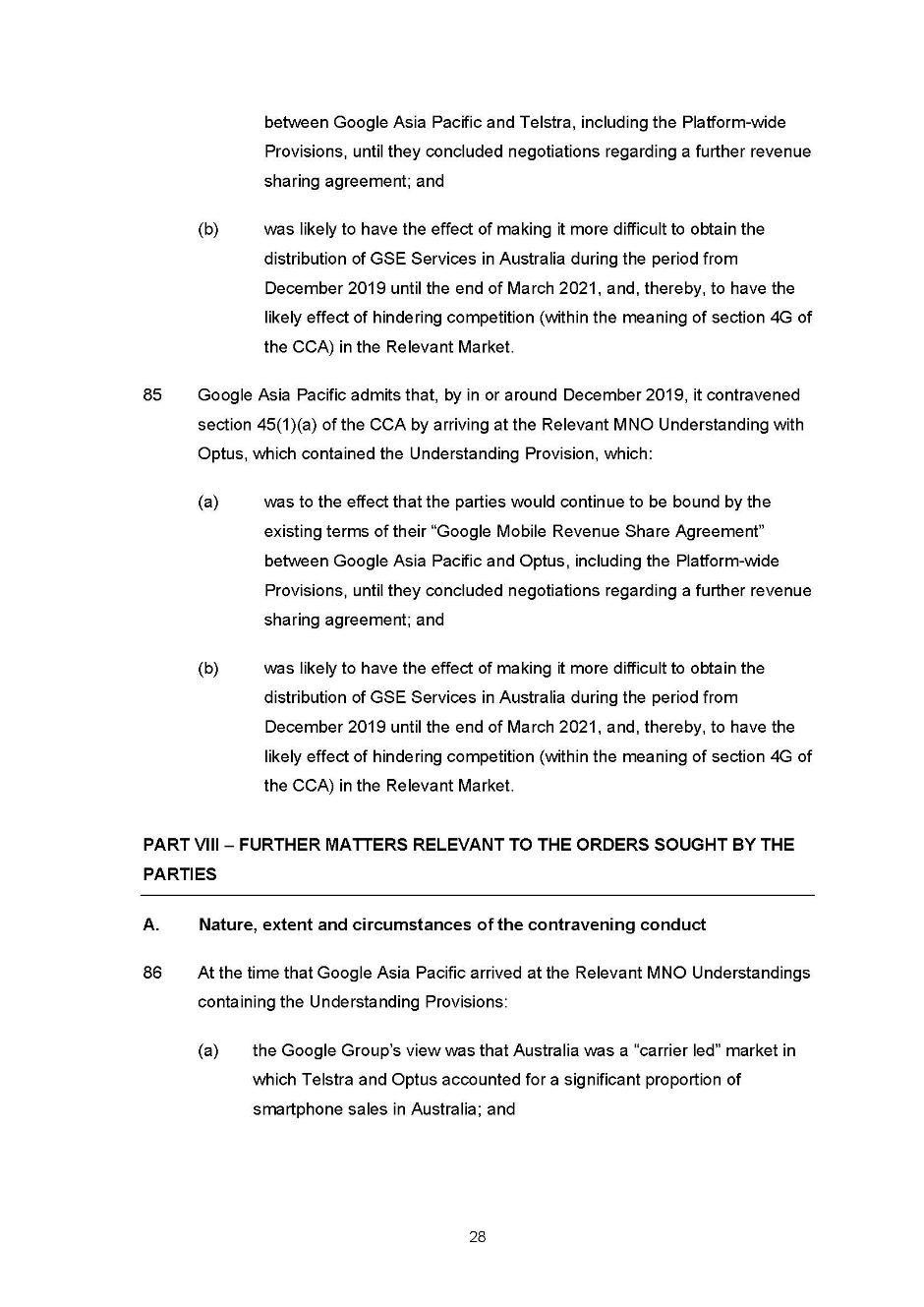
1. By in or around December 2019, the Respondent contravened s 45(1)(a) of the Competition and Consumer Act 2010 (Cth) (CCA) by arriving at an understanding with Telstra Limited (Telstra) which contained a provision which:
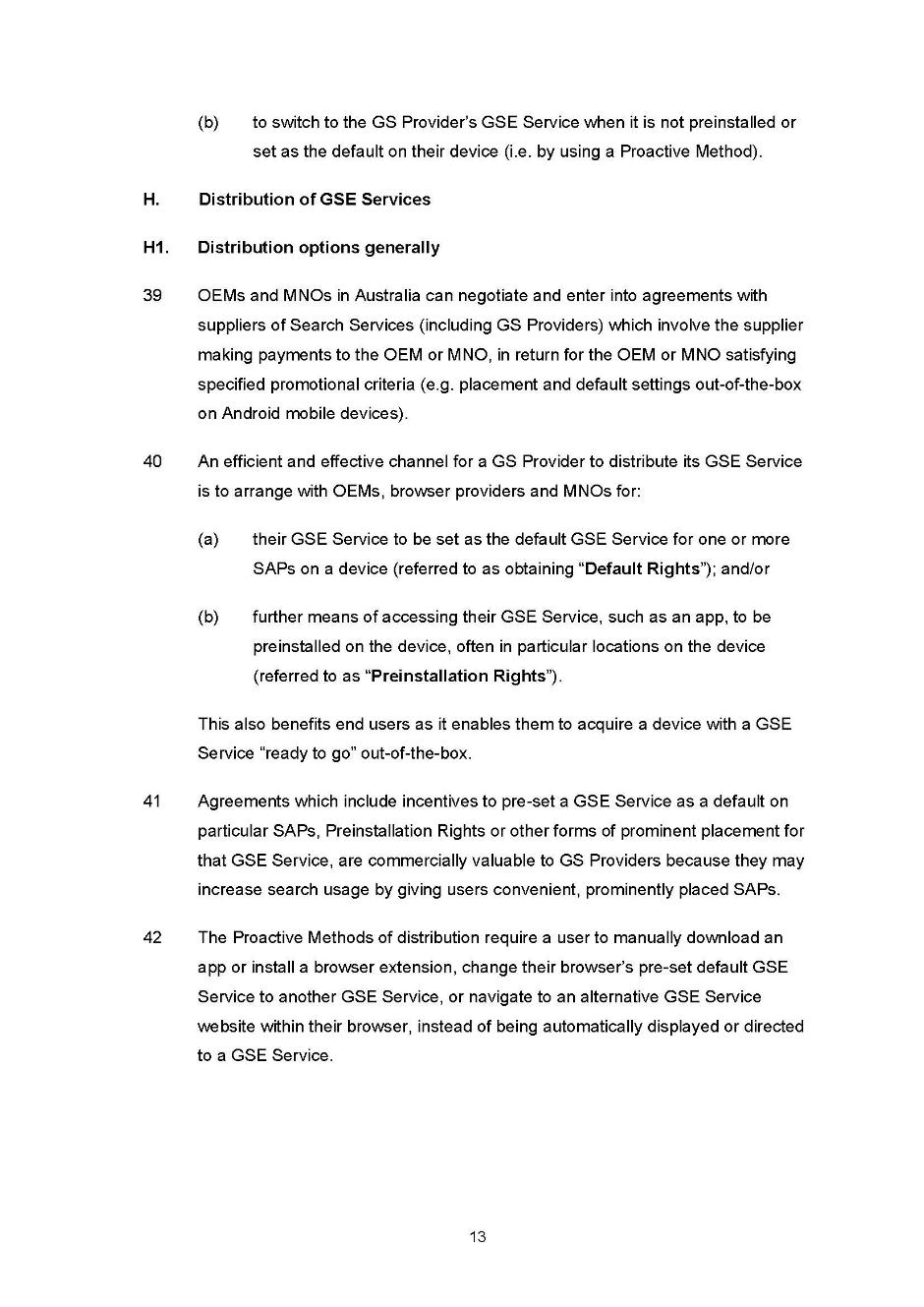
(a) was to the effect that the parties would continue to be bound by the existing terms of the “Google Mobile Revenue Share Agreement” between the Respondent and Telstra, including the Platform-wide Provisions (described below), until they concluded negotiations regarding a further revenue sharing agreement; and
(b) was likely to have the effect of making it more difficult to obtain the distribution of general search engine services (GSE Services) in Australia during the period from December 2019 until the end of March 2021 and, thereby, was likely to have the effect of hindering competition (within the meaning of s 4G of the CCA) in an Australia-wide “market in Australia” (within the meaning of s 4E of the CCA), in which GSE Services were supplied.
The “Platform-wide Provisions” were provisions of the Google Mobile Revenue Share Agreement which required, as a condition of the Respondent paying Telstra a share of search advertising revenue generated through certain search access points on Android mobile devices supplied in Australia by Telstra, that:
(i) all search access points on any Android mobile device supplied by Telstra in Australia were configured by Telstra to utilise the Google general search engine (Google Search) ‘out-of-the-box’; and
(ii) Telstra could not implement, preload or otherwise install on any such device ‘out-of-the-box’, or present, introduce, or suggest to an end user of such a device, any GSE Service that was substantially similar to Google Search.
2. By in or around December 2019, the Respondent contravened s 45(1)(a) of the CCA by arriving at an understanding with Optus Mobile Pty Limited (Optus) which contained a provision which:
(a) was to the effect that the parties would continue to be bound by the existing terms of the “Google Mobile Revenue Share Agreement” between the Respondent and Optus, including the Platform-wide Provisions (described below), until they concluded negotiations regarding a further revenue sharing agreement; and
(b) was likely to have the effect of making it more difficult to obtain the distribution of GSE Services in Australia during the period from December 2019 until the end of March 2021 and, thereby, was likely to have the effect of hindering competition (within the meaning of s 4G of the CCA) in an Australia-wide “market in Australia” (within the meaning of s 4E of the CCA), in which GSE Services were supplied.
The “Platform-wide Provisions” were provisions of the Google Mobile Revenue Share Agreement which required, as a condition of the Respondent paying Optus a share of search advertising revenue generated through certain search access points on Android mobile devices supplied in Australia by Optus, that:
(i) all search access points on any Android mobile device supplied by Optus in Australia were configured by Optus to utilise the Google Search ‘out-of-the-box’; and
(ii) Optus could not implement, preload or otherwise install on any such device ‘out-of-the-box’, or present, introduce, or suggest to an end user of such a device, any GSE Service that was substantially similar to Google Search.
THE COURT ORDERS THAT:
3. Pursuant to s 76(1)(a)(i) of the CCA, the Respondent pay to the Commonwealth of Australia a total pecuniary penalty in the sum of $55,000,000 in respect of the contraventions referred to in paragraphs 1 and 2 of this order, comprising a penalty of $27,500,000 for each of the contraventions described in paragraphs 1 and 2 above, to be paid within 30 days of this order.
4. The Respondent pay a contribution to the Applicant’s costs in the amount agreed between the parties, pursuant to s 43(1) of the Federal Court of Australia Act 1976 (Cth), within 30 days of this order.
Note: Entry of orders is dealt with in Rule 39.32 of the Federal Court Rules 2011.
REASONS FOR JUDGMENT
MOSHINSKY J:
Introduction
1 By this proceeding, the applicant (the ACCC) alleges that the respondent, Google Asia Pacific Pte Ltd (Google) contravened s 45(1)(a) of the Competition and Consumer Act 2010 (Cth) (CCA) by arriving at understandings with each of Telstra Limited (Telstra) and Optus Mobile Pty Limited (Optus) which were likely to have the effect of substantially lessening competition in a market in Australia.
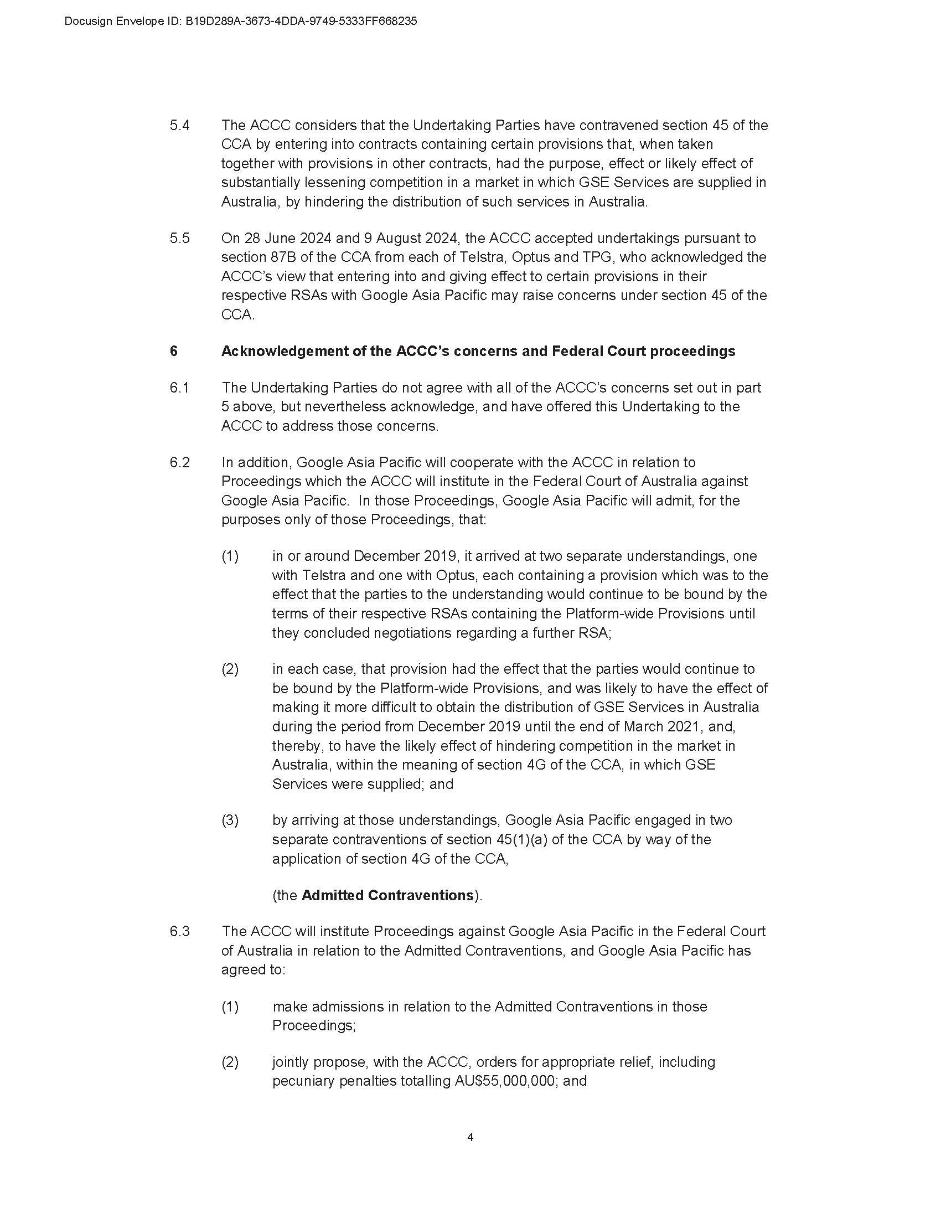
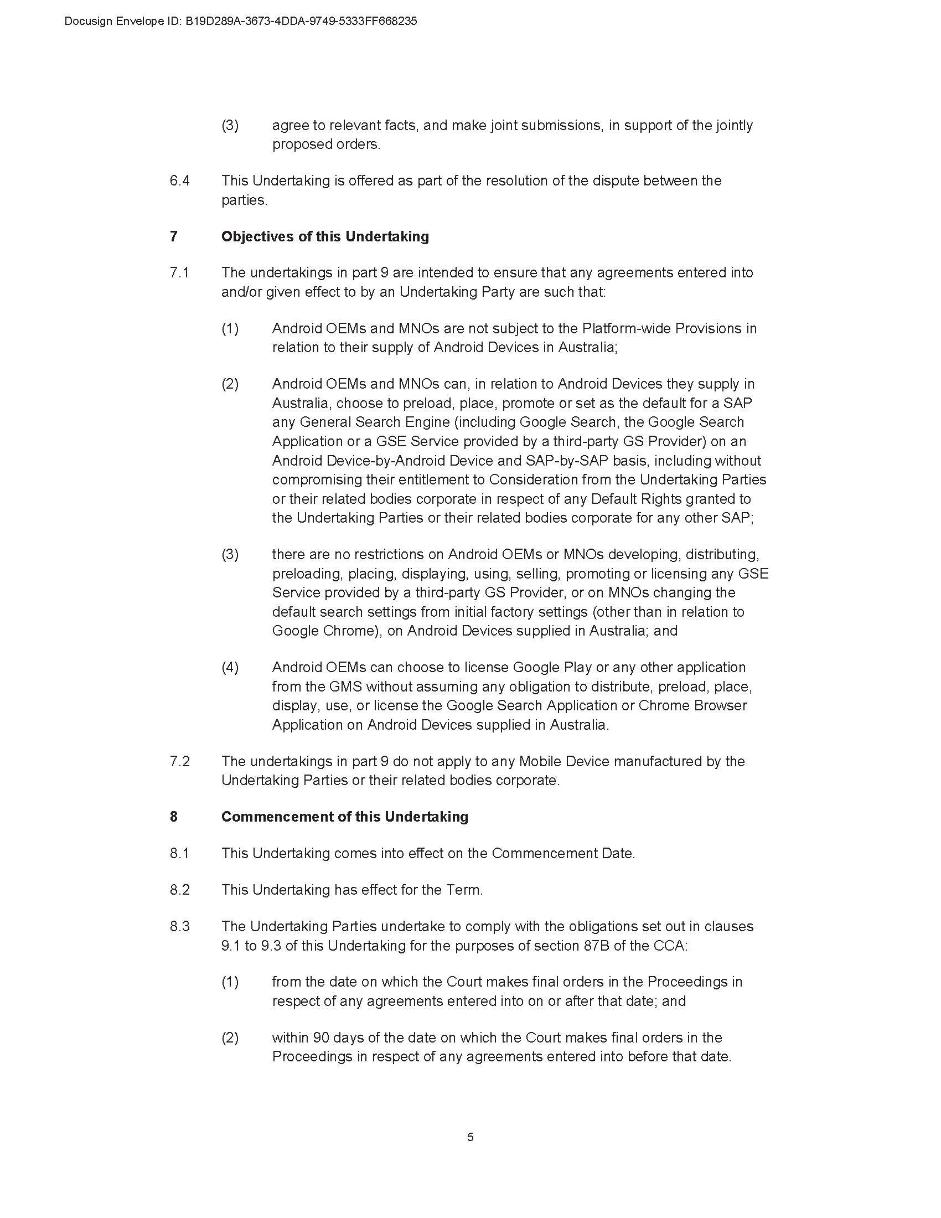
2 Google has admitted that it contravened s 45(1)(a) of the CCA. The parties have reached agreement on a Statement of Agreed Facts and Admissions dated 17 August 2025 (SOAF). A copy of the SOAF with redactions of commercially confidential material is annexed to these reasons. The parties have also reached agreement on the terms of proposed declarations and a proposed pecuniary penalty for the contraventions. The proposed total penalty is $55 million, comprising $27.5 million in respect of the contravention relating to Telstra and $27.5 million in respect of the contravention relating to Optus.
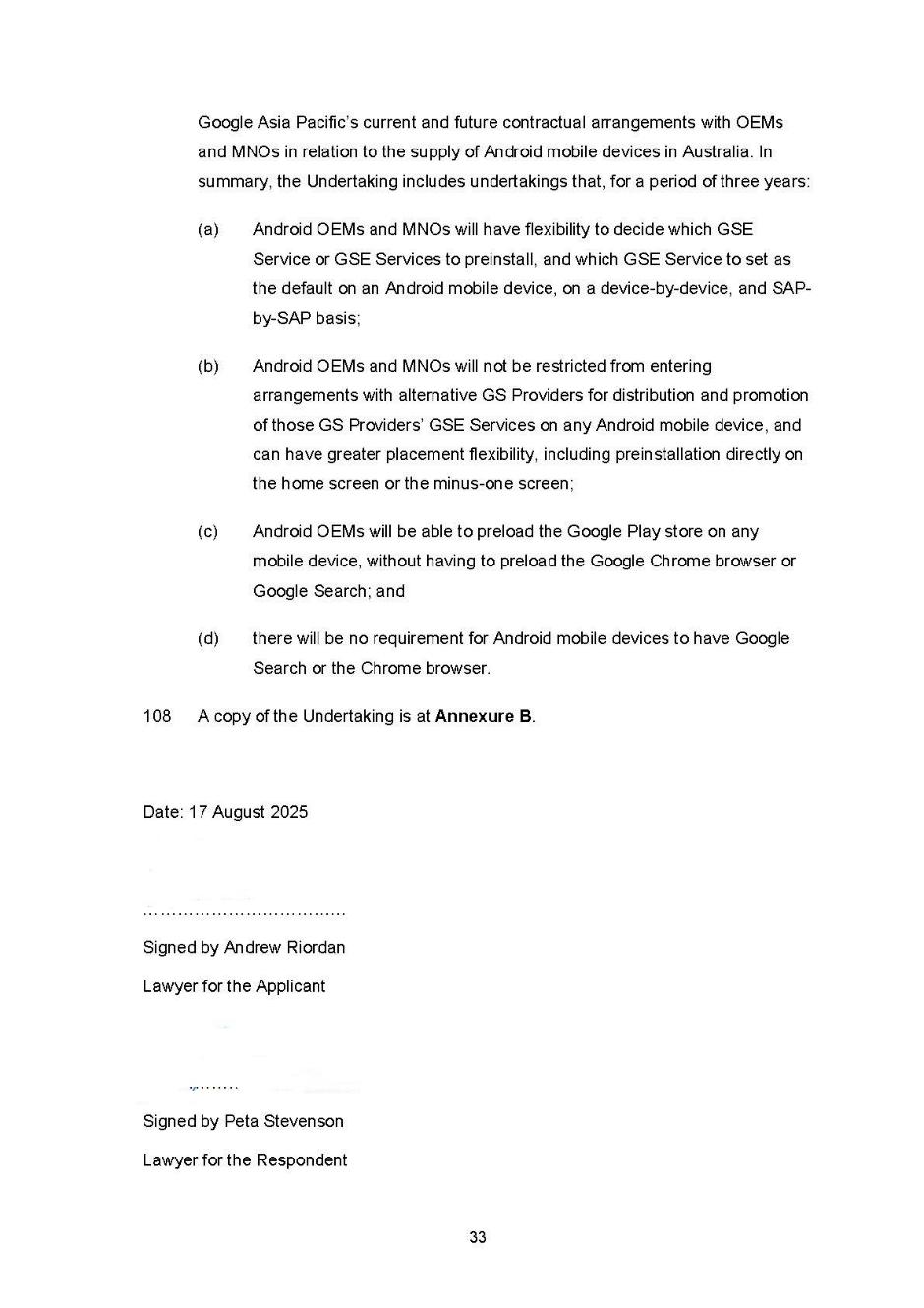
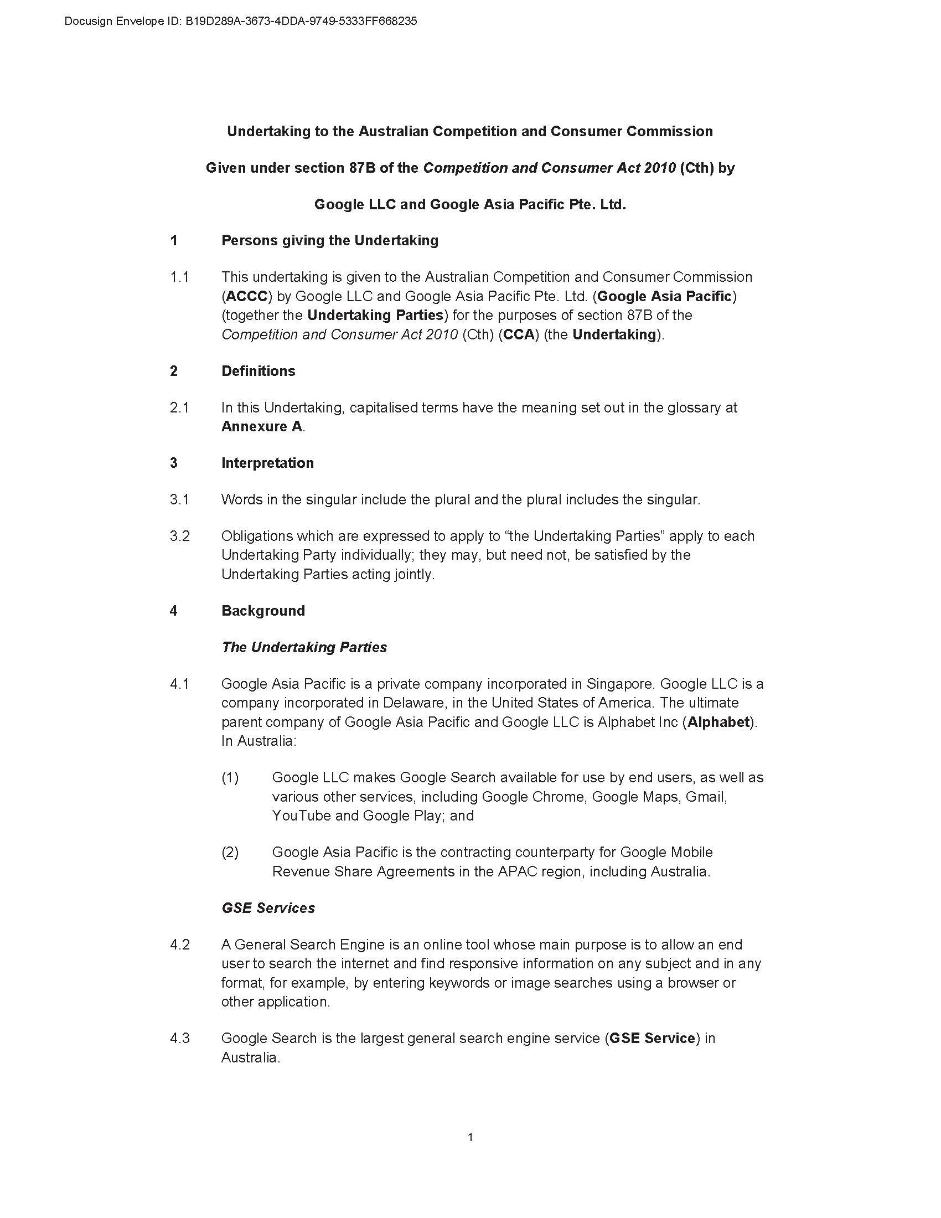
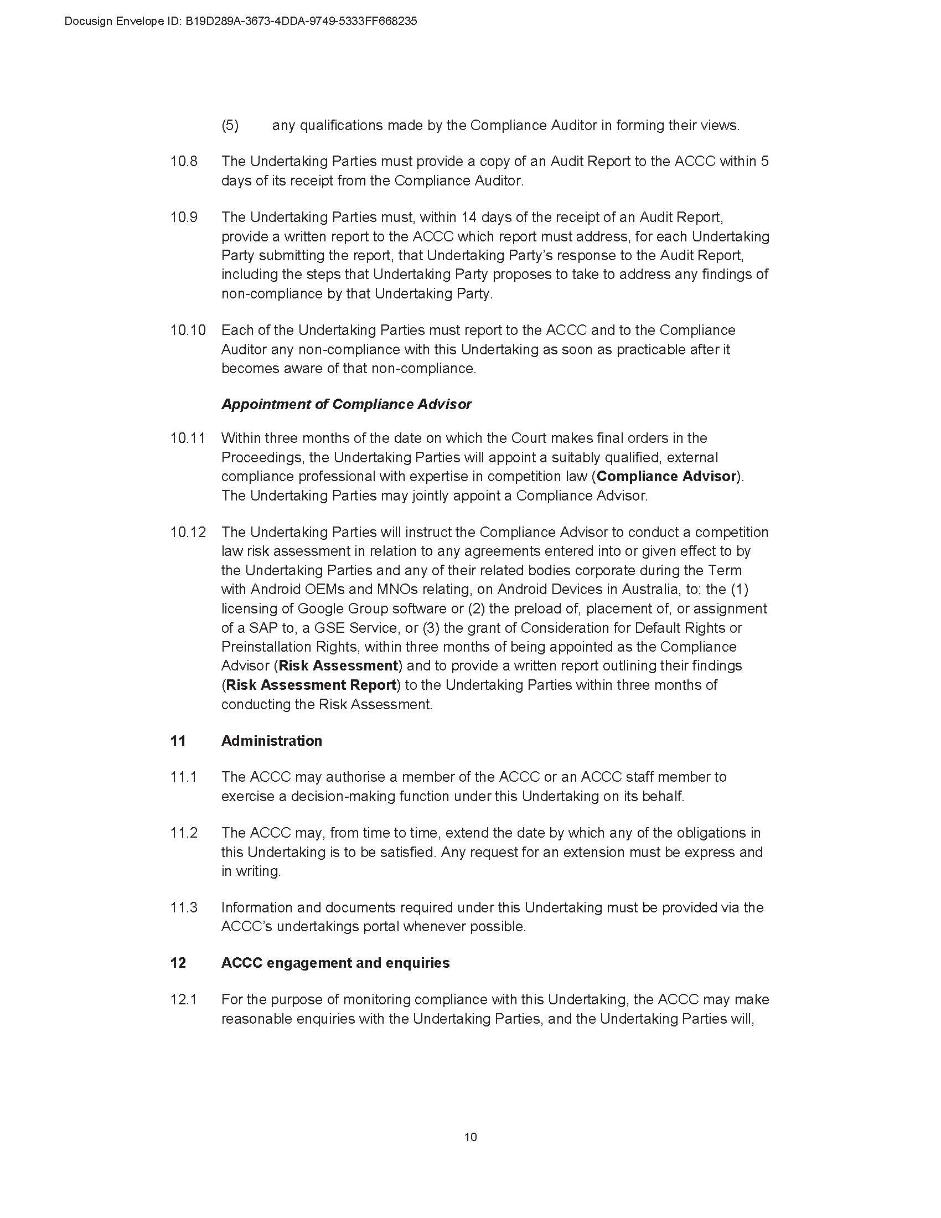
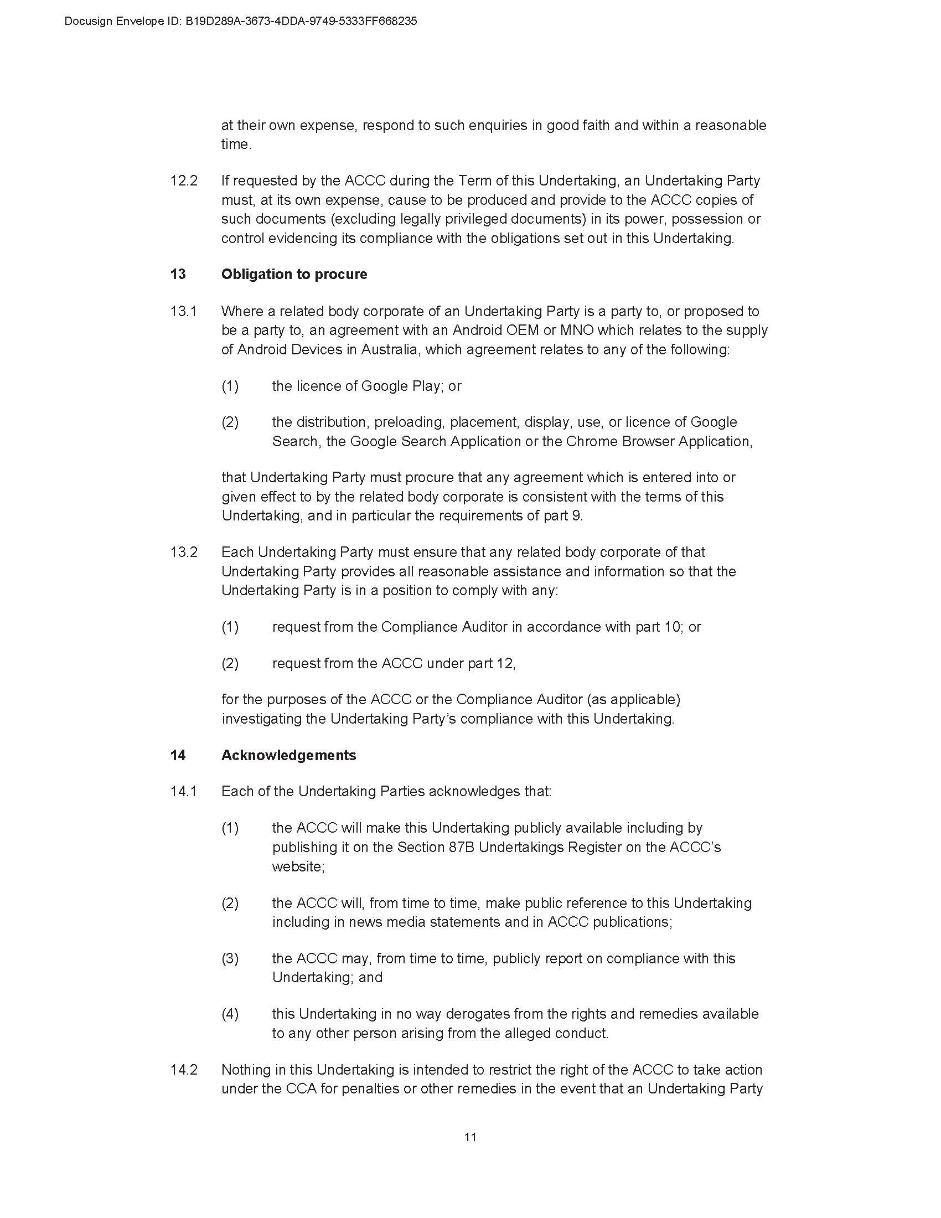
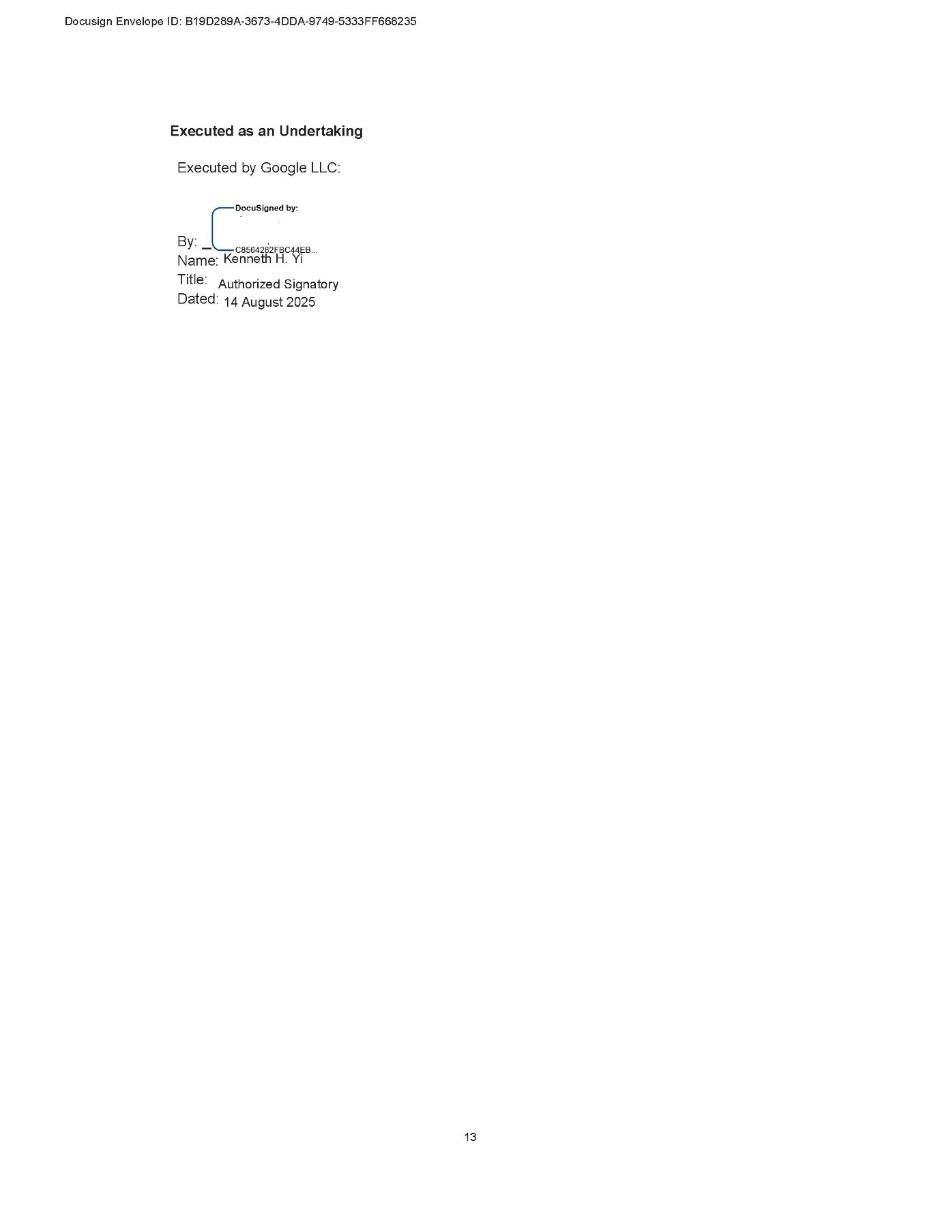
3 As part of the agreed resolution of this matter, the ACCC has accepted an undertaking given by Google Asia Pacific Pte Ltd and Google LLC pursuant to s 87B of the CCA with a term of three years.
4 While the parties may agree a proposed penalty, it is ultimately for the Court to determine whether to impose the proposed penalty. In doing so, the Court considers whether the penalty proposed by the parties is within the appropriate range.
5 For the reasons that follow, I am satisfied that the proposed total penalty of $55 million is within the appropriate range. I will therefore make an order imposing a pecuniary penalty in that amount. I am also satisfied that it is appropriate to make declarations in the terms proposed by the parties.
6 The parties’ counsel have prepared joint submissions on liability and relief dated 19 November 2025 (the Joint Submissions). These reasons draw substantially on the SOAF and the Joint Submissions.
Factual Background
Overview
7 Each of Telstra and Optus is a mobile network operator (MNO) in Australia. In about December 2019, Google arrived at an understanding with each of Telstra and Optus (each a Relevant MNO Understanding). Each understanding contained a provision (the Understanding Provision) to the effect that the parties would continue to be bound by the existing terms of their “Google Mobile Revenue Share Agreement” (each, a Relevant MNO RSA), including the “Platform-wide Provisions” (see below), until they concluded negotiations regarding a further revenue-sharing agreement.
8 The Platform-wide Provisions required, as a condition of Google paying Telstra or Optus (as the case may be) a share of search advertising revenue generated through certain search access points (SAPs) specified in the Google Mobile Revenue Share Agreement, that:
(a) all search access points on any Android mobile device supplied by Telstra or Optus in Australia be configured by Telstra or Optus to utilise the Google general search engine (Google Search) “out-of-the-box”; and
(b) Telstra or Optus not implement, preload or otherwise install on any such devices “out-of-the-box”, or present, introduce or suggest to an end user of such a device, any general search engine service (GSE Service) that was substantially similar to Google Search.
9 The ACCC alleges, and Google admits, that each understanding contained a provision to the effect that the parties would continue to be bound by the Platform-wide Provisions, and that each understanding was likely to have the effect of making it more difficult to obtain the distribution of GSE Services in Australia during the period from December 2019 until the end of March 2021 and thereby was likely to have the effect of hindering competition in the market in Australia (within the meaning of s 4G of the CCA) in which GSE Services were supplied.
The parties
10 The parties are described in the SOAF at [9]-[12].
11 The respondent, Google Asia Pacific Pte Ltd, is a private company incorporated in Singapore. Google LLC is a company incorporated in Delaware, in the United States of America. The ultimate parent company of Google Asia Pacific Pte Ltd and Google LLC is Alphabet Inc, a company incorporated in Delaware with headquarters in California, USA. The corporate group comprising Alphabet and its related bodies corporate (together, the Google Group) comprises various businesses in over 60 countries around the world.
Background to the supply of GSE Services on Android mobile devices
12 At [13]-[17] of the SOAF there is a description of devices and operating systems.
13 At all relevant times, a number of search services were supplied in Australia, and end users discovered information in different ways using different types of search services (together, Search Services), including:
(a) GSE Services; and
(b) other Search Services, including:
(i) specialised (also known as “vertical”) Search Services; and
(ii) social media Search Services.
Search Services are further described at [19]-[25] of the SOAF.
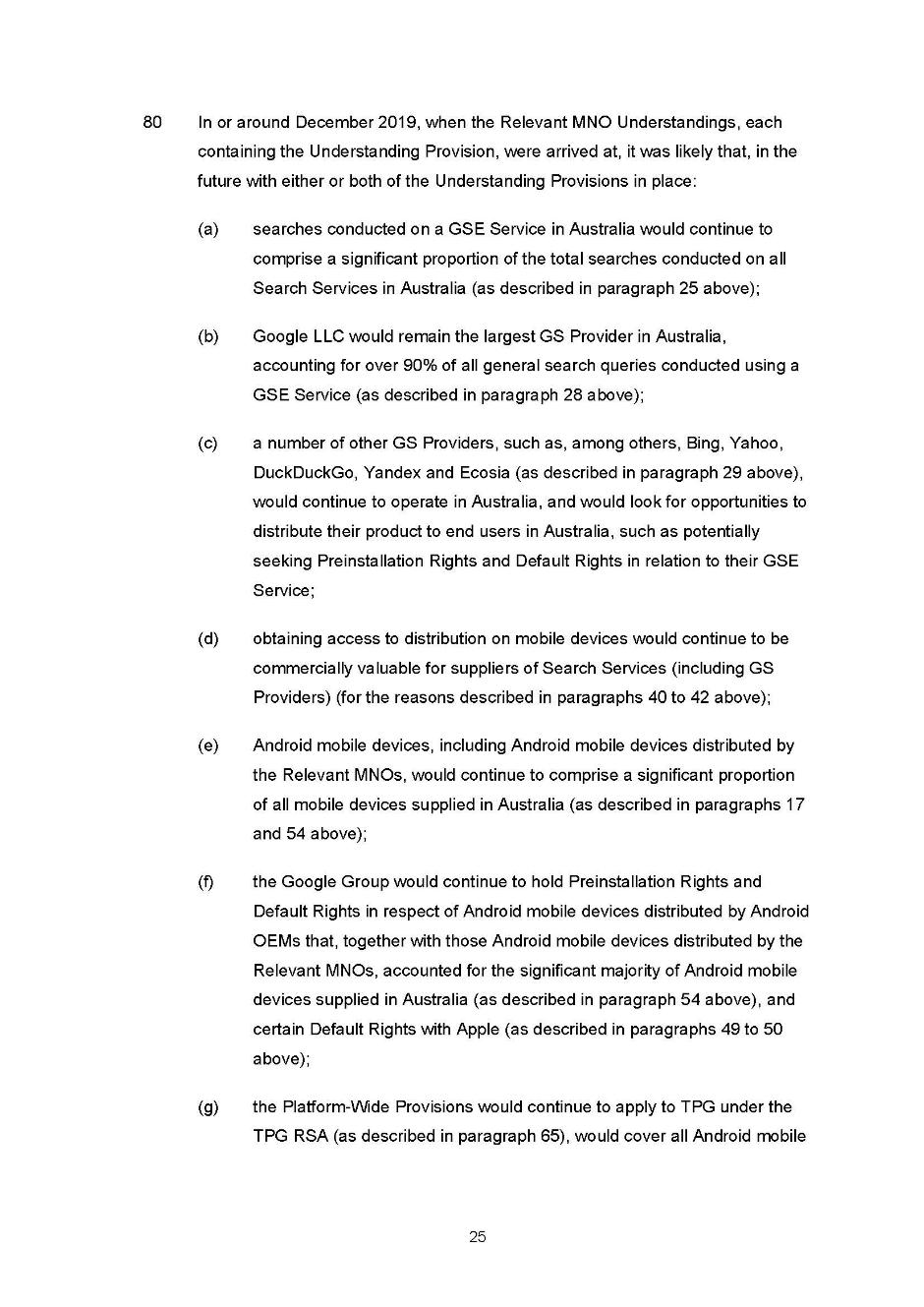
14 At all relevant times, GSE Services were supplied in Australia by various providers (GS Providers). GSE Services included Google Search, Bing, Yahoo!, DuckDuckGo, Yandex, Ecosia and Brave.
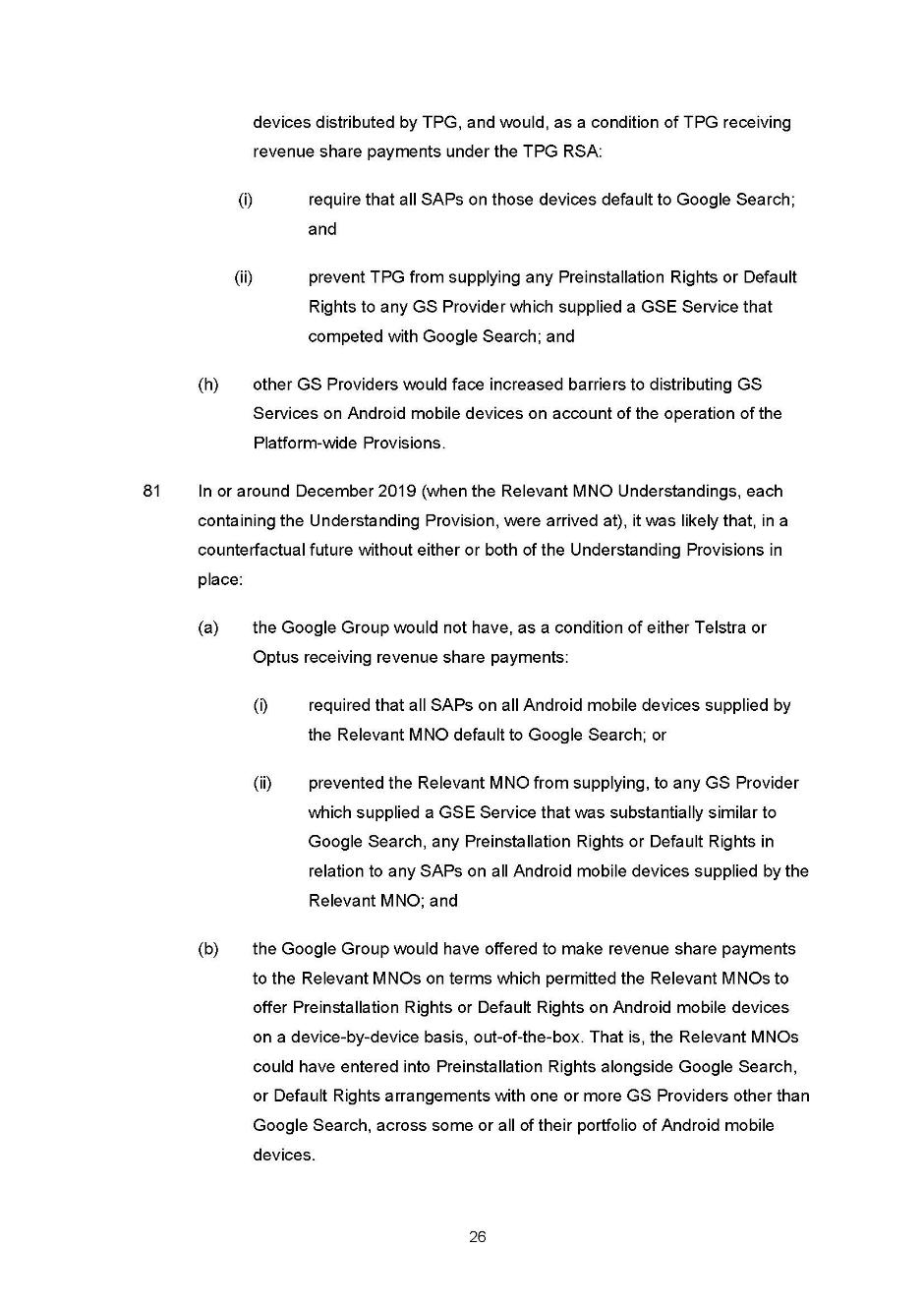
15 A general search engine is an online tool whose main purpose is to allow an end user to search the internet and find responsive information on any subject and in any format: for example, by entering keywords or by conducting image searches using a browser or other application using a desktop or mobile device. It operates by:
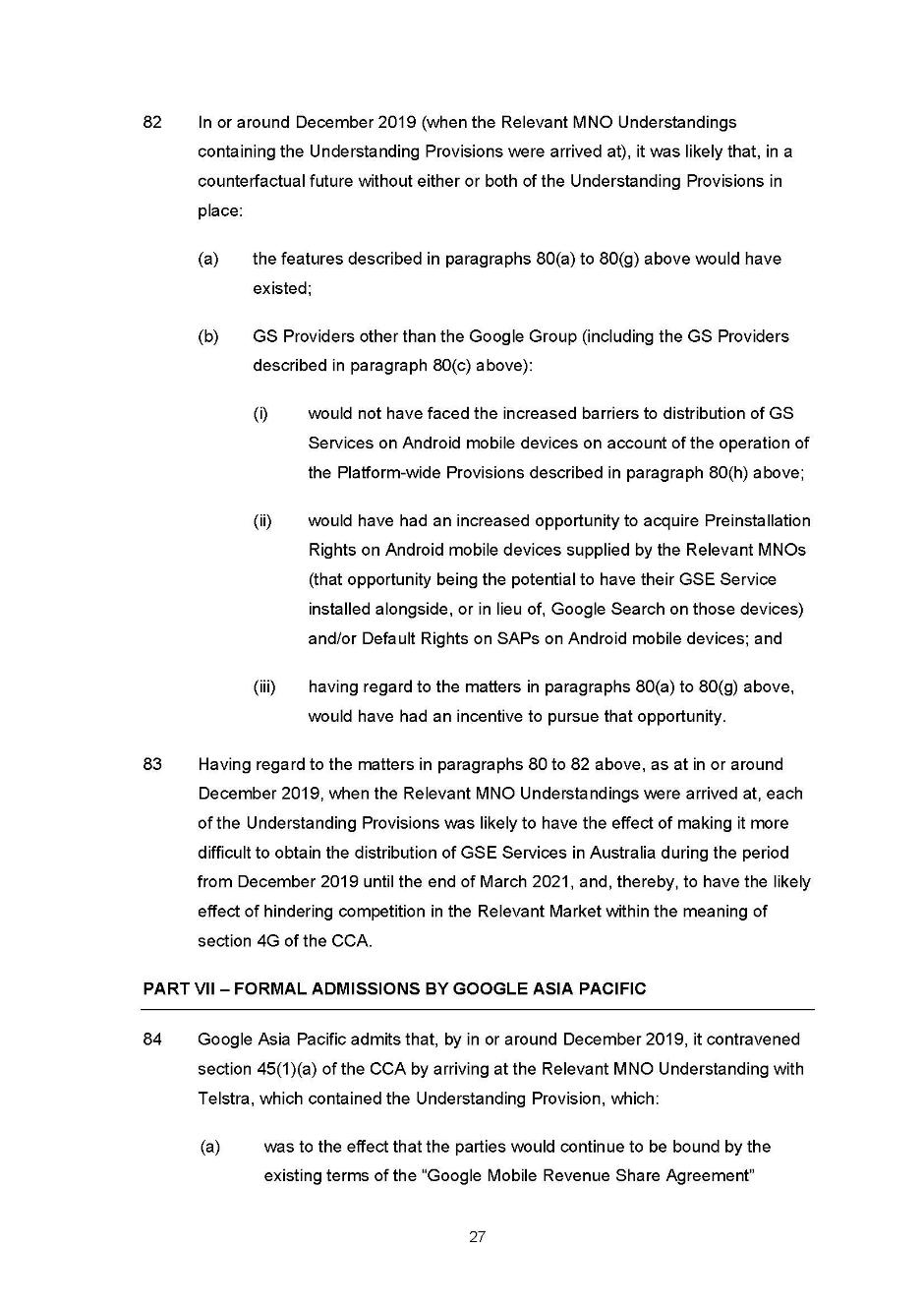
(a) collecting data about websites, and other data, including by crawling the internet, whereby it systematically scans publicly accessible web pages on the internet using automated programs called “crawlers” or “bots”;
(b) maintaining an index of websites, through which content collected through crawling and other means is organised and stored in a structured database (the web index), which allows for rapid retrieval of information; and
(c) using algorithms to return results, such that when an end user submits a search query, the general search engine applies proprietary algorithms to identify and rank relevant results from its web index based on factors such as relevance, popularity and recency.
16 This process allows end users to discover content from a broad range of sources on the internet.
17 GSE Services (including Google Search) and other Search Services are generally provided free of monetary charge for end users because they are supported by an advertising model, whereby advertisers purchase ads shown in response to relevant commercial queries.
18 The use of GSE Services in Australia is described at [26]-[27] of the SOAF.
19 Google Search is the largest GSE Service in Australia. Statcounter, a frequently used web analytics service, estimates that, in the period from December 2019 until the end of March 2021:
(a) over 90% of all general search queries conducted on a GSE Service in Australia (encompassing queries on both desktop and mobile devices) were conducted on Google Search; and
(b) over 95% of general search queries conducted on a GSE Service in Australia using a mobile device were conducted on Google Search.
20 At all relevant times, a number of other GS Providers supplied GSE Services to end users in Australia.
21 When an end user acquires a desktop or mobile device, the device as supplied offers several avenues by which the end user can enter a search query on a GSE Service or be directed to a place to receive a response from a GSE Service (referred to as search access points). The particular options available to a particular end user out-of-the-box depend on the device type, operating system and other features of the relevant device.
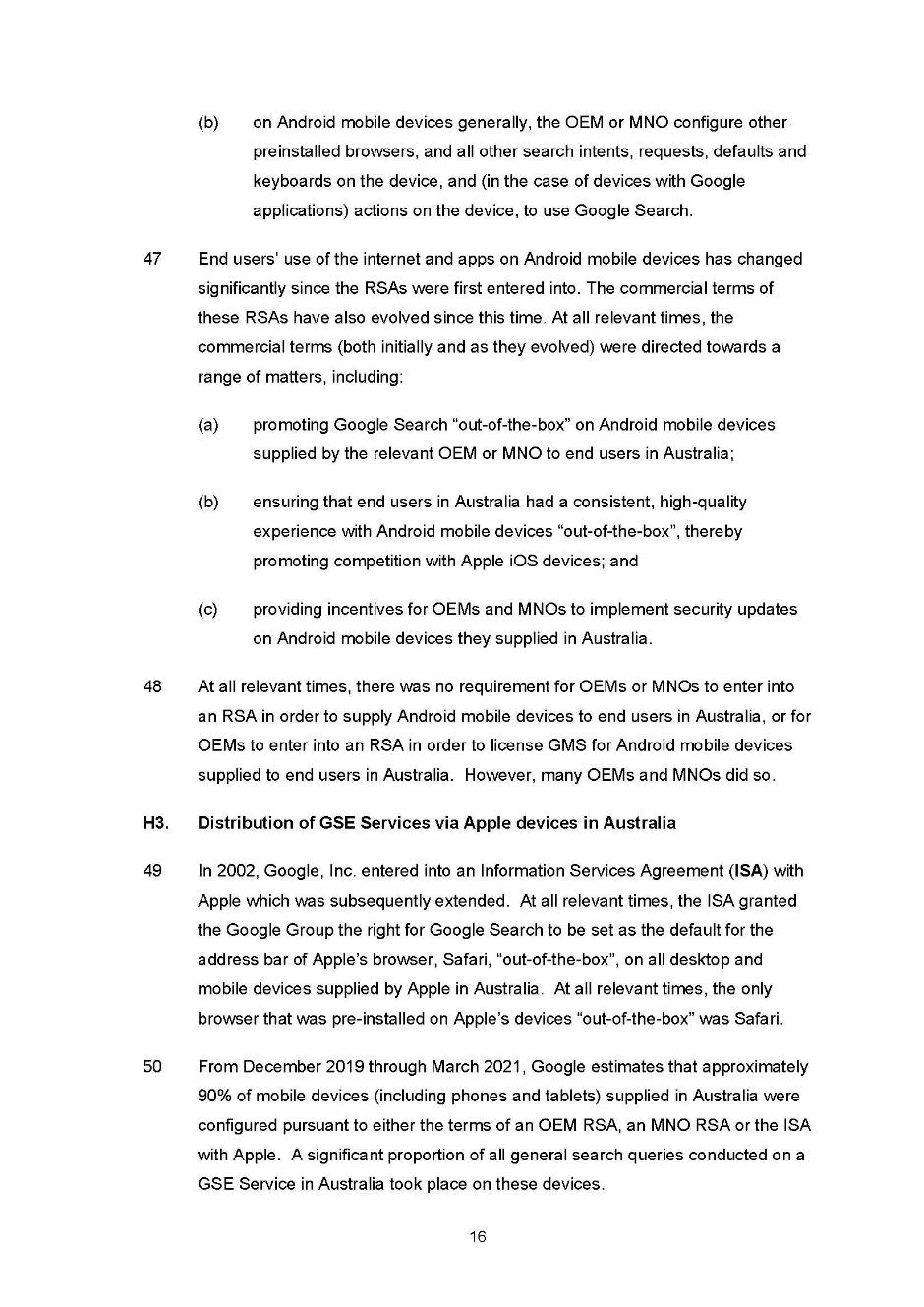
22 A GSE Service is typically pre-set as the default for each SAP on a device “out-of-the-box”, meaning that those settings apply when an end user turns their device on for the first time. If the end user does not change their default settings, when an end user enters a general search query into a SAP on their device, that query is generally directed to the GSE Service that is set as the pre-set default for that SAP.
23 In addition to using the SAPs and the default GSE Services that exist on those SAPs when they acquire their device, a user may also conduct a search by doing any of the following things (each, a Proactive Method):
(a) using a browser to navigate to a GSE Service’s website (for example, www.google.com.au, www.bing.com.au, www.duckduckgo.com, www.yahoo.com.au, www.ecosia.org, www.yandex.com) and entering a general search query via that website;
(b) changing the default GSE Service for the SAP(s) they are using and using that new default GSE Service; or
(c) installing different browsers or apps on the device, and using those to enter general search queries (that is, installing a further SAP).
24 End users may opt for one GS Provider’s GSE Service over another’s, each being substitutable services.
25 In many cases, end users conduct general search queries using the GSE Service that is pre-set as the default on the SAPs on their device, and do not typically change that default or use Proactive Methods to access an alternative GSE Service unless they find the pre-set default service to be less attractive than other GSE Services based on, for example, the factors set out in [34] of the SOAF.
26 The supply of GSE Services is described in [37]-[38] of the SOAF.
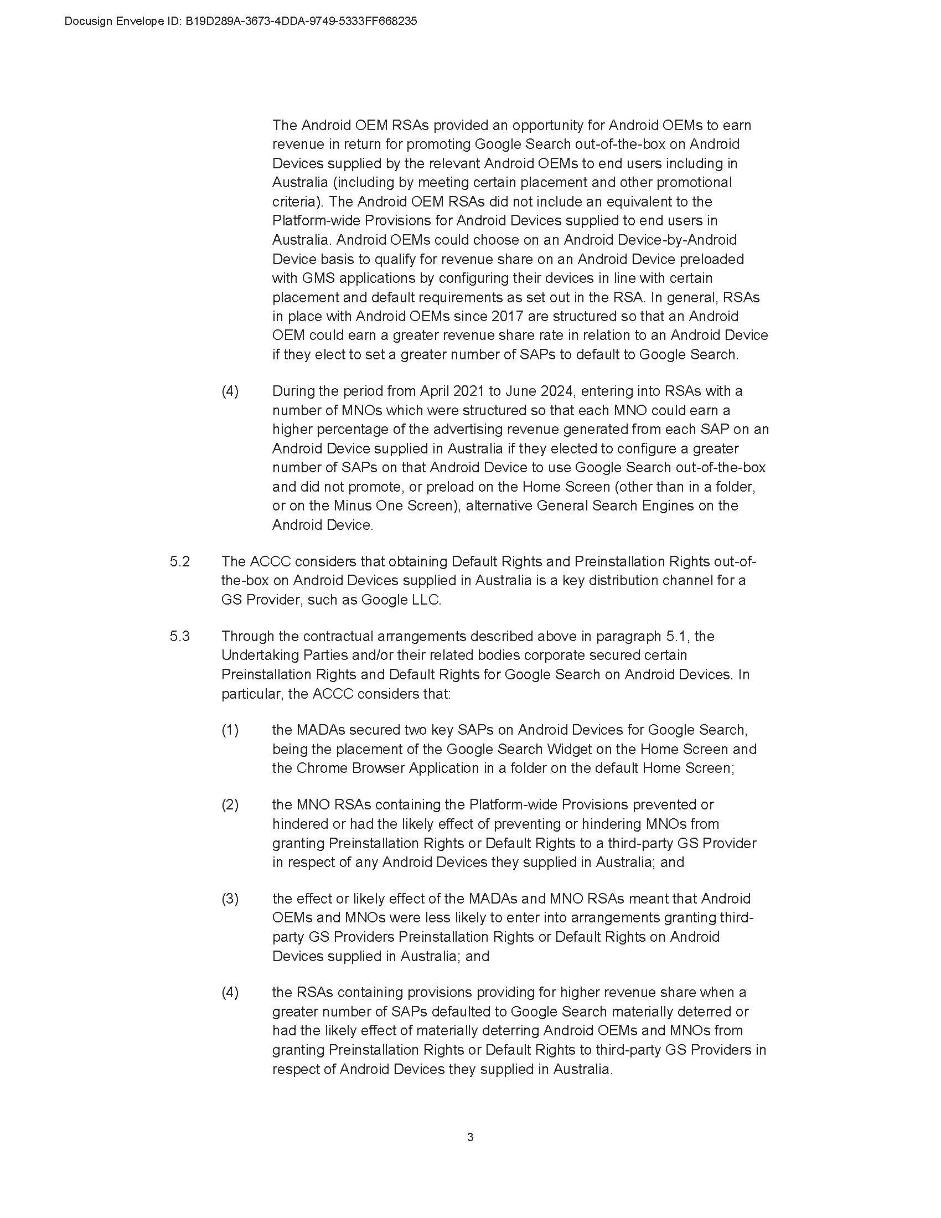
27 The distribution of GSE Services is described in [39]-[54] of the SOAF. An efficient and effective channel for a GS Provider to distribute its GSE Service is to arrange with OEMs, browser providers and MNOs for:
(a) their GSE Service to be set as the default GSE Service for one or more SAPs on a device (referred to as obtaining “Default Rights”); and/or
(b) further means of accessing their GSE Service, such as an app, to be preinstalled on the device, often in particular locations on the device (referred to as “Preinstallation Rights”).
This also benefits end users as it enables them to acquire a device with a GSE Service “ready to go” out-of-the-box.
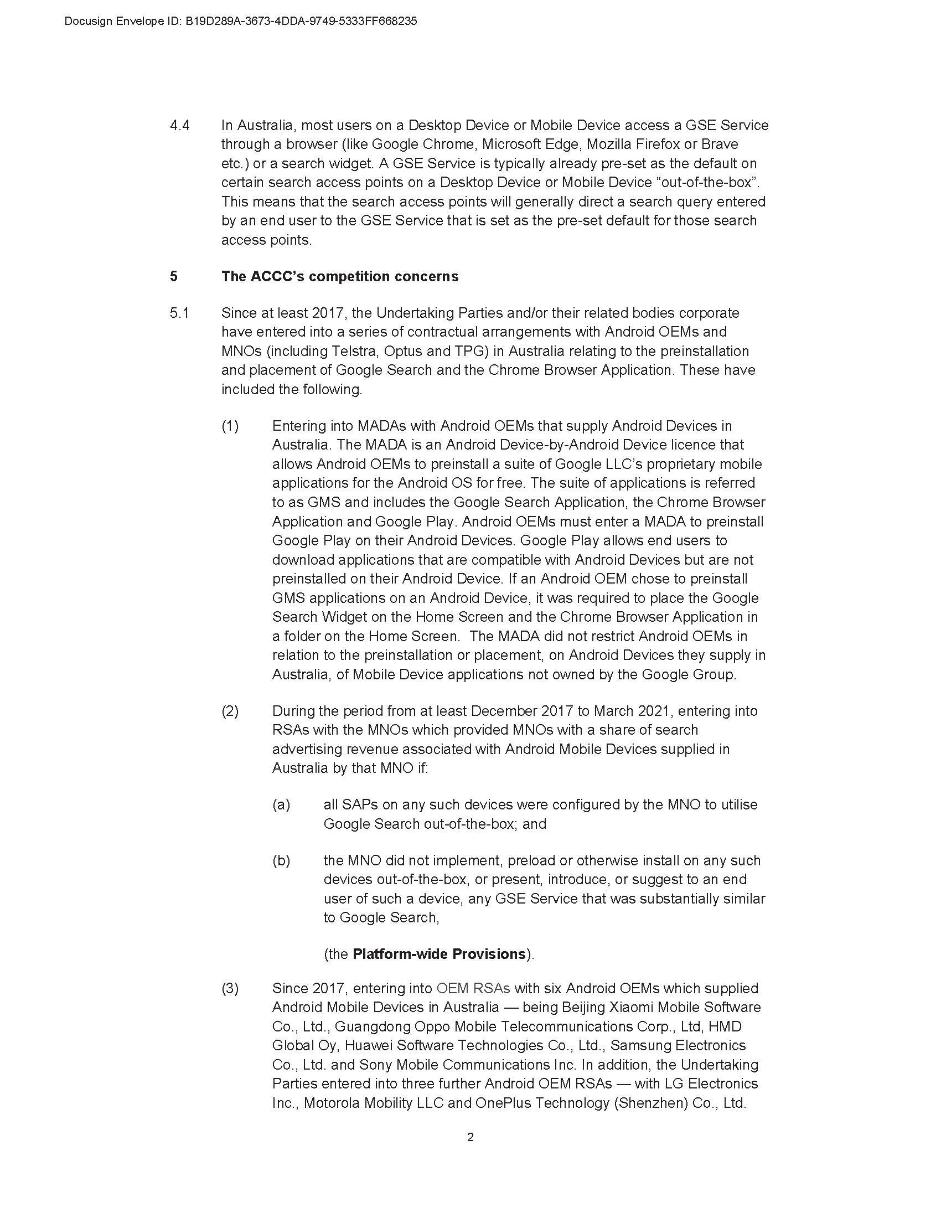
28 In Australia, the two largest MNOs are Telstra and Optus. Telstra and Optus each own and operate a mobile telecommunications network and supply retail mobile services and mobile devices (which operate using either Android OS or, in the case of Apple devices, Apple iOS) to end users in Australia. At all relevant times, the Android mobile devices supplied by Telstra and Optus were the subject of Preinstallation Rights and Default Rights under the revenue-sharing agreements (RSAs) referred to below.
29 At all relevant times:
(a) Telstra was the largest MNO in Australia, with around 19 million retail mobile subscribers in 2020; and
(b) Optus was the second-largest MNO in Australia, with over 10 million mobile customers as at December 2019.
Relevant market
30 Having regard to the specific conduct at issue in this proceeding relating to dealings with MNOs in Australia, the geographic dimension of the relevant market is Australia-wide. It is an agreed fact, and I accept, that the relevant market is a “market in Australia” within the meaning of s 4E of the CCA. As discussed below, there is a difference between the parties as to the product dimension of the relevant market.
The relevant understandings
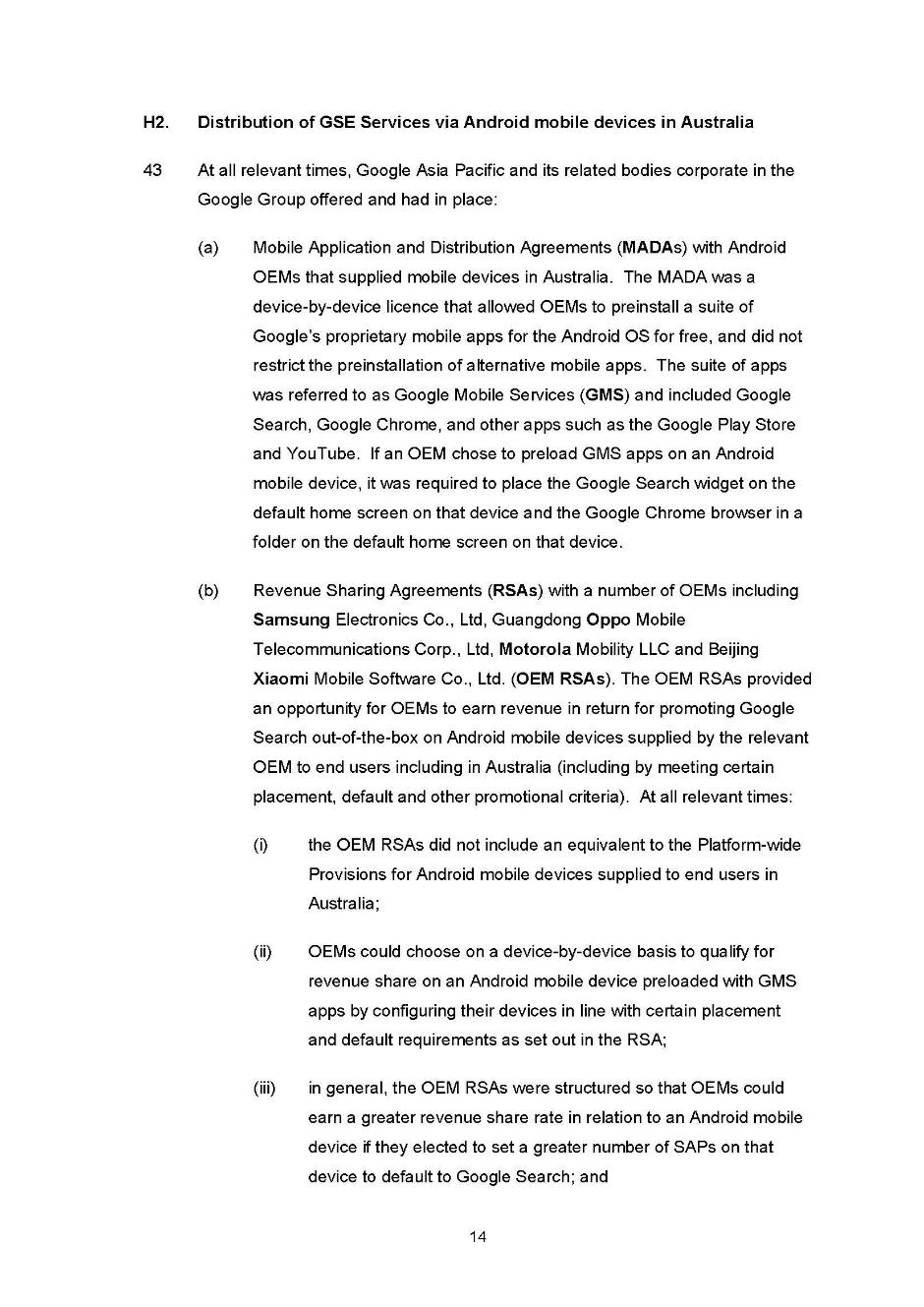
31 The Google Group’s initial RSAs with Telstra and Optus are described at [56] of the SOAF. Subsequent RSAs are described at [57]-[65]. These included the RSA 2.0 arrangements, which included the Platform-wide Provisions.
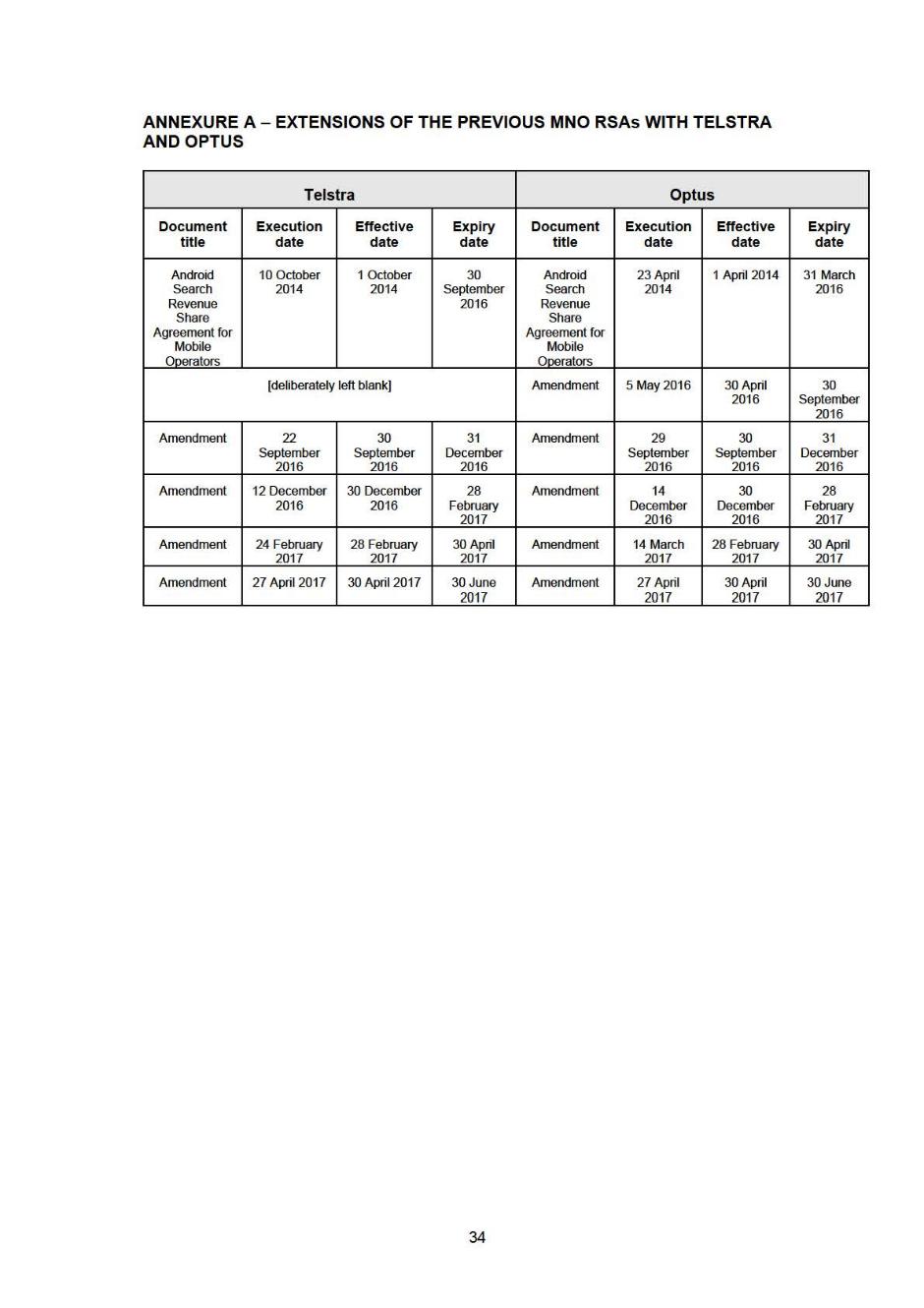
32 By around June 2019, Google LLC’s Business Council had approved the commercial terms of a new RSA, “RSA 3.0”, to be offered by Google to approved Android OEMs and MNOs. The RSA 3.0 framework contemplated the introduction of a new RSA which did not include the Platform-wide Provisions (New RSA). The Google Group intended that the New RSAs would replace the Optus RSA, which was then due to expire on 31 December 2019, and the Telstra RSA, which was then due to expire on 31 January 2020.
33 In around October 2019, presentations were made on behalf of Google to each of Telstra (on or around 17 October 2019) and Optus (on or around 28 October 2019) relating to the key commercial terms of the proposed New RSAs. There were a number of steps that needed to take place before the New RSAs with the Relevant MNOs could be entered into.
34 During the period from October to December 2019, indications were made on behalf of Google to each of Telstra and Optus that Google would agree to extend the Relevant MNO RSA, and that Google and each of Telstra and Optus would continue to be bound by the existing terms of the Relevant MNO RSA, including the Platform-wide Provisions, to provide time for the necessary steps to be completed.
35 By December 2019, the Google Group had not finalised draft agreements in respect of the New RSAs which were to be offered to the Relevant MNOs.
36 By about December 2019, Google had arrived at understandings with each of Telstra and Optus (referred to in these reasons as the Relevant MNO Understandings), each of which contained the Understanding Provision. As at the time of arrival at the understandings, the term of each understanding was uncertain, but each understanding was likely to continue for at least many months. In fact, the understandings continued until March 2021.
37 There was no cessation or interruption to the revenue-share payments made by Google to each of Telstra and Optus pursuant to each Relevant MNO RSA in the period from December 2019 until the end of March 2021.
38 Each of the Relevant MNO Understandings was arrived at in Australia.
39 Google entered into a New RSA with Optus on 6 April 2021 and Telstra on 31 May 2021. The New RSAs did not contain any provisions equivalent to the Platform-wide Provisions, and enabled Telstra and Optus to obtain revenue-share payments in return for meeting specified promotional criteria, including the granting of certain Preinstallation Rights and Default Rights.
40 Since the expiry of the Relevant MNO RSAs, each of Telstra and Optus have continued to preinstall Google Search and set it as the default on SAPs out-of-the-box on Android mobile devices they supply in Australia. While this practice has continued since the expiry of the Relevant MNO RSAs, it is not a requirement of either of the New RSAs entered into by Telstra and Optus.
Likely effect of substantially lessening competition
41 The SOAF, at [79]-[83], contains agreed facts, which I accept, regarding the likely effect on competition of the Relevant MNO Understandings (which included the Understanding Provisions).
42 The parties agree, and I accept, that having regard to the matters in [80]-[82] of the SOAF, as at December 2019, when the Relevant MNO Understandings were arrived at, each of the Understanding Provisions was likely to have the effect of making it more difficult to obtain the distribution of GSE Services in Australia during the period from December 2019 until the end of March 2021 and thereby had the likely effect of hindering competition in the Relevant Market within the meaning of s 4G of the CCA.
Admissions
43 In [84] and [85] of the SOAF, Google admits that it contravened s 45(1)(a) of the CCA in arriving at the Relevant MNO Understandings (which contained the Understanding Provisions).
Further matters
44 The SOAF, at [86]-[108], sets out further matters that are relevant to a consideration of the appropriate penalty for the contravening conduct. I accept the facts and matters set out in those paragraphs.
Applicable principles
Making orders by agreement and declarations
45 The applicable principles as regards the making of orders by agreement and as regards declarations were summarised by Gordon J in Australian Competition and Consumer Commission v Coles Supermarkets Australia Pty Ltd [2014] FCA 1405 at [70]-[79] as follows:
2.3.1 Orders sought by agreement
…
70 The applicable principles are well established. First, there is a well-recognised public interest in the settlement of cases under the [Competition and Consumer Act]: NW Frozen Foods Pty Ltd v Australian Competition & Consumer Commission (1996) 71 FCR 285 at 291. Second, the orders proposed by agreement of the parties must be not contrary to the public interest and at least consistent with it: Australian Competition & Consumer Commission v Real Estate Institute of Western Australia Inc (1999) 161 ALR 79 at [18].
71 Third, when deciding whether to make orders that are consented to by the parties, the Court must be satisfied that it has the power to make the orders proposed and that the orders are appropriate: Real Estate Institute at [17] and [20] and Australian Competition & Consumer Commission v Virgin Mobile Australia Pty Ltd (No 2) [2002] FCA 1548 at [1]. Parties cannot by consent confer power to make orders that the Court otherwise lacks the power to make: Thomson Australian Holdings Pty Ltd v Trade Practices Commission (1981) 148 CLR 150 at 163.
72 Fourth, once the Court is satisfied that orders are within power and appropriate, it should exercise a degree of restraint when scrutinising the proposed settlement terms, particularly where both parties are legally represented and able to understand and evaluate the desirability of the settlement: Australian Competition & Consumer Commission v Woolworths (South Australia) Pty Ltd (Trading as Mac’s Liquor) [2003] FCA 530 at [21]; Australian Competition & Consumer Commission v Target Australia Pty Ltd [2001] FCA 1326 at [24]; Real Estate Institute at [20]-[21]; Australian Competition & Consumer Commission v Econovite Pty Ltd [2003] FCA 964 at [11] and [22] and Australian Competition & Consumer Commission v The Construction, Forestry, Mining and Energy Union [[2006] FCA 1730] at [4].
73 Finally, in deciding whether agreed orders conform with legal principle, the Court is entitled to treat the consent of Coles as an admission of all facts necessary or appropriate to the granting of the relief sought against it: Thomson Australian Holdings at 164.
2.3.2 Declarations
74 The Court has a wide discretionary power to make declarations under s 21 of the Federal Court Act: Forster v Jododex Australia Pty Ltd (1972) 127 CLR 421 at 437-8; Ainsworth v Criminal Justice Commission (1992) 175 CLR 564 at 581-2 and Tobacco Institute of Australia Ltd v Australian Federation of Consumer Organisations Inc (No 2) (1993) 41 FCR 89 at 99.
75 Where a declaration is sought with the consent of the parties, the Court’s discretion is not supplanted, but nor will the Court refuse to give effect to terms of settlement by refusing to make orders where they are within the Court’s jurisdiction and are otherwise unobjectionable: see, for example, Econovite at [11].
76 However, before making declarations, three requirements should be satisfied:
(1) The question must be a real and not a hypothetical or theoretical one;
(2) The applicant must have a real interest in raising it; and
(3) There must be a proper contradictor:
Forster v Jododex at 437-8.
77 In this proceeding, these requirements are satisfied. The proposed declarations relate to conduct that contravenes the ACL and the matters in issue have been identified and particularised by the parties with precision: Australian Competition & Consumer Commission v MSY Technology Pty Ltd (2012) 201 FCR 378 at [35]. The proposed declarations contain sufficient indication of how and why the relevant conduct is a contravention of the ACL: BMW Australia Ltd v Australian Competition & Consumer Commission [2004] FCAFC 167 at [35].
78 It is in the public interest for the ACCC to seek to have the declarations made and for the declarations to be made (see the factors outlined in ACCC v CFMEU at [6]). There is a significant legal controversy in this case which is being resolved. The ACCC, as a public regulator under the ACL, has a genuine interest in seeking the declaratory relief and Coles is a proper contradictor because it has contravened the ACL and is the subject of the declarations. Coles has an interest in opposing the making of them: MSY Technology at [30]. No less importantly, the declarations sought are appropriate because they serve to record the Court’s disapproval of the contravening conduct, vindicate the ACCC’s claim that Coles contravened the ACL, assist the ACCC to carry out the duties conferred upon it by the Act (including the ACL) in relation to other similar conduct, inform the public of the harm arising from Coles’ contravening conduct and deter other corporations from contravening the ACL.
79 Finally, the facts and admissions in Annexure 1 provide a sufficient factual foundation for the making of the declarations: s 191 of the Evidence Act; Australian Competition & Consumer Commission v Dataline.Net.Au Pty Ltd (2006) 236 ALR 665 at [57]-[59] endorsed by the Full Court in Australian Competition & Consumer Commission v Dataline.Net.Au Pty Ltd (2007) 161 FCR 513 at [92]; Hadgkiss v Aldin (No 2) [2007] FCA 2069 at [21]-[22]; Secretary, Department of Health & Ageing v Pagasa Australia Pty Ltd [2008] FCA 1545 at [77]-[79] and Ponzio v B & P Caelli Constructions Pty Ltd (2007) 158 FCR 543.
Pecuniary penalties
46 Section 76(1) of the CCA provides that if the Court is satisfied that a person has contravened a provision of (relevantly) Part IV of the CCA, the Court may order the person to pay to the Commonwealth such pecuniary penalty, in respect of each act or omission to which s 76(1) applies, as the Court determines to be appropriate having regard to all relevant matters, including:
(a) the nature and extent of the act or omission and of any loss or damage suffered as a result of the act or omission;
(b) the circumstances in which the act or omission took place; and
(c) whether the person has previously been found by a court in proceedings under Part VI or XIB of the CCA to have engaged in any similar conduct.
47 At the time of the contravening conduct, the maximum pecuniary penalty payable by a body corporate in respect of a contravention of s 45(1)(a) of the CCA was the greatest of (CCA s 76(1A)(b)):
(a) $10 million;
(b) if the court can determine the value of the benefit that the body corporate, and any related body corporate, have obtained directly or indirectly and that is reasonably attributable to the relevant act or omission – three times that value; and
(c) if the court cannot determine the value of that benefit – 10% of the “annual turnover” of the body corporate during the period (the turnover period) of 12 months ending at the end of the month in which the act or omission occurred, applying the expansive meaning of “annual turnover” in s 45AB of the CCA.
48 The principles applicable to the discretion to impose pecuniary penalties have been discussed in many cases. I refer to and adopt the summary of the principles set out in my judgment in Australian Competition and Consumer Commission v Optus Internet Pty Ltd [2018] FCA 777 at [18]-[28].
Section 45 of the CCA
49 At the time of the contravening conduct, s 45 of the CCA relevantly provided as follows:
(1) A corporation must not:
(a) make a contract or arrangement, or arrive at an understanding, if a provision of the proposed contract, arrangement or understanding has the purpose, or would have or be likely to have the effect, of substantially lessening competition;
…
(3) For the purposes of this section, competition means:
(a) in relation to a provision of a contract, arrangement or understanding or of a proposed contract, arrangement or understanding—competition in any market in which:
(i) a corporation that is a party to the contract, arrangement or understanding, or would be a party to the proposed contract, arrangement or understanding; or
(ii) any body corporate related to such a corporation;
supplies or acquires, or is likely to supply or acquire, goods or services or would, but for the provision, supply or acquire, or be likely to supply or acquire, goods or services; …
50 Two elements must be established to show a contravention of s 45(1)(a) of the CCA:
(a) a contract, arrangement or understanding to which the respondent is a party; and
(b) a provision of that contract, arrangement or understanding that has the purpose, or that would have, or be likely to have, the effect of substantially lessening competition.
51 In Australian Competition and Consumer Commission v J Hutchinson Pty Ltd [2025] HCA 10; 422 ALR 236, Gageler CJ, Gleeson and Beech-Jones JJ described the concept of a “contract, arrangement or understanding” as follows (at [19]):
The collocation of the words “contract, arrangement or understanding” in Pt IV of the Act refers to “a spectrum of consensual dealings” between parties in which the words “arrangement” and “understanding” each describe something less than a legally binding contract. Sections 45E(3) and 45EA, amongst other provisions within Pt IV, distinguish between contracts and arrangements, which are “made”, and understandings, which are “arrived at”. Equally, however, they make clear: that a contract, arrangement or understanding is made or arrived at by a person “with” one or more other persons; that an understanding no less than a contract or arrangement must “contain a provision” that is “included” for a proscribed purpose; and that such a provision is something to which such a person “must not give effect”. The words “arrive at”, in relation to an understanding, are defined in s 4(1) of the Act to include “reach or enter into”.
(Footnotes omitted.)
52 Insofar as an “understanding” is concerned (as is the allegation in this case), their Honours further observed at [20]:
Like an arrangement, an understanding may be informal as well as unenforceable, so that a person may be free to withdraw from it or to act inconsistently with it, notwithstanding their adoption of it. Further, for one person to arrive at an understanding or make an arrangement with another person which is of sufficient substance to be characterised as containing a provision to which one or other of them is prohibited from giving effect necessarily involves interaction between them by which one expressly or tacitly communicates by words or conduct to the other a commitment to act or refrain from acting in a particular way. For an understanding to be arrived at, there must at least to that extent be a “consensus” or a “meeting of the minds”.
(Footnotes omitted.)
53 Put another way, for an understanding to exist, at least one party must assume an obligation, give an assurance or give an undertaking to act in a certain way. A mere expectation that a party will act in a certain way is not enough: see BlueScope Steel Limited v Australian Competition and Consumer Commission [2025] FCAFC 118 (BlueScope) at [171] per Wigney, Bromwich and Halley JJ, affirming the observations of Lindgren J in Australian Competition and Consumer Commission v CC (NSW) Pty Ltd [1999] FCA 954; 92 FCR 375 at [141]. In BlueScope, the Full Court elaborated on what is required to prove an understanding at [193]-[197].
54 The first step in analysing whether a provision would have the likely effect of substantially lessening competition is to define the relevant market. This is necessary because s 45(3)(a) defines “competition” for the purposes of s 45 as competition “in any market” in which a party to the impugned contract, arrangement or understanding, or a related body corporate of such a party, supplies or acquires (or would, but for the relevant provision of the contract, arrangement or understanding, supply or acquire) goods or services.
55 Section 4E of the CCA provides a limited inclusive definition of “market” as follows:
For the purposes of this Act, unless the contrary intention appears, market means a market in Australia and, when used in relation to any goods or services, includes a market for those goods or services and other goods or services that are substitutable for, or otherwise competitive with, the first-mentioned goods or services.
56 Two aspects of this definition bear emphasis. First, a market must be one that is wholly or partly in Australia: see Air New Zealand Ltd v Australian Competition and Consumer Commission [2017] HCA 21; 262 CLR 207 at [14]-[15], [33] per Kiefel CJ, Bell and Keane JJ, [79] per Gordon J. Second, the parameters of the relevant market are to be governed or informed by the concepts of substitution and competition: see Epic Games, Inc v Apple Inc [2025] FCA 900 (Epic v Apple) at [1299] per Beach J.
57 The notion of competition “describes the nature and extent of rivalry between firms engaged in trade and commerce”: see Australian Competition and Consumer Commission v Pacific National Pty Ltd [2020] FCAFC 77; 277 FCR 49 (Pacific National) at [215] per Middleton and O’Bryan JJ. It refers to the “competitive process”, which is a dynamic, rivalrous process, “generated by market pressure from alternative sources of supply and the desire to keep ahead”: see Re Queensland Co-operative Milling Association Ltd (1976) 25 FLR 169 at 188 per Woodward P, Members Shipton and Brunt (see also at 187, 189). In Australian Gas Light Company v Australian Competition and Consumer Commission (No 3) [2003] FCA 1525; 137 FCR 317 at [350], French J stated that competition in a market:
… is not assessed by a snapshot view of participant behaviour at a particular time. The theatre of competition is a theatre of real actors and shadow actors. The shadows are cast by the potential for new entry. The competitive process is informed by the rivalry of the participants and the potential rivalry of potential participants. Competition so understood is conceptually distinct from the idea of the market and the elements of market structure which may constrain or facilitate it.
58 Section 4G of the CCA provides the following in relation to a “lessening of competition”:
For the purposes of this Act, references to the lessening of competition shall be read as including references to preventing or hindering competition.
59 The phrase “preventing or hindering competition” is given a broad construction: see Australian Competition and Consumer Commission v Pfizer Australia Pty Ltd [2015] FCA 113; 323 ALR 429 at [74]-[76] per Flick J, cited in Australian Competition and Consumer Commission v Australasian Food Group Pty Ltd [2022] FCA 308 (ACCC v AFG) at [28] per Moshinsky J; Australian Competition and Consumer Commission v Colgate-Palmolive Pty Ltd (No 4) [2017] FCA 1590; 353 ALR 460 at [66] per Wigney J. “Prevent” suggests a total cessation, whereas “hinder” includes any conduct “in any way affecting to an appreciable extent the ease of the usual way of supplying or acquiring goods or services”: see Australian Wool Innovation Ltd v Newkirk [2005] FCA 290; (2005) ATPR 42-053 at [34] per Hely J.
60 An effect of “substantially” lessening competition is one that is “meaningful or relevant” to the competitive process (Stirling Harbour Services Pty Ltd v Bunbury Port Authority [2000] FCA 38; (2000) ATPR 41-752 at [114] per French J; Australian Competition and Consumer Commission v Australian Medical Association Western Australia Branch Inc [2003] FCA 686; 199 ALR 423 at [329] per Carr J; Universal Music Australia Pty Ltd v Australian Competition and Consumer Commission [2003] FCAFC 193; 131 FCR 529 (Universal) at [242] per Wilcox, French and Gyles JJ), being a “real” effect of “substance” or “significance” (Hecar Investments No 6 Pty Ltd v Outboard Marine Australia Pty Ltd (1982) 62 FLR 159 at 167 per Franki J), which “considerably” affects competition in a market (Radio 2UE Sydney Pty Ltd v Stereo FM Pty Ltd (1982) 62 FLR 437 at 445 per Lockhart J; Dowling v Dalgety Australia Ltd (1992) 34 FCR 109 at 138 per Lockhart J; Eastern Express Pty Ltd v General Newspapers Pty Ltd (1992) 35 FCR 43 at 63 per Lockhart and Gummow JJ). The word “substantially” connotes an evaluative, rather than a precise, legal standard: see Pacific National at [219].
61 In determining whether a provision would be likely to have the effect of substantially lessening competition in a market, the Court undertakes a forward-looking analysis as at the time at which the impugned understanding was arrived at, and asks whether, at that time, it was likely, having regard to existing circumstances, that the conduct would effect a substantial lessening of competition in the relevant market: see Australian Competition and Consumer Commission v Cement Australia Pty Ltd [2013] FCA 909; 310 ALR 165 at [3015]-[3016] per Greenwood J; Universal at [247], cited in ACCC v AFG at [26]; see also Trade Practices Commission v TNT Management Pty Ltd (1985) 6 FCR 1. Put another way, the Court analyses the future state of competition in the market with and without the understanding containing the relevant provision, and assesses whether the future with would involve substantially less competition than the future without.
62 The word “likely” when used in relation to effect means “a real chance”, in the sense of “a real commercial likelihood”: see Monroe Topple & Associates Pty Ltd v Institute of Chartered Accountants in Australia [2002] FCAFC 197; 122 FCR 110 at [111] per Heerey J; Pacific National at [246]; Epic v Apple at [3777]. It does not mean “probable” or more likely than not: see Pacific National at [221]-[246]; Vodafone Hutchison Australia Pty Ltd v Australian Competition and Consumer Commission [2020] FCA 117 at [52]-[55] per Middleton J. The assessment of whether a provision of a contract, arrangement or understanding has the likely effect of substantially lessening competition is a singular evaluative judgment, even if it involves multiple constituent inquiries, identifying different futures with and without the provision: see Australian Competition and Consumer Commission v Pacific National Pty Ltd (No 2) [2019] FCA 669; (2019) ATPR 42-633 at [1273]-[1279]; Epic v Apple at [3782]-[3783].
Application of principles in the present case
63 On the basis of the facts and admissions set out in the SOAF, I am satisfied that Google contravened s 45(1)(a) of the CCA in the manner set out in the proposed declarations, which are as follows:
1. By in or around December 2019, the Respondent contravened s 45(1)(a) of the Competition and Consumer Act 2010 (Cth) (CCA) by arriving at an understanding with Telstra Limited (Telstra) which contained a provision which:
a. was to the effect that the parties would continue to be bound by the existing terms of the “Google Mobile Revenue Share Agreement” between the Respondent and Telstra, including the Platform-wide Provisions (described below), until they concluded negotiations regarding a further revenue sharing agreement; and
b. was likely to have the effect of making it more difficult to obtain the distribution of general search engine services (GSE Services) in Australia during the period from December 2019 until the end of March 2021 and, thereby, was likely to have the effect of hindering competition (within the meaning of s 4G of the CCA) in an Australia-wide “market in Australia” (within the meaning of s 4E of the CCA), in which GSE Services were supplied.
The “Platform-wide Provisions” were provisions of the Google Mobile Revenue Share Agreement which required, as a condition of the Respondent paying Telstra a share of search advertising revenue generated through certain search access points on Android mobile devices supplied in Australia by Telstra, that:
i. all search access points on any Android mobile device supplied by Telstra in Australia were configured by Telstra to utilise the Google general search engine (Google Search) ‘out-of-the-box’; and
ii. Telstra could not implement, preload or otherwise install on any such device ‘out-of-the-box’, or present, introduce, or suggest to an end user of such a device, any GSE Service that was substantially similar to Google Search.
2. By in or around December 2019, the Respondent contravened s 45(1)(a) of the CCA by arriving at an understanding with Optus Mobile Pty Limited (Optus) which contained a provision which:
a. was to the effect that the parties would continue to be bound by the existing terms of the “Google Mobile Revenue Share Agreement” between the Respondent and Optus, including the Platform-wide Provisions (described below), until they concluded negotiations regarding a further revenue sharing agreement; and
b. was likely to have the effect of making it more difficult to obtain the distribution of GSE Services in Australia during the period from December 2019 until the end of March 2021 and, thereby, was likely to have the effect of hindering competition (within the meaning of s 4G of the CCA) in an Australia-wide “market in Australia” (within the meaning of s 4E of the CCA), in which GSE Services were supplied.
The “Platform-wide Provisions” were provisions of the Google Mobile Revenue Share Agreement which required, as a condition of the Respondent paying Optus a share of search advertising revenue generated through certain search access points on Android mobile devices supplied in Australia by Optus, that:
i. all search access points on any Android mobile device supplied by Optus in Australia were configured by Optus to utilise the Google Search ‘out-of-the-box’; and
ii. Optus could not implement, preload or otherwise install on any such device ‘out-of-the-box’, or present, introduce, or suggest to an end user of such a device, any GSE Service that was substantially similar to Google Search.
64 The admitted contraventions concern Google’s conduct in arriving at the Relevant MNO Understandings with Telstra and Optus, each containing the Understanding Provision. The Relevant MNO Understandings containing the Understanding Provision were informal and less than legally binding contracts. The facts set out in the SOAF demonstrate that the requisite meetings of minds between Google and Telstra, and Google and Optus, were reached.
65 The parties agree, and I accept, that the relevant market was the market in which GSE Services were supplied. The parties agree, and I accept, that that market is Australia-wide and that it is a market “in Australia” for the purpose of s 4E of the CCA. Further, the parties agree and I accept that the relevant market is a “market” for the purpose of s 45(3)(a)(ii) of the CCA, on the basis that Google LLC is a related body corporate of Google Asia Pacific Pte Ltd, and Google LLC supplies Google Search in the relevant market.
66 However, the parties do not agree as to the precise product dimension of the relevant market. In short, the ACCC submits that the product dimension of the relevant market is limited to the supply of GSE Services. Google accepts that the relevant market includes the supply of GSE Services, but submits that the product dimension may also include other types of Search Services, including specialised and social media Search Services. Specialised or “vertical” Search Services are Search Services that provide answers or results based on a range of online sources, typically confined to a particular subject matter. Examples are shopping sites such as Amazon, real estate sites such as Domain, job search sites such as Seek.com.au, and travel sites such as Airbnb. Social media Search Services are Search Services provided through social media platforms that provide answers or results based only on content generated by end users of the relevant platform, in the form of text, images or videos. Examples are TikTok, Facebook, Instagram, Reddit and X (formerly Twitter).
67 The parties submit, and I accept, that it is not necessary for the Court to determine the precise boundaries of the product dimension of the market. Rather, having regard to the relevant authorities, Google’s admissions, and the analysis set out below, I am satisfied that each Understanding Provision was likely to have the effect proscribed by s 45(1)(a) of the CCA in the relevant market. I consider that I am able to make the declarations in the terms sought, and grant the other relief sought in the proposed orders, without the need to form a concluded view on the precise product dimension of the relevant market.
68 The parties agree, and I accept, that each Understanding Provision was likely to have the effect of making it more difficult for a competing GS Provider to obtain the distribution of GSE Services in Australia during the period from December 2019 until the end of March 2021, being the date when the Relevant MNO RSAs finally expired, ahead of the New RSAs being entered into with each of Telstra and Optus. Each Understanding Provision was thereby likely to have the effect of hindering competition in the relevant market within the meaning of s 4G of the CCA and substantially lessening competition in the relevant market within the meaning of s 45(1)(a) of the CCA. That analysis applies regardless of whether the product definition of the relevant market is limited to the supply of GSE Services.
69 State of competition in the factual. In or around December 2019, when the Relevant MNO Understandings containing the Understanding Provisions were arrived at, it was likely that:
(a) for the duration of the Understanding Provisions, the Platform-wide Provisions would have, as a condition of Telstra or Optus receiving revenue share payments:
(i) required that all SAPs on all Android mobile devices supplied by Telstra or Optus default to Google Search; and
(ii) prevented Telstra or Optus from supplying any GS Provider which supplied a GSE Service that competed with Google Search, any Default or Preinstallation Rights in relation to any Android mobile devices supplied by Telstra or Optus; and
(b) in the future with either or both of the Understanding Provisions in place, other GS Providers would face increased barriers to distributing GS Services on Android mobile devices on account of the operation of the Platform-wide Provisions.
70 State of competition in the counterfactual. In or around December 2019, when the Relevant MNO Understandings were arrived at, it was likely that, in a counterfactual future without either or both of the Understanding Provisions in place:
(a) the Google Group would not have, as a condition of either Telstra or Optus receiving revenue share payments:
(i) required that all SAPs on all Android mobile devices supplied by Telstra or Optus default to Google Search; or
(ii) prevented Telstra or Optus from supplying to any GS Provider which supplied a GSE Service that was substantially similar to Google Search, any Preinstallation Rights or Default Rights in relation to any SAPs on all Android mobile devices supplied by Telstra or Optus;
(b) the Google Group would have offered to make revenue share payments to Telstra or Optus on terms which permitted them to offer Preinstallation Rights or Default Rights on Android mobile devices on a device-by-device basis, out-of-the-box. That is, Telstra or Optus could have entered into Preinstallation Rights arrangements alongside Google Search, or Default Rights arrangements with one or more GS Providers other than Google Search, across some or all of their portfolio of Android mobile devices; and
(c) GS Providers other than the Google Group:
(i) would not have faced increased barriers to distribution of GS Services on Android mobile devices on account of the operation of the Platform-wide Provisions;
(ii) would have had an increased opportunity to acquire Preinstallation Rights on Android mobile devices supplied by Telstra or Optus (being the potential to have their GSE Service installed alongside, or in lieu of, Google Search on those devices) and/or Default Rights on SAPs on Android mobile devices; and
(iii) would have had an incentive to pursue that opportunity.
71 Accordingly, the parties submit, and I accept, that in about December 2019, when the Relevant MNO Understandings were arrived at, each of the Understanding Provisions was likely (in the sense of having a “real chance”) to have the effect of making it more difficult to obtain the distribution of GSE Services in Australia during the period from December 2019 until the end of March 2021. For that reason, each of the Understanding Provisions was likely to have the effect of hindering competition in the relevant market within the meaning of s 4G of the CCA and substantially lessening competition in the relevant market within the meaning of s 45(1)(a) of the CCA.
72 In summary, the relevant competitive harm was that, in about December 2019, it was likely that other GS Providers would face increased barriers to distributing their GSE Services on Android mobile devices supplied by Telstra or Optus on account of the operation of the Platform-wide Provisions, and the loss of an increased opportunity to acquire Preinstallation Rights and/or Default Rights on SAPs on Android mobile devices supplied by Telstra or Optus. The likely loss of that increased opportunity was competitively meaningful in the circumstances.
73 In circumstances where searches conducted on a GSE Service in Australia comprised, and would continue to comprise, a significant proportion of the total searches conducted on all Search Services (including specialised and social media Search Services) in Australia, the likely competitive harm described above was meaningful to the competitive process, and constituted a likely effect of substantially lessening competition in the relevant market, regardless of the precise product dimension of the relevant market.
74 Insofar as the parties seek the declarations set out above, I consider that the prerequisites for the making of declarations are satisfied and that it is appropriate to make declarations in the terms sought.
75 Insofar as the parties submit that it is appropriate for the Court to impose penalties totalling $55 million (comprising a penalty of $27.5 million for each of the admitted contraventions), I am satisfied that the proposed total penalty is within the appropriate range, having regard to all relevant facts and matters, including the mandatory considerations referred to above. The cases emphasise that the primary, if not sole, purpose of civil penalties is deterrence of further contravening conduct of a like kind. I am satisfied that the proposed total penalty is a sufficiently significant figure to achieve the object of deterrence, both specific and general. In reaching this conclusion, I have had regard to the parties’ Joint Submissions at [100]-[150]. Insofar as those submissions are agreed between the parties, I accept those submissions. To the extent that there are some points of difference between the parties, it is unnecessary to resolve those differences.
Conclusion
76 For these reasons, I will make the declarations and orders proposed by the parties.
I certify that the preceding seventy-six (76) numbered paragraphs are a true copy of the Reasons for Judgment of the Honourable Justice Moshinsky. |
Associate:
Dated: 10 December 2025
ANNEXURE