

FEDERAL COURT OF AUSTRALIA
Simpson v Taylors Business Pty Ltd (No 3) [2025] FCA 1546
File number: | VID 891 of 2023 |
Judgment of: | BENNETT J |
Date of judgment: | 11 December 2025 |
Catchwords: | REPRESENTATIVE PROCEEDINGS – hearing of separate questions – whether respondent was authorised to carry on business as a pawnbroker – whether respondent did carry on business as a pawnbroker – whether amounts provided by respondent to group members were credit – whether standard form contracts were credit contracts – whether respondent was prohibited from entering into the credit contracts – whether respondent was a credit provider – remedies – appropriate measure of damages – whether to issue injunction and declaration |
Legislation: | Federal Court of Australia Act 1976 (Cth) National Consumer Credit Protection (Transitional and Consequential Provisions) Act 2009 (Cth) National Consumer Credit Protection Act 2009 (Cth) National Credit Code Second-Hand Dealers and Pawnbrokers Act 1989 (Vic) Consumer Credit (New South Wales) Code 1995 Consumer Credit (Victoria) Act 1995 (Vic) Pawnbrokers and Second-hand Dealers Act 1996 (NSW) Consumer Credit Act 1974 (UK) |
Cases cited: | Australian Securities and Investments Commission v BHF Solutions Pty Ltd (No 2) [2023] FCA 787 Australian Securities and Investments Commission v BSF Solutions Pty Ltd (Liability) [2024] FCA 553 Australian Securities and Investments Commission v Fast Access Finance Pty Ltd [2015] FCA 1055 Australian Securities and Investments Commission v Layaway Depot Pty Ltd [2023] FCA 1685 BA v The King [2023] HCA 14; 275 CLR 128 Bahadori v Permanent Mortgages Pty Ltd (2008) 72 NSWLR 44 City Mutual Life Assurance Society Ltd v Smith (1932) 48 CLR 532 Davies v Western Australia (1904) 2 CLR 29 Director of Housing v Sudi [2011] VSCA 266; 33 VR 559 Equuscorp Pty Ltd v Haxton [2012] HCA 7; 246 CLR 498 Integrated Securities No 3 Pty Ltd v Creatrix Web Development & Online Marketing Solutions Pty Ltd [2021] NSWSC 596 Integrated Securities No 3 Pty Ltd v Creatrix Web Development and Online Marketing Solutions [2021] NSWSC 596 Jacobs v OneSteel Manufacturing Pty Ltd [2006] SASC 32; 93 SASR 568 Lauvan Pty Ltd & Anor v Bega & Ors [2018] NSWSC 154 Loxton v Moir (1914) 18 CLR 360 Matthew v TM Sutton Ltd [1994] 4 All ER 793 Ousley v R [1997] HCA 49; 192 CLR 69 Ozzy Loans Pty Ltd v New Concept Pty Ltd & Zhong [2012] NSWSC 814 Palgo Holdings Pty Ltd v Gowans [2005] HCA 28; 221 CLR 249 Project Blue Sky v Australian Broadcasting Authority [1998] HCA 28; 194 CLR 355 Simpson v Taylors Business Pty Ltd (No 2) [2025] FCA 1119 Simpson v Taylors Business Pty Ltd [2025] FCA 835 Tomlinson v Ramsay Food Processing Pty Ltd [2015] HCA 28; 256 CLR 507 Torkington v Magee [1902] 2 KB 427 Wilson v First County Trust Ltd [2001] QB 407 Wilson v First County Trust Ltd [2003] UKHL 40 |
Division: | General Division |
Registry: | Victoria |
National Practice Area: | Commercial and Corporations |
Sub-area: | Commercial Contracts, Banking, Finance and Insurance |
Number of paragraphs: | 133 |
Date of hearing: | 15 April 2025 |
Counsel for the Applicant: | M Guo with P Kelly |
Solicitor for the Applicant: | Consumer Action Law Centre |
Solicitor for the Respondent: | The Respondent did not appear. |
ORDERS
VID 891 of 2023 | ||
| ||
BETWEEN: | LISA GAY SIMPSON Applicant | |
AND: | TAYLORS BUSINESS PTY LTD (ACN 107 445 723) Respondent | |
order made by: | BENNETT J |
DATE OF ORDER: | 11 December 2025 |
THE COURT ORDERS THAT:
1. The separate questions be amended so that any reference to Ms Gatt be substituted with a reference to Ms Simpson.
2. The separate questions be answered as follows:
1. Throughout the period 15 November 2022 to 26 October 2023 (Relevant Period) was Taylors authorised to carry on business as a pawnbroker pursuant to the Second-Hand Dealers and Pawnbrokers Act 1989 (Vic) (SHDP Act)?
Answer: No.
2. If the answer to 1 is “no” in whole or part, during the periods in which Taylors was not authorised, did Taylors lawfully:
(a) carry on business as a pawnbroker in Victoria;
(b) enter into Pawn Contracts?
Answer: No.
3. If the answer to 2 is “no”, did Taylors contravene s 5(1A) of the SHDP Act?
Answer: Yes.
4. For the purpose of the National Consumer Credit Protection Act 2009 (Cth) (NCCP Act) and s 3(1) of the National Credit Code (Code):
(a) are the amounts provided by Taylors to Ms Simpson and the Group Members under the Pawn Contracts “credit”?
Answer: Yes.
(b) are Ms Simpson and the Group Members debtors?
Answer: Yes.
(c) was Taylors a “credit provider”?
Answer: Yes.
(d) does the Code apply to the provision of credit by Taylors to Ms Simpson and the Group Members under the Pawn Contracts?
Answer: Yes.
(e) are the Pawn Contracts “credit contracts”?
Answer: Yes.
5. If the Pawn Contracts are “credit contracts”:
(a) what is the annual percentage rate of the Pawn Contracts and if the annual percentage rate in respect of the contracts exceeds 48, are the Pawn Contracts unenforceable pursuant to s 39 of the Consumer Credit (Victoria) Act 1995 (Vic) (CCV Act)?
Answer: The annual percentage rate of the Pawn Contracts is 480%, and the Pawn Contracts are unenforceable pursuant to s 39 of the CCV Act.
(b) was Taylors prohibited from entering into the Pawn Contracts because of subsection 39(3) of the CCV Act?
Answer: Yes.
(c) was Taylors prohibited from entering into the Pawn Contracts because of subsection 32A(1) of the Code?
Answer: Yes.
(d) did Taylors engage in “credit activities”, and, if so, did Taylors contravene subsection 29(1) of the NCCP Act?
Answer: Yes, and yes.
6. If any of the answers to the questions in 5 is “yes”, what relief should the Court issue?
Answer:
(1) There should be an injunction preventing the enforcement of the Pawn Contracts.
(2) There should be a declaration that the Pawn Contracts are void and unenforceable.
(3) There should be an award of damages for the amount of interest or other costs paid by the Applicant or group members under the Pawn Contracts.
(4) There should be further submissions as to whether there is a need for further orders concerning the return of goods (and the appropriateness of those proposed orders) and whether damages should be awarded collectively to the group members or on an individual basis.
3. Any application for orders arising from these reasons in accordance with r 30.02 of the Federal Court Rules 2011 (Cth) be filed within seven days.
Note: Entry of orders is dealt with in Rule 39.32 of the Federal Court Rules 2011.
REASONS FOR JUDGMENT
BENNETT J:
INTRODUCTION
1 This is a determination of separate questions arising in a representative proceeding commenced by originating application and statement of claim dated 25 October 2023. By the statement of claim, the Applicant, on behalf of the group members, impugned certain pawn contracts entered into during the Relevant Period, being between 15 November 2022 and 23 October 2023 (the Pawn Contracts). Goods that were the subject of the Pawn Contracts will be referred to as Pawned Goods.
2 The allegations made by the group members in the statement of claim have been amended on a number of occasions, including on 13 February 2025 to substitute a new representative Applicant.
3 Taylors Business Pty Ltd (the Respondent or Taylors) is a company which operated a pawnbroking business in the Melbourne suburb of Delahey. The Respondent was in the business of providing funds to individuals under pawnbroking agreements.
4 It is alleged that during the Relevant Period the Respondent was not licenced to operate as a pawnbroker pursuant to the Second-Hand Dealers and Pawnbrokers Act 1989 (Vic) (SHDP Act). Thus, it is said by the Applicant that the Respondent was subject to the terms of the National Consumer Credit Protection Act 2009 (Cth) (the NCCP Act) and Schedule 1 to that Act, being the National Credit Code (the Code). In addition, the remaining provisions of the Consumer Credit (Victoria) Act 1995 (Vic) (CCV Act) were in issue by reason of the rate of interest charged.
5 Orders concerning the form, content and distribution of opt out notices under s 33Y of the Federal Court of Australia Act 1976 (Cth) (FCA Act) were made on 23 August 2024. Pursuant to s 33J, the time and date for group members to opt out of the proceeding was ordered to be 4.00 pm on 27 September 2024. Those orders also stated the separate questions which are the subject of this decision. Although the separate questions were drafted when a different person was the representative applicant, for simplicity, I have substituted the name of the current representative applicant.
6 A defence was filed on 28 March 2024 on behalf of the Respondent (the Defence). The solicitors subsequently stopped acting for the Respondent, and there were various other procedural steps which I have summarised in Simpson v Taylors Business Pty Ltd (No 2) [2025] FCA 1119 (Simpson (No 2)) at [2]-[29]. Relevant for present purposes are the following matters:
(1) A freezing order was put in place by the Court in late December 2024, and extended by my orders in January 2025. There was a hearing concerning the scope of certain ancillary orders during which Mr Grainger, the sole director of the Respondent, gave evidence. Mr Grainger’s evidence revealed that there were substantial financial complexities around the operation of the Respondent, and a number of unexplained transactions. Mr Grainger was unable or unwilling to assist in understanding those arrangements. The Applicant did not submit that any adverse credit findings should be made against Mr Grainger, and so I make none.
(2) Mr Grainger subsequently sought leave to represent Taylors and to file documents on behalf of Taylors. That application for leave was denied for the reasons explained in Simpson v Taylors Business Pty Ltd [2025] FCA 835 (Simpson (No 1)).
(3) There was no appearance by the Respondent at the hearing on the separate questions. No submissions were advanced and no evidence proffered.
(4) After my decision on these separate questions was reserved, an application was made to amend the statement of claim in a confined manner in response to events that had arisen after the hearing. The Court permitted the filing of the second further amended statement of claim, and a subsequent application for partial default judgment arising from those amendments was filed. On 15 September 2025, summary judgment was granted in respect of part of the proceedings for the reasons explained in Simpson (No 2). The default judgment involved the return of the Pawned Goods, pursuant to a scheme approved by the Court. The scheme for the return of the goods continues.
7 Where the Defence responds substantively to an issue which remains in the second further amended statement of claim, I have considered that issue as one which is to be determined on the basis that it is contested. Conversely, where the Defence concedes an issue, I have proceeded on the basis that issue is not in dispute. The Applicant accepts that this is the correct approach. While the Applicant did not face a contradictor, she nonetheless bears the burden of establishing the answers to the questions.
8 The separate questions revolve around two types of claims which can broadly be summarised as follows:
(1) The “prescribed maximum rate claims” by which the Applicant alleges that:
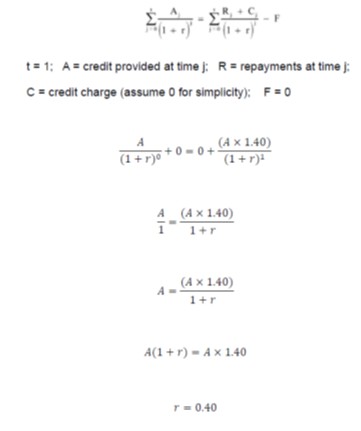
(a) the Pawn Contracts are illegal or contrary to public policy under s 39(3) of the CCV Act because they exceed the “annual percentage rate” limit set by s 39(1); or
(b) the Pawn Contracts are illegal or contrary to public policy under s 32A(1) of the Code because they exceed the “annual cost rate” limit set by that provision.
(2) The “unlicensed credit activity claims” by which the Applicant alleges that the contracts are illegal or contrary to public policy because they constitute “credit activities” within the meaning of s 5 of the NCCP Act for which Taylors’ were required to hold a credit licence under s 29, at a time when Taylors held no such licence.
9 I now turn to the resolution of the separate questions.
SEPARATE QUESTIONS
Question 1
10 Question 1 is:
Throughout the period 15 November 2022 to 26 October 2023 (Relevant Period) was Taylors authorised to carry on business as a pawnbroker pursuant to the Second-Hand Dealers and Pawnbrokers Act 1989 (Vic) (SHDP Act)?
11 The facts relevant to this question may be briefly stated as follows:
(1) Prior to 22 November 2022, Taylors was registered to carry on a business as a pawnbroker under Part 2 of the SHDP Act (licensee number SHD-0011312) (Registration).
(2) On 29 August 2022, a Registrar of the Business Licensing Authority (as defined in the SHDP Act, s 3(1)) (Authority) emailed the registered office of Taylors stating that a “systems issue” had resulted in Taylors not being notified of its requirement to lodge its annual statements and pay annual fees for an undisclosed amount of time, but that Taylors now had to lodge an outstanding annual statement and pay unpaid annual fees. This correspondence is set out at [16]-[17] below.
(3) By 15 November 2022, Taylors having not complied with the requirements in the email of 29 August 2022, the Registration was cancelled.
12 By its Defence, the Respondent accepts that on or about 15 November 2022 its Registration was purportedly cancelled by the Authority. The Respondent asserts that it did not know of, and did not become aware of, the purported cancellation until 25 July 2023, and that upon becoming aware of the cancellation the store was closed.
13 The Respondent pleaded that, under s 11A(1) of the SHDP Act, the Authority was required to give Taylors a written notice as a precondition to any cancellation. It says that the only communication by the Authority was the email of 22 August, which it says did not comply with s 11A of the SHDP Act and was therefore not a valid notice. It says that there can therefore be no valid cancellation, with the result that the Respondent was registered in the Relevant Period.
14 In its reply, the Applicant pleaded that Taylors was estopped from arguing that no valid notice under s 11A(1) had been given because Taylors had failed to challenge the purported cancellation. The Applicant argues that by shutting the business rather than challenging the cancellation, Taylors knowingly created a situation in which group members suffered loss, because they were unable to repay amounts in store that were said to be due under the Pawn Contracts, continued to incur interest, and lost the enjoyment of the Pawned Goods. In the alternative, it pleads that it would be an abuse of process for Taylors to collaterally challenge the validity of the notice in this proceeding. Finally, the Applicant argues that even if there were a defect in the cancellation of the Registration because of a failure to give notice, the cancellation would not be void ab initio.
15 The reply also pleads in the alternative that Taylors’ registration was automatically cancelled on 24 November 2022 because of the operation of s 10(2)(c) of the SHDP Act. That section provides for the automatic cancellation of registration 30 days after an associate of a director of a registered body corporate becomes an insolvent. The alleged associate is Mr Noel Borruso, the former director of Taylors, who became bankrupt on 25 October 2022. The reply pleads that Mr Borruso is an associate of Mr Grainger by reason of them having a business arrangement or relationship, which it says can be inferred from the appointment of Mr Grainger as a director the day before a sequestration order was made against Mr Borruso.
Was Taylors registered as a pawnbroker in the Relevant Period?
16 A person is prohibited from carrying on a business as a pawnbroker unless registered as a second-hand dealer and authorised to carry on a business as a pawnbroker by endorsement of their registration (SHDP Act, s 5(1A)). In correspondence tendered by the Applicant, the Authority emailed the Respondent on 29 August 2022 notifying it of outstanding fees and charges. The Authority’s email stated:
A recently identified systems issue has resulted in a small number of registered second-hand dealers not being notified about their requirements to lodge their annual statements and associated fees. Unfortunately, this issue did impact your account and as such you have outstanding annual fees and annual statements that have not been lodged with the Business Licensing Authority (BLA).
While this issue has impacted your account over a few years, you are only required to lodge one annual statement regardless of the number of years that have passed since your last lodgement. The link to your annual statement is provided below.
You are also only required to pay an annual fee for the financial year 2021/22 and any future fees. I have waived the requirement for you to pay any outstanding annual fees that were due prior to the 2021/22 financial year.
17 The email then provided various details of the fees and links to use the “annual statement service” and to update information. The email later stated:
In accordance with section 11A of the Act, failure to lodge the annual statement and pay the annual fee by 14 October 2022 may result in a late payment fee or cancellation of the registration.
18 Section 11 of the SHDP Act creates an obligation for a person registered under Part 2 of that Act to pay the prescribed annual fee, and to provide a statement in respect of the year up to the date of the payment in a form approved by the Authority (SHDP Act, s 11(1) and (3)-(4)). Section 11AA creates a similar obligation in respect of payment of annual endorsement fees, where applicable.
19 Section 11A of the SHDP Act states:
11A Failure to comply with section 11
(1) If a person fails to comply with section 11 or 11AA, the Authority must give the person a written notice stating that unless the person complies with that section and also pays to the Authority the late payment or lodgement fee by the date specified in the notice, the person's registration or endorsement, as the case may be, will be cancelled.
(2) The date specified in the notice must be at least 14 days after the date on which the notice is given to the person.
(3) If the person has not complied with section 11 or 11AA and paid the late payment or lodgement fee by the date specified in the notice, the registration or endorsement, as the case may be, is automatically cancelled.
(4) The fee for late payment or lodgement is the prescribed fee or, if no fee is prescribed, 2 fee units.
20 The first precondition to the exercise of the statutory power to cancel a registration is that a person has failed to comply with s 11 or 11AA. That condition was met in this instance: the email of 29 August notifies the Respondent that it had “outstanding annual fees and annual statements that have not been lodged with the Business Licensing Authority”. The Defence did not plead that this precondition was not met.
21 Next, s 11A(1) requires that the Authority give a written notice stating that unless the person complies with s 11 or 11AA and pays any late fees by the date specified in the notice, the person’s registration will be cancelled. The email of 29 August 2022 stated that the failure to comply “may result in a late payment fee or cancellation of the registration”.
22 It appears that the Defence seeks to assert that because the s 11A notice referred to the possibility of cancellation, and not the certainty of it (i.e. “may result in … cancellation” instead of “will … result in cancellation”) the notice was invalid and the subsequent cancellation ineffective. This argument is optimistic, particularly in the absence of any evidence suggesting that the Respondent was unaware of its actual obligations to make the payments or lodge the relevant form. Given the highly regulated environment in which pawnbrokers operate, it is reasonable to expect that they will proactively seek to comply with obligations of this kind.
23 It is an even more optimistic argument in circumstances where, on the evidence before me, the Respondent apparently took no step to raise the issues about the validity of the notice at any stage, using either the mechanisms involved in SHDP Act, or judicial review.
24 The question raised is whether collateral challenge is available in the context of this case. A collateral challenge was described by McHugh J in Ousley v R [1997] HCA 49; 192 CLR 69 at 98-99 in the following way:
A collateral attack on an act or decision occurs when the act or decision is challenged in proceedings whose primary object is not the setting aside or modification of that act or decision … with the widespread availability of judicial review procedures, it conduces to clarity of thought, in my opinion, if the term "collateral challenge" is confined to challenges that occur in proceedings where the validity of the administrative act is merely an incident in determining other issues
25 In Jacobs v OneSteel Manufacturing Pty Ltd [2006] SASC 32; 93 SASR 568 (OneSteel), Besanko J (Duggan, Vanstone and Layton JJ agreeing) identified a range of factors relevant to identifying when a collateral challenge would be available. In some circumstances, such a challenge can be an abuse of process.
26 An abuse of process is inherently broader and more flexible than mere estoppel (Tomlinson v Ramsay Food Processing Pty Ltd [2015] HCA 28; 256 CLR 507 at [25]-[26] (French CJ, Bell, Gageler, Keane and Nettle JJ)). In OneSteel, Besanko J identified a series of questions relevant to identifying when a collateral attack is available (at [93]) including:
1. Are the grounds of challenge likely to involve the adducing of substantial evidence?
2. If a collateral challenge is permitted, will all proper parties be heard before the court or tribunal in which the collateral challenge is to be heard?
3. In the particular case, does the allowing of a collateral challenge by-pass the protective mechanisms associated with judicial review proceedings such as the rules as to standing, delay and other discretionary considerations?
4. Is there a statutory provision that bears in one way or another on the question of whether a collateral challenge should be permitted?
5. Is the issue raised by the collateral challenge clearly answered by authority?
6. Are there other cases pending which raise the same issue?
7. (Possibly) Is there a more appropriate forum in terms of expertise and perhaps court procedures such that a collateral challenge should not be permitted?
27 In Director of Housing v Sudi [2011] VSCA 266; 33 VR 559, Weinberg JA observed that courts have “imposed quite severe restrictions upon the circumstances in which the validity of government acts can be collaterally challenged” (at [229]), including because:
(1) collateral review “allows the limitations properly imposed on judicial review to be circumvented. If collateral review is too widely permitted, then rules about standing, time limits, and the discretion vested in reviewing courts in relation to the granting of remedies, may fall by the wayside” (at [226]); and
(2) collateral review “can bring about undesirable consequences”, such as resulting “in lengthy hearings on tangentially related matters, all within the course of a trial designed to deal with quite different issues” (at [227]).
28 In this case, it is apparent that many of the proper parties are not before the Court – including, for example, the Authority, which issues certificates under the SHDP Act, and which has a clear interest in the construction of the statutory regime, both in this case and in general. I have not been directed to any statutory provision which bears one way or another on the question of whether a collateral challenge is permissible, although I note that:
(1) There is a specific power in s 14 of the SHDP Act for the Registrar to correct an error or omission in the register – which could be said to encompass removal from the register due to cancellation – which is subject to review in the Victorian Civil and Administrative Tribunal. This may be said to be a statutory pathway for the correction of erroneous removal of the kind that the Respondent alleges, which would suggest that collateral challenge outside that framework, in the absence of the relevant parties, would be an abuse of process.
(2) It is a requirement for a person carrying on a business as a second-hand dealer or pawnbroker to display the current certificate of registration or a copy of it in a prominent position at each place at which the business is carried on pursuant to that registration (SHDP Act, s 17(1)), and displaying a certificate of registration that is not in force is prohibited (SHDP Act, s 17(2)). These are statutory indicators that there would be substantial downstream impacts arising from a collateral challenge, which might tend against a conclusion that a mere procedural defect would be capable of rendering the de-registration void for all purposes.
29 The exploration of these issues in their statutory context appears to me to raise complex questions of fact and law. It is not necessary or appropriate to resolve those issues. It is appropriate to observe that the Respondent did not make submissions or adduce evidence on this issue, the Authority is not before the Court, and there are matters of fact and law that could lead to lengthy hearings about tangentially related matters in circumstances where the Respondent has not sought to avail itself of any other avenue of review (either judicial review or under the SHDP Act). In those circumstances, I have no difficulty concluding that in the particular factual circumstances in which this issue arises, it would be an abuse of process to entertain a collateral challenge to the cancellation which is otherwise not disputed. I am fortified in that conclusion by the earlier conclusions of this Court in relation to the conduct of the Respondent, or the Respondent’s director, Mr Grainger, who I found in previous hearings to be generally unreliable and obfuscatory.
30 Accordingly, it is not appropriate to form a concluded view about whether the 29 August 2022 email was a valid s 11A notice as raised by the Respondent on the pleading. However, I note that, as a factual matter, the email of 29 August did effectively communicate the automatic cancellation of the Registration if the requirements were not complied with, because it referred to s 11A, which itself sets that out. In any event, an act done in breach of a statutory condition of that kind is not necessarily invalid; the consequence depends upon whether the statutory framework considered as a whole reveals a legislative purpose to invalidate acts done in breach of the condition (Project Blue Sky v Australian Broadcasting Authority [1998] HCA 28; 194 CLR 355 at [91] (McHugh, Gummow, Kirby and Hayne JJ)). Without forming a concluded view, I consider that there are barriers to the success of the argument which the Respondent raised on its pleading, but never attended Court to prosecute.
31 It follows that the Court will not entertain a collateral attack to the cancellation of the Registration.
32 The Applicant tendered a copy of an extract from the register maintained in accordance with the SHDP Act, showing that the Respondent was not registered as a second-hand dealer and pawnbroker between 15 November 2022 and 7 November 2023 inclusive. Accordingly, the answer to question 1 is: “No”.
Question 2
33 Question 2 is:
If the answer to 1 is “no” in whole or part, during the periods in which Taylors was not authorised, did Taylors lawfully:
(a) carry on business as a pawnbroker in Victoria;
(b) enter into Pawn Contracts?
34 Section 5(1A) of the SHDP Act provides:
Subject to this Act, a person must not, either alone or in partnership, carry on business as a pawnbroker unless –
(a) the person is registered as a second-hand dealer under this Part; and
(b) the person is authorised to carry on business as a pawnbroker by endorsement of their registration under this Part.
Penalty: 100 penalty units.
35 By its Defence, Taylors accepts that it was required to be registered as a second-hand dealer and be authorised to carry on business as a pawnbroker.
36 Because Taylors was not authorised under the SHDP Act to carry on business as a pawnbroker and enter into Pawn Contracts, it was not lawful for the Respondent to do so (SHDP Act, s 5(1A)). The answer to question 2 is therefore: “No”.
Question 3
37 Questions 3 is:
If the answer to 2 is “no”, did Taylors contravene s 5(1A) of the SHDP Act?
38 The second further amended statement of claim alleges that the Respondent entered into Pawn Contracts with various of the group members. The Respondent pleads the following in its Defence:
a. says that each of the Pawn Contracts is a separate contractual relationship between the Respondent on the one hand and a customer (whether the Applicant or a Group Member as the case may be) on the other hand;
b. says that there are two Pawn Contracts between the Respondent on the one hand and the Applicant on the other;
c. says that each of the Pawn Contracts between the Applicant and the Respondent used a standard set of “pawn contract” terms (Standard Contract Terms);
d. says that the terms of each of the Pawn Contracts between the Applicant and the Respondent provided for an amount of money to be provided to the Applicant by the Respondent;
e. says that the terms of each of the Pawn Contracts between the Applicant and the Respondent provided for the Applicant to pledge as security specified goods of the Applicant;
39 The SHDP Act defines a pawnbroker as “a person who carries on the business of advancing money on the security of pledged goods” (s 3(1)). On its pleaded case Taylors accepts that it entered into agreements on this basis throughout the Relevant Period. While it submits that the Pawn Contracts did not involve the provision of credit, it is clear that the Respondent accepts that it was carrying on the business of a pawnbroker through the contracts which it entered into in that period.
40 It is therefore clear that on its own pleading the Respondent carried on business as a pawnbroker. As stated above, s 5(1A) of the SHDP Act prohibits a person from carrying on a business as a pawnbroker unless registered as a second-hand dealer and authorised to carry on a business as a pawnbroker by endorsement of their registration It follows from my responses to questions 1 and 2 that the answer to question 3 is: “Yes”.
Question 4
41 Question 4 is:
For the purpose of the National Consumer Credit Protection Act 2009 (Cth) (NCCP Act) and s 3(1) of the National Credit Code (Code):
(a) are the amounts provided by Taylors to Ms Simpson and the Group Members under the Pawn Contracts “credit”?
(b) are Ms Simpson and the Group Members debtors?
(c) was Taylors a “credit provider?”
(d) does the Code apply to the provision of credit by Taylors to Ms Simpson and the Group members under the Pawn Contracts?
(e) are the Pawn Contracts “credit contracts”?
Question 4(a): are the amounts provided by Taylors to the Applicant and group members under the Pawn Contracts “credit”?
42 The relationship between the Applicant and each group member and the Respondent was contractual. The contracts are all in standard form, with sections amended for each specific customer. A number of contracts between Ms Simpson and the Respondent were annexed to Ms Simpson’s affidavit of 4 March 2025. The terms of the standard-form contract, having regard to the contract between Ms Simpson and the Respondent dated 17 May 2023 (the Contract), can be briefly summarised:
(1) The name, date of birth and address are listed at the start of the documents, along with a description of the pawned goods. Immediately under that description are the words “TOTAL LENT”, with the total amount of money advanced identified (for instance, $140 was advanced under the Contract).
(2) Immediately below the words “TOTAL LENT” the interest amount and rate was identified. Under the Contract, interest was $56 at a rate of 40% per month (or part thereof).
(3) There are then a series of standard terms, including:
(a) The “loan period” is specified as one month. This is explained in the standard-form contract as follows:
The loan period is one month. E.g. If you pawn your mobile phone on 5th of January, you must redeem your pawn by 5th of February. No reminders will be sent.
(b) The pawnor may extend the loan period by one month by paying “one month’s Interest on or before the Due Date”.
(c) If the contract is neither redeemed (by repayment of the loan plus interest) nor extended (by payment of interest), Taylors is entitled to sell the pawned good. The terms then provide that upon sale, Taylors “will deduct from the sale price received the cost of sale.”
(d) There is a cost of sale charge in respect of each item at the rate of 50% of the sale price and a daily cost of sale accrual of 0.15%. That daily cost of sale accrual continues until the redemption or sale.
(e) If the Pawn Ticket covers more than one item, no item can be separately redeemed.
(f) The contract includes a declaration by the customer, including that:
• …I am aware I have not been provided credit, I am aware this is not a credit contract, I have not provided a personal guarantee or undertaking and I am not obliged or required to make repayments for money owed under this Pawn Ticket. If not redeemed all money owed will be deducted from the proceeds of sale. I am aware I am not liable for any shortfall from the proceeds of sale.
• I am aware I hold the right to redeem the pawned goods, though I am not required or obliged to redeem the pawned goods. …
• I have pledged these pawned goods as security for all money owed under this Pawn Ticket.
43 Question 4(a) effectively asks whether or not arrangements in these terms involve the provision of “credit”.
44 In the NCCP Act, “credit” has the same meaning as in the Code (NCCP Act, s 5(1)). The Code defines “credit” and “amount of credit” in the following terms:
3 Meaning of credit and amount of credit
(1) For the purposes of this Code, credit is provided if under a contract:
(a) payment of a debt owed by one person (the debtor) to another (the credit provider) is deferred; or
(b) one person (the debtor) incurs a deferred debt to another (the credit provider).
(2) For the purposes of this Code, the amount of credit is the amount of the debt actually deferred. The amount of credit does not include:
(a) any interest charge under the contract; or
(b) any fee or charge:
(i) that is to be or may be debited after credit is first provided under the contract; and
(ii) that is not payable in connection with the making of the contract or the making of a mortgage or guarantee related to the contract.
45 The Respondent pleaded that the Pawn Contracts did not involve the provision of credit because on a proper construction of the standard-form contract:
(a) the formation of each of the Pawn Contracts involved entry into a contractual relationship under which the Respondent took possession of the customer’s goods as security for the provision of money by way of bail;
(b) a term of each of the Pawn Contracts between the Applicant and the Respondent is that, if a specified amount of money is not paid by the Applicant to the Respondent within a specified time, the Respondent then has a right of sale over the deposited goods; and
(c) the Pawn Contracts do not involve the advance of money by way of a loan and do not create or record any debt.
46 The Respondent did not argue that title to the goods passed to it. That is, it never suggested that it purchased the goods, subject to a contractual right to re-sell them to the customer within a month at an agreed price. Thus, under a Pawn Contract, the Applicant and group member’s property went into the possession of the Respondent but title to the goods remained with the customer.
47 The Applicant also pointed to the words used in the Pawn Contract, being “total lent” and “loan period”. The mere use of language of this kind is not determinative of the issue (just as the declaration made by the individual customer is not relevant to the analysis of the substance of the relationship).
48 The starting place for the analysis is the statutory definition extracted above. That definition has at its core the concept of debt. The word “debt” is not defined in the Code nor the NCCP Act. However, it is an old concept, well known to the common law. This is an instance where it is appropriate to have regard to the common law treatment of a technical legal term in construing the word in its statutory context (see, eg, Davies v Western Australia (1904) 2 CLR 29 at 42-43 (Griffith CJ); City Mutual Life Assurance Society Ltd v Smith (1932) 48 CLR 532 at 541 (Dixon J); BA v The King [2023] HCA 14; 275 CLR 128 at [56] (Kiefel CJ, Gageler and Jagot JJ)). Traditional definitions of debt involve the propositions that a debt is “a legal obligation” to pay a sum of money to another (R v Brown (1912) 14 CLR 17 at 25 (Griffith CJ), and a “chose in action” (Loxton v Moir (1914) 18 CLR 360 at 379; Torkington v Magee [1902] 2 KB 427 at 430-1 (Channell J)). Thus, the provision of credit is the deferment of an existing debt, or the creation of a new deferred debt (Australian Securities and Investments Commission v Fast Access Finance Pty Ltd [2015] FCA 1055 (Fast Access) at [261] (Dowsett J)).
49 The contractual provisions extracted above make clear that the pawnor was required to repay a value to the pawnee. That could happen by either the payment of the outstanding amount (by way of repayment of the principal and the interest) or by the sale of the goods (which involved the transfer of the pawnor’s residual right of ownership to the purchaser of the goods). Through either method there was a payment to the pawnee which is indicative of a debt relationship. Put another way, the pawnor proffers their goods, and immediately receives a benefit in the form of an advance of funds. They do not have to repay that amount of money for at least 30 days. At the end of 30 days, they could “repay” the advance by either forfeiting their ownership of the pawned goods, or by repaying the amount along with any necessary amount of interest. If the goods were otherwise seized by police so they were unavailable for sale, then the pawnor became liable for “all money owed under this contract”. The contract provided that “Taylors… has reserved it (sic) right to pursue all available legal remedies to recover all money owed under this Pawn Ticket and in addition all costs of this recovery”.
50 On its face therefore it appears that the substance of the arrangement provided for the creation of a debt at the time that the funds were advanced, with various mechanisms for the repayment of that debt included in the body of the contractual relationship.
51 The Applicant referred to certain cases in support of its position which it is appropriate to briefly consider. The issue of pawnbrokers was considered by the High Court in Palgo Holdings Pty Ltd v Gowans [2005] HCA 28; 221 CLR 249 (Palgo Holdings). In that case, the appellant was charged with carrying on a business of lending money on the security of pawned goods, without a licence, in contravention of the Pawnbrokers and Second-hand Dealers Act 1996 (NSW). The issue before the High Court was whether the appellant’s business was the business of lending money on the security of pawned goods. The appellant made short-term loan amounts, usually of around 7 days. The loans were secured, and each borrower signed a document, the first part of which bore the heading “Secured Loan Agreement”, while the second part had the heading “Bill of Sale/Goods Mortgage”. Under the heading “Secured Loan Agreement” it recorded the amount of the loan and the date on which the principal and an agreed amount of interest was due for repayment. The second part of the document, under the heading “Bill of Sale/Goods Mortgage”, was said to be made as a deed between the borrower as mortgagor, and the lender as mortgagee, referable to a schedule of terms. The schedule provided that, if the mortgaged property was situated in New South Wales (as was the case in all of the transactions the subject of evidence in the proceedings), the borrower “transfer[red] title in the Mortgaged Property to [the lender] as security for the repayment” of the balance of the loan. The core issue in the case concerned whether the loans which the pawnbroker made to its customers were loans on the security of “pawned goods” (see [3] (McHugh, Gummow, Hayne and Heydon JJ)). Their Honours traced the history of the terms pawn, pledge and lien, observing that a pawn is historically understood as “a bailment of personal property as security for a debt” (at [25] (McHugh, Gummow, Hayne and Heydon JJ)).
52 Thus, while Palgo Holdings is a case where the existence of a debt was not in issue, it appears to have been accepted by their Honours that a debt was part of the context within which a pawnbroking relationship arises.
53 A similar expression of principle can be found in Matthew v TM Sutton Ltd [1994] 4 All ER 793 (TM Sutton) (Chadwick J). In that case, the pawnor defaulted on the pawn agreement, and the pawnbroker sold the pawned property at auction for an amount greater than the amount owed. The pawnbroker gave the pawnor notice of the surplus balance payable to him. The pawnbroker did not pay the balance for some months, and the pawnor commenced proceedings seeking interest on the balance. The Court found that the ownership of the property remained with the pawnor, subject to the special interest of the pawnbroker for the purpose of realising the security. For that reason, the pawnbroker was liable to pay interest on the balance. In reaching this decision, it was necessary for the Court to consider the nature of the interest created by the pawn agreement. At 800-801 Chadwick J observed (emphasis added):
A pawn or pledge involves a transfer of the possession of personal property from the pawnor to the pawnee by way of security; the ownership in the property remains in the pawnor subject only to the 'special interest' to which the pawnee is entitled for the purpose of protecting and realising his security. As Viscount Haldane LC said in Attenborough & Son v Solomon [1913] AC 76 at 84, [1911–13] All ER Rep 155 at 158:
'When the person who owns the chattel makes a pledge of it to a pawnbroker he is not purporting to part with the full property or giving any thing which is in the nature of a title to that property to the pawnee, excepting to a limited extent. The expression has been used that the pawnee in such a case has got a special property in the chattel. My Lords, that is true in this sense, that the pawnbroker is entitled to hold the chattel upon the terms that when the possession has been lawfully given to him it is not to be taken away from him, and that if default is made in the redemption of the pledge, or it may be in the payment of interest, he may go further and by virtue of his contract, assuming it to be valid, sell the chattel. But the contract of pawn is simply an illustration of that contract of bailment of which Holt C.J. gave the famous exposition in the great case of Coggs v. Bernard ((1703) 2 Ld Raym 909, [1558–1774] All ER Rep 1); and it rests upon this foundation, that the property remains in the bailor, and that the bailee, whether it be a bailment by way of pawn or in any other form, simply takes at the outside a right to the possession dependent on the validity of the title of the bailor with the other rights possibly superadded to which I have referred.'
When the pawned articles are sold by the pawnee, under the power now conferred by s 121(1) of the 1974 Act, the property in those articles passes to the purchaser. The proceeds of sale are paid to the pawnee; indeed, in the usual case, they will be received by the pawnee in the form of money credited to his bank account. But there is no reason why the beneficial interest of the pawnor in the pawned articles should be extinguished to any greater extent than is necessary to give effect to the pawnee's right to realise his security. In particular, there is no reason why the beneficial interest of the pawnee should not be transferred from the articles which have been sold to the proceeds of sale and so remain attached to the surplus in the hands of the pawnee after he has discharged the debt out of the proceeds of sale.
54 Similarly in this case, the terms of the Pawn Contracts in issue did not operate to pass title to the goods – the ownership of the property remained with the pawnor, subject to the interest which the pawnee had to realise the security. Viewed in this way, the Respondent’s argument that the Pawn Contracts did not create a “debt” because they did not require repayment does not engage with the nature of the relationship which was actually created. The obligation to pay arose, and if payment were not made, the pawnee obtained the value of the right to sell the goods and retain the proceeds.
55 The Pawn Contracts provided a deferment period of one month that was capable of extension. Accordingly, the Pawn Contracts fell within the definition of “credit” under the Code.
56 Therefore, the answer to question 4(a) is: “Yes”.
Question 4(b) and (c): are Ms Simpson and the group members debtors, and is Taylors a credit provider
57 A debtor is relevantly defined to be a “person … who is liable to pay for or repay credit …” (Code, ss 3(1) and 204(1)). For the reasons set out above, I am satisfied that Ms Simpson was a debtor, because she owed a debt after receiving the advance of funds under the Pawn Contracts.
58 The group members entered into agreements that were substantially identical in relevant respects. The Pawn Contracts were accepted by the Defence as being in a standard form. The very minor variations between the credit contracts do not shift the analysis undertaken above.
59 The group members are therefore debtors.
60 A “credit provider” is a “person who provides credit” (Code, ss 3(1) and 204(1)). Because Taylors provided “credit” to Ms Simpson and the group members in accordance with the standard form Pawn Contracts in the way that I have outlined above, I am satisfied that it is a credit provider.
61 Therefore the answer to each of questions 4(b) and (c) is: “Yes”.
Question 4(d): does the Code apply to the provision of credit by Taylors to Ms Simpson and the group members under the Pawn Contracts?
62 Section 6(9) of the Code provides that the Code does not apply to the provision of credit on the security of pawned or pledged goods by a pawnbroker in the ordinary course of the pawnbroker’s business, provided that the business is being lawfully conducted by the pawnbroker.
63 Because of my conclusion that Taylors’ Registration was cancelled (refer to questions 1-3 above), the exemption is not available to it. Thus, the analysis concerns whether the provision of credit by Taylors was one to which the Code applies, as set out in s 5 of the Code.
64 Section 13 of the Code creates a rebuttable presumption that the Code applies in proceedings in which it is invoked. It has been invoked in this proceeding. That presumption can be displaced where the debtor declares, before entering into the contract, that the credit is to be applied wholly or predominantly for a purpose that is not a Code purpose, unless the contrary is established. The Code purposes are listed in s 13(2), and are:
(a) for personal, domestic or household purposes;
(b) to purchase, renovate or improve residential property for investment purposes;
(c) to refinance credit that has been provided wholly or predominantly to purchase, renovate or improve residential property for investment purposes.
65 None of the circumstances which reverse the presumption listed in s 13(2) apply. While the standard-form contract included a declaration by the customer that the contract did not involve the provision of credit, it did not involve a declaration about the purpose of the credit. Even if such a declaration were made, I have real doubts as to the efficacy of such a declaration in circumstances where there are so many indicators that a Code purpose was present on the facts of this case, including the size of the loan, and the nature of Taylors’ business, being directed to small loans for personal purposes. However, the issue does not require determination because the declaration does not meet the requirements of s 13(2).
66 It follows that responding to question 4(d) starts from the position that the Code applies. While the Respondent pleaded that the Code did not apply, it did not put forward any evidence or submissions in support of that position. The presumption therefore operates. It follows that Taylors bears the burden of persuading the Court that each of the Pawn Contracts is not a credit contract to which the Code applies (Ozzy Loans Pty Ltd v New Concept Pty Ltd & Zhong [2012] NSWSC 814 at [39]-[41] (S G Campbell J); see also Bahadori v Permanent Mortgages Pty Ltd (2008) 72 NSWLR 44 at [183] (Tobias JA; with whom Giles and Campbell JJA agreed) in the context of the Consumer Credit (New South Wales) Code 1995). Taylors took no steps to discharge that burden. Given the absence of an active Respondent, I have considered whether the contrary may have been able to be established.
67 The question of whether the provision of credit is one to which the Code applies depends upon the proper construction of s 5. It provides:
5 Provision of credit to which this Code applies
(1) This Code applies to the provision of credit (and to the credit contract and related matters) if when the credit contract is entered into or (in the case of precontractual obligations) is proposed to be entered into:
(a) the debtor is a natural person or a strata corporation; and
(b) the credit is provided or intended to be provided wholly or predominantly:
(i) for personal, domestic or household purposes; or
(ii) to purchase, renovate or improve residential property for investment purposes; or
(iii) to refinance credit that has been provided wholly or predominantly to purchase, renovate or improve residential property for investment purposes; and
(c) a charge is or may be made for providing the credit; and
(d) the credit provider provides the credit in the course of a business of providing credit carried on in this jurisdiction or as part of or incidentally to any other business of the credit provider carried on in this jurisdiction.
68 Considering these matters in the context of the matter before me, I will first consider Ms Simpson, and then the group members:
(1) Ms Simpson is a natural person, which satisfies s 5(1)(a) of the Code.
(2) The credit was provided wholly or predominantly for a personal, domestic or household purpose (s 5(1)(b)(i)). Ms Simpson’s evidence is that she entered the Pawn Contract to get money to pay for bills and essential items is unchallenged and credible. I accept it. This satisfies s 5(1)(b) of the Code.
(3) A charge was made for the provision of credit, being the amount of the interest charge. This satisfies s 5(1)(c) of the Code.
(4) Taylors was carrying on a business, and the credit was provided in the course of that business. Thus, s 5(1)(d) of the Code is satisfied.
69 In relation to group members:
(1) The group members are each self evidently natural persons, and so satisfy s 5(1)(a) of the Code.
(2) The Applicant submits that I can infer the purpose of each loan is personal, domestic or household because of the size of the loans and the circumstances in which pawn agreements are entered into. That may be so, but it is not necessary, because the s 13 presumption operates. The assertion that the loans were for Code purposes is presumed, and it is unchallenged and consistent with the circumstances of the case. I am satisfied that s 5(1)(b) of the Code is established.
(3) The analysis for ss 5(1)(c) and (d) are the same for the group members as for Ms Simpson, set out above.
70 Accordingly, the answer to question 4(d) is: “Yes”.
Question 4(e): are the Pawn Contracts “credit contracts”?
71 A “credit contract” is defined under s 4 of the Code to be a “contract under which credit is … provided, being the provision of credit to which this Code applies”.
72 Because of the analysis that I have set out in relation to the questions above, the Pawn Contracts entered into by Ms Simpson and the group members were for the provision of credit to which the Code applies. Thus, each Pawn Contract is and was a “credit contract”.
73 The answer to question 4(e) is: “Yes”.
Question 5
74 Question 5 is:
If the Pawn Contracts are “credit contracts?”:
(a) what is the annual percentage rate of the Pawn Contracts and if the annual percentage rate in respect of the contracts exceeds 48, are the Pawn Contracts unenforceable pursuant to s 39 of the Consumer Credit (Victora) Act 1995 (Vic) (CCV Act)?
(b) was Taylors prohibited from entering into the Pawn Contracts because of subsection 39(3) of the CCV Act?
(c) was Taylors prohibited from entering into the Pawn Contracts because of subsection 32A(1) of the Code?
(d) did Taylors engage in “credit activities”, and if so, did Taylors contravene subsection 29(1) of the NCCP Act?
Questions 5(a)-(c)
75 It is convenient to deal with questions 5(a)-(c) together. They each concern different aspects of the statutory framework applicable to contracts of this nature. Questions 5(a) and (b) are concerned with s 39 of the CCV Act, while question 5(c) is concerned with s 32A of the Code.
76 The Pawn Contracts stated that the rate of interest was 40% per month. Section 39 of the CCV Act provides that:
39 Contract unenforceable if rate exceeds 48 per cent
(1) A credit contract (and any mortgage given to a credit provider in relation to that contract) is unenforceable where the annual percentage rate in respect of the contract exceeds 48.
(2) Nothing in this section affects or limits the powers of the Court under section 70 of the Consumer Credit (Victoria) Code or of a court under section 76 of the National Credit Code if the Court or court is satisfied that the annual percentage rate in respect of a credit contract although not exceeding, in the case of a credit contract in relation to which there is a mortgage, 30, and in the case of any other contract, 48, is excessive or that the transaction is unjust within the meaning of that section 70 of section 76, as the case requires, or is such that a court of equity would give relief.
(3) A credit provider must not enter into a credit contract where the annual percentage rate in respect of the contract exceeds 48.
Penalty applying to this subsection: 10 penalty units.
77 Section 32A(1) of the Code provides:
A credit provider must not enter into a credit contract if the annual cost rate of the contract exceeds 48%.
Criminal penalty: 50 penalty units.
78 Thus, each of s 39(3) of the CCV Act, and s 32A of the Code, prohibit entering into a credit contract with an annual percentage rate of over 48%. The Pawn Contracts each involved a rate of 40% per month. Each of s 39(3) of the CCV Act, and s 32A of the Code look to the rate of interest expressed as an annualised percentage.
79 Section 32B of the Code includes a process for the calculation of the annual cost rate, using the formula: n x r x 100%, where: “n” is the number of repayments per annum to be made under the credit contract (annualised if the term of the contract if less than 12 months), except that:
(a) if repayments are to be made weekly – n is 52.18; and
(b) if repayments are to be made fortnightly – n is 26.09; and
(c) if the contract does not provide for a constant interval between repayments – n is to be derived from the interval selected for the purposes of the definition of j in subsection (2),
and r is the solution of the equation specified in s 32B(2).
80 In this instance, the calculation of r in s 32B(2) can be rendered as follows:
81 Applying this as required by s 32B(1) renders the following:
Annual cost rate = n x r x 100%, where n is 12 and r is 0.40
Annual cost rate = 12 x 0.40 x 100%
Annual cost rate = 480%
82 Thus, the annualised rate of interest for the purposes of s 32A of the Code is 480%. While s 39(3) of the CCV Act does not specify a methodology, I accept that the methodology adopted by the Code is appropriate for identifying the interest rate under s 39(3) of the CCV Act.
83 It follows from the above analysis that the answer to questions 5(a)-(c) is as follows:
(1) Question 5(a) – the answer is: “The annual percentage rate of the Pawn Contracts is 480%, and the Pawn Contracts are unenforceable pursuant to s 39 of the CCV Act”.
(2) Question 5(b) – the answer is: “Yes”.
(3) Question 5(c) – the answer is: “Yes”.
Question 5(d): did Taylors engage in “credit activities”, and if so, did Taylors contravene subsection 29(1) of the NCCP Act?
84 Section 29(1) of the NCCP Act provides that:
29 Prohibition on engaging in credit activities without a licence
Prohibition on engaging in credit activities without a licence
(1) A person must not engage in a credit activity if the person does not hold a licence authorising the person to engage in the credit activity.
…
85 A “credit activity” is defined in s 6(1) of the NCCP Act by reference to different topics. Relevantly for present purposes, item 1 of s 6(1) refers to “credit contracts”, and provides relevantly that a person engages in a credit activity if:
(a) the person is a credit provider under a credit contract; or
(b) the person carries on a business of providing credit, being credit the provision of which the National Credit Code applies to; or
(c) the person performs the obligations, or exercises the rights, of a credit provider in relation to a credit contract or proposed credit contract (whether the person does so as the credit provider or on behalf of the credit provider) …
86 In response to the questions above, I have concluded that Taylors provided credit to Ms Simpson and the group members each time it entered into one of the Pawn Contracts. The evidence and materials tendered in support of the application make clear that the same or substantially the same credit contract was used in relation to a substantial portion of transactions. There is no evidence before me about what proportion of Taylors’ business involved pawnbroking using the Pawn Agreements. However, I am satisfied on the material that I have that it was part of its business, sufficient to satisfy item 1(b) of s 6(1). For the period that Taylors did not have the benefit of the exception under s 6(9) of the Code, the contracts it entered into involved the provision of credit to which the Code applied.
87 For the same reason, the evidence makes clear that Taylors provided credit to Ms Simpson, and to the group members, and that, in some instances at least, it received payments made by Ms Simpson and some group members pursuant to the Pawn Contracts, while it held pawned goods as security for the repayment of the debts owing under the Pawn Contracts.
88 Therefore, Taylors was prohibited by s 29(1) of the NCCP Act from engaging in credit activities unless it had a credit licence. The evidence and pleaded position was that it had no Australian credit licence (on the basis that while the exemption was in operation it needed no such licence). However, for the period that the licence was cancelled, it contravened s 29(1) of the NCCP Act. The answer to question 5(d) is: “Yes, and yes”.
Question 6
89 Question 6 is:
If any of the answers to the questions in 5 is “yes”, what relief should the Court issue?
90 The availability of relief turns upon the relevant statutory provision contravened in respect of each aspect of the claim.
Restitution, compensation or damages
91 Section 124 of the Code provides that the court may order “restitution or… compensation” in favour of a person “affected” by a contravention of the Code, in the following terms:
124 Civil effect of contraventions
(1) If a credit provider or lessor contravenes a requirement of or made under this Code, the court may order the credit provider or lessor to make restitution or pay compensation to any person affected by the contravention and, in that event, may make any consequential order it considers appropriate in the circumstances.
(2) An application for the exercise of the court’s powers under this section may be made by:
(a) a person affected by the contravention; or
(b) ASIC on behalf of a person affected by the contravention, if the person has consented in writing to ASIC making the application; or
(c) ASIC (on its own behalf).
92 The Applicant relies upon s 124 of the Code in respect of the breach of s 32A of the Code.
93 Sections 180(1)(c)-(e) of the NCCP Act are relevant in relation to the unlicensed credit activity (i.e. the breach of s 29 of the NCCP Act). It provides that where there is (relevantly) a breach of s 29 of the NCCP Act:
180 Orders in relation to unlawful credit activities
Court may make orders in relation to unlawful credit activities
(1) …
the court may make such order as the court considers appropriate against the [credit provider]:
(c) to prevent the [credit provider] from profiting from the [customer] by engaging in that activity; or
(d) to compensate the [customer], in whole or in part, for any loss or damage suffered as a result of the [credit provider] engaging in that activity; or
(e) to prevent or reduce the loss or damage suffered, or likely to be suffered, by the [customer] as a result of the [credit provider] engaging in that activity.
94 Section 180(2) then sets out examples of the kinds of orders that the Court can make. It states:
(2) Without limiting subsection (1), examples of orders the court may make include:
(a) an order declaring the whole or any part of a contract, deed or arrangement made between the defendant and the plaintiff to be void and, if the court considers it appropriate, to have been void from the time it was entered or at all times on and after a specified day before the order is made; and
(b) an order varying such a contract, deed or arrangement in such manner as is specified in the order and, if the court considers it appropriate, declaring the contract, deed or arrangement to have had effect as so varied on and after a specified day before the order is made; and
(c) an order refusing to enforce any or all of the terms of such a contract, deed or arrangement; and
(d) an order directing the defendant to refund money or return property to the plaintiff; and
(e) an order directing the defendant to pay to the plaintiff the amount of loss or damage the plaintiff suffered; and
(f) an order directing the defendant, at the defendant’s own expense, to supply specified services to the plaintiff.
95 Each of s 180 of the NCCP Act and s 124 of the Code are provisions of broad import (see Integrated Securities No 3 Pty Ltd v Creatrix Web Development & Online Marketing Solutions Pty Ltd [2021] NSWSC 596 (Integrated) at [94] (Rein J) in relation to s 180).
96 Section 124 of the Code permits the Court to order restitution or compensation to “any person affected” by the contravention, as well as to make “any consequential order it considers appropriate in the circumstances”. Section 180(1)(d) is similarly focused on “loss or damage” suffered “as a result of” the activity. Thus, the core focus of the provisions is on compensation, restitution, or loss and damage.
97 In this instance, the Applicant and each group member received an amount under the Pawn Contract, and in many instances, made repayments of the principal amount, as well as unlawfully high interest payments. There is no difficulty in ordering that the interest and any additional costs or charges associated with the Pawn Contracts be repaid to the group members based on the unlawful contract.
98 However, the orders sought by the Applicant, providing for the return of any amounts of the principal that were repaid by the Applicant and group members to Taylors, present more complexity. Put in a simplified way the issue is as follows:
(1) if a group member was advanced $100, they received and spent that money, and had the benefit of it;
(2) when the person repaid (for example) $50 of the principal, they were returning the funds which should never have been advanced;
(3) if the amount of that $50 repayment were “refunded” to the group member, then they would have received the $100 that was initially advanced, and $50 that they had repaid of that amount. Of course, they would also have paid $50 at the time of the repayment; and
(4) the net effect would be that the group member obtains $100. They would have kept the amount of the advance that they had not repaid ($50), and received by way of damages the amount that they had repaid ($50).
99 It is difficult to identify a “loss” to the group member in the above example providing a foundation for the damages of $50. The group members received money and had the benefit of that money. It is not clear why a failure to retain that money (by partially repaying it) would involve a loss to them. The Applicant was unable to identify any authority bearing directly on the issue.
100 Section 180(1) identifies the purpose of any order that the Court makes consequent upon a breach of, relevantly, s 29 of the NCCP Act. It must be necessary to show that the order is “appropriate” for one of the purposes in s 180(1)(c)–(e). In this instance, the questions that arise are whether it is:
(1) appropriate to refund the amount of the repayment of principal to prevent Taylors from profiting by engaging in the breach of s 29 of the NCCP Act?;
(2) appropriate to compensate the plaintiff, in whole or in part, for any loss or damage suffered as a result of the defendant engaging in a breach of s 29 of the NCCP Act?; or
(3) appropriate to prevent or reduce the loss or damage suffered, or likely to be suffered by the plaintiff as a result of the defendant engaging in a breach of s 29 of the NCCP Act?
101 The refund of the principal amount is not concerned with the question of profit, and so I do not consider s 180(1)(a) of the NCCP Act to be relevant. Each of s 180(1)(b) and (c) require the identification of an amount required to compensate, or to prevent or reduce “loss or damage” suffered or likely to be suffered, because of the breach of s 29 of the NCCP Act. Each of compensation and loss or damage require the identification of a loss.
102 The case of Fast Access considered the operation of s 180 of the NCCP Act. In that case, the scheme for the provision of credit can be described in simplified terms as follows. A person came to the respondent or a related entity to obtain money. They were purportedly sold diamonds at the cost of $250 per diamond, with an obligation to pay for the diamonds in instalments. They simultaneously purported to sell the same diamonds for $125 each. The amount of the sale was then credited to their nominated account. The effect was that a person would obtain a sum of money from the respondent, with an obligation to repay twice that sum. It may be unnecessary to note that there were no diamonds. Justice Dowsett had no difficulty concluding that the arrangement was in fact the provision of credit disguised as the sale and re-sale of diamonds (at [264] and [277]).
103 ASIC alleged that the conduct was in breach of the NCCP Act and the National Consumer Credit Protection (Transitional and Consequential Provisions) Act 2009 (Cth). There were some statutory complexities arising from the transition from the State legislative regime to the uniform regime now in place that are not necessary to explain. The Court was satisfied that there was unlicensed lending at an annualised rate of 240%. On the question of relief, the Court considered whether to make orders under s 180(1) of the NCCP Act.
104 In Fast Access, ASIC submitted that the Court should order that the relevant respondent entity refund to each customer the difference between the amount paid to the customer, and the amount paid by the customer to the entity (at [289]). That is, a customer who had paid more than the amount of the initial loan would recover the excess; a customer who had not paid more than the amount would receive nothing, and the outstanding balance of the debt would be recoverable by the respondent ([289]). Where a customer had fully repaid the debt, such an order would mean in effect that they received an interest free loan. His Honour considered that such an order went beyond the objectives of s 180 (at [289]).
105 His Honour observed that “[e]ach customer has had the benefit of the advance or advances. He or she should pay the price for it, to the extent that the law allows” (at [290]). Accordingly, his Honour stated that a compensation order would be made which operated such that the lender recovered the principal and the amount of interest that could legally have been charged, and nothing more.
106 It is apparent that, in Fast Access, the Court was troubled by the concept of whether customers were being relevantly “compensated” if they recovered more than the difference between the amount they did repay, and the amount that they would have repaid if the credit was provided at a legal interest rate.
107 In Integrated, the plaintiff (Integrated Securities) loaned a substantial sum to the defendant (Creatrix) for the building of a duplex house, one side of which would be owned and lived in by the family which stood behind Creatrix, and the other side of which would be rented out. As events transpired, the level of debt spiralled and it soon seemed that even upon the sale of both sides of the house, the debts would not be entirely satisfied (see [9]). There was no dispute that but for the defences raised by Creatrix, Integrated Securities would be entitled to judgment of over $1 million plus further interest (see [10]). The defences were that the loans advanced should be declared void under the Code, and that they were in any event obtained by engaging in unconscionable conduct.
108 Integrated Securities did not dispute that if the loan agreement was a credit contract within the meaning of the Code, it held no licence (see [19]). Creatrix argued that while it was the borrower, each of the individuals standing behind that company were relevantly “debtors” because obligations going beyond those of a guarantor and mortgagor were imposed upon them by the loan agreement. This was accepted by the Court, and so the obligations of the Code applied, and had not been complied with.
109 In considering a remedy under s 180, the Court said at [94]:
I do not think that it would be appropriate to deprive Integrated of the $440,384.45 actually advanced and I accept as appropriate the Defendants’ concession that interest at the Court rate should be paid. In my view, all three Defendants should be required to repay the $440,384.45 plus interest at the Court rate but no more than that. I will return to the form of orders after I have dealt with the unconscionable conduct case.
110 Section 180 was also considered in Lauvan Pty Ltd & Anor v Bega & Ors [2018] NSWSC 154 (Lauvan), in which the plaintiff loaned $1 million to the defendant under a short term lending facility. Gleeson JA found that the credit activities were not unlawful, but made comments in obiter about what the position would have been had it been unlawful. Her Honour said that a mere breach of s 29 of the NCCP Act would not justify an order disallowing the interest charged under the agreement, noting that no reason had been shown why the borrower’s obligation to pay interest under the facility agreement should not be enforced (at [279]). Relevantly, in that case, no loss or damage was identified by the borrower, nor was any breach of the NCCP Act or Code (other than the alleged breach of s 29).
111 The analysis of the Court in each of these cases is consistent with concepts of restitution and compensation which look to loss to identify the appropriate remedy. That, in turn, is consistent with the plain words of s 180(1) which is a precondition of any order for a refund under s 180(2).
112 In the course of oral submissions, the Applicant submitted that in the absence of a cross-claim for the amount of the debt, the order sought could be made. That position is not consistent with the authorities which I have outlined above. In Fast Access, Dowsett J specifically noted that the absence of a cross-claim did not affect his analysis (see [289]). No contrary authority that directly impacted the issue was proffered by the Applicant. The fact that there has not been a claim by Taylors for the amount which it advanced does not convert the amount repaid on that principal into a sum that the Applicant and each group member have themselves lost.
113 The Applicant argued that the Respondent would not necessarily be entitled in restitution to repayment of the principal because there is no inflexible rule regarding non-contractual claims where a contract is deemed unenforceable, citing Equuscorp Pty Ltd v Haxton [2012] HCA 7; 246 CLR 498 (Equuscorp) at [25] (French CJ, Crennan and Kiefel JJ). In Equuscorp, the defendants had entered into a loan agreement with a company called Rural Finance Pty Ltd (Rural). The rights under that agreement were assigned to Equuscorp Pty Ltd. For reasons that are presently not relevant, the loan agreements were found to be unenforceable. Equuscorp Pty Ltd sought repayment of the principal and interest from the defendants in restitution for money had and received based on a total failure of consideration; that claim was dismissed (at [45]). It was in that context that the Court rejected the notion that there is any inflexible or rigid rule excluding non-contractual claims in cases involving contracts that are unenforceable. The Court stated (at [34]):
The outcome of a restitutionary claim for benefits received under a contract which is unenforceable for illegality, will depend upon whether it would be unjust for the recipient of a benefit under the contract to retain that benefit. There is no one-size-fits-all answer to the question of recoverability. As with the question of recoverability under a contract affected by illegality the outcome of the claim will depend upon the scope and purpose of the relevant statute. The central policy consideration at stake, as this court said in Miller, is the coherence of the law. In that context it will be relevant that the statutory purpose is protective of a class of persons from whom the claimant seeks recovery. Also relevant will be the position of the claimant and whether it is an innocent party or involved in the illegality.
114 In Equuscorp, the Court held that a claim in restitution would not be available to Rural (being the original lender), having regard to the circumstances including that Rural was not an arms-length financier but was rather a part of the closely related group of companies involved in the promotion of the schemes, the loan agreements were central to the schemes and involved invitations for investors to take up prescribed interests without the protections of the relevant statutory regime, and protection of the investors was the object of the statutory regime (at [45]).
115 Relevantly, in Equuscorp a claim for restitution by a lender failed to recover the principal sum due to illegality of the contract. Without deciding, it is possible that Taylors might, by analogy, fail to recover the principal amounts if they were to proceed with an action for restitution, because the illegality of the credit contracts (and Taylors’ involvement in that illegality) may prevent recovery of the amount which it advanced to the Applicant and group members.
116 It might be said that this case is distinct from Integrated and Lauvan because those cases did not involve s 39 of the CCV Act, which specifically renders the credit contract unenforceable. However, in Integrated, the Court set aside the agreements. His Honour found that the agreements should never have been entered into (at [94]) and appears to have approached the question of relief under s 180 of the NCCP Act on that basis.
117 The argument in this case proceeded on the basis that the approach in Equuscorp emphasised coherence in the law, which would be undermined if part of the contract was enforced in circumstances where the legislative prohibition is on the entry into the contract in the first place.
118 Each case turns on its own facts. Of central concern in this case is the terms of the legislation relied upon to support the compensation or restitution payments. Each require the establishment of an entitlement to restitution or compensation, or fix upon the existence of loss or damage. The precondition for the remedies is the identification of loss. In some cases in the United Kingdom, the statutory framework has provided for the retention of the principal sum in what the courts in that jurisdiction have identified as an anomalous result. For example, in Wilson v First County Trust Ltd [2001] QB 407, the Court considered an unenforceable pawnbroking contract. In that case, Mrs Wilson pawned her car, and, following a decision of the Court below, was required to pay £6,900 to recover her car (comprised of principal and interest). Mrs Wilson appealed on the basis that the agreement was unenforceable. The Court held that Mrs Wilson (the pawnor) was entitled to keep the amount of her loan, pay no interest and recover her car (at [25]). In reaching this decision, the Court observed at [20]: “I would not wish to arrive at a conclusion which permits Mrs Wilson both to retain her car and to recover £6,900 unless the statutory provisions leave no alternative”. However, in that case, the Court held that that conclusion was unavoidable, because s 127(3) of the Consumer Credit Act 1974 (UK) had the effect that an agreement which failed to include a prescribed term could not be enforced by the court whatever the circumstances (see [22]). An appeal by the Secretary of State was unsuccessful (Wilson v First County Trust Ltd [2003] UKHL 40).
119 In this case, s 39 of the CCV Act will have the effect of preventing the enforcement of the Pawn Contracts, so some group members who have made no repayments (or only partial repayments) will retain those funds. It follows that while no order is appropriate to compel the repayment to Taylors of amounts advanced under the Pawn Contracts (because the terms of those contracts cannot be enforced and there is in any event no cross-claim), funds used to repay that principal are not relevantly loss required to trigger either s 124 of the Code or s 180 of the NCCP Act.
120 The weight of authority therefore favours the conclusion that it is not available for the Applicant or group members to recover repayments of the principal. However:
(1) Because s 39 of the CCV Act renders the Pawn Contracts unenforceable, the amounts advanced by Taylors are not recoverable by Taylors under those agreements.
(2) Individuals who paid an amount in excess of what they borrowed under such an arrangement did so under the faulty understanding that they were obliged to do so when they were not. Accordingly, any amount of interest or other costs repaid is a loss for which Ms Simpson and relevant group members are entitled to compensation.
121 Having reached those conclusions, it is not appropriate to make an aggregate award pursuant to s 33Z(1)(f) of the FCA Act because I have not been able to make a “reasonably accurate assessment” of all group members’ entitlements on the material before me at present. I will hear the Applicant as to the correct sum which arises because of the foregoing analysis. This should not be treated as an opportunity to re-agitate the issues that I have determined above. Having regard to the observations above, the amount of damages will be the sum of:
(1) for each person who repaid the entire principal, the difference between the amount they repaid and the amount they were loaned (which it can be inferred represents the interest or other costs paid); and
(2) for each person who did not repay the entire principal, any part of the payments which were paid as interest, but not the part of the payments which were paid to partially repay the principal.
For the avoidance of doubt:
(1) any partial repayment of the principal will not be included in the sum of damages;
(2) where a person paid any amount of interest or other costs, that amount will be included in the sum of damages, regardless of any outstanding amount of the principal; and
(3) there will be no set-off for amounts advanced by Taylors to the group members.
Injunctions
122 The NCCP Act permits the Court to grant an injunction, irrespective of whether the person to whom the injunction is directed proposes to engage in the impugned conduct again (NCCP Act, s 177).
123 The principles concerning the grant of injunctions under s 177 under the NCCP Act were stated in Australian Securities and Investments Commission v BSF Solutions Pty Ltd (Liability) [2024] FCA 553 at [170] (Jackman J) (citing Australian Securities and Investments Commission v BHF Solutions Pty Ltd (No 2) [2023] FCA 787 at [95]-[97] (Halley J)):
(a) the Court may grant an injunction if it is satisfied that a person has engaged, or is proposing to engage, in conduct that constitutes or would constitute a contravention …;
(b) s 177 is remedial in that it is designed to minimise the risk of further damage to members of the public, and is not limited by considerations relevant to the grant of injunctive relief in equity …; and
(c) in circumstances where a contravention has been identified, it is appropriate for the Court to restrain the respondents from committing future contraventions of a similar kind …
124 In Australian Securities and Investments Commission v Layaway Depot Pty Ltd [2023] FCA 1685, the respondent entered into contracts where the annual cost rate was in excess of the 48% maximum permitted (the annual cost ranged from 123.78% to 759.87%). In that case, Rangiah J granted an injunction under s 177 of the NCCP Act (at [25]), and the respondent was permanently restrained from further contravening s 32A(1) of the Code by engaging in credit activity.
125 There is reason to doubt that Taylors continues to operate as a pawnbroking business. Certainly, the events recounted in Simpson (No 1) and Simpson (No 2) tend to suggest that it is not a going concern.
126 Nonetheless, given the answers to questions 1-5 above, it is appropriate to make an order for an injunction restraining the enforcement of the Pawn Contracts. To the extent that such an order arises because of s 39 of the CCV Act, I am satisfied that s 23 of the FCA Act is sufficient to support such an order.
Declarations
127 Declarations are sought under s 23 of the FCA Act in relation to the unenforceability of the Pawn Contracts by reason of s 39(1) of the CCV Act. Section 23 is a provision of broad import and having reached the conclusions that I have in relation to s 39 of the CCV Act, it is appropriate that a declaration issue.
128 A declaration is also sought under s 23 of the FCA Act that the contracts are void and unenforceable by reason of s 32A of the Code. The submissions of the Applicant did not deal with how such an order is available in light of s 193(1) of the Code, which provides:
193 Effect of noncompliance
(1) A credit contract, mortgage or guarantee or any other contract is not illegal, void or unenforceable because of a contravention of this Code unless this Code contains an express provision to that effect.
129 Unlike s 39 of the CCV Act, the Code does not contain an express provision that the credit contract is illegal, void, or unenforceable for a breach of s 32A of the Code. In any event, given my conclusion in connection with s 39 of the CCV Act, it is not necessary to source a separate basis for a declaration.
130 A declaration is sought that the Pawn Contracts are void because they were entered into in breach of s 29 of the NCCP Act. Section 180(2)(c) permits an order refusing to enforce any or all of the terms of the credit contract. I consider it is appropriate to make such an order in this instance in light of the circumstances that I have set out above and in circumstances where Taylors do not advance any submission to the contrary.
The return of goods
131 The issue of the return of goods appears to have been dealt with by the abandonment of those goods by Taylors, as set out in Simpson (No 2). I assume therefore that relief on this basis is now otiose, but will hear submissions to the contrary effect if that is not the case.
Conclusion
132 The answer to question 6 is therefore as follows:
(1) There should be an injunction preventing the enforcement of the Pawn Contracts.
(2) There should be a declaration that the Pawn Contracts are void and unenforceable.
(3) There should be an award of damages for the amount of interest or other costs paid by the Applicant or group members under the Pawn Contracts.
(4) There may be further submissions as to whether there is a need for further orders concerning the return of goods (and the appropriateness of those proposed orders) and whether damages should be awarded collectively to the group members or on an individual basis.
133 Any application for orders arising from these reasons in accordance with r 30.02 of the Federal Court Rules 2011 (Cth), and submissions on the issues identified in [132(d)] above, should be filed within seven days.
I certify that the preceding one hundred and thirty-three (133) numbered paragraphs are a true copy of the Reasons for Judgment of the Honourable Justice Bennett. |
Associate:
Dated: 11 December 2025


