

FEDERAL COURT OF AUSTRALIA
Muir on behalf of the Payarri People v State of Western Australia [2025] FCA 1456
File number(s): | WAD 56 of 2022 |
Judgment of: | MURPHY J |
Date of judgment: | 4 December 2025 |
Catchwords: | NATIVE TITLE – consent determination of native title under s 87 of the Native Title Act 1993 (Cth) |
Legislation: | Native Title Act 1993 (Cth) Mining Act 1978 (WA) |
Cases cited: | Agius v State of South Australia (No 6) [2018] FCA 358 Austin on behalf of the Eastern Maar People v State of Victoria [2023] FCA 237 Kultju People in Sceghi on behalf of the Kultju Native Title Claim Group v State of Western Australia [2019] FCA 1756 Lovett on behalf of the Gunditjmara People v State of Victoria [2007] FCA 474 Lovett on behalf of the Gunditjmara People v State of Victoria (No 5) [2011] FCA 932 Morgan on behalf of the Wiluna #4 Native Title Claim Group v State of Western Australia [2025] FCA 859 Munn for and on behalf of the Gunggari People v Queensland [2001] FCA 1229; 115 FCR 109 Oobagooma on behalf of the Big Springs Claim Group v State of Western Australia [2025] FCA 592; 309 FCR 515 Ward v State of Western Australia [2006] FCA 1848 Western Bundjalung People v Attorney-General (NSW) [2017] FCA 992 |
Division: | General Division |
Registry: | Western Australia |
National Practice Area: | Native Title |
Number of paragraphs: | 65 |
Date of last submission/s: | 3 October 2025 |
Date of hearing: | 4 December 2025 |
Solicitor for the Applicants | Ms S Hanrahan of Central Desert Native Title Services |
Solicitor for the First Respondent | Mr P Ramsay of State of Western Australia Solicitor’s Office |
Solicitor for the Second to Ninth Respondents | The Second to Ninth Respondents did not appear |
Solicitor for the Tenth and Eleventh Respondents | The Tenth and Eleventh Respondents did not appear |
ORDERS
WAD 56 of 2022 | ||
BETWEEN: | MUIR & ORS ON BEHALF OF THE PAYARRI PEOPLE Applicants | |
AND: | STATE OF WESTERN AUSTRALIA and others named in the schedule Respondents | |
order made by: | MURPHY J |
DATE OF ORDER: | 4 dECEMBER 2025 |
THE COURT NOTES THAT:
A. The applicants in proceeding WAD 56 of 2022 (Payarri Application) have made a native title determination application pursuant to s 61 of the Native Title Act 1993 (Cth) (NTA or the Act).
B. The applicants and respondents have reached agreement as to the terms of a determination which is to be made in relation to the land and waters covered by the Payarri Application.
C. The terms of the agreement involve the making of consent orders for a determination pursuant to sections 87 and 94A of the Act that native title exists in relation to the land and waters of the Determination Area.
D. The parties acknowledge that the effect of the making of the determination is that the members of the native title claim group will be recognised as the native title holders for the Determination Area.
E. The applicants have nominated Payarri Aboriginal Corporation (ICN: 11774) pursuant to section 56(2)(a) of the Act to hold the determined native title in trust for the native title holders.
BEING SATISFIED that a determination in the terms sought by the parties is within the power of the Court, and it appearing to the Court appropriate to do so, pursuant to sections 87 and 94A of the Act and by the consent of the parties:
THE COURT ORDERS THAT:
1. There be a determination of native title in terms of the attached Minute of Determination of Native Title (Determination).
2. Payarri Aboriginal Corporation (ICN: 11774) shall hold the determined native title in trust for the native title holders pursuant to section 56(2)(a) of the Act.
3. There be no order as to costs.
MINUTE OF DETERMINATION OF NATIVE TITLE
THE COURT ORDERS, DECLARES AND DETERMINES THAT:
Existence of native title (s 225 of the Act)
1. Native title exists in relation to the whole of the Determination Area.
Native title holders (s 225(a) of the Act)
2. The native title in the Determination Area is held by the persons described in Schedule 2 (native title holders).
The nature and extent of native title rights and interests (s 225(b); s 225(e) of the Act)
3. Subject to orders 6 and 7, the nature and extent of the native title rights and interests in relation to the parts of the Determination Area referred to in Schedule 3 is the right to possession, occupation, use and enjoyment of those parts to the exclusion of all others.
4. Subject to orders 5, 6 and 7 the nature and extent of the native title rights and interests in relation to the Determination Area, other than those parts of the Determination Area referred to in Schedule 3, are the following rights and interests:
(a) the right to access, remain in and use the Determination Area;
(b) the right to access, take and use the resources of the Determination Area for any purpose;
(c) the right to engage in spiritual and cultural activities in the Determination Area; and
(d) the right to maintain and protect areas, sites and places of significance in the Determination Area.
Qualifications on native title rights and interests (s 225(b); s 225(e) of the Act)
5. The native title rights and interests in order 4 do not confer possession, occupation, use and enjoyment of those parts of the Determination Area on the native title holder to the exclusion of all others.
6. The native title rights and interests are subject to and exercisable in accordance with:
(a) the traditional laws and customs of the native title holders; and
(b) the laws of the State and Commonwealth, including the common law.
7. Notwithstanding anything in this Determination:
(a) there are no native title rights and interests in the Determination Area in or in relation to:
(i) minerals as defined in the Mining Act 1904 (WA) (repealed) and the Mining Act 1978 (WA);
(ii) petroleum as defined in the Petroleum Act 1936 (WA) (repealed) and in the Petroleum and Geothermal Energy Resources Act 1967 (WA); or
(iii) geothermal energy resources and geothermal energy as defined in the Petroleum and Geothermal Energy Resources Act 1967 (WA); and
(b) the nature and extent of native title rights and interests in relation to water in any watercourse, wetland or underground water source as defined in the Rights in Water and Irrigation Act 1914 (WA) at the date of this Determination is the non-exclusive right to take, use and enjoy that water.
The nature and extent of any other interests (s 225(c) of the Act)
8. The nature and extent of other rights and interests in relation to the Determination Area are set out in Schedule 4 (Other Interests).
Relationship between native title rights and other interests (s 225(d) of the Act)
9. Except as otherwise provided for by law, the relationship between the native title rights and interests described in orders 3 and 4 and the Other Interests is as follows:
(a) the Determination does not affect the validity of those Other Interests; and
(b) to the extent of any inconsistency between the Other Interests described in Schedule 4 and the continued existence, enjoyment or exercise of the native title rights and interests:
(i) the native title rights and interests continue to exist in their entirety, but the native title rights and interests have no effect in relation to the Other Interests to the extent of the inconsistency during the currency of the Other Interests; and otherwise
(ii) the existence and exercise of the native title rights and interests do not prevent the doing of any activity required or permitted to be done by or under the Other Interests, and the Other Interests (and the doing of any activity required or permitted to be done by or under the Other Interests) prevail over the native title rights and interests and any exercise of the native title rights and interests but do not extinguish them.
Areas to which s 47B of the Act applies
10. Section 47B of the Act applies to the parts of the Determination Area set out in Schedule 5.
Definitions and interpretation
11. In this Determination, unless the contrary intention appears:
Determination Area means the land and waters within the external boundary described in Part 1 of Schedule 1 and depicted on the maps at Schedule 6, but not including the Excluded Areas.
Excluded Areas means the land and waters described in Part 2 of Schedule 1.
land and waters respectively have the same meanings as in the Act.
NTA or the Act means the Native Title Act 1993 (Cth).
State means the State of Western Australia.
TVA means the Native Title Act and the Titles (Validation) and Native Title (Effect of Past Acts) Acts 1995 (WA).
12. In the event of any inconsistency between the written description of areas in the Schedules and the areas depicted on the map in Schedule 6, the written descriptions prevail.
Note: Entry of orders is dealt with in Rule 39.32 of the Federal Court Rules 2011.
SCHEDULE 1
DETERMINATION AREA
Part 1 – External boundaries and areas of land and waters where native title exists
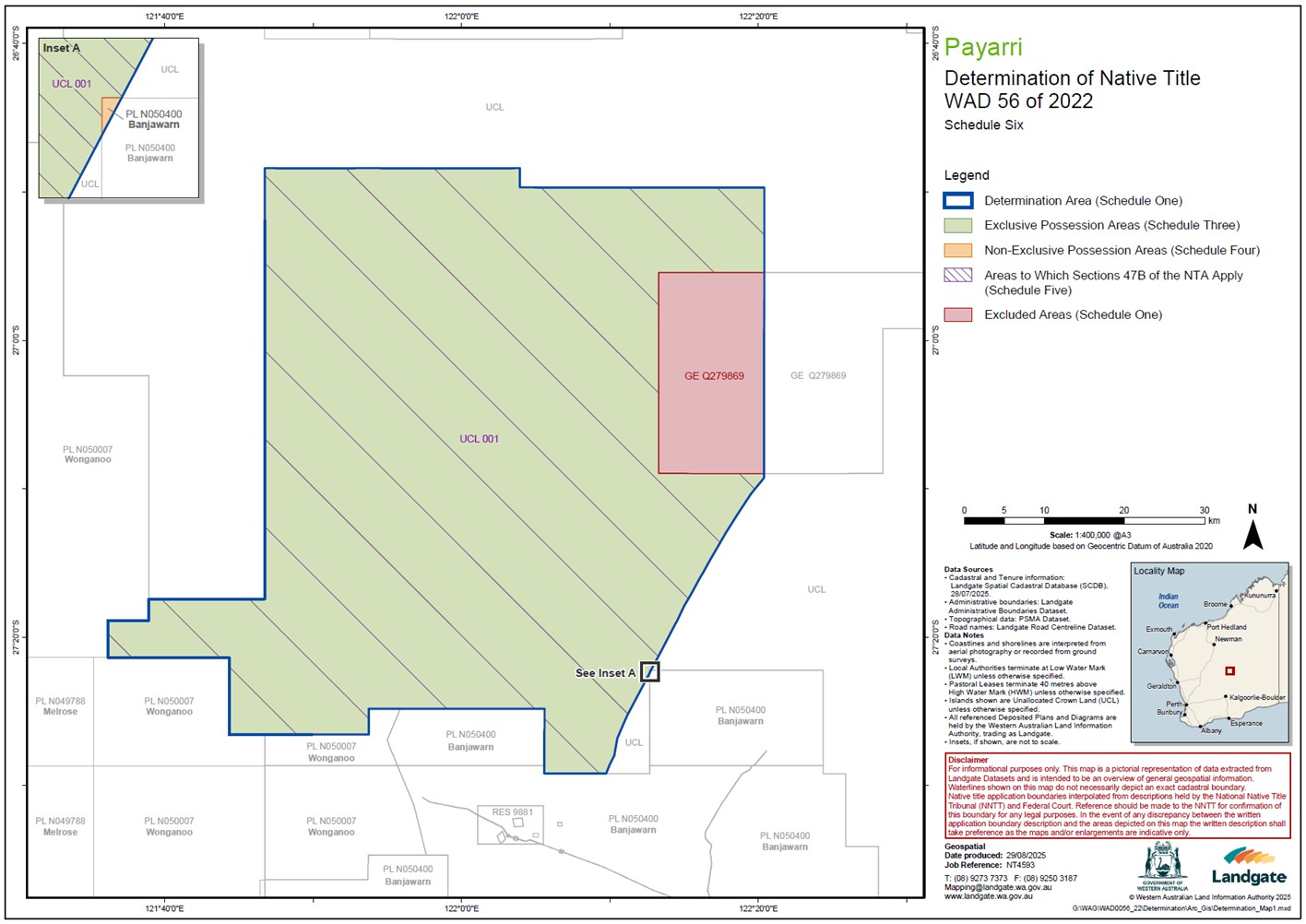
The external boundary of the Determination Area, generally shown as bordered in blue on the maps at Schedule 6, is as follows:
All those lands and waters commencing at the intersection of an eastern boundary of Pastoral Lease N050007 (Wonganoo) with a northern boundary of the Goldfields Representative Aboriginal and Torres Strait Islander Body (RATSIB) area boundary and extending easterly, northerly and generally easterly along the boundaries of that RATSIB to the intersection with a western boundary of Native Title Determination Application WAD597/2018 Tjalkadjara (WC2018/025) at approximate Longitude 122.339848 East; Then southerly and generally southwesterly along the boundaries of that native title determination application through the following coordinate points:
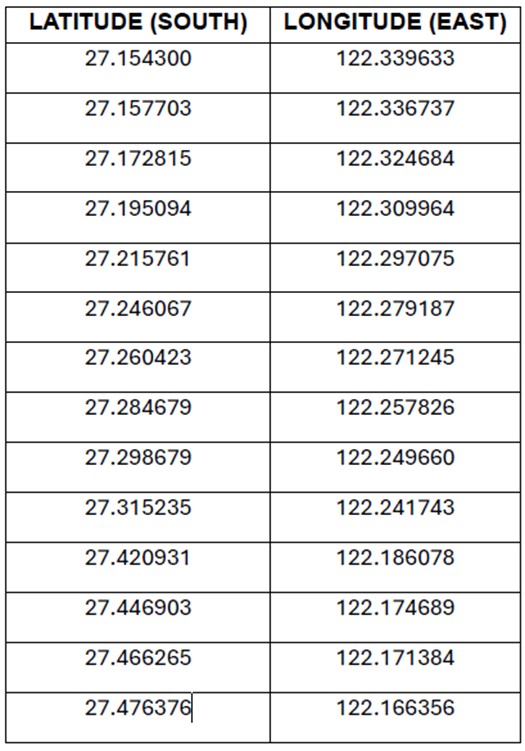
Then south-westerly to the intersection of a line joining Latitude 27.476376 South, Longitude 122.166356 East and Latitude 27.490654 South, Longitude 122.160773 East with a northern boundary of Pastoral Lease N050400 (Banjawarn); Then westerly, northerly and again westerly along the boundaries of that pastoral lease to the easternmost northeastern corner of Pastoral Lease N050007 (Wonganoo); Then generally westerly and generally northerly along the boundaries of that pastoral lease back to the commencement point.
Note: Geographic Coordinates provided in Decimal Degrees.
Cadastral boundaries sourced from Landgate’s Spatial Cadastral Database dated 28th July 2025.
All referenced Deposited Plans and Diagrams are held by the Western Australian Land Information Authority, trading as Landgate.
Representative Aboriginal/Torres Strait Island Body (RATSIB) areas sourced from National Native Title Tribunal as at 27 June 2024.
For the avoidance of doubt the application excludes any land and waters already claimed by:
Native Title Determination WAD225/2018 Kultju (WCD2019/012) as Determined in the Federal Court on the 30 October 2019.
Native Title Determination WAD139/2024 Wiluna #4 (WCD2025/005) as Determined in the Federal Court on the 30 July 2025.
Native Title Determination Application WAD297/2018 Waturta (WC2018/012) as accepted for registration on the 17 August 2018.
Native Title Determination Application WAD597/2018 Tjalkadjara (WC2018/025) as Filed in the Federal Court on the 17 December 2018.
Datum: Geocentric Datum of Australia 2020 (GDA2020)
Use of Coordinates:
Where coordinates are used within the description to represent cadastral or topographical boundaries or the intersection with such, they are intended as a guide only. As an outcome to the custodians of cadastral and topographic data continuously recalculating the geographic position of their data based on improved survey and data maintenance procedures, it is not possible to accurately define such a position other than by detailed ground survey.
Part 2 – Excluded Areas
Public Works
Any public works as defined in the TVA (including the land and waters on which a public work is constructed, established or situated as described in section 251D of the Act) and to which section 12J of the TVA or section 23C(2) of the Act applies.
Leases
Lease no. | Description |
General Lease Q279869 L | Grazing |
SCHEDULE 2
DESCRIPTION OF THE NATIVE TITLE HOLDERS
1. The persons referred to in order 2 of the Determination are those Aboriginal persons from time to time who, under Western Desert traditional laws and customs:
(a) have a connection to all or part of the Determination Area through:
(i) their own birth or conception;
(ii) holding religious, sacred or ritual authority;
(iii) acquisition of knowledge through a traditional long association via occupation or custodianship; or
(iv) through descent from a person who has had such a connection in part or all of the area; and
(b) are recognised by other native title holders as having native title rights and interests in the Determination Area.
2. As at the date of this Determination, the persons referred to in paragraph 1(a) include, but are not limited to, the following persons:
(a) the descendants of the siblings of Mindi Chapman, Lumi Chapman, Tommy Chapman, Roy Chapman, Coral Chapman, Mary Chapman and Elsie Chapman;
(b) the descendants of the siblings Kujikari/Mary Walker/MacArthur, Claudie Walker, Paddy Walker and the Pukungka/Dolly Walker/Muir;
(c) the descendants of the siblings Rangka Rangka, Nellie Yalanga, Kitty Yiningka and Putjipa;
(d) the descendants of Tatitjarra Banks, Paddy Longfella Banks and Sandy Banks;
(e) the descendants of Yungkutjurru/Kitty Jones;
(f) the descendants of Nukuwarra Paddy Bond and Nyultan Polly Mitchell;
(g) the descendants of Telpha Ashwin;
(h) the descendants of Jumbo Harris; and
(i) the descendants of Billy, Maryann and Mary.
SCHEDULE 3
WHERE NATIVE TITLE IS EXCLUSIVE POSSESSION
The parts of the Determination Area where native title comprises the rights and interests set out in order 3 is as follows, as shown generally shaded green on the maps in Schedule 6:
UCL 001 |
SCHEDULE 4
OTHER INTERESTS
As at the date of this Determination, the nature and extent of other interests in relation to the Determination Area are as follows.
Land tenure interests registered with Landgate are current as at 28 July 2025. Mining tenements and petroleum interests registered with the Department of Mines, Petroleum and Exploration are current as at 10 September 2025.
Pastoral leases
1. The rights and interests of the holders from time to time of the following pastoral lease:
Portion of Pastoral Lease N 050400 – Banjawarn Station |
Mining interests
2. The rights and interests of the holders from time to time of the following current mining interests under the Mining Act 1978 (WA):
Exploration Licences | |
1. | E 38/1939 |
2. | E 38/2009 |
3. | E 38/2912 |
4. | E 38/2916 |
5. | E 38/3153 |
6. | E 38/3160 |
7. | E 38/3193 |
8. | E38/3741 |
Other
3. Rights and interests, including licences and permissions, held under valid or validated grants from the Crown in right of the State or of the Commonwealth pursuant to statute or in the exercise of its executive power of a kind not otherwise referred to in this Schedule 4.
4. Valid or validated rights or interests of a kind not otherwise referred to in this Schedule 4 held by reason of the force and operation of the laws of the State or of the Commonwealth, including the force and operation of the Rights in Water and Irrigation Act 1914 (WA).
5. The right to access the Determination Area by:
(a) an employee or agent or instrumentality of the State;
(b) an employee or agent or instrumentality of the Commonwealth;
(c) an employee or agent or instrumentality of any local government authority,
as required in the performance of his or her statutory or common law duty, including for the purpose of pest management control and fire hazard management on areas of unallocated Crown land where such access would be permitted on land the subject of an estate in fee simple.
6. So far as confirmed pursuant to s 14 of the TVA as at the date of this Determination, any existing public access to and enjoyment of:
(a) waterways;
(b) beds and banks or foreshores of waterways; and
(c) areas that were public places at the end of 31 December 1993.
SCHEDULE 5
AREAS TO WHICH SECTIONS 47B APPLY
The parts of the Determination Area to which section 47B of the Act applies (shown generally on the maps in Schedule 6 as shaded green) is as follows:
UCL 001 |
SCHEDULE 6
MAPS OF THE DETERMINATION AREA
REASONS FOR JUDGMENT
MURPHY J
1 The applicants in this proceeding, Kado Rentan Eldred Allison Muir and others on behalf of the Payarri People, made a native title determination application (Payarri Application) pursuant to s 61 of the Native Title Act 1993 (Cth) (NTA or the Act), in relation to an area in the northern goldfields region of Western Australia (Payarri claim area or claim area).
2 The parties to the Payarri Application have reached agreement on the terms of an order of the Court in relation to the proceeding that involves making a determination of native title, pursuant to s 87(1) of the Act. For the reasons I now turn to explain, I am satisfied that it is within the power of the Court to make the orders sought, and that it is appropriate to do so.
THE PARTIES
3 The parties to the Payarri Application are:
(a) the applicants;
(b) the first respondent, the State of Western Australia (the State);
(c) Henry Ashwin, Colleen Berry, Dallas Harris, Geraldine Hogarth, Maria Meredith, Pearl Scott, Travis Tucker and Verna Voss (the Indigenous Respondents);
(d) Duketon Resources Pty Ltd; and
(e) Regis Resources Ltd.
THE MATERIAL RELIED ON
4 The parties relied upon the following documents in support of the application:
(a) the Statement of Agreed Facts between the applicants, the State, and the Indigenous Respondents dated 3 October 2025 (Agreed Facts);
(b) the joint written submissions of the applicants and the State dated 3 October 2025 (Joint Submissions);
(c) an affidavit of Malcolm O’Dell, the solicitor for the applicants and the Principal Lawyer of Central Desert Native Title Services Limited, affirmed on 3 October 2025, to which is annexed:
(i) a Further Amended Form 1 application for a native title determination that was authorised by the native title claim group in the Payarri Application on 17 September 2025, and leave granted to amend the Form 1 by orders made on 28 November 2025;
(ii) the nomination of the prescribed body corporate on behalf of the proposed common law holders of the determined native title signed by Letecia Miller on 17 September 2025;
(iii) the Certificate of Registration of Payarri Aboriginal Corporation;
(iv) the Corporation Extract of Payarri Aboriginal Corporation from the Office of the Registrar of Indigenous Corporations dated 30 September 2025; and
(v) the resolution of Payarri Aboriginal Corporation dated 25 September 2025 accepting its nomination as prescribed body corporate by the proposed common law holders of the determined native title pursuant to s 56(1) of the Act.
(d) the Minute of Proposed Orders and Determination of Native Title (Minute) dated 1 October 2025.
PROCEDURAL HISTORY
5 The Payarri Application was filed on 23 March 2022, with the named applicants comprising Kado Muir, Samantha Banks, Talbot Muir and Eric Thomas Jnr.
6 On 20 June 2022, the applicants sought leave to amend the claim to insert a new Schedule R and Attachment R (certification) and to amend Schedule S (details of the amendments). On 28 June 2022, Colvin J granted leave to amend the claim, and an amended application was filed consistent with the proposed amendments (Amended Application) on 29 June 2022. The Amended Application is the current form of the Payarri Application.
7 The Payarri Application was assessed against the provisions of ss 190B and 190C of the Act by a delegate of the Native Title Registrar. The delegate accepted the Payarri Application for registration pursuant to s 190A of the Act on 23 September 2022.
8 The Payarri Application was notified by the Native Title Registrar pursuant to s 66 of the Act. The notification period referred to in ss 66(8) and 66(10)(c) ended on 28 February 2023.
9 On 23 June 2025, at a meeting held in Leonora, the claim group as described in the Amended Application authorised an amendment to the claim group description to include Jumbo Harris, Billy, Maryann and Mary, and Telpha Ashwin and Putjipa as apical ancestors for the claim, and the replacement of apical ancestor Topsy Anderson with Yungkutjurru/Kitty Jones. The claim group’s decision was informed by the expert anthropological opinion of Dr Heather Lynes.
10 On 24 June 2025, at a meeting held in Leonora, the claim group as expanded pursuant to the resolutions passed the previous day authorised an amendment to the claim group description in the same terms (Authorised Amended Claim Group or Payarri Claim Group) and authorised the existing applicants to make the application. This meeting was attended by Colleen Berry, Dallas Harris, Maria Meredith, Geraldine Hogarth, Verna Vos and Pearl Scott of the Indigenous Respondents, and some of their family. It was agreed that until a consent determination was made, the Indigenous Respondents would remain as respondents to the claim.
11 On 17 September 2025, at a meeting held in Leonora, the Authorised Amended Claim Group authorised the Minute and an amended Form 1, which amended Schedule A (claim group description), Schedule E (description of native title rights and interests) to update the non-exclusive native title rights and interests claimed consistent with order 4 of the Minute, Schedule S (details of amendments), and other minor typographical and formatting changes that did not, except for the amendment of the claim group description, materially alter the substance of the application. The Authorised Amended Claim Group applied for leave to file the Further Amended Form 1 by interlocutory application on 27 November 2025. On 28 November 2025, Registrar Daniel made orders granting leave for that.
12 The amendment to the claim group description had the effect of recognising all the Indigenous Respondents and their descendants as members of the claim group, except Colleen Berry, and otherwise to reflect more accurately the known ancestors for the claim group (those changes being based on the research of Dr Heather Lynes). Colleen Berry was not included in the Authorised Amended Claim Group description because it is agreed that her claimed ancestor was not a native title holder for the claim area.
13 Schedule 2 to the Minute is a description of native title holders which is consistent with the Authorised Amended Claim Group described in Schedule A of the Further Amended Form 1. The parties agree that each of the proposed apical ancestors in Schedule 2 of the Minute is, properly, a native title holder for the claim area.
14 Following the amendments described above, the Payarri Application is made on behalf of the descendants of Western Desert people who settled at Mulga Queen (about 15km south of the southern boundary of the claim area) from the north-east of the claim area around the early twentieth century, and also the descendants of the original Aboriginal inhabitants of the claim area, the Pini people. The Pini people are represented in this proceeding by the Indigenous Respondents (with the exception of Colleen Berry).
THE CLAIMANTS, THEIR COUNTRY AND CONTINUITY OF CONNECTION
15 The Court’s task in dealing with a proposed consent determination under s 87 or s 87A of the Act is not to assess and make findings about the matters set out in s 223 of the Act. But a native title determination and the reasons which accompany it stands as a permanent record of the judicial recognition of native title rights and interests, and it is appropriate to set out some of the Agreed Facts relevant to the claimants, their country, and the continuity of their connection to country.
16 Another reason to set out the Agreed Facts is that here has been intra-Indigenous disputation as to who are the right people for the Payarri claim area. These reasons record the basis upon which that disputation was resolved, and the proposed consent determination became possible.
17 The following matters are directly drawn from the Agreed Facts and Joint Submissions.
The geography, environment and tenure of the claim area
18 The Payarri Application relates to an area located at the western extent of the Great Victoria Desert, in the northern goldfields region of Western Australia. The north-south length of the Payarri claim area is about 67km, and the west-east width of the claim area is about 55km.
19 The country is predominantly spinifex plains interspersed with rocky outcrops and sand hills. On the edges are mulga scrublands as one moves towards the pastoral country near the boundaries of the claim area. There are no major permanent water sources within the claim area, though there are several rock holes in the southern half of the area which are known to the Payarri Claim Group and were used regularly by their ancestors when travelling through this country.
20 The area is sparsely populated. The closest town to the claim area is Leinster, which is about 110km to the south-west of the nearest part of the claim. The next-closest town is Laverton, which is about 128km south-southeast of the nearest part of the claim. Wiluna is about 157km west-northwest of the nearest part of the claim, whereas Leonora is about 160km south-south-west of the nearest part of the claim. The Aboriginal community of Mulga Queen is about 15km south of the southern boundary of the Claim Area, and about 9km south-west of the nearest part of the claim.
21 The whole of the claim area is unallocated Crown land, except for a small area on the southeastern boundary of the Claim Area that is covered by the Banjawarn pastoral lease (PL N050400). Eight exploration licences granted under the Mining Act 1978 (WA) are located within the claim area, mostly on its eastern side.
22 Adjoining the claim area on its western side is an area of unallocated Crown land, and on its southern side pastoral leases (Banjawarn station (PL N050400) and Wonganoo station (PL N050007)). Other parts of the claim area border the following native title determinations or applications:
(a) on its northern side, the determination of native title filed by the Wiluna people in Morgan on behalf of the Wiluna #4 Native Title Claim Group v State of Western Australia [2025] FCA 859;
(b) on part of its western side, the determination of native title in favour of the Kultju People in Sceghi on behalf of the Kultju Native Title Claim Group v State of Western Australia [2019] FCA 1756; and
(c) on its eastern side:
(i) the application for determination of native title in favour of the Waturta People in Kalman Michael Murphy & Ors and State of Western Australia (WAD297/2018); and
(ii) the application for determination of native title filed by the Tjalkadjara People in Verna Vos & Ors and the State of Western Australia & Ors (WAD597/2018).
Each of these native title determinations and applications is, like the Payarri Claim, based in Western Desert- Aboriginal society.
The identity of the society that held rights and interests in the claim area at and after effective sovereignty
23 Effective sovereignty in the vicinity of the Payarri claim area was around 1895, beginning with the development of the Darlot goldfield.
24 At effective sovereignty and at all times since, the whole of the claim area was part of the Western Desert Cultural Bloc, being an area where the normative system of traditional laws and customs of the Western Desert applied (Western Desert normative system). By reason of that, the society under which rights and interests were held and could be held in the claim area at effective sovereignty was the Western Desert society, the members of which are ‘Western Desert people’.
25 The Western Desert normative system derives from and is intimately and inexorably connected with a mythology known as the Tjukurrpa, which is sometimes translated into English as the ‘Dreaming’, or simply the ‘Law’. The Tjukurrpa is the foundational belief and the ultimate social, moral and judicial law of Western Desert people, and underpins these people’s connection to their country.
26 In relation to country, the Tjukurrpa consists of stories of the travels of mythical beings across the landscape and the beings’ activities. These stories are called Tjukurrpa stories or Dreamings, and the paths of the beings’ travels are called Tjukurrpa tracks (or sometimes Dreaming tracks or songlines). Tjukurrpa and Tjukurrpa tracks are associated with significant and often sacred areas, places and sites which must be cared for in order to protect and maintain the cultural, heritage and spiritual integrity of the landscape.
27 Tjukurrpa stories are ‘held’ or ‘carried’ by senior law persons, being persons who are inducted in the story, its rituals and objects. Knowledge of Tjukurrpa is distributed through a regional community of law persons who often come together for ceremonies. However, non-law persons may sometimes know the basic facts of at least some aspects of the Tjukurrpa and associated stories.
28 The Tjukurrpa:
(a) provides a framework through which laws and customs can be sanctioned and deemed appropriate, and thus provides a set of normative rules for social practice; and
(b) determines the nature and extent of one’s rights and interests in land and waters via specific socio-territorial principles.
29 The Tjukurrpa-derived principles by which one gained rights and interests in land in the Claim Area at effective sovereignty are commonly referred to as ‘multiple pathways’. The multiple pathways by which one gained rights and interests in land in the claim area consisted primarily of:
(a) birth or spiritual conception in or close to the area;
(b) long association with the area. ‘Long association’ requires an individual to:
(i) be associated with an area of country over a period of time; and
(ii) look after and protect that country in accordance with the Tjukurrpa for that area
(c) having religious, ritual or ceremonial responsibility for the area. Rights obtained under this pathway are generally non-transferable to one’s children and other descendants; and
(d) biological or socially recognised descent from a person who is or was connected to the area via one of the above pathways referred to in (a) or (b) above.
30 Recognition of rights and interests in land under the multiple pathways is subject to a process of recognition and acceptance by others (i.e., social validation). The extent to which one may exercise certain native title rights and interests involves consideration of other factors such as the person’s knowledge of country and of Tjukurrpa, the degree to which they resided in or visited country, and the degree to which they cared for country.
31 By reason of the pathway by which one could gain rights and interests in country through long association with an area, it was possible at effective sovereignty for a Western Desert person to move from one area of habitual use and occupation in the Western Desert, to the claim area or nearby areas, and to acquire rights and interests in the claim area. Such movements were often, if not invariably, facilitated by the Tjukurrpa. For example, people moved for ceremonies (including men’s law ceremonies), because of a death of close family, to access resources, to trade, to visit extended kin, to find marriageable partners, and to look after country.
The rights-holders at and after effective sovereignty
32 Aboriginal people labelled ‘Pini’ by the anthropologist Norman Tindale occupied the claim area and its immediate vicinity at the time of effective sovereignty. These people were Western Desert people, being members of the Western Desert society who held native title rights and interests in the claim area by their acknowledgment and observance of the traditional laws and customs of the Western Desert normative system. Except for Colleen Berry, the Indigenous Respondents are descendants of the Pini people.
33 Although Pini people occupied the claim area at effective sovereignty, other non-Pini Western Desert persons from desert areas to the north-east of the Claim Area, being the persons named in Schedule A of the Further Amended Form 1 application and their ancestors, periodically travelled to the claim area at and before effective sovereignty and interacted with the Pini people in relation to men’s law business and other cultural matters.
34 Not all members of the Western Desert society held rights and interests in the claim area at effective sovereignty, whether communally or otherwise. At effective sovereignty, only those Western Desert persons who held rights and interests in the claim area pursuant to one or more of the multiple pathways held rights and interests. Those Western Desert persons who held rights and interests in the claim area at effective sovereignty were the Pini people (listed at paragraphs 2(g)-(i) of Schedule 2 of the Minute). They held the claimed rights in the claim area pursuant to the Western Desert normative system.
35 By the 1940s, most if not all of the remaining descendants of the Pini people that had been occupying the claim area at effective sovereignty had settled in nearby locations associated with European activities in the area. However, they maintained a connection to the claim area.
36 Those members of the Payarri Claim Group who are descendants of the Pini people gained native title rights and interests in the claim area under the traditional laws acknowledged and the traditional customs observed by Western Desert people by reason of their descent from the Pini people pursuant to the pathway described above, and by their acknowledgement and observance of those laws and customs. These rights and interests are mutually recognised by all the members of the Payarri Claim Group.
Rights-holders after effective sovereignty through migration and the ‘long association’ pathway
37 From around the 1920s onward, the other apical ancestors for the Payarri Application (listed at 2(a)-(f) of Schedule 2 of the Minute) began settling more permanently at the place now known as Mulga Queen, about 15km south of the southern boundary of the claim area, and in surrounding areas.
38 All of these ancestors and the descendants of those ancestors were and are Western Desert people, being members of the Western Desert society. These ancestors came to Mulga Queen from desert areas to the north-east including, in particular, the area around Mungkili claypan (about 325km to the north-east of Mulga Queen on the southern edge of the Birriliburu People (Part A) determination area), Tjirrkarli (in the Ngaanyatjarra Lands (Area A) determination area), and Tjintjirra (in the Pila Nature Reserve). All these places were and are within the Western Desert Cultural Bloc, being places where the Western Desert normative system applied (and continues to apply).
39 These ancestors travelled in small family groups and arrived at Mulga Queen at different times, mostly between the 1920s and the 1950s, though some came later. They reached Mulga Queen by following traditional tracks called Yiwarra, which linked chains of waterholes which were often associated with Tjukurrpa and came to Mulga Queen because it was an important place on a Yiwarra.
40 One of the rockholes on one of the Yiwarra was Payarri, which is in the claim area and gives the Payarri Application its name. Another of the Yiwarra was associated with the Seven Sisters Tjukurrpa, which passes through the claim area on a roughly east-west line and heads to Tjirrkarli Community to the east of the claim area.
41 The ancestors that migrated to Mulga Queen lived there and at nearby places and raised their families there over a period of years and decades, some until the present day. From around the 1920s onwards, these ancestors began sharing responsibility for the Tjukurrpa of the claim area with the Pini people remaining in the area. Increasingly, the Pini people acknowledged that these ancestors shared responsibility for the Tjukurrpa of the claim area and its immediate vicinity.
42 By reason of that and their own long association with the area, these ancestors learned about the Tjukurrpa and associated important sites for the claim area. These important sites included Payarri and Yultu, a rock hole within the claim area, close to the southern boundary.
43 By reason of those matters, these ancestors gained rights and interests in the claim area, being the claimed rights and interests, under the traditional laws acknowledged and the traditional customs observed by Western Desert people, pursuant to the ‘long association’ pathway previously described.
44 Contemporary members of the Payarri Claim Group that are descendants of these ancestors gained native title rights and interests in the claim area under the traditional laws acknowledged and the traditional customs observed by Western Desert people by reason of the biological or socially recognised descent pathway previously described, and by their acknowledgement and observance of those laws and customs. These rights and interests are mutually recognised by all the members of the Payarri Claim Group by reason of the long association of the descendants at Mulga Queen and nearby settlements, their ongoing visitation to the claim area, their knowledge of the Tjukurrpa and sites of the claim area, their role in caring for the country and Tjukurrpa of the claim area, and their continued acknowledgement of other laws and customs pertaining to the Tjukurrpa.
45 Further or alternatively, some or all of the descendants of these ancestors have acquired rights and interests in the claim area independently of their ancestors through their own long association at Mulga Queen and nearby places coupled with their own continued acknowledgement and observance of traditional laws and customs pertaining to the Tjukurrpa including, especially, observance of obligations to know and care for the country and the Tjukurrpa and important sites of the claim area, and to teach younger generations about these matters within the restrictions of the Western Desert normative system.
Continuity of society and of traditional laws and customs
46 The Western Desert society has continued to exist as a body united by its acknowledgment and observance of traditional laws and customs.
47 It is an agreed fact that at all times the apical ancestors identified in Schedule 2 of the Minute and their descendants have acknowledged and observed, and have continued to acknowledge and observe from generation to generation to the present day, the traditional laws and customs of the Western Desert normative system. In particular:
(a) some male members of the Payarri Claim Group and their ancestors have gone through men’s law, thereby becoming ‘wati’ or ‘men’ and gaining knowledge of the stories and sites of the Claim Area;
(b) Wati and other members of the Payarri Claim Group regularly visit and look after the country of the claim area and surrounding areas and, in particular, the sacred sites of these areas, including Payarri and Yultu;
(c) related to the fact in the preceding paragraph ([47(b)]), wati and other members of the Payarri Claim Group have knowledge of the sites and Tjukurrpa stories of the claim area, and they pass this knowledge on to younger members of the Payarri Claim Group, subject to cultural restrictions in respect of certain knowledge; and
(d) members of the Payarri Claim Group continue to acknowledge and observe traditional laws and customs pertaining to the section/‘skin’ system, traditional naming practices, funerary/death rites, and food preparation, as well as other Western Desert traditional laws and customs.
48 By reason of those matters, the Payarri Claim Group as a whole, including the Indigenous Respondents (apart from Colleen Berry), have continued to acknowledge and observe the Western Desert normative system in relation to the claim area including, without limitation, the religious/spiritual principles of the Tjukurrpa. Further, the Payarri Claim Group as a whole, including the Indigenous Respondents (apart from Colleen Berry), continue to acknowledge and observe the multiple pathways system for obtaining rights and interests in land.
49 By reason of those matters, the Western Desert normative system that existed at effective sovereignty has continued to be a living system amongst members of the Payarri Claim Group since effective sovereignty. The normative system that is currently acknowledged and observed by the Payarri Claim Group in relation to the Payarri claim area is substantially the same as the normative system that applied to the claim area at effective sovereignty
THE REQUIREMENTS UNDER SECTION 87 OF THE NTA
50 Section 87 of the NTA relevantly provides:
Application
(1) This section applies if, at any stage of proceedings after the end of the period specified in the notice given under section 66:
(a) agreement is reached on the terms of an order of the Federal Court in relation to:
(i) the proceedings; or
(ii) a part of the proceedings; or
(iii) a matter arising out of the proceedings; and
(aa) all of the following are parties to the agreement:
(i) the parties to the proceedings;
(ii) the Commonwealth Minister, if the Commonwealth Minister is intervening in the proceedings at the time the agreement is made; and
(b) the terms of the agreement, in writing signed by or on behalf of the parties to the proceedings and, if subparagraph (aa)(ii) applies, the Commonwealth Minister, are filed with the Court; and
(c) the Court is satisfied that an order in, or consistent with, those terms would be within the power of the Court.
When a registered native title claimant is taken to be a party to the agreement
(1AA) The requirements that a party to the proceedings that is a registered native title claimant be a party to the agreement and sign the terms of the agreement are satisfied if:
(a) a majority of the persons who comprise the registered native title claimant are parties to the agreement and sign the terms, unless paragraph (b) applies; or
(b) if conditions under section 251BA on the authority of the registered native title claimant provide for the persons who must become a party to the agreement and sign the terms--those persons are parties to the agreement and sign the terms.
…
Power of Court
(1A) The Court may, if it appears to the Court to be appropriate to do so, act in accordance with:
(a) whichever of subsection (2) or (3) is relevant in the particular case; and
(b) if subsection (5) applies in the particular case—that subsection.
Agreement as to order
(2) If the agreement is on the terms of an order of the Court in relation to the proceedings, the Court may make an order in, or consistent with, those terms without holding a hearing or, if a hearing has started, without completing the hearing.
Note: If the application involves making a determination of native title, the Court’s order would need to comply with section 94A (which deals with the requirements of native title determination orders).
…
51 The Court may make orders in or consistent with the terms of proposed orders in an agreement under s 87 of the Act, provided the preconditions in the section are met. Those requirements are that:
(a) the notification period specified in s 66 of the Act has expired (s 87(1));
(b) agreement between all of the parties to the proceeding has been reached on a proposed determination of native title (s 87(1)(a) and (aa)), and the terms of the proposed agreement have been reduced to writing and signed by or on behalf of the parties, and a copy filed with the Court (s 87(1)(b));
(c) the Court has taken into account any objection made by the other parties to any agreed statement of facts filed by the parties (ss 87(9) and (11));
(d) the Court is satisfied that an order in or consistent with the terms of the agreement would be within the power of the Court (s 87(1)(c)); and
(e) it appears appropriate to the Court to make the proposed order (s 87(1A)).
Then, if the agreement is on the terms of an order of the Court, the Court may make an order in, or consistent with, those terms without holding a hearing or, if a hearing has started, without completing the hearing (s 87(2)).
52 Here the first three requirements above are satisfied. The Agreed Facts and Joint Submissions show that:
(a) the Payarri Application was notified by the Native Title Registrar pursuant to s 66 of the Act. The notification period referred to in ss 66(8) and 66(10)(c) ended on 28 February 2023;
(b) all parties to the proceeding have entered into an agreement on a proposed determination of native title, and the terms of the proposed determination have been reduced to writing and signed by or on behalf of the parties, and a copy filed with the Court, as recorded in the Minute. The Commonwealth has not sought to intervene in the proceeding and therefore is not a necessary party to the agreement; and
(c) there has been no objection to the Agreed Facts.
53 As noted above, the two remaining preconditions to making the proposed consent determination are that:
(a) the Court be satisfied that an order consistent with the terms of the s 87 agreement would be within power (s 87(1)(c)); and
(b) that it is appropriate to make the proposed determination (s 87(1A)).
Those preconditions are closely related.
Are the orders within the Court’s power?
54 The requirement that a native title consent determination order be “within the power of the Court” within the meaning of s 87(1)(c) of the Act requires that the following matters be shown.
(1) The application for a native title determination has been validly made, having been properly authorised by the native title claim group (s 251B).
(2) The claim group has authorised the matters contained in the agreement on a proposed determination of native title and instructed the applicants to sign and file that agreement.
(3) There is not a previously approved determination of native title over the proposed determination area (s 68 of the Act).
(4) The proposed orders for a determination of native title set out details of the matters required in s 225 of the Act (s 94A).
(5) The rights and interests under the proposed determination are capable of recognition by the common law of Australia (s 223(1)(c)).
55 Having regard to the Agreed Facts, the Joint Submissions, the affidavit of Mr O’Dell and the Minute, I am satisfied as to each of the above matters and therefore satisfied that the Court has power under s 87 to make the proposed determination.
(1) The Payarri Application is validly made, having been authorised by the Payarri Claim Group according to a decision-making process that, under the traditional laws and customs of the Payarri Claim Group, authorised the applicants to make the native title determination application.
(2) The Payarri Claim Group (meaning the Authorised Amended Claim Group) have authorised the matters contained in the Minute and instructed the applicants to sign and file the Minute.
(3) There is not a previously approved determination of native title over the Payarri claim area.
(4) The proposed determination complies with the requirements of s 94A of the Act by sufficiently setting out the matters required by s 225. That is, it sufficiently identifies or describes:
(i) who are the group of persons holding the common or group rights comprising the native title (s 225(a));
(ii) the nature and extent of the native title rights and interests in relation to the proposed determination area (s 225(b));
(iii) the nature and extent of any other interests in relation to the proposed determination area (s 225(c));
(iv) the relationship between the native title rights and interests, and the other interests identified (s 225(d)); and
(v) whether or where the native title rights and interests confer possession, occupation, use and enjoyment of that land or waters on the native title holders to the exclusion of all others (s 225(e)).
(5) The native title rights and interests that are proposed to be declared properly reflect the characteristics of native title rights and interests set out in s 223 of the Act and the terms confer native title rights and interests recognisable by the common law of Australia. Those requirements were summarised by North J in Lovett on behalf of the Gunditjmara People v State of Victoria (No 5) [2011] FCA 932 at [22] as follows:
In summary those requirements are that there was, at sovereignty, a body of persons united in their acknowledgment and observance of a body of laws and customs, who held rights and interests in land and waters pursuant to those laws and customs, and by which they were connected to the land and waters. The group must have maintained its identity and its connection with the land and waters, and must continue to acknowledge the laws and observe the customs substantially uninterrupted, from sovereignty to the present.
Whether it is appropriate to make the proposed orders
56 Under ss 87(1A) and (2) the Court may make an order in accordance with the agreement of the parties if the Court considers it appropriate to do so. That is a broad discretion which must be exercised having regard to the nature and purpose of the power conferred in the context of the NTA. The cases have canvassed many considerations relevant to the appropriateness of the exercise of the power to make a native title determination. I summarised the relevant authorities in Austin on behalf of the Eastern Maar People v State of Victoria [2023] FCA 237 at [33]-[37]. That decision concerned s 87A of the Act but the principles are the same. and I need not set them out again.
57 It is, though, worth noting that the power conferred is to make an order in, or consistent with, the terms agreed between the parties without holding a hearing. Parliament intended that negotiation and agreement would play an important role in settling native title determination applications: Explanatory Memorandum, Native Title Amendment Bill 1997 (Cth) at [26.23]. The preamble to the NTA states that “if possible” resolution of native title determination applications is to be done by conciliation because of the “unique character” of such claims. An important object and purpose of the NTA is that resolution of issues and disputes concerning native title be resolved by mediation and agreement, rather than by Court determination: Munn for and on behalf of the Gunggari People v Queensland [2001] FCA 1229; 115 FCR 109 at [28] per Emmett J; Lovett on behalf of the Gunditjmara People v State of Victoria [2007] FCA 474 at [36] per North J.
58 The consent determination mechanism is not intended to operate by way of substitution for a trial. The duty of the State is to satisfied that there is a “credible”, “cogent” or “rational” basis to conclude that the requirements of s 223 of the Act are satisfied, whether or not that basis would constitute admissible evidence in contested litigation or would enable the Court to make findings about s 223 in favour of an applicant on the balance of probabilities: Western Bundjalung People v Attorney-General (NSW) [2017] FCA 992 at [21] (Jagot J) citing Lovett.
59 As O’Bryan J recently noted in Oobagooma on behalf of the Big Springs Claim Group v State of Western Australia [2025] FCA 592; 309 FCR 515 at [18]-[20], it is important to recognise that the requirement for a State respondent to have a “credible’ or “rational” basis for agreeing to a native title determination, does not require the parties to adduce evidence with respect to the State’s assessment of the applicant’s claim to native title rights and interests. As his Honour said (at [20]):
…in exercising power under s 87, the Court’s principal focus is upon the agreement of the parties. In that context, it is relevant to consider whether the State, as the representative of the interests of the community generally, has had independent and competent legal representation and is acting in good faith and rationally. That does not require the Court to embark on its own assessment of the evidentiary basis for the State’s agreement, as such a requirement would undermine the purpose of the power conferred: see [Agius v State of South Australia (No 6) [2018] FCA 358 at [69] (Mortimer J (as her Honour then was))].
60 In the present case the Joint Submissions provide that in assessing whether the Payarri Claim Group have and had the requisite connection to the Payarri claim area the State considered materials including anthropologists’ reports and witness affidavits by members of the Payarri Claim Group (connection material). It having done so, the State agreed to the Minute on the basis that the connection material established that the Payarri claimants have a connection to the claim area by the traditional laws acknowledged and traditional customs observed, giving rise to their native title rights and interests. The State also agreed that the connection material provided sufficient evidence of occupation to support the application of s 47B of the Act to that part of the claim area that was, as at 23 March 2022, unallocated Crown land.
61 The partied did not take the Court to that connection material, and the Act does not require the parties to do so. Section 87 does not require the Court to receive evidence and make findings, embark on its own inquiry on the merits of the application, or form a concluded view as to whether the legal requirements for proving native title have been met. The Court may make orders under s 87 when satisfied the parties have freely and on an informed basis come to an agreement: see Ward v State of Western Australia [2006] FCA 1848 at [6]-[9] (North J).
62 I am satisfied that the State has had independent and competent legal representation and is acting in good faith and rationally in consenting to the proposed determination. It is appropriate to make the proposed determination.
Proposed body corporate
63 Pursuant to s 55 of the Act, when making a determination that native title exists, the Court must make such determination as is required by ss 56 and 57 regarding a prescribed body corporate at the same time as, or as soon as practicable after, including:
(a) specifying whether the native title is to be held in trust and, if so, by whom;
(b) if the native title is to be held in trust by a body corporate, that a representative of the native title holders has given the Court a written nomination of a prescribed body corporate together with the written consent of the body corporate to be the trustee; and
(c) if the native title is not to be held in trust, that a representative of the native title holders has given the Court a written nomination of a prescribed body corporate together with the written consent of the body corporate to be a non-trustee prescribed body corporate.
64 The Agreed Facts, the Joint Submissions, the affidavit of Mr O’Dell and the Minute show that the requirements of ss 55 and 56 of the Act have been met. They show that:
(a) the Payarri Claim Group who will be the common law native title holders, intend to have their native title held on trust;
(b) Payarri Aboriginal Corporation (ICN:1174) has been nominated to be the prescribed body corporate to hold the determined native title in trust for the Payarri native title holders pursuant to s 56(2)(a)(i) of the Act; and
(c) Payarri Aboriginal Corporation has consented in writing to be the prescribed body corporate to hold in trust the determined native title held by the Payarri native title holders pursuant to s 56(2)(a)(ii) of Act.
65 I have made orders in the terms sought by the parties.
I certify that the preceding sixty-five (65) numbered paragraphs are a true copy of the Reasons for Judgment of the Honourable Justice Murphy. . |
Associate:
Dated: 4 December 2025
SCHEDULE OF PARTIES
| WAD 56 of 2022 |
Applicants | |
Applicant | SAMANTHA BANKS |
Applicant | TALBOT MUIR |
Applicant | ERIC (JNR) THOMAS |
Respondents | |
Second Respondent: | HENRY ASHWIN |
Third Respondent: | COLLEEN JANE BERRY |
Fourth Respondent: | DALLAS HARRIS |
Fifth Respondent: | GERALDINE HOGARTH |
Sixth Respondent: | MARIA MEREDITH |
Seventh Respondent: | PEARL SCOTT |
Eighth Respondent: | TRAVIS TUCKER |
Ninth Respondent: | VERNA VOS |
Tenth Respondent: | DUKETON RESOURCES PTY LTD |
Eleventh Respondent: | REGIS RESOURCES LIMITED |


