

Federal Court of Australia
Sunflower Care Services Pty Ltd v Commissioner of the NDIS Quality and Safeguards Commission (No 2) [2025] FCA 1442
File number: | WAD 123 of 2024 |
Judgment of: | FEUTRILL J |
Date of judgment: | 21 November 2025 |
Catchwords: | ADMINISTRATIVE LAW – judicial review – banning order – decision to make banning order under s 73ZN(2) of National Disability Insurance Scheme Act 2013 (Cth) – internal review decision to vary original banning order decision under s 100(6) of NDIS Act – legal operability of original banning order decision – utility in determining grounds of review of original banning order decision ADMINISTRATIVE LAW – judicial review – banning order – formal requirements of banning order under s 73ZN(2) of NDIS Act – prohibition or restriction reasonably capable of obedience – power to prohibit or restrict ‘indirect’ involvement in the provision of NDIS supports or services ADMINISTRATIVE LAW – judicial review – banning order – validity of delegation of authority to original decision-maker – authority of reviewer to make decision on review – legal reasonableness of internal review decision – standard of legal reasonableness for exercise of discretion to make banning order – intelligible justification of internal review decision – limit of reviewer’s decisional freedom – retrospective operation of banning order – power to vary rather than set-aside on review – procedural fairness on internal review decision PRACTICE AND PROCEDURE – judicial review – decisions to issue notices of potential decisions to revoke registration and make banning orders and (or) suspend registration of registered NDIS provider under s 73P, s 73ZN(1) and s 73N of NDIS – respondent undertakings not to make decisions based on notices – acceptance of undertaking – undertakings equivalent to final injunctive relief – applicant opposed to acceptance of undertakings – leave to amend to expand grounds and claimed relief – undertakings dispositive of claimed final relief – utility in determining substantive grounds of review PRACTICE AND PROCEDURE – re-opening after final hearing – leave to amend originating process after final hearing – facts unknown at time of final hearing – new claims arising after final hearing – new claims for relief under s 5 of the Administrative Decisions (Judicial Review) Act 1977 (Cth) – new claims for relief under s 39B of the Judiciary Act 1903 (Cth) – interests of justice – explanation for delay – finality – prejudice – alternative unpursued right of review – overarching purpose of civil practice and procedure provisions |
Legislation: | Australian Constitution s 75(v) Acts Interpretation Act 1901 (Cth) ss 15AA, 15AB, 33, 34AA, 34AB Administrative Appeals Tribunal Act 1975 (Cth) ss 29, 43, 44 Administrative Decisions (Judicial Review) Act 1977 (Cth) ss 5, 10, 11, 15, 16 Administrative Review Tribunal Act 2024 (Cth) s 172 Administrative Review Tribunal (Consequential and Transitional Provisions No 1) Act 2024 (Cth) Sch 16, s 20 Corporations Act 2001 (Cth) Pt 2D.6 Crimes Act 1914 (Cth) s 4AA Criminal Code Act Compilation Act 1913 (WA) Federal Court of Australia Act 1976 (Cth) ss 21-23, 37M, 37N Freedom of Information Act 1982 (Cth) Judiciary Act 1903 (Cth) s 39B Migration Act 1958 (Cth) Pt 7A; ss 303, 473CC National Disability Insurance Scheme Act 2013 (Cth) Chs 1, 2, 3, 4, 5, 6, 6A; Pts 1, 1A, 2, 3A, 4, 5; Divs 2, 3, 8; ss 3, 9, 11A, 13, 14, 33, 34, 42, 45, 46, 73, 73B, 73C, 73E, 73F-73H, 73J, 73K-73N, 73P, 73T, 73U, 73V, 73ZE,73ZJ, 73ZK, 73ZL, 73ZK, 73ZM, 73ZN, 73ZO, 73ZP, 73ZQ 73ZR, 73ZS, 99, 100, 101, 103, 121, 125, 147, 181D, 181E, 181F, 181K, 181L 181T, 201, 202A, 202B, 209 National Disability Insurance Scheme Amendment (Quality and Safeguards Commission and Other Measures) Act 2017 (Cth) National Disability Insurance Scheme (Improving Supports for At Risk Participants) Act 2021 (Cth) National Disability Insurance Scheme (Strengthening Banning Orders) Act 2020 (Cth) Regulatory Powers (Standard Provisions) Act 2014 (Cth) Pts 2-7 Federal Court Rules 2011 (Cth) rr 1.32. 1.40, 8.01, 8.21, 22.07, 31.02 National Disability Insurance Scheme (Code of Conduct) Rules 2018 (Cth) s 6 National Disability Insurance Scheme (Provider Registration and Practice Standards) Rules 2018 (Cth) ss 6, 7, 10, 20 National Disability Insurance Scheme (Practice Standards – Worker Screening) Rules 2018 (Cth) ss 5, 6, 7, 13 National Disability Insurance Scheme (Worker Screening) Act 2020 (WA) ss 3, 4, 5, 10, 11, 12, 15, 17, 20, 68, |
Cases cited: | Ainsworth v Criminal Justice Commission [1992] HCA 10; 175 CLR 564 Amcor Ltd (formerly known as APM Ltd) v Comptroller-General of Customs [1987] FCA 354 Amcor Ltd v Comptroller-General of Customs [1988] FCA 175; 79 ALR 221 Associated Provincial Picture Houses Ltd v Wednesbury Corp (Wednesbury case) [1948] 1 KB 223 Australian Broadcasting Tribunal v Bond [1990] HCA 33; 170 CLR 321 Australian Competition and Consumer Commission v Auspine Ltd [2006] FCA 1215; 235 ALR 95 Australian Competition and Consumer Commission v Real Estate Institute of Western Australia Inc [1999] FCA 18; 161 ALR 79 Bechara v Bates [2021] FCAFC 34; 286 FCR 166 Bragg v Secretary, Department of Employment, Education and Training [1995] FCA 372; 59 FCR 31 Builders Licensing Board v Kelly (1985) 2 NSWLR 300 CIC Insurance Ltd v Bankstown Football Club Ltd [1997] HCA 2; 187 CLR 384 Collector of Customs (NSW) v Brian Lawlor Automotive Pty Ltd [1979] FCA 37; 41 FLR 338 Comptroller-General of Customs v Kawasaki Motors Pty Ltd (No 1) [1991] FCA 652; 32 FCR 219 Corinthian Industries (Syd) Pty Ltd v Comptroller-General of Customs [1989] FCA 125; 86 ALR 387 DBB16 v Minister for Immigration and Border Protection [2018] FCAFC 178; 260 FCR 447 Federal Commissioner of Taxation v Consolidated Media Holdings Ltd [2012] HCA 55; 250 CLR 503 FF Seeley Nominees Pty Ltd v El Ar Initiations (UK) Ltd (No 2) (1990) 55 SASR 314 Giannarelli v Wraith [1988] HCA 52; 165 CLR 543 Groeneveld Australia Pty Ltd v Nolten (No 4) [2011] VSC 512 House v The King [1936] HCA 40; 55 CLR 499 Hughes & Vale Pty Ltd v New South Wales (No 2) [1955] HCA 28; 93 CLR 127 ICI Australia Operations Pty Ltd v Trade Practices Commission [1992] FCA 708; 38 FCR 248 Introvigne v The Commonwealth [1980] FCA 107; 32 ALR 251 Jadwan Pty Ltd v Department of Health & Aged Care [2003] FCAFC 288; 145 FCR 1 Jebb v Repatriation Commission (1988) 80 ALR 329 Kovalev v Minister for Immigration and Multicultural Affairs [1999] FCA 557; 100 FCR 323 Leung v Minister for Immigration and Multicultural Affairs [1997] FCA 1313; 79 FCR 400 Makhoul v Barnes [1995] FCA 953; 60 FCR 572 Maloney v Commissioner for Railways (NSW) (1978) 18 ALR 147 Masterson v Commissioner of Police [2018] NSWSC 892 Matson v Attorney-General (Cth) [2021] FCA 161 McGowan v Migration Agents Registration Authority [2003] FCA 482; 129 FCR 118 Midland Bank Trust Co Ltd v Green (No 2) [1979] 1 WLR 460 Minister for Aboriginal Affairs v Peko-Wallsend Ltd [1986] HCA 40; 162 CLR 24 Minister for Home Affairs v CSH18 [2019] FCAFC 80; 269 FCR 206 Minister for Immigration and Border Protection v Singh [2014] FCAFC 1; 231 FCR 437 Minister for Immigration and Border Protection v Stretton [2016] FCAFC 11; 237 FCR 1 Minister for Immigration and Citizenship v Li [2013] HCA 18; 249 CLR 332 Minister for Immigration and Multicultural Affairs v Bhardwaj [2002] HCA 11; 209 CLR 597 Muc v Commissioner of Taxation [2008] FCA 668 Mulligan v National Disability Insurance Agency [2015] FCA 544; 233 FCR 201 National Australia Bank Ltd v Nobile [1988] FCA 107; 100 ALR 227 Ousley v The Queen [1997] HCA 49; 192 CLR 69 Plaintiff M174/2016 v Minister for Immigration and Border Protection [2018] HCA 16; 264 CLR 217 Pollnow v Armstrong [2000] NSWCA 245 Port of Melbourne Authority v Anshun Pty Ltd [1981] HCA 45; 147 CLR 589 Post Office Agents Association Ltd v Australian Postal Commission [1988] FCA 434; 84 ALR 563 Project Blue Sky Inc v Australian Broadcasting Authority [1998] HCA 28; 194 CLR 355 Reynolds v JP Morgan Administrative Services Australia Limited (No 2) [2011] FCA 489; 193 FCR 507 Shi v Migration Agents Registration Authority [2008] HCA 31; 235 CLR 286 Singh v Atombrook Ltd [1989] 1 WLR 810 Smethurst v Commissioner of Police (Cth) [2020] HCA 14; 272 CLR 177 Sunflower Care Services Pty Ltd v Commissioner of the NDIS Quality and Safeguards Commission [2024] FCA 589 Teh Cheng Poh (alias Char Meh) v Public Prosecutor, Malaysia [1980] AC 458 Tervonen v Finland [2009] FCAFC 3 Thomson Australian Holdings Pty Ltd v Trade Practices Commission [1981] HCA 48; 148 CLR 150 Tomlinson v Ramsey Food Processing Pty Ltd [2015] HCA 28; 256 CLR 507 Universal Magazines Pty Ltd v Comptroller-General of Customs [1990] FCA 337; 21 ALD 502 Wentworth v NSW Bar Association [1992] HCA 24; 176 CLR 239 Wingfoot Australia Partners Pty Ltd v Kocak [2013] HCA 43; 252 CLR 480 |
Division: | General Division |
Registry: | Western Australia |
National Practice Area: | Administrative and Constitutional Law and Human Rights |
Number of paragraphs: | 234 |
Dates of hearing: | 27 June 2024 and 16 September 2024 |
Counsel for the Applicants: | Mr M Crowley |
Solicitor for the Applicants: | Robertson Hayles Lawyers |
Counsel for the Respondent: | Mr P Hanks KC (7 March 2025) with Ms J Moore |
Solicitor for the Respondent: | HWL Ebsworth Lawyers |
ORDERS
WAD 123 of 2024 | ||
| ||
BETWEEN: | SUNFLOWER CARE SERVICES PTY LTD ACN 604 068 706 First Applicant KATHERINE KARUNARATHNA Second Applicant | |
AND: | COMMISSIONER OF THE NDIS QUALITY AND SAFEGUARDS COMMISSION Respondent | |
order made by: | FEUTRILL J |
DATE OF ORDER: | 21 November 2025 |
THE COURT ORDERS THAT:
Interlocutory application to further amend the originating application
1. Except as to the leave to further amend the originating application granted on 27 June 2024, the applicants’ interlocutory application filed 24 June 2024 be dismissed and the need to file and serve the further amended originating application in terms consistent with the leave granted on 27 June 2024 be dispensed with.
2. The costs of the applicants’ interlocutory application filed 24 June 2024 be reserved.
Interlocutory application to re-open and further amend the originating application
3. The applicants have leave to re-open the final hearing to apply for leave to further amend the originating application in terms of the document entitled ‘Fifth Combined originating application for judicial review – Administrative Decisions (Judicial Review) Act 1977 (Cth) and s 39B Judiciary Act 1903 (Cth)’ (fifth proposed amended originating application).
4. The applicants have leave to further-further amend the originating application in terms of paragraphs B.2.3AAA, B.2.3AAB and B.2.3AAC (limited to particulars 3AAC.1, 3AAC.4, 3AAC.8, 3AAC.9 and 3AAC.10) and paragraphs C.2.5AAA – C.2.5AAF (all limited to relief under s 39B of the Judiciary Act 1903 (Cth)) of the fifth proposed amended originating application.
5. Except as to the leave granted in paragraphs 3 and 4 of these orders, the applicants’ interlocutory application filed 20 November 2024 be dismissed and the need to file and serve the second further amended originating application in terms consistent with the leave granted be dispensed with.
6. The costs of the applicants’ interlocutory application filed 20 November 2024 be reserved.
Originating application as further-further amended
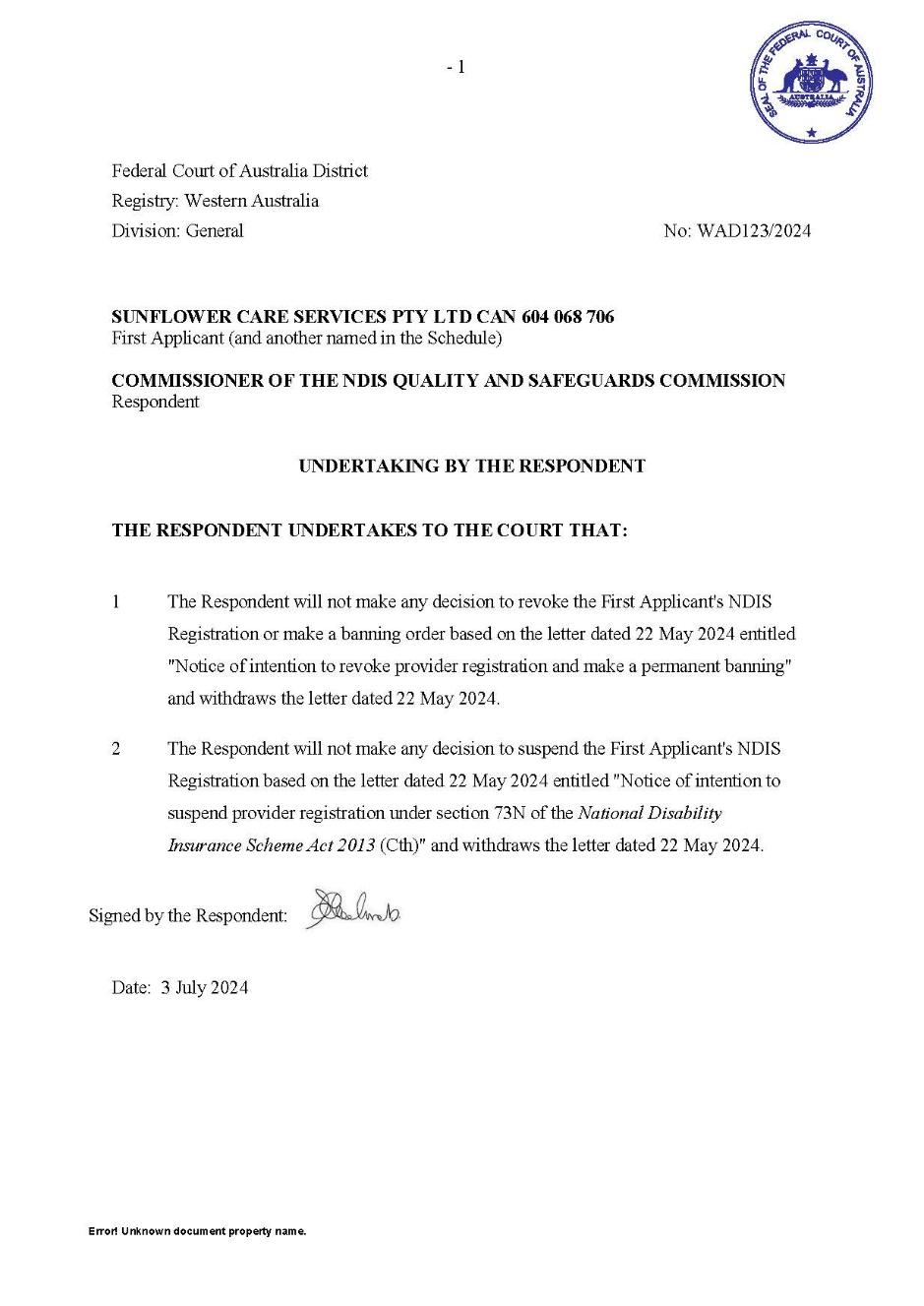
7. Upon the respondent’s written undertaking to the Court in the Schedule to these orders, there be no order for further or other relief on the grounds set out in paragraphs A.2.1, A.2.2, A.2.3 and A.2.4 of the originating application.
8. A writ of certiorari be issued to quash the written notice dated 3 May 2024 and signed by an Assistant Commissioner, Practice Quality and Clinical Advisory Division, NDIS Quality Safeguards Commission, as a purported banning order made under s 73ZN(2) of the National Disability Insurance Scheme Act 2013 (Cth).
9. A writ of certiorari be issued to quash the written notice dated 5 August 2025 and signed by an Assistant Commissioner, Regulatory Campaigns and Projects, NDIS Quality and Safeguards Commission (review decision-maker) as a purported banning order made under s 73ZN(2) of the National Disability Insurance Scheme Act 2013 (Cth).
10. A writ of certiorari be issued to quash the decision of the review decision-maker to make the purported banning order referred to in paragraph 9 of these orders.
11. The costs of the proceeding be reserved.
Other matters
12. By 4.30pm (AWST) on 5 December 2025:
(a) the applicants file a minute of proposed consent orders, alternatively the parties file competing minutes of proposed orders, regarding the costs reserved in paragraphs 2, 6 and 11 of these orders and the costs reserved in paragraph 2 of the orders of 27 June 2024, in paragraph 4 of the orders of 16 September 2024 and in any other order in the proceeding; and
(b) the parties file and serve an outline of submissions (limited to 5 pages) together with any affidavit(s) in support of the proposed orders for costs.
13. Subject to further order or direction, the costs in the proceeding, including all costs reserved in any order, be determined without a further oral hearing.
Schedule
Note: Entry of orders is dealt with in Rule 39.32 of the Federal Court Rules 2011.
REASONS FOR JUDGMENT
FEUTRILL J:
INTRODUCTION
1 Sunflower Care Services Pty Ltd was a registered NDIS provider. Its solvency depended entirely upon the continuing receipt of funding under the National Disability Insurance Scheme from the provision of specialist accommodation and other supports or services to six participants in the NDIS who have quite severe disability. Mr and Mrs Karunarathna incorporated Sunflower and Mrs Karunarathna is its sole member. Specialist accommodation was provided from four premises owned by Mr and Mrs Karunarathna. Mrs Karunarathna is a registered nurse with about 40 years’ experience in the provision of care, in particular, to people with disability. She was a director of Sunflower until the Commissioner of the NDIS Quality and Safeguards Commission made a banning order against her under s 73ZN(2) of the National Disability Insurance Scheme Act 2013 (Cth) by which she was permanently prohibited from involvement in the provision of supports or services to people with disability. The Commissioner also made a banning order against Mr Karunarathna preventing him from involvement in Sunflower’s NDIS work. Additionally, the Commissioner took steps preparatory to exercising powers to suspend or revoke Sunflower’s registration and make a banning order against it as well. If these powers had been exercised, Sunflower would have become insolvent and would have been unable to continue providing supports or services to people with disability or pay its employees and others directly engaged in the provision of those supports or services.
2 The applicants (Sunflower and Mrs Karunarathna) challenge the decisions of the respondent (Commissioner) to take the steps preparatory to exercising her powers against Sunflower and the decision to make a banning order against Mrs Karunarathna on the basis that these decisions were not authorised under the applicable provisions of the NDIS Act.
3 The applicants applied for and were granted urgent interlocutory injunctive relief and an interlocutory order suspending operation of the banning order on 5 June 2024: Sunflower Care Services Pty Ltd v Commissioner of the NDIS Quality and Safeguards Commission [2024] FCA 589. Due to the apparent urgency of the proceeding a final hearing was held on 27 June 2024 and judgment reserved. In connection with the final hearing the Commissioner provided undertakings, in effect, not to act on the preparatory steps regarding Sunflower. In the meantime, Mrs Karunarathna applied for an internal review of the original decision to make a banning order by the Commissioner under s 100 of the NDIS Act. On 5 August 2024 a decision was made on that internal review to vary the original banning order and issue a (new) varied banning order against Mrs Karunarathna. The internal review decision resulted in applications to re-open the final hearing and to amend the originating application.
4 The issues for determination on the various applications are as follows.
(1) Are the Commissioner’s undertakings dispositive of Sunflower’s application for judicial review such that final relief and leave to further amend the originating application with respect to Sunflower should be refused?
(2) Subject to the resolution of issue (1), were the ‘notices’ in letters sent to Sunflower regarding ss 73N (suspension of registration), 73P (revocation of registration) and 73ZN (banning orders) and decisions to issue the notices unauthorised on one or more of the grounds raised in the originating application.
(3) Is Mrs Karunarathna’s application for judicial review futile because the Commissioner made a decision on internal review to vary the original banning order and the original decision and original banning order are no longer legally operative?
(4) Should the Court grant the applicants leave to re-open the final hearing and further amend the grounds of judicial review to add additional grounds including grounds for review of the decision to vary the original banning order?
Subject to the resolution of issues (3) and (4):
(5) Should each of the original banning order and banning order, as varied, be set aside on the ground that the written notice does not conform with the formal requirements of a banning order described in s 73ZN(2)?
(6) Should the original banning order decision be set aside because it was unauthorised on one or more of the grounds set out in the originating application?
(7) Should the review banning order decision be set aside on the ground that the decision was legally unreasonable because it lacked intelligible justification as to the scope and duration of the banning order, as varied?
(8) Should the original banning order decision and review banning order decision be set aside on the ground that the Commissioner had not delegated power to make a banning order to the original decision-maker?
(9) Should the review banning order decision be set aside on the ground that a banning order cannot be made retrospectively and the review banning order decision purports to operate retrospectively?
(10) Should the review banning order decision be set aside on the ground that the reviewer failed to accord Mrs Karunarathna procedural fairness in that she was not given an opportunity to make submissions on the varied duration and scope of the banning order, as varied.
Background to application for judicial review
5 Before addressing each of the individual issues, it is useful to set out the background to the originating application.
Sunflower registered as a registered NDIS provider
6 Under the NDIS Act people with disability can become participants in the NDIS. Participants have plans that must include a statement of participant supports that specifies, amongst other things, the reasonable and necessary supports that will be funded under the NDIS.
7 An NDIS provider is a person who, amongst other things, receives amounts paid under the NDIS in respect of reasonable and necessary supports funded under participants’ plans: s 9. Under the NDIS Act an NDIS provider can become, and certain providers must be, a registered NDIS provider.
8 In 2021 Sunflower obtained registration as a registered NDIS provider under the provisions of the NDIS Act. The registration was for a period from 30 October 2021 until 30 October 2024. At the time of registration, Mr Karunarathna was the sole director of Sunflower and, as such, was a member of Sunflower’s ‘key personnel’ for the purposes of the NDIS Act. Sunflower was required to be a registered NDIS provider because of the kinds of supports or services it provided under participants’ plans. These included specialised disability accommodation, high intensity daily personal activities, supporting participants with day-to-day management of medication and implementing restrictive practices.
9 As of 27 May 2025, Sunflower provided supports or services to six people with quite severe disability. The accommodation was provided from four residential premises, located in Marangaroo, Perth, Western Australia, of which Mr Karunarathna and Mrs Karunarathna are the registered proprietors. The premises were utilised by Sunflower without a lease agreement, but upon payment of fees for use.
10 Sunflower derived virtually all its revenue from amounts paid under the NDIS in respect of supports or services funded under the six participants’ plans. Its solvency was dependent on revenue from amounts paid under the NDIS.
Mr Karunarathna determined to pose unacceptable risk to people with disability
11 NDIS providers and registered NDIS providers are regulated under the NDIS Act and NDIS Rules made under that Act. The NDIS Rules include National Practice Standards relating to the provision of supports or services by registered NDIS providers and a Code of Conduct for employees and others engaged by NDIS providers (including members of key personnel). The National Practice Standards include the National Disability Insurance Scheme (Practice Standards – Worker Screening) Rules 2018 (Cth) which make provision for screening of workers and personnel engaged in risk assessed roles for registered NDIS providers. Worker Screening legislation has also been enacted in the States and Territories including, relevantly, the National Disability Insurance Scheme (Worker Screening) Act 2020 (WA). The worker screening standards and legislation are complementary and create a national framework for screening of workers and other personnel engaged in risk assessed roles for registered NDIS providers.
12 Registered NDIS providers must only allow an individual directly or indirectly employed or otherwise engaged by the provider, or who is a member of the provider’s key personnel, to engage in a risk assessed role if the individual has a ‘clearance’: s 13 of the NDIS Practice Standards (Worker Screening). A clearance, relevantly, is a decision under the NDIS (Worker Screening) Act (WA) in response to an application for an NDIS worker screening check having the effect that the person who made the application is cleared to work with people with disability in a risk assessed role: s 5 of the NDIS Practice Standards (Worker Screening).
13 The NDIS (Worker Screening) Act (WA) makes provision for an application to be made for an NDIS worker check clearance. An application may be granted and an NDIS worker check clearance certificate issued to an individual. An application may also be refused and, if so, an exclusion certificate issued to an individual. The effect of an exclusion certificate is that a determination has been made that there is an unacceptable risk that the relevant individual may cause harm to people with disability in the course of carrying out NDIS work, meaning ‘work comprising or connected with the provision of supports or services to people with disability under the NDIS’: ss 5, 10, 11, 12, 15 of the NDIS (Worker Screening) Act (WA). It is an offence to start or continue NDIS work which involves a risk assessed role without holding an NDIS worker clearance certificate or without a pending application in certain circumstances: s 68(1) of the NDIS (Worker Screening) Act (WA).
14 Mr Karunarathna applied for an NDIS worker check clearance on 1 December 2022. He was issued with an interim bar on 9 December 2022 which was upheld on 14 February 2023. His application was ultimately refused and on 20 June 2023 and he was issued with an exclusion certificate. He was sent a letter explaining the reason for the issue of that exclusion certificate and its effect. It informed him that under the NDIS Code of Conduct he was required to inform all employers or self-managed participants that he had been issued with an exclusion. The exclusion certificate said he was ‘not to be employed in any risk assessed role for a registered NDIS provider while this notice is current’. The reason for the adverse decision was based on records indicating that he had been charged in 1999, but not convicted, of sexual offences against incapable persons (two separate persons under his care) pursuant to s 330 of the Criminal Code Act Compilation Act 1913 (WA). In 2000 the charges were discontinued.
15 After Mr Karunarathna was issued with the exclusion certificate he was not permitted to be engaged in a risk assessed role for Sunflower under the provisions of the NDIS (Worker Screening) Act (WA) or the NDIS Practice Standards (Worker Screening). That included not being a director of Sunflower and not having authority or responsibility (or not having any significant influence over) planning, directing or controlling the activities of Sunflower. It also included not having a role for which the normal duties were likely to require more than incidental contact with a person with disability.
Banning order made against Mr Karunarathna
16 As of 27 May 2024, the ASIC historical extract for Sunflower recorded that Mr Karunarathna was a director from 6 February 2015 until 17 April 2024, Mrs Karunarathna was appointed a director on 26 March 2024, and Mr Neupane was appointed a director on 15 April 2024. Therefore, on the face of the ASIC records, Mr Karunarathna continued to be a director of Sunflower in a period during which he was not permitted to be a member of its key personnel.
17 The Commissioner may, by written notice, make an order (banning order) prohibiting or restricting a person who is or was employed or otherwise engaged by an NDIS provider, or a person who is or was a member of the key personnel of an NDIS provider, from engaging in specified activities if the Commissioner reasonably believes that there is an immediate danger to the health, safety or wellbeing of a person with disability if the person continues to engage in the specified activities: s 73ZN(2)(a)(iv). In such a case, the banning order may be made without giving the person an opportunity to make submissions to the Commissioner on the matter: s 73ZN(7), s 73ZN(8)(a).
18 On 27 March 2024 an Assistant Commissioner, Practice Quality and Clinical Advisory Division, NDIS Quality Safeguards Commission, made a banning order with respect to Mr Karunarathna under s 73ZN(2)(a)(iv) of the NDIS Act. It prohibited Mr Karunarathna from being directly or indirectly involved in the provision of supports or services to people with disability in the NDIS for a period of one month from 27 March 2024. The reasons given for the banning order included, that Mr Karunarathna had been issued the exclusion certificate, that he continued to be recorded as a director of Sunflower, that he had evident ongoing participation in the management of Sunflower and that he was engaging with participants and providing supports and services to NDIS participants.
Preliminary steps to banning order against Mrs Karunarathna
19 The Commissioner may also make a banning order against a person if the Commissioner reasonably believes that the person is not suitable to be involved in the provision of supports or services to people with disability: s 73ZN(2)(a)(iii). The Commissioner may only make a banning order in that case after giving the person an opportunity to make submissions on the matter: s 73ZN(7).
20 On 10 April 2024 the same Assistant Commissioner who had made the banning order against Mr Karunarathna (original decision-maker) sent a letter to Mrs Karunarathna by email in which he said that he had formed the preliminary view that it may be appropriate in all the circumstances to make a banning order permanently prohibiting her from being involved in the provision of supports or services to people with disability. He said the basis for his view was that he reasonably believed that she was ‘not suitable’ to be involved in the provision of supports and services to people with disability as referred to in s 73ZN(2)(a)(iii) of the NDIS Act. The letter indicated that it was to inform Mrs Karunarathna of the relevant facts and matters that were of concern and to give her the opportunity to make a submission before he made a final decision. He said that he would not make a final decision until she had been given an opportunity to make submissions to him. The letter then set out the original decision-maker’s understanding of various facts, matters, allegations and bases for making a banning order. By a letter dated 26 April 2024 Mrs Karunarathna, through her legal representatives, made a submission in response to the original decision-maker’s invitation in his letter of 10 April 2024.
Original banning order against Mrs Karunarathna
21 On 3 May 2024 the original decision-maker made a banning order with effect from 17 May 2024 under s 73ZN(2)(a)(iii) of the NDIS Act by which Mrs Karunarathna was permanently prohibited from being ‘directly or indirectly involved in the provision of supports or services to people with disability in the National Disability Insurance Scheme’. The original decision-maker provided a written statement of his reasons for making the banning order against Mrs Karunarathna.
22 At some time between 3 and 17 May 2024 Mrs Karunarathna resigned as a director of Sunflower. At that time, Mr Neupane became and remains the sole director and Mrs Karunarathna is the sole member and shareholder of the company.
Steps preliminary to revocation of registration and banning order against Sunflower
23 If, amongst other things, the Commissioner reasonably believes that a person has contravened, is contravening, or is proposing to contravene, the NDIS Act or the person is no longer suitable to provide supports or services to people with disability, the Commissioner may: suspend the registration of a registered NDIS provider for a specified period no longer than 30 days: s 73N; or revoke the registration of registered NDIS provider: s 73P. Before deciding to revoke the registration the Commissioner must notify the person that revocation is being considered with a notice containing certain information: s 73P(4). The Commissioner is not expressly required to give notice before deciding to suspend the registration under s 73N, but the Commissioner must have regard to procedural fairness in performing her functions: s 181D(3B). The Commissioner may also make a banning order against a registered NDIS provider if the Commissioner has revoked the registration and may do so without giving the registered NDIS provider an opportunity to make submissions on the matter: ss 73ZN(1)(a), 73ZN(7), 73ZN(8)(b).
24 The original decision-maker sent two letters dated 22 May 2024 addressed to Sunflower, marked to the attention of Mrs Karunarathna and directed ‘To the Proper Officer’.
25 The first letter provided notice that the original decision-maker was considering making a decision to suspend Sunflower’s registration under s 73N of the Act. The original decision-maker said that he would not make a final decision about whether to suspend Sunflower’s registration until Sunflower had had an opportunity to make submissions to him. The letter said any submissions should be made by email to a nominated address by 5pm (AWST) on 24 May 2024. Mrs Karunarathna, through her legal representatives, requested an extension to 5 June 2024 to provide her submissions. An extension was granted to 29 May 2024.
26 The second letter of 22 May 2022 provided notice that the original decision-maker was considering making decisions to revoke Sunflower’s registration under s 73P(1) of the Act and make a banning order against Sunflower under s 73ZN(1) of the Act. The original decision-maker said that before deciding to revoke the registration the Commissioner (or delegate) must give Sunflower an opportunity to make submissions in accordance with s 73P(4) of the Act, however, a separate submission process was not required in relation to any proposed banning order by operation of s 73ZN(8)(b) of the Act. The letter concluded with an indication that Sunflower may make submissions within 28 days after receiving the letter.
ARE THE UNDERTAKINGS DISPOSITIVE OF SUNFLOWER’S APPLICATION?
Sunflower’s application for judicial review
27 On 28 May 2024 the applicants filed an originating application for judicial review under s 39B of the Judiciary Act 1903 (Cth) and review under s 5 of the Administrative Decisions (Judicial Review) Act 1977 (Cth). In the case of Sunflower, it seeks review of the decisions of the Commissioner to send the notices preparatory to making decisions under ss 73P, 73N and 73ZN of the NDIS Act and final relief in the form of permanent injunctions restraining the Commissioner from making decisions to suspend or revoke its registration or to make a banning order against it. As a result of leave to amend granted on 29 May 2024, the grounds of review, as ultimately pressed, and relief claimed are as follows.
28 Paragraph A.2.1 asserts that the Commissioner’s purported notice under s 73P(4) failed to satisfy an express statutory precondition of the exercise of the power to make a decision to revoke the registration in that the notice failed to give ‘not less than 28 days’ notice on the proper construction of s 73P(1) and s 73P(4)(b) of the NDIS Act and the notice.
29 Paragraph A.2.2 asserts that to the extent the notice under s 73P(4) purported to give notice of a prospective decision to make a banning order under s 73ZN it was not an authorised exercise of power under the NDIS Act for the same reason that it was not an authorised notice under s 73P(4).
30 Paragraph A.2.4 asserts that the Commissioner’s written invitation dated 22 May 2024 to Sunflower to make submissions in respect of a prospective suspension decision failed to give Sunflower a reasonable opportunity to make submissions, as was required on the proper construction of s 73N of the NDIS Act and, thereby, the notice is invalid and the decision to issue it was not an authorised exercise of power.
31 Paragraph C.2.1, in substance, claims permanent injunctions restraining the Commissioner from making decisions to suspend or revoke Sunflower’s registration or to issue a banning order against Sunflower.
32 In written submissions the applicants filed on 12 June 2024 they foreshadowed applying to further amend the originating application in terms of a minute attached to the submissions. The Commissioner indicated in correspondence that she opposed the amendments relating to Sunflower, but not the amendments relating to Mrs Karunarathna. On 21 June 2024 the applicants filed an interlocutory application for leave to further amend the originating application. On 24 June 2024 the applicants filed a document entitled ‘Fourth Combined originating application for judicial review – Administrative Decisions (Judicial Review) Act 1977 (Cth) and s 39B Judiciary Act 1901 (Cth)’. At the hearing on 27 June 2025 leave was granted to permit the further amendments relating to Mrs Karunarathna and the decision on the further amendments relating to Sunflower was reserved.
33 The Commissioner opposed the further amendments relating to Sunflower on the ground that undertakings she had provided to the Court rendered it unnecessary, and, with respect to one ground, an abuse of process, to substantively determine Sunflower’s grounds of review, or to further amend the originating application to add additional grounds for review and additional relief. During the course of the hearing, the Commissioner indicated that she was prepared to provide the Court with an expanded undertaking covering all grounds of review and a written undertaking to that effect was provided to the Court on 3 July 2024. The expanded undertaking resulted in opposition on the basis of abuse of process falling away. Consequently, the Commissioner submits that it is unnecessary to determine all grounds because the undertaking provided to the Court is equivalent to the final injunctive relief the applicants sought in the originating application.
34 The applicants pressed the application to further amend relating to Sunflower and substantive determination of the grounds of review for two reasons. First, they submit that it is unclear or uncertain whether the Commissioner has the authority or power to give the undertakings in the exercise of her statutory powers or functions under the NDIS Act. Second, they submit that Sunflower has sustained reputational harm that can only be remedied by the issue of a writ of certiorari or declarations which is the relief sought to be added.
Sunflower’s proposed further grounds of review and relief
35 The applicants propose to add the following assertions as grounds for judicial review.
(1) The Commissioner’s notice under s 73P(4) was actuated by a misconstruction or misapplication of s 73P(1)(a) of the NDIS Act. The alleged contraventions of the National Disability Insurance Scheme (Incident Management and Reportable Incident) Rules 2018 (Cth) and National Disability Insurance Scheme (Provider Registration and Practice Standards) Rules 2018 (Cth) referred to in the 22 May 2024 letter relating to s 73P were based on misconstructions of the applicable provisions of those rules: para A.2.1A.
(2) The Commissioner’s notice under s 73P(4) was invalid and the decision to issue it unauthorised because it was actuated by a failure to have regard to the mandatory considerations set out in s 73P(2) or by a failure to fulfil the statutory precondition under s 73P(4)(c), or a denial of procedural fairness. The mandatory considerations set out in s 73P(2) inform the state of satisfaction required by s 73P(1)(a)-(d) and the Commissioner disregarded all of them, alternatively, if they were considered the delegate had not provided the true reasons for considering revocation under s 73P(4)(c): para A.2.1AA.
(3) The Commissioner’s letters of 22 May 2024 and the decisions to issue them were vitiated by a denial of procedural fairness due to apprehension of bias from the delegate’s conduct, expressions of prejudgment, and involvement in each step of the enforcement process: para BB.4A.
36 The applicants propose to add claims for the issue of writs of certiorari, or orders in that nature, quashing the ‘notices’ in the letters of 22 May 2024 and the decisions to issue them and declarations that the ‘notices’ are invalid: paras C.2.4A, C.2.4B.
Principles applicable to the grant of leave to amend the originating process
37 The Court has a discretion to grant a party leave to amend an originating process: r 8.21(1)(g). The discretion is not at large and must be exercised judicially. The power to amend must also be exercised consistently with the overarching purpose of the civil practice and procedure provisions to facilitate the just resolution of disputes according to law, as quickly, inexpensively and efficiently as possible: s 37M of the Federal Court of Australia Act 1976 (Cth). There are a range of factors that the Court will generally take into account in the exercise of the discretion. These include an explanation for the delay in applying to amend; prejudice to the party applying if the amendment is refused; and prejudice to the opposing party if the amendment is permitted. However, the concept of prejudice is not limited to the opposing party and extends to the public interest in the facilitation of disputes quickly, inexpensively and efficiently: Aon Risk Services Australia Ltd v Australian National University [2009] HCA 27; 239 CLR 175 at [23]-[27] (French CJ).
38 Parties to a civil proceeding before the Court must conduct the proceeding (including negotiations for settlement of the dispute to which the proceeding relates) in a way that is consistent with the overarching purpose. A party’s lawyer must, in the conduct of a civil proceeding (including negotiations for settlement) on the party’s behalf, take account of the duty imposed on the party and assist the party to comply with that duty: s 37N of the Federal Court Act. It has been said more than once that there is a significant public interest in the settlement of litigation: e.g., Reynolds v JP Morgan Administrative Services Australia Limited (No 2) [2011] FCA 489; 193 FCR 507 at [30] (Rares J). Along the same lines, there is a significant public interest in parties conducting civil proceedings in a manner that reduces or narrows the issues that are in controversy or that require determination to real issues and not peripheral or ancillary matters. That public interest is reflected in counsel’s paramount duty to the Court which can require counsel to act in a variety of ways to the possible disadvantage of the client. That includes exercising independent discretion or judgment in the management of a case in which an eye is kept, not only on the client’s success, but also to the speedy and efficient administration of justice: Giannarelli v Wraith [1988] HCA 52; 165 CLR 543 at 556 (Mason CJ).
39 It follows that if there is insufficient utility in the grant of final injunctive relief, issuing writs of certiorari or the grant of declaratory relief, leave to further amend should be refused and substantive determination of the grounds of review relating to Sunflower would be unnecessary.
Consequences of the Commissioner’s undertakings and interlocutory injunctions
40 On 5 June 2024 orders were made granting the applicants an interlocutory injunction restraining the Commissioner from making decisions to revoke registration under s 73P and to make a banning order under s 73ZN. The Commissioner also gave an undertaking that had the effect of extending the time within which Sunflower had to respond to the ‘notice’ given before making a decision under s 73N. Those undertakings rendered it unnecessary to grant an interlocutory injunction to restrain a decision being made under that section: Sunflower Care Services Pty Ltd v Commissioner of the NDIS Quality and Safeguards Commission [2024] FCA 589. At the end of the hearing on 27 June 2024 the interlocutory injunctions and suspension of the banning order were extended until further order. On 3 July 2024 the Commissioner provided written undertakings to the effect that she would not make a decision to revoke Sunflower’s registration or make a banning order based on the letter of 22 May 2024 regarding s 73P and s 73ZN and would not make a decision to suspend Sunflower’s registration based on the letter of 22 May 2024 regarding s 73N and withdrew that letter.
41 The Commissioner was required to notify Sunflower in writing of a decision to revoke its registration within 28 days after the end of the period for making submissions. If the notice was not given in that period, the Commissioner was taken not to revoke the registration: s 73P(6), s 73P(7). The Commissioner drew the operation of s 73P(7) to the Court’s attention by way of email dated 26 July 2024 by which, in effect, she makes further submissions without leave, that the relief the applicants seek with respect to Sunflower is moot because, by operation of the interlocutory injunction and undertakings, no decision was made to revoke Sunflower’s registration within the 28-day period and the Commissioner is deemed to have made a decision not to revoke it. Although made without leave, the applicants raised no objection to the Commissioner’s submissions and, in any event, the consequence is self-evident from the extension of the interlocutory injunction, the terms of the Commissioner’s undertakings, and the operation of s 73P(7). Therefore, I have had regard to the Commissioner’s additional submission and accept that she is deemed to have made a decision not to revoke Sunflower’s registration on the basis of the matters raised in the letter of 22 May 2024 regarding s 73P and s 73ZN.
42 It follows, that the Commissioner cannot now make a banning order against Sunflower under s 73ZN(1)(a) and cannot make a banning order on any other basis without giving Sunflower an opportunity to make submissions to her on the matter under s 73ZN(7). Therefore, the effect of the Commissioner’s undertaking, whether or not it is accepted by the Court, has been to permanently restrain her from making a decision to revoke Sunflower’s registration or make a banning order against Sunflower on the basis of the matters raised in the letter of 22 May 2022 regarding s 73P and s 73ZN.
43 As to a potential decision to suspend Sunflower’s registration on the basis of the matters raised in the letter of 22 May 2024 regarding s 73N, the Commissioner has withdrawn that letter and undertaken to the Court not to make a decision to suspend Sunflower’s registration based on that letter. The effect of that undertaking, if accepted in lieu of an injunction, is to permanently restrain the Commissioner from making a decision to suspend Sunflower’s registration under s 73N on the basis of the matters raised in the letter of 22 May 2024.
Commissioner’s undertakings should be accepted
44 There is no doubt that the Commissioner had the power or authority to provide the undertakings to the Court. Section 73N(1) and 73P(1) confer discretions on the Commissioner to suspend registration or revoke registration even if correctly satisfied of the pre-conditions to the exercise of the powers in those sections. In the case of s 73P, the decision cannot be made until after a notice is given in accordance with s 73P(4) and the Commissioner must consider any submissions given to her within the period specified in the notice in accordance with s 73P(5). The Commissioner could decide not to make a decision and, thereby, be deemed to have decided not to revoke the registration in accordance with s 73P(7). More broadly, the Commissioner in performing her functions must use her best endeavours to conduct compliance and enforcement in a risk responsive and proportionate manner and support and maintain a diverse and sustainable NDIS market: s 181D(4). The Commissioner has power to do all things necessary or convenient to be done for and in connection with the performance of her functions: s 181D(5). These provisions provide ample discretion and power for the Commissioner to decide to give the Court undertakings not to take a step in the performance of her functions or compromise or settle proceedings for judicial review brought against her with respect to the performance of her functions under the NDIS Act.
45 The Court may accept an undertaking proffered by a party in lieu of making an injunction. In so doing, the Court must not exceed its power. Limitations that affect the Court’s jurisdiction or power to grant a final injunction must be observed in the acceptance of an undertaking when it is offered as a substitute for a final injunction. The Court cannot put itself in the position of enforcing conduct which it has no capacity to command or compel: Thomson Australian Holdings Pty Ltd v Trade Practices Commission [1981] HCA 48; 148 CLR 150 at 165 (Gibbs CJ, Stephen, Mason and Wilson JJ); Australian Competition and Consumer Commission v Real Estate Institute of Western Australia Inc [1999] FCA 18; 161 ALR 79 at [17] (French J).
46 The form of the undertakings that the Commissioner has proffered are equivalent to permanent injunctions restraining the Commissioner from suspending or revoking Sunflower’s registration or making a banning order against Sunflower on the basis of the matters raised in the letters of 22 May 2024. That is essentially the final relief Sunflower claimed in para C.2.4 of the originating application. Given that the undertakings amount to acceptance or agreement that final injunctive relief is appropriate, similar principles apply to the question of whether to accept an undertaking in lieu of determining the underlying merits of an application for final injunctive relief, as apply to making a consent order for a final injunction.
47 In the context of consent orders, whether the Court has power to make an injunction is not the only relevant question. In the exercise of the power to make orders by consent, the Court is not merely giving effect to the wishes of the parties, it is exercising a public function and must have regard to the public interest in doing so. If an administrative decision is to be set aside on the basis that the decision-maker has failed to apply or has misapplied the law there may potentially be some procedural impact in like cases. It is important, therefore, that the Court itself addresses and is satisfied on the basis upon which its order is to be made and, in particular, where the order sets aside the decision of an official decision-maker or tribunal: Kovalev v Minister for Immigration and Multicultural Affairs [1999] FCA 557; 100 FCR 323 at [11], [13] (French J).
48 Nonetheless, the approach to making consent orders does not require an exacting inquiry into the basis for every order sought. Many consent orders are perfectly regular and within power on their face, which reflect a considered resolution by parties of legal capacity to make the agreements reflected by those orders. However, it is a minimum requirement that the orders be expressed in clear and intelligible terms and it may be necessary, in the absence of a contested hearing and reasons for decision on the merits, to provide sufficient explanation in the order for the persons bound or affected by it to understand precisely what is required to comply with the order: Kovalev at [14]-[15]. Further, in the same way as an injunction must be couched in clear and unambiguous language, so must an undertaking: Australian Competition and Consumer Commission v Auspine Ltd [2006] FCA 1215; 235 ALR 95 at [29] (Besanko J).
49 Judgments or orders by consent of the parties are as efficacious and binding as those pronounced after a contest and may give rise to a plea of res judicata or issue estoppel as a bar to the litigation of the same issues between the same parties or their privies in subsequent litigation: Makhoul v Barnes [1995] FCA 953; 60 FCR 572 at 582 (Hill, Cooper and Branson JJ); Groeneveld Australia Pty Ltd v Nolten (No 4) [2011] VSC 512 at [6] (Davies J). In general, it is the pleadings that determine the cause of action that has merged in the judgment for the purposes of res judicata or the issues that were necessarily determined for the purposes of issue estoppel: Pollnow v Armstrong [2000] NSWCA 245 at [13] (Meagher JA, Priestley and Sheller JJA agreeing).
50 There is no doubt that the Court has power to order a final injunction on an application for judicial review under s 39B of the Judiciary Act, under s 23 of the Federal Court Act or under s 16(2) of the ADJR Act. Paragraphs A.2.1, A.2.2 and A.2.4 of the originating application identify with sufficient precision alleged grounds for that relief. For the reasons given in Sunflower (No 1) at [24]-[34], these paragraphs raise serious questions to be tried. Further, giving unconditional written undertakings of the kind the Commissioner has provided is, in effect, an informal admission that Sunflower is, at least, entitled to final injunctive relief in the nature of that sought in para C.2.4 on one or more of the grounds set out in paras A.2.1, A.2.2 and A.2.4 of the originating application. If a party makes an admission another party may apply to the Court for judgment on the admission: r 22.07 of the Federal Court Rules 2011 (Cth). The Court may exercise any power mentioned in the Rules on its own initiative: r 1.40 of the Rules.
51 The Commissioner’s undertakings, which are in sufficiently clear terms to render them enforceable, should be accepted in lieu of the final injunctions the applicants claim in para C.2.4 of the originating application. The grounds for final injunctive relief are described with sufficient clarity in paras A.2.1, A.2.2 and A.2.4 of the originating application to identify the underlying bases for that relief and acceptance of the undertakings.
No utility in declarations, certiorari or substantive determination of Sunflower’s grounds
52 The applicants’ submission that certiorari and declarations are necessary because ‘[Sunflower’s] reputation has been trashed in this process’ is an allusion to the principle that, while the Court may refuse to issue a constitutional writ if the impugned decision is of no legal effect or consequence, the Court may grant declaratory relief if the decision ‘had the practical effect of blackening the [applicant’s] reputation’: Ainsworth v Criminal Justice Commission (1992) 175 CLR 564 at 581 (Mason CJ, Dawson, Toohey and Gaudron JJ). In Ainsworth a governmental report was published that was critical of Mr Ainsworth but the report had no legal effect and carried no legal consequences. The relevant practical effect of blackening Mr Ainsworth’s name arose from the administrative decision-maker’s act of publishing a recommendation that Mr Ainsworth not be permitted to participate in the gaming machine industry in Queensland without affording him an opportunity to be heard on that recommendation prior to report’s publication.
53 There is no evidence that the letters of 22 May 2024 were made public. Therefore, there is no evidence that the assertions in them regarding the preliminary views of the delegate of the Commissioner were made public. None of the existing or proposed grounds of judicial review raise any alleged conduct resulting in reputational harm to Sunflower. In particular, no conduct of that character is raised as a particular of apprehended bias in proposed para BB.4. Mrs Karunarathna deposes that on 29 March 2024 ‘a representative of the NDIS emailed family members of NDIS participants that were, at the time of sending the email, family members of participants under the care of Sunflower’ stating ‘the NDIS have safety concerns and “highly advocates that participants source additional support providers…”.’ But, the applicants identified no evidence of publication of the assertions in the letters.
54 Accepting that declaratory relief is available where the exercise of administrative power has practical as well as legal consequences, it must nonetheless be directed to the determination of legal controversies and not to answering abstract or hypothetical questions: ‘The person seeking relief must have “a real interest” and relief will not be granted if the question “is purely hypothetical”, if relief is “claimed in relation to circumstances that [have] not occurred and might never happen” or if “the Court’s declaration will produce no foreseeable consequences for the parties”.’: Ainsworth at 581-582 (citations omitted).
55 Here, there are no foreseeable consequences for the parties that would flow from granting the declaratory relief claimed. Acceptance of undertakings equivalent to permanent injunctive relief has removed the necessity for there to be a substantive determination of the grounds of review raised in the originating process and for any declaratory relief concerning Sunflower. Similarly, having regard to the consequences of the undertakings and operation of the NDIS Act to which reference is made earlier, there is no utility in issuing writs of certiorari to quash the letters of 22 May 2024 or the decisions to issue them.
Leave with respect to the further amendments relating to Sunflower refused
56 The Commissioner has, consistently with the duty of a party to the proceeding, narrowed the issues in dispute by accepting, in effect, that final injunctive relief is appropriate. Having regard to the significant public interest in the efficient resolution of legal proceedings and the absence of any utility in declaratory relief, certiorari or substantively determining the grounds for judicial review (existing or further amended), there is no basis for granting the applicants leave to amend to add further grounds and claims for relief with respect to Sunflower. Leave for the applicants to further amend in those terms should be refused. It follows that the second issue identified at the outset of these reasons need not be determined.
IS MRS KARUNARATHNA’S APPLICATION FUTILE?
57 A decision to make a banning order under s 73ZN is a ‘reviewable decision’: s 99(1). A person directly affected by a reviewable decision may request the Commissioner to review the decision: s 100(1)-(2). If the Commissioner receives a request for review of a reviewable decision the Commissioner must review the decision: s 100(5). The Commissioner must make a decision confirming the reviewable decision, or varying the reviewable decision, or setting aside the reviewable decision and substituting a new decision: s 100(6). The Commissioner’s power to review a reviewable decision may be delegated: s 202A, s 202B.
58 On 8 May 2024 Mrs Karunarathna, through her legal representatives, requested a review of the decision to make a banning order against her. On 5 August 2024 an different Assistant Commissioner, Regulatory Campaigns and Projects, NDIS Quality and Safeguards Commission (review decision-maker) made a review decision and gave notice of that decision to Mrs Karunarathna’s legal representatives. In the notice the review decision-maker said that a decision had been made to ‘vary’ the original decision. The notice was accompanied by a (new) banning order dated 5 August 2024, a statement of reasons for the review decision, and the original decision dated 3 May 2024. The banning order, as varied, reduced the period of the banning order to ten years and expressed the scope of the banning order in similar, but different, terms with effect from 5 August 2024 and not 17 May 2024. The banning order, as varied, was expressed to be for a 10-year period ending on 17 May 2034 (implicitly starting on 17 May 2024) and to take effect from 5 August 2024.
59 As of 27 June 2024, the relief Mrs Karunarathna claimed was a writ of certiorari, or an order in the nature of certiorari, under s 16(1)(a) of the ADJR Act, or in the exercise of the jurisdiction conferred under s 39B of the Judiciary Act, quashing the Commissioner’s decision to make the banning order issued on 3 May 2024. On 29 August 2024 the Commissioner applied and on 16 September 2024 was granted, by consent, leave to re-open the final hearing to argue that the originating application should be dismissed with respect to Mrs Karunarathna’s grounds of review and claims for relief. On 24 October 2024 there was a further final hearing.
60 An order in the nature of certiorari is only available in respect of an exercise or purported exercise of power which has, at the date of the order, an apparent legal effect. It is not available in respect of the exercise or purported exercise of power that is moot or spent. In such circumstances, it is inutile and unavailable: Wingfoot Australia Partners Pty Ltd v Kocak [2013] HCA 43; 252 CLR 480 at [25] (French CJ, Crennan, Bell, Gageler and Keane JJ).
61 The Commissioner submits that the original banning order decision and original banning order are no longer operative and, as a result, there is no utility in issuing a writ of certiorari to quash the original decision or original banning order. Mrs Karunarathna submits that the banning order, as varied, has effect from 5 August 2024 and, as a result, there remains utility in a writ of certiorari to quash the original banning order or declaratory relief because she is exposed to the risk of civil penalty for engaging in conduct in breach of the original banning order in the period between 17 May and 5 August 2024. The Commissioner maintains that there is no utility in setting aside the banning order, as varied, because the review banning order and banning order, as varied, operate retrospectively and, as a result, Mrs Karunarathna is not exposed to the risk of liability for civil penalty in the period between 17 May and 5 August 2024.
Is the review banning order decision the legally operative decision?
62 Section 43(1) of the Administrative Appeals Tribunal Act 1975 (Cth) conferred power on the Administrative Appeals Tribunal in the exercise of its power of review under that Act to make a decision: (a) affirming the decision under review; (b) varying the decision under review; or (c) setting aside the decision under review and making a decision in substitution or remitting the matter to the decision-maker. A decision of the AAT under s 43(1)(a) to affirm the original decision left the original decision intact, and that was the only decision which took effect: Shi v Migration Agents Registration Authority [2008] HCA 31; 235 CLR 286 at [100] (Hayne and Heydon JJ) citing Re Brian Lawlor Automotive Pty Ltd and Collector of Customs (NSW) (1978) 1 ALD 167 at 175-176 (Brennan J). But an original decision left intact by an affirming decision on review does not necessarily mean that the original decision is legally operative.
63 In the context of the exercise of a review under s 473CC(2) of the Migration Act 1958 (Cth), by which the Immigration Assessment Authority was to affirm the decision under review or remit the matter for reconsideration, a majority of the High Court said that once the decision was affirmed, it was the decision of the Authority by force of s 473CC(2)(a) of the Migration Act that alone gave the decision under review ‘legal operation’. Once affirmed the decision under review had no independent continuing legal operation: Plaintiff M174/2016 v Minister for Immigration and Border Protection [2018] HCA 16; 264 CLR 217 at [70] (Gageler, Keane and Nettle JJ).
64 The powers of a reviewer to make a decision on review under s 100(6) of the NDIS Act are similar to the powers of the AAT and the Authority under consideration in Shi and Plaintiff M174/2016. There is no relevant distinction between a decision to affirm or a decision to confirm the decision under review for the purposes of s 43(1)(a) of the AAT Act and s 100(6)(a) of the NDIS Act. Although there are significant differences in the statutory framework of Pt 7AA of the Migration Act and s 99 and s 100 of the NDIS Act, the power to affirm or remit under s 473CC(2)(a) of the Migration Act is analogous to the power to confirm, vary or set aside under s 100(6) of the NDIS Act. Again, there is no relevant distinction between affirm or confirm for the purposes of those provisions.
65 The effect of s 100(6) of the NDIS Act is that, after a review decision is made, it is the reviewer’s decision that is legally operative. Even if the decision is made to confirm the original decision, and accordingly that decision remains intact, its legal force is derived from the reviewer’s confirmation decision and not the original decision. That construction is consistent with the views expressed about the effect of other similar internal review processes in other legislation.
66 Justice Adamson came to a similar conclusion regarding the operation of the Administrative Decisions Review Act 1997 (NSW) in Masterson v Commissioner of Police [2018] NSWSC 892 at [34]. Justice Neave was inclined to a similar view regarding an internal review process in the Customs Act 1901 (Cth) in Amcor Ltd (formerly known as APM Ltd) v Comptroller-General of Customs [1987] FCA 354 at 5 (Neave J). It is also consistent with the approach that has been taken to internal review procedures of other Commonwealth legislation: Muc v Commissioner of Taxation [2008] FCA 668 at [16] (Edmonds J); Amcor Ltd v Comptroller-General of Customs [1988] FCA 175; 79 ALR 221 at 226 (Davies, Morling and Gummow JJ); Corinthian Industries (Syd) Pty Ltd v Comptroller-General of Customs [1989] FCA 125; 86 ALR 387 at 388 (Davies J); Universal Magazines Pty Ltd v Comptroller-General of Customs [1990] FCA 337; 21 ALD 502 at 503-504 (Davies J); Post Office Agents Association Ltd v Australian Postal Commission [1988] FCA 434; 84 ALR 563 at 571 (Davies J).
67 It follows that, as the decision of the review decision-maker was not to confirm, but to vary the original banning order decision, it is clear that the legally operative decision is the review decision and not the original banning order decision. Therefore, insofar as the originating application, as amended on 27 June 2024, asserts errors relating to the original banning order decision and the issue of a writ of certiorari to quash that decision it is futile.
Is there any continuing legal or practical effect of the original banning order?
68 The power conferred on the Commissioner under s 73ZN(2) is to make a banning order by a written notice prohibiting or restricting a person from engaging in specified activities. A person contravenes the NDIS Act if the person engages in conduct and the conduct breaches a banning order that has been made against the person: s 73ZN(10).
The distinction between decisions and orders
69 Self-evidently before exercising the power to make a banning order the Commissioner must make a decision to exercise the power. However, it is the banning order that must be obeyed and it is a breach of the banning order that results in civil penalty under s 73ZN(10). The ‘decision to make a banning order’ need not be obeyed and it is not a breach of the decision that results in civil liability. Nonetheless, it is the decision to make a banning order that is a reviewable decision under s 99(1) and not the banning order made pursuant to that decision. Therefore, a banning ‘order’ once made is not in and of itself reviewable under s 100.
70 The distinction between a decision to make a banning order and the order that is made is analogous to the distinction between a decision to issue a warrant (as an administrative and non-judicial decision) and the issue of the warrant (as an administrative and non-judicial act). Certiorari may be issued to quash a decision to issue a warrant and the warrant that was issued pursuant to that decision. Certiorari may also be issued to quash the warrant separately or independently if the warrant fails to meet formal requirements of a warrant issued under the applicable statutory provisions. Even in the absence of proceedings for judicial review challenging the validity of a warrant, the form of the warrant may be challenged collaterally in criminal or other proceedings: Ousley v The Queen [1997] HCA 49; 192 CLR 69 at 75-80 (Toohey J) (collateral attack of form permitted); Smethurst v Commissioner of Police (Cth) [2020] HCA 14; 272 CLR 177 at [44]-[45], [115], [142], [166] (Kiefel CJ, Bell and Keane JJ, Gageler, Nettle and Gordon JJ, agreeing), [204], [225], [281] (Edelman J) (quashing for want of form). There is no reason to doubt that these principles would apply equally to a decision to make a banning order and the formal requirements of a banning order made under s 73ZN(2) of the NDIS Act. Therefore, it is open to the applicants to challenge the original decision to make the banning order and separately or independently to challenge the form of the banning order in proceedings for judicial review under s 39B of the Judiciary Act.
71 A judicial pronouncement that an administrative decision or act involves jurisdictional error means that the administrative decision or act is not legally authorised under the applicable legislation. However, an administrative decision that is not legally authorised does not necessarily have no legal effect unless and until it is set aside or declared to be unauthorised or invalid. Whether a legally unauthorised decision or act has any relevant legal effect before it is set aside or declared to be invalid depends upon the statutory framework under which and the context in which the decision is made: Minister for Immigration and Multicultural Affairs v Bhardwaj [2002] HCA 11; 209 CLR 597 at [11]-[15] (Gleeson CJ), [45]-[60] (Gaudron and Gummow JJ), [63] (McHugh J), [141], [144]-[145], [149], [151]-[153] (Hayne J), [162]-[163] (Callinan J); Jadwan Pty Ltd v Department of Health & Aged Care [2003] FCAFC 288; 145 FCR 1 at [42] (Gray and Downes JJ), [64] (Kenny J); Project Blue Sky Inc v Australian Broadcasting Authority [1998] HCA 28; 194 CLR 355 at [91]-[93] (McHugh, Gummow, Kirby and Hayne JJ). Otherwise, the validity of an administrative act or decision and the legality of steps taken pursuant to it are presumed valid until the act or decision is set aside in appropriate proceedings: Ousley at 130 (Gummow J).
The effect of a decision to vary a banning order
72 Where the review decision is to confirm a decision to make a banning order under s 100(6)(a) and the original decision is left intact the original banning order also remains intact. However, the language of s 100(6)(b) and s 100(6)(c), which refers to varying the ‘reviewable decision’ and setting aside the ‘reviewable decision’ and substituting a new ‘decision’ is inapposite to address varying, setting aside or substituting a ‘banning order’. Nonetheless, if an Act confers power to make, grant or issue any instrument of an administrative character, the power is to be construed as including a power exercisable in like manner and subject to like conditions to repeal, rescind, revoke, amend or vary any such instrument: s 33(3) of the Acts Interpretation Act 1901 (Cth).
73 Although there may be circumstances in which making or issuing an instrument of an administrative character may be irrevocable, that is evidently not the case where there is an express power to review the decision to make or issue the instrument: compare, Leung v Minister for Immigration and Multicultural Affairs [1997] FCA 1313; 79 FCR 400 at 409 (Finkelstein J, Beaumont J agreeing); Comptroller-General of Customs v Kawasaki Motors Pty Ltd (No 1) [1991] FCA 652; 32 FCR 219 at 225-226 (Beaumont J), 229-230 (Hill and Heerey JJ). In any event, it must be implicit in the power on review to ‘make a decision … varying the reviewable decision’ that, where the correct or preferrable decision is to vary an instrument made or issued in the exercise of a power, there is power on review to vary the instrument made or issued.
74 Further, the exercise of the power to make a varied banning order cannot be an exercise of the specific power for that purpose under s 73ZO because a decision to exercise the power under s 73ZO is separately a reviewable decision. Also, if the original decision to make a banning order is varied under s 73ZO after a request for review of the original decision is made and before a decision on review is made, the request for review of the original decision is taken to be a request for review of that decision as varied under s 73ZO: s 101(1).
75 It follows that, where a reviewer makes a decision to vary the original decision to make a banning order, the reviewer has power to give effect to that decision by making a varied banning order. In so doing, the reviewer must re-exercise the original decision-maker’s power under s 73ZN(2) to make the correct and preferrable decision to make a banning order in the form of the varied banning order.
76 The effect of a review decision to vary the original banning order is, in substance, in part confirmation of the original decision, in part setting it aside, and in part substituting a new decision. To the extent that a variation confirms the original banning order decision it must leave the original banning order intact. To the extent that the variation subtracts from the original banning order it must revoke or set aside the original banning order to that extent. To the extent that the variation adds to the original banning order it must amend or substitute the original banning order. If a (new) varied banning order is made, that order must have like effect with respect to the original banning order. That is, it must leave the original banning order partly intact, partly revoked and partly amended or substituted.
The effect of the banning order, as varied
77 The contest between the parties centred on the extent to which the review banning order decision and banning order, as varied, operated retrospectively in the context of Mrs Karunarathna’s potential exposure to liability for civil penalty in the period between 17 May and 5 August 2024. However, for the reasons that follow, it is not necessary to resolve the question of retrospective operation for the purpose of considering Mrs Karunarathna’s potential exposure to liability for civil penalty.
78 In the originating application the applicants assert that the original banning order does not meet the formal requirements of a banning order described in s 73ZN(2) of the NDIS Act because it does not prohibit or restrict her from ‘engaging in specified activities’ within the meaning of that expression in the Act.
79 In the applicants’ written submissions filed on 1 October 2024 they submit that the Court has jurisdiction to entertain a challenge to the review banning order decision and that declaratory relief in respect of the banning order, as varied, would be available in determining the existing grounds of the originating application. In the applicants’ written submissions filed on 11 November 2024 they resubmit that ‘if the [original banning order] is invalid for the reasons advanced in respect of ground [B.2.1], the [banning order, as varied] would go also’. The applicants contend also that the banning order, as varied, is unauthorised (invalid) because it cannot operate retrospectively, its terms are uncertain and it purports to be an exercise of the power to vary under s 100(6)(b) whereas the correct power would be to set aside the original decision and substitute a new decision under s 100(6)(c).
80 If the banning order, as varied, is unauthorised (invalid) then there cannot have been any authorised variation to the original banning order. Absent a writ of certiorari to quash the original banning order, it would have or may have continuing legal effect. Consequently, even if the original banning order decision is not operative then, at the very least, declaratory relief to the effect that the banning order, as varied, and the original banning order are each in a form that is unauthorised (invalid) could have utility.
81 It follows that, the Commissioner’s submissions on re-opening have put the validity of the form of the banning order, as varied, in issue in the proceeding. If the Court formed the view that the banning order, as varied, is unauthorised (invalid) it would be open to the Court in the exercise of power under ss 21-23 of the Federal Court Act and in conformity with the overarching purpose of the civil practice and procedure provisions described in s 37M to grant declaratory relief relating to the form of the banning order, as varied, and the original banning order. That power would be open to be exercised on the originating application without any amendment to the originating application in addition to those made up to 27 June 2024.
82 In those circumstances, if and to the extent necessary, it would also be open to the Court to permit the originating application to be further amended to raise the invalidity of the form of the banning order, as varied, and to seek that declaratory relief. The Rules permit a party to apply for leave to amend an originating process: r 8.21(1)(g). No time is fixed by the Rules for making such an application. Read with r 1.32, which permits the Court to make any order considered appropriate in the interests of justice, in an appropriate case the Court may grant leave to amend ‘at any time’. That may include after the close of evidence, after judgment or on appeal if appropriate and in the interests of justice: e.g., National Australia Bank Ltd v Nobile [1988] FCA 107; 100 ALR 227 at 235-236 (Davies J); FF Seeley Nominees Pty Ltd v El Ar Initiations (UK) Ltd (No 2) (1990) 55 SASR 314 (Zelling AJ); Midland Bank Trust Co Ltd v Green (No 2) [1979] 1 WLR 460 at 468 (Oliver J); Singh (Santosh Kumari) v Atombrook Ltd [1989] 1 WLR 810 at 816-817 (Kerr LK); Introvigne v The Commonwealth [1980] FCA 107; 48 FLR 161, 169 (Bowen CJ, Connor and Lockhart JJ); Maloney v Commissioner for Railways (NSW) (1978) 18 ALR 147 at 151 (Jacobs J, Barwick CJ, Stephen, Mason and Aickin JJ agreeing).
There is utility in Mrs Karunarathna’s application to set aside the original banning order
83 For the foregoing reasons, subject to the issue of re-opening to further amend the originating application, Mrs Karunarathna’s application for judicial review and review under the ADJR Act founded upon asserted errors of the original decision-maker in his decision to make the original banning order lack utility because that is no longer the operative decision that gives any banning order the force of law. However, the decision to make a banning order and the banning order are distinct and the applicants also challenge the form of both the original banning order and the banning order, as varied. There is utility in judicial review as to the form of the banning orders because if unauthorised there would be utility in, at least, declaratory relief to the effect that neither banning order has any legal effect.
84 Further, the Commissioner’s submissions have been superseded by the applicants’ application to re-open and amend the originating application to include additional grounds of review and relief to challenge the review decision. If successful and the review decision is set-aside, then the original review decision may remain the legally operative decision and, in that circumstance, determining the grounds for review of that decision may continue to have utility.
Commissioner’s objections to evidence
85 Before addressing the substance of the application to re-open and for leave to further amend it is convenient to deal with an objection that the Commissioner made to the applicants’ reading and relying upon two affidavits of Mr Noble sworn on 6 March 2025 at the hearing on 7 March 2025. The decision on those objections was reserved to be dealt with in these reasons.
86 No leave was given to file these affidavits. The affidavits were filed on the day of the third final hearing. There is nothing in the affidavits of any relevance to the subject matter of the applications heard on 7 March 2025. The Commissioner’s objection to these affidavits is upheld. The facts deposed and documents annexed to those affidavits are not read or received on the interlocutory application or further final hearing of the originating application heard on 7 March 2025.
SHOULD LEAVE TO RE-OPEN AND FURTHER AMEND BE GRANTED?
Background to the applicants’ application to re-open and further amend
87 In a letter from Sunflower’s legal representatives to the original decision-maker dated 24 May 2024, amongst other things, Sunflower requested the original decision-maker to provide a copy of the instrument of delegation by which he exercised powers under the NDIS Act. Sunflower’s legal representatives received a response by an email dated 27 May 2024 to the effect that it should make an application under the Freedom of Information Act 1982 (Cth).
88 The applicants served a notice to produce the instrument of delegation on the Commissioner before the hearing on 27 June 2024. That notice was set aside by orders made at the hearing because no issue of delegation of power was raised in the originating application.
89 On 13 September 2024 the applicants, through their legal representatives, submitted a Freedom of Information application in which they requested, amongst other things, copies of the instruments of delegation for the original decision-maker and the review decision-maker. The delay between May or June 2024 and September 2024 in submitting that application is not explained in the affidavit material upon which the applicants rely.
90 In the applicants’ written submissions filed on 11 November 2024 they made a submission to the effect that they probably had to make an interlocutory application to amend their originating application to impugn the review banning order decision and indicated that there would be conferral with the Commissioner about that matter. On 12 November 2024 the applicants’ legal representatives received a copy of the applicable instrument of delegation. Any conferral was evidently not productive as, on 20 November 2024, the applicants filed an interlocutory application for leave to re-open the final hearing and further amend the originating application in the form of a document entitled ‘Fifth Combined originating application for judicial review – Administrative Decisions (Judicial Review) Act 1977 (Cth) and s 39B Judiciary Act 1901 (Cth)’.
The application to re-open and further amend the originating application
91 All the proposed amendments are additional grounds for judicial review under s 5 and claims for relief under s 16 of the ADJR Act and s 39B of the Judiciary Act. In the form in which the application was ultimately pressed the proposed amendments are as follows.
92 Proposed para B.3AAA asserts that the original banning order was made in excess of power because the power to make a banning order is conferred on the Commissioner and that power was not delegated to the original decision-maker. Further, the power to prohibit or restrict ‘a member of the key personnel of an NDIS provider’ was not delegated to the original decision-maker. This ground arises from the instrument of delegation that was provided to the applicants on 12 November 2024 in response to the freedom of information request.
93 Proposed para B.3AAB asserts that the banning order, as varied, and the review decision exceeded the reviewer’s power under s 100(6). Proposed particular B.3AAB.1 asserts that the form of the banning order, as varied, is not authorised for the same reasons that the form of the original banning order is not authorised. Proposed particular B.3AAB.2 asserts that the banning order, as varied, commenced on 3 May 2024 before the date of the variation and retrospective operation was not authorised under s 100(6)(b). Proposed particular B.3AAB.3 asserts that the banning order, as varied, is uncertain for the same reason and because the review decision-maker’s covering letter sought to qualify the terms of the banning order, as varied. This proposed ground and particulars are essentially formalising the substance of the submissions made on 11 November 2024 that were already in issue in the proceeding for the reasons already given.
94 Proposed para B.3AAC is comprised of four separate grounds: (1) exceeding power; (2) constructive failure to exercise power; (3) absence of intelligible justification; and (4) denial of procedural fairness.
95 Proposed particular B.3AAC.1 asserts that the review decision was made in excess of power under s 100(6)(b) on the ground that the review decision-maker had no power to review because the original decision-maker had no power to make the original banning order decision as the power to do so was not delegated to him under the applicable instrument of delegation.
96 Proposed particular B.3AAC.4 asserts that the review decision-maker misconstrued or misapplied the powers under s 100(6) by purporting to vary the original decision in terms that narrowed the scope of the banning order whereas to give effect to her decision required her to exercise the power to set aside the original banning order and substitute a new decision. That is, the reviewer was required to exercise power under s 100(6)(c) and not s 100(6)(b).
97 Proposed particular B.3AAC.8 asserts that the reviewer’s reasons provide no intelligible justification for the scope and duration of the banning order, as varied. The 10-year period was, in effect, no different to a permanent banning order due to Mrs Karunarathna’s age. There is no necessary relationship between the identified breaches of the NDIS Code and the wide scope of the banning order, as varied, no evaluation of the risk Mrs Karunarathna poses to persons with disability and no genuine engagement with Mrs Karunarathna’s extensive work history as a registered nurse.
98 Proposed particulars B.3AAC.9 and B.3AAC.10 assert that the reviewer denied Mrs Karunarathna procedural fairness in failing to invite her to make submissions on the retrospective operation of the banning order, as varied, and the varied scope of the banning order. Further, the reviewer failed to inform Mrs Karunarathna of the commencement of the banning order, as varied, before its purported commencement on 17 May 2024.
Principles applicable to re-opening final hearings
99 The principles applicable to applications to re-open final hearings are well-established. The overarching consideration is the administration of justice having regard to the circumstances of the case. In general, the categories of circumstance in which the Court may grant leave to re-open are: fresh evidence; inadvertent error; mistaken apprehension of the facts; and mistaken apprehension of the law. Many factors may influence and have a bearing on the administration of justice in any given case. These include: the public interest in the efficient and expeditious conduct of litigation; the public interest in the finality of litigation, with the expectation that parties will present all evidence and submissions in one final hearing; the significance of the proposed new evidence and submissions in the context of the final hearing; the explanation for the failure to lead the evidence at that final hearing; the likely prejudice to the opposing party if the re-opening is permitted; the potential detriment to the applying party if the application is refused; and any delay in applying to re-open. The overarching purpose of the civil practice and procedure provisions described in s 37M of the Federal Court Act is also a relevant consideration: see, Matson v Attorney-General (Cth) [2021] FCA 161 at [178]-[181] (White J).
100 The Commissioner opposes the application to re-open except to raise proposed para B.3AAA which is based on evidence that was not available before 12 November 2024. Otherwise, the Commissioner submits that it was legally and practically possible for the applicants to have raised all the issues sought to be raised in proposed paras B.3AAB and B.3AAC at the second final hearing on 24 October 2024. The Commissioner contends that the applicants are precluded from raising these matters by Anshun estoppel: Port of Melbourne Authority v Anshun Pty Ltd [1981] HCA 45; 147 CLR 589. Further, Anshun estoppel is applicable to judicial review proceedings: Tervonen v Finland [2009] FCAFC 3 at [14] (Buchanan J, North and Jagot JJ agreeing).
101 The principles of res judicata, issue estoppel and Anshun estoppel apply where there has been a final judgment: Tomlinson v Ramsey Food Processing Pty Ltd [2015] HCA 28; 256 CLR 507 at [22]. Except to the extent that the principle of Anshun estoppel is founded upon and underscores the importance of the public interest in the finality of litigation, it is of no direct application or relevance to an application to re-open before there has been a final judgment. Anshun estoppel operates to preclude the assertion of a claim or the raising of an issue of fact or law if that claim or issue was so connected with the subject matter of the first proceeding as to have made it unreasonable in the context of that first proceeding for the claim not to have been made or the issue not to have been raised in that proceeding. In substance, the Commissioner relies on Anshun estoppel by analogy in support of the submission that all the issues proposed to be raised in paras B.3AAB and B.3AAC could have been raised at the hearing on 24 October 2024 such that it was unreasonable not to have raised them at that time. Therefore, it is not in the interests of the administration of justice to permit them to be raised now.
It is in the interests of justice to allow the applicants to re-open the final hearing
102 The circumstances of this case are somewhat unusual and do not fit neatly into a typical situation in which a party applies to re-open a final hearing to adduce further evidence or make additional submissions with respect to the issues that were the subject of the final hearing. Except for proposed para B.3AAA, in this case, the applicants apply to re-open to advance a new claim that was neither available at the time the proceeding was commenced nor at the time of the first final hearing on 27 June 2024. The application to add new claims arises from events that took place after judgment was reserved on 27 June 2024.
Paragraphs B.2.3AAA and B.2.3AAC.1
103 As the Commissioner does not oppose it, leave to re-open to raise proposed para B.2.3AAA, should be granted. While leave to re-open and amend to raise para B.2.3AAC.1 was opposed it is also founded on the alleged failure to delegate authority to the original decision-maker. Having regard to the Commissioner’s position taken with respect to proposed para B.3AAA, there is no proper basis for her to oppose leave to re-open and amend to raise proposed para B.2.3AAC.1. Therefore, leave should be granted to re-open and amend in terms of para B.2.3AAC.1. However, for the reasons given later, leave to amend to raise these grounds should be limited to judicial review under s 39B of the Judiciary Act.
Paragraph B.2.3AAB
104 Proposed para B.2.3AAB is in similar terms to para B.2.1. It is a proposed attack on the form of the banning order, as varied, on the ground that it does not meet the formal requirements of a banning order under s 73ZN(2). The Commissioner opposes leave to re-open and to amend to raise this ground on the basis that it could have been raised at the time that the final hearing was re-opened to hear the Commissioner’s argument on the futility of certiorari and declaratory relief. For the reasons already given, the issues in this ground were raised by the Commissioner’s application to re-open and on the second final hearing. The declaratory relief would be open on the existing terms of the originating application. The interests of justice are served by allowing the re-opening and further amendment to raise that proposed ground. However, for the reasons given later, leave to amend should also be limited to judicial review under s 39B of the Judiciary Act.
Paragraphs B.2.3AAC.4, B.2.3AAC.8, B.2.3AAC.9 and B.2.3AAC.10
105 There is little doubt that the applicants could have applied to amend the originating application at the time of the second final hearing on 24 October 2024 to raise the grounds in proposed para B.2.3AAC. No explanation has been given in evidence for the applicants not making the application at that time. The applicants submit, in effect, that it may be inferred from the affidavit evidence that they were awaiting the Commissioner’s response to the freedom of information request before deciding whether or not to mount a further challenge to the original banning order or the banning order, as varied. The submission is to the effect that, in the circumstances, it was reasonable for the applicants to await the freedom of information response before making the application and then applying for all amendments at the same time. I do not accept that inference is open or should be drawn from the evidence. Thus, the affidavit evidence and submissions do not provide an adequate explanation for the delay in applying for leave to re-open and amend.
106 While there is not a satisfactory explanation for the delay, it is equally clear that if leave to re-open and to amend to add proposed ground B.3AAC were refused, it would be open to Mrs Karunarathna to commence separate proceedings for the same relief and, therefore, refusing leave to re-open and amend may be pointless. The Commissioner submits that it would not be pointless because if the relief were claimed in a new separate proceeding it would be refused on discretionary grounds.
107 An application under the ADJR Act must be made within 28 days after the person aggrieved by the decision is furnished with a document setting out the terms of the decision (findings on material questions of fact, references to evidence or other material and reasons): s 11(1)(c), s 11(3)(a) of the ADJR Act. A person may apply to the Court for an extension of time and that application is to be accompanied by an affidavit stating the facts upon which the applicant relies and why the application was not filed within time: r 31.02 of the Federal Court Rules. Relevantly, leave to amend an originating application may be granted to add a new claim for relief including in whole or part, out of facts or matters that have occurred or arisen since the start of the proceeding. However, adding a claim for relief out of facts or matters that have occurred or arisen since the start of the proceeding is not permitted if an applicable limitation period has expired: r 8.21(1)(g), r 8.21(3) of the Federal Court Rules.
108 The right conferred on a person to make an application under s 5 of the ADJR Act in respect of a decision is in addition to, and not in derogation of, any other rights that the person has to seek a review, whether by the Court, by another court, or by another tribunal, authority or person, of the decision. However, the Court may, in its discretion, refuse to grant an application under s 5 in respect of a decision for the reason that adequate provision is made by any law other than the ADJR Act under which the applicant is entitled to seek a review by the Court, by another court, or by another tribunal, authority or person of that decision: s 10(1)(a), s 10(2)(b)(ii) of the ADJR Act.
109 Until 13 October 2024, Mrs Karunarathna had a right to apply to the AAT for review of the review decision-maker’s decision to vary the original banning order decision under s 103(1) of the NDIS Act. An application was required to be made within 28 days: s 29(1)(d), s 29(2) of the AAT Act. The AAT had power to extend time for making an application and could do so even after the time for making the application had expired: ss 29(7)-29(9) of the AAT Act.
110 On 13 October 2024 the AAT Act was repealed and the AAT abolished. At the same time the Administrative Review Tribunal was established and the Administrative Review Tribunal Act 2024 (Cth) enacted. Under certain transitional provisions, the right to apply for review under s 103(1) and the right to apply for an extension of the time within which to make an application under s 29 of the AAT Act were preserved: s 20(2) of Sch 16 to the Administrative Review Tribunal (Consequential and Transitional Provisions No 1) Act 2024 (Cth).
111 Mrs Karunarathna’s failure to apply to the AAT for review of the review banning order decision within the 28-day period is explained by the oversight of her legal representatives. However, there is no explanation for the failure to apply for an extension of time for that review or evidence of any failed application for an extension of time.
112 In general, in a clear case where the administrative remedy should be availed before the Court is asked to rule upon questions of law arising from complaints that may be corrected by merits review, the Court will exercise the discretion conferred by s 10(2)(b)(ii) of the ADJR Act to dismiss the application. As Davies J observed in Bragg v Secretary, Department of Employment, Education and Training [1995] FCA 372; 59 FCR 31 at 34: ‘[t]his Court is too busy and its processes are too costly for it generally to be appropriate for an applicant to come to the Court when there is an informal and expeditious administrative tribunal established to resolve the dispute.’ However, the circumstances of this proceeding are more nuanced than a clear case of the kind that would generally result in the exercise of the discretion to dismiss a proceeding commenced under the ADJR Act.
113 At the time the originating application was filed, Mrs Karunarathna had applied for review of the original banning order decision under s 100(2) of the NDIS Act. The Commission made no application to dismiss the proceeding on that ground. Further, at that time, Mrs Karunarathna was subject to the original banning order. She sought urgent interlocutory relief under s 15(1)(a) of the ADJR Act to suspend operation of the original banning order decision. There was no process available to her to obtain interlocutory relief of that nature under the NDIS Act internal review procedure. Therefore, while the request for internal review provided a discretionary reason to dismiss the application, the unavailability of interlocutory relief was a sound reason for not dismissing the ADJR Act proceeding at that time.
114 After the review decision was made the circumstances changed. Not only had Mrs Karunarathna sought review of the original decision in another forum she had obtained a variation to the original decision in that forum. Therefore, it would be appropriate to exercise the discretionary power under s 10(2)(b)(ii) of the ADJR Act to dismiss the originating application insofar as it seeks review of the original banning order decision under s 5 of the ADJR Act.
115 Insofar as the review banning order decision is concerned, Mrs Karunarathna has not applied for an interlocutory order to suspend the operation of that decision under s 15(1)(a) of the ADJR Act or otherwise. Further, had she applied for review of the review banning order decision under s 103(1) of the NDIS Act, the AAT had power to make an interlocutory order suspending the operation of the banning order, as varied. In other words, had Mrs Karunarathna applied to the Court under s 5 of the ADJR Act at the time or shortly after she became aware of the review decision, there would have been grounds for the Court to dismiss the originating application for review of the original banning order decision and any new or amended originating application for review of the review banning order decision insofar as the applications were based on s 5 of the ADJR Act.
116 It follows that delay, inadequacy of explanation for that delay and the availability of an alternative review process are all grounds for refusing Mrs Karunarathna leave to amend the originating application to add new claims for relief under s 5 and s 16 of the ADJR Act. Further, as no application was made for an extension of time to make an application under the ADJR Act with respect to the review decision and no affidavit explaining the delay in making an application under the ADJR Act was filed, leave to amend the originating application to add new claims for relief under the ADJR Act should be refused.
117 The grant of relief in the form of a constitutional writ under s 39B of the Judiciary Act is also discretionary. The following principles taken from Bechara v Bates [2021] FCAFC 34; 286 FCR 166 (Allsop CJ, Markovic and Colvin JJ) apply to the exercise of that discretion.
(1) Orders under s 39B of the Judiciary Act (or s 75(v) of the Constitution) are subject to a discretion: at [157], [161].
(2) The Court’s discretion is judicial. Nonetheless, if a clear case of want of or excess of jurisdiction is made out, and the applicant is a party aggrieved, a constitutional writ will issue almost as of right. That is, the writ will issue unless circumstances appear making it just that the remedy should be withheld: at [158]-[159].
(3) While not an exhaustive list, it may be just to withhold the issue of a constitutional writ or other constitutional remedy in one or more of the following circumstances: at [159]-[160], [162]-[164].
(a) If a more convenient and satisfactory or suitable remedy exists.
(b) If no useful result could ensue.
(c) If the applicant has been guilty of unreasonable or unwarranted delay or has otherwise not applied for relief with due diligence, or has acquiesced in the invalidity or waived the entitlement to apply for relief.
(d) If there has been bad faith on the part of the applicant, either in the transaction out of which the duty to be enforced arises or towards the court to which the application is made, or otherwise the applicant does not come to the court with ‘clean hands’.
(e) If the cost and injustice flowing from having to repeat the whole process would be disproportionate to the practical effect of the error.
(f) If events have overtaken the proceedings so as to render it moot.
(g) If no ‘real injustice’ has been suffered.
118 In McGowan v Migration Agents Registration Authority [2003] FCA 482; 129 FCR 118 to which reference was made in Bechara v Bates (at [164]), Branson J summarily dismissed an application for judicial review under s 39B on the ground that even if the ground for judicial review were made out, relief would be refused because there was an alternative right of review in the AAT that was a more convenient and satisfactory remedy: McGowan at [44], [56], [59], [69], [77]. A review under s 5 of the ADJR Act was also dismissed under s 10(2)(b)(ii) of that Act.
119 Although delay and the availability of an alternative, but unpursued, right of review are discretionary factors in favour of refusing relief in the form of constitutional writs in this case, these factors do not outweigh the general proposition that in a clear case of want or excess of jurisdiction the writ will issue almost as of right. Here, the delay in applying to amend the originating application to add the new claims for relief was not significant. It was a little over two months after Mrs Karunarathna’s legal representative became aware of the review banning order decision. Although out of time to make an application for review under the ADJR Act, that delay is not sufficient to warrant refusing relief under s 39B of the Judiciary Act. Given the oversight by Mrs Karunarathna’s legal representative, the failure to apply for review in the AAT could not be regarded as intentional and the outcome of any application for an extension of time in that tribunal could not be regarded as certain to result in a right of review in that forum (or, as of November 2024, in the ART). Further, given that a proceeding was already on foot in this Court and the new claims arise out of substantially the same facts as those the subject of the originating application, exercising the right of review in the AAT (or ART) would not necessarily be a more convenient or satisfactory proceeding. Last, the application for judicial review involves questions of law that could be the subject of an appeal to the Court under s 44 of the AAT Act (now s 172(1) of the ART Act) which may be more conveniently and satisfactorily dealt with in proceedings for judicial review.
Conclusion
120 The overarching purpose of the civil practice and procedure provisions and the interests of the administration of justice will be better served by permitting re-opening and allowing the amendment to raise new grounds for judicial review under s 39B of the Judiciary Act, rather than forcing fragmentation and duplication of issues and proceedings. The applicants should be granted leave to re-open the final hearing and to further amend the originating application to add proposed grounds B.2.3AAB and B.2.3AAC, as pressed at the hearing on 7 March 2025, and the proposed relief sought in paragraphs C.2.5AAA, C.2.5AAB, C.2.5AAC, C.2.5AAD, C.2.5AAE and C.2.5AAF.
ARE THE BANNING ORDERS BAD FOR WANT OF FORM?
121 In para B.2.1 of the originating application the applicants assert that, on the proper construction of s 73ZN(2) of the NDIS Act, the purported decision to make a banning order against Mrs Karunarathna was not an authorised exercise of power because the terms of the order are not a reasonably specific articulation of what she must not do in order to comply with the order. In para B.3AAB.1 the applicants assert that the banning order, as varied, was also not an authorised exercise of power for essentially the same reason.
122 The resolution of the issue of whether the banning orders conform to the requirements of s 73ZN(2) involves answering two related questions. First, what are the formal requirements of a banning order made under s 73ZN(2)? Second, is the form (terms) of the original banning order and (or) banning order, as varied, consistent with those formal requirements?
What are the formal requirements of a banning order?
123 There are three subsections of s 73ZN that confer power to make a banning order. Each is addressed to a person with different attributes and to prohibitions or restrictions of different kinds of conduct.
124 Relevantly, s 73ZN provides:
73ZN Banning orders
Banning orders—NDIS providers
(1) The Commissioner may, by written notice, make an order (a banning order) prohibiting or restricting specified activities by an NDIS provider, or by a person who was an NDIS provider, if:
(a) the Commissioner has revoked the registration of the person as a registered NDIS provider; or
(b) the Commissioner reasonably believes that:
(i) the person has contravened, is contravening, or is likely to contravene this Act; or
(ii) the person has been involved in, or is likely to become involved in, a contravention of this Act by another person; or
(iii) the person is not suitable to provide supports or services to people with disability, having regard to any matters prescribed by the National Disability Insurance Scheme rules for the purposes of this subparagraph; or
(iv) in the case of an NDIS provider—there is an immediate danger to the health, safety or wellbeing of a person with disability if the person continues to be an NDIS provider; or
(c) the person is convicted of an offence involving fraud or dishonesty; or
(d) the person becomes an insolvent under administration.
Note: A person who is subject to a banning order cannot be registered as an NDIS provider in a way that is inconsistent with the order (see subsection 73E(3)
Banning orders—persons employed or otherwise engaged by NDIS providers or key personnel of NDIS providers
(2) The Commissioner may, by written notice, make an order (a banning order) prohibiting or restricting a person who is or was employed or otherwise engaged by an NDIS provider, or a person who is or was a member of the key personnel of an NDIS provider, from engaging in specified activities if:
(a) the Commissioner reasonably believes that:
(i) the person has contravened, is contravening, or is likely to contravene this Act; or
(ii) the person has been involved in, or is likely to become involved in, a contravention of this Act by another person; or
(iii) the person is not suitable to be involved in the provision of supports or services to people with disability, having regard to any matters prescribed by the National Disability Insurance Scheme rules for the purposes of this subparagraph; or
(iv) there is an immediate danger to the health, safety or wellbeing of a person with disability if the person continues to engage in the specified activities; or
(b) the person is convicted of an offence involving fraud or dishonesty; or
(c) the person becomes an insolvent under administration.
Banning orders—persons not suitable to be involved in provision of supports or services to people with disability
(2A) The Commissioner may, by written notice, make an order (a banning order) prohibiting or restricting a person from being involved in the provision of specified supports or specified services to people with disability if:
(a) the Commissioner reasonably believes that the person is not suitable to be so involved, having regard to any matters prescribed by the National Disability Insurance Scheme rules for the purposes of this paragraph; and
(b) the person has not previously been an NDIS provider; and
(c) the person has not previously been employed or otherwise engaged by an NDIS provider; and
(d) the person has not previously been a member of the key personnel of an NDIS provider.
Application of banning orders
(3) A banning order may:
(a) apply generally or may be of limited application; and
(b) be permanent or for a specified period; and
(c) be made subject to specified conditions.
(4) However, a banning order cannot prohibit or restrict activities that a registered NDIS provider is registered to provide under 73E.
(5) A banning order takes effect from the day specified in the order.
…
(6) A banning order is not a legislative instrument.
…
Civil Penalty
(10) A person contravenes this subsection if:
(a) the person engages in conduct; and (b) the conduct breaches a banning order (including a condition of the order) that has been made against the person.
Civil Penalty: 1,000 penalty units.
125 Section 73ZN(1) is directed to a person that is or was an NDIS provider. Section 73ZN(2) is directed to a person that is or was employed or otherwise engaged by an NDIS provider, or is or was a member of the key personnel of an NDIS provider. Section 73ZN(2A) is directed to a person that has not previously been in any of the categories of person to which s 73ZN(1) and s 73ZN(2) are directed.
126 Section 73ZN(1) prohibits or restricts specified activities by an NDIS provider. Section 73ZN(2) prohibits or restricts a person from engaging in specified activities. Section 73ZN(2A) prohibits or restricts a person from being involved in the provision of specified supports or specified services to people with disability. As is evident, while both s 73ZN(1) and s 73ZN(2) prohibit or restrict specified activities, s 73ZN(2A) prohibits the provision of specified supports or specified services to people with disability. That is, the prohibition or restriction in s 73ZN(2A) is directed to a narrower range of conduct than s 73ZN(1) and s 73ZN(2).
127 The use of different expressions of nexus ‘by’, ‘from engaging in’ and ‘from being involved in’ reflect the different attributes and kinds of conduct of the target person of each subsection. The relevant ordinary meaning of ‘by’ is through the agency or efficacy of. The relevant ordinary meaning of ‘engaging in’ is occupying the attention or efforts of a person. Section 73ZN(1) is directed to specified activities by an NDIS provider as principal. Section 73ZN(2) is directed to a person engaging in specified activities as agent for an NDIS provider as a principal. In effect, the person is prohibited or restricted from engaging in the specified activity as agent or independent contractor for an NDIS provider as principal. The relevant ordinary meaning of ‘involved in’ is to be combined inextricably. That is, the person and the provision of specified support or specified services are combined inextricably. Although each context is different, all the expressions of connection infer a direct nexus or inextricable link between the ‘specified activity’ or the ‘provision of specified supports or services’ and conduct of the person against whom the banning order is made.
128 Section 73ZN(2) does not authorise the Commissioner to make an order prohibiting a person from indirectly engaging in specified activities. Nor does s 73ZN(2) authorise the Commissioner to make an order prohibiting a person from being indirectly involved in specified activities. The focus of s 73ZN(2) is a prohibition or restriction on a person from directly engaging in specified activities. The emphasis on direct engagement in specified activities is underscored by s 73ZN(2)(a)(iv) which enlivens the power to make a banning order where the Commissioner reasonably believes there is an immediate danger to the health, safety or wellbeing of a person with a disability if the person continues to engage in the specified activities.
129 A person that engages in conduct which breaches a banning order contravenes a civil penalty provision and is liable to a penalty of $350,000: s 73ZN(10); Crimes Act 1914 (Cth) s 4AA(1) (subject to indexation) under s 4AA(3). Therefore, it is important that a banning order identify with clarity the specified activities or the supports or services the subject of the prohibition or restriction.
130 A banning order is analogous to an injunction. As Lockhart J (French J, agreeing) observed in ICI Australia Operations Pty Ltd v Trade Practices Commission [1992] FCA 708; 38 FCR 248 at 259-260 (citations omitted), ‘… injunctions should be granted in clear and unambiguous terms which leave no room for the persons to whom they are directed to wonder whether or not their future conduct falls within the scope or boundaries of the injunction. Contempt proceedings are not appropriate for the determination of questions of construction of the injunction or the aptness of the language in which they are framed.’ Likewise, civil penalty proceedings are not appropriate for determination of questions of construction of banning orders made under s 73ZN.
131 Having regard to the consequences for breach, an implicit requirement of a banning order made under s 73ZN is that it express the specified activities in such terms that the order is reasonably capable of being obeyed. The banning order need not describe the activities prescriptively or in a list, they may be described generally or by reference to classes so long as the person the subject of the banning order knows exactly what that person can and cannot do to comply with the order. If the banning order is unclear, uncertain, ambiguous or open to competing interpretations it is not reasonably capable of being obeyed and it does not meet the description of a banning order that is authorised under s 73ZN of the NDIS Act. Relevantly, the purported banning order would not meet the formal requirement of s 73ZN(2) to be a an ‘order … prohibiting or restricting a person … from engaging in specified activities’.
Was the prohibition expressed in terms reasonably capable of obedience?
132 The original banning order expressed the prohibition in the following terms:
…
Pursuant to section 73ZN(2)(a)(iii) of the Act, I permanently prohibit [Mrs] Karunarathna from being directly or indirectly involved in the provision of supports or services to people with disability in the National Disability Insurance Scheme.
My reasons for making this order are set out in the enclosed statement of reasons.
This Order takes effect on 17 May 2024 at 5pm AWST.
…
133 An order in those terms falls short of the clarity necessary for an authorised exercise of power under s 73ZN(2). The concept of indirect involvement in the provision of supports and services is of significant breadth. It covers indirect involvement by performing a role as key personnel of an NDIS provider as well as direct involvement by performing a role for which the normal duties include the direct delivery of supports or services to people with disability. However, the concept also extends to weaker forms of indirect involvement such as ownership of shares in a corporate NDIS provider or a majority shareholder with the power to appoint the directors of that body. It may extend to a landlord of premises used as accommodation for people with disabilities to whom an NDIS provider provides supports and services. It may also extend to the provision of goods to an NDIS provider which, in turn, uses those goods to provide supports or services to people with disability. Indeed, almost any function that is connected to the ultimate delivery of supports or services to people with disability may be characterised as indirect involvement in the provision of those supports or services. In short, the banning order leaves Mrs Karunarathna without any clear description of what specified activities in which she can and cannot be engaged so as to comply with the order.
134 Further, the original banning order is beyond the power of the Commissioner insofar as it purports to prohibit or restrict Mrs Karunarathna from ‘indirect’ involvement in the provision of supports or services to people with disabilities. The power in s 73ZN(2) is limited to prohibiting or restricting her from engaging in specified activities. That power does not extend to prohibit or restrict indirectly engaging in or indirectly being involved in specified activities howsoever described. That is not to say that a banning order that prohibits or restricts a specified activity is not authorised even though the activity prohibited or restricted is one that only indirectly involves the provision of supports or services to people with disability. Provided that the ‘specified activity’ is described with sufficient clarity, the prohibition or restriction is upon the person ‘engaging in’ the specified activity, and the specified activity is related to an activity for which an NDIS provider receives funding of the kind that falls within the meaning of NDIS provider in s 9, the form of the banning order would satisfy the formal requirements of a banning order under s 73ZN(2).
135 The banning order, as varied, expressed the prohibition in the following terms:
…
Pursuant to section 73ZN(2)(a)(iii) of the NDIS Act, I prohibit you, for a period of 10-years, from being directly or indirectly involved in the provision of National Disability Insurance Scheme (NDIS) supports or services to people with disability in the NDIS. This means that you are prohibited from:
a. directly providing NDIS funded supports or services to NDIS participants; and
b. being involved in activities or decision making that has a direct effect on the provision of NDIS funded supports or services to people with disability in the NDIS.
I recognise that you are a shareholder of Sunflower Care Services Pty Ltd and confirm that the scope of this banning order is not intended to restrict the rights and obligations you have as a shareholder under the Corporations Act 2001 (Cth).
My reasons for making this banning order are set out in the enclosed statement of reasons.
This banning order, which varies the banning order made on 3 May 2024, takes effect from 5:00pm on Monday 5 August 2024 and remains in effect until 5:00pm on 17 May 2034.
…
136 The banning order, as varied, evidently attempted to overcome the uncertainty resulting from the evident breadth of the scope of the original banning order. I accept, as the Commissioner submits, that the banning order, as varied, must be read as a whole and, therefore, the prohibition ‘from being directly or indirectly involved in the provision of [NDIS] supports or services to people with disability’ must be read with the qualifying words to the meaning of that expression. However, the scope of the prohibition remains unclear because the qualifying words are narrower than the primary expression of the prohibition and contains inherent ambiguity.
137 It is unclear whether the qualification ‘[t]his means you are prohibited from’ is intended to provide an exhaustive explanation in paras a. and b. of the meaning of the prohibition or only an inclusive explanation. The confirmation that the scope is not intended to restrict rights and obligations as a shareholder suggests that the qualification is not exhaustive as that share ownership, while potentially indirect involvement, does not obviously fall within the descriptions of the activities in paras a. and b.
138 Further, the second qualification in para b. requires Mrs Karunarathna to interpret the meaning of ‘activities or decision making that has a direct effect on the provision of NDIS funded supports or services to people with disability in the NDIS’ (emphasis added). It is also unclear whether the intended meaning is ‘activities [on the provision] or decision making that has a direct effect on the provision’ or the intended meaning is ‘activities [that have a direct effect on the provision] or decision making that has a direct effect on the provision’. Therefore, there is insufficient clarity through the qualification in para b. to identify the specified activities in which Mrs Karunarathna is prohibited from engaging.
139 In any event, the banning order, as varied, is not an authorised exercise of power because it purports to prohibit Mrs Karunarathna from being indirectly involved in the provision of supports or services. It does not purport to prohibit Mrs Karunarathna from engaging in specified activities.
140 Otherwise, in the context of the original banning order having effect from 17 May 2024, the duration of the ten-year prohibition ending on 17 May 2034 does not create any additional uncertainty in the scope or duration of the prohibition. The reference in the covering letter to confirmation that the banning order, as varied, is not intended to restrict Mrs Karunarathna’s rights or obligations as a shareholder also does not create any additional uncertainty. The same qualification is included in the terms of the banning order, as varied. If anything, the necessity to include that further qualification or clarification serves to underscore the lack of clarity that arises from use of the primary expression of the prohibition ‘directly or indirectly involved in’ and activities or decision making that ‘has a direct effect on the provision of NDIS funded supports or services’.
Banning orders should be set aside
141 The banning order, as varied, should be set aside. Consequently, the original banning order should also be set aside because otherwise it may operate upon setting aside the banning order, as varied.
142 These conclusions on the form of the banning orders render it unnecessary to consider the numerous other grounds and particulars Mrs Karunarathna advanced in the proceeding. Nonetheless, the issue of legal unreasonableness will be addressed substantively because it directly or indirectly raises matters of significance to the assessment and application of s 73ZN of the NDIS Act. The less significant grounds added by the grant of leave to further amend will also be considered briefly. The remaining question of retrospectivity as a ground for asserting that the form of the banning order, as varied, was bad will also be addressed in that context. These all relate to the review decision to make a (new) varied banning order. Except for the issue of delegated power, the grounds for setting aside the decision to make the original banning order will not be address as there is insufficient reason for doing so in circumstances in which the original banning order will be set aside for want of form.
Is the review banning order decision legally unreasonable?
143 Section 73ZN(2) invokes a statutory discretion that ‘the Commissioner may’ make a banning order if one or more of the preconditions to the exercise of that power in s 73ZN(2)(a)-(c) is (are) satisfied. The preconditions may be described as jurisdictional facts. Two involve objective facts: the person is convicted of an offence involving fraud or dishonesty; or the person becomes an insolvent under administration: s 73ZN(2)(b)-(c). One involves the subjective state of mind of the Commissioner; ‘the Commissioner reasonably believes’ one or more of the things described in s 73ZN(2)(a)(i)-(iv).
144 There is no statutory discretion in s 100(6). The ‘reviewer must make a decision’ confirming, varying or setting aside the reviewable decision. The exercise of the review power involves the reviewer standing in the shoes of the original decision-maker. The reviewer must form a view about the existence of the precondition to the exercise of power under s 73ZN(2) and, if satisfied that the precondition is satisfied, decide how the discretion should be exercised. Therefore, at the stage of deciding the correct or preferrable decision, the reviewer is required to decide whether or not to exercise the power to make a banning order and, if so, how that power should be exercised. That decision will result in one of the kinds of decisions described in s 100(6).
145 Here, the relevant pre-condition to the exercise of the power to make a banning order was the reviewer reasonably believing that Mrs Karunarathna was not suitable to be involved in the provision of supports or services to people with disability: s 73ZN(2)(a)(iii). In para B.3.AAC.8 Mrs Karunarathna asserts that there was no intelligible justification for the scope and duration of the banning order, as varied, but there is no direct challenge to the manner in which the reviewer formed her state of mind. Except to contend that there are, in effect, no suitability criteria because the NDIS Rules have not prescribed any matters for the purposes of s 73ZN(2)(a)(iii), the asserted errors relate to the manner in which the power to make a banning order was exercised after formation of that reasonable belief.
146 Mrs Karunarathna contends given her date of birth (14 December 1963) the banning order would expire when she is around the age of 74 years and after the end of any normal working life. In those circumstances, there was little practical difference between the permanent duration of the original banning order and the ten-year period of the banning order, as varied. Mrs Karunarathna contends that there is no intelligible justification for determining a ten-year prohibition rather than a permanent prohibition when each has the same practical effect. She also contends that there is no evident connection between the ten-year period and the conduct that resulted in the review decision-maker forming the belief that Mrs Karunarathna was not suitable. Although not developed to any significant degree in her written or oral submissions, Mrs Karunarathna’s ground of review also identifies a lack of connection between the conduct that supported the belief of unsuitability, the risk of harm to persons with disability, the scope (width) of the activities prohibited, and Mrs Karunarathna’s four decades working as a registered nurse. In substance, Mrs Karunarathna’s complaint is that the scope and duration of the prohibition is arbitrary having regard to the reasons given for the belief that Mrs Karunarathna was not relevantly suitable. The finding that her conduct breached the NDIS Code of Conduct as a member of the key personnel of Sunflower has no intelligible (logical or rational) connection with a prohibition on her direct involvement as a registered nurse in the provision of supports or services to people with disability or the duration of that prohibition as a person employed or otherwise engaged by an NDIS provider.
Applicable principles for legal unreasonableness
147 Every statutory discretion, however broad, is constrained by law. It is confined to the subject matter, scope and purpose of the legislation under which it is conferred. It is also implicit that the discretion will be exercised reasonably or according to the rules of reason. Legal unreasonableness in the exercise of a statutory discretion may be demonstrated based on a manifestly unreasonable outcome or due to illogical, irrational or unreasonable reasoning such that the exercise of the power is arbitrary or capricious: Minister for Immigration and Citizenship v Li [2013] HCA 18; 249 CLR 332 at [23]-[31] (French CJ), [63]-[76] (Hayne, Kiefel and Bell JJ), [88]-[92], [105]-[113] (Gageler J). ‘The legal standard of reasonableness must be the standard indicated by the true construction of the statute. It is necessary to construe the statute because the question to which the standard of reasonableness is addressed is whether the statutory power has been abused’: Li at [67].
148 The principles underlying the concept of legal unreasonableness have been the subject of further explanation and elaboration in a number of Full Court decisions of this Court. The following relevant principles may be distilled from the frequently cited decisions in Minister for Immigration and Border Protection v Singh [2014] FCAFC 1; 231 FCR 437 at [44]-[48] (Allsop CJ, Robertson and Mortimer JJ) and Minister for Immigration and Border Protection v Stretton [2016] FCAFC 11; 237 FCR 1 at [2]-[13] (Allsop CJ), [54]-[62] (Griffiths J) [92] (Wigney J).
(1) There are two different contexts in which the concept of legal unreasonableness is employed. First, legal unreasonableness can be a conclusion reached after identification of an underlying jurisdictional error in the decision-making process. By way of example, a decision based on a misunderstanding or misapplication of the applicable statutory power or made in disregard of a consideration that was required to be taken into account or by taking into account a consideration that was required to be ignored in the exercise of the applicable statutory power may be described as a legally unreasonable decision. Second, legal unreasonableness can be ‘outcome focussed’ without necessarily identifying a specific underlying error in the application of the statute or exercise of the statutory power. It has the character of a decision that is arbitrary, capricious or without ‘common sense’. It occurs within the ‘area of decisional freedom’ in which the decision-maker has a genuine discretion, but an inference is drawn from the manner in which the decision is made that it was erroneous because the Court cannot identify how the decision-maker made the decision. In those circumstances, the exercise of the statutory power is seen as lacking ‘an intelligible justification’ or outside the range of ‘possible, acceptable outcomes which are defensible in respect of the facts and law’.
(2) Otherwise, the concept of legal unreasonableness is not amenable to minute and rigidly-defined categorisation or precise textual formulary. In Stretton Allsop CJ observed:
11 The boundaries of power may be difficult to define. The evaluation of whether a decision was made within those boundaries is conducted by reference to the relevant statute, its terms, scope and purpose, such of the values to which I have referred as are relevant and any other values explicit or implicit in the statute. The weight and relevance of any relevant values will be approached by reference to the statutory source of the power in question. The task is not definitional, but one of characterisation: the decision is to be evaluated, and a conclusion reached as to whether it has the character of being unreasonable, in sufficiently lacking rational foundation, or an evident or intelligible justification, or in being plainly unjust, arbitrary, capricious, or lacking common sense having regard to the terms, scope and purpose of the statutory source of the power, such that it cannot be said to be within the range of possible lawful outcomes as an exercise of that power. The descriptions of the lack of quality used above are not exhaustive or definitional, they are explanations or explications of legal unreasonableness, of going beyond the source of power.
(3) In the absence of reasons for an administrative decision, all a supervising court can do is focus on the outcome of the exercise of the statutory power in the factual context presented, and assess, for itself, its justification or intelligibility bearing in mind that it is for the repository of the power, and not for the Court, to exercise the power but to do so according to law.
(4) Where there are reasons, and especially where a discretion is being reviewed, the Court is able to follow the reasoning process of the decision-maker through and identify the divergence, or the factors, in the reasons said to make the decision legally unreasonable. At least where the exercise of a discretion is involved, the ‘intelligible justification’ must lie in the reasons given for the decision. It would be a rare case where the reasons demonstrate a ‘justification’ for the exercise of the discretion, but the ultimate exercise of the power would be seen to be legally unreasonable.
(5) The conclusion that a decision is legally unreasonable by reference to outcome, whether or not there are reasons for the decision, is assisted by reference to the following generally applicable principles:
(a) the Constitutional necessity for legal control of discretion (power);
(b) the necessary confinement, explicit or implicit, of any discretionary statutory power to the subject matter, scope and purpose of the legislation;
(c) the implied legislative intention that any discretionary statutory power will be exercised reasonably;
(d) the necessity that any discretionary statutory power be exercised according to the rules of reason and justice, not private opinion, according to law, not humour, and within the limits that an honest and competent person would confine himself or herself that is ‘legal and regular, not arbitrary, vague and fanciful’;
(e) the illegitimacy of the exercise of a statutory discretion in reaching a conclusion that no reasonable person could ever come to or where no sensible decision-maker acting with due appreciation of his or her responsibilities would so decide;
(f) the requirement that the satisfaction or opinion of a decision-maker about the existence of a matter, in particular a jurisdictional fact, be reasonably formed (i.e., not dishonestly, capriciously or arbitrarily and upon a rational ground for the belief);
(g) the settled principles of appellate review of judicial discretion in House v The King [1936] HCA 40; 55 CLR 499 provide guidance, by way of analogy, for judicial review of administrative action;
(h) that it is open to infer legal error if the result of the decision appears unreasonable assuming the correct question was addressed and the law was followed in the making of the decision;
(i) the principle concerned with unreasonableness in the exercise of delegated law-making power – if such laws were partial and unequal or manifestly unjust, or by operation they involved oppressive or gratuitous interference with rights that could not be reasonably justified; and
(j) the conditioning of a power to be exercised reasonably has an analogy with the conditioning of the power with the obligation to accord procedural fairness.
(6) The standard of legal unreasonableness applies across a range of statutory powers, but the indicia of legal unreasonableness must be found in the scope, subject and purpose of the particular statutory provisions in issue in any given case. Review for legal unreasonableness is inevitably ‘fact dependent’. It is not limited to the concept of ‘Wednesbury unreasonableness’ as articulated by Lord Greene MR in Associated Provincial Picture Houses Ltd v Wednesbury Corp (Wednesbury case) [1948] 1 KB 223. The ‘legal standard of unreasonableness’ in Australia is not limited to ‘what is in effect an irrational, if not bizarre, decision — which is to say one that is so unreasonable that no reasonable person could have arrived at it’. But, the concept does not provide a vehicle for the Court to remake the decision according to its view as to reasonableness.
(7) It is crucial to keep in mind that ‘the task for the Court is not to assess what it thinks is reasonable and thereby conclude (as if in an appeal concerning breach of duty of care) that any other view displays error; rather, the task is to evaluate the quality of the decision, by reference to the statutory source of the power and thus, from its scope, purpose and objects to assess whether it is lawful’: Stretton at [12].
(8) ‘The relationship between the conclusion or outcome and the reasoning process revealed by reasons to reach it is one that should not be rigidly set. Reasons may fail to disclose an evident and intelligible justification or may not be sufficient to outweigh the inference that the decision is so unjust as to be (in the context of the statutory source of the power) beyond a lawful exercise of the power’: Stretton at [13].
149 It follows that the issue of whether the review decision-maker’s decision was legally unreasonable involves two interrelated matters. First, identification of the standard of reasonableness, as a matter of statutory interpretation, and consideration of the scope, subject and purpose of s 73ZN(2). Second, consideration of whether the review decision-maker’s decision met the applicable statutory standard of reasonableness.
Applicable principles of statutory interpretation
150 While the analysis of the meaning of a provision in a statute or legislative instrument starts and finishes with the text, the text must be considered in context and having regard to the legislative purpose: Federal Commissioner of Taxation v Consolidated Media Holdings Ltd [2012] HCA 55; 250 CLR 503 at [39] (French CJ, Hayne, Crennan, Bell and Gageler JJ). ‘[T]he modern approach to statutory interpretation (a) insists that the context be considered in the first instance, not merely at some later stage when ambiguity might be thought to arise, and (b) uses “context” in its widest sense to include such things as the existing state of the law and the mischief which, by legitimate means such as those just mentioned, one may discern the statute was intended to remedy.’ General words may be constrained by context. Apparently plain words read in the light of ‘the mischief which the statute was designed to overcome and the objects of the legislation’ may have a very different appearance. Meaning that is reasonably open and more closely conforms to legislative intent may be preferred to a literal meaning that is improbable or results in inconvenience: CIC Insurance Ltd v Bankstown Football Club Ltd [1997] HCA 2; 187 CLR 384 at 408 (Brennan CJ, Dawson, Toohey and Gummow JJ).
151 Where different interpretations are open, the interpretation that would best achieve the purpose or object of the Act is to be preferred to each other interpretation: s 15AA of the Interpretation Act. To that end, material not forming part of the Act that is capable of assisting in the ascertainment of the meaning of the provision to be considered may be taken into account, either to confirm the ordinary meaning of the provision or to determine the meaning in cases where meaning is ambiguous, obscure, absurd or unreasonable: s 15AB of the Interpretation Act.
Context, purpose and object
NDIS Act
152 The NDIS Act commenced progressively throughout 2013 with the majority of the operative provisions commencing on 1 July 2013. The Act was the result of a lengthy process of review, reports and consideration by the Commonwealth and State and Territory governments about what reforms should be made to the manner and level of assistance provided to people with disability and those who care for them: Mulligan v National Disability Insurance Agency [2015] FCA 544; 233 FCR 201 at [11] (Mortimer J); Revised Explanatory Memorandum to the National Disability Insurance Scheme Bill 2012 (Cth) p 1.
153 In 2017 the NDIS Act was amended by the National Disability Insurance Scheme Amendment (Quality and Safeguards Commission and Other Measures) Act 2017 (Cth) to establish the NDIS Quality and Safeguards Commission to prevent people from ‘experiencing harm arising from poor quality or unsafe services’. The amendments were in response to the Australian Government’s NDIS Quality and Safeguarding Framework Report on 9 December 2016 and a series of inquiries and reports documenting the weaknesses of the pre-existing safeguarding arrangement for disability services. The amendments were an important step towards implementing the Framework which included measures targeted at individuals, the workforce and providers to strengthen their capacity to prevent harm and ensure quality services, and to resolve problems, enable improvements and provide oversight. The amendments also addressed many of the issues raised in the inquiries and reports for the NDIS which had found failures to uncover, report and respond to abuse, and inadequate national screening of workers. They called for a nationally consistent system of provider accreditation. Amongst other things, the amendments were directed to mitigating risks associated with ‘provider quality and participant safety’ in a ‘rapidly expanding market’ with a ‘large number of new providers who may have limited or no experience in the sector’ while promoting ‘high quality supports and services with appropriate safeguards…’: Explanatory Memorandum to the National Disability Insurance Scheme Amendment (Quality and Safeguards Commission and Other Measures) Bill 2017 (Cth) at p ii - iv. Part 3A of Ch 4, including s 73ZN, and Ch 6A were inserted into the NDIS Act by the 2017 amendments.
154 The objects of the NDIS Act are set out in s 3(1) and reflect the governmental consensus on the need for and objects of reform to which reference is made in the Revised Explanatory Memorandum to the 2012 Bill and in the Explanatory Memorandum to the 2017 Bill. Section 3(ga), inserted by the 2017 amendments, provides that the objects of the NDIS Act include to ‘protect and prevent people with disability from experiencing harm arising from poor quality or unsafe supports or services provided under the National Disability Insurance Scheme’.
Commissioner
155 The Commissioner has functions that include ‘core functions’, ‘registration and reportable incident functions’ and such other functions as are conferred on the Commissioner by or under the NDIS Act or any other law of the Commonwealth: s 181D(1). The Commissioner’s core functions include: upholding the rights of, and promoting the health, safety and wellbeing of, people with disability receiving supports or services, including those received under the NDIS; securing compliance with the NDIS Act through effective compliance and enforcement arrangements; and developing and overseeing broad policy design for a nationally consistent framework relating to the screening of workers involved in the provision of supports and services to people with disability: ss 181E(a), 181E(d), 181E(f). The Commissioner’s registration and reportable incident functions include the functions conferred on the Commissioner by Div 2 of Pt 3A of Ch 4 (registered NDIS providers) and to monitor registered NDIS provider compliance with their conditions of registration (including in relation to the screening of workers in accordance with the NDIS Practice Standards): s 181F. In performing her functions, the Commissioner must use her best endeavours to conduct compliance and enforcement activities in ‘a risk responsive and proportionate manner’: s 181D(4)(b).
Division 8 (compliance and enforcement)
156 Chapter 4, Pt 3A, Div 8 (compliance and enforcement) confers a range of powers on the Commissioner: monitoring and investigation: ss 73ZE-73ZJ, enforcement of civil penalty provisions: s 73ZK, issuing infringement notices and compliance notices: s 73ZL, s 73ZM, making, revoking or varying orders prohibiting or restricting specified activities (banning orders): s 73ZN and s 73ZO, accepting enforceable undertakings: s 73ZP, applying for injunctions: s 73ZQ, and appointing inspectors: s 73ZR. See, also, Regulatory Powers (Standard Provisions) Act 2014 (Cth): Pt 2 (monitoring); Pt 3 (investigation); Pt 4 (civil penalty provisions); Pt 5 (infringement notices); Pt 6 (enforceable undertakings); and Pt 7 (injunctions). Therefore, banning orders form part of a suite of regulatory measures the Commissioner may utilise under Div 8.
157 The Explanatory Memorandum to the 2017 Bill described Div 8 to the Bill in the following terms:
203. The Commission has a range of enforcement and compliance powers to use in response to information it receives, including through complaints mechanisms and incident notifications. The regulatory responses available to support the Commissioner’s function are illustrated by the following regulatory pyramid.
204. The Commission will use a proportionate, flexible and consistent approach to enforcement and compliance, with the highest level of response representing the most serious and intrusive intervention such as civil penalties and ban orders through to lower level interventions including education and inspection powers to achieve compliance.
…
262. Banning orders are the most serious regulatory response to prevent a person from providing any supports or services in the NDIS market. It is intended to apply to a person employed or otherwise engaged by an NDIS provider in circumstances where there are no other regulatory options available to the Commissioner or other regulators, to protect and prevent people with disability from experiencing harm arising from poor quality or unsafe supports or services provided under the NDIS. The civil penalty in relation to this provision is therefore substantial to indicate the serious nature of non-compliance with a banning order.
Worker screening
158 The NDIS Practice Standards (Worker Screening) apply to registered NDIS providers. As already mentioned, subject to certain exceptions that are not relevant, a registered NDIS provider that provides supports or services to a person with disability in Western Australia must only allow individuals employed or otherwise engaged by the registered NDIS provider directly or indirectly or who are key personnel of the registered NDIS provider to engage in a risk assessed role if the individuals have clearances or in the case of personnel or a personnel provider if reasonable steps have been taken to satisfy the registered NDIS provider that the individuals have clearances: s 13 NDIS Practice Standards (Worker Screening). A ‘clearance’ relevantly is a decision under the NDIS (Worker Screening) Act (WA) in response to an application for a NDIS worker screening check having the effect that the person who made the application is cleared to work with people with disability in a risk assessed role: s 5 NDIS Practice Standards (Worker Screening).
159 Section 5 of the NDIS Practice Standards (Worker Screening) defines the expression ‘risk assessed role’ to mean:
(a) a key personnel role of a person or an entity; or
(b) a role for which the normal duties include the direct delivery of specified supports or specified services to a person with disability; or
(c) a role for which the normal duties are likely to require more than incidental contact with a person with disability;
160 Section 6 of the NDIS Practice Standards (Worker Screening) provides:
6 Definitions relating to more than incidental contact
(1) For the purposes of this instrument:
contact includes physical contact, face-to-face contact, oral communication, written communication and electronic communication.
(2) Without limiting what may constitute more than incidental contact, the normal duties of a role are likely to require more than incidental contact with a person with a disability if those duties include:
(a) physically touching a person with disability; or
(b) building a rapport with a person with disability as an integral and ordinary part of the performance of those duties; or
Example 1: The role of a worker involves the delivery of mobility equipment to the homes of people with disability. As a standard part of that role, he provides training and instructions to the customer about how to use the equipment safely and makes adjustments to the equipment to make it suitable for the customer. This role is likely to require more than incidental contact. This is because there is ‘contact’ with a person with disability, and the ordinary content of that contact (testing the person’s needs and preferences with them, talking about and responding to the nature of their disability) means that there is a level openness and trust required on the part of the person with disability which would routinely involve the worker building a level of rapport with them.
Example 2: An accountant works for a business that supplies custom prosthetics to people with a disability, and performs only “back office” duties. The accountant has coincidental contact with people with disability many work days, when moving through public areas of the business, at which time the accountant nods and says hello to the customers. The accountant’s role does not involve more than incidental contact with people with disability. This is because the duties of the role do not require the accountant to have more than polite, functional contact with people with disability, or get to know them in any way.
(c) having contact with multiple people with disability:
(i) as part of the direct delivery of a specialist disability support or service; or
(ii) in a specialist disability accommodation setting.
161 The expression ‘specified service’ means a service that is included in the list (as in force or existing from time to time) published by the Commissioner pursuant to s 7. The expression ‘specified support’ means a support or service that is included in the list (as in force or existing from time to time) published by the Commissioner pursuant to s 7. Section 7 provides that the Commissioner must publish the list of specified supports and services as soon as practicable after it is made or amended. Any list of specified supports and services the Commissioner has published was not in evidence. However, there is a list of 37 classes of supports specified in the table under s 20(3) of the NDIS Practice Standards (Provider Registration). These are the classes of supports for which a registered NDIS provider may obtain registration.
162 The term ‘key personnel’ is as defined in s 11A of the NDIS Act which provides:
(1) Each of the following is one of the key personnel of a person or entity:
(a) a member of the group of persons who is responsible for the executive decisions of the person or entity;
(b) any other person who has authority or responsibility for (or significant influence over) planning, directing or controlling the activities of the person or entity.
(2) Without limiting paragraph (1)(a), a reference in that paragraph to a person who is responsible for the executive decisions of a person or entity includes:
(a) if the person or entity is a body corporate that is incorporated, or taken to be incorporated, under the Corporations Act 2001—a director of the body corporate for the purposes of that Act; and
(b) in any other case—a member of the person’s or entity’s governing body.
163 The NDIS (Worker Screening) Act (WA) makes provision for an application to be made to the Chief Executive Officer of the applicable Western Australian government department for an NDIS worker check clearance: s 10, s 11. An application must be refused if the CEO determines that there is an unacceptable risk that the applicant may cause harm to people with disability in the course of carrying out NDIS work: s 12(3)(b). The expression ‘NDIS work’ means work comprising or connected with, the provision of supports or services to people with disability under the NDIS: s 5. In the event of a decision to refuse a clearance, the CEO must give the applicant an exclusion certificate: s 15(4)(d).
164 Section 17 of the NDIS (Worker Screening) Act (WA) provides:
17. Nature of risk assessment
(1) A risk assessment is an assessment and determination by the CEO as to whether there is an unacceptable risk that a person may cause harm to people with disability in the course of carrying out NDIS work.
(2) The following principles are relevant to determining whether a risk is an unacceptable risk to people with disability —
(a) the risk may arise from conduct that is intended or otherwise;
(b) the risk may arise from conduct that is attributable to a single act, omission or circumstance, or a series or combination of acts, omissions or circumstances (whether actual or alleged);
(c) the risk does not need to arise from recent events;
(d) the risk may arise whether or not harm has been shown to have resulted from any past or alleged conduct;
(e) the risk does not need to be based on an assessment as to whether any conduct is likely to reoccur;
(f) the risk does not need to be likely.
(3) The following matters are irrelevant to determining whether a risk is an unacceptable risk to people with disability —
(a) whether any alleged conduct has not been proved beyond reasonable doubt or on the balance of probabilities;
(b) the adverse impact on a person of a decision that will prevent them from holding, or continuing to hold, an NDIS worker check clearance certificate;
(c) any potential benefit that will result from a person holding, or continuing to hold, an NDIS worker check clearance certificate.
165 Section 20 of the NDIS (Worker Screening) Act (WA) provides:
20. Matters to be considered in risk assessment
(1) The CEO must consider the following for the purposes of a risk assessment of a person —
(a) the safety and wellbeing of people with disability and, in particular, their right to live free from abuse, violence, neglect and exploitation, as the paramount consideration;
(b) the person’s criminal, disciplinary, misconduct or other relevant history;
(c) the nature, gravity and circumstances of any criminal offending, misconduct or other action, circumstance or event relating to the person that is revealed by or referred to in any information in the possession of the CEO, and how it is relevant to NDIS work;
(d) any inferences or conclusions that may be drawn from 1 or more matters being considered by the CEO;
(e) the length of time that has passed since any relevant offending, misconduct or other action, circumstance or event occurred;
(f) the vulnerability of any victim of any relevant offending, misconduct or other action, circumstance or event at the time of its occurrence and the person’s relationship to the victim or position of authority over the victim at that time;
(g) the person’s conduct since any relevant offending, misconduct or other action, circumstance or event occurred;
(h) anything else that the CEO reasonably considers relevant to the assessment.
(2) The consideration of any matter under subsection (1) does not derogate from the operation of section 17.
166 Section 4 of the NDIS (Worker Screening) Act (WA) provides that performing a function under this Act, the CEO or the State Administrative Tribunal must regard the safety and wellbeing of people with disability and, in particular, their right to live free from abuse, violence, neglect and exploitation, as the paramount consideration. Sections 5(1) and 5(4) of the of the NDIS (Worker Screening) Act (WA) define the expression ‘risk assessed role’ in the same terms as s 5 and s 6 of the NDIS National Standards (Worker Screening). For the purposes of the definition of ‘risk assessed role’, ‘key personnel’ has the meaning given in s 11A of the NDIS Act, but the terms ‘specified services’ and ‘specified supports’ are not defined: s 5 of the NDIS (Worker Screening) Act (WA).
167 It is evident that the protection from the risk of harm resulting from the provision of supports or services to people with disability under the NDIS is the primary object of the NDIS (Worker Screening) Act (WA) and NDIS Standards (Worker Screening). These legislative provisions are directed to registered NDIS providers. Although many, if not most, NDIS providers will be registered, people with disability may be provided with supports or services by NDIS providers that are not registered. In that case, the worker screening provisions will not apply to protect people with disability.
Banning orders
168 In its original form s 73ZN(2) made no reference to a person that was employed or otherwise engaged by an NDIS provider or to a person who is or was a member of the key personnel of an NDIS provider and omitted ss 73ZN(2A), 73ZN(5A) and 73ZN(5B).
169 Section 73ZN(2) was amended to allow a banning order to be made against a person who is, or was employed or otherwise engaged by an NDIS provider and s 73ZN(2A) and s 73ZN(5A) were inserted by the National Disability Insurance Scheme (Strengthening Banning Orders) Act 2020 (Cth) to overcome perceived weaknesses in the coverage of banning orders that could be made under the Act. The Explanatory Memorandum to the National Disability Insurance Scheme (Strengthening Banning Orders) Bill 2020 (Cth) (at p 1) indicated that without s 73ZN(2A) the Commissioner did not have power to make a pre-emptive banning order against a person (whether an individual or otherwise) who has been identified as unsuitable to work with people with disability as a result of their actions in another field, such as aged care or child care.
170 Section 73ZN(2) was further amended to include reference to a member of the key personnel of an NDIS provider by the National Disability Insurance Scheme (Improving Supports for At Risk Participants) Act 2021 (Cth). Consequential amendments were made to insert s 73ZN(2A)(d) and s 73ZN(5B) with references to key personnel. The Explanatory Memorandum to the National Disability Insurance Scheme (Improving Supports for At Risk Participants) Bill 2021 indicated (at p 11) that the amendment to s 73ZN(2) was to remove doubt that a banning order can be made against a member of the key personnel of an NDIS provider and the amendment to s 73ZN(2)(b)(iii) (and a corresponding amendment to s 73ZN(1)(b)(iii)) was to allow the Commissioner to apply a consistent approach when determining the suitability of registered and unregistered providers and ensure alignment with suitability criteria outlined in the NDIS rules.
171 As already mentioned, the power to make banning orders falls within the range of compliance and enforcement measures available to the Commissioner aimed at protecting people with disability from the risk of harm. Banning orders are the most serious regulatory response that it may be inferred the legislature intended would be used in circumstances in which another measure is not available to protect people with disabilities from the risk of harm appropriately. Banning orders also provide a means of protecting people with disability from the risk of harm that is additional to the specific requirements for registration and worker screening that apply only to registered NDIS providers. The additional protection allows for pre-emptive orders to be made against persons who have not previously been involved in NDIS work and for orders to be made against persons who are employed or otherwise engaged by any NDIS provider or persons who are members of the key personnel of any NDIS provider, not only registered NIDIS providers.
Suitability to be involved in the provision of supports or services
172 The precondition to the exercise of the power to make a banning order in s 73ZN(1)(b)(iii) and s 73ZN(2)(a)(iii) is that ‘the Commissioner reasonably believes that … the person is not suitable to be involved in the provision of supports or services to people with disability, having regard to any matters prescribed in the [NDIS] rules for the purposes of [that] subparagraph’. The NDIS rules have not prescribed any matters for the purposes of s 73ZN(1)(b)(iii) or s 73ZN(2)(a)(iii). Mrs Karunarathna contends that, as a consequence, s 73ZN(2)(a)(iii) is not applicable and, in effect, the Commissioner is not able to form the state of mind s 73ZN(2)(a)(iii) requires as a precondition to the exercise of the power under s 73ZN(2). That contention is not accepted for the reasons that follow.
173 Section 73ZN(2)(a)(iii) refers to ‘any’ matters prescribed. As originally enacted that qualification was excluded. The reference to any matters prescribed was inserted as part of the amendments made in the National Disability Insurance Scheme (Improving Supports for At Risk Participants) Act 2021 (Cth). The evident purpose of that amendment was to allow the Commissioner to apply a consistent approach when determining the suitability of registered and unregistered providers and ensure alignment with suitability criteria outlined in the NDIS rules: Explanatory Memorandum to the National Disability Insurance Scheme (Improving Supports for At Risk Participants) Bill 2021 (Cth) at p 10-11. Plainly, both before and after that amendment, the Commissioner was and is able to form a belief about the suitability of a person to be involved in the provision of supports or services to people with disability without the prescription of any matters in the NDIS rules.
174 Alternatively, Mrs Karunarathna contends that ‘suitability’ for the purposes of ‘not suitable’ means something other than ‘contravened’ [s 73ZN(2)(a)(i)], or being ‘involved in a contravention [s 73ZN(2)(a)(ii)] or representing an immediate danger [s 73ZN(2)(a)(iv)], or having been convicted [s 73ZN(2)(b)], or being insolvent [s 73ZN(2)(c)] which are the subject of specific provisions. The expression ‘not suitable’ must mean some inherent characteristic of the person that renders that person’s character incompatible with fulfilment of duties under the NDIS Act. It is accepted that ‘not suitable’ is directed to the character of the person. However, all the matters to which reference is made in s 73ZN(2)(a)-(c) may inform the character of the person and, therefore, may be relevant to the question of suitability under s 73ZN(2)(b)(iii). Informed by orthodox principles of statutory interpretation regarding the subject matter, scope and purpose of the Act, the Commissioner may take into account any matter she considers relevant to a person’s ‘suitability’ to be involved in the provision of supports or services: e.g., Minister for Aboriginal Affairs v Peko-Wallsend Ltd [1986] HCA 40; 162 CLR 24 at 39-40 (Mason J).
175 A requirement that a person be ‘suitable’ to engage in certain activities is a common form or mechanism for regulating the persons entitled to engage in those activities in the public interest. Another common determiner of suitability is that a person be ‘fit and proper’ to engage in the relevant activities. There is no relevant difference between a person that is ‘suitable’ and a person that is ‘fit and proper’. In both cases there is a common statutory objective of protection of the public: e.g., Wentworth v NSW Bar Association [1992] HCA 24; 176 CLR 239 at 254 (Deane, Dawson, Toohey and Gaudron JJ).
176 In Australian Broadcasting Tribunal v Bond [1990] HCA 33; 170 CLR 321 at 380, Toohey and Gaudron JJ said (at 380):
…
The expression “fit and proper person”, standing alone, carries no precise meaning. It takes its meaning from its context, from the activities in which the person is or will be engaged and the ends to be served by those activities. The concept of “fit and proper” cannot be entirely divorced from the conduct of the person who is or will be engaging in those activities. However, depending on the nature of the activities, the question may be whether improper conduct has occurred, whether it is likely to occur, whether it can be assumed that it will not occur, or whether the general community will have confidence that it will not occur. The list is not exhaustive but it does indicate that, in certain contexts, character (because it ·provides indication of likely future conduct) or reputation. (because it provides indication of public perception as to likely future conduct) may be sufficient to ground a finding that a person is not fit and proper to undertake the activities in question.
…
177 Similarly, Mason CJ said that, in the context of the provisions of the legislation under consideration in that case, the concept of fitness and propriety ‘should not be narrowly construed or defined. It must extend to any aspect of fitness and propriety that is relevant to the public interest’ and a fit and proper person must have an appreciation of [the responsibilities of a licensee to exercise the power conferred by the licence with due regard to proper standards of conduct and responsibility not to abuse the privilege of the licence] and must discharge them’: Bond at 348-349.
178 In Hughes & Vale Pty Ltd v New South Wales (No 2) [1955] HCA 28; 93 CLR 127 at 156 Dixon CJ, McTiernan and Webb JJ said:
… The expression “fit and proper person” is of course familiar enough as traditional words when used with reference to offices and perhaps vocations. But their very purpose is to give the widest scope for judgment and indeed for rejection. “Fit” (or “idoneus”) with respect to an office is said to involve three things, honesty knowledge and ability: “honesty to execute it truly, without malice affection or partiality; knowledge to know what he ought duly to do; and ability as well in estate as in body, that he may intend and execute his office, when need is, diligently, and not for impotency or poverty neglect it”—Coke. …
Activities in which the person is or will be engaged and the ends served
179 Section 73ZN(2A) provides that a banning order may be made prohibiting a person from being involved in the provision of specified supports or specified services to people with disability if the Commissioner reasonably believes that the person is ‘not suitable to be so involved’ (emphasis added). That is, the person is not suitable to be involved in the provision of specified supports or specified services to people with disability. As already mentioned, there are 37 classes of specified supports in the NDIS Practice Standards (Provider Registration) for which registered NDIS providers can obtain registration. Further, risk assessed roles for the purposes of the NDIS Practice Standards (Worker Screening) include roles for which the normal duties include the direct delivery of specified supports or specified services to people with disability and the specified supports and specified services are those in the list published by the Commissioner. These are indications that the specified supports or specified services the subject of s 73ZN(2A) are those that a registered NDIS provider may provide and that suitability for involvement in the provision of supports or services by a registered NDIS provider is the likely target of the pre-emptive banning order power in s 73ZN(2A).
180 The language of s 73ZN(1)(b)(iii) and s 73ZN(2)(a)(iii) is not limited to suitability to be involved in the provision of specified supports or specified services. It extends to a lack of suitability to be involved in the provision of any supports or services to people with disability not only those that are the subject of the NDIS Practice Standards and provision by registered NDIS providers. Further, banning orders under s 73ZN(1) and s 73ZN(2) are made with respect to ‘specified activities’ and need not be limited to the ‘provision of specified supports or specified services to people with disability’ (emphasis added).
181 Sections 73ZN(1) and s 73ZN(2) are linked directly to NDIS providers. As is evident from the description of NDIS provider in s 9, the activities by an NDIS provider are not limited to providing supports or services under participants’ plans. The activities extend to other activities for which funding is received under the arrangements set out in Ch 2, to managing the funding for supports, and to providing supports or services to people with disability other than under the NDIS. Further, s 73ZN(4) provides that a banning order cannot prohibit or restrict activities that a registered NDIS provider is registered to provide under s 73E. Therefore, the range of activities that may be the subject of a banning order under s 73ZN(1) or s 73ZN(2) is wider than the provision of specified supports or specified services that are the subject of s 73ZN(2A).
182 Section 73ZN(2)(a)(iii) refers to a belief that ‘the person is not suitable to be involved in the provision of supports or services to people with disability’. As with the nature of the prohibition or restriction in s 73ZN(2A) the expression ‘involved in the provision’ infers a direct nexus or inextricable link between the person and the provision of the supports or services. Section 73ZN(2)(a)(iii) is not concerned with suitability to be indirectly involved in the provision of supports or services. Further, taking into account that the purpose of a banning order is to protect people with disability from the risk of harm, suitability for the purposes of s 73ZN(2) infers a direct nexus or connection between the activities in which a person is engaged in a role or function and the risk of harm to people with disability.
183 Section 73ZN(2) provides that an order may be made against a person employed or otherwise engaged by an NDIS provider, or a member of the key personnel of an NDIS provider. Therefore, the suitability enquiry is directed to employees, agents, independent contractors and key personnel of NDIS providers. As the purpose of a banning order is protective, like exclusion certificates and clearances under the NDIS (Worker Screening) Act (WA) and NDIS Standards (Worker Screening), suitability is linked to the risk that a person may cause harm to people with disability through the activities for which an NDIS provider receives funding.
184 As reflected in the concept of ‘risk assessed role’, suitability and risk of harm is also linked to the particular role or function an employee, agent, contractor, or key personnel performs. The risk of harm may arise from a role or function for which the normal duties include the direct delivery of supports or services to people with disability or for which the normal duties are likely to require more than incidental contact with a person with disability. Alternatively, the risk of harm may arise from a role or function as a member of the group of persons responsible for executive decisions of the NDIS provider or with authority or responsibility for (or significant influence over) planning, directing or controlling the activities of the NDIS provider. Therefore, where a banning order is proposed to be made against a person who is or was a member of the key personnel of an NDIS provider it is the person’s suitability to be involved in the provisions of supports or services to people with disability as a member of the key personnel that is the relevant enquiry.
185 Importantly, s 73ZN(1) and s 73ZN(2) are directed to prohibiting or restricting specified activities of an NDIS provider as principal or specified activities of agents or independent contractors of an NDIS provider. The target activities of s 73ZN(1) and s 73ZN(2) are not the activities of an NDIS provider or its agents or independent contractors generally, but specifically the kinds of activities for which an NDIS provider receives funding that render it an NDIS provider within the meaning of that expression in s 9 of the NDIS Act. That is, the Commissioner does not have power under s 73ZN(2) to prohibit or restrict an agent or independent contractor of an NDIS provider from engaging in activities that are unrelated to activities for which an NDIS provider receives funding.
Suitability requirements for key personnel
186 For the purposes of registration of a registered NDIS provider, the criteria for registration include that the Commissioner is satisfied that the applicant’s key personnel (if any) are suitable to be involved in the provision of supports or services for which the applicant will be registered to provide, having regard to any matters prescribed for that purpose: s 73E(1)(e). In that case, the focus is on suitability for involvement in the provision of specified supports or specified services. Namely, those for which a registered NDIS provider can be registered to provide and, in particular, those for which the applicant has sought registration. Further, the focus is upon suitability in a particular role; namely, as a member of the key personnel of a registered NDIS provider.
187 Section 10(2) of the NDIS Practice Standards (Provider Registration) provides that in determining whether the Commissioner is satisfied that a member of the applicant’s key personnel is suitable to be involved in the provision of supports or services for which the applicant will be registered to provide, the Commissioner must have regard to the following matters: whether a banning order has ever been in force in relation to the member: s 10(2)(a); whether the member has been convicted of an indictable offence against an Australian law: s 10(2)(b); whether the member is or has been insolvent: s 10(2)(c); whether the member has been subject to adverse findings or enforcement action of an Australian government authority or body established for a public purpose including one with responsibility relating to the quality or regulation of services provided to people with disability: s 10(2)(d); whether the member has been subject to adverse finding or enforcement action of certain Commonwealth regulatory bodies (ASIC, ACNC, ACCC, APRA, ACC, AUSTRAC) or equivalent State or Territory bodies or a State or Territory work health or safety body: s 10(2)(e); whether the member has been subject to any findings or judgment in relation to fraud, misrepresentation or dishonesty: s 10(2)(f); whether the member has been disqualified from managing corporations under Pt 2D.6 of the Corporations Act 2001 (Cth): s 10(2)(g); and any other matter the Commissioner considers relevant: s 10(2)(g).
188 While no suitability matters have been prescribed for the purposes of s 73ZN(2)(a)(iii), it is to be expected that the matters prescribed for registration as a registered NDIS provider in s 10(2) of the NDIS Practice Standards (Provider Registration) would ordinarily be relevant considerations for determining whether a person is suitable to be involved in the provision of supports or services to people with disability as a member of the key personnel of an NDIS provider. Bearing in mind that an object of the requirement for registration as a registered NDIS provider is to protect people with disability from the risk of harm, it is also to be expected that, for the purposes of s 10(2)(h), the ‘other matters’ relevant to suitability of a member of the key personnel of a registered NDIS provider would be more stringent than the ‘other matters’ relevant to suitability of the key personnel of a non-registered NDIS provider. That is, the nature of the activities a non-registered NDIS provider is permitted to perform would normally carry a lower a risk of harm to people with disability and a correspondingly lower suitability threshold.
189 It is also of significance that the suitability criteria in s 10(2) of the NDIS Practice Standards (Provider Registration) are directed to suitability to be involved in the provision of supports or services for which the applicant (registered NDIS provider) will be registered. That is, the suitability enquiry is not at large and is focussed on suitability to be involved in the provision of supports or service the prospective registered NDIS provider will be registered to provide. These suitability criteria indicate that there is a degree of flexibility and nuance in the meaning of ‘suitable to be involved in the provision of supports or services’. These criteria cater for the possibility that, while an individual may not be suitable to be a member of the key personnel of one registered NDIS provider because of the kinds of supports or services provided by that NDIS provider, that individual may be suitable to be a member of the key personnel of another registered NDIS provider or an unregistered NDIS provider because of the kinds of supports or services that registered (or unregistered) NDIS provider gives to people with disability. Put another way, the concept of ‘suitability’ is not a mechanism for excluding an individual from earning a livelihood or involvement in the provision of supports or services to people with disability, but rather it is a means of regulating risk and protecting people with disability against the risk of harm from unsuitable individuals.
Standard of reasonableness
190 In the context of s 73ZN(2), exercising the power to make a banning order in a risk responsive and proportionate manner requires consideration to be given to the risk of harm that an individual poses to people with disability if that individual is engaged in specified activities. Given that banning orders are a last resort, expose the person banned to significant civil penalty, and may result in financial hardship if a person is removed from employment or other engagement in NDIS work, it is necessary to consider and focus attention on an individual’s suitability to be involved in the specified activities that are the subject of the banning order. A person may not be suitable to be engaged in a role that has executive decision-making or planning, directing or controlling the provision of supports or services to people with disability, but remain suitable for roles with duties that include the direct delivery of supports or services to people with disability. In those circumstances, a banning order may be made to prohibit or restrict engagement in executive decision-making, planning, directing or controlling the provision of supports or services to people with disability, leaving the person at liberty to continue engagement in direct provision of supports or services. Accordingly, if a person is to be prohibited or restricted from engaging in the direct provision of supports or services to people with disability the Commissioner should reasonably believe that the person is not suitable to be involved in that specified activity because the engagement of that person in that specified activity would pose an unacceptable risk to people with disability. The Commissioner should also consider if another regulatory response would appropriately mitigate that risk and (or) provide appropriate specific or general deterrence against repetition of the conduct that has resulted in an adverse suitability conclusion.
191 It follows that in the exercise of the discretion to make a banning order, there should be a logical and rational connection between the following four elements contained within in s 73ZN(2) and s 73ZN(3).
(1) The specified activities that pose a risk of harm to people with disability.
(2) The character attributes of the individual that, if the individual engaged in the specified activities, would expose people with disability to a risk of harm.
(3) The reason that, if the individual is engaged in the specific activities, the risk of harm to people with disability would be unacceptable and cannot be appropriately mitigated by another regulatory response.
(4) The scope of application, duration and conditions of any banning order.
The reasons for the review decision
192 In the reasons for the review decision the review decision-maker set out certain preliminary matters and said accurately that she was required to consider the matter afresh and make the correct or preferrable decision. She said that she had to be satisfied on the balance of probabilities of any findings of fact that she made and recorded her decision in terms that reflected the banning order, as varied (RR [1]-[8]). The review decision-maker identified the material upon which she relied (RR [12]-[13]), summarised the relevant legislation (RR [14]-[18]), procedural background (RR [19]-[22]) and Mrs Karunarathna’s submissions (RR [23]-[31]). The review decision-maker then set out her consideration of the information and materials and her reasoning. She indicated that she had reviewed and considered the material that was before the original decision-maker and additional material obtained after the original decision as had been set out earlier in the reasons (RR [32]). The review decision-maker then explained that as a result of her consideration of the relevant material the correct and preferable decision was to issue a banning order as she reasonably believed that Mrs Karunarathna was not suitable to be involved in the provision of supports or services to people with disability, but she considered it appropriate to vary the original decision to make the banning order for a 10-year period (RR [33]).
193 The review decision-maker then set out the findings she had made and how she reached her decision. She observed that Mrs Karunarathna and Mr Karunarathna had established Sunflower in 2010 and that Mrs Karunarathna had been a director and member of the key personnel of Sunflower as defined in s 11A of the NDIS Act. As member of the key personnel, she was a ‘Code-covered person’ and required to comply with the NDIS Code of Conduct (RR [35]-[36]). The review decision-maker accepted that Mrs Karunarathna had had a high level of involvement in the day-to-day management of Sunflower from the time it commenced operations (RR [37]). The review decision-maker said that Mr Karunarathna had been a director and member of the key personnel of Sunflower until he was issued with the exclusion certificate. She understood that the exclusion certificate remained in effect (RR [38]). The review decision-maker was satisfied that Mrs Karunarathna was an acting director of Sunflower from at least 25 September 2023 and had direct responsibility for overseeing the affairs of the company and complying with her legal obligations as director from that time (RR [39]).
194 The review decision-maker described circumstances in which NDIS Commission officers entered Sunflower premises under a monitoring warrant on 11 and 26 March 2024 by which information was obtained relating to the involvement of Mr Karunarathna in the provision of supports and services to participants in the NDIS. She said, based on information gathered during the execution of that warrant, that Mr Karunarathna had engaged with participants and provided supports and services to them contrary to the conditions of his exclusion that were in force at that time, and on a number of occasions over an extended period of time, had regular contact with participants, and supported Mrs Karunarathna’s decision-making about participants and Sunflower (RR [40]-[42]).
195 The review decision-maker accepted that Mr Karunarathna was not employed in any risk assessed role while his exclusion certificate was in force, but found that he was having contact with participants that was more than incidental and was involved in the direct delivery of supports and services to persons with a disability notwithstanding the change in his role or title at Sunflower and he was in breach of his exclusion certificate. She was satisfied Mrs Karunarathna was aware of the terms of the exclusion certificate and the type and level of contact that Mr Karunarathna was having with NDIS participants (RR [43]-[46]). The review decision-maker found that Mrs Karunarathna failed to take all reasonable steps to raise and act on concerns about matters that may impact the quality and safety of supports and services provided to people with disability contrary to s 6(1)(e) of the NDIS Code of Conduct (RR [47]-[48]). The review decision-maker added that she held concerns about Mrs Karunarathna’s apparent disregard for the assessment of unacceptable risk made by the (WA) NDIS Workers Screening Unit. (That is, disregarding the conclusion upon which the exclusion certificate issued to Mr Karunarathna was founded.) Further that it suggested to the review decision-maker that Mrs Karunarathna may engage in similar conduct in the future (RR [49]).
196 The review decision-maker was satisfied that Mrs Karunarathna was aware of the temporary banning order made against Mr Karunarathna on 27 March 2024. She described circumstances in which NDIS Commission officers attended Sunflower premises between 28 March and 5 April 2024 and observed that Mr Karunarathna was in breach of the banning order in that he was present at the premises in the presence of NDIS participants (RR [52]-[53]). She was not convinced by Mrs Karunarathna’s explanation about those circumstances (RR [54]) and said:
54. … I acknowledge your submission that you did not know that Mr Karunarathna was going to attend these properties, however as someone with responsibility for the management of the company I am satisfied that you could have taken steps to restrict Mr Karunarathna's access to premises operated and/or managed by Sunflower Care Services where people with disability in the NDIS were present, including but not limited to, taking away any keys he had to these premises or making sure staff knew that he was not permitted to attend the premises . I understand from your submissions that you have now taken away Mr Karunarathna's keys and obtained a written undertaking from him that he will not attend any of the facilities managed by Sunflower Care Services including four specified properties while the banning order is in place. While I am satisfied that you have now taken steps to restrict Mr Karunarathna from attending premises managed by Sunflower Care Services where people with disability in the NDIS are present, the written undertaking is dated 17 April 2024 which suggests that these steps were taken approximately three weeks after the breach of the temporary banning order occurred.
197 The review decision-maker also said that she had concerns about the length of time it had taken for Sunflower’s records to be updated to reflect that Mr Karunarathna was no longer a director (RR [55]). In context, she was satisfied that Mr Karunarathna continued to play a key role in Sunflower following the issue of the exclusion certificate (RR [56]) observing:
56. … I do however accept, based on your 14 May 2024 submissions and accompanying ASIC record, that Mr Karunarathna is no longer a director and shareholder of Sunflower Care Services. As someone with responsibility for the management of the company, I consider that you should have taken steps to remedy these matters when Mr Karunarathna's exclusion certificate was issued, rather than only following engagement and action by the NDIS Commission.
198 The review decision-maker acknowledged Mrs Karunarathna’s submissions concerning positive findings and observations in audit reports regarding Sunflower, but remained concerned that Mrs Karunarathna had not take reasonable steps to prevent Mr Karunarathna's engagement with NDIS participants while the exclusion was in place and did not take reasonable steps to prevent his attendance at premises where NDIS participants were present while the one-month banning order was operative (RR [57]). The review decision-maker added:
58. In your 14 May 2024 submissions, you submit that insufficient weight was given to certain matters which show that there is no ongoing risk of harm arising from poor quality or unsafe supports or services to NDIS participants, including your clean record (both criminal convictions and as a registered nurse) and lack of previous complaints regarding your conduct as a registered nurse or carer. No evidence has been provided to support these submissions and as such I cannot come to a finding about this.
199 The review decision-maker also addressed a letter dated 2 April 2024 which Mrs Karunarathna and Mr Karunarathna distributed to families and guardians of NDIS participants. The letter included sensitive and personal information about NDIS participants and none had consented to the disclosure of the information (RR [50]). The review decision-maker was unconvinced by Mrs Karunarathna’s explanations and concluded that Mrs Karunarathna had failed to respect the privacy of people with disability contrary to s 6(1)(b) of the NDIS Code of Conduct (RR [51]).
200 The review decision-maker explained her understanding of the meaning of ‘suitable’ and her conclusion that Mrs Karunarathna was not suitable to be involved in the provision of supports or services to people with disability (RR [59]-[64]). The reason given for Mrs Karunarathna’s lack of suitability were the two breaches of the Code of Conduct as a member of the key personnel of an NDIS provider. Based on those findings, the review decision-maker said that she considered Mrs Karunarathna’s ‘conduct with respect to these matters [fell] below the acceptable standards and is not appropriate for someone involved in the provision of supports or services to people with disability’. In particular, the review decision-maker considered that Mrs Karunarathna’s ‘conduct following the issuing of the exclusion certificate against [Mr Karunarathna fell] seriously below the acceptable standards of a director and had the potential to cause harm to people with disability in the NDIS.’ The review decision-maker said that Mrs Karunarathna’s conduct did not give the review decision-maker ‘confidence that [Mrs Karunarathna], as a Code-covered person, will comply with [her] obligations under the NDIS Code of Conduct to promptly take steps to raise and act on concerns about matters that might have an impact on the quality and safety of supports provided to people with disability in the future.’
201 The review decision-maker then explained her reasons for varying the length of the banning order and clarifying the activities in which Mrs Karunarathna was restricted from engaging (RR [65]-[70]). The review decision-maker referred to the requirement for the Commissioner to conduct compliance and enforcement activities in a risk responsive and proportionate manner and the NDIS Commission’s Banning Order Policy. The review decision-maker observed that ‘a banning order can have a significant impact on the recipient and on people with disability, and as such, it will be reserved for circumstances where it is needed to protect people with disability from the risk of being exposed to conduct that falls well short of acceptable standards. However, a banning order should not be for a longer period than is considered necessary’ (RR [65]-[66]). The review decision-maker said that the reason she had decided to reduce the period of the banning order to ten years was ‘because in [Mrs Karunarathna’s] submissions [she had] recognised [her] "errors of judgement" and articulated a commitment to ensuring that [Mr Karunarathna] plays no role whatsoever in the management and operations of Sunflower Care Services, including through securing an undertaking that [Mr Karunarathna] will not be on any premises where NDIS participants are located.’ The review decision-maker considered ‘these mitigating factors to be relevant to a determination of the length of [Mrs Karunarathna’s] ban’ (RR [68]). The review decision-maker also said she considered it appropriate to vary the scope of the banning order to provide further clarity on the activities in which Mrs Karunarathna was restricted from engaging. The reason for that clarification was connected to Mrs Karunarathna’s ownership of shares in Sunflower and the review decision-maker indicated that the banning order was not intended to restrict Mrs Karunarathna’s rights and obligations as a shareholder under the Corporations Act (RR [69]). The review decision-maker said that having regard to the Commissioner’s core functions in s 181E and the objects of the NDIS Act in s 3 issuing a banning order was risk responsive and proportionate because: the review decision-maker did not consider Mrs Karunarathna suitable to be involved in the provision of supports or services to people with disability at present; Mrs Karunarathna’s conduct fell well below the standards of a person involved in the provision of supports and services to people with disability in the NDIS; and Mrs Karunarathna’s conduct had the potential to cause harm to people with disability given the assessment of unacceptable risk made by the (WA) NDIS Workers Screening Unit regarding Mr Karunarathna (RR [70]).
The review banning order decision was legally unreasonable
202 Having regard to the review decision-maker’s reasons for decision it is evident that she considered that a banning order should be made against Mrs Karunarathna as ‘a person who is or was a member of the key personnel of an NDIS provider’. Further, the relevant breaches of the NDIS Code of Conduct upon which the review decision-maker relied for forming her belief that Mrs Karunarathna was ‘not suitable to be involved in the provision of supports or services to people with disability’ was the conduct of Mrs Karunarathna in her capacity as a member of the key personnel of an NDIS provider.
203 In the review decision-maker’s reasons there is no direct engagement or discussion with any of the criteria in s 10(2) of the NDIS Practice Standards (Provider Registration) that relates to the suitability of a member of the key personnel of a registered NDIS provider. However, although not mentioned directly, the review decision-maker’s conclusions about Mrs Karunarathna’s breaches of the Code of Conduct may be described as adverse findings of an Australian government authority or body with responsibility relating to the quality or regulation of services provided to people with disability [s 10(2)(d)], or ‘any other matter the Commissioner considers relevant’ [s 10(2)(h)]. There is also no direct consideration of Mrs Karunarathna’s character or the manner in which that is or may be relevant to protecting people with disability from harm. However, adverse findings about breaches of the NDIS Code of Conduct are plainly relevant to the suitability of an individual to be involved in the provisions of supports or services to people with disability as a member of the key personnel of a registered NDIS provider or an unregistered NDIS provider.
204 As to the breach of privacy (s 6(1)(b) of the NDIS Code of Conduct), while the review decision-maker concluded that Mrs Karunarathna's conduct fell ‘well short’ of the required standard, no adverse finding was made regarding Mrs Karunarathna’s character, propensity to engage in similar conduct in the future, or the manner in which conduct of that nature posed an unacceptable risk of harm to people with disability. The manner in which it was considered appropriate to make a banning order against Mrs Karunarathna prohibiting her from engaging in the provision of any supports or services to people with disability in the NDIS for 10 years on the ground that there was a risk that she may breach the privacy of people with disability in the future is not explained in the review decision-maker’s reasons.
205 As to the failure to take all reasonable steps to raise and act on concerns about matters that may impact the quality and safety of supports and services to people with disability (s 6(1)(e) of the NDIS Code of Conduct), the review decision-maker concluded that Mrs Karunarathna’s conduct fell ‘well short’ of the standard and the review decision-maker did not have ‘confidence that [Mrs Karunarathna], as a Code-covered person, will comply with [her] obligations under the NDIS Code of Conduct to promptly take steps to raise and act on concerns about matters that might have an impact on the quality and safety of supports provided to people with disability in the future.’ Mrs Karunarathna’s breaches were in her capacity as a director of Sunflower (a member of the key personnel of a registered NDIS provider) and related to her lack of action in preventing her husband and co-owner of the relevant premises from having more than incidental contact with participants after the exclusion certificate was issued. It is not clear from the review decision-maker’s reasons if her lack of confidence of future compliance with the NDIS Code of Conduct was general or specifically in relation to preventing Mr Karunarathna from involvement in Sunflower’s provision of supports or services to people with disability. In any case, in context, the implicit finding that Mrs Karunarathna posed a risk of harming people with disability could only have been as a member of the key personnel of a registered NDIS provider in breaching s 6(1)(e) of the NDIS Code of Conduct in failing to prevent individuals without clearance from having more than incidental contact with people with disability.
206 The review decision-maker made no adverse findings against Mrs Karunarathna to the effect that she engaged in conduct in the direct provision of supports or services to people with disability (e.g., as a registered nurse) that involved breach of the NDIS Code of Conduct or resulted in Sunflower failing to provide supports or services in accordance with the NDIS Practice Standards (Provider Registration). There was no consideration of any of the matters that would be relevant to an assessment of ‘unacceptable risk’ for the purposes of worker screening clearance in s 17 and s 20 of the NDIS (Worker Screening) Act (WA). There were no adverse findings against Mrs Karunarathna that would support a reasonable belief that Mrs Karunarathna was not suitable to be engaged in a role for which the normal duties include the direct delivery of supports or services to people with disability or the normal duties are likely to require more than incidental contact with a person with disability. Nor was there any adverse finding against Mrs Karunarathna to the effect that due to her past conduct or her character she posed a risk – let alone an unacceptable risk – of causing harm to people with disability should she be employed or otherwise engaged by an NDIS provider in such a role. In short, there is no intelligible (logical or rational) justification for prohibiting Mrs Karunarathna from engaging in direct provision of supports or services to people with disability as a person employed or otherwise engaged by an NDIS provider.
207 There is also no explanation for the duration of the banning order. The banning order, as varied identifies Mrs Karunarathna’s date of birth as 14 December 1963. Mrs Karunarathna’s submission that in practical terms there is little, if any, difference between a permanent banning order and a ten-year banning order is accepted. Both banning orders have the practical effect of permanently prohibiting Mrs Karunarathna from involvement in the provision of supports or services to people with disability for the duration of her working life.
208 The reasons given for reducing the period of the prohibition to 10 years were that Mrs Karunarathna had recognised errors of judgment and articulated a commitment to ensuring that Mr Karunarathna plays no role whatsoever in the management and operations of Sunflower. There is no consideration of the need for a banning order in terms of specific or general deterrence. There is no consideration of the potential hardship to Mrs Karunarathna from a banning order of the apparent width and duration of the banning order, as varied, weighed against the need for protection of people with disability from any repeat of the conduct. In substance, the review decision-maker has found that people with disability require protection from Mrs Karunarathna for the duration of her working life but there is no intelligible justification for that duration, or any other duration, of the banning order.
209 In this case, having regard to the review decision-maker’s ‘findings’ of breaches of the NDIS Code of Conduct the outcome – the scope and duration of the banning order, as varied, – is difficult to square with the Commissioner using her ‘best endeavours’ to conduct compliance and enforcement activities in a risk responsive and proportionate manner. This is one of those rare cases where in addition to a lack of intelligible justification in the reasons given, the outcome may be described as legally unreasonable because it falls outside the decision-maker’s scope of decisional freedom in that no reasonable decision-maker could have arrived at the decision to make the original banning order or the banning order, as varied, on the findings the reviewer made in the absence of a misconstruction or misapplication of s 73ZN(2) of the NDIS Act.
WAS THERE FAILURE TO DELEGATE POWER TO MAKE A BANNING ORDER?
210 The Commissioner may, in writing, delegate the powers and functions under Ch 4 Pt 3A Div 8 of the NDIS Act, to an SES employee, or an acting SES employee, in the Commission: s 202B(1), s 202B(2). A person exercising powers or performing functions under a delegation must comply with any direction of the Commissioner: s 202B(3). The power to delegate is not limited to delegating to a specific person, but includes power to delegate to any person, from time to time, holding, occupying or performing the duties of a specified office or position: s 34AA of the Interpretation Act. The delegation may be made generally or as otherwise provided by the instrument of delegation. A power or function delegated when exercised or performed by the delegate is deemed to have been exercised or performed by the Commissioner: s 34AB(1) of the Interpretation Act. It was common ground that each of the original decision-maker and the review decision-maker were persons to whom the Commissioner could have delegated the applicable powers and functions.
211 As an instrument of delegation under s 202B is none of a legislative instrument, notifiable instrument or rule of court, the Interpretation Act applies to the instrument as if it were an Act and as if each provision of the instrument were a section of an Act. Expressions used in the instrument have the same meaning as in the NDIS Act. The instrument is to be read and construed subject to the NDIS Act and so as not to exceed the power of the Commissioner: s 46(1) Interpretation Act. As a consequence, the normal principles of statutory interpretation apply to the instrument of delegation, taking into account that certain kinds of instrument are addressed to practical people skilled in certain kinds of trades or industries and are to be construed in that practical light: DBB16 v Minister for Immigration and Border Protection [2018] FCAFC 178; 260 FCR 447 at [94].
212 On 8 January 2024 the Commissioner made Instrument of Delegation No. 1 of 2024. By that instrument the Commissioner delegated, under s 202B, the powers and functions under the NDIS Act, NDIS rules and Regulatory Powers (Standard Provisions) Act ‘specified in column 1 of an item in schedule 2 to [the] instrument to any Commission officer who from time to time occupies, holds or performs the duties of a position or classification in the NDIS Quality and Safeguards Commission specified in column 3 of that item, and subject to any directions specified in column 2 of that item’ (emphasis added). Schedule 2 contained a table with an item as follows.
Delegations of regulatory powers in the NDIS Act – made under section 202B of the NDIS Act | |||
Item | Column 1 Powers / Functions | Column 2 Description/Direction | Column 3 Position and/or Classification |
… | |||
24 | Section 73ZN | Commissioner may, by written notice, make a banning order prohibiting or restricting specified SES Band 1 and 2 activities by: • an NDIS provider, a person who was but is no longer an NDIS provider; or • a person who is or was employed or otherwise engaged by an NDIS provider; or • a person who has not previously been an NDIS provider and has not previously been employed or otherwise engaged by an NDIS provider. | SES Band 1 and 2 |
213 It is not in issue that the original decision-maker held or performed the duties of the position and (or) classification ‘SES Band 1 and 2’. However, Mrs Karunarathna contends that the instrument of delegation has not delegated the power to make a banning order against a person who is ‘a member of the key personnel of an NDIS provider’ because a person who is key personnel is not mentioned in second bullet point in the ‘Description/Direction’ column. Mrs Karunarathna submits that the text in the second column must be given meaning and, in a context in which the exercise of the power or performance of the function is subject to any directions, the text in the second column must be understood as a direction that limits the power to the paraphrased portion of the power in s 73ZN(2).
214 Mrs Karunarathna’s contentions and submissions are not accepted. The heading to column 2 indicates that it may address a description or direction. With respect to most items the text in column 2 is a general description of the nature of the power identified in column 1. These descriptions serve to explain the nature of the power or function delegated for the item in column 1. A bare reference to a section of the NDIS Act is not particularly informative without some description of the nature of the power delegated. The description of the power is not a direction regarding exercise of the power and is not identified as a direction.
215 The instrument contained a similarly expressed delegation under s 202A. The items delegated under s 202A were set out in a table in Schedule 1 of the instrument. In that table certain items contain a direction as well as a description of the power or function. For example, item 21 is as follows:
Delegations of non-regulatory powers – made under section 202A of the NDIS Act | |||
Item | Column 1 Powers / Functions | Column 2 Description/Direction | Column 3 Position and/or Classification |
21 | Section 197A(c) | Commissioner may issue notices as required or permitted by the NDIS Act, the regulations or the NDIS rules in any way the Commissioner considers appropriate (in addition to those ways specified in section 197A(a) and (b)). Direction Exercise of this power is subject to the relevant provision in the NDIS Act, rules or the regulations under which the notification is made. For example, under section 24(2)(a) of the National Disability Insurance Scheme (Complaints Management and Resolution) Rules 2018 (the Complaints Rules), the Commissioner must provide a notice of the outcome of the resolution process in writing to certain persons. If section 24(2)(a) is delegated to the Director Complaints, the Director is also delegated the power under section 197A(c), and may exercise this power to issue the notice via electronic mail or other written means. However, the Director would not be able to issue the notice via telephone as the Complaints Rules specify that notice must be in writing. | Any person who is exercising a power delegated by the Commissioner to issue a notice under the NDIS Act, rules or the regulations, may concurrently exercise the power under section 197A(c) with regard to that notice, having regard to any specific requirements that the notice be given in writing or otherwise |
216 By item 24 of Sch 2 of the instrument of delegation the power in s 73ZN of the NDIS Act is delegated to any Commission officer who from time to time occupies, hold or performs the duties of a position or classification ‘SES Band 1 and 2’. The Commissioner has not given a ‘direction’ regarding the exercise of that power. For the purposes of s 73ZN(2), the Commissioner has not limited the delegation to making a banning order prohibiting or restricting a person who is employed or otherwise engaged by an NDIS provider. The power to make a banning order was delegated to the original decision-maker.
WAS THERE NO POWER TO REVIEW THE ORIGINAL DECICSION?
217 The conclusion regarding the delegation of the power to make a banning order under s 73ZN(2) to the original decision-maker makes it unnecessary to determine whether, if that power had not been delegated, the review decision-maker lacked the power to review the original banning order decision. Nonetheless, for the reasons that follow, even if the power had not been delegated to the original decision-maker, the review decision-maker had power to review and confirm his decision, vary his decision, or set aside his decision and substitute another decision under s 100(6).
218 On 18 July 2024 the Commissioner made Instrument of Delegation No. 2 of 2024. That instrument revoked the instrument of delegation of 8 January 2024. The later instrument is in materially the same terms as the earlier instrument. By item 18A of Sch 1 of both instruments of delegation the power of review in s 100(6) was delegated to any Commission officer who from time to time occupies, hold or performs the duties of a position or classification ‘SES Band 1 and 2’ or ‘Executive Level 2’. It is common ground that the power of review was correctly and appropriately delegated to the review decision-maker.
219 Mrs Karunarathna contends that on the proper construction of s 99 and s 100 of the NDIS Act the power of a reviewer to review a ‘reviewable decision’ is confined to an authorised ‘reviewable decision’ and not a purported ‘reviewable decision’ that was made without delegated power or that was subject to jurisdictional error. Mrs Karunarathna seeks to distinguish the long line of authority following Collector of Customs (NSW) v Brian Lawlor Automotive Pty Ltd [1979] FCA 21; 41 FLR 338 at 346 (Bowen CJ), 367-368 (Smithers J) on the ground that those authorities concern the specific power of review of the AAT or tribunals established under the Migration Act. She also draws a distinction between a power of review and power on review. She submits that even if the reviewer had a power of review that exercise of power on review was no more extensive than the power of the original decision maker. As the original decision-maker lacked delegated power and that had not been rectified by the time of the review decision, the reviewer had no power on review to confirm or vary the original decision. In substance, she contends the reviewer was bound to set aside the original decision for lack of authority.
220 Mrs Karunarathna’s construction of the s 99 and s 100 of the NDIS Act is not accepted. Review of reviewable decisions under s 99 and s 100 and review of review decision by the AAT under s 103 form part of a continuum of administrative decision-making aimed at promoting good government: e.g., Jebb v Repatriation Commission (1988) 80 ALR 329 at 333-334 (Davies J); Brian Lawlor Automotive at 368 (Smithers J). It would be contrary to that manifest object to introduce unnecessary technicality: Plaintiff M174/2016 at [39]. It is also consistent with the notion that an administrative decision-maker may ‘cure’ a defective administrative decision by withdrawing the purported decision and excising the power afresh according to law: e.g., Bhardwaj at [5] (Gleeson CJ). Accepting that Parliament intended a reviewer to have power to review a purported but unauthorised reviewable decision, it is not apparent why Parliament would then intend that the reviewer’s power on review would be limited, in effect, to setting aside the original decision if the original decision-maker lacked delegated power to make that decision or the decision suffered from some other defect of jurisdiction. It is more likely the Parliament intended an internal review process to be informal, fast, efficient and untechnical and that a reviewer be able – consistently with good government – to cure any jurisdictional defects in the original decision.
221 In the context of construing the power on review of the AAT under Pt 7A of the Migration Act a Full Court (Jagot, Robertson and Stewart JJ) in Minister for Home Affairs v CSH18 [2019] FCAFC 80; 269 FCR 206 said:
66 If necessary to go further to deal with the proposition that this construction would permit the Tribunal to exercise powers and discretions where a “decision” was made by a busybody, we would note the following. First, this issue only arises once the Tribunal has jurisdiction in relation to the purported decision which, in the present case, would require the purported decision to meet the definition of a Part 7-reviewable decision and for a valid application for review to be made. Second, as in Brian Lawlor at FLR 343-344, ALR 315 per Bowen CJ, “in the ordinary course, it would be reasonably clear from the objective facts under which enactment or in the exercise of which statutory powers an official had purported to act.” Third, the issue arises in the context of “carrying out the actual practical task of administering Acts of Parliament and making decisions incidental to that task”: see Plaintiff M174/2016 at [39]. Here, the decision-maker who made the purported decision was a person holding or occupying a particular office or position who was engaged in such tasks. In another case, where the decision-maker did not hold such a position or engage in such tasks, the issue would arise whether the decision purportedly made bore a sufficient relationship to the to engage the relevant Migration Act jurisdictional provisions.
222 These observations are equally apposite of a purported decision of a person in the original decision-maker’s position who held a particular office or position to which powers of the Commissioner were delegated. In Mrs Karunarathna’s grounds of review she described the original decision-maker as a ‘stranger’. That equates to a ‘busybody’. The original decision-maker was not a decision-maker of a kind that called into question whether the purported reviewable decision bore a sufficient relationship with the NDIS Act to engage the review process under s 100. He was not relevantly a ‘stranger’ or ‘busybody’ so as to deprive the original decision of the character of a decision capable of review under s 100 of the NDIS Act. If the original decision-maker had lacked delegated authority, the review decision-maker had authority and power to review the purported reviewable decision (original banning order decision) under s 100 and make a variation decision under s 100(6)(b).
WAS THE BANNING ORDER, AS VARIED, ERRONEOUSLY RETROSPECTIVE?
223 In para B.2.3AAB.2 Mrs Karunarathna asserts that the banning order, as varied, is also unauthorised because the ten-year prohibition purports to commence on 17 May 2024, before the date of variation on 5 August 2024, and ends on 17 May 2034. Mrs Karunarathna also asserts in para B.2.3AAB.4 that the review banning order decision was unauthorised on the ground that the review decision-maker misconstrued or misapplied the review power under s 100(6) resulting in a constructive failure to exercise jurisdiction for similar reasons. Mrs Karunarathna contends that retrospective operation is not authorised under s 73ZN(2) and, in any event, the purported retrospectivity renders the banning order, as varied, uncertain and not a reasonably specific articulation of the prohibited activities.
224 Relying on Builders Licensing Board v Kelly (1985) 2 NSWLR 300 by analogy, Mrs Karunarathna contends that to make a banning order that commences before the review decision is unauthorised (invalid). That is, the banning order, as varied, starts from 17 May 2024 before the decision to vary the banning order was made on 5 August 2024. She also relies on Teh Cheng Poh (alias Char Meh) v Public Prosecutor, Malaysia [1980] AC 458 as authority for the proposition that where the reviewer thinks that an instrument should not have been made at all (in the applicable form), the appropriate power is to revoke or set aside and substitute a new decision. Therefore, the power under s 100(6)(c), not s 100(6)(b), should have been executed in this case. Neither case is authority for the proposition for which Mrs Karunarathna contends. Further, and in any event, neither case is of any assistance in resolving the applicable question of construction of s 100(6).
225 As already mentioned, the power to vary a decision to make a banning order necessarily implies a power to confirm or affirm in part, set aside or revoke in part, and add or substitute in part. A decision to confirm a banning order has, in a sense, retrospective operation in that it leaves the banning order intact from its inception. To the extent that a decision to vary a banning order leaves the original banning order intact there is no reason in principle for not giving effect to that decision in so far as it confirms the original decision and banning order. Therefore, there is no reason for not taking the starting time for the duration of a banning order, as varied, as the starting time of the original banning order. In this case, the variations to the scope and date from which the banning order, as varied, had prospective and not retrospective effect because the banning order, as varied, was expressed to have effect from 5 August 2024 even though the duration of the prohibition started from the date from which the original banning order had effect. Therefore, the varied (new) parts of the banning order, as varied, did not have effect before the decision to vary was made.
226 The operation of the banning order, as varied, is not to be confused with the legal consequences of breach of a banning order under s 73ZN(10). There is no reason in principle for considering that a review decision to vary a banning order cannot operate retrospectively for some purposes (i.e., total duration of a prohibition) but prospectively for other purposes (i.e., changes in the scope of the activities prohibited and effective date of the order). Subject to the order suspending its operation and it meeting the formal requirements of s 73ZN(2), the original banning order was operative until 5 August 2024. Mrs Karunarathna could have breached the original banning order during the period of its operation for the purposes of s 73ZN(2)(b)(iii). The banning order, as varied, would not operate to make lawful conduct which, at the applicable time, was in breach of the original banning order. Likewise, the banning order, as varied, would not operate to make conduct that was lawful, at the applicable time under the terms of the original banning order, unlawful after varying the terms of the banning order.
227 The review banning order decision does not involve a misconstruction or misapplication of s 100(6) by reason of failing to set aside the original banning order and substitute it with a new or different banning order. Nor is the banning order, as varied, an unauthorised exercise of power under s 73ZN(2) because the duration of the prohibition commences from the date from which the original banning order had effect and not the date from which the banning order, as varied, had effect.
WAS THERE A FAILURE TO ACCORD MRS KARUNARATHNA PROCEDURAL FAIRNESS?
228 By paras B.2.3AAC.9 and B.2.3AAC.10 Mrs Karunarathna contends that if a banning order can be varied with retrospective effect under s 100(6), the variation must be controlled by the requirements of s 73ZN and, in particular, the requirement in s 73ZN(7) that the Commissioner may only make a banning order against a person after giving the person an opportunity to make submission to the Commissioner on the matter. She contends that she was not given an opportunity to make submissions to the Commissioner on the duration or scope of the banning order, as varied.
229 The original exercise of power under s 73ZN is to be distinguished from the exercise of the power of review of the decision to make a banning order under s 100(5) and s 100(6). Except in certain circumstances that are not relevant, the original decision-maker may only make a banning order after giving the person an opportunity to make submissions to the Commissioner on the matter: s 73ZN(7). There is no specific requirement for a reviewer to give a person directly affected by a reviewable decision an opportunity to make submissions to the reviewer. However, the Commissioner must have due regard to procedural fairness in performing her functions: s 181D(3B). Therefore, it may be necessary to accord a person procedural fairness in the exercise of the power of review. But, in the case of review of a decision to make a banning order, the review would normally take place in a context in which the person directly affected has been given an opportunity to make submissions under s 73ZN(7). Also, in the context of a decision to vary or revoke a banning order under s 73ZO, there is no requirement to give a person an opportunity to make submissions to the Commissioner unless the Commissioner proposes not to vary or revoke a banning order in accordance with an application of the person: s 73ZO(5). That is, it may not be necessary to provide a person affected with an opportunity to make further submissions if the reviewer proposes to make a decision favourable to the person affected. Whether and to what extent it may be necessary to accord a person an opportunity to make further submissions to the reviewer is a matter that is fact specific to each review.
230 Mrs Karunarathna has not identified any matter upon which she could have made submissions to the review decision-maker in respect of which she had not already made submissions to the original decision-maker. The review decision-maker evidently relied upon the same material that was available to the original decision-maker. In the email from Mr Noble to the Commission by which Mrs Karunarathna requested a review of the original banning order decision Mr Noble indicated that Mrs Karunarathna intended to provide further submissions in response to the matters raised in the reasons for the original banning order. In the reasons for the review decision reference is made to written submissions of Mrs Karunarathna dated 14 May 2024. The review decision-maker said that she had regard to those submissions. Reference is made to the substance of those submissions in the review decision-maker’s reasons (RR [29]-[31]). The submissions of 14 May 2024 were not in evidence.
231 The review decision reduced the period of the banning order, clarified the scope of the activities prohibited and changed the date from which the banning order was effective to a later date. These were all changes favourable to Mrs Karunarathna. No failure to accord Mrs Karunarathna procedural fairness has been demonstrated.
DISPOSITION
232 Upon the Commissioner’s written undertakings provided on 3 July 2024, no order should be made for relief in respect of paras A.1, A.2.1, A.2.2 and A.2.4 of the originating application, as further amended. The interlocutory injunctions made on 5 June 2024, as varied on 27 June 2024, should be discharged.
233 There should be an order for the issue of writs of certiorari to quash the banning order, the banning order, as varied, and the review banning order decision. The order suspending the operation of the original banning order made on 5 June 2024, as varied on 27 June 2024, should be discharged.
234 The parties should be heard on the question of costs.
I certify that the preceding two-hundred and thirty-four (234) numbered paragraphs are a true copy of the Reasons for Judgment of the Honourable Justice Feutrill. |
Associate:
Dated: 21 November 2025


