Federal Court of Australia
Newron Pharmaceuticals S.p.A v Arrotex Pharmaceuticals Pty Ltd (Access Regime and Costs) [2025] FCA 1437
File number(s): | NSD 1860 of 2025 |
Judgment of: | NEEDHAM J |
Date of judgment: | 21 November 2025 |
Catchwords: | COSTS – application for preliminary discovery pursuant to r 7.23 of the Federal Court Rules 2011 (Cth) – prospective applicants to pay the costs of the prospective respondent in providing preliminary discovery – where the prospective applicants were successful in the preliminary discovery application – discretion conferred by s 43(2) of the Federal Court of Australia Act 1976 (Cth) – extraordinary nature of the power to order preliminary discovery – contingent costs order appropriate – prospective respondent entitled to put the prospective applicants to proof – scientific evidence sought to determine ultimate issue – no order as to costs so that parties bear their own costs if no proceedings commenced PRACTICE AND PROCEDURE – access to documents produced on preliminary discovery – confidentiality regime between the parties – confidentiality undertaking – where recipients of documents are located outside Australia – application to impose further conditions on personnel located outside Australia – whether Harman undertaking and confidentiality undertaking sufficiently balance the risk |
Legislation: | Federal Court of Australia Act 1976 (Cth) s 43 Federal Court Rules 2011 (Cth) r 7.23 |
Cases cited: | AstraZeneca AB v Medis Pharma Pty Ltd [2014] FCA 549 Cobankara v Australia and New Zealand Banking Group Ltd [2017] FCA 419 Harman v Secretary of State for the Home Department [1983] 1 AC 280; 1 All ER 532 Mobil Oil Australia Ltd v Guina Developments Pty Ltd [1996] 2 VR 34 Newron Pharmaceuticals S.p.A v Arrotex Pharmaceuticals Pty Ltd (Application for Preliminary Discovery) [2025] FCA 1321 ObjectiVision Pty Ltd v Visionsearch Pty Ltd (No 3) [2015] FCA 304 Pfizer Ireland Pharmaceuticals v Samsung Bioepis AU Pty Ltd (No 2) [2019] FCA 657 Pfizer Ireland Pharmaceuticals v Samsung Bioepis AU Pty Ltd [2017] FCAFC 193 |
Division: | General Division |
Registry: | New South Wales |
National Practice Area: | Intellectual Property |
Sub-area: | Patents and associated Statutes |
Number of paragraphs: | 24 |
Date of hearing: | 31 October 2025 |
Counsel for the Prospective Applicants: | Mr B.A. Mee |
Solicitor for Prospective Applicants: | Clayton Utz |
Counsel for the Prospective Respondent: | Mr M. Fleming SC with Ms L. Davis |
Solicitor for the Prospective Respondent: | Ashurst |
ORDERS
NSD 1860 of 2025 | ||
| ||
BETWEEN: | NEWRON PHARMACEUTICALS S.P.A First Prospective Applicant ZAMBON S.P.A Second Prospective Applicant | |
AND: | ARROTEX PHARMACEUTICALS PTY LTD (ACN 605 552 234) Prospective Respondent | |
order made by: | NEEDHAM J |
DATE OF ORDER: | 21 November 2025 |
THE COURT ORDERS THAT:
1. If the Prospective Applicants commence proceedings alleging infringement of Australian Patent Numbers 2007263328 and/or 2008334778 by the Prospective Respondent (Infringement Proceeding) by 31 January 2026, the costs of the proceedings (except in relation to paragraph 2 of the Originating Application), be costs in the cause of the Infringement Proceeding.
2. If the Prospective Applicants do not commence the Infringement Proceeding within the time provided in order 1, then no order as to costs is made, with the intention that each party bear their own costs of the application (except in relation to paragraph 2 of the Originating Application).
3. The Prospective Applicants pay the reasonable costs of the Prospective Respondent of collating, reviewing, and providing documents in accordance with the Court’s orders dated 29 October 2025.
4. Costs of this proceeding in relation to paragraph 2 of the Originating Application to be reserved.
Note: Entry of orders is dealt with in Rule 39.32 of the Federal Court Rules 2011.
REASONS FOR JUDGMENT
NEEDHAM J:
1 On 29 October 2025 I delivered judgment in Newron Pharmaceuticals S.p.A v Arrotex Pharmaceuticals Pty Ltd (Application for Preliminary Discovery) [2025] FCA 1321. These reasons assume familiarity with that decision and use the same defined terms.
2 On 31 October 2025 the parties appeared before me to argue the access regime which would apply to the documents produced on preliminary discovery, and costs. After argument I made orders as to the appropriate access regime, suppression orders, and reserved my decision on costs.
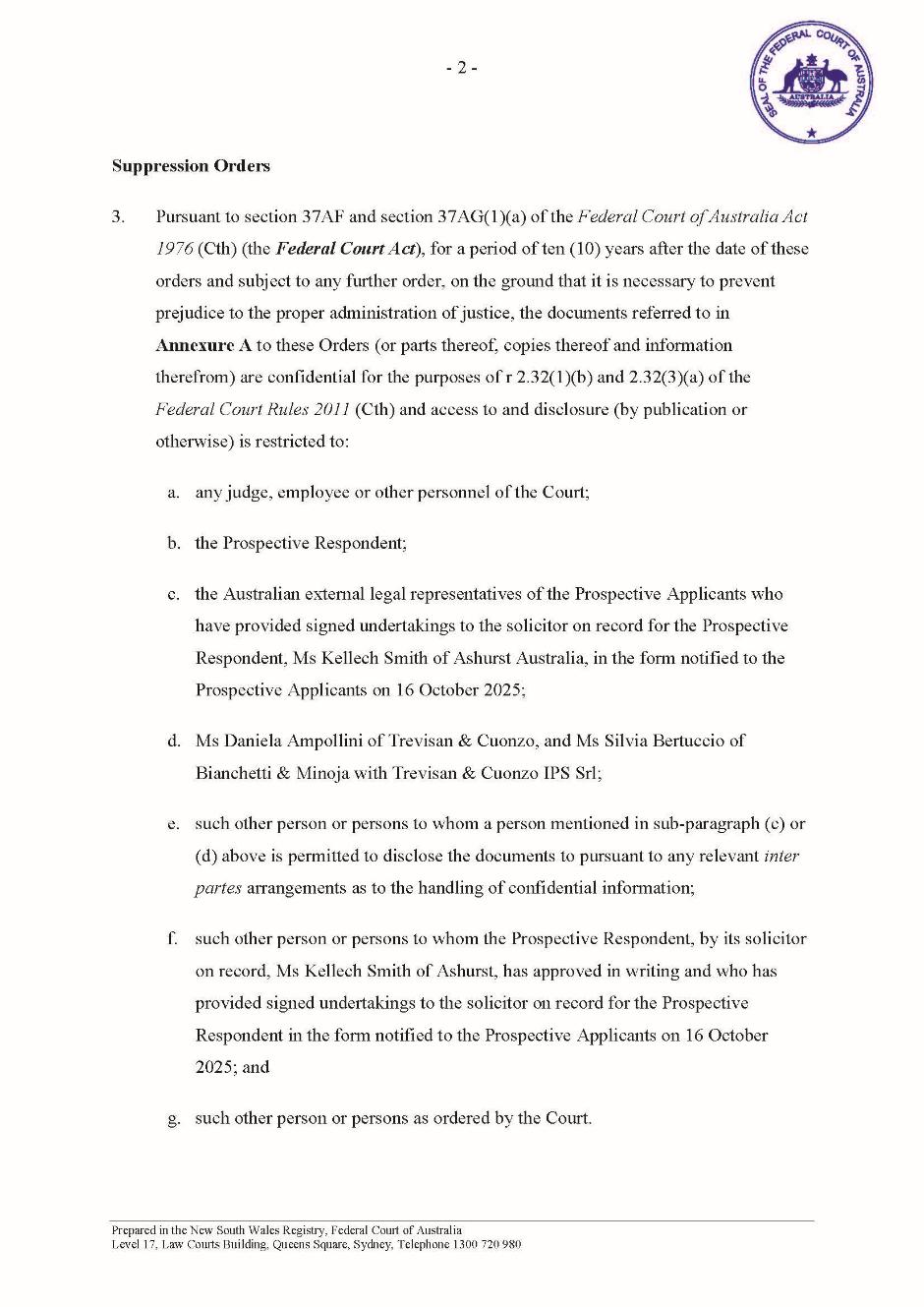
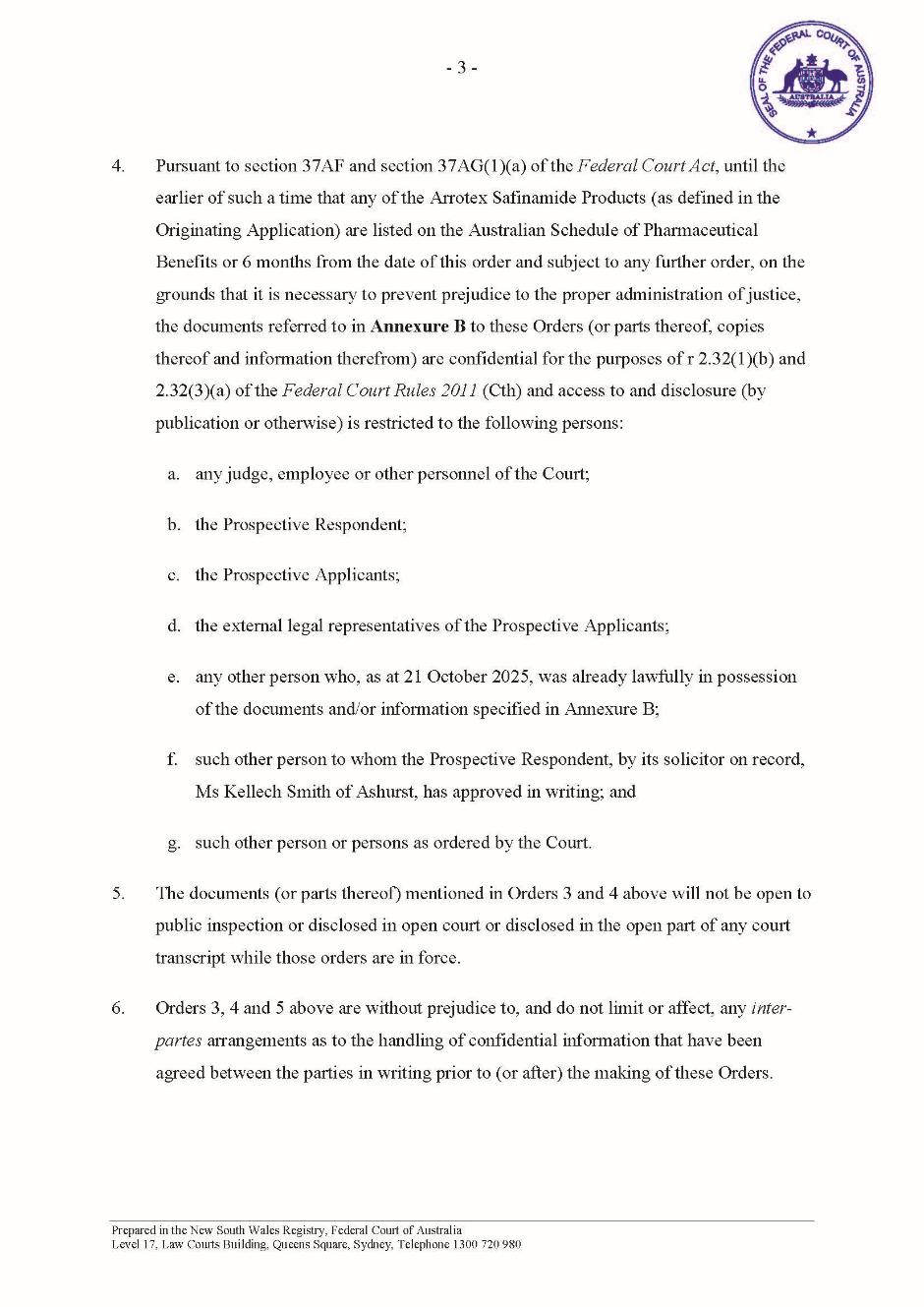
3 In relation to the suppression orders, the parties were agreed on their form, however the prospective applicants took the view that it was unnecessary to make final orders when interim suppression orders were in place and the question of samples had been deferred. The suppression orders covered confidential material on the court file, and four paragraphs of my reasons delivered on 29 October 2025. As the parties were content with the form of the orders, I was minded to make final suppression orders on 31 October 2025 with liberty to apply on two days’ notice.
4 I set out below my brief reasons for the determination on the access regime, and my decision as to costs.
Access Regime
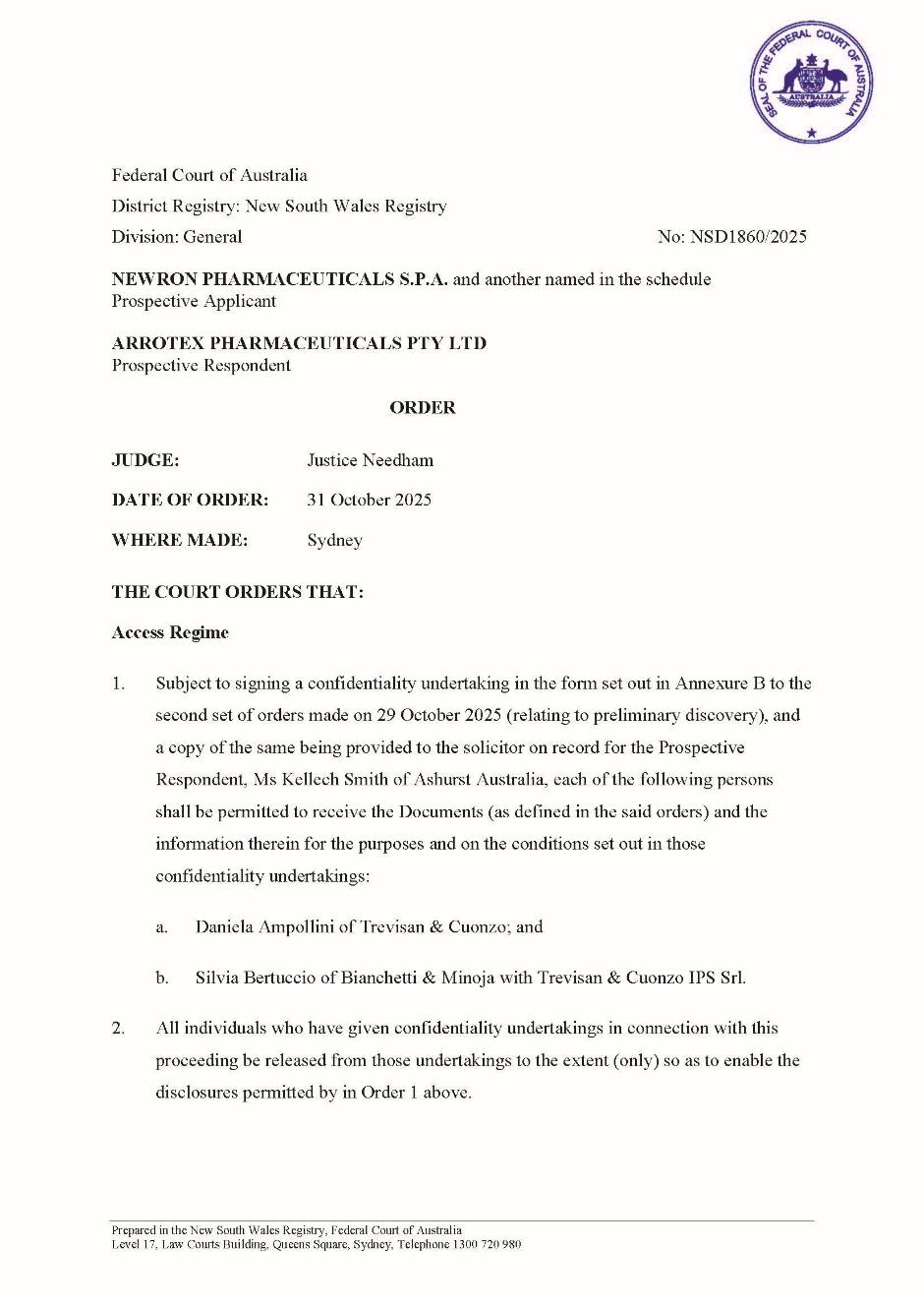
5 The parties indicated that there was no dispute as to the categories of documents to be produced on preliminary discovery, but there was an issue as to who should be able to have access to those documents when produced. I made orders allowing for two external IP advisers, Ms Ampollini and Ms Bertuccio, to have access to the documents on the basis of the confidentiality undertaking in the form set out in Annexure B to the second set of orders made on 29 October 2025 (relating to preliminary discovery).
6 The dispute arose as to the terms on which the external IP advisers should have access to the documents produced on preliminary discovery. The prospective applicants indicated that they had initially provided the names of six persons to be granted access to the documents, however in order to narrow the dispute at the 31 October 2025 hearing, it only pressed for access to be provided to the two external IP advisers, deferring the question of access in relation to the other four. In correspondence, the prospective respondent indicated that it would grant the external IP advisers access:
subject to the condition that each give a confidentiality undertaking, in a form approved by our client, which includes undertakings to the effect that each of Ms Ampollini and Ms Bertuccio:
(a) are not involved and will not in future be involved in patent prosecution relating to safinamide (or a salt thereof), or any pharmaceutical product containing safinamide (or a salt thereof) as an active ingredient, in Australia or in any other jurisdiction; and
(b) will only use the Documents and Information for the Australian proceedings (including any ensuing infringement proceeding/appeal) and not for any legal proceeding in any other jurisdiction.
7 The prospective applicants indicated that there was no obvious reason why these two advisers required a different access regime from the regime set out in Annexure B, which extended to any Australian external lawyer, Australian patent attorney, and any independent expert retained by the legal representatives of the prospective applicants (whether based in Australia or not). They submitted that the extra conditions were unnecessary, given that the conditions imposed by Annexure B required an express undertaking that the documents only be used for permitted purposes.
8 The prospective respondent supported the additional conditions in relation to the external IP advisers on the basis that the balance of convenience favoured it, because of the difficulties in enforcing any breach of the suppression orders (whether those breaches be intentional or inadvertent). As persons outside the jurisdiction, it was submitted that it would be a “matter of significant inconvenience” to take action in relation to any breach. It was further submitted that they were not subject to the same professional obligations to Australian courts as Australian practitioners would be. Nonetheless, Mr Fleming SC for the prospective respondent characterised these arguments as not being on the basis that the external IP advisers were located overseas per se, but the significant inconvenience that could arise were there to be an issue with enforcement or breach of confidentiality orders. In its submissions, the prospective respondent did not specify any particular risk that was likely to arise out of the provision of access being granted to the two external IP advisers, but noted the risk of conscious, or unconscious, misuse of the knowledge contained in the documents.
9 Mr Mee, for the prospective applicants, pointed to the fact that the confidentiality undertaking in Annexure B included the following:
13. I irrevocably submit to the jurisdiction of the Court for the purposes of enforcing the terms of this undertaking, which are governed by the laws of the State of New South Wales.
10 The parties each relied on Mobil Oil Australia Ltd v Guina Developments Pty Ltd [1996] 2 VR 34 and AstraZeneca AB v Medis Pharma Pty Ltd [2014] FCA 549 (Besanko J) in support of their submissions that a “fair balance” should be struck between the confidentiality of the documents, the persons to whom access was given, and between the risk of inadvertent disclosure and the need for the prospective applicants to obtain appropriate advice (see AstraZeneca at [10]). I note those principles, which are not in dispute, and adopt them without needing to restate them.
11 I took the view that there was no need for a different confidentiality regime for the two external IP advisers based on the fact that they were located overseas. I noted that no specific risk was identified with their receiving the documents, and notably, they had previously been granted access without those conditions to the confidential annexures to Ms Smith’s affidavit dated 17 October 2025 (albeit those annexures were highly redacted). The express submission to the Australian jurisdiction in the confidentiality undertaking in Annexure B, and the undertaking expressed in Harman v Secretary of State for the Home Department [1983] 1 AC 280; 1 All ER 532 at 304, 309, 319-321, protect the prospective respondent’s position (see [10](3)(v) of AstraZeneca) and the fact that they have each been granted access before (see [10](3)(i) and (iii) of AstraZeneca) lead me to conclude that the two external IP advisers should not be restricted in their future work, if any, surrounding safinamide litigation.
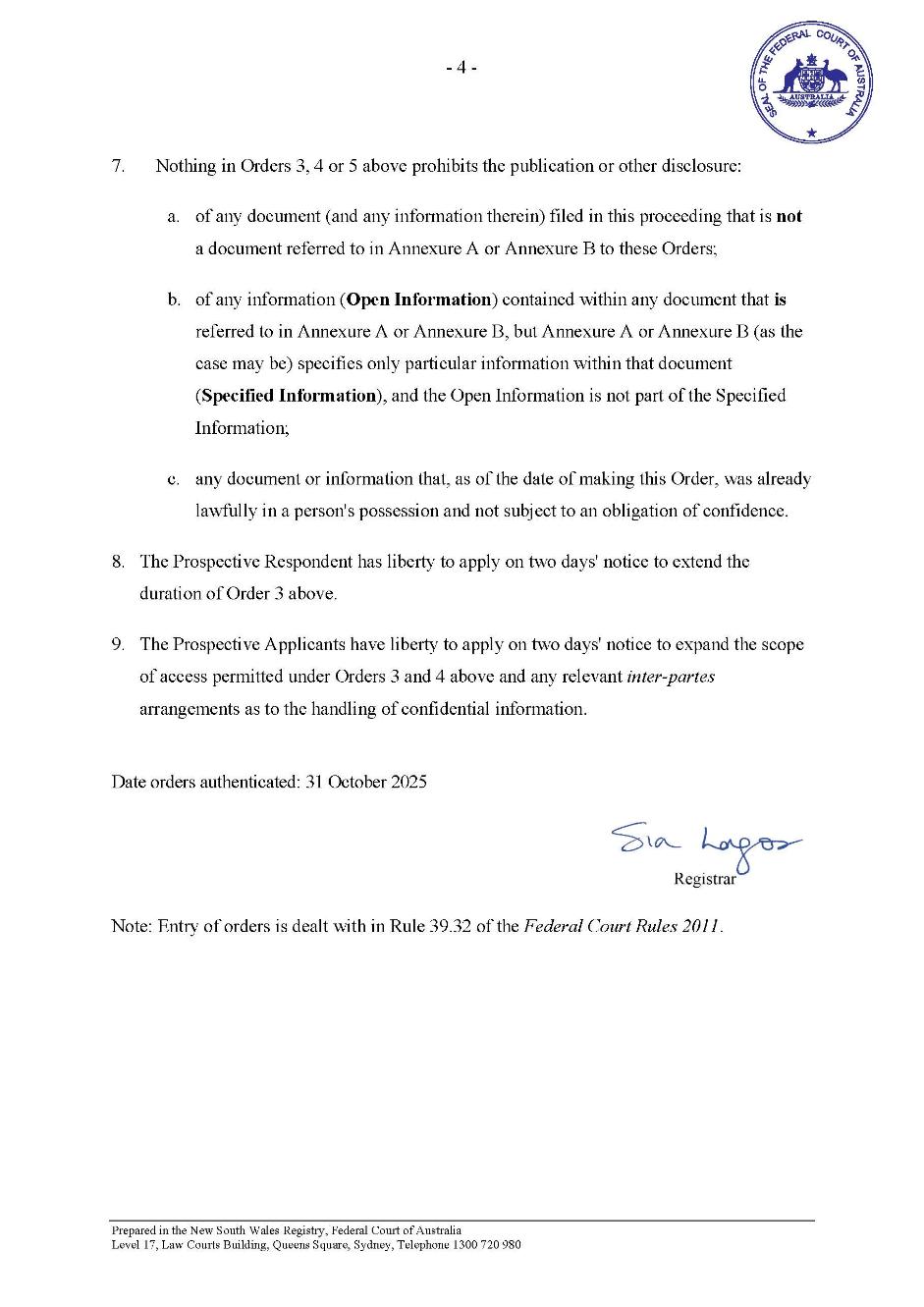
12 Accordingly, I made orders on 31 October 2025 (which are Annexure A to these reasons).
Costs
13 I was provided with duelling costs orders. The prospective applicants sought that the prospective respondent pay the costs of these proceedings, and that the prospective applicants pay the reasonable costs of the provision of preliminary discovery. If the prospective applicants commenced infringement proceedings, then all costs incurred by the prospective respondent would be costs in those infringement proceedings.
14 The prospective respondent agreed that the costs of providing preliminary discovery should be borne by the prospective applicants, but sought that the costs of these proceedings be costs in the cause of any infringement proceedings if commenced, and if not commenced, then the prospective applicants pay the costs of the application for preliminary discovery.
15 Any award of costs is made pursuant to the discretion conferred by s 43(2) of the Federal Court of Australia Act 1976 (Cth). Overlaid on that is of course the extraordinary nature of the power to order preliminary discovery; essentially, my order required the prospective respondent to provide documents in relation to its confidential information surrounding its safinamide formulation to a business competitor. As noted by Burley J in Pfizer Ireland Pharmaceuticals v Samsung Bioepis AU Pty Ltd (No 2) [2019] FCA 657 (Pfizer no 2), that exceptional nature of the jurisdiction is to be taken into consideration and “is a matter that may mean that a wholly successful prospective applicant is not entitled to an order for costs” (at [25](2) citing ObjectiVision Pty Ltd v Visionsearch Pty Ltd (No 3) [2015] FCA 304 at [23] (Perry J); Cobankara v Australia and New Zealand Banking Group Ltd [2017] FCA 419 at [20] (Mortimer J)).
16 The prospective respondent pointed to the way in which the application for preliminary discovery was run, submitting that the evidence did not contest the subjective belief of the decision-makers of the prospective applicants, but rather relied on evidence which went to the reasonableness of that belief. It submitted that it was entitled to put the prospective applicants to proof, and that the proper course was for the Court which ultimately hears any infringement proceedings to determine the costs.
17 The prospective applicants contended that the prospective respondent had taken an adversarial approach and so a deferral of the costs orders was not appropriate (see Pfizer no 2 at [25](7)) and had “vigorously contest[ed] the application” (at [27]). In seeking to fall outside the authorities which have determined that the prospective applicant pay the costs of the preliminary discovery application, the prospective applicants submitted that they had obtained the documents which it sought and so was completely successful in the face of sustained opposition. The prospective applicants also noted that any determination of the access issue in their favour (as has indeed happened) weighed in their favour as to costs.
18 Ms Davis, for the prospective respondent, submitted that unlike in Pfizer Ireland Pharmaceuticals v Samsung Bioepis AU Pty Ltd [2017] FCAFC 193, there was no sustained factual contest. She pointed to the focus of Professor Roberts’ evidence, which she said was more explanatory than adversarial, and allowed the evidence as to bioequivalence to be put into context. The prospective respondent submitted that the prospective applicants had not been wholly successful, relying on the fact that the scope of the confidentiality regime had been narrowed from its original sweep, and that the orders as to production of samples sought in the Originating Application had been deferred at the substantive hearing. The prospective respondent relied on the extraordinary nature of the orders, and the appropriateness of tying the costs to the commencement of, and success in, any infringement proceedings which may be commenced.
19 In response, Mr Mee for the prospective applicants noted that the question of subjective belief was not put into contest in Pfizer, and that while the costs order in Pfizer no 2 was for 50% of the costs to be paid by the prospective respondent, it was not premised solely on the “extraordinary remedy” factor, as this is a factor present in every preliminary discovery case. Additionally, it was submitted that Professor Roberts went further than contextualising bioequivalence, in proceeding to examine whether the theories in the patents were scientifically sound. It was submitted that the prospective applicants had been wholly successful in the questions that were put to me and determined, and any order for costs would not capture the deferred questions of further access and samples.
20 In considering costs, I reiterate that even though particular practices in relation to preliminary discovery costs have been developing through cases such as ObjectiVision, where Perry J said at [13]:
It has been doubted that there is as yet a “conventional approach” as to the manner in which the discretion as to costs and expenses is to be exercised in preliminary discovery applications: Apache Northwest Pty Ltd v Newcrest Mining Ltd [2009] FCAFC 39; (2009) 182 FCR 124 (Apache) at 146-147 [90]-[91] (Flick J (in dissent but on issues not presently relevant)); J & A Vaughan Super Pty Ltd v Becton Property Group Limited [2013] FCA 340 (Vaughan Super) at [16] (Kenny J). Any order for costs must necessarily be dictated by the facts and circumstances of the proceeding: Apache at 146 [89]; Vaughan Super at [16]. The decided cases are therefore illustrative only of the manner in which the discretion has been exercised in the circumstances of the particular case and provide guidance in that sense.
and Pfizer no 2, I am still required to have regard to all the circumstances of the case and not to any particular “rule” in relation to costs. The question remains discretionary.
21 In doing so I take into account the following factors:
(a) this is not regular adversarial “winner takes all” litigation; it is a statutory incursion into the private affairs of the prospective respondent for the commercial benefit of the prospective applicants. Success is not routinely or predictably followed by a costs order;
(b) as an adjunct to (a), the prospective applicants may, or may not, commence infringement proceedings; this is something that is out of the prospective respondent’s control; and
(c) the prospective applicants have been successful against a defence of scientific doubt as to the reasonableness of the decision-makers’ belief. It was a fairly robust defence, mainly, but not entirely, directed to putting in issue one of the elements of r 7.23 of the Federal Court Rules 2011 (Cth); that is, whether the belief could have been reasonably held.
22 In relation to the costs of the provision of discovery, (including collating, reviewing, and providing the discovered documents), I consider that given the fact of the extraordinary remedy sought, the prospective applicants should pay the costs of the prospective respondent. While originally the prospective applicants sought that this order be made subject to the commencement of infringement proceedings, I am of the view that the provision of preliminary discovery and the work undertaken for that exercise is properly on the shoulders of those obtaining the benefit of those documents; the prospective applicants.
23 In relation to the costs of the application itself, given the factors listed above, I am not convinced that an order for costs should be made now. I am prepared to make orders which provide for the costs of this application to be costs in the cause of any infringement proceedings, but should no proceedings be taken, then there be no order for the costs of this application, with the intent that each party bear their own costs. I reach that position on the basis that it seems to me that the robustness of the defence, even though it was partly directed to the reasonableness of the belief, sought to persuade me of the ultimate question to be determined in any infringement proceedings and so came close to the “mini-trial” warned against in Pfizer. An order that the parties bear their own costs if no infringement proceedings are commenced balances the positions taken by the parties in the preliminary discovery application and recognises that the prospective respondent sought to put on evidence which did not deal directly with the prospective applicants’ evidence, but sought instead to determine the “purity question” (as it was referred to in argument). It was not successful in doing so.
24 The order in relation to samples (order 2 in the Originating Application) has been deferred, and so any question of costs in relation to order 2 may also be deferred. The parties have also agreed that 31 January 2026 is a reasonable time for the prospective applicants to decide whether any infringement proceedings should be brought. I have already ordered that the parties have liberty to apply.
I certify that the preceding twenty-four (24) numbered paragraphs are a true copy of the Reasons for Judgment of the Honourable Justice Needham. |
Associate:
Dated: 21 November 2025
Annexure A