FEDERAL COURT OF AUSTRALIA
Commissioner of the NDIS Quality and Safeguards Commission v Lifestyle Solutions (Aust) Ltd (Reportable Incidents Proceeding) [2025] FCA 1394
File number(s): | NSD 1683 of 2024 |
Judgment of: | ABRAHAM J |
Date of judgment: | 14 November 2025 |
Catchwords: | CIVIL PENALTY – proceeding for civil contraventions of s 73J of the National Disability Insurance Scheme Act 2013 (Cth) – where failures involved breach of National Disability Insurance Scheme (Incident Management and Reportable Incidents) Rules 2018 (Cth) – where conduct serious – where failure to notify reportable incidents on numerous occasions – where parties agreed on proposed declarations, pecuniary penalties and costs orders – whether proposed penalty and declaratory relief are appropriate – orders made in terms sought |
Legislation: | National Disability Insurance Scheme Act 2013 (Cth), Ch 4 pt 3A div 8, ss 3(1)(g), 3(1)(ga), 73F(2), 73J, 73Z, 181E, 181F Regulatory Powers (Standard Provisions) Act 2014 (Cth), ss 82(5)(a), 85(1), 93(2) National Disability Insurance Scheme (Incident Management and Reportable Incidents) Rules 2018 (Cth), ss 10(1)(c), 11A, 15(1), 16, 17, 18, 20, 21, 24, 26, 27 |
Cases cited: | Australian Competition and Consumer Commission v Reckitt Benckiser (Australia) Pty Ltd [2016] FCAFC 181; (2016) 340 ALR 25 Australian Competition and Consumer Commission v The Good Guys Discount Warehouses (Australia) Pty Ltd [2025] FCA 1085 Australian Competition and Consumer Commission v Yazaki Corporation [2018] FCAFC 73; (2018) 262 FCR 243 Australian Energy Regulator v Origin Energy Electricity Ltd [2022] FCA 802 Australian Energy Regulator v Santos Direct Pty Ltd [2024] FCA 579 Commissioner of the NDIS Quality and Safeguards Commission v Aurora Community Care Pty Ltd (in liquidation) (No 2) [2025] FCA 1237 Construction, Forestry, Mining and Energy Union v Cahill [2010] FCAFC 39; (2010) 269 ALR 1 |
Division: | General Division |
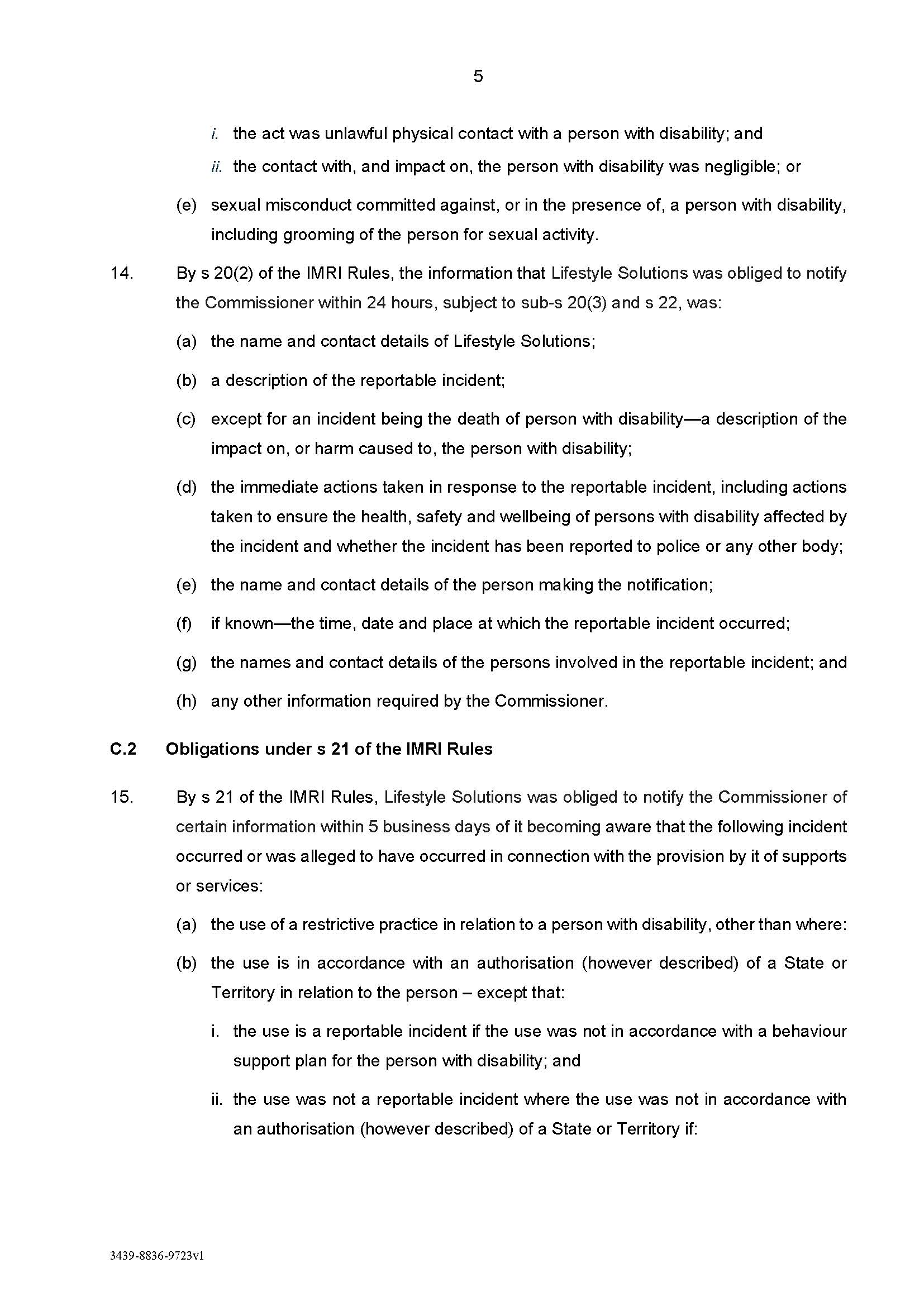
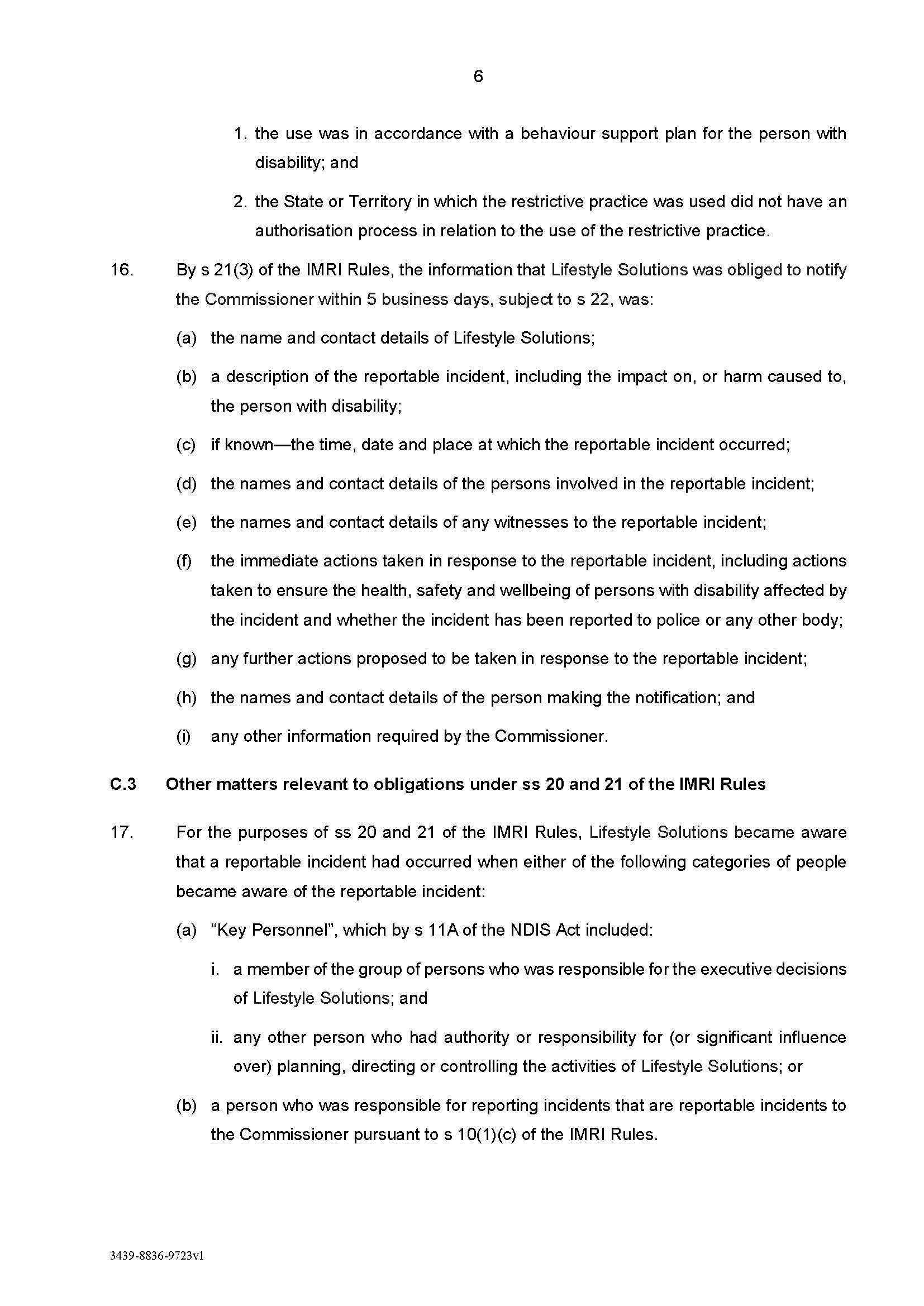
Registry: | New South Wales |
National Practice Area: | Commercial and Corporations |
Sub-area: | Regulator and Consumer Protection |
Number of paragraphs: | 45 |
Date of hearing: | 30 October 2025 |
Counsel for Applicant: | Mr D Star KC and Ms S Martin |
Solicitor for Applicant: | NDIS Quality and Safeguards Commission |
Counsel for Respondent: | Ms M Norton SC and Mr J Gray |
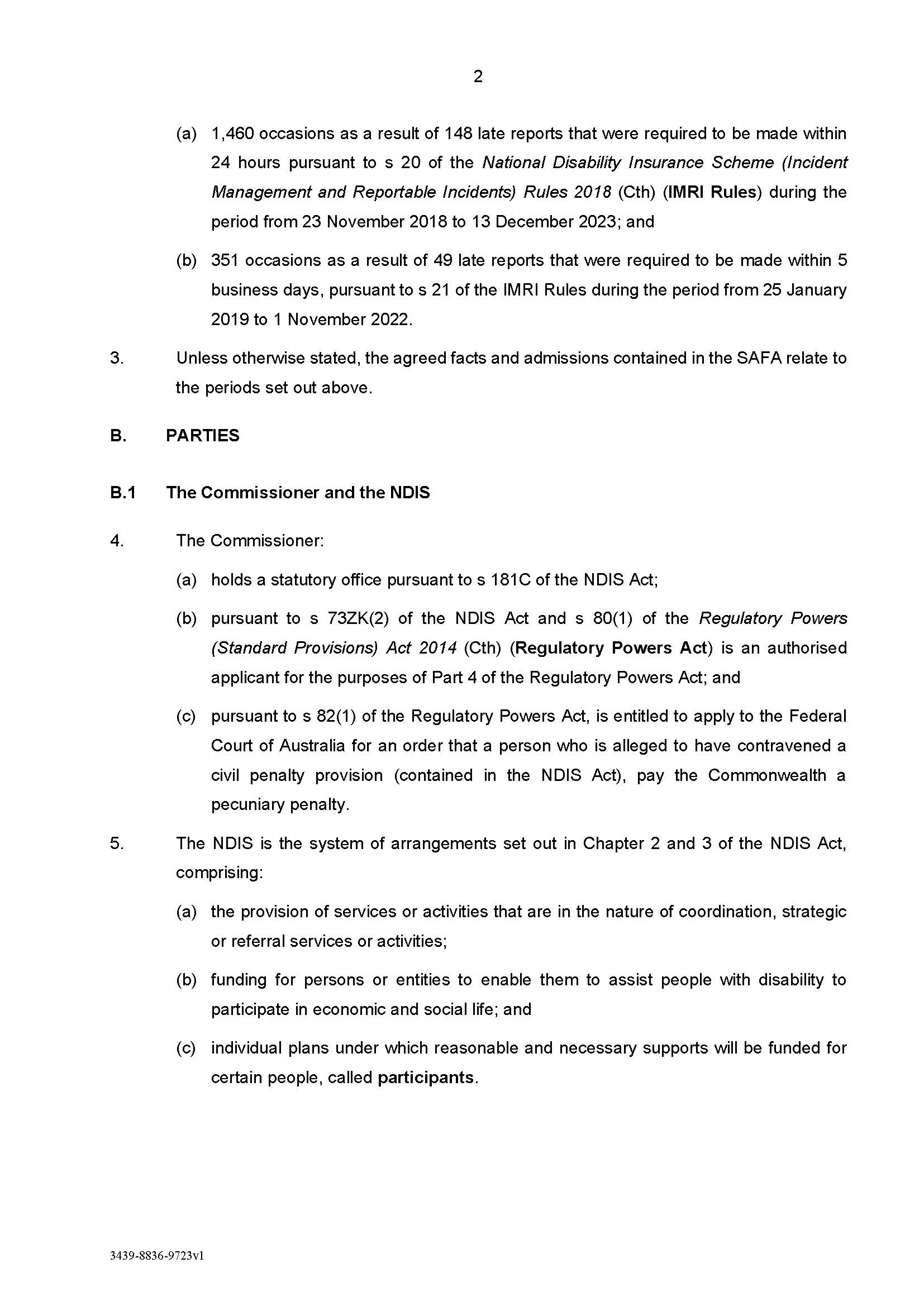
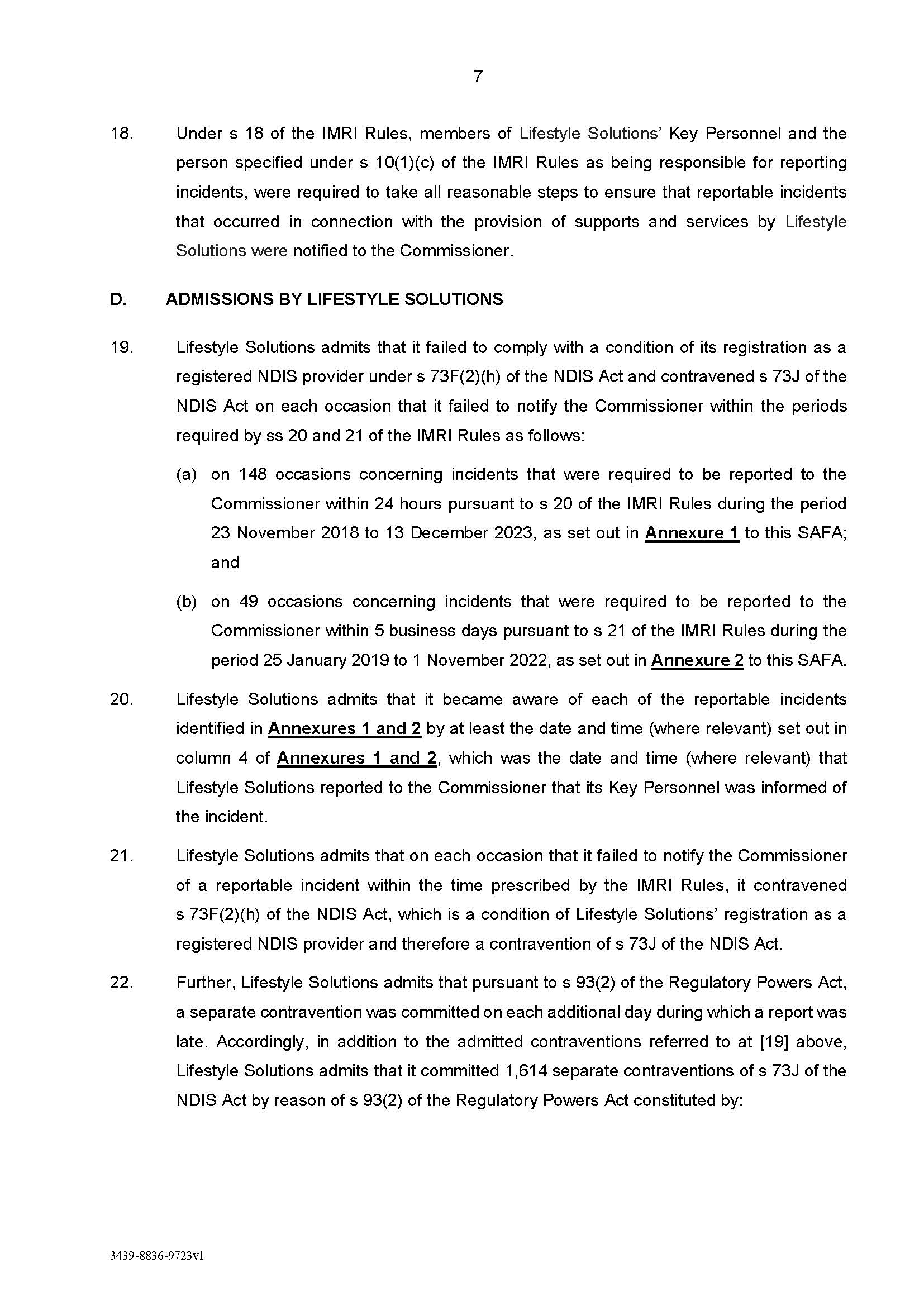
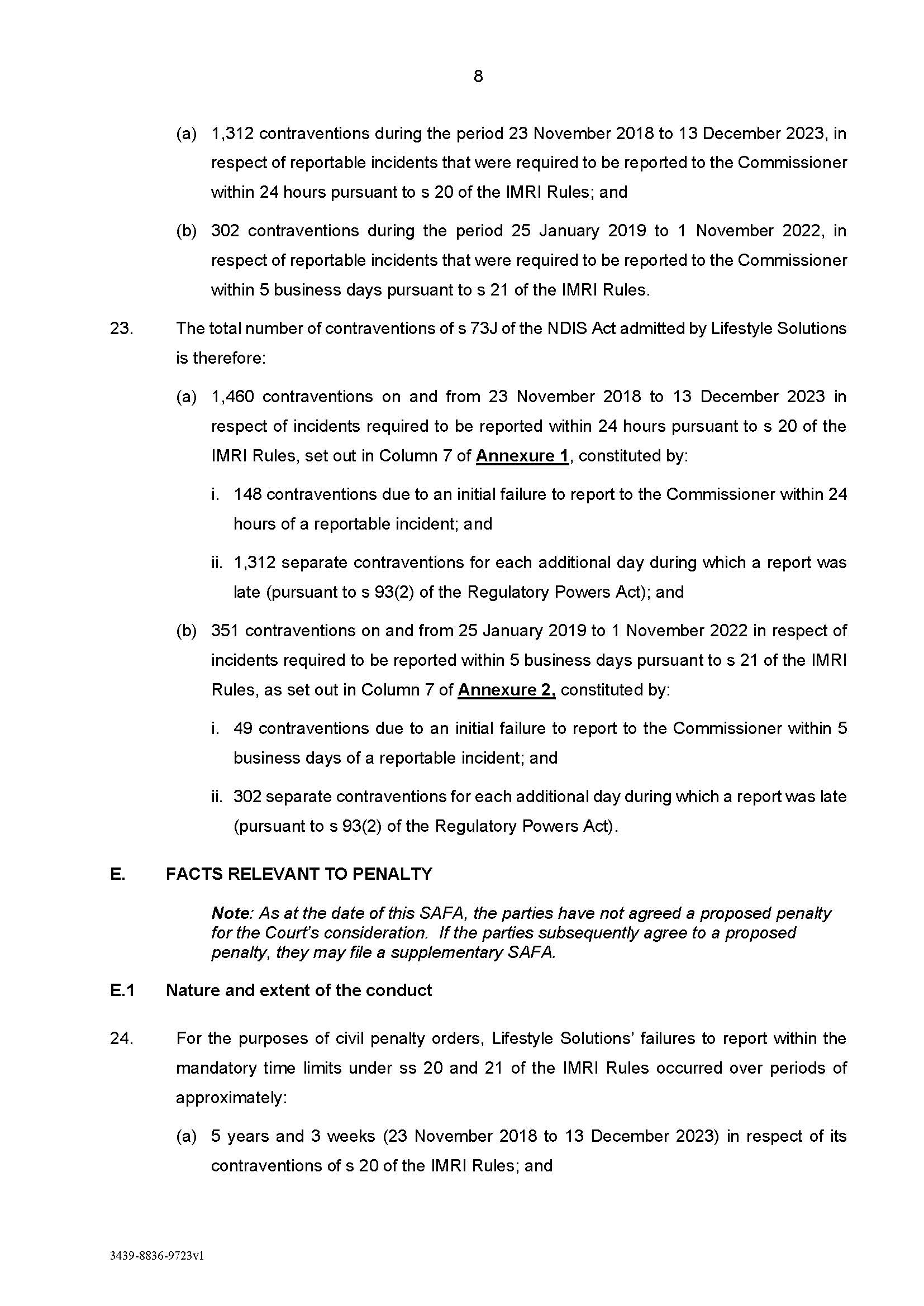
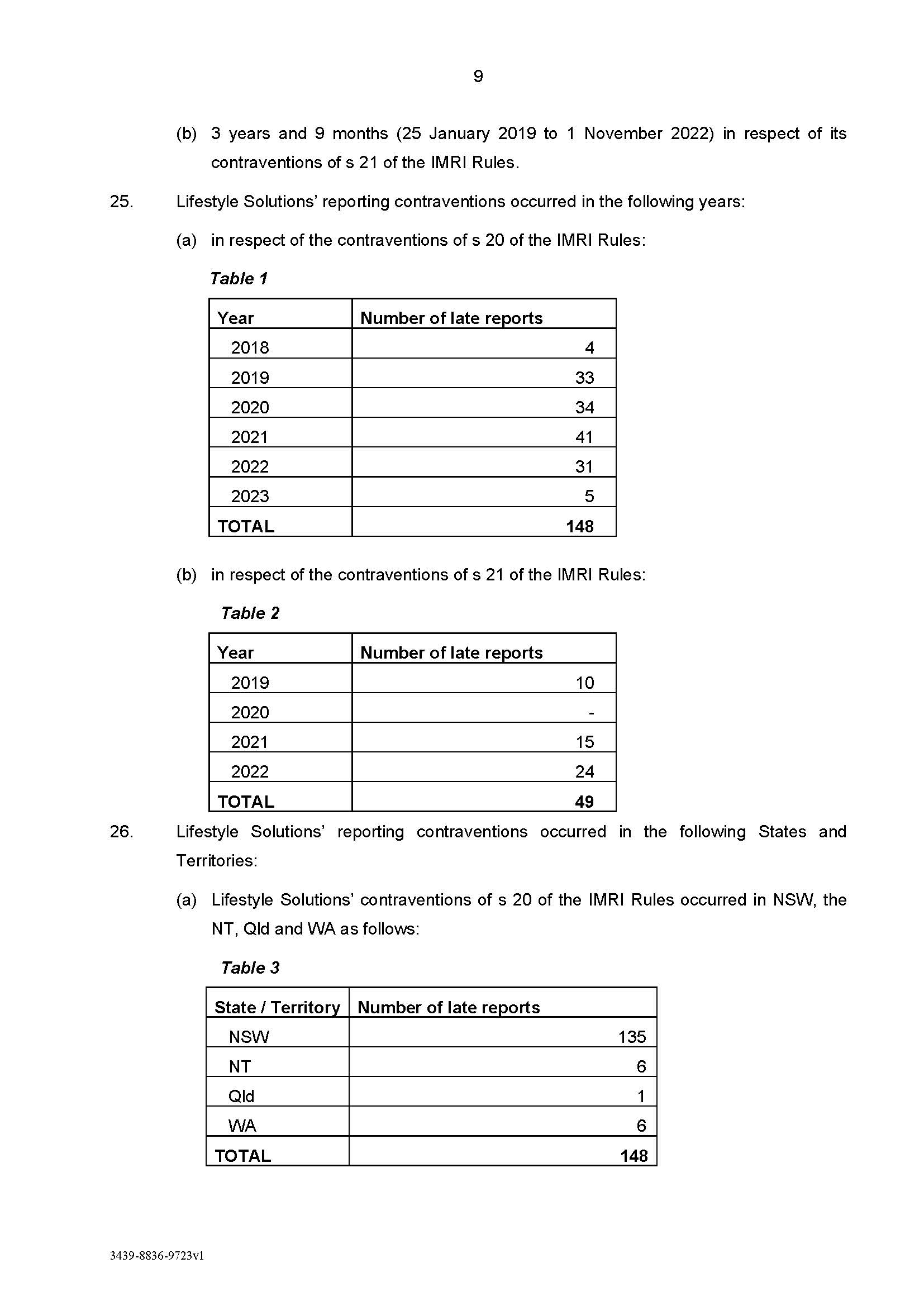
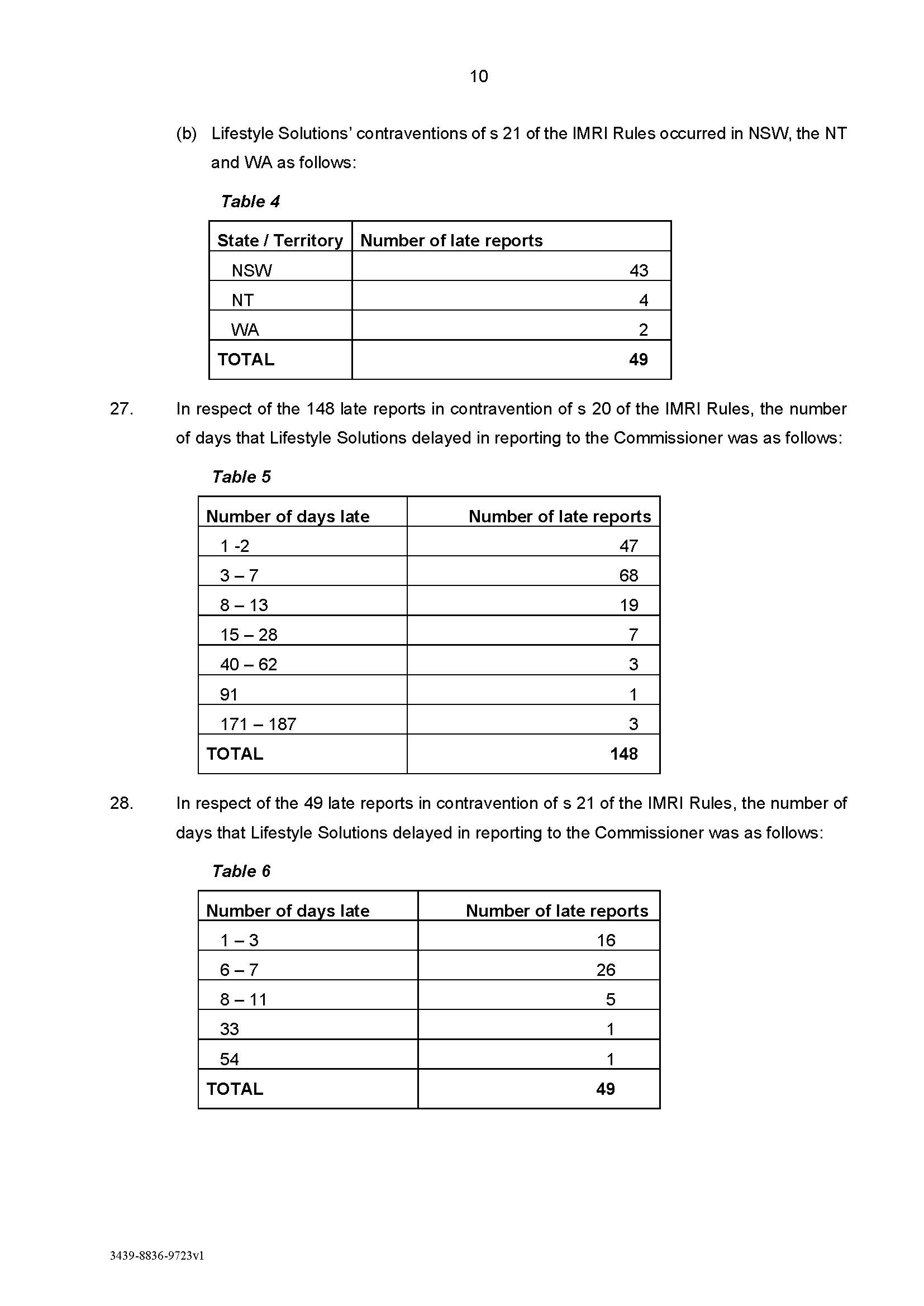
Solicitor for Respondent: | Corrs Chambers Westgarth |
ORDERS
NSD 1683 of 2024 | ||
| ||
BETWEEN: | COMMISSIONER OF THE NDIS QUALITY AND SAFEGUARDS COMMISSION Applicant | |
AND: | LIFESTYLE SOLUTIONS (AUST) LTD (ACN 097 999 347) Respondent | |
order made by: | ABRAHAM J |
DATE OF ORDER: | 14 november 2025 |
THE COURT DECLARES THAT:
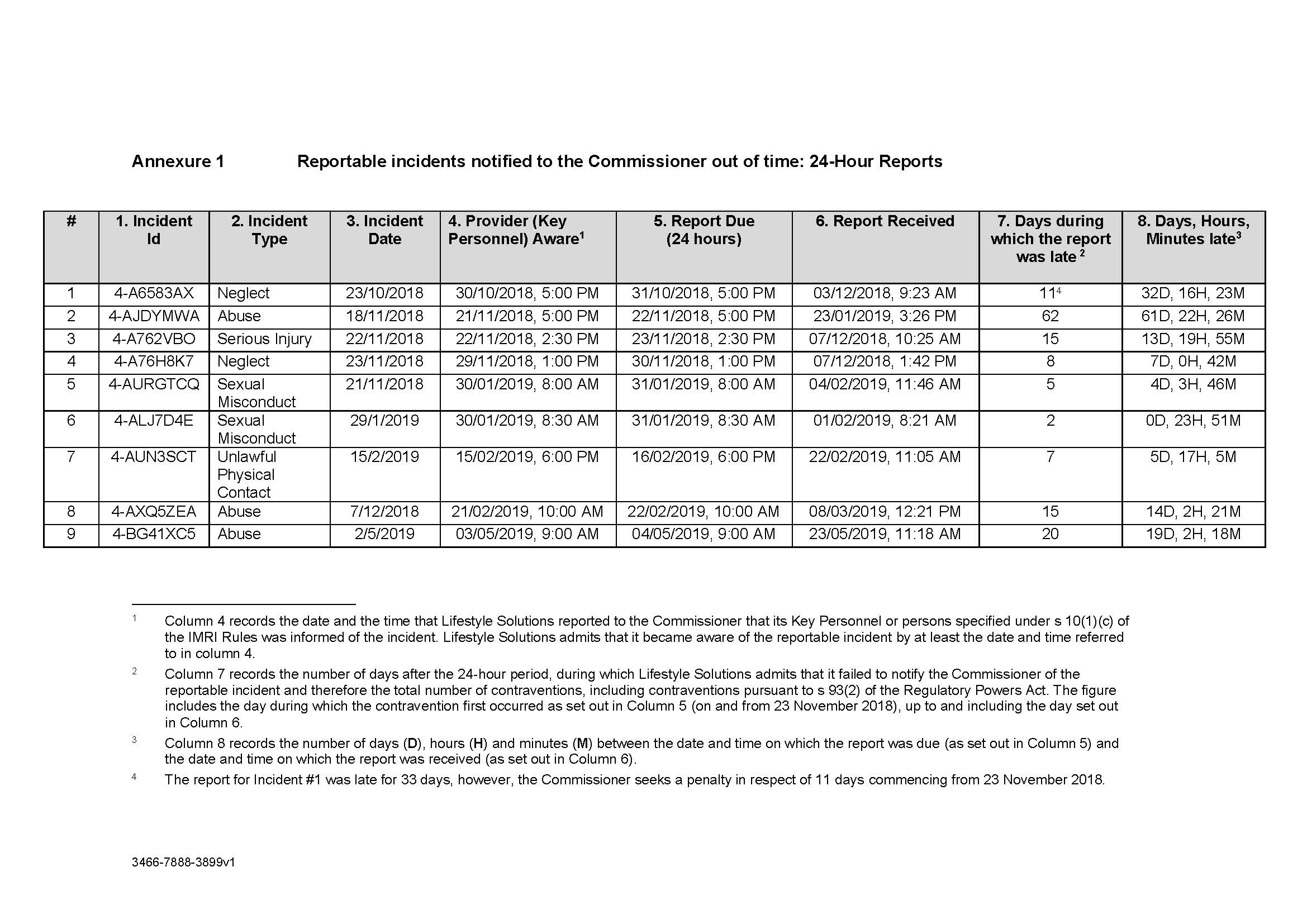
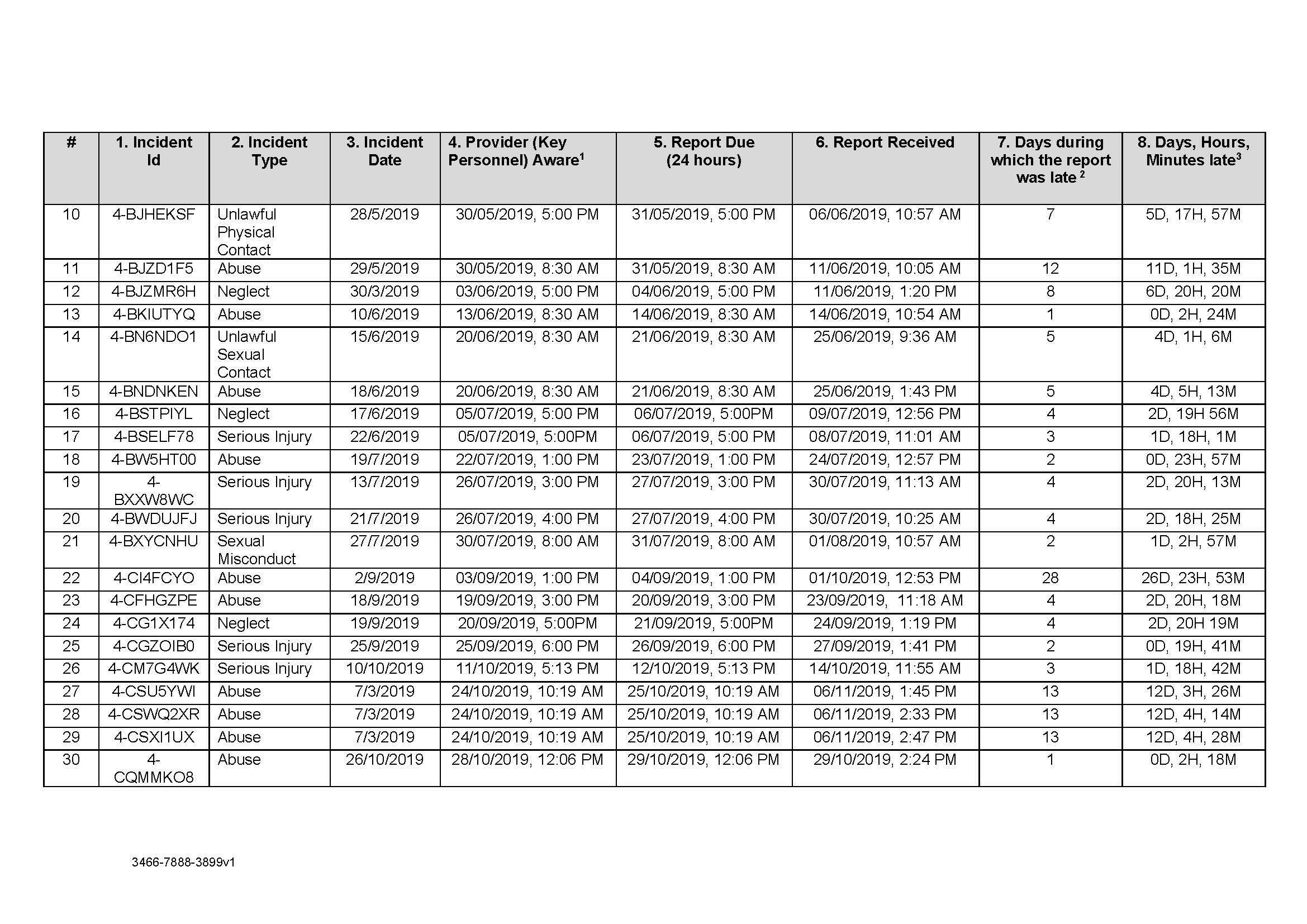
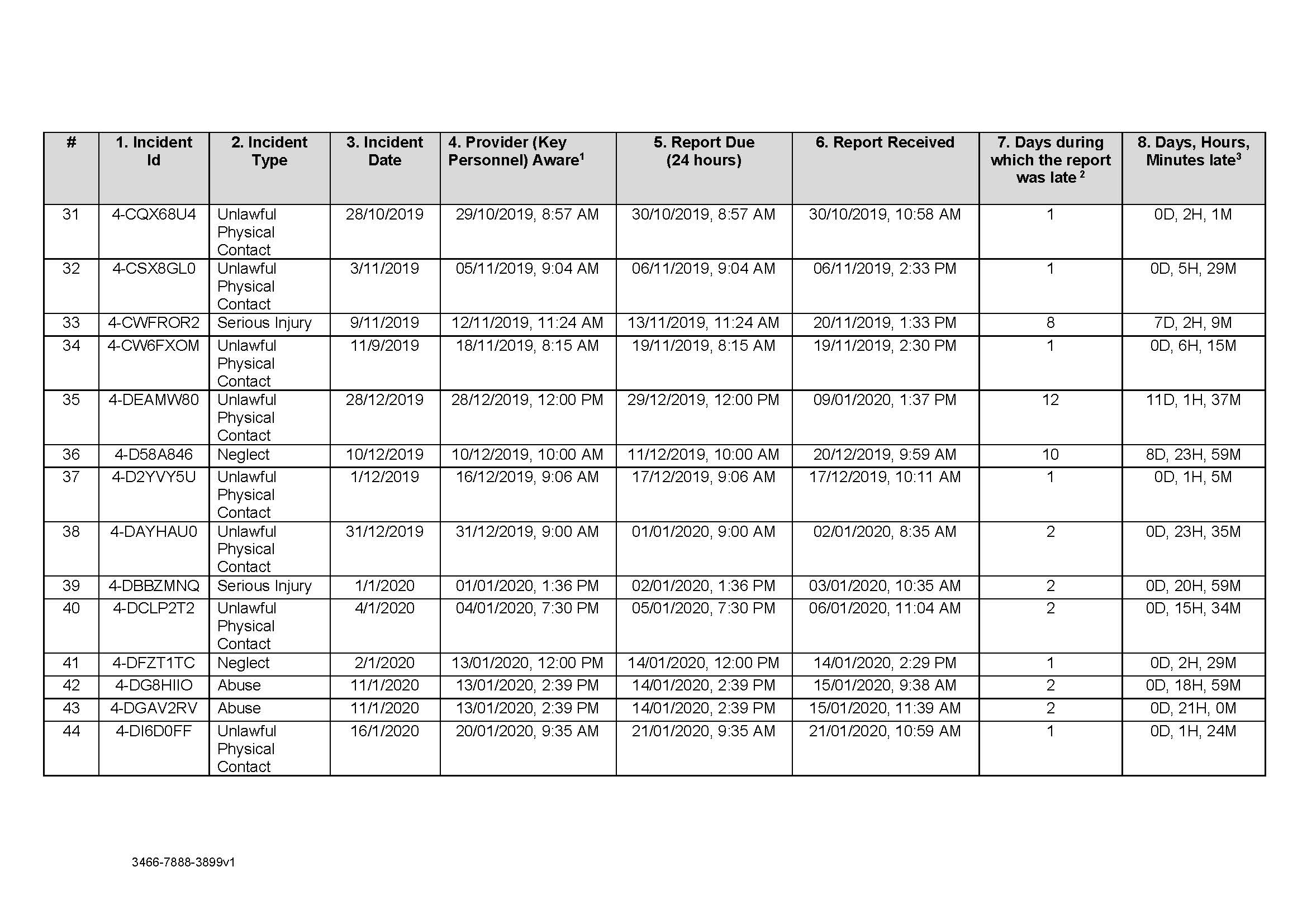
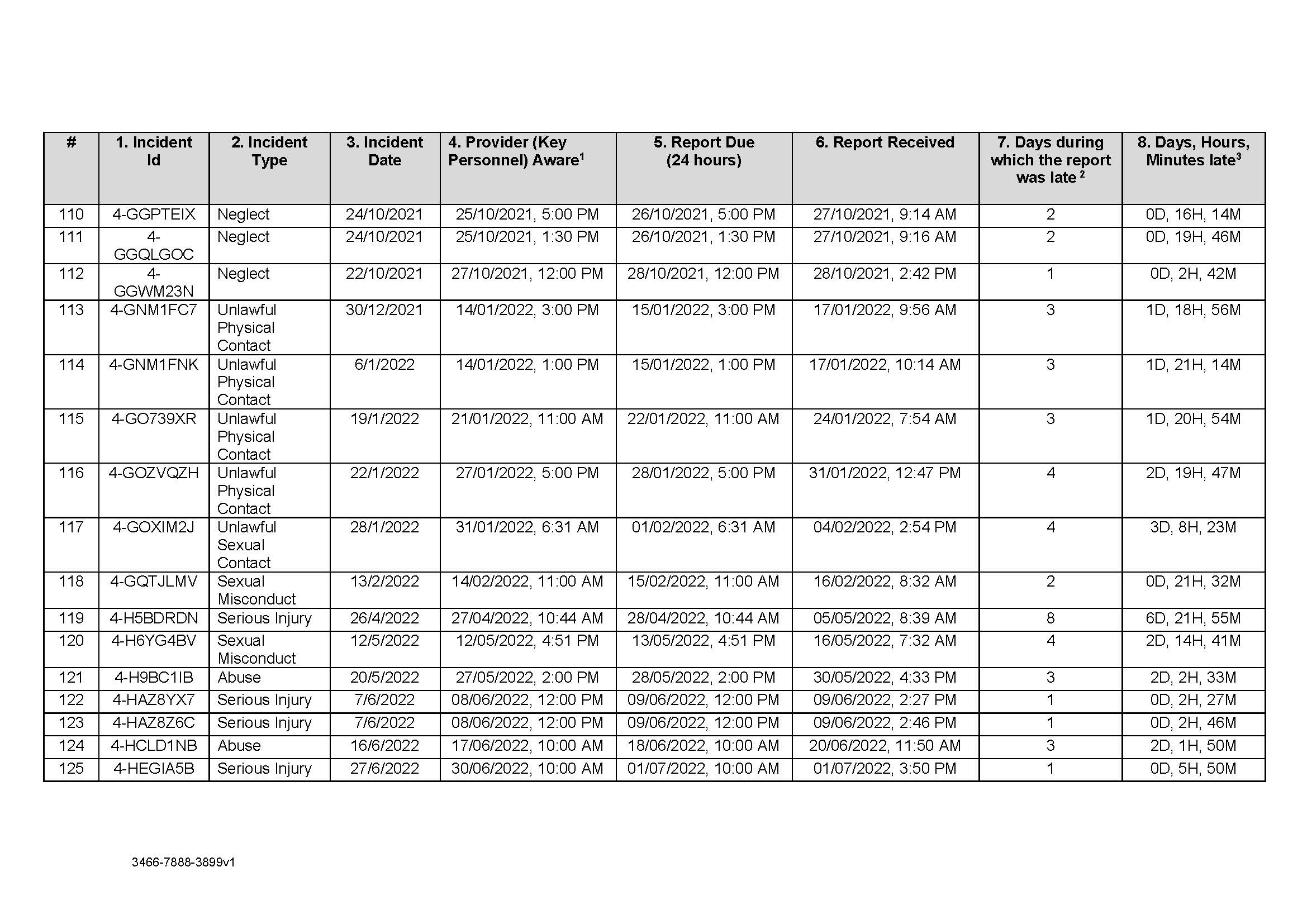
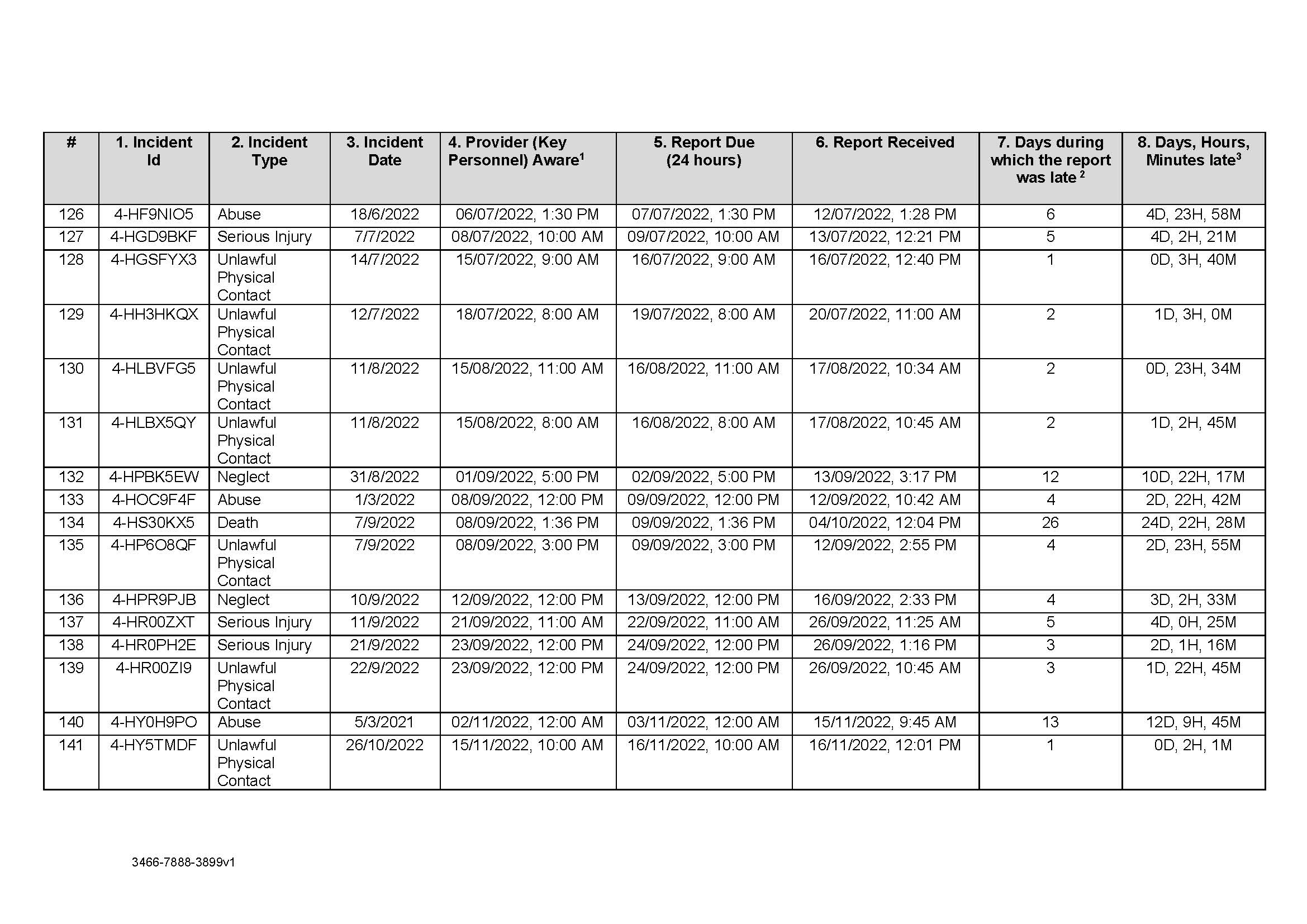
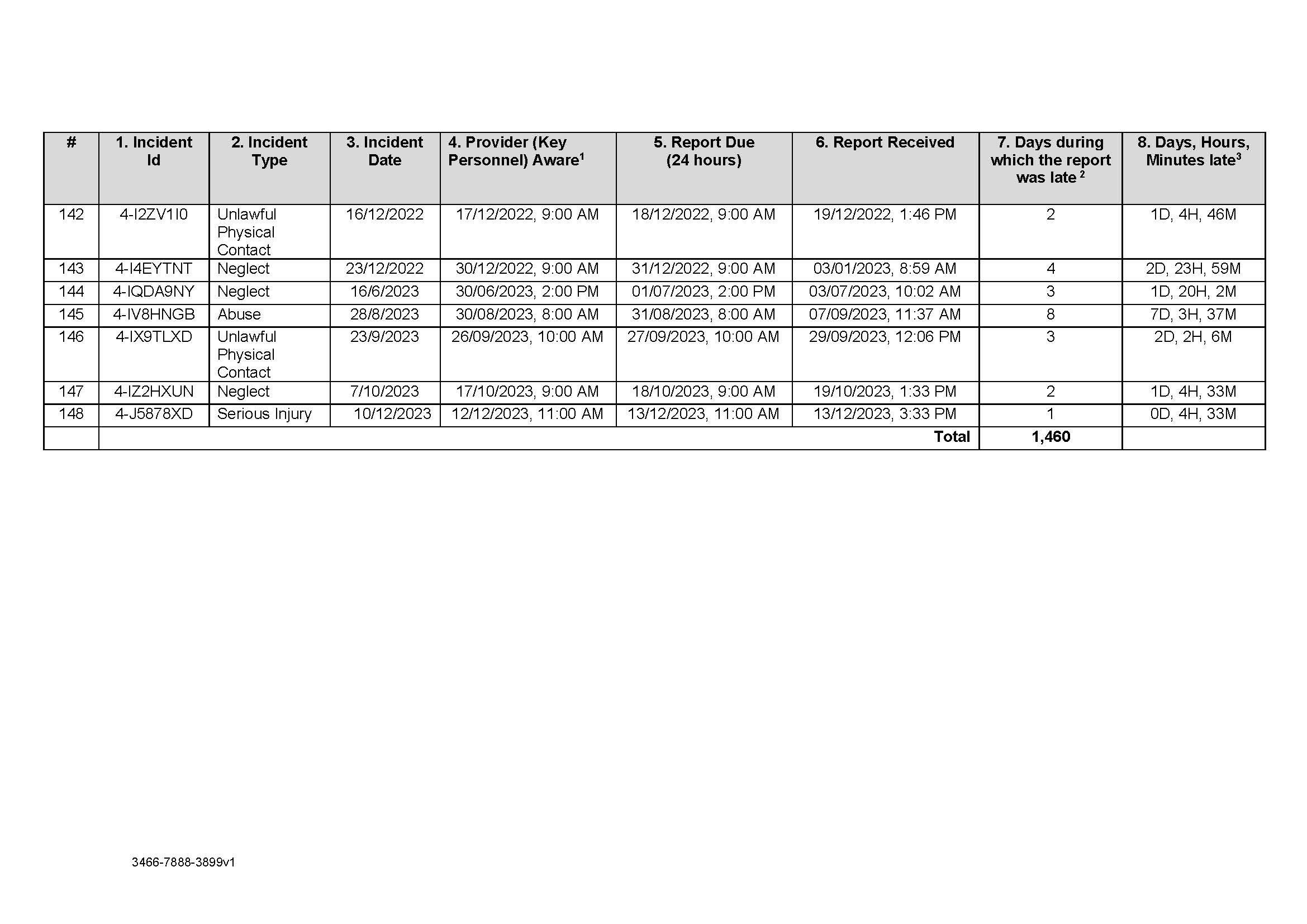
1. During the period 23 November 2018 to 13 December 2023, in respect of 148 reportable incidents, the Respondent (Lifestyle Solutions) failed to notify the Commissioner of the NDIS Quality and Safeguards Commission (Commissioner) of each reportable incident within 24 hours as required by s 20 of the National Disability Insurance Scheme (Incident Management and Reportable Incidents) Rules 2018 (Cth) (Reportable Incidents Rules) and in doing so:
(a) failed to comply with a condition of its registration as a registered NDIS provider under s 73F(2)(h) of the National Disability Insurance Scheme Act 2013 (Cth) (NDIS Act) and contravened s 73J of the NDIS Act on 148 separate occasions; and
(b) by reason of s 93(2) of the Regulatory Powers (Standard Provisions) Act 2014 (Cth) (RPA), contravened s 73J of the NDIS Act on a further 1,312 separate occasions, being each additional day that it failed to notify the Commissioner of each reportable incident,
as set out in Annexure A to these orders.
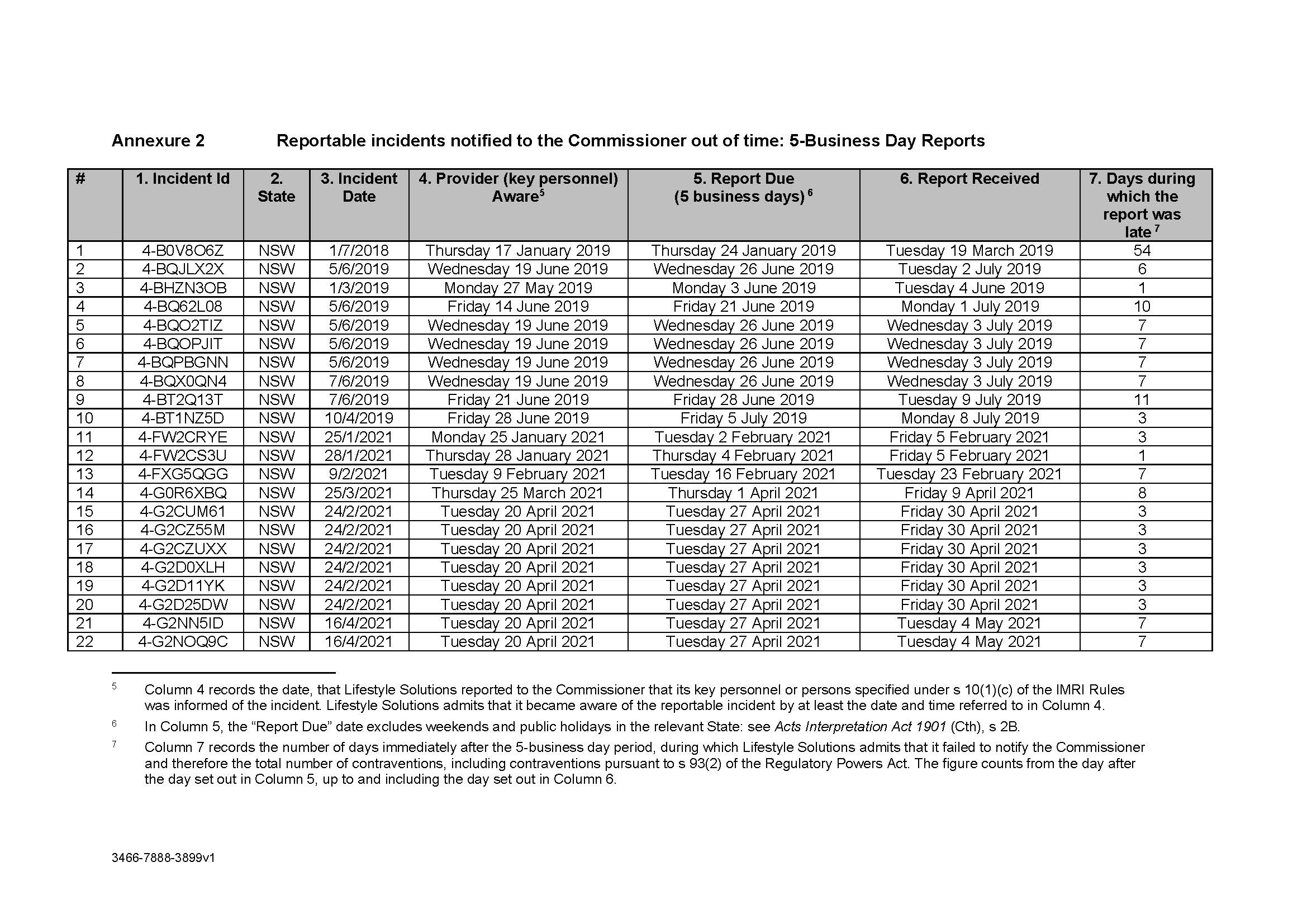
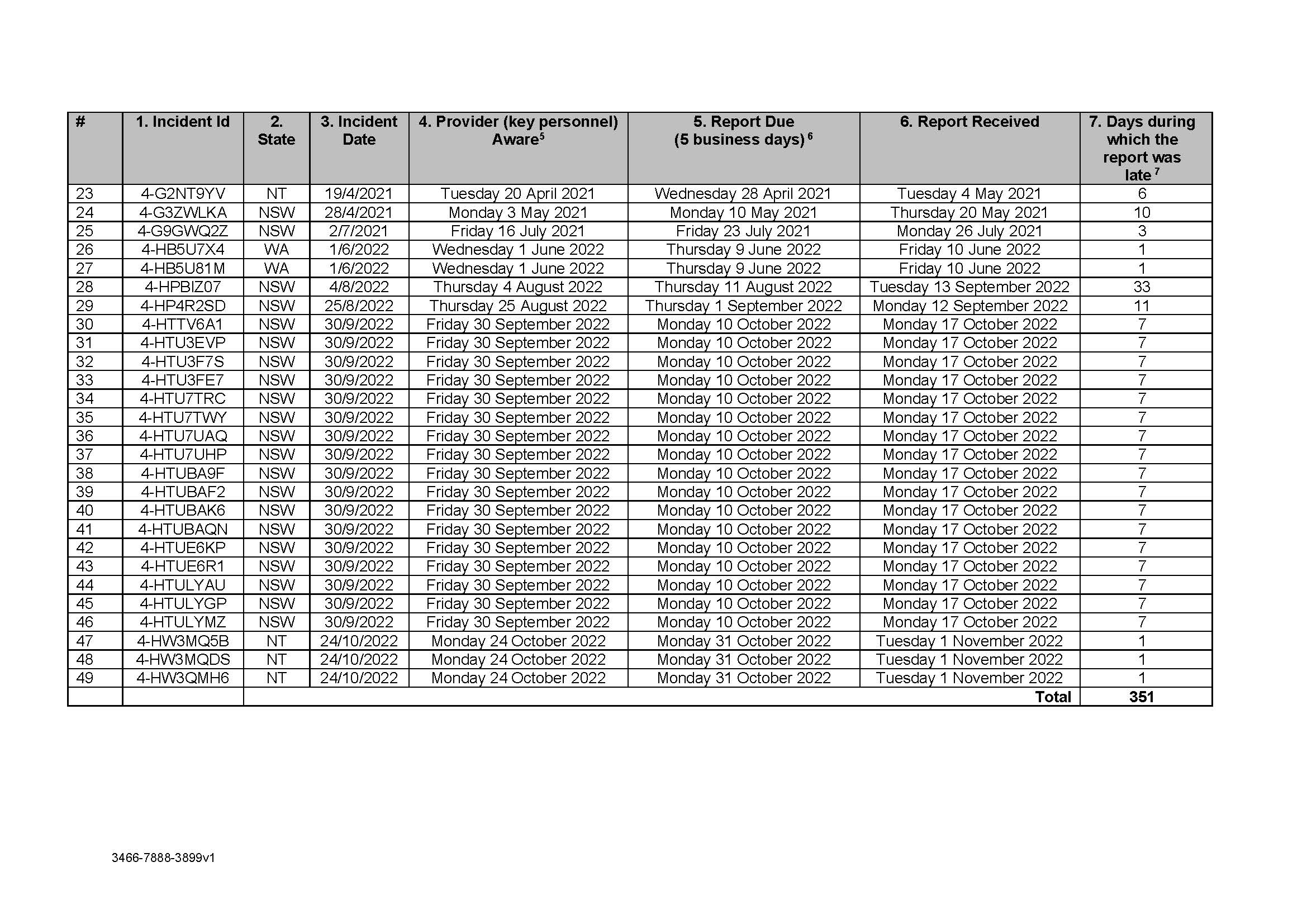
2. During the period 25 January 2 019 to 1 November 2022, in respect of 49 reportable incidents, Lifestyle Solutions failed to notify the Commissioner of each reportable incident within 5 business days as required by s 21 of the Reportable Incidents Rules, and in doing so:
(a) failed to comply with a condition of its registration as a registered NDIS provider under s 73F(2)(h) of the NDIS Act and contravened s 73J of the NDIS Act on 49 separate occasions; and
(b) by reason of s 93(2) of the RPA, contravened s 73J of the NDIS Act on a further 302 occasions, being each additional day that it failed to notify the Commissioner of each reportable incident,
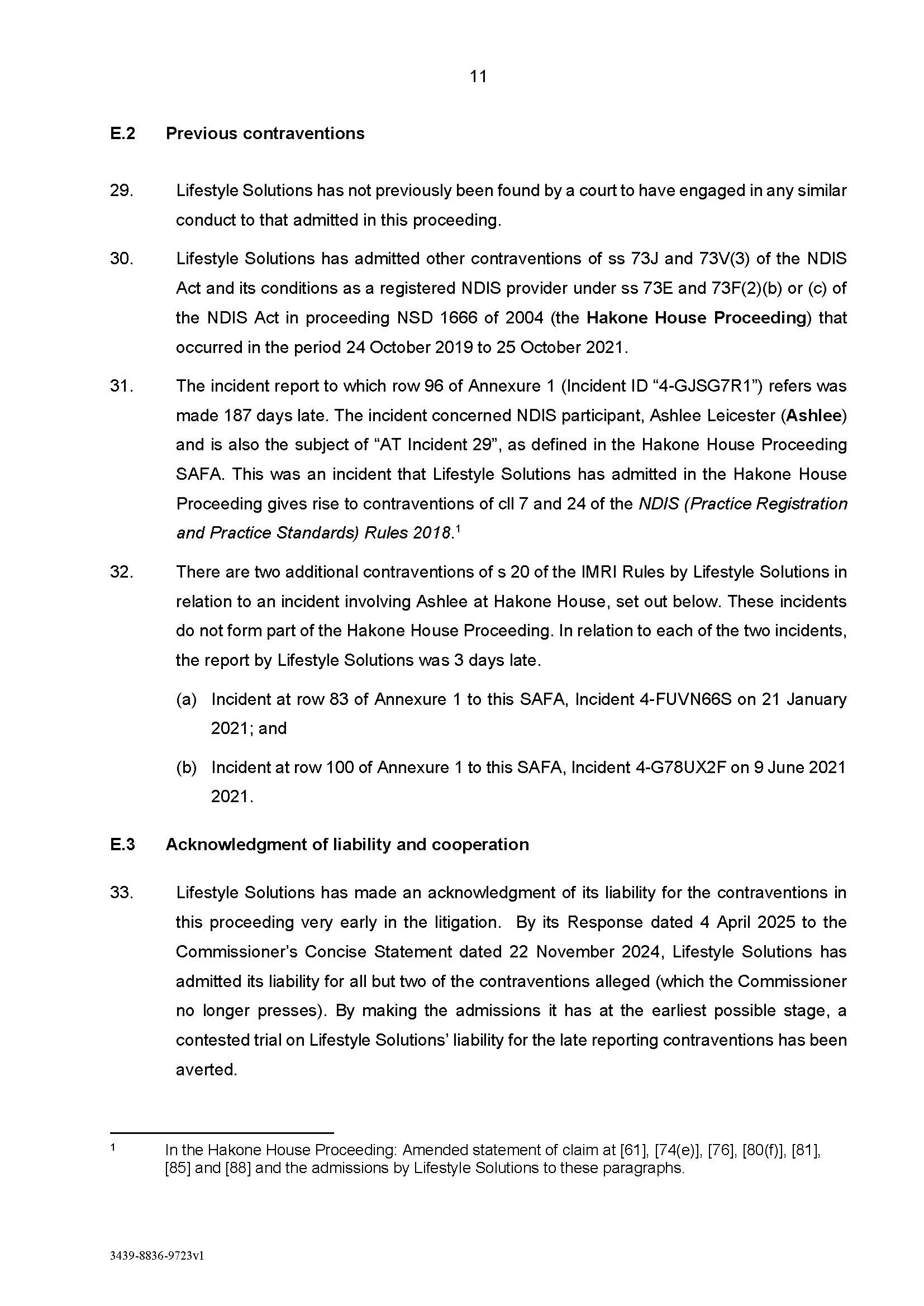
as set out in Annexure B to these orders.
THE COURT ORDERS THAT:
1. Pursuant to s 82(3) of the Regulatory Powers (Standard Provisions) Act 2014 (Cth), read with s 93(2) of that Act and s 73ZK of the NDIS Act, Lifestyle Solutions pay within 30 days of the date of this order to the Commonwealth of Australia:
(a) an aggregate penalty of $400,000 in respect of the contraventions of s 73J of the NDIS Act referred to in paragraph 1; and
(b) an aggregate penalty of $100,000 in respect of the contraventions of s 73J of the NDIS Act referred to in paragraph 2.
2. Within 30 days of the date of this order, Lifestyle Solutions pay a contribution to the Commissioner's costs of, and incidental to, this proceeding, fixed in the amount of $50,000.
Note: Entry of orders is dealt with in Rule 39.32 of the Federal Court Rules 2011.
Annexure A
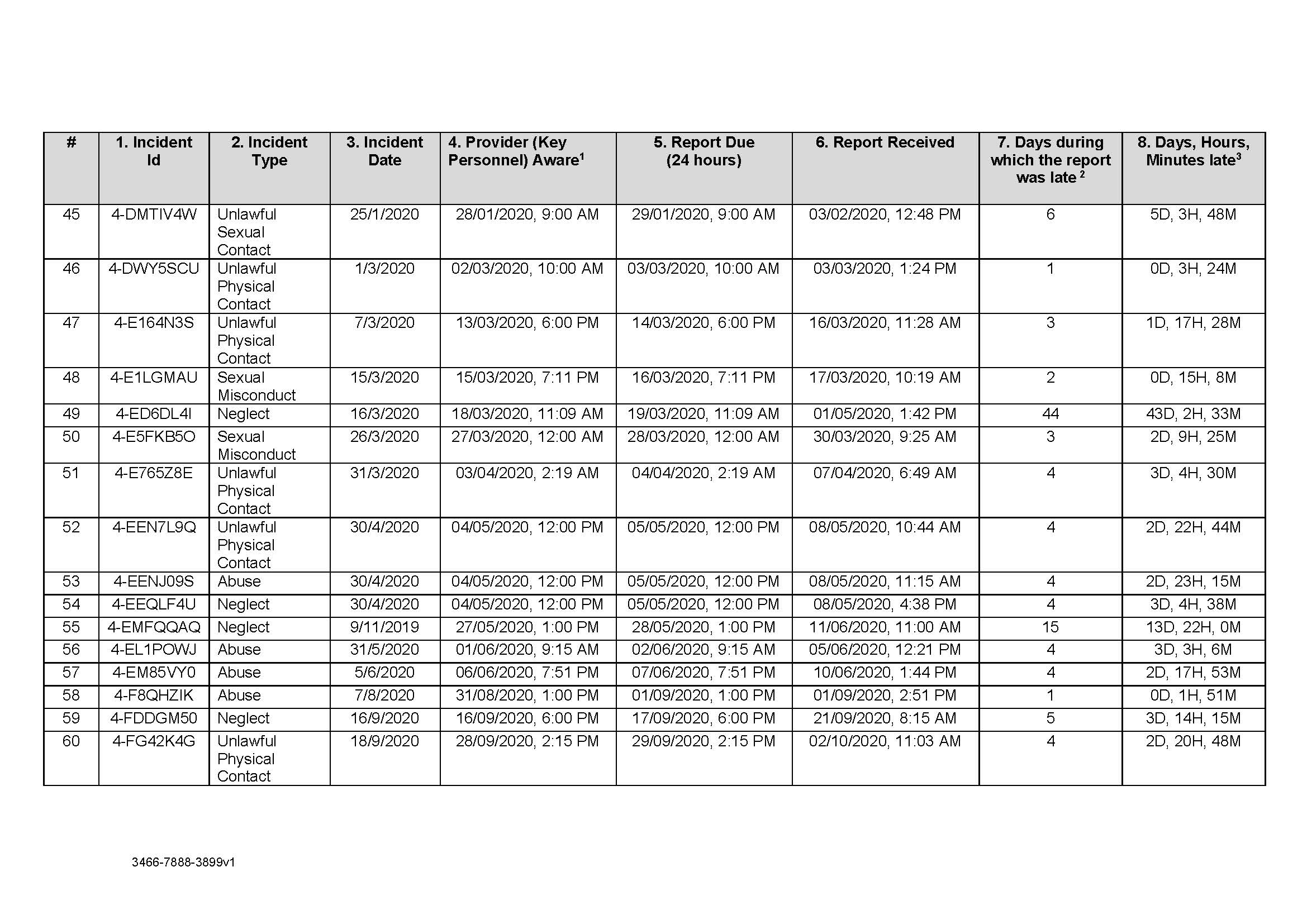
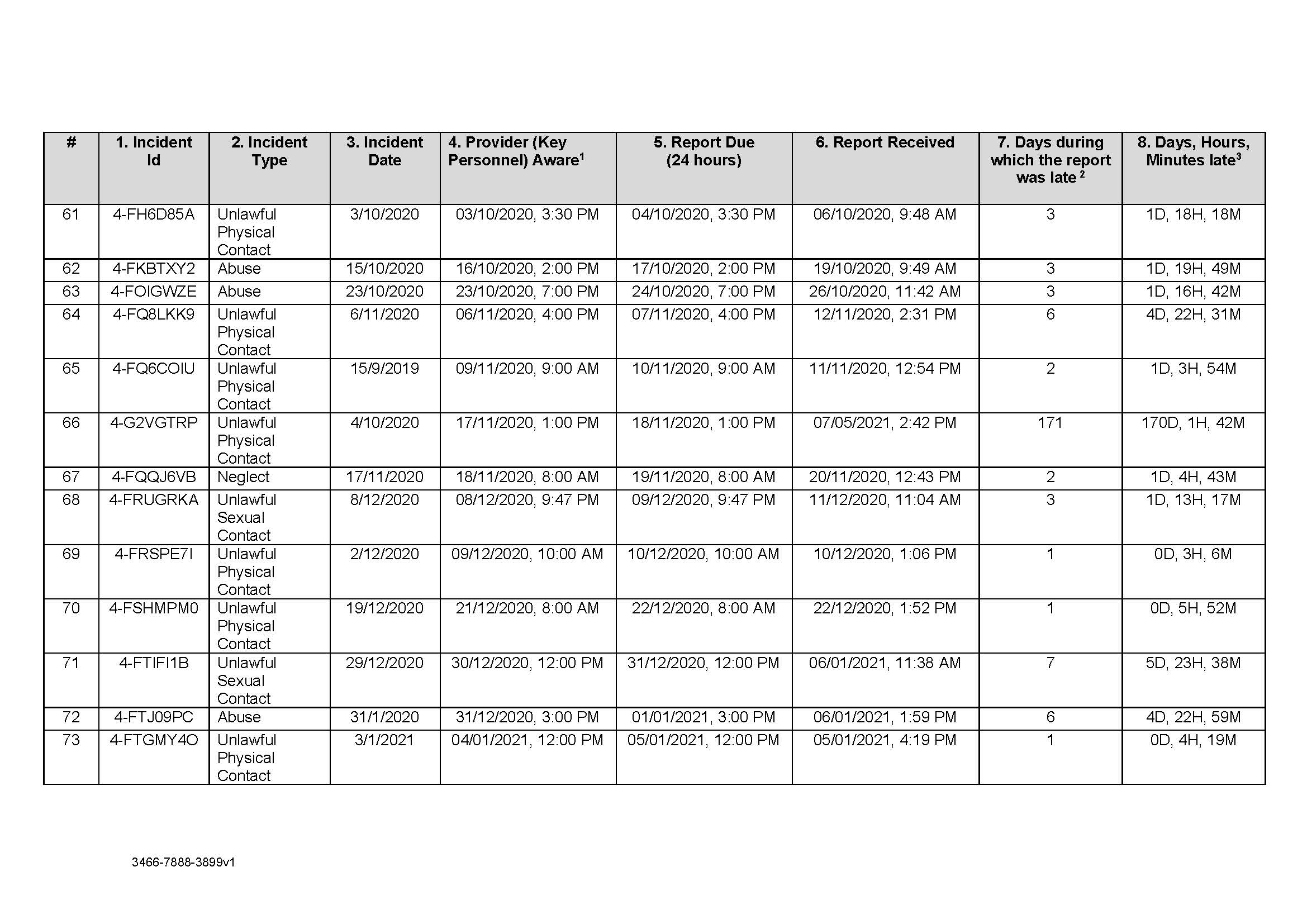
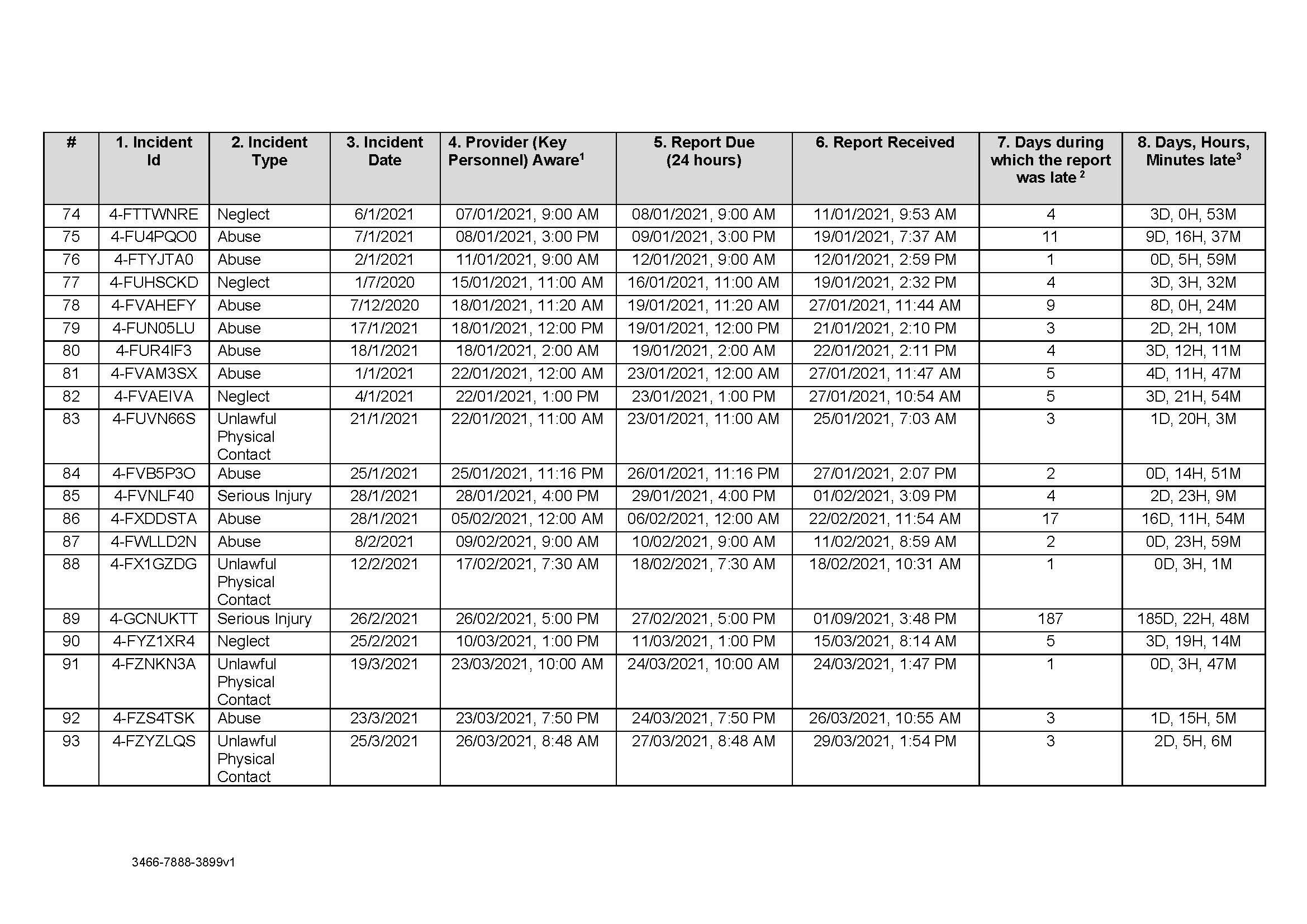
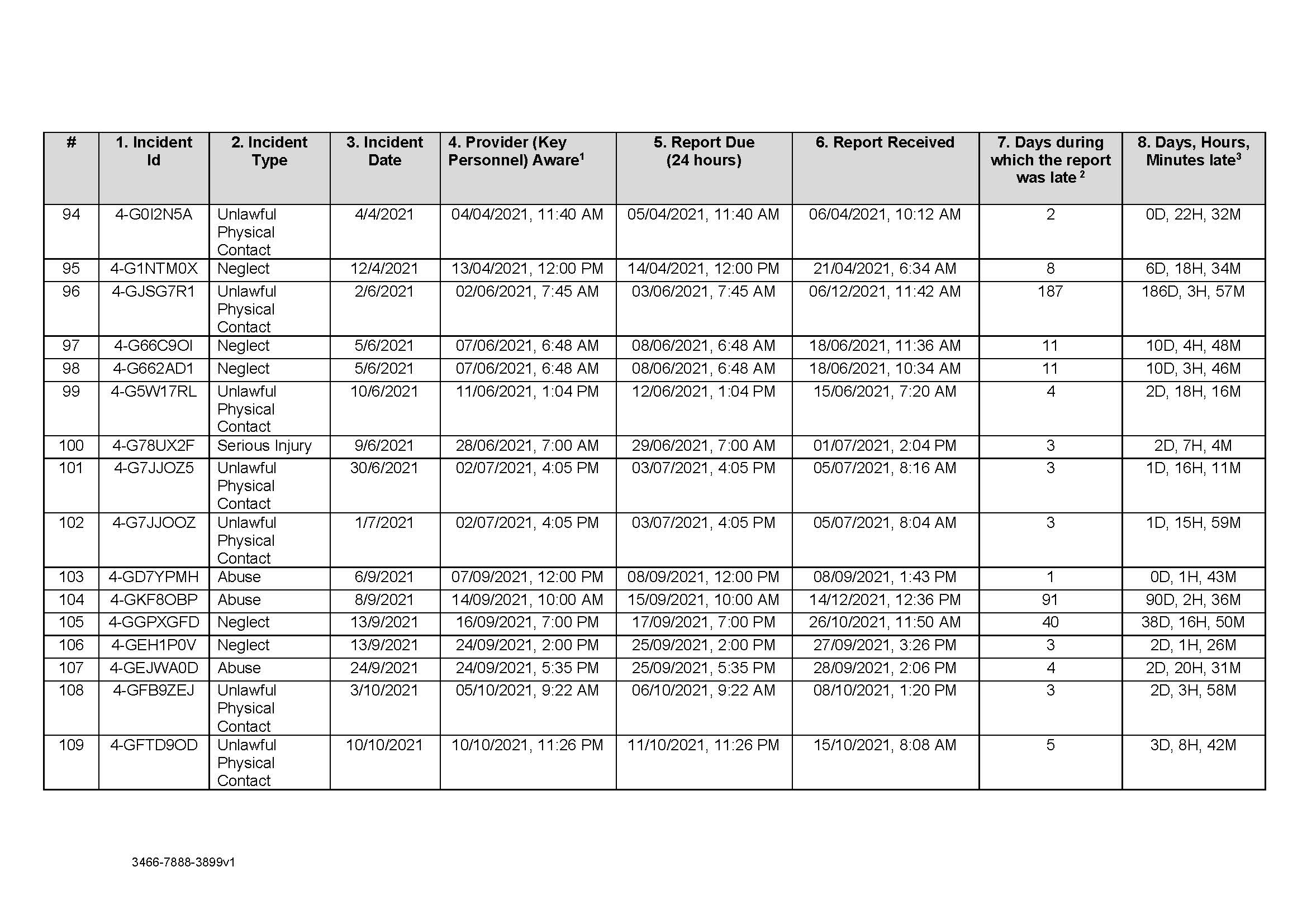
Annexure B
REASONS FOR JUDGMENT
ABRAHAM J:
1 The Commissioner of the NDIS Quality and Safeguards Commission, brings proceedings against Lifestyle Solutions (Aust) Ltd (Lifestyle Solutions), a registered National Disability Insurance Scheme (NDIS) provider, for its failure to fulfil the condition of its registration under s 73F(2)(h) of the National Disability Insurance Scheme Act 2013 (Cth) (NDIS Act) which required it to comply with reporting obligations prescribed by the National Disability Insurance Scheme (Incident Management and Reportable Incidents) Rules 2018 (Cth) (Reportable Incidents Rules). Each failure to notify the Commissioner within mandatory time limits stipulated in the Reportable Incidents Rules constituted a contravention of s 73J of the NDIS Act, which is a civil penalty provision. Further, by operation of s 93(2) of the Regulatory Powers (Standard Provisions) Act 2014 (Cth) (RPA), a separate contravention of s 73J was committed each day an incident was reported late.
2 These reasons are to be read in conjunction with those of Commissioner of the NDIS Quality and Safeguards Commission v Lifestyle Solutions (Aust) Ltd (Hakone House Proceeding) [2025] FCA 1393 (Hakone House Judgment), another proceeding heard concurrently with this proceeding. In that proceeding, Lifestyle Solutions was also the subject of civil penalty orders for its conduct as an NDIS provider, but for contraventions of a different nature. A penalty of $2,000,000 was imposed on Lifestyle Solutions for those contraventions.
3 As with the other proceeding, Lifestyle Solutions also admitted these contraventions. The proceeding was conducted by way of agreed facts, which are attached to these reasons as Appendix A (the Annexures to the agreed facts are not reproduced in the Appendix, but are Annexures to the orders made in this proceeding). The parties have also agreed that a pecuniary penalty of $500,000 be imposed on Lifestyle Solutions, and declarations be made reflecting the admitted contraventions.
4 For the reasons below, the declarations are made in the terms sought, and the proposed pecuniary penalty of $500,000 is imposed on Lifestyle Solution.
Statutory Scheme
5 In the Hakone House Judgment, I addressed the statutory scheme which is unnecessary to repeat. Given the contraventions in this case, it is appropriate to supplement that description to address the nature of the contraventions in this proceeding.
6 As a registered NDIS provider, Lifestyle Solutions’ registration is subject to certain conditions specified in s 73F(2). One of those conditions is a requirement to comply with all applicable requirements relating to reportable incidents prescribed by the NDIS rules for the purposes of s 73Z (s 73F(2)(h)). In this proceeding, the applicable rules are the Reportable Incidents Rules. Part 3 of the Rules is made for the purposes of s 73Z of the NDIS Act: s 15(1) Reportable Incidents Rules.
7 Section 73J of the NDIS Act provides that a person contravenes that section if they are a registered NDIS provider and breach a condition of its registration.
8 It is appropriate to also recall the Commissioner’s core functions as set out in the NDIS Act. They include upholding the rights of, and promoting the health, safety and wellbeing of people with disability receiving supports or services, including those received under the NDIS: s 181E(a). In addition, the Commissioner’s core functions include securing compliance with the NDIS Act through effective compliance and enforcement arrangements, including through the monitoring and investigative functions conferred by Division 8 of Part 3A of Chapter 4: s 181E(d). The Commissioner also has registration and reportable incident functions as follows: (1) monitoring registered NDIS provider compliance with their conditions of registration (s 181F(c)); (2) functions relating to the notification and management of reportable incidents conferred on the Commissioner by the NDIS rules made for the purposes of s 73Z of the NDIS Act, which are Parts 3 and 4 of the Reportable Incidents Rules (s 181F(e) and Reportable Incidents Rules, ss 15(1) and 27(1)); and (3) collating and analysing information relating to reportable incidents to identify trends and systemic issues (s 181F(g)).
Reportable Incidents Rules
9 The Reportable Incidents Rules provide requirements for NDIS Providers relating to reportable incidents. Pursuant to s 73Z(4) of the NDIS Act (as modified by s 16 of the Reportable Incidents Rules), “reportable incident” means, as identified in the applicant’s submissions:
(a) the death of a person with disability; or
(b) serious injury to a person with disability; or
(c) abuse or neglect of a person with disability; or
(d) unlawful sexual or physical contact with, or assault of, a person with disability – unless:
(i) the act is unlawful physical contact with a person with disability; and
(ii) the contact with, and impact on, the person with disability is negligible; or
(e) sexual misconduct committed against, or in the presence of, a person with disability, including grooming of the person for sexual activity; or
(f) the use of a restrictive practice in relation to a person with disability, other than where the use is in accordance with an authorisation (however described) of a State or Territory in relation to the person, except that:
(i) the use is a reportable incident if the use is not in accordance with a behaviour support plan for the person with disability; and
(ii) the use is not a reportable incident where the use is not in accordance with an authorisation (however described) of a State or Territory if:
1. the use is in accordance with a behaviour support plan for the person with disability; and
2. the State or Territory in which the restrictive practice is used does not have an authorisation process in relation to the use of the restrictive practice.
10 Further, a reportable incident includes one that is alleged to have occurred: s 17 Reportable Incidents Rules.
11 Relevantly, “key personnel” is defined as:
11A Definition of key personnel
(1) Each of the following is one of the key personnel of a person or entity
(a) a member of the group of persons who is responsible for the executive decisions of the person or entity;
(b) any other person who has authority or responsibility for (or significant influence over) planning, directing or controlling the activities of the person or entity.
…
12 Once a registered NDIS provider becomes aware of a reportable incident in connection with the provision of its services and support, the registered provider must notify the Commissioner: within 24 hours if the incident is of the type referred to in (a) to (e) in paragraph [9] above (s 20, Reportable Incidents Rules); or within 5 business days if the incident is of the type referred to in (f) of paragraph [9] above (s 21, Reportable Incidents Rules). Lifestyle Solutions admit it became aware of a reportable incident at least by the time one of its “key personnel” were informed of the incident.
13 As already described, Parts 3 and 4 of the Reportable Incidents Rules confer on the Commissioner registration and reportable incident functions. These include:
(1) if a registered NDIS provider gives notification of a reportable incident under ss 20(4) or 21, the Commissioner may require the provider to give further written information, including details of any internal or external investigation or assessment undertaken in relation to the incident, a copy of any investigation or assessment report, and whether the participants or their representatives have been kept informed (s 24);
(2) the Commissioner may take action upon receiving notification of a reportable incident in connection with supports or services provided by a registered NDIS provider, including a referral of the incident to other responsible entities (such as child protection), and requiring the provider to take specified remediation action, carry out an internal investigation or appoint an independent expert to carry out an investigation (s 26); and
(3) the Commissioner may also authorise an inquiry in relation to a reportable incident or series of reportable incidents (ss 26(1)(e) and 27).
Factual overview
14 It is unnecessary to repeat all the detail of the factual basis and context in which the contraventions occurred, which is detailed in the agreed facts. The following only provides a very a brief overview. It is necessary to consider the detailed agreed facts (see Appendix A) to appreciate the full nature and import of the conduct the subject of these proceedings.
15 Lifestyle Solutions provide disability services including supported independent living accommodation, development of daily living and life skills, participation in community, social and civil activities, support coordination (between 19 May 2021 and 17 May 2024), specialised supported employment, positive behaviour support and therapeutic supports, and short-term accommodation.
16 As a registered NDIS provider, Lifestyle Solutions was required to comply with the requirements prescribed by the Reportable Incidents Rules relating to reportable incidents.
17 Lifestyle Solutions admit it failed to notify the Commission of reportable incidents:
(1) within 24 hours pursuant to s 20 of the Reportable Incidents Rules during the period of 23 November 2018 to 13 December 2023 on 148 occasions; and
(2) within 5 business days pursuant to s 21 of the Reportable Incidents Rules during the period of 25 January 2019 to 1 November 2022 on 49 occasions.
18 The detail of each incident (i.e. incident date and type, date key personnel became aware of incident, date the report was received by the Commissioner and number of days the report was late) is identified in the agreed facts. Lifestyle Solutions admit that it became aware of the reportable incidents by at least the date key personnel were informed of the incident.
19 Lifestyle Solutions admit, by reason of those failures, 197 contraventions of s 73F(2)(h) of the NDIS Act. The admitted contraventions, being a condition of Lifestyle Solutions’ registration, therefore give rise to 197 contraventions of s 73J of the NDIS Act.
20 Further, Lifestyle Solutions admit that separate contraventions were committed each additional day a report was late to the Commissioner pursuant to s 93(2) of the RPA. For the 1,614 additional days the reports were late on the occasions identified in paragraph [17] above, the admitted contraventions give rise to a further 1,614 contraventions of s 73J of the NDIS Act.
21 Those failures resulted in an aggregate 1,811 contraventions over a period of approximately five years.
Relief Sought
22 This application is to be determined under the RPA. I have addressed the principles in respect to the imposition of a civil penalty and the granting of a declaration in the Hakone House Judgment at [30]-[43] and are unnecessary to repeat. Again, it is appropriate to supplement that summary by addressing the maximum penalty.
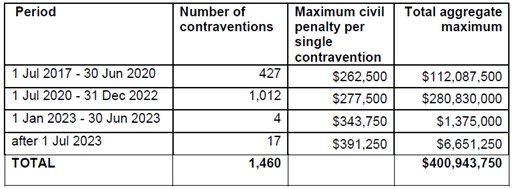
23 Pursuant to s 82(5)(a) of the RPA, a pecuniary penalty for a body corporate must not be more than five times the penalty specified for the civil penalty provision. Noting that provision, the maximum penalty for each contravention is 1250 penalty units. At the time of the contraventions spanning from 23 November 2018 to 13 December 2021, the individual penalty unit changed as identified in the below tables provided in the applicant’s submissions (see column with maximum civil penalty per single contravention). Each table identifies the total number of contraventions during each period the penalty unit changed.
Section 20 contraventions
Section 21 contraventions
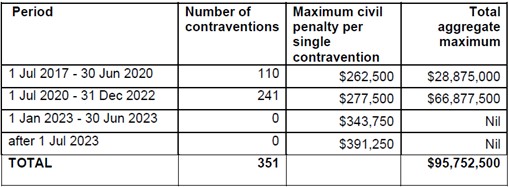
24 As discussed in paragraph [35] of the Hakone House Judgment and demonstrated by the above tables, this is another case where there are a sufficiently large number of contraventions, such that the maximum aggregate penalty rises to such a number that it is no longer meaningful: Australian Competition and Consumer Commission v Reckitt Benckiser (Australia) Pty Ltd [2016] FCAFC 181; (2016) 340 ALR 25 at [157]. In that circumstance “the focus should be on the conduct and on determining a penalty to match the conduct”: Australian Energy Regulator v Origin Energy Electricity Ltd [2022] FCA 802 at [42]; Australian Energy Regulator v Santos Direct Pty Ltd [2024] FCA 579 at [71].
25 Further, although separate contraventions arising from separate acts would ordinarily attract separate penalties, where the separate acts give rise to separate contraventions which are inextricably interrelated, they may be regarded as a “course of conduct” for the purpose of imposing a penalty: Australian Competition and Consumer Commission v Yazaki Corporation [2018] FCAFC 73; (2018) 262 FCR 243 at [234]; Australian Competition and Consumer Commission v The Good Guys Discount Warehouses (Australia) Pty Ltd [2025] FCA 1085 at [113]. This avoids double punishment for those parts of the legally distinct contraventions that involve overlap in wrongdoing: see for example, Construction, Forestry, Mining and Energy Union v Cahill [2010] FCAFC 39; (2010) 269 ALR 1 at [39] and [41]. As the applicant submitted, that approach is provided for by s 85(1) of the RPA where the Court may impose a single penalty for multiple contraventions if the contraventions “form, or are part of, a series of contraventions of the same or a similar character”.
Consideration
26 The Commissioner addressed what she submitted were the relevant factors to consider in assessing the penalty in this proceeding. Lifestyle Solutions endorse the Commissioner’s submission with a small number of additional observations. Given that, it is unnecessary to recite the submissions in detail. In addition to the agreed facts, the Commissioner tendered some additional material, which I have taken into account in assessing the appropriateness of the agreed penalty. Further, the additional material relied on by the parties in the Hakone House Proceeding was also admitted in this proceeding, which I have also taken into account.
27 Before addressing considerations particular to this proceeding, it is appropriate to record that when assessing the penalty, the discussion in the Hakone House Judgment in relation to the size and nature of Lifestyle Solutions’ business, its financial circumstances, Lifestyle Solutions’ acknowledgement of liability, lack of prior contraventions, and acts undertaken since the contraventions, apply similarly to this proceeding. I rely on those observations without repeating them: Hakone House Judgement at [52]-[53], [57]-[62]. In addition, I add the following.
28 First, the contraventions are serious. The reporting requirements of NDIS providers are of the utmost importance in circumstances where they are providing services to vulnerable people, who are dependent on the provider fulfilling its obligations. It is timely to recall the objects of the NDIS Act, which are identified in s 3 and include: promoting the provision of high quality and innovative supports that enable people with disability to maximise independent lifestyles and full inclusion in the community (s 3(1)(g)); and protecting and preventing people with disability from experiencing harm arising from poor quality or unsafe supports or services provided under the NDIS (s 3(1)(ga)). The late reporting of incidents by Lifestyle Solutions necessarily impeded the ability of the Commissioner to give effect to those objects.
29 Further, the different time requirements for notifying the Commissioner under the Reportable Incidents Rules reflect the gravity of the matters that are the subject of notification. In Commissioner of the NDIS Quality and Safeguards Commission v Aurora Community Care Pty Ltd (in liquidation) (No 2) [2025] FCA 1237 (Aurora), many of the contraventions involved breaches of reporting conditions. I observed there that contraventions involving breach of statutory conditions imposed on NDIS providers are serious. The “[o]bservance of the conditions of this scheme is essential to its proper operation”: Aurora at [85].
30 The type and nature of the reporting contraventions is illustrated by what occurred. The Commissioner described the nature of the contraventions in her submissions as (citations omitted):
[81] The different time requirements for notifying the Commissioner under the [Reportable Incidents] Rules reflect the gravity of the matters that are the subject matter of notification.
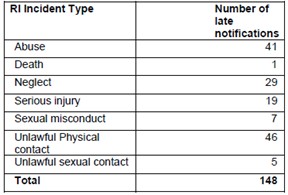
(a) The matters covered by s 20, which require notifications to be made within 24 hours of the provider becoming aware, are the most serious forms of incidents – death, serious injury, abuse or neglect, unlawful sexual or physical contact, and sexual misconduct. Lifestyle Solutions’ contravening conduct spanned the gamut of these serious incidents as set out in Table E.
Table E
(b) While the matters the subject of s 21 – being use of restrictive practices – are also serious, the requirement to notify within 5 business days under s 21 is indicative of a lower level of gravity of the matter notified.
[82] The number of contraventions and extent of delay by Lifestyle Solutions’ contravening conduct in the RI Proceeding is alarming, particularly in relation to the s 20 notifications.
[83] Of the 148 late notifications of reportable incidents that were subject to the 24-hour reporting requirement:
(a) Three (3) were almost six months late (ie, between 171 and 187 days late);
(b) Four (4) were between one and three months late (ie, between 40 and 91 days late);
(c) Seven (7) were between two and four weeks late (ie, between 15 and 28 days late);
(d) 19 were between one and almost two weeks late (ie, between 8 and 13 days late);
(e) 68 were between three and seven days late; and
(f) 47 were between one and two days after the expiry of the 24-hour period.
[84] Of the 49 late notifications of reportable incidents that were subject to a within 5 business days reporting requirement:
(a) Two (2) were between one month and almost two months late (ie, one was 33 and another was 54 days late);
(b) Five (5) were over a week late (ie, between 8 and 11 days late);
(c) 26 were between 6 and 7 days late – ie, they were notified at least 6 or 7 days after the expiry of the 5 business day period and therefore at least 11 to 12 days after Lifestyle Solutions’ key personnel became aware of the incident; and
(d) 16 were between 1 and 3 days late – ie, at least 6 to 8 days after Lifestyle Solutions’ key personnel became aware of the incident.
31 I note also that the contraventions occurred over a lengthy period, for over five years in respect of the breaches of s 20, and three years and nine months in respect of the breaches of s 21.
32 Second, the failure to notify the Commissioner of the reportable incidents within the mandatory timeframes, including some very lengthy delays, prevented the Commissioner from fulfilling her statutory functions: see discussion at [8] and [13] above. The persons impacted by the reportable incidents were deprived of the opportunity for the Commissioner to review and respond at the earliest opportunity. That might have included prompt, adequate and necessary responses and/or remedial action for the harm impacted persons suffered. The significance of this consequence is evident from the circumstances in which mandatory notification is required (particularly for the 24-hour reportable incidents). Here, the nature and number of contraventions, in particular of the 24-hour reporting requirement, starkly illustrates both the importance of the obligation, and the potential consequences where there is a failure to do so.
33 To provide one example. As explained in the Hakone House Judgment, there is some degree of overlap between the proceedings, including one incident which forms a contravention in both proceedings. That is AT Incident 29, in which AT grabbed Ms Leicester by the arms and attempted to bite her, before a support worker intervened which was required to be reported within 24 hours of the incident but was reported 187 days late.
34 Third, the contravening conduct necessarily arose from a breakdown with the reporting processes that involved senior personnel within Lifestyle Solutions. That is because the Reportable Incidents Rules place a responsibility on members of the provider’s “key personnel” and any person specified under s 10(1)(c) of the Rules, to “take all reasonable steps to ensure that reportable incidents … are notified to the Commissioner”: s 18. There is no evidence that “all reasonable steps” were taken.
35 Fourth, the conduct by Lifestyle Solutions, which involves numerous breaches of ss 20 and 21 of the Reportable Incidents Rules, can properly be considered as two distinct courses of conduct based on the provisions contravened, for the purposes of imposing a penalty: see [25] above.
36 Finally, I accept the applicant’s submission that the number and extent of the contraventions, the geographic spread and extended period of time in which they occurred are indicative of a systemic problem within Lifestyle Solutions at the time of the contravening conduct and reflects poorly on its compliance culture.
Conclusion
37 The parties proposed the following aggregate penalties:
(1) $400,000 for Lifestyle Solutions’ 148 late notifications contrary to s 20 of the Reportable Incidents Rules (24-hour reportable incidents), resulting in 1,460 contraventions of s 73J of the NDIS Act; and
(2) $100,000 for Lifestyle Solutions’ 49 late notifications contrary to s 21 of the Reportable Incidents Rules (5 business day reportable incidents), resulting in 351 contraventions of s 73J of the NDIS Act.
38 The penalties were structured recognising the multiple contraventions, and the principles regarding a course of conduct.
39 The Commissioner submitted that in circumstances where non-compliance with s 20 of the Reportable Incidents Rules relates to notifications that the legislature has deemed more serious and urgent, it is appropriate that the failure to comply with s 20 results in a larger penalty. Further, the total number of contraventions of s 73J of the NDIS Act, arising from failures to notify in accordance with s 20, is just over four times greater than the number of contraventions arising from non-compliance with s 21.
40 I have addressed the principles relevant to considering an agreed penalty in the Hakone House Judgment at [38]-[40]. It is unnecessary to repeat them. Suffice to say I am conscious of those principles in considering the parties proposed penalty in this proceeding.
41 This Court must impose a penalty that is appropriate in all the circumstances. The principal purpose in imposing a civil penalty is deterrence. The contravening conduct occurred over many years, and in some instances, the delay in notification was exceedingly long. Lifestyle Solutions repeatedly failed to fulfill its reporting obligations as an NDIS provider, and as illustrated by the number contraventions and the nature of the underlying reportable incidents (in particular the s 20 contraventions, which include death, serious injury, abuse or neglect, unlawful sexual or physical contact, and sexual misconduct). The contraventions are serious. Compliance by an NDIS provider of the obligations imposed on it is essential to the proper operation of the scheme. The contraventions deprived the Commissioner of timely information. It affected the ability of the Commissioner to exercise critical statutory functions necessary to protect vulnerable members of the public who are participants of the scheme. It undermines the Commissioner’s ability to ensure the objects of the NDIS scheme are fulfilled.
42 Considering the evidence and relevant principles, I am satisfied the total of the aggregate penalties of $500,000 is an appropriate penalty in this proceeding. It carries an appropriate deterrent value for Lifestyle Solutions, and others.
43 Given the circumstances of this case, I am also satisfied that the declaratory relief in the terms sought is appropriate. The matter is of public interest by reason of, inter alia, its subject matter, the vulnerable position of the NDIS participants, and the nature and consequences of the failures. These circumstances call for the marking of the Court’s disapproval of the conduct. Consequently, the declarations sought have significant utility. I accept the terms of the declarations, and I am satisfied that it is in the interests of justice to make the declarations sought.
44 The parties have also agreed that Lifestyle Solutions would pay $50,000 of the applicant’s costs for the proceedings. The costs order ought also to be made.
45 Accordingly, I make the orders in the terms sought by the parties.
I certify that the preceding forty-five (45) numbered paragraphs are a true copy of the Reasons for Judgment of the Honourable Justice Abraham. |
Associate:
Dated: 14 November 2025
Appendix A