FEDERAL COURT OF AUSTRALIA
Commissioner of the NDIS Quality and Safeguards Commission v Lifestyle Solutions (Aust) Ltd (Hakone House Proceeding) [2025] FCA 1393
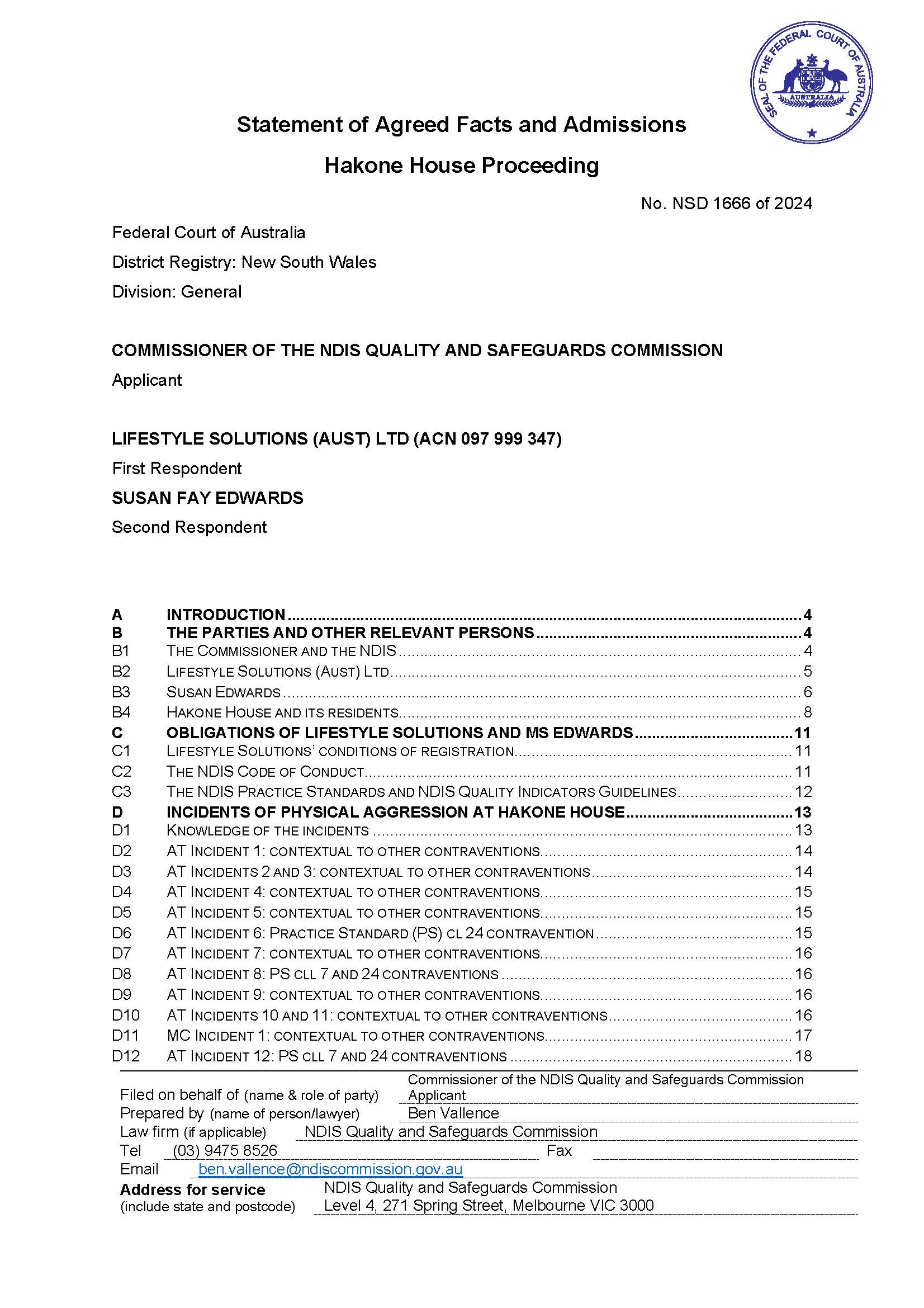
File number(s): | NSD 1666 of 2024 |
Judgment of: | ABRAHAM J |
Date of judgment: | 14 November 2025 |
Catchwords: | CIVIL PENALTY – proceeding for civil contraventions of ss 73J and 73V of the National Disability Insurance Scheme Act 2013 (Cth) – where failures involved breach of NDIS Code of Conduct and NDIS Practice Guidelines – where conduct serious – where supported living environment for residents was unsafe with repeated incidences of physical aggression by other residents – where parties agreed on proposed declarations, pecuniary penalties and costs orders – whether proposed penalty and declaratory relief are appropriate – orders made in terms sought |
Legislation: | Federal Court of Australia Act 1976 (Cth), s 21 National Disability Insurance Scheme Act 2013 (Cth), ss 3(1)(g), 3(1)(ga), 3(2), 4, 9, 73E, 73F(1), 73F(2), 73J, 73T, 73V(3), 73ZK, 181A, 181D, 181E, 181F, 209 Regulatory Powers (Standard Provisions) Act 2014 (Cth), ss 82, 83, 84, 85 National Disability Insurance Scheme (Code of Conduct) Rules 2018 (Cth), ss 5(1), 5(2), 6(1)(c), 6(1)(e), 6(1)(f) National Disability Insurance Scheme (Provider Registration and Practice Standards) Rules 2018 (Cth), Sch 1 cl 7, 10, 14, 24 |
Cases cited: | Australian Building and Construction Commissioner v Construction, Forestry, Mining and Energy Union [2018] HCA 3; (2018) 262 CLR 157 Australian Building and Construction Commissioner v Pattinson [2022] HCA 13; (2022) 399 ALR 599 Australian Competition and Consumer Commission v Australian Safeway Stores Pty Ltd [1997] FCA 450; (1997) 145 ALR 36 Australian Competition and Consumer Commission v Coles Supermarkets Australia Pty Limited [2015] FCA 330 (2015) 327 ALR 540 Australian Competition and Consumer Commission v MSY Technology Pty Ltd [2012] FCAFC 56; (2012) 201 FCR 378 Australian Competition and Consumer Commission v Reckitt Benckiser (Australia) Pty Ltd [2016] FCAFC 181; (2016) 340 ALR 25 Australian Energy Regulator v Origin Energy Electricity Ltd [2022] FCA 802 Australian Energy Regulator v Santos Direct Pty Ltd [2024] FCA 579 Australian Securities and Investments Commission v LGSS Pty Ltd (No 3) [2025] FCA 205 Australian Securities and Investments Commission v MLC Nominees [2020] FCA 1306; (2020) 147 ACSR 266 Australian Securities and Investments Commission v Monarch FX Group Pty Ltd, in the matter of Monarch FX Group Pty Ltd [2014] FCA 1387; (2014) 103 ACSR 453 Australian Securities and Investments Commission v Pegasus Leveraged Options Group Pty Ltd [2002] NSWSC 310; (2002) 41 ACSR 561 Australian Securities and Investments Commission v Statewide Superannuation Pty Ltd [2021] FCA 1650 Australian Securities and Investments Commission v Stone Assets Management Pty Ltd [2012] FCA 630; (2012) 205 FCR 120 Commissioner of the NDIS Quality and Safeguards Commission v Aurora Community Care Pty Ltd (in liquidation) (No 2) [2025] FCA 1237 Commissioner of the NDIS Quality and Safeguards Commission v Australian Foundation for Disability [2023] FCA 629 Commissioner of the NDIS Quality and Safeguards Commission v LiveBetter Services Ltd [2024] FCA 374 Commissioner of the NDIS Quality and Safeguards Commission v Valmar Support Services Ltd [2025] FCA 11 Commonwealth of Australia v Director, Fair Work Building Industry Inspectorate [2015] HCA 46; (2015) 258 CLR 482 Construction, Forestry, Maritime, Mining and Energy Union v Fair Work Ombudsman (The Botany Cranes Case) [2023] FCAFC 40; (2023) 297 FCR 438 Forster v Jododex Australia Pty Ltd [1972] HCA 61; (1972) 127 CLR 421 Markarian v The Queen [2005] HCA 25; (2005) 228 CLR 357 Mill v The Queen [1988] HCA 70; (1988) 166 CLR 59 Minister for Industry, Tourism and Resources v Mobil Oil Australia Pty Ltd [2004] FCAFC 72; (2004) ATPR 41-993 NW Frozen Foods Pty Ltd v Australian Competition Commission [1996] FCA 1134; (1996) 71 FCR 285 Seven Network Ltd v News Ltd [2009] FCAFC 166; (2009) 182 FCR 160 TPG Internet Pty Ltd v Australian Competition and Consumer Commission [2012] FCAFC 190; (2012) 210 FCR 277 viagogo AG v Australian Competition and Consumer Commission [2022] FCAFC 87 Volkswagen Aktiengesellschaft v Australian Competition and Consumer Commission [2021] FCAFC 49; (2021) 284 FCR 24 |
Division: | General Division |
Registry: | New South Wales |
National Practice Area: | Commercial and Corporations |
Sub-area: | Regulator and Consumer Protection |
Number of paragraphs: | 83 |
Date of hearing: | 30 October 2025 |
Counsel for Applicant: | Mr D Star KC and Mr Peckham |
Solicitor for Applicant: | NDIS Quality and Safeguards Commission |
Counsel for First Respondent: | Ms M Norton SC and Mr J Gray |
Counsel for Second Respondent: | Ms C Dowsett SC |
Solicitor for Respondents: | Corrs Chambers Westgarth |
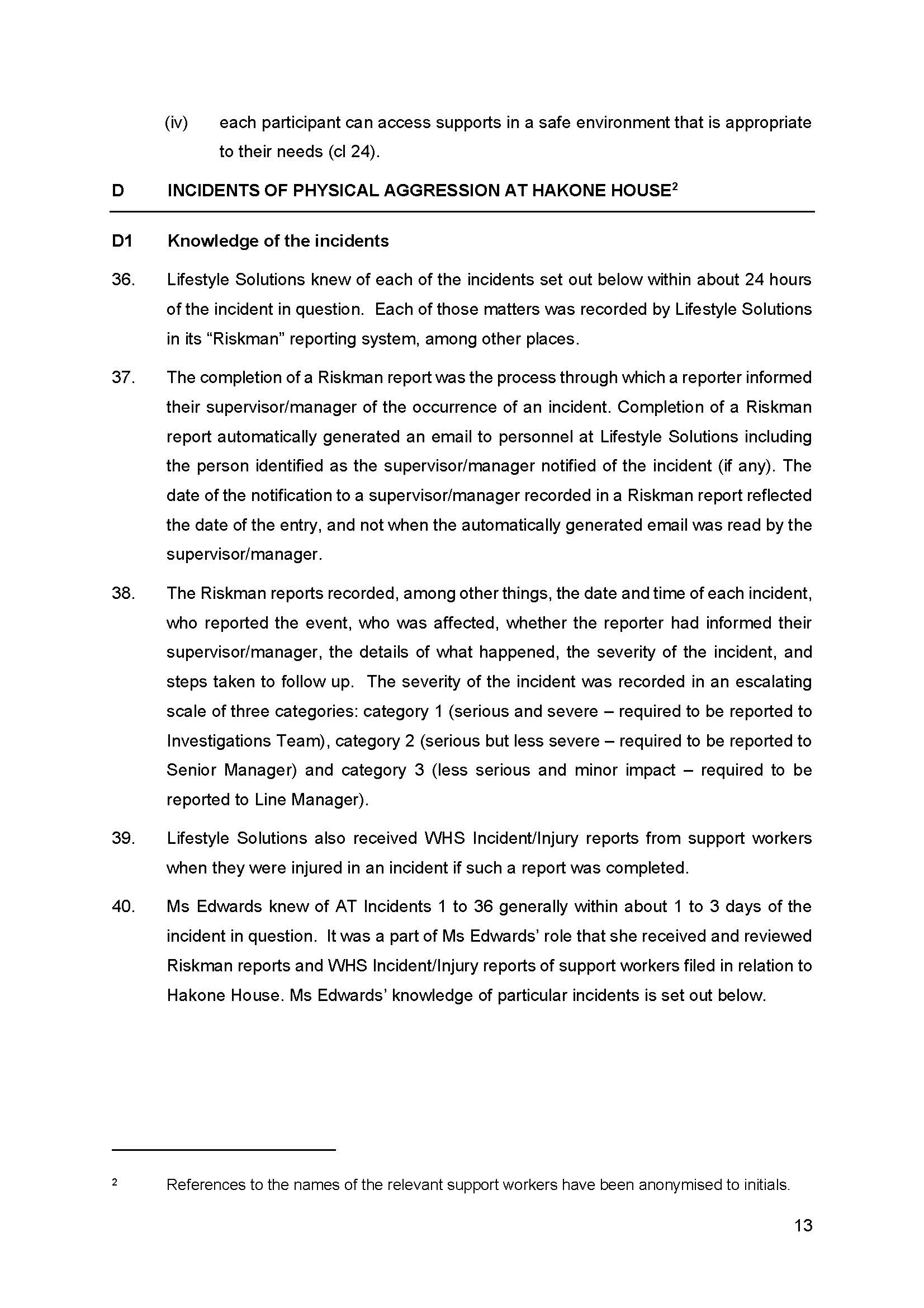
ORDERS
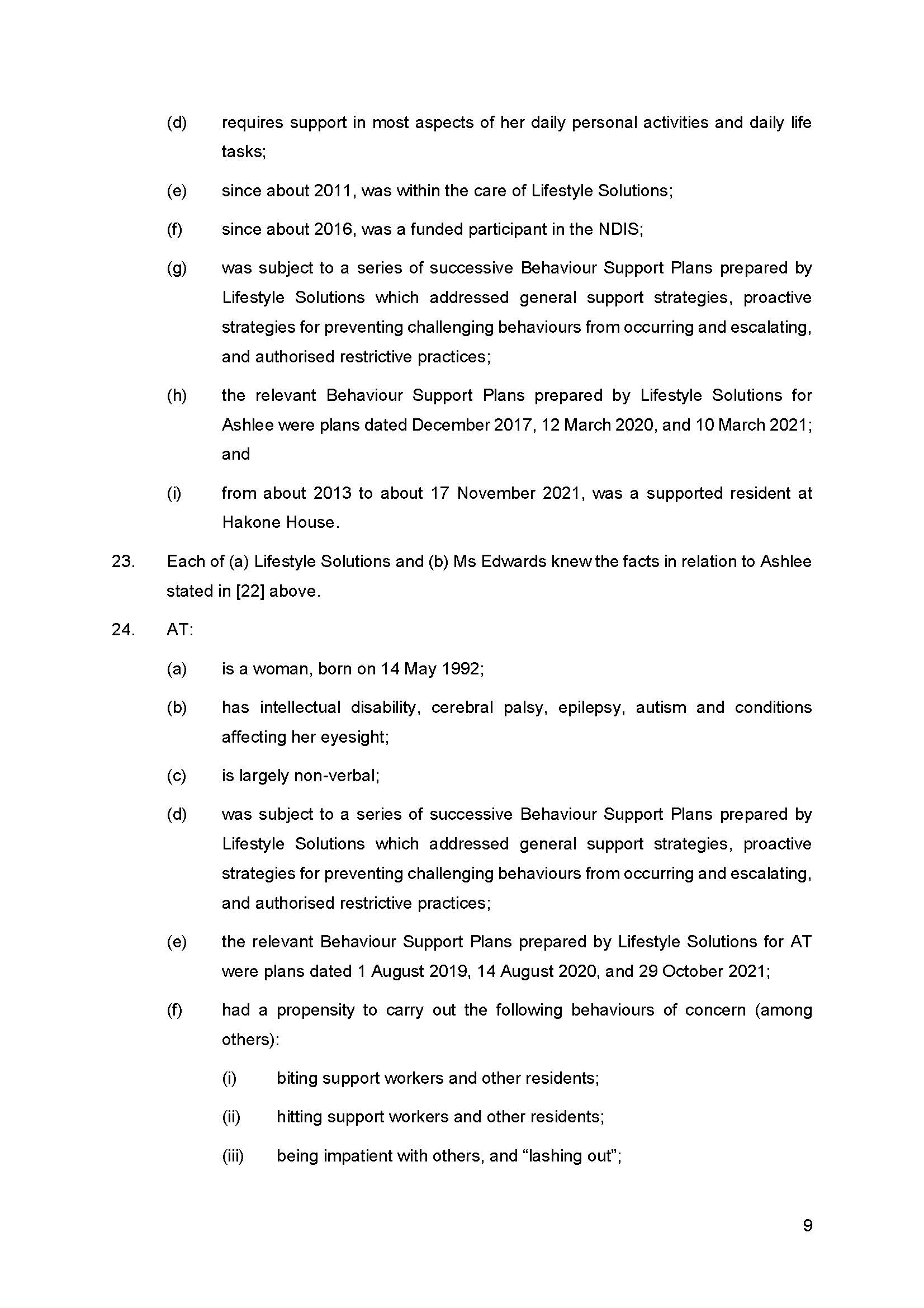
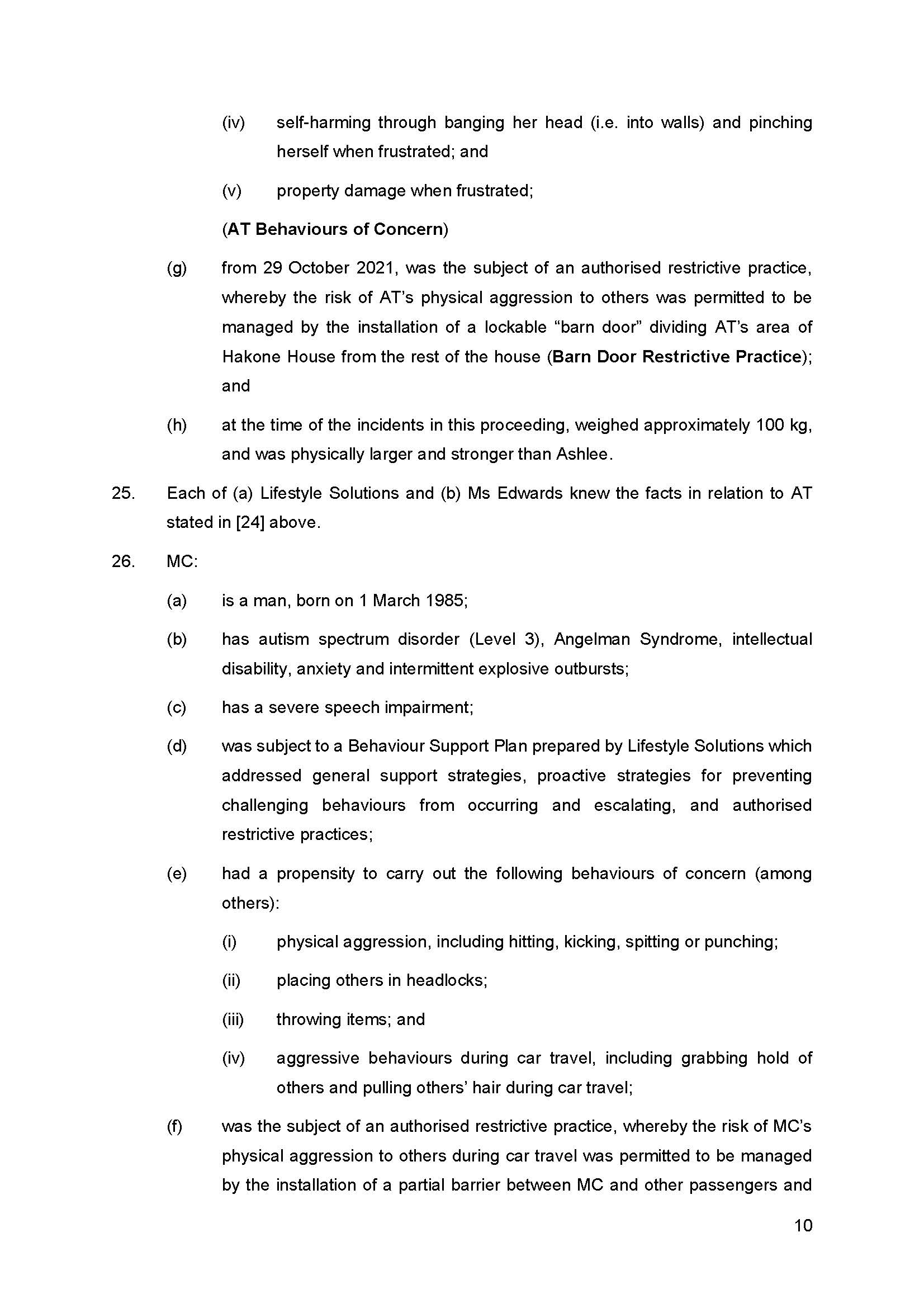
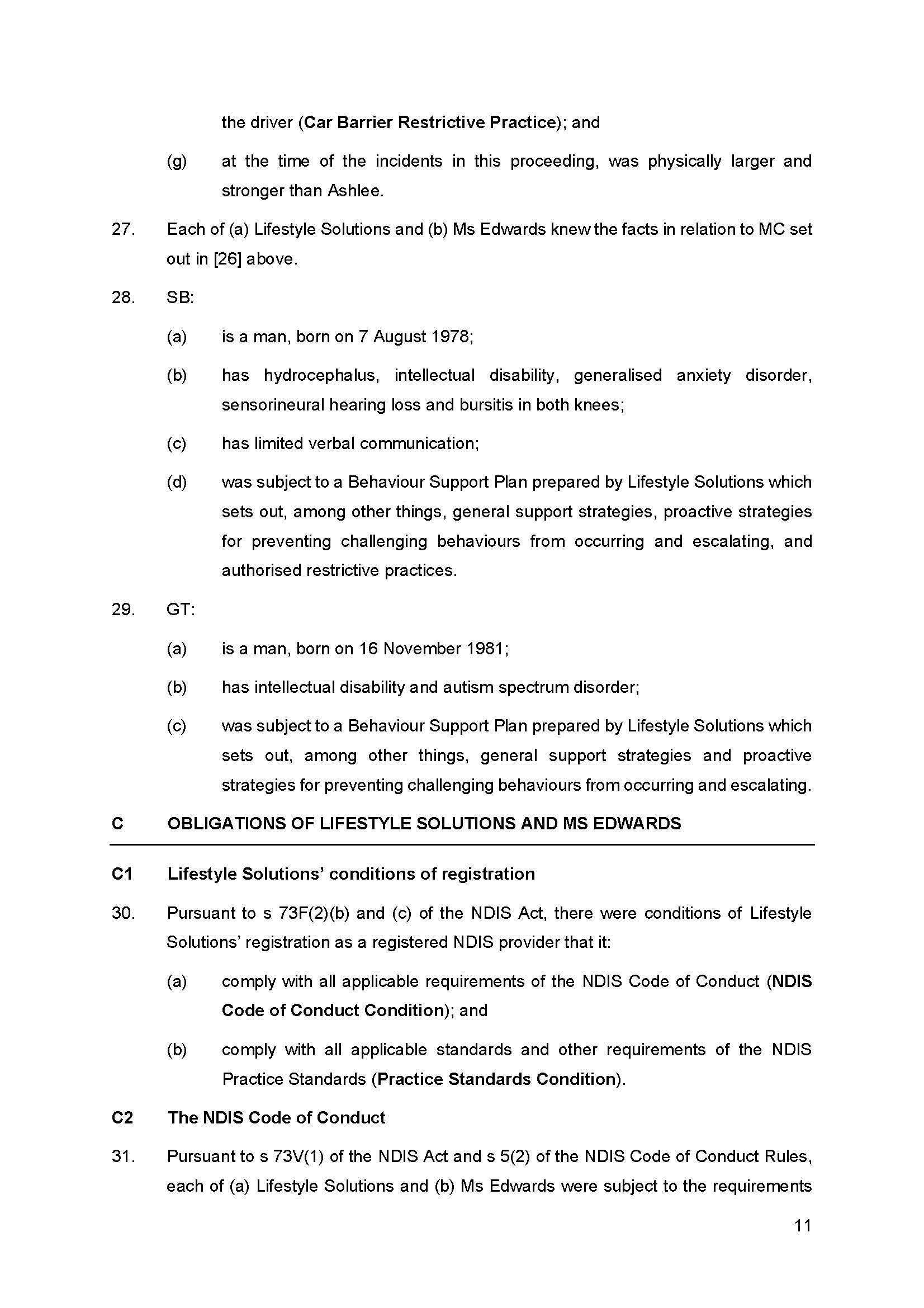
NSD 1666 of 2024 | ||
| ||
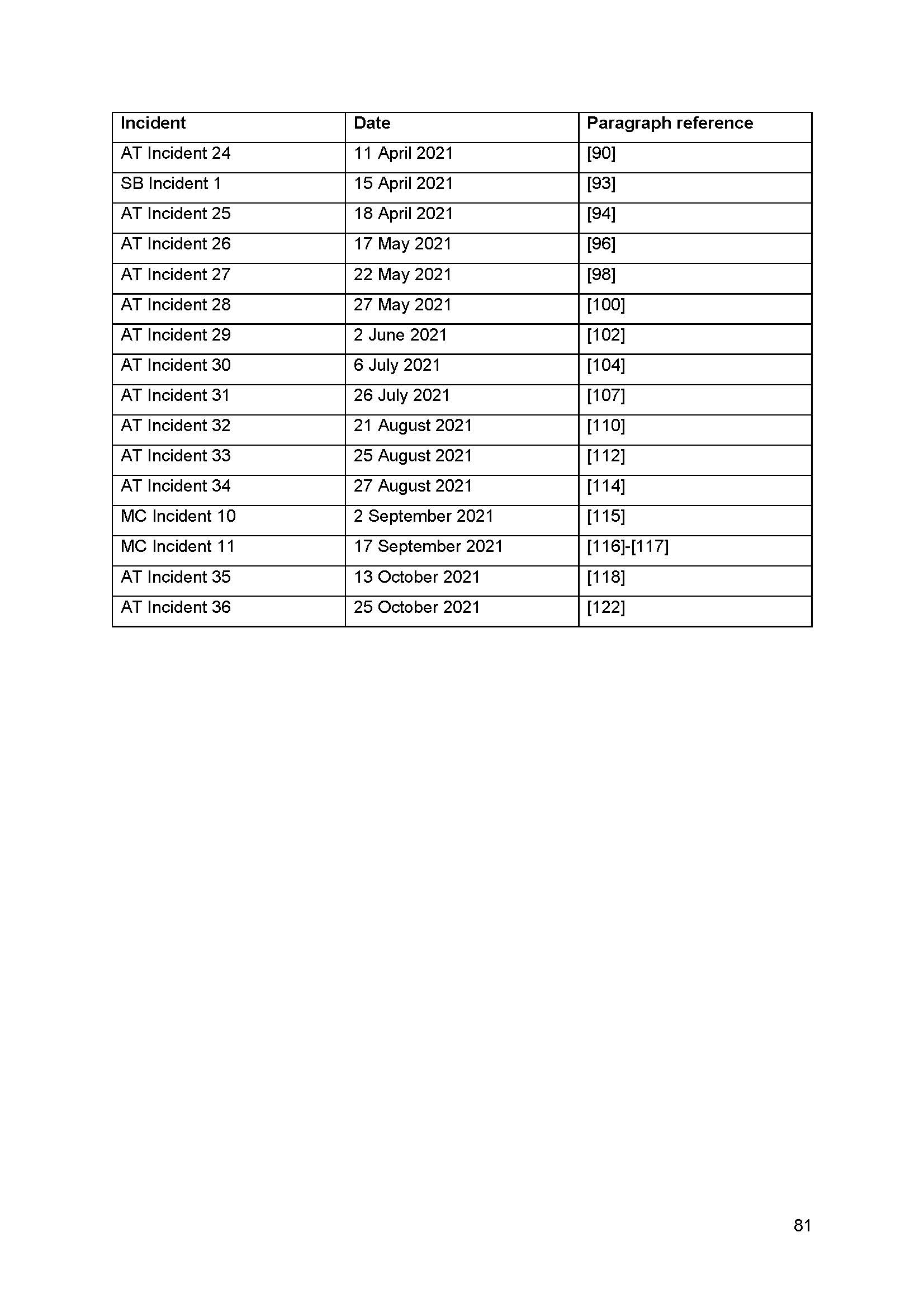
BETWEEN: | COMMISSIONER OF THE NDIS QUALITY AND SAFEGUARDS COMMISSION Applicant | |
AND: | LIFESTYLE SOLUTIONS (AUST) LTD (ACN 097 999 347) First Respondent SUSAN FAY EDWARDS Second Respondent | |
order made by: | ABRAHAM J |
DATE OF ORDER: | 14 November 2025 |
THE COURT DECLARES THAT:
Lifestyle Solutions’ contraventions of the NDIS Practice Standards (PS)
Participants accessing supports free from violence: PS cl 7
1. In contravention of s 73J of the National Disability Insurance Scheme Act 2013 (Cth) (NDIS Act), and in breach of a statutory condition of its registration as a registered NDIS provider under ss 73E and 73F(2)(c) of the NDIS Act, on 12 occasions in the period between 16 November 2019 and 13 October 2021, the first respondent (Lifestyle Solutions) failed to comply with cl 7 of Schedule 1 of the NDIS (Provider Registration and Practice Standards) Rules 2018 (NDIS Practice Standards) in relation to its provision of supports to NDIS participants at 1/32-34 Hakone Road, Woongarrah, New South Wales, also known as Bluegrass 1 (Hakone House), as follows:
(a) By reason of physical aggression from AT, an NDIS participant and resident of Hakone House:
(i) Ms Leicester, an NDIS participant and resident of Hakone House, was unable to access the supports free from violence at the time of incidents occurring on each of the following days:
A. 16 November 2019;
B. 13 May 2020;
C. 22 August 2020;
D. 11 April 2021;
E. 2 June 2021;
F. 25 August 2021; and
G. 13 October 2021.
(ii) MC, an NDIS participant and resident of Hakone House, was unable to access the supports free from violence at the time of incidents occurring on each of the following days:
A. 7 March 2020; and
B. 29 March 2021.
(b) By reason of physical aggression from MC, Ms Leicester was unable to access the supports free from violence at the time of incidents occurring on each of the following days:
(i) 9 February 2021;
(ii) 2 September 2021; and
(iii) 17 September 2021.
Participants accessing supports in a safe environment: PS cl 24
2. In contravention of s 73J of the NDIS Act, and in breach of a statutory condition of its registration as a registered NDIS provider under ss 73E and 73F(2)(c) of the NDIS Act, on 14 occasions in the period between 24 October 2019 and 25 October 2021 Lifestyle Solutions failed to comply with cl 24 of Schedule 1 of the NDIS Practice Standards in relation to its provision of supports to NDIS participants at Hakone House, as follows:
(a) By reason of injury and/or the real risk of injury (or risk of more serious injury) from AT:
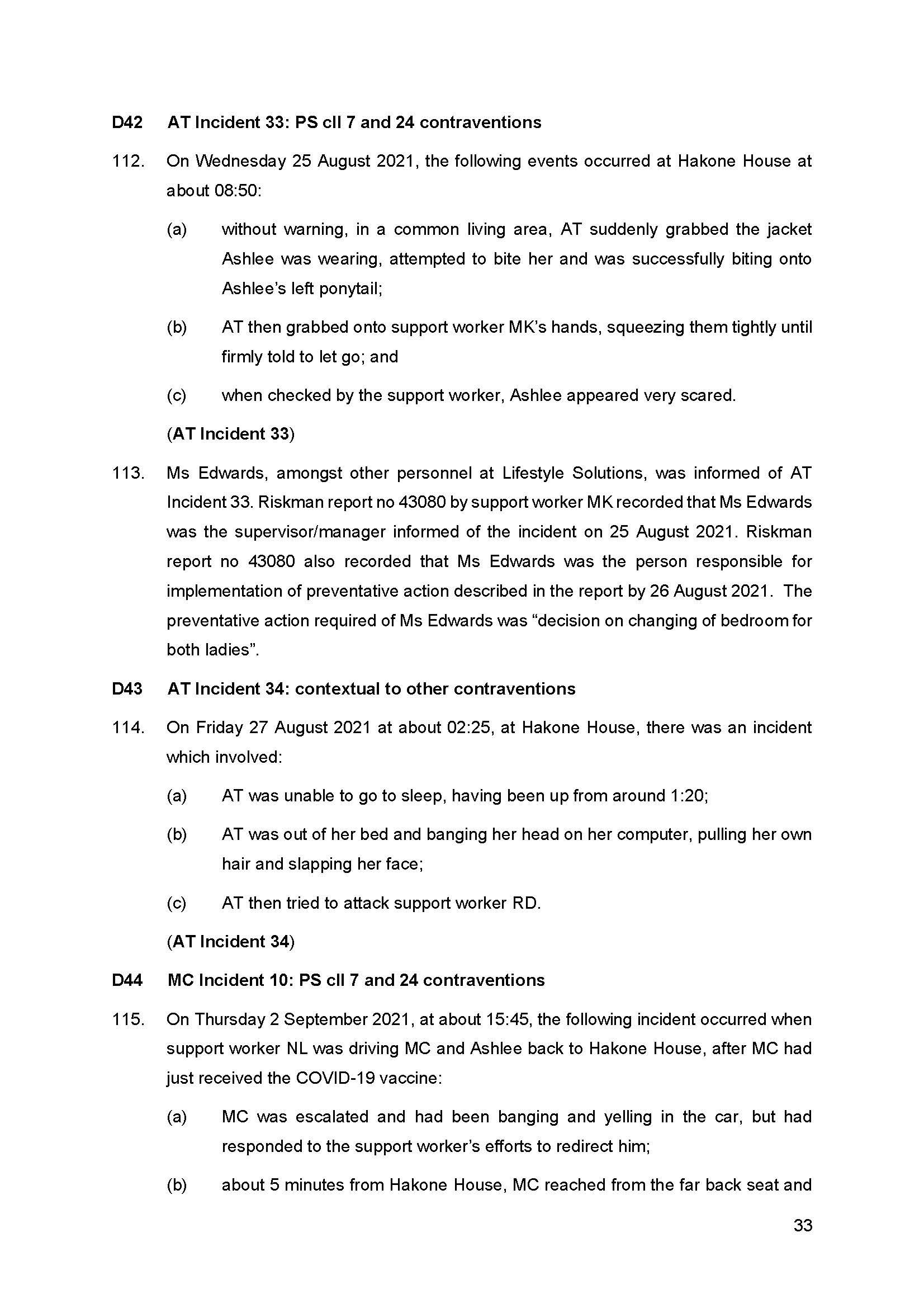
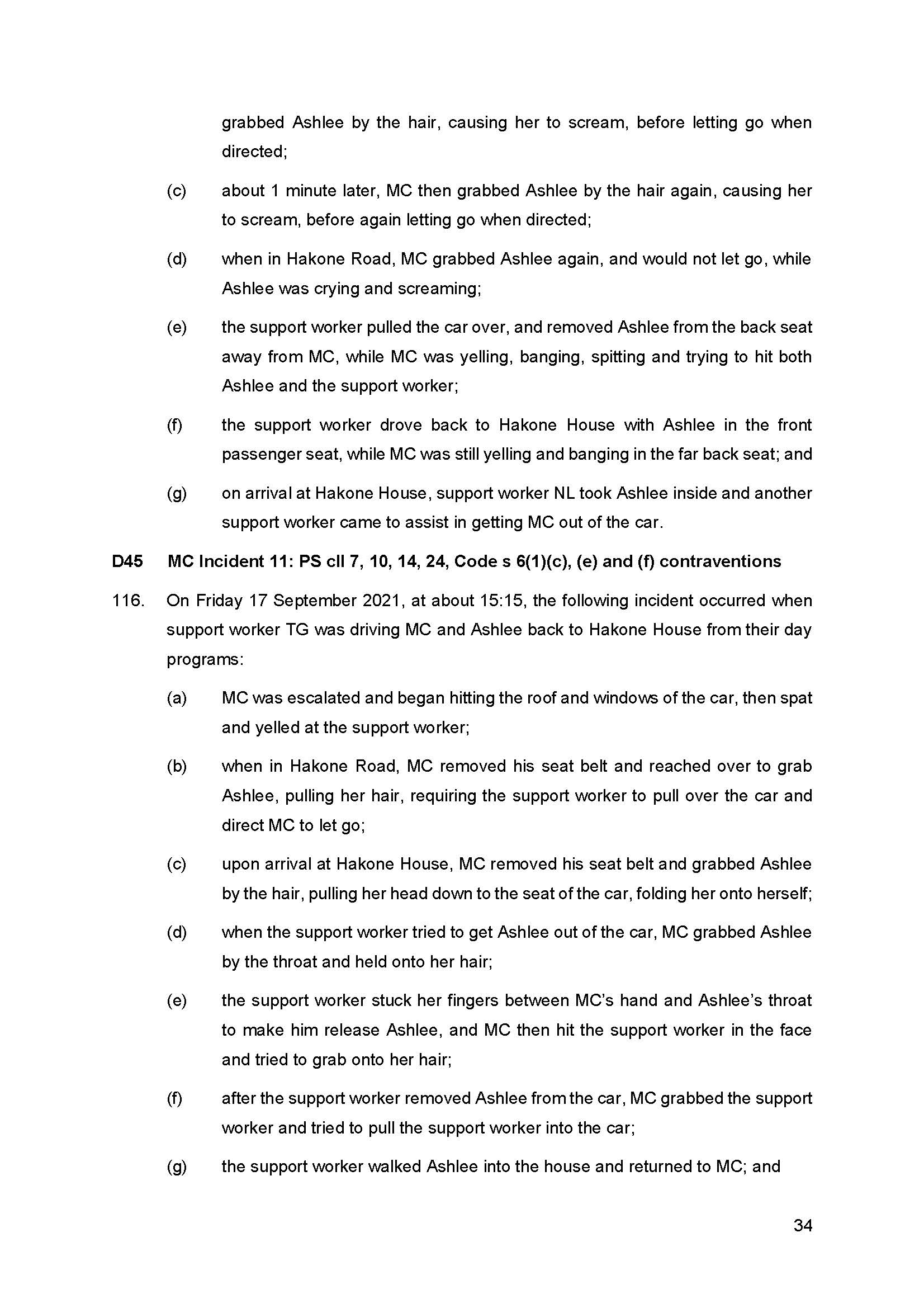
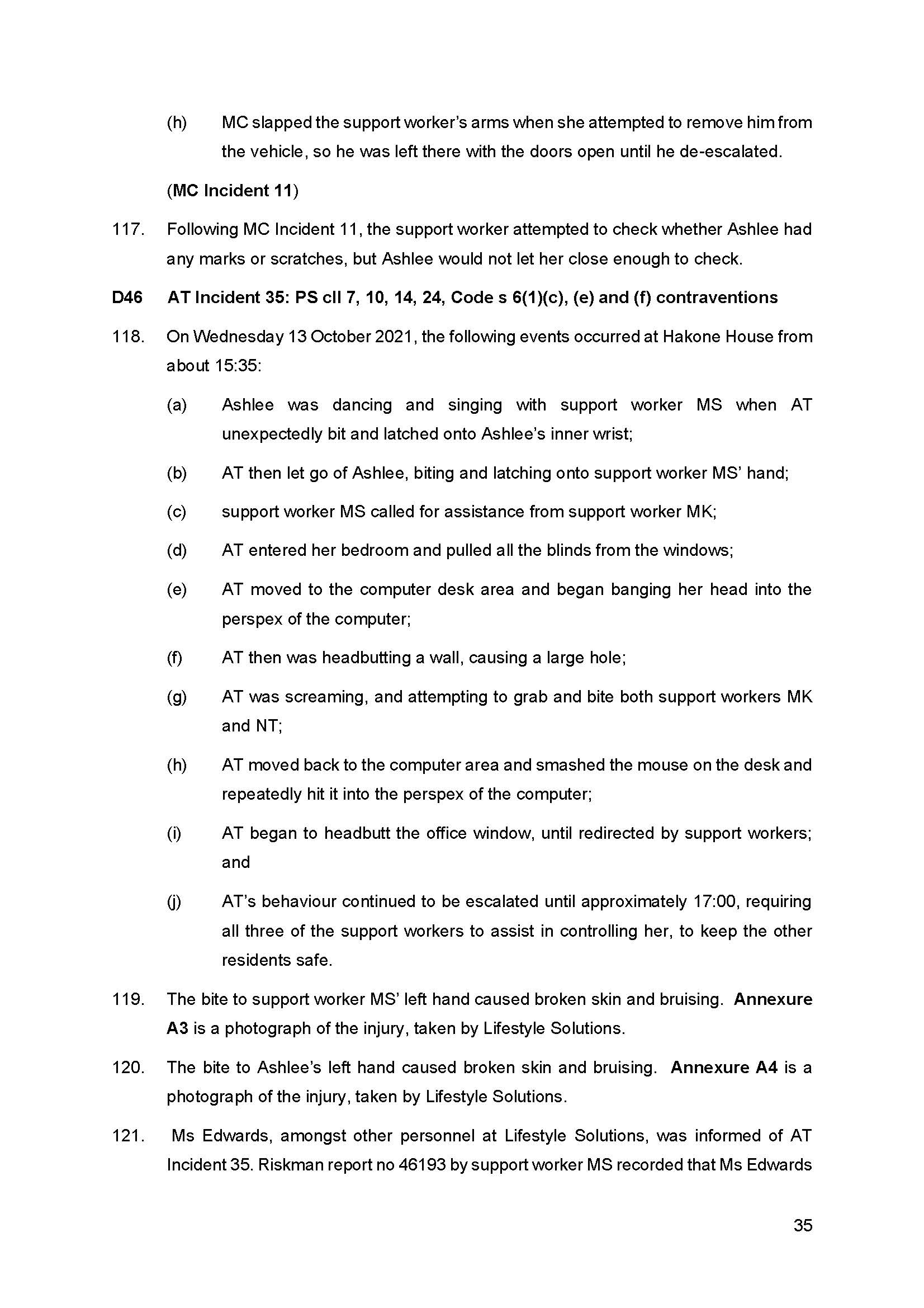
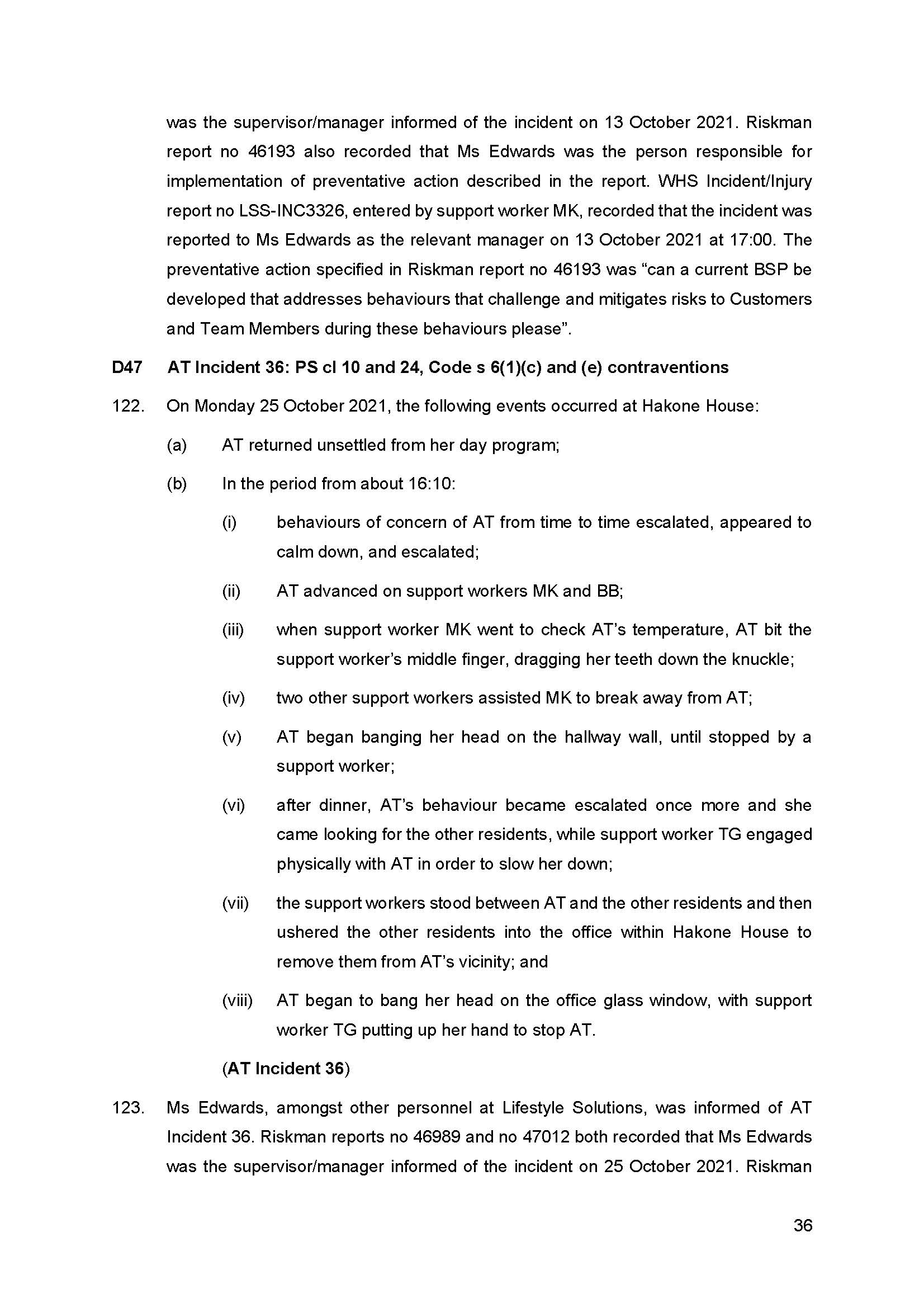
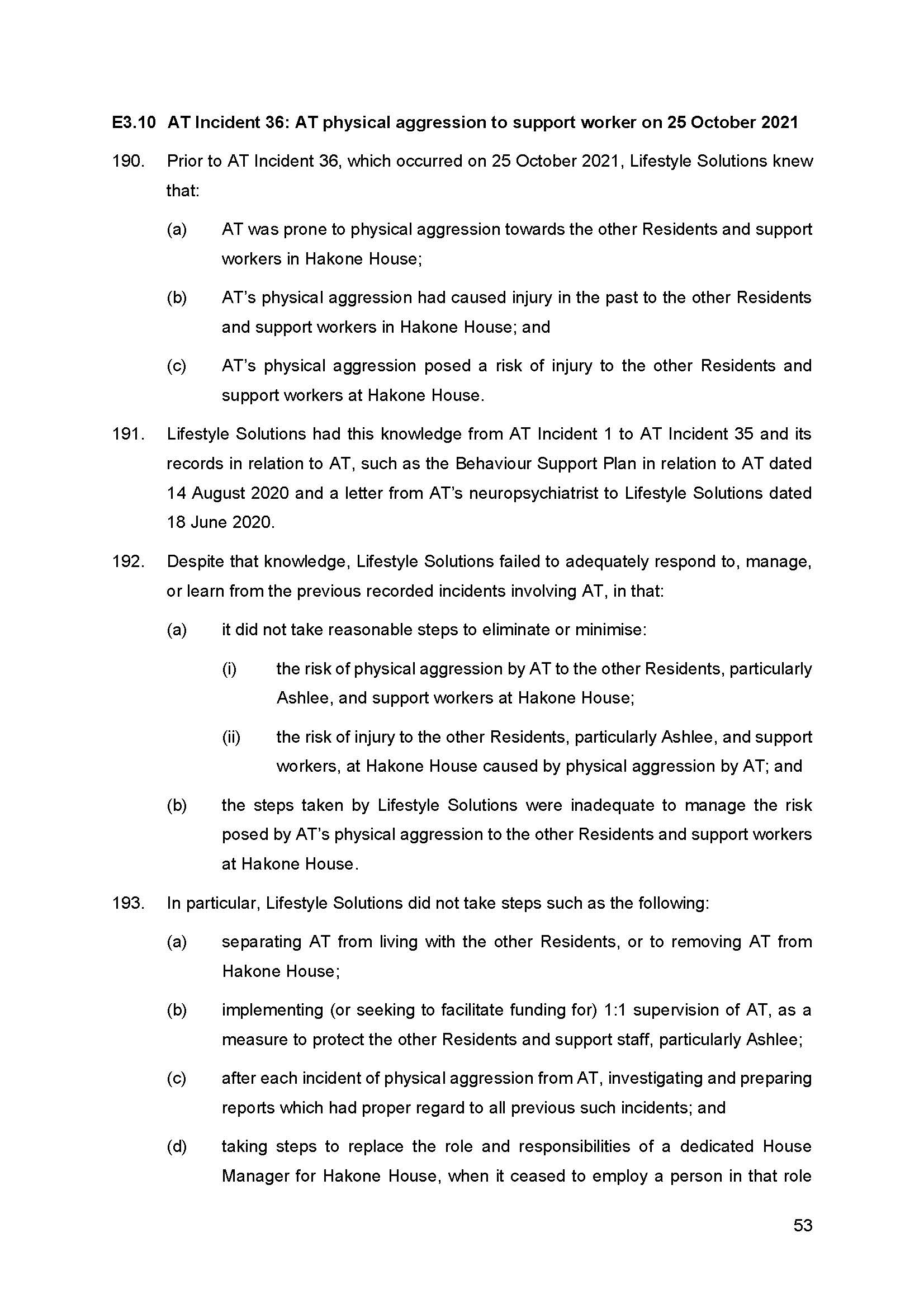
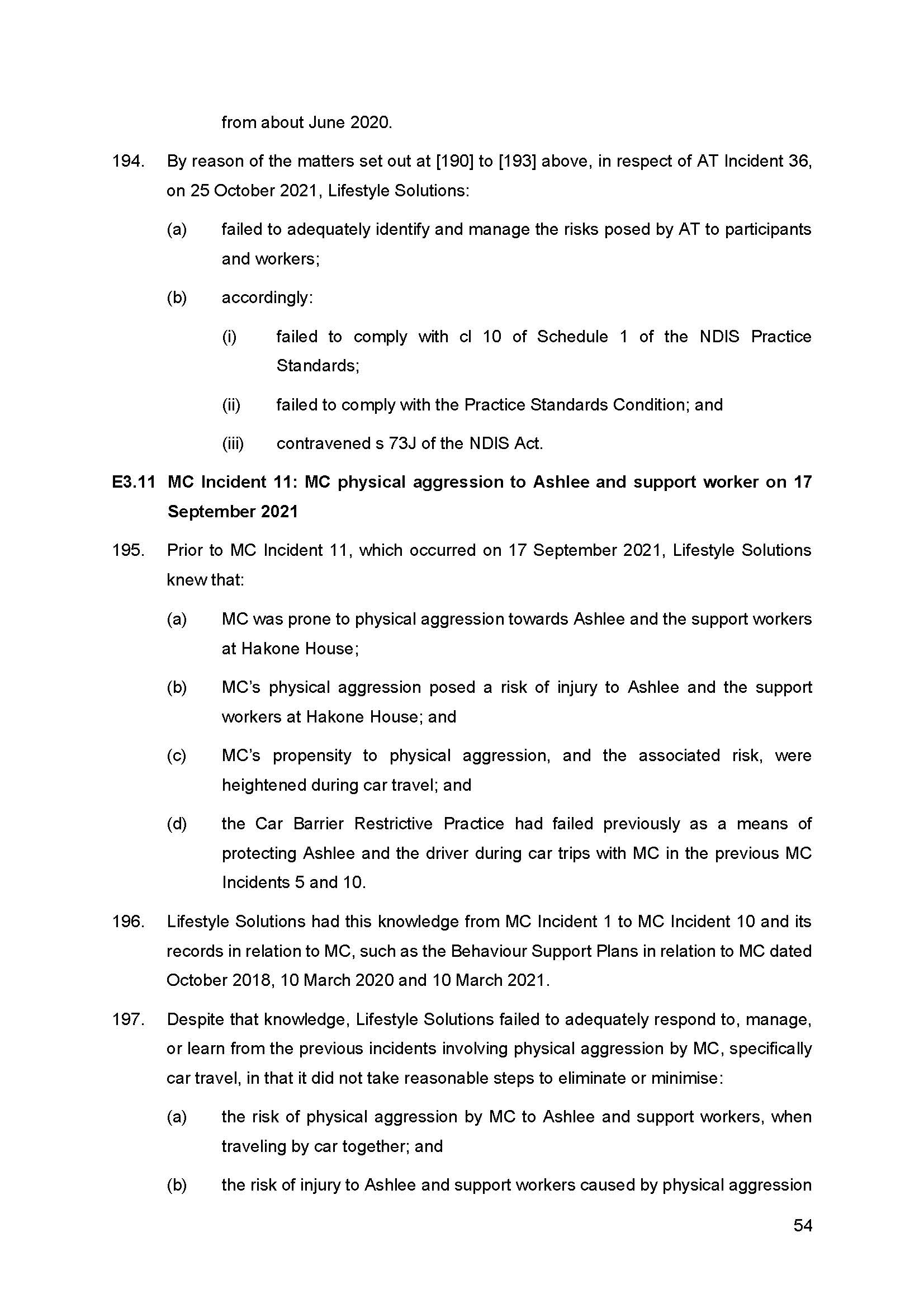
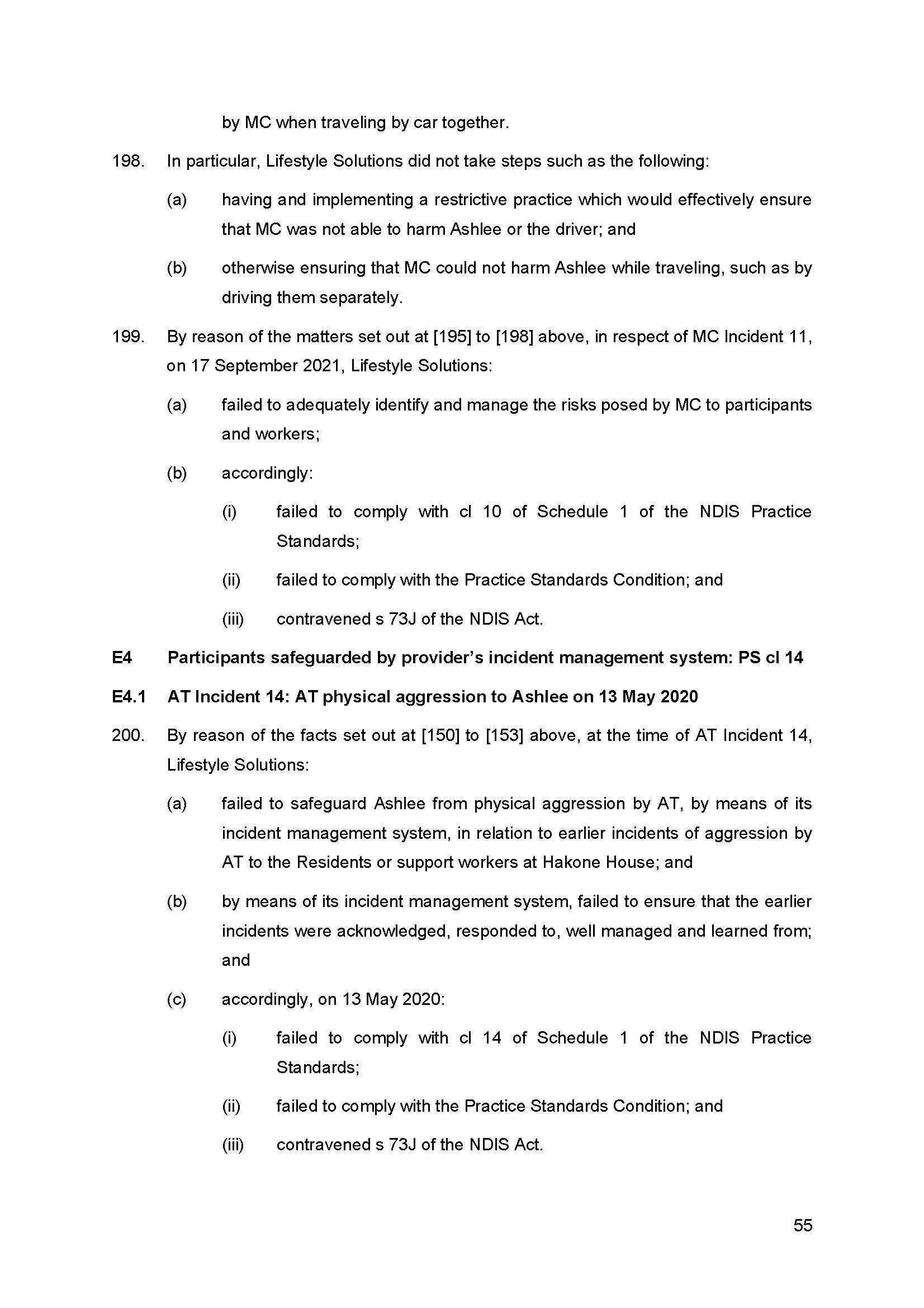
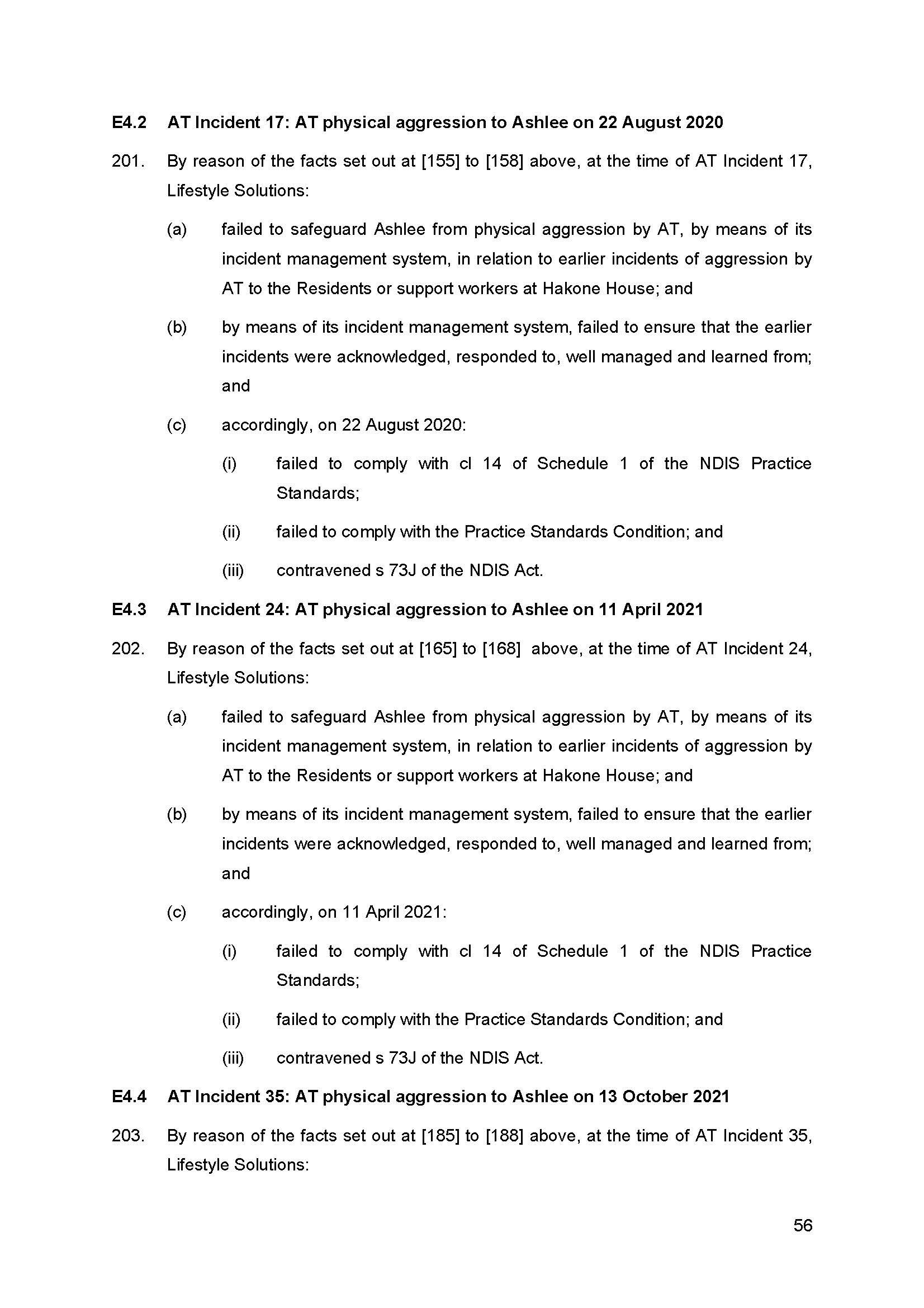
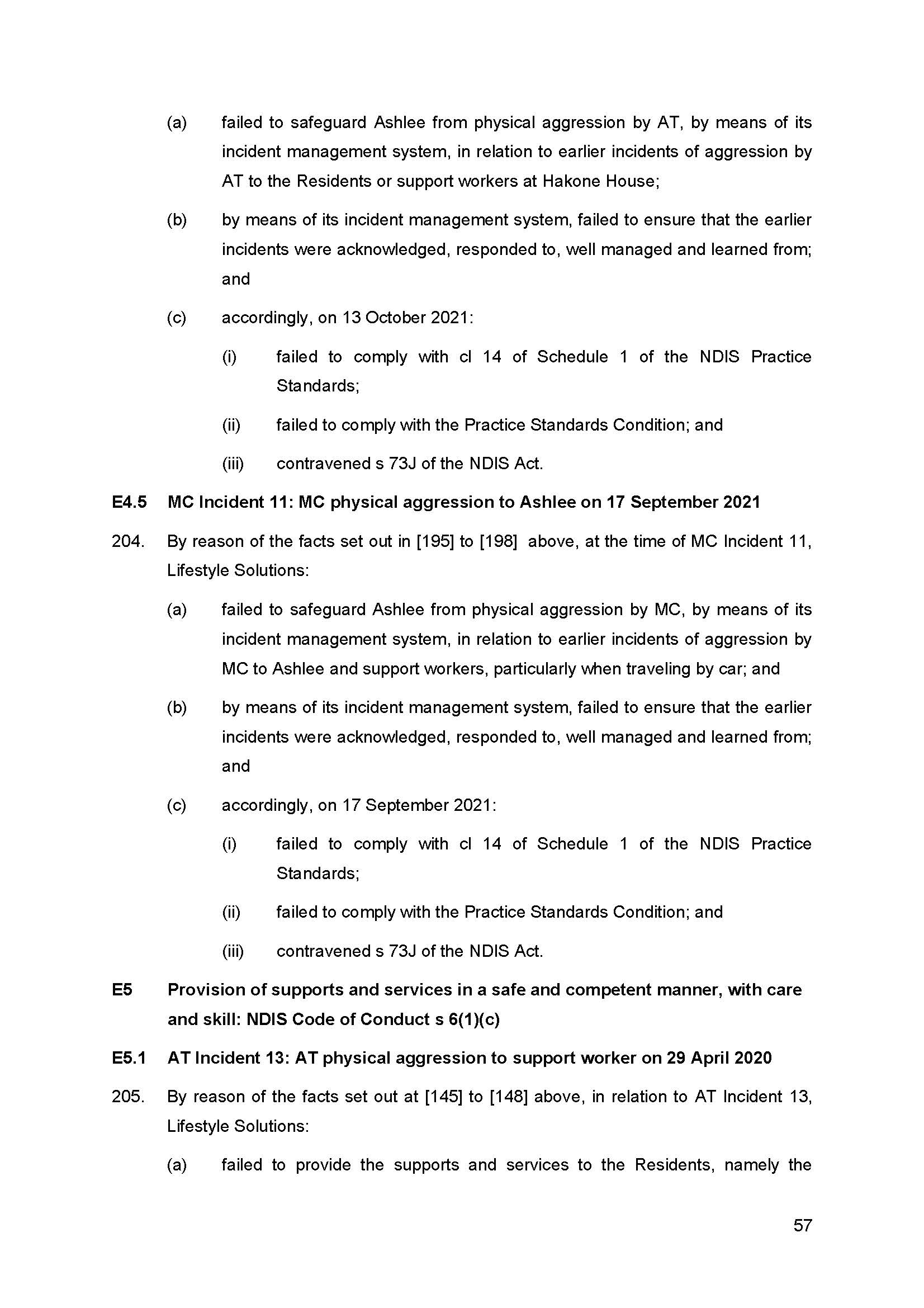
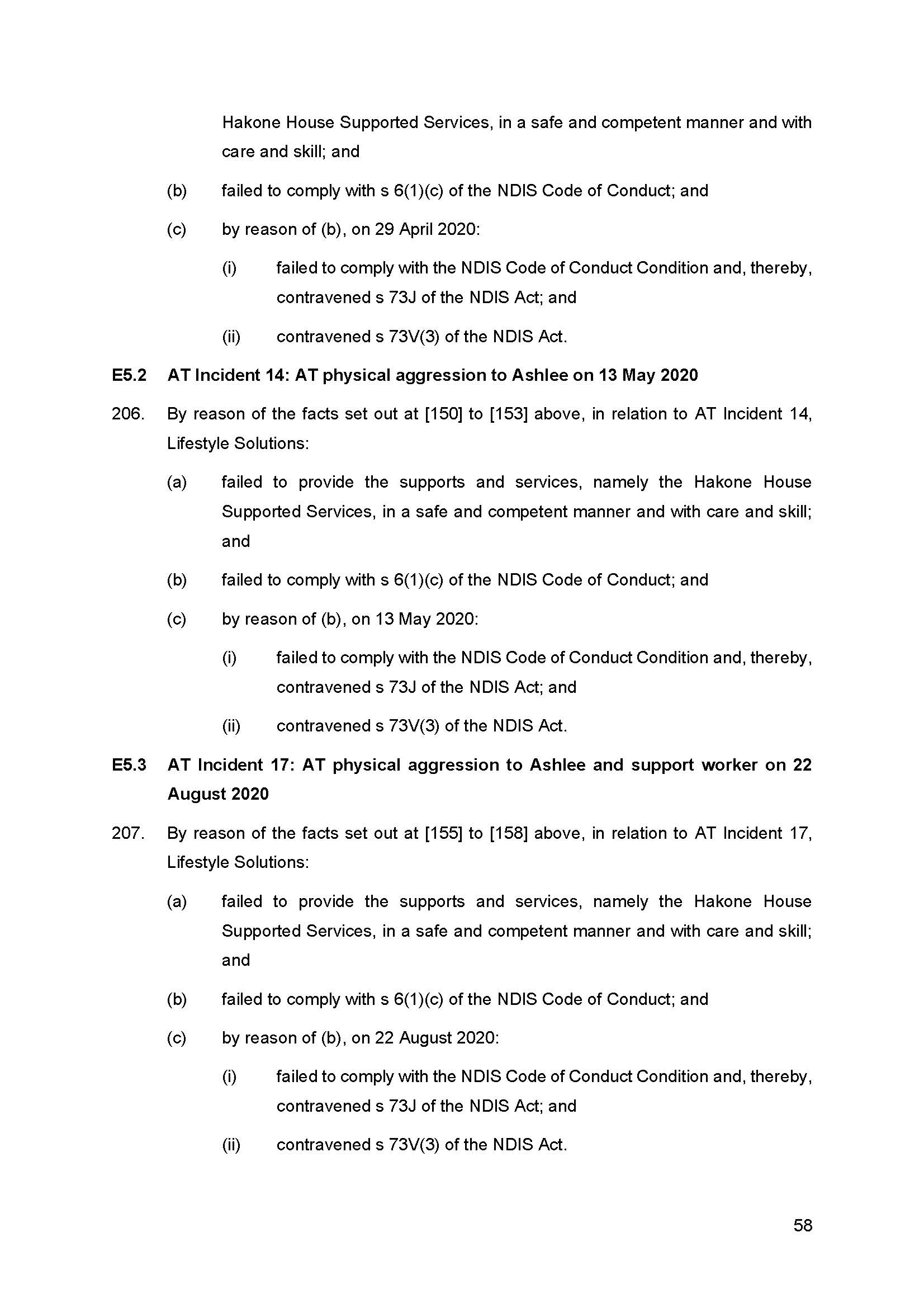
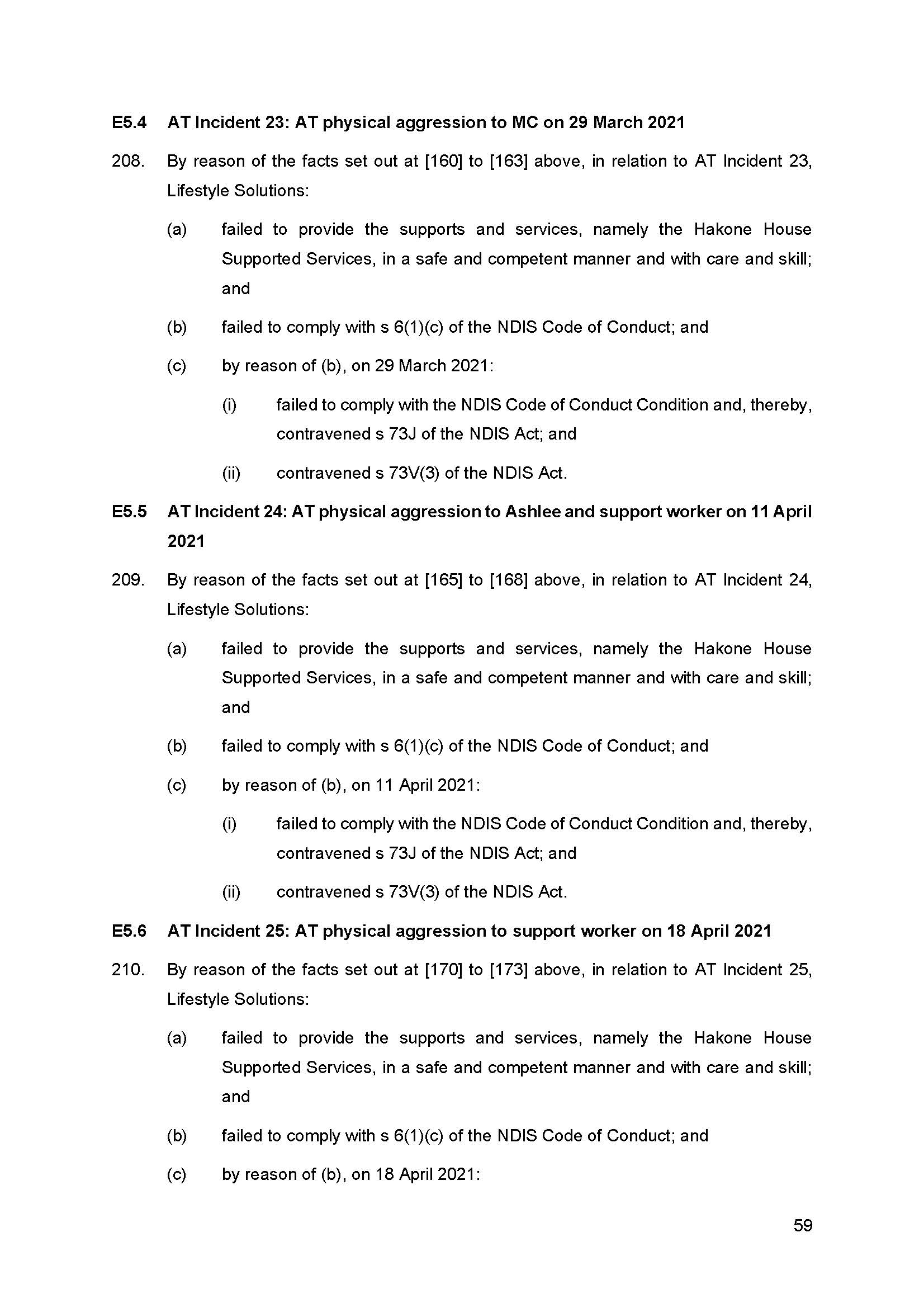
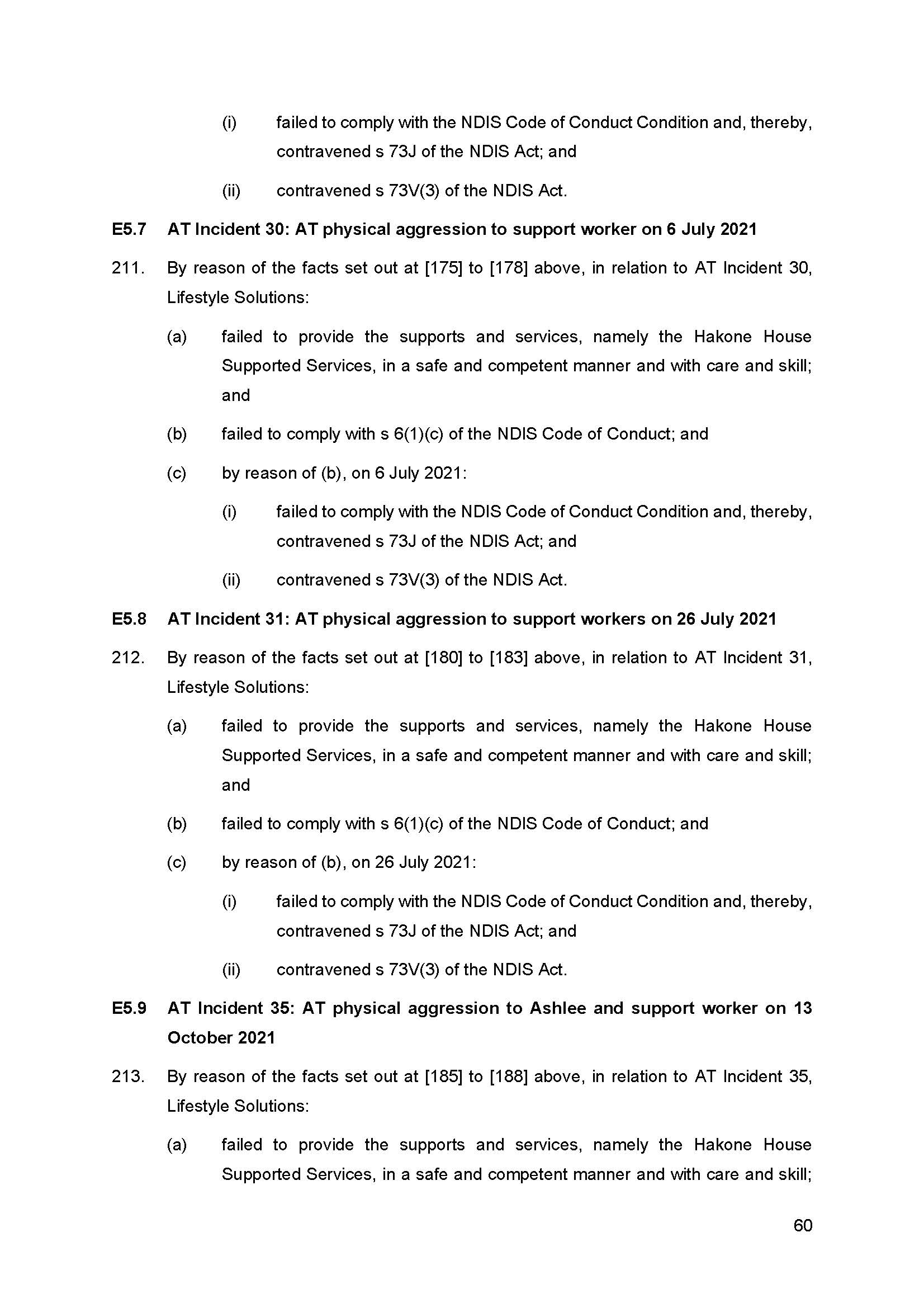
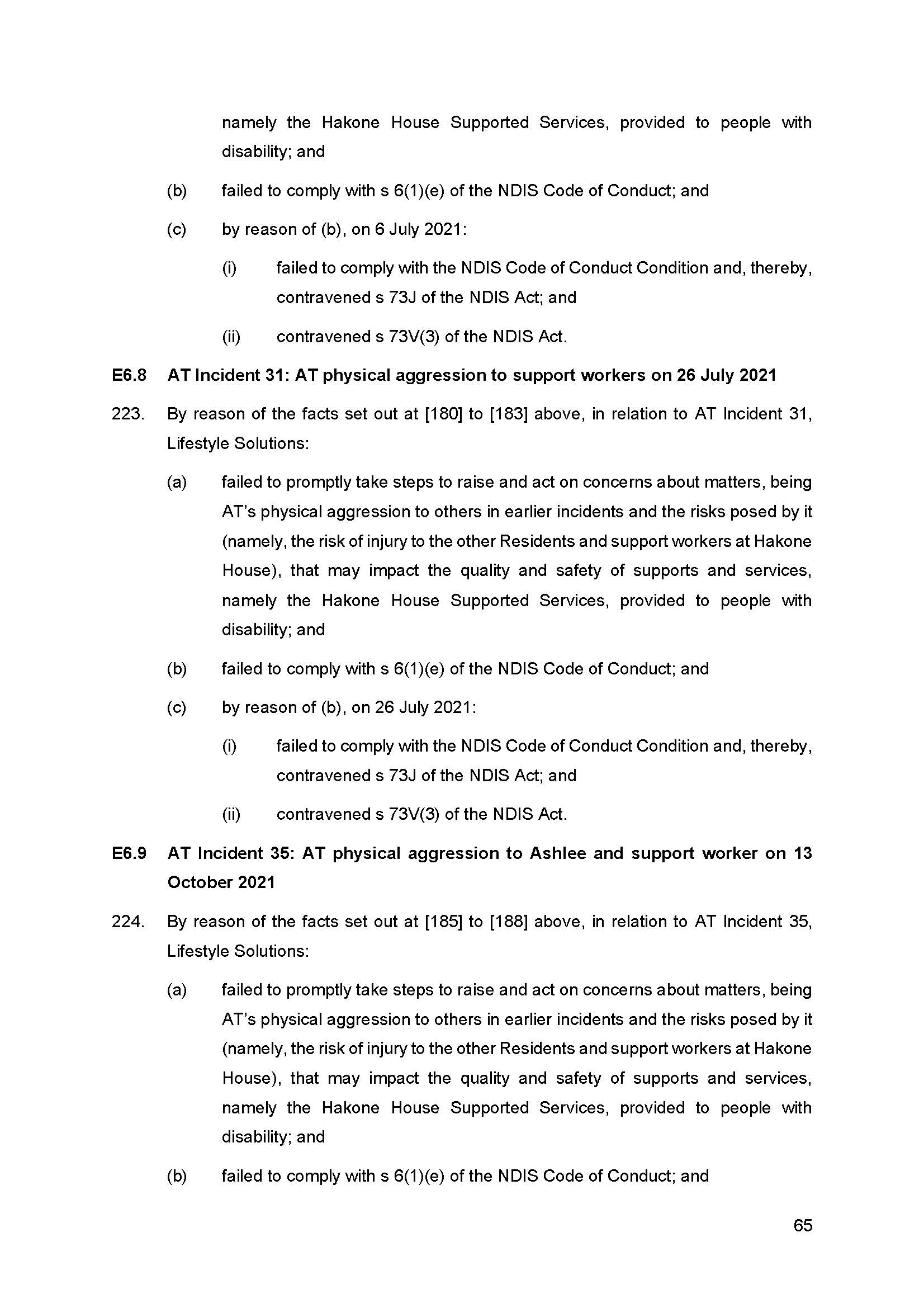
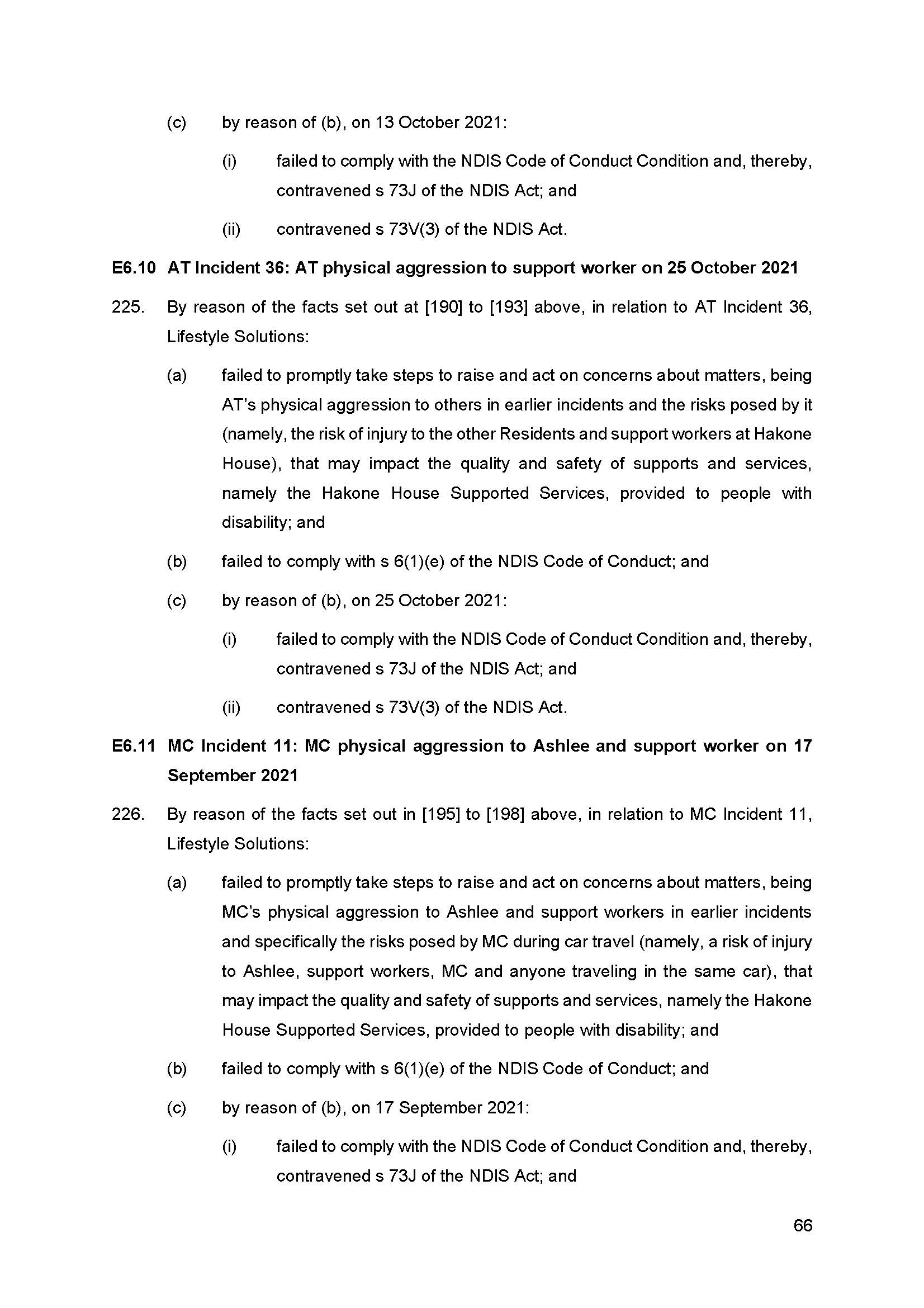
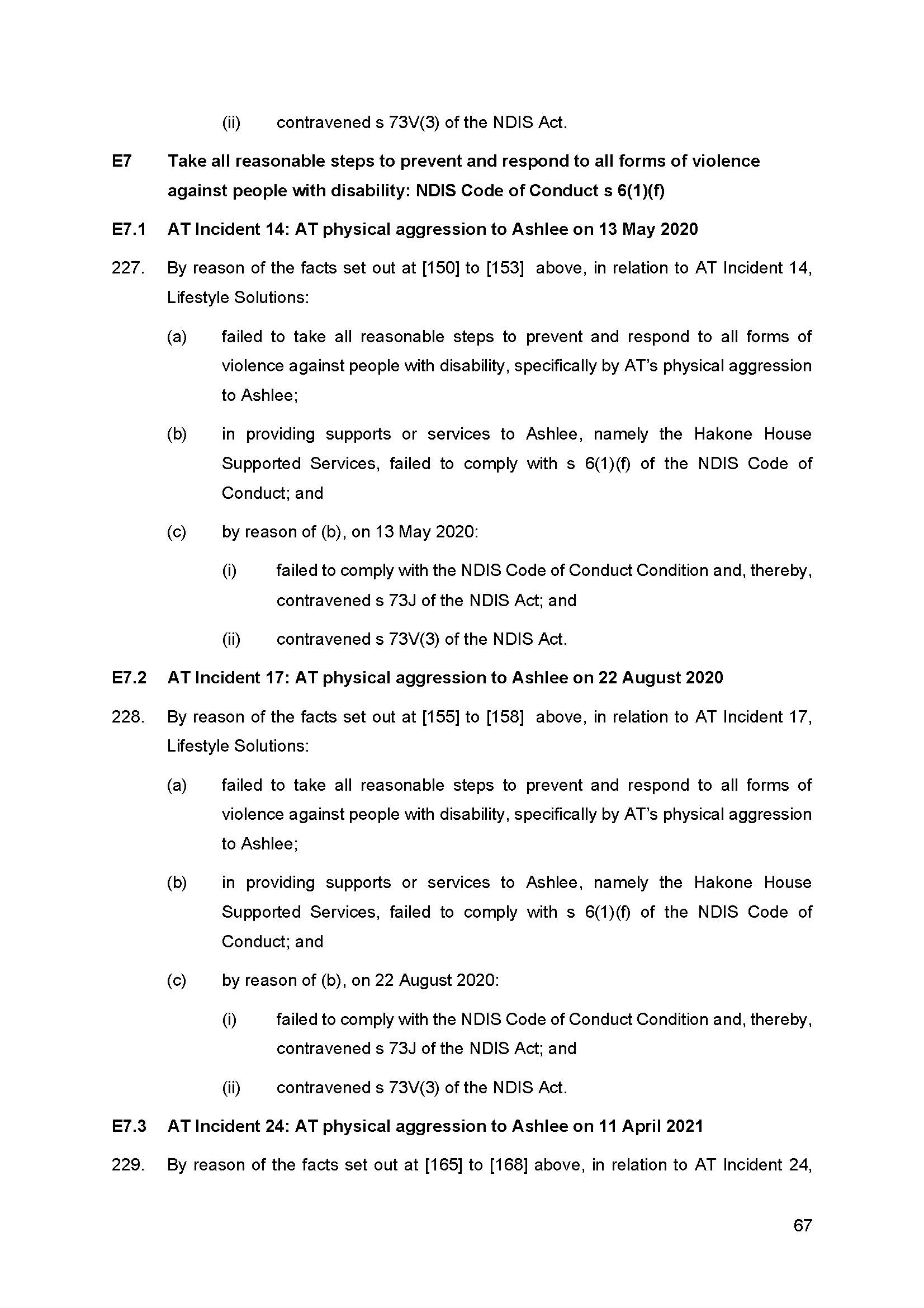
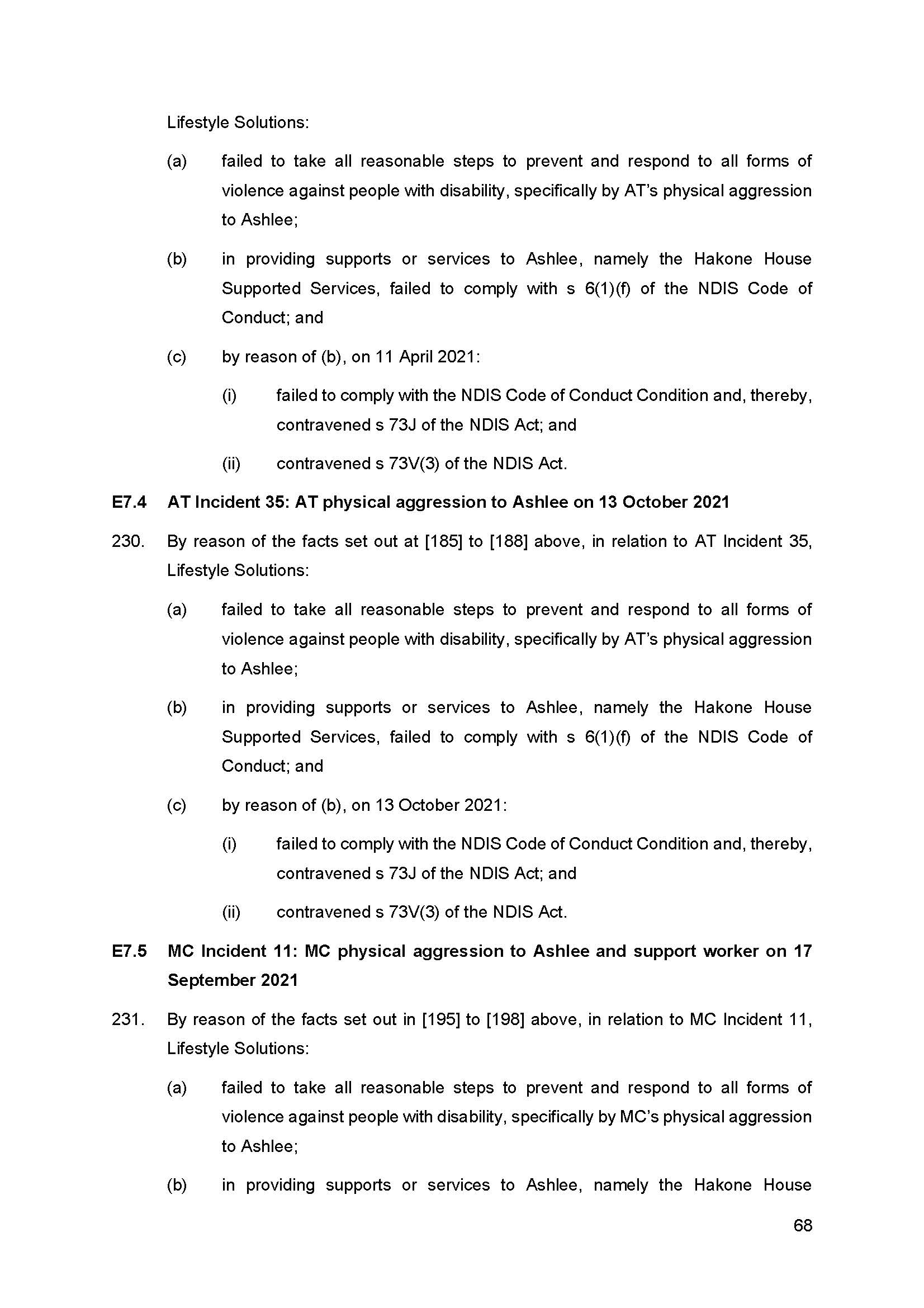
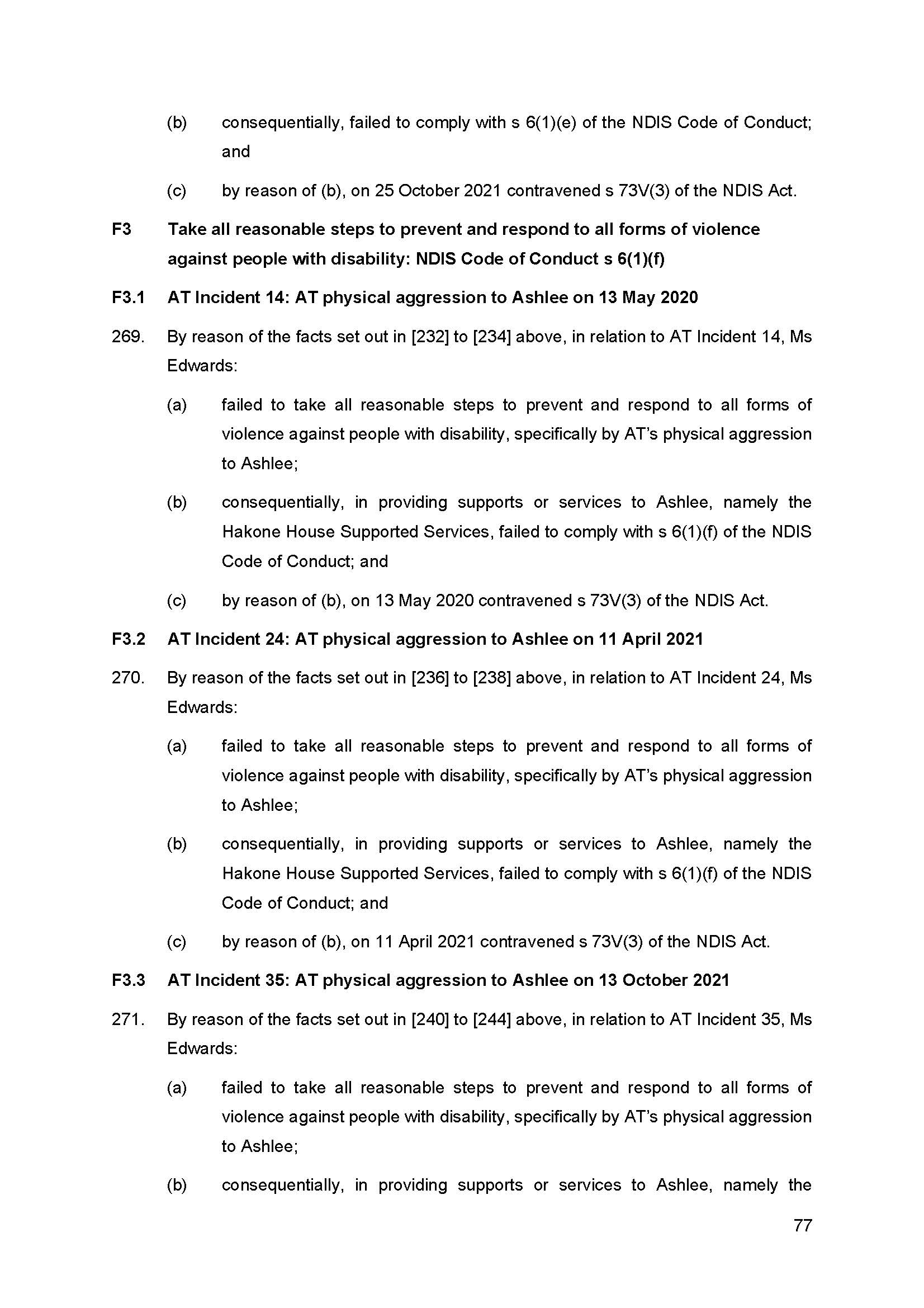
(i) Ms Leicester was unable to access the supports in a safe environment that was appropriate to her needs at the time of incidents on each of the following days:
A. 24 October 2019;
B. 16 November 2019;
C. 13 May 2020;
D. 22 August 2020;
E. 11 April 2021;
F. 2 June 2021;
G. 25 August 2021; and
H. 13 October 2021.
(ii) MC was unable to access the supports in a safe environment that was appropriate to his needs at the time of incidents on each of the following days:
A. 7 March 2020; and
B. 29 March 2021.
(iii) One or more unidentified residents of Hakone House (each being NDIS participants) was unable to access the supports in a safe environment that was appropriate to their needs at the time of an incident on 25 October 2021.
(b) By reason of injury and/or the real risk of injury (or risk of more serious injury) from MC, Ms Leicester was unable to access the supports in a safe environment that was appropriate to her needs at the time of incidents on each of the following days:
(i) 9 February 2021;
(ii) 2 September 2021; and
(iii) 17 September 2021.
Management of risks to participants and workers: PS cl 10
3. In contravention of s 73J of the NDIS Act, and in breach of a statutory condition of its registration as a registered NDIS provider under ss 73E and 73F(2)(c) of the NDIS Act, on 11 occasions in the period between 29 April 2020 and 25 October 2021 Lifestyle Solutions failed to comply with cl 10 of Schedule 1 of the NDIS Practice Standards in relation to its provision of supports to NDIS participants at the Hakone House, as follows:
(a) Lifestyle Solutions failed to adequately identify and manage the risks posed by AT to participants and workers in relation to each of the following incidents:
(i) an incident on 29 April 2020 involving physical aggression by AT to a support worker;
(ii) an incident on 13 May 2020 involving physical aggression by AT to Ms Leicester;
(iii) an incident on 22 August 2020 involving physical aggression by AT to Ms Leicester and a support worker;
(iv) an incident on 29 March 2021 involving physical aggression by AT to MC;
(v) an incident on 11 April 2021 involving physical aggression by AT to Ms Leicester and a support worker;
(vi) an incident on 18 April 2021 involving physical aggression by AT to a support worker;
(vii) an incident on 6 July 2021 involving physical aggression by AT to a support worker;
(viii) an incident on 26 July 2021 involving physical aggression by AT to a support worker;
(ix) an incident on 13 October 2021 involving physical aggression by AT to Ms Leicester and a support worker; and
(x) an incident on 25 October 2021 involving physical aggression by AT to a support worker.
(b) Lifestyle Solutions failed to adequately identify and manage the risks posed by MC to participants and workers in relation to an incident on 17 September 2021 involving physical aggression by MC to Ms Leicester and a support worker.
Participants safeguarded by provider’s incident management system: PS cl 14
4. In contravention of s 73J of the NDIS Act, and in breach of a statutory condition of its registration as a registered NDIS provider under ss 73E and 73F(2)(c) of the NDIS Act, on 5 occasions in the period between 13 May 2020 and 13 October 2021 Lifestyle Solutions failed to comply with cl 14 of Schedule 1 of the NDIS Practice Standards in relation to its provision of supports to NDIS participants at Hakone House, as follows:
(a) By means of its incident management system, Lifestyle Solutions failed to safeguard Ms Leicester from physical aggression by AT, and failed to ensure that earlier incidents were acknowledged, responded to, well managed and learned from, in relation to incidents occurring on each of the following dates;
(i) 13 May 2020;
(ii) 22 August 2020;
(iii) 11 April 2021; and
(iv) 13 October 2021.
(b) By means of its incident management system, Lifestyle Solutions failed to safeguard Ms Leicester from physical aggression by MC, and failed to ensure that earlier incidents were acknowledged, responded to, well managed and learned from, in relation to an incident on 17 September 2021.
Lifestyle Solutions’ contraventions of the NDIS Code of Conduct
Provision of supports and services in a safe and competent manner, with care and skill: NDIS Code of Conduct s 6(1)(c)
5. In contravention of ss 73J and 73V(3) of the NDIS Act, and in breach of a statutory condition of its registration as a registered NDIS provider under ss 73E and 73F(2)(b) of the NDIS Act, on 11 occasions in the period between 29 April 2020 and 25 October 2021 Lifestyle Solutions failed to comply with s 6(1)(c) of the National Disability Insurance Scheme (Code of Conduct) Rules 2018 (Cth) (NDIS Code of Conduct) in relation to its provision of supports to NDIS participants at Hakone House, in that it failed to provide the supports and services to the residents of Hakone House in a safe and competent manner and with care and skill, in respect of :
(a) an incident on 29 April 2020 involving physical aggression by AT to a support worker;
(b) an incident on 13 May 2020 involving physical aggression by AT to Ms Leicester;
(c) an incident on 22 August 2020 involving physical aggression by AT to Ms Leicester and a support worker;
(d) an incident on 29 March 2021 involving physical aggression by AT to MC;
(e) an incident on 11 April 2021 involving physical aggression by AT to Ms Leicester and a support worker;
(f) an incident on 18 April 2021 involving physical aggression by AT to a support worker;
(g) an incident on 6 July 2021 involving physical aggression by AT to a support worker;
(h) an incident on 26 July 2021 involving physical aggression by AT to a support worker;
(i) an incident on 17 September 2021 involving physical aggression by MC to Ms Leicester and a support worker;
(j) an incident on 13 October 2021 involving physical aggression by AT to Ms Leicester and a support worker; and
(k) an incident on 25 October 2021 involving physical aggression by AT to a support worker.
Promptly take steps to raise and act on concerns about matters that may impact the quality and safety of supports and services provided to people with disability: NDIS Code of Conduct s 6(1)(e)
6. In contravention of ss 73J and 73V(3) of the NDIS Act, and in breach of a statutory condition of its registration as a registered NDIS provider under ss 73E and 73F(2)(b), on 11 occasions in the period between 29 April 2020 and 25 October 2021 Lifestyle Solutions failed to comply with s 6(1)(e) of the NDIS Code of Conduct Rules in relation to its provision of supports to NDIS participants at the Hakone House, as follows:
(a) Lifestyle Solutions failed to promptly take steps to raise and act on concerns about matters, being AT’s physical aggression to others in earlier incidents and the risks posed by it, that may impact the quality and safety of supports and services provided to people with disability, in relation to:
(i) an incident on 29 April 2020 involving physical aggression by AT to a support worker;
(ii) an incident on 13 May 2020 involving physical aggression by AT to Ms Leicester;
(iii) an incident on 22 August 2020 involving physical aggression by AT to Ms Leicester and a support worker;
(iv) an incident on 29 March 2021 involving physical aggression by AT to MC;
(v) an incident on 11 April 2021 involving physical aggression by AT to Ms Leicester and a support worker;
(vi) an incident on 18 April 2021 involving physical aggression by AT to a support worker;
(vii) an incident on 6 July 2021 involving physical aggression by AT to a support worker;
(viii) an incident on 26 July 2021 involving physical aggression by AT to a support worker;
(ix) an incident on 13 October 2021 involving physical aggression by AT to Ms Leicester and a support worker; and
(x) an incident on 25 October 2021 involving physical aggression by AT to a support worker.
(b) Lifestyle Solutions failed to promptly take steps to raise and act on concerns about matters, being MC’s physical aggression to Ms Leicester and support workers in earlier incidents and specifically the risks posed by MC during car travel, that may impact the quality and safety of supports and services provided to people with disability, in relation to an incident on 17 September 2021 involving physical aggression by MC to Ms Leicester and a support worker.
Take all reasonable steps to prevent and respond to all forms of violence against people with disability: NDIS Code of Conduct s 6(1)(f)
7. In contravention of ss 73J and 73V(3) of the NDIS Act, and in breach of a statutory condition of its registration as a registered NDIS provider under ss 73E and 73F(2)(b), on 5 occasions in the period between 13 May 2020 and 13 October 2021 Lifestyle Solutions failed to comply with s 6(1)(f) of the NDIS Code of Conduct Rules in relation to its provision of supports to NDIS participants at Hakone House as follows:
(a) Lifestyle Solutions failed to take all reasonable steps to prevent and respond to all forms of violence against people with disability, specifically by AT’s physical aggression to Ms Leicester, in relation to incidents occurring on each of the following dates:
(i) 13 May 2020;
(ii) 22 August 2020;
(iii) 11 April 2021; and
(iv) 13 October 2021.
(b) Lifestyle Solutions failed to take all reasonable steps to prevent and respond to all forms of violence against people with disability, specifically by MC’s physical aggression to Ms Leicester, in relation to an incident occurring on 17 September 2021.
Ms Edwards’ contraventions of the NDIS Code of Conduct
Provision of supports and services in a safe and competent manner, with care and skill: NDIS Code of Conduct s 6(1)(c)
8. In contravention of s 73V(3) of the NDIS Act, on 5 occasions in the period between 13 May 2020 and 25 October 2021 the Second Respondent (Ms Edwards) failed to comply with s 6(1)(c) of the NDIS Code of Conduct in relation to her provision of supports to NDIS participants at the Hakone House, in that she failed to provide the supports and services to the residents of Hakone House in a safe and competent manner and with care and skill:
(a) in her capacity as Coordinator (House Manager) of Hakone House, in respect of an incident on 13 May 2020 involving physical aggression by AT to Ms Leicester; and
(b) in her capacity as Disability Service Specialist responsible for, relevantly, Hakone House, in respect of:
(i) an incident on 11 April 2021 involving physical aggression by AT to Ms Leicester and a support worker;
(ii) an incident on 18 April 2021 involving physical aggression by AT to a support worker;
(iii) an incident on 13 October 2021 involving physical aggression by AT to Ms Leicester and a support worker; and
(iv) an incident on 25 October 2021 involving physical aggression by AT to a support worker.
Promptly take steps to raise and act on concerns about matters that may impact the quality and safety of supports and services provided to people with disability: NDIS Code of Conduct s 6(1)(e)
9. In contravention of s 73V(3) of the NDIS Act, on 5 occasions in the period between 13 May 2020 and 25 October 2021 Ms Edwards failed to comply with s 6(1)(e) of the NDIS Code of Conduct in relation to her provision of supports to NDIS participants at the Hakone House, in that she failed to promptly take steps to raise and act on concerns about matters, being AT’s physical aggression to others in earlier incidents and the risks posed by it, that may impact the quality and safety of supports and services provided to people with disability:
(a) in her capacity as Coordinator (House Manager) of Hakone House, in respect of an incident on 13 May 2020 involving physical aggression by AT to Ms Leicester; and
(b) in her capacity as Disability Service Specialist responsible for Hakone House (among other facilities), in respect of:
(i) an incident on 11 April 2021 involving physical aggression by AT to Ms Leicester and a support worker;
(ii) an incident on 18 April 2021 involving physical aggression by AT to a support worker;
(iii) an incident on 13 October 2021 involving physical aggression by AT to Ms Leicester and a support worker; and
(iv) an incident on 25 October 2021 involving physical aggression by AT to a support worker.
Take all reasonable steps to prevent and respond to all forms of violence against people with disability: NDIS Code of Conduct s 6(1)(f)
10. In contravention of s 73V(3) of the NDIS Act, on 3 occasions in the period between 13 May 2020 and 13 October 2021 Ms Edwards failed to comply with s 6(1)(f) of the NDIS Code of Conduct in relation to her provision of supports to NDIS participants at the Hakone House, in that she failed to take all reasonable steps to prevent and respond to all forms of violence against people with disability, specifically by AT’s physical aggression to Ms Leicester:
(a) in her capacity as Coordinator (House Manager) of Hakone House, in relation to an incident occurring on 13 May 2020; and
(b) in her capacity as Disability Service Specialist responsible for Hakone House (among other facilities), in respect of incidents occurring on:
(i) 11 April 2021; and
(ii) 13 October 2021.
THE COURT ORDERS THAT:
1. Pursuant to s 82(3) of the Regulatory Powers (Standard Provisions) Act 2014 (Cth), read with s 73ZK of the NDIS Act, Lifestyle Solutions pay within 30 days of the date of this order to the Commonwealth of Australia pecuniary penalties in the amount of $2,000,000 in total in respect of Lifestyle Solutions’ contraventions which are the subject of declarations 1 to 7 above, comprising the following amounts:
(a) $157,500 in respect of its contraventions of s 73J of the NDIS Act concerning the incident on 24 October 2019;
(b) $105,000 in respect of its contraventions of s 73J of the NDIS Act concerning the incident on 16 November 2019;
(c) $105,000 in respect of its contraventions of s 73J of the NDIS Act concerning the incident on 7 March 2020;
(d) $131,500 in respect of its contraventions of ss 73J and 73V(3) of the NDIS Act concerning the incident on 29 April 2020;
(e) $131,500 in respect of its contraventions of ss 73J and 73V(3) of the NDIS Act concerning the incident on 13 May 2020;
(f) $111,000 in respect of its contraventions of ss 73J and 73V(3) of the NDIS Act concerning the incident on 22 August 2020;
(g) $111,000 in respect of its contraventions of s 73J of the NDIS Act concerning the incident on 9 February 2021;
(h) $30,000 in respect of its contraventions of ss 73J and 73V(3) of the NDIS Act concerning the incident on 29 March 2021;
(i) $166,500 in respect of its contraventions of ss 73J and 73V(3) of the NDIS Act concerning the incident on 11 April 2021;
(j) $166,500 in respect of its contraventions of ss 73J and 73V(3) of the NDIS Act concerning the incident on 18 April 2021;
(k) $30,000 in respect of its contraventions of s 73J of the NDIS Act concerning the incident on 2 June 2021;
(l) $30,000 in respect of its contraventions of ss 73J and 73V(3) of the NDIS Act concerning the incident on 6 July 2021;
(m) $139,000 in respect of its contraventions of ss 73J and 73V(3) of the NDIS Act concerning the incident on 26 July 2021;
(n) $30,000 in respect of its contraventions of s 73J of the NDIS Act concerning the incident on 25 August 2021;
(o) $111,000 in respect of its contraventions of s 73J of the NDIS Act concerning the incident on 2 September 2021;
(p) $139,000 in respect of its contraventions of ss 73J and 73V(3) of the NDIS Act concerning the incident on 17 September 2021;
(q) $139,000 in respect of its contraventions of ss 73J and 73V(3) of the NDIS Act concerning the incident on 13 October 2021; and
(r) $166,500 in respect of its contraventions of ss 73J and 73V(3) of the NDIS Act concerning the incident on 25 October 2021.
2. Within 30 days of the date of this order, Lifestyle Solutions pay a contribution to the Commissioner's costs of, and incidental to, this proceeding, fixed in the amount of $100,000.
Note: Entry of orders is dealt with in Rule 39.32 of the Federal Court Rules 2011.
REASONS FOR JUDGMENT
ABRAHAM J:
1 The Commissioner of the NDIS Quality and Safeguards Commission, brings proceedings against Lifestyle Solutions (Aust) Ltd (ACN 097 999 347) (Lifestyle Solutions) and Ms Susan Fay Edwards for contraventions of the National Disability Insurance Scheme Act 2013 (Cth) (NDIS Act) relating to breaches of the NDIS Practice Standards and the NDIS Code of Conduct during the period of 23 June 2019 to 25 October 2021 (Relevant Period). Lifestyle Solutions is a registered National Disability Insurance Scheme (NDIS) provider as defined in s 9 of the NDIS Act. Ms Edwards is employed by Lifestyle Solutions and during the Relevant Period was employed as Coordinator (or House Manager) until about June 2020, and subsequently as Service Specialist – Disability.
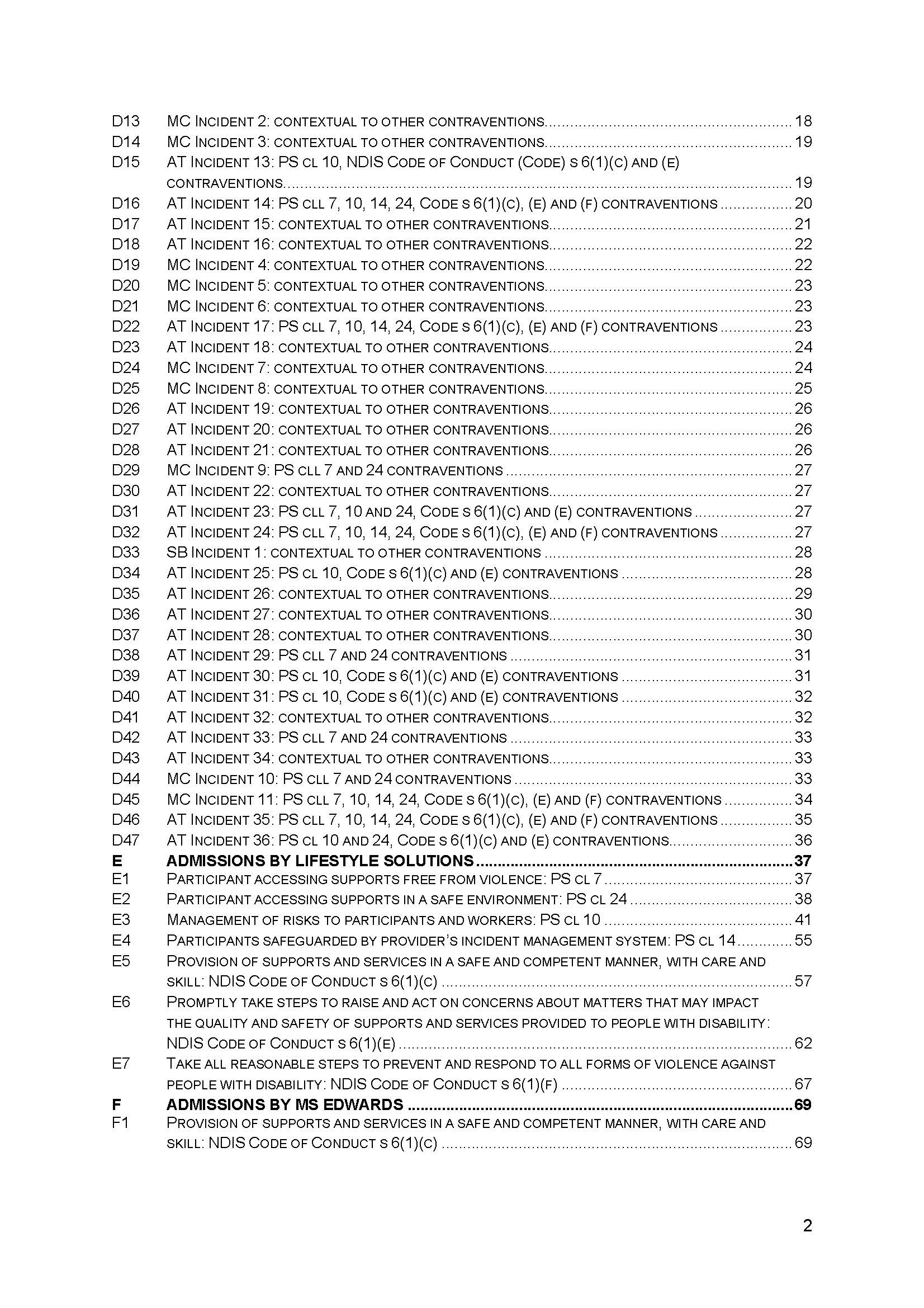
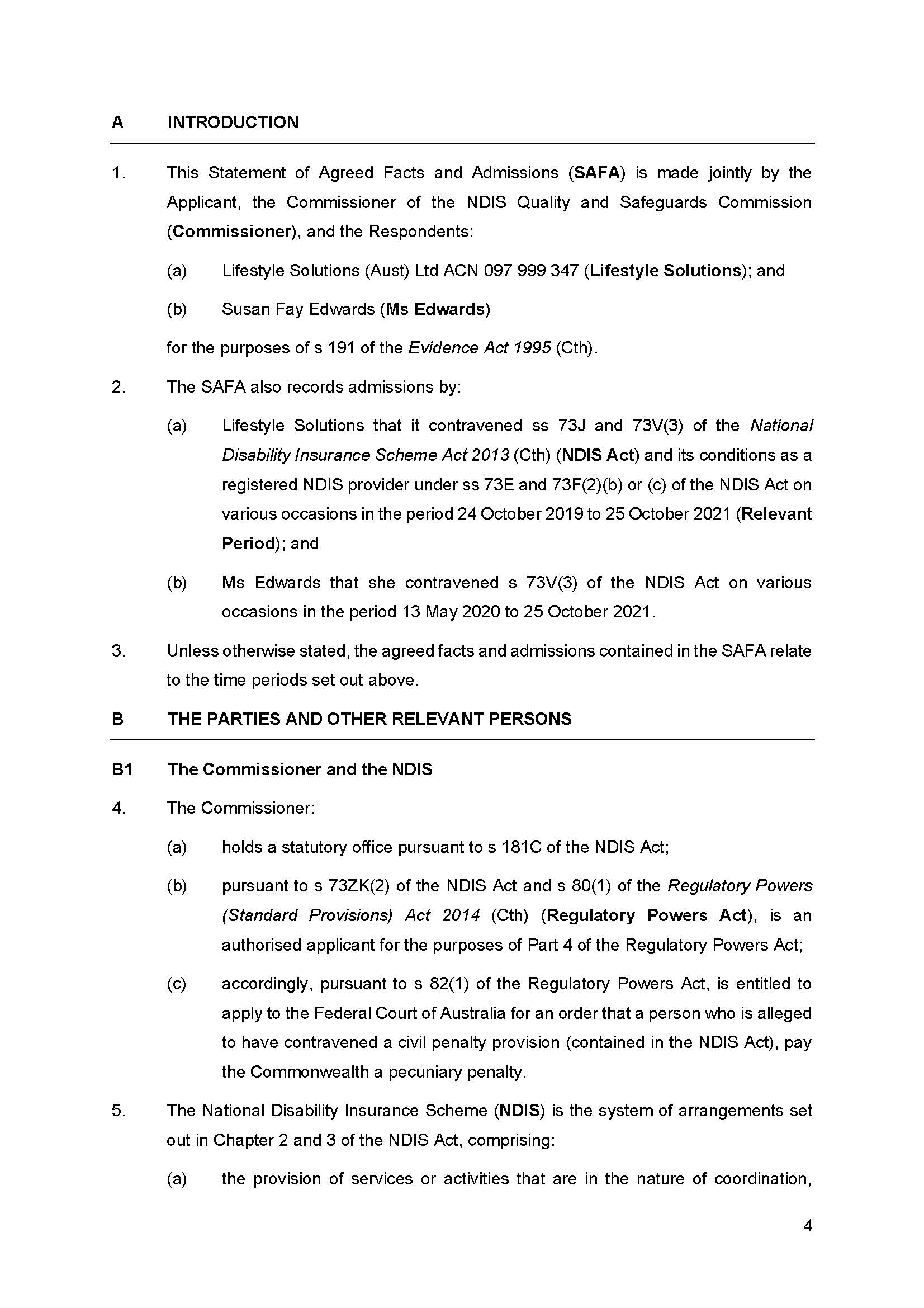
2 Lifestyle Solutions and Ms Edwards have admitted the contraventions. The proceeding was conducted by way of agreed facts (AF), which are attached to these reasons as Appendix A. The parties have also agreed that a pecuniary penalty of $2,000,000 be imposed on Lifestyle Solutions, and declarations be made in relation to it and Ms Edwards reflecting the admitted contraventions.
3 For the reasons below, the declarations are made in the terms sought, and the proposed pecuniary penalty of $2,000,000 is imposed on Lifestyle Solution. I am also satisfied that the declarations sought in relation to Ms Edwards should be made.
4 I note in Commissioner of the NDIS Quality and Safeguards Commission v Lifestyle Solutions (Aust) Ltd (Reportable Incidents Proceeding) [2025] FCA 1394 also delivered today, a pecuniary penalty of $500,000 was imposed on Lifestyle Solutions and declarations were made in relation contraventions of the NDIS Act which are of a different nature to those in this proceeding. The two proceedings were heard together. As a consequence, the overall penalty imposed on Lifestyle Solutions as an NDIS provider for contraventions of the scheme is $2,500,000.
Statutory Scheme
5 The following description of the legislative scheme is taken from the applicant’s submissions, to which no issue was taken by the respondents. It accurately reflects the scheme. The summary below is obviously not exhaustive but addresses some aspects of the scheme relevant to this proceeding.
6 The objects of the NDIS Act are identified in s 3. They relevantly include: promoting the provision of high quality and innovative supports that enable people with disability to maximise independent lifestyles and full inclusion in the community (s 3(1)(g)); and protecting and preventing people with disability from experiencing harm arising from poor quality or unsafe supports or services provided under the NDIS (s 3(1)(ga)).
7 Section 3(2) provides that the objects of the NDIS Act are to be achieved by, inter alia, establishing a national regulatory framework for persons and entities who provide supports and services to people with disability.
8 Section 4 of the NDIS Act contains a number of general principles to guide actions under the Act. For present purposes, it is sufficient to note the following general principles:
(a) people with disability have the same right as other members of society to realise their potential for physical, social, emotional and intellectual development (s 4(1));
(b) people with disability and their families and carers should have certainty that people with disability will receive the care and support they need over their lifetime (s 4(3));
(c) people with disability have the same right as other members of Australian society to respect for their worth and dignity and to live free from abuse, neglect and exploitation (s 4(6));
(d) people with disability have the same right as other members of society to pursue any grievance (s 4(7)); and
(e) in exercising their right to choice and control, people with disability require access to a diverse and sustainable market for disability supports in which innovation, quality, continuous improvement, contemporary best practice and effectiveness in the provision of supports to people with disability are to be promoted (s 4(15)).
9 The NDIS Quality and Safeguards Commission (the Commission) is established under s 181A of the NDIS Act. The Commissioner’s functions and powers are identified in s 181D and include certain core functions in s 181E. The first of the Commissioner’s core functions in s 181E(a) is to uphold the rights of, and promote the health, safety and wellbeing of, people with disability receiving supports or services, including those received under the NDIS. The Commissioner’s core functions also include securing compliance with the NDIS Act through effective compliance and enforcement arrangements, including through monitoring and investigation functions conferred by Division 8 of Part 3A of Chapter 4 (s 181E(d)). Further, s 181F provides the Commissioner’s registration and reportable incident functions including: monitoring NDIS provider compliance with their conditions of registration (s 181F(c)); notification and management of reportable incidents conferred on the Commissioner (s 181F(e)); and collating and analysing in relation to reportable incidents to identify trends or systemic issues (s 181F(g)).
10 Under s 181D(2), the Commissioner may, by notifiable instrument, make guidelines relating to the performance of any of their functions mentioned in s 181D(1). Section 209 of the NDIS Act supplies the Minister with the power, by legislative instrument, to make rules called the “National Disability Insurance Scheme rules” (NDIS Rules).
11 Section 73F(1) of the NDIS Act provides that the registration of a person as a registered NDIS provider is subject to certain conditions specified in s 73F(2). Relevantly, that includes for Lifestyle Solutions to comply with:
(a) all applicable requirements of the NDIS Code of Conduct (s 73F(2)(b)); and
(b) all applicable standards and other requirements of the NDIS Practice Standards (s 73F(2)(c)).
12 Section 73J of the NDIS Act provides that a person contravenes that section if they are a registered NDIS provider and breach a condition of their registration.
NDIS Code of Conduct
13 The NDIS Code of Conduct is contained within Part 2 of the National Disability Insurance Scheme (Code of Conduct) Rules 2018 (Cth) (Code of Conduct Rules), which was made for the purposes of s 73V of the NDIS Act: see Code of Conduct Rules s 5(1). At all material times, Lifestyle Solutions and Ms Edwards were required to comply with the NDIS Code of Conduct because they were both a “Code-covered person” within the meaning of s 5(2) of the Code of Conduct Rules. The conduct required of them in providing supports or services to people with disability is set out within s 6 of the NDIS Code of Conduct. If a person fails to comply with a requirement under the NDIS Code of Conduct, they contravene s 73V(3) of the NDIS Act.
NDIS Practice Standards
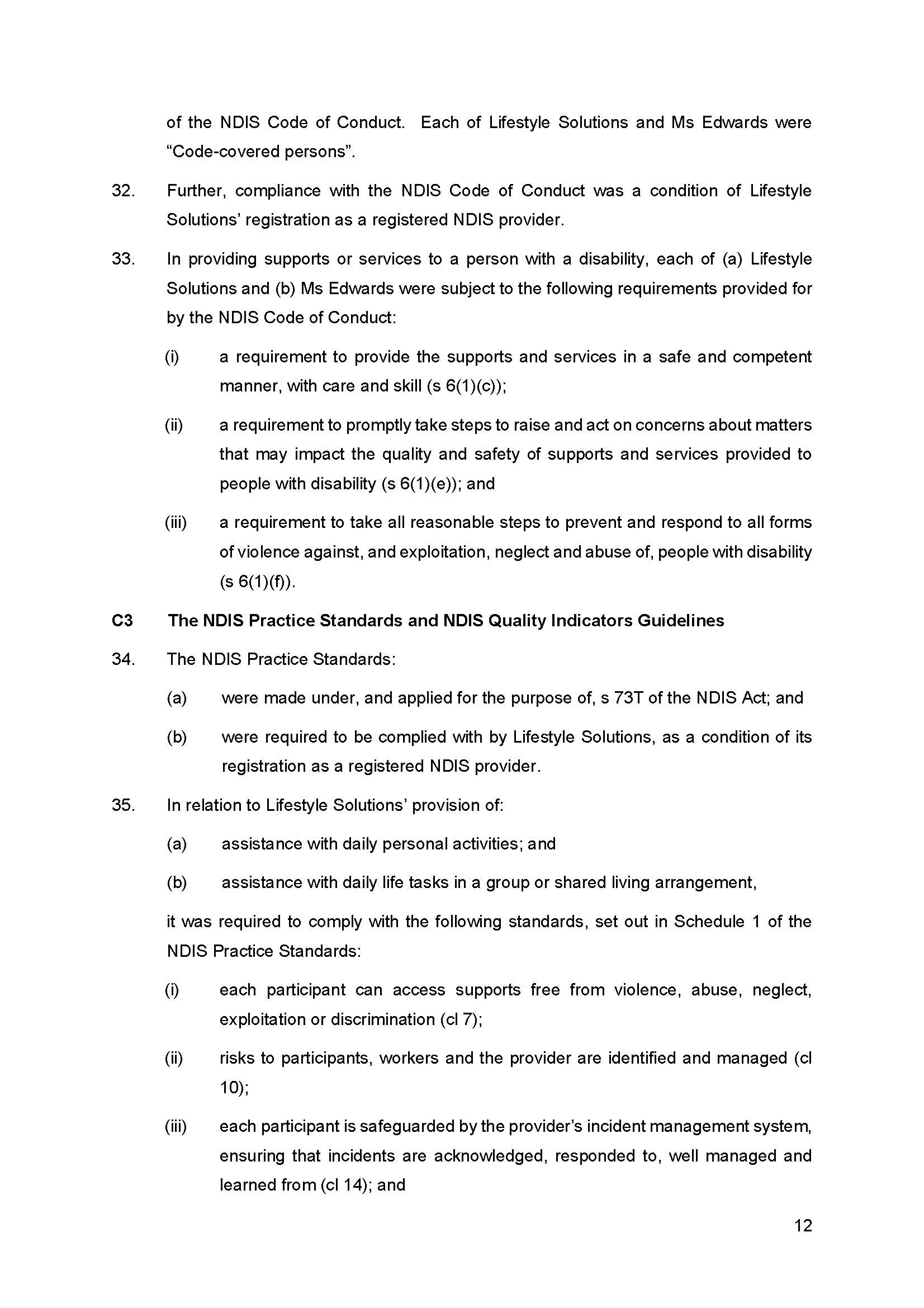
14 The NDIS Practice Standards are set out in schedules to the National Disability Insurance Scheme (Provider Registration and Practice Standards) Rules 2018 (Cth) (NDIS Practice Standard Rules). They were made under and apply for the purpose of s 73T of the NDIS Act in providing standards concerning the quality of supports or services to be provided by registered NDIS providers: s 73T(1). As part of Lifestyle Solutions’ provision of services to assist with daily personal activities and daily life tasks in a group or shared living arrangement, it was required to comply with the standards set out in sch 1 of the NDIS Practice Standard Rules.
Factual overview
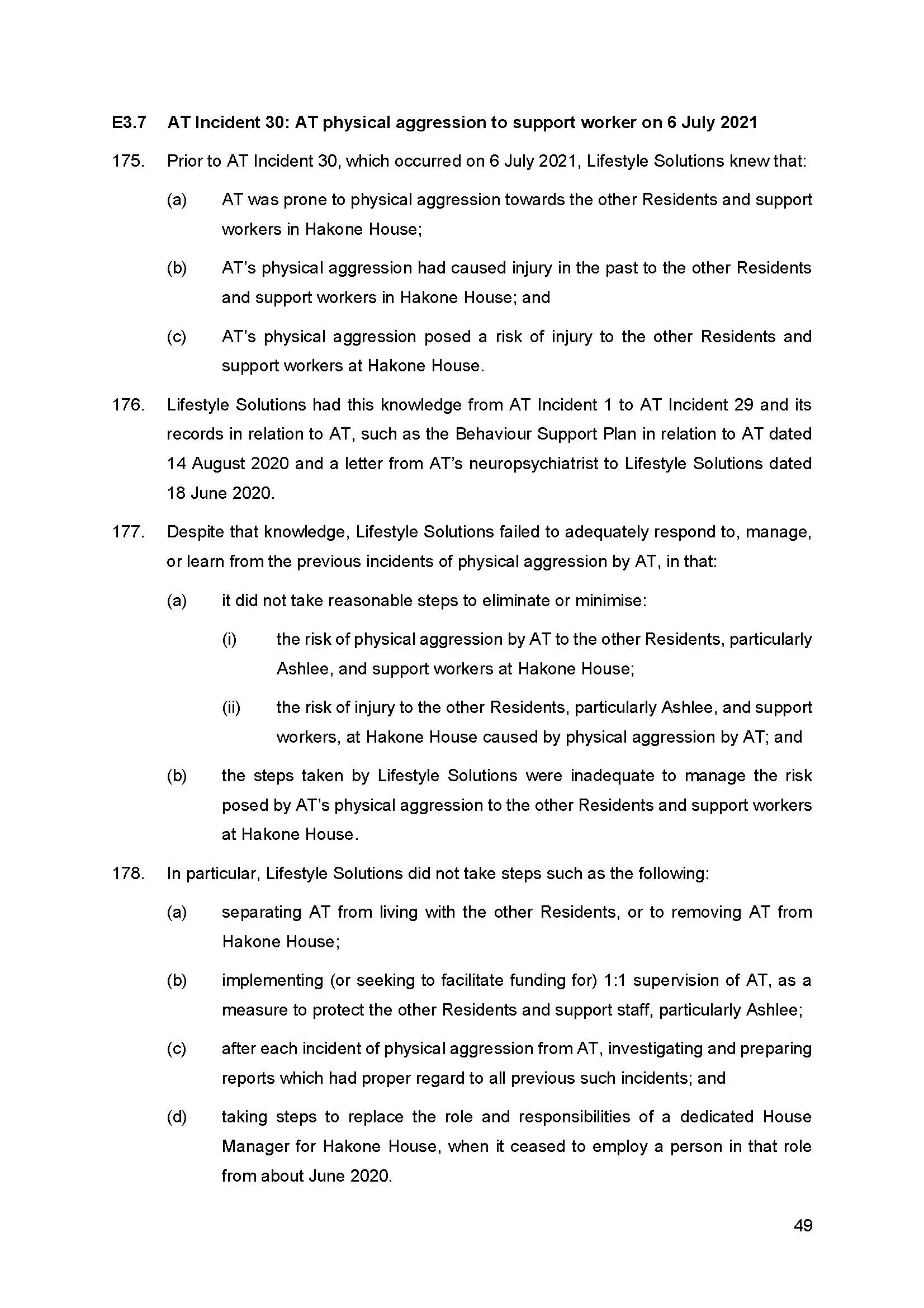
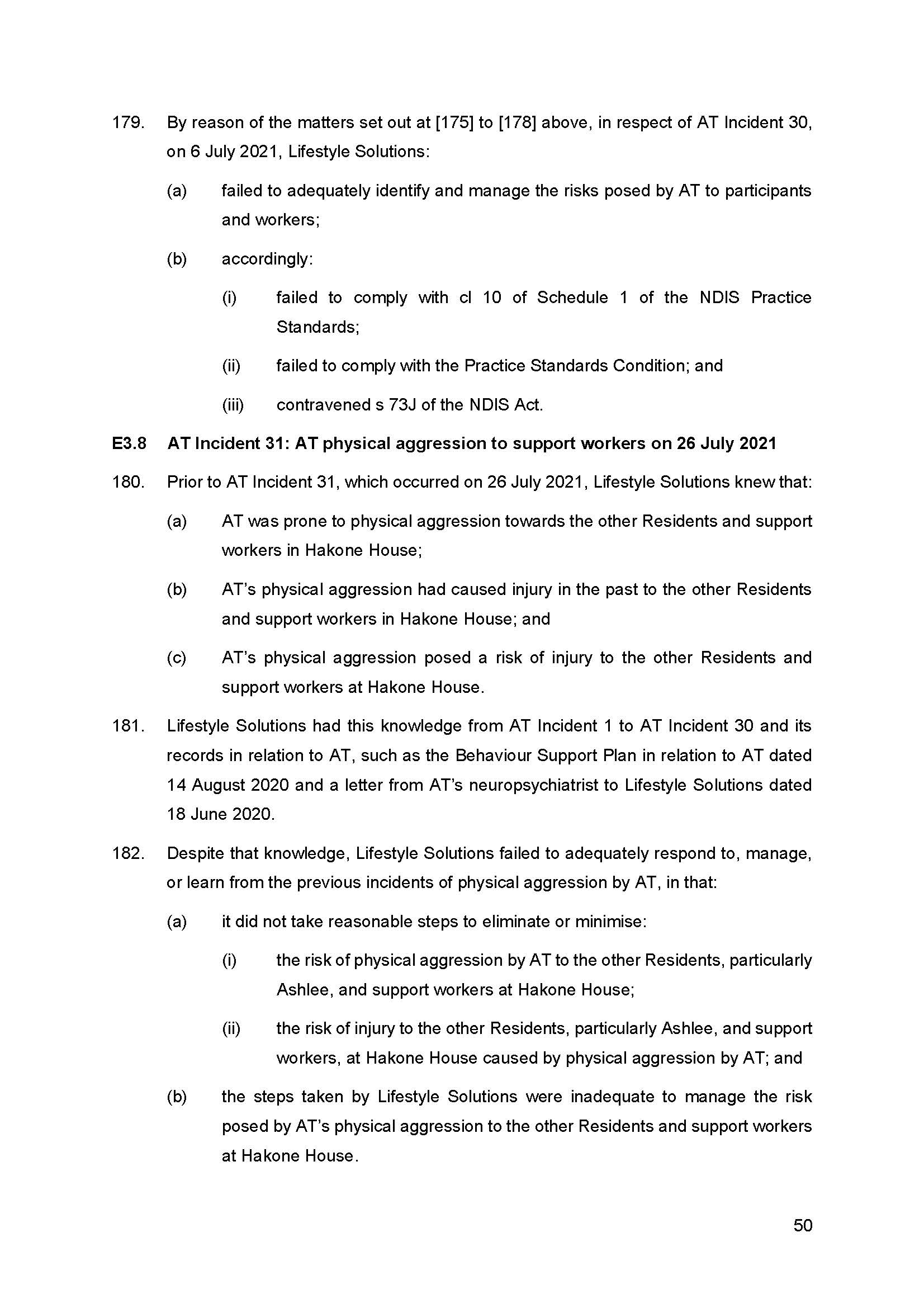
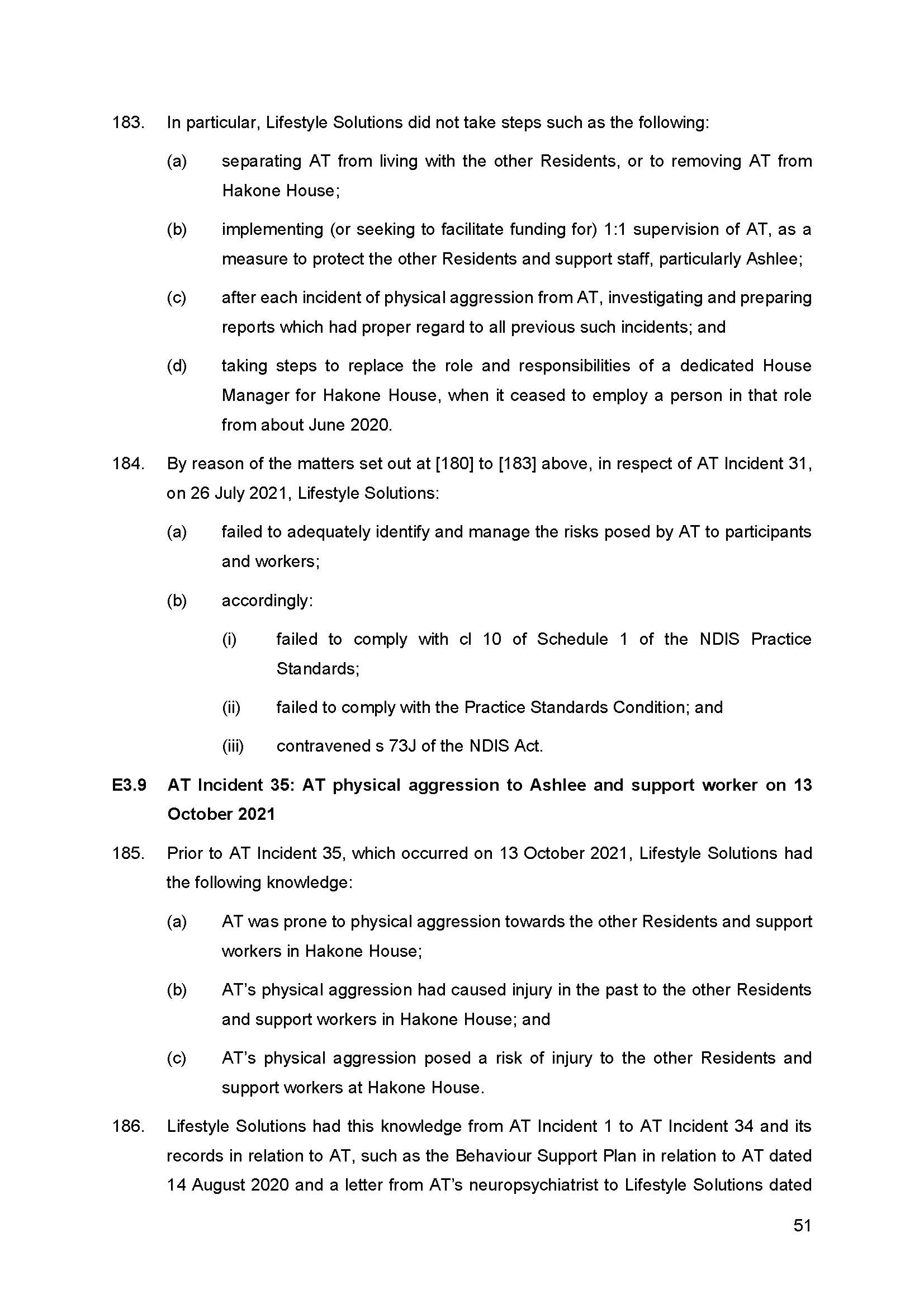
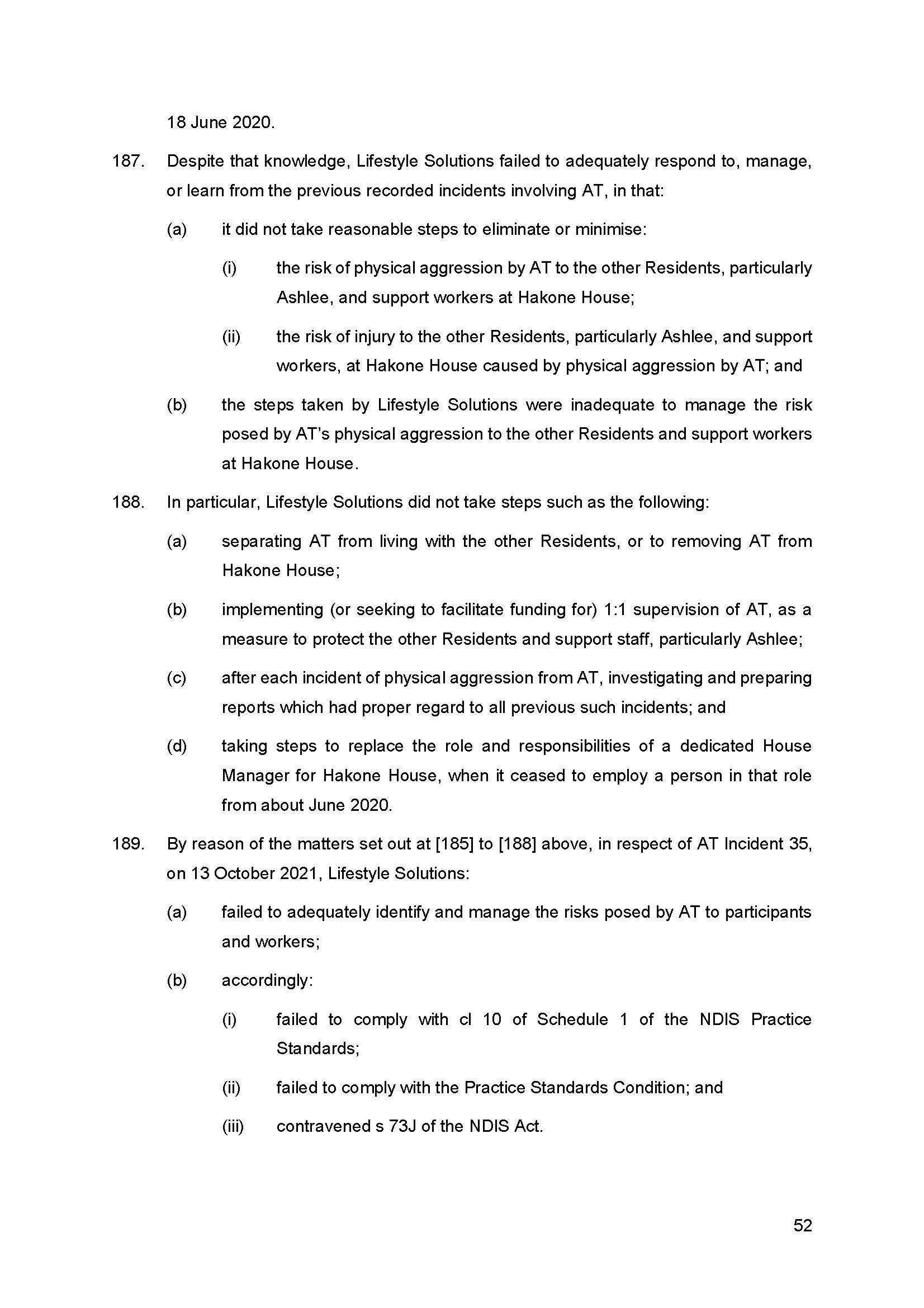
15 It is unnecessary to repeat all the detail of the factual basis and context in which the contraventions occurred, which is detailed in the agreed facts. The following only provides a very brief overview. It is necessary to consider the detailed agreed facts (see Appendix A) to appreciate the full nature and import of the conduct the subject of these proceedings.
16 During the Relevant Period, Lifestyle Solutions operated a supported accommodation facility at 1/32-34 Hakone Road, Woongarrah, New South Wales (Hakone House). There were five residents with disabilities who resided at Hakone House during the Relevant Period: Ms Leicester, AT, MC, SB and GT (Residents). Each of the Residents was a funded NDIS participant, was incapable of living independently and required constant care and supervision.
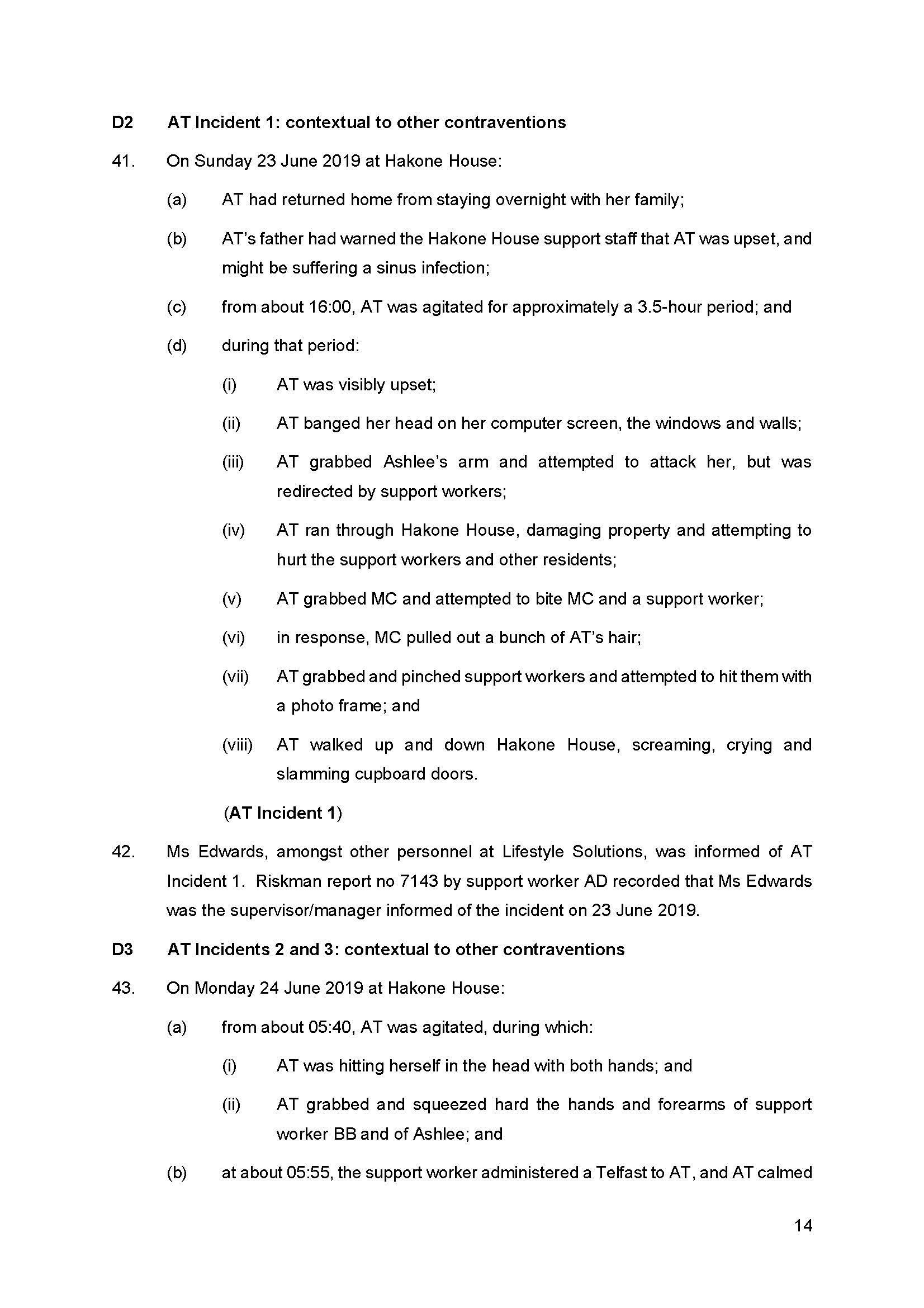
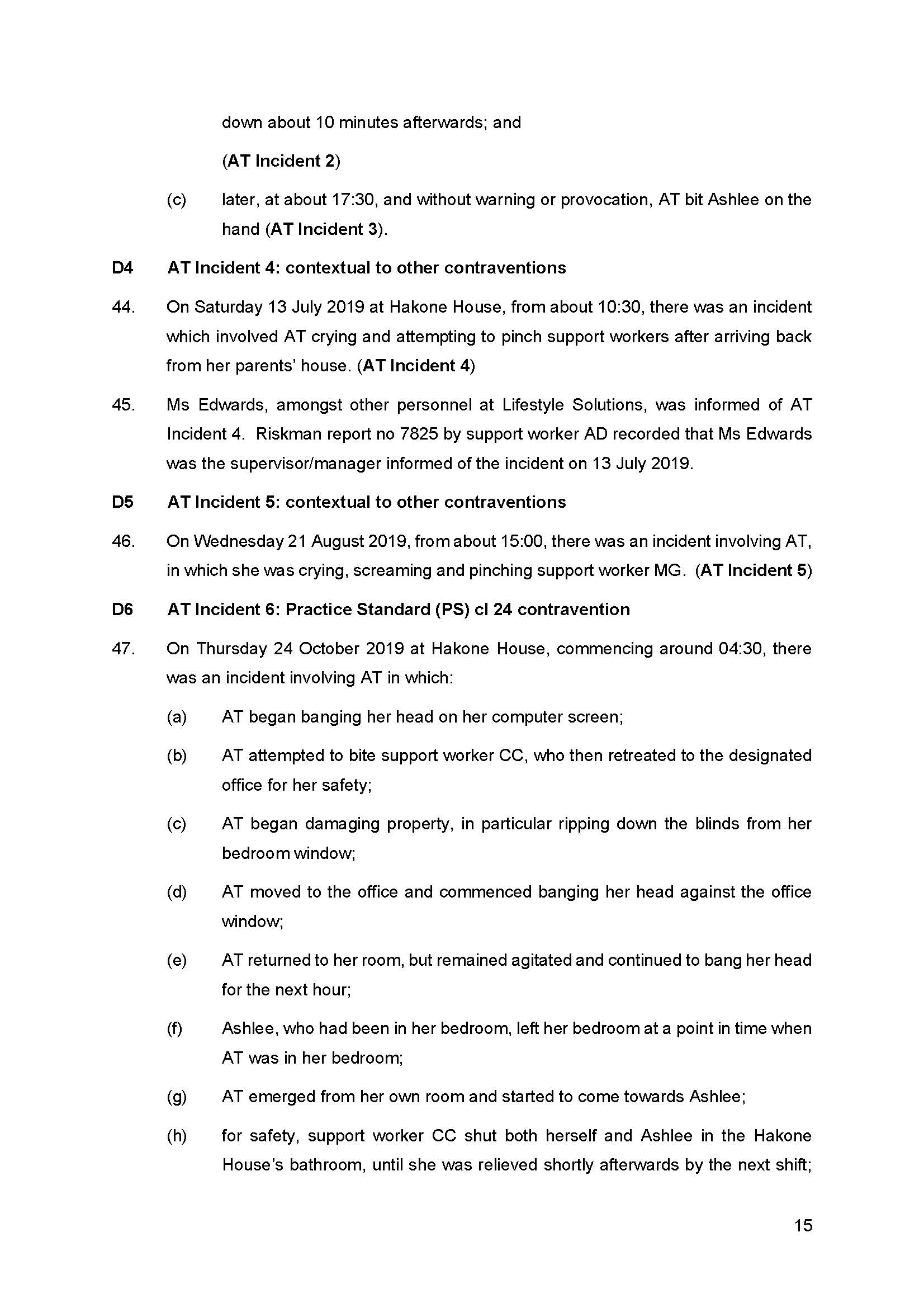
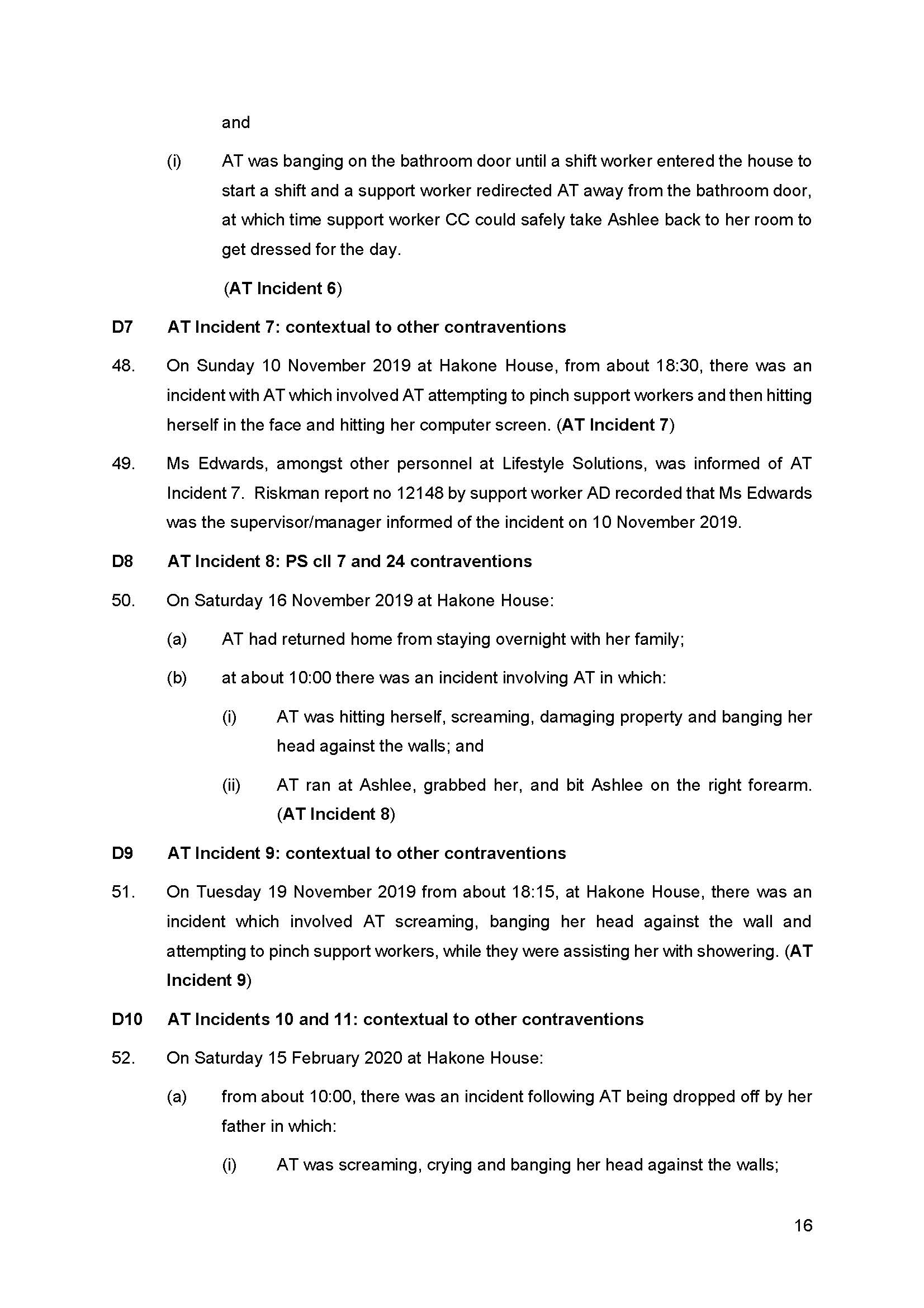
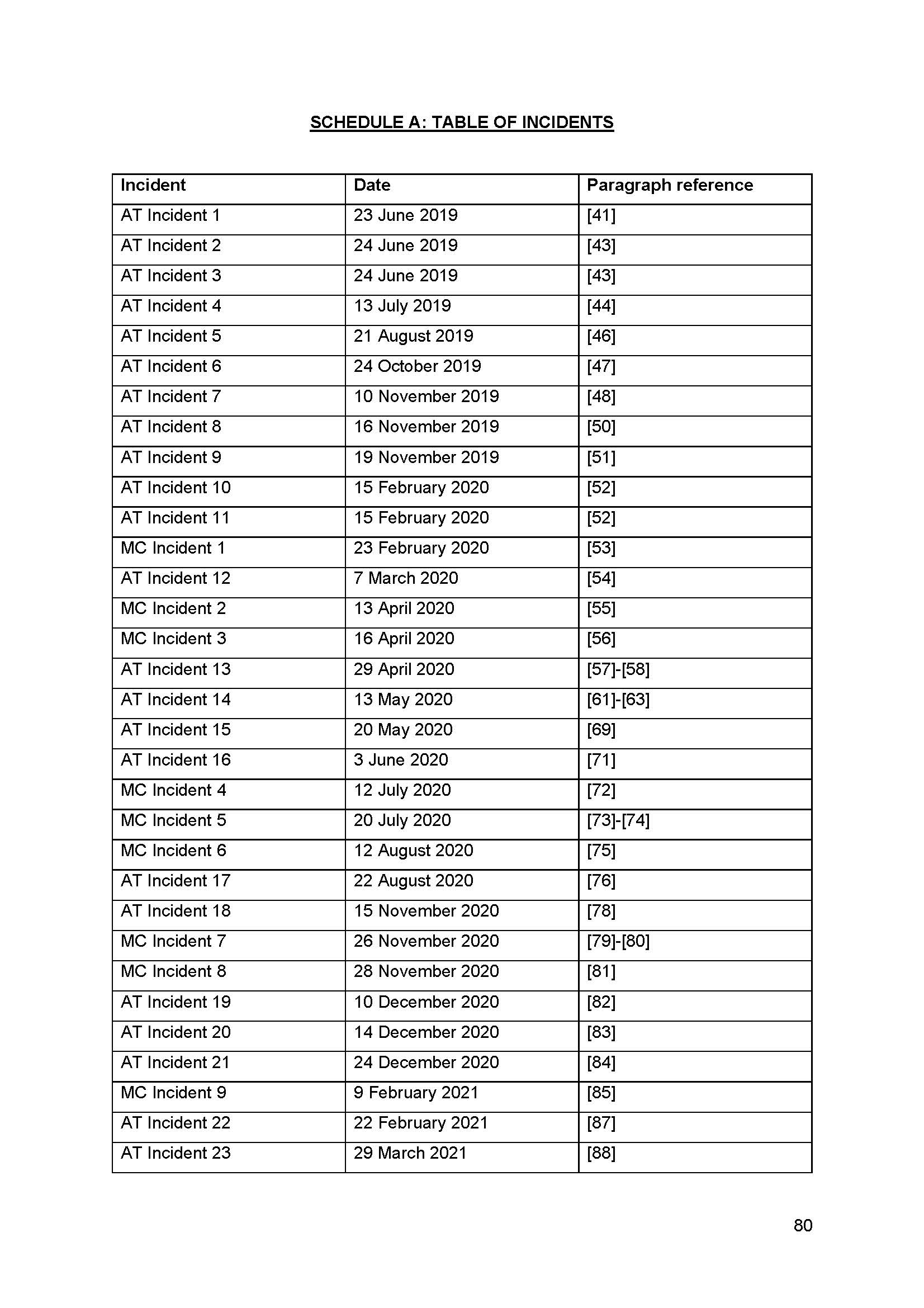
17 During the Relevant Period, there were 47 incidents of physical aggression (including injuries) at Hakone House. Of the 47 incidents, 18 constituted contravening conduct, with the other 30 identified as contextual incidents. The incidents concerned the conduct of AT (36 incidents) and MC (11 incidents) towards the Residents, primarily Ms Leicester, or the support workers.
18 In summary, the acts occurred in either Hakone House or in the car while transporting MC and Ms Leicester to and from their day program. The conduct of AT involved, inter alia: physical aggression towards the Residents, primarily Ms Leicester, and support workers by biting, pinching, pulling hair, or grabbing body parts; damaging property in Hakone House; and AT banging or hitting her head, screaming or crying. The conduct of MC involved, inter alia: throwing items at support workers; damaging property in Hakone House; physical aggression towards one of the Residents or support workers by kicking, hitting, pinching or grabbing hair/body parts; spitting; and grunting, crying or yelling. Some of the conduct required support workers to remove themselves and the Residents from Hakone House or lock themselves in a room for some time. On two occasions, Ms Leicester was taken toAsee a GP for her injuries.
19 Lifestyle Solutions knew of each of the incidents within about 24 hours of the incident in question. Each of those matters was recorded by Lifestyle Solutions in its “Riskman” reporting system, among other places. Ms Edwards knew of AT incidents 1 to 36 within about 1 to 3 days of the incident in question.
20 Certain facts about Ms Leicester, AT and MC known by Lifestyle Solutions and Ms Edwards provide relevant context to their admissions in respect of the management of the Residents and Hakone House. Those facts include:
(a) Ms Leicester is a woman who has cerebral palsy, intellectual disability, epilepsy, vision impairment, mild dysphagia, autism, and sensory processing dysfunction. She requires support in most aspects of her daily personal activities and life tasks, where she is non-verbal, and communicates through noises and signing. Ms Leicester was between 28 and 30 years old at the time of the incidents.
(b) AT is a woman who has intellectual disability, cerebral palsy, epilepsy, autism, conditions affecting her eyesight and is largely non-verbal. AT has a propensity to engage in, amongst others: biting and hitting support workers and other residents; being impatient with others, and “lashing out”; self-harming through banging her head and pinching; and property damage when frustrated. AT was physically larger and stronger than Ms Leicester. From 29 October 2021 (after the Relevant Period), AT was subject to an authorised restrictive practice by installing a door to divide AT’s area of Hakone House from the rest of the house.
(c) MC is a man who has autism spectrum disorder (Level 3), Angelman Syndrome, intellectual disability, anxiety, intermittent explosive outbursts and has a severe speech impairment. MC has a propensity to engage in: physical aggression, including hitting, kicking, spitting or punching; placing others in headlocks; throwing items; and aggressive behaviours during car travel, including grabbing hold of others and pulling others’ hair. MC was physically larger and stronger than Ms Leicester. During the Relevant Period, MC was subject to an authorised restrictive practice when in the car by installing a partial barrier between MC and other passengers and the driver.
21 Ms Leicester, AT and MC were also subject to a series of Behaviour Support Plans by Lifestyle Solutions to address general support strategies and proactively prevent challenging behaviours from occurring and escalating.
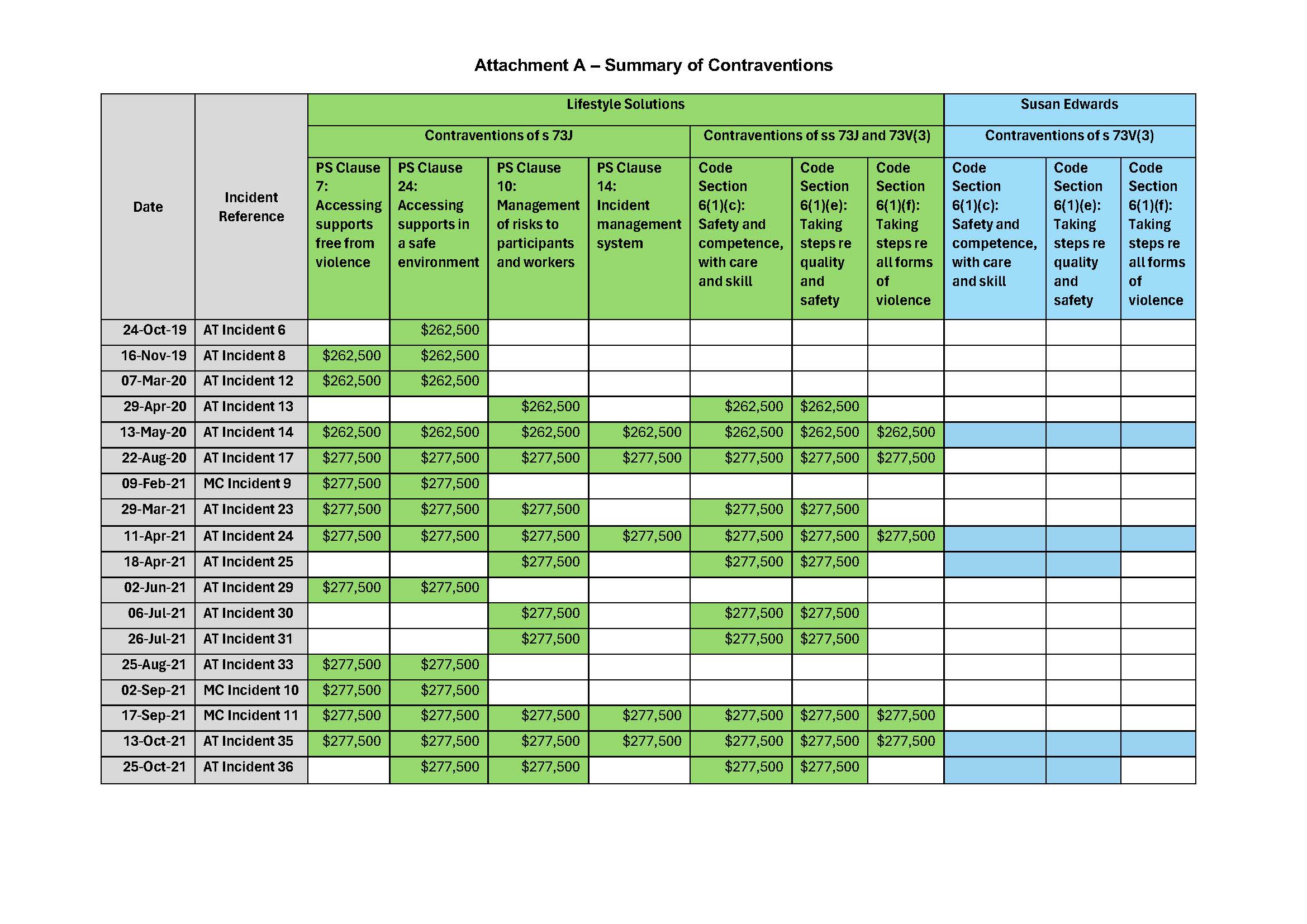
22 A summary of the contraventions admitted by the respondents (with the relevant maximum penalty) was provided by the Commissioner and is attached to these reasons as Appendix B.
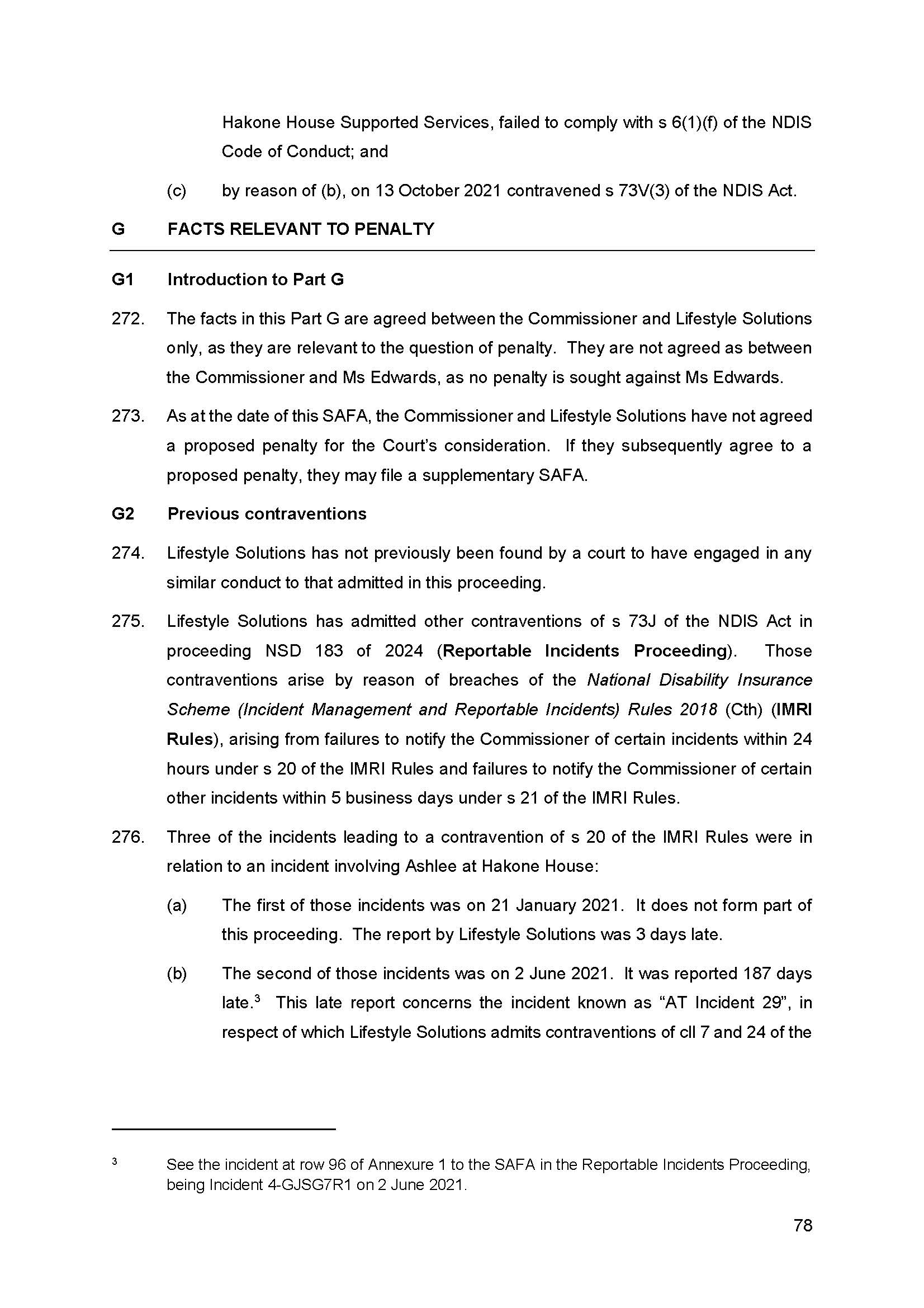
23 Lifestyle Solutions admit 96 contraventions in total. In summary, Lifestyle Solutions admit that in breach of Sch 1 of the NDIS Practice Standards, it failed to:
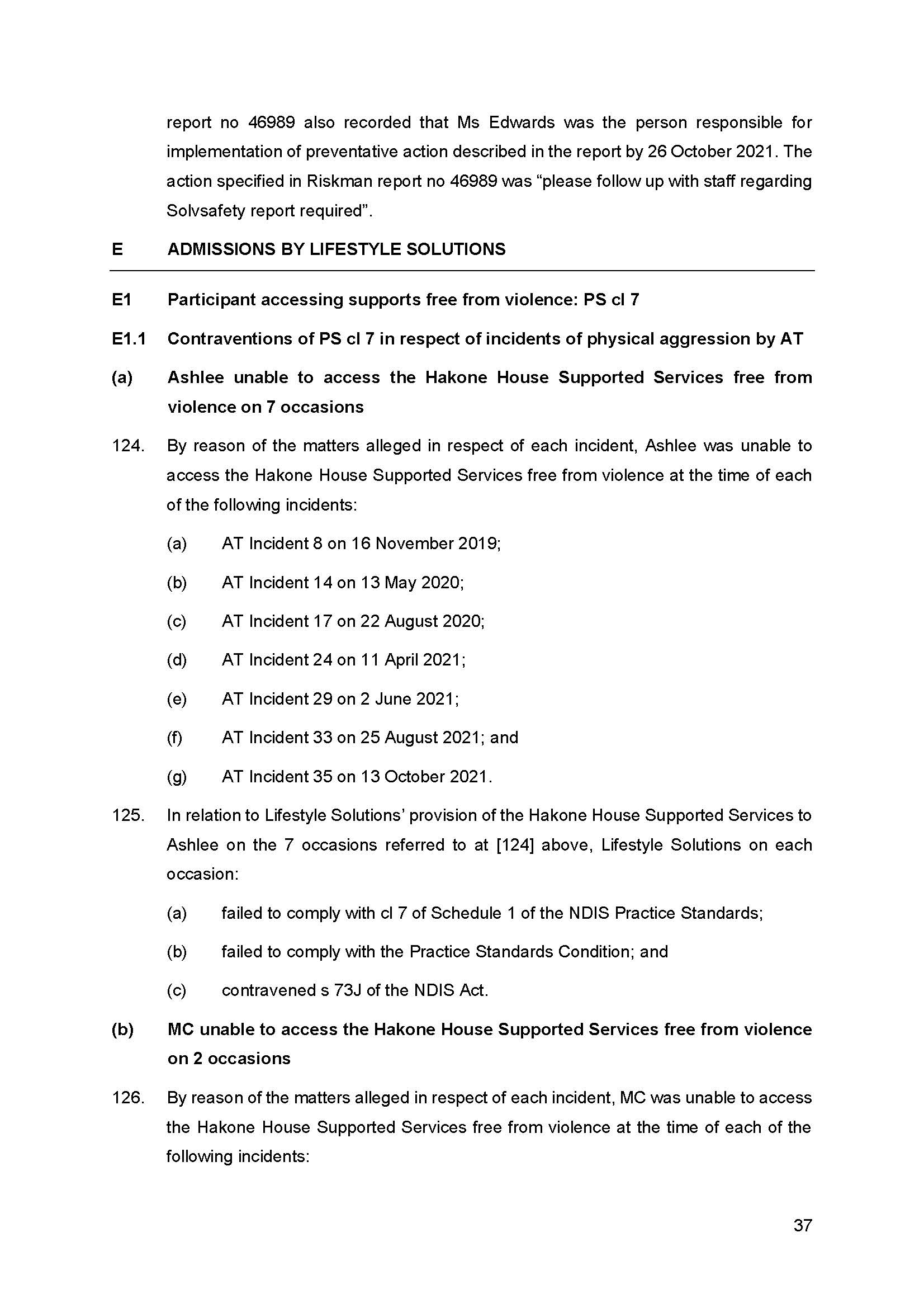
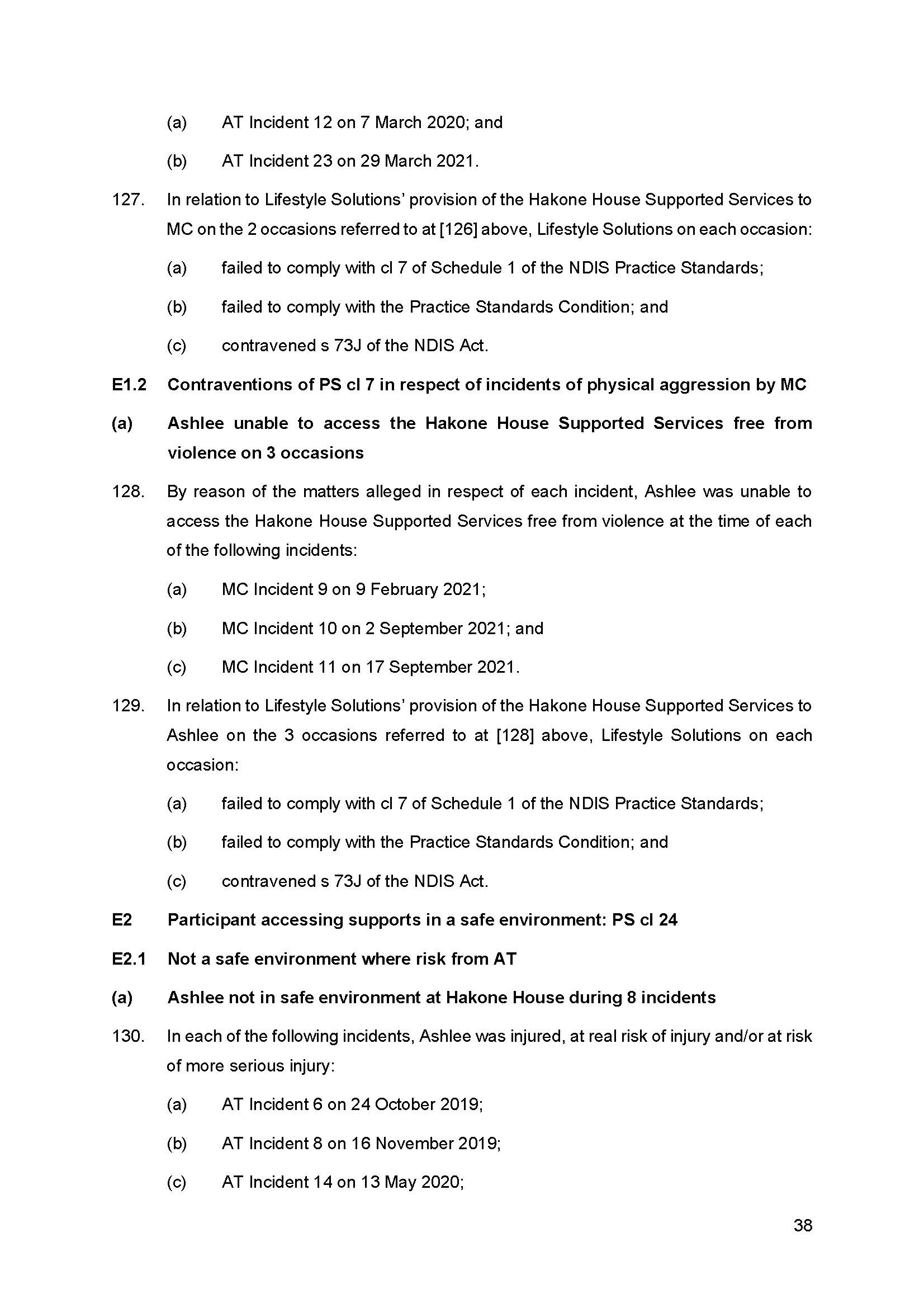
(a) allow Ms Leicester or MC to access the supports provided by Lifestyle Solutions free from violence on 12 occasions (cl 7);
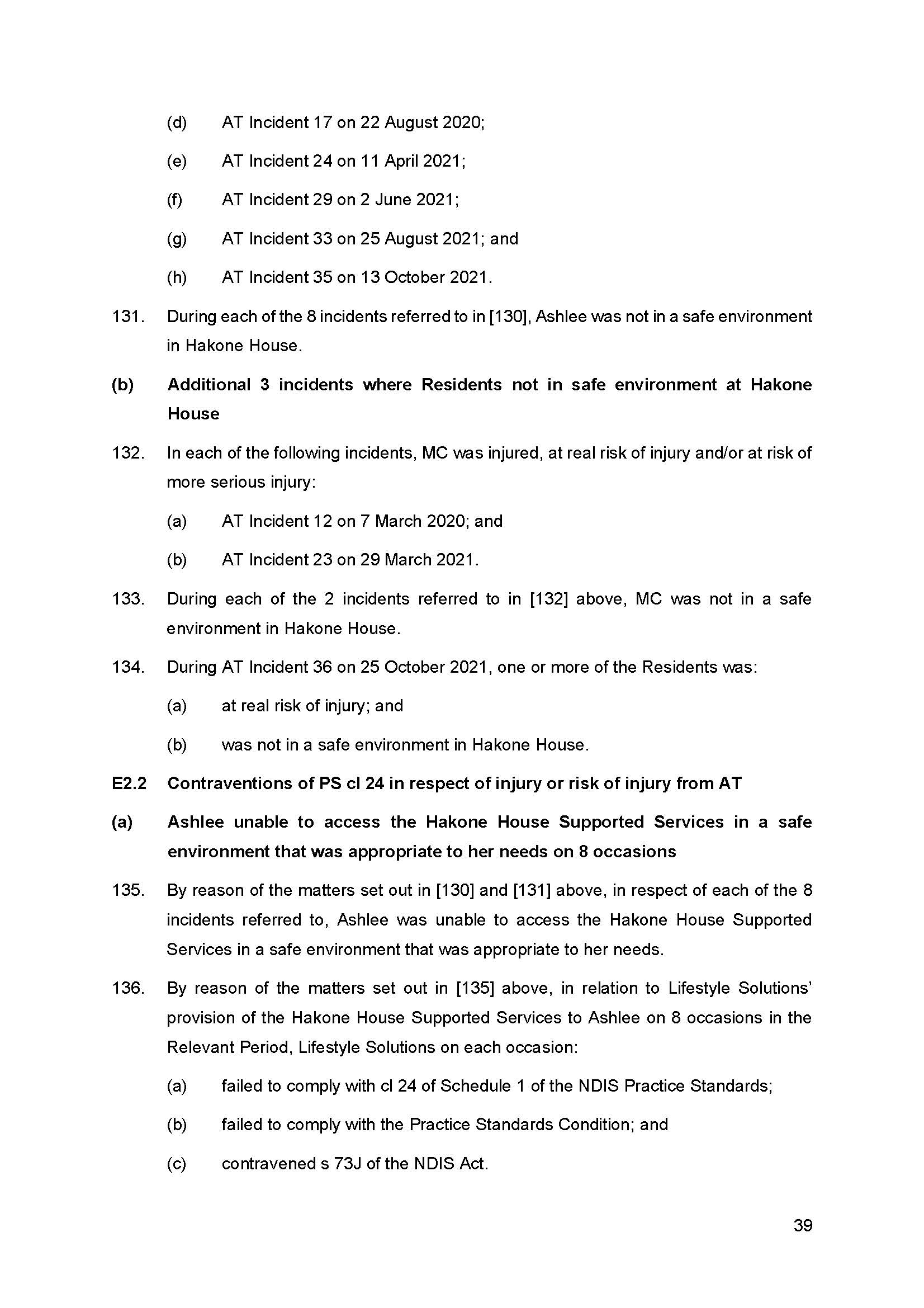
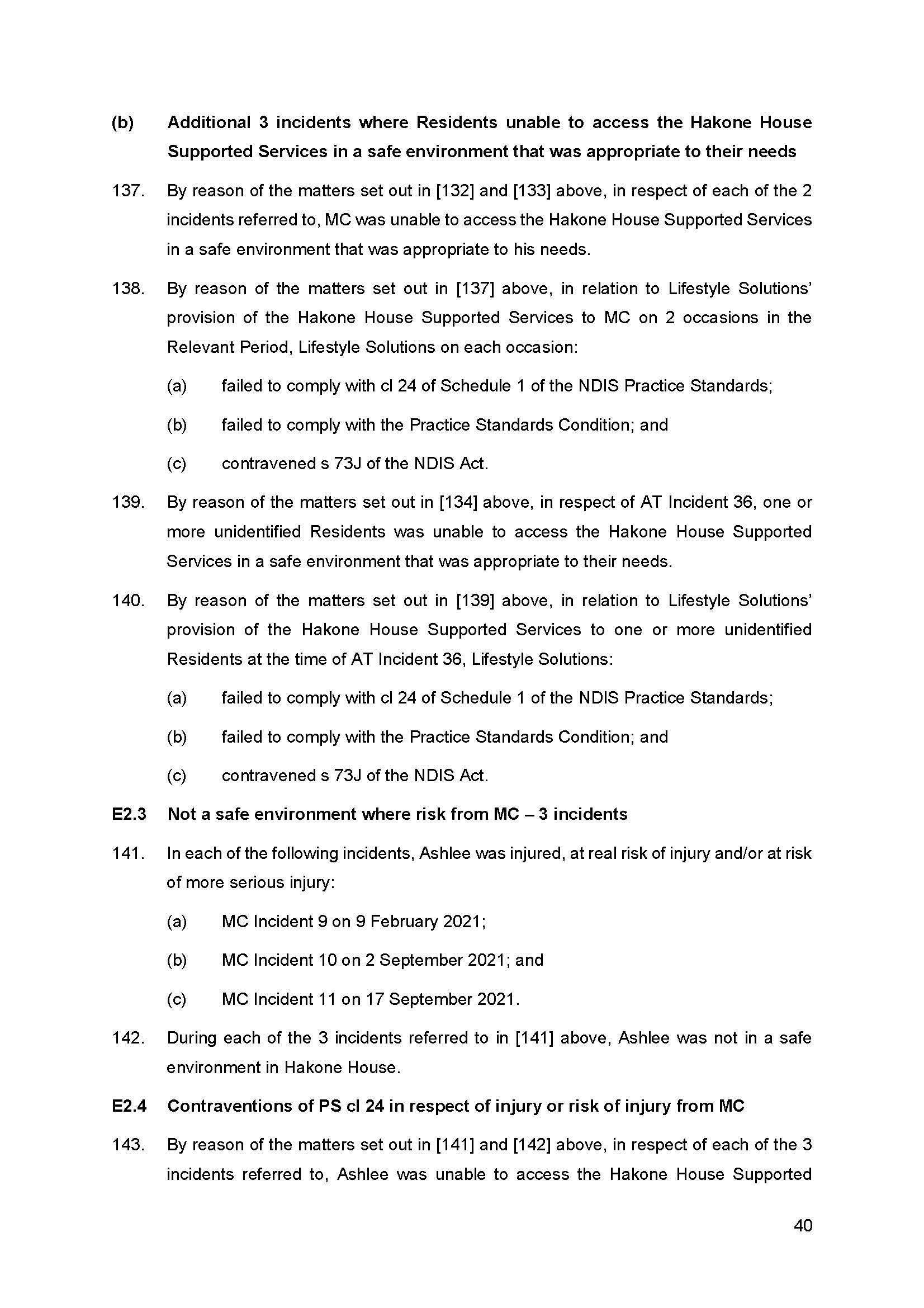
(b) allow Ms Leicester, MC or one of the Residents to access the supports provided by Lifestyle Solutions in a safe environment due to being injured or at a real risk of injury and/or at risk of a more serious injury on 14 occasions (cl 24);
(c) adequately respond to and manage risks of physical aggression and injury posed to the Residents and support workers at Hakone House by AT and MC on 11 occasions, including by failing to take reasonable steps to eliminate or minimise such risks (cl 10); and
(d) safeguard Ms Leicester from physical aggression by AT and MC by means of its incident management system, and failed to ensure earlier incidents were acknowledged, responded to, well-managed and learned from on 5 occasions (cl 14).
24 The admitted breaches of the NDIS Practice Standards give rise to 47 contraventions of s 73J of the NDIS Act.
25 Lifestyle Solutions also admit that in breach of the NDIS Code of Conduct, it failed to:
(a) provide the supports and services to the Residents in a safe and competent manner with care and skill given the incidents involving physical aggression by AT and MC on 11 occasions (s 6(1)(c));
(b) promptly take steps to raise and act on concerns about matters relating to AT’s and MC’s physical aggression towards the Residents and support workers (including earlier incidents of such conduct and the risks posed by them) that may impact the quality and safety of supports and services provided to the Residents at Hakone House on 11 occasions (s 6(1)(e)); and
(c) take all reasonable steps to prevent and respond to the forms of violence by AT and MC towards the Residents (particularly Ms Leicester) as people with disability on 5 occasions (s 6(1)(f)).
26 The admitted breaches of the NDIS Code of Conduct give rise to 27 contraventions of ss 73J and 73V(3) of the NDIS Act (54 contraventions in total).
27 As already referred to, Ms Edwards, during the Relevant Period was employed as Coordinator (or House Manager) until about June 2020, and Service Specialist – Disability from 10 August 2020. As Coordinator, Ms Edwards was responsible for managing Hakone House and two other residential services, including their staff, residents, resident budgets and clinical orders. As a Service Specialist – Disability, Ms Edwards was responsible at Hakone House (and eight other houses) for, inter alia: incident support prevention and response (as part of a wider team); assurance of compliance with contractual, regulatory and safeguarding standards and requirements; and service-based compliance and monitoring of quality of service.
28 Ms Edwards admits that in breach of the NDIS Code of Conduct, she failed to:
(a) provide supports and services in a safe and competent manner, with care and skill to the Residents on 5 occasions, knowing prior to those incidents that AT was prone to physical aggression towards the Residents which posed a risk of injury to the Residents (particularly Ms Leicester) and support workers (s 6(1)(c));
(b) take reasonable steps to eliminate or minimise the risks identified in (a) above, and the steps taken being insufficient to address those risks;
(c) promptly take steps to raise and act on concerns about matters relating to AT’s physical aggression towards the Residents and support workers in earlier incidents that may impact the quality and safety of supports and services provided to the Residents at Hakone House on 5 occasions (s 6(1)(e)); and
(d) take all reasonable steps to prevent and respond to the forms of violence by AT towards the Residents (particularly Ms Leicester) as people with disability on 3 occasions (s 6(1)(f)).
29 The admitted breaches of the NDIS Code of Conduct give rise to contraventions of s 73V(3) of the NDIS Act.
Relief Sought
Pecuniary penalty
30 This application is to be determined under the Regulatory Powers (Standard Provisions) Act 2014 (Cth) (RPA). Relevantly, ss 82-85 of the RPA are as follows:
82 Civil penalty orders
Application for order
(1) An authorised applicant may apply to a relevant court for an order that a person, who is alleged to have contravened a civil penalty provision, pay the Commonwealth a pecuniary penalty.
(2) The authorised applicant must make the application within 6 years of the alleged contravention.
Court may order person to pay pecuniary penalty
(3) If the relevant court is satisfied that the person has contravened the civil penalty provision, the court may order the person to pay to the Commonwealth such pecuniary penalty for the contravention as the court determines to be appropriate.
Note: Subsection (5) sets out the maximum penalty that the court may order the person to pay.
(4) An order under subsection (3) is a civil penalty order.
Determining pecuniary penalty
(5) The pecuniary penalty must not be more than:
(a) if the person is a body corporate—5 times the pecuniary penalty specified for the civil penalty provision; and
(b) otherwise—the pecuniary penalty specified for the civil penalty provision.
(6) In determining the pecuniary penalty, the court must take into account all relevant matters, including:
(a) the nature and extent of the contravention; and
(b) the nature and extent of any loss or damage suffered because of the contravention; and
(c) the circumstances in which the contravention took place; and
(d) whether the person has previously been found by a court (including a court in a foreign country) to have engaged in any similar conduct.
83 Civil enforcement of penalty
(1) A pecuniary penalty is a debt payable to the Commonwealth.
(2) The Commonwealth may enforce a civil penalty order as if it were an order made in civil proceedings against the person to recover a debt due by the person. The debt arising from the order is taken to be a judgement debt.
84 Conduct contravening more than one civil penalty provision
(1) If conduct constitutes a contravention of 2 or more civil penalty provisions, proceedings may be instituted under this Part against a person in relation to the contravention of any one or more of those provisions.
(2) However, the person is not liable to more than one pecuniary penalty under this Part in relation to the same conduct.
85 Multiple contraventions
(1) A relevant court may make a single civil penalty order against a person for multiple contraventions of a civil penalty provision if proceedings for the contraventions are founded on the same facts, or if the contraventions form, or are part of, a series of contraventions of the same or a similar character.
Note: For continuing contraventions of civil penalty provisions, see section 93.
(2) However, the penalty must not exceed the sum of the maximum penalties that could be ordered if a separate penalty were ordered for each of the contraventions.
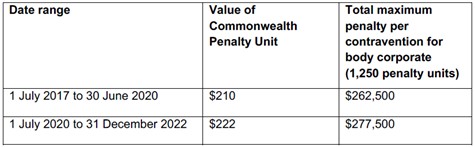
31 Noting the application of s 82(5)(a) of the RPA, the maximum penalty for each contravention is 1250 penalty units. At the time of the contraventions spanning from 23 June 2019 to 25 October 2021, the individual penalty unit changed as identified in the below table provided in the applicant’s submissions:
32 The primary purpose of any civil penalty regime is to ensure compliance with the statutory regime by deterring future contraventions: Commonwealth of Australia v Director, Fair Work Building Industry Inspectorate [2015] HCA 46; (2015) 258 CLR 482 (Agreed Penalties Case) at [24] and [55]. Civil pecuniary penalties are “primarily if not wholly protective in promoting the public interest in compliance [with the statute]”: Agreed Penalties Case at [55], [59], [68] and [110]; see also Australian Building and Construction Commissioner v Pattinson [2022] HCA 13; (2022) 399 ALR 599 (Pattinson) at [15]-[16], [43] and [45]. The aforementioned authorities reveal the principal object of a pecuniary penalty is deterrence. That is, specific deterrence of the contravener and, by that example, general deterrence of other would-be contraveners: Australian Building and Construction Commissioner v Construction, Forestry, Mining and Energy Union [2018] HCA 3; (2018) 262 CLR 157 (Construction, Forestry, Mining and Energy Union ) at [116].
33 The nature of the Court’s task in imposing a civil penalty under s 82 of the RPA, is to impose a pecuniary penalty that the Court determines to be appropriate, having regard to all relevant matters, including those set out in s 82(6) of the RPA. That process involves an intuitive or instinctive synthesis of all the relevant factors: Australian Competition and Consumer Commission v Coles Supermarkets Australia Pty Limited [2015] FCA 330; (2015) 327 ALR 540 at [6]; TPG Internet Pty Ltd v Australian Competition and Consumer Commission [2012] FCAFC 190; (2012) 210 FCR 277 at [145]. Instinctive synthesis is the method by which the judge identifies all the factors that are relevant to the penalty and, after weighing all of those factors, reaches a conclusion that a particular penalty is the one that should be imposed: Markarian v The Queen [2005] HCA 25; (2005) 228 CLR 357 (Markarian) at [37]; and see viagogo AG v Australian Competition and Consumer Commission [2022] FCAFC 87 at [129]-[133] and [148]-[151]. Section 82(6) sets out the factors required to be taken into consideration. Those factors are not exhaustive of what may be relevant, and the factors identified in other civil penalty contexts may also be relevant (recognising presently that there is overlap with the s 82(6) factors). The factors identified additionally include matters such as: the seriousness of the conduct; the size of the contravening company; the deliberateness of the contravention and the period over which it extended; whether further contraventions are likely; whether the contravention arose out of conduct of senior management; whether the contravener has a corporate culture conducive to compliance as evidenced by educational programs and disciplinary or other corrective measures in response to an acknowledged contravention; and whether there has been cooperation with the authorities, including in the context of the proceedings.
34 Any list of factors is not exhaustive and ought not to be approached as a checklist. Rather, the Court is to weigh all the relevant circumstances. In this case, that must be applied in the context of the statutory scheme under which the contraventions occurred: see Commissioner of the NDIS Quality and Safeguards Commission v Australian Foundation for Disability [2023] FCA 629 (Afford); Commissioner of the NDIS Quality and Safeguards Commission v LiveBetter Services Ltd [2024] FCA 374; Commissioner of the NDIS Quality and Safeguards Commission v Valmar Support Services Ltd [2025] FCA 11; Commissioner of the NDIS Quality and Safeguards Commission v Aurora Community Care Pty Ltd (in liquidation) (No 2) [2025] FCA 1237.
35 Regard is also had to the maximum penalty. In this respect, in Markarian, the majority observed at [31] that attention to maximum penalties will almost always be required because: the legislature has legislated for them; they invite comparison between the worst possible case and the case before the court at the time; and because they do provide, taken and balanced with all of the other relevant factors, a yardstick: see Australian Competition and Consumer Commission v Reckitt Benckiser (Australia) Pty Ltd [2016] FCAFC 181; (2016) 340 ALR 25 at [155]-[156] (Reckitt Benckiser); Pattinson at [53]. That said, the applicant submitted that subject to the issues of multiple contraventions, courses of conduct and double punishment, the maximum theoretical aggregate of penalties for all of the contraventions of ss 73J and 73V(3) of the NDIS Act, is $18,992,500. This is a case involving a sufficiently large number of contraventions, such that the maximum aggregate penalty rises to such a number that it is no longer meaningful: Reckitt Benckiser at [157]. In that circumstance “the focus should be on the conduct and on determining a penalty to match the conduct”: Australian Energy Regulator v Origin Energy Electricity Ltd [2022] FCA 802 at [42]; Australian Energy Regulator v Santos Direct Pty Ltd [2024] FCA 579 at [71].
36 The principle of totality requires the Court to make a “final check” of the penalties to be imposed on a wrongdoer, considered as a whole, to ensure that the total penalty does not exceed what is proper for the entire contravening conduct: Australian Competition and Consumer Commission v Australian Safeway Stores Pty Ltd [1997] FCA 450; (1997) 145 ALR 36 at 53, citing Mill v The Queen [1988] HCA 70; (1988) 166 CLR 59.
37 An appropriate penalty is therefore one that is fashioned by reference to the facts of the particular case before the Court, in order to arrive at a penalty that is sufficient to deter the conduct in question, without being overly oppressive: Pattinson at [46].
38 The principles to be applied in considering a jointly proposed penalty were considered in the Agreed Penalties Case, where the majority observed at [46]:
[T]here is an important public policy involved in promoting predictability of outcome in civil penalty proceedings and that the practice of receiving and, if appropriate, accepting agreed penalty submissions increases the predictability of outcome for regulators and wrongdoers. As was recognised in Allied Mills and authoritatively determined in NW Frozen Foods, such predictability of outcome encourages corporations to acknowledge contraventions, which, in turn, assists in avoiding lengthy and complex litigation and thus tends to free the courts to deal with other matters and to free investigating officers to turn to other areas of investigation that await their attention.
39 Further, their Honours said at [58]:
… Subject to the court being sufficiently persuaded of the accuracy of the parties’ agreement as to facts and consequences, and that the penalty which the parties propose is an appropriate remedy in the circumstances thus revealed, it is consistent with principle and … highly desirable in practice for the court to accept the parties’ proposal and therefore impose the proposed penalty.
(emphasis added)
40 Those observations about the desirability of acting upon agreed penalty submissions were made in the context of a broader recognition that as a civil litigant in civil proceedings, civil penalties are but one of numerous forms of relief which regulators can pursue, and it is entirely orthodox for regulators to make submissions as to that relief: see Agreed Penalties Case at [24], [57]-[59], [63], [103] and [107]. Those principles to be applied in considering a jointly proposed penalty were recently considered in Volkswagen Aktiengesellschaft v Australian Competition and Consumer Commission [2021] FCAFC 49; (2021) 284 FCR 24 (Volkswagen) at [124]-[131], referring to Agreed Penalties Case, NW Frozen Foods Pty Ltd v Australian Competition Commission [1996] FCA 1134; (1996) 71 FCR 285 and Minister for Industry, Tourism and Resources v Mobil Oil Australia Pty Ltd [2004] FCAFC 72; (2004) ATPR 41-993. A number of points were highlighted. First, the Court must be satisfied that the penalty proposed by the parties is appropriate: at [125]. Second, if persuaded of the accuracy of the parties’ agreement as to the facts and that the proposed penalty is an appropriate remedy, it is highly desirable for the Court to accept the proposal: at [126]. Third, in considering whether the proposed penalty is appropriate, it is necessary to bear in mind that there is no single appropriate penalty, but rather a permissible range. The proposed penalty may be “an” appropriate penalty if it falls within that range: at [127]. Fourth, the Court should generally recognise that the proposed penalty was most likely a result of compromise and pragmatism on the part of the regulator, and while the regulator must estimate the penalty necessary to achieve deterrence, the Court must assess the proposed penalty on its merits, being wary of the possibility that the regulator may have been too pragmatic: at [129]. Fifth, the Court’s task is not limited to simply determining whether the jointly proposed penalty is within the permissible range, though that might be expected to be a highly relevant and perhaps a determinative consideration. The overriding statutory directive is for the Court to impose a penalty that is determined to be appropriate having regard to all relevant matters: at [131].
Declaratory relief
41 The Commissioner also seeks declaratory relief in terms that she identified.
42 The power to grant declaratory relief pursuant to s 21 of Federal Court of Australia Act 1976 (Cth) “is a very wide one” and the Court is “limited only by its discretion”: Seven Network Ltd v News Ltd [2009] FCAFC 166; (2009) 182 FCR 160 at [1016], citing Forster v Jododex Australia Pty Ltd [1972] HCA 61; (1972) 127 CLR 421 (Forster) at 435. Three requirements need to be satisfied before making declarations: (1) the question must be a real and not a hypothetical or theoretical one; (2) the applicant must have a real interest in raising it; and (3) there must be a proper contradictor: Forster at 437-438. That a party has chosen not to oppose a particular grant of declaratory relief is not an impediment to such relief being granted by the Court: Australian Competition and Consumer Commission v MSY Technology Pty Ltd [2012] FCAFC 56; (2012) 201 FCR 378 at [14] and [30]-[33]. Other factors relevant to the exercise of the discretion include: (a) whether the declaration will have any utility; (b) whether the proceeding involves a matter of public interest; and (c) whether the circumstances call for the Court expressing its disapproval of the contravening conduct: Australian Securities and Investments Commission v Pegasus Leveraged Options Group Pty Ltd [2002] NSWSC 310; (2002) 41 ACSR 561 at 571; Australian Securities and Investments Commission v Monarch FX Group Pty Ltd, in the matter of Monarch FX Group Pty Ltd [2014] FCA 1387; (2014) 103 ACSR 453 at [63]; Australian Securities and Investments Commission v Stone Assets Management Pty Ltd [2012] FCA 630; (2012) 205 FCR 120 at [42].
43 Even where there is agreement between the parties in respect of the proposed declarations, it remains for the Court to decide whether declaratory relief is appropriate: Australian Securities and Investments Commission v MLC Nominees [2020] FCA 1306; (2020) 147 ACSR 266 at [109].
Consideration
44 The Commissioner addressed what she submitted were the relevant factors to consider in assessing the penalty in this proceeding. Lifestyle Solutions and Ms Edwards endorse the Commissioner’s submission with some additional observations by Lifestyle Solutions. Given that, it is unnecessary to recite the submissions in detail. In addition to the agreed facts, the Commissioner and the Lifestyle Solutions tendered some additional material, which I have taken into account in assessing the appropriateness of the agreed penalty.
45 I note at the outset that the Commissioner does not apply for any penalty against Ms Edwards in circumstances where a substantial penalty is being imposed on Lifestyle Solutions. It is also submitted the declarations recording her contraventions are sufficient deterrence in the circumstances of this proceeding.
46 I accept the Commissioner’s submission as to the nature and characterisation of the contraventions, and the matters relating to the considerations for the penalty sought for the reasons given.
47 A number of observations can be made about the relevant considerations.
48 First, the seriousness of the contraventions cannot be disputed in light of the nature, number and period of time over which they were committed. There are 96 contraventions by Lifestyle Solutions, relating to 69 breaches of the NDIS Practice Standards and NDIS Code of Conduct, and its statutory conditions of registration. These contraventions arise in relation to 18 incidents of physical aggression by AT or MC, taking place over a two-year period from 24 October 2019 to 25 October 2021. The incidents occurred in Hakone House, an environment created and controlled by Lifestyle Solutions. Those 18 incidents took place within the broader context of physical aggression during the Relevant Period by AT and MC. The agreed facts contain evidence of 36 incidents of physical aggression by AT (15 incidents giving rise to contraventions), 11 incidents of physical aggression by MC (3 of those incidents giving rise to contraventions). They included instances of wounding, biting, head locks, knocking to the ground, pulling out hair, physical grabbing and property damage. As noted by the Commissioner, some incidents required the Residents or support workers to be protected for their safety and numerous incidents involved injuries to support workers, or attacks on support workers.
49 That said, the Commissioner identified (and the penalty sought reflected) that some contraventions relating to certain incidents were more serious than others. Not to be taken as minimising the seriousness of any of the incidents, the Commissioner highlighted certain incidents as examples of the serious nature of the behaviour and its consequences, being AT Incident 6: AF [47]; AT Incident 13: AF [57]-[60]; AT Incident 14: AF [61]-[68]; AT Incident 24: AF [90]-[92]; AT Incident 25: AF [94]-[95]; AT Incident 31: AF [107]-[109]; MC Incident 11: AF [116]-[117]; AT Incident 35: AF [118]-[121]; and AT Incident 36: AF [122]-[123]. Those examples do illustrate the nature of the contraventions and the frequency or regularity with which they occurred, which can only be appreciated by considering the agreed facts. They are also the incidents identified by the Commissioner as the most serious for which the highest penalties are sought. Suffice for present purposes to refer to one example. That is AT Incident 24, where AT entered Ms Leicester’s room where she was sleeping, and bit her on her face. When a support worker came to intervene, AT grabbed the support worker’s breast and bit her through her jumper, causing bruising and bite marks. Another support worker moved the other residents of Hakone House outside for their safety, until AT calmed down. The bite left a skin wound on Ms Leicester’s cheek and bruising on her cheek, chin and neck (which was depicted in photographs annexed to the agreed facts).
50 It is to be recalled that the contraventions occurred in the broader context of other incidents of physical aggression. The broader context is, inter alia, evidence of the knowledge Lifestyle Solutions had in relation to the propensity of AT and MC to act in particular ways: see also [20] above. The risks to others were known risks.
51 Second, the Residents (as NDIS participants) were subjected to violence by one of the other Residents while residing in Hakone House, a shared supported living environment. That shared environment was unsafe, and not appropriate for the Residents’ needs. The risks to participants and workers were not properly identified and managed. The contraventions arose from a pattern of aggressive behaviour by AT and MC towards Ms Leicester in particular, the other Residents and the support workers, in the participants’ home. These behaviours presented known risks, that resulted in repeated instances of aggression and injury over a period of more than two years, within the close confines of Hakone House. As a result, the Residents and support workers suffered actual injuries, the risk of further or more serious injuries, and significant distress.
52 Third, Lifestyle Solutions is a very substantial provider of disability support services. It currently has approximately 2,010 employees and provides services to over 897 people across Australia including over 353 people with disability. In 2023, Lifestyle Solutions provided services to over 2,005 people across Australia including over 1,705 people with disability. During at least the Relevant Period, Lifestyle Solutions provided NDIS services to persons with disability in all States and Territories except South Australia. It currently provides NDIS services to persons with disability in Queensland, New South Wales, Western Australia, the Australian Capital Territory and the Northern Territory. Lifestyle Solutions operates 73 Supported Independent Living Sites and has 23 properties registered as Specialist Disability Accommodation. Evidence was provided of the financial position of Lifestyle Solutions and its parent companies. In the context of Lifestyle Solutions’ very substantial revenue and broad scope of operations, and the resources of its parent companies, a substantial penalty is needed to serve the purpose of deterrence.
53 Further, the fact that a respondent is a not-for-profit entity “does not obviate the significance of specific deterrence, or of the very serious nature of the contraventions”: Afford at [67].
54 Fourth, the reporting to senior management was inadequate and omitted key details that were needed for a proper risk assessment. For example, Lifestyle Solutions then CEO signed a confidential report on 11 September 2020, which was prepared following AT Incident 17. It can readily be accepted the report was, as described by the Commissioner, “deeply inadequate”. It reported inter alia,
A review of incident reports in respect of … AT identified only one other reported incident involving physical aggression towards [Ms Leicester] resulting in minor injury. Incident Report Ref. 19305 [AT Incident 14] relates …
(emphasis added)
55 Incident 14 refers to an occasion when AT was left unattended and bit Ms Leicester on the right-hand side of her face, on her cheek close to the eye, following which Ms Leicester was prescribed antibiotics for 5 days, and recommended to follow up with a tetanus vaccination. The confidential report did not include reference to several key issues and incidents, to which Lifestyle Solutions has now admitted contraventions. When Ms Leicester’s family subsequently raised concerns directly with senior management, Lifestyle Solutions failed to prevent further incidents.
56 Fifth, and aligned with the above observation, the number and extent of contraventions at Hakone House, over a period of two years, suggests a poor culture of compliance even though each of the incidents was recorded in Lifestyle Solutions’ “Riskman” database. As reflected above, the incidents were not treated sufficiently seriously, and the risks posed by AT and MC were not sufficiently managed or acted upon. It was only after two years of consistent abuse and injury to Ms Leicester, did the CEO of Lifestyle Solutions come to the realisation that the Hakone House residence was “not the right solution for this cohort”. I accept the Commissioner’s submission that the conclusion was obvious well before then.
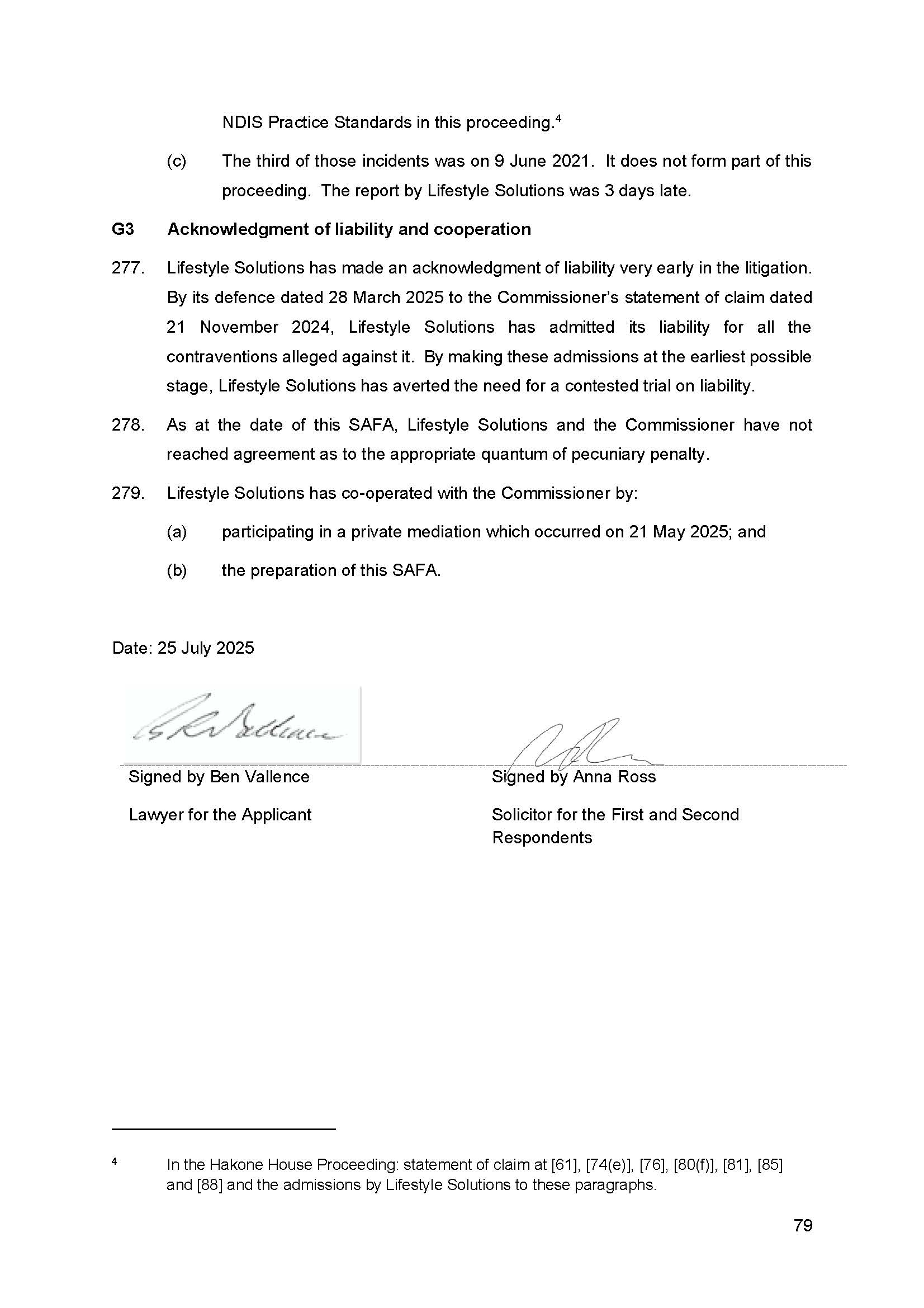
57 Sixth, Lifestyle Solutions acknowledged liability at the earliest possible stage in these proceedings, cooperated in participating in mediation, preparing the agreed facts and agreeing on the proposed aggregate penalty of $2,000,000, broken down by specific incidents. This conduct provides a real utilitarian benefit by freeing up regulator and court resources, as well as encouraging other contraveners to cooperate: see e.g. Construction, Forestry, Maritime, Mining and Energy Union v Fair Work Ombudsman (The Botany Cranes Case) [2023] FCAFC 40; (2023) 297 FCR 438 at [169]. That cooperation has been factored into the agreed penalty.
58 In this context, the Commissioner submitted that despite their co-operation there has been no apology by Lifestyle Solutions for its conduct in this proceeding and therefore there is no evidence of remorse or contrition. That may be accepted. However, as Lifestyle Solutions submitted that is not an aggravating factor. There is the absence of a mitigating factor, and it is a factor not relied on. Lifestyle Solutions also submitted that given the change in personnel (as described below) an apology in any event would be less meaningful.
59 Seventh, Lifestyle Solutions has no prior record of contraventions, although as noted above, another proceeding involving Lifestyle Solutions was heard concurrently with this proceeding relating to Lifestyle Solutions’ failure to notify the Commissioner of reportable incidents. There was some degree of overlap, including one incident which forms a contravention in both proceedings. That is AT Incident 29, in which AT grabbed Ms Leicester by the arms and attempted to bite her, before a support worker intervened which was required to be reported within 24 hours of the incident but was reported 187 days late.
60 Eighth, Lifestyle Solutions provided evidence that they now have in place a suite of policies and procedures which are relevant to the issues that arose in this proceeding, observance of which will facilitate timely identification and management of risks by Lifestyle Solutions and guard against repeat contraventions of the kind that are the subject of this proceeding. These policies were implemented post these incidents. These proceedings made clear Lifestyle Solutions needed to improve the policies and procedures it had in place so as to prevent repeated occurrences of the conduct the subject of the contraventions. However, as the Commissioner observed, no matter how well prepared and well written a policy is, the ultimate measure and efficacy of any such policy relies heavily upon its implementation and adherence. So much can be accepted.
61 The evidence relied on by Lifestyle Solutions establishes that on 1 September 2025, Possability Group Ltd (ACN 638 044 327) (PGL) (including Lifestyle Solutions) was acquired by Independence Australia Group Limited (ACN 004 979 837) (IAG). IAG became the sole member of PGL and the ultimate parent company of Lifestyle Solutions. All existing directors of Lifestyle Solutions and PGL resigned and were replaced by IAG nominee directors. Lifestyle Solutions submitted:
The merger of IAG and PGL, as well as the complete turnover of Lifestyle Solutions’ senior leadership, indicate a reduced need for specific deterrence than would be the case had Lifestyle Solutions continued to have the same separate existence and senior management as it did throughout the Relevant Period.
62 Lifestyle Solutions submitted that the agreed penalty appropriately reflects this consideration. It is recognised that this change in the entity and its senior management may moderate the need for specific deterrence by comparison to other cases: see e.g. Australian Securities and Investments Commission v Statewide Superannuation Pty Ltd [2021] FCA 1650 at [99]-[100]; Australian Securities and Investments Commission v LGSS Pty Ltd (No 3) [2025] FCA 205 at [135]. That said, although this tempers the need for specific deterrence, as Lifestyle Solutions properly recognised, it does not eliminate the need for it.
63 Ninth, in respect to the fact there are multiple contraventions, and with regard to the principles relevant to double punishment and courses of conduct, the Commissioner has approached the fixing of the total sum of the penalty by considering 18 separate penalties, one for each of the incidents giving rise to contraventions. Each incident reflects contraventions of either s 73J (where the conduct involves breaches of the NDIS Practice Standards alone), or both ss 73J and 73V(3) (where the conduct involves breaches of both the NDIS Practice Standards and the NDIS Code of Conduct).
64 For each of the 18 incidents, the contraventions arising from multiple breaches of the NDIS Practice Standards and NDIS Code of Conduct can appropriately be treated as a single course of conduct for each incident. Where there are multiple separate breaches of the NDIS Practice Standards or the NDIS Code of Conduct in relation to a particular incident, they are not “in relation to the same conduct” for the purpose of s 84(2) of the RPA. Each of those provisions is a different and separate obligation, applying to each incident from a different perspective, and imposed for a different purpose: Afford at [55]. The Commissioner accepted that where the same conduct contravenes both ss 73J and 73V(3) they are “in relation to the same conduct” for the purpose of s 84(2), and only a single penalty is available.
65 I accept in the circumstances of this case, that approach is appropriate.
66 Finally, I return to the facts underpinning the contraventions.
67 As a registered NDIS provider, Lifestyle Solutions was obliged to comply with its statutory conditions of registration, including to comply with the NDIS Practice Standards and NDIS Code of Conduct. It was responsible for the care and support of five highly vulnerable members of the community, living at Hakone House, a facility which Lifestyle Solutions both created and administered. Each of the Residents was unable to care for themselves and required a high degree of care. They and their families depended on Lifestyle Solutions to care for and protect them. Their families placed their trust in Lifestyle Solutions that it would provide supervision, support and a safe environment, as they were entitled to do. The Residents were entitled to live free from abuse and neglect, and to have their worth and dignity respected. That did not occur.
68 The agreed facts reflect a pattern of aggressive behaviour by AT and MC towards Ms Leicester, the other Residents in Hakone House, and the support workers. The contraventions reflect that for over two years, Hakone House was not a safe environment for the Residents or support workers. Ms Leicester was the primary victim of repeated physical aggression from AT or MC, was consequently injured (she suffered bite injuries to her face and arms resulting in broken skin and bruising, requiring medical attention on two occasions) and on occasions, support workers had to take steps to protect Ms Leicester and the other Residents from AT. In one incident, Ms Leicester was shut inside a bathroom to keep her safe, while AT banged on the door. It can be inferred Ms Leicester feared for her safety in her own home and what should have been a protected and supportive environment. The distressing nature of the incidents is obvious. The other Residents and support workers were also the victim of incidents and suffered injuries. The abuse was not managed, assessed or responded to adequately or appropriately.
69 To date, there have been few cases considered by the Court brought by the Commissioner against NDIS providers for contraventions of the NDIS scheme. This is the first case which is directed towards contraventions that have arisen from abuse of this nature in a supported accommodation facility.
70 The Commissioner referred to findings made by the Royal Commission into Violence, Abuse, Neglect and Exploitation of People with Disability with respect to a supported living accommodation provider, which found in respect of a case study that “interpersonal violence between residents [had become] normalised”: Royal Commission into Violence, Abuse, Neglect and Exploitation of People with Disability (Public Hearing Report, 20 February 2023) Finding 17. The Royal Commission further observed in relation to another NDIS provider:
It is true that the judgments required of service providers and regulators are not always straightforward or easy to determine. But disability support providers, especially those providing SIL [Supported Independent Living] services and SDA [Specialist Disability Accommodation] …, must always strive to eliminate all forms of violence against and abuse, neglect and exploitation of those they serve.
(citation omitted)
71 This highlights the importance of deterrence in the penalty to be imposed in this case. As the Commissioner submitted, violence and abuse in supported living accommodation settings is never acceptable and should not be allowed to become normalised. It is important that the penalty imposed on Lifestyle Solutions is of a size that marks the seriousness of the contraventions.
Conclusion
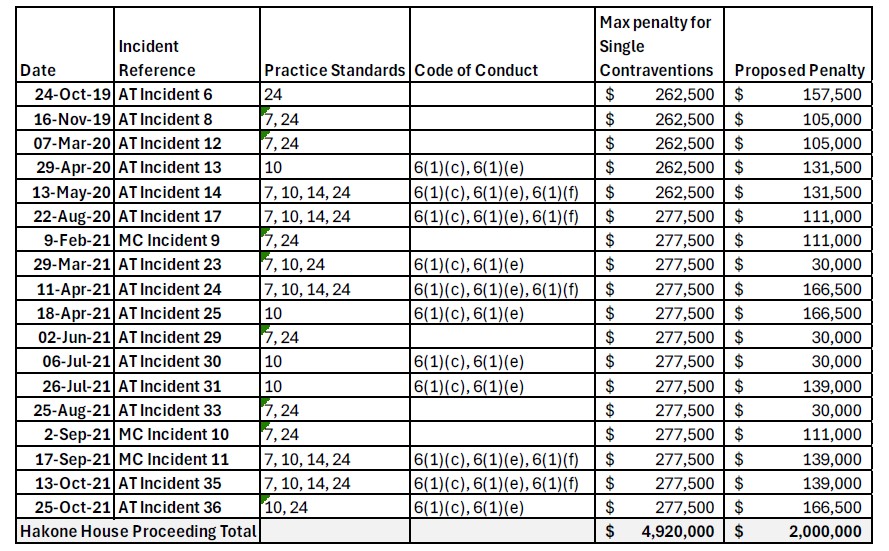
72 As already explained, the total penalty proposed by the parties to be imposed on Lifestyle Solutions for its contraventions of ss 73J and 73V(3) of the NDIS Act is $2,000,000. That comprises a penalty imposed in respect to each incident giving rise to a contravention. The table below details for each incident: the date; the incident reference (as referred to in the agreed facts); the relevant provisions from the NDIS Practice Standards and the NDIS Code of Conduct that are said to have been breached; the maximum penalty for a single contravention, as applied at the time; and the proposed penalty in respect of that incident.
73 Having considered the facts agreed between the parties, their respective submissions, the evidence relied on, the contraventions and relevant principles, I am satisfied that it is appropriate to order a pecuniary penalty against Lifestyle Solutions in the amount of $2,000,000 and to make the declarations sought.
74 In reaching that conclusion, I am conscious of the approach outlined in Volkswagen, described above, including that the Court must assess the proposed penalty on its merits, being wary of the possibility that the regulator may have been too pragmatic: Volkswagen at [129]. That said, as explained above, where the Court is persuaded that the agreed penalty proposed is an appropriate remedy in all the circumstances, it is highly desirable in practice for the Court to accept the parties’ proposal and therefore impose the proposed penalty: Volkswagen at [126].
75 It is readily apparent from the submissions that the parties have given close and careful consideration to the relevant issues, the appropriate declarations, orders and pecuniary penalties. That is so with one of the parties being the Commissioner, a specialist regulator. In that context, in the Agreed Penalties Case, the High Court at [60]-[61], noted the relevance of the fact that submissions were being advanced by a specialist regulator able to offer “informed submissions as to the effects of contravention on the industry and the level of penalty necessary to achieve compliance”, albeit that such submissions will be considered on the merits in the ordinary way.
76 This Court must impose a penalty that is appropriate in all the circumstances. The principal object of deterrence is achieved if the pecuniary penalty has the necessary “sting or burden” to secure “the specific and general deterrent effects that are the raison d’être of its imposition”: Construction, Forestry, Mining and Energy Union at [116].
77 As I observed in Afford at [84]:
The consequences that may ensue from breaches of the NDIS Code of Conduct and NDIS Practice Standards are potentially grave given the vulnerability of NDIS participants. The present case is a stark example of this. The objects of the NDIS scheme include “protecting and preventing people with disability from experiencing harm arising from poor quality or unsafe supports or services provided under the NDIS”, and “promoting the provision of high quality and innovative supports that enable people with disability to maximise independent lifestyles and full inclusion in the community”. The importance of NDIS providers (and persons employed or engaged by them) complying with the obligations imposed by the NDIS Act, cannot be overstated. The protective nature of ss 73V and 73J, their role in promoting high quality supports for people with disability, and the vulnerability of people with disability to harm when that support is not provided, emphasise the seriousness of breaching each of those provisions.
78 Although the factual basis of the contraventions is different, the observations are nonetheless apt in these circumstances.
79 Over a period of two years, primarily Ms Leicester but also other Residents and support workers, were subjected to repeated incidents of physical aggression and attacks, as described in the agreed facts. The Residents were entitled to be safe and protected, but they were not. These issues were not managed or reported on adequately. Lifestyle Solutions did not take all reasonable steps to respond to and prevent further violence. The seriousness of the contraventions and the impact that conduct has had on those affected is self-evident.
80 I accept the submission that a penalty of $2,000,000 on Lifestyle Solutions will meet the primary objectives of specific and general deterrence, informed by the relevant factors, and is within the appropriate range for the admitted contraventions.
81 Given the circumstances of this case, I am also satisfied that the declaratory relief in relation to Lifestyle Solutions and Ms Edwards in the terms sought is appropriate. The matter is of public interest by reason of, inter alia, its subject matter, the vulnerable position of the NDIS participants, and the nature and consequences of the failures. These circumstances call for the marking of the Court’s disapproval of the conduct. Consequently, the declarations sought have significant utility. I accept the terms of the declarations that detail what has occurred and contain appropriate and adequate particulars of why the conduct is a contravention. I am satisfied that it is in the interests of justice to make the declarations sought.
82 The parties have also agreed that Lifestyle Solutions would pay $100,000 of the applicant’s costs for the proceedings. The costs order ought also to be made.
83 Accordingly, I make the orders in the terms sought by the parties.
I certify that the preceding eighty-three (83) numbered paragraph is a true copy of the Reasons for Judgment of the Honourable Justice Abraham. |
Associate:
Dated: 14 November 2025
APPENDICES
Appendix A
Appendix B