

FEDERAL COURT OF AUSTRALIA
Toltz v Keane [2025] FCA 1386
File number: | NSD 951 of 2025 |
Judgment of: | KENNETT J |
Date of judgment: | 14 November 2025 |
Catchwords: | REPRESENTATIVE PROCEEDINGS – application to continue proceeding as a representative proceeding – where the first respondent made a post on social media "naming and shaming" the applicants and proposed represented persons – where the pleadings as drafted would allow the proposed represented persons to share in any damages and compensation – whether the applicants and proposed represented persons have the same interest pursuant to r 9.21 of the Federal Court Rules 2011 (Cth) and are entitled to the same relief – whether in the interests of justice to convert proceeding where the risk of bearing costs orders is higher for the respondents than the applicants and represented persons pursuant to s 46PSA of the Australian Human Rights Commission Act 1986 (Cth)
PRACTICE AND PROCEDURE – strike out – where the first and second respondent effectively seek that parts of the amended originating application and amended statement of claim be struck out on the basis that they are evasive, ambiguous, or fail to disclose a reasonable cause of action under s 18C of the Racial Discrimination Act 1975 (Cth) – whether some of the allegations objected to are matters for evidence at a later time – whether other allegations objected to are so broad as to require evidence of a global nature – whether objections to some of the allegations may be remedied by better particulars
COSTS – where applicants submitted that prayers for relief in the amended originating application were not intended to mean what they prima facie said – where s 46 PSA of the Australian Human Rights Commission Act 1986 (Cth) appears to limit the ability for a respondent to recover costs – whether first respondent entitled to costs |
Legislation: | Australian Human Rights Commission Act 1986 (Cth) s 46PSA Criminal Code Act 1995 (Cth) Racial Discrimination Act 1975 (Cth) ss 18C, 18E Federal Court Rules 2011 (Cth) r 9.21 |
Cases cited: | Carnie v Esanda Finance Corporation Limited (1995) 182 CLR 398 Toltz v Riemer [2025] FCA 1385 |
Division: | General Division |
Registry: | New South Wales |
National Practice Area: | Administrative and Constitutional Law and Human Rights |
Number of paragraphs: | 81 |
Date of hearing: | 13-14 October 2025 |
Counsel for the Applicants: | A Butt |
Solicitor for the Applicants: | Rotstein Commercial Lawyers |
Counsel for the First Respondent: | J Taylor |
Solicitor for the First Respondent: | Marque Lawyers |
Counsel for the Second Respondent: | R Dick SC with B Byrnes |
Solicitor for the Second Respondent: | Ashurst Australia |
ORDERS
NSD 951 of 2025 | ||
| ||
BETWEEN: | JOSEPH TOLTZ First Applicant SUZANNE RUTLAND Second Applicant ARIEL EISNER (and another named in the Schedule) Third Applicant | |
AND: | JOHN KEANE First Respondent THE UNIVERSITY OF SYDNEY Second Respondent | |
order made by: | KENNETT J |
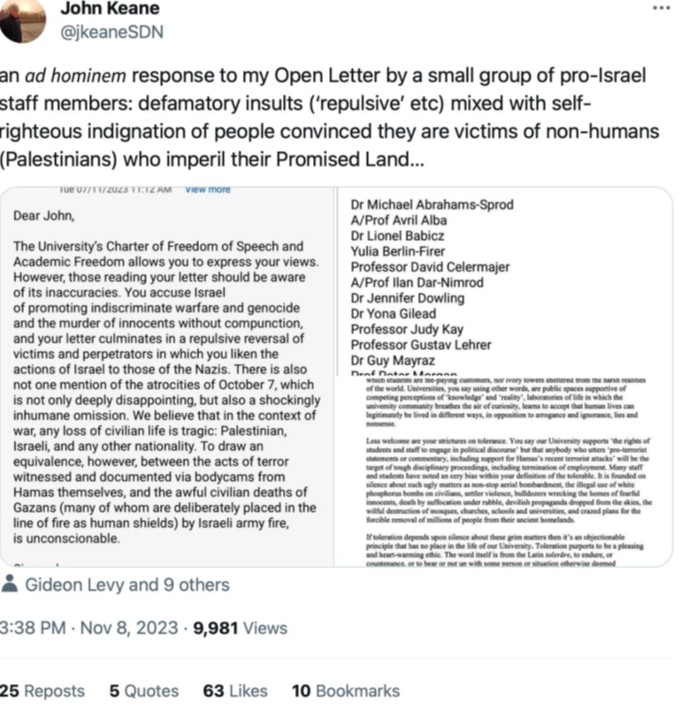
DATE OF ORDER: | 14 NOVEMBER 2025 |
THE COURT ORDERS THAT:
1. Prayers 1 and 2 of the applicants’ interlocutory application filed on 1 August 2025 (the interlocutory application) be dismissed.
2. Prayer 3 of the interlocutory application be dismissed in so far as it seeks leave to amend the originating application.
3. The applicants have leave to amend the statement of claim in the manner set out in the version of that document provided to the respondents on 5 September 2025 and appearing in Annexure DPM-2 to the affidavit of Daniel McCoach dated 1 October 2025, save that:
(a) the following material (identified by reference to the paragraph numbers in that version) is to be removed from the document prior to its filing:
(i) the words proposed to be added to [8], including the proposed particulars;
(ii) [9] to [11] and the references to “the persons in Schedule A” proposed to be added to [2], [38], [51] and [64];
(iii) “descent” in [12(a)];
(iv) [25], [28] and [35]; and
(b) “nationality” in [12(b)] is to be amended to read “national origin”.
4. By 28 November 2025 the parties provide to the chambers of Justice Kennett:
(a) agreed or competing short minutes of order providing a timetable for necessary steps up to the close of pleadings, including:
(i) the provision of particulars to ASOC [23];
(ii) the filing of an amended statement of claim that complies with the above orders; and
(iii) the filing of any further application to amend the statement of claim or the originating application arising from these orders or these reasons; and
(b) notification of whether they are content for such orders to be made in chambers.
5. Leave be granted to join Andy Smidt as the fifth applicant to the proceeding.
6. The costs of the interlocutory application be reserved.
Note: Entry of orders is dealt with in Rule 39.32 of the Federal Court Rules 2011.
REASONS FOR JUDGMENT
KENNETT J:
Introduction
1 The first respondent (Professor Keane) is a Professor of Politics at the University of Sydney (the University). In October and November 2023 he made two posts on his X page relating to the events in Israel on 7 October 2023 and controversies within the University in the aftermath of those events.
2 The first and second applicants (Dr Toltz and Professor Rutland) are, and were at the time of Professor Keane’s posts, members of the academic staff of the University. The third applicant (Mr Eisner) is an officer of the Australasian Union of Jewish Students and, at the time of Professor Keane’s posts, was a student at the University. The fourth applicant (Mr Levy) was at that time, and remains, a staff member of the University. Each of the applicants pleads that they are a “Jewish person” or someone who is, or is eligible to be, an Israeli citizen (an “Israeli person”).
3 The applicants seek declaratory and injunctive relief, compensation and other redress against Professor Keane and the University under the Australian Human Rights Commission Act 1986 (Cth) (the AHRC Act), on the footing that Professor Keane’s posts contravened s 18C of the Racial Discrimination Act 1975 (Cth) (the RDA). Relief is sought against the University on the footing that it is vicariously liable for Professor Keane’s conduct under s 18E of the RDA.
4 The applicants filed their originating application and statement of claim on 13 June 2025.
5 The proceeding has, so far, been case managed concurrently with Joseph Toltz & Ors v Nick Riemer & Anor (NSD950/2025) (Toltz v Riemer), a proceeding commenced by the same applicants which involves allegations of contraventions of s 18C by another staff member of the University. On 14 November 2025 I delivered judgment on interlocutory applications that sought summary dismissal of part of the applicants’ claim in that case and to strike out parts of the amended statement of claim (Toltz v Riemer [2025] FCA 1385 (Riemer)).
6 By an interlocutory application filed on 1 August 2025 the applicants seek:
(a) leave for Dr Toltz and Professor Rutland to continue the proceeding on their own behalf and on behalf of 13 other named persons (the proposed represented persons); and
(b) leave to file an amended originating application (AOA) and an amended statement of claim (ASOC) in the form annexed to an affidavit of Dr Toltz, making amendments to include the proposed represented persons and some further amendments concerning how the applicants describe themselves.
7 Having filed that interlocutory application, the applicants considered their position further and proposed to file a different form of amended originating application and amended statement of claim. At a case management hearing on 21 August 2025, orders were made to the effect that:
(a) the applicants were to provide drafts of these documents to the respondents by 5 September 2025;
(b) the respondents were to file and serve any “objections” to these documents by 19 September 2025;
(c) the applicants were to file and serve any “response” by 26 September 2025; and
(d) any dispute was to be set down for hearing on 13 and 14 September 2025 (at the same time as the interlocutory applications in Toltz v Riemer referred to above).
8 Revised versions of the AOA and the ASOC were sent to the respondents’ solicitors on 5 September 2025. The revised AOA would add a fifth applicant (Mr Smidt) and would specify that Dr Toltz and Ms Rutland also bring the application on behalf of the proposed represented persons. The respondents raised objections to these documents and the applicants responded pursuant to the orders made on 21 August 2025. In effect, the objections and the response constitute the written submissions of the parties on the proposed amendments.
9 Although no amended interlocutory application has been filed, the process that has been undertaken following the orders of 21 August 2025 make it appropriate to treat the application filed on 1 August as including an application to join Mr Smidt as fifth applicant and to treat the 5 September 2025 versions of the AOA and the ASOC as the documents sought to be filed.
10 References to the AOA and the ASOC in what follows are to the versions circulated on 5 September 2025. Where I quote from those documents I will not reproduce the markup in the 5 September versions unless it is necessary to understand the issues that arise.
11 Professor Keane filed submissions on 22 September 2025. In those submissions he did not oppose the joinder of Mr Smidt as an applicant but did oppose the continuation of the proceeding as a representative proceeding. He submitted that, if the proposed represented persons wished to participate in the proceeding, they should be permitted to be joined as applicants. He also objected to some specific parts of the ASOC and said that the document should only be accepted for filing on the basis that these parts are deleted. Most of the passages objected to form part of the original statement of claim.
12 The University filed its submissions on 19 September 2025. It did not object to the continuation of the proceeding as a representative proceeding but reserved its position in relation to the standing of one of the proposed represented persons who apparently does not identify as Jewish (Professor Morgan). It raised objections to specific parts of the ASOC which partly overlapped with those advanced by Professor Keane. Again, some of the words objected to are already in the statement of claim.
13 On 30 September 2025 the applicants’ solicitors sent to the solicitors for the respondents proposed new versions of the AOA and the ASOC. These documents are annexed without further explanation as Annexure DPM-3 to the affidavit of the applicants’ solicitor (Mr McCoach) of 1 October 2025. The provision of further proposed versions of the documents had not been provided for in the orders of 21 August 2025 and, if it was foreshadowed in correspondence, that correspondence is not before the Court.
14 If there are differences between the 5 September and 30 September 2025 versions of the AOA and ASOC they are not marked (so far as I can see) and no reference was made to them in the parties’ submissions. Counsel for the applicants said at one point during the hearing that the latter version was the one his clients were moving on, which is curious given that it was not served in accordance with the Court’s orders and was provided after the respondents had filed their submissions. I have focused my attention on the 5 September 2025 versions of the AOA and ASOC.
Section 18C
15 Section 18C of the RDA provides as follows.
(1) It is unlawful for a person to do an act, otherwise than in private, if:
(a) the act is reasonably likely, in all the circumstances, to offend, insult, humiliate or intimidate another person or a group of people; and
(b) the act is done because of the race, colour or national or ethnic origin of the other person or of some or all of the people in the group.
Note: Subsection (1) makes certain acts unlawful. Section 46P of the Australian Human Rights Commission Act 1986 allows people to make complaints to the Australian Human Rights Commission about unlawful acts. However, an unlawful act is not necessarily a criminal offence. Section 26 says that this Act does not make it an offence to do an act that is unlawful because of this Part, unless Part IV expressly says that the act is an offence.
(2) For the purposes of subsection (1), an act is taken not to be done in private if it:
(a) causes words, sounds, images or writing to be communicated to the public; or
(b) is done in a public place; or
(c) is done in the sight or hearing of people who are in a public place.
(3) In this section:
public place includes any place to which the public have access as of right or by invitation, whether express or implied and whether or not a charge is made for admission to the place.
Outline of the pleaded case
Introductory matters
16 As noted earlier, it is pleaded that each of the applicants:
(a) is a Jewish person; or
(b) is, or is eligible to be, an Israeli citizen (defined at [8] as an “Israeli person”).
17 The ASOC proposes to add to [8] an allegation that each applicant “identifies as a Zionist” and then add the following by way of particulars.
Zionists are predominantly Jewish people and/or Israeli people who believe in Israel being a nation state and the national home of and for the Jewish people. A substantial proportion of Jewish and/or Israeli people identify themselves as Zionists.
18 ASOC [9] and [10] propose to add the details of the proposed represented persons and ASOC [11] would allege that those persons have the same interest, and are entitled to the same relief, as the applicants.
19 It is alleged at [12] that, for the purposes of the RDA:
(a) Jewish persons constitute a group of people with a “shared race, descent and/or ethnic origin”; and
(b) Israeli citizens and Israeli persons constitute a group of persons with a “shared ethnic origin and/or nationality”.
20 ASOC [13] alleges that Israel is a nation state and “the national home of and for the Jewish people”. Its citizens “are mostly Jewish persons”.
21 After pleading some general matters about the respondents and Professor Keane’s X page, the ASOC asserts some propositions relating to Hamas, including its listing as a terrorist organisation under the Criminal Code Act 1995 (Cth) (the Criminal Code Act) (at [21]-[25]), and the events that occurred on 7 October 2023 (at [26]-[27]).
The impugned publications
The “Hamas Flag Post”
22 ASOC [29] is as follows.
On or about 8 October 2023, the first day after the 7 October 2023 Hamas terrorist attacks described in [26]-[28] above, Professor Keane published the following picture on his Keane X Page, which shows 5 green Hamas flags with Arabic writing visible on them (the Hamas Flag Post):

23 ASOC [30] alleges that the Hamas Flag Post remained visible as at the date of the amended statement of claim and had about 6,232 views at that time.
24 It is then alleged that each of the flags depicted in the post:
(a) was a “Hamas flag”, used by the Hamas military wing (ASOC [31]);
(b) was known to Professor Keane to be such a flag (ASOC [31]); and
(c) “was, or is,” known by the applicants and the represented persons to be such a flag (ASOC [32]).
25 ASOC [36] is as follows.
The Hamas Flag Post conveyed the following imputations:
a. The activities described in [26]-[28] above of Hamas on October 7, which involved the killing, rape, maiming, sexual abuse, kidnapping and torture of Jewish and Israeli persons, because they were believed to be Jewish or Israeli, was an event that was to be celebrated, endorsed, supported and approved of.
b. Professor Keane celebrated, endorsed, supported and approved those activities.
c. Hamas and its objectives (including those outlined in [22], [23], [24] and [28] above) were to be celebrated, endorsed, supported and approved.
d. Professor Keane celebrated, endorsed, supported and approved of Hamas and its objectives (including those outlined in [22], [23], [24] and [28] above).
26 ASOC [37]-[40] articulate how the Hamas Flag Post is alleged to have contravened s 18C.
37. Professor Keane’s posting of the Hamas Flag Post was an act which caused images to be communicated to the public. They were:
a. done in a public place; and were
b. done in the sight and hearing of people who were in a public place; and
c. not acts done in private.
38. Professor Keane’s posting of the Hamas Flag Post and its non-removal, by conveying any, all or some of the imputations alleged in [36] was reasonably likely, in all the circumstances, to offend, insult, humiliate or intimidate the Applicants, the persons in Schedule A, as well as other Jewish persons and Israeli persons in Australia.
39. The posting and its non-removal was made or done because of the race, national or ethnic origin of the people reasonably likely to be offended, insulted, humiliated or intimidate [sic] by the posting including because:
a. The subject matter of the post, considering its timing, was directly related to events that were themseves [sic] directly related to the race, ethnic origin or national origin (Jewish and/or Israeli) of the victims of the events of October 7;
b. The posting was plainly calculated to convey a message about or concerned with the race, ethnic origin or national origin (Jewish and/or Israeli) of the victims of the events of October 7;
c. The posting was actuated or motivated by considerations of race, ethnic origin or national origin or, in the alternative, race, or ethnic or national origin was otherwise a factor in Professor Keane’s act.
40. In the premises set out in [16]-[39] above, Professor Keane contravened s 18C of the RDA and engaged in unlawful discrimination within the meaning of ss 3(1) and 46P of the AHRC Act.
The “Staff Members” Post
27 ASOC [41]-[42] allege that Professor Keane placed a post on his X page on 8 November 2023, which is reproduced at [42] as follows (ASOC [41] expressly pleads the making of the statement that appears above the pictures in this post) (the Staff Members post).
28 According to ASOC [43] the post had the following attachments:
(a) an email sent by Associate Professor Avril Alba to Professor Keane and the Vice-Chancellor of the University, and copied to “a large number of Sydney University groups”, on 7 November 2023, with a photograph of Professor Alba;
(b) a picture showing the names of 17 academics at the University, including the proposed represented persons, all of whom (except Professor Morgan) were “Jewish and/or Israeli academics”; and
(c) a letter purporting to be Professor Keane’s response of 6 November 2023 to an earlier communication from the Vice-Chancellor to all staff and students.
29 ASOC [44] alleges that the earlier communication from the Vice-Chancellor (not attached to Professor Keane’s post or reproduced in the ASOC) had said that the University would not tolerate support for Hamas’s recent terrorist acts.
30 ASOC [45] alleges that Professor Keane had not sought or obtained authorisation from any of the 17 academics named in his post to publish their names “or the content of their email”.
31 ASOC [46] alleges that the Staff Members post remained on Professor Keane’s X page until it was removed around 21 May 2024 as the result of a University disciplinary process. According to ASOC [47], the post was viewed about 30,000-31,000 times in that period.
32 ASOC [48] is as follows.
Professor Keane’s Staff Members Post conveyed the following imputations:
a. The named Jewish and Israeli staff members regarded, treated, considered and were convinced that Palestinians are “non-humans” (meaning something less than or other than human beings).
b. The named Jewish and Israeli staff members were racists who regarded, treated, considered and were convinced that Palestinians challenging Israel as a Jewish homeland, or as their “Promised land”, are “non-humans”.
c. The named Jewish and Israeli persons, in seeking to defend the existence of Israel should be condemned and publically [sic] exposed as self-righteous racists without any morals, scruples or conscience.
d. Jewish persons and Israeli persons believe that Palestinians or Palestinians challenging Israel as a Jewish homeland or as their “Promised land” are “non humans”.
e. Jews and Israelis, or the named Jews and Israelis, were acting like the Nazis in considering Palestinians as “non-humans” or as something less than, or other than, human beings.
33 ASOC [49] pleads the falsity of these imputations, ie:
(a) the staff members identified in the post were not racists and did not hold the opinions allegedly being attributed to them; and
(b) “Jewish persons and Israeli persons as a group or otherwise” did not hold the opinions allegedly being attributed to them.
34 ASOC [50] is as follows.
The reference to “non-humans” has particular resonance for Jewish and Israeli persons given its historical use to describe Jewish persons in that way.
35 ASOC [51] pleads that the applicants and the proposed represented persons suffered distress, loss and damage by reason of the Staff Members post.
36 ASOC [52]-[55] articulate how the Staff Members post is alleged to have contravened s 18C.
52. Professor Keane’s posting of, and failure to remove prior to 21 May 2024, Keane’s Staff Members Post were acts which caused words and images to be communicated to the public. They were:
a. done in a public place; and were
b. done in the sight and hearing of people who were in a public place; and
c. not acts done in private.
53. Professor Keane’s posting of, and his failure to remove prior to 21 May 2024, Keane’s Staff Members Post, by conveying any or all of the imputations alleged above and by attributing the false characteristics alleged to those named Jewish and Israeli Staff Members and to Jewish persons and Israeli persons on the basis of their group membership or otherwise, was reasonably likely, in all the circumstances, to offend, insult, humiliate or intimidate the Jewish and Israeli Staff Members named in Keane’s Staff Members Post and other Jewish persons and Israeli persons.
54. The posting and its non-removal prior to 21 May 2024 was made or done because of the race, national or ethnic origin of the people reasonably likely to be offended, insulted, humiliated or intimidate [sic] by the posting including because:
a. The post referred to and criticised only Jewish and Israeli people;
b. It did so by reference to their position as being “pro-Israel”;
c. The subject matter of the post was related by context to events that were themseves [sic] directly related to the race, ethnic origin or national origin (Jewish and/or Israeli) of the victims of the events of October 7;
d. The posting was plainly calculated to convey a message about or concerned with the race, ethnic origin or national origin (Jewish and/or Israeli) of the people named;
e. Professor Keane had earlier posted the Hamas Flag Post which provides context for the real reason why the Staff Members Post was actuated by race and/or ethnic origin and/or national origin or, in the alternative, race, or ethnic or national origin was otherwise a factor in Professor Keane’s conduct; and
f. Professor Keane has a tendency to engage in conduct which does and is intended to offend and/or insult and/or humiliate and/or intimidate Jewish people and Israeli people.
55. In the premises set out in [41]-[54] above, Professor Keane contravened s 18C of the RDA and engaged in unlawful discrimination within the meaning of ss 3(1) and 46P of the AHRC Act.
Vicarious liability of the University
37 ASOC [56]-[60] allege that the Staff Members post was made in connection with Professor Keane’s duties as an employee of the University and the University is therefore vicariously liable pursuant to s 18E of the RDA.
Complaint under the AHRC Act
38 ASOC [61]-[63] allege that the applicants lodged a complaint with the Australian Human Rights Commission (AHRC) and that the complaint was terminated under s 46PH(1B)(b) of the AHRC Act. These are necessary prerequisites to the commencement of proceedings for an alleged contravention of the RDA in this Court which are not presently in issue.
Continuation as a representative proceeding
39 Counsel for the applicants referred to the proposed represented persons several times as persons who had been “doxed” by Professor Keane. This description may have been intended as shorthand but it was ambiguous and unnecessarily inflammatory. According to the website of the eSafety Commissioner, “doxing” includes revealing the identity of someone who was previously anonymous, revealing information about someone that allows them to be contacted or located or their online security to be breached, and revealing sensitive information about someone that could cause them damage. According to the applicants’ pleading, what Professor Keane revealed about the proposed represented persons was their names and the fact that they were signatories of a message directed to him. Emails generated within a few hours after the Staff Members post, which led to the disciplinary process pleaded at ASOC [46] (and are annexed to the affidavit of Mr Bradley, upon which Professor Keane relied), indicate that the message Professor Keane reproduced in the post with a list of its signatories was part of a “university-wide email debate”. I was told from the bar table, and it does not appear to be in dispute, that both Professor Keane’s “open letter” to the Vice-Chancellor and the response which he highlighted in his post had been circulated to a large number of people on a University mailing list. Professor Keane might well be said to have been “naming and shaming” the applicants and the proposed represented persons in a way that merits criticism (and potentially contributes to or exacerbates a contravention of the RDA); however, neither the pleading nor the evidence presently before the Court indicates that he was revealing anything about them that was not already known to a large number of people.
40 As noted earlier, ASOC [11] would plead that each of the proposed represented persons has the same interest in the proceeding and is entitled to the same relief as Dr Toltz and Professor Rutland (cf r 9.21 of the Federal Court Rules 2011 (Cth) (the Rules)). Although Professor Keane argued against this proposition, I consider that it is correct in so far as the question of contravention of s 18C is concerned (leaving aside the question of Professor Morgan’s standing, as to which the University reserved its position). This is because contravention of s 18C(1) depends relevantly on the likelihood of a hypothetical reasonable member of the group being offended, insulted, humiliated or intimidated and not on proof of actual harm or its extent. The different perspectives and responses of the five applicants and the twelve proposed represented persons become significant if and when a contravention has been established and questions of remedy arise.
41 In addition to declarations, injunctions and an order for a public apology, which if granted would operate in the same way regardless of who the applicants are and whether they represent other persons, the originating application, as filed, seeks the following order in prayers 5 and 6.
5. Injunctions requiring Professor Keane and Sydney University to perform any reasonable act or course of conduct, including to pay and/or redress any distress, loss or damage (including harm to repute) and psychological injury suffered by any of the complainants or the persons they represent, in a form to be determined, and to pay aggravated and punitive damages by reason of Professor Keane's and Sydney University's unlawful discrimination.
6. An order for payment of damages by way of compensation for loss and damage (including harm to repute and aggravated and punitive damages) and for distress and psychological injury suffered by any of the Applicants or persons they represent, suffered by the seventeen staff members named in Keane's Staff Members Post because of the unlawful discrimination arising from or by reason of the Post.
42 There is obviously overlap between these prayers and some infelicity in their drafting. The reference to “complainants” in prayer 5 is confusing, and as things currently stand the references to “persons they represent” in both prayers appear to be surplusage. It is not clear how the present applicants have standing to pursue a claim for redress or damages on behalf of the other persons identified in the Staff Members post unless the proceeding is treated as a representative proceeding. However, it is reasonably clear that, if contraventions of s 18C are made out, prayers 5 and 6 will require detailed evidence (including expert evidence) as to the loss, damage, distress and psychological injury alleged to have been suffered by each of the applicants. The inclusion of these prayers in the originating application will very likely result in the trial being split between issues of liability and quantum, and may have the result that the proceeding takes years to resolve in the absence of settlement.
43 The AOA, in addition to specifying that the proceeding is a representative proceeding, would recast prayers 5 and 6 as follows.
5. Injunctions requiring Professor Keane and Sydney University to perform any reasonable act or course of conduct, including to pay and/or redress any distress, loss or damage (including harm to repute) and psychological injury suffered by any of the Applicants complainants or the persons the First and Second Applicants they represent, in a form to be determined, and to pay aggravated and punitive damages by reason of Professor Keane's and Sydney University's unlawful discrimination.
6. An order:
a. for payment of damages by way of compensation for loss and damage (including harm to repute and aggravated and punitive damages) and for distress and psychological injury suffered by any of the First and Second Applicants or persons they represent, being suffered by the seventeen staff members named in Keane's Staff Members Post, because of the unlawful discrimination arising from or by reason of the Post;
b. alternatively, at their option, an order for the payment of an amount equal to the compensation to which they would be entitled paid to a charity or charities nominated by them.
44 Curiously, the proposed AOA would seek the payment of damages to Dr Toltz and Professor Rutland and all of the “persons they represent”. It is thus unclear whether the third to fifth applicants no longer seek the same relief (in which case a question might arise as to whether they should be separately represented), have fallen out of prayer 6 as the result of a drafting slip, or are intended to be included within the phrase “persons they represent”. The third to fifth applicants would still stand to benefit from the redress sought in prayer 5, but they would come within the amended prayer 6 only on the footing that they are persons whom Dr Toltz and Professor Rutland “represent”.
45 Be that as it may, it is clear that what these amendments (combined with the continuation of the proceeding as a represented proceeding) would do is bring all of the represented persons (currently proposed to be twelve, but that number may change) within the class of those who would benefit from redress under prayer 5 and/or damages under prayer 6. Taking into account the joinder of Mr Smidt as the fifth applicant, this takes from four to seventeen the number of persons as to whom evidence of loss, damage, distress and psychological injury would need to be adduced, responded to and assessed in the event that contraventions are established. Obviously, also, it greatly increases the potential exposure of the respondents. If the proceeding reaches this stage it will, almost certainly, no longer be the case that the “same interest” test in r 9.21 is satisfied.
46 It may rightly be said that, if Professor Keane has engaged in unlawful conduct, he and his employer must suffer the consequences provided for by law including orders to compensate those who have been harmed by the conduct. However, this is not the only consideration in play in relation to procedural decisions such as whether a proceeding should be conducted as a representative proceeding.
47 Counsel for Professor Keane drew attention to s 46PSA of the AHRC Act, which provides as follows:
46PSA Costs
Scope
(1) This section applies to proceedings (including an appeal) in a court that relate to an application made by a person (the applicant) under section 46PO in respect of one or more respondents to a terminated complaint.
When respondent liable for costs
(2) Subject to subsection (4), if the applicant is successful in proceedings on one or more grounds, the court must order each respondent against whom the applicant is successful to pay the applicant’s costs.
(3) The court may order that the costs to be paid by the respondent be assessed on an indemnity basis or otherwise.
(4) If the court is satisfied that the applicant’s unreasonable act or omission caused the applicant to incur costs, the court is not required to order the respondent to pay the costs incurred as a result of that act or omission.
When applicant liable for costs
(5) Subject to subsection (6), the applicant must not be ordered by the court to pay costs incurred by another party to the proceedings.
(6) The applicant may be ordered to pay the costs if:
(a) the court is satisfied that the applicant instituted the proceedings vexatiously or without reasonable cause; or
(b) the court is satisfied that the applicant’s unreasonable act or omission caused the other party to incur the costs; or
(c) all of the following apply:
(i) the other party is a respondent who was successful in the proceedings;
(ii) the respondent does not have a significant power advantage over the applicant;
(iii) the respondent does not have significant financial or other resources relative to the applicant.
Representative applications
(7) In the case of a representative application, subsection (6) does not authorise the court concerned to award costs against a person on whose behalf the application is made other than the person who made the application.
48 This provision was enacted in substitution for the previous version of s 46PSA by Schedule 1 to the Australian Human Rights Commission (Costs Protection) Act 2024 (Cth) with effect from 2 October 2024 and applies to the present proceeding. Its evident intention is to protect applicants in proceedings commenced under the AHRC Act, by requiring costs to be awarded against the respondent if an applicant succeeds on one or more grounds (other than costs incurred by reason of an “unreasonable act or omission”) (s 46PSA(2)-(4)) and significantly limiting the circumstances in which the Court may award costs against an applicant (s 46PSA(5)-(6)). Despite these limitations there is some prospect of Professor Keane being able to recover some of his costs if he is successful, without having to show that the proceeding was vexatious or the applicants had acted unreasonably, under s 46PSA(6)(c). It is much less likely that the University will be able to recover any of its costs.
49 However, additionally (and significantly here), s 46PSA(7) stands in the way of any order for costs against a represented person. The consequence is that, if the proceeding continues as a representative proceeding on the basis of the proposed amendments, the proposed represented persons will be able to recover damages or redress for such losses as can be proven (and prima facie the applicants will be entitled to recover the costs of that exercise if successful), but will not bear the burden of any costs order if the claims advanced on their behalf do not succeed. A costs order may be able to be made in Professor Keane’s favour against the applicants (who presumably are prepared to take on this risk), but they are individuals and there is no evidence concerning their capacity to satisfy such an order.
50 In short, the proposed representative persons would enjoy the fruits of success but would not bear any of the risk associated with failure. This is significant in circumstances where, from their point of view, involvement in the proceeding would be in substance a money claim. I describe it in this way because they (along with other Jewish and/or Israeli persons) would enjoy vindication by way of declaratory relief, and the benefit of Professor Keane being enjoined to take down the impugned posts and not repeat his behaviour, whether or not the proceeding is formally conducted on their behalf.
51 In these circumstances it is not in the interests of justice to allow the proposed amendments to the originating application and statement of claim converting the proceeding into a representative proceeding. If the case is to be prolonged and the costs burden increased by claims for compensation or redress brought on behalf of persons other than the present applicants, those persons should seek to be joined as applicants. Professor Keane has indicated that he would not oppose this.
52 Counsel for the applicants submitted that the intention of the proposed amendments was only to allow the proposed represented persons to take the benefit of the declaratory relief, so that they could rely on res judicata to pursue claims against Professor Keane and the University in separate proceedings should they wish to do so (referring to Carnie v Esanda Finance Corporation Limited (1995) 182 CLR 398 at 423 (Toohey and Gaudron JJ)). If the proposed amendments to prayers 5 and 6 were framed in this way, that would take much (perhaps all) of the force out of Professor Keane’s objection to the proceeding continuing as a representative proceeding.
53 However, the submission flies in the face of the terms in which the amendments are drafted. As discussed above, in their terms, prayers 5 and 6 as proposed to be amended constitute claims for damages and other forms of redress on behalf of the proposed represented persons. The suggestion that they should be read as not having that effect was perplexing. They were drafted and settled by experienced practitioners and their import is, in this respect at least, clear.
54 The difficulty cannot be avoided by refusing leave to amend prayers 5 and 6 but allowing the other amendments. This is because prayers 5 and 6 in their current, unamended, form also refer to the persons whom the applicants “represent”. Allowing the other proposed amendments to the originating application would bring this language into play and create the unfairness discussed above. If left in their current form, prayers 5 and 6 would still fail to reflect what counsel says his clients (and those whom they wish to represent) are seeking.
55 I will therefore refuse the interlocutory application in so far as it seeks to amend the originating application and to insert ASOC [9] to [11] (and consequential references in the ASOC to the proposed represented persons). It is not the role of the Court to redraft the amendments sought by the applicants; nor is it desirable to leave an interlocutory application which has been fully argued in limbo while yet another version of the proposed amendments is drafted and discussed. If the applicants redraft their proposed amendments so that prayers 5 and 6 do not give rise to the issues discussed above, the question of a representative proceeding can be re-agitated by filing a fresh interlocutory application and may face less resistance.
Strike-out
56 As noted earlier, each of the respondents seeks to exclude certain passages of the ASOC. Their position is that leave to file the ASOC should be granted only on the basis that these passages are excluded from it. This is in substance a strike-out application as to some of the passages that are objected to, because these already appear in the existing statement of claim.
“Or is eligible to be” in ASOC [8(a)]
57 Professor Keane objects to these words. The same objection was taken to identical words in an equivalent paragraph of the amended statement of claim in Riemer. I repeat what I said in my reasons in that case at [106]-[114].
Aspects of the ASOC [8] and the associated particulars
58 Professor Keane objects to the words “predominantly Jewish people and/or Israeli people” and to the allegation that “[a] substantial proportion of Jewish and/or Israeli people identify themselves as Zionists” in the particulars to ASOC [8]. The same objections were taken to parts of [10] of the amended statement of claim in Riemer, but the second was ultimately not pressed. I understood counsel to be taking the same approach to ASOC [8] in the present case. I repeat what I said in Riemer at [116]-[120].
59 The University makes a broader objection. It seeks to prevent the insertion of the closing words of ASOC [8] (“and identifies as Zionist”) and the associated particulars (which are devoted to explaining the meaning of that term).
60 The University correctly points out that (in contrast to Riemer), the impugned posts in the present case make no reference to Zionists or Zionism. The term “Zionist” does not appear again in the ASOC, except in the purported quotation from the “Hamas covenants” at ASOC [23] (and in the descriptions of the proposed represented persons at [9]). It is thus not a concept that plays any role in the pleaded case.
61 It is (or at least should be) uncontroversial that Zionism is a political philosophy or ideology and not a race or an ethnic group; that not all Jewish or Israeli people are Zionists; and that disparagement of Zionists or Zionism is not ipso facto disparagement of a race or ethnic group (see Riemer at [93]-[99] and the cases discussed there; see also [119]). It can be accepted that evidence is likely to demonstrate a very substantial overlap between the set of persons who are or see themselves as Zionists and the set of persons who are Jewish or Israeli, and the circumstances of particular cases may be such that what purports to be criticism of Zionism is (or is likely to be perceived as) in substance an attack on Jewish or Israeli people. However, there is no indication that that is what is sought to be proved in this case. The reference to Zionism in ASOC [8] and the attempt to impose a meaning on that term (some aspects of which may be contested) is therefore a distraction which has the potential to prolong the proceeding unnecessarily.
62 I will therefore not allow the proposed addition in ASOC [8].
“Descent” in ASOC [12(a)] and “and/or nationality” in ASOC [12](b)
63 Both respondents object to “descent” and Professor Keane objects to “and/or nationality”. The same objection was taken to the inclusion of these words in [8] of the amended statement of claim in Riemer. I repeat what I said in that case at [115] and will strike out the word “nationality”.
64 The University also submits that “descent” should be struck out from the first paragraph of the AOA. However, while the argument that this word should not be used obviously has force, the word already appears in the originating application and there is no application before me to strike out parts of that document. I intend to treat the first two paragraphs of the originating application (which summarise the applicants’ claims) as having been overtaken by the more detailed articulation in the ASOC.
ASOC [23]
65 Professor Keane objects to ASOC [23], which is in the same terms as [28] of the amended statement of claim in Riemer. An objection was taken to that paragraph which I determined could be dealt with by provision of particulars. ASOC [23] should be dealt with in the same way.
ASOC [25] and [35]
66 Professor Keane objects to ASOC [25], which is part of the pleading in relation to Hamas. It reads as follows.
Under s 80.2E ‘Prohibited symbols’, which is part of ‘Subdivision CA—Publicly displaying, and trading in, prohibited symbols and giving Nazi salute’, a prohibited terrorist organisation symbol is defined as:
a. a symbol that a terrorist organisation (within the meaning of Division 102) uses, or members of a terrorist organisation use, to identify the organisation;
b. something that so nearly resembles a symbol to which paragraph a. applies that it is likely to be confused with, or mistaken for, that symbol.
67 The legislative reference in this paragraph appears to be to the Criminal Code Act, pursuant to which Hamas has been listed as a terrorist organisation.
68 It is a long time since the rules relating to pleadings prevented the pleading of a point of law (see now r 16.02(3) of the Rules). However, it is at least customary to plead only points of law that have a bearing on the case being advanced.
69 Here, ASOC [25] links with ASOC [35] in which it is alleged that the Hamas Flag Post was “a post of a ‘prohibited terrorist organisation symbol’” (original emphasis). However, neither the ASOC nor the submissions of the applicants on these paragraphs explain how the effect of a definition in the Criminal Code Act is relevant to the issues raised by s 18C(1)(a) and (b) in relation to either of the impugned posts by Professor Keane. It may be the case that Professor Keane has exposed himself to criminal prosecution by posting a picture showing Hamas flags, or flags that are very similar to Hamas flags, but that is not an issue in this proceeding. The criminality of the conduct (if that is what is alleged) may be part of the “circumstances” in which the post occurred, but it is not a relevant circumstance without some articulation of how it is said to affect the reaction of a hypothetical group member to that conduct or to demonstrate that Professor Keane was motivated by a protected characteristic of the group. The point is not picked up in the imputations pleaded at ASOC [36] or in ASOC [38] or [39]. Additionally, if it is alleged that Professor Keane committed a criminal act, that should be pleaded with clarity and not left to inference. ASOC [25] and [35] should not be permitted to remain in the pleading.
70 It is appropriate to note here that there may be a controversy concerning whether the flags shown in the Hamas Flag Post really are Hamas flags and whether it matters if they are not. Counsel for Professor Keane pointed to an email, forming part of the correspondence related to the disciplinary proceeding referred to above, in which one of the proposed represented persons (Dr Babicz) described this post as depicting “five Islamic green flags (not Palestinian flags, but Islamic flags)” (original emphasis). The response of the applicants was, in substance, that this did not matter because Hamas is a militant Islamic organisation. While that response can perhaps be criticised, it is not clear what Dr Babicz meant in the email referred to. Nor is there any indication of whether he has special expertise in this area, whether he spoke for the applicants, what his current view is, or how other Jewish or Israeli people understood the flags depicted in the post. I do not consider that the propriety of the pleading is undermined by this factor. Whether the flags shown were those of Hamas, or would be understood by a reasonable reader to show affiliation with or support for Hamas, will be a matter for evidence in due course.
ASOC [28]
71 Both respondents object to ASOC [28]. It is materially the same as [32] of the amended statement of claim in Riemer and will be struck out for the reasons set out at [130] of my reasons in that case.
ASOC [54](e) and (f)
72 ASOC [54] (which is set out above) is a central element of the pleaded case. It alleges that the Staff Members post was made “because of” the race, national or ethnic origin of the persons reasonably likely to be offended, insulted, humiliated or intimidated. The sub-paragraphs of ASOC [54] set out the reasons why the applicants contend that this conclusion should be reached. The University objects to sub-paras (e) and (f).
73 Sub-paragraph (e), which pleads the making of the Hamas Flag Post, is said to operate prejudicially to the University. It is submitted that the University is alleged to be vicariously liable only for the Staff Members post and should not be called on to address a publication in respect of which it is not said to be liable.
74 I do not accept this submission. ASOC [54] is an allegation about Professor Keane’s motivation in carrying out a particular act (an act for which the University is alleged to be vicariously liable). Sub-paragraph (e), at least as I read it, is put forward as a reason why the allegation in the chapeau of the paragraph should be found to be made out. While I presently have some difficulty in seeing how this follows, that will no doubt be the subject of detailed submissions at a later time. The point for present purposes is that the making of the Hamas post is pleaded as a matter of fact from which an inference (as to Professor Keane’s state of mind) is alleged to arise in relation to the making of the Staff Members post. That alleged inference is part of what the University must necessarily deal with in meeting the claim arising from the Staff Members post. It does not follow that the University will be required to take a position on whether the Hamas Flag Post contravened s 18C.
75 Sub-paragraph (f) alleges that Professor Keane has a tendency to engage in conduct which “does and is intended to” offend, insult, humiliate or intimidate Jewish people and Israeli people. This is equivalent to [88(c)] of the amended statement of claim in Riemer, which I declined to strike out for reasons set out at [149]. The University objects to sub-para (f) on the ground that there is no need to prove “intention” for the purposes of s 18C, and seeking to prove this element by reference to a (currently) unidentified set of other acts of Dr Keane will unnecessarily prolong the proceedings.
76 I also reject this submission. Again, I presently have some difficulty in understanding how the foreshadowed “tendency” evidence will be useful but assume that this will be elaborated in detail at a later time. The important point for present purposes is that the alleged “intention” to offend, insult, humiliate or intimidate is pleaded not as an element of a contravention of s 18C but as a characteristic of behaviour which Professor Keane is alleged to have a tendency to engage in. This tendency is alleged to be a basis for a finding about Professor Keane’s state of mind at the time of making the Staff Members post.
77 I will therefore allow [54](e) and (f).
Disposition
78 For the reasons set out above I will make orders to the following effect.
(a) Prayers 1 and 2 of the interlocutory application (which seek leave to continue the proceeding as a representative proceeding and to amend the title of the proceeding accordingly) will be dismissed.
(b) Prayer 3 of the interlocutory application will be dismissed in so far as it seeks leave to amend the originating application.
(c) Leave will be granted to the applicants to amend the statement of claim in the manner set out in the version of that document provided to the respondents on 5 September 2025, save that “nationality” is to be changed to “national origin” in [12(b)] and the following are to be removed from the document prior to its filing (by reference to the paragraph numbers in that version):
(i) the words proposed to be added to [8], including the proposed particulars;
(ii) [9] to [11] and the references to “the persons in Schedule A” proposed to be added to [2], [38], [51] and [64];
(iii) “descent” in [12(a)];
(iv) [25], [28] and [35].
(d) The parties will be directed to file agreed or competing short minutes of order providing a timetable for necessary steps up to the close of pleadings, including:
(i) the provision of particulars to ASOC [23];
(ii) the filing of an amended statement of claim that complies with the above orders; and
(iii) any further application to amend the statement of claim or the originating application arising from these orders or these reasons.
(e) Leave will be granted to join Andy Smidt as the fifth applicant to the proceeding.
79 Neither the applicants nor the University sought costs. Professor Keane sought his costs of the interlocutory application.
80 Absent s 46PSA of the AHRC Act, I would order that the applicants pay 50 percent of Professor Keane’s costs of the interlocutory application on the basis that he was put to the expense of mounting a detailed argument against the application for the proceeding to continue as a representative proceeding which was not effectively answered except by a submission that the prayers for relief in the AOA were not intended to mean what they said on their face (resulting in this aspect of the interlocutory application having to go back to the drawing board). I am inclined to think that an order along these lines can be made in accordance with s 46PSA, in the light of subs (6)(b).
81 However, as explained in Riemer, in the light of how s 46PSA(2) is expressed, there is some uncertainty as to how the section operates in relation to the costs of interlocutory applications. I will therefore reserve the costs of the interlocutory application so that submissions can be made on this question at an appropriate time.
I certify that the preceding eighty-one (81) numbered paragraphs are a true copy of the Reasons for Judgment of the Honourable Justice Kennett. |
Associate:
Dated: 14 November 2025
SCHEDULE OF PARTIES
NSD 951 of 2025 | |
Applicants | |
Fourth Applicant: | YANIV LEVY |


