

FEDERAL COURT OF AUSTRALIA
Toltz v Riemer [2025] FCA 1385
File number: | NSD 950 of 2025 |
Judgment of: | KENNETT J |
Date of judgment: | 14 November 2025 |
Catchwords: | PRACTICE AND PROCEDURE – summary dismissal – where the second respondent seeks summary dismissal of the proceeding in so far as it alleges liability against it –where the second respondent contends an “ordinary” or “reasonable” member of the relevant group would not understand the impugned acts to carry the imputations that are alleged to contravene s 18C of the Racial Discrimination Act 1975 (RDA) – whether such a contention can be accepted without an opportunity for evidence to be adduced at a final hearing PRACTICE AND PROCEDURE – strike out – where both the first and second respondent seek parts of the amended statement of claim to be struck out, alleging, amongst other things, that those parts: (a) plead facts that are not relevant to any fact that could be in issue, (b) fail to disclose a reasonable cause of action in inviting the Court to treat the impugned acts cumulatively when assessing whether there has been a contravention of s 18C of the Racial Discrimination Act 1975 (Cth) and (c) would require evidence of a global nature to be made out where such an approach is not necessary for the applicants to make good their case COSTS – where s 46PSA appears to limit the Court’s discretion to make costs orders – where the applicants have tendered extensive documentary material which was found unlikely to be probative of anything |
Legislation: | Australian Human Rights Commission Act 1986 (Cth) ss 46PH, 46PSA Criminal Code Act 1995 (Cth) Evidence Act 1995 (Cth) s 75 Federal Court of Australia Act 1976 (Cth) ss 31A, 37M, 37N Parliamentary Privileges Act 1987 (Cth) s 16 Racial Discrimination Act 1975 (Cth) ss 9, 10, 18C, 18E Federal Court Rules 2011 (Cth) rr 16.21, 26.01 |
Cases cited: | British American Tobacco Ltd v Western Australia [2003] HCA 47; 217 CLR 30 Cassuto v Kostakidis [2025] FCA 1226 Clarke v Nationwide News Pty Ltd trading as the Sunday Times [2012] FCA 307; 201 FCR 389 CSR Ltd v Eddy [2005] HCA 64; 226 CLR 1 Eatock v Bolt [2011] FCA 1103; 197 FCR 261 Faruqi v Hanson [2024] FCA 1264 General Steel Industries Inc v Commissioner for Railways (NSW) (1964) 112 CLR 125 Hallett v Andrews (1898) 42 Sol Jo 68 Jefferson Ford Pty Limited v Ford Motor Company of Australia Ltd [2008] FCAFC 60; 167 FCR 372 Jones v Scully [2002] FCA 1080; 120 FCR 243 Kaplan v State of Victoria (No 8) [2023] FCA 1092 Lombard Australia Ltd v Mulley (1976) 9 ACTR 23 Macabenta v Minister for Immigration and Multicultural Affairs (1998) 90 FCR 202 McGlade v Lightfoot [2002] FCA 1457; 124 FCR 106 Prior v South West Aboriginal Land and Sea Council Aboriginal Corporation [2020] FCA 808 Prior v Wood [2017] FCA 193 Spencer v Commonwealth [2010] HCA 28; 241 CLR 118 Webster v Lampard (1993) 177 CLR 598 Wertheim v Haddad [2025] FCA 720; 311 FCR 263 Wotton v State of Queensland (No 5) [2016] FCA 1457 |
Division: | General Division |
Registry: | New South Wales |
National Practice Area: | Administrative and Constitutional Law and Human Rights |
Number of paragraphs: | 155 |
Date of last submissions: | 21 October 2025 |
Date of hearing: | 13-14 October 2025 |
Counsel for the Applicants: | A Butt |
Solicitor for the Applicants: | Rotstein Commercial Lawyers |
Counsel for the First Respondent: | J Taylor |
Solicitor for the First Respondent: | Marque Lawyers |
Counsel for the Second Respondent: | R Dick SC with B Byrnes |
Solicitor for the Second Respondent: | Ashurst Australia |
ORDERS
NSD 950 of 2025 | ||
| ||
BETWEEN: | JOSEPH TOLTZ First Applicant SUZANNE RUTLAND Second Applicant ARIEL EISNER (and another named in the Schedule) Third Applicant | |
AND: | NICK RIEMER First Respondent THE UNIVERISTY OF SYDNEY Second Respondent | |
order made by: | KENNETT J |
DATE OF ORDER: | 14 NOVEMBER 2025 |
THE COURT ORDERS THAT:
1. The following parts of the amended statement of claim (ASOC) be struck out:
(a) “descent” in [8(a)];
(b) “nationality” in [8(b)];
(c) “predominantly Jewish people and/or Israeli” in [10];
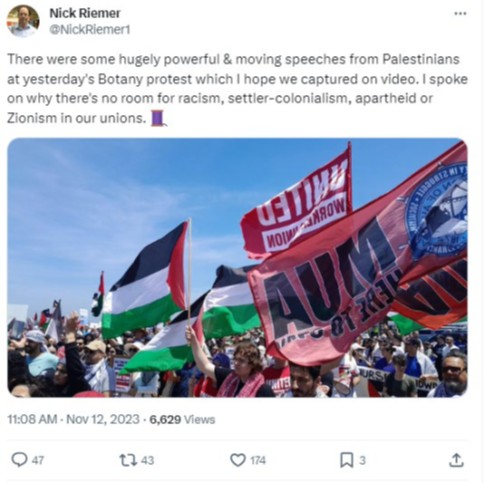
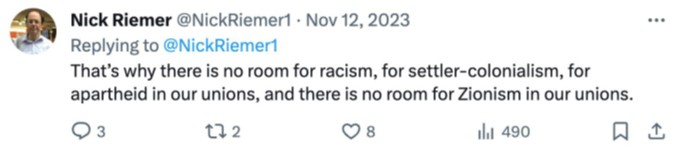
(d) “and were known as” in [21];
(e) [23], [24] and [25];
(f) [32];
(g) [34];
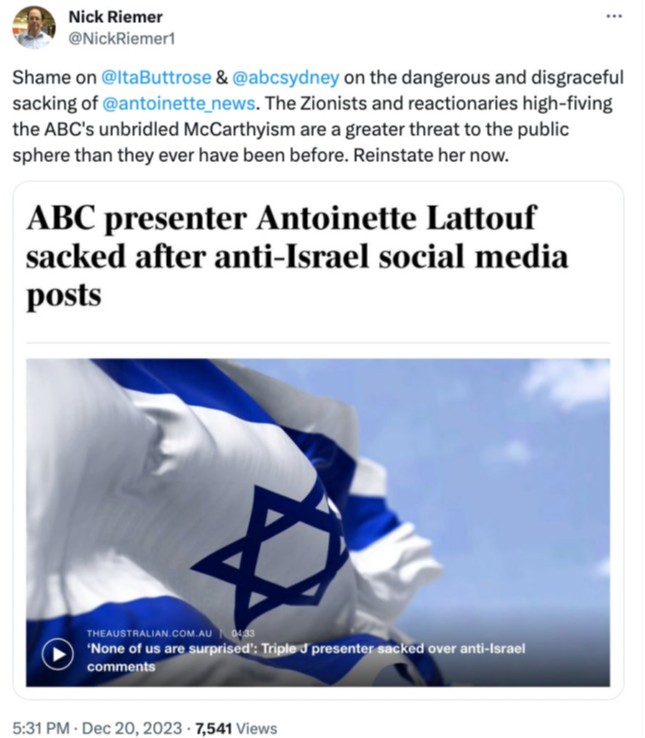
(h) the images subjoined to [35];
(i) the words “when considered individually and/or cumulatively and/or collectively” in [86]; and
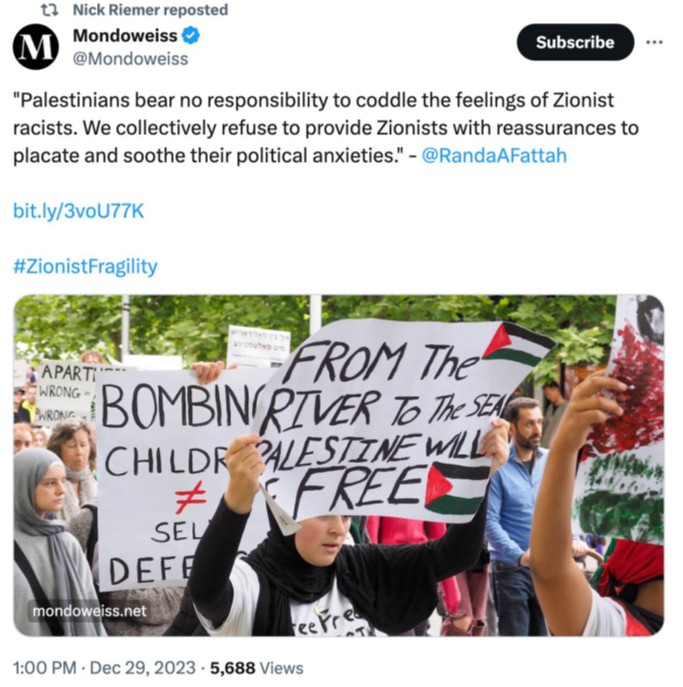
(j) [87].
2. The applicants have leave to file a further amended statement of claim:
(a) substituting “national origin” for “nationality” in [8(b)];
(b) reformulating the first sentence of [10];
(c) reformulating [34]; and
(d) making any other amendments made necessary by the striking out of the paragraphs or parts of paragraphs referred to in order 1.
3. The parties’ representatives confer and provide to the Chambers of Justice Kennett, by 5.00 pm on 28 November 2025:
(a) agreed or competing short minutes of order providing for:
(i) provision by the applicants of particulars to ASOC [28]; and
(ii) timetabling of further steps in the proceeding up to the close of pleadings (including filing of any further amended statement of claim as referred to in order 2); and
(b) notification of whether they are content for these timetabling orders to be made in chambers.
4. The interlocutory application filed by the first respondent on 5 August 2025 be otherwise dismissed.
5. The interlocutory application filed by the second respondent on 28 August 2025 be otherwise dismissed.
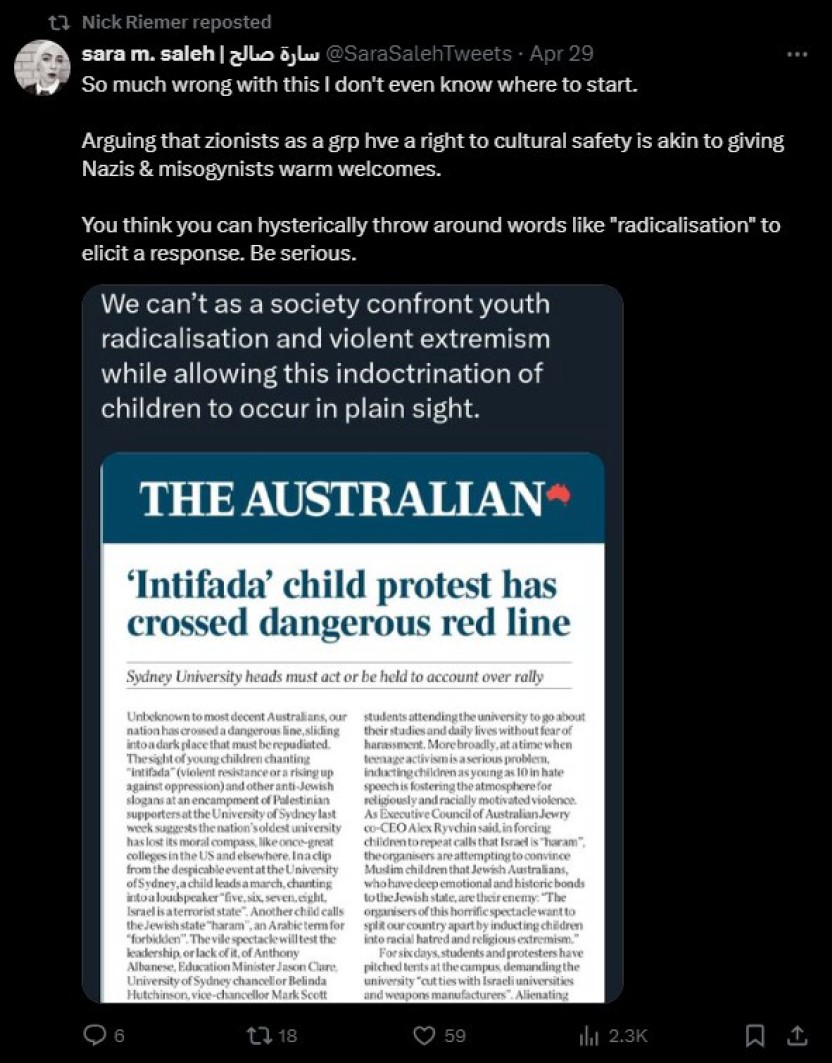
6. Costs of both interlocutory applications be reserved.
Note: Entry of orders is dealt with in Rule 39.32 of the Federal Court Rules 2011.
REASONS FOR JUDGMENT
KENNETT J:
Introduction
1 The first respondent (Dr Riemer) is a Senior Lecturer in the Discipline of English and Writing at the University of Sydney (the University) and was, until October 2024, President of the University of Sydney Branch of the National Tertiary Education Union (the Union). He is now the Vice-President (academic) of that Branch of the Union.
2 In the febrile atmosphere that followed the attack by Hamas operatives on Israel on 7 October 2023, Dr Riemer made public statements that the applicants found offensive. Broadly, these statements were strongly critical of actions or positions which Dr Riemer attributed to “Zionists”. The applicants were at relevant times students and members of the academic staff at the University, and one (Mr Eisner) was also an elected officer in the Australasian Union of Jewish Students . They plead that they are “Jewish persons” or Israeli citizens (or eligible to be Israeli citizens) and identify as “Zionists”.
3 The applicants seek declaratory and injunctive relief and public apologies in relation to several of Dr Riemer’s statements under the Australian Human Rights Commission Act 1986 (Cth) (the AHRC Act), on the footing that the statements contravened s 18C of the Racial Discrimination Act 1975 (Cth) (the RDA). As to some of those statements, relief is also sought against the University on the footing that it is vicariously liable for Dr Riemer’s unlawful conduct under s 18E of the RDA.
4 The applicants filed their originating application and statement of claim on 13 June 2025. They filed an amended statement of claim (ASOC) on 30 July 2025.
5 The proceeding has, so far, been case managed concurrently with Toltz v Keane (NSD951/2025) (Toltz v Keane), which involves allegations of contraventions of s 18C by another staff member of the University. The applicants in the present proceeding are also applicants in Toltz v Keane.
6 These reasons concern the following two interlocutory applications filed by the respondents:
(a) an application by Dr Riemer, filed on 5 August 2025, to strike out particular parts of the ASOC pursuant to r 16.21 of the Federal Court Rules 2011 (Cth) (the Rules); and
(b) an application by the University, filed on 28 August 2025, to:
(i) strike out some specific parts of the ASOC pursuant to r 16.21; and
(ii) dismiss summarily the aspects of the applicants’ claim that relate to the University pursuant to s 31A of the Federal Court of Australia Act 1976 (Cth) (the FCA Act) and r 26.01 of the Rules.
7 There is some overlap between the parts of the ASOC sought to be struck out by the two applications, and the University expressly supported aspects of Dr Riemer’s application. In these reasons I will deal with the issues relating to summary dismissal first, followed by the strike-out applications.
Section 18C
8 Section 18C of the RDA provides as follows.
(1) It is unlawful for a person to do an act, otherwise than in private, if:
(a) the act is reasonably likely, in all the circumstances, to offend, insult, humiliate or intimidate another person or a group of people; and
(b) the act is done because of the race, colour or national or ethnic origin of the other person or of some or all of the people in the group.
Note: Subsection (1) makes certain acts unlawful. Section 46P of the Australian Human Rights Commission Act 1986 allows people to make complaints to the Australian Human Rights Commission about unlawful acts. However, an unlawful act is not necessarily a criminal offence. Section 26 says that this Act does not make it an offence to do an act that is unlawful because of this Part, unless Part IV expressly says that the act is an offence.
(2) For the purposes of subsection (1), an act is taken not to be done in private if it:
(a) causes words, sounds, images or writing to be communicated to the public; or
(b) is done in a public place; or
(c) is done in the sight or hearing of people who are in a public place.
(3) In this section:
public place includes any place to which the public have access as of right or by invitation, whether express or implied and whether or not a charge is made for admission to the place.
The pleaded case
Introductory matters
9 ASOC [7] is as follows.
Each Applicant is a Jewish person or a person who is, or is eligible to be, an Israeli citizen (Israeli person) and identifies as Zionist.
(Emphasis in original.)
10 There is some ambiguity here, but I apprehend that the closing words of the paragraph (“and identifies as Zionist”) are intended as an addition to both of the alternatives set out earlier (a “Jewish person” or an “Israeli person”) and therefore apply to all of the applicants.
11 The ASOC then alleges the following in relation to “Zionists” (at [10]).
Zionists are predominantly Jewish people and/or Israeli people who believe in Israel being a nation state and the national home of and for the Jewish people. A substantial proportion of Jewish and/or Israeli people identify themselves as Zionists.
12 The ASOC then pleads the following matters of background:
(a) the first (1987-1993) and second (2000-2005) intifadas, which (very briefly) were uprisings by Palestinians against Israeli occupation in which significant numbers of Israelis (and much larger numbers of Palestinians) were killed (at [21]-[25]);
(b) the aims of Hamas (said to include “obliterating” Israel and “killing the Jews”) and its listing as a terrorist organisation under the Criminal Code Act 1995 (Cth) (at [26]-[29]); and
(c) the events of 7 October 2023, when Hamas members “illegally invaded the State of Israel” and committed many atrocities (including killings, rapes and the taking of more than 250 hostages) (at [30]-[32]).
Dr Riemer’s statements
13 The respondents’ submissions on the interlocutory application focus on a relatively small subset of the statements that are the subject of complaint. However, to give an indication of the scope of the proceeding, and in the light of submissions of the applicants which assert the relevance of the whole collection, I will attempt to summarise the entirety of this part of the ASOC.
The “global intifada” post and meeting
14 On 1 November 2023 Dr Riemer made a post on his “X” account (the “global intifada” post) which is reproduced at ASOC [33] as follows.
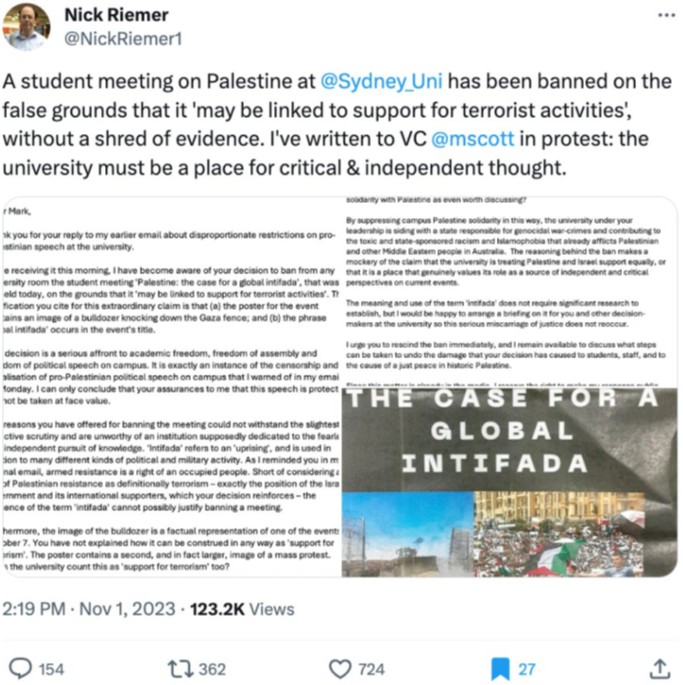
15 If the photograph at the bottom of the post was clicked on, it became visible as a larger picture which appears to show a poster advertising a meeting. Text at the top of the poster says “a student meeting hosted by Solidarity”. It is alleged by what purports to be “particulars” to ASOC [34] that “Solidarity is a pro-Palestinian student group that closely follows and mimics Dr Riemer”.
16 The “global intifada” post showed part of (and apparently annexed the whole of) a letter from Dr Riemer to the Vice-Chancellor of the University protesting against a decision by the latter to prohibit a proposed student meeting (which, one infers, is the “case for a global intifada” meeting advertised by the poster mentioned above). Although it was directed to the issues of a particular moment, the post (according to ASOC [36]) has remained visible on Dr Riemer’s X page.
17 It is alleged (ASOC [37]-[39]) that the meeting took place on 1 November 2023 (despite the Vice-Chancellor apparently having prohibited it) and Dr Riemer participated in it by:
(a) participating in a chant including:
…Israel out of Gaza, Israel out of Palestine, long live the intifada! Free, free the West Bank, Israel out of Gaza, Israel out of Palestine long live the intifada!
(b) giving a speech, during which he said:
…we have a right to organise around supporting Palestinians. It’s not just a slogan. Their resistance is justified because of the occupation, at all times, violent or not.
18 ASOC [40] pleads that this conduct of Dr Riemer conveyed “imputations”, as follows.
The Riemer Global Intifada X Post and Dr Riemer’s participation in the chant and the quoted section of his speech conveyed the following imputations:
a. The violent uprising against Jewish people and Israeli people in Israel in support of a Palestinian state in the first and second intifadas should extend to a violent global uprising against Jews and Israelis in Australia and other parts of the world in support of the Palestinian resistance.
b. That the events of 7 October were to be celebrated and endorsed.
c. That Hamas’ Intifada and its related violence against Israelis and Jews, including on 7 October, is justified until Israel, Israelis and Jews are removed from Palestine.
The 8 October post
19 On 8 October 2023 Dr Riemer put a post on his X page (the 8 October post) which is reproduced in ASOC [41] as follows.
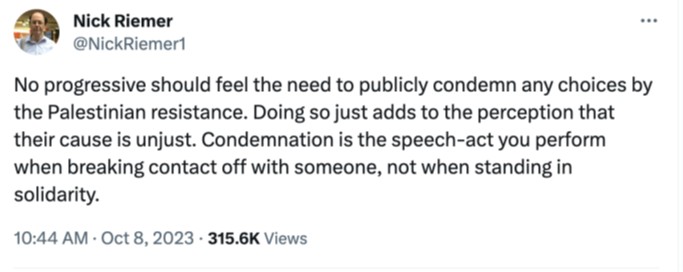
20 According to ASOC [42], the 8 October post remains visible on Dr Riemer’s X page.
21 ASOC [43] alleges as follows.
Dr Riemer’s 8 October Post conveyed the following imputations:
a. Hamas’ cause, and what it did, on 7 October 2023 against Jewish people and Israeli people in pursuit of that cause should not be considered to be unjust;
b. people should express solidarity with, and support of, Hamas’ objectives and activities against Jewish people and Israeli people;
c. people should express their solidarity with, and support of, Hamas’ cause and its actiities [sic] on 7 October 2023 in support of that cause.
The 7 October post
22 On 7 October 2023 Dr Riemer reposted a tweet (the 7 October post) which is reproduced in ASOC [44] as follows.
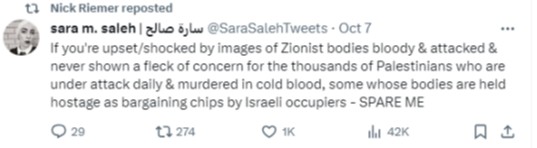
23 ASOC [46] characterises the tweet which Dr Riemer reposted as proceeding “on the basis that the Jewish people and/or Israeli people who had been murdered, maimed, kidnapped, raped or sexually abused were Zionists by virtue of being Jewish and/or Israeli”.
24 ASOC [47] is as follows.
The 7 October repost had the following imputation:
a. There is no basis or reason for anyone to be upset or shocked by the murder, maiming, kidnapping, rape and sexual abuse by Hamas of Jewish people and Israeli people on 7 October 2023.
The Overland article
25 Overland is “an established Australian literary and cultural magazine published quarterly in print as well as online” (ASOC [49]).
26 An article by Dr Riemer (described as someone who “works in the English and linguistics departments at the University of Sydney” and as “president of the Sydney University branch” of the Union) was published in Overland on 15 October 2023 and remains accessible on Overland’s website (ASOC [48], [50]) (the Overland article). ASOC [51] sets out the following extracts from the Overland article.
“That is just one reason why solidarity with Palestinians is essential for anyone who wants to retain their own fundamental freedoms. Palestine solidarity is not just internationalim or anticolonialism or antiracism or even humanitarianism; it is not just an expression of compassion, or altruism, or basic decency: it is a necessity for the defence of democratic prerogatives against authoritarianism and neo-fascism in Western nations. In cheering on the antidemocratic suppression of protest Zionists sometimes thought of as ‘liberal’ have let their masks slip. Their support for Israeli apartheid and permanent war against Palestinians can only mean opposition to democracy in their own countries” [p3/13]
…
The official representatives of democracy, with honourable rare exceptions, have failed democracy again.
…
Condemning a person means abandoning the effort to understand them. After a condemnation, all that is left is absolute rejection and banishment: renouncing the devil and all his works. Condemning is what a judge does when they sentence a prisoner to death. Once someone is condemned, there’s no point in talking about why they might have done what they have done: the final verdict is delivered; no more remains to be said. This is exactly why Zionists demand that we condemn Hamas: to block any move towards understanding it and what might motivate its resistance to Israeli colonisation – to erase the understanding of why Palestinians fight back.” [P-4/13]
27 The square-bracketed text in this quotation appears in ASOC [51] and apparently comprises page references, indicating that these are extracts from a 13-page article.
28 ASOC [52] and [53] are as follows.
The first extract set out above has the following imputation:
a. contrary to the false image that Jewish people and Israeli people have cultivated, Jewish people and Israeli people have now been exposed as racist supporters of apartheid and of a permanent war against Palestinians as well as being people who surreptitiously oppose democracy in their own countries.
The third extract set out above has the following imputation:
a. Jewish people and Israeli people demand condemnation of Hamas only so as to erase any understanding of why there is Palestinian resistance to Israel’s occupation of the Palestinian territories.
The “owned by Zionists” post
29 On 28 October 2023, Dr Riemer reposted a post on his X account (the “owned by Zionists” post) which is reproduced in ASOC [54] as follows.
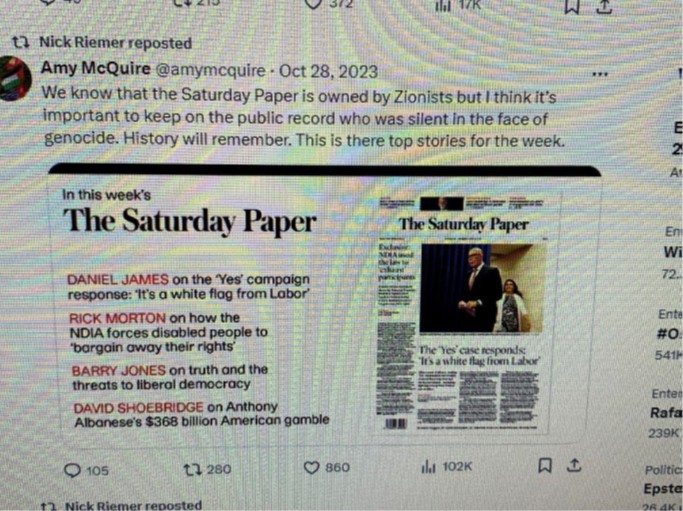
30 ASOC [56] is as follows.
The Saturday Paper “Owned by Zionists” Repost had the following imputations:
a. Jewish people misuse their ownership of the media to conceal from the public the genocide that Jewish people and Israeli people are engaging in Gaza;
b. the silence of Jewish people and Israeli people about that genocide will fail because history will remember and record it.
31 ASOC [57] alleges that, by making these “imputations”, the “owned by Zionists” post “repeats and ampllifies [sic] the well known antisemitic trope that the Jews control the media”.
The “no room for Zionism” posts
32 Dr Riemer made two posts on 12 November 2023 which are reproduced in ASOC [58] as follows.
33 According to ASOC [59] these posts remain accessible online.
34 ASOC [60] is as follows.
The “No room for Zionism in our Unions” Speech and Posts had the following imputations:
a. Jewish people and Israeli people should be excluded from any participation in Unions in Australia including in the National Tertiary Education Union.
b. Because of the racism, settler-colonialism and apartheid engaged in by Jewish people and Israeli people there is no room for such people in the Union movement in Australia, including in the National Tertiary Education Union.
35 Despite the reference in ASOC [60] to a “Speech”, it is worth noting that the speech given by Dr Riemer (apparently at a protest in Botany the day before the posts) is not pleaded except in so far as the first of the posts makes reference to it. In effect, the first post refers to a message having been delivered in a speech the day before (that there was “no room” for specified -isms in unions) and the second post restates that message (perhaps giving increased prominence to “Zionism”).
The Lattouf sacking post
36 Another post by Dr Riemer on 12 November 2023 addressed the controversy concerning the dismissal of the radio announcer Antoinette Lattouf. This post (the Lattouf sacking post) is set out in the ASOC as follows.
37 ASOC [63] is as follows.
The Lattouf sacking Post had the following imputations:
a. Jewish people and/or Israeli people are “unbridled McCarthyists” when they supported the sacking of ABC presenter Antoinette Lattouf.
b. Those Jewish people and/or Israeli people are a threat to the public and that threat is getting worse.
The “Zionist racists” post
38 On 29 December 2023 Dr Riemer reposted (apparently twice) a post on his X page (the “Zionist racists” post), which is set out at ASOC [64] as follows.
39 Dr Riemer’s reposting of this material is referred to in the ASOC as “the Zionists are racists Reposts”. It should be noted, although it is obvious, that the words “Zionists are racists” do not appear in the material as reproduced in the ASOC and this shorthand reference is at least conclusory and potentially misleading.
40 ASOC [66] is as follows.
The Zionists are racists Reposts had the following imputation:
a. Jewish people, Israeli people and Zionists are racists.
The “smartwash” repost
41 On 24 December 2023 Dr Riemer reposted a post which is set out in ASOC [67] as follows.
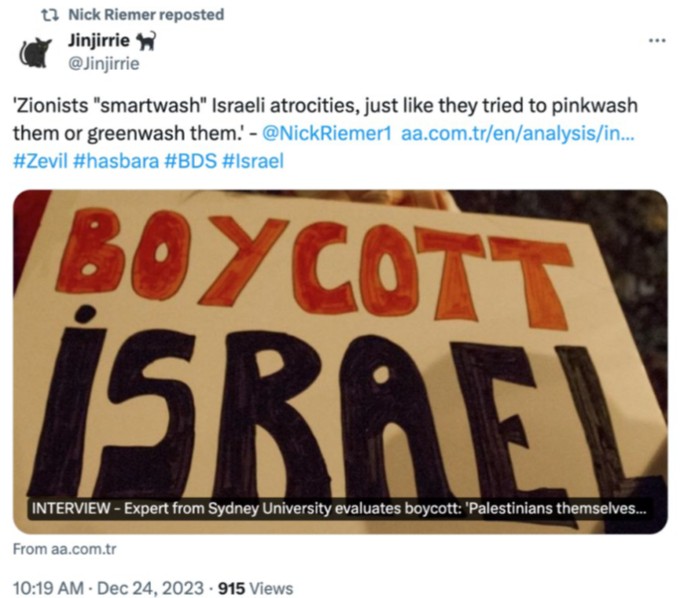
42 ASOC [69] asserts as follows.
The Zionists smartwash Repost had the following imputation:
a. Jewish people, Israeli people and Zionists deceptively and falsely proclaim that the atrocities commited [sic] by Israel were normal lawful activities.
The licence to lie and slander post
43 On 2 February 2024 Dr Riemer posted a post reproducing media reporting to the effect that earlier claims about antisemitic chants at a pro-Palestine rally in Sydney had been found to be incorrect. The post (the licence to lie and slander post) is set out at ASOC [70] as follows.
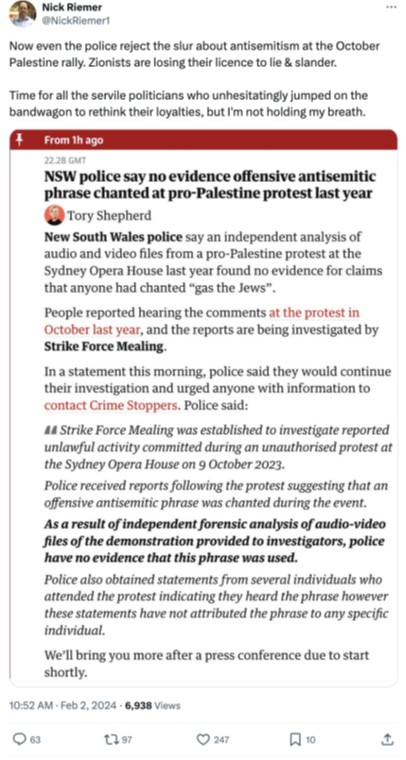
44 According to ASOC [71] the licence to lie and slander post remains accessible.
45 ASOC [72] is as follows.
The Zionists’ “Licence to Lie and Slander” Post had the following imputation:
a. Jewish people, Israeli people and Zionists are people who lie and slander in pursuing their causes.
46 ASOC [73] asserts that, by making “those imputations”, the post “repeats and amplifies the well known antisemitic trope that the Jews are deceptive”.
The “Zionists support genocide” repost
47 On 5 March 2024 Dr Riemer reposted a post (the “Zionists support genocide” repost) which is set out at ASOC [74] as follows.
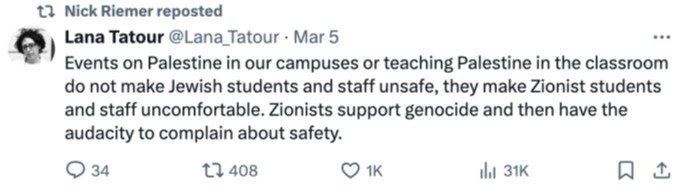
48 ASOC [76] is as follows.
The “Zionists support genocide” Repost had the following imputations:
a. Jewish people, Israeli people and Zionists support genocide;
b. Jewish people, Israeli people and Zionists are hypocrites.
The “genocide-enablers” post
49 On 19 March 2024 Dr Riemer posted on his Facebook page in terms which are set out at ASOC [77] as follows (the “genocide-enablers” post).
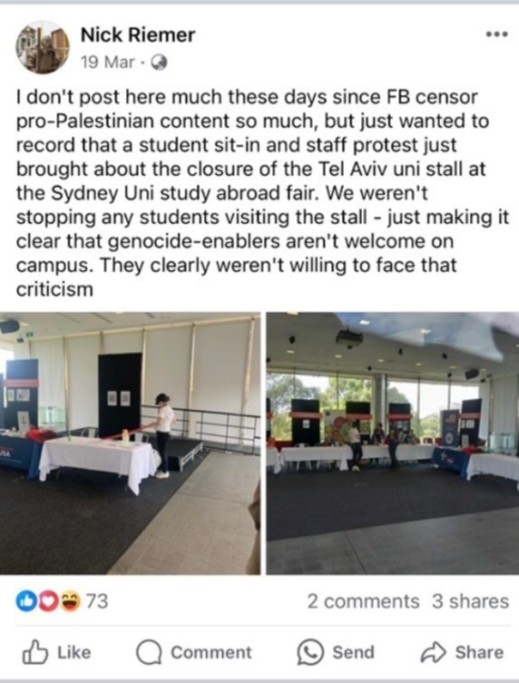
50 ASOC [78] is as follows.
The “genocide enablers” Post had the following imputation:
a. The Israeli people at the Tel Aviv University stall at Sydney University and other Jewish people or Israeli people are genocide enablers.
b. That Jewish peole [sic] and Israeli people are not welcome on the Sydney University campus.
The “Nazis” repost
51 On 29 April 2024 Dr Riemer reposted a post which is set out at ASOC [79] as follows (the “Nazis” repost).
52 The ASOC labels this as “the ‘akin to Nazis’ Repost”. This too is conclusory and potentially misleading — particularly in its use of quotation marks — as the material that Dr Riemer reposted did not use that phrase.
53 ASOC [81] is as follows.
The “akin to Nazis” Repost had the following imputations:
a. Jewish people, Israeli people and Zionists, are akin to Nazis and misogynists.
b. Jewish people, Israeli people and Zionists have no right to cultural safety.
The “Genocide” post and speech
54 On 3 May 2024 Dr Riemer posted material on his X page, an excerpt from which is set out at ASOC [82] as follows.
“Safety means opposing Genocide”:
…
A ‘march for a single campus’: Let’s reflect on that. Zionists clearly think that if they talk about safety, then they’ll be able to make people think that they’re the victims, and forget that, actually, they’re supporting a genocidal slaughter. They think safety on campus will turn the debate in their favour and put us on the back foot.”
…
“What happens when we tell Zionists that there just is no identity that can have as its condition the dispossession and slaughter of an entire people? They instantly tell us that we’re making them feel unsafe”
55 This is described in the ASOC as a “Post and Speech”, but the pleading does not specify who made the speech and when (or whether it is relied on as a distinct act).
56 ASOC [84] is as follows.
The paragraphs set out above, and the speech contain the following imputations:
a. Jewish people, Israeli people and Zionists support the genocidal slaughter of Palestinians.
b. Jewish people, Israeli people and Zionists mislead people into thinking they feel unsafe when what they are really doing seeking [sic] freedom to support genocide.
Alleged contravention of s 18C by Dr Riemer
57 ASOC [85] alleges, in relation to each of the statements set out above, that it was an act which was done in a public place, in the sight and hearing of people who were in a public place, and not done in private.
58 ASOC [88] is as follows.
The impugned acts were done or made because of the race, national or ethnic origin of the people reasonably likely to be offended, insulted, humiliated or intimidate [sic] by the posting including because:
a. References to Zionists are, properly understood, to be a reference to (at least) a majority of Jewish people and Israeli people in Australia;
b. The subject matter of the impugned acts was related by context to events that were themseves [sic] directly related to the race, ethnic origin or national origin (Jewish and/or Israeli) of the victims of the events of October 7; and
c. Dr Reimer has a tendency to engage in conduct which does and is intended to offend and/or insult and/or humiliate and/or intimidate Jewish persons and Israeli persons.
59 ASOC [89] alleges that, in the premises, Dr Riemer contravened s 18C of the RDA.
60 ASOC [86] and [87] seek, for the purpose of reaching these conclusions, to bring the various statements to account in a cumulative way. They are as follows.
Dr Riemer’s making of each of the impugned acts, by conveying any or all of the imputations alleged, when considered individually and/or cumulatively and/or collectively, were reasonably likely in all the circumstances, to offend, insult, humiliate or intimidate Jewish persons or Israeli persons in Australia.
The reliance in the Amended Statement of Claim concerning Dr Riemer’s impugned acts is cumulative, with the consequence that each can be relied upon cumulatively or collectively for the purposes of establishing both the causation and racial elements in s18C of the RDA.
Alleged liability of the University
61 At ASOC [90]-[94] it is alleged that the Overland article (see [26] above) and the “no room for Zionism” speech and posts (see [32] above) were made in connection with Dr Riemer’s duties as an employee of the University and the University is therefore vicariously liable for these acts under s 18E of the RDA.
62 For present purposes it is not necessary to refer to this aspect of the ASOC in any detail. The University reserves its position on vicarious liability but accepts for the purposes of its interlocutory application that, if the Overland article or the “no room for Zionism” speech and posts contravened s 18C, it would be liable.
Complaint to the Australian Human Rights Commission
63 ASOC [95]-[97] allege that the applicants lodged a complaint with the Australian Human Rights Commission (AHRC) and that the complaint was terminated under s 46PH(1B)(b) of the AHRC Act. These are necessary prerequisites to the commencement of proceedings for an alleged contravention of the RDA in this Court which are not presently in issue.
Summary dismissal
64 On its face, the University’s interlocutory application sought the “dismissal” of identified paragraphs of the ASOC. Properly understood, summary judgment under r 26.01 of the Rules or s 31A of the FCA Act is something that occurs in relation to a proceeding or a claim for relief, and is a different exercise from striking out parts of the pleading by which a party seeks to make out a claim. I have treated the University’s interlocutory application as seeking the dismissal of the originating application in so far as it relies on the identified paragraphs of the ASOC. Prima facie at least, that would involve the dismissal of prayer 2 (which seeks a declaration against the University) and the dismissal of other prayers in so far as the proposed orders are directed against the University.
65 The particular paragraphs that are the focus of this aspect of the University’s interlocutory application are:
(a) ASOC [52] and [53] (which plead that specified imputations arise from the Overland article) and [60] (which pleads that specified imputations arise from the “no room for Zionism” speech and posts);
(b) ASOC [86]-[89] (which allege that Dr Riemer’s statements contravened s 18C) in so far as they depend on ASOC [52], [53] and [60]); and
(c) ASOC [90]-[94] (which allege that the University is vicariously liable).
66 As noted earlier, the University presently attacks ASOC [90]-[94] only on the basis that the alleged contraventions of s 18C for which it is said to be vicariously liable were not contraventions.
Approach to summary dismissal
67 A large body of authority affirms that the powers in r 26.01 and s 31A must be exercised with caution (see eg Spencer v Commonwealth [2010] HCA 28; 241 CLR 118 at [24] (French CJ and Gummow J), [60] (Hayne, Crennan, Kiefel and Bell JJ) (Spencer)). To give judgment against a party without a trial is a large step which (apart from cases involving default or want of prosecution) is warranted only if the Court is satisfied that the expense of a trial is unjustifiable because the party has no prospect (or “no reasonable prospect” under s 31A) of succeeding at trial (see eg Webster v Lampard (1993) 177 CLR 598 at 602 (Mason CJ, Deane and Dawson JJ)) (Webster). While a need to undertake complicated legal analysis before it can be concluded that there is no prospect of success is not a barrier to summary judgment (see British American Tobacco Ltd v Western Australia [2003] HCA 47; 217 CLR 30 at [103] (Kirby J); Jefferson Ford Pty Limited v Ford Motor Company of Australia Ltd [2008] FCAFC 60; 167 FCR 372 at [131] (Gordon J) (Jefferson Ford) (citing General Steel Industries Inc v Commissioner for Railways (NSW) (1964) 112 CLR 125 at 130 (Barwick CJ)), a conclusion at that level of definitiveness is necessary.
68 Applications for summary dismissal of a proceeding or part of a proceeding are not limited to the traditional demurrer, in which it is contended that the claimant’s case must fail even if all of the facts they allege are established (and argument thus proceeds on the assumption that those facts will be made out). Evidence can be adduced seeking to prove that some essential factual foundation for the claim is absent. Where evidence of that kind is adduced, “the onus shifts to the opposing party to point to some factual or evidentiary issues making a trial necessary” (Prior v South West Aboriginal Land and Sea Council Aboriginal Corporation [2020] FCA 808 at [29(f)] (McKerracher J), citing Jefferson Ford at [127] (Gordon J)).
Evidence on the present application
69 In support of a submission that the imputation set out at ASOC [52(a)] did not reasonably arise from the first extract at ASOC [52], the written submissions of the University referred to an article published in Overland in May 2025 and a transcript of submissions made by some Jewish organisations to a recent NSW parliamentary inquiry into antisemitism. These documents were annexed to an affidavit of the University’s solicitor dated 28 August 2025 (the Woodbury affidavit) and were said to show that a reasonable person in the class of Jewish and/or Israeli people in Australia would not regard the statements in the first extract (which, it will be recalled, refer in an adverse way to “Zionists”) as based on Jewish or Israeli identity.
70 On 18 September 2025 the applicants filed an affidavit of their solicitor (the 18 September McCoach affidavit). No provision had been made for this evidence in the timetabling orders and no leave had been sought. The affidavit had 30 annexures (referred to as exhibits) totalling 2344 pages.
71 The documents annexed to these affidavits were not things that one would normally find annexed to a solicitor’s affidavit (such as correspondence) or things that the deponent purported to, or could, give any evidence about, even on information and belief. One annexure to the 18 September McCoach affidavit comprised material appearing on Dr Riemer’s X page that was not referred to in the ASOC (the relevance of which to the interlocutory application is not apparent). The remainder (1886 pages in total) were documents produced by other organisations and transcripts of hearings, drawn from various sources and bundled together, apparently said to be relevant to the substantive merits of the claims against Dr Riemer.
72 Dr Riemer objected to all of the annexures to the 18 September McCoach affidavit on several grounds including hearsay and relevance. (Although Dr Riemer was not directly involved in the summary dismissal application, he clearly had an interest in it and was entitled to be heard on it. The 18 September McCoach affidavit was also relied on by the applicants in response to Dr Riemer’s strike-out application, which is discussed below, although its relevance to that application was harder to understand.) The applicants made corresponding objections to the documents annexed to the Woodbury affidavit. I deferred ruling on these objections.
73 Counsel for the applicants handed up a bundle described as “Applicants’ Condensed Evidence Documents”, said to comprise the pages of the evidence that he wished to rely on. Relating this material to the affidavits was not easy because the bundle had no index. More importantly, providing excerpts of documents did not significantly assist in circumstances where the admissibility or utility of those documents was in contest and the whole documents needed to be before the Court for that purpose.
74 To make individual rulings on the admissibility of all of the annexures to the Woodbury affidavit and the 18 September McCoach affidavit, in the context of an interlocutory application, would not be an appropriate use of judicial resources. It suffices to say that this evidence did not assist in resolving any issue on the University’s summary dismissal application, for the following reasons.
The University’s evidence
75 In the light of s 75 of the Evidence Act 1995 (Cth) (the Evidence Act), the documents annexed to the Woodbury affidavit may be taken to be some evidence that the statements recorded in those documents represent the views of the persons who made them. However, in an application of the present kind (which, if successful, disposes of part of the proceeding), evidence sworn on information and belief is not sufficient to establish the absence of a real issue to be tried: Lombard Australia Ltd v Mulley (1976) 9 ACTR 23 at 24 (Blackburn J). The position is, if anything, clearer where (as here) the witness merely annexes a document and does not depose to a belief that any statement in it is true. Accordingly, to the extent that statements recorded in the annexures to the Woodbury affidavit purport to say anything about the opinions or understandings of Jewish persons in Australia generally, or a significant subset of those persons, they are not entitled to be given any weight in relation to the facts in issue in the present application. This is the case even if they can be admitted on an interlocutory application by virtue of s 75 of the Evidence Act. Clearly, also, it is not possible for the Court itself to infer anything about the opinions or understandings of Jewish persons generally from the statements of a relatively small number of persons recorded in these annexures. None of these materials would be admissible at a final hearing, except possibly as part of the material on which an expert opinion might be based.
The applicants’ evidence
76 What follows is that, to the extent that the University’s summary dismissal application relies on factual contentions concerning how Jewish and/or Israeli persons in Australia perceive criticisms of Zionism, the evidence advanced by the University is manifestly insufficient to place any onus on the applicants to prove the existence of a factual foundation for their pleading in this respect. This makes it strictly unnecessary to rule on the admissibility of the material annexed to the 18 September McCoach affidavit or assess its probative value. However, it is appropriate to note the following points.
77 First, there is something to be said for the view that the respondent to an application for summary judgment may prove that there is a real issue to be tried by way of an affidavit deposed on information and belief (and there is old English authority that the affidavit may be sworn by a solicitor’s clerk: Hallett v Andrews (1898) 42 Sol Jo 68). However, the applicants in the present case did not take that course. Mr McCoach states at [2] that, unless otherwise stated, he makes his affidavit “on my own knowledge, information and belief, including information provided to me by or on behalf of one or more of the applicants which I believe to be true”. What this formulaic statement means is, with respect, far from clear; however, I do not think he can be taken to be deposing to a belief in the truth of all of the statements by different persons set out in the many pages of annexures.
78 Secondly, a summary judgment application is not a trial and it is proper to assume that the evidence of the respondent to that application, if not “inherently incredible”, will be accepted (Webster at 604). However, where the onus has shifted to the respondent to demonstrate that there is a factual issue that should go to trial, something probative must be adduced.
79 Thirdly, as an exercise in seeking to prove a factual basis for the allegations in the ASOC, the assemblage of documents annexed to the 18 September McCoach affidavit was unsatisfactory. This does not matter for the purpose of determining the summary dismissal application, but it has some relevance to questions of costs. None of the material to which I was taken appeared likely to be admissible on a final hearing to prove the beliefs or understandings of Jewish or Israeli persons in Australia. Several of the documents (those numbered DPM-13, DPM-24 and DPM-28 to DPM-30) were submissions to Commonwealth parliamentary inquiries and transcripts of proceedings in Parliament, which are inadmissible by reason of parliamentary privilege: Parliamentary Privileges Act 1987 (Cth), s 16(2)-(3) (DPM-14 is a transcript of proceedings in, and DPM-27 is a submission that was made to, a Committee of the NSW Legislative Council which may also be subject to privilege). More generally, the statements in the documents on which I was invited to rely appeared to be of three kinds:
(a) high-level conclusions about Jewish beliefs, attitudes and experiences, of a kind that might possibly be admissible if stated as part of an expert report, but:
(i) which were introduced as hearsay, without qualifying the makers of the statements as experts and without substantial articulation of the basis for the opinions expressed; and
(ii) many of which proved upon fairly cursory examination to have been made by one or more of the applicants or by persons and organisations associated with the applicants (therefore lacking the disinterestedness that the Court expects of an expert witness);
(b) findings of a SafeWork investigation into the University, based on a complaint by a staff member who is proposed to be joined as an applicant in Toltz v Keane, in which it is apparent that the investigator was briefed by that staff member; and
(c) documents said to show the outcomes of surveys, which (for the reasons explained in written submissions handed up by counsel for Dr Riemer) were based on unsatisfactory methodologies and do not appear to have had any regard to the Court’s Survey Evidence Practice Note (GPN-SURV).
80 Strict compliance with technical or procedural rules governing admissibility on a final hearing should obviously not be expected of the applicants in the present circumstances. However, documents not constituting business records or part of the res gestae, tendered on a standalone basis as evidence of the truth of assertions made in those documents (or the opinions of individuals quoted in the documents), are unlikely to be probative of anything. At most, such documents might serve to indicate that the party tendering them has the capacity to produce something admissible and supportive of its case at a final hearing. The material tendered on this application does not, on my reading of it, support such an inference to any material degree.
The ASOC, the impugned statements and s 18C
The questions that arise
81 The oral submissions of senior counsel for the University did not dwell on the evidentiary issues canvassed above. He accepted that, for the purposes of the summary dismissal application, the applicants’ case was to be taken at its highest. This included assuming that the allegation at ASOC [10] set out above, that a substantial proportion of Jewish and/or Israeli people identify as Zionists, would be made out. The submission ultimately advanced was to the effect that the pleaded extracts from the Overland article and the “no room for Zionism” speech and posts could not reasonably be read as carrying the imputations attributed to them by the ASOC.
82 Assessment of this argument, in the context of a summary dismissal application, involves consideration of the meaning of these statements as a matter of ordinary language and of the extent to which, for the purposes of s 18C(1), the range of meanings that might be attributed to the statements (and hence their capacity to offend, insult, humiliate or intimidate members of an identified group) depends on evidence concerning the particular perspectives of members of the group. There is (for reasons outlined above) no useful evidence currently before the Court on the perspectives of members of the relevant group, but it is necessary to proceed on the basis that such evidence might be adduced at a final hearing.
Distracting arguments
83 Counsel for the applicants made the surprising submission that the University’s argument could not be a sufficient basis for summary dismissal because the case advanced at trial would not be limited to the imputations pleaded. Reference was made in this connection to Jones v Scully [2002] FCA 1080; 120 FCR 243 at [124] (Jones), where Hely J observed that the identification of “imputations” by an applicant in a claim under s 18C was a “useful tool” but not a substitute for the statutory test, and to Clarke v Nationwide News Pty Ltd trading as the Sunday Times [2012] FCA 307; 201 FCR 389 at [34]-[36] (Clarke), where Barker J said:
At the hearing, senior counsel for the applicant clarified the way in which the applicant put her case and stated it was not advanced on the basis of the imputations pleaded in the statement of claim but that the imputations pleaded should be regarded as identifying categories of meaning that the Court might accept in determining whether the comments complained of contravene the RD Act …
…
Senior counsel for the respondent responded to the applicant’s case advanced on this basis and the Court will also rule on this basis.
84 It was also observed that the identification of “imputations” is a pleading technique, apparently borrowed from defamation cases, that is not used at all in some cases of alleged breach of s 18C.
85 Jones and Clarke provide no support for the applicants’ position. In the passage cited from Jones, Hely J was making the uncontroversial observation that the course adopted by the parties in framing their cases could not be allowed to distract from the test which the statute required to be applied to the facts as found. That observation says nothing about the fact-finding task or the disciplines to be imposed on parties in the articulation of their cases. In Clarke, Barker J was recording that the pleadings had been overtaken by the way both parties presented their cases at the trial.
86 The applicants have elected to proceed by way of pleadings and the document now before the Court is the second version of their statement of claim. The ASOC records that it was settled by senior counsel. No application to amend it has been made. It must be treated as the definitive statement of the case that the applicants will advance; that is, of the acts of Dr Riemer that they say contravened s 18C and how those acts contravened the section. This is the only version of the case to which the respondents must (and indeed can) respond. ASOC [86] alleges that Dr Riemer’s statements, considered individually or cumulatively, were reasonably likely to offend, insult, humiliate or intimidate Jewish persons or Israeli persons in Australia “by conveying any or all of the imputations alleged”.
87 No inherent right to go beyond the pleaded case can be assumed. Questions as to whether the applicants have reasonable prospects of successfully advancing their claims must be tested by reference to the case as they have pleaded it.
88 Counsel also informed me from the bar table that the text of Dr Riemer’s speech, referred to in the “no room for Zionism” posts, had been served on the respondents some time ago and was intended to be relied upon. This is a distraction in circumstances where the making of the speech is not distinctly pleaded as an instance of contravening conduct, the relevant parts of the speech are not particularised, and no steps have been taken to amend the ASOC to include this material.
The approach to determining whether an act comes within s 18C(1)(a)
89 The University’s argument is directed at whether the relevant statements of Dr Riemer had the quality of being reasonably likely to “offend, insult, humiliate or intimidate” for the purposes of s 18C(1)(a). Obviously, an act can contravene s 18C(1) only if it has that quality. The argument does not require consideration of s 18C(1)(b) except to the extent that its language assists the construction of s 18C(1)(a).
90 Paragraph (b) of s 18C(1) is relevant to the construction of para (a) in that it is clear that the “group of people” referred to in para (a) (who are likely to be offended, insulted, humiliated or intimidated) is the same as “the group” in para (b). It is necessarily a group “some or all” of whose members share a “race, colour or national or ethnic origin” that forms the reason for the doing of the relevant act. At least ordinarily, therefore, the “group” is one that is defined by the race, colour or national or ethnic origin of some or all of its members: see Faruqi v Hanson [2024] FCA 1264 at [225]-[231] (Stewart J) (Faruqi). In the present case, it is pleaded at ASOC [86] that Dr Riemer’s statements were reasonably likely to offend, insult, humiliate or intimidate “Jewish persons or Israeli persons in Australia”.
91 In Wertheim v Haddad [2025] FCA 720; 311 FCR 263 at [43]-[44] (Wertheim), Stewart J said:
The asserted cause of action is based on the speeches themselves, ie the “act” referred to in s 18C said in this case to be unlawful is the act of delivering (and publishing) the speeches. The applicants use the device of identifying “imputations” to isolate the “stings” in the speeches that are said to cause offence, etc. In answering the question whether the identified act is reasonably likely to offend, etc, “the conduct should be analysed from the point of view of the hypothetical representative in relation to the claim that the group of people were offended”: Eatock v Bolt [2011] FCA 1103; 197 FCR 261 at [250] per Bromberg J [(Eatock v Bolt)]. The “ordinary” or “reasonable” member or members of the group are to be isolated so that reactions that are extreme or atypical will be disregarded: Eatock v Bolt at [251].
In my view, it is the perspective of that hypothetical group member that must be adopted in assessing, objectively, whether the imputations are conveyed by the speeches. That is because the assessment of the likely effect of the speeches on that hypothetical person and their reaction cannot be done in relation to a meaning that that person would not understand the speeches to convey, and it can only be done in relation to a meaning that that person would understand the speeches to convey. That said, I am not sure that it makes any difference at this stage of the analysis – the speeches will convey the same meanings to the ordinary, reasonable listener who is a Jew in Australia as they do to the ordinary, reasonable listener who is conceived of as a member of the broader Australian community. It is therefore possible to proceed to assess whether the speeches convey the pleaded imputations without first having to identify the relevant characteristics of the hypothetical ordinary, reasonable Jew in Australia.
92 Wertheim involved five “speeches” given by the respondent, an Islamic preacher, in November 2023. Stewart J found that the imputations pleaded by the applicant in relation to three of those speeches were made out (at [157]-[160]) and went on to find in relation to those speeches that the elements of s 18C(1) were satisfied. One important point to note about this is that his Honour treated the ascertainment of the meaning of the speeches (by reference to pleaded “imputations”) as a necessary step that was anterior to the consideration of whether the conveying of that meaning was reasonably likely to offend, insult, humiliate or intimidate members of the identified group. The pleading of imputations invites this approach. The University’s argument in this case arises at the same stage of the analysis.
93 The University places some emphasis on what Stewart J said about the speech identified as Speech B. This was entitled “Murdered by Israel” and took the form of commentary on events in Gaza and exhortations to Muslims to support the Palestinians in Gaza. The pleaded imputations in relation to this speech were framed in terms of “Jews” controlling the media and “the Jewish people” being filthy. These imputations were found not to be made out. At [107] Stewart J said:
I do not consider that the ordinary, reasonable listener would understand Mr Haddad in these passages, either in isolation or in the context of the sermon as a whole, to be saying anything about Jews generally or about all Jews. He is quite specific in the sermon. He is critical of Israel, the IDF and Zionists. As mentioned, Jews are only mentioned in relation to the Holocaust, and not in a critical or disparaging way. It is only if the ordinary, reasonable listener heard the sermon in the knowledge of what Mr Haddad had said in Speech A that they might conclude that the references to Zionists was a reference to all Jews because of what he says about Zionists in Speech A. But that is not how Speech B is to be understood. The ordinary, reasonable listener would understand that not all Jews are Zionists or support the actions of Israel in Gaza and that disparagement of Zionism constitutes disparagement of a philosophy or ideology and not a race or ethnic group. Needless to say, political criticism of Israel, however inflammatory or adversarial, is not by its nature criticism of Jews in general or based on Jewish racial or ethnic identity: see South African Human Rights Commission on behalf of South African Jewish Board of Deputies v Masuku [2022] ZACC 5; 2022 (4) SA 1 (CC) at [4]-[6] and [161]-[166] per Khampepe J for the Court. Indeed, the applicants did not submit that it is. The conclusion that it is not antisemitic to criticise Israel is the corollary of the conclusion that to blame Jews for the actions of Israel is antisemitic; the one flows from the other.
94 Stewart J made similar observations in Wertheim at [134]-[135] concerning what was identified as Speech D.
95 Wertheim was relied on by the respondent in Cassuto v Kostakidis [2025] FCA 1226 (McDonald J) (Cassuto), on an application to strike out the pleading in that case as (among other things) failing to disclose a reasonable cause of action. The subject matter of the relevant statements in that case was, again, recent events in Gaza. They were summarised as follows (at [24]).
… a comment about the Israeli government getting some “of its own medicine” for conducting a genocide in Gaza; a report of a speech by the leader of a Lebanese terrorist organisation suggesting that the Israel army is doing poorly in a conflict and that Israelis with dual citizenship would be well-advised to return to the countries from whom they hold their other citizenship.
96 The respondent in Cassuto relied on the passages in Wertheim discussed above to support an argument which was encapsulated by McDonald J at [33] as being “that criticism of Israel is not capable of constituting the kind of racial discrimination that Part IIA of the RD Act seeks to prevent”. His Honour rejected that argument (at [47]), having noted the differences between the issues being discussed by Stewart J in the passages referred to and those posed by the submission made in Cassuto. In particular, Stewart J was considering whether a particular speech conveyed particular imputations (concerning “Jews”) and not a more general question about whether criticising Israel, per se, is capable of being an act that is reasonably likely to offend, insult, humiliate or intimidate a group of people defined by reference to race, colour or national or ethnic origin. Additionally, in Cassuto (as in this case), the relevant group was defined by reference to “Israeli” nationality as well as Jewishness.
97 Relevantly to the issues in the present application, McDonald J said at [43]-[44]:
I accept that there is a clear conceptual distinction between disparagement of Zionism, a philosophy or ideology, and disparagement of Jewish people as a race or ethnic group (or disparagement of people of Israeli national origin). It is clear enough that not all Jewish people or Israeli citizens are Zionists, and not all Jewish people or Israeli citizens support the actions of the State of Israel. It is plainly possible to criticise Zionism, or the actions of Israel, without disparaging Jewish people or Israeli citizens in general.
However, having regard to the terms of s 18C(1) of the RD Act, it is not immediately obvious that conduct which consists of speech that is about an ideology or political position, or which amounts to criticism of official action by a country, can never contravene s 18C. It is not an express requirement that, for conduct (including speech) to contravene s 18C, it must be “about” a race, ethnicity or nationality, or people of a race, ethnicity or nationality. It may be arguable that, as a matter of construction, it is necessary to read in a limitation of this kind in some way. However, the contrary position is also at least reasonably arguable.
(Emphasis in original.)
98 These passages in Cassuto must be treated with caution because McDonald J was considering a much broader and more ambitious argument than that advanced by the University in the present application. It is apparent from the discussion at [41] and [45]-[46] that the argument sought to address para (b) of s 18C(1) rather than (or as well as) para (a). The present application, as noted above, concerns only a confined aspect of the issues raised by s 18C(1)(a) in relation to the relevant statements: what meanings they are to be taken to convey, for the purpose of deciding whether they are reasonably likely to offend, insult, humiliate or intimidate the group or groups of people identified by the ASOC.
99 Returning to Wertheim, while I respectfully agree with what Stewart J said at [107] concerning the ability of an “ordinary, reasonable listener” to distinguish between disparagement of Zionism or political criticism of Israel on the one hand and criticism of “Jews in general” on the other, his Honour’s observations in that paragraph were made in the course of reaching factual findings about a particular speech made in a particular context. They cannot be applied in any straightforward way to the present application.
100 The relevant statement of principle in Wertheim is at [43]-[44] (quoted at [90] above). There, his Honour referred to passages in Eatock v Bolt at [250]-[251] which, as I read them, are directed to s 18C(1)(a) as a whole rather than to a distinct preliminary step of ascertaining the meaning of particular words. However, that separation of the inquiry into distinct steps is not mandated by the statutory language and is not necessarily required. I do not think there was any error in applying the language of Eatock v Bolt at [250] — “… the conduct is to be analysed from the point of view of the hypothetical representative of the group” — to the assessment of whether particular imputations are conveyed by a speech or (as in this case) an article or a social media post. This is consistent with the language of s 18C(1)(a), which focuses attention on whether an act is “reasonably likely” to offend, insult, humiliate or intimidate, relevantly, an identified group of people.
101 The important statement in Wertheim, for present purposes, is therefore to be found in the first two sentences of [44], where Stewart J says that the question whether particular imputations are conveyed must be assessed objectively and “from the perspective of that hypothetical group member”. The statement that follows — that “the speeches will convey the same meanings to the ordinary, reasonable listener who is a Jew in Australia as they do to the ordinary, reasonable listener who is conceived of as a member of the broader Australian community” — is, as I read it, an observation about the particular case before his Honour.
Application to this case
102 How an ordinary reasonable reader of social media posts who is a Jewish person in Australia would understand the Overland article and Dr Riemer’s posts, in the context in which they were published, is a question that could potentially be influenced by evidence. Additionally this case is complicated, in comparison with Wertheim, by the identification of the relevant group as “Jewish persons or Israeli persons in Australia” (ASOC [86] (emphasis added)) and by the allegation at ASOC [10] (which, as senior counsel accepted, must be assumed to be provable) that “a substantial proportion of Jewish and/or Israeli people identify themselves as Zionists”. These factors raise a possibility that, accepting that an ordinary reasonable reader can distinguish between criticisms of Zionism and disparagement of Jewish people, that may not be sufficient to resolve questions as to whether the pleaded imputations arise from the Overland article and the “no room for Zionism” posts. It may not be enough because it is possible, at least in principle, that evidence might show that the words used by Dr Riemer have particular significations or resonances for reasonable readers who are Jewish and/or Israeli persons.
103 The applicants have, as noted above, chosen to go into evidence on the University’s interlocutory application. I have outlined above why that evidence does not assist and would be largely if not wholly inadmissible on a final hearing. However, in the light of the low evidentiary bar faced by a respondent to an application for summary judgment, it is not appropriate to proceed on the basis that the applicants have put their best foot forward (despite an invitation by counsel for Dr Riemer to do so).
104 For these reasons, the University’s application for summary judgment must be dismissed.
Strike-out
105 Dr Riemer seeks to strike out 11 distinct parts of the ASOC. These will be considered in turn. The University joins in some aspects of this application. The University also seeks to strike out some other aspects of the ASOC that seek to rely on Dr Riemer’s various statements in a cumulative or interrelating way. I will consider each of the paragraphs to which objection is taken in turn.
“Or is eligible to be” in ASOC [7]
106 ASOC [7] alleges that each of the applicants is a Jewish person or a person who “is, or is eligible to be, an Israeli citizen (Israeli person)”. This language appears to be intended both to plead an allegation concerning the individual applicants’ nationality and to define the term “Israeli person” for the purposes of the ASOC.
107 Dr Riemer makes two complaints about the inclusion of persons “eligible to be” Israeli citizens within the concept of an “Israeli person”.
(a) It creates an unworkably broad class of people, because Israel’s nationality law extends eligibility for citizenship to a wide range of relatives (including spouses and spouses of children and spouses of grandchildren) of Jews.
(b) Thus extended, the category of “Israeli person” encompasses a group of people who “share no common characteristic that could properly cause them to constitute a protected group for the purposes of the [RDA]”.
108 In so far as ASOC [7] alleges that the applicants themselves are or are eligible to be Israeli citizens, it poses a confined factual issue that can be resolved by evidence about the applicants’ circumstances and about Israeli law.
109 In so far as the paragraph defines “Israeli person”, it has the consequences that:
(a) each of the pleaded imputations in ASOC [40], [43], [47], [52], [53], [56], [60], [63], [66], [69], [72], [76], [78], [81] and [84] is an imputation not only about Jewish people (as a religious or ethnic group) or citizens or residents of Israel, but about all people in the world who have a connection with Israel that entitles them to become citizens of that country; and
(b) the group of persons alleged to be reasonably likely to be offended, insulted, humiliated or intimidated by Dr Riemer’s statements includes all people in Australia who have a connection with Israel that entitles them to become citizens of that country.
110 Dr Riemer’s submissions cite Israel’s Nationality Law 5712-1952 but he has not, for the purposes of this interlocutory application, sought to prove the content of Israeli law by adducing evidence on the topic. The principle that in the absence of proof the law of another country is taken to be the same as Australian law does not appear to assist; and I would be hesitant to state any firm conclusions about the meaning of an Israeli statute (if it were tendered) without assistance. I am therefore not currently in a position to ascertain how wide the category of “Israeli persons” becomes by reason of the addition of the words “or is eligible to be”.
111 If the category is as broad as Dr Riemer’s submissions suggest, one result would seem to be that the applicants will have difficulty showing that Dr Riemer’s statements contained adverse imputations about (for example) anyone who is the grandchild, or the spouse of a child, of a Jew. Many if not most of the pleaded imputations would appear to be difficult to make out if they are this broad. That would seem to be a problem for the applicants, given that they have chosen to base their case on imputations. However, I did not understand either of the respondents to submit that the applicants’ claim was unviable and should be dismissed for this reason. Counsel for Dr Riemer recognised this and said that her client was raising the point now, rather than in final address, in the interests of efficiency and to assist in meeting the “overarching purpose” in s 37M of the FCA Act. However, while a duty is imposed on parties by s 37N to conduct a proceeding in a way that is consistent with the overarching purpose, the sanctions available for failure to comply with that duty do not include striking out parts of a party’s pleading.
112 The other significant issue that is potentially raised is whether a group comprising all persons who are or are eligible to become Israeli citizens is capable of being seen as a group who share a “race, colour or national or ethnic origin” for the purposes of s 18C(1). While it is obvious that Israel is a nation-state and there are therefore people who have Israeli “national origin” (see, eg, Kaplan v State of Victoria (No 8) [2023] FCA 1092 at [1716] (Mortimer CJ)), whether citizenship or mere eligibility to obtain citizenship aligns with “national origin” is another matter altogether. In Macabenta v Minister for Immigration and Multicultural Affairs (1998) 90 FCR 202 at 209-210, the Full Court (Carr, Sundberg and North JJ) observed in relation to s 10 of the RDA that the phrase “national or ethnic origin” had been included alongside “race” in an attempt to give colour to the concept of racial discrimination (at 210):
National origin may in some cases be resolved by a person’s place of birth. In other cases it may be necessary to have regard to the national origin of a parent or each parent or other ancestors either in conjunction with the person’s place of birth or disregarding that factor … However, no [International Convention on the Elimination of all Forms of Racial Discrimination] purpose is in any manner frustrated by drawing a distinction between national origin and nationality, the latter being a purely legal status (and a transient one at that).
113 Stewart J referred to this observation in Faruqi at [264].
114 There therefore appears to be a real question as to whether the classes of persons described in each of the pleaded imputations form a “group” in the sense relevant to s 18C(1). As noted above, because s 18C(1)(b) can only be satisfied if a motivation for the relevant act is the “race colour or national or ethnic origin” of the group or some or all of its members, it is necessary that the group is in some sense defined by its members (or some of them) sharing one of those characteristics. However, this question only crystallises when one reaches ASOC [88], where it is pleaded that the impugned acts of Dr Riemer were done “because of the race, national or ethnic origin of the people reasonably likely to be offended, insulted, humiliated or intimidate [sic] by the posting”. ASOC [88] is not sought to be struck out by Dr Riemer’s interlocutory application. In any event, it would not be appropriate to reach a firm conclusion as to whether Israeli citizenship or eligibility for that citizenship corresponds with a “national origin” — or the consequences for the applicants’ pleaded case if it does not — without a firm evidentiary foundation.
“Descent” in ASOC [8(a)] and “nationality” in ASOC 8(b)
115 The chapeau of ASOC [8] reads “For the purposes of the [RDA]”. It indicates that sub-paras (a) and (b) are intended to establish “Jewish persons” and “Israeli persons” as groups of persons who share characteristics that are identified in s 18C(1)(b). In this context, references to characteristics that are not referred to in s 18C(1)(b) are embarrassing and should be struck out. I understood counsel for the applicants to accept that the term “nationality” should be replaced by “national origin” to reflect the language of s 18C(1).
Aspects of ASOC [10] and ASOC [88(a)]
116 Dr Riemer objects to the assertion in ASOC [10] that Zionists are “predominantly Jewish people and/or Israeli” people. An objection was also raised to the second sentence of ASOC [10], which asserts that a “substantial proportion” of Jewish and/or Israeli people identify themselves as Zionists, but this was not pressed in oral argument. The University makes a broader objection to ASOC [10] and to [88(a)], which alleges that “[r]eferences to Zionists are, properly understood, to be a reference to (at least) a majority of Jewish people and Israeli people in Australia”.
117 ASOC [10] is not defining a word for the purposes of the pleading. The term “Zionist” appears mainly in the extracts from Dr Riemer’s posts and its pleaded meaning appears to be intended, at least in part, as an allegation about what that expression means as a matter of ordinary parlance. Whether this is properly a matter for pleading (or evidence) is a question that can be left to another day.
118 In addition to seeking to establish the meaning of “Zionists” (people who adhere to a particular political philosophy), ASOC [10] pleads two facts. (It would be preferable if these pleadings had been divided into two or three paragraphs, as one or more of them might be able to be admitted by the respondents as a standalone proposition.) One fact is that Zionists are “predominantly” Jewish or Israeli people; the other (to which Dr Riemer did not press an objection) is that a substantial proportion of Jewish and/or Israeli people identify as Zionists. These facts are evidently sought to be proved in order to help to establish the proposition in ASOC [88(a)] and thus to construe Dr Riemer’s criticisms of “Zionists” as attacks on Jewish people or Israeli people.
119 The University submits that this combination of propositions cannot suffice to establish a contravention of s 18C, because the Court has held that not all Jewish or Israeli people are Zionists and that Zionism is a philosophy or ideology rather than a race or ethnic group. While the premises in this argument are factual rather than legal in nature, I accept that the Court in this case is extremely unlikely to come to a different view; indeed I do not understand the applicants to contend for a different view. ASOC [88(a)], read with ASOC [10], constitutes a proposition that a reference to “Zionists” (not Zionism) is a reference to a group of people that includes at least a majority of Jewish or Israeli people. As drafted, it is a proposition about the meaning of a word (“properly understood”) rather than how a group of people understand that word, but it is nevertheless something capable of being the subject of argument and a finding. It is apparently advanced (with [88(b) and (c)]) as a step along the way to the proposition in the chapeau of ASOC [88], which is a proposition about why the impugned acts were done by Dr Riemer. The argument may ultimately not work, but I do not regard it as entirely precluded by the proposition that Zionism is not a race or an ethnic group. I will therefore refuse the application to strike out ASOC [88(a)] and the whole of ASOC [10].
120 The problem with the allegation that Zionists are “predominantly” Jewish or Israeli people is that it is expressed on a global basis. Read according to its terms, if not admitted, it will require the parties to adduce evidence of the religious affiliations and nationalities of people identified as Zionists worldwide. That may well be possible but it is a much larger exercise than is necessary for the purposes of ASOC [88(a)] (which limits itself to Jewish people and Israeli people in Australia). ASOC [10] is thus significantly broader than it needs to be for the purposes of the applicants’ case. The words objected to in the first sentence will be struck out, with leave to reformulate the sentence.
ASOC [21] to [24]
121 It is useful at this point to set out ASOC [21]-[24]. Dr Riemer seeks to strike out the text that is struck through in the following extract.
21. The intifadas were, and were known as, the armed and violent uprising of Palestinians against Israeli occupation of the West Bank (including East Jerusalem) and Gaza strip.
22. The first intifada began in December 1987 and ended in September 1993. The second intifada began in December 2000 and had run its course by late 2005. The two uprisings resulted in the death of more than 5,000 Palestinians and some 1,400 Jews or Israelis.
23. The first intifada began with rioting but after the first year it shifted from throwing rocks and Molotov cocktails at Israeli targets to attacking Jews or Israelis with rifles, hand grenades and explosives.
24. The second intifada was much more violent than the first. The violence included directly attacking Jewish or Israeli civilian centres, but also attacks on vehicles and civilians through suicide bombings, drive by shootings and rocket attacks. Over 1,000 Jews or Israelis were killed, and thousands of Jews or Israelis were severely injured, in those attacks. During the approximate five-year uprising, more than 4,300 fatalities were registered with a similar ratio of Palestinian to Jewish or Israeli deaths to the first intifada of the second intifada being slightly more than 3 to 1.
122 Dr Riemer submits that:
…these paragraphs are ambiguous, unhelpful, inaccurate, probably non-justiciable, and will give rise to significant delay with no forensic purpose. They also fail to disclose a cause of action.
123 The causes and course of the two intifadas are complicated and emotive aspects of recent history. In some cases there may be no alternative to hearing evidence and making findings on such issues, but it is not apparent that this is such a case. It may be necessary for some facts to be established concerning the signification of the word “intifada” to ordinary reasonable readers in Australia who are Jewish persons or Israeli persons in order to determine what imputations arise from the statements by Dr Riemer which are the subject of ASOC [33], [38] and [39]. However, ASOC [21]-[24] do not appear to undertake this task. Rather, they plead features of the two intifadas at a level of generality and as objective facts. They invite controversy as to matters that do not need to be determined.
124 I will allow ASOC [21]-[22] to remain in their current form (aside from the words “and were known as” in [21], whose meaning and relevance are obscure), as they plead basic facts concerning the intifadas which can usefully serve as a foundation for understanding of the “global intifada” post and speech and the chanting in which Dr Riemer is said to have participated. In this context I do not regard the words “armed and violent” in ASOC [21] as unnecessarily pejorative or as asking the Court to take sides in the ongoing struggle between Palestinian people on the one hand and Israel (and Israeli settlers) on the other. Whether the intifadas were armed and violent may be important to understanding the signification of the term “intifada” in Dr Riemer’s posts and his speech. Nor do I consider the reference to the numbers of people killed in ASOC [22] to be improper: the figures are either correct or not, and the scale of the loss of life that occurred may also be relevant to understanding the meanings conveyed by the term “intifada” or the capacity of that term to offend or intimidate.
125 ASOC [23] and [24], however, invite an evidentiary battle on issues that do not appear to be relevant to any claim for relief. They should be struck out.
ASOC [25]
126 ASOC [25] is as follows.
The Palestinians engaging in the violence described above against Jewish persons or Israeli persons did so because they were, or were believed to be, Jewish persons or Israeli persons.
127 ASOC [25] raises the same difficulties as the paragraphs that precede it. Additionally, it pleads (as an objective fact) a collective, subjective motivation on the part of thousands of people in connection with events on the other side of the world more than twenty years ago. It is trite to observe that none of those persons are likely to be available to give evidence. Their motivations in participating in the two intifadas are clearly not relevant to any claim against Dr Riemer, although Jewish and Israeli people’s perceptions about those motivations might be. ASOC [25] should be struck out.
ASOC [28]
128 ASOC [28] is as follows.
The Hamas Covenants express intention is to dismantle Israel as ‘the Zionist entity’ and to create an Islamic State in its place.
129 I accept that an expressed intention on the part of Hamas to destroy the State of Israel may have some relevance to how a reasonable reader who is a Jewish or an Israeli person would understand some of Dr Riemer’s statements that are the subject of complaint (in particular the Overland article, which criticises calls to condemn Hamas). However, it was put in submissions by Dr Riemer, and effectively accepted by counsel for the applicants, that there is more than one set of public documents that could be described as Hamas “covenants”. This problem is one that can be remedied by particulars, which counsel for the applicants was prepared to provide.
ASOC [32]
130 ASOC [32] pleads the subjective beliefs and motivations of (apparently all) Hamas’s “leadership, commanders, members and operatives in the field” in connection with Hamas’s attack on Israel on 7 October 2023. It is hard to see how an allegation pleaded in these terms could be established in an Australian court. In any event, Hamas’s beliefs and motivations are not relevant to any claim against Dr Riemer (although widely held and reasonably based perceptions about those motivations might be relevant). ASOC [32] should be struck out.
Part of the “particulars” to ASOC [34]
131 ASOC [33], which has been set out above, reproduces Dr Riemer’s “global intifada” post, which includes part of a photograph of what appears to be a poster or advertisement. ASOC [34] alleges that that photograph, when clicked on, becomes visible as a larger picture.
132 As to that larger picture, the body of ASOC [34] says only that it “states at the top ‘A student meeting hosted by Solidarity’”. Under the heading “Particulars”, the following text appears.
a. Solidarity is a pro-Palestinian student group that closely follows and mimics Dr Riemer. Further particulars are provided by letter of the Applicant’s solicitors of 30 July 2025.
133 Underneath that text appears what I take to be a reproduction of the “larger picture” referred to in the body of ASOC [34]. It is unclear whether this reproduction is intended to form part of the pleading in ASOC [34] or part of the so-called particulars to that pleading.
134 I say “so-called” particulars because a statement concerning the nature and habits of Solidarity does not on any conventional understanding constitute particulars of the allegation in the body of ASOC [34]. Rather, it is a further allegation to which, I infer, Dr Riemer is expected to plead. Dr Riemer is entitled to some clarity about this.
135 Dr Riemer is also entitled to have the “further particulars”, referred to in the so-called particulars to ASOC [34], set out in the ASOC or at least annexed to it. It is apparent that those “further particulars” existed at the time the ASOC was filed (that document having been lodged and accepted for filing on 30 July 2025), and incorporating into the ASOC whatever was contended to be relevant as particulars to ASOC [34] would have been a simple matter of copying and pasting.
136 The aims and activities of the group known as Solidarity may have some relevance to the matters pleaded against Dr Riemer (although that relevance is presently not clear to me, unless it is also contended that Solidarity’s aims and activities are known to Jewish persons or Israeli persons generally). However, the meaning of the formulation “closely follows and mimics Dr Riemer” is somewhat obscure. I do not consider that Dr Riemer can be expected to plead to this allegation (or to digest it as a particular, if that is really what it is) in its current form.
137 Given the multiple problems in ASOC [34], it should be struck out.
Images contained in ASOC [35]
138 ASOC [35] contains a description of Dr Riemer’s letter to the Vice-Chancellor, which was annexed to the “global intifada” post. Underneath ASOC [35] are three photographs which have nothing to do with the text of the paragraph. Counsel for the applicants accepted that these photographs were in the wrong place and should have been placed underneath ASOC [34].
139 The photographs in their current location are simply confusing and they should be struck out. If they are sought to be inserted in a different place as part of a round of further amendments, their relevance to the claims against Dr Riemer will need to be explained.
ASOC [86], [87] and [88(c)]
140 These paragraphs have been set out at [57] and [59] above.
141 ASOC [86] expressly invites a cumulative assessment of Dr Riemer’s statements in connection with the issue posed by s 18C(1)(a). (It should be noted that ASOC [86] does other, unobjectionable, work as well: it links the pleading of imputations with the allegation of breach by alleging that, by conveying the pleaded imputations, Dr Riemer’s statements were reasonably likely to offend, insult, humiliate or intimidate Jewish or Israeli persons. It is only the words referring to a cumulative or collective effect that are objected to at present.)
142 ASOC [87], however, says that the applicants rely on the impugned acts “cumulatively or collectively” for the purposes of “both the causation and racial elements” of s 18C (which I take to mean both paras (1)(a) and (1)(b), although it is not completely clear what the “racial elements” means). While it is possible to see how the likelihood of people being offended or insulted might increase over the course of a series of acts, how a person’s motivation in relation to individual acts could be assessed or established “cumulatively” is a mystery which the applicant’s submissions did not attempt to explain. In this connection, ASOC [88(c)] points to what is perhaps the more conventional approach of asserting that Dr Riemer can be found to have had the requisite motivation for the purposes of s 18C(1)(b) because he has a tendency to engage in conduct of a particular kind.
ASOC [86] and [87]
143 Both Dr Riemer and the University point out that s 18C(1), according to its terms, operates by reference to a particular “act” which is reasonably likely to have a particular effect and is done “because of” a particular factor. Neither in s 18C nor elsewhere in the RDA is there any provision for several acts of a person to be found to contravene the section by reference to a “cumulative” impact.
144 The applicants submit that there are precedents in the case law for treating acts cumulatively in assessing whether there has been a contravention of s 18C. However, none of the cases to which reference was made provides support for this approach.
(a) Clarke at [30]-[31] refers to a pleading by which several comments were sought to be relied upon “singularly or together”. This reference to Barker J’s summary of the pleadings does not advance matters, in circumstances where (as noted earlier) the pleadings were effectively superseded by the way the case was presented at trial.
(b) In McGlade v Lightfoot [2002] FCA 1457; 124 FCR 106 (Carr J) considered two statements that had been made by the respondent. The respondent did not appear at the final hearing, with the result that his Honour did not have the benefit of full argument. At [64]-[65], his Honour was fortified in his conclusion that one of these statements was likely to offend or insult the relevant persons by the fact that it was not made on its own, but was made “in the context of” the other statement. I do not read this statement (which was not elaborated by reference to the Act or any case law) as supporting the view that a series of acts that do not contravene s 18C can be elevated into a contravention by considering them cumulatively. Rather, it supports the view that whether an act is likely to offend, insult, harass or intimidate a group of people must be addressed in context, and that context may in some circumstances include other acts of the respondent.
(c) In Eatock v Bolt two newspaper articles were in issue. The applicants refer to [16], [21]-[22] and [28], where Bromberg J summarised the pleadings in respect of the articles. Some of these passages actually refer to propositions accumulating within an individual article, but they do include a proposition that the articles “taken individually and together” conveyed certain imputations (at [22]). At [286] his Honour concluded that the listed imputations were with one exception “conveyed by each” of the articles, so that all imputations were conveyed by the two articles taken together. His Honour continued:
It is convenient that I proceed to assess the imputations as collectively conveyed by both of the articles. This is the way the parties approached the case … and that seems to me to be justified.
(Emphasis added.)
The aggregation of imputations was thus an agreed approach, and one that is qualitatively different from seeking to establish that contravention of s 18C arises from the combination of several acts even if they do not individually contravene the section.
Although separated by significant time, the Newspaper Articles deal with largely the same subject matter and many of the same named individuals. The second article refers to Mr Bolt having written earlier about “similar cases”. It is likely that the attention of many members of the group of people concerned, would have been drawn to both articles and that many would have read or re-read both articles together. In any event, the conclusions I have arrived at would not be different if the reaction to the articles was to be assessed article by article rather than collectively.
(Emphasis added; citation omitted.)
In Eatock v Bolt, therefore, two articles were considered together: (i) with the acquiescence of all parties; (ii) in the light of factual findings about the links between them and the likelihood of group members being exposed to both; and (iii) observing that it did not make a difference to the outcome. This is qualitatively different from the task sought to be undertaken by ASOC [86]-[87].
(d) It appears that in Prior v Wood [2017] FCA 193 there was an attempt to rely on the cumulative effect of several social media posts which did not find favour with Dowsett J. His Honour noted that there had been “no attempt to explain how the effect of any relevant post would have been affected by its being read with another post, or in the context of all of the posts” (at [123]; see also [124]). At [141] his Honour accepted that “to some extent, Mr Powell’s posts must be read cumulatively, and in the context of other posts with which they are patently associated”; but this says nothing as to whether statements made on different occasions or in different social media threads can have a “cumulative” effect resulting in a contravention of s 18C. It is, again, a question of assessing each pleaded act in its full context.
(e) In Wotton v State of Queensland (No 5) [2016] FCA 1457 at [64] (Wotton), Mortimer J (as her Honour then was) criticised the respondents’ final submissions for taking too narrow a view of the pleadings and addressing factual allegations in isolation from each other. The applicants’ submissions had addressed a range of conduct in four categories, each of which potentially involved several “acts” for the purposes of s 9 of the RDA. The respondents appear to have accepted, in general, that the applicants had alleged a series of acts that “whether taken individually, or in groups, or cumulatively, can be assessed in terms of whether they contravene s 9” (at [88]). That apparent agreement between the parties means that the case is not authority for a proposition concerning the legitimacy of addressing several “acts” cumulatively (CSR Ltd v Eddy [2005] HCA 64; 226 CLR 1 at [13] (Gleeson CJ, Gummow and Heydon JJ)). In any event, Wotton was not a s 18C case; it concerned discriminatory acts contravening s 9 of the RDA, and there was therefore no need to establish the likely effect of identified acts on a group of persons as an element of the asserted contraventions.
(f) In Kaplan at [1671] Mortimer CJ considered that allegations concerning swastika graffiti and antisemitic bullying could be considered together for the purpose of assessing compensation. In relation to the applicant to whom this observation related, her Honour had earlier concluded at [1353] that none of the conduct of the respondents contravened s 18C. The observation at [1671] is thus directed at the assessment of compensation for breach of provisions other than s 18C. It does not have a bearing on the issues currently before the Court.
145 Stewart J pointed to the difficulty facing any cumulative assessment of acts for the purpose of establishing a contravention of s 18C in Wertheim at [107] (set out above at [92]) when he observed, in relation to Speech B, that it was only if the ordinary reasonable listener heard the sermon with knowledge of what the respondent had said in Speech A that they might understand his reference to Zionists in a particular way. His Honour continued at [108]:
Although there may have been a small overlap, Speech B was addressed to a different audience to Speech A and for a different purpose. It did not form part of the ongoing lecture series on the Jews of Medina in which there were cross-textual allusions. Listeners could not be expected to consider the content of Speech B together with the other speeches as part of a coherent body of work for a joint purpose. I do not consider that what was said in Speech A can cast light on the meaning of what was said in Speech B from the perspective of the ordinary, reasonable listener.
146 These are findings of fact in the circumstances of a particular case, but they demonstrate the difference between Wertheim and Eatock v Bolt and point, with respect, to the correct understanding of how s 18C works. Each impugned act must be considered in its full context, but there is a need for evidence to show what that context is and how (if at all) it affects the likelihood of people in the relevant group being offended, insulted, humiliated or intimidated for the purposes of s 18C(1)(a). Section 18C(1)(a) requires a reasonable likelihood that an identified act had or will have a specified effect, and leaves no room for acts that do not meet that test to be added together with other similar acts to create a contravention.
147 The applicants referred to other passages in Wertheim at [124], [168]-[171] and [172] as asserted counterweights to this passage, but on my reading they do not assist. Paragraph [124] assesses the imputations arising from “Speech C” on the express understanding that it was part of the same lecture series as “Speech A” and addressed to the same audience. Paragraphs [168]-[171] address whether, as a matter of construction of s 18C, an applicant must establish that members of the relevant group became aware of the impugned act; and paragraph [172] contains a factual finding that “the speeches” were reasonably likely to come to the attention of the group described as Jews in Australia.
148 The University also pointed to what it described as prejudice to it, arising from the applicants’ attempt to rely on all of Dr Riemer’s statements collectively while the University is alleged to be vicariously liable in respect of only a subset of them. There is at least some incongruity in this position, which lends further weight to the respondents’ arguments. The applicants evidently accept that the University can only be held responsible for a subset of Dr Riemer’s statements, being those that have particular connections with his employment by the University; however, they seek to establish contravention of s 18C by Dr Riemer, and hence the liability of the University, by a cumulative analysis of all of the impugned statements (including those for which, they apparently accept, the University cannot be held responsible).
149 For these reasons I am satisfied that ASOC [87], and the words “when considered individually and/or cumulatively and/or collectively” in ASOC [86], should be struck out as failing to disclose a reasonable cause of action.
ASOC [88(c)]
150 ASOC [88(c)] is in a somewhat different position. Rather than calling for a cumulative assessment of Dr Riemer’s statements, it in substance seeks to treat each statement as part of the context in which the others were made in order to establish that Dr Riemer’s motivation satisfied s 18C(1)(b). This may be said to be a question of evidence rather than a matter for pleading, and ASOC [88(c)] is possibly intended to serve as notice for the purposes of s 97 of the Evidence Act. However, the sub-paragraph is potentially useful in that it gives notice to the respondents as to how the applicants propose to prove that his statements were made “because of” the race, national or ethnic origin of the people reasonably likely to be offended by them. It should not be struck out.
Disposition
151 For the reasons set out above I will make orders to the following effect.
(a) The University’s application will be dismissed in so far as it seeks summary judgment.
(b) The following parts of the ASOC will be struck out:
(i) “descent” in [8(a)];
(ii) “nationality” in [8(b)];
(iii) “predominantly Jewish people and/or Israeli” in [10];
(iv) “and were known as” in [21];
(v) [23], [24] and [25];
(vi) [32];
(vii) [34];
(viii) the images subjoined to [35];
(ix) the words “when considered individually and/or cumulatively and/or collectively” in [86];
(x) [87].
(c) The applicants will have leave to file a further amended statement of claim making any amendments that are necessary in the light of these passages having been struck out.
(d) The parties will be directed to provide agreed or competing short minutes of order providing a timetable for necessary steps up to the close of pleadings, including the provision of particulars to ASOC [28], and to indicate whether they are content for such orders to be made in chambers.
152 Subject to s 46PSA of the AHRC Act, I would deal with the issue of costs in the following way:
(a) each party bear their own costs of Dr Riemer’s interlocutory application (on the basis that each achieved partial success); and
(b) the University pay 50 percent of the applicants’ costs of its interlocutory application (on the basis that the application was in large part unsuccessful, but the University should not have to pay all of the costs of the fruitless evidentiary contest).
153 However, I have not heard submissions on the effect that s 46PSA might have on the power to order costs in relation to the two interlocutory applications. Section 46PSA applies to proceedings commenced under s 46PO. In its current form (which took effect on 2 October 2024), s 46PSA(2) provides that the Court must order each respondent to pay “the applicant’s costs” if the applicant is “successful in proceedings”. That requirement is subject to an exception where the applicant’s costs are incurred as a result of their own “unreasonable act or omission”. Meanwhile, under s 46PSA(5), an applicant “must not be ordered” (emphasis added) to pay the costs of another party (with limited exceptions under subsection (6) where the proceedings are instituted without reasonable cause or the costs arise from unreasonable conduct by the applicant).
154 The questions that require resolution would appear to include whether s 46PSA(2) is enlivened by an applicant achieving success or partial success in an interlocutory skirmish, or requires the costs of the whole proceeding to be dealt with at the end and in the light of whether the applicant has been successful, and whether any aspect of the conduct of these interlocutory applications comes within s 46PSA(4) or (6). These are issues on which it is preferable that the parties be heard.
155 Costs will therefore be reserved.
I certify that the preceding one hundred and fifty-five (155) numbered paragraphs are a true copy of the Reasons for Judgment of the Honourable Justice Kennett. |
Associate:
Dated: 14 November 2025
SCHEDULE OF PARTIES
NSD 950 of 2025 | |
Applicants | |
Fourth Applicant: | YANIV LEVY |


