

FEDERAL COURT OF AUSTRALIA
Southern Cross Industrial Group Pty Ltd v Mickala Mining Maintenance Pty Ltd (Liability Trial) [2025] FCA 1363
File number(s): | QUD 470 of 2019 QUD 447 of 2021 |
Judgment of: | DOWNES J |
Date of judgment: | 11 November 2025 |
Catchwords: | PATENTS – construction – invalidity – whether claims 1 and 4 of innovation patent lack novelty – factual dispute concerning public availability – whether lack of innovative step – whether sole director of company authorised infringement of claims – whether sole director is liable as a joint tortfeasor – where claims 1 and 4 found to be invalid as lacked novelty and innovative step |
Legislation: | Evidence Act 1995 (Cth) s 140(2) Patents Act 1990 (Cth) ss 7(4), 13(1), 18(1A) |
Cases cited: | Allied Pumps Pty Ltd v LAA Industries Pty Ltd (2023) 179 IPR 1; [2023] FCA 1457 Aristocrat Technologies Australia Pty Ltd v Global Gaming Supplies Pty Ltd (2016) 121 IPR 150; [2016] FCAFC 22 Aspirating IP Ltd v Vision Systems Ltd (2010) 88 IPR 52; [2010] FCA 1061 BlueScope Steel Ltd v Dongkuk Steel Mill Co, Ltd (No 2) (2019) 152 IPR 195; [2019] FCA 2117 Bristol-Myers Squibb Co v Apotex Pty Ltd (No 5) (2013) 104 IPR 23; [2013] FCA 1114 Caffitaly System SpA v One Collective Group Pty Ltd (2020) 154 IPR 1; [2020] FCA 803 Dura-Post (Aust) Pty Ltd v Delnorth Pty Ltd (2009) 177 FCR 239; [2009] FCAFC 81 ICI Chemicals & Polymers Ltd v Lubrizol Corporation Inc (2000) 106 FCR 214; [2000] FCA 1349 Industrial Galvanisers Corporation Pty Ltd v Safe Direction Pty Ltd (2018) 135 IPR 220; [2018] FCA 1192 Inverness Medical Switzerland GmbH v MDS Diagnostics Pty Ltd (2010) 85 IPR 525; [2010] FCA 108 JR Consulting & Drafting Pty Ltd v Cummings (2016) 116 IPR 440; [2016] FCAFC 20 Keller v LED Technologies Pty Ltd (2010) 87 IPR 1; [2010] FCAFC 55 Killer Queen, LLC v Taylor (2024) 306 FCR 199; [2024] FCAFC 149 Nominet UK v Diverse Internet Pty Ltd (2004) 63 IPR 543; [2004] FCA 1244 Product Management Group Pty Ltd v Blue Gentian LLC (2015) 240 FCR 85; [2015] FCAFC 179 Rakman International Pty Ltd v Trafalgar Group Pty Ltd (2022) 166 IPR 264; [2022] FCA 464 Roadshow Films Pty Ltd v iiNet Pty Ltd (2011) IPR 1; [2011] FCAFC 23 Roadshow Films Pty Ltd v iiNet Pty Ltd (2012) 248 CLR 42; [2012] HCA 16 Streetworx Pty Ltd v Artcraft Urban Group Pty Ltd (2014) 110 IPR 82; [2014] FCA 1366 University of New South Wales v Moorhouse (1975) 133 CLR 1 |
Division: | General Division |
Registry: | Queensland |
National Practice Area: | Intellectual Property |
Sub-area: | Patents and associated Statutes |
Number of paragraphs: | 224 |
Date of hearing: | 23–26 June 2025 |
Counsel for the Applicant: | Mr D Logan KC with Ms S Parvez |
Solicitor for the Applicant: | Redchip Lawyers |
Counsel for the Respondents: | Mr B Gardiner KC with Mr T Jackson |
Solicitor for the Respondents: | Thomson Geer |
ORDERS
QUD 470 of 2019 | ||
| ||
BETWEEN: | SOUTHERN CROSS INDUSTRIAL GROUP PTY LTD (ACN 107 646 917) Applicant | |
AND: | MICKALA MINING MAINTENANCE PTY LTD (ACN 128 020 342) First Respondent DAMIEN PAUL ENGLEBRECHT Second Respondent | |
AND BETWEEN: | MICKALA MINING MAINTENANCE PTY LTD (ACN 128 020 342) Cross-Claimant | |
AND: | SOUTHERN CROSS INDUSTRIAL GROUP PTY LTD (ACN 107 646 917) Cross-Respondent | |
order made by: | DOWNES J |
DATE OF ORDER: | 11 November 2025 |
The Court orders that:
1. The parties provide to the associate to Downes J agreed or, if not agreed, competing, draft orders giving effect to these reasons within 7 days.
2. In relation to costs:
(a) within 7 days, the parties submit any agreed proposed orders as to costs;
(b) if the parties cannot agree, then within 10 days, each party file and serve a short written submission on costs limited to 3 pages, and within 14 days each party file and serve a short responding written submission limited to 2 pages. The issue of costs will then be determined on the papers.
Note: Entry of orders is dealt with in Rule 39.32 of the Federal Court Rules 2011.
ORDERS
QUD 447 of 2021 | ||
| ||
BETWEEN: | SOUTHERN CROSS INDUSTRIAL GROUP PTY LTD (ACN 107 646 917) Applicant | |
AND: | MICKALA LIGHTING TOWERS PTY LTD (ACN 608 827 345) First Respondent DAMIEN PAUL ENGLEBRECHT Second Respondent | |
AND BETWEEN: | MICKALA LIGHTING TOWERS PTY LTD (ACN 608 827 345) Cross-Claimant | |
AND: | SOUTHERN CROSS INDUSTRIAL GROUP PTY LTD (ACN 107 646 917) Cross-Respondent | |
order made by: | DOWNES J |
DATE OF ORDER: | 11 November 2025 |
The Court orders that:
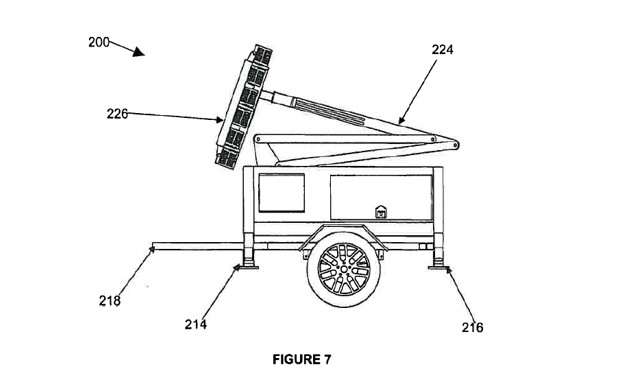
1. The parties provide to the associate to Downes J agreed or, if not agreed, competing, draft orders giving effect to these reasons within 7 days.
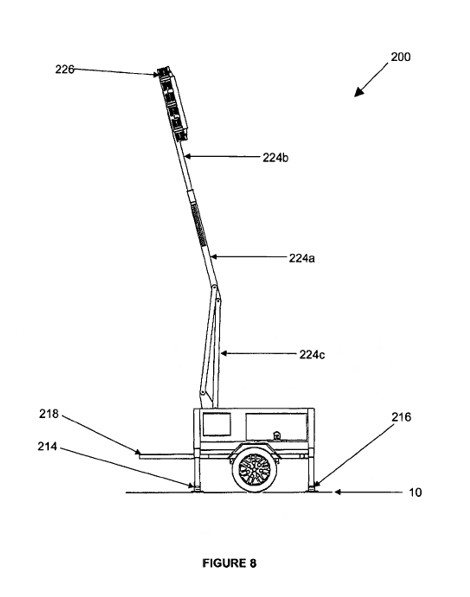
2. In relation to costs:
(a) within 7 days, the parties submit any agreed proposed orders as to costs;
(b) if the parties cannot agree, then within 10 days, each party file and serve a short written submission on costs limited to 3 pages, and within 14 days each party file and serve a short responding written submission limited to 2 pages. The issue of costs will then be determined on the papers.
Note: Entry of orders is dealt with in Rule 39.32 of the Federal Court Rules 2011.
REASONS FOR JUDGMENT
DOWNES J:
1. SYNOPSIS
1 The applicant and cross-respondent in each proceeding (Southern Cross) is the owner of Australian Innovation Patent No. 201310095 entitled “Lighting Tower” (Patent).
2 In July 2019, Southern Cross commenced proceeding QUD 470 of 2019 against Mickala Mining Maintenance Pty Ltd and its sole director and shareholder, Mr Damien Englebrecht, alleging infringement of claims 1 to 5 of the Patent. In December 2021, Southern Cross commenced proceeding QUD 447 of 2021 against Mickala Lighting Towers Pty Ltd and its sole director, Mr Englebrecht, also alleging infringement of claims 1 to 5 of the Patent.
3 The corporate respondents will together be described as Mickala.
4 Mickala admits infringing claims 1 and 4 of the Patent by exploiting six models of light-emitting diode (LED) lighting towers since September 2013 and before 30 January 2021, and a further four models since September 2013. However, Mickala denies infringing claims 2, 3 and 5, and by cross-claim, alleges that the claims are invalid on the grounds of lack of novelty and lack of innovative step with the consequence that the invention claimed in claims 1 and 4 of the Patent is not a patentable invention within the meaning of s 18(1A) of the Patents Act 1990 (Cth).
5 Mickala relies on five pieces of prior art that are submitted to be novelty destroying:
(1) an advertisement published by Southern Cross in the Australasian Mine Safety Journal (AMSJ Article);
(2) a brochure published by Southern Cross advertising its lighting tower products (Southern Cross Brochure);
(3) Innovation Patent No. 2011100774 (774 Patent);
(4) a sale of two lighting towers styled “EcoTower”, built in accordance or substantially in accordance with the invention disclosed in the 774 Patent (EcoTower); and
(5) the publication, trial, hire and sale of I-Light Series Lighting Towers (Exsto Towers) by Exsto Group Pty Ltd (formerly I-Eco Pty Ltd).
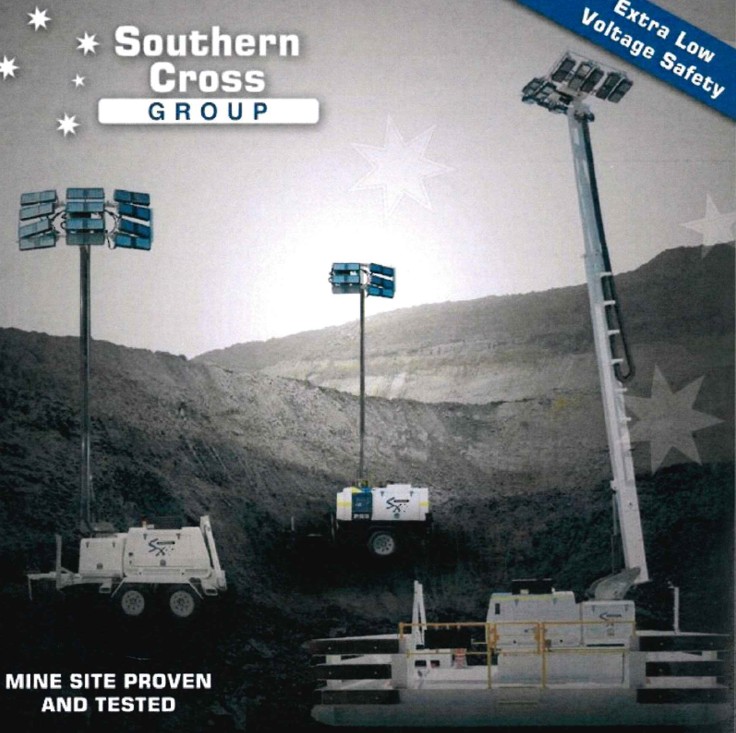
6 By order of Greenwood J dated 18 October 2019, it was ordered that all issues relating to liability for infringement be determined prior to and separately from any issues of quantification of pecuniary relief, including any entitlement to damages.
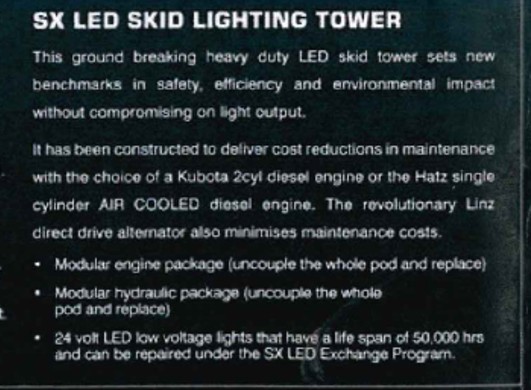
7 The trial of QUD 447 of 2021 was heard together with QUD 470 of 2019, with evidence given in one proceeding to stand as evidence given or tendered in the other.
8 In early April 2025, Southern Cross narrowed its infringement case to claims 1, 2, 3 and 4.
9 By its opening submissions dated 18 June 2025, being immediately prior to trial, Southern Cross further narrowed its infringement case, confining it to claims 1 and 4.
10 This had the consequence that Mickala confined its allegations of invalidity to claims 1 and 4.
11 For the following reasons, I have concluded that:
(1) claim 1 lacks novelty because it was anticipated by the AMSJ Article, the EcoTower and the Exsto Towers. Claim 4 lacks novelty because it was anticipated by the Exsto Towers;
(2) the alleged invention insofar as is claimed in claims 1 and 4 of the Patent does not involve an innovative step;
(3) the invention claimed in claims 1 and 4 of the Patent is not a patentable invention within the meaning of s 18(1A) of the Patents Act; and
(4) the claim brought against the respondents in each proceeding must be dismissed.
12 I will direct the parties to confer as to the appropriate form of orders, including on the question of costs.
2. PATENT
13 The Patent is entitled “Lighting Tower” and claims a priority date of 30 January 2013 (priority date).
14 The invention relates to the field of lighting towers.
15 The Abstract of the Patent states as follows:
A lighting tower having a low voltage alternator, typically approximately 24V, powering an LED lighting unit. The alternator is a direct drive alternator connected directly to a small block diesel engine. The lighting tower is entirely low voltage reducing electrocution and ignition risks, and is highly efficient through the use of LED elements in the LED lighting unit and the efficient direct drive alternator.
16 The Background to the Invention states as follows:
…
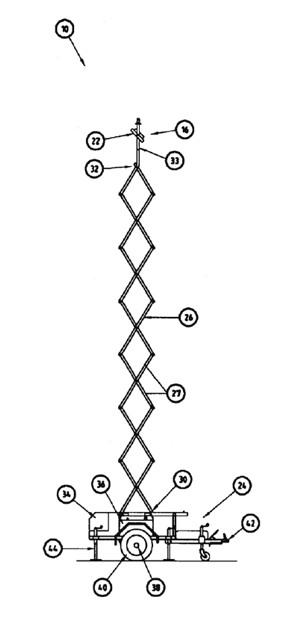
Lighting towers provide relatively portable lighting for situations where sufficient lighting is not available, for example, for night construction or mining operations. Typically a lighting tower has a lighting unit, a mast to position the lighting unit, and a power source to power the lighting unit. Some portable lighting towers have wheels, for manoeuvring the lighting tower, and a self sufficient engine to provide the power source.
While such lighting units are adequate, a number of disadvantages have arisen. Typically the power source included a petrol or diesel powered engine connected to an alternator via a belt. The alternator then provides electrical power to the bulbs. The belt between the engine and the alternator can not only reduce operating efficiency, but also requires maintenance which results in downtime and additional costs.
Furthermore, the lighting unit is typically powered by one or more high voltage bulbs, typically metal halide lamps, requiring a relatively high voltage and power requirement. Such high voltages introduce safety hazards, such as risk of electrocution, and can cause unexpected sparking or arcing to occur in the event of failure.
Lighting systems have also progressed significantly since such high voltage bulbs were first introduced and they are now considered to be inefficient compared to higher efficiency lighting systems, such as those using LED lights. The inefficient high voltage bulbs require more power which in turn requires larger and more expensive engines to power them. There are also associated costs and environmental concerns with increases in fuel consumption.
While LED lights are considerably more efficient, their power requirements are different to the traditional high voltage bulbs. For example, LED lights require combatively low voltages to operate. This means that the previous high voltage bulbs cannot be simply swapped for LED lights. Instead, a voltage conversion is required to reduce the voltage provided from the alternator to be suitable for the LED lights. Existing systems may be able to be retrofitted with low voltage LED lights using a transformer to step down the voltage, but the previous problems associated with having high voltages present in the system, such as potential electrocution, are not addressed.
Although LED lights can be used with some existing lighting reflectors to provide lighting, the nature of the light from LED lights is different to that of previous high voltage bulbs and, accordingly, reflectors used for previous arrangements are not suitable and do not provide optimal reflection when used with LED lights.
17 The Summary of the Invention states as follows:
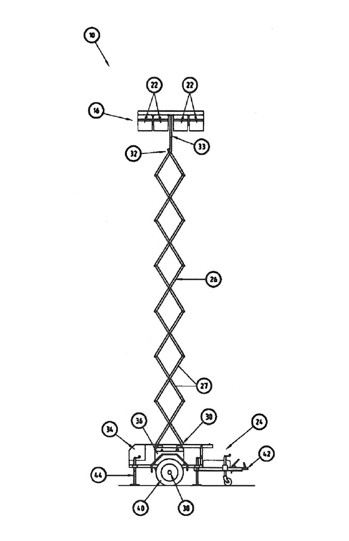
According to an aspect of the invention, there is provided a lighting tower comprising:
an engine;
an alternator mechanically connected to the engine; and
an LED lighting unit electrically connected to the alternator, the LED lighting unit being mounted on a manoeuvrable mast;
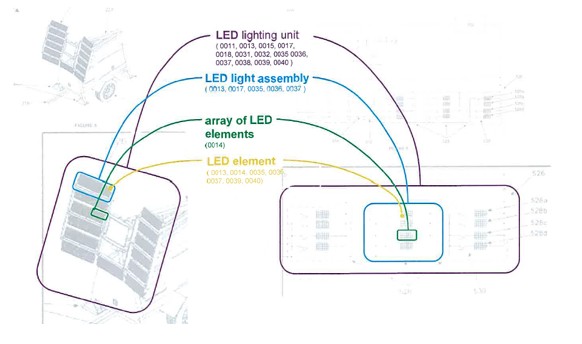
wherein the alternator is a low voltage alternator, having a voltage output of less than 50V, connected directly to a shaft of the engine.
Preferably, the alternator has a shaft that is connected directly to the shaft of the engine by having a common, axially aligned shaft.
Preferably, the LED lighting unit has at least one 12-24V LED light assembly having a plurality of LED elements and the alternator has a voltage output of approximately 12-24V electrically connected to the at least one 12-24V LED light assembly. In a preferred form, the 12-24V LED light assembly is a 24V LED light assembly and the alternator has a voltage output of approximately 24V. The alternator preferably has a current output of approximately 200A.
Preferably, the plurality of LED elements are arranged in at least one two dimensional array and at least a portion of the LED elements have individual optical elements. The optical elements preferably include reflectors and/or lenses and the individual optical elements may have different characteristics for one or more of the LED elements relative to the other LED elements. Preferably a plurality of arrays of LED elements are provided. At least some of the plurality of arrays are preferably arranged at an angle relative to at least some of the other arrays. Each array of LED elements preferably has a Zener diode. Preferably the Zener diode is rated for at least 50V DC, even more preferably at least 70V DC.
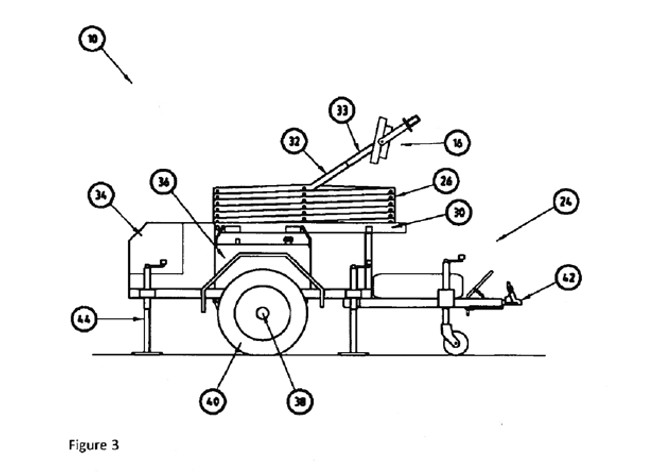
Preferably, the lighting tower further comprising at least one capacitor electrically connected in parallel to the LED lighting unit to reduce voltage spikes from the alternator. Preferably the LED lighting unit includes the at least one capacitor electrically connected in parallel to the alternator. Preferably a plurality of capacitors are provided. Preferably the plurality of capacitors are connected in parallel. In a preferred form, four capacitors, preferably rated for approximately 48V DC and 4700 micro farads, are connected in parallel in the lighting unit.
The engine is preferably a diesel engine, and is preferably a small block engine. In a preferred form the engine is a 2 cylinder Kubota engine or a 1 cylinder Hatz engine.
Preferably, the alternator has an output current of between 175 to 400A DC; the LED lighting unit has 100W to 1kW of LED lighting across 3 to 24 24V LED light assemblies connected in parallel; and/or the engine has a 5 to 20hp output.
The lighting tower preferably further comprises a chassis, preferably a wheeled chassis with ground engaging stabilisation legs. The engine, alternator, LED lighting unit and manoeuvrable mast are preferably all mounted on the chassis. The manoeuvrable mast is preferably at least height adjustable, and is preferably actuated hydraulically.
Further features and advantages of the present invention will become apparent from the following detailed description.
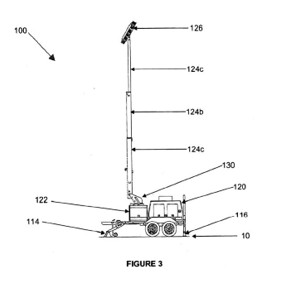
18 The Brief Description of the Drawings states that Figure 3 (reproduced below) is a side elevation view of the lighting tower illustrated in Figure 1 in an extended position.
19 In the Detailed Description of the Drawings, by reference to Figure 3, the following is stated:
Figure 3 illustrates the lighting tower 100 in an extended position in which the mast 124, which can be seen to be in three telescopic segments 124a, 124b and 124c, is extended, positioning the LED lighting unit 126 at a predetermined height above ground level 10. The front stabilising legs 114 and rear stabilising legs 116 are also manoeuvred, typically hydraulically, such that they engage with the ground to provide support and stability to the chassis 110. The mast 124 is actuated hydraulically, and is moveably mounted with respect to the hydraulic module 122 via a swivel connection 130.
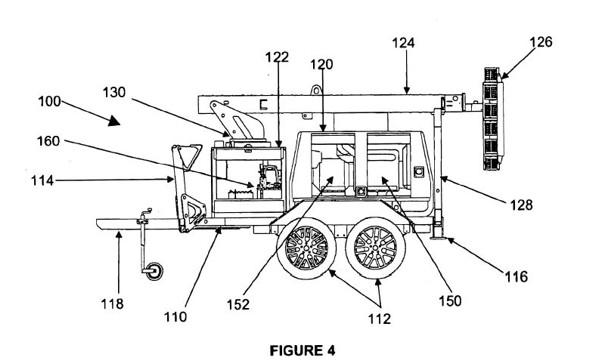
20 Figure 4 (reproduced below) is a side elevation view of the lighting tower illustrated in Figure 1 with open service hatches.
21 Figure 5 (reproduced below) is perspective view of the lighting tower illustrated in Figure 1 partially cutaway detailed views.
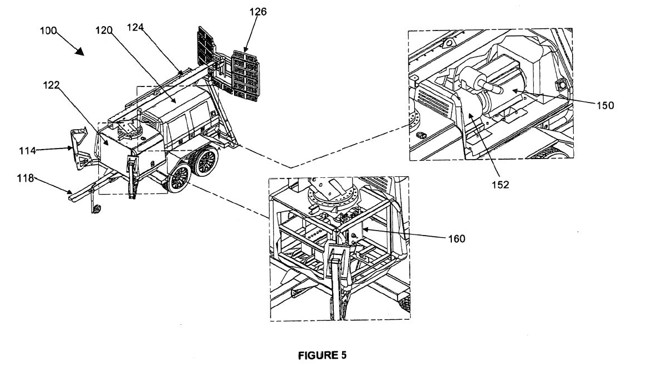
22 By reference to Figures 4 and 5, the following is stated in the Detailed Description of the Drawings:
Figure 4 illustrates the engine module service hatch 120’ and the hydraulic module service hatch 122’ in an open position and figure 5 illustrates the components inside the engine module 120 and hydraulic module 122 in greater detail. As can be seen in figures 4 and 5, the engine module includes an engine 150 connected directly via a common axially aligned shaft to an alternator 152. The engine is a small block diesel engine, preferably a 2 cylinder Kubota or 1 cylinder Hatz engine. The alternator 152 is preferably a Linz 24V 200A or Sincro 24V 200A alternator which may be modified by bridging thermal switches thereon. The hydraulic module includes a hydraulic system 160 that is powered by the alternator 152. The hydraulic system actuates movement of various hydraulic components including the mast 124.
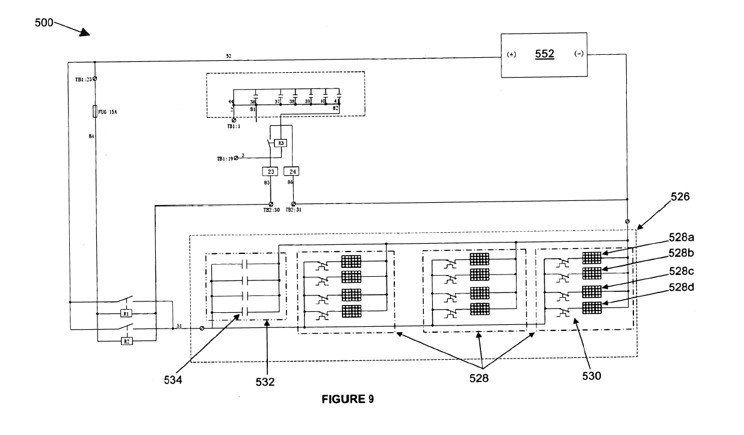
23 Figure 9 (reproduced below) is a circuit schematic of a preferred embodiment of the invention.
24 By reference to Figure 9, the following is stated:
Figure 9 illustrates an electrical circuit diagram for a lighting tower according to a preferred embodiment. The circuit 500 has alternator 552 which provides DC power, preferably 24V, to an LED lighting unit 526. The LED lighting unit 526 comprises three 24V LED light assemblies 528 that each comprise four arrays of LED elements 528a, 528b, 528c, and 528d, connected in parallel. Connected in series with each of the arrays of LED elements 528a, 528b, 528c, and 528d is a Zener diode 530 which, in preferred embodiment, is rated for 70V DC.
Connected in parallel to the four arrays of LED elements 528a, 528b, 528c, and 528d is a capacitor bank 523 that comprises four capacitors 534 connected in parallel. In a preferred embodiment each capacitor is a 4700 micro farad capacitor rated for 48V DC. The capacitors provide stable power supply to the 24V LED light assemblies 528 but smoothing out fluctuations, such as power spikes, caused by the alternator and/or EMF induced by cabling between the alternator and the LED lighting unit 526.
25 By reference to the use of the invention, the following is stated:
…
Advantageously, the lighting towers 100, 200 are portable, energy efficient, self sufficient lighting sources that can be temporarily, or permanently, arranged to provide light to an area to be illuminated. The LED lighting unit 126, 226 is not only energy efficient, but also operates on a lower, much safer, voltage (e.g. 24V DC) than previous lighting towers. Individual optical elements for the LED elements enhances the usable light from the LED elements by directing the light in an optimal manner for the task at hand, ensuring lighting power is not lost through poor optical management as can occur when all of the elements have the same optical characteristics.
Furthermore, the direct drive 24V alternator ensures the entire system operates at low voltage, without any high to low voltage conversion, while also reducing maintenance, servicing requirements, and efficiency losses by avoiding indirect mechanical coupling systems such as a belt between the engine and alternator.
…
26 Claim 1 of the Patent states as follows (with integers identified):
A lighting tower comprising [integer 1.1]:
an engine [integer 1.2];
an alternator mechanically connected to the engine [integer 1.3]; and
an LED lighting unit electrically connected to the alternator [integer 1.4];
the LED lighting unit being mounted on a manoeuvrable mast [integer 1.5];
wherein the alternator is a low voltage alternator [integer 1.6];
[the alternator] having a voltage output of less than 50V [integer 1.7];
[the alternator] connected directly to a shaft of the engine [integer 1.8];
wherein the LED lighting unit comprises a plurality of arrays of LED elements [integer 1.9]; and
at least some of the plurality of arrays being arranged at an angle relative to at least some of the other arrays [integer 1.10].
27 Claim 4 of the Patent states as follows (with integers identified):
The lighting tower of any one of the preceding claims, wherein the LED lighting unit comprises at least one capacitor electrically connected in parallel to the alternator [integer 4.1].
3. WITNESSES CALLED BY THE PARTIES
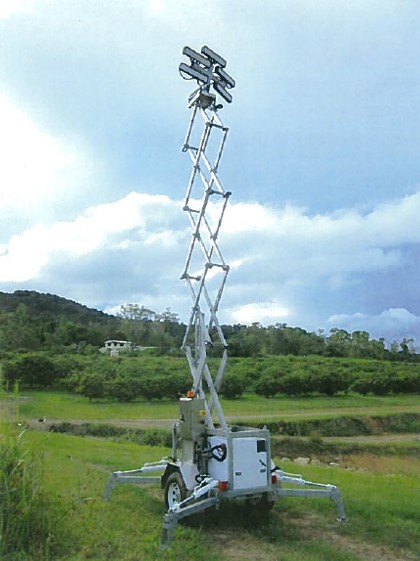
28 Southern Cross called Mr Geoffrey Sizer, an electrical engineer and electronics design engineer, to give expert evidence. Mr Sizer swore six affidavits, which were filed on 24 February 2023; 12 September 2023 (Sizer 2); 22 September 2023; 19 March 2024; 16 May 2025; and 22 May 2025.
29 Southern Cross also relied on the following affidavits of lay witnesses:
(1) affidavit of Ms Svetlana Zatsepin filed 16 May 2025;
(2) affidavit of Ms Shannyn Flynn filed 16 May 2025; and
(3) affidavit of Mr Robert Champney filed 16 May 2025.
30 Mickala called Mr Patrick Fogarty, electrical engineer, to give expert evidence. Mr Fogarty swore six affidavits, but only five were relied upon at trial being filed on 21 February 2022; 29 March 2023 (Fogarty 2); 19 May 2023; 7 February 2024 (Fogarty 4) and 2 June 2025. It was common ground that Mr Fogarty held the qualifications of the notional person skilled in the art (PSA).
31 While it was also common ground that Mr Sizer held the qualifications of the notional PSA, I give less weight to the evidence of Mr Sizer for the following reasons.
32 First, Mr Sizer accepted that he did not have Mr Fogarty’s experience in relation to lighting tower design.
33 Secondly, Mr Sizer volunteered that he “can’t really comment on the mindset of someone” who is a “practical person… interested in buying, selling, [or] making lighting towers” which causes me to wonder what mindset he did adopt for the purposes of his expert evidence concerning construction and novelty, in particular.
34 Thirdly, Mr Sizer’s view as to compliance with the Harmonised Expert Witness Code of Conduct was that he was not permitted to express any opinion outside of the questions he was asked, even if an opinion expressed in an earlier affidavit had changed. This is, of course, incorrect. The duty of an expert is to assist the Court even if that means going beyond the scope of their instructions or withdrawing evidence which was helpful to the party calling them.
35 Mickala also relied on the following affidavits of lay witnesses:
(1) affidavit of Mr Istvan Torok filed 22 May 2023 (Torok Affidavit);
(2) affidavits of Mr Frank Tate filed 25 March 2025 (Tate 1), 16 April 2025 (Tate 2) and 2 June 2025.
36 There is also a joint expert report (JER) of Mr Fogarty and Mr Sizer dated 16 May 2025.
4. COMMON GENERAL KNOWLEDGE
37 As to the common general knowledge (CGK), it was not disputed that the CGK as at the priority date included the following:
(1) DC voltage – an electric circuit or system utilising DC power has constant polarity (the current flows from positive-to-negative (conventional current, or negative-to-positive (electron flow), in only one direction). The DC voltage of the system is usually expressed as the voltage between a reference point, often the lowest potential, or ground point, and the highest potential point, often at the electrical supply. An ideal DC circuit would have a DC voltage that is constant and does not vary over time. In practice due to practical limitations all DC circuits experience some variation in the DC voltage. For this reason voltages are typically quoted as nominal voltages and in practice vary around the nominated value;
(2) alternators are a rotating machine that is a type of electric generator. Alternators produce AC voltage and are fitted with electronic circuits to produce DC voltage where this is required;
(3) voltage regulation refers to a system’s ability to maintain a constant voltage given changes to input conditions, or circuit loads. Similarly, without effective regulation voltages will drop in a system as load is added, or spike when it is removed. Alternators typically have control circuitry to vary the power available and maintain voltage as load varies;
(4) transients are considered to be short term spikes or oscillations that are not part of the designed system. Voltage transients can be caused by a number of external factors, such as electrical interference, or from the nature of the circuit or load. Transients are typically considered undesirable and measures such as filtering are employed to reduce them;
(5) an electrical generator is a device that converts mechanical energy (movement) to electrical power. An alternator is a form of electrical generator;
(6) a capacitor is an electrical device that stores electrical energy. Capacitors have the property that they present an open circuit to DC current (i.e., do not let current pass) and when correctly specified present a short circuit (or no resistance) to AC current. This makes them particularly useful for filtering applications;
(7) light emitting diodes or LEDs. The LED “lamp” typically consists of semiconductor material, typically square, which when powered shines very brightly. A lighting assembly is an assembly containing one or more arrays of LED elements. These assemblies are constructed with various geometries using these sources together with lenses and reflectors to produce the desired lighting distribution. Typical LED flood type lighting assemblies consist of an array of source LEDs mounted with reflectors and/or lenses to control light output. These have been commercially available in Australia since around 2008;
(8) lighting towers provide relatively portable lighting for situations where sufficient lighting is not available, for example, for night construction or mining operations;
(9) such lighting towers typically include a lighting unit, a mast (or other mechanism) to position the lighting unit, and a power source to power the lighting unit;
(10) typically the power source includes a petrol or diesel powered engine connected to an alternator via a belt. The belt between the engine and the alternator, however, can reduce operating efficiency, and also requires maintenance which results in downtime and additional costs;
(11) a direct coupling mechanism of the engine and alternator is more efficient and less prone to breakdown;
(12) having an indirect connection between the alternator and shaft of the engine reduces operating efficiency and requires maintenance which results in downtime and additional costs and a direct connection avoids the need for an additional moving part in the form of a belt or equivalent;
(13) the term “two-dimensional array”, in engineering terminology, means there are multiple items arranged on a two-dimensional plane, and for example consists of rows and columns of LED elements arranged in a regular pattern;
(14) the presence of two-dimensional arrays in lighting towers allows for the flexible inclusion of the required number of LEDs and could be more compact and portable and likely to reduce manufacturing costs and enhance reliability and modularity;
(15) individual optical elements for LED elements enhance the usable light from LED elements by directing the light in an optimal manner for the task at hand, ensuring lighting power is not lost through poor optical management as can occur when all of the elements have the same optical characteristics;
(16) if there are shared optical elements, the even distribution of LED light across the region of interest may not occur and uneven distribution of light may affect the ability of those relying on the light to perform their tasks;
(17) the use of capacitors is a common method of providing filtering in a DC circuit and providing protection from transients where the need exists;
(18) the inclusion of a capacitor would be beneficial when there is a need to reduce the amplitude of transients (power or voltage spikes) and/or to reduce unwanted electromagnetic emissions;
(19) if a capacitor is to be used, it is connected in parallel or in a configuration that achieves the same objective. The question of what it means to be “connected in parallel” is addressed below;
(20) power conditioning refers to the process of improving the quality of electrical power to make it suitable for electronic devices and equipment. This process involves the use of various devices and techniques to reduce or eliminate electrical noise, voltage fluctuations, and other irregularities that can affect the performance and lifespan of electronic devices. In a DC system the aim of power conditioning is to achieve a constant DC voltage;
(21) LED lights are more efficient than high voltage bulbs as they have different power requirements. If a high-voltage power source is used, this requires voltage conversion to reduce the voltage provided from the alternator to be suitable for the LED lights;
(22) to achieve the required current flow through an LED, the power source driving it is required to apply the required DC voltage to the LED, in the correct polarity, along with a means to control the current flow.
5. CONSTRUCTION
38 There is disagreement between the parties over the proper construction of the following terms used in the claims:
(1) claim 1, integer 1.5: meaning of “manoeuvrable mast”; and
(2) claim 4, integer 4.1: meaning of “electrically connected in parallel to the alternator”.
5.1 “manoeuvrable mast”
39 The ordinary meaning of the term “mast” encompasses similar vertical structures to a pole including a construction taking the form of a latticework tower or tripod.
40 The Oxford English Dictionary (online) includes the following entry for the word mast:
An upright pole or similar vertical structure resembling a ship’s mast, esp. one supporting a flag, lighting conductor, broadcasting aerial, etc.; such a pole or structure forming part of a building, crane, etc. Also: a construction, often taking the form of a latticework tower or tripod, erected on a ship for various purposes, such as radio transmission, etc.
41 Mr Sizer opined in Sizer 2 at [16] (in relation to integer 1.5) that he would have understood this integer to have its ordinary English meaning and that a mast is a pole, post or similar item on which items can be mounted, typically to elevate them.
42 In the JER at [83], Mr Fogarty stated that “Mr Sizer considers that a mast is “a post, pole or similar item” …The usage of the term “mast” within the engineering industry includes for a much wider definition and includes such terms as guyed radio masts of various constructions, telecommunications masts utilising lattice construction as well as the simpler “pole” type masts Mr Sizer refers to”. Mr Fogarty also described Mr Sizer’s interpretation as “overly narrow”.
43 By comparison, Figure 7 of the Patent is replicated here, and it shows a segmented “mast” which can be folded down, or rotated and extended, and which does not appear to have a swivel connection between the mast and the base:
44 Figure 8 of the Patent is depicted below and show the segmented mast in extended format, with no swivel connection between the mast and the base:
45 It is stated in the Patent that, “[a]s shown in figure 8 the mast 224 also differs in that telescopic segment 224a receives only a single extension segment 224b, with segment 224a also folding relative lower segment 224c”: [0034].
46 Taking into account the ordinary meaning of “mast”, which encompasses a pole or structure, and the depiction of the mast in Figures 7 and 8 of the Patent, I consider that a mast is more than a mere pole, post or similar item, as stated by Mr Sizer, and I prefer Mr Fogarty’s evidence on this construction issue.
47 As to the term “manoeuvrable”:
(1) Mr Sizer’s initial opinion was that the term “manoeuvrable mast” is to be given its ordinary English meaning, and that it encompasses a mast “which can be moved or adjusted in one or more directions”. However, by his evidence in Sizer 2, Mr Sizer proceeded to narrow this construction by reference to preferred embodiments of the invention. In particular, he considers that “manoeuvrable” in the context of the Patent means “able to rotate relative to the light tower chassis”.
(2) Mr Fogarty points out that the Patent itself envisages a manoeuvrable mast that is not rotatable at [0018] where it is stated that the “manoeuvrable mast is preferably at least height adjustable”. The use of the phrase “at least” connotes that the only manner in which the mast is manoeuvrable is that it is height adjustable, and nothing more. This is also consistent with his evidence in relation to Figures 7 and 8 of the Patent.
48 In the context of claim 1, the word “manoeuvrable” is an adjective. It is not a term of art. The Oxford English Dictionary (online) defines the term as “[a]ble to be manoeuvred easily or effectively”. That ordinary meaning of the word “manoeuvrable” does not import or convey any concept of being able to be manoeuvred in any specific way.
49 When one has regard to the Patent itself, the word “manoeuvring” is used by reference to moving the lighting tower along the ground at [0003], the “manoeuvrable mast” is described as being “at least height adjustable” at [0018], the mast by reference to Figures 1 to 5 is described as “manoeuvrable with respect to the chassis” [0031], there is reference to stabilising legs in Figures 1 to 5 being “manoeuvred” in [0032] and the mast in the Figures 6 to 8 is described as being “manoeuvred upward” in [0038]. The word “manoeuvre” is used in different ways to describe a form of movement.
50 The approach by Mr Sizer of selecting the reference to “manoeuvrable with respect to the chassis” in [0031] by reference to Figures 1 to 5 (depicting a preferred embodiment) and other paragraphs relating to a preferred embodiment, and to rely on those references to alter the plain meaning of the word “manoeuvrable” is impermissible as it would impose a gloss, and give an unnatural meaning to, that word: see, generally, Caffitaly System SpA v One Collective Group Pty Ltd (2020) 154 IPR 1; [2020] FCA 803 at [29]–[30] (Nicholas J). His construction also fails to take into account the lack of disclosed swivel connection in Figures 7 and 8, as referred to above. For these reasons, I prefer the evidence of Mr Fogarty on this construction issue.
51 It follows that a “manoeuvrable mast” encompasses similar vertical structures to a pole including a construction taking the form of a latticework tower or tripod which is able to be manoeuvred, being one which can be moved or adjusted in one or more directions.
5.2 “electrically connected in parallel to the alternator”
52 Relevantly, integer 4.1 claims “[t]he lighting tower of any one of the preceding claims wherein the LED lighting unit comprises at least one capacitor electrically connected in parallel to the alternator”. Based on the evidence below, there appears to be no dispute between the experts’ evidence as to the proper construction of the integer.
53 In Fogarty 2, Mr Fogarty explained the meaning of “connected in parallel” as it would have been understood by the PSA as at the priority date:
When referring to electrical devices a component connected in parallel refers to it being connected across each side of the device. In this way, the component in parallel may provide an alternate path for electricity apart from the primary path. This is as opposed to components in series which form part of the primary circuit and therefore part of the primary electrical path. Because capacitors allow the passage of AC current when used in parallel, they can be used on DC circuits to provide a direct passage to ground and reduce surges or AC ripple in a DC circuit. An example of this in practice was the use of suppression capacitors installed in parallel to the output terminals on automobile alternators in order to reduce electrical interference, particularly radio static.
54 Insofar as integer 4.1 is concerned, Mr Sizer appeared to agree with Mr Fogarty, stating in Sizer 2:
A capacitor is a two-terminal electrical component exhibiting capacitance, being the ability of the component to collect and store energy in the form of an electrical charge, as its primary useful electrical characteristic.
A “capacitor electrically connected in parallel to the alternator” means that one electrical terminal of the capacitor is electrically connected (eg via electrically conductive wire) to one electrical terminal of the alternator, and the second electrical terminal of the capacitor is electrically connected to the second electrical terminal of the alternator. This forms a “parallel electrical connection” as would have been understood by persons (including me) with knowledge of electrical circuits.
6. NOVELTY
6.1 Overview
55 The issues in dispute on the question of validity in relation to novelty are:
(1) whether the AMSJ Article discloses integers 1.8 and 4.1;
(2) whether the Southern Cross Brochure discloses integers 1.8 and 4.1;
(3) whether the 774 Patent discloses integers 1.5, 1.10 and 4.1;
(4) whether the EcoTower discloses the presence of an alternator (integers 1.3, 1.4, 1.6, 1.7, 1.8, and 4.1); integers 1.5, 1.8 and 1.10; and integer 4.1;
(5) whether certain of the Exsto Towers disclose the presence of all integers in claims 1 and 4;
(6) the public availability of the EcoTowers and the Exsto Towers.
56 In Rakman International Pty Ltd v Trafalgar Group Pty Ltd (2022) 166 IPR 264; [2022] FCA 464 at [101], [102], [104] and [107], Yates J gave the following helpful summary of the relevant principles:
As is made clear in General Tire, if a prior documentary publication contains clear instructions which, if followed, will inevitably constitute an infringement of the invention as claimed (assuming the claim to be valid), then the prior publication will be novelty-destroying. However, if the prior publication gives a direction which could be carried out in a way that would infringe the claim, but could also be carried out in a way that would not infringe the claim, the prior publication will not be novelty-destroying. In short, the “flag” will not have been “planted”.
… If an essential feature of the invention, as claimed, is not explicitly disclosed, the publication may still be novelty-destroying if the person skilled in the art would infer the presence of the feature from the document itself.
…
There are limits to which [implicit disclosure] can be applied. As Jacob J cautioned in Hoechst Celanese Corp v BP Chemicals Ltd [1998] FSR 586 at 600–1:
… if what is said to be implicit in a document is given too much scope you will be blurring the distinction between lack of novelty and obviousness. On the other hand it must be right to read the prior document with the eyes of the skilled man. So if he would find a teaching implicit, it is indeed taught. The prior document is novelty-destroying if it explicitly teaches something within the claim or, as a practical matter, that is what the skilled man would see it is teaching him.
…
Thus, in a challenge to validity based on lack of novelty, it is not sufficient to say that, on reading the prior documentary publication, the person skilled in the art would see that the need for a claimed feature, which is not explicitly referred to or illustrated, is obvious. The question is whether the claimed feature would be (is) revealed to the person skilled in the art, implicitly, by the disclosure itself, based on that person’s understanding of the disclosure. This is a nuanced, but important, distinction. The plurality in AstraZeneca v Apotex said (at [311]):
Section 7(1) of the Act sets the precise boundaries of the information that is to be taken into account when assessing novelty. Common general knowledge, as a notionally organised body of information possessed by the person skilled in the art, does not fall within these boundaries.
(Emphasis added.)
57 Thus, although an implicit disclosure may constitute a sufficient disclosure for finding that information in a prior art document anticipates a claimed invention, the limits of implicit disclosure must be borne in mind. Implicit disclosure is confined to what is in fact disclosed by the prior art document. Section 7(1) does not permit the CGK to be used as a resource that can be deployed complementarily to arrive at a disclosure which the document alone, properly construed, does not make: see BlueScope Steel Ltd v Dongkuk Steel Mill Co, Ltd (No 2) (2019) 152 IPR 195; [2019] FCA 2117 at [1031] (Beach J); see also, generally, ICI Chemicals & Polymers Ltd v Lubrizol Corporation Inc (2000) 106 FCR 214; [2000] FCA 1349 at [43] (Lee, Heerey and Lehane JJ).
6.2 Standard of proof
58 As this is civil litigation, the standard of proof is the balance of probabilities: see s 140(2) of the Evidence Act 1995 (Cth).
59 Southern Cross submits that the prior acts relied on by Mickala (by reference to the public availability of the EcoTower and the Exsto Towers) must be “strictly proved”, relying on Aspirating IP Ltd v Vision Systems Ltd (2010) 88 IPR 52; [2010] FCA 1061 (Besanko J).
60 As I observed in Allied Pumps Pty Ltd v LAA Industries Pty Ltd (2023) 179 IPR 1; [2023] FCA 1457 at [199], the reference to the prior public use being “strictly proved” in Aspirating refers to the need for the Court to carefully consider whether the evidence adduced by the party is sufficient to establish the occurrence of that prior use on the balance of probabilities, having regard to the nature and quality of the evidence relied upon. This will necessarily be affected by matters such as how long ago the relevant events occurred, whether the evidence depends upon the memory of witnesses alone (given the fallibility of memory and the risk of reconstruction), the credibility of the witnesses as assessed by the Court, the objective plausibility of the events having occurred as recounted by the witnesses, whether the evidence is corroborated or contradicted by other evidence (such as contemporaneous records) and whether the evidence of the prior acts relates to recollections of the features or usage of equipment which is not in evidence.
6.3 The AMSJ Article
61 Although the parties described this as the AMSJ Article, it is, in fact, a two-page advertisement which appeared in the Australasian Mine Safety Journal which was published in the “Summer” of 2011. The advertisement related to three different types of LED Lighting Towers available from the Southern Cross Group. The advertisement includes the following photograph:
62 One of the passages in the advertisement, which appears under this photograph, reads as follows:
63 For the purposes of integer 1.8, the critical sentence in the above passage is “The revolutionary Linz direct drive alternator also minimises maintenance costs” (emphasis added). The advertisement also refers to “smaller engine size”, “light weight”, “reduced maintenance costs” and “improved reliability”.
64 Mr Fogarty’s opinion was that the reference to “Linz direct drive alternator” in the AMSJ Article discloses an alternator connected directly to a shaft of the engine because “direct drive” means that the alternator is directly connected to the engine via a shaft as opposed to some other method such as a belt.
65 Mr Fogarty further explained during the concurrent evidence session that:
MR LOGAN: And would it also mean that it could – rather than it actually being connected that way, but it could be connected by some other means in this particular device, even though it was suitable for that direct connection. Do you agree with that?
MR FOGARTY: I – I don’t agree with that. It could be – sorry, if I can just clarify. It could be, but to go to the expense of buying an alternator with the bearings, etcetera, that made it able to be directly connected, I don’t understand why you would connect it some other way. I see the direct drive as a – as part of their marketing brochure here in the sense that lower maintenance costs and some of the other aspects that they’ve raised.
66 Mr Sizer’s opinion was that whilst he would have expected that, based on the words “direct drive”, the alternator to likely be directly connected to the engine shaft, the AMSJ Article does not explicitly state it is in fact connected directly to a shaft of the engine and it may have been connected indirectly via a gearbox, belt and pulley or chain and sprocket system.
67 However, during concurrent evidence, Mr Sizer accepted that:
(1) he would have expected it was likely the Linz direct drive alternator was directly connected to the engine;
(2) he did not consider it was disclosed by the AMSJ Article because it is not “definitively and explicitly disclosed” which was the test he was applying. He was also influenced by the fact that it was an “advertising and promotional brochure”, which does not matter. Less weight is given to Mr Sizer’s opinions for these reasons;
(3) if an alternator was indirectly connected (via gearbox, belt and pulley or chain and sprocket) that would have been a less efficient mechanism and could potentially result in higher maintenance costs;
(4) reading the words “revolutionary Linz direct-drive alternator also minimises maintenance costs”, any reasonable engineer could assume that the effective way of minimising maintenance costs would be to directly connect the alternator to a shaft of the engine, but they would have to “read between the lines and make assumptions”;
(5) reading the AMSJ Article he would “probably expect it to be direct… coupled” unless there were other factors suggesting a non-direct configuration would be necessary.
68 In my view and taking into account the matters which were accepted by Mr Sizer above, integer 1.8 is disclosed in the AMSJ Article for the reasons explained by Mr Fogarty. It follows that claim 1 was anticipated by the AMSJ Article, all other integers being conceded as present.
69 As to integer 4.1 and contrary to Mickala’s submission, a skilled addressee, on reading the AMSJ Article, would not immediately understand that the LED light units depicted would include electronic componentry that included capacitors electrically connected in parallel with the alternator, as such a configuration is not disclosed. This conclusion was reached by the experts in the JER at [52]. While the experts accepted that capacitors would be expected to be included in the componentry (although not disclosed), Mr Sizer gave uncontradicted evidence that “there are a number of different configurations of the use of that capacitor”. Further, Mr Fogarty did not give reasons in the JER or Fogarty 2 as to why capacitors “electronically connected in parallel” are likely to be present; his reasons in Fogarty 2 were directed to the likelihood of the presence of a capacitor alone rather than its configuration. This has the consequence that no weight can be given to this opinion.
70 For these reasons, integer 4.1 is not disclosed in the AMSJ Article with the consequence that this aspect of the invalidity attack on claim 4 must fail.
6.4 Southern Cross Brochure
71 Like the AMSJ Article, the Southern Cross Brochure was published in 2011 by Southern Cross. The brochure related to different aspects of the Southern Cross business, and included three pages on its commercial lighting business.
72 By the JER at [55], the experts agreed that the Southern Cross Brochure does not disclose a lighting tower that possesses an alternator connected directly to a shaft of the engine. That is, while the Southern Cross Brochure discloses an alternator, there is no disclosure of it being “connected directly”. Mr Fogarty’s evidence that it is “likely to be present as this method of connecting alternator and engine was and remains typical for this type of application” is insufficient to establish anticipation.
73 By the JER at [75], the experts agreed that the Southern Cross Brochure does not disclose a lighting tower that possesses an LED lighting unit comprising at least one capacitor electrically connected in parallel to the alternator. Further, Mr Fogarty did not give reasons in either the JER or Fogarty 2 as to why capacitors “electronically connected in parallel” are likely to be present; his reasons in Fogarty 2 were directed to the likelihood of the presence of a capacitor alone rather than its configuration. This has the consequence that no weight can be given to this opinion.
74 For these reasons, integers 1.8 and 4.1 are not disclosed in the Southern Cross Brochure with the consequence that this aspect of the invalidity attack on claims 1 and 4 must fail.
6.5 774 Patent
75 The 774 Patent is entitled “A Portable Lighting Tower” which is said to be “energy efficient, compact and robust”. It has five claims which are set out below, with their integers identified:
1.1 | A portable lighting tower including: |
1.2 | a combustion engine; |
1.3 | a permanent magnet direct current (DC) alternator driven by the combustion engine to output a direct current; and |
1.4 | at least one high-power light emitting diode (LED) lamp powered by the direct current generated by the permanent magnet DC alternator. |
2.1 | A portable lighting tower including: |
2.2 | an air-cooled diesel engine; |
2.3 | a direct current (DC) alternator driven by the diesel engine to output a direct current; and |
2.4 | at least one high-power light emitting (LED) lamp powered by the current generated by the DC alternator. |
3.1 | The portable lighting tower of claim 2, wherein |
3.2 | the DC alternator is a permanent magnet DC alternator including a permanent magnet. |
4.1 | The portable lighting tower of any one of the preceding claims, wherein |
4.2 | the current generated by the DC alternator is at or below 60VDC and the high-power LED lamp is adapted to be powered by a current with a voltage at or below 60VDC. |
5. | A portable lighting tower including: |
5.1 | a scissor lift mechanism having at least two pivotally connected scissor arms and operable to be expanded or collapsed; and |
5.2 | one or more lamps mounted to the scissor lift mechanism. |
76 It is Mr Fogarty’s opinion in Fogarty 2 that all of the integers of claims 1 and 4 of the Patent are disclosed in the 774 Patent. Mr Sizer relevantly disputes disclosure of integers 1.5, 1.10 and 4.1 in Sizer 2.
6.5.1 Integer 1.5
77 The issue was whether the scissor lift mechanism disclosed in the 774 Patent was or had a “manoeuvrable mast” within the meaning of integer 1.5.
78 The difference between the experts turns on their different constructions of “mast” and “manoeuvrable”.
79 Having regard to my findings as to the proper construction of “manoeuvrable mast” in integer 1.5 of the Patent, a manoeuvrable mast is disclosed in the 774 Patent within the meaning of integer 1.5 in the 774 Patent. This is especially when one has regard to Figure 4 of the 774 Patent, which is depicted below and shows what is described in integer 5.2 as a “scissor-lift mechanism”:
80 In circumstances where the term “mast” within the engineering industry includes items of various constructions including lattice constructions and simpler “pole” constructions, the scissor lift structure is, as Mr Fogarty states “a form of mast [which he] would characterise … as a collapsible mast.” I agree.
81 In my view and having regard to Figures 7 and 8 of the Patent (which are depicted above), there is no substantive difference between the disclosure of the mast mechanisms of each patent, other than in relation to the number of segments and the precise manner by which they are extended. During the concurrent evidence session, Mr Fogarty agreed that the mast depicted in Figures 7 and 8 of the Patent might be regarded as a scissor-lift. This was disputed by Mr Sizer; however, I give little weight to his evidence as he was unable to give a satisfactory explanation as to why the mechanism in Figures 7 and 8 of the Patent constitutes a mast (notwithstanding the extendable segments), but the scissor-lift mechanism in the 774 Patent does not.
82 For these reasons, there is a clear and unmistakable disclosure of a manoeuvrable mast in the 774 Patent.
83 Further, as Mr Fogarty states, even if the scissor lift in the 774 Patent is not a mast, there is within it a clear post section on which the luminaires are fixed which would also constitute a mast. That post is denoted by number 33 in Figure 4 above.
84 In the 774 Patent at page 7 lines 22–24, it is stated that “[t]he LED lighting 16 includes a support bar 33 mounting the LED lighting 16 to the distal end 32 of the scissor lift 26. The orientation of the LED lighting 16 can be adjusted through rotating of the support bar 33.” Contrary to Mr Sizer’s evidence, the support bar 33 does not form part of the LED lighting 16, and nor does it matter that it is only a “small element of the overall structure required to elevate the LED lighting unit”.
85 Thus, even adopting Mr Sizer’s narrow construction of mast, the support bar 33 is a mast.
86 It is also evident from Figure 4 (above) and Figure 5 (below) that the support bar 33 is rotatable relative to the light tower chassis.
87 During the hearing, Mr Sizer accepted that the support bar was rotatable but gave evidence to the effect that to be manoeuvrable within the meaning of claim 1 of the Patent, the rotation must occur at the base, “in other words, between the trailer and the thing that sits on top of it, not rotation just of the item right at the top”. I do not agree, as (once again) this imposes an impermissible gloss on the plain meaning of “manoeuvrable” in claim 1 of the Patent.
88 For this additional reason, there is a clear and unmistakable disclosure of a manoeuvrable mast in the 774 Patent, even if I accepted Mr Sizer’s narrow construction of that term.
6.5.2 Integer 1.10
89 Integer 1.10 claims “at least some of the plurality of arrays being arranged at an angle relative to at least some of the other arrays”.
90 As to the meaning of an “array of LED elements”, Mr Fogarty explained in Fogarty 2 that:
As used in the claim and patent specification, “array of LED elements” refers to a set of individual LED light sources arranged in a two dimensional array and mounted within the LED lighting unit. In common language, this refers to the array of point light sources identifiable inside the light fitting.
91 Mr Fogarty labelled figures from the Patent to demonstrate different terms used within the Patent:
92 As to the meaning of integer 1.10, Mr Sizer gave this evidence in Sizer 2:
I would have understood this integer to have its ordinary English meaning. I would have understood this to require that the planar surface of at least one of the LED arrays points in a different direction to the planar surface of one or more of the other LED arrays, such that the light from those arrays shines in different directions. This would have the effect of distributing light more widely than if the arrays were pointing in the same direction.
93 By the JER, the experts agreed that the 774 Patent did not disclose integer 1.10.
94 During the concurrent evidence session, the experts were taken to Figure 3 of the 774 Patent (depicted below).
95 The experts agreed that the lighting array 16 can pivot independently at the point shown on Figure 3 where it attaches to the support bar 33. Mr Sizer described it as “[v]ertical pivoting” which “[allows] the light to be rotated at the top of the pole and also swung at the top of the pole to direct the light in that direction”.
96 However, the experts did not consider that the figures in the 774 Patent show that the luminaires or lamp arrays (which are marked 22) are able to be moved relative to each other rather than all at the same time. Mr Fogarty said that the luminaires “aren’t shown rotated relative to each other” and that they are shown “in plane”. I accept this evidence as it accords with what is shown in the figures in the 774 Patent, especially Figure 5.
97 For this reason and because there is no reference in the words of the 774 Patent to any arrangement of the lamp arrays in the manner described in integer 1.10, there is therefore no express disclosure of integer 1.10 in the 774 Patent.
98 To submit that there is implied disclosure of integer 1.10, Mickala relies upon the express disclosure in the 774 Patent of suitable lamp arrays at page 5 lines 7–9 as follows:
Suitable high-powered low-voltage DC LED lamp arrays for use in the lighting tower 10 include the CP96 high power LED array flood light manufactured by Coolon Pty Ltd of Oakleigh, Australia.
99 Mr Fogarty gave evidence that the Coolon CP96 light was commercially available in Australia at the time of the 774 Patent, and that he was aware of them: JER at [95]–[96]. He also gave evidence that “[i]t is, and was at the priority date, common lighting design practice, particularly in floodlighting applications, to arrange luminaires at an angle to each other to allow modification of the distribution of light. Luminaires might be angled towards each other to focus lighting and increase lighting levels or away from each other to provide broader coverage. More specifically within the mobile lighting industry most of the towers available at present, and at the priority date provide some means to allow the luminaires to be directed independently”: JER at [229]. During the trial, he said that “the fittings you would buy [for commercially available LED lighting units at that time] would have the ability to both yaw or rotate and pitch up and down”. In relation to floodlights, he explained that it is “a requirement when you’re doing floodlighting, to be able to aim the fitting [to where you want it to focus on]”. Mr Fogarty was not aware of the lighting brackets which were available for CP96 lights prior to his inspection of those brackets for the purposes of this proceeding. However, following that inspection, he gave uncontradicted evidence that the CP96 lights were capable of being mounted out of plane or on separate planes.
100 For the following reasons, I place less weight on Mr Sizer’s evidence on this issue.
101 By Sizer 2 at [76] and in the JER at [228], Mr Sizer bases his opinion on “what was commonly known in the lighting field before the Priority Date” but, by his affidavit evidence, he does not identify that common knowledge with the consequence that the premise of his opinion is therefore opaque. Nor does he dispute Mr Fogarty’s evidence as to what was common design practice.
102 Mr Sizer also gave evidence during the trial that, as at the priority date, he was not familiar with the CP96 light. He then gave this evidence:
MR GARDINER: Well, you were aware of other lighting assembly similar to the CP96?
MR SIZER: Yes.
MR GARDINER: And you were aware they came with their own individual brackets?
MR SIZER: As I said before, I – I was not specifically aware or not – I don’t have the same direct experience in lighting tower design that Mr Fogarty has at that date. I have more general knowledge and more general information. So I would say – I would not be able to say at that date I would be specifically aware that lighting assemblies came as a set with their brackets. But as I indicated before, I would expect the manufacturer of the lighting – lighting units to provide brackets, and I would expect them to be an added cost accessory.
103 Mr Sizer reiterated later in his oral evidence that he did not have direct experience in obtaining LED lighting units as at the priority date. Because of this, he could not say whether, as at the priority date, commercially available LED lighting units were sold with brackets on which they could rotate.
104 To summarise Mr Fogarty’s evidence, which I prefer:
(1) it was common design practice, particularly in floodlighting applications, to arrange luminaires or lamp arrays at an angle to each other to allow modification of the distribution of light;
(2) fittings for commercially available LED lighting units sold at the relevant time meant that those units had the ability to both yaw or rotate and pitch up and down;
(3) the CP96 light was one type of commercially available LED lighting unit, and it had such fittings which were available;
(4) the 774 Patent discloses one type of lighting unit as being suitable for use with the claimed invention being the CP96 high power LED array flood light which lights had the ability to be arranged at an angle to each other by reason of associated fittings.
105 However, the PSA reading the 774 Patent would also understand that they did not need to use CP96 high power LED array flood lights, but could use the “Omega 24K” sold by Southern Cross Auto Electrics or any other form of suitable LED lamps or LED lamp arrays. Indeed, the 774 Patent states that “the Applicant envisages that any suitable LED lamp operating at a low voltage at or below nominally 60VDC will be suitable”: page 5, lines 22–24. Further, the 774 Patent lists the specifications of the CP96 flood light, but does not refer to the capacity of these lights to be arranged at an angle to each other.
106 In circumstances where the 774 Patent does not identify that a criterion of suitability of the lights to be used on the claimed lighting tower is that they have an ability to be arranged at an angle to each other, it cannot be said that there is an implied disclosure of integer 1.10.
107 It follows that claim 1 was not anticipated by the 774 Patent.
6.5.3 Integer 4.1
108 By the JER, the experts agreed that the 774 Patent did not disclose integer 4.1.
109 In the JER at [106], Mr Fogarty states:
Mr Fogarty agrees that “LED lighting unit comprises at least one capacitor electrically connected in parallel to the alternator” is not evident in the 774 Patent but believed it is likely to be present. (Fogarty 2 [PJF-9 4.1/1]). Subsequent to Fogarty 2, Mr Fogarty has had the opportunity to inspect in detail an example of the Coolon CP range (CP56) (Fogarty 4 [43-45]) and is now of the opinion that it is very likely that a capacitor electrically in parallel with the alternator is present in the CP96 luminaire detailed in the 774 Patent.
110 However, the Coolon CP56 light is not referred to in the 774 Patent. As compared to the CP96 light which is disclosed in the 774 Patent, the CP56 light is a different shape, has a different number of LED elements and different electrical characteristics. Mr Fogarty explained that, because the CP56 and CP96 were from a common manufacturer, it made his confidence level “much better” that the LED lighting unit in the 774 Patent comprises at least one capacitor electrically connected in parallel to the alternator.
111 Further evidence was adduced which demonstrates that, based on the correct construction of integer 4.1, the CP96 lighting unit did have, as part of its circuitry, at least one capacitor electrically connected in parallel to the alternator.
112 However, while that may be so, the PSA reading the 774 Patent would not understand that they needed to use a type of light in the claimed lighting tower which had this feature. Rather, the PSA reading the 774 Patent would understand that they did not need to use CP96 high power LED array flood lights, but could use the “Omega 24K” sold by Southern Cross Auto Electrics or any other form of suitable LED lamps or LED lamp arrays. As noted above, the 774 Patent states that “the Applicant envisages that any suitable LED lamp operating at a low voltage at or below nominally 60VDC will be suitable”: page 5, lines 22–24. Further, the 774 Patent lists the specifications of the CP96 flood light, but does not refer to these lights having at least one capacitor electrically connected in parallel to the alternator.
113 In circumstances where the 774 Patent does not identify that a criterion of suitability of the lights to be used on the claimed lighting tower is that they have at least one capacitor electrically connected in parallel to the alternator, it cannot be said that there is an implied disclosure of integer 4.1.
114 It follows that claim 4 was not anticipated by the 774 Patent.
6.6 The EcoTower
6.6.1 Overview
115 Mickala’s pleaded case is that the EcoTowers were fabricated in accordance or substantially in accordance with the 774 Patent and that they anticipate the Patent. The act or public availability relied on is the sale of two EcoTowers by Trojinovation Pty Ltd to Anitua Group.
116 The defence by Southern Cross denies the allegations generally and also denies in particular:
(1) the facts pleaded in relation to the alleged sale by Trojinovation Pty Ltd;
(2) that the EcoTowers were made publicly available before the priority date;
(3) that the EcoTowers were lighting towers that possessed all of the integers of claims 1 to 4 of the Patent.
6.6.2 Mr Torok’s evidence
117 Mr Torok is a chartered professional mechanical engineer with a first-class honours degree in mechanical engineering and a masters degree in mining engineering, and is the owner and inventor of the 774 Patent.
118 In approximately mid-2010, Mr Torok commenced designing an LED lighting tower to be more economical, less complex and have a reduced carbon footprint. He took steps to incorporate Trojinovation Pty Ltd (of which he was the sole director and shareholder), register a trademark for “EcoTower”, and prepared designs, sketches and drawings for a lighting tower. The following is a summary of his evidence:
(1) in March 2011, Mr Torok made a prototype lighting tower (prototype) from his designs and engaged Evolution Engineering to fabricate the frame onto which he assembled a retractable mast, a generator (comprised of an engine and directly coupled 24V alternator), a rotatable and tiltable LED light head design; and Magna Vision LED lights described as a 20 x 4 LED Array;
(2) over the course of May and June 2011, Mr Torok took out advertisements and demonstrated the prototype at trade shows. Mr Torok’s evidence includes a brochure for the prototype tower (EcoTower brochure). In this passage of his evidence, Mr Torok refers to “the prototype”, which is a reference to the prototype referred to in [20] of his affidavit;
(3) on 28 June 2011, he applied for the 774 Patent in respect of his invention which was granted on 4 August 2011;
(4) as a result of feedback received, in July 2011 Mr Torok developed a further model, which he described in terms as “the Eco-tower”, and his affidavit evidence distinguishes between the “Eco-tower” and the prototype. He again engaged Evolution Engineering to fabricate the frame. He explained that the key features of the Eco-Tower models were the same as the prototype, comprising:
(a) a Yanmar L48N engine and a 24 VDC Eniquest SF2.5 alternator mechanically connected to the shaft of the engine;
(b) an LED lighting unit comprised of 4 to 6 ultra-low voltage LED lights which have multiple LED elements with individual optical elements, were capable of being arranged at different angles relative to each other and were connected electrically in parallel;
(c) the LED lighting unit was mounted on a manoeuvrable mast and had at least one capacitor electrically connected in parallel to the alternator.
119 Mr Torok’s evidence includes designs and drawings of the EcoTower, a quote with attached specification sent to a customer in June 2011, an advertisement of the Eco-Tower in the Mining Chronicle in October 2011, a photograph of the Eco-Tower taken in January 2012 and a photograph of the generator of the EcoTower taken in April 2012.
120 In September 2012, Mr Torok (through his company) sold two “Eco-towers” to Anitua Group in Papua New Guinea. His evidence includes specifications and an invoice sent to Anitua. Those specifications refer to two types of EcoTower, being the “roadie” and the “pit-boss”.
121 The invoice issued to Anitua Group refers to a quotation which is also in evidence (Exhibit 8) and to “modifications”. For the following reasons, the Eco-Tower which was sold to Anitua Group was a modified version of the “roadie”:
(1) the quotation refers to the Eco-Tower being “7.8m (H) Erected”. The “roadie” has an erected height of “7,800mm” whereas the “pitt-boss” has an erected height of “9,000mm”;
(2) the quotation refers to a 100 litre fuel tank. The “roadie” has a fuel tank of “120 Litres” whereas the “pitt-boss” has a fuel tank of “200 Litres”. A 100 litre fuel tank is consistent with the modification of the smaller fuel tank on the “roadie”;
(3) the invoice refers to 8 “250hr Service Kits”. The “roadie” has a “250hr service interval” whereas the “pitt-boss” has a “500hr service interval”.
122 Further and contrary to the suggestion by Southern Cross, Anitua Group purchased an Eco-Tower, and not the prototype. Mr Torok’s evidence is careful to distinguish between them, and he states in plain terms that “two Eco-towers” (not prototypes) were sold in September 2012 to Anitua Group.
6.6.3 Public availability
123 The evidence established, and I find, that there was a sale of two EcoTowers by Trojinovation Pty Ltd to Anitua Group in September 2012, being the “roadie”. These towers were supplied to the transport company to travel to Anitua Group “fully assembled” and “placed onto the back of a truck tied down” with no packaging around them. Mr Torok received confirmation of delivery of the EcoTowers and payment. There was also a warranty claim by Anitua Group.
124 The EcoTowers were therefore made publicly available prior to the priority date.
6.6.3 Lack of novelty
125 For reasons which are not apparent, evidence was adduced by the parties from their experts, including by the JER, about whether the EcoTower brochure discloses the integers of claims 1 and 4. However, as noted above, the EcoTower brochure related to the prototype, which was not the tower sold to Anitua Group.
126 I turn then to the integers which appear to be in dispute in relation to the EcoTowers.
Integers concerning an alternator (1.3, 1.4, 1.6, 1.7, 1.8, 4.1)
127 By his affidavit, Mr Torok gave unchallenged evidence of the presence of an alternator in the EcoTower, which he described as one of the “key features”: Torok Affidavit at [32(a)(ii)].
128 For that reason, the EcoTowers possessed integers 1.3, 1.4, 1.6, 1.7, 1.8 and 4.1.
Manoeuvrable mast (integer 1.5)
129 Below is the photograph of the EcoTower taken by Mr Torak in January 2012. This is also the photograph which appears in the document sent to Anitua Group relating to the “roadie”.
130 For the same reasons as I found that the 774 Patent disclosed a manoeuvrable mast, the EcoTower had a manoeuvrable mast.
Arrays being arranged at an angle relative to other arrays (integer 1.10)
131 Mr Torok’s unchallenged evidence was that the key features of the EcoTower were the same as the prototype, and identified one such feature as being its LED lighting unit, which comprised 4 to 6 ultra-low voltage LED lights for a low voltage lighting system, these lights:
(1) having multiple LED elements with individual optical elements; and
(2) being capable of being arranged at different angles relative to each other.
132 Mr Torok’s description of the lights accords with the Position Statement on Infringement filed by Southern Cross as to why integer 1.10 is taken in Mickala’s models, namely:
Each array is individually and adjustably mounted at an evident angle relative to at least some of the other arrays.
133 At the hearing, Mr Torok was asked if he could identify any photograph where integer 1.10 is shown. Mr Torok pointed to the image below which appears in the EcoTower brochure and explained the LED lights are actually splayed (meaning angled) and not facing the same direction and were on bolts which could rotate into axis.

134 Mr Fogarty’s evidence supported that of Mr Torok. Further, if one looks at the photograph of the EcoTower taken by Mr Torak in January 2012 (depicted above), the lights are also angled and not facing the same direction.
135 To the extent that Mr Sizer disagreed with Mr Torok and Mr Fogarty, he did so by reference to the EcoTower brochure, and not by reference to the photograph taken in January 2012 or Mr Torok’s evidence.
136 For these reasons, I prefer the evidence of Mr Torok and Mr Fogarty, and find that the EcoTowers possessed integer 1.10.
137 It follows that claim 1 was anticipated by the EcoTower.
LED lighting unit comprises at least one capacitor electrically connected in parallel to the alternator (integer 4.1)
138 As noted above, Mr Torok’s affidavit evidence was that one of the key features of the EcoTower was that it had an LED lighting unit, which unit had at least one capacitor electrically connected in parallel to the alternator.
139 However, under cross-examination, Mr Torok only said that “potentially there could also be capacitors installed in the lights” but that he did not know.
140 To overcome this, Mickala submits that the EcoTower was made substantially in accordance with the 774 Patent. However, as Southern Cross submits, no direct evidence was adduced by Mickala in support of this proposition – rather, Mickala seeks that an inference be drawn from the chronology of events as contained in the Torok Affidavit. In the absence of any direct evidence on such a critical issue, I am not prepared to draw that inference.
141 Even if Mickala is correct and the EcoTower was made substantially in accordance with the 774 Patent, the PSA reading the 774 Patent would not understand that they needed to use a type of light in the claimed lighting tower which had at least one capacitor electrically connected in parallel to the alternator. That is for the reasons explained above.
142 This has the consequence that the chosen light might, but not necessary will, have at least one capacitor electrically connected in parallel to the alternator.
143 In any event, Mr Torok identifies a drawing which he prepared in about July 2010 of a trailer plan. That plan refers to Coolon CP96 lights, but Mr Torok does not say in terms that he installed CP96 lights on the EcoTowers. Another document produced on subpoena by Trojinovation Pty Ltd and Mr Torok also referred to CP96 lights, but that also does not take the matter much further for the same reason.
144 Critically, Mr Torok refers to assembling Magna Vision LED lights on the prototype (and later, the EcoTower) and provides specifications for those lights which do not refer to having at least one capacitor electrically connected in parallel to the alternator. This type of light is not referred to in the 774 Patent, and whether it has at least one capacitor electrically connected in parallel to the alternator is unknown.
145 For these reasons, the evidence was insufficient to establish that the EcoTower, and especially the two EcoTowers delivered to Anitua Group before the priority date, possessed integer 4.1.
146 It follows that claim 4 was not anticipated by the EcoTower.
6.7 The Exsto Towers
6.7.1 Overview
147 This aspect of the invalidity case relates to the “publication, trial, hire and a sale in Australia” of I-Light Series Lighting Towers (defined in Mickala’s pleading as the Exsto Towers) by Exsto Group Pty Ltd (formerly I-Eco Pty Ltd) (Exsto Group) before the priority date.
148 The Exsto Towers cited by Mickala in its pleading bear labels commencing with “LP”.
6.7.2 LP282 (aka LP33)
149 By its defence, Southern Cross admits that LP282 (LP33) and LP284 (LP35) possess all of the integers of claims 1 and 4 of the Patent but deny that they were made publicly available before the priority date.
150 By its pleading, Mickala relied upon the sale of the Exsto Towers LP33, LP34, LP35, LP36 and LP37 to Rio Tinto Coal Australia Pty Ltd (Rio Tinto) on or about 11 December 2012, wherein at least one of those lighting towers was delivered to Rio Tinto on 29 January 2013 at the Clermont Coal Mine, Clermont, Queensland. By its closing submissions, it accepted that the evidence did not establish that LP34, LP35, LP36 and LP37 were delivered to Rio Tinto before the priority date, and so these towers require no further consideration.
151 By Tate 1, Mr Tate, former director of Exsto Group, attested that Exsto Group sold five Exsto Towers to Rio Tinto in December 2012. His evidence is supported by, for example, a purchase order dated 11 December 2012 and an invoice (also of that date) in the amount of $481,800.00, both of which are annexed to Tate 1. The alleged sale of LP33 and LP35 was, at least, established by this evidence.
152 The factual dispute then centred upon whether (or not) LP33 was delivered to Rio Tinto on 29 January 2013 in circumstances where the priority date of the Patent is the next day (30 January 2013).
153 The focus of this dispute overlooks the uncontroversial fact that the manufacture and sale process involving the Exsto Towers, and the towers themselves, were not treated as confidential, either within Exsto itself (including by unrestricted disclosure to Mr Tate) or in any dealings by Exsto with third parties in relation to them (such as contract labour and other visitors to the place of manufacture). This has the consequence that there is an air of artificiality around the issue of whether the delivery of LP33 occurred on 29 January 2013, as if it was only at that point and by that event that LP33 became available to the public without restraint: see, generally, Allied Pumps at [192].
154 In any event, Mr Tate stated in Tate 1 that “I recall personally delivering at least the first tower of this sale (LP33) to the Clermont site”. As will be seen, attempts to have him resile from this evidence fell flat.
155 Annexure FT-22 to Tate 1 is a build plan spreadsheet for Exsto Towers including LP33. Under cross-examination, Mr Tate accepted that sheet 1 was the plan for building these towers and sheet 2 was what actually happened with the build of those towers. Sheet 2 is consistent with Mr Tate’s evidence, as it recorded (underlining added):
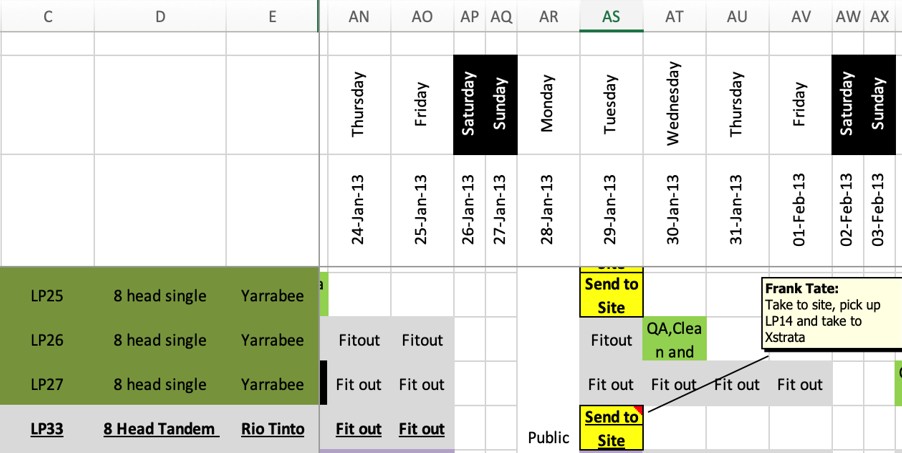
156 Mr Tate also gave evidence that when he delivered LP33, it was exchanged with LP14, one of two lighting towers (along with LP2) that had been provided to Clermont as a trial pending delivery of LP33–LP37. He gave evidence to the effect that, although he could not recall when these towers were delivered to Clermont, he recalled that Rio Tinto wanted trial towers on site for use while Exsto Group fulfilled the purchase order, and that this is what Exsto Group arranged.
157 This evidence is consistent with minutes of an Exsto Group meeting attended by Mr Tate on 5 November 2012 which refers to LP14 and states “5/11 – Pick up from Lake Cowal and return to Bundaberg, will go to Clermont”. Mr Tate agreed during the trial that this entry “is talking about LP14 having been provided to Clermont as a trial pending delivery” and also agreed (emphatically) that there were discussions with Rio Tinto prior to it placing an order.
158 Annexure FT-22 also showed this entry which was inserted by Mr Tate by reference to LP34 and the date 12 February 2013:
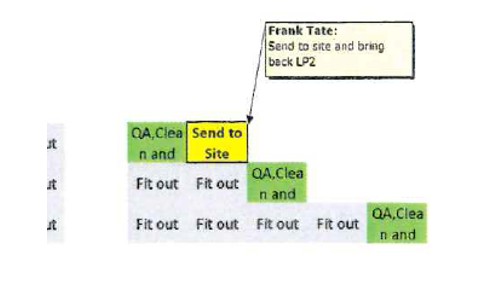
159 This entry also supports Mr Tate’s evidence that LP2 had been provided to Clermont as a trial pending delivery of the purchased Exsto Towers.
160 To resist a finding that LP33 was not delivered by Mr Tate to Rio Tinto on 29 January 2013, Southern Cross advances a number of contentions.
161 First, it submits that “the Coolon light CP007529, and a number of other lighting units, which comprised part of and were attached to LP33, likely did not reach Exsto’s premises in Bundaberg until about late January 2013 (having been dispatched from Coolon in Victoria on 22 January 2013)”. To that end, it relied upon the evidence of Ms Zatsepin, managing director of Coolon Pty Ltd.
162 However, this submission depends upon my acceptance of the evidence of Ms Zatsepin’s opinion evidence as to the time that she considered that it would have taken for certain lights to be delivered to the Exsto Group. During the hearing, this evidence was conceded by Ms Zatsepin to be speculative. Further, Ms Zatsepin had no proper basis to express the view that she did as she was not involved in the packaging or dispatch or deliveries, could not recall the last time she oversaw a delivery, or dispatch of orders to customers, and said that Coolon Pty Ltd did not in fact receive confirmation when delivery of goods was made. For these reasons, I attach no weight to the opinion evidence of this witness, and so the submission based on her evidence is rejected.
163 Secondly, Mr Tate was challenged as to whether he made the journey to deliver LP33 himself on 29 January on the basis that Exsto Group could not have assembled and carried out quality assurance on LP33 in time to deliver LP33 on 29 January 2013.
164 During the course of this challenge, Mr Tate gave evidence that:
(1) Exsto Group was building towers over the course of 2012 to accumulate stock to hire or sell towers. This evidence is supported by Annexure FT-10 (second page) which records LP 28–32 as stock. The meeting minutes dated 25 July 2012 also record:

(2) building the Exsto Towers involved the following:
The steel was cut and shaped and all laser cut for us to – and came to the workshop. The boilermaker would spend a couple of weeks putting it all back together again. Then we would go through the fit-out stage, and then we would hand it over to whoever either gave us a hire agreement or just – or PO to buy them.
…
Well, you get to order the steel. So the steel comes laser cut, pressed, bent, everything. So we’re actually – all the – all the jigs are made, and then all the – all the – all the steel part is put together in jigs, welded up, tack it all together, build. And then we had ongoing slots with the – the painters, and we had the painters for about a week or so, and then we would come back and be kitted out, and then the kits would be – so Berendsen’s Hydraulics, they supplied all the hydraulics for it, so we had ..... kits by that stage, and they would supply a kit for that particular tower. It’s trying to make the kit form quicker than the previous times than the – what it – it used to take and become efficient.
(3) it took “a couple of weeks to weld, a week of the painters and then a week to – a week and a half to fit it out” to build the Exsto Towers;
(4) the towers sent to Rio Tinto were probably being constructed before Rio Tinto sent Exsto Group a purchase order on 11 December 2012. He reiterated this later in his evidence, saying “I suggest those towers were being built prior to the order coming in” and disagreed that the build sheet actual contradicted that. He said that the build sheet “says we’re building at that stage. Says a couple of weeks to build them”;
(5) the lights may have been fitted at different points in the building process depending on when they arrived;
(6) it would take a matter of hours to assemble the lights, and carry out quality assurance, which was “like a reg[istration] inspection, for your car” both of which could be done within a day when the tower was otherwise built.
165 Thirdly, Mr Tate was challenged that his recollection was based on the build schedule, rather than on his own memory. In response, Mr Tate recalled driving, “nine, 10, 12 hours” to Clermont, towing LP33, and recalled that by reference to a flood event which occurred on the weekend before 29 January. That is, it appears that the event of delivering the tower on that date was able to be recalled because of an unusual event, being the flooding of the river in Bundaberg which was caused by Cyclone Ostwald (although there was no rain in Bundaberg itself).
166 However, Southern Cross contends that the flooding provides a reason to treat Mr Tate’s evidence with “particular caution”. I disagree. The flooding was in Bundaberg, not North Bundaberg where Mickala’s premises were located. Under cross-examination, Mr Tate explained (twice) that he could depart from Bundaberg via Childers and go on the highway. Although he could not recall the precise route that he took “given it’s that long ago”, Mr Tate was adamant that he went to Clermont and “could get out”.
167 This passage of Mr Tate’s evidence, including that he volunteered the evidence about the flooding and his spontaneous responses to the suggestions that he did not transport the LP33 on that date only served to reinforce that Mr Tate was giving evidence based on his own recollection, rather than because of anything recorded in business records.
168 Fourthly, Southern Cross submits that “Mr Tate’s explanation as to LP33 having undergone a quality assurance test on the Friday or “over the weekend” and that stage not being recorded in the Actual Build Spreadsheet seems improbable in light of LP33 being the first tower being delivered to Rio Tinto”. However, I am uncertain as to why this would be improbable, or how the evidence enables me to judge whether it is or not. Further, that these matters told against Mr Tate’s evidence that he delivered LP33 on 29 January was not put to Mr Tate, when it ought to have been: see Roberts-Smith v Fairfax Media Publications Pty Limited (Appeal) (2025) 310 FCR 170; [2025] FCAFC 67 at [726] (Perram, Katzmann and Kennett JJ).
169 In a similar vein, Southern Cross submits that:
[A]s at December 2012, Exsto had two boilermakers in its employ: Tate T89.14 – 29. Additionally, lighting towers were only one part of Exsto’s business. This evidence cannot be reconciled with the over month-long process Exsto required to assemble a tower from start to finish: Tate T91.13 – 15. Or the 3 to 4 month period that it indicated to customers was likely to take between the placement of the purchase order and delivery of the lighting tower: Tate T90.28 – 47.
[I]n circumstances where staff were limited, it is improbable that three separate lighting towers (being LP24, LP25 and LP33) were ready to be delivered to customers on 29 January 2013.
170 These submissions seek that an inference be drawn which tells against acceptance of Mr Tate’s evidence. However, these matters were not put to Mr Tate in cross-examination, when they ought to have been, out of fairness to the witness.
171 Further, Mr Tate’s evidence identified, for example, that the Exsto Group brought in short-term contract labour as recorded in the Exsto Group minutes dated 30 July 2012 by reference to “full production on building our own LP’s”. Further, as Mr Tate explained, there was also an apprentice and an auto electrician on staff in addition to the two boilermakers. Thus, the reference to two boilermakers only by Southern Cross does not present the complete picture of the evidence.
172 Finally, in evidence was a spreadsheet prepared by Mr Tate which contained a list of Exsto Towers (Annexure FT-10), which included reference to the five towers sold to Rio Tinto as being “under construction”, which identified five other towers (LP28–LP32) as being “stock” and where LP24 and LP25 are not identified as being under construction. Taking this evidence into account, I am not prepared to infer that “it is improbable that three separate lighting towers (being LP24, LP25 and LP33) were ready to be delivered to customers on 29 January 2013”.
173 In passing, it is also relevant to note that Annexure FT-10 records against LP14: “Rio Tinto Clermont – Loan until their towers built”, which accords with Mr Tate’s evidence about LP14. It also records that LP17 is “On hold till [sic] Clermont finished” which supports Mr Tate’s evidence to the effect that Rio Tinto wanted their towers as soon as possible.
174 Finally, Southern Cross advances specific attacks on the business records of the Exsto Group to submit that the records are unreliable and, ergo, less weight should be given to Mr Tate’s evidence and these documentary records.
175 First, Southern Cross submits that:
[T]he “LP Plan Build” (page 182 of Annexure FT-22) (Planned Spreadsheet) and “LP Actual Build” (page 183 of Annexure FT-22) (Actual Build Spreadsheet) spreadsheets in relation to LP35 and LP37 display the following differences:
(a) in the Planned Spreadsheet, LP35 is shown as “send to site” on 11 February 2013. On the Actual Build Spreadsheet, it is indicated that LP35 underwent quality assurance on 11 February 2013 and is marked “sent to site” on 12 February 2013;
(b) in relation to LP37, on the Planned Spreadsheet it is recorded as undergoing quality assurance on 21 February 2012. In the Actual Build spreadsheet, it is undergoing quality assurance on 22 February 2012, having had an additional day (21 February 2012) on the ‘Fit out’ stage.
In contrast to LP35 and LP37, there is no difference in the timing or comments recorded in respect of LP33 on the Planned and Actual Build Spreadsheets…
(Emphasis original.)
176 Contrary to these submissions, I do not regard this as an inconsistency in the sense that the “Actual Build Spreadsheet” (as described) is unreliable in relation to LP33. That there is a difference between what was planned and what occurred in relation to LP35 and LP37 does not mean that there needs to be a difference between what was planned and what occurred in relation to LP33. Further, this inconsistency was not put to Mr Tate in cross-examination; as it is now relied upon to impugn his testimony as to the date of delivery, it ought to have been put as a matter of fairness to him.
177 Secondly, Southern Cross submits that “at least [some] of” the Exsto meeting minutes at Annexure FT-2 recorded matters that were planned for the future, and not what had occurred. The transcript references which are cited relate to specific entries for identified towers. It does not follow from the fact that identified entries referred to planned future events that the entry in the 5 November 2012 minutes which refers to LP14 and states “5/11 – Pick up from Lake Cowal and return to Bundaberg, will go to Clermont” was a reference to a planned future event which did not in fact occur, and nor was that proposition put to Mr Tate in cross-examination when it ought to have been put as a matter of fairness to him. This is especially as, during cross-examination on these entries, Mr Tate disagreed that the minutes were unreliable.
178 Thirdly, Southern Cross submits that, in relation to the Exsto Towers, the Sales and Leads Minutes dated 7 January 2013 (Exhibit 5) record that delivery of those towers was expected in February 2013 onwards. In fact, those minutes state in relation to “Clermont Coal – Rio Tinto”:
Sale of 5 Tandem 9 head towers, deliver to site Feb onwards.
Require 5 towers for use until their towers are finished
179 In relation to the entry on that document, Mr Tate was not sure what it was, and was uncertain as to whether he was the author of it, saying that another employee might have “put it together”. Mr Tate also could not recall the exact date that Rio Tinto was asking for in terms of delivery but said:
I know they wanted them as soon as the purchase order came through and we were doing our best to get it through to them prior to [February].
180 The document which is Exhibit 5 provides support for Mr Tate’s evidence that towers were hired to Rio Tinto pending delivery of the towers which it purchased. His oral evidence above supports his recollection that he delivered LP33 on 29 January 2013.
181 In any event, that the records might contain errors or inconsistencies does not suffice to overcome what I perceived to be Mr Tate’s clear, unwavering and independent recollection under sustained cross-examination that he delivered LP33 to Rio Tinto on 29 January 2013, which evidence was consistent with, and was corroborated by, the business records identified above.
182 For these reasons, the evidence established that LP33 was made publicly available before the priority date. As it is accepted that LP33 possessed all of the integers of claims 1 and 4, this has the consequence that claims 1 and 4 of the Patent were anticipated and therefore lack novelty.
6.7.3 LP14
183 Although Southern Cross seeks a finding that LP14 was not made publicly available before the priority date, that proposition was not put to Mr Tate during cross-examination. For example, it was not suggested to him that LP14 was not in fact loaned or provided to Rio Tinto before the priority date. Out of fairness to Mr Tate, who is not a party, it should have been put in cross-examination.
184 In any event, having regard to the evidence of Mr Tate and the business records referred to above, the evidence established that LP14 was made publicly available before the priority date when it was loaned to Rio Tinto for use prior to the delivery of LP33.
185 As to whether LP14 possessed all of the integers of claims 1 and 4, Mr Tate gave this unchallenged evidence in Tate 1 at [22]:
Other than configuring the trailer to be single or tandem axle, and configuring the number of lights arranged on the mast, the design, and fabrication of the I-Light Series Lighting Towers from LP11 on were uniform. In particular, these lighting towers all used the same make and model engine which was directly coupled to the same make and model alternator (save perhaps in respect to LP12 and LP15 for the reasons in paragraph [17] above), and the same Coolon CP56 LED lighting units, all connected and arranged in the same way to the same structural elements including the mast…
(Emphasis added.)
186 By his three affidavits, Mr Tate gave detailed and direct evidence as to how the Exsto Towers were constructed, including that from LP11 onwards, the Exsto Towers were:
(1) manufactured with a Kohler 440 diesel motor directly coupled to a Prestolite BLP 24V 140 Amp brushless alternator (save that LP12 and LP15 may have been manufactured with Letrika 11.203.386 alternator). It is uncontroversial that this engine arrangement discloses integers 1.2, 1.3, 1.6, 1.7 and 1.8;
(2) manufactured with Coolon CP56 lights. The change from Coolon CP96 lights occurred because Coolon Pty Ltd was phasing out the CP96 lights and the CP56 lights had better heat dissipation, were lighter and generally a better fixture. Ms Zatsepin gave evidence that CP96 and CP56 were used for the same purpose and that during 2012 CP96 lights were phased out and became obsolete and customers switched over to CP56 lights. It is uncontroversial that the CP56 lights contain a capacitor connected in parallel (integer 4.1);
(3) all connected and arranged in the same way to the same structural elements including the mast. It was uncontroversial that the lighting unit was connected to the alternator (integer 1.4), was mounted on a manoeuvrable mast (integer 1.5), and contained a plurality of arrays (integer 1.9) some of which were arranged at an angle relative to at least some of the other arrays (integer 1.10).
187 The Exsto Towers LP14 and LP33 fall into the category of “LP11 onwards” as referred to by Mr Tate.
188 When it was suggested to Mr Tate during cross-examination that it was difficult for him to say precisely what the features of any of these towers were, Mr Tate disagreed and gave detailed evidence of the development of and changes made to LP1, LP2 and LP3. It was plain from Mr Tate’s answers, and from earlier evidence given by him about the changes made to the alternator, engine and lights on the towers, that he had a good independent recollection as to the manner in which the Exsto Towers had been constructed.
189 Taking into account Mr Tate’s affidavit and oral evidence, and in circumstances where Southern Cross admits that LP33 possessed all of the integers of claims 1 and 4 of the Patent, the evidence established that LP14 possesses all of the integers of claims 1 and 4 of the Patent.
190 It follows that, in summary, that LP14 was made publicly available before the priority date and it possessed all of the integers of claims 1 and 4. This has the consequence that claims 1 and 4 of the Patent were anticipated and therefore lack novelty.
6.7.4 Conclusion
191 In light of the conclusions reached above, it is unnecessary to traverse the remaining Exsto Towers referred to in Mickala’s pleading.
192 For these reasons, the alleged invention insofar as is claimed in claims 1 and 4 of the Patent is not novel within the meaning of s 18(1A)(b)(i) of the Patents Act.
7. INNOVATIVE STEP
193 Mickala’s alternative contention that the invention insofar as claimed in claims 1 and 4 does not involve an innovative step when compared with the prior art base for the reason that, in the light of the CGK, the invention only varies from the information disclosed in each of the prior art pleaded by it in ways that make no substantial contribution to the working of the alleged invention. The prior art base pleaded upon by it is the same prior art pleaded by it for the purposes of its novelty case.
194 Section 18(1A)(b)(ii) of the Patents Act stipulates that an invention for the purposes of an innovation patent involves an innovative step when compared with the prior art base as it existed before the priority date.
195 Pursuant to s 7(4) of the Patents Act, an invention is taken to involve an innovative step when compared to the prior art base unless the invention would, to a person skilled in the art, in light of the common general knowledge as it existed before the priority date of the claim, only vary from the kinds of information set out in s 7(5) in ways that make no substantial contribution to the working of the invention.
196 Determination of innovative step requires the following: (a) compare the invention as claimed with the relevant prior art information; (b) identify the difference or differences between that which is claimed in the patent and that which is disclosed in the relevant prior art information; and (c) determine whether the difference or differences make a substantial contribution to the working of the invention as claimed: see Product Management Group Pty Ltd v Blue Gentian LLC (2015) 240 FCR 85; [2015] FCAFC 179 at [174] (Kenny and Beach JJ, with whom Nicholas J agreed).
197 The comparison must be between the invention as claimed and the prior art information: Blue Gentian at [174(a)]. The provision requires a claim-by-claim analysis, having regard to the features of each claim: Dura-Post (Aust) Pty Ltd v Delnorth Pty Ltd (2009) 177 FCR 239; [2009] FCAFC 81 at [72] (Kenny and Stone JJ).
198 As observed by Yates J in Rakman at [337]:
…It is the task of the party relying on a lack of innovative step to identify each and every variance between the prior art information and the invention as claimed, and to articulate, by reference to the evidence, why that variance does not make a substantial contribution to the working of the invention as claimed. This is the task imposed by s 7(4) of the Patents Act.
(Emphasis original.)
199 As Southern Cross submits, consideration of innovative step is relevantly confined to integers 1.3, 1.5, 1.8, 1.10 and 4.1.
200 However, based on the experts’ evidence, there were no differences or variances between the invention insofar as it is claimed in integers 1.3 and 1.8 and the prior art: see, for e.g., the 774 Patent. As there is no difference which is disclosed, the third inquiry is not reached. That is because I only determine whether the difference or differences make a substantial contribution to the working of the invention as claimed, not the feature identified in the integer itself.
201 Insofar as the experts are concerned, the differences between the invention claimed and the prior art rests on integers 1.5, 1.10 and 4.1.
202 As to integer 1.5, being the manoeuvrable mast, there was no difference between the invention claimed and the cited prior art (such as, for e.g. the AMSJ Article and the Southern Cross brochure). As there is no difference which is disclosed, the third inquiry is not reached.
203 As to integer 1.10, being “at least some of the plurality of arrays being arranged at an angle relative to at least some of the other arrays”, there was no difference between the invention claimed and the cited prior art (such as, for e.g. the AMSJ Article and the Southern Cross brochure). As there is no difference which is disclosed, the third inquiry is not reached.
204 As to integer 4.1, being “[t]he lighting tower of any one of the preceding claims wherein … the LED lighting unit comprises at least one capacitor electrically connected in parallel to the alternator”, there was no difference between the invention claimed and the cited prior art (in this case, being the Exsto Towers identified as LP33 and LP14). As there is no difference which is disclosed, the third inquiry is not reached.
205 For these reasons, the alleged invention insofar as is claimed in claims 1 and 4 of the Patent does not involve an innovative step within the meaning of s 18(1A)(b)(ii) of the Patents Act and is invalid for that reason.
8. INFRINGEMENT
206 It is unnecessary to consider the issue of infringement in detail as I have concluded that the invention claimed in claims 1 and 4 of the Patent is not a patentable invention within the meaning of s 18(1A) of the Patents Act.
207 As Mickala has admitted infringement of claims 1 and 4, the sole issue in dispute on the question of infringement in each proceeding is whether, based on the admissions he has made (and without more), the second respondent, Mr Englebrecht, authorised or was a joint tortfeasor with the corporate respondent in that proceeding.
208 In support of both contentions, Mickala admits that in respect of each company, Mr Englebrecht was:
(1) the sole director and secretary;
(2) involved in the day-to-day management of the business of each company;
(3) in effective control of the conduct and business of the company; and
(4) the guiding mind in respect of the company.
(the admissions).
8.1 Is Mr Englebrecht liable for authorising Mickala’s infringements?
209 Section 13(1) of the Patents Act provides that the exclusive rights of the patentee include the right to exploit the invention and to authorise another person to exploit the invention. It is an infringement of the patentee’s exclusive rights not only to exploit an invention but also to authorise another person to exploit it: Inverness Medical Switzerland GmbH v MDS Diagnostics Pty Ltd (2010) 85 IPR 525; [2010] FCA 108 at [193]–[194] (Bennett J).
210 The term “authorise” is not defined in the Patents Act. However, it is well-settled that the term “authorise” in the Patents Act has the same meaning as that term has in s 101 of the Copyright Act 1968 (Cth): Inverness at [199]; Bristol-Myers Squibb Co v Apotex Pty Ltd (No 5) (2013) 104 IPR 23; [2013] FCA 1114 at [409] (Yates J). Whether or not a person has “authorised” an infringement turns on whether they sanctioned, approved or countenanced the infringing acts: University of New South Wales v Moorhouse (1975) 133 CLR 1 at 12 (Gibbs J); at 20 (Jacobs J, McTiernan ACJ agreeing at 7). Authorisation therefore does not require express approval or permission: Roadshow Films Pty Ltd v iiNet Pty Ltd (2011) IPR 1; [2011] FCAFC 23 at [24] (Emmett J), upheld in Roadshow Films Pty Ltd v iiNet Pty Ltd (2012) 248 CLR 42; [2012] HCA 16. A person may not be said to “authorise” infringing conduct unless they at least have the power to prevent the particular conduct: Industrial Galvanisers Corporation Pty Ltd v Safe Direction Pty Ltd (2018) 135 IPR 220; [2018] FCA 1192 at [100] (Burley J).
211 Authorisation of an infringing act can be inferred as a question of fact: Nominet UK v Diverse Internet Pty Ltd (2004) 63 IPR 543; [2004] FCA 1244 at [129] (French J).
212 In Streetworx Pty Ltd v Artcraft Urban Group Pty Ltd (2014) 110 IPR 82; [2014] FCA 1366, Beach J set out a pellucid summary of the general principles as they apply to company officers at [393]:
A director or other officer of a company can be considered in some circumstances to “authorise” the relevant conduct separate to that of the company (Inverness at [200]–[203] per Bennett J). But a director of a company merely by his position alone cannot be said to authorise. It is necessary to show actions of the director that demonstrate that he sanctioned, approved or countenanced the acts. Engaging or personally participating in relevant acts of infringement coupled with the power to prevent may be sufficient to demonstrate such sanctioning, approval or countenance. Indeed, if the director personally directs the acts which constitute infringement then “authorise” may be established, although something less than that may be sufficient (Kimberly-Clark Australia Pty Ltd v Arico Trading International Pty Ltd (1998) 42 IPR 111 at 129 per Burchett J).
213 There is no requirement that the person holds an intention to infringe or knowledge that the relevant product will infringe the patentee’s intellectual property rights: Inverness at [193]; Streetworx at [394]. All that is required is that knowledge of the acts that constitute infringement, not that they are legally characterised as infringing acts.
214 The principal relevant facts as to whether Mr Englebrecht authorised the infringing acts are the admissions in circumstances where no evidence was adduced by either side on this issue.
215 Southern Cross submits that the admissions give rise to a “strong inference” that Mr Englebrecht approved the production of the allegedly infringing products, that he personally took or approved the advertisement and sale of the allegedly infringing products, and that he had the power to prevent Mickala’s infringing conduct. Southern Cross further submits that “Mr Englebrecht solely directed each Mickala company in undertaking the conduct that amounts to infringement of the 095 Patent. As Mr Englebrecht was the sole director and guiding mind of each of the companies, an inference should be drawn that he had personal knowledge of the infringing acts engaged in by both Mickala companies”.
216 In closing, Mickala submits that what is required is a “close personal involvement” by the director, and that this was not established by the evidence. However, as set out above, the authorities do not require a close personal involvement for the purposes of authorisation but only that the director approved, sanctioned or countenanced the infringing acts.
217 Mr Englebrecht was the sole director of the corporate respondents, he was in “effective control” of the conduct and day-to-day business of the companies and he was the “guiding mind” of the companies. Thus, Mr Englebrecht had a high degree of control over the actions of the corporate respondents, such that I infer that he had personal knowledge of and approved the production of the infringing products, he personally took or approved the advertisement and sale of the infringing products, and he had the power to prevent the infringing conduct of the companies.
218 It follows that, had claims 1 and 4 not been found to be invalid, I would have found that Mr Englebrecht authorised the infringing conduct by the corporate respondents within the meaning of s 13 of the Patents Act.
8.2 Is Mr Englebrecht liable as a joint tortfeasor?
219 To establish this claim, it is necessary for Southern Cross to establish that there has been a common design by the respondents to participate in or induce or procure another person to commit an act of infringement. In circumstances where two or more persons assisted or concurred in or contributed to an act causing damage, there must also be some common design (i.e. there must be something in the nature of concerted action or agreed common action): see, generally, Aristocrat Technologies Australia Pty Ltd v Global Gaming Supplies Pty Ltd (2016) 121 IPR 150; [2016] FCAFC 22 at [141]–[143] (Nicholas, Yates and Wigney JJ).
220 Where a director is alleged to be a joint tortfeasor, it is necessary to show that there is a concurrence in the acts of both the company and the director causing the damage, rather than just that the company acted through the person: Keller v LED Technologies Pty Ltd (2010) 87 IPR 1; [2010] FCAFC 55 at [405] (Jessup J). The director must be shown to have directed or procured the tort and gone beyond causing the company to make a commercial or business course of action that merely involves the discharge of the director’s duties and obligations: JR Consulting & Drafting Pty Ltd v Cummings (2016) 116 IPR 440; [2016] FCAFC 20 at [350] (Bennett, Greenwood and Besanko JJ). That may occur where the director is using the company as an instrument whereby infringement is perpetrated, such that the director can be seen to be hiding behind the corporate veil: Keller at [84].
221 Ultimately, the question, on the facts, is what was the conduct of the director said to go beyond the proper role of director so as to descend into the realm of “close personal involvement”?: see Killer Queen, LLC v Taylor (2024) 306 FCR 199; [2024] FCAFC 149 at [104]–[106] (Yates, Burley and Rofe JJ).
222 There is no evidence that Mr Englebrecht directed or procured the infringement by the corporate respondents, or that he had a “close personal involvement” in their acts of infringement. The admissions go no further than establishing that Mr Englebrecht, as the sole director, was involved in the day-to-day management of the companies and was in effective control of the companies, which is insufficient.
223 For this reason, Mr Englebrecht is not liable as a joint tortfeasor in any event.
9. CONCLUSION AND DISPOSITION
224 For these reasons, the invention claimed in claims 1 and 4 of the Patent is not a patentable invention within the meaning of s 18(1A) of the Patents Act. It follows that the claim brought against the respondents in both proceedings must fail.
I certify that the preceding two hundred and twenty-four (224) numbered paragraphs are a true copy of the Reasons for Judgment of the Honourable Justice Downes. |
Associate:
Dated: 11 November 2025


