

Federal Court of Australia
Newmont Canada FN Holdings ULC v Commissioner of Taxation (No 2) [2025] FCA 1356
File numbers: | WAD 585 of 2017 WAD 590 of 2017 WAD 36 of 2019 WAD 37 of 2019 |
Judgment of: | COLVIN J |
Date of judgment: | 10 November 2025 |
Catchwords: | TAXATION - sale by foreign resident entities of shares in Australian entity conducting mining operations in Australia - whether share sale gave rise to capital gains tax liability - whether shares were taxable Australian real property - issues determined and matters to be referred to a referee for report identified |
Legislation: | Aboriginal Land Rights (Northern Territory) Act 1976 (NT) Income Tax Assessment Act 1997 (Cth) ss 108-5, 116-30, 855-5, 855-10, 855-15, 855-20, 855-25, 855-30, 995-1, Division 855, Subdivision 855-A Taxation Administration Act 1953 (Cth) s 14ZZO, Part IVC Mineral Titles Act 2010 (NT) Mining Act 1980 (NT) Mining Act 1978 (WA) s 87 Tax Laws Amendment (2006 Measures No. 4) Bill 2006 Tax Laws Amendment (2009 Measures No. 4) Bill 2009 |
Cases cited: | Alcan (NT) Alumina Pty Ltd v Commissioner of Territory Revenue [2009] HCA 41; (2009) 239 CLR 27 Anthony v Commonwealth (1973) 47 ALJR 83 Attorney-General for New South Wales v Brewery Employees Union of NSW (1908) 6 CLR 469 Australia Pacific LNG Pty Ltd v Treasurer, Minister for Aboriginal and Torres Strait Islander Partnerships and Minister for Sport [2019] QSC 124 Australia Pacific LNG Pty Ltd v Treasurer, Minister for Aboriginal and Torres Strait Islander Partnerships and Minister for Sport [2020] QCA 15 Barker v The Queen (1983) 153 CLR 338 Certain Lloyd's Underwriters Subscribing to Contract No IH00AAQS v Cross [2012] HCA 56; (2012) 248 CLR 378 City Mutual Life Assurance Society Ltd v Smith (1932) 48 CLR 532 Commissioner of State Revenue v Abbotts Exploration Pty Ltd [2014] WASCA 211; (2014) 48 WAR 300 Commissioner of State Revenue (Vic) v ACN 005 057 349 Pty Ltd [2017] HCA 6; (2017) 261 CLR 509 Commissioner of State Revenue v Placer Dome Inc [2018] HCA 59; (2018) 265 CLR 585 Commissioner of Taxation v Miley [2017] FCA 1396 Eckford v Stanbroke Pastoral Co Pty Ltd [2012] QSC 48; [2012] 2 Qd R 324 Eon Metals NL v Commissioner of State Taxation (WA) (1991) 22 ATR 601 Federal Commissioner of Taxation v Consolidated Media Holdings Ltd [2012] HCA 55; (2012) 250 CLR 503 Federal Commissioner of Taxation v Resource Capital Fund III LP [2014] FCAFC 37; (2014) 225 FCR 290 Federal Commissioner of Taxation v Resource Capital Fund IV LP [2019] FCAFC 51; (2019) 266 FCR 1 Gamer's Motor Centre (Newcastle) Pty Ltd v Natwest Wholesale Australia Pty Ltd (1985) 3 NSWLR 475 Gamer's Motor Centre (Newcastle) Pty Ltd v Natwest Wholesale Australia Pty Ltd (1987) 163 CLR 236 Healey v Federal Commissioner of Taxation [2012] FCA 269; (2012) 208 FCR 300 Healey v Federal Commissioner of Taxation [2012] FCAFC 194; (2012) 208 FCR 333 JT International SA v Commonwealth of Australia [2012] HCA 43; (2012) 250 CLR 1 Kilgour v Federal Commissioner of Taxation [2024] FCA 687 Lacey v Attorney-General of Queensland [2011] HCA 10; (2011) 242 CLR 573 National Australia Bank Limited v Blacker [2000] FCA 1458; (2000) 104 FCR 288 National Dairies WA Ltd v Commissioner of State Revenue [2001] WASCA 112; (2001) 24 WAR 70 NH Dunn Pty Ltd v LM Ericsson Pty Ltd (1979) 2 BPR 9241 Nominal Defendant v GLG Australia Pty Limited [2006] HCA 11; (2006) 228 CLR 529 Northern Territory v Collins [2008] HCA 49; (2008) 235 CLR 619 Palgo Holdings Pty Ltd v Gowans [2005] HCA 28; (2005) 221 CLR 249 Pegasus Gold Australia Ltd v Metso Minerals (Australia) Ltd [2003] NTCA 3; (2003) 16 NTLR 54 Reid v Smith (1905) 3 CLR 656 Resource Capital Fund IV LP v Commissioner of Taxation [2018] FCA 41 Rosebridge Nominees Pty Ltd v Commonwealth Bank of Australia [2008] WASCA 107; (2008) 36 WAR 561 SZTAL v Minister for Immigration and Border Protection [2017] HCA 34; (2017) 262 CLR 362 TEC Desert Pty Ltd v Commissioner of State Revenue (WA) [2010] HCA 49; (2010) 241 CLR 576 Valuer-General (Vic) v AWF Prop Co 2 Pty Ltd [2021] VSCA 274; (2021) 65 VR 327 YTL Power Investments Limited v Commissioner of Taxation of the Commonwealth of Australia [2025] FCA 1317 |
Division: | General Division |
Registry: | Western Australia |
National Practice Area: | Taxation |
Number of paragraphs: | 867 |
Date of hearing: | 5-19 and 22-26 August 2024 |
Counsel for the Applicants: | Mr JW de Wijn KC with Ms ML Baker KC and Mr JP Patela |
Solicitor for the Applicants: | Clayton Utz |
Counsel for the Respondents: | Mr CJ Peadon with Mr M Cosgrove and Mr N Li |
Solicitor for the Respondents: | Australian Government Solicitor |
Table of Corrections | |
11 December 2025: | At [763](1) 'Boddington USD2063.8 million' is amended to correctly read 'Boddington USD2047.4 million'. |
At [866](16)(a) 'Boddington USD2063.8 million' is amended to correctly read 'Boddington USD2047.4 million'. |
ORDERS
WAD 585 of 2017 WAD 37 of 2019 | ||
BETWEEN: | NEWMONT CANADA FN HOLDINGS ULC Applicant | |
AND: | COMMISSIONER OF TAXATION Respondent | |
WAD 590 of 2017 WAD 36 of 2019 | ||
BETWEEN: | NEWMONT CAPITAL LIMITED Applicant | |
AND: | COMMISSIONER OF TAXATION Respondent | |
order made by: | COLVIN J |
DATE OF ORDER: | 10 november 2025 |
THE COURT ORDERS THAT:
1. On or before 10 December 2025, the parties do each file and serve a minute of proposed orders to give effect to these reasons.
2. The proceedings be listed for a case management hearing at 11.00 am on 15 December 2025.
Note: Entry of orders is dealt with in Rule 39.32 of the Federal Court Rules 2011.
Table of Contents
REASONS FOR JUDGMENT
COLVIN J:
1 Newmont Australia Pty Ltd and its subsidiaries conduct gold mining activities in Australia through various joint ventures. In 2011, there were three shareholders in Newmont Australia, namely Newmont Canada FN Holdings ULC (Newmont Canada), Newmont Capital Limited (Newmont US) and Newmont Australia Holdings Pty Ltd. At that time, and since then, Newmont Australia has been a subsidiary of an entity now named Newmont Corporation (formerly Newmont Mining Corporation), incorporated in Delaware and listed on the New York Stock Exchange.
2 On 30 June 2011, Newmont Canada and Newmont US each sold their shareholding in Newmont Australia to Newmont Australia Holdings (now known as Newmont Goldcorp Australia Pty Ltd). The Commissioner of Taxation maintains that the capital gain realised from the share sale is taxable under Australian law. Newmont Canada and Newmont US (together, the Newmont Vendors) have been assessed for capital gains tax on that basis. The total primary tax in issue exceeds $96 million. There are additional liabilities that are said to arise for penalties and interest.
3 The Newmont Vendors have appealed to this Court in the exercise of statutory rights conferred under Part IVC of the Taxation Administration Act 1953 (Cth) (TAA). They have the burden of proving that each of the relevant assessments is excessive: s 14ZZO of the TAA.
4 At the time of the share sale, almost all the income producing assets of Newmont Australia (and its subsidiaries) were situated in Australia or comprised intangible property that could only be turned to profit by being deployed in mining activities undertaken in Australia. The main assets of Newmont Australia and its subsidiaries were deployed in four mining operations with the main mine being located at Boddington in Western Australia. At each of the four mines, activities were undertaken to mine, process and produce gold.
5 Newmont Australia and its subsidiaries held a number of mining tenements which authorised mining and exploration activities. Some of the tenements were issued under the Mining Act 1978 (WA) and others under legislation of the Northern Territory which continued to have effect under the Mineral Titles Act 2010 (NT). Newmont Australia also held some mining tenements in respect of land in New South Wales and in Queensland. In some cases, relevant tenements were not held by Newmont Australia or its subsidiaries. In those instances, there was a sublease arrangement by which authority was given by the holder of those tenements for mining activities to be undertaken. This was the case in relation to a number of the tenements for the land where the Boddington mine was located.
6 Mining and exploration activities could not be conducted without the authority conferred by the tenements. Notwithstanding this substantial Australian nexus, the Newmont Vendors claim that as foreign residents they are not liable to pay tax on the capital gain arising from the sale of the shares in Newmont Australia.
7 As at 30 June 2011, the relevant Australian tax law provided for capital gains tax to be paid by foreign residents on the sale of shares based on a regime for taxation that applied depending upon how much of the 'underlying value' of the company in which those shares were held was derived from Australian real property. Further, if the dealing between the Newmont Vendors and Newmont Australia Holdings was not arm's length, there was an issue as to whether the extent of any capital gains tax liability depended upon the market value of the shares at the time of sale, not the actual agreed price for the shares. These concepts, as expressed in the relevant statutory provisions and applied to the circumstances of the share sale, have spawned a complex set of valuation issues as between the Newmont Vendors and the Commissioner. Those issues concern both the meaning of the statutory provisions and the proper approach to ascertaining the market value of various integers that determine whether the capital gains tax provisions apply to the sale by the Newmont Vendors of their shares and, if so, the extent of the capital gains tax that is payable.
8 It is common ground that the capital gain on the sale of the shares is assessable under Australian taxation law according to ordinary concepts. The main question for determination is whether the capital gain is to be disregarded on the basis that it is outside the circumstances where those provisions apply to foreign residents. If capital gains tax is payable, issues arise that affect the amount of that tax.
The sale of the shares by the Newmont Vendors to Newmont Australia Holdings
9 On 30 June 2011, Newmont Canada entered into an agreement with Newmont Australia Holdings to dispose of all of its shares in Newmont Australia to Newmont Australia Holdings for an agreed price subject to an adjustment mechanism. The price, as subsequently adjusted in accordance with the agreement, was USD504,290,689.
10 Also on 30 June 2011, Newmont US entered into an agreement with Newmont Australia Holdings to dispose of all of its shares in Newmont Australia to Newmont Australia Holdings for an agreed price subject to an adjustment mechanism. The price, as subsequently adjusted in accordance with the agreement, was USD409,454,933.
The extent of the issues for present determination
11 Sensibly, shortly prior to the commencement of the final hearing of the appeal by the Newmont Vendors, the parties identified by topic the main issues for determination. They provided a list of those issues on the first day of the final hearing. They did so on the basis that the resolution of those issues would either determine that the appeal must be upheld or would enable calculations to be undertaken to determine whether there was any tax liability and, if so, the extent of that liability. By reason of the nature of the appeal, there also remained the additional possibility that the appeal would be dismissed because the Newmont Vendors failed to discharge their onus in which case they would be liable to pay capital gains tax as assessed. The parties proposed to conduct the hearing by reference to the main issues with any further calculations to be undertaken after the publication of reasons and informed by the Court's resolution of those issues.
12 However, the nature of the valuation task to be undertaken, particularly as to the discounted cash flow methodology embraced by all parties and the use of a residual valuation approach to determine the value of the tenements, meant that there was a real possibility that resolution of the main issues identified by the parties could leave calculations to be undertaken that would require more than mere computation; in particular, there was the potential for ongoing disputation as to appropriate value judgements to be formed as to some matters in undertaking any such calculations. Also, concerns were raised by the Court about the extent to which there had been compliance with orders as to the form in which expert evidence had been provided and as to the outcome of conferral between experts.
13 In those circumstances, it was proposed that the hearing proceed by reference to the parties' list of main issues but on the basis that, following publication of reasons by the Court, a suitable referee would be appointed to provide a report as to remaining issues (which may include aspects of the agreed topics if the Court formed the view that it was appropriate for any such aspect to be referred to the referee). It was further proposed that the referee would report as to those remaining issues based on the evidence adduced at the hearing and the application of the expertise of the referee to that evidence. That is to say, the referee process would not be an occasion for the receipt of further evidence beyond that adduced at the hearing. The final form of the questions for the referee would be determined after the Court delivered reasons. In the result, orders in the terms of the Appendix to these reasons were made to give effect to that approach.
14 Therefore, these reasons are confined to the topics identified by the parties as encompassing the main issues. The closing submissions for the parties exposed the respects in which there were differences between them as to the issues raised by those topics. It will be necessary in due course to explain the extent of those differences. However, in order to be able to articulate the issues for determination, it is first necessary to describe the relevant factual circumstances concerning Newmont Australia as at 30 June 2011 and then to address the terms of the statutory provisions as applied to the circumstances of the share sale.
The relevant factual circumstances concerning Newmont Australia
15 As at 30 June 2011, Newmont Australia Holdings was the majority shareholder in Newmont Australia with a shareholding of approximately 71%. The remaining shares were held by Newmont Canada (as to approximately 16%) and Newmont US (as to approximately 13%). The main assets of Newmont Australia were associated with mining operations at four mines located in each of Boddington, Jundee, Kalgoorlie and Tanami. The first three mines are in Western Australia. Tanami is in the Northern Territory.
16 Each of the mining operations required the application of three categories of assets: (a) plant and equipment; (b) mining information; and (c) mining tenements. Much of the evidence concerned the valuation of each of these categories of assets for each of the mining operations at the four mines. However, there were other assets that were of significance. They are referred to separately below (after the position in relation to the four mining operations is explained). Before dealing with those matters, I will explain an aspect of the Commissioner's case that sought to give significance to the nature of the different land interests held by Newmont Australia's subsidiaries as at 30 June 2011.
An aspect of the Commissioner's case as to what constitutes 'real property'
17 As has been indicated, this case concerns the application of capital gains tax provisions to foreign residents. The application of those provisions depends upon the extent to which an entity's value is derived from Australian real property. The precise way in which the legislation operates will be addressed separately when considering the relevant provisions. At this point it is sufficient to note one aspect of the Commissioner's case, which concerned whether mining plant and equipment that is affixed to land may be 'real property'.
18 The Commissioner sought to attribute significance to the fact that some of the tenements held by Newmont Australia's subsidiaries at the time that the Newmont Vendors sold their shares were in respect of land that was also owned by the subsidiary (or was leased by it in some way). In particular, the Commissioner claimed that, by reason of that freehold or leasehold interest, the mining plant and equipment on that land formed part of the 'real property' for the purposes of the relevant capital gains tax provisions. In that regard, issues arose as to what was determined by the High Court in TEC Desert Pty Ltd v Commissioner of State Revenue (WA) [2010] HCA 49; (2010) 241 CLR 576 where mining tenements were found to be personal property, a conclusion that led to a finding in that case that items of property affixed to land the subject of the mining tenements were not fixtures in the technical sense. Part of the reasoning in TEC Desert concerned a power station located on freehold land. The relevance of that reasoning to present circumstances is one of the many matters in contention between the parties.
19 As to TEC Desert, the Commissioner submitted that the reasoning in that decision did not apply where mining plant and equipment had been affixed to land the subject of tenements if the holder of the tenements also held the freehold or a leasehold interest (including a pastoral lease) or if the tenement itself conferred an exclusive right to occupy (being the case for a general purpose lease granted under the Mining Act WA). In such cases, so the Commissioner contended, items of mining plant and equipment affixed to the land also formed part of the 'real property' for the purposes of the relevant tax provisions by reason of the taxpayer being the holder of the freehold or leasehold interest.
20 Ultimately, the submission as to a pastoral lease was not pressed in closing and may be put to one side.
21 However, the Commissioner maintained the submission insofar as it concerned land the subject of tenements on which mining plant and equipment was affixed where the same land was also the subject of a freehold or leasehold interest at general law that was held by the same party who held the tenements.
22 A related, but different point was also advanced by the Commissioner in respect of land to which mining plant and equipment was affixed that was the subject of a general purpose lease under the Mining Act WA. It was a point that relied upon the statutory language that applied to a general purpose lease. Unlike other mining tenements which do not confer any exclusivity (save as to the carrying out of the relevant prospecting, exploration or mining activity on the land), a general purpose lease entitles the holder to 'the exclusive occupation of the land in respect of which the general purpose lease was granted for one or more of the [specified] purposes': see s 87(1) of the Mining Act WA. The language of 'exclusive occupation' was said to be significant when it came to considering the status of items of mining plant and equipment that were affixed to the land.
Boddington
23 By far the largest mining operation controlled by Newmont Australia at the time of the share sale was at Boddington. Newmont Australia's wholly owned subsidiary Newmont Boddington Pty Ltd held a two-thirds interest in the joint venture that conducted the mining operations at Boddington (the BGM joint venture). The management company for the BGM joint venture was Newmont Boddington Gold Pty Ltd.
24 The remaining one-third interest in the BGM joint venture was held by Saddleback Investments Pty Ltd, an indirectly held wholly owned subsidiary of Newmont Corporation but not a subsidiary of Newmont Australia. In effect, Saddleback was a sibling corporation to Newmont Australia as both companies were ultimately controlled by Newmont Corporation. Therefore, at all relevant times, Newmont Corporation had control of 100% of the BGM joint venture. The share sale did not alter the participation in the joint venture interest. The joint venturers remained Newmont Australia (as to two-thirds) and Saddleback (as to one-third). Also, Newmont Australia remained as the manager of the joint venture. The dealing only affected the shareholdings in Newmont Australia, the holder of the two-thirds interest in the BGM joint venture.
25 Some of the operations conducted as part of the BGM joint venture were conducted on tenements held by the participants in the Worsley joint venture, a separate venture the subject of a state agreement. The state agreement initially authorised the Worsley joint venturers to conduct operations in relation to bauxite, but later allowed for mining tenements to be issued for other minerals.
26 The BGM joint venture was established in 1987. At that time the participants in the venture were the same as those in the Worsley joint venture. Between 1987 and 2001, the BGM joint venture undertook gold mining operations. Then, for a time, the mine was placed into care and maintenance. Planning was then undertaken to establish a new gold mining operation. Over the duration of the BGM joint venture, there were also changes in the identity of the joint venture participants which led to the Newmont Australia subsidiaries becoming the participants.
27 In 2005, the then participants in the BGM joint venture entered into an engineering, procurement, construction and management contract with a consortium involving Aker Kvaerner and others (EPCM contract) for the design and construction of new gold mining plant and equipment at Boddington as part of a project to expand the gold mining operations (BGM Expansion Project). Between 2006 and 2008, design and procurement occurred under the terms of the EPCM contract. The plant and equipment at Boddington was constructed in 2009 and 2010. Thereafter, gold production commenced.
28 There were considerable cost escalations and delays in the construction of the BGM Expansion Project. When production commenced, the hardness in the ore mined caused machinery to break down and require replacing more frequently than had been expected. There were also issues with the ore grade. When the ore was recovered, the grade of the ore was found to be well below what had been expected and budgeted based upon available data for the ore reserve. By May 2010, gold production was 16.5% below budget, with the main contributing factors being that the gold head grade was 20.7% below budget and the mill throughput was 15% below budget. These matters, together with delays in the ramp up of the plant to full production, caused some consternation within Newmont Corporation. In the period leading up to mid-2011 there was a significant divergence of views as between Newmont Australia executives responsible for mining operations at Boddington and those in Newmont Corporation to whom they reported as to why the mined ore grade was below budgeted expectations and whether there were strategies available to mitigate the impacts for the budget.
29 As to the overall operation of the BGM joint venture there was a management agreement and a cross-operation agreement that applied to activities in relation to the Boddington mine that might interfere with the interests and activities of the Worsley joint venture in relation to bauxite mining and alumina operations. The BGM management agreement and the BGM cross-operation agreement dealt with arrangements pursuant to which the BGM joint venture could carry out activities on land the subject of tenements that were held by the participants in the Worsley joint venture. In effect, they detailed the contractual terms upon which the BGM joint venture could carry out gold mining, processing and production whilst protecting the interests of the participants in the Worsley joint venture in carrying out bauxite mining and alumina production. Amongst other things, the management agreement and the cross-operation agreement provided for a form of priority to be afforded to bauxite operations.
30 Further, as part of the operations for the Boddington mine were carried out on land the subject of tenements held by the participants in the Worsley joint venture, deeds of sublease were entered into by which the participants in the Worsley joint venture subleased their entire interest (subject to rights as to bauxite mining) to the participants in the BGM joint venture.
31 The relevant tenements at Boddington were all granted under the Mining Act WA and comprised mining leases, general purpose leases and miscellaneous licences. Each was subject to the terms of grant and the provisions of the legislation.
32 As at 30 June 2011, the plant and equipment used to carry out the gold mining operations at Boddington was located on the following tenements:
(1) the primary crushers, the acceleration conveyor and part of the overland conveyor (which moved ore from the primary crushers to the processing plant) were located on land the subject of mining leases held by the BGM joint venturers (which land was owned by the Crown and formed part of the Dwellingup State Forest);
(2) the rest of the overland conveyor was located on land the subject of a mining lease held by the Worsley joint venturers (which land was owned by the BGM joint venturers);
(3) the processing plant and associated equipment was located on land the subject of a mining lease held by the Worsley joint venturers with their entire mining lease interest (subject to rights to bauxite mining) having been leased to the BGM joint venturers (which land was owned by the BGM joint venturers);
(4) the accommodation village was located on land the subject of a miscellaneous licence held by the BGM joint venturers (which land was owned by third parties but which had been leased to the BGM joint venturers); and
(5) the sewerage treatment plant for the accommodation village was located on land the subject of a miscellaneous licence held by the BGM joint venturers (which land was owned by the BGM joint venturers).
33 As at 30 June 2011, the area of the mine and land for the disposal of tailings and residue extended over 10 tenements, some of which were held by the BGM joint venturers and some of which were subleased from the Worsley joint venturers. The majority of the land was owned by the BGM joint venturers but some of the land formed part of the Dwellingup State Forest. Some of the tenements were mining leases and some were general purpose leases (noting that there was no plant and equipment located on any of the general purpose leases for the Boddington mine).
Jundee
34 Newmont Australia's wholly owned subsidiaries held a 100% interest in the mining operations at Jundee. The mining operations were conducted by Newmont Yandal Operations Pty Ltd. There were seven mining tenements over land on which those operations were conducted. Six of the tenements on which the operations were conducted were held by those subsidiaries. The seventh tenement was a mining lease that was held by Mr Mark Creasy (Creasy Tenement). The plant and equipment for the mining operations was situated on the Creasy Tenement. Located on the other tenements were staff residences and amenities (the Jundee Village), a fuel farm and power house, an airport track, a tailings dam and mine site sewerage plant as well as a decommissioned mining plant, with its tailings dam and mine pits.
35 Access by the relevant subsidiaries to the rights conferred by the Creasy Tenement was pursuant to the terms of an access deed and a terms sheet, the latter being executed by Newmont Yandal Operations, Newmont Australia and Mr Creasy in July 2007 to settle certain disputes that had arisen in relation to access and use of the land.
36 As at the time of the share sale, all of the land was the subject of three pastoral leases; two in favour of Newmont Yandal Operations and one in favour of two individuals. In June 2006, Newmont Yandal Operations entered into an access agreement with those individuals by which the compensation to be paid in respect of mining operations was agreed on terms that provided for access to conduct mining operations.
Kalgoorlie
37 A 50% interest in the joint venture conducting the mining operations at Kalgoorlie (known as the Kalgoorlie Consolidated Gold Mine or KCGM) was held by another wholly owned subsidiary of Newmont Australia. Newmont Australia also held a 50% shareholding in the management company for the KCGM joint venture being Kalgoorlie Consolidated Gold Mines Pty Ltd. The other joint venturer was Barrick (Australia Pacific) Pty Ltd. The KCGM joint venture in fact comprised three separate joint ventures. As the interests in all three were held by the same parties and the mining operations were conducted as part of an overarching joint venture (the KCGM joint venture) it is convenient to deal with the KCGM mining operations together.
38 One part of the plant and equipment that formed part of the KCGM mining operations was a piece of gold processing plant known as the 'Gidgi roaster'.
Tanami
39 Newmont Australia's wholly owned subsidiary Newmont Goldcorp Tanami Pty Ltd (Newmont Tanami) owned and operated the assets comprising the Tanami gold project which involved exploration, mining, processing and production of gold. It owned and operated the Callie Underground Gold Mine (at Dead Bullock Soak) on land the subject of a mineral lease granted under the Mining Act 1980 (NT) which continued under the terms of the Mineral Titles Act NT. The Granites processing site as well as Tanami's administrative offices, airstrip and accommodation village were located on land the subject of a separate mineral lease.
40 The freehold land the subject of the two mineral leases was held by the Central Desert Aboriginal Land Trust which was administered by the Central Land Council. The Trust was granted title pursuant to the Aboriginal Land Rights (Northern Territory) Act 1976 (NT).
Other assets of Newmont Australia and its subsidiaries
41 A number of other assets held by Newmont Australia and its subsidiaries assumed significance for the purposes of the competing contentions advanced by the parties. They are identified in the following list (which refers to Newmont Australia and its subsidiaries as the Group):
(1) intercompany receivables, both current and non-current, that were owed by one entity in the Group to another entity in the Group, being the party entitled to the receivable;
(2) cash and cash equivalents held by entities in the Group;
(3) derivatives held by entities in the Group;
(4) various freehold and leasehold interests held by entities in the Group;
(5) a 49% interest in three mining leases the subject of the Sandy Soak mining exploration joint venture which were over land in Western Australia in which the Group did not have any interest;
(6) interests in the Woodcutters mine site in the Northern Territory which was acquired as a closed facility and was the subject of ongoing decommissioning, rehabilitation and monitoring activities;
(7) interests in the McPhillamy's gold and copper exploration project in New South Wales;
(8) interests in an exploration project in the Lachlan District of New South Wales;
(9) mineral development licences in respect of land in the Millmerran region in Queensland;
(10) three pastoral leases held by Newmont Pajingo Pty Ltd a subsidiary of Newmont Australia;
(11) a 16.2% interest in Regis Resources Ltd a gold production and exploration company which operated the Duketon Gold Project near Kalgoorlie; and
(12) a 50% interest in the Parkeston Power Station in Kalgoorlie.
42 There was also mining plant and equipment associated with a number of the mining projects described above.
The statutory provisions as applied to the circumstances of the share sale
43 In what follows, statutory references are to the relevant taxation provisions as applicable to a sale of shares at the relevant date, namely 30 June 2011.
44 The shares sold by the Newmont Vendors were each a 'CGT asset'. The sale of the shares by them to Newmont Australia Holdings was a 'CGT event'. The Newmont Vendors earned a substantial capital gain on the sale of the shares. They claim that they are not liable to capital gains tax because they were foreign residents at the time of sale and the shares were not 'taxable Australian property', with the consequence that any capital gain on the sale of the shares is disregarded by operation of s 855-10(1) of the Income Tax Assessment Act 1997 (Cth) (ITAA97). The Commissioner accepts that the Newmont Vendors were foreign residents. Therefore, whether the Newmont Vendors are liable to capital gains tax on the share sale turns upon whether the shares were taxable Australian property at the time of the sale.
45 Relevantly for present purposes, taxable Australian property includes any 'indirect Australian real property interest', a term that applies to any 'membership interest' (such as a shareholding interest) held by one entity in another entity where the interest passes both the 'non-portfolio interest test' and 'the principal asset test': see s 855-15 and s 855-25. It is common ground that the shares that were sold by the Newmont Vendors passed the non-portfolio interest test. In issue between the parties is whether the shares in Newmont Australia also passed the principal asset test expressed in the following terms in s 855-30:
(1) The purpose of this section is to define when an entity's underlying value is principally derived from Australian real property (see paragraph 855-5(2)(b)).
(2) A membership interest held by an entity (the holding entity) in another entity (the test entity) passes the principal asset test if the sum of the market values of the test entity's assets that are taxable Australian real property exceeds the sum of the market values of its assets that are not taxable Australian real property.
(3) For the purposes of subsection (2), treat an asset of an entity (the first entity) that is a membership interest in another entity (the other entity) as if it were instead the following 2 assets:
(a) an asset that is taxable Australian real property (the TARP asset);
(b) an asset that is not taxable Australian real property (the non-TARP asset).
(4) For the purposes of subsection (2), treat the market value of the TARP asset and the non-TARP asset according to the following table.
[table omitted]
(5) For the purposes of this section, disregard the market value of any asset acquired by the test entity, or by any other entity, if the acquisition was done for a purpose (other than an incidental purpose) that included ensuring that a membership interest in any entity would not pass the principal asset test in this section.
46 It may be noted that s 855-30 begins with a description of the purpose of the section as being 'to define when an entity's underlying value is principally derived from Australian real property' and then refers to s 855-5(2)(b) (which is within the objects provision for Subdivision 855-A as a whole). Section 855-5 provides:
(1) The objects of this Subdivision are to improve:
(a) Australia's status as an attractive place for business and investment; and
(b) the integrity of Australia's capital gains tax base.
(2) This is achieved by:
(a) aligning Australia's tax laws with international practice; and
(b) ensuring interests in an entity remain subject to Australia's capital gains tax laws if the entity's underlying value is principally derived from Australian real property.
(emphasis added)
47 Paragraph 855-5(2)(b) manifests an express intention that the provisions of the Subdivision will ensure that interests in an entity (relevantly for present purposes, shareholding interests) remain subject to capital gains tax in Australia if the 'underlying value' of the entity is principally derived from 'Australian real property'. The focus is upon the derivation of 'underlying value', a term that is not defined but directs attention to the source of the value attributable to the shareholding or other ownership interest held in the entity. If that value, namely the value attributable to ownership of the interest, is principally sourced from 'Australian real property' then the dual objects stated in s 855-5(1) are to be achieved by ensuring that capital gains on disposal of that interest are taxed under Australian laws that align with 'international practice'. It will be necessary in due course to consider what is meant by the reference to alignment with international practice as it has significance for one aspect of the Commissioner's case. However, what is plain is that Parliament's intention was for the stated objects to be achieved by laws which both align with international practice and subject any capital gains from the sale of shares in companies (and ownership interests in other entities) whose value is sourced from Australian real property to taxation under Australian laws.
48 The use of the terminology 'remain subject to Australia's capital gains tax laws' reflects the fact that the terms of Division 855 were introduced by way of an amendment that changed the scope of the former capital gains tax laws insofar as they applied to foreign residents. It will be necessary to return to these changes because they have significance for one of the contentions advanced by the Commissioner. At this point, it is sufficient to note that s 855-30 defines when an entity's underlying value is principally derived from Australian real property. Its terms are to be construed having regard to its role within the statutory scheme as expressed in the objects clause.
49 However, regard to the express objects in s 855-5 can only take the process of construction of the operative provisions so far. Although they are part of the context to which there must be regard in construing the provisions of Subdivision 855-A, the objects provision cannot be a basis for a construction of the operative provisions of the Subdivision that is not reasonably open on their terms. Further, the general terms in which the objects are expressed will not assist in resolving ambiguities in meaning where none of the alternative meanings can be said to be inconsistent with those objects.
50 Returning then to the operative language in s 855-30 as quoted above, the 'principal asset test' is passed if the sum of the market values of the 'test entity's assets that are taxable Australian real property exceeds the sum of the market values' of the test entity's other assets. The test entity is the entity that has sold a 'CGT asset' and earned a capital gain from the sale.
51 So, in the present case, the principal asset test will be passed if 'the sum of the market values' of Newmont Australia's assets that are taxable Australian real property exceeds the sum of the market values of its assets that are not taxable Australian real property, both values being measured as at 30 June 2011; in the argot of tax lawyers, whether the market value of Newmont Australia's TARP assets exceeds that of its non-TARP assets.
52 The test is not concerned with liabilities or net assets. Its focus is upon 'assets' (a term which is not defined). It uses the measure of 'market value' to determine whether TARP assets of the relevant company exceed its non-TARP assets. However, it is the market value of the two classes of assets that is significant, namely TARP and non-TARP. The provision is concerned with reaching a conclusion as to whether the sum of the market value of assets that are TARP exceeds the sum of the market values of the assets that are non-TARP. It is a conclusion which could be reached without determining the market value of each individual asset. If the market value of all the assets of the test entity is known and the test entity has two identifiable TARP assets, the sum of which is greater than half that total value then the principal asset test will be met.
53 As will emerge, there are issues in the present case both as to the total market value of certain groups of assets of Newmont Australia (the interest held in each of the four mines) and the market value of TARP and non-TARP assets that form part of those groups of assets.
54 As to what is TARP, s 855-20 provides:
A CGT asset is taxable Australian real property if it is:
(a) real property situated in Australia (including a lease of land, if the land is situated in Australia); or
(b) a mining, quarrying or prospecting right (to the extent that the right is not real property), if the minerals, petroleum or quarry materials are situated in Australia.
55 Therefore, TARP is a term that identifies a category of assets that is a subset of 'CGT assets'. The subset comprises assets of the kind described in the definition that are 'situated in Australia'. Again, the focus is upon the asset itself not upon any liability that may be said to be associated with or connected to the asset in some way.
56 The term 'CGT asset' is defined in s 108-5 in the following way:
(1) A CGT asset is:
(a) any kind of property; or
(b) a legal or equitable right that is not property.
(2) To avoid doubt, these are CGT assets:
(a) part of, or an interest in, an asset referred to in subsection (1);
(b) goodwill or an interest in it;
(c) an interest in an asset of a partnership;
(d) an interest in a partnership that is not covered by paragraph (c).
(original emphasis)
57 Therefore, CGT assets comprise property and legal or equitable rights, not some form of net property interest or right after taking account of liabilities. As TARP is a subset of CGT assets it must have the same character.
58 The concept of TARP is used in two different ways in those aspects of the capital gains tax provisions that are concerned with identifying when an asset is taxable Australian property for the purposes of the application of the capital gains tax provisions to foreign residents. First, it is used directly to identify the first of five categories of 'taxable Australian property' deployed for the purposes of Division 855 (see item 1 of the table in s 855-15 as applied to s 855-10(1)). So, TARP is one category of taxable Australian property. As to the significance of that point, it will be recalled that s 855-10(1) provides that if you are a foreign resident and a CGT event happens in relation to a CGT asset that is not taxable Australian property then a capital gain arising from that CGT event is to be disregarded.
59 Second, the concept of TARP is also used indirectly, in the manner that has been explained, to define when membership interests held by one entity in another entity will be taxable Australian property for capital gains tax purposes.
60 Significantly, when deployed in this indirect way, it is the relative market value of the TARP assets held by the test entity when compared to non-TARP assets that is significant. Considered within the context I have explained, for the following reasons, the references in s 855-30(2) to the sum of the market values of TARP and non-TARP assets in expressing the principal asset test are to the values of the assets themselves irrespective of associated or other liabilities. First, the focus of the language in s 855-30(2) is solely upon 'the test entity's assets'. Second, given the terms of the objects clause, a focus upon the assets is understandable because they are the source of the 'underlying value' of a company. It is possible that individual assets may be burdened or encumbered by liabilities. It is also possible that the entity as a whole may have incurred independent liabilities. The fact that liabilities are owed by the company that owns the assets means that the net worth of the company is reduced. But, irrespective of the nature and extent of those liabilities, the underlying value is still to be found in the assets. Third, it is consistent with the manner of operation of Division 855 as a whole which depends upon the identification of those assets which are CGT assets that are 'taxable Australian property'.
61 One issue that arises in determining the sum of the market values of TARP assets and non-TARP assets of a company is how to deal with membership interests held by that company in other entities. Section 855-30(3) and the table below s 855-30(4) explain how to deal with such membership interests (which include assets that are shareholdings in other entities) when applying the principal asset test. Those provisions require a shareholding to be treated 'as if it were instead' two assets, 'the TARP asset' and 'the non-TARP asset' and for the market value of those assets to be determined according to the table below s 855-30(4). The table is headed 'Market value of the TARP asset and the non-TARP asset'. When it comes to subsidiary interests, where the interest is less than 10%, the table provides for a zero value as to the TARP asset and for the market value of the shareholding to be included as the market value of the non-TARP asset. When it comes to shareholding interests of 10% or more, the table requires the assets of the subsidiary to be identified as TARP or non-TARP and then for a percentage of the market value of each asset that corresponds with the percentage shareholding in the subsidiary to be included in the overall TARP asset and non-TARP asset amounts for the test entity. In effect, it requires the relationship between TARP and non-TARP assets held by the parent and the subsidiaries to be brought together on a group basis to determine whether the market value of TARP exceeds the market value of non-TARP for the purposes of the application of the capital gains tax provisions to foreign residents.
62 At the heart of the issues between the parties in the present case lies competing contentions as to (a) the proper construction of the language in the statutory definition of TARP when deployed in the principal asset test provisions in s 855-30; and (b) the appropriate way in which to determine the sum of the market values of TARP and non-TARP assets respectively for the purpose of determining whether the capital gains from the sale by the Newmont Vendors of their shares in Newmont Australia may be disregarded. There are also some issues that arise as to matters that bear upon the quantum of the capital gain if the Newmont Vendors are found to be liable to pay capital gains tax on the sale of their shares in Newmont Australia.
63 There are also substantial issues between the parties as to whether some of the plant and equipment used in mining operations for each of the four mines was real property by application of the law regarding fixtures. There were two main aspects to those issues. First, whether the nature of the interests held by Newmont Australia and its subsidiaries in respect of the land on which mining operations were conducted meant that any plant and equipment that was affixed to the land was real property for the purposes of the statutory concept 'taxable Australian real property' (as defined). Second, if the plant and equipment is only taxable real property if it is a fixture at common law, whether any of the relevant plant and equipment was affixed to the land for the purposes of the law regarding fixtures.
Market value to be determined on the basis of an assumed sale of assets as part of a going concern
64 In undertaking the market valuation of assets for the purposes of s 855-30, 'the assets should be valued on the basis of an assumed simultaneous sale of [the] assets [of the 'test entity'] to the same hypothetical purchaser, not as stand-alone separate sales': Federal Commissioner of Taxation v Resource Capital Fund III LP [2014] FCAFC 37; (2014) 225 FCR 290 (RCF III) at [52] (Middleton, Robertson and Davies JJ); see also Federal Commissioner of Taxation v Resource Capital Fund IV LP [2019] FCAFC 51; (2019) 266 FCR 1 (RCF IV) at [226] (Besanko, Middleton, Steward and Thawley JJ). Further, where, as here, there are assets which may be used in a mining operation, the hypothetical purchaser is to be assumed to have the capacity to use those assets in combination in a mining operation where that is their highest and best use: RCF III at [54].
65 This means that when it comes to the assets held by Newmont Australia and its subsidiaries, it is their market value as a bundle sold together to the same buyer that is to be considered. Further, to the extent that those assets comprise interests in mining operations, it is necessary to consider the market value of the whole of the assets on the basis that the relevant assets are deployed in those mining operations (if that is the highest and best use of those assets).
66 However, it is also necessary to allocate the overall pool of market value of the whole bundle of assets controlled by Newmont Australia between those assets in order to then undertake the calculation of the relative value derived from TARP assets compared to non-TARP assets. As will emerge, there are conceptual difficulties for both aspects of the task, namely (a) the valuation of the overall bundle of assets (particularly having regard to the use of some of those assets in mining operations); and (b) the allocation of the overall pool of value to TARP assets and non-TARP assets. Nevertheless, the statutory language of s 855-30 does indicate some requirements that must be met in order to ensure that the market valuation conforms to the statutory valuation task.
67 First, throughout the valuation process, it must be kept in mind that the objective of undertaking the statutory valuation task remains the making of a determination as to whether the test entity's underlying value was principally derived from Australian real property: s 855-30(1). In a case like the present, the task is to ascertain whether the underlying value of the relevant membership interest (the shares in Newmont Australia) is principally derived from Australian real property. Valuations of individual assets and any allocation of a pool of value between assets must be informed by a logic that is consistent with the task of determining whether the underlying value of the membership interest is principally derived from Australian real property by undertaking the statutory calculation provided for in s 855-30(2). Although that refers to the summation of market values of assets that are TARP and non-TARP, the market values referred to are those that enure to the holder of all those assets.
68 Second, when it comes to determining the summation of the market value of those Newmont Australia assets that are TARP and those assets that are non-TARP there must be due regard to fact that the market value of certain of those assets is to be determined on the basis that they form part of a bundle of assets that have value because they can be deployed to earn income in a particular way, namely as part of a mining operation. Any allocation of the overall pool of value between TARP and non-TARP assets must reflect the fact that the market value of many of the assets in the overall bundle of Newmont Australia's assets to a holder of all those assets is derived from their use together in a mining operation. Significantly, there is a kind of symbiotic or synergistic value when it comes to assets that have their highest and best use when deployed in a mining operation. Control of all those assets is needed to obtain that higher market value for those assets. The mining tenements are foundational to being able to realise that value. They are the source of the rights to conduct the mining operations. When it comes to allocating this synergistic component of market value, the appropriate allocation must be undertaken from the perspective of a party who is the holder of all those assets and must reflect the fact that control of all the assets is needed to obtain that synergistic value.
69 Third, in order to determine the market value of deploying a group of assets in their highest and best use as part of mining operations it is appropriate to approach the market valuation of the group of assets that are used to conduct mining operations on the basis of the net present value of the revenues that are expected to be earned from those mining operations. However, as will be explained, it is not possible to use that same approach in allocating that pool of value between the assets that are used to conduct those mining operations. That is because no part of the total revenue from the mining operations can be identified as being produced from particular assets.
70 Applying these three aspects to the mining operations that are relevant in the present case, all the experts identified three categories of assets that are used to conduct the mining operations (and thereby generate synergistic value), namely (a) on site plant and equipment; (b) site specific mining information; and (c) mining tenements. At the heart of the issues in this case are disputes about how to allocate the portion of the overall pool of value generated by conducting mining operations that is attributed to the synergy between the assets in each of those three categories.
71 As has been mentioned, it might be said that, without the mining rights conferred by the tenements, the plant and equipment located on the tenements and the mining information that concerns the geology of the land the subject of the tenements would have little market value. On that basis, it would be the tenements that are the source of the going concern value of the bundle of assets deployed to undertake the mining operations. Equally, it might be said that the holder of the mining tenements who did not have the plant and equipment or the mining information would have to incur the costs of replacing or reproducing those assets so their contribution to the synergistic value must be at least the amount of such costs, but no more (on the basis that there would be more revenue to be made by replacing or reproducing those assets than paying a premium above the costs of replacement or reproduction of the existing assets). Such an approach may need to factor in the time value of the delay in being able to replace or reproduce the assets. On such an approach, it would be the synergistic value above such costs that would be allocated to the mining tenements.
72 However, what is to be done in a scenario where the overall pool of value is less than the cost of replacing or reproducing the plant and equipment and mining information? Or a scenario where the remaining pool of value to be allocated to the mining tenements is nominal or quite small in relative terms (noting that there also would have been costs incurred to obtain the mining tenements)? In such limited pool of value scenarios, would it also be appropriate to apply little or none of the synergistic value to the mining tenements?
73 Significantly, in such a n instance, if the assets used in conducting existing mining operations were valued on the basis of separate sale, then they would each have little or no value. In the case of the plant and equipment, if sold separately to the mining information and the mining tenements it would have the value that might be recovered in a secondary market. As will emerge, in the present case, that value is negligible compared to the actual cost incurred in establishing the plant and equipment on the relevant tenements. In the case of the mining information, if sold separately to the plant and equipment and the mining tenements it would have little value because it concerns the geology of the land the subject of the tenements. In the case of the tenements, they would have little value because the cost to develop the mining operations without access to the plant and equipment and the mining information would be too great because the pool of value that would be generated from the mining operations would be insufficient to cover the costs of doing so. Therefore, almost all of the value of the relevant assets that have been committed to conducting the mining operations is synergistic value.
74 In RCF III and RCF IV it was made clear that the market value of the assets was to be determined on the basis that the assets are sold together thereby including any synergistic value. However, the reasons in those decisions did not engage with the allocation, as between the assets deployed in undertaking the mining operations that constitute the highest and best use of those assets, of the synergistic value created by their joint use.
75 Instinctively, an outcome which allocated most of the value to the plant and equipment and the mining information would appear to be inconsistent with the statutory provision which is concerned with identifying the market value of shares and other membership interests that is derived from Australian real property. It would seem to be illogical for the holder of those shares to view little or none of the synergistic value that can be derived from the mining operations as being derived from the mining tenements when that value could not be obtained without those tenements. Given that the statutory task is concerned with determining the extent to which the underlying value of the shares is sourced in specified types of property located in Australia, it may be thought to be surprising if the mining tenements that are used together with existing plant and equipment and mining information to generate considerable synergistic value might be viewed by the holder of those shares as having little 'market value'.
76 These are matters to which it will be necessary to return when considering the evidence adduced by the parties as to market value and the forensic choices made as to the way in which it was contended the market value of the relevant assets should be determined for the purposes of undertaking the calculation provided for in s 855-30(2).
A degree of consensus as to the overall approach to the valuation task
77 All the experts who gave evidence as to the overall approach to the valuation of the assets of Newmont Australia and its subsidiaries supported the use of a discounted cash flow analysis (DCF Analysis) to determine the market value of those assets that were used to undertake each of the four mining operations, namely those at Boddington, Jundee, Kalgoorlie and Tanami. They were also agreed that a residual valuation approach was appropriate to determine the market value of the mining tenements.
78 The parties were also broadly agreed as to the sequence of the analysis that was required to be undertaken to determine whether the capital gain earned by each of the Newmont Vendors on the sale of their shares in Newmont Australia was subject to capital gains tax under Australian law. It involved the following steps.
79 First, determining the net present value of the future cash flows from each of the four mining operations using a DCF Analysis. Significant inputs for undertaking the DCF Analysis were (a) the price at which future gold production could be sold over the life of the mine having regard to when it would be produced; and (b) the appropriate 'beta value' to be used in determining the discount rate in order to reflect properly both the risks associated with future cash flows to be derived from undertaking gold mining operations in Australia and any further particular risks associated with each of the four mining operations (and hence the appropriate discount rate to be applied in undertaking the DCF Analysis). There was considerable divergence in opinions as to the appropriate integers for these two inputs. However, there was no focus upon other inputs, such as expected levels of gold production and likely future operating costs. This approach reflected the common position of the parties that it was the difference in views between the experts as to the gold price and the beta value that explained much of the difference between them.
80 Second, considering whether it was appropriate to adjust the results of the DCF Analysis for an observed phenomenon known as the 'gold premium'. The term gold premium is used to refer to the extent to which publicly listed shares in gold mining companies tend to trade at a premium to their net asset valuation. Some of the experts applied a net asset valuation multiple or 'NAV multiple' to increase the results of the DCF Analysis to reflect the premium. The experts who were called by the Newmont Vendors applied a NAV multiple. The expert called by the Commissioner criticised them for doing so and maintained that it was not appropriate to apply a NAV multiple.
81 Third, determining how much of the net present value of future cash flows was to be allocated to each of the three categories of assets used to generate those cash flows, namely (a) mining plant and equipment; (b) mining information; and (c) mining tenements. There was agreement that the appropriate approach was a residual valuation approach by which values were determined for the plant and equipment and for the mining information with the residual being the value properly attributed to the tenements. However, there was considerable disagreement as to the appropriate approach to be adopted in valuing the plant and equipment and the mining information as part of that valuation approach.
82 Fourth, determining the value of other assets of Newmont Australia and its subsidiaries that were not part of the DCF Analysis. In that regard, there was a significant issue as to the appropriate approach to be adopted in valuing intercompany loans and receivables, having regard to the nature of the market valuation required by the statutory provisions. There was also an issue as to what had been established by the evidence concerning the market value of derivatives and the interest held in the McPhillamy's mine. There were also other less significant differences in approach as between the experts as to certain of the remaining assets.
83 Fifth, identifying which of the assets of Newmont Australia and its subsidiaries were TARP assets and which were non-TARP assets. This required a view to be taken as to the proper construction of the statutory provisions that defined the concept of 'taxable Australian real property' and whether the law of fixtures applied as to some or all of the plant and equipment included in the assets generating the DCF Analysis for each of the four mines.
84 Sixth, ascertaining whether the sum of the market values of the TARP assets of Newmont Australia and its subsidiaries exceeded the sum of the market value of their non-TARP assets (TARP Calculation).
85 Seventh, if the TARP Calculation showed that the sum of the market values of the TARP assets exceeded that for non-TARP assets, determining the arm's length market value as at 30 June 2011 for the shares in Newmont Australia that were sold by the Newmont Vendors to Newmont Australia Holdings. The issues raised as to this aspect are addressed in the section that follows.
86 Eighth, determining the cost base for shares in Newmont Australia that had been held by the Newmont Vendors. The issues raised as to this aspect are also addressed in the section that follows.
87 Ninth, reaching a conclusion as to whether the assessments for capital gains tax issued by the Commissioner had been demonstrated to be excessive.
88 As has been explained, the hearing was conducted by the parties on the basis that the main issues between them would be determined to the extent considered appropriate and that appropriate questions would then be referred to a referee for report, including undertaking final calculations.
Separate issues as to quantum if Division 855 does not operate to require any capital gain to be disregarded
89 If Division 855 does not operate to require any capital gain on the sale by each of the Newmont Vendors of their shares in Newmont Australia to be disregarded then issues arise as to the calculation of the capital gain from the sale of the shares. In that regard, it is necessary to establish the capital proceeds that each of the Newmont Vendors is taken to have received and the cost base to be applied. From those two figures the taxable capital gain can be determined.
90 The percentage interests in Newmont Australia that were acquired were 16.18% by Newmont Canada and 13.14% by Newmont US. As has been mentioned, the consideration paid was USD504,290,689 and USD409,454,933 respectively.
Capital proceeds received by Newmont Vendors
91 As to the capital proceeds received, the Newmont Vendors claimed that the market value substitution rule in s 116-30(2) of the ITAA97 applied. One of the matters that must pertain if the rule is to apply is that the vendors did not deal at arm's length in connection with the sale. The Newmont Vendors maintained that the dealings between the Newmont Vendors and Newmont Australia Holdings were not at arm's length such that the market value substitution rule applies. They contended that the capital proceeds they are taken to have received are less than the amounts actually paid to them by Newmont Australia Holdings. They relied upon opinion evidence as to the market value of shares in Newmont Australia as at 30 June 2011 and opinion evidence as to appropriate discounts to be applied for lack of control and marketability when it came to the parcels of shares sold by each of the Newmont Vendors.
92 On that basis, the case advanced by the Newmont Vendors as to the capital proceeds received by them for the purposes of the calculation of capital gains tax is that the capital proceeds that Newmont Canada is taken to have received were CAD380,232,840 and for Newmont US the capital proceeds were USD319,127,976.
93 In closing submissions, the Commissioner contended that the Newmont Vendors had failed to discharge their onus that the market value substitution rule applies because they had failed to establish that the Newmont Vendors did not deal at arm's length. The Commissioner claimed that the amounts actually paid to Newmont Australia Holdings were the relevant capital proceeds. In the alternative, the Commissioner disputed the opinion as to the market value of the shares and the appropriateness of applying discounts.
Cost base for shares held by Newmont Vendors
94 As to the cost base to be used, the Commissioner did not dispute that the cost base for Newmont Canada was CAD391,297,952. However, there was an issue between the parties as to the appropriate cost base for the shares that had been held by Newmont US. They had been acquired in exchange for 100% of the shares in Midas Joint Venture Inc on 2 April 2001. At that time Newmont US had been known as Franco-Nevada Mining Corporation Inc. Newmont US had agreed to subscribe for and acquire shares in Newmont Australia (then known as Normandy Mining Limited (WA)) and transferred all of the issued shares in Midas to Newmont Australia by way of consideration for acquiring the shares. Consequently, the cost base for the shares in Newmont Australia that came to be held by Newmont US was the market value of those Midas shares on 2 April 2001.
95 Newmont US relied upon a valuation of Midas as at 30 June 2001 prepared in the context of a takeover offer made by AngloGold Limited for Newmont Australia (then known as Normandy Mining Limited). Based on that report, Newmont US contended for a cost base of $294 million.
Issues for determination
96 With that explanation of the nature of the dispute between the parties and the basis upon which the hearing was conducted, it is now possible to state the issues for determination. I will do so by broadly following the sequence of analysis that I have just explained.
97 The issues on which the parties remained joined by the time of closing submissions were as follows:
(1) What is the appropriate gold price to be used in undertaking the DCF Analysis for each of the four mines?
(2) What is the appropriate levered beta value to be used in determining the discount rate to be applied in undertaking the DCF Analysis for each of the four mines?
(3) Taking account of the response to (2), what is the appropriate discount rate to be used in undertaking the DCF Analysis for each of the four mines?
(4) Is it appropriate to make an adjustment for the 'gold premium' as part of determining the market value of the plant and equipment, the mining information and the tenements for the four mines, and if so what is the appropriate adjustment?
(5) If yes to (4), is it appropriate to make that adjustment by applying a NAV multiple to the net present value determined by the DCF Analysis for each of the four mining operations and, if so, what is the appropriate NAV multiple to apply?
(6) What is the market value of the mining information?
(7) What approach should be adopted in determining the market value of intercompany loans and receivables?
(8) What approach should be adopted to valuing derivatives and were the book entries as to their value 'marked to market' as at June 2011?
(9) What is the appropriate approach to valuing the stockpiles of ore held by Newmont Australia and its subsidiaries?
(10) What is the value of the interest in the McPhillamy's mining venture held by Newmont Exploration Pty Ltd?
(11) What is the appropriate approach to determining the remaining issues as to particular assets?
(12) Did the Newmont Vendors fail to discharge their onus as to the requisite market values because they did not advance a DCF Analysis in which the key inputs for which they contended (as to the gold price, the levered beta value and the NAV multiple) were deployed by the same expert?
(13) What is the statutory meaning of the words 'real property' as used in s 855-20 in the phrase 'real property situated in Australia (including a lease of land, if the land is situated in Australia)'?
(14) If real property is given the ordinary meaning contended for by the Commissioner, was any of the relevant plant and equipment real property?
(15) Precisely what is the nature and extent of the Commissioner's alternative case as to why some of the relevant plant and equipment is taxable Australian real property?
(16) What are the relevant general law principles concerning fixtures as applied to mining plant and equipment?
(17) Were the relevant items of plant and equipment at the Boddington mine fixtures according to general law principles?
(18) How should the plant and equipment be valued for the purposes of s 855-30?
(19) If capital gains tax is payable because Division 855 does not operate to require them to be disregarded, does the market value substitution rule apply in determining the capital proceeds received by the Newmont Vendors from the sale of their shares in Newmont Australia?
(20) In determining the capital proceeds that the Newmont Vendors were to be taken to have received for their shares in Newmont Australia, was it appropriate to apply discounts for lack of control and marketability?
(21) Did Newmont US establish the cost base for its shares in Newmont Australia being the value of Midas shares that Newmont US transferred to acquire those shares?
(22) If the capital gain on the sale of the shares was not to be disregarded, have the Newmont Vendors established:
(a) the arm's length market value as at 30 June 2011 of the shares in Newmont Australia that were sold by the Newmont Vendors to Newmont Australia Holdings; and
(b) the cost base to be used to determine the capital gain?
(23) If yes to (22), what were those values?
98 The Newmont Vendors did not advance any further case based upon the terms of the relevant treaties. They accepted that if the statutory provisions were not to be disregarded by operation of s 855-10(1) on the basis that they were foreign residents and the shares were not taxable Australian property then they were liable to capital gains tax on the capital gain from the sale of their shareholdings in Newmont Australia.
99 There was also no separate case advanced by the Newmont Vendors as to penalties and interest if their claims to the effect that there was no primary tax liability were not upheld.
100 It is necessary to provide a further explanation concerning Issue (12). It concerns what was required for the Newmont Vendors to discharge their onus of proving that the underlying value of Newmont Australia was not derived from Australian real property for the purposes of Division 855 because at the time of the sale of the shares non-TARP assets exceeded TARP assets.
101 As has been explained, it is common ground that a DCF Analysis is the appropriate way to undertake a determination of the values to be attributed to the relevant assets. Further, there is broad consensus concerning the nature of the key integers that are required as inputs into that analysis as well as considerable disagreement as to the appropriate values to be used for each of those integers. There is also agreement that it would not be possible for the Court to undertake the final determination as to whether the Newmont Vendors had demonstrated that non-TARP assets exceeded TARP assets. Rather, the appropriate approach to the key integers and the other main issues in contention is to refer the matter to a referee to prepare a report applying those determinations. It was accepted that the referee would need to do more than simply undertake calculations. The final hearing was conducted on the basis that the extent of the matters to be referred to the referee would be a matter for determination by the Court.
102 Having embraced that procedure, in closing the Commissioner advanced a submission to the effect that the Newmont Vendors could not discharge their onus by supporting the position of one expert as to the values to be used for one integer and a different expert as to the values for another integer. It was said, in effect, that it was not possible to separate the values from the overall analysis of each expert. Therefore, if the Court was not persuaded that the whole of the approach of one expert should be accepted over the approach of another then the Newmont Vendors had failed to discharge their onus. It is this aspect of the Commissioner's final submissions that gives rise to Issue (12). It concerns the extent to which the Newmont Vendors may, for the purposes of the matters to be determined by these reasons, rely upon the values for the key integers for the DCF Analysis that are taken from different experts.
103 Finally, there is the issue of the form of orders that should be made for the appointment of the referee.
104 Before considering the issues for determination, I will address some general matters concerning the evidence given by the experts.
Status of the expert reports
105 The experts for both parties produced long and detailed reports. Efforts to require shorter versions of the reports for the conducting of the proceedings failed. A process for conferral between issues to narrow the issues was also unsuccessful. Reports described as 'joint reports' were prepared. However, for various reasons, they were not reports of the kind contemplated by the orders made for conferral between experts. In the result, all the individual reports of experts and the joint reports were all received into evidence. There were aspects of these long documents that were the subject of particular focus at the trial hearing. These reasons address those aspects.
The discounted cash flow analyses
106 Broadly speaking, a discounted cash flow involves the determination of the present value of future cash flows to be derived from an income earning asset, investment or undertaking. It requires views to be taken as to the likely future cash earnings, the risks that might affect the amount of those future cash flows and then the application of a factor (the discount rate) to express the value of those future returns in present dollar terms. The result is a measure of the market value of the asset, investment or undertaking on the basis that an informed buyer would be willing to pay and an informed seller would be willing to receive a capital price representing their views as to the income earning potential of the asset, investment or undertaking.
107 All experts agreed that the appropriate discount to be used in undertaking a DCF Analysis of the mining assets (and to value the shares in Newmont Australia) was the weighted average cost of capital for investments in gold mining assets in Australia.
108 Each of the experts who undertook a DCF Analysis did so by way of a separate analysis for each of the four mines. The mines are spatially distant. It is about 600 km from Boddington to Kalgoorlie. Nearly the same from Kalgoorlie to Jundee. And about a few thousand kilometres from Kalgoorlie to Tanami. There was no suggestion that there was any form of synergy as between the mining operations that meant they should be grouped in any way in order to determine the highest and best use of the assets. Nor was it suggested that there was any difference in value as to the four mines if they were sold as a parcel compared to being sold individually.
109 The analysis by the experts was advanced to support conclusions as to the 'sum of the market values' of the assets of Newmont Australia to determine whether the sum of TARP assets exceeded the sum of non-TARP assets. As has been explained this required the assumption of a simultaneous sale of the assets to a single purchaser who would use them to conduct the gold mining operations (if that was their highest and best use). All experts approached the valuation task on the basis that the highest and best use of the plant and equipment, mining information and tenements deployed in each of the four mines was to continue to use them in that way. They each undertook a DCF Analysis for each of the four mines.
110 As has been mentioned, the DCF Analysis together with valuations for plant and equipment and for mining information was then used to determine a valuation for the mining tenements for each of the four mines on the basis that the residual was to be attributed to the tenements. Together with other information concerning the value of other assets it was then possible to undertake the required TARP calculation.
111 If the TARP calculation demonstrated that the value of TARP assets exceeded the value of non-TARP assets then, in order to determine whether tax was payable and, if so, in what amount, it was still necessary to determine whether there was a capital gain realised by each of the Newmont Vendors on the sale of their shares to Newmont Australia Holdings. The DCF Analysis was also relevant at this further stage. It enabled a conclusion to be reached as to the arm's length value of the shares for the purposes of the market substitution rule. Potentially, this was a different question to determining the value of individual assets for the purposes of undertaking the TARP Calculation.
112 Therefore, the DCF Analysis was relevant in two distinct ways. First, as part of the analysis that determined the market value of individual assets. Second, to determine the arm's length value of the shares.
The experts who undertook DCF Analysis
113 There were three experts who each undertook a DCF Analysis for each of the four mines. The first to do so was Mr Wilson on instructions from lawyers acting for the Newmont Vendors. Then, Mr Lonergan produced his own DCF Analysis on instructions from lawyers for the Commissioner. Then, Ms Ivory was engaged to produce a DCF Analysis in response to the report of Mr Lonergan. Ms Ivory's report also considered the approach of Mr Wilson.
114 At the time of providing his reports for these proceedings, Mr Wilson was a principal with KPMG LLP's economic and valuation services practice. He had 27 years' experience in providing valuation consulting services and valuation opinions. There was no challenge to his expertise and experience.
115 At the time of her engagement, Ms Ivory was a partner in the financial advisory practice of Deloitte Touche Tohmatsu Limited in Perth. She is a chartered accountant. At the time of giving her evidence she had 19 years' experience in providing valuation advice in relation to the fair market valuation of shares, businesses and intangible assets in Australia. There was no challenge to her expertise or qualifications.
116 Ms Ivory prepared her evidence with knowledge of the contents of the initial reports of each of Mr Wilson and Mr Lonergan. She described her analysis as using the modelling undertaken by Mr Wilson 'as a starting point'. She explained her reasons for doing so in the following way:
This is primarily because I agree with the foundations of [Mr Wilson's] calculations, being a DCF analysis for each Mine and the Residual Value approach to valuing Mining Tenements. I incorporated my preferred inputs for gold, copper and silver prices, discount rate, inflation rate and AUD:USD exchange rate, and I also adjusted the model for the areas where I disagree with Mr Wilson's approach that may have a material impact on my valuation.
117 Ms Ivory identified the most significant issues driving the largest part of the difference between Mr Wilson and Mr Lonergan as being the gold price and the discount rate.
118 Mr Lonergan prepared his initial report in response to the report of Mr Wilson and other experts who provided opinions as to the values of plant and equipment and mining information. Later, he also responded to Ms Ivory's report. Mr Lonergan is a director of Lonergan Edwards & Associates Limited, which specialises in the provision of valuation and related services to its clients. He was formerly a partner at Coopers & Lybrand (now PricewaterhouseCoopers). He has held senior roles in the Securities Institute of Australia. He has a very impressive curriculum vitae and at the time of providing his reports had over 46 years' experience in corporate finance and valuations. For some time, he has been an adjunct professor in the Faculty of Economics and Business, School of Business at the University of Sydney. He has published widely. Mr Lonergan's overall expertise and experience as a commercial and financial valuer was not challenged. However, his experience and understanding of gold futures and forwards markets and the extent of specialist expertise in valuing mining plant and equipment and in valuing mining information was in issue. The independence of his opinions was also challenged.
Other expert evidence
119 Dr Thomas Brady provided expert evidence that was confined to the determination of the appropriate gold prices to be used in the DCF Analysis for each of the four mines. His evidence was obtained after Mr Wilson had provided his initial expert report as to the DCF Analysis and Mr Lonergan had provided his response to that evidence. At that point it was apparent that it was the differences in the gold prices used by them that accounted for much of the difference in the market value they attributed to the four mining operations, and consequently to the residual value for the mining tenements associated with each of the four mines.
120 A report was then obtained from Dr Brady as to the spot price for gold that might appropriately be used in a DCF Analysis of the kind undertaken by Mr Wilson and Mr Lonergan. Dr Brady had been the chief economist for Newmont Corporation between 2013 and 2019. Prior to that he had worked for Newmont Corporation in other roles since 2007 (and previously from 1996 to 1998). Before being appointed as chief economist he was the senior director of strategic planning. Since 2019, Dr Brady has been the executive director of the J P Morgan Center for Commodities and Energy Management at the University of Colorado Denver Business School. He has also conducted a private consultancy providing economic and strategic analysis across the commodity sector.
121 In addition, there were experts who gave evidence as to the value of plant and equipment and as to the value of mining information. The evidence of those experts will be addressed in the context of addressing the issues to which their evidence related.
Approach to factual findings
122 I will deal with the evidence as and when it relates to each issue. Relevant witnesses of fact will be introduced in the course of doing so. There was no significant challenge to the evidence of any of those witnesses. I accept the evidence of those witnesses as being credible and reliable. In what follows, unless I expressly record a position to the contrary, wherever I set out the evidence as led from a witness of fact, I should be taken to have accepted the evidence and to have made findings accordingly.
123 As to findings concerning the expert evidence, I will recite the relevant evidence given by the experts for the purpose of exposing the differences between them. My recitation of expert evidence should not be taken as an indication that I accept the evidence. Rather, I will indicate expressly the extent to which I accept the expert evidence.
124 For clarity, I should be taken to have made findings as to the matters stated in unqualified terms in the introductory part of these reasons that precedes the list of issues for determination.
Issue (1): What is the appropriate gold price to be used in undertaking the DCF Analysis for each of the four mines?
125 In what follows, unless otherwise stated, all references to gold prices are for USD/oz expressed in real terms by reference to 30 June 2011 dollars. This reflects the approach generally adopted by the experts.
126 Each of the four mines in issue was in operation at the time of the share sales and consequently had a mine plan as to the way in which the established gold reserve would be extracted. Based on that plan it was possible to project likely future production over the remaining life of each mine. Future cash in-flows for the DCF Analysis depend upon the price that may be obtained for that gold. There was no dispute between the experts as to the expected future production at the relevant time. Nor was there any dispute that a purchaser of the mines would be likely to sell the future production (as and when produced) on the spot market. Rather, the dispute focussed upon the views that would likely be formed as at 30 June 2011 by hypothetical purchasers of the gold mines as to the future spot price for gold for the purpose of assessing the price that those purchasers would be willing to pay for the assets (as an input into a DCF Analysis).
127 Four experts gave evidence as to the appropriate gold price to use in undertaking the DCF Analysis. They were Mr Wilson, Mr Lonergan, Ms Ivory and Dr Brady.
128 Mr Wilson, Ms Ivory and Dr Brady each used gold prices that fell in real terms over the 10 years from 30 June 2011. Mr Wilson's analysis was based upon the greatest fall in the gold price over time. Ms Ivory and Dr Brady reached similar conclusions by different pathways. Mr Lonergan used a gold price that increased in real terms over the 10-year period. All four experts held the gold price constant in real terms thereafter. None of the experts questioned the appropriateness of using the forecast price as at 2021 as a long-term price (noting that there was considerable divergence between them as to what that price should be).
129 There were a number of sources of information that were used by the experts. I will deal first with the different types of information and then address the differences between the experts as to the way in which the information was deployed before reaching my conclusions as to the appropriate gold price to be used for the DCF Analysis. However, before embarking upon that task it is important to place these matters in their historical context.
Historical context concerning the spot price for gold
130 In the period leading up to June 2011 there had been a considerable increase in the spot price for gold to levels that had not been seen for many years. In June 1988 gold prices had almost reached $1,000. From that time, the overall movement in gold prices was downwards until the period 2000 to 2002 when gold prices were consistently below $400. From that point they climbed steadily and reached a high of over $1,000 in June 2008 followed by a rapid decline to below $800 a few months later. Then, by mid-2010 gold prices were back over $1,000 and climbed rapidly to crest $1,600 in May 2011 (a point they had not reached since the early 1980s).
131 Therefore, as at June 2011 gold prices had been increasing markedly for the previous three years. They had reached a point that they had not reached for 30 years. It was in those circumstances that the market participants who would set the price for gold mining assets would form a view as to the likely future price of gold.
Sources of information concerning the gold price
132 Broadly speaking, there were five types of information that were referred to by the experts, namely:
(1) the spot price for gold at any point in time;
(2) gold futures or gold forward prices at any point in time;
(3) information published by Bloomberg from time to time concerning gold futures or forwards, referred to at some points in the evidence as a gold forward curve;
(4) the published opinions of market analysts as to likely future spot prices; and
(5) views formed by major gold producers to inform their own investment decisions.
133 The experts had competing views as to the appropriate information to use in forming a view as to the appropriate gold price to use when conducting the DCF Analysis. Before explaining the differences between the experts, I will explain my understanding of the different types of information mentioned above.
Spot prices for gold
134 At any point in time there is a spot price for gold. It is the price that is determined by competition between buyers and sellers. A major market in which spot prices are set for gold is the over-the-counter market conducted by the London Bullion Market Association (or LBMA). It is a market in which buyers and sellers negotiate individual contracts with immediate cash settlement.
Gold futures markets
135 Futures contracts for commodities, including gold, may be traded on an exchange. Typically, the terms of a standard contract are established. Those contracts provide for the terms upon which a specified quantity of the commodity will be delivered on a nominated future date for an agreed price. It enables the contract to be traded over the period up until the settlement date based upon changing expectations as to the price at which the commodity may be purchased on the spot market on the delivery date. At any time before the settlement date, the futures contract may be in or out of the money depending upon those expectations. Traders must provide security to cover their positions and must meet margin calls. The exchange will usually impose limits on the extent of the contracts that a trader may have open at any point in time.
136 Futures contracts for gold are traded on a number of exchanges with the most prominent being the Commodities Exchange for metals or COMEX in the United States.
Forward prices for gold and the 'gold forward offered rate'
137 A forward contract is a customised agreement for the delivery of a commodity on an agreed future date at a price agreed at the time of entry into the contract. For most commodities the forward contract is traded over the counter because it requires individual buyers and sellers to agree the terms on which there will be future physical delivery of the commodity. As these dealings are negotiated individually, the prices that are agreed are generally not able to be observed.
138 However, as at June 2010, there was a different form of forward price for gold that could be observed. It was the 'gold forward offered rate' (or GOFO) which was published daily by the LBMA. The GOFO was published for one, two, three, six and twelve months.
139 Dr Brady described the GOFO prices as quoted on the London gold market in the following terms:
Gold forward prices also on the London gold market are then derived from the current spot price and the difference between the prevailing US dollar interest rate, or LIBOR rate, and the gold lease rates or interest rates that a holder of gold such as another member bank, central banks, or others may charge to lend gold. This interest rate difference, also called the gold forward offer rate or GOFO, is then propagated over time and because US interest rates are higher than respective gold lease rates, forward prices are almost always in contango with consistently increasing forward prices.
140 As to the terms used by Dr Brady, LIBOR (or the London Interbank Offered Rate) is a global benchmark interest rate that is used in many financial transactions. For present purposes, its significance is that it is a published interest rate that is used as a base rate for the calculation of rates of interest under a wide range of financial transactions.
141 The gold lease rate is a charge made for lending gold. It is a rate applicable to transactions agreed between members of the LBMA, principally central banks, who maintain large gold bullion stores.
142 The GOFO is the rate that is payable under a gold swap transaction by which the holders of gold may use the gold to raise US dollars. It involves two connected dealings executed through one buy and one sell transaction. The first is an exchange of gold for US dollars and the second is an exchange at a later time of US dollars for the same quantity of gold. The margin on the transaction (usually positive) is the difference between the amount of US dollars to be paid as part of the second exchange when compared to the amount received as part of the first transaction. The experts referred to the gold swap transaction to which the GOFO rate applied as a form of financing by which, in effect, the margin represents the interest payable on a borrowing that is secured by the gold.
143 Importantly for present purposes, gold producers do not participate in these gold swaps. It is a market in which central banks with gold bullion holdings participate. Those central banks temporarily exchange a portion of their gold holdings as collateral for borrowings in US dollars. The borrowings that can be obtained depend upon the spot price for gold on any day as expressed in US dollars.
144 As was explained by Dr Brady, the gold lease rate is the difference between the LIBOR and the GOFO rate. On the evidence, at the relevant time, the GOFO was established daily based on quotations provided to the LBMA by a select group of its members. As has been mentioned, there were GOFO rates for one month, two months, six months and twelve months, with different rates reflecting the difference in the period between the first and second dealings making up the swap. Therefore, to outside observers, the gold leasing rate could be derived from the published LIBOR and GOFO rates. However, it also appears that the quotations for the GOFO were determined by individual members taking account of the prevailing gold leasing rate (being information only known to those members of the LBMA participating in the gold leasing market).
145 For present purposes, the significance of these matters is the fact that the GOFO was not a forward contract price of the kind that would be negotiated under a customised agreement between a buyer and seller of gold where it was agreed that physical delivery of the gold would take place at some date in the future. Rather, it was a rate that was derived from a market for gold swaps of the kind just described. It was, in effect, a finance rate. In some circumstances, in international financial markets it is possible for gold swaps to be made on the basis of a negative margin, but on the evidence given, such instances are relatively rare.
146 Therefore, although the GOFO was a form of forward price it should not be thought to be a price that was accessible to gold producers to represent some form of expectation as to the spot price at which gold would be traded at the time when the swap matures. As has been explained, the amount of US dollars that could be borrowed was determined by the spot price for gold at the time of entry into the swap. However, the amount of US dollars that was required to be paid on maturity was not determined by the spot price for gold at that later date. Rather, it was dictated solely by the GOFO being a fixed rate that was less than the LIBOR rate at the time of entry into the swap. GOFO was not a forward price of the usual kind that might be agreed under the terms of a contract for the future supply of commodities.
147 Returning then to the last of the finance market terms used by Dr Brady to describe the GOFO, contango. It is an observed phenomenon by which the price payable under a futures or forward contract is higher than the current price. It is a normal characteristic of markets for commodities where the price is expected to rise over time reflecting increasing costs of producing the commodity. In the case of gold that has been produced and is held there are also storage costs and inflation expectations that contribute to contango.
148 However, the observation by Dr Brady that 'forward prices' for gold in the context of gold swaps will be in contango reflects the financing nature of the transaction. It involves, in effect, a finance transaction whereby the amount to be repaid will be greater than the amount borrowed (save in the rare circumstances where gold swaps are agreed on the basis of a negative margin).
The 'gold forward curve' or 'inferred curve' and information published by Bloomberg
149 A forward curve is a chart of future prices for financial contracts and instruments. It is not a prediction as to the likely future price. Rather, it is a function of the degree to which existing market participants are prepared to commit to a particular interest rate or commodity price as the rate or price that will apply to future dealings. In some cases, forward curves represent the price at which some genuine borrowers or buyers who require commodities into the future have entered into contracts with lenders or suppliers of the commodities. In some cases, the future prices that inform the curve are a function of sentiment amongst investors who are placing a bet as to the likely future price but who have no business reason to be purchasing the underlying commodity. All depends upon the information used to produce the forward curve.
150 It is possible to publish a gold forward curve based upon the GOFO for gold swaps. However, for reasons that have been given, this curve would not be an indicator of future expectations of spot gold prices.
151 At some points in the proceedings, certain information published by Bloomberg as to gold prices was referred to as an inferred curve or a forward curve or a gold forward price curve or a gold futures price curve. However, as will emerge, the source of the information on which the published curves were based was shrouded in some mystery.
152 To some extent, at least in respect of near-term information, it appears that the published Bloomberg information was based on prices at which gold dealings were transacted whether as futures or forward contracts. However, the way in which longer-term Bloomberg information was generated was obscure.
153 On the evidence, Bloomberg published a commodity price forecast which identified forward prices for various commodities, including gold. Dr Brady included in his first report information obtained from the Bloomberg website where Bloomberg explained that the prices that were generated by the forecast 'should not be considered actual OTC [over the counter] forward market quotes for a quarter or year'. Rather, they were based upon the end of day ticker quotes (not trades) for futures. Bloomberg explained that the commodity price forecast was calculated 'solely to use as a comparisons to the Period Average analyst forecasts', which I understand to refer to other information published by Bloomberg based on the average of analyst forecasts. I deal with analyst forecast information separately below. However, what is clear is that the information published by Bloomberg as a commodity price forecast is not based on actual forward contracts, but rather is generated from quotes for futures trades at the end of each day.
154 It was also demonstrated that beyond the near term, the extent of futures quotes, if any, on which the curves published by Bloomberg were based, was very limited. It was certainly not established to be based upon extensive trading of a kind that might be thought to indicate broad market sentiment amongst buyers and seller of gold on the spot market as to what the future spot price for gold would be over the period for which the commodity price forecast information for gold was published.
155 Bloomberg also published for screen access a 'FX Forward Calculator'. It provided information as to currency trading and gold prices. As to gold, it was sourced from available information for gold forwards and gold futures available to Bloomberg. For reasons that have been given that information was limited. It appeared that Bloomberg used observable market data and had some price contributors. However, importantly, it also applied an algorithm and the prices that were produced were described by Bloomberg as not being a traded price but 'a mix of indicative and executable prices'.
156 The Bloomberg data has particular significance because it was relied upon heavily by Mr Lonergan to produce the gold prices that he used in his DCF Analysis. It was also relied upon to some extent by Mr Wilson. Dr Brady was critical of its use and Ms Ivory did not use the Bloomberg data.
Consensus of market analysts
157 As at 2011, there were a considerable number of analysts (working for brokers) who provided regular reports as to their views as to what the spot price for gold was likely to be into the future. They each provided estimates for a number of years into the future (usually, the current year and each of the next three or four years). They also provided a long-term estimate as to the likely level of the spot price for gold thereafter.
158 It was possible to derive a consensus view from a data set compiled from the views of these analysts. There was evidence of market participants at the relevant time having regard to the future gold spot price indicated by the consensus of market analysts in forming views as to the value of investments in gold production and in making decisions such as the purchase of shares in a gold producing company (see below).
159 The Commissioner advanced a number of submissions as to why it was not appropriate to use these forecasts (referred to interchangeably by the parties and the experts as broker forecasts or analyst forecasts). First, it was submitted that the forecast prices were not transacted in the market place and were estimates only. However, that criticism fails to engage with what is significant about the forecasts. They are informed forecasts based on analysis undertaken by those working for brokers that were focussed upon identifying the factors that were likely to influence the spot prices for gold that were likely to prevail in the market in the future. Although there were different levels of detail provided by the analysts when publishing their forecasts, there was no basis to suggest they were uninformed or did not have regard to available information including gold futures and forwards information.
160 Second, it was submitted that the variability in the range of forecasts increased as the time horizon of the forecast increased. This is to say no more than uncertainties increased as the time horizon increased. It was not to say that the information ought to be disregarded.
161 Third, it was submitted that broker forecasts, viewed retrospectively, did a poor job of predicting actual gold prices by a large margin. This submission was based on an analysis undertaken by Mr Lonergan of data produced by Consensus Economics of analysts' gold price forecasts in each quarter from August 1998 to May 2002. It expressed the forecasts in terms of US dollar values as at 2011 as calculated by Mr Lonergan. It showed that from the end of 2005 gold prices increased well above expectations held in the period from 1998 to 2002 as to what the gold price would be over the long-term (that prevailed as a matter of consensus as between analysts in those years). However, as will emerge, the significance of the broker forecasts is that they were a data set of the prevailing views amongst analysts as to future gold prices at the relevant time. The issue is not whether they were accurate when measured against the actual prices that eventuated but whether they were relied upon by market participants at the time as a measure that would inform investment decisions. The future is unpredictable. Events happen that are not expected and those events may have a radical effect upon commodity prices, including gold prices. Forensically, it is not logical to seek to challenge the market significance of particular information by reference to future events if, at the time, it was considered by market participants to be information that was appropriate to use in making investment decisions.
The analysis of Dr Brady
162 As has been mentioned, Dr Brady did not undertake a DCF Analysis. His opinion was confined to the appropriate gold price to be used for such an analysis.
163 Dr Brady was engaged to provide an opinion concerning the extent to which gold futures contracts or gold forward curves are an estimate of the future spot price for gold. He was also asked to provide his own opinion as to the appropriate approach to forecasting gold prices for the purposes of undertaking the DCF Analysis having regard to the approaches of Mr Wilson and Mr Lonergan.
164 Dr Brady agreed that the appropriate gold prices to be used in the DCF Analysis were the future spot gold prices expected as at 30 June 2011.
165 Dr Brady undertook his own stand-alone analysis as to the future spot price for gold that would have been expected as at June 2011. He drew on his experience and expertise. Dr Brady's Ph.D. was obtained in mineral economics after studying mathematics. He has extensive experience in the minerals industry, especially gold. Between 2013 and 2019, Dr Brady worked for Newmont Corporation as Chief Economist. As part of that role he was responsible for 'establishing methodologies to derive key price, rate and other macroeconomic forecast assumptions to be used throughout the corporation', amongst other things. His work at that time included forming views as to the future spot price for gold. Dr Brady works as a consultant and an academic. His expertise was not challenged.
166 In addition to providing evidence to explain the nature of some of the available information as to gold prices (already addressed above), Dr Brady explained the basis for his own opinion as to the future spot price for gold as at June 2011.
167 Dr Brady provided an explanation of the global gold market. He explained that there was a physical spot market in which gold producers sold their production to buyers such as jewellery makers and fabricators of other gold products. He also explained why, in his opinion, gold futures and forecasts, particularly gold forward prices published by the LBMA were inappropriate to use as predications as to likely future spot prices for gold for the purposes of undertaking analysis as to the price to be paid for acquiring shares in gold mining operations. In short, Dr Brady's opinion was to the effect that, 'outside the near term' the information as to those prices was not supported by significant levels of trading activity.
168 As to the Bloomberg data, Dr Brady's view was that it should be considered to be indicative only and did not represent a traded price. He explained how the volumes of gold that were to be produced by the four mines were considerable and would have meant that forward prices for such volumes could not have been obtained at such indicative prices.
169 In his oral testimony, Dr Brady explained the formulation of his opinion as to the way market participants would have formed their views as to the likely future spot price for gold in the following way:
My process for near-term price forecasts includes estimates from banking analysts, as well as from other forecasts from subscription-based sources. I also include gold futures and forward prices sourced from Bloomberg under my view that these price quotes in the near-term are supported by underlying trading activity. For these available forecasts and quotes, I then calculate a median for each year as my estimate. While I assume that banking analysts complete assessments of key macroeconomic and gold market trends in estimating their long-term forecasts, under my approach, I formulate my own qualitative factors on both those that supported gold price and suggested weakening as of the relevant date. Supportive factors included an uptrend in consumer gold demand - and that's the demand for gold jewellery, bars and coins. Gold imports into China and India were relatively high in the months leading to the relevant date. And there were low real interest rates relative to those in 2009 and 2010. The factors that suggested weakening, in my view, was the potential for key global central banks to increase interest rates, which is bearish for the investment demand for gold; expectations for the US dollar to appreciate; gold prices have an inverse relationship with the dollar; and there was an uptrend in gold mine supply. And, importantly, the rise in gold prices in the months leading to the relevant date was not matched by increasing gold investment demand which represented well over one--third of total gold demand. This last factor, waning investment demand for gold, is the key view for my view that gold prices to moderately decline from the peak prices around the relevant date over the longer term. My qualitative outlook is supported and refined with an econometric model originally adopted from Oxford Economics and the World Gold Council and have applied as at the relevant date. This model captures both long and short-term term components of the gold price. Over the long-term, gold has a well-established relationship with inflation, which is central to this model. The model also includes short-term factors that can move prices from this long-term inflation gold price equilibrium.
170 Therefore, Dr Brady adopted one approach for the near term and another for the longer term. His near term approach relied upon (a) a data set of forecasts by analysts as at June 2011; and (b) what he described in his written opinion as the 'futures/forward prices' published by Bloomberg. As to the longer term, Dr Brady used (a) his own economic analysis of the operative factors that were likely to affect the gold price over the longer term; and (b) an econometric gold price forecast model. He explained how this was the kind of approach that he used to inform commercial decisions and how it would have been used commercially by gold producers in making long-term investments decisions. These were all matters upon which Dr Brady was well qualified to express an opinion.
171 Dr Brady explained that he did not use futures or forward pricing information in estimating longer-term gold prices because of his views as to the problems with that information as a reliable predictor of longer-term realised spot prices for gold. He viewed gold futures prices and forward contracts prices as expressions of expectations by buyers and sellers as to what future prices may be that are formed at a particular point in time and based on circumstances that existed at that time. He explained that there may be reasons, such as financing terms that require gold to be delivered for sale in the future at a particular price, for a transacting buyer to execute a transaction based on a view about the future spot price.
172 He accepted that if there was trading activity to support prices identified or reported as future or forward contract prices then that was information that might be brought to account in forming a view as to likely future gold prices. However, in his view the prices that were reported by Bloomberg using that terminology only had that character in the short term and beyond that they were what he described as 'indicative', that is to say they were not evidence of considerable forward and future transactions between buyers and sellers of gold from which conclusions may be reached on the basis that they indicated market expectations.
173 Dr Brady explained in some detail the available futures/forward information for gold prices that was available from Bloomberg in June 2011. He concluded that there was 'adequate trading liquidity in near-term gold futures contracts' on which the information was based, to justify including the Bloomberg prices as 'one source of information among others' to determine the near-term expectations of the spot price for gold.
174 Dr Brady explained how the data from Bloomberg revealed an illiquid market in the medium term. Further, the volumes of gold that would be produced from Newmont Australia's mining operations would be such that, in the opinion of Dr Brady, they would result in drastically reduced prices if they were sought to be traded in the medium term.
175 Finally, as to the longer term, Dr Brady explained how the futures/forward information that was used by Mr Lonergan for his DCF Analysis was indicative only and was not based upon actual transactions. He explained how Bloomberg itself described these 'BGN prices' (that is, Bloomberg Generic Composite) in the following terms:
a. BGN prices are based on input rates from a select subset of Bloomberg's FX price contributors.
b. Inputs are run through a proprietary algorithm to generate better prices, more accurate spreads, and ultimately to create a market reflective bid-ask pair of prices for each currency pair.
c. Most forward price tickers operate off of a smoothing algorithm that functions in similar manner to the median Mid but applied a smoothing calculation to arrive at a market reflective spread.
d. BGN is not a traded price, but a mix of indicative and executable prices.
e. Contributor attribution is kept confidential to all but a select number of internal users in order to ensure the robustness and integrity of the data. Therefore, it may not be possible to derive the rate at any time from the list of contributed prices.
176 As Dr Brady then explained:
To summarize, the price assumptions used by Mr. Lonergan for 2018 and onward are based on gold forward price quotes obtained via Bloomberg which in turn, are sourced from a confidential subset of contributors, to which Bloomberg applies proprietary algorithms to both generate and smooth prices to produce a market reflective bid/ask spread. Importantly, these composite quotes are '… not a traded price, but a mix of indicative and executable prices'.
177 It was in those circumstances that Dr Brady preferred to form his own view as to the likely longer-term gold prices rather than rely on the views of analysts or conclusions drawn from data reported by Bloomberg as futures/forward information as to prices for gold. Dr Brady concluded that as to longer-term gold prices as at 30 June 2011 there was 'waning investment demand' for gold at the time and his econometric model was a preferable way of forming a view of likely longer-term spot prices for gold.
178 Dr Brady also explained how those gold producers seeking to sell future production under forward contracts were required 'to request quotes from and transact with individual market making dealers of the [LBMA]' in order to place sell orders for their gold production. Further:
The prices at which these sell orders would be executed would be dependent upon the available liquidity within the member's trading book (which could include orders from other clients of the market member or from internal trading desks). As such the forward price quotes, as displayed in Bloomberg or other reporting services should be interpreted as indicative only.
179 In my view, Dr Brady's opinions as to these matters were not impeached by his cross-examination. They are opinions that are supported by expertise and experience, aspects that were not disputed. I accept the merits of his rejection of the Bloomberg information as being of any assistance beyond the near-term.
180 Dr Brady was also critical of the use of the Bloomberg information as a single source of data for forming a view as to future spot prices. The application of the algorithm by Bloomberg in effect was a means of Bloomberg undertaking its own analysis just like other brokers. It was, in effect, the view of one analyst. Dr Brady explained how, in his view, it was preferable to take numerous forecasts and calculate a median or mean because that drew upon a broader view of information. That is because it was an approach that took into account the views of many market observers as to the likely future spot price.
181 Dr Brady's view as to the longer-term price of gold was $1,230 in real terms, which he explained was less than a 12% drop from the spot price on the relevant date. He explained that he considered that price to be a reasonable long-term view to adopt for the spot price for gold at the relevant time given the fact that gold prices had been through a period of considerable increase and there was declining investor interest at the time.
Hedging policies of mining companies in 2011
182 Hedging refers to the practice of entering into transactions that are designed to minimise the risk of future price movements to a business. It is designed to stabilise the cost or revenue risks to a business. It can include the practice of forward selling production at an agreed price in order to obtain greater certainty as to future revenue. The evidence was to the effect that a gold producer might forward sell some gold production in the near term as a means of providing an assurance to a financier that there would be available cash flows to meet repayment obligations. Also, some financiers might require hedging as a condition of lending.
183 Mr Lonergan accepted that 'Newmont' had a 'no hedging' policy as at 30 June 2011 and that, with limited exceptions, that was the position adopted by major gold mining companies at that time. It was a fact supported by statements made in the annual reports of various gold mining companies published at the time. It is explained by the fact that a significant reason for making an investment in a company operating a producing gold mine is to obtain exposure to the gold price as an investment strategy. If the future gold production is hedged then there is no exposure to future movements in the gold price. In effect, the investment being made is not in future gold production but in the cash flow to be generated by the terms of the hedging, which radically changes the risk profile of the investment.
184 Dr Brady explained that as at 2011 relevant gold mining companies did not forward sell or hedge their future production as their operating strategies were to provide exposure to the gold prices.
185 None of the experts had regard to the prospect of hedging in forming their opinions as to the medium to longer-term appropriate gold price to be used in undertaking the DCF Analysis. They did so on the basis that established gold producers generally did not forward sell or hedge. As to the shorter term only Mr Wilson had some regard to the forward gold curve. He did so on the basis of his view that gold companies sometimes hedge in the shorter term.
186 Therefore, the availability of forward selling as a means of hedging or the adoption of some other form of hedging strategy that might influence the price obtained by gold producers may be put to one side. As at 30 June 2011, it is the spot price that would be used by a purchaser of gold producing assets to determine the likely future revenues that might be earned from those assets as part of determining the price that might be paid for those assets (or shares in a company controlling those assets).
187 However, that does not mean that the prices being agreed under futures or forward contracts entered into at the relevant time are irrelevant. To the extent that those prices are actual transacted prices generated in active markets with considerable trading, they provide information as to market expectations as to gold prices over the term covered by those transactions. This is a matter to which I have already made reference in dealing with the evidence of Dr Brady. It is also considered below in addressing the basis for the opinions expressed by each of the experts as to the gold price.
The information used by each of Mr Wilson, Mr Lonergan and Ms Ivory
The information used by Mr Wilson
188 In Mr Wilson's opinion, the appropriate gold prices to be used in the DCF Analysis were the future spot gold prices expected as at 30 June 2011. Obviously, those prices were not known at the time. Therefore, it was necessary to identify appropriate market data to be used.
189 As a measure of what relevant market participants would have expected the future spot gold prices to be for the near term (2011 to 2014), Mr Wilson used the median of analyst estimates available at the time (weighted as to 75%) and what he described as 'the Bloomberg forward curve', adjusted for expected inflation (weighted as to 25%). Mr Wilson explained his approach on the basis that there was the potential for a buyer of Newmont Australia 'to hedge a portion of the gold for a period of time'. Mr Wilson estimated that four years was the period for which that could be done. It was on that basis that he used the Bloomberg data in the first four years, but not after that.
190 Based on the evidence of Dr Brady, which I accept, the Bloomberg data used by Mr Wilson likely came from the Commodity Price Forecast function used by Bloomberg to calculate forward prices for a given commodity purely for comparative purposes. Therefore, it was subject to the criticisms made by Dr Brady, the validity of which I accept.
191 From 2015, Mr Wilson used the median of analyst estimates as the only data. He considered the median to be an unbiased estimate. He did not consider the use of the average of those estimates to be wrong, but said that the median was the metric he would use. Mr Wilson did not review the basis for the estimates with a view to excluding any on the basis of the analysis that had been undertaken.
192 There were 19 analyst estimates in the data set of analysts used by Mr Wilson (though 18 provided estimates for 2014; and only 17 provided estimates for 2015 and the long term thereafter). The long-term estimates in that data set ranged from $850 (low) to $1,651 (high), with the median being $1,100. Most long-term estimates were clustered around the median. The $850 was a low outlier and there were three high outliers at $1,450, $1,600 and $1,651. By far the majority of long-term estimates predicted a considerable fall in the gold price over the period from 2011 and into the long-term.
193 Mr Wilson accepted that forecasting gold prices is difficult. He regarded the analyst estimates as having been undertaken using a 'robust process for forecasting gold prices' because they were published by large investment banks. However, he did not investigate the macroeconomic views on which the analyst estimates were based.
The information used by Ms Ivory
194 Ms Ivory agreed that the appropriate gold prices to be used in the DCF Analysis were the future spot gold prices expected as at 30 June 2011. In estimating the appropriate spot gold price assumptions for her DCF Analysis, Ms Ivory had regard to:
(a) spot and historical gold prices
(b) broker forecast gold price estimates
(c) open gold futures contracts
(d) other publicly available industry estimates and commentary.
195 As to spot and historical prices, Ms Ivory produced a figure showing the increasing gold price from below $700 in June 2006 to $1,500 in June 2011. She observed:
The gold price over the five years prior to 30 June 2011 averaged approximately USD 961/oz, while the gold price for the 12 months to 30 June 2011 averaged approximately USD 1,373/oz. The spot price of gold as at 30 June 2011 was USD 1,500/oz and it traded between USD 1,498/oz and USD 1,549/oz during June 2011.
196 The same figure depicted future spot prices based on analyst information (which she referred to as broker estimates or 'broker real gold price forecasts'). It showed 'broker high', 'broker low' and 'broker average' estimates.
197 Based on those figures, her understanding of the gold futures market being driven by spot prices and interest rate differentials and the drivers of the gold price, Ms Ivory selected a mid-point between the spot price as at 30 June 2011 ($1,500) and the 'average of broker forecasts from reports dated 11 April 2011 to 30 June 2011' for her DCF Analysis. As to whether any broker estimates were disregarded, Ms Ivory referred to having regard to the median and the average as a way to get rid of 'some of the outlying noise'.
198 Ms Ivory described the gold futures market as being 'driven by spot prices and interest rate differentials', characteristics that differentiated it from base metals markets. This was said to be because gold is traded on a similar basis to currencies between central banks. She preferred to base her analysis on the available contemporary information concerning the opinions of analysts.
199 On the basis of the reasoning I have described, Ms Ivory concluded that the prices to use were:
(1) 2011 $1,456
(2) 2012 $1,477
(3) 2013 $1,426
(4) 2014 $1,388
(5) 2015 $1,338
(6) Long term $1,293
200 Subsequently, Ms Ivory was provided with the report of Dr Brady. Having considered that report she expressed the opinion that she preferred the approach of Dr Brady.
201 When cross-examined, Ms Ivory readily conceded that she was not an economist or forecaster of commodity prices. She had researched the views of others as to macroeconomic forecasts and had read the report of Dr Brady but had not formed her own view as to what the views were as to likely future macroeconomic conditions and how they might affect future spot prices for gold as at June 2011. These concessions were consistent with her acceptance of the approach of Dr Brady who was qualified to undertake an analysis of that kind.
The information used by Mr Lonergan
202 Mr Lonergan approached the gold price in a markedly different way to the other experts. He first expressed his views in a report in which he provided a critique of the approach of Mr Wilson (and other experts). In that report, Mr Lonergan was critical of Mr Wilson for not giving greater weight to the information published by Bloomberg in the form of its futures and forward curves. Mr Lonergan expressed the opinion that the Bloomberg information should be used because it was available and was published as at 27 May 2011 for the period up until 1 June 2021. Mr Lonergan then presented gold prices beyond the 2014 end date for which Mr Wilson had used the Bloomberg data. These prices were based on two Bloomberg sources that were described by Mr Lonergan as:
(1) 'the (nominal) gold futures price curve' which extended until June 2017 as published as at 30 June 2011; and
(2) 'the (nominal) gold forward price curve' which, as published on 27 May 2011, extended until 1 June 2021 which Mr Lonergan said could be 'practically used as a reasonable indication of the (nominal) gold forward price curve as at 30 June 2011'.
203 Putting those two sets of data together, Mr Lonergan derived gold prices (adjusted for inflation) to 2021. That is to say, Mr Lonergan's gold prices were based solely on those two data sets.
204 As previously discussed in relation to gold futures, Dr Brady had demonstrated that the information published by Bloomberg was of some, but limited, relevance as a reliable indicator of market expectations as at 30 June 2011 of expected future spot process for gold. It was not shown by Mr Lonergan to be information from which conclusions could be reached as to the expectations of major gold producers as to the likely future spot price for gold.
205 As to the gold forward price curve, Mr Lonergan explained that this is the data used by Mr Wilson but taken from an earlier day when it projected out for the longer period of 10 years. Again, it is subject to the criticisms made by Dr Brady which I have accepted. It was not a price from which any conclusions could be reached as to market expectations of the spot price for gold over the medium to longer term.
206 Mr Lonergan appears to have treated the Bloomberg information as if it was a presentation of some form of futures price for gold that was the result of trading in a deep and liquid market. That was not the character of that information at all. Bloomberg itself published notations indicating that the information was not to be used in the way Mr Lonergan sought to use it in his report responding to Mr Wilson. Once Dr Brady's report was available and attention focussed on the nature of the Bloomberg data it was incumbent upon Mr Lonergan to consider what had been explained by Dr Brady and explain his use of the Bloomberg data as the basis for his spot gold prices in light of Dr Brady's criticisms.
207 Following the expert conference, Mr Lonergan produced his own statement as to what he thought had been agreed and disagreed as between himself, Mr Wilson, Ms Ivory and Dr Brady concerning gold prices. He expressed the view that there was agreement that for the DCF Analysis most of the discounted cash flow values 'are made up of the present value of projected cash flows in the long-term, which are significantly driven by long-term commodity price inputs'.
208 Mr Lonergan asserted in his report that there was a deep and liquid market for gold futures. He claimed, in effect, that the appropriate data to use to determine the gold price was information about the futures and forward rates for gold as at the time that the relevant shares were sold by the Newmont Vendors. However, the only source that he continued to use was the information published by Bloomberg that was the subject of the criticisms exposed by the reasoning of Dr Brady. Mr Lonergan made no substantive further explanation as to the basis for the gold prices that he used for his DCF Analysis.
209 The Newmont Vendors maintained that Mr Lonergan's reliance on futures or forward prices for gold meant that he was approaching the valuation task on the basis that the four mines would be conducted on the basis that their production would be sold under forward contracts. I do not accept that characterisation of his evidence. Rather, on my understanding, at least ultimately, Mr Lonergan was using the available information as at 30 June 2011 about forward and future prices for gold, as obtained from Bloomberg, as a basis for reaching a conclusion as to the likely future spot price for gold for the purposes of the DCF Analysis. His thesis was to the effect that the Bloomberg information upon which he had relied provided market information as to the expectations amongst buyers and sellers participating in an allegedly deep and liquid futures and forward market for gold as to likely future spot prices. It was not the case that his analysis proceeded on the basis that the four mines would forward sell their gold production.
210 The real question is whether the Bloomberg information used by Mr Lonergan was an appropriate market-based prediction of likely future spot prices for gold for use in the DCF Analysis. There were two main criticisms raised in respect of Mr Lonergan's approach. First, it was said that beyond the near term of a few years, the information did not indicate current market expectations as to likely future spot prices and it was more appropriate to use other information. Second, prospective buyers of the shares in Newmont Australia would not undertake the kind of analysis that Mr Lonergan adopted to determine the likely future spot prices for gold to be used in assessing an appropriate market value for the shares. For the following reasons, I am persuaded as to the merits of these criticisms and I do not accept the opinion of Mr Lonergan as to the gold prices to be used in the DCF Analysis. I find it to be based on what was, at best, a misunderstanding of the Bloomberg data and the conclusions that could be drawn from the curves that Bloomberg published. On the evidence, the prices on which he relied did not have the character that he thought they had.
211 First, Mr Lonergan referred to a deep and liquid market in which gold could be sold under futures or forward contracts. He suggested that the extent of the trades between members of the LBMA supported that conclusion. However, as has been explained, much of the dealing between LBMA members was a form of financing transaction in which central banks participated. The prices were for a form of interest on borrowings against gold bullion held by members. Also, Mr Lonergan did not provide a basis for his view that there was a deep and liquid futures and forward market in the longer term from which conclusions could be reached as to likely future spot prices for gold.
212 Second, Mr Lonergan's understanding of these aspects of the gold market was exposed in cross-examination as being uninformed. Mr Lonergan did not understand the GOFO rate, and hence could not form views as to its significance for future prices. He referred to gold leasing rates. They apply to transactions entered into between members of the LBMA. They are not an indication of the future spot price of gold. Mr Lonergan appeared to equate the trading on the LBMA which involved gold swaps and dealings between members of the LBMA as supporting his view that there was a deep and liquid forward and futures market. For reasons I have given any such view was misconceived. Those transactions were of a fundamentally different character. They were not indicative of the future prices at which gold may be sold by gold producers on the spot market.
Evidence concerning the approach of market participants when considering the likely future spot price for gold
Dr Brady
213 I have already dealt with Dr Brady's evidence concerning the practice he observed of market participants using a consensus of broker estimates to inform their decision-making when it required views to be formed as to likely future spot prices for gold.
Mr Wilson
214 In his reply report to the criticisms raised by Mr Lonergan, Mr Wilson expressed the following opinion concerning the use of analyst estimates of future spot prices in the making of investment decisions:
It is widely accepted that market participants who operate and invest in gold and copper mining companies commonly rely on the consensus of analysts' estimates to determine future spot price of gold and copper. There are numerous areas where this can be observed, including disclosures by mining companies, marketing materials for investments of mining companies, as well as various technical reports relied on in the mining industry for external reporting to investors, business planning for operational purposes, and studies to determine the economic viability of potential mining projects.
215 Mr Wilson was not effectively challenged on this opinion nor on the considerable support that he provided for those views in his reply report.
Mr Strelein
216 Evidence was given by Mr Andrew Strelein. He had worked for a number of years for Normandy Poseidon Limited, a gold mining company and then commenced employment with Newmont Australia in 2002. Normandy Poseidon had previously controlled a joint venture interest in the BGM joint venture and Mr Strelein's role had involved 'looking after the financial aspects of Normandy Group's interest' in that joint venture as financial manager and later 'looking after the financial, commercial and legal aspects of Normandy's interest' as general manager. Mr Strelein left Newmont Australia after about three years before returning subsequently to work within Newmont Corporation entities between 2008 and 2015. During his second period of employment within Newmont, he was a group executive as part of a team responsible for Asia Pacific region assets, during which time he was also, amongst other things, a director of Newmont Australia. From April 2011 he held the position of group executive corporate development with oversight of mergers and acquisitions, asset transactions and disputes within the Asia Pacific region. At the time of giving evidence in these proceedings, Mr Strelein was the chief operations officer and deputy chief executive officer of Société des Mines de Fer de Guinée SA.
217 In or around 2010, Mr Strelein was considering a bid for the purchase of a gold mine in Papua New Guinea and led the due diligence team. A 'sophisticated financial model' (referred to as the Cargo Model) was developed to assist with assessing whether to submit a bid. Mr Strelein described the process of establishing gold prices for the model in the following terms:
The Cargo Model included a series of gold price scenarios, including a distressed gold price of US$900, a neutral gold price of $US1,100, an upside gold price of $US1,300 and a robust gold price of $US1,400. We arrived at these figures after reviewing a number of inputs, including the spot price, consensus analyst data and Newmont's own composite view. It was not our practice to consider the long-term future or forward curve to determine the long-term gold price. This was because such an approach would imply a mismatch between our cost assumptions, which were not escalated for inflation, whereas future or forward curve gold prices incorporate market expectations of both.
218 In the course of cross-examination, Mr Strelein said that the Cargo Model was consistent with the usual approach within the due diligence team but he could not say that it was exclusively the approach within the Newmont group.
219 Mr Strelein explained that having been involved in dozens of actual and potential transactions relating to the sale, acquisition and merger of gold mining companies and interests, he did not rely upon gold futures or gold forward curves to determine the long-term price for any of those transactions. It was suggested to him in cross-examination that the explanation for not using a gold forward curve in models like the Cargo Model was because there would be a mis-match between costs assumptions which would not be adjusted for inflation and a gold forward curve which effectively builds in inflation. He rejected that proposition as the sole reason and said it was merely one factor. He explained the nature of a gold forward curve as being 'effectively a credit transaction' in which there was a credit risk taken. He said there can be 'a little bit of expectation of what the gold price might do but normally the [gold forward curve] market is driven by people that are taking that promise of a future gold and using that'. This answer was consistent with the evidence of other witnesses as to the nature of the dealings that inform the gold forward curve. They are dealings by which the holder of gold bullion can borrow against that gold. Mr Strelein referred to the gold forward curve as involving 'real transactions' (which I take to mean real borrowing transactions of the kind he had described) and not something that he had ever used as 'an expectation of gold price'.
220 In short, Mr Strelein rejected the use of the gold forward curve as an indication of present expectations of future prices at which gold might be sold when produced. He rejected that use on the basis that the gold forward curve was generated by real transactions that were driven by credit considerations and not by views as to what the gold price might be into the future. His evidence in this regard was clear and convincing. It was also entirely logical having regard to the other evidence (to which I have already referred) as to the nature of the transactions used to produce the 'gold forward curve'. The curve was not an estimate of the prices at which gold could be sold in the future. Nor was it an indication of the price at which a gold miner might be able to forward sell in-ground reserves of gold. It was the margin at which transactions could be concluded by which, in effect, monies could be borrowed using gold bullion as security.
Mr Bacchus
221 Mr Peter Bacchus gave evidence as to the extent to which market participants rely on gold forward or gold futures prices when making investment decisions. Mr Bacchus has over 30 years' experience as an investment banker, including five years 'having run the Global Mining Team at Morgan Stanley Investment Bank, based in London'. He is now the Chairman and chief executive officer of Bacchus Capital which he describes as 'an independent investment and merchant banking and ventures business'. He has considerable experience in acquisitions in the natural resources sector. Amongst other current directorships in that sector, he serves as a non-executive director of a large international gold mining company. He has been a director of other public mining companies.
222 Mr Bacchus has advised on over 100 transactions in the mining and natural resources sector, of which more than 30 have involved the sale, acquisition or merger of gold mining companies or related interests. He gave detailed evidence of his experience and expertise which was not challenged.
223 The evidence given by Mr Bacchus was to the effect that in providing advice in the mining sector for the purpose of providing 'comfort' to directors that they are paying or receiving fair value for an asset, the dominant methodology used is discounted cash flow analysis undertaken to derive 'a present value based on an appropriate cost of capital'. He said that: 'Future gold prices, and in particular the real long-term price, underpins this approach'. Mr Bacchus said that gold companies 'will generally have an internal long-term gold price that they use for' making investment and project development decisions. He described that as being:
derived from an analysis of the fundamental outlook for demand and supply, taking into account central bank inventories, market applications for physical gold, existing mine production forecasts and new mine developments.
I understood his evidence in this regard to describe the informed view of each individual experienced market participant as to likely future prices for gold that was used to guide its own decision-making.
224 Mr Bacchus then also described the source of information that he would use as an investment banker in providing advice to a gold mining company. He said that advice 'would be based upon a long-term gold price forecast by reference to a consensus of analysts' opinions'. He said that his experience was that 'this consensus from research analysts, taken as a median or simple average, would best approximate the internal fundamental outlook used by individual companies'. Mr Bacchus explained that when he practised as an investment banker 'analysts' gold price forecasts were derived individually from research reports, with between seven to ten leading brokers used, with adjustments for currency differences or inflation made where necessary'. He said that valuation conclusions would be presented 'as a range, or sensitivity analysis, across the analyst's long term price outlook'. He then said that third-party data providers such as CapIQ and Bloomberg now provided 'readily accessible compilations of analyst forecasts as indices' thereby 'circumventing the need to refer directly to the underlying detailed reports'. When cross-examined he described the use of 'consensus broker forecasts' as 'the regular way' of approaching analysis for providing advice as an investment banker concerning value.
225 It was the above information that Mr Bacchus said influenced the valuation advice that he would provide as an investment banker to gold mining clients as to whether a price represented fair value. Mr Bacchus went on to say that he had 'never relied on … forward curves or gold futures as the sole or principal input to calculate the long-term gold price'. He said that to the extent that information of that kind was used it was as a 'reasonableness check in conjunction with other rule of thumb metrics'. As to the nature of the forward curve he said that it 'is not a forecast, but rather a finance function graph which defines the prices at which a contract for future delivery or payment can be concluded today'. In cross-examination, Mr Bacchus agreed that, as a director, he would look at the forward curve in deciding whether to hedge production as a risk mitigation measure in times of capital expenditure. However, as has been explained, decisions of that kind were made for different reasons and over a shorter time frame than applied when considering the long-term price for gold to be used in undertaking a discounted cash flow analysis for making investment decisions.
226 When cross-examined, Mr Bacchus also accepted that part of the advice that he was asked to give as an investment banker was as to the likely market reaction to the price that had been paid. Mr Bacchus also accepted that a gold mining company might form its own view about the future of the gold price by considering matters affecting the long-term gold price and might do so without any reliance upon analysts' opinions about future gold prices. He said that large gold mining companies in particular would form their own fundamental view on the outlook for gold based on supply and demand and would sense check that fundamental view against broker forecast consensus because broker forecasts would be based upon a very similar methodology to that deployed by the gold mining companies in forming their fundamental view.
227 As to the methodology used by analysts, Mr Bacchus also gave evidence that 'by and large' each analyst who published an estimate of the likely long-term gold price would have undertaken their own unpublished economic analysis. The different weightings given by individual analysts to various economic factors would produce different forecasts which may be over a considerable range. For his part, Mr Bacchus could see no reason why you could not extract a median or an average from the range of analyst forecasts for the long-term gold price.
Newmont Corporation's reporting
228 The Commissioner pointed to the long-term gold price assumption stated in the annual report lodged by Newmont Corporation with the United States Securities and Exchange Commission (known as a Form 10-K). In a section of that report that explained the calculation of the carrying value of ore that had been 'mined and placed on leach pads'. That is to say, it was an in-situ value for gold that was available for prompt sale into the market. As to that ore, the report said:
The significant assumptions in determining the NRV for each mine site reporting unit at December 31, 2011 apart from production cost and capitalized expenditure assumptions unique to each operation included a long-term gold price of $1,500 per ounce. If short-term and long-term gold prices decrease, the value of the ore on leach pads decrease, and it may be necessary to record a write-down of ore on leach pads to NRV. At December 31, 2011 and 2010, leach pads had a total carrying value of $532 [million] and $588 [million], respectively.
229 What is apparent from the above passage is that it was referring to a long-term gold price as at 31 December 2011 (that is, six months after the share sale by the Newmont Vendors).
230 Earlier in the report, there was a section headed 'Operating Statistics'. It contained information relating to gold production, sales and production costs per ounce for Newmont Corporation's gold mining operations throughout the world, including for the 'Asia Pacific' which covered operations in Australia, New Zealand and Indonesia. It was followed by a section headed 'Proven and Probable Reserves' which said:
We had attributable proven and probable gold reserves of 98.8 million ounces at December 31, 2011, calculated at a gold price assumption of $1,200, A$1,250 or NZ$1,600 per ounce. Our 2011 reserves would decline by approximately 5% (4.7 million ounces), if calculated at a $1,100 per ounce gold price. An increase in the gold price to $1,300 per ounce would increase reserves by approximately 4% (3.9 million ounces), all other assumptions remaining constant. For 2010, reserves were calculated at a gold price assumption of $950, A$1,100 or NZ$1,350 per ounce.
231 There was no evidence explaining these references. Taking them at face value, they explain the extent of the gold reserves within Newmont Corporation. As proven and probable reserves are assessments of amounts of in-ground gold that are likely to be able to be commercially extracted, they depend upon assumptions being made as to the likely gold price that are consistent with reporting of that kind.
232 For the Commissioner, it was submitted that the gold price assumptions reported as the basis for the reserves calculations in the report were given as part of a 'sensitivity analysis' as to how attributable proven and probable gold reserves would increase or decrease for any given gold price assumption. I do not accept that submission. Reported reserves require an assumption to be made as to a particular gold price which is consistent with the fair reporting of reserves. There is no suggestion that the reserves figures reported by Newmont Corporation were the outcome of some form of sensitivity analysis as to the different levels of reserves that might be reported (as distinct from the adoption of assumptions that were consistent with fair and proper reporting of reserves as being either proven or probable).
233 As to the gold forecast that was in use within Newmont Corporation entities as at 30 June 2011, the Newmont Vendors relied upon an internal email with the subject 'Q2 prices for NRV test'. It was sent by the senior manager, operations accounting analysis at Newmont Corporation to recipients that included Mr Nitin Goel, a chartered accountant, who had worked within Newmont Corporation since May 2007. The version of the email that was adduced into evidence formed part of a chain in which Mr Goel had forwarded the email to others.
234 Mr Goel gave evidence. There was no challenge to the credibility of his testimony. He produced a consolidated trial balance as at 30 June 2011 which he said included the trial balance for Newmont Australia and its subsidiaries (Trial Balance). He was asked questions about the entries in the Trial Balance for 'derivatives' and it was suggested that he had no independent recollection as to the basis upon which those figures had been prepared. This is an aspect of his evidence to which I will return when dealing with the value to be given to derivatives.
235 However, the email concerning Q2 prices for NRV test speaks for itself as a business record. It is apparent that it was received by Mr Goel and forwarded by him to others at the time. It was tendered on the basis that it 'shows the prices Newmont were using for its net realisable value and impairment testing for its 30 June 2011 accounts'. This description was not challenged. The forwarded email (insofar as it concerned gold prices) was in the following terms:
For NRV and impairment tests, the following gold and copper prices should be used at June 30:
Short-term gold price - $1,505.50 (6/30/11 London PM Fix)
…
Long-term gold price - $1,100
…
As a reminder, the short-term prices should be used from July 2011 through June 2012. All periods after that should use the long-term pricing.
Please let me know if you have additional questions or concerns. Please return completed NRV tests by July 11, 2011.
236 On its face, the contents of the email constitute a record produced in the ordinary course of the conduct of the business affairs within entities controlled by Newmont Corporation. It was circulated within those entities by those responsible for undertaking assessments as to whether there should be 'impairment' of the net present value of assets as at 30 June 2011 (that is, whether the carrying value of those assets should be reduced to take account of a then current view of the gold price). It may be inferred from the timing of the email, its circulation and its terms that tests of that kind were being conducted for financial reporting purposes.
237 The reference in the email to the 'London PM Fix' is to the price established daily by the LBMA according to practices I have described. It was an observable price. The long-term gold price (to be used beyond a 12-month horizon) is not referenced to any particular price. Having regard to evidence given about the practice within Newmont Corporation at the time (and other evidence about the practice of gold-mining companies undertaking their own assessments as to the likely future spot price of gold into the longer term for their own business purposes), I conclude that the price of $1,100 reflected an assessment of that kind undertaken within Newmont Corporation at the time.
The differences between the experts as to the values to be used for the gold price
238 Mr Wilson, Ms Ivory and Dr Brady prepared a comparison between the gold prices used by each of the experts. It is reproduced below:
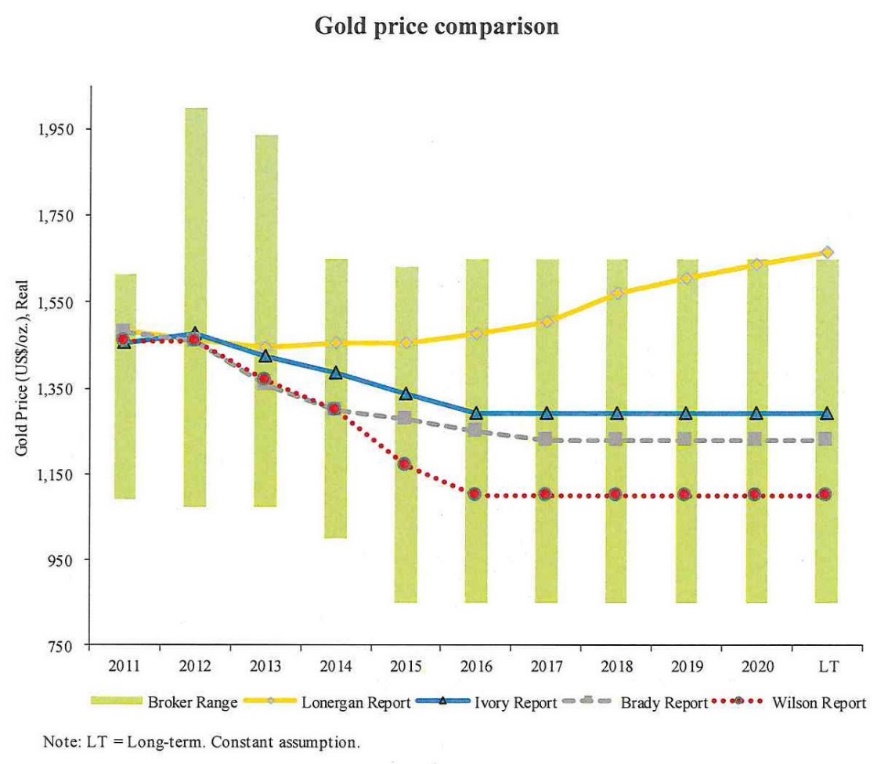
239 The vertical bars show the range of broker forecasts. It is the range of forecasts in the data set used by Mr Wilson. The top line on the graph shows the gold prices used by Mr Lonergan in his DCF Analysis. The next line depicts the prices used by Ms Ivory. The next line contains the forecast gold prices the subject of Dr Brady's report. The bottom line depicts the prices used by Mr Wilson.
240 There was no issue raised as to the accuracy of figures in the gold price comparison as a depiction of the differences between the experts.
241 It can be seen that there is very little difference between the experts in their forecasts for 2011 and 2012. By 2014, the range of difference is of the order of $150 expanding to more than $550 for the long-term forecast.
242 Throughout the forecast period, the range of broker forecasts is quite considerable. Speaking broadly, the analysis by Ms Ivory and Dr Brady remain, for the most part, at about the mid-point in that range. Mr Lonergan's figures rise to exceed the highest point in the range for the long-term forecast. Mr Wilson's figures are consistently lower than Ms Ivory's and Dr Brady's figures.
Resolving the differences between the experts
243 Having regard to all the information presented, Mr Lonergan's gold price was an outlier. It was determined using a methodology that was not focussed upon determining the view of the market as to the future gold price. As has been explained, it relied upon a misunderstanding of the gold price information published by Bloomberg.
244 The Commissioner sought to make something of the fact that Mr Lonergan's gold price was within the range of analyst forecasts and therefore was 'not so far as outside the ballpark as to be unreasonable'. The difficulty with that submission is that it is inconsistent with the evidence as to the way in which large gold mining companies used the analyst forecasts. They did not deploy them by selecting one over the other. Rather, they used them as a data set of differing views to identify a range. The average or medium was then deployed as a way of checking the company's own internal assessment of the long-term gold price. There was no evidence to suggest that market participants might make market investment decisions on the basis of an outlier view.
245 Further, Mr Lonergan's approach was also distorted by the suggestion that it was appropriate to engage in a form of hindsight check by which the opinions as to the view of the market as to the future gold price at the time of the sale of the shares by the Newmont Vendors was compared to the actual gold price. Mr Lonergan engaged in a process by which he compared the views of market analysts as to the future gold price with the actual gold prices that occurred subsequently. Of course, market participants do not have a crystal ball. They have to make market decisions at times of uncertainty when the actual prices for gold into the future were unknown. In order to decide whether to invest in a gold mine they have to form a view as to what the likely value of the gold would be into the future. The market value for investments in gold mines at any point in time will be affected by those views within the market as a whole, not by the actual prices which might eventually occur as these prices were unknown and unknowable at the time market participants made their investment.
246 Significantly, even an investor who had a more bullish view of what the gold price might be compared to other investors in gold mines did not need to pay a price for an investment in a gold mine that reflected that view. Instead, the investor would be required to pay the market price being a price that would be affected by the prevailing sentiment within the market as a whole. At any point in time, individual buyers and sellers in the market for investment in gold mines will have different views as to the value of that investment which are affected, no doubt, by their own views as to the future gold price. Those views, in turn, are likely to take account of the views of analysts. Indeed, on the evidence, it is clear that it is common for market participants to rely upon some form of compilation of analysts' views. But even if they do not, the views of analysts are an effective proxy for the views of market participants. Therefore, regard to the cohort of those views in forming an expert opinion as to the relevant market value at a particular point in time is a logical and coherent way to approach the task. Its validity is not tested by looking to what the gold prices turn out to be.
247 It follows that it was not a valid approach to the valuation task to select some form of outlier value and seek to justify it as appropriate on the basis that it was within the range of views held by analysts at the relevant time. The market price is not set by outlier sentiments. Yet, that was the approach the Commissioner advanced in an attempt to justify Mr Lonergan's conclusion. It is not to the point that it is possible to squeeze Mr Lonergan's long-term gold price within the uppermost reaches of the range of analyst estimates for the future gold price. There is no justification for approaching that range by selecting its outermost values. All the more so when Mr Lonergan himself does not seek to support his approach on that basis but rather by reference to his flawed understanding of the Bloomberg data.
248 These matters are obvious to anyone with any experience in analysing the factors that determine market value. The insistence by Mr Lonergan that there might be some validity in a critique of predictions of the gold price by comparing them with actual gold prices reflected adversely upon his credibility as an expert on market value. It was consistent with the argumentative and partisan way in which he approached much of his evidence.
249 Even more strangely, there was an attempt in cross-examination of Mr Wilson to obtain his concession that the gold prices used by Mr Lonergan could be explained on the basis that Mr Lonergan was 'simply more optimistic about the gold price' than Mr Wilson, Dr Brady or Ms Ivory. Mr Lonergan's personal views are not relevant. The task is to determine an appropriate gold price to be used in a DCF Analysis. That analysis is seeking to ascertain the market value of the future cash flows for each of the gold mines as viewed at the time of sale of the relevant shares by the Newmont Vendors. Whether Mr Lonergan's view at the time may have been more optimistic than the market was not to the point.
250 Otherwise, for reasons I have given Mr Lonergan's analysis was deeply flawed because of its dependence on the Bloomberg data which he mistakenly applied. He was also mistaken as to the extent to which the Bloomberg curves were based upon trading in a deep and liquid futures and forward market for gold.
251 Further, for reasons explained by Ms Ivory, Mr Lonergan's very high gold price produced an outcome when it came to the future pool of value that did not accord with the information concerning Newmont Corporation as a whole. That is to say, when checked for sensibility it produced far too high an outcome when it comes to the overall value pool determined by the DCF Analysis. Ms Ivory undertook that sense check in the following way.
252 As Newmont Corporation was listed on the New York Stock Exchange, its market capitalisation as at 30 June 2011 could be determined. Ms Ivory noted that although the interest in the Boddington mine controlled by Newmont Australia was a two-thirds interest, the remaining one-third was controlled by another subsidiary of Newmont Corporation (being, Saddleback, as already discussed). Therefore, in order to consider the extent of the overall value within Newmont Corporation that was contributed by the four mines, Ms Ivory determined the value of the 100% interest in the Boddington mine, the 100% interest in each of the Jundee and Tanami mines and the 50% interest in the Kalgoorlie mine according to her valuation and compared it to the overall value of Newmont Corporation. She did the same with the values as determined by each of Mr Wilson and Mr Lonergan.
253 The analysis showed that her valuation attributed 27.6% of the overall value of Newmont Corporation to its interests in the four mines. Mr Wilson's analysis attributed 20.6% of the overall value to the four mines. However, Mr Lonergan's valuation of the four mines attributed a value to those assets which equated to over 42% of the whole enterprise value of Newmont Corporation.
254 Ms Ivory then compared those figures to other metrics which might indicate the proportion of the overall mining activities conducted by Newmont Corporation that were represented by the interest in the four mines. She calculated the following 'contribution metrics':
(1) the mines' contribution to total reserves and resources was 25.6%;
(2) the mines' contribution to total revenue was 22.9%;
(3) the mines contribution to total 'gross profit' was 20.5%; and
(4) the mines' contribution to total pre-tax income was 22.0%
255 Ms Ivory's calculations as to these matters were not disputed.
256 These checks are a compelling reason to question Mr Lonergan's values as used in his DCF Analysis. I accept Ms Ivory's conclusion that:
the problem is the key valuation assumptions (gold prices, discount rate) that underpin Mr Lonergan's valuation - in combination they result in a significant overvaluation, and therefore they cannot be considered to be valid market participant assumptions.
257 Therefore, in my view, Mr Lonergan's gold price is both devoid of any logical foundation and produces an outcome that fails reasonable sense checks. It must be rejected as the appropriate gold price for the DCF Analysis.
258 When it came to Mr Wilson's criticism of the approach of Dr Lonergan in adopting a long-term gold forecast of $1,667, Mr Wilson said that he 'was not able to identify any actual market participants who determined a long-term gold price anywhere near this level at the [relevant date]'. In fact, there were market analysts in the data set that he had used that had published long-term forecasts of $1,600 and $1,651 respectively. He readily conceded his error when taken to these matters in cross-examination and acknowledged that he had overstated his observations in making the statement. Mr Wilson also accepted that the two estimates were not complete outliers.
259 I accept the validity of the point made by Mr Wilson by way of further explanation, having made those concessions. It was to the effect that it would never be appropriate to select the highest value from a group of 19 observations for the purpose of determining the long-term gold forecast.
260 One difference between Mr Wilson and Dr Brady on the one hand and Ms Ivory on the other was that Ms Ivory used an average of broker forecasts whereas Mr Wilson and Dr Brady used the median. In the opinion of Mr Wilson, the better approach was to use the median rather than the average. In his oral testimony, Mr Wilson explained the basis for that opinion in the following way:
In my opinion, the median has a couple of benefits. In my view, it's an unbiased observation, so there are equal number of observations above and below. So it's the middle number in the range. And the median is not influenced by outliers. The average can be influenced by outliers.
261 Mr Wilson accepted that there were valuation professionals who used the average.
262 As to the use by Mr Wilson and Ms Ivory of a component for their gold price that was derived from something other than the data set of analyst/broker estimates of the future spot price for gold there were a number of difficulties.
263 Ms Ivory determined the mid point between (a) a spot gold price of $1,500 based on data leading up to 30 June; and (b) the average of analyst/broker estimates of the future spot price.
264 There is an inherent inconsistency in this approach. On the one hand, it anchors the price at the $1,500 spot price that was observed as at 30 June 2011. On the other hand, it uses estimates from analysts/brokers as to the likely future movements in the spot price. It is significant to note that the approach of Ms Ivory carried forward into the gold price used for her DCF Analysis the spot gold price as at 30 June 2011. Obviously, the further away from those dates that those spot prices were used the less they could be said to reflect the future circumstances. At the same time, the market sentiment as reflected in the forecasts was that the spot price would not remain at $1,500. The use by Ms Ivory of gold prices which factored in the spot gold price as at 30 June 2011 by giving it a 50% weighting for the whole of the analysis period tended to give considerable weight to current gold prices. Further, there was no analysis of the economic factors that might affect the movements in the gold price over time. This was a weakness in the approach to the gold price in the analysis undertaken by Ms Ivory.
265 As has been mentioned, Ms Ivory subsequently revised her position to express support for the analysis of Dr Brady. As has been explained that is a free-standing analysis that involved the application of Dr Brady's considerable experience and expertise, informed by an econometric model.
266 Mr Wilson did not link his long-term gold price estimate in any way to the spot price as at 30 June 2011. However, an issue with the long-term gold price used by Mr Wilson was that it applied the median of analyst estimates of the long-term gold price in a mathematical way. When he was challenged as to the absence of any judgement on his part concerning the long-term estimate, Mr Wilson said that he selected the median as 'an unbiased observation with an equal amount of brokers above and below'. However, as depicted in the gold price comparison graph (as included above), the range of long-term estimates was considerable (between about $850 and $1,650).
267 For the median of the analyst estimates to have significance for the DCF Analysis undertaken by Mr Wilson, the median value had to have significance for the decisions made by buyers and sellers of producing gold mines in Australia in June 2011. It needed to be shown to have significance as a measure of the gold price that was used by market participants at the time in determining value, either because it was some form of effective proxy for the views formed by those market participants or because it was actually used in some way by them. It was the latter alternative that Mr Wilson gave as the reason for his use of the median value. He said that it was his experience that it was very common for gold companies, investment bankers and private equity firms 'to apply significant weight to broker forecasts in their analyses'. He said that 'gold companies tend to use broker forecasts or internal forecasts of long-term future spot prices in their spot valuation models and do not hedge gold prices long-term'.
268 Significantly, Mr Wilson referred to analyst estimates of the long-term spot price for gold as an input that was used in decision-making and excluded futures and forward prices as an input. The view that futures and forward prices were not used as an input in undertaking analysis that informed the making of market decisions is supported by the evidence of Mr Strelein and Mr Bacchus.
269 However, on the evidence of Mr Wilson the analyst estimates of the long-term gold price were only one input. Consequently, there were other inputs used by market participants in what Mr Wilson referred to as their 'spot valuation models'. This meant that the view formed by relevant market participants as to the long-term gold price that affected their decisions (and hence the market value for producing gold mines) was affected by more than the analyst estimates. Further, it was by no means clear that it was the median value that was used by market participants. As has been mentioned, Mr Bacchus gave evidence to the effect that a median or consensus of broker forecasts was used. No doubt there was also the possibility of scenarios being used. It was possible that a conservative approach was generally adopted which led to the adoption of a price that was lower than the median value.
270 Significantly, Mr Bacchus referred to large gold mining companies forming their own fundamental view on the outlook for gold which they checked against broker forecasts. In effect those gold mining companies undertook their own forecasts using a similar methodology to that used by brokers. The transaction in the present case was in respect of an opportunity of a kind where large gold mining companies would expect to participate. The evidence given by Dr Brady was to similar effect. It is an approach that requires consideration to be given to the broader economic factors that are likely to affect the gold price in the future and the likely trends as to those factors.
271 Mr Wilson agreed that he did not test the median price that he used against his own views of the macroeconomic outlook. His was a more mechanistic approach that gave considerable significance to the median. It did not bring to account the kind of reasoning that would be applied by a prospective purchaser of the four gold mines which would also have regard to wider economic considerations. In my view, this was a difficulty with Mr Wilson's approach to the gold price.
272 As has been mentioned, a difficulty with the reliance upon the estimates published by analysts as to their views of the future gold price, including the long-term forecast for the spot price, is the considerable range in the estimates. It may be accepted that the estimates will be informed by some form of analysis undertaken by each publishing party and that the analysis will bring to bear views as to macroeconomic conditions and informed predictions as to the future course of economic events. However, for the most part, the way in which that was done was not explained in great detail. In a sense, using the median brings together all of those disparate views. There was evidence to the effect that an analysis of broker estimates would be undertaken in that way. It was a way of gaining an understanding of the range of views. However, the extent of the range of estimates itself indicates that even with the application of some form of analysis, outcomes vary considerably.
273 It may be accepted that the application of a median rather than an average will tend to remove the significance of outliers. Further, there is support for the use of analyst estimates as part of the information gathering process used by market participants when making decisions as to the market value of investment in gold producers. However, the data was still quite broadly distributed with little to justify one point over another.
274 By way of comparison, Dr Brady took the available data and considered it through the lens of his own experience and expertise. Significantly, the methodology that he deployed relied upon an econometric model which sought to understand how macroeconomic events affected the gold price. He applied his own evaluative approach applying his expertise and commercial experience, supported by the insights gained from the econometric model. He preferred to rely upon his own long-term economic analysis when it came to the longer-term price of gold than rely upon that undertaken by analysts to inform their forecasts. In my opinion, Dr Brady's approach was the most robust approach. It was more consistent with the evidence of actual market behaviour by large gold mining companies of the kind who would be prospective purchasers. They would form their own view as to likely longer-term spot prices for gold to be used in making investment decisions that was informed by their analysis of macroeconomic trends. For those reasons, Dr Brady's analysis of the appropriate gold price to use in the DCF Analysis is to be preferred over that used by the other experts.
275 Dr Brady was cross-examined about the existence of the long-term relationship between gold prices and inflation. He accepted that there is a well-established relationship between gold prices and inflation. He said that short-term factors can push gold prices away from an inflation equilibrium but agreed that over the long term the relationship between inflation and the gold price will return to equilibrium. Over time, the gold price increased as inflation increased thereby maintaining its real value. It was a reason why gold was known as an inflation hedge. These were matters he had included in his report.
276 It was submitted for the Commissioner that these views supported a conclusion that the market expected the gold prices would continue trending upwards and this somehow supported the views of Mr Lonergan as to the future pathway of gold prices. This submission is not supported by a proper understanding of the evidence given by Dr Brady. There is no inconsistency between his evidence about inflation and gold prices and his reasoned view as to why prices were expected to fall based upon prevailing economic factors at the time before reaching a price which was then held constant in real terms over the balance of the period the subject of the DCF Analysis. Ultimately, the opinion of Dr Brady was consistent with the approach that in the long-term the real value of gold was maintained.
Conclusion
277 In all the circumstances, having particular regard to the matters to which I have referred, I conclude that the appropriate gold prices to use to undertake the DCF Analysis are those of Dr Brady. It matters not that in the peculiarities of unfolding events the prevailing views as to likely future gas prices were well short of the mark. The market valuation task to be undertaken for the purposes of Division 855 requires regard to market values as at 30 June 2011. It is those circumstances that informed the market value of Newmont Australia's shares at the time and hence the extent of any capital gain. Those values are a function of the views of market participants at that time. In my assessment, the approach of Dr Brady best reflects the way in which relevant market participants at the time would have undertaken the required evaluation of likely future spot prices for gold for the purpose of determining the price to pay for shares in a gold mining company with the characteristics of Newmont Australia.
Issue (2): What is the appropriate beta value to be used in determining the discount rate to be applied in undertaking the DCF Analysis in this case?
278 A key integer for undertaking the DCF Analysis is the levered beta value. It is the most contentious aspect of determining the appropriate weighted average cost of capital.
279 The beta value is a measure of the quantifiable risk associated with a particular investment, in the present case the business of operating four producing gold mines in Australia.
280 A beta value of 1.0 is applied where the value of investment is expected to move broadly in line with the market as a whole both during times of economic difficulty and in times of economic stability. A beta value of more than 1.0 indicates an investment that will move with greater volatility than the market as a whole. The more the volatility, the higher the beta value. A beta value less than 1.0 indicates an investment with less volatility than the market as a whole. So, the less the volatility, the lower the beta value.
281 A stable, well-established business with regular cash flow that is affected by economic factors in the same way as the market as a whole will tend to have a beta value close to 1.0.
282 A levered beta is one that is adjusted to reflect the risk associated with the level of debt associated with the particular investment. Mr Wilson explained the concept of a levered beta in the following way in cross-examination:
So the beta that we observe in the stock - from analysing the stock market prices and stock market returns is influenced by the capital structure of the company. A company that has higher debt in its capital structure generally has a higher beta, and lower debt has a lower beta. So when we observe the beta for a specific public company, we - to make it comparable in terms of the company that we are valuing, we unlever the beta, so we remove the existing - the company's specific capital structure, and then relever it assuming our assumed capital structure for our subject company. So, in a nutshell, the relevered beta is adjusted for differences in leverage between the public companies and the subject company.
283 Intuitively, there are certain factors that would be expected to influence the beta value in particular ways. However, ultimately, the determination of the beta value is informed by an understanding of the factors that affect the beta through observation of available market data. It requires the identification of a meaningful set of data that can be used, together with a degree of judgement, to derive an appropriate beta value. The value is then levered to adjust for the debt circumstances of the entity in respect of which analysis is being undertaken that requires an appropriate discount rate.
284 Consequently, as to the beta value, the main issues between the experts concerned the appropriateness of the data sets they had used to obtain information to inform the judgement to be made by them as to the levered beta value to be deployed in their DCF Analyses. Those issues concerned whether the companies included in the data set were true comparables. There were also minor issues as to whether the levering adjustments and certain statistical adjustments were made appropriately.
285 I will address the evidence of each of the experts before expressing my conclusion as to the appropriate levered beta value.
Mr Wilson
286 In the opinion of Mr Wilson, the appropriate levered beta value to use was 0.7, a value that he had revised downwards from his initial opinion of 0.8. The revision was made after observing data as to discount rates used by relevant market participants for public reporting purposes and after deciding not to make what is referred to as a Blume adjustment (an approach that he had used initially but which had been criticised by Mr Lonergan). Mr Wilson otherwise calculated his levered beta value using a five-year data set of weekly observations for a comparison group that included 19 gold mining companies. He obtained the data from Bloomberg.
287 As to the frequency of observations to use, Mr Wilson's view, which was said to be based on his own research and analysis, was that beta values calculated using weekly data are more accurate than those calculated using monthly data. Mr Wilson also referred to an article from the Journal of Finance and Strategic Decisions, a peer-reviewed journal, to support his approach of using weekly data, namely Daves PR, Ehrhardt MC and Kunkel RA, 'Estimating Systematic Risk: The Choice of Return Interval and Estimating Period' (2000) 13(1) Journal of Finance and Strategic Decisions 7-13. This journal reference assumed some significance in the cross-examination of Mr Lonergan. In what follows I will refer to it as the journal article.
288 In a joint statement prepared with Ms Ivory after expert conferral, Mr Wilson explained that he had relied upon five-year weekly data for two reasons. First, his experience 'that using weekly return data is an appropriate way to calculate beta, as it is a widely accepted methodology by valuation specialists and the broader finance industry' (referencing the journal article). Second, his five-year weekly betas had a lower standard of error measured statistically.
289 Mr Wilson's beta value of 0.7 indicated that movements in the value of Newmont Australia over time were less volatile than the market average and consequently it could be described as a company that was more stable than average.
290 The companies in the data set used by Mr Wilson were publicly traded companies that conducted mining operations that Mr Wilson considered to be appropriately comparable to the mining operations conducted by Newmont Australia, namely those conducted at the four mines.
291 As to the period of five years that Mr Wilson used for his data set, he explained that it was 'fairly standard' that his valuations use five years and it was his default. As to the appropriate period to use, in his opinion it was important to consider whether the historical data set was 'going to be representative of the time period going forward'. In the present case, that was a period of more than 50 years based on life of mine.
292 Mr Wilson agreed with the proposition that in projecting forward for such a long period it was appropriate to have a data set that included a period of financial turmoil where the value of investments was affected by a financial event like the Global Financial Crisis. He agreed that including within the period of the data set an event of that kind 'gives you a better picture of its overall robustness'. Mr Wilson did not agree with the approach of Ms Ivory, which was to exclude data from such an unusual event. He agreed with the proposition that such an approach 'assumes the good times'. He also agreed that there had been no fundamental change in the nature of the business of Newmont Australia that would make it inappropriate to go back more than two years for the data set.
293 Mr Wilson was appropriately cautious when it came to expressing views as to the way in which particular matters might affect the beta value. He emphasised that it would be necessary to undertake the requisite analysis to determine the effect that a particular characteristic of an investment might have on the beta value. However, he did agree that, generally speaking, higher risk would imply a higher beta. He also agreed that a mine located in a more risky country would probably imply a higher beta.
294 Mr Wilson was cross-examined about the companies that were used in his comparable data set that formed the basis for the formation of his opinion as to the appropriate beta value to be used in determining the discount rate for the DCF Analysis. He was asked about the relativity between his revised opinion as to the beta value for Newmont Australia and the re-levered beta value in his data set for Newmont Corporation of 0.6. The responses given by Mr Wilson exposed the complexities involved in making comparisons of that kind. Mr Wilson explained how diversity in the overall portfolio of investments held by Newmont Corporation could explain the difference because diversity was a way of lowering the risk profile of an investment. In his answers, Mr Wilson also explained why it was more appropriate to draw a conclusion from an overall data set rather than seek to make subjective comparisons between the nature of the risks that might affect the beta for a single observation (one public company) in order to reach a conclusion as to the appropriate beta in the present case. I found these explanations to be persuasive.
295 Mr Wilson was also asked about the long-term gearing ratio that he used for the purpose of determining his levered beta value for Newmont Australia. It was pointed out that he used 15% whereas Mr Lonergan and Ms Ivory used 20%. When questioned about the difference, Mr Wilson accepted that either value was reasonable. He was asked about the difference for his DCF Analysis if he had used 20% like Mr Lonergan and Ms Ivory. He said that he had looked at that and it did not make a difference. He explained that rounding the outcome for each result reaches the same discount rate of 5.25. So, the effect of the different long-term gearing ratios was insufficient to affect the ultimate result.
Ms Ivory
296 Ms Ivory's opinion was that gold producers were a lower risk than producers of other commodities 'all else being equal'. On that basis, her expectation was that a producing gold miner would have an unlevered beta close to 1.0. In her oral evidence, Ms Ivory explained that her overall opinion as to the appropriate level of beta was informed by her observation of lower betas applying to companies selling regulated or non-discretionary goods. In her view, as gold mining had a significantly higher systemic risk than those companies, a beta of around one was reasonable.
297 Ms Ivory, identified 27 publicly traded entities as a data set of 'comparable companies' to be used in the assessment of the appropriate beta value for Newmont Australia. Ms Ivory obtained data for those 27 entities over the two-year period prior to 30 June 2011 with weekly data points. Ms Ivory also obtained data for the same companies over a four-year period with monthly data points. However, in her opinion, as the four-year data was affected by the Global Financial Crisis it was not appropriate to use that data set. Instead, Ms Ivory based her analysis on the two-year set of data.
298 Ms Ivory concluded that the appropriate unlevered beta value to use for Newmont Australia was between 1.0 and 1.1 which resulted in an adjusted levered beta value in the range of 1.18 to 1.29 (the adjusted value applied a Blume mean reversion adjustment and gearing ratio).
299 Ms Ivory provided a second report which responded to a number of matters that had been raised by Mr Lonergan (who used a data set of monthly values over a four-year period). One of his criticisms of Ms Ivory's analysis concerned the beta value. In response, Ms Ivory presented a table comparing Newmont Corporation's four-year monthly beta values with Newmont Corporation's two-year weekly beta values calculated at six monthly intervals over the period December 2006 to June 2011. It was an instructive way of understanding the differences between using the different approaches to analysing the same data. Following additional analysis 'to consider the operating leverage of the gold mining companies in [her] sample', Ms Ivory widened her unlevered beta to a range of 0.9 to 1.1, relevered to a range of 1.06 to 1.29.
Mr Lonergan
300 In the opinion of Mr Lonergan, the appropriate levered beta value to use was 0.5 to 0.6. Mr Lonergan used data over a four-year period at monthly intervals. He criticised Ms Ivory for using two-year weekly data. In his reports, Mr Lonergan also criticised Mr Wilson's approach to equity betas, but did not deal with the journal article cited by Mr Wilson.
301 As to the matters bearing upon the DCF Analysis, Mr Lonergan's initial report took the form of a criticism of Mr Wilson's approach and a recalculation by Mr Lonergan. When it came to the beta value he said that 'weekly return measurements generally produce a more volatile result than monthly return measurements'. He also maintained that Mr Wilson's use of weekly beta values increased the measured betas. He said that Mr Wilson failed to refer to what Mr Lonergan described as 'the fact that investors in very long term assets do not focus on short term weekly beta volatility'. As to these matters, Mr Lonergan noted that equity betas provided by the Securities Research Centre of Asia Pacific (SIRCA) were calculated based on monthly returns. He described SIRCA as the 'beta measurement service provider widely used by valuation specialists in Australia'. It will be necessary to return to these aspects of Mr Lonergan's written report when considering matters that emerged in cross-examination.
302 Mr Lonergan produced a comparison table in which he presented Mr Wilson's five-year weekly beta data set alongside 'Alternate four year monthly betas'. He described the four-year monthly data as being 'sourced from SIRCA and LEA analysis [his own consulting firm]'. Again, it will be necessary to return to the comparison table when dealing with matters that emerged in cross-examination.
303 In his oral evidence Mr Lonergan expressed the view that the data concerning observed beta values from published stock market information should be used to check the judgement made as to the appropriate discount rate to use in the DCF Analysis. However, as it was a forward looking concept, in the view of Mr Lonergan, it was ultimately a matter of judgement, 'not a mechanistic extrapolation of historical equity betas of listed comparable companies into the future'. Nevertheless, his conclusions were derived from the four-year monthly data set that he produced using the same data set of companies that had been identified by Mr Wilson.
The contentions of the parties
304 The Newmont Vendors submitted that the approach of Ms Ivory should be preferred when it came to the beta value.
305 As will emerge, Mr Lonergan's data set and his analysis of beta values were both exposed as being substantially flawed. In the result, the Commissioner relied by Mr Lonergan's beta value but advanced no submission explaining why it should be adopted. The Commissioner also submitted that Mr Wilson's levered beta value should be lowered, noting 'the relationship between Mr Lonergan and Mr Wilson'. Further, the Commissioner submitted that Ms Ivory's two-year approach should not be accepted or, if accepted, should be lowered substantially.
Resolving the differences between the experts
306 As has been explained, there was a difference between the experts as to whether to use two years, four years or five years of data. There was also a difference as to whether to use weekly or monthly data. The analysis showed that there were considerable differences in the results depending upon the data used. Ms Ivory produced comparisons, as did Mr Lonergan.
307 A broad comparison between the results indicates that the inclusion of data from the period affected by the Global Financial Crisis produced a lower beta. However, the five-year data (which included more time when the Global Financial Crisis was not affecting world markets) resulted in a higher beta than the four-year data. The monthly beta values using the four-year data were the lowest.
308 As there were significant differences between the experts as to the period to use (two, four or five years) and the frequency of data (weekly or monthly), I will deal with those two matters before turning to some other issues between the experts concerning the beta value.
Two, four or five years
309 In my view, it is significant that the beta value is required for a DCF Analysis in respect of the earnings that might be generated from long-term mining operations. Consequently, it is important that the discount rate (and the beta value to be used in determining that discount rate) should reflect a long-term view. Accordingly, it is appropriate to disregard data that is unlikely to provide a fair indication of the way stocks in gold producers will move relative to volatility in the market as a whole if that data was overly influenced by a recent significant economic event such as the Global Financial Crisis. Equally, discount rates to be deployed in undertaking a long-term analysis of expected future cash flows should factor in the prospect of such events occurring in the future in determining a forward-looking value like the beta to be used in determining the discount rate for the DCF Analysis.
310 Although Ms Ivory's use of a two-year data set sought to address the problem that the four-year data was overly influenced by the Global Financial Crisis, a very substantial economic event, it introduced a new problem, namely the use of a limited data set when the degree of market volatility was unlikely to include the response of the market to the range of shocks that might occur over the long term. The use of such a short-term horizon is unlikely to capture sufficient data to reach a meaningful conclusion as to the appropriate beta value for a long-term analysis.
311 In addition, the data used by Ms Ivory in her first written report had a very considerable spread of values. The two-year unlevered data for the group of identified comparables ranged between 0.5 and 1.7, with six companies having values at 1.4 or higher and four companies having values of 0.8 or lower. There were also three companies with values that were said to be 'not meaningful'. For many companies, the beta value for the four-year period was quite different to that for the two-year period. In particular, for Newmont Corporation, there was a difference between 0.9 for the two-year weekly data and 0.6 for the four-year monthly data.
312 In short, I am not persuaded that the two-year data set used by Ms Ivory to support her conclusions as to the beta value was appropriate.
313 However, there are difficulties also with using the four-year data set because it is heavily influenced by the effects of the Global Financial Crisis. This was well-explained by Ms Ivory in her second report. After explaining the safe haven characteristics of gold companies (a matter that did not appear to be in dispute), Ms Ivory then said:
In an extreme market event, such as the GFC, the share prices of gold mining companies tend to be more resilient than the broader market. As a result, when the returns of gold mining companies are regressed against market indices during periods of high volatility, the observed betas for the gold mining companies look abnormally low.
However, regardless of the safe-haven aspects of gold, gold mining companies are still subject to the same exploration, development and mining related risks as companies in other extractive industries. And during 'normal' economic conditions (i.e. periods of normal volatility), the observed betas of gold mining companies are higher than during extreme economic conditions.
314 Ms Ivory was not challenged on this analysis which is based upon propositions that are consistent with the evidence given by the other experts as to the character of gold mining companies. Mathematically, it is logical. It is a reason to be cautious about an analysis which incorporates data that is affected to a considerable degree by the Global Financial Crisis. If the previous four years of data is included in forming a view about the appropriate data then about a quarter of that data relates to that period (as was demonstrated by Ms Ivory in referring to the exchange volatility index over the four-year period). As Ms Ivory put it in her second report, Mr Lonergan implicitly assumes that an extreme event like the Global Financial Crisis will occur every four years. That is not a reasonable hypothesis on which to found the determination of the appropriate beta value. Therefore, just as there may be problems in using a data set relating to just two years which does not include any allowance for the way in which the share price would move during a period of significant economic shocks, there are also problems in using a data set that is heavily weighted with the consequence of a very significant event that is likely to occur infrequently. For those reasons, I also am not persuaded that it is appropriate to adopt Mr Lonergan's approach of relying on data over the previous four years.
315 Mention has been made of the use of a 'Blume adjustment'. Ms Ivory used one on her data. Mr Wilson did too for his initial report, but did not apply one when he revised his beta value. A Blume adjustment is applied to beta values that are considered to be driven by shorter-term factors on the basis that, over time, observed beta values regress towards 1.0. That is not to say, as Mr Lonergan seemed to suggest, that it was an adjustment that was only justified where there were reasons to think that the share price of an entity was likely, as time went on, to move more in line with the market over time. Rather, it is informed by the view that a data series for a short period will tend to produce a wider range of beta values than a data series for a longer period. Further, as was explained by Ms Ivory, the Blume adjustment has less significance when the beta value from a data set is already close to 1.0. That is because, the Blume adjustment would not have much effect on data of that kind.
316 Ms Ivory calculated that a Blume adjustment when applied to Mr Lonergan's beta values would increase his levered beta, ranging from 0.5 to 0.6, to a range from 0.83 to 0.87. Her calculation was not questioned. The Commissioner advanced a submission in opening to the effect that Ms Ivory was in error in making a Blume adjustment. It was based upon the opinions expressed by Mr Lonergan concerning the circumstances in which an adjustment of that kind would be appropriate. In the result, Mr Lonergan was not challenged as to those views. In the result, the Court was not assisted by any submissions concerning the approach to be adopted concerning the Blume adjustment when it came to the analysis of Mr Lonergan and Mr Wilson. Accordingly, as both those experts were of the view that it was not appropriate, I do not consider its possible application to their data sets.
317 In my view, the fact that Mr Wilson used a five-year period in the unusual circumstances of the present case where all agreed that the Global Financial Crisis had a significant effect on the data is a substantial reason for preferring his approach over that of the other experts.
Weekly or monthly
318 As to whether the beta should be calculated using a data set at weekly or monthly intervals, obviously a monthly calculation over the same period uses less data points. Ms Ivory's analysis showed why there were reasons to conclude that her two-year weekly data was more reliable statistically. Likewise, Mr Wilson determined that the five-year weekly beta values had a lower standard error compared to four-year monthly betas which had a standard error almost three times higher. These are matters to which I return below.
319 Mr Lonergan was challenged in cross-examination as to his use of monthly instead of weekly data. It was an illuminating passage of cross-examination. Mr Lonergan began by seeking to justify his monthly approach on the basis that it removed 'what we call technically noise' all of which was said to disappear if the measurements were taken monthly.
320 Then, when it was put to him that 'betas calculated on a weekly basis are more stable compared to betas calculated on a monthly basis', Mr Lonergan gave the following answer:
You may suggest it … It's not quite right for, amongst other things, the reason I just explained. I think there is a paper on that, but that's only the one that I'm aware of.
321 Significantly, the proposition was not dismissed. Rather, the answer given was that 'It's not quite right …'. If indeed it was the case that there was a generally accepted view that betas determined using monthly data were to be preferred over those determined using weekly data then you would have expected Mr Lonergan to disagree with the proposition that had been put to him. The answer given indicated that there was no such clear preference based on the removal of 'noise'. The end of the answer possibly suggests that there is a paper that supports the reasoning Mr Lonergan had given but there was no such paper identified by him. However, in the context of the report of Mr Wilson, it seems to me that Mr Lonergan was referring to the journal article (upon which Mr Wilson had relied to support his approach of using weekly data). If that is so, then Mr Lonergan's statement that the article was the only one he was aware of has significance for the way his evidence unfolded.
322 After giving the above answer, Mr Lonergan was then taken to the journal article. Mr Lonergan then gave the following answer:
I'm aware that there are alternative views about it, but the explanation I've given you is the one that I believe is appropriate.
323 I would have expected an independent expert not advancing a partisan position in the interests of his client to have started with that position if indeed it was the state of the research and academic analysis and to do so by giving evidence to the effect that there are a range of views but his personal view is that monthly data is more appropriate because it eliminates 'noise'. It also manifests inconsistency between Mr Lonergan's initial evidence which appears to have been to the effect that there was only one article of which he was aware on the topic being the one referred to by Mr Wilson. Notably, Mr Lonergan did not produce references to other relevant research nor academic analysis.
324 Mr Lonergan was then asked some questions about the journal article. He agreed that it compared data that was weekly or four-weekly that had been taken over two, three and four year periods. He was taken to a summary of the conclusion reached in the article which was expressed in the following terms:
This study examines the return interval and estimation period the financial manager should select when estimating beta. The results show the financial manager should select the daily return interval and an estimation period of three or less years.
325 Mr Lonergan was then asked about a statement in the article to the effect that the longer period (of four years) smooths out some of the noise but that for any period (two, three or four years) the daily data 'always provides a more precise estimate of beta'. He was asked whether he agreed. Mr Lonergan gave the following answer:
No, no. I'm aware of the argument, but I can't particularly recall reading this. But the academic studies say that - we're talking here about daily measurement. It's not only daily measurement you should do. You should do daily measurement depending which day of the week you start with. To put that in simple terms, if you start on Monday and end on Friday, you will get a different mathematical result if you start on Tuesday and end on the following Monday. And so it goes on. So there are all these - what shall we say - studies analysing these things, but the practical reality is, there's a lot of noise in weekly data.
326 This is very revealing for a number of reasons.
327 First, the journal article was clearly identified by Mr Wilson in his report as an important basis for using weekly data. I consider it to be most unlikely that it had not been considered by Mr Lonergan at all. Further, as I have explained, in my view it was an article that Mr Lonergan had already referred to in his earlier answer.
328 Second, the answer refers to 'academic studies', but Mr Lonergan has suggested that there is only one article on the subject of which he is aware.
329 Third, if indeed there is a body of academic studies, this indicates Mr Lonergan's awareness of a body of expert literature on the issue to which he has made no reference. The criticism that Mr Lonergan made of Mr Wilson when Mr Lonergan prepared the table comparing his four-year monthly data to Mr Wilson's four-year weekly data made no reference to a body of such material. The only reference made by Mr Lonergan in his report was to SIRCA calculating equity betas on a monthly basis (a matter considered below). It is the approach of SIRCA and not any body of other academic studies that was advanced in Mr Lonergan's report to support his monthly approach.
330 Fourth, Mr Lonergan's answer then deflected to refer to issues that arise with daily measurement. He made the point that there can be a 'different mathematical result' depending on which day of the week you start the daily series, but he did not suggest that it is a material difference or that it was a difference that supported the use of monthly data. Then he said that there are 'all these … studies analysing these things' and resorted to an assertion that as a matter of 'practical reality' there is 'a lot of noise in weekly data'. Of course, the point being made in the journal article is not to the effect that daily intervals do not have 'noise' but that the daily data is better, no matter whether the data series is for two, three or four years.
331 Mr Lonergan was then taken to a statement in the journal article to the effect that the simulations described in the article demonstrated that there was greater precision in estimating the beta from a data set that used 'shorter return intervals'. Mr Lonergan did not agree with the proposition that shorter intervals would give greater precision in estimating the beta but did not elaborate as to why, despite his willingness to elaborate on other occasions.
332 After that, Mr Lonergan was asked about the way he dealt with the issue in his written report when he was criticising Mr Wilson's approach of using five-year weekly beta values. Before going to the terms of Mr Lonergan's written report, it is necessary to explain what was said by Mr Wilson in the part of his written report to which Mr Lonergan was responding. This is what Mr Wilson had said:
The Beta is a forward looking estimate and its calculation should capture the expected relationship between the subject stock and the market. When determining the Beta based on historical information, a general challenge is to strike a balance between capturing the oldest available data and limiting the historical data to a period of time in which the historical relationship between the stock and the market are representative of the expected future relationship. Based on my experience, most valuation specialists use a historical time period of one to five years for the purposes of calculating the Beta.
Another decision that can impact the Beta calculation is the number of observations used in the calculation, which is driven by the selected time period and the selected measurement frequency. The selected measurement frequency should reflect a measure that captures price movement of a stock in tandem with that of the market. Daves, Ehrhard and Kunkel observed that Betas with higher measurement frequency are generally more accurate, as the number of observations involved is larger. However, this is not always true. Over the last few decades, studies have been performed on Beta impact due to a non-synchronous trading period and as Damodaran summarizes, thinly traded or inactive period(s) for a stock may result in a lower covariance with the market. This may potentially undestate the Beta. Alternatively, the period(s) of infrequent trading can be adjusted in the Beta calculation. A study performed by Reilly and Wright showed that the impact on the Beta calculation due to different measurement frequencies was linked to entity sizes. Specifically, shorter intervals lead to a smaller Beta for small entities and larger Beta for large entities. In this way, the most appropriate measurement frequency may differ from one entity to another. Based on my experience, most valuation specialists use a weekly or monthly measurement frequency for the purposes of calculating the Beta.
(footnotes omitted)
333 Mr Wilson explained that his approach was to select five-year weekly adjusted betas for 'guideline public companies as provided by Bloomberg'.
334 In his written report, Mr Lonergan first criticised the way in which Mr Wilson had adjusted the Bloomberg data for the debt position of each of the comparable companies. Mr Wilson had applied a Hamada adjustment that delevered and then relevered each data point so that they could be compared on an equal footing (as if they were all for companies with the same level of gearing). It is a criticism that I do not accept for the reasons given by Mr Wilson in his reply report.
335 However, for now, following the logic of Mr Lonergan's written report, Mr Lonergan then responded to Mr Wilson's approach to determining the beta value in the following terms:
Mr Wilson does not mention that weekly return measurements generally produce a more volatile result than monthly return measurements. That is, it increases measured betas. Nor did Mr Wilson refer to the fact that investors in very long term assets do not focus on short term weekly beta volatility.
336 Mr Lonergan then said:
Mr Wilson did not calculate the (historic) equity betas of his selected companies using the monthly measurement frequency. In this regard, I note that equity betas provided by the Securities Research Centre of Asia Pacific (SIRCA) (the beta measurement service provider widely used by valuation specialists in Australia) are calculated based on monthly returns on the guideline public companies and a broad share market index observed over a four year period.
337 The clear and obvious purport of this statement is to chastise Mr Wilson for failing to follow the practice of what Mr Lonergan described as 'the beta service provider widely used by valuation specialists in Australia', namely SIRCA. Further, Mr Lonergan stated that SIRCA's equity betas 'are calculated based on monthly returns on the guideline public companies and a broad share market index observed over a four year period' (emphasis added). It is plain that Mr Lonergan was calling in aid the approach of SIRCA to support his use of four-year monthly data. Indeed, the reference to SIRCA was the only independent support given for the use by Mr Lonergan of monthly data points. As has been explained, the four-year monthly data presented by Mr Lonergan in his table comparing his data with Mr Wilson's five-year weekly data was cited as being sourced from SIRCA and analysis by LEA (Mr Lonergan's consultancy).
338 In his report, Mr Lonergan went on to criticise Mr Wilson for not mentioning or disclosing the impacts of using the alternative measure of equity betas on his adopted discount rates.
339 Returning to the cross-examination of Mr Lonergan about these matters, he was asked about the comparison table that he had presented in his report. Mr Lonergan was asked about who undertook the calculations required for the table. He gave the following answer:
The comparison is just the data. Mr Wilson's data is straight from his report. The SIRCA data is straight from its report. The average and median calculations are not hard.
340 It was plain from a further answer that Mr Lonergan sought to convey that all the four-year monthly data in the table was sourced from SIRCA. Of course, this was consistent with the criticism in the report based on the way SIRCA was said to measure the beta values that it provides. When it was pointed out that some of the data in the comparison table was for overseas companies which could not have come from SIRCA, Mr Lonergan then said that he got them from somewhere that he could not remember at that moment in time.
341 It was then put to Mr Lonergan that SIRCA will provide betas on a weekly or daily basis, whatever is requested. Mr Lonergan agreed that most of the data services would do that. He said that three or four of the data services automatically provide 'four-yearly monthly' or 'four-yearly weekly', but you can select what you like.
342 Therefore, as Mr Lonergan well knew, there was no significance in the fact that SIRCA published four-year monthly data. It also provided data on a weekly or daily basis. Yet, in my view, it was plain that he had sought to support his position of using monthly data by reference to SIRCA's publication of monthly data. Further, he had somehow obtained data for international companies from another source and presented that data as if it was equally supported by SIRCA's alleged practice of determining betas based upon four-year monthly data as supporting his approach.
343 Quite properly in my view, in the course of this cross-examination, the following question was put to Mr Lonergan:
Now, as you point out, the calculation of betas on a monthly basis are significantly lower than betas calculated on a weekly basis. I suggest to you that when you prepared this report, you knew that choosing betas on a monthly basis would give you a lower beta overall?
344 Mr Lonergan gave the following answer:
I think that's distinctly unkind and it's also inaccurate.
345 When he was pressed that the terms of his written report suggest that SIRCA was recommending monthly returns, Mr Lonergan gave the following answer:
Yes, I didn't intend to put that connotation on it. But I do work for them so I have some idea of their thinking but I don't want to commit to that. My thought process, going back to your earlier question, which I think will answer the one you've just put to me, is I actually thought taking a four-year period with the GFC in would push all the betas up and, therefore, you know, that would give what we would loosely call a conservative answer, given the matters under dispute in this issue.
[Note: the above quotation includes my correction to the transcript which incorrectly records Mr Lonergan as saying 'I don't work for them']
346 Mr Lonergan began this answer alluding to work that he has done for SIRCA, presumably as being a basis upon which he would know something about why they publish the monthly data. This was not the only occasion on which Mr Lonergan sought to buttress his evidence by referring in an oblique way to other roles he had undertaken rather than by explaining his analysis. Be that as it may, it seems to me that the only point in making the reference to his alleged work with SIRCA was to try and support the proposition that he had just disavowed he was trying to make, namely that SIRCA's practice of making monthly data available was a basis for supporting his use of monthly data. He then immediately moved away from that pathway by saying 'I don't want to commit to that'. I formed the view that he realised the inconsistency with the testimony he had just given of trying to find support for his approach in SIRCA's practice. Instead, he returned to the challenge to his independence by trying to suggest that he had adopted a conservative approach by including the Global Financial Crisis which he thought was likely to produce a higher beta value, presumably saying that is why he had used four years instead of adopting the approach of Ms Ivory which was to limit the period to two years. The inference from that logic expressed as it was in response to a challenge to his opinions about the adoption of monthly data instead of weekly data was that he had also chosen four years in order to be conservative.
347 When that proposition was put to him, it led to a 'correction' by Mr Lonergan. The question and answer was as follows:
What I'm saying is you say you thought that by going monthly, you would get a higher beta?---No, no, what I said - or what I tried to say, I'm sorry, if I didn't make it clear, is going back into the period where the GFC was there would be likely to produce higher betas basically for everyone, because the risks and the volatility of the GFC were much greater.
348 If that is so, then it is difficult to understand what Mr Lonergan was seeking to say by way of explanation for the way he had presented the SIRCA data. That is because there was no explanation for his approach other than his desire to argue the Commissioner's case (which would be supported by a lower beta value).
349 This is further reinforced if consideration is given to Mr Lonergan's proposition that he adopted a period of four years because he thought that the inclusion of the period of the Global Financial Crisis would result in a higher beta value and, in effect, he was surprised to see that it resulted in a lower figure. This would mean that he expected the price of gold producers in a period of considerable financial instability to tend towards being just as volatile as the market as a whole.
350 As to whether that might have been Mr Lonergan's view, it is instructive to consider his criticism of Ms Ivory's approach of using two-year data. In Mr Lonergan's report in response to Ms Ivory's approach, he criticised her use of two-year weekly data on the basis that it does not capture the market counter cyclical 'safe haven' characteristics of gold 'which result in lower equity betas of fully operational large gold producers like [Newmont Australia]'. By way of footnote, Mr Lonergan explained 'In simple terms, market "crises" do not occur every year'. In short, Mr Lonergan was saying Ms Ivory's approach is one that should not be adopted because it will not capture the Global Financial Crisis and will produce a beta value that is too high, being the direct opposite of his suggestion in cross-examination that he chose a four-year period because he thought it would produce a higher beta.
351 Further, Mr Lonergan's suggestion of four years was not in response to a period that did not include the Global Financial Crisis. It was first adopted in answer to Mr Wilson's approach of using five-year weekly data for his beta value analysis. The only justification advanced for doing so was Mr Lonergan's statement that SIRCA's beta measurements 'are calculated based on monthly returns on the guideline public companies and a broad share market index observed over a four year period'. There is no suggestion that it was done by Mr Lonergan to be conservative. It was the SIRCA explanation that was exposed as being unsustainable having regard to the actual practice of SIRCA and other publishers of information relating to beta values.
352 I do not believe Mr Lonergan's suggestion that he adopted the four-year period to be 'conservative', expecting it to produce a higher beta. Rather, I conclude he sought to justify his position by suggesting that it was supported by SIRCA's practice when he was aware that there was no such support. He did so in order to try and justify data that suited the interests of the Commissioner as his client.
353 Later in his cross-examination, Mr Lonergan was asked where he had obtained the data that he had included in his four-year monthly data set that concerned international companies given that SIRCA only produced data for Australian companies. He repeatedly gave the answer that he would have to go back and check.
354 Ultimately, this gave rise to an insistence on the part of Mr Lonergan that all the data in his comparison table showing four-year monthly data came from SIRCA, even though that was not the case.
355 In the cross-examination that followed, I find that it was established that all the data came from Bloomberg, the same source that Mr Wilson used, save that instead of extracting weekly beta values, Mr Lonergan extracted monthly values. This further reinforces my conclusion that the references to SIRCA were made to try and buttress the use of the four-year data.
356 Once the fact that Mr Lonergan had in fact used Bloomberg data was exposed, it enabled a comparison between the R2 values for the monthly values compared to the weekly values obtained from the same data set. The comparison showed that, applying the R2 measure, the weekly values used by Mr Wilson were statistically more reliable. Mr Lonergan maintained that this was not a reason to use weekly values instead of monthly values, but I am not persuaded that is so for two reasons.
357 First, as has been explained, Mr Lonergan gave significance to using SIRCA figures. For reasons that have been given, there was no significance in that point. However, in any event, the figures used in his comparative table were not sourced from SIRCA, they were sourced from Bloomberg (being the source used by Mr Wilson). This was a proposition that was resisted by Mr Lonergan for much of the course of his cross-examination, but was eventually accepted. In my view, the resistance reflected the fact that Mr Lonergan's argument for monthly values rested very much on his claims about SIRCA. Eventually, the whole foundation for Mr Lonergan's justification for the use of monthly beta values collapsed.
358 Second, Mr Lonergan was questioned about the use of an R2 measure to check the reliability of the data that he used to reach conclusions as to the appropriate beta values. The R2 measure is a well-recognised measure of the strength of the statistical relationship between variables where the analysis is being used as a predictor of future outcomes. In the present context, very low R2 values for the data set used by Mr Lonergan to determine the beta value meant that there was little confidence that the beta value would indicate the extent of likely volatility of future trading.
359 Mr Lonergan himself relied upon the R2 measure to criticise the beta observations used by Ms Ivory. He said that Ms Ivory did not explain the R2 measures attributable to each of the beta observations that she used. As to the significance of this failure he then explained:
In simple terms, the r-squared measure represents the 'closeness of fit' of the observations. By not considering the r-squared measures, effectively, equal consideration is given to each of the observations irrespective of whether the variance of returns of the company is explainable by the variance of returns of the relevant index
360 When first asked in cross-examination about the R2 measure in the context of the beta, Mr Lonergan agreed that it was a measure of the reliability of the beta. He also agreed that 'basically' the lower the R2 measure the less reliable the beta.
361 Later, when Mr Lonergan was asked about the application of the R2 measure to the data that he had used he gave the following explanation as to why he would not put much weight on the R2 measure:
because they are all - they're all harsh. But if one runs one's eye down, you will see there are so many of them that are low, on the approach of taking out all the ones that aren't high R-squared, there would be almost nothing left.
362 This answer is not an explanation as to why the four-year monthly data should be used, especially when the R2 measure for the five-year weekly data set used by Mr Wilson produced higher measures of reliability. It is also counter to the logic of Mr Lonergan's own criticism of Ms Ivory's two-year weekly data set.
363 Mr Wilson addressed Mr Lonergan's proposed four-year monthly data set in his reply report. He noted that Mr Lonergan provided no quantitative support for the rational of using a four-year monthly data set. He criticised Mr Lonergan for providing no evidence for his conclusion that weekly return measurements produce a more volatile result than monthly return measurements. That criticism is sustained. Mr Wilson produced a statistical analysis of the standard error between the four-year monthly data of Mr Lonergan and his own five-year weekly data. He concluded:
The standard error of the betas for the comparable company set is significantly lower when calculated based on weekly return data compared to when it is calculated based on monthly return data. Moreover, there are more observations, which generally leads to a more accurate analysis.
As such, with the set of market participants selected for the analysis, betas calculated using weekly return data are more appropriate to use than betas calculated using monthly return data, based on Mr Lonergan's own reasoning. For the selected set of guideline comparable companies, the betas calculated using weekly return data exhibit lower standard errors, which consequently would produce a less volatile and more reliable beta.
(original emphasis)
364 Mr Wilson's statistical analysis was not demonstrated to be defective in any way.
365 Ms Ivory also undertook a comparison between her data set and that used by Mr Lonergan using the R2 measure. It showed her data to be more reliable than Mr Lonergan's data. However, the real issue is whether her data set is to be preferred to that used by Mr Wilson, noting that they both applied the approach of delevering and then relevering their data so that a comparison could be made that removed the effect of differences in gearing between the companies in the data set.
366 However, for the following reasons, I find that Ms Ivory's conclusions as to the beta value appeared to be influenced to some degree by her impressionistic assessment that gold producers should have a beta at about 1.0. In her first report, Ms Ivory included the following as part of her reasoning concerning the appropriate beta value:
Gold mining companies are subject to the same exploration, development and mining related risks as companies in other extractive industries. However, gold is a financial asset rather than a commodity, and gold producers are therefore not subject to the same demand side risks that drive volatility in other commodities. An active futures market for gold also allows producers to lock in prices over the medium term at prices approximate to the current spot price plus the risk-free rate for the period to delivery. For this reason, I consider gold producers to be lower risk than producers of other commodities, all else being equal. I would therefore expect a producing gold miner to have an asset beta (unlevered beta) close to 1.0.
(emphasis added)
367 Ms Ivory then produced her table of disparate data, with medians and averages, followed by the statement 'I have selected an unlevered beta of between 1.0 and 1.1' for Newmont Australia which was said to result in an adjusted levered beta in the range of 1.18 to 1.29.
368 In a further report, Ms Ivory said that her approach remained unchanged but her unlevered beta had been changed at the low end to 0.9, which produced a relevered beta range of between 1.06 and 1.29. That outcome was a result of a consideration of the operating leverage of gold mining companies in the data set. It included an acknowledgment that the 'data is dispersed' but presented data with a clear congregation of unlevered betas within the range of 0.8 to 1.2 for gold mining companies generating equivalent returns. It was this analysis that caused Ms Ivory to widen her 'unlevered beta range on the lower end'.
369 In cross-examination Ms Ivory rejected the suggestion that her analysis had been unduly influenced by her assessment of what the beta value should be, namely the value of about 1.0. However, it seems to me that is the nature of the analysis that was undertaken in the first report. It is difficult to see how the data over a short two-year period with a very disparate range that had a considerable number of values at each end of that range could be a basis for supporting the view that about 1.0 was the appropriate beta value to use in reaching a view as to the discount rate to be used in the DCF Analysis. It seems to me that in drawing conclusions from that data, Ms Ivory's logic must still be underpinned to a degree by the impression that gold mining companies should have a beta of about 1.0, especially given the considerable spread in values in the data set.
370 Ms Ivory agreed 'intuitively' that a larger company, all other things being equal, is likely to have a lower beta than a smaller company, but said that was not always the case. My understanding of her evidence was that Ms Ivory accepted that the reasons for that outcome may be the diversity in investments held by a larger company, the efficiencies that may be able to be generated and the greater financial stability that may be afforded by scale. Applying that insight to the data set of 27 publicly traded companies as identified by Ms Ivory, the unlevered beta values for the two-year period for companies with a capitalisation of more than $2 billion would produce a lower average beta value than for the whole data set.
371 Ms Ivory also expressed the opinion that the data for Newmont Corporation was the most comparable to use for determining the beta value of Newmont Australia. On her analysis, its unlevered value for two years was 0.9 and for four years was 0.6. In her second report Ms Ivory referred to the two-year unlevered beta for Newmont as being 0.92 (noting that this difference may reflect the Blume adjustment). By way of comparison, Mr Wilson's five-year weekly data showed an observed raw beta of 0.74 for Newmont Corporation which he unlevered and relevered to a value of 0.71.
372 Further, the Commissioner undertook an analysis of Ms Ivory's data if companies with an enterprise value of less than $2 billion were excluded. There were reasons why such companies might be excluded, including their increased likelihood of being involved in gold exploration than substantial gold production and the stability and efficiencies associated with larger gold producers. When cross-examined, Ms Ivory said that if a valuer took the approach of excluding from the data set that she had used those companies with an enterprise value of less than $2 billion she would not say that course was unreasonable. She also accepted that it was an approach that some valuers might take.
373 The Commissioner demonstrated in closing that making such an adjustment produced beta values as follows: (a) for two-year weekly data, a mean of 0.85 and a median of 0.9; and (b) for four-year weekly data, a mean of 0.75 and a median of 0.75.
374 These outcomes provide some further support for a beta value towards that determined by Mr Wilson.
375 Returning to Mr Lonergan, there were other problems with his monthly data set (in addition to those already mentioned). As to the Australian companies, the five data points showed a very considerable range from a negative beta of 0.12 for St Barbara Ltd to a high of 1.41 for Resolute Mining Ltd (demonstrating very unusual trading for that company, a company which Mr Lonergan described as 'a very colourful group'). When questioned about Kingsgate Consolidated Limited, which had a beta of 0.84, Mr Lonergan gave the following evidence:
Kingsgate is an example of why one doesn't get too fascinated by the numbers. Kingsgate runs or used to run a mining operation in Thailand. It was confiscated by the government, but it has been doing nothing ever since. It has won a successful case - court case against the government, for which it was awarded significant damages, and has never received a cent of it. Therefore, it basically sits in the market and does nothing. It doesn't operate. Whatever mathematical answer comes out of Kingsgate really is a bit imprecise or not reflective of the real state.
376 Understandably, he was then asked if that were so, why he included it in the data set. He said that there were 'serious anomalies with a couple of them' (including Kingsgate), but maintained it was appropriate to include them.
377 However, as to Kingsgate, it was demonstrated that the evidence given by Mr Lonergan was incorrect. Its mining operations in Thailand were being conducted as at 2011 and continued up until 2016. The willingness of Mr Lonergan to provide an incorrect explanation of that kind, which was a way of explaining data that was contrary to his argument, reflected adversely on his evidence.
378 Ultimately, having produced extensive criticisms of Mr Wilson's approach which were demonstrated to be flawed, Mr Lonergan offered the following:
So at the end of the day, whatever all this comes to, [Mr Wilson's] beta and mine were always so close that it's not worth debating and, therefore, if you just ignore my column in entirety and adopt Mr Wilson's as a practical matter to help his Honour get this matter dealt with, there is nothing in it.
Comparison with the beta for Newmont Corporation
379 As noted above, Ms Ivory considered Newmont Corporation the most comparable company for the purposes of determining the appropriate beta value. However, her view was that the two-year weekly data was that which should be used for comparison not the four-year weekly data (which she also reported). For Newmont Corporation there was a considerable divergence in the unlevered beta values for the two data sets, namely 0.9 (for two-year) and 0.6 (for four-year).
380 The Commissioner advanced contentions to the effect that there were reasons why it might be concluded that Newmont Corporation should have a riskier profile than Newmont Australia. Those contentions concerned matters of political stability of the countries where mines were operated, the extent of exploration activity carried out and the extent to which the operations of Newmont Australia contributed to gold sales by Newmont Corporation.
381 These matters were said to support the adoption of a beta below 0.6 (being the value of Newmont Corporation's unlevered beta) based on the four-year data advanced by Ms Ivory. There was extensive cross-examination which was designed to establish the basis for concluding that the risk associated with Newmont Australia was lower than the risk associated with Newmont Corporation. There was no expert evidence which undertook a reasoned analysis to support that conclusion. There were many variables to be considered. At the end of the day, it appeared that Newmont Australia accounted for about a quarter of gold revenues generated by Newmont Corporation (mostly from Boddington) with another quarter coming from very large gold mining operations in Nevada.
382 There was also evidence as to difficulties that had been encountered in relation to production at Boddington due to the characteristics of the ore. Mr Lonergan agreed that one of the challenges at the Boddington mine was that there were low ore grades. Also, operating costs at the Boddington mine applicable to sales had increased dramatically from 2009 to 2011.
383 In the result, in my view, there was insufficient foundation for reaching a conclusion to the effect that the beta for Newmont Australia should be lower than the beta for Newmont Corporation. Further, it remained appropriate to have regard to other data.
384 In any event, as I have noted, the relevant five-year weekly figure produced by Mr Wilson for Newmont Corporation was 0.71.
Cross-checks with other discount rates
385 As has been mentioned, the beta value was the main contentious input into the determination by the experts of the discount rate to be used in their analyses. As there was less disagreement between them as to the other values to be used in determining the discount rate, it was possible to have regard, in a general way, to information about discount rates as a check on whether the beta value was appropriate. In particular, issues may arise if the beta value resulted in a discount rate that was particularly low or high when compared to discount rates used at the time in undertaking forward looking analysis of a similar kind to the DCF Analysis undertaken by the experts in the present case.
386 I have already referred to the fact that Mr Wilson undertook a cross-check with the discount rates used by gold mining companies in meeting their public reporting requirements at the time. He described his use of this check in the following way:
In addition, to gaining comfort with my application of historic equity betas and appropriate calculation of a gearing ratio, I looked to discount rates observed in the market for similar assets. The below table shows discount rates utilized for the determination of fair value by various accounting standards (notably IFRS and US GAAP) by publicly traded gold mining companies. Public companies are required to annually measure the fair value of certain assets (primarily for impairment purposes). I researched the annual reports for the comparable companies around [30 June 2011] and below is a summary of discount rates used for measuring fair value …
387 The table produced by Mr Wilson showed the range of discounts used for reporting purposes compared to the discount rate used by Mr Wilson applying his beta value (which was 5.25%). The analysis showed that Mr Wilson's rate fell near the median of the observed range whereas Mr Lonergan's discount rate applying his beta value (which was 4.50%) was an outlier.
388 Mr Lonergan criticised Mr Wilson for not having regard to the discount rates used by the data set of brokers that Mr Wilson used as part of his consideration of the appropriate gold prices to use (and also for his conclusions as to the appropriate NAV multiple; as to which, see below). Mr Lonergan pointed to the fact that some of those brokers had indicated the discount rates that they had used in undertaking their analyses. He produced a table of that data which showed the discount rates that had been published by the brokers. Mr Lonergan summarised the data that was available by saying, where the brokers published their discount rates, 'generally for gold it is 5%'.
389 I do not accept that the table shows a rate that was 'generally 5%'. What the table shows is that generally 5% was the lowest value used, with many using a range that included higher values. What the table does show, if anything, is that Mr Lonergan's rate of 4.5% is an outlier on the low side.
390 Therefore, these checks cast further doubt on the appropriateness of Mr Lonergan's beta value. They also indicate that Ms Ivory's analysis resulted in a discount rate that was relatively high compared to those discount rates indicated by other sources.
Conclusions
391 For all those reasons, Mr Wilson's approach of using a beta determined on the basis of five-year weekly data is to be preferred. I conclude that it will provide a better indication of appropriate beta values to be used for the purpose of a long-term analysis such as the DCF Analysis for the four mines. Accordingly, on the evidence, the appropriate levered beta value is 0.7.
Issue (3): Taking account of the response to (2), what is the appropriate discount rate to be used in undertaking the DCF Analysis for each of the four mines?
392 The discount rate is used to determine the present value of expected cash flows. It adjusts the projected cash flow for the risk associated with the particular investment. A lower beta value reduces the discount rate. A lower discount rate increases the present value of the expected cash flows.
393 As has been mentioned, there was a difference between the experts as to the appropriate gearing ratio to be used to produce a levered beta value for the discount rate. Mr Lonergan and Ms Ivory used the same gearing ratio of 20%. Mr Wilson's gearing ratio was 15%. However, when cross-examined, Mr Wilson agreed that using 15% or 20% were both reasonable. He also explained that the difference between the two figures for his analysis would not affect his discount rate because it was within the scope of a rounding adjustment. In those circumstances, the appropriate rate to use for gearing is 20%.
394 The parties were otherwise agreed that the main issue as to the discount rate was the determination of the beta value. They did not otherwise address the issues associated with determining the discount rate in any meaningful way. Those issues include differences as to the pre-tax costs of debt and inflation.
395 In those circumstances, the appropriate course is for the determination of the discount rate to be referred to a referee, applying the conclusion that has been reached concerning the beta value.
Issue (4): Is it appropriate to make an adjustment for the 'gold premium' as part of determining the market value of the plant and equipment, the mining information and the tenements for the four mines and if so, what is the appropriate adjustment?
396 In the opinion of each of Mr Wilson and Ms Ivory, it was appropriate to apply a NAV multiple to the outcome of their DCF Analysis. They considered it to be appropriate because there was an observed differential between the result of a DCF Analysis and the aggregate market value of equity in the case of gold mining companies. Put shortly, an analysis of value of gold mining companies based upon expected future cash flows generally produced a lower value than that which was indicated by the prevailing share price for the same company. Although there was said to be debate as to the reason for the phenomenon it was said that the existence of such a gold premium was generally recognised.
397 Mr Wilson determined what he considered to be an appropriate NAV multiple to apply for the whole of the operations of Newmont Australia. He determined that 1.25 was the appropriate multiple.
398 Ms Ivory determined what she considered to be the appropriate NAV multiple to apply for each of the four mining operations. She applied the individual NAV multiples to the outcome of her DCF Analysis for each mine. The multiples that she determined as being appropriate were (a) 1.3 for Boddington; (b) 1.0 for Jundee; (c) 1.1 for Kalgoorlie; and (d) 1.45 for Tanami.
399 Mr Lonergan was of the opinion that there was no demonstrated basis for applying any form of NAV multiple. He considered it to be a form of double-counting. Mr Lonergan's analysis produced a very high pool of value. Reference has been made to the checks conducted by Ms Ivory which indicated that Mr Lonergan's analysis would attribute a very considerable part of the value of the whole of Newmont Corporation's portfolio of mining operations in many countries to the four mines being operated in Australia. The application of a further multiple to that analysis would push that position even further.
400 If there is an observed phenomenon of the kind identified by Mr Wilson and Ms Ivory, there would appear to be a separate question as to whether the premium should be brought to account in undertaking the valuation exercise required in the present case. It is one thing to identify the existence of a gold premium, it is a different thing to attribute that value to the existing gold mining operations rather than to the tenements themselves which are the source of the rights to mine the gold. However, given the residual value approach adopted by all of the experts, the application of a NAV multiple operates to increase the overall pool of value without affecting the valuations of the plant and equipment or the mining information. Consequently, the application of a NAV multiple increases the value of the mining tenements being indisputably TARP assets for the purposes of Division 855. Therefore, it operates against the interests of the Newmont Vendors. No expert suggested that the NAV multiple should be applied in some other way.
401 However, the consequences for the value of the mining tenements if a NAV multiple was applied did produce a degree of anomaly in the Commissioner's position concerning the NAV multiple. The position of the Commissioner was to the effect that the approach of Mr Wilson and Ms Ivory to the gold price and beta value (and other aspects of their analyses) should not be accepted because it resulted in a figure for the net present value of future cash flows that was far too low. The Commissioner instead contended that the much higher figures for the net present value of future cash flows that were determined by Mr Lonergan should be accepted. But, if it was to be accepted that a NAV multiple was appropriate, then the position of the Commissioner was that the NAV multiples that were used by Mr Wilson and Ms Ivory were too low.
Mr Wilson
402 In his report, Mr Wilson stated that in his experience equity analysts considered there to be a premium to the net asset value determined by reference to the net present value of expected future cash flows in the case of gold companies. He explained the basis for these views in the following way:
The premium to NAV is said to be driven by a number of factors including optionality and the potential for additional mineralization. A premium for optionality reflects a gold company's strategy for exposure to increases in gold pricing. Given the NAV estimate relies on a fixed price in the long-term, any increase in pricing would flow through directly to increased profits. The premium is also said to relate to the potential for additional mineralization. As the NAV contemplates a resources estimate at a point in time, there could be an expectation for the mine to continue producing beyond its mine plan as a result of increased prices via previously low grades becoming economical or successful project advancement and exploration to define additional mineable resources.
403 Mr Wilson's report sought to justify the application of a NAV multiple on the basis of his research or knowledge of industry practice and his analysis of the history of Newmont Australia. He concluded that Newmont Australia had a history of replacing a portion of the gold reserves produced and that there was an expectation, at the relevant time, that there would be resources identified and exploited beyond those in the life of mine model (being the model used to identify the extent of the gold that would be produced for the purposes of his DCF Analysis).
404 Mr Wilson attributed the gold premium to prospectivity. When questioned as to why the prospectivity for gold resources produced a premium but prospectivity for other mineral resource companies did not Mr Wilson gave the frank response: 'I mean, gold is a special resource. I don't know'. I do not regard this answer as detracting from the overall validity of his analysis. His evidence was that there was an observed phenomenon in relation to gold mining stocks. Therefore, his evidence was based upon data. The fact that there was conjecture as to the reason for the observed phenomenon did not mean that the phenomenon should be ignored when it came to undertaking the DCF Analysis.
405 In order to determine a value for the NAV multiple, Mr Wilson looked at a data set of broker analyst reports in relation to four comparable gold producers where the analysts had provided a NAV estimate. He explained the values used to determine the multiple as being: (a) the aggregate value of market equity; and (b) a net asset value based upon a discounted cash flow analysis. A ratio for (a) to (b) was determined which indicated the NAV multiple value. In the data set used by Mr Wilson, the broker analysts had determined these two values. Therefore, the NAV multiples evident from their analyses depended upon the approach that they had each taken for their DCF Analysis.
406 Obviously, it could be expected that the analysts were working from generally available public information in undertaking their DCF Analyses. Mr Wilson agreed that he was provided with better and more detailed information than would be provided to an analyst. In my view, this posed a difficulty for the application of the data set to the results produced by Mr Wilson. There was at least the logical possibility that what was identified as the level of the gold premium was affected by the quality of the data. So, if it was the case that public reporting by gold companies of their reserves (being the source of the data for broker analysts) was more conservative than the source for the figures that were available to the experts in the present case then there would be an inbuilt bias that would make for a larger premium in the analyst data set compared to a data set prepared by using information of the kind that was available to the experts in the present case. The extent to which that may be so was not explored. All that was exposed was the difference in available data.
407 Mr Wilson also accepted that he did not know the views that had been taken by each of the analysts as to gold price forecasts, the beta value and the discount rate. It was put to him that he needed to know those figures before he could use the analyst data set to determine an appropriate NAV multiple to apply to his own analysis for the four mines. He gave the following answer:
I disagree. I have numerous data points on five different companies from numerous brokers and I analysed the data and I selected a multiple that was near the median. So it's an unbiased estimate. There are an equal number of observations above and below. And I will acknowledge the data is not perfect, but I also have seen companies use this type of analysis. Analysts obviously use this type of analysis. And investment bankers use this type of analysis to estimate the - or to measure the NAV multiple. And the premium - the gold premium applicable to the company.
408 I conclude from this answer that it was Mr Wilson's opinion that the data set was sufficiently large for an overall conclusion to be reached as to the appropriate NAV multiple to be applied based upon an appropriate adjustment to the median value. There was no statistical support for this conclusion. The data set was not large. As other parts of these reasons expose, there was room for a considerable divergence of views on key inputs.
409 If it were the case that Mr Wilson used a particularly low gold price compared to the broker analysts who had prepared the reports in his data set then that would have consequences for the gold premium indicated by his analysis. The low gold price would reduce the net present value of future cash flows and consequently increase the extent of the gold premium (which is a function of divergence from the observable share price). Likewise, as to the beta value. In that regard, Mr Wilson was asked whether he undertook any analysis as to whether the integers he had used for the gold price and the discount rate were adequate, in and of themselves, to capture the gold premium. His response relied upon the history of Newmont Australia replacing reserves that it produced. However, that answer did not engage with the gravamen of the question which concerned the extent to which the approach he had adopted to the DCF Analysis might bear upon whether it was appropriate to apply a NAV multiple (or indeed whether the approach he had adopted to the key integers of the gold price and the discount rate meant that a higher NAV multiple should have been applied).
410 Mr Wilson accepted that for his data set of what were identified as comparable companies to Newmont Australia there was a very wide range of NAV multiples. He also accepted that the analysts had very different opinions on net asset values. He described the data set as having 'variability' and that he chose the median as an unbiased input. In those circumstances, it is possible that the data set generally reflected approaches to the gold price and the discount rate by broker analysts that were more optimistic than Mr Wilson.
411 Overall, there was considerable reason for circumspection as to the degree of confidence that could be reposed in the median value of the data set. Mr Wilson's conclusions rested on the application of this limited quantitative data without any allowance for its inadequacies or evaluative analysis to support the outcome derived from the data set. For those reasons, I was not convinced that the NAV multiple used by Mr Wilson could be justified on the basis of the analysis that he had undertaken. It may be that the same value might be justified by other analysis, but there was no other approach that was suggested might be undertaken.
Ms Ivory
412 In her written report, Ms Ivory said her preference was to use a NAV multiple 'based on the prospectivity' of Newmont Australia's four mines. She recognised that the approach was not 'theoretically pristine'. However, in her view it had the advantage of being widely adopted by brokers and some valuers. Ms Ivory explained that she had considered 'quantitative and qualitative data' applicable to each of the four mines and to Newmont Corporation in reaching her conclusion as to the appropriate NAV multiple to apply as part of her DCF Analysis.
413 As to quantitative data, Ms Ivory, like Mr Wilson, used a data set of five comparable listed gold mining companies. Ms Ivory determined that the average NAV multiple applied to Newmont Corporation was 1.43 based on her review of six contemporaneous broker reports. As to the comparable listed gold mining companies that she had identified (described as 'peer companies'), Ms Ivory determined that the average NAV multiple applied by brokers covering those companies was 1.24 based upon a review of 37 contemporaneous broker reports. As to the data, Ms Ivory observed in her report that her analysis 'highlights significant variability of NAV Multiples by company and by broker'. Ms Ivory concluded her quantitative analysis in the following terms:
The average NAV Multiple of 1.43x applied by brokers in their valuations of Newmont can be viewed as the weighted average of the NAV Multiples for each mine in Newmont's global portfolio. At this time, Newmont's Nevada operation was seen as the prized asset in the portfolio and it contributed c. 27% of Newmont's gold sales. I therefore do not believe my overall NAV Multiple for [Newmont Australia] should be as high as 1.43x. However, according to the broker reports I reviewed, the Australian operation is estimated to represent about 20% of Newmont's total market value, so it is a significant contributor.
(footnotes omitted)
414 As to qualitative information, Ms Ivory considered the exploration outlook for each of the four mines. In each instance, Ms Ivory undertook a reasoned analysis of the prospectivity for improved reserves at each of the mines. This was a logical approach, the purport of which was not effectively challenged.
415 In her oral evidence, Ms Ivory gave the following explanation when it came to the gold premium:
It is well understood that market values of large listed gold miners generally exceed the values that can be determined from underlying DCF valuations of their gold mines. This is often called the gold premium. It is less well understood exactly what drives the gold premium. I intuitively prefer the prospectivity explanation for the gold premium, which includes the market's expectation that additional and/or better quality reserves and resources will be discovered and that management has the optionality to flex operations to capture additional value.
416 As to her methodology, Ms Ivory explained that she analysed the implied NAV multiples for Newmont Corporation and four other large listed gold mining companies based on broker reports. She explained her view that in selecting comparables for the NAV multiple, overall enterprise value was highly relevant because the gold premium only applied to large listed gold mining companies.
417 Ms Ivory also analysed the circumstances that were relevant to each of the four gold mines operated by Newmont Australia. She then determined NAV multiple values for each of the four mines based upon the potential for additional value at each of the mines. As has been explained, she preferred an approach that determined individual NAV multiples for each of the four mines. She determined an overall weighted average NAV multiple for the Newmont Australia mines of 1.26.
418 In cross-examination, Ms Ivory was tested as to her view that the observed phenomenon of the gold premium was likely explained by future prospectivity of gold mining operations. She provided the following explanation as to what she meant by prospectivity:
Prospectivity in my view is a number of things. So it could be finding more reserves and resources, it could be defining better quality. So finding in your existing area better quality reserves and resources that you could then mine. It could be the management optionality to acquire another mine. The management optionality to develop exploration, to extend, expand. There are numerous dimensions, I believe, to prospectivity.
419 However, Ms Ivory readily conceded that she was not able to identify the source or basis for the NAV multiple. I took this to be no more than a concession that there was no consensus as to the reasons for the observed phenomenon of a gold premium for gold producers.
420 Ms Ivory also accepted that there were other ways of allowing for the observed phenomenon of a gold premium (being the amount of observed share value above that which was indicated by a DCF Analysis). She agreed that one way to potentially correct for gold premium was to use a higher gold price. Ms Ivory also agreed that another way would be to use a lower discount rate. She also agreed that Mr Lonergan sought to support his approach (of not using a NAV multiple) on the basis that he had used a higher gold price and a lower discount rate.
421 Ms Ivory was also questioned on the fact that the reasoning in her report did not disclose how she reached a NAV multiple that was appropriate for mining operations when the table for her peer companies reported a multiple on a whole of entity basis, not on the basis of individual mine valuation. Ms Ivory readily conceded that this produced an equity NAV multiple which related to all of the assets of each of the peer companies (including assets that were not producing gold mines) as opposed to an asset NAV multiple. Ms Ivory explained that she had then undertaken workbook calculations to derive asset NAV multiple values from the equity NAV multiples. She explained that she had a workbook setting out those calculations and it was those values that had been used in reaching her conclusions. However, she admitted that she had omitted including a sentence to explain that step in her report. Ms Ivory explained that this was the same approach as had been adopted and explained by Mr Wilson. There was no call for the workbook and no criticism of that methodology. I accept her evidence in that regard.
422 As has been explained, Ms Ivory also used a NAV multiple figure for Newmont Corporation as a whole as part of her analysis to derive appropriate NAV multiples for each of the four mines. As previously mentioned, in her written report, Ms Ivory reasoned that the average NAV multiple for Newmont Corporation should be approached on the basis that it included Newmont's Nevada mining operations which was seen as the prized asset and contributed about 27% of Newmont Corporation's gold sales internationally. However, the four mines of Newmont Australia were still a significant contributor to overall gold sales.
423 Ms Ivory was cross-examined as to her footnote references to support these observations. These referred to pages 8 and 52 of the 2010 Annual Report for Newmont Corporation, noted as 'SEC Form 10-K'. Ms Ivory was taken to a document described on the front page as the 2010 Annual Report for Newmont Mining Corporation. It was a glossy publication. Page 8 of the publication did not refer to any information about gold sales or the contribution made by Newmont's Nevada mining operation and there was no page 52. However, it emerged that the Form 10-K was a separate document that followed a statutory format. Ms Ivory explained that there was an error in the cross-reference. She was not afforded an opportunity to locate the correct reference. However, she did explain that her final conclusions were based upon an asset NAV multiple for Newmont Corporation of 1.34. She maintained that the weighted average NAV multiple for the four mines should be below that figure. No data in respect of Newmont Corporation was presented to Ms Ivory to question the logic of that approach. Nevertheless, the foundation for the conclusion that the appropriate NAV multiple for each of the four gold mines operated by Newmont Australia should be less than the asset NAV multiple derived from an analysis of the information for Newmont Corporation as a whole remained somewhat obscure.
424 The evidence in the case exposed the possibility that a conclusion as to the NAV multiple to be applied for gold mining operations in Australia should reflect the politically stable investment environment in Australia and the consequent certainty for the recovery of future prospectivity. This aspect did not appear to be brought to account by Ms Ivory.
425 Ultimately, Ms Ivory focussed upon the gold producing asset NAV multiple for Newmont Corporation that she had determined at 1.34 and the weighted average NAV multiple for the other four gold mines of 1.26. On the basis of that comparison, Ms Ivory concluded that the weighted average NAV multiple for the four gold mines operated by Newmont Australia should be lower but not much lower than that for Newmont Corporation as a whole.
426 In my view, none of the cross-examination of Ms Ivory called into question the logic of her reasoning as to these matters. At its highest it exposed the qualitative nature of the assessments being made, an aspect that Ms Ivory freely acknowledged.
Mr Lonergan
427 In his report, Mr Lonergan responded to the approach taken by Mr Wilson in providing for a NAV multiple. He gave an example where the approach adopted by an analyst could mean that the excess of the share price value over the analyst's calculated net asset value per share could be a 'manifestation of measurement deficiencies rather than an empirical reflection of the existence of what Mr Wilson referred to as a gold premium'. He made observations about the approach of Mr Wilson which, in his view, included in the DCF Analysis an allowance for the value of mineralisation outside the life of mine. Mr Lonergan criticised Mr Wilson for failing to identify the way in which net asset values had been calculated by the analysts that were included in the data set used to determine his NAV multiple.
428 This led Mr Lonergan to observe:
Because Mr Wilson did not identify the differences in the way in which NAVs are calculated in his selected analysts' reports, he neither mentioned nor considered what is, in his view, the technically correct way in calculating the NAV and the NAV per share for his selected major listed gold producers in the first place.
In my view, these are significant deficiencies in Mr Wilson's reasoning because his adopted NAV multiple was based on his selected analysts' calculated NAVs which reflect measurement differences and measurement deficiencies he neither recognised nor allowed for.
429 Mr Lonergan maintained that there was a form of double-counting in Mr Wilson's analysis because he said that Mr Wilson had brought to account the value of certain additional mineralisation in undertaking his calculation of the net present value of future cash flows for the four mines.
430 Mr Lonergan also identified other issues with the data used by Mr Wilson to reach his conclusion concerning the NAV multiple of 1.25, including significant variations in the data. It appears that these kinds of divergences between the correct conceptual approach and the constraints of the available data may be the reason for Ms Ivory to agree with Mr Lonergan that her approach in determining the appropriate NAV multiple to allow for the gold premium was 'not theoretically pristine'. However, as I have explained, Ms Ivory's approach was an informed way in which to form a judgement as to the appropriate adjustment for a recognised phenomenon, namely the gold premium.
431 Ultimately, Mr Lonergan rejected the NAV multiple approach adopted by Mr Wilson and expressed that conclusion in the following terms:
On balance, it is my view that Mr Wilson's application of an asset NAV of 1.25 (times) to his assessed DCF values (including the value of the mineralisation outside LOM) of the relevant mines is:
(a) affected by the inherent conceptual mismatch between the numerator and denominator of his calculated equity and asset NAV multiples. The former is based on market capitalisation / aggregate minority interest values, whereas the latter is based on underlying asset / DCF values which reflect control values
(b) affected by measurement deficiencies he neither identified nor allowed for
(c) based on Mr Wilson's inappropriate theoretical justifications for applying a NAV asset multiple of significantly greater than 1.0 in this matter.
In my view, in light of the above, Mr Wilson's adopted asset NAV multiple of 1.25 times in assessing the market value of [Newmont Australia's] total assets and the mining tenements / TARP assets associated with the underlying mines is an unreliable metric and therefore it is inappropriate to rely on it.
(paragraph numbers omitted)
432 In a later response to the report of Ms Ivory, Mr Lonergan said:
When stockbrokers and banking analysts value listed gold mining companies it is common for there to be a significant difference between their DCF values and the market values of the listed companies.
This difference is referred to as a 'gold premium'.
The cause of this gold premium may be due to some or all of the following features of the analysts' DCF valuations:
(a) gold prices are too low
(b) discount rates are too high
(c) insufficient allowance for the prospects of finding and extracting more gold (e.g. in areas outside the LOM plan), referred to as 'prospectivity'.
All of the above is common ground in this case.
…
To correct these undervaluations, broking analysts apply what is called a net asset value (NAV) multiple to increase their DCF values to assess total mining company value.
Both Mr Wilson (in both reports) and Ms Ivory applied a NAV multiple to their DCF valuations of 1.25 times.
Ms Ivory applied different NAV multiples to each of the four mines. But her average multiple is 1.25 times.
The Lonergan valuations do not apply a NAV multiple as the gold price forecasts in the Lonergan valuations use higher gold prices based on gold futures prices and gold forward prices, as well as using an appropriate discount rate. Thus there is no gold premium value gap.
(paragraph numbers and footnotes omitted)
433 Leaving to one side the contentious statement about what is common ground and the minor inaccuracy as to the analysis by Ms Ivory (which produced a weighted average NAV multiple of 1.26), there is much in these statements that aligns with the approach of Ms Ivory. The divergence is in the notion that the analysts have produced undervaluations by using gold prices that are too low and discount rates that are too high. This nonsensical observation attributes to all analysts and the industry participants generally an approach to DCF Analysis that is not genuinely seeking to determine the net present value of future cash flows. Importantly, it simply ignores the role of prospectivity. It characterises the gold premium as the consequence of a form of pessimism in analysis that is peculiar to gold producers given that the gold premium is identified as a phenomenon that is not observed in respect of the DCF-based valuations of other mining companies. There is no evidence to support this.
434 Mr Lonergan was cross-examined about views that he had expressed as an expert in proceedings involving Placer Dome Inc that culminated in an appeal to the High Court: Commissioner of State Revenue v Placer Dome Inc [2018] HCA 59; (2018) 265 CLR 585. In his report in that case Mr Lonergan had expressed the following opinions under the heading 'The gold premium':
I have reviewed a number of broker value valuations on gold companies (published over the period of July 2003 to January 2004), and more recently, through 2007 and the ratio of share price to broker calculated net present value (i.e. a DCF calculation). The results from this analysis are set out in Appendix E and indicate a range from 0.8 … to 13.7 … with most share prices in the range of 1.2 x to 2.5 x DCF value.
Those valuations are consistent with my own experience in the industry that gold company share price values generally significantly exceed DCF values. This excess is widely referred to as the 'gold premium'.
…
In my opinion, this apparent discrepancy between DCF value and market value reflects:
(a) market expectations about the value of prospectivity, ie that these companies will significantly increase in value by finding, or proving up, further deposits which will replenish and extend their reserve and resource levels; and
(b) market value for flexibility, ie that management can enhance value over a static DCF value by responding to changing circumstances.
Expressed in simple terms the market places a significantly higher value on gold mining assets over and above their DCF value.
(paragraph numbering omitted)
435 In cross-examination, Mr Lonergan agreed that the statements recorded his sworn evidence in the Placer Dome case. Mr Lonergan was then asked a series of questions about the extent to which he had, in the present case, adopted the same approach. After some evasive responses, Mr Lonergan accepted that he did not include any element of prospectivity not referred to in the existing mining information or the existing life of mine plan in his discounted cash flow analysis. When pressed further as to whether he had given effect to the opinion he had expressed in the Placer Dome case in his analysis for the purposes of the present case, Mr Lonergan resorted to a series of semantic responses, including that the term 'gold premium' refers to many things when he had made no such claim in his written reports. It was plain that Mr Lonergan was refusing to confront the obvious inconsistency between the opinion he had expressed in the Placer Dome case and his approach in the present case. His responses reflected adversely on his reliability as an expert.
436 In my view, a major flaw in the reasoning of Mr Lonergan when it came to the NAV multiple was that his reasoning departed from the evidence of the behaviour of market participants. The evidence in that regard was to the effect that conclusions were reached taking account of the range of analyst views. Further, there was a general recognition of the phenomenon of a gold premium. Indeed, Mr Lonergan himself had acknowledged the existence of an apparent discrepancy between DCF values and market values for gold producers. The suggestion that this was attributable to some form of entrenched adoption of low gold prices and high discount rates was not suggested in his evidence in the Placer Dome case. At the end of the day, the required valuation task was to determine market value. On the evidence, that task required an analysis which brought to account the observed market phenomenon of the gold premium.
437 For that reason, together with the adverse views I formed as to the independence of Mr Lonergan's evidence more generally (the reasons for which are addressed separately), I am not persuaded to accept Mr Lonergan's criticisms of the inclusion of a NAV multiple in determining the pool of value to which the residual value approach was to be applied in determining the market value of the mining tenements. This has consequences for the logic of his report in relation to gold price forecasts and the discount rate. In a sense, his reasoning accepted that he had used values for those integers that did not reflect prevailing market views. Instead, he had determined values that were designed, in some unspecified way, to adjust for what he considered to be a market approach to those inputs that produced views as to the net present value of future cash flows of gold mining operations that were too low. These were further reasons to those already given as to why his evidence about future spot prices for gold and the appropriate beta value should be questioned.
Conclusion
438 For reasons I have given, I am persuaded that it is appropriate to include a NAV multiple in the determination of the pool of value for each of the four mines so as to allow for the observed phenomenon of a gold premium for substantial and established gold producers. I do not accept the approach of Mr Lonergan to the effect that the gold premium might be reflected in some opaque way by adopting high values for the gold price and a lower discount rate. The preferable approach is to seek to identify appropriate values for each of the three main integers of the valuation exercise that are determined by reference to available information concerning each of those integers, namely the future gold price, the appropriate discount rate and a NAV multiple to reflect the gold premium.
439 I am also persuaded that it is appropriate to form a view as to the NAV multiple for each of the four mines based upon an assessment of their prospectivity given available information. There appear to be reasons why the NAV multiple should take account of the size of Boddington in the context of the overall gold mining operations of Newmont Corporation and its location in the politically stable environment of Australia. It may be that it should also bring to account known issues with mining operations at Boddington at the time and the uncertainties those issues posed for the future of the Boddington mine.
440 As is explained later in these reasons, there is also the need for an overall sense check to be performed having regard to the overall valuation result that is produced by applying the key integers. It appears to me that the logical value to adjust as part of any such sense check is the value for the gold premium. The uncertainty as to the precise factors that produce the observed phenomenon of a gold premium point to that conclusion.
441 Accordingly, it is my view that, within the limits of the above conclusions, the appropriate course as to the NAV multiple values to be used for each of the four gold mines as part of determining the pool of value for the purposes of undertaking the residual asset approach is for the determination of the final values to be referred to the referee to be determined by reference to the general approach adopted by Ms Ivory which involved determining a separate NAV multiple for each of the four mines.
Issue (5): If yes to (4), is it appropriate to make that adjustment by applying a NAV multiple to the net present value determined by the DCF Analysis for each of the four mining operations and, if so, what is the appropriate NAV multiple to apply?
442 For reasons that have been given, the approach of Ms Ivory is to be preferred and the appropriate NAV multiple should be determined for each of the four mines. The NAV multiples should be determined by the referee within the limits of the findings I have made in dealing with Issue (4).
Issue (6): What is the market value of the mining information?
443 Consistently with the residual methodology adopted by all the experts it was necessary to determine a value for the mining information. As with the plant and equipment (considered separately below), each of Mr Wilson and Ms Ivory were instructed as to the market value to use.
444 In what follows, I will explain the valuation approach that was used to determine the market valuation provided to Mr Wilson and Ms Ivory. It was undertaken by Mr Andrew Proudman. I will then consider the approach adopted by each of Mr Wilson and Ms Ivory when it came to the market value for mining information as used in their respective DCF Analyses. Finally, I will consider the approach adopted by Mr Lonergan and the objection taken by the Newmont Vendors to his evidence insofar as it concerned the valuation of mining information.
445 By way of introduction, I will identify the main contentions advanced by the Commissioner as to why the opinion of Mr Proudman should not be accepted as the basis for determining the market value of the mining information to be used in the residual valuation approach for determining the value of the mining tenements. I will also address some conceptual difficulties arising from the nature of the statutory provisions before turning to consider the expert opinions.
The Commissioner's contentions
446 By way of closing submissions, the Commissioner advanced four propositions concerning the valuation of the assets described as 'mining information'. They were to the following effect:
(1) It was common ground that part of the mining information had no material value to a buyer acquiring the information as part of a simultaneous sale of all the assets that could be used to conduct the gold mining operations of Newmont Australia and its subsidiaries.
(2) The balance of the mining information had no market value because it would be supplied to the purchaser in the course of the pre-sale process to achieve the best value for all the assets and the prospective purchaser can reconstruct the mining information without breaching confidentiality.
(3) The Court should not adopt Mr Proudman's valuation of the mining information.
(4) The mining information is not required 'all at once' in order to conduct the mining operations.
447 Significantly, the Commissioner advanced no submission seeking to rely upon the opinions expressed by Mr Lonergan concerning the valuation of the mining information. That approach was appropriate. For reasons given below, Mr Lonergan's opinions were not admissible and were demonstrated to be flawed. However, the fact that he was willing to proffer them reflects adversely upon the reliability of the other opinions advanced in his reports.
448 I will deal with the Commissioner's four propositions after I have considered the opinion of Mr Proudman and the challenges to it by the Commissioner.
Conceptual difficulties for valuing mining information for the purposes of Division 855
449 As has been explained, s 855-30 requires a view to be formed as to the market values of the 'test entity's assets' (in this case the assets of Newmont Australia). It is not concerned with liabilities. Further, if any of the test entity's assets comprise a membership interest in another entity (such as a shareholding in a subsidiary) then that membership interest asset is to be treated as two assets, one being 'the TARP asset' and the other being 'the non-TARP asset' with the market value of those two assets to be determined in accordance with the table set out in s 855-30(4). Relevantly for present purposes, the table requires the sum of the market values of all the assets of the relevant entity that are 'taxable Australian real property' to be determined and for that value to be multiplied by the percentage interest in the relevant entity conferred by the membership interest.
450 Further, as has been explained, the statutory valuation task is to be undertaken on the assumption of a single sale of the assets of the test entity to the same hypothetical purchaser. Also, where those assets can be used in a mining operation as their highest and best use, the valuation is to be undertaken on the basis that they are to be used in that way.
451 Each of Mr Wilson, Ms Ivory and Mr Lonergan expressed opinions as to market value based upon a residual valuation approach in respect of those operating assets that are deployed to generate cash flow, namely the assets deployed at the four mining operations. As I have explained, it is an approach that involved determining the cash flow that can be generated from operating each of the four mines in which Newmont Australia held an interest through subsidiaries to determine an overall pool of value that a purchaser would be willing to pay for those assets (taking account of the extent of the joint venture interest in the mining operation). If all those assets were TARP assets, then the overall value would form part of the TARP asset for the purposes of s 855-30(3). However, they are not. Therefore, it is necessary to allocate the overall pool of value to produce market values for particular assets (or at least the groups of TARP versus non-TARP assets) for the purposes of s 855-30, to enable the determination of the ratio of TARP to non-TARP assets.
452 It is the value to the single hypothetical purchaser of all the assets used in undertaking each mining operation that determines the relevant pool of market value. However, the hypothetical purchaser of all the assets does not undertake an allocation of value between the assets. Consequently, any allocation of the overall value will not be supported by any analysis of a hypothetical transacted price that might be observed in a market. What is required is some other approach to determining an appropriate market value (that is, an allocation of the overall pool of market value) for the two statutory categories of assets, TARP and non-TARP.
453 In the case of a mining operation, the hypothetical purchaser of existing mining operations will attribute value to all the assets that are required to conduct those operations. It is common ground that mining information forms part of those assets. However, as was explained when dealing with the valuation issue posed by s 855-30, the market value of all those assets that are to be deployed in the future in undertaking the mining operations may not be their replacement cost. Rather, replacement cost is a form of ceiling that applies because the hypothetical purchaser will not attribute more to the value of the mining information required to undertake the mining operation than it would cost to replace or reproduce that information (including the costs associated with the time that it would take to replace or reproduce the information). If the pool of value determined by the DCF Analysis is less than the sum of the replacement or reproduction cost of the mining plant and equipment together with the cost to reproduce the mining information (allowing also for the costs associated with deferring the mining operations until those things are done, including an allowance for associated risk), then the market value of those assets is less than their replacement cost. However, it still has a considerable value over and above its separate sale value. That additional value reflects what I have referred to as the synergistic value available to a single owner of all the existing plant and equipment, and the mining information and the mining tenements. Put another way, the market value of the membership interest that confers control over the relevant interest in the four mining operations will reflect the synergistic value that can be obtained from deploying all three categories of assets in each of those mining operations.
454 The analysis of Mr Wilson produced a lower overall pool of value than Ms Ivory. They, in turn, both determined much lower pools of value than Mr Lonergan. However, only Mr Wilson's pool of value was so low that it was insufficient to cover the sum of the market values that he was asked to assume for plant and equipment and for mining information. Therefore, he was the only one of the three experts to consider how to address that aspect. Mr Lonergan, in his various reports, did emphasise the fact that there was an allocation task to be undertaken in respect of the pool of value. His report emphasised what he considered to be a problematic outcome of any analysis that attributed a value to market information that resulted in little or no residual value for the mining tenements. He used the prospect of that outcome to support his approach to determining the market value for market information (and for plant and equipment used in mining operations). However, his analysis did not really rise above pointing out what he considered to be the lack of logic in any outcome that gave little or no value to the mining tenements. It did not proffer any rationale as to why his approach to the valuation of the mining information and the plant and equipment was an appropriate way to allocate the synergistic value that was created by being able to use all three categories of assets together in each of the four mining operations.
455 In my view, the determination of the cost to replace or reproduce the assets used in the mining operations (that is, plant and equipment as well as mining information) would still be an appropriate part of determining the market value of particular assets for the purposes of s 855-30. In cases where the pool of value expected to be generated from all the assets of a mining operation was sufficient to justify the continuation of existing mining operations as at the date of valuation, then it would be an appropriate way of allocating value between the three main categories of assets, namely the plant and equipment, the mining information and the mining tenements. It would enable the determination of the appropriate allocation of value to the mining tenements based upon the residual valuation approach. If the pool of value was large enough to cover the replacement cost of the plant and equipment and the mining information and still leave a surplus then, for reasons I have given when dealing with the construction of s 855-30 in its statutory context, it would be logical for all of the surplus to be allocated to the mining tenements. As I have explained, it would not be appropriate to allocate more than replacement or reproduction cost to the plant and equipment or the mining information (including an allowance for costs and risks associated with delay in arranging the replacement) because any purchaser would choose to replace or reproduce rather than pay a price over and above the cost to replace or reproduce.
456 Therefore, if the overall pool of value is as large as the analysis of Mr Lonergan suggests then, in my view, it is appropriate to use replacement or reproduction cost analysis as the basis for allocation of the overall pool of value from mining operations. However, if an analysis of that kind means there is little or no residual value available from the pool to be allocated to the mining tenements then that would not be an appropriate way to allocate the overall pool of value for the purposes of determining the market value of the assets to undertake the statutory computation provided for by s 855-30. It would result in a very low (or nil) value for the mining tenements even though, to the holder of the membership interest (in the present case the shares in Newmont Australia), they are assets that are required in order to produce a large overall pool of value.
457 There are two difficulties that arise from this conclusion for present purposes. The first is that the extent of the overall pool of value and the extent of the residue that would be applied to the mining tenements as their market value will not be known until the report of the referee has been received, the adoption hearing has taken place and any remaining evidentiary issues have been resolved.
458 The second is that the parties have not presented any methodology other than their competing contentions as to how to determine the market value of the mining information and the plant and equipment for the allocation of what I have referred to in these reasons as the synergistic value created by using those assets (together with the rights conferred by the mining tenements) in the conduct of the mining operations. Implicit in the forensic approach they have both adopted is that their valuation methodology is the appropriate basis to effect the relevant allocation. However, that tends to treat the three categories of assets as if there was some form of stand-alone market value that could be determined for each (or that there is sufficient residue that there will be an appropriate allocation of the synergistic value between all three categories).
459 I would suggest that one alternative allocation method may be to use the written down book values as shown in the consolidated accounts of Newmont Australia and its subsidiaries. Those values would provide a measure of the extent to which past expenditure has contributed to the generation of the synergistic value. The three historical values for (a) plant and equipment that will be deployed in the future mining operations; (b) the mining information that has future relevance for mining operations; and (c) the mining tenements that confer the rights to undertake the mining activities including mine processing, could be used. That would ensure that redundant assets are not included. The historical values could then be used to determine relative proportions of contribution through past expenditure to the present pool of value. It may be an appropriate way of allocating the overall pool of value for the statutory purpose of determining the market value of assets to the holder of the membership interest which confers the right to a pool of value that the assets would not generate individually.
460 An alternative approach, being that supported by Mr Wilson, may be to impair the replacement or reproduction value of the mining information and to conclude that the mining tenements had no real market value. The obvious difficulty with that conclusion is that the mining tenements could not have had no real market value because they were essential to being able to conduct the relevant mining operations.
461 Of course, the allocation issue confronted by Mr Wilson was not an issue for the analysis of Ms Ivory or Mr Lonergan because they each reached the conclusion that the pool of value was sufficient to cover the relevant cost of the mining plant and equipment plus the mining information.
462 Finally, as to this allocation issue, as I have indicated, Mr Lonergan sought to buttress his conclusions as to the pool of value on the basis that it resulted in a significant pool of value being allocated to the mining tenements. I understood him to say that in the case of the Boddington mine, it is illogical for the mining tenements to have little or no value given the very substantial investment made in mining operations. However, it is the nature of mining operations that their viability very much depends upon prevailing and expected prices for the commodity being produced. Those who have spent a lifetime in Western Australia will be aware of very substantial mining operations that have been placed on care and maintenance, or have been closed due to the vagaries of commodity prices. The value of mining tenements in respect of land with discovered in-ground mineral resources depends upon the economics of mining operations.
463 As to these matters, on the evidence, the DCF Analysis used by the experts is a well-known and established methodology for determining whether there is an available pool of value to justify the commencement of mining operations. As it is necessary for the pool of value to cover the cost of plant and equipment as well as access to the mining information required for ongoing mine planning, it is the value over and above those costs that determines whether there is any value associated with the mining tenements. Accordingly, there is logic in the use of the residual valuation methodology for the valuation of the established mining tenements in the present case, provided it produces more than a nominal surplus for allocation to the mining tenements.
464 Taking account of all these matters, in my view, it is only where the residual valuation approach indicates a low or negligible value for the mining tenements that an issue would arise as to whether it is an appropriate way for determining the market value of TARP and non-TARP assets for the purpose of s 855-30 in circumstances where there is a need to allocate the kind of synergistic value that I have described. In those other instances where the residual valuation approach results in an allocation of residual value to the mining tenements, it is an appropriate methodology for determining market value for the statutory purposes of s 855-30.
The market valuation approach of Mr Proudman
465 Mr Proudman is an experienced geologist who works for a firm of mining industry consultants. His expertise was not in issue. He was asked to determine the market value of mining information that related to each of the four mine sites. Mr Proudman described this mining information as including the results of drilling and other mining-related investigations and studies and assessments that have occurred across the mining operation over its lifetime. In preparing his report he distinguished between:
(1) information that relates to previously reported mineral resources and ore reserves that have since been mined, which he called Mined Information;
(2) information required to recreate and report mineral resources and ore reserves that were current at the relevant date, which he called Mining Information; and
(3) information and studies for previous and prospective exploration targets, sterilisation, drilling, geotechnical assessments and the like, which he called Extra Information.
466 He determined that the Mining Information was the extent of the information that a willing but not anxious buyer would consider to be of value. He determined nil values for the Mined Information and the Extra Information. He explained that all of the Mining Information was needed for two reasons known to the market, namely 'estimation of mineral resources and ore reserves and regulatory reporting' and 'the life of mine plan' which is the plan that sets out the mining activities and certain financial information for the life of the mine.
467 Mr Proudman applied the VALMIN Code 2005 to determine what he described as a technical value and then derived a market value. The technical value was Mr Proadman's estimate of the cost to recreate the Mining Information. He noted that the information he was given was current as at December 2010 but he was asked to provide a market value as at 30 June 2011. He concluded that over the six-month period some of the information would become Mined Information but other information would be added. Therefore, he considered that a value determined for the information provided would not be materially different to making adjustments for the intervening six months. That is, he was of the view that the value he had determined based on the information as at December 2010 reflected the value at the relevant date.
468 On the above basis, Mr Proudman ultimately determined a market value of AUD371 million for all of the Mining Information, taking account of Newmont Corporation's percentage ownership of Boddington and KCGM.
469 It is immediately apparent that Mr Proudman did not consider whether the Mining Information might be impaired in some way by reason of the economics of the mining operations at the four mines. Rather, he proceeded, at least implicitly, on the basis that the purchaser of the Mining Information wanted to conduct mining operations and would be willing to pay as much as it would cost to replace the Mining Information in order to do so because the Mining Information was required to conduct those operations.
470 When cross-examined Mr Proudman was asked questions as to his experience of the way in which access to mining information was provided as part of the due diligence process for the sale of a mining operation. He explained that, in his experience, the information that would form part of such a sale would be closer to his description of the Mining Information than broader site information. He also explained that in his experience that information would be 'made available with some sort of agreement in place for its use'. He accepted that the buyer would have knowledge of the Mining Information when deciding to make a bid for mining assets. These questions were put on the basis that Mr Proudman had the experience to answer them and I accept that he has that experience.
471 Mr Proudman was also asked questions about his use of the VALMIN Code. He accepted that the Code applied to the valuation of mineral or petroleum operations and did not include Mining Information as part of the assets that might be valued in accordance with the Code. He also accepted that the Code did not specify re-creation cost as a method of valuing Mining Information. Mr Proudman's position was that he was not aware of any method other than replacement cost to value mining information.
The approach adopted by Mr Wilson in respect of mining information
472 In the case of the analysis undertaken by Mr Wilson, after deduction of the instructed value for plant and equipment from the pool of value determined by his DCF Analysis, the remainder was less than the instructed value for mining information. Faced with that situation, Mr Wilson assigned a nil value to the mining information. He did so because use of the instructed value would have resulted in a negative value for the mining tenements. In his opinion, no willing but not anxious buyer would pay anything for the mining information.
473 In cross-examination Mr Wilson explained his allocation approach on the basis of economic obsolescence. In his view an outcome whereby the combined values of the plant and equipment and the mining information exceeded the total pool of value determined by the DCF Analysis indicated that the economic value of the mines did not support the replacement value for the plant and equipment and mining information. Mr Wilson explained the logic that he then followed in the following terms:
I looked at Tanami, I looked at Kalgoorlie, I looked at Jundee and I looked at Boddington, where I used the same gold price forecast, the same discount rate, and the same allocation process, and I saw meaningful mining tenement values in three of the mines - in all of the mines except for Boddington. So I then said what's different about Boddington? And I also recognised that two and a half years earlier, Newmont had purchased a one-third interest in Boddington and did a purchase price allocation at that time and allocated [value], on 100 per cent basis, about a billion dollars to mining tenements. And so I looked at my analysis and I said, what has changed? Well, I analysed the changes and the performance of the mine from 2009 to 2011, and the mine is underperforming primarily because of lower grade ore and higher operator costs. Those are characteristics of the mining tenements. The P&E is functioning properly and doing what it's supposed to do to convert the ore into gold. It's just the low rate of the ore and the low processing of the - the low processing throughput and the final - and the high operating costs are - make mining that ore less economical than for the other three mines. So, in my opinion, the change in value from the 2009 acquisition to, the relevant date valuation, the problems with the mine relate to characteristics of the mining tenements. So I value the machinery equipment at its full price, mining information being intangible. I applied the economic obsolescence to the mining information, and that left a small amount of value on the mining tenements.
474 Later, Mr Wilson expressed the view that, generally, it was the intangible asset that takes the bulk of any economic obsolescence. He also explained that, in his view, the approach that he had adopted was conservative given the purpose of the overall valuation exercise because it increased the value of the mining tenements, being a TARP asset, rather than allocating it to mining information, which is non-TARP or as between mining tenements and mining information.
475 Mr Wilson further explained his approach by referring to the significance of the fact that the plant and equipment had been constructed. He said:
… if that plant and equipment wasn't there, that a buyer would not pay meaningful value for these mining tenements because they would have to construct the plant and equipment to mine and process the gold and that would not yield sufficient cashflows to support that investment.
476 In his opinion, at the time of the sale of the shares, if the plant and equipment had not been in place, then an investor would not have invested the considerable funds that would have been required to mine and process the gold because it would not yield sufficient cashflows to support the investment.
477 Mr Wilson agreed that he could have impaired the plant and equipment rather than the mining information.
478 Mr Wilson also agreed that the mining information was being used to conduct mining operations, particularly at Boddington. He accepted the validity of the proposition that in assessing the supportable value to attribute to the mining information for Boddington there should be regard to its contribution to the extraction and processing of gold at Boddington. He also conceded, in effect by acknowledging the merit of that proposition, that the mining information did not have nil value.
479 Mr Wilson was also challenged as to whether the insufficiency in value to cover the valuations he had been given for the mining information, as well as the plant and equipment, caused him to revisit his DCF Analysis to ascertain whether he was in error as to the overall pool of value. He said that the possibility had occurred to him and he had revisited his DCF Analysis and had determined that his calculations were 'accurate, proper and reasonable'. He explained the outcome on the basis that a cost approach to valuation of the mining information and/or the plant equipment resulted in a valuation that was too high because of economic obsolescence.
480 Mr Wilson did not accept that his approach must mean that he had formed the view that the methodological basis for the valuations of the mining information and the plant and equipment was unsound. He explained that the valuation work undertaken by Mr Furey (who valued the plant and equipment) and Mr Proudman considered physical obsolescence and functional obsolescence but did not have the information that was available to Mr Wilson as a result of the analysis in his report to properly incorporate economic obsolescence. Therefore, Mr Wilson's analysis did not indicate error in the approach by the other experts. In part that was because the issue only arose at Boddington and did not occur when applying their valuations in respect of the other three mines.
481 I accept these conceptual explanations from Mr Wilson. It is not the case that, because Mr Wilson's pool of value is less than the combined value (determined on a replacement basis) for the plant and equipment and the mining information, there must be some form of error in Mr Wilson's DCF Analysis. Indeed, as I have mentioned, it is a not uncommon experience for existing mining operations established in the expectation that they will be conducted for the life of mine are placed on care and maintenance or completely shut down because the price being obtained for that which is being mined is expected to be insufficient to cover operating costs. That is a much more extreme instance than that which, in the opinion of Mr Wilson, applied to Boddington. Rather, on the analysis of Mr Wilson, at the relevant time, the expected earnings from gold production at Boddington were insufficient to justify incurring the costs to undertake again the drilling and analysis that constituted the mining information as well as replace the plant and equipment. Therefore, the value of the investment in those things had decreased. Market circumstances had not reached the point where the operation of the Boddington mine was unviable and consequently should be closed.
482 Significantly, there was evidence to support an outcome of the kind reached by Mr Wilson's analysis. Within Newmont there had been considerable concern as to whether the Boddington mine could meet the financial expectations in terms of production and returns that had justified the commitment to invest the very substantial amount that had been required to undertake the BGM Expansion Project. These matters were addressed by Mr Wilson in his report and in some further detail his reply report.
483 Which is not to say that there may be other reasons to prefer the analysis of others over that of Mr Wilson. Rather, it is to conclude that the fact that the principles of economic obsolescence were applied in the manner described by Mr Wilson was not itself a reason to call into question the analysis in his report.
The approach adopted by Ms Ivory in respect of mining information
484 Ms Ivory was critical of the approach of both Mr Wilson and Mr Lonergan when it came to the residual values that they reached for the mining tenements. She put the position in the following way:
I agree in principle with the Residual Value approach to estimating the value of Mining Tenements taken by both Mr Wilson and Mr Lonergan. However, in my opinion, neither Mr Wilson nor Mr Lonergan adequately considered the outcome of their valuation in light of other contemporaneously available information. They should have performed appropriate valuation cross-checks and sensitivity analyses.
In the case of Mr Lonergan, my primary concern is with his high valuation of the Mines arising from a very high gold price and a very low discount rate. Under the Residual Value method this results in a very high Mining Tenement value which he has then supported through a misleading cross-check. In my opinion his cross-check is spurious analysis using an inappropriate methodology that is grounded in two 'comparable' Canadian companies that I do not consider comparable … In addition, the NAV multiple implied by his value of NAPL does not make sense in the context of Newmont as a whole …
In the case of Mr Wilson, the primary concern I have is with the very low Mining Tenement value he derives for Boddington, even after disregarding Mr Proudman's mining information value and setting that value to nil. If I was in that position, I would have undertaken further analysis and made further enquiries, including reassessing the value of the Boddington Mine by reconsidering the valuation inputs used, and interrogating Mr Furey's Boddington P&E value. I observe, for example, that Mr Furey valued the Boddington P&E at c. 25% higher than its written down book value less than two years after it was constructed and commissioned. Under the Residual Value approach, this P&E value could be (but may not necessarily be) the driver of Mr Wilson's unusual outcome for the value of Boddington's Mining Tenements.
(paragraph numbering and cross-referencing omitted)
485 In short, Ms Ivory emphasised the importance of using cross-checks and sensitivity analysis to test the reasonableness of the ultimate outcome of the valuation analysis.
The valuation of mining information by Mr Lonergan
486 Mr Lonergan made his own determination of market value for the mining information. In cross-examination he agreed with the characterisation of what he did as involving taking the valuation undertaken by Mr Proudman and reducing it.
487 Mr Lonergan was challenged as to each of the adjustments that he made. In circumstances where the Commissioner in closing advances no contention that relies upon or seeks to support the methodology of Mr Lonergan in that regard it is not necessary to consider the merits of the adjustments.
488 However, an aspect of Mr Lonergan's opinion is to be found in the Commissioner's contention that the Mining Information has no value because it has been disclosed. It is considered below.
Commissioner's contention (1): Mined Information and Extra Information has no material value
489 On the basis of the evidence given by Mr Proudman, the proposition that Mined Information and Extra Information has no material value may be accepted.
Commissioner's contention (2): Mining Information has no value because it has been disclosed
490 The proposition advanced by the Commissioner was that Mining Information had no 'market value' in the context of the hypothesised sale of assets as a going concern. It was submitted that the unchallenged evidence submitted for the Newmont Vendors was that a vendor of mining operations would make all mining information available in the course of the pre-sale process to achieve the best value for the assets, and the prospective purchaser can reconstruct the mining information. It was asserted that there was no breach of any confidentiality obligation in doing so.
491 In opening submissions, the Commissioner indicated that reliance would be placed upon an expert report of Mr Anthony Cameron for the proposition that a purchaser of a mining operation can reproduce the mining information relating to those operations from information that is invariably disclosed to a purchaser during the due diligence process. In the result, Mr Cameron was not called by the Commissioner to give evidence. However, Mr Lonergan was cross-examined as to its contents and his report was relied upon by the Newmont Vendors.
492 In written closing submissions the Commissioner relied upon part of his report for the following contention:
Insofar as there is any evidence of ordinary practice as to confidentiality obligations imposed on prospective purchasers, the evidence clearly shows that such restrictions have no impact on a purchaser's ability to obtain and recreate the mining information.
493 In the course of the oral closing submissions for the Commissioner, the Court was taken to part of the details of Mr Cameron's report. Regard to the report of Mr Cameron reveals that it includes the following propositions:
(1) all of the information defined by Mr Proudman as Mining Information would be included in the data room made available to a potential purchaser of mining operations;
(2) there was raw data (listed by Mr Cameron in his report) that would be necessary to include in the data room for the purchaser's due diligence technical team to review;
(3) there were items of the Mining Information that 'could be recreated' in a mining asset due diligence using the raw data; and
(4) the purpose of recreating the Mining Information would be to ensure the results reported by the vendor were reasonable and to undertake a risk analysis to assess how robust the project was from a technical perspective.
494 Based upon those matters the perplexing submission advanced was that the purchaser would not pay to acquire the mining information because the purchaser will already have that information through the due diligence process. I do not accept that submission. As Mr Proudman explained, the disclosure of mining information during a due diligence process would be made on the basis of conditions as to its use. Mr Cameron gave evidence to the same effect, as follows:
In all mining asset Due Diligence reviews I have been involved with I have been asked to sign a non-disclosure agreement before I am granted access to a Data Room. Once that access was granted, files and reports can be reviewed online and sometimes downloaded for review and used offline with some limitations. These being: -
- Access is only granted to the Data Room during the time period allocated for the review;
- Reports and documents downloaded will often have a watermark on them showing who downloaded it and when;
- Files may need a password to open them.
495 Accordingly, I do not accept the proposition that a purchaser would be free to use the mining information based on its disclosure during the due diligence process.
496 Further, the prospect that a purchaser may have acquired the plant and equipment and the mining tenements but not the mining information is not one that would arise commercially. The mining information is part of a bundle of assets that are all required in order to undertake mining operations. The price that would be established would be determined by reference to the market's assessment of the overall pool of value represented by those mining operations. There would not be expected to be any allocation of value between them. In that sense, the price that would be agreed would not have a component for the mining information. However, the purchaser needs to acquire the right to use the information in order to be able to conduct the mining operations. The fact that the purchaser is aware of the contents of that information before concluding the agreement does not mean that the information has no value to the purchaser.
497 The Commissioner's approach would mean that, for the purposes of s 855-30, a significant intangible asset that had been brought into existence by incurring very considerable cost was to be given a nil value on the basis that it was an asset that could be used by the purchaser in breach of the rights of the vendor as the owner of the information. An asset does not have a market value of nil because it can be used unlawfully.
498 The proper analysis is that the Mining Information is a valuable asset that would form part of the assets acquired by the hypothetical purchaser as part of the assumed simultaneous sale of the assets of the test entity to that hypothetical purchaser that is the basis for determining the market value for the purposes of s 855-30. What is then required is an allocation of that overall market value to the assets so that a determination can be made as to whether the sum of the market values of the taxable Australian real property of the test entity exceed the sum of the market values of the assets that are not taxable Australian real property. The fact that the statutory task requires the determination of an overall value and its allocation to individual assets cannot mean that the process of determining overall value somehow means that some commercially valuable assets of the test entity have no value at all.
Commissioner's contention (3): The Court should not adopt Mr Proudman's valuation
499 The first submission advanced in support of the Commissioner's third contention was a claim by the Commissioner that Mr Proudman had failed to undertake his valuation on the basis of a simultaneous sale of all of the assets. Consequently, there was a failure by him to consider any impairment was required. It is the case that Mr Proudman presented his report as a report of the market value of the Mining Information. Further, for reasons that have been given, a conclusion as to the replacement cost of the Mining Information must take into account the extent of the overall pool of value and must be reduced for any economic impairment and the allocation of that economic impairment if the pool of value is insufficient. However, it has not been demonstrated that the analysis of Mr Proudman is not an appropriate valuation approach when it comes to allocating the pool of value to different assets for the purpose of undertaking the statutory task required by s 855-30 in circumstances where the pool of value is sufficient to encompass the full replacement value. As Mr Wilson explained, consideration as to whether there should be some adjustment to that value because the overall pool of value is insufficient to encompass that replacement value requires an analysis of the overall value, that is undertaking a DCF Analysis. Mr Proudman cannot be criticised for failing to undertake that task. He was not asked to do so and he was aware that it was being undertaken by other experts.
500 The second submission was to the effect that Mr Proudman's resort to the VALMIN Code undermined his opinion in some way. As has been explained, the question of substance is whether replacement cost methodology is appropriate. For reasons that have been given, it was appropriate. There is no suggestion that Mr Proudman's references to the Code meant that his analysis did not result in an outcome that was a measure of replacement cost. The issue about the Code is a false one.
501 The third submission was to the effect that the recreation cost methodology used by Mr Proudman had no basis in reality. Reliance was placed upon Mr Proudman's evidence to the effect that a seller of a mining operation, in negotiating with a buyer, would not undergo the process of estimating the recreation cost of its own mining information. Further, the buyer would not undertake that process after purchasing a mining operation.
502 Mr Proudman's evidence did no more than reflect the commercial reality that the sale of a mining operation did not require the parties to agree some form of value for each of the assets being acquired. All that was required was an agreement as to the overall price. It is only because of the form of the taxing provisions of Division 855 that such a process is required. The fact that market dealings do not require values to be put on individual assets does not mean that an approach based upon replacement cost is not an appropriate way of allocating the overall market value of a mining operation to particular assets to determine the market values of those individual assets when required by statute.
Commissioner's contention (4): The mining information is not required 'all at once' in order to conduct the mining operations
503 The submissions relied upon to support the Commissioner's fourth contention were to the effect that Mr Proudman's approach did not account for the fact that some of the Mining Information would not be deployed to earn cash flow until well into the term of the mine plan which might be many years into the future.
504 In my view, this submission confuses the determination of the overall pool of value, the value of all the assets that is required to be undertaken in accordance with the approach to valuation explained in RCF III and RCF IV with the allocation of that pool of value to TARP and non-TARP assets so that the determination required by s 855-30(2) can be made.
505 The fact is that the Mining Information costs have been incurred. On the evidence, the information is required to prepare the mine plan for each of the mining operations and to meet statutory reporting obligations. In short, it is necessary to have the Mining Information at the outset so that the extent of the ore body can be understood and the mine plan designed. The fact that the ore in a particular part of a tenement that was the subject of particular drilling may not be mined for a number of years does not mean that there is not an existing valuable asset at the time of the sale of the Newmont Shares. It is not some form of future asset that has no present value.
506 For those reasons, I do not accept the Commissioner's fourth contention which appears to be a flawed mix of two different aspects of the task that s 855-30 requires.
Conclusion
507 On the basis that there is an overall pool of value that is sufficient to cover the values for the plant and equipment and for the mining information, Mr Proudman's figure of AUD371 million for all of the Mining Information is the value for the mining information assets of Newmont Australia for the purposes of the application of s 855-30 to the sale by the Newmont Vendors of their shares in Newmont Australia.
Issue (7): What approach should be adopted in determining the market value of intercompany loans and receivables?
508 The substantive issue between the parties concerning intercompany loans and receivables was whether intercompany loans were to be counted as assets for the purposes of undertaking the calculation provided for in s 855-30.
509 As has been explained, the relevant calculation is concerned with determining whether membership interests such as shares are taxable Australian property for the purposes of the application of the CGT provisions of the ITAA97 to foreign residents. The calculation is required by provisions that have as their object 'ensuring interests in an entity remain subject to Australia's capital gains tax laws if the entity's underlying value is principally derived from Australian real property': s 855-5 (emphasis added). As has been explained, the focus of the relevant provisions that are concerned with the calculation of 'underlying value' is upon assets, not upon any liability that may be said to be associated with or connected with the asset in some way.
510 So, in determining whether the value of TARP assets of Newmont Australia exceeds the value of its non-TARP assets, the liabilities of Newmont Australia are not to be brought to account. However, what is to occur when it comes to the calculation of the value of any membership interests held by Newmont Australia, that is the value of the shares it holds in subsidiaries? As to such membership interests, s 855-30(3) provides that it is to be treated as if it were two assets, namely the TARP asset and the non-TARP asset.
511 The first issue that arises is how to treat a loan by one subsidiary to another when applying these provisions. Although it might be said that a loan is a non-TARP asset of a particular subsidiary that has advanced the loan, the existence of the corresponding liability in the other subsidiary means that it is a form of asset that contributes no additional underlying value to the holding company, relevantly for present purposes, the Newmont Vendors.
512 For the Commissioner, it was submitted that the meaning of the term 'asset' in the provisions concerned with the statutory calculations provided for in Division 855, must be determined having regard to the object of the Division. It was said that a construction of s 855-30 that treated the intercompany loan as an asset would not advance the object of determining whether Newmont Australia derives its underlying value from real property in Australia. It would, so it was submitted, include in the calculation an asset that did not have any value to Newmont Australia because the loan was repayable by another subsidiary.
513 The Commissioner sought to support these submissions by reference to the reasoning in RCF III at [47]-[54]. In those passages, the Full Court explained the reasons for concluding that the valuation contemplated by s 855-30 was a valuation to be undertaken on the basis of an assumed simultaneous sale of the bundle of assets to the same hypothetical purchaser. Applied to the circumstances of the present case, that would include the sale of the assets held in the subsidiaries which, by the operation of s 855-30(3), are to be treated as two assets, one being the TARP and one being the non-TARP.
514 In my view, the reasoning in RCF III does not assist because it is concerned with the overall approach to valuation of the assets, not the question raised between the parties in the present case as to whether the assets include intercompany loans.
515 Significantly, the terms of s 855-30 do not differentiate between (a) the 'assets' of the relevant entity (in this case Newmont Australia) that are to be considered for determining whether the principal asset test is passed for the membership interest in that entity (in the present case held by the Newmont Vendors) as explained in s 855-30(2); and (b) the 'assets' of the subsidiary that are included in the calculation by operation of s 855-30(3). The concept is the same in each case. For reasons that have been given at the outset of these reasons, the concept of 'assets' is one which disregards any liabilities of the relevant entity in determining whether a membership interest passes the principal assets test. The same must pertain to the same term when used in s 855-30(3).
516 It follows, in my view, that the Commissioner's contention as to the meaning of 'assets' when it comes to subsidiary membership interests must be rejected.
517 The Commissioner advanced an alternative contention to the effect that intercompany loans between subsidiaries should not be treated as having any value for the purposes of undertaking the principal asset test calculation provided for by s 855-30. So, the alternative includes the intercompany loans as assets but treats them as having a nil value.
518 For the following reasons, the Commissioner's alternative contention should be upheld. As was explained by RCF III, the calculation to be undertaken pursuant to s 855-30 requires the valuation task to be undertaken on the basis that the bundle of assets was being sold to a single hypothetical buyer as a going concern. Further, the object of the calculation is to determine the 'underlying value' of the membership interest (in the present case the shares in Newmont Australia held by the Newmont Vendors). To a buyer who was acquiring a bundle of assets that included the shareholdings in subsidiaries where there were intercompany loans as between the subsidiaries, the intercompany loans would be assets that had no value. This is not to net out the loan asset of one subsidiary with the loan liability of the other. Rather, it is to focus upon the characteristics of the particular loan asset and consider its value to a buyer who was acquiring the relevant membership interest in the 'test entity'.
519 In such a case, s 855-30 requires the loan asset of the subsidiary to be included as part of the non-TARP asset bundle that is to be added to the assets of the 'test entity' which, in the present case, is Newmont Australia. The non-TARP asset bundle is then to be given a market value as part of the overall bundle of assets being sold as a going concern to a single buyer of the whole enterprise. A buyer of the whole enterprise would not place any value on the intercompany loan because it is not going to contribute to the underlying value of the shareholding in the test entity.
520 It may be observed that the topic of intercompany loan accounts in the context of valuations being undertaken for the purposes of Division 855 was addressed by Pagone J (at first instance) in Resource Capital Fund IV LP v Commissioner of Taxation [2018] FCA 41 at [123]. However, the issue was considered in a context where the Court was concerned with whether to accept the valuation opinion of an expert who had adopted an approach to the intercompany loans that, ultimately, was a common position between the valuers. I would not regard observations made in that context as determinative of the issue. In any event, I note that the overall approach adopted at first instance was overturned on appeal in RCF IV.
521 Mr Lonergan approached the determination of the value of certain current assets of subsidiaries on the basis that they were to be offset against current liabilities. For reasons that have been given, this netting off approach was not correct. Rather, what was required was a consideration of the extent to which the value of particular assets might be affected by the fact that they were to be acquired as part of a hypothetical sale to a purchaser who was also acquiring the shares in subsidiaries where some assets may arise from intercompany dealings between the subsidiaries. Which is not to say that assets and liabilities of subsidiaries are simply to be netted off. For reasons that have been given, an approach of that kind would be contrary to the terms of s 855-30.
522 I consider that the referee should be tasked with undertaking calculations to give effect to these conclusions reached at the level of principle when it comes to intercompany loans. In that regard, there was no real challenge to the intercompany loan amounts, which were taken from a consolidated trial balance for the year 30 June 2011 (considered below in dealing with the evidence of Mr Nitin Goel). However, it appears that some of the intercompany loans are payable to subsidiaries of Newmont Corporation that do not form part of Newmont Australia. Mr Lonergan attributed a value of USD31 million to such loans. Adjustments will need to be made to the trial balance figures for any such loans.
523 A similar issue arises in relation to intercompany receivables. The same analysis applies and they too should be considered by the referee on that basis.
Issue (8): What approach should be adopted to valuing derivatives and were the book entries as to their value 'marked to market' as at June 2011?
524 From April 2019, Mr Nitin Goel was the manager of corporate accounting and compliance for Newmont Goldcorp Australia Pty Ltd, a subsidiary of Newmont Corporation. He was involved in preparing a consolidated trial balance as at 30 June 2011 for Newmont Australia and its subsidiaries. He accepted that he did not remember preparing the trial balance at the time of giving evidence. That is perfectly understandable. However, he did draw upon a recollection of the process that was followed at the time.
525 Attention focussed upon the amounts shown in the trial balance for derivatives. They concerned amounts for forward contracts for gold. The recollection of Mr Goel was that the contracts at the time ranged from three to five years in forward sales and were expressed in USD. His evidence was that there would have been a list at the time of each of the contracts and when they expired and that the contracts were managed out of the head office for Newmont Corporation.
526 Mr Goel explained that there would have been a detailed working that supported the amounts for derivatives shown in the trial balance. It was put to Mr Goel that he did not know whether the contracts were 'marked to market' as at 30 June 2011 and therefore he did not know whether the figures in the trial balance were market values for the derivatives. His response was to the effect that his understanding at the time was that the contracts would have been marked to market. Further, his recollection was that the derivatives were marked to market every month and that was done out of head office.
527 I accept the evidence of Mr Goel which was given clearly and frankly.
528 Mr Christopher Fogg was formerly the treasury manager for Newmont Corporation. He gave evidence about the treasury management system used by Newmont Corporation. He produced records concerning the marked to market capabilities of the system when it came to derivatives and other financial instruments. Mr Fogg accepted that the documents implied that the marked to market process for the system occurred either quarterly or monthly. However, Mr Fogg was not able to recall how frequently the process occurred when he was at Newmont Corporation, noting that he did not commence working at Newmont Corporation until 2014. Save to expose the fact that Mr Fogg was not working at Newmont Corporation in 2011, his evidence was not challenged.
529 The Commissioner advanced a submission that the Newmont Vendors had not established that the derivative values in the trial balance were marked to market monthly. On that basis it was submitted that the figures in the trial balance had not been demonstrated to be the market values as at the relevant date. I do not accept that submission. The evidence of Mr Fogg as to his recollection concerning the frequency with which the derivatives were marked to market, which is supported to some extent by the evidence of the system that was in use at the time, is sufficient to establish that the trial balance values were market values for the derivatives.
Issue (9): What is the appropriate approach to valuing stockpiles of ore held by Newmont Australia and its subsidiaries?
530 Ultimately, the parties were agreed that the appropriate value to use for stockpiles was USD519 million. Notwithstanding this agreed position, there remained an aspect of Mr Lonergan's evidence in respect of stockpiles that was of significance for the reliability of his opinions. It is addressed in the separate section of these reasons dealing with additional aspects bearing on the reliability of his opinions.
Issue (10): What is the value of the interest in the McPhillamy's mining venture held by Newmont Exploration?
531 It was common ground that one of the TARP assets to be included in the calculation to be undertaken for the purposes of s 855-30 was an interest in the Orange Joint Venture (known as McPhillamy's) which was in respect of tenement interests in New South Wales. Ms Ivory and Mr Wilson were instructed to adopt a valuation for the interest in the joint venture of USD122.5 million. Mr Lonergan adopted the same figure as part of his calculations undertaken after the expert conferral process.
532 The value was taken from a memorandum prepared by Mr Adam Chodos in June 2011. It recorded two things. First, a table of 'Precedent Development Gold Transactions'. Second, a short note recording Mr Chodos' view as to the reasonable value of the interest in the McPhillamy's venture. It said:
The estimated the [sic] ounce potential (on a 75% attributable basis) for Newmont's McPhillamys [sic] project is approximately 1.6 million ounces. Based on the chart above, as of June 30, 2011, the asset could reasonably be valued at approximately $95-$150mm (on an EV/Resources basis; assuming a range defined by the median and mean multiples).
533 At the time that he prepared the memorandum, Mr Chodos was working as part of the executive team at Newmont Corporation. Prior to that he had worked as an investment banker.
534 Mr Chodos deposed an affidavit in which he explained how he had reached his conclusion as to value. He said that he had sourced the information in the table from Bank of Montreal Capital Markets. From that information he extracted the transactions that he considered to be comparable to the stage of the McPhillamy's project which he described as being in the exploration, pre-feasibility and resource estimate phase. He then used the available resource information for the project and determined a value based upon his understanding that the project interest was 75%. It is not in issue that, in fact, the interest in the project was 51%.
535 Mr Chodos explained that if he had used 51% then the resource estimate would have been in the range of approximately USD65 to 100 million.
536 When cross-examined, Mr Chodos agreed that when he prepared the memorandum he was looking to determine whether the carrying value of the interest in the McPhillamy's project should be impaired and he was not looking to undertake a valuation on the basis that the McPhillamy's assets would be sold at that time. However, later in his evidence, he explained that he would have used the same methodology as an investment banker advising a client as to a market transaction to be announced at the time concerning the market value of McPhillamy's at that time. He also explained that because the McPhillamy's project was not at the producing stage and there were uncertainties as to if and when the project would be developed, it would not be appropriate to use then the prevailing spot price for gold in valuing the interest at that time.
537 There was no cause not to accept the evidence given by Mr Chodos, who gave clear and careful responses to questions.
538 The Commissioner contended that the evidence of Mr Chodos did not establish the value of the McPhillamy's project for the purposes of the statutory calculation. Matters that were not put to Mr Chodos were advanced by way of contention to support that submission. I do not regard those matters to be persuasive in any event. What was clear from his testimony was that he was undergoing a task of determining a range of value having regard to the early stage of the project for the commercial purpose of fulfilling reporting obligations. It was, on his evidence, a similar type of analysis that would be undertaken if advising a client about market value. The only demonstrated error was as to the percentage interest held in the McPillamy's project. The range can be readily adjusted for that acknowledged error.
539 In the absence of any opinion evidence to the contrary, I am prepared to accept that the evidence given by Mr Chodos supports the adoption of a value for the interest in the McPhillamy's project of USD82.5 million being the midpoint of the identified range adjusted to reflect the true extent of the interest (being 51% not 75%).
Issue (11): What is the appropriate approach to determining the remaining issues as to particular assets?
540 The parties advanced some further submissions as to some of the particular assets to be included in the required calculation. They appeared to be of relatively minor significance in the overall scheme of things. They also included other assets that did not relate to the four mines (referred to by the parties as assets of the Subject Supporting Entities). These matters are addressed briefly below. Otherwise, the case was approached on the basis that any differences as to the valuation of these other assets was unlikely to affect the ultimate outcome.
541 In identifying the amounts to be brought into account in undertaking the statutory calculation, Mr Lonergan included an offset amount of USD188.5 million. It was said to be for working capital liabilities for the four mines. Mr Lonergan applied that figure to offset the value for working capital assets for the four mines (being what appears to be an agreed value of USD123 million). The result was that Mr Lonergan identified the working capital assets as having a negative value of USD66 million (rounding of the figures appears to account for the difference). For reasons I have given, the required calculation is concerned with the value of assets not any associated liabilities. Accordingly, I do not accept Mr Lonergan's approach to the market value of the working capital assets.
542 Mr Lonergan identified two offsetting amounts that he applied when identifying the extent of TARP and non-TARP values for the four mines in his report of the outcome of expert conferral (being USD174 million and USD65 million). They had not previously been itemised in his analysis. He accepted that the amounts represented his assessment of the net present value of services being provided by other subsidiaries of Newmont Australia to the operation of the four mines that were not the subject of specific charges as between the entities. He also accepted that, in essence, the figures were an adjustment to his DCF Analysis. Accordingly, it is not appropriate for those figures to be brought to account as if they represented some form of appropriate adjustment to the value of any of the assets. Rather, the DCF Analysis is to be used to determine the values for the plant and equipment, the mining information and the mining tenements using the residual valuation approach. For reasons that have been given, that analysis is to be undertaken by a referee informed by the findings in these reasons.
543 Ultimately, in his own report of the outcome of the conferral between experts, Mr Lonergan attributed similar values to assets of the Subject Supporting Entities to those used by each of Ms Ivory and Mr Wilson, save for intercompany loans and deferred income tax assets (the latter being given a nil value by each of Mr Lonergan and Mr Wilson).
544 As to intercompany loans, for reasons already given, the valuation of those loans should be approached on the basis that they would have no value to a purchaser of the whole of the undertaking of Newmont Australia as a going concern.
545 As to the deferred income tax assets, Ms Ivory included a market value for deferred tax assets of USD66 million for the Subject Supporting Entities, of which USD43.6 million was identified as current and USD22.1 million was identified as non-current. In cross-examination she explained that the inclusion of deferred tax assets as current assets meant that they could be realised within the next 12 months. Which left an amount of USD22.1 million of non-current deferred tax assets. As to that amount, the accounting standard required that it only be included in the balance sheet if it was probable that it will be recoverable. On her evidence, because the amount was 'fairly immaterial' to the overall task and the presumption that it would not be on the balance sheet unless it met the accounting standard, it was appropriate to adopt the book value as the market value. I accept the logic of that approach.
546 There is also a small unexplained differential between Mr Lonergan's value of the plant and equipment of the Subject Supporting Entities (USD36 million) and the value used by Ms Ivory and Mr Wilson (USD56 million). It appears to reflect Mr Lonergan's approach to the valuation of plant and equipment generally. As is explained below, that is an approach which I do not accept as appropriate. The value used by Ms Ivory and Mr Wilson was not otherwise challenged. Therefore, the market value that has been established for that plant and equipment is USD56 million.
Issue (12): Did the Newmont Vendors fail to discharge their onus as to the requisite market values because they did not advance a DCF Analysis in which the key inputs for which they contended (as to the gold price, the levered beta value and the NAV multiple) were deployed by the same expert?
547 In closing, the Commissioner advanced a submission to the effect that the Newmont Vendors could not discharge their onus as to the overall valuation of the assets of Newmont Australia by relying upon values for the key integers that were taken from different experts. In essence, the submission advanced for the Commissioner was to the effect that the values for the key integers used by each expert were inter-related and depended upon aspects of the detail within the model used by each expert. Further, it was contended that there was a part of the analysis that involved the application of a sensibility check to the overall valuation and a possible revision of the values for individual integers informed by that check. Accordingly, in the submission of the Commissioner, the values for the key integers used by one expert could not be taken and applied within the analysis of a different expert. The values for each of the key integers depended upon the details of the model used by the expert and expert value judgements that were contextual.
548 For the following reasons, the Commissioner's submission must be rejected.
549 First, the submission is a departure from the basis upon which the proceedings were conducted. From the outset of the final hearing, the Commissioner joined in an approach whereby values for the key integers, particularly the gold price and the discount rate, were to be determined with those values then being used to undertake a DCF Analysis. Initially, that position was put on the basis that there could be some form of calculation undertaken once those values were known and other points resolved. Then, in the course of opening, as has been explained, it was agreed that it would be appropriate to refer conclusions reached as to those values for report by a referee taking account of the way in which other issues were resolved. Inherent in such an approach was an acceptance that the key integers to be used in the DCF Analysis could be ascertained and then applied in the analysis to be undertaken by the referee. At no point prior to closing submissions did the Commissioner contend that the determination of the appropriate values for each of the three key integers of gold price, discount rate and NAV multiple required the Court to choose between the experts so that all the values came from the same expert.
550 Senior Counsel for the Newmont Vendors opened the final hearing on the basis of a document headed 'Issues List'. It was put on the basis that the terms of Issue 2 were still under discussion but that the other issues were agreed. The first of the issues was expressed in the following terms:
Overall valuation of [Newmont Australia's] assets
a. Key integers in the DCF calculation
i. Gold price
ii. Discount rate
iii. NAV multiple
551 The identification of the issue as to the integers in this way was consistent with the way in which the Commissioner's position had been put in written opening submissions. In those submissions the disagreement between the experts was characterised as being 'a function of disagreement as to certain key inputs in the methodology' (original emphasis). Submissions were also made as to methodological differences. However, properly viewed, those differences concerned the approach to the values for plant and equipment and for mining information for the purposes of the residual valuation methodology, not differences as to the methodology used for the DCF Analysis. There was criticism of the approach adopted by Mr Wilson and Ms Ivory who were said to have simply applied values for plant and equipment and mining information that reflected the opinion of others, which values were alleged to have been determined in a manner that was not consistent with Division 855. However, as to the three key integers (gold price, discount rate and the NAV multiple), each was addressed separately as an area of disagreement as to the required 'inputs' for the valuation analysis. There was no suggestion that the resolution of the appropriate value for each of those inputs was inter-dependent such that the issue was whether the values for each of the three key integers of one expert should be adopted rather than the values of another expert for those three values. Each was approached as a separate input.
552 Second, it was not demonstrated that there was any inter-relationship between the appropriate values for each of the three key integers as a matter of analysis. In particular, no expert suggested that there were different ways to conduct a DCF Analysis such that the appropriate approach to ascertaining the value for the gold price integer depended upon the value for the discount rate integer, or vice versa. Rather, the reports of each of the experts determined each of these values as independent inputs into the DCF Analysis. Then there was a question whether there should be a NAV multiple applied and, if so, what the amount of that value should be.
553 So, for example, Mr Wilson agreed that the gold price and the discount rate (for which the beta value was a component) were independently determined by him.
554 Mr Wilson explained why that might not be so if you undertook the DCF Analysis in a particular way. He gave the example of using a gold price that was 'aggressive or conservative' such that there might be a need to add a risk premium to the discount rate to account for the riskier nature of that input. However, in his view, where values were chosen for each of the integers that were 'down the middle' then there did not need to be any adjustment as between them. They were each determined independently. I observe that the adoption of an aggressive or conservative approach to the gold price would not be appropriate having regard to the nature of the valuation task. The statutory provision is concerned with market value, not outliers.
555 As to the NAV multiple, Mr Wilson determined the relevant value independently of the gold price and the discount rate. However, he did take steps to ensure that the discount rates for the companies in the data set that he used to determine the NAV multiple had similar discount rates to that which he had determined was appropriate to use for the four mines. He did that to ensure that they were comparable.
556 When it came to the NAV multiple, Mr Wilson and Ms Ivory recognised that prevailing views as to the likely future gold price may affect the observable NAV multiple. However, they each derived their NAV multiple from analysis that did not explicitly apply their own view about the future gold price. Rather, they each used a data set derived from published analysis of the value of certain gold producers undertaken by broker analysts that had been determined using a discounted cash flow approach. As has been explained, they accepted that a view of the likely future gold price was a factor that would be brought to bear by any analyst in undertaking the net present value of future cash flows and hence would affect the ratio between the outcome of the DCF Analysis and the observed share price of a gold producer that gave rise to the NAV multiple to be derived from the work of the broker analyst. However, the NAV multiples used by each of Mr Wilson and Ms Ivory were not derived from their own separate analysis as to the appropriate gold price or discount rate to be used in undertaking the DCF Analysis. There was no such inter-relationship between the integers in the way in which they conducted their valuation analysis.
557 Ms Ivory did express the opinion that the three integers of gold price, discount rate and NAV multiple were 'intrinsically inter-related'. In a written summary after conferral between experts, her opinion was expressed in the following way:
The three inputs are intrinsically inter-related, so if Ms Ivory were to change one of her inputs (say for example, gold prices), she would need to consider whether she needs to change her other inputs (in this case, the discount rate and NAV multiple.
558 When cross-examined about that summary, Ms Ivory said that what she was intending to say was that there are three levers in the valuation and they are all very important. She said that there is no definitively correct answer for any of them and there is a 'huge element' of judgement. She explained that the above summary was intended to emphasise the need to stand back and look at the overall result to see if it makes sense, that is to undertake an overall sensibility check.
559 As I understand that evidence, Ms Ivory was not saying that the analysis that was required to determine each of the inputs was interdependent in some way such that, for example, the determination of the appropriate beta value for the discount rate requires a view to be formed as to the gold price. Rather, she was indicating that the key integers work together to produce an overall pool of value to which the residual valuation methodology was applied because they are each inputs in that analysis. Further, it is always necessary in undertaking a valuation to stand back and look at the overall outcome of the analysis and sense-check it against other available information such as the proportion that the valuation of the four mines bears to the overall valuation for Newmont Corporation. If the sense-check raises questions as to whether the valuation is too high or too low, then it is necessary to review each of the inputs to see whether there was error or a need to revise the judgements that had been formed as part of the process of reaching conclusions as to the appropriate values to use for those inputs. For that reason, it is not possible to simply take the views reached as to the appropriate values for each of the three major inputs and reach a valuation conclusion. They operate together to produce a valuation and in that sense are inter-related. I did not understand there to be any disagreement as to the logic of that emphasis, though views may have differed as to how any comparison with the overall valuation for Newmont Corporation might be undertaken given the range of places where gold mining operations were conducted.
560 In my view, the summary given by Ms Ivory (as quoted above) simply emphasised the importance of undertaking that sense-check because the overall valuation conclusion reached depended on all inputs, particularly the three key integers. Indeed, Ms Ivory was critical of the approach of each of Mr Lonergan and Mr Wilson (for different reasons) for what she considered to be a failure to sense-check their results in that way.
561 When tested further, Ms Ivory accepted that the logic of the application of a sense-check in that way to an analysis that adopted a high gold price might mean that she would conclude that the 'lever' for the discount rate or the NAV multiple would be pulled 'to bring the value back down to the range that you thought was reasonable'. However, she firmly rejected the proposition that her analysis was somehow reverse engineered based upon a cross-check to the effect that the reasonable value was about USD7.5 billion being the point she had identified using her cross-check. In that regard, Ms Ivory's evidence was persuasive. She pointed out that the particular cross-check methodology referred to in the question she was asked was only deployed in her second report after criticisms of her report were raised by Mr Lonergan. Therefore, it was only after undertaking the primary analysis in her first report that Ms Ivory identified the logic of using a form of cross-check by reference to the proportion of the overall share value of Newmont Corporation. Therefore, the chronology of the preparation of her reports confirmed her answer.
562 In substance, Mr Wilson also accepted that it was necessary to sense-check the result. He said that when the outcome of his analysis had produced insufficient residual value to account for the value he was instructed he should allow for mining information with the consequence that application of that value would result in no residual value to apply to the mining tenements he did undertake a check of his analysis, particularly as to the gold prices he had used.
563 The significant point is that it is not the case that the logic used to determine each of the three key integers is interdependent. Rather, there is a need to sense check the overall result as a way of exposing the possibility of error in the way one or more of the inputs, particularly the three integers, has been determined.
564 Separately, as has been explained, there was a dispute as to whether it was appropriate for there to be a NAV multiple at all to reflect what has been referred to as the gold premium. Mr Lonergan maintained that there was no basis for an input of that kind because the relevant information was captured by the gold price and discount rate. To that limited extent there was a conceptual dispute as to whether there should be an adjustment of that kind to the net present value of future cash flows determined by the DCF Analysis. That aspect may be a reason why, if Mr Lonergan's opinion concerning the NAV multiple had been accepted, an issue may have arisen as to the consequence of that conclusion for the gold price and discount rate integers proposed by Mr Wilson and Ms Ivory (if they were to be adopted). However, for reasons I have given, it has been demonstrated that it is appropriate to use a NAV multiple.
565 Otherwise, it was not established that there was any interdependence between the appropriate values for the three integers such that it was necessary to accept the analysis of one expert as to all three values.
566 Third, properly understood, on the evidence, the purpose of a sensibility check that is undertaken in respect of the overall outcome produced by a valuation analysis is not to require the valuation to conform to some particular value indicated by the checking process. Rather, it involves looking at the overall result produced by a complex process of analysis to see whether it makes sense. It is a check, not a further step in the analysis. It points the valuer back to review the analysis and adjust that analysis. It is not a justification in and of itself for adjusting the outcome of the valuation of the mining tenements by applying a residual valuation methodology based upon a DCF Analysis and then deducting values for plant and equipment and mining information.
567 Here, the competing contentions of the parties seek to justify outcomes over an extremely broad range. Each says that the outcome is sensible. The conclusions that have been reached as to the three integers will not take the outcome outside that range. There has been very extensive testing of the appropriate values, especially as to the gold price and the appropriate beta value for the discount rate. There have been swathes of expert reports, attempts at expert conferral and testing by way of cross-examination. In the case of the gold price especially, there has been very detailed expert evidence received and tested. That process is a far greater check than any self-review that might be undertaken because there was an identified concern as to the sensibility of the outcome. The same may be said of the beta value. In that context, the role that would ordinarily be performed by a sensibility check (exposing the possibility of error in the inputs that have been determined for use in the valuation analysis) has been performed.
Issue (13): What is the statutory meaning of the words 'real property' as used in s 855-20 in the phrase 'real property situated in Australia (including a lease of land, if the land is situated in Australia)'?
568 I begin with some general propositions. The approach to be adopted in construing taxation legislation is the same as for other legislation. The required task is the interpretation of the words used, construed in context, so as to give effect to any statutory purpose or object that may be discerned from that context: Federal Commissioner of Taxation v Consolidated Media Holdings Ltd [2012] HCA 55; (2012) 250 CLR 503 at [39]; Certain Lloyd's Underwriters Subscribing to Contract No IH00AAQS v Cross [2012] HCA 56; (2012) 248 CLR 378 at [23]-[26]; and SZTAL v Minister for Immigration and Border Protection [2017] HCA 34; (2017) 262 CLR 362 at [14]. Where a provision appears in a taxing statute then that characteristic of the legislation is part of the context and is relevant to the task of construing its provisions: Alcan (NT) Alumina Pty Ltd v Commissioner of Territory Revenue [2009] HCA 41; (2009) 239 CLR 27 at [57]; and Commissioner of State Revenue (Vic) v ACN 005 057 349 Pty Ltd [2017] HCA 6; (2017) 261 CLR 509 at [24].
569 Any purpose identified from contextual matters must be specific enough to be deployed as a guide to the resolution of any uncertainty in the meaning of the statutory language: Nominal Defendant v GLG Australia Pty Limited [2006] HCA 11; (2006) 228 CLR 529. Further, the duty being performed by the Court is to give effect to the words used by the legislature and context cannot take the process beyond the language chosen by Parliament when understood according to established principles of construction: Northern Territory v Collins [2008] HCA 49; (2008) 235 CLR 619 at [16]; and Consolidated Media Holdings Ltd at [39].
570 The Commissioner contended that the expression 'real property' as used in the definition of taxable Australian real property in s 855-20 was to be given a 'non-technical' or 'ordinary' meaning. The meaning for which the Commissioner contended was to the effect that both land and anything erected on or attached to land is real property. It reflected language used in the Oxford English Dictionary to define the meaning of 'real' as it 'relates to immovable property'. The particular meaning relied upon was expressed in the following terms:
Being or consisting of immovable property, such as land and anything erected on or attached to this. Frequently in real property. See also chattel real at chattel n. II.4b, things real at thing n. II.12b, real estate n., and estate n. III.6.
(original emphasis)
Notably, it was a meaning that was said to apply where the context was 'law'.
571 Other dictionary definitions refer to real property as 'immovable property', identifying land, houses, buildings and structures on the land as well as resources attached to or within the land such as crops and rights to minerals and permanent improvements as being within the scope of the term. The Macquarie Dictionary definition expressly excludes leasehold interests.
572 On the Commissioner's case, things erected on or attached to the land are real property regardless of ownership of what was described by the Commissioner as 'the underlying land' and they are not confined to things that are fixtures according to law. The position of the Commissioner appeared to be that it was simply a question of fact as to whether the relevant thing was erected on or attached to the land. This was to engage with the issue at a very high level of generality and to disregard the vast range of circumstances in which a thing may come to be erected on or attached to land. It also failed to engage with issues of ownership connoted by the property aspect of the term 'real property'. The Commissioner appeared to contend for an approach whereby 'real property' for the purposes of s 855-20 was said to include anything that, as a matter of fact, was built or installed on land with a degree of permanence (irrespective of the source of the legal authority to do so) and could be said to be owned by the relevant entity. It did not matter whether, as a matter of law, the source of that ownership was as a fixture according to established legal principle or it was a chattel. As a matter of ordinary meaning, on the Commissioner's case, an asset of that character was 'real property' and if situated in Australia it was taxable Australian real property for the purposes of Division 855.
573 The Commissioner contended, in effect, that, in ordinary parlance, land was real property and additionally things erected on or attached to land were real property. That is to say, the things erected on or attached to land might be a separate category of real property to the land itself. Further, membership of that additional category did not depend upon ownership of the land. There is a fundamental defect in approaching the meaning of the term 'real property' in this way. Both at law and in ordinary parlance, buildings, structures and other things erected on or attached to land become real property in a derivative way. They do not have the character of real property in a way that is separate and distinct from the land itself. Rather, it is because they are seen to be part of the immovable character of the land that they are described as real property. Further, it is ownership of the land that is viewed as the source of the property interest in the things that are erected on or attached to the land.
574 On occasion, a house or other building or improvement might be described as real property (more commonly, real estate). However, implicitly included in such usage is the land upon which the house or other building or improvement is situated. For example, someone who purchased a timber cottage for the purpose of arranging its relocation to another site would not refer to the cottage itself as real property. It would simply be property (legally, a chattel). It would become real property when located on another piece of land. Then, once again, it would be the house and the land together that comprise the real property. All the more so when it comes to plant, equipment or other infrastructure that is erected on or attached to land.
575 Likewise, as a matter of ordinary usage, a person who erects a building or other permanent improvement on public land, or on land that is the real property of another person, is not considered to be the owner of the building or the permanent improvement as real property. The building or other permanent improvement either remains the personal property of the person who erected it, or it becomes part of the land on which it was erected and forms part of that real property. Consequently, real property is a term that in ordinary parlance refers to land together with or inclusive of that which is erected on or attached to the land. It is a singular rather than a composite conception. It is founded upon the immovability of the land itself and, hence, extends to include everything that might be said to form part of the land.
576 Therefore, the Commissioner has failed to establish his claim that, in its ordinary meaning, 'real property' might include a thing erected on or attached to land irrespective of whether there is any ownership interest in the land of a kind that is the source of the right to erect on or attach to the land the relevant thing. The various dictionary definitions referred to by the Commissioner do not support any ordinary meaning of that kind. They focus upon the immovable character of land and are expressed in terms that include as part of the singular notion of real property all that is erected on or attached to the land as a permanent improvement.
577 The real issue that is of significance for present purposes is whether the term 'real property', when used in its ordinary meaning, includes a lesser interest in land where that lesser interest is the source of the authority to erect on or attach something to the land, such that the lesser interest and the thing erected on or attached to the land together constitute real property for the purposes of the statutory provision (and, if so, whether the term is to be given that ordinary meaning when it is used in s 855-20).
578 As has been mentioned, the Macquarie Dictionary expressly excludes leasehold interests being a common form of lesser interest. Further, the dictionary definitions of 'real property' focus upon land as property. As has been mentioned, the use of the word property in the composite expression 'real property' indicates that, in its ordinary usage, it is a term that refers to something which can be owned by or can belong to someone. A 'property' may also be a piece of land that is owned by someone. These matters indicate that, in its ordinary meaning, the term 'real property' refers to ownership of land, not some lesser interest in land that may be able to be owned by or belong to someone. The immovable physical character of land is fundamental to the ordinary use of the term real property. It is the land itself that is real property, not some lesser right or interest that allows a person to be in possession of the land or to carry out particular activities on the land for a lifetime or a term of years or for a particular purpose (including erecting or attaching something to the land).
579 For those reasons, the ordinary meaning of property is not that for which the Commissioner contended. Rather, it connotes a singular or unitary concept being the land and those things erected on or attached to the land. Further, it is a physical conception of that which is immovable in fact and does not include legal constructs in the form of other types of property that, according to law, may confer an interest in land of a kind that entitles the holder to erect something on the land or attach something to the land.
580 There remains the question whether the term 'real property' as used in s 855-20 is to be given that ordinary meaning or whether it should be given its technical legal meaning.
581 The legal meaning of 'real property' was considered in TEC Desert. It is a term that extends beyond land to include those things which are treated in law as being part of the land and, consequently, part of that which is owned by the owner of the land. It includes personal property that is a fixture according to general law principles. Unless and until severed from the land according to the exercise of some right to do so, fixtures form part of the land as a matter of law. The precise nature of what is required for something to constitute a fixture is considered separately below. They include principles as to the circumstances in which a thing that is a fixture might, nevertheless, be severed and removed from the land by a person other than the owner of the land.
582 Further, subject to any express reservation to the grant of title, real property includes the minerals that form part of the land, but a licence or permission to extract and remove the minerals from the land of another is not a form of real property. However, at general law, mining was an activity that carried with it the right to remove machinery and buildings brought onto the land for mining. That is to say, to the extent they might be considered fixtures, they were of a kind that could be severed and removed.
583 The common law has always excluded leases from the notion of 'real property'. The exclusion is explained by the feudal origins of its land law principles and the availability of a 'real action' by which the res or subject matter might be restored, a form of action that was not extended to those claiming to have a lease of land. The anomalous nature of the distinction led to leases being described as chattels real, an expression which Blackstone attributed to leases being 'of a mongrel amphibious nature, originally endowed with one only of the characteristics of each species of things, the immobility of things real, and the precarious duration of things personal': Commentaries, Book II, Chapter 24, 388 as cited by Helmore in The Law of Real Property in New South Wales, 2nd Edition at 11.
584 The distinction persists even though it has long been the case that both real property interests in land and leasehold interests in land may be recovered by an action for possession. Further, leases have long since ceased to be regarded as conferring contractual rights and instead have been recognised as legal estates in land. Lessees, like owners of the land, also have title to sue for trespass.
585 As was explained in TEC Desert at [14] a term such as 'real property' when used in a statutory regime is not to be assumed to have the technical meaning it bears in the general law. Whether it does so will depend upon context. Nevertheless, it has been said that where words which have acquired a legal meaning are used in a statute, then prima facie the legislature will be taken to have intended to use the words with that meaning 'unless a contrary intention clearly appears from the context': Attorney-General for New South Wales v Brewery Employees Union of NSW (1908) 6 CLR 469 at 531 (O'Connor J). It is a view that was applied in Barker v The Queen (1983) 153 CLR 338 at 341 (Mason J), 355-356 (Brennan and Deane JJ).
586 To apparently different effect, in Gamer's Motor Centre (Newcastle) Pty Ltd v Natwest Wholesale Australia Pty Ltd (1985) 3 NSWLR 475, Priestley JA said (at 483-484) that 'the construction to be given to the words used must take into account the legal as well as the "ordinary" uses to which they have been put' and that the object of the approach was not to find the legal as opposed to the ordinary meaning 'but to find from the range of legal and ordinary meanings, which in any event will seldom be in watertight compartments, the meanings best suited to the statutory document as a whole' (noting that it is a formulation that was not adopted in the reasoning by the High Court on appeal: Gamer's Motor Centre (Newcastle) Pty Ltd v Natwest Wholesale Australia Pty Ltd (1987) 163 CLR 236).
587 It has been said that an express requirement in an Interpretation Act to adopt a construction that would promote the purpose or object of the statute where there is a range of meanings must be applied, taking account of the legal as well as the ordinary meaning: Rosebridge Nominees Pty Ltd v Commonwealth Bank of Australia [2008] WASCA 107; (2008) 36 WAR 561 at [14] (Steytler P, Buss JA agreeing). See also the observation by Kirby J in Palgo Holdings Pty Ltd v Gowans [2005] HCA 28; (2005) 221 CLR 249 at [96]-[98] to the effect that the unqualified observance of the presumption in favour of a technical legal meaning may no longer be appropriate given the enactment of Interpretation Act provisions requiring the adoption of constructions that promote the purpose or object of a statute.
588 However, it has since been said that a statutory purpose resides in the text and structure of a statute 'albeit it may be identified by reference to common law and statutory rules of construction' and that ascertainment of legislative intention is to be approached by applying rules of statutory construction, both common law and statutory, 'which are known to parliamentary drafters and the courts': Lacey v Attorney-General of Queensland [2011] HCA 10; (2011) 242 CLR 573 at [43]-[44] (French CJ, Gummow, Hayne, Crennan, Kiefel and Bell JJ). As was there stated: 'The application of the rules will properly involve the identification of a statutory purpose, which may appear from an express statement in the relevant statute, by inference from its terms and by appropriate reference to extrinsic materials'.
589 Therefore, it appears that there remains a rule of construction as previously stated by the High Court, to the effect that words that have acquired a legal meaning are to be given that meaning unless a contrary intention is clearly expressed having regard to matters of context. It must be applied when considering the meaning of the expression 'real property' as used in s 855-20.
590 The submissions for the Commissioner concerning the proper approach to construction of the term 'real property' as used in s 855-20 proceeded on that basis. They were formulated by reference to a statement by Dixon J in City Mutual Life Assurance Society Ltd v Smith (1932) 48 CLR 532 at 541 as follows:
'Real property' is an expression of known legal import equivalent to 'real estate,' which is a term of art. Unless the context or subject matter requires some other interpretation, it should be understood in a statute according to its legal meaning.
591 As to matters of context that were relied upon to support the submission that there was a clear contrary intention such that 'real property' should be given its ordinary meaning, the Commissioner pointed to the objects provision in s 855-5 as well as the following matters of surrounding context:
(1) the terms in which the predecessor provision to Division 855 had been expressed (being Division 136);
(2) the terms of the explanatory memorandum for the Bill by which Division 855 was introduced;
(3) the terms of the transitional provision as expressed when the words in parentheses concerning a lease of land in Australia were introduced by way of amendment in 2009; and
(4) the terms of the explanatory memorandum for the Bill introducing the amendment in 2009.
592 Reference has already been made to the objects provision in s 855-5. It is convenient to set it out in full at this point:
Objects of this Subdivision
(1) The objects of this Subdivision are to improve:
(a) Australia's status as an attractive place for business and investment; and
(b) the integrity of Australia's capital gains tax base.
(2) This is achieved by:
(a) aligning Australia's tax laws with international practice; and
(b) ensuring interests in an entity remain subject to Australia's capital gains tax laws if the entity's underlying value is principally derived from Australian real property.
593 Division 855 was introduced by the passage of the Tax Laws Amendment (2006 Measures No. 4) Bill 2006 (2006 Bill). It repealed the former Division 136 which had provided for the application of Australia's capital gains tax provisions to foreign residents.
594 Division 136 had operated in respect of CGT assets which had a 'necessary connection with Australia'. It specified nine categories of CGT assets as having the necessary connection. It included 'an interest in land in Australia, or a right, power or privilege to do with land in Australia'. It also included any CGT asset that had been used at any time in carrying on a business through a permanent establishment in Australia. Taking account of these provisions and the other categories, the required nexus for application of the capital gains tax provisions under Division 136 had been very broadly expressed.
595 The explanatory memorandum for the 2006 Bill described the amendments as aligning tax law 'with Australia's treaty practice'. It also said that the reforms to be introduced by the 2006 Bill 'better target and strengthen the application of CGT to foreign residents'. The explanatory memorandum referred to this outcome being achieved 'by narrowing the range of assets on which a foreign resident is subject to Australian CGT to Australian real property, and the business assets of an Australian permanent establishment of a foreign resident (other than real property assets, which are covered under the real property rules)'. Thus, the 2006 Bill was described as effecting a narrowing of the range of assets and as being focussed upon Australian real property. The changes were also said to align Australia's law more closely with 'OECD practice'.
596 As to the OECD practice, at the time there was an OECD model convention for tax treaties. The position of the Commissioner was that many of Australia's treaties had been based on the convention, with variations. The model convention included the following article:
The term 'immovable property' shall have the meaning which it has under the law of the Contracting State in which the property in question is situated. The term shall in any case include property accessory to immovable property, livestock and equipment used in agriculture and forestry, rights to which the provisions of general law respecting landed property apply, usufruct of immovable property and rights to variable or fixed payments as consideration for the working of, or the right to work, mineral deposits, sources and other natural resources; ships, boats and aircraft shall not be regarded as immovable property.
597 For present purposes, it is significant that the model convention provision deployed the concept of 'immovable property' and sought to deploy that term and related concepts according to the meaning they bore under the law of the State in which the immovable property was 'situated'. The terms of the convention provide no support for the Commissioner's contention that the term 'real property' (being the common law conception of immovable property) was used according to some form of ordinary meaning. On the contrary, it supports an intention to deploy the legal meaning.
598 As to the scope of the concept of 'Australian real property', the explanatory memorandum said:
Taxable Australian real property generally refers to real property, within the ordinary meaning of that term, that is situated in Australia [Schedule 4, item 2, paragraph 855-20(a)]. Consistent with Australia's tax treaty practice, this meaning has been expanded to include a mining, quarrying or prospecting right (to the extent that the right is not real property), where the minerals, petroleum or quarry materials are situated in Australia [Schedule 4, item 2, paragraph 855-20(b)].
(emphasis added)
599 Plainly, it was thought that the 'ordinary meaning' of taxable Australian real property to be enacted by the 2006 Bill may not include everything that was captured by the expression 'a mining, quarrying or prospecting right', but would include some rights of that character (noting that 'mining, quarrying or prospecting right' is a defined term for the purposes of ITAA97.
600 I am not persuaded that much can be made of the use of the expression 'ordinary meaning' in that context. It is quite likely that it could be referring to the fact that 'real property' is not statutorily defined but 'mining, quarrying or prospecting right' is so defined. It is possible also that it could be referring to ordinary legal meaning. The aspects of the explanatory memorandum that refer to alignment with OECD practice would support that conclusion. There is certainly nothing to suggest that the reference to 'ordinary meaning' was directed to the operation of the rule of construction to which reference has been made (which, at times, is expressed in a manner that draws a distinction between a technical legal meaning and the ordinary meaning). In any event, that rule is generally stated in terms that refer only to the legal meaning such that words which have acquired a legal meaning are to be given that legal meaning. It is not a rule that refers to the legal meaning in contra-distinction to some other meaning described as the 'ordinary meaning': see the formulations in Brewery Employees Union, Barker and City Mutual Life (cited above). If the words used in a statute have acquired a technical or legal meaning then the words are to have that meaning unless it is clear from the context that some different meaning is intended. The context may indicate some qualified or expanded use of the legal meaning. The rule does not posit a binary choice between a legal meaning and an ordinary meaning.
601 Of greater assistance when it comes to context are the express objects set out in s 855-5. They do not point to the adoption of an ordinary meaning. Rather, they indicate the object of the language is twofold. First, to align Australia's laws concerning the capital gains tax liabilities as applied to foreign residents with international practice. Some mention has already been made of the OECD practice. Second, to ensure that capital gains earned in respect of 'interests in an entity' (relevantly for present purposes, shareholding interests) remain subject to Australian capital gains tax laws 'if the entity's underlying value is principally derived from Australian real property'). Although the second aspect of the express object provision itself deploys the contentious term 'real property', it is significant that the taxing object is to ensure that such interests 'remain subject' to Australian tax law. That is to say, as to capital gains earned by foreign residents from the sale of interests in an entity, there is an express intention that they remain within the Australian capital gains tax regime where the underlying value is principally derived from 'Australian real property'. It is an object that invokes an understanding of the nature of the previous capital gains tax regime when applied to the sale of interest in an entity and seeks to continue its operation where underlying value of the entity is derived from Australian real property.
602 The Commissioner sought to place reliance upon the terms of certain tax treaties as evidence of relevant 'international practice'. Significantly, those treaties provided that for the purposes of the treaty, as to Australia, the term 'real property' was to have the meaning which it had 'under the law of Australia' (emphasis added). Likewise, there was provision for a different meaning to apply as to the counter-party being the law of the counter-party country. The treaties also had express provisions expanding that meaning to include a lease of land as well as various forms of mining rights and interests. The form of those provisions indicates that it was an expanded version of the legal meaning that applied in the country where the 'real property' was located which was to be applied when it came to capital gains tax liabilities of foreign residents. Considered in that context, it would not be consistent with treaty practice at the time for the term 'real property' as used in s 855-20 to be the ordinary meaning of that term.
603 Further, it is common for tax laws to apply according to established legal conceptions of property ownership and transfer. It is an efficient way of expressing the circumstances in which the taxation liability will arise. Neither the objects provision nor the extrinsic materials to which the Commissioner referred manifested an intention to impose a liability to taxation based upon a conception of real property that was unconfined by recognised legal principle. Specifically, the express objective of improving the integrity of Australia's capital gains tax base did not manifest any intention of that kind. Rather, as has been explained, the language of s 855-5(2) indicated an alignment with international practice and a maintenance of capital gains tax liability on the part of foreign resident entities if the underlying value was principally derived from Australian real property.
604 As has been mentioned, prior to the enactment of Division 855, the relevant capital gains tax regime was contained in Division 136. It applied where a CGT asset had the 'necessary connection with Australia'. Assets which had that connection were set out in a table in s 136-25. It included 'land, or a building or structure, in Australia' and 'an interest in land in Australia, or a right, power or privilege to do with land in Australia'. It also included a share or an interest in a share in a company that is an Australian resident and a private company.
605 I am not persuaded that these (or other) aspects of the previous regime assist with the construction task. Principally, that is because the regime established by Division 855 is very different from that which had existed previously. As has been explained, Division 855 operates in a different manner to former Division 136. In particular, there was no equivalent to the concept of 'indirect Australian real property interest' to be found in Division 136. Consequently, it is not possible to discern any material respect in which an aspect of the previous regime might be said to have been intended to continue in some way within the new regime. In particular, there is no respect in which the language of Division 136 might be said to have carried over the into the new concept of 'real property situated in Australia', with the former statutory expression being 'an interest in land in Australia, or a right, power or privilege to do with land in Australia' and deploy it for the very different purpose served by the term 'real property' in Division 855. If 'real property' was intended to encompass the previous terminology then you would expect that terminology to have been repeated in Division 855. Instead, very different language was used. Further, as has been explained, the evidence of international practice was inconsistent with a purpose or object of that kind. International practice was to deploy language like that found in s 855-20.
606 Some three years after the enactment of Division 855, there was an amendment to the definition of 'real property' in s 855-20(a) by the addition of the words '(including a lease of land, if the land is situated in Australia)' after the words 'real property situated in Australia'. The manner in which the amendment was introduced was said to support a construction of the term 'real property' as having been intended, from the outset, to include a lease of land (even though the legal meaning of real property did not include a lease which, as has been explained, was a chattel real according to general law). This, in turn, was said to support an intention, from the outset, that the term 'real property' as used in Division 855 was to have a meaning other than its technical legal meaning, namely what was described by the Commissioner in submissions as 'its broader general meaning'.
607 It may be accepted that the relevant part of the Tax Laws Amendment (2009 Measures No. 4) Bill 2009 (2009 Bill) was introduced to put the position 'beyond doubt' and to state expressly what was intended to be the application of Division 855 when it was introduced. So much can be seen from the relevant terms of the explanatory memorandum for the Bill and the express provision that the amendment was to be disregarded when it came to interpreting the relevant part of Division 855 as in force before the amendment.
608 However, these matters do not support the conclusion that the term 'real property' should be given the broader general meaning which the Commissioner contended was the intended meaning from the time of enactment of Division 855 (or the ordinary meaning that I have determined). There are a number of reasons why that is so.
609 First, there is no suggestion in the explanatory memorandum for the 2009 Bill that the term 'real property' was intended to have a meaning with the breadth for which the Commissioner contended. On the contrary, the explanation for the amendment only makes sense if, aside from making clear that 'real property' included a lease according to law, the term otherwise was used to invoke a narrow meaning of the term. In that regard, the explanation of the relevant amendment effected by the 2009 Bill was as follows:
A foreign resident is liable for CGT if the relevant CGT asset is 'taxable Australian property' (as defined). This includes real property in Australia.
The amendment puts beyond doubt that 'taxable Australian real property' in this context includes a lease over land. This accords with the intended application of the provisions when introduced.
A lease in this context would include a sublease.
The amendment applies in relation to CGT events happening on or after 20 May 2009, the date on which the amendment was first foreshadowed.
The amendment is to be disregarded for interpreting the provisions in their previous form in relation to CGT events happening before 20 May 2009. The effect of this is to ensure that no inference can be drawn from the amendment that the law operated differently before the amendment. This is important because the intention of the amendment is not to change the existing law but merely to clarify how it was always intended to apply. [Schedule 5, items 337 and 338, paragraph 855-20(a)]
610 If indeed the term 'real property' had been given the ordinary meaning for which the Commissioner contended, then the breadth of such a meaning would have included a lease. It could only be because the term was otherwise intended to have a narrow meaning that there was any doubt.
611 Second, the original language of the definition of s 855-20, included the following (as it continued to include after the amendments effected by the passage of the 2009 Bill):
[A CGT asset is Taxable Australian real property if it is] … a mining, quarrying or prospecting right (to the extent that the right is not real property), if the minerals, petroleum or quarry materials are situated in Australia.
(emphasis added)
612 As has been mentioned the expression 'mining, quarrying or prospecting right' is a defined term in the ITAA97. Therefore, the original language contemplated that some parts of the defined term 'mining, quarrying or prospecting right' might be real property. The definition of that term in s 995-1 is as follows:
(a) an authority, licence, permit or right under an Australian law to mine, quarry or prospect for minerals, petroleum or quarry materials; or
(b) a lease of land that allows the lessee to mine, quarry or prospect for minerals, petroleum or quarry materials on the land; or
(c) an interest in such an authority, licence, permit, right or lease; or
(d) any rights that:
(i) are in respect of buildings or other improvements (including anything covered by the definition of housing and welfare) that are on the land concerned or are used in connection with operations on it; and
(ii) are acquired with such an authority, licence, permit, right, lease or interest.
(original emphasis)
613 Of these, it appears that in order for there to be overlap with the concept of 'real property' as used in s 855-20 (and the objects clause in s 855-5) it would be necessary for that term to include, at least, 'a lease of land'. This aspect supports the conclusion that it was always intended that s 855-20 would include a lease. This would give the term 'real property' an extended legal meaning. It would not be a basis for supporting the Commissioner's submission that it had the much wider ordinary meaning for which the Commissioner contended.
614 Further, other aspects of the statutory definition of 'mining, quarrying or prospecting right' count against those aspects of the Commissioner's case which were to the effect that 'real property' included any lesser interest in land of a kind that conferred rights to the land, including the right to erect on or attach to the land things such as plant and equipment as well as any plant and equipment erected on or attached to the land in the exercise of such rights. If that were so, then the whole of the field covered by the statutory definition 'mining, quarrying or prospecting right' would be real property.
615 Further, and significantly, the qualification in the definition to the requirement in paragraph (d) (as quoted above) would not apply. The qualification requires that, in order to come within the definition of TARP as a mining, quarrying or prospecting right, any buildings or other improvements on the land must be 'acquired with' the relevant right. It specifically does not include improvements that are erected on or attached to the land subsequently. However, the Commissioner's broad construction of real property would include all such improvements in the definition of real property irrespective of whether they were 'acquired with' the relevant right or brought onto the land subsequently.
616 Therefore, there was no support for the Commissioner's contention as to ordinary meaning to be found in the surrounding contextual materials relied upon by the Commissioner. Rather, those contextual materials together with matters of context within Division 855, do provide support for the term 'real property' being given an extended legal meaning, from the outset of its enactment, that includes a lease. The operation of the provision, as a taxing provision concerned with aligning the application of Australia's capital gains tax provisions to foreign residents with international practice as to such laws, supports such a construction. On the evidence, that international practice gives significance to whether property is 'immovable'. Applying that notion to a common law context, it includes leasehold estates in land.
617 Regard to the taxing character of Division 855 and the manner of operation of its provisions upon entities that are not resident in Australia, with its focus upon underlying value being principally derived from Australian real property considered in the context of the definition of TARP as a whole, supports the inclusion of leases in the meaning of the term. Rather than aligning with international practice, a construction of the term 'real property' which confined the term to its anomalous historical origins would exclude a significant category of immovable property, namely an interest in land that entitled the holder to possession for a term.
618 Further, I note that in RCF IV at [194] Besanko, Middleton, Steward and Thawley JJ reached the view that the term 'lease of land' as used in s 855-20 (as it stood after the enactment of the 2009 Bill) was intended to have its legal meaning. The conclusion of their Honours, though considered, was obiter expressed in the following terms:
Section 855-20(a) was amended to include a reference to a 'lease of land' by Tax Laws Amendment (2009 Measures No 4) Act 2009 (Cth). The term 'lease of land' is not defined. In the context of Div 855, in our view the term 'lease of land' should bear its ordinary technical legal meaning. Inferentially, s 855-20 was amended to expressly include a lease of land precisely because at common law a leasehold interest is not real property: City Mutual Life Assurance Society Ltd v Smith (1932) 48 CLR 532 at 539. While the lease gives a tenant an interest in the land, the lease itself is not real property.
619 It is difficult to see why the term 'lease of land' would be used in its technical legal sense in the parenthetic description of which is included in the concept of 'real property' as used in s 855-20(a), whilst at the same time using the principal concept of real property in some non-technical sense. The use of the words of inclusion in a definition can operate to extend the ordinary meaning of the words used or the language of a specific statutory definition, more commonly the latter. However, it is a form of words that is also used to eliminate possible uncertainty. To the extent there is ambiguity, the contextual materials support the conclusion that the words 'lease of land' were added by the enactment of the 2009 Bill to remove any possible doubt.
620 For those reasons, since the enactment of Division 855, the term 'real property' as used in s 855-20 has born its legal meaning but extended to include leases of land at general law. The amendment introduced by the 2009 Bill simply confirmed that position. It is a meaning that gives significance to the general law principles concerning fixtures and when they form part of the land. As will be explained, as a matter of general law, a lessee of land may have a right to sever a fixture from the land, but pending the exercise of that right the fixture forms part of the real property belonging to the owner of the land on which the fixture is located. Further, if the right to sever is not exercised within time, the interest of the lessee in the fixture comes to an end.
621 Consequently, the relevant mining plant and equipment will only be real property if it forms part of the land according to general law principles, or if it forms part of a lease of land at general law. The claim by the Commissioner that the plant and equipment is taxable Australian real property simply because it is an asset of Newmont Australia (or one of its subsidiaries) that has been erected on or attached to land (or otherwise affixed to the land in a way that it would be real property in some ordinary sense), irrespective of the actual freehold or any leasehold of the land must be rejected. It follows that for any of the plant or equipment to be 'real property situated in Australia (including a lease of land, if the land is situated in Australia)' for the purposes of s 855-20(a) it must be brought within those general law concepts. Before turning to considering whether any of the plant and equipment is properly brought within those concepts, I will briefly address the findings that I was invited to make if the Commissioner's case as to ordinary meaning of 'real property' had been accepted.
Issue (14): If real property is given the ordinary meaning contended for by the Commissioner, was any of the relevant plant and equipment real property?
622 The submission advanced for the Commissioner was that, save as to what was described as mobile equipment, all of the relevant mining plant and equipment had been erected on or attached to the land. It was also owned by Newmont Australia or one of its subsidiaries. Therefore, on the ordinary meaning contended for by the Commissioner, all that equipment was real property.
623 The submission did not involve any resort to general law principles as to fixtures. It was a submission that relied upon ordinary meaning applied to the facts.
624 Speaking broadly, the plant and equipment at issue in the present proceedings was very substantial equipment brought onto, constructed or assembled on land where mining operations were proposed to be conducted for many years. The statutory regimes pursuant to which mining operations are conducted in Australia require the removal of mining equipment at the end of life of mine and there are also obligations to remediate the land where those operations were conducted. Consequently, mining plant and equipment is designed, constructed and placed or attached on the land with those obligations in mind. However, those matters concern ease of removal and remediation, not whether plant and equipment might be described as having been erected on or attached to the land.
625 The nature of most of the mining plant and equipment in these proceedings is such that is essential to mining operations and is located on the land for a long and indefinite period. It comprises what I would describe as very large pieces of plant and equipment that are not readily moved about. Much of the equipment (particularly that at Boddington) has been designed, configured and constructed on site to specifications which are a function of the location and physical characteristics of the ore to be mined. Most of it is attached to the land in some way. On the evidence, some equipment rests on concrete footings. However, the significant weight of the equipment means that it remains in place and it is intended to do so for the life of mine. In other instances, there is a form of concrete ring beam. I consider arrangements of that kind, when put in place for very large items of mining equipment that are to remain at a particular location where a mining operation associated with the mining of ore, effect a form of permanent attachment to land. In ordinary parlance, mining equipment that is situated on land in such circumstances would be said to be attached to the land.
626 For those reasons, had I upheld the Commissioner's case to the effect that the meaning of the term 'real property' included anything erected on or attached to land, then I would have found that the relevant mining plant and equipment at issue, excluding mobile equipment, was real property for the purposes of s 855-20(a) and was TARP for the purposes of the application of Division 855. I would have invited further submissions to identify precisely the extent of the items that were to be excluded based upon that finding.
627 Relatedly, the Commissioner advanced a submission to the effect that the ordinary meaning of 'real property' for which the Commissioner contended, included all intangible rights to exploit land. Reliance was placed upon reasoning in Eckford v Stanbroke Pastoral Co Pty Ltd [2012] QSC 48; [2012] 2 Qd R 324; and JT International SA v Commonwealth of Australia [2012] HCA 43; (2012) 250 CLR 1 at [175]. It was said that a pastoral lease was an intangible right to exploit land or a right, power or privilege to do with land in Australia. On that basis it was said that pastoral leases that form part of the assets of Newmont Australia and its subsidiaries formed part of the TARP for the purposes of Division 855 when it came to the sale of shares by the Newmont Vendors. The submission appeared to engage with authorities that had considered the particular characteristics of pastoral leases in the context of issues relating to native title.
628 As to the terminology 'right, power or privilege to do with land' is taken from the statutory language of the repealed Division 136. For reasons that have been given, that language is not encapsulated by the term 'real property' as deployed in Division 855. On any proper view, it is also not part of the ordinary meaning of that term. Accordingly, I put that aspect of the submission to one side.
629 As to Eckford, the reasons concerned an application for summary judgment of an adverse possession claim. The claim was to the effect that an action could not be brought to recover land because the 12-year limitation period for such claim had passed. The summary judgment application was brought on the basis that the facts alleged were assumed to be correct. The arguments advanced concerned whether the holder of a pastoral lease in Queensland ever had an action to recover land such that the limitation provision could apply. It was determined that the action was an action to recover land for the purposes of the applicable statutory provision. Significantly, this conclusion depended upon reasoning at [30] to the effect that the interest of a pastoral lessee is an estate or interest in land within the meaning of the definition of land in the legislation. As has been explained, an estate or interest in land is not real property. Rather, that term is confined to the land itself (and that which forms part of the land).
630 As to JT International, it was concerned with a constitution provision which allows for the acquisition of property on just terms. Therefore, it concerned the nature and extent of a constitutional protection. In joint reasons, Hayne and Bell JJ said at [175] (being the passage relied upon by the Commissioner):
It may not be possible, and it is certainly not appropriate, to attempt to chart the boundaries of what is meant in s 51(xxxi) [of the Constitution] by 'property'. It is important, however, to notice that it has long been recognised that 'property' is used sometimes to indicate the tangible or intangible object to which legal rights or privileges relate, and sometimes to denote the legal interest, or aggregate of legal relations, pertaining to that object.
(footnote omitted)
631 These authorities provide no support for the Commissioner's case to the effect that the scope of the ordinary meaning of the term 'real property' includes a pastoral lease. For reasons I have given, the ordinary meaning does not include any such interest because it is not ownership of the land.
Issue (15): Precisely what is the nature and extent of the Commissioner's alternative case as to why some of the relevant plant and equipment is taxable Australian real property?
632 The Commissioner advanced an alternative case as to the way in which relevant plant or equipment may be taxable Australian real property if his case based upon alleged ordinary meaning was not accepted. The Commissioner's alternative case narrowed over the course of the proceedings. By the end of the hearing, but before final submissions, the Commissioner's case was limited to the following:
(1) relevant plant and equipment for the Boddington mine that was a fixture at law and was located on land for which Newmont Australia or one of its subsidiaries held the freehold and leasehold;
(2) the accommodation village for the Boddington mine located on land leased by a subsidiary of Newmont Australia;
(3) relevant plant and equipment for the Kalgoorlie mine that was located on a pastoral lease; and
(4) relevant plant and equipment for the Tanami mine that was said to be located on leased land.
633 I will deal with the contentions advanced by the Commissioner to support this alternative part of his case and the position of the Newmont Vendors as to those propositions. I will then express my conclusion concerning the competing contentions. After that, I will address each of the four categories described above.
The competing contentions
634 The main proposition advanced by the Commissioner was that the reasoning in TEC Desert could be distinguished when it came to instances where plant and equipment that was an asset of Newmont Australia or its subsidiaries was on land that was owned by that entity as to the freehold or was leased to that entity.
635 In TEC Desert, the relevant stamp duty provision provided that an instrument was chargeable if it transferred 'a chattel and land [including an estate or interest in land]'. The relevant duty was to be assessed in respect of the value of the land plus the value of the chattel. The High Court considered the application of the stamp duty provision to two separate aspects of the transaction, namely:
(1) the sale of items of mining plant located on mining tenements held by the vendor; and
(2) a licence to operate a power station which was located on freehold land of the vendor which licence required the licensee to acquire the power station on termination of the licence.
636 As to the items located on the mining tenements, there was no suggestion in the reasons that the vendor was the owner of the land the subject of the mining tenements. The sale of the items of mining plant on the mining tenements was found to be a sale of personal property and therefore not dutiable.
637 As to the power station, it was found that the licence to operate the power station was entered into on the agreed hypothesis or convention as between the parties that the vendor had a distinct title to anything that was a Fixture (as defined in the agreement between the parties) as chattels notwithstanding the affixation of the item to the freehold. On that basis, the requirement to purchase the power station operated contractually and did not include any estate or interest in land. As there was no sale of any estate or interest in the land on which the power station was located there was no duty to be paid.
638 The position of the Commissioner was that the High Court in TEC Desert had not dealt with the proper characterisation of items affixed to land where the same party was both the grantee of a mining tenement and the holder of the freehold to the land (or held a leasehold interest). He contended that TEC Desert could be distinguished on that basis. The Commissioner then submitted that if the plant and equipment in the present case was a fixture at general law then it formed part of the freehold interest in the land that was held by the owner of that plant and equipment and, consequently, the plant and equipment was 'real property' for the purposes of s 855-20(a). Further, by reason of the statutory extension to include a leasehold interest in the concept of 'real property', the same reasoning applied where the owner of the plant and equipment was a lessee of the land to which the plant and equipment was affixed. It was said that in either case, the existence of the mining tenement did not determine the relevant legal status of the items affixed to the land. Rather, on the Commissioner's case, it was the freehold or leasehold interest together with the status of the relevant plant and equipment as fixtures according to general law principles that meant that the plant and equipment was 'real property'.
639 In particular, in his written opening, the Commissioner maintained that the assets located on freehold and leasehold land held by Newmont Boddington or a subsidiary of that entity was real property because it formed part of the freehold or leasehold estate, as the case may be. Early on in the conduct of the final hearing, this was expanded to include the property at the Kalgoorlie and Tanami mines the subject of categories (3) and (4) above. Precisely how a fixture may form part of a leasehold estate was never explained.
640 The position of the Newmont Vendors was that none of the relevant plant and equipment ever became a fixture at general law. That was because of the source of the authority to locate the plant and equipment on the land. In all cases, the source of the authority to locate the plant and equipment on the land was said to be a mining tenement. Further, when it came to the mining operations at each of the four mines, neither a freehold nor a leasehold interest in the land on which the plant and equipment was located conferred the right to be able to use the plant and equipment to conduct those mining operations. On that basis, the contention advanced by the Newmont Vendors was that it did not matter if the holder of the mining tenement also had a freehold or leasehold estate in the land where the plant and equipment was located. The freehold or leasehold estate conferred no right or interest to the plant and equipment.
641 For the following reasons, the position of the Commissioner lacked merit and must be rejected.
642 It is necessary to have regard to the nature of the issues in TEC Desert on which the parties were joined when it came to the mining plant that was located on mining tenements of the vendor (who had been assessed for duty). In the Court of Appeal, the case had been conducted on the basis that a mining tenement gives rise to an interest in land and the vendor (as the holder of the mining tenements) was in a position analogous to a tenant of freehold land: at [19]. Consequently, the mining plant was said to form part of the mining tenements in the same way that a fixture formed part of the realty: at [25]. In the High Court, the case for the Commissioner was said to depend 'in large measure upon the proposition that items affixed to land the subject of mining tenements held by [the vendor] under the [Mining Acts] took the character of realty owned by [the vendor] because that was the character of the mining tenements': at [27] (emphasis added). As to that aspect of the Commissioner's case, their Honours said:
But, as explained below, that was not the character of the mining tenements nor, accordingly, was it the character of those affixed items. Further, the [Mining Acts] provided their own regime for the removal of items of mining plant upon expiry of mining tenements; this renders inapt any analogy with the general law principles respecting tenant's fixtures.
(emphasis added)
643 This summary, provided at the outset of the relevant reasoning of the High Court, makes plain that the relevant legal character of the mining plant affixed to land pursuant to the statutory authority conferred upon the holder of a mining tenement depends upon whether the mining tenements were realty.
644 Consequently, in order to accept the Commissioner's contention that the relevant plant and equipment that has been affixed to the land in the present case forms part of the freehold or leasehold estate then that would require me to reach a conclusion that is fundamentally inconsistent with the logic of the reasoning of the High Court in TEC Desert. It would mean that the status of mining plant affixed to the land depends not upon the character of the mining tenements, but upon the general law as to fixtures.
645 Their Honours went on to find that the terminology 'an item of property affixed to land, and an estate or interest in which is therefore an estate or interest in land' was not apt to catch items which were mining plant: at [39] (original emphasis). That was because of the nature of a mining lease as personal property. So, on the reasoning of the High Court in TEC Desert, the status of the mining plant was determined by the status of the source of the authority to place the mining equipment on the land (and affix it), namely the mining tenements.
646 Significantly, the Commissioner did not maintain that any of the plant and equipment had been located on the relevant land otherwise than in the exercise of rights conferred by relevant mining tenements.
647 Further, as is explained below, the plant and equipment for the Tanami land was not located on land that was owned or leased by Newmont Australia or one of its subsidiaries. Therefore, the Commissioner's alternative case was confined to mines in Western Australia in respect of mining operations to which the Mining Act WA applied. Hence, the Commissioner's case concerns the same legislation as was considered by the High Court in TEC Desert. The legislative scheme was considered in detail by Buss JA (Newnes JA agreeing) in Commissioner of State Revenue v Abbotts Exploration Pty Ltd [2014] WASCA 211; (2014) 48 WAR 300 at [55]-[64]. It is the mining tenements that confer the authority to undertake mining activities. The mining tenements are personalty.
648 The Commissioner accepted the obvious proposition that it was only the holder of the requisite mining tenements who could carry on mining activities. Consequently, when it came to the mining operations at each of the mines, neither a freehold nor a leasehold interest in the land on which the plant and equipment was located conferred the right to be able to use the plant and equipment to conduct those mining operations.
649 There are three further fundamental difficulties with the Commissioner's case.
650 First, if mining plant becomes part of the real property if the freehold (or leasehold) and the mining tenement are in common ownership, then issues would arise when it came to dealing with the statutory rights created by the mining tenements. If they were sold or assigned separately from the freehold (or leasehold) (as provided for in the legislation) then what would the position be in respect of the mining plant that formed part of the freehold (or leasehold)? By what legal mechanism is it to be transferred if it remains a fixture to the land?
651 Second, if the Commissioner's case is correct then there is no logical basis upon which to confine the instances where mining plant forms part of the land on which it is located to cases where the mining tenement and the freehold (or leasehold) estate happen to be held by the same person. The conceptual basis upon which the mining plant is said by the Commissioner to form part of the land in cases of common ownership must apply equally to instances of separate ownership. The Commissioner's case is to the effect that the mining plant forms part of the land and so part of the real property as defined in s 855-20(a) if it is a fixture according to law. That logic depends only upon the mining plant being a fixture and would apply irrespective of ownership. An outcome of that kind would be entirely inconsistent with the scheme of the mining legislation. It would mean that the mining plant would form part of the real property and could not be sold separately without reliance upon some form of analogy with the law as to tenant's fixtures, being the precise proposition that was rejected in TEC Desert.
652 Third, when it comes to valuation, assuming (contrary to the above) that the freehold or leasehold interest conferred some form of real property interest in the relevant plant and equipment, the value of that interest could not be determined by reference to the use to which the plant and equipment could be put as part of the mining operations conducted by Newmont Australia and its subsidiaries at the four mines. In order to use the plant and equipment to conduct those operations, it was necessary to be the holder of the relevant mining tenement. There was no operational value in real property which could not be used. For so long as Newmont Australia and its subsidiaries were the holders of the mining tenements, any value of the plant and equipment to the freeholder or leaseholder would be akin to a residual disposal value at the end of life of mine.
653 There is one further matter when it comes to the part of the Commissioner's alternative case that related to leasehold. It concerns whether, according to general law principles, the holder of a leasehold estate can have a real property interest in anything that is a fixture that forms part of the leased land. The Commissioner disavowed any significance for his claim as to whether the fixtures might be tenant's fixtures that might be removed at a later time (and thereby take on the status of a chattel). So, on the Commissioner's case, when it came to the leasehold interest, it was not necessary to demonstrate that the plant and equipment was a tenant's fixture that could be removed during the currency of the term of the lease. It was enough that the item of plant and equipment was affixed to land that was leased to the asset owner. Somehow, the leasehold interest in the plant and equipment made it real property for the purposes of the expanded definition in s 855-20(a), which includes a lease of land. Precisely how that may occur according to legal principle was not explained. It is a matter that is addressed below when dealing with the relevant general law principles as to fixtures. As is there explained, chattels brought onto the land during the tenancy and annexed to the land in a way that makes them fixtures at general law become part of the freehold. They may be subject to a right to sever them and thereby reinstate their character as chattels. However, whilst annexed to the land, they form part of the realty, not the leasehold. This is a further reason why the aspect of the Commissioner's alternative case that concerns leasehold must be rejected.
The Commissioner's four categories
654 Having regard to the conclusion I have reached concerning the Commissioner's alternative case as to the plant and equipment being 'real property', it is strictly not necessary to consider the claims by the Commissioner concerning the extent of the freehold and leasehold interests of Newmont Australia and its subsidiaries over land on which relevant plant and equipment was located. Nevertheless, for completeness I will deal briefly with the claims made by the Commissioner in that regard.
655 As to (1), not all of the Boddington mine was located on relevant freehold land. For example, it was accepted that the primary crusher for Boddington was located on Crown land that formed part of a State forest. Otherwise, it was common ground that a significant part of the plant and equipment for the Boddington mining operations was located on land owned by Newmont Boddington or one of its subsidiaries. The parties did not address in detail any issues between them as to whether particular items were located on land owned by one of those entities. Therefore, if (contrary to the conclusions I have reached) there was significance to whether the land where relevant plant and equipment was located was owned by one of those entities then I would have required the parties to provide further submissions as to the particular items of plant or equipment for the Boddington mine that were located on such freehold land.
656 As to (2), there was a miscellaneous lease held by Newmont Boddington over land to the east of the Boddington mine site. An accommodation village for mine workers had been constructed on the land. It was owned by Jeffrey and Joananne Gibbs. There was a lease of the land by them to Newmont Boddington. If (contrary to the conclusions I have reached) there was significance to whether the land where relevant plant and equipment was located was leased by Newmont Boddington and whether the accommodation was a fixture on that land, I would have required further submissions as to whether the accommodation village was a fixture.
657 As to (3), most of the plant and equipment was not on any leased land. The only exception was the equipment known as the Gidji Roaster and associated facilities which was located on land the subject of a pastoral lease which was held by a third party and in respect of which the relevant subsidiaries of Newmont Australia had rights under access agreements that were not leasehold interests. By the time of oral closing submissions, the Commissioner had informed the Newmont Vendors that they would not advance a submission that pastoral leases are leases of land. On that basis, category (3) falls away.
658 As to (4), there was leased land at Tanami. However, all the plant and equipment for the Tanami mine was located on freehold land held by the Central Desert Aboriginal Land Trust as registered proprietor, which is administered by the Central Land Council. The land was also the subject of mining leases granted under Northern Territory legislation. It was the mining leases that were the source of the legal authority to locate the mining plant and equipment on the freehold land. There were also access agreements entered into with the Trust and the Central Land Council. They did not give rise to any leasehold interest on the part of Newmont Australia or its subsidiaries. Therefore, there was no relevant plant and equipment for the Tanami mine. So much appeared to be accepted by the Commissioner because in his closing submissions he stated: 'If the Court finds that real property takes on a technical legal meaning [then the evidence] indicates that there is no plant and equipment on the leased land at Tanami and none of the plant and equipment at Tanami needs to be valued'.
659 Therefore, even if the Commissioner had succeeded on his alternative case, it is only the status of the mining plant and equipment at the Boddington mine that would have been in issue. Shortly, I will address the competing cases as to whether the items of plant and equipment at Boddington were fixtures according to general law principles. However, before doing so, I consider the relevant general law principles.
Issue (16): What are the relevant general law principles concerning fixtures as applied to mining plant and equipment?
660 The following matters concerning the law of fixtures were determined in TEC Desert:
(1) at general law, certain objects that are attached to the land are treated as part of the land itself (at [23]);
(2) 'Whether an item has become a fixture depends essentially upon the objective intention with which the item was put in place. The two considerations which are commonly regarded as relevant to determining the intention with which an item has been fixed to the land are first, the degree of annexation, and [secondly], the object of annexation' (at [24], approving the statements of Conti J in National Australia Bank Limited v Blacker [2000] FCA 1458; (2000) 104 FCR 288 at [10]-[12]; and also apparently approving the reasoning of Walsh J in Anthony v Commonwealth (1973) 47 ALJR 83 at 89);
(3) 'It follows … that items affixed to land do not become, merely because of their affixation, "fixtures" in the technical sense' (at [38]);
(4) a person with a tenancy interest in land has a right, during the currency of that interest, to sever and remove certain types of fixtures that the person has brought onto the land as tenant (at [25]-[26]);
(5) 'Unless and until that right of severance and removal is exercised, the fixtures form part of the realty' such that, in the case of a lease, 'the legal title to the fixture is in the landlord until the tenant chooses to exercise' the power to sever (at [25]-[26]);
(6) at general law, a mining interest is a chattel interest and not a demise of the land (at [32]); and
(7) there was some authority to support the conclusion that, under the customary law in parts of England, miners had the right to pull down and remove machinery and buildings that had been placed on the land for mining purposes because the machinery and buildings never ceased to be the property of the miners (at [30]).
661 Although these matters were expressed in terms of items 'affixed' to the land, it has long been established that physical annexation is not required in order for something to be determined to be a fixture: Reid v Smith (1905) 3 CLR 656.
662 Although there are various cases that refer to things brought on to land and permanently attached to that land becoming part of the land as a matter of law, neither permanence nor degree of attachment is decisive. Rather, both are matters that must be considered together with all other circumstances that are relevant to whether it may be concluded objectively that the relevant item was brought on to the land to become part of the realty (that is, part of that which belongs to the owner of the land).
663 Further, the fact that a particular kind of thing was found to be a fixture in one case does not mean that it will be a fixture in another. There are no categories or classes of things that necessarily will be fixtures if attached to land.
664 Finally, the circumstances to be considered include matters of prevailing practice as to construction on, and improvements to, land; as well as technological innovation and commercial practice in relation to the bringing of particular types of items onto land. So, in Reid v Smith, a case concerned with whether a dwelling house was a chattel or a fixture in circumstances where it had been constructed on but was not connected to footings, there was regard to building practice in the area at the time. In National Dairies WA Ltd v Commissioner of State Revenue [2001] WASCA 112; (2001) 24 WAR 70, Malcolm CJ (Kennedy and Wallwork JJ agreeing) had regard to changes in practice in relation to transportable buildings and referred to authority to the effect that 'you must have regard to all the circumstances of the particular case - to the taste and fashion of the day as well as to the position in regard to the freehold of the person who is supposed to have made that which was once a mere chattel part of the realty'.
665 Advances in technology when it comes to transportation and logistics as well as the capacity for cranes and large trucks to move very large items of equipment and entire buildings from one place to another, mean that many more items are capable of being moved from one place to another. Likewise, changes in commercial practice, including as to financing arrangements, registration of property securities in respect of chattels and the like, mean that many very large items are dealt with in commercial practice on the basis that they retain their identity as chattels.
Matters that have been considered to be of relevance
666 Regard to recent Australian authority indicates that the following matters have been considered to be of relevance in reaching a conclusion as to whether, viewed objectively, in all the circumstances, some particular thing was erected on or brought onto land to become part of the land itself:
(1) the nature of any interest in the land of the person who brought the relevant item onto the land (particularly whether the person was the owner of the land at the time or a person with a lesser interest);
(2) whether the item was affixed to the land for the better use of the item or for the better use of the land (particularly whether affixation is necessary for the item to be used or operated);
(3) the degree to which the item is integrated with permanent improvements situated on the land by pipework or other functional connections that mean that the item is functionally integrated with things that are themselves fixtures;
(4) whether it is possible to identify an evident purpose for which the item was brought on to the land of a kind that means it could be concluded that the item was to be on the land temporarily (or, to the contrary, permanently or indefinitely);
(5) whether the item was constructed on the land or whether it was brought on to the land;
(6) whether the item was installed on the land on the basis that it would be removed or with a plan that it would be removed;
(7) whether there was an express right of some kind agreed as between the owner and the person bringing the item onto the land to the effect that the item may be removed;
(8) the ease or otherwise with which the item may be detached and removed from the land; and
(9) whether the item is integrated with other items that together form a facility that, viewed objectively, is a permanent improvement to the land.
See Valuer-General (Vic) v AWF Prop Co 2 Pty Ltd [2021] VSCA 274; (2021) 65 VR 327.
667 As to the above matters, I observe that complexities appear to arise as to the extent to which it may be appropriate to have regard to an express agreement or covenant to the effect that a person has a right to remove the item at issue from the land. There are authorities to the effect that subjective intention may be relevant: see, for example, NH Dunn Pty Ltd v LM Ericsson Pty Ltd (1979) 2 BPR 9241 at 9243-4 (Mahoney JA). However, the reasoning in TEC Desert was to the effect that the relevant inquiry is as to objective intention. Further, the reasoning of Walsh J in Anthony v Commonwealth (at 89) that was referred to with apparent approval in TEC Desert (at [24]) included the following:
If the question to be considered was whether an actual intention could be inferred that the poles and the line should become the property of the landowner, it seems plain in the circumstances that that question would be answered 'No'. But, in my opinion, the question is not one of ascertaining the actual intention, but one of determining from the circumstances of the case, and in particular from the degree of annexation and the object of the annexation, what is the intention that ought to be imputed or presumed [citing Reid v Smith at 678-81].
668 Accordingly, there must be doubt as to whether matters of subjective intention are relevant. If so, is the fact that there is an express agreement part of the objective facts? Do the objective facts to which there is to be regard in reaching a conclusion as to whether an item is a fixture include matters known only to the parties? Is it different if the nature of the agreement reflects a generally known practice? These questions need not be resolved for present purposes because, on my understanding, no party sought to rely on matters of subjective intention.
Leasehold and tenant's fixtures
669 Of significance for present purposes is the recognition that items may be brought onto the land by a tenant and attached to the land in circumstances that make them fixtures, but the tenant retains the right to sever the fixtures from the land during the currency of the tenancy. Fixtures which are the subject of such a right are referred to as tenant's fixtures. However, that label should not be misunderstood. It identifies those fixtures in respect of which the tenant has a right of severance the exercise of which will mean that the fixtures (or the materials from which the fixtures have been constructed) no longer form part of the land and their status as chattels when brought on to the land will be reinstated. Tenant's fixtures are not the property of the tenant. Rather, they become part of the land itself and hence part of the freehold. If the right of severance is not exercised during the term of the tenancy (or such further period as may be agreed by way of lease covenant) then the fixture remains part of the land and title to the fixture passes with title to the land. Therefore, it is wrong in principle to view tenant's fixtures as forming part of the leasehold. Fixtures are part of the freehold.
670 As has been mentioned, this has significance for that part of the Commissioner's case which contended that fixtures on land that was leased formed part of the real property of the lessee. It meant there was no proper legal basis for that aspect of the Commissioner's case.
The relevance of the nature of the interest being exercised by the miner
671 Finally, there is the character, as a matter of general law, of mining machinery and buildings. In TEC Desert, the High Court did not determine whether the law as to fixtures applied to mining machinery and buildings brought on to the land of a third party by a miner for the purpose of carrying out mining operations. The view was expressed that 'at general law … a mining lease [was treated] as a sale of the minerals extracted rather than as a demise of the land from which they were taken': at [32]. As has been mentioned, reference was made to certain aspects of customary law whereby mining machinery and buildings did not cease to be the property of the miner and were recognised as a form of personalty. However, there was no general determination to the effect that mining machinery and buildings brought onto land by a miner exercising property rights to extract minerals could not become part of the freehold if they were chattels at common law.
672 Nevertheless, as has been explained, part of the circumstances to be considered in determining whether chattels have become a fixture by being affixed to land is the nature of the right being exercised by the person coming on to the land and arranging the affixation. So, the legal status of the party undertaking the affixation is relevant. If that person is a tenant then that status will be relevant. Equally, if that person is exercising a right to mine then the nature of that right will also be relevant.
673 Therefore, when it comes to considering whether the relevant plant and equipment for the Boddington mine that is on land owned as to the freehold by Newmont Boddington or its subsidiaries is a fixture at general law, it is necessary to have regard to the nature of the statutory right being exercised by those entities when it comes to mining. As has been explained, the statutory rights being exercised were those conferred by the mining tenements. They were personal in nature. They did not confer any interest in the land. They did not give rise to any right to sever on the basis that the relevant plant and equipment were tenant's fixtures. They carried with them statutory obligations to comply with conditions in relation to removal of the plant and equipment.
674 When it came to the relevant plant and equipment that was constructed as part of the BGM Expansion Project, the source of the authority to undertake those works was the mining tenements together with the terms of an approval given in accordance with the conditions on which the mining tenements were granted. Put another way, without being the holder of the mining tenements and without the approval to undertake the BGM Expansion Project, the plant and equipment would not be on the land.
Issue (17): Were the relevant items of plant and equipment at the Boddington mine fixtures according to general law principles?
675 Mr Karl Smith, a senior maintenance engineer at the Boddington mine, gave unchallenged evidence concerning the way in which plant and equipment at the Boddington mine was placed and affixed on the site and the mechanical and structural purpose of that affixation. The evidence was very detailed. He explained that all structures, plant and equipment were required to be removed from the site in accordance with the mine closure plan. However, this evidence must be considered alongside the fact that the mine plan used for the purposes of the DCF Analysis undertaken by the experts contemplated decades of mining at Boddington.
676 Mr Smith's evidence was that 'all, if not significantly all of the processing plant and equipment could be detached and moved to another location at any point in time'. However, again, that evidence must be considered in the context of the fact that the structures, plant and equipment at the Boddington mine were constructed on the land to specifications that were designed for the particular characteristics of both the location and composition of the ore body to be mined and for the purposes of undertaking long-term gold mining operations. On any objective view, almost all the plant and equipment was intended to be on the land for a very long period, the duration of which depended upon the viability of the mining operations to be conducted on the land and the cycle of repair and replacement that would be carried out according to usual maintenance plans.
677 Mr Damian Connelly gave expert evidence. He is an engineer with substantial experience of working in the mineral processing industry. He prepared a report as to which of the assets at the Boddington mine could be said to be attached to the land in a way that it could not be said to be kept in position by its own weight. As to those assets he was then asked to provide opinions as to (a) the manner in which the asset was annexed or affixed; (b) the ease with which it could be removed; (c) whether the asset was designed to facilitate removal; (d) the reason or object of affixing the item to the land, including the function to be served by doing so; and (e) the approximate cost of removal relative to the value of the item.
678 Mr Connelly was a clear and convincing witness who addressed questions directly and presented his report with authority. I accept his opinions taking account of certain clarifications that emerged during his cross-examination. Mr Connelly summarised his conclusions in the following way:
a) All the Relevant Assets, other than motor control centres (MCCs) and tanks, are attached in varying degrees to either foundations, footings or steel structures (Attached Assets). The MCCs sit on concrete blocks, and tanks sit on concrete ring beams.
b) All the Attached Assets are either bolted onto prefabricated steel structures or bolted to concrete slabs or foundations.
c) All the Attached Assets can be detached from the land and moved from the current site to another location if required. There would be no damage occasioned to the land or the asset by removal of the items.
d) All the Attached Assets are designed to facilitate removal for servicing, repairs or relocation.
e) All the Attached Assets are attached for the purpose of stability, safety, functionality, and / or to comply with good engineering practice (that all assets that vibrate or move should be secured).
f) The cost of removing each Relevant Asset is typically between 20% and 40% of the value of the item as removed, being the price likely to be obtained in a secondary market.
g) There existed in 2011 a secondary market for most of the Relevant Assets.
h) In calculating the relative cost of removal for the Relevant Assets, the value I arrived at was a total value assigned to the Relevant Assets of $A21,743,000 and total removal costs of $A6,446,985 giving a total realisable value of $A15,296,015. The accuracy of this would be +/- 33%. Costs of site rehabilitation and ongoing environmental monitoring have not been included. Also, the cost of disposing of non-saleable items has not been included. [summary table omitted].
In forming these views, I have had regard to equipment dealers in the market, the gold price, and costs of removal, life of item, design of asset and my own observations in relation to the manner of annexation to the land and ease of removal.
679 Relative to the cost of the plant and equipment and arranging what Mr Connelly described as its assembly on the Boddington site, being roughly $2 billion, these values as to what might be recovered upon removal are modest in the extreme. They make clear that no part of the commercial object in view at the time of the plant and equipment was brought onto the Boddington site was the prospect of on-selling the items concerned. Rather, the values that might be obtained indicate that some of the costs that would be occasioned when removing the plant and equipment as required by the terms upon which mining was permitted would be defrayed by selling those items into a secondary market.
680 As to the evidence of Mr Smith and Mr Connelly concerning affixation of the mining plant and equipment at Boddington, I accept the following summary advanced in closing submissions for the Newmont Vendors:
[The items] either sat on, or were bolted to, concrete foundations or footings, or were attached to a steel framework that was attached to concrete foundations or footings, most of which were not embedded in the ground.
681 I would add that in some instances, the concrete footings were quite substantial. In cross-examination Mr Connelly described the concrete footings for the mill and the crushers as 'massive' and those for the high pressure grind rolls as 'quite solid'. He described the task of removing the foundations for the mills (being a 200 tonne foundation) as 'a tough job' for which you could use rock breakers. Further, the summary fails to describe the extent of the equipment and consequently the extent of the required foundations. They were described in detail by Mr Connelly in the course of his cross-examination. They reflect the enormous scale of the whole processing plant on the Boddington site. During the course of that evidence, Mr Connelly also made repeated references to concrete slabs that had been poured at various locations on the Boddington site. I did not understand him to be including the slabs in his descriptions of the foundations or footings.
682 Whether the use of concrete footings and foundations in this way amounted in fact to being 'affixed' to the land need not be determined. I regard these facts to establish that the plant and equipment was annexed to the land to a degree. Regard to the factual degree to which there was annexation is one aspect of what must be considered. However, as has been explained, it is also necessary to consider the object of annexation. Indeed, for good reason, recent authorities tend to focus more upon the object of annexation.
683 In addition, when cross-examined, Mr Connelly described the gold and copper processing plant at Boddington as being interconnected, sizeable and complex. He also referred to the need for the plant and equipment to be affixed because 'the integrity of the equipment in situ has to be for the life of the project'.
684 As to the prospect of removal, a submission was advanced to the effect that there was a prospect of removal at any time by reason of the terms of relevant joint venture agreements and a cross-operation agreement that dealt with giving priority to bauxite and alumina operations that might be undertaken by the Worsley joint venture. I regard this submission as little more than conjecture in the absence of detailed evidence as to the commercial drivers that would be at play and the prospect of the land on which the Boddington processing plant was located being the subject of bauxite or alumina operations.
685 As has been explained, the decided cases require consideration of a range of matters in reaching a conclusion as to whether chattels brought onto land have become fixtures.
686 I regard the following matters as significant in the present case.
687 First, the scale of the mine processing plant at Boddington was very considerable. The plant, equipment and buildings were constructed at extraordinary cost.
688 Second, although Mr Connelly referred to the plant and equipment being assembled on the Boddington site, other evidence made clear that the establishment of the processing plant was approached as a large construction project that took a considerable time to undertake. The work involved the layout and pouring of extensive concrete slabs, the construction of buildings to house equipment, the construction of large steel frames and bespoke interconnections for the many stages of the process to be undertaken. Indeed, some parts of what was included within the plant and equipment used to conduct the gold mining operations were buildings on any reasonable view (albeit buildings constructed for particular purposes). In that regard I refer, in particular, to those parts where activities were conducted that were attended with the need for considerable security. The sheer scale of the work involved in establishing the processing plant on the Boddington site would not be properly described as assembly. On any reasonable view, it was a major construction project.
689 Third, the plant and equipment was designed to operate and did operate in an integrated way as part of a continuous process. In that respect, I refer to the detailed evidence given by Mr Steven Hart, a mineral process engineer familiar with operations at Boddington. All of the plant and equipment was operated together as of a singular complex and continuous process.
690 Fourth, the plant and equipment was bespoke, in the sense that its specifications were designed to suit the mining operations at the particular site. It was designed to be used to process the particular ore body with the particular ore characteristics to be found on the site. It was, in that sense, an enhancement of the use of the land, albeit a mining use.
691 Fifth, as has been mentioned, much of the equipment was bolted to or otherwise attached to concrete foundations or footings. For some other equipment it rested on concrete footings with the significant weight of the equipment keeping it in place and it was intended to do so for the life of mine. I consider arrangements of that kind when put in place for very large items of mining equipment that are to remain at a particular location where a mining operation associated with the mining of ore to effect a form of permanent attachment to land. In ordinary parlance, mining equipment that is situated on land in such circumstances would be said to be attached to the land.
692 Sixth, although Mr Connelly's opinion was that the function be served by the way in which items of plant and equipment were affixed to the concrete foundations and footings was 'stability, safety, functionality, and / or to comply with good engineering practice (that all assets that vibrate or move should be secured)'. As has been mentioned, when cross-examined, he referred to the need to ensure the integrity of the equipment in situ for the life of the project. This is not a case where equipment brought onto land for a relatively short period is attached to the land so that it can be safely operated for a time and then removed. In the present case, the plant and equipment was attached in a way that would maintain its integrity and use for the life of the mine which, in all likelihood would continue for decades. The objective was to put in place a very long-term improvement on the land that would enable the processing of ore close to the mining operations.
693 Seventh, the statutory regime pursuant to which mining operations are conducted at Boddington requires the removal of mining equipment at the end of life of mine and there are also obligations to remediate the land where those operations were conducted. Consequently, mining plant and equipment is designed, constructed and placed or attached on the land with those obligations in mind. Eventually, it must be removed.
694 Eighth, there was the possibility of a second-hand market for some parts of the plant and equipment that could be redeployed at another site. Even so, the equipment was large and complex to disassemble and re-assemble at another site. Further, interested buyers would have to bear the substantial transportation costs associated with relocation. There was no suggestion that the plant and equipment at Boddington was transportable or modular in the sense that it might be moved about as part of the usual way in which that plant and equipment would be deployed over its useful life. The amounts that might be recovered through removal and sale into the secondary market were tiny compared to the initial cost of constructing the mine processing plant. No part of the commercial objective of bringing the equipment onto the land could be said to be associated with the potential for the equipment to be moved to another site for use by another mineral processor.
695 Overall, evidence in very considerable detail was adduced concerning the nature of the plant and equipment, the function that it served, its size and location and the manner in which it was located on or attached to the land. Much of the plant and equipment was constructed on the land or was placed and connected with other plant and equipment so that it would work together as a complex mining operation. In my view, the mining equipment could not be viewed as a form of temporary improvement or the location on land of a chattel or piece of equipment for a period of time on the basis that it was part of the purpose that the equipment would be moved to another location. The evidence as to the life of mine and the sheer scale of the plant and equipment together with the very minor value that the plant and equipment might have if it was to be made available for relocation leads me to conclude that it was constructed on the land with a very considerable degree of permanence relating to improved use of the land.
696 Therefore, had I concluded that plant and equipment at the Boddington mine could form part of an interest in land if it was a fixture at common law then, taking account of the matters to which I have referred, I would have concluded that the plant and equipment at the Boddington mine had the necessary characteristics to be fixtures.
697 Some reliance was placed by the Newmont Vendors upon the reasoning in Pegasus Gold Australia Ltd v Metso Minerals (Australia) Ltd [2003] NTCA 3; (2003) 16 NTLR 54. Mildren J delivered reasons with which the other members of the Court agreed. It concerned whether items that had been supplied for use in the repair and maintenance of mineral processing and associated equipment were fixtures that could be the subject of a statutory workmen's lien. The mineral processing equipment was embedded into the ground with concrete. It was reasoned that the method of attachment gave rise to a presumption that the equipment was a fixture and the burden was on the party claiming that it was not a fixture to demonstrate that was so.
698 In concluding that the burden had been discharged, Mildren J relied upon (a) the fact that the mineral processing plant could be removed without damage to the land; (b) it was an economic proposition to sell and relocate the equipment and it was common mining industry practice to do so; (c) there was a requirement under the mining legislation that all the equipment be removed at the end of the lease; (d) the purpose of the equipment was to treat the ore so as to separate the gold and was not for the better enjoyment of the mineral lease; and (e) the equipment had to be fixed to the land to prevent movement and vibration when operating: at [21]-[22]. The function of affixation was to stabilise the equipment so that it could be used: at [23]. The fact that it was economic to remove the equipment, there was an obligation to do so eventually by reason of the terms of the mining legislation and it could be removed without damaging the land led to the conclusion that the equipment was not a fixture: at [26]-[28].
699 In my view, the decision in Pegasus Gold is no more than an application of the principles to a particular set of facts that can be distinguished from the present case. Accordingly, it does not cause me to reach a different view to that expressed above. I note that the reasoning proceeded on the basis of the principles as reviewed by Ipp J in Eon Metals NL v Commissioner of State Taxation (WA) (1991) 22 ATR 601 and by Conti J in National Australia Bank Ltd v Blacker: see Pegasus Gold at [20].
700 As to the reliance upon the reasoning in Eon Metals, as was observed during opening submissions for the Commissioner, the decision predates TEC Desert and must be considered with that in mind. In particular, in Eon Metals, Ipp J said at 607:
There is nothing however in these authorities which supports the submission that objects placed on mining land, with the intention that they should be removed or destroyed when the mining is concluded, should necessarily, for that reason alone, be regarded as chattels.
701 In TEC Desert, the High Court determined that objects placed on land the subject of a mining lease would be chattels. A countervailing view appears to have influenced the reasoning in Pegasus Gold, though not expressly referenced. This is reason to be circumspect as to the reasoning in Pegasus Gold. It is also a reason why I preferred to have regard to the reasoning in TEC Desert, the reasoning of Conti J in National Australia Bank Ltd v Blacker expressly there approved and the subsequent reasoning of the Court of Appeal in AWF Prop Co 2 in stating the principles to be applied.
Issue (18): How should the plant and equipment be valued for the purposes of s 855-30?
702 Two witnesses gave evidence as to the valuation of the plant and equipment, Mr Patrick Furey and Mr Lonergan. The Commissioner's position as to the differences between them was that the Court should determine whether Mr Lonergan's valuation for plant and equipment was to be preferred to that of Mr Furey and then allow the referee to report on that basis. The Newmont Vendors submitted that the Court should adopt Mr Furey's valuation of plant and equipment and reject Mr Lonergan's valuation.
703 I propose to begin by considering the differences in methodological approach as between Mr Furey and Mr Lonergan for the purpose of determining which approach is to be preferred. I will then consider the extent to which there should be further findings and what, if any, aspects of the valuation of plant and equipment should be referred for report by the referee.
The experience and approach of Mr Furey
704 Mr Furey is a principal of KPMG. His practice is in the field of economic and valuation services. He has 20 years of experience in valuing tangible assets. His experience and expertise to provide an opinion as to the value of the plant and equipment was not questioned. He was asked to provide an expert valuation report on the plant and equipment assets of Newmont Australia as at 30 June 2011 that complied with the principles set out in RCF III. He explained that the market value of assets might be determined using a market approach, a cost approach and an income approach. In his view, all three approaches should be considered with an opinion as to value to be formed in reliance upon the approach or approaches considered most indicative of value.
705 Mr Furey considered but did not use the market approach because, on his review of the market and prior experience, assets similar to the plant and equipment did not often transact in a secondary market. He did not rely directly on the income approach because it was impossible to isolate discrete cash flows for the plant and equipment because it was used in conjunction with other assets to produce income. However, Mr Furey did consider the income that might be generated for each of the four mines as reported by Mr Wilson in applying principles of economic obsolescence as part of the cost approach.
706 For those reasons, Mr Furey used the cost approach. There were two methods that he used to undertake his cost approach valuation, namely the replacement cost new method and the reproduction cost new method. I will refer to these as replacement cost and reproduction cost. Replacement cost 'is the current cost of a similar new asset having the nearest equivalent utility as the asset being appraised'. Reproduction cost is 'the current cost of reproducing a new replica of the asset being appraised using the same, or closely similar materials'. Replacement cost used information obtained from product manufacturers, vendors, costing guides, company management and procurement personnel as to the cost that would likely be incurred to obtain a replacement as at the date of valuation. Reproduction cost, as applied by Mr Furey, involved the application of an appropriate adjustment to historical acquisition cost to estimate a current price as at the date of valuation.
707 Broadly speaking, Mr Furey used reproduction cost to value the assets deployed in the mining operations at Boddington. He used replacement cost to value the assets deployed in the other three mines at Jundee, Kalgoorlie and Tanami. He allowed for the percentage interest of Newmont Australia in each of the four mines. Mr Furey also used replacement cost to value the other assets of Newmont Australia and its subsidiaries that were not deployed in those four mining operations.
708 Much of the value of the plant and equipment is to be found in the assets deployed in the operations at the Boddington mine. Mr Furey commissioned a study by InfoMine using engineering costing data as a source of data that was consistent with the replacement cost methodology. The value determined by Mr Furey for the Boddington mine plant and equipment was within 10% of the value indicated by the InfoMine study determined without access to the relevant historical accounting records.
709 The Commissioner criticised Mr Furey's reproduction cost methodology used for valuing the plant and equipment at the Boddington mine. He contended that the result of Mr Furey's approach was to determine a reproduction cost that was significantly in excess of market value. To the extent that the contention was based upon the analysis of Mr Lonergan, for reasons explained below I do not accept the contention.
710 Otherwise, the Commissioner criticised Mr Furey's approach to economic obsolescence and the consequences of his analysis for the residual value of the tenements. He was also taken to task in cross-examination on what I regard to be a point of semantics concerning the inappropriateness of using an income approach to valuation. Finally, a submission was made about Mr Furey's use of the analysis by InfoMine. In what follows, I will deal with each of these three points.
Mr Furey's approach to economic obsolescence and the residual value of the tenements
711 The Commissioner contended that Mr Furey's valuation approach was inconsistent with the statutory hypothesis of simultaneous sale of assets that was required to be applied having regard to the reasoning in RCF III and RCF IV. I do not accept that submission. As has been explained in the context of dealing with the valuation of mining information, what is required is the allocation of the overall pool of value of all the assets deployed at each of the four mines to relevant categories of assets. All experts identified those categories as plant and equipment, mining information and mining tenements. All used a residual valuation approach to allocate value with the residue being the value of the mining tenements. I have already explained why, in my view, in the circumstances of this case, the residual valuation approach was an appropriate way to allocate between (a) mining plant and equipment; (b) mining information; and (c) the mining tenements, the overall pool of value as determined in accordance with the approach stated in RCF III and RCF IV.
712 For reasons I have given in dealing with the market value to be attributed to the mining information for the purposes of undertaking the calculation required by s 855-30, where the overall pool of value exceeds the replacement or reproduction cost of the plant and equipment as well as the mining information then it is appropriate for those values to used.
713 In cross-examination, Mr Furey was asked about his approach to economic obsolescence. He explained that he had spoken to Mr Wilson and subsequently had seen the result of Mr Wilson's analysis. Mr Furey said those matters informed his decision not to apply additional economic obsolescence. He explained that when he prepared his first report, Mr Wilson had said that there was sufficient economic support from the discounted cashflow analysis to support the preliminary indication of value for the plant and equipment that he (Mr Furey) had reached. Mr Furey explained how he would have approached the valuation of the plant and equipment for Boddington if there was insufficient cashflow to gain a return on the amount that Mr Furey had determined on a preliminary basis. He said that if Mr Wilson's analysis showed that he was coming up with a 'negative mineral interest' value then, in that case, he 'would bring the plant and property and equipment down to better align with those cashflows'.
714 Mr Furey then expressed the view that so long as there was a positive mineral interest value then there was economic support for the investment in the plant and equipment and, I infer, no reason to impair the value for economic obsolescence. Mr Furey was asked whether $1 would be sufficient and Mr Furey expressed the opinion that it would be sufficient. Mr Furey went on to say that if the cash flow at Boddington was sufficient to support a plant and equipment investment based on reproduction methodology of $2 billion on the basis that it was operated to support the exploitation of the mining tenement for the mine then, in his view, then the plant and equipment had that value and the tenements were worth the amount of the residue. If there was no residue then there would need to be a downward adjustment or impairment to the plant and equipment and the minerals would not be worth anything. He agreed with the position that, in that circumstance, he was saying that the plant and equipment was worth up to $2 billion but the mining tenement was worthless.
715 The Commissioner submitted that this evidence demonstrated that Mr Furey's approach was unsound.
716 For reasons I have given when dealing with the valuation of mining information, in a case where the overall pool of value to be generated by operating a mine was insufficient to cover a valuation based on replacement or reproduction cost then, for statutory purposes, it may be appropriate to identify some measure of allocating the overall market value of the mine that was consistent with the nature of the statutory calculation required by s 855-30. However, that conclusion is informed by peculiar aspects of the statutory task.
717 Mr Furey's evidence is to the effect that, in his opinion, for so long as the cash flow from the mining operations can generate surplus cash flow after meeting operating costs, in his opinion, then, in terms of assessing market value, the whole of that value is attributable to the plant and equipment and not to the tenements. That is a conclusion that in a different case may be contestable. However, it is certainly not a position that lacks any logic. More significantly for present purposes, it is a position that does not make Mr Furey's use of the replacement value unsound in circumstances where there is a residual amount to be allocated to the mining tenements.
Mr Furey's language concerning the inappropriateness of an income approach
718 When giving his oral evidence, Mr Furey said in his opening statement that he had not directly relied upon an income approach to value the plant and equipment because it was 'impossible to isolate discrete cashflows for the plant and equipment since they are used in conjunction with other assets'.
719 Mr Furey was cross-examined on the basis that his statement that it was impossible to isolate discrete cash flows was inconsistent with the language of his report where he had said it was merely difficult to identify the cash flows. He said that he had not changed his views concerning the identification of cash flows as a basis for valuation of the plant and equipment. When pressed, Mr Furey said:
I would say that the - to make that split of cashflows would involve significant level of assumptions, so it could be done but it would require a significant number of assumptions to arrive at a conclusion.
720 Mr Furey then accepted that potentially the use of the word impossible was a 'slight overstatement' but that any allocation of income would be 'extremely difficult'.
721 The Commissioner sought to make something of this exchange in closing submissions. It was a matter of semantics in my view. The underlying point, which I accept, is that it is not possible to allocate particular parts of the income earned from producing and selling gold to particular components of the various assets used to generate that income. All the assets are required. There was no valid criticism to be made based on the difference in terminology.
Mr Furey's use of the analysis by InfoMine
722 It was submitted that Mr Furey had somehow 'outsourced' his determination of the value for the plant and equipment at Boddington to InfoMine. However, Mr Furey explained, in terms that I accept, that he obtained the information from InfoMine as a check on his own analysis. He explained that InfoMine was a source that he had used very often in undertaking mining valuations. He also explained that InfoMine were not valuers. They were cost estimators. In effect, what Mr Furey did was obtain information of a kind that would be used commercially in making investment decisions from a third party as to how they would estimate the costs of reproducing the plant and equipment at Boddington. However, Mr Furey used that information only as a check on his own analysis as a valuer. In my view, this was a valid approach that did not involve any form of outsourcing or delegation of the task. Further, it was not a basis upon which to suggest that Mr Furey lacked the relevant valuation expertise. On the evidence, Mr Furey was well qualified to undertake the task of providing an opinion as to the market value of the plant and equipment.
The experience and approach of Mr Lonergan
723 Mr Lonergan accepted that he was not an experienced valuer of plant and equipment for purposes such as insurance and that he had no specialist accreditation with respect to undertaking such valuations. Unlike Mr Furey, Mr Lonergan was not a specialist valuer of mining plant and equipment. Indeed, he demonstrated no basis for such expertise. Yet, he maintained, in terms characteristic of the way he gave his evidence that: 'I believe I am probably the only one who was, in any relevant sense, an appropriate valuer of [the plant and equipment]'.
724 Mr Lonergan adopted an entirely different approach to Mr Furey. He described it as a building block approach of the kind that had been adopted in proceedings in Queensland concerning Australia Pacific LNG Pty Ltd. The cases were Australia Pacific LNG Pty Ltd v Treasurer, Minister for Aboriginal and Torres Strait Islander Partnerships and Minister for Sport [2019] QSC 124; and, on appeal, Australia Pacific LNG Pty Ltd v Treasurer, Minister for Aboriginal and Torres Strait Islander Partnerships and Minister for Sport [2020] QCA 15. Those cases had nothing to do with determining the market value of plant and equipment or other tangible assets. They were concerned with the review of a decision made by the Minister concerning the extent of a royalty obligation. I will refer to the proceedings as APLNG.
725 A building block approach is commonly used in the context of price regulation. It is a method of determining an appropriately efficient price, applying economic principles concerned with ensuring efficient prices in the market that would otherwise be monopolised. For reasons which follow, I regard the attempt by Mr Lonergan to seek to apply it to determine the market value of the plant and equipment for the purposes of s 855-30 as entirely misconceived.
726 As I have explained, in the context of considering the evidence concerning the valuation of mining information, s 855-30 requires an overall pool of value to be determined in accordance with the approach explained in RCF III and RCF IV (a hypothetical sale of all the assets to a single buyer who is to be assumed to be able to use those assets in combination in a mining operation where that is the highest and best use of those assets). That overall pool of value must then be allocated to the assets of the test entity (in the present case, Newmont Australia) to determine appropriate market values for each of those assets to enable the task of determining whether the sum of the market value of TARP exceeds that of non-TARP. As to interests held in other entities the TARP and the non-TARP values to be attributed to that asset must be calculated in accordance with the specific provisions in s 855-30(4).
727 As will emerge, the main difficulty with Mr Lonergan's approach is that it fails to determine an allocation of value as at the relevant date for assessment of any capital gains tax, namely in the present case, 30 June 2011. Instead, it conceives of a notional value at an earlier time which is then discounted. It also has other conceptual difficulties. It is, in effect, a form of income approach to valuation that is undertaken on a very strained assumption as to how income might be earned from the plant and equipment that has no foundation in observed market practice or the facts of the present case. Further, it fails to undertake the calculation that the building block methodology requires if it is to be used as a mechanism for valuing the plant and equipment by reference to the income that reasonably might be earned from the plant and equipment.
728 In his report, Mr Lonergan explained his approach to valuing the plant and equipment as involving the determination of 'notional lease charges' that would 'provide a notional arm's length downstream developer/owner with sufficient revenue to cover its reasonable operating costs, earn an adequate return on capital and recoup the invested financial capital over the economic life of the assets'. Shorn of its window dressing, Mr Lonergan's conceptual approach is to posit a transaction by which a party in the position of Newmont Australia (or rather each of the joint ventures undertaking the mining operations at each of the four mines) agrees with a third party a tolling fee for the provision of mine processing instead of investing directly in the plant and equipment comprising the mine processing plant. However, in order to determine that annual fee, it is necessary to form a view as to the likely cost to the third-party provider of acquiring the plant and equipment that is needed to provide the mine processing services and the likely commercial fee that would be charged. Significantly, in that regard, Mr Lonergan did not seek to justify his approach on the basis of observed market practice.
729 Many other values were also needed to conduct a building block calculation of the kind Mr Lonergan alluded to. They include, an appropriate return on capital, the profile for the return of the capital, the operating and maintenance costs that would be incurred, the cost of tax and the likely profile of the throughput of ore.
730 Mr Lonergan accepted that, ideally, the analysis would begin with a consideration of the hypothetical agreement terms that might be reached before a joint development decision and that the approach was based on the actual expected expenditure on the plant and equipment just before the final investment decision (that is, just before the commitment to acquire the plant and equipment by the third-party provider).
731 At face value, it presents as a very risky transaction for the third-party provider who would have to factor in many uncertainties to commit to a price per tonne at which an as yet unconstructed mine processing plant would be used to provide processing over the life of mine (or at least over the long term) for a fee agreed at the outset. It was not suggested that it was a form of transaction that was to be observed in the market for processing ore at the scale required, particularly at the Boddington mine where most of the value as to plant and equipment was to be found. It would require a third party who was willing to make an investment of the order of $2 billion to undertake the mine processing for the Boddington mine with all of the associated risks as to construction cost, mine production volumes and ore quality as well as the financial risk of ending up with stranded assets if the gold price made the mine unviable.
732 As Mr Furey explained, in order to use an income approach to value tangible property it is necessary to be able to point to market transactions which informed an assessment of the income producing capacity of the tangible property. He gave the example of vessels or drilling rigs which were provided on the basis of a day rate that could be observed and used to determine a market value for the vessel or rig based upon that earning potential. Mr Furey observed that in the case of 'large complex industry facilities' the cost approach was the primary method used. Mr Lonergan did not point to any such example to support his analysis.
733 In any event, Mr Lonergan did not undertake any such building block analysis to determine the reasonable tolling charge that a third-party provider may have agreed for providing the plant and equipment for each of the four mines. He conceded that nowhere in his reports were the actual or notional cashflows associated with the hypothetical tolling arrangement identified. Rather, Mr Lonergan appears to have reasoned in the following way:
(1) the historical cost actually incurred to acquire the plant and equipment for each of the four mines could be treated as the cost that would have been incurred by a third party provider;
(2) the depreciation charge applied according to taxation principles as part of the accounting records of Newmont Australia was some form of proxy for the annual charges that would have been made by a third party under the hypothetical tolling arrangement; and
(3) on that basis, the written down value of the plant and equipment in the books of account of Newmont Australia and its subsidiaries as at 30 June 2011 was some form of equivalent to the value of the plant and equipment in the hands of a third-party provider who had entered into the hypothetical tolling arrangement (referred to by Mr Lonergan as 'depreciated historic costs').
734 Of course, Mr Lonergan's analysis assumes that the only income that the plant and equipment could be used to earn was the income from the tolling charge and that over the term of the statutory depreciation schedule the charges would be sufficient to cover the cost of the plant and equipment and generate a fair return. All this was because of the assumption that there was, from the outset, a commitment to the tolling arrangement.
735 Further, Mr Lonergan's analysis ignored what the terms of the tolling arrangement may have been. The income that would be earned by the third party would depend upon the price that was agreed. As Mr Lonergan accepted, conceptually that was a price that would be agreed before any of the costs of plant and equipment were incurred by the third party. At that point in time there would be many risks that would have to be factored into the agreed tolling rate. It is likely that there would be a considerable margin included for those risks. Mr Lonergan's reasoning made no allowance for those risks. Importantly, on his argument, it is the ongoing income that would be generated from the rate which would be agreed at the outset that is relevant. Determining the value of the plant and equipment as at 30 June 2011 requires knowledge of that rate and the income that would be generated given the known circumstances as to the operation of the mines at that time. So, if for example, the plant and equipment was able to toll much greater amounts of ore than had been anticipated at the outset then the additional income that could be earned would affect the market value of the plant and equipment as at 30 June 2011. A purchaser of the tolling contract and the plant and equipment would pay a price that reflected that additional value. Equally, if the rate as agreed turned out to be insufficient then that would place downward pressure on the market value of the plant and equipment. In short, even assuming the validity of the building block approach as a basis for undertaking an income-based assessment of market value, the use of the depreciated accounting values as a proxy for that analysis was fundamentally flawed.
736 Mr Lonergan's approach used written down historical values and sought to argue, based on his thesis about a hypothetical tolling arrangement, that those historical values represented market value based upon an income approach. However, he accepted that written down values do not necessarily equate to market value. Indeed, the only basis that he suggested that they might so equate was by using his hypothetical tolling arrangement. For reasons given, I do not accept that to be an approach to determining market value that could be applied in the present case - it was a theory disconnected from market practice and even assuming the theoretical approach it failed to apply it in a manner that was consistent with his own theory which required consideration of the tolling price that would have been agreed before the cost of the plant and equipment was incurred taking account of all of the risks that would be assumed by a party entering into such an arrangement.
737 Mr Lonergan also agreed that his analysis did not allow for the upward trend in costs of construction that would have to be met if the plant and equipment was to be replaced at the relevant date. Instead, Mr Lonergan claimed that the fact that construction costs increased was not relevant and sought to use his theory to claim that the value of the plant and equipment would be lower because the tolling price would have been established on the basis of costs of construction at an earlier time.
738 In reality, the approach of Mr Lonergan did not determine the market value of the plant and equipment as at 30 June 2011, being the required statutory task.
739 These were matters that Mr Lonergan knew when he prepared his reports, yet he failed to explain those limitations at any point. This was exposed when he was taken to opinions he had previously expressed. In cross-examination, Mr Lonergan was taken to an article he authored that was published in The FinSia Journal of Applied Finance in 2009: Lonergan W, 'The Valuation of In-Situ Plant and Equipment' (2009) 4 The FinSia Journal of Applied Finance 31-25. The article concerned the conceptual approach to valuing in-situ plant and machinery in fixed asset intensive businesses, especially in mining-related assets. It explained the significance of the difference between the conceptual framework used to make capital market decisions and the conceptual framework within which financial reports are prepared. In broad terms, Mr Lonergan explained how (a) 'capital market participants adopt a concept of market value based upon a discounted future cash flow approach'; (b) 'financial reporting adopts an untidy mixed model of historic cost and (supposedly) market value'; and (c) real estate and fixed asset valuers generally report on market value and fall into 'three broad camps', (i) discounted future cash flow; (ii) comparable sales/running yields; and (iii) depreciated replacement/indexed cost.
740 As to the circumstances in which it would not be appropriate to use depreciated cost-based values, Mr Lonergan said in his article (at 32):
However, in the case of high-value complex and integrated fixed assets such as refineries, smelters and complex plant, large valuation errors can arise if cost-based valuation techniques are used. Valuation errors arise, in particular, if:
• the cash generating ability of the asset in situ (i.e. its true value in use) materially exceeds depreciated indexed or depreciated historic cost; and/or
• there is a failure to recognise all indirect costs that would need to be incurred, particularly for older assets, to put the asset in place; and/or
• inappropriate depreciation rates are used.
While these concepts are hardly rocket science, it is surprising how often valuation errors occur in practice.
741 In his article Mr Lonergan explained how depreciating assets are acquired because the present value of future cash flows that the asset can generate is expected to exceed the initial outlay but:
… at any point in time subsequent to the acquisition of the asset and prior to its effective life ceasing, the price a notional purchaser of the asset will pay for the asset will only be paid if the present value of the future cash flows that the asset can generate from that time onwards exceeds the price paid.
742 Mr Lonergan then explained further (at 33):
The likelihood that depreciated fixed asset values will not accurately reflect fair market value is exacerbated in circumstances where the price of the product that the plant and machinery produces fluctuates in accordance with basic demand and supply for that product, and where the producing asset is not easily replaced.
743 This was said to have 'important implications' for valuing mining fixed assets. He then explained:
… fluctuations [in commodity prices] may also affect the cash flows that the plant and machinery or refinery can generate. In turn, it is a matter of both economics and common sense that in such cases end-product price fluctuations will impact on the in-situ value of the fixed assets that produce them.
744 In the article he went on to explain how these observations had specific relevance for the mining industry as follows:
The 2003-2008 significant cost blowouts of equipment in the mining industry have demonstrated that reference to (depreciated) historic costs and previously forecast costs can very significantly understate value. It naturally follows that the real in-situ value of existing fixed assets may be significantly greater than depreciated historic cost, or even depreciated indexed cost, especially in cases of long lead and construction timeframes and large and/or complex refinery and smelter operations.
745 Mr Lonergan then explained in his article that in undertaking a valuation on a residual basis (to determine the valuation of the intangible assets of goodwill or ore reserves), there is often an error involved in deducting the depreciated historical cost (DHC), depreciated replacement cost (DRC) or depreciated indexed replacement cost (DIRC).
746 What Mr Lonergan did not suggest in the article in any way was that the depreciated historical cost might be justified on any version of the rationale that he advanced in his report (as explained above). Yet, that is what he contends for as the appropriate measure of market value as at 30 June 2011. Further, even though he sought to justify his approach in the present case on the basis that it involved a measure of the value by reference to cash flows (namely, those that could be earned by a third party who had constrained future cash flows by agreeing a tolling arrangement) there was no indication of that being an appropriate way to determine market value at any point in time. Indeed, the thesis of his article and its basis in concepts that are 'hardly rocket science' was the importance of considering the earning capacity of mining plant and equipment at the time of valuation.
747 In his article Mr Lonergan then gave some examples of the application of his reasoning. One example he gave was as follows (at 34):
When there is an immediate need for the asset or where it can generate cash flows immediately, rather than at the end of a development or construction period beginning from the time that the acquisition decision is made, the 'in use' or DCF value (capitalising what the asset can be used to earn) may be substantially in excess of the replacement cost.
748 Mr Lonergan then observed:
These simple real-life examples demonstrate two of the key principles outlined earlier in this article:
• DHC, DRC and DIRC may be materially less than the market value of the fixed assets; and
• unless the market value of fixed assets is measured on a consistent conceptual basis with that of the entity (i.e. discounted future cash flows) then the value attributed to the residual, such as goodwill and/or reserves, will be flawed.
749 In fact, the plant and equipment that was to be valued in the present case was not burdened by a tolling arrangement. It comprised assets that the joint ventures in which Newmont Australia held its interest could turn to profit as part of the gold mining operations. The value of those assets within the gold mining operations depended upon the market conditions as at 30 June 2011, particularly expectations as to the spot price for gold, which may have been vastly different from those at the time the tolling arrangement could have been agreed. Most significantly, the cash flows that may be generated from the plant and equipment were not, in fact, constrained by a tolling arrangement of any kind. Therefore, unless there was a reason to impair the value because there was insufficient overall cash flow, the value of the plant and equipment was at least as much as their DIRC.
The approach of Mr Furey is to be preferred
750 On the basis that the gold prices used by Mr Wilson are not adopted for the DCF Analysis for the four mines (as I have concluded) then there is sufficient cash flow to be generated from the various mining operations to allow recovery of the DIRC for the plant and equipment and the assessed market value for the relevant mining information. In the absence of any effective way of identifying separate cash flows in fact being earned (or able to be earned) by the plant and equipment, it is not possible to identify the extent of additional value (such as that which might to attributed to the fact that the plant and equipment is in existence and there will not be the substantial lead time required to put it in place). In effect, that is the approach of Mr Furey. He does not seek to add any such additional value. Instead, applying the residual value approach, Mr Furey treats all that additional value as being attributable to the mining tenements. The reasoning of Mr Lonergan in his article shows that it is a conservative approach to the valuation of the plant and equipment. The residual valuation approach means that some of the market value of the plant and equipment may be allocated to the mining tenements. However, that is a result that is against the interests of the Newmont Vendors and is not a reason to question the approach of Mr Furey.
751 I accept the analysis of Mr Furey which, was otherwise not seriously challenged save as to the foreign currency conversion that was used to establish the historical costs for the replacement valuation approach used for the Boddington mine to which I now turn.
An issue with foreign currency conversion
752 In undertaking the valuation based upon historical records, Mr Furey had to deal with the fact that the relevant assets acquired before 1 January 2006 had been recorded and reported in Australian dollars. On 1 January 2006, the accounting records changed to record values in US dollars. Therefore, the value recorded in the accounting records for the relevant assets is a currency adjusted value as at 1 January 2006, not the historical cost. Further, costs incurred in Australian dollars after 1 January 2006 were recorded in US dollars even though they may have been incurred in Australian dollars.
753 Mr Furey's analysis for determining the costs to reproduce the relevant plant and equipment at Boddington required him to form a view as to the extent to which those costs were to be escalated according to factors affecting costs in Australia and the extent to which those costs were to be escalated according to factors affecting costs in the United States. This was necessary to ensure that the methodology applied the correct escalation factors for the economy in which they were incurred.
754 Mr Furey observed that the EPCM contract for the BGM Expansion Project provided for all prices and forms of compensation to be expressed in Australian dollars and provided for a currency conversion methodology when they were incurred in other currencies. He relied on his experience as to the extent to which costs for building large and complex industrial facilities in Australia were likely, at least for the most part, to be costs incurred in Australian dollars. He also relied upon industry accepted benchmarks and information from InfoMine to the effect that only 28% of the costs for reproducing the plant and equipment at the Boddington mine was likely to be incurred in US dollars.
755 On that basis, Mr Furey treated most of the historical costs of the plant and equipment for Boddington as having been incurred in Australian dollars. For that reason, he converted the historical US dollar figures recorded in the accounts to Australian dollars and then applied Australian escalation figures to derive market values on a reproduction cost basis which were then converted to US dollars as at 30 June 2011.
756 Mr Lonergan criticised Mr Furey as having made 'round trip' currency conversions for the plant and equipment at Boddington. Mr Lonergan claimed that the construction costs at Boddington were incurred in US dollars and were recorded as such in the accounts on or after 1 January 2006. He said that the approach to the currency issue brought into account movements in the relative exchange value as between the US and Australian dollars over the period which increased the market value. Otherwise, much of Mr Lonergan's criticism of Mr Furey's approach to currency conversion relied upon the logic of his hypothetical tolling arrangement as a basis for an income-based approach to determining market value. For reasons I have given, I do not accept that approach as a basis for determining market value in the present case.
757 There was sufficient basis for Mr Furey to reach the conclusion that a substantial amount of the costs incurred under the EPCM contract had been incurred in Australian dollars. That being so, in order to escalate the costs in accordance with the economic factors affecting those costs, being the costs of labour, materials and supervision in Australia, it was appropriate to approach the valuation task in the way it was approached by Mr Furey.
758 In the course of cross-examination, Mr Furey referred to having made a request for information about the extent to which Newmont Australia had incurred plant and equipment costs in Australian dollars. It appears that the only information he received was information as to the cash calls for payments to be made under the EPCM contract. As to that information, Mr Furey said:
After reviewing the cash draws for the [EPCM] contract, I saw that the actual number is closer to about 10 per cent [foreign costs]. Which aligns with what I would expect is that the [EPCM] contractor would go for the lowest cost option to fill the contract.
759 It appears from the evidence given by Mr Furey that his opinion had been provided before the cash call information was available and he simply noted it as supporting the approach he had adopted. No evidence of the cash calls was led as part of the case advanced by the Newmont Vendors. Late in the day, the Newmont Vendors sought to rely upon additional evidence as to those cash calls. The information was put to Mr Furey in re-examination but it was not information that he could explain. In those circumstances, I do not have regard to the contents of those further documents as indicating any additional basis for Mr Furey's opinion.
760 In his report, Mr Furey explained the guidance provided by the American Society of Appraisers concerning currency conversions where valuations were reported in a currency other than a local currency. Mr Furey provided the following summary as to the guidance:
Based on guidance discussed above, there are two acceptable methods to be applied when reporting the value of property in a currency other than the local currency of where the property is located.
(a) Trend the historical local cost data using local trends, and then convert the local market value to the reporting currency, as of the valuation date; or
(b) Perform the currency conversions at each specific historic date and then trend the converted cost data using trend data specific to the reporting currency.
761 He then expressed the view that based on his experience both methods yield a similar result.
762 Mr Furey used the first method. It was put to Mr Furey that Mr Lonergan had used the second approach. Mr Furey explained that, in his view, Mr Lonergan had not used the second approach because it had not applied any trend analysis. I accept that evidence based upon the nature of Mr Lonergan's approach.
Conclusion
763 Based on the above reasoning, it seems to me that Mr Furey's valuations of the plant and equipment should be accepted. They were as follows:
(1) Boddington USD2047.4 million.
(2) Tanami USD249.4 million.
(3) Jundee USD57.3 million.
(4) KCGM USD216.8 million.
Issue (19): If capital gains tax is payable because Division 855 does not operate to require them to be disregarded, does the market value substitution rule apply in determining the capital proceeds received by the Newmont Vendors from the sale of their shares in Newmont Australia?
764 The opening submissions for the Newmont Vendors proceeded on the basis that the market value substitution rule applied when it came to determining the proceeds received by them from the sale of their shares in Newmont Australia. In response, the opening submissions for the Commissioner stated that the Newmont Vendors bore the onus of establishing that the requirements of the market value substitution rule were satisfied, particularly that (a) the parties did not deal with each other at arm's length; and (b) the capital proceeds received by them were more than the market value of their shares in Newmont Australia. They did not identify any reason why the first of those requirements may not be met. As to the second, they referred to the difference in opinion as to the value of a 100% equity interest in Newmont Australia and as to whether there should be any discount for lack of control or marketability or both.
765 In closing submissions, the Commissioner contended that the Newmont Vendors had not proven on the balance of probabilities that they did not deal with Newmont Australia at arm's length. The Commissioner referred to the fact that the sale proceeds were determined by an independent valuation prepared by KPMG as indicating that they were not dealing with each other at arm's length. They also referred to the fact that the written agreements for the sale of the shares to Newmont Australia Holdings each provided for the value to be determined by a third party valuation.
766 In evidence were the contract terms for the share sales. In each case, they included a provision (cl 3.3) in the following terms:
The Seller and Buyer may by written agreement adjust the Purchase Price to reflect the value determined by a third party valuation.
767 Also in each case, there was a letter from Newmont Australia Holdings to 'the Seller' (namely each of Newmont Canada and Newmont US), which referred to cl 3.3 and recorded the parties' agreement to adjust the purchase price pursuant to cl 3.3. Each of the letters specified the amounts that came to be paid.
768 Parties who are not in an arm's length relationship may still deal at arm's length. Whether they have done so in a particular case depends upon the circumstances. The principles to be applied were summarised by McKerracher J in Healey v Federal Commissioner of Taxation [2012] FCA 269; (2012) 208 FCR 300 at [95] (appeal dismissed in Healey v Federal Commissioner of Taxation [2012] FCAFC 194; (2012) 208 FCR 333).
769 The issue is whether there was real bargaining such that each of the parties approached the transaction independently.
770 The Newmont Vendors and Newmont Australia Holdings are related entities. That fact alone is a sufficient foundation from which to draw an inference that they were not dealing at arm's length. The fact that they took steps to support the price to be paid by reference to a third-party valuation is equivocal. If indeed they were dealing at arm's length a term of that kind would be most unusual. It strikes me as a mechanism that is designed to address the fact that there has been no arm's length negotiation of the price to be paid. I am not persuaded that the matters referred to by the Commissioner are sufficient to dissuade me from drawing the inference that the parties were not dealing at arm's length when it came to determining the price to be paid for the shares in Newmont Australia and I draw that inference.
Issue (20): In determining the capital proceeds that the Newmont Vendors were to be taken to have received for their shares in Newmont Australia, was it appropriate to apply discounts for lack of control and marketability?
The correct legal approach
771 The Commissioner advanced a legal argument as to why it was not appropriate to apply discounts for lack of control and lack of marketability in the present circumstances. In that regard, particular reliance was placed by the Commissioner upon the reasoning of Wigney J in Commissioner of Taxation v Miley [2017] FCA 1396. In that case, an issue arose as to the market value of certain shares that had been sold by Mr Miley for the purposes of applying an aspect of the capital gains tax provisions. The shares were sold as part of an agreement whereby three equal shareholders (including Mr Miley) sold all of their shares in the company AJM Environmental Services Pty Ltd. The sale was effected to an arm's length purchaser. The submission advanced for Mr Miley was to the effect that the market value of his parcel of shares was a lesser amount than he had received because of the need to apply a discount for the lack of control of the company associated with his one-third shareholding. It was a submission that was accepted by the Administrative Appeals Tribunal. The Commissioner appealed.
772 In upholding the Commissioner's appeal, Wigney J referred to authorities concerned with determining the market value of assets with 'special potentialities'. At [94], his Honour stated the following general proposition:
Even if the valuation of an asset is to be approached on the basis of hypothetical buyers and sellers, it is necessary to have regard to the realities of the market: 'although the sale is hypothetical, there is nothing hypothetical about the open market in which it is supposed to have taken place': Inland Revenue Commissioners v Gray [1994] STC 360. If there is, or is likely to be, a particular buyer who is likely to be willing to pay more for the asset in question than others because they are in a better position to exploit the particular attributes or potentialities of the asset, that buyer should not be excluded in considering the relevant market or market value.
773 His Honour then went on to find that the determination of the market value of the shares held by Mr Miley in AJM was to be approached on the basis that the three shareholders would act in a commercially sensible way by seeking to sell their shares to at the same time to a single purchaser: at [102], [104], [117].
774 As to the inappropriateness of applying a discount for lack of control in those circumstances, his Honour distinguished from the circumstance of Miley instances where 'the holder or purchaser of the shares was unable to acquire the remaining shares in the company, or at least further shares that would convert the holding into a controlling holding': at [114]. In Miley, the sale and purchase agreement 'was the basis upon which the sale price was negotiated'.
775 The reasoning in Miley was followed by Logan J in Kilgour v Federal Commissioner of Taxation [2024] FCA 687 at [145]-[149].
776 In the present case, there were three shareholders in Newmont Australia. The other shareholder was Newmont Australia Holdings which at the time held about 70% of the shares. As Newmont Canada and Newmont US sold their shares at the same time it may be assumed that, acting commercially, the Newmont Vendors would cooperate in seeking to sell their shares to Newmont Australia Holdings or any other interested buyer. Mr Jason Hughes (who was called by the Newmont Vendors to support their case that there should be a discount applied in determining the market value of the shares) agreed it would be commercially rational for unrelated minority shareholders, holding equivalent share interests to the Newmont Vendors, to act together and negotiate with an unrelated majority shareholder. Accordingly, any consideration of an additional discount that would pertain if the Newmont Vendors acted separately in the sale of their shares may be put to one side.
777 Significantly, Mr Hughes also agreed that in a case where a majority shareholder buys out two minority shareholders there would not be a discount for lack of control negotiated in pricing the shares to be purchased. It follows, in my view, that any conclusion as to the market price of the shares held by the Newmont Vendors must take account of the fact that Newmont Australia Holdings as the majority shareholder was a willing buyer who would not apply a discount to the value of the shares.
778 However, it does not follow that the market price that would be obtained would be one that did not include a discount. There is an important point of distinction from the circumstance considered in Miley. In that instance, all willing buyers would be competing for the opportunity to purchase 100% of the shareholding in the company. In the present case, the existing majority shareholder would be the only potential purchaser who would view the opportunity in that way. Otherwise, the evidence was to the effect that the ready market of potential buyers comprised international gold producers.
779 There was no evidence as to how a market price might be set in a market where there was one potential purchaser who had a unique reason for not applying a discount that was likely to be applied by all other willing buyers. Above the price level that was established by all other willing buyers, the market price would be set in the same way that a price might be set where there was one willing buyer and one willing seller. It would require negotiation to bridge the gap between the price that would be set by all other buyers (applying the relevant discount) and the price that the remaining buyer was prepared to pay.
780 Therefore, I would distinguish the present case from the reasoning in Miley. However, the above analysis is reason to be circumspect about an analysis of the extent of the discount that would be applied by willing purchasers for the shares of the Newmont Vendors in a market where Newmont Australia Holdings was one of those willing purchasers for the purposes of reaching a conclusion about the market value of the shares.
Discounts for lack of control or lack of marketability
781 The issue of discounts for lack of control or lack of marketability or both was the subject of opinion evidence adduced from each of Mr Hughes and Mr Lonergan. They prepared a joint statement following conferral. The opinion of Mr Hughes was that there should be an overall discount for both lack of control and lack of marketability of between 20.1% (on the basis of a combined sale of the two parcels of shares) and 21.1% (on the basis that the two parcels of shares were considered separately). The opinion of Mr Lonergan was that there should be discounts of between 2.0% (low case) and 6.9% (high case) for those factors. Therefore, both experts approached the issue on the basis that discounts were appropriate. Their disagreement concerned the extent of the appropriate discounts.
782 Mr Hughes and Mr Lonergan agreed the following (and other) matters were relevant when it came to assessing the appropriate discounts:
(1) What is being valued are two equity interests of 16.18% and 13.13% in Newmont Australia, a tightly held three-shareholder Australian private company (referred to as the Subject Interests in their joint statement).
(2) In assessing the market value of the Subject Interests, it is necessary to consider the inherent financial and commercial characteristics of the assets and the context in which the valuation exercise is undertaken.
(3) The discount for lack of control and the discount for lack of marketability are distinct concepts and their impact on market value is compound rather than additive.
(4) To assess the quantum of an appropriate discount, it is necessary to consider the drivers of the discount and how they apply to a Subject Interest being valued.
(5) A pure minority interest discount is a discount at which a freely traded portfolio interest with no control, in a widely held public company, is traded relative to the market value of a 100% control interest on a pro rata basis.
(6) The market value of a 100% control interest in an asset is the present value of the future net cash flows expected to be generated from the asset.
(7) Full control premium is the premium at which a 100% control interest is valued over and above the value of a portfolio interest with no control. Full control premium for a 100% control interest in an entity, which is not subject to an actual change of control transaction, is an ex-ante concept.
(8) Partial control premium is the premium at which an interest which confers partial control is valued over and above the value of a portfolio interest with no control.
(9) Acquisition premium is the observed premium implied by the acquisition price per share in an actual change of control transaction over the value of a portfolio interest with no control. Acquisition premium is an ex-post concept.
(10) Acquisition premium observed in an actual change of control transaction normally comprises a premium for pure control benefits which are not dependent on synergies and, depending on the characteristics of the target company, a share of synergies and other synergistic benefits that a buyer is willing to pay away in order to transact.
(11) There is generally a negative relationship between the level of shareholding and the quantum of the discount for lack of control. That is, the higher the level of shareholding, the lower the quantum of the discount for lack of control and vice versa. However, this relationship is not necessarily linear and is case specific based on facts and circumstances.
(12) A non-controlling interest in a company is subject to the risk that:
(c) the entity is or will be inefficiently run by less competent or self-interested management; and
(d) the controlling shareholders may make good faith decisions that the noncontrolling interest may not agree with, over which the non-controlling interest holder may have little or no practical control or even influence.
(13) The absence of a secondary public market for the Subject Interests at the Relevant Date is not, of itself, an indication of the absence of a ready market for the Subject Interests, which will be influenced by the inherent financial and commercial characteristics taken together of the Subject Interests.
783 The two experts also agreed certain aspects of the commercial arrangements that applied to the mining interests controlled by Newmont Australia at the time. In particular they considered the rights of Newmont Canada and Newmont US under the terms of subscription agreements entered into at the time of acquisition of their shares in Newmont Australia. Their rights were not the same. They were rights that were not transferable.
784 It was common ground that the two discounts might include allowances for the same factors and it was necessary to make adjustments to ensure that there was no double counting.
The discount for lack of control
The opinion of Mr Hughes
785 As to discounts for lack of control, Mr Hughes agreed that the two main reasons why there was a discount for lack of control were: (a) poor management (namely, the risk that the company would be run by less competent or self-interested management than would be the case if the minority shareholders had control); and (b) strategic differences (namely, the risk that those in control of the company would make decisions with which the minority shareholders do not agree). As to these matters, the following points were either accepted or were well made even though not accepted in their entirety by Mr Hughes:
(1) incompetent management should not be assumed, it is necessary to consider the circumstances of the particular company;
(2) Newmont Corporation had a reputation as a leading and efficient operator in the gold mining industry;
(3) it was not possible to form a view in the abstract as to the risk of strategic differences without knowing the circumstances of the particular case;
(4) although there were operational issues at the Boddington mine at the relevant time, there was no reason to think that the management of Newmont Australia was other than skilled, competent and experienced;
(5) Newmont Australia and the broader group of companies of which it is a part have proven experience in participating as a joint venture partner in mining operations around the world; and
(6) there is no reason to believe that Newmont Australian or Newmont Corporation acts otherwise than in the best interests of the joint venturers as a whole to ensure value accretion to those joint ventures at the project levels.
786 Mr Hughes resisted agreeing with the proposition that the risk of Newmont Australia acting in a manner that would be disadvantageous to the interests of minority shareholders is very low to nil. However, given his answers to the effect that Newmont Australia's management is acting in the best interests of all the shareholders, particularly to ensure an accretion of value to all shareholders, it is fair to assume and to proceed on the basis that Newmont Australia is not going to act in a manner that is disadvantageous to a minority shareholder. As to that proposition he gave the following answer:
Based on the facts that where Newmont's policy was to not hedge the gold price, then that is a policy of Newmont not which might necessarily accord with the policy of the minority shareholders, and therefore, you know, they are acting in … accordance with their policies, not necessarily, you know, all shareholders policies.
787 However, that answer presupposed that a likely purchaser of the shares would want to adopt hedging. By the time of giving his evidence, Mr Hughes accepted that there was a ready market for the shares which comprised international gold producers. As has been explained, the evidence in the proceedings was to the effect that the general approach amongst such gold producers was not to hedge the gold price. Therefore, the basis for not agreeing with the proposition was misinformed.
788 Mr Hughes was also cross-examined about the extent to which his opinions had been based upon the fact that a minority shareholder in Newmont Australia would be affected by the dividend policy of the company which it could not control. It was apparent from his answers that the approach he had adopted did not take account of the views that might be formed by a purchaser as to whether the dividend policy was appropriate particularly having regard to the extent of recent capital investment in the Boddington mine. Put another way, his answers do not reveal a basis for a concern that the management of Newmont Australia was adopting a dividend policy of a kind that would not be acceptable to the kind of purchaser who would be interested in acquiring the shares.
789 These answers revealed the necessity for close regard to the particular circumstances of any case in reaching a conclusion as to any appropriate level of discount for lack of control. In particular, it required consideration of the quality of the management of the company and the likelihood of any strategic differences between Newmont Australia Holdings and a minority shareholder as to the way in which Newmont Australia was being managed. It also required close regard to the characteristics of the likely purchaser and the extent to which its views as to the management of Newmont Australia were likely to be aligned with the views of the existing management controlled by Newmont Australia Holdings.
790 Regard to the analysis of Mr Hughes revealed a more abstract approach as to what might generally be considered to be the range to be applied as to discounts for lack of control. Having regard to the points that were accepted by him, such an approach was likely to overstate the extent of the appropriate discount for lack of control.
791 For example, in the joint report Mr Hughes referred to the extent of the difference between the valuations of the four mines undertaken by Mr Lonergan and Mr Wilson as well as other assets and observed that they appeared to be 'driven principally by differences of opinion as to, amongst other things, appropriate future commodity prices, exchange rates and discount rates to be assumed for the purpose of assessing market value of a 100% equity interest in [Newmont Australia]'. He then observed that if the same material differences in opinions were held as between the majority shareholder and the holder of the shares 'this has the potential to lead to significantly differing views between the parties as to appropriate strategic, development, operating, financial, liquidity event options and required rates of return that should be pursued by [Newmont Australia] in the future' with the minority shareholders 'having no ability to control any outcome'.
792 However, this reasoning misunderstood the drivers of the differences between Mr Lonergan and Mr Wilson. They were not concerned with differences in the way in which the company was operated. Rather, they were concerned with differences in the prices and rates to be used in reaching a view as to the present value of future cash flows. They did not indicate any particular likelihood that there would be disagreement between the shareholders as to the way in which Newmont Australia would be managed.
793 Similarly, and consistently with his evidence when cross-examined, Mr Hughes referred to Newmont Corporation's (and therefore Newmont Australia's) strategy of selling commodities into the spot market and not to hedge its gold and copper sales. He attributed to Mr Lonergan an analysis based upon a different strategy. This was an error. Mr Lonergan's analysis was not based upon the adoption of a strategy of forward selling but rather, as has been explained, it used what he regarded to be observable indications of future prices as a basis for forming an opinion as to the likely prices at which spot sales of gold could be effected into the future. Mr Hughes' error was then deployed by him to support his conclusion that there was a large effective premium for control because it could determine which of these strategies would be pursued with significant consequences for the value of the shareholding.
794 In fact, there was no dispute that the common practice of major gold producers was not to engage in significant forward selling of gold. That is to say, the evidence before the Court was to the effect that the topic of the way in which gold was to be sold was unlikely to be a point of disagreement between shareholders who were major players in gold mining.
795 Mr Hughes' opinion as to the appropriate values to be used was derived from data concerning the acquisition premiums paid for control. The data displayed a considerable range. When presenting an oral summary of his opinion, Mr Hughes explained that 'acquisition premiums typically comprise a mixture of pure control premium, synergies and other special value to the acquirer'. For that reason, when deriving the premium for lack of control he adopted 'a pure control premium of 20 to 25 per cent, representing a reduction of five per cent at the low end of the typical acquisition premium range and a reduction of 15 per cent at the top end of that range'. This was a very broad-brush approach that did not focus upon the particular circumstances pertaining to Newmont Australia.
796 For all those reasons, I was inclined to treat the opinion given by Mr Hughes as to the extent of the discount for lack of control with circumspection.
The opinion of Mr Lonergan
797 The Commissioner advanced the following contentions as to why the opinion of Mr Lonergan concerning the discount for lack of control should be preferred to that of Mr Hughes:
(1) Mr Lonergan's analysis reflected the very limited disadvantages associated with a lack of full control associated with the Newmont Australia shares and the attractiveness of the shares to long-term buy and hold investors who place minimal value on liquidity.
(2) Mr Hughes had assessed his discount figure in the abstract without considering the application of the drivers of the discount to the shares in Newmont Australia.
(3) Unlike Mr Lonergan, Mr Hughes had not been involved in undertaking a detailed analysis of the value of the business conducted by Newmont Australia and was unaware of the nature, characteristics or drivers of value in the business or the shares.
(4) Mr Lonergan's analysis allowed for the characteristics of likely buyers of the shares who were likely to be buy and hold investors taking a long-term interest.
798 The Newmont Vendors advanced the following contentions as to why Mr Lonergan's analysis should not be accepted:
(1) Mr Lonergan asserted, without evidence or justification, that a purchaser of shares would have a reasonable expectation of getting the same rights and privileges that were enjoyed by the Newmont Vendors under the terms of their share subscription agreements even though those rights were personal to the Newmont Vendors and could not be assigned with shares.
(2) Mr Lonergan contemplated the possibility that the Newmont Vendors would choose not to sell if the discount was too great which was inconsistent with the nature of the valuation task that the Court was required to undertake.
(3) Mr Lonergan criticised Mr Hughes for using takeover premiums when determining his lack of control discount when Mr Lonergan had used data from partial control premiums in his own analysis.
(4) Mr Lonergan effectively ignored or gave no weight to other commercial disadvantages to holding a minority shareholding in Newmont Australia such as (a) inability to control decisions, frustrate special resolutions or influence day-to-day operations; (b) lack of unfettered access to current, confidential information; (c) the ability of the board of Newmont Australia to decline to register share transfers; (d) lack of any foreseeable liquidity event; (e) lack of dividends; and (f) fundamental disputes on strategy or management decisions.
799 As to these competing contentions, I conclude that while the analysis of Mr Hughes fails to engage with the particular circumstances of Newmont Australia and the likely characteristics of a buyer of the shares, Mr Lonergan was overly ready to discount the issues for a minority shareholder. In particular, I accept that there was no basis for Mr Lonergan to conclude that the purchaser of the shares could expect to enjoy the same benefits that the Newmont Vendors enjoyed under the terms of their subscription agreements. Those benefits included, in the case of Newmont Canada, a right to appoint a director and for both of the Newmont Vendors to have access to certain limited financial information.
800 I do not accept that there was any real significance in the fact that Mr Lonergan had been involved in preparing the DCF Analysis and undertaking analyses for expressing an opinion as to the value of the shareholding in Newmont Australia. The nature of the business conducted by Newmont Australia, particularly the conduct of the four mines through joint venture interests was known to Mr Hughes. The issue of a discount for a lack of control is not concerned with the 'drivers' of the value of Newmont Australia. It is mainly concerned with the extent to which the purchaser of the shares may have confidence in the quality of the management and the extent to which there may be strategic differences as to the way the business of the company should be conducted. It is concerned with understanding the consequences of the limitations of the rights of a minority shareholder for a particular type of investment. It seems to me that a general understanding of the characteristics of the business is sufficient for reaching those conclusions. Mr Hughes displayed that understanding.
801 The point being made by Mr Lonergan when it came to retaining the shares rather than selling them was simply to emphasise the extent of the discount that would flow from the application of the opinion of Mr Hughes. Applied to the overall valuation for the shares in Newmont Australia it could amount to hundreds of millions of dollars. Consequently, in the view of Mr Lonergan, there would be a huge value loss of a kind that could be avoided by simply declining to engage in the share sale and retaining the additional value. Like much of Mr Lonergan's reasoning it was a form a rhetoric. In my view he was not saying that the valuation should be undertaken on the basis that there might not be a sale. Rather, he was saying that the price that the Newmont Vendors would be willing to agree upon would have to reflect the fact that they could retain value by not selling. In my view the reasoning of Mr Lonergan in this regard suffered from a different problem, namely the implicit assumption that the additional value accreted to the Newmont Vendors as the holders of their minority shareholdings. If indeed their shareholdings had a lower value by reason of their lack of control then that was the value of the shares in the hands of the Newmont Vendors. If the point being made was that the Newmont Vendors could have access to the values indicated by the DCF Analysis by holding the shares and receiving a flow of income, then that would depend upon the dividend policy. At the end of the day, capital value could only be realised by selling the shares. A purchaser of the shares would take into account the fact that they represented a minority shareholding in a company controlled by Newmont Australia which was not protected by a shareholders' agreement. However, I take the point being made that Mr Hughes appeared to have disregarded the nominal extent of the application of the percentages that he sought to support. In my view, there is merit in that aspect of the criticism of Mr Hughes' analysis.
802 Mr Lonergan also referred to the common practice in large mining operations of a joint venture in which one of the holders of the interest was the operator. In effect, the extent of the discounts suggested by Mr Hughes would mean that the industry practice of investing in that way meant that there was a very considerable reduction in the value of the non-operating interests.
Comparison and conclusion
803 Although Mr Hughes' analysis begins with a data set for observed control premiums for takeovers, on his own analysis the range is wide and it is necessary to adjust those figures downwards for what he described as 'Acquisition Benefits' (being the aspects of the premium attributable to direct and indirect synergies and cost savings rather than the benefit of 'pure control'). Having recognised the need for an adjustment to derive the 'pure control premium' Mr Hughes then applied quite a modest adjustment. It also appears that he did not make that adjustment by reference to an analysis of the extent to which the factors driving the pure control premium applied to the shares in Newmont Australia held by the Newmont Vendors or the dynamics that might be expected to apply where there were three shareholders in a very considerable mining company.
804 At the time of the conferral process, Mr Hughes accepted that it was appropriate to reduce the range of his premium for control to allow for the acquisition benefits which he accepted were not included in the DCF Analysis upon which the opinions as to the value of the shares expressed by each of Mr Lonergan and Mr Wilson had been based. Having considered the extent of those benefits in the present case, Mr Hughes reduced the extent of his premium (excluding Acquisition Benefits) to 20% to 25%. From those figures he calculated a revised discount for lack of control of 17% to 20%. He would further reduce that figure to 15% if it was appropriate to consider the sale of the shares on a combined basis. For reasons that have been given, in my view it is appropriate for the analysis to be undertaken on the basis that the Newmont Vendors would pursue the commercial course that was in both their interests of conducting a joint sale.
805 Mr Lonergan disputed the conceptual foundation for the extent of the discount for lack of control that was determined by Mr Hughes. He criticised Mr Hughes for failing to mention or discuss the typical causes of value loss to the holders of minority interests which Mr Lonergan said were typically caused by:
(a) the presence of poor or incompetent management
(b) the risk of self-interested behaviour by the controlling shareholder(s)
(c) the lack of motivation and commitments from the dispersed and changing base of minority shareholders to force management to be replaced or strategic direction changed
(d) (if they are being disadvantaged) the lack of any practical alternative for minority shareholders to remedy their situation other than to sell their shareholdings at a discounted minority interest value.
806 In Mr Lonergan's view, Mr Hughes had failed to consider whether these factors were at play in the case of the shares held by the Newmont Vendors. He then explained why, in his opinion, those 'drivers' were not present for the Subject Interests. He concluded that as none of those factors were present in respect of the shares held by the Newmont Vendors, 'the minority interest discount to the Subject Interests should be, in my view, no more than nominal'.
807 Mr Lonergan also questioned the application of general data that included the holdings of small interests held as part of a diversified portfolio to a case like the present where there were three shareholders who had 'financial motivation to operate symbiotically' and the ability to both cause and block actions that required a special resolution and to access information about the management and financial performance of the company. He expressed his conclusion in the following terms:
… I am of the view that an appropriate discount for lack of control (as opposed to a normal minority interest discount applicable to portfolio interests) applicable to the Subject Interests should be no more than 5%, considering:
(a) the drivers of significant minority interest discounts for the Subject Interests were absent as at the Valuation Date
(b) the ex-ante conditions for observed takeover premiums for [Newmont Australia] were absent as at the Valuation Date. It naturally follows that the implied minority interest discounts should be nominal instead of the significant discount of 20% to 25% adopted by Mr Hughes
(c) the Subject Interests had significant 'control' rights (which Mr Hughes apparently gave no weight to despite his awareness of and references to evidence on the partial control premium, which indicates substantially lower implied discount for lack of control associated with significant interests conferring 'control' rights and rights of access to information like the Subject Interests)
(d) the strategic importance of the Boddington mine and the financial motivation and capability of a listed major gold company like Newmont to maximise the value of its underlying operating assets, which would cause the majority shareholder of [Newmont Australia] to act rationally to maximise the capital value of [Newmont Australia]'s interests in the underlying mines and hence preserve the capital values of the Subject Interests in [Newmont Australia] close to their pro-rata values
808 Mr Lonergan then justified his conclusion as to the amount of the discount for lack of control in the following way:
On the whole, properly considering the nature of the assets being valued, the appropriate type of empirical evidence, the appropriate type of hypothetical buyers, the factual circumstances regarding the majority shareholder, the underlying operating assets and the long term outlook of the gold market, I am of the view that a reasonable discount for lack of control applicable to the Subject Interests is between 1% and 5% (midpoint 3%).
809 Having criticised Mr Hughes for failing to have regard to the particular circumstances of the minority shareholdings in Newmont Australia, Mr Lonergan then reasoned, in effect, that the nature of the shareholding is such that the minority shareholders would have the status of coventurers. In my view, this overstates the rights associated with the shares principally because they will not have the protections that would be afforded by a joint venture agreement. This is particularly so in respect of the conclusions concerned with the degree of participation in the management and control of the direction of the business that would attend ownership of the shares. However, even allowing for his analysis of the extent to which the factors which affect the discount for lack of control are to be found in the present case, the conclusion reached by Mr Lonergan that the level of discount should be nominal sits uncomfortably with his recognition of the extent of the premium for control that might be expected generally and the fact that the combined parcel of shares will be a minority interest that carries no entitlement to board representation or control over dividend policies.
810 Even accepting the force of Mr Lonergan's criticisms of Mr Hughes in failing to focus upon the particular circumstances of the shareholding in Newmont Australia and to allow for the fact that much of the data and analysis as to the premiums paid for control concerned different types of share acquisitions to those under consideration in the present case, I am not prepared to accept that the appropriate discount is relatively minor. A purchaser of the combined shareholding of the Newmont Vendors would still be a minority shareholder without the protection of a shareholder's agreement or other instrument and without a right to participate in the day-to-day management of the affairs of the company. The purchaser would also face the prospect that Newmont Australia Holdings as majority shareholder may dispose of its shareholding to a party with different management expertise.
811 These matters may be expected to be offset to some degree by the very large nature of the investment and the likelihood that the majority shareholder and the minority shareholder are likely to be large and sophisticated gold producers who will deal with each other cooperatively, especially as they will likely have relatively aligned perspectives when it comes to matters like further capital interest and dividend returns.
812 The difference between the two experts is 15% (Mr Hughes) and 3% (Mr Lonergan). I have been relatively unaided by submissions which would assist in choosing an appropriate point in the middle ground between what I regard to be two relatively extreme positions. Having considered the reasoning advanced to support their competing positions and doing the best I can, I am inclined to choose a point somewhat towards Mr Lonergan's end of the mid-point between them. I find that the appropriate discount for lack of control is 7.5%.
The discount for lack of marketability
The opinion of Mr Hughes
813 As to the discount for lack of marketability, Mr Hughes' initial report was to the effect that there was no ready liquid or secondary market for the two share parcels and consequently a discount in the order of 30% was appropriate. However, he subsequently accepted that information presented by Mr Lonergan in reply to his report demonstrated that there was a ready market for the shares at the relevant date which comprised 'a small but identifiable pool of large international gold producers'.
814 Mr Hughes revised his estimate to 10% if the two parcels were considered separately and 12% if they were considered on a combined basis. He then reduced those figures to 5% and 7% respectively to reflect the extent to which the appropriate discount was already captured in the discount for lack of control. This was a very substantial change in his opinion.
815 In the joint expert report, Mr Hughes described his opinion as to the factors affecting the discount for lack of marketability in the following way:
[Determining the appropriate discount] also requires consideration of the inherent commercial and financial characteristics taken together of both [Newmont Australia] and, in particular, the Subject Interests, that would impact upon the saleability of the Subject Interests, including, inter alia:
(a) the size of [Newmont Australia] and the stability and risk of [Newmont Australia]'s forecast cash flows emerging as forecast.
(b) the level of control provided by the Subject Interests, including the inability to influence future outcomes.
(c) any inability to monitor the activities and performance of [Newmont Australia], its management and each of its underlying operations on a timely basis.
(d) the prospects of a future liquidity event, including the prospects for and timing of future dividends and/or return of capital, and the value placed on liquidity by likely arm's length [willing but not anxious buyers] of the Subject Interests.
(e) the existence of any contractual or legal restrictions on transferability.
(f) the likely period and impost in completing any technical, financial and legal diligence, negotiations and documentation of sale.
816 Mr Hughes explained the application of a higher discount if the shares of the Newmont Vendors were sold as a single parcel as reflecting his allowance 'for the increased risk of any transaction actually taking place on a combined basis given the significantly reduced pool of potential hypothetical buyers at Mr Lonergan's assessed combined value for the Subject Interests of +US$2 billion'. That is to say, it rested upon Mr Hughes' impressionistic view that there might be less buyers for a transaction that involved the purchase of both parcels of shares.
817 When cross-examined as to the extent of the discount, Mr Hughes agreed that his view was that any discount to be applied in determining market value for shares decreases as the size of the relevant company increases. He also accepted that he had not modelled how the discount for marketability changes with the size of the company. Consequently, he agreed that he could not quantify how the size of Newmont Australia impacted the discount for marketability in this instance. He resisted agreeing with the proposition that a sale to the majority shareholder would tend towards a nil discount for lack of marketability, but accepted the possibility.
The opinion of Mr Lonergan
818 Mr Lonergan emphasised the character of the likely buyers of the shares held by the Newmont Vendors. He referred to them as 'long term buy and hold investors who would realise their underlying long term investments for cash very infrequently'. Consequently, interests held by those buyers were infrequently traded. However, this did not mean that there was a thin market for such interests. On the contrary there was liquidity and negotiability in the market. He identified a range of institutional investors and large mining companies who would be interested buyers of such interests.
819 In the opinion of Mr Lonergan the extent of the appropriate discount reflects the likely transaction costs in effecting a sale. He provided data to support his proposed range of discount for lack of marketability of 1% to 2%.
Comparison and conclusion
820 I am not persuaded by the reasoning of Mr Hughes. I am concerned that it retains a residue of Mr Hughes' initial very high assessment of the discount based upon his recanted opinion that there would be a thin market for the shares. Once it was accepted that there was a ready market of buyers, that factor had considerable consequences for his analysis. Although he does not expand the possible buyers as broadly as Mr Lonergan, it remains the case that there will be a ready and competitive group of buyers for the shares. Further, having regard to Mr Hughes' description of those buyers as a small but identifiable pool of large international gold producers it is difficult to see the basis for his conclusion that there would be a greater risk in being able to find a buyer for both parcels. Mr Hughes has undertaken no analysis of the scale of the businesses included in that category and their capacity to enter into a transaction of the required scale. Although he includes contractual or legal restrictions on transferability as a further reason supporting the discount he does not identify any basis for considering that there would be any such restrictions in the present case. Otherwise, many of the considerations identified by Mr Hughes are matters that have already been taken into account in determining the appropriate discount for lack of control.
821 After allowing for these matters and the concessions made by Mr Hughes in cross-examination, it seems to me that the appropriate discount is one that provides adequately for the financial and legal costs of arranging and completing the sale. Accordingly, I would determine the discount at 2% being the upper limit of Mr Lonergan's range.
Issue (21): Did Newmont US establish the cost base for its shares in Newmont Australia being the value of Midas shares that Newmont US transferred to acquire those shares?
822 The evidence relied upon by Newmont US to support a finding as to the value of the Midas shares and hence the cost base for its shareholding in Newmont Australia was a report prepared by Grant Samuel that was received into evidence over objection from the Commissioner. The report was one of a number of documents produced by the company secretary of Grant Samuel in response to a subpoena to produce documents issued for the purposes of the present proceedings. The company secretary had described the report and the documents it relied upon in the following terms:
Report regarding the takeover offer by AngloGold Limited and accompanying covering letter titled 'Takeover Offer by AngloGold Limited' prepared by Grant Samuel & Associates, dated 14 November 2001
Documents relied upon in calculating the total implied value of Normandy Mining Limited shares as set out in the abovementioned Report prepared by Grant Samuel & Associates (saved on enclosed USB)
823 Within the report was an opinion expressed by Grant Samuel based upon analysis there described of the Midas mine as being 'in the range US$280-308 million as at 30 June 2001'. That valuation was based upon the value of the existing mining operations and an estimate for regional exploration potential.
824 The report contains a contemporaneous opinion formed in accordance with statutory requirements that govern the preparation of expert reports in the context of takeovers. It was requested by the directors of Normandy Mining Limited for the purpose of forming a view as to whether the takeover offer was fair and reasonable. It was prepared by a well-known provider of such reports and the Commissioner made no submission as to why the views expressed might be called into question. It would be expected that it would have been prepared with access to all necessary information required for the purposes of expressing an opinion as to whether the offer was fair and reasonable.
825 The Commissioner objected to the fact that reliance was sought to be placed upon the opinion without the authors being called to be cross-examined. However, the report was not prepared for the purposes of the conduct of the present proceedings and there was no reason on the face of the document to doubt the veracity of the opinions that were formed in the course of ordinary commercial activities and subject to regulatory oversight.
826 The Commissioner also submitted that the Grant Samuel report was not an opinion as to the market value of the shareholding in Midas that had been held by Newmont US on 2 April 2001. However, it is apparent from the nature of the Grant Samuel report that it is expressing an opinion as to the whole of the mining undertaking carried on by Midas. Therefore, it is reasonable to infer that the values expressed in the report equate to a valuation of the shareholding. The Commissioner pointed to no reason as to why that inference could not be reasonably made in the circumstances.
827 However, Newmont Canada also subscribed for shares in Newmont Australia on 2 April 2001. Its subscription price was USD48 million, being USD0.4857 per share. This is evidence as to the value of shares in Newmont Australia. Applying that price to the number of shares subscribed for by Newmont US indicates a value for those shares of USD162,503,077 and, consequently, a value for the Midas shares of the same amount. Indeed, it is difficult to see why Newmont US would be subscribing for shares on the same date as Newmont Canada but on a different view as to their value.
828 Given that the Grant Samuel valuation was undertaken in November 2001 and was to express a value as at 30 June 2001, the difference in dates is likely to explain the differences in value for the Midas shares by that point in time.
829 Significantly, in its original return, Newmont US itself stipulated a cost base of USD165,000,000.
830 In all the circumstances, I am persuaded that the assessment of any capital gain earned by Newmont Canada on the sale of its shares should be based on the amount stipulated by Newmont US of USD165,000,000 which has not been demonstrated to be insufficient by regard to the Grant Samuel report. Put another way, on the evidence, the assessment as issued has not been demonstrated to be excessive by reason of its adoption of the cost base of USD165,000,000.
Issue (22): If the capital gain on the sale of the shares was not to be disregarded, have the Newmont Vendors established:
(a) the arm's length market value as at 30 June 2011 of the shares in Newmont Australia that were sold by the Newmont Vendors to Newmont Australia Holdings; and
(b) the cost base to be used to determine the capital gain?
831 For reasons that have been given, the cost base to be used to determine the capital gain has been established for each of Newmont Canada and Newmont US. As to the arm's length market value of the shares in Newmont Australia as at 30 June 2011, a conclusion as to that value depends upon the application of the DCF Analysis concerning the four mines. It also requires consideration of the other evidence. The parties made no submissions as to the resolution of the issue as to the value of the shares beyond pointing to the competing analysis of each of Mr Wilson and Mr Lonergan. There is no suggestion that the evidence is an insufficient foundation upon which to form a conclusion as to value of the shares. It is a task that each of Mr Lonergan and Mr Wilson undertook on the basis of the information now in evidence. In all the circumstances, the issue of the determination of the market value of the shares as at 30 June 2011 is a matter that is appropriately referred to the referee for report based upon the findings made in these reasons and otherwise on the basis of the evidence adduced at the final hearing.
Issue (23): If yes to Issue (22), what were those values?
832 As to the cost base to be used to determine the capital gain, the values are (a) CAD391,297,952 in the case of Newmont Canada, being a figure that was not disputed by the Commissioner; and (b) USD165,000,000 in the case of Newmont US. As to the market value of the shares as at 30 June 2011, for reasons that have been given in response to Issue (22) that is a matter that is appropriately referred to the referee for report based upon the findings made in these reasons and otherwise on the basis of the evidence adduced at the final hearing.
Other findings concerning the reliability of the evidence of Mr Lonergan
833 Mr Lonergan presented as a partisan expert who was seeking to find arguments that might be advanced to support the position of the Commissioner rather than provide his genuinely independent view. In cross-examination, he was prone to state a view rather than explain it. He was prepared to express forthright opinions outside his field of expertise which, on certain key matters, were exposed as being poorly informed. This was especially the case in respect of his views about gold prices and the market mechanisms that were available to effect forward sales of gold. However, it also applied to his opinions about the appropriate approach to the valuation of mining plant and equipment and to the valuation of mining information.
834 Respects in which I regarded the evidence of Mr Lonergan to be unsatisfactory not already considered elsewhere in these reasons are addressed below.
Late revision by Mr Lonergan to increase his DCF Analysis
835 After preparing his report and participating in conferral with the other experts, Mr Lonergan revised his DCF Analysis and produced an increased valuation for the mining tenements at Boddington. He produced his own report of the outcome of the conferral process in which he included the results of his revised analysis. However, he did not produce that analysis or explain his approach.
836 When asked to explain why he had not exposed these changes in his report of the outcome of the conferral process, Mr Lonergan intimated that Mr Wilson had raised an issue about the conversion of foreign currency, which Mr Lonergan considered and incorporated into his revised analysis. Mr Lonergan said that was 'the only adjustment of any material consequence'. It was not suggested to Mr Wilson that he agreed with Mr Lonergan's analysis or revised figure. Having regard to the testimony of Mr Wilson, I regard that suggestion as being without any foundation.
837 The unexplained and unreasoned increase in the valuation for the Boddington mine produced a greater pool of value and consequently a greater value for the mining tenements based upon the residual valuation approach adopted by the experts.
Valuation of stockpiles
838 Each of Ms Ivory and Mr Wilson explained their approach to the valuation of stockpiles. There was a small difference between them with Mr Wilson placing a slightly higher value on the stockpiles being USD519 million. In his report of the outcome of the expert's conferral, Mr Lonergan produced a summary of what he considered to be the differences between the experts when it came to asset valuation results. The value included in the table for his valuation of the stockpiles was USD519 million. In cross-examination, Mr Lonergan agreed that prior to the conferral between experts in his own analysis he had adopted a lower figure for stockpiles.
839 Mr Lonergan initially suggested that he and Mr Wilson were of the same view when it came to stockpiles. When pressed, Mr Lonergan said that he would put the methodology differently to Mr Wilson but it came to the same effect. He then said: 'He and I agreed the same figure'. He went on to say that they discussed the issue and came to 'what I think is a common view, at least between he and I'. When it was pointed out that Mr Wilson had always been of the view that USD519 million was the appropriate value, Mr Lonergan gave a characteristic answer: 'That's a matter for him. I don't know the history of his views. I'm sorry, I can't keep that in my head'. The answer struck me as odd given what Mr Lonergan had already indicated, namely that the figure of USD519 million was the outcome of a discussion with Mr Wilson that resulted in the two of them coming to a common view. I formed the view that Mr Lonergan was mischaracterising what had occurred. Instead of simply conceding that he had adopted Mr Wilson's figure, he insisted on suggesting that the figure of USD519 million had been the result of a discussion and agreement between them.
840 The insistence by Mr Lonergan that he and Mr Wilson had come to a common view about the stockpiles led to the following exchange in cross-examination:
You're not suggesting you adopted a completely different methodology to get to the 519 million?---Not at all. There was some differences of view about how certain things would be handled. There were differences of view about when inventory at the end of the DCF period would be processed, in what years and at what rates and at what gold prices, and in which years they would be processed in. And there's a whole lot of detail in there. But the answer is the same.
Okay. So if I can put it this way, there were no major differences in methodology between you and Mr Wilson when you - when you agreed on the 519 million?---Not that I can bring to mind.
841 It was then pointed out to Mr Lonergan that he and Mr Wilson had very different views about future gold prices. Mr Lonergan interrupted the next question with the following answer that he posed himself: 'How do I get the same answer? I don't know'. Mr Lonergan then accepted that if he had agreed a methodology with Mr Wilson but then applied his own forecast for gold prices instead of those of Mr Wilson then Mr Lonergan's valuation of the stockpile would be a lot higher.
842 The stockpiles were characterised as non-TARP assets. Therefore, the adoption of a lower value for the stockpiles suited the position of the Commissioner. In those circumstances, the fact that Mr Lonergan had adopted Mr Wilson's value for the stockpiles and was unable to explain why he had done so reflected adversely on his reliability as an expert. It indicated that Mr Lonergan's inability to explain the basis for the figure was because he had chosen to adopt Mr Wilson's figure (despite their disagreement as to future gold prices) because it produced an outcome that was in the interests of the Commissioner.
Cash and cash equivalents
843 Mr Lonergan originally attributed no value to cash and cash equivalents in respect of the operation of the four mines which were valued at USD9 million as at 30 June 2011. He maintained that the cash position was accounted for in the DCF Analysis. This also was a non-TARP asset. Ultimately when he prepared his own report of the outcome of the conferral between experts, Mr Lonergan included the USD9 million as a non-TARP asset. This too was an adoption by Mr Lonergan of a position of the other experts that suited the position of the Commissioner. It was an adoption that was unexplained in Mr Lonergan's own analysis.
844 Mr Lonergan also came to include the cash and cash equivalents figure used by Ms Ivory and Mr Wilson for the 'Subject Supporting Entities', which was a figure of USD44 million. Again, the basis upon which Mr Lonergan changed his position from his previous view was unexplained.
A strange answer about the forward curve published by Bloomberg
845 As has been mentioned, one of the significant issues in relation to the foundation for Mr Lonergan's opinions as to the spot price for gold to be used in the DCF Analysis concerned his reliance upon a forward curve published by Bloomberg. There were issues as to the basis upon which the curve was prepared and what might be concluded from the curve when it came to market expectations as to future spot prices for gold (particularly, whether the curve indicted prices at which there were actual forward sales of gold taking place at the prices indicated by the curve).
846 Mr Lonergan was cross-examined as to his understanding of what the curve signified. In the course of those questions he was asked whether he had checked his understanding that the forward curve published by Bloomberg was based on a rate that was calculated by reference to LIBOR less the gold leasing rate. The following exchange ensued:
You haven't checked that, have you? You haven't checked the gold - the Bloomberg curve?---I have already told you that I have.
Where have you checked it? Can you show me the workings where you have checked that?---No, it's not a difficult calculation.
I didn't ask whether it was a difficult calculation?---No, I haven't got the workings here.
Pardon?---In fact, I don't think I can get the workings.
Where in your report do you refer to the fact that you checked the Bloomberg curve by reference to some calculations you did?---I would have to go back and re-read it, I'm sorry, Mr De Wijn. I can't remember.
And can you identify for his Honour what gold leasing rate you applied?---No, I think not. But I know what it would be.
And you can't identify any objectively ascertainable source for determining a gold leasing rate?---Except the evidence that it has not changed in a decade and a half.
847 It was very difficult to follow what Mr Lonergan was saying about this important aspect of his analysis to support his evidence as to the appropriate spot prices for gold to use in the DCF Analysis. At first, he seemed to say that he had checked his understanding of the Bloomberg curve. His first answer was to the effect that the required calculation to undertake the check was not difficult and that was why he did not show his workings. Then he said that he did not have the workings with him. Then he said, strangely, 'I don't think I can get the workings'. His further answers seem to suggest that he could not identify the gold leasing rate he used but he knew what it would be.
Evidence as to Mr Lonergan's role in APLNG
848 Mr Lonergan was asked questions about the building block approach he said he had adopted in relation to valuing plant and equipment in the present case. He said that was an application of an approach that came from the way issues were handled in the Queensland case, APLNG. As I have explained, it was a case concerned with very different circumstances under a different statutory regime for assessing royalties that required hydrocarbons to be valued at the well-head. Mr Lonergan had referred to it as 'a case about a slightly different circumstance' which I consider to be a mischaracterisation of the extent of any similarities between the two cases. He said that the aim in APLNG was to assess the value of something in a situation where it is never actively traded. When asked about his role in the APLNG, Mr Lonergan said he helped formulate the argument that was presented to the Court.
849 Having sought to justify his approach by reference to APLNG, Mr Lonergan gave some strange answers when asked about the methodology in that case. He said that he had not looked at the decision in the case. He also said that he had not appeared in the case because the evidence was given by one of his co-directors. Despite his evidence that he had not read APLNG, Mr Lonergan maintained that he relied on the case and did so on the basis that he 'helped formulate the submission that was accepted'.
850 Mr Lonergan was then taken to what had occurred in the case and the statement in the case as to the methodology used. He agreed that the methodology was accurately reported. In particular, Mr Lonergan agreed that the net-back methodology took into account the actual investment in the plant and equipment and the processing equipment at the time of investment and that the case had nothing to do with the valuation of plant and equipment at a later date than when the investment commenced.
851 In APLNG, the Court was concerned with the review of a decision that had been made by the Minister in the exercise of a statutory power as to how to determine the basis for a royalty. The Minister had adopted as the basis for the decision a recommendation that had been made by Mr Lonergan's consultancy.
852 Plainly, Mr Lonergan's role in APLNG had been to formulate an argument as to the basis on which the Minister might make the decision. I would characterise the way in which Mr Lonergan approached his evidence concerning the valuation approach as to plant and equipment in the present case as performing a similar role. It was to come up with an argument. Its dependence upon APLNG did not make the argument a recognised way of approaching the very different task in the present case which required the consideration of the market value of the plant and equipment.
Valuation of plant and equipment
853 Mr Lonergan was prepared to assert expertise in relation to the valuation of plant and equipment when he had no such expertise. He did so on the basis of his claim that the methodology he applied was recognised in some way in APLNG as a proper approach to valuation. As I have explained, that foundation has not been established. In any event, what emerged in cross-examination was that Mr Lonergan did not even apply the building-block methodology in APLNG. He simply used it as a basis for an argument as to why it was appropriate to use the historic written down value of the plant and equipment as the market value for the purposes of undertaking the calculations required by s 855-30. It reflected poorly upon Mr Lonergan that he would try and present such an approach as if it was an application of what had occurred in APLNG when in fact it was not.
854 In the result, Mr Lonergan's approach to valuation of plant and equipment was no more than an argument and for reasons I have given when dealing with the issue of valuation of plant and equipment, it was not an appropriate approach that met the requirements of the statutory language.
Combative and evasive responses
855 Mr Lonergan took it upon himself to respond to some questions with a statement to the effect that he had already answered the question. It was most unhelpful and not an approach that would be expected from an independent expert assisting the Court in accordance with the Court's published guidelines. Further, the questions to which he gave that answer were not unduly repetitive and often sought clarification. At times, the questions were directed to a different point of nuance or distinction.
856 Unlike other experts who made concessions and provided clear answers that exposed the basis for their opinions, in my assessment, at times, Mr Lonergan was prone to give qualified responses to the effect that he agreed 'basically' or he accepted that the matter put to him was 'most likely' or that the proposition was 'not quite' correct or he declined to adopt the terminology in the question or he criticised an aspect of the question. He tended to do so without revealing the reason for the qualified response. It made it difficult to understand whether there was any foundation for the qualified answer.
Communications with AGS during the hearing
857 The Newmont Vendors also relied upon Mr Lonergan's conduct in relation to certain email communications while he was being cross-examined as also bearing adversely on his credibility.
858 In the course of being cross-examined, Mr Lonergan was asked questions about his comparison table in relation to betas which he said were sourced from SIRCA. Mr Lonergan communicated to the Australian Government Solicitor (AGS) by email that he could not solve the source of the data used in the comparison table without talking to his staff and accessing working papers. Arrangements were to be made for Mr Lonergan to communicate with those in his office to obtain further details. An email was sent to Mr Lonergan by the AGS, acting for the Commissioner. It was in the following terms:
Clayton Utz are copied to this email.
Would you please 'reply all' to this email so that they receive your response.
Would you please advise who you would need AGS to email (with email address) and what questions AGS should ask, in order to assist you identify the source of the data.
We propose to say that the email to the person you identify is being sent while you are under cross-examination and that ordinarily you would be precluded from communicating with anyone about your evidence and that in this case an exception is being made because you referred to working papers and there is now a need to identify those papers with the expectation that all communications in this regard are being treated as transparent and are made with the expectation that they will be disclosed to the Court.
The parties are in agreement that this should be a transparent process, with an agreed protocol as to communications whilst you are under cross-examination. We are in the process of agreeing a protocol with Clayton Utz in this regard.
859 Mr Lonergan responded:
I now think I can explain without referring to my office.
860 Despite these communications, Mr Lonergan sent an email to AGS in the following terms:
The figure I was criticised on are all Sirca numbers not mine
They are accurately extracted
The Clayton utz table is inaccurate
The beta are not LEA observed raw beta
NOT
861 AGS immediately provided a copy of the email to Clayton Utz who were acting for the Newmont Vendors.
862 The reference in Mr Lonergan's email to the 'Clayton Utz table' was to a spreadsheet of what was said to be Bloomberg information (which was subsequently demonstrated to be the source of the information presented in the comparison table as being sourced from SIRCA). That is to say, the position maintained in the email was demonstrated to be incorrect.
863 However, the point made by the Newmont Vendors was to the effect that Mr Lonergan was willing to disregard the arrangements that were being put in place whilst he was being cross-examined. When asked about his reason for sending the email to AGS without copying Clayton Utz, Mr Lonergan said:
Because as far as I could see, there was no need to proceed with the protocol. Therefore, I had sent that … to see what the response would be as to what I should do next.
864 I accept Mr Lonergan's explanation. I do not regard the fact that the email was sent as a matter that bears upon his credibility.
A further note as to the meaning of real property and the issue of fixtures
865 After the final draft of these reasons had been prepared, Hespe J delivered reasons in YTL Power Investments Limited v Commissioner of Taxation of the Commonwealth of Australia [2025] FCA 1317. In those reasons, her Honour dealt with a number of legal points that have also been addressed in these reasons. I have considered her Honour's reasons. In my respectful view they accord with conclusions I have reached. As the reasoning would only support those conclusions, I did not see any need to invite further submissions as to the matters addressed by her Honour.
Summary of conclusions and next steps
866 I have reached the following conclusions as to the issues that the parties proposed for determination:
(1) the appropriate gold prices to use to undertake the DCF Analysis are those of Dr Brady;
(2) the appropriate levered beta value to use for the DCF Analysis is 0.7;
(3) as to the determination of the discount rate for the DCF Analysis, the appropriate course is to refer that issue for report by the referee, applying the conclusion that has been reached concerning the beta value and the other evidence in the proceedings, excluding the opinions of Mr Lonergan;
(4) it is appropriate to apply a NAV multiple to the outcome of the DCF Analysis;
(5) the determination of the appropriate value for the NAV multiple should be referred for report by the referee on the basis that the general approach adopted by Ms Ivory is to be adopted in determining the value which involved determining a separate NAV multiple for each of the four mines;
(6) the appropriate value for the mining information is AUD371 million;
(7) intercompany loans are not to be counted as assets for the purposes of undertaking the calculation provided for in s 855-30 of the ITAA97;
(8) the appropriate amounts to be used as the asset values for derivatives were those amounts shown in the consolidated trial balance as at 30 June 2011 for Newmont Australia and its subsidiaries;
(9) the appropriate amount to be used as the value of stockpiles of ore held by Newmont Australia and its subsidiaries as at 30 June 2011 is USD519 million;
(10) the appropriate amount to be used as the value of the interest in the McPhillamy's mining venture held by Newmont Exploration is USD82.5 million;
(11) the offset amounts proposed by Mr Lonergan in reaching conclusions as to the value of assets in the Subject Supporting Entities should not be included for the purposes of undertaking the calculation provided for in s 855-30 of the ITAA97;
(12) it is appropriate to include an amount of USD66 million for deferred income tax assets of the Subject Supporting Entities for the purposes of undertaking the calculation provided for in s 855-30 of the ITAA97;
(13) otherwise, it is appropriate to include the asset amounts for the Subject Supporting Entities proposed by both Ms Ivory and Mr Wilson;
(14) the relevant items of plant and equipment at the Boddington mine are fixtures according to general law principles;
(15) the relevant items of plant and equipment are not taxable Australian real property for the purposes of s 855-30 of the ITAA97;
(16) as to the valuation of plant and equipment, the approach of Mr Furey is to be preferred Mr Furey's valuations of the plant and equipment should be accepted. They were as follows:
(a) Boddington USD2047.4 million;
(b) Tanami USD249.4 million;
(c) Jundee USD57.3 million;
(d) KCGM USD216.8 million;
(17) there was no failure by the Newmont Vendors to discharge their onus as to the requisite market values by reason of their contention that the key inputs as to the gold price, the levered beta value and the NAV multiple need not be deployed from the analysis of the same expert;
(18) the market value substitution rule is to be applied in determining the capital proceeds received by the Newmont Vendors from the sale of their shares in Newmont Australia for the purposes of the application of the capital gains tax provisions;
(19) it is appropriate for a discount for lack of control and marketability of 9.5% to be applied in determining the market value of the Newmont Shares held by each of Newmont Canada and Newmont US as at 30 June 2011 for the purposes of applying the capital gains tax provisions;
(20) the appropriate amount to be used as the cost base of the Newmont Australia shares sold by Newmont Canada for the purposes of applying the capital gains tax provisions is CAD391,297,952;
(21) the appropriate amount to be used as the cost base of the Newmont Australia shares sold by Newmont US for the purposes of applying the capital gains tax provisions is USD165,000,000;
(22) the identification of the asset values for the purposes of undertaking the calculation as at 30 June 2011 required by s 855-30 of ITAA97 in respect of the sale of the Newmont Australia shares by each of the Newmont Vendors should be referred to the referee for report;
(23) the market value of the Newmont Shares as at 30 June 2011, for the purposes of applying the capital gains tax provisions, should be referred to the referee for report;
(24) the referee should report on the basis of the findings made in these reasons and otherwise on the basis of the evidence adduced in the proceedings; and
(25) the referee may receive submissions from the parties as to the matters on which the referee is to report.
867 The parties should propose orders to give effect to these reasons as well as any orders sought as to costs. They should include precise formulations of the questions for the referee. The orders made as to the referee process contemplate the formulation of those questions by the Court in these reasons. However, before formulating those questions, I consider it appropriate to afford the parties an opportunity to propose draft formulations for consideration by the Court having regard to the matters addressed in these reasons. A case management hearing will then be convened to consider the appropriate procedure for the determination of the outstanding issues, including the formulation of the questions for the referee and as to the timing of the preparation of the report of the referee. Upon receipt of the report of the referee consideration will then be given to the arrangements for any adoption hearing.
I certify that the preceding eight hundred and sixty-seven (867) numbered paragraphs are a true copy of the Reasons for Judgment of the Honourable Justice Colvin. |
Associate:
Dated: 10 November 2025
Appendix: Orders as to Referee
THE COURT NOTES THAT:
A. The parties have agreed a list of the substantive issues that are in dispute between them (as provided to the Court on 5 August 2024) (Issues). The list has been prepared on the basis of a common position as between the parties that:
(a) the resolution of the Issues will enable final calculations to be undertaken in order to determine the market values in dispute between the parties; and
(b) accordingly, at the conclusion of the final hearing, it will only be necessary for the Court to resolve the Issues with final calculations to be undertaken thereafter in accordance with the Court's reasons.
THE COURT ALSO NOTES THAT:
B. The parties accept that it may be appropriate to appoint a suitably qualified referee to undertake those final calculations.
THE COURT ORDERS THAT:
1. The hearing in these proceedings that commenced on 5 August 2024 (Hearing) will continue as a final hearing of all issues in the proceedings provided that the adjudication of those issues and the determination of the terms of final orders will be undertaken in accordance with these orders, subject to any further order.
2. All evidence on which the parties rely to determine the Issues and to undertake final calculations (that is to say, as to all matters in issue in the proceedings) will be adduced in the Hearing.
3. Subject to orders 4 and 5, the reasons for decision to be published following the hearing will address and determine the Issues (taking account of any revisions to the Issues agreed by the parties, or further order).
4. In preparing reasons for decision addressing the Issues, the Court may, as to any matter upon which an appropriate valuation expert would be able to express an opinion (Valuation Matter), form the view that it is appropriate to refer the Valuation Matter for report by a suitably qualified referee and may defer determining the Valuation Matter until after a referee's report as to that Valuation Matter has been obtained.
5. If the Court forms the view identified in order 4 then the Court will include in the reasons for decision addressing the Issues a proposed formulation of the question or questions as to the Valuation Matter to be referred to a referee.
6. Irrespective of whether the Court forms the view identified in order 4, the reasons for decision will be prepared on the basis that any further calculations that are required to be undertaken based upon the Court's reasons for decision in respect of the Issues will be referred to a referee.
7. In closing submissions at the end of the Hearing, the parties must advance contentions as to the extent to which they say there is any Valuation Matter that would be appropriate to refer to a referee for report as provided for by orders 4 and 5.
8. Within 28 days of the conclusion of the Hearing, the parties shall each provide to the Court no more than three names of persons who are said to be suitable for appointment as a referee to prepare a report as to the matters contemplated by these orders together with any necessary affidavit and submissions of no more than three pages as to why those persons are said to be suitable.
9. Within 42 days of conclusion of the Hearing, each party will provide any responsive affidavit and submissions of no more than three pages in response to the materials filed pursuant to order 8.
10. After the publication of the reasons of the Court in accordance with these orders, there will be a further hearing at which the Court will determine the terms upon which a referee will be appointed as contemplated by these orders, including as to the terms in which the questions to be referred will be expressed.
11. The referee will be appointed on the basis that:
(a) the referee will receive written submissions from the parties in accordance with orders to be made by the Court when the referee is appointed;
(b) the referee's report will be prepared in conformity with the Court's reasons;
(c) the referee's report will be based upon the evidence adduced in the Hearing and the application of the expertise of the referee; and
(d) after the report of the referee has been received, there will be an adoption hearing at which the Court will receive submissions as to the extent to which the Court should adopt the referee's report and the extent to which the Court should itself determine any outstanding matters of calculation based upon the evidence received at the Hearing (and the contentions of the parties as to matters bearing upon that determination).
12. Any party seeking to adduce further evidence at any time following the conclusion of the Hearing will need to seek leave to reopen in accordance with usual principles.


