FEDERAL COURT OF AUSTRALIA
Progressive Green Pty Ltd v Flo Energy Pty Ltd [2025] FCA 1315
File number(s): | VID 659 of 2024 | |
Judgment of: | BENNETT J | |
Date of judgment: | 29 October 2025 | |
Catchwords: | TRADE MARKS – application for removal from Register due to lack of good faith use under s 92(4)(b) of the Trade Marks Act 1995 (Cth) – whether use as a trade mark over the relevant four-day period – whether use in relation to relevant class of goods – whether use in good faith – where trade mark purchased for the purpose of litigation – whether use authorised – where trade mark purchased by third party and assigned to relevant user – where licence agreement stipulated the form of the use of the trade mark TRADE MARKS – application for cancellation under s 88(1)(a) of the Act under the ground in s 88(2)(c) – whether use of trade mark with earlier priority date is likely to deceive or cause confusion TRADE MARKS – application for cancellation under s 88(1)(a) of the Act under the ground in ss 88(2)(a) and 41 – whether trade marks inherently adapted to distinguish goods and services – whether rival traders with no improper motive would wish to use words for their ordinary signification – relevance of words closely resembling the trade marks – where trade marks inherently adapted to distinguish goods to some extent – factual distinctiveness – where evidence of use and intended use does not establish that trade marks were inherently adapted to distinguish at the priority date – where ground for rectification established – whether to exercise discretion not to cancel trade mark registration TRADE MARKS – application for cancellation under s 88(1)(a) of the Act under the ground in ss 88(2)(a) and 44 – where trade marks are deceptively similar – whether, in the circumstances, it would be proper to accept the application under s 44(3)(b) – where ground for rectification established – whether to exercise discretion not to cancel trade mark registration TRADE MARKS – infringement – deceptive similarity TRADE MARKS – infringement – defences under ss 122(1)(e) and 122(1)(fa)
| |
Legislation: | Federal Court of Australia Act 1976 (Cth) Trade Marks Act 1995 (Cth) ss 7, 8, 10, 41, 44, 57, 88, 88(2)(a), 88(2)(c), 92(4)(b), 94, 120, 122(1)(e), 122(1)(fa) Federal Court Rules 2011 (Cth) Trade Marks Regulations 1995 (Cth) reg 8.2 | |
Cases cited: | Accor Australia & New Zealand Hospitality Pty Ltd v Liv Pty Ltd [2017] FCAFC 56 Aldi Foods Pty Ltd v Moroccanoil Israel Ltd [2018] FCAFC 93; 261 FCR 301 Anchorage Capital Partners Pty Ltd v ACPA Pty Ltd [2018] FCAFC 6; 259 FCR 514 Apple Inc v Registrar of Trade Marks [2014] FCA 1304; 227 FCR 511 Austereo Pty Ltd v DMG Radio (Australia Pty Ltd) [2004] FCA 968; 61 IPR 257 Australian Postal Corporation v Digital Post Australia [2013] FCAFC 153; 105 IPR 1 Bendigo & Adelaide Bank v Community First Credit Union [2021] FCAFC 31; 157 IPR 251 Berlei Hestia Industries Ltd v Bali Co Inc (1973) 129 CLR 353 Bohemia Crystal Pty Ltd v Host Corporation Pty Ltd [2018] FCA 235; 129 IPR 482 Burger King Corp v Registrar of Trade Marks (1973) 128 CLR 417 Cantarella Bros Pty Ltd v Modena Trading Pty Ltd [2014] HCA 48; 254 CLR 337 Caporaso Pty Ltd v Mercato Centrale Australia Pty Ltd [2024] FCA 138; 181 IPR 78 Carter v Liberty Procurement Co Inc [2016] ATMO 83; 125 IPR 235 Ceramiche Caesar S.p.A v Caesarstone Ltd [2020] FCAFC 124; 154 IPR 237 Chocolaterie Guylian NV v Registrar of Trade Marks [2009] FCA 891; 180 FCR 60 Clark Equipment Co v Registrar of Trade Marks (1964) 111 CLR 511 Colorado Group Ltd v Strandbags Group Pty Ltd [2007] FCAFC 184; 164 FCR 506 Conde Nast Publications Pty Ltd v Taylor [1998] FCA 864; 41 IPR 505 Crazy Ron’s Communications Pty Ltd v Mobileworld Communications Pty Ltd [2004] FCAFC 196; 61 IPR 212 Dunlop Aircraft Tyres Ltd v The Goodyear Tire and Rubber Company [2018] FCA 1014; 262 FCR 76 E & J Gallo Winery v Lion Nathan Australia Pty Ltd [2009] FCAFC 27; 175 FCR 386 E & J Gallo Winery v Lion Nathan Australia Pty Ltd [2010] HCA 15; 241 CLR 144 Electrix Ltd's Application for Trade Marks [1957] RPC 369 Electrolux Ltd v Electrix Ltd [1954] 71 RPC 23 Energy Beverages LLC v Cantarella Bros Pty Ltd [2023] FCAFC 44; 170 IPR 281 Ethicon Sàrl v Gill [2018] FCAFC 137; 264 FCR 394 Fanatics, LLC v FanFirm Pty Limited [2025] FCAFC 87; 185 IPR 383 FanFirm Pty Ltd v Fanatics, LLC [2024] FCA 764; 183 IPR 1 Firstmac Limited v Zip Co Limited [2025] FCAFC 30; 184 IPR 458 Flexopack SA Plastics Industry v Flexopack Australia Pty Ltd [2016] FCA 235; 118 IPR 239 Gloucester Shire Council v Fitch Ratings Inc (No 2) [2017] FCA 248 Health World Ltd v Shin-Sun Australia Pty Ltd [2010] HCA 13; 240 CLR 590 Henley Constructions Pty Ltd v Henley Arch Pty Ltd [2023] FCAFC 62; 297 FCR 353 Johnson & Johnson Australia Pty Ltd v Sterling Pharmaceuticals Pty Ltd (1991) 30 FCR 326 Kenman Kandy Australia Pty Ltd v Registrar of Trade Marks [2002] FCAFC 273; 122 FCR 494 Lodestar Anstalt v Campari America LLC [2016] FCAFC 92; 244 FCR 557 Nature’s Blend Pty Ltd v Nestlé Australia Ltd [2010] FCAFC 117; 87 IPR 464 New South Wales Dairy Corporations v Murray Goulburn Co-operative Company Ltd [1990] HCA 60; 171 CLR 363 New South Wales v Kable [2013] HCA 26; 252 CLR 118 Ocean Spray Cranberries Inc v Registrar of Trade Marks [2000] FCA 177; 47 IPR 579 PDP Capital Pty Ltd v Grasshopper Ventures Pty Ltd [2020] FCA 1078; 154 IPR 68 Philmac Pty Ltd v The Registrar of Trade Marks [2002] FCA 1551; 126 FCR 525 Phone Directories Co Australia Pty Ltd v Telstra Corp Ltd [2014] FCA 373; 106 IPR 281 Pioneer Computers Australia Pty Ltd v Pioneer KK [2009] FCA 135; 176 FCR 300 RB (Hygiene Home) Australia Pty Ltd v Henkel Australia Pty Ltd [2024] FCAFC 10; 302 FCR 285 Re Concord Trade Mark [1987] FSR 209 Re Maeder (1916) 33 RPC 77 Registrar of Trade Marks v Muller (1980) 144 CLR 37 Registrar of Trade Marks v W & G Du Cros Ltd [1913] AC 624 Registrar of Trade Marks v Woolworths Ltd (1999) FCA 1020; 93 FCR 365 Ritz Hotel Ltd v Charles of the Ritz Ltd (1988) 15 NSWLR 158 Riv-Oland Marble Co (Vic) Pty Ltd v Settef SpA (1988) 19 FCR 569 Self Care IP Holdings Pty Ltd v Allergan Australia Pty Ltd [2023] HCA 8; 277 CLR 186 Shell Co of Australia Ltd v Esso Standard Oil (Aust) Ltd (1963) 109 CLR 407 Skyy Spirits Llc v Lodestar Anstalt [2015] FCA 509; 112 IPR 328 Smith Kline & French Laboratories Ltd v Sterling-Winthrop Group Ltd [1975] 1 WLR 914 Societe Civile et Agricole du Vieux Chateau Certan v Kreglinger (Australia) Pty Ltd [2024] FCA 248; 179 IPR 226 Swancom Pty Ltd v Jazz Corner Hotel Pty Ltd (No 2) [2021] FCA 328; 157 IPR 498 Taxiprop Pty Ltd v Neutron Holdings Inc [2020] FCA 1565; 156 IPR 1 Telstra Corporation Ltd v Phone Directories Co Australia Pty Ltd [2015] FCAFC 156; 237 FCR 388 The Agency Group Australia Limited v H.A.S. Real Estate Pty Ltd [2023] FCA 482; 174 IPR 153 Trident Seafoods Corp v Trident Foods Pty Ltd [2019] FCAFC 100; 143 IPR 1 Trident Seafoods Corp v Trident Foods Pty Ltd [2018] FCA 1490; 137 IPR 65 Unilever Australia Ltd v Societe Des Produits Nestlé SA [2006] FCA 782; 154 FCR 165 Urban Alley Brewery Pty Ltd v La Sirène Pty Ltd [2020] FCAFC 186; 384 ALR 230 Urban Alley Brewery Pty Ltd v La Sirène Pty Ltd [2020] FCA 82; 150 IPR 11 Woolly Bull Enterprises Pty Ltd v Reynolds [2001] FCA 261; 107 FCR 166 Burrell R and Handler M, Australian Trade Mark Law, (3rd ed, LexisNexis Butterworths, 2024) Ed Heerey and Gilbert Tsang, ‘Don’t Hold Back – When Do “Other Circumstances” under s 44(3)(b) of the Trade Marks Act Apply?’ (2022) 35(6&7) Australian Intellectual Property Law Bulletin 98 | |
Division: | General Division | |
Registry: | Victoria | |
National Practice Area: | Intellectual Property | |
Sub-area: | Trade Marks | |
Number of paragraphs: | 477 | |
Date of hearing: | 31 March – 2 April 2025; 17 April 2025 | |
Solicitor for the Applicant: | Allens | |
Counsel for the Applicant: | L Merrick KC and M Fleming | |
Solicitor for the Respondents: | Gilbert + Tobin | |
Counsel for the Respondents: | E Heerey KC and T Burn-Francis | |
ORDERS
VID 659 of 2024 | ||
| ||
BETWEEN: | PROGRESSIVE GREEN PTY LTD T/A FLOW POWER (ACN 130 175 343) Applicant | |
AND: | FLO ENERGY AUSTRALIA PTY LTD (ACN 664 209 330) First Respondent FLO HOLDING PTE LTD Second Respondent | |
AND BETWEEN: | FLO ENERGY AUSTRALIA PTY LTD (ACN 664 209 330) First Cross-Claimant FLO HOLDING PTE LTD Second Cross-Claimant | |
AND: | PROGRESSIVE GREEN PTY LTD T/A FLOW POWER (ACN 130 175 343) Cross-Respondent | |
order made by: | BENNETT J |
DATE OF ORDER: | 29 October 2025 |
THE COURT ORDERS THAT:
1. Within 14 days of publication of this judgment, the parties provide a joint minute of orders giving effect to the Court’s reasons, or, in the absence of agreement, competing sets of orders and submissions of no more than five pages.
2. Within 14 days of publication of this judgment, the parties provide a joint minute of orders in relation to costs, or, in the absence of agreement, competing sets of orders and submissions of no more than three pages.
Note: Entry of orders is dealt with in Rule 39.32 of the Federal Court Rules 2011.
REASONS FOR JUDGMENT
BENNETT J:
INTRODUCTION
1 The Applicant, Progressive Green Pty Ltd (Progressive Green or the Applicant), has operated as an energy retailer since 2009, and has traded under the name Flow Power since 10 March 2017. It is the owner of the following registered trade marks for the words “FLOW POWER”:
(a) Australian Trade Mark No. 1828633, with priority date 6 March 2017, in class 4, in respect of, most relevantly “electricity (energy)” (the ‘633 Mark);
(b) Australian Trade Mark No. 1895059, with priority date 4 May 2017, in class 35, in respect of, most relevantly, “retailing of electricity” (the ‘059 Mark); and
(c) Australian Trade Mark No. 1842461, with priority date 4 May 2017, in classes 35, 36, 37, 39, 40 and 42, in respect of, most relevantly:
(i) “…collection of data regarding energy usage; … analysis of energy usage for businesses” in class 35;
(ii) “…information services relating to the supply of electricity” in class 39; and
(iii) “…recording of data relating to energy consumption; provision of non downloadable software for managing the use of electricity” in class 42,
(the ‘461 Mark).
The scope of registration of each of the ‘633 Mark, the ‘059 Mark and the ‘461 Mark (the Registered Flow Power Marks) is set out fully in Annexure A.
2 Progressive Green has, since 2017, carried on the business of the supply and sale of electricity and energy related products and services to commercial, industrial and now residential customers in Australia (the Flow Power Business) under and by reference to the following marks:
(a) FLOW;
(b) FLOW POWER;
(c) flowpower.com.au; and
(d) the Flow Power Device, which is a symbol in the following form:
3 Together, I will refer to these as the Flow Power Marks.
4 The First Respondent, Flo Energy Australia Pty Ltd (Flo Energy Australia or the First Respondent) has offered and provided electricity services to commercial and industrial (C&I) customers in Victoria from 30 April 2024, and from 10 May 2024 in New South Wales, Queensland, South Australia, Tasmania and the Australian Capital Territory, under the FLO and FLO ENERGY word marks, and the Flo Energy Device, which is a symbol in the following form:

The First Respondent has also used the website floenergy.com.au. By its pleading, the Respondents denied the use of the domain name was use as a trade mark. It did not substantially press that proposition in its submissions. Given the use of the domain name so closely mirrored the use of the words in the website, I accept that it was use as a trade mark. Together I will refer to these as the Flo Energy Marks. None of the Flo Energy Marks are registered trade marks.
5 The Second Respondent, Flo Holding Pte Ltd (Flo Holding or the Second Respondent) is the sole shareholder of the First Respondent. It is resident in Singapore. I refer to the First and Second Respondents, together, as the Respondents or Flo Energy.
6 In 2024, in a set of factual circumstances detailed below, the First Respondent was licensed to use, and the Second Respondent was later assigned, Australian Trade Mark No. 1553374 for the word “FlowSmart”, which was purchased by a corporation that had a common director with the Respondents from its previous owner, EnergyAustralia Pty Ltd (EnergyAustralia) (the FlowSmart Mark). The FlowSmart Mark has a priority date of 30 April 2013 and is registered in class 39 for “Distribution of energy; Electricity distribution; Fuel distribution services; Electricity storage; Electricity supply services; Supply of electricity; Transmission of electricity; Storage; Storage of gas; Delivery of fuel”.
1. SUMMARY OF CONCLUSIONS AND STRUCTURE OF THESE REASONS
1.1 The claim by Progressive Green
7 Progressive Green commenced proceedings against the Respondents, asserting that the use of the Flo Energy Marks by Flo Energy Australia infringed the Registered Flow Power Marks. The Respondents deny infringing the Registered Flow Power Marks, asserting that the Flo Energy Marks are not deceptively similar to the Registered Flow Power Marks. The Respondents separately argue that the Registered Flow Power Marks should be cancelled under s 88(1)(a) of the Trade Marks Act 1995 (Cth) (the Act) on the ground under s 88(2)(a) that their registration could have been opposed under the Act because:
(a) the Registered Flow Power Marks are not capable of distinguishing Progressive Green’s goods or services (s 41); or
(b) the Registered Flow Power Marks are deceptively similar to the FlowSmart Mark, which has an earlier priority date (s 44).
8 Progressive Green resists those arguments. It contends, in the alternative, that even if I am satisfied that the Registered Flow Power Marks should be cancelled for one of these reasons, I should exercise my discretion to retain the Registered Flow Power Marks.
9 Progressive Green also alleges that the ‘461 Mark has been infringed by the use of the FlowSmart Mark by the Respondents. The Respondents rely upon the earlier registration date of FlowSmart to resist that allegation.
1.2 The cross-claim by the Respondents
10 By cross-claim, the Respondents argue that the FlowSmart Mark has been infringed by Progressive Green’s use of the Flow Power Marks. Progressive Green accepts that the Flow Power Marks and the FlowSmart Mark are deceptively similar. However, Progressive Green argues that no infringement arises because:
(1) Progressive Green was at all relevant times exercising its right to use the Registered Flow Power Marks, so that the defence under s 122(1)(e) of the Act applies; and
(2) Progressive Green would obtain registration of the Flow Power Marks today, if it were to apply for registration, so the defence in s 122(1)(fa) of the Act applies.
11 The Respondents resist the application of the defence under s 122(1)(e) of the Act, by arguing that the Registered Flow Power Marks should never have been registered at all and ought now be cancelled, with that cancellation to have retrospective effect.
12 The Respondents resist the application of the defence under s 122(1)(fa) on substantially the same grounds that it applies for cancellation of the Registered Flow Power Marks under s 88(1)(a).
13 Progressive Green further argue that the FlowSmart Mark should be removed from the Register of Trade Marks (the Register). There are two bases for this claim. First, Progressive Green has made an application for removal under s 92(1) on the basis that the FlowSmart Mark has not been used in good faith in the relevant period (s 92(4)(b) of the Act). Alternatively, Progressive Green argues that use of the FlowSmart Mark is likely to deceive or cause confusion because of the reputation of the Flow Power Marks, such that the FlowSmart Mark should be cancelled under s 88(1)(a) because of the ground in s 88(2)(c).
1.3 Structure of these reasons and summary of conclusions
14 Many issues in the claim and cross-claim overlap, or repeat, at different points. Careful consideration of each issue at the correct point in time, by reference to the correct burden of proof, is necessary. For the reasons I have explained in greater detail below, I have concluded that:
(1) The FlowSmart Mark should not be removed or cancelled because:
(a) It was used over a four-day period in the relevant period, so that it is not susceptible to removal under s 92 of the Act (part 4.1 of these reasons, below).
(b) The evidence does not establish that the reputation in the Flow Power Marks is sufficient to demonstrate that the use of the FlowSmart Mark is likely to deceive or cause confusion (see part 4.2 of these reasons, below).
(2) The FlowSmart Mark therefore did not infringe the Registered Flow Power Marks, because it had, and continues to have, the benefit of a complete defence under s 122(1)(e) (see part 4.3 below).
(3) The Flo Energy Marks and the Registered Flow Power Marks are deceptively similar (see part 5.1 below) so that the First Respondent’s conduct in using those marks was infringing (see part 5.2 below).
(4) However, I have decided that the Registered Flow Power Marks should be cancelled under s 88(1)(a) on the ground in s 88(2)(a), because:
(a) The Registered Flow Power Marks are only faintly adapted to distinguish (see part 6.1.1 below) so that evidence and other circumstances must be considered to establish an entitlement to registration under s 41(4) of the Act. The evidence does not establish the capacity of the Registered Flow Power Marks to distinguish the goods and services for which they are registered (see part 6.1.2 below).
(b) Even were that not so, the Registered Flow Power Marks are deceptively similar to the FlowSmart Mark. That deceptive similarity existed at the time of registration, and so the registration at that time could have been opposed on that basis (in relation to its proposed registration in classes 4, 35, 37 and 39, as explained at part 6.2 below). It would not be proper, in the circumstances, to accept a hypothetical application for registration of the Registered Flow Power Marks.
(c) I have decided not to exercise my discretion to preserve the Registered Flow Power Marks under s 88(1) (see parts 6.1.3 and 6.2.4 of these reasons).
(5) The parties agree that the FlowSmart Mark is deceptively similar to the Flow Power Marks. For the reasons explained at part 7.1, I have decided that Progressive Green can rely upon the defence in s 122(1)(e) (albeit that defence will cease to be available when orders are made giving effect to these reasons). Its use of the Registered Flow Power Marks was therefore not infringing.
(6) While s 122(1)(e) provides a defence to past conduct, due to my conclusions as to the cancellation of the Registered Flow Power Marks I have separately considered the defence under s 122(1)(fa). That analysis calls for a substantially similar analysis to that which occurs in relation to s 88(2)(a) save that the s 122(1)(fa) analysis takes place at the time of the infringement. For the reasons that I have explained at part 7.2 below, this defence does not assist Progressive Green.
(7) The defence under s 122(1)(e) is not available in respect of the word FLOW which is admitted by Progressive Green to be deceptively similar to the FlowSmart Mark, and a defence under s 122(1)(fa) is not established.
15 At the conclusion of argument in this matter, the parties jointly requested that I await submissions before making orders giving effect to my reasons. I will therefore require that the parties submit proposed orders to give effect to these reasons, along with any (very brief) submissions as to the appropriate costs order.
2. FACTUAL BACKGROUND
2.1 The evidence
16 Progressive Green relied on three affidavits of Matthew van der Linden dated 11 October 2024, 3 February 2025 and 27 March 2025 (the First, Second and Third van der Linden Affidavits, respectively). Mr van der Linden is the founder and Chief Executive Officer (CEO) of Progressive Green. It relied in addition upon three affidavits of its solicitor, Caroline Maria Ryan, dated 16 July 2024, 11 October 2024 and 3 February 2025. Mr van der Linden was cross examined by senior counsel for the Respondents. Ms Ryan was not cross examined.
17 The Respondents relied upon three affidavits of Matthijs Jan Guichelaar dated 4 December 2024, 23 January 2025 and 24 February 2025 (the First, Second and Third Guichelaar Affidavits, respectively). Mr Guichelaar is a director and the CEO of Flo Energy. The Respondents relied in addition on two affidavits of their solicitor, Siabon Seet, dated 9 October 2024 and 24 February 2025. Mr Guichelaar was cross examined by senior counsel for the Applicant. Ms Seet was not cross examined.
2.2 Progressive Green and the Flow Power Marks
2.2.1 Progressive Green’s entrance into the electricity market
18 Progressive Green was founded in 2008 and has operated as an energy retailer since 2009, selling electricity to commercial, industrial and, more recently, residential customers through Australia’s National Electricity Market (NEM). It is licensed with, or authorised by, in its capacity as an electricity retailer:
(1) the Australian Energy Market Operator (AEMO), the entity which manages the buying and selling of energy through the NEM;
(2) the Australian Energy Regulator (AER) the entity responsible for regulating the retail sale and supply of electricity in New South Wales, South Australia, Tasmania, the Australian Capital Territory and Queensland including through the authorisation of retailers to sell energy; and
(3) the Essential Services Commission (ESC), a regulator in Victoria for the electricity sector (among other things).
19 Electrical retailers purchase energy from the NEM and on-sell it to their customers, provided they are registered appropriately. Progressive Green is currently registered in three categories, being as an energy generator, an integrated resource provider and market customer. It has also been an authorised electricity retailer since 1 July 2012.
20 There are over 100 authorised retailers currently on the AER website, including both Progressive Green and Flo Energy Australia. Mr van der Linden considers that since the advent of the NEM in 1998, and the development of sophisticated technology that increasingly allows consumers to choose electricity retailers, there has been an increase in competition in the market, leading to an increased focus on the importance of branding.
2.2.2 The decision to adopt FLOW POWER
21 In 2016, after operating under the names Progressive Green and PG Energy for nearly 10 years, the Applicant decided to rebrand and commenced that process. It engaged a marketing manager to coordinate and provide advice, and a brand company was engaged to develop concepts. Initially, three brand concepts were proffered to Progressive Green, they were: “Flow”, “Kin” and “Hello Power”. In the design proposal, the name “Flow” was accompanied by two alternative web addresses, being “flowpower.com.au” or “flowenergy.com.au.”
22 Progressive Green nominated the word “Flow” as its preferred brand. Mr van der Linden said that of the shortlisted brands, it “most aligned and represented the character and dynamic nature of our existing business, and its products and services”.
23 Just prior to the re-branding being carried out, Progressive Green sought legal advice about proposed trade marks from David Kwei, a specialist intellectual property solicitor of Epiphany Law. On 27 February 2017 at 4.04 pm there was an email from Mr Kwei to Mr Bill van der Linden, Compliance Manager at Progressive Green (not to be confused with Mr Matthew van der Linden). Mr Kwei wrote:
I believe you know that I had a discussion with [employee solicitor] today, and she mentioned that you had seriously considered proceeding with ‘FLOW ENERGY’ instead of ‘FLOW POWER’. I told her that even though there was a company called ‘Flow Energy Pty Ltd’ this is not necessarily an issue, but that further work would be required if you needed a clearance. This wouldn’t necessarily take a long time but there would be costs involved.
I take it from the email below that you want to stick with ‘FLOW POWER’. Am I correct?
Mr Bill van der Linden responded shortly after, saying:
For now, we will be sticking with Flow Power for the launch, we are out of time to change. That said, as long as there are no heavy costs involved, we would like to own Flow Energy as well. If you could provide a quotation that would be good but it should not hold up Flow Power.
24 Under cross examination, Mr van der Linden was pressed as to why it was not possible to postpone the branding launch. He was unable to identify a reason that the launch could not be delayed to deal with the branding issues. Later that afternoon on 27 February 2017 at 4.46 pm, Mr Kwei again contacted Mr Bill van der Linden (copied to Mr van der Linden):
I know that your registered business name is ‘Flow Power’, but do you think you’ll be using the word ‘FLOW’ by itself as a trade mark at all, like in pages 14 and 15 of the document? If so, I might just try to register the plain word ‘FLOW’, and that would give you scope to add ‘descriptive words’ like ‘power’ and ‘electricity’ at different times, and would cut down on your trade mark costs. I wouldn’t want to do this if you always use the same descriptive word (i.e. if you always refer to yourself as ‘FLOW POWER’ or ‘FLOW ENERGY’).
25 Mr Bill van der Linden expressed support for the idea of using FLOW on its own, as well as pairing it up with other words. But he said that the priority at that stage was FLOW POWER, and that they “will be using Flow Power constantly as we do with PG Energy”. Mr Kwei reflected on his earlier advice. At 10.02 pm of the same day, he sent a further email saying he did not think it would be a good idea to apply to register the word “Flow” by itself. He explained in the following way:
I don’t normally include non-exact searches as part of my trade mark registration service unless the client has paid for those, but as it is likely that you are going to proceed with other marks, I’ve performed some additional searches for you at no extra cost to help make this decision. I attach a copy of my Search Report to this email. The searches are not as comprehensive as I would do in our formal ‘key risk’ clearance, but they are broad enough to have found a number of other trade marks registered in relation to ‘electricity’ which feature the word ‘FLOW’. The most notable of these are marks is one called ‘SmartFlow’ which is owned by Energy Australia Pty Ltd, and which is registered in relation to ‘electricity distribution’ and ‘electricity supply services’ among other things.
I think that proceeding with the word ‘FLOW’ by itself would be inviting the Examiner to cite some of these other marks against us at some stage. Although ‘power’ and ‘energy’ are both fairly descriptive, I think they will help you to argue that you’re not infringing or otherwise encroaching upon the earlier marks, and this would be harder to do if you were going to proceed with the word ‘Flow’ by itself.
With that in mind, I think we should proceed with ‘FLOW POWER’ as originally envisaged, and we can review the position when you have more time in the coming weeks and months.
26 Mr Kwei attached a trade mark report that shows the FlowSmart Mark (including the relevant Trade Mark No. 1553374 that was owned by EnergyAustralia), which, I infer, was being referred to by the solicitor in the email extracted above, who had erroneously inverted the order of words. Mr Bill van der Linden responded the following day agreeing with the assessment of the solicitor, and asking him to proceed with FLOW POWER.
27 On 1 March 2017, Progressive Green registered the business name FLOW POWER with ASIC, and on 6 March 2017, Progressive Green filed the first of the Registered Flow Power Marks, the ‘633 Mark, being a word mark in class 4 in respect of:
Class 4: Electricity (energy); electrical energy, including electrical energy generated using non-renewable energy sources such as coal and renewable energy sources such as solar, wind, wave and geothermal energy.
28 On 7 March 2017, Progressive Green’s solicitor responded to a request from Progressive Green for a further quotation to register “FLOW POWER” with additional trade marks. The solicitor said that he had “one major comment” and said that:
As discussed in the attached email last week, there the word ‘FLOW’ by itself might be too close to other electricity-related trade mark registrations which also include the word ‘Flow’. The closest example that I found with my fairly restricted searches was the plain word registration for ‘FlowSmart’ which is registered in relation to class 39 in relation to ‘electricity distribution’ and ‘electricity supply services’ among others. The risk is that if you just use the word ‘FLOW’ in stylised letters as proposed on the signage, this might be considered to be deceptively similar to a trade mark such as ‘FlowSmart’, which contains the word ‘Flow’ as an important element.
…
Each case turns on its particular circumstances, and there are quite a lot of factors which need to be taken into account. I can look into this properly for you and provide you with a legal opinion on whether the word ‘FLOW’ by itself would infringe any registered trade marks, but I think that you could reduce the risk of this by including the word ‘POWER’ in your logo in any event. Although the word ‘POWER’ is reasonably descriptive of electricity services, I just think that you’d have a much better chance of registering your mark, and not infringing marks like ‘FlowSmart’ if you added an additional element to it.
I understand that ‘FLOW POWER’ is not as simple or elegant as the word ‘FLOW’ by itself. I also understand that ‘making the complex simple’ is one of the key brand messages that you are trying to communicate, and that this recommendation might make the logo more complicated and so be ‘off message’. I just want you to know that I think that the use of the word ‘FLOW’ as shown would increase the legal risk.
This is an important issue, and I would be happy to have a discussion with you…
29 The email of 7 March 2017 was not initially provided by Progressive Green, although it waived privilege over the email correspondence of 27 February 2017. Under cross examination, Mr van der Linden denied that he intended to provide an incomplete account of the legal advice that he received. I accept that evidence.
30 Mr van der Linden’s evidence was that he understood the advice to be that FLOW POWER was the most likely pathway to succeed, and so the advice was to proceed with that trade mark. I accept Mr van der Linden’s evidence in this respect. Read fairly and as a whole, Mr Kwei’s concerns expressed in the email revolved around his initial suggestion that Progressive Green should register “Flow” on its own, and add other words to that as necessary. It was that advice that the solicitor very shortly resiled from, having carefully and properly reflected upon it. I make no criticism of the solicitor in this respect: his advice seems to me to have been careful. The advice was targeted at identifying a pragmatic pathway forward in the circumstances. His advice is centred around using FLOW POWER as a more registrable alternative to “Flow”. The solicitor identified possible further searches which Progressive Green did not undertake. While the preliminary searches carried out demonstrate an awareness that the FlowSmart Mark did exist in the electricity retail space, I do not accept that the Applicant proceeded with FLOW POWER in the face of the solicitor suggesting to them that registering FLOW POWER carried a particularly high risk.
31 An application for the ‘059 Mark, the word mark FLOW POWER in class 35 (for “retailing of electricity”), was filed on 4 May 2017.
32 On the same day, an application for the ‘461 Mark was filed for the word mark FLOW POWER and proceeded to registration in classes 35, 36, 37, 39, 40 and 42.
33 All parties accept that nothing turns on the difference between the 6 March 2017 priority date and the 4 May 2017 priority date. All registrations were in respect of the words FLOW POWER. The registration of the FlowSmart Mark was not raised as an impediment to the registration of any of the Registered Flow Power Marks by the Registrar.
2.2.3 Post-priority date revenue and customer base
34 Mr van der Linden gave evidence that Progressive Green has purchased over 7,619 GWh of electricity from the NEM wholesale spot market, and on-sold that electricity in its capacity as a retailer to its customers. An AER report dated 21 June 2024 containing its quarterly electricity retail performance and data from January to March 2024 (which is the third quarter of that year and is denoted Q3 2023-24) identifies the Applicant as the seventh largest Australian electricity retailer by market share to C&I customers. This designation is deprecated by the Respondents who argue that, in a market dominated by major players, the seventh largest is not necessarily an indicator of significant size, and is more reflective of the small number of operators in and the concentration of the market. In reviewing the data relied upon carefully a number of characteristics are evident:
(1) In Q3 2023-24, the largest retailer in the C&I space is Origin Energy with 31.3% of the market, followed by AGL with 16.1%, Ergon Energy with 8.8%, Shell Energy with 7.4%, EnergyAustralia with 7.1% and Momentum Energy with 4.5%. Progressive Green is the next largest, with a market share of 2.7%. There are then a further six energy retailers with market share between 1.7% and 2.6%. Looking at recent-historical data, Progressive Green is listed as having 2.0% market share in Q3 2022-23; 1.6% in Q4 2022-23; 2.4% in Q1 2023-24, and 2.4% in Q2 2023-24. Put another way, in the C&I market, there were, according to this report, 53,172 customers in the C&I market in Q3 2023-24. Of those, 1,441 had their contracts with Progressive Green.
(2) I have not been provided with information about how this data is collected, and whether it includes all Australian jurisdictions, or if certain States (like Victoria) are excluded because they are not primarily regulated by the AER (a fact acknowledged by Mr van der Linden in his evidence). The report includes specific data for most States and Territories but excludes Victoria. The Second van der Linden Affidavit, referring to reports about retail use, states that “the AER collects data relating to South Australia, Queensland, New South Wales and Tasmania”.
35 In a more recent AER report published on 20 December 2024 in respect of quarterly electricity retail performance and data, covering July to September 2024 (Q1 2024-25), broadly similar numbers are apparent (Progressive Green by this stage was ranked eighth nationally by reference to market share, although its market share had increased slightly to 2.9%, in a landscape that continued to be dominated by large players). Progressive Green had 1,544 customers, while the market was comprised of 53,613 customers.
36 The evidence supports the conclusion that around 1,500 C&I customers have contracts with Progressive Green, and that the total number of customers in that category is over 53,000. There is evidence of some energy consultants or third-party brokers who advise and negotiate with electricity retailers. It is not clear whether this means that there are additional people with knowledge of the Flow Power Marks, or fewer, because the analysis carried out by those third parties obviates the need for individual C&I customers to themselves engage in a survey of the relevant market operators. I have assumed in favour of Progressive Green that the inclusion of brokers broadens the class of individuals exposed to their branding.
37 The mere size of sales in terms of the amount of GWh of electricity sold is of little use in determining the extent of the use of the trade marks in question: it is not clear if one or two large customers are responsible for the purchase of the electricity, nor is there evidence connecting the volume of sales to the trade marks and their reputation in the market.
38 Suppression orders were made in respect of Progressive Green’s revenue figures, but I accept that they are substantial. While that revenue was received while the Flow Power Marks were in use, it alone does little to evidence the extent to which the Flow Power Marks have been used or recognised. The evidence provides no correlation between the sales and the use of the trade mark (see, eg, Bohemia Crystal Pty Ltd v Host Corporation Pty Ltd [2018] FCA 235; 129 IPR 482 (Bohemia) at [184] (Burley J)). This evidentiary gap is significant in the present case where the evidence is that there are large C&I customers who presumably generate significant revenue. That revenue does not necessarily translate to a substantial degree of market recognition or reputation for the Flow Power Marks.
39 On 9 November 2022, Progressive Green announced its entry into the residential market in some geographic areas and commenced offering residential electricity plans in Victoria in July 2024. Mr van der Linden deposed that Progressive Green currently supplies residential customers in Victoria, New South Wales and South Australia and is “in the process of being in a position” to supply over 1,000 customers across all NEM States by February 2025.
2.2.3.1 Post-priority date promotional activity
40 From 10 March 2017, the words FLOW POWER were being used on Progressive Green’s website in the following form:

41 Taglines like “Go With Flow” were also visible on the website from March 2017. Under cross examination, Mr van der Linden said that this was a way of identifying Progressive Green’s energy business. The website also described Progressive Green’s offering in the following terms:

42 The URL for the website is and was https://flowpower.com.au/.
43 There is no evidence as to the extent of internet traffic to the websites that were using the Flow Power Marks in this way. There is no material from which I can analyse whether this use of the trade marks had a reputational impact. Of course it is open to infer some impact – particularly given Progressive Green’s apparent commitment to it – but it is difficult to assess the extent of it.
44 Mr van der Linden gave evidence that “since 10 March 2017”, Progressive Green has promoted, offered for sale and sold, under and by reference to the Flow Power Marks, a range of products and services, including:
(1) retail electricity services that allow customers to purchase energy (including renewable energy) and electricity; and
(2) a range of advisory and consultancy services and technical solutions relating to managing energy consumption, efficiency and supply.
45 In addition, Mr van der Linden refers to Progressive Green’s current development of 10 renewable energy projects in Australia, including solar, wind and battery storage projects, to supply renewable energy to the grid.
46 Since 2017, Progressive Green has promoted, offered for sale, and sold different retail plans to C&I customers using the Flow Power Marks, including the following plans:
(1) The “Power Active” plan, since March 2019.
(2) The “Power Renewable” purchase plans, since June 2019, which ensures that for every kWh of energy the customer consumes, an equivalent amount of renewable energy is added to the grid from Progressive Green’s renewable energy generation projects.
(3) The “Power Wholesale” plan. It is not clear when this option commenced. It offers customers access to the prices of the wholesale energy market.
(4) “Power Purchase Agreements”, since 2017. These are described as long-term agreements with C&I customers for the sale and supply of renewable energy. Progressive Green identify five examples of customers who have entered into agreements of this type, including:
(a) Pernod Richard Winemakers, which entered into a 10 year power purchase agreement, which was the subject of a media release and a case study by Progressive Green.
(b) Molycop Australia, which entered into a 10 year power purchase agreement, which resulted in some promotion of the arrangement on the Progressive Green website, and a media statement from Molycop, as well as promotion on the social media platform “Twitter”.
(c) The City of Sydney, which entered into a 10 year power purchase agreement, which was the subject of a case study on Progressive Green’s website, and a social media post by the Lord Mayor of Sydney (albeit that announcement made no mention of Progressive Green or the Flow Power Marks).
(d) Asahi Beverages, which entered into an eight year power purchase agreement in July 2023, and a separate agreement in July 2024. This was promoted through a joint media statement displayed on Asahi Beverages’ website, which included the Flow Power Marks, and on Progressive Green’s website.
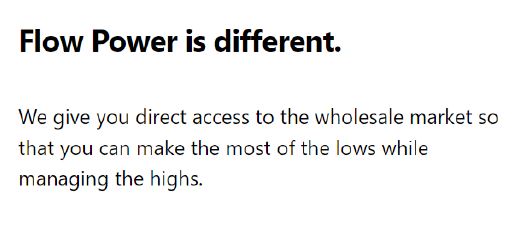
47 Progressive Green provided evidence of the way that these products are marketed. They show use of the Flow Power Marks (and in particular the Registered Flow Power Marks) as describing the organisation that would supply the energy if the customer signs up to receive the product. This is identification of the origin of the product and so, it is use in a trade mark sense. For example:
48 Progressive Green also relies upon some product services and offerings made to its C&I customers. These include:
(1) Energy Ready, a service that gives its C&I customers energy and sustainability advice from engineers and customer managers. The Flow Power Marks are used on the page on Progressive Green’s website containing information about that service.
(2) kWatch®, a product and service that allows C&I and now residential customers to measure and control energy usage using a small hardware device installed on site. The Flow Power Marks are used on the page on Progressive Green’s website containing information about that service.
49 Progressive Green has recently commenced a residential market offering under the Flow Power Marks and using the words “Flow Home”. Mr van der Linden describes this as “a critically important step for Flow Power”. Progressive Green commenced offering residential electricity plans to consumers in Victoria in July 2024. Promotional emails were sent that month to 900 customers and subscribers.
50 Mr van der Linden gives evidence that by 30 December 2024, Progressive Green had 375 Flow Home Residential customers, located in Victoria, New South Wales and South Australia. The Respondents submit that mere hundreds of retail customers is insignificant given the pool of at least several million potential retail customers.
51 Progressive Green relies upon a range of promotional and marketing activities. It has substantial expenses each year for “marketing expenses” which I infer are at least partially directed to the promotion of the Flow Power Marks – although I cannot assess the way that the funds are used on the evidence before me.
52 In terms of social media and online presence, the evidence reveals:
(1) Progressive Green has over 5,000 followers on LinkedIn. I have little information about the make up of those over 5,000 accounts.
(2) Progressive Green’s YouTube channel has 109 subscribers and 72 videos and the videos have had 38,496 views. Progressive Green provides no evidence about the substance of those views or the extent to which the relevant videos involve the Flow Power Marks. The evidence contained a screenshot of the thumbnails of each of the videos, at least some of which appeared to use the Flow Power Marks. However, I note that the channel itself is branded with the Flow Power Device.
(3) Progressive Green has an account on the social media site “X”, formerly known as “Twitter”. Its account on “X” uses the handle “@FlowPower_au”, and the image is of the Flow Power Device. I was provided a range of posts made by this account (including when the platform was known as “Twitter”), all of which contain the use of the Flow Power Marks. For convenience I will refer to the platform simply as “X”. Various posts on the “X” account use the Flow Power Marks. There is no evidence of how many followers this account has. There was no evidence about what the information on the posts mean, but I am prepared to infer, for the purpose of this proceeding, that the number next to the “heart” icon indicates the amount of “likes”, the number next to the “arrows” icon indicates the amount of re-posts, and the number next to the “bar graph” icon indicates the number of views or engagements. The most recent post in evidence, dated 19 September 2024, received no re-posts, one like, and appears to have been viewed or engaged with 33 times. The post with the highest number of views was posted on 6 June 2023, and received one re-post and was viewed 141 times.
(4) Progressive Green has an account on Facebook, which published its first post on 10 March 2017. There is no evidence of how many followers this account has. There is evidence of a range of posts, most of which use the Flow Power Marks to various extents. The degree of engagement with these posts was cut off from most of the evidence. The highest engagement apparent on the evidence was a post, dated 16 March 2017, which received 34 likes, two comments and eight shares. Another post, dated 11 May 2017, received 39 likes and four shares.
(5) There is an application, known as the Flow Power Flow Home App, which is made available to residential customers to enable them to track their use of electricity and whether it takes place at peak times or not. No evidence was provided as to how many devices had installed this app or to indicate whether the Flow Power Marks were present on the app.
(6) Progressive Green has sent monthly and annual insights to email subscribers which feature the Flow Power Marks, and this has happened since 2017. These emails were initially sent to approximately 860 individual subscribers, and there are now “in excess of 2,650 individual subscribers”. Not all of those subscribers are customers. However, they all receive emails which use the Flow Power Marks. An example of such a use is included at Annexure B.
(7) Progressive Green maintains a website which prominently uses the Flow Power Device, and also deploys the words FLOW POWER as descriptive of the trade source of the services and goods being sold. As noted above, there is no evidence about the extent of traffic to the website, but I am prepared to infer that it is seen by customers of Progressive Green. Thus, this evidence goes little further than the evidence as to market share, discussed above.
53 The Registered Flow Power Marks and the Flow Power Device were also used in a report which Progressive Green commissioned in partnership with the World Wildlife Fund, prepared by the Institute for Sustainable Futures at the University of Sydney. It referred to FLOW POWER as the source of some of the data used in the report, and as the organisation that has commissioned the report. The report itself was promoted to industry groups on the platform “X”.
54 In September 2018, Progressive Green published a series of online advertisements with the Sydney Morning Herald. The evidence shows various banner advertisements which were published as online versions of advertisements. The advertisements have the stylised Flow Power Device at the top of the banner:

55 There were a number of variations on this theme. It is not clear how long these advertisements were active on the Sydney Morning Herald website, but I am willing to infer that the newspaper has a substantial circulation. The advertisements are directed towards business customers as shown by the wording “put your business on The List for better power”.
56 In September 2018, Progressive Green published an advertisement in the Australian Financial Review. It said that Progressive Green had “modelled the energy spend of 670” Australian companies which it said would save by purchasing energy from Progressive Green, and sought to promote its renewable offering for C&I customers to buy energy from “Flow Renewables large scale wind and solar projects”. While no evidence was proffered, I am willing to infer that the circulation of that publication is substantial and national. The advertisement features the Flow Power Device, and was in the following form:
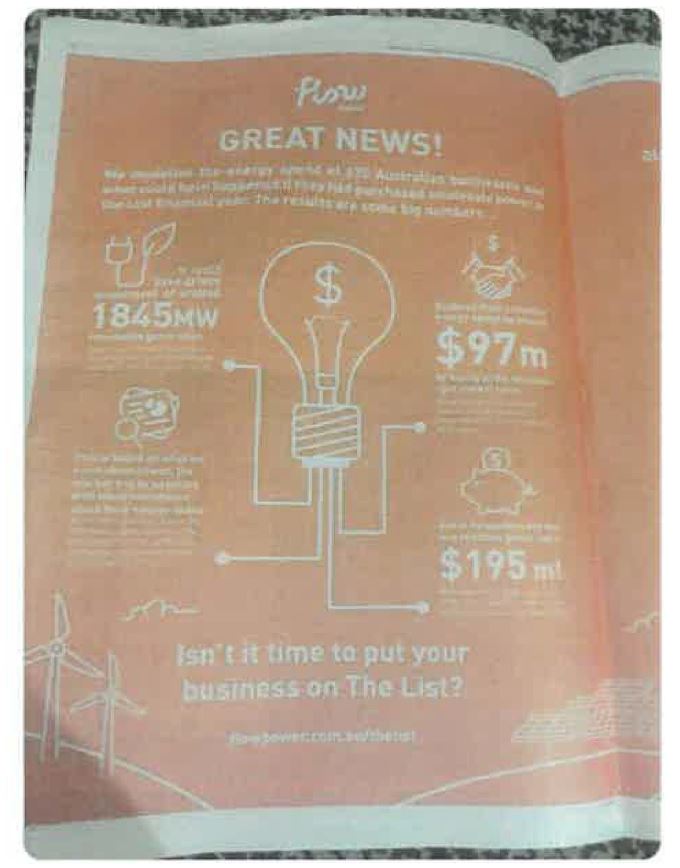
57 I assume that this was mirrored in digital editions and there is evidence that it was also promoted via Progressive Green’s social media. The target of the advertisement is C&I customers, and that is underscored by the placement of the advertisement in the Australian Financial Review. Later that year, a series of advertisements were featured in a variety of Fairfax Media outlets, including a full-page advertisement in the Sydney Morning Herald promoting the entry by Australian Vintage Limited into a Hybrid Renewals Corporate Power Purchase Agreement with Progressive Green, as follows:
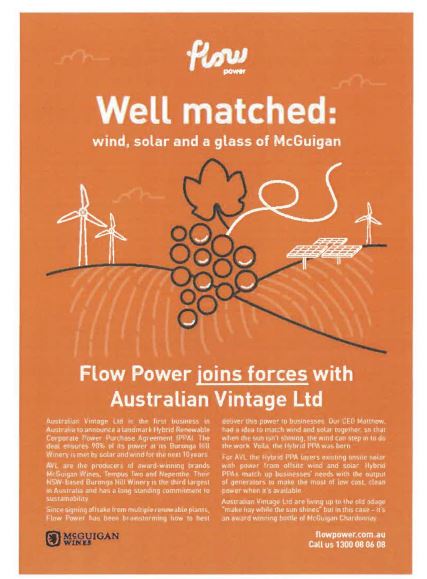
58 This advertisement uses both the Flow Power Device and the words FLOW POWER to denote the source of electricity services. It is again directed to the C&I market. No evidence of circulation was proffered, however I am prepared to infer that the Sydney Morning Herald has a reasonably substantial circulation in both hard copy and online – albeit that the advertisement does not appear to have been targeted at general readers and was instead focused upon the C&I market.
59 The Flow Power Device was one of a number to appear as part of an open letter published by the Clean Energy Council in the Australian Financial Review on 30 April 2019.
60 Another double-page advertisement in the Australian Financial Review appeared in March 2019, and a full-page advertisement appeared in May 2019. Both the open letter and the two advertisements used the Flow Power Device. In June 2019, Progressive Green published a full-page advertisement in The Age newspaper highlighting certain C&I customers. The advertisement prominently uses the Flow Power Device, and it includes the words FLOW POWER in the text of the advertisements: “[t]he List of businesses reshaping how they buy power with Flow Power is growing”.
61 Mr van der Linden gave evidence that Progressive Green participates in various annual conferences and events in Australia – generally for energy industry participants, as well as C&I customers. There is generalised evidence that Progressive Green representatives have attended “over 100 events, including smaller association dinners and golf days, to large exhibitions and national conferences with keynote and panel speaking roles”. There is some specific evidence about some of those events as follows:
(1) Participation in the annual “Hort Connections conference” trade show in 2017, 2018 and 2023, which involves 3,000 delegates in the Australian and New Zealand horticulture industry. Some images were posted to social media. Attending and sponsoring agricultural industry conferences and events is of importance because approximately 20% of Progressive Green’s C&I customers are in the agricultural sector.
(2) Attendance at, and gold or platinum sponsorship of, the Australian Financial Review National Energy Summit from 2017 to 2019, including, in 2019, participation in a panel event. The Flow Power Device was used in banners to indicate Progressive Green’s sponsorship of the event.
(3) Various webinars were held by Progressive Green from November 2018 to April 2019. The audience included various “C&I customer industries”, “schools and educational facilities” and “customers and subscribers”. The 2018 webinar was shared on “X”, reported in an online article which included a replay of the webinar showcasing the Flow Power Device. The 2019 webinars were advertised and promoted on “X” with the Flow Power Device visible. There is no evidence as to the number of attendees at each webinar.
(4) Progressive Green was a sponsor of the National Energy Efficiency Conference in November 2020, and a number of its employees spoke at the conference. Promotion for that conference included the Flow Power Device. The Flow Power Device was visible in part of the conference.
(5) In April 2024, employees of Progressive Green spoke at the FutureAg Expo 2024. This event included the use of the Flow Power Marks, and was promoted on Progressive Green’s LinkedIn.
(6) Progressive Green sponsored, exhibited and presented at over 30 conferences and industry events in 2024. Although there is no detail of the branding that was used at all of those conferences, I infer it was likely that the Flow Power Device was deployed in a manner similar to what is seen in other similar examples.
(7) In May 2024, Progressive Green was awarded the Energy Efficiency Council of Australia’s Leading Energy Management Innovation award. A LinkedIn post by Progressive Green promoting the award included the Flow Power Device.
(8) Similarly, in July 2024, Progressive Green’s Chief Operating Officer was involved in a panel discussion at the “Australian Wind Energy 2025” conference, and the Flow Power Device, and the words FLOW POWER, were visible behind him in the course of the panel.
62 Mr van der Linden deposes to having spoken at various radio and other public appearances which were then promoted by Progressive Green’s “X” account. For example, on 5 January 2018, he appeared on ABC National News “to discuss Flow Power’s response during the high-demand periods in Australia’s summer months”. While I do not have evidence before me, I infer that in the course of those interviews, Mr van der Linden referred to FLOW POWER. Similarly, in August 2018, Mr van der Linden spoke at the Australian Clean Energy Summit. Once again, there is no evidence that connects this appearance to the trade marks, save that I infer that he referred to FLOW POWER in the course of his remarks. Mr van der Linden gives evidence of various other examples of having spoken at public events. In some of those, the Flow Power Device appears in a PowerPoint slide behind him while speaking. In others, I infer that he mentioned FLOW POWER in the course of his discussion.
63 Mr van der Linden also provides evidence about other publications discussing FLOW POWER, some of which include discussion of FLOW POWER as an emerging energy retailer. Overall, it may be observed that:
(1) There are nearly 20 articles mentioning or referring to Flow Power as an energy retailer in newspapers with national circulation (most prominently the Australian Financial Review, with some references in The Australian) from 2018 to 2024.
(2) There are around 20 references to FLOW POWER in various other trade or regional publications (generally online) between 2018 and 2024.
(3) The media articles are generally aimed at the C&I space, or are relevant to that market, although there is some reference to retail offerings.
(4) The promotion carried out at conferences was almost exclusively at trade conferences or those with an interest in the electricity market.
64 Mr van der Linden also gave evidence that “Flow Power has also promoted, offered for sale and sold to consumers a range of advisory and consultancy services and technical solutions relating to managing energy consumption, efficiency and supply” although it is not clear what this is a reference to. There are parts of the services listed above which provide technical assistance in monitoring energy use, however I am not aware of the details of consultancy services offered by Progressive Green. There is, however, evidence of renewable energy projects and initiatives.
65 There is evidence that Mr van der Linden has given various radio and media interviews about energy related issues, in which he refers to FLOW POWER, or is introduced as the CEO of FLOW POWER. Such appearances are generally then posted to social media. There is evidence of 39 newspaper articles involving Mr van der Linden in which he is described as CEO of FLOW POWER and that trade mark is used in different ways and to different extents throughout the articles. I consider this evidence to be significant. Some of those are with websites about which I have no basis to infer anything as to readership or circulation (for example the “Energy Source & Distribution website”, “Energy Magazine”, “PV Magazine”, “ecoogeneration.com”, “Australian Energy Week” or “pv magazine”). However, of the interviews, 18 of them were with the Australian Financial Review between January 2018 and November 2024. FLOW POWER is used in all of those articles to refer to Progressive Green in the context of the provision of energy services. Moreover, it is referred to:
(1) as a “Growing business power retailer”; and
(2) as an “Innovative retailer…”; and
(3) in at least one instance, FLOW POWER is used as part of the headline to identify Progressive Green: “Green power appetite survives energy politics: Flow Power”.
66 The total amounts spent by Progressive Green on marketing and promotional activities since adopting the Flow Power Marks on 10 March 2017 were in evidence. The figures vary over the years. There is no information to explain how much of this spend was directed to the promotion of the Flow Power Marks, save that Mr van der Linden gives evidence that there is a higher expenditure for the financial year 2023-2024 because Progressive Green made a significant investment in developing and launching the new product “Flow Home”, its residential offering.
67 There is little evidence as to the efficacy of the promotional activity, save Mr van der Linden’s perception that Progressive Green has developed a reputation in the Flow Power Marks in the relevant markets. While I accept that Mr van der Linden is earnest and honest in his assessment, it clearly comes from the context of his personal immersion in the brand, and is lacking in objective support. In any event that perception is focused upon C&I, and not upon the broader scope of the Registered Flow Power Marks’ registration.
68 Overall, the focus of Progressive Green’s evidence was on larger projects, or identifying the kinds of services it provides. However, when analysed in detail, it is apparent that:
(1) There are, on any level, very few retail customers. Accordingly, even accepting, as I do, that all retail customers have been exposed to the Flow Power Marks, the volume of customers in that category is limited and of little assistance to Progressive Green.
(2) There are more C&I customers, and the evidence of Progressive Green has focused upon those customers, and on media interest related to providing services to such larger customers. Nonetheless, the size of the customer does not necessarily assist Progressive Green as the extent of use and the nature of the use in this category tends to be quite narrow and confined. Again, its customer base, even considered from the perspective of the C&I market, is not large. The authorities caution against a segmented analysis when the mark is (as here) registered across a broad scope, because the relevant inquiry when considering reputation is generally into the normal and fair use that can be made of the mark (see generally Societe Civile et Agricole du Vieux Chateau Certan v Kreglinger (Australia) Pty Ltd [2024] FCA 248; 179 IPR 226 at [590] (Beach J); Berlei Hestia Industries Ltd v Bali Co Inc (1973) 129 CLR 353 at 362 (Mason J)).
(3) Progressive Green asserts that it is the seventh largest electricity retailer by market share to C&I customers and that it trades under the Flow Power Marks, such that I should infer reputation in those marks. The Respondents argue that in the context of the Australian electricity market, being the seventh largest retailer by market share in a small sub-category that is in any event dominated by larger players does not assist Progressive Green. I agree that the simple assertion of being the seventh largest retailer in a sub-category is of limited utility in light of the breadth of the trade marks the subject of the claim.
(4) There is little evidence upon which inferences could be drawn about recognition arising from social media use. The material that has been proffered suggests only limited engagement, and there is no evidence about the number, location or identity of any of those who have engaged with social media promotion of the Flow Power Marks or Progressive Green more broadly. It provides no real assistance in identifying a relevant reputation.
(5) There is likewise little information provided about the impact of newspaper advertisements relied upon. While I am willing to infer a reasonable circulation of the national newspapers (The Australian and the Australian Financial Review) and other prominent newspapers (such as the Sydney Morning Herald and The Age) there is no evidence from which I can infer that these isolated advertisements led to particular brand recognition. That is particularly the case given that many of the advertisements in evidence were directed towards the promotion of commercial relationships with C&I customers, and not general advertisements directed to the public at large. It is of limited utility in establishing a reputation among a broad segment of the community.
2.3.4 Intended future use
69 Progressive Green has only recently entered the retail electricity market. Mr van der Linden’s evidence is that it is a market in which “branding and trade marks differentiates retail service providers for Australian consumers who have a varied knowledge and experience of Australian energy retail service providers”. It is evident from that observation, which I accept, that there is little basis to infer substantial market recognition of the Flow Power Marks in the retail segment of the market, given the currently low number of customers, and the lack of focus over this segment.
70 Mr van der Linden also gave oral evidence to the effect that he perceives that the word “FLOW” has come to mean “Progressive Green”. In many respects this does not assist Progressive Green: that is not the trade mark in which it seeks to establish a reputation and indeed its argument in relation to the operation of s 41 is that the Court should not approach the analysis in a granular way, by disaggregating FLOW and POWER and analysing each separately.
71 This evidence and the submissions of Progressive Green suggest that Progressive Green has sought to develop its reputation in its unregistered mark, FLOW, rather than its registered trade mark FLOW POWER. This is consistent with the initial strategy which was recommended to Progressive Green: to use FLOW as its brand. It pursued FLOW POWER instead due to Mr Kwei’s advice regarding the heightened risk of infringement if it pursued FLOW by itself.
72 It appears that Progressive Green has put energy into promoting FLOW as a prefix, rather than FLOW POWER as a trade mark. Mr van der Linden’s oral evidence was that Progressive Green’s use of FLOW whether by itself or in conjunction with other elements, such as “FLOW BUSINESS”, “FLOW HOME” and “FLOW KIT” has increased or “evolved” over time, reflecting the situation that in his view the Applicant’s business has become, in the industry particularly, known as “Flow”. He gave evidence of attempts to sell “Flow Home Smart” residential electricity plans designed to empower households to be part of Australia’s renewable energy transition.
73 The focus on FLOW instead of FLOW POWER is also evident in the way in which the Flow Power Device emphasises the word FLOW in terms of size and prominence. FLOW appears much larger in size than POWER and is also positioned above POWER, in an obvious emphasis of FLOW. In some social media examples, Mr van der Linden said that it was not possible to fit the word POWER and so FLOW was used alone in branding profile images. Moreover, in the Progressive Green annual report, it refers to legal costs involved in an earlier intellectual dispute undertaken in relation to another company’s alleged “infringement of the ‘Flow’ brand name”.
74 Accordingly, while I accept that the present intention is for Progressive Green to continue to use the Flow Power Marks, it also has increased its focus upon FLOW as the key branding concept for Progressive Green, and using that as its primary branding tool.
2.3 The Respondents and the Flo Energy Marks
75 Mr Guichelaar is the director and CEO of both the First Respondent, Flo Energy Australia, and the Second Respondent, Flo Holding. He has held that position at Flo Holding since March 2020, and at Flo Energy Australia since its incorporation in January 2023. The Applicant asserts that Mr Guichelaar is not in sole control of the Respondent entities, and that significant matters of strategy including branding are subject to the direction of a global energy and commodities company that has been referred to simply as “Vitol” throughout the proceeding, which is a substantial shareholder in the Second Respondent.
76 Mr Guichelaar’s evidence is that he and his business partner chose a name for their energy business in Singapore around January 2020. At that time, he considered only names related to the word “flow”. He said that they did not labour over options when the name was chosen, but that the decision to drop the “w” from “flow” was partially intended to reflect various family names, and to make the name simpler, particularly if the business expanded internationally. Interestingly given the involvement of the Respondents in hotly contested litigation on the issue, his evidence was:
…we did not labour over different options as I did not consider the name to be the most important component of our business or believe it would differentiate us meaningfully from other energy retailers. This was due to my experience in the energy industry in the Netherlands, where I observed that customers were mainly concerned with the price and form of their energy plans and the source of the energy (e.g. renewable), rather than which retailer supplied the energy or what the retailer is called.
77 In February 2020, the company structure was set up, with Flo Holding as the holding company and Flo Energy Singapore Pte Ltd (Flo Energy Singapore) as its wholly owned subsidiary. In June 2020, Flo Energy Singapore became a licensed electricity retailer with the Energy Market Authority in Singapore. It registered the domain name “floenergy.sg” in March 2020. The Singapore entity engaged a brand designer to design the overall branding which led to the development of the Flo Energy Device:

78 This branding has been used by the Singaporean entity since its inception and was also used in the Australian business. Mr Guichelaar gave evidence that it was his intention that future international arms of Flo Energy would use the same branding “to establish a cohesive and strong brand identity worldwide”. Pursuant to that ambition, the trade mark application for the Flo Energy Marks was filed in Singapore in class 39 and registered on 23 September 2020, by Flo Energy Singapore. Flo Energy Singapore also obtained registration of the Flo Energy Device in November 2020 in classes 38 and 39 in Singapore. Flo Holding has also registered the mark in classes 35 and 39 in the Philippines and New Zealand. Flo Holding has filed and is awaiting examination of trade mark applications to register the trade mark FLO ENERGY in classes 35 and 39 in each of Singapore, the European Union and Japan.
79 At present, Flo Energy Singapore only services C&I customers and small to medium enterprises, but Mr Guichelaar states that it intends to expand to residential customers in 2025. Mr Guichelaar gave extensive evidence about the use of the Flo Energy branding in Singapore, and its advertisements there, by Flo Energy Singapore.
80 Mr Guichelaar states that in January 2023, he conducted internet searches on various comparison websites such as Canstar and Victorian Energy Compare for energy retailers in the Australian market, and does not recall at that time seeing the Flow Power Marks. Likewise, he carried out a trade mark search for trade marks like FLO and FLO ENERGY and saw that there were a significant number of registered trade marks in classes 4 and 35 using variants of “Flo”. He gave evidence that:
Given how many trade marks were coexisting together, I believed there would not be any issue in registering 'Flo Energy'. I do not recall seeing Progressive's trade marks appear in these searches as I specifically remember being surprised when we discovered the existence of Progressive in the market later in January 2023.
81 It does not appear that any legal advice was sought at the time to consider any potential issues with the (apparently significant) number of at least potentially similar trade marks registered. Mr Guichelaar’s evidence is that on 9 January 2023, Flo Energy Australia was incorporated, adopting the same formula for naming that had been used by the Singaporean entity.
82 Mr Guichelaar’s evidence is that he became aware of Progressive Green in around mid-January 2023, and that he viewed the Progressive Green website at that time. He thought that there were differences in branding between the businesses, including the colour schemes used, the difference in spelling between FLO and FLOW, the use of the words “Energy” and “Power” and the different fonts used. He appeared to give quite detailed consideration to the Progressive Green business model in his analysis, reasoning that it was quite different because his business was geared towards becoming a mass market retailer of 100% renewable and predominantly fixed price plans, while he understood the following of Progressive Green’s offering:
I considered that due to Progressive's dual involvement in the market as a generator and retailer, it was more focused on off-taking from large renewable assets, and then passing those contracts to large C&I customers. I also understood that Progressive's plans provided variable pricing to customers, where they received a discount if they used electricity when the wholesale price was low and an increase to the base rate when the wholesale price was high.
83 His evidence is that he did not believe that customers would experience any confusion. Despite the Respondents being critical of Progressive Green for not following up on the legal advice that it received around the adoption of FLOW POWER, Mr Guichelaar states that the Respondents did not seek any legal advice in relation to these matters.
84 Shortly after, Flo Energy Australia registered the Australian domain name “floenergy.com.au”. In January 2023, Mr Guichelaar and his business partner, Mr Westendorp, prepared and filed a trade mark application on behalf of Flo Energy Australia for FLO ENERGY in classes 4, 9, 35, 37, 39, 40 and 42 (the ‘794 Application). No legal advice was sought about the trade mark application process. Mr Guichelaar states that “[t]rade marks were not a high priority compared to navigating the regulatory requirements and hiring key staff”.
85 An adverse examination report was received in response to the ‘794 Application. It did not identify the Registered Flow Power Marks. At around this time, at the apparent urging of its EU attorneys, a specialist intellectual property firm, Pizzeys, was engaged in relation to its trade marks. A new trade mark application was filed for FLO ENERGY in classes 35, 39, 40 and 42 (the ‘431 Application). A divisional trade mark application was also filed from the ‘794 Application, dividing the goods and services so that the ‘794 Application would cover only class 35 services. A new trade mark application was made covering the remaining classes 4, 9, 37, 39, 40 and 42 (the ‘065 Application).
86 On 22 June 2023, a further adverse report was received citing the Registered Flow Power Marks as an impediment to registration. The Registered Flow Power Marks were explicitly raised as trade marks that might be seen as a brand variation or extension of the application marks, on the basis that “POWER [is] likely to be seen as a brand variation or extension, having a similar meaning to ENERGY”. The registration attempt was not pursued. In cross examination by senior counsel for the Applicant, Mr Guichelaar was asked whether he considered changing his brand. His evidence was unequivocally that he did not do so. The following exchange took place in cross examination:
Counsel: So once the adverse examination further report was received by your company on 22 June 2023, did you consider adopting different – a different brand in light of the impediments raised by IP Australia?
Mr Guichelaar: No.
87 Then later, the following cross examination:
Counsel: You had been told by an employee of Flo Energy, Mr Wijaya, about the Flow Power business?
Mr Guichelaar: Yes.
Counsel: You had reviewed the Flow Power website?
Mr Guichelaar: Yes.
Counsel: You had received the adverse reports from IP Australia in relation to the trademark applications in which you were told that the Flow Power marks were an impediment to your proposed Flo Energy marks?
Mr Guichelaar: Correct. Yes.
Counsel: And you at that point had either Pizzeys or later FB Rice providing you with advice in relation to the trademarks?
Mr Guichelaar: Correct.
Counsel: Okay. So at the time you filed the application with the AER, did you consider adopting a different brand
Mr Guichelaar: No.
Counsel: ---in light of the trademark issues you were facing?
Mr Guichelaar: No.
Counsel: And is the same true at the time when you filed your application to the ESC, you didn’t consider adopting a different brand at that point?
Mr Guichelaar: No.
88 The Applicant submits, and I accept, that Mr Guichelaar was not interested in even considering changing his brand, no matter the legal obstacles he faced.
89 On 29 November 2023, Flo Energy Australia submitted an electricity retail licence application with the ESC, and that application was accepted for consideration in December 2023. The ESC’s March 2024 newsletter sought feedback on Flo Energy Australia’s electricity retail licence application. Mr van der Linden said that this was the first time he became aware of Flo Energy Australia’s proposed offering. The General Counsel of Progressive Green sent a submission to the ESC stating that:
…we are concerned that the presence of a retailer named Flo Energy may cause significant confusion to customers and potential customers across the NEM, given the similarity of the names Flow Power and Flo Energy.
…
Flow Power is a registered trade mark in Australia owned by Progressive Green Pty Ltd. We note that Flo Energy has lodged three trade mark applications in Australia, each of which was withdrawn following adverse reports from the trade mark examiner, so they do not currently have any registered trade marks in respect of 'Flo Energy'. We request that if Flo Energy's application for a licence to sell electricity in Victoria is granted that it be made subject to a requirement for Flo Energy to operate in the NEM using a name that cannot be confused with our business name "Flow Power".
90 It appears that Progressive Green’s submission to the ESC caused concern with Flo Energy. On 12 April 2024, Flo Energy sent a response to the submission stating that:
We believe our products and offerings will substantially differentiate Flo Energy Australia not just from ‘Flow Power’, but also other electricity retailers. Our proposed electricity products are currently not available in the Australian / Victorian market.
Flo is a growing, international brand with plans to expand into other territories, and we see no benefit in losing our point of difference or creating confusion with ‘Flow Power’ - a limited local brand. The look and feel of the ‘Flo’ brand is significantly different to ‘Flow Power’ including the colour scheme, marketing, and tone of voice. Our website is vastly different to ‘Flow Power’s’. Refer below to screenshots of the two websites.
91 The ESC responded on 23 April 2024 to the concerns raised by the Applicant by noting that the ESC did not have regulatory oversight of matters relating to the use of company or business names, and is not a regulator of the NEM. It said that matters of trade mark infringement fall outside its scope and were better understood as commercial matters to be managed by the respective businesses. Flo Energy Australia received its Electricity Retail Licence on 30 April 2024, and then notified electricity brokers that it was open to receive requests for tender. Since that time, Flo Energy Australia has received requests for tender from brokers in relation to a substantial number of sites. As of December 2024, Flo Energy has signed up more than 1,000 sites to which it anticipates it will start supplying in the future. It seeks to establish Flo Energy’s Australian presence in relation to C&I customers, before expanding to residential customers in mid-2025. In late 2024 it employed 24 employees in Australia. I therefore accept that it is the First Respondent that has relevantly traded under the Flo Energy Marks in Australia.
92 A letter of demand was sent by Allens, solicitors for Progressive Green, on 4 June 2024.
93 The present proceedings were commenced on 10 July 2024. At that time, the statement of claim simply alleged that the Registered Flow Power Marks were infringed by the conduct of the Respondents advertising and promoting, and threatening to advertise and promote, electricity and/or retail electricity services under and by reference to the Flo Energy Marks. It appears that the initial customers only came on board with Flo Energy Australia after that date, in late-July 2024.
94 The defence was filed on 23 August 2024, along with a cross-claim. The Respondents denied breaching the Registered Flow Power Marks and said that the Registered Flow Power Marks were liable to cancellation on the basis that the First Respondent had used its own name in good faith, or for the reasons identified in its cross-claim, i.e. that the Registered Flow Power Marks were not capable of distinguishing and did not in fact distinguish the relevant services within the meaning of s 41 of the Act. The Respondents abandoned their defence based on use of their own name in good faith in the course of the hearing.
2.4 The Respondents and the FlowSmart Mark
2.4.1 Adoption of the FlowSmart Mark
95 At a case management hearing on 19 July 2024, counsel for the Respondents foreshadowed reliance upon the registration of the FlowSmart Mark to defend the claim against his client on the basis that the Registered Flow Power Marks should never have been registered because of their deceptive similarity to the earlier-registered FlowSmart Mark. At that stage, the FlowSmart Mark was owned by EnergyAustralia. The history of the FlowSmart Mark can be briefly stated. EnergyAustralia filed an application for the FlowSmart Mark on 30 April 2013 for services in class 39, being:
Distribution of energy; Electricity distribution; Fuel distribution services; Electricity storage; Electricity supply services; Supply of electricity; Transmission of electricity; Storage; Storage of gas; Delivery of fuel
96 There is evidence that EnergyAustralia used the FlowSmart Mark from late 2012 until at least April 2015 in respect of electricity retail services. It is undisputed that there was little to no use for a substantial period following that time.
97 On 24 July 2024, Flo Energy Australia’s solicitors approached the solicitors for EnergyAustralia, Ashurst, to enquire as to whether it would consider an assignment of the FlowSmart Mark. Mr Guichelaar gave evidence that around that time, he began considering how the FlowSmart Mark could be incorporated into the Flo Energy brand. Following negotiations, an in-principle agreement was reached with EnergyAustralia on 19 August 2024. The following branding involving the FlowSmart Mark was developed by late August 2024 (the FlowSmart Device):

98 Mr Guichelaar states that, around 26 August 2024, the FlowSmart Mark was added to a page with the heading “dashboard” on both the Flo Energy Singapore and Flo Energy Australia websites. This dashboard is an online portal that allows customers of Flo Energy to view, track and analyse their energy usage and make payments alongside other features (the Dashboard) (this use is discussed in detail at part 2.4.2 below).
99 On 31 October 2024, the assignment of the FlowSmart Mark was completed. The new owner was a company called Bruutzak Holding B.V. (Bruutzak). Mr Guichelaar is the sole director and shareholder of Bruutzak. The reason that Bruutzak was used was the subject of some controversy. The Applicant alleges that this company purchased the FlowSmart Mark in order to conceal from the Applicant that it had taken a step which was primarily for the purposes of assisting it in the litigation. This is an issue relevant to whether the use of the FlowSmart Mark was in good faith, to which I will return.
100 Immediately following the assignment, on 31 October 2024, Bruutzak executed an exclusive licence in favour of Flo Energy Australia to enable it to use the FlowSmart Mark.
101 On 2 December 2024, the FlowSmart Mark was assigned from Bruutzak to Flo Holding. Subsequently on 2 December 2024, Flo Holding granted an exclusive licence to Flo Energy Australia to use the FlowSmart Mark.
102 On 3 December 2024, the Applicant made a non-use application in relation to the FlowSmart Mark under s 92(1) of the Act on the ground identified at s 92(4)(b). The non-use period for the purposes of that application was therefore 3 November 2021 to 3 November 2024 (the Non-Use Period). On 30 January 2025, the Registrar of Trade Marks referred that application to this Court under s 94 of the Act.
2.4.2 Use on the Dashboard
103 Mr Guichelaar’s evidence was that he decided to incorporate the FlowSmart Mark onto Flo Energy’s Dashboard, because one of its functions is to allow customers to see the ‘flow’ of electricity to the relevant site(s), and utilises intelligent (or ‘smart’) software. The evidence is that the Dashboard was updated with the FlowSmart Mark from 26 August 2024.
104 I pause to note that this is relied upon by the Applicant as a “use” of the trade mark in breach of the Registered Flow Power Marks as part of the claim against Flo Energy.
105 The Dashboard is a means by which customers interface with Flo Energy to manage their electricity supply, usage and costs and was described by Mr Guichelaar as:
…an online portal that allows customers to view, track and analyse their energy usage and payments, make payments and manage contracts. It features graphical representations of usage data, including consumption patterns over time, to allow customers to fully understand and effectively manage their energy consumption.
106 I am satisfied that the evidence of the Dashboard establishes that:
(1) It enables monitoring by customers of energy use over a period, in either daily, monthly, yearly or billing period intervals. This allows the monitoring of use and cost in a manner that is central to the provision of electricity supply and distribution.
(2) It provides customer account profile information.
(3) It provides information about a customer’s plan, the supply address, and duration of contract.
(4) It provides access to payment method information and a method for accessing invoices online.
107 The evidence of the use of the FlowSmart Mark on the Dashboard is as follows:
(1) A screenshot of Flo Energy Australia’s website building platform that shows that the FlowSmart Device was “merged in” to the websites on 26 August 2024.
(2) A screenshot taken by an independent customer on 17 October 2024.
(3) Screenshots which Mr Guichelaar caused to be taken on 1 November 2024 of the Flo Energy Australia website, which shows the FlowSmart Device on the Dashboard. The customer information identifying the customer “logged in” when the screenshots were taken is redacted from the screenshots. The Respondents’ submissions contained unredacted versions of these screenshots, which showed that the customer account logged in when the screenshots were taken was the Flo Energy Australia office account. Mr Guichelaar gave oral evidence that this screenshot was taken from the Flo Energy Australia office account.
(4) A screenshot of a WhatsApp chat with a Flo Energy Australia customer on 12 November 2024, in which the customer has sent a screenshot of the Flo Energy Australia website, which contains the FlowSmart Device.
108 In addition, on 2 December 2024, Flo Energy Australia posted several images describing the features of the Dashboard on its Instagram and Facebook pages. The same images were posted to its LinkedIn page, and the Flo Energy Singapore Instagram page, later in December 2024. In January 2025, Flo Energy Singapore posted a customer testimonial about the Dashboard on its Instagram page.
2.4.3 Use in correspondence with prospective customers
109 On 11 October 2024, Flo Energy Australia emailed a prospective customer concerning the preparation for certain documents necessary to create a commercial relationship with that customer, including a terms document. The terms document included a definition section which defined FlowSmart in the following terms:
“FlowSmart” means the online platform, made available by us which is used to make, accept, decline or show Orders, Offers and Confirmed Transactions and to amend your Forecast Consumption (amongst other things) pursuant to this Agreement
110 It also explained that in the proposed commercial relationship:
You will be provided with access to the FlowSmart dashboard… You acknowledge and agree that all Orders and Offers made and accepted through the FlowSmart dashboard under the username and log-in issued to the Customer Personnel will be taken to be authorised by you.
111 Over the period 11 October until 11 November 2024, the terms sheet was being discussed by email between representatives of Flo Energy Australia and the prospective customer. In this respect, the customer asked “but the Flo Smart (sic) Dashboard will contain prices of course right (contract only talks about quantity)?” to which the Flo Energy representative responded through an embedded comment “[t]hese will be contained within a link on the dashboard.” The final comment is from the customer which says: “noted, thanks”.
112 On 1 November, certain terms sheets were provided in editable form, and at the same time, the email chain summarised above was re-sent. There was nothing in the email of 1 November drawing attention to the preceding correspondence. The editable form of the documents do not refer to the FlowSmart Mark. The body of the emails that was re-sent did include reference to the FlowSmart Mark in the manner summarised at [109]-[111] above. However, they do refer to, and incorporate, the terms of the terms sheet initially provided on 11 October 2024 which does refer to the FlowSmart Mark in a range of ways.
2.5 General factual findings
113 As explained in the summary section above, there are a number of interrelated aspects to the issues arising in this proceeding. In this section, I have set out findings of a general nature to avoid duplication when those issues come to be considered in the context of a specific issue. Where the issue requires further specific analysis in the context of particular issues, that takes place in the course of that analysis.
2.5.1 The adoption of the Flow Power Marks
114 The circumstances which led to the adoption of FLOW POWER as a trade mark are generally summarised in part 2.2.2 above. It is useful to make some general findings about that process, insofar as they may be relevant to matters such as whether Progressive Green acted honestly or not, in the sense discussed in Firstmac Limited v Zip Co Limited [2025] FCAFC 30; 184 IPR 458 (Firstmac FC). Justices Katzmann and Bromwich traced the authorities relevant to the role of blameworthy conduct in removing a trade mark from the register (at [152]-[158]) and the exercise of discretion (see [174]-[175]). The issue of blameworthy conduct was described by Brennan J in New South Wales Dairy Corporations v Murray Goulburn Co-operative Company Ltd [1990] HCA 60; 171 CLR 363 at 389 (omitting footnotes):
In that regime, to hold that a registered trade mark is “wrongly ... remaining in the Register” whenever the use of the mark becomes likely to deceive or to cause confusion would be to expose the registered proprietor’s statutory right to destruction at the hands of any person who creates the likelihood of deception or confusion. A premium would be placed on what Windeyer J. called “the assiduous efforts of an infringer”: Re Bali Brassiere Co. Inc.’s Registered Trade Mark and Berlei Ltd’s Application. On the other hand, to hold that a trade mark, validly registered, can never be expunged if its use becomes likely to deceive or cause confusion by reason of circumstances occurring since registration would empower the registered proprietor himself to create that likelihood with impunity.
115 The Respondents contend that the conduct of Progressive Green was relevantly not honest in a number of respects:
(1) Because it was aware of the FlowSmart Mark, and that the use of either FLOW or FLOW POWER was at risk of infringing that mark.
(2) The solicitor for Progressive Green provided advice on the express basis that not all risks had been considered, and Progressive Green elected not to have that issue further investigated.
(3) Progressive Green continued to use FLOW, even though it was positively informed that doing so carried a risk of infringement by its solicitor.
116 While there is a degree of irony in the Respondents deploying such arguments in circumstances where they declined to obtain any intellectual property legal advice before deciding to brand as FLO ENERGY, that is not an issue that is relevant to the present analysis.
117 The circumstances surrounding the legal advice obtained by Progressive Green are outlined at [23]-[28] above. The solicitor initially suggested registering FLOW by itself. That suggestion commended itself to him because he had reviewed the deck created by the branding firm which showed a prominent use of FLOW, without FLOW POWER.
118 It was the solicitor who suggested that registering the word FLOW would permit the use of descriptor words like “Flow Power” or “Flow Energy”. Mr Bill van der Linden responded saying “[t]hat sounds like a good idea, we could use Flow on its own, although I do think as well we will be using Flow Power constantly as we do with PG Energy… If you can achieve that by just registering Flow I guess that should be fine”. Mr Bill van der Linden’s tone in the email is tentative and deferential to the legal advice.
119 Moreover, Mr Bill van der Linden’s email was responsive to the suggestion by the solicitor, who had not, at that stage, raised any concerns about the use of FLOW. The solicitor reflected upon his advice and advised against seeking to register FLOW. In doing so, he noted the existence of the FlowSmart Mark as a potential barrier to the registration of “Flow”. His advice was that “Flow Power” was a mark that Progressive Green “should proceed with”. It was that advice which Progressive Green accepted. Mere knowledge of the FlowSmart Mark does not mean that Progressive Green should have been aware of its potential for deceptive similarity in the face of contrary legal advice.
120 The Respondents placed some emphasis on the solicitor’s acknowledgement that the searches he had carried out were not as comprehensive as he would do in a formal “key risk clearance”. However, the face of the email makes clear that a more detailed search was directed at identifying more potentially infringing marks – not providing more in-depth analysis of the marks already identified.
121 The Respondents rely upon evidence given in this hearing by Mr van der Linden. In the course of cross examination he was asked:
Counsel: So you understood the effect of his advice that there was a risk of infringing FlowSmart if you used Flow Power, and that risk would be increased if you used “flow” alone; you understood that?
Mr van der Linden: I understood that, yes.
122 However the context of that question is important. Mr van der Linden was first asked:
Counsel: Did you understand this advice as telling you that there was no risk of infringing FlowSmart if you used Flow Power?---
Mr van der Linden: I don’t think I would have ever assumed there was no risk of it, no. My focus would have been to reduce risk.
123 Viewed in context, Mr van der Linden’s comment that he understood there was “a risk” of infringing the FlowSmart Mark if Progressive Green used FLOW POWER is no more than acknowledging that nothing carries a zero risk. He went on to note that in launching FLOW POWER three days later “we, literally, took his [the solicitor’s] advice”. Mr van der Linden went on to say:
…if there had been a hint of that [infringement of FlowSmart] or a strong chance of that, I would have definitely acted without hesitation.
124 When considered in the context of the terms of the advice that Mr van der Linden received, I accept that the adoption and use of FLOW POWER has been relevantly honest.
125 That honest adoption could only have been reinforced by obtaining registration for FLOW POWER, without the trade mark office citing the FlowSmart Mark as a barrier to registration.
126 Mr van der Linden was cross examined about his knowledge of the FlowSmart Mark and maintained that he did not consider it to be a barrier to his company’s use of FLOW POWER. I accept that his view in this regard was honestly held. Accordingly, I accept that Progressive Green acted honestly in adopting FLOW POWER.
2.5.2 The “evolution” toward the use of FLOW by Progressive Green
127 Progressive Green argues that its use of FLOW POWER has “evolved” over time to become FLOW. That contention stands in contrast to the use of FLOW alone as a tagline on its website from 2017. An example (“Go With Flow”) is discussed at [41] above. It is apparent that Progressive Green adopted FLOW POWER and FLOW at roughly the same time, and sought to deploy them both for branding purposes.
128 While Progressive Green had legal advice that FLOW POWER carried a much lower risk of infringing the FlowSmart Mark, it also had advice that registering the word FLOW by itself “would be inviting the Examiner to cite some of these other marks against us at some stage”. The advice is clearly to the effect that FLOW might infringe the FlowSmart Mark and that there was a higher risk involved in using FLOW as a trade mark.
129 As to this conclusion, Progressive Green sought no further clarification and took no further steps (like adopting the word only in a logo form) to ameliorate the risk of infringement. While Mr van der Linden and therefore Progressive Green may have subjectively believed the use of FLOW would not be infringing, the risk that it objectively took in proceeding in the face of the solicitor’s advice meant that the adoption of FLOW was relevantly not honest in the sense explained by Firstmac FC.
2.5.3 Extent of use and reputation of FLOW POWER
130 A number of the claims and defences in this proceeding concern the extent of use and reputation of the Flow Power Marks. While they are connected concepts, they are not identical. Reputation does not necessarily follow from use, although the nature and extent of use might more easily permit inferences to be drawn as to reputation.
131 While use is concerned with the extent to which a mark has been deployed, reputation measures the extent to which that use of the mark has had an effect on the market in creating an association between the trade mark, and the origin of goods and services.
132 Progressive Green asserts that the evidence establishes that by July 2024, it had a significant reputation in Australia in the names FLOW and FLOW POWER and the Flow Power Device among consumers of electricity and energy related products and services. It particularly relies upon the following matters:
(1) its use of the Flow Power Marks in connection with its business since 10 March 2017;
(2) the “very significant revenue” it has derived through its business since 10 March 2017;
(3) the “significant customer base” which it claims to have developed since March 2017;
(4) its engagement in promotional marketing activities in connection with its business since 2017, which has involved significant and prominent use of the Flow Power Marks; and
(5) numerous third-party publications both online and in print, discussing the Progressive Green business by reference to the name FLOW POWER, including in a variety of Australian media publications.
133 Evidence of use in connection with Progressive Green’s business falls into a number of categories:
(1) Use of the Flow Power Marks on Progressive Green’s website, both in a logo format, and referring to itself as FLOW POWER (see for example the graphics at [40]-[41] above). There is no evidence of the extent of traffic to the website, or of its reach more generally. It is available to the world at large, but there is no basis to conclude that it has been broadly viewed. Of course, this constitutes a use of the trade mark, but there is little evidence to assess the extent of that use in the broader community.
(2) There is substantial evidence about the range of products sold by Progressive Green (see a summary at [46]-[48] above), some of which use the Flow Power Marks as part of the website that provides information about the product offering. Again, there is no evidence as to the extent to which such information is accessed, or has been received or understood by the market more broadly.
(3) There are newspaper advertisements which reflect the use of FLOW POWER in a trade mark sense. In the period since March 2017, the evidence discloses:
(a) A large advertisement in the Australian Financial Review in September 2018 (see [56] above);
(b) In September 2018, Progressive Green published a series of online advertisements across digital editions of Fairfax newspapers (including the Sydney Morning Herald, the Age and others) which displayed the Flow Power Marks (see [54]-[55], above). These advertisements were directed at business consumers. The evidence does not establish to what extent the advertisements were viewed or provide any insight into the audience of these publications.
(c) In November 2018, Progressive Green published a full page advertisement in the Sydney Morning Herald promoting its recent agreement with Australian Vintage Limited (see [57] above).
(d) On 20 March 2019, a double page advertisement in the Australian Financial Review in relation to the FLOW POWER renewable offering for C&I customers (see [60] above);
(e) A reference to the Flow Power Device among a range of others as part of a full-page climate advertisement in the Australian Financial Review in April 2019 (see [59] above);
(f) A full page advertisement in the Australian Financial Review in May 2019 (see [60] above); and
(g) On 27 June 2019, a full page advertisement in the Age, highlighting recent retail customers (see [60] above).
134 The Respondents deprecate these matters as showing only a handful of newspaper advertisements over the seven years since the adoption of the Flow Power Marks (between 2017 and 2024). Moreover, most of the advertisements are generally directed to the corporate market for electricity. There is no evidence of the impact of the advertisements, and the advertisements were sporadic over a lengthy period of time. Most of the advertisements were cross posted to Progressive Green’s social media, but that presence is limited, with only a few thousand “followers” or views at most, and no evidence about who those followers might be or who comprises the viewership. As stated above, the same critique follows for the audience of the various publications.
135 Progressive Green’s marketing budget is in evidence. While confidential, it is not an insubstantial sum although there is little evidence as to how that sum is deployed to specifically support the Flow Power Marks in the market.
136 I have also summarised some smaller publications which ran some advertisements or articles connected with Progressive Green (see [65] above). I have little information about their circulation, and I do not consider that they add much to the analysis of use.
137 There was also participation in a range of conferences and industry events. I accept that there was a substantial number of such industry events and that the Flow Power Marks (particularly the Flow Power Device) was often displayed at those events. In some instances, the Flow Power Device was displayed in the background as a sponsor, and in others as part of a product display. To the extent I have evidence about the scope of attendance at these conferences, it is clear that they generally involve between a few hundred and a few thousand individuals. Most are specific to the C&I market.
138 Mr van der Linden gave a media interview on ABC National News in January 2018 in which I infer he referred to FLOW POWER. He also gave an interview on a podcast in October 2018. I do not have evidence as to the reach of these matters, however I am content to infer at least that ABC National News has a substantial listenership. There are a variety of other newspaper articles, the most significant of which I have summarised at [133(3)] above.
139 I consider that these are among the high point of Progressive Green’s evidence as to reputation in the market. They indicate that Progressive Green was sought out to provide information about the electricity market, and that in providing that information, the journalists considered it was relevant to refer to FLOW POWER as a source of information about the energy trade.
140 In relation to its “significant customer base”:
(1) The fact that Progressive Green is the seventh largest company by market share in the C&I space is of little assistance. Such a label arises because it has contracts with approximately 2% of that market (approx. 1,500 customers). Even accepting that the evidence goes this high (noting the deficiencies in the evidence insofar as it appears to exclude some evidence in some States) it is a low proportion of the market. Thus, even accepting that all customers in that market have engaged with the branding of Progressive Green it does little to suggest that use is widespread in that market.
(2) The position with respect to the retail market is more simple: it has very little use that can be shown through its retail customer base. On any view, its customer base for retail is very small, and thus the customer base in that market does not assist Progressive Green.
(3) While it is useful to analyse the evidence by reference to the relevant markets, the question of use is generally focused on the scope of the registration. That registration is broad, and comfortably encompasses all of the energy users or potential energy users in Australia. When conceptualised in that way, there is little use disclosed by Progressive Green’s overall potential customer base.
141 I accept that Progressive Green’s revenue is substantial as are the number of GWh of electricity it has sold. However, revenue and total GWh sold are poor proxies for trade mark use, and when considered in the context of the balance of the evidence, it does little to establish either use or reputation.
142 Overall, it is clear that Progressive Green is committed to the Flow Power Marks. It has branded the entire company by reference to those words. I do not doubt that Progressive Green seeks to continue its use of FLOW POWER. However, the extent of its reputation in the market is not extensive when compared with the overall electrical market, which I accept to involve several million people.
143 The only evidence about market perception of FLOW POWER in the market comes from Mr van der Linden himself, and I ascribe that little weight. Although earnest, he is not objective in his assessment and his views are not based on any objective evidence – merely his personal perception. On any view, only a few thousand people have interacted with the Flow Power Business as customers out of a potential pool of millions. Attendance at trade fairs and seminars or conferences is relevant and involves engagement of (potentially) thousands of individuals. However, the use of the Flow Power Device in that context is not overly prominent.
144 I consider that the best evidence for Progressive Green is the evidence concerning its newspaper advertisements and articles. They are not insubstantial in number, and they generally use FLOW POWER in a trade mark sense. Nonetheless, they represent relatively sporadic advertisements over the seven year period, and I infer were generally directed at a specific, C&I market, and not to the broader market for which the marks are registered, and for which Progressive Green seeks to retain its registration.
145 It is relevant to this analysis that electricity is a mass market product in Australia, and not a niche. Thus, while there is reasonably substantial investment by Progressive Green in the Flow Power Marks, I am not satisfied that the evidence establishes that this resulted in a substantial reputation among the electricity consumers in Australia.
146 The manner in which these findings sound in relation to each of the separate statutory tests is identified below.
3. THE STATUTORY FRAMEWORK: GENERAL OBSERVATIONS
147 Set out below are some key principles relevant to the various provisions that are invoked by the parties in this proceeding. They are then the subject of further specific analysis when each aspect of the proceeding is analysed in detail, below.
3.1 Relevant bases to oppose registration
148 A trade mark is defined in s 17 of the Act in the following way (emphasis original):
A trade mark is a sign used, or intended to be used, to distinguish goods or services dealt with or provided in the course of trade by a person from goods or services so dealt with or provided by any other person.
3.1.1 Trade Mark not adapted to distinguish (s 41)
149 The notion that a trade mark is used to distinguish goods or services underpins s 41 of the Act, which provides (emphasis original):
41 Trade mark not distinguishing applicant’s goods or services
(1) An application for the registration of a trade mark must be rejected if the trade mark is not capable of distinguishing the applicant’s goods or services in respect of which the trade mark is sought to be registered (the designated goods or services) from the goods or services of other persons.
Note: For goods of a person and services of a person see section 6.
(2) A trade mark is taken not to be capable of distinguishing the designated goods or services from the goods or services of other persons only if either subsection (3) or (4) applies to the trade mark.
150 There are a range of cases concerned with identifying when a trade mark is inherently capable of distinguishing goods and services. Laudatory epithets (see, eg, Ocean Spray Cranberries Inc v Registrar of Trade Marks [2000] FCA 177; 47 IPR 579 (Wilcox J) in reference to the word mark “CRANBERRY CLASSIC”), descriptions of goods or services (see, eg, Burger King Corp v Registrar of Trade Marks (1973) 128 CLR 417 (Burger King) (Gibbs J) in relation to “Whopper”) and geographical names (see, eg, Colorado Group Ltd v Strandbags Group Pty Ltd [2007] FCAFC 184; 164 FCR 506 (where Kenny, Gyles and Allsop JJ agreed in the outcome) in reference to “Colorado”) have each been recognised as not being inherently adapted to distinguish.
151 In Clark Equipment Co v Registrar of Trade Marks (1964) 111 CLR 511 (Clark Equipment), Kitto J explained at 514 that considering whether a trade mark is “adapted to distinguish” should be tested:
…by reference to the likelihood that other persons, trading in goods of the relevant kind and being actuated only by proper motives – in the exercise, that is to say, of the common right of the public to make honest use of words forming part of the common heritage, for the sake of the signification which they ordinarily possess – will think of the word and want to use it in connexion with similar goods in any manner which would infringe a registered trade mark granted in respect of it.
152 The High Court in Cantarella Bros Pty Ltd v Modena Trading Pty Ltd [2014] HCA 48; 254 CLR 337 (Cantarella) at [39] explained the test expounded by Kitto J by reference to some historical matters, including the early recognition in the cases that any word in English could prima facie be used as a trade mark but would not necessarily qualify to be registered as one. The majority (at [59] (French CJ, Hayne, Crennan and Kiefel JJ)) said:
It is the “ordinary signification” of the word, in Australia, to persons who will purchase, consume or trade in the goods which permits a conclusion to be drawn as to whether the word contains a “direct reference” to the relevant goods (prima facie not registrable) or makes a “covert and skilful allusion” to the relevant goods (prima facie registrable).
153 There was some apprehension of confusion in relation to the operation of the test of Kitto J from Clark Equipment as to whether the question was directed to the innocent use of certain words as a trade mark, or in any manner at all. The Respondents cautioned against a literal, but inaccurate, reading of the above extract from Clark Equipment. The matter was put squarely by Yates J who explained the approach to determining inherent adaption to distinguish in the following terms in Apple Inc v Registrar of Trade Marks [2014] FCA 1304; 227 FCR 511 at [11]:
What does it mean to say that a trade mark is inherently adapted to distinguish the goods or services of one person from the goods or services of another? The notion of inherent adaptation is one that concerns the intrinsic qualities of the mark itself, divorced from the effects or likely effects of registration. Where the mark consists solely of words, attention is directed to whether those words are taken from the common stock of language and, if so, the degree to which those words are, in their ordinary use, descriptive of the goods or services for which registration is sought, and would be used for that purpose by others seeking to supply or provide, without improper motive, such goods or services in the course of trade.
154 It is not necessary that the honest user of the word may seek to use it as a trade mark – merely that a person might want to use it in the course of trade. For example, in finding that “Whopper” was not inherently adapted to distinguish the goods of a particular trader, Gibbs J said that it was a word which a “person selling a hamburger sandwich which he claimed to be larger than that normally sold might use in the ordinary course of business and without any improper motive” (Burger King at 425). This recognises that a word that is merely descriptive should be available to honest traders, such that the monopoly granted by a trade mark is not appropriate.
155 There has been some discussion in the authorities as to whether the test is focussed on necessity or desirability of other traders seeking to use the mark. Cantarella, referring at [71] to an inquiry into whether other traders “might legitimately need to use the word”, left open an argument that synonyms for the word could be used such that other traders would not need to use it (cf Cantarella at [41]-[42], citing Registrar of Trade Marks v W & G Du Cros Ltd [1913] AC 624 at 635 (Lord Parker), and at [54], citing Smith Kline & French Laboratories Ltd v Sterling-Winthrop Group Ltd [1975] 1 WLR 914 at 921-2 (Lord Diplock)). Clark Equipment, on the other hand, looks to whether other traders would “desire” to use the word for its descriptive properties. The balance of the authorities appears to favour the desirability of traders being able to use the words, even though synonyms could be used (see, eg, Bohemia at [157]-[158] (Burley J)).
156 The Respondents also urge that in considering this issue, I should consider both FLOW POWER and similar expressions like “Flow of Power” and “Power Flow” in determining whether or not the Registered Flow Power Marks are relevantly distinctive. The Respondents argue that the correct inquiry as to distinctiveness includes consideration of the words of the trade mark in question, along with the insertion of any link words where such words “would have been necessary to make the meaning perfectly clear” (Registrar of Trade Marks v Muller (1980) 144 CLR 37 (Muller) at 41 (Stephen, Mason, Murphy, Aickin and Wilson JJ)). Progressive Green, by contrast, argue that the removal of the word “of” from the phrase “Flow of Power” is transformative, and that it is appropriate that it is viewed in that context.
157 I accept that it is not just the trade mark that is relevant to the analysis, it is also marks that closely resemble it. In Aldi Foods Pty Ltd v Moroccanoil Israel Ltd [2018] FCAFC 93; 261 FCR 301 (Moroccanoil), Perram J said (at [125]):
Further, it is not just the desire of traders to use the word which is relevant; it is also their potential desire to use words nearly resembling that word. So here one must examine not just the inherent adaptability to distinguish the respondent’s goods of MOROCCANOIL but also of MOROCCAN OIL, MOROCCAN-OIL and perhaps, without deciding, OIL OF MOROCCO. The necessity so to reason was referred to by Kitto J in Clark (at 513) and reflects the reality that once registration of a mark is achieved, it will be infringed not only by persons using it without its owner’s permission but also by those using “a sign that is substantially identical with, or deceptively similar to, the trade mark”: s 120(1) of the Act. Furthermore, account must be taken of the fact that no attempt has been made in this case to limit the mark by stylistic or device elements; it is purely a word. As Yates J explained in Apple at [18] that matters because it means that if the word proceeds to registration it will give the respondent a monopoly on the use of the word (or words) in whatever form they may be ultimately rendered.
158 This approach reflects the analysis in a range of earlier cases, including:
(1) In Kenman Kandy Australia Pty Ltd v Registrar of Trade Marks [2002] FCAFC 273; 122 FCR 494, Lindgren J said (at [87]) (emphasis added):
Are other manufacturers likely to wish, at any time, “in the ordinary course of their businesses” and “being actuated only by proper motives”, to make items of confectionery in a shape substantially identical or deceptively similar to the Bug shape (cf s120 of the Act)? This is a difficult question. ….
See also at [95] (Lindgren J), [161] (Stone J).
(2) In Philmac Pty Ltd v The Registrar of Trade Marks [2002] FCA 1551; 126 FCR 525, Mansfield J said (at [57]) (emphasis added):
Nevertheless, I have reached the conclusion that the Philmac mark is not inherently adapted to distinguish the goods of Philmac in respect of which the Philmac application is sought from the goods or services of other persons. I have reached that conclusion having regard to the fact that the range of colours available to an honestly motivated trader is in fact limited and that the colour terracotta the subject of application, or any shade of terracotta that might be deceptively similar to that colour, might naturally and legitimately occur to another trader as a choice of colour for application to goods in the same class.
(3) In Unilever Australia Ltd v Societe Des Produits Nestlé SA [2006] FCA 782; 154 FCR 165, Bennett J said at [60] (emphasis added, citations omitted):
Continued registration of the trade mark would limit the rights of Unilever and other traders to use the phrase “Go on”. It may also limit their right to use “Go on” with other punctuation that indicates a pause, as does an ellipsis, without fear of infringement. In this respect, aural representations of the trade mark in television or radio advertisements are relevant and the different devices indicate the same pause. Potential infringement by a mark substantially identical or deceptively similar to the trade mark is relevant to a consideration of inherent adaptation to distinguish….
(4) In Chocolaterie Guylian NV v Registrar of Trade Marks [2009] FCA 891; 180 FCR 60 (Guylian), Sundberg J said at [82] (emphasis added):
Accordingly, I am satisfied that, viewed as at the priority date, there is some degree of likelihood that other traders acting with proper motives would want in the future to use the same seahorse shape or one substantially identical or deceptively similar. Accordingly, I am satisfied that the shape is to some extent inherently adapted to distinguish, but not to the degree required by s 41(3).
159 This lends force to the Respondents’ contention that in analysing whether the Registered Flow Power Marks are adapted to distinguish, I must consider the possibility of use by honest traders of terms such as “flow of power” or “power flow”, as variations that would be captured by Progressive Green’s registration. I accept that this is the correct approach.
160 If I conclude that the Registered Flow Power Marks are not to any extent inherently capable of distinguishing goods and services, then s 41(3) falls to be considered. In that instance, the mark is not registrable, unless there is material prior to the filing date establishing that the mark does in fact distinguish the goods or services. Section 41(3) states:
(3) This subsection applies to a trade mark if:
(a) the trade mark is not to any extent inherently adapted to distinguish the designated goods or services from the goods or services of other persons; and
(b) the applicant has not used the trade mark before the filing date in respect of the application to such an extent that the trade mark does in fact distinguish the designated goods or services as being those of the applicant.
161 If I find that the Registered Flow Power Marks are to some extent but not sufficiently adapted to distinguish, then they would be registrable only where the trade mark does or will distinguish the designated goods and services. This calls for an analysis of the trade mark itself, its use or intended use, and any other circumstances. Section 41(4) is in the following terms:
(4) This subsection applies to a trade mark if:
(a) the trade mark is, to some extent, but not sufficiently, inherently adapted to distinguish the designated goods or services from the goods or services of other persons; and
(b) the trade mark does not and will not distinguish the designated goods or services as being those of the applicant having regard to the combined effect of the following:
(i) the extent to which the trade mark is inherently adapted to distinguish the goods or services from the goods or services of other persons;
(ii) the use, or intended use, of the trade mark by the applicant;
(iii) any other circumstances.
Note 1: Trade marks that are not inherently adapted to distinguish goods or services are mostly trade marks that consist wholly of a sign that is ordinarily used to indicate:
(a) the kind, quality, quantity, intended purpose, value, geographical origin, or some other characteristic, of goods or services; or
(b) the time of production of goods or of the rendering of services.
3.1.2 Deceptive similarity (s 44)
162 Another barrier to the registration of a trade mark is found in s 44 of the Act. It is a provision that was identified by Middleton and Burley JJ in Bendigo & Adelaide Bank v Community First Credit Union [2021] FCAFC 31; 157 IPR 251 (Bendigo v CFCU) at [226] as being:
…broadly directed to ensure that the Register is not cluttered by deceptively similar trade marks owned by different traders in respect of similar goods or services.
163 Section 44 provides (emphasis original, notes omitted):
44 Identical etc. trade marks
(1) Subject to subsections (3) and (4), an application for the registration of a trade mark (applicant’s trade mark) in respect of goods (applicant’s goods) must be rejected if:
(a) the applicant’s trade mark is substantially identical with, or deceptively similar to:
(i) a trade mark registered by another person in respect of similar goods or closely related services; or
(ii) a trade mark whose registration in respect of similar goods or closely related services is being sought by another person; and
(b) the priority date for the registration of the applicant’s trade mark in respect of the applicant’s goods is not earlier than the priority date for the registration of the other trade mark in respect of the similar goods or closely related services.
(2) Subject to subsections (3) and (4), an application for the registration of a trade mark (applicant’s trade mark) in respect of services (applicant’s services) must be rejected if:
(a) it is substantially identical with, or deceptively similar to:
(i) a trade mark registered by another person in respect of similar services or closely related goods; or
(ii) a trade mark whose registration in respect of similar services or closely related goods is being sought by another person; and
(b) the priority date for the registration of the applicant’s trade mark in respect of the applicant’s services is not earlier than the priority date for the registration of the other trade mark in respect of the similar services or closely related goods.
(3) If the Registrar in either case is satisfied:
(a) that there has been honest concurrent use of the 2 trade marks; or
(b) that, because of other circumstances, it is proper to do so;
the Registrar may accept the application for the registration of the applicant’s trade mark subject to any conditions or limitations that the Registrar thinks fit to impose. If the applicant’s trade mark has been used only in a particular area, the limitations may include that the use of the trade mark is to be restricted to that particular area.
(4) If the Registrar in either case is satisfied that the applicant, or the applicant and the predecessor in title of the applicant, have continuously used the applicant’s trade mark for a period:
(a) beginning before the priority date for the registration of the other trade mark in respect of:
(i) the similar goods or closely related services; or
(ii) the similar services or closely related goods; and
(b) ending on the priority date for the registration of the applicant’s trade mark;
the Registrar may not reject the application because of the existence of the other trade mark.
164 Section 57 provides that a registration may be opposed on the same grounds as for rejection. It follows that a trade mark registration may be opposed if:
(1) the trade mark is substantially identical or deceptively similar to a trade mark registered by another person;
(2) the trade marks are in respect of similar goods or closely related services; and
(3) the priority date of the application for registration is not earlier than the priority date for registration of the other trade mark.
165 The principles relevant to the question of deceptive similarity are generally not in dispute. Section 10 of the Act provides (emphasis original):
10 Definition of deceptively similar
For the purposes of this Act, a trade mark is taken to be deceptively similar to another trade mark if it so nearly resembles that other trade mark that it is likely to deceive or cause confusion.
166 In Shell Co of Australia Ltd v Esso Standard Oil (Aust) Ltd (1963) 109 CLR 407 (Shell), Windeyer J described the analysis in this way at 415:
The marks are not now to be looked at side by side. The issue is not abstract similarity, but deceptive similarity. Therefore the comparison is the familiar one of trade mark law. It is between, on the one hand, the impression based on recollection of the plaintiff’s mark that persons of ordinary intelligence and memory would have; and, on the other hand, the impressions that such persons would get from the defendant’s [mark].
167 In Registrar of Trade Marks v Woolworths Ltd (1999) FCA 1020; 93 FCR 365, French J (as his Honour then was) set out the approach to deceptive similarity under the legislation then in force as follows at [50] (emphasis added):
…
(i) To show that a trade mark is deceptively similar to another it is necessary to show a real tangible danger of deception or confusion occurring. A mere possibility is not sufficient.
(ii) A trade mark is likely to cause confusion if the result of its use will be that a number of persons are caused to wonder whether it might not be the case that the two products or closely related products and services come from the same source. It is enough if the ordinary person entertains a reasonable doubt.
It may be interpolated that this is another way of expressing the proposition that the trade mark is likely to cause confusion if there is a real likelihood that some people will wonder or be left in doubt about whether the two sets of products or the products and services in question come from the same source.
(iii) In considering whether there is a likelihood of deception or confusion all surrounding circumstances have to be taken into consideration. These include the circumstances in which the marks will be used, the circumstances in which the goods or services will be bought and sold and the character of the probable acquirers of the goods and services.
(iv) The rights of the parties are to be determined as at the date of the application.
(v) The question of deceptive similarity must be considered in respect of all goods or services coming within the specification in the application and in respect of which registration is desired, not only in respect of those goods or services on which it is proposed to immediately use the mark. The question is not limited to whether a particular use will give rise to deception or confusion. It must be based upon what the applicant can do if registration is obtained.
168 A number of principles were identified by the parties as being applicable to this comparison:
(1) The comparison is of the respective marks themselves and does not involve a broader inquiry of the kind that might be taken in a misleading or deceptive conduct case or a passing off case (Self Care IP Holdings Pty Ltd v Allergan Australia Pty Ltd [2023] HCA 8; 277 CLR 186 (Self Care) at [33] (Kiefel CJ, Gageler, Gordon, Edelman and Gleeson JJ)).
(2) In making the comparison, the Court is required to consider the circumstances in which the marks will be used, however, matters extraneous to the marks themselves (like the presence of other marks or differences in the particular manner in which goods or services are promoted) is irrelevant (Self Care at [33]).
(3) Any actual reputation which may exist in the marks under comparison is irrelevant (Self Care at [33]).
(4) In evaluating the likelihood of confusion between two marks, the marks must be judged as a whole, taking into account both their look and their sound (Self Care at [26]).
(5) When comparing the respective marks, the relevant public may have an imperfect recollection of the prior registered mark (Self Care at [29]; Crazy Ron’s Communications Pty Ltd v Mobileworld Communications Pty Ltd [2004] FCAFC 196; 61 IPR 212 (Crazy Ron’s) at [77]-[79] (Moore, Sackville and Emmett JJ)). It may be important to consider the “essential features” of the registered mark (Crazy Ron’s at [74], [79]-[84]).
(6) The test for confusion is not whether consumers may think that the two marks in question are the same; it is sufficient that consumers will be caused to wonder whether the goods or services might come from the same source or be connected in the course of trade. As observed by the Court in Self Care (at [32], footnotes omitted):
It is enough if the notional buyer would entertain a reasonable doubt as to whether, due to the resemblance between the marks, the two products come from the same source. Put another way, there must be “a real likelihood that some people will wonder or be left in doubt about whether the two sets of products … come from the same source”.
(7) It has been said that the threshold for confusion is “not high” (Australian Postal Corporation v Digital Post Australia [2013] FCAFC 153; 105 IPR 1 at [70] (North, Middleton and Barker JJ)).
169 Progressive Green argues that the first part of a word mark may be the most important (citing Conde Nast Publications Pty Ltd v Taylor [1998] FCA 864; 41 IPR 505 (Conde Nast) at 511 (Burchett J)). I do not accept that assists my analysis in this case: it is necessary to consider the trade mark as a whole (Crazy Ron’s at [74], [79]-[84]).
170 Progressive Green argues that even in circumstances of deceptive similarity, the putative opposition under s 44 (based on the registration of FLOW POWER) should not be permitted because of the discretion under s 44(3)(b). That provision relevantly permits the Court to accept an application for registration if satisfied that, “because of other circumstances”, it is proper to do so. Progressive Green argues that this is to be assessed by reference to the circumstances at the time at which the Court is asked to exercise its discretion and emphasises the observation in Dunlop Aircraft Tyres Ltd v The Goodyear Tire and Rubber Company [2018] FCA 1014; 262 FCR 76 (Goodyear) at [268] (Nicholas J) that:
In relation to s 44(3)(b), DATL emphasised the breadth of the language used, which would permit the court to take into account a wide range of circumstances relevant to the question whether the applicant should be granted registration of the relevant trade mark under that provision.
171 In Bendigo v CFCU, Middleton and Burley JJ referred (at [226]) to the phrase “other circumstances” as being “enigmatic”. The Applicant argues that this provision permits consideration of honesty of use, including the fact that the relevant mark was adopted honestly by the trade mark owner, even where s 44(3)(a) (honest and concurrent use) is otherwise unavailable – including in this instance, where there was no use of the mark before the priority date. Academic commentators have observed (Ed Heerey and Gilbert Tsang, ‘Don’t Hold Back – When Do “Other Circumstances” under s 44(3)(b) of the Trade Marks Act Apply?’ (2022) 35(6&7) Australian Intellectual Property Law Bulletin 98 at 99) that:
The authors suggest that it is more likely that the rationale for expressing s 44(3)(a) and (b) as alternatives is that s 44(3)(b) permits consideration of any circumstance other than an actual finding of honest concurrent use under s 44(3)(a), and that accordingly it does not operate to exclude consideration of all matters otherwise relevant to such a finding.
172 It seems clear that s 44(3)(b) calls for a relatively unconfined consideration of the circumstances as a whole – including any use of the trade mark. A question arises as to the relevant time at which that analysis should take place. The Respondents argue the relevant time is the priority date for each of the Registered Flow Power Marks; the Applicant argues that the relevant time is when the discretion is exercised. This issue is addressed below.
3.2 Cancellation under s 88
173 Section 88(1)(a) of the Act provides a basis for an application that a particular mark should be cancelled. Progressive Green seeks cancellation of the FlowSmart Mark under s 88(1)(a) on the ground in s 88(2)(c) of the Act on the basis that the use of the FlowSmart Mark is likely to deceive or cause confusion.
174 Sections 41 and 44, discussed above, are, in terms, concerned with an actual application for registration of a trade mark. They each also provide a mechanism for the analysis contemplated by s 88(2)(a), read with s 57. In the present case, the Respondents seek the removal of the Registered Flow Power Marks under s 88(2)(a) on the basis that they would not be registered today because of the operation of ss 41 or 44.
175 Section 88 in its entirety provides as follows (emphasis original):
88 Amendment or cancellation—other specified grounds
(1) Subject to subsection (2) and section 89, a prescribed court may, on the application of an aggrieved person or the Registrar, order that the Register be rectified by:
(a) cancelling the registration of a trade mark; or
(b) removing or amending an entry wrongly made or remaining on the Register; or
(c) entering any condition or limitation affecting the registration of a trade mark that ought to be entered.
(2) An application may be made on any of the following grounds, and on no other grounds:
(a) any of the grounds on which the registration of the trade mark could have been opposed under this Act;
(b) an amendment of the application for the registration of the trade mark was obtained as a result of fraud, false suggestion or misrepresentation;
(c) because of the circumstances applying at the time when the application for rectification is filed, the use of the trade mark is likely to deceive or cause confusion;
(e) if the application is in respect of an entry in the Register—the entry was made, or has been previously amended, as a result of fraud, false suggestion or misrepresentation.
Note 1: For prescribed court see section 190.
Note 2: For file, registered owner and this Act see section 6.
3.2.1 The date for assessment of the ss 88(2)(a) and 44(3) question
176 There is an issue in this case as to the appropriate time at which the issues connected with the operation of ss 88 and 44(3)(b) are considered. Progressive Green asserts that the appropriate time is the time at which the matter falls to be determined. The Respondents by contrast assert that the proper time is at the relevant priority date.
177 The position of Progressive Green is supported by two Full Court decisions. In Trident Seafoods Corp v Trident Foods Pty Ltd [2019] FCAFC 100; 143 IPR 1 (Trident FC) at [83], Reeves, Jagot and Rangiah JJ considered the question of when s 44(3)(b) operates. Their Honours there said:
…the better view is that s 44(3)(b) involves an exercise of discretion in the circumstances as they exist at the time the discretion is exercised rather than as at the priority date of the application. While a different view was expressed in Hills Industries Ltd v Bitek Pty Ltd (2011) 214 FCR 396; 90 IPR 337; [2011] FCA 94 at [177] to [178], no relevant distinction can or should be drawn between the discretions in s 44(3)(b) and s 101(3) in this regard.
178 This approach was squarely endorsed by Middleton and Burley JJ in Bendigo v CFCU, where their Honours agreed with Trident FC, stating (at [228]) (citations omitted):
The discretion under s 44(3)(b) is exercised with regard to the circumstances as they exist at the time that the discretion is exercised rather than as at the priority date of the application…
179 In each of Trident FC and Bendigo v CFCU, the Court’s approach to the exercise of discretion in s 44(3)(b) arose in the context of opposition to the registration of a trade mark. In the recent case of Firstmac FC, the Full Court considered a case related to the question of “honest and concurrent use” for the purposes of the analysis of a hypothetical trade mark application under s 44(3)(a) when considering whether a defence to infringement arose under s 122(1)(f) or (fa). The Full Court in Firstmac FC was not satisfied that there had been honest and concurrent use, and so turned to consider whether because of “other circumstances” under s 44(3)(b), it was (or would have been) proper to accept the application for registration. Firstmac FC is relied upon by the Respondents to argue that the correct date for the assessment of whether there are “other circumstances” relevant to the removal of registration, is the priority date, in particular the comments of the Full Court at [61]:
Thus, while s 44(3) is dealing with an actual application for registration of a trade mark, it provides a mechanism for giving content to the hypothetical application for registration contemplated by s 122(1)(f) and (fa), ordinarily, and in this case, to be assessed at the first date of the infringing conduct: see Killer R, LLC v Taylor [2024] FCAFC 149 (Yates, Burley and Rofe JJ) at [193], adopting the reasoning in Anchorage Capital Partners Pty Ltd v ACPA Pty Ltd [2018] FCAFC 6; 259 FCR 514 (Nicholas, Yates and Beach JJ) at [217]; see also Cantarella Bros Pty Ltd v Lavazza Australia Pty Ltd (No 3) [2023] FCA 1258 (Yates J) at [631]. Here, the undisputed time of first infringement is November 2013, being the date of first use by the respondents.
180 The issue to be determined (in the context of s 122(f)) is whether the allegedly infringing conduct does in fact infringe. It follows that the defence must be considered at the same time (being the time of the infringing conduct). Such a construction permits s 122 to operate in a sensible and consistent way.
181 Section 88 likewise operates at a particular point in time: at the time that the application for rectification is made. Such an application can be made only on the grounds set out at s 88(2). Section 88(2)(a) simply operates to incorporate the tests from (for example) s 44. For that reason, I consider that the appropriate date for considering the “other circumstances” relevant to the exercise of discretion under s 44(3)(b), in the context of an application for cancellation under ss 88(1) and (2)(a), is the date at which the discretion is to be exercised.
182 This is consistent with the scheme of the legislation and with the Full Court’s observations in Trident FC and Bendigo v CFCU. While I note the reservation of rights by the Respondents to argue that those cases were incorrectly decided, I am not able to discern the basis upon which that submission is made, and am therefore not in a position to consider it further.
3.2.2 The date for assessment of the s 88(2)(c) question
183 The question posed by s 88(2)(c) is whether, because of the circumstances at the time of the application for rectification (irrespective of whether those circumstances existed prior to registration) the use of the trade mark is likely to deceive or cause confusion (Swancom Pty Ltd v Jazz Corner Hotel Pty Ltd (No 2) [2021] FCA 328; 157 IPR 498 (Swancom) at [172] (O’Bryan J)).
184 Section 88(2)(c) refers to, and requires, analysis of the “circumstances applying at the time when the application for rectification is filed”. The parties differ as to whether this means the time at which the proceedings commenced (as the Applicant contends) or the time at which the amendment raising the removal of the FlowSmart Mark was raised (as the Respondents contend). It is plainly one of those dates. Progressive Green argues that the evidence is effectively the same irrespective of which date is used (because it deprecates the importance of the subsequent use of the FlowSmart Mark), while the Respondents argue that there is a relevant difference, and that the correct date is when Progressive Green first raised the issue in its amended statement of claim filed on 24 December 2024. The Respondents’ logic is simple: s 88(2)(c) calls for consideration of the circumstances applying at the time when the application for rectification is filed. As a matter of fact and law, there simply was no application for rectification until the amended statement of claim and the amended application were filed on 24 December 2024.
185 Progressive Green argues that “the time when the application for rectification is filed” is the time when the proceedings were commenced, even though the issue of cancellation of the FlowSmart Mark under s 88(2)(c) was only raised by subsequent amendment to the pleadings. It supports this position by reference to Gloucester Shire Council v Fitch Ratings Inc (No 2) [2017] FCA 248 (Gloucester Shire Council) (Wigney J). In that case, an order was sought effectively declaring that certain amendments made by leave were to have effect from the date of the filing of the statement of claim. The Court explained that the purpose of the order was to avoid any potential limitation issues that might arise if the amendments were to be taken to have effect from the date that the amendments were made. The Court noted that the Federal Court Rules 2011 (Cth) then were (and still are) silent as to when an amendment to a pleading is taken to have effect from following an amendment made by leave (rather than an amendment without leave under r 16.51). Justice Wigney in that case concluded that even if the relevant amendments did raise a new cause of action, where it was based on the same, or substantially the same, facts, the amendment was to take effect from the date that the pleading was filed, not the date on which the amendment was made (see [238]).
186 Progressive Green argues that by parity of reasoning, if the amendments which raised the s 88(2)(c) claim for cancellation arose from substantially the same facts as those already pleaded, then it would take effect from the date of the original statement of claim, being 10 July 2024. That would have the effect that the Court’s analysis of the circumstance applying at the time when the application for rectification is filed would be 10 July 2024. That was at a time prior to the use of the FlowSmart Mark by Flo Energy Australia.
187 Progressive Green argues that the “usual position” is that an amendment of a statement of claim takes effect from the commencement of the proceeding (while correctly acknowledging that the Full Court has described that position as an “overgeneralisation”: Ethicon Sàrl v Gill [2018] FCAFC 137; 264 FCR 394 (Ethicon Sàrl) at [47] (Allsop CJ, Murphy and Lee JJ)). The question identified in Ethicon Sàrl and other cases is whether the amendments arose out of “substantially the same facts” as those already pleaded. Progressive Green asserts that they do, because:
(1) From the outset, Progressive Green asserted that the Respondents’ conduct would cause loss and damage to it, including because of “confusion between Flow Power and Flo Energy branded products…”. Its evidence, filed prior to the amendment of the pleadings, concerned Progressive Green’s adoption of the Flow Power Marks and its use of those marks in Australia. This is evidence which it relies upon, in part, in its claim for cancellation of the FlowSmart Mark – because it contends that the reputation from its years of trading is relevant to the question now raised as to whether the FlowSmart Mark is likely to deceive or cause confusion.
(2) The likelihood of deception and confusion is said to arise because of the use of the FlowSmart Mark in connection with the Flo Energy business and the Flo Energy Marks – matters which it says were in issue from the outset.
(3) The Respondents themselves raised the FlowSmart Mark at a case management hearing of 19 July 2024, and could have included it in their cross-claim as initially pleaded. This is said to demonstrate that the FlowSmart Mark was relevant prior to the amendments.
188 Their Honours in Ethicon Sàrl observed that there are limitations inherent in drawing analogies between inter partes litigation and what was under consideration in that case, being procedures under Pt IVA of the Federal Court of Australia Act 1976 (Cth). It was important to the Full Court at [49] that:
…Pt IVA provides its own bespoke and detailed regime and, in significant respects, the evident purpose of the Part is to displace generally understood procedures: see Wong v Silkfield Pty Ltd (1999) 199 CLR 255 at [11] (Gleeson CJ, McHugh, Gummow, Kirby and Callinan JJ).
189 Moreover, the Court went on to observe at [50]:
When one recognises that the regime expressly contemplates and provides for the individuality of claims within a group proceeding, what is brought into focus is that an order for amendment, which has the consequence of expanding the group definition, is sui generis and that analogies drawn from other contexts are apt to mislead.
190 I accept that there are difficulties in drawing analogies between the circumstances in Ethicon Sàrl and other legislative schemes.
191 For the purposes of s 88(2)(c), I am concerned with assessing the operation of a provision which specifies a date for its operation. The text of s 88(2)(c) calls for an analysis at the time when the application for rectification is filed.
192 In this case, part of the claim involved the operation or deployment of facts and circumstances already in play between the parties. The facts pleaded in the amended statement of claim that were entirely new and unrelated to previous matters were those that had recently come into being, including:
(1) that Flo Holding was, and since 2 December 2024 had been, the registered owner of the FlowSmart Mark; and
(2) the claim by Flo Holding that Progressive Green has infringed the FlowSmart Mark.
193 These are new matters that are pleaded to support the conclusion that Progressive Green meets the threshold of being an “aggrieved person” in s 88(1). Although I do not accept the Respondent’s submission that Progressive Green was not an aggrieved person under s 88 until the claim was made against it for infringement of the FlowSmart Mark: a party can be relevantly aggrieved on the basis that both it and the owner of a registered trade mark were in the same trade and that each traded in the same class of goods in respect of which the mark was registered (Health World Ltd v Shin-Sun Australia Pty Ltd [2010] HCA 13; 240 CLR 590 at [45] (French CJ, Gummow, Heydon and Bell JJ)). However, I accept that there were additional matters pleaded relevant to this issue.
194 The Applicant then alleges the existence of a valuable reputation and substantial goodwill which make it appropriate to rectify the Register by removing the FlowSmart Mark.
195 Accordingly, there are substantial new facts raised by the amended pleading: the new ownership of the FlowSmart Mark. While issues around the Flow Power Marks remain unchanged the analysis is now undertaken in light of substantial new facts concerning the ownership of FlowSmart which have an impact on the analysis to be undertaken under the Act.
196 I consider that by the application of orthodox rules about the substance of the pleading, in the particular statutory framework of the Act, point towards 24 December 2024 as the date upon which the application for rectification was relevantly made.
3.2.3 The discretion conferred by s 88
197 Section 88 provides that the Court “may” order the rectification of the Register. The use of the term “may” has been held to import a discretion into the operation of the rectification power (Crazy Ron’s at [129]; Anchorage Capital Partners Pty Ltd v ACPA Pty Ltd [2018] FCAFC 6; 259 FCR 514 (Anchorage) at [146] (Nicholas, Yates and Beach JJ)). As their Honours held in Anchorage at [146], “…unless s 89 is engaged, the discretion under s 88(1) is at large, constrained only by the general scope and objects of the Act”.
198 Accordingly, the power to order the Register be rectified under s 88 is discretionary. In Anchorage at [147], the Full Court approved the following statement by McLelland J in Ritz Hotel Ltd v Charles of the Ritz Ltd (1988) 15 NSWLR 158 at 221 as being applicable to the s 88 discretion (except in so far as the s 88 discretion is qualified by the operation of s 89) (citations omitted):
The court’s powers to order rectification of the Register under s 22(1) and to order the removal of a trade mark under s 23(1) are in each case of a discretionary nature. This is the natural and ordinary meaning of the words used and promotes the underlying policy of the Act by giving the court a sufficient degree of flexibility to give effect to public interest considerations. The existence of a discretion to withhold relief even if a ground for rectification or removal has been made out is also well established by authority: …
The proper approach under both s 22(1) and s 23(1) is that if the condition of exercise of the court’s power has been established, the entry of the mark should be expunged, or the mark should be removed, as the case may be, “unless sufficient reason appears for leaving it there”: …
199 The Respondents rely upon this passage to suggest that the discretion in s 88 operates on the basis that the starting position is that, a ground of cancellation having been made out, prima facie, the mark should be removed from the Register, and it is for Progressive Green to persuade the Court to the contrary. I accept that Progressive Green bears a burden to persuade me that it is appropriate to exercise my discretion.
200 Separately, Progressive Green argues that the flexibility inherent in s 88 permits the Court to cancel a trade mark in part, rather than being required to cancel an entire registration.
3.2.4 The s 89 discretion
201 If I conclude that section 88 should operate to cancel the registration of the FlowSmart Mark (under s 88(2)(c)) it will be necessary for me to consider the discretion conferred by s 89. Section 89 provides (notes omitted):
89 Rectification may not be granted in certain cases if registered owner not at fault etc.
(1) The court may decide not to grant an application for rectification made:
(a) under section 87; or
(b) on the ground that the trade mark is liable to deceive or confuse (a ground on which its registration could have been opposed, see paragraph 88(2)(a)); or
(c) on the ground referred to in paragraph 88(2)(c);
if the registered owner of the trade mark satisfies the court that the ground relied on by the applicant has not arisen through any act or fault of the registered owner.
(2) In making a decision under subsection (1), the court:
(a) must also take into account any matter that is prescribed; and
(b) may take into account any other matter that the court considers relevant.
202 The Trade Marks Regulations 1995 (Cth) identify a number of matters which the Court must take into account for the purposes of s 89(2)(a), so far as they are relevant, including those set out in regulation 8.2:
(a) the extent to which the public interest will be affected if registration of the trade mark is not cancelled;
(b) whether any circumstances that gave rise to the application have ceased to exist;
(c) the extent to which the trade mark distinguished the relevant goods and/or services before the circumstances giving rise to the application arose;
(d) whether there is any order or other remedy, other than an order for rectification, that would be adequate in the circumstances.
3.2.5 The relationship between the s 88 discretion and the s 89 discretion
203 Where an application for rectification is made on the ground that the trade mark is liable to deceive or cause confusion (a ground on which its registration could have been opposed, under s 88(2)(a)) then the discretion in s 89 is available.
204 Where the s 89 discretion applies, the s 88 discretion does not (Anchorage at [146], [148] (Nicholas, Yates and Beach JJ); R Burrell and M Handler, Australian Trade Mark Law (LexisNexis Australia, 3rd ed, 2024) at [9.22]). Each must be considered separately.
205 In Fanatics, LLC v FanFirm Pty Limited [2025] FCAFC 87; 185 IPR 383 (Burley, Jackson and Downes JJ), the Full Court accepted it was appropriate to consider the s 88 discretion in relation to ground of rectification under s 44, and the discretion under s 89 in an application based upon s 88(2)(c) (at [247]).
3.3 Removal for absence of good faith use (s 92)
206 Section 92 of the Act provides a specific pathway for removal of a trade mark that, relevantly, has not been used in a three-year period. Section 92 provides (emphasis original):
92 Application for removal of trade mark from Register etc.
(1) Subject to subsection (3), a person may apply to the Registrar to have a trade mark that is or may be registered removed from the Register.
(2) The application:
(a) must be in accordance with the regulations; and
(b) may be made in respect of any or all of the goods and/or services in respect of which the trade mark may be, or is, registered.
(3) An application may not be made to the Registrar under subsection (1) if an action concerning the trade mark is pending in a prescribed court, but the person may apply to the court for an order directing the Registrar to remove the trade mark from the Register.
Note: For prescribed court see section 190.
(4) An application under subsection (1) or (3) (non-use application) may be made on either or both of the following grounds, and on no other grounds:
…
(b) that the trade mark has remained registered for a continuous period of 3 years ending one month before the day on which the non-use application is filed, and, at no time during that period, the person who was then the registered owner:
(i) used the trade mark in Australia; or
(ii) used the trade mark in good faith in Australia;
in relation to the goods and/or services to which the application relates.
…
(5) If the right or interest on which a person relied to make a non-use application becomes vested in another person, the other person may, on giving notice of the relevant facts to the Registrar or the court (as the case requires), be substituted for the first-mentioned person as the applicant.
207 The Respondents bear the burden of establishing that the FlowSmart Mark was used as a trade mark in good faith during the Non-Use Period by its registered owner in relation to the goods and services for which it is registered (s 100(1)(c)). The Full Court recently observed that: “it is well-established that the threshold to defeat a non-use application is low, because establishing a single bona fide use of a trade mark in the alleged non-use period is sufficient” (Firstmac FC at [93] and the cases cited therein).
208 The Respondents argue that Progressive Green has conceded at least some use of the FlowSmart Mark. This is based on the argument that because Progressive Green have alleged that the Respondents have engaged in infringing conduct with the FlowSmart Mark, it must follow that there has been a relevant use.
209 While Progressive Green accepts that the FlowSmart Mark has been used as a trade mark, it argues that use was not in good faith for the purposes of s 92(4)(b) of the Act, and that the use was not authorised by the registered owner of the mark for the purposes of s 8. They argue that the infringement allegation is based on use of the FlowSmart Mark in connection with services in classes 35, 39 and 42 for which Progressive Green’s ‘461 Mark is registered. The FlowSmart Mark is registered in class 39, but, the Applicant argues, in relation to other services within that class. The Applicant argues that, therefore, the use which it alleges of the FlowSmart Mark in relation to the conduct said to infringe the ‘461 Mark is not sufficient to discharge the Respondent’s onus under s 100(1)(c) to rebut the presumption of non-use.
3.4 Infringement: ss 120 and 122
210 Section 120 of the Act provides (emphasis original, notes omitted):
120 When is a registered trade mark infringed?
(1) A person infringes a registered trade mark if the person uses as a trade mark a sign that is substantially identical with, or deceptively similar to, the trade mark in relation to goods or services in respect of which the trade mark is registered.
(2) A person infringes a registered trade mark if the person uses as a trade mark a sign that is substantially identical with, or deceptively similar to, the trade mark in relation to:
(a) goods of the same description as that of goods (registered goods) in respect of which the trade mark is registered; or
(b) services that are closely related to registered goods; or
(c) services of the same description as that of services (registered services) in respect of which the trade mark is registered; or
(d) goods that are closely related to registered services.
However, the person is not taken to have infringed the trade mark if the person establishes that using the sign as the person did is not likely to deceive or cause confusion.
(3) A person infringes a registered trade mark if:
(a) the trade mark is well known in Australia; and
(b) the person uses as a trade mark a sign that is substantially identical with, or deceptively similar to, the trade mark in relation to:
(i) goods (unrelated goods) that are not of the same description as that of the goods in respect of which the trade mark is registered (registered goods) or are not closely related to services in respect of which the trade mark is registered (registered services); or
(ii) services (unrelated services) that are not of the same description as that of the registered services or are not closely related to registered goods; and
(c) because the trade mark is well known, the sign would be likely to be taken as indicating a connection between the unrelated goods or services and the registered owner of the trade mark; and
(d) for that reason, the interests of the registered owner are likely to be adversely affected.
(4) In deciding, for the purposes of paragraph (3)(a), whether a trade mark is well known in Australia, one must take account of the extent to which the trade mark is known within the relevant sector of the public, whether as a result of the promotion of the trade mark or for any other reason.
211 There are therefore two elements to establishing a trade mark infringement under s 120(1) of the Act:
(1) a person has used as a trade mark a sign in relation to goods or services; and
(2) the sign is substantially identical with, or deceptively similar to, a trade mark registered in relation to those goods or services.
212 The relevant principles as to deceptive similarity are discussed above in part 3.1.2.
213 If deceptive similarity is established, it is necessary to determine whether or not there is a defence. A number of defences to infringement are raised in the claim and the cross-claim. Most such defences are set out in s 122, which provides:
122 When is a trade mark not infringed?
(1) In spite of section 120, a person does not infringe a registered trade mark when:
(a) the person uses in good faith:
(i) the person’s name or the name of the person’s place of business; or
(ii) the name of a predecessor in business of the person or the name of the predecessor’s place of business; or
(b) the person uses a sign in good faith to indicate:
(i) the kind, quality, quantity, intended purpose, value, geographical origin, or some other characteristic, of goods or services; or
(ii) the time of production of goods or of the rendering of services; or
(c) the person uses the trade mark in good faith to indicate the intended purpose of goods (in particular as accessories or spare parts) or services; or
(d) the person uses the trade mark for the purposes of comparative advertising; or
(e) the person exercises a right to use a trade mark given to the person under this Act; or
(f) the court is of the opinion that the person would obtain registration of the trade mark in his or her name if the person were to apply for it; or
(fa) both:
(i) the person uses a trade mark that is substantially identical with, or deceptively similar to, the first-mentioned trade mark; and
(ii) the court is of the opinion that the person would obtain registration of the substantially identical or deceptively similar trade mark in his or her name if the person were to apply for it; or
(g) the person, in using a sign referred to in subsection 120(1), (2) or (3) in a manner referred to in that subsection, does not (because of a condition or limitation subject to which the trade mark is registered) infringe the exclusive right of the registered owner to use the trade mark.
(2) In spite of section 120, if a disclaimer has been registered in respect of a part of a registered trade mark, a person does not infringe the trade mark by using that part of the trade mark.
214 The way in which each defence is deployed is set out in the context of my analysis of each relevant defence, below. However as a general observation it is appropriate to note that s 122(f) and (fa) concern registrability in the court’s opinion, and so requires that the court be satisfied that the trade mark would qualify for registration under (relevantly) ss 41 and 44.
4. DOES THE FLOWSMART MARK INFRINGE THE ‘461 MARK?
215 The Applicant argues that use of the FlowSmart Mark has infringed the ‘461 Mark. The FlowSmart Mark has an earlier priority date, and for that reason its use within scope does not infringe (s 122(1)(e)). Therefore, the infringement claim will only be relevant to future relief if the FlowSmart Mark is cancelled.
216 The Applicant seeks removal of the FlowSmart Mark on two bases, ss 92 and 88(2)(c). I consider each in turn.
4.1 Should the FlowSmart Mark be removed for non-use under s 92?
4.1.1 Procedural background and submissions
217 The FlowSmart Mark was registered with effect from 30 April 2013 in relation to the following services in class 39:
Distribution of energy; Electricity distribution; Fuel distribution services; Electricity storage; Electricity supply services; Supply of electricity; Transmission of electricity; Storage; Storage of gas; Delivery of fuel
218 Progressive Green applied for the removal of the FlowSmart Mark under s 92(4)(b) of the Act on 3 December 2024. The basis of the application was that:
the Trade Mark has remained registered for a continuous period of three (3) years ending one month before the non-use application was filed, and at no time during that period has the registered owner or the person who was then the registered owner:
used the Trade Mark in Australia; or
used the Trade Mark in good faith in Australia
in relation to the goods and/or services to which the non-use application relates.
219 The application was referred to this Court without determination by the Registrar. The period within which the non-use of the trade mark is considered is three years, ending one month before the day on which the non-use application is filed. Thus the Non-Use Period in this application is 3 November 2021 to 3 November 2024.
220 It is sufficient use for a registered owner if they have authorised another person to use the trade mark (the Act, s 7(3)). Section 8 defines when a use of a trade mark is relevantly authorised use.
221 The Applicant argues that the specification of goods and services should be strictly construed (see Trident Seafoods Corp v Trident Foods Pty Ltd [2018] FCA 1490; 137 IPR 65 at [46]-[48] (Trident) (Gleeson J)). It has been noted that in applications of this kind “[i]t is not necessary to establish that the mark was used on every type of product which might come within that particular term or description of goods” (Pioneer Computers Australia Pty Ltd v Pioneer KK [2009] FCA 135; 176 FCR 300 at [138] (Bennett J)).
222 The FlowSmart Mark was purchased by Bruutzak, with effect from 31 October 2024. There is no suggestion that the FlowSmart Mark was used by its previous owner in the Non-Use Period. Bruutzak ultimately assigned the FlowSmart Mark to Flo Holding. However, this took place with effect from 2 December 2024. Accordingly, the Non-Use Period is concerned only with the period of use alleged to have occurred between Thursday, 31 October 2024 and Sunday, 3 November 2024. Use before and after this period is relied upon to fortify conclusions otherwise available on the evidence concerning the use of the FlowSmart Mark within the Non-Use Period, including whether that use was real, commercial use.
223 The Respondents rely upon the following matters to establish use in the Non-Use Period:
(1) First: that Progressive Green’s pleadings in this proceeding admit use of the FlowSmart Mark through the alleged infringing conduct, so that it is not an issue that is actually in dispute.
(2) Second: the FlowSmart Mark was used on the Dashboard on the Flo Energy Australia website, which it says was available to consumers during the Non-Use Period.
(3) Third: the FlowSmart Mark was used in correspondence with a prospective customer.
224 The Respondents argue that each relevant use was authorised by the registered owner, Bruutzak.
225 The Applicants do not accept that the pleadings establish that use is agreed by the parties for the relevant period. In addition, they deploy four main arguments against the notion that the matters identified by the Respondents constitute good faith use in the relevant period:
(1) First: the evidence does not establish use in the Non-Use Period.
(2) Second: any use was not in connection with the services for which the FlowSmart Mark is registered.
(3) Third: any use was not in good faith.
(4) Fourth: there was no authorised use because the evidence does not establish control by Bruutzak, nor any unity of purpose by which control could be inferred.
4.1.2 Did the Applicant’s amended statement of claim admit that the FlowSmart Mark was made?
226 Progressive Green alleges in its amended statement of claim that use of the FlowSmart Mark infringed the Registered Flow Power Marks. It pleads:
5A. From a date unknown to Flow Power, and without its licence or authorisation, the Respondents have provided in Australia an online portal that allows customers to view, track and analyse their energy usage and payments, make payments and manage contracts, under and by reference to the trade mark FlowSmart.
Particulars
(i) https://floenergy.com.au/support/dashboard-guide.
(ii) Paragraphs [110] to [123] and Exhibit MJG-1 of the affidavit of Matthijs Jan Guichelaar affirmed on 4 December 2024.
(iii) Further particulars may be provided prior to trial.
227 Paragraphs [110]-[123] of the First Guichelaar Affidavit that are particularised contain his evidence as to the circumstances in which the FlowSmart Mark was used for Flo Energy’s Dashboard, including a screenshot identified as having been taken on 1 November 2024.
228 The Applicant has pleaded and sought to rely upon the manner in which the FlowSmart Mark was used as a trade mark. It included, as part of its allegations, particulars which encompass the use of the FlowSmart Mark on the Respondents’ website, including in the Non-Use Period. In its amended defence, the Respondents plead:
5A. In response to paragraph 5A of the ASOC, the Respondents:
(a) admit that since at least 31 October 2024 the First Respondent has offered and provided an online portal to customers to view, track and analyse their energy usage and payments, make payments and manage contracts under and by reference to the trade mark FlowSmart; and
(b) say further that no licence or authorisation was or is required from the Applicant to use the trade mark FlowSmart; and
(c) otherwise deny paragraph 5A.
229 Importantly, the allegation is that the Respondents through the Dashboard, provided an online portal that could be used by customers to view, track and analyse their energy usage and payments, make payments and manage contracts, under and by reference to the FlowSmart Mark. This is partially admitted by the Respondents. The particulars identify 1 November 2024 as one of the dates upon which the portal was offered because that date is encompassed within the particularised paragraphs of the First Guichelaar Affidavit. The Applicant has deployed this pleading against the Respondents. It cannot simultaneously deny its impact.
230 It follows that the Applicant is bound to its pleading insofar as it asserts that the FlowSmart Mark was made available to consumers in that period. It does not, however, bind the Applicant to a position in terms of whether or not the use of the FlowSmart Mark was authorised in the relevant sense, whether it was in good faith, or whether it operated beyond the services specifically identified in the pleading.
231 Accordingly the pleading issue raised by the Respondents has some force, but does not answer all of the issues in dispute in relation to the non-use application.
4.1.3 Was the FlowSmart Mark used as a trade mark during the Non-Use Period?
232 As set out above, the pleaded case of the Applicant proceeds on the basis that the FlowSmart Mark was made available on the Respondents’ website in the Non-Use Period. In the event that I am wrong in that conclusion, I have considered whether the evidence proffered by the Respondents is sufficient to show that the FlowSmart Mark was made available to customers on the Flo Energy Australia website in the Non-Use Period (irrespective of the pleaded position).
4.1.3.1 Was the FlowSmart Mark used on the Dashboard in the Non-Use Period?
233 The evidence of Mr Guichelaar was that Flo Energy began using the FlowSmart Mark on the Dashboard on 26 August 2024, and that it was made available to customers in Australia and Singapore at that time. The evidence of use at that date is a screenshot of Flo Energy’s website building platform. There was no other evidence of how the website building platform operated, or whether the “merging” displayed in the screenshot would result in the FlowSmart Mark being displayed on the website. It is not necessary for me to determine if that screenshot of 26 August 2024 would be sufficient, because Mr Guichelaar’s affidavit annexes a further screenshot of the Dashboard on the Flo Energy Australia website taken on 1 November 2024.
234 As discussed at paragraph [107(3)] above, the evidence of which customer took the screenshot of 1 November 2024 is redacted, and it appears from unredacted versions of the screenshot not in evidence (which is consistent with Mr Guichelaar’s oral evidence) that it was taken from the login of the Flo Energy Australia office account (which was supplying itself electricity through its own system). The Applicant argues that this does not discharge the Respondents’ burden to prove genuine commercial use. I do not accept that argument. It is sufficient that it demonstrates that its Dashboard was online, available to customers, and operating in a commercial sense in the Non-Use Period – with the FlowSmart Mark in use.
235 In any event, the Respondents tendered further evidence in the course of the hearing. That included a screenshot of the Dashboard taken from a logged-in customer’s account. The customer account showed power use up to 17 October 2024. The Respondents tendered further evidence that the account holder was a third party, and that they had an active account from prior to the screenshot being taken until at least 5 February 2025 (at the time that further account detail was provided). The Respondents ask me to infer that a customer with access to the Dashboard in October 2024 who continued to be a customer throughout the Non-Use Period had access to the Dashboard through that period. That inference is said to be strengthened by the separate evidence of a screenshot of a WhatsApp chat with an independent customer taken on 12 November 2024, in which a screenshot of the Dashboard (containing the FlowSmart Mark) had been sent.
236 I reject the Applicant’s submission that there is no evidence that customers had access to the Dashboard. There is clear evidence that the Dashboard was available to customers, both because of Mr Guichelaar’s evidence that the Dashboard was active with the FlowSmart Mark from 26 August, and because it was accessed by Flo Energy Australia itself, and by identified independent customers before and after the Non-Use Period. The fact that Flo Energy Australia accessed the Dashboard via its own account does not detract from the fact that it is evidence that the FlowSmart Mark was in fact deployed on the Dashboard at that time.
237 The Applicant argues that there is no evidence that customers set up their portals, which were necessary to access the Dashboard, and then did so during the Non-Use Period. Once again, I do not accept that conclusion. The relevant customer plainly had access prior to the Non-Use Period (on 17 October 2024), and continued to be a customer throughout the Non-Use Period and after.
238 In addition, the Third Guichelaar Affidavit annexed a list of Flo Energy Australia’s customers, which showed that 25 customers’ accounts were active by 1 November 2024. The evidence was that those customers had access to the Dashboard as part of their access to the services offered by Flo Energy Australia. Taken together, I accept that the evidence establishes that:
(1) The Dashboard was available to customers from at least 1 November 2024.
(2) The Dashboard continued to be available to customers through the Non-Use Period.
(3) The Dashboard displayed the FlowSmart Mark in this period.
239 The utilisation of the FlowSmart Mark on a website accessible to customers, created for customers, and directed to customers is sufficient for use of the trade mark. This is not a case where a website is launched to the world at large without evidence supporting its use in Australia in the relevant period (see, eg, Energy Beverages LLC v Cantarella Bros Pty Ltd [2023] FCAFC 44; 170 IPR 281 at [76] (Yates, Stewart and Rofe JJ) and the cases cited therein; Carter v Liberty Procurement Co Inc [2016] ATMO 83; 125 IPR 235 at [57]).
240 Accordingly, the FlowSmart Mark was used in the Non-Use Period on the Dashboard.
4.1.3.1.1 Was use on the Dashboard use as a trade mark?
241 An examination of the various screenshots makes clear that the FlowSmart Mark was deployed as a trade mark. It carried out a branding function in the sense described by the High Court in Self Care at [23]:
Use of a trade mark in relation to goods means use of a trade mark upon, or in physical or other relation to, those goods, and so can include the use of the mark on product packaging or marketing such as on a website.
242 In RB (Hygiene Home) Australia Pty Ltd v Henkel Australia Pty Ltd [2024] FCAFC 10; 302 FCR 285 the Full Court emphasised that (at [53] (Nicholas, Burley and Hespe JJ):
…whether, in the setting in which the particular pictures referred to were presented, they would have appeared to the viewer as possessing the character of devices, or brands, which the appellant was using or proposing to use in relation to petrol for the purpose of indicating, or so as to indicate, a connexion in the course of trade between the petrol and the appellant. That statement has been followed on many occasions. The test has also been framed as a question of whether or not the use in question has been use as a “badge of origin”…
243 The principles were summarised in Nature’s Blend Pty Ltd v Nestlé Australia Ltd [2010] FCAFC 117; 87 IPR 464 at [19] (Stone, Gordon and McKerracher JJ) (emphasis original):
(1) Use as a trade mark is use of the mark as a “badge of origin”, a sign used to distinguish goods dealt with in the course of trade by a person from goods so dealt with by someone else: Coca-Cola Co v All-Fect Distributors Ltd (1999) 96 FCR 107; 47 IPR 481; [1999] FCA 1721 at [19] (Coca-Cola); E & J Gallo Winery v Lion Nathan Australia Pty Ltd (2010) 265 ALR 645; 86 IPR 224; [2010] HCA 15 at [43] (Lion Nathan).
(2) A mark may contain descriptive elements but still be a “badge of origin”: Johnson & Johnson Aust Pty Ltd v Sterling Pharmaceuticals Pty Ltd (1991) 30 FCR 326 at 347–8; 101 ALR 700 at 723; 21 IPR 1 at 24 (Johnson & Johnson); Pepsico Australia Pty Ltd v Kettle Chip Co Pty Ltd (1996) 135 ALR 192; 33 IPR 161; Aldi Stores Ltd Partnership v Frito-Lay Trading Co GmbH (2001) 190 ALR 185; 54 IPR 344; [2001] FCA 1874 at [60] (Aldi Stores).
(3) The appropriate question to ask is whether the impugned words would appear to consumers as possessing the character of the brand: Shell Co of Australia Ltd v Esso Standard Oil (Aust) Ltd (1963) 109 CLR 407 at 422; [1963] ALR 634 at 636; 1B IPR 523 at 532 (Shell Co).
(4) The purpose and nature of the impugned use is the relevant inquiry in answering the question whether the use complained of is use “as a trade mark”: Johnson & Johnson at FCR 347; ALR 723; IPR 24 per Gummow J; Shell Co at CLR 422; ALR 636; IPR 532.
(5) Consideration of the totality of the packaging, including the way in which the words are displayed in relation to the goods and the existence of a label of a clear and dominant brand, are relevant in determining the purpose and nature (or “context”) of the impugned words: Johnson & Johnson at FCR 347; ALR 723; IPR 24; Anheuser-Busch Inc v Budejovicky Budvar (2002) 56 IPR 182; [2002] FCA 390 (Anheuser-Busch).
(6) In determining the nature and purpose of the impugned words, the court must ask what a person looking at the label would see and take from it: Anheuser-Busch at [186] and the authorities there cited.
244 The Full Court in Firstmac FC emphasised the importance of context in the overall analysis (at [99]). In this case, the Dashboard was branded in the top left hand corner with the FlowSmart Mark in a relatively stylised fashion:
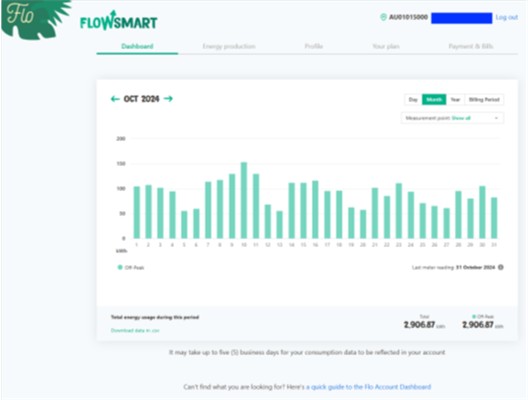
245 The FlowSmart Mark is present on each of the Dashboard pages in the same position. It is stylised, and in colours reflecting the overall branding of the website. It is part of the overall offering to the customer, and a means by which the customer is invited to recall impressions about its overall user experience in accessing the various functions of the Dashboard.
246 I therefore accept that the FlowSmart Mark was used as a trade mark.
4.1.3.1.2 Was use on the Dashboard in connection with the relevant services?
247 It is necessary for the Respondents to establish that the use of the FlowSmart Mark upon which it relies was in connection with the services in respect of which the FlowSmart Mark is registered. The Applicant argues that any use of the FlowSmart Mark was connected with information services relating to electricity, but not electricity supply services. The Respondents submit that information services relating to electricity are a subset of electricity supply services.
248 The question of whether services are of the same description as those covered by a registration is to be approached from a common sense commercial perspective (E & J Gallo Winery v Lion Nathan Australia Pty Ltd [2009] FCAFC 27; 175 FCR 386 at [71] (Moore, Edmonds and Gilmour JJ)).
249 In Accor Australia & New Zealand Hospitality Pty Ltd v Liv Pty Ltd [2017] FCAFC 56; 124 IPR 264, the Full Court identified a range of factors relevant to the assessment (at [339] (Greenwood, Besanko and Katzmann JJ)) in the following terms:
(1) The inherent character of each of the services for which the trade mark is registered. That may emerge as a function of language but it is likely to be the subject of evidence: for example, what does “an hotelier” actually do? What precisely is involved in providing “property management services”?
(2) To whom are the services offered?
(3) How are they provided?
(4) How are they used?
(5) What is their purpose?
(6) Are they bundled together with other services?
(7) Are they differentiated by the functional level at which they are provided: wholesale or retail?
(8) Where do they originate?
(9) What is the method of their communication to the relevant target audience: is it predominantly by electronic means, domain names, websites, Twitter, Facebook or other means such as other trade brochures and journals?
(10) How closely contestable are the services in substance: are they in the same market or trade?
(11) How might consumers of the services perceive the services: see, for example, E & J Gallo Winery v Lion Nathan Australia Pty Ltd (2009) 175 FCR 386; [2009] FCAFC 27, per Moore, Edmonds and Gilmour JJ at [71]–[73].
250 In the facts of this case a granular response to each sub-category is not of assistance. The FlowSmart Mark is registered in relation to electricity distribution, fuel distribution, and electricity supply services (among other things). The Dashboard enables monitoring of electricity use by customers. It is a channel through which customers can observe the supply of electricity, and which informs the consumer about what further electricity purchase is required or desirable. Customers can adjust their electricity use based on data such as past usage and price.
251 Because the Dashboard is part of the overall offering of Flo Energy to customers to whom it supplies electricity, and is aptly described as a part of the way in which electricity is supplied. Its purpose is to enable and facilitate the supply of electricity to customers such that it is part of the supply process.
252 Thus, the Dashboard is provided to electricity customers. The core commercial relationship between the customer and the Respondents is the supply of electricity. It is that for which the customer pays. A person cannot (and would have no reason to) access the Dashboard but for its relationship with the actual supply of electricity.
253 Accepting the criticality of context (Firstmac FC at [99]), I accept that the use of the FlowSmart Mark on the Dashboard involves a use in connection with the services for which it is registered.
4.1.3.2 Was the FlowSmart Mark “used” in correspondence with a prospective customer in the Non-Use Period?
254 The Respondents also point to email correspondence with a prospective customer to establish use of the Trade Mark in the Non-Use Period. That email correspondence is summarised at [109]-[112] above. This involves an analysis that is distinct from use on the Dashboard.
255 The Respondents argue that this email chain shows that throughout the period 11 October 2024 until 11 November 2024, Flo Australia used the FlowSmart Mark in respect of the distribution, supply, transmission and sale of electricity in its dealings with a prospective customer. It is said that the prospective customer was in possession of, and considered, documents containing use of the FlowSmart Mark during this period, including the critical period of 31 October to 3 November 2024.
256 The Applicant argues that the mere presence of the trade mark as part of the emails dated 17, 24 and 25 October 2024 are no more than evidence of unauthorised use of the trade mark prior to Bruutzak’s acquisition of the FlowSmart Mark. I accept that any “use” prior to 31 October cannot be used by the Respondents to support use of the trade mark, other than to reinforce conclusions otherwise available on the evidence. The relevant question is whether there was a relevant “use” in the Non-Use Period either because of the email of 1 November, or because the emails, read together, demonstrate that the FlowSmart Mark was under active consideration in the Non-Use Period sufficient to constitute a “use”.
257 As to the latter point, I do not consider that it is persuasive. The Respondents bear the burden of showing use in a very specific window of time. That window is unusually short in this case. However I do not consider it is sufficient to discharge the burden by inviting an inference that an email sent prior to the Non-Use Period was relevantly “in use” during the Non-Use Period, merely because it was engaged with after the Non-Use Period.
258 The email of 1 November is squarely in the Non-Use Period. The bar to establish use is a low one (Firstmac FC at [93]). However, there must be actual use. It is not sufficient to simply have a trailing email mention a mark without in some way incorporating or referring to it in the Non-Use Period. On careful analysis, the 1 November email is concerned principally with the solar feed in tariff terms – which do not involve the FlowSmart Mark to any extent.
259 Accordingly, I do not consider that the email correspondence involved a relevant “use” of the FlowSmart Mark in the Non-Use Period. It is, however, relevant evidence to the question of good faith use of the FlowSmart Mark as a whole, an issue to which I now turn.
4.1.4 Was the use of the FlowSmart Mark a use in good faith?
260 For the Respondents to rebut the application under s 92(4)(b)(ii), it must show that the use which I have found occurred was use “in good faith”. This means use that is “[r]eal, as opposed to token, use in a commercial sense” (Woolly Bull Enterprises Pty Ltd v Reynolds [2001] FCA 261; 107 FCR 166 at [16] (Drummond J)). It must be “ordinary and genuine use” and not “some fictitious or colourable use” if it is to defeat a non-use application (Lodestar Anstalt v Campari America LLC [2016] FCAFC 92; 244 FCR 557 (Lodestar FC) at [120] (Nicholas J)).
261 In E & J Gallo Winery v Lion Nathan Australia Pty Ltd [2010] HCA 15; 241 CLR 144 (E & J Gallo) the High Court cited the following principles or considerations to be taken into account in identifying whether a use was in good faith (at [62]-[64] (French CJ, Gummow, Crennan and Bell JJ)):
In Electrolux Ltd v Electrix Ltd [(1953) 71 RPC 23] a question arose of bona fide use within the meaning of s 26 of the Trade Marks Act 1938 (UK). It was held that bona fide use must be ordinary and genuine use judged by commercial standards. In Imperial Group Ltd v Philip Morris & Co Ltd, it was held that use of a trade mark for a purpose other than deriving profit and establishing goodwill is not use as required by the legislation. It has also been held that contriving use for the purpose of defeating a trade rival’s plans will lack the necessary quality of genuineness. However, a use does not cease to be genuine even if it only occurs after an appreciation that a registration was vulnerable to an attack on the grounds of non-use. In deciding that a use is not genuine, a court may be influenced by the quantum of sales. In Re Concord Trade Mark, Falconer J relied on Lawton LJ’s summary of the findings in the Electrolux case in Imperial Group:
“According to the judgments given in this court in that case [Electrolux] a bona fide use should be ‘ordinary and genuine’ (per Lord Evershed MR at 36), ‘perfectly genuine’, ‘substantial in amount’, ‘a real commercial use on a substantial scale’ (per Jenkins LJ at 41) and not ‘some fictitious or colourable use but a real or genuine use’ (per Morris LJ at 42).”
Lion Nathan relied on a passage in New South Wales Dairy Corporation v Murray-Goulburn Co-operative Co Ltd in which Gummow J noted that in Concord, Falconer J held that, for a use to be bona fide within the meaning of s 26 of the Trade Marks Act 1938 (UK), the use should be “substantial and genuine judged by ordinary commercial standards considered in relation to the trade concerned”. Concord concerned the launch of cigarette products under a trade mark which had not been in use for some years. Falconer J found that the sales, in the context of cigarette sales, were ‘negligible’ and therefore could not be regarded as substantial.
Whilst a single act of sale may not be sufficient to prevent removal, in the case of genuine use, a relatively small amount of use may be sufficient to constitute “ordinary and genuine” use judged by commercial standards. It has been recognised by the Court of Justice of the European Communities, dealing with the expression “genuine use” as used in Arts 10 and 12 of Directive 89/104 of the Council of the European Communities, that use of a mark “need not ... always be quantitatively significant for it to be deemed genuine”. On the facts here, it is not necessary to decide whether a single use of the registered trade mark in good faith would have been sufficient to resist removal.
(Footnotes omitted.)
262 In that case, 144 bottles of wine were imported and offered for sale within the statutory non-use period. There were 41 sales proven in that period. That use was sufficient, even though it was small. In Lodestar FC, Nicholas J said at [120]:
…the authorities have recognised that the motives of the registered owner are largely irrelevant. Use of a trade mark will still be use in good faith even if engaged in for the sole purpose of protecting the owner’s trade mark registration from attack for non-use provided that the use is real and genuine.
263 Similar sentiments were affirmed in Taxiprop Pty Ltd v Neutron Holdings Inc [2020] FCA 1565; 156 IPR 1 (Taxiprop) at [97] (O’Callaghan J).
264 In Trident the issue of good faith use was considered in the context of discretionary considerations after it was accepted that there has not been use in the non-use period. The use that was considered by the primary judge to be in good faith was (at [175]):
…(a) a reaction to the non-use application; (b) very limited; and (c) unaccompanied by a formal relaunch of the kind that might have been expected if there was an intention to sell the relevant products on a large scale.
265 The factual finding in that case was that the sales were “not unprofitable or otherwise contrived”, and so they were in good faith. This conclusion was found by the Full Court in Trident FC to be “rationally founded on the evidence” (at [29]; see also [38]).
266 I have no difficulty in concluding in this case that the FlowSmart Mark was purchased principally, if not solely, for the purpose of assisting the Respondents in this litigation. I am urged to find that the Respondents acted in a manner inconsistent with good faith because it involved subterfuge and concealment. Some context is relevant to this analysis.
267 The FlowSmart Mark was first raised in this proceeding at a directions hearing on the basis that it was a trade mark owned by a third party. Counsel for the Respondents made the following remark:
MR [HEEREY]: But the trademark itself that my friend relies upon had quite a chequered history getting registered in the first place. We will be cross-claiming to cancel that trademark on the basis that – your Honour won’t be surprised to hear that Flo (sic) describes the flow of electricity. So it’s a descriptive and generic term, but also there’s an earlier registration of Flo (sic) Smart. So Flo (sic) Power is said to be – my friends say that Flo (sic) Power is deceptively similar to Flo Energy. We would say the same reasoning. We say that Flo (sic) Power is deceptively similar to Flo (sic) Smart.
268 The implications of the existence of the mark were then explained as follows:
MR HEEREY: Well, yes, your Honour, because we have a potential – the cross claim that arises there arises entirely independently of the descriptiveness crossclaim. So there’s - - -
HIS HONOUR: Yes.
MR HEEREY: Entirely independently of that is – we have the right to see a cancellation of the mark on the basis that it could have been opposed, on the - - -
…
MR HEEREY: Now, our case is to say that Flo (sic) Power could’ve been opposed on the basis that it is deceptively similar to the earlier registration of Flo (sic) Smart for the same services. Same first word; that’s an important issue in deceptive similarity.
269 As discussed at [97] above, some time after that hearing, the Respondents contacted the solicitors for the then-owner of the FlowSmart Mark with a view to purchasing it. By the end of July 2024, Mr Guichelaar said that he started to consider how the FlowSmart Mark could be incorporated into the Flo Energy brand. Under cross examination he described FlowSmart as “a separate product which carries a separate name”. That is evidence which I consider is generally consistent with the need to give consideration to how the trade mark could be integrated into the Respondents’ overall branding.
270 By 19 August 2024, Flo Energy’s head of marketing was instructed to prepare some designs incorporating the FlowSmart Mark. They were completed and a brand selected within a day. The options presented to Mr Guichelaar were included as part of his evidence. While simple, it is clear that there was analysis of genuinely different branding approaches, for example:
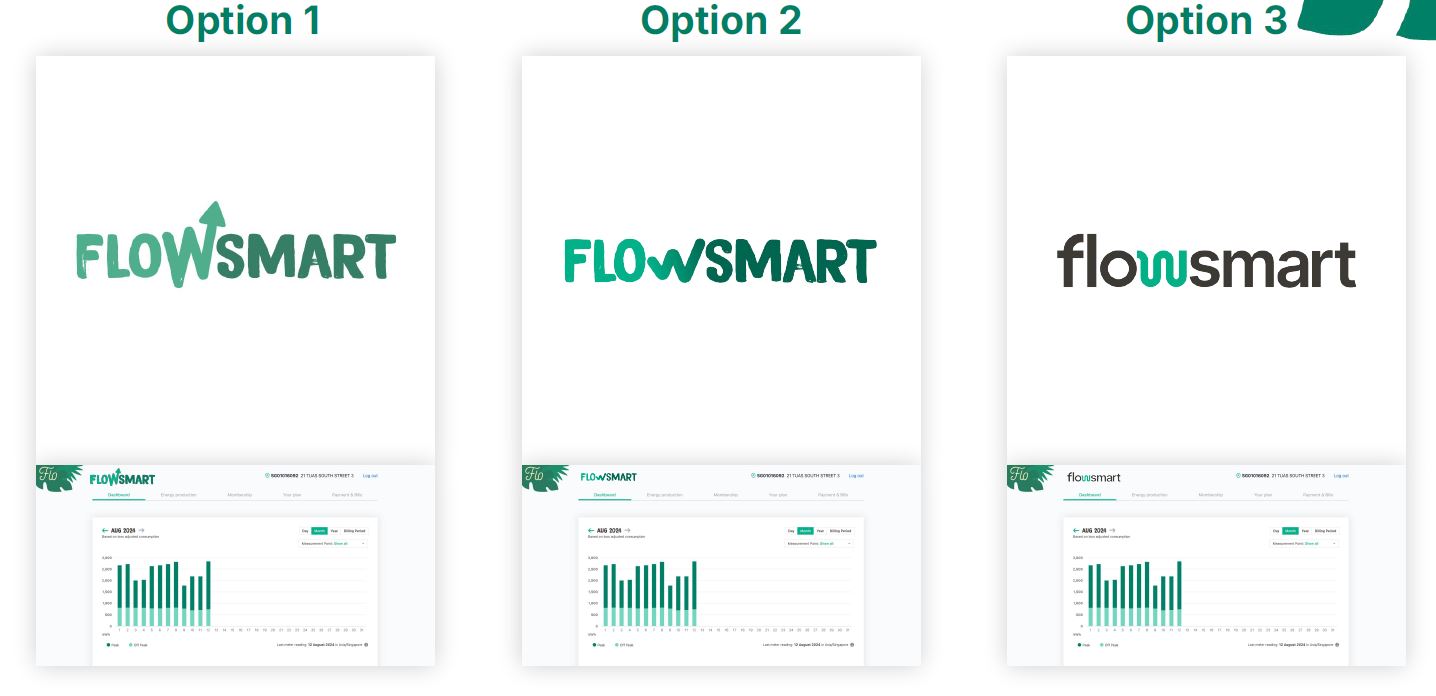
271 The selection of the preferred design occurred around 20 August 2024, and the trade mark was “merged in” to the Respondents’ website from 26 August 2024. As discussed above, the use of the FlowSmart Mark at this time was confined to a part of the website that was only available to customers. There is therefore no reason that the Applicant would have become aware of the use at that time. Mr Guichelaar deposed to the execution of the deed giving effect to the assignment of the FlowSmart Mark in favour of Bruutzak with effect from 31 October 2024.
272 Immediately upon the assignment, Bruutzak entered into an exclusive licence to permit Flo Energy Australia to use the FlowSmart Mark. This is relevant to the issue of authorised use, discussed below.
273 The reason that Bruutzak was interposed as the owner of the FlowSmart Mark was the subject of cross examination. It was squarely put to Mr Guichelaar that the reason that he arranged for the FlowSmart Mark to be assigned to Bruutzak was because he was concerned that the Applicant would be watching for any activity on the Register involving Flo Holding. He denied that motivation, stating:
No. To be honest, I would have actually expected either Allens or Flow Power to pick it up, and if you see that you’re in, let’s say, a process with us where you know that both me and my business partner are Dutch and all of a sudden a Dutch entity takes a hold of the trademark, I would assume that you or Allens would have then looked at public register and you would see my name. So it was actually done because we didn’t want to make it immediately super-obvious to Energy Australia that they were selling a trademark to a direct competitor.
274 The Applicant submits that this explanation was manifestly not credible and ought not be accepted. I reject that submission. There was nothing in Mr Guichelaar’s demeanour, the contemporaneous documents, or the conduct itself which suggests a deception of this kind. On the contrary it is reasonably credible that Mr Guichelaar considered it likely that the Applicant would be monitoring the ownership of the FlowSmart Mark, and would assume that a Dutch company may be associated with the Respondents given Mr Guichelaar’s connection to the Netherlands.
275 Moreover, the Applicant was informed of the existence of the FlowSmart Mark by the Respondents at a case management hearing in July 2024. When it was raised at that time, it was said that it might provide a basis for the cancellation of the Registered Flow Power Marks (immediately following the exchange extracted at [268] above):
MR HEEREY: It’s Flo (sic). Same services, of course. Same first word, differentiated only by, on my friend’s case, Power, which is entirely descriptive. And on the third party mark, the word Smart, which we would is a very commonly used term across industries today, which has little distinctive impact. But even if it was considered distinctive - - -
HIS HONOUR: So do you need to join the owner of Flo (sic) Smart?
MR HEEREY: No, we don’t. We only need to join the Registrar.
HIS HONOUR: Okay.
276 It is apparent therefore that the Respondents did not seek to hide the FlowSmart Mark from Progressive Green in the proceeding. The Respondents foreshadowed reliance upon it. It is not unreasonable or dishonest to not disclose a potential purchase of the FlowSmart Mark. I accept therefore that the true purpose of interposing Bruutzak was, as Mr Guichelaar said, to avoid making it obvious to EnergyAustralia that they were selling the FlowSmart Mark to a direct competitor. The Applicant asserts this approach demonstrates a lack of transparency, which does not bespeak good faith. I do not consider that this issue is relevant to the question of good faith for the purposes of defending a non-use application. In any event, there is no evidence before me about the nature of the negotiations with EnergyAustralia, and in particular whether or not the Respondents sought to mislead them about the proposed use of the FlowSmart Mark.
277 The purchase of the FlowSmart Mark was clearly motivated by the instant litigation. It is logical that the incorporation of it into Flo Energy’s business would not have occurred but for the litigation.
278 The FlowSmart Mark was deployed on the Respondents’ Dashboard, discussed above. The Applicant argues that there is no evidence as to the volume or value of use by the Respondents in the relevant period, and that in the absence of such evidence, I should draw an inference that the evidence would not have assisted them. I do not agree. The Respondents have led evidence about the nature of the Dashboard, the number of customers with access to the Dashboard, and the manner in which it was made available to those customers. This case is different from examples like Lodestar FC where one can measure the sales of an individual product that is branded with a particular trade mark. In this case, the use was part of the branding of a part of the Respondents’ offering to customers. I do not consider that the adverse inference for which the Applicant contends arises.
279 Relatedly, the Applicant argues that there has been no evidence of meaningful commercial value derived from the FlowSmart Mark. It is said that this, in combination with the recent acquisition of the FlowSmart Mark for the purposes of defending the litigation is sufficient to distinguish this case from other cases like TaxiProp. In that case, the Court found that where a trade mark was brought back from disuse to defend the challenge to its registration, the requirement of good faith use was nevertheless satisfied. However in that case, the trade mark had a genuine profit-making purpose, albeit that only two taxis out of over 9,000 carried the trade marks which the trade mark owner in that case sought to defend. As O’Callaghan J made clear in that case at [107]:
As the cases explain, provided the use relied upon is “real and genuine”, and not a mere token or otherwise a contrivance, relevant use in good faith is established. Here, the taxis earned significant amounts of revenue, operated over a considerable time period and made a large number of trips. In my view, in all the circumstances, the use of the mark on the two Camry taxis was genuine and sufficient to establish use in good faith for the purposes of Neutron’s application for removal.
280 The Applicant argues that I can infer a lack of genuineness because the FlowSmart Mark is itself inconsistent with the branding that the Respondents have otherwise adopted, including through the use of a “W” in the FlowSmart Mark, which the Respondents had otherwise eschewed in its use of FLO ENERGY.
281 In this case, there is strong evidence that the use was real and genuine having regard to commercial standards (Electrolux Ltd v Electrix Ltd [1954] 71 RPC 23 at 41 (Lloyd-Jacob J)) in the sense that:
(1) There was a process of development of the trade mark for integration onto the Respondents’ online offering.
(2) There was a broad integration of the FlowSmart Mark onto the Dashboard in the sense that it has been “rolled out” for use in both the Australian and Singaporean business. This is more than mere token use, including because it was used beyond the jurisdiction in which the FlowSmart Mark was being defended. While the use in Singapore is not relevant to whether it was relevantly in use, I do consider it somewhat relevant to the genuineness of the use that occurred in Australia. The breadth of its deployment is consistent with the conclusion that the use was commercial and not a merely contrived use for the purpose of defeating a trade rival’s plans (Re Concord Trade Mark [1987] FSR 209, cited in E & J Gallo at [62]).
(3) The FlowSmart Mark is in actual use on the Dashboard that is part of the way in which Flo Energy Australia interacts with its customers in relation to the supply of energy and account support.
(4) Relatedly, the correspondence with a prospective client referred to at [109]-[112] above demonstrates that the FlowSmart Mark was and is deployed in engaging with customers when discussing the terms of their engagement of the services offered by Flo Energy Australia. Once again, I do not consider that this correspondence indicates “use” in the relevant sense. However, it does lend support to the genuineness of the use that I have found to have occurred in the relevant period.
282 I do not agree that the Respondents’ conduct in acquiring the FlowSmart Mark through a related company demonstrates a lack of good faith in the sense contemplated by the authorities. However, it does raise a question over whether the use was appropriately authorised – an issue to which I will return.
283 I note Mr Guichelaar’s evidence given for the first time at the hearing that there was some intention to use FlowSmart as the name of a separate software product. I accept the Applicant’s submissions that such a use would be in a different class, and appears to be an intention so embryonic that it cannot be truly called an intention to use the trade mark. I therefore place no weight upon that intended use.
4.1.5 Was the use authorised?
284 Section 92(4)(b) of the Act directs attention to use of the trade mark by its registered owner. Section 7(3) states that an authorised use of a trade mark will be taken to be a use of the trade mark by its registered owner. Section 8 of the Act defines authorised users and authorised use and provides (emphasis original):
8 Definitions of authorised user and authorised use
(1) A person is an authorised user of a trade mark if the person uses the trade mark in relation to goods or services under the control of the owner of the trade mark.
(2) The use of a trade mark by an authorised user of the trade mark is an authorised use of the trade mark to the extent only that the user uses the trade mark under the control of the owner of the trade mark.
(3) If the owner of a trade mark exercises quality control over goods or services:
(a) dealt with or provided in the course of trade by another person; and
(b) in relation to which the trade mark is used;
the other person is taken, for the purposes of subsection (1), to use the trade mark in relation to the goods or services under the control of the owner.
(4) If:
(a) a person deals with or provides, in the course of trade, goods or services in relation to which a trade mark is used; and
(b) the owner of the trade mark exercises financial control over the other person’s relevant trading activities;
the other person is taken, for the purposes of subsection (1), to use the trade mark in relation to the goods or services under the control of the owner.
(5) Subsections (3) and (4) do not limit the meaning of the expression under the control of in subsections (1) and (2).
285 Accordingly, to qualify as authorised use, the use must be under the control of the trade mark owner. Sections 8(3) and (4) are not exhaustive; while they identify two types of control (quality control and financial control) it is clear that these are not the only types of control that will satisfy s 8. The Respondents identify two bases to assert control by Bruutzak of the FlowSmart Mark:
(1) First, that Flo Energy Australia’s use of the FlowSmart Mark was governed by a written licence, which included a clause providing for Bruutzak to have quality control over the FlowSmart Mark and included a requirement for Flo Energy Australia to comply with any direction given by Bruutzak as to the manner and form of use of the FlowSmart Mark.
(2) Second, throughout the time of its use, Mr Guichelaar was the sole director and shareholder of Bruutzak and a director and CEO of Flo Energy Australia. He was the person responsible for the use of the FlowSmart Mark by Flo Energy Australia. This (either on its own or in combination with the licence) is said to demonstrate a “unity of purpose” in discharging both those roles in the sense contemplated in Trident FC.
286 The Applicant argues that there is no evidence of any actual control by Bruutzak, whether in the nature of financial control or quality control, during the period of its ownership of the FlowSmart Mark. It argues that the existence of a written licence agreement is insufficient to establish control for the purposes of the Act. It further argues that Bruutzak was only interposed to avoid scrutiny or detection of the owner of the FlowSmart Mark and that there was no relevant unity of purpose between Bruutzak and Flo Energy Australia.
4.1.5.1 What are the requirements for control?
287 The Full Court in Lodestar FC carefully considered the requirements of control for the purposes of s 8 of the Act. In Lodestar FC, a licence was granted for the use of a trade mark in respect of wine. The licence was expressed at [45] to be “a perpetual, exclusive licence, without right to sublicence, subject to all of the obligations and conditions contained in this Agreement…”. Because the licence was exclusive and perpetual, it operated forever to prevent the licensor and its successors in title from using the marks in Australia. There were some quality control mechanisms in the licence agreement. However the evidence of the licensee was that while aware of his obligations, they did not impact upon the way he made his wine. The primary judge found as a matter of fact that subject to an exception in relation to export trade (which never arose) the licensor exercised no actual control over the way that the licensee used the trade marks in relation to the wine in the relevant period. His Honour concluded that the licence agreement was not intended by the parties to “deliver anything but the appearance of control” (Skyy Spirits Llc v Lodestar Anstalt [2015] FCA 509; 112 IPR 328 (Lodestar) at [31] (Perram J)).
288 Justice Besanko in Lodestar FC observed in the course of the analysis that a licence agreement could contain terms that set out quality standards, but noted that where they are complied with, there may be no need for entreaties or demands from the licensor (at [98]). It was relevant in that case that at no time during the relevant period did the licensor contact the licensee about the wine he was making or selling. There was never any request for samples, or information, or monitoring to determine if there was compliance with the licence. Ultimately, the Full Court concluded that the mere existence of the licence agreement was insufficient and control was not established. Justice Besanko (with whom Allsop CJ, Greenwood and Nicholas JJ relevantly agreed) observed (at [95]) that:
The meaning of “under the control of” in s 8 is informed by the principle stated by Aickin J in Pioneer, that is to say, that the trade mark must indicate a connection in the course of trade with the registered owner. The connection may be slight, such as selection or quality control or control of the user in the sense in which a parent company controls a subsidiary. It is the connection which may be slight.
289 Having considered the history of the concept of control in trade mark jurisprudence, his Honour observed at [97] that:
Control involves questions of fact and degree as does the notion of a sufficient connection. There must be control as a matter of substance. For example, I do not think that it could be suggested that the mere fact that the registered owner granted a licence or revocable authority to use the trade mark would be sufficient without more established control within s 8.
290 The Full Court in Lodestar FC was plainly concerned by a number of factual factors operating together in that matter. The perpetual nature of the licence, combined with use over many years, in combination with the failure of the licensor to have even the most cursory interest in the goods being sold under the trade mark combined to lead to the conclusion that there was no real or genuine control in the manner required by s 8. Different members of the Court had slightly different aspects of emphasis; Nicholas J (at [123], with whom Allsop CJ agreed) focused upon:
…the terms of the licence agreement coupled with a consideration of the circumstances in which it came into existence and the evidence concerning the lack of steps taken under it during the non-use period reveal that Wild Geese Wines Pty Ltd’s (“WGW”) use of the trade marks during the non-use period were not the subject of any real or genuine control by the registered owner.
291 Justice Greenwood noted that the control mechanisms that did exist had attenuated over time so that they were not effective in the non-use period (at [20]). Justice Katzmann was concerned that a bare licence to use a trade mark, particularly a perpetual licence, would not be sufficient to satisfy the requirements of s 8 (at [184]). Her Honour considered that each case will depend on the terms of the agreement, most importantly, whether the control is such as to maintain the registered proprietor’s connection with the marks (at [184]). Overall, a number of propositions may be distilled which are relevant to the present analysis:
(1) There must be actual control in relation to the use of the trade mark. Precisely what will constitute control in each case is a matter of fact and degree, but there must be control as a matter of substance, and not just of form (Lodestar FC at [98]).
(2) To demonstrate control, it is not necessary to show evidence of actual demands or instructions where the licensee is acting appropriately within the scope of the licence in a manner that would render such instructions unnecessary, i.e. because obedience to the trade mark owner is “so instinctive and complete that instruction was not necessary” (Lodestar FC at [98]).
292 There has been some limited consideration of the principles in Lodestar. For instance, Ceramiche Caesar S.p.A v Caesarstone Ltd [2020] FCAFC 124; 154 IPR 237 (Nicholas, Burley and Thawley JJ) concerned the weight to be attributed to control over the transport of material where that material would later be used to create the final product (see [60], [76]). Being able to demonstrate control over the transport of the material, but not the final goods, was insufficient (see [51]).
293 Trident is another case of relevance. In that case, Trident Foods Pty Ltd (Trident Foods) was the registered owner of two trade marks for the same word, TRIDENT, in relation to fish and fish products and in relation to meat, fish, poultry and game, including sardines, mackerel, pilchards, crab, oysters, mussels and prawns. Trident Foods was a wholly owned subsidiary of Manassen Foods Australia (Manassen). Trident Seafoods Corp (Trident Seafoods) applied to have the TRIDENT marks removed for non-use. Initially, the Registrar was satisfied that Trident Foods had not used the TRIDENT marks in the relevant period, but exercised discretion to retain the marks. Upon appeal, Gleeson J was not satisfied that the evidence established that Manassen’s use of the trade marks was relevantly under the control of the trade mark owner. Her Honour held that there was mere acquiescence between the two companies, and that Trident Foods did not actually control Manassen’s use of the trade marks. However, her Honour also decided to exercise her discretion not to remove the trade marks from the Register.
294 On appeal, the Full Court (Reeves, Jagot and Rangiah JJ) concluded that Trident Foods did, as a matter of fact, control Manassen’s use of the trade marks, and that its use was therefore authorised under s 8(1) of the Act. This meant that there was use of the TRIDENT marks in the relevant period.
295 In considering the approach to control for the purposes of s 8 of the Act, the Full Court considered the alleged unwritten licence from Trident Foods to Manassen, authorising the use of the marks, the terms of which were said to be the same as the licence agreement dated 3 November 2017. The primary judge had found that there was a lack of control by Trident Foods over the use of the trade mark by Manassen.
296 The Full Court identified as a key factor the corporate relationship between the two parties. Their Honours said that the issue is not whether one company controlled the other, but rather whether Trident Foods, even though a wholly owned subsidiary of Manassen, had control over Manassen’s use of the trade marks. It was relevant that:
(1) at all relevant times the two companies had the same directors (Trident FC at [45]);
(2) it was to be inferred from the evidence that the two companies operated with a unity of purpose. That unity was described in the following way at [45]:
As directors of Trident Foods, the directors had obligations to ensure the maintenance of the value in the marks. To that end Trident Foods necessarily controlled Manassen’s use of the marks by reason of the simple fact that it owned the marks and its directors, who were also Manassen’s directors, must have had one common purpose, being to maximise sales and to enhance the value of the brand… As Trident Foods submitted, it is commercially unrealistic in the circumstances of the present case not to infer that the owner of the marks controlled the use of the marks because the common directors necessarily wished to ensure the maintenance and enhancement of the value of the brand. The fact that this must also have been Manassen’s purpose simply confirms the unity of purpose between the corporate entities.
297 Their Honours at [46] were not concerned by the lack of “particular illustration” of conduct by Trident Foods amounting to actual control of the use of the TRIDENT trade mark. Their Honours considered the “natural and ordinary” inference given the relationship between the companies would be of unity of purpose. In this respect, it seems that the overall aims of the corporate group were relevant to the relationship being discussed. Given those aims, and the evident unity of purpose, it was unnecessary to give directions about the use of the trade mark (see [47]).
298 The fact that every packet sold identified the trade mark as belonging to Trident Foods supported the inference of control by Trident Foods of the use of the mark that it owned (see [49]). As to the existence of the unwritten licence agreement the Full Court noted that in light of the corporate relationship, it was (at [51]):
inconceivable that Manassen was using the marks without the knowledge, consent and authority of Trident Foods. This necessarily constitutes more than mere acquiescence by Trident Foods. Mere acquiescence denotes passive acceptance of Manassen’s use but the corporate relationship, common directorships and arrangements between the companies required active engagement by those directors to protect Trident Foods’ valuable goodwill ($10 million in the books of Trident Foods, PJ [161(1)]). Trident Foods’ active consent and authority must constitute an unwritten licence for use of the marks.
299 The Full Court therefore found that Manassen’s use of the trade marks in the period were authorised under s 8(1) and were thus taken to be use by Trident Foods as the owner of the marks under s 7(3).
300 Unity of purpose is a question of fact in each case. It is one method by which actual control for the purposes of s 8(3) can be established. It is a practical expression of the reality that sits behind a series of relationships from which control can be established. It avoids the artificiality of requiring (for example) a corporate group adhere to rigid lines of communication, where the practical reality is that the unity of purpose renders strict directions and hierarchies less significant.
301 In this case, Bruutzak was the owner of the FlowSmart Mark within the non-use period. On 31 October 2024, Flo Energy Australia was granted an exclusive licence from Bruutzak to use the FlowSmart Mark (License Agreement). The FlowSmart Mark was assigned from Bruutzak to Flo Holding on 2 December 2024. The question therefore is whether Bruutzak exercised actual control over the use of that Trade Mark in the non-use period. It is the Flo Energy entities that bear the burden of establishing that the use upon which it relies was authorised by Bruutzak.
4.1.5.2 Did the Licence Agreement establish control?
302 Mr Guichelaar described Bruutzak as “one of my Dutch entities”. There is otherwise little evidence as to the operations of Bruutzak. In a company search extract tendered by the Applicant without objection, its activity is described as “Corporate, Business Services”. That search identifies Mr Guichelaar as a director. It notes that Bruutzak is a part of a corporate group, with MJG Management B.V. identified as a subsidiary of Bruutzak. Mr Guichelaar’s evidence is that he is the “sole owner and director of Bruutzak” and in oral submissions it was submitted that he was the sole shareholder as well. I accept that is the case.
303 There is no evidence to suggest that Bruutzak now operates or has ever operated any form of electricity company. Mr Guichelaar’s evidence about Bruutzak’s interposition is brief and limited. I have extracted it in full (emphasis original):
116. On 31 October 2024, the assignment of the FlowSmart Trade Mark from EnergyAustralia to my company Bruutzak Holding B.V. (Bruutzak) was formalised by way of a deed of assignment. I am the sole owner and director of Bruutzak. A copy of the executed and completed assignment filed with IP Australia appears at pages 383 to 390 of Exhibit MJG-1.
117. Immediately following the assignment, on 31 October 2024, Flo Energy Australia was granted an exclusive licence from Bruutzak to use the FlowSmart Trade Mark. A copy of the licence appears at pages 391 to 403 of Exhibit MJG-1 .
…
121. On 2 December 2024, the FlowSmart Trade Mark was assigned from Bruutzak to Flo Holding. A copy of the deed of assignment as filed with IP Australia on the same day appears at pages 422 to 428 of Exhibit MJG-1.
304 Under cross examination, Mr Guichelaar’s evidence was that Bruutzak was interposed as owner of the FlowSmart Mark to obscure (so that it was not “immediately super-obvious”) that the true user of the FlowSmart Mark would be Flo Energy in Australia as to “ease the negotiations with Energy Australia” as the mark was being sold to a “direct competitor”.
305 Mr Guichelaar also gave evidence that he caused the FlowSmart Mark to be added to the Dashboards of both the Flo Energy Singapore and Flo Energy Australia websites on 26 August 2024. Bruutzak had no involvement at all in that decision.
306 The Licence Agreement between Bruutzak and Flo Energy Australia records that:
(a) With effect on and from the Commencement Date, but subject to clauses 3(b), 3(c), 4, 5, 6, 7, and 8, the Licensor grants to the Licensee, an exclusive, royalty-free, fee-free, licence, to Use the Trade Mark in relation to the provision of the Goods and Services by the Licensee in the Territory for the Term.
…
(c) For the avoidance of doubt, the licence granted to the Licensee under clause 3(a) includes the exclusive right, in the Territory, during the Term, to do any one or more of the following:
(i) advertise, promote, market, distribute and sell Goods and Services and related merchandising materials bearing the sign, including all associated goodwill in and to, the subject of the Trade Mark;
(ii) take all action in the nature of enforcement of the Trade Mark, including, without limitation, issuing notification of rights letters and sending letters of demand; and
(iii) subject to the Licensor’s prior permission in writing, institute proceedings for the infringement or suspected infringement of the Trade Mark.
307 The Licence Agreement was terminable by the Licensor upon written notice, for breach, or by either party on written notice following an insolvency event. The Licence also included terms concerning quality control. For example:
The Licensee agrees:
(a) to Use the Trade Mark in relation to the Goods and Services at all times in the form set out in Schedule 2, without any amendments, alterations or additions of any kind whatsoever, unless with the prior written permission of the Licensor;
(b) to comply with any direction given by the Licensor from time to time as to the manner and form of Use of the Trade Mark;
(c) to ensure that the Goods and Services provided under the Trade Mark comply at all times with all quality standards, controls and, or, directions in relation to those Goods and, or, Services that are provided by the Licensor to the Licensee from time to time during the Term;
(d) not to permit any third parties to Use the Trade Mark or register the Trade Mark without the prior consent of the Licensor; and…
308 Schedule 2 of the License Agreement showed the FlowSmart Mark in the form in which it was deployed on the Dashboard.
309 The FlowSmart Mark was owned by Bruutzak for 33 days. It was transferred to Flo Holding on 2 December 2024, which subsequently granted a licence to Flo Energy Australia. The evidence makes clear that the ownership of the FlowSmart Mark did nothing to change the manner or terms of its use.
310 The terms of the Licence Agreement are different from those that were at issue in Lodestar. This is not a perpetual licence, and it otherwise appears more detailed than was at issue in that case. In particular, the quality control provisions in the Licence Agreement before me require the use of the FlowSmart Mark in a particular form. The evidence is that it was used in that form. The CEO of Flo Energy Australia was the sole director and shareholder of Bruutzak and so was in a position to know if the FlowSmart Mark was being used in the manner required. This contrasts with the situation in Lodestar FC where the standard required by the agreement involved no more than “a rejection of truly undrinkable wine” (at [107]) and in Trident FC, where there was no agreement at all.
311 There is no evidence that Bruutzak gave any directions in relation to the FlowSmart Mark. There is no evidence that Bruutzak has any connection with the supply of electricity in any jurisdiction, or any interest in or knowledge of such an industry, beyond the fact that its shareholder and director is the CEO of Flo Energy Australia. However, given that the Licence Agreement was in place for only 33 days, the failure to see much activity around it does not lead to the conclusion that the owner did not exercise control.
312 As noted at [276] above, I accept Mr Guichelaar’s evidence that the purpose for the interposition of Bruutzak was to minimise the risk of EnergyAustralia becoming aware that the proposed purchaser of the FlowSmart Mark was operating an energy business in Australia.
313 In order for authorised use to occur, the FlowSmart Mark must be under the actual control of Bruutzak. In Lodestar, the primary judge found that it was is not sufficient if the rights conferred are intended to do no more than give the appearance of control at [31]. The Full Court neither embraced nor repudiated that proposition (cf Lodestar FC at [22] (Greenwood J)). Justice Besanko in Lodestar FC said that actual control was required (at [98]) and that whether it existed or not is a matter of fact and degree.
314 Justice Nicholas said (Lodestar FC at [123]) that there was no suggestion that the licence agreement was a sham in the legal sense, noting:
…the terms of the licence agreement coupled with a consideration of the circumstances in which it came into existence and the evidence concerning the lack of steps taken under it during the non-use period reveal that Wild Geese Wines Pty Ltd’s (“WGW”) use of the trade marks during the non-use period were not the subject of any real or genuine control by the registered owner.
315 Overall, in that case, the lack of control in the licence agreement coupled with the lack of factual control by the trade mark owner combined to support the conclusion that there was no control sufficient for the purposes of s 8.
316 Progressive Green submits that the purpose of interposing Bruutzak was to conceal the fact that control lay with Flo Energy Australia, and it was never intended that Bruutzak exercise control over the FlowSmart Mark. This is said to be supported by a range of factual matters:
(1) Mr Guichelaar’s evidence that Bruutzak was deployed to obscure the identity of the true purchaser of the FlowSmart Mark;
(2) the lack of evidence that Bruutzak has any history in the energy industry; and
(3) the fact that the FlowSmart Mark was already being used in the manner contemplated by the Licence Agreement prior to its inception (and it continued to be used in that way after Bruutzak was no longer the owner of the FlowSmart Mark).
317 There is some force in this argument. However, the terms of the Licence Agreement are limited and prescriptive in the sense that they permit the use of the FlowSmart Mark in only the way in which it was being used. Moreover, the fact that Bruutzak owned the FlowSmart Mark for only 33 days makes it difficult to say that the control mechanisms in the agreement were not used because Bruutzak lacked the will or capacity to do so. Moreover, the true locus of control of the trade mark was not explored with Mr Guichelaar in cross examination in the sense that it was not put to him that Bruutzak would be unwilling or unable to enforce the rights that it apparently had under the Licence Agreement, or that the agreement was not genuine.
318 While acknowledging the force of the argument put by Progressive Green, in all of the circumstances that I have outlined above, I accept that the Licence Agreement was effective to confer actual control, despite there having been no opportunity or reason requiring an exercise of the control conferred by the License Agreement within the time of Bruutzak’s ownership.
319 It follows that the use of the FlowSmart Mark by Bruutzak was authorised use for the purposes of s 92.
320 Because of my conclusion as to the efficacy of the Licence Agreement in conferring actual control, it is not necessary to look to whether a unity of purpose existed. I have significant doubts that such a unity of purpose would be established given that Bruutzak sits outside the corporate group of the Flo Energy entities and does not have complete overlap of directors with the Second Respondent. However, this is not a matter about which I am required to reach a concluded view.
4.1.6 Conclusion on use
321 I have concluded that the Licence Agreement in place was sufficient to establish control by Bruutzak in the Non-Use Period. Accordingly, the FlowSmart Mark was used in the Non-Use Period in good faith, and is therefore not susceptible to removal. It is therefore not necessary to consider the discretion in s 101(3) to retain the FlowSmart Mark.
322 Progressive Green also argued that to the extent that there was use of the FlowSmart Mark, it was not use in connection with the services for which it was registered. For the reasons explained at [250]-[253] above, I do not accept that submission.
4.2 Should the FlowSmart Mark be cancelled under s 88(2)(c)?
323 Progressive Green argues that the FlowSmart Mark should be cancelled under s 88(1)(a) on the ground set out in s 88(2)(c) on the basis that, in the circumstances applying at 10 July 2024 (being the date of the commencement of the proceeding), use of the FlowSmart Mark would be likely to deceive or cause confusion. For the reasons I have explained at [196] above, I consider that the correct date is 24 December 2024, being the date on which the application to cancel the FlowSmart Mark was first raised. Despite substantial argument on the point, Progressive Green ultimately submitted (emphasis original):
…it will not much matter whether the date for assessing the relevant “circumstances applying” is 10 July 2024 or 24 December 2024. In either case, the reputation developed by Progressive Green in the names FLOW POWER and FLOW in the period between March 2017 and 2024 ought to be taken into account in determining whether or not to cancel [FlowSmart].
324 I have set out the principles relevant to when a registered mark is likely to deceive or cause confusion at [162]-[169] above. Assessing whether a registered trade mark under s 120(1) is deceptively similar is a question of fact (Self Care at [27]). In answering the question for the purpose of s 88(2)(c) it is necessary to consider any normal and fair use of the FlowSmart Mark across the entirety of its specification (Goodyear at [180]-[181]). The FlowSmart Mark is registered in class 39 for:
Distribution of energy; electricity distribution; fuel distribution services; Electricity storage; Electricity Supply Services; Supply of electricity; Transmission of electricity; Storage; Storage of gas; Delivery of fuel;
325 The Respondents do not seek to rely upon any reputation that was developed by EnergyAustralia prior to the sale of the FlowSmart Mark to Bruutzak. It is fair to say that the evidence discloses a negligible reputation to date.
326 To summarise this issue:
(1) At December 2024 (and indeed, July 2024) Progressive Green had invested in the Flow Power Marks as part of its corporate brand. However, the extent of the reputation that it had established was not substantial across the spectrum of the services for which it was registered.
(2) My analysis of the reputation in FLOW POWER applies with equal force to FLOW alone, save that the evidence for FLOW is less significant. I do not accept that the evidence supports the conclusion that it had any real reputation in FLOW alone.
(3) The reputation in the FlowSmart Mark was not significant. It had been maintained on the Register for many years without meaningful use. At December 2024 it was only in use with, at most, a few dozen customers as part of the online Dashboard, available to customers of Flo Energy Australia.
327 Overall, it is clear that the owner of the FlowSmart Mark did nothing to create or maintain a reputation in that mark in the period that Progressive Green were attempting to establish one.
328 However, the question posed by s 88(2)(c) is whether the reputation of the Flow Power Marks is sufficient to mean that it is likely that the use of the FlowSmart Mark would be likely to deceive or cause confusion. The way in which Progressive Green pleaded this issue is instructive:
[15] Since 2017, the Flow Power Business has been promoted extensively throughout Australia under and by reference to the Applicant's Marks.
[16] The Applicant's Marks have been used extensively throughout Australia by and on behalf of Flow Power in connection with the Flow Power Business.
[17] By reason of the matters set out in paragraphs 14 – 16 above, Flow Power has developed a valuable reputation and substantial goodwill in Australia amongst consumers of electricity and energy related products and services and other traders in the Australian electricity and energy market in respect of the Applicant's Marks.
329 While the pleading referred to each of FLOW, FLOW POWER, flowpower.com.au, and the Flow Power Device, the focus in argument was largely upon the words FLOW POWER.
330 For the reasons I have explained in part 2.5.3 above, while I accept that Progressive Green has invested a significant amount of money and effort in the Flow Power Marks, I do not accept that the evidence demonstrates that the result has been the development of a substantial reputation among a substantial section of the consumers of electricity and energy related products and services in the Australian electricity and energy market. This analysis considered the uses of FLOW POWER including in its form as part of the Flow Power Device.
331 I have separately considered whether the position would be different for any one of the other Flow Power Marks. It would not. In reaching this conclusion, I note that:
(1) FLOW, the Flow Power Device and flowpower.com.au were effectively methods of deploying FLOW POWER, which was the primary mark.
(2) there was no separate development or emphasis upon the other marks. The evidence was that there was an “evolution” towards FLOW. While I have expressed some scepticism that there was such an evolution compared to an intention to do so from the initial re-brand, I accept that the use of FLOW was occurring alongside FLOW POWER. There is no evidence to suggest that FLOW had a more substantial reputation than FLOW POWER.
332 Of course, I have considered the combined impact of all of the Flow Power Marks. The conclusion to be drawn from the evidence of use that I have analysed remains that, taken as a whole, the evidence does not establish a substantial reputation across energy users in Australia: a very large cohort of individual and corporate customers in the millions.
333 It is in that factual context that s 88(2)(c) falls to be considered.
4.2.1 Would use of the FlowSmart Mark be likely to deceive or cause confusion?
334 For s 88(2)(c) to operate to have a registered mark removed, Progressive Green must show that the use of the FlowSmart Mark would be likely to deceive or cause confusion. The concept of “likely” in s 88(2)(c) is directed to whether the mark would be likely to deceive or cause confusion at December 2024. The question is whether there is a “real, tangible danger” of consumers entertaining a “reasonable doubt” or being “caused to wonder” whether the two products came from the same source (Swancom at [172]-[173] (O’Bryan J); Self Care at [71]).
335 There is no evidence of actual confusion. That is not surprising given the lack of reputation that presently exists in the FlowSmart Mark and so I place no weight on that absence of evidence.
336 Section 88(2)(c) does not, in terms, refer to the priority date of registration as relevant to the analysis. It looks instead to which mark would cause confusion if it were used. Implicitly, confusion is caused where a mark with little or no reputation is used in relation to goods or services where there is a mark with a substantial reputation operating. If a trade mark would, by its use, be likely to deceive or cause confusion then that mark could be susceptible to removal. The issue of the public policy of a decision to permit a subsequently registered mark to cause the removal of a prior mark would be more comfortably considered in the context of the discretion, and the analysis mandated by the regulations (see Firstmac FC at [158], [172]). That is not necessary in this case.
337 There was some dispute over whether the services provided by the Respondents under the FlowSmart Mark relate to the services or goods covered by the Registered Flow Power Marks’ registration. I accept that the way in which the FlowSmart Mark has been used involves at the very least the provision of “information services relating to the supply of electricity” (class 39) or the “recording of data relating to energy consumption.” To the extent that it is necessary to do so, I find that the FlowSmart Mark has been used in relation to these services, which are each matters for which Progressive Green provides services under the Flow Power Marks.
338 I have therefore concluded that the Flow Power Marks do not have a reputation that is sufficient to render the use of the FlowSmart Mark likely to deceive or cause confusion in the electricity market in Australia.
4.2.2 Conclusion: removal under s 88(2)(c)
339 In all of those circumstances, Progressive Green has failed to discharge its burden that the FlowSmart Mark should be cancelled to avoid confusion with the Flow Power Marks.
340 Because I have decided that Progressive Green has not succeeded in removing the FlowSmart Mark, it is not necessary to consider the operation of any discretion.
4.3 Conclusion
341 It follows that the FlowSmart Mark will remain on the Register of Trade Marks. Its use within scope does not infringe any other trade mark (s 122(1)(e)). Thus the orders sought by Progressive Green for declarations that the ‘461 Mark has been infringed by the use of the FlowSmart Mark will not be made.
342 Because the applications for removal (under s 92) or cancellation (under s 88(2)(c)) have been unsuccessful, that position does not alter going forward.
5. DO THE FLO ENERGY MARKS INFRINGE THE REGISTERED FLOW POWER MARKS?
343 Progressive Green alleges that the Respondents have used or threatened to use each of the Flo Energy Marks as a trade mark in respect of goods for which the ‘633 Mark is registered (electricity) and the services for which the ‘059 Mark is registered (retailing of electricity). Progressive Green alleges that this use infringes, and further or alternatively threaten to infringe, the Registered Flow Power Marks pursuant to s 120(1) of the Act.
344 Flo Energy Australia admits that it has used the marks FLO, FLO ENERGY and the Flo Energy Device in respect of goods and services for which the ‘633 Mark and ‘059 Mark are registered.
345 The first question is whether the Flo Energy Marks are deceptively similar to the ‘633 and ‘059 Marks.
5.1 Are the Flo Energy Marks deceptively similar to the Registered Flow Power Marks?
5.1.1 Submissions
346 The principles concerning deceptive similarity are summarised at [162]-[169] above. Progressive Green submits that the Flo Energy Marks are deceptively similar to the Registered Flow Power Marks because:
(1) The dominant or essential element of the marks under comparison is the word FLOW or FLO. FLOW is the first word in the Registered Flow Power Marks. Progressive Green argues that when the doctrine of imperfect recollection is applied, the notional consumer is likely to recall the FLOW part of the Registered Flow Power Marks.
(2) Progressive Green argues that the dominant or essential element of the marks under comparison (FLOW and FLO) are orally and aurally identical and visually very similar. This is said to be significant because of the primary position occupied by the words FLOW and FLO in each of the marks.
(3) The existence of a “W” at the end of the word FLOW does not, it is argued, distinguish it from FLO, both because it performs no phonetic role and it sits at the end of the word.
(4) The word ENERGY does not meaningfully differentiate the Flo Energy Marks from the Registered Flow Power Marks. That is because those words are closely linked conceptually and have a descriptive quality. The absence of the word POWER from the Flo Energy Marks is said to not be a distinguishing factor, in light of the key role played by FLOW / FLO in the marks under comparison, and given the marks are being used in respect of electricity, a context which naturally links “power” and “energy”.
347 The parties agree that the word “power” is descriptive. However, the Respondents argue that the word “flow” is also descriptive, relying on the use of the word by various energy companies as well as government and market regulators to refer to and describe the movement and / or supply of electricity in a commercial and scientific sense. The Respondents therefore submit that both “flow” and “power” are ordinary descriptive words, and there is no reason to believe that consumers would place more emphasis on one over the other.
348 The Respondents correctly note that it is important to keep steadily in mind that the registered trade mark under consideration is FLOW POWER and not FLOW.
349 The circumstances in which consumers and energy retailers are likely to encounter the marks under consideration is relevant. I accept the submission that electricity is not an impulse purchase, and is instead a “highly price sensitive transaction, involving a sophisticated comparison between different product offerings” (this sentence is in the Respondents’ submissions, quoting an earlier submission of Progressive Green in the context of it opposing another trade mark using the word “flow”).
350 The Respondents argue that the promotion and sale of electricity is essentially visual and not aural, citing the use of websites, social media and emails as the means by which Progressive Green and the Respondents communicate with clients. The Respondents argue that this case calls for an analysis similar to The Agency Group Australia Limited v H.A.S. Real Estate Pty Ltd [2023] FCA 482; 174 IPR 153 (The Agency) at [71], in which Jackman J said:
I do not regard any aural resemblance as a matter of particular significance in this case… in the present case, the effect of Mr Jensen’s evidence for the applicants is that online marketing is centrally important in the acquisition of real estate services, whether through the agency’s website… or through the Domain and realestate.com.au platforms… This is not a case of sales over the counter in retail premises.
351 The Respondents argue that the misspelling of the word FLO is “unusual, memorable and distinctive” making it immediately apparent that the word is not FLOW. This distinction is heightened, it is said, by the Flow Power Device – which is the often-used version of the trade mark – being in the cursive font style (extracted at [2(d)] above). The Respondents further argue that the difference between “power” and “energy” have greater differentiating power in the context of comparing two descriptive trade marks. Finally, it is argued that the concept conveyed by the word FLO is different to the concept conveyed by the word FLOW. It is said that FLO is an invented word that does not have a commonly known meaning, and that the absence of the word “W” signals that while the word may sound like FLOW it is not that descriptive word, but is a brand name for a commercial supplier.
5.1.2 Analysis
352 I first consider the word marks. Progressive Green alleges that the Flo Energy Marks are deceptively similar to the Registered Flow Power Marks.
353 Both sets of marks start with a word that is pronounced “flow”. Whether or not it is descriptive, it is a common element between the two sets of trade marks.
354 I ascribe little significance to the absence of the “W” in the Respondents’ trade marks. The way that the words are pronounced mean the words give the same impression aurally.
355 The Respondent argues that “Flo” is an unusual misspelling, describing it as memorable and distinctive. It is said that such a misspelling indicates to consumers that it is a brand name. I do not agree with that analysis. Even accepting that the marks are generally deployed visually, the absence of a final letter which does not impact upon the pronunciation of the word is not memorable or distinctive in this context. It is a short word, rendered slightly shorter by the omission of the “W”. Such a change is minor, and does not, in my view, change the word in such a way as to displace the overall impression conveyed by the word.
356 Whether or not one ascribes the label “dominant” to the word FLOW or FLO in each of the marks, they are the first element in both trade marks.
357 The only meaningfully different aspect of each mark is the subsequent word, in the case of Progressive Green, POWER, in the case of the Respondents, ENERGY. These words look and sound different. However, they do have a similar meaning, and are descriptive of the goods and services being provided. The words “power” and “energy” are both nouns. Power is a colloquial term for electricity, while energy is a word that is commonly used to refer to power (i.e. electrical energy). The literal meaning of a word is relevant to the overall analysis (Telstra Corporation Ltd v Phone Directories Co Australia Pty Ltd [2015] FCAFC 156; 237 FCR 388 at [180]-[181] (Besanko, Jagot and Edelman JJ); PDP Capital Pty Ltd v Grasshopper Ventures Pty Ltd [2020] FCA 1078; 154 IPR 68 at [172] (Markovic J)) and in this case a reasonable consumer would understand “power” and “energy” to be synonyms.
358 The use of the same initial word, followed by descriptive words with a similar meaning, gives an overall impression which is likely to cause a person to wonder whether it might not be the case that the two products are closely related products, or services from the same source.
359 While I accept that customers in this area are likely to be careful, and to make considered decisions in the context of energy purchasing decisions, I have also taken into consideration the potentially imperfect recollection which individuals may have (Crazy Ron’s at [77]) and that the marks are not to be compared side by side (Shell at 415). The overall impression in that context supports the notion that individuals will consider (or will be caused to wonder) if the reason for the use of the phonetically identical first word is that the marks have the same or a related source.
360 This point is perhaps more forcefully made when considering the word FLO on its own, and without the Flo Energy Device. In that context, the word FLO itself overlaps entirely with the first part of the Progressive Green registered mark.
361 This conclusion is fortified by the circumstances in which the trade marks will be used. The overlapping area of operation is relevant insofar as both Progressive Green and the Respondents are broadly active in the space of sales of electricity. That market is referenced in the use of words like “flow”, “energy” and “power” each of which invoke electricity supply in different ways. I accept that each of Progressive Green and the Respondents have different models of operation and product offerings insofar as Flo Energy offers 100% renewable energy provided to a mass market at a fixed price, while Progressive Green are not 100% renewable, and offer primarily variable price or wholesale offerings. However, there is evidence that there is overlap insofar as Flo Energy Australia is now moving into retail electricity sales, and that it proposes to broaden its offering into this space. Moreover, the Respondents admit that Flo Energy Australia has used the Flo Energy Marks in respect of some goods and services for which the ‘633 and ‘059 Mark are registered.
362 Accordingly, I am satisfied that each of FLO ENERGY and FLO are deceptively similar to FLOW POWER.
363 I have separately considered the Flo Energy Device. I consider that a more finely balanced analysis, because the visual impact of that device is more distinctive. However, ultimately, the addition of colour and cursive font does not displace the impact of the word itself, which remains clear and unambiguous. It is the word itself that is the most prominent part of the device, and so for the same reason that the word FLO is deceptively similar to the Registered Flow Power Marks, so too is the Flo Energy Device.
5.2 Infringement of the Registered Flow Power Marks: Conclusion
364 I have decided that Flo Energy Marks is deceptively similar to the Registered Flow Power Marks, and that it has been used in relation to relevant services by the First Respondent in Australia.
365 That conclusion is relevant to remedies concerned with conduct before the date of judgment.
366 There is therefore no successful defence to the past infringement of the Registered Flow Power Marks by the Respondents. The infringement has been established. The application filed by Progressive Green includes a claim for damages. However, no evidence or submission were directed to a claim for damages. The evidence was that the infringing use has been minimal. No entitlement to damages has been established.
367 By its cross-claim, the Respondents raise a number of matters relevant to any forward-looking remedies, and in particular, whether the Registered Flow Power Marks should remain on the Register. I now turn to consider those issues.
6. APPLICATIONS FOR CANCELLATION OF THE REGISTERED FLOW POWER MARKS
368 The Respondents plead that the Registered Flow Power Marks ought to be cancelled on the grounds alleged in the statement of cross-claim. Those grounds are:
(1) That the Registered Flow Power Marks should be cancelled under s 88(1)(a) in combination with s 88(2)(a) of the Act because they could have been opposed under ss 44(1), 44(2) and 57 of the Act on the basis of their deceptive similarity to the FlowSmart Mark.
(2) That the Registered Flow Power Marks should be cancelled under s 88(1)(a) in combination with s 88(2)(a) of the Act because they could have been opposed under ss 41 and 57 of the Act on the basis that that they were not, at the date of filing, capable of distinguishing, and did not in fact distinguish, the goods and services in relation to which they were registered.
369 The date for considering a claim for cancellation under ss 88 and 41 is the date of filing for each of the Registered Flow Power Marks, being 6 March 2017 (‘633 Mark) and 4 May 2017 (‘461 Mark and ‘059 Mark). The parties agree that on the facts of the present case, nothing of any significance turns on the difference between 6 March and 4 May 2017.
370 The burden of establishing that the Registered Flow Power Marks should be cancelled lies with the Respondents.
6.1 Should the Registered Flow Power Marks be cancelled under s 88(2)(a) and s 41 because they are not inherently adapted to distinguish?
371 The principles relevant to s 41 are summarised at a high level at [149]-[161] above. Three possibilities are contemplated by the Act:
(1) First: That the trade mark is inherently adapted to distinguish the designated goods or services from the goods or services of others. In this event, s 41 will not operate to prevent the registration of the mark.
(2) Second: That the trade mark is not to any extent inherently adapted to distinguish the goods or services. In this event, the trade mark will not be registrable by the operation of s 41(1), unless it was used before the filing date to such an extent that the mark does in fact distinguish the goods or services (s 41(3)). Because use is not alleged before March and May 2017, the issue of use prior to filing does not arise.
(3) Third: The trade mark is, to some extent, but not sufficiently, inherently adapted to distinguish the designated goods or services from those of other persons. In that event, the mark will not be registrable unless the trade mark does or will distinguish the goods or services having regard to the combined effect of the factors set out in s 41(4)(b)(i)-(iii) – extracted at [161] above.
6.1.1 To what extent, if any, are the Registered Flow Power Marks inherently adapted to distinguish?
372 The question of whether a trade mark is inherently adapted to distinguish is connected with the principle that no person should be able to monopolise a word or phrase which would unreasonably restrain others who may legitimately wish to use that name in relation to their goods or services. This is a factual inquiry “turning on the sufficiency of the evidence adduced in the particular case by the party bearing the onus in respect of it” (Caporaso Pty Ltd v Mercato Centrale Australia Pty Ltd [2024] FCA 138; 181 IPR 78 at [83] (Charlesworth J)). The “ordinary signification” of a mark is to be examined from the point of view of the possible impairment of the rights of honest traders to do that which, apart from the grant of a monopoly, would be their natural mode of conducting business (Cantarella at [44] (French CJ, Hayne, Crennan and Kiefel JJ)).
373 The question is not whether each element is separately registrable, but whether the mark as a whole is registrable.
374 In this case, Progressive Green argues that each of the separate words “flow” and “power” have an understood meaning, but the composite expression FLOW POWER does not. It argues that the Registered Flow Power Marks contain an allusive or metaphorical expression that does not directly refer to the character of the goods and services. It argues that for the mark to be descriptive in the manner which the Respondents contend it would be necessary to dissect the expression and search to attribute meaning to it, and that this bespeaks of it being allusive.
375 Progressive Green further argues that the evidence upon which the Respondents rely does not assist them because none of the examples cited include the use of the phrase FLOW POWER by other traders.
376 The Respondents do not suggest that FLOW POWER are laudatory words, or that they have attained a laudatory meaning through use. Instead, it is said that they describe the characteristics of the product being sold (electricity). The Respondents rely upon a mixture of evidence to show that FLOW, POWER, FLOW of POWER and POWER FLOW are widely used by government and regulatory bodies and other commercial traders. The evidence of corporate and regulatory agencies is of some value in that it can demonstrate descriptive use which traders may want or need to adopt, but I consider that evidence to be of lesser significance than the evidence of use by other traders.
377 Progressive Green argues that the evidence proffered by the Respondents is largely irrelevant because it does not show use “in connection with any relevant goods or services”. It submits that:
The issue of the purposes of s 41 of the Act is not mere use of words in connection with electricity or principles of electricity… it is whether other traders would legitimately wish to use the expression “FLOW POWER” in connection with the goods or services in respect of which the marks are registered.
378 Progressive Green argues that the evidence relied upon by the Respondents does not assist because it focuses upon the use of POWER, FLOW or POWER FLOW to refer to “technical characteristics of electricity” by government or regulatory bodies. Similarly, it argues that evidence of the use of such words by commercial traders are irrelevant because they merely “describe the technical characteristics of electricity”. It contends that the fatal flaw in the Respondents’ argument is that they do not evidence the words being used to “directly describe… retail or wholesale electricity goods or services”.
379 I accept that the test is whether other traders would legitimately wish to use the expression FLOW POWER. That wish may be legitimately based upon the descriptive nature of the words in question. That was the case in Burger King, where Gibbs J held that “Whopper”, when applied to hamburgers, was not inherently adapted to distinguish because it was descriptive of a characteristic of a hamburger. The Court also considered the term laudatory, but that does not detract from the importance of the analysis of traders’ legitimate desire to use the goods in relation to their goods and services because the words describe those goods and services. It was not to the point in that case that there was no evidence that other traders had been attempting to use the term “Whopper” in relation to their hamburgers.
380 I do not understand Progressive Green to be arguing that there must be use by other traders as a trade mark, simply that it must be a term which traders may wish to use in connection with their similar goods or services. This is the approach that I have adopted. While it may be that evidence of use in the marketplace is relevant to this question, it is not necessary to discharge the burden of showing that the mark is not inherently adapted to distinguish.
381 The most compelling argument put by the Respondents is that the mark FLOW POWER encompasses “Flow of power” and “power flow” in the manner explained by the Full Court in Moroccanoil. As discussed at [159] above, I accept that variations of this kind are relevant.
382 There is a real discomfort in permitting the registration of the words FLOW POWER in relation to electricity in circumstances where “electricity” and “power” are close to being synonyms of each other, and the word “flow” is a common description of the way in which electricity moves. The analysis of O’Bryan J in Urban Alley Brewery Pty Ltd v La Sirène Pty Ltd [2020] FCA 82; 150 IPR 11 (Urban Alley) in relation to URBAN ALE for beer is apposite. In that case, his Honour considered that each word “urban” and “ale” were descriptive when referring to beer, and that conclusion was not altered by the combination of those words (see [141]). The Full Court upheld this analysis (Urban Alley Brewery Pty Ltd v La Sirène Pty Ltd [2020] FCAFC 186; 384 ALR 230 at [86] (Middleton, Yates and Lee JJ)).
383 It is relevant to look at how other traders have behaved (Guylian at [54] (Sundberg J)). In this respect, Progressive Green rely on the lack of evidence of how other traders have used FLOW POWER in their business name. Progressive Green adduced a list of registered traders maintained by various regulators and other incidental references to traders in the marketplace, none of which (other than the parties to this proceeding) use a variation of “flow” in their name. That evidence goes to the names and devices used by others in the industry; it is not necessarily a comprehensive survey of trade mark use in the industry. It provides no more than an evidentiary foundation for the conclusion that the term “flow” and “power” are not widely used as names by other electricity retailers.
384 The Respondents by contrast put forward a substantial amount of evidence demonstrating that the words “flow” and “power” (and occasionally “power flow” and “flow of power”) are used by regulators in various contexts related to the transmission of electricity. For example, the Respondents refer to a 2008 publication from AEMO, providing an overview of congestion in the NEM, which includes the following extract:
Electricity flows across the whole network – taking whichever paths are available. Using an example of a simple network (figure A..1 below), power injected at point A, (e.g, a power station), flows along multiple paths to where it is consumed at point C. This happens because power flows have to obey certain laws of physics.
The flow of power across the network…
Identifying the associated transmission equipment or circuits that cannot accommodate increased power flow.
385 These are not examples of use in trade, however, they do show the way in which honest traders may seek to explain or describe the services they are providing. There is little evidence of use by commercial traders, although some evidence was provided of use by a company called Smart Wires Inc, which published an article on its website in November 2016 stating:
Smart Wires’ modular power flow control solutions are installed within meshed transmission and sub transmission networks and enable the operator to adjust transmission line reactance in real time to change power flows in the network.
386 Progressive Green asserts that such evidence is the result of trawling the internet for certain keywords. That criticism has some value. However, it is not the use in each individual instance that is of relevance, it is use which exemplifies the honest way in which a trader could (and in some instances has) trespassed into the use of the sphere of the monopoly granted by the Registered Flow Power Marks.
387 In this respect it is relevant that Mr van der Linden was asked under cross examination whether the word “flow” has been extensively used for its descriptive significance in connection with the supply of water, gas and electricity and related goods and services. The cross examination was by reference to Progressive Green’s defence to a cross-claim in earlier litigation against a company using a mark “Flow Systems”. While a pleading is not evidence, Mr van der Linden accepted in the course of his evidence that it had been a true statement made by his company to the Court.
388 Of course, I am not to approach the matter in an atomistic way, focusing on each word individually (Flexopack SA Plastics Industry v Flexopack Australia Pty Ltd [2016] FCA 235; 118 IPR 239 (Flexopack) at [244] (Beach J)). I accept the Respondents’ submission that each of “power” and “flow” are descriptive when applied to electricity. However, the reversal of the words has some significance. While the phrase “power flow” would largely describe the way that energy or electricity moves (and is sold), the syntactically unusual arrangement of words in FLOW POWER goes some way to render the phrase functionally meaningless.
389 However, as I have explained at [157]-[159] above, the desire of traders to use words nearly resembling the words in the trade mark is also relevant to this analysis. If the phrase were “FLOW OF POWER” or indeed, “POWER FLOW” then it would be descriptive of the way electricity moves. In the context of retailing of electricity, where it is the movement of electricity that is being sold, such an arrangement would not be to any extent adapted to distinguish. It would be necessary and appropriate for electricity retailers to discuss their ability to provide retailers with a “flow of power” to their home or business, to promote that they are able to provide an uninterrupted “power flow”, without concern that they would thereby be infringing a trade mark.
390 Reliance was also placed on Muller, a case in which the High Court considered that the word LESS in the context of pharmaceuticals was a well known word with a recognisable meaning. When linked to pharmaceutical products where the quantity and concentration of an active ingredient is important, the word was said to make reference to the character or quality of the product because it will be understood by the public as a representation about its ingredients or strength (at 41). This was so, despite the need for there to be additional words to make the meaning clear on its face. Muller is different to the present case. In that case, the meaning was already apparent on the face of the mark, its precisely descriptive quality became apparent when combined with other words, but it was not without meaning in its original form.
391 Overall, the Respondents’ approach would render the word order meaningless in a manner that would be atomistic and ignore the characteristic of the trade mark: its unusual word order. That unusual word order operates to make the Flow Power mark to some extent adapted to distinguish. Accordingly, I do not accept the Respondent’s contention that the Registered Flow Power Marks are not to any extent inherently adapted to distinguish the goods and services of Progressive Green.
392 However, the unusual word order does no more than make the Registered Flow Power Marks to some extent, but not sufficiently, inherently adapted to distinguish. That is primarily because honest traders may legitimately want or need to describe their services in a manner encompassing the Registered Flow Power Marks.
393 Accordingly, the marks are to some extent, but not sufficiently, inherently adapted to distinguish the designated goods or services from the goods or services of other persons (within the meaning of s 41(4)(a)). The question then is whether:
(1) the issue of s 41(4) of the Act is raised by Progressive Green on the pleadings; and if it is
(2) whether the evidence of use after the filing of the Registered Flow Power Marks show that they are associated with Progressive Green and distinguish the goods and services it provides from those of other traders so that s 41(4)(b) does not prevent its registration.
6.1.2 Do the Registered Flow Power Marks distinguish in fact (s 41(4))
6.1.2.1 Is factual distinction raised on the pleadings?
394 The Respondents argue that Progressive Green did not plead reliance upon s 41(4) and so cannot rely upon acquired distinctiveness to respond to the allegation that the trade mark is not capable of distinguishing for the purposes of s 41.
395 The pleading which raises the operation of s 41 is that of the Respondent. It pleaded in its further amended statement of cross-claim that:
…the ‘633 Mark was not, at its filing date, capable of distinguishing, and did not in fact distinguish, the’633 Goods from goods and services of other persons, within the meaning of s 41 of the TMA.
396 The pleading refers to both aspects of s 41 capable of leading to the cancellation of a trade mark: that the mark is incapable of distinguishing at all (s 41(3)), or did not in fact distinguish. I understand the latter to be a reference to s 41(4), because that provision provides a pathway for the use of the trade mark that has in fact taken place (or is planned to take place) to avoid rejection of a trade mark under s 41. It follows that the Respondents raised its lack of factual distinctiveness as a reason that the Registered Flow Power marks could not be registered.
397 Progressive Green’s defence to the further amended statement of cross-claim denied the Respondent’s allegation. By that denial, the issue was put in dispute.
398 In Bohemia, Burley J noted that it was for the party seeking cancellation to establish a relevant ground of invalidity (see [172]). However, his Honour considered that in that statutory context, there was an internal onus in the former s 41(6) (now s 41(3)), such that if the trade mark is found not to be inherently adapted to distinguish to any extent, the trade mark owner must establish that, because of the use of the mark, it distinguishes in fact. His Honour said (at [172]):
In the context of a revocation action this suggests that the onus might well lie upon the trade mark owner once it is found that s 41(6) applies. That onus would make sense, given that the owner of a trade mark has conferred upon it valuable monopoly rights that it ought to be in a position to defend. Furthermore, it is likely to be the only party in a position to adduce evidence of pre-filing date use.
399 Progressive Green argues that Burley J’s comments are only directly relevant to s 41(3), and not s 41(4). I have not been pointed to a case dealing directly with the legal or evidentiary onus in s 41(4) in the context of an application for cancellation under s 88(1)(a). However, I consider that the reasons that Burley J considered it “ma[de] sense” that the onus “might well lie” upon the trade mark owner in s 41(6) apply equally to the operation of s 41(4).
400 In this case, the issue of whether the Registered Flow Power Marks distinguish in fact was put in issue by the pleadings. As a practical matter, it falls to Progressive Green to establish as a matter of fact that the mark is capable of distinguishing the goods and services in issue. While it might be ideal for those matters to be particularised, I do not consider that the failure to do so means that Progressive Green is prevented from discharging its practical onus in relation to an issue raised by the cross-claim.
401 I therefore turn to consider whether the Registered Flow Power Marks are registrable having regard to the terms of s 41(4).
6.1.2.2 Principles relevant to application of s 41(4)
402 Because I have concluded that the Registered Flow Power Marks are to some extent but not sufficiently inherently adapted to distinguish, the question is whether its registration is prevented by reason of s 41(4)(b). This involves analysis of the three factors set out in s 41(4)(b) which are:
(1) the extent to which the trade mark is inherently adapted to distinguish the goods or services from the goods or services of other persons (s 41(4)(b)(i));
(2) the use, or intended use, of the trade mark by the applicant (s 41(4)(b)(ii));
(3) any other circumstances (s 41(4)(b)(iii)).
403 The Respondents refer to Henley Constructions Pty Ltd v Henley Arch Pty Ltd [2023] FCAFC 62; 297 FCR 353 (Henley) to argue that “what is important is that a significant number of consumers in the relevant market identify the plaintiff’s goods as coming from one trade source” (at [131], quoting Johnson & Johnson Australia Pty Ltd v Sterling Pharmaceuticals Pty Ltd (1991) 30 FCR 326 at 336). However, that analysis was concerned with former s 41(6) which was related to marks that were not to any extent inherently adapted to distinguish (equivalent of current s 41(3)). I am presently concerned with a mark that has some capacity to distinguish. In that context, the extent of the use required is inversely proportional to the distinctiveness of the mark (Guylian at [83]). Put another way, the more descriptive (i.e. non-adapted to distinguish), the closer the requirement will be to the extent of recognition discussed in Henley. So much is clear from the terms of s 41(4)(b) itself, which directs attention to the “combined effect” of the three factors in s 41(4)(b)(i)-(iii), the first of which is “the extent to which the trade mark is inherently adapted to distinguish”.
404 In this case, for the reasons that I have identified in part 6.1.1 above, I consider that FLOW POWER is but faintly adapted to distinguish. It is in many respects descriptive of what is sold by electricity companies – that is, a flow of power or power flow. Through the inversion of the descriptive term “power flow” and the deletion of “of” from the descriptive term “flow of power”, Progressive Green has rendered the mark capable of distinguishing to some extent for the purposes of s 41(4)(a). However, given the legitimate interest that honest traders may have in identifying or describing their services or goods in those terms, the evidence of use or intended future use (or other circumstances) needs to be reasonably strong to satisfy me that the Registered Flow Power Marks do and will distinguish the designated goods and services as being those of the Applicant.
405 The question is addressed by reference to the requisite capacity at the priority date, with evidence of what has occurred since the priority date also being relevant (see FlexoPack at [252]; Austereo Pty Ltd v DMG Radio (Australia Pty Ltd) [2004] FCA 968; 61 IPR 257 (Austereo) at [32]-[33] (Finn J)). The relevance of post-priority date evidence is that it is “capable of illuminating the probabilities already inherent in [a prior] situation” (Austereo at [32], quoting Conde Nast at 509 (Burchett J)). The priority dates are 6 March 2017 and 4 May 2017.
406 The Austereo case is perhaps most useful to the present analysis. Justice Finn considered whether the SOUNDS DIFFERENT trade mark in respect of radio broadcasting was inherently adapted to distinguish. His Honour found that it was not, but that it had a degree of inherent adaption so that factual distinctiveness was relevant under the former s 41(5). There was evidence about consumer recognition of the mark, and its regular use on radio. His Honour held that the trade mark did not distinguish at the priority date, and that the subsequent use demonstrated only that the mark had, after the priority date, acquired the capacity to distinguish through education of other traders and the public as to the association between SOUNDS DIFFERENT and the Nova business (at [51]-[52]).
407 Each case turns on its own facts so only limited assistance can be gleaned by assessing how other trade mark applicants went about establishing sufficient use to demonstrate relevant distinctiveness. Moreover, these cases were generally heard under a predecessor statutory scheme, and I am cognizant of the different language and structure (of the cases discussed above, only FlexoPack was determined under the current statutory framework). It seems uncontroversial to note that evidence of use needs to:
(1) be evidence of use of the trade mark as a trade mark; and
(2) demonstrate the ability of the trade mark to distinguish at the priority date, with subsequent use of the trade mark being relevant to that enquiry only: it does not assist the applicant for a trade mark to demonstrate that a trade mark has acquired distinctiveness only because the relevant community has since the priority date been “educated” to see the mark as an indicator of the origin of particular services (see Austereo at [33] and the cases cited therein).
408 It is relevant to note that use alone does not necessarily correlate with capacity to distinguish, although it will be one relevant factor.
409 Progressive Green argues that there has been extensive use of the Flow Power Marks (including the Registered Flow Power Marks) since 2017. It points to evidence establishing that it has:
(1) derived significant revenue through its business;
(2) developed a significant customer base;
(3) engaged in substantial promotional and marketing activities in connection with its business, which has involved significant and prominent use of the Flow Power Marks; and
(4) been involved in a series of third-party publications which have referred to its business by using the Flow Power Marks.
410 Progressive Green also points to a lack of complaint as to confusion, and a lack of evidence suggesting that FLOW POWER is used, or has been sought to be used, either as a trading name or trade mark by other electricity retailers.
6.1.2.3 To what extent do the Registered Flow Power Marks distinguish (s 41(4)(b)(i))
411 For the reasons that I have outlined at [404] above, I have concluded that the Registered Flow Power Marks are only faintly adapted to distinguish. Reasonably strong evidence of use or other circumstances will be required to establish that it was capable of registration at the priority date.
6.1.2.4 Use and intended use of the Registered Flow Power Marks (s 41(4)(b)(ii))
412 There was no use of the Registered Flow Power Marks prior to the priority date. The circumstances surrounding the adoption of the Registered Flow Power Marks are summarised in part 2.2.2, above.
6.1.2.5 Analysis of findings on post-priority date use
413 Progressive Green relied on the same evidence of use for the purposes of the analysis under both ss 41(4)(b) and 88(2)(c). I have summarised the use of the Registered Flow Power Marks at part 2.5.3 above. Importantly, the purpose of the analysis of use under s 41(4) is different from the s 88(2)(c) analysis. The analysis under s 41(4) involves the question of whether the subsequent use demonstrates that the trade mark was, at the priority date, capable of distinguishing the goods and services for which it is registered.
414 Of course, if one were to have evidence of a reputation that had developed in relation to a trade mark, that may be highly relevant to the question of whether the trade mark was capable of distinguishing goods and services at the priority date. The question is to be asked across the breadth of the Registered Flow Power Marks’ registration.
415 For the reasons I have explained in detail at [68] and part 2.5.3 above, Progressive Green has not established that the Registered Flow Power Marks have a substantial reputation among electricity consumers. Even when considered in a more granular manner by reference to specific segments of its operations (which I am not persuaded is permissible) the evidence falls short of establishing that in the C&I market where its presence is strongest it has established a reputation of a kind that demonstrates a capacity to distinguish the goods and services. In particular:
(1) Its use is relatively confined when considered against the breadth of people in the market, involving supply to about 1,500 C&I customers from a market of over 53,000 (representing about 2% of that market), and very few retail customers.
(2) While there have been some advertisements in national newspapers, they are sporadic and appear without much development or strategy disclosed on the evidence. The extent to which they have been effective in raising awareness of the Registered Flow Power Marks is entirely obscure.
(3) While Mr van der Linden is no doubt earnest in his belief as to the efficacy of Progressive Green’s advertising efforts, his position as CEO hardly renders him an objective observer. He has been an ardent supporter of the trade mark since its earliest adoption. I am not critical of him, however I ascribe his perceptions of the reputation of the trade marks in the market very little weight. There is no other outside or independent evidence as to the impact of trade mark recognition.
(4) The reference to FLOW POWER in newspaper articles involves a mixture of use as a trade mark and merely identifying the source for particular data or opinions.
(5) The amount spent on advertising is provided as a whole figure, without reference to the Registered Flow Power Marks specifically, or any analysis of the success or impact of any such advertising activities.
(6) The amount of revenue generated is significant, but that is ultimately a poor proxy for the use of the trade mark, particularly given the size of the customer base when compared with the overall size of the market whether considered from the number of C&I customers or the general electricity market more broadly.
416 Overall, the use does not establish that the Registered Flow Power Marks are capable of distinguishing the goods and services for which they are registered.
6.1.2.6 Analysis of findings on intended use
417 I do not consider that the evidence concerning intended use takes the analysis much further than that which I have already carried out in relation to use to date. The Applicant has given general evidence of an intention to use the trade mark more in relation to its retail offerings as they broaden.
418 In addition, the evidence was to the effect that Progressive Green seeks to increase its reliance on FLOW, possibly at the expense of FLOW POWER which would appear to reduce, rather than increase, the potential for FLOW POWER to be viewed as adapted to distinguish the relevant goods and services.
6.1.2.7 Conclusion on inherent adaptability to distinguish
419 I accept that there is no evidence of confusion from consumers, and no evidence that other consumers (save the Respondents) have particularly sought to use “Flow Power” (or its derivatives). In making that observation, I am aware of the limitations of such negative evidence (see Bendigo v CFCU at [121] (Middleton and Burley JJ); Guylian at [77]; Phone Directories Co Australia Pty Ltd v Telstra Corp Ltd [2014] FCA 373; 106 IPR 281 at [213] (Murphy J)): it is possible that parties who have wanted to use the words were deterred from doing so because of the registration or proposed registration of the Registered Flow Power Marks (just as Progressive Green was deterred from proceeding with FLOW alone due in part to the registration of FlowSmart). Nonetheless, I do accord this factor some weight.
420 While the Respondents have pleaded and must thus prove that the Registered Flow Power Marks lack the adaption to distinguish required for registration (both factually and legally), I accept that as a practical matter, evidence of intention and use ought principally come from Progressive Green. That imposes at least an evidentiary burden upon Progressive Green in relation to an aspect of s 41(4). The submissions of Progressive Green are clear that it considers that it has led sufficient evidence to establish registrability on the basis of s 41(4), albeit that there is substantial focus on an asserted lack of evidence of either confusion or desire for other users to utilise the Registered Flow Power Marks.
421 Given the reasonably strong evidence of use or other circumstances required to satisfy the threshold in s 41, I have concluded that the Registered Flow Power Marks do not, and will not, distinguish the designated goods and services in the manner required by s 41(4), having regard to the factors set out in s 41(4)(a)(i)-(iii).
6.1.3 The discretion under s 88
422 In light of that conclusion, I have considered whether to exercise the discretion conferred by s 88(1). General principles concerning the discretion are outlined at [197]-[198] above. Progressive Green relies upon a range of factors to support the exercise of the discretion. In summary:
(1) First: Progressive Green argues that the public interest will not be adversely affected if registration of the Registered Flow Power Marks continues. It notes that there is no evidence of confusion arising from the use of the marks, and that the only significant third party use of a similar expression is the Respondents themselves (which use is said to be “not without improper motive”). I accept that the Respondents did not carry out substantial searches and were unconcerned with the possibility of infringing other trade marks. There is a public interest in ensuring that the Register contains registrable trade marks. The evidence as to an absence of complaints or an absence of other traders using the trade mark words as a business name is negative evidence that has limitations in the present context. Accordingly, I do not accept that the public interest will not be adversely affected in the manner suggested by Progressive Green.
(2) Second: Progressive Green submits that it has developed a significant reputation and substantial goodwill in the sign FLOW POWER as a trade mark signifying Progressive Green and its goods and services. As canvassed elsewhere in these reasons (see part 2.5.3 above), I do not accept that the evidence leads to the conclusion that Progressive Green has established a significant reputation and substantial goodwill in the Flow Power Marks. Relatedly, it is argued that the registration without opposition is relevant. As discussed at [441] below, while registration without opposition could be a relevant factor, it has little content in the facts of this case, where there is no suggestion that there was any conscious acceptance or acquiescence for the registration. I therefore do not consider that this carries substantial weight.
(3) Third: Progressive Green relies upon its post-priority date use to establish that the trade mark does in fact distinguish the goods and services. It is not clear how this analysis is different from the analysis called for by s 41(4) which I have carried out above. However, to the extent that it might be said that a more flexible approach is permitted under the discretion, I do not consider that the post-priority date use operates to establish that the trade mark does distinguish the Registered Flow Power Marks as a matter of fact.
(4) Fourth: Progressive Green relies upon matters relevant to the FlowSmart registration (i.e. the differences in registration, the circumstances of its acquisition and, if cancelled, its cancellation). I have decided that the FlowSmart Mark should not be removed or cancelled. Therefore, these matters are not relevant to the discretion arising due to cancellation based on s 41.
423 In addition, Progressive Green argues that it would suffer significantly more inconvenience if it were required to cease using FLOW POWER than if the Respondents were required to cease using FLO ENERGY. I accept that this is so, although there is little evidence going to the issue – it follows as a matter of course. Of course the cancellation of a trade mark under s 88 (by reason of s 41) alone does not require a party to cease using it – it simply prevents its monopolisation of the mark. Nonetheless, I have considered this a factor which weighs in favour of Progressive Green in considering whether to exercise my discretion. However, I do not consider that it outweighs the other considerations that I have identified – particularly in the absence of a significant reputation in the use of the marks.
424 Accordingly, I am not persuaded it is appropriate to exercise my discretion to preserve the Registered Flow Power Marks.
6.2 Should the Registered Flow Power Marks be cancelled under s 88(2)(a) and s 44 because they are deceptively similar to the FlowSmart Mark?
425 The Respondents also argue that the Registered Flow Power Marks should be cancelled under ss 88(2)(a) and 44. An application for a trade mark in respect of goods or services may be opposed if:
(1) the trade mark in respect of which registration is sought is substantially identical with, or deceptively similar to a trade mark registered by another person in respect of similar goods or closely related services; and
(2) the priority date of the application for registration is not earlier than the priority date for registration of the other trade mark.
6.2.1 Deceptive similarity is admitted
426 There is no dispute that the Registered Flow Power Marks and the FlowSmart Mark are deceptively similar, and were so at the time that the Registered Flow Power Marks were registered. It is also not in dispute that the priority dates of the Registered Flow Power Marks were not earlier than the priority date of the FlowSmart Mark (the FlowSmart Mark having the priority date of 30 April 2013, while the Registered Flow Power Marks have priority dates in March 2017 and May 2017).
427 I have rejected a non-use application in relation to the FlowSmart Mark. The result is that the Registered Flow Power Marks “must” be cancelled (s 44(1), subject of course to the discretion in s 88), unless I conclude by reason of s 44(3)(b) that I should exercise my discretion to retain the mark because it is proper to do so.
6.2.2 Submissions on s 44(3)(b)
428 Progressive Green assert that:
…the 633 Mark is registered for goods that are closely related to some (but not all) of the services for which the [FlowSmart Mark] is registered.
…the 059 Mark is registered for services that are similar (ie, of the same description) to some (but not all) of the services for which the [FlowSmart Mark] is registered.
…some of the services in respect of which the 461 Mark is registered – namely, “wholesaling of electricity” in class 35 – are similar to some (but not all) of the services for which the [FlowSmart Mark] is registered.
429 The registration of each of the marks is set out in full at Annexure A to these reasons. The FlowSmart Mark is registered in class 39, and its specification is set out at [324] above.
430 The Registered Flow Power Marks are registered in classes 4, 35, 36, 37, 39, 40, 42.
431 All of the registrations are connected with electricity sale, information and associated advisory services. Progressive Green accepts that the ‘633 Mark and ‘059 Mark are registered in respect of some goods which are related to the services provided by reference to the FlowSmart Mark. Progressive Green admits that the services in respect of which the ‘461 Mark are registered are the same as the FlowSmart Mark insofar as they relate to “wholesaling of electricity” but otherwise denies the registration overlaps.
432 Section 44 operates where the registration is in respect of “similar goods or closely related services”. Section 14 gives content to the word “similar”, defining it in part to mean “the same”. The question is one of fact, and looks to whether consumers, seeking the goods or services supplied under deceptively similar marks, would expect a common trade source. The common theme among all of the registrations is the sale of electricity.
433 The FlowSmart Mark is registered in class 39 for the distribution of energy, electricity storage, electricity supply services, and the supply of electricity itself. The ‘461 Mark overlaps with the FlowSmart Mark in relation to the supply of electricity. In relation to its various classes, I make the following observations:
(1) There is no meaningful difference between the scope of the registration of the ‘633 Mark and the ‘059 Mark on the one hand, and the scope of the registration of the FlowSmart Mark on the other. Both are concerned fundamentally with electricity supply services, supply of electricity and transmission of electricity. The difference in the ‘633 Mark’s registration relates only to the source of the electricity. That distinction does not differentiate the “electricity supply services” covered by the FlowSmart Mark. Thus, the provision of energy by renewable or non-renewable sources would be covered by the “electricity supply services”.
(2) The wholesaling services in the class 35 registration of the ‘461 Mark clearly overlaps with electricity distribution and electricity services. Procurement of electricity services, or procurement of green power services, or management of electricity services, are properly understood as sub-sets of electricity distribution, and electricity supply services. Such supply services could comfortably encompass (for example) the collection of data regarding energy usage and pricing analysis. This relevantly overlaps with the scope of registration of the FlowSmart Mark.
(3) The class 37 registration of the ‘461 Mark is focused upon the installation, repair and maintenance of apparatus and instruments for reading data and transmitting data associated with electricity usage, and the provision of software for managing the use of electricity. These can broadly be described as electricity distribution services, and a sub-set of the means by which the supply of electricity is supplied – which is directly covered by the FlowSmart Mark’s registration.
(4) Similarly, the class 39 registration for the ‘461 Mark encompasses the information services relating to the storage, supply or distribution. I consider that this overlaps with the FlowSmart Mark’s registration because it is effectively a sub-set of the overall supply of electricity services.
434 Classes 36, 40 and 42 are in a slightly different category. Those classes are concerned with financial services, including project finance services (class 36), information and advisory services related to the generation of electricity by business (class 40) and consultancy and advisory services related to the use of electricity (class 42). They are relevantly distinct from the actual distribution of energy, and are not services that are necessarily part of or provided with the supply of electricity themselves. To this extent, I accept that the registrations in those classes are not sufficiently related to the services for which the FlowSmart Mark is registered. The balance of this analysis concerns only the ‘633 Mark, the ‘059 Mark, and class 35, 37 and 39 of the ‘461 Mark.
435 Progressive Green argues that any putative opposition under s 44 of the Act should be rejected on the basis that it would proper in the circumstances for each of the ‘633, ‘059, and ‘461 Marks to be registered. This submission is made in reliance upon s 44(3)(b) which provides:
If the Registrar in either case is satisfied:
…
(b) that because of other circumstances it is proper to do so;
the Registrar may accept the application for the registration of the applicant’s trade mark subject to any conditions or limitations that the Registrar thinks fit to impose. If the applicant’s trade mark has been used only in a particular area, the limitations may include that the use of the trade mark is to be restricted to that particular area.
436 The language in s 44(3)(b)(ii) has been described as “enigmatic” (Bendigo v CFCU at [226]) and appears in its terms to permit a wide range of circumstances relevant to the question of whether it would be proper to (notionally) accept the applications for registration (a similar submission was referred to without apparent decision in Goodyear at [268]). Progressive Green identified a range of matters which it relied upon in asserting that it was “proper in the circumstances” for the Registered Flow Power Marks to be registered in the particulars to its defence to the further amended cross-claim. They are:
(a) The 633 Mark was advertised for acceptance on 27 July 2017. No opposition was lodged to the 633 Mark by the then owner of the FlowSmart Registration, EnergyAustralia Pty Ltd (or any other party based on the FlowSmart Registration).
(b) Since on or about 10 March 2017, the Applicant / Cross-respondent has used and promoted the FLOW POWER mark extensively in respect of the goods and services provided by it and, by reason of that conduct, has developed an extensive reputation in the FLOW POWER mark.
(c) The Respondents / Cross-claimants claim to have first acquired rights in respect of the FlowSmart Registration on 31 October 2024, during the currency of this proceeding.
(d) At no point prior to the claims made by the Respondents / Cross-claimants in this proceeding did the owner of the FlowSmart Registration raise any objection in respect of the conduct of the Applicant / Cross Respondent.
(e) The FlowSmart Registration is liable to be removed from the Register or cancelled on the bases set out in the Amended Statement of Claim filed concurrently with this defence and/or the application for removal for non-use.
(f) The Applicant/Cross-Respondent reserves the right to provide further particulars prior to trial.
437 Particulars in the same form were repeated in respect of each of the Registered Flow Power Marks. I have considered each of the factors which Progressive Green has sought to rely upon, below.
438 I note that Progressive Green argues that the FlowSmart Mark should be removed or cancelled pursuant to s 92 or s 88(2)(c) of the Act, as part of its defence to the cross-claim made by the Respondents. I have decided that the FlowSmart Mark should not be removed or cancelled, for the reasons that I have explained in detail above.
439 For the reasons explained at [176]-[182] above I am of the view that the issue raised by s 44(3)(b) is to be considered at the time that the discretion falls to be exercised.
6.2.3 Relevant factors
6.2.3.1 No opposition was lodged
440 It was argued that the fact that no opposition was lodged to the trade marks was relevant. In Re Maeder (1916) 33 RPC 77 at 82 (Sargant J), the Court considered circumstances where an issue arose about the consent of a competing mark to the registration of the mark in question. The Court in that case said:
Further than that, I have the fact that Boyd & Sons [the owners of the competing mark] in no way object to the proposed registration, and though I quite recognise that an agreement between the proprietors of two Trade Marks is not by any means conclusive in a case of this kind, yet it seems to me to be a circumstance that is deserving of very attentive consideration.
441 This analysis does not appear apposite here, where cancellation of a mark is sought, and there is no suggestion that a lack of opposition arose from an agreement between the proprietors of the two trade marks. I do not consider that the mere fact of a lack of opposition, without more, is relevant to the discretion with which I am concerned.
6.2.3.2 The Respondent’s recent acquisition of the FlowSmart Mark
442 Progressive Green argues that the recent acquisition of the FlowSmart Mark is a matter which assists it in making it proper not to cancel the Registered Flow Power Marks. I do not agree that the time at which the trade mark was acquired is relevant. The trade mark was lawfully purchased for good consideration in an arm’s length transaction.
443 I accept that this litigation was the key factor motivating the purchase of the FlowSmart Mark by the Respondent. In Electrix Ltd's Application for Trade Marks [1957] RPC 369 at 380 the Court said:
The Opponents revived their mark for the purpose of attacking the Applicants' mark. They were, of course, entitled to do so. They have fought an infringement action successfully, and they have thereby acquired rights. Those rights must be taken into consideration. But in favour of the Applicants it must be borne in mind first that the Opponents had no compelling reason from the commercial point of view to resuscitate their mark "Electrux" and only did so in such a way as to make it clear that the goods bearing that mark were "Electrolux" products…
444 However, in that case, the “Electrux” mark had been unused and vulnerable to removal for most of the period of the Applicant’s use. In this case, the FlowSmart Mark may well have been vulnerable to removal for a number of years. However that is to some extent countermanded by Progressive Green’s knowledge of the FlowSmart Mark, and in particular, its focus on the use of FLOW in the face of advice to the effect that further analysis was required to determine if it infringed the FlowSmart Mark.
445 In any event, I do not accept the fact that the FlowSmart Mark was strategically acquired ought to result in that mark having a lesser, or ‘tier 2’, status which is less protected from deceptive similarity than other marks: particularly where I have concluded that it was genuinely used within the Non-Use Period. The reason that there is a statutory registration system is so that parties can have certainty as to the rights carried by their trade marks. I therefore accord this factor little weight.
6.2.3.3 The use of the Flow Power Marks
446 An outline of the evidence and the extent of Progressive Green’s use of the Flow Power Marks is summarised at part 2.2.3 above.
447 As I have explained in relation to the s 41(4) analysis and the s 88(2)(c) analysis, I do not consider that the use of the Flow Power Marks has led to a substantial reputation in the relevant market – and particularly not in the retail energy space, where there has been very limited use to date.
6.2.3.4 Lack of use of the FlowSmart Mark
448 Progressive Green relies upon the lack of use of the FlowSmart Mark. The Respondents contend that the use or otherwise of the FlowSmart Mark “is not a relevant circumstance for the purposes of s 44(3)(b)”. I do not accept that submission. The use of the competing trade mark can be relevant to the operation of the discretion in s 44(3)(b). However, in so noting, I accept that s 44(3)(b) is not an alternative to a non-use application. Mere lack of use of a first-registered mark would be unlikely, of itself, to result in the exercise of discretion to retain an otherwise infringing registration. However, it may contribute, along with other factors, to the exercise of discretion.
449 Progressive Green invites me to conclude that the FlowSmart Mark had been “all but abandoned” by July 2024. It is necessary to show more than slightness of use to sustain an allegation of abandonment; it is a question of fact that requires some evidence indicating an intent to abandon the trade mark (Riv-Oland Marble Co (Vic) Pty Ltd v Settef SpA (1988) 19 FCR 569 (Riv-Oland) at 572 (Bowen CJ)). No such evidence is identified by Progressive Green. Loss of a trade mark through mere lack of use itself would be at odds with the statutory test that Parliament has selected for the time and circumstances in which a trade mark will cease to provide the benefits of registration through non-use: where Parliament has established a specific pathway to cancellation for non-use, it is not available to seek to achieve the same end through a less rigorous process.
6.2.3.5 Honest adoption and use of the Registered Flow Power Marks
450 The Respondents argue that Progressive Green did not plead or particularise the honesty of its adoption of the Registered Flow Power Marks in relation to the claim for cancellation under s 88(1)(a) pursuant to ss 88(2)(a) and 44. The Respondents argue that Progressive Green should not be permitted to rely on honesty of adoption for the purpose of s 44(3)(b).
451 The fact that the Registered Flow Power Marks have been used since March 2017 has been particularised (extracted at [436] above). The balance of the issues raised by the particulars relate to the attitude of the owner of the FlowSmart Mark at the time that the Registered Flow Power Marks were accepted for registration (subparagraph (a) and (d)), the lack of opposition by the owner of the FlowSmart Mark either at the time it was lodged for acceptance or since the late acquisition of rights to the FlowSmart Mark by the Respondents (sub-paragraph (c)) and the grounds upon which Progressive Green argue that the FlowSmart Mark should be removed (sub-paragraph (e)).
452 However, it is ultimately not necessary for me to determine whether honest adoption was sufficiently pleaded. Given my other findings, Progressive Green’s honest adoption of FLOW POWER does not assist it for the purpose of the s 44(3)(b) analysis. That is because, even if I accept that Progressive Green’s adoption of FLOW POWER was honest (in the sense explained in Firstmac FC), such that it is able to rely on the use of the Registered Flow Power Marks, I have concluded that the use was not sufficient to establish a significant reputation in the market. I consider, therefore, that it is not proper, having regard to the circumstances, to retain the Registered Flow Power Marks.
6.2.4 Should the Registered Flow Power Marks be cancelled: the s 88 discretion
453 Of the factors relied upon by Progressive Green to resist the removal application by the Respondents, the most powerful is the use of the Flow Power Marks between 2017 and December 2024. I have found that use was not sufficient to cause the cancellation of the previously registered FlowSmart Mark. It is a separate question whether it is sufficient to resist the removal of a deceptively similar mark, and the burden is different. At present, I am considering whether it is appropriate for the Registered Flow Power Marks to remain registered in the face of a deceptively similar mark with an earlier priority date. The fact that the Flow Power Marks have a reputation, albeit not one that is sufficient to cause the removal of the FlowSmart Mark, is a circumstance that is to be considered as part of the overall analysis.
454 Progressive Green argues that I should not cancel the Registered Flow Power Marks in the exercise of my discretion having regard to the following matters:
(1) the Applicant’s longstanding use of, and substantial reputation in, the Flow Power Marks in connection with its business and the goods and services provided by the Respondents; and
(2) the fact that prior to its alleged first use of the Flo Energy Marks, the Respondents/Cross-Claimant knew or ought to have known of Progressive Green and its use of the Flow Power Marks in connection with its business and the goods and services provided by the Applicant.
455 I have analysed the contention that Progressive Green has a longstanding use and a substantial reputation in the Flow Power Marks in connection with its business. I have explained why I do not accept that the evidence establishes that Progressive Green has a “substantial” reputation when considered in light of the breadth of the electricity market.
456 I do accept that the conduct of the Respondents has been sharp, and in many respects demonstrated a cavalier disregard for the concerns expressed by Progressive Green in the early part of their correspondence. Mr Guichelaar’s evidence that he did not initially seek legal advice about using the words FLO ENERGY and would not, in any event, have considered altering his plan to use FLO ENERGY irrespective of the rights of other parties is stark when considering the criticism that has been levelled at Progressive Green for not undertaking a further risk assessment by a competent and careful solicitor. However, these are not matters which actuate my discretion in relation to whether or not I should retain the Registered Flow Power Marks in light of my findings that they infringe the FlowSmart Mark. There was nothing improper about the acquisition and deployment of the FlowSmart Mark, and thus no basis to exercise my discretion.
457 I have carefully considered the impact upon the public interest if a registered trade mark should not be cancelled because of the earlier registration of the FlowSmart Mark. The Respondents refer to Riv-Oland at 599 (in a passage cited in Firstmac FC at [156]) in which Lockhart J observed:
It would be an extraordinary result if this conduct, which constituted infringing conduct, could produce either the invalidity of the mark or its liability to expungement. It is no answer to say that a court has a residual discretion to decline to order expungement even where a mark is shown to be invalid. The fact that the infringing conduct of a rival trader, in the circumstances to which I have referred, could produce the consequence that a registered mark becomes invalid is itself so extraordinary a result that its correctness could only be accepted as a last resort.
458 As I have noted above, I do not consider Progressive Green to be blameworthy in respect of its use of FLOW POWER. Nonetheless, there is a public interest in a registered trade mark carrying the suite of rights conferred by the Act. While I am not satisfied that Progressive Green acted in a blameworthy manner in relation to the Registered Flow Power Marks, the removal of a pre-existing mark is a significant matter. There must be something more than mere use to justify a later registered mark overcoming a prior registration. The evidence does not disclose use by Progressive Green or acquiescence by the owner of the FlowSmart Mark on a scale that would justify the retention of the Registered Flow Power Marks.
459 The exercise of my discretion affords a relatively flexible approach. It was argued that this flexibility would permit the partial cancellation of a trade mark. Given my conclusions in relation to s 41, I do not consider it appropriate to do so. But for that conclusion, I would have permitted the ‘461 Mark to continue in relation to classes 36, 40 and 42 (noting the differences in registration between the Flow Power and the FlowSmart Mark, explained at [433]-[434] above). As to those parts of the Registered Flow Power Marks which I have concluded do overlap in terms of the provision of goods and services (classes 4, 35, 37 and 39), I do not consider it appropriate to permit any narrower form of registration to proceed given the risk that would follow of consumer confusion, and the public interest in the integrity of the Register. Accordingly, I do not consider that any other remedy other than an order for cancellation would be adequate in the circumstances.
460 I have therefore decided not to exercise my discretion to retain the Registered Flow Power Marks.
7. DO THE FLOW POWER MARKS INFRINGE THE FLOWSMART MARK
461 The alleged infringement of the FlowSmart Mark can be dealt with shortly. The Respondents argue that the FlowSmart Mark is infringed by the Flow Power Marks in relation to:
(e) services in respect of which the FlowSmart Mark is registered, pursuant to s 120(1) of the Trade Marks Act 1995 (Cth) (TMA);
(f) goods that are closely related to the services in respect of which the FlowSmart Mark is registered, pursuant to s 120(2) of the TMA.
462 The parties accept that the Flow Power Marks are deceptively similar to the FlowSmart Mark. However, as explained at [433]-[434] above, the Registered Flow Power Marks have a broader scope of registration than the FlowSmart Mark. The registration does not overlap in respect of the‘461 Mark so far as it is registered in class 36, 40 and 42.
463 In relation to the balance of Progressive Green’s registrations, Progressive Green relies upon two defences. They are:
(1) s 122(1)(e): the right to use the trade mark; and
(2) s 122(1)(fa): Progressive Green would obtain registration of the Flow Power Marks if it sought registration today.
7.1 Section 122(1)(e)
7.1.1 Does cancellation operate retrospectively?
464 Section 122(1)(e) provides:
122 When is a trade mark not infringed?
(1) In spite of section 120, a person does not infringe a registered trade mark when:
...
(e) the person exercises a right to use a trade mark given to the person under this Act; or …
465 There is no doubt that to the extent that the Registered Flow Power Marks are registered, they were being used in accordance with their registration. That registration will be curtailed going forward. However, for the period until the date of that order (which will be some time after delivery of my reasons) there can be no infringement.
466 The Respondents argued that the removal of the Registered Flow Power Marks should remove retrospectively the protection afforded by s 122(1)(e). I disagree. The position appears related to the reasoning of Gageler J (as his Honour then was) in New South Wales v Kable [2013] HCA 26; 252 CLR 118 at [52] where his Honour concluded that a “purported but invalid law, like a thing done in the purported but invalid exercise of a power conferred by law, remains at all times a thing in fact”. In a similar way, the registration of the Registered Flow Power Marks is a fact which causes a particular statutory effect in s 122(1)(e). This is supported by the decision of Rofe J in FanFirm Pty Ltd v Fanatics, LLC [2024] FCA 764; 183 IPR 1 at [313]-[314], where her Honour observed:
From a policy perspective, it is a strange result that the owner of a trade mark registration that was not validly made could obtain the benefit of a defence for trade mark infringement against an applicant who has established that the owner was never entitled to the registration, and that the applicant was the first user, and therefore the owner, of the mark.
However, on the basis of Nicholas J’s analysis [in Goodyear at [208], [214]-[215]] and the plain wording of s 122(1)(e), I do not consider that cancellation has a retrospective effect such as to remove the respondent’s defence to infringing conduct during the time the mark was registered. Whilst the registration is extant, it operates to provide the respondent with a defence under s 122(1)(e). Once cancelled, the mark cannot provide a defence to future infringement after the date of cancellation.
467 This conclusion applies to the Registered Flow Power Marks, being the ‘633, ‘461 and ‘059 Marks for FLOW POWER and for variations within the scope of that registration, being the Flow Power Device and the web address that uses the words “flowpower”.
468 No defence of this kind was pleaded in respect of the word FLOW that was unregistered, and was not claimed to constitute an exercise of rights conferred by the registration of FLOW POWER. It is accepted on the pleading to be deceptively similar to the FlowSmart Mark and the defence under s 122(1)(e) is not relied upon.
7.2 Section 122(1)(fa)
469 Section 122(1)(fa) provides:
122 When is a trade mark not infringed?
(1) In spite of section 120, a person does not infringe a registered trade mark when:
…
(fa) both:
(i) the person uses a trade mark that is substantially identical with, or deceptively similar to, the first-mentioned trade mark; and
(ii) the court is of the opinion that the person would obtain registration of the substantially identical or deceptively similar trade mark in his or her name if the person were to apply for it; or …
470 My analysis of the circumstances in which the Flow Power Marks were adopted is set out at part 2.2.2 above.
471 Given my conclusions about ss 41 and 44 set out in these reasons, I consider that the Registered Flow Power Marks would not obtain registration today. Even accepting that I could take into account further evidence of use between December 2024 and the date of the trial, the evidence does not disclose any basis to alter the analysis that I have already carried out.
472 Accordingly, the defence in s 122(1)(fa) would not be established, if the Registered Flow Power Marks were otherwise infringing. Because of the operation of s 122(1)(e) that issue does not arise for consideration, but is relevant to the availability of injunctive relief.
473 The same conclusion arises in relation to FLOW alone. FLOW would not be registered today for the same reason that Progressive Green’s solicitor advised against attempting to proceed with that registration: it was and is deceptively similar to the FlowSmart Mark so that s 44 would prevent its registration. In any event, I would find that it would not be registered on the basis that FLOW is descriptive of the way that electricity moves, and thus not adapted to distinguish in the context of electricity services. It would therefore not be registered by reason of s 41.
8. CONCLUSION
474 For the reasons explained above, and subject to any submissions as to the framing of appropriate orders, it is appropriate that in respect of Progressive Green’s amended application dated 24 December 2024:
(1) There should be a declaration that the Respondents have infringed the Registered Flow Power Marks by using each the Flo Energy Marks as a trade mark in relation to goods and services in respect of which the Registered Flow Power Marks are registered, pursuant to s 120(1) of the Act.
(2) The balance of the application by Progressive Green will be dismissed.
475 The application for removal for non-use relating to the FlowSmart Mark, referred to this Court under s 94, will be dismissed.
476 In relation to the Respondents’ further amended notice of cross-claim:
(1) There should be a declaration that Progressive Green has infringed the FlowSmart Mark by using FLOW as a trade mark in respect of services for which the FlowSmart Mark is registered.
(2) There should be an injunction preventing Progressive Green from using the Registered Flow Power Marks in relation to the distribution of energy, electricity distribution, fuel distribution services, electricity storage, electricity supply services, supply of electricity; transmission of electricity; storage; storage of gas; delivery of fuel and/or any goods closely related to those services.
(3) There should be orders for rectification of the Register by the cancellation of the Registered Flow Power Marks under s 88(1)(a).
477 Prior to the conclusion of the trial of this matter, senior counsel for all parties jointly requested that I await submissions before making orders giving effect to my reasons. I accept that is appropriate. I will therefore require that the parties submit proposed orders to give effect to these reasons, along with (very brief) submissions as to the appropriate costs order.
I certify that the preceding four hundred and seventy-seven (477) numbered paragraphs are a true copy of the Reasons for Judgment of the Honourable Justice Bennett. |
Associate:
Dated: 29 October 2025
ANNEXURE A
Trade Mark Number | Priority Date | Trade Mark | Classes |
1828633 | 6 March 2017 | FLOW POWER | Class 4: Electricity (energy); electrical energy, including electrical energy generated using non-renewable energy sources such as coal and renewable energy sources such as solar, wind, wave and geothermal energy |
1895059 | 4 May 2017 | FLOW POWER | Class 35: Retailing of electricity |
1842461 | 4 May 2017 | FLOW POWER | Class 35: Wholesale services; wholesale services featuring electricity services of others; wholesale services featuring utility services of others; wholesaling of electricity; discount services (being wholesale services associated with electricity); procurement services for others, being purchasing goods and services for businesses; procurement of electricity services for businesses; procurement of green power services for businesses; organisation and management services (for others); organisation and management services for businesses; organisation and management of electricity services for businesses; assisting businesses to manage fluctuating electricity demand and supply; assisting businesses to manage fluctuating electricity requirements; contract management services, including electricity contract management services; business advisory services; business advisory services relating to the supply, acquisition and management of electricity; data collection services; collection of data regarding energy usage; data collection services associated with electricity usage; pricing analysis; pricing analysis of the electricity market; cost analysis; cost price analysis associated with electricity usage; analysis of energy usage for businesses; market reporting services; market reporting services, being reporting services on the prices in energy markets Class 36: Financial services, including the provision of financial derivatives such as hedges, swaps, options and forward contracts, designed to manage the risk associated with the sale and purchase of electricity; project finance services; arranging finance for construction projects; finance for electricity generation and other energy infrastructure projects; arranging finance for energy efficiency projects; brokerage services for financial derivatives such as hedges, swaps, options and forward contracts for the sale and purchase of electricity; brokerage services relating to environmental certificates and credits; brokerage of electricity on behalf of businesses with excess supply Class 37: Installation, repair and maintenance of apparatus and instruments for reading data and transmitting data associated with electricity usage; information, consultancy and advisory services relating to the construction, installation, repair or maintenance of each and all of the following: power plants; renewable energy power plants; solar power plants; wind power plants; systems and apparatus for generating power; electricity generators; energy control devices; electricity control panels; instruments and apparatus for reading data and transmitting data associated with electricity usage; electricity distribution boards; electricity panel boards; electricity indicators; electricity meters; electricity storage apparatus; electricity transformers; solar cells for electricity generation; solar collectors for electricity generation; uninterruptible power supplies; with none of the foregoing services including the installation, repair, or maintenance of software Class 39: Information and advisory services relating to the storage, supply or distribution of electricity Class 40: Information and advisory services relating to the generation of electricity by businesses, including the generation of electricity using renewable energy sources such as solar, wind and power, and the rental of electricity generators Class 42: Consultancy and advisory services relating to the use of energy; consultancy and advisory services in the field of energy-saving; consultancy and advisory services relating to energy efficiency; energy auditing services; recording of data relating to energy consumption; recording of data relating to energy consumption in buildings; rental of measuring apparatus; testing and commissioning of instruments and apparatus for reading data and transmitting data associated with electricity; software as a service (SaaS); online provision of non-downloadable, provision of web-based software; provision of non-downloadable computer software for analysing market information; provision of non-downloadable software for managing the use of electricity |
1553374 | 30 April 2013 | FlowSmart | Class 39: Distribution of energy; Electricity distribution; Fuel distribution services; Electricity storage; Electricity supply services; Supply of electricity; Transmission of electricity; Storage; Storage of gas; Delivery of fuel |
ANNEXURE B