FEDERAL COURT OF AUSTRALIA
Australian Securities and Investments Commission v RAMS Financial Group Pty Ltd (Penalty) [2025] FCA 1304
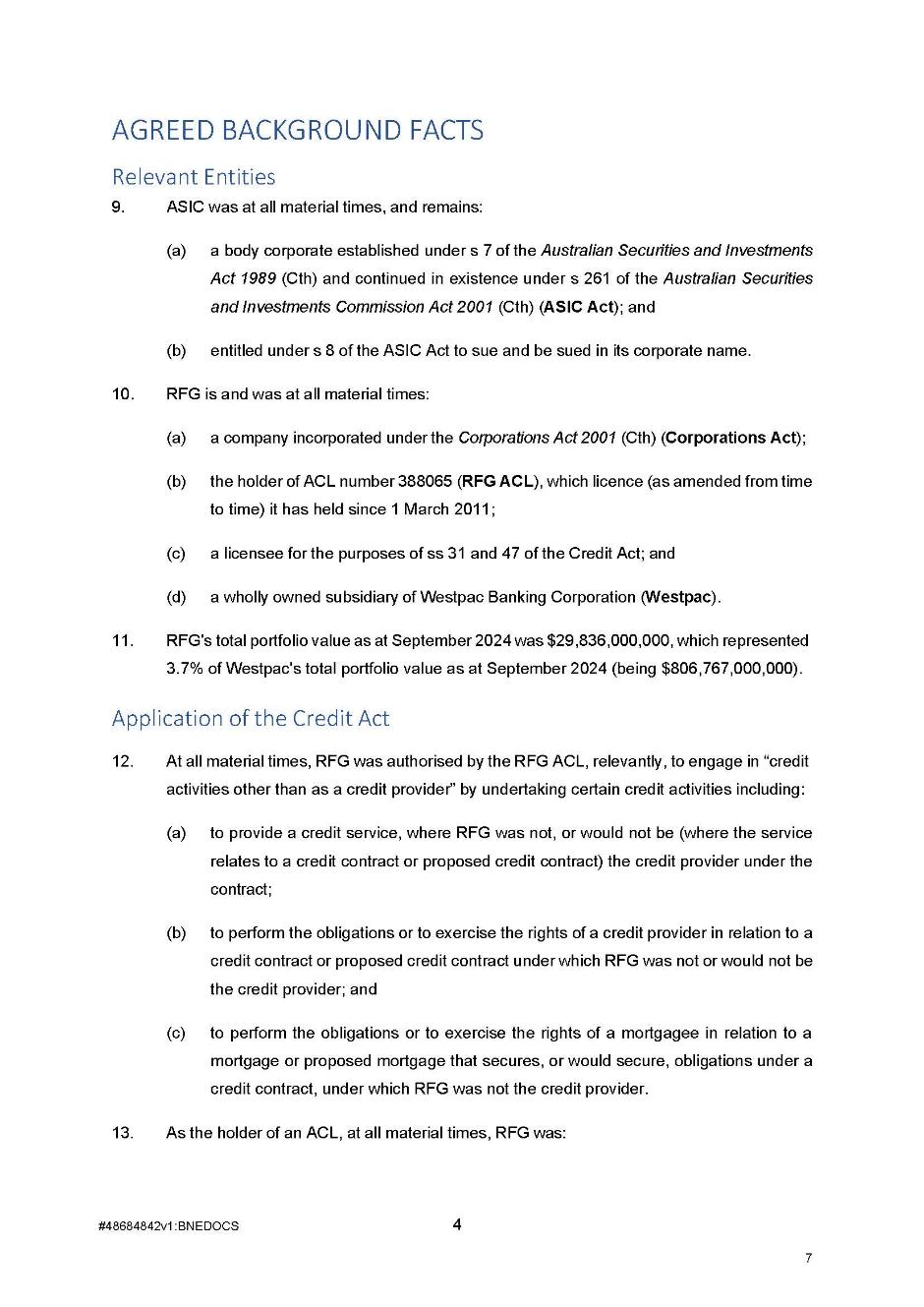
File number(s): | NSD 885 of 2025 |
Judgment of: | SHARIFF J |
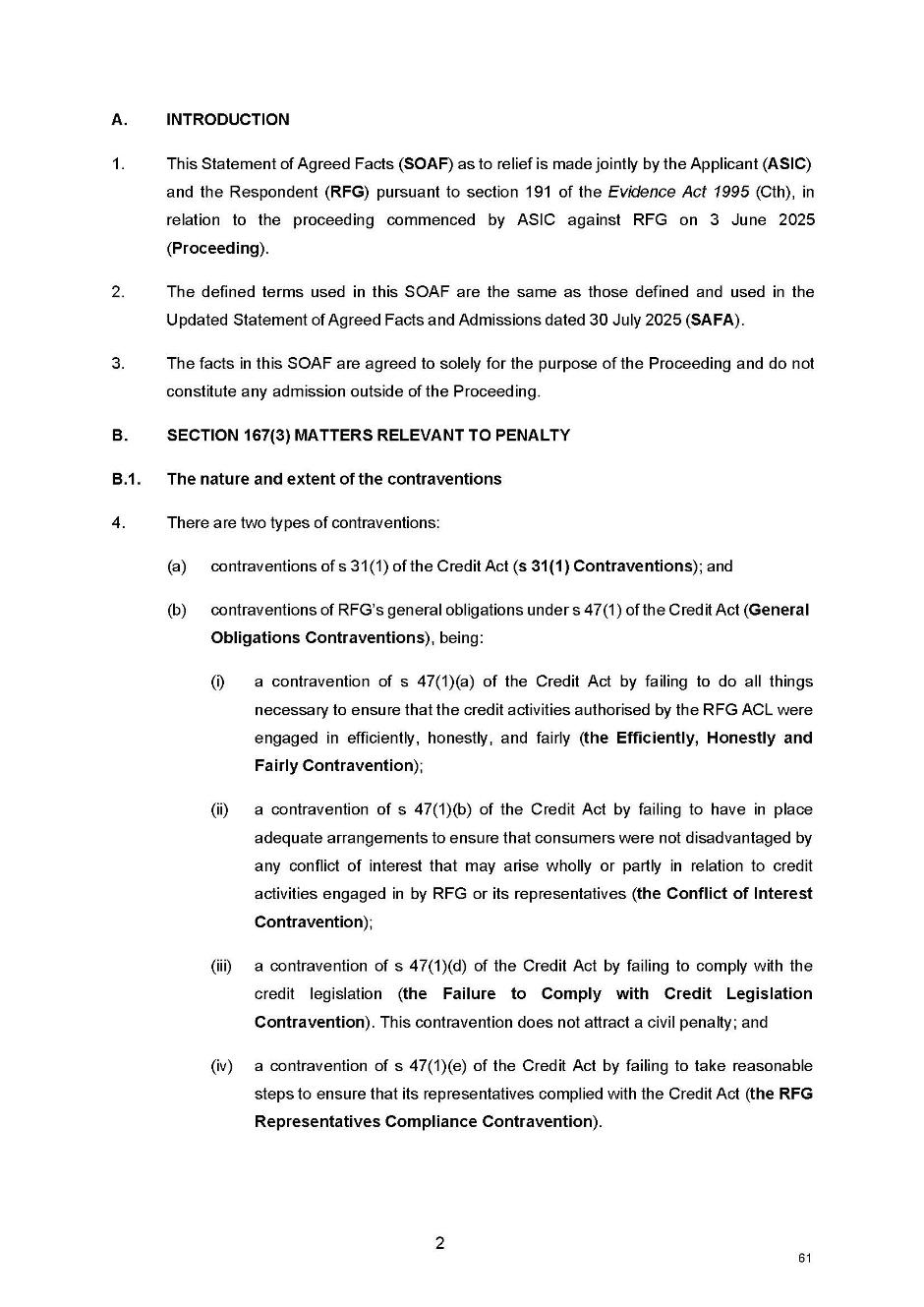
Date of judgment: | 24 October 2025 |
Catchwords: | CONSUMER LAW – admitted contraventions of ss 31(1), 47(1)(a), 47(1)(b), 47(1)(d), 47(1)(e) and 47(4) of the National Consumer Credit Protection Act 2009 (Cth) – joint position and submissions as to pecuniary penalties to be imposed – whether contraventions established on agreed facts – whether declarations should be made – whether quantum of penalties appropriate |
Legislation: | Corporations Act 2001 (Cth) s 912A(1)(a) National Consumer Credit Protection Act 2009 (Cth) ss 5(1), 6, 7, 8, 29, 31(1), 47(1)(a), 47(1)(b), 47(1)(d), 47(1)(e), 47(4), 166, 167B(2) Evidence Act 1995 (Cth) s 191 Federal Court of Australia Act 1976 (Cth) ss 37AF(1), 37AG(1)(a) Treasury Laws Amendment (Strengthening Corporate and Financial Sector Penalties) Act 2019 (Cth) National Consumer Credit Protection Regulations 2010 (Cth) |
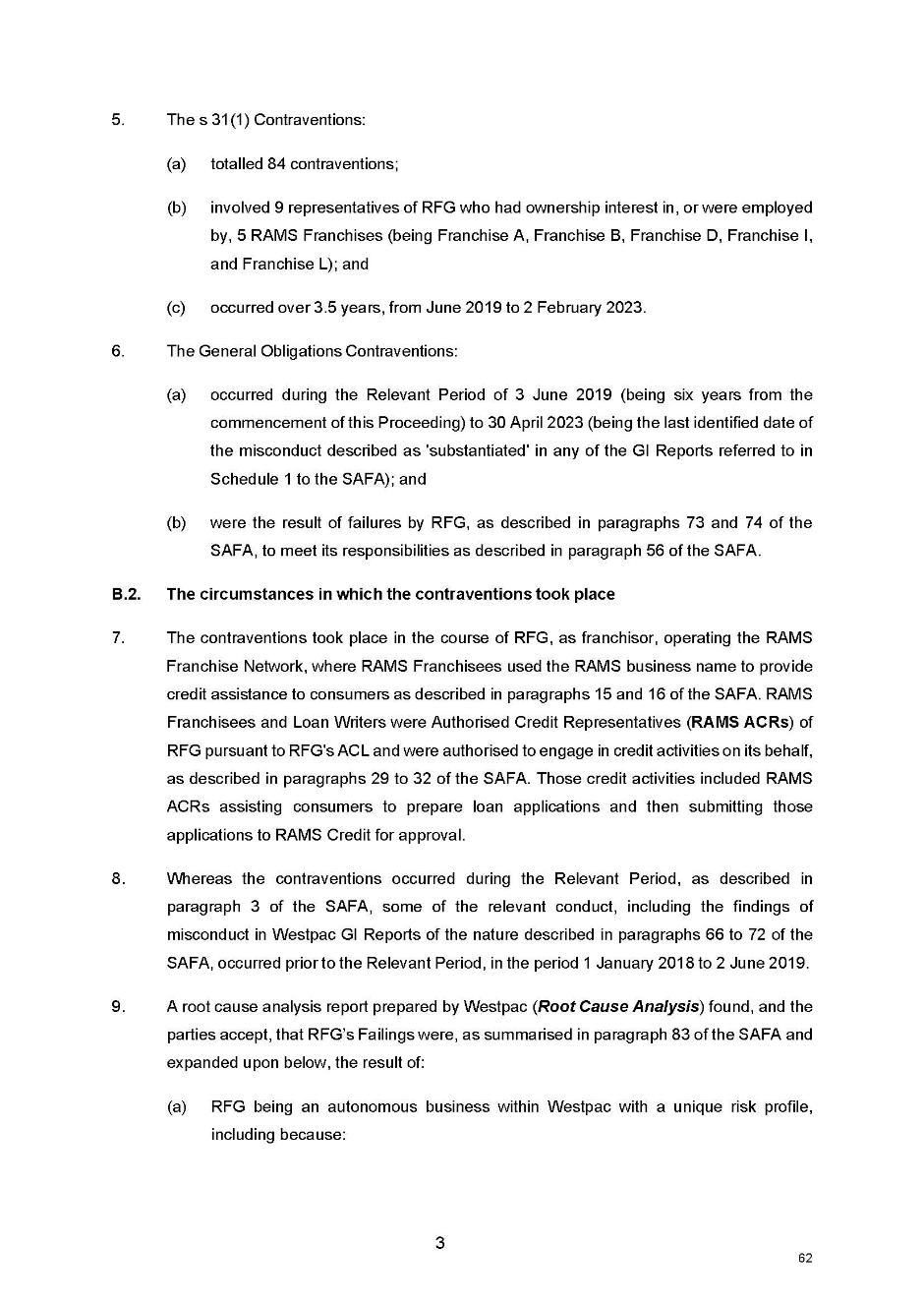
Cases cited: | Australian Building and Construction Commissioner v Construction, Forestry, Mining and Energy Union [2017] FCAFC 113; 254 FCR 68 Australian Building and Construction Commissioner v Construction, Forestry, Mining and Energy Union [2018] HCA 3; 262 CLR 15 Australian Building and Construction Commissioner v Pattinson [2022] HCA 13; 274 CLR 450 Australian Competition and Consumer Commission v Hillside (Australia New Media) Pty Ltd trading as Bet365 (No 2) [2016] FCA 698 Australian Competition and Consumer Commission v Multimedia International Services Pty Ltd [2016] FCA 439; 243 FCR 392 Australian Competition and Consumer Commission v Optus Mobile Pty Ltd [2019] FCA 106 Australian Competition and Consumer Commission v Telstra Corporation Ltd [2010] FCA 790; 188 FCR 238 Australian Competition and Consumer Commission v TPG Internet Pty Ltd [2013] HCA 54; 250 CLR 640 Australian Competition and Consumer Commission v Universal Music Australia Pty Ltd (No 2) [2002] FCA 192; 201 ALR 618 Australian Securities and Investments Commission v AGM Markets Pty Ltd (in liq) (No 3) [2020] FCA 208; 275 FCR 57 Australian Securities and Investments Commission v AMP Financial Planning Pty Ltd (No 2) [2020] FCA 69; 377 ALR 55 Australian Securities and Investments Commission v Australia and New Zealand Banking Group Limited [2023] FCA 256 Australian Securities and Investments Commission v Australia and New Zealand Banking Group Limited [2023] FCA 1150; 169 ACSR 649 Australian Securities and Investments Commission v BT Funds Management Limited [2021] FCA 844 Australian Securities and Investments Commission v Camelot Derivatives Pty Ltd (in liq) [2012] FCA 414; 88 ACSR 206 Australian Securities and Investments Commission v Citigroup Global Markets Australia Pty Limited (ACN 113 114832) (No. 4) [2007] FCA 963; 160 FCR 35 Australian Securities and Investments Commission v Commonwealth Bank of Australia [2020] FCA 790 Australian Securities and Investments Commission v Commonwealth Bank of Australia [2022] FCA 1422 Australian Securities and Investments Commission v Ferratum Australia Pty Limited (in liq) [2023] FCA 1043 Australian Securities and Investments Commission v Layaway Depot Pty Ltd [2023] FCA 1685 Australian Securities and Investments Commission v MLC Nominees Pty Ltd [2020] FCA 1306; 147 ACSR 266 Australian Securities and Investments Commission v National Australia Bank Ltd [2020] FCA 1494 Australian Securities and Investments Commission v National Australia Bank Ltd [2022] FCA 1324 Australian Securities and Investments Commission v RAMS Financial Group Pty Ltd [2025] FCA 1087 Australian Securities and Investments Commission v Westpac Banking Corporation (Omnibus) [2022] FCA 515 Australian Securities and Investments Commission v Westpac Banking Corporation (No 3) [2018] FCA 1701 Australian Securities and Investments Commission v Westpac Banking Corporation [2019] FCA 2147 Australian Securities and Investments Commission v Westpac Securities Administration Limited, in the matter of Westpac Securities Administration Limited [2021] FCA 1008 Australian Securities Investments Commission v Membo Finance Pty Ltd (No 2) [2023] FCA 126 Barbaro v The Queen [2014] HCA 2; 253 CLR 58 Commonwealth v Director, Fair Work Building Industry Inspectorate [2015] HCA 46; 258 CLR 482 Competition and Consumer Commission v Woolworths Limited [2016] FCA 44; ATPR-42-521 Construction, Forestry, Mining and Energy Union v Cahill [2010] FCAFC 39; 269 ALR 1 Flight Centre Ltd v Australian Competition and Consumer Commission (No 2) [2018] FCAFC 53; 260 FCR 68 Green v The Queen [2011] HCA 49; 244 CLR 462 Hili v The Queen [2010] HCA 45; 242 CLR 520 Lacey v Attorney-General (Qld) [2011] HCA 10; 242 CLR 573 Mayfair Wealth Partners Pty Ltd v Australian Securities and Investments Commission [2022] FCAFC 170; 295 FCR 106 NW Frozen Foods Pty Ltd v Australian Competition and Consumer Commission [1996] FCA 1134; 71 FCR 285 Singtel Optus Pty Ltd v Australian Competition and Consumer Commission [2012] FCAFC 20; 287 ALR 249 Trade Practices Commission v CSR Limited [1990] FCA 521; ATPR 41-076 |
Division: | General Division |
Registry: | New South Wales |
National Practice Area: | Commercial and Corporations |
Sub-area: | Commercial Contracts, Banking, Finance and Insurance |
Number of paragraphs: | 195 |
Date of hearing: | 21 October 2025 |
Counsel for the Applicant | Mr M Brady KC with Mr S Cleary |
Solicitor for the Applicant | Gadens |
Counsel for the Respondent | Mr S Lawrance SC with Ms E Bathurst |
Solicitor for the Respondent | Allens |
ORDERS
NSD 885 of 2025 | ||
| ||
BETWEEN: | AUSTRALIAN SECURITIES AND INVESTMENTS COMMISSION Applicant | |
AND: | RAMS FINANCIAL GROUP PTY LTD ACN 105 207 538 Respondent | |
order made by: | SHARIFF J |
DATE OF ORDER: | 24 October 2025 |
THE COURT ORDERS THAT:
1. The parties confer and provide short minutes of order to the Associate to Justice Shariff which give effect to the reasons for judgment dated 24 October 2025 in respect of the declarations of contravention required to be made under s 166 of the National Consumer Credit Protection Act 2009 (Cth) (the Credit Act).
2. Within 30 days, the Respondent (RFG) pay to the Commonwealth an aggregate pecuniary penalty of $20 million in respect of RFG’s conduct found to have contravened ss 31(1), 47(1)(a), 47(1)(b), 47(1)(e), and 47(4) of the Credit Act.
3. RFG pay the Applicant’s costs as agreed or taxed.
4. Pursuant to s 37AF of the Federal Court of Australia Act 1976 (Cth) (the FCA Act), and on the ground specified in s 37AG(1)(a), namely, that it is necessary to prevent prejudice to the proper administration of justice, for a period of 10 years from the date of this Order, the following information, in connection with Federal Court proceeding number NSD 885 of 2025, be suppressed and not published:
(a) references to the names and locations of RAMS Franchises, RAMS Franchise principals and loan writers, including their initials, as referred to in:
(i) page 31 of the hyperlinked Statement of Agreed Facts and Admissions on Liability, which is tendered and marked Exhibit 1 (Hyperlinked SAFA); and
(ii) columns B and C contained at Annexure KAB-01 of the affidavit of Kristina Andrea Belci affirmed on 20 October 2025 (Belci Affidavit); and
(b) references to the unlicensed unaccredited referrers as referred to in the Belci Affidavit, being:
(i) the names of unlicensed unaccredited referrers in column D contained at Annexure KAB-01;
(ii) the name, CRN, ABN, and ACN of the entity the subject of the search at Annexure KAB-02; and
(iii) the name of the individual the subject of the email correspondence at Annexure KAB-03; and
(c) the redacted information in the documents set out in Schedule 1 to these Orders, as hyperlinked to the Hyperlinked SAFA, being:
(i) references to the names and locations of the RAMS Franchises, RAMS Franchise principals and loan writers, including their initials;
(ii) references to the names of the unlicensed unaccredited referrers;
(iii) references to the personal information of RAMS customers including names, contact information, property addresses, bank account numbers, BSB numbers and bank card numbers; and
(iv) references to the names and contact information of Westpac employees.
5. Pursuant to s 37AI of the FCA Act, all material contained in the documents set out in Schedule 1 of these Orders, as attached to, and accessible by hyperlinks in, the Hyperlinked SAFA, be suppressed and not published pending completion of the redactions referred to in order 4(c) of these Orders.
SCHEDULE 1
# | Document Name | Date | Document ID |
1 | GI Report | 17 August 2019 | RAM.001.032.3971 |
2 | GI Report | 27 September 2019 | RAM.001.152.0017 |
3 | GI Report | 30 September 2019 | RAM.001.038.1065 |
4 | GI Report | 24 October 2019 | RAM.001.038.3139 |
5 | GI Report | 1 May 2020 | RAM.001.032.3850 |
6 | GI Report | 5 May 2020 | RAM.001.032.3953 |
7 | GI Report | 7 May 2020 | RAM.001.032.4089 |
8 | GI Report | 19 May 2020 | RAM.001.032.3942 |
9 | GI Report | 17 June 2020 | RAM.001.037.6866 |
10 | GI Report | 29 July 2020 | RAM.001.038.3685 |
11 | GI Report | 24 November 2020 | RAM.001.038.3495 |
12 | GI Report | 20 May 2021 | RAM.001.038.3393 |
13 | GI Report | 21 July 2020 | RAM.001.038.3559 |
14 | GI Report | 1 September 2021 | RAM.001.038.3413 |
15 | GI Report | 15 September 2021 | RAM.001.012.0199 |
16 | GI Report | 30 September 2021 | RAM.001.012.0191 |
17 | GI Report | 25 March 2022 | RAM.001.037.0602 |
18 | GI Report | 29 March 2022 | RAM.001.037.0610 |
19 | GI Report | 29 March 2022 | RAM.001.037.0722 |
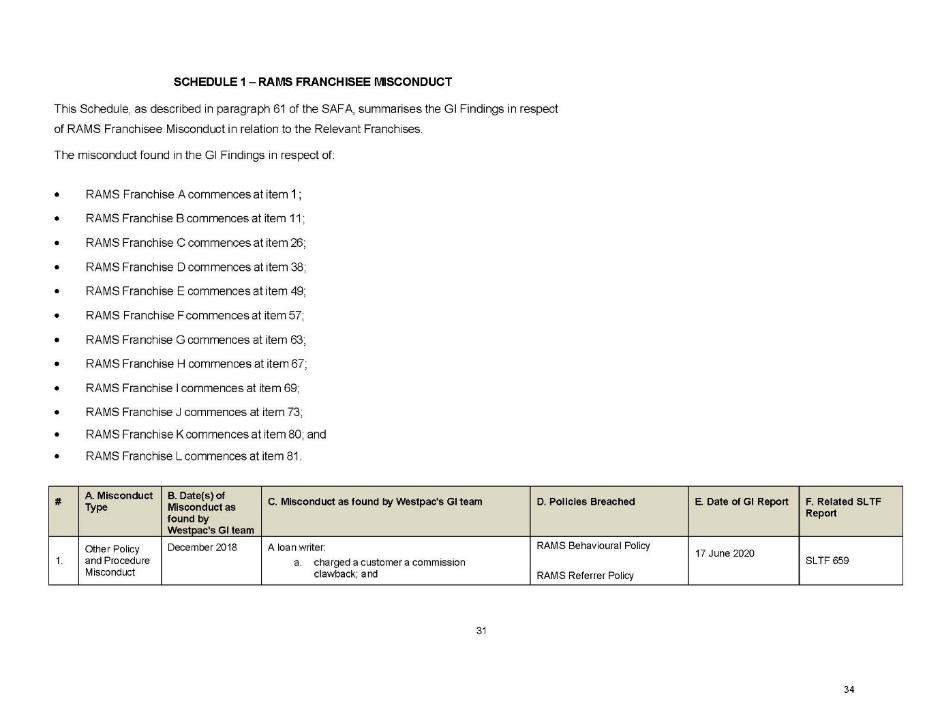
20 | GI Report | 4 August 2022 | RAM.001.037.0400 |
21 | GI Report | 4 August 2022 | RAM.001.113.0031 |
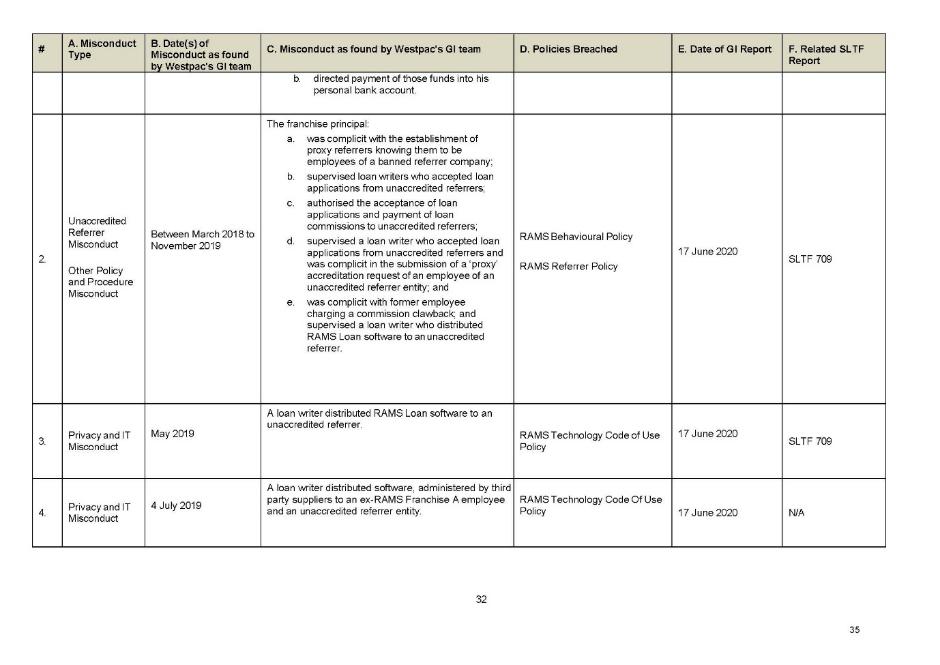
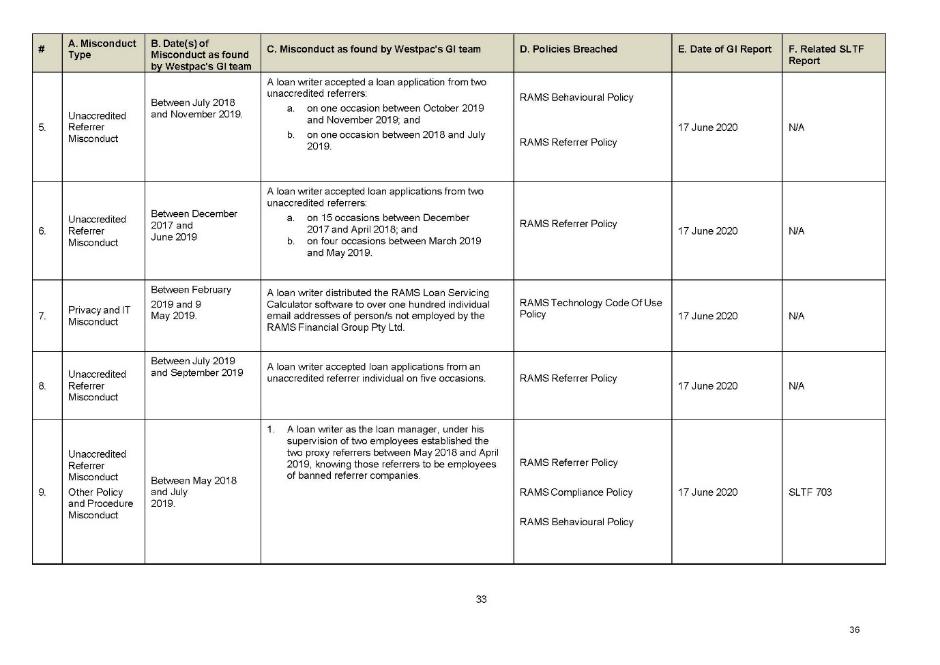
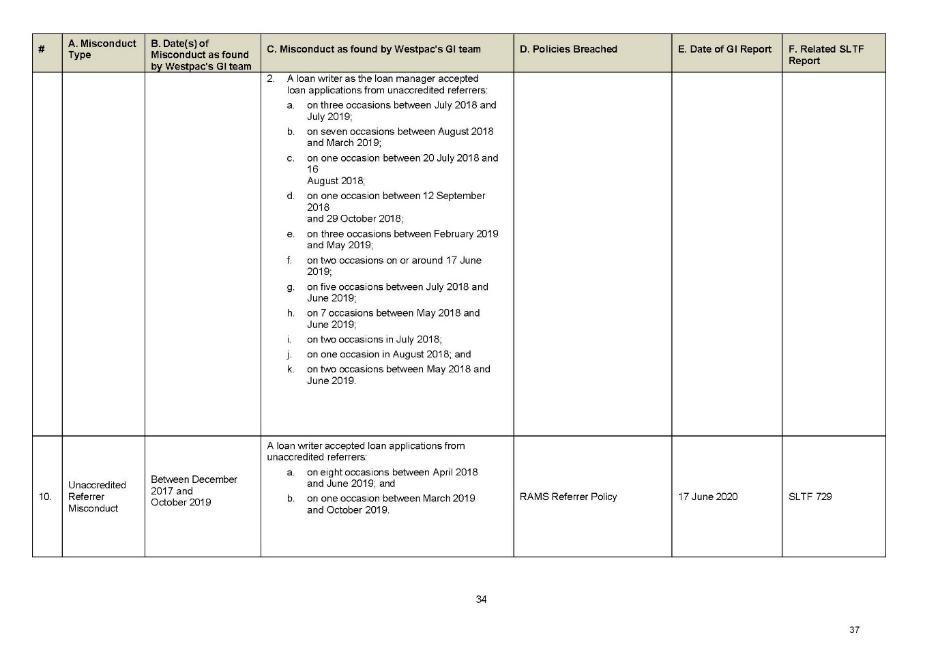
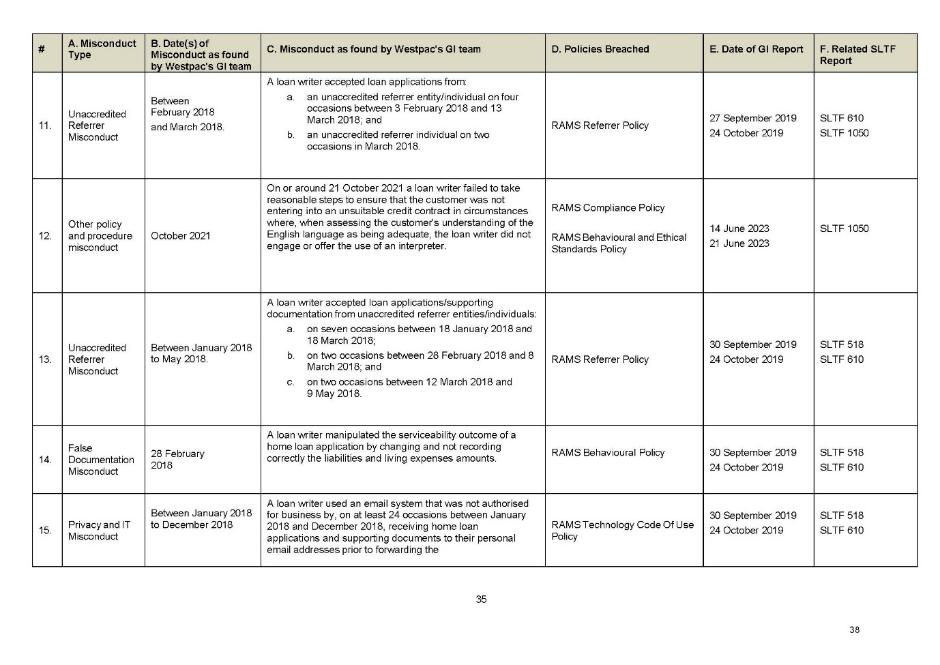
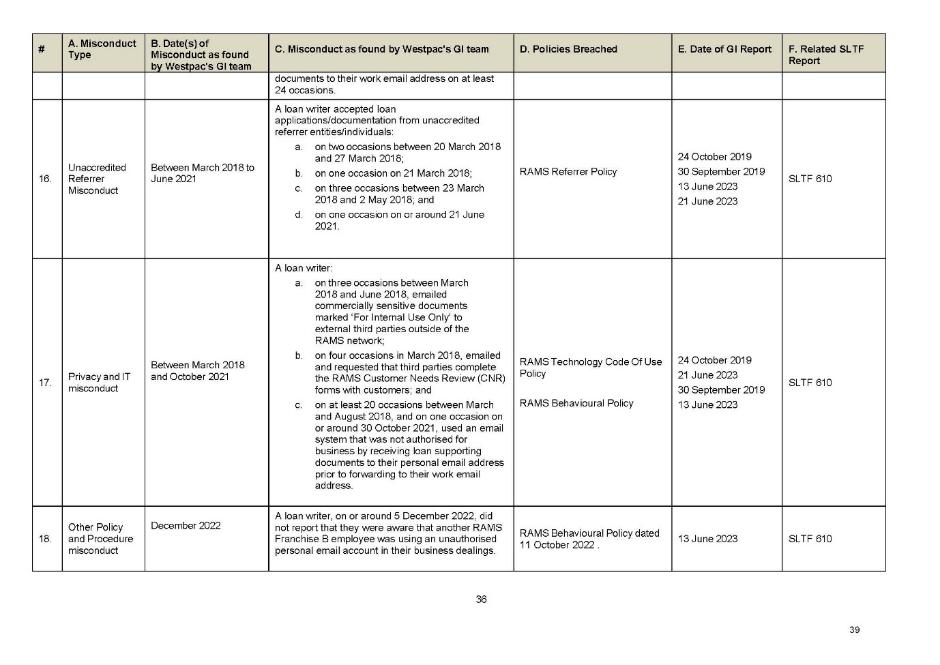
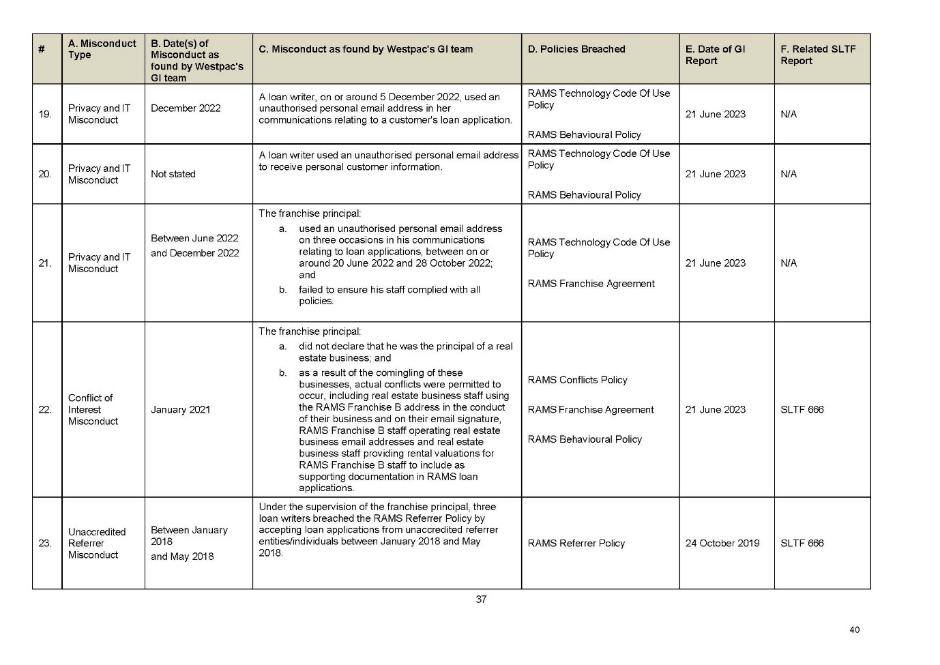
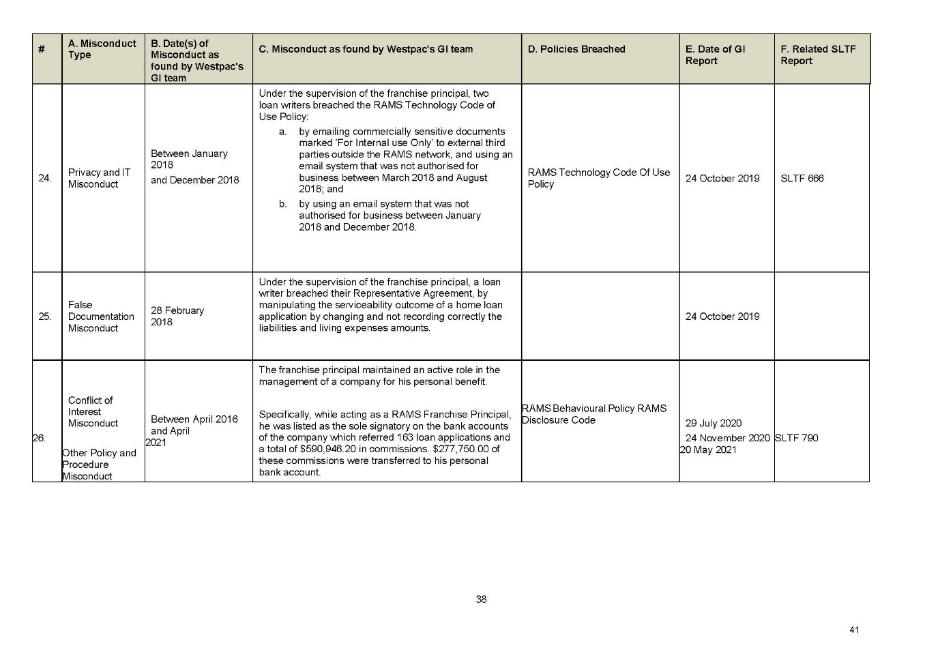
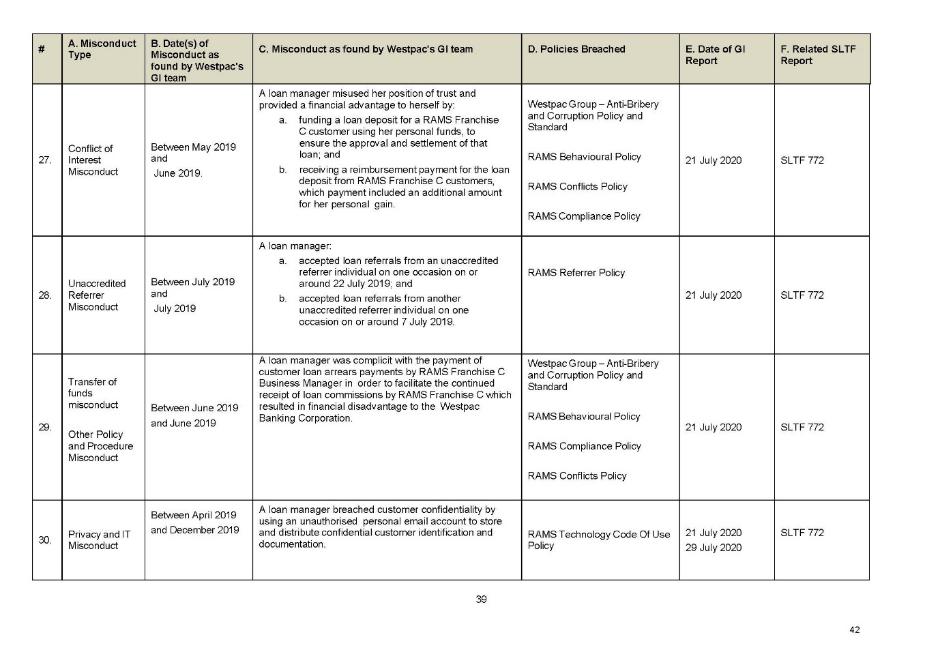
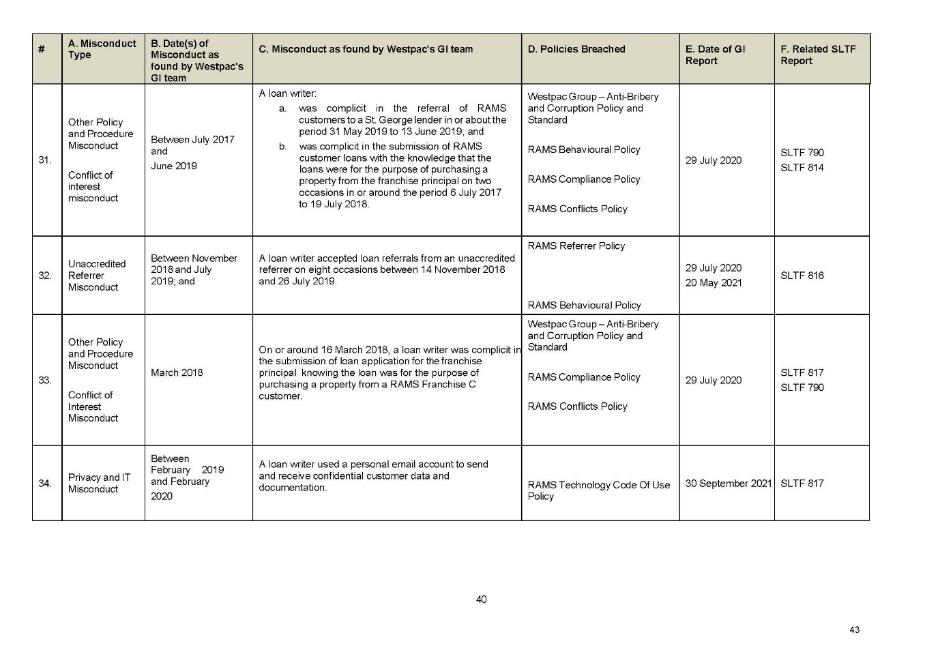
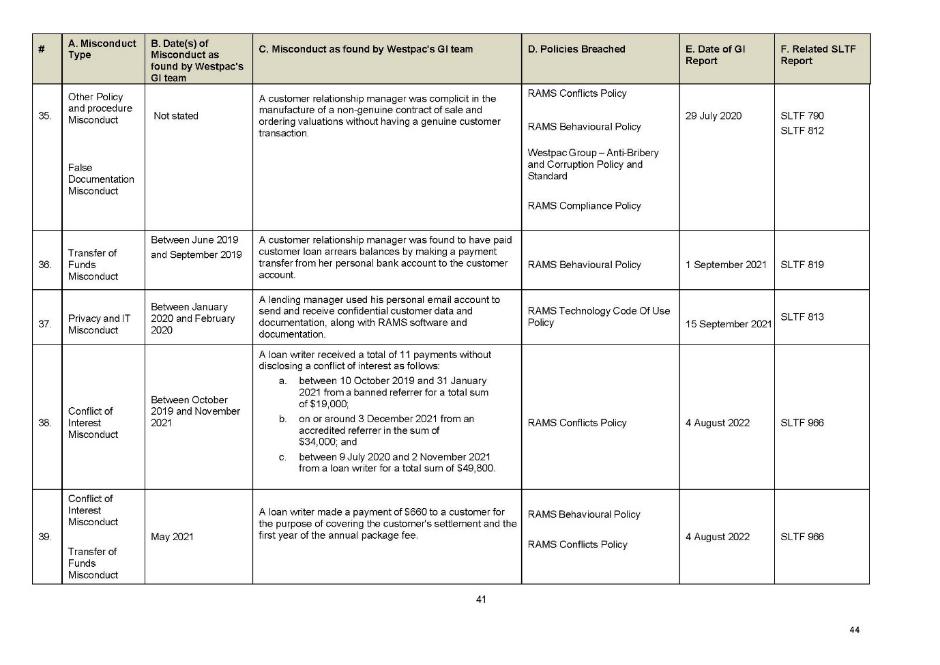
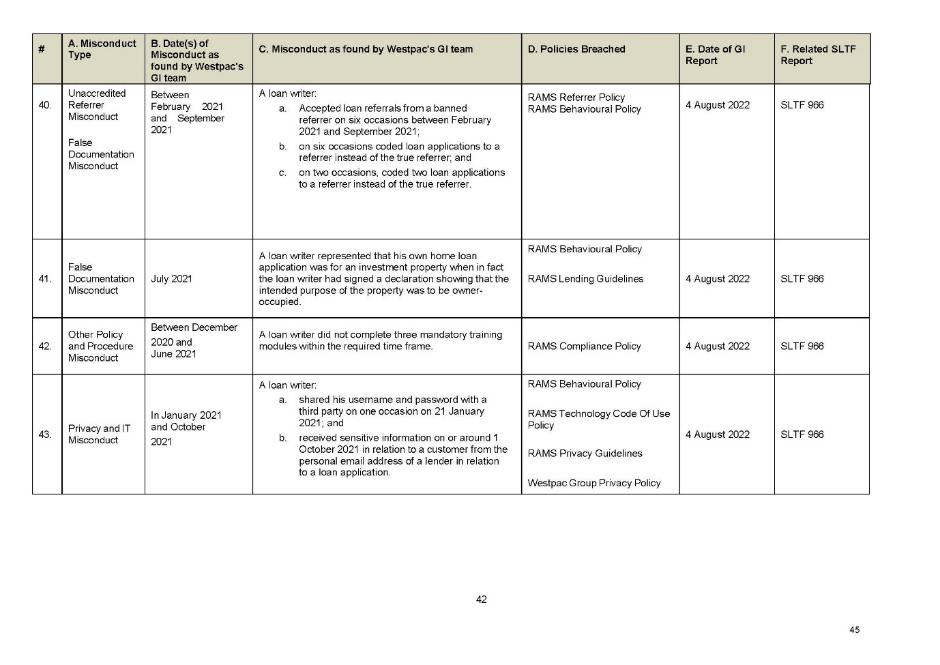
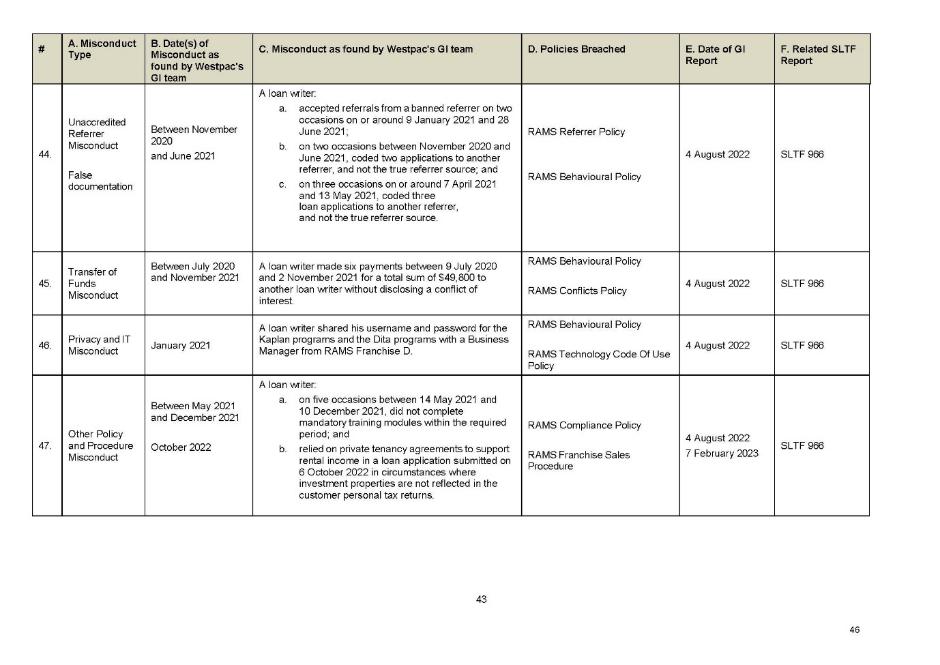
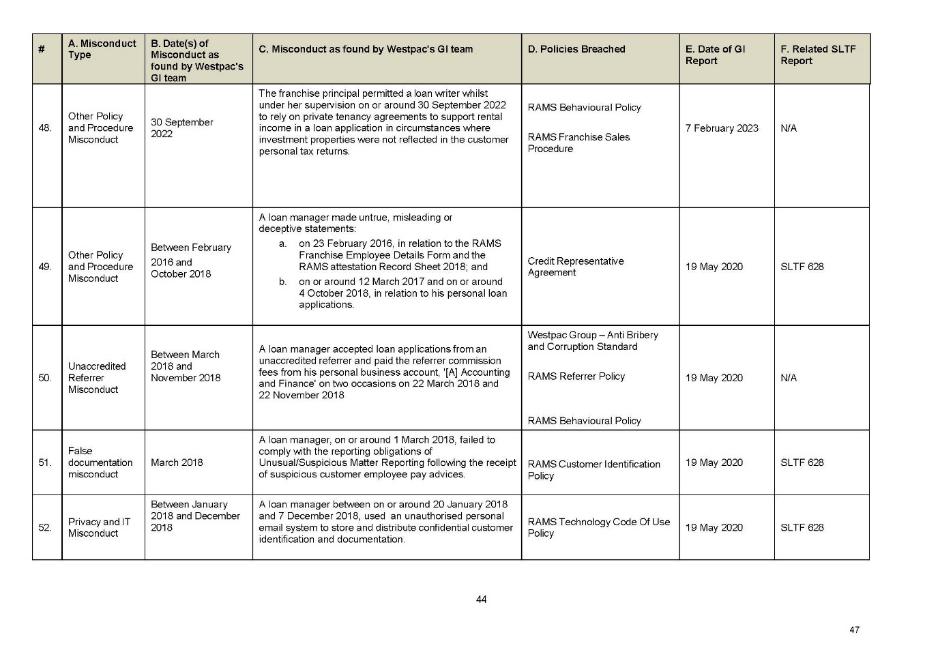
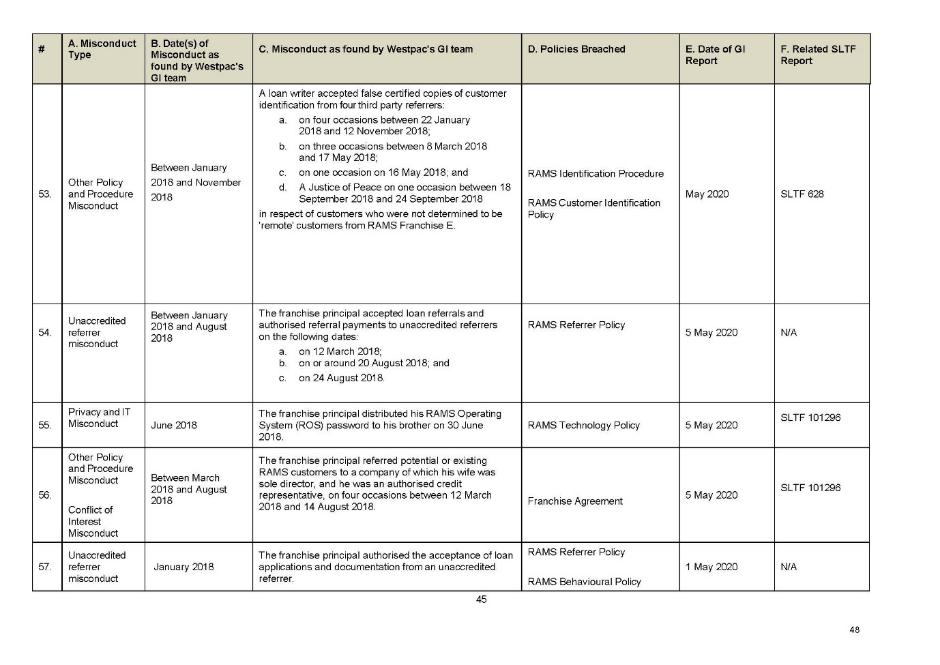
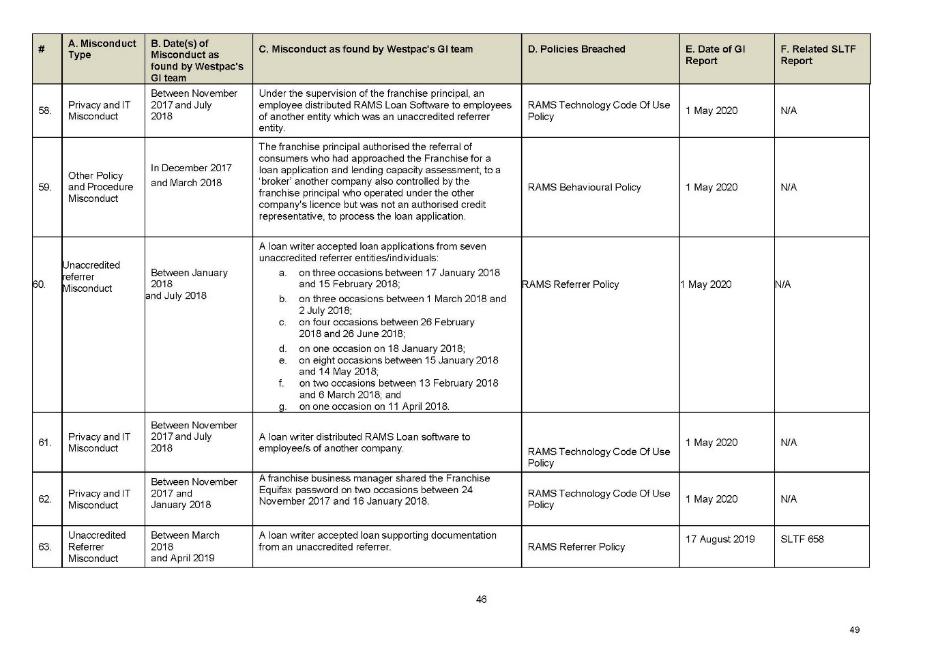
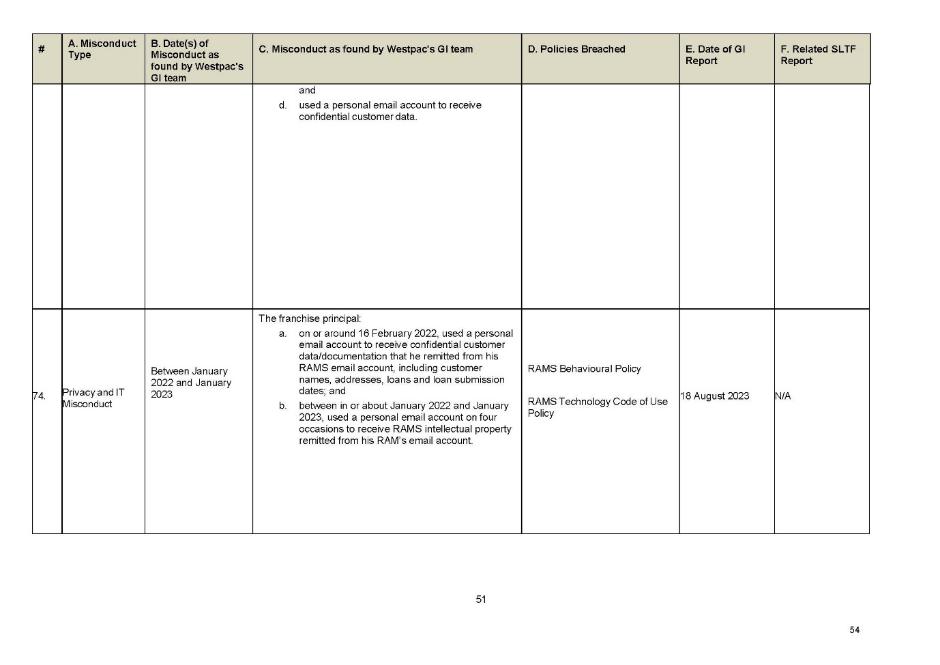
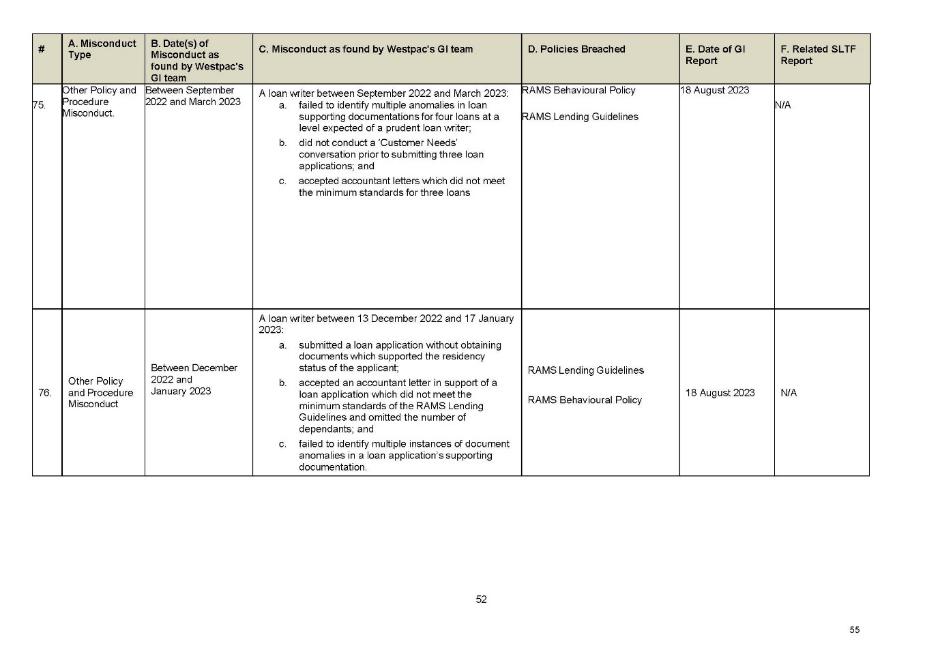
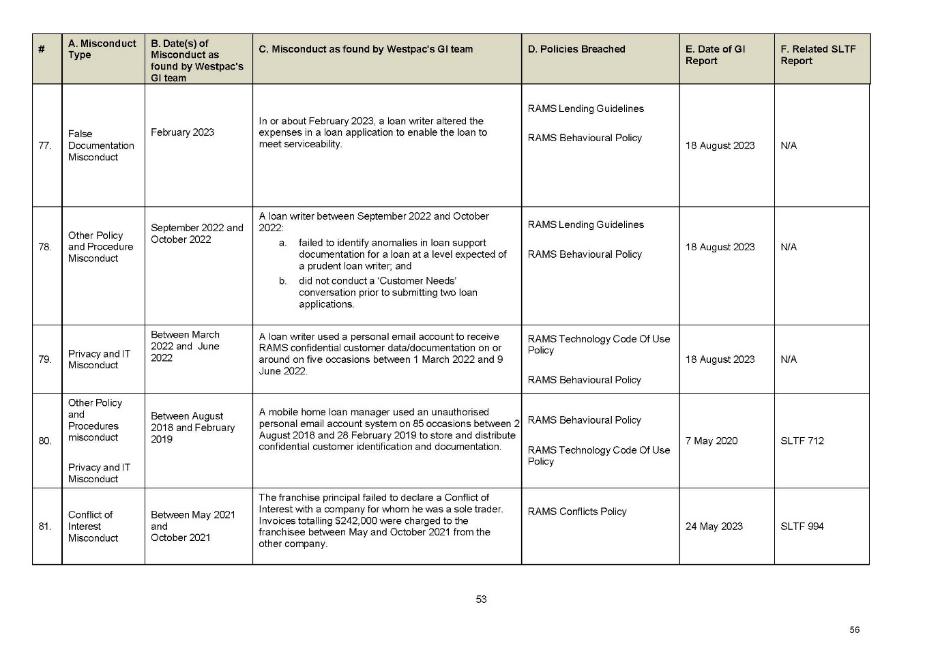
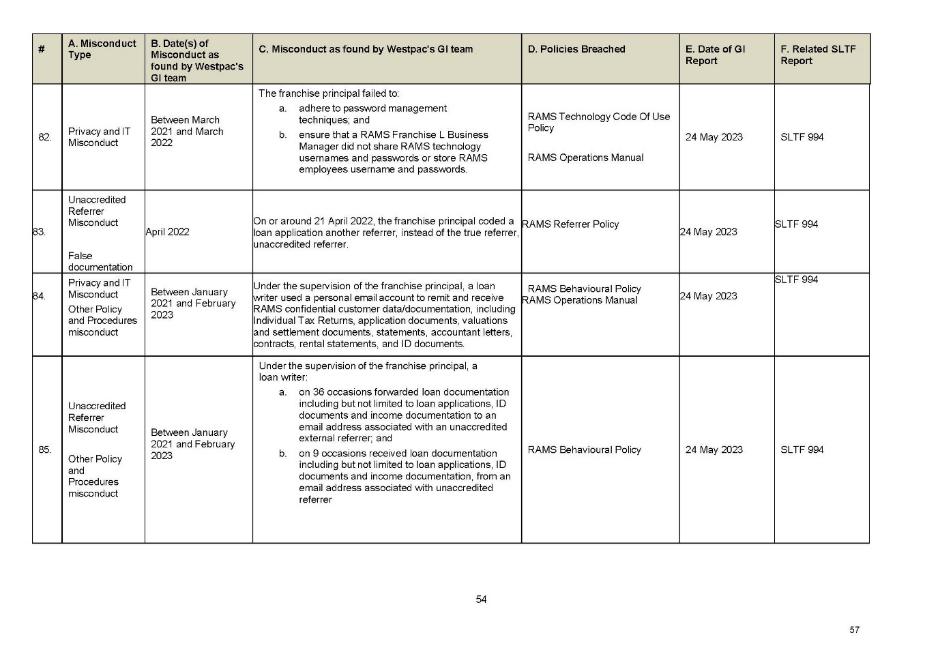
22 | GI Report | 7 February 2023 | RAM.001.113.0730 |
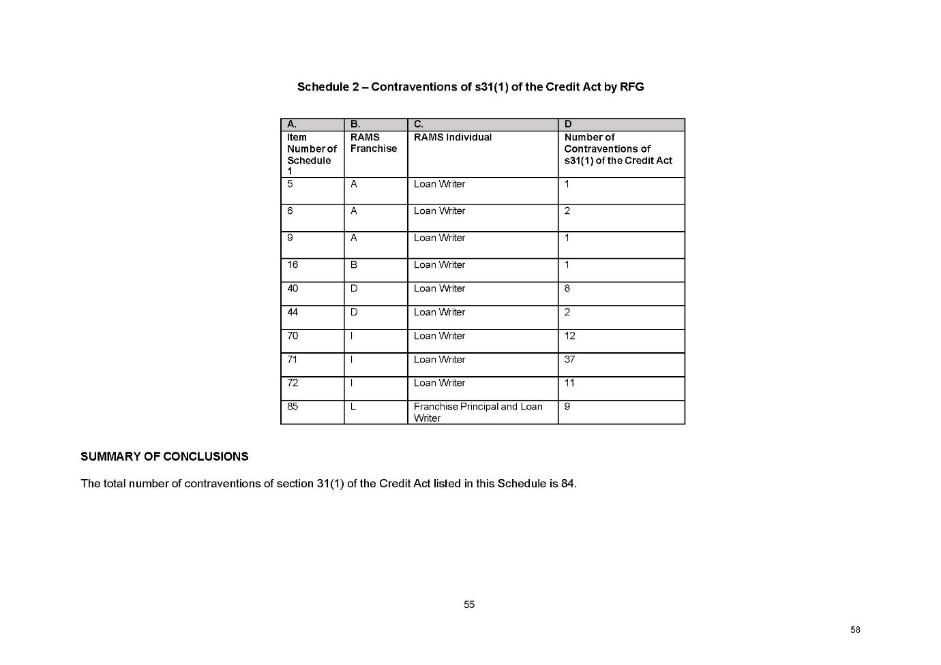
23 | GI Report | 7 February 2023 | RAM.001.113.0738 |
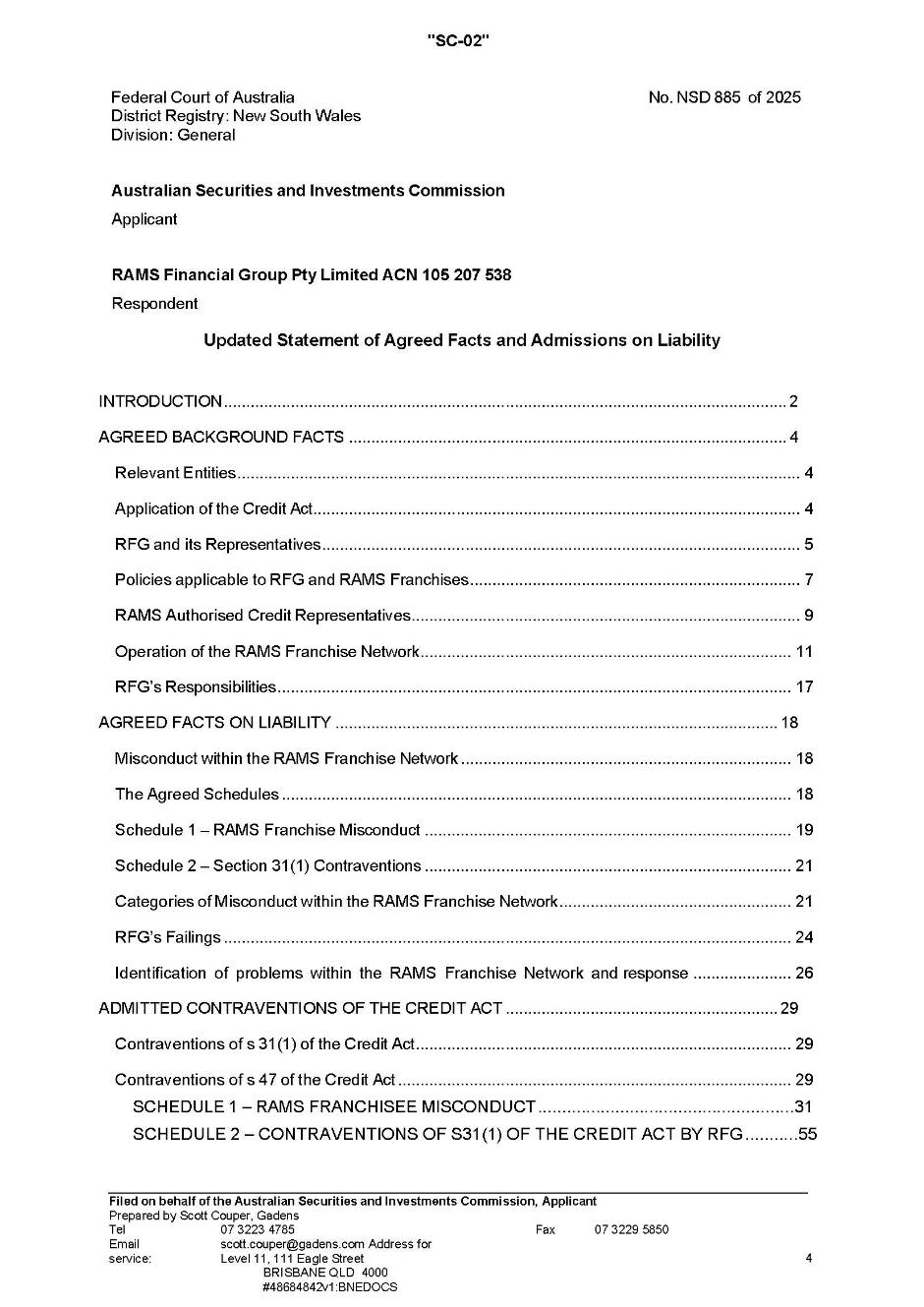
24 | GI Report | 24 May 2023 | RAM.001.006.1093 |
25 | GI Report | 26 May 2023 | RAM.001.006.1080 |
26 | GI Report | 13 June 2023 | RAM.001.011.9365 |
27 | GI Report | 14 June 2023 | RAM.001.011.9336 |
28 | GI Report | 21 June 2023 | RAM.001.006.1123 |
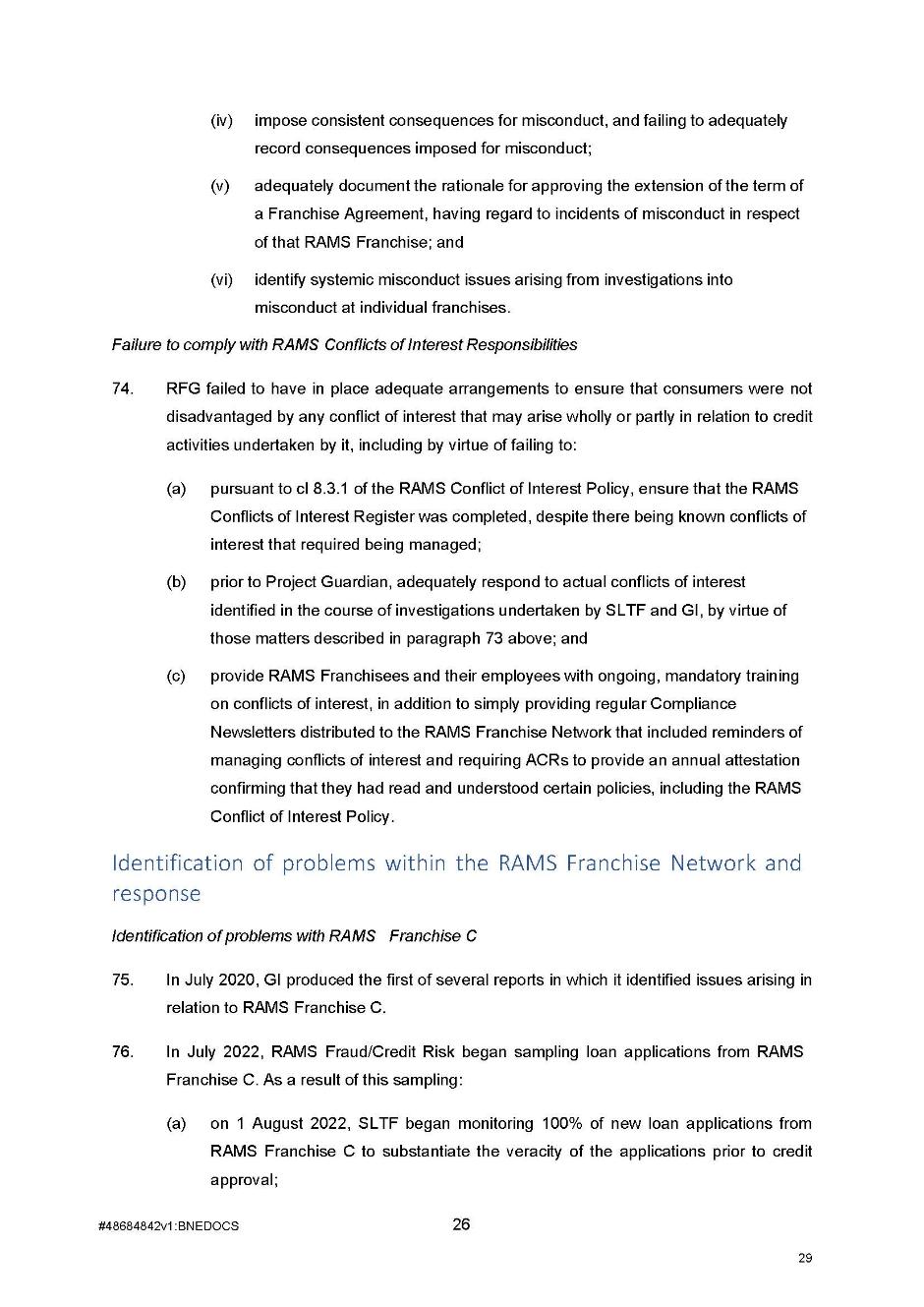
29 | GI Report | 18 August 2023 | RAM.001.006.1141 |
30 | GI Report | 18 August 2023 | RAM.001.011.9396 |
31 | GI Report | 18 August 2023 | RAM.001.011.9413 |
32 | GI Report | 18 August 2023 | RAM.001.011.9445 |
Note: Entry of orders is dealt with in Rule 39.32 of the Federal Court Rules 2011
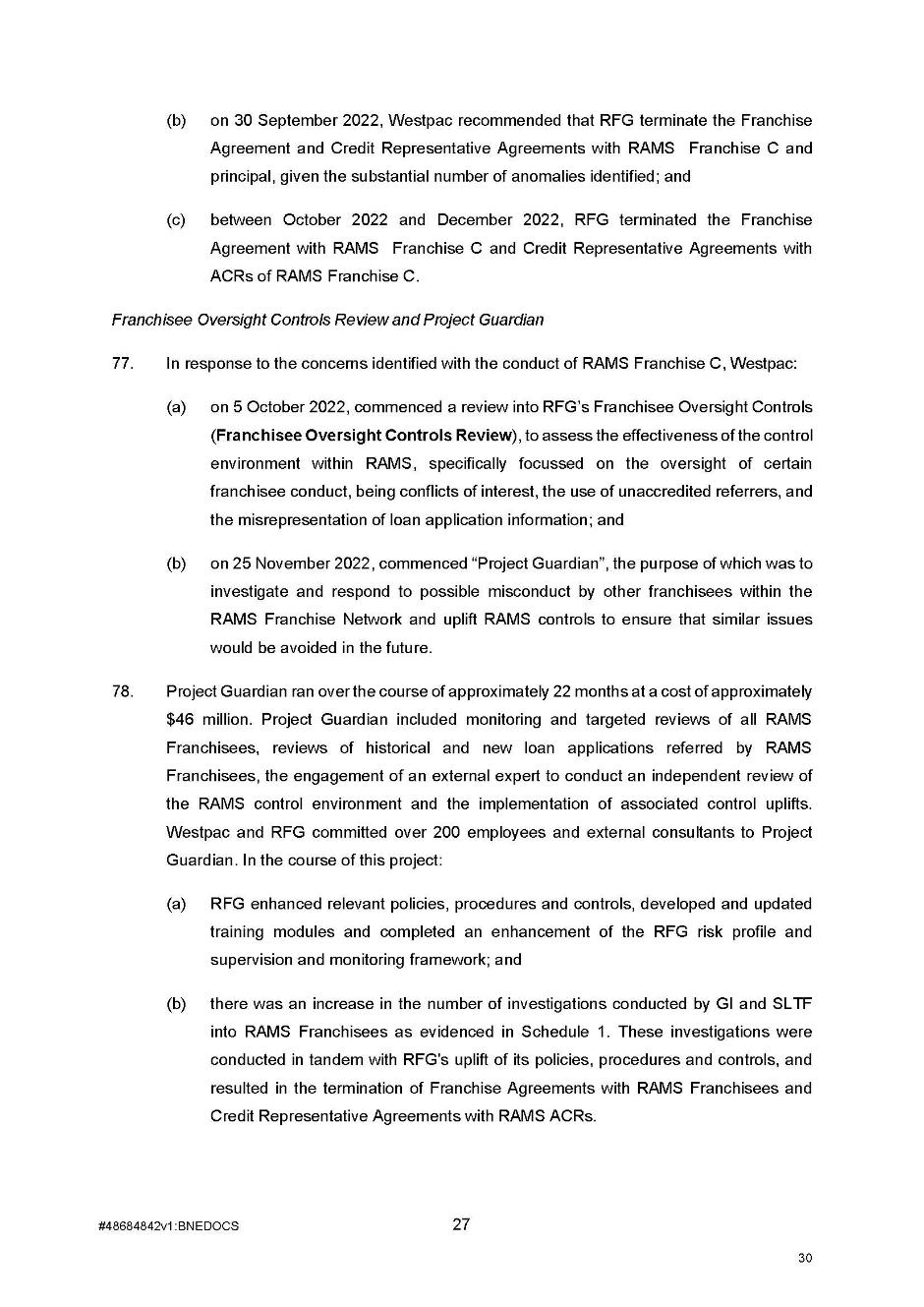
REASONS FOR JUDGMENT
SHARIFF J:
1. INTRODUCTION
1 These proceedings involve an examination as to whether the respondent, RAMS Financial Group Pty Ltd (RFG), contravened important provisions of the National Consumer Credit Protection Act 2009 (Cth) (the Credit Act). Although RFG has admitted liability and has agreed to pay a civil penalty of $20 million, it is nevertheless necessary for the Court to decide whether contraventions have occurred and, if so, whether the agreed penalty is appropriate.
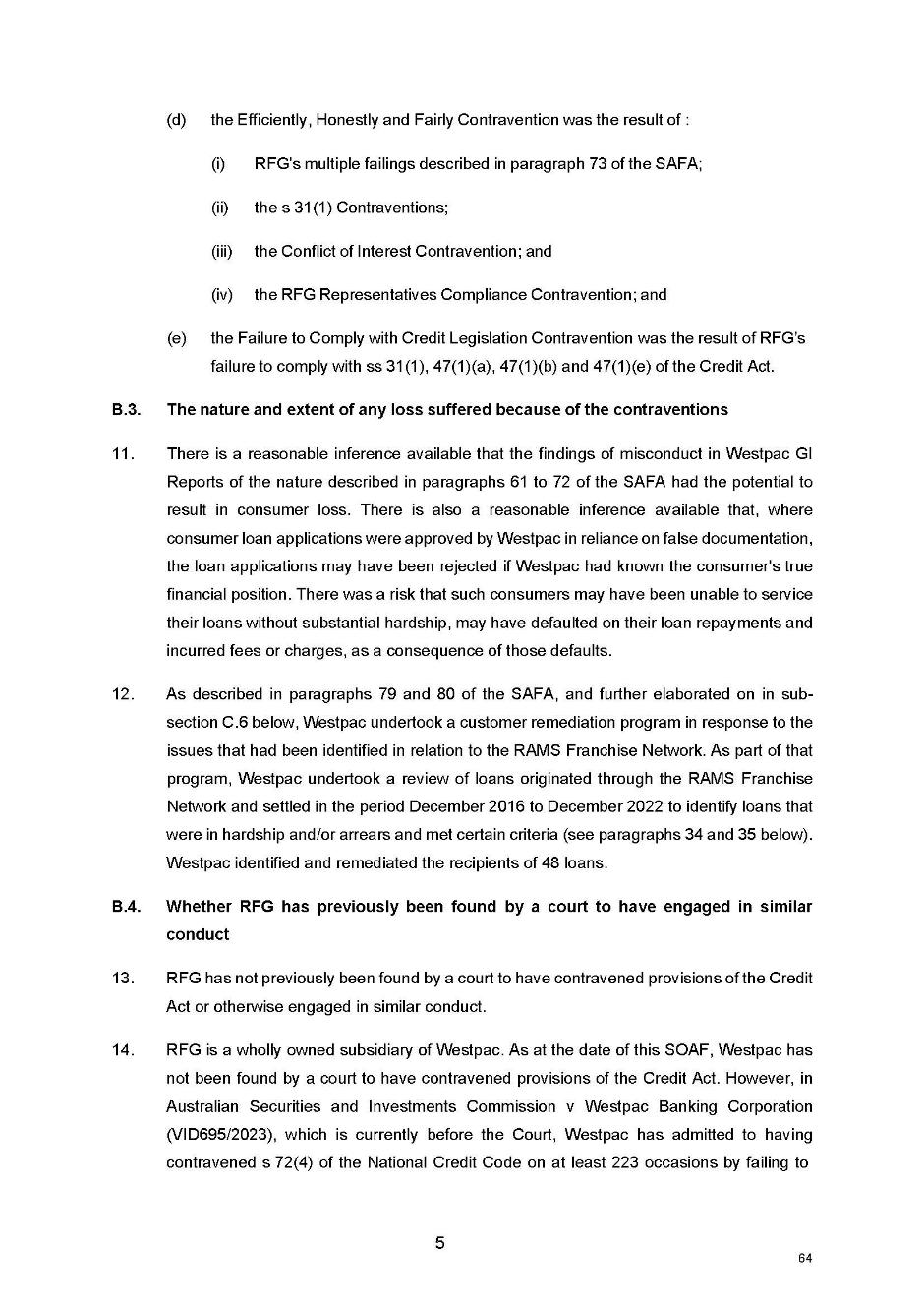
2 RFG was, and is, a wholly-owned subsidiary of Westpac Banking Corporation (Westpac). Westpac acquired RFG in 2008. RFG was, and is, the holder of an “Australian credit license” (ACL) granted under the Credit Act. RFG sought to provide credit services, and to assist, consumers through a franchise network (the RAMS Franchise Network) by which its franchisees (RAMS Franchisees) used the RAMS business name to provide credit assistance to consumers in relation to the distribution of RAMS-branded home loans which were, in fact, home loans with Westpac (albeit those loans were branded as “RAMS Home Loans”). RFG appointed RAMS Franchisees and their staff as authorised credit representatives (ACRs) of RFG for the purposes of providing credit assistance.
3 One of the central purposes of the Credit Act is to protect consumers and to do so by the regulation of the conduct of licensees. An essential aspect of this regulatory scheme is that persons involved in the provision of a “credit service” to consumers, including by providing “credit assistance” to them, must be licensed. As I explain below, a further essential aspect of the scheme is that, as provided for by s 31(1) of the Credit Act, a licensee is prohibited from engaging in a credit activity and, in the course of doing so, conducting business with a person who is also engaging in a credit activity without an Australian credit licence authorising them to do so. The purpose of this prohibition is to ensure that the overall objectives of the statutory scheme are not frustrated by “licensees engaging with unlicensed persons to subvert its intent”: Australian Securities and Investments Commission v National Australia Bank Ltd [2020] FCA 1494 (ASIC v NAB) at [90] (Lee J).
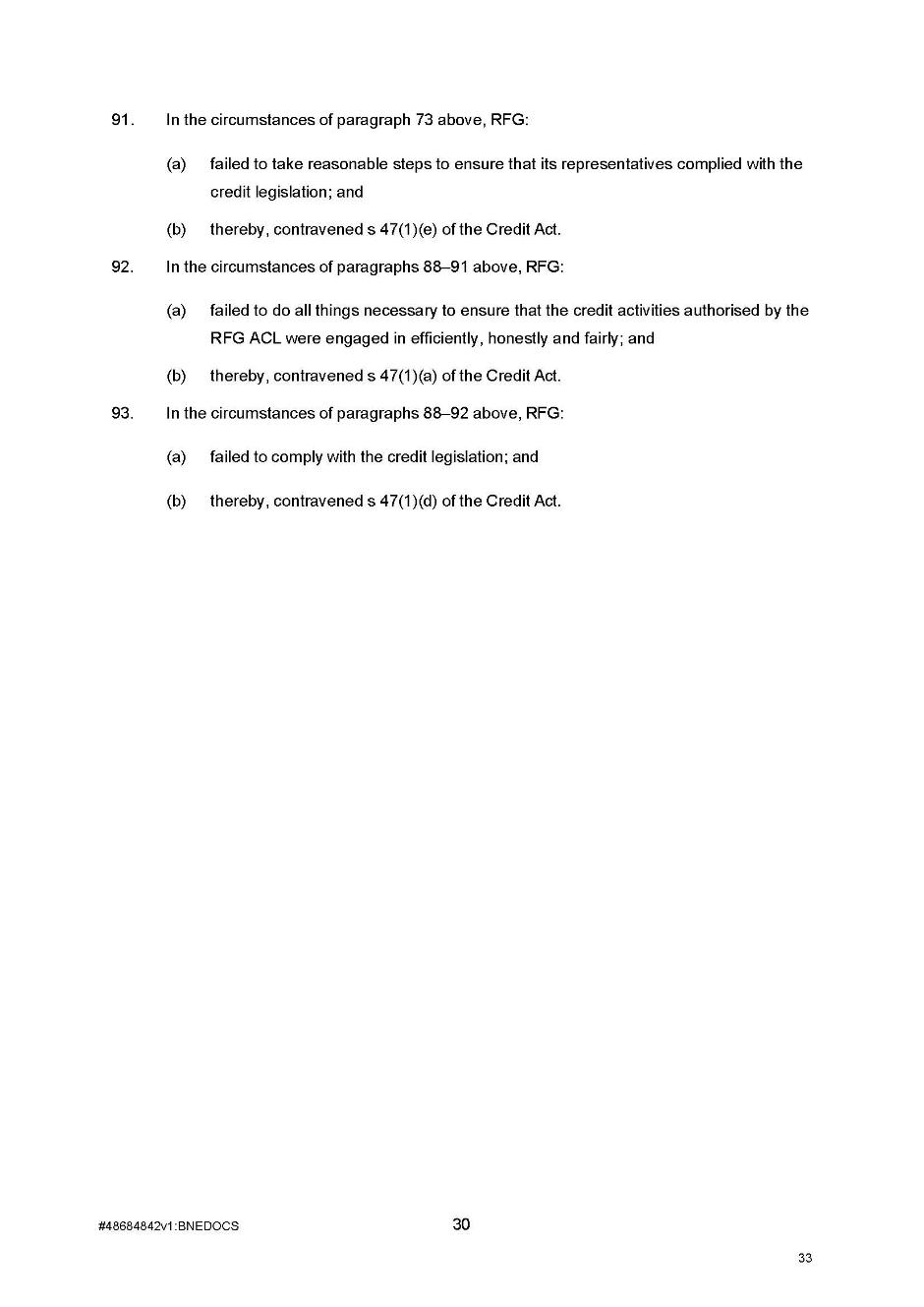
4 A further important aspect of the regulatory scheme enacted under the Credit Act is found in s 47(1). That section relevantly requires a licensee to do all things necessary to ensure that the credit activities authorised by the licence are engaged in “efficiently, honestly and fairly” (s 47(1)(a)), that adequate arrangements are in place to ensure that clients are not disadvantaged by conflicts of interest (s 47(1)(b)), and that reasonable steps are taken to ensure that representatives of the licensee comply with credit legislation (s 47(1)(e)).
5 I am satisfied on the facts that the parties have agreed to in the present case that RFG failed to comply with these basal obligations. On 84 occasions, RFG (through its franchise representatives) accepted referrals of consumers from third parties who were not licensed. There were yet further occasions when RFG accepted referrals of consumers from third parties who were not accredited by RFG in accordance with its own policies and procedures. The facts further demonstrate that, whilst RFG had policies and procedures in place, they were inadequate in several fundamental respects including in seeking to avoid conflicts of interest and breaches of privacy. I am satisfied that RFG failed to ensure that certain of its franchise representatives complied with the Credit Act and RFG’s applicable policies including as to dealing only with accredited referrers, conflicts of interest, privacy, use of information technology systems, and other behaviour.
6 The conduct that lies at the heart of the proceedings came to light when RFG and Westpac commenced investigating potential instances of misconduct that were alleged to have occurred within the RAMS Franchise Network. Some of the investigations were commenced at RFG’s initiative, and others were commenced following one or more complaints being made. Those investigations expanded over time, and there were many of them. RFG and Westpac determined in various respects that the allegations of misconduct were substantiated, and that in other respects they were not. Amongst other things, RFG and Westpac’s investigations substantiated allegations that some RAMS Franchisees had failed to comply with various of RFG’s policies and the Credit Act.
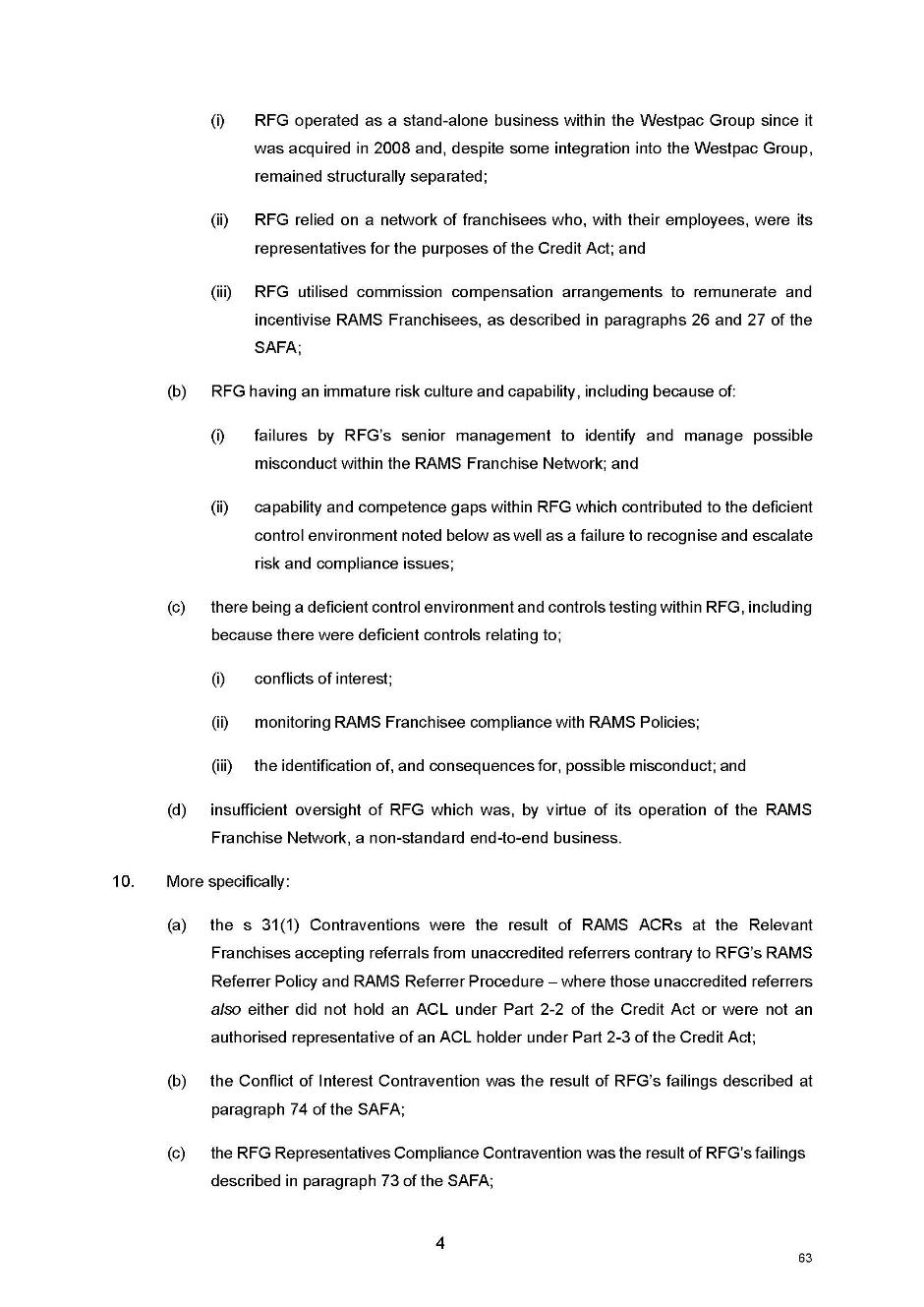
7 RFG disclosed the various findings of its investigations to ASIC and thereafter ASIC commenced its own investigation into RFG. RFG co-operated with ASIC in its investigation. RFG and Westpac have taken other commendable steps such as embarking upon reviews and audits to improve their systems and policies and have taken a conservative approach to the payment of compensation to consumers by way of remediation.
8 Nevertheless, the facts here establish that (as acknowledged by RFG and Westpac’s Board Risk Committee) the “root causes” of the contraventions were that RFG was conducted as an “autonomous business with a unique risk profile” which was borne of its franchise model, and, further, RFG had an immature risk culture, a deficient control environment and there was insufficient oversight of its non-standard methods of business. In the circumstances, it is important that the penalty to be imposed must serve the object of deterrence and promote compliance with the regulatory regime.
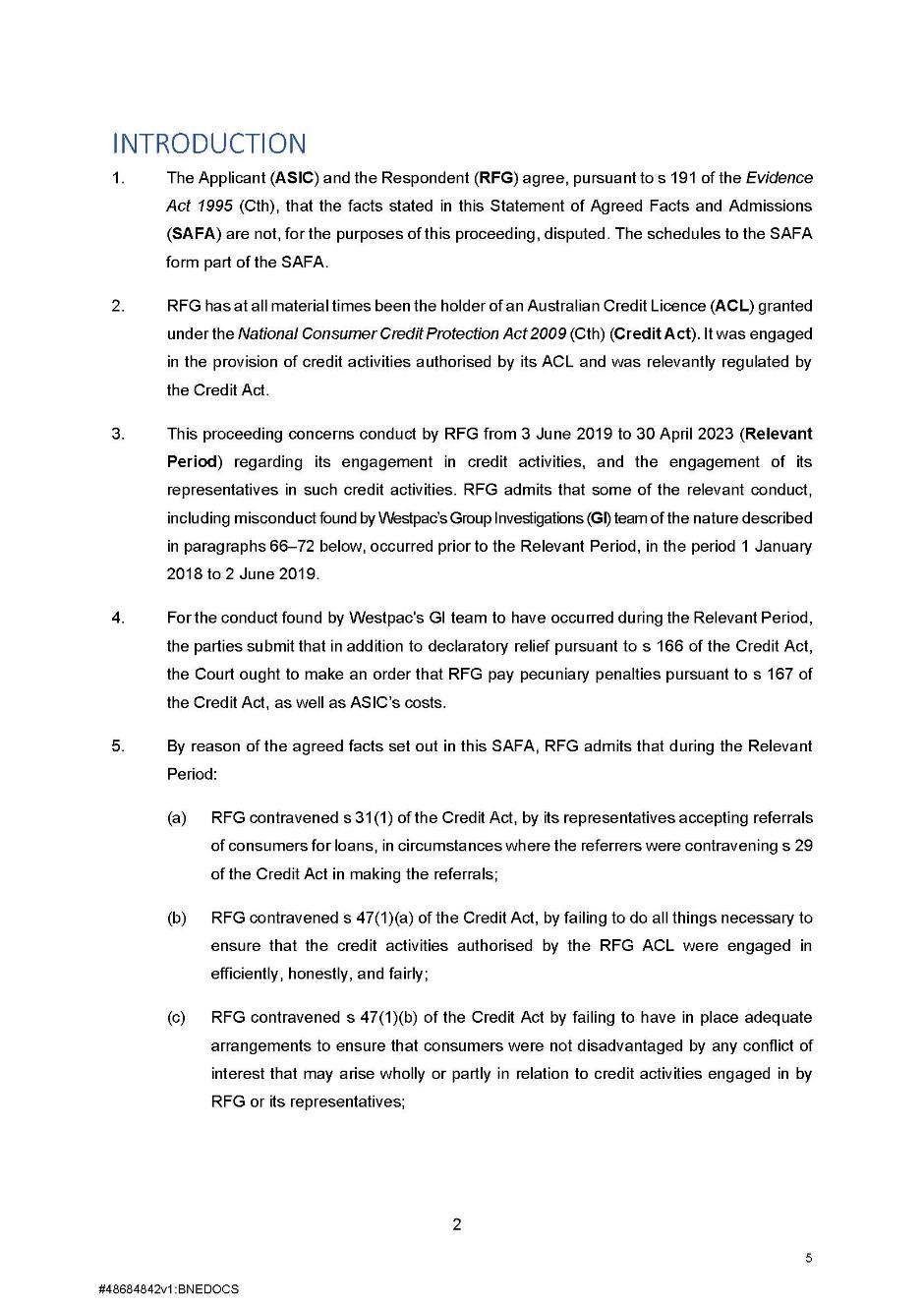
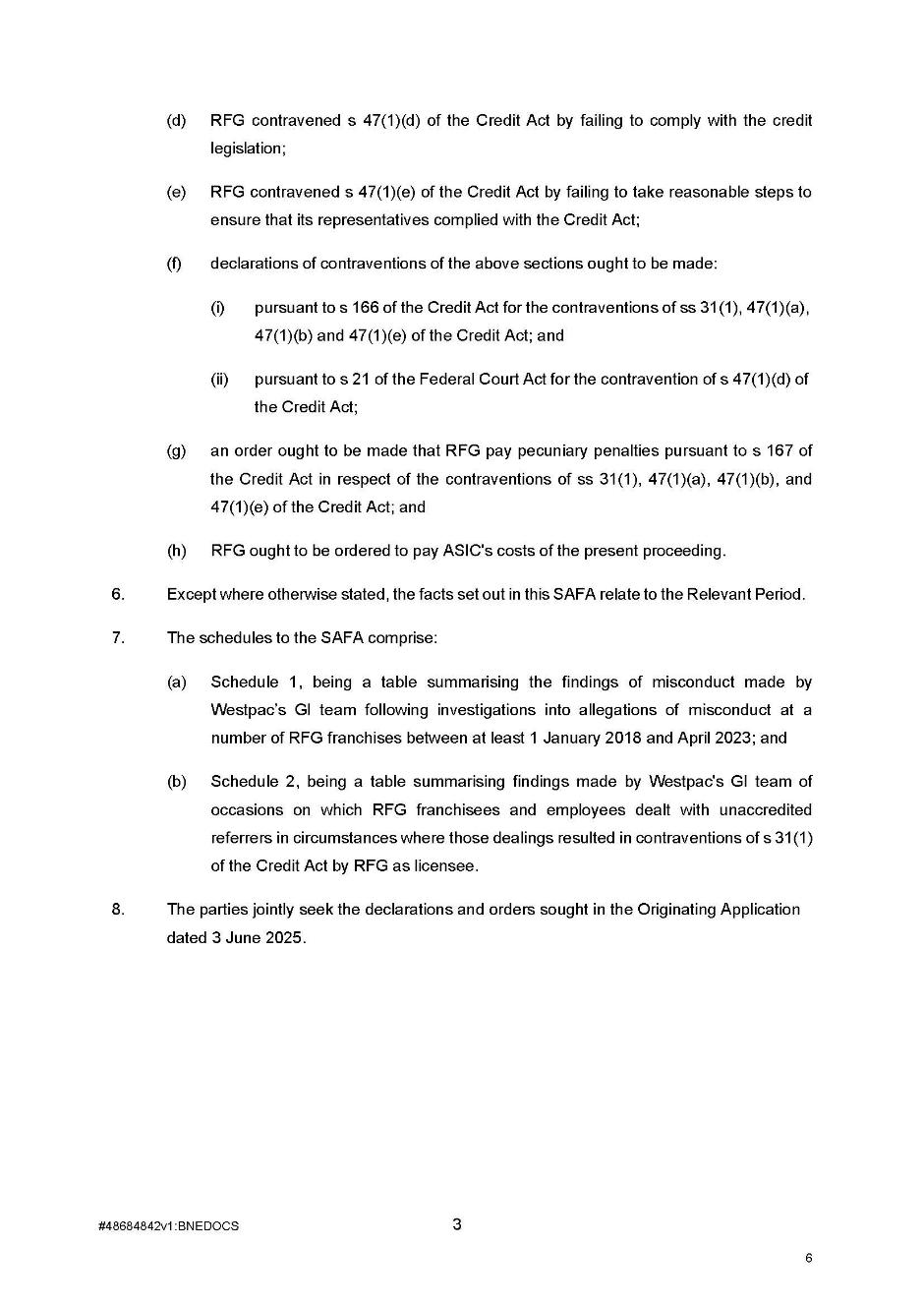
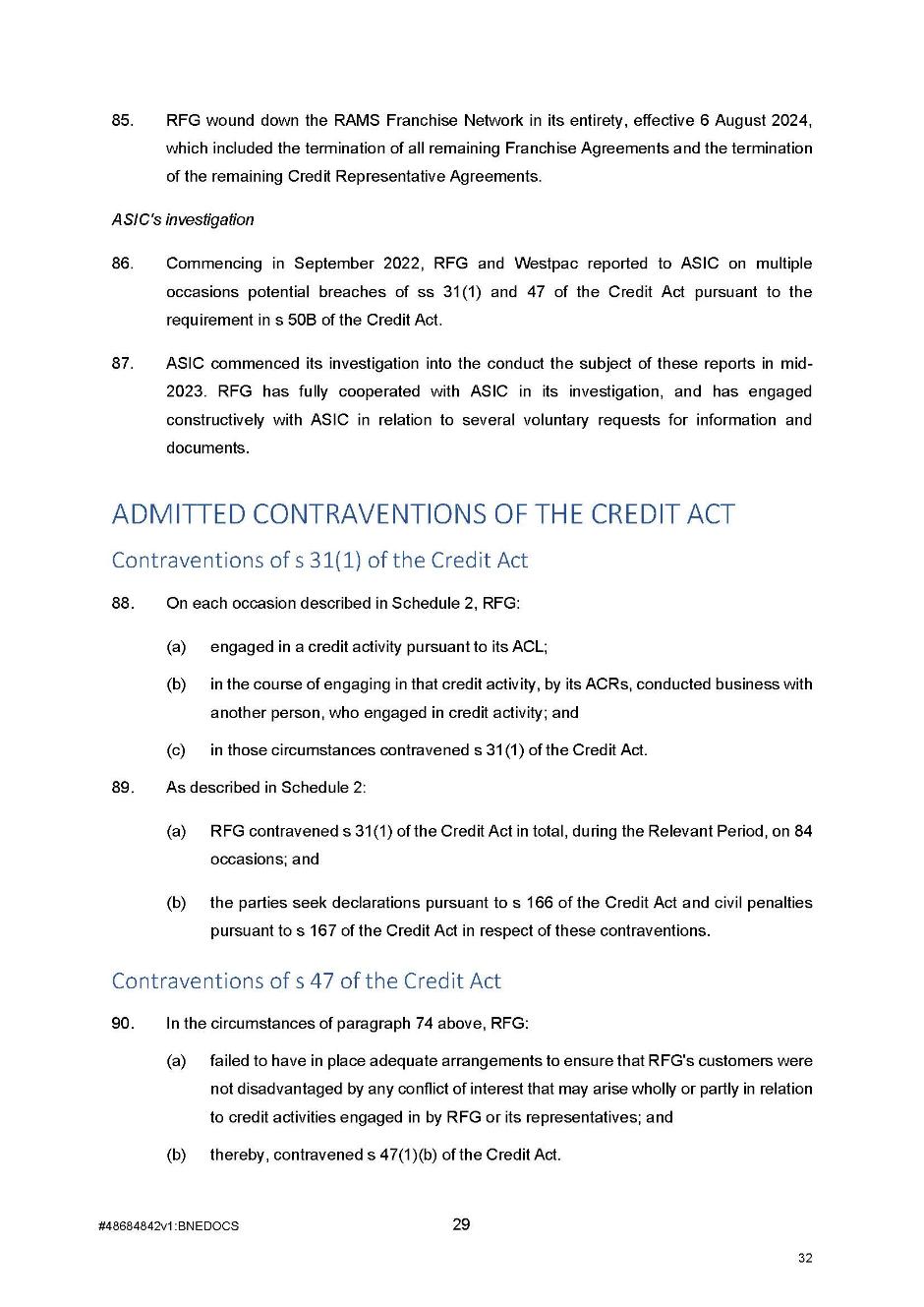
9 By the time that these proceedings were commenced, the parties had reached agreement as to the facts relevant to RFG’s admissions of liability. Specifically, based on those agreed facts, RFG admitted that it had contravened the Credit Act during the period from 3 June 2019 to 30 April 2023 (the Relevant Period). As a result, ASIC seeks declaratory relief and the imposition of pecuniary penalties against RFG in respect of contraventions of ss 31(1), 47(1)(a), (b), (d) and (e) and 47(4) the Credit Act. RFG agrees that orders should be made to this effect. The parties have subsequently reached agreement as to the facts relevant to penalty and as to the form of relief that should be granted including as to the quantum of the penalty to be imposed.
10 The parties’ position as to these matters is set out in the Updated Statement of Agreed Facts and Admissions on Liability dated 30 July 2025 (Liability SAFA), the Updated Statement of Agreed Facts on Relief dated 30 July 2025 (Penalty SOAF), and the joint submissions as to penalty filed on 5 August 2025 (Joint Submissions).
11 There is a recognised public interest in the settlement of proceedings under regulatory regimes in order to avoid lengthy and complex civil litigation. However, the fact that the parties have agreed that a declaration of contravention should be made does not relieve the Court of the obligation to satisfy itself that the making of the declaration is appropriate: Commonwealth v Director, Fair Work Building Industry Inspectorate [2015] HCA 46; 258 CLR 482 (FWBII) (French CJ, Kiefel, Bell, Nettle and Gordon JJ) at [59]. The role of the Court is not merely to “rubber stamp” orders agreed between a regulator and a person who has admitted contravening a statute: FWBII at [30]–[31], [48], [58]. It is necessary for the Court to determine whether the declarations and pecuniary penalty orders are appropriate and should be made: FWBII at [59]. In this respect, the Court is assisted by joint submissions, especially where they are advanced by a specialist regulator able to offer “informed submissions as to the effects of contravention on the industry and the level of penalty necessary to achieve compliance”: FWBII at [60]–[61]; Australian Securities and Investments Commission v Westpac Banking Corporation (Omnibus) [2022] FCA 515 at [100]–[101] (Beach J).
12 For the reasons set out below, I have concluded that having regard to the agreed facts and all the relevant circumstances, with some exceptions, the declarations sought by the parties should be made and that the aggregate agreed penalty of $20 million falls within the permissible range of penalties for the contraventions which RFG has admitted. Before turning to my reasons for so concluding, it is necessary for me at the outset to mention three matters.
13 First, there are other proceedings before the Court that involve RFG (NSD 671/2024) (the Class Action Proceedings). The Class Action Proceedings relate to RFG’s conduct in terminating the franchise agreements of the RAMS Franchisees. I addressed the subject matter of the Class Action Proceedings in my separate reasons for declining an application for leave to intervene in these proceedings made by the lead applicant of those proceedings: see Australian Securities and Investments Commission v RAMS Financial Group Pty Ltd [2025] FCA 1087. As I said in those reasons, the findings made in these proceedings are based on the agreed facts that are before me and do not give rise to any determination of any factual or legal issue as between RFG and the group members in the Class Action Proceedings. It is necessary for me to again reiterate that:
(a) to the extent that RFG has admitted contraventions of ss 47(1)(a), (b) and (e) of the Credit Act, it has done so on the basis that the investigations conducted by RFG and Westpac substantiated allegations that some (but not all) of the RAMS Franchisees engaged in misconduct;
(b) it is based on the fact of RFG and Westpac substantiating allegations of misconduct (as opposed to establishing the underlying fact of that misconduct), that RFG has admitted that it failed in various ways to comply with its obligations under ss 47(1)(a), (b), (d) and (e) of the Credit Act;
(c) ASIC and RFG jointly submit that the obligation under ss 47(1)(a), (b), (d) and (e) of the Credit Act as applicable to RFG (as licensee) may be established by RFG accepting (as it has done here) that its relevant processes and systems were deficient in various ways; and
(d) to the extent that RFG has admitted contraventions of s 31(1) of the Credit Act, those admissions are based on the agreed facts before me and do not preclude those facts being contradicted or challenged in the Class Action Proceedings.
14 Second, it is also necessary for me to reiterate that given the parties tendered the Liability SAFA and the Penalty SOAF, I have not been required to determine any factual question on its merits which is a consequence of s 191 of the Evidence Act 1995 (Cth). As Beach J mentioned in Australian Securities and Investments Commission v Commonwealth Bank of Australia [2020] FCA 790 at [12], “all that I need to be satisfied of is whether the agreed facts on their face provide a sufficient foundation for the declarations and orders sought. The text of s 191(2)(a) makes this plain”.
15 Third, both as a result of certain matters arising in the Class Action Proceedings and because of the nature of some of the sensitive nature of the materials that were before me (such as the personal details of consumers), I was satisfied that it was necessary to make suppression and non-publication orders under s 37AF(1) of the Federal Court of Australia Act 1976 (Cth) (the FCA Act) in order to prevent prejudice to the administration of justice (as specified in s 37AG(1)(a)). I did not make orders in the terms sought by ASIC, which would have suppressed and prevented the publication altogether of certain of the investigation reports as were referenced in hyperlinks to the Liability SAFA. Instead, I have limited the operation of the suppression and non-publication orders to names, identities, locations and personal or information relating to the RAMS Franchises, particular managers, and consumers. My orders under s 37AF(1) will operate for a period of 10 years but are subject to further order.
2. THE RELEVANT PROVISIONS OF THE CREDIT ACT
16 Chapter 2 of the Credit Act contains a licensing regime for those seeking to engage in a “credit activity”, as defined in the Credit Act. There is no dispute between the parties that RFG is, and was at all material times, the holder of ACL number 388065 (RFG’s ACL) and, therefore, a licensee for the purposes of the Credit Act.
17 Section 6 of the Credit Act provides that a person engages in a “credit activity” if the person is a credit provider under a credit contract or carries on a business of providing credit to which the National Credit Code (being Sch 1 of the Credit Act) applies. A person also engages in a “credit activity” if the person provides a “credit service”, which is defined in s 7 as providing “credit assistance” to a consumer or acting as an “intermediary”. Relevantly, s 8 of the Credit Act defines “credit assistance” as follows:
A person provides credit assistance to a consumer if, by dealing directly with the consumer or the consumer’s agent in the course of, as part of, or incidentally to, a business carried on in this jurisdiction by the person or another person, the person:
(a) suggests that the consumer apply for a particular credit contract with a particular credit provider; or
…
(d) assists the consumer to apply for a particular credit contract with a particular credit provider; or
…
18 Section 9 of the Credit Act defines “acts as an intermediary” as follows:
A person acts as an intermediary if, in the course of, as part of, or incidentally to, a business carried on in this jurisdiction by the person or another person, the person:
(a) acts as an intermediary (whether directly or indirectly) between a credit provider and a consumer wholly or partly for the purposes of securing a provision of credit for the consumer under a credit contract for the consumer with the credit provider; or
…
19 Part 2–1 of Ch 2 of the Credit Act prohibits persons from engaging in credit activities and related activities without an ACL. As has been observed, the purpose of these prohibitions is to ensure that credit activities (as defined) are regulated by the Credit Act, and that those engaging in credit activities are subject to the requirements imposed on licensees under the Act: Australian Securities and Investments Commission v Australia and New Zealand Banking Group Limited [2023] FCA 256 (ASIC v ANZ) at [12] (O’Bryan J).
20 Section 31(1) of the Credit Act provides:
31 Prohibition on conducting business with unlicensed persons
Prohibition on conducting business with unlicensed persons
(1) A licensee must not:
(a) engage in a credit activity; and
(b) in the course of engaging in that credit activity, conduct business with another person who is engaging in a credit activity;
if, by engaging in the credit activity, the other person contravenes section 29 (which deals with the requirement to be licensed).
Civil penalty: 5,000 penalty units.
21 As will be apparent from the text, the prohibition in s 31(1) is reliant upon the “other person contravening section 29”. Section 29 of the Credit Act provides as follows:
29 Prohibition on engaging in credit activities without a licence
Prohibition on engaging in credit activities without a licence
(1) A person must not engage in a credit activity if the person does not hold a licence authorising the person to engage in the credit activity.
Civil penalty: 5,000 penalty units.
22 The interaction between ss 29 and 31 has the effect that a licensee is prohibited from engaging in a credit activity by conducting a business with another person who is said to be engaging in a credit activity but where in fact that other person is not licensed to do so. As I will explain later in these reasons, the facts before me establish, and it is admitted, that RFG engaged in conduct in this regard that was prohibited by s 31(1).
23 In ASIC v ANZ, O’Bryan J referred to the observations made about the statutory scheme by Lee J in ASIC v NAB, and stated as follows at [13]–[15]:
As observed by Lee J in Australian Securities and Investments Commission v National Australia Bank Ltd [2020] FCA 1494 (ASIC v NAB) (at [90]), the section seeks to ensure that the overall objectives of the credit regime are not frustrated by licensees engaging with unlicensed persons to subvert its intent.
Section 110(1)(b) of the Credit Act provides that the regulations may exempt a “credit activity” from certain provisions of the Credit Act. Relevantly, reg 25 of the National Consumer Credit Protection Regulations 2010 (Cth) (Credit Regulations) exempts certain credit activities from the requirement in s 29 to hold an Australian credit licence. The exemptions include where a person (a referrer) refers a consumer to a licensee (such as a bank) which is able to provide a particular credit activity to the consumer (such as a home loan). The limits of the activities in which the referrer may engage are prescribed by reg 25. Relevantly, reg 25(2) allows a licensee to receive from an unlicensed person, and the unlicensed person to provide to a licensee, the name and contact details of a consumer and a short description of the purpose for which the consumer may want a provision of credit...
Part 2.2 of Ch 2 of the Credit Act regulated the issue of, and compliance with, Australian credit licences. The key aims of the licensing regime are to regulate credit industry participants and enhance consumer protection: ASIC v NAB at [83]. Further, the licensing regime assisted in ensuring that those who engage in “credit activity” are subject to the responsible lending requirements in Ch 3 of the Credit Act. In ASIC v NAB (at [85]), Lee J observed:
Those requirements aim to protect consumers (both from conduct of lenders and from consumers making poor borrowing decisions) by imposing standards of behaviour on licensees prior to and when entering into a credit contract. The conduct requirements apply only to persons who are licensed under the National Credit Act (that is, holders of an ACL). Relevantly, licensees are required to test the suitability of the proposed credit contract and assess the consumer’s ability to meet their financial obligations under the proposed credit contract. To do so requires direct dealings between the lender and the putative borrower, hence the prohibition on an unlicensed intermediary.
24 Separately, but also relatedly, s 47(1)(a), (b), (d) and (e) of the Credit Act provide as follows:
47 General conduct obligations of licensees
General conduct obligations
(1) A licensee must:
(a) do all things necessary to ensure that the credit activities authorised by the licence are engaged in efficiently, honestly and fairly; and
(b) have in place adequate arrangements to ensure that clients of the licensee are not disadvantaged by any conflict of interest that may arise wholly or partly in relation to credit activities engaged in by the licensee or its representatives; and
…
(d) comply with the credit legislation; and
(e) take reasonable steps to ensure that its representatives comply with the credit legislation; and
…
25 Section 47(4) of the Credit Act provides that:
Civil penalty for non-compliance
(4) The licensee must not contravene paragraph (1)(a), (b), (e), (ea), (f), (g), (h), (i), (j), (k), (l) or (m).
Civil penalty: 5,000 penalty units.
Note: Contravening paragraphs (1)(c) (obligation to comply with conditions on the licence) and (d) (compliance with the credit legislation) has consequences under other provisions.
26 As I explain below, RFG admits that, by reason of the conduct that it has found to be substantiated, it contravened these provisions. It should also be noted, as identified in the notation to s 47(4), that a failure to comply with s 47(1)(d) (being the general obligation to “comply with the credit legislation”) does not itself constitute a contravention of s 47(4).
3. THE AGREED FACTS
27 For completeness, I have attached the Liability SAFA and the Penalty SOAF to these reasons. They are marked respectively as Annexures A and B.
28 For convenience and so that these reasons cohesively explain the relevant factual basis upon which I am satisfied that the orders sought by the parties should be made (with exceptions relating to the alleged contravention of s 47(1)(d) and certain other matters), I have set out below the facts that I considered to be relevant to my determination. In doing so, I have borrowed from the Liability SAFA and the Penalty SOAF where I have considered it appropriate to do so.
3.1 Background to the Franchise Arrangements
29 RFG was acquired by Westpac in 2008. During the Relevant Period, RFG provided credit assistance to consumers:
(a) between at least 1 January 2018 and 15 December 2020:
(i) in relation to RAMS-branded home loans financed by Westpac; and
(ii) in relation to home loans with other lenders on the “RAMS Choice” (a third party aggregator) panel; and
(b) from 16 December 2020, only in relation to RAMS-branded home loans financed by Westpac.
30 RFG operated a franchise model through the RAMS Franchise Network whereby RAMS Franchisees used the RAMS business name to provide credit assistance to consumers in relation to the distribution of RAMS-branded home loans. The RAMS-branded home loans were credit contracts with Westpac and were loans to which the Credit Act applied.
31 There were a total of 73 RAMS Franchisees from time to time within the RAMS Franchise Network during the course of the Relevant Period, though the number of RAMS Franchisees operating at any one time varied.
32 The RAMS Franchisees operated under individual RAMS franchise agreements with RFG (Franchise Agreement), which were amended from time to time and were subject to the Franchising Code of Conduct, as enacted by the Competition and Consumer (Industry Codes—Franchising) Regulation 2014 (Cth).
33 The RAMS Franchisees employed their own staff, including staff involved in submitting loan applications (Loan Writers). The Loan Writers were ACRs of RFG.
3.2 The policies and practices applicable to RFG and RAMS Franchisees
34 During the Relevant Period, Westpac Group and Consumer Division policies (Westpac Policies) applied to RFG's Head Office staff. RAMS Franchisees and their employees (including Loan Writers) were required to comply with the RAMS Franchise Network’s Operations Manual, as amended by RFG from time to time (RAMS Operations Manual) and incorporated by reference into the Franchise Agreement.
35 In addition, RAMS Franchisees were required to comply with policies, guidelines, and procedures as amended by RFG from time to time (RAMS Policies), which relevantly included:
(a) the RAMS Compliance Policy – National Consumer Protection Act 2009 (Cth) Policy;
(b) the RAMS Conflict of Interest Policy and the RAMS Conflicts of Interest Procedure (the RAMS Conflict of Interest Policy);
(c) the RAMS Franchise Behavioural and Ethical Standards Policy;
(d) the RAMS Franchise Third Party Referrer Policy (the RAMS Referrer Policy);
(e) the RAMS Referrer Procedure;
(f) the RAMS Franchise Technology Code of Use Policy;
(g) the RAMS Customer Identification Procedure;
(h) the RAMS Privacy Operating Guidelines;
(i) the RAMS Lending Guidelines;
(j) the RAMS Disclosure Document 2014 Code;
(k) the RAMS Franchise Sales Procedure; and
(l) the RAMS Customer Identification Policy.
3.3 RAMS authorised credit representatives (ACRs)
36 Prior to, and during, the Relevant Period, RFG appointed RAMS Franchisees, and certain employees of the RAMS Franchisees, as its ACRs, within the meaning of s 64 of the Credit Act (RAMS ACRs). These appointments were made pursuant to the Credit Act and documented in written Corporate Credit Representative Agreements with corporate RAMS Franchisees and written Credit Representative Agreements with non-corporate RAMS Franchisees and employees of RAMS Franchisees (collectively, the Credit Representative Agreements). Pursuant to the Credit Representative Agreements, RFG appointed RAMS ACRs as:
(a) its credit representatives under the Credit Act, and authorised them to engage in credit activities on its behalf; and
(b) sub-agents of Westpac to carry out identification procedures on Westpac’s behalf for the purposes of the Anti-Money Laundering and Counter-Terrorism Financing Act 2006 (Cth) and the Verification of Identity Regulations (being any requirements to identify a person in connection with the granting of a mortgage).
37 The Credit Representative Agreements authorised RAMS ACRs to carry out, relevantly, the following activities:
(a) to follow up on leads provided by RFG, the RAMS Franchisee or self-generated leads;
(b) to provide a credit guide to a customer in accordance with RFG’s instructions;
(c) to conduct interviews to make reasonable inquiries about a customer’s financial situation, and their requirements and objectives, using tools provided by RFG;
(d) to take reasonable steps to verify a customer’s financial situation in accordance with RAMS Policies;
(e) to make a preliminary assessment about whether a facility or variation to an existing facility is not unsuitable for a customer, using tools provided by RFG; and
(f) to assist a customer to complete an application or variation application for facilities that are determined to be not unsuitable by the preliminary assessment, using tools provided by RFG.
38 The parties agreed, and I am satisfied that, that when carrying out the activities described in the preceding paragraph, RAMS ACRs engaged in a “credit activity” for the purposes of the Credit Act. I am also satisfied that RAMS ACRs were, pursuant to subparagraph (a)(iii) of the definition of “representatives” in s 5(1) of the Credit Act, representatives of RFG.
39 RFG required RAMS ACRs to:
(a) complete initial training to satisfy training standards as determined by RFG prior to acting under their ACR appointment;
(b) complete ongoing training, as specified by RFG and set out in the RAMS Operations Manual;
(c) comply, relevantly, with the RAMS Policies, and to use the information technology and other operational systems provided to them by RFG, including RFG’s systems infrastructure;
(d) deal only with accredited referral partners in accordance with the RAMS Operations Manual and the RAMS Referrer Policy; and
(e) disclose details of any actual or perceived conflicts of interest, in particular where the RAMS ACR had a personal interest which could be inconsistent with the interests of RFG or its customers, such that it could influence or compromise, or appear to influence or compromise, the RAMS ACR's duties and responsibilities to RFG or its customer, in accordance with the RAMS Operations Manual and the RAMS Conflict of Interest Policy.
3.4 RFG’s requirements relating to Accredited Referrers
40 During the Relevant Period, RAMS Franchisees and their employees received referrals of prospective customers from third parties (referrals).
41 RAMS Franchisees and their employees were only permitted by RFG to accept referrals from third parties who were, with limited exceptions, referrers who had been accredited (Accredited Referrers) in accordance with the requirements of the RAMS Operations Manual, the RAMS Referrer Policy and the “RAMS Franchise Referrer Procedure” (the RAMS Accreditation Process). Throughout the Relevant Period, RAMS Franchisees received induction training about the policies and procedures in place that applied to the use of Accredited Referrers, and their associated responsibilities under the RAMS Accreditation Process.
42 Pursuant to the RAMS Accreditation Process, only the following three types of referrers could be accredited:
(a) an entity that held an ACL under Part 2–2 of the Credit Act or who was an ACR of an ACL holder under Part 2–3 of the Credit Act, and who conducted a referral business;
(b) an entity that was exempt under the National Consumer Credit Protection Regulations 2010 (Cth) and conducted a business in which providing referrals was incidental to its main activities (Exempt Referrer); or
(c) a Westpac-approved broker that held an ACL or was an ACR (Westpac-Approved Broker).
3.5 RFG’s process for accrediting referrers
43 In order for a prospective referrer to become accredited under the RAMS Accreditation Process, a RAMS Franchisee or employee was required to:
(a) gather information about the identity of the prospective referrer;
(b) gather information to confirm whether the prospective referrer held a current ACL, was a current ACR of an ACL-holder, was a Westpac-Approved Broker, or was an Exempt Referrer;
(c) conduct searches in relation to the prospective referrer, including a company search (where relevant) and searches to determine whether the prospective referrer had been banned or disqualified by ASIC; and
(d) undertake any other steps set out in the RAMS Operations Manual, RAMS Referrer Policy and RAMS Franchise Referrer Procedure in relation to the prospective referrer.
44 Next, the RAMS Franchisee or employee was required to submit the accreditation request to RFG for determination. Westpac would then perform additional checks on the prospective referrer and related individuals prior to determination (including ABN and ASIC searches, verification of the prospective referrer’s business address, and checks against Westpac’s internal databases, which included the names of individuals with known misconduct, financial crime links, or involvement in fraud).
45 A team within RFG called “RAMS Franchise Field Compliance” would notify the relevant RAMS Franchisee of the outcome of the accreditation request and, if approved, a “Referrer Agreement” was required to be entered into between the relevant RAMS Franchisee and the prospective referrer. If accredited, and subject to the type of referrer (eg, an Exempt Referrer or Westpac-Approved Broker), Accredited Referrers would:
(a) provide consumer details, including the consumer’s name, contact details, and a short description of their purpose for seeking the provision of credit, if known, to the RAMS Franchisee;
(b) conduct an initial lending conversation with the consumer; and/or
(c) provide completed home loan application forms and supporting documents to the RAMS Franchisee.
46 In the event a consumer who wished to apply for a RAMS-branded home loan was referred to a RAMS Franchisee by an Accredited Referrer, the RAMS Franchisee or RAMS ACR was required to inform RFG that the loan application had been so referred, including by providing details of the Accredited Referrer’s unique referrer identifier code in the relevant electronic lodgement system (known as Symmetry) as part of the home loan application process.
3.6 Loan application process
47 During the Relevant Period, consumers approached RAMS Franchisees:
(a) through a central RAMS phone number for consumer enquiries, being 13RAMS (137 267), which referred consumers to the RAMS Franchisees;
(b) through Accredited Referrers; or
(c) by directly approaching a RAMS Franchisee or a Loan Writer.
48 Having been approached by consumers, RAMS Franchisees or their Loan Writers obtained information and documents from the consumers for the purpose of submitting loan applications to RFG for RAMS-branded home loans.
49 Prior to lodging home loan applications on behalf of consumers, during the Relevant Period RAMS Franchisees and their Loan Writers were required:
(a) pursuant to the Franchise Agreement, to ensure the consumer’s information was accurately captured, and that the information was a true and accurate reflection of the consumer’s circumstances;
(b) pursuant to the Credit Representative Agreement, to take reasonable steps to correctly collate and convey any information provided to RFG or any lender (including information in relation to any application), and not provide any information that the RAMS Franchisee or its officers, employees, agents or contractors knows (or should know) is false, misleading or forged;
(c) pursuant to the RAMS Policies:
(i) to identify the consumer;
(ii) to assess whether the consumer was eligible for a RAMS-branded home loan, in accordance with the RAMS Lending Guidelines, as amended from time to time;
(iii) to perform a preliminary suitability assessment about the consumer, in the course of which they were required to ascertain the consumer’s financial situation by:
(A) identifying and recording accurately the consumer’s requirements and objectives and ensuring any recommended loan met their requirements;
(B) collecting accurate, relevant and complete information about the consumer, including their financial information; and
(C) checking, verifying and assessing the consumer's information, including financial information, carefully to ensure RFG had a complete picture of the consumer’s financial situation, including income, expense, employment status, and exit strategy should the loan term exceed the consumer’s expected retirement age; and
(iv) in the course of performing the suitability assessment, to:
(A) obtain supporting documents to confirm the consumer’s financial and personal situation as described and set out in the RAMS Lending Guidelines, as amended from time to time and the Operations Manual including documents required for Pay As You Go employees, loan statements, documents required for self-employed consumers and documents to substantiate the consumer’s funds to complete the transaction such as a deposit;
(B) review the consumer’s supporting documentation in accordance with the RAMS Lending Guidelines;
(C) validate the consumer’s declared liabilities (and were strongly recommended to obtain a report from a credit reporting body);
(D) optionally obtain valuations;
(E) assess the capacity of the consumer to service the loan; and
(v) before submitting a loan application, check all the consumer’s information carefully to ensure RFG had a complete picture of the consumer's financial position.
50 Once the above steps were complete, the RAMS Franchisee or Loan Writer was required to submit the loan application to a team comprised of Westpac employees called “RAMS Credit & Loan Operations” (RAMS Credit), which, on behalf of Westpac, processed applications for approved products from receipt of the application until they instructed solicitors to prepare loan documents for settlement.
51 Upon receipt of a loan application, RAMS Credit first undertook a “triage” process (which throughout the Relevant Period, was undertaken by a team called “RAMS Home Ownership Services”) to ensure that the loan application was in a state ready for assessment by a RAMS Credit Manager. As part of the “triage” process, RAMS Credit was required to:
(a) ensure that all supporting documents were provided in accordance with the RAMS Policies;
(b) assess whether there was any missing information or documents;
(c) verify information in the loan application by cross-checking it against supporting documents;
(d) undertake “Requirements and Objectives checks”, including to ensure that the loan application included a full and complete preliminary assessment; and
(e) use triage “checklists” to perform their functions.
52 If, following the “triage” process, the loan application was determined to be in a state ready for assessment by a RAMS Credit Manager, it was allocated to a RAMS Credit Manager within RAMS Credit to conduct, on behalf of the credit provider, a substantive assessment of whether the credit contract would be unsuitable for the customer.
53 The assessment by a RAMS Credit Manager involved:
(a) reviewing the loan application and ensuring it complied with policy, verifying the income documents, and checking for red flag indicators that could indicate fraud;
(b) considering the comprehensive credit report information as well as security information contained within the valuation report;
(c) reviewing financial statements that could indicate non-disclosure of information;
(d) performing an unsuitability assessment on behalf of Westpac;
(e) completing a “credit memorandum” which referenced the credit calculations, as well as completing servicing calculations; and
(f) sending the loan to the Settlement Team for settlement if approved.
54 On some occasions, as an additional step within the process, the loan application was referred to the RAMS Risk and Fraud Operations team (RAMS Risk and Fraud), including where there were anomalies or concerns about information or consumers in respect of an application.
55 Once a RAMS Credit Manager assessed the application, the RAMS Credit Manager, on behalf of Westpac as the credit provider, would approve the application conditionally, approve the application unconditionally, defer the application for the purpose of obtaining further information, or decline the application.
56 Since at least June 2019, RFG also conducted post-loan settlement “Welcome Calls” with consumers, in respect of which:
(a) the calls were outsourced to a contact centre at Unisys Mortgage Processing (UMP);
(b) the callers were required to collect information from consumers;
(c) the information collected permitted UMP to determine whether there were anomalies in the manner in which RAMS ACRs discharged their obligations under the RAMS’ ACL (including whether the consumer had been referred from a third party other than an Accredited Referrer); and
(d) in the event of an anomaly, UMP was required to refer the Welcome Calls to RAMS Compliance for further review.
3.7 Investigations Process
57 During the Relevant Period, misconduct concerns relating to a RAMS Franchise could be investigated by one RFG or by:
(a) a group within Westpac called the Secured Lending Taskforce (SLTF), which could have received the request to investigate from either RFG or Westpac; or
(b) a group within Westpac called Group Investigations, which could have received the request to investigate from either RFG or Westpac.
58 Where SLTF undertook an investigation into misconduct concerns relating to a RAMS Franchise, it provided the findings of that investigation to relevant groups, which included Group Investigations. Those findings could be incorporated by Group Investigations (also referred to as GI) into its investigation.
59 From around mid-2022, having regard to information sharing restrictions imposed by relevant laws, RFG was provided with only a summary of SLTF's findings, and only in instances where termination and/or revocation of the Franchise Agreement and/or Credit Representative Agreement was recommended by Westpac.
60 Where GI undertook an investigation into misconduct concerns relating to a RAMS Franchise it would, on completion of its investigation, prepare a report which included its findings about whether the misconduct was “substantiated” (GI Report).
61 Of the 35 GI Reports that informed Schedules 1 and 2 of the Liability SAFA, 24 GI Reports were addressed, or copied, to RFG’s Managing Director. In relation to the remaining GI Reports, all were addressed, or copied, to either the Head of Risk and Compliance and/or in-house lawyers supporting the RAMS business.
62 During the Relevant Period, RFG used Westpac’s risk and compliance system, known as “JUNO”, to record and manage risk and compliance issues.
3.8 The findings of misconduct within the RAMS Franchise Network
63 During the Relevant Period, Westpac and RFG undertook investigations, including through GI and SLTF, into allegations of misconduct relating to the RAMS Franchises.
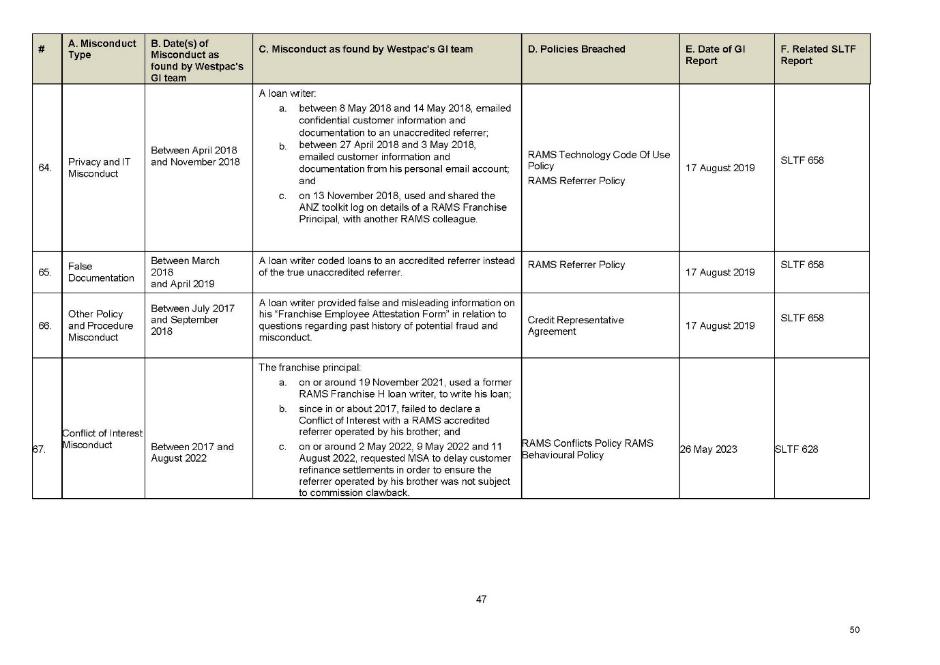
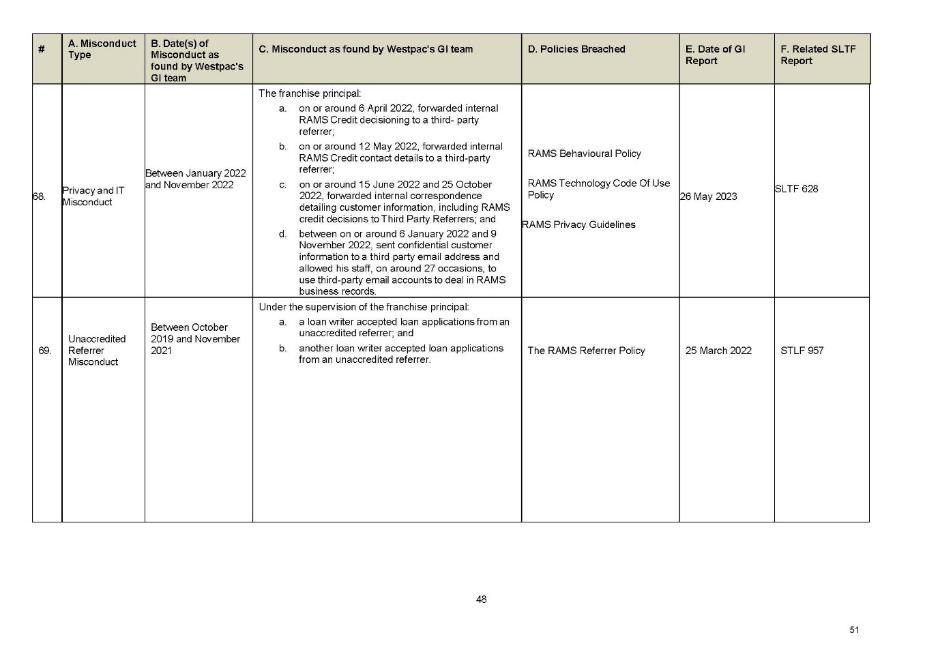
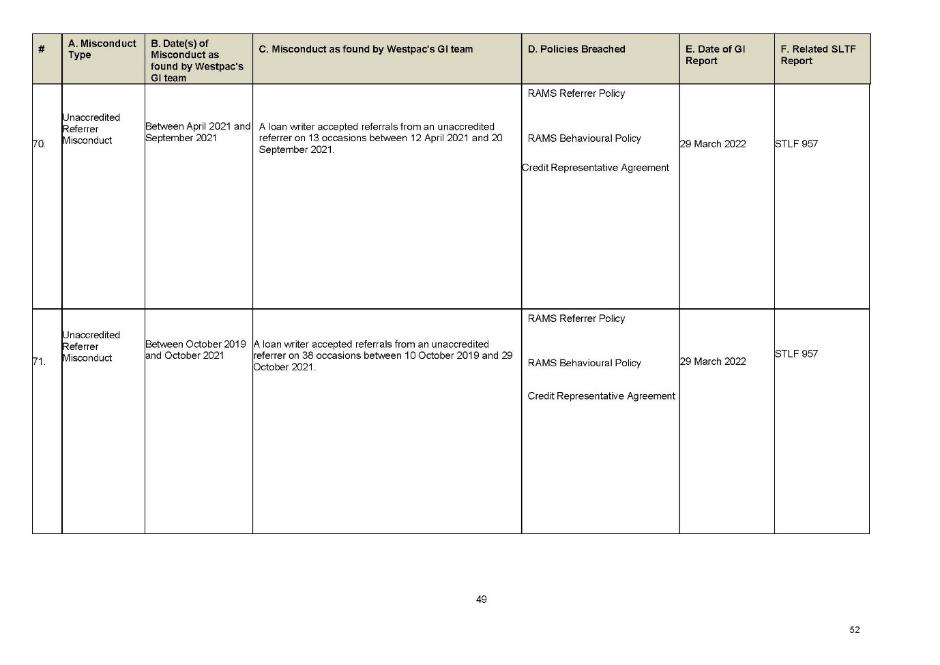
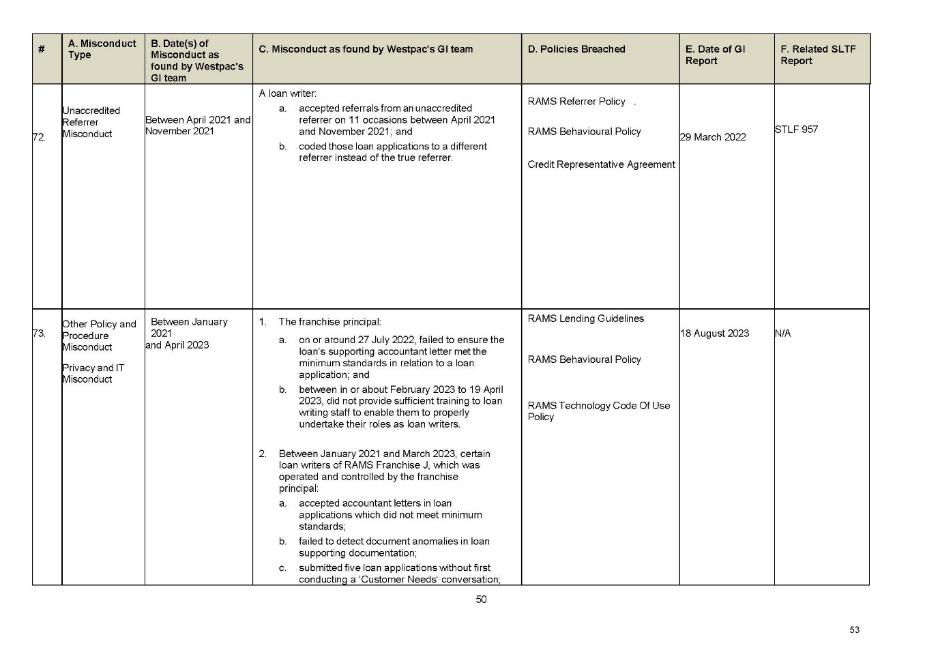
64 The nature of the alleged misconduct investigated by GI and SLTF varied widely. Schedules 1 and 2 to the Liability SAFA summarise substantiated findings of misconduct made by GI (GI Findings). The GI Findings:
(a) relate to conduct that occurred over the course of a 5-year period from at least 1 January 2018 to April 2023;
(b) involve staff, including RAMS Franchisees and Loan Writers, at 12 RAMS Franchises (being RAMS Franchises A, B, C, D, E, F, G, H, I, J, K, and L) (Relevant Franchises); and
(c) are set out in 35 GI Reports, the first of which is dated 17 August 2019 (RAMS Franchise G) and the last of which is dated 18 August 2023 (RAMS Franchise J).
65 RFG was made aware of the GI Findings, including through the provision of GI reports to its Managing Director, Head of Risk and Compliance, and/or in-house lawyers supporting the RAMS business.
66 Schedule 1 of the Liability SAFA summarises the GI Findings in relation to the Relevant Franchises. Specifically:
(a) the first column sets out the item number;
(b) column A identifies the category of misconduct with reference to one or more of the categories of misconduct as discussed below;
(c) column B identifies the time period over which the misconduct occurred;
(d) column C summarises the particular misconduct in respect of each item number;
(e) column D identifies the RAMS or Westpac Policies that GI found had been breached by virtue of the misconduct;
(f) column E identifies the date of the relevant GI Report; and
(g) column F identifies whether there was a related SLTF Report, and the number of that Report.
67 Schedule 2 of the Liability SAFA summarises the GI Findings of the “Unlicensed Referrer Misconduct” (see [71] below) in relation to the Relevant Franchises that involved contraventions of s 31(1) of the Credit Act. Specifically:
(a) column A identifies the item number in Schedule 1 that relevantly deals with Unaccredited Referrer Misconduct;
(b) column B identifies the Relevant Franchise;
(c) column C identifies the name of the Relevant Franchise staff member that accepted the referral; and
(d) column D identifies the number of contraventions of s 31(1) of the Credit Act referrable to the item number.
68 In addition, I have received a further revised version of Schedule 2 in an Affidavit of Ms Kristina Andrea Belci affirmed 20 October 2025 at Annexure KAB-01. This was a non-anonymised version of Schedule 2 of the Liability SAFA. As I have addressed above, I have made suppression and non-publication orders in respect of the content that reveals identifying information.
3.9 The categories of misconduct
69 The misconduct which is the subject of the GI Reports is categorised for the purposes of Column A of Schedule 1 of the Liability SAFA as follows:
(a) Unaccredited Referrer Misconduct;
(b) Conflict of Interest Misconduct;
(c) False Documentation Misconduct;
(d) Transfer of Funds Misconduct;
(e) Privacy and IT Misconduct; and
(f) Other Policy and Procedure Misconduct.
70 For present purposes, it is convenient to provide a brief summary of each category of misconduct.
3.9.1 Unaccredited Referrer Misconduct
71 RFG and Westpac found substantiated instances of some RAMS Franchises accepting referrals from unaccredited referrers. In those instances, RFG and Westpac were satisfied that the relevant RAMS Franchises breached the RAMS Referrer Policy (Unaccredited Referrer Misconduct): see Schedule 1 of the Liability SAFA at rows 1, 2, 5, 6, 8, 9, 10, 11, 13, 16, 23, 28, 32, 40, 44, 50, 54, 57, 60, 63,64, 65, 69, 70, 71, 72, and 83.
3.9.2 Unlicensed Referrer Misconduct
72 Where representatives at the Relevant Franchises accepted referrals from unaccredited referrers who did not hold an ACL under Part 2–2 of the Credit Act or who were not an authorised representative of an ACL holder under Part 2–3 of the Credit Act at the time of the referral (Unlicensed Referrer Misconduct), RFG contravened s 31(1) of the Credit Act, as addressed in further detail below and in Schedule 2 of the Liability SAFA.
3.9.3 Conflicts of Interest Misconduct
73 During the Relevant Period, the types of conduct identified by GI in respect of particular Relevant Franchises included that they were found by RFG and Westpac to have:
(a) engaged in credit activities where there was a conflict of interest or relationships between representatives at the Relevant Franchises and other commercial businesses which provided services or referrals to the Relevant Franchises as described in Schedule 1 of the Liability SAFA at rows 22, 26, 27, 31, 33, 38, 39, 56, 67, and 81, including by:
(i) while acting as a principal at a Relevant Franchise, being listed as the sole signatory on the bank accounts of a company which referred loan applications to the Relevant Franchise and personally receiving commissions from those referrals;
(ii) personally, receiving monies from referrers; and
(iii) while acting as a principal at a Relevant Franchise, failing to declare a conflict of interest with an Accredited Referrer operated by that principal’s brother; and
(b) thereby, breached the RAMS Conflict of Interest Policy.
3.9.4 False Documentation Misconduct
74 During the Relevant Period, the types of conduct identified by GI in respect of particular Relevant Franchises included that they were found by RFG and Westpac to have:
(a) submitted loan applications prepared by representatives at the Relevant Franchises which included, likely in order to increase the prospects of the loan application being approved, false information and/or documents in support of the loan applications in the manner identified in Schedule 1 of the Liability SAFA at rows 14, 25, 35, 40, 41, 44, 51, 65, 77, and 83, including by:
(i) altering the declared expenses in loan applications to enable the loan to meet serviceability requirements;
(ii) representing that their own home loan application was for an investment property when in fact it was to be owner-occupied; and
(iii) coding loan applications to a party other than the true referrer; and
(b) thereby, breached the policies described in the corresponding column D of those rows in Schedule 1.
3.9.5 Transfer of Funds Misconduct
75 During the Relevant Period, the types of conduct identified by GI in respect of particular Relevant Franchises included that they were found by RFG and Westpac to have:
(a) Transferred funds in relation to loans in the manner identified in Schedule 1 of the Liability SAFA at rows 29, 36, 39, and 45, including by:
(i) facilitating the payment of customer arrears payments with the result that the Relevant Franchise continued to receive commission payments; and
(ii) making a payment to a customer for the purpose of satisfying the customer’s settlement fees and the first year of the annual package fee; and
(b) thereby, breached the policies described in the corresponding coplumn D of those rows in Schedule 1.
3.9.6 Privacy and IT Misconduct
76 During the Relevant Period, the types of conduct identified by GI in respect of particular Relevant Franchises included that they were found by RFG and Westpac to have:
(a) misused information or IT systems in the manner described in Schedule 1 of the Liability SAFA at rows 3, 4, 7, 15, 17, 19, 20, 21, 24, 30, 34, 37, 43, 46, 52, 55, 58, 61, 62, 64, 68, 73, 74, 79, 80, 82 and 84, including by:
(i) distributing RFG software to unaccredited referrers or persons not employed by RFG;
(ii) using unauthorised personal email accounts to store and distribute confidential customer identification and documentation; and
(iii) sharing a username and password with a third party; and
(b) thereby, breached the policies described in the corresponding column D of those rows in Schedule 1.
3.9.7 Other Policy and Procedure Misconduct
77 During the Relevant Period, the types of conduct identified by GI in respect of particular Relevant Franchises included that they were found by RFG and Westpac to have:
(a) breached other policies and procedures, or guidelines, not otherwise described in one of the categories described above, in the manner described in Schedule 1 of the Liability SAFA at rows 1, 2, 9, 12, 18, 26, 29, 31, 33, 35, 42, 47, 48, 49, 53, 56, 59, 66, 73, 75, 76, 78, 80, 84, and 85, including by:
(i) establishing proxy referrers knowing them to be employees of banned referrer companies;
(ii) failing to identify multiple anomalies in supporting documentation for loan applications at a level expected of a prudent loan writer; and
(iii) failing to identify customers themselves (but rather accepting false certified copies of customer identification from referrers); and
(b) thereby, breached the policies described in the corresponding column D of those rows in Schedule 1.
3.10 Franchisee Oversight Controls Review and Project Guardian
78 In response to concerns identified with the conduct of a particular RAMS Franchise, Westpac:
(a) on 5 October 2022, commenced a review into RFG’s Franchisee Oversight Controls (Franchisee Oversight Controls Review), to assess the effectiveness of the control environment within RAMS, specifically focussed on the oversight of certain franchisee conduct, being conflicts of interest, the use of unaccredited referrers, and the misrepresentation of loan application information; and
(b) on 25 November 2022, commenced “Project Guardian”, the purpose of which was to investigate and respond to possible misconduct by other franchisees within the RAMS Franchise Network and uplift RAMS controls to ensure that similar issues would be avoided in the future.
79 Project Guardian ran over the course of approximately 22 months at a cost of approximately $46 million. Project Guardian included monitoring and targeted reviews of all RAMS Franchisees, reviews of historical and new loan applications referred by RAMS Franchisees, the engagement of an external expert to conduct an independent review of the RAMS control environment, and the implementation of associated control uplifts.
80 Westpac and RFG committed over 200 employees and external consultants to Project Guardian. In the course of this project:
(a) RFG enhanced relevant policies, procedures and controls, developed and updated training modules, and completed an enhancement of the RFG risk profile and supervision and monitoring framework; and
(b) there was an increase in the number of investigations conducted by GI and SLTF into RAMS Franchisees as evidenced in Schedule 1 of the Liability SAFA. These investigations were conducted in tandem with RFG's uplift of its policies, procedures, and controls, and resulted in the termination of Franchise Agreements with RAMS Franchisees and Credit Representative Agreements with RAMS ACRs.
81 As part of Project Guardian, Westpac also undertook a broad review exercise which involved a review of the entire portfolio of RAMS loans settled in the period December 2016 to December 2022.
82 The process resulted in Westpac remediating 48 customer loans to a value of $7,567,418. In determining whether a loan required remediation, Westpac did not require evidence of any actual misconduct by RAMS Franchisees (that is, customers were remediated even if it could not be established that any financial harm they may have suffered was the result of conduct of RAMS ACRs).
83 The loans requiring remediation represented approximately 0.05% of all loans originated through the RAMS Franchise Network between December 2016 and December 2022.
84 The total remediation value represented 0.025% of the RAMS total portfolio value as at September 2024 and 0.0009% of the Westpac total portfolio value as at September 2024.
3.11 Other audits and reviews
85 On 13 December 2022, the Executive Manager (Credit Quality and Regulatory Change) at Westpac delivered a report on the findings of the Franchisee Oversight Controls Review to the Managing Director (Mortgages).
86 On 14 April 2023, Westpac’s Group Audit team finalised its “RAMS Franchisee Management and Oversight Audit Report” which reported on the findings of its audit.
87 On 15 September 2023, the Westpac Board Risk Committee received a Memorandum reporting to it on Westpac management’s analysis of “Root Causes relating to RAMS Matters”, in which four root causes were identified as contributing to the deficiencies in RFG, being:
(a) an autonomous business with a unique risk profile;
(b) an immature risk culture and capability within RFG;
(c) a deficient control environment and controls testing; and
(d) insufficient oversight of a non-standard end-to-end business unit.
3.12 Closing the RAMS business
88 Following commencement of Project Guardian, having regard to the findings of the investigations conducted by GI and SLTF into RAMS Franchisees and their employees, RFG terminated Credit Representative Agreements with ACRs who had been the subject of substantiated findings of misconduct.
89 RFG wound down the RAMS Franchise Network in its entirety, effective 6 August 2024, which included the termination of all remaining Franchise Agreements and the termination of the remaining Credit Representative Agreements.
3.13 ASIC's investigation
90 Commencing in September 2022, RFG and Westpac reported to ASIC on multiple occasions potential breaches of ss 31(1) and 47 of the Credit Act pursuant to the requirement in s 50B of the Credit Act.
91 ASIC commenced its investigation into the conduct the subject of these reports in mid-2023.
92 RFG fully cooperated with ASIC in its investigation, and has engaged constructively with ASIC in relation to several voluntary requests for information and documents.
4. THE CONTRAVENTIONS
93 Based on the agreed facts, I am satisfied that RFG contravened the Credit Act for the reasons set out below.
4.1 Contraventions of s 31(1) of the Credit Act
94 As set out at [22] above, the interaction between ss 29 and 31 has the effect that a licensee, in the course of engaging in a credit activity, is prohibited from engaging in that credit activity by conducting a business with another person where that other person is not licensed to engage in a credit activity.
95 Relevantly, as applied to the circumstances here, the question that arises is whether on the agreed facts, RFG, during the course of being engaged in a credit activity, conducted business with another person who was engaging in a credit activity without a licence authorising that activity.
96 The agreed and admitted facts demonstrate that there were 84 instances where consumers were referred to RAMS Franchisees by third parties who were not licensed to provide credit activity. Those third parties included accountants, tax agents, and other types of advisors. The fact that those persons were not licensed at the relevant times is established by evidence adduced by ASIC which establishes that:
(a) ASIC maintains a database of the names and details of all individuals who hold, or held, an ACL;
(b) ASIC also maintains a database of the names and details of all individuals who are, or have been, authorised credit representatives of an ACL holder under Part 2–3 of the Credit Act;
(c) subject to one qualification, a search of these databases disclosed that none of the entities or persons identified in a suppressed and redacted version of Schedule 2 of the Liability SAFA are recorded as being the holders of an ACL or an authorised representative of an ACL holder; and
(d) in one instance, although the corporate entity was recorded as an authorised credit representative of a different ACL holder, there is no evidence that the individual person who provided the referral to the relevant RFG Franchisee was an authorised credit representative of any ACL holder or sub-authorised by the relevant corporate entity to provide credit services.
97 I am satisfied that in each of these instances RFG was dealing with a person who was not licensed to provide a credit activity.
98 As to whether in each such instance, the other person (being the referrer) was engaged in a “credit activity”, the parties submitted that the broad definitions of “credit activity” and “credit assistance” in ss 7 and 8 of the Credit Act encompassed such activities. I am satisfied that by referring a consumer to a RAMS Franchisee for the purpose of obtaining a home loan, the “other person” was at the very least (in the course of, or incidentally, to a business carried on by that person) providing “credit assistance” to that consumer as provided for in s 8 of the Credit Act. In each such instance, the “other person” had in one or another way advised or suggested that the relevant consumer apply for or obtain a home loan through the relevant RAMS Franchisee.
99 Accordingly, I am satisfied that RFG contravened s 31(1) on each of the 84 occasions identified in Schedule 2 of the Liability SAFA.
4.2 Contraventions of s 47(1)(a) of the Credit Act
100 As set out above, s 47(1)(a) required RFG to “do all things necessary to ensure that the credit activities authorised by its licence were” engaged in “efficiently, honestly and fairly”.
101 The meaning of the phrase “efficiently, honestly and fairly” in s 47(1)(a) is informed by cases on s 912A(1)(a) of the Corporations Act 2001 (Cth) (the Corporations Act), which uses the same expression: Australian Securities Investments Commission v Membo Finance Pty Ltd (No 2) [2023] FCA 126 at [37] (Yates J). The parties in their joint submissions provided a useful summary of the relevant propositions to be drawn from those cases, from which I have borrowed as they are both accurate and an efficient summation of those propositions.
102 The authorities in relation to the obligation in s 912A(1)(a) of the Corporations Act (“to do all things necessary to ensure that the financial services covered by the licence are provided efficiently, honestly and fairly”) include the following propositions (per Foster J in Australian Securities and Investments Commission v Camelot Derivatives Pty Ltd (in liq) [2012] FCA 414; 88 ACSR 206 at [69] (with citations omitted)):
(a) the words “efficiently, honestly and fairly” must be read as a compendious expression, meaning a person who goes about their duties efficiently having regard to the dictates of honesty and fairness, honestly having regard to the dictates of efficiency and fairness, and fairly having regard to the dictates of efficiency and honesty;
(b) the words “efficiently, honestly and fairly” connote a requirement of competence in providing advice and in complying with relevant statutory obligations. They also connote an element not just of even handedness in dealing with clients but a less readily defined concept of sound ethical values and judgment in matters relevant to a client’s affairs;
(c) the word “efficient” refers to a person who performs his duties efficiently, meaning the person is adequate in performance, produces the desired effect and is capable, competent and adequate. Inefficiency may be established by demonstrating that the performance of a licensee’s functions falls short of the reasonable standard of performance by a dealer that the public is entitled to expect;
(d) it is not necessary to establish dishonesty in the criminal sense. The word “honestly” may comprehend conduct which is not criminal but which is morally wrong in the commercial sense; and
(e) the word “honestly” when used in conjunction with the word “fairly” tends to give the flavour of a person who not only is not dishonest, but also a person who is ethically sound.
103 A contravention of the “efficiently, honestly and fairly” standard does not require a contravention or breach of a separately existing legal duty or obligation, whether statutory, fiduciary, common law or otherwise given that the statutory standard itself is the source of the obligation: Australian Securities and Investments Commission v AGM Markets Pty Ltd (in liq) (No 3) [2020] FCA 208; 275 FCR 57 at [512] (Beach J). Section 912A(1)(a) of the Corporations Act has been described as “a statutory norm to be read conformably with s 760A and the other provisions of the Corporations Act and the ASIC Act”: AGM Markets at [519] (Beach J).
104 The word “ensure” as contained in the statutory text imports a forward-looking element into the obligation. It is necessary not only to act efficiently, honestly and fairly from day to day, but to take steps to guard against lapses from that standard by employees or representatives: Australian Securities and Investments Commission v Commonwealth Bank of Australia [2022] FCA 1422 at [146] (Downes J), citing Australian Securities and Investments Commission v AMP Financial Planning Pty Ltd (No 2) [2020] FCA 69; 377 ALR 55 at [105] (Lee J), cited with approval in Australian Securities and Investments Commission v Ferratum Australia Pty Limited (in liq) [2023] FCA 1043 at [49] (Kennett J) (ASIC v Ferratum).
105 Although the subjective intention of the alleged contravener may clearly be relevant, the standard may be unintentionally breached. Contravention is generally a matter for objective analysis: Australian Securities and Investments Commission v National Australia Bank Ltd [2022] FCA 1324 at [352] (Derrington J) cited with approval in ASIC v Ferratum at [49] (Kennett J).
106 As applicable to RFG, and based on the agreed facts, I am satisfied that in the operation of the RAMS Franchise Network, RFG was required to take particular steps to comply with s 47(1)(a) of the Credit Act. Although those steps themselves were not prescribed in s 47(1)(a) of the Credit Act, given that RFG was engaged in credit activities through the RAMS Franchise Network it was imperative that it took appropriate and adequate steps to “ensure” that the RAMS Franchisees could, and did, comply with its own policies in providing efficient, honest and fair services to consumers who were seeking to enter into, and did enter into, home loans.
107 In particular, as the parties submitted, I am satisfied that this obligation required RFG to:
(a) create adequate policies and procedures for the operation of the RAMS Franchise Network;
(b) take reasonable steps to ensure that those policies and procedures were complied with by RFG and RAMS ACRs;
(c) adequately investigate and respond to possible misconduct within the RAMS Franchise Network including:
(i) in relation to non-compliance with the RAMS Policies;
(ii) in response to investigations by the SLTF and GI; and
(iii) by implementing appropriate controls to manage identified risks, where those risks were identified in the course of the relevant investigations; and
(d) conduct adequate compliance audit and routine loan file review procedures to detect misconduct in relation to loan applications received from RAMS Franchisees.
108 The parties also agreed and jointly submitted that RFG was required by s 47(1)(a) to comply with its obligations pursuant to ss 31(1), 47(1)(b) and 47(1)(e) of the Credit Act. I have doubts about this submission and do not consider it necessary to accept the joint position of the parties in this respect, or to make such a finding. The effect of the parties’ joint position in this respect is that RFG was required by s 47(1)(a) to comply with other provisions of the Credit Act, which would add little, if anything, to those other obligations. This submission is to be contrasted to the separate contention, which I do accept, that s 47(1)(a) extends to a licensee ensuring that it has adequate policies and procedures in place to discharge its obligations under ss 31(1), 47(1)(c), (d), and (e). The separate contention focusses on the adequacy of systems, policies and procedures directed to ensuring compliance, as opposed to merely requiring compliance with another obligation. However, in respect of s 47(1)(b) it is to be observed that it is an obligation which already requires a licensee to have in place “adequate arrangements” to ensure that its clients are not disadvantaged by conflicts of interest. Generally, I share the views that O’Bryan J expressed in respect of a similar issue that arose in ASIC v ANZ where his Honour stated at [57]:
It cannot be doubted that the stipulation in s 47(1)(a), that a licensee must do all things necessary to ensure that the credit activities authorised by the licence are engaged in efficiently, honestly and fairly, is important. There is a body of case law in respect of the analogous provision in s 912A(1)(a) of the Corporations Act 2001 (Cth), although there has been limited appellate consideration of the provision (there was limited discussion in Australian Securities and Investments Commission v Westpac Securities Administration Ltd (2019) 272 FCR 170). In my view, the question whether ANZ’s conduct in this case constitutes a contravention of s 47(1)(a) is not free from doubt. The relationship between each of the paragraphs of s 47(1), and how paragraph (a) should be construed in light of the other paragraphs, may need consideration. An overly broad construction of paragraph (a), as propounded by ASIC, may render otiose the other paragraphs. In the circumstances of the present case, I am not willing to make a declaration of contravention of s 47(1)(a) solely on the basis of ANZ’s admission and without contest. The admission has no practical consequences for ANZ as the admission, and proposed declaration, would be merely duplicative of the other admissions.
109 Despite some of the infelicity in the parties’ position and the declarations that they proposed, I am nevertheless satisfied that RFG contravened s 47(1)(a) by:
(a) failing to take reasonable and adequate steps to ensure that RAMS Franchises and their staff complied with RAMS Policies;
(b) failing to create and establish adequate policies and procedures for responding to possible misconduct;
(c) failing to create an effective consequence management policy which set out parameters about when concerns about possible misconduct should be referred by RFG for investigation; and
(d) failing to implement effective controls to ensure that RFG representatives did not breach the policy requirement not to deal with unaccredited referrers, including by failing to:
(i) satisfy itself that there were adequate processes in place to verify that a referrer was accredited;
(ii) put in place controls to monitor the accuracy of an Accredited Referrer’s unique referrer identifier code which was required to be entered in Symmetry by the RAMS Franchise as part of the home loan application process; and
(iii) include post-loan settlement “Welcome Calls”, as described in paragraph 51 of the Liability SAFA, to consumers as a control in JUNO, as a result of which RFG management was unable to assess and confirm whether that control was operating effectively, in circumstances where Welcome Calls were the key control used by RFG for identifying the use of Unaccredited Referrers;
(e) failing to take adequate steps to ensure that RAMS Franchisees and their employees adhered to the process for a prospective referrer to become accredited under the Accreditation Process, which failure led to the use of referrers who:
(i) did not hold a current ACL under Part 2–2 of the Credit Act;
(ii) were not an authorised representative of an ACL holder under Part 2–3 of the Credit Act; or
(iii) not exempt from being required to hold an ACL under the credit legislation;
(f) failing to establish adequate compliance audit and routine loan file review procedures to detect misconduct, including by:
(i) establishing compliance audits with a very narrow focus that, among other things, were not designed to identify misconduct, and which excluded higher risk loan applications (such as declined or withdrawn files) from sampling processes; and
(ii) establishing an inappropriately undemanding paper file review process (5 files, every 6 months) undertaken by the RAMS Field Franchise sales team and was not focused on detecting misconduct issues; and
(g) failing to adequately respond to possible misconduct within the RAMS Franchise Network, including by virtue of failing to:
(i) record all incidents of misconduct in a central location and to include sufficient information in JUNO to enable analysis of those incidents;
(ii) review incidents of potential misconduct with a view to determining whether they were indicative of systemic issues within the RAMS Franchise Network;
(iii) implement an adequate mechanism to monitor, consider and respond to incidents of misconduct;
(iv) impose consistent consequences for findings of misconduct in Westpac GI Reports and failing to adequately record consequences imposed for the misconduct found in the Westpac GI Reports; and
(v) adequately document the rationale for approving the extension of the term of a Franchise Agreement, having regard to incidents of misconduct in respect of that RAMS Franchise; and
(h) failing to identify systemic misconduct issues arising from investigations into misconduct at individual franchises.
110 It is on the above basis that I am satisfied that RFG contravened s 47(1)(a) of the Credit Act. However, as I address below, it is preferable that the parties prepare a revised form of declarations that reflect these reasons.
4.3 Contraventions of s 47(1)(b) of the Credit Act
111 Section 47(1)(b) of the Credit Act required RFG to have in place adequate arrangements to ensure that its clients were not “disadvantaged by any conflict of interest” that might have arisen wholly or partly in relation to credit activities engaged in by it or its representatives.
112 Section 47(1)(b) has not been the subject of previous judicial consideration. In Australian Securities and Investments Commission v Citigroup Global Markets Australia Pty Limited (ACN 113 114832) (No. 4) [2007] FCA 963; 160 FCR 35, Jacobson J considered the analogous s 912A(1)(aa) of the Corporations Act. His Honour found that “adequate management” did not require the elimination of unauthorised conflicts by obtaining express consent (at [443]). His Honour observed in obiter that “[a]dequate arrangements require more than a raft of written policies and procedures. They require a thorough understanding of the procedures by all employees and a willingness and ability to apply them to a host of possible conflicts” (at [454]).
113 The parties jointly submitted that in order to comply with s 47(1)(b) of the Credit Act, RFG was required to have in place adequate arrangements to ensure that consumers were not disadvantaged by any conflict of interest that may arise wholly or partly in relation to credit activities undertaken by it. It was further submitted that, in order to comply with s 47(1)(b) of the Credit Act, RFG was requited to have in place adequate arrangements to ensure that RAMS ACRs complied with policies and procedures that were implemented for the purposes of ensuring RAMS ACRs complied with this aspect of the obligations contained in the Credit Act.
114 I accept the parties’ joint submissions. Section 47(1)(b) of the Credit Act required RFG to have in place “adequate” arrangements to achieve and promote the statutory norm to “ensure” an objective, specifically, being “to ensure” that clients were not disadvantaged by any conflict of interest that might have arisen. The relevant conflict of interest is one that “might have arisen wholly or partly in relation to credit activities engaged in” by RFG or its representatives, which included the RAMS ACRs. That obligation, as Jacobson J observed in obiter in Citigroup, involves something much more than having in place written policies dealing with conflicts of interest, but that they be adequate to bring about a result, namely, the statutory objective of avoiding disadvantage to clients arising from a conflict of interest. Such a failure may be established even in the absence of proof of actual disadvantage in so far as it is established that there were not “adequate arrangements” to “ensure” the relevant result.
115 In the present case, the parties submitted, and I accept, that RFG contravened s 47(1)(b) by failing to:
(a) pursuant to the RAMS Conflict of Interest Policy, ensure that the RAMS Conflicts of Interest Register was completed, despite there being known conflicts of interest that required being managed;
(b) prior to Project Guardian, adequately respond to actual conflicts of interest identified in the course of investigations undertaken by SLTF and GI; and
(c) provide RAMS Franchisees and their employees with ongoing, mandatory training on conflicts of interest, in addition to simply providing regular Compliance Newsletters distributed to the RAMS Franchise Network that included reminders of managing conflicts of interest and requiring ACRs to provide an annual attestation confirming that they had read and understood certain policies, including the RAMS Conflict of Interest Policy.
116 It is on the above basis that I am satisfied that RFG contravened s 47(1)(b) of the Credit Act.
4.4 Contraventions of s 47(1)(d) of the Credit Act
117 Section 47(1)(d) required RFG to comply with the credit legislation, which includes the Credit Act: see s 5(1).
118 Section 47(1)(d) is not a civil penalty provision as it is not so specified in s 47(1)(4) of the Credit Act. Despite this, the parties agreed, and jointly submitted, that the Court should declare that RFG contravened s 47(1)(d). It was submitted that RFG’s contravention of s 47(1)(d) follows from its failures to comply with ss 31(1), 47(1)(a), 47(1)(b) and 47(1)(e) (addressed below). It was submitted that the Court had power to make a declaration to this effect under s 21 of the FCA Act.
119 I do not accept the parties’ joint submissions. As s 47(1)(d) of the Credit Act is not specified as a civil penalty provision, I am not satisfied that it is a provision that is capable of contravention. It may be a normative statutory standard that is observed in the breach but that does not render an alleged infringer’s breach of the statutory standard a contravention of the Credit Act.
120 In any event, the alleged contravention adds little to the others that are claimed. The alleged contravention is said to arise only because RFG contravened ss 31(1), 47(1)(a), 47(1)(b) and 47(1)(e). I see no utility in finding that RFG contravened the Credit Act merely because of that fact, and I am not satisfied that I should declare that to be the case. Further, the parties do not seek a penalty in respect of the alleged contravention of s 47(1)(d), which they could not do in any event as it is not a civil penalty provision.
121 Accordingly, I am not satisfied that RFG contravened s 47(1)(d) of the Credit Act.
4.5 Contraventions of s 47(1)(e) of the Credit Act
122 Section 47(1)(e) required RFG to take reasonable steps to ensure that its representatives complied with the credit legislation, which includes the Credit Act: see s 5(1).
123 In ASIC v ANZ, O’Bryan J stated at [52] that s 47(1)(e) is concerned with processes and procedures implemented by a licensee to ensure that its representatives comply with, amongst other things, the Credit Act.
124 In the present case, RFG’s contravention of s 47(1)(e) is an essentially an extension of its failure to ensure compliance with ss 31(1), 47(1)(a) and (b) of the Credit Act in that it failed to ensure that its representatives complied with these provisions of the Credit Act. In short, RFG failed to take reasonable steps to ensure that the relevant RAMS Franchisees complied with s 31(1), 47(1)(a) and (b) of the Credit Act. Accordingly, I am satisfied that RFG contravened s 47(1)(e) on this basis.
5. THE DECLARATIONS
125 By s 166(2), the Court must make a declaration if satisfied that a person has contravened a civil penalty provision.
126 As the Full Court observed in Mayfair Wealth Partners Pty Ltd v Australian Securities and Investments Commission [2022] FCAFC 170; 295 FCR 106 (Jagot, O’Bryan and Cheeseman JJ) (at [184] in respect of the analogous s 12GBA of the Australian Securities and Investments Commission Act 2001 (Cth)), the mandatory terms of the section necessarily overrides the discretionary considerations to which a court might otherwise have given weight in declining to make a declaration: see ASIC v ANZ at [41] (O’Bryan J).
127 Section 31(1) is a civil penalty provision, and s 47(4) provides that ss 47(1)(a), 47(1)(b), and 47(1)(e) are civil penalty provisions. It should be noted that ss 47(1)(a), (b) and (e) have been civil penalty provisions since the commencement of the Treasury Laws Amendment (Strengthening Corporate and Financial Sector Penalties) Act 2019 (Cth) on 13 March 2019, which was before the commencement of the Relevant Period.
128 For the reasons set out above, I am satisfied that RFG has contravened ss 31(1), s 47(1)(a), (b) and (e) and, accordingly, declarations must be made. However, I am not satisfied that the declarations proposed by the parties reflect the matters I have set out above, especially as to the proposed declaration as to s 47(1)(a) (which, amongst other things, merely seeks the Court to declare in part that RFG failed to comply with s 47(1)(a) because it did not comply with ss 31(1) and 47(1)(b) and (e). Section 166(3) of the Credit Act requires that the declarations I make must specify particular details including as to the “conduct that constituted the contravention”. Not all of the orders proposed by the parties addressed the conduct with sufficient particularity. I will invite the parties to provide short minutes of order specifying declarations that reflect these reasons (without those declarations becoming unnecessarily granular in detail).
129 As already noted, I am not satisfied that declarations should be made to the effect that RFG contravened s 47(1)(d) of the Credit Act as it is not a civil penalty provision.
6. THE APPROPRIATE PENALTY
130 The Court’s power to impose a civil penalty is conferred by s 167 which provides that the Court may order payment of a pecuniary penalty in relation to contraventions of a civil penalty provision. Sections 31(1), 47(1)(a), 47(1)(b), and 47(1)(e) are civil penalty provisions. As noted above, the parties (naturally) did not seek a penalty in respect of the alleged contravention of s 47(1)(d) as it is not a civil penalty provision.
131 The parties made joint submissions as to the appropriate penalty to be imposed. I have gratefully adopted their summation of relevant matters where applicable.
6.1 The maximum penalty
132 The maximum penalty for a corporation for the contravention of each of ss 31(1), 47(1)(a), 47(1)(b), and 47(1)(e) is addressed by s 167B(2) of the Credit Act, which provides that:
(2) The pecuniary penalty applicable to the contravention of a civil penalty provision by a body corporate is the greatest of:
(a) the penalty specified for the civil penalty provision, multiplied by 10; and
(b) if the court can determine the benefit derived and detriment avoided because of the contravention--that amount multiplied by 3; and
(c) either:
(i) 10% of the annual turnover of the body corporate for the 12-month period ending at the end of the month in which the body corporate contravened, or began to contravene, the civil penalty provision; or
(ii) if the amount worked out under subparagraph (i) is greater than an amount equal to 2.5 million penalty units--2.5 million penalty units.
133 For the purposes of s 167B(2)(a), the specified penalty for a contravention of each of ss 31(1), 47(1)(a), 47(1)(b), and 47(1)(e) is at least 50,000 penalty units.
134 During the Relevant Period, a penalty unit was $210 until 30 June 2020, $222 between 1 July 2020 and 31 December 2022, and $275 from 1 January 2023. Accordingly, the maximum penalty for a contravention of each of the provisions alleged is $10.50 million to $13.75 million.
135 For the purposes of s 167B(2)(b), it is not possible to calculate any benefit derived or detriment avoided.
136 For the purposes of s 167B(2)(c), “annual turnover” is defined in s 5 to include the turnover of “the sum of the values of all the supplies that the body corporate, and any body corporate related to the body corporate, have made, or are likely to make, during the 12‑month period”, excluding certain specified supplies. Thus, for present purposes, this includes Westpac’s annual turnover.
137 The agreed facts are that the relevant total revenue of Westpac in 2019 was $20.649 billion, 10% of which was $2.0649 billion. That amount is a greater figure than “an amount equal to 2.5 million penalty units” for the purposes of s 167B(2)(c)(ii), which is $525 million (based on a penalty unit of $210), and therefore, the relevant figure is based on 2.5 million penalty units.
138 Accordingly, for the purposes of s 167B(2), the maximum penalty amount for the breaches of each of ss 31(1), 47(1)(a), 47(1)(b), and 47(1)(e) is based on 2.5 million penalty units.
6.2 The number of contraventions
139 There are two types of contraventions to which a penalty applies in the present case, namely:
(a) contraventions of s 31(1) (s 31(1) Contraventions); and
(b) contraventions of RFG’s general obligations under s 47(1) (General Obligations Contraventions), being contraventions of ss 47(1)(a), 47(1)(b), and 47(1)(e).
140 The s 31(1) Contraventions totalled 84 contraventions. That is because there were 84 instances in which RFG accepted referrals from unlicensed referrers. This occurred through the conduct of nine representatives of RFG who had an ownership interest in, or were employed by, five RAMS Franchises, and occurred over three and a half years, from June 2019 to 2 February 2023.
141 The General Obligations Contraventions, which occurred between 3 June 2019 and 30 April 2023, came about as a result of failures by RFG to meet its responsibilities as set out above ss 47(1)(a), 47(1)(b), and 47(1)(e).
6.3 Factors relevant to the assessment of penalty
142 Section 167(3) provides that in determining the appropriate pecuniary penalty, the Court must have regard to all relevant matters including:
(a) the nature and extent of the contravention;
(b) the nature and extent of any loss or damage suffered because of the contravention;
(c) the circumstances in which the contravention took place; and
(d) whether the person has previously been found by a court (including a court in a foreign country) to have engaged in similar conduct.
143 Further to the matters above, other factors (in some respects overlapping with the express matters) that have been identified as being potentially relevant in setting a pecuniary penalty in relation to a body corporate include:
(a) whether RFG or Westpac obtained a financial gain or benefit from the contraventions;
(b) whether the contraventions arose from the conduct of senior management;
(c) whether RFG had a corporate culture conducive to compliance;
(d) the size and financial position of RFG;
(e) the size and financial position of Westpac;
(f) identification of problems and remediation;
(g) cooperation with ASIC; and
(h) whether RFG is likely to engage in further contraventions: see, eg, Australian Securities and Investments Commission v Westpac Banking Corporation (No 3) [2018] FCA 1701 at [49] (Beach J).
144 These are “augmented” from the “French Factors”: Trade Practices Commission v CSR Limited [1990] FCA 521; ATPR 41-076 at [42] (French J). Those factors were endorsed in NW Frozen Foods Pty Ltd v Australian Competition and Consumer Commission [1996] FCA 1134; 71 FCR 285 at 292 (Burchett and Kiefel JJ) and have also been further explained and expanded upon in later decisions, see, for example, Australian Securities and Investments Commission v Westpac Banking Corporation [2019] FCA 2147 at [258]–[259] (Wigney J), Australian Competition and Consumer Commission v Woolworths Limited [2016] FCA 44; ATPR-42-521 at [161] (Edelman J) (ACCC v Woolworths), Australian Securities and Investments Commission v AMP Financial Planning Pty Ltd (No 2) [2020] FCA 69; 377 ALR 55 at [2], [185], [220], [230] (Lee J); Australian Securities and Investments Commission v MLC Nominees Pty Ltd [2020] FCA 1306; 147 ACSR 266 at [214] and [276] (Yates J); Australian Securities and Investments Commission v BT Funds Management Limited [2021] FCA 844 at [44] (Wheelahan J); Australian Securities and Investments Commission v Westpac Securities Administration Limited, in the matter of Westpac Securities Administration Limited [2021] FCA 1008 at [84] (O’Bryan J); Australian Competition and Consumer Commission v Optus Mobile Pty Limited [2019] FCA 106 at [59]-[62] (Murphy J).
145 The appropriateness of the amount of a penalty must be assessed by reference to the specific civil penalty provision which has been contravened in light of its context and purpose, and the objects of the relevant statute as a whole: see Australian Building and Construction Commissioner v Construction, Forestry, Mining and Energy Union [2018] HCA 3; 262 CLR 157 at [116] (Keane, Nettle and Gordon JJ), citing FWBII at [55] (French CJ, Kiefel, Bell, Nettle and Gordon JJ).
6.3.1 The nature and extent of the contraventions and the circumstances in which they took place
146 The contraventions took place in the course of RFG, as a licensee and franchisor, operating the RAMS Franchise Network, where RAMS Franchisees used the RAMS business name to provide credit assistance to consumers.
147 The nature of the contraventions of s 31(1) of the Credit Act were serious in that they involved RFG (through its representative Franchisees) engaging in business with unlicensed referrers on 84 occasions during the Relevant Period. These were basal failures to ensure compliance with an elementary aspect of RFG’s business: the generation of revenue by assisting consumers to obtain home loans by way of referrals from licensed referrers.
148 The contraventions of s 47(1)(a), (b) and (e) demonstrate an inadequacy in RFG’s policies, systems and procedures. In the context of RFG operating its business via the RAMS Franchise Network these contraventions were also of a basal kind in that they disclose a failure by RFG to properly manage its representatives.
149 It may be accepted in RFG’s favour that it did have policies and procedures in place and did make endeavours to bring about compliance but as the agreed facts here show, those policies and procedures were inadequate.
150 The parties submitted that the contraventions came about by reason of a number of interrelated factors. In this regard, I accept that RFG’s contraventions arose as a result of:
(a) RFG being operated as an autonomous business within Westpac with a unique risk profile, including because:
(i) RFG operated as a stand-alone business within the Westpac Group after it was acquired in 2008 and, despite some integration into the Westpac Group, remained structurally separated;
(ii) RFG relied on a network of franchisees who, with their employees, were its representatives for the purposes of the Credit Act; and
(b) RFG having an immature risk culture and capability, including because of:
(i) failures by RFG’s senior management to identify and manage possible misconduct within the RAMS Franchise Network; and
(ii) capability and competence gaps within RFG which contributed to the deficient control environment noted below as well as a failure to recognise and escalate risk and compliance issues;
(c) there being a deficient control environment and controls testing within RFG, including because there were deficient controls relating to:
(i) conflicts of interest;
(ii) monitoring RAMS Franchisee compliance with RAMS Policies; and
(iii) the identification of, and consequences for, possible misconduct; and
(d) insufficient oversight by RFG which was, by virtue of its operation of the RAMS Franchise Network, a non-standard end-to-end business.
6.3.2 The nature and extent of any loss suffered because of the contraventions
151 The parties submitted that it was not possible to say with certainty that any actual loss was suffered as a result of the contraventions, or how any such loss might be quantified.
152 However, it was submitted that there is a reasonable inference available that the findings of misconduct in the GI Reports had the potential to result in consumer loss, and that, where consumer loan applications were approved by Westpac in reliance on false documentation, the loan applications may have been rejected if Westpac had known the consumer's true financial position.
153 Whilst I accept that no loss has been established, I accept and I am satisfied that RFG’s contravening conduct exposed consumers to a risk of loss that the loans they entered may not have been suitable for their circumstances which also exposed them to a risk that they may have been unable to service their loans without substantial hardship, or may have defaulted on their loan repayments and incurred fees or charges, as a consequence of those defaults.
154 It is unnecessary for me to make any findings as to whether such risks materialised, and I was not invited to do so.
155 It is also unnecessary for me to make a finding that any particular franchisee engaged in misconduct, and the parties did not ask the Court to do so.
156 I accept that RFG and Westpac implemented a remediation program, which sought to identify consumers who might potentially have suffered loss, and to remediate them.
6.3.3 Deterrence
157 The principles applicable to the imposition of pecuniary penalties are uncontroversial; they were considered by the High Court in Australian Building and Construction Commissioner v Pattinson [2022] HCA 13; 274 CLR 450 (Pattinson) (Kiefel CJ, Gageler, Keane, Gordon, Steward and Gleeson JJ) (cf [75] (Edelman J)). There, the Court observed (at [15]) that “civil penalties are imposed primarily, if not solely, for the purpose of deterrence”. Deterrence encompasses both specific and general deterrence: [31].
158 In Pattinson, their Honours referred (at [17]) to the earlier decision of the High Court in Australian Competition and Consumer Commission v TPG Internet Pty Ltd [2013] HCA 54; 250 CLR 640 at [66] which approved the statement by the Full Court in Singtel Optus Pty Ltd v Australian Competition and Consumer Commission [2012] FCAFC 20; 287 ALR 249 at [62] (Keane CJ, Finn and Gilmour JJ), that a civil penalty: “must be fixed with a view to ensuring that the penalty is not such as to be regarded by [the] offender or others as an acceptable cost of doing business”.
159 In Australian Securities and Investments Commission v Westpac Banking Corporation (Omnibus) [2022] FCA 515 at [126], Beach J made the following observations on the issue of deterrence in the context of a company within a broader corporate structure:
In considering the extent to which the penalty achieves deterrence, it is relevant to have regard to a contravener’s size and financial position. In this respect, where the contravener is a distinct legal entity within a broader corporate structure, it is appropriate to take into account that broader structure in assessing deterrence, including where the contravener is part of a much larger, internally coordinated and wealthy corporate group.
160 As noted above, a key factor in the Court being satisfied as to the appropriateness of the agreed penalty will be the achievement of both general and specific deterrence.
161 As to general deterrence, the agreed penalty should create sufficient disincentive for licensees in RFG’s position to pay inadequate attention to their general conduct obligations as licensees, and in particular, when overseeing a network of authorised credit representatives.
162 As to specific deterrence, the parties submitted that as RFG has wound down the RAMS Franchise Network there was little need for specific deterrence. However, the parties accepted that Westpac continues to have a number of wholly owned subsidiaries and there is a need to ensure that there is sufficient disincentive to Westpac to engage in similar conduct in the future and serve to encourage compliance with the Credit Act. It is unnecessary to decide whether (in the context of a group of companies) the latter factor is one directed towards general or specific deterrence. It is sufficient to note that in determining whether the penalty proposed by the parties is appropriate, I have taken into account that Westpac continues to operate a business whereby there is need to ensure that it is deterred so as to encourage compliance with the Credit Act.
163 I am satisfied that general deterrence looms large as significant factor in the present case. As noted above, the contraventions here related to basal matters. Specifically:
(a) the s 31(1) Contraventions were the result of RFG ultimately accepting referrals from unlicensed referrers;
(b) RFG also accepted referrals from unaccredited referrers contrary to RFG’s RAMS Referrer Policy and RAMS Referrer Procedure;
(c) the contravention of s 47(1)(b) was the result of RFG’s failure to ensure compliance with basal policies as to conflicts of interest;
(d) the contravention of s 47(1)(e) was the result of RFG’s failure to take reasonable steps to ensure that the RAMS Franchises complied with their obligations under credit legislation; and
(e) the contravention of s 47(1)(a) was the result of RFG's multiple failings as to inadequate policies, procedures and systems.
6.3.4 Whether RFG has previously been found by a court to have engaged in similar conduct
164 RFG has not previously been found by a court to have contravened provisions of the Credit Act or otherwise engaged in similar conduct.
165 RFG is a wholly owned subsidiary of Westpac. Westpac has not been found by a court to have contravened provisions of the Credit Act. However, the parties drew my attention to the fact that Westpac is party to another proceeding before the Court (VID695/2023), which was also commenced by ASIC. In that matter, Westpac has admitted to having contravened s 47(1)(a) and s 72(4) of the National Credit Code by failing to respond to customers’ hardship notices within time.
6.3.5 Whether RFG or Westpac obtained a financial gain or benefit from the contraventions
166 The parties submitted that it is reasonable to infer that during the Relevant Period, some of the misconduct of the type the subject of the GI Reports (to the extent it in fact occurred) is likely to have resulted in RAMS Credit approving (and Westpac, therefore, entering into) loan applications in circumstances where those applications may not otherwise have been approved (and loans entered into). In particular, loans originated from unaccredited referrers (which occurred on 102 instances as described in Schedule 1 of the Liability SAFA, of which 84 instances were unaccredited referrers who were also unlicensed or unauthorised as described in Schedule 2 of the Liability SAFA) may not have been received, and therefore, not entered into. Loan applications supported by apparently false documentation may not have been approved in the absence of that false documentation.
167 I accept that such an inference may be drawn. However, I also accept that any benefit Westpac, RFG or any customers may have received in relation to these loans is not able to be quantified.
6.3.6 Whether contraventions arose from the conduct of senior management
168 There is no evidence that the contraventions arose from deliberate misconduct by any of RFG’s senior management.
169 RFG’s Managing Director was accountable for matters that included: RAMS financial and non-financial outcomes; leading and developing the RAMS Franchise distribution model; and management of the franchise system.
170 RFG’s senior managers, including RFG’s Managing Director, were aware of findings by Westpac of misconduct within the RAMS Franchise Network through receipt of the GI Reports summarised in Schedule 1 of the Liability SAFA. Despite RFG's senior managers receiving those GI Reports, before Project Guardian commenced in late 2022, RFG did not respond adequately to possible misconduct within the RAMS Franchise Network, including by not amending policies and procedures to respond to possible misconduct and not appropriately reviewing incidents of misconduct found in the GI reports with a view to determining whether they were indicative of possible systemic issues within the RAMS Franchise Network.
6.3.7 Whether RFG had a corporate culture conducive to compliance
171 The parties submitted that before Project Guardian, RFG had an immature risk culture, including for the reasons described above. Although RFG had policies and procedures for the operation of the RAMS Franchise Network, the GI Reports included findings of misconduct within the Network, including the use by RAMS Franchisees of unaccredited referrers, and despite the receipt by senior managers of these Reports as set out above, RFG failed to respond adequately before the implementation of Project Guardian.
6.3.8 Size and financial position of RFG and Westpac
172 At the commencement of the Relevant Period, in 2019, RFG’s total revenue was $101,349,000 and its net profit was $17,894,798. In 2023, its total revenue was $157,899,000 and its net profit was $19,693,297. As at September 2024, RFG's total portfolio value was $29,836,000,000, which represented 3.7% of Westpac's total portfolio value as at September 2024 (being $806,767,000,000).
6.3.9 Identification of problems and remediation
173 In July 2020, Westpac’s GI team produced the first of several reports in which it identified issues arising in relation to one of the RAMS Franchises.
174 As noted above, in response to the conduct issues identified, and a subsequent review to assess the effectiveness of the control environment within RFG, Westpac and RFG commenced “Project Guardian”. As part of that Project, Westpac completed a customer remediation program.
175 In addition to the work done as part of Project Guardian, Westpac conducted a series of additional reviews and audits that I have set out above.
176 The purpose of these steps was to identify the root causes of the issues at RFG and to improve its systems to avoid similar issues occurring in future.
177 Subsequently, RFG has wound down the RAMS Franchise Network in its entirety by 6 August 2024. Westpac and RFG continue to support existing customers who had entered into RAMS-branded home loans.
6.3.10 Cooperation with ASIC
178 It is an agreed fact that RFG has:
(a) co-operated with ASIC since ASIC commenced its investigation into RFG in mid-2023. That cooperation has included voluntarily providing material and information where RFG and Westpac considered that the material or information could assist ASIC with its investigation;
(b) admitted contraventions at the earliest available opportunity, including by way of filing the Liability SAFA at the commencement of the Proceeding; and
(c) worked with ASIC to facilitate the prompt and efficient resolution of these proceedings, including by filing the Penalty SOAF, and reaching agreement with ASIC as to the quantum of penalty to be proposed for the Court’s consideration.
179 This co-operation is a mitigating factor in favour of RFG. It has avoided the need for a contested hearing in what would have been complex litigation that would have consumed considerable time and resources of the Court and ASIC.
6.3.11 Whether RFG is likely to engage in further contraventions
180 The RAMS Franchise Network has been wound down completely. Accordingly, it is reasonable to infer that RFG will not engage in further contraventions.
6.3.12 Parity and civil penalty comparatives
181 It is accepted that courts will endeavour to apply the parity principle by treating like cases alike: Australian Competition and Consumer Commission v Optus Mobile Pty Ltd [2019] FCA 106 at [40] (Murphy J). However, differences in the facts and circumstances which underlie different cases mean there is usually little to be gained by comparing the penalties imposed in other litigation: Singtel Optus at [60] (Keane CJ, Finn and Gilmour JJ); Australian Competition and Consumer Commission v Hillside (Australia New Media) Pty Ltd trading as Bet365 (No 2) [2016] FCA 698 at [28] (Beach J) (ACCC v Bet365); ACCC v Woolworths at [133]–[134] (Edelman J); Flight Centre Ltd v Australian Competition and Consumer Commission (No 2) [2018] FCAFC 53; 260 FCR 68 at [69] (Allsop CJ, Davis and Wigney JJ). This does not mean that penalties imposed in other cases are never relevant: Australian Competition and Consumer Commission v Multimedia International Services Pty Ltd [2016] FCA 439; 243 FCR 392 at [123] (Edelman J). The parity principle is a doctrine developed in criminal law, the chief purpose of which is to ensure that like offenders are treated in a like manner: Green v The Queen [2011] HCA 49; 244 CLR 462 at [28] (French CJ, Crennan and Kiefel JJ). Otherwise, the consistency that is sought is “consistency in the application of the relevant legal principles, not some numerical or mathematical equivalence.”: Hili v The Queen [2010] HCA 45; 242 CLR 520 at [18], [48], and [49] (French CJ, Gummow, Hayne, Crennan, Kiefel and Bell JJ); Lacey v Attorney-General (Qld) [2011] HCA 10; 242 CLR 573 at [54] (French CJ, Gummow, Hayne, Crennan, Kiefel and Bell JJ); Barbaro v The Queen [2014] HCA 2; 253 CLR 58 at [40], and [41] (French CJ, Hayne, Kiefel and Bell JJ); Australian Competition and Consumer Commission v Universal Music Australia Pty Ltd (No 2) [2002] FCA 192; 201 ALR 618 at [34] (Hill J).
182 Accordingly, while consideration of analogous cases may provide guidance to the Court, as Beach J stated in CBA Agri at [77]:
in all but the co-offender scenario or analogues thereof it is conceptually problematic to look at penalties in other cases to calibrate a figure in the present case when all that one has from the other cases are single point determinations produced by opaque intuitive synthesis. Deconvolution analysis of the single point determinations in order to work out the causative contribution of any particular factor is unrealistic.
See also, more generally, Singtel Optus at [60] (Keane CJ, Finn and Gilmour JJ); ACCC v Bet365 at [28] (Beach J); ACCC v Woolworths at [133]–[134] (Edelman J).
183 Differences in the facts and circumstances of previous cases mean there is usually little utility in comparing the penalties imposed in other regulatory proceedings. However, some broad level guidance may be obtained from an assessment of other civil penalty decisions. In this regard, I have had regard to the following (which the parties drew to my attention):
(a) In ASIC v NAB, Lee J considered a referrer program put in place by NAB where unlicensed “introducers” referred prospective customers to bankers. In that case, NAB admitted to 260 contraventions of s 31, which also involved 260 contraventions of s 47(1)(d) and at least one contravention of s 47(1)(a). Lee J accepted a “headline” penalty of $21.9 million, discounted by 30% to provide for a total penalty of $15 million.
(b) In ASIC v ANZ, O’Bryan J considered contraventions by ANZ of s 31(1) in relation to 50 home loan applications, and a contravention of s 47(1)(e) by failing to take reasonable steps to ensure that its representatives complied with s 31(1), in that ANZ did not have adequate processes in place in connection with its Home Loan Introducer Program to ensure compliance with s 31(1). O’Bryan J ordered an aggregate pecuniary penalty of $10 million.
184 In light of the comparative cases noted above, the parties submitted that the agreed penalty is appropriate.
6.3.13 Course of conduct and totality principles
185 The Court may group the contraventions together as a single course or courses of conduct: see Construction, Forestry, Mining and Energy Union v Cahill [2010] FCAFC 39; 269 ALR 1 at [39] and [42] (Middleton and Gordon JJ); see also Singtel Optus at [53] (Keane CJ, Finn and Gilmour JJ), citing Australian Competition and Consumer Commission v Telstra Corporation Ltd [2010] FCA 790; 188 FCR 238 at [231]-[235] (Middleton J). There are several principles that are relevant to the determination of penalties in such circumstances. There is a useful summary of the relevant principles in Australian Securities and Investments Commission v Layaway Depot Pty Ltd [2023] FCA 1685, at [37]–[44]. There, Rangiah J noted five general principles:
(a) whilst contraventions arising from separate acts ordinarily attract separate penalties, where there is an inter-relationship between the factual and legal matters of two or more contraventions, the Court may consider whether it is appropriate to group them as a single course of conduct so as to avoid double punishment;
(b) where there have been discrete episodes, each involving deliberation, then such a grouping may be inapposite, even if each episode reflects a common theme, strategy or model;
(c) even a single strategy involving a single or substantially consistent form of conduct might deny such a grouping where the conduct is directed toward numerous recipients;
(d) in determining the appropriate penalty for a large number of contraventions, the Court will generally have regard to the “totality” principle, as a final consideration of whether the cumulative total of the penalty is just and appropriate and in proportion to the contravening conduct considered as a whole; and
(e) the Court is not obliged to apply the course of conduct or totality principles if the resulting penalty fails to reflect the seriousness of the contravention.
6.4 Determination as to the appropriate pecuniary penalty
186 In the present case, I accept the parties’ submission that the theoretical maximum penalty is so great that it is of no assistance: see ASIC v NAB at [156] (Lee J).
187 ASIC and RFG jointly submitted that the appropriate pecuniary penalty (before discounting for cooperation), pursuant to s 167(2), was $30 million apportioned in respect of the admitted contraventions as follows:
(a) in respect of the contravention of s 47(1)(a) and 47(4), a penalty of $5.5 million;
(b) in respect of the contravention of s 47(1)(b) and 47(4), a penalty of $3.5 million;
(c) in respect of the contravention of s 47(1)(e) and 47(4), a penalty of $6.5 million;
(d) in respect of the contraventions of s 31(1) on 84 occasions, a penalty of $14.5 million.
188 ASIC and RFG jointly submitted that a discount of one third was appropriate, on account of RFG’s admissions, cooperation, and implementation of the remediation scheme to compensate consumers who might have suffered any loss: see ASIC v NAB at [161] (Lee J).
189 The total penalty ASIC and RFG propose is $20 million. The parties submit that this total penalty is just and appropriate and not excessive having regard to the totality of the relevant contravening conduct. It was submitted that the amount was reflective of, and proportionate to, the seriousness of the contravening conduct and the necessity to serve as a deterrent.
190 It was also submitted that the present case was one where it was appropriate in light of the agreed position between the parties and the number of contraventions to impose a single penalty, relying upon: Australian Building and Construction Commissioner v Construction, Forestry, Mining and Energy Union [2017] FCAFC 113; 254 FCR 68 at [149] (Dowsett, Greenwood and Wigney JJ). I agree that such an approach is appropriate in the present case and accords with that which has been taken by other judges in this Court: see eg Australian Securities and Investments Commission v Australia and New Zealand Banking Group Limited [2023] FCA 1150; 169 ACSR 649 at [151]–[152] (Beach J).
191 In my assessment, the penalty proposed by the parties is within the permissible range and reflects the objective seriousness and circumstances of the contravening conduct. Having regard to the facts and admissions set out in the Liability SAFA and the Penalty SOAF, the considerations set out above and the applicable principles, I am satisfied that it is appropriate to impose an aggregate pecuniary penalty in the amount of $20 million.
192 As noted above, the contraventions here were serious in that they pertained to obligations that are designed to proscribe unlicensed and other related conduct that is essential to protect consumers and to regulate industry participants including the representatives of licensees. I accept that the contravening conduct exposed consumers to significant risks and took place over an extended period.
193 I also accept that the conduct here did not relate to every RAMS Franchise, and that RFG did have systems and policies in place which were well-intentioned and directed towards compliance, though they proved to be inadequate and/or ineffective. It is also in RFG and Westpac’s favour that the matters were ultimately disclosed to ASIC and there was full co-operation with ASIC in its investigations. It is commendable that RFG and Westpac have dedicated time, money and resources to improvements to their systems (albeit the RAMS Franchise Network is being wound down). It is also commendable that RFG and Westpac have taken a conservative and generous approach to remediation.
194 Taking into account all of these factors, I am satisfied that the penalty proposed is sufficient to achieve deterrence.
7. COSTS
195 RFG has agreed to pay ASIC’s costs of the proceedings and I have made orders to this effect.
I certify that the preceding one hundred and ninety-five (195) numbered paragraphs are a true copy of the Reasons for Judgment of the Honourable Justice Shariff. |
Associate:
Dated: 24 October 2025