

FEDERAL COURT OF AUSTRALIA
Ross on behalf of the Cape York United #1 Claim Group v State of Queensland (No 35) (Wuthathi (Captain Billy Landing) determination) [2025] FCA 1283
File number(s): | QUD 673 of 2014 |
Judgment of: | MORTIMER CJ |
Date of judgment: | 24 October 2025 |
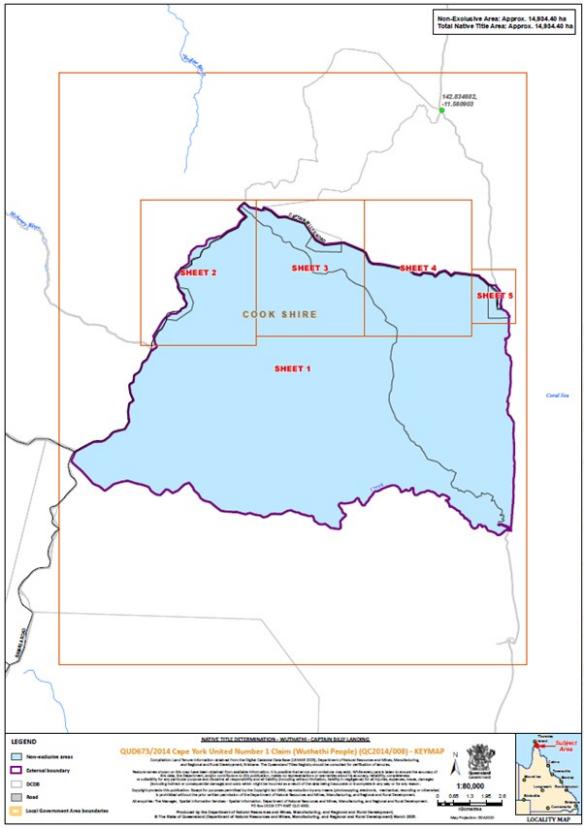
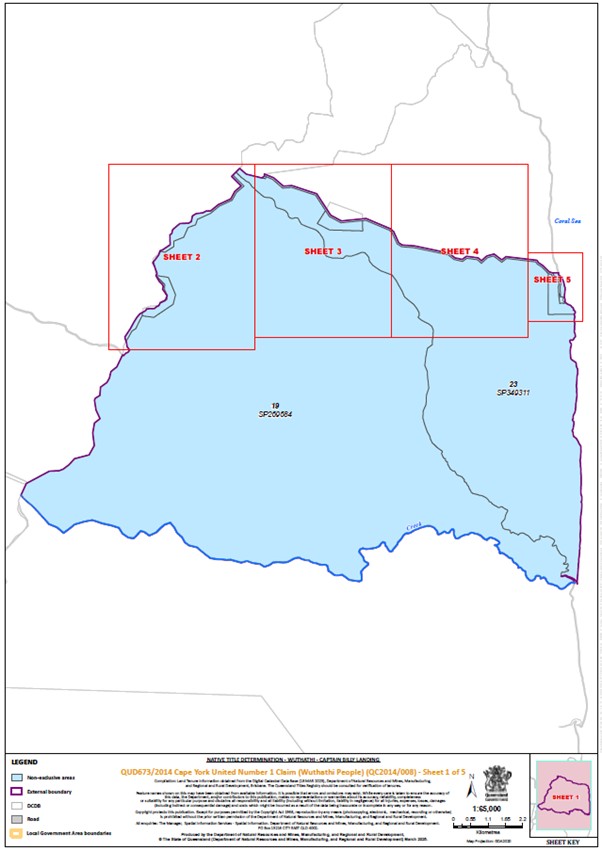
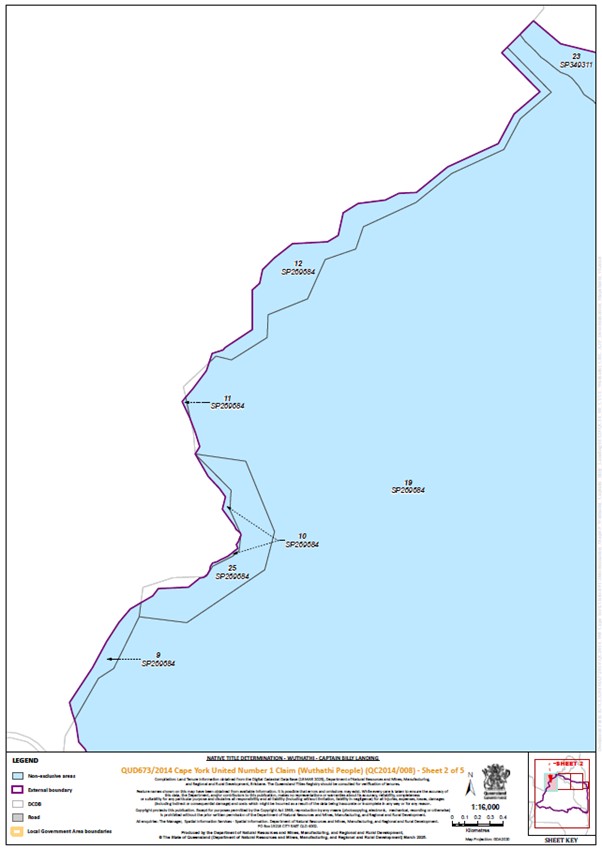
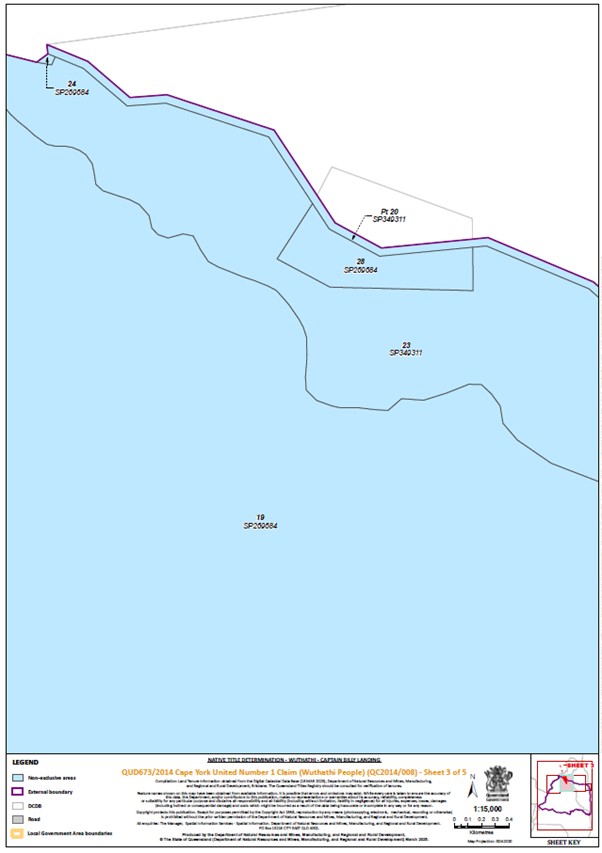
Catchwords: | NATIVE TITLE – consent determination – nomination of prescribed bodies corporate |
Legislation: | Native Title Act 1993 (Cth), ss 13, 47C, 56, 57, 61, 66, 87A, 199C, 212 |
Cases cited: | Drury on behalf of the Nanda People v State of Western Australia [2018] FCA 1849 Ross on behalf of the Cape York United #1 Claim Group v State of Queensland (No 2) (Kuuku Ya’u determination) [2021] FCA 1464 Ross on behalf of the Cape York United #1 Claim Group v State of Queensland (No 3) (Uutaalnganu (Night Island) determination) [2021] FCA 1465 Ross on behalf of the Cape York United #1 Claim Group v State of Queensland (No 10) [2022] FCA 1129 Taylor on behalf of the Yamatji Nation Claim v State of Western Australia [2020] FCA 42 Wuthathi People #2 v State of Queensland [2015] FCA 380 |
Division: | General Division |
Registry: | Queensland |
National Practice Area: | Native Title |
Number of paragraphs: | 46 |
Date of hearing: | 24 October 2025 |
Counsel for the Applicant: | Mr D O’Gorman SC with Mr D M Yarrow SC |
Solicitor for the Applicant: | Cape York Land Council Aboriginal Corporation |
Counsel for the First Respondent: | Ms C Klease |
Solicitor for the First Respondent: | Crown Law Queensland |
ORDERS
QUD 673 of 2014 | ||
| ||
BETWEEN: | MICHAEL ROSS, SILVA BLANCO, JAMES CREEK, JONATHAN KORKAKTAIN, REGINALD WILLIAMS, WAYNE BUTCHER, CLARRY FLINDERS, PHILIP PORT, HS (DECEASED) Applicant | |
AND: | STATE OF QUEENSLAND First Respondent COMMONWEALTH OF AUSTRALIA (and others named in the Schedule) Second Respondent | |
order made by: | MORTIMER CJ |
DATE OF ORDER: | 24 October 2025 |
BEING SATISFIED that an order in the terms set out below is within the power of the Court, and it appearing appropriate to the Court to do so, pursuant to s 87A of the Native Title Act 1993 (Cth)
THE COURT NOTES THAT:
A. The Wuthathi Captain Billy Landing Land Transfer ILUA (QI2025/001) was registered on the Register of Indigenous Land Use Agreements on 3 July 2025 and provides for, among other things, the dedication of the following areas within the Determination Area as national park (Cape York Peninsula Aboriginal Land) under the Nature Conservation Act 1992 (Qld):
(a) Lot 19 on SP269684; and
(b) Lot 20 on SP349311,
(together, the park areas).
B. Having regard to the need to balance the limited availability of public resources with the competing need to resolve applications for a determination of native title in an efficient, cost effective and timely manner, the parties agree that the question of whether s 47C of the Native Title Act 1993 (Cth) would apply to any existing or future park area within the External Boundary will be addressed after the matter has proceeded to determination.
C. The Wuthathi People (being the proposed native title holders described in Schedule 1 of the determination) have indicated a desire to enter into negotiations with the State of Queensland (the State) in relation to whether s 47C of the Native Title Act 1993 (Cth) would have application to the park areas (after they become national park (Cape York Peninsula Aboriginal Land)).
D. Subject to paragraph E below, the parties agree that, if agreement is reached in accordance with s 47C(1)(b) of the Native Title Act 1993 (Cth) that s 47C is applicable to the park areas, the parties would not oppose an application being brought on behalf of the Wuthathi Aboriginal Corporation RNTBC (ICN 7157) pursuant to ss 13(1)(b) and (5) of the Native Title Act 1993 (Cth) to vary the determination in relation to the park areas within the Determination Area for which agreement is reached regarding the application of s 47C of the Native Title Act 1993 (Cth).
E. The agreement of the parties in paragraph D above not to oppose an application being brought to vary the determination in relation to the park areas, is subject to the Applicant and the State having reached agreement on the nature and extent of the native title rights and interests that would be determined to exist in relation to the park areas, and any other relevant matters.
F. The Applicant agrees that the areas listed in Schedule 5 are areas where native title has been wholly extinguished.
THE COURT ORDERS THAT:
1. There be a determination of native title in the terms proposed in these orders, despite any actual or arguable defect in the authorisation of the applicant to seek and agree to a consent determination pursuant to s 87A of the Native Title Act 1993 (Cth).
BY CONSENT THE COURT ORDERS THAT:
2. There be a determination of native title in the terms set out below (the Determination).
3. Each party to the proceedings is to bear its own costs.
BY CONSENT THE COURT DETERMINES THAT:
DEFINITIONS AND INTERPRETATION
4. In this Determination, unless the contrary intention appears:
“Animal” has the meaning given in the Nature Conservation Act 1992 (Qld); “External Boundary” means the area described in Schedule 3; "High Water Mark" means the ordinary high-water mark at spring tides; |
"land" has the same meaning as in the Native Title Act 1993 (Cth); |
"Laws of the State and the Commonwealth" means the common law and the laws of the State of Queensland and the Commonwealth of Australia, and includes legislation, regulations, statutory instruments, local planning instruments and local laws; “Local Government Area” has the meaning given in the Local Government Act 2009 (Qld); “Native Title Determination Application” means the Cape York United #1 native title claim filed on 11 December 2014 in QUD 673 of 2014; |
"Natural Resources" means: (a) an Animal, a Plant, or any other non-human life form; and (b) inorganic material; but does not include: (c) Animals that are the private personal property of any person; (d) crops that are the private personal property of another; (e) minerals as defined in the Mineral Resources Act 1989 (Qld); and (f) petroleum as defined in the Petroleum Act 1923 (Qld) and the Petroleum and Gas (Production and Safety) Act 2004 (Qld); |
“Plant” has the meaning given in the Nature Conservation Act 1992 (Qld); “Register of Indigenous Land Use Agreements” has the same meaning as in the Native Title Act 1993 (Cth); “Reserve” means a reserve dedicated, or taken to be a reserve, under the Land Act 1994 (Qld); “Spouse” has the meaning given in the Acts Interpretation Act 1954 (Qld); "Water" means: (a) water which flows, whether permanently or intermittently, within a river, creek, or stream; (b) any natural collection of water, whether permanent or intermittent; (c) water from an underground water source; and (d) tidal water; and “waters” has the same meaning as in the Native Title Act 1993 (Cth). Other words and expressions used in this Determination have the same meanings as they have in Part 15 of the Native Title Act 1993 (Cth). |
5. The determination area is the land and waters described in Schedule 4 and depicted in the map attached to Schedule 6 to the extent those areas are within the External Boundary and are not otherwise excluded by the terms of Schedule 5 (the Determination Area). To the extent of any inconsistency between the written description and the map, the written description prevails.
6. Native title exists in the Determination Area.
7. The native title is held by the Wuthathi People described in Schedule 1 (the Native Title Holders).
8. Subject to orders 8, 9 and 10 below the nature and extent of the native title rights and interests in relation to the Determination Area are the non-exclusive rights to:
(a) access, be present on, move about on and travel over the area;
(b) live and camp on the area and for those purposes to erect shelters and other structures thereon;
(c) hunt, fish and gather on the land and waters of the area;
(d) take the Natural Resources from the land and waters of the area;
(e) take the Water of the area for personal, domestic and non-commercial communal purposes;
(f) be buried and to bury Native Title Holders within the area;
(g) maintain places of importance and areas of significance to the Native Title Holders under their traditional laws and customs on the area and protect those places and areas from harm;
(h) teach on the area the physical and spiritual attributes of the area and the traditional laws and customs of the Native Title Holders to other Native Title Holders or persons otherwise entitled to access the area;
(i) hold meetings on the area;
(j) conduct ceremonies on the area;
(k) light fires on the area for cultural, spiritual or domestic purposes including cooking, but not for the purpose of hunting or clearing vegetation; and
(l) be accompanied on to the area by those persons who, though not Native Title Holders, are:
(i) Spouses of Native Title Holders;
(ii) people who are members of the immediate family of a Spouse of a Native Title Holder; or
(iii) people reasonably required by the Native Title Holders under traditional law and custom for the performance of ceremonies or cultural activities on the area.
9. The native title rights and interests are subject to and exercisable in accordance with:
(a) the Laws of the State and the Commonwealth; and
(b) the traditional laws acknowledged and traditional customs observed by the Native Title Holders.
10. The native title rights and interests referred to in order 7 do not confer possession, occupation, use or enjoyment to the exclusion of all others.
11. There are no native title rights in or in relation to minerals as defined by the Mineral Resources Act 1989 (Qld) and petroleum as defined by the Petroleum Act 1923 (Qld) and the Petroleum and Gas (Production and Safety) Act 2004 (Qld).
12. The nature and extent of any other interests in relation to the Determination Area (or respective parts thereof) are set out in Schedule 2.
13. The relationship between the native title rights and interests described in order 7 and the other interests described in Schedule 2 (the Other Interests) is that:
(a) the Other Interests continue to have effect, and the rights conferred by or held under the Other Interests may be exercised notwithstanding the existence of the native title rights and interests;
(b) to the extent the Other Interests are inconsistent with the continued existence, enjoyment or exercise of the native title rights and interests in relation to the land and waters of the Determination Area, the native title rights and interests continue to exist in their entirety but the native title rights and interests have no effect in relation to the Other Interests to the extent of the inconsistency for so long as the Other Interests exist; and
(c) the Other Interests and any activity that is required or permitted by or under, and done in accordance with, the Other Interests, or any activity that is associated with or incidental to such an activity, prevail over the native title rights and interests and any exercise of the native title rights and interests.
THE COURT DETERMINES THAT:
14. The native title is held in trust.
15. The Wuthathi Aboriginal Corporation RNTBC (ICN: 7157), incorporated under the Corporations (Aboriginal and Torres Strait Islander) Act 2006 (Cth), is to:
(a) be the prescribed body corporate for the purpose of ss 56(2)(b) and 56(3) of the Native Title Act 1993 (Cth); and
(b) perform the functions mentioned in s 57(1) of the Native Title Act 1993 (Cth) after becoming a registered native title body corporate.
Note: Entry of orders is dealt with in Rule 39.32 of the Federal Court Rules 2011.
LIST OF SCHEDULES
Schedule 1 – Native Title Holders viii
Schedule 2 – Other Interests in the Determination Area ix
Schedule 3 – External Boundary xiii
Schedule 4 – Description of Determination Area xv
Schedule 5 – Areas Not Forming Part of the Determination Area xvii
Schedule 6 – Map of Determination Area xix
Schedule 1 – Native Title Holders
The Native Title Holders are the Wuthathi People. The Wuthathi People are those Aboriginal persons who are descended by birth, or by adoption in accordance with the traditional laws acknowledged and the traditional customs observed by the Wuthathi People, from one or more of the following apical ancestors:
(a) Johnson Moreton;
(b) Frank Wilson;
(c) Ida “Waterbag” Temple;
(d) Moe Rie Warren;
(e) Annie (Athanamu) Punda;
(f) Pintharra;
(g) Innis Pascoe;
(h) Dinah;
(i) Ada Lancaster;
(j) Nara Jira Para;
(k) Ela (Illa); or
(l) Eliza (wife of Tom Ware).
Schedule 2 – Other Interests in the Determination Area
The nature and extent of the other interests in relation to the Determination Area are the following as they exist as at the date of the Determination:
1. The rights and interests of the parties under the Wuthathi Captain Billy Landing Land Transfer ILUA (QI2025/001) registered on the Register of Indigenous Land Use Agreements on 3 July 2025.
2. The rights and interests granted or available to RTA Weipa Pty Ltd (ACN 137 266 285) (and any successors in title) under the Comalco Agreement, including, but not limited to, rights and interests in relation to the “bauxite field” (as defined in clause 1 of the Comalco Agreement) and areas adjacent to or in the vicinity or outside of such bauxite field, where:
(a) “Comalco Act” means the Commonwealth Aluminium Corporation Pty Limited Agreement Act 1957 (Qld); and
(b) “Comalco Agreement” means the agreement in Schedule 1 to the Comalco Act, including as amended in accordance with such Act.
3. The rights and interests of Cook Shire Council:
(a) under its local government jurisdiction and functions under the Local Government Act 2009 (Qld), under the Stock Route Management Act 2002 (Qld) and under any other legislation, for that part of the Determination Area within the area declared to be its Local Government Area:
(b) as the:
(i) lessor under any leases which were validly entered into before the date on which these orders are made and whether separately particularised in these orders or not;
(ii) grantor of any licences or other rights and interests which were validly granted before the date on which these orders were made and whether separately particularised in these orders or not;
(iii) party to an agreement with a third party which relates to land or waters in the Determination Area; and
(iv) holder of any estate or any other interest in land, including as trustee of any Reserves, under access agreements and easements that exist in the Determination Area;
(c) as the owner and operator of infrastructure, structures, earthworks, access works and any other facilities and other improvements located in the Determination Area validly constructed or established on or before the date on which these orders are made, including but not limited to any:
(i) undedicated but constructed roads except for those not operated by the council;
(ii) water pipelines and water supply infrastructure;
(iii) drainage facilities;
(iv) watering point facilities;
(v) recreational facilities;
(vi) transport facilities;
(vii) gravel pits operated by the council;
(viii) cemetery and cemetery related facilities; and
(ix) community facilities; and
(d) to enter the land for the purposes described in paragraphs 3(a), (b) and (c) above by its employees, agents or contractors to:
(i) exercise any of the rights and interests referred to in this paragraph 3 and paragraph 4 below;
(ii) use, operate, inspect, maintain, replace, restore and repair the infrastructure, facilities and other improvements referred to in paragraph 3(c) above; and
(iii) undertake operational activities in its capacity as a local government such as feral animal control, erosion control, waste management and fire management.
4. The rights and interests of the State of Queensland and Cook Shire Council to access, use, operate, maintain and control the dedicated roads in the Determination Area and the rights and interests of the public to use and access the roads.
5. The rights and interests of the State of Queensland in Reserves, the rights and interests of the trustees of those Reserves and the rights and interests of the persons entitled to access and use those Reserves for the respective purpose for which they are reserved.
6. The rights and interests of the State of Queensland or any other person existing by reason of the force and operation of the laws of the State of Queensland, including those existing by reason of the following legislation or any regulation, statutory instrument, declaration, plan, authority, permit, lease or licence made, granted, issued or entered into under that legislation:
(a) the Aboriginal Land Act 1991 (Qld);
(b) the Fisheries Act 1994 (Qld);
(c) the Land Act 1994 (Qld);
(d) the Nature Conservation Act 1992 (Qld);
(e) the Forestry Act 1959 (Qld);
(f) the Water Act 2000 (Qld);
(g) the Petroleum Act 1923 (Qld) or Petroleum and Gas (Production and Safety) Act 2004 (Qld);
(h) the Mineral Resources Act 1989 (Qld);
(i) the Planning Act 2016 (Qld);
(j) the Transport Infrastructure Act 1994 (Qld); and
(k) the Fire and Emergency Services Act 1990 (Qld) or Ambulance Service Act 1991 (Qld).
7. The rights and interests of members of the public arising under the common law, including but not limited to the following:
(a) any subsisting public right to fish; and
(b) the public right to navigate.
8. So far as confirmed pursuant to s 212(2) of the Native Title Act 1993 (Cth) and s 18 of the Native Title (Queensland) Act 1993 (Qld) as at the date of this determination, any existing rights of the public to access and enjoy the following places in the Determination Area:
(a) waterways;
(b) beds and banks or foreshores of waterways;
(c) coastal waters;
(d) stock routes;
(e) beaches; and
(f) areas that were public places at the end of 31 December 1993.
9. Any other rights and interests:
(a) held by the State of Queensland or Commonwealth of Australia; or
(b) existing by reason of the force and operation of the Laws of the State and the Commonwealth.
Schedule 3 – External Boundary
The area of land and waters:
Commencing at the north eastern corner of Lot 21 on SP349311, also being a point on the High Water Mark and the southern external boundary of the Gudang Yadhaykenu Native Title Determination (QCD2022/011); then generally southerly along that High Water Mark until the intersection with the southern boundary of an unnamed creek at Latitude 11.712939° South; then westerly along the southern boundary of that creek until the intersection with the northern external boundary of the Wuthathi People #2 Native Title Determination (QCD2015/005), also being the northern boundary of Lot 20 on SP189951; then generally westerly along the northern boundary of that determination and lot until the intersection with the south western corner of Lot 19 on SP269684, also being the eastern boundary of the Atambaya People Native Title Determination (QCD2022/010) and the Great Dividing Range; then generally northerly along the western boundary of that Lot, also being the eastern boundary of that determination and the Great Dividing Range, until the south eastern corner of Lot 26 on SP189913; then generally northerly along the eastern boundary of the same determination and the Great Dividing Range, until the intersection with the western corner of Lot 19 on SP269684 at Longitude 142.76146° East, Latitude 11.596308° South, identified as Station S on that Survey Plan; then north easterly along the north western boundary of that lot and the north western boundary of Lot 23 on SP349311, also being the eastern boundary of the same determination, until the intersection with the south western corner of the Gudang Yadhaykenu Native Title Determination (QCD2022/011), also being the south western corner of Lot 13 on SP269684; then south easterly along the southern boundary of that determination until the commencement point, also described as:
south easterly along the southern boundary of Lot 13 on SP269684 to the south western corner of Lot 24 on SP269684; then north-easterly along the western boundary of that lot to a western corner of Lot 20 on SP349311; then north westerly crossing the Captain Billy Landing Road to the western most corner of Lot 22 on SP269684; then generally easterly along the southern boundary of that lot and Lot 27 on SP269684 following the northern side of Captain Billy Landing Road, until the intersection with the north-western corner of Lot 21 on SP349311; then easterly along the northern boundary of that lot until the commencement point.
(All Subject to Survey)
Data Reference and source
Cadastral data sourced from Department of Resources, Qld (March 2025).
Native title determinations sourced from the Commonwealth of Australia, NNTT (March 2025).
Reference datum
Geographical coordinates are referenced to the Geocentric Datum of Australia 1994 (GDA94), in decimal degrees.
Use of Coordinates
Where coordinates are used within the description to represent cadastral or topographical boundaries or the intersection with such, they are intended as a guide only. As an outcome to the custodians of cadastral and topographic data continuously recalculating the geographic position of their data based on improved survey and data maintenance procedures, it is not possible to accurately define such a position other than by detailed ground survey.
Schedule 4 – Description of Determination Area
The determination area comprises all of the land and waters described by lots on plan, or relevant parts thereof, and any rivers, streams, creeks or lakes described in the first column of the table immediately below and depicted in light blue on the maps in Schedule 6, to the extent those areas are within the External Boundary and not otherwise excluded by the terms of Schedule 5.
Area description (at the time of the Determination) | Determination Map Sheet Reference |
Lot 9 on SP269684 | Sheet 2 |
Lot 10 on SP269684 | Sheet 2 |
Lot 11 on SP269684 | Sheet 2 |
Lot 12 on SP269684 | Sheet 2 |
Lot 19 on SP269684 | Sheets 1, 2, 3 and 4 |
Lot 24 on SP269684 | Sheet 3 |
Lot 25 on SP269684 | Sheet 2 |
Lot 28 on SP269684 | Sheet 3 |
Lot 35 on SP269684 | Sheet 5 |
That part of Lot 20 on SP349311 excluding an area covered by former Portion 2 on Plan JD2 | Sheets 3,4,5 |
Lot 21 on SP349311 | Sheet 5 |
Lot 23 on SP349311 | Sheets 1, 3, 4 and 5 |
Lot 350 on SP349311 | Sheet 5 |
Save for any waters forming part of a lot on plan, all rivers, creeks, streams and lakes within the External Boundary described in Schedule 3 |
Schedule 5 – Areas Not Forming Part of the Determination Area
The following areas of land and waters are excluded from the Determination Area as described in Schedule 4:
1. Those land and waters within the External Boundary which at the time the native title determination application was made were, or had been, the subject of one or more Previous Exclusive Possession Acts, within the meaning of s 23B of the Native Title Act 1993 (Cth), as they could not be claimed in accordance with s 61A of the Native Title Act 1993 (Cth).
2. Specifically, and to avoid any doubt, the land and waters described in (1) above includes:
(a) the Previous Exclusive Possession Acts described in ss 23B(2) and 23B(3) of the Native Title Act 1993 (Cth) to which s 20 of the Native Title (Queensland) Act 1993 (Qld) applies, and to which none of ss 47, 47A or 47B of the Native Title Act 1993 (Cth) applied, including, but not limited to the whole of the land and waters described as that part of Lot 20 on SP269684 subject to former Portion 2 on Plan JD2; and
(b) the land and waters on which any public work, as defined in s 253 of the Native Title Act 1993 (Cth), is or was constructed, established or situated, and to which ss 23B(7) and 23C(2) of the Native Title Act 1993 (Cth) and to which s 21 of the Native Title (Queensland) Act 1993 (Qld), applies, together with any adjacent land or waters in accordance with s 251D of the Native Title Act 1993 (Cth).
3. Those land and waters within the External Boundary that were excluded from the Native Title Determination Application on the basis that, at the time of the Native Title Determination Application, they were an area where native title rights and interests had been wholly extinguished, and to which none of ss 47, 47A or 47B of the Native Title Act 1993 (Cth) applied, including, but not limited to:
(a) any area where there had been an unqualified grant of an estate in fee simple which wholly extinguished native title rights and interests; and
(b) any area over which there was an existing dedicated public road which wholly extinguished native title rights and interests.
4. Those land and waters within the External Boundary on which, at the time the Native Title Determination Application was made, public works were validly constructed, established or situated after 23 December 1996, where s 24JA of the Native Title Act 1993 (Cth) applies, and which wholly extinguished native title.
5. Those land and waters within the External Boundary which, at the time the Native Title Determination Application was made, were the subject of one or more Pre-existing Rights Based Acts, within the meaning of s 24IB of the Native Title Act 1993 (Cth), which wholly extinguished native title.
Schedule 6 – Map of Determination Area
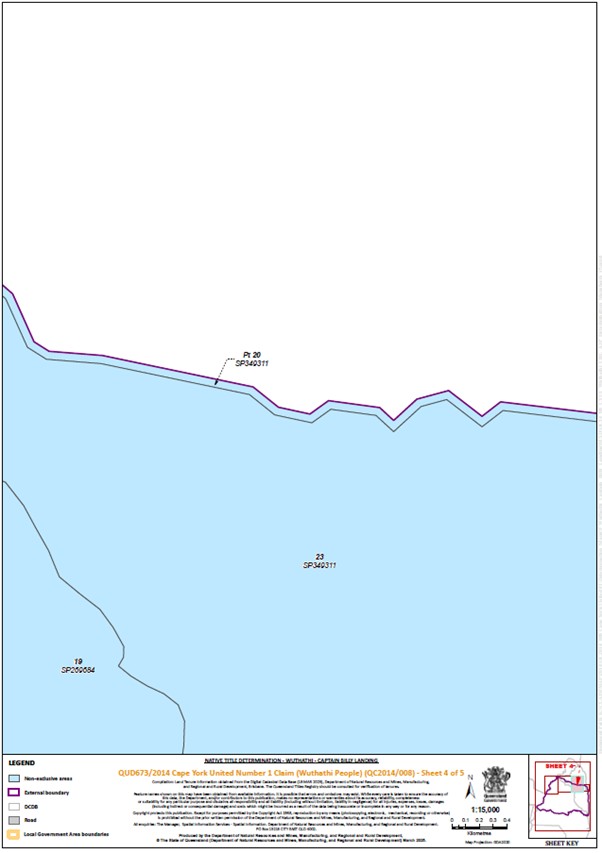
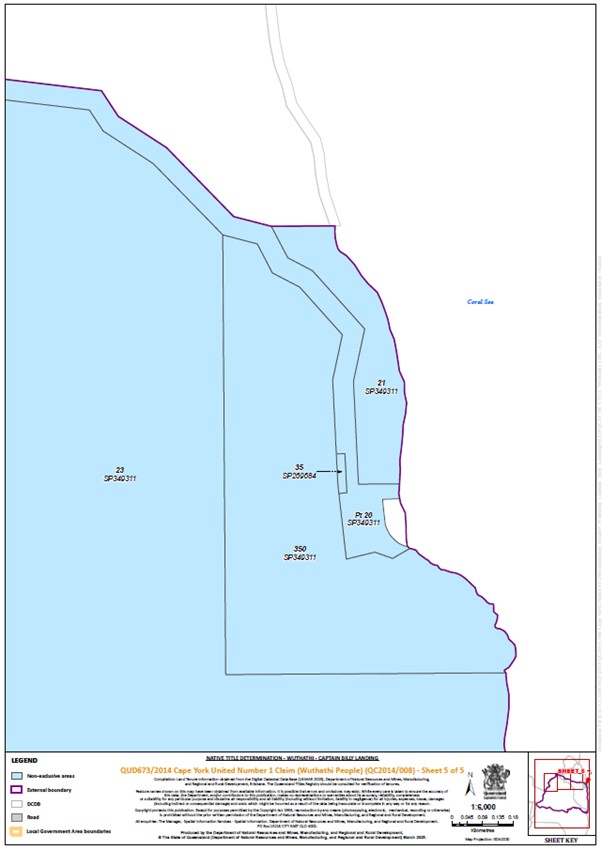
REASONS FOR JUDGMENT
MORTIMER CJ:
INTRODUCTION
1 The parties have sought a determination of native title under s 87A of the Native Title Act 1993 (Cth), with associated orders, recognising the native title of the Wuthathi People in what is known in these proceedings as the Captain Billy Landing area. This determination is being made the day after two determinations recognising the native title of the Yiithuwarra People and Guugu Yimidhirr People Respectively. Two other determinations will be made on the papers in the coming weeks, including a determination for the Wuthathi People over what has been described as the Wuthathi Identified Parcels determination (collectively, with this determination, the Wuthathi determinations). These “parcels” determinations are collections of areas which have been, for one reason or another, left out of previous determinations.
2 Together, these determinations form the eighth tranche of determinations made in the Cape York United #1 proceeding, with the first tranche having been made in November 2021.
3 The Wuthathi determinations will be the second and third consent determinations in this Court for the Wuthathi People, following the judgment of Greenwood J in Wuthathi People #2 v State of Queensland [2015] FCA 380. That judgment contains a description of the Wuthathi People’s long road to recognition of their traditional country, as well as the post-colonial history of some of that country.
4 The shorthand description for this current determination is the “Captain Billy Landing” determination. That is clearly a post-colonial name. The expert material filed discloses that historical records locate Wuthathi People at “Captain Billy Creek”, the northern end of what is now considered Wuthathi country. The “landing” part refers to a boat ramp. Dr Thompson’s report in the s 87A material (see [20(c)] below) records:
Historical records of Kennedy and Jack’s explorations clearly locate Aboriginal people at Captain Billy Creek as noted in the Wuthathi #2 Report (2006:49; 50-51). From the Wuthathi claim to territory north of the determination area up to the agreed boundary with their northern neighbour, and from their knowledge, possession and defence of this region, it can be inferred that the Aboriginal people and signs of their activity that Kennedy and Jack encountered, belonged to the Wuthathi people.
Near Captain Billy Creek [at the northern end of what is now considered Wuthathi territory] they encountered signs of ‘plenty of blacks’, evident in their camps, tracks and smoke (Jack 1921:228-232).
Reaching Captain Billy Creek (the northern boundary of Wuthathi country) Jack followed it towards the sea, and encountered ‘a large number of natives, including many women and children’. In the morning, they visited Jack, speaking a pidgin English, and the leading man introduced himself as ‘Captain Billy’. Guided to the mouth by these Aborigines, Jack noted a ‘very fine large outrigger canoe’. Crossing they proceeded north along the beach, followed by Aborigines armed with spears, including a ‘large canoe, containing five or six men’. Billy again approached them, offering to trade fish. They continued to be followed by armed men, and at Camisade Creek they fired upon what they saw as a hostile party (Jack 1921:589-593)
5 Four affidavits of Wuthathi people are relied on by the applicant in this proceeding. Two of those, the affidavit of Johnson Chippendale dated 15 December 2021, and the affidavit of Richard Francis Ah Mat dated 20 October 2021, were given by Wuthathi men who were, at the time of making the affidavits, members of the Cape York United #1 claim group. The other two, affidavits of Phillip Robert Wallis dated 1 June 2007 and Ray Douglas Wallis dated 6 September 2006, predate the current claim and were prepared for the earlier Wuthathi People #2 claim.
6 Mr Chippendale is a Wuthathi Elder and a Director of the Wuthathi Corporation. He is an initiated man. He describes how he holds rights in Wuthathi country:
I am a descendant of Frank Wilson, a listed Wuthathi apical ancestor. Frank Wilson is my great grandfather. I come to Wuthathi through my mother's father's father's side. We call ourselves Malkan or sand beach people.
7 As he also explains an important boundary for Wuthathi and how he understands Wuthathi are connected to the Olive River:
The Great Dividing Range is an important boundary of Wuthathi country. Wuthathi country only begins where the watershed forms on the eastern side of the Great Dividing Range.
Our connection to the headwaters of Olive River is through our story of the eastern grey kangaroo
8 Mr Chippendale describes life on the Bare Hill Mission, and gives some evidence which is tragically typical of narratives in Cape York, about loss of language:
Lots of people at the Mission refused to be relocated to Bamaga at that time. The Missions weren't good, they didn't let us use our Wuthathi language. It was hard to communicate with other clans living at the mission, so the superintendent decided that it was forbidden to use native language, except for the Umpila, Kaanju and Kuuku Ya'u languages. That's why we only have about 200 Wuthathi words left.
9 Like Mr Ah Mat (see below), Mr Chippendale also describes difficulties in accessing country during pastoral times.
10 Mr Chippendale describes Wuthathi totems, and how resources on country are used, and what markings on trees, which he describes as scar trees, can tell people about the animals which are in the area, or whether there are sites close by. He also describes traditional burning practices:
In the open woodland area of our country … we used to practice burning to get all the animals in the same place. The old people would then come with woomeras or spears and get them after the burning. Between the Richardson Range and the Great Diving Range … is special. It's like a supermarket there. There is lots of food because it is a plateau so all the animals congregate there. This is an area where we burn. You can't burn everywhere on our country. You can't light fires to move the animals to a certain place in the swamp lands closer to the coast because it's too wet to light a fire. There are also rules about burning and when you can burn. You can only burn on your own country, there are big problems if you don't follow this rule.
There are only certain times of the year we are allowed to burn. In some areas of land toward the Great Dividing Range you have thick spiky grass, it will jab you. Usually you burn this a bit later in the year. This thick spikey grass usually has water underneath so you need to leave it until October to dry out.
We don't burn by the coast much because its turkey bush and the land is wet. We can't burn on sand dunes … The sand dunes need the turkey bush to hold their structure. Burning needs to be close the range, like between the Richardson Range and Great Dividing Range. That's a good place to burn.
Wuthathi also burn fires for sustainability as well. We light fires in certain places to direct the animals for hunting, but also so the animals have places to stay safe if a wildfire comes through. They can take shelter in the areas that are already burnt out. Burning is also about looking after country.
11 There are many narratives in Mr Chippendale’s affidavit, and the whole document bears re-reading. I conclude with this extract:
It was hard for our Elders who were removed from their country and sent to the missions, to practice their lore and culture on other people's country. Even though it was hard Wuthathi people held their culture strong and practiced culture in secret. I am doing this statement to stand up for Wuthathi country and my culture. I am doing this statement only because I want our native title back on our country. I want our land to go back to our Wuthathi Aboriginal Corporation RNTBC.
12 Mr Ah Mat grew up on Thursday Island, but has rights in Wuthathi country through his “big grandmother”, Nara Jira Para, his grandmother’s mother. Mr Ah Mat says
I was taught about Wuthathi culture by old man Gordon Pablo and my Grandmother, Tidja. Gordon Pablo was a senior Wuthathi man. You never stop learning and you learn as you teach. In our Wuthathi culture it is important to pass on the information about our country and culture to the younger generations.
13 Mr Ah Mat describes how they went to this part of Wuthathi country by dinghy (from Bolt Head) as well as overland.
We would take the dingy from there to the mouth of the Olive River. We would go all the way inland, up the Olive River. On the east coast there are south east winds all the time, so we can only go when the wind dies down. From the mouth of Olive River we would travel at least two hours up the Olive River. We would hunt dugong, turtle and crayfish during these trips. We would use spears to hunt. We hunted there because we had heard stories from the Elders that seafood was plentiful, so we had permission to go there. We would go and get our supply for Christmas. October is the best time for seafood around, especially at the start of the full moon.
14 He also describes some difficulties in securing access to country, and which groups are Wuthathi neighbours – Northern Kaanju to the south, and Gudang Yadhaykenu to the north.
15 Evidence such as that from Mr Chippendale and Mr Ah Mat forms part of the material upon which the parties submit there is a credible basis for the proposition that the Wuthathi Native Title Group has maintained their connection to the Captain Billy Landing area under their traditional laws and customs since prior to sovereignty.
16 The Court is satisfied that all of the requirements of the Native Title Act have been met, that it is appropriate to make the orders sought and that it is within the power of the Court to do so.
THE MATERIAL BEFORE THE COURT
17 This application for consent determination was supported by a principal set of submissions filed by the applicant on 12 September 2025. The State also filed submissions on 19 September 2025. Each set of submissions addressed both of the Wuthathi Determinations.
18 The applicant relied on three affidavits dealing with matters relevant to the determinations. First, an affidavit of Mr Parkinson Wirrick dated 12 September 2025 (Wirrick Process affidavit). Second, paragraphs [5] to [30] of an affidavit filed earlier in these proceedings by Ms Kirstin Malyon on 27 October 2021 regarding the re-authorisation process undertaken by the applicant in the period from April to September 2021 (2021 Malyon affidavit). Third, an affidavit of Mr Wirrick dated 15 September 2025 (Wirrick Connection affidavit).
19 Mr Wirrick is the Deputy Principal Legal Officer of the Cape York Land Council, and has carriage of the Cape York United #1 claim. In the Wirrick Process affidavit, he deposes to the process undertaken for determining appropriate group and boundary descriptions for each determination, and describes the way in which the 87A agreements were approved, including pre-authorisation and authorisation meetings. He deposes to how the relevant Prescribed Body Corporates were nominated for the determination areas. He annexes to his affidavit the nomination for each PBC and its consent to act as the relevant PBC for the determination area.
20 In relation to the Wuthathi determinations, the applicant relied on the Wirrick Process Affidavit, which deposed to and annexed the material relied on by the applicant for the purposes of the s 87A agreement and this application:
(a) expert report by Dr David Thompson (Dr Thompson) dated 30 October 2017 and filed 31 October 2017;
(b) expert report by Dr Thompson dated 4 March 2019 and filed 22 October 2021;
(c) supplementary expert report by Dr Thompson dated 1 May 2019 and filed 12 September 2025;
(d) expert report by Dr Natalie Kwok dated November 2017 and filed 16 November 2017;
(e) expert report by Dr Anthony Redmond (Dr Redmond) dated 30 October 2017 and filed 31 October 2017;
(f) expert report by Dr Redmond dated February 2018 and filed 9 February 2018;
(g) expert report by Dr Kate Waters (Dr Waters) dated 5 March 2018 and filed 5 March 2018;
(h) expert report by Dr Waters dated 19 March 2018 and filed 19 March 2018;
(i) affidavit of Richard Francis Ah Mat dated 20 October 2021 and filed 12 September 2025;
(j) witness statement of Francis Brisbane dated 7 December 2018 and filed 21 September 2022;
(k) affidavit of Johnson Chippendale dated 15 December 2021 and filed 12 September 2025;
(l) witness statement of Meun Lifu dated 17 December 2018 and filed 21 September 2022;
(m) witness statement of Trevor Lifu dated 17 December 2018 and filed 21 September 2022;
(n) affidavit of Phillip Robert Wallis dated 1 June 2007 and filed 12 September 2025; and
(o) affidavit of Ray Douglas Wallis dated 6 September 2006 and filed 12 September 2025.
PROCEDURAL HISTORY
21 The Cape York United #1 claim was filed in this Court in December 2014. It covers various types of tenure, including pastoral leases, protected areas, reserves and areas of unallocated State land. It is the largest native title claim currently before the Court, and covers most of the undetermined parts of Cape York.
22 The complex procedural history and nature of the Cape York United #1 claim is summarised in the Court’s reasons for the Kuuku Ya’u and Uutaalnganu (Night Island) determinations made in November 2021: Ross on behalf of the Cape York United #1 Claim Group v State of Queensland (No 2) (Kuuku Ya’u determination) [2021] FCA 1464 at [3], [12]-[19], [30]-[37]; Ross on behalf of the Cape York United #1 Claim Group v State of Queensland (No 3) (Uutaalnganu (Night Island) determination) [2021] FCA 1465 at [3], [13]-[20], [28]-[35].
23 Since that first tranche of two consent determinations, six further tranches of consent determinations have been made. These were:
(a) In July 2022: Ross on behalf of the Cape York United #1 Claim Group v State of Queensland (No 6) (Northern Kaanju determination) [2022] FCA 770; Ross on behalf of the Cape York United #1 Claim Group v State of Queensland (No 7) (Southern Kaantju determination) [2022] FCA 771; Ross on behalf of the Cape York United #1 Claim Group v State of Queensland (No 8) (Ayapathu determination) [2022] FCA 772; and Ross on behalf of the Cape York United #1 Claim Group v State of Queensland (No 9) (Lama Lama determination) [2022] FCA 773.
(b) In October 2022: Ross on behalf of the Cape York United #1 Claim Group v State of Queensland (No 11) (Atambaya determination) [2022] FCA 1176; Ross on behalf of the Cape York United #1 Claim Group v State of Queensland (No 12) (Gudang Yadhaykenu determination) [2022] FCA 1177; and Ross on behalf of the Cape York United #1 Claim Group v State of Queensland (No 13) (NCY#2 independent parcels determination) [2022] FCA 1178.
(c) In July 2023: Ross on behalf of the Cape York United #1 Claim Group v State of Queensland (No 14) (Taepithiggi determination) [2023] FCA 731; Ross on behalf of the Cape York United #1 Claim Group v State of Queensland (No 15) (Weipa Peninsula People determination) [2023] FCA 732; Ross on behalf of the Cape York United #1 Claim Group v State of Queensland (No 16) (Central West Wik determination) [2023] FCA 733; Ross on behalf of the Cape York United #1 Claim Group v State of Queensland (No 17) (Umpila determination) [2023] FCA 734; and Ross on behalf of the Cape York United #1 Claim Group v State of Queensland (No 18) (Atambaya #2 determination) [2023] FCA 735.
(d) In November 2023: Ross on behalf of the Cape York United #1 Claim Group v State of Queensland (No 19) (Kuku Warra determination) [2023] FCA 1314; Ross on behalf of the Cape York United #1 Claim Group v State of Queensland (No 20) (Thaypan determination) [2023] FCA 1315; Ross on behalf of the Cape York United #1 Claim Group v State of Queensland (No 21) (Possum determination) [2023] FCA 1316; and Ross on behalf of the Cape York United #1 Claim Group v State of Queensland (No 22) (Wik and Wik Way independent parcels determination) [2023] FCA 1317.
(e) In July 2024: Ross on behalf of the Cape York United #1 Claim Group v State of Queensland (No 24) (Olkola determination) [2024] FCA 740; Ross on behalf of the Cape York United #1 Claim Group v State of Queensland (No 25) (Kunjen Olkol determination) [2024] FCA 741; Ross on behalf of the Cape York United #1 Claim Group v State of Queensland (No 26) (Kowanyama People #2 determination) [2024] FCA 742; Ross on behalf of the Cape York United #1 Claim Group v State of Queensland (No 27) (Kowanyama People #3 identified parcels determination) [2024] FCA 743; Ross on behalf of the Cape York United #1 Claim Group v State of Queensland (No 28) (Kunjen Olkol and Kowanyama People jointly held area determination) [2024] FCA 744; Ross on behalf of the Cape York United #1 Claim Group v State of Queensland (No 29) (Kunjen Olkol and Olkola jointly held area determination) [2024] FCA 745; Ross on behalf of the Cape York United #1 Claim Group v State of Queensland (No 30) (Kowanyama People, Kunjen Olkol and Olkola jointly held area determination) [2024] FCA 746; and Ross on behalf of the Cape York United #1 Claim Group v State of Queensland (No 31) (Southern Kaantju #2 determination) [2024] FCA 747.
(f) In November 2024: Ross on behalf of the Cape York United #1 Claim Group v State of Queensland (No 32) (Central West Wik People and Northern Kaanju People overlap area - Part of Lot 2 on SP140870 determination) [2024] FCA 1360.
The authorisation of the Cape York United #1 applicant
24 The applicant’s general authority to enter into the s 87A agreement for the determination area stems from the re-authorisation process which occurred in the Cape York United #1 claim proceeding between April and September 2021. This process is described in the 2021 Malyon affidavit, and the Court described and endorsed it in the Kuuku Ya’u determination at [30]–[37] and the Uutaalnganu determination at [28]–[35].
25 In the Kuuku Ya’u determination at [38]–[50] and the Uutaalnganu determination at [36]–[48], I explained why I considered it also appropriate to make orders under s 84D(4) of the Native Title Act to deal with any uncertainty arising from differences between the claim group description in the original Cape York United #1 application and those in the proposed s 87A determination at a more local level, in light of the change in the way the claim was proceeding and the re-authorisation process.
26 Those orders were made under s 84D(4) out of an abundance of caution and to avoid any doubt about the validity of the s 87A determinations. At [50] in the Kuuku Ya’u determination and [48] in the Uutaalnganu determination, I said:
It is plainly in the interests of the administration of justice to do so, in circumstances where the overall Cape York United #1 claim is gargantuan, and has already consumed seven years’ worth of resources, mostly sourced from public funds. Substantial, dedicated and methodical efforts have been made to comply with the requirements of the Native Title Act in each step along the way to these first two determinations. Despite significant factual and legal challenges, the two key parties have navigated a consensual path to the recognition of native title for the Kuuku Ya’u and Uutaalnganu (Night Island) groups. All other respondents have been consulted and given opportunities to participate in the process as it has progressed. They have been included in steps in the complex timetables. All consent to the Kuuku Ya’u and Uutaalnganu (Night Island) determinations. If ever there was a situation in the Court’s native title jurisdiction where a favourable exercise of discretion by the Court is appropriate to ensure resolution of a claim to which all parties agree, this is that situation.
27 Similar orders are sought in this determination. The State agreed with this proposal. I adopt the above reasons in this determination. For the reasons given in the extract above, I continue to consider such orders are appropriate.
AUTHORISATION FOR THE DETERMINATION AREA
28 As in previous s 87A processes in this proceeding, there were two decision-making processes which needed to involve landholding groups: the process to settle boundaries between the Wuthathi people and their neighbours; and the process to settle group description and composition, by identification of apical ancestors. The Wirrick Process affidavit explains these processes in great detail.
29 The Boundary Identification Negotiation and Mediation or “BINM” process was adopted by the applicant, through the CYLC, in April 2020 to deal with the reality existing within the Cape York United #1 claim area that distinctly identifiable groups hold interests in that area: see Kuuku Ya’u determination at [18], [25]-[26] and Uutaalnganu determination at [19], [23]-[24]. The BINM process was adopted only for the Wuthathi Captain Billy’s Landing area, as the Wuthathi Identified Parcels area is entirely surrounded by land where native title was determined to exist in favour of the Wuthathi in Wuthathi People #2: see [28] of the Wirrick Process Affidavit. The BINM process is otherwise set out in the Wirrick Process Affidavit at [30]-[48]. The State acknowledges the importance of the BINM Process, which it describes as “grass roots” and “traditional owner-led”, at [26]-[27] of its submissions.
30 The process occurs as follows. Initial “putative boundary” descriptions were developed by the applicant’s advisors. That information was then considered by traditional owners as part of the fieldwork phase of the BINM Process. The assistance of expert anthropologists and legal advice was made available to representatives of native title groups who participated in the BINM Process.
31 Representatives of the Wuthathi Native Title Group then met with their neighbours at meetings over the course of 21 months between September 2020 and October 2022, and reached agreements as to boundaries. As a consequence, the applicant submits that the agreements between the parties about group descriptions and boundaries are directly informed by the views of the members of the Wuthathi Native Title Group, and their neighbours. The Court accepts this submission.
32 The group descriptions for the Wuthathi Determinations are identical, and consistent with the group description for the Wuthathi People #2 determination. The Wirrick Process Affidavit says the following in relation to this process at [50]:
The group description for the proposed Captain Billy Landing Determination and the proposed Wuthathi IP Determination was considered at various meetings during the fieldwork phase in relation to group description. The draft group description proposed by the Applicant to the State, in accordance with then case management timetable steps, was that which was ultimately considered by the Wuthathi Native Title Group at the Pre-Authorisation Meeting and then approved by members of the Wuthathi Native Title Group who attended the subsequent Authorisation Meeting. The Applicant and State reached agreement on the final group description for the Wuthathi Native Title Group on 27 August 2021.
33 The Court accepts this evidence and the appropriateness of the process conducted.
THE APPLICABLE REQUIREMENTS OF SECTION 87A
34 Section 87A applies to an agreement reached “at any stage” of an existing proceeding for a proposed determination of native title in relation to an area (the determination area) that is “part of, but not all of”, the area covered by the native title determination application under s 61 of the Native Title Act.
35 Sub-section 87A(1) requires:
(a) the existence of a proceeding in relation to an application for a determination of native title;
(b) after the period specified in a notice given under s 66 of the Native Title Act, an agreement in writing for a proposed determination of native title in relation to part, but not all, of the application area;
(c) all those set out in sub-s 87A(1)(c) who are parties to the proceeding are also parties to the s 87A agreement; and
(d) that the terms of the agreement are in writing and signed by, or on behalf of, the requisite parties to the proceeding.
36 Sub-section 87A(2) allows for the parties to file a proposed determination of native title, as they have done on this application.
37 Sub-section 87A(3) requires the Chief Executive Officer of the Federal Court to give notice to other parties to a proceeding that the proposed determination of native title has been filed with the Court. This occurred on 17 September 2025.
38 Sub-sections 87A(4) to (6) provide:
(4) The Court may make an order in, or consistent with, the terms of the proposed determination of native title without holding a hearing, or if a hearing has started, without completing the hearing, if the Court considers that:
(a) an order in, or consistent with, the terms of the proposed determination would be within its power; and
(b) it would be appropriate to do so.
Note: As the Court’s order involves making a determination of native title, the order needs to comply with section 94A (which deals with the requirements of native title determination orders).
(5) Without limiting subsection (4), if the Court makes an order under that subsection, the Court may also make an order under this subsection that gives effect to terms of the agreement that involve matters other than native title if the Court considers that:
(a) the order would be within its power; and
(b) it would be appropriate to do so.
(6) The jurisdiction conferred on the Court by this Act extends to making an order under subsection (5).
Sub-section 87A(1): pre-requisites
39 As the applicant sets out at [38]-[44] of its submissions, which the State adopts, each of the pre-requisites in s 87A(1) is satisfied. Each s 87A agreement has been signed by the requisite parties to the proceeding, after appropriate notification.
Sub-section 87A(4)(a): orders within power
40 For the reasons set out at [51]-[64] of the applicant’s submissions, with which the State does not take issue, I am satisfied the orders sought are within the power of the Court.
Sub-section 87A(4)(b): appropriate to make the orders sought
41 In reasons for a determination in favour of the Nanda People in Western Australia, I set out my approach to the question of “appropriateness” and the Court’s function: see Drury on behalf of the Nanda People v State of Western Australia [2018] FCA 1849 at [52]–[56], by reference to earlier authorities. In Taylor on behalf of the Yamatji Nation Claim v State of Western Australia [2020] FCA 42 at [63]–[65], I explained the particular importance of the role of the State in the consent determination process. As I did in the Kuuku Ya’u determination and the Uutaalnganu determination, and elsewhere, I adopt and apply the observations I made in Drury and Taylor here.
42 In relation to this determination, I am satisfied all parties have continued the methodical and careful approach to all relevant issues necessary to reach agreement, including in relation to other interests in the determination area. The respective group members have had carefully planned opportunities to participate in decision-making about the proposed s 87A agreement, and have been well supported to participate, if they chose to do so. Other active respondents have been consulted and given the opportunity to comment on matters affecting their interests. I note in particular the important emphasis on traditional owner led decision making as to boundaries and group composition.
43 The Court affords considerable weight to the position taken by the State in supporting the applications for determination of native title, on behalf of all members of its community. I described the importance of the State’s role in Ross on behalf of the Cape York United #1 Claim Group v State of Queensland (No 10) [2022] FCA 1129 at [6], [56]. I adhere to those views.
NOMINATION OF PRESCRIBED BODIES CORPORATE
44 The existing Wuthathi PBC, Wuthathi Aboriginal Corporation RNTBC (ICN 7157), has been nominated for the Wuthathi determination. The circumstances regarding the nomination of the PBC, including its consent, are set out in the Wirrick Process affidavit. In the circumstances, the Court is satisfied that the nomination of the PBC is appropriate.
CONCLUSION
45 The Wuthathi People have waited a long time for this second recognition of their country. They have shown patience and determinisation, and have engaged in traditional owner led negotiations with their neighbours to reach this agreement. Like all the determinations in the Cape York #1 Claim proceeding, a tremendous amount of work and resources has been applied by the parties’ legal representatives, experts, employees of the CYLC, and officers across various departments in the State of Queensland. The Court also commends the work of Judicial Registrar Laurelea McGregor in the processes that have led to the Court’s orders today, as well as former Judicial Registrar Simon Grant, who worked on this proceeding for several years prior to his appointment to the National Native Title Tribunal.
46 As the eighth tranche of determinations in a period of just four years, the continued progress in the Cape York United #1 claim is a testament to the dedication and commitment of all involved. The pace of determinations, the huge areas of country determined and the number of native title holding groups recognised all demonstrate that the case management and agreement making processes in this proceeding provide an example of how much can be achieved by working together.
I certify that the preceding forty-six (46) numbered paragraphs are a true copy of the Reasons for Judgment of the Honourable Chief Justice Mortimer. |
Associate:
Dated: 21 October 2025
SCHEDULE OF PARTIES
QUD 673 of 2014 | |
Respondents | |
Third Respondent | AURUKUN SHIRE COUNCIL |
Fourth Respondent | CARPENTARIA SHIRE COUNCIL |
Fifth Respondent | COOK SHIRE COUNCIL |
Sixth Respondent | DOUGLAS SHIRE COUNCIL |
Seventh Respondent | KOWANYAMA ABORIGINAL SHIRE COUNCIL |
Ninth Respondent | PORMPURAAW ABORIGINAL SHIRE COUNCIL |
Tenth Respondent | WUJAL WUJAL ABORIGINAL SHIRE COUNCIL |
Eleventh Respondent | ERGON ENERGY CORPORATION LIMITED ACN 087 646 062 |
Twelfth Respondent | FAR NORTH QUEENSLAND PORTS CORPORATION LIMITED (TRADING AS PORTS NORTH) |
Thirteenth Respondent | TELSTRA CORPORATION LIMITED |
Fourteenth Respondent | ALCAN SOUTH PACIFIC |
Fifteenth Respondent | BRANDT METALS PTY LTD |
Nineteenth Respondent | LANCE JEFFRESS |
Twentieth Respondent | RTA WEIPA PTY LTD |
Twenty Fifth Respondent | GRAHAM EDWARD ELMES |
Twenty Eighth Respondent | MARGARET ANNE INNES |
Twenty Ninth Respondent | COLIN INNES |
Thirtieth Respondent | KIM KERWIN |
Thirty First Respondent | WENDY EVA KOZICKA |
Thirty Second Respondent | CAMERON STUART MACLEAN |
Thirty Third Respondent | MICHELLE MARGARET MACLEAN |
Thirty Fourth Respondent | BRETT JOHN MADDEN |
Thirty Fifth Respondent | RODNEY GLENN RAYMOND |
Thirty Sixth Respondent | EVAN FRANK RYAN |
Thirty Seventh Respondent | PAUL BRADLEY RYAN |
Thirty Eighth Respondent | SUSAN SHEPHARD |
Thirty Ninth Respondent | SCOTT EVAN RYAN |
Fortieth Respondent | BARBARA JOAN SHEPHARD |
Forty First Respondent | NEVILLE JAMES SHEPHARD |
Forty Second Respondent | THOMAS DONALD SHEPHARD |
Forty Fifth Respondent | MATTHEW TREZISE |
Forty Sixth Respondent | BOWYER ARCHER RIVER QUARRIES PTY LTD ACN 603 263 369 |
Forty Ninth Respondent | GAVIN DEAR |
Fiftieth Respondent | SCOTT ALEXANDER HARRIS |
Fifty Fifth Respondent | ESTHER RUTH FOOTE |
Fifty Sixth Respondent | AMPLITEL PTY LTD AS TRUSTEE OF THE TOWERS BUSINESS OPERATING TRUST (ABN 75 357 171 746) |
Fifty Seventh Respondent | GREGORY PASCOE |
Fifty Eighth Respondent | GARY WARRADOO |
Fifty Ninth Respondent | LORRAINE WARRADOO |
Sixtieth Respondent | JULIE WARRADOO |
Sixty First Respondent | DAWN KYLE |
Sixty Second Respondent | MALCOLM CONGOO |
Sixty Third Respondent | GAVIN BASSINI |
Sixty Fourth Respondent | ROBERT SPRATT |
Sixty Fifth Respondent | GORDON PETER |
Sixty Sixth Respondent | KAREN LIDDY |
Sixty Seventh Respondent | ELAINE LIDDY |


