

Federal Court of Australia
Sandow on behalf of the Bigambul People #5 v State of Queensland [2025] FCA 53
File number(s): | QUD 344 of 2024 |
Judgment of: | COLLIER J |
Date of judgment: | 6 February 2025 |
Catchwords: | NATIVE TITLE – interlocutory application to strike out competing native title determination – section 84C Native Title Act 1993 (Cth) – whether native title determination application properly authorised – whether application brought on behalf of subset of claim group – whether authorisation notice afforded a reasonable opportunity to participate in the decision-making process – delay in filing overlapping claim – abuse of process |
Legislation: | Federal Court of Australia Act 1976 (Cth) s 31A Native Title Act 1993 (Cth) ss 61(1), 62(2), 62A, 84C, 84D, 85A, 87, 190A(6), 190C, 251B, 251BA Federal Court Rules 2011 (Cth) r 26.01 |
Cases cited: | Dale v Western Australia (2011) 191 FCR 521, [2011] FCAFC 46 McGlade (formerly Wanjurri-Nungala) and Others v South West Aboriginal Land & Sea Aboriginal Corporation and Others (No 2) (2019) 374 ALR 329, [2019] FCAFC 328 Santos NA Barossa Pty Ltd v Tipakalippa [2022] FCAFC 193 Brown v State of South Australia [2009] FCA 206 Dieri People v State of South Australia [2003] FCA 187 Doctor on behalf of the Bigambul People v State of Queensland [2016] FCA 1447 Doctor on behalf of the Bigambul People v State of Queensland [2017] FCA 716 Harrington-Smith on behalf of the Wongatha People v Western Australia (No 9) [2007] FCA 31 Hazelbane v Northern Territory of Australia [2008] FCA 291 Hippi on behalf of the Gamilaraay People v State of Queensland [2024] FCA 380 Kite v State of South Australia [2007] FCA 1662 Mann on behalf of the Bigambul People #2 v State of Queensland [2023] FCA 450 Risk v National Native Title Tribunal [2000] FCA 1589 TJ (on behalf of the Yindjibarndi People) v State of Western Australia [2015] FCA 818 Walker v South Australia [2014] FCA 962 Essentially Yours: The Protection of Human Genetic Information in Australia (ALRC Report 96, 2010) |
Division: | General Division |
Registry: | Queensland |
National Practice Area: | Native Title |
Number of paragraphs: | 70 |
Date of hearing: | 19 July 2024 |
Solicitor for the Applicants: | Just Us Lawyers |
Solicitor for the First Respondent: | Crown Law |
Counsel for the Second to Sixth Respondent: | Mr A Preston |
Solicitor for the Second to Sixth Respondent: | Queensland South Native Title Services Ltd |
ORDERS
QUD 344 of 2024 | ||
BETWEEN: | ELVIE SANDOW & ORS ON BEHALF OF THE BIGAMBUL PEOPLE #5 Applicants | |
AND: | STATE MINISTER FOR THE STATE OF QUEENSLAND (and others named in the schedule) First Respondent | |
order made by: | COLLIER J |
DATE OF ORDER: | 6 February 2025 |
THE COURT ORDERS THAT:
1. Proceeding QUD 344 of 2024 be struck out pursuant to section 84C of the Native Title Act 1993 (Cth), or alternatively, summarily dismissed pursuant to rule 26.01(1)(d) of the Federal Court Rules 2011 (Cth), or section 31A of the Federal Court of Australia Act 1976 (Cth).
2. Pursuant to rule 2.28(1)(c)(i) and/or rule 2.28(1)(c)(ii) of the Federal Court Rules 2011 (Cth), the Form 1 filed on 27 June 2024 in proceeding QUD 344 of 2024 be removed from the Court file.
3. Costs be reserved.
Note: Entry of orders is dealt with in Rule 39.32 of the Federal Court Rules 2011.
Schedule
No: QUD344/2024
Federal Court of Australia
District Registry: Queensland Registry
Division: General
Applicant JAMES SCHIBROWSKI
Applicant EDWARD MITCHELL
Applicant SHERIDON NOBLE
Second Respondent DARRYL HIPPI
Third Respondent LEROY CONNORS
Fourth Respondent DEIDRE FLICK
Fifth Respondent REGINALD MCGRADY
Sixth Respondent GARRY SAUNDERS
REASONS FOR JUDGMENT
COLLIER J:
1 Before the Court is an interlocutory application filed on 1 July 2024 by Darryl Hippi and others on behalf of the Gamilaraay People (the Gamilaraay Applicant).
2 On 4 July 2024 I made orders as follows:
1. Pursuant to s 84(3)(a)(i) or s 84(5) of the Native Title Act 1993 (Cth), the following persons, in their representative capacity as the named Applicant in proceeding QUD 290 of 2017 (Gamilaraay Applicant), be joined as a party to these proceedings for the limited purpose of prosecuting their interlocutory application filed on 1 July 2024:
a. Mr Darryl Hippi;
b. Mr Leroy Connors;
c. Mr Garry Saunders;
d. Mr Reginald ‘Reg’ McGrady; and
e. Ms Deidre Flick.
3 The other active party to this interlocutory application is the applicant in the substantive proceedings of QUD 344 of 2024 (the Bigambul #5 Applicant). The named applicant is comprised of Elvie Sandow, James Schibrowski, Edward Mitchell and Sheridon Noble. The substantive proceedings form a Native Title Determination Application (the Bigambul #5 Claim).
4 These parties have come before the Court previously in relation to overlaps between areas of native title land claimed by the Gamilaraay People and the Bigambul People. Most recently, I dismissed a joinder application by representatives of the Bigambul People to QUD 290 of 2017 (the Gamilaraay Claim) in Hippi on behalf of the Gamilaraay People v State of Queensland [2024] FCA 380 (Hippi).
5 Importantly, in Mann on behalf of the Bigambul People #2 v State of Queensland [2023] FCA 450 (Mann) I ordered that the Bigambul #2 Native Title Determination Application as described in proceeding QUD 281 of 2022 Leah Mann & Ors on behalf of the Bigambul People #2 & State of Queensland & Ors (the Bigambul #2 Claim) be struck out pursuant to s 84C of the Native Title Act 1993 (Cth), or alternatively be summarily dismissed pursuant to r 26.01 of the Federal Court Rules 2011 (Cth). The interlocutory application for strike out in Mann was similarly brought by the Gamilaraay Applicant. Like the claim area in the Bigambul #2 Claim, the claim area of the Bigambul #5 Applicant in the present proceedings to a degree overlaps that of the Gamilaraay Claim. However, while the overlapping area in Bigambul #2 Claim comprised 68.38 percent of the Gamilaraay Claim area, I understand that the Bigambul #5 Claim comprises of 28.5 percent of the Gamilaraay Claim area.
6 In the interlocutory application presently before the Court the Gamilaraay Applicant has sought the following orders:
1. That pursuant to s 84(5) of the Native Title Act 1993 (Cth), the following persons, being the named Applicant in proceeding QUD290/2017, be joined as a party to the proceeding:
a. Mr Darryl Hippi;
b. Mr Leroy Connors;
c. Mr Garry Saunders;
d. Mr Reginald 'Reg' McGrady, and
e. Ms Deidre Flick.
2. That
a. this proceeding be struck out pursuant to s 84C of the Native Title Act 1993 (Cth), or alternatively, summarily dismissed pursuant to rule 26.01(1)(d) of the Federal Court Rules 2011 (Cth), or 31A of the Federal Court of Australia Act 1976 (Cth);
b. pursuant to rule 2.28(1)(c)(i) and/or rule 2.28(1)(c)(ii) of the Federal Court Rules 2011 (Cth), the Form 1 filed on 27 June 2024 in the proceeding be removed from the Court file; and
c. the Applicant in the proceeding pay the costs of the Applicant in proceeding QUD290/2017.
3. The hearing of the application for the orders referred to at [1] and [2] to be listed on a date to be fixed, but not later than 16 July 2024.
4. The programming of the application for the orders referred to at [1] and [2] be as follows:
a. By 3 July 2024 the interlocutory Applicant file such further affidavits or material upon which it seeks to rely and an outline of submissions in support of this interlocutory application;
b. By 8 July 2024 any respondent file any affidavits or materials upon which it intends to rely and an outline of submissions in response;
c. By 11 July 2024 the interlocutory Applicant file its outline of submissions in reply (if any); and
d. The hearing of the application be set down for hearing not after 16 July 2024.
5. Such other orders the Court considers just and necessary.
7 In the circumstances it is appropriate that I consider the strike out application prior to the substantive application for joinder.
Background
8 Some background to the present application can be found in my judgment in Mann. Relevantly I observed:
7. On 4 March 2017 the claim group in the Gamilaraay Claim held an authorisation meeting, at which members of the claim group authorised the bringing of a native title determination application pursuant to s 61(1) of the Native Title Act 1993 (Cth) (Native Title Act).
8. On 12 June 2017 the Gamilaraay Applicant filed a native title determination application. The determination claim area in the Gamilaraay Form 1 can be summarised as commencing at the intersection of the Queensland and New South Wales Border, extending generally north-easterly, roughly past Nindigully and as far east as Bungunya (although not encompassing Bungunya) (Gamilaraay Claim Area). Thallon and Talwood are encompassed in the Gamilaraay Claim Area.
9. On 24 April 2022, an authorisation meeting for the purported authorisation of the Bigambul #2 Claim took place in Goondiwindi (Bigambul Authorisation Meeting).
10. On 30 June 2022 a Native Title Registrar of the Federal Court made Orders setting down the Gamilaraay Claim for an on country consent determination before me in Thallon, Queensland, on 9 September 2022.
11. On 3 August 2022 Just Us Lawyers, the solicitors for the Bigambul #2 Applicant, caused a letter to be sent to the State of Queensland advising the State that the solicitors held instructions to make an application for joinder to the Gamilaraay Claim, and foreshadowed the filing of an overlapping claim over part of the Gamilaraay Claim Area (3 August 2022 Letter).
12. On 5 August 2022 the Gamilaraay Claim came before me as part of the Queensland Southern Callover. At the callover, the Native Title Applicant brought to the attention of the Court the 3 August 2022 Letter. Mr Hardie made an appearance at the callover on behalf of the Bigambul #2 Applicant.
13. …
14. On 12 August 2022 the Bigambul #2 Applicant filed its foreshadowed interlocutory application in the Gamilaraay Claim pursuant to Order 1 above (Bigambul Joinder Application).
15. On 18 August 2022 the Bigambul #2 Applicant filed a native title determination application. Relevantly, the Bigambul #2 Form 1 provided:
AUTHORISATION
The applicant is entitled to make this native title determination application as authorised by the native title claim group (“the claim group”) at a meeting in Goondiwindi on 24 April 2022.
...
The Applicant is aware of one Application referred to above. Details of the Application are set out in the table below:
Tribunal Number | Federal Court Number | Name | NTDA Area (sq km) | Overlap Area (sq km) | % Overlapping with Bigambul People | % Overlapping with Gamilaraay People |
QC2017/006 | QUD290/2017 | Gamilaraay People | 5403.073 | 3694.670 | 68.38 | 100.00 |
16. In summary, the Bigambul #2 claim area commences at the intersection of the New South Wales and Queensland Border, extends generally north-westerly, and generally south-westerly as far north as roughly Yarrandine, and encompasses Thallon and Talwood (Bigambul #2 Claim Area).
17. On 18 August 2022, the day before the proposed hearing of the Bigambul Joinder Application, the Bigambul #2 Applicant submitted in correspondence to the Court that the Bigambul Joinder Application was now “otiose” as the Bigambul #2 Applicant could now “agitate for recognition of their native title rights and interests directly [in the Bigambul #2 Claim] rather than making an application for joinder to the Gamilaraay Native Title Claim as a defensive measure”.
18. On 19 August 2022 the parties came before me. I made Orders referring both the Gamilaraay Applicant and Bigambul #2 Applicant to mediation, and listing the matters for case management on 30 August 2022.
19. On 30 August 2022 I made further Orders that the proceedings remain in mediation. Given the status of the Bigambul #2 Claim, the consent determination hearing listed for 9 September 2022 in the Gamilaraay Claim was vacated.
(emphasis in original)
9 In Mann I found, in summary:
The notification of the relevant Bigambul Authorisation Meeting was inadequate because only persons who primarily identified as Bigambul were notified of the meeting, and because the notice of the meeting was published in an inadequate manner. The defects in the authorisation of the Bigambul #2 Claim were such that the discretion of the Court pursuant to s 84D of the Native Title Act was not enlivened. It followed that the proceedings should be struck out pursuant to s 84C of the Native Title Act.
The Bigambul #2 Claim was an abuse of process because, inter alia,
• the claim was made almost 5 years after a claim could have been instituted and less than a month before a hearing was scheduled giving effect to a proposed consent determination in favour of the Gamilaraay People,
• no satisfactory explanation for the delay in the filing of the Bigambul #2 Claim was given,
• the delay had seriously prejudiced the Gamilaraay People in respect of the progress of their own Native Title claim, and
• the evidence supported a finding that the Bigambul #2 Claim was made for an ulterior motive.
10 On 15 December 2023 I ordered that the applicant in the Bigambul #2 Claim (Bigambul #2 Applicant) pay the costs of the Gamilaraay Applicant of and incidental to the strike out application.
11 On 31 January 2024 a Notice of Authorisation meetings of the Bigambul People was published in the Koori Mail newspaper (31 January 2024 Notice) in the following terms:
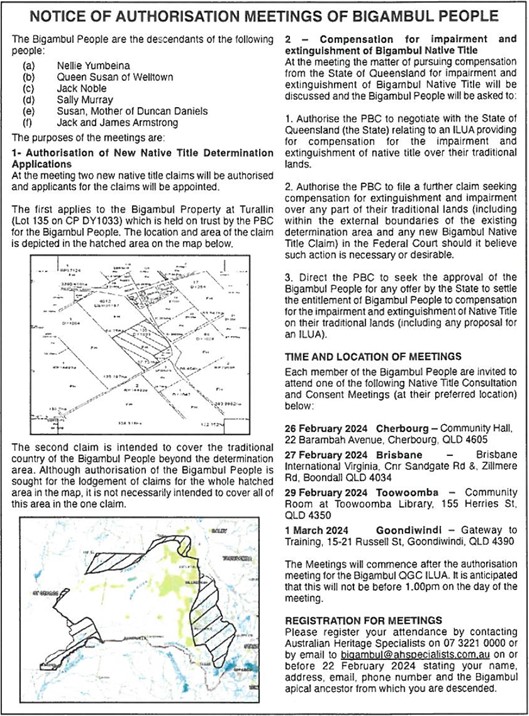
12 On 16 May 2024 I ordered that the Gamilaraay Claim proceed to a consent determination hearing. On 24 June 2024, Registrar Parkyn ordered that the consent determination hearing be listed for 19 July 2024 in Brisbane.
13 On 26 June 2024 the lawyer for the Bigambul #5 Applicant, Mr Hardie, wrote to the representative for the Gamilaraay Applicant, Queensland South Native Title Services (QSNTS), in the following terms:
RE: DARRYL HIPPI & ORS ON BEHALF OF THE GAMILARAAY PEOPLE v STATE OF QUEENSLAND & ORS QUD290/2017
We refer to the above matter and note that the matter has been listed for Consent Determination before Collier J on 19 July 2024. Under the circumstances we have instructions to file an overlap application. Due to the pre-conditions attached by your client to meet, it is unfortunate that we have not be able to do so before the hearing.
14 On 27 June 2024 a Form 1 for the Bigambul #5 Claim was filed in the Federal Court of Australia.
15 The Bigambul #5 Claim relied on authorisation meetings held in Cherbourg, Brisbane, Toowoomba and Goondiwindi between 26 February 2024 and 1 March 2024.
16 The Bigambul People were identified in the 31 January 2024 Notice as:
…the descendants of the following people:
(a) Nellie Yumbeina
(b) Queen Susan of Welltown
(c) Jack Noble
(d) Sally Murray
(e) Susan, Mother of Duncan Daniels
(f) Jack and James Armstrong
17 In the Form 1, the Bigambul #5 claim group was described as:
…the biological descendants of
(i) Nellie Yumbeina;
(ii) Queen Susan of Welltown;
(iii) Jack Noble;
(iv) Sally Murray;
(v) Susan, Mother of Duncan Daniels; or
(vi) Jack and James Armstrong.
who identify and are recognised as Bigambul People in accordance with the traditional laws and customs acknowledged observed by them.
18 It was not disputed that, at each authorisation meeting, a PowerPoint presentation was displayed describing the Native Title group, and including the following resolutions:
Resolution 7
1. The meeting of Bigambul People authorised the making of one or more Native Title Claims in the Federal Court over the hatched areas in the Map on slide 18.
2. The claim group description and the native title rights and interests for the further Native Title Claims are to be the same as set out in the Bigambul Peoples determination for QUD101/2009.
3. This meeting authorised the persons listed below to be the applicants of the proposed Native Title Claims:
Insert names
The following persons are authorised to replace in the order set out below any of the above who are either unwilling or unable to act as applicant:
Insert names
4. The members of the applicant may continue to act until there is only 2 members at which time new applicants will be authorised by the claim group.
…
5. Subject to paragraph 5, this meeting appoints the above persons on the condition that they make their decisions by majority.
6. All the persons appointed as Applicants may, by unanimous decision and taking into account the legal advice, amend the area of the proposed Native Title claim without obtaining the further authorisation of the Bigambul People.
SUBMISSIONS OF THE PARTIES – STRIKE OUT
19 In summary the Gamilaraay Applicant submitted:
The primary purpose of the 31 January 2024 Notice was to seek the informed consent or vote of the Bigambul People on the particular authorisation issues including the appropriate decision-making process.
A question was whether the 31 January 2024 Notice was expressed in a form likely to result in all the members of the Bigambul People being offered a reasonable opportunity to decide whether to attend the first consultation and consent meeting or one of the later meetings.
The 31 January 2024 Notice was capable of misleading those to whom it was directed, in that it contained neither the text of any resolutions, any explanation of the purported decision-making process, nor how it was designed or intended to facilitate authorisation of the Bigambul #5 Claim and Bigambul #5 Applicant by a series of four separate meetings on different dates at different locations only one of which could be attended by an individual. The 31 January 2024 Notice was similar to the defective process identified in TJ (on behalf of the Yindjibarndi People) v State of Western Australia [2015] FCA 818 (TJ).
The 31 January 2024 Notice was an attempt to arrange a convocation of people to come to one of the four meeting centres to attend “consultation and consent meetings” for the purpose of authorising the Bigambul #5 Claim and Bigambul #5 Applicant, whereas in reality what was intended was that:
• Only those at the first meeting at Cherbourg would have the opportunity to determine the decision-making process, the claim’s potential boundaries or the composition of the applicant and the parameters of their instructions;
• There was no obligation to meet or discuss – with any other persons who might attend any later meeting – any proposed or alternative courses of action open to the putative claim group before the claim was filed;
• Any person who attended any later meeting was not told about those developments until they attended those meetings, as the process whereby decisions were to be made by that convocation of people was not identified in the 31 January 2024 Notice; and
• The attendees at any later meeting could not nominate themselves, their family members or any person other than those settled upon as the first meeting as applicants.
The composition of the Bigambul People has been determined in previous Bigambul determinations, however the description of the native title claim group in the Bigambul #5 Claim is different because of the qualifying words to the description of the Bigambul People contained in the relevant Form 1. Schedule O to the Form 1 in the Bigambul #5 Claim specifically – and improperly – excluded Bigambul People who were also, for example, Gamilaraay People. All of the Bigambul People ought to have been made aware of the proposal or the possibility of filing a claim on behalf of a claim group described differently to the persons to whom it was directed, namely the native title holders under the Bigambul determinations.
The Bigambul #5 Claim was filed on behalf of a claim group composed differently to the Bigambul People who purportedly authorised it. It included, within its external boundaries, areas that were not authorised. The s 62A affidavits affirmed by the Bigambul #5 Applicant did not reflect the conditions on the authority of the Bigambul #5 Applicant under s 251BA that were authorised.
None of the defects in the Bigambul #5 Claim could be cured by further evidence or amendment.
For a second time the Bigambul People had brought a late overlapping claim in which the native title claim group on whose behalf the claim was brought was not one that had legitimately emerged from the purported authorisation process. Further, the Bigambul #5 Applicant had again brought an overlapping claim less than a month before the proposed consent determination in the Gamilaraay proceeding. No satisfactory explanation for the extreme lateness in filing the Bigambul #5 Claim was given.
That 110 people attended over the course of four Bigambul authorisation meetings was beside the point, in circumstances where a key question was whether such persons and the broader Bigambul community were afforded a reasonable opportunity to participate in the process by which the resolutions were reached. Only those Bigambul persons in attendance at the first meeting were involved in passing the resolutions in a real sense.
20 The Bigambul #5 Applicant submitted, in summary:
The 31 January 2024 Notice was adequate. It was unnecessary for the 31 January 2024 Notice to include the text of resolutions or the decision-making process.
The Bigambul authorisation meetings were held on the dates and at the venues set out in the 31 January 2024 Notice.
The meetings were attended by 110 persons in total, a considerably higher number than the number attending the authorisation meeting for the Bigambul #2 Claim on 24 April 2022. It follows that the 31 January 2024 Notice was effective in alerting Bigambul People to those meetings.
The business of the meeting and the agenda was the same for all locations at which the Bigambul Authorisation meetings were held.
The attendees at each location were given the same opportunity to vote for or against resolutions to move and second resolutions, and to ask questions. The fact that no resolutions at the meeting were considered other than those proposed by the lawyer was not because the attendees were bound only to consider the resolutions passed at the Cherbourg meeting, but rather that the resolutions suggested by the lawyer in the PowerPoint presentation and the handout were moved and seconded by attendees at various locations. After this was done, the attendees at the meeting had no appetite to propose or consider further resolutions relating to the same subject matter.
Persons at the authorisation meetings in Brisbane and Goondiwindi who expressed dissent would not have made a difference to the outcome of the resolutions passed at the Cherbourg meeting or as a whole, even if they were advised in the notice to attend it in preference to other locations. In respect of Resolution 7, the minutes recorded that the resolution was passed unanimously by 57 votes at the Cherbourg meeting. Tallying the total votes cast at all Bigambul meetings, the total votes at all meetings carried Resolution 7, with 89 in favour, 9 against and 0 abstentions. It followed that any defects in the conduct of the meetings would have made no difference to the outcome of the resolutions passed at the Cherbourg meeting.
The circumstances are not similar to those in TJ.
It is not correct to say that the Bigambul #5 Claim is defective because it was filed on behalf of a subset of the Bigambul People and sought to exclude persons who were also members of the Gamilaraay People. Schedule O to the Form 1 is referable to s 190C of the Native Title Act.
The submission of the Gamilaraay Applicant that the claim group description contained in the Bigambul #5 Claim must conform strictly to the words in the Bigambul determinations misstates the description of Bigambul People contained in the Bigambul determinations and the purpose of the description. This is because:
• The native title rights and interests of the Bigambul People are subject to and exercisable in accordance with the traditional laws acknowledged and traditional customs observed by them.
• There is nothing in the description of the claim group for the Bigambul #5 Claim to suggest that the traditional laws and customs of the Bigambul People require that such persons primarily identify as Bigambul.
• In any event the submission of the Gamilaraay Applicant that the Bigambul #5 Claim must strictly conform to the description of Bigambul People contained in the Bigambul determinations misunderstood the purpose of that description. The Native Title Act does not specify that, in making determinations, the Federal Court specify the level of detail or require that the Court codify the traditional laws and custom directing who holds the native title.
• It followed that the description of Bigambul People contained in the Bigambul determinations was designed to describe the identity of the group of persons holding the native title group rights, and distinguish it from others, rather than to set out the detail and criteria by which group membership attained. For this reason the words contained in the claim group description of the Bigambul #5 Claim Form 1 were explanatory rather than exclusory, and did not mean that it was for a narrower group of persons than those who authorised it.
In respect of the contention of the Gamilaraay People that the Bigambul #5 Claim contained areas that were not authorised, s 62(2) of the Native Title Act requires that an application for a Native Title Determination must include a description and a map of the boundaries of the claim. The evidence is that at the time of the Bigambul authorisation meetings, the claim group intended to authorise a claim including the Weir River basin and land connecting the Weengallon rock wells to the bora ground at Talwood, however before the claim was made, a more accurate map was produced excluding some areas not within the Weir River basin, including other areas that were, and extending the area claimed referable to the Weengallon rock wells. It is this knowledge that is relevant. In any event, the Bigambul #5 Applicant has been expressly authorised to amend the boundaries of the Bigambul #5 Claim and as such could amend any error.
In respect of the contention of the Gamilaraay Applicant that the Bigambul #5 Claim constituted an abuse of process referable to the lateness of the filing of the Bigambul #5 Claim, the Bigambul #5 Applicant maintains their position that a satisfactory explanation for the delay was provided. Further:
• In Hippi the Court was satisfied that the Bigambul applicants in that matter had shown on a prima facie basis that they had Native Title rights and interests which could be affected by the determination of the Gamilaraay People’s application;
• The Bigambul People are required to assert their rights in a representative capacity;
• The overlap of the Bigambul #5 Claim and the Gamilaraay Claim was significantly reduced from the overlap the subject of the Bigambul #2 Claim;
• The Bigambul People actively pursued attempts to meet with the Gamilaraay People in preference to filing an overlapping claim;
• The Bigambul People would not oppose a consent determination over the non-overlapped areas of the Bigambul claim;
• It would not be appropriate for the State to be left in a position of signing a s 87 Agreement for the Gamilaraay Claim when credible evidence has emerged that the Bigambul People hold native title in part of the area of the proposed consent determination.
21 The State of Queensland filed limited submissions referable to applicable general principles.
CONSIDERATION
22 In essence, the Gamilaraay Applicant submitted that the Bigambul #5 Claim should be struck out pursuant to s 84C of the Native Title Act because, inter alia, it suffered from the same defects as the Bigambul #2 Claim, in particular that the application was not properly authorised, and further that it was made on behalf of a subset of the Bigambul People.
23 Plainly, after the decision of this Court in Mann the Bigambul #5 Applicant made considerable efforts to comply with the provisions of the Native Title Act such that the Bigambul #5 Claim presently before the Court would be valid. I note, for example, the evidence of the Bigambul #5 Applicant that the conduct of four separate authorisation meetings of the Bigambul People in Cherbourg, Brisbane, Toowoomba and Goondiwindi resulted in the attendance of approximately 110 members of the Bigambul People, being considerably more attendees than at the authorisation meeting held in respect of the Bigambul #2 Claim.
24 The Gamilaraay Applicant has brought the interlocutory application pursuant to s 84C of the Native Title Act, or alternatively equivalent provisions in the Federal Court of Australia Act 1976 (Cth) and the Federal Court Rules. Section 84C of the Native Title Act relevantly provides:
Striking out applications for failure to comply with requirements of this Act
Strike-out application
(1) If an application (the main application) does not comply with section 61 (which deals with the basic requirements for applications), 61A (which provides that certain applications must not be made) or 62 (which requires applications to be accompanied by affidavits and to contain certain details), a party to the proceedings may at any time apply to the Federal Court to strike out the application.
Note: The main application may still be amended even after a strike-out application is filed.
Court must consider strike-out application before other proceedings
(2) The Court must, before any further proceedings take place in relation to the main application, consider the application made under subsection (1).
…
25 Section 61(1) relevantly provides that a native title determination application must be made by the following persons:
(1) A person or persons authorised by all the persons (the native title claim group) who, according to their traditional laws and customs, hold the common or group rights and interests comprising the particular native title claimed, provided the person or persons are also included in the native title claim group; or
Note 1: The person or persons will be the applicant: see subsection (2) of this section.
Note 2: Section 251B states what it means for a person or persons to be authorised by all the persons in the native title claim group.
...
26 Section 251B of the Native Title Act provides:
251B Authorising the making of applications
For the purposes of this Act, all the persons in a native title claim group or compensation claim group authorise a person or persons to make a native title determination application or a compensation application, and to deal with matters arising in relation to it, if:
(a) where there is a process of decision-making that, under the traditional laws and customs of the persons in the native title claim group or compensation claim group, must be complied with in relation to authorising things of that kind—the persons in the native title claim group or compensation claim group authorise the person or persons to make the application and to deal with the matters in accordance with that process; or
(b) where there is no such process—the persons in the native title claim group or compensation claim group authorise the other person or persons to make the application and to deal with the matters in accordance with a process of decision-making agreed to and adopted, by the persons in the native title claim group or compensation claim group, in relation to authorising the making of the application and dealing with the matters, or in relation to doing things of that kind.
27 Caution needs to be exercised before a native title claim is struck out, including for reasons that the claim group is a sub-group, subset or part of a native title claim group, or for want of proper authorisation: Brown v State of South Australia [2009] FCA 206 at [20]. It is only where the application is obviously without merit, for example where there is no realistic prospect on the material before the Court of the authorisation being shown to have existed at the time it was purportedly granted, that an order will be made summarily dismissing or striking out the main application under s 84C: Mansfield J in Hazelbane v Northern Territory of Australia [2008] FCA 291 at [15]. The filing of a native title claim authorised by a group other than the claim group is also reason to conclude that the application is without merit.
28 On balance I am satisfied that the Bigambul #5 Claim should be struck out pursuant to s 84C of the Native Title Act, or alternatively, summarily dismissed pursuant to r 26.01(1)(d) of the Federal Court Rules, or s 31A of the Federal Court Act.
29 I so find for the following reasons.
Bigambul #5 Claim brought on behalf of a subset of the Bigambul People
Misdescription of the Claim Group
30 To date, the Federal Court has delivered two judgments recognising native title in the Bigambul People under the Native Title Act.
31 In both Doctor on behalf of the Bigambul People v State of Queensland [2016] FCA 1447 and Doctor on behalf of the Bigambul People v State of Queensland [2017] FCA 716 Reeves J ordered, inter alia, that
…The Bigambul People are those people who are biological descendants of the following deceased persons:
(i) Nellie Yumbeina;
(ii) Queen Susan of Welltown;
(iii) Jack Noble;
(iv) Sally Murray;
(v) Susan, Mother of Duncan Daniels; or
(vi) Jack and James Armstrong.
32 The effect of orders of that nature was explained by the Full Court in Dale v Western Australia (2011) 191 FCR 521, [2011] FCAFC 46 at 540 [92] as follows:
92. Under the NT Act any application made under s 61 might be the subject of an order under s 67(2) (as set out earlier) with the result that part of that application together with other applications (or parts of them) concerning the same area are dealt with together. Experience tells us that this is common, as occurred in the present case. The effect of an order under s 67(2) will typically be to create separate proceedings concerning a particular area with respondents which are only a subset of the respondents to the initial application or applications on which the order operates. Any determination made concerning the area will bind the world at large. It is, in effect, a judgment in rem: see Wik Peoples v Queensland (1994) 49 FCR 1. The determination will bind persons beyond parties to the proceedings. Because of the special characteristics of a judgment in rem, it operates outside the usual field of operation of the principle of issue estoppel requiring, as the latter does for its engagement, that the same parties (or their privies) were parties in the proceedings in which the issue was earlier determined. That is, a judgment in rem involves the determination of the status of the person or thing and binds the world at large and not simply the parties to the litigation: Re Lawrence; Ex parte Burns (1985) 9 FCR 9 and Wall v The King; Ex parte King Won (No 1) (1927) 39 CLR 245 at 291 per Isaacs J.
(emphasis added)
33 It follows that the description of the Bigambul People for the purposes of the Native Title Act is as found by Reeves J. Any further applications by the Bigambul People for native title recognition must be by and on behalf of that native title group.
34 Both the 31 January 2024 Notice and the Form 1, in different ways, incorrectly described the Bigambul People. The 31 January 2024 Notice did not include the word “biological” qualifying “descendants”. While the Form 1 did include the adjective “biological”, the description of the Bigambul People went on to include the qualification “who identify and are recognised as Bigambul People in accordance with the traditional laws and customs acknowledged observed by them”.
35 There has been discussion in native title cases concerning biological descendants of apical ancestors, as distinct from, for example, adoptees of biological descendants: see Harrington-Smith on behalf of the Wongatha People v Western Australia (No 9) [2007] FCA 31. Further, as the Australian Law Reform Commission observed in Essentially Yours: The Protection of Human Genetic Information in Australia (ALRC Report 96) published in 2010:
36.34 The Inquiry was told in some consultations that the three-part definition works well enough in most circumstances. However, a number of concerns were expressed about the test. In some cases, the courts have interpreted ‘descent’ in terms of biological descent when interpreting the meaning of an Aboriginal person. This tends to undermine the role of social descent within Aboriginal communities whose traditional laws and customs might provide for adoption or other social forms of inclusion into a family or community. The emphasis on biological descent has led to some anxiety that genetic testing might increasingly be used (or even required) as a means of proving a person’s kinship relationship with another Aboriginal person.
36.35 Several submissions emphasised the difference between Western and Aboriginal definitions of kinship. The Aboriginal and Torres Strait Islander Social Justice Commissioner commented that:
While Aboriginal people may generally be direct descendants of the original inhabitants of a particular part of Australia, indigenous customary law does not rely on linear proof of descent in the Judeo-Christian genealogical form of ‘Seth begat Enosh begat Kenan’ in order to prove membership of the group. … A person may have been adopted into a kinship group where there is no direct or suitable offspring to carry out ceremonial obligations. … Genetic science should have no part to play in determining whether or not a person should be eligible for benefits. If the element of descent is to remain in Australian law as a test of Aboriginality, it should be interpreted in accordance with Indigenous cultural protocols.
(emphasis added)
36 The omission of the adjective “biological” qualifying “descendants” in the 31 January 2024 Notice caused the claim group to be misdescribed in that notice, compared to the description of the claim group as settled in earlier Federal Court decisions. There is no evidence however that anyone who was other than a member of the Bigambul People, being biological descendants of Bigambul apical ancestors, attended and voted at any of the authorisation meetings, or that any Bigambul person failed to attend any of the authorisation meetings because of that misdescription. To that extent, I am not persuaded that the misdescription of the claim group in the 31 January 2024 Notice has resulted in any member of the claim group being denied a reasonable opportunity to participate in the decision-making process which took place at the authorisation meetings.
37 However, the position is different in respect of the description of the claim group in the Form 1. As I have already observed, the Bigambul People are the biological descendants of the Bigambul apical ancestors. They are not such persons “who identify and are recognised as Bigambul People in accordance with the traditional laws and customs acknowledged observed by them”.
38 As submitted by the Gamilaraay Applicant, there is no evidence that the limitation on the composition of the group which filed the Form 1 was raised at any of the authorisation meetings, or even that the proposed Form 1 was in existence when any meeting was held.
39 On its face, the Bigambul #5 Claim was filed on behalf of a differently composed – and narrower – claim group than the persons determined to be Bigambul native title holders as defined by earlier Federal Court decisions. The Bigambul #5 Applicant submits that the words qualifying “descendants” in the Form 1 were explanatory and were merely intended to be a statement of the traditional laws and customs that applied to the native title holders in the earlier Federal Court determinations. I do not accept this. When the description of the Bigambul native title claim group was settled in earlier determinations, there was no reason to insert those qualifying words in the Bigambul #5 Claim other than to limit the identity of that claim group, as submitted by the Gamilaraay Applicant.
Schedule O
40 Schedule O to the Bigambul #5 Form 1 provides:
MEMBERSHIP OF ANY OTHER NATIVE TITLE GROUPS (see Act, s 190C)
Details of the membership of the applicant or any member of the native title claim group in a native title claim group for any other application that has been made in relation to the whole or part of the area covered by this application.
The applicant or claim group members are not included in any other determination Application that covers the Claim Area.
41 The Bigambul #5 Applicant submitted that its statement in Schedule O was referable to s 190C of the Native Title Act which contains the conditions mentioned in s 190A(6)(b)(ii) of the Act. Section 190A(6) addresses the test for registration of a native title claim and when the claim must be accepted for registration by the Registrar. Section 190A(6)(b)(ii) provides that s 190C “deals with procedural and other matters”. In particular, s 190C(3) provides:
(3) The Registrar must be satisfied that no person included in the native title claim group for the application (the current application) was a member of the native title claim group for any previous application, if:
(a) the previous application covered the whole or part of the area covered by the current application; and
(b) an entry relating to the claim in the previous application was on the Register of Native Title Claims when the current application was made; and
(c) the entry was made, or not removed, as a result of consideration of the previous application under section 190A.
42 The Gamilaraay Applicant submitted that the statement of the Bigambul #5 Applicant in Schedule O is incorrect, in that it wrongly states that claim group members are not included in any other determination application that covers the claim area when there were persons who identified as both Bigambul and Gamilaraay, and who were members of the Gamilaraay claim group for the purposes of the Gamilaraay Claim.
43 To the extent that there appears to be inaccuracy in the content of Schedule O, I am not persuaded that the inaccuracy could not be remedied by amendment. However, I note the submission of the Gamilaraay Applicant that this statement is further supportive of their contention that the Bigambul #5 Claim was brought on behalf of a subset of the Bigambul People, namely those who do not otherwise also identify as Gamilaraay. In my view there is merit to this submission.
Subset of Claim Group
44 As Mansfield J observed in Walker v South Australia [2014] FCA 962 at [26], where the requirement for authorisation is not complied with, generally that failure is fatal to the application. As his Honour further observed at [29], in circumstances where the described native title claim group is in fact more accurately a subset of a larger community of persons who hold the common or group rights and interests comprising the particular native title claim, that sub-group cannot qualify as a claimant group under the Native Title Act: Kite v State of South Australia [2007] FCA 1662 at [22]; Dieri People v State of South Australia [2003] FCA 187 at [56]; Risk v National Native Title Tribunal [2000] FCA 1589 at [60].
45 Similarly in Brown Besanko J said:
[21] It is clear from the terms of s 61(1) of the NTA that the applicant to a native title determination application must be authorised by all the persons comprising the native title claim group…
46 In the present case, where the persons filing the Form 1 are described as those Bigambul People who identify and are recognised as Bigambul People in accordance with the traditional laws and customs acknowledged observed by them, I am satisfied that the Bigambul #5 Claim was brought on the part of a subset of the Bigambul People. As such the application is without merit and should be struck out pursuant to s 84C of the Native Title Act.
Reasonable Opportunity to Participate
First meeting
47 As noted earlier in this judgment, s 251B of the Native Title Act provides for conditions where all persons in a native title claim group authorise a person or persons to make a native title determination application. As explained by the Full Court in McGlade (formerly Wanjurri-Nungala) and Others v South West Aboriginal Land & Sea Aboriginal Corporation and Others (No 2) (2019) 374 ALR 329, [2019] FCAFC 328:
36. The cases concerning authorisation within the meaning of s 251B(b) (for the purposes of an application to replace an applicant under s 66B of the NTA) have reiterated the principles that s 251B(b) does not require that “all” of the members of the relevant claim group be involved in making the decision. The key question will be whether a reasonable opportunity to participate in the decision-making process has been afforded by the notice for a relevant meeting. The usual question is whether the notice was sufficiently clear to enable persons to whom it has been addressed to judge for themselves whether or not to attend a meeting and to vote for or against a proposal: see, for example, Lawson (on behalf of the “Pooncarie” Barkandji (Paakantyi) People) v Minister for Land and Water Conservation (NSW) [2002] FCA 1517 (Lawson) per Stone J (at [25] and [27]–[28]); Dingaal Tribe v Queensland [2003] FCA 999 (Dingaal) per Cooper J (at [8] and [32]); Coyne v Western Australia [2009] FCA 533 (Coyne) per Siopis J (at [27]–[51] and the cases therein cited); Weribone (on behalf of the Mandandanji People) v Queensland [2013] FCA 255 (Weribone) per Rares J (at [40]); and TJ v Western Australia (2015) 242 FCR 283; [2015] FCA 818 (TJ) per Rares J (at [91]).
(emphasis added)
48 See also Santos NA Barossa Pty Ltd v Tipakalippa [2022] FCAFC 193 at [98].
49 The 31 January 2024 Notice was minimalist in its contents. It did not, for example, set out detailed information referable to resolutions to be proposed. However, and contrary to the submissions of the Gamilaraay Applicant, I am not persuaded that the 31 January 2024 Notice should be struck out for want of detail. The purpose of the meeting was sufficiently clear on the face of the 31 January 2024 Notice.
50 I am satisfied, however, that the 31 January 2024 Notice was fatally misleading. In particular, the 31 January 2024 Notice purported to arrange a convocation of people to come to one of four meeting centres to attend “consultation and consent meetings” for the purpose of authorisation the Bigambul #5 Claim. In reality only those at the Cherbourg meeting on 26 February 2024, notably the first of the meetings, would have the opportunity to determine the composition of the Bigambul #5 Applicant.
51 In particular the Gamilaraay Applicant relied on the affidavits of Ms Summer Hodge and Ms Jacqueline Bennett, both dated 4 July 2024.
52 Ms Hodge gave evidence that she attended a Bigambul authorisation meeting in Brisbane on 27 February 2024 with family members. In respect of events at that meeting Ms Hodge relevantly deposed:
35. When it came time to decide the applicant, we were only given the choice to vote for, against or abstain for the people named in the resolution displayed. We were told that we had no choice about the applicant as the people named to be the applicant had already been selected at the first meeting, that it could not be changed, and that we could not nominate any new person at this meeting to be part of the applicant.
36. The Notice did not state that the decisions would be made at the first meeting and that we would only ratify these decisions. If I would have known this, I would have attended the first meeting. I did not attend the first meeting and so I did not have a say on who would be representing the Bigambul People in the new Bigambul claim. They told us the names of the members of the applicant, but I don't know if they all are Bigambul People. I don't know how these people were selected. There are some that I never met or heard of before.
53 Ms Bennett gave evidence that she attended a Bigambul authorisation meeting in Goondiwindi on 1 March 2024 with family members. In respect of events at that meeting Ms Bennett relevantly deposed:
19. When resolution 7 was being discussed, I raised that I thought the people at each meeting would get to choose who the Applicant would be. I was told that the Applicant were chosen at the Cherbourg meeting, and the only choice for the people attending the Goondiwindi meeting was to vote yes or no or abstain from voting on the resolution that appointed the Applicant. I specifically asked whether "Anyone here can be nominated to be the Applicant?'" and was told "No, they have already been decided at Cherbourg". The meeting did not leave it open to put forward our own suggested Applicant.
20. There was no explanation about the process used at the Cherbourg meeting to put forward the 4 people listed in resolution 7 as the Applicant. I don't know if they were self-nominated, or put forward by the group.
21. I raised the concerns at paragraphs [19]-[20] during the meeting and was given no explanation.
22. I voted against resolution 7.
54 This evidence is supported by the minutes of the authorisation meeting held in Brisbane. Relevant resolutions were transcribed on the PowerPoint presentation annexed to the Form 1. Resolution 7 as put to the meetings was as follows:
Resolution authorising the making of the Second proposed Native Title Claims
Resolution 7
1. This meeting of Bigambul People authorises the making of one or more Native Title Claims in the Federal Court over the hatched areas in the Map on slide 18.
2. The claim group description and the native title rights and interests for the further Native Title Claims are to be the same as set out in the Bigambul People determination for QUD101/2009.
3. The meeting authorises the persons listed below to be the applicants of the proposed Native Title Claims:
Insert names
The following persons are authorised to replace in the order set out below any of the above who are either unwilling or unable to act as an applicant:
Insert names
4. The members of the applicant may continue to act until there is only 2 members at which time new applicants will be authorised by the claim group.
…
5. Subject to paragraph 5, this meeting appoints the above persons on the condition that they make their decisions by majority.
6. All the persons appointed as Applicants may, by unanimous decision and taking into account the legal advice, amend the area of the proposed Native Title claim without obtaining the further authorisation of the Bigambul People.
55 Importantly – the minutes of the authorisation meeting held in Brisbane recorded the following in relation to Resolution 7:
The Chair explained that the names of the applicants were inserted in yesterday’s meeting and cannot now be amended. The only choice is to vote for or against. No amendment can be made.
Chair read the resolution to the meeting.
56 In such circumstances, the evidence supports a finding that any member of the Bigambul claim group attending the Brisbane authorisation meeting on 27 February 2024 was denied the opportunity to nominate alternative members of the Bigambul #5 Applicant. Further, the evidence of a witness attending the Goondiwindi authorisation meeting suggests that Bigambul persons attending that meeting were similarly denied that opportunity.
57 I am not persuaded by the submission of the Bigambul #5 Applicant that following the Cherbourg meeting there was no appetite in the remainder of the Bigambul People attending subsequent meetings to propose alternative candidates to form the Bigambul #5 Applicant. Rather, the evidence indicates that only members of the Bigambul claim group attending the authorisation meeting at Cherbourg were given a reasonable opportunity to determine the composition of the Bigambul #5 Applicant. To the extent that this was part of the decision-making process, it was not set out in the 31 January 2024 Notice, and not agreed by the members of the Bigambul People.
58 The Bigambul #5 Applicant submitted that, because the total number of votes cast at the four authorisation meetings supported Resolution 7 as agreed at the Cherbourg meeting, it could reasonably be concluded that the Bigambul claim group supported that resolution and the Birgambul #5 Applicant as appointed at the Cherbourg meeting, regardless whether members of the Bigambul claim group at subsequent meetings were given an opportunity to nominate alternative applicant members. I do not accept this submission. The question is whether the 31 January 2024 Notice provided members of the claim group with a reasonable opportunity to participate in the decision-making process referable to the composition of the applicant and the authorisation of the Bigambul #5 Claim, regardless of the outcome of those combined meetings.
59 The denial of opportunity to Bigambul claim group members to nominate alternative members of the Bigambul #5 Applicant was, in my view, fatal to the authorisation process. This is not an issue which is susceptible to subsequent amendment in documentation filed in support of the Bigambul #5 Claim. As such the Bigambul #5 Claim should be struck out pursuant to s 84C of the Native Title Act on the basis that the Bigambul #5 Applicant was not properly authorised.
Mapping
60 Evidence was given in the proceeding by Mr Jeffery Harris, a Geospatial and Systems Support Officer with over 45 years experience as a cartographer. At the time of his affidavit Mr Harris was employed by QSNTS.
61 In his affidavit, affirmed 3 July 2024, Mr Harris relevantly deposed:
Preparation of maps
3. At the request of Mr Craig Reiach, Deputy Principal Lawyer employed by QSNTS and Ms Sidonie Berke, acting Deputy Principal Legal Officer employed by QSNTS, I prepared two maps relevant to this proceeding and to the Gamilaraay People (QUD290/2017) native title determination application (Gamilaraay People Application):
a. a map depicting the overlap between the proposed Bigambul People #5 application area and the area which was publicly notified for authorisation (Notification Map). A copy of the Notification Map is annexed to this affidavit and marked "JGH-01".
b. a map depicting the overlap between the Bigambul People #5 application area and the Gamilaraay People Application area (Overlap Map). A copy of the Overlap Map is annexed to this affidavit and marked "JGH-02".
Notification Map
4. On 20 June 2024, Ms Berke provided me with a copy of a map titled "Bigambul People #5" which I believe was created by the National Native Title Tribunal (NNTT) that depicted the Proposed Bigambul People #5 application area. On the same day, Ms Berke provided me with a copy of the meeting notice published in the Koori Mail dated 31 January 2024 for the authorisation of a Bigambul People claim (Koori Mail Advertisement).
5. Ms Berke asked me to prepare a map depicting the overlap between the notified map and the application map prepared by the NNTT. MS Berke informed me that the map may help identify whether the notified map differed to the application map. To accurately depict the proposed Bigambul People #5 application Area I requested a copy of the Proposed Bigambul People #5 External Boundary Description from the applicant.
6. On 24 June 2024, Ms Berke provided me with a copy of the external boundary description titled "Bigambul People #5 External Boundary Description" which I believe was prepared by the NNTT and which states the boundary is based on information or instructions provided by the Bigambul #5 applicant.
7. In preparing the Notification Map, I used the following information:
a. an extract of the map from the Bigambul People #5 Public notice published in the Koori Mail Advertisement.
b. A spatially complied boundary of the proposed Bigambul People #5 as described in the Bigambul People #5 External Boundary Description prepared by the NNTT.
c. Part of the proposed hatched application area as notified, spatially complied by me from the extracted Bigambul People #5 notification map published in the Koori Mail Advertisement.
d. Where the external boundary was common between the proposed hatched application area as notified and the Gamilaraay People application area, part of the Gamilaraay People Application spatial data sourced from the NNTT, Schedule of Applications (Federal Court). This dataset depicts the spatial definition of active Claimant, Non-claimant native title determination applications and compensation applications filed in the Federl Court. Where possible these may include internal boundaries or areas excluded.
e. 1:250,000 topographical image sourced from the Commonwealth of Australia, Geoscience Australia (2008).
8. The Notification Map clearly shows that there is differences between that part of the application area notified by the Koori Mail Advertisement and the Bigambul People #5 application area where some areas have been added and other have been reduced.
9. On 2 July, Ms Berke provided me with the sealed Form 1 for QUD344/2024. The map attached in Schedule C of the Form 1 is the same map as the map Ms Berke provided to me on 20 June 2024.
62 The Bigambul #5 Applicant submits that it has been expressly authorised by the claim group to amend the boundaries of the claim, and that this would entitle them to remove any areas which were not authorised. I have already observed however that, in my view, the Bigambul #5 Applicant itself was not properly authorised. To that extent, it is unable to amend the boundaries of the claim to cure any defects in the mapping of the claim area as appears in either the 31 January 2024 Notice or the Form 1.
Conclusion
63 In my view the Bigambul #5 Application should be struck out on the basis that:
The Form 1 was not filed on behalf of the Bigambul claim group; and
The claim was not properly authorised because the claim group was not given reasonable opportunity to participate in the decision-making process by the 31 January 2024 Notice.
64 It further follows that it is unnecessary for me to consider the application by the Gamilaraay People for joinder to the Bigambul #5 Claim.
Abuse of process
65 The Bigambul #5 Claim was filed on 27 June 2024, three days after Registrar Parkyn ordered that the Gamilaraay Claim, which the Bigambul #5 Claim overlapped, be listed for consent determination on 19 July 2024. The consent determination of the Gamilaraay Claim, for a second time, did not proceed because of a claim of the Bigambul People, filed less than a month before the Gamilaraay Claim was listed for consent determination.
66 The Bigambul People have long known about the existence of the Gamilaraay Claim and that it was ready to progress to consent determination. The Bigambul #5 Applicant had ample time to file a further claim following the delivery of judgment in Mann in May 2023, which struck out the Bigambul #2 Claim, and after judgment was delivered in Hippi in April 2024 where the Bigambul People were unsuccessful in their application for joinder to the Gamilaraay Claim.
67 No satisfactory explanation has been given by the Bigambul #5 Applicant for the delay in filing the Bigambul #5 Claim. No new evidence of substance explaining the delay has been adduced. Contrary to the submissions of the Bigambul #5 Applicant, I am not persuaded that the delay in filing the Bigambul #5 Claim can be explained by reference to new expert evidence of Dr Phillip Clarke as annexed to the Bigambul #5 Form 1. The Bigambul #5 Applicant has long had access to expert material it claims to be supportive of its native title claim, including the expert material of Mr Daniel Leo and Dr Anna Kenny referable to the Bigambul #2 Claim.
68 Further, I am not satisfied that the Bigambul #5 Application is other than an abuse of process merely because the Bigambul #5 Applicant has apparently been prepared to engage in discussions with the Gamilaraay Applicant not to oppose part of the Gamilaraay Claim. It is well known that the division of a native title claim, resulting in a s 87A Application, is time and resource consuming, and would inevitably result in a delay in achieving any consent determination for the Gamilaraay People.
69 I find that the Bigambul #5 Claim is an abuse of process.
COSTS
70 The Gamilaraay Applicant has been successful and has sought costs notwithstanding the provisions of s 85A of the Native Title Act. I will ask the parties for timetabling orders for the provision of submissions in respect of costs. Until determination of the issue of costs, it is appropriate to order that costs be reserved.
I certify that the preceding seventy (70) numbered paragraphs are a true copy of the Reasons for Judgment of the Honourable Justice Collier. |
Associate:
Dated: 6 February 2025


