

Federal Court of Australia
O’Shea v State Minister for the State of Queensland [2025] FCA 52
Table of Corrections | |
10 February 2025 | In paragraph 13, “to Mr Peter Hutchinson of NQLC” amended to read “to Mr Peter Hutchison, Director, Native Title Claims Resolution, Land and Native Title Services of the Department and to NQLC”. |
ORDERS
JAMES WILLIAM MALCOLM O'SHEA & JANELLE LYNETTE O'SHEA Applicant | ||
AND: | THE STATE MINISTER FOR THE STATE OF QUEENSLAND Respondent | |
DATE OF ORDER: |
THE COURT ORDERS THAT:
1. Native title does not exist in relation to the land and waters described as that part of Lot 4698 on PH801 (also known as Scardons Hill Holding) and that part of Lot 285 on OL34 as shown in the map in “Attachment A” and described in the written description in “Attachment B” to these Orders.
Note: Entry of orders is dealt with in Rule 39.32 of the Federal Court Rules 2011.
Attachment A
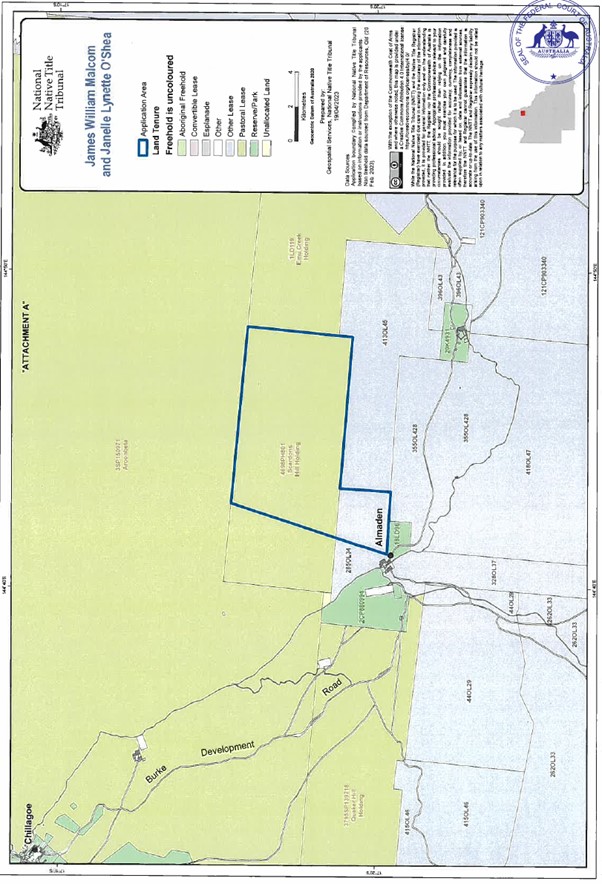
Attachment B
James William Malcom and Janelle Lynette O'Shea
External boundary description
The application area covers all the land and waters within the external boundary described as:
That part of Lot 4698 on PH801 (Scardons Hill Holding) and Lot 285 on OL34 that falls east of the western boundary of Ql2005/011- Bar Barrum Small Mining ILUA.
For the avoidance of any doubt, the application excludes any area subject to:
Native Title Determination Application QUD728/2017 Wakaman People #4 (QC2017/014) as lodged in the Federal Court of Australia 26 March 2018.
Native Title Determination Application QUD178/2018 Wakaman People #5 (QC2018/001) as lodged in the Federal Court of Australia 26 March 2018.
Note
Data Reference and source
• Application boundary compiled by National Native Title Tribunal based on information or instructions provided by the applicants.
• Bar Barrum Small Mining ILUA as accepted for registration 12 March 2007.
• Cadastre data sourced from Department of Resources, Qld (20 Feb. 2023).
Reference datum
Geographical coordinates have been provided by the NNTT Geospatial Services and are referenced to the Geocentric Datum of Australia 2020 (GDA2020), in decimal degrees and are based on the spatial reference data acquired from the various custodians at the time.
Use of Coordinates
Where coordinates are used within the description to represent cadastral or topographical boundaries or the intersection with such, they are intended as a guide only. As an outcome of the custodians of cad astral and topographic data continuously recalculating the geographic position of their data based on improved survey and data maintenance procedures, it is not possible to accurately define such a position other than by detailed ground survey.
Prepared by Geospatial Services, National Native Title Tribunal (19 April 2023).
COLLIER J:
1 Before the Court is an Amended Non-Claimant Native Title Determination Application filed on 1 June 2023 (the Application) by Mr James William Malcolm O’Shea and Mrs Janelle Lynette O’Shea (together, the Applicant). Pursuant to the Application, the Applicant sought a determination that native title does not exist in relation to the land and waters described as
That part of Lot 4698 on PH801 (also known as Scardons Hill Holding) and that part of Lot 285 on OL34 as shown in the map in “Attachment A” and described in the written description in “Attachment B” [to the Application]
(the amended claim area).
2 The Application is unopposed. On 29 April 2024, the respondent filed a Notice of Unopposed Application Filed on Behalf of the State Minister for the State of Queensland which notified the Court that the State Minister for the State of Queensland did not oppose an order being made in, or consistent with, the terms sought by the Applicant in the Application.
3 Further, there have been no documents filed on the court file by any non-parties or other interested parties to the Application.
Background
4 The original form of the Application was filed on 14 July 2017 (Original Application) and concerned the non-native title tenure interests in the form of leases and licences over a larger parcel of land. The National Native Title Tribunal (NNTT) provided the respondent and the representative body for the area covered by the Application, the North Queensland Land Council Native Title Representative Body Aboriginal Corporation (NQLC) with a copy of the Original Application on 20 July 2017. The NNTT publicly notified the Original Application on 18 October 2017.
5 During the public notification period, the Wakaman People filed a Native Title Determination Application (Wakaman #4 Claim) which substantially overlapped with the land subject of the Original Application. The Wakaman #4 Claim progressed to consent determination on 18 August 2023 in Alvoen on behalf of the Wakaman People v State of Queensland [2023] FCA 953 (Alvoen).
6 In anticipation of that consent determination, the Application was amended to exclude the area the subject of the Wakaman #4 Claim. The claim area was not otherwise modified. As such, the amended claim area was not required to be notified. The amended claim area falls beyond the external boundary of the Wakaman #4 Claim. Leave to file an amended application was granted on 10 May 2023 and the Application filed on 1 June 2023.
7 No further respondent parties emerged out of the notification period.
8 On 21 February 2024 a Native Title Registrar of the Federal Court of Australia ordered by consent that there be no mediation in the matter and that the parties file written submissions and material in relation to the Application.
9 On 30 April 2024 the legal representative for the Applicant wrote to the Court as follows:
Dear Registrar Grant
We refer to the above proceeding and to the orders made by you on 21 February 2024 (the Orders).
In accordance with Orders 2 and 3 of the Orders, the Applicant and the Respondent have now filed their material which they seek to rely upon in respect of the final disposition of this proceeding.
Having regard to the material filed, specifically the section 86G Notice filed by the Respondent, the Applicant requests that the matter be determined on the papers by her Honour Justice Collier without a hearing, which the Respondent does not oppose.
Could you please advise whether the Court is minded to grant the Applicant’s request.
10 On 9 May 2024 the Application was reserved for Judgment on the papers.
Evidence
11 The primary evidence before the Court is contained in two affidavits:
(1) Affidavit of Alex Mikus Buck dated 4 March 2024; and
(2) Affidavit of Marita Louise Stinton dated 29 April 2024.
12 In his affidavit of 4 March 2024, Mr Buck relevantly deposed, inter alia, as follows:
On 20 July 2017 the Applicant received correspondence from the NNTT confirming that the Original Application had been provided to the Queensland State Government and the relevant native title representative body, NQLC.
On 18 October 2017, the NNTT publicly notified the Original Application in the Cairns Post and Koori Mail. The notice specified a notification day of 1 November 2017 and that the notification period ended on 31 January 2018.
The Wakaman #4 Claim was filed during the notification period and overlapped the Original Application. The Applicant joined as a respondent party to the Wakaman #4 Claim and consented to the recognition of the Wakaman People’s asserted native title rights and interests pursuant to the terms of a consent determination.
The Bar Barrum cluster of native title determinations sit to the east of the amended claim area.
According to the NNTT’s historical applications database, the Bar Barrum claim areas historically overlapped parts of Lot 4698 on PH801 and Lot 285 on OL34 as follows:
• Bar Barrum People #1 (Federal Court file number QUD 6222 of 1998 and Tribunal file number QCD2001/007) (Bar Barrum #1 proceeding);
• Bar Barrum People #4 (Federal Court file number QUD 6030 of 2001 and Tribunal file number QCD2016/004) (Bar Barrum #4 proceeding);
• Bar Barrum Rivers Claim (Federal Court file number QUD 607 of 2016 and Tribunal file number QCD2017/009) (Bar Barrum Rivers proceeding).
Bar Barrum #1 and #4 were “technical” overlaps and were determined prior to the Original Application being filed.
The Original Application was filed and publicly notified prior to the Bar Barrum Rivers proceeding being determined. There was no overlap with the Bar Barrum Rivers claim area.
The Bar Barrum Small Mining Indigenous Land Use Agreement (QI2005/001) (ILUA) and relevant ILUA area overlapped the amended claim area. The parties to the ILUA were:
• The State of Queensland;
• Bar Barrum Aboriginal Corporation;
• NQLC;
• The North Queensland Miners Association Incorporated; and
• Tom Congoo, John Wason, Layne Malthouse, Tennyson Kynuna, Lynette Burke and Jean Rosas on their own behalf and on behalf of the Bar Barrum People #2, #3, #4, #5, #6 and #7.
The Applicant was not a party to the ILUA.
The extent to which the Bar Barrum People may have historically asserted native title rights and interests in respect of that area is not easily reconciled or readily discernible.
The ILUA had a prescribed end date of 16 September 2011.
No assertions of native title rights and interests were sustained and advanced by registered claim or approved determination after the registration of the ILUA in respect of the overlapping area.
According to NNTT overlap analysis searches, there are no registered claims or approved determinations which overlap the amended claim area.
On 27 September 2023 the Applicant’s solicitors caused correspondence to be sent to NQLC requesting that NQLC provide information or any material evidence it held in respect of persons who may assert native title rights in the amended claim area.
By correspondence dated 30 October 2023, NQLC indicated that the Bar Barrum People claimed native title in areas adjacent to the amended claim area. At this time NQLC was unable to ascertain whether the Bar Barrum People were notified of the Application, in accordance with s 203BG of the Native Title Act 1993 (Cth).
On 30 October 2023, NQLC caused correspondence to be sent to Mbabaram Aboriginal Corporation RNTBC (ICN 8449) (Mbabaram), being the native title body corporate for the adjoining Bar Barrum determinations, in the following terms:
Contact Officer
Mbabaram Aboriginal Corporation RNTBC
Shop 3, 30 Mabel Street
Atherton QLD 4683
by email: admin@mbabaram.org.au
Dear Sir/Madam,
Re: Notification of QUD351/2017 - James Wiliam & Janelle Lynette O'Shea non-claimant application
North Queensland Land Council, as the representative body for the region, provides notice of the above non-claimant application pursuant to s. 203BG of the Native Title Act 1993 (Cth) and enclose a copy of the National Native Title Tribunal's application summary for the non-claimant application together with a map showing the area covered by the application (non-claimant application area).
We note that the non-claimant application area is proximate to areas that are determined native title areas for Bar Barrum People and that Bar Barrum People may also claim to hold native title in the non-claimant application area.
The non-claimant applicant is seeking a determination that native title does not exist in the non-claimant application area and if this is successful, no future native title claim in this area will be possible.
Yours sincerely,
Susan Walsh
Acting Principal Legal Officer
North Queensland Land Council (NTRB) Aboriginal Corporation
(emphasis in original)
At the date of the affidavit, the Applicant was not aware or had not otherwise been notified of any other persons or groups asserting to hold any native title rights or interests in the amended claim area.
13 In her affidavit of 29 April 2024, Ms Stinton relevantly deposed, inter alia, as follows:
On 20 July 2017, the NNTT provided a copy of the Original Application to Mr Peter Hutchison, Director, Native Title Claims Resolution, Land and Native Title Services of the Department and to NQLC.
On 2 February 2018 a Native Title Registrar of the Federal Court wrote to Mr G R Cooper, the Crown Solicitor of Queensland, to advise that the notification period for the Original Application closed on 31 January 2018.
On 20 June 2023 the NNTT wrote to the Crown Solicitor to advise that on 10 May 2023 the Federal Court had ordered that the Original Application be amended and changes were made to the claim area, and provided a letter from the Native Title Registrar which gave notice of the amended application pursuant to s 66A(1)(d) of the Native Title Act.
Ms Stinton conducted a series of searches of the NNTT’s National Native Title Register and the NNTT’s Register of Indigenous Land Use Agreements. The search of the ILUA Register did not identify any reference to an ILUA between the Bar Barrum People and either or both of James William Malcolm O’Shea and Janelle Lynette O’Shea.
On 16 April 2024, Mx Laing, a paralegal at Crown law, under the instruction of Ms Stinton, prepared a map showing the Original Application area, the amended claim area, the area of the ILUA and the areas of the surrounding native title determinations, being the Bar Barrum People, Bar Barrum People #4, Bar Barrum Rivers Determination, Wakaman People #4 and Wakaman People #5. That map was annexed to the affidavit.
Mx Laing performed a search of the Commonwealth Courts Portal to locate attachments to the Bar Barrum People #10 claim in proceeding QUD607/2016. Such attachments were annexed to the affidavit.
On 29 April 2024, Ms Stinton accessed the Commonwealth Court portal file for these proceedings and reviewed the list of parties and filed documents. The list of documents filed did not include any application for joinder by NQLC or any other party.
Submissions of the parties
14 In summary, the Applicant submitted as follows:
The Applicant has discharged its burden of proof that no native title exists in the amended claim area.
The Application has been on foot for approximately six and a half years, and the Applicant’s assertion has remained uncontested and without contradiction in that time.
The only response adduced from the public notification of the Original Application was the area of overlap pursuant to the Wakaman #4 Claim. The area of overlap with the Wakaman People has been disposed of following the judgment in Alvoen. There has been no contest over the amended claim area.
NQLC identified the Bar Barrum People as the single native title holding group who might assert native title rights and interests in the area.
The Wakaman People and Bar Barrum People, who have asserted native title rights over adjacent areas, did not make any responsive claimant applications in relation to the amended claim area.
Both the Wakaman People and Bar Barrum People are cohesive and legally represented native title claimant groups. It is a reasonable inference to make that if native title extended over the amended claim area, a claim by the Wakaman People or Bar Barrum People would have been prosecuted in line with the approach in the surrounding areas.
No material weight should be given to the ILUA which overlapped the amended claim area in circumstances where the Bar Barrum People have taken no further action in relation to asserting native title rights or interests or contradicting the Applicant’s claim in respect of the overlapping sections of the amended claim area.
There is no evidence before the Court to suggest that there are any “alternative” contradictors.
The Court has the discretionary power to make the orders sought by the Applicant.
It is appropriate for the Court to exercise its discretionary power to make the orders sought.
15 In summary, the State Minister for the State of Queensland submitted as follows:
On the basis of the evidence before the Court, the Court should be satisfied that the Wakaman People do not assert or hold native title rights and interests in the amended claim area.
Both the Original Application and the Application were notified in accordance with the Native Title Act.
NQLC was the relevant representative body in relation to the amended claim area and was notified of the Original Application pursuant to s 66 of the Native Title Act.
No Form 5 party applications were filed in relation to the Application and no person claiming native title rights or interests has sought to be joined as a party.
It can be accepted that no person with a proper native title interest in the amended claim area has joined as a party in order to press that interest. However, more than this may be required to discharge the Applicant’s burden of proof.
The Bar Barrum #4 Determination referred in Schedule 4 to the Form 1 to a proposed indigenous land use agreement in relation to the Scardons Hill area between the Bar Barrum People and the Applicant that was authorised by the Bar Barrum People (Proposed Bar Barrum/O’Shea ILUA). The Proposed Bar Barrum/O’Shea ILUA does not appear to have been registered. Further, the Scardons Hill holding does not appear to have been included in the Bar Barrum #4 claim area.
The Bar Barrum Small Mining ILUA and the Proposed Bar Barrum/O’Shea ILUA suggest that historically, the Bar Barrum People have asserted native title over the amended claim area. However, the Bar Barrum People have not taken steps to assert or pursue native title rights and interests over the amended claim area since the filing of the Original Application in 2017.
NQLC notified the Bar Barrum People of the Application via the Bar Barrum People’s native title body corporate for the adjoining determinations, Mbabaram.
There is no evidence of further communications with the Bar Barrum People.
Non-claimant applicants are not required to undertake a “roving inquiry” into native title rights and interests which may exist or have existed.
While the lack of direct evidence of the position of the Bar Barrum People should be taken into account, in the absence of any active respondent other than the State and in the absence of an objectively arguable assertion of native title in the amended claim area in opposition to the Applicant’s claim, it is open to the Court to infer that native title does not exist over the amended claim area and appropriate to make the negative determination sought by the Applicant.
Consideration
16 The Applicant is entitled to bring an application for determination of native title pursuant to s 61(1) of the Native Title Act. That section materially provides that a native title determination application can be brought on behalf of:
A person who holds a non - native title interest in relation to the whole of the area in relation to which the determination is sought…
17 Pursuant to s 225 of the Native Title Act:
A determination of native title is a determination whether or not native title exists in relation to a particular area (the determination area) of land or waters and, if it does exist, a determination of:
(a) who the persons, or each group of persons, holding the common or group rights comprising the native title are; and
(b) the nature and extent of the native title rights and interests in relation to the determination area; and
(c) the nature and extent of any other interests in relation to the determination area; and
(d) the relationship between the rights and interests in paragraphs (b) and (c) (taking into account the effect of this Act); and
(e) to the extent that the land or waters in the determination area are not covered by a non-exclusive agricultural lease or a non-exclusive pastoral lease--whether the native title rights and interests confer possession, occupation, use and enjoyment of that land or waters on the native title holders to the exclusion of all others.
Note: The determination may deal with the matters in paragraphs (c) and (d) by referring to a particular kind or particular kinds of non-native title interests.
(emphasis added)
18 Section 225 includes a negative determination of native title: CG (Deceased) on behalf of the Badimia People v State of Western Australia (2016) 240 FCR 466; [2016] FCAFC 67.
19 As I noted earlier, the Application is unopposed. In the present case there is no reason for me to doubt that that is the case in circumstances where the only party on record for the matter other than the Applicant is the State Minister for the State of Queensland, who did not oppose an order being made in, or consistent with, the terms sought by the Applicant in these proceedings. The State Minister for the State of Queensland has filed a notice to that effect.
20 In circumstances where an application under s 61 is unopposed, s 86G of the Native Title Act applies. Section 86G provides:
Unopposed applications
Federal Court may make order
(1) If, at any stage of a proceeding in relation to an application under section 61, but after the end of the period specified in the notice given under section 66:
(a) the application is unopposed; and
(b) the Federal Court is satisfied that an order in, or consistent with, the terms sought by the applicant is within the power of the Court;
the Court may, if it appears appropriate to do so, make such an order without holding a hearing or, if a hearing has started, without completing the hearing.
Note: If the application involves making a determination of native title, the Court's order would need to comply with section 94A (which deals with the requirements of native title determination orders).
Meaning of unopposed
(2) For the purpose of this section, an application is unopposed if the only party is the applicant or if each other party notifies the Federal Court in writing that he or she does not oppose an order in, or consistent with, the terms sought by the applicant.
21 It is not in dispute that the period specified in the notice in this case given under s 66 has expired, and further that the notification period ended on 31 January 2018.
22 The leading authority in relation to non-claimant applications is the decision of the Full Court in Mace v State of Queensland [2019] FCAFC 233; (2019) 375 ALR 717 (Mace). In that case the Full Court in its reasons observed that:
44. … The question for the Court remains the same whether the application is unopposed, or contested: has the applicant discharged its burden of proof that no native title exists in the claim area?
23 The principles in Mace were distilled by Jagot J in Wagonga Local Aboriginal Land Council v Attorney General of New South Wales [2020] FCA 1113, as follows:
10. The Full Court of the Federal Court recently considered non-claimant applications under the NTA in Mace v State of Queensland [2019] FCAFC 233; (2019) 375 ALR 717 (Mace). The following propositions are established in Mace, including principles established by an earlier decision of the Full Court in Worimi v Worimi Local Aboriginal Land Council [2010] FCAFC 3; (2010) 181 FCR 320 (Worimi):
(1) The special functions vested in an Aboriginal Land Council (ALC), such as WLALC, by the ALRA are not material to the question whether such a body, as a non-claimant applicant seeking a determination that there is no native title in relation to land, has discharged its onus of proof. As a non-claimant applicant, an ALC is in the same position as any other non-claimant applicant under the NTA: [12].
(2) The reason for a non-claimant application does not govern the Court’s approach to the exercise of the power: [42].
(3) Whether there is a contradictor to a non-claimant application or not, the legal question remains the same: has the applicant discharged its burden of proof that no native title exists in the area the subject of the non-claimant application: [44].
(4) The overriding proposition is that each case must be assessed on its own particular facts: [47].
(5) Relevant considerations will include the nature of the land and the tenure involved, the presence or absence of any present or previous native title claims and the nature and content of those claims, and any particular evidence adduced by the parties: [48].
(6) The Court must act on evidence, direct or indirect, which can be weighed against the case brought by the non-claimant applicant: [52].
(7) All issues are to be assessed on the usual standard of proof in civil litigation – proof on the balance of probabilities. A non-claimant applicant will either meet this standard or will not: [54].
(8) A non-claimant application does not involve any general inquiry into what native title rights and interests may have existed at sovereignty or any general inquiry into how those rights or interests may or may not have continued: [55].
(9) The provisions of the NTA are intended to facilitate all persons with a proper interest in an area of land taking steps to ensure that their interest is taken into account when the Court is making a native title determination with respect to that land. However, it is not necessary to employ evidentiary or adversarial presumptions to the task which may have been developed by the common law in different contexts from native title determinations: [56]. A better approach is to focus on what the evidence before the Court does establish, whether before or against the determination sought by the non-claimant applicant: [56]. Similarly common law maxims developed in different contexts are also of limited utility to the determination of a non-claimant application: [57]-[60].
(10) In a non-claimant application the applicant seeks a negative determination in rem. In this context recourse to common law maxims developed in different contexts may not be useful: [61].
(11) In a non-claimant application it is inappropriate to impose a specific evidential burden on a respondent such as the respondent need only make out a “prima facie” position. This would involve a gloss on the application of the usual burden and standard of proof which applies equally to claimant and non-claimant applications: [63].
(12) The question whether native title does not exist (in a non-claimant application) or does exist (in a claimant application) is to be decided according to the balance of probabilities by reference to the circumstances of each case and on the evidence adduced without recourse to maxims or presumptions originating in different adversarial contexts: [64]. In this regard it may be noted that in Worimi at [74] the point was made that a respondent to a non-claimant application is not subject to any onus of proof. The onus remains at all times on the applicant for the non-claimant application, in this case, WLALC.
(13) In a non-claimant application account needs to be taken of the gravity of a negative determination and its permanency in terms of its effect on native title rights and interests which are otherwise sought to be protected by the NTA: [66].
(14) No hard and fast rules can be laid down about what evidence might be required or might suffice for a non-claimant applicant to meet the required standard of proof: [68]. Given what is at stake and the fact that any determination affects property rights as against the whole world no prescriptive approaches or glosses on the statute should be imposed. The Court has a wide discretion whether or not to make a negative determination and the potential combination of considerations which may arise in any particular application cannot be predicted or turned into any kind of checklist: [72].
(15) If the burden of proof on a non-claimant application has been discharged it may be a rare case in which the discretion is exercised not to make a negative determination but in principle the discretion exists and the Court should not foreclose consideration of the question whether it is appropriate to make the order in all of the circumstances of the case: [73].
(16) The Court’s task is not to be more or less “stringent” depending on the kind of case before it but is to decide if the non-claimant applicant has discharged its burden of proof. In doing so the subject-matter of the non-claimant application and the consequences of a negative determination inform the requisite level of persuasion for a negative determination: [82].
(17) The principal evidence likely to impede the grant of a negative determination is evidence of an assertion of native title in the land the subject of the non-claimant application which is objectively arguable, not evidence of the potential for the assertion of native title. A representative body is best placed to assist Aboriginal and Torres Strait Islander peoples to provide such evidence. The quality of such evidence, rather than its extent, will be determinative: [97].
11. The non-claimant application in the present case is to be decided consistently with these propositions. Most importantly, the case is to be decided on the whole of the evidence which has been adduced. The question is whether, having regard to all of the evidence, WLALC has proved on the balance of probabilities that there is no native title in the land…
24 I am satisfied on the material before the Court that the Court has the power to make a negative determination of native title. It remains for me to consider whether the Applicant has discharged its burden of proof that no native title exists in the area the subject of the Application. As observed in Mace, each case must be assessed on its own particular facts, including the nature of the land and tenure involved, the presence or absence of any native title claims (including previous claims), and any evidence adduced by the parties.
25 Further, as the Full Court observed in Mace at [55], it is unnecessary for the Court to conduct any general inquiry into what native title rights and interests may have existed at sovereignty or any general inquiry into how those rights or interests may or may not have continued.
26 The Original Application was publicly notified on 18 October 2017. The only response to the public notification process in this case was that of the Wakaman People referable to the Wakaman #4 Claim. As I noted earlier, any issues arising in respect of this response have been resolved by the amendment of this claim. I further accept the submission of the State Minister for the State of Queensland that evidence before the Court is sufficient for the Court to be satisfied that the Wakaman People do not assert or hold native title rights and interests in the amended claim area. I further find that there was no requirement for notification of the Application as amended to any other person.
27 I now turn to the evidence before the Court in relation to the position of the Bar Barrum People.
28 While the respondent noted that the ILUA, and the Proposed Bar Barrum/O’Shea ILUA, suggested that historically the Bar Barrum People asserted the existence of native title over the amended claim area, on the evidence the Bar Barrum People have taken no steps to assert or pursue native title rights and interests over the amended claim area since the Original Application was filed in 2017. In circumstances where the Bar Barrum People have taken no action in relation to asserting native title rights or interests or contradicting the Applicant’s claim in respect of the overlapping sections of the amended claim area, I accept the submission of the Applicant that no material weight should be given to the ILUA.
29 I note that NQLC contacted the Bar Barrum People, through Mbabaram, in October 2023, identifying the consequences of the potential determination that native title did not exist, and that if successful no further native title claim over the claim area would be possible. The evidence before the Court is that no communications from the Bar Barrum People in response were received. Insofar as appears from the material before the Court, the Bar Barrum People have expressed no interest in the present Application.
30 I further note that NQLC, as the representative body which would be expected to have information concerning prospective native title holders in respect of the claimed area, did not participate in these proceedings and did not seek to be a party.
31 As noted in Mace at [97], the principal evidence likely to impede the grant of a negative determination is evidence of an assertion of native title in the land the subject of the non-claimant application which is objectively arguable, not evidence of the potential for the assertion of native title. To this extent, I am not satisfied that the existence of the ILUA, which notably expired in 2011, or the Proposed Bar Barrum/O’Shea ILUA, which was never registered, constitute an assertion of native title which is objectively arguable.
32 Further, there was no evidence provided to the Court of any physical connection to the amended claim area by indigenous people, nor evidence adduced of the existence of any sites of significance to indigenous people in the amended claim area.
33 In the circumstances I am satisfied that the Applicant has discharged its onus of establishing, on the balance of probabilities, that native title does not exist over the amended claim area. Accordingly, I find that native title does not exist over the amended claim area, and consider that it is appropriate to make a negative determination in the terms sought by the applicant.
I certify that the preceding thirty-three (33) numbered paragraphs are a true copy of the Reasons for Judgment of the Honourable Justice Collier. |
Associate:


