Federal Court of Australia
Malone on behalf of the Western Kangoulu People v State of Queensland (No 4) [2025] FCA 36
ORDERS
JONATHON MALONE AND OTHERS ON BEHALF OF THE WESTERN KANGOULU PEOPLE Applicant | ||
AND: | Respondents | |
DATE OF ORDER: |
THE COURT ORDERS THAT:
1. The interlocutory application dated 2 December 2024 filed on behalf of Michael Paul Huet be dismissed.
2. By 14 February 2025, the applicant file and serve a submission of no more than 2 pages on the question whether an order should be made that Michael Paul Huet pay the costs incurred by the applicant in opposing the interlocutory application.
3. By 28 February 2025, Michael Paul Huet file and serve a submission of no more than 2 pages in reply on the question of costs.
4. The question of costs will be determined on the papers unless the applicant or Michael Paul Huet requests a further oral hearing on the question of costs in their written submissions.
Note: Entry of orders is dealt with in Rule 39.32 of the Federal Court Rules 2011.
O’BRYAN J:
Introduction
1 In this proceeding, the applicant seeks a determination of native title under s 61(1) of the Native Title Act 1993 (Cth) (Native Title Act) in respect of an area of land surrounding the township of Emerald in the western part of the Central Highlands in Queensland. The claim is made on behalf of the Western Kangoulu people and is known as the Western Kangoulu native title claim. The respondents to the proceeding include the State of Queensland, the Commonwealth of Australia and a large number of other persons and corporations that hold property interests in the claim area.
2 As discussed in more detail below, the Western Kangoulu native title claim was originally filed on 9 May 2013 and was notified in accordance with the requirements of the Native Title Act. A trial of separate questions, concerning the existence of native title rights and interests (without regard to extinguishment), was conducted in August, September and November 2022. Only the applicant and the State elected to participate in that hearing. Judgment was reserved at the conclusion of the hearing, but the parties subsequently notified the Court that they were involved in discussions that might lead to an agreed position with respect to the separate questions. Those discussions are at the point of conclusion.
3 By interlocutory application dated 2 December 2024, Michael Paul Huet sought an order to be joined as a respondent to this proceeding pursuant to ss 84(5) and 84(5A) of the Native Title Act. The application was initially supported by an affidavit made by Mr Huet dated 3 December 2024 and an affidavit made by Raymond Alfred Martin dated 2 December 2024. Mr Huet claims to be a “Gangalu” person holding native title rights and interests in the claim area. He asserts that his rights and interests would be affected by a native title determination in favour of the Western Kangoulu people, and he seeks to be joined as a respondent to protect his individual rights and interests from erosion, dilution or discount.
4 On 12 December 2024, I made orders listing the joinder application for hearing on 31 January 2025 and for the filing of submissions and evidence on behalf of Mr Huet, the applicant and the State.
5 In accordance with those orders, Mr Huet filed a further affidavit made by him on 17 January 2025 and an outline of submissions. The applicant filed an affidavit made by the applicant’s solicitor, David John Knobel, dated 24 January 2025 and an outline of submissions. The State filed an affidavit made by a lawyer at Crown Law, Danielle Denaro, dated 24 January 2025 and an outline of submissions.
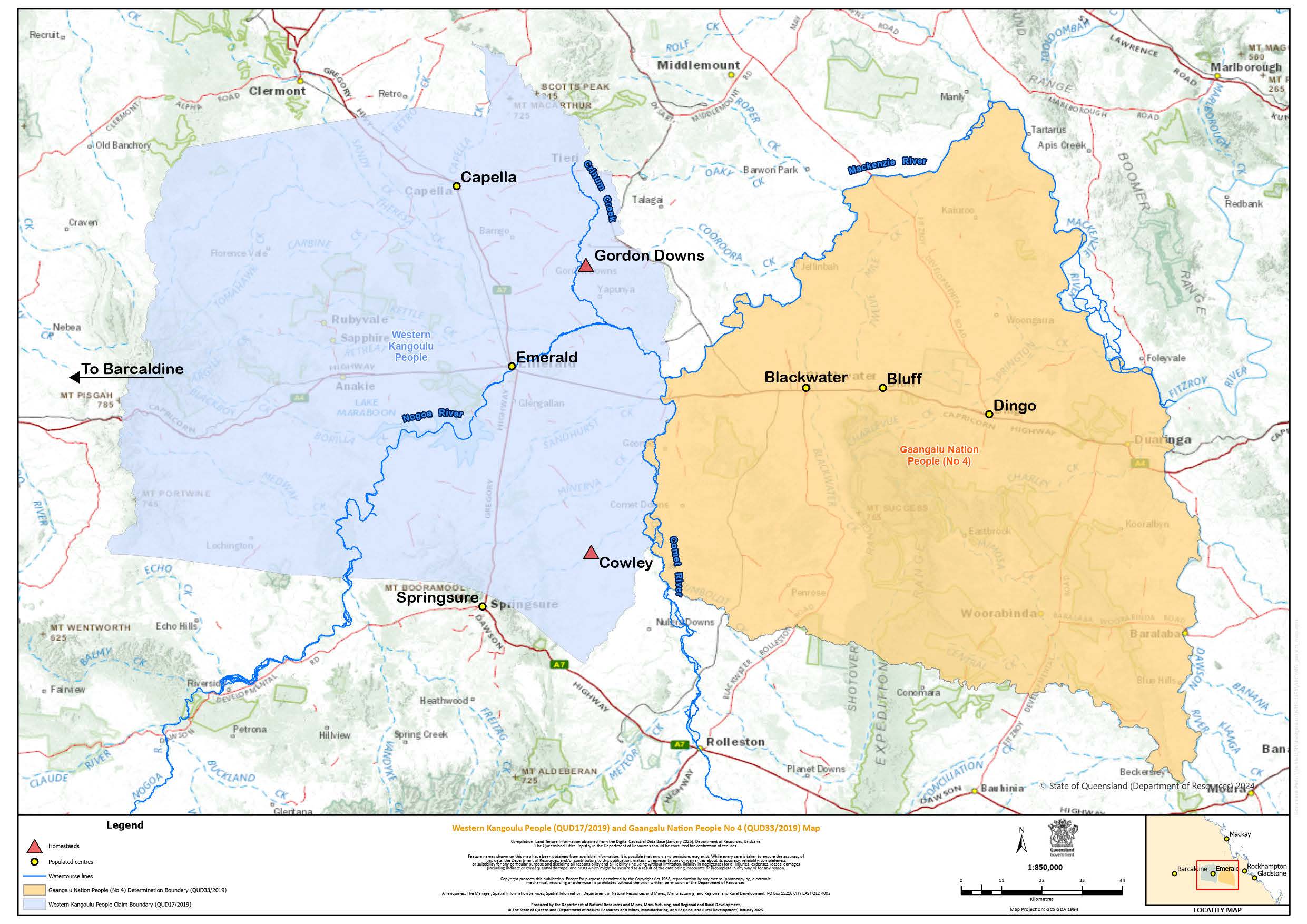
6 At the hearing on 31 January 2025, each of the affidavits were read. The applicant sought an opportunity to cross-examine Mr Huet. However, I formed the view that cross-examination was unnecessary having regard to the evidence that had been adduced. A map was also tendered which identified:
(a) the Western Kangoulu claim area; and
(b) part of the claim area of the neighbouring Gaangalu Nation People native title claim (QUD33/2019) (GNP claim), being that part in respect of which a negative determination was made in Blucher on behalf of the Gaangalu Nation People v State of Queensland (No 4) [2024] FCA 425 (Blucher No 4) (which is discussed further below).
7 A copy of the map is included in the annexure to these reasons.
8 For the reasons explained in more detail below, at the conclusion of the hearing I dismissed the application. In circumstances where a trial of the separate questions has already occurred and the Court will shortly deliver an answer to the separate questions, it would be contrary to the interests of justice to allow Mr Huet to be joined to the proceeding at this stage. Mr Huet’s explanation for his failure to make such an application at an earlier point in time is inadequate. While it is not necessary in the circumstances to form any concluded view about any interests that Mr Huet may have in the claim area, I consider that the evidence adduced by Mr Huet on this application is not persuasive that he holds any interests in the claim area.
9 The applicant’s anthropological expert in the proceeding, Dr Richard Martin, observed that, over the years, the name “Ganggalu” has appeared with a variety of spellings in the ethnographic and historical record to refer to an Aboriginal group. While most of these names vary somewhat from the modern spelling of the word Ganggalu, Dr Martin expressed the opinion that the different names can be seen as antecedents for the current Ganggalu people, which include the Western Kangoulu people. In this proceeding, witnesses have used a variety of spellings to describe the Ganggalu people, including the spelling “Kangoulu” with which the native title claim was registered. As noted above, Mr Huet uses the spelling “Gangalu” and the neighbouring GNP claim used the spelling “Gaangalu”. In these reasons, the spelling “Kangoulu” will be used when referring to the Western Kangoulu claim and claim group and the spelling “Gaangalu” will be used when referring to the GNP claim and claim group. When referring more generally to people who identify as descendants of Ganggalu people (including Mr Huet), the “Ganggalu” spelling will be adopted.
Statutory framework governing joinder of parties
10 The Native Title Act contains procedures for the public notification of native title applications, the purpose of which is “to ensure, so far as appropriate, that any person who is properly interested in the potential outcome of a native title determination application is given the opportunity to participate in the conduct of that application”: CG v Western Australia (2016) 240 FCR 466 at [21] (North, Mansfield, Jagot and Mortimer JJ). Once an application under s 61 is filed with the Federal Court, s 63 requires the Court to provide a copy of the application to the Native Title Registrar. In turn, s 66 requires the Native Title Registrar to provide copies of the application to specified persons, including the relevant State or Territory Minister and the representative bodies for the area covered by the application. Section 66(3) requires the Registrar also to give notice of the details of the application to specified bodies to notify the public of the application. The public notification must specify a day as the “notification day” and is also required to include a statement to the effect that a person who wants to be a party in relation to the application must notify the Federal Court, in writing, within the period of three months starting on the notification day.
11 Section 84 governs the joinder of parties to a proceeding in relation to which s 61 applies, which includes this proceeding (being a native title determination application). The principles governing joinder under s 84 have been considered in numerous cases and are summarised below. The summary is largely drawn from Dimer on behalf of the Marlinyu Ghoorlie Claim Group v State of Western Australia [2023] FCA 930 at [35]-[41] where relevant authorities are cited. These principles were not in dispute in the present application.
12 Subsections 84(2) to (4) provide for the joinder of parties to a proceeding at, or shortly after, the commencement of a proceeding. Subsection (2) stipulates that the applicant is a party to the proceeding. Subsection (4) stipulates that, if any of the area covered by the application is within the jurisdictional limits of a State or Territory, the State Minister or Territory Minister for the State or Territory is a party to the proceedings unless the Minister gives the Federal Court written notice (within a designated period) that the Minister does not want to be a party. Subsection (3) enables third parties, who have or claim interests of a specified kind in respect of the area covered by the application, to be joined as a party to the proceeding by filing a notice in the Federal Court within the period specified in the notice given in respect of the application under s 66. Relevantly, subs (3) applies to any person who claims to hold native title in relation to land or waters in the area covered by the application or whose interest, in relation to land or waters, may be affected by a determination in the proceedings. Regulation 6 of the Native Title (Federal Court) Regulations 1998 (Cth) (Regulations) provides that a notice under subs (3) “may be in accordance with Form 5”, which form is annexed in the Schedule to the Regulations.
13 Section 84(5) provides a further mechanism for the joinder of a party after the commencement of a native title determination application. It provides as follows:
The Federal Court may at any time join any person as a party to the proceedings, if the Court is satisfied that the person’s interests may be affected by a determination in the proceedings and it is in the interests of justice to do so.
14 Having regard to s 84(3) and (5), it is apparent that a person whose interests may be affected by a determination in a native title proceeding is entitled to become a party to the proceeding if the person gives notice to the Court within three months of the notification of the native title application. However, if a person does not do so and seeks to become a party to the proceeding at a later point in time, s 84(5) requires the person to satisfy the Court that, first, the person’s interests may be affected by a determination in the proceeding and, second, that it is in the interests of justice to join the person as a party to the proceeding.
15 The principles which guide the exercise of the Court’s power in s 84(5) may be summarised as follows:
(a) A person who claims to hold native title rights and interests in relation to the land or waters the subject of the proceeding may have sufficient interests to justify joinder. It is not necessary for that person to have lodged a claimant application for the determination of native title under the Native Title Act.
(b) A person who claims native title rights and interests in relation to the land or waters the subject of the proceeding may be joined as a respondent party to defensively assert their native title rights and interests in order to protect them from erosion, dilution or discount. Such a person may not act in a representative capacity and they may not secure a determination of native title in their capacity as a respondent party.
(c) On an application for joinder, the Court is not required to embark on an assessment of contested questions of fact, or to determine on a final basis whether the applicant has an interest that may be affected by a determination of native title. The question to be answered by the Court is an analogue of whether there is a serious question of affectation of the person’s interests, to be determined, and there must be some factual foundation in support of the affected interest. The Court will consider the extent to which the applicant for joinder has adduced evidence of facts capable of supporting a finding that the applicant has an interest of a kind required by s 84(5), such that a prima facie case is shown. The evidence must rise beyond mere assertion, have some probative quality and be capable of establishing facts from which a finding of a requisite interest could be made.
(d) The Court’s power pursuant to s 84(5) is discretionary and requires proper consideration of the individual circumstances of each case.
(e) In assessing where the interests of justice lie, it is necessary to consider the objects and purposes of the Act, as well as the overarching purpose of civil practice and procedure as expressed in ss 37M and 37N of the Federal Court of Australia Act 1976 (Cth), which includes the just determination of disputes efficiently, in a timely manner and at a cost that is proportionate to the importance and complexity of the matters in dispute. A further relevant consideration is whether those seeking to be joined have provided a satisfactory explanation for any delay connected with their application and the prejudice that may be caused to existing parties to the proceeding if they are joined as a party.
16 For completeness, it is noted that Mr Huet’s interlocutory application also places reliance on s 84(5A) of the Native Title Act. That section concerns an application for joinder by a person whose interests may be affected by a determination in the proceeding “merely because the person has a public right of access over, or use of, any of the area covered by the application”. Mr Huet does not assert rights and interests in the claim area merely as a member of the public. To the contrary, he asserts his rights and interests as an individual, being a Ganggalu person. In Mr Huet’s written and oral submissions at the hearing, no express reliance was placed on s 84(5A). In my view, the section has no application to Mr Huet’s claimed interests.
Relevant background
17 A meeting to authorise this proceeding was held at Emerald on 4 May 2013. Notice of the meeting was published in the Brisbane Courier Mail on 13-14 April 2013, the Emerald Morning Bulletin on 13 April 2013 and the Koori Mail on 24 April 2013.
18 The proceeding was then commenced on 9 May 2013. The claim is made on behalf of the Western Kangoulu people who, amongst other criteria, are the biological or adopted descendants of the following ancestors: Polly (aka Polly Brown aka Polly McAvoy); John (Jack) Bradley; Hanny of Emerald; Nannie, mother of Nelly Roberts; and Annie/Nanny Duggan and Ned Duggan.
19 The proceeding was notified to the public between 9 October 2013 and 8 January 2014 in accordance with the requirements of s 66 of the Native Title Act. A public notice was published by the National Native Title Tribunal in the Koori Mail on 25 September 2013. A large number of people and corporations became respondents to the proceeding after its commencement by filing the requisite Form 5. Mr Huet did not do so.
20 On 6 December 2017, the Court made orders under r 30.01 of the Federal Court Rules 2011 (Cth) that the following questions (the separate questions) be determined separately from any other questions in the proceeding:
1. But for any question of extinguishment of native title, does native title exist in relation to any and, if so, what land and waters of the claim area?
2. In relation to that part of the claim area where the answer to (a) above is in the affirmative:
(a) Who are the persons, or each group of persons, holding the common or group rights comprising the native title?
(b) What is the nature and extent of the native title rights and interests?
21 At the same time, orders were made to progress the matter to a hearing of the separate questions including:
(a) orders requiring any respondent, other than the State, that wished to participate in the hearing of the separate questions to nominate themselves;
(b) orders requiring the service of pleadings in respect of the separate questions; and
(c) orders requiring the filing of lay and expert evidence for the purposes of the hearing.
22 While there are almost 100 respondent parties to the proceeding, only the State elected to participate in the hearing of the separate questions.
23 The trial of the separate questions occurred over the course of 10 hearing days. Between 30 August 2022 and 7 September 2022, the Court heard evidence in Emerald and other locations within the claim area from lay witnesses called by the applicant. The lay witnesses were cross-examined. On 15 and 16 September 2022, the Court heard expert anthropological evidence from Dr Richard Martin (who was cross-examined) and received expert genealogical reports from Dr Hilda Maclean (who was not required for cross-examination). On 24 November 2022, the Court heard closing submissions. At the conclusion of the hearing, judgment was reserved.
24 On 11 August 2023, the Court received an email communication from the solicitors for the State informing the Court that the applicant and the State had met on a without prejudice and confidential basis to discuss whether an agreement to settle the proceeding was possible in advance of the Court’s decision on the separate questions. The parties requested time to continue discussions and the relisting of the matter to update the Court at a later date. Subsequently, the Court formalised the discussions through an order for mediation before a Judicial Registrar of the Court.
25 The mediation between the applicant and the State has continued up to the present day, with the Court being informed on a regular basis that the applicant and the State were making progress in their discussions.
26 On 23 September 2024, the applicant and the State reported to the Court that they wished to seek orders:
(a) to have the matter remain in mediation;
(b) to give leave to the applicant to file a further supplementary report of Dr Richard Martin;
(c) to give leave to the applicant to file a statement of agreed facts that would replace earlier pleadings in respect of the separate questions; and
(d) to have the matter listed for a further case management hearing on a date no earlier than 6 December 2024.
27 In response to that report, a case management hearing was listed for 10 October 2024 at which the proposed orders were discussed. At the case management hearing, the applicant and the State informed the Court that they contemplated being in a position jointly to seek leave to re-open the hearing of the separate questions to adduce a further supplementary report of Dr Richard Martin and to tender a statement of agreed facts that would replace earlier pleadings in respect of the separate questions, and which would either eliminate or substantially narrow the issues in dispute between them. No formal orders were made at that case management hearing, but the Court requested the parties to file any such application by 6 December 2024.
28 On 28 November 2024, Mr Huet’s joinder application was filed.
29 On 6 December 2024, the applicant filed the foreshadowed application for leave to re-open the trial of the separate questions for the purpose of:
(a) filing and adducing in evidence a further supplementary expert report of Dr Richard Martin entitled “Short Report in relation to Society and Boundaries in the Western Kangoulu native title claim” dated 26 July 2024; and
(b) filing and tendering in evidence any statement of agreed facts.
30 On 12 December 2024, a further case management hearing was conducted. At the hearing, the applicant sought leave to re-open the hearing of the separate questions to file and adduce in evidence Dr Richard Martin’s further supplementary report. The State did not oppose the grant of leave. The State also informed the Court that it considered it would not be appropriate to proceed with the application relating to the proposed statement of agreed facts in circumstances where Mr Huet’s joinder application had not been determined. At the conclusion of the case management hearing, orders were made:
(a) granting the applicant leave to reopen the hearing of the separate questions for the purpose of adducing in evidence Dr Richard Martin’s further supplementary report;
(b) timetabling the joinder application for hearing on 31 January 2025; and
(c) requiring any application for leave to reopen the hearing of the separate questions for the purpose of adducing in evidence a statement of agreed facts and/or to amend the pleadings with respect to the separate questions to be filed and served no later than 21 February 2025.
Gaangalu Nation People native title claim
31 It is relevant to note that the Western Kangoulu claim area borders, but does not overlap, the GNP claim. Part of the eastern boundary of the Western Kangoulu claim area adjoins the western boundary of the GNP claim area and the two claim areas can be described as adjacent, with the Western Kangoulu claim area being to the west and the GNP claim area being to the east.
32 The GNP claim was filed on 11 January 2019. A trial of separate questions concerning the existence of native title in the GNP claim area occurred between April and December 2021. On 15 June 2023, Rangiah J concluded that the applicants in the GNP claim were unable to establish that they hold native title in the claim area: Blucher on behalf of the Gaangalu Nation People v State of Queensland (No 3) [2023] FCA 600 (Blucher No 3). His Honour found (at [1243]) that, under their traditional laws and customs, the Gaangalu people occupied much of the GNP claim area at sovereignty, but were dispossessed of their land through European settlement and violent dispersal, and then by legislative and executive actions. His Honour concluded that native title does not exist today because the Gaangalu people were not able to prove that they continue to acknowledge and observe traditional laws and customs under which they possess native title rights and interests. On 30 April 2024, Rangiah J made a negative determination of native title in respect of part of the GNP claim area, declaring that native title does not exist in relation to any part of the claim area to the west of the Dawson River: Blucher No 4. The applicants in that proceeding have appealed against those decisions.
33 The GNP claim was made on behalf of the Gaangalu Nation People who are the biological descendants of 29 named ancestors. None of those ancestors overlap with the named ancestors of the Western Kangoulu people. Relevantly, two of the named ancestors for the Gaangalu Nation People are Lily of the Mackenzie Riverbend and Maggie of Dingo. In relation to Lily, Rangiah J found (at [755]-[759]) that she was a Gaangalu person, was born before 1891 at an unknown location, and was the mother of Gerald Huey, who was born at Blackwater (in the GNP claim area) in 1906. In relation to Maggie, Rangiah J found (at [678]-[682]) that she was a Gaangalu person, was born at Dingo (in the GNP claim area) on a date not before 1862 to 1868, and was associated with Wooroona, Woorabinda and Duaringa (all being in the GNP claim area).
Mr Huet’s joinder application
34 In his affidavit dated 3 December 2024, Mr Huet states that he was born at Emerald in 1963. He says that he is a Ganggalu person and that he identifies primarily as a Ganggalu person through his father Gerald Huet, his father Jerry Huet, and his mother Lily Huet/Hughie/Tiger/McKenzie. Mr Huet also says that he is a Ganggalu descendent through his mother Denise Doyle, her mother Pearl Doyle (nee Kemp), Pearl’s father Willie Kemp, and his mother Maggie of Dingo.
35 It is common ground that Mr Huet’s forbear Lily Huet/Hughie/Tiger/McKenzie is the ancestor of the GNP claim group, Lily of the Mackenzie Riverbend, and that Mr Huet’s forbear Maggie of Dingo is the ancestor of the GNP claim group with the same name.
36 Although Mr Huet was born in Emerald, he gave evidence that his parents used to live in Bluff, which is within the GNP claim area. Mr Huet said that he has lived in Emerald “and surrounds” all his life, although he also said that in his early years his family lived in Bluff. Mr Huet also said that he has had a strong connection to Blackwater, Bluff, Dingo and Mackenzie River all his life. Those places are within the GNP claim area.
37 The area in which Mr Huet claims native title rights and interests was not delineated with any clarity in his affidavit. He stated that he knows other Ganggalu families, including the Huets, Kemps and Leishas, and that he knows “they are connected to the [Ganggalu] tribe from Emerald to the Mackenzie River at Dingo”. That area spans the Western Kangoulu and GNP claim areas.
38 In his affidavit dated 3 December 2024, Mr Huet expressed frustration about not being consulted with respect to the GNP claim, and asserted that:
As a result of by [sic] inability to meaningfully participate in the Gangalu Nation People claim, a negative determination was made in QUD33/19 creating serious ramifications for the Gangulu People ...
39 It can be inferred from his affidavits that Mr Huet wishes to be joined as a respondent to the Western Kangoulu proceeding for the purpose of opposing the Western Kangoulu claim. In his affidavit dated 3 December 2024, Mr Huet asserted that “an incorrect claim in the Western Kangoulu People (QUD17/19) is being pursued over Gangulu country in Emerald and surrounds”.
40 In his affidavit dated 17 January 2025, Mr Huet admits that he has been aware of both the Western Kangoulu and GNP claims since at least 2019. He stated:
Whilst I was aware these claims had been filed and were before the Courts I did not know or understand how far along they had progressed, the details about the connection claims being made, what evidence was being relied upon or lack thereof etc.
During this time I was also living my own life, maintaining my employment and assisting with family obligations and could not spent substantial periods of time trying to work out what was going on.
41 Mr Huet further admits that he first approached Mr Raymond Martin in October 2022 to obtain an anthropological report documenting the Huet family, the family’s connection to Ganggalu people and Ganggalu land boundaries. Mr Huet said that, since that time, he often kept in contact with Mr Martin to assist him in understanding and navigating the relevant legal proceedings.
42 The evidence discloses that Mr Raymond Martin corresponded with the Court in October 2022 with respect to the trial of the separate questions in the Western Kangoulu proceeding which was then being conducted. Mr Martin was advised that the trial was ongoing and he was advised that he should contact the applicant’s solicitor, David Knobel of P&E Law, about the proceeding.
43 The solicitor for the applicant, Mr Knobel, gave evidence that he reviewed the file maintained by P&E Law for the Western Kangoulu claim and could not identify any instances of either Mr Huet or Mr Raymond Martin, or any other person representing Mr Huet, contacting him or attempting to contact him (or the claim's former solicitors employed by the Queensland South Native Title Service prior to his firm's engagement) regarding the Western Kangoulu claim.
44 As noted earlier, Mr Huet’s application was also supported by an affidavit filed by Mr Raymond Martin. Mr Martin described himself as an anthropologist and stated that he has been an anthropological consultant since approximately June 2022. It should be noted that Mr Martin has limited qualifications in anthropology. In his curriculum vitae, he discloses that he earned a Bachelor of Arts from the University of Southern Queensland in 2002, with a double major in anthropology and communications. As far as his curriculum vitae reveals, Mr Martin has not undertaken any higher level or specialised studies in anthropology. Mr Martin has undertaken a wide range of employment since 2002, including: as a lecturer at the University of Southern Queensland and Griffith University (although his curriculum vitae does not state that the lecturing was in the field of anthropology); as a casual bus operator for Brisbane Transport; as a casual delivery mail driver for Australia Post; and a survey assistant at the Main Roads Department.
45 In his curriculum vitae, Mr Raymond Martin refers to nine anthropological reports prepared by him or on which he worked. One of the nine is the report prepared for Mr Huet. Another is described as “Completed work on Yuggera Anthropological Report (2022/23)” without any other description. The remaining seven reports appear to relate to the Bidjara People native title claim (five reports) and the Djaku:nde People native title claim (two reports). In respect of the Bidjara reports, Mr Knobel gave evidence that, on 5 April 2013, Jagot J made an order that the reports not be admitted into evidence. Mr Knobel also gave evidence that her Honour made that ruling on the basis that Mr Martin’s anthropological qualifications were not sufficient to satisfy the requirements for the receipt of expert evidence under s 79 of the Evidence Act 1995 (Cth). That evidence is confirmed by the judgment of Logan J given in the Djaku:nde People native title claim in Little on behalf of the Djaku:nde People v State of Queensland [2015] FCA 287 (Little). His Honour referred (at [50]) to Jagot J’s earlier finding that Mr Martin was not qualified as an expert anthropologist and stated:
It was also put that Mr Martin, whose report was relied upon and accompanied the native title application on its filing had not, in a past proceeding in the court, been regarded as an expert. The case and the finding which were specified was Wyman on behalf of the Bidjara People v State of Queensland # 6 (QUD 245 of 2011, 5 April 2013, unreported) in which, in the course of an unpublished interlocutory judgement, Jagot J had concluded:
I am satisfied that there is no material which establishes that Mr Martin has specialised knowledge in the field of anthropology. I’m also satisfied that there is no material which shows that the opinions which you [sic] have expressed are wholly or substantially based upon such specified knowledge. In these circumstances, Mr Martin’s reports cannot be admitted under the exception to the opinion rule in section 79. It necessarily follows that they are inadmissible.
46 As Logan J observed in Little (at [51]), the fact that Mr Raymond Martin was found in Bidjara not to be qualified as an anthropological expert is not determinative of his qualifications in a subsequent proceeding. Nevertheless, there is no evidence on this application that Mr Martin has obtained any further qualifications in anthropology since 2013.
47 In relation to the Djaku:nde People native title claim, Mr Martin prepared the anthropological report that accompanied the originating application. The claim was refused registration under the Native Title Act, and was ultimately dismissed by consent of the applicant. Justice Logan’s decision in Little concerned an application for costs against the applicant or its solicitors.
48 Mr Raymond Martin attached a draft anthropological report to his affidavit. In it, Mr Martin purports to make “provisional” findings. For the reasons already given, there are real doubts concerning Mr Martin’s qualifications to express expert anthropological opinions. On this application, however, it is unnecessary to pursue the question of Mr Martin’s qualifications. Indeed, it is unnecessary to refer to Mr Martin’s report in any detail. It is sufficient to identify one significant matter. The draft report seeks to support the existence, today, of a single Ganggalu group or society that holds native title rights and interests across the combined claim areas of the Western Kangoulu and GNP claims. As such, the draft report conflicts with the common basis on which the Western Kangoulu and GNP claims have been advanced in the Court in trials that have already been conducted. Both of those claims have proceeded on the basis that, today:
(a) there are two separate groups or societies of Ganggalu people, one of which constitutes the Western Kangoulu people and the other which constitutes the Gaangalu Nation People; and
(b) each group comprises the descendants of identified ancestors who were associated with each respective claim area (which do not overlap) and who claim rights and interests in, and a connection with, each respective claim area.
49 As discussed in the following section, permitting Mr Huet to be joined as a respondent in order to advance the contentions contained in Mr Raymond Martin’s draft report would cause extraordinary prejudice to the applicant and the State.
Prejudice to the applicant and the State
50 It is difficult to conceive of any circumstances in which the Court would permit a person to be joined as a respondent to a native title proceeding to oppose the applicant’s claim when a trial of substantive issues in the proceeding has already occurred. The prejudice to the participants in the trial would be extraordinary.
51 The trial of the separate questions was conducted over a period of 10 days in 2022. Both lay and expert evidence were received and the witnesses were cross-examined. It can be readily inferred that substantial expense was incurred by both the applicant and the State.
52 Since the conclusion of the trial, the applicant and the State have engaged in a lengthy period of negotiation. Recently, the applicant has filed a supplementary expert anthropological report with the consent of the State. The Court has been informed that the applicant and the State are in a position to file a statement of agreed facts which will narrow the issues in dispute between them. Upon receipt of that document, the Court will be able to finalise and hand down its judgment on the separate questions. Absent the joinder application, those steps will occur in a matter of weeks.
53 However, if Mr Huet were permitted to join the proceeding as a respondent, the trial would have to be re-opened to consider his evidence and the receipt of Mr Raymond Martin’s report (when prepared in a final form). Questions would arise concerning the need for the applicant and the State to adduce further evidence in response, including from witnesses who gave evidence during the trial. Such a course would impose additional expense on the applicant and the State and delay, perhaps by up to a year, the finalisation of the determination of the separate questions. Mr Knobel gave evidence that there is no funding held by the applicant which could support an entirely new hearing of evidence in this claim. Mr Knobel also gave evidence that, since the commencement of the proceeding, some Western Kangoulu elders have died and key Western Kangoulu people who gave evidence at the trial, such as Vassa Hunter, Patrick Malone and Lizabeth Johnson, are old, and Ms Hunter especially is in exceedingly poor health and is unlikely to give any further evidence. Mr Knobel also deposed, and I accept, that:
The Applicant instructs me that in view of their long struggle for recognition, they and other Western Kangoulu people are suffering emotional anguish about the outcome of their claim and that a prolongation of the proceeding, as is envisaged by Mr Huet, will cause them considerable emotional hurt.
54 Even if Mr Huet’s explanation for the delay in bringing his application was compelling and his evidence in support of holding interests in the claim area was persuasive, it is unlikely that those factors would outweigh the prejudice to the applicant and the State that arises from this application. As discussed below, Mr Huet’s explanation for the delay in bringing his application lacks any merit and Mr Huet’s evidence in support of holding interests in the claim area is weak.
Explanation for delay
55 When analysed, Mr Huet has been unable to provide any adequate explanation for the delay in seeking to be joined as a respondent to this proceeding.
56 The evidence discloses that Mr Huet has been aware of this proceeding, and the GNP claim, since at least 2019. Further, Mr Huet first engaged Mr Raymond Martin in 2022, at which time Mr Martin contacted the Court and was told that a trial was in progress. Mr Martin was also advised to contact the applicant’s solicitors. Despite that, neither Mr Huet nor Mr Martin took any step to become a participant in the proceeding.
57 In his affidavit, Mr Huet complains that he was not contacted personally by the applicant in either this proceeding or the GNP claim. As submitted by the applicant, that is not an adequate explanation for taking no action. As stated by Mortimer J (as her Honour then was) in Ross on behalf of the Cape York United #1 Claim Group v State of Queensland (No 1) [2021] FCA 1463 at [23]:
…in a native title case, there are times to speak up and there are times when it may be too late to speak up. There are times to object and there are times when it may be too late to object…
58 Mr Huet also proffered as an explanation that he has not had legal representation until recently. Again, that is not an adequate explanation. Many litigants in this Court are without legal representation. The Court’s staff assists by providing information concerning the Court’s procedures. Mr Huet’s explanation is particularly hollow in circumstances where, more than 2 years ago, he engaged Mr Raymond Martin and Mr Martin was advised by the Court to contact the applicant’s solicitor, but both Mr Huet and Mr Martin failed to take any action to seek that Mr Huet become a party to the proceeding.
Mr Huet’s evidence in support of holding interests in the claim area
59 Mr Huet deposes to being a Ganggalu person, tracing descent through both his parents. He identifies Lily Huet / Hughie / Tiger / McKenzie as a great grandmother on his father’s side, and identifies Maggie Dingo as a great grandmother on his mother’s side.
60 In Blucher No 3, Rangiah J found that:
(a) Lily of the Mackenzie Riverbend (who is the person Mr Huet identified as a great grandmother on his father’s side) was born at an unidentified place, with her son Gerald Huey having been born at Blackwater (in the GNP claim area) in 1906, and was a Gaangalu person;
(b) Maggie of Dingo (who is the person Mr Huet identified as a great grandmother on his mother’s side) was born at Dingo (in the GNP claim area), was associated with Wooroona, Woorabinda and Duaringa (in the GNP claim area) and was a Gaangalu person.
61 In so far as any reliance is placed on Mr Raymond Martin’s provisional report, it tends to confirm that Lily and Maggie had connections with the GNP claim area, but not with the Western Kangoulu claim area.
62 Mr Martin’s provisional report includes the following further information concerning Lily:
(a) Norman Tindale recorded Lily as “from the Mackenzie River NE of Dingo” and the “Mackenzie River bend”. Dingo is approximately 85 km east of the Western Kangoulu claim area, and the Mackenzie River is a further 35 km north east of Dingo, with both being within the GNP claim area.
(b) Lily may have had a sister, Clara who was born at Honeycomb Station near Dingo and a brother Sandy, born on the Dawson River. The Dawson River is approximately 130 km east of the Western Kangoulu claim area, and within the GNP claim area.
(c) Lily’s daughter Nancy was born at Honeycomb Station near Dingo and her son Gerald/Jerry Huey was born in 1906 at Blackwater (east of the Western Kangoulu claim area and within the GNP claim area).
63 With respect to Maggie, Mr Martin’s provisional report includes the information that:
(a) Maggie’s son, Willie Kemp, worked at Wooroona Station, which is in the GNP claim area (being a short distance north west of Woorabinda, which is approximately 100 km east of the Western Kangoulu claim area).
(b) One of Willie Kemp’s children, Pearl, was born at Perch Creek, Dauringa, and was removed to Woorabinda. Dauringa is approximately 130 km east of the Western Kangoulu claim area and within the GNP claim area.
64 Descendants of Maggie (Margaret Kemp, Desmond Hamilton, Steven Kemp and Patricia Leisha) gave evidence in the GNP proceeding that Willie Kemp was their grandfather and their traditional country did not extend west of the Comet River or north of the Mackenzie River (Blucher No 3 at [169], [170], [196], [203], [216], [330], [354], [361] and [379]).
65 The specific land and waters over which Mr Huet asserts rights and interests is not clearly stated by him, but it appears to include at least parts of both the Western Kangoulu and GNP claim areas. However, the areas with which Mr Huet’s ancestors were associated are solely within the GNP claim area. Mr Huet also deposed that he and his family have had a strong connection to Blackwater, Bluff, Dingo and Mackenzie River all their lives. Those areas are within the GNP claim area. In his affidavit dated 3 December 2024, Mr Huet deposes to many places that he visits for hunting and camping including within the Western Kangoulu claim area, but the fact of undertaking those activities at those places does not establish rights and interests in those areas.
66 Taken as a whole, Mr Huet’s evidence provides a prima facie case of holding traditional rights and interests in the GNP claim area as a descendant of Lily and Maggie. Indeed, Mr Huet is a member of the GNP claim group by reason of being a descendant of Lily and Maggie. However, as noted earlier, the Court found in Blucher No 3 that the Gaangalu Nation People, which includes the descendants of Lily and Maggie, were not able to prove that they continue to acknowledge and observe traditional laws and customs under which they possess native title rights and interests in that area. As noted earlier, that decision is the subject of an extant appeal.
67 Mr Huet has adduced little if any probative evidence of holding traditional rights and interests in the Western Kangoulu claim area. To sustain any such claim, Mr Huet would be required to prove that all Ganggalu people today hold rights and interests across the combined Western Kangoulu and GNP claim areas, contradicting the basis on which both the Western Kangoulu and GNP claims have been advanced in the Court. The evidence adduced by Mr Huet on this application provides no foundation for such a conclusion.
Conclusion
68 For the reasons expressed above, Mr Huet’s application should be dismissed. In circumstances where a trial of separate questions concerning the existence of native title has already occurred and the Court will shortly deliver an answer to the separate questions, it would be contrary to the interests of justice to allow Mr Huet to be joined to the proceeding at this stage. Joinder would be highly prejudicial to the applicant and the State who participated in the trial of the separate questions. Mr Huet’s explanation for his failure to make such an application at an earlier point in time is inadequate. While it is not necessary in the circumstances to form any concluded view about any interests that Mr Huet may have in the claim area, I consider that the evidence adduced by Mr Huet on this application is not persuasive that he holds any interests in the claim area.
69 The applicant sought an opportunity to be heard on the question of the costs of Mr Huet’s interlocutory application. Given the conclusion I have reached on the application, a question arises whether Mr Huet should be ordered to pay the applicant’s costs.
70 The default position in native title proceedings is that each party must bear its own costs. Section 85A provides as follows:
(1) Unless the Federal Court orders otherwise, each party to a proceeding must bear his or her own costs.
Unreasonable conduct
(2) Without limiting the Court’s power to make orders under subsection (1), if the Federal Court is satisfied that a party to a proceeding has, by any unreasonable act or omission, caused another party to incur costs in connection with the institution or conduct of the proceeding, the Court may order the first‑mentioned party to pay some or all of those costs.
71 A question arises whether the application made by Mr Huet, at the time it was made, was unreasonable. I will make orders for the applicant to file and serve a brief submission on the question of costs and for Mr Huet to file a brief submission in reply.
I certify that the preceding seventy one (71) numbered paragraphs are a true copy of the Reasons for Judgment of the Honourable Justice O'Bryan. |
Associate:
ANNEXURE