

FEDERAL COURT OF AUSTRALIA
Brady v NULIS Nominees (Australia) Limited in its capacity as trustee of the MLC Super Fund (No 4) [2024] FCA 1374
ORDERS
Applicant | ||
AND: | NULIS NOMINEES (AUSTRALIA) LIMITED (ACN 008 515 633) IN ITS CAPACITY AS TRUSTEE OF THE MLC SUPER FUND Respondent | |
DATE OF ORDER: | 2 December 2024 |
THE COURT ORDERS THAT:
1. Subject to Order 2 below, on or before 16 December 2024 the parties are to provide draft orders for the disposition of the proceeding, including by providing proposed answers to the common questions at Annexure B to these reasons.
2. In the event that the parties cannot agree on the matters referred to in Order 1:
(a) by 16 December 2024 they are to inform the Associate to Markovic J of the nature and extent of the disagreement between them; and
(b) the proceeding will be listed for case management hearing to allow all outstanding matters in dispute to be determined and for final orders to be made.
Note: Entry of orders is dealt with in Rule 39.32 of the Federal Court Rules 2011.
REASONS FOR JUDGMENT
MARKOVIC J:
1 Before 1 July 2016 Mervyn Lawrence Brady, the applicant, was a member of The Universal Superannuation Fund Scheme (TUSS), the trustee of which was MLC Nominees Pty Ltd (MLCN). On 1 July 2016 the members of TUSS, including Mr Brady, were transferred by a successor fund transfer (SFT) to the MLC Super Fund, the trustee of which from the time it was established has been NULIS Nominees (Australia) Limited, the respondent to this proceeding. At all relevant times National Australia Bank (NAB) was the ultimate holding company of NULIS.
2 Mr Brady brings this proceeding under Pt IVA of the Federal Court of Australia Act 1976 (Cth) on his own behalf and as representative party for and on behalf of certain members of the MLC Super Fund whose memberships and benefits were transferred on 1 July 2016 by SFT from TUSS to the MLC Super Fund (Group Members). He seeks damages or equitable compensation from NULIS for amounts he and Group Members allegedly lost from being charged fees from 1 July 2016 from which they say they derived no benefit.
3 At the heart of the proceeding are two decisions made prior to the SFT by NULIS on 10 June 2016 and 16 June 2016, referred to respectively as the Grandfathering Decision and the LRA Approval Decision (together, Decisions). The Grandfathering Decision was a decision by NULIS to charge Mr Brady and Group Members fees to fund commissions to financial services licensees following the proposed SFT. The LRA Approval Decision was a decision by NULIS to bind itself to pay those commissions from the date of the SFT by way of the Licensee Remuneration Agreement (LRA) and an amending deed to the Internal Remuneration Agreement (IRA). Mr Brady seeks to impugn the Decisions as well as various aspects of NULIS’ conduct in connection with the payment of certain sums, which I will refer to as commissions, to financial services licensees in the period 1 July 2016 to 23 September 2020.
1. A summary of Mr Brady’s claims
4 Mr Brady’s claims are set out in a fifth further amended statement of claim (5FASOC) which is a lengthy and detailed pleading, parts of which I set out below in the course of resolving Mr Brady’s claims. At a high level Mr Brady’s claims fall into three main categories.
5 First, Mr Brady contends that NULIS lacked power under the MLC Super Fund Trust Deed to charge fees insofar as they represented revenue to NULIS that may ultimately form part of a pool of funds used to pay commissions.
6 Secondly, Mr Brady contends that NULIS breached its duties as trustee under the Superannuation Industry (Supervision) Act 1993 (Cth) (SIS Act) by making the Decisions and by implementing the Grandfathering Decision. As to the latter Mr Brady alleges that NULIS breached its duties by paying or allowing commissions to be paid to financial services licensees and their authorised representatives on and from 1 July 2016 to 23 September 2020 that were funded by fees charged to his and Group Members’ superannuation accounts.
7 Thirdly, Mr Brady contends that NULIS breached s 963K of the Corporations Act 2001 (Cth) by paying commissions after 1 July 2016 with the consequence that the charging of fees to fund the payment of those commissions was a breach of the Trust Deed because those fees were not for the “administration and operation” of the MLC Super Fund.
8 Mr Brady claims that NULIS should pay damages under s 55(3) of the SIS Act or equitable compensation for its breaches to him and Group Members (or at their election restore their superannuation accounts) or, in the alternative, the Court should make an order requiring NULIS to pay compensation or restore his and Group Members’ accounts or to pay compensation to them.
9 NULIS has filed a detailed defence to the 5FASOC. In short it denies that it lacked power to charge fees for the purpose of funding commissions or that it has breached the Trust Deed either because, in turn, it breached the SIS Act or s 963K of the Corporations Act as alleged.
10 In these reasons I address the facts followed by a consideration of each of the three categories of claim made by Mr Brady and, to the extent relevant, the sample group member, Sophia Margaretha Atkinson, who represents those Group Members described at [13] below.
11 For ease of reference, Annexure A to these reasons is a glossary of the defined terms used in these reasons.
12 It is convenient first to provide a description of the witnesses (other than experts) relied on by the parties followed by a summary of the relevant facts.
13 Mr Brady relied on his own evidence and evidence given by Ms Atkinson, who was appointed as sample group member for non-vested Group Members. That is, a member of the MLC Super Fund who, in contrast to Mr Brady, was not entitled to access his or her benefits at the relevant time: see Brady v NULIS Nominees (Australia) Limited in its capacity as trustee of the MLC Super Fund [2021] FCA 999. Ms Atkinson relies on a second further amended points of claim which sets out the material facts in relation to her personal circumstances and otherwise substantially repeats the matters pleaded in the fourth amended statement of claim, which has been superseded by, and which I will take to be a reference to, the 5FASOC.
14 Neither Mr Brady nor Ms Atkinson were cross-examined.
15 NULIS relied on evidence given by the following witnesses.
16 Peggy Yvonne O’Neal AO was a non-executive director of NULIS from 14 February 2011 to 31 March 2020 and a non-executive director of MLCN and PFS Nominees Pty Limited (PFSN) from 14 February 2011 to 14 February 2017. PFSN was a wholly owned subsidiary of NAB and the trustee of superannuation funds collectively referred to in these reasons as the Plum Funds (see [61] below).
17 Ms O’Neal was admitted as a solicitor in Australia in September 1991 and was a partner of law firm Freehills (now Herbert Smith Freehills) specialising in superannuation and financial services law from 1 July 1995 to 30 June 2009; a consultant with Freehills from 1 July 2009 to 1 June 2011; and has been a consultant with law firm Lander & Rogers, continuing to specialise in superannuation and financial services law, since 1 June 2011.
18 Ms O’Neal has also held and/or continues to hold a number of other roles including:
(1) member of the Law Council of Australia Superannuation Committee since 1996 and now an emeritus member of that committee. From 2002 to 2006 she was chair of the committee;
(2) consultant to the Commonwealth Treasury on the Superannuation System review (known as the Cooper Review) as a member of the secretariat to the expert panel;
(3) member of the peak consultative group advising the Commonwealth government on the “Stronger Super” reform package in 2011. This was a voluntary position which involved Ms O’Neal advising the Commonwealth government on strategies for modernising the governance, efficiency, structure and operation of Australia’s superannuation system;
(4) fellow of the Australian Institute of Company Directors;
(5) on boards and committees in the superannuation industry (other than NULIS, MLCN and PFSN):
(a) independent consultant to the Audit, Risk and Compliance Committee of UniSuper Limited from August 2009 to June 2020;
(b) independent member of the External Compliance Committee of Vanguard Investments Australia Limited from August 2009 to June 2020;
(c) director of the Commonwealth Superannuation Corporation from 1 July 2011 to 30 June 2020; and
(d) director and chair of Vanguard Super Pty Ltd since 1 August 2021;
(6) director of Women’s Housing Limited since July 2013; Infrastructure Specialist Asset Management Limited since July 2018; Dementia Australia Network since December 2020; and the Australia-American Educational Foundation (Fulbright Commission) since January 2021;
(7) director of Richmond Football Club Limited since November 2005 and president since October 2013;
(8) chair of an inquiry “Women and Girls in Sport and Active Recreation” for the Victorian Minister of Sport in 2014-15; and
(9) member of Victoria’s Ministerial Council on Women’s Equality from August 2017 to June 2020.
19 In 2018 Ms O’Neal was awarded an Honorary Doctor of Laws by Swinburne University. In June 2019 she was appointed an Officer of the Order of Australia for distinguished service to Australian Rules Football, to superannuation and finance law, and to the advancement of women in leadership roles. In 2021 she was named Melburnian of the year. Since 1 January 2022 Ms O’Neal has been the chancellor of the Royal Melbourne Institute of Technology (RMIT) University.
20 Ms O’Neal was cross-examined.
21 Mr Brady submits that Ms O’Neal’s evidence was a “highly reconstructed, self-serving exercise of seeking to persuade the Court of NULIS’ case” and that Ms O’Neal was not a forthright witness and that she sought to avoid answering, or prevaricated, in relation to questions which she considered were adverse to NULIS’ interests. In short, Mr Brady urges that I would not rely on Ms O’Neal’s evidence save insofar as it is adverse to NULIS’ interests.
22 That was not my impression of Ms O’Neal as a witness. The events the subject of this proceeding took place some eight years ago, and some seven years prior to Ms O’Neal giving evidence. That being so, it can be accepted that some of Ms O’Neal’s evidence was her best recollection of the events based on her review of the material made available to her. To that end, it might be classified as a reconstruction. In other respects, given the passage of time, Ms O’Neal could not clearly recall some matters. It is hardly surprising that Ms O’Neal could not recall the detail of board papers or of discussions.
23 But those aspects of Ms O’Neal’s evidence did not undermine the totality of her evidence. In my opinion, Ms O’Neal endeavoured to assist the Court by answering the questions she was asked in cross-examination to the best of her ability and with a degree of precision. That is unsurprising given both Ms O’Neal’s role over many years as a NULIS non-executive director and her significant experience in the superannuation industry. Ms O’Neal was also prepared to make concessions where appropriate and to reconsider her answers to questions over the course of the three days during which she gave evidence. Taken together my overall impression of Ms O’Neal was as a thoughtful witness who gave her evidence in as full and frank a way as made possible by the passage of time.
24 It is convenient to address at this stage Mr Brady’s criticism of Ms O’Neal’s evidence on the basis that she had not accessed, let alone reviewed, “the full suite of documents (to determine what was of relevance) when preparing her affidavit”. I pause to observe that in this case the “full suite of documents” likely amounted to many thousands of pages. For example, the court book in the form tendered (in two exhibits) comprised over 1,700 documents and many thousands of pages.
25 Ms O’Neal gave evidence about the process she underwent in preparing her affidavit. She said:
… it started with discussions about what I did recall, and then because I have no documents of my own, I asked for those documents to be collected over time and that I would read them, the minutes for the meeting.
26 Ms O’Neal identified the categories of documents she wished to review. They were what she described as “official documents”, namely board papers, workshop packs and minutes of meetings. Ms O’Neal also asked to see the letter from NAB dated 29 October 2015.
27 It is not of any moment nor a matter of concern that Ms O’Neal was not given, nor requested, access to NULIS’ discovery as part of her preparation of her evidence. Ms O’Neal is an experienced non-executive director who had served for many years on the MLCN, PFSN and NULIS boards and understood the way those boards operated. In those circumstances, as NULIS submits, that Ms O’Neal was able to identify the material she required for review in preparing her evidence is not surprising.
28 Kellie Maree Stansell holds a Bachelor of Mathematics and Finance from the University of Wollongong. She joined MLC, the NAB’s wealth management business, in August 2014 and has held the following roles since that time:
(1) from August 2014 to December 2015 she was a product manager under the MLC brand responsible for leading, driving and delivering key corporate super product initiatives across MasterKey Business Super (MKBS) and the Plum Superannuation Fund;
(2) from January 2016 to June 2016 she was responsible for leading the “trustee approval” stream for the implementation of the SFTs that occurred on 1 July 2016 for the transfer of members and assets of five superannuation funds, one of which was TUSS, into the MLC Super Fund as described later in these reasons;
(3) from 1 July 2016 she was responsible for implementing the proposed trade-ups of legacy superannuation products from a product delivery point of view and in January 2017 her title changed to senior manager, transformation delivery as part of NAB’s decision to establish a dedicated team responsible for implementing the trade-ups (referred to in these reasons as the Trade-up Program);
(4) from January 2018 to May 2019 she was reassigned from her role implementing the Trade-up Program from a product delivery perspective to work on another program within the business relating to MySuper but retained some supervision and leadership responsibilities for the components of the Trade-up Program being implemented during that period;
(5) from May 2020 to May 2022 she was head of platform enablement. Ms Stansell remained responsible for implementing the commitments made by NAB from a product delivery point of view but her responsibilities also included overseeing other product initiatives within the MLC Super Fund. During that period Ms Stansell’s employer changed to Insignia Financial Limited as a result of the sale by NAB on 31 May 2021 of its wealth business; and
(6) from 1 May 2022 she has been head of MasterTrust product transformation. In that role Ms Stansell is responsible for driving the MasterTrust product transformation for Insignia.
29 By way of further explanation, in her role leading the trustee approval stream for the SFTs Ms Stansell was responsible for drafting the papers presented to both the transferring (MLCN and PFSN) and receiving (NULIS) trustees addressing equivalency of members’ rights and members’ best interests.
30 These papers sought to collate all of the issues that the transferring and receiving trustees had to consider in order to approve the SFTs. Ms Stansell also drafted what she referred to as “noting” papers which provided an update to the transferring and receiving trustees on the status of the issues to be considered. Ms Stansell recalls that some issues were dealt with separately from the trustee approval stream and had their own papers which she did not prepare. Included in these issues was whether to continue grandfathered commissions.
31 From December 1998 to June 2014, prior to joining MLC, Ms Stansell was employed by AMP Services Limited where she held various roles including head of product for AMP’s retail superannuation, retirement and investment portfolio of products, head of product strategy and research and head of MySuper product solutions. In that latter role, Ms Stansell was involved in SFTs including transferring an AMP superannuation fund and its members into another of their existing funds. As a result, she developed an understanding of the issues and the work involved in undertaking SFTs.
32 Ms Stansell was cross-examined.
33 As Mr Brady acknowledges, Ms Stansell gave her evidence directly and without prevarication. Ms Stansell was an impressive witness. She gave detailed evidence in relation to her role and the steps involved in the Trade-up Program with which she was involved and answered questions put to her in cross-examination directly, clearly and with care. Contrary to a further submission made by Mr Brady I was not left with any impression that Ms Stansell sought to avoid answering questions or that she prevaricated when she perceived to do otherwise would be contrary to NULIS’ case, either in relation to the exchange between senior counsel for Mr Brady and Ms Stansell relied on by Mr Brady or otherwise.
34 Martin James Dickson who is associate director, finance in the deputy chief financial officer change team at NAB. Mr Dickson has held that role since March 2017 save for the period from January 2021 to December 2021, when he was seconded to the NAB Group External Reporting Team. Mr Dickson commenced employment with NAB in August 2008. From August 2008 to March 2017, he held various roles in the NAB group finance team including from March 2010 to March 2017 the role of senior manager. In those roles, Mr Dickson was responsible for overseeing the process by which the accounts of NAB and its subsidiaries were consolidated at the end of each month using the system known as Hyperion Financial Management (HFM) for the purpose of financial reporting which is a finance system used to consolidate accounting data for data flows between NAB Group entities. Mr Dickson was part of the team that consolidated the accounts at the end of each month and prepared the consolidated financial reports for the NAB Group.
35 Among other things, Mr Dickson gave evidence about the HFM system and the processes through which intercompany transactions in the NAB Group are consolidated through the HFM system for the purpose of statutory and management reporting.
36 Mr Dickson was cross-examined.
37 Daniel John Atwell who is head of group financial control at Insignia and has been in the role since the sale by NAB of the MLC Wealth segment of its business to Insignia in October 2021. Mr Atwell is responsible for the accounting and financial reporting processes of MLC Wealth Limited (formerly known as National Wealth Management Services Limited (NWMSL)). Prior to that, commencing on 30 June 2016, Mr Atwell held roles in the MLC Wealth Corporate Financial Control team where he was responsible for the accounting and financial reporting processes of NWMSL. He gave evidence about the process by which payments of commissions and other types of adviser payments were made to financial services licensees by NWMSL on behalf of NULIS, MLC Investments Limited and MLC Limited in the period 1 July 2016 to 23 September 2020. Mr Atwell was not cross-examined.
38 Sharon Irene Blanche King, who since June 2021 has been the head of fund reporting (Super) at Insignia and in that role is responsible for accounting and financial reporting processes in relation to certain superannuation funds including the MLC Super Fund. From November 2015 to June 2021 Ms King held the equivalent role of head of external reporting (Super) at NAB. Ms King has been responsible for overseeing the accounting and financial reporting processes of the MLC Super Fund since the SFT on 1 July 2016. She gave evidence about the accounting treatment of fees payable to the MLC Super Fund and payment by the MLC Super Fund to NULIS of fees for administration services. Ms King was not cross-examined.
39 Anna Faith Dow, who is head of governance and reporting at Insignia. From January 2019 to October 2021 Ms Dow was an associate director in the MLC financial control investments team. In that role she was responsible for leading the financial control investments team in the provision of financial and statutory reporting and the preparation and co-ordination of annual financial statements for all superannuation product-issuing companies and asset management companies within the MLC Wealth group. One of the companies she was responsible for overseeing was NULIS (in its corporate capacity). Ms Dow gave evidence about two processes in relation to NULIS of which she had direct knowledge given her role: first, the process by which NULIS charged fees to the MLC Super Fund; and secondly, the process by which NULIS paid expenses which it owed in its corporate capacity, including amounts owed to MLC Wealth Limited in respect of the payment of commissions and other adviser payments to financial services licensees on behalf of NULIS. She also gave evidence about how those fees and expenses were treated in the financial statements of NULIS. Ms Dow was not cross-examined.
40 Michael Esber, who is a senior analyst engineer at Insignia. Mr Esber extracted daily transaction statements and daily balance reports from a product administration system known as “Compass” for Mr Brady and Ms Atkinson. Compass is the product administration system used by Insignia to store information regarding, among other things, the accounts of members who hold MasterKey Pension Fundamentals and MKBS. Mr Esber gave evidence about the steps he took in each case to extract those reports from the Compass system. Mr Esber was not cross-examined.
41 Sandra Owen, who is an analyst, investment control at Insignia. Ms Owen is part of the finance department and her team provides a daily review of unit prices for the MLC business. In her role Ms Owen uses the system known as “Unison” on a daily basis to view and extract information. The Unison system stores data in respect of the daily unit prices of MLC investment funds. Ms Owen extracted an Excel spreadsheet (converted into PDF format) that contains data in respect of the daily “buy”, “mid” and “sell” unit prices of the “GTGP” and “GTINC” investment funds on each day in the period 1 July 2016 to 5 June 2020. She gave evidence about the steps she took to extract the data contained in the spreadsheet. Ms Owen was not cross-examined.
42 Rajan Rodrigo, who is a senior consultant, solution design at Insignia. His role involves designing technology solutions for the MLC business. As part of his role, Mr Rodrigo uses the system known as “MasterKey” on a day-to-day basis and is familiar with the types of data stored on the system. Mr Rodrigo gave evidence about how the MasterKey system operates. Mr Rodrigo was not cross-examined.
43 Jean York, who is a technical analyst/programmer at Insignia. Her role involves computer programming in relation to a system known as “AMANDA” which is used in the MLC Wealth business. Ms York gave evidence about the data which she caused to be extracted from the AMANDA system and the process she undertook to extract the data and create spreadsheets containing datasets. Ms York was not cross-examined.
44 Murray Alan Bartram, who is a senior analyst engineer at Insignia. His role involves extracting and analysing data. He is familiar with the use of the “Mainframe Archive User Interface” (MAUI) to access and extract data relating to accounts which were administered on the “CAPSIL” system until their trade-up to the “Compass” system. He gave evidence about the data he caused to be extracted from the MAUI system and the process he undertook to extract the data and create spreadsheets containing datasets. Mr Bartram was not cross-examined.
2.2 Employees within the NAB group
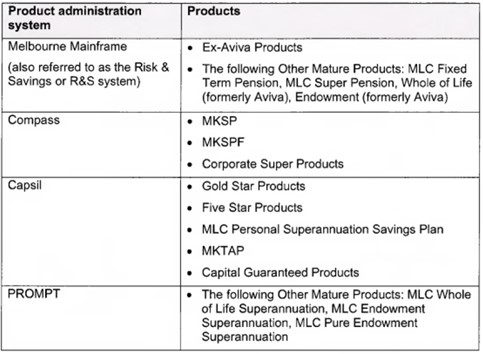
45 In order to assist in understanding the evidence and facts as they were developed before me it is convenient to set out in one place the various NAB Group employees who were involved in assisting the NULIS, MLCN and PFSN boards prior to the SFTs and the NULIS board after the SFTs. Many of them held more than one job title during those periods. For ease I have, for most of the employees listed, only referred to their most relevant in time job title. The relevant employees included (in alphabetical order):
(1) Paul Carter – executive general manager, super and investment platforms. Prior to holding this position, Mr Carter was executive general manager, corporate and institutional wealth. In that role, he was responsible for sales, client relationships, member experience, product management and claims management for the NAB Wealth businesses that service corporate and institutional clients across the Plum, Business Super and MLC Insurance brands. Prior to that, Mr Carter was executive general manager of business operations and strategy at NAB Wealth and managing director of Plum Financial Services. He also held senior roles in financial services and strategy at Citigroup and the Boston Consulting Group;
(2) Michelle Finlay – senior consultant, actuarial, pricing & profitability, retail super and investment platforms, NAB CPS Wealth;
(3) Tom Garde – general manager, product, corporate and institutional wealth;
(4) Justine Gorman – head of risk, wealth transformation program, NAB;
(5) Tim Gorste – senior manager, NAB Wealth Transformation;
(6) Andrew Hagger – group executive, NAB Wealth;
(7) Andrew Lawless – product development manager, retail platforms, MLC;
(8) Matthew Lawrance – executive general manager, NAB Wealth and CEO of MLC Super;
(9) Daniel Levy – general manager, portfolio development, NAB Wealth;
(10) Brian Marriott – chief operating officer of NULIS, MLCN and PFSN for a period of 11 years and, as set out below, the Office of Trustee (OTT). Mr Marriott held various executive roles in superannuation and investment spanning more than 25 years, including leading service delivery and operations at Colonial First State. He also held a number of senior roles in the wealth division of NAB across operations and strategic changes projects;
(11) Damian Murphy – chief risk officer, NAB Wealth;
(12) Lisa Neaves – senior product manager, product strategy and development, NAB Wealth;
(13) Brad Tallents – head of business transformation, NAB Wealth; and
(14) Kathy Vincent – general manager, retail super & investments. Ms Vincent joined MLC in November 2012 and was responsible for driving development and management of MLC’s retail superannuation and investment platforms. Prior to joining MLC Ms Vincent spent 20 years at Macquarie Group Ltd in a number of leadership roles in the area of product development.
46 The following persons were executive officers of NULIS within the meaning of s 10 of the SIS Act and “Responsible Persons” of NULIS within the meaning of SPS 520 Fit and Proper at [11]:
(1) Mr Marriott from 1 May 2015 to 23 September 2020;
(2) Ms Vincent from 1 May 2015 to 24 November 2017;
(3) Mr Carter from 1 May 2015 to 31 January 2017;
(4) Mr Lawrance from 1 May 2015 to 16 November 2018; and
(5) Mr Murphy from 1 May 2015 to 5 April 2019.
47 There are three relevant trustees: NULIS, MLCN and PFSN.
48 From 14 February 2011 and at all times prior to the SFT the directors of NULIS, MLCN and PFSN were the same and it was often the case that the meetings of the three boards were convened at the same times (referred to in these reasons as combined board meeting).
49 For most of the period from 1 July 2015 to 30 June 2016 (Pre-SFT Period) the directors of NULIS, MLCN and PFSN were Nicole Smith, John Reid, Trevor Hunt, Evelyn Horton, Terry McCredden and Ms O’Neal. Michael Clancy was also a director of NULIS, MLCN and PFSN for part of that period, resigning on 15 December 2015.
50 In the period from 1 July 2016 to 31 March 2020 (Post-SFT Period) Ms Smith, Ms Horton, Ms O’Neal and Messrs Reid, Hunt and McCredden each remained as directors of MLCN and PFSN for various periods of time. From 26 August 2016 the boards of NULIS, MLCN and PFSN were no longer the same: Andrew Gale was appointed as a director of NULIS. The board of NULIS was wholly comprised of non-executive directors during both the Pre-SFT Period and the Post-SFT Period.
51 Meetings of the boards of NULIS, MLCN and PFSN were held at least quarterly, and usually more frequently, whilst Ms O’Neal was a director. In the period from March 2016 to 30 June 2016, in the lead up to the SFTs, board meetings were held at least fortnightly. In the Post-SFT Period the NULIS board met at least every two months and usually more often.
52 Board workshops were held from time to time in the Pre and Post-SFT Periods. They were attended by the directors of NULIS, individuals from the OTT, representatives of the administrator and, where relevant, other service providers to the MLC Super Fund.
53 Workshops allowed the directors, prior to any formal proposal being presented at a board meeting, to request and be provided with information by representatives of the relevant service providers in relation to the particular topic for consideration and discussion. In turn, this allowed “deep dives” into issues or strategies, provided extended time for the directors to consider complex issues in a less formal setting, facilitated more in-depth discussions than could be accommodated at a formal board meeting and allowed the directors to identify any issues which required further work. For example, often workshops would be held in relation to potential options for product improvements providing a forum where directors could be given details of the benefits to members and any other impacts of a proposal prior to preparation of a board paper and making a decision.
54 Minutes were not taken at board workshops, although from time to time informal notes were taken of the discussions and of any action items to be progressed.
55 The OTT was a dedicated office established by the boards of NULIS, MLCN and PFSN to support those trustee companies in meeting corporate governance and trustee and fiduciary responsibilities, including managing conflicts of interest.
56 The OTT was governed by a Charter which set out its roles and responsibilities and the authorities under which it operated. The Charter was approved by the boards of each of MLCN, NULIS and PFSN.
57 The OTT comprised a relatively small number of staff (referred to as members in the Charter) and, from time to time, was supported by external consultants. The members of the OTT were employed by NAB and its subsidiaries and seconded to MLCN, NULIS and PFSN.
58 During the time that Ms O’Neal was a director of NULIS, MLCN and PFSN, Mr Marriott was the chief operating officer of the OTT. Ms O’Neal saw the function of the OTT as the “arms and legs” of the trust. She had a good working relationship with Mr Marriott and other members of the OTT and found that OTT staff members were responsive to requests she made for information or assistance as a director.
59 From time to time Ms O’Neal sought information from Mr Marriott or other OTT staff members and they were sometimes asked to give their views to the NULIS board. In circumstances where a decision was required to be made and Ms O’Neal did not think she had sufficient information, Ms O’Neal’s practice was to request, usually via the chair of the NULIS board, that the OTT obtain additional information.
60 NULIS was the trustee of a number of Registrable Superannuation Entities (RSEs) during the Pre-SFT Period and the Post-SFT Period. It was appointed trustee of the MLC Super Fund upon execution of the Trust Deed on 9 May 2016 (see below).
61 The MLC Super Fund was set up to be the successor fund of five superannuation funds which were the subject of SFTs:
(1) TUSS, which was under the trusteeship of MLCN; and
(2) four superannuation funds which were under the trusteeship of PFSN, namely:
(a) The Plum Superannuation Fund;
(b) The National Australia Bank Superannuation Fund A;
(c) The BHP Billiton Superannuation Fund; and
(d) The Worsley Alumina Superannuation Fund,
(collectively, Plum Funds).
62 The day to day operation of the MLC Super Fund was facilitated by personnel employed by or seconded to NWMSL or by NULIS’ ultimate shareholder, NAB. NWMSL provided the services and resources required by NULIS to operate the MLC Super Fund pursuant to a services agreement dated 30 June 2016 between NULIS and NWMSL, which was varied on 22 June 2017 and 14 February 2018.
63 MLCN invested the assets of TUSS in investment linked insurance policies issued by MLC Limited to MLCN in its capacity as trustee of TUSS. According to Ms O’Neal the structure of investments in the Pre-SFT Period was complex. It had been established historically as a tax effective way to invest the assets of TUSS and reflected the origin of the MLC business as a life company before it expanded into superannuation.
64 In the Pre-SFT Period MLC Limited also acted as the administrator of TUSS.
65 MLC Limited maintained various investment options with different investment objectives and tax characteristics in which TUSS assets were invested. MLCN did not have direct control over any of these investment options. MLC Limited was able to vary the investment objectives, profile, underlying assets or manager of an investment as it thought appropriate but was required to give notice to MLCN of any variation given the potential disclosure obligations to members of TUSS.
66 MLC Limited was entitled to:
(1) deduct investment costs and investment expenses from the assets of each investment option, which were taken into account when calculating the unit price and performance figures for each investment option each day; and
(2) charge fees, including by way of deduction from an investment option or by allocating the fee as a deduction to the value of the account maintained by it for a particular member.
67 Ms O’Neal understood that the unit prices set by MLC Limited included a profit margin and that its various costs and expenses were taken into account when daily unit prices were calculated. The value of the units would, in effect, be the market value of the investment less the fees charged by MLC Limited.
68 As trustee of TUSS, MLCN did not make any profit. All revenue from fees charged to members of TUSS was revenue of MLC Limited. Each member of TUSS had their account attached to a particular superannuation “product”. Products are vehicles for holding members’ superannuation each of which have different fee structures, investment menus and insurance arrangements. Some of the superannuation products in TUSS charged members fees from which commissions were paid to financial services licensees.
2.6.1 TUSS Commission Products
69 In the Pre-SFT Period TUSS comprised various retail superannuation products which could be acquired by members directly or through a financial adviser and a corporate superannuation product known as MKBS.
70 While Ms O’Neal was a director of MLCN the product disclosure statements (PDS) issued for on-sale products in TUSS were reviewed by the Disclosure Governance Committee, of which Ms O’Neal was a member and chair at various times.
71 The commission paying products in TUSS as at June 2016 (TUSS Commission Products) comprised:
(1) a cohort of products acquired from Aviva Australia Holdings Limited (Ex-Aviva Products);
(2) retail products, being product offerings which an individual could invest in, known as:
(a) MasterKey Superannuation Gold Star and MasterKey Allocated Pension Gold Star (together, Gold Star Products);
(b) MasterKey Superannuation Five Star and MasterKey Allocated Pension Five Star (together, Five Star Products);
(c) MLC Personal Superannuation Savings Plan;
(d) MasterKey Term Allocated Pension (MKTAP); and
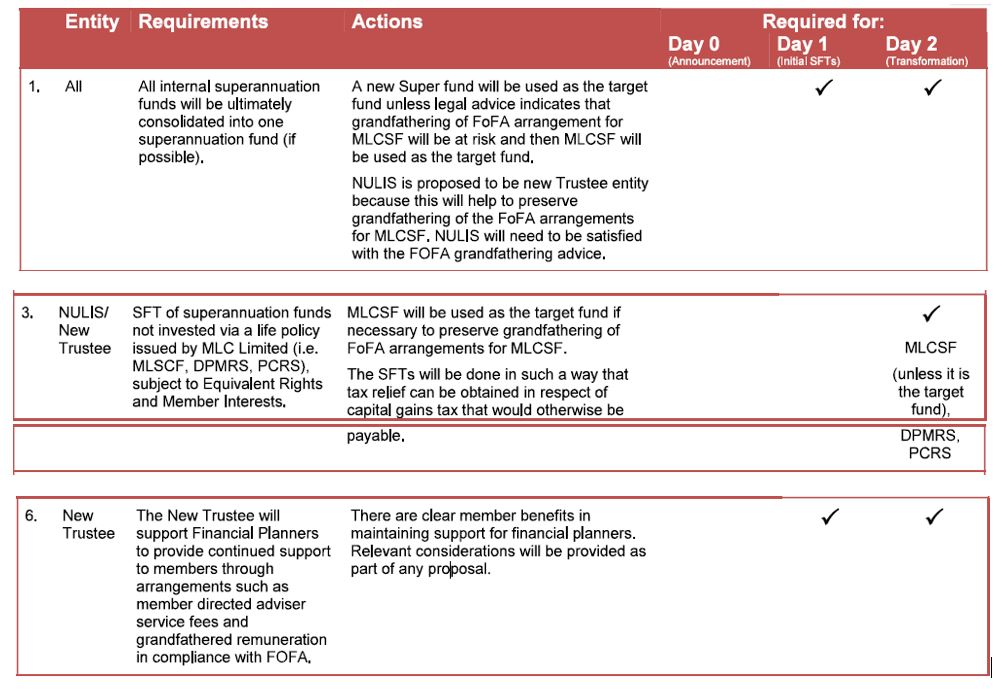
(e) MasterKey Super and Pension (MKSP);
(3) MKBS, a corporate product which was a superannuation arrangement established by an employer in order to satisfy its superannuation guarantee requirements for employees that do not choose their own superannuation fund; and MasterKey Personal Super (MKPS) which was the product to which a member of MKBS was automatically transferred after ceasing employment (together, Corporate Super Products);
(4) products where MLC Limited provided a guarantee, known as MLC Capital Guarantee Personal Super Savings Products Series 1 (ex-Capita) and MLC Capital Guarantee Personal Super Savings Products Series 2 (Accumulus); and
(5) products where MLC Limited issued a life policy under which the member was insured.
72 The TUSS Commission Products were “accumulation” style products into which a member’s superannuation contributions were made and invested. In general terms, a member’s account balance was the amount of contributions plus investment earnings or less investment losses, as applicable, and net of any fees or costs. There were no defined benefit members in TUSS.
73 With the exception of the Corporate Super Products, the TUSS Commission Products were off-sale by 1 July 2014 such that new members were not permitted to invest in those products. The Corporate Super Products remained on-sale, in that they were available to new and existing members, in the period following the SFTs. However, the commission arrangements (namely, adviser contribution fees and insurance commissions) only applied to members who joined the product prior to 29 November 2013.
74 Some of the TUSS Commission Products had a number of series or product variants as a result of trade-ups which occurred before the SFTs. This happened because in some of the previous trade-ups, certain product features had been “grandfathered” or carried over to the target or destination product which led to the “umbrella” product having series or variants. For example, in MasterKey Superannuation Gold Star there were ten product series and in MasterKey Superannuation Five Star there were four product series.
75 By the time Ms Stansell commenced working on the Trade-up Program, all of the TUSS Commission Products, other than MKSP and the Corporate Super Products, were classified as legacy products. The legacy products were administered on a product administration system that was not the “go-forward” system, that is the system which was used for new products. This included products that were administered on the Melbourne Mainframe and Capsil systems (see below).
76 As a non-executive director of MLCN in the Pre-SFT Period, Ms O’Neal:
(1) had a general understanding of the various groupings of the TUSS Commission Products (see [71] above);
(2) did not have a detailed understanding of the specific terms and features of the TUSS Commission Products as many were off-sale and not active; and
(3) Ms O’Neal’s knowledge of the TUSS Commission Products was gained from discussions at board meetings and workshops, in particular, in the context of proposals to improve the features of legacy products.
77 Ms O’Neal considered that certain of the legacy products were outside MLCN’s risk appetite. This was primarily because they were off-sale products lagging behind contemporary standards. In cross-examination Ms O’Neal explained in relation to the legacy products that:
(1) they were not up to date and did not sit on a digital platform that could be easily administered which meant there was a chance of human error in their administration;
(2) they had features to which members had agreed originally but which were unattractive when compared to modern on-sale product offerings;
(3) there was a risk that the trustee (and its board) no longer understood the products in the way that it should; and
(4) they were outside the trustee’s risk appetite because they were relatively high fee products compared to more modern products being offered first, by MLCN and later, by NULIS. The higher costs were partly caused by the fact that the products were held on old platforms and, as the number of members declined, there were fewer members across whom the costs of maintaining those platforms could be spread.
78 The view that these legacy products were outside MLCN’s risk appetite was recorded in an MLCN board paper titled “Project Mars – Retail Product Strategy” dated 25 November 2015 (Retail Product Strategy Paper) which was presented to a combined board meeting on 2 December 2015. “Project Mars” was the internal name for the proposed SFTs and the then proposed Trade-up Program. It aimed to simplify the superannuation business by reducing the number of superannuation funds, products and product administration systems that would be within the TUSS Division of the MLC Super Fund.
79 In addition to the TUSS Commission Products, there were two on-sale retail products available to the TUSS Division of the MLC Super Fund which did not pay commissions: MasterKey Super Fundamentals (MKSF); and MasterKey Pension Fundamentals (together, MKSPF). As explained below, these were the products to which the TUSS Commission Products were upgraded in the Post-SFT Period.
80 The TUSS Commission Products and MKSPF were administered on four different product administration systems, each of which housed member data and records, as follows:
81 Compass became the “go-forward” system because it was the product administration system that MLC Limited used to administer products that were open to new members.
82 As set out above, Ms O’Neal understood that the functionality of some of these administration systems was outdated and they were expensive. She recalls this was discussed in the Pre-SFT Period on various occasions among MLCN directors with the objective of transitioning members’ records to a contemporary product administration system, Compass, and closing the legacy systems, including:
(1) section 4 of the Trustee Business Plan for October 2015 to September 2018 (approved by MLCN’s board at its meeting on 23 September 2015) identified the need to deal with the complexity and cost of the legacy product administration systems as a key focus for MLCN as trustee; and
(2) the legacy product administration systems on which certain TUSS Commission Products were administered, and the contemporary Compass administration system, were referred to in the Product Mars Retail Product Strategy Paper included in the meeting pack for the 2 December 2015 combined board meeting in the context of the proposed product upgrade strategy following the SFTs.
2.6.3 Commissions on the TUSS Commission Products
83 Ms O’Neal understood that in the Pre and Post-SFT Periods there were three primary types of commissions paid in respect of the TUSS Commission Products:
(1) asset-based or “trail” commissions, which were commission payments made to financial services licensees that were referable to the balance of the member’s account and which became payable when a member acquired an interest in a product and which continued to be paid while the member held an interest in the product;
(2) contribution-based commissions, which were commission payments made to financial services licensees which were calculated based on contributions made to a member’s account; and
(3) insurance commissions (applicable to the Corporate Super Products only), which were commission payments made to financial services licensees calculated as a percentage of the insurance premium payable in respect of insurance cover acquired through those products.
84 As a director of MLCN Ms O’Neal understood that in the Pre-SFT Period, MLC Limited paid commissions to financial services licensees, set the fees and determined the unit prices of the investment options for members of TUSS. As set out at [68] above, those fees were revenue of MLC Limited and the commissions were paid to financial services licensees from this fee revenue.
85 Ms O’Neal understood, both as a director of MLCN and NULIS, that the commissions for the TUSS Commission Products were embedded in the cost of the product to the member, were paid for upon the initial acquisition of the product and that there was no legal requirement for a financial services licensee to provide any ongoing service to a member in exchange for the commission.
86 In the Pre and Post-SFT Periods Ms O’Neal understood that certain of the TUSS Commission Products had fees which were paid to financial services licensees for the provision of service, or access to service (that is, “fee for service” arrangements), separate to the commission arrangements described at [83] above. These included “adviser service fees” and “plan service fees” which were not grandfathered commissions. Throughout the period that Ms O’Neal was a director of MLCN and NULIS, she understood that the terms “commissions” and “fees” were used in PDSs to differentiate between amounts which were embedded as part of the cost of the product to a member (that is, commissions) and amounts which were paid separately and related to the provision of, or access to, ongoing services (that is, fees).
87 The Plum Funds generally comprised large employer-sponsored superannuation plans. Certain assets of the Plum Funds were held directly by the Plum Pooled Superannuation Trust, which was a special type of RSE and was wound up following the SFTs as it was no longer necessary. Other assets of the Plum Funds were invested by PFSN in investment-linked insurance policies issued by MLC Limited.
88 Each employer sub-plan in the Plum Funds had a legal agreement known as a “Participation Agreement” which formed part of the governing rules of the fund. A Participation Agreement set out detailed rules for investments and usually could not be amended without the agreement of the employer-sponsor. Each of the sub-plans which had more than 50 members was required to have a policy committee which had equal representation from the employer and members. These committees provided feedback to the trustee on behalf of the sub-plan members.
89 In the Pre-SFT Period Ms O’Neal was aware, from her role as a director of PFSN and her role as a solicitor at Freehills providing advice to PFSN for many years, that PFSN became the trustee of most of these sub-plans because of various SFTs which occurred in the period from approximately 2002 onwards from standalone corporate superannuation funds or competitor master trusts. During this time, many employers no longer wished to operate their own fund because of the significant and frequent increases in regulatory requirements.
90 Ms O’Neal explains that the Plum Funds comprised both accumulation plans, defined benefit plans and hybrid plans. In contrast, TUSS had accumulation plans only.
91 Ms O’Neal recalls that there were no commissions paid in respect of products in the Plum Funds. That was because the products were usually employer-sponsored, were not distributed to retail investors in the same manner as the retail products in TUSS (for example, through a financial adviser) and the majority of members in the Plum Funds were not directly advised by a financial adviser. All of the sub-plans in the Plum Funds had a relationship manager, who assisted employers in managing their obligations. Thus, as Ms O’Neal explains, the target markets of TUSS and the Plum Funds were fundamentally different.
2.8 Mr Brady invests in superannuation with MLC
92 Mr Brady is 85 years old. He completed his third year of secondary school before becoming an apprentice electrical fitter (radio). Mr Brady was self employed as a television serviceman repairing televisions, video recorders and radios from 1970 until his retirement in 2001.
93 The manager of the Mullumbimby branch of NAB introduced Mr Brady to Maurice James, who he understood to be a financial adviser, in late 1998. Mr Brady recalls visiting Mr James’ office for the first time in late 1998. I understand that at the time (and in any event as at 2004) Mr James was at MK Financial Planning Services Pty Ltd which was an authorised representative of GWM Adviser Services Limited trading as Garvan Financial Planning, an Australian financial Services Licensee.
94 By letter dated 7 December 1998 Mr James provided Mr Brady and his wife, Sheila Brady, with an investment plan dated 3 December 1998. In summary, the investment plan recommended that Mr and Mrs Brady’s investment portfolio of $169,800 be invested across a range of allocated pension/annuities, cash based investments and direct equities. Mr Brady cannot recall receiving or reading Mr James’ letter or the enclosed investment plan.
95 In about 1999 Mr Brady and his wife sold their home. They had about $155,000 to invest for their retirement.
96 Mr Brady recalls that he went to see Mr James who at that time provided him with some MLC Limited documentation. Mr and Mrs Brady were shown applications for MLC superannuation, copies of which he no longer has. Mr Brady did not pay much attention to the documents but recalls that he was investing his money into MLC superannuation.
97 It is apparent that in 1999 Mr Brady opened a TUSS National Personal All in One Super account and that he signed an application form for that account dated 3 February 1999.
98 Insofar as Mr Brady can recall, before investing in MLC superannuation he did not receive any written advice, advice in relation to particular or alternative superannuation investment options or advice about fees, charges or commission that might be charged, paid or negotiated or other financial advice from Mr James or anyone else at NAB or MLC Limited or on their behalf. Upon searching his records, Mr Brady was unable to find any records of advice.
99 On a number of occasions Mr James asked Mr and Mrs Brady to visit his office in Tweed Heads to sign documentation. When they did so the documents to be signed were already filled in and Mr James asked for them to be signed. Once again, Mr Brady does not recall receiving any written or verbal advice in relation to those documents.
100 In December 2001 Mr Brady received:
(1) from NAB a document titled “THE UNIVERSAL SUPER SCHEME NATIONAL PERSONAL ALL IN ONE SUPER Statement of benefits as at 30 November 2001 Exit statement”, which is the earliest written record Mr Brady has in relation to his MLC superannuation; and
(2) from MLC Limited a document titled “MLC MasterKey Superannuation upgrade investment confirmation as at 1 December 2001 Entry statement” which recorded that his superannuation was transferred to MasterKey Superannuation Five Star (Nil entry fee version).
101 As best as Mr Brady can recall:
(1) he did not receive any advice or communication from Mr James in relation to the transfer of his superannuation to MasterKey Superannuation Five Star (Nil entry fee version); and
(2) after making his initial investment Mr Brady never received any written or oral financial advice from Mr James or from any other MLC Limited or NAB employee or representative in relation to his superannuation.
102 On 7 September 2004 Mr James provided a “Statement of Advice (incorporating a financial plan)” to MR and Mrs Brady. The recommendations included combining “current MLC super with Colonial policy and convert to an allocated pension to provide retirement income”, namely MasterKey Allocated Pension.
103 Mr Brady was shown a MasterKey Allocated Pension application form dated 8 September 2004 which bears his and Mrs Brady’s signatures on pages 6 and 5 respectively. Other than the signatures, he does not recognise the handwriting on the form, does not know who completed the form, and does not recall discussing its contents or receiving any advice about it. On 8 September 2004 Mr Brady also signed a “Request to transfer funds ‘to the MLC MasterKey Allocated Pension’ authorising the transfer of funds to the MasterKey Allocated Pension which is invested in The Universal Super Scheme”. Despite Mr Brady’s lack of recollection, it is clear that from about September 2004 he had an MasterKey Allocated Pension Gold Star account.
104 In about March 2005 Mr Brady received from MLCN an “MLC MasterKey Portfolio Summary” and “Statement of Account” as at 31 December 2005 for his MasterKey Allocated Pension Gold Star account which showed that his portfolio comprised units held in MLC IncomeBuilder and MLC MasterKey Horizon 5 – Growth Portfolio. Mr Brady explained that his portfolio remained the same throughout the period he held his MasterKey Allocated Pension Gold Star Account, namely 2004 to 2020.
105 Subject to the following, after 2006 the only further documents and services Mr Brady can recall receiving in relation to his superannuation were annual notifications by letter and/or statements from MLC Limited, MLCN and then NULIS notifying his account balances. Mr Brady cannot recall receiving any service from a financial adviser in relation to his superannuation from 2005 to 2020.
106 James & Young Wealth Management, which I infer is a firm of which Mr James is or was a principal, produced documents in answer to a subpoena served on it in this proceeding. Some of the documents produced suggest that Mr Brady received various communications in relation to his accounts held with MLC Limited that he neither had in his possession nor could recall. Mr Brady acknowledged that the documents produced on subpoena suggest that he received various documents from Mr James in relation to his MLC accounts that he did not previously hold or recall. Mr Brady has carried out a search and, other than the documents produced on subpoena, he does not have copies of any other documents from Mr James’ office in respect of any advice concerning his MLC accounts.
107 As well as the letter dated 7 December 1998 and its enclosure referred to at [94] above, a number of other documents were produced by James & Young Wealth Management in relation to Mr and Mrs Brady and their MLC superannuation including statements of advice, diary notes of meetings, questionnaires, tax invoices, email exchanges with Mr James and correspondence enclosing portfolio reports. In summary Mr Brady cannot recall receiving, reading and, in some cases, understanding the correspondence and/or advice he received as evidenced by those documents. However, he does recall generally contacting Mr James to discuss what he should do prior to his retirement at age 65.
108 While Mr Brady has an imperfect recollection, it was not in dispute, and the evidence shows, that he invested in MasterKey Allocated Pension Gold Star in 2004.
109 An annual statement to 30 June 2016 was issued by MLCN as the trustee of TUSS, just prior to the SFT, for Mr Brady’s MasterKey Allocated Pension Gold Star account. It showed an account start date of 10 September 2004, included Mr Brady’s account and customer numbers, named Mr Brady’s adviser, Mr James, and provided a summary of his account including its opening balance, payments out, fees paid directly from the account and movement in investment value to arrive at a closing balance.
110 The annual statement as at 30 June 2016 also included an investment summary which showed that Mr Brady owned two investments in MasterKey Allocated Pension Gold Star: MLC Horizon 5, with “inception date” of 4 June 1998; and MLC IncomeBuilder, with “inception date” of 31 July 1997.
111 By letter dated September 2016 Mr Brady was informed that a PDS “summarising the features and terms of [his] account in MLC MasterKey Allocated Pension Gold Star” was available to him either online, by email or in hard copy if he so requested.
112 An annual statement to 30 June 2017 for Mr Brady’s MasterKey Allocated Pension Gold Star account provided exactly the same information save that the statement was issued by the trustee of the MLC Super Fund, NULIS, and the amounts shown for the opening balance, payments out, fees paid directly, movement in investment value and closing balance differed as did the opening and closing balances for the two products in which Mr Brady had invested.
113 By letter dated 9 April 2020 Mr Brady was informed that his MasterKey Allocated Pension Gold Star account was moving to MasterKey Pension Fundamentals as part of NULIS’ “ongoing program to modernise and simplify its products to benefit members overall”. That letter informed Mr Brady that there was “[g]ood news” because his “annual fees are expected to decrease by approximately $825.15 pa, based on [his] account balance of … and investments at 5 March 2020” and that:
MLC MasterKey Pension Fundamentals has a different fee structure and doesn’t pay commission to advisers. …
If you wish to consult your financial adviser, you may pay a fee for the services you receive. You can choose how to pay for these services, including having the fee deducted from your account, which would be an additional cost to you.
114 On 5 June 2020 Mr Brady was transferred to MasterKey Pension Fundamentals.
2.10 Ms Atkinson invests in superannuation with MLC
115 Ms Atkinson is 62 years old. She is a part-time secretary and part-time teacher. She became a member of TUSS on 10 October 1994. At the time she was employed by her husband’s business, Accounting & Business Consulting Services Pty Ltd (ABC). She is currently employed by the same business part-time and is also employed part-time as a teacher. As at March 2022 she anticipated that she would continue to work for the next two to three years.
116 In 1994 ABC subleased premises from Bridgeport Sydney which was a provider of financial services and a client of ABC. Neither Ms Atkinson nor her husband, Hugh Atkinson, were clients of Bridgeport.
117 Ms Atkinson and her husband set up MLC Limited superannuation accounts at the same time. Ms Atkinson cannot now recall whether she or her husband filled in any application forms at the time. Her listed Plan adviser in the Statements of Account provided to her by MLCN in July 2009 and July 2010 was Bridgeport.
118 Ms Atkinson does not recall receiving any written or oral financial advice from Bridgeport or any financial adviser at that time or at any subsequent time from 1994 to 30 June 2021.
119 Ms Atkinson invested in the MKBS product. Ms Atkinson, like Mr Brady, had an imperfect recollection of her superannuation matters in the thirty years since she first established her superannuation account.
120 In about July 2009 Ms Atkinson received from MLCN an MKBS statement of account recording her investments as at 30 June 2009. That statement recorded her investments at the time as being equally split three ways between MLC Horizon 5, BT Balanced Fund (Closed) and INVESTCO Growth Fund (Closed).
121 Ms Atkinson’s investment options remained as they were until 2014 when MLCN unilaterally moved her investment in the BT Balanced Fund (Closed) to MLC Horizon 3 – Conservative Growth Portfolio and her investment in INVESTCO Growth Fund (Closed) to MLC Horizon 4 – Balanced Portfolio. Her future contributions and rollovers continued from then until 2021 to be invested in equal shares in MLC Horizon 3 – Growth Portfolio, MLC Horizon 4 – Balanced Portfolio and MLC Horizon 5.
122 Ms Atkinson does not recall receiving any financial advice from any financial adviser nor any contact from MLCN about her investment options nor the fees and commissions charged in relation to her account, with the exception of the communications from MLCN referred to in the preceding paragraph notifying her of the changes to her investment options.
123 By letter dated April 2016, Ms Atkinson was notified by MLC of “Important changes to [her] super”, relevantly, the proposed SFT. The letter indicated that MKBS products would be moved to a new fund by SFT, if the SFT proposal was approved, and was accompanied by a flyer providing further information regarding the proposed SFT, including a list of “Fees and other charges”. There was no mention of financial adviser fees in the flyer. However, it noted that “[f]or more information about your current fees, transaction costs and how they are calculated, please log in to your account with your customer number on mlc.com.au or see the Product Disclosure Statement (PDS) on mlc.com.au/pds/mkbs”.
124 An annual statement to 30 June 2016 for Ms Atkinson’s MKBS account was accompanied by a covering letter which notified her of “[t]he movement of [her] super to the MLC Super Fund” which took effect on 1 July 2016. Ms Atkinson was then sent a copy of the PDS for her MKBS account by MLC in September 2016. Ms Atkinson does not recall receiving correspondence regarding changes to her MKBS product in the Post-SFT Period.
125 To the best of Ms Atkinson’s knowledge, she did not receive any services from a financial adviser in relation to her superannuation investment.
2.12 Product disclosure statements
126 The PDS for MasterKey Allocated Pension Gold Star dated 23 September 2016 was in evidence before me. It includes in that part describing “Fees and other costs”:
(1) the following explanation:
This document shows fees and other costs that you may be charged. These fees and other costs may be deducted from your money, from the returns on your investment or from the assets of the superannuation entity as a whole.
Other fees, such as activity fees or advice fees for personal advice may also be charged, but these will depend on the nature of the activity or advice chosen by you.
Taxes are set out in another part of this document.
You should read all the information about fees and other costs because it is important to understand their impact on your investment.
The fees and costs for each investment option offered by the superannuation entity are set out below and in the Investment Menu section starting on page 20.
(2) a table describing types of fees, amounts payable for each fee type and how and when each fee type is paid; and
(3) a worked example of annual fees and costs based on a $50,000 balance held in MLC Horizon 4.
2.13 The events leading up to the SFTs
127 The SFTs occurred in the context of NAB’s sale of 80% of its shareholding in MLC Life to Nippon Life Insurance Company which was announced in October 2015. That transaction was referred to within the NAB Group as Project Astro. The boards of MLCN and PFSN as trustees respectively of TUSS and the Plum Funds were first briefed on Project Astro on 31 July 2015.
128 From at least August 2015 Ms O’Neal became aware, and discussed with her fellow board members, that as part of Project Astro the transfer of the assets and members of TUSS and the Plum Funds would occur through SFTs of those funds into a new superannuation fund. This was as an alternative to cancelling the investment-linked insurance policies issued by MLC Limited and transferring the underlying investments or proceeds from the sale of assets to the existing superannuation funds.
129 As Ms O’Neal explains, an SFT is effectively a transfer of members and their benefits from one superannuation fund to another, without their consent. Ms O’Neal estimates that during her career as a solicitor and as a director of NULIS, MLCN and PFSN, including as chair of the Successor Fund Transfer Committee, she provided legal advice on, or considered as a trustee director, in the range of 90 to 100 SFTs. Ms O’Neal advised on what she believes was the first SFT in Australia when Telstra merged two superannuation funds in around 1997.
130 Ms O’Neal was supportive of transferring the assets and members to a new superannuation fund, rather than to the existing superannuation funds. Ms O’Neal was of this view primarily because the latter method would have incurred capital gains tax (CGT), and she was aware, having provided legal advice as a solicitor on previous SFTs, that CGT rollover relief was available where all members and all assets of a superannuation fund were moved from one fund to another in the same tax year. As a director of MLCN and PFSN, Ms O’Neal considered that the CGT rollover relief was a significant factor in considering the proposed SFT and a fundamental consideration in assessing whether the SFT was in the best interests of members.
131 Ms O’Neal considered that proceeding by way of SFT was the only practical option available. The alternative, which would result in payment of CGT, was not an attractive option given the amount of CGT that would have been payable out of the assets of the relevant fund and because the transfers to TUSS and the Plum Funds would also have been subject to contributions tax payable by the members.
132 Various board meetings and workshops which, as I have already observed, as a matter of practice were generally held jointly between MLCN, PFSN and NULIS, were held in the second half of 2015 at which the proposal in respect of the SFTs was developed and discussed.
2.13.1 Combined board workshop – 12 August 2015
133 On 12 August 2015 a combined board workshop was held. A workshop pack titled “Project Astro: Confidential Trustee Workshop” was provided for it. One of the items on the agenda was “[t]he preferred structure and how to implement it”. In relation to that agenda item, among other things, the workshop pack identified:
(1) the recommended preferred structure was as one superannuation fund, to be split into divisions to separate the different types of member offering, into which the existing super funds (TUSS and the Plum Funds) would transfer. That structure was recommended because “[a] simple transfer of the assets from MLC Limited to each of the super funds would incur capital gains tax” and the tax position therefore required that all members of TUSS and the Plum Funds be moved via an SFT to another super fund;
(2) none of the superannuation funds that invest in investment-linked life policies issued by MLC Limited (that is, TUSS or the Plum Funds) could be used as the target receiving fund meaning that either a new superannuation fund was required, or one of the other existing RSEs could be used. The identified preference was a new fund with a new trustee; and
(3) as a matter for consideration the issue of losing grandfathered commissions.
2.13.2 Combined board workshop – 14 September 2015
134 On 14 September 2015 a combined board workshop was held. The documents provided in the workshop pack were “works in progress” ahead of the upcoming 14 October 2015 combined board meeting. The emphasis was “on the opportunity to discuss direction and align expectations” with the workshop purpose stated to be to address the “latest thinking from management on the Mars Proposal in order to [h]elp Directors understand the direction of the proposal” and “[s]eek formal feedback from Directors to guide actions over the next few weeks leading up to a formal proposal for consideration”.
135 The workshop pack included a draft letter from MLCN to NAB for Project Astro. The draft letter referred to NAB’s proposal “in the wake of the Transaction”, that a new superannuation fund be established with NULIS as its trustee and that a number of specified funds including TUSS amalgamate into the new fund by way of an SFT. After referring to the “Principles” which would apply to the amalgamation, the draft letter continued:
I confirm that, subject to the Principles, [MLCN], as trustee of TUSS, is supportive of the proposed Amalgamation and confirms its in-principle support to undertake the following steps in relation to the proposed Amalgamation:
• Assess, in accordance with its statutory and general law duties, the detailed terms of the SFT proposal and a Business Case for the amalgamation of TUSS into the New NAB Fund by way of a SFT.
• Obtain independent advice in relation to the SFT proposal and Business Case.
• Subject to [MLCN] being reasonably satisfied that the SFT proposal is in the best interests of the beneficiaries of TUSS after taking into consideration the terms of the SFT proposal and the Business Case, implementing an amalgamation of TUSS into the New NAB Fund by way of a SFT, including:
• cancelling its existing investment insurance contract with MLC and
• requesting that the policy proceeds be paid by way of in-specie transfer to the trustee of the New NAB Fund (or as it may direct in writing).
• A release by [MLCN] of MLC as administrator of TUSS from all MLC’s historic liabilities and obligations as administrator of TUSS prior to the SFT date on the condition that these liabilities are assumed by NAB.
The initial support of [MLCN] outlined above is based on the information that you have provided about the benefits of the Amalgamation for members of TUSS.
However, as you would expect, further work needs to be undertaken to confirm this as the details of the Amalgamation are developed.
136 The workshop pack also:
(1) identified that the “window” of time for the SFTs to take place was through to 30 June 2017, which was the “End of Tax Relief”. At that time, CGT rollover relief available in relation to the merger of superannuation funds and the treatment of assets related to the merger applied only to mergers occurring before 1 July 2017; and
(2) included a document titled “Mars Principles (Discussion Document)” which set out (in two columns) certain “Principles” and “Outworking”. One of the stated principles under the heading “New Fund and New Trustee” was that “Grandfathering of FoFA status in respect of the MLCSF is important”. “FoFA” is a reference to the Future of Financial Advice reforms which came into effect by amendments to the Corporations Act and Corporations Regulations 2001 (Cth) described below. The related “Outworking” column in relation to the item “New Fund and Trustee” which included this principle, included that “[a] new Super fund will be used as the target fund unless legal advice indicates that grandfathering of FoFA arrangement for MLCSF will be at risk and then MLCSF will be used as the target fund” and “NULIS will be the new Trustee entity because this will help to preserve grandfathering of the FoFA arrangements for MLCSF”.
137 As to the latter matter, the references to “MLCSF” were references to the MLC Superannuation Fund which was an entirely different superannuation fund that was ultimately not the subject of the SFTs and is not involved in this proceeding. As NULIS points out the option identified in this draft discussion document, that NULIS be the receiving trustee for the SFTs on the basis this may assist to preserve the continuation of grandfathered arrangements which existed for products in the MLC Superannuation Fund, fell away in 2015 together with the early proposal that that fund might be transferred as part of the SFTs. This document does not support a conclusion that the consideration in 2015 of NULIS being the potential receiving trustee for the SFTs had any connection to the grandfathered commission arrangements which existed in TUSS.
2.13.3 Combined board workshop – 30 September 2015
138 A further workshop was held on 30 September 2015 in relation to the Project Mars proposal. The workshop pack included a paper authored by Mr Marriott titled “Project Astro / Mars – COO Overview”, which provided a perspective from the OTT on the proposed SFTs. Under the heading “Purpose” Mr Marriott stated:
The purpose of this paper is to provide additional insight around the work currently being undertaken in response to NAB’s decision to substantially divest itself of its life insurance business and its downstream impacts to the Trustee entities.
My role is unique in the organisation in that I do not act at any time for or perform work for any other entity in the group except the superannuation Trustee entities, I have no reporting line to management, the shareholder, the administrator or the life company. In that capacity, I have in the lead up to any public announcement, embedded myself in the Astro/Mars program to ensure that the Trustee’s (and its members) interests are appropriately dealt to ensuring all relevant matters are escalated to the Trustee free of any conflicts or constraints. This paper is written from that vantage point.
139 Mr Marriott’s paper also noted that he and Ashleigh Crittle of the OTT had “been involved in or engaged on every aspect of the draft proposal being considered at today’s workshop”, including:
(1) “[t]he re-design of the ‘Principles’ document that was discussed at the 14 September 2015 Trustee workshop”, which had been “sharpened to provide a clearer view of what is required when and by which entity at the right level of detail for the Trustee”; and
(2) the initial drafting of the letters that the Trustee would expect from the shareholder, its administrators and the life company and then the “subsequent management and oversight of all iterations and consultation”.
140 The workshop pack also included a draft of a paper to be presented at the upcoming 14 October 2015 board meeting titled “Superannuation entity amalgamation & rationalisation – Project Mars” which provided “an overview of management’s proposal to simplify NAB Wealth’s super fund structures, servicing and governance (the Mars Proposal) as a key component of [NAB’s] intention to substantially divest ownership and control of the life insurance business currently carried out by MLC Limited to ‘Neptune’ (Project Astro)” (original emphasis).
2.13.4 NAB letter dated 9 October 2015
141 By letter dated 9 October 2015 from Andrew Thorburn, Group CEO and Managing Director, NAB, to MLCN and PFSN (9 October 2015 Letter) NAB referred to Project Astro and set out its proposal for a “series of amalgamation and transformation activities” for its superannuation business within NAB Wealth. The details and key requirements of the proposal were included in a document attached to the 9 October 2015 Letter (Key Requirements). Under the heading “Benefits to Members” the 9 October 2015 Letter provided:
The Initial SFTs have been proposed as a means of providing the following key benefits for members of the transferring. RSEs:
1. significantly increased scale with expected cost reduction benefits;
2. funding of Operational Risk Financial Requirements (ORFR) through shareholder capital, enabling the removal of existing ORFR levies and release of existing ORFR member reserves for the benefit of members;·
3. the opportunity to provide more efficient and seamless transition of members through different life stages including accumulation phase, transition to retirement and post-retirement, as part of a single RSE environment;
4. the opportunity to provide a more co-ordinated approach to investment menu construction across funds, utilising the strongest components from each of the current separate menus; and
5. the opportunity to significantly reduce complexity and operational risk in the administration and investment environment.
In addition, the Initial SFTs will provide a platform which will enable NAB to invest in on-going product improvement including the trade-up of legacy business and enhanced member services. It is NAB’s current intention to pursue these strategies and, in the case of the trade-up of the legacy business, for this to be done within 3 years of completion of the Transaction.
142 The Key Requirements included, among other things:
143 In the 9 October 2015 Letter NAB requested that, “subject to the Principles and the Requirements”, MLCN and PSFN as “trustees of the transferring RSEs” confirm their in-principle support for the proposed “Initial SFTs”. The “Initial SFTs” referred to the proposal that TUSS and the Plum Funds be amalgamated into a new superannuation fund by way of SFTs and that a NAB Wealth entity be appointed as trustee and administrator of the fund.
2.13.5 Combined board meeting – 14 October 2015
144 A combined board meeting was held on 14 October 2015.
145 At that meeting the directors noted a further draft of the paper they had considered at the 30 September 2015 workshop (see [138] above) dated 8 October 2015 prepared by Mr Carter now titled “Superannuation Entity Initial SFT’s & Transformation Proposal – Project Mars” and resolved to approve the issue of letters by MLCN and PFSN to NAB “substantially in the form contained in the Legal Advice, subject to receipt of the signed letter from NAB, substantially in the form contained in Appendix 2”.
146 Under the heading “Purpose”, the paper provided:
This paper provides an overview of the [NAB’s], as shareholder, proposal to simplify NAB Wealth’s super find structures, servicing and governance (the Mars Proposal) as a key component of its intention to substantially divest ownership and control of the life insurance business currently carried out by MLC Limited to ‘Neptune’ (Project Astro). Note there has been extensive Trustee briefing and consultation on the nature and impact of the Mars proposal.
It is requested that considering the operating arrangements currently in place with MLC Limited, each of [MLCN] and [PFSN] provide a letter to the [NAB] confirming their in-principle agreement to the Mars Proposal and to undertake the steps required to implement the change subject to compliance with their statutory and general law duties.
147 The paper included an overview of the elements of Project Mars, outlined the benefit to members and annexed the proposed letter setting out MLCN’s and PFSN’s (as transferring trustees) in principle agreement as sought in the 9 October 2015 Letter, a Project Mars workplan and a summary of legal, tax and risk management advice. As described in the paper, Ms O’Neal understood that the proposal for the SFTs came from NAB and was made in the context of its sale of 80% of MLC Life for some $2.4 billion. That is, the superannuation investments had to be removed from MLC Limited to allow that sale to occur.
148 Under the heading “Proposed letter of in-principle agreement sought from MLCN and PFSN” the paper provided:
In relation to Day 0 Astro transaction communications and specifically in consideration of the current investment arrangements between MLCN, PFSN and MLC Limited, NAB has requested that MLCN and PFSN provide a letter of in-principle support (included in the legal advice) to the proposed Initial SFTs.
To assist MLCN and PFSN in providing this in-principle support, NAB is providing them with a letter (refer to Appendix 2) that includes, amongst other things:
• an acknowledgement of their commitment to operating a successful superannuation business within NAB Wealth;
• the NAB’s commitment to ensure that members of the transferring funds are no worse off as a result of MLC Limited being released from its obligations in connection with its roles as administrator of TUSS and issuer of investment polices to MLCN and PFSN; and
• a series of principles to ensure a smooth transition to the new arrangements and that neither MLCN, PFSN or fund members will bear the costs of the SFTs.
MLCN and PFSN’s support is requested subject to the matters described in the letter from NAB above, and also calls out that the successful completion of the Initial SFTs will rely on the actions of MLC Limited in their role as administrator of TUSS and as issuer of investment policies in which MLCN and PFSN invest. Further the SFTs will only proceed where ‘equivalent rights’ and ‘member interests’ tests are satisfied.
Please note that both these letters are in final draft and we expect that once the letter from NAB is signed we will request the letter from MLCN and PFSN to also be signed prior to Day 0.
To provide additional assurance to MLCN and PFSN, we confirm that the NAB Principal Board understands the scale of the undertaking of the Astro transaction and has flagged substantial investment to complete the Mars Proposal, including the legacy product trade-up and associated repricing. The NAB board will meet on 27 October 2015 to consider the Astro transaction, including the Mars proposal and a public announcement is expected soon after. Any issues arising from that meeting will be escalated to the Trustees as required.
149 The directors were also provided with and noted a paper titled “CRO Review and Assurance – Mars – Day 0” prepared by Mr Murphy, chief risk officer, and Eilis Hurley, head of risk, insurance. That paper set out the risk management processes being applied “as part of the Mars Transition and Transformation as relevant to the Trustee entities” and the CRO review of the Project Mars proposal being considered by the trustee board relating primarily to “Day 0 considerations”. It included:
(1) under the heading “Background”:
The Astro/Mars program of work (‘the Program’) represents a significant opportunity to transform the Astro and Mars businesses, dealing with long-standing legacy issues and creating strategic platforms for future success. The interests of members (present and future) have the potential to be improved significantly.
(2) under the heading “Risk Assurance Approach: Entity Focus”:
The Governance, Risk and Legal (“GRL”) work stream has been established to ensure that the Transaction, Transition and subsequent Transformation are within the risk appetites of the entities involved. This work stream will support the objective of the Program by enhancing certainty of Transaction closure and benefits realisation; protecting value (i.e. control environment maintained and improved) throughout the Transition and Transformation; and providing overall oversight and guidance on appropriate governance for the relevant entities and their Boards (including the Trustees).
(3) under the heading “Approach to Governance”:
A key issue is management of the conflicts of interest and duty. This needs to be addressed prior to the key decisions required of the Board in respect of Day 0. In particular, this relates to the ability of, and extent of, reasonable reliance by the Board on presentations by Management. …
(4) as Appendix 2 “Risk Profile Reports for the Trustees”. One of the risks identified was “conflicts of interest” in relation to which the authors noted as an impact on the trustee that “[t]he transaction has a myriad of conflicts, both for individuals and between entities” which was assessed as medium risk and for the management of which legal input was being sought and care taken “to align management incentives with entity interests”. Ms O’Neal explained that, insofar as it concerned individuals, the potential conflicts were those of management who were employed by NWMSL, and thus owed duties to and had an interest in NAB, who also worked on the trustees’ business and, insofar as it concerned entities, the potential conflicts were between NAB and the trustees.
150 The minutes of the 14 October 2015 combined board meeting record:
(1) in relation to the paper prepared by Mr Carter that the directors of MLCN and PFSN noted and discussed, among other things, that “[t]here is strong commitment from [NAB] to the resourcing and funding for this program of work, estimated to be between $300-$500m (excluding extraction costs). Both Shareholder and Trustees’ objectives with regards to customer outcomes are aligned”; and
(2) after discussion of Mr Carter’s paper, the directors of MLCN and PFSN resolved to approve the issue of letters to NAB in response to the 9 October 2015 Letter.
2.13.6 Letters dated 14 October 2015 from MLCN and PFSN
151 In accordance with the resolution passed by the directors at the 14 October 2015 combined board meeting, Ms Smith as chair of each of MLCN and PFSN sent a letter in identical terms to Mr Thorburn in relation to Project Astro. Those letters included:
Benefits to members
The NAB Letter states that the Initial SFTs have been proposed as a means of providing the following key benefits for members of the transferring RSEs:
1. significantly increased scale with expected cost reduction benefits;
2. funding of Operational Risk Financial Requirements (ORFR) through shareholder capital, enabling the removal of existing ORFR levies and release of existing ORFR member reserves for the benefit of members;
3. the opportunity to provide more efficient and seamless transition of members through different life stages including accumulation phase, transition to retirement and postretirement, as part of a single RSE environment;
4. the opportunity to provide a more co-ordinated approach to investment menu construction across funds, utilising the strongest components from each of the current separate menus; and
5. the opportunity to significantly reduce complexity and operational risk in the administration and investment environment.
We acknowledge the statements from NAB that the Initial SFTs will provide a platform which will enable NAB to invest in on-going product improvement including the trade-up of legacy business and enhanced member services, and that it is NAB’s current intention to pursue these strategies and, in the case of the trade-up of the legacy business, for this to be done within 3 years of completion of the Transaction.
152 Each of MLCN as trustee of TUSS and PFSN as trustee of the Plum Funds expressed their support for the “proposed Initial SFTs” and confirmed their in-principle support to undertake certain steps in relation to them including:
(1) assessing, in accordance with statutory and general law duties, the detailed terms of the proposed SFTs;
(2) obtaining independent advice in relation to the SFT proposal; and
(3) if, after taking into consideration the detailed terms of each SFT proposal, they were satisfied that the proposal was in the best interests of members and the new fund would confer equivalent rights in respect of benefits on transferring members, implementing an amalgamation of TUSS and the Plum Funds into the new fund by way of SFT.
153 The letters noted that in each case the trustee would need to undertake further work in order to confirm its support as the details of the “Initial SFTs” and “Transformation” were developed.
154 By the terms of their letters, the boards of MLCN and PFSN made it clear that the SFT would only be supported by them if they were ultimately satisfied that the proposal was in the best interests of members and was otherwise compliant with SFT requirements.
2.13.7 Events after 14 October 2015 combined board meeting
155 On 27 October 2015 a meeting was held, attended by Messrs Taylor and Lawless and Tim Stimson, Anthea Nolan and Roger Rowlinson, to discuss Project Mars. Following that meeting, Jim Baker, regulatory lead, R&D portfolio sent an email at 10.07 am on 28 October 2015 to several recipients including Mr Lawless and copied to Ms Crittle titled “Outcome from Meeting re Mars FoFA Advice”. Ms Crittle forwarded that email to Mr Marriott on 29 October 2015 at 8.06 am. The email included the following:
1. As articulated by Roger, the preferred outcome post Mars day 1 is that we have certainty about continued payment of grandfathered payments under FoFA. Continuity has significant commercial benefits – retention of FUM/customers and also continued loyalty of advisers to ensure we build momentum in transformation of the wealth business.
2. Regardless of past opinions on grandfathering (given under the FoFA program, it seems important that [redacted].
156 On 28 October 2015, NAB issued an ASX release announcing that Nippon Life would acquire 80% of NAB’s life insurance business. The announcement also stated that there would be an “additional investment of at least $300 million in NAB Wealth over the next four years in our superannuation, platforms, advice and asset management business”.
2.13.8 Combined workshop and combined board meeting – 2 December 2015
157 On 2 December 2015 a combined workshop and combined board meeting were held.
158 Item 4 of the agenda for the workshop concerned the “New Super Business Structure”. A paper titled “Update on Proposed RSE Licensee and new RSE” was prepared for that item. The purpose of that paper was to provide an “an update on the proposed (not approved) ongoing NAB Wealth RSE Licensee and the design of a new RSE (new Fund) as the proposed target entities for the successor fund transfers (SFTs) of the funds of [MLCN] and [PFSN]”. The paper was prepared to “give transparency to the MLCN, PFSN and [NULIS] boards in relation to the direction that management [was] currently thinking for future recommendations to be made to the boards”. One of the topics included in the paper was board governance in relation to which the paper provided:
Board governance regarding the proposed SFTs has been discussed with the Office of the Trustee. Given that the directors on the boards of the transferring RSE Licensees are the same as on the receiving NULIS RSE Licensee, it is possible that conflicts may arise. It is proposed that the Board members are “split” such that, when conflicts may arise, the individual directors consider matters relating to the transferring or receiving RSE Licensees only (and not both).
159 Among the papers before the directors for the combined board meeting which followed the workshop was the Retail Product Strategy Paper. That paper, authored by Ms Vincent, set out management’s proposal for retail legacy products in TUSS to be traded up to new products in the new fund, yet to be established. It included:
(1) under the heading “Purpose”:
As part of the Project Mars initiative to simplify NAB Wealth’s super fund structures, servicing and governance, it is proposed that [TUSS] be amalgamated into a new super fund (New Fund) by way of a successor fund transfer (SFT). It is further proposed that the Retail legacy products within TUSS be traded up to more modern products within the New Fund. The purpose of this paper is to provide [MLCN] (the Trustee of TUSS) with details of Management’s proposed strategy around product trade ups with particular emphasis on the higher risk legacy products.
(2) under the heading “Background” in order to understand the “scale and complexity of the Retail legacy book”:
As at 30 June 2015, there were 32 retail investment products within TUSS (3 on-sale and 29 off-sale including traded up variants) administered across 5 administration systems with approximately 470,000 members and $27.8 billion in funds under administration (FUM). A full list of the current on-sale and off-sale products is included in Appendix 1.
Of these legacy products there are two distinct groups that have been previously identified as being outside of the Trustee’s risk appetite:
Ex-Aviva products: This group consists of 10 superannuation (nil trail commission) products administered on the Melbourne Mainframe with approximately 15,000 members and $460 million in FUM. Several of these products also contain ‘exit’ fees to recover any outstanding un-recouped upfront costs. Given the number of products, age of systems and complexity of the operating environment, the ex-Aviva products are contributing to increased risks including high operational and compliance risk and relatively poor customer service experience.
MLC MasterKey Superannuation and Pension Five Star products: The Five Star (trail commission) products are administered on the Capsil system and have approximately 21,627 members and $1.5 billion in FUM. Although the products are considered to have low operational risk and offer an acceptable range of features and benefits (including online access), the products have high ongoing fees relative to comparable ‘on-sale’ products and the MLC MasterKey Superannuation and Pension Gold Star products. Further commentary on the risk rating for Five Star products is included in Appendix 2.
The immediate priority of Project Mars is to ensure the successful SFT of TUSS and other super funds with a target date of 30 June 2016. Assuming this is in member’s interest and approved by the relevant Trustees, Management will then commence the trade up process for the Retail legacy products within the New Fund. As previously agreed with the Trustee, the trade up process will occur over a 3 year period with final completion expected by 30 September 2019.
Note: The programme to trade up legacy products under Project Mars will replace the Legacy Transformation activities that the Trustee previously approved in December 2014. Management can confirm however, that although the Trustee approved the use of up to $1.63 million from the TUSS Contributions Tax Surplus to fund this activity, this money has not been required with the shareholder instead funding the Legacy Transformation team and activities.
(Footnote omitted. Original emphasis.)
(3) under the heading “Desired Future State”:
To significantly reduce complexity and operational risk within the business, it is proposed that only two Retail superannuation and pension products will exist within the New Fund by 30 September 2019 the on-sale (FoFA compliant, nil commission) MLC MasterKey Super & Pension Fundamentals (MKSPF) product and the off-sale (pre-FoFA, commission based) MLC MasterKey Super & Pension (MKSP) product. This reflects the key requirement that the New Fund Trustee (Successor Trustee) be supportive of grandfathered adviser commissions under FoFA. Both products are administered on the Compass technology platform. It is proposed that the various Retail legacy products will be traded up to these target products in ‘tranches’ with the trade ups being implemented in accordance with the following principles:
• Legacy products identified as holding the highest risk elements will be prioritised for trade up (with those products having the highest operational risk prioritised first);
• To preserve grandfathering under FoFA, legacy products with embedded trail commissions will be traded up to MKSP while nil trail commission products will be traded up to MKSPF; and
• The target off-sale MKSP product will also be enhanced prior to the trade ups to offer the same investment menu as the on-sale MKSPF product.
Under the proposal, the Successor Trustee will be responsible for making all trade up decisions, including but not limited to establishing a fee scale for each type of member.
(4) under the heading “Product Strategy and Sequencing” that the Ex-Aviva Products, which were considered to have high operational and compliance risks, were to be the first priority for rationalisation. The second priority was the Five Star Products with the target date for that trade-up to be approximately three months after the Ex-Aviva Trade-ups and the “destination product being MKSP (given that the Five Star administration fee includes trail commissions which are grandfathered under FoFA)”. The third priority for rationalisation were the Gold Star Products on Capsil. The paper described these products as having “low operational risk and to offer an acceptable range of features and benefits at a competitive fee structure, relative to on-sale products”. The paper continued:
Due to grandfathered trail commissions which are embedded in the ongoing administration fee structure, it is proposed that the Gold Star products also be traded up to MKSP. Given these products are within risk appetite, the proposal is to sequence these trade ups after the ex-Aviva and Five Star trade ups with final execution prior to 30 September 2019.
(5) at Appendix 2 “Commentary on Five Star risk rating”:
In December 2014, the Trustee was provided with details of the proposed Legacy Transformation Strategy in respect of the Retail Wealth legacy products within TUSS. In the summary table accompanying this strategy, ‘Five Star Super’ was identified as a high priority group because of its perceived high fees relative to on-sale products and ‘poor’ customer experience rating. By comparison, ‘Five Star Pension’ (with almost identical fees) was identified as a low priority group with ‘below average’ customer experience. In both cases, the operational risk rating was low.
160 Based on the Retail Product Strategy Paper, Ms O’Neal understood that it was proposed that grandfathering of commissions was to be continued for TUSS members in the new fund after the SFT and that it was a key requirement for NAB that NULIS, as the receiving trustee, continue the grandfathering.
161 That said, the minutes of the combined board meeting relevantly record that the directors noted and discussed the Retail Product Strategy Paper and noted the discussions at the workshop held prior to the meeting including:
• that the proposed continuation of grandfathering pre-FoFA arrangements will be accompanied by appropriate advice, including external legal advice, at a future board meeting. …
162 No decision was made about the grandfathering of commissions at this stage. While continuation of the pre-FoFA arrangements was proposed, the board determined that there was a need for advice about the proposal to be provided at a future board meeting.
2.13.9 Combined board workshops – 8 and 17 February 2016
163 Combined board workshops were held in relation to Project Mars on 8 and 17 February 2016.
164 The purpose of the 8 February 2016 workshop was to provide an understanding and update on the following matters:
1. The Transformation Program
2. Regulatory engagement including regulatory applications (RSEL, RSE and MySuper)
3. Business planning process for NULIS
4. The service model architecture for administration
5. How NULIS will operate as a for-profit trustee
6. The risk environment within NULIS including consideration on the RAS, RMS and ORFR
165 One of the sessions at the workshop concerned “Board Transaction Governance” and was led by Mr Marriott and solicitors from Minter Ellison. The slide prepared for the purposes of that session referred to “Mechanism to manage conflicts arising from common Directors” and “Update to Conflicts Management Protocol to be adopted by each Trustee at the 2 March board meeting”.
166 The purpose of the 17 February 2016 workshop was to provide further information “relating to the ongoing governance and operation of key functions of the MLC Super Fund going forward” and in relation to the proposed SFT of MLCN and PFSN super funds to the MLC Super Fund.
167 Item 2 on the workshop agenda was “NULIS operating model”. One of the slides for that item included:
Consolidation of the superannuation operating model within NULIS
• No change to the underlying administration service providers but removal of interposed service companies, MLC Limited and PFS Limited
• NULIS to contract directly with NWMSL (rather than existing trustees via MLC Limited or PFS Limited)
• NULIS to hold asset custody and investment agreements directly (rather than via life policies with MLC Limited)
• NULIS to obtain investment advice directly from JANA Investment Advisers Pty Ltd and JANA Corporate Investment Services Pty Ltd (rather than via MLC Limited for [MLCN])
• NWMSL to continue to provide services at cost
168 Mr Marriott’s notes of that meeting include the following, referring to Ms Smith as “NS” and Ms Horton as “EH”:
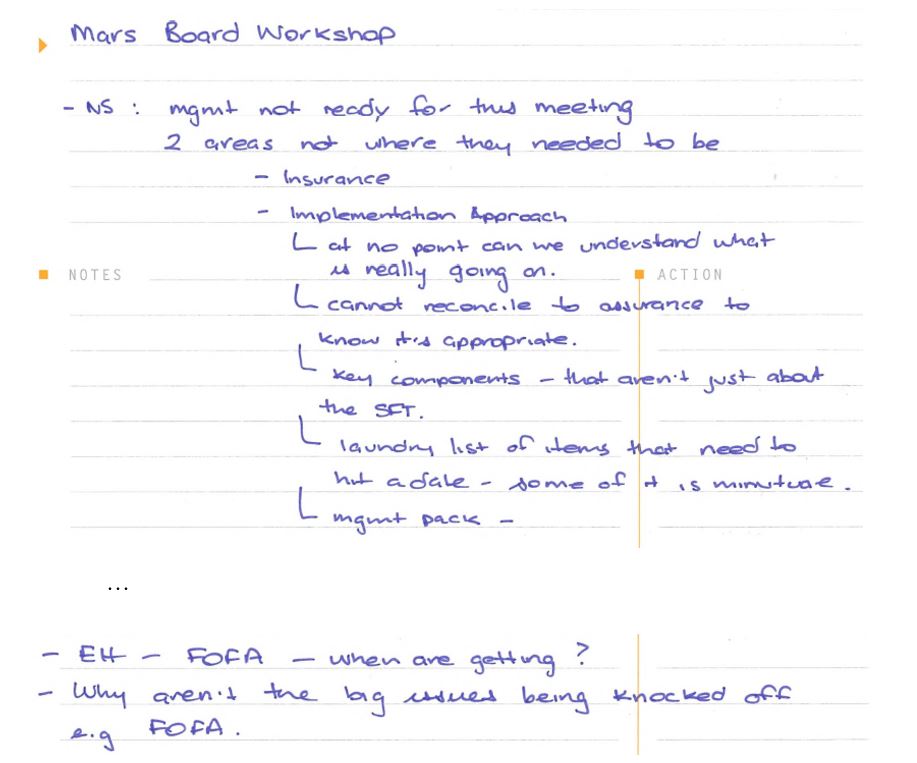
169 Mr Brady submits that Mr Marriott’s notes of comments made at the workshop “paint a picture of management inadequacies and concern by the Board as to the lawfulness of the strategy management was pressing on them”. To the extent that these notes are relevant to the matters ultimately in issue I have difficulty characterising them that way. They rise no higher than a record of comments made at the meeting. To the extent that anything can be discerned from them it is equally possible to understand them as Mr Marriott’s notes of issues and questions raised by directors which needed to be addressed. Again, to the extent it is relevant (no claim is made against the directors), in that way they paint a picture of a board that was not prepared to simply agree with what was being put to it and raised matters they wished to be addressed.
2.13.10 Emails exchanged after the 17 February 2016 board workshop
170 On 19 February 2016 at 1.06 pm Mr Marriott sent an email to Messrs Garde and Levy with subject “Closing out the FOFA issue” which included:
Just while I think of it – if it wasn’t clear out of the workshop, it is critical that the FOFA issue is put to bed at the 2 March Board meeting including seeing the legal advice (which I know is from HSF – we are just going to have to manage that bit, i.e. that it is not from Landers).
171 Later that afternoon, Mr Levy responded to Mr Marriott’s email, including Mr Tallents as an additional addressee. Mr Levy’s email included (as written):
I know that the “FOFA issue” is important. Can I clarify which aspect you’re referring to:
1) The perception that NULIS was selected as the go forward trustee because of grandfathering
2) Continued grandfathering in respect of the Wrap products
3) Transfer of grandfather from TUSS to the MLC Super Fund as part of the SFT
In the paper I’ve address (1); although when you see it you may say inadequately. My view is that there’s nothing to talk about on (2). And (3) is a question to be considered at the time of the SFT. I’m in two minds about how important (3) is at this stage because we always said we’d proceed whether we got grandfathering on (3) or not (which we currently expect to but this conversation has not happened with ASIC yet).
172 At 2.22 pm Mr Marriott responded to Mr Levy’s email stating (as written):
Agree we have 1 covered – which is the why NULIS question which I have tried to put to bed but which needs to be formally closed out. Point 2 is not relevant for now at all. Point 3 is where there is a hot button in the mind of one director – Nicole wants it closed out now so we can move on – whilst I agree that technicallky it is an SFT issue, none of us want to keep getting tortured on this point. We have attempted to allay concerns in past discussions and have not succeeded – need to get the legal advice into the formal papers.
Governance is not by design meant to be convenient to management!
173 On 20 February 2016 Mr Tallents sent an email to Ms Vincent with subject “Board Paper – Question on grandfathering advice provisions” which included:
Daniel and I are putting together an overarching Board paper on the proposed structure and operation of NULIS. We are framing this as a response to NAB’s ‘proposal’ so that all the Board papers can be linked. One of the sections we have developed is how the transformation project, including proposed structure, is in the best interests of members. We are addressing this by posing a number of questions from the perspective of the member.
One of the questions we have included is around retention of conflicted rem arrangements. Can you please review the below and send through any amendments?
1. 1. Is retention of the grandfathered and now “conflicted” payment in TUSS in the interests of members?
For the purpose of the SFT, maintaining members existing rights and benefits is the primary concern. There are pros and cons for members in these payments including: access to quality advice that is partly or fully paid for out of product fees vs paying for a service that may not be received. The proposed post SFT product rationalisation program should address this issue fully; noting that any change would likely need administration system changes.[DML1]
Papers are due by Tuesday and being reviewed by Brian on Monday.
(Original emphasis.)
174 On 21 February 2016 Ms Vincent responded to Mr Tallents, adding Mr Levy as an additional addressee, in the following terms:
Thanks for this brad. Keen to chat thru with you Monday morning. Our intention is to preserve current member rights by trading up to the commission product not fundamentals to preserve the current commission arrangements. Am concerned that the use of the word fully implies that we won’t be doing this. We should be expressing that we are ok to preserve pre Fofa arrangements as we also have done within wrap series 1 and series 2. And that ultimately we will have alignment of approach within both product sets. A pre Fofa and post Fofa arrangement.
2.13.11 Combined board meeting – 2 and 3 March 2016
175 A combined board meeting was held on 2 March 2016. This was the first occasion on which a detailed proposal for the MLC Super Fund to be the receiving fund for the SFTs was presented for approval.
176 Agenda item 5 for that meeting was the proposed NULIS operating model for which Messrs Carter and Marriott prepared a paper titled “Proposed NULIS Operating Model”. The paper included:
Purpose
This paper considers National Australia Bank Limited’s (NAB) proposal to make a significant investment in the growth of its superannuation business via [NULIS] and, in particular, NULIS’s fiduciary obligations in assessing that proposal. This paper seeks that the Board:
• endorse that NAB’s Proposal detailed in Appendix 1 is in the best interest of members subject to consideration of the details of each stage of implementation; and
• endorse management’s proposed process to assist NULIS in fulfilling its fiduciary obligations to members.
Elements of the proposal that need approval by NULIS at this meeting are detailed in other Board papers (refer to Appendix 2).
…
Background
The letter from NAB to [MLCN] and [PFSN] (together the Transferring Trustees) dated 9 October 2015 (the NAB Letter), details NAB’s proposal to implement a series of amalgamation and transformation activities to simplify the superannuation business within NAB Wealth (see Appendix 3). The Transferring Trustees confirmed in-principle support, on the 14 October 2015, of the proposal set out in the NAB Letter.
It was determined by NAB that establishing a new Registrable Superannuation Entity (RSE), the MLC Super Fund, under the trusteeship of NULIS to facilitate the Successor Fund Transfer (SFT) of assets is the optimal solution. NAB’s proposal is based on the principle that it needs to be in the best interests of members. To give effect to this, the Proposal maintains existing member benefits, allows for equivalence of rights (including any grandfathering where needed), minimises tax consequences, ensures continuity of services and seeks to minimise execution risk.
NULIS is asked to consider NAB’s proposal detailed in Appendix 1 (the Proposal) to become the single superannuation licensee within the NAB Group and implement the terms of the NAB Letter. This paper considers the Proposal from NULIS’s perspective and, in particular, NULIS’s primary fiduciary duty to members both existing and prospective, arising under statute (primarily SIS Act & Regulations) and general trust law. …
…
Proposed process to fulfil NULIS’s fiduciary obligations
Before NULIS can accept the Proposal it must:
• consider whether to do so would conflict with its fiduciary duty to members of existing RSEs;
• having concluded that there is no fiduciary conflict affecting obligations to members of existing RSEs (see the next section), decide in its commercial capacity whether it can accept NAB’s Proposal; and
• having concluded it is commercially able (see the Commercial Considerations section below), consider whether it can meet its fiduciary obligations to the transferring members as members of the new fund.
To achieve this outcome, NULIS will be asked to consider and approve NAB’s overall program of work in stages and in each stage it will be asked to consider the specific issues and how its fiduciary obligations are to be met. Importantly NULIS will need to be comfortable that, when those individual components are delivered, the overall outcome effectively meets its fiduciary obligations to all superannuation fund members. The main steps needing approval are expected to be:
1. NULIS’s future operating model, regulatory applications and associated policy frameworks and service providers (this meeting);
2. Additional policy frameworks and service agreements required to support NULIS’s operation post the SFT (approval in April 2016)
3. Successor fund transfers of the RSEs of the Transferring Trustees (approval in June 2016);
4. Due diligence/benchmarking of service providers of NULIS conducted in accordance with approved approach (progressively over 6 to 12 months following SFT);
5. Trade-up of legacy products in accordance with the Retail product strategy and timeline (progressively through to September 2019)
This paper provides the fiduciary analysis of the outcome proposed in establishing the new operating model (items 1 & 2 above) and the components required to enable the SFT (item 3) but not the SFT itself. The outcome of this analysis must:
• Enable NULIS to meet its obligations to existing RSE members;
• Enable NULIS and the Transferring Trustees to approve the SFTs as providing equivalent rights and in the best interest of members; and
• Allow NULIS to meet its fiduciary obligations to members of the Transferring Trustees’ superannuation funds once those members become members of the MLC Super Fund.
This analysis is detailed in the following sections.
…
Consideration of fiduciary responsibilities to transferring RSE members
NULIS is now free to consider whether it can fulfil its fiduciary obligations to members of the Transferring Trustees’ RSEs and, in particular, whether the Proposal is in members’ best interests. The Proposal has been assessed by examining a number of questions from the perspective of transferring members. The most important of these questions are discussed below.
…
7. Are member interests the same or better off through the trust deed of the new MLC Super Fund?
As outlined in the Board paper, MLC Super Fund – Trust Deed and Governing Rules, the Trust Deed for the MLC Super Fund has been constructed on a “lift and drop” basis.
…
9. Can NULIS retain the grandfathered status of the now “conflicted” payments in TUSS?
Legal advice is that [REDACTED] (see MLC Super Fund – Trust Deed and Governing Rules Board paper). This is not a matter requiring decisions now. It is more appropriate for the Transferring Trustees and NULIS to consider any changes to these product terms during the SFT in accordance with the conflicts management protocol.
…
11. Why is the overall Proposal in members’ best interest?
The Proposal will result in the formation of one of Australia’s largest superannuation funds which will provide members with significant scale benefits. Over time this is expected to result in improved services delivered at lower cost to members.
…
Attestation
The information provided in this paper is correct and does not omit any information or matter that may be relevant to the consideration of the Board.
I have read the Trustee Conflicts Management Protocols and have provided disclosure of any relevant interests or duties that I have that could give rise to an actual or potential conflict.
The information in this paper has been prepared solely having regard to the duties of NULIS, both fiduciary and commercial. In particular, the interests of beneficiaries of the Transferring Funds have been identified and priority has been given to those interests over and above the interests of NAB.
…
Recommendation
It is recommended that, subject to consideration of the details of each stage of implementation, the Directors RESOLVE to:
• endorse that NAB’s Proposal detailed in Appendix 1 is in the best interest of members subject to consideration of the details of each stage of implementation; and
• endorse management’s proposed process to assist NULIS in fulfilling its fiduciary obligations to members.
…
Chief Risk Officer Comments
1. I am supportive “in principle” of the intent and approach outlined in this paper. I consider the proposal and its execution to be ultimately in the best interest of members as well as NULIS.
…
3. I think the Conflict of Interest approach could have been emphasized in this paper to a greater degree. More work in identifying, assessing, managing and avoiding (as appropriate) the various conflicts will be completed as part of the ongoing implementation and prior to the key SFT decisions and before associated documentation is executed.
(Original emphasis.)
177 Agenda item 7 concerned “MLCN, PFSN & NULIS Constitution & Conflicts Management Protocol; and Amendments”. The accompanying paper sought a recommendation from the directors of MLCN, PFSN and NULIS for their respective shareholder entities to approve the proposed amendments to each of their Constitutions. Some of the amendments were proposed to manage possible conflict of directors’ duties. The conflicts management protocol for the Astro/Mars transaction, which had previously been approved by MLCN and PFSN, had also been amended to reflect the “new splitting mechanism”.
178 Ms O’Neal recalls that there was discussion at the meeting (and at an earlier combined board workshop for the boards of MLCN, PFSN and NULIS held on 8 February 2016) as to how potential conflicts of interest should be managed in relation to the proposed SFTs as between MLCN and PFSN, on the one hand, as transferring trustees and NULIS, on the other, as receiving trustee given the commonality of directors on each of the boards. As a result of the discussions which took place at the meeting (and the earlier workshop) it was agreed (as recorded in the minutes – see below) that sub-committees of the NULIS, MLCN and PFSN boards would be formed for the purpose of the SFTs and the Constitutions of each of those companies would be amended to allow for this procedure.
179 The minutes of the combined board meeting record in relation to:
(1) agenda item 5 “Proposed NULIS Operating Model” that:
The Directors noted and discussed Mr Paul Carter and Mr Brian Marriott’s paper dated 25 February 2016, entitled “Proposed NULIS Operating Model”, together with the attached appendices.
In particular the Directors noted and discussed the following in relation to the proposed operating model:
• The overall proposed approach as detailed in Appendix 1;
• The considerations being made are in the best interests of members, primarily because:
o the investment committed in separating the life and super businesses will deliver scale benefits for members in on sale products and significant benefits for members in off sale products through trade up opportunities to equivalent modern products; and
o a further investment of $300m has been committed by Nab that will deliver significant future service and product improvements to both current and future members.
• The details of each stage of implementation will be considered and approved as part of the SFT considerations;
• Management’s proposed process to assist NULIS in fulfilling its fiduciary obligations to members;
• The elements of the operating model outlined in the paper that still need to be finalised include:
o Shareholder/trustee charter and conflict scenarios;
o Adequacy of resources, particularly specialist Trustee advisers;
o Training and capability uplift in Line 1 within the new operating model (eg; insurance capability);
o Board engagement for the financial planning process.
Management advised that the Future of Financial Advice (FoFA) grandfathering of commission payments to advisers was an initial consideration for selecting NULIS as the target entity, but this is no longer the case. Whether or not to continue the current grandfathered arrangements under FoFA has yet to be considered by the relevant Trustee, and will be considered as part of the SFT considerations by each Board. NULIS was selected as the target entity predominantly due to lower execution risk and the minimisation of disruption to existing NULIS RSEs.
(2) agenda item 7 “MLCN, PFSN & NULIS Constitution & Conflicts Management Protocol; and Amendments” by the directors of each of the companies that:
…
With the exception of clauses 13.2 & 13.3 in the NULIS Constitution, IT WAS RESOLVED TO:
• RECOMMEND to their respective shareholder entities to repeal the current PFSN, MLCN and NULIS Constitutions and approve the proposed amendments to the PFSN, MLCN and NULIS Constitutions; and
• APPROVE and ADOPT the revised Conflicts Management Protocol.
(3) agenda item 8 “MLC Super Fund Trust Deed & Governing Rules, Notations/Recommendations – NULIS” by the directors of NULIS that:
The Directors noted and discussed Mr Daniel Levy’s paper dated 23 February 2016, entitled “MLC Super Fund - Trust Deed and Governing Rules”, together with Appendix 1: Legal advice from Landers on the MLC Super Fund Trust Deed.
In particular the Directors noted and discussed the following:
• As noted at Agenda Item 5, FoFA is not a driver for selecting the target entity of NULIS. However the changes to the Trust Deed will enable the possible FoFA grandfathering of certain provisions in relation to TUSS, subject to Board approval as part of the SFT considerations.
…
IT WAS RESOLVED TO APPROVE for execution the Trust Deed of the MLC Super Fund.
2.13.12 The amendment of the Constitutions of NULIS, MLCN and PFSN
180 Following the 2 and 3 March 2016 combined board meeting, the Constitution of each of NULIS, MLCN and PFSN was amended to include, for example in the case of the Constitution of NULIS, a new clause 15A titled “Avoidance of conflicts of duties for common directors”:
15A.1 The Directors may take the steps set out in Article 15A.2, on a reciprocal basis in respect of the Company and a Related Body Corporate within the NAB Group that is the trustee of a superannuation entity (“Other Company”), if:
(a) the Company and the Other Company have the same Directors;
(b) the Other Company’s Constitution contains provisions identical to this Article 15A (“Equivalent Provisions”);
(c) the Directors owe duties to:
(i) the Company (“First Duties”);
(ii) the Other Company (“Second Duties”);
(iii) the beneficiaries of a superannuation entity of which the Company is trustee (“Third Duties”); and
(iv) the beneficiaries of a superannuation entity of which the Other Company is trustee (“Fourth Duties”);
(d) the Directors believe in good faith that, in relation to a transaction or circumstances or a class of transactions or circumstances concerning the Company and Other Company (“Conflict Occasion”), there is an actual conflict, or a real sensible possibility of a conflict, between:
(i) the First Duties and either the Second Duties or the Fourth Duties; or
(ii) the Third Duties and the Fourth Duties;
(e) the Directors believe in good faith that, in order to ensure that the Company’s decisions in relation to the Conflict Occasion are not tainted by any conflict:
(i) it is in the best interests of the Company, the Other Company and each holding company of the Company (including the Company’s ultimate holding company) to take those steps; and
(ii) it is also in the best interests of the beneficiaries of the superannuation entities of which the Company and the Other Company are trustees to take those steps; and
(f) the Equivalent Provision corresponding to paragraphs 15A.1(d) and (e) of this Article are satisfied.
181 Ms O’Neal recalls that from that time up to 30 June 2016, there were both meetings of the combined boards, and, separately, meetings of the NULIS board as the receiving trustee and meetings of the MLCN and PFSN boards as the transferring trustees.
182 During that period Ms O’Neal acted as the chair of the MLCN and PFSN board sub-committees and attended meetings of those boards, together with Messrs Reid and Hunt. It was agreed that Ms O’Neal would act as the chair of the MLCN and PFSN board sub-committee given her legal background, her experience in relation to SFTs and the analysis required to be undertaken by a transferring trustee to ensure that the successor fund would provide equivalent rights to members in respect of their benefits.
183 The revised conflicts management protocol, titled “Project Astro – Conflicts Management Protocol”, was prepared in the context of the proposed SFTs. Ms O’Neal considered that this was an important document in ensuring good governance for Project Astro. It included:
6 Conflicts management protocols
6.1 Given the significance of the Transaction, the Trustee has put in place the following additional protocols with respect to the management of potential conflicts of interest:
(a) Independent legal advisers have been engaged to represent the Trustee. The Trustee also has dedicated internal legal support representing the transferring and receiving Trustees.
(b) The Heron Partnership have been engaged to independently conduct due diligence in respect of the potential changes impacting the ownership and business structure of MLC.
(c) The Trustee has in place an independent office of the Trustee (OTT), which has oversight of the Trustee’s approach to the Transaction and the decisions sought of it. The OTT is led by Brian Marriott (Chief Operating Officer). Staff of the OTT are provided to The Trustee under group resourcing arrangements. However, NAB has directed OTT staff to give priority to the interests of beneficiaries of the group superannuation funds over and above any duty owed to their employer or to NAB.
(d) All papers put to the Board must include a clear statement identifying the person responsible for the paper, their role or title and the capacity in which they are acting (e.g. for the shareholder, NAB or MLC as Administrator). Such descriptions should not be vague (e.g. describing a person as ‘management’).
(e) All papers put to the Board must also be accompanied by an attestation signed by the author in the following terms:
For papers purporting to be prepared on behalf of the Trustee (e.g. by the OTT):
The information provided in this paper is correct and does not omit any information or matter that may be relevant to the consideration of the Board.
I have read the Trustee Conflicts Management Protocols and have provided disclosure of any relevant interests or duties that I have that could give rise to an actual or potential conflict.
The information in this paper has been prepared solely having regard to the duties of the Trustee and its directors. In particular, the interests of beneficiaries of the Transferring Funds have been identified and priority has been given to those interests over and above the interests of NAB.
Any potential adverse impact on beneficiaries of a Transferring Fund has been specifically identified in the paper.
For papers purporting to be prepared on behalf of other entities (e.g the Administrator or NAB):
The information provided in this paper is correct and does not omit any information or matter that may be relevant to the consideration of the Board.
I have read the Trustee Conflicts Management Protocols and have provided disclosure of any relevant interests or duties that I have that could give rise to an actual or potential conflict.
The information in this paper has been prepared having regard to the interests of [insert relevant entity – e.g. the Administrator or NAB]. However, the paper also articulates the interests of beneficiaries of the Transferring Funds and explains why we consider that the recommendations outlined in the paper are in the best interests of those beneficiaries.
Any potential adverse impact on beneficiaries of a Transferring Fund has been specifically identified in the paper in order to enable the Trustee to make a fully informed decision regarding the matters outlined in this paper.
(f) Any person who provides advice or information to the Board, or is present at a Board or sub-committee meeting or workshop, must:
(i) notify the Board or sub-committee (as relevant) if they have a direct personal interest in the outcome of the Transaction or any particular decision of The Trustee in connection with the Transaction; and
(ii) provide full disclosure to the Board or sub-committee (as relevant) of any other duty or personal interest they have that could give rise to an actual or potential conflict, irrespective of whether the person considers that such interest or duty could in practice affect their conduct or the advice or information they provide to the Board or sub-committee.
For this purpose, the Board requires that the conflicts disclosure form set out in Annexure A to these protocols be completed by each of them and provided to the Board before or as soon as practicable after providing the information or advice to the Board.
(g) Where an actual or potential conflict is identified as a result of taking the above steps, it must be recorded in accordance with The Trustee’s standard conflicts management protocols.
7. Potential for conflicts of duty to arise for directors
7.1 A conflict of duty may arise for a director of a Trustee given their role on other boards (including on the boards of other Trustees) within the NAB Group. In particular, the directors that are common to the boards of each of [MLCN], [PFSN] and NULIS.
8. Protocol for managing conflicts of duties for common directors
8.1 Where an actual or potential conflict of duties arises, the conflict must be avoided, and cannot be managed through disclosure or other means.
8.2 Where a director is common to the boards of two or more of [MLCN], [PFSN] and NULIS, the director will owe duties to beneficiaries of both the Transferring Fund and the Receiving Fund. However, a real and sensible possibility of a conflict may not arise in these circumstances considering:
…
8.3 Whether a real and sensible possibility of a conflict does arise will need to be tested at the time of each relevant decision and if such a possibility does arise steps will need to be taken to avoid or manage the conflict.
8.4 Where conflicts of duty arise for directors of a Trustee as a result of there being a common board of directors of two or more of [MLCN], [PFSN] and NULIS, the directors of the Trustee will consider implementing a split board mechanism to enable the board to continue to function effectively.
8.5 Independent legal advisers have provided detailed advice on the circumstances in which it would be appropriate to implement this mechanism.
2.13.13 Emails – 18 to 31 March 2016
184 On 18 March 2016 Julia Pryor, risk consultant, risk wealth sent an email to Karen-Anne Herald, general manager risk, superannuation and investments about the “FOFA grandfathering arrangements” in which she wrote (as written):
I have spoken to Andrew Lawless, and to Alan Hui (coincidentally) about the question of whether commissions are in fact currently paid to advisers. Both confirm that this is the case. See Andrew’s email below.
Alan asked a good question – is it in the best interest of members of the receiving trust to be taking on an arrangement that involves a commission being paid to a 3rd party. Is it encumbent on the trustee to try to get a better deal for its members?
My answer to that is that the best interests test does not mean that the trustee must try to get a better deal for its members. A logical conclusion of this would be that the trustee provides its services for free. The best interests test does not mean that the trustee cannot also have a personal interest that it represents, but it does require that where there is a conflict between the interests of members and its own (or a third party’s) interest, it gives priority to the members’ interest. If there is no inconsistency, it is legitimate for the trustee to have an interest. Further, the best interests test is an overall test, not necessarily determined on a case by case basis, or on a basis of each right or interest in the basket of member interests being “best”, but rather determined with reference to the entire basket of interests overall. And finally, in the context of an SFT, the best interests question is asked in conjunction with the equivalent rights question, which means that we are able to look at what the interests of members were and what they will be, we look at both of those issues together.
I’d like to look at the question of “best interests’ in the context of an SFT a bit further, but my view is that the SFT doesn’t give rise to an obligation on the part of the receiving trustee to try to “get a better deal” out of the transferring trustee.
185 On 31 March 2016 Mr Lawless sent an email to Dougal Guild and Ms Vincent which provided:
Hi Dougal, as per our discussion this morning, please find attached some arguments as to why the continuation of FoFA grandfathering in the new Super Fund would be in the best interests of members ..... .
KV, hopefully you’re comfortable with these arguments but please feel free to add any others or amend as appropriate.
________________________________________
• The Trustees previously gave ‘in-principle’ approval to NAB in October 2015 that as a condition of the SFT grandfathered commission arrangements would continue.
• The legal advice from Freehills [REDACTED]
• Continuing to pay commissions would preserve the existing arrangements between advisers and clients which were entered into by both parties in good faith (and would not be expected to change as part of a ‘lift and drop’ SFT).
• The removal of commissions would require advisers to re-negotiate their fee arrangements with clients which would come at great expense to advisers (in setting up specific client meetings etc .. ) which could potentially be passed on to clients.
• The removal of commissions would undoubtedly put adviser relationships with NAB/MLC at risk with the accompanying commercial risk of significant member attrition and loss of scale.
• This loss of scale and revenue to the Trustee (which is already strained) would put at further risk the ability of the Trustee and the NAB Group to invest in the Platform with the consequent loss of benefits for members and the risk that member fees might need to increase to compensate.
• The approach of maintaining FoFA grandfathering would be consistent with the approach taken in relation to MLC
• Navigator Series 1 (where grandfathering of conflicted remuneration was specifically endorsed by NULIS).
• Maintaining grandfathering would also be consistent with industry practise as pre 1 July 2014 commissions are grandfathered on competitor platforms.
• Finally, if NULIS were to make the decision to not allow FoFA grandfathering to continue then this would put the SFT at risk, with the consequent loss of benefits to members (being ORFR funding and legacy product trade ups over 3 years etc .. )
________________________________________
I hope this helps.
186 On 6 April 2016 at 12.24 pm Ms Horton sent an email to Ms Smith in which she requested “additional info to be tabled” at the combined board meeting scheduled the following day “which supports the request for grandfathering”. That request was forwarded on until it was provided by Mr Guild to Ms Vincent and Mr Lawless. Mr Lawless’ response to Mr Guild included (as written):
Contribution based commissions would be on top of this again, so deciding NOT to pay advisers/Dealer Groups their ‘contractual right’ to an aggregate amount of between $53m and $80m is sure to do some permanent damage a lot of advice relationships. Similarly, it’s likely to result in mass attrition given that the commissions are no longer payable to advisers and the off-sale products themselves have extremely high fees and would be moved by the advisers to cheaper non-MLC products.
2.13.14 Board meeting – 7 April 2016
187 On 7 April 2016 a NULIS board meeting was held. Agenda item 4 at that meeting was “SFT proposal dry run”. A paper prepared by Messrs Garde and Lawrance dated 1 April 2016 titled “SFT Proposal” was provided to the directors for discussion in relation to that agenda item.
188 The purpose of that paper was described as follows (original emphasis):
This paper provides NULIS Nominees (Australia) Limited (the Trustee) with an initial overview of the key considerations specifically for them as Receiving Trustee in regards to the proposed Successor Fund Transfer (SFT) for the following funds (the Funds) which are under the trusteeship of [MLCN] and [PFSN] (the Transferring Trustees):
• [TUSS],
• Plum Superannuation Fund (PSF),
• BHP Billiton Superannuation Fund (BHPBSF),
• Worsley Alumina Superannuation Fund (WASF), and
• National Australia Bank Group Superannuation Fund A (NABGSF).
This paper also provides an outline of the topics and pieces of assurance that will be provided at the 4 May 2016 Board meeting, with a view to seek approval for the SFT at the 10 June 2016 Board meeting.
We are also requesting the Trustee to approve:
• the continuation of commission arrangements in the MLC Super Fund, and
• a disclosure commitment in regards to the MLC Cash Fund.
189 Under the heading “SFT Proposal” the paper described the SFT as follows:
Minimal change is intended to occur at the point of the SFT, if approved, as the SFT transaction being proposed is a ‘lift and drop’, that is, members’ product features, rights and benefits under their current products and policies will largely remain the same on transfer.
190 Under the heading “Key investigations” the paper provided:
The SIS Act provides for members to be transferred from one fund to another without their consent provided their rights in respect of benefits in the new fund are “equivalent” to those in the old fund.
To satisfy these legislative tests, and other applicable laws, the following key steps are required:
• To preserve equivalence:
• the Trust Deed for the new MLC Super Fund has been drafted to facilitate a ‘lift and drop’ of the rules from TUSS and [PSFN] into the Trust Deed as a single trust. This will make it easier and simplify the analysis required to meet the equivalency standard in respect of member benefits under the legal test for a SFT into the MLC Super Fund;
• in regards to the standalone funds (BHPBSF, WASF and NABGSF) – these would become employer plans under the Plum product in the MLC Super Fund. To ensure equivalency in the MLC Super Fund substantive terms of the current Trust Deeds for these standalone funds will be replicated in new Participation Agreements for these employers;
• An analysis of member interest considerations (this is relevant to equivalent rights). Appendix 1 provides an assessment of the key member interest considerations in regards to the proposed SFT, detailing items that are changing or remaining the same on transfer.
• Legal have provided their preliminary views in regards to [REDACTED]
• Execution of the SFT agreement by MLCN, PFSN and NULIS. This agreement is required by the legislation and is to the effect that TUSS, PSF, BHPBSF, WASF and NABGSF are the “transferring funds” and MLC Super Fund is a “successor fund” which confers equivalent rights;
• Transfer of all assets of MLCN and PFSN, (and most of the assets of MLC Limited that back transferring fund investments) to NULIS;
• Apply to ATO to obtain Capital Gains Tax (CGT) relief in regards to the re-registration of assets (this has been received); and
• A member communication plan (set out in Appendix 3). A paper will be presented to the Transferring Trustees on 8 April 2016 for consideration in regards to the Go/No-Go decision for sending communications to members (SFT SEN) in relation to the proposed SFT.
191 Appendix 1 to the SFT Proposal paper set out “Key member interest considerations” and included as one of the “Other considerations”:
Products in TUSS currently facilitate the payment of commissions to advisers. We have obtained advice for the benefit of the trustees [REDACTED]
Management also considers the continuation of these commission arrangements in the MLC Super Fund to be overwhelmingly in the best interest of members due to the very real adverse consequences of significant outflows that would arise from mass adviser dissatisfaction. Specific considerations include:
• Discontinuing commissions would undoubtedly put adviser relationships with NAB/MLC at risk with the accompanying commercial risk of significant member attrition (as evidenced from other competitors in the market removing commission arrangements) and loss of scale. Products that have commissions are generally off-sale and are already in a net outflow position. Mass member attrition would put the remaining members in these products in a worse position. This loss of scale and revenue to the Trustee would also put at risk the ability of the Trustee to invest in product enhancements and member services.
• Discontinuing commissions arrangements would require advisers to re-negotiate their fee arrangements with members (which could potentially come at an expense for the member).
• The approach of maintaining FOFA grandfathering would be consistent with the approach taken in relation to MLC Navigator Series 1 (where grandfathering of conflicted remuneration was specifically endorsed by NULIS).
Legal advice on [REDACTED]
We are meeting with ASIC in early April to advise them of this position.
We are requesting the Trustee approve the grandfathering of commission arrangements in the MLC Super Fund.
192 The authors of the paper recommended that directors note the paper and approve the continuation of commissions in the MLC Super Fund in relation to products transferred as part of the SFT and a disclosure commitment in regard to the “MLC Cash Fund”.
193 The minutes of the meeting of the directors of NULIS on 7 April 2016 in relation to agenda item 4 “SFT proposal dry run” show that the directors in fact declined to accept the recommendation put forward in the paper provided. The minutes record that the directors noted and discussed the “SFT Proposal” paper and that:
• A paper is required that sets out all the issues that the Board needs to consider with respect to the continuation of the FoFA grandfathering arrangement following the successful implementation of the proposed SFT. [MATTER ARISING]
• In preparation of the SFT NULIS is being asked to commit to [MLCN] and [PFSN] that investments in the MLC Cash Fund will continue to be invested 100% in bank deposits (with NAB or other banks) with the undertaking to provide prior written notice to members in the event of any future change.
…
• Directors will be provided with information, including assurances with respect to operational readiness, required to enable a decision to approve the SFT at the meeting which is currently scheduled for 10 June 2016.
• The full scope of the due diligence components that the Board needs to consider is to be documented and provided to the Board so that it has full oversight of the decisions it is being asked to make. [MATTER ARISING]
194 Ms Crittle, a member of the OTT who attended that meeting, sent an email on 21 April 2016 to Mr Guild and others including the following (as written):
… the Board is quite concerned in relation to the position on FOFA, in so far as it is a very significant issue and they have not yet had the full picture provided.
At a high level what the Receiving Trustee is expecting is:
1. The advice From HSF [redacted for privilege]
2. The Landers advice [redacted for privilege]
3. The QCs opinions [redacted for privilege]
4. The Landers advice [redacted for privilege]
5. Verification of assumptions made in each of the above opinions
6. The paper from Product outlining why it is in members interests to grandfather. As noted at the 7 April Board Meeting, this specifically needs to
• Be clear on which entity currently pays commission and which entity will pay it post commission
• FUM, how many members, what is the size of the commission, adviser number impacts and how that translates to member interests.
2.13.15 Mr Marriott’s 23 April 2016 email
195 On 23 April 2016 Mr Marriott sent an email to several recipients including Messrs Garde and Guild and Ms Vincent with subject “RE: FoFA paper” in which he provided his comments on an early draft of the grandfathering paper including:
1. Understanding the dimensions and impacts is pivotal – number of members across what products, representing what FUM, with how many dollars paid ongoing versus upfront. Need to size the ‘problem’. Importantly is the problem and issues the same between each type of product? Would or should we have the same view on every type of product – for example are there ongoing commissions still being paid on the exit fee products and should there be?
2. Agree completely with Tom – the value of advice is NOT at all in question, you are preaching to the converted and it is in my opinion irrelevant to the question. Don’t think any of that material and the appendices have any relevance to the issue – it’s just noise that will make people cranky and look like we are trying to create a diversion. We have long been told that very few of those members in these old products actually are being actively advised and there is plenty of evidence to support that – it’s pretty clear that many would not be where they are if they were being actively advised (eg Five Star). In fact, the whole ex-Aviva, Five Star strategy at one point was about getting some funding from the Trustee to pilot engagement with members and re-engage them in the advice process. Seems a cute argument to make that we should grandfather because these people are getting something in return for the commissions being paid when all the paper trail will tell a different story.
…
4. The key to all of this and which the paper must be anchored around and which is the most compelling member interest point, is the impact on scale if wholesale dissatisfaction is generated with advisers and the highly probable adverse impact that would have on remaining members – I really think that is the only basis the Trustee should support grandfathering (assuming there is a legal basis to do so). As I note in point 1 I don’t think the answer is automatically the universal for every product (it may be – but I think the considerations need to be a bit more sophisticated than it appears to be currently). The Trustee also should only support grandfathering with a clear change management plan which will be part of the ‘transformation’ work that is committed to over the next 3 years. That would result in any grandfathering decision being limited in duration.
2.13.16 Combined board meeting – 5 May 2016
196 A combined board meeting was held on 5 May 2016. Agenda item 7 for that meeting was “Member equivalence and best interest and successor fund merger deed”. For the purpose of that agenda item a paper prepared by Mr Garde dated 29 April 2016 was provided to the directors of NULIS as “receiving trustee”. The paper provided, among other things (as written):
Purpose
It is proposed that a new fund to be known as the MLC Super Fund be established under the trusteeship of [NULIS] before 1 July 2016 and that the assets of each of the following funds (each a Fund) be transferred by way of a successor fund transfer (SFT) to the MLC Super Fund with effect from 1 July, or prior to 30 September 2016 if the transfer cannot proceed on 1 July (Transfer Time):
[MLCN], is trustee for
• [TUSS].
[PFSN], is trustee for
• Plum Superannuation Fund (PSF),
• BHP Billiton Superannuation Fund (BHPBSF),
• Worsley Alumina Superannuation Fund (WASF), and
• National Australia Bank Group Superannuation Fund A (NABGSF).
The purpose of this paper is to provide [NULIS] (the Trustee) with the information required in order for the Trustee to determine whether:
• subject to any matters arising from the Trustee during the Board meeting that will require finalisation prior to the SFT, the MLC Super Fund will confer on each member equivalent rights in respect of benefits to the rights that the member had under the relevant Fund and, therefore, be a successor fund for the purposes of the SIS legislation in relation to that Fund; and
• the Successor Fund Merger Deed (SFM Deed) can be executed.
…
Nature of the proposed SFT
It is proposed that each SFT occur on a ‘lift and drop’ basis so that with the exception of a small number of changes specified in this paper (but noting that the Transferring Trustees have approved some product changes before the SFT e.g to align MySuper products across TUSS, PSF, BHPBSF and WASF) members’ product features, rights, benefits and fees under their current products and policies in each Fund will remain the same on transfer. Specifically, the SFT transaction will not cause any of the following events to occur:
• change to product terms or conditions (except those explicitly called out in Appendix 1 );
• increase to product fees, charges or premiums or imposition of transaction costs;
• change of account values (members or reserves) or insurance arrangements;
• change in administrative platform or computer system administering the products; and adequacy of resources – continuity of present staffing levels associated with the servicing of the product offers.
Documented product verification and Risk assurance will be provided for these matters as part of the Phase 2process.
As part of the SFT process the other key changes that will occur include:
• The Trustee will adopt a “for profit” operating model;
• The MLC Super Fund will be established with a new RSE Licence and MySuper authorisations;
• The assets will be held directly by the MLC Super Fund rather than being invested through investment policies issued by MLC Limited.
…
Member rights and equivalency
…
• an analysis of member impacts. In this regard:
• …
• Appendix 1 provides a Fund and product comparison which summarises the key differences that might impact members. This is relevant to both equivalent rights and the duty to act in the best interests of members;
• the comparison provided in Appendix 1 confirms that in most areas, the member impacts are neutral or beneficial, noting that to achieve this position several indemnities have had to be provided by NAB or other related entities which have been asked to be signatories to the SFM Deed as a consequence;
197 Appendix 1 to the paper, titled “Member impacts – Fund and product comparison”, provided a summary of key differences that might affect members. Relevantly:
(1) “benefit design” was classified as “member neutral” with the following description:
Subject to APRA providing relief to enable NULIS to maintain existing defined benefit employer plans with under 50 members (all currently within PSF) within the MLC Super Fund, and for these plans to continue to pay defined benefit pensions, there will be no change to the benefit design for TUSS, PSF, BHPBSF, WASF and NABGSF members at transition. This is regardless of benefit entitlement (i.e. accumulation, defined benefit, pensioner, etc.)
(2) “FOFA – grandfathering of commission arrangements” was also classified as member neutral with the following description:
NULIS (as the Receiving Trustee) is considering at its 11 May 2016 Board meeting, the continuation of grandfathered commission arrangements. If the grandfathering arrangements are carried over commission payments will continue unchanged and there will be no impact to member account balances.
198 The minutes of the meeting record that Mr Garde’s paper was discussed. Among the matters discussed the directors noted (in relation to Appendix 1 to the paper) that “[t]he resolution of FoFA matters are yet to be finalised”. The minutes also record that the directors resolved to approve execution of the successor fund merger deed subject to:
a. satisfactory resolution of legal and member interest considerations relating to grandfathered commission arrangements, which the Board will consider at a future date;
b. satisfactory resolution of Tax matters including appropriate indemnities being provided by NAB for any member impacts associated with Global Private Equity US Tax liability, QROPS, loss of CGT Rollover Relief for GPE assets not transferring from MLC Limited, and appropriate administrative relief being provided from the ATO for fund and member operational matters, all of which the Board will consider at a future date;
c. satisfactory resolution of product and investment design for the Fixed Rate Funds, which the Board will consider at a future date, as well as appropriate guarantee arrangements being established for the MIF Cash Fund and Accent/Entrepreneur Capital Guaranteed Funds;
d. satisfactory assurance on the completeness of the ‘Member Rights Comparison Document’ and assumptions relied upon in the Legal opinion;
e. satisfactory assurance being provided that product terms and conditions for the Transferring Funds have not been changed or are otherwise changed in a way that does not affect the conclusion in relation to equivalent rights and the MLC Super Fund being a successor fund;
f. APRA registering the MLC Super Fund as a Registrable Superannuation Entity and granting relevant MySuper authorisations, and granting any other operational or administrative reliefs as required;
g. NULIS meeting any other requirements of APRA in respect of the registration of the MLC Super Fund; and
h. NULIS and the Transferring Trustees being satisfied:
i. of the operational readiness of the Transferring Trustees and NULIS to carry out the SFT (including satisfaction of the SFT acceptance criteria, resolution of FoFA matters); and
ii. that implementation will not degrade the Transferring Funds operations and that the implementation execution strategy is within the Transferring Trustees’ and NULIS’ risk appetite;
i. satisfactory resolution of exit fee arrangements.
The Board NOTED that it would be asked to consider a recommendation to proceed with the proposed SFTs at a future date.
2.13.17 Combined board meeting – 17 May 2016
199 Ms O’Neal recalls that the directors of NULIS agreed that the issue of whether it was in the best interests of members for the grandfathered commissions for TUSS Commission Products to continue was one that all of the directors needed to fully understand and discuss.
200 Relevantly, on 17 May 2016 at a combined meeting of the boards of NULIS and PFSN Messrs Lawrance and Garde gave a verbal update on the SFT. The minutes of the meeting include in relation to that item:
• With regards to FoFA:
• appropriate legal advices have been received. Indications are that it is [REDACTED]. Due to the lack of regulatory guidance on this matter, a meeting with ASIC is being arranged to work through the Trustee’s position.
• It was previously proposed that the decision to continue the grandfathering of FoFA arrangements was a decision for the Receiving Trustee, it was agreed that these considerations should be considered by the Full Board as it is important for all Directors to understand the matters involved and any residual risk. The Directors noted that there is no conflict in the Transferring and Receiving Trustees considering this matter jointly.
2.13.18 NULIS board workshop – 25 May 2016
201 A NULIS board workshop was convened on 25 May 2016 to discuss whether the grandfathered commission arrangements for TUSS Commission Products could and should be continued. In light of the decision made at the 17 May 2016 board meeting, all six NULIS directors attended this workshop. Given the purpose of the workshop, a draft of what became the Grandfathering Paper (25 May Draft Grandfathering Paper) was discussed. It included:
(1) under the heading “Purpose”:
The purpose of this paper is to request approval by the receiving trustee, [NULIS] (‘the Trustee’ or ‘NULIS Nominees’), to maintain the grandfathering of commission arrangements for the products which currently form part of The Universal Super Scheme (‘TUSS’) following the proposed Successor Fund Transfer (‘SFT’) to the MLC Super Fund.
This paper provides information to support the Trustee in its decision to continue the FoFA grandfathering arrangements which are currently utilised by the transferring trustee, [MLCN] including the basis for concluding that:
1. the FoFA grandfathering arrangements can legally continue following the SFT; and
2. the proposal maintains equivalency of members’ rights and members’ best interest following the SFT.
(2) under the heading “Options for consideration”:
Management have contemplated that the following options are available to the Trustee:
Option 1: Continue the grandfathering arrangements and pay commission to advice licensees;
Option 2: Cease the payment of grandfathered commission by terminating the remuneration arrangements with advice licensees; and ·
Option 3: Stop commission payments and set up alternative remuneration arrangements for advisers.
In all cases, Management has contemplated:
• if the proposal is legally permissible;
• if the proposal maintains equivalency of members’ rights and members’ best interest;
• other member consequences; and • implications for the SFT and the associated future member benefits.
202 The 25 May Draft Grandfathering Paper considered each of the three proposed options.
203 In relation to option 1, continue the grandfathering arrangements and pay commission to advice licensees, the 25 May Draft Grandfathering Paper included:
(1) under the heading “Legal implications”:
Grandfathering provisions exist which allow for the exclusion of certain arrangements from the ban on conflicted remuneration (which was introduced as part of the FOFA reforms). To be grandfathered, conflicted remuneration (e.g. commission) must be paid pursuant to a pre-1 July 2013 arrangement (such as the arrangement between the giver of the benefit and the advice licensee). The payments must continue to be given on materially the same terms as the previous arrangement and for the same purpose.
…
Furthermore, the legislation expressly provides that if a party to an arrangement changes (such as the ‘payer’ of commission), the arrangement is taken to have continued in effect after the change , as the same arrangement. Thus, the grandfathering status of existing commission arrangements will not be impacted if NULIS were to take-up the role of ‘payer’ of commission.
(2) Under the heading “Implications for the SFT and associated future member benefits”:
Given that the legal advice [Redacted for privilege] Management recommends that the Trustee endorses Option 1 by approving the continued payment of commission to financial advisers in respect of member interests in TUSS products. The adoption of Option 1 will allow the SFT to proceed as planned.
It is worth noting here that, as previously communicated to the Trustee in a paper titled “Project Mars – Retail Product Strategy” in December 2015, Management intends to commence a program of work to trade-up legacy TUSS products to MLC MasterKey Super & Pension (‘MKSP’) or MLC MasterKey Super and Pension Fundamentals (‘MKSPF’) following the completion of the SFT. This would trigger a need to revisit the legality and appropriateness of continuing grandfathered commission arrangements at such time that the product trade-up is recommended to the Trustee. In doing so, Management will give consideration to whether removing the commission structures could lead to better customer outcomes. Furthermore, the staggered removal of commission would lessen the detrimental impacts which are called out in Option 2.
204 In relation to option 2, ceasing the payment of grandfathered commissions by terminating the remuneration arrangements with financial advice licensees, the 25 May Draft Grandfathering Paper included:
(1) under the heading “Legal implications”:
The LRA governs the terms and conditions of the relationship between the ‘payer’ of the commission and the advice licensee (the ‘recipient’) for the payment of remuneration where a member acquires an increased interest in TUSS and/or for the provision of ongoing financial advice to members in relation to their beneficial interest in TUSS.
The only circumstances in which the LRA prohibits or exempts the “MLC Payer” from making payments to advice licensees are where the MLC Payer or MLC Issuer (i.e. the actual product issuer, in this case the Trustee) reasonably believes the financial adviser is no longer providing or is not legally permitted to provide financial services to the member; has breached any term or condition of the agreement; or the MLC Payer or MLC Issuer is not permitted to make remuneration payments pursuant to any law or court order.
Since the legal advice [Privilege] separate legal advice will need to be obtained to determine whether commission payments could be terminated in the present circumstances without exposing [MLCN] or NULIS or any other entity of the NAB Group to liability for breach of contract, if the Trustee is contemplating terminating commission payments.
Approximately $58 million in commission per annum is paid from products where [MLCN] is the trustee. Using the Advice Licensee Business Equity Valuation Methodology as a guide, it is estimated that if financial advisers can establish there has been a breach of contract resulting in loss as a result of ceasing commission payments, the compensation that would collectively be payable would be in excess of $200 million.
(Footnote omitted.)
(2) under the heading “Sustainability” a table prepared by “Actuarial, Pricing & Profitability” which showed the amounts by which member fees would need to increase to maintain the return on income of TUSS and the impact to its profitability based on varying levels of member attrition. The table provided:
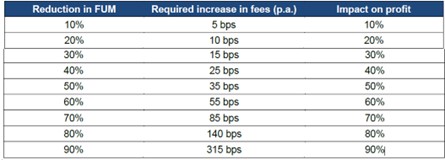
(Footnotes omitted.)
205 The recommendation in the 25 May Draft Grandfathering Paper was not put to the NULIS board at the workshop. Instead, a board meeting was to be convened on 10 June 2016 to discuss the issue.
206 A copy of the 25 May Draft Grandfathering Paper discussed at the workshop with Mr Marriott’s handwritten notes was in evidence before me. It included the following handwritten annotations:
(1) “EH [Evelyn Horton] – paper post SFT that the controls are operating to ensure commission not paid”;
(2) “TH [Trevor Hunt] – more detail on the numbers & taking a view”;
(3) “EH – facts not complete enough”;
(4) “Risk increasing attrition in a way we cannot control”;
(5) “No misalignment between mgmt. & Board on the appetite to remove – in an orderly way – commissions”;
(6) “JR [John Reid] – wants FoFA captured in the SFM Deed – conversation on MLCN role”;
(7) “Evelyn asks:
1 Bus viability
2 media attention – is this consideration getting played out @ NAB Board (doing the right by the parent)”
There were also other handwritten annotations on the document which may have been Mr Marriott’s own thinking or views he or others expressed at the workshop. In any event, this version of the 25 May Draft Grandfathering Paper with Mr Marriott’s notes goes no higher than to demonstrate that there was discussion about the 25 May Draft Grandfathering Paper and the issues it raised and that the directors of NULIS engaged actively with the material presented to them, seeking more information as they saw fit.
2.13.19 Australian Securities and Investments Commission is briefed
207 On 20 May 2016 Andrea Debenham, head of regulatory affairs, wealth, NAB provided a briefing paper to Australian Securities and Investments Commission (ASIC) and on 2 June 2016 a meeting was held to brief ASIC on the proposed approach to the continuation of grandfathered commissions following the SFTs.
208 By letter dated 7 June 2016 to NAB, ASIC noted that:
… based on your own legal advice, you consider that NULIS should be able to continue to pay grandfathered benefits to advisers in respect of pre-1 July 2014 members of TUSS after the successor fund transfer and that you do not propose to seek a no action letter from ASIC.
2.14 The Grandfathering Decision
209 On 10 June 2016 there was a combined board meeting at which the final Grandfathering Paper was noted and discussed. At the time, in accordance with the recommendation in the Grandfathering Paper, the directors of NULIS made the Grandfathering Decision.
210 The Grandfathering Paper presented to the combined board meeting, which Ms O’Neal described as an edited version of the 25 May Draft Grandfathering Paper discussed at the 25 May 2016 workshop, provided, among other things:
(1) that its purpose, insofar as NULIS was concerned, was to request NULIS’ approval as receiving trustee to maintain the grandfathering of commission arrangements for the products which at that time formed part of TUSS following the proposed SFT to the MLC Super Fund. The paper was said to provide information to support NULIS (also referred to as the Trustee) in making the Grandfathering Decision and included the basis for concluding that:
1. the current FoFA grandfathering arrangements are legally permitted; and
2. the FoFA grandfathering arrangements can legally continue following the SFT; and
3. the proposal to maintain grandfathering addresses equivalency of members’ rights and members’ best interest following the SFT.
(2) under the heading “Background: current payment arrangements”:
Financial Service Licensees (‘advice licensees’) are currently paid asset value and contribution based commissions in respect of the beneficial interest which their clients hold in or contribute to certain products in TUSS (which were acquired before 1 July 2014).
As at 30 June 2014 all member accounts in respect of which commission was being paid to advice licensees were treated as ‘grandfathered’ accounts. No products issued on or after 1 July 2014 allowed for the payment of commission (except for the transfer of benefits from super and pension accounts within the same ‘platform’ or ‘multi-product’). Robust controls and monitoring were introduced for the removal of the commission arrangements on member accounts where a ‘change to an arrangement’ occurs such as a change of the beneficial owner of an account (eg. upon the death of the original beneficial owner) or where a member elects to change their financial adviser. In addition, controls are in place to ensure that commission arrangements cannot be reinstated and commission rates cannot be increased on member accounts.
As at 31 December 2015, there were approximately 188,000 members in commission paying retail super/pension products in TUSS who collectively held more than $12.2 billion in funds under management. These members made up 63% of the total retail member base and held 47.7% of the FUM in TUSS. There are currently 11,945 financial advisers that service MLC retail clients of which over 10,528 are independent financial advisers (i.e. they are not licensed by an MLC advice licensee). Approximately $58 million in commission per annum is paid in respect of TUSS products.
The terms of these commission arrangements are set out in the Licensee Remuneration Agreement (‘LRA’), accompanying Remuneration Schedules and relevant offer documents which are applicable for each product. These arrangements need to have been in place before 1 July 2013 for the payment of commissions to be allowable under the FOFA exemptions.
…
Whilst commission payments are funded by MLC Limited through its fee revenue, [MLCN] is considered (for Corporations Law purposes) to be the ultimate ‘2‘ of the commissions on the basis that it:
• it is a listed Product Issuer in the LRA;
• discloses the member fees and commissions to members in offer documents it approves and issues;
• permits MLC Limited access to member records to calculate the commission amounts payable to advice licensees; and
• permits and allows MLC Limited to collect and pay commission amounts to advice licensees.
…
(Footnotes omitted.)
(3) under the heading “FOFA grandfathering rules”:
Grandfathering provisions exist which allow for the exclusion of certain arrangements from the ban on conflicted remuneration which was introduced as part of the Future of Financial Advice (‘FOFA’) reforms. To be grandfathered, conflicted remuneration (e.g. commission) must be paid pursuant to a pre-1 July 2013 payment arrangement (such as the arrangement between the giver of the benefit and the advice licensee). The payments must continue to be given on materially the same terms and for the same purpose.
In addition, for the exclusion to apply, the following conditions must be satisfied:
1. The benefit must be given by a person who is not acting in the capacity as a “platform operator”, and must (i) not be for the “acquisition” of a product for a client on or after 1 July 2014 and (ii) must relate (at least in part) to a pre-July 2014 service to the client; OR
2. The benefit must be given by a person who is acting in the capacity as a “platform operator” and must relate to a person who opened an account on the platform before 1 July 2014.
…
Management has undertaken an analysis, in consultation with NAB Wealth legal and oversight by NAB Wealth Risk, of the features of the products which form part of TUSS and can verify that all but one product satisfies at least one attribute which would allow the product to be characterised as a ‘platform’ (see Appendix 3).
(4) under the heading “Proposed future arrangements for NULIS”:
Management recommends that NULIS continue to pay grandfathered commissions to advice licensees following the SFT and considers that decision would be consistent with [MLCN]’ current strategic position, which is to:
• allow the continuation of grandfathered commission payments in the short to medium term to avoid a reduction in sales and adverse retention impacts, with adverse consequences for members; and
• give favourable consideration to the appropriateness of continuing commission payments until such time that Management reviews and recommends the trade-up of legacy products to the Trustee Board (which will commence from next year in accordance with our agreed timetable). The Trustee’s risk appetite in respect of legacy products will be a key consideration in this regard.
Furthermore, as part of the proposed SFT, in most cases, the fees presently charged by MLC Limited will (where appropriate and practicable) instead be charged by NULIS, in the same way and calculated on the same basis (e.g. within the unit price, from explicit deduction from member contributions, or other explicit deduction from member accounts). NULIS will use this revenue to reimburse NWMSL in the same manner as MLC Limited’s current processes. In addition, the controls and monitoring currently in place to ensure commission is only paid in respect of ‘grandfathered’ accounts will continue to be utilised and will not be affected by the SFT.
To give effect to these arrangements, NULIS will need to be added as a party to the Internal Remuneration Agreement (‘LRA’) [sic] which will be done through the execution of an Amending Deed. As NULIS is already a party to the LRA, the only change required from the Trustee’s perspective, is the removal of [MLCN] from the definition of MLC Issuer since it will no longer issue any superannuation products following the SFT. All other terms and conditions in the LRA will remain unchanged. A review of the Remuneration Schedules is required to ensure the payment arrangements are correctly reflected.
It should be noted that Management is currently considering for which TUSS products MLC Limited should continue to pay the commissions following the SFT. …
(5) under the heading “Impact to members’ rights and interests”:
By continuing existing commission payments to advice licensees, the equivalency of members’ rights and interests will be maintained. Commission payments will continue to be calculated in the same way and on the same basis as current arrangements, member fees will remain the same and importantly the service which is provided to members by their financial adviser will continue on the current basis.
(6) under the heading “Implications for the SFT Date and associated future member benefits”:
A decision to approve the continued payment of grandfathered commissions to advice licensees would not impact the ability for the current SFT Date to proceed as intended.
It is worth noting here that, as previously communicated to the Trustee in a paper titled “Project Mars – Retail Product Strategy” in December 2015, Management intends to commence a program of work to trade-up legacy TUSS products to MLC MasterKey Super & Pension (‘MKSP’) or MLC MasterKey Super and Pension Fundamentals (‘MKSPF’) following the completion of the SFT. This would trigger a need to revisit the legality and members best interests considerations of continuing grandfathered commission arrangements at such time that the product trade-up is recommended to the Trustee. In doing so, Management will give consideration to the product features provided with associated fees charged, market competitiveness and whether removing the commission structures could lead to better customer outcomes.
…
(7) under the heading “Alternative options”, addressed options 2 and 3 and included:
In considering whether it would be appropriate for NULIS to continue to pay grandfathered commissions following the SFT (Option 1), Management also considered the following alternative options.
Option 2: Cease the payment of grandfathered commission by terminating the remuneration arrangements with advice licensees
Member impact
If a decision was made to cease the payment of grandfathered commissions across all products immediately following the SFT, without mitigating actions, a significant impact to member attrition is considered possible due to consequent financial adviser dissatisfaction, and this would lead to the following member consequences:
• due to high levels of member attrition, a significant reduction in funds under management would arise;
• the remaining members would likely incur increased fees and costs since:
• a largely fixed expense base continues to apply and remain to be “spread” across a reducing membership base; and
• member fees may need to be increased to cover the increased per member costs to enable member benefits to be maintained; and
• any increase in member fees would reduce the competitiveness of each product within the market which would negatively impact the ability of financial advisers to fulfil their best interest duties in recommending the Trustee’s products when compared to similar market options. This would have the cascading effect of further reducing sales and increasing attrition.
As a consequence, an environment of continuing reduction in inflows and increase in outflows would arise which may threaten the sustainability of both individual products (particularly promoting last man standing issues within small legacy products) and the new super fund as a whole. Mitigating actions would therefore need to be investigated and undertaken.
Other impacts
If the Trustee was to contemplate terminating commission payments, separate legal advice would need to be obtained to determine whether commission payments could be terminated without exposing [MLCN] or NULIS or any other entity of the NAB Group to liability for breach of contract.
In addition, the program of work that would be required to remove commission arrangements attached to member accounts would be both costly and time consuming, and would cause delays to the SFT and subsequent plans to trade-up legacy products to MKSP & MKSPF.
Option 3: Stop commission payments and set up alternative remuneration for financial advisers
Management has considered the feasibility of switching off commission payments and setting up Adviser Service Fees commensurate to the financial adviser’s current remuneration entitlements in respect of each member account and concluded that:
• Advice concerning the legality of this option for all products would be required;
• New system functionality would need to be built to support the Adviser Service fee for about half of the TUSS products and which creates a time and cost consideration for the Trustee;
• Calculating and applying an Adviser Service Fee to each member account which is commensurate to the commissions currently paid to financial advisers would be complex and involve some degree of calculation risk for the Trustee;
• There is no reason to believe that members will derive any particular benefit from the change since they will be placed in a fee neutral position and will not gain any additional rights or benefits; and
• The SFT may be delayed by as much as 12 months which will impact future initiatives since the work effort will divert time, resources and funding away from other strategic initiatives which derive benefit for members, such as the plans to trade-up legacy products to MKSP & MKSPF.
(8) under the heading “Attestation”:
The information provided in this paper is correct and does not omit any information or matter that may be relevant to the consideration of the Boards.
I have read the Trustee Conflicts Management Protocols and have provided disclosure of any relevant interests or duties that I have that could give rise to an actual or potential conflict.
The information in this paper has been prepared having regard to the interests of NULIS. However, the paper also articulates the interests of beneficiaries of the Transferring Funds and explains why we consider that the recommendations outlined in the paper are in the best interests of those beneficiaries.
Any potential adverse impact on beneficiaries of the Transferring Trustee has been specifically identified in the paper.
211 The Grandfathering Paper also included “Chief Risk Officer Commentary” which provided:
1. The approach outlined above is appropriate on the basis of support for the status quo. This support is in the context of the proposed NAB group review of product sales commissions.
2. The legal and factual complexity (including the significant effort required for an understanding and verification) with consequent uncertainty, together with the possible consequences of non-compliance, demanded that thorough attention was applied to the issues. That attention has been applied.
3. The approach to ASIC and their response is noteworthy. Commission payments to advisers are a policy concern; this is a significant transaction for the industry; and the legal entity based product manufacturer (from insurance company to super fund) are all factors supporting the approach to ASIC. ASIC’s awareness and noting of our approach to the commission grandfathering (on the basis of our submission) is appropriate also and confirms my support for the approach outlined in this paper.
4. I recommend a review of all commission payments for legacy products, whether in the context of trade-ups or otherwise, to address fee comparability and service to retail customers to satisfy ongoing member interests.
212 Ms Vincent and Messrs Garde, Carter and Lawrence, who provided the Grandfathering Paper, recommended to NULIS that it approve maintaining the current grandfathered commission arrangements pertaining to the TUSS Commission Products following the proposed SFT to the MLC Super Fund.
213 The minutes of the meeting record that the directors noted and discussed the Grandfathering Paper together with its appendices and that the “directors of NULIS resolved to approve to maintain the current grandfathered commission arrangements pertaining to the products which form part of TUSS following the proposed SFT to the MLC Super Fund”. That is, they made the Grandfathering Decision.
214 One of the matters noted and discussed in connection with the Grandfathering Paper as recorded in the minutes was that “[t]he risks associated with charging explicit fees for advice related services (Adviser Service Fees and Plan Service Fees) is being addressed separately and are not directly related to the payment of commissions.” Ms O’Neal cannot precisely recall all the matters discussed by the directors at the meeting. However, she recalls that this notation records a discussion between directors that explicit fees for advice related services, such as “adviser service fees” and “plan service fees”, did not form part of the grandfathered commission arrangements the subject of the proposed resolution. This was consistent with Ms O’Neal’s understanding that “fee for service” arrangements were distinct from grandfathered commission arrangements.
215 As set out above, the Grandfathering Paper (and the earlier 25 May Draft Grandfathering Paper) identified the fact that the Trade-Up Program to be undertaken following completion of the SFT “would trigger a need to revisit the legality and members best interests considerations of continuing grandfathered commission arrangements at such time that the product trade-up is recommended to the Trustee” as a factor relevant to the consideration of the continuation of the commission arrangements. As NULIS submits, there would be a need to revisit both issues upon trade-up regardless of the proposed destination product. The making of the Grandfathering Decision both enabled the SFT to proceed on 1 July 2016 and NULIS thereafter to pursue a plan to trade-up legacy products to modern products in the framework of a simplified superannuation business structure afforded by the SFT.
2.14.1 Matters taken into account by Ms O’Neal in making the Grandfathering Decision
216 Ms O’Neal’s decision about whether to approve the continuation of the grandfathered commission arrangements was informed by her experience as a solicitor, her knowledge of TUSS, her discussions with her fellow directors at the 25 May 2016 NULIS board workshop and the 10 June 2016 combined board meeting, and the 25 May Draft Grandfathering Paper and the Grandfathering Paper, which were before those meetings. The factors that were of most importance to Ms O’Neal in considering the Grandfathering Decision are set out below.
217 First, the context, timing and overall benefits to members of the proposed SFTs. Ms O’Neal considered that an important consideration was the circumstances that surrounded the making of the decision. She believed that it was not in the best interests of members to delay the SFTs, or to risk the possibility that the SFTs would not go ahead in order to prioritise a program of work to terminate the commission arrangements. This was because the associated benefits of the SFTs would then not accrue to members (either in the same timeframe or at all). Ms O’Neal considered that the SFTs would provide benefits to all members of TUSS, and that, if the commission arrangements continued in their then current form, those members who held the TUSS Commission Products would be in the same position as if the SFTs did not occur (as they would continue to pay the same fees), but without the promised NAB-funded product upgrades and improvements.
218 There were several benefits which Ms O’Neal identified as flowing to members from the proposed SFT, including: funding from NAB for initiatives such as digital innovation, service enhancement and improved product functionality; the removal of MLC, the interposed life company and a transition to a more competitive superannuation structure which gave the trustee greater control over product design and investment options; and simplification of the superannuation business through the upgrades of TUSS Commission Products and removal of the legacy product administration systems. Ms O’Neal’s view was that the proposed SFT would lead to a reduction in the complexity and associated costs of administration and a reduction in the fees charged to members. Ms O’Neal notes that the benefits to members of the SFTs were summarised in MLCN’s letter dated 14 October 2015 to NAB (see [151] above) and a letter dated 26 May 2016 sent on behalf of NULIS to the Australian Prudential Regulation Authority (APRA) in respect of the RSE registration application for the MLC Super Fund.
219 Ms O’Neal noted that there was a substantial amount of work undertaken in the period from October 2015 to July 2016 to allow approval of the SFTs and that the termination of the grandfathered commission arrangements for the TUSS Commission Products would have led to a delay to the SFTs of up to 12 months because of the program of work that would be required: making the necessary changes in IT and product administration systems; communicating with members and financial advisers; and potentially building in functionality to legacy product administration systems to facilitate alternate adviser remuneration arrangements, such as adviser service fees, for some of the TUSS Commission Products.
220 Secondly, the plan to upgrade TUSS Commission Products in the Post-SFT Period. Ms O’Neal noted that the Grandfathering Decision was made in the context of a strategy in which NAB had agreed to invest in and support the upgrade of legacy products to contemporary products and systems in the Post-SFT Period, as reflected in the 9 October 2015 Letter and the Retail Product Strategy Paper. Ms O’Neal was of the view that there would be an opportunity for the NULIS board to consider whether to terminate the grandfathered commission arrangements in an orderly fashion in the context of undertaking these upgrades and, as a result, she was of the view that any decision to continue the grandfathered commission arrangements at the time of the SFTs was not an agreement to endorse the continuation of these arrangements indefinitely. The NULIS board would have the opportunity to determine, in the context of considering the upgrade proposals in the Post-SFT Period, whether it was in the best interests of members to upgrade to non-commission products.
221 Ms O’Neal’s experience with previous product upgrades, her understanding of the complexity of the legacy products and the various legacy product administration systems, and the statements in the Retail Product Strategy Paper that the upgrades of MasterKey Superannuation Five Star, MasterKey Superannuation Gold Star and MKSP (together, MasterKey Superannuation Products) and MasterKey Allocated Pension Five Star and MasterKey Allocated Pension Gold Star (together, MasterKey Allocated Pension Products) were expected to take until 30 September 2019 led her to conclude that it would not be possible to upgrade all of the TUSS Commission Products to non-commission products prior to the SFTs. Ms O’Neal does not recall this option being discussed in any detail. Any proposal for the SFTs to be delayed by up to three years would not have been acceptable to the MLCN and PFSN boards, having regard to the anticipated benefits of the SFTs for members. In particular, Ms O’Neal understood prior to the SFTs that the planned investment by NAB of $300 million would not have proceeded if the SFTs had not proceeded. Consequently, Ms O’Neal was of the view that it was unlikely that the planned upgrades of TUSS Commission Products would have taken place in a timely manner without the commitment from NAB to support and invest in the product upgrades.
222 Thirdly, advice provided to the NULIS board in the 25 May Draft Grandfathering Paper (see [201] above) that, if the grandfathered commission arrangements were terminated, financial services licensees may bring claims against NULIS for up to $200 million. Ms O’Neal had no reason to doubt the potential quantum of these claims as advised, particularly given the total amount of commissions paid on a yearly basis for TUSS Commission Products ($58 million per year). In cross-examination Ms O’Neal emphasised that, although at the time of the 25 May Draft Grandfathering Paper no advice had been obtained in relation to the trustee’s liability for breach of contract, she was concerned that there may be a liability. She was of the view that, regardless of whether NULIS would ultimately be found liable in respect of any such claims, the uncertainty about whether it would be sued and the risk of that occurring (which itself would be a source of cost and resource burdens) meant it would be imprudent to terminate the commission arrangements without sufficiently mitigating this risk.
223 Ms O’Neal considered that if the grandfathered commission arrangements were unilaterally terminated, the SFTs would be delayed because of the real likelihood of litigation. This delay would be necessary to allow sufficient time to communicate with financial advisers and members in an orderly fashion, and for alternative “fee for service” arrangements to be established if a member and adviser agreed to do so. Ms O’Neal understood that any proposal for a delay of the SFTs would have introduced uncertainty in relation to completion of the sale of 80% of the life insurance business to Nippon Life. She believed that if the SFTs did not proceed, the transaction would not proceed, the associated benefits to members would not occur and members would remain in TUSS with the existing grandfathered commission arrangements. Ms O’Neal was of the view that, in those circumstances, NAB may not have proceeded with its planned investment of $300 million in the superannuation, investments and advice businesses.
224 That said, Ms O’Neal accepted in cross-examination that, as far as she was aware, no director of NULIS sent any written communication to NAB inquiring whether, if NULIS did not agree to grandfather commissions, the result would be as set out in the preceding paragraph.
225 Ms O’Neal also accepted that at the time of considering the Grandfathering Decision, neither she nor any other board member requested a copy of the LRA that applied at the time nor did the Grandfathering Paper refer to or consider the terms of the LRA. Relevantly, the Grandfathering Paper did not inform the board that the LRA included clauses that permitted termination on 30 days’ written notice and that, where that occurred, the financial services licensee was entitled to continue to receive remuneration for three months (see [360(3)] below). Ms O’Neal accepted that, when considering the Grandfathering Paper, it would have been relevant for the board to understand the terms of the LRA and that it was possible, had that occurred, her views about legal risk may have been different.
226 Fourthly, the risk of attrition from the MLC Super Fund. Ms O’Neal was aware, from her attendance at MLCN, NULIS and PFSN audit committee meetings, of the significant net fund outflows from TUSS in 2014 and 2015 and was of the view that these outflows would have been exacerbated by the consequences of financial adviser dissatisfaction if commission arrangements were terminated abruptly. The “Finance Report” provided to the MLCN, NULIS and PFSN audit committee for each quarter in 2014 and 2015 included as an Appendix A “Fund Flow Table” which set out, among other things, the funds in and out for TUSS in that quarter. Ms O’Neal observed that they recorded for each quarter net outflow of funds ranging from $75 million to $346 million in the quarter ended 30 September 2015.
227 Ms O’Neal was of the view that the unilateral termination of commissions at that time would have caused the MLC Super Fund to be an outlier in the retail fund sector of the superannuation industry and would have caused a significant level of dissatisfaction amongst financial advisers. By “outlier” Ms O’Neal means that no retail funds with a distribution channel through financial advisers had, by 2016, wholly transitioned their commission arrangements to a fee for service or other non-commission model.
228 As a director of MLCN in the Pre-SFT Period, Ms O’Neal knew that the distribution network for TUSS Commission Products was heavily reliant on financial advisers. She considered that any decision to abruptly terminate the commission arrangements without consultation and communication with advisers would have caused the financial advisers to lose trust in MLCN/NULIS and risked exacerbating the existing levels of member attrition because of the possibility that advisers would have recommended to their clients that they transfer their superannuation to another fund. It was also Ms O’Neal’s view that this would likely cause a reduction in inflows of new members to the MLC Super Fund, which would inhibit the growth and increased scale of that fund and resultant benefits to members. The directors of NULIS were advised in the 25 May Draft Grandfathering Paper that member attrition could be approximately 40% to 50% (a loss in funds under management of up to $6.1 billion) and reduced inflows could be approximately 30% to 40% (a reduction of up to $1.198 billion per annum).
229 The levels of attrition in respect of TUSS in recent years was an important contextual factor in considering the potential consequences of further attrition from adviser dissatisfaction at the time of the Grandfathering Decision. Ms O’Neal was of the view that any further material attrition, even if less than 40% to 50%, would have led to an increase in the fees charged to remaining members of the MLC Super Fund as a consequence of having a smaller member base bearing the same fixed operating costs for the fund, in particular the costs of operating and maintaining the legacy systems and ensuring that they were updated as changes occurred in superannuation legislation. TUSS had a high fixed cost base because of the number of platform administration systems which would need to be borne by a smaller and declining member base, a matter of which Ms O’Neal was aware because of her role as a director of MLCN and from the Trustee Business Plan approved in September 2015.
230 Fifthly, in weighing up and assessing the totality of the considerations relevant to the Grandfathering Decision, Ms O’Neal also considered the following factors which weighed against the continuation of grandfathered commissions:
(1) if the grandfathered commissions were terminated, costs charged to the relevant members might be reduced. However, there was no certainty that would occur as costs would have to be borne by fewer members if there was further attrition resulting from the unilateral termination of the commissions; and
(2) community expectations favoured the transition away from commission-based adviser remuneration arrangements (which generally were not transparent and had been bundled into the cost of the product) towards arrangements where the fees paid by a member to their financial adviser were explicit. Ms O’Neal was aware that more contemporary products in the market, such as MKSPF, had moved away from commission-based arrangements and towards “fee for service” adviser remuneration arrangements.
While Ms O’Neal considered these factors to be relevant, in her view they did not outweigh the totality of matters that caused her to support the Grandfathering Decision.
2.14.2 Trade-ups of the TUSS Commission Products
231 For Ms O’Neal, one of the primary benefits of the SFTs for members was the commitment from NAB to support the program of rationalisation of high-risk legacy products and product administration systems to contemporary products and systems as reflected in the 9 October 2015 Letter and expressly acknowledged by MLCN in its letter dated 14 October 2015 in response.
232 According to Ms O’Neal the proposed trade-ups for the Ex-Aviva Products and MasterKey Superannuation Products and MasterKey Allocated Pension Products following the SFTs (Initial TUSS Product Trade-ups) were the subject of discussion by NULIS directors in the context of considering and making the Grandfathering Decision at the time of the SFTs.
233 As at 10 June 2016, when the Grandfathering Decision was made, Ms O’Neal was of the view that, although the “destination” product for the proposed Initial TUSS Product Trade-ups had not yet been determined by the NULIS board, the members of TUSS Commission Products who were traded up would benefit from trade-up to a more contemporary product. She had no pre-conceived idea of the most appropriate “destination” product for each of the product trade-ups and no set view as to whether the commission arrangements should be terminated at the time of the trade-ups. Ms O’Neal considered that this was a matter to be fully discussed and determined in the context of approving the trade-ups following the SFTs.
234 Ms O’Neal considered that the SFTs should be completed before turning attention to the development of the strategy to undertake the product trade-ups in the Post-SFT Period because:
(1) the SFTs were a pathway to ending up with a simpler and consolidated structure that would be a better base from which to embark on a product trade-up process;
(2) an aspect of the SFTs was the promise by NAB to invest $300 million in the superannuation business, part of which could be used to fund the substantial and costly work involved in undertaking upgrades of the legacy products; and
(3) there was a timing imperative to the SFTs.
235 Ms O’Neal was also of the view that the process of undertaking the Trade-up Program would require the NULIS board to further review the grandfathered commission arrangements at the time that any trade-up was recommended. She expected that the NULIS board would be able to, and would, consider whether it was appropriate and in the best interests of members to remove commission structures as part of its broader decision-making on product trade-ups and their related strategy and detail.
236 At the time of the SFTs, Ms O’Neal considered that there were several benefits to members if the Initial TUSS Product Trade-ups were undertaken, including:
(1) a more contemporary product offering with improved digital experience;
(2) lower fees for the majority of members (regardless of the “destination” product to which the members were traded up);
(3) an expanded range of investment options; and
(4) reduced product complexity.
237 Ms O’Neal was also of the view that the Initial TUSS Product Trade-ups provided benefits to the MLC Super Fund more generally. For example, reduced business complexity, removal of the costs of maintaining legacy product administration systems and reducing the technology and operational costs involved in responding to regulatory changes. She considered that each of these factors would provide benefits to members indirectly, through the reduction of ongoing member costs, the use of cost savings to fund further initiatives, service or product improvements for the benefit of members and the reduction of risk of system errors.
238 At the time of, and immediately following, the SFTs Ms O’Neal was of the view that the proposed Initial TUSS Product Trade-ups were likely to be complex and time-consuming for the following reasons:
(1) her experience with previous product trade-ups and, in particular, those undertaken during her time as a director of NULIS and MLCN, for example the trade-ups in 2012 of certain products acquired from Aviva Australia, which were labour-intensive processes;
(2) the standard to which each of the product trade-ups was to be undertaken. Because product trade-ups were to be undertaken to a similar standard to SFTs, the likely timeframes were between nine and 12 months from commencement of the work to completion;
(3) the extensive amount of work required to be undertaken by the administrator of the MLC Super Fund, including work to analyse and propose to the NULIS board the possible “destination” products for each trade-up and consequential benefits and impacts to members of each, back-office and data issues, the accurate mapping of investment options, communication with members and financial advisers and changing the relevant fee arrangements. In Ms O’Neal’s experience the latter is a complicated process, particularly where there is a consequential impact on financial advisers, given the need to deal with advisers in an orderly manner; and
(4) the complexities of the relevant products. Many of the Ex-Aviva Products and MasterKey Superannuation Products had long histories of grandfathering of product features. Ms O’Neal understood that many of the products were administered on legacy product administration systems which were very old and, as a consequence, were likely to have a number of difficult legacy data issues that would need to be worked through, including ensuring that all member data was up to date and in a format which was able to be migrated to a new product administration system.
239 Having regard to the anticipated size and complexity of the proposed trade-ups, Ms O’Neal understood at the time of the SFTs that the completion of the entirety of the Initial TUSS Product Trade-ups would need to occur over a timeframe of approximately three years following completion of the Project Astro transaction in October 2016 (that is by 30 September 2019). Ms O’Neal considered this to be a reasonable estimate of time for this program of work and that it was important to take the time to map out and manage the various risks associated with the execution of the trade-ups rather than simply set and work to a deadline.
2.15 The LRA Approval Decision
240 Following the making of the Grandfathering Decision, it was necessary for the LRA and IRA to be amended to support the transfer of responsibility for the payment of grandfathered commissions from MLCN to NULIS.
241 Relevantly and by way of background on 10 May 2016 Ms Neaves and Mr Marriott, among others, exchanged emails. Ms Neaves referred to previous queries made of Mr Marriott about his ability to approve the LRA and the IRA using his board delegation given that only the parties to the agreement were changing and it was not possible for the trustee to make changes to the LRA as that would trigger a loss of FoFA grandfathering. In his email in response Mr Marriott wrote (as written):
My delegation is to approve non-material changes to existing agreements that the Trustee has agreed to enter into. It would not extend to agreeing arrangements that the Board has not previously considered. I cannot see any alternative to now taking this to the Board and I accept that’s not going to be an easy paper to present.
In terms of the ‘to my knowledge’ bit – whilst I have almost 12 years of direct knowledge of what has or has not gone to the Trustee and agree it would be unwise to rely soley on my memory, I can confirm that I have searched over 4,500 pages of minutes (since June 2004) and there is no record of the matter ever having been presented to any of the Trustee entities or the Board resolving to enter any arrangements with financial advisers. I cannot imagine there would be any predecessor agreement the pre-dates June 2004, particularly in light of the advice we have been reading from April 2003.I think we can be more certain on our facts around the Board approval point than many things we purport to be certain of :-)
242 On 16 June 2016 there was a combined board meeting. Ms Smith, Ms Horton, Ms O’Neal and Messrs Hunt and Reid were present. The LRA Approval Decision was made at this meeting.
243 A “Licensee Remuneration Arrangements” paper dated 10 June 2016 was before the combined boards for the purpose of seeking the approval of NULIS and MLCN to amend, in support of the SFT, the LRA and the IRA to effect the transfer of responsibility for the payment of grandfathered commissions from MLCN to NULIS for products currently in TUSS. The paper included:
Licensee Remuneration Agreement
The commercial terms and conditions governing the payment of grandfathered commission arrangements are set out in the LRA, the accompanying Remuneration Schedules and product offer documents. The LRA establishes the contractual relationships between the NAB Wealth entities and each Advice Licensee. The key elements of the LRA are:
1. The MLC Issuer is defined as the NAB Wealth entity that issues the product and includes MLCN, MLC Limited and NULIS;
2. The commissions will be paid to the Advice Licensee by the MLC Issuer or on behalf of the MLC Issuer by National Wealth Management Services Limited (NWMSL) or an entity specified in the Remuneration Schedule;
3. The commission rates are specified in the Remuneration Schedule, PDS or other disclosure document;
4. The circumstances that would cause commission payments to cease include where a member removes the financial adviser or the commission payment falls within the ambit of conflicted remuneration for which no legislated exemptions apply; and
5. the LRA is not formally executed by any of the parties, any provision of the agreement may be varied by NAB Wealth by giving notice in writing to each Advice Licensee.
As a result of the SFT, NULIS will become the MLC Issuer for products which are currently in TUSS. Given that NULIS is already a party to the LRA, no change is required to the agreement for NULIS to take responsibility for the commission payments. However, it is proposed to remove MLCN and MLC Limited from the list of MLC Issuers. These changes will be communicated to Advice Licensees ahead of the SFT by email and website update.
Management note that although MLCN and NULIS are parties to the LRA, there is no formal minuted record of either board having received or approved the LRA. …
Internal Remuneration Agreement – Amending Deed
NWMSL currently pays the commissions to the Advice Licensees on behalf of MLC Limited and MLC Limited subsequently reimburses NWMSL at the end of each month via the intercompany settlement process. The IRA is a multi-party agreement that formalises NWMSL’s role as the entity that makes the commission payments on behalf of the MLC Issuers to the Advice Licensees. It does not contain any liability, penalty, termination, fees or monitoring or reporting stipulations.
An amending deed to the IRA is required to enable NULIS (as the new MLC Issuer) to utilise NWMSL to make payments for the TUSS products on its behalf.
…
244 The minutes of the meeting relevantly record that:
(1) the directors noted and discussed the “Licensee Remuneration Arrangements” paper;
(2) the directors requested that an outline of how the arrangements will be monitored and reported be provided;
(3) the directors of MLCN resolved to approve the LRA in its current form until the date of the SFT and the removal of MLCN as an MLC Issuer from the LRA with effect from the date of the SFT; and
(4) the directors of NULIS resolved to:
(a) approve the LRA in its current form, subject to appropriate legal advice being provided to the OTT (the description of that advice included in the minutes was subject to a claim for legal professional privilege);
(b) approve the amending deed to the IRA effective from the date of the SFT; and
(c) delegate the execution of the IRA to any two directors or one director and the company secretary.
2.16 Approval of the SFTs – board meetings held on 27 June 2016
245 A combined board meeting was held on 27 June 2016. It commenced at 9.25 am.
246 Agenda item 3 was an “SFT Approval Update”. The minutes record that at the end of discussion on item 3 Mr Murphy left the meeting to attend a meeting with APRA to discuss the status of the administrative relief requests required for the proposed SFT. He rejoined the meeting, as did Mr Hagger, in the course of discussion of agenda item 5. The minutes record:
Mr Murphy provided an update on the meeting with APRA, in particular the Directors noted and discussed the following:
• Attendees were Paul Tattersall, Gideon Holland, Victoria Bow from APRA and Andrew Hagger. David Gall, Damian Murphy and Andrea Debenham.
• APRA was advised that the Trustees were being asked to make a ‘go/no go’·decision today with respect to the proposed SFT and that the outstanding APRA reliefs, in particular the relief to set up defined benefit plans with less than 50 members, were an important part of those deliberations. As such the Trustees were seeking to understand APRA’s position with respect to these relief requests to assist them in their deliberations.
• Mr Tattersall re-iterated APRA’s support of the proposed transaction, acknowledging the strategic direction and member interests of the transaction.
• All relief requests need to undergo the necessary due diligence process within APRA and this process cannot be compromised. Additional information on the relief request to set up a defined benefit plan with less than 50 members was requested and APRA has undertaken to review the information and provide an update on their position later in the day.
Mr Baker left the meeting.
• A further call with APRA will be held later in the day. Directors requested Trustee representation at the meeting with APRA.
The Directors agreed to defer the consideration of the specific resolution for this matter until the end of the meeting.
Mr Hagger left the meeting.
247 Agenda item 4 was “SFT Product/Fee Due Diligence”. A paper titled “SFT – Product Due Diligence” was prepared for the purposes of that agenda item. Its purpose included providing the transferring trustees, MLCN and PFSN, and the receiving trustee, NULIS, with “a summary of the approach management has taken with respect to satisfying itself that the proposed [SFT] does not adversely impact the Receiving Trustees’ powers to continue to charge pre SFT product fees, costs and charges (collectively called FCCs) and that these FCCs will continue to be charged in a compliant manner with regard to relevant regulatory and applicable rules post-SFT by the Receiving Trustee”. The executive summary included under the heading “Fees, costs and charges”:
Management has undertaken extensive analysis, due diligence and sought appropriate legal and independent advice to conclude that, in the context of the proposed SFT;
1. The Receiving Trustee is entitled to, has the requisite powers and has exercised these powers to charge fees, costs and charges to members of the MLC Super fund, subject to the recommendation ‘enlivening’ this power;
2. That these are appropriately charged within applicable rules;
3. These powers and rules have been properly applied to the products having regard to the facts of our products and systems with regard to;
a. Definitions, interpretation, characterisation and calculation of FCC; SIS requirements have been complied with post SFT in relation to the FCC.
4. This has been properly accounted for and reported in the underlying member administration and accounting systems for members and entities including the Trustees;
5. Cash flows and monies are properly managed in accordance with the above powers and rules and end up in the appropriate account and entity including Trustees;
6. Product documentation exists to validate the terms and conditions (including fees, charges and other terms).
7. Obligations are captured in the OCPs to ensure that product disclosure materials are provided in accordance with regulatory requirements to customers (including SENs); and
8. Member equivalency is supported by the product analysis performed that confirms that the terms and conditions will continue post SFT (but for the items previously advised to the Trustees).
248 Agenda item 6 was “SFT – Update on APRA Relief Matters”. The minutes record that, following on from their earlier discussion, the board meeting was to be re-convened later that day after the meeting with APRA and that the directors requested a paper be prepared for that meeting “outlining the pros and cons, including residual risks from a member perspective of a 1 July or 1 September SFT date” which also addressed the consequences of any decision, particularly “in the likelihood that APRA reliefs are not granted”.
249 The meeting was adjourned at 11.08 am and re-convened at 6.05 pm.
250 The minutes record that at the re-convened meeting the directors noted and discussed a paper dated 27 June 2016 titled “NAB Wealth Successor Fund Transfers – Management Recommendations Regarding SFT Go Live Date” prepared by Messrs Lawrance and Garde and that, among other things, they discussed the following:
• The meeting with APRA held earlier this afternoon to discuss the pending requests for relief, in particular the relief request to set up a defined benefit plan with less than 50 members.
• Ms Smith advised that the meeting with APRA was positive. APRA was interested in understanding where the Board was at with its deliberations and what was needed by the Board in order for it to make a decision.
• Mr Hagger also commented on the meeting, in particular:
• confirmed that the additional information requested by APRA earlier today was provided. APRA advised it has allocated appropriate resources to review this information.
• the conversation was positive. Mr Tattersall advised that it is highly unlikely that the relief would not be granted, but APRA needs to follow its internal process.
• Mr Hagger further advised that following significant consideration of all the matters, and taking into account both the verbal and written commitments by APRA, management is recommending a ‘go’ decision as this is in the best interest of members.
• Mr Murphy’s comments on the meeting in particular that the engagement with APRA has been open and transparent. It was made clear to APRA how important this issue was to the Trustees in its deliberations and that the Trustees were seeking advice and assurance from APRA.
• Ms Debenham’s comments that APRA did stress they have been working hard to be in a position to provide the Trustees with some form of assurance. In addition APRA has also requested further information on the other relief requests.
• Although APRA was unable to provide advice, they did provide positive guidance.
• Ms Smith further stated that it was made clear to APRA that the Board found itself in a difficult position in its deliberations given that all other matters in relation to the proposed transaction have been addressed. This is the only matter remaining outstanding and that a ‘risk based’ decision to ‘go’ would be made, notwithstanding the outstanding relief item. The fact that APRA did not counsel or comment otherwise, was taken as a positive indication that APRA would take no action if the Trustees proceeded with a ‘go’ decision.
…
• The Directors discussed the fact that the Trustees have no tolerance for non compliance and that in the past SFTs never proceeded without appropriate reliefs. It was noted that:
• The size and magnitude of this transaction and the operational risk makes it unique to other SFTs. Proceeding with the transaction without the appropriate relief does not set a precedent; and
• Given the low risk nature, based on the discussion above and the engagement at senior levels within APRA, it is open for the Trustees to proceed with a ‘go’ decision.
251 Commencing at 7.00 pm the directors held a private session “to deliberate on the recommendation from management to ‘Go’, taking into account the preceding discussion”.
252 Mr Marriott’s notebooks were in evidence before me, although Mr Marriott did not give evidence. They included Mr Marriott’s notes of the board meeting which took place on 27 June 2016 and relevantly, the directors’ “private session” referred to in the preceding paragraph. His notes record:
253 After the directors returned to the meeting the minutes record that:
Having regards to the verbal and written commitment provided by APRA, the open and transparent engagement with APRA and that the proposed transaction is in the best interests of members, the Directors were comfortable to support a ‘Go’ decision at their respective Receiving and Transferring Trustee Board meetings to be held after this meeting.
254 At 7.27 pm there was a meeting of the directors of NULIS with Ms Smith present in person and Ms Horton and Mr McCredden present by telephone. For agenda item 3 “NAB wealth successor fund transfer – execution of SFT arrangements” the minutes of the meeting record:
The Directors noted and discussed Mr Tom Garde’s paper dated 27 June 2016, entitled “NAB Wealth Successor Fund Transfer – Execution of SFT arrangements”.
The Directors noted the extensive discussion held at the Full Board meeting preceding this meeting.
Having regard to the Full Board meeting discussion, noting the engagement and discussions with APRA in relation to the outstanding APRA relief, that there are no other outstanding matters and that the proposed SFT is in the best interest of members the Directors resolved as set out below.
IT WAS RESOLVED TO:
1. AGREE the MLC Super Fund is a successor fund to TUSS, PSF, BHP, WASF and NABGSF Funds within the meaning of SIS regulations;
2. APPROVE the acceptance of the transfer of the members and assets from the TUSS, PSF, BHP, WASF and NABGSF Funds without the members’ consent; and
3. APPROVE entering into all arrangements necessary to give effect to the SFT, including executing the Successor Fund Merger Deed, BHP Billiton Superannuation Fund Participation Agreement, National Australia Bank Group Superannuation Fund A Participation Agreement, and Worsley Alumina Superannuation Fund Participation Agreement.
255 At 7.35 pm there was a meeting of the directors of MLCN and PSFN. Ms O’Neal and Messrs Hunt and Reid were present. Agenda item 3 concerned “SFT approval overview”. The minutes of the meeting for that item record:
The Directors noted and discussed Ms Lara Bourguignon’s paper dated 26 June 2016, entitled “NAB Wealth Successor Fund Transfer -Approval”.
The Directors noted the fulsome discussion held at the Full Board meeting preceding this meeting. In addition the Directors noted that:
• the Trust Deed for the MLC Super Fund had been executed by the Receiving Trustee (NULIS);
• the MLC Super Fund has been registered with APRA as a registrable superannuation entity; and
• APRA has authorised NULIS to offer a class of beneficial interest in the MLC Super Fund as a MySuper product.
Having regard to the Full Board meeting discussion, noting the engagement and discussions with APRA in relation to the outstanding APRA relief, that there are no other outstanding matters and that the proposed SFT is in the best interest of members the Directors are happy to resolve as set out below.
256 The minutes then record the following resolutions required to implement the SFT which were passed by the boards of each of MLCN and PFSN (as written):
The Directors of [MLCN] RESOLVED:
1. that it is satisfied that:
a. upon execution of the Successor Fund Merger Deed (SFM Deed):
i. with effect from the Merger Time (as defined in the SFM Deed), the MLC Super Fund will confer on each Transferring Member equivalent rights to the rights that the Transferring Member have under [TUSS] in respect of benefit entitlements transferred; and
ii. the MLC Super Fund will be a successor fund within the meaning of the Superannuation Industry (Supervision) Regulation 1994 (Cth) in relation to TUSS;
b. it is in the best interests of the beneficiaries of TUSS that the benefit entitlements of Transferring Members be transferred from TUSS to the MLC Super Fund;
c. TUSS and the MLC Super Fund are operationally ready to carry out the transfer; and
d. the transfer is within the Trustee’s risk appetite;
2. that is satisfied with the terms of the SFM Deed;
3. to proceed with the transfer of the benefit entitlements of Transferring Members of TUSS to the MLC Super Fund on a successor fund basis, with effect from 1 July 2016;
4. to APPROVE entering into all arrangements necessary to give effect to the SFT, including executing the Successor Fund Merger Deed; and
5. to CONSENT to issuing the expiry notice to MLC Limited for the termination by MLCN of the TUSS Administration Agreement.
The Directors of [PFSN] RESOLVED:
1. that they are satisfied that:
a. upon execution of the Successor Fund Merger Deed (SFM Deed):
i. with effect from the Merger Time (as defined in the SFM Deed), the MLC Super Fund will confer on each Transferring Member equivalent rights to the rights that the Transferring Member have in
1. Plum Superannuation Fund (PSF);
2. BHP Billiton Superannuation Fund (BHP);
3. Worsley Alumina Superannuation Fund (WASF); and
4. National Australia Bank Group Superannuation Fund A (NABSGSF); and
ii. the MLC Super Fund will be a successor fund within the meaning of the Superannuation Industry (Supervision) Regulation 1994 (Cth) in relation to each of PSF, BHP, WASF and NABSGSF;
b. it is in the best interests of the beneficiaries of each of PSF, BHP, WASF and NABSGSF that the benefit entitlements of Transferring Members of that fund be transferred from that fund to the MLC Super Fund;
c. each of of PSF, BHP, WASF and NABSGSF and the MLC Super Fund are operationally ready to carry out the transfer; and
d. the transfer is within the Trustee’s risk appetite;
2. that they are satisfied with the SFM Deed;
3. to proceed with the transfer of the benefit entitlements of Transferring Members of the PSF, BHP, WASF and NABSGSF funds to the MLC Super Fund, on a successor fund basis with effect 1 July 2016;
4. to APPROVE entering into all arrangements necessary to give effect to the SFT, including executing the Successor Fund Merger Deed; and
5. to CONSENT to issuing an expiry notice to PFS Limited for the termination by PFSN of the Plum administration agreements in relation to PSF, NABGSF, BHPB and WASF.
257 On 30 June 2016 NULIS and NWMSL entered into a services agreement pursuant to which NULIS appointed NWMSL to provide services supporting the administration of the MLC Super Fund.
258 On 1 July 2016, in accordance with the resolutions approved at their respective meetings, NULIS, MLCN and PSFN, among others, executed the successor fund merger deed.
259 After the SFT was effected, work started work on the Trade-up Program. Ms Stansell observed that the strategy for the Trade-up Program changed from that set out in the Retail Product Strategy Paper over time, including in relation to the products in scope to be traded up, the target products and the proposed timing of the trade-ups.
260 The expression “trade-up” described the process of varying the terms of a member’s existing product to match those of another more contemporary product. Although the expression “trade-up” implies that the member is being transferred into a different fund or issued with a new financial product, this was not the case for the “trade-ups” undertaken in the MLC Super Fund.
261 Ultimately as part of the Trade-up Program following the SFTs:
(1) three tranches of product trade-ups were implemented:
(a) on 8 September 2017 the Ex-Aviva Products were traded up to MKSPF (Ex-Aviva Trade-ups);
(b) on 7 May 2020 the MKSP products were traded up to MKSPF (MKSP Trade-ups); and
(c) on 5 June 2020 the Five Star Products, Gold Star Products and MLC Personal Superannuation Savings Plan were traded up to MKSPF (Capsil Trade-ups),
(together, TUSS Product Trade-ups); and
(2) the following product improvements were implemented:
(a) with effect from 11 April 2018 the administration fees paid by members who held MasterKey Superannuation Five Star and MasterKey Allocated Pension Five Star Products were reduced;
(b) with effect from 8 March 2019 the withdrawal fees associated with MasterKey Superannuation Gold Star were waived; and
(c) MKTAP was migrated to the Compass system and certain pricing, investment and product changes were made, including ceasing payment of grandfathered commissions (MKTAP Improvements). The work to enable the cessation of grandfathered commissions was implemented from 24 November 2020 and the remaining changes were implemented over the weekend of 27 and 28 February 2021,
(together, Product Enhancements).
262 Ms Stansell explained the key steps required to be undertaken and the associated timing to implement the TUSS Product Trade-ups and the Product Enhancements.
263 The key steps for the TUSS Product Trade-ups were:
(1) product gap analysis;
(2) investment mapping;
(3) development of a project plan;
(4) scoping of business requirements and obtaining funding;
(5) identifying people with the appropriate skillsets to undertake the work;
(6) better off/worse off (BOWO) analysis on a member-by-member basis;
(7) consideration and resolution of data integrity issues;
(8) risk assessments;
(9) obtaining legal and tax advice;
(10) trustee engagement and approval;
(11) “Take to Market” campaign including communication of the trade-up to members and advisers;
(12) implementing a transaction freeze to enable changes to members’ accounts; and
(13) dress rehearsals and implementation weekend.
There were some additional steps that were common to some but not all of the TUSS Product Trade-ups and some steps that were bespoke to each particular trade-up.
264 Similarly, the Product Enhancements required a number of the tasks identified in the preceding paragraph to be undertaken, including the development of a project plan, identifying people with the appropriate skillsets to undertake the work, a BOWO analysis, obtaining legal advice, trustee engagement and approval, a “Take to Market” campaign, a dress rehearsal and implementation. Again, there were some additional steps that were unique to a particular product improvement. For example, in the case of the waiver of withdrawal fees, tax advice had to be obtained and presented to the trustee.
265 Ms Stansell observed that if the program of work had been narrower in scope than that undertaken for the TUSS Product Trade-Ups and MKTAP Improvements a number of steps would still be necessary. For example, if the program of work was limited to the removal of fees or the portion of fees referable to the commissions paid to financial services licensees for all TUSS Commission Products the steps in [276(3)-(6)] and [276(8)-(13)] would be necessary and the following additional tasks would need to be undertaken:
(1) obtaining legal advice including as to the trustee’s legal obligations to pay commissions to financial services licensees;
(2) engaging with financial services licensees about commissions ceasing and moving to a fee for service model;
(3) considering whether compensation should be paid to financial services licensees in respect of the commissions being switched off, and if so, the compensation methodology; and
(4) determining how the removal of fees or a portion of fees would be implemented from a product administration system perspective, and if necessary, building the required system functionality.
266 There were a number of factors which affected the timing and execution of the TUSS Product Trade-ups and the Product Enhancements. Ms Stansell highlighted the following:
(1) there were limited resources with the necessary skills to implement the changes required, given the bespoke nature of the products the subject of the trade-up and the related product administration systems. Simply increasing the amount of money spent on the program of work would not mean it progressed more quickly as the skills required to plan and implement the trade-ups could not be acquired by employing outside contractors. This was because most of the TUSS Commission Products were legacy products which had been off-sale for many years and had complex product features and variants and specialised technology expertise was needed to implement data migrations from one product administration system to another. This expertise was mainly in-house and, even then, there were limited people with the skills required;
(2) there was a “blackout” period each year in mid-December to mid-January where generally no significant changes were implemented, except with specific approvals. This was a holiday period and not seen as a suitable time to send communications to members and advisers and it was a time during which staffing levels were reduced. Significant change was also generally avoided in June and July because of the demands of the end of the financial year and the issue of annual statements to all members of the MLC Super Fund; and
(3) the competing demands within the MLC Super Fund. The TUSS Commission Products were in one division of the MLC Super Fund. However, there were also the Plum products in a separate division. Regulatory matters such as responding to ASIC investigation notices and work to comply with regulatory change were given priority over strategic initiatives like the Trade-up Program. If there were limited technological and business specialists who were needed to work on both a regulatory matter and the Trade-up Program, the regulatory matter was given priority. There were also dependencies between the Trade-up Program and other projects so that if there was a delay in a related or dependant project, it would impact the delivery of the Trade-up Program or an aspect of it.
267 In Ms Stansell’s experience, it generally takes between 12 to 14 months to implement a trade-up, irrespective of the size of the membership, because of the steps to be undertaken and the fact that, for the most part, those steps need to be undertaken sequentially and not in parallel.
268 The project team for the Trade-up Program undertook detailed planning in the period following the SFTs to December 2017, working through the complexities and features of the products in order to understand the position of members if traded up to each of the possible destination products. The NULIS board was informed of the progress and the complexities as identified by the Trade-up Program team. Ms O’Neal’s recollection, based on her attendance at NULIS board meetings and workshops during the Post-SFT Period, is that the NULIS directors consistently and proactively challenged the administrator of the MLC Super Fund to proceed with the TUSS Product Upgrades as efficiently and as quickly as reasonably possible.
269 I set out below a high level summary of the trade-ups and product improvements which were implemented followed by more detailed evidence about the steps taken by the NULIS board in relation to the TUSS Product Trade-ups and the Product Enhancements.
270 Ms Stansell was the business lead for the Ex-Aviva Trade-ups. In that role she was responsible for the implementation of the Trade-up Program from a product delivery point of view, but not responsible for determining the overall strategy to be presented to NULIS.
271 There were also a number of project streams or sub-teams working on particular aspects of the Ex-Aviva Trade-Ups, each of which was managed by a “stream lead” responsible for the tasks allocated to that stream. It is not necessary to set out the various streams. Suffice to say there were numerous each with an allocated task or set of tasks, referrable to the key steps identified by Ms Stansell at [263] above.
272 NAB funded the Ex-Aviva Trade-ups. Accordingly, the relevant members of the team prepared a business case to obtain funding over the period August to October 2016. The business case was approved by the relevant committee within NAB on 18 November 2016.
273 Ms Stansell’s responsibilities included ensuring that the trustee was informed about the Trade-up Program and obtaining approvals from the directors as necessary. In the early stages of the Ex-Aviva Trade-ups that was done at workshops and combined board meetings, some of which are described below.
274 In short, Ms Stansell originally considered that the Ex-Aviva Trade-ups could be achieved by 30 June 2017 and the NULIS board was informed accordingly at their September 2016 workshop (see below) but by 30 November 2016 that timeline was revised and the NULIS board was informed at a board meeting (which took place on 30 November to 1 December 2016) that the implementation was projected to take place between June and September 2017.
275 Ms Stansell had to revise the time estimate because of issues that arose with the functionality of the administration system housing the Ex-Aviva Products which added to the project’s scope and timing. Those issues included a lack of a “bulk exit” functionality in the Melbourne Mainframe system, the product administration system that predated the Compass system. This meant that there was no existing functionality to exit all members from their accounts at the same time. It was necessary to design and build a system with this functionality, automating the manual process of exiting a member and extending it across the entire membership. As part of this work, Mainframe Technology generated data extracts from the Melbourne Mainframe in an agreed format to allow the data to be transformed into the Compass format.
276 Ms Stansell gave detailed evidence of the steps required to implement the Ex-Aviva Trade-ups. They were:
(1) preparation of a high level business requirements document articulating what the project planned to do;
(2) preparation of a project plan;
(3) preparation of “detailed business requirements” documents which set out in more detail the steps needed to deliver each piece of work in the project;
(4) a product gap analysis;
(5) a BOWO analysis which calculated the current fee arrangements for each member for the Ex-Aviva Products and compared it to what each member would pay in MKSPF once the proposed trade-up occurred. A summary of the BOWO analysis was presented to the NULIS board sub-committee on 24 July 2017;
(6) preparation of an insurance gap analysis and solution;
(7) investment mapping by “mapping” members’ existing investment options in the Ex-Aviva products to the closest investment options in MKSPF;
(8) technology and data which required technology to write its own technical or functional specification documents explaining each step required to implement the trade-ups;
(9) migration of each member’s data and assets from the Melbourne Mainframe where it had been housed to a new account to be opened on Compass. A number of issues arose with this aspect of the trade-ups including data integrity issues which had to be resolved by obtaining members’ application forms and rollover statements from archives and manually inputting data for uploading into the relevant system;
(10) undertaking a risk assessment;
(11) ongoing updates of the trustee;
(12) developing a plan for and drafting member communications including the significant event notice (SEN) which comprised a letter and an individually tailored information guide for each member and developing communications to send to advisers and dealer groups; and
(13) finally, implementation which commenced in late August 2017 and was completed on the weekend of 9 to 10 September 2017. Members were able to transact on their new MKSPF accounts on and from 11 September 2017.
277 On 11 September 2017, advisers were sent an email confirming the trade-up had been implemented.
278 In mid-September 2017, once the trade-ups were complete, a welcome pack and an exit statement were prepared for members of Ex-Aviva Products who were traded up to MKSPF. The welcome pack included: a personalised cover letter confirming that the trade-up had occurred; an exit statement from the member’s closed account; an opening statement for the member’s MKSF account; and “Super Choice Fund Nomination” and “Consolidate Your Super” forms.
2.17.3.1 Reduction of administration fees for Five Star Products
279 As set out at [28] above, from January 2018 to May 2019 Ms Stansell was reassigned to another project. However, for the Product Enhancements in the period leading up to January 2018 she performed her usual responsibilities as business lead responsible for implementation from a product perspective. From January 2018 Linda Holliday as product owner and David Romanovski as project manager became the leads on the Product Enhancements. However, Ms Holliday and Mr Romanovski continued to seek Ms Stansell’s assistance and Ms Stansell attended trustee and Project Advisory Board meetings relevant to the Product Enhancements and assisted with the preparation of papers for those meetings.
280 As part of the strategy presented to the directors of NULIS on 7 December 2017, management proposed a reduction in the administration fees in the Five Star Products to align with the Gold Star Products (Five Star Reprice) as the first element of the overall strategy culminating in the proposed trade-up of the Five Star Products to MKSPF.
281 Ms Stansell gave detailed evidence in relation to the key steps undertaken to implement the Five Star Reprice. In summary those steps were:
(1) obtaining actuarial advice and undertaking a BOWO analysis to ascertain the impact of the Five Star Reprice on individual members;
(2) obtaining trustee approval. The Five Star Reprice paper was presented to the board of NULIS on 12 February 2018;
(3) planning and undertaking a “Take to Market” campaign which included preparing a SEN to notify members of the proposed Five Star Reprice. The SEN included a personalised field to inform members by how much they would be better off once the Five Star Reprice was implemented; and
(4) implementation.
282 There was a quick turnaround for the Five Star Reprice compared to other reprice projects with which Ms Stansell had been involved. Approval was given by the NULIS board on 12 February 2018 and it was implemented on 11 April 2018.
2.17.3.2 Waiver of withdrawal fees for Gold Star Products
283 The second Product Enhancement was the waiver of withdrawal fees for Gold Star Products (Gold Star Withdrawal Fee Proposal).
284 Ms Stansell recalls that the issue of waiving withdrawal fees for members was raised by more than one director at the NULIS board workshops on 7 December 2017 with directors expressing the view that they wanted to ensure that members were not discouraged from changing products by the existence of withdrawal fees.
285 The key steps involved in the Gold Star Withdrawal Fee Proposal were:
(1) resolving tax issues including by liaising with the Australian Taxation Office;
(2) obtaining actuarial advice and undertaking a BOWO analysis;
(3) obtaining trustee approval. A paper titled “Waiver of Gold Star Withdrawal Fee” was presented to the NULIS board on 21 September 2018 and approval was given by the board at that meeting;
(4) development of a “Take to Market” campaign including by preparation of a SEN; and
(5) implementation.
2.17.4 Capsil Trade-ups, MKSP Trade-ups and MKTAP Improvements
286 The Capsil Trade-ups, MKSP Trade-ups (also referred to as Compass Trade-ups) and the MKTAP Improvements were implemented by the same project team. Ms Stansell explains that the two trade-ups ran simultaneously and, after they finished, part of the same team worked on the implementation of the MKTAP Improvements.
287 Sam Wall was the business owner and performed the same role for these components of the Trade-up Program that Ms Vincent performed for the Ex-Aviva Trade-ups. Ms Stansell was the product owner at the program level for the Capsil Trade-ups, MKSP Trade-ups and the MKTAP Improvements and thus remained responsible for implementing that aspect of the Trade-up Program strategy from a product delivery point of view. However, her role differed from the role she had in relation to the Ex-Aviva Trade-ups because of the larger project team reporting to her.
288 The key steps undertaken to plan the Capsil Trade-ups, MKSP Trade-ups and MKTAP Improvements were:
(1) initial planning by reviewing certain compliance events arising from previous trade-ups, analysing how each event was caused and identifying strategies to mitigate or avoid that problem;
(2) obtaining approval from the trustee for funding including by preparing a business case;
(3) preparation of a “deliverables” document to track the status of “deliverables” by each workstream; and
(4) preparation of high level requirements and detailed business requirements documents.
289 Ms Stansell explains that the process undertaken for the Capsil Trade-ups broadly followed the same steps as for the Ex-Aviva Trade-ups (see [276] above) save that:
(1) the scale of Capsil Trade-ups was much larger. There were approximately 11,600 members in Ex-Aviva Products (as at May 2016) whereas the Capsil Trade-ups impacted approximately 83,864 members (as at November 2019);
(2) MasterKey Superannuation Gold Star had ten product series and MasterKey Superannuation Five Star had four product series with varying fee arrangements which added to the complexity of the product gap analysis and BOWO analysis; and
(3) data issues in relation to advisers arose which did not occur in the Ex-Aviva Trade-ups.
290 Ms Stansell gave detailed evidence about the technology and data issues for the Capsil Trade-ups. She explains that the Five Star Products, Gold Star Products and the MLC Personal Superannuation Savings Plan were hosted on the Capsil system, while the target product, MKSPF, was administered on Compass. Implementation of the Capsil Trade-ups required closing members’ accounts on Capsil (rather than Melbourne Mainframe) and opening new accounts on Compass. This required the assistance of Capsil Technology rather than Mainframe Technology. The process was broadly similar to that adopted with the Ex-Aviva Trade-ups save as set out below:
(1) Capsil Technology had to build functionality in the source product administration system to undertake a “bulk exit” of members’ accounts (similar to the process adopted by Mainframe Technology for the Ex-Aviva Products);
(2) in the case of the Capsil Trade-ups, the bulk exit build was complicated by some MasterKey Gold Star Superannuation products having two types of accounts, a Foundation Account and an Investment Account, which meant those accounts needed to be reconciled; and
(3) the Capsil Trade-ups included pension products which required a different exit and data intake process to avoid a flow on effect on members’ social security entitlements, e.g. historical information had to be transferred to ensure members did not exceed their pension limits. This meant two “translation layers” had to be built, one for pension products and one for super products.
291 The implementation workstream for the Capsil Trade-ups commenced in September 2019. That workstream was completed in June 2020 with the Capsil Trade-ups being implemented with an effective date of 5 June 2020.
292 The process undertaken for the MKSP Trade-ups again broadly followed the steps undertaken for the Ex-Aviva Trade-ups save that the MKSP Trade-ups did not require the migration of data from one product administration system to another because MKSP was already on the Compass platform. That made the implementation of the MKSP Trade-ups simpler. However, the scale of the MKSP Trade-ups was larger than the Ex-Aviva Trade-ups impacting approximately 15,250 members (as at October 2019).
293 Work on the implementation stream for the MKSP Trade-ups commenced in September 2019 and was complete in May 2020 with the MKSP Trade-ups having an effective implementation date of 7 May 2020.
294 The MKTAP product was a term allocated pension with withdrawal restrictions which had to be maintained to ensure members continued to be entitled to an assets test exemption for the purposes of social security entitlements. For that reason, MKTAP was not proposed to be traded up to MKSPF. Rather, the MKTAP Improvements involved building the MKTAP product on the Compass system with certain product improvements. The key elements of the proposal to implement the MKTAP Improvements as presented to the NULIS board on 25 June 2020 were:
(1) changing the fee structure of MKTAP to replicate MKSPF, including by removing asset based commissions;
(2) making six additional investment options available to MKTAP and closing the NAB Fixed Rate Funds investment option;
(3) product changes to align with the existing pension product functionality on Compass, such as making more pension payment frequencies available; and
(4) a product administration system migration from Capsil to Compass.
295 The NULIS board approved the proposal for the MKTAP Improvements at its meeting on 25 June 2020.
296 The MKTAP Improvements were to be implemented on 30 October 2020. However, for reasons that Ms Stansell can no longer recall, the implementation date was moved. A memorandum was prepared by McCredie and provided to Mr Wall about the need to move the implementation date. The factors that impacted on the implementation date were delays in another program of work known as the Sydney Data Centre Exit and the reallocation of technology resources due to the COVID-19 pandemic. Ms Stansell explains that because the implementation date was moved, the project team had to develop and implement a tactical solution to cease grandfathered commission arrangements in MKTAP by the legislative deadline, 1 January 2021. Ms Stansell was consulted about this as she had been involved in other programs of work relating to grandfathered commissions.
297 The proposed MKTAP Improvements impacted approximately 2,181 members (as at 4 April 2020). The work to cease the charging of fees from which grandfathered commissions were paid was implemented from 24 November 2020 and the remaining MKTAP Improvements were implemented over the weekend of 27 and 28 February 2021.
2.17.5 Board workshops and meetings
298 On 2 September 2016 a NULIS board workshop was held. Ms O’Neal recalls that this was the board’s first engagement in the Post-SFT Period in relation to TUSS Product Trade-ups. The purpose of the workshop was to provide the NULIS directors with further detail about the proposed Trade-up Program following completion of the SFTs and to give them an opportunity to discuss the proposal.
299 The general timeline for the proposed trade-ups was presented at that workshop. Among other things, the meeting pack for the workshop included a slide pack titled “Legacy Retail Product Roadmap” which included:
Legacy Retail Product Roadmap
• Commitments were made to [MLCN] in December 2015 in regards to the ‘Legacy Retail Product Strategy’. This strategy set out plans to trade up certain legacy retail products to more modern products within the MLC Super Fund over the next 3 years, with final completion expected by 30 September 2019.
• The successful completion of the initial SFTs was the first step in this 3 year program.
• It was proposed the first tranche of products to be traded up were the ex-Aviva products – to be completed as soon as possible after the SFT but no later than 30 June 2017.
Desired Future State
• To significantly reduce complexity and operational risk within the business, it is proposed that only two Retail MasterKey superannuation and pension products will exist within the MLC Super Fund by 30 September 2019:
- the on-sale (FOFA compliant, nil commission) MLC MasterKey Super and Pension Fundamentals (MKSPF) product, and
- the off-sale (pre-FOFA, commission based) MLC MasterKey Super and Pension (MKSP) product.
• To recap the previous agreement in December 2015 various Retail legacy products will be traded up to these target products in 3 ‘tranches’ with the trade ups being implemented in accordance with the following Trade up principles:
- Legacy products identified as holding the highest risk elements are prioritised for trade up (with those products having the highest operational risk prioritised first);
- To preserve grandfathering under FOFA (subject to legal advice, regulatory and reputation risk, and demonstration that it is in members best interest), legacy products with embedded trail commissions will be traded up to MKSP while nil trail commission products will be traded up to MKSPF; and
• The target off-sale MKSP product will also be enhanced prior to the trade ups to offer the same investment menu as the on-sale MKSPF product, where the menu doesn’t adequately satisfy member best interest (e.g. replacement of Fixed Rate Funds with Term Deposits).
(Footnote omitted.)
300 The proposed timing and sequencing of product trade-ups in the workshop paper was consistent with the Retail Product Strategy Paper presented on 2 December 2015. However, the paper also noted that final trade-up dates and sequencing would still be subject to detailed planning.
301 The workshop meeting notes recorded that that the Ex-Aviva Trade-ups would be prioritised. This was because, as explained in the paper, the number of products, age of systems and complexity of the operating environment was contributing to increased risks including high operational and compliance risk. The notes also explained the additional time required for the trade-up of the Gold Star Products as follows:
• Priority for tradeup is Ex-Aviva products even though it has the smallest member impact compared to Gold Star, because they are most complex and outside the Trustee’s risk appetite. Also noted that the Gold Star products are very close in features to the onsale products.
…
• The 2 year time lapse for the Gold Star tradeup (30 Sept 2019), is due to the extensive work that needs to occur to get to the point of being able to undertake the tradeup. There are about 90 product variances within the Gold Star product range with about 120,000 members. The magnitude and complexity of the member by member analysis will require significant lead time, hence the 2 year timeframe. However if the analysis can be undertaken within a shorter timeframe or the tradeup can be done in tranches, then this could mean that the Gold Star tradeup could occur sooner than September 2019.
302 On 13 September 2016 Ms Horton sent an email to Ms Smith and Messrs Carter and Marriott in which she wrote:
There were references at the last board meeting to continuing to grandfather the pre-FOFA fees we are paying to advisers. This is yet to come to us as a fully-fledged proposal and I don’t want to pre-empt what management might be recommending. However, I would like to set out up front that I have a level of discomfort with these arrangements. Given the increasingly high community expectations, and with our new corporate values of trust, confidence and being personal and supportive for our customers, it is not clear to me that structuring outcomes in such a way that they allow pre-FOFA fees to continue to be paid is either sensible commercially or consistent with our expressed values. That said, there may be valid and compelling reasons why, notwithstanding this view, the only pragmatic way to deal with the circumstances we find ourselves in is to continue some grandfathering. If management is recommending any grandfathering over coming months, may I ask that, in so doing, management ensure we objectively challenge ourselves each time as to what really is the best outcome for customers, with clearly articulated reasons for and against, backed up by hard evidence.
303 On 19 September 2016 Mr Carter forwarded Ms Horton’s email to Ms Vincent and Mr Garde querying whether he was right in thinking that the destination product in each case for trade-ups was the non-commission version. Mr Garde in turn forwarded Mr Carter’s query to Ms Stansell who on 19 September 2016 sent a reply to Mr Garde which included:
This hasn’t been landed yet, but our current going in position for the trail commissioned products (i.e. Five Star and Gold Star) is that we trade them up to the commissioned MasterKey products (provided we can evidence that it is in the members best interest to do so). … Another aspect to take into consideration is that the revenue impact will not be as great compared to trading them up to Fundamentals.
I understand Evelyn’s concerns – and a potential way to be more transparent and member focused is to perhaps introduce the ability for the members to opt-out of the commission arrangements in the destination products (I don’t think this functionality currently exists so we would need to investigate building it). That being said I would think it would be difficult for us to get this through the Trustee without this functionality.
304 Ms Stansell was cross-examined about her email. She had the following exchange with senior counsel for Mr Brady about the proposal for the introduction of a mechanism to permit members to opt out of commission arrangements:
Mr Habib SC: …So then you say:
That being said – that is the option – I would think it would be difficult for us to get this through the trustee without this functionality.
Do you see that?
Ms Stansell: Yes
Mr Habib SC: So who is the “us”?
Ms Stansell: Basically, the proposal to the trustee.
Mr Habib SC: So what you’re saying to Mr Garde is that, for us, that is – is it management?
Ms Stansell: Yes, that’s correct.
Mr Habib SC: To get the proposal and the proposal is to continue the grandfathered commissions by way of trading up to another commission product?
Ms Stansell: Yes.
Mr Habib SC: You’ve got a suggestion that you introduce an ability for members to opt out of the commission arrangements?
Ms Stansell: Yes.
Mr Habib SC: And what happened to that suggestion?
Ms Stansell: What happened to that suggestion was we went and got legal advice in regards to that particular suggestion.
Mr Habib SC: Was that suggestion implemented?
Ms Stansell: No, because we didn’t end up trading up to commissioned products.
Mr Habib SC: But until the change in strategy that you speak of, was that suggestion still a suggestion – sorry, was that suggestion advanced any further after you obtained legal advice that you describe?
Ms Stansell: No, not after we obtained legal advice.
305 Ms O’Neal recalls that one of the primary issues for the directors of NULIS in relation to the TUSS Product Trade-ups was identification of the most appropriate “destination” product for each trade-up, having regard to the best interests of members. This was a topic of ongoing discussion between the directors of NULIS at board meetings and workshops from September 2016 to December 2017, with a range of different views and considerations discussed. Each product upgrade required judgement about whether the members would be better off overall following the upgrade, and that judgement informed the potential “destination” product.
306 The work undertaken in determining the appropriate trade-up “destination” product involved reviewing the current features and complexities of each of the products to be traded up to understand the benefits and any detriments to members of each of the potential “destination” products. Ms O’Neal recalls that the period from September 2016 to December 2017 was primarily spent by the administrator working through the complexities and features of the relevant products to understand what the position of members would be if traded up to each of the possible “destination” products.
307 During this period the issue of whether the “destination” product for the MasterKey Super and Pension trade-ups should be the commission-based MKSP or the non-commission MKSPF arose. In assessing these proposed trade-ups, Ms O’Neal took into account her understanding that the majority of members would benefit from paying lower fees regardless of which of these alternate “destination” products was selected and her assessment that there was a real possibility that financial services licensees would commence an action for damages against NULIS if the products were upgraded to MKSPF and the commission arrangements terminated. Ms O’Neal considered the latter to be an important issue because, if NULIS was sued by the licensees for terminating the commission arrangements and the claims were either settled or successful, NULIS would have to pay compensation or damages.
308 In cross-examination Ms O’Neal gave further evidence about her consideration of the potential for financial services licensees to sue NULIS if commission arrangements were terminated. Ms O’Neal accepted that it was NULIS in its corporate capacity that would be required to pay any compensation or damages if successfully sued by licensees or advisers. However, she explained that such a scenario may have a “knock on” effect to NULIS in its capacity as trustee and to members. This was because the capital from which NULIS in its corporate capacity would pay any damages was necessary for NULIS to satisfy Operational Risk Financial Requirements. Thus, if depleted, there would need to be a top up which would, in turn, be obtained from members.
309 The issue of the appropriate “destination” product for the various TUSS Product Upgrades was the focus of NULIS board workshops between 23 May 2017 and 7 December 2017.
310 A NULIS board workshop was held on 23 May 2017. The meeting pack for the workshop contained a paper titled “Board Workshop – Adviser Commissions on Product Trade Up” dated 17 May 2017. At the workshop the directors of NULIS discussed whether commissions should be continued following the TUSS Product Upgrades and whether compensation for lost commission could and should be paid to financial services licensees in certain circumstances, having regard to the risk that licensees could commence legal proceedings if the commissions were ceased.
311 A sub-committee of the NULIS board was formed to consider trade-up proposals, referred to as the NULIS Trade-up Sub-Committee. One of the trade-up proposals put to that sub-committee concerned the trade-up of members of 10 closed Ex-Aviva Products which had been issued between 1976 and 1999 to MKSF. The sub-committee met in relation to that proposal on 24 July 2017.
312 One of the papers prepared for that meeting was titled “Ex-Aviva trade-up – proposal”. It included:
(1) detailed background information explaining, among other things:
(a) that the Ex-Aviva Products were formerly part of TUSS and were transferred into the MLC Super Fund as part of the SFT; and
(b) the proposal to trade up to MKSF and why MKSF was recommended as the preferred destination product by management, namely because it was a modern “on-sale product” with online reporting and transaction functionality and an extensive menu of investment options, it provided an integrated insurance solution to replace current insurance arrangements, it was administered on the “go-forward Compass technology system” and it did not pay commission to advisers which was considered appropriate for this trade-up as approximately 80% of members did not have commission amounts debited from their accounts;
(2) best interests considerations. Management set out its views about the main benefits and the most notable detriments of the trade-up. The paper expressed the view that “on balance, Management is confident that the proposed trade up is in the best interests of members”, a conclusion which was supported by advice from NAB Wealth Legal; and
(3) an actuarial analysis showing the impact of the trade-up on members as BOWO as follows:

313 The ex-Aviva trade-up proposal was considered by the NULIS Trade-up Sub-Committee. The minutes of the meeting record with respect to the implementation of the proposal:
The Directors questioned how issues and errors that have historically arisen from previous trade-up activities will be minimised or avoided in the implementation of this transaction. Management advised that they are leveraging from the tools and processes used in the 2016 SFT to ensure errors do not occur. This will include having a dedicated assurance plan and oversight and key ‘go/no go’ decision points. Training for key areas (eg product, claims, operations) will also be developed and delivered. Mr Murphy further advised that as a result of past events the control environment is continually being enhanced and having a robust assurance plan is key to testing the control environment.
314 A further paper prepared for the meeting of the sub-committee was titled “Ex-Aviva Trade Up – Adviser Compensation”. That paper recommended that NULIS, in its corporate capacity, pay compensation to advisers/licensees for the loss of their legally grandfathered commission payments arising from the trade up of Ex-Aviva Products to MKSF, if approved by the sub-committee. It included under the heading “Background”:
In a separate paper titled “Ex-Aviva Trade Up Proposal”(main paper), the Sub-Committee is being requested to approve the trade up of ex-Aviva members to MKSF. This paper considers all aspects of the ex-Aviva trade up and concludes that, in the opinion of Management, the trade up would be in the best interest of members. One of the proposals contained in the paper is that adviser commissions, which are paid as a percentage of contributions made by members (and are collectively worth ~$290k pa), will not be continued in MKSF as it is a non-commission paying product. In the context of the trade up, the paper concludes that this would be in the best interests of the majority of members as, despite the potential detriment of impacting advice relationships (where members could lose access to advice and/or incur the inconvenience of having to negotiate a replacement Adviser Service Fee (ASF) arrangement) it is considered that:
• Members will no longer have to pay a Contribution fee (the benefits of which are reflected in the Better Off Worse Off analysis for relevant members);
• Contribution commissions are currently only paid in respect of 2,460 members out of 11,652 (or 21% of members), meaning that almost 80% of members don’t currently pay any commission and hence aren’t impacted by this change; and
• MKSF offers a wide range of ASF options (that are not available in the ex-Aviva products), giving members and advisers the flexibility to establish replacement ASF arrangements as appropriate.
(Footnotes omitted)
315 The minutes of the sub-committee’s meeting record that, subject to the provision of satisfactory legal and actuarial advice, the sub-committee approved NULIS in its corporate capacity making compensation payments. Ms O’Neal accepted that one of the reasons NULIS traded up the Ex-Aviva Products to MKSF and chose to give compensation to advisers as part of that trade-up was because of the modest amount being paid by way of contribution commission each year, approximately $290,000.
316 A significant change in strategy in the Trade-up Program occurred after late October 2017 when management, after consultation with the directors of NULIS, changed the target product for the Five Star Products and Gold Star Products from MKSP to MKSPF, a non-commission paying product. Until that time management’s proposed strategy was to trade-up the Five Star and Gold Star Products to MKSP as reflected in the “Gold Star/Five Star Trade Up” presentation given by Ms Vincent at a NULIS workshop which took place on 26 October 2017. For example, in the slides for that presentation under the heading “Outcomes” management sought NULIS’:
• confirmation that it will delegate approval of the Gold Star/Five Star Tranche 1 products including associated legal advice and member communications to the Trade Up Sub-Committee, aiming to be scheduled for early February 2018 (formal resolution to be made, if appropriate, at the Board meeting),
• in principle support of the proposed target product, MLC MasterKey Super and Pension for Tranche 1 products, and
• In principle support on the proposed approaches detailed in this pack which will be further detailed to the:
• Sub-Committee for Tranche 1 products and,
• Trustee from June 2018 for Tranche 2 products.
317 That is, at the 26 October 2017 workshop the NULIS board was asked to give in principle support for MKSP as the target product for “Tranche 1 products” which were three products in the Five Star and Gold Star Products, namely MasterKey Superannuation – Five Star, MasterKey Allocated Pension – Five Star and MasterKey Allocated Pension – Gold Star.
318 Ms O’Neal recalls that at this workshop a key issue was whether to continue commission arrangements in the trade-ups of the three identified Five Star Products and Gold Star Products and relatedly whether, if commission payments ceased, compensation ought to be offered to financial services licensees to mitigate against the risk of litigation. She recalls that the directors requested that further consideration be given to whether there was an option which would render better results for members. Ms O’Neal accepted that it was only after the October 2017 workshop that NULIS asked management to consider a different strategy for trade-ups to that originally proposed, namely the trade-up of legacy products (other than the Ex-Aviva Products) to MKSP.
319 Ms Stansell recalls that at the workshop the NULIS directors indicated that they were not comfortable with the proposed trade-up to MKSP or any other commission paying product. She also recalls that the NULIS directors asked that a further workshop be held in December 2017 for the purpose of presenting a revised strategy. There was a significant amount of work to be done to accommodate that change in direction.
320 A NULIS board workshop was held on 7 and 8 December 2017. The meeting pack for this workshop proposed a change in strategy, with the proposal to trade-up members of the MasterKey Superannuation Products, MasterKey Allocated Pension Products and MKSP to non-commission products over the course of a transition period.
321 Ms Vincent presented a paper titled “Gold Star/Five Star Trade Up” (December 2017 Workshop Paper) which set out the revised strategy. Ms Stansell, who also attended the workshop, summarised the recommendations in the December 2017 Workshop Paper as follows:
(1) there would be only one retail super and pension product in the MLC Super Fund which was not commission paying, namely MKSPF. This meant that MKSP was also now proposed to be traded up to MKSPF;
(2) the trade-ups to MKSPF would occur by 2021, allowing a three year transition period to cease all asset-based and contribution-based commissions; and
(3) in the meantime, the Five Star Products would be re-priced to align to the Gold Star Products.
322 More particularly, under the heading “Background” the December 2017 Workshop Paper provided:
Commitments were made to [MLCN] in December 2015 to trade up a group of legacy products on the Sydney Mainframe system (Capsil) (collectively referred to as the Gold Star/Five Star products) to a more modern product within the fund. Further engagement has occurred with the Trustee which has resulted in consideration of the strategy in light of the current regulatory environment regarding adviser remuneration.
As a result of the October 2017 workshop the Trustee asked for a follow up workshop focusing on how do we best attend to members interests as it relates to commissions in the trade up process.
Following the October workshop, consideration was given to this issue, specifically in relation to member considerations for all commission paying products in the MLC Super Fund and the current regulatory environment.
323 In terms of outcomes, in the December 2017 Workshop Paper management sought NULIS’:
• in principle support of the 3 year transition to cease all asset and contribution based commissions within the MLC Super Fund (Option 4), and
• in principle support of the proposed pathway (Pathway 2) for further retail super/pension product simplification within the MLC Super Fund further detailed in this pack.
324 Under the heading “Part A: Overview and Update” the December 2017 Workshop Paper noted that there were four groups of retail super/pension products comprising:
• Commission paying products:
– MLC MasterKey Superannuation – Five Star and Gold Star (Gold Star/Five Star Super),
– MLC MasterKey Allocated Pension – Five Star and Gold Star (Gold Star/Five Star Pension),
– MLC MasterKey Super & Pension (MKSP),
• Adviser Service Fee only product:
– MLC MasterKey Super & Pension Fundamentals (MKSPF).
The paper continued:
Given the focus on commissions and fees, Management has re-looked at the options available, while also considering the simplification and sustainability of the MLC Super Fund.
Management now recommends the implementation of a strategy to deliver by 2021 one retail super/pension product, without commissions, within the MLC Super Fund. This will deliver:
• Further reduction in the number of products offered in the MLC Super Fund;
• Consistent product pricing arrangements for all retail members; and
• The movement away from commissions to a Fee for Service advice model.
325 In relation to the proposals in the December 2017 Workshop Paper Ms O’Neal was of the view that the option to re-price the Five Star Products promptly and then to upgrade members who held those products to the non-commission MKSPF was the most appropriate option. She was supportive of the prompt re-pricing of those products as this would provide an immediate benefit to members whilst the program of work for the trade-ups was implemented. Ms O’Neal thought this option was preferable to the alternate option of trading-up members to MKSP first, and then to MKSPF three years later. In conjunction with re-pricing, Ms O’Neal considered that it was preferable to have all members in retail products traded up to the on-sale non-commission MKSPF in a single upgrade and to terminate the grandfathered commission arrangements, even though this approach would take longer than the alternate option of upgrading members to MKSP first.
326 Ms Stansell recalls that the directors agreed with the strategy as outlined with one addition, namely they raised the issue of withdrawal or exit fees within the Gold Star Products. They wanted to ensure that members were not discouraged from moving out of their existing products by the need to pay an exit fee.
327 The minutes for day one of the workshop include (as written):
The Directors noted and discussed the following:
• The presentation today proposes a strategic pathway towards moving to a fee for service model (i.e.no commissions). It is a bolder plan to what was previously planned and it brings into scope the Masterkey Pension products.
• The proposed strategy has a 3 year timeframe. This is because the proposal to move to a fee for service model will require extensive consultation and collaboration with the advisers so as to provide assistance and support in changing the operating model of commission based advisers. It was noted that 50% of the member cohort in Five Star is commission based. The intent is to implement the new operating models with advisers prior to the actual tradeup.
• The first milestone in the strategy is repricing FiveStar to GoldStar and removing exit fees by September 2018.
Mr Gale left the workshop.
• Directors discussed the implications of moving to a fee for service model, in particular exposure to conduct and litigation risk. The proposed approach reduces the litigation and reputation risks but does not eliminate them completely but the approach will allow any remaining risk at tradeup to be easier to manage.
• With respect to repricing FiveStar to GoldStar pricing and removing exit fees, the following was noted and discussed:
…
• Directors agreed that directionally moving to a fee for service model is the way forward, notwithstanding that further information and understanding on the impacts and implications of the proposal are required to make a fully informed decision. Noted that this information will accompany the formal request to the Board in early 2018.
Mr Gale re-joined the workshop.
• Directors expressed their support for the change in product strategy, noting that the full proposal will be coming to the Board in February 2018. The Directors also noted that the change in strategy will delay the simplification agenda and requested further information:
o Detail on timing of the tradeup;
o Pricing impacts on the plan (i.e. budgetary implications);
o Assurance that the new proposal is not putting members at risk by keeping them on old systems (costs and revenue impacts of maintaining the old systems for longer);
o Development of an active plan detailing how and when management will work with advisers to move members. [MATTER ARISING – Board]
328 Following the December 2017 workshop, the NULIS board approved various improvements to the fee structures for MasterKey Super and Pension pending completion of the trade-ups. This included two improvements which were approved on 12 February 2018 and 21 September 2018 respectively.
329 At the NULIS board meeting held on 12 February 2018 Ms Vincent presented the revised strategy, which included a proposed waiver of the withdrawal fees for Gold Star Products. Ms Vincent prepared a paper dated 22 January 2018 titled “Administration Fee Five Star Products”, the purpose of which was twofold: to provide the NULIS board with details of proposed changes to the “Legacy Retail Product Strategy” (referred to in the paper as the “Product Strategy”); and to seek approval to reduce the base administration fee for Five Star products in the MLC Super Fund to align with the base administration fee for Gold Star Products (referred to in the paper as the “Pricing Proposal”).
330 Under the heading “Background” the paper included:
To improve customer experience and retirement outcomes, Management has revisited all available legacy product transition options, giving appropriate consideration to the simplification and sustainability of the Fund. As a result, at the Board Workshop in December 2017, Management proposed an amendment to the Product Strategy and was provided with ‘in principle’ support from the Board to the following:
• Repricing the Five Star products to align with the Gold Star products to ensure that members are being treated fairly and reasonably and the Trustee is acting in members best interests;
• Developing an approach to facilitate the movement from commission arrangements to a ‘fee for service’ environment by working with advisers;
• Waiving withdrawal fees applicable to MLC MasterKey Superannuation Gold Star to remove the legacy product feature and support members and advisers wishing to choose an alternate on-sale product solution; and
• Broadening the Product Strategy to address MLC MasterKey Super and Pension (MKSP) members.
The amended Product Strategy includes more members, due to the inclusion of MKSP, and aims to provide further simplification benefits by developing a proposal to trade up to one retail super product, MLC MasterKey Super and Pension Fundamentals (MKSPF).
(Footnote omitted.)
331 The paper went on to address the repricing of the Five Star products, described as the first element of the Product Strategy. Management recommended reducing the base administration fee for Five Star Products to match the fee for Gold Star Products. Under the heading “Member outcome” the paper provided:
All Five Star product members (approximately 15,000) will be better off as a result of the Pricing Proposal. On average, Five Star Super members will be better off by $389 pa and Five Star Pension members by $414 pa. Appendix B provides a summary of the member outcomes. Members will also retain the right to negotiate with their financial adviser to reduce the ongoing commission, which is paid to advisers from the revenue that NULIS receives from the administration fee, or to turn off ongoing commission by requesting NULIS to remove the adviser from their account. Any reduction in commission will be paid into the member’s account as a monthly rebate.
332 The paper also attached a memorandum prepared by Ms Finlay, senior consultant, Actuarial, Pricing & Profitability, Retail Super & Investment Platforms which provided pricing and profitability advice to management in relation to the Pricing Proposal. Ms Finlay observed that because the Pricing Proposal had been assessed as having a material “negative” impact on NULIS of $6.1 million, board approval was required. Ms Finlay included a member BOWO analysis, concluding that “[o]verall, an average Five Star Super member will be better-off by $389 per annum (average balance of c.81k) and Five Star Pension members by $414 per annum (average balance of c.$63k)”, noting that actual amounts varied between members based on their individual account balances.
333 The minutes of the meeting in relation to that agenda item record that:
The Directors noted and discussed Ms Kathy Vincent’s paper dated 22 January 2018, entitled “Administration Fee Five Star Products”, together with the attached appendices.
In particular the Directors noted and discussed the following:
• The pricing proposal presented today is the first step in the amended Product Strategy as discussed at the 7/8 December 2017 workshop and by changing the administration fee provides members with a cleaner and more transparent fee structure.
• At the December 2017 workshop a number of options were discussed and considered, including the conflicts and benefits/tradeoffs of each option. The detail of that information has not been re-stated in this paper as it was provided in the workshop pack.
• A refresher training session including case studies that illustrate the operation of NULIS in its commercial and fiduciary roles will be held at the earliest opportunity.[MATTER ARISING – Board]
IT WAS RESOLVED TO APPROVE the Pricing Proposal to reduce the base administration fee for the Five Star Super and Five Star Pension products from 2.09% pa and 1.98% pa respectively to align with the Gold Star Super and Gold Star Pension product fee of 1.53% pa and 1.32% pa.
334 The second improvement was approved at a NULIS board meeting which took place on 21 September 2018. Agenda item 7 for that meeting concerned “Legacy product strategy – waiver of Gold Star withdrawal fee”. The minutes of the meeting in relation to that agenda item record that after discussion, the directors resolved to approve the waiver of the withdrawal fees associated with the Gold Star Products.
335 In the meantime, at the NULIS board meeting which took place on 29 August 2018 the directors discussed a letter dated 27 August 2018 from NAB advising that it was “forgoing its future entitlement to grandfathered commissions payable to NAB Financial Planning and NAB Direct Advice”. The directors also discussed a letter dated 28 August 2018 from Mr Lawrance outlining the “implementation approach”. The minutes record that, among other things relevant to this notification, the directors discussed and noted the following:
• Implementation timeframe and whether the change could be implemented earlier than 1 January 2019. Mr Lawrance advised that an earlier date of 1 November 2018 could be targeted, however due to operational risks and need to ensure the change is implemented safely 1 January 2019 is the preferred date. It was further noted that competitors are taking up to 6 months to implement similar changes.
• Based on Mr Lawrance’s explanation, the Directors accepted a 1 January 2019 implementation date.
336 An email sent on 28 March 2019 from Brendan Johnson, Licensee General Manager, Apogee Financial Planning & Garvan Financial Planning, NAB Advice, Consumer Banking & Wealth, to Francine McMullen includes an extract from what appears to be a public facing document about how “MLC is rebating clients when grandfathered commissions are ceased”. The process described was applied to the removal of the commissions referred to in the preceding paragraph. Relevantly the email included:
At a high level, the removal of commissions and rebating involves:
• A one-off technology bulk commission data modification, per impacted Product Administration System (PAS), is implemented for identified clients
• Contribution based commissions are reduced by following a defined administration process of reducing the Contribution fees to zero
• Asset based commission is paid from the Administration fee which is deducted at the Product or Policy level:
• Where the Administration fee is deducted at the product level the Administration fee cannot be reduced because a reduction in the administration fee is not applicable to all Policies. The process undertaken is to rebate grandfathered commissions currently received by the adviser as part of the administration fee back to the client.
• Where the Administration fee is deducted at the Policy level the process undertaken is to generally reduce the Administration fee by the Asset based commission (or rebate funds back to the client if required).
• The implementation of controls to ensure Contribution based commissions and Asset based commissions have been removed as required
A project team was mobilised to ensure that grandfathered commissions were removed for ~20,000 NABFP clients effective 1 January 2019 in accordance with the above processes. This also included the establishment of controls to validate that NAB FP accounts underwent a successful one-off bulk commission data modification.
337 At the NULIS board meeting held on 29 November 2018 the board resolved to approve a reduction to administration fees paid by members for MKSPF and the removal of exit fees and contributions splitting fees for MKBS and MKPS. In the context of those improvements, the board noted:
… by repricing Masterkey Fundamentals and making it more competitive, it will become more attractive for those members in the legacy products, as the destination. On this basis the Directors could accept the prioritising of the pricing for Masterkey Fundamentals over the legacy book. However it was requested that management needs to come back to the first quarterly meeting of 2019 with a detailed outline of the complete product enhancement strategy across the product suites and an acceleration plan for the legacy product trade ups…
338 On 24 May 2019 a NULIS board workshop was held in relation to “Retail Product Modernisation” which focused on member impacts and sequencing of activities. The workshop pack sets out the proposal and member interests’ analysis in relation to “two trade ups and one migration for delivery by end of 2020” relating to Gold Star Products, Five Star Products, MKSP and MKTAP. The notes from the workshop record that the directors discussed “[t]iming and sequencing, noting that this is due to other priorities and resourcing needs with the business” and “acknowledged that as much as it desires that the trade-ups be brought forward, the focus needs to be on doing this transaction right”.
339 At the NULIS board meeting on 24 and 27 May 2019 the board resolved to endorse the sequencing of the two trade-ups as outlined in the workshop pack for the 24 May 2019 workshop and approve the SEN for the legacy trade-ups to be considered for approval by the board.
340 At the NULIS board meeting held on 23 August 2019, the board discussed a paper “Retail Legacy Product Update” dated 8 August 2019. The paper considered various legacy products including Gold Star Products, Five Star Products, MKSP and MKTAP. It included a summary of legacy product initiatives including engagement with advisers and communications to members regarding the reduction of pricing in on-sale products to encourage member-led transition.
341 On 4 and 5 December 2019 a NULIS board workshop was held. A workshop pack titled “Removing Conflicted Remuneration” was prepared. The purpose of the workshop was to provide NULIS with detail on the approach to removing conflicted remuneration from, among others, the MLC Super Fund and to provide an update on the “Retail Product Modernisation Program” which was a program focused on moving members to a more modern product, with lower fees for the majority of members and more investment choice. By the time of this workshop legislation had been passed requiring that all “conflicted remuneration” (as defined in the Corporations Act) be removed by 1 January 2021.
342 On 3 February 2020 a NULIS board meeting was held at which the board resolved to implement the proposed MasterKey Super and Pension trade-ups to the MKSPF, effective from 7 May 2020, and the proposed Five Star/Gold Star trade-ups, effective from 5 June 2020.
343 On 4 and 5 March 2020 the NULIS board resolved to approve a further reduction in the administration fees paid by certain members with an account in the MKSPF, effective from 1 April 2020.
344 On 25 June 2020 a NULIS board meeting was held at which the board resolved to implement the MKTAP Improvements, including the cessation of grandfathered commissions. The minutes of that meeting record that the directors discussed and noted that “Although these changes impact a small cohort of members, it does not diminish the complexity involved in building the product on a new platform (i.e. Compass)”. The MKTAP Improvements were implemented from 24 November 2020.
345 On 27 and 28 August 2020 a NULIS board meeting was held at which the board discussed papers titled “Managing Grandfathered conflicted remuneration and legacy product on MLC Wrap and Navigator Series 1 and cease the payment of commission on group insurance arrangements in MLC MasterKey Business Super and Personal Super” and “MLC MasterKey Term Allocated Pension Update”.
346 As set out above, by November 2020 NULIS had ceased to pay grandfathered commissions for the TUSS Commission Products.
347 The MLC Super Fund is constituted by the Trust Deed dated 9 May 2016 between NULIS as Trustee and NAB as Principal Company. It is necessary to set out its terms in some detail.
348 The structure of the Trust Deed is explained at its commencement under the heading “Important notes”, including under the sub-heading “Structure” that:
The deed has been structured such that:
(a) subject to paragraph (b) below, clauses 1 to 16 of the deed provide a high level framework for the Fund and Products (as defined in clause 1.1 of the deed); and
(b) except to the extent that common clauses of the deed (as set out in clause 1.3(a)) apply across the entire Fund, each Division is drafted as a stand-alone Division, the terms of which govern the class of membership (and sub-fund) of the Fund that is administered under that Division.
The diagram below shows the structure of the Fund as at 1 July 2016.
(Footnote omitted.)
349 The operative part of the Trust Deed commences with recitals and clauses concerning the establishment of the fund constituted by the Trust Deed, namely the MLC Super Fund. Relevantly:
(1) the recitals record that the Trustee, NULIS, wishes to establish an indefinitely continuing superannuation fund for the provision of superannuation benefits to persons who become members of the fund that is a regulated fund and registered RSE under the SIS Act. At [2] the recitals continue:
On or about 1 July 2016:
• the members and assets of The Universal Super Scheme (ABN 44 928 361 101) may be transferred on a successor fund transfer basis into the TUSS Division of the Fund; and
• the members and assets of the Plum Superannuation Fund (ABN 20 339 905 340), National Australia Bank Group Superannuation Fund A (ABN 59 929 570 050), BHP Billiton Superannuation Fund (ABN 30 187 082 512) and Worsley Alumina Superannuation Fund (ABN 51 469 547 458) may be transferred on a successor fund transfer basis in to the Plum Division of the Fund.
(2) clauses 1 to 5 include that:
(a) the MLC Super Fund “is established with effect from the date that the trust is settled” (cl 1);
(b) “[t]he assets of the Fund are vested in, controlled and must be administered by [NULIS] in accordance with” the Trust Deed (cl 3); and
(c) NULIS holds “the assets of the Fund on the trusts of, and subject to” the Trust Deed (cl 4).
350 As described in the “Important notes”, there follows a high level framework for the MLC Super Fund. Relevant aspects of that framework are described below.
351 Clause 1 is titled “Definitions and interpretation”. Clause 1.1 includes definitions for the following terms used in the Trust Deed:
(1) “Fund” means the superannuation fund known as the MLC Super Fund (ABN 70 732 426 024);
(2) “Fund Expenses” means the costs and expenses of and incidental to the establishment, operation, management, administration, investment and termination of the Fund (or a part of the Fund), including Tax, insurance costs and any fees or charges imposed on, or paid by, the Trustee;
(3) “Power” means a power, right, discretion, remedy, determination or authority of any nature and however arising (including a power or right to approve and a power which a person has a duty to exercise); and
(4) “Relevant Law” means, among other things, “the SIS Act” and “the Corporations Act”.
352 Clause 1.2(a) provides that:
In this deed:
(a) headings are for convenience only and do not affect the interpretation of this deed;
353 Clause 1.3 is titled “Interpretation rules for a Division” and relevantly provides:
(a) The only provisions of this deed that apply to a Member or Participating Employer of a Division are:
(1) set out in the relevant Schedule for that Division; and
(2) the clauses of this deed that are listed below and the definitions in clause 1.1 and interpretation provisions in clause 1.2 that are relevant to those clauses:
• clause 1.2(c)(12) ‘Proper Law’;
• this clause 1.3 ‘Interpretation rules for a Division’;
• clause 2 ‘Compliance with Relevant Law’;
• clause 3 ‘Trustee and Principal Company’;
• clause 4.1 ‘General Powers’;
• clause 4.2 ‘Specific Powers’;
• clause 4.4 ‘Delegation’;
• clause 4.6 ‘Action despite interest’;
• clause 4.8 ‘Liability and indemnity’;
• clause 4.9 ‘GST’;
• clause 6 ‘Divisions’;
• clause 12.4(f) ‘Transfers’;
• clause 12.4(g) ‘Transfers’;
• clause 14 ‘Amending the deed’; and
• clause 15 ‘Termination’.
…
(c) In relation to the TUSS Division, if there was:
(1) a participation agreement or deed between [MLCN] and a standard employer sponsor in relation to [TUSS];
(2) a successor fund transfer deed between [MLCN] and a trustee of another superannuation entity under which [MLCN] has agreed that transferring members’ interests will be treated in particular way in [TUSS];
(3) a special arrangement under clause 5.4 of [TUSS] trust deed,
(each, an agreement) that applied to either:
(4) an employer’s participation in [TUSS]; or
(5) a person’s membership of [TUSS],
immediately prior to the effective date of the successor fund transfer of the member’s interest in [TUSS] into the Fund and the relevant person becomes a Participating Employer or Beneficiary, despite anything to the contrary in an agreement, that agreement must be interpreted and applied so that it continues to apply in relation to the TUSS Division following the successor fund transfer to the Fund with no adverse impact on a Beneficiary’s interest.
354 Clause 2 titled “Compliance with Relevant Law” includes:
(1) cl 2.2 “Deed subject to Relevant Law” which provides that:
The provisions of this deed are subject to the Relevant Law and if:
(a) there is any inconsistency between the provisions of this deed and the Relevant Law, the requirements of the Relevant Law prevail;
(b) a provision of a Relevant Law is required to be included in this deed, that provision is included in this deed for as long as required by the Relevant Law; and
…
(2) cl 2.3 which provides that NULIS “must comply with a requirement of the Relevant Law” and “can (but is not obliged to) act in accordance with a provision of the Relevant Law that is not a requirement of the Relevant Law”.
355 Clause 4 sets out the “Trustee’s Powers” and provides for general and specific powers including:
4.1 General Powers
Except as otherwise provided in this deed the Trustee has complete management and control of the Fund and may, without limitation, exercise all the Powers of a natural person beneficially owning the Fund assets in order to:
(a) properly administer and maintain the Fund;
(b) exercise any Power; and
(c) perform its duties.
…
4.2 Specific Powers
The Trustee’s Powers under clause 4.1 include the following Powers:
…
(n) Anything necessary to do anything that is necessary or incidental to the exercise of any Power by the Trustee
…
4.3 Absolute discretion in exercising powers
(a) Except as otherwise expressly provided in this deed, the Trustee has absolute and uncontrolled discretion in the exercise of any Power at any time and from time to time and is not required to justify the exercise of any Power.
(b) The Powers conferred on the Trustee by this deed are additional to the powers exercisable by a trustee at law.
(c) Any determination made by the Trustee under this deed to pay or apply any amount of assets may at any time in the absolute discretion of the Trustee be varied, altered, revoked or replaced.
(d) Without limiting this clause 4.3, in exercising any Power, the Trustee may treat classes of Beneficiaries differently and is not required to exercise a Power in the same manner in relation to different classes of Beneficiaries.
…
4.6 Action despite interest
(a) A Beneficiary, director or officer of the Trustee or other person associated with the Trustee may act as a delegate or agent of or adviser to the Trustee.
(b) The Trustee or any other person, irrespective of any fiduciary obligations arising from any relationships created by this deed, may:
(1) participate in the Fund;
(2) deal with themselves (as Trustee of the Fund or in any other capacity) and retain for its own benefit any profit or other benefit arising pursuant to such dealing;
(3) contract with any person associated with the Trustee;
(4) contract with any Related Body Corporate of the Trustee and, in the course of such transacting or dealing, benefit the Related Body Corporate;
(5) have any interest in a person contracting with the Trustee and retain any profit or other benefit arising from such a transaction; and
(6) act in the same or a similar capacity in relation to any other superannuation entity.
…
4.8 Liability and indemnity
To the extent that is permitted by the Relevant Law, the current and former Trustee and each current and former director or officer of the Trustee is:
(a) exempted from any liability; and
(b) may be indemnified (or exonerated) from the Fund in respect of a liability (including a Fund Expense), incurred while acting as Trustee or a director or officer of the Trustee.
356 Schedule 1 to the Trust Deed concerns the TUSS Division. In that schedule:
(1) in cl 1.1 “Definitions” the term “Member Package” is defined to mean:
Member Package
a part of this Division that:
(a) has been (or which is) established by the Trustee under clause 4.1;
(b) comprises the assets held by the Trustee in respect of or attributable to that part of this Division; and
(c) has terms (eg a fee structure and Investment Options) determined under clause 4.2.
(2) cl 3.6 provides, among other things, that except as otherwise provided in the TUSS Division, NULIS “has absolute and uncontrolled discretion in the exercise of any Power at any time and from time to time and is not required to justify the exercise of any Power”;
(3) cl 3.7 is titled “Remuneration” and relevantly provides:
(a) The Trustee may charge for the administration and operation of this Division, a Member Package or a class of Members of a Member Package an amount the Trustee determines.
(b) If the Trustee or a director, officer or employee of the Trustee performs work in relation to this Division in a personal capacity, he or she can be paid all their usual fees for the work they do or work that is done by a firm in which that person is a partner or an employee, including anything which could be done by an unqualified person.
(4) cl 4 is titled “Member Packages” and includes:
4.1 Establishment and termination of a Member Package
The Trustee may:
(a) establish one or more Member Packages; and
(b) terminate a Member Package and apply the assets in accordance with clause 2.3(c).
4.2 Terms of a Member Package
(a) The Trustee must administer a Member Package in accordance with the terms of the Member Package from time to time.
(b) The terms of a Member Package are to be determined and recorded in writing by the Trustee and made available to a current or potential Member (and, if relevant, Standard Employer Sponsor) in a manner determined by the Trustee.
…
(d) If there is an inconsistency between:
(1) a term of a Member Package and a provision that relates to this Division, the provision that relates to this Division prevails to the extent of the inconsistency unless the term of the Member Package or the provision that relates to this Division expressly states that the term of the Member Package prevails;
357 The LRA established the contractual relationship between companies in the NAB Group and financial services licensees, including by setting out the commercial terms and conditions governing the payment of commissions to licensees. There were several versions of the LRA in evidence before me.
358 There was an LRA in place both before and after the SFT which took place on 1 July 2016.
359 The LRA in place immediately before the SFT, that is before 1 July 2016, related to MLC Investments Limited, National Australia Trustees Ltd, Navigator Australia Limited and NULIS (1 June 2016 LRA). The 1 June 2016 LRA governed the terms and conditions of the commercial relationship between each licensee and the named entities. For the purposes of that LRA:
(1) “Effective Date” was defined to mean:
(a) If we have previously provided you with an MLC Licensee Remuneration Agreement or Licensee Remuneration Agreement – MLC Wealth Products Terms of Business, immediately following the provision by us to you of this agreement.
(b) Otherwise, when the first of the following occurs:
(i) you or your Representatives submit an application for the issue of an MLC Product bearing an identification stamp or an identification number provided to you or one of your Representatives by an MLC Issuer
(ii) you accept any remuneration from an MLC Payer
(iii) the day before the MLC Payer first issues an RCTI to you
(iv) you otherwise notify us of your acceptance of this agreement.
(2) “MLC Issuer” was defined to mean:
in relation to each MLC Product, the MLC entity that is the issuer of that product. MLC Issuers include:
• MLC Investments Limited (ABN 30 002 641 661);
• National Australia Trustees Ltd (ABN 80 007 350 405);
• Navigator Australia Limited (ABN 45 006 302 987);
• NULIS Nominees (Australia) Limited (ABN 80 008 515 633); and
• any other related body corporate notified to you in writing.
(3) “MLC Payer” was defined to mean:
in respect of each MLC Product, the MLC Issuer or if applicable, the entity named as MLC Payer in the current published Remuneration Schedule, product disclosure statement or other relevant disclosure document for that MLC Product and includes:
• National Wealth Management Services Limited (ABN 97 071 514 264);
• any other related body corporate notified to you in writing.
360 The 1 June 2016 LRA relevantly provided:
(1) at cl 2 titled “Your relationship with us”:
(a) This agreement applies separately between you and each MLC Issuer and relevant MLC Payer as if you and each MLC Issuer and relevant MLC Payer were a party to a separate agreement in all respects identical with this agreement.
(2) at cl 3.1 “Our obligations”:
…
(c) Subject to Applicable Laws, the MLC Payer must pay you remuneration in accordance with this agreement.
…
4.1 Rate of remuneration
(a) Subject to Applicable Laws, the MLC Payer will pay remuneration at the rates specified in Remuneration Schedules, product disclosure statement or other relevant disclosure document provided to you from time to time. An MLC Issuer or MLC Payer may alter the rate of remuneration in respect of an MLC Product issued by the relevant MLC Issuer at any time by notice in writing to you. You are solely responsible for the payment of remuneration to your Representatives which must not breach Part 7.7A of the Corporations Act.
(b) To avoid doubt, subject to Applicable Laws and clauses 3.1(f) and 3.1(g), the MLC Payer will, from the Effective Date, continue to pay you remuneration at rates set out in Remuneration Schedules, product disclosure statement or other relevant disclosure document that applied as between you and the relevant MLC Issuer immediately prior to the Effective Date, unless these rates are altered by an MLC Issuer in accordance with clause 4.1(a).
4.2 Right of remuneration
Remuneration is payable to you:
(a) subject to the right of the MLC Payer to deduct any amount due by you to it or any related body corporate under clause 4.3(b);
(b) in respect of the issue of an MLC Product pursuant to an application for the issue of the MLC Product submitted by you or by one of your Representatives bearing an identification stamp or an MLC Issuer identification number provided by the relevant MLC Issuer to you or one of your Representatives; and
(c) in respect of the renewal, variation, replacement or continuation of an MLC Product submitted as set out in paragraph (b) above, or for which we reasonably believe you or your Representative have become the nominated servicing adviser.
…
4.3 Special terms
(a) Payment of remuneration is also subject to any terms and conditions applicable to MLC Products as set out in the Remuneration Schedules, product disclosure statement or other relevant disclosure document, including any terms applicable to clawing back remuneration. To the extent that there is any inconsistency between a Remuneration Schedule, product disclosure statement or other relevant disclosure document and a provision of this agreement, the provision of this agreement prevails unless the Remuneration Schedule, product disclosure statement or other relevant disclosure document expressly provides otherwise.
4.4 Termination of remuneration
(a) You will not be entitled to continue to receive remuneration:
(i) where the remuneration relates to an MLC Product held by person who advises us, or we reasonably believe, that you are no longer the nominated servicing adviser in relation to that MLC Product or provide the financial services to which the remuneration relates;
…
4.5 End of remuneration following termination
You will be entitled to continue to receive remuneration for three months following termination of this agreement pursuant to clause 5.1(a), except:
(a) where this agreement is replaced with a similar agreement dealing with the subject matter of this agreement, in which case the replacement agreement will govern the payment of remuneration; and
(b) where you are not entitled to remuneration pursuant to clause 4.4, in which case remuneration will cease on the occurrence of the relevant event.
4.6 Action despite interest
(a) A Beneficiary, director or officer of the Trustee or other person associated with the Trustee may act as a delegate or agent of or adviser to the Trustee.
(b) The Trustee or any other person, irrespective of any fiduciary obligations arising from any relationships created by this deed, may:
(1) participate in the Fund;
(2) deal with themselves (as Trustee of the Fund or in any other capacity) and retain for its own benefit any profit or other benefit arising pursuant to such dealing;
(3) contract with any person associated with the Trustee;
(4) contract with any Related Body Corporate of the Trustee and, in the course of such transacting or dealing, benefit the Related Body Corporate;
(5) have any interest in a person contracting with the Trustee and retain any profit or other benefit arising from such a transaction; and
(6) act in the same or a similar capacity in relation to any other superannuation entity.
(4) at cl 5.1 “Termination details”:
You or we may terminate this agreement on the giving of 30 days written notice to the other.
(5) at cl 7.1 “Entire agreement” that:
This agreement and the Remuneration Schedules constitute the entire agreement of the parties about its subject matter and, unless expressly set out in this agreement, supersedes all agreements, understandings and negotiations on that subject matter.
(6) at cl 8 “Definitions and General Interpretations”:
8.1 Definitions
These meanings apply unless the contrary intention appears:
…
MLC Issuer means in relation to each MLC Product, the MLC entity that is the issuer of that product. MLC Issuers include:
• MLC Investments Limited (ABN 30 002 641 661);
• National Australia Trustees Ltd (ABN 80 007 350 405);
• Navigator Australia Limited (ABN 45 006 302 987);
• NULIS Nominees (Australia) Limited (ABN 80 008 515 633); and
• any other related body corporate notified to you in writing.
MLC Payer means in respect of each MLC Product, the MLC Issuer or if applicable, the entity named as MLC Payer in the current published Remuneration Schedule, product disclosure statement or other relevant disclosure document for that MLC Product and includes:
• National Wealth Management Services Limited (ABN 97 071 514 264);
• Any other related body corporate notified to you in writing.
MLC Product means a Financial Product that is, or has been, offered for issue or sale by an MLC Issuer in connection with which you or your Representatives provide or have provided Financial Services or receive remuneration from the MLC Payer.
361 As set out above, Mr Brady’s claims concern the following conduct on the part of NULIS:
(1) making the Grandfathering Decision;
(2) making the LRA Approval Decision; and
(3) implementing the Grandfathering Decision by charging members of the TUSS Division of the MLC Super Fund fees to fund the payment by NULIS of commissions (based on the Decisions continuing to have effect).
362 The claims centred on that conduct fall into three broad categories. First, Mr Brady alleges that NULIS did not have the requisite power to charge the fees to fund the commissions. Secondly, Mr Brady alleges that in making the Decisions and implementing the grandfathering NULIS breached its duties as trustee under the SIS Act, which were also terms of the Trust Deed. Thirdly, Mr Brady alleges that NULIS breached certain provisions of the Corporations Act and thereby breached the Trust Deed.
3.1 Are any of Mr Brady’s arguments outside his pleaded case?
363 Before turning to consider each category of claim it is necessary to address NULIS’ contention that in some respects the way Mr Brady puts his case ranges beyond the 5FASOC.
364 First, NULIS submits that Mr Brady seeks to run a broad case founded on s 963K of the Corporations Act, which first emerged in opening submissions, to the effect that all commissions paid after the SFT contravened s 963K and for that reason breached the Trust Deed. The extent of the case based on s 963K of the Corporations Act is addressed commencing at [750] below.
365 Secondly, NULIS submits that Mr Brady has made a range of submissions to the effect that it, individual NULIS directors and/or members of management knowingly acted for improper purposes and deliberately sought to “paper over” their intentions through recitations in board minutes that did not reflect the true position. NULIS says these are grave, unpleaded allegations to which the standard in Briginshaw v Briginshaw (1938) 60 CLR 336 would apply. In response Mr Brady says that he does not allege that NULIS acted with impropriety and does not, for example, claim that NULIS acted knowingly for improper purposes, dishonestly or in bad faith. Mr Brady also says that he has never alleged that NULIS directors (as opposed to NULIS itself) contravened the covenants in s 52 of the SIS Act or that they acted with impropriety. That seems to address NULIS’ concerns.
366 Thirdly, NULIS submits that Mr Brady asserts that conflicts existed between MLCN and NULIS and, relatedly, that individual officers of NULIS, MLCN and NAB were conflicted, when no such case is pleaded. In response Mr Brady says that:
(1) the 5FASOC clearly pleads that NULIS contravened s 52(2)(d) of the SIS Act including because NULIS made and implemented the Grandfathering Decision to ensure that the payment of commissions continued following the SFT in circumstances where there was a conflict of interest between NULIS’ duties to, and the financial interests of, Mr Brady and Group Members, on one hand, and NULIS’ own interests and the interests of the members of the “NAB Adviser Network”, NAB, NWMSL and MLC Limited, on the other, and that the decision was not made for a proper purposes; and
(2) he was not required to plead the conflicts down to particular individuals who were representing the interests of entities, such as NAB and MLC, whose interests conflicted with those of Mr Brady and the Group Members. He says the representation of such interests, their conflict with his and the Group Members’ interests, and the preference given to those interests are made clear by the documentary evidence.
367 I accept that no case that individual officers of NULIS, MLCN and NAB were conflicted or in a position of conflict with Mr Brady and/or Group Members arises on the 5FASOC. I address the balance of NULIS’ concerns about the pleaded case based on the alleged breach of s 52(2)(d) of the SIS Act commencing at [680] below.
368 Fourthly, NULIS submits that in opening and in cross-examination of Ms O’Neal Mr Brady impugned the decision taken by the boards of MLCN and NULIS to establish board sub-committees with respect to the SFT and criticised the decision made in May 2016 to ensure all directors on both board sub-committees were party to information concerning grandfathering, when none of this conduct is pleaded as wrongful or improper in any way. On my understanding of Mr Brady’s closing submissions, no such claim is made based on this apparent criticism.
369 Lastly, NULIS observes that, while the 5FASOC pleads no challenge to MLCN’s conduct and does not contend that anything MLCN did with respect to the payment of commissions was unlawful, Mr Brady contends that it is for NULIS to establish that the “status quo was within the bounds of the law”. NULIS submits that that contention reverses the proper position facing the Court. The presumption of regularity holds that, unless challenged and in the absence of cogent proof to the contrary, factual conduct considered by the Court is to be treated as valid. As NULIS recognises, no claim is brought by Mr Brady against MLCN. To the extent submissions are made about its conduct I address them below.
4. Did NULIS have the power to charge fees – 5FASOC [59A]
370 The first claim made by Mr Brady is that NULIS did not have the power to charge the commissions. In particular, at [59A] of the 5FASOC Mr Brady contends that the charging by NULIS of fees to his and Group Members’ accounts for the purpose of funding commissions was not authorised by the terms of the Trust Deed, in particular cl 3.7 of Sch 1, and was a breach of the trust.
371 In effect Mr Brady contends that NULIS did not have the power to charge fees to his account (and the accounts of Group Members) for the purpose of funding commissions. Whether that is so turns first, on the construction of cl 3.7 in Sch 1 of the Trust Deed and, secondly, the construction of cl 4.2 of Sch 1 of the Trust Deed which NULIS contends is an alternate source of power.
372 It was not in dispute that historically equity has expected trustees to act gratuitously. This was a manifestation of the rule that a fiduciary must not put itself in a position of conflict by permitting its interests to conflict with the interests of the beneficiary, or in a position where it pursues a personal gain in a position of conflict: see Re Cuesuper Pty Ltd [2009] NSWSC 981 at [3]; Application by Maritime Super Pty Ltd atf Maritime Super [2021] NSWSC 1614 at [88].
373 The increased use of trustees in a commercial context has led to modification of that general expectation: Cuesuper at [4]. As Ward CJ in Eq (as her Honour then was) said in Maritime Super (at [89]) “a trustee can take advantage of an express provision permitting trustees to charge and deduct from trust money remuneration for the trustee’s services”, citing Space Investments Ltd v Canadian Imperial Bank of Commerce Trust Co (Bahamas) Ltd [1986] 3 All ER 75 at 76-7; [1986] 1 WLR 1072 at 1073-75.
374 In Re Queensland Coal and Oil Shale Mining Industry (Superannuation) Ltd [1999] 2 Qd R 524 Williams J, in considering an application by the corporate trustee of the Queensland Coal and Oil Shale Mining Industry (Superannuation) Fund for the approval of an amendment to the trustee’s articles of association to permit the payment of remuneration to its directors, said at 526:
… it is now clearly accepted that a court of equity has inherent jurisdiction to authorise remuneration of a trustee even where no such power exists in the trust instrument (In re Duke of Norfolk’s Settlement Trusts [1982] Ch. 61 at 78). The general rules that equity forbids a trustee to make a profit out of the trust and that a trustee is not entitled to remuneration for services rendered to the trust are still recognised (see Guinness Plc v. Saunders [1990] 2 A.C. 663 at 692 and 701) but will not prevent the court from authorising remuneration where it considers such a course to be necessary for the proper administration of the trust. …
375 His Honour observed at 527:
Whether the court is considering the matter under s. 101 or under its inherent jurisdiction it will generally require specific evidence that the administration of the trust has required some particular exertion on the part of the trustee which justifies remuneration.
376 In Re QSuper Board [2021] QSC 276 a trustee, QSuper Board, applied to the Supreme Court of Queensland for a direction in the nature of advice pursuant to s 96(1) of the Trusts Act 1973 (Qld) as to whether it was justified in consenting to a proposed amendment to the trust deed which would confer on the QSuper Board powers to charge, and to retain for its own benefit, remuneration which it considers to be reasonable and to deduct the remuneration from the assets of the fund. Justice Kelly said at [41]-[42]:
41 In the event that the remuneration power is inserted into the QSuper Trust Deed, that power must be exercised for the purposes for which it was given, a matter which is acknowledged by APRA. I am prepared to decide this application on the basis that the QSuper Board is required to, and can be expected to, comply with its duties as a trustee which, inter alia, require the remuneration power to be exercised for a proper purpose having regard to the best financial interests of the members.
42 In APRA v Kelaher, Jagot J observed that “…the best interests of beneficiaries is to be assessed by reference to the circumstances as they exist when the decision is made and not by reference to subsequent unforeseen events.” I accept the QSuper Board’s submission that a significant consideration for this court is that the QSuper Board recognises that it is, and will be, subject to continuing legal obligations in respect of the future manner of exercise of the remuneration power and has indicated a preparedness to continually take and abide by legal advice in relation to the future manner of exercise of that power. …
(Footnote omitted.)
377 At [43] of Re QSuper Kelly J observed that in exercising the power conferred by the proposed amendment and determining the “reasonable remuneration”, the QSuper Board would be subject to legal duties and obligations including the statutory covenants in s 52 of the SIS Act.
378 As to the general approach to construing the terms of a trust deed, in Vision Super Pty Ltd v Poulter (2006) 154 FCR 185, in determining three appeals brought by a trustee from decisions made by the Superannuation Complaints Tribunal, Young J considered the construction of a particular clause in the relevant trust deed. His Honour observed at [66]:
There are no special rules of construction of documents relating to pension or superannuation schemes but, as a general rule, the Court’s approach to the construction of such documents will be practical and purposive, rather than detached and literal: see Mettoy at 1610 per Warner J; Lock at 602 per Waddell CJ in Eq; AMP Superannuation at 580 per Merkel J; and Gas & Fuel Corp (Vic) v Fitzmaurice (1991) 22 ATR 10 at 24 per Hedigan J.
379 To like effect in FSS Trustee Corporation v Eastaugh [2017] VSCA 218 Keogh AJA (with whom Tate and Santamaria JJA agreed) said at [61]:
A superannuation trust deed is a commercial document and should be given a business like interpretation, which requires attention to be paid to the language used in the deed, the commercial circumstances which the deed addresses, the context in which it operates and the objects it is intended to secure. It is necessary to consider what a reasonable person would understand by the language used in the deed and the rules. The Rules must be interpreted to give the words used their ordinary and fair meaning. When questions arise as to the meaning of words used in the Rules they are ‘to be answered in a practical and realistic way, not in a way which adopts an overly fine or theoretical approach that is alien to commercial agreements.’ The words or terms used are to be understood in the context and in relation to the circumstances in which they are used. A practical and purposive approach should be applied to the interpretation of superannuation schemes.
(Footnotes omitted.)
4.2 Construction of the Trust Deed
380 Mr Brady submits that his case operates at two levels.
381 First, cl 3.7 of Sch 1 to the Trust Deed must be accorded its proper construction. Mr Brady urges a narrow construction of cl 3.7(a), noting that the cases that have considered remuneration clauses in trust deeds are clear that such clauses are to be construed strictly and narrowly. Mr Brady also contends that there is no reason why, when considering the purpose of cl 3.7, the phrase “administration and operation” should not be construed purposively and therefore in a necessarily narrow manner.
382 Secondly, if the proper construction of a general clause did, in terms, permit the charging of fees in a broad and general sense then the question that arises is whether, on seeking to take advantage of the generality of such a clause, and charging something which has no relationship to the trustee’s role in relation to the trust, the levying of such a fee is in breach of the covenants in s 52 of the SIS Act. Mr Brady contends that it is well established that courts should examine the substance, not the form, of a trust instrument, particularly given the long-standing equitable maxim and preference for “substance over form”.
383 NULIS submits that Mr Brady’s argument should not be accepted. It says that it invites the Court to “atomise” the fees charged so as to identify “at least a portion of those fees” that were “not for any function performed by NULIS as trustee”, which Mr Brady labels as “excess fees”. NULIS observes that Mr Brady then contends that the “excess fees” were charged for the purpose of paying third party financial service licensees commissions and, in so doing, he treats the commissions paid by NULIS as an amount of trust money.
384 NULIS submits that each step in Mr Brady’s argument is wrong: Mr Brady’s conception of “excess fees” finds no support in the authorities, the SIS Act or the evidence. It is a label used by Mr Brady for the purpose of this proceeding in an attempt to side-step the clear terms of the Trust Deed that conferred power on NULIS to charge fees to members in several independent ways; once NULIS charged fees, those fees were no longer trust monies and formed part of NULIS’ corporate assets, along with other assets held in its name. NULIS was free to choose to pay its own money away in the form of commissions to third party licensees.
385 Clause 3.7 of Sch 1 is set out at [356(3)] above. For convenience, I note that it relevantly includes that:
(a) The Trustee may charge for the administration and operation of this Division, a Member Package or a class of Members of a Member Package an amount the Trustee determines.
…
386 By its ordinary meaning cl 3.7(a) confers a power on the “Trustee”, NULIS, to charge an amount that it determines for the administration and operation of the TUSS Division, a Member Package or a class of Members of a Member Package.
387 As set out above NULIS contends that the Trust Deed conferred power on it to charge fees to members in several independent ways. NULIS relied on two alternative sources of power: cl 3.7 in Sch 1; and cl 4.2 in Sch 1.
388 It is convenient first to address the latter source of power on which NULIS relies.
4.2.1 Clause 4.2 of Schedule 1
389 NULIS’ contention, based on the terms of the products acquired and the terms of the Trust Deed (in particular Sch 1, cl 4.1 and cl 4.2), is that it had power to levy the fees that formed part of the superannuation products that Mr Brady (and Ms Atkinson) acquired.
390 Clause 4 of Sch 1 of the Trust Deed concerns Member Packages. It gives NULIS a discretion to establish one or more Member Packages. The term “Member Package” is defined in cl 1.1 of Sch 1 (see [351] above). As defined one of the elements or requirements of a Member Package is that it “has terms (e.g. a fee structure and Investment Options) determined under clause 4.2”. That is, the Trust Deed expressly provides that the terms for a Member Package may include a fee structure. It is thus clear that NULIS as trustee has the power to impose fees as the price for acquisition and retention of the particular product.
391 Clause 4.2 of Sch 1 (see [356(4)] above) requires the Trustee, i.e. NULIS: to administer the Member Package in accordance with its terms; and to determine and record the terms in writing and make them available to a current or potential member in a manner determined by it. Mr Brady does not allege that NULIS has breached the obligations in cl 4.2 of Sch 1.
392 I am satisfied, as NULIS submits, that the imposition of a duty to administer a Member Package in accordance with its terms necessarily confers the power to so administer it. NULIS relies by analogy on Plaintiff M47/2012 v Director-General of Security (2012) 251 CLR 1 where the High Court, in considering the source of the power in the Migration Act 1958 (Cth) to make a decision to refuse or cancel a visa relying on certain Articles of the Convention Relating to the Status of Refugees, opened for signature 28 July 1951, 189 UNTS 137 (entered into force 22 April 1954) as amended by the Protocol Relating to the Status of Refugees, 606 UNTS 267 (entered into force 4 October 1967) said at [48]:
Where a statute expressly confers upon a person or a body a power or function or a duty, any unexpressed ancillary power necessary to the exercise of the primary power or function, or discharge of the duty, may be implied.
393 The Trust Deed expressly confers on NULIS the requirement that it administer a Member Package in accordance with its terms. By implication it must have the necessary power to do so.
394 In any event that conclusion is borne out by the following terms of the Trust Deed (which apply to Sch 1 by reason of cl 1.3(a)(2) of the Deed):
(1) cl 4.1(c) which empowers NULIS to exercise all the powers of a natural person beneficially owning the Fund assets in order to perform its duties; and
(2) cl 4.2(n) which gives NULIS the specific power to do anything that is necessary or incidental to the exercise of any “Power” by the trustee. “Power” is defined to mean “a power, right, discretion, remedy, determination or authority of any nature and however arising (including a power or right to approve and a power which a person has a duty to exercise)”.
395 In accordance with the requirements of the Trust Deed, NULIS recorded the terms of Member Packages and made them available via its PDSs. The post-SFT PDS issued to Mr Brady in September 2016 for MasterKey Allocated Pension Gold Star identified the fees and other costs that he may be charged as:
(1) “Investment fee” ranging from 0.05% pa to 2.70% pa (estimated) depending on the options in which the Member was invested;
(2) “Administration fee” made up of two components – a base administration fee based on the combined account balances the Member and any eligible linked investor have in MLC MasterKey accounts and an account fee of $6.50 per month; and
(3) other fees and costs that may apply. These were described as government levies, operational risk financial requirement (reserve), family law costs (if applicable), adviser service fee and NAB fixed rate funds withdrawal fee. Details of how and when these fees were paid were set out in the PDS.
396 These fees and charges were part of the terms of the Member Package for MasterKey Allocated Pension Gold Star. NULIS was required to administer the Member Package in accordance with those terms as required by cl 4.2 of Sch 1.
397 It follows that NULIS had the power to determine the fee structure for the Member Package and that it was then obliged to charge those fees given the requirement that the Member Package be administered in accordance with its terms. It is implicit that it had the power to do the very thing that the Trust Deed required it to do, i.e. set the terms including as to applicable charges and fees, and then administer the Member Package in accordance with those terms.
398 Mr Brady submits that there are four reasons why the analysis set out above is wrong.
399 First, Mr Brady says that it is well established that a trustee cannot reach into the trust fund and take money out for any purpose. He submits that cl 3.7 of Sch 1 to, and cl 4.8(b) of, the Trust Deed set out the only circumstances in which NULIS may take trust funds out of the MLC Super Fund for itself. Mr Brady notes that, as is apparent from cl 1.3(a)(2) of the Trust Deed, cl 4.8 is the indemnity clause that applies to the MLC Super Fund. Clause 4.8(b) provides that NULIS “may be indemnified (or exonerated) from the Fund” in respect of, among other things, a “Fund Expense”, as defined in the Trust Deed, incurred while acting as trustee. Mr Brady submits that NULIS does not suggest that the charging of fees for commissions was something for which it could be indemnified from the assets of the MLC Super Fund as expenses reasonably and properly incurred for the benefit of the trust.
400 Mr Brady submits that cl 3.7 of Sch 1 confers a right on the trustee to do something that would otherwise be forbidden, to take trust assets out of the fund for itself. He contends that NULIS’ interpretation, that cl 4.2 of Sch 1 provides a standalone power to charge a fee for any purpose, is contrary to this fundamental rule.
401 However, cl 3.7 of Sch 1 and cl 4.8(b) of the Trust Deed do not prescribe the “only circumstances” in which NULIS may take trust funds out of the MLC Super Fund for itself. As set out above, the Member Package governing a superannuation interest includes its “fee structure”. The charging of fees involves a withdrawal of money from the assets of the fund. Fees become the personal asset of the trustee upon their withdrawal from the fund (see [793] below).
402 Contrary to what seems to be suggested by Mr Brady, cl 3.7 of Sch 1 and cl 4.8(b) do not constitute a code for the withdrawal of trust monies. Neither the text of, or context relevant to, the Trust Deed would give those clauses that character. As NULIS submits, the Trust Deed is replete with powers that overlap, e.g. the general powers in cl 4.1 and the specific powers in cl 4.2, such that the only safe course is to construe each duty and power in accordance with orthodox principles of contractual construction, which require each duty and power to be read according to its own terms.
403 Secondly, Mr Brady submits that NULIS’ interpretation of cl 4.2 of Sch 1 would render the indemnity and remuneration provisions of no utility and that the Court should not embrace a construction which would render express and limited charging powers in the Trust Deed redundant.
404 I do not accept that NULIS’ interpretation of cl 4.2 of Sch 1 leaves no work for cl 3.7 of Sch 1 and cl 4.8 to do. Clause 4.2 of Sch 1 permits NULIS to charge the fees identified in the Member Package and no more. Those fees may have been set by the trustee at a level that fails to take into account expenses which it has incurred e.g. tax and insurance costs. In that event, it will be necessary for the trustee to call on the indemnity in cl 4.8 for payment of those amounts. Equally, as NULIS points out, the trustee may determine that it is appropriate for its remuneration, including remuneration referable to the administration or operation of a Member Package, to exceed the fees in fact charged to members, or for specific directors to be remunerated. In that event subcll 3.7(a) or (b) of Sch 1would apply.
405 NULIS’ construction permits each clause to have work to do.
406 A trustee’s power to charge fees was considered in Re HEST Australia Ltd (2021) 66 VR 338. In that case the Supreme Court of Victoria considered an application to amend a trust deed (in circumstances more fully described at [790] below). While the circumstances in Re HEST were different, the observations of Button J are of note. Relevantly her Honour said at [93]-[94]:
93 … The mere inclusion of a power to charge such a fee goes no further than that; the charging of a trustee fee does not involve the trustee in exercising any right of recoupment or exoneration against trust assets to meet a liability, whether crystallised or even contingent. Nor does a rule providing a fee charging power involve the trustee in reserving trust assets as against beneficiaries in support of its equitable lien or charge.
94 When it uses its personal assets, the trustee will not be exercising a right of recoupment or exoneration against trust assets, nor will it be exercising a right of indemnity against the trust fund. The fee taking power to be granted through the proposed new cl 7.3 also lacks the characteristics of a trustee’s indemnity in that it does not confer on HESTA any equitable charge or lien over trust assets.
Her Honour was satisfied that a statutory prohibition on the exercise by a trustee of a right of indemnity so as to satisfy a penalty which might in the future be imposed on the trustee did not preclude the trustee from obtaining funds for that purpose under a fee charging power.
407 Mr Brady’s contention that cl 3.7 of Sch 1 and cl 4.8 in effect constitute a code arguably leaves cl 4.2 no work to do. The definition of Member Package expressly refers to “fee structures”. Mr Brady’s construction would prohibit the trustee from administering a Member Package in accordance with its obligation under cl 4.2(a) unless the fees are otherwise capable of withdrawal under cl 3.7 or cl 4.8. There is no textual or purposive support for such a construction. It is contrary to the requirement that trust deeds be read in accordance with ordinary principles of contractual construction and with an eye to business common sense: see for example Trust Company v Banksia [2016] VSCA 324 at [35]-[36].
408 Thirdly, Mr Brady submits that NULIS wrongly suggests that a definitional provision in a trust deed can be the source of a standalone power for a trustee to extract money from the trust for any purpose. That is, NULIS suggests that subpara (c) of the definition of Member Package provides it with a power to charge fees for any purpose so long as it determines such a fee to be part of the “fee structure” of a Member Package. Mr Brady contends that this defies the basic principle of interpretation that a definition provision should not be construed as conferring independent powers or rights. Mr Brady submits that if one were simply to read the words of definition into the operative text (cl 4.2(b)) and then construe the latter, all one is left with is the fact that the trustee must administer a Member Package which has terms which may include a fee structure. He says that it therefore takes NULIS’ rights no further than what is already afforded by cl 4.8 and cl 3.7 of Sch 1.
409 In response NULIS submits that the power conferred upon the trustee to establish a Member Package, and decide its terms, is conferred by cl 4.1(a) and cl 4.2(b) of Sch 1 and that the relevance of the definition of Member Package is that it confirms, by express inclusion of the expression “fee structure”, that those powers extend to determining the fees payable as part of the package. As set out above, cl 4.2(a) then obliges the Trustee to administer the Member Package in accordance with those terms. I accept that submission.
410 In Gibb v Commissioner of Taxation (1966) 118 CLR 628 a majority of the High Court (Barwick CJ, McTiernan and Taylor JJ) held (at 635) that the “function of a definition in a statute is … to indicate that when the particular words … the subject of the definition, are found in the substantive part of the statute … they are to be understood in the defined sense – or are to be taken to include certain things which, but for the definition, they would not include”. The analysis set out above is consistent with that approach.
411 Fourthly, Mr Brady submits that cl 4.2(d) of Sch 1 expressly provides that if there is an inconsistency between a term of a Member Package and a provision that relates to the TUSS Division of the Trust Deed, the latter prevails over the former. He contends that reinforces, insofar as it concerns fees, that a fee charged as part of the “fee structure” must be in accordance with the powers to charge such fees as provided for by the other terms of the Trust Deed (being the remuneration power in cl 3.7 of Sch 1 and the indemnity provision in cl 4.8) and does not provide some standalone power to charge fees that would be inconsistent with the remuneration and indemnity provisions in the Trust Deed.
412 Mr Brady submits that this is made even clearer when one has regard to the fact that cl 3.7 of Sch 1 provides the source of a power to charge for the administration and operation of “… a Member Package or a class of Members of a Member Package”. On NULIS’ argument those words in cl 3.7 would be entirely redundant.
413 These submissions do not assist Mr Brady. He does not identify a relevant inconsistency and does not explain why cl 4.1 and subcll 4.2(a) and (b) cannot operate consistently with cl 3.7 of Sch 1. Those clauses provide independent and overlapping rights to charge fees.
4.2.2 Clause 3.7 of Schedule 1
414 I turn to consider the construction of cl 3.7 of Sch 1 of the Trust Deed and whether it provided an independent power to charge the fees in question.
415 Mr Brady’s position is that it did not. He submits that the construction of the relevant provisions is tolerably clear: the power of the trustee to charge is found in cl 3.7 of Sch 1 and cl 4.8; a charge within those provisions can comprise a fee as part of a Member Package, as expressly stated in cl 3.7. A charge beyond those provisions cannot. Mr Brady contends that NULIS’ argument does violence to the harmonious construction of the Trust Deed as a whole and should be rejected. Mr Brady submits that it should be recalled that by force of the SFT members were transferred non-consensually into the MLC Super Fund; they did not consent to any terms and were provided with PDSs after the non-consensual SFT had occurred.
416 Clause 3.7(a) of Sch 1 permits the trustee to charge an amount the trustee determines for the administration and operation of the TUSS Division, a Member Package or a class of Members of a Member Package. It is apparent that the intent of the clause was to ensure that the trustee had the power to charge fees provided for in, relevantly, Member Packages.
417 Mr Brady seeks to construe the term “administration and operation” in cl 3.7 narrowly. As set out above, there are no special rules of construction relating to trust deeds of commercial superannuation schemes. Such documents should be construed in a “practical and purposive, rather than detached and literal” way: see Vision Super at [66]; FSS Trustee at [61] (at [378]-[379] above).
418 As NULIS submits, each of the fees charged by it in issue in this proceeding was a fee referable to an aspect of the superannuation interest obtained by Mr Brady, was disclosed in relevant disclosure material (see [109]-[112] above) and formed part of the terms of the Member Package he held. Those fees were, in aggregate, the price payable by members for participation in a for-profit superannuation scheme. They represented payment for NULIS’ service as a commercial trustee in administering and operating the MLC Super Fund. Having regard to those matters it is open to conclude that the fees formed part of the amount that the trustee charged for the administration and operation of the MLC Super Fund within the meaning of cl 3.7 of Sch 1.
419 This construction is consistent with the express derogation of the self-dealing rule in cl 4.6(b) of the Trust Deed, which is applied to the TUSS Division by cl 1.3(a)(2). That clause provides that the trustee, “irrespective of any fiduciary obligations arising from any relationships created by [the Trust Deed], may”, relevantly, “deal with themselves (as Trustee of the Fund or in any other capacity) and retain for its own benefit any profit or other benefit arising pursuant to such dealing”. As Mr Brady accepts, it was the self-dealing rule which was traditionally said to justify a narrow construction of trustee remuneration clauses.
420 Breakspear v Ackland [2009] Ch 32 concerned an application by beneficiaries under a settlement for, among other things, the setting aside of the purported addition of the second defendant as beneficiary of the settlement by deed dated 9 March 1995. Just prior to her addition as a beneficiary, the second defendant was added as a trustee of the settlement. At [114] Briggs J said:
It was common ground that a trustee who appoints herself as a beneficiary of the trust, or who, separately or together with other trustees, exercises a dispositive power in her own favour commits a breach of the self-dealing rule unless either: (a) the rule is disapplied by the terms of the settlement; or (b) the trustee is placed by the settlor in a position of necessary conflict, by being given a power which is expressed to be capable of being exercised in her own favour. The first of those exceptions needs no amplification. The existence and rationale for the second is sufficiently explained in Lewin, paras 20-96 and 20-131.
421 At [120] Briggs J found that para 9 of the relevant trust instrument would, “broadly construed”, disapply the self-dealing rule to the relevant appointments and that the question is whether “a broad rather than narrow construction is correct”. In answering that question his Honour said at [121]-[122]:
121 In favour of a narrow construction is of course the fact that para 9 operates, if at all, by way of derogation from the self-dealing rule, which is a fundamental principle of trusteeship such that exceptions to it should normally be narrowly construed. That, it seems to me, is a correct starting point, but may yield to clear evidence of a contrary intention, either within the settlement itself or from a perception that a broad rather than a narrow construction would better serve the purposes for which the settlement was made.
122 Looking first within the confines of the settlement, it is clear that the settlor intended the self-dealing rule not to have effect in respect of wide areas of the trustees’ powers, provided always (as required by para 9) that an independent trustee approved the relevant transactions. For example, Basil was expressed to be both a trustee and a principal beneficiary at the outset. Although his life interest in the income was conferred by the settlement itself, he was also one of the objects of a wide power of appointment, capable of being exercised by the outright appointment of the capital of the entire trust fund in his favour. His participation in such an appointment did not of itself require recourse to para 9. The discretion to consider whether to exercise that power in his favour was placed upon him by the settlor. None the less the fact that the self-dealing rule was, by the terms of the settlement, inapplicable in relation to an original trustee, in respect of a broad power of appointment potentially in his favour, hardly suggests that the purpose of the settlement was generally to place the trustees within the confines of that rule. It was, from the outset, and for the life of its principal beneficiary, a settlement designed to give full dispositive powers to a trustee who was also a beneficiary.
422 Justice Briggs concluded (at [125]) that in the case before him the combined effect of the text and context favoured a broad construction and outweighed “what would otherwise be the normal approach to the construction of an exception to an important general rule of law”. Among other things, the self-dealing rule was disapplied by the terms of the settlement.
423 Given the terms of the MLC Super Fund Deed, there is no justification for a narrow construction of cl 3.7 of Sch 1 and, even applying historical principle, a broad construction is appropriate.
424 In a modern context, in Re QSuper the Supreme Court of Queensland approved the inclusion of a remuneration clause in the relevant trust deed that it described as “broad” in its terms, noting that “the broad scope of the power would appear to be appropriate given the complex and varied nature of the QSuper Scheme” but cautioning that the trustee could be expected to exercise its powers under the clause in compliance with its obligations: at [44]-[46]. That expectation of course applies to the power exercised by all trustees in relation to all remuneration clauses.
425 Mr Brady submits that the proper construction of cl 3.7 of Sch 1 is that any remuneration which NULIS pays to itself from trust funds must have a direct connection with the exercise by NULIS, as trustee, of some function in undertaking the administration of the trust, and the administration of the fund must have required some particular exertion on the part of NULIS which justified the particular charge. Otherwise, the charging of the fee is unauthorised at law. However, this submission ignores the fact that a for-profit superannuation trustee operates a business with the intention of deriving a profit. Thus, a for-profit trustee is entitled to charge a fee that it may retain for its own use and purposes. In AustralianSuper Pty Ltd v McMillan [2021] SASC 147 Blue J described a commercial trust and its trustee in the following way at [5] (original emphasis):
Leaving aside self-managed superannuation funds, superannuation trustees and superannuation funds fall into two broad categories. In the first category, the trustee acts on a commercial, for profit, basis. I refer for convenience to such trustees as commercial trustees and the funds of which they are trustees as commercially operated funds. A commercial trustee charges a fee or fees to its superannuation fund and is free to use the money generated by the fee for its own purposes (including to pay out profits by way of dividends to its shareholders). Commercial trustees tend to be owned and controlled by banks or other financial institutions. Although commercial trustees are motivated by profit, they owe extensive fiduciary and statutory duties to act in the best interests of the members of their funds and, where there is a conflict between their fund’s members and their own interests, to give paramountcy to their duties to their fund’s members.
(Footnotes omitted.)
426 Further, the ability of a superannuation trustee to profit by charging fees, and to use those fees as it sees fit, is consistent with the SIS Act. Subject to some limited exceptions, the SIS Act does not prescribe the manner in which fees may be set, their quantum or the uses to which fee revenue may be put once received by the trustee. For completeness I note that the exceptions are found in ss 29V (fees that may be charged in relation to a MySuper product), 99B (prohibition on the charging of entry fees), 99C (buy sell spreads and switching fees to be charged at cost), 99F (prohibition on passing on the cost of financial product advice in relation to a member on to any other member) and 99G (fee cap on low balances) of the SIS Act, none of which is relevant here.
427 Mr Brady submits that it is “perhaps the most important duty” of a trustee to adhere rigidly to the terms of the trust, in respect of which express remuneration or charging clauses are construed narrowly (given they operate as an exception to the self-dealing rule) such that there must be some nexus between the remuneration and the exertion of skill or effort by the trustee in administering the trust. In support of the latter proposition, he relies on Re Queensland Coal at 527 (see [375] above).
428 Re Queensland Coal concerned an application by a trustee to amend the trust deed to include a clause enabling the trust to reimburse the trustee for any fees paid to its directors. At the time of the application there was no such clause in the relevant trust deed. In considering that application, the Court did not say anything about the way in which an existing remuneration clause is construed. Nor did the Court make any finding to the effect that such clauses “require” any particular nexus with the expertise or skill of the trustee. Rather, in the context of the application before him, Williams J observed that whether the court was considering the application to amend the trust deed under s 101 of the Trusts Act (Qld) or under its inherent jurisdiction “it will generally require specific evidence that the administration of the trust has required some particular exertion on the part of the trustee which justifies remuneration”.
429 Mr Brady also relies on several other cases in support of his construction of cl 3.7 of Sch 1.
430 First, he relies on Chick v Grosfield (No 3) [2012] NSWSC 1536 which concerned the construction of cl 18 of a will which entitled an executor of the will who fell within one of the categories specified in the clause to be paid “all professional or other charges for any business or act done by him or her at the hourly rate of a director, principal or partner of the executor, trustee or legal personal representative’s firm …”. One of the questions for the Court was whether Mr Grosfeld, an executor of the estate and an accountant, was entitled to charge fees at his hourly rates for professional work as an accountant for all other work he did in administering the estate.
431 At [26] White J found that cl 18 did not entitle Mr Grosfeld “to charge his hourly professional rate for all the work he did in relation to the estate. He was only entitled to charge and be paid for such of that work as an executor, not being an accountant, would have been justified in retaining an accountant to perform for the benefit of the estate at its expense”.
432 Secondly, Mr Brady refers to Re Barr Smith [1920] SALR 380. That case concerned an application by the surviving executors and two out of the three trustees of the will and codicils of the late Robert Barr Smith, and Joseph Alexander Hele, the third trustee, for an order fixing their remuneration as executors and trustees. As was the practice at the time, the Master prepared a report recommending a sum for remuneration in respect of income in accordance with the prescribed scale and in addition made a special recommendation for the allowance of a fixed amount to each of the applicants “to remunerate them for their pains and trouble in appropriating £1,000,000 of the securities constituting the testator’s estate to six separate trusts as directed by the will”.
433 The question of the remuneration to be allowed to the applicants for their dealings with the trust corpus was referred to the Full Court. The case says nothing about the construction of an extant right of remuneration in a trust deed of the kind now before the Court.
434 Thirdly, Mr Brady relies on Re Care Super Pty Ltd [2021] VSC 805. That case concerned an application for judicial advice by the trustee of a superannuation fund on three issues, one of which was whether the trustee was “justified to pay and advance out of the Fund an amount in respect of its provision of services as trustee of the Fund, on the basis that it is fair and reasonable to determine that amount by having regard to, among other relevant considerations, a risk that the plaintiff might incur a liability for” a penalty or under an infringement notice. Justice Lyons considered the application and gave judicial advice in the terms sought.
435 Mr Brady refers in particular to Re Care Super at [179] where her Honour said (emphasis added):
Finally, although it is not necessary to decide, I agree with the submission of APRA (and contrary to the submission of the Amicus), that the charging of fees to build up a reserve is conceptually distinct from a provision that would have the effect of exempting or indemnifying a trustee against such liabilities. In my view, this is the substance of what Kelly J was addressing in QSuper at [32]. When the trust deed contains a remuneration clause, a trustee is entitled to charge such a fee subject to the conditions in the relevant clause and the other obligations imposed on the trustee in relation to the fee to be charged. Once such a fee ceases to be a trust asset, the property is property of the trustee in its own right to do with as the trustee sees fit.
The highlighted statement (on which Mr Brady relies) says nothing about the construction of an existing remuneration clause. It goes no higher than to observe that in charging fees pursuant to an express power a trustee must comply with the requirements of the relevant remuneration clause and any other obligations imposed on it.
436 Finally, Mr Brady relies on Australian Securities and Investments Commission v Lewski (2018) 266 CLR 173 (ASIC v Lewski). That case concerned the operation of s 601GC of the Corporations Act in relation to a managed investment scheme. Section 601GC(1) relevantly confers a power on a responsible entity to amend the constitution of a registered scheme if the responsible entity reasonably considers that the change will not affect members’ rights. The notice of contention and the first ground of appeal concerned the meaning of s 601GC. A question for the court was whether the unilateral amendment of the constitution of the managed investment scheme by the responsible entity to include several new fees adversely affected the rights of members of the scheme, in breach of s 601GC(1)(b).
437 Mr Brady relies in particular on [69] of ASIC v Lewski where the High Court (Kiefel CJ, Bell, Gageler, Keane and Edelman JJ) said:
The Full Court’s conclusion that “a reasonable director, honestly believing the previous decisions to be adequate, would not normally re-visit such decisions” missed the point that the vote by the Directors in favour of the Lodgement Resolution was the step taken by the Directors to facilitate giving legal effect to the Amendments. They did so in the same circumstances as had prevailed on 19 July 2006 at the time of the Amendment Resolution. The inadequate consideration given to the Amendments by the Directors (other than Mr Clarke) on 19 July 2006, of which they should have been aware, meant that the same lack of understanding existed at the time of the Lodgement Resolution: the misunderstandings concerning the Takeover Fee and the Removal Fee remained; there was no consideration of the nature or propriety of the introduction of substantial, additional, effectively gratuitous fees; and the uncertainty deriving from the solicitors’ equivocal advice about the power to make the Amendments had not been resolved.
(Footnote omitted.)
And at [76] where the High Court found that:
… The primary judge correctly found that the Lodgement Resolution had the same improper purpose as the Amendment Resolution. That purpose was to provide an advantage to APCHL. …
(Footnote omitted.)
438 Mr Brady submits that these observations are apposite vis-à-vis the fees charged by NULIS for commissions – they do not have the requisite connection to the administration or operation of the MLC Super Fund nor provide any benefits to members. He says that the only difference is that the professional, for profit trustee is a superannuation trustee.
439 I find it difficult to draw any analogy between the principles to be applied in construing cl 3.7 of Sch 1 and ASIC v Lewski. That case concerned s 601GC of the Corporations Act and whether and how an amendment to the constitution of the managed investment scheme affected scheme members’ rights. There is no such issue to be resolved here. First, s 601GC of the Corporations Act has no role to play and secondly, the power to charge fees in this case is not new but was at all relevant times contained in the Trust Deed. There has been no exercise of power to impose additional fees on members of the MLC Super Fund.
440 Two other matters raised by NULIS, both of which I accept, are relevant to the construction of cl 3.7 of Sch 1.
441 First, NULIS submits that upon the charging of fees, the monies no longer fell within the terms of the trust, relying on Re HEST where Button J said in relation to s 56 and s 57 of the SIS Act as amended (referred to by her Honour as the SIS Amendments) at [81]:
…They are provisions that render certain ‘rules’, which concern the ‘operation’ of the ‘fund’, void in so far as they have a stated effect. The SIS Amendments are relevantly concerned with the manner in which the ‘fund’ — that is the Plan — is operated. They are not provisions that are directed to what superannuation trustees may or may not do with the fees they charge. Fees charged by superannuation trustees of any ilk are, once earned or otherwise taken by them, assets held personally by the trustee; they are not assets of the fund.
(Footnote omitted.)
442 The evidence before me establishes that the process of charging fees and payment of commissions reflected the separate capacities in which NULIS undertook those tasks. Fees were charged by NULIS in its capacity as trustee to the MLC Super Fund, and, once those fees were paid, they became earnings of NULIS in its corporate capacity. NULIS collected fees from members of the MLC Super Fund in respect of the administration and operation of the MLC Super Fund. Those fees were paid to NULIS and recognised in financial statements as revenue of NULIS in its corporate capacity. NWMSL then paid commissions to the financial services licensees on behalf of NULIS and was reimbursed by NULIS in its corporate capacity. The commission payments were recognised in financial statements as expenses of NULIS in its corporate capacity. From the point at which NULIS received members’ fees as revenue in its corporate capacity, those monies were no longer trust property but were revenue of a company and could be spent in the same way as revenue earned by any other company. As NULIS points out, it would have been a breach of law for NULIS to do anything other than hold those monies in its own corporate account: see s 52(2)(g), SIS Act. Thus, any payments of commissions made by NULIS from its earnings were payments made by it in its corporate capacity and from its personal property, i.e. its fee revenue, with which it was free to deal as it saw fit.
443 Secondly, NULIS submits that this analysis explains why Mr Brady’s focus on the “purpose” for which the fee will be used, once charged, fixes on the wrong question. The question is whether the Trust Deed authorises the types of fees that were in fact charged by the trustee. If the answer is yes, the purpose of the trustee in charging the fee cannot remove the power. To illustrate the point NULIS refers to Re HEST where Button J was satisfied that the superannuation trustee in that case was able to charge fees to its members for the purpose of building up a reserve from which any penalty that may be levied against the trustee for breach of the SIS Act may be paid. At [955] her Honour said:
This does not, in my view, result in a triumph of form over substance. The ability to build a fund held personally through charging fees — whatever the motivating factors for the trustee’s desire to build that fund and whatever its uses — is, as a matter of substance, not an indemnity. If and when the fund is used, whether to meet the costs of an insurance premium, a taxation liability or a penalty incurred by HESTA, the economic burden will fall on and be met by HESTA, the person liable; it will not fall on and be met by trust assets, let alone fall on trust assets supported by a charge or lien over those assets.
444 As to an attempt made to construe and apply the SIS Amendments by reference to purpose Button J said at [101]:
The difficulties arising from attempting to construe and apply the SIS Amendments by reference to a trustee’s purpose and intentions as to how it will use a personal fund are also highlighted when regard is had to the existence of mixed purposes. Here, HESTA intends to use the Trustee Capital Reserve to meet a range of costs. The Framework, which the Board has adopted, provides that the Trustee Capital Reserve may be used to pay the costs incurred in connection with the investment and management of the funds held in the Trustee Capital Reserve, any liability to pay tax incurred in connection with the trustee fee or the Trustee Capital Reserve itself, and insurance premiums or deductible costs in respect of liability or indemnity insurance for HESTA, its officers or directors. It is the same fee charging power, being a rule in the Plan’s governing rules, which will enable HESTA to charge a trustee fee, and which will fund the same pool of funds to be used for payment of those uses, as well as payment of any penalties which cannot be indemnified from Plan assets. As may be seen, payment of penalties is only one of the uses to which the Trustee Capital Reserve may be applied. Attempting to conduct the analysis by reference to purpose would also run into further complications relating to timing: when would the relevant purpose be assessed?...
445 As NULIS submits, here the fees it charges contribute to a “pool of funds” held by the trustee from which a range of payments may be made for a range of purposes. Even if one of the purposes was to enable NULIS to comply with obligations vis-à-vis third-party financial services licensees, that purpose does not disqualify NULIS from charging the fees contained in the terms of a Member Package and disclosed to members.
5. Breach of SIS Act (also a breach of trust) – 5FASOC [56]-[58], [58C]-[58E] and [62B]
446 By his second category of claims, Mr Brady alleges that NULIS breached its duties as trustee under the SIS Act, which were also terms of the Trust Deed, by:
(1) making the Grandfathering Decision;
(2) making the LRA Approval Decision; and
(3) implementing the Grandfathering Decision by charging members fees to fund the payment by NULIS of commissions (based on the Grandfathering Decision and LRA Approval Decision continuing to have effect).
447 In particular, Mr Brady alleges that NULIS breached the covenants in s 52(2)(b)-(f) in making the Decisions and implementing the Grandfathering Decision, and that NULIS additionally breached s 52(2)(h) of the SIS Act in making the LRA Approval Decision.
448 Mr Brady submits that the covenants in s 52 of the SIS Act are, if not expressly included in the governing rules of an RSE, taken to be so included. So much was not in dispute and, in any event, is evident from the terms of s 52(1) of the SIS Act (see [451] below).
449 The main object of the SIS Act is to make provision for the prudent management of, among others, certain superannuation funds and for their supervision by APRA, ASIC and the Commissioner of Taxation: s 3(1) SIS Act. The SIS Act applies to a superannuation entity despite any provision in the governing rules of the entity: s 7 SIS Act.
450 Part 6 of the SIS Act is titled “Provisions relating to governing rules of superannuation entities”. Section 51 provides that the object of Pt 6 is to set out rules about the content of the governing rules of superannuation entities. The term “governing rules” is defined in s 10 of the SIS Act to mean in relation to a fund, scheme or trust:
(a) any rules contained in a trust instrument, other document or legislation, or combination of them; or
(b) any unwritten rules;
governing the establishment or operation of the fund, scheme or trust.
451 Section 52 is titled “Covenants to be included in governing rules—registrable superannuation entities”. It relevantly provides:
Governing rules taken to contain covenants
(1) If the governing rules of a registrable superannuation entity do not contain covenants to the effect of the covenants set out in this section, those governing rules are taken to contain covenants to that effect.
General covenants
(2) The covenants referred to in subsection (1) include the following covenants by each trustee of the entity:
…
(b) to exercise, in relation to all matters affecting the entity, the same degree of care, skill and diligence as a prudent superannuation trustee would exercise in relation to an entity of which it is trustee and on behalf of the beneficiaries of which it makes investments;
(c) to perform the trustee’s duties and exercise the trustee’s powers in the best interests of the beneficiaries;
(d) where there is a conflict between the duties of the trustee to the beneficiaries, or the interests of the beneficiaries, and the duties of the trustee to any other person or the interests of the trustee or an associate of the trustee:
(i) to give priority to the duties to and interests of the beneficiaries over the duties to and interests of other persons; and
(ii) to ensure that the duties to the beneficiaries are met despite the conflict; and
(iii) to ensure that the interests of the beneficiaries are not adversely affected by the conflict; and
(iv) to comply with the prudential standards in relation to conflicts;
(e) to act fairly in dealing with classes of beneficiaries within the entity;
(f) to act fairly in dealing with beneficiaries within a class;
…
(h) not to enter into any contract, or do anything else, that would prevent the trustee from, or hinder the trustee in, properly performing or exercising the trustee’s functions and powers;
...
Superannuation trustee
(3) In paragraph (2)(b), a superannuation trustee is a person whose profession, business or employment is or includes acting as a trustee of a superannuation entity and investing money on behalf of beneficiaries of the superannuation entity.
…
Obligations to beneficiaries override obligations under certain other Acts
(4) The obligations of the trustee under paragraph (2)(d) override any conflicting obligations an executive officer or employee of the trustee has under:
(a) Part 2D.1 of the Corporations Act 2001; or
(b) Subdivision A of Division 3 of Part 2-2 of the Public Governance, Performance and Accountability Act 2013 (which deals with general duties of officials) or any rules made for the purposes of that Subdivision.
Trustee not prevented from engaging or authorising persons to act on trustee’s behalf
(5) A covenant referred to in paragraph (2)(h) does not prevent the trustee from engaging or authorising persons to do acts or things on behalf of the trustee.
…
(Note omitted.)
452 At the relevant time s 55 of the SIS Act set out the consequences of contravention of the statutory covenants. It relevantly provided:
Covenants must be complied with
(1) A person must not contravene a covenant contained, or taken to be contained, in the governing rules of a superannuation entity.
Breach of covenant not an offence and does not result in invalidity
(2) A contravention of subsection (1) is not an offence and a contravention of that subsection does not result in the invalidity of a transaction.
Breach of covenant may result in action to recover loss or damage
(3) Subject to subsection (4A), a person who suffers loss or damage as a result of conduct of another person that was engaged in in contravention of subsection (1) may recover the amount of the loss or damage by action against that other person or against any person involved in the contravention.
(4) Unless an action under subsection (3) is of a kind dealt with in subsections (4A) to (4D), it may be begun at any time within 6 years after the day on which the cause of action arose.
…
453 NULIS raised two preliminary issues in relation to this category of Mr Brady’s claims: first, the question of his (and the Group Members’) standing to bring the proceeding; and secondly, the standard of review to be applied when assessing NULIS’ conduct under s 52(2) of the SIS Act. It is convenient to address these questions first.
454 NULIS contends that the SIS Act covenants have no application to the Grandfathering Decision and the LRA Approval Decision and, further, that Mr Brady and the Group Members have no standing to bring the case advanced with respect to those decisions.
455 NULIS makes the following submissions in support of this contention:
(1) s 52(1) of the SIS Act, read with the chapeau to s 52(2) of that Act, deems the “governing rules of a registerable superannuation entity” to contain (if they do not otherwise) “… the following covenants by each trustee of the entity…”. Section 10 of the SIS Act defines governing rules to mean “any rules contained in a trust instrument, other document or legislation, or combination of them” or “any unwritten rules” governing the establishment or operation of, relevantly, the trust;
(2) the phrase “each trustee of the entity” in the chapeau to s 52(2) of the SIS Act is important. Over time there may be several successive trustees of a single fund. The terms of s 52(1) and the chapeau to s 52(2) have the effect that, irrespective of the date a person becomes trustee of a fund, the governing rules are taken always to contain covenants by “each” such person;
(3) however, by reason of the phrase “each trustee of the entity”, each person’s covenant is made in that person’s capacity as trustee and only in respect of the “entity” the subject of s 52(1) of the SIS Act. Though a constant feature of the governing rules of the entity, the covenant of each trustee can only have practical consequence in respect of that person from the date that he, she, or it becomes trustee and ceases on the date such person ceases to be trustee.
456 NULIS does not dispute that on and from 9 May 2016:
(1) the governing rules of the MLC Super Fund contained the covenants in s 52(2) of the SIS Act; and
(2) NULIS made the covenants in s 52(2)(b)-(f) and (h) of the SIS Act in its capacity as trustee of the MLC Super Fund.
457 NULIS submits however, that those covenants only had practical consequence from the date it became trustee of the MLC Super Fund and, even then, the covenants only had consequence in respect of NULIS’ performance of duties or exercise of powers as trustee of the MLC Super Fund and not otherwise.
458 NULIS says there are three errors in Mr Brady’s case alleging breach of the covenants in s 52(2) of the SIS Act in making the Decisions and implementing the Grandfathering Decision.
459 The first and second alleged errors concern the making of the Decisions. The first alleged error is that Mr Brady wrongly assumes that NULIS was trustee of the MLC Super Fund as and from 9 May 2016 and that the covenants had practical effect in respect of the TUSS and Plum Funds from that date. The second alleged error is that at the time that each of the Decisions was made neither Mr Brady nor any Group Member were a member of the MLC Super Fund and thus they have no standing to bring a claim against NULIS in relation to those Decisions.
460 The third alleged error concerns Mr Brady’s case in relation to the implementation of the Grandfathering Decision. NULIS says that from 1 July 2016 when, pursuant to the SFT and relevant provisions of the SIS Act, Mr Brady and the Group Members became members of the MLC Super Fund, the charging of fees was not by way of exercise of a power to “implement” a prior decision to confer on members equivalent rights. Rather, the conferral of equivalent rights having occurred, NULIS’ charging of fees to members in accordance with the product terms was the administration of the MLC Super Fund in accordance with the terms of the trust. The charging of fees involved the performance by NULIS of its duty under the Trust Deed to administer Member Packages in accordance with their terms. Alternatively, it was the exercise of the power in cl 3.7 of Sch 1 of the Trust Deed for the trustee to charge fees by way of remuneration for its services administering and operating the MLC Super Fund. This aspect of NULIS’ argument seems to go to the question of power to charge the fees and to the extent necessary is addressed at 4.2 above.
461 Mr Brady submits that NULIS’ submissions on standing are bad in law, not made out on the facts and inconsistent with NULIS’ own pleading.
462 Mr Brady relies on the principle in Cowan v Scargill [1985] Ch 270 where Megarry V-C said at 295 (emphasis added):
The starting point is the duty of trustees to exercise their powers in the best interests of the present and future beneficiaries of the trust, holding the scales impartially between different classes of beneficiaries.
463 Mr Brady submits that there is no dispute that at the time he commenced this proceeding he and the Group Members were beneficiaries of the MLC Super Fund and that each of them had standing. Mr Brady says there is no principle requiring the relevant beneficiary to be formally a beneficiary at the time the impugned decision was made. Further, the Grandfathering Decision was a decision to continue the grandfathering of commissions in the MLC Super Fund and was therefore a continuing decision that was intended to operate on and from 1 July 2016.
464 Mr Brady submits that by making the Decisions NULIS decided to charge fees in breach of the Trust Deed and SIS Act to persons who became members of the MLC Super Fund. The Decisions were directed to, and authorised, the charging of fees to, and the payment of commissions in respect of, persons who became members of the MLC Super Fund on 1 July 2016. Mr Brady contends that, taken to its logical endpoint, NULIS’ position is that a decision that authorises conduct in breach of covenant prior to a person becoming a member of a trust could not be sued on by that member even though the conduct (which the decision authorised) is imposed on the person when they become a member.
465 The implementation case concerns the actual charging of the impugned fees. Mr Brady notes that he alleges that by charging the impugned fees NULIS breached the Trust Deed and contravened the SIS Act covenants and that each impugned charge occurred after 1 July 2016 after the members were formally transferred to the MLC Super Fund by way of the SFT.
466 For the following reasons I do not accept that Mr Brady and the Group Members have no standing to bring this proceeding.
467 First, as Mr Brady submits, it is uncontroversial that a trustee owes a duty to future beneficiaries of a trust: Cowan v Scargill at 295. While NULIS accepts that this is an aspect of the issue before me, it says that it is not a complete answer. That is because NULIS’ position is that it was not trustee, and Mr Brady and the Group Members were not members, of the MLC Super Fund at the time the Decisions were made. This is said to be because the MLC Super Fund had not been established at that time.
468 NULIS made the Grandfathering Decision and the LRA Approval Decision prior to settlement of the MLC Super Fund. I accept that there were no members and no assets in the MLC Super Fund as at 9 May 2016 and that remained the case until 1 July 2016. There was no trust until such time as the SFT was implemented.
469 However, during that period, i.e. after 9 May 2016 and before the SFT, NULIS made the Decisions as presumptive trustee of the MLC Super Fund. It entered into the SFT Merger Deed on 1 July 2016 as “trustee of the MLC Super Fund… that is a ‘regulated superannuation fund’ within the meaning of the SIS Act”. NULIS purported to make the Decisions in its capacity as trustee and the Decisions are directly referable to the members and assets which were ultimately transferred into the MLC Super Fund. The Decisions can only bind NULIS in its capacity as trustee of the MLC Super Fund. Given the context, including as described below that the Decisions were made leading up to the SFT, NULIS cannot now argue that it was unconstrained by the SIS Act and a trustee’s general law duties in making them.
470 The timing of the Decisions, that is that they were made before the MLC Super Fund was settled, is a consequence of the nature of an SFT. The evidence before me establishes that various decisions had to be made in the lead up to the SFT and prior to its implementation. That included the Decisions. Indeed, the material before the NULIS board suggested that if the Grandfathering Decision was not made, the SFT would be delayed. In those circumstances, a trustee of a successor fund may be required to make decisions in that capacity prior to the SFT taking place, albeit that those decisions do not have a practical effect until the SFT is in fact implemented.
471 It is an unpalatable argument, which does not sit well in the mouth of NULIS, to say that a trustee can make any decision it wishes before members are transferred by SFT to a successor fund and that the members do not have standing to seek review of, or redress in relation to, that decision. This is particularly so where members have existing rights in relation to their superannuation benefits, and member consent is not required for an SFT. In that regard I note the observations of the High Court in Finch v Telstra Super Pty Ltd (2010) 242 CLR 254 at [33]-[36] are apt:
[33] Another aspect of the factual context is that the Deed is dealing with the superannuation of employees. For some people, superannuation is their greatest asset apart from their houses; for others it is even more valuable. Different criteria might be thought to apply to the operation of a superannuation fund from those which apply to discretionary decisions made by a trustee holding a power of appointment under a non-superannuation trust. Employer superannuation is part of the remuneration of employees. Membership of the employee superannuation fund may be compulsory. Superannuation, unsurprisingly, is a matter of trade union interest. The question of superannuation entitlements may form the subject of an industrial dispute within the meaning of s 51(xxxv) of the Constitution. Superannuation is not a matter of mere bounty, or potential enjoyment of another’s benefaction. It is something for which, in large measure, employees have exchanged value – their work and their contributions. It is “deferred pay”. These are propositions which are not falsified by arguments advanced by the Trustee to the effect that the Death and Total and Permanent Invalidity benefits under the Deed involve in part an element of bounty. Superannuation is a method of attracting labour. The legitimate expectations which beneficiaries of superannuation funds have that decisions about benefit will be soundly taken are thus high. So is the general public importance of them being sound.
[34] A further factor is the public significance of superannuation. The federal government has attempted to reduce outflows by reducing the dependence of retired persons on the old-age pension funded out of general revenue. The taxation concessions now provided pursuant to Pt 3-30 of the Income Tax Assessment Act 1997 (Cth) are designed to encourage citizens to make provision for their retirement by investing in superannuation and to encourage their employers to create superannuation funds in their favour. The Parliament also has required employers to contribute a certain percentage of the employee’s salary for these purposes. Partly as a result, large amounts of assets are administered by the trustees of superannuation funds.
[35] Because of the potentially lengthy time periods over which superannuation savings are accumulated, it was natural, and it is now in many instances mandatory, for a trust mechanism to be employed. These funds have increasingly come under detailed statutory regulation. The government considers that the taxation advantages of superannuation should not be enjoyed unless superannuation funds are operating efficiently and lawfully. For that reason it has, by procuring the enactment of the Superannuation Industry (Supervision) Act 1993 (Cth) (“the Supervision Act”) and regulations made under it, imposed quite rigorous regulatory standards. The Deed reflects the enactment of that legislation. Section 3(1) of that Act provides:
“The object of this Act is to make provision for the prudent management of certain superannuation funds, approved deposit funds and pooled superannuation trusts and for their supervision by [the Australian Prudential Regulation Authority], [the Australian Securities and Investments Commission] and the Commissioner of Taxation.”
And s 3(2) provides:
“The basis for supervision is that those funds and trusts are subject to regulation under the Commonwealth’s powers with respect to corporations or pensions (for example, because the trustee is a corporation). In return, the supervised funds and trusts may become eligible for concessional taxation treatment.”
[36] Thus the public significance of superannuation and the close attention paid to it through statutory regulation support the conclusion that the decisions of superannuation trustees are not likely to be largely immunised from judicial control without clear contrary language in the relevant trust document...
(Footnotes omitted.)
472 NULIS raises two questions for resolution.
473 First, what is the standard of review to be applied by Courts when assessing the discretionary exercise of power by superannuation trustees or, put another way, what must an applicant impugning such conduct by a trustee establish in order to obtain intervention by the Court in the discretionary decision-making of a superannuation trustee?
474 Secondly, are the impugned Decisions (and associated conduct) discretionary decisions?
5.2.2.1 What is the standard of review?
475 NULIS submits that trust law, including as applied to superannuation trustees, draws a fundamental distinction between the performance of duty by a trustee, and the exercise of discretionary power by a trustee. The distinction between discretionary and non-discretionary decisions affects the applicable standard of review by the Court of trustee conduct.
476 NULIS contends that discretionary decisions will only be examined or reviewed by a court for the purpose of determining whether a discretion has been exercised in good faith, upon real and genuine consideration and in accordance with the purposes for which the discretion was conferred, relying on the principles derived from Karger v Paul [1984] VR 161 and adopted in authorities including Australian Prudential Regulation Authority v Kelaher [2019] FCA 1521; (2019) 138 ACSR 459.
477 Mr Brady made only limited submissions in relation to this question. He characterises NULIS’ argument as variously formulating and reformulating the required standard of review, including by “suggesting that [he] has to, in effect, establish that the impugned decisions were attendant with Wednesbury unreasonableness (as may apply to statutory administrative decisions)”. I do not accept this characterisation of NULIS’ submissions.
478 In order to answer the question posed by NULIS it is convenient first to set out the principles.
479 In Edington v Board of Trustees of the State Public Sector Superannuation Scheme [2015] QSC 245 at [44] Bond J considered, among other things, an application under s 8 of the Trusts Act (Qld) seeking to set aside a decision of the defendant refusing the plaintiff’s total and permanent disability (TPD) claim and either substitute its own decision allowing the claim or remit the decision back to the defendant for reconsideration according to law. After finding that the court’s jurisdiction under s 8 of the Trusts Act (Qld) was properly engaged his Honour turned to a discussion of the legal principles governing the approach of the court including at [44]:
If the formation of the requisite evaluative judgment by the Board was properly to be regarded as an exercise of discretion by the Board as trustee, then the circumstances in which the Court could review the decision would be tolerably clear.
(a) Although the Court’s jurisdiction should not be narrowly construed, the object of Court review pursuant to s 8 of the Trusts Act is not to provide a mechanism for the substitution of the Court’s opinion for that of the trustee: see the discussion about the constraints on s 8 applications in A Review of the Trusts Act 1973 (Qld) (Queensland Law Reform Commission, Discussion Paper WP70, December 2012) at [12.177] to [12.183] and the cases there cited.
(b) Notably, the exercise of the power to review would be governed by the principles outlined by McGarvie J in well-known decision of Karger v Paul [1984] VR 161, which – at least as expressed by his Honour (at 163–164) – may be summarized in this way:
(i) The court would not itself review a trustee’s exercise of discretion where the discretion was exercised in good faith, upon real and genuine consideration and in accordance with the purposes for which the discretion was conferred.
(ii) An exception to this proposition is that the validity of the trustees’ reasons will be examined and reviewed if the trustees choose to state their reasons for their exercise of discretion.
(iii) Subject to that exception, it is not open to the Court to look at evidence of the inquiries which were made by a trustee, the information which the trustee had and the reasons for, and manner of, the trustee’s exercising its discretion for the independent purposes of impugning the exercise of discretion on the grounds that –
A the trustee’s inquiries, information or reasons or the manner of exercise of the discretion, fell short of what was appropriate and sufficient; or
B the trustee was wrong in its appreciation of the facts or made an unwise or unjustified exercise of discretion in the circumstances.
(c) Although Karger v Paul acknowledged the existence of the exception, McGarvie J did not examine the extent to which the approach of the Court changed in circumstances where reasons had been volunteered by trustees. ….
(d) Finally, it may be acknowledged that if the trustee came to a conclusion which no reasonable person could have come to on the evidence before the trustee, it may be inferred that there must have been either a failure to exercise power in good faith, or a failure to exercise the power upon real and genuine consideration, or a failure to exercise the power in accordance with the purposes for which it was conferred: Sayseng v Kellogg Superannuation Pty Ltd [2003] NSWSC 945 per Bryson J at [62] to [63].
480 At [45] of Edington Bond J acknowledged that the principles in Karger v Paul “do not apply in an unqualified way in a superannuation context” and that at that point in time, “[i]n that context, the law seem[ed] to be in a state of development”. I pause to observe that his Honour’s observation continues to ring true. His Honour then referred to Finch at [66] (see [483] below).
481 Commonwealth Bank Officers Superannuation Corp Pty Ltd v Beck [2016] NSWCA 218; (2016) 334 ALR 692 concerned the exercise of a discretion by the trustee of a superannuation fund to amend the trust deed. The respondent, Mr Beck, alleged that in amending the deed the trustee had breached the covenant in s 52(2)(c) of the SIS Act. Chief Justice Bathurst (with whom Macfarlan and Gleeson JJA agreed) relevantly said at [136]-[138]:
136 … In Karger v Paul [1984] VR 161 (Karger), McGarvie J stated that the exercise of a discretion by a trustee will not be reviewed if the discretion is exercised in good faith upon real or genuine consideration and in accordance with the purposes for which the discretion was conferred: at 163.
137 In Finch, the Court left open the application of Karger principles to superannuation funds: at [64]. However, it emphasised that so far as they may apply, the decision may be reviewable for want of properly informed consideration: at [66]. The importance of this matter in the context of superannuation funds was explained by Nettle JA in Alcoa of Australia Retirement Plan Pty Ltd v Frost (2012) 36 VR 618; [2012] VSCA 238 at [59] in the following terms (Redlich JA and Davies AJA agreeing):
“With respect, I entirely agree with his Honour. As the decision in Finch has enabled us better to understand, trustees of superannuation funds are no longer to be conceived of in the same way as custodians of charitable or family settlements through the exercise of whose absolute discretion settlors have chosen to channel their beneficence. The economic, industrial and ultimately social imperatives which inform the advent of the superannuation industry, not to mention that beneficiaries of the kind with which we are concerned in one way or the other invariably purchase their entitlements, are productive of legitimate expectations which the law will enforce. Superannuation fund trustees are bound to give properly informed consideration to applications for entitlements and, if that necessitates further inquiries, then they must make them.”
138 In the present case, the trustee exercised the power of amendment on legal advice that the amendment had no effect on accrued benefits and that it was necessary to comply with the provisions of the Victorian anti-discrimination legislation. The explanation for the removal of cl A11.3 was given in that context.
482 Wareham v Marsella (2020) 61 VR 262 concerned the exercise of a discretionary power in relation to the conferring of a death benefit in a self managed superannuation fund. The Victorian Court of Appeal (Tate, McLeish and Hargrave JJA) set out the applicable principles at [59]-[61] including:
59 When called upon to review the exercise of a trustee’s absolute and unfettered discretion, Australian courts have long relied upon the analysis of the authorities undertaken by McGarvie J in Karger v Paul, in the following terms:
…
60 These principles have been cited, including by the High Court, in the superannuation context. However, in Finch v Telstra Super Pty Ltd, the High Court left open the question precisely how far the principles in Karger v Paul apply in respect of superannuation funds, and how far they should be qualified in that context. Finch did not involve a discretionary decision. However, the Court noted the public nature of superannuation and its detailed statutory regulation, which it held made it unlikely that decisions of superannuation trustees were largely immunised from judicial control without clear contrary language in the trust instrument. It was said that the same reasons suggested that the principles stated in Karger v Paul were not applicable in the superannuation field without any qualification. But, except in one respect, the matter was not decided. The exception was that, in the case of superannuation funds, the duty of trustees properly to inform themselves was held to be more intense than in trusts of the Karger v Paul type, because of the importance that beneficiaries be paid their benefits. The Court did not distinguish between corporate, retail and industry funds, on the one hand, and self-managed funds such as that in the present case, on the other. In one sense, funds of the latter type are closer to the Karger v Paul kind of fund than the corporate fund under consideration in Finch. That matter was not raised before us and does not need to be addressed.
61 The position is therefore that, until the High Court decides otherwise, the principles in Karger v Paul remain applicable to superannuation trusts, subject to the qualification mentioned above. The trial judge did not rely on the ‘more intense’ obligation in the present case, noting instead that Finch did not involve the exercise of a discretion to choose between competing claims. The qualification identified in Finch therefore does not arise for further consideration in this matter.
(Footnotes omitted.)
483 The High Court in Finch v Telstra said the following in relation to the application of the principles in Karger v Paul at [64]-[66]:
64 Something should be said in passing about the authorities referred to by the Trustee as applying Karger v Paul principles to superannuation funds. Some of the decisions preceded the Supervision Act. In some no point was taken that Karger v Paul principles did not apply. In most it would have been difficult for the relevant court to depart from the assumptions of judges in other cases. Others, described by the Trustee as being cases where Karger v Paul principles were applied, not to discretionary decisions, but to decisions turning on matters of fact and judgment, and hence to decisions similar to the limb (b) opinion in this case, were wrongly so described.
65 However, save in one respect, it is not necessary further to evaluate the merits of the competing contentions about how far Karger v Paul principles were applicable and whether other principles should be adopted. That is because it is sufficient for the resolution of the present case to hold that Byrne J’s reasoning in favour of the applicant is sound and the Court of Appeal’s criticisms of it are unsuccessful. To offer answers to wider questions which might arise in disputes different from the present where it is not necessary to do so would have an unsettling effect on the law which may not be beneficial.
66 Byrne J’s reasoning is, however, reinforced by one qualification to Karger v Paul principles in the present context. There is no doubt that under Karger v Paul principles, particularly as they have been applied to superannuation funds, the decision of a trustee may be reviewable for want of “properly informed consideration”. If the consideration is not properly informed, it is not genuine. The duty of trustees properly to inform themselves is more intense in superannuation trusts in the form of the Deed than in trusts of the Karger v Paul type. It is extremely important to the beneficiaries of superannuation trusts that where they are entitled to benefits, those benefits be paid. Here, for example, the applicant was claiming a Total and Permanent Invalidity benefit to support himself for the rest of his life. His claim depended on the formation of an opinion by the Trustee about the likelihood that he would ever engage in “gainful Work”: that was not a mere discretionary decision. In the Deed there was a power to take into account “information, evidence and advice the Trustee may consider relevant”, and that power was coupled with a duty to do so. It would be bizarre if knowingly to exclude relevant information from consider-ation were not a breach of duty. And failure to seek relevant information in order to resolve conflicting bodies of material, as here, is also a breach of duty. The Scheme is a strict trust. A beneficiary is entitled as of right to a benefit provided the beneficiary satisfies any necessary condition of the benefit. Whether or not it will be decided hereafter that, consistently with s 14 of the Complaints Act, the duty of a trustee in forming an opinion of the present type is a duty to form a fair and reasonable opinion, or even a duty to form a correct opinion, there is because of the importance of the opinion and its place in the Scheme a high duty on the Trustee to make inquiries for “information, evidence and advice” which the Trustee may consider relevant. The existence of that duty in a more intense form than exists under Karger v Paul principles in their standard application is further support for the correctness of Byrne J’s decision.
(Footnotes omitted.)
484 As recognised by Jagot J in Kelaher, the principles in Karger v Paul remain applicable to superannuation trusts subject to the qualification provided by the High Court in Finch. Any discretionary decision made by NULIS in its capacity as trustee of the MLC Super Fund will only be examined or reviewed by a court for the purpose of determining whether the discretion has been exercised in good faith, upon real and genuine consideration and in accordance with the purposes for which the discretion was conferred.
5.2.2.2 Were the Decisions discretionary decisions?
485 There is a distinction between the performance of duty by a trustee and the exercise of a discretionary power by a trustee: see for example Finch at [66].
486 NULIS submits that the Decisions were made as a discretionary exercise of its power as trustee to confer on the members transferred by SFT equivalent rights and to agree with the transferring trustee in advance of the transfer that it would do so. It contends that the Decisions were incidents of that decision-making process, being intermediate steps by which the NULIS board considered and approved a proposal that would not substantively alter the existing arrangements pertaining to product terms and commissions in relation to legacy products, relying primarily on Kelaher. I address the latter submission, that is whether the Decisions were a step in the process leading to the decision to implement the SFT or independent decisions at [553]-[564] below.
487 In Kelaher Jagot J considered the standard of review. At [151]-[154] her Honour reproduced the first respondent’s submissions in relation to standard of review and accepted those submissions:
151 The first respondent said that another new argument deployed for the first time by APRA in its submissions was its submission based on the High Court’s decision in Finch v Telstra. The first respondent noted that:
There are two aspects to APRA’s Finch submissions. The first is that the superannuation context matters and that the obligations on trustees in that context may be different, having regard to the nature of the trusts involved, to the obligations of private trusts and the like. So much may be accepted. That observation, however, is not instructive as to how the provisions of the SIS Act or the trust deeds ought be construed.
The second aspect of APRA’s submission based on Finch is a submission to the effect that a decision by a superannuation trustee to not pursue a claim against a person having some possible liability to the trust is not a “discretionary decision”, but a “duty” that a trustee must exercise, which duty includes an obligation to positively form an opinion about that matter (ACS [200]).
152 The first respondent submitted in response that:
The nature of the discretionary decision/duty dualism at issue in Finch is explained in Jacobs’ Law of Trusts in Australia (8th ed, 2016) (at [16-06]):
Under the heading of pure powers may be grouped those acts which trustees may do if they think fit – namely, those acts in respect of which they have a discretion whether to do them or not…. In the case of duties, the trustees are bound to do the thing prescribed, whether in their view it is wise to do it or not. If they fail to perform the duty, the court will compel them to do so, or will do so for them. In the case of powers, they are bound to exercise their judgment actively and honestly, as to whether they should do or refrain from doing something and then act accordingly…
The essential difference between powers or discretions and duties properly so-called, lies not in the nature of the trustees’ obligation but in the nature of the act the trustee is obliged to do. Thus, if a trustee is directed by the trust instrument to pay the income from the trust fund to A, the direction is a duty. The trustee’s failure to make the payment constitutes a breach of trust and is actionable by A. But if the trustee has a mere power to apply the income for A’s maintenance and honestly decides, after taking into account only material considerations, to make no payment to A, the court will not interfere.
The issue arose in Finch because it was argued in that case that a decision by a superannuation trustee as to a beneficiary’s entitlement to “total and permanent invalidity” benefits was a discretionary decision in the relevant sense. The High Court held it was not because the trustee was required by the terms of trust to form the relevant decision — that is, the trustee had a duty to do make the relevant decision and, in doing so, to consider whether the relevant preconditions for payment of the benefits were met: (2010) 242 CLR 254 at [29]-[30]. In that sense, a failure to consider relevant matters in making the required decision could constitute a breach of trust: (2010) 242 CLR 254 at [66].
APRA strains in the present case to draw an analogy with Finch. It contends that, particularly having regard to the superannuation context, IIML and Questor’s trust duties extended to require them to properly consider the claims that the trusts had against IIML, Questor or third parties, and that a failure properly to consider those matters constituted a breach of the trustees’ obligations under the general law and the SIS Act.
153 The first respondent explained why these arguments should be rejected in these terms:
These arguments should be rejected for four reasons:
a) First, the analogy does not work. The decision at issue in Finch concerned the fundamental and central obligation of a superannuation trustee to pay out benefits to qualifying members. The High Court emphasised that superannuation benefits were “deferred pay”, and that beneficiaries had legitimate expectations that decisions about those benefits would be “soundly taken”: (2010) 242 CLR 254 at [33]. By contrast, the decisions at issue in the present case are far removed from decisions relating to members’ entitlements to benefits. They relate to the ordinary day-to-day operations of superannuation trusts. Finch does not stand for the proposition that every decision made by a trustee in the administration of a superannuation trust is converted to a trust duty. That would be a remarkable proposition. The reality is that the proper administration of superannuation trusts require judgments every day by the trustee regarding how best to serve the interests of beneficiaries. That does not convert each such decision into the product of a duty, nor render each such decision susceptible to challenge as a breach of trust.
b) Secondly, even if IIML and Questor were under a duty in the sense described in Finch to make decisions about pursuing claims on behalf of the trust against themselves and third parties, APRA has not appreciated what the content of that duty would be. The relevant duty is that described …above by reference to the passage from Lewin on Trust. The trustee would be entitled to not pursue any such claim on reasonable grounds, including having regard to the legal and factual difficulties in bringing the claims.
c) Thirdly, while the language used by the High Court in Finch focuses on the “decision” made by the trustees, and the formation of opinions that were a necessary integer to making that decision (see (2010) 242 CLR 254 at [29]-[30]), it must be recognised that Finch was a case where there was no relevant distinction or separation between the trustee’s “decision” and the trustee’s consequent actions. The relevant determination to deny total and permanent invalidity benefits was temporally and practically indistinguishable from the trustee’s actions in subsequently denying those benefits: see (2010) 242 CLR 254 at [4]. It should not be supposed, then, that by focusing upon the trustee’s “decision” in Finch, the High Court was intending to endorse the view that a trustee can breach its duty by failing properly to make a “decision” that is never acted upon or which is subsequently changed. Finch does not stand for the proposition that if a trustee makes a plan on Monday to take action on Friday which would be in breach of trust, that is itself a breach of trust, even if the trustee changes course on Tuesday, Wednesday or Thursday. The distinction is important in the present case where many of the “decisions” impugned by APRA were changed or not acted upon. Throughout its submissions, APRA appears to contend that Finch supports the view that any decision by a trustee, whether acted upon or not, can constitute a breach of trust if not the product of proper consideration. That is incorrect. There is no concept of ‘thoughtcrime’ in the law of trusts. Finch does not suggest otherwise.
d) Fourthly, and most critically, insofar as APRA’s new Finch argument turns on the question of what matters were actually considered by Mr Kelaher and the other individual respondents in making the relevant decisions, APRA’s failure to raise that case earlier has caused irreparable prejudice. Mr Kelaher could have answered that case by giving evidence as to his thought processes and the matters he considered. He has been denied that opportunity by APRA’s dilatory conduct.
154 Leaving aside the last of these submissions concerning the pleading point and associated prejudice, I should record here that I agree with these submissions. APRA’s case, insofar as it relies on Finch v Telstra to suggest that the relevant respondents were making non-discretionary decisions and had to obtain information, such as independent legal advice, before they could make a decision is unpersuasive and not supported by authority. The core trustee duty of determining whether a beneficiary has an entitlement is not analogous to a decision as to whether or not a chose in action, such as the right to make a claim for loss, should or should not be pursued. The latter decision is more akin to an exercise of discretion because it involves a potentially wide range of relevant considerations and an evaluation of all of those considerations including the amount at stake, the prospects of success, the practical and legal issues which will be confronted, and the available alternatives (at the least). Accordingly, I do not accept a fundamental plank in APRA’s case that the alleged existence of causes of action or reasonably arguable causes of action imposed on the trustee a duty to “exhaust” consideration of the potential choses in action and to inquire and obtain further information if any such further information was necessary to enable that exhaustive consideration to be given.
488 The Decisions in this case similarly involved a wide range of relevant considerations and evaluation of those considerations, including the financial impact of the Decisions for members of TUSS, practical and legal issues involved in the Decisions and available alternatives. The trustee had no duty to make or not make the Decisions. Accordingly, I accept NULIS’ submission that the Decisions were discretionary decisions.
489 Mr Brady contends that the Decisions were not discretionary. He submits that the Decisions were outside the scope of NULIS’ power to charge fees to fund commissions, a matter which I have addressed above.
490 Mr Brady also seeks to distinguish between discretionary and non-discretionary decisions. He says that a discretionary decision involves making a choice from a number of available lawful alternatives amongst which the decision-maker is free to choose, which may include, for example, whether to invest in one or other authorised investments, whereas a non-discretionary decision is binary in nature and may include, for example, purely procedural or administrative decisions such as charging fees to beneficiaries.
491 I do not accept this submission. A binary decision is not necessarily a non-discretionary decision. It does not follow that a trustee has a duty to make that decision one way or another. A trustee may still need to exercise its discretion and have regard to a range of considerations when making a binary decision. Prior to making the Decisions, NULIS and management dedicated substantial time and resources in assessing the considerations relevant to the Decisions, including the timeline for product upgrades and the potential costs and benefits of the Decisions, obtaining legal advice and approaching APRA and ASIC about the SFT and the Decisions and evaluating and recommending how NULIS should proceed.
5.3 The care, skill and diligence covenant: s 52(2)(b) SIS Act
492 Mr Brady contends that in making the Grandfathering Decision and implementing the Grandfathering Decision NULIS contravened and continued to contravene to 23 September 2020 the covenant in s 52(2)(b) of the SIS Act (5FASOC at [56]). He also contends that in making the LRA Approval Decision NULIS contravened that covenant (5FASOC at [58C]).
493 Section 52(2)(b) of the SIS Act requires a trustee to exercise, in relation to all matters affecting the trust, the same degree of care, skill and diligence as a prudent superannuation trustee would exercise in relation to an entity of which it is trustee and on behalf of the beneficiaries for whom it makes investments (see [451] above).
494 It is convenient to commence consideration of whether NULIS breached s 52(2)(b) in the way Mr Brady contends with a summary of the applicable legal principles.
495 In 2013 s 52(2)(b) of the SIS Act was amended to its present form set out at [451] above. The first two cases set out below considered s 52(2)(b) in the form that it existed prior to that amendment.
496 In Apostolovski v Total Risk Management Pty Ltd (2010) 79 NSWLR 432 the plaintiff, an employee of BlueScope Steel Ltd, was injured in the course of his employment. He made a claim on the BlueScope Steel Superannuation Fund, of which the defendant was the trustee, for TPD benefits. The defendant did not accept liability for the plaintiff’s claim until 12 November 2021 which was just days before the trial. The only issues which remained to be determined by the Supreme Court of New South Wales concerned damages and interest.
497 As to the former, the plaintiff claimed damages on two bases, the second being for breach of s 52(2)(b) of the SIS Act which at the time and prior to its amendment provided:
The covenants referred to in subsection (1) are the following covenants by each trustee of the entity:
…
(b) to exercise, in relation to all matters affecting the entity, the same degree of care, skill and diligence as an ordinary prudent person would exercise in dealing with property of another for whom the person felt morally bound to provide.
498 In relation to the operation of s 52(2)(b) Gzell J said at [46]:
The Superannuation Industry (Supervision) Act (Cth), s 52(2)(b) imports the equitable fiduciary duty of a trustee. I doubt that the reference to the person for whom the trustee feels morally bound to provide adds any stringency to the trustee’s obligation, at least in the circumstances of this case. The degree of care, skill and diligence that an ordinary prudent man of business would take in managing similar affairs of his own is likely to be no different from the degree of care, skill and diligence an ordinary prudent person would take in dealing with the property of a person to whom the prudent man felt morally bound to provide.
499 In Manglicmot v Commonwealth Bank Officers Superannuation Corporation Pty Ltd (2011) 282 ALR 167 the respondent was the trustee of a superannuation fund of which the appellant was a member. Upon application being made by the appellant, the respondent determined that he was not entitled to TPD benefits. At first instance, among other things the appellant unsuccessfully argued that in refusing to pay TPD benefits the respondent trustee breached its fiduciary duty and the covenants in s 52(2)(b) and (c) of the SIS Act.
500 After tracing the history of the introduction of s 52 of the SIS Act, Giles JA said in relation to the covenant in s 52(2)(b) of the SIS Act at [119]-[120]:
119 As noted by the trial judge, the learned authors of the seventh edition of Jacobs Law of Trusts in Australia state as to the covenant in s 52(2)(b) that “[t]his standard corresponds with the test applied under the general law” (para 2921), and that the covenant in s 52(2)(c) “corresponds with the general law”. In Tuftevski v Total Risks Management Pty Ltd [2009] NSWSC 315 at [113] Smart AJ said that it was debateable whether s 52(2)(b) imposed a higher duty than the law would impose on a trustee, but thought that it “probably goes a little further” in a respect of no present relevance.
120 Section 52(2)(b) does not in my opinion materially add to breach by the respondent of its general law duty to exercise reasonable care. The terms of the covenant appear to have been taken from Re Whiteley (1886) 33 Ch D 347. The respondent was obliged to exercise the care, skill and diligence in insuring pursuant to the powers in rr A4.1(b) and A4.1(c)(6) and obtaining insurance on terms and conditions acceptable to it under r F8.4(a). The former were acknowledged as discretionary powers, the latter was of the same kind. The exercise of a discretionary power is approached through the s 52(2)(b) covenant in no different way from its exercise in accordance with the respondent’s general law obligation. Regard to s 323 does not alter that position.
501 In Kelaher the applicant, APRA, sought disqualification orders against the first to fifth respondents. The first and second respondents were directors of the sixth and seventh respondents (companies) and the third, fourth and fifth respondents were responsible officers of the companies. APRA alleged that the first and second respondents and the companies breached s 52 and s 52A of the SIS Act in that they contravened the covenants imposed on them to exercise the requisite degree of care, skill and diligence, to act in the best interests of the beneficiaries of the super funds and to give priority to the interests of the beneficiaries in the event of a conflict of interest. The contraventions were alleged to have occurred in the course of five incidents affecting five different superannuation funds.
502 The alleged conduct in Kelaher took place both before and after 1 July 2013 and thus the covenants in s 52(2)(b) and (c) fell to be considered in both their pre and post-1 July 2013 forms.
503 Commencing at [27] Jagot J referred to APRA’s submission that the companies as professional trustees should be held to a higher standard of care than that of an ordinary prudent person, as her Honour recorded “(that is, before 1 July 2013)”. Her Honour noted that in support of that submission APRA referred first to Australian Securities Commission v AS Nominees Ltd (1995) 62 FCR 504 at 516-517 and summarised (at [28]) Finn J’s conclusion in AS Nominees at 517-518 that:
… if it were necessary to do so he would hold the trustee in that case to a higher standard of care than the ordinary prudent businessperson on the basis that the trustee was a professional trustee company holding itself out as having special or particular knowledge, skill and experience which invited “reliance upon themselves by members of the public in virtue of the knowledge, etc, they appear so to have”.
504 Justice Jagot noted (at [29]-[30]) that APRA also referred to Australian Securities and Investments Commission v Drake (No 2) [2016] FCA 1552; (2016) 340 ALR 75 at [273] where Edelman J agreed with Finn J’s observations at 517-518 in AS Nominees and to Finch in which the principles in Karger v Paul were considered. In relation to Finch her Honour observed at [30]:
… At [28] French CJ, Gummow, Heydon, Crennan and Bell JJ identified Karger v Paul as a case involving a trustee’s discretion under a will. At [29] they contrasted that kind of power with the case at hand in which the trustee was bound to consider whether to reach opinions which determined eligibility for a benefit to be paid from the trust. While the consideration involved factors “difficult to weigh, impressions to be formed, and judgments to be made” the trustee was not exercising a discretion. Accordingly, forming the required opinion “was not a matter of discretionary power to think one thing or the other; it was an ingredient in the performance of a trust duty”: at [30]. At [66] their Honours said:
There is no doubt that under Karger v Paul principles, particularly as they have been applied to superannuation funds, the decision of a trustee may be reviewable for want of “properly informed consideration” [Kerr v British Leyland (Staff) Trustees Ltd [2001] WTLR 1071 at 1079; Stannard v Fisons Pension Trust Ltd [1992] IRLR 27 at 31.]. If the consideration is not properly informed, it is not genuine. The duty of trustees properly to inform themselves is more intense in superannuation trusts in the form of the Deed than in trusts of the Karger v Paul type. It is extremely important to the beneficiaries of superannuation trusts that where they are entitled to benefits, those benefits be paid. Here, for example, the applicant was claiming a Total and Permanent Invalidity benefit to support himself for the rest of his life. His claim depended on the formation of an opinion by the Trustee about the likelihood that he would ever engage in “gainful Work”: that was not a mere discretionary decision. In the Deed there was a power to take into account “information, evidence and advice the Trustee may consider relevant”, and that power was coupled with a duty to do so. It would be bizarre if knowingly to exclude relevant information from consideration were not a breach of duty. And failure to seek relevant information in order to resolve conflicting bodies of material, as here, is also a breach of duty. The Scheme is a strict trust. A beneficiary is entitled as of right to a benefit provided the beneficiary satisfies any necessary condition of the benefit.
505 At [31] Jagot J noted that it was a consistent theme of APRA’s case to attempt to draw an analogy between the kind of decision with which Finch was concerned and the kinds of decisions which the trustee made in the case it brought. Her Honour was not persuaded that the analogy was sustainable. After referring to a series of further cases relied on by APRA including Apostolovski and other decisions concerning the duty and standard of care imposed on directors of a company under s 180 of the Corporations Act, her Honour said in relation to the standard of care to be imposed on trustees before and after 1 July 2013 at [37]:
I agree that in the face of the clear words of the SIS Act before and after 1 July 2013 it would be wrong to impose any standard on conduct which occurred before 1 July 2013 other than the ordinary prudent person standard. The higher standard of the prudent superannuation trustee applies only to conduct after 1 July 2013.
506 Her Honour continued at [38]-[40]:
38 The respondents submitted that the circumstances of each alleged breach are critical. The question will always be whether what was done satisfied the relevant standard of care, skill and diligence in the particular circumstances. This question is to be answered prospectively and without the benefit of hindsight: Elder’s Trustee and Executor Co Ltd v Higgins (1963) 113 CLR 426 at 448; [1964] ALR 408. I agree also with this submission. It is the particular circumstances of the conduct which will be determinative. For example, it is not possible to characterise the issue of a “compensation plan” as a non-operational matter divorced from the particular circumstances as they existed at the relevant time.
39 The respondents referred to the fact, which I accept, that a trustee’s duty does not amount to a duty to avoid all loss and that an ordinary prudent person (and for that matter prudent superannuation trustee) can commit errors of judgement without being liable: Re Chapman [1896] 2 Ch 763 at 765; Jacobs’ Law of Trusts in Australia (8th ed, 2016), at [17]-[18].
40 The respondents said, and I accept, that the post-1 July 2013 higher standard of care does not convert a superannuation trustee into a surety of no loss and does not involve strict liability.
507 At [44] Jagot J accepted the first respondent’s submission that all relevant circumstances must be considered in assessing what is required of a trustee and its directors to discharge their obligation to act with due care, skill and diligence. The first respondent, Mr Kelaher, submitted that the assessment of whether there had been compliance with s 52(2)(b) in that case required the Court to consider the scale of the superannuation trusts, the relatively immaterial amounts at issue and the other tasks to which the trustees and their directors had to attend in managing the superannuation funds. Her Honour accepted in the circumstances of that case that the materiality of the amounts involved was a relevant consideration. In a similar vein her Honour observed that an evaluative and nuanced analysis is required to determine whether particular conduct failed to measure up to the requisite standard of care: at [138].
508 At [41] of Kelaher Jagot J accepted that “there are many circumstances in which a director is entitled to rely on management provided that there are not circumstances from which the director knew or ought reasonably to have known that such reliance was misplaced” referring to Australian Securities and Investments Commission v Healey (2011) 196 FCR 291 at [37], [170] and [174]. Her Honour accepted the following submission made by the second respondent in the context of the assessment of the conduct of directors of a trustee company:
In Re HIH Insurance Ltd (in prov liq) and HIH Casualty and General Insurance Ltd (in prov liq); Australian Securities and Investments Commission v Adler (2002) 41 ACSR 72; [2002] NSWSC 171, Santow J observed at 167 that “at general law, a director is entitled to rely without verification on the judgment, information and advice of management and other officers appropriately so entrusted” unless “the directors know, or by the exercise of ordinary care should have known, any facts that would deny reliance on others.” Similarly, in Australian Securities and Investments Commission v Healey (2011) 196 FCR 291; 278 ALR 618; 83 ACSR 484; [2011] FCA 717, Middleton J noted that “[w]hile directors are required to take reasonable steps to place themselves in a position to guide and monitor the management of the company, they are entitled to rely upon others, at least except where they know, or by the exercise of ordinary care should know, facts that would deny reliance” (at [167]).
Further, in Morley v Australian Securities and Investments Commission (2010) 274 ALR 205; 81 ACSR 285; [2010] NSWCA 331, the NSW Court of Appeal recognised at [807] that a “non-executive director may be reliant on management and other officers to a greater extent than an executive director.”
509 I accept NULIS’ submission, relying on [42]-[43] of Kelaher, that where a decision is reserved for the board to make and not delegable to management the obligation on the board (and each of its members) is the task of “attending to and focusing on” the issues for decision (Kelaher at [42]) and, whilst the board and directors cannot delegate or abdicate to others their responsibility to perform that task, this does not mean that they are “disentitled from relying on the information that the management provided to them in respect of” the issue for decision (Kelaher at [43]). I also accept, as NULIS submits, that the board is not required to identify every matter that might operate in favour of and against a particular issue before it.
510 In Tambakeras v UniSuper Limited [2022] NSWSC 1162 Henry J said in relation to the duties imposed on a trustee of a superannuation fund at [194]:
A superannuation trustee also has a duty to act honestly, to exercise the same degree of care, skill and diligence as a prudent superannuation trustee would exercise and to perform its duties and exercise its powers in the best interests of beneficiaries: Superannuation Industry (Supervision) Act 1993 (Cth), ss 52(2)(a), (b), (c) (SIS Act). Those covenants and duties correspond with and do not add materially to the Trustee’s general law duty to act honestly, exercise reasonable care, give real and genuine consideration and form a fair and reasonable opinion based on the material before it and act in the best interests of the fund: Manglicmot at [119]-[121]; JD Heydon, MJ Leeming, Jacobs’ Law of Trusts in Australia (8th ed, 2016, LexisNexis Butterworths) at [29-19], [29-20], [29-23] and [29-24].
5.3.2 The parties’ submissions
511 Mr Brady submits that NULIS came to make the Decisions as a consequence of NAB selling 80% of MLC Life to Nippon Life in late 2015 and NULIS being chosen as the desired entity for the SFT.
512 He contends that:
(1) NULIS was told by NAB that a key requirement of the SFT was that commissions continue;
(2) NULIS was expressly chosen because it was perceived to be an entity which could continue to grandfather commissions; and
(3) in December 2015 the directors (who were common to MLCN and NULIS) were told that the future of the new fund was that by 2019 it would have only two products – one being a nil commission product and the other a commission paying product into which the grandfathered commission members would be transferred.
513 Based on those matters Mr Brady submits that by December 2015, not only had the directors confirmed to NAB that, in principle, they supported its proposal but also that they understood that NULIS was required to be supportive of the grandfathering of commissions on all legacy products and that the plan for members holding legacy products was that they be traded up by 2019 into another commission paying product. That is, commissions (and the consequent charges to members) were, to the knowledge of the directors, planned to continue indefinitely after the SFT.
514 Mr Brady submits that in the context of that predisposition, NULIS had to determine whether it would continue to grandfather commissions and charge the members of the MLC Super Fund in the TUSS Division fees for those commissions. Mr Brady contends that in making the Grandfathering Decision NULIS had to prudently exercise due care, skill and diligence in:
(1) identifying the issues which were relevant to deciding whether to charge fees for commissions to its members; and
(2) genuinely considering those issues, including by making all reasonable inquiries in relation to them.
Mr Brady says that the evidence establishes that NULIS failed to do either.
515 Mr Brady seeks to establish breach by NULIS of the covenant in s 52(2)(b) of the SIS Act by an analysis of the facts, essentially adopting the following headings: who identified the issues presented to the NULIS board; what was and was not presented to the NULIS board as an issue for consideration; the evidence of what the NULIS board did in considering the issues identified for it; Ms O’Neal’s evidence; and the arguments in the Grandfathering Paper. Mr Brady’s submissions are detailed. A summary of them is set out below.
516 As to who identified the issues for the NULIS board, Mr Brady observes that NULIS suggests that the only relevant enquiry, when considering whether it acted with skill, care and diligence, is to look at what was provided to the NULIS board in board papers and what was recorded in the minutes of its board meetings. Mr Brady submits that NULIS’ approach is entirely artificial.
517 Mr Brady submits that NULIS’ actions, in identifying the considerations which were provided to the board in the board papers, were dictated by persons within the broader MLC and NAB Group, such as Ms Vincent. He contends that the actions of those persons, who NULIS allowed to be centrally involved in its management, cannot be divorced from NULIS’ actions or its state of mind. As to the latter, Mr Brady submits that in the case of large corporations such as NULIS the intention of the company may be found in the resolutions of its board and in the actions and memoranda of senior management, citing Pacific National (ACT) Ltd v Queensland Rail [2006] FCA 91 at [60].
518 Mr Brady submits that according to the “Trustee Structure at 30 June 2016” Mr Marriott was the only person within the OTT for NULIS who was involved in the preparation of board papers. He notes that the other persons involved were people from “management” or the “business”, as described by Ms Stansell and refers to her evidence that Ms Vincent and Messrs Carter, Lawrance and Garde were part of “management” and her evidence about her own role and the roles of Ms Vincent, Messrs Carter, Lawrance and Garde, among others, in the Pre and Post-SFT Periods.
519 Mr Brady submits that NULIS has admitted that:
(1) those persons were (or are) employees of NAB or NWMSL; and
(2) Ms Vincent and Messrs Marriott, Carter, Lawrance and Murphy were executive officers of NULIS within the meaning of s 10 of the SIS Act and “Responsible Persons” of NULIS within the meaning of para 11 of SPS 520 Fit and Proper during the period from 1 May 2015 to 23 September 2020.
520 Mr Brady observes that of those persons Mr Marriott was the only one working within the OTT for NULIS while the others were working within the broader MLC or NAB Group, providing services to NULIS.
521 Mr Brady submits that the NULIS board decided to conduct the business of the trust by delegating to management within MLC and NAB and, as Ms O’Neal conceded in cross-examination, the only reason the OTT did not have employees that were independent of NAB is because of the way that NAB chose to staff the OTT. Mr Brady submits that NULIS cannot divorce itself from the conduct and knowledge of such persons.
522 As to what was and was not presented to the NULIS board as an issue for consideration, Mr Brady submits that the evidence demonstrates that the board of NULIS wholly abdicated responsibility for identifying the issues to be presented for consideration of the Grandfathering Decision to Ms Vincent and Messrs Garde, Carter and Lawrance, none of whom worked in the OTT and all of whom were employed by NAB or NWMSL. He contends that their predisposition to the interests of NAB, MLC and advisers is borne out by the emails and documents in which they sought to advance whatever arguments could possibly be made for the continuation of commissions, without seriously considering or identifying the issues which were in the best financial interests of members.
523 Mr Brady submits that Ms O’Neal conceded in cross-examination that she did not consider the extent to which those from NAB Wealth who were providing papers had commercial interests in non-super products and conceded that NAB Wealth wanted commissions to continue to maintain its friendly relationships with advisers. Mr Brady also relies on acknowledgements which he says were made by Ms Stansell in cross-examination as to the reasons for the preservation of the grandfathering of commissions.
524 Mr Brady relies on the following material, some of which was presented to the board:
(1) the Retail Product Strategy Paper authored by Ms Vincent and Mr Carter which was presented at the 2 December 2015 combined board meeting (see [159] above). Mr Brady says that the authors of that paper were pressing on the board a strategy that presumed that NULIS would both continue to charge for commissions and agree to the SFT on that basis when, at the time, neither of those matters had been considered in any detail or decided by the NULIS board;
(2) on 20 February 2016 Mr Tallents formulated the question “is retention of the grandfathered and now ‘conflicted’ payment in TUSS in the interests of members?” for response. Mr Brady says that the proposed response by NAB Wealth executives was an acknowledgement that members were in fact paying commissions, that it was not in their best interests to do so if no service was required in exchange for the payment but that there should be a delay in dealing with the issue and it should be addressed as part of the Trade-up Program. However, that suggestion was not included in the board papers provided for the 2 March 2016 NULIS board meeting because, it appears, Ms Vincent intervened in an email chain between NAB Wealth executives;
(3) a paper titled “Proposed NULIS Operating Model” authored by Messrs Carter and Marriott dated 25 February 2016 was presented to the combined board meeting of NULIS and MLCN on 2 March 2016. Mr Brady submits that insofar as that paper considered whether NULIS could retain the grandfathered status of the now “conflicted” payments in TUSS, it wrongly proceeded on the footing that grandfathering was a member right or benefit and did not consider retaining grandfathered payments in the context of members’ best interests, asking only whether grandfathered status could legally be retained in the context of FoFA alone, not whether the payments should continue or were in members’ best interests;
(4) an email exchange on 31 March 2016 between Ms Vincent and Messrs Lawless and Guild with subject “Rationale to continue FoFA Grandfathering”. Mr Brady contends that in his email Mr Lawless articulated arguments that “gained a life of their own” in the Grandfathering Decision and which are maintained as part of NULIS’ defence. They were that:
(a) unless commissions continued the SFT would not occur or would be delayed. Mr Brady says however that there can be no serious contest that the primary, if not sole, interest being served by the SFT were those of NAB in relation to its sale of the MLC business;
(b) NAB was only willing to fund trade-ups if the SFT occurred with commissions continuing. Mr Brady says there is no evidence to support this and no one from NULIS ever made enquiry of the NAB board or its CEO about such a proposition. Mr Brady also says that it is contrary to NULIS’ evidence in the proceeding that NAB did not pay for the trade-ups. They were paid for with money taken from the general reserves of the MLC Super Fund. There was never any binding commitment from NAB to provide such a benefit to members. In NAB’s announcement on the sale of the MLC business it said only that it intended to invest generally in “NAB Wealth”;
(5) an email exchange between Ms Horton and Ms Smith on 6 April 2016 in which they urgently sought information from management “which supports the request for grandfathering” to be tabled at the 7 April 2016 NULIS board meeting. Mr Brady says that this was not a process which sought, in a measured and objective way, to identify issues relevant to grandfathering of commissions. Rather the process was tailored in one direction;
(6) emails between management following the request referred to in the preceding subpara which, according to Mr Brady, “bandied around arguments which could be put up in support of continuing the commissions”. Mr Brady contends that insofar as those emails included that advisers had a contractual right to commissions, there was no such right between NULIS and advisers as NULIS was a stranger to the arrangements which were between MLCN and advisers and the real point was that it was in the commercial interests of the NAB entities to keep advisers happy. Mr Brady says that this is highlighted in Mr Lawless’ point about adviser attrition if commissions were no longer payable;
(7) on 7 April 2016 the NULIS board was asked to approve the continuation of commissions in the MLC Super Fund in relation to products transferred as part of the SFT. They did not do so but instead required a paper setting out all the issues the board needed to consider in relation to the continuation of the “FoFA grandfathering arrangement following the successful implementation of the SFT”. Mr Brady contends that the subsequent papers were woefully inadequate, one sided and did not set out matters that were materially different to the matters set out in the paper prepared for the 7 April 2016 board meeting;
(8) Mr Garde instructed Mr Guild to draft a grandfathering paper for the NULIS board and in doing so was instructed by Ms Vincent on 8 April 2016 to focus on the “central argument that this meets equivalent rights and is legally viable” and that “with massive member attrition the transformation piece (i.e. $300 product improvement piece) is at risk”. Mr Brady contends that the reference to a $300 million product improvement piece was a nonsense because no such commitment was made nor even expressed as an intention by NAB. He observes that the attrition was already, at this stage, even before any form of analysis or any reasoned consideration, described as “massive”. Mr Brady contends that Ms Vincent’s email highlights that the Grandfathering Paper was directed at articulating propositions in support of continuing to charge for commissions and not concerned with presenting facts or compelling arguments against that course;
(9) an email dated 23 April 2016 from Mr Marriott to Ms Vincent and Mr Garde among others acknowledged that very few of the members “in these old products actually are being actively advised and there is plenty of evidence to support that” and that it seemed “a cute argument to make that we should grandfather because these people are getting something in return for the commissions being paid when all the paper trail will tell a different story”. Mr Marriott’s view was that the key to the issue, and the point that should anchor the paper and which was the most compelling member interest point, was the impact on scale if wholesale dissatisfaction is generated with advisers and the probable adverse impact that would have on remaining members. He also expressed the view that the trustee should only support grandfathering with a clear change management plan as part of transformation work that is committed to over the next three years so that any grandfathering decision was limited in duration. Mr Brady contends that Mr Marriott’s email is another frank acknowledgment that NULIS knew that members were not being provided with any ongoing service by advisers and that the only potential impact of not paying commissions was the theory about adviser dissatisfaction. He also notes that there was no change management plan put forward;
(10) various drafts of the Grandfathering Paper which were generated and the subject of comment between 21 April 2016 and late May 2016. Mr Brady highlights some of the changes between the drafts;
(11) agenda item 2 of the 17 May 2016 combined board meeting of NULIS and PFSN in relation to which the minutes record “with regards to FoFA” that consideration of the decision to continue grandfathering arrangements should be by “the Full Board” because it was important for all directors “to understand the matters involved and any residual risk”; and
(12) the 25 May Draft Grandfathering Paper which was considered at the 25 May 2016 board workshop attended by NULIS directors after which further amendments were made to it.
525 In relation to evidence of what the NULIS board did in considering the issues identified, Mr Brady observes that the only record of what was discussed when the 25 May Draft Grandfathering Paper was before the board workshop on 25 May 2016 is found in Mr Marriott’s notebook and his annotations on a copy of the draft considered at that workshop (see [206] above). Mr Brady infers that any other contemporaneous notes must have been destroyed given Ms O’Neal’s evidence.
526 Mr Brady submits that when the 25 May Draft Grandfathering Paper is compared to the Grandfathering Paper which was before the board at its 10 June 2016 meeting there was no “more detail on the numbers & taking a view” as requested by Mr Hunt and recorded in Mr Marriott’s notes and no evidence had been identified in support of the “facts” or opinions in the draft paper despite Ms Horton’s observations that “facts not complete enough”, again recorded in Mr Mariott’s notes. Mr Brady says that this is important because there were deficiencies in the information that could have permitted a genuine consideration of the issues and those deficiencies were not cured in the final paper.
527 Mr Brady observes that the Grandfathering Paper pressed option 1, the continuation of the grandfathered commissions, on the NULIS directors over option 2, ceasing payment of grandfathered commissions by terminating the remuneration arrangements with advice licensees, and option 3, stopping commission payments and setting up alternative remuneration arrangements for advisers. Mr Brady refers to the minutes of the 10 June 2016 NULIS board meeting, at which the Grandfathering Decision was made, and submits that there is nothing in them recording why the directors made the Grandfathering Decision and there are no notes of the meeting aside from very brief notes made by Mr Marriott. He contends that it must be concluded, given Ms O’Neal’s evidence about destruction of notes made at board meetings, that any notes that were taken were immediately destroyed and there is therefore no contemporaneous record of any consideration given to the decision apart from Mr Marriott’s notes. Mr Brady submits that as a result the Court is left with:
(1) Ms O’Neal’s evidence given seven years later about her recollection of what she considered when making the Grandfathering Decision; and
(2) the arguments in the Grandfathering Paper (and those in the 25 May Draft Grandfathering Paper).
528 In relation to Ms O’Neal’s evidence, Mr Brady submits that she sought to reconstruct, years after the fact, the considerations which she had in her mind when making the Decisions in circumstances where she destroyed any contemporaneous notes that she may have taken recording her considerations. Mr Brady submits that in those circumstances little to no weight can be placed on Ms O’Neal’s affidavit evidence but what can be given weight and is of utility to the Court are the concessions she made in cross-examination about the absence of any requests for information by the board, lack of genuine consideration of the issues identified in the Grandfathering Paper and an absence of reasonable enquiries made by the board to test or verify what was put to them in the Grandfathering Paper or by NAB about the SFT.
529 As to the arguments in the Grandfathering Paper itself, Mr Brady submits that NULIS has not led any evidence of the matters on which, in fact, the NULIS directors based their decision and that, to the extent that NULIS will ask the Court to infer that it gave consideration to the matters in the Grandfathering Paper, the following demonstrates that it failed to exercise reasonable care, skill and diligence in respect of those matters.
530 Mr Brady observes that the Grandfathering Paper identified that there were about 188,000 members in commission paying products in TUSS, those members made up about 63% of members holding 47.7% of funds under management in TUSS and about $58 million was paid in commission per annum for TUSS Commission Products. Mr Brady submits that therefore the decision to be made had a serious impact on a large number of members in the fund. Mr Brady then makes submissions about each of the arguments advanced in the Grandfathering Paper in support of continuing commissions.
531 The first argument in support of continuing the payment of commissions was that by doing so the service provided to members by their financial adviser would continue on the current basis.
532 In relation to that argument Mr Brady submits that:
(1) the executives and directors of NULIS knew or ought to have known that it was false to suggest that members were receiving ongoing services from advisers in return for the commissions. NULIS’ position is that no ongoing services were required to be provided by advisers in return for the receipt of commission payments;
(2) Ms O’Neal’s position is the same. She gave evidence in cross-examination that:
(a) Ms Vincent was, in her view, wrong about members’ rights concerning commissions as stated in the Grandfathering Paper and that Ms Vincent’s statement was not challenged;
(b) it was wrong for Ms Vincent to assert in the 25 May Draft Grandfathering Paper that members would not derive any benefit or any additional rights from moving from a commission to an adviser service fee arrangement. Mr Brady submits it is apparent, based on her evidence, that Ms O’Neal simply had not considered these matters when dealing with the issue of commissions and had not understood that what was being represented was inconsistent with her own view (and NULIS’ position) concerning commissions, namely that no services were required in return for payment of commissions;
(c) she did not know at the time the Grandfathering Decision was made whether NULIS had systems in place to determine if advice was given to members by advisers who were receiving commissions;
(d) she did not review remuneration schedules while a director of MLCN;
(e) she did not see or review any “Schedule of Commission” when forming the view that commissions did not require any ongoing services or when deciding whether to continue grandfathering. Nor did the board review them after the SFT;
(f) she did not review PDSs when forming the view about whether services were required in return for payments of commission; and
(g) she did not have regard to any LRA that existed before the SFT when considering the Grandfathering Decision; and
(3) in short, charging members a fee to fund the payment of commissions was neither a right of nor a benefit to members which had to be equalised in the MLC Super Fund as part of the SFT; it was a nonsense to suggest otherwise and NULIS must be taken to have known that.
533 The second argument in support of paying commissions was attrition. Namely, that ceasing the payment of commissions without mitigating actions may possibly lead to significant member attrition due to “financial adviser dissatisfaction” which, in turn, may lead to significant reduction of funds under management and to higher costs for remaining members and reduced competitiveness of each product. This would threaten the sustainability of the fund.
534 In relation to that argument Mr Brady submits that:
(1) the member attrition argument highlighted that fact that NULIS knew members were not being provided any ongoing services by advisers and that NULIS would be acting in conflict of interest and not in the best interests of members;
(2) the argument proceeds on the assumption that advisers were either duty bound to advise members to leave their products because they were not in their best interests or would so advise in breach of their duties. NULIS did not have any evidence to sustain that proposition;
(3) Ms O’Neal acknowledged that she knew that the legacy products were high risk products, it was not in members’ interests to remain in them and, if commissions ceased, this could possibly lead to advisers advising clients to transfer to an external fund. It was put to Ms O’Neal that she must have thus thought, at the time that members in legacy products were not being advised to move to an external fund, that the necessary consequence of the attrition argument was that paying commissions reduced the risk of advisers giving advice to move to external products and this risk could be avoided by maintaining commissions. Despite those matters being an obvious consequence of the attrition argument, Ms O’Neal said that she did not work through this logic when making the Grandfathering Decision. Mr Brady contends that is perhaps because the logic of the argument is damning for a trustee as no trustee is permitted to act contrary to the best interests of members by reducing the prospect of the member receiving advice which would be in their best interests to receive;
(4) Ms O’Neal’s evidence in this regard, albeit implausible, supports the fact that NULIS failed to exercise care, skill and diligence. In contrast Ms Stansell ultimately accepted in cross-examination that the attrition argument, as she understood it, was to avoid or minimise the risk that advisers would actively advise a member because it was clear they were in poor products and the consequence would or could be that the member would move to another fund. Neither Ms Stansell nor Ms O’Neal had any idea how many members were actually being actively advised;
(5) the attrition argument rests on the conclusion that NULIS did not want advisers to provide advice to members about what was in their best interests. Instead, it wanted to keep them in high fee paying products for its own benefit and for the benefit of the NAB adviser network. In order to achieve that NULIS argued that it needed to continue to remunerate advisers with commissions. The logical fallacy of that argument is that it assumes that advisers would take an active step to contact a client, to whom they were not providing any ongoing advice, for the sole purpose of advising them to move to another product (which because of the FoFA reforms would not pay commission and thus would provide no financial benefit);
(6) despite the blatant conflict of interest, NULIS argues that if members left then the remaining members may have been required to pay higher fees because of the need to share the fund’s fixed costs among a smaller base. No serious attempt was made by NULIS to identify what that increase would have been, highlighting the spurious claim that it was. In cross-examination Ms O’Neal agreed that there was no document or communication testing whether there was reliable data regarding the estimated attrition loss and no analysis undertaken to determine the percentage of members who moved out of TUSS into another NAB superannuation fund;
(7) the fact is that there was no genuine consideration or reasonable enquiries made of the so-called risk of attrition and, critically, no paper was sought or obtained in 2016 addressing the proposed mitigation actions as referred to in the Grandfathering Paper;
(8) Ms O’Neal conceded that she failed to identify that maintaining commissions, so that fees for all members may not need to be increased, meant that some members would continue to be charged fees to fund those commissions for the benefit of the totality of the fund. This was a state of affairs that would not be fair amongst classes of beneficiaries; and
(9) NULIS itself considered the attrition risk to be without basis as acknowledged by executives of NULIS at the time. Mr Brady refers to several documents generated by NULIS executives.
535 Mr Brady submits that ultimately no genuine or reasonable consideration was given to this issue:
(1) there was no enquiry or attempt to test whether some form of reliable data could be obtained;
(2) the figures originally “bandied about” by management were mere “guestimates” which the directors thought were “alarmist”;
(3) no attempt was made to gain an understanding of how many members were actually being actively advised, a significantly relevant factor in assessing the likely conduct of advisers;
(4) no attempt was made to consider, investigate and pursue mitigation strategies. Critically the attrition risk only arose, it was said, if no such strategies were adopted;
(5) no attention was given to the fact that advisers had no financial incentive to move a client to a new non-NAB product because an adviser could not be paid commission in relation to the sale of that product given the FoFA rules; and
(6) no attention was given to the remarkable nature of the argument, namely that NULIS was proposing to pay commissions to advisers, and to charge members for the privilege, to reduce the risk that advisers might actually provide advice in the best interests of the members in relation to whom NULIS owed fiduciary and statutory duties as trustee.
536 The third argument in support of the continuation of commissions was a potential litigation risk. It was said that if NULIS was to contemplate terminating commission payments, separate legal advice would need to be obtained to determine whether they could be terminated without exposing MLCN or NULIS (or any other entity within in the NAB Group) to liability for breach of contract. In relation to that consideration, Mr Brady submits that:
(1) when considering the litigation risk NULIS should have identified and known that:
(a) the 25 May Draft Grandfathering Paper noted that existing arrangements concerning commissions involved MLC Limited and MLCN, not NULIS;
(b) as the incoming trustee who had no existing contractual or other obligations to licensees in relation to the commissions paid for TUSS Commission Products, there was no basis to believe any claim could be made against NULIS;
(c) NULIS was under no legal obligation to continue to pay commissions. It chose to assume an obligation on a related entity, MLCN;
(d) NULIS was not in fact a party to the LRA;
(e) each LRA, including the one NULIS entered into after making the Grandfathering Decision, included a termination for convenience clause such that either MLCN, NULIS or the adviser could terminate upon giving the other 30 days’ written notice; and
(f) despite suggesting in its defence that advisers had threatened potential claims, no evidence of those threats was served by NULIS nor discovered in the proceeding;
(2) the simple fact is that NULIS itself considered the “risk” to be without basis as acknowledged by executives of NULIS at the time;
(3) there is no evidence that NULIS obtained legal advice about this risk and no evidence that NULIS received advice that it was at any risk;
(4) more fundamentally, the Grandfathering Paper identified that the litigation risk issue would only be a relevant consideration if NULIS was considering ceasing commissions and, if it was, then legal advice about the risk should be obtained. It was negligent of the directors to proceed to make a decision without the benefit of that legal advice. This illustrates that the directors did not contemplate terminating the commission payments which, in turn, explains why NULIS did not obtain the advice before the 10 June 2016 board meeting; and
(5) Ms O’Neal made concessions in cross-examination demonstrating the lack of care taken in respect of this supposed litigation risk:
(a) the arrangements for the payment of commissions prior to the SFT were between MLC Limited for commission related to members of TUSS;
(b) she did not have regard to any LRA that existed before the SFT when considering the Grandfathering Decision, including in respect of the termination for convenience clause, and she conceded it would have been relevant to have had regard to that clause;
(c) she understood the strategy of moving members to a MKSPF would mitigate the litigation risk because that would limit or minimise the risk that, upon moving to a different product, the arrangement with the adviser would no longer entitle the adviser to commission;
(d) she accepted, contrary to her affidavit evidence, that the Grandfathering Paper did not say that financial advisers may bring claims but only identified an issue that would have to be determined, including by obtaining legal advice, if she contemplated terminating the grandfathering of commissions. Ms O’Neal’s evidence in this regard is significant. She was the only director called by NULIS and she claimed that a key consideration in her decision making was the mistaken understanding that the Grandfathering Paper said that advisers may bring claims against NULIS when it said no such thing;
(e) she accepted that for the 1 June 2016 LRA, insofar as MLCN was the trustee of TUSS, NULIS was neither an MLC payer nor issuer under cl 4.1(a);
(f) she accepted that as at June 2016 she had no basis to think that either MLCN or NULIS had entered into, or were named in, the LRA other than in its corporate capacity so that any legal risk was not in its legal capacity as trustee; and
(g) she accepted that the approximate total commissions she was told were being paid in relation to the fund of which MLCN was trustee was $58 million and, had her attention been drawn to the termination provision in the LRA, she would have considered that, even if there was exposure, it was likely to be limited to 25% of $58 million (approximately $14.5 million). She accepted this analysis was never done in 2016.
537 The fourth argument put in support of continuing to pay commissions was delay. The Grandfathering Paper suggested that option 2, ceasing commissions, would cause delays to the SFT and option 3, setting up alternative remuneration arrangements, may result in delaying the SFT by as much as 12 months.
538 In relation to this reason Mr Brady submits that:
(1) there is no evidence, nor was it suggested in any board paper, that the SFT would have been delayed if NULIS ceased charging the fees for commissions immediately. Nor is there evidence that the SFT would not have proceeded if grandfathering of commissions was not approved. To the contrary, an email from Mr Levy to Mr Marriott sent on 19 February 2016 states that “we always said we’d proceed whether we got grandfathering [as part of the SFT] or not”;
(2) Ms O’Neal conceded in cross-examination that she was not aware of any paper from NAB or NAB Wealth which told NULIS that, if it did not agree to grandfathering, the SFT would not proceed and there was no enquiry made by NULIS of NAB or its CEO as to whether the SFT or sale to Nippon Life would be jeopardised if commissions were not grandfathered;
(3) there is no evidence that anyone from NULIS enquired of NAB whether any delay would have any material impact on its sale to Nippon Life or any impact on its intended investment in NAB Wealth;
(4) the Court does not have the benefit of this information because the directors of NULIS did not take the basic steps of making enquiries of the NAB board or its CEO and because NULIS has called no evidence from NAB about these matters. The Court is entitled to infer that any evidence that may have been called would not have assisted NULIS and is able to infer more securely that, had NULIS not made the Grandfathering Decision, there would have been no detrimental impact on members transferring into the MLC Super Fund;
(5) there was nothing stopping NULIS from ceasing to charge the fees for commissions immediately, irrespective of whether NULIS decided to continue paying commissions;
(6) even if there was a risk of delay in the SFT, that would not have had any material impact on members. The SFT was effected so that NAB could sell MLC Limited, which did not complete until three months after the SFT. NULIS’ delay argument therefore highlights that it was concerned to act in the interests of NAB, not the members of the MLC Super Fund. In any event, there is no evidence, nor was there any enquiry of NAB, that any particular delay would have either threatened the sale or its supposed investment;
(7) the suggestion that the SFT was necessary to push through quickly to obtain financial benefits from NAB is also unsound. NAB did not provide any binding commitment to provide funding to NULIS and NULIS did not attempt to extract any binding promise from NAB;
(8) as Ms O’Neal conceded in cross-examination, if the SFT did not go ahead, there was no prospect that MLCN would have maintained the legacy products without transforming them because it would not have been in the interests of members to do so; and
(9) there was nothing in the announcement (or the 9 October 2015 Letter) specifically for NULIS. For all it knew, NAB would invest all the money to sell more products rather than in improving the products themselves. Importantly, as Ms Stansell says in her affidavit, the trade-ups of Mr Brady’s and Group Members’ products were funded out of the MLC Super Fund trust fund money. NAB only funded the Ex-Aviva Trade-ups which were small by comparison to the other trade-ups. The business case to NAB was that there were savings to be had in the Ex-Aviva Trade-ups and that there would be a payback to NAB of its investment, which was an important matter to stress to NAB. There was no payback to the MLC Super Fund for the $38 million extracted from it to pay for the other trade-ups.
539 NULIS submits that Mr Brady’s case is premised on numerous incorrect assumptions of law which, to the extent I have not already addressed them, are summarised below.
540 NULIS submits that where the covenant is alleged to have been breached by particular conduct of a trustee, it is necessary to characterise properly the impugned conduct. NULIS says that this involves consideration of the nature and content of the impugned conduct as well as questions of capacity.
541 As to the nature and content of the impugned conduct, NULIS refers to [867], [841] and [859] of Kelaher and, in effect, submits that there is a danger in extracting a particular decision from the wider context. Its submissions as to this matter and thus the proper characterisation of the impugned conduct are addressed at [553]-[564] below.
542 NULIS submits that the relevant circumstances to be taken into account in considering whether there was a breach of s 52(2)(b) of the SIS Act include: whether the impugned conduct involved the performance of a duty or the exercise of a discretionary power; the statutory and regulatory context in which the trustee acts; the clear legislative policy, at the time, to preserve the lawfulness of commission arrangements under a grandfathering regime; the terms of the Trust Deed; the fundamental principle of member choice in the design of Australia’s superannuation framework; and the scale of the superannuation trusts and the other tasks to which the trustee had to attend in their management.
543 I accept that these matters may provide relevant context and, to the extent they do and necessarily form part of the relevant circumstances for the purposes of assessing NULIS’ conduct, I address them below.
544 I turn to consider whether in making the Grandfathering Decision on 10 June 2016 and the LRA Approval Decision on 16 June 2016 NULIS breached the covenant in s 52(2)(b) of the SIS Act.
545 NULIS submits that Mr Brady has not established that the impugned conduct of NULIS in making the Grandfathering Decision involved any such breach. For the reasons that follow I agree.
546 First, I accept that Mr Brady’s allegation that there was some form of “predisposition” on the part of management towards the interests of NAB and MLC in presenting material to the board of NULIS or, for example, by seeking to advance whatever arguments could possibly be made (despite there being no facts or evidence in support) for the continuation of commissions without considering or identifying the issues which were in the best financial interests of members, is outside the pleaded case.
547 So much is evident from the 5FASOC.
548 Mr Brady’s claim that in making the Grandfathering Decision NULIS breached s 52(2)(b) of the SIS Act is pleaded at [56] of the 5FASOC. There Mr Brady contends that “[i]n making the Grandfathering Decision and implementing the Grandfathering Decision, NULIS contravened, and continued to contravene to 23 September 2020, the covenants in ss 52(2)(b), (e) and (f) of the SIS Act”. Mr Brady sets out detailed particulars and sub-particulars in support of that contention. It is not necessary to set them out here. However, I note that based on my review of those particulars, I am satisfied that they do not make any allegation or raise as a matter which demonstrates the alleged breach of, among others, s 52(2)(b) of the SIS Act that management was predisposed to the interests of NAB, MLC and advisers and presented information to the board which had no factual foundation and which was, in effect, skewed to achieving a certain outcome, namely the continuation of commissions.
549 Mr Brady alleges that NULIS breached, among others, s 52(2)(b) of the SIS Act in making the LRA Approval Decision at [58C] of the 5FASOC. The allegation of breach is accompanied by detailed particulars. Once again I am satisfied that by those particulars Mr Brady makes no allegation nor raises any matter which could be understood as relying on a predisposition by management to the interests of NAB, MLC and advisers and the presentation by management of material to the NULIS board which was without evidentiary foundation and directed towards achieving a certain outcome as a basis upon which he alleges breach of s 52(2)(b).
550 As I have already observed, Mr Brady accepts that he does not allege that NULIS acted with impropriety and has not, for example, claimed that NULIS acted knowingly for improper purposes, dishonestly or in bad faith or that any of NULIS’ directors contravened the covenants in s 52(2) of the SIS Act. Mr Brady also accepts that the covenants in s 52 involve the application of an objective standard but says that an objective standard is not synonymous with an abandonment of relevant subjective circumstances, for example the relevant context and knowledge held by those involved. Mr Brady says that for this reason it is important to consider what the NULIS board knew and thought at the time of the decisions and that any consideration of what a reasonable person would have done in the circumstances must include an appreciation of NULIS’ knowledge and belief at the time.
551 By way of example, Mr Brady submits the impugned decisions were not genuine (as that term is understood in the authorities, a decision is not genuine unless the trustee is properly informed). Mr Brady says that each matter relied on, including the way in which board papers were prepared and presented, are factual indicia demonstrating that the trustee failed in its duties, including a failure to act with care, skill and diligence in contravention of s 52(2)(b) because a reasonable person in the shoes of a NULIS director would, at the very least, have asked questions about the “blatant window dressing” in the board papers.
552 Having regard to those matters, to the extent Mr Brady’s submissions allege a predisposition on the part of management to the interests of NAB, MLC or advisers and to the continuation of commissions in presenting material going to the question of the continued payment of commissions as part of the SFT they are to be taken as part of the factual matrix or, to use Mr Brady’s label, “indicia” on which Mr Brady relies in making out breach of the covenant in s 52(2)(b). Those submissions do not and are not to be taken as alleging an independent basis or claim for breach of s 52(2)(b) of the SIS Act.
553 NULIS contends that the Grandfathering Decision and the LRA Approval Decision were an incident of its consideration of whether it could and would exercise the power to confer on transferring members equivalent rights to those they had in the transferring fund and, if so, if it would agree with the trustees of the transferring funds to do so. In other words, NULIS says that they were part of the scope of work associated with the SFTs. In making this argument NULIS is, it seems, attempting to draw an analogy with Kelaher.
554 In Kelaher one of the breaches alleged by APRA concerned a decision by the first respondent, Mr Kelaher, as a delegate of one of the trustees, IIML, to reject a proposed SFT of Optus’ employee default superannuation arrangements from IPS Super to AMP Superannuation Savings Trust in 2015 without giving genuine consideration to whether the proposal may have been in the best interests of beneficiaries. In relation to that claim Jagot J observed at [799]-[801]:
799 APRA explained that:
An SFT involves the transfer of members and assets of one superannuation fund into another superannuation fund. At the time, the Superannuation Industry (Supervision) Regulations 1994 (Cth), r 1.03 (“successor fund”) and 6.29(1)(c) provided that a successor fund transfer could only occur where:
(a) The successor fund conferred on the member equivalent rights to the rights that the member had under the original fund in respect of the benefits; and
(b) Before the transfer, the trustee of the successor fund had agreed with the trustee of the original fund to confer upon the member equivalent rights to the rights that the member had under the original fund in respect of the benefits.
While these provisions allowed for SFTs, the power to transfer member benefits ultimately derived from the terms of the trust deed. Clause 18 of the IPS Trust Deed dealt specifically with transfer of beneficiaries’ benefits to a new fund: CB 4/37 (p. 699). Those provisions allow for the termination of an employers’ participation in the fund (cl 18.2) and gave IIML a discretion as to whether to transfer the beneficiaries’ benefits to the successor fund “in any other circumstances the Trustee determines” (cl 18.4).
800 According to APRA, Mr Kelaher, as in Finch v Telstra at [30], was required to form an opinion as an ingredient in the performance of a trust duty. APRA continued:
For such purposes, he was required not to knowingly exclude relevant information from consideration in the performance of the trust duty, and where there was conflicting bodies of material or insufficient material, his duties of care skill and diligence required that relevant information be sought: Finch v Telstra Super Pty Ltd (2010) 242 CLR 254; 271 ALR 236; [2010] HCA 36 at [30], [43], [55]-[56], [66]. As their Honours observed in Finch, “the duty of trustees properly to inform themselves is more intense in superannuation trusts in the form of the Deed than in trusts of the Karger v Paul type”: at [66].
801 Further, in forming that opinion, APRA said Mr Kelaher was bound to comply with his s 52A covenants and to manage “the obvious conflicts of interest”.
555 Her Honour thereafter set out the facts which APRA identified as relevant to its claim, and noted at [812]:
APRA said that its case is that Mr Kelaher:
…breached his obligations under ss 52(2)(c) and (d) of the SIS Act by making the decision as delegate of IIML without ensuring beneficiaries’ best interests were promoted, in circumstances of clear and obvious conflict. That conflict was the conflict between Kelaher’s interest (as shareholder) and duty (as Managing Director of the IOOF Group) in promoting the financial interests of the IOOF Group. Kelaher’s duty to consider the Proposed Optus SFT solely from the perspective of beneficiaries’ best interests, as required by s 52A, was in conflict with these interests and duties.
556 After setting out the relevant part of APRA’s pleading her Honour continued at [814]-[815]:
814 APRA said that it had clearly pleaded that the process by which Mr Kelaher had made the decision was deficient and founded the breach of the s 52A best interests and no conflicts covenants. It said that given the paucity of documents and the fact that Mr Kelaher had not given evidence, the Court would not infer that he had made the decision in the best interests of members but should find instead that he made the decision “without taking any of the steps required by s 52A(2)(d), SPS 521 or IOOF’s own COI Policy (which Kelaher was required to ensure was complied with in accordance with SPS 521)”.
815 APRA said:
(1) “APRA’s case is not that Kelaher should have agreed to the SFT. Its case is that in making the decision to decline it, he should have complied with the conflicts covenants in s 52A(2)(d).”
(2) “APRA’s concern is not the speed of the decision; it is the complete absence of any consideration of the conflicts of interest involved and of the taking of any steps to ensure the decision was made in beneficiaries’ best interests despite the conflict.”
(3) “…the options available to IIML and Kelaher in February 2015 were not limited to Kelaher deciding to either accept or refuse the request, but included the options (which would have been in the best interests of beneficiaries, and which are expressly pleaded at ASOC [297]) of (a) seeking further information from Optus before making the decision, and (b) using a different decision-making process that was not compromised by the same kinds of conflicts which vitiated the process in fact used by IIML and Kelaher’s involvement in it. APRA’s case is that there was a range of possible conduct in respect of the Proposed Optus SFT which might have been capable of meeting the description of being in the ‘best interests of beneficiaries’, but the option IIML and Kelaher took was not one of them.”
557 APRA also contended that, as Mr Kelaher’s conduct was to be imputed to IIML, if the Court found a breach by Mr Kelaher of the covenants in s 52A, it followed that IIML breached the covenants in s 52 of the SIS Act.
558 Justice Jagot set out the respondents’ submissions commencing at [817], which included a chronology of events after Mr Kelaher sent the letter rejecting the proposed SFT. At [866] her Honour expressed the view that she found those submissions compelling. In doing so her Honour implicitly accepted Mr Kelaher’s submissions set out at [853]-[856] and [862] that (as written):
853 Further, the first respondent submitted that:
The very same day that Optus sent its formal request to IIML, and before IIML had responded, Ms Secombe [of Optus] called APRA. She told APRA that she was concerned that “IOOF would be difficult to deal with” in relation to the SFT. In that call, Ms Secombe frankly told APRA that “the equivalency of rights assessment has not been undertaken as yet”, and noted (as was the fact) that “IOOF had flagged a possible tax issue”.
The file note of Ms Secombe’s call to APRA is further contemporaneous evidence that IIML was already aware of the potential tax implications for members arising from the proposed SFT and that IIML had expressly raised that concern with Optus. It is also irrefutable evidence that IIML did not have sufficient information to enable it lawfully to comply with Optus’ urgent request. Ms Secombe told APRA that in terms.
854 The first respondent noted that:
Ms Secombe called APRA again on 4 February 2015 expressing “further concerns”. The APRA file note records that IIML advised Mr Secombe verbally that it was “not required to agree to an SFT and consider that the proposed SFT is not in members’ best interest”, but that Ms Secombe disagreed with that position because IIML had “yet to be provided with any information on which to form its view that the SFT was not in members best interest”. If Ms Secombe was right, the legal position was clear — IIML could not complete the SFT without contravening the SIS Regulations.
855 According to the first respondent:
IIML, of course, was completely correct that it was “not required to agree to an SFT” if it did not consider it in members’ best interests. Indeed, it was prohibited from doing so. Furthermore, by reason of the CGT issues it had raised with Ms Secombe, IIML had a firm basis to believe that the proposed SFT would harm members (as was ultimately shown to be the true [sic]).
856 The 10 February 2015 letter from Mr Kelaher needed to be viewed in this context. It was submitted for the first respondent that the letter represented the “only lawful response that IIML could give to Optus’ ‘urgent’ request. Optus had not said in its letter that it would permit time for IIML to consider the issue, obtain information and complete an equivalency analysis. It asked that IIML ‘accept our request’ and do so ‘by return email’.”
…
862 The first respondent submitted that:
The Court would infer from this chronology that IIML did not conclusively decide to reject the proposed Optus SFT on 10 February 2015. IIML gave the only response it could lawfully give “by return email”, but thereafter engaged with Optus and AMP in relation to the proposed SFT. Moreover, when the merits of the proposal were considered, including by an independent law firm, the advice was that the concerns raised by Mr Ferguson as far back as September 2014 were valid.
559 In making her findings at [867]-[868] and [870] Jagot J said:
867 APRA has sought to pluck out of a lengthy and highly regulated process, two communications and, by examining those communications entirely divorced from their context, has alleged that IIML and Mr Kelaher breached their respective best interests and no conflicts covenants. However, when the entirety of the context is considered, both factual and legal, it is apparent that APRA’s allegations are without factual foundation. There was no actual conflict between the interests of IIML and Mr Kelaher and those of its members capable of having any significant impact on the decision-making process at the time of the 10 February 2015 letter. At that time there was no divergence between the relevant interests because IIML was legally prohibited from complying with Optus’ request. Optus’ request was misconceived. In demanding an urgent response to a request that could not be fulfilled, Optus received the only response that was permissible at the time. To attempt to found alleged contraventions of the statutory covenants on this flimsy foundation is itself also misconceived.
868 The facts and circumstances of the present matter bear no meaningful relationship to the decision of a trustee to pay out of the trust fund to a beneficiary. As the respondents submitted, the payment to a beneficiary involves a core trust function whereas the Optus request for an SFT involved a stranger to the trust requesting an exercise of power by the trustee to change the terms on which the beneficiaries’ assets are held without the consent of the beneficiaries to the trust. Accordingly, APRA’s case that IIML was bound to request further information rather than responding as it did on 10 February 2015 is unsustainable as a matter of principle. …
…
870 In my view it is entirely misconceived for APRA to focus on two pieces of correspondence in a chain of events and to consider those communications in isolation as if the first represented a request that could be lawfully actioned (when it could not) and the second represented an irrevocable decision to refuse the request under all circumstances irrespective of the best interests of members (which it did not). To frame its case in this way is the height of artificiality on APRA’s part.
560 That is, in Kelaher APRA focused on the respondents’ refusal to proceed with an SFT requested by a third party in circumstances where the refusal was the only legal option available to the respondents. Indeed, as her Honour found, the refusal “necessarily was in the best interests of the members and could not give rise to any actual conflict of interest”: at [869].
561 NULIS appears to rely on these extracts from Kelaher to establish that the nature and content of the impugned conduct must be identified with precision. That proposition is uncontroversial. However, the facts in Kelaher were different to those before me as was the impugned conduct. Justice Jagot’s criticism of the applicant in Kelaher was that it attempted to impugn conduct that was part of a course of reasoning leading to a decision rather than the decision itself, which it seems was not the subject of criticism and which APRA did not seek to impugn. To that end her Honour accepted the submissions of the respondents and observed that APRA had “plucked” communications from the process undertaken by the respondents and examined them in isolation.
562 It is not apparent that Mr Brady takes the same approach. Mr Brady seeks to impugn the making and implementation of the Grandfathering Decision and the making of the LRA Approval Decision. He does so by reference to particular conduct which led to the making of those decisions. Questions of whether, as NULIS says, Mr Brady has taken account of all (as opposed to only some) of the circumstances, as I am bound to do, in assessing whether there has been a breach of the covenants in s 52(2) of the SIS Act and whether he has impermissibly applied a subjective, as opposed to objective test, in submitting that there has been a breach of s 52(2)(b) are considered below.
563 While the need for the consideration of and the making of the Decisions only arose because of the SFT, they were, as the facts set out earlier in these reasons make clear, matters in relation to which NULIS gave much consideration and which were each an important decision to be made. This is particularly so in relation to the Grandfathering Decision which had a direct effect on members. If the commissions were grandfathered, NULIS would continue to charge fees to members which were then to be applied to the payment of commissions.
564 They are not, as NULIS suggests, “intermediate” decisions. The SFT could have proceeded without making the Decisions. That is, the requirement to consider equivalency of rights as a precondition to an SFT (see below) did not require that the Decisions be made. Unlike in Kelaher Mr Brady does not focus on any one particular aspect of the process that led to the Grandfathering Decision or the LRA Approval Decision. Nor does he divorce them from their broader context, namely the SFT.
565 As set out above it is necessary to consider whether NULIS breached the covenants in s 52(2)(b) of the SIS Act in making the Decisions having regard to all of the relevant circumstances. Those circumstances are, NULIS submits, both legal, having regard to the prevailing regulatory and other legal requirements, and factual. I agree.
566 While the Grandfathering Decision and LRA Approval Decision were decisions made by NULIS, they arose for consideration because of the SFT. Put another way, but for the SFT, NULIS would have no reason to have considered, let alone make, either decision. It follows that the regulatory requirements imposed for an SFT are relevant contextual matters.
567 Division 6.4 of the Superannuation Industry (Supervision) Regulations 1994 (Cth) (SIS Regulations) concerns “General rules for rollover and transfer of benefits in regulated superannuation funds and approved deposit funds”. Regulation 6.29 relevantly provides that, except as otherwise provided by the SIS Act, the Corporations Act, the Corporations Regulations or the SIS Regulations, a member’s benefits in a fund can only be transferred from the fund with the member’s consent or in a limited number of specified circumstances, without that consent. One of the circumstances in which a member’s benefits can be transferred without member consent is if the transfer is to a “successor fund”.
568 Regulation 1.03(1) of the SIS Regulations defines “successor fund” as follows:
successor fund, in relation to a transfer of benefits of a member from a fund (called the original fund), means a fund which satisfies the following conditions:
(a) the fund confers on the member equivalent rights to the rights that the member had under the original fund in respect of the benefits;
(b) before the transfer, the trustee of the fund has agreed with the trustee of the original fund that the fund will confer on the member equivalent rights to the rights that the member had under the original fund in respect of the benefits.
569 NULIS makes the following submissions in relation to the requirements of the SIS Regulations:
(1) the practical and legal consequence of the definition of “successor fund” in reg 1.03(1) of the SIS Regulations is that a successor fund transfer cannot proceed unless:
(a) the transferring and receiving trustees have power to make the agreement required by reg 1.03(1)(b);
(b) the receiving trustee has power to confer on members the equivalent rights required by reg 1.03(1)(a); and
(c) the receiving trustee has agreed with the transferring trustee, prior to the transfer, that it will confer, on transfer, equivalent rights on members in respect of their benefits as the rights they have under the transferring fund;
(2) thus, if an SFT proposal is being pursued, the s 52(2)(b) covenant of the receiving trustee conditions the exercise of the powers identified in subparas [1(b)] and [1(c)] above, being the power to confer on members equivalent rights, and the power to agree to do so. Where it applies, the standard of conduct that s 52(2)(b) requires is that the powers in issue be exercised with reasonable care, that the trustee give real and genuine consideration to the exercise of those powers, and that it form a fair and reasonable opinion based on the material before it;
(3) a fault in Mr Brady’s case is that he fails to frame the s 52(2)(b) analysis in this way by reference to the actual power that NULIS was considering to exercise. A proper understanding of the legal context for SFTs and the SFT-related purposes for which the Grandfathering Decision and LRA Approval Decision were made enables not only the relevant powers to be identified, but also frames the analysis of what care, skill and diligence actually required in the circumstances. NULIS, appropriately, gave real and genuine consideration to whether it could and should exercise its power to confer on members equivalent product terms and agree to the SFT on that basis. It was not required by any law to confer on members something more than equivalent rights; and
(4) there was (and is) no set checklist of specific matters which a trustee is required to turn its mind to in determining whether a proposed receiving fund meets the statutory “equivalence” requirement for the purpose of an SFT. In APRA’s view as stated in its Superannuation Circular No I.C.4 “Equivalent Rights For Members in Successor Fund Transfers”, such a determination “must be based on the individual circumstances of a transfer, scrutiny of the fund’s governing rules, due diligence examinations and any legal advice” and requires “at a minimum” the assessment of nine factors, including the circumstances in which the member may become entitled to benefits and the method of calculating those benefits; the preservation status of the benefits; the extent to which a member bears investment risk; and the basis upon which investment earnings are credited or debited to members. APRA’s guidance is expressly framed as a minimum set of factors to be considered. The consideration of “equivalence” in the context of a SFT clearly also requires an assessment of a range of other factors, including the position in respect of the fees to be charged to members before and after the proposed transfer. This is consistent with APRA’s view that “the member’s position and rights in the new fund must be effectively the same”.
570 While I accept that the relevant circumstances in which NULIS made the Grandfathering Decision and the LRA Approval Decision included that the Decisions were made in the context of the SFT and, in those circumstances, the statutory requirements are relevant to an understanding of the context, I do not agree that they assume the prominence which NULIS attributes to them. In effecting an SFT, there is a requirement to confer “equivalent rights” on members. This was a matter that NULIS was required to consider. However, as I have already found to be the case, I am not satisfied that the Grandfathering Decision and the LRA Approval Decision were mere steps along the way to, and a subsidiary part of, its consideration of the SFT.
571 Also relevant was the statutory regime which permitted commission payments to the extent they were already in place. The 2012 FoFA reforms to the Corporations Act and the Corporations Regulations implemented a prospective ban on the creation of future arrangements for the payment of commissions. The regime enacted at the time permitted the continued payment of commissions under arrangements which existed prior to 1 July 2013 (more fully described below).
572 When each of the Grandfathering Decision and LRA Approval Decision was made the Corporations Act and Corporations Regulations provided for the lawful continuation of grandfathered commissions. At the time there was no “sunset date” for those provisions. Their repeal was legislated in 2019 by the Treasury Laws Amendment (Ending Grandfathered Conflicted Remuneration) Act 2019 (Cth) which provided that the provisions remained in force only until 1 January 2021.
573 There were also relevant factual circumstances.
574 The Grandfathering Decision and LRA Approval Decision were made in the context of the SFT where NULIS was the receiving trustee and it was proposed that a series of product trade-ups would be implemented following the SFTs. The program of proposed trade-ups would provide the opportunity to consider on a product by product basis whether the grandfathered arrangements should cease or continue.
575 In addition, NAB stated that it intended to invest in and support the upgrade of legacy products in TUSS to contemporary products and systems once the SFT had completed. Among other things, the 9 October 2015 Letter included:
In addition, the Initial SFTs will provide a platform which will enable NAB to invest in on-going product improvement including the trade-up of legacy business and enhanced member services. It is NAB’s current intention to pursue these strategies and, in the case of the trade-up of the legacy business, for this to be done within 3 years of completion of the Transaction.
576 In a letter dated 26 May 2016 from NULIS to APRA about NULIS’ application for RSE registration for the proposed new RSE to be known as the MLC Super Fund, NULIS informed APRA, among other things, that:
The following additional benefits are anticipated for both members and NULIS’ superannuation business over the longer term:
…
• Improved member outcomes – [NAB] committed on 28 October 2015 to investing $300 million into the superannuation, investments and advice business over the next 4 years (see section 3.4). Member experiences and satisfaction will be enhanced through digital innovation, service enhancement and improved product functionality.
Relatedly, cl 4.5 of the Trust Deed entitles NULIS to “rely on any opinion, advice, statement or information obtained from …the Principal Company” where the “Principal Company” is relevantly NAB.
577 Given these matters, it cannot be said that the Grandfathering Decision was a decision to continue grandfathering commissions indefinitely. As NULIS submits, the decision was made in anticipation that the NULIS board would be able to consider, and would consider, whether it was appropriate to remove the grandfathered commissions in an orderly fashion as part of the broader trade-up program to be implemented after the SFTs. This strategy was also referred to in the Grandfathering Paper.
578 The trade-up proposal, and its implementation, was also the subject of the Retail Product Strategy Paper presented to the 2 December 2015 combined board meeting (see [158] above).
579 Bearing those contextual matters in mind I turn to consider the matters relied on by Mr Brady to establish that NULIS breached the covenant in s 52(2)(b) of the SIS Act.
580 I turn first to Mr Brady’s submissions which rely on drafts of board papers and communications that did not go before the board. This material may have informed the papers that were ultimately put before the board. It was common ground that they did not go before the board. The question that arises is whether, given the objective nature of the test to be applied, such material can have any bearing on the question of whether NULIS exercised the relevant degree of care, skill and diligence.
581 Mr Brady does not bring a claim against board members individually. His claims for breach of the statutory covenants are brought against NULIS only. Mr Brady argues that the conduct of NULIS and its state of mind in relation to particular conduct extends beyond the knowledge and conduct of its directors.
582 Mr Brady relies on two cases.
583 First, he relies on Pacific National (ACT) at [60]. In addressing “preliminary matters” that arose in that case, Jacobson J addressed the “corporate state of mind of” the applicant which was originally named National Rail Corporation Limited (NRC). His Honour said at [58]-[60]:
58 In Krakowski v Eurolynx Properties Limited (1995) 183 CLR 563 at 582-3, the High Court approved the following statement of principle of Bright J in Brambles Holdings Limited v Carey (1976) 15 SASR 270 (“Brambles”) at 279:-
“Always, when beliefs or opinions or states of mind are attributed to a company it is necessary to specify some person or persons so closely and relevantly connected with the company that the state of mind of that person or those persons can be treated as being identified with the company so that their state of mind can be treated as being the state of mind of the company.”
59 That is not to say that the state of mind to be attributed to a corporation must always be the state of mind of one particular officer: Brambles at 275 per Bray CJ; see also Wood v City of Melbourne (1979) 26 ALR 430 at 447.
60 However, difficulties arise in ascertaining the state of mind of large corporations: Brambles at 275. Different board members may hold different beliefs and it is sometimes possible to look beyond the resolutions of the board to the deliberations of individual board members as well as those of senior management: Ishac v David Securities Pty Limited (No 6) (1992) 7 ACSR 199 at 200-201 per Young J and the authorities there cited.
584 Secondly, Mr Brady relies, by way of analogy, on Australian Securities and Investments Commission v Diversa Trustees Limited [2023] FCA 1267 (ASIC v Diversa) at [139] where Button J said:
In this case at least, I consider the proper approach to be first to identify what Diversa actually knew (by its own personnel, and then by attribution of the actual knowledge of the OneVue Entities’ personnel, if appropriate). Consideration of whether Diversa failed to “do all things necessary to ensure …” because it did not refuse to accept applications coming from the Bhandari Entities at all, can then be assessed including by reference to conclusions Diversa should have drawn based on what it did know.
585 In ASIC v Diversa ASIC sought declarations that the defendant, Diversa Trustees Limited, contravened s 912A(1)(a) and (ca) of the Corporations Act “in relation to the promotion and sign-up or roll-over of customers by Mr Nizi Bhandari …, Australian Super Finder (ASF) and the Australian Dealer Group Pty Ltd (ADG) to the YourChoice Super fund or their use of that fund in the superannuation aggregation business”. Button J explained at [2]-[3]:
2 ASF, ADG and Mr Bhandari were together referred to as the Bhandari Entities. Largely, the case was run without distinguishing between ASF, ADG and Mr Bhandari, although I explain the two corporate entities below.
3 Diversa was the trustee of YourChoice Super. It had various contractual arrangements with OneVue Wealth Services Ltd (Wealth) and OneVue Super Services Pty Ltd (Super) (collectively the OneVue Entities) concerning, inter alia, the administration, management and promotion of YourChoice Super. Diversa was previously a member of the broader OneVue Group, but was divested in mid-2019.
586 Her Honour noted: (at [7]) that the key issue was “whether, given what Diversa knew or ought to have known about the conduct of the Bhandari Entities and the risks posed by that conduct to clients of the Bhandari Entities, Diversa should have given directions that would have cut the Bhandari Entities off, such that Diversa would no longer issue interests in YourChoice Super to clients of the Bhandari Entities”; and (at [11]), that for each alleged contravention ASIC relied on knowledge that it contended Diversa had directly and knowledge of the OneVue entities which ASIC contended was to be attributed to Diversa. Commencing at [112] Button J considered whether s 769B(3) of the Corporations Act, which concerns attribution of knowledge, applied in the circumstances of the case concluding, in light of the alleged conduct, that reliance on s 769B(3) was not appropriate. Rather, her Honour said that the approach to be adopted was to apply common law principles of attribution in establishing what Diversa knew by reason of its own personnel. Her Honour observed at [129]:
… Diversa’s knowledge constitutes the context in which the court is to assess whether or not failing to cut off the Bhandari Entities results in Diversa having breached s 912A(1)(a) or s 912A(1)(ca).
587 At [178] Button J concluded that the documents relied on by ASIC established that each of four identified individuals was sufficiently involved in the affairs of Diversa in connection with YourChoice Super that their knowledge should be attributed to Diversa. In reaching that conclusion her Honour noted that ASIC had identified those individuals as those whose knowledge could be directly attributed to Diversa on the basis that they held roles directly concerned with its operations and then considered the material relied on by ASIC to establish that was so.
588 Mr Brady has not undertaken a similar exercise. He contends more generally and at its highest that, based on roles they held within the NAB Group, the knowledge of those persons involved in preparing the material that ultimately went to the NULIS board was knowledge of NULIS. It may be that some of those people were in a position of sufficient seniority or “so closely and relevantly connected” to NULIS for that to be so, but in my view there is insufficient evidence about their respective roles for me to form any concluded views.
589 That said there are two reasons why the material that was exchanged by people in the business or management and never went before the board of NULIS, and the knowledge of those persons, has little or no role to play in this case. First, the decisions that Mr Brady seeks to impugn were in fact made by the NULIS board; and secondly, the inquiry as to whether there was a breach of s 52(2)(b) of the SIS Act is objective. That is, if objectively circumstances existed at the time which meant that it was reasonable for NULIS to make the Grandfathering Decision and the LRA Approval Decision, the views expressed by individual members of management do not matter: see Kelaher at [196].
590 Mr Brady submits that the NULIS board abdicated responsibility for identifying the issues to be presented in considering the Grandfathering Decision to members of management and that it failed to test the material provided by management to it. As to the former the NULIS board did not substitute reliance upon others for matters in relation to which it had responsibility, relevantly making the Grandfathering Decision (and the LRA Approval Decision). Its role in that regard was to attend to and focus on the issue before it for decision. In doing so the board was entitled to rely on material provided to it by management: Kelaher at [42]-[43]. Necessarily in preparing and providing the material, management identified the issues it considered that material should address. That does not in my view amount to an abdication of responsibility by the NULIS board. It simply reflects the reality of the operation of an entity like NULIS.
591 Further Mr Brady has not alleged nor proved that management was dishonest or incompetent, that the relevant managers provided the material and their opinions in bad faith to the NULIS board or that they were in dereliction of their duty. The NULIS board put in place arrangements for the management of conflicts by persons providing services to it and for the provision of attestations in relation to material provided to it (see [183] above). Mr Brady’s reliance on aspects of the cross-examination of Ms O’Neal and Ms Stansell does not take the matter further and does not establish that the board was disentitled to rely on the material provided to it by management.
592 Mr Brady relies on the following exchange between senior counsel, Mr Habib SC, and Ms O’Neal:
Mr Habib SC: To the extent that NAB Wealth considered that it would assist in the sale of non-super products, that friendly relationships maintain with financial advisers, in – you would have – you understood that NAB Wealth wanted commissions to continue to maintain that relationship?
Ms O’Neal: For – for non-super products?
Mr Habib SC: Yes?
Ms O’Neal: For non-super that might have been the case.
Mr Habib SC: Did you not at all turn your mind to the question of whether or not these – the people from NAB Wealth putting up papers had an interest in – and I’m talking about a commercial interest – in advisers receiving commissions because it may assist in the sale of non-super products?
Ms O’Neal: I did not think about the non-super products.
Mr Habib SC: And is it fair to say then you did not give consideration of the extent to which those who were – from NAB Wealth who were providing papers had interest in products outside of super, commercial interests?
Ms O’Neal: I did not consider that.
593 That evidence goes nowhere. Ms O’Neal simply did not turn her mind to the question of whether management had an “interest” in the continuation of commissions because it may assist in the sale of non-super products.
594 As for Ms Stansell’s evidence, by way of example Mr Brady relies on the following exchanges:
Mr Habib SC: Yes. It is correct, isn’t it, that when you were working with Ms Vincent, she expressed to you that her view was that commissions in the TUSS product should continue to be paid; correct?
Ms Stansell: Yes.
Mr Habib SC: And she expressed to you, did she not, that she wanted to keep advisers happy with the broader NAB Wealth product – basically NAB Wealth?
Ms Stansell: I probably wouldn’t use the word “happy”. She wanted to ensure that MLC maintained a – a good relationship with advice licensees, yes.
Mr Habib SC: And that extended, though, beyond the super products that were being sold; for example, there were non-super life insurance, there were banking products, and so it was perceived, wasn’t it, that – sorry, I withdraw that. So you understood from what Ms Vincent had been saying to you that the maintenance of the relationship was seen to be important for the broader NAB Wealth suite of products; correct?
Ms Stansell: Yes, correct.
And:
Mr Habib SC: And is it fair to say that in September 2016 Ms Vincent was very much of the view that the trade-up should be to a commissioned product; that’s fair, isn’t it?
Ms Stansell: Yes. That’s fair, yes.
Mr Habib SC: And as you would understand it, a reason for that was the desire to maintain good relations with advisers for the benefit of the wider NAB Wealth suite of products.
Ms Stansell: Correct.
595 Ms Stansell’s evidence rises no higher than to suggest that Ms Vincent wished that MLC retain a good relationship with advisers.
596 As NULIS submits the evidence is that each of the persons providing the relevant papers to the board was experienced in his or her respective field, gave attestations as to prioritisation of interest and was assisted in meeting their respective obligations to NULIS by an independent OTT. Those persons were principally Messrs Marriott and Carter and Ms Vincent. Their respective experience is summarised at [45] above. Ms Stansell also provided material for the board. Her experience is summarised at [28]-[31] above.
597 I turn to the Grandfathering Decision itself.
598 A review of the evidence demonstrates that the NULIS board did in fact focus on and attend to the issue that was before it for decision. It undertook a thorough decision-making process with the assistance of the OTT and weighed up the arguments for and against maintaining the status quo insofar as grandfathering commissions and associated product terms were concerned. Ultimately the board determined that it was appropriate to maintain the status quo which was permitted by the legislative regime in place at the time.
599 Mr Brady submits that the documents that were discovered by NULIS “provide scant insight into what, if any, consideration was given by the directors of NULIS to matters central to the decision they ultimately made to continue charging members of the TUSS to pay commissions”. Mr Brady relies on evidence given by Ms O’Neal about board policy that individual directors’ notes are destroyed after meetings. But, in my view, no inference can be drawn from the board’s policy about the notes of individual directors. There is no evidence before me to suggest that the policy that was adopted was unusual or departed in any way from the course undertaken by directors or that NULIS could not rely on the minutes of the relevant board meetings as evidence of what transpired at those meetings.
600 The minutes of a board meeting constitute the official record of the meeting. Section 251A(6) of the Corporations Act provides that a minute that is recorded and signed in accordance with the requirements of that section is evidence of the proceeding, the resolution or the declaration to which it relates, unless the contrary is proved. In Australian Securities and Investments Commission v Hellicar (2012) 247 CLR 345 a majority of the High Court (French CJ, Gummow, Hayne, Crennan, Kiefel and Bell JJ) relevantly said at [138]:
… much of the analysis of the evidence undertaken by the Court of Appeal treated the minutes as no more than one circumstance from which ASIC sought to have the Court draw an inference that a draft announcement was tabled and approved. But the minutes were more than just one of several pieces of evidence from whose united force ASIC sought to have the tribunal of fact draw an inference. The minutes were a formal and near contemporaneous record (adopted by the board as an accurate record) of the proceedings at the meeting. The minutes were evidence of what they represented. They were more than a foundation for some further inference. Absent evidence to the contrary, ASIC proved its case by tendering the minutes and, through the evidence of Mr Baxter, identifying the document referred to as the “ASX Announcement”. Pointing to other ways in which events might have occurred did not, without more, falsify the minutes.
601 In any event, Ms O’Neal gave evidence about the matters she took into account at the time of making the Grandfathering Decision (see [307]-[308] above).
602 Mr Brady submits that NULIS cannot rely on the evidence of a single director and that it was required to call a majority of the board. Mr Brady relies on two cases in support of that submission, both of which arose in different circumstances to the present case and neither of which conclusively address the question.
603 First, Mr Brady relies on the statement in Grant-Taylor v Babcock & Brown Ltd (in liq) [2015] FCA 149; 322 ALR 723 where Perram J said at [156] (affirmed on appeal, see Grant-Taylor v Babcock & Brown Ltd (in liq) (2016) 245 FCR 402 at [172]-[187]) (emphasis added):
…. If directors hold opinions about market sensitive matters which are not generally available then, subject to the other requirements and exceptions in the ASX Listing Rules, these are to be disclosed to the market. However that observation needs to be understood in the context of Jubilee. The opinion of a single director would rarely be the correct information to assess from a disclosure perspective. Ordinarily, the relevant views are those of a board majority. This case does not raise any issue about the position of minority opinions and it is not necessary to express any concluded view on that matter, however.
604 In a later decision, Crowley v Worley Ltd (2022) 293 FCR 438, at [3] Perram J held that his observations at [156]-[158] of Grant-Taylor in relation to “the interaction between the definition of ‘aware’ in Listing Rule 19.12 and the situation where facts might reasonably indicate that an opinion ought to be reached on those facts but where no such opinion is formed” were not correct.
605 Secondly, Mr Brady relies on Rakic v John Lyng Insurance Building Solutions (Vic) Pty Ltd (Trustee) [2016] FCA 430; 259 IR 47 where Bromberg J said at [163]:
Even if I accepted that Mr Cameron did, in March 2013, disbelieve the forecasts, I would need to further accept that his disbelief constituted or mirrored Johns Lyng’s corporate mind. It is not necessary to deal with this issue, but had it arisen, Ms Rakic would have faced significant difficulty. It would be difficult, in my view, for the views of single director to be attributed to the corporation in circumstances where Johns Lyng’s internal documentation contained the same figures as were given to Ms Rakic and there was no evidence that any disbelief in those figures was more widespread. Further, there was documentary evidence that in May 2013 Mr McPhee believed that the end-of-year forecasts should be “pretty right”.
606 Justice Bromberg made that obiter observation in considering whether the respondent in that case was aware, in relation to a representation the applicant alleged it had made, of reasons that it knew made it otherwise more than likely that it would meet FY13 forecasts. His Honour expressed his doubt that the views of a single director could be attributed to the corporation in circumstances where the internal documentation was contrary to that director’s evidence. Those facts do not arise here.
607 No Jones v Dunkel (1959) 101 CLR 298 inference can arise from the fact that NULIS called Ms O’Neal and not all members of the NULIS board. In Manly Council v Byrne [2004] NSWCA 123 Campbell J (with whom Beazley JA and Pearlman AJA agreed) said in relation to the availability of that inference where not all persons who witnessed an event are called at [60]-[61] (original emphasis):
60 An obstacle in the way of the Council obtaining assistance, on the question of whether the light was on or off, from the fact that Melissa and Mrs Pratt were not called arises from one of the conditions for operation of the inference in Jones v Dunkel.
61 Cross on Evidence (Australian edition, current electronic version) para [1215] recognises as an exception to the rule in Jones v Dunkel that:
“The rule does not operate to require a party to give merely cumulative evidence (Gafford v Trans-Texas Airways 299 F 2d 60 (1962) (USCA, 6th Circ) and cases there cited; Ballard v Lumbermen’s Mutual Casualty Co (1967) 148 NW 2d 65 at 73 (SC Wisc)). If five people attended a relevant meeting and some are called, no Jones v Dunkel inference can normally arise in respect of those who are not: the rule does not compel time to be wasted by calling unnecessary witnesses.”
In Cubillo and Another v Commonwealth (No2) [2000] FCA 1084; (2000) 103 FCR 1 at [360] O’Loughlin J quoted the corresponding statement from the 4th edition of Cross on Evidence with approval, and added:
“However, that statement by no means provides a shield against a justifiable criticism that a party deliberately kept less favourable witnesses from testifying.”
608 Cross on Evidence (14th Aust ed, LexisNexis Butterworths, 2024) similarly recognises this exception to the rule in Jones v Dunkel, albeit additionally observing at [1215]:
Hence if the evidence which has been admitted is enough to prove the case of the party who has not called the witness, the tribunal of fact could be justified in not counting the failure of that party to call that witness as something that reduces the strength of that case. This is particularly so where no challenge is made to the evidence of those who are called. …
(Footnotes omitted.)
609 Ms O’Neal’s evidence of what she considered at the time the NULIS board made the Grandfathering Decision was admitted subject to weight. As NULIS submits, that evidence is a part of the analysis that weighs against the drawing of any inference that the NULIS board did not give proper consideration to the matters before it. Ms O’Neal was present at the relevant workshop and meeting and her evidence is that her decision about whether to continue the grandfathered commissions was influenced by the discussions that took place at those meetings.
610 The minutes of the meetings of the NULIS board on 10 June 2016 (and 16 June 2016) and the board papers that were provided to the board for the purpose of making the Grandfathering Decision (and the LRA Approval Decision) also provide insight into, and evidence of, the matters that the NULIS board considered in making the Decisions.
611 That then brings me to consider the material that was provided to the board and, to the extent relevant, Ms O’Neal’s evidence.
612 It was not in dispute that the NULIS board received the 25 May Draft Grandfathering Paper at the 25 May 2016 board workshop. As set out above, workshops gave directors the opportunity to consider and discuss particular topics and issues associated with them before the presentation of a formal proposal at a board meeting. It is clear, given the version of the 25 May Draft Grandfathering Paper in evidence before me annotated with Mr Marriott’s notes (see [206] above), that the NULIS board discussed the paper at that workshop.
613 Indeed, Mr Marriott’s notes recording what the directors said at the workshop support the view that the directors identified, tested and weighed up the issues. For example, as Mr Brady notes and as the notes reveal: Mr Hunt asked for “more detail on the number”; Ms Horton said that the “facts [were] not complete enough”; one director said “risk increasing attrition in a way we cannot control” another said “no misalignment between mgmt & board on the appetite to remove – in an orderly way – commissions”; and Miss Horton asked about business viability and “media attention – is this consideration getting played out @ NAB Board (doing the right thing by the parent)”.
614 Clearly the NULIS board members were prepared to air their views, raise issues and engage in discussion.
615 Thereafter further amendments were made to the 25 May Draft Grandfathering Paper leading to the final version included in the board papers for the 10 June 2016 meeting (see [210] above). As Mr Brady points out the Grandfathering Paper set out the reasons for the recommendation that NULIS continue to pay grandfathered commissions to financial services licensees following the SFTs referred to as option 1. I would infer that the NULIS board considered those reasons in making its decision. Ms O’Neal’s evidence is that she did so.
616 Mr Brady is critical of each of the reasons put up in the Grandfathering Paper in support of option 1. I turn to address those submissions.
617 One of the reasons identified in the Grandfathering Paper in support of option 1 was the risk of member attrition.
618 The 25 May Draft Grandfathering Paper was more fulsome than the final version of that paper on the topic of “attrition”. It pointed out that financial advisers would not support the cessation of grandfathered commissions and moving away from what, at the time, was industry practice would detrimentally affect their business revenue and the value of their client book “at least until such time as they could negotiate new ‘fee for service’ arrangements with each of their clients”. Among other things management’s view was that financial advisers would respond to “member dissatisfaction” by recommending alternate similar superannuation products which would satisfy the best interests requirement. The draft paper also provided:
In a post FOFA world, where monetary incentives are removed, financial adviser satisfaction is paramount. As a consequence of the financial adviser dissatisfaction which a decision to terminate commissions would likely cause, it is also expected that significantly adverse impacts upon the future sales of ‘on-sale’ products (which don’t pay commission) would arise.
Following two days of intensive round-table discussions with senior managers from the Wealth Advice leadership team, including product by product discussions about sales and attrition impacts for each adviser channel, it does not seem unreasonable to expect member attrition of about 40%-50% (which equates to approximately $4.876b – $6.10b loss in FUM) and reduced inflows of about 30-40% (which equates to approximately $899M – $1,198M per annum) to result from the termination of commission payments. In the absence of any reliable data to substantiate these estimates, the Trustee is encouraged to make its own judgement call on the matter. Management is prepared to share its insights concerning industry and financial adviser behaviour at the meeting.
619 The Grandfathering Paper presented at the 10 June 2016 board meeting (see [210] above) focused on loss of scale from member attrition if a decision was made to cease payment of grandfathered commissions across all products following the SFT without any mitigating actions: there would be high levels of member attrition and the remaining members would incur increased fees and costs and an increase in member fees would reduce the competitiveness of each product in the market. It was noted that this in turn may threaten the sustainability of both individual products and the new fund as a whole.
620 Contrary to Mr Brady’s submission there is no basis upon which it can be said that NULIS did not want advisers to provide advice to members about what was in their best interests. As presented to the board, if commission payments ceased, advisers would renegotiate terms with clients, moving to a fee for service model. The issue that was considered by the board of NULIS was the sustainability of the MLC Super Fund in the immediate term, in circumstances where the grandfathering of commissions was permitted by the legislative regime in place at the time.
621 Another reason identified in the Grandfathering Paper in support of option 1 was the potential for litigation risk. To that end the Grandfathering Paper stated that if the trustee, i.e. NULIS, was to contemplate terminating commission payments legal advice would need to be obtained to determine whether those payments could be terminated without exposing MLCN, NULIS or any other NAB Group entity to liability for breach of contract.
622 The 25 May Draft Grandfathering Paper addressed possible litigation risk in a little more detail in the context of option 2 (see [204] above).
623 Mr Brady argues that the risk of litigation was speculative such that it was not an objectively reasonable justification for the Grandfathering Decision. For example, Mr Brady says that NULIS was not a party to the LRA and thus not liable under it, that there was no evidence that NULIS in fact obtained legal advice and that it was negligent for the board to make a decision in the absence of obtaining legal advice which illustrates that the directors did not contemplate termination of those payments.
624 As NULIS submits, Mr Brady has not demonstrated that the risk was merely speculative nor is it possible to infer from the material before the board that there was no potential liability. True it is that prior to the SFT NULIS was not a party to the LRA in relation to the TUSS Division and the Grandfathering Paper speaks of potential for an action for breach of contract only. However, as NULIS points out there may have been potential for claims on other bases, for example misleading or deceptive conduct, unconscionable conduct and so forth against a number of parties including NULIS. Mr Brady has not demonstrated that there was no perceived risk of liability arising from a proceeding in which any such claims might be raised.
625 In cross-examination Ms O’Neal conceded that the Grandfathering Paper did not say that advisers may bring claims but that it simply identified an issue that would have to be determined if the board terminated grandfathered commissions and that it did not inform the board about the terms of the LRA that permitted termination by the MLC Payer on 30 days’ notice with a liability to pay commission for three months in that event. The following exchange then occurred between Mr Habib SC and Ms O’Neal:
Mr Habib SC: And I think you have agreed you didn’t call for the LRA, and it’s correct no one – the board didn’t call for the LRA?
Ms O’Neal: No, we were advised the LRA needed amendment and – but the LRA needed amendment and the IRA needed amendment and that they would go about doing that, but calling for the current version I can’t recall that I saw it.
Mr Habib SC: You would agree though it would be the current version that would assist in determining whether or not there was any risk at all, any contractual risk at all to the advisers, or at least the version that existed when the advisers put a client into the fund?
Ms O’Neal: Well, yes, if the – if the relationship was governed by that. There had also been a course of conduct I understand as well, but I did not – this was not drawn to our attention.
Mr Habib SC: It’s correct, isn’t it, that the board – sorry, I will withdraw that. It’s correct, isn’t it, that you really had a distaste for commissions; isn’t that right?
Ms O’Neal: I think we were all in tune with the changing landscape and what was acceptable practice at one point was no longer acceptable and that we would work toward eliminating commissions in an orderly way as quickly as we could, that’s right.
Mr Habib SC: And you would agree, wouldn’t you, that it was relevant in considering that paper for the board to have benefit of the knowledge of the terms of the LRA that I have taken you to? That would have been of benefit to you, wouldn’t it?
Ms O’Neal: Yes, it would.
Mr Habib SC: And had that occurred, your views about legal risk may have been different; correct?
Ms O’Neal: Possibly.
626 In re-examination Ms O’Neal explained her evidence and in particular her reference to “a course of conduct” explaining that there were many advisers and she considered that, “even without the LRA” (or outside it), there may have been a course of conduct over a long period which would have a bearing on what the liability may be. In other words, Ms O’Neal was at least concerned about a risk beyond a risk of a claim for breach of contract.
627 The evidence before me shows that the concern about exposure to possible legal risk was raised as an issue for the board. The evidence does not establish that was not a valid issue to raise. I am satisfied that whether the view expressed was “right or wrong”, NULIS’ view of the risk of litigation was reasonable in the circumstances: see Kelaher at [871].
628 Mr Brady has not established that there was no litigation risk, just that the advice given by management that there was a risk of a claim for breach of contract was likely incorrect given the terms of the LRA and/or to the extent available liability was potentially capped at three months of commission payments. He has not established that there was no risk of a proceeding being brought by advisers outside of the LRA, for example by way of class action, based on a “course of conduct” or that there was a duty on the part of the board to enquire as to the likely prospects of success of a claim if advisers’ commissions were “turned off”.
629 Another reason identified in the Grandfathering Paper for recommending option 1 was the risk of delay to the SFT if options 2 or 3 were pursued. As Mr Brady points out, Ms O’Neal conceded in cross-examination that she was not aware that NAB had said that if NULIS did not agree to grandfather commissions the SFT would not proceed. This was not a topic which was taken up with NAB.
630 However, it was not put to the NULIS board that the SFT would not proceed if it determined that option 2 or 3 presented a preferable course. The issue that arose was one of probable delay. The Grandfathering Paper (and the 25 May Draft Grandfathering Paper) made it quite clear that a decision to cease commission payments would:
(1) in the case of option 2, delay the SFT by three to six months, to allow the work to be done to implement their removal, that the work would be costly and time consuming and would include a change program involving communication to members and advisers. This would cause a corresponding delay to the plans to trade up legacy products to modern products; and
(2) in the case of option 3, new system functionality would need to be built to support the adviser service fee for about half of the TUSS Commission Products which was both a time and cost consideration for NULIS. This would cause a 12 month delay to the SFT and in turn impact future initiatives since the work efforts would divert time, resources and funding away from other strategic initiatives which derive benefit to members, e.g. the plans to trade-up legacy products to more modern products.
631 In other words, the risk of delay to the SFT was real and, in the context of the whole of the SFT transaction and proposed subsequent steps, was an appropriate factor to be taken into account in making the Grandfathering Decision.
632 The minutes of the 10 June 2016 NULIS board meeting record that the directors noted and discussed the Grandfathering Paper and its appendices and:
In particular the Directors noted and discussed the following:
• NULIS is already a party to the Internal Remuneration Agreement (IRA) which will be presented to the Board at a future meeting.
• Directors requested a paper setting out the controls framework be provided and that assurance be undertaken in respect of the controls to ensure FoFA obligations concerning the payment and eligibility of commissions are operating effectively. [MATTER ARISING – Board]
• The risks associated with charging explicit fees for advice related services (Adviser Service Fees and Plan Service Fees) is being addressed separately and are not directly related to the payment of commissions.
The minutes also record that the directors resolved to approve to maintain the current grandfathered commission arrangements in relation to the products which form part of the TUSS Division following the SFT to the MLC Super Fund.
633 As set out above, the minutes are to be treated as a statement of the matters that the NULIS board discussed, namely the Grandfathering Paper and its appendices and it can be inferred that the board therefore considered and took into account the matters referred to in that paper.
634 The considerations above apply equally to the LRA Approval Decision. It was made following the Grandfathering Decision and, essentially, as a consequence of it.
635 It follows from the above that Mr Brady has not established that NULIS breached the covenant in s 52(2)(b) of the SIS Act in making the Grandfathering Decision or the LRA Approval Decision.
636 Mr Brady devotes only one paragraph of his lengthy written submissions in chief to the allegation that NULIS breached s 52(2)(b) of the SIS Act in implementing the Grandfathering Decision. He submits that NULIS failed to exercise the care, skill and diligence of a prudent superannuation trustee by charging members fees from 1 July 2016 to fund the payment of commissions for which no services were required in return (as NULIS itself says was the position). He says that NULIS implemented the Decisions by purporting to exercise powers to charge members from 1 July 2016 fees to fund commission payments for which no services were provided by NULIS and no services were required to be provided by anyone else.
637 Mr Brady supplements these submissions in his written closing submissions in reply. He submits that, contrary to NULIS’ assertion, the implementation case has not been abandoned. Mr Brady contends that NULIS mischaracterises the implementation case and confuses it with issues concerning the Trade-up Program. He notes that Ms Stansell’s evidence was that if the commission fees were to be turned off then that functionality was within NULIS’ systems and it was that functionality that was implemented in early 2018 and late 2020 when fees were “dialled down” and rebated, separate to the formal trading-up of products. Mr Brady submits that this functionality is referred to throughout the documentary evidence.
638 The evidence is not as clear as Mr Brady asserts. That is, while some functionality may have existed it is apparent, from Ms Stansell’s evidence, that as part of the Trade-up Program a program of work was required to remove fees referable to commissions paid to financial services licensees for all TUSS Commission Products (commencing at [263] above). The evidence also shows that where commissions were “dialled down” or rebated for cohorts of members, technological modifications to existing systems were also required. These were not steps which could be taken “on command”. They required time for development and modification to existing systems and for implementation.
639 Ultimately, and in circumstances where Mr Brady has not succeeded in establishing that NULIS breached s 52(2)(b) of the SIS Act in making the Decisions, Mr Brady’s complaint can only be one about the time it took NULIS to turn off commissions. In those circumstances it is difficult to see how NULIS, in taking the steps that it did leading up to termination of the fees complained of, was in breach of its duties under s 52(2)(b) of the SIS Act. NULIS took the steps it considered necessary in the circumstances it faced at the time.
5.4 The best interests covenant: s 52(2)(c) SIS Act
640 By reason of s 52(1) of the SIS Act, read with s 52(2)(c) of that Act, the governing rules of NULIS are deemed to contain, if they do not otherwise, a covenant that a trustee is “to perform the trustee’s duties and exercise the trustee’s powers in the best interests of the beneficiaries”.
641 At [57] of the 5FASOC Mr Brady contends that in making and implementing the Grandfathering Decision NULIS contravened and continued to contravene to 23 September 2020 the covenant in s 52(2)(c) of the SIS Act. The particulars to [57] of the 5FASOC provide:
(a) A prudent superannuation trustee in the position of trustee of the MLC Super Fund would have engaged in the conduct set out in particulars (a), (b), (c), (d) and (f) to paragraph 56 above;
(b) A prudent superannuation trustee in the position of trustee of the MLC Super Fund would have engaged in the conduct set out in particulars (i) (ii), (iii) and (v) to paragraph 58 below;
(c) By reason of the matters particularised in subparagraphs (a) and (b) above and in circumstances where the financial interests of the Applicant and each of the Group Members were adversely affected in a significant way by the above conflict, a prudent superannuation trustee in the position of trustee of the MLC Super Fund would not have:
(i) made the Grandfathering Decision or implemented the Grandfathering Decision; or
(ii) continued to make the Conflicted Remuneration payments.
642 At [58D] of the 5FASOC Mr Brady contends that in making the LRA Approval Decision, NULIS contravened the covenant in s 52(2)(c) of the SIS Act. The particulars relied on by Mr Brady provide:
(i) A prudent superannuation trustee in the position of trustee of the MLC Super Fund would have engaged in the conduct set out in the particulars to paragraphs 56(c) and 58C above;
(ii) A prudent superannuation trustee in the position of the trustee of the MLC Super Fund would have engaged in the conduct set out in particulars (i), (ii), (iii) and (iv) to paragraph 58E below;
(iii) By reason of the matters particularised in subparagraphs (a) and (b) above and in circumstances where the financial interests of the Group Members were adversely affected in a significant way by the above conflict, a prudent superannuation trustee in the position of the trustee of the MLC Super Fund would not have made the LRA Approval Decision.
643 In Cowan v Scargill the five plaintiffs were trustees appointed by the National Coal Board and the five defendants were the trustees appointed by the National Union of Mineworkers. The main issue for determination was whether the defendants were in breach of their fiduciary duties in refusing approval of an investment plan for the mineworkers’ pension scheme unless it was amended in a particular way. In setting out the legal principles Megarry V-C said at 286-7:
… The starting point is the duty of trustees to exercise their powers in the best interests of the present and future beneficiaries of the trust, holding the scales impartially between different classes of beneficiaries. This duty of the trustees towards their beneficiaries is paramount. They must, of course, obey the law; but subject to that, they must put the interests of their beneficiaries first. When the purpose of the trust is to provide financial benefits for the beneficiaries, as is usually the case, the best interests of the beneficiaries are normally their best financial interests. …
644 In Manglicmot Giles JA relevantly said in relation to s 52(2)(c) of the SIS Act at [121]:
Nor in my opinion does s 52(2)(c) materially add to breach by the respondent of its general law duty to act in the best interests of members of the fund. The respondent’s general law obligation could be expressed, in the language of s 52(2)(c), as an obligation to perform and exercise its duties and powers in the best interests of the beneficiaries. The words “to ensure” add nothing; an obligation is an obligation. Again, the respondent was exercising a discretionary power, and “to ensure” does not turn the question of exercise of a discretionary power into one of strict liability. There is liability if the discretionary power is exercised improperly, but otherwise there is not.
645 In Kelaher Jagot J also considered the covenant in s 52(2)(c) of the SIS Act. Her Honour said at [49]:
I accept APRA’s submission that this context informs the application of the best interest covenant. APRA said:
…the application of the requirement that the trustee “do the best they can for the benefit of their beneficiaries and not merely avoid harming them”: Cowan v Scargill [1985] 1 Ch 270 at 295; [1984] 2 All ER 750 at 766, referred to with approval by Byrne J in Invensys Australia Superannuation Fund Pty Ltd v Austrac Investments Ltd (2006) 15 VR 87; 198 FLR 302; [2006] VSC 112 at [107]. The “best interests” are those of present and future beneficiaries, and the trustee is required to hold “the scales impartially between different classes of beneficiaries”: Cowan v Scargill at Ch 286–7; All ER 760. As Megarry V-C observed, “When the purpose of the trust is to provide financial benefits for the beneficiaries, as is usually the case, the best interests of the beneficiaries are normally their best financial interests”: at Ch 287; All ER 760. Consequently, applied to a power of investment (which was the subject matter of Cowan v Scargill), the power was required to be “exercised so as to yield the best return for the beneficiaries, judged in relation to the risks of the investments in question; and the prospects of the yield of income and capital appreciation both have to be considered in judging the return from the investment”.
By parity of reasoning, the trustee’s best interests obligation when applied to the duty to get in the trust property and to protect and vindicate the rights attaching to it (CGU Insurance Ltd v One.Tel Ltd (in liq) (2010) 242 CLR 174; 268 ALR 439; [2010] HCA 26 at [36]; Fischer v Nemeske Pty Ltd (2016) 257 CLR 615; 330 ALR 1; [2016] HCA 11 at [11]) requires, in the superannuation context, that the trustee seek to achieve the best outcome for the capital of the fund, judged in relation to the risks of particular action and the prospects that it might provide a partial or complete recovery of funds for the trust.
646 Her Honour also said in relation to the covenant in s 52(2)(c) of the SIS Act at [62]-[65]:
62 As the fourth to seventh respondents put it (my emphasis):
Once it is appreciated that the power or duty in relation to which the “best interests” obligation arises is the obligation to vindicate the rights attaching to trust property, it is clear that the relevant question can only be whether the trustees’ decisions to pursue alternative sources of compensation are objectively capable of being supported. APRA’s attempts to convert the inquiry mandated by the “best interests” obligation into one concerned with “process”, rather than “action”, should be rejected.
The observations in the cases to which APRA refers in its submissions at [51]-[52] reinforce, rather than undermine this point. Indeed, the point being made in Mercer Superannuation (Australia) Ltd v Billinghurst (2017) 255 FCR 144; [2017] FCAFC 201 at [38] was that flaws in the decision-making process were only relevant to the extent that they produced a flawed decision.
63 Subject to one matter I find the respondents’ submissions in this regard persuasive. I would not, however, exclude from breach of the best interests covenant a case in which it is proved that the trustee’s subjective purpose or object in acting was contrary to the best interests of the beneficiaries.
64 It will also be apparent that the reference in Cowan v Scargill is to the existence of circumstances at the time of the decision to which the decision-maker had no apparent regard. The reference does not suggest that a decision which was in breach of the duty by reference to existing circumstances can be transformed into a decision not in breach of the duty by subsequent events. The “good and sufficient reasons” in support of the decision must exist at the time the decision is made. One aspect of APRA’s submission, consistent with the reasoning in Cowan v Scargill, is that the best interests of beneficiaries is to be assessed by reference to the circumstances as they exist when the decision is made and not by reference to subsequent unforeseen events. Another aspect of its submission put orally, however, is inconsistent with Cowan v Scargill. APRA proposed that the only relevant matter was the respondent’s state of mind at the time of the decision. I disagree. In my view, a decision which is not reasonably justifiable as in the best interests of the beneficiaries, assessed objectively by reference to the circumstances as they in fact existed at the time, will be in breach of the covenant. Equally, subject to the exception I have noted, a decision which is reasonably justifiable as in the best interests of the beneficiaries, assessed objectively by reference to the circumstances as they in fact existed at the time, will not be in breach of the covenant.
65 I also accept the further submissions of the fourth to seventh respondents, citing G Thomas, “[t]he duty to trustees to act in the ‘best interests of their beneficiaries’” (2008) 2 Journal of Equity 177, that (1) a standard of perfection is not imposed on trustees; (2) in cases where the purpose of the trust is to provide financial benefits for the beneficiaries, “the best interests of the beneficiaries are normally their best financial interests”: Cowan v Scargill Ch 287, 289; (3) acting in the best interest of the beneficiaries is in effect synonymous with a trustee’s obligation to promote and act consistently with the purpose for which the trust was established; (4) in relation to discretionary powers, there will be “liability” pursuant to s 52(2)(c) “if the discretionary power is exercised improperly, but otherwise there is not”: Manglicmot at [121]; (5) the duty applies when the power is exercised; (6) there may be cases where an issue is so finely balanced that “a decision either way can be regarded as objectively right”: Nestle v National Westminster Bank [1993] 1 WLR 1260 at 1270; [1994] 1 All ER 118 at 128; and (7) the relevant question is whether the course of action that was taken was one of the courses of action that may be described as being in the best interests of the beneficiaries.
647 In Application by United Super Pty Ltd atf Construction and Building Unions Superannuation Fund [2021] NSWSC 1679 Henry J, in the context of an application by a trustee for judicial advice in relation to proposed amendments to a trust deed, provided the following summary of the principles to be applied at [95]:
A relatively broad and practical approach should be adopted when assessing whether the Proposed Amendments are in the best financial interests of the members of the Fund for the purposes of s 52(2)(c) of the SIS Act. Regard should be had to the interests of both present and future members and the commercial and practical realities of the superannuation industry generally: QSuper at [36], citing Australian Prudential Regulation Authority v Kelaher [2019] FCA 1521; 138 ACSR 459 (APRA v Kelaher) at [61]-[65] and Invensys at [110]-[120]. The question for the Court is not what is in the best financial interests of members, but whether the decision of the trustee to consent to the Proposed Amendment is reasonably justifiable on that basis in the sense that there are good and sufficient reasons in support of it at the time it was made: APRA v Kelaher at [64]; QSuper at [36].
648 Mr Brady submits that NULIS breached the best interests covenant for the reasons identified in respect of the care, skill and diligence covenant (see [511]-[538] above). He contends that: first, NULIS failed properly to inform itself in respect of the Grandfathering Decision and LRA Approval Decision in that it failed to seek relevant information, including in order to resolve conflicting bodies of material; and secondly, the Grandfathering Decision and LRA Approval Decision are not reasonably justifiable as in the best interests of the beneficiaries, assessed objectively by reference to the circumstances as they in fact existed at the time.
649 As to the former, Mr Brady, albeit in the context of his submissions as to “standard of review”, submits, relying on Finch at [66], that if a consideration is not properly informed, it is not genuine and knowingly excluding relevant information from consideration is a breach. So too is a failure to seek relevant information. He goes on to contend that, “by parity of reasoning to Cowan v Scargill, the trustee’s best interests obligation when applied to the duty of trustees properly to inform themselves requires the trustee properly to inform itself of all relevant information affecting the financial interests of members in the preservation and maximisation of the capital of the trust, and where it is not available, to seek it”.
650 Mr Brady submits that the fees charged for commissions had a material impact because they reduced the relevant members’ account balances including as a result of the loss of the investment return which would have been generated had the fees not been charged. Yet, the fees were not, on NULIS’ case, charged in return for any benefits to Mr Brady and Group Members.
651 Mr Brady submits that both Ms O’Neal and Ms Stansell accepted that it was in the financial interests of members who had been charged fees to fund commission payments to have those charges removed and that Ms Stansell’s evidence was that members were in fact better off as a result of moving to a product which had lower fees, and those fees were not used to pay commission. Mr Brady also observed that Ms Stansell later agreed that the actuary who performed the BOWO calculation when dealing with the trade-up did not include an analysis of the cessation of contribution fees in the BOWO because it was obvious their removal would benefit members.
652 Mr Brady submits that the fees charged to fund commissions did not have the requisite connection with the administration of the MLC Super Fund, nor did they provide benefits to members. NULIS did not act in the best interests of Mr Brady and Group Members by extracting those fees from their accounts.
653 Mr Brady also submits that when it came to making the Grandfathering Decision and the LRA Approval Decision, those matters were put to one side and instead “management” presented to the NULIS board arguments to continue grandfathering in the interests of NAB, MLC and advisers on the spurious suggestion that there would otherwise be attrition risk, delay and litigation. The NULIS board did not in any way seriously consider or test those assertions. Mr Brady contends that if the best financial interests of members had been advanced, the arguments posed by management would have been exposed for the chimera which they were.
654 Mr Brady submits that it is instructive to observe that when NULIS finally ceased charging members fees that funded commissions, the directors considered that potential exposure to advisers was “an accepted outcome given that the removal of conflicted remuneration is as a result of the Trustee clearly prioritising member best interests”.
655 Mr Brady submits that NULIS also contravened the best interests covenant by charging members fees from 1 July 2016 to fund the payment of commissions for which no services were required in return. NULIS implemented the decisions by purporting to exercise powers to charge members from 1 July 2016. He observes that there were system functionalities in place to turn off those fees by rebating the asset based commissions fee (“dialling down” the rebate to 100%) and removing the contribution fee (“dialling down” the fee to 0%). Mr Brady submits that could have and, had NULIS complied with the best interests covenant, would have been done from day one of the MLC Super Fund.
656 Insofar as NULIS raises the preliminary issues addressed at [453]-[491] above in answer to this aspect of Mr Brady’s claims, my reasons above apply equally. Contrary to NULIS’ submissions, I do not understand Mr Brady to assert that a trustee has a freestanding duty to make enquiries and resolve conflicting bodies of material. Mr Brady contends that by making the Grandfathering Decision and the LRA Approval Decision, in the exercise of its power to charge members fees under the Trust Deed, NULIS breached the best interests covenant.
657 As set out above, Mr Brady articulates two principal reasons for why the Decisions involved a breach of the covenant in s 52(2)(c) of the SIS Act.
658 The first reason that Mr Brady relies on is an alleged failure by NULIS to inform itself properly about the Decisions and to seek further relevant information. The fact that more information could have been obtained does not mean that the Decisions were not objectively reasonable.
659 Further, as I have already found to be the case, the Grandfathering Decision and LRA Approval Decision were made in the context of the SFT. In that context the NULIS board had a number of matters to consider including: first, that there would be an equivalence of member entitlements both before and after the SFT; secondly, the impact of the legacy products that were being transferred as part of the SFT; and thirdly, the best way to advance the interests of those members who were invested in the legacy products including the question of whether it should grandfather commissions.
660 As to the latter consideration, the evidence shows that management provided the NULIS board with three options in the 25 May Draft Grandfathering Paper and in the Grandfathering Paper and recommended option 1 – the grandfathering of commissions. The reasons put forward in support of that option are set out at [203] above. The 25 May Draft Grandfathering Paper and the Grandfathering Paper explained the benefits of pursuing option 1 over the alternatives or, put another way, the risks of not doing so. Importantly the recommendation to pursue option 1 in the Grandfathering Paper was not made in a vacuum and NULIS, in resolving to adopt option 1 and making the Grandfathering Decision, was not agreeing to the charging of commissions for an indefinite period or for all time. Once again, the circumstances as they existed at the time are relevant and important. The NULIS board was aware that NAB had committed to an investment in the wealth business and that a program for modernisation of legacy systems and products was to follow the SFT.
661 The Grandfathering Decision and the associated LRA Approval Decision were each justifiable as in the best interests of the beneficiaries, assessed objectively and having regard to the circumstances as they existed at the time. That Mr Brady thinks that another decision would have been in the best interests of beneficiaries, in this case a decision to turn off or not to grandfather commissions, does not mean that the decision that was made was not also in members’ best interests. The plan or course of action adopted does not have to be perfect for it to be in the best interests of members: Kelaher at [308].
662 The second reason articulated by Mr Brady is that the Decisions are not reasonably justifiable as in the best interests of beneficiaries, assessed objectively by reference to the circumstances as they existed at the time.
663 If the circumstances are those summarised above in relation to my consideration of the s 52(2)(b) covenant, I disagree. If the circumstances are those set out at [650]-[653] above, for the reasons that follow Mr Brady also fails to establish a breach of the covenant in s 52(2)(c) of the SIS Act.
664 The effect of Mr Brady’s submissions is that members would have had more funds in their account and would have been better off if they were not charged fees to fund commission payments. So much can be accepted, but it does not take the matter very far.
665 The parties appeared to be agreed that a trustee can lawfully charge members fees if to do so is in conformity with the governing trust deed. As Associate Professor S Donald observes in his article titled “On rights, powers and duties” (2017) 29(4) Australian Superannuation Law Bulletin 59 at 60:
… Given the interests of the beneficiaries are created by and subject to the full array of rights expressed in the trust instrument, the derivation of remuneration by the trustee does not intrude upon the interests of beneficiaries, so long as the remuneration conforms properly with the provisions of the deed. Just as the rights of the beneficiaries are said to be subject to the rights of the trustee for reimbursement, so too they are subject to the rights of the trustee to remuneration.
666 It was also not in dispute that the duty in s 52(2)(c) of the SIS Act corresponds with and does not materially enlarge the general law which recognises that a trustee’s duty to act in the best interests of beneficiaries or members is an incident of its duty to observe and carry out the terms of the trust.
667 True it is that the power to charge fees included in the Trust Deed is subject to the covenants in s 52 of the SIS Act and thus, among other things, must be exercised in the best interests of beneficiaries. However, having regard to the circumstances at the time and for the reasons summarised above I am satisfied that the Decisions, which Mr Brady now seeks to impugn, do not contravene the covenant in s 52(2)(c) of the SIS Act.
668 Further, as NULIS points out, when members joined TUSS they were made aware of the terms of the products in the applicable PDS or other disclosure documents. While a PDS is not a source of contractual terms its function is to convey a description of the proposed investment: see Aussiegolfa Pty Ltd v Federal Commissioner of Taxation (2018) 264 FCR 587 at [212] cited with approval in Quach v MLC Limited [2022] FCAFC 202 at [111].
669 Finally, that NULIS determined in August 2020 to cease paying certain conflicted remuneration does not assist Mr Brady. First, that decision was made in a very different context after the SFT and in an environment where much work had been done on a trade-up strategy and in circumstances where, as recorded in the minutes of the board meeting at which the decision was made, there was a need to comply with “required legislation to turn off commissions”. Secondly, the Decisions must be assessed objectively by reference to the circumstances that existed at the time they were made.
670 Mr Brady’s case in relation to implementation of the Grandfathering Decision is that NULIS breached the covenant in s 52(2)(c) because it failed to act immediately on and from 1 July 2016 to turn off the commissions and instead proceeded to exercise its power to charge commissions. Mr Brady says that NULIS could have removed commissions with ease by using the system functionalities in place to turn off the fees.
671 The evidence before me does not support the factual premise on which this aspect of Mr Brady’s case is based. That is that the fees could be “switched off” instantaneously as if turning off a light switch.
672 By way of example, in support of his factual proposition Mr Brady relies on:
(1) an MLC document dated May 2015, marked “internal use only” titled “Removing an adviser/turning off commission MKBS/MKPS” (Internal Q&A Document) which included:
(a) under the heading “Background”:
• Since we introduced explicit charging of admin fees and asset commissions in 2012, we have not had a consistent approach to removing commissions; rules differed depending on whether members were in MKBS or MKPS and whether they were in advised or non-advised plans. Whilst we always acted immediately for MKPS members, the process for MKBS members was quite onerous, referring them back to their employer and adviser. This inconsistency created confusion amongst Operations staff, and resulted in greater outflows than may have been the case.
• Effective immediately, the process will be largely the same for all members. Any differences are spelled out below.
(b) under the heading “Question and Answer”:
3. What action will we take if a member requests us to “turn off” commissions or stop paying their plan adviser?
When a member directly requests us to “turn off” commissions, we will perform the following:
• Remove Plan Service Fee,
• Remove Adviser Contribution Fee(s),
• Remove Adviser Service Fee,
• Convert insurance to MySuper,
• Change adviser to MLC Direct (MKPS members only),
• Confirm changes to member*, and
• Inform adviser* of changes (non MLC Direct only).
*List all the commissions that have been turned off.
4. What if the request is to “remove” or “change” the plan adviser”?
1. If an MKPS* member has nominated a specific adviser, update their plan adviser accordingly. Otherwise, update plan adviser to MLC Direct. MKBS members cannot remove or change their plan’s adviser.
2. For any member (either MKBS or MKPS), remove all fees / commissions as per question 3, above.
3. Send same correspondence to the member and adviser as per question 3, above.
4. If an MKBS plan’s adviser is changed to MLC Direct, remove any Adviser Contribution Fees (employer and member). If Plan Service Fees or insurance commissions exist, leave as is.
*According to FoFA requirements, pre-existing commission arrangements must be terminated when an MKPS member changes advisers. Where this occurs, the member can agree to pay an Adviser Service Fee.
*Members cannot change advisers on MKBS plans.
5. How can these requests be made?
The usual modes of communication will be accepted, including phone, email, letter and fax.
6. What date will the request be effective? What about requests for refunds?
As a rule, we will action such requests effective the day they’re received. That means no backdating, no reversing of fees already charged, and no refunds.
(2) an email sent on 8 May 2016 by Ms Neaves to Meera Ghelani, Ms Vincent, Messrs Garde, Carter, Marriott, Murphy, Alan Hui and Andrew Taylor which, among other things included:
Business processes were implemented to switch off commission wherever a member changes or removes their financial adviser by “dialling down the commission” using existing system functionality which was already programmed to rebate the commission to the members based on pre-existing product rules.
What needs to be clarified with Project Guardian is whether accounts which have an “office business” adviser listed on their account (which means they don’t have a financial adviser servicing their account and the revenue is set-up to be paid to MLC Limited), was retrospectively dialled down to 0% so that the commission is rebated to the client. I’ve stayed silent on this matter in the paper.
In the rare scenario that a member wishes to switch-off their commission but keep their financial adviser, they are encouraged to speak with their financial adviser to discuss if a more appropriate remuneration arrangement is appropriate for them such as an Adviser Service Fee. Normally if a client doesn’t want to pay commission, they tell us that they want to remove their financial adviser as well.
673 In cross-examination Ms Stansell was asked about the Internal Q&A Document. She had the following exchange with senior counsel for Mr Brady:
Mr Habib SC: Can I just draw your attention to volume 11, tab 00780, so it’s tab 00780. You will see it’s a document headed Internal Use Only, May 2015. It’s got a question and answer section. And the heading at the top above question and answer is removing an adviser/turning off commissions, MKBS/MKPS; do you see that?
Ms Stansell: Yes.
Mr Habib SC: And then item 3:
What action will we take if a member requests us to “Turn off” commissions or stop paying their plan adviser?
It says:
When a member directly requests us to turn off commissions we will perform the following.
And you will see it’s the removal of the fees from the commission; do you see that?
Ms Stansell: Yes.
Mr Habib SC: Does that remind you that the position from at least this time was that if a member did directly ask to turn off the commissions that MLC would stop charging the fee under that commission?
Ms Stansell: For these products, yes.
Mr Habib SC: So are you saying that the other products, so that MLC would take a different approach if a member wants to turn off commissions for a different product?
Ms Stansell: I wasn’t – I’m not aware of – I’m – I wasn’t aware of this particular document, and I’m not aware of the document that’s similar to it for the other retail products within TUSS.
Mr Habib SC: By that, is it not correct that you are not aware of – sorry, I withdraw that. Is the effect of your evidence that you’re not particularly aware of what would happen if a member did call up on any of the products and said “Turn off the commission. I don’t want to pay these fees”?
Ms Stansell: Yes.
674 The documents relied on by Mr Brady concern or comment on the process by which, upon request by an individual member, commissions paid to advisers can be “turned off”. They do not address or establish the process to be adopted if commissions were to be “turned off” for all members of TUSS across all TUSS Commission Products as of 1 July 2016. It is possible to infer from Ms Stansell’s evidence that the process was not necessarily the same for all products.
675 Further, Ms Stansell gave evidence about the scope of work to be undertaken so as only to remove fees, or the portion of fees, referable to the commissions paid to licensees for TUSS Commission Products. Among other things, she said that it would be necessary to determine how the removal of fees or a portion of fees would be implemented “from a product administration perspective” and it may have been necessary to build the required system functionality (see [210(7)] above). As to the latter an email dated 19 September 2016 from Ms Stansell to Mr Garde with subject “Grandfathering adviser fees under FOFA” responding to a query about the destination products for trade-ups confirmed the lack of requisite functionality. In her email Ms Stansell says (emphasis added):
This hasn’t been landed yet, but our current going in position for the trail commissioned products (i.e. Five Star and Gold Star) is that we trade them up to the commissioned MasterKey products (provided we can evidence that it is in the members best interest to do so). I have had discussions with Andrew Taylor who is of the opinion that [Redacted for privilege]. Another aspect to take into consideration is that the revenue impact will not be as great compared to trading them up to Fundamentals.
I understand Evelyn’s concerns – and a potential way to be more transparent and member focused is to perhaps introduce the ability for the members to opt-out of the commission arrangements in the destination products (I don’t think this functionality currently exists so we would need to investigate building it). That being said I would think it would be difficult for us to get this through the Trustee without this functionality.
676 There was other evidence before me that showed that where commissions were “dialled down” or rebated for groups of members technological modifications to administration systems and time for implementation were required. For example:
(1) the minutes of a meeting of the NULIS board which took place on 29 August 2018 record under “Agenda item 3: other business”:
Notice from NAB in respect of Grandfathered Commissions
The Directors discussed and noted the letter from NAB dated 27 August 2018 advising it is forgoing its future entitlement to grandfathered commissions payable to NAB Financial Planning and NAB Direct Advice and the letter from Mr Matt Lawrance dated 28 August 2018 outlining the implementation approach.
In particular the Directors discussed and noted the following:
• Implementation timeframe and whether the change could be implemented earlier than 1 January 2019. Mr Lawrance advised that an earlier date of 1 November 2018 could be targeted, however due to operational risks and need to ensure the change is implemented safely 1 January 2019 is the preferred date. It was further noted that competitors are taking up to 6 months to implement similar changes.
• Based on Mr Lawrance’s explanation, the Directors accepted a 1 January 2019 implementation date.
…
IT WAS RESOLVED TO ENDORSE the implementation approach as set out in the letter from Matt Lawrance.
(2) in relation to implementing the removal of commissions as requested by NAB, an email dated 28 March 2019 outlines the process undertaken in ceasing grandfathered commissions and rebating to include “at a high level” the implementation of “a one-off technology bulk commission data modification, per impacted Product Administration System” for “identified clients”. The email continued:
A project team was mobilised to ensure that grandfathered commissions were removed for ~20,000 NABFP clients effective 1 January 2019 in accordance with the above processes. This also included the establishment of controls to validate that NAB FP accounts underwent a successful one-off bulk commission data modification.
677 Against that Ms Stansell accepted the following two propositions in cross-examination: first, if she was told that NULIS was breaching its duties to members by charging fees and that those fees needed to be stopped, a course open to NULIS, as she understood it, would be to dial up the rebate to 100% and dial down the contribution fee to 0% because that would remove those fees immediately; and secondly, although trade-ups generally take about 12 months, if there is an activity that is business critical like the Five Star Reprice then the business has to act more quickly than would usually be the case.
678 While Ms Stansell accepted that the process, if business critical, could be undertaken in a period of less than 12 months and that fees could be removed “immediately”, she was not asked and did not say, in the context of the question put, in what period the process could be put into effect. Nor was Ms Stansell asked about her evidence which is set out above concerning the need to build functionality to cease commissions for cohorts of members and how that may affect timing.
679 Mr Brady has not established any breach by NULIS of the covenant in s 52(2)(c) of the SIS Act in making the Decisions nor in implementing the Grandfathering Decision.
5.5 The conflicts covenant: s 52(2)(d) SIS Act
680 Next Mr Brady contends that NULIS breached the covenant in s 52(2)(d) of the SIS Act by making each of the Grandfathering Decision and the LRA Approval Decision and in implementing the Grandfathering Decision.
681 Section 52(2)(d) of the SIS Act is set out at [451] above. It requires a trustee, where there is a conflict between the duties of the trustee to the beneficiaries, or their interests, and the duties of the trustee to any other person or the interests of the trustee or an associate of the trustee, to: give priority to the duties to and interests of the beneficiaries over the interests of and duties to other persons; ensure the duties to the beneficiaries are met despite the conflict; ensure that the interests of beneficiaries are not adversely affected by the conflict; and to comply with prudential standards in relation to conflicts.
682 In Kelaher at [71] and [78]-[79] Jagot J said the following about the covenant in s 52(2)(d) of the SIS Act, which her Honour referred to as the “no conflicts covenant” (original emphasis):
71 The fourth to seventh respondents pointed out that the no conflicts covenant is not equivalent to the general law obligation of a fiduciary not to act when in a position of conflict. This must be accepted as the statute contemplates that the trustee and its directors will continue to act where there is a conflict and in so acting will comply with the covenants. They also cited R Sackville, “Duties of Superannuation Trustees: From Equity to Statute” in M S Donald and L B Beatty (eds), The evolving role of trust in superannuation (2017) at p 320, in support of the proposition, which I accept, that the covenant applies to conflicts which have actually arisen rather than mere possible future conflicts. They also pointed out that SPS 521 in cl 16 states that:
…A relevant duty or a relevant interest is one that might reasonably be considered to have the potential to have a significant impact on the capacity of the RSE licensee, the associate of the RSE licensee or the responsible person with the relevant duty or holding the relevant interest, to act in a manner that is consistent with the best interests of beneficiaries.
…
78 In my view, the no conflicts covenant goes further than the best interests covenant. The requirement in ss 52(d)(i) and 52A(d)(i) to give priority to the duties to and interests of the beneficiaries over the duties to and interests of other persons involves both a subjective and objective element. These provisions are concerned with and require that in the decision-making process actual (not merely theoretical or potential) conflicts are recognised (including conflicts that are subject to the statutory override) and that priority is given to the interests of beneficiaries over the interests of other persons.
79 This said, it must be recalled that the no conflicts covenant is not about avoiding conflicts of interest. Conflicts of interest are inevitable. It is about managing conflicts of interest. And the conflicts which need to be managed are actual conflicts which have the capacity to significantly impact on the duty to act in the best interests of beneficiaries. Potential or theoretical conflicts of interest are not to the point.
683 In Application by NGS Super Pty Ltd (atf NGS Super) [2021] NSWSC 1694, in accepting that the proposed amendments to the trust deed in that case did not give rise to a conflict contrary to s 52(2)(d) of the SIS Act, Henry J said at [85]:
While equity has historically expected trustees to act gratuitously and a trustee has a duty to administer a trust with as little expense and as much profit as possible, the SIS Act recognises that a corporate trustee of a superannuation fund will be entitled to payment for its services by charging an administration fee: see SIS Act, s 29V and Care Super No 2 at [87]–[90]. Thus, the charging of a fee is not, in and of itself, preferring the trustee’s interests over that of a beneficiary.
684 In considering whether NULIS breached the covenant in s 52(2)(d), two questions arise. First, is there a conflict as pleaded by Mr Brady. The covenant applies to conflicts which have in fact arisen. Secondly, if there is a conflict, did NULIS comply with the requirements of s 52(2)(d)(i)-(iv) in responding to it.
685 Mr Brady contends at [53] of the 5FASOC that the conflict that arises is as between NULIS’ duties to, and the financial interests of, Mr Brady and the Group Members, on the one hand, and the interests of NULIS and those of the NAB adviser network, NAB, NWSML and MLC Limited (between 10 June 2016 and October 2016), on the other. The particulars to [53] of the 5FASOC provide (as written):
(i) It was and is NULIS’s duty to take all reasonable steps to ensure, and it was and is in the financial interests of the Applicant and each of the Group Members, that Conflicted Remuneration payments not be made.
(ii) It was and is in the financial interests of NULIS, NAB, NWMSL and MLC Limited (between 10 June 2016 and October 2016) for the Applicant and each of the Group Members to continue making Conflicted Remuneration payments.
(iii) It was and is in the interests of NULIS, NAB, NWMSL and MLC Limited (between 10 June 2016 and October 2016) to maintain good relations with the NAB Adviser network and their authorised representatives in relation to the promotion and distribution of the financial products by continuing to make the Conflicted Remuneration payments.
(iv) It was and is in the interests of NULIS, NAB, NWMSL and MLC Limited (between 10 June 2016 and October 2016) to maintain good relations with the Other Licensees in relation to the promotion and distribution of the financial products by continuing to make the Conflicted Remuneration payments.
(v) The conflict was material having regard to the total amount of Conflicted Remuneration payments expected to be paid and paid.
(vi) The Applicant refers to the particulars to paragraph 50E above.
686 Mr Brady submits more specifically that his and the Group Members’ best financial interests were the maximisation of their retirement benefits by paying the smallest amount of fees and expenses and that this was contrary to the interests of:
(1) MLCN who (according to the 25 May Draft Grandfathering Paper) stood to be exposed to potentially $200 million in claims by disgruntled advisers;
(2) NULIS whose interest was in generating fees;
(3) NULIS’ directors, who were also the directors of MLCN;
(4) NAB which had agreed to sell its life insurance business to Nippon Life for $2.4 billion, subject to the completion of the TUSS and PFSN SFTs by 30 September 2016;
(5) the NAB Advisor Network and other licensees who receive commission payments, including independent financial advisers; and
(6) entities within NAB who relied on advisers to recommend their products (other than the products in TUSS and then the MLC Super Fund).
687 Mr Brady submits that NULIS was in a hopeless position of conflict and that its board knowingly received and accepted material influencing its decision from those that had a real and substantive interest in the adoption of grandfathered commissions ultimately pursued by NULIS.
688 NULIS submits, based on these submissions, that Mr Brady advances a case of conflict of interest beyond his case as pleaded at [53] of the 5FASOC. NULIS submits that the 5FASOC does not allege that:
(1) there was any “interest” of MLCN in conflict with the interests of Mr Brady and each Group Member;
(2) there was any interest of the directors of NULIS as directors of MLCN, which was in conflict with the interests of Mr Brady and each Group Member;
(3) there was any interest of entities within NAB who relied on advisers to recommend their products (other than the products in TUSS and then the MLC Super Fund); or
(4) the NULIS board knowingly received and accepted material influencing its decision from those who had a real and substantive interest in the adoption of grandfathered commissions ultimately pursued by NULIS.
689 The breach of s 52(2)(d) of the SIS Act is pleaded at [58], [58A] and [58E] of the 5FASOC which, in turn, rely on [53] of the 5FASOC. Given the dispute about the ambit of the pleading, it is necessary to set out those paragraphs in full:
58 In making the Grandfathering Decision and implementing the Grandfathering Decision in the premises of paragraphs 53 to 55 above, NULIS contravened, and continues to contravene to 23 September 2020, the covenant in s 52(2)(d) of the SIS Act.
Particulars
(i) A prudent superannuation trustee in the position of trustee of the MLC Super Fund would have identified:
(A) the duty of NULIS to the Applicant and each of the Group Members as set out in the particular (i) to paragraph 53 above;
(B) the financial interests of the Applicant and each of the Group Members as set out in particular (i) to paragraph 53 above;
(C) the financial interests of NULIS as set out in particular (ii) to paragraph 53 above;
(D) the interests of NULIS as set out in particular (iii) and (iv) to paragraph 53 above;
(E) each of the matters in particulars (a)(i) to (xvi) of paragraph 56.
(ii) A prudent superannuation trustee in the position of trustee of the MLC Super Fund would not have:
(A) preferred its own financial interests over the financial interests of the Applicant and each of the Group Members;
(B) preferred its own interests and the interests of the NAB Adviser network, NAB, NWMSL and MLC Limited (between 10 June 2016 and October 2016) over the financial interests of the Applicant and each of the Group Members.
(iii) A prudent superannuation trustee in the position of trustee of the MLC Super Fund would have:
(A) preferred its duties to, and the interests of, the Applicant and each of the Group Members over the interests of itself and members of the NAB Adviser network, NAB, NWMSL and MLC Limited (between 10 June 2016 and October 2016);
(B) ensured that its duties to the Applicant and each of the Group Members were met despite the conflict;
(C) ensured that the financial interests of the Applicant and each of the Group Members were not adversely affected by the conflict.
(iv) By reason of the matters particularised in subparagraphs (i) to (iii) above and in circumstances where the financial interests of the Applicant and each of the Group Members were adversely affected in a significant way by the above conflict, a prudent superannuation trustee in the position of trustee of the MLC Super Fund would not have:
(A) made the Grandfathering Decision or implemented the Grandfathering Decision;
(B) continued to make the Conflicted Remuneration payments.
(v) Further, and in the alternative to particular (iv) above, particulars (c) and (f) to paragraph 56 are repeated.
58A At the time of making the LRA Approval Decision, NULIS knew that there was a conflict between NULIS’s duties to, and the financial interests of, the Applicant and Group Members, on the one hand, and NULIS’s own interests and the interests of the members of the NAB Adviser network, NAB, NWMSL and MLC Limited on the other hand.
Particulars
Each of the directors of NULIS, including O’Neal and Smith, received and read the board pack for the 16 June 2016 board meeting; and
The Applicant refers to and repeats paragraph 9 above.
…
58E In making the LRA Approval Decision in the premises of paragraphs 58A and 58B above, NULIS contravened the covenant in s 52(2)(d) of the SIS Act.
Particulars
(i) a prudent superannuation trustee in the position of the trustee of the MLC Super Fund would have identified:
(A) the duty of NULIS to the Applicant and each of the Group Members as set out in particular (i) to paragraph 53 above;
(B) the financial interests of the Applicant and each of the Group Members as set out in particular (i) to paragraph 53 above;
(C) the financial interests of NULIS as set out in particular (ii) to paragraph 53 above;
(D) the interests of NULIS as set out in particulars (iii) and (iv) to paragraph 53 above;
(E) each of the matters in particulars (a) (i) to (xvi) of paragraph 56.
(ii) a prudent superannuation trustee in the position of the trustee of the MLC Super Fund would not have:
(A) preferred its own financial interests over the financial interests of the Applicant and each of the Group Members;
(B) preferred its own interests and the interests of the NAB Adviser network, NAB, NWMSL and MLC Limited over the financial interests of the Applicant and each of the Group Members.
(iii) A prudent superannuation trustee in the position of trustee of the MLC Super Fund would have:
(A) preferred its duties to, and the interests of, the Applicant and each of the Group Members over the interests of itself and members of the NAB Adviser network, NAB, NWMSL and MLC Limited;
(B) ensured that its duties to the Applicant and each of the Group Members were met despite the conflict;
(C) ensured that the financial interests of the Applicant and each of the Group Members were not adversely affected by the conflict;
(D) engaged in the conduct set out in the particulars to paragraph 56 (c) above.
(iv) By reason of the matters particularized in subparagraphs (i) to (iii) above and in circumstances where the financial interests of the Applicant and each of the Group Members were adversely affected in a significant way by the above conflict, a prudent superannuation trustee in the position of trustee of the MLC Super Fund would not have made the LRA Approval Decision.
690 Having regard to the 5FASOC, I accept NULIS’ submission that Mr Brady does not plead a case of conflict as between himself and Group Members on the one hand and MLCN on the other, as between himself and Group Members on the one hand and the interests of NULIS directors who were also directors of MLCN on the other or that the NULIS board knowingly received and accepted material influencing its decision from those who had a real and substantive interest in the adoption of grandfathered commissions ultimately pursued by NULIS. Those allegations need not be considered further. That said, I do not accept that the other interest said to be in conflict (see [688(3)] above) is outside the pleaded case.
691 Before turning to consider the evidence relied on by Mr Brady in support of his contention that NULIS breached the covenant in s 52(2)(d) of the SIS Act it is useful to understand the processes put in place by NULIS to manage conflicts generally and, more specifically, in relation to the SFTs.
692 First, as set out at [158], [164] and [176] above the combined boards were informed as early as 2 December 2015 of the possibility for conflicts of interests to arise in relation to decisions associated with the proposed SFTs as between the proposed transferring trustees, MLCN and PFSN, and the receiving trustee, NULIS. This was because of the common directors between them. A mechanism was put in place to address that risk, namely the establishment of board sub-committees for the purpose of considering decisions in relation to the SFTs. This was achieved by the amendment of the Constitutions of each of MLCN, PFSN and NULIS. The amendments were recommended by each trustee to its shareholder entity by resolution passed at the combined board meeting on 2 March 2016.
693 Secondly, as is clear from the minutes of the 2 March 2016 combined board meeting and discussion about NULIS’ proposed operating model, processes were to be put in place to assist NULIS to fulfill its fiduciary obligations to members and attention was to be given to finalising a “shareholder/trustee charter and conflict scenarios”.
694 At the combined board meeting which took place on 2 March 2016 the Conflicts Management Protocol (referred to in the minutes of the meeting as the “revised Conflicts Management Protocol”) was approved and adopted. The Conflicts Management Protocol set out its purpose at cl 2 as follows:
2.1 Each Trustee must comply with its statutory and general law duties with respect to the avoidance and management of conflicts (including both conflicts of interest and conflicts of duties).
2.2 For this purpose, each Trustee has in place a Conflicts Management Policy which sets out its approach to compliance with these duties.
2.3 Given the nature and significance of Project Astro, the Trustee has developed and adopted this Conflicts Management Protocol document, which is specific to Project Astro and operates in conjunction with the Trustee’s Conflicts Management Policy.
695 After setting out a summary of “trustee obligations” under the general law and the SIS Act and referring to APRA Prudential Standard SPS 521 “Conflicts of Interest”, the Conflicts Management Protocol provided at cl 5 under the heading “Recognition of conflicts”:
5.1 In the context of the Mars Proposal, there is significant potential for actual, potential and perceived conflicts to arise for the Trustee as well as for its directors and officers and managers responsible for the Trustee’s business.
5.2 In particular, it must be acknowledged that NAB has a material interest in the success of the Transaction and that the Trustee will need to be mindful of that interest when assessing proposals put to it by employees of the NAB Group.
696 At cl 6 the Conflicts Management Protocol set out additional protocols that had been put in place for the management of potential conflicts of interest. They included:
(a) Independent legal advisers have been engaged to represent the Trustee. The Trustee also has dedicated internal legal support representing the transferring and receiving Trustees.
…
(c) The Trustee has in place an independent office of the Trustee (OTT), which has oversight of the Trustee’s approach to the Transaction and the decisions sought of it. The OTT is led by Brian Marriott (Chief Operating Officer). Staff of the OTT are provided to The Trustee under group resourcing arrangements. However, NAB has directed OTT staff to give priority to the interests of beneficiaries of the group superannuation funds over and above any duty owed to their employer or to NAB.
(d) All papers put to the Board must include a clear statement identifying the person responsible for the paper, their role or title and the capacity in which they are acting (e.g. for the shareholder, NAB or MLC as Administrator). Such descriptions should not be vague (e.g. describing a person as ‘management’).
(e) All papers put to the Board must also be accompanied by an attestation signed by the author in the following terms:
For papers purporting to be prepared on behalf of the Trustee (e.g. by the OTT):
The information provided in this paper is correct and does not omit any information or matter that may be relevant to the consideration of the Board.
I have read the Trustee Conflicts Management Protocols and have provided disclosure of any relevant interests or duties that I have that could give rise to an actual or potential conflict.
The information in this paper has been prepared solely having regard to the duties of the Trustee and its directors. In particular, the interests of beneficiaries of the Transferring Funds have been identified and priority has been given to those interests over and above the interests of NAB.
Any potential adverse impact on beneficiaries of a Transferring Fund has been specifically identified in the paper.
For papers purporting to be prepared on behalf of other entities (e.g the Administrator or NAB):
The information provided in this paper is correct and does not omit any information or matter that may be relevant to the consideration of the Board.
I have read the Trustee Conflicts Management Protocols and have provided disclosure of any relevant interests or duties that I have that could give rise to an actual or potential conflict.
The information in this paper has been prepared having regard to the interests of [insert relevant entity – e.g. the Administrator or NAB]. However, the paper also articulates the interests of beneficiaries of the Transferring Funds and explains why we consider that the recommendations outlined in the paper are in the best interests of those beneficiaries.
Any potential adverse impact on beneficiaries of a Transferring Fund has been specifically identified in the paper in order to enable the Trustee to make a fully informed decision regarding the matters outlined in this paper.
(f) Any person who provides advice or information to the Board, or is present at a Board or sub-committee meeting or workshop, must:
(i) notify the Board or sub-committee (as relevant) if they have a direct personal interest in the outcome of the Transaction or any particular decision of The Trustee in connection with the Transaction; and
(ii) provide full disclosure to the Board or sub-committee (as relevant) of any other duty or personal interest they have that could give rise to an actual or potential conflict, irrespective of whether the person considers that such interest or duty could in practice affect their conduct or the advice or information they provide to the Board or sub-committee.
697 Thirdly, as is apparent from workshops which took place in the Pre-SFT Period, the NULIS board was concerned with the need to ensure that the respective roles and responsibilities of it as trustee of the MLC Super Fund, NWMSL as service provider and NAB as ultimate shareholder were clearly delineated. For example, one of the “key risks” identified in a preliminary risk assessment included in a workshop pack prepared for the 2 December 2015 combined board workshop in relation to the “Mars Initial SFTs” was in the “risk category” of “conflicts”:
Identification and management of all conflicts that arise throughout the course of the proposal, each SFT and during transformation
The recommended “mitigants/controls” to address that risk included the “[d]evelopment of detailed roles and responsibilities framework and governance framework to manage conflicts”.
698 The minutes of the combined board meeting which took place on 3 December 2015 noted that the directors discussed the quarterly CRO trustee risk report prepared by Mr Murphy including “Risk insights into MARS, noting that the team is leveraging from existing risk oversight frameworks” and that “it [was] expected that APRA will meet with the Board during the course of 2016 to discuss the MARS transaction and in particular focus on how members’ interests and conflicts of interest are being managed”.
699 The updated paper prepared by Mr Carter on the “Proposed NULIS Operating Model” dated 29 March 2016 for the 7 April 2016 combined board meeting provided a copy of and addressed the Roles and Responsibilities Charter, which was the document prepared to clearly delineate the different roles of NULIS, NWMSL and NAB. Mr Carter’s paper relevantly included:
The Roles and Responsibilities Charter has been developed for approval (Appendix 1) to clarify and formalise the roles and responsibilities of the main entities of the superannuation business: NULIS, [NAB] and National Wealth Management Services Limited (NWMSL). It also articulates how NULIS’ fiduciary obligations will be prioritised ahead of its commercial obligations. The Charter has in-principle endorsement from a director of the NAB Principal Board, the NAB Group CRO, Group Executive NAB Wealth and Group Executive, Governance & Reputation.
If approved by the NULIS Board then the Roles and Responsibilities Charter will be presented to the NWMSL and NAB Boards for approval.
The Roles and Responsibilities Charter was approved by NULIS at the 7 April 2016 combined board meeting subject to the changes requested by the board. Among other things the minutes record that at the time the board noted and discussed:
• The Roles and Responsibilities Charter is a principles-based document that sets out the expectations and interrelationships of NULIS, NWMSL and Nab. It provides increased clarity for each entity with particular regard to the Trustee/fiduciary role and the management of conflicts.
…
• A workshop will be held on 21 April 2016 focusing on conflicts of interest. Scenario’s will be developed to support the principles developed in the Roles and Responsibilities Charter.
• The Board discussed the importance of the Charter and the need to operationalise the principles within the Charter. The Charter should be reviewed by each entity on an annual basis and will be added to the Board Agenda Schedule.
• It was agreed that an initial review will be undertaken in the first six months of operation. A report will be provided to the Board on the implementation of the Charter and the actions taken to operationalise the new operating model frameworks.[MATTER ARISING]
• Management will develop a Register of Undertakings to ensure that all material commitments are appropriately documented prior to the transfer for both the Transferring and Receiving Boards. This will also cover commitments involving Nab and MLC Limited and the Trustees.
700 The Roles and Responsibilities Charter included:
(1) under the heading “Purpose”
A. This Charter sets out the roles and responsibilities for critical points of interaction between NAB and its controlled entities to support and carry on a substantial superannuation business.
B. This Charter includes principles required in operating a fiduciary trustee business for profit and provides rules of engagement between the entities in the three important areas of strategy, finance and business services.
C. The Charter provides a reasonable basis upon which each entity can rely in carrying out their respective roles.
(2) under the heading “Background”:
3. NAB in its capacity as the owner of the superannuation business has determined that NULIS will be the corporate entity through which the superannuation business will be conducted. The fiduciary duty owed to customers of the superannuation business is the highest standard of care required at either equity or law. NAB recognises that as a provider of superannuation benefits through NULIS it is ultimately the owner of a fiduciary trustee business with associated responsibilities.
…
5. It is expected that the interests of NAB and NULIS will generally be aligned over the longer term. However, should there be any conflict in these interests, NAB recognises that NULIS in its role as a fiduciary has a primary obligation to prioritise the interests of its customers.
6. NULIS is an APRA Registrable Superannuation Licensee (‘RSEL’) and is accountable for meeting all fiduciary, legal and regulatory obligations. It is supported through appropriate contractual relationships with service providers to meet its regulatory obligations including customer and service obligations.
7. NAB has also determined that NULIS will be the primary entity through which profit arises from the operation of the superannuation business. In undertaking its commercial role NULIS recognises NAB’s objective and is expected to achieve NAB’s strategic priorities and financial expectations, subject to also meeting its fiduciary and regulatory obligations.
(3) under the heading “Strategy”:
15. As the owner of a fiduciary business operated through NULIS, NAB recognises and understands that profit realisation, as a fiduciary, is a factor in NAB setting strategy impacting the superannuation business.
16. NULIS operates in both a personal (‘corporate’) and trustee (‘fiduciary’) capacity. In the preparation of the Business Plan NULIS will predominantly be acting in its trustee capacity in meeting SPS220 obligations. In the preparation of the Financial Plan NULIS will predominantly be acting in its personal capacity. The Financial Plan sets out the profits that will be derived by NULIS through carrying out its fiduciary business (its trustee capacity).
17. NULIS will engage with NAB (through management and at Director level as appropriate) on NULIS’ priorities and accountabilities for the superannuation business and will have regard to NAB’s commercial expectations in setting NULIS’ business and financial plan.
18. NULIS will consider and approve the superannuation strategy having regard for NULIS’ fiduciary obligations and NAB’s objective.
701 At the combined board meeting which took place on 21 April 2016 the NULIS board approved the NULIS Conflicts Management Policy. Messrs Murphy and Marriott prepared a paper dated 15 April 2016, the purpose of which was to seek NULIS’ approval of the “NULIS Conflicts Management Policy”, which was Appendix 1 to the paper. By way of background the directors were informed that the NULIS Conflicts Management Policy had been updated to address NULIS’ new operating model, its role as a for-profit trustee and the changes to its service arrangements.
702 The NULIS Conflicts Management Policy included:
(1) under “Background and Context”:
NULIS Nominees (Australia) Limited (“NULIS”) is committed to conducting its business activities in the best interests of its members.
The purpose of this policy is to set out the NULIS’ requirements for the identification, assessment, mitigation, management and monitoring of conflicts of interest.
Relationship with NAB Group Conflicts Management Policy
National Australia Bank Limited (“NAB”) Conflicts of Interest Policy (“Group Policy”) applies to all companies within the NAB Group.
NULIS has a separate policy that imposes additional requirements to accommodate the fiduciary obligations of an RSE licensee. In particular, this Policy sets a higher standard than the Group Policy by:
1. requiring conflicts to be managed so that members’ interests are given priority and if this is not possible the conflict must be avoided;
2. extending the definition of a conflict to reflect the definition set-out in Superannuation Prudential Standard 521 (“SPS 521”); and
3. setting out specific controls to address conflicts between:
• NULIS’ fiduciary duties to its members; and
• the commercial interests of its shareholder and NULIS as a for-profit trustee.
Scope
This policy applies to NULIS, its Responsible Persons, and the NAB Group employees that provide services to NULIS.
(2) under “Policy Principles”:
This Policy is based on the fiduciary and statutory duties that NULIS owes to its members. NULIS requires:
• the identification of all potential and actual conflicts in NULIS’ business operation in a timely manner; and
• all reasonably practical actions are taken to ensure that the conflicts are avoided or prudently managed.
Conflicts must be managed so that the interests of members are given priority over the interests of National Australia Bank Limited, its subsidiaries and their directors and employees.
If a conflict cannot be managed in a manner that gives priority to the interests of members then the conflict must be avoided.
703 The minutes of the combined board meeting on 21 April 2016 record that the directors noted and discussed the paper and Appendix 1 to it and, subject to addressing the amendments discussed, in particular “clarification on the broader Conflicts of Interest Registers in the Roles and Responsibilities section of the Policy”, resolved to approve the NULIS Conflicts Management Policy.
704 A thoughtful process was put in place to manage the potential conflicts which were identified at the outset of the transaction. Those processes were in addition to the conflicts management policies and processes already in place. That this was done suggests that NULIS was acutely aware of the potential for conflicts to arise and the need to avoid them.
705 The attestations that the Conflicts Management Policy required to be included in papers presented to the NULIS board were important and, in my view, the board was entitled to have regard to them when considering the papers.
706 Mr Brady submits that the conflicts which he alleges existed, and NULIS’ decision to act contrary to members’ interests in favour of others, is demonstrated throughout the documentary evidence. Relatedly he says that “every possible argument that could be identified in support of commissions was elevated and pressed as overwhelming the interests of the commission paying members”. That submission suggests that “management” made statements and prepared papers for the board that, contrary to the attestations contained in them, did not provide the necessary disclosure of interests or duties that could give rise to a conflict and that papers were not prepared having regard to the interests of the beneficiaries of the transferring funds. No such case is pleaded let alone proved.
707 Mr Brady relies specifically on the following by way of example of the conflicts and NULIS’ conduct in breach of s 52(2)(d) of the SIS Act:
(1) Mr Marriott’s notes on the 25 May Draft Grandfathering Paper which included the observation, contrary to the attestation in it, that it was prepared having regard to the interests of NULIS “+ shareholder in this case” (see [206] above). Mr Brady contends that this is a reference to NAB’s interests. As I understand Mr Brady’s submission, he suggests that someone observed that the paper was also prepared having regard to NAB’s interests. I cannot discern any meaning from the handwritten note. It does no more than record an observation made by an unidentified person at the workshop or, indeed, Mr Marriott’s own musings;
(2) emails exchanged in October and November 2016 between Messrs Gorst and Egan and Ms Stansell, among others, with subject “UPDATED Business Case Workshop Pack – draft v2.1” which concerned the need to settle the slide pack for the “30 November Trustee Board workshop”. By email sent on 4 November 2016 Mr Egan was asked by Mr Gorste to “have a look at drafting a slide 7 around why this trade up and the preserving of commissions is critical to Retail Strategy”. On 7 October 2016 Mr Egan circulated a slide which he described as a “summary on why the preservation of grandfathered provisions is critical” and which “cover[ed] both the FoFA provisions (which most advisers are familiar with) and commercial risks and effects”. The slide included:
• … Significant value in adviser businesses could be wiped out if we do not grandfather trail and other ongoing commission where we are able to under FOFA – it would impact advisers’ ability to borrow or raise capital and also slow the market for client portfolio construction.
• In addition, there would also likely be a deterioration in adviser sentiment … which could stifle out flows and growth not just for the MasterKey portfolio, but potentially across our whole business, including Wrap platforms, life insurance and perhaps adviser initiated banking.
(3) an email sent on 9 November 2016 by Mr Gorst to Messrs Egan and Lawless, Ms Stansell and others in which, as Mr Brady observes, he wrote (emphasis added):
- My Super and trade ups continue to erode our margins.
- … securing support from our advisers, IFA’s, dealer groups is critical to optimise funds flow and offset this revenue gap
- grandfathering of commissions is extremely important to these members [being advisers who were members of the NAB network of advisers], and any risk to these commission streams would likely result in a material member attrition.
Mr Brady interprets the reference to “members” as meaning advisers. That may or may not be right. It is also possible that Mr Gorst’s reference to “members” is to members of the MLC Super Fund. In cross-examination Ms Stansell did not agree that the reference to “members” was to “members of the NAB adviser network”. She said that when she read the email, she would have thought about members of the Fund;
(4) an email sent on 14 November 2016 from Mr Lawless to Mr Gorst, Ms Stansell and others with subject “Feedback on FoFA slides” which in relation to slide 2 for “adviser liability risk” includes:
… not only is there a huge risk that IFA’s will reject in MLC if we were to remove grandfathering (both in terms of future inflows and mass attrition from both Wrap and MasterKey to alternative platforms), but there is also a huge risk that aligned advisers would also seek to leave our licensees and platforms if the outcome impacted their ‘Buyer of Last Resort’ (BOLR) arrangements …
(5) an email sent on 20 January 2017 by Michelle Finlay, manager, product actuary, pricing & profitability retail wealth, to David Romanowski and Gareth Edwards in which Ms Finlay said relevantly that “pushing out the trade-up date to Sept18 for FS and Sept19 of GS has the impact of …Total savings of $10M” and, Mr Brady contends, suggests pushing the trade-up out a further six months for further savings. Mr Brady also refers to Mr Edwards’ response: “Awesome, thanks Michelle”. Neither this email nor the emails referred to at subparas (2), (3) and (4) above were before the NULIS board or brought to its attention. They cannot evidence any objective or subjective failure on the part of the NULIS board to comply with the covenant in s 52(2)(d) of the SIS Act;
(6) the NULIS board meeting held on 23 August 2018 at which the NULIS board considered a paper dated 14 August 2018 by NULIS and NAB Wealth chief risk officer, Mr Murphy. The minutes of the meeting record in relation to that paper that the directors discussed and noted, among other things, that:
Even if commissions are no longer paid, the conduct risk that arises is that advisers don’t move clients out of legacy products. This goes to the discussion held at the WRAP Strategy workshop held on 22 August 2018 and the need to accelerate the legacy trade ups and/or provide tactical pricing solutions and other Trustee member-led initiatives for these members in legacy products.
Mr Brady observes that Mr Marriott’s handwritten notes of the meeting record that:
We have tried Adviser led before in Project Dawn (ex-Aviva) – it was a dismal failure. The reality is that almost all members in legacy & commission products are NOT advised. This cannot be ok as a trustee strategy …
It is amazing how things that don’t advantage the shareholder take a long time & how fast we can move when things advantage the shareholder. At Oct 17 workshop before we said no to continuing in the commission version we were on track to execute in about 6 months!
Two observations can be made about this material. First, it is difficult to see how the CRO report, which was noted and discussed by the directors, of itself demonstrates any preference for, or prioritisation of, adviser interests over member interests. Secondly, once again it is not possible to infer anything from Mr Marriott’s notes. It is not apparent whether in making his notes he is recording his own views or those expressed at the meeting or that the NULIS board ever saw the notes. In any event, as NULIS submits, it is also possible to infer from these notes that the OTT was in fact considering matters, relaying information to the NULIS board through papers and raising issues for discussion and resolution;
(7) the NULIS board meeting which took place on 27-28 August 2020 for which the minutes record that the board accepted potential exposure to licensees as “an accepted outcome given that the removal of conflicted remuneration is as a result of the Trustee clearly prioritising member best interests”. Mr Brady submits that this was a frank acknowledgement that up until that time NULIS had been prioritising the interests of advisers over the interests of members. That part of the minutes concerns agenda item 20 “Legacy product & grandfathered conflicted remuneration” and records that the directors discussed and noted the paper dated 6 August 2020 titled “Managing grandfathered conflicted remuneration and legacy product on MLC Wrap and Navigator Series 1 and cease the payment of commission on group insurance arrangements in MLC MasterKey Business Super and Personal Super” together with appendices. The minutes also record that the directors further discussed and noted the following:
• The legal advice states that [Redacted for privilege] This has previously been discussed by the Board and is an accepted outcome given that the removal of conflicted remuneration is as a result of the Trustee clearly prioritising member best interests and complying with the required legislation to turn off commissions.
• It was further noted that in the Section 7 of the Actuarial Pricing Report (Appendix 1 to the paper), it says that the removal of conflicted remuneration is the main reason for repricing of Series 1 to Series 2. This is not correct as the repricing initiative was undertaken as a result of the Trustee prioritising member interests, not because of the removal of conflicted remuneration.
• Confirmation from legal and the Wealth team that [Redacted for privilege].
Having regard to the paper presented and the discussion held, the Directors agreed the proposal was in the best interests of members.
Seen in context no such acknowledgment as alleged can be discerned from the discussion and the decision made.
708 Mr Brady also relies on the following evidence given by Ms Stansell in cross-examination which he submits was an acknowledgment by Ms Stansell of the relegation of member interests to a lower priority than NULIS’ interests:
Mr Habib SC: So the proposition – one proposition that you are advancing is it would be, in terms of revenue terms, an advantage to trade up commission product to another commission product as opposed to trading up a commission product to the Fundamentals; correct?
Ms Stansell: That was one of the considerations, yes.
…
Mr Habib SC: The proposition that’s advanced in your email is that for NULIS – I will withdraw that. Well, yes, for NULIS you perceived that it would be more profitable for the products to be traded up to commissioned products than to move to Fundamentals; correct?
Ms Stansell: That is correct, yes.
And:
Mr Habib SC: And throughout this whole process of trade-up, it is correct to say that the revenue impact of the trade-up, firstly, was something that was part of the considerations; correct?
Ms Stansell: Correct.
Mr Habib SC: And the timing of the trade-up and its impact on revenue, that was also a matter that was the subject of consideration; correct?
Ms Stansell: Correct.
Mr Habib SC: And as this document revealed, that if trade-ups were pushed out, just as a matter of mathematics, if trade-up was pushed out to a certain extent, it would likely lead to revenue savings; correct?
Ms Stansell: Correct.
709 Mr Brady submits that Ms Stansell’s evidence is that, despite NULIS having the ability to turn off commissions at any time, a consideration at the time was that trading up commission products to other commission products would have an advantage in terms of revenue and that throughout the whole trade-up process revenue impact was part of the consideration. There is nothing surprising or sinister in NULIS considering the revenue impact of the trade-ups. The covenant in s 52(2)(d) of the SIS Act does not prevent a trustee from having regard to any interests other than those of members. Rather, s 52(2)(d) requires a trustee to prioritise member interests. In any event, Ms Stansell did not acknowledge in her evidence the subordination of member interests to any other stakeholder’s interests including NULIS’ financial interests.
710 Mr Brady has not established that NULIS contravened the covenant in s 52(2)(d) of the SIS Act in making or implementing the Grandfathering Decision or in making the LRA Approval Decision.
5.6 The fairness covenants: subs 52(2(e) and (f) SIS Act
711 Mr Brady contends that in making and implementing the Grandfathering Decision NULIS contravened and continued to contravene to 23 September 2020 the covenants in subs 52(2)(e) and (f) of the SIS Act. Mr Brady also contends that in making the LRA Approval Decision NULIS breached those covenants.
712 The covenants in subs 52(2)(e) and (f) of the SIS Act require a trustee to act fairly in dealing with classes of beneficiaries within the fund (subs (2)(e)) and to act fairly in dealing with beneficiaries within a class (subs (2)(f)) (see [451] above).
713 I was not taken to any authorities which dealt squarely with these covenants nor did my own research identify any such authorities. However, the covenants in subs 52(2)(e) and (f) are said “in a broad sense” to correspond to the general law: see JD Heydon and MJ Leeming, Jacobs’ Law of Trusts in Australia (8th ed, LexisNexis Butterworths, 2016) at [29.23]-[29.24].
714 As observed at [462] above, in Cowan v Scargill Megarry V-C said at 295:
The starting point is the duty of trustees to exercise their powers in the best interests of the present and future beneficiaries of the trust, holding the scales impartially between different classes of beneficiaries.
715 In Australian Executor Trustees (SA) Ltd v Kerr [2021] NSWCA 5; 151 ACSR 204 Gleeson JA (with whom Leeming JA agreed) said at [166]:
The trustee’s duty of impartiality not to prefer one beneficiary over another requires that “a trustee must act fairly by all the beneficiaries”: Blong Ume Nominees at [82]; see also J D Heydon and M J Leeming, Jacobs’ Law of Trusts in Australia (8th ed, 2016, LexisNexis Butterworth) at [17-11].
716 In Edge v Pensions Ombudsman [2000] Ch 602 the trustees of a pension fund resolved to amend the rules of the fund by amending two rules (which had the effect of reducing the rate of employees’ contributions) and introducing new rules (which provided for additional service credit for members in service on 1 April 1994). On appeal to the UK Court of Appeal, the Pensions Ombudsman contended, among other things, that Sir Richard Scott V-C (hearing the case at first instance in the High Court of England and Wales) was wrong to hold that, in the exercise of their discretionary power to amend the rules, the trustees were not subject to a duty to act impartially as between individual or classes of beneficiaries and was wrong to hold that the trustees were themselves the judges of whether their exercise of the power was fair as between included and excluded beneficiaries.
717 In relation to the duty to act impartially the Court of Appeal said at 627-8:
Properly understood, the so-called duty to act impartially – on which the ombudsman placed such reliance – is no more than the ordinary duty which the law imposes on a person who is entrusted with the exercise of a discretionary power: that he exercises the power for the purpose for which it is given, giving proper consideration to the matters which are relevant and excluding from consideration matters which are irrelevant. If pension fund trustees do that, they cannot be criticised if they reach a decision which appears to prefer the claims of one interest – whether that of employers, current employees or pensioners-over others. The preference will be the result of a proper exercise of the discretionary power.
It is, perhaps, unnecessary to add further citation of authority in support of the principles which Sir Richard Scott V.-C. set out-in particular, to the clear statement in the judgment of Salmon L.J. in In re Londonderry’s Settlement [1965] Ch. 918, 936. But, in the light of the ombudsman’s contention, set out in his notice of appeal, that Sir Richard Scott V.-C. was wrong to apply principles derived from decisions on the exercise of dispositive powers under private discretionary trusts to the different functions which pension trustees are required to perform, we think it right to refer, first, to the decision of this court in Harris v. Lord Shuttleworth [1994] I.C.R 991 – a pension fund case-where Glidewell L.J., with whom the other two members of the court agreed, said, at p. 999:
“the judge referred to a series of authorities, and adopted in particular the principles laid down in the decision of this court in Lee v. Showmen’s Guild of Great Britain [1952] 2 Q.B. 329. These principles he expressed as follows: (a) the trustees must ask themselves the correct questions; (b) they must direct themselves correctly in law, in particular they must adopt a correct construction of the pension fund rules; and (c) they must not arrive at a perverse decision, i.e., a decision at which no reasonable body of trustees could arrive, and they must take into account all relevant but no irrelevant factors. The judge held that, if the trustees arrived at their decision acting within those limits, their decision could not be overturned by the courts. This part of his judgment is not challenged in either the appeal or the cross-appeal. In my view the judge’s decision on the limits of his task and thus of his jurisdiction was entirely correct.”
Some two and a half years later, in Wild v Pensions Ombudsman [1996] O.P.L.R. 129, 135, Carnwath J. adopted the judge’s formulation in Harris v. Lord Shuttleworth and observed that, to a public lawyer, those words were virtually identical to the so-called Wednesbury principles (Associated Provincial Picture Houses Ltd. v. Wednesbury Corporation [1948] I K.B. 223). The same observation might be made of Sir Richard Scott V.-C.’s formulation in the present case [1998] Ch. 512, 534C-D and 535F-G. It seems to us no coincidence that courts, considering the exercise of discretionary powers by those to whom such powers have been entrusted (albeit in different contexts), should reach similar and consistent conclusions; and should express those conclusions in much the same language. …
718 Togethr Trustees Pty Ltd v Safai [2023] SASC 90 concerned an application under s 59C of the Trustee Act 1936 (SA) to vary the trust deed governing the superannuation fund known as Equipsuper. The effect of the variation was to provide for a fee payable to the trustee based on a percentage of the net assets of the superannuation fund. A current member of the fund was joined to represent the interests of all actual and potential beneficiaries of the trust. Section 59C(1) of the Trustee Act (SA) empowers the Supreme Court of South Australia, among other things, to vary a trust or enlarge or otherwise vary the powers of the trustees to manage or administer the trust property. Section 59C(3) provides that before the Court exercises its powers under s 59C it must be satisfied, among other things:
(b) that the proposed exercise of powers would be in the interests of beneficiaries of the trust and would not result in one class of beneficiaries being unfairly advantaged to the prejudice of some other class.
719 In addressing the prerequisites to varying a trust mandated by the Trustee Act (SA) Stein J relevantly said at [74]:
In Retail Employees Superannuation Pty Ltd v Pain (“Pain”) Blue J addressed the meaning of each of those prerequisites. … Justice Blue considered that the second limb of s 59C(3)(b), which requires the Court to be satisfied the proposed variation would not result in one class of beneficiaries being unfairly advantaged to the prejudice of another, focuses on the interests of separate classes of beneficiaries as between themselves. In addressing beneficiaries’ interests, consideration should be given to both financial and non-financial interests of different classes of beneficiaries. The mere fact one class is advantaged to the prejudice of another does not preclude the power to vary the trust deed. The assessment of advantage and unfairness is a holistic one. …
(Footnotes omitted.)
720 Mr Brady submits that regardless of whether the commission fees fell within the remuneration power in cl 3.7(a) of Sch 1 to the Trust Deed, NULIS could not charge them if to do so would contravene the fairness covenants.
721 Mr Brady submits that NULIS accepted the SFT and decided to charge members fees for commissions knowing that:
(1) MLCN was and NULIS would be charging higher fees to some members to fund commissions for (on its case) no required services when members of other products in the fund offering substantively the same features and benefits (including not receiving financial product advice) were not charged fees to fund commissions;
(2) MLCN was and NULIS would be charging fees to some members to fund commissions for advisers when members of other identical products (except for the fees) issued after 1 July 2014 in the same fund were charged lower fees because those products did not pay commissions (e.g. commission paying and non-commission paying variants of Corporate Super products);
(3) the services provided to all members by MLCN, and that would be provided by NULIS, were essentially the same; and
(4) members in commission paying products were charged different fees depending on the level of commission paid to linked advisers notwithstanding the service provided by NULIS was exactly the same whether commissions were paid at 100% of the rate in the remuneration schedules or 10%.
722 Mr Brady contends that there was no rational basis to treat the commission paying members with such prejudice when compared to non-commission paying members. He says that the unfairness was recognised in the Grandfathering Paper where a central argument put forward by NULIS management to the board was that if commissions ceased then there would be attrition which would detrimentally affect the whole fund causing all members of the fund to need to pay additional administration fees. That is, the charging of fees for commissions to some members of the fund was said to be a benefit to all members of the fund, even though the members being charged the fees for commissions received nothing in return. Mr Brady submits that this cross-subsidisation rationale presents a clear case of acting unfairly towards the members bearing the burden of the commission fees.
723 Mr Brady submits that this is an obvious case of breach of the fairness covenants. He contends that it has nothing to do with product terms being different within a fund because members may receive different services depending on what product they are in. NULIS’ own reasoning in support of the Grandfathering Decision (at least in the Grandfathering Paper) is that some members should be charged fees not for their own benefit but for the benefit of other members of the fund who are not charged such fees, which is entirely irrational.
724 Mr Brady submits that there was no good reason for NULIS to decide to pay commissions to advisers (and then actually charge fees from 1 July 2016 only to some members to fund those commissions) when it knew that the decision would impact only commission paying members. There was nothing unique about the commission paying products that required the grandfathering of commissions. Mr Brady submits that there was no good or justifiable reason to treat these members that way when it knew that members who joined the MLC Super Fund (and did not receive any less or more service) would not be charged fees to fund commissions, and knew that for some products (for example, the Corporate Super products) members holding the identical product were treated differently with respect to commissions based only on whether they purchased the product before or after 1 July 2014.
725 It is important, as NULIS points out, not to conflate the obligations imposed on a trustee in subs 52(2)(e) and 52(2)(f) of the SIS Act: the former requires a trustee to act fairly in dealing with classes of beneficiaries, i.e. in making decisions that affect an entire class of beneficiaries; and the latter requires a trustee to act fairly in dealing with beneficiaries within a class, i.e. in making a decision directed to a particular class of beneficiaries which may affect members within a class differently.
726 Mr Brady alleges at [56] of the 5FASOC that in making the Grandfathering Decision and implementing the Grandfathering Decision, NULIS contravened, and continued to contravene to 23 September 2020 the covenants in subs 52(2)(e) and (f) of the SIS Act. Particulars (ai), (a), (x) and (xi) provide (as written):
(ai) The classes of beneficiaries for the purpose of the covenants in ss s 52(2)(e) and (f) were:
(i) the members of the TUSS Division and the members of the PLUM Division respectively; and/or
(ii) the members of the MLC Super Fund holding each of the products, or member packages within the TUSS Division respectively.
(a) A prudent superannuation trustee in the position of trustee of the MLC Super Fund would have identified some or all of the following considerations as relevant:
…
(x) whether, and to what extent, there was unfairness between the beneficiaries within the classes in particular (ai), by reason of the following circumstances:
(A) where members within a class were required to pay Conflicted Remuneration despite not having an adviser; and/or
(B) where members within a class were paying Conflicted Remuneration in exchange for services, (including ongoing advice), but that service was not being provided.
(xi) whether, and to what extent, there was unfairness between the classes in particular (ai) by reason of the following circumstances:
(A) the charging of Conflicted Remuneration in relation to some products without a requirement to provide ongoing services, (including ongoing advice), in circumstances where Conflicted Remuneration was not charged in relation to other products unless ongoing services, (including ongoing financial advice) was provided;
(B) the charging to and payment of Conflicted Remuneration in relation to some classes without a requirement to provide or the monitoring of the provision of ongoing services, (including ongoing advice), where other classes are not charged and do not pay that Conflicted Remuneration; and
(C) allowing some classes of members to stay in Legacy Products, while other members were in equivalent but low-fee On-Sale Products, without any proper justification.
727 The covenants in subs 52(2)(e) and (f) do not require all members of a fund to be treated the same. They acknowledge the existence of different classes of members within a fund. Nor do they require a trustee to provide a “rational” basis for determining that different fees be charged for different products as Mr Brady contends.
728 Insofar as Mr Brady alleges that in making the Grandfathering Decision NULIS contravened the covenant in s 52(2)(f) of the SIS Act, relevantly:
(1) members of the Plum Division did not pay any commissions either before or after the Grandfathering Decision. Accordingly, it cannot be said that in making or implementing the Grandfathering Decision NULIS did not act fairly in relation to the members in that class. That decision and its implementation did not affect members of the Plum Division; and
(2) as for the TUSS Division, both before and after the Grandfathering Decision members of TUSS and the TUSS Division respectively paid fees and did so at the same rate. In other words, the Grandfathering Decision and its implementation maintained the status quo for that class of members. In effect members of TUSS who became members of the TUSS Division of the MLC Super Fund (that is members within that class) were all treated in the same way – there was no differential treatment between members. They were transferred like for like into the MLC Super Fund and then progressively traded up in accordance with the TUSS Product Trade-ups.
729 It follows that there was no breach on the part of NULIS of the covenant in s 52(2)(f) of the SIS Act in making or implementing the Grandfathering Decision.
730 I turn to consider whether there was a breach of the covenant in s 52(2)(e) of the SIS Act. Mr Brady contends that the Grandfathering Decision favoured the non-commission paying classes of members to the detriment of the commission paying classes. Mr Brady relies on the Grandfathering Paper where, in considering the alternative options to continuation of the grandfathered commissions, the paper noted that if a decision was made to cease the payment of commissions immediately (option 2) there was a possibility of significant member attrition which would lead to the likelihood of increased costs and fees for remaining members and reduced competitiveness of each product (see [210(7)] above).
731 Mr Brady characterises this rationale as the charging of fees to some members not for the benefit of those members but for the benefit of a different class of members (non-commission paying members). But, viewed holistically, the rationale for maintaining the commissions was to ensure the continuation of the MLC Super Fund for the benefit of all members.
732 The SFT maintained the status quo. The Grandfathering Decision did the same insofar as members of the TUSS Division were concerned. Those members continued to pay the same fees (which had been disclosed to them at the time they obtained their TUSS product) and remained in those products, subject to the terms and conditions that applied to them, until they chose to exit from them. Rather than preferring the interests of one class of members over another, NULIS maintained the status quo because, among other things, it wished to ensure that the fund could continue while it implemented a trade-up program and moved members out of fee-paying and legacy products into modern products. To the extent that there was any preference of one class of members over another in adopting this approach, it was the result of a proper exercise of NULIS’ discretionary power.
733 There was no breach of s 52(2)(e) of the SIS Act in making or implementing the Grandfathering Decision.
734 The LRA Approval Decision was consequential upon the making of the Grandfathering Decision. My conclusions above apply equally to it. Further, as NULIS submits the LRA Approval Decision was only made by NULIS in dealing with the classes of members who were in commission paying products who would be subject to the LRA. It is not the case that the LRA Approval Decision itself, which was a decision to approve the LRA, was unfair in its application to different members who were affected by it. On the contrary, the LRA applied in the same way to all members affected by it.
5.7 The functions and powers covenant: s 52(2)(h) SIS Act
735 Section 52(2)(h) of the SIS Act requires that a trustee not enter into any contract or do anything that would prevent it from, or hinder it in, properly performing or exercising its functions and powers as trustee. Section 10 of the SIS Act defines “function” to include “duty”.
736 Section 52(5) of the SIS Act provides that the covenant in s 52(2)(h) does not prevent the trustee from engaging or authorising persons to do acts or things on behalf of the trustee.
737 Mr Brady alleges that NULIS breached the covenant in s 52(2)(h) of the SIS Act in making the LRA Approval Decision: see [58C] of the 5FASOC. The particulars to [58C] of the 5FASOC are:
(i) A prudent superannuation trustee in the position of trustee of the MLC Super Fund would have identified some or all of the following considerations as relevant:
(A) the Applicant refers to and repeats particulars (a)(i) to (xvi) to paragraph 56 above; and
(B) whether the LRA Approval Decision and its implementation were made only for proper purposes.
(ii) A prudent superannuation trustee in the position of trustee of the MLC Super Fund would have taken all reasonable steps to obtain the relevant information and advice (including that of experts) so as to:
(A) ascertain the matters referred to in particulars (b)(i) to (vi) to paragraph 56 above; and
(B) ascertain whether the LRA Approval Decision and its implementation were made only for proper purposes.
(iii) A prudent superannuation trustee in the position of trustee of the MLC Super Fund would have taken into account some or all of the following relevant considerations:
(A) each of the matters pleaded and particularised in paragraphs 52A and 56(c) above;
(B) the amounts the Applicant and each of the Group Members would pay if the Conflicted Remuneration payments were continued as a consequence of making the LRA Approval Decision; and
(C) the interests of the Applicant and each of the Group Members, the interests of NULIS, and that the Conflicted Remuneration payments were not in the financial interests of the Applicant and each of the Group Members.
(iv) A prudent superannuation trustee in the position of trustee of the MLC Super Fund would not have taken into account any of the matters referred to in paragraph 56(b)(ii)(A)-(G) above without first having taken all reasonable steps to obtain the relevant information and advice (including that of experts) on such matters.
(v) By reason of the matters particularised in subparagraphs (i) to (iv) above and in circumstances where the financial interests of the Applicant and each of the Group Members were adversely affected in a significant way by the above conflict, a prudent superannuation trustee in the position of the MLC Super Fund would not have made the LRA Approval Decision.
(vi) Further or in the alternative to sub-paragraphs (i) to (v) above, a prudent superannuation trustee in the position of the trustee of the MLC Super Fund would not have made the LRA Approval Decision in the circumstances (including those pleaded in paragraph 52A above) that existed at the time.
(vii) Further or in the alternative to sub-paragraphs (i) to (v) above, a prudent superannuation trustee would not have made the LRA Approval decision without:
(A) requiring as a condition of that decision that those arrangements could be terminated without cost or damage to either the MLC Super Fund or itself where it:
(1) determined that the financial advisers or Dealerships had not provided advice or financial services to members where they were required to do so; or
(2) determined that paying Conflicted Remuneration would cause a breach of duty to members.
…
(B) amending the Services Agreement with NWMSL to require NWMSL to:
(1) monitor whether advisers had provided written advice to members annually or other ongoing advice for legacy retail products before paying Conflicted Remuneration;
(2) monitor whether advisers had provided group-based advice to members before paying the Employer Service Fee (ESF) and the Plan Service Fee (PSF);
(3) provide the trustee with reports on how NWMSL has monitored the written advice and tailored financial services as set out above;
(4) provide confirmations that it only paid Conflicted Remuneration to financial advisers and their Dealerships where they had provided written advice or tailored financial services to members as required by the relevant PDS, LRA and Remuneration Schedule; and
(5) ceased paying Conflicted Remuneration to financial advisers and Dealerships who did not meet the Special Terms required for Conflicted Remuneration payments.
…
738 Mr Brady submits that in deciding to bind itself to the LRA by the LRA Approval Decision, NULIS contractually committed itself to paying commissions that were in breach of the Trust Deed and SIS Act covenants. He contends that the LRA Approval Decision thereby hindered NULIS in properly performing or exercising its functions and powers.
739 Mr Brady recognises that NULIS had the ability at all times to exercise its right under the LRA to terminate it on 30 days’ notice but notes that, in doing so, it was required to continue to pay advisers commission for three months. He submits that, while the obligation to pay commissions did not require NULIS to charge members fees to fund those commissions (that being an act by NULIS in breach of the Trust Deed and SIS Act covenants), NULIS was hindered in properly performing or exercising its functions and powers because the existence of the LRA led it to charge members fees wrongly to fund the commission payments.
740 The covenant in s 52(2)(h) of the SIS Act directs attention to the proper performance and exercise of the trustee’s functions and powers. In Resolution Life Australasia Ltd v N.M Superannuation Pty Ltd [2023] NSWCA 138 the New South Wales Court of Appeal (Meagher and Adamson JJA and Basten AJA) considered whether the primary judge erred in dismissing a proceeding by which the appellant (RLA) sought to restrain the respondent trustee from continuing with and implementing a request for proposal (RFP) process on the basis that the trustee threatened to breach an implied term of the contracts providing life insurance cover in respect of members of the Master Trust portfolio. By the RFP process the trustee (NM Super) invited proposals from insurers other than RLA (who had provided the risk insurance cover until that time under one or other of nine life insurance contracts) to be the “Primary Insurer” of the Master Trust portfolio.
741 The implied term as found by the primary judge was that “[NM Super] must do what is necessary on its part to enable [RLA] to have the benefit of the contract and must not hinder or prevent the fulfilment of the purposes of the express promises made in the contract”. RLA relied on a breach of the second limb of that implied term. In construing the relevant clauses of the life policy Meagher JA said at [42]:
NM Super’s statutory and equitable obligations require that it act in accordance with a member’s reasonable instructions and in his or her best interests. The construction of the policy is to be approached objectively and accordingly by reference to what the language would be understood to convey to reasonable parties in the position of RLA and NM Super. It is not likely that someone in that position would have understood the language as requiring NM Super to pay the monthly premiums, notwithstanding a Member’s instructions that the cover should be lapsed; and in circumstances where the statutory covenants imposed by s 52(2)(h) of the SIS Act (as in force at the time the amendments to the Contracts were introduced) required that NM Super not enter into any contract that would prevent or hinder it in properly performing or exercising its functions and powers. Those functions and powers included arranging and managing life risk insurance of its members, and were required to be exercised in the best interests of those members (s 52(2)(c)).
742 Adamson JA agreed that the appeal should be dismissed for the reasons given by Meagher JA, subject to one matter. Her Honour referred to the implied term found by the primary judge and said that its scope and application “must be influenced by the statutory framework and, in particular, s 52” of the SIS Act. Her Honour expressed the view that no term could be implied which would be inconsistent with the statutory framework. After referring to some of the covenants in s 52(2) of the SIS Act Adamson JA said at [91]:
In addition to the alternative argument referred to by Meagher JA at [79], the appellant argued that what the respondent was proposing to do (by investigating whether the terms on which its members obtain life insurance can be bettered, both in terms of the provisions which apply to cover and the amount of the premium for such insurance) constituted a breach of an implied term in Contract 20555. I accept the respondent’s submission that the effect of compliance with the term which the appellant contended ought be implied would put the respondent in breach of its statutory obligations imposed on it by s 52 of the SIS Act and, in particular, s 52(2)(c) and (h). A term which had the consequence of preventing the trustee from investigating whether other insurers might be able to provide life insurance cover for its members on better terms than the appellant offered and from engaging such insurer, if better terms were forthcoming, ought, accordingly, not be implied.
743 In effect, Mr Brady submits that in making the LRA Approval Decision, NULIS contractually committed itself to paying commissions that were in breach of the Trust Deed and SIS Act covenants and that it was hindered in properly performing or exercising its function and powers because the existence of the LRA led it wrongly to charge members fees to fund the commission payments.
744 Mr Brady contends that a prudent superannuation trustee would not have made the LRA Approval Decision or, in the alternative, a prudent superannuation trustee would not have made the LRA Approval Decision without requiring that certain conditions as set out in particular (vii)(A) of [58C] of the 5FASOC be included in it and without amending the Services Agreement in the manner set out in particular (vii)(B) of [58C] of the 5FASOC (see [737] above).
745 As to the allegation concerning amendment of the LRA in the manner set out in particular (vii)(A) to [58C] of the 5FASOC, the LRA already contained a term permitting termination on 30 days’ written notice, as acknowledged by Mr Brady at [31(b)] of the 5FASOC. That is, it contains a term which achieves the outcome pleaded at particular (vii)(A).
746 As to the allegation concerning amendment of the Services Agreement with NWMSL, I accept NULIS’ submission that a breach of s 52(2)(h) of the SIS Act would not occur simply because these terms as pleaded were not in the Services Agreement. That approach assumes that the only way to achieve a particular outcome is by the means Mr Brady suggests, which is inconsistent with the approach to understanding the application of the SIS Act covenants set out in Kelaher. In addition, Mr Brady’s contention relies upon his argument that services were in fact required to be provided being correct.
747 Mr Brady’s case is that NULIS should not have entered into the LRA even for a short period of time or should have gone about entering into the LRA in a different way. However, the LRA Approval Decision was a consequence of the Grandfathering Decision and a precursor to the SFT. It sought to preserve the status quo within the MLC Super Fund, without creating new or additional fees for members. The LRA Approval Decision was a necessary consequence of NULIS’ agreement to stand in the shoes of the receiving trustee and assume the rights and liabilities of the transferring trustee, in accordance with the SFT Merger Deed. It was a decision made in the context of a longer-term plan to trade-up members, phase out commissions and retire the very terms about which Mr Brady complains.
748 Mr Brady has not established a breach of s 52(2)(h) of the SIS Act by NULIS in making the LRA Approval Decision.
5.7.3 Conclusion on breach of the covenants in s 52(2) of the SIS Act
749 Mr Brady has failed to establish a breach by NULIS of any of the covenants in s 52(2) of the SIS Act as pleaded in making or implementing the Grandfathering Decision or in making the LRA Approval Decision.
6. Breach of the Trust Deed – FoFA reforms
750 The third category of claim made by Mr Brady is centred around an allegation that NULIS breached s 963K of the Corporations Act from 1 July 2016 by making the commission payments.
751 At [59AA] and [59A] of the 5FASOC Mr Brady contends (underlining omitted):
59AA In the premises of paragraphs 31AA to 31AC above, the charging by NULIS of fees to the accounts of the Applicant and the Group Members for the purpose of funding Conflicted Remuneration, was not for the “administration and operation” of the TUSS Division of the MLC Super Fund in accordance with Schedule 1 cl. 3.7 as:
(a) prior to the SFT, ongoing advice was required to be provided to the Applicant and at least some Group Members in relation to their interests in the TUSS Division of the MLC Super Fund in return for the payment of Conflicted Remuneration;
Particulars
...
(b) from 1 July, 23 September or 30 September 2016, NULIS removed, or alternatively purported to remove, the requirement for ongoing advice to be provided to the Applicant and at least some Group Members in relation to their interests in the TUSS Division of the MLC Super Fund in return for the payment of Conflicted Remuneration;
Particulars
(i) …
(ii) Letter from King and Wood Mallesons to William Roberts Lawyers 22 July 2021 at [5]
(c) in the premises of (a) and (b), the payments relating to the Applicant and those Group Members were no longer benefits under an arrangement entered into before 1 July 2013 for the purpose of s 1528 of the Corporations Act; and
(d) in the premise of (c), it was no longer permissible for NULIS to pay Conflicted Remuneration relating to the Applicant and those Group Members.
Particulars
(i) Section 963K of the Corporations Act.
(ii) Clause 2.2(a) of the Trust Deed and the Definition of “Relevant Law”
59A Further or in the alternative, the charging by NULIS of fees to the accounts of the Applicant and the Group Members for the purpose of funding Conflicted Remuneration:
(a) was not authorised by the terms of the MLC Super Fund Trust Deed, and in particular Schedule 1 cl. 3.7; and
(b) was a breach of the trust established by clause 3.1 of the MLC Super Fund Trust Deed.
Particulars
These fees were not charged for the “administration and operation” of the TUSS Division of the MLC Super Fund in accordance with Schedule 1 cl. 3.7 as no ongoing advice was required to be, or was, provided to the Applicant and Group Members in relation to their interests in the TUSS Division of the MLC Super Fund in return for the payment of Conflicted Remuneration.
In the premises of paragraphs 31AA to 31AC and 59AA above, these fees were not charged for the “administration and operation” of the TUSS Division of the MLC Super Fund in accordance with Schedule 1 cl. 3.7.
The term “Conflicted Remuneration” as used in the 5FASOC takes its meaning from s 963A of the Corporations Act (see below and 5FASOC at [24]).
752 As can be seen [59AA] and [59A] of the 5FASOC refer back to, and rely on, [31AA] to [31AC] of the 5FASOC. Those paragraphs and, for ease of understanding, [30] of the 5FASOC relevantly provide:
30 Between 1 July 2013 and to 1 July 2016, Conflicted Remuneration was paid by the members of TUSS, pursuant to an arrangement purportedly entered into before 1 July 2013 involving the following processes:
(a) MLC Limited obtained the Conflicted Remuneration from members of TUSS by:
(i) deducting those amounts from the accounts of members of TUSS; or
(ii) incorporating those amounts into the declared unit price of their financial products.
…
(b) MLC Nominees allowed MLC Limited to deduct the Conflicted Remuneration as administration, investment and contribution fees from member’s accounts.
…
(c) NWMSL paid the Conflicted Remuneration to the financial services licensees from its bank account;
…
(d) MLC Limited subsequently reimbursed NWMSL the Conflicted Remuneration at the end of each month.
…
31AA The arrangement pleaded in paragraph 30 included, at least prior to 1 July 2016, a term that financial advisers were required to provide ongoing advice in exchange for the Conflicted Remuneration.
Particulars
(a) The “arrangement”:
(i) was a singular arrangement applying to all the Legacy Products the subject of the Workshop Paper, the Grandfathering Paper, and the Grandfathering Decision.
(ii) in all cases, was governed by the Licensee Remuneration Agreement … at [4.1] and [6.1]
(iii) included terms particular to products, which were relevantly sourced from the Remuneration Schedule and Product Disclosure Statement for that product.
(b) In relation to the Applicant, and Group Members in the MLC MasterKey Allocated Pension Gold Star product, the specific sources of the obligation to provide ongoing advice forming part of the arrangement were:
(i) The Remuneration Schedule for the Applicant’s product MLC MasterKey Allocated Pension Gold Star. …
(ii) The Product Disclosure Statement for the Applicant’s product MLC MasterKey Allocated Pension Gold Star ….
(c) In relation to the Sample Group Member and Group Members in the MLC MasterKey Business Super product, the specific sources of the obligation to provide ongoing advice were:
(i) The Remuneration Schedule for the Sample Group Member’s product MLC MasterKey Business Super …
(ii) The Product Disclosure Statement for the Sample Group Member’s product MLC MasterKey Business Super as at November 2012 (at page 5 in KAB-1).
(iii) The Product Disclosure Statement for the Sample Group Member’s product MLC MasterKey Business Super as at September 2016 …
(d) The sources of the term in relation to other Group Members were the respective PDSs and Remuneration Schedules for each product as incorporated into the Licensee Remuneration Agreements. The Applicant refers to and repeats Appendix E to the Jones report for the relevant PDSs and Remuneration Schedules for the nine products in that table.
(e) Details of the term are also contained in the letter from William Roberts to King & Wood Mallesons dated 13 August 2021 at [4]-[9] and the table attached to it (although limited to the references to ongoing advice).
31AB NULIS removed, or alternatively purported to remove, the term requiring ongoing advice to be provided to the Applicant and at least some Group Members in relation to their interests in the TUSS Division of the MLC Super Fund in return for the payment of Conflicted Remuneration on either 1 July, 23 September or 30 September 2016.
…
31AC In the premise of 31AA and AB, from either 1 July, 23 September or 30 September 2016 the Conflicted Remuneration was no longer paid pursuant to an arrangement entered into before 1 July 2013.
753 NULIS’ defence to the 5FASOC at [24] is central to the resolution of these claims. Relevantly, NULIS says that Mr Brady uses the term “Conflicted Remuneration” in [24] (and throughout the 5FASOC) incorrectly because he fails to have regard to those benefits which, by operation of Div 4 of Pt 7.7A of the Corporations Act and Div 4 of Pt 7.7A of the Corporations Regulations, are not included in the definition of “conflicted remuneration” in s 963A of the Corporations Act, such as benefits falling within subs 963B(1)(c) and (d), s 1528(1) and s 1528(2) of the Corporations Act and reg 7.7A.16 of the Corporations Regulations. NULIS relies on those provisions to establish that the remuneration it paid was not conflicted remuneration for the purposes of s 963A of the Corporations Act.
754 Mr Brady filed an Amended Reply to Defence to Fifth Amended Statement of Claim in which he relevantly contends (omitting underlining):
1A In reply to paragraph 24 of the Defence and each paragraph of the Defence that refers to or repeats paragraph 24 of the Defence, the Applicant:
a. says that if, contrary to paragraph 59AA(c) and (d) of the 5FASOC, the benefits relating to the Applicant and all Group Members from 1 July 2016 were paid pursuant to an arrangement referred to in paragraph 24(c)(i) or (ii) of the Defence, then regulation 7.7A.16B applies to those benefits because:
i. NULIS was not acting in the capacity of a platform operator when it gave those benefits; and ii. the benefits:
1 were given in relation to the acquisition of a financial product for the benefit of the Applicant and Group Members, as retail clients, on or after 1 July 2014; or
2. do not relate to a financial service provided for the benefit of the Applicant and Group Members, as retail clients, before 1 July 2014; and iii. the Applicant and Group Members did not have an interest in the product before 1 July 2014;
Particulars
Corporations Acts s 1528(2) and Corporations Regulations reg 7.7A.16B.
b. in the alternative to (a) above, if, contrary to paragraph 59AA(c) and (d) of the 5FASOC, the benefits relating to the Applicant and all Group Members from 1 July 2016 were paid pursuant to an arrangement referred to in paragraph 24(c)(i) or (ii) of the Defence, then regulation 7.7A.16A applies to those benefits because:
i. NULIS was acting in the capacity of a platform operator when it gave those benefits; and ii. the benefits:
1. relate to an acquisition of a financial product (by the Applicant and Group Members) on the instructions of a person who had not given an instruction (to NULIS as the platform operator) to open an account on the platform before 1 July 2014; or 2. does not relate to a person who had opened an account on the platform before 1 July 2014;
Particulars
Corporations Acts s 1528(2) and Corporations Regulations reg 7.7A.16A.
c. says that, by reason of the matters in (a) or (b) above, contrary to paragraph 24(c) of the Defence neither reg 7.7A.16 nor s 1528(1) apply to those benefits;
d. says further that if the benefits paid by NULIS from 1 July 2016 do not fall within the meaning of “conflicted remuneration” in s 960 of the Corporations Act or are not benefits which Division 4 of Part 7.7A of Chapter 7 of the Corporations Act apply to, then:
i. the allegation made in paragraph 59AA(d), that the payments were in breach of s 963K of the Corporations Act, does not arise; and ii. the term Conflicted Remuneration used in the balance of the allegations made in the 5FASOC describes the commissions that were paid to the Applicant and Group Members’ financial services licensees or their representatives funded by charges to the Applicant and Group Members (including by administration fees, contribution fees, insurance premiums and plan service fees) and does not depend on establishing they are:
1. “conflicted remuneration” under s 960 of the Corporations Act; or 2. benefits which Division 4 of Part 7.7A of Chapter 7 of the Corporations Act apply to; and e. otherwise joins issue with paragraph 24 of the Defence.
755 The Corporations Amendment (Further Future of Financial Advice Measures) Act 2012 (Cth) was one of the Acts that implemented the FoFA reforms. Among other things, the Corporations Amendment Act imposed a ban on “conflicted remuneration”.
756 Chapter 7 of the Corporations Act concerns financial services and markets. Part 7.7A of Ch 7, titled “Best interests obligation and remuneration”, was inserted into the Corporations Act by the Corporations Amendment Act. Division 4 of Pt 7.7A titled “Conflicted Remuneration” commenced on 1 July 2012. It provides for a ban on conflicted remuneration subject to certain exceptions and includes the sections set out below.
757 Section 963K, titled “Product issuer or seller must not give conflicted remuneration”, provides that “[a]n issuer or seller of a financial product must not give a financial services licensee, or a representative of a financial services licensee, conflicted remuneration”.
758 Section 960 provides that the term “conflicted remuneration has the meaning given by s 963A, as affected by ss 963B, 963C and 963D”.
759 Section 963A defines the term “conflicted remuneration” in the following way:
Conflicted remuneration means any benefit, whether monetary or non‑monetary, given to a financial services licensee, or a representative of a financial services licensee, who provides financial product advice to persons as retail clients that, because of the nature of the benefit or the circumstances in which it is given:
(a) could reasonably be expected to influence the choice of financial product recommended by the licensee or representative to retail clients; or
(b) could reasonably be expected to influence the financial product advice given to retail clients by the licensee or representative.
Note: A reference in this Subdivision (including sections 963A, 963B, 963C and 963D) to giving a benefit includes a reference to causing or authorising it to be given (see section 52).
760 As set out above the definition in s 963A is subject to ss 963B, 963C and 963D. It is only necessary to set out s 963B which relevantly provides:
(1) Despite section 963A, a monetary benefit given to a financial services licensee, or a representative of a financial services licensee, who provides financial product advice to persons as retail clients is not conflicted remuneration in the circumstances set out in any of the following paragraphs:
…
(c) each of the following is satisfied:
(i) the benefit is given to the licensee or representative in relation to the issue or sale of a financial product to a person;
(ii) financial product advice in relation to the product, or products of that class, has not been given to the person as a retail client by the licensee or representative in the 12 months immediately before the benefit is given;
(d) the benefit is given to the licensee or representative by a retail client in relation to:
(i) the issue or sale of a financial product by the licensee or representative to the client; or
(ii) financial product advice given by the licensee or representative to the client;
…
761 In addition:
(1) “benefit” is defined in s 9 of the Corporations Act to mean “any benefit, whether by way of payment of cash or otherwise”; and
(2) s 52 of the Corporations Act provides that “[a] reference to doing an act or thing includes a reference to causing or authorising the act or thing to be done”.
762 Part 10.18 of Ch 10 of the Corporations Act is titled “Transitional and application provisions relating to the Future of Financial Advice Measures”. Division 1 of Pt 10.18 concerns provisions relating to the Corporations Amendment Act. Section 1526 defines terms used in Pt 10.18 as follows:
(1) In this Part:
amending Act means the Corporations Amendment (Further Future of Financial Advice Measures) Act 2012.
custodial arrangement has the same meaning as it has in subsection 1012IA(1), subject to subsection (2).
platform operator means the provider of a custodial arrangement, or custodial arrangements.
provider, in relation to a custodial arrangement, has the same meaning as in subsection 1012IA(1).
(2) The definition of custodial arrangement in subsection 1012IA(1) is to be read as if the reference in that definition to an instruction included a reference to:
(a) a direction of the kind mentioned in paragraph 58(2)(d) or (da) of the Superannuation Industry (Supervision) Act 1993 that will involve the acquisition of a particular financial product, or a financial product of a particular kind; and
(b) a direction of the kind mentioned in subsection 52B(4) of the Superannuation Industry (Supervision) Act 1993 that will involve the acquisition of a particular financial product, or a financial product of a particular kind.
763 Section 1012IA of the Corporations Act included the following definitions:
custodial arrangement means an arrangement between a person (the provider) and another person (the client) (whether or not there are also other parties to the arrangement) under which:
(a) the client is, or is entitled, to give an instruction that a particular financial product, or a financial product of a particular kind, is to be acquired; and
(b) if the client gives such an instruction, a person (the acquirer), being the provider or a person with whom the provider has or will have an arrangement, must (subject to any discretion they have to refuse) acquire the financial product, or a financial product of that kind; and
(c) if the acquirer acquires the financial product, or a financial product of that kind, pursuant to an instruction given by the client, either:
(i) the product is to be held on trust for the client or another person nominated by the client; or
(ii) the client, or another person nominated by the client, is to have rights or benefits in relation to the product or a beneficial interest in the product, or in relation to, or calculated by reference to, dividends or other benefits derived from the product.
…
provider, in relation to a custodial arrangement, has the meaning given by the definition of custodial arrangement.
764 Section 1528 is titled “Application of ban on conflicted remuneration”. From the time of its insertion into the Corporations Act and its commencement, 1 July 2012, until 1 January 2021 s 1528(1) provided:
Subject to subsections (2) and (3), Division 4 of Part 7.7A, as inserted by item 24 of Schedule 1 to the amending Act, does not apply to a benefit given to a financial services licensee, or a representative of a financial services licensee, if:
(a) the benefit is given under an arrangement entered into before the application day; and
(b) the benefit is not given by a platform operator.
765 Section 1528(1) in the form set out in the preceding paragraph was repealed by the Treasury Laws Amendment (Ending Grandfathered Conflicted Remuneration) Act 2019 (Cth) with effect from 1 January 2021 and replaced. The effect of the amendments made to the Corporations Act by the Treasury Laws Amendment Act was to bring grandfathering arrangements for payments that would otherwise be “conflicted commissions” to an end from 1 January 2021.
766 Subsections 1528(2) and (4) provided and continue to provide:
(2) The regulations may prescribe circumstances in which that Division applies, or does not apply, to a benefit given to a financial services licensee or a representative of a financial services licensee.
…
(4) In this section:
application day:
(a) in relation to a financial services licensee or a person acting as a representative of a financial services licensee, means:
(i) if the financial services licensee has lodged notice with ASIC in accordance with subsection 967(1) that the obligations and prohibitions imposed under Part 7.7A are to apply to the licensee and persons acting as representatives of the licensee on and from a day specified in the notice—the day specified in the notice; or
(ii) in any other case—1 July 2013; and
(b) in relation to any other person who would be subject to an obligation or prohibition under Division 4 of Part 7.7A if it applied, means:
(i) if a notice has been lodged with ASIC in accordance with subsection 967(3) that the obligations and prohibitions imposed under Part 7.7A are to apply to the person on and from a day specified in the notice—the day specified in the notice; or
(ii) in any other case—1 July 2013.
767 Regulations 7.7A.16, 7.7A.16A and 7.7A.16B of the Corporations Regulations (which for ease I will refer to as regs 16, 16A and 16B respectively) were made for s 1528(2) of the Corporations Act.
768 Regulation 16 prescribed a circumstance in which Div 4 of Pt 7.7A of Ch 7 of the Corporations Act did not apply to a benefit. It provided:
(1) This regulation:
(a) is made for subsection 1528(2) of the Act; and
(b) prescribes a circumstance in which Division 4 of Part 7.7A of Chapter 7 of the Act does not apply to a benefit.
Note: Subsection 1528(1) of the Act sets out a rule about when Division 4 of Part 7.7A of Chapter 7 of the Act does not apply to a benefit given to a financial services licensee, or a representative of a financial services licensee. Subsection 1528(2) of the Act permits regulations to prescribe circumstances in which that Division applies, or does not apply, to a benefit.
(2) The circumstance is that:
(a) the benefit is given by a platform operator; and
(b) either:
(i) the benefit is given under an arrangement that was entered into before the application day, within the meaning of subsection 1528(4) of the Act; or
(ii) the benefit would have been given as mentioned in subparagraph (i) had it not been redirected under one or more later arrangements.
(3) For subregulation (2), if a party to an arrangement changes, the arrangement is taken to have continued in effect, after the change, as the same arrangement.
(4) If this regulation and regulation 7.7A.16A or 7.7A.16B are able to apply in relation to the benefit, disregard this regulation.
769 For the purposes of reg 16(2)(b)(i), the term arrangement is defined in s 761A of the Corporations Act to mean:
… subject to section 761B, a contract, agreement, understanding, scheme or other arrangement (as existing from time to time):
(a) whether formal or informal, or partly formal and partly informal; and
(b) whether written or oral, or partly written and partly oral; and
(c) whether or not enforceable, or intended to be enforceable, by legal proceedings and whether or not based on legal or equitable rights.
770 Regulation 16A prescribed a circumstance in which Div 4 of Pt 7.7A of Ch 7 of the Corporations Act applied to a benefit but reg 16A did not apply in relation to a benefit to which reg 7.7A.16C, which concerned remuneration arrangements between employers and employees, applied. It provided:
(1) This regulation:
(a) is made for subsection 1528(2) of the Act; and
(b) prescribes circumstances in which Division 4 of Part 7.7A of Chapter 7 of the Act applies to a benefit; and
(c) does not apply in relation to a benefit to which regulation 7.7A.16C applies.
Note: Subsection 1528(1) of the Act sets out a rule about when Division 4 of Part 7.7A of Chapter 7 of the Act does not apply to a benefit given to a financial services licensee, or a representative of a financial services licensee. Subsection 1528(2) of the Act permits regulations to prescribe circumstances in which that Division applies, or does not apply, to a benefit.
(2) The circumstance is that:
(a) the benefit is given by a person acting in the capacity as a platform operator; and
(b) the benefit is given under an arrangement that was entered into before the application day, within the meaning of subsection 1528(4) of the Act; and
(c) the benefit:
(i) relates to an acquisition (including a regulated acquisition, within the meaning of subsection 1012IA(1) of the Act) of a financial product on the instructions of a person who had not given an instruction to the person acting in the capacity of a platform operator to open an account on the platform before 1 July 2014; or
(ii) does not relate to a person who opened an account on the platform before 1 July 2014.
(3) For subregulation (2), treat a benefit as having been given by a person acting in the capacity as a platform operator if it:
(a) is given by a platform operator; and
(b) relates to activities undertaken in connection with the platform as a result of instructions to the platform operator from a client who has set up, or is setting up, an account on the platform.
(4) For subregulation (2), if a retail client has an interest in a financial product before 1 July 2014, treat a benefit as relating to an acquisition of the financial product whether it is paid in relation to the initial acquisition of the financial product or the subsequent holding of the financial product.
(5) For subregulation (2), if a party to an arrangement changes, the arrangement is taken to have continued in effect, after the change, as the same arrangement.
(6) If this regulation and regulation 7.7A.16 are able to apply in relation to the benefit, disregard regulation 7.7A.16.
771 Regulation 16B prescribed a circumstance in which Div 4 of Pt 7.7A of Ch 7 of the Corporations Act applies to a benefit but again reg 16B did not apply in relation to a benefit to which reg 7.7A.16C applied. It provided:
(1) This regulation:
(a) is made for subsection 1528(2) of the Act; and
(b) prescribes a circumstance in which Division 4 of Part 7.7A of Chapter 7 of Chapter 7 of the Act applies to a benefit; and
(c) does not apply in relation to a benefit to which regulation 7.7A.16C applies.
Note: Subsection 1528(1) of the Act sets out a rule about when Division 4 of Part 7.7A of Chapter 7 of the Act does not apply to a benefit given to a financial services licensee, or a representative of a financial services licensee. Subsection 1528(2) of the Act permits regulations to prescribe circumstances in which that Division applies, or does not apply, to a benefit.
(2) The circumstance is that:
(a) the benefit is given by a person who is not acting in the capacity of a platform operator; and
(b) the benefit is given under an arrangement that was entered into before the application day, within the meaning of subsection 1528(4) of the Act; and
(c) the benefit:
(i) is given in relation to the acquisition, on or after 1 July 2014, of a financial product, for the benefit of a retail client; or
(ii) does not relate to a financial service provided, before 1 July 2014, for the benefit of a retail client; and
(d) the client did not have an interest in the product before 1 July 2014.
Note: For the definition of platform operator, see subsection 1526(1) of the Act.
(3) For subregulation (2), treat a benefit as having been given by a person acting in the capacity as a platform operator if it:
(a) is given by a platform operator; and
(b) relates to activities undertaken in connection with the platform as a result of instructions to the platform operator from a client who has set up, or is setting up, an account on the platform.
Continuity of arrangement
(4) For subregulation (2):
(a) if a party to an arrangement changes, treat the arrangement as having continued in effect, after the change, as the same arrangement; and
(b) if a retail client has an interest in a financial product before 1 July 2014, treat a benefit as relating to an acquisition of the financial product whether it is paid in relation to the initial acquisition of the financial product or the subsequent holding of the financial product.
6.2 A summary of Mr Brady’s submissions
772 Mr Brady submits that the Court would readily conclude that the commissions paid to advisers by NULIS fall within the meaning of conflicted remuneration in s 963A of the Corporations Act relying on subcl 4.2(b) and (c) of the LRA.
773 Mr Brady recognises that the definition of conflicted remuneration is subject to the exceptions in, among others, s 963B of the Corporations Act. However, Mr Brady submits that NULIS cannot make out its defence based on s 963B (at [24] of its defence to the 5FASOC). Mr Brady submits that:
(1) insofar as subs 963B(1)(c) is concerned, based on the LRA the payment of commissions, after the initial commission was paid on the issue of the product, was for the product’s continuation, renewal or variation and not its issue or sale. This means that s 963B(1)(c)(i), if it applies at all, is only satisfied with respect to the first commission payment after issue or sale which relevantly occurred before 1 July 2016 in relation to Mr Brady and the Group Members; and
(2) insofar as subs 963B(1)(d) is concerned, there is no basis for it to apply given NULIS’ position is that neither Mr Brady nor Group Members actually paid commissions. They were paid by another entity in the NAB Group, NWMSL, on NULIS’ behalf and NULIS reimbursed NWMSL from the fees it deducted from Mr Brady’s and the Group Members’ superannuation accounts, referring to [50(d)] of NULIS’ defence to the 5FASOC.
774 Mr Brady also addresses NULIS’ reliance on subs 1528(1) and (2) of the Corporations Act (also at [24] of its defence to the 5FASOC). Mr Brady observes that NULIS’ reliance on s 1528 by way of defence raises three issues for consideration: the meaning of “platform operator” in s 1528; whether the commissions were paid pursuant to an arrangement existing prior to 1 July 2013; and the operation of reg 16B. The parties’ more detailed submissions on these issues are considered below.
775 NULIS contends that by his oral submissions Mr Brady seeks to run a broader case, beyond that pleaded in [59AA] and [59A] of the 5FASOC, to the effect that all commissions paid after the SFT contravened s 963K of the Corporations Act and for that reason breached the Trust Deed. The arguments concerning the breadth of Mr Brady’s case in this regard were somewhat difficult to distil.
776 In oral closing submissions, senior counsel for Mr Brady put his case in the following way:
(1) in relation to [59AA] of the 5FASOC Mr Habib SC said:
… in short: under the FoFA reforms, as your Honour was told, in the Corporations Act, grandfathering only applies, putting aside other regulatory issues, or regulation issues, that grandfathering only applies at the first point if the payment is made pursuant to an arrangement that existed prior to 1 July 2013. If there’s a material change to the arrangement, it’s no longer the same arrangement, in our submission. And even NULISs own documents reflect that.
And so we say if there was as part of the arrangement to pay commissions prior to 1 July ‘13 a requirement to provide this annual advice that was part of the arrangement, that no longer is part of the arrangement post 1 July 2013 on NULISs case. Although, as I say, NULISs case is it was never part of the arrangement, but if they fail on that, the pre 1 July position, then there is a change in the arrangement and it’s no longer the same existing arrangement and, therefore, it doesn’t fall within the grandfathering provisions under the Corporations Act.
(2) Mr Habib SC explained that those facts, if made out, are relied on to establish breach of the Trust Deed because the payment of the commissions was not permitted under the Corporations Act. In paying them NULIS was in breach of cl 2.3 of the Trust Deed, which requires compliance with the “Relevant Law”, and because the fees charged to pay the commissions could not be and were not for the administration and operation of the TUSS Division of the MLC Super Fund; and
(3) in relation to [59A] of the 5FASOC Mr Brady:
(a) contends that it was a breach of the Trust Deed to charge for the purpose of funding “conflicted remuneration”, relying on cl 3.7 of Sch 1 of the Trust Deed;
(b) notes that NULIS in its defence relies on the allegations at [24] of its defence that all of the commissions were grandfathered by the operation of s 1528 of the Corporations Act or reg 16 of the Corporations Regulations; and
(c) says in his Amended Reply that NULIS’ contention is “wrong” and that:
… Neither 1528(1) or regulation 7.7A.16 applies. That the correct regulations that apply are, first – and I will come to these briefly, your Honour. We do set it out in detail in the document though. We say 7.7A.16B applies, in the alternative 7.7A.16A. And if we are right, if we persuade your Honour about it, then we say it’s a breach of the trust deed, it’s not within the trust deed to charge fees to fund payments which are illegal.
777 NULIS argues that I should draw a distinction between a “broad” and “narrow” case advanced by Mr Brady in relation to s 963K.
778 I understand the distinction to be that the narrow s 963K case is that there was a change in “arrangement” for the purposes of Div 4 of Pt 7.7A of the Corporations Act due to the purported removal of a requirement, contained in either remuneration schedules or PDSs, for those financial advisers who received commissions under the LRA to provide advice to Mr Brady and the Group Members. NULIS accepts that the narrow s 963K case has been pleaded (at [59AA] of the 5FASOC).
779 However, NULIS contends that the broad s 963K case is unpleaded. NULIS characterises the broad s 963K case as a claim that all commissions paid after the SFT contravened s 963K of the Corporations Act and breached the Trust Deed, i.e. the arrangement for the purposes of Div 4 of Pt 7.7A of the Corporations Act changed at the time of the SFT itself. NULIS says that the broad s 963K case is inconsistent with the narrow s 963K case, which it says assumes a grandfathered arrangement existed but for a change in terms, and that no relief is claimed in respect of the unpleaded broad s 963K case. The broad s 963K case is said to raise very serious allegations against NULIS that the structure of the SFT automatically led NULIS to commit contraventions of s 963K of the Corporations Act.
780 I do not accept NULIS’ contention that part of Mr Brady’s claim based on s 963K of the Corporations Act is unpleaded. Mr Brady has pleaded his claims based on s 963K in [59AA] and [59A] of the 5FASOC and in the Amended Reply. In my view the pleaded case encompasses both the narrow s 963K case and the broad s 963K case as classified by NULIS. The claims in [59AA] and [59A] are pleaded in the alternative and are not inconsistent.
781 NULIS contends that the effect of the broad s 963K case is to allege that the structure of the SFT automatically caused NULIS to contravene s 963K. This is not my understanding of Mr Brady’s case. The case pleaded in [59A] of the 5FASOC is that NULIS as trustee of the MLC Super Fund did not, from the date of the SFT onwards (because of the terms of the LRA and, in turn, the remuneration schedules and PDSs), require financial advisers to provide ongoing advice to Mr Brady and the Group Members. Accordingly, Mr Brady says that fees charged by NULIS for commissions were not authorised by the terms of the Trust Deed.
782 Mr Brady’s case as described above reflects the pleaded case in the 5FASOC and Amended Reply, save in one respect. That is, as NULIS point out, the pleading in the Amended Reply that reg 16A or reg 16B of the Corporations Regulations apply are not contextualised. There is no express allegation that in the event of a finding that either of those regulations applies, NULIS has breached s 963K of the Corporations Act nor does Mr Brady make any claim for compensation arising from such a breach. However, it is tolerably clear that if I conclude that reg 16A or reg 16B applies (and thus Div 4 of Pt 7.7A applies) then Mr Brady’s case is that NULIS has breached the Trust Deed because it charged fees to fund commissions that were not permitted at law and were not for the administration or operation of the MLC Super Fund.
783 In any event, I note NULIS has, it seems, responded to both the narrow s 963K case and the broad s 963K case. I consider the parties’ respective submissions below.
6.3.2 Preliminary issues regarding the Trust Deed
784 NULIS raised three preliminary issues which it is convenient to address at this stage.
785 First, NULIS submits that a necessary element of the breach of trust pleaded by Mr Brady at [59AA] and [59A] of the 5FASOC is that its payment of commissions in the circumstances pleaded at [31AB]-[31AC] was governed by the Trust Deed but that Mr Brady has not established that to be so. NULIS says that the Trust Deed does not govern its conduct in its corporate capacity, and the Trust Deed authorised the charging of fees irrespective of the use to which those monies may be put by NULIS in its own right.
786 It did not appear to be in dispute that NULIS paid commissions to financial services licensees, through NWMSL, in its corporate capacity. In any event, the evidence before me established that to be so. For example, Ms Dow, who from January 2019 to October 2021 was a director in the MLC financial control investments team, described:
(1) the process by which NULIS charged fees to the MLC Super Fund each month for the provision of services in its capacity as trustee of the fund;
(2) the payment of those fees by the MLC Super Fund into a corporate cheque account maintained by NULIS;
(3) the manner in which the revenue received by NULIS from the fees was recognised and disclosed in NULIS’ financial statements, namely as “investment management and administration fee revenue” and that the revenue was treated as “monies in” in NULIS’ corporate cheque account and declared as revenue of NULIS in its corporate capacity; and
(4) that costs and expenses were paid by NULIS from its corporate cheque account. This included payment to NWMSL for commissions and other adviser payments made by it on behalf of NULIS to financial services licensees.
787 Mr Brady contends that, to the extent those commission payments breached s 963K of the Corporations Act, cl 2.2 and/or cl 2.3(a) of the Trust Deed prohibited NULIS from making the payments. NULIS submits that Mr Brady’s contentions take the constraints imposed by the Trust Deed on the trustee’s use of trust monies and seek to give them a broader operation, namely legal force as prohibitions on NULIS’ use of its own monies that it obtained from fee revenue paid to it under the Trust Deed.
788 Clause 2.2 of the Trust Deed provides that the provisions of the deed are subject to the “Relevant Law” and, among other things, to the extent of any inconsistency between the provisions of the deed and the Relevant Law, the latter will prevail. The “Relevant Law” as defined includes the Corporations Act. Clause 2.3(a) of the Trust Deed provides that the Trustee must comply with a requirement of the Relevant Law.
789 It did not appear to be in dispute that the obligations in cl 2.2 and cl 2.3(a) (and all other obligations in the Trust Deed) are imposed on NULIS in its capacity as trustee of the MLC Super Fund. The terms of the Trust Deed make that clear. NULIS as a party to the Trust Deed is named as the “Trustee”, the recitals provide that the Trustee wishes to establish an indefinitely continuing superannuation fund and wishes to act as trustee of the fund under the terms of the deed, “Trustee” is defined as “the trustee for the time being of the Fund” and cl 3.1 provides that the Trustee must hold “the Fund assets on trust for the Beneficiaries subject to the terms of this deed”.
790 NULIS relies on Re HEST. That case concerned an application by the trustee of a superannuation fund, HESTA, under r 54.02 of the Supreme Court (General Civil Procedure) Rules 2015 (Vic) and s 63 and s 63A of the Trustee Act 1958 (Vic) for judicial advice as to whether it was authorised to make certain amendments to the trust deed of the fund. Those amendments, which were made necessary by an impending amendment to s 56(2) and s 57(2) of the SIS Act, were to authorise the trustee to charge members a fee at any date, subject to a cap calculated over successive three-year periods. The intention was that the fee would form part of the assets of HESTA and that it would hold the capital so collected in its personal capacity.
791 Commencing at [73] Button J considered whether the proposed amendments to the trust deed were consistent with the amendments to the SIS Act. Her Honour said at [81]:
I have dwelled somewhat on the relevant chain of definitions as it is important to construe ss 56 and 57 in context. They are provisions that render certain ‘rules’, which concern the ‘operation’ of the ‘fund’, void in so far as they have a stated effect. The SIS Amendments are relevantly concerned with the manner in which the ‘fund’ – that is the Plan – is operated. They are not provisions that are directed to what superannuation trustees may or may not do with the fees they charge. Fees charged by superannuation trustees of any ilk are, once earned or otherwise taken by them, assets held personally by the trustee; they are not assets of the ‘fund’.
(Footnote omitted.)
792 Relatedly and as I earlier observed, pursuant to s 52(1) and s 52(2)(g) of the SIS Act, the governing rules of a RSE are taken to include a covenant to the effect that the trustee is to keep the money and other assets of the entity separate from any money and assets that are held by the trustee personally.
793 In Re HEST Button J touched upon the subject of trustee assets that do not form part of a fund and what a trustee can do with those assets. Her Honour relevantly said at [96] and [103]:
96 In this regard, it is worth recalling that ss 56 and 57 operate to render certain provisions of the governing rules void in circumstances where those provisions are rules that govern the operation of the fund. Sections 56 and 57 are not, by their terms, directed to the use of moneys and assets which do not form part of the fund. Further, given that a RSE’s governing rules are to (relevantly) address the operation of the fund, it is by no means clear that the governing rules could sensibly address the use of moneys and assets held by a trustee personally.
…
103 The use to which a superannuation trustee may put fees, once earned as income, cannot be substituted for, or conflated with, the effect of a rule which permits the trustee to charge a fee. The argument that the Proposed Amendments must fall foul of the SIS Amendments because Parliament has, by those amendments, enacted provisions giving effect to an intention that fund members not (by any means, including through the charging of trustee fees) ultimately bear the cost of the penalties to which their trustees become subject, involves construing the SIS Amendments by adopting an a priori assumption that goes beyond the statutory text. As noted above, Parliament enacted provisions addressed to rules which govern (relevantly) the operation of the ‘fund’. It did so in the context of a legislative regime which permits the charging of fees by trustees which go beyond cost recovery. What Parliament did not do was to legislate constraints on what trustees can do with assets they personally accumulate from charging fees, or prohibit the charging of fees that may allow a trustee to build a personal fund which may, amongst other uses, be applied to meet penalties.
(Footnote omitted.)
794 By analogy, the money held by NULIS in its corporate capacity and its use by NULIS in that capacity is not governed by the Trust Deed nor is it subject to the SIS Act. It was NULIS in its corporate capacity that paid commissions to financial services licensees, through NWMSL. There can be no breach of the Trust Deed in it doing so.
795 Mr Brady submits that his claim does not fail at this threshold because s 963K was breached by NULIS paying commissions in its corporate capacity. That is because the commissions were paid using money extracted from member accounts by NULIS in its capacity as trustee. Mr Brady relies on the following evidence given by Ms O’Neal in cross-examination:
Mr Habib SC: Well, let’s just stay with contribution. So was it your position that absent – absent removing the contribution commission you couldn’t remove the contribution fee?
Ms O’Neal: I’m confused about what you mean. Are you saying the contribution fee and the commission are the same thing?
Mr Habib SC: All right. So in your mind the contribution fee and the contribution commission are one and the same?
Ms O’Neal Yes, because the commission is embedded in the product when it was bought.
Mr Habib SC: All right. So do I take it then that in the way you saw things that unless the commissions were removed, firstly, the contribution fee had to remain; correct?
Ms O’Neal: Yes.
Mr Habib SC: And the component of the administration fee that we discussed earlier that funds the trail commission, that had to remain?
Ms O’Neal: Yes.
796 Mr Brady submits that the direct connection between the breach of the Corporations Act and NULIS acting in its capacity as trustee amounted to a breach of cl 2.2(a) or cl 2.3(a) of the Trust Deed. Assuming that the commissions in issue were “conflicted remuneration”, the question is whether NULIS in its capacity as trustee gave the “conflicted remuneration” to a financial services licensee or its representative.
797 The prohibition in s 963K is against an issuer or seller of a financial product giving conflicted remuneration to a financial services licensee. Based on Ms O’Neal’s evidence NULIS in its capacity as trustee charged a fee for commission on the sale of a product and as a component of the administration fee.
798 But assuming that those commissions were “conflicted remuneration”, NULIS in its capacity as trustee did not give or make any payment of them to financial services licensees. At the risk of repetition, I note that the totality of fees charged to and collected from members were transferred to NULIS in its corporate capacity which then reimbursed NWMSL for any commissions it paid to financial services licensees.
799 Secondly, NULIS raises cl 2.2(a) of the Trust Deed. That clause provides that, to the extent there is any inconsistency between the provisions of that deed and the “Relevant Law”, the “requirements of the Relevant Law prevail”. NULIS submits that the effect of cl 2.2(a) is that it cannot invoke the Trust Deed to authorise or excuse an act that would be in breach of a law, for example a provision of the Corporations Act. I accept, as NULIS submits, that cl 2.2(a) does not provide that a breach of a “Relevant Law” amounts to a separate breach of the Trust Deed.
800 Thirdly, NULIS refers to cl 2.3(a) of the Trust Deed which provides that the Trustee “must comply with a requirement of the Relevant Law”. That is, NULIS in its capacity as trustee of the MLC Super Fund (not of any other trust) must comply with a requirement of the ‘Relevant Law”. The clause does not apply to NULIS in its corporate capacity.
801 These matters taken together are in my view a complete answer to Mr Brady’s claims of breach of cl 2.2(a) and/or cl 2.3(a) of the Trust Deed by NULIS founded on s 963K of the Corporations Act.
802 However, they only take NULIS so far. As I understand it Mr Brady’s primary position is that the charging of the fees was contrary to cl 3.7 of Sch 1 because, to the extent the purpose for which the fees were charged is not permitted because of the application of Div 4 of Pt 7.7A of the Corporations Act, those fees could not have been for the operation and administration of the MLC Super Fund. That aspect of Mr Brady’s claim, made having regard to the conduct pleaded in [31AA]-[31AC] of the 5FASOC, alleges breach of the Trust Deed because the charging of those fees was not in accordance with Sch 1 of cl 3.7 of the Trust Deed and ultimately (at [59AA(d)]) contends that it was no longer permissible for NULIS to pay conflicted remuneration relating to Mr Brady and the relevant Group Members because it was a breach of s 963K of the Corporations Act and cl 2.2(a) of the Trust Deed.
803 Accordingly, it is necessary to consider Mr Brady’s claim.
804 For the purpose of considering Mr Brady’s claim, it was not in dispute that the impugned remuneration which NULIS paid to financial services licensees and the contractual promises NULIS made to financial services licensees for that remuneration to be paid:
(1) amounted to “benefit[s] … given to a financial services licensee or a representative of a financial services licensee” as set out in the chapeau to s 963A of the Corporations Act;
(2) were given in respect of Group Members as retail clients of those financial services licensees or their representatives within the meaning of s 761A read with s 761G and s 761GA of the Corporations Act; and
(3) were given before 1 January 2021.
805 It also did not appear to be in dispute that the conflicted remuneration regime in Div of Pt 7.7A of the Corporations Act (which includes the prohibition on conflicted remunerations in s 963K) does not apply to the impugned fees if the grandfathering regime in s 1528 of the Corporations Act applied at the time. That is the position taken by NULIS at [24] of its defence and with which Mr Brady takes issue at [1A] of the Amended Reply. Accordingly, the starting point is to consider whether that regime applied in the circumstances of this case.
6.4 Transitional provisions in relation to the operation of Div 4 of Pt 7.7A of the Corporations Act
806 The transitional regime established by s 1528 of the Corporations Act was considered by a Full Court of this Court (Moshinsky, O’Bryan and Jackman JJ) in Australian Securities and Investments Commission v Commonwealth Bank of Australia (2023) 299 FCR 604 (ASIC v CBA). That case concerned the application of the statutory prohibition on conflicted remuneration in Div 4 of Pt 7.7A of the Corporations Act to arrangements agreed between the first respondent, Commonwealth Bank of Australia (CBA), and the second respondent, Colonial First State Investments Limited (CFSIL), in relation to the distribution of a superannuation product called Essential Super. The appellant, ASIC, alleged that during the relevant period when CFSIL issued and CBA distributed Essential Super, CFSIL gave, and CBA accepted, benefits in relation to Essential Super which comprised conflicted remuneration contrary to s 963E and s 963K of the Corporations Act.
807 The primary judge dismissed the proceeding on four principal bases including, relevantly, that, even if the impugned benefits given by CFSIL to CBA constituted conflicted remuneration for the purpose of s 963A of the Corporations Act, those benefits were exempted by operation of transitional provisions in s 1528 of the Corporations Act and the relevant regulations made under that provision, being regs 16, 16A and 16B of the Corporations Regulations. On appeal, among other things, ASIC challenged the primary judge’s finding that the impugned benefits came within reg 16 of the Corporations Regulations with the consequence that Div 4 of Pt 7.7A of the Corporations Act did not apply to them.
808 Justice O’Bryan (with whom Moshinsky J agreed on all but one issue which did not concern the operation of the transitional provisions) relevantly said at [245]-[249]:
245 It can be seen that s 1528 establishes a regime by which the transitional application of Div 4 of Pt 7.7A to a benefit is governed by s 1528(1) and regulations made pursuant to s 1528(2). Under such a statutory regime, it is permissible to have regard to both the legislative provisions and the regulations made pursuant to it in order to ascertain the nature of the legislative scheme and to assist in the interpretation of the legislative provisions: see for example Deputy Federal Commissioner of Taxation (SA) v Ellis & Clark Ltd(1934) 52 CLR 85 at 89-95 (Dixon J), O’Connell v Nixon (2007) 16 VR 440 at [28] (Nettle JA, with whom Chernov JA and Redlich JA agreed).
246 Before turning to the applicable regulations, it is convenient to note the following matters with respect to the structure of s 1528.
247 It can be seen that s 1528(1) exempted benefits if they were given under an arrangement entered into before the application day by persons other than platform operators. Plainly, the converse is also true: s 1528(1) did not exempt benefits given by a platform operator, even if the benefits were given under an arrangement entered into before the application day.
248 The Revised Explanatory Memorandum explained the intended regime as follows:
2.82 The obligations in Division 4 (conflicted remuneration) generally apply from the date of commencement, 1 July 2012. However, they do not apply to benefits given to a licensee or representative if the benefit is given under an arrangement entered into before the day of commencement and the benefit is not given by a platform operator.
…
2.84 The regulations may prescribe circumstances in which the conflicted remuneration obligations will or will not apply to benefits given to a financial services licensee, or a representative of a financial services licensee.
2.85 It is intended to provide for payments made by platform operators under this provision. It is also intended that the regulations will provide for conflicted remuneration with respect to both individual and group risk insurance products within superannuation to be banned from 1 July 2013, to align with the start date of the MySuper reforms.
249 At the time of the Revised Explanatory Memorandum, the form of cl 1528(1)(a) in the Corporations Amendment (Further Future of Financial Advice Measures) Bill 2012 (Cth) referred to an arrangement entered into before the commencement date of Div 4 of Pt 7.7A. Hence, paragraph 2.82 refers to such an arrangement. That aspect of s 1528(1) was revised to insert the phrase “application day” and the accompanying definition in s 1528(4). Apart from that change, it can be seen that the intended regime was to exempt benefits given to a licensee (or representative) if the benefit was given under an arrangement entered into before the application day and the benefit is not given by a platform operator. In respect of benefits given by a platform operator, it was intended that the regulations would prescribe circumstances in which the conflicted remuneration provisions would or would not apply.
809 His Honour continued in relation to the operation of regs 16, 16A and 16B at [259]-[260]:
259 It can be seen that reg 16(2) exempted benefits given by a platform operator if the benefits were given under an arrangement entered into before the application day. However, reg 16(4) stated that reg 16 was to be disregarded if reg 16A or 16B was applicable. As will be seen, regs 16A and 16B prescribed circumstances in which Div 4 of Pt 7.7A applied to a benefit. Their effect was to carve out of the general exemptions provided by s 1528(1) and reg 16 certain types of benefits. Thus, the regulatory scheme operated such that s 1528(1) and reg 16 generally exempted benefits given under an arrangement entered into before the application day, but regs 16A and 16B reduced the scope of that general exemption.
260 The intended operation of the regulations was explained in the Explanatory Statement in the following manner:
Regulation 7.7A.16 is made for the purposes of subsection 1528(2) of the Act and prescribes circumstances in which the ban on conflicted remuneration in Division 4 of Part 7.7A of the Act does not apply to a benefit given by a platform operator. That is, regulation 7.7A.16 provides for the “grandfathering” of these payments. Consistent with the grandfathering arrangements for non-platform operators contained in subsection 1528(1) of the Act, this regulation provides for the grandfathering of any benefit given under an arrangement entered into before the application date.
…
A person subject to Division 4 of Part 7.7A of the Act will be a platform operator or not a platform operator. Taken together regulation 7.7A.16 and subsection 1528(1) of the Act create a consistent starting point for both platform and non-platform operators. However, in both cases it is possible for a benefit following from a pre-application date arrangement to remain subject to Division 4 if it falls within the scope of regulation 7.7A.16A or 7.7A.16B as discussed below.
810 For completeness I note that Jackman J agreed with O’Bryan J save in relation to the application of the transitional provisions in s 1528 of the Corporations Act: see ASIC v CBA at [288].
811 At [24(c)] of its defence to the 5FASOC NULIS in effect contends that to the extent it gave any benefits to a financial services licensee, or a representative of a financial services licensee, Div 4 of Pt 7.7A of the Corporations Act did not apply to those benefits because: they were given by a platform operator and were given under an arrangement that was entered into before the application day (as defined in s 1528(4)) by application of reg 16 of the Corporations Regulations; or in the alternative, if they were not given by a platform operator (because NULIS was not a platform operator), those benefits were given under an arrangement entered into before the application day (as defined in s 1528(4)).
6.4.1 Is NULIS a platform operator?
812 The first question to determine is whether NULIS is a platform operator.
813 As set out above, the term “platform operator” is defined in s 1526(1) of the Corporations Act to mean “the provider of a custodial arrangement, or custodial arrangements”. The terms “custodial arrangement” and “provider” are also defined in s 1526(1). The term “custodial arrangement” has the “the same meaning as it has in subsection 1012IA(1), subject to subsection (2)” and the term “provider” is defined to have “in relation to a custodial arrangement… the same meaning as in subsection 1012IA(1)”.
814 In ASIC v CBA O’Bryan J said in relation to the definitions in s 1526 at [251]-[253]:
251 The effect of s 1526(2) is to make clear that the reference to client instructions in the definition of “custodial arrangement” includes directions given by a beneficiary of a superannuation fund in respect of amounts invested in an investment option of the fund or a strategy to be followed in relation to the investment of a particular asset class or assets of the fund.
252 Thus, it can be seen that platform operators are persons who provide a custodial arrangement to clients whereby the client can give ongoing instructions to the provider to acquire financial products and the provider of the custodial arrangement holds the financial product on trust for the client. Subsection 1526(2) makes clear that trustees of superannuation funds come within that definition. It was common ground that CFSIL, as the trustee of Essential Super, was a platform operator. As such, s 1528(1) did not exempt benefits given by CFSIL. It is therefore necessary to consider the regulations to determine whether the impugned benefits were exempt under the transitional provisions.
253 As will be seen, the word “instructions” is used in the regulations made pursuant to s 1528(2). Given the foregoing statutory context, it is tolerably clear that the word “instructions” is used in the sense of the definition of “custodial arrangement”; viz, an instruction given by a client that a particular financial product, or a financial product of a particular kind, is to be acquired or, in the context of superannuation funds, a direction given by a beneficiary of a superannuation fund in respect of amounts invested in an investment option of the fund or a strategy to be followed in relation to the investment of a particular asset class or assets of the fund.
815 It is tolerably clear, and it did not seem to be in dispute, that NULIS was and is a platform operator having regard to the definitions of “platform operator” in s 1526(1) and of “custodial arrangement” in s 1012AI as extended in s 1526(2).
6.4.2 Was the arrangement entered into before the application day?
816 Given my conclusion that NULIS is a platform operator, s 1528(1)(b) is not satisfied and it is necessary to consider the regulations prescribed for the purpose of s 1528(2) of the Corporations Act. Relevantly, NULIS’ defence relies on the conclusion that the benefits were given under an arrangement that was entered into before the application day, as defined in s 1528(4), such that reg 16 applies. If that is the case, Div 4 of Pt 7.7A of the Corporations Act did not apply to the benefits. The resolution of this question is relevant to regs 16, 16A and 16B as each apply only to benefits paid under an arrangement entered into before the application day.
817 In ASIC v CBA O’Bryan J considered the meaning of the term “arrangement”, in the context of considering the operation of reg 16, explaining at [262]-[263]:
262 The word “arrangement” has been used in Australian statutes regulating commercial activities for a long time, including in statutes relating to taxation, competition and corporations. In those statutory contexts, the word has been given a consistent meaning being a consensual dealing which may be informal, less than a binding contract or agreement and not legally enforceable: see for example Newton v Federal Commissioner of Taxation (1958) 98 CLR 1 at 7-8; Federal Commissioner of Taxation v Lutovi Investments Pty Ltd (1978) 140 CLR 434 at 444 (Gibbs and Mason JJ); Australian Competition and Consumer Commission v Australian Egg Corporation Ltd (2017) 254 FCR 311 at [95] (Besanko, Foster and Yates JJ); Country Care Group Pty Ltd v Director of Public Prosecutions (Cth) (2020) 275 FCR 342 at [60] (Allsop CJ, Wigney and Abraham JJ). That meaning of the word, which is long-standing, is reflected in the following definition of “arrangement” in s 761A of the Act:
arrangement means, subject to section 761B, a contract, agreement, understanding, scheme or other arrangement (as existing from time to time):
(a) whether formal or informal, or partly formal and partly informal; and
(b) whether written or oral, or partly written and partly oral; and
(c) whether or not enforceable, or intended to be enforceable, by legal proceedings and whether or not based on legal or equitable rights.
263 … The use of the expression “arrangement” in s 1528(1) and the regulations made under s 1528(2) indicate that the legislation and accompanying regulations are directed to a consensual dealing between two parties, regardless of its legal form. ...
818 There did not seem to be any dispute between the parties that there was an “arrangement” as required by reg 16 in place pursuant to which NULIS paid commissions to the financial services licensees of Mr Brady and Group Members. The question that arises for resolution is whether that arrangement was an arrangement entered into before the application day as defined by s 1528(4), namely before 1 July 2013.
819 It is convenient, in this context, to address Mr Brady’s contention, explained below, that the arrangement changed at the time of the SFT so that, insofar as NULIS continued to pay commissions to financial services licensees, it was not pursuant to an existing arrangement, i.e. an arrangement entered into before 1 July 2013.
6.4.2.1 Were the commissions paid pursuant to an existing arrangement?
820 Both parties rely on the LRA as evidencing the arrangement. The LRA incorporates remuneration schedules setting out the terms upon which commissions were to be paid. Mr Brady observes that MLCN and not NULIS was a party to the LRA in force prior to 1 July 2013. He says that the mechanics of the arrangement to pay commissions involved MLC Limited, a related entity of MLCN, extracting fees from his and the Group Members’ accounts and using those moneys to reimburse NWMSL, also a related entity of MLCN, for making the payment of commissions. Mr Brady contends, relying on the admission by NULIS at [50(d)(i)] of its defence, that this made no difference to the fact that the substance of what was occurring was the payment of commissions by NULIS noting that:
(1) NULIS as trustee levied a particular fee on the trust funds of each beneficiary who had an adviser who submitted an application for them to become a beneficiary of TUSS (the fee was extracted by NULIS itself or its related entity MLC Limited, as agent of NULIS);
(2) the adviser was paid the amount of that fee as commission by a related entity of NULIS, NWMSL; and
(3) NWMSL was reimbursed the amount of the fee by NULIS or MLC Limited (who extracted the fee from the members on NULIS’ behalf).
Mr Brady also refers to the Grandfathering Paper where it sets out the process by which, prior to the SFT, fees were charged by MLC Limited and used to fund commission payments to advice licensees but that MLCN was considered for Corporations Act purposes as the ultimate “giver” of the commissions and that, as part of the proposed SFT, NULIS would instead charge the fees and use the revenue to reimburse NWMSL (see [210(2)] above).
821 Mr Brady, relying on [31AA]-[31AB] of the 5FASOC, submits that at the time of the SFT there was a change in the arrangement that existed prior to 1 July 2016 and as such the arrangement was no longer one entered into before 1 July 2013. The change identified by Mr Brady is that ongoing advice was no longer required to be given to him and some Group Members in relation to their interests in the TUSS Division after 1 July 2016. Mr Brady makes the following submissions:
(1) NULIS asserts that no ongoing advice was required to be provided to him and Group Members when they were members of the MLC Super Fund (at [51(l)(ii)] and [51A(f)ii)] of its defence) but suggests (by its denial at [31AA] of its defence) that prior to 1 July 2016 there was also no requirement that advisers provide ongoing services;
(2) prior to 1 July 2016 there was an obligation for advisers to provide advice to him and some legacy product holders based on the relevant terms of the LRA, IRA, remuneration schedules and disclosures made in applicable PDSs prior to 1 July 2016;
(3) NULIS accepts that from 1 July 2016 there was no requirement to provide ongoing advice (at [51(l)(ii)] and [51A(f)(ii)] of its defence and [162] of its opening submissions). NULIS did not replace or adopt any remuneration schedules in respect of Mr Brady’s and some of the legacy product holders’ products when it made the Grandfathering Decision. NULIS admitted that the remuneration schedules issued by MLC Limited were not incorporated into the LRAs in the period following 1 July 2016 (being the period in which NULIS paid the commissions). By failing to issue new remuneration schedules, or failing to adopt MLC Limited’s remuneration schedules, NULIS changed the arrangement such that ongoing advice was no longer required to be given which fundamentally altered the arrangement that existed prior to 1 July 2016.
822 Mr Brady submits that the consequence of that change in arrangement is that commissions were no longer paid pursuant to an arrangement entered into before 1 July 2013 (5FASOC [31AC]) and, therefore, NULIS contravened s 963K of the Corporations Act and the Trust Deed (5FASOC [59AA] and [59A]).
823 The change in the arrangement relied on by Mr Brady is the removal of a “services obligation” (i.e. requirement to provide ongoing advice). The removal of the “services obligation” is pleaded at [31AB] of the 5FASOC and particularised by reference to Mr Jones’ report at [242] and a letter dated 22 July 2021 from NULIS’ solicitors, King & Wood Mallesons (KWM), to Mr Brady’s solicitors, William Roberts Lawyers (WRL).
824 Mr Brady did not tender Mr Jones’ report. However, KWM’s letter dated 22 July 2021 to WRL was in evidence before me. That letter, which was in response to a letter from WRL seeking particulars of [51(l)] and [51(m)] of NULIS’ defence to the further amended statement of claim filed on 9 April 2021, includes (as written):
4. In relation to paragraph 7 of your letter, we confirm it is our client’s position that the legal entitlement to the payment of the Grandfathered Remuneration is conferred on the financial services licensees by clause 4.2 of the LRAs, at the rates of commission set out in the PDSs for each product (which provide the product terms pursuant to clause 4.2 of Schedule 1 of the MLC Super Fund Trust Deed).
5 For the avoidance of doubt, and to the extent that correspondence sent in the context of queries about discovery, could be or were read otherwise, our client’s position, consistent with the pleading in subparagraphs 51(l) and (m) of the Defence filed on 9 April 2021, is that remuneration schedules issued by MLC Limited:
(a) were not incorporated into the LRAs in the period following 1 July 2016; and
(b) in any case, on their proper construction, did not require services to be provided or affect the entitlement of a financial services licensee to the payment of the Grandfathered Remuneration conferred by clause 4.2 of the LRAs.
825 I consider below the claim made by Mr Brady that there was a change in the arrangement because of the removal of a requirement to provide “services” which existed in the remuneration schedules and PDSs prior to the SFT but which was removed either because NULIS did not adopt the remuneration schedules (on Mr Brady’s case there were no applicable remuneration schedules) or because the terms of the PDS issued after the SFT did not require advisers to provide services.
826 The starting point in considering the “arrangement” that existed is the LRA which, among other things, provides for the obligation to pay commissions. It sets out the arrangement between each MLC Issuer and MLC Payer, on the one hand, and financial services licensees, on the other. That is apparent from cl 3.2 of the LRA in place immediately before the SFT, which requires the person to whom the remuneration is to be paid (referred to as “you” in the LRA) to hold an Australian financial services licence (AFSL) authorising that person or entity to “deal in Financial Products and provide Financial Product Advice in relation to MLC Products”.
827 There were, as I have already observed, a number of versions of the LRA in evidence before me with the earliest of those versions dating back to August 2011. In summary, the LRA requires the relevant MLC Payer to pay remuneration to the financial services licensee in respect of the issue of the particular MLC Product pursuant to an application submitted by the financial services licensee or its representative to the MLC Issuer and at the rates and subject to the terms and conditions set out in the remuneration schedules, PDSs or other relevant disclosures that applied between the MLC Payer, MLC Issuer and financial services licensee from time to time (see for example cll 3.1(c), 4.1, 4.2(b) and 4.3(a) of the 1 June 2016 LRA set out at [360(3)] above).
828 Despite the fact that remuneration was payable in respect of the issue of an MLC Product by a representative of a financial services licensee, the remuneration was paid to, and the arrangement pursuant to which it was paid, was with the financial services licensee, not its representative. There was no arrangement between the MLC Issuer or MLC Payer and the representative. This is illustrated below in the context of Mr Brady and his adviser, Mr James.
829 The arrangement in the LRA to pay remuneration to financial services licensees was also reflected in what Ms O’Neal described as a “course of conduct” (see [625] above).
830 The Grandfathering Paper noted that financial services licensees were paid “value and contribution based commissions” for the beneficial interest which their clients held in or contributed to certain products in TUSS which were acquired before 1 July 2014. Evidently, those arrangements had been in place for, and the associated payment of commissions had continued, over many years leading up to 1 July 2014. For example, Mr Brady who held one of the legacy products which attracted the payment of commission, had acquired that product in 2004, which was well before the earliest version of the LRA in evidence before me.
831 As I have already observed the LRAs in evidence dating back to 2011 were each in materially similar terms. In summary each “MLC Issuer” and “MLC Payer” agreed that the financial services licensee was entitled to remuneration and that the “MLC Payer” bore the obligation to pay the remuneration.
832 The 1 June 2016 LRA defined the term “MLC Issuer” as the MLC entity that issued the relevant “MLC Product” and included MLCN and NULIS and defined the term “MLC Payer” as the “MLC Issuer” of the product or “if applicable the entity named as MLC Payer in the current published Remuneration Schedule, product disclosure statement or other relevant disclosure document” and included for that purpose NWMSL.
833 It follows that under the terms of the LRA:
(1) prior to the SFT a product issuer “gave” the benefits to financial services licensees, in the sense of authorising those benefits to be paid (see s 52 of the Corporations Act), in return for the issue of a product to a person. For TUSS the relevant product issuer was MLCN and, as a practical matter, NWMSL paid the benefits on MLCN’s behalf and was reimbursed by MLC Limited; and
(2) after the SFT the same financial services licensees continued to receive remuneration in return for the issue of a product to a person. While NWMSL continued to make those payments in respect of those former TUSS members, they were “given” (or authorised to be paid) by NULIS as the MLC Issuer for the products held by the former TUSS members.
834 Based on the above analysis the only change to the “arrangement” after the SFT was the change in the identity of the entity giving the “benefit” from MLCN to NULIS. The change to a party to an arrangement is expressly disregarded for the purposes of reg 16: see reg 16(3) of the Corporations Regulations.
835 Before leaving this aspect of the consideration of whether there was an existing arrangement, it is necessary to address Mr Brady’s contentions: first, that NULIS was not formally a party to the LRA prior to 1 July 2013 or the SFT and secondly, that, even if it was a party, the LRA applied separately between a financial services licensee and each MLC Issuer.
836 The first contention is based on emails exchanged on 10 May 2016 between Mr Marriott and Ms Neaves, among others, in which Mr Marriott informed Ms Neaves that he had “searched over 4,500 pages of minutes (since June 2004) and there [was] no record of the matter ever having been presented to any of the Trustee entities or the Board resolving to enter any arrangements with financial advisers” (see [241] above). The “matter” referred to by Mr Marriott was his concern that the LRA and IRA had never been approved by the board of NULIS such that he could not then approve those documents using his board delegation.
837 At the time the NULIS board was asked to make the LRA Approval Decision, it was provided with a paper titled “Licensee Remuneration Arrangements” (see [243] above) which relevantly provided that the LRA was “not formally executed by any of the parties” but that NULIS was “already a party to the LRA”. The board was also told that despite being party to it, “there [was] no formal minuted record of either” the MLCN or NULIS board having received or approved the LRA.
838 As NULIS submits, there is no principle that a company is only bound by an agreement where there is a board resolution approving it. Contractual assent may be inferred from conduct and without the need for a formal resolution: see e.g. Halloran v Minister Administering National Parks and Wildlife Act 1974 (2006) 229 CLR 545 at [56].
839 I would accept, in light of the matters set out above, and, in particular, the understanding of NULIS’ position as a party to the LRA reflected in the paper presented to the board, that NULIS was in fact a party to the versions of the LRA in evidence before me and certainly a party both before 1 July 2013 and the SFT. As NULIS observes it does not lie well in Mr Brady’s mouth to assert that NULIS was not a party to the LRA, yet embrace MLCN as a party prior to the SFT in circumstances where its status vis-à-vis the LRA is described in exactly the same way in the board paper referred to at [243] above.
840 In any event, as Ms O’Neal confirmed in cross-examination when taken to the LRA, while prior to the SFT NULIS was neither the MLC Issuer or MLC Payer for the purpose of commissions paid for TUSS, the LRA also covered the “Navigator” product and “some NULIS products as well”. Ms O’Neal explained that Navigator was “the administrator for all of the other super funds outside of TUSS” of which NULIS was the trustee. By way of explanation Navigator Australia Limited was the service company which administered the MLC Superannuation Fund of which NULIS was trustee and which issued products known as “Wrap” products and “MLC Navigator” products. The LRA includes both NULIS and Navigator Australia Limited as MLC Issuers.
841 As to the second contention, it was not in dispute that prior to the SFT, NULIS was not the MLC Issuer for the TUSS Commission Products. However, it was a party to the LRA as an MLC Issuer. That was the case for both the 2011 and 2013 versions of the LRA in evidence before me. By the LRA Approval Decision, the NULIS board did no more than to approve the LRA in its current form (see [244] above). At the time, the MLCN board approved the removal of MLCN as a party to the LRA. The effect of the latter resolution was to transfer responsibility for the payment of grandfathered commissions for products issued in TUSS from MLCN to NULIS.
842 As NULIS submits the arrangement remained the same. It was between the named MLC Issuer and MLC Payer and financial services licensees. The only change was in the allocation of responsibility to an existing MLC Issuer for the payment of commissions in relation to one class of products. That change did not alter the character of the arrangement. On a consideration of its terms, the LRA did not give rise to numerous individual arrangements between MLC Issuers and individual financial services licensees.
843 The conclusion which I have reached as to the effect of the arrangement in the LRA is, by analogy, consistent with the decision in ASIC v CBA where O’Bryan J said at [263]:
ASIC placed reliance on principles within the sphere of the law of contract to argue that each of the 2013, 2015 and 2018 Distribution Agreements constituted new agreements, not merely amendments to pre-existing agreements. From that premise, ASIC submitted that each of the Distribution Agreements constituted separate arrangements and not one arrangement. The conclusion is not supported by the premise. The use of the expression “arrangement” in s 1528(1) and the regulations made under s 1528(2) indicate that the legislation and accompanying regulations are directed to a consensual dealing between two parties, regardless of its legal form. The question raised is whether the consensual dealing was entered into before the application day. In my view, it is indisputable that the impugned benefits were given by CFSIL under an arrangement with CBA entered into before the application day.
844 I turn to consider Mr Brady’s allegation pleaded at [59AA] of the 5FASOC that the arrangement changed from 1 July, 23 September or 26 September 2016 because NULIS removed or purported to remove the requirement to provide ongoing advice to him and at least some Group Members.
845 NULIS submits that Mr Brady’s allegation in this regard is not made good either on the evidence or the law. NULIS submits that Mr Brady conflates the arrangement in place between NULIS and the financial services licensees under which benefits were given to the licensees, with the different relationships that existed as between NULIS and its members and as between individual advisers and their clients. NULIS further contends that, even if that fundamental difficulty is put to one side, Mr Brady has not demonstrated how disclosures contained in pre and post-SFT PDSs were different in any relevant sense and how any differences, if established, could change the arrangement between product issuer and licensee.
846 NULIS relies on the facts as they apply to Mr Brady in support of its submissions and to highlight the need for precision in identifying the arrangement pursuant to which benefits were given to Mr Brady’s financial services licensee. Relevantly:
(1) Mr James was a financial adviser at MK Financial Planning;
(2) MK Financial Planning was an authorised representative of GWM Adviser Services Limited (GWMAS) trading as Garvan Financial Planning, a financial services licensee, i.e. the entity which held an AFSL; and
(3) Mr James provided Mr Brady with initial and ongoing advice and services in relation to his product, MasterKey Allocated Pension Gold Star.
847 The provision of benefits to GWMAS for issue of MasterKey Allocated Pension Gold Star to Mr Brady was between:
(1) MLCN and GWMAS prior to the SFT; and
(2) NULIS and GWMAS after the SFT.
848 There was no relationship between MLCN (prior to the SFT) or NULIS (after the SFT) and MK Financial Planning or Mr James. Rather, there was a series of separate relationships, each of which was governed by its own terms and conditions. Those relationships were between:
(1) the MLC Issuer and GWMAS, which was the arrangement pursuant to which the benefits were given to GWMAS;
(2) GWMAS and MK Financial Planning;
(3) MK Financial Planning and Mr James; and
(4) MK Financial Planning and/or Mr James and Mr Brady.
849 Mr Brady appears to rely on the LRA as giving rise to the obligation on the part of Mr James to provide him with ongoing advice (i.e. the services obligation); he accepted that the PDSs are not contractual documents that operate as between him and NULIS. However, Mr Brady’s reliance on the LRA is misplaced. The LRA governs the relationship between the MLC Issuer, the MLC Payer and the financial services licensee who, in the case of Mr Brady, was GWMAS. Representatives of financial services licensees, such as MK Financial Planning and Mr James, are not party to the LRA. It follows that no obligations can be imposed on representatives under the terms of the LRA.
850 That conclusion is reinforced by the terms of the LRA which clearly provide that it is the financial services licensee, not its representatives, who is party to the LRA. It does so by distinguishing between persons who hold an AFSL and their representatives. In particular:
(1) cl 1 provides that “[t]his agreement governs the terms and conditions of the commercial relationship between you and us after the Effective Date”;
(2) pursuant to cl 3.2(a) “you must at all times hold an AFSL authorising you to deal in Financial Products and provide Financial Product Advice in relation to MLC Products”;
(3) the term “your or your”, (which I apprehend should be “you and your”) is defined as “each person to whom MLC Payers pay remuneration under this Agreement”; and
(4) the term “Representative” has the same meaning as in the Corporations Act.
851 As required by the LRA, commissions were paid to the financial services licensees, not their representatives. Mr Atwell’s unchallenged evidence included that the practice was that NULIS reimbursed NWMSL for any payments of commissions and other types of adviser payments made by NWMSL to financials services licensees on behalf of NULIS, usually in the month following the month that the payments were made by NWMSL (see too [786] above).
852 It follows that, insofar as Mr Brady is concerned, the LRA applied as between MLCN prior to the SFT and NULIS after the SFT, each in their capacity as MLC Issuer, GWMAS as the financial services licensee, the entity that held an AFSL and is referred to as “you” in the LRA, and NWMSL as MLC Payer. NWMSL paid commissions to the financial services licensees and was reimbursed by the MLC Issuer under the IRA.
853 As NULIS submits, given that neither MK Financial Planning or Mr James were party to the LRA, it could not impose a requirement on either of them to provide ongoing advice, services or benefits to Mr Brady in exchange for “Conflicted Remuneration”.
854 In the event I am wrong in my consideration set out in the preceding paragraph, it is necessary to consider whether the pre-SFT LRAs imposed any obligation on financial services licensees or their authorised representatives to provide ongoing advice by incorporating the terms and conditions in remuneration schedules and PDSs as Mr Brady contends.
855 As set out above, cl 4.1 of the LRA concerns remuneration including:
(1) at cl 4.1(a) that:
Subject to Applicable Laws, the MLC Payer will pay remuneration at the rates specified in Remuneration Schedules, product disclosure statement or other relevant disclosure document provided to you from time to time. …
(2) at cl 4.2 that remuneration is payable to financial services licensees:
…
(b) in respect of the issue of an MLC Product pursuant to an application for the issue of the MLC Product submitted by you or by one of your Representatives bearing an identification stamp or an MLC Issuer identification number provided by the relevant MLC Issuer to you or one of your Representatives; and
(c) in respect of the renewal, variation, replacement or continuation of an MLC Product submitted as set out in paragraph (b) above, or for which we reasonably believe you or your Representative have become the nominated servicing adviser.
(3) at cl 4.3(a) that:
Payment of remuneration is also subject to any terms and conditions applicable to MLC Products as set out in the Remuneration Schedules, product disclosure statement or other relevant disclosure document, including any terms applicable to clawing back remuneration. To the extent that there is any inconsistency between a Remuneration Schedule, product disclosure statement or other relevant disclosure document and a provision of this agreement, the provision of this agreement prevails unless the Remuneration Schedule, product disclosure statement or other relevant disclosure document expressly provides otherwise.
856 Contrary to Mr Brady’s pleaded case (at [31AA] of the 5FASOC) the source of the terms requiring financial advisers to provide ongoing advice in respect of “Conflicted Remuneration” was not the PDSs or the remuneration schedules. As the terms of the LRA set out above make clear the PDSs and remuneration schedules prescribe the rate for, and the applicable terms and conditions governing, payment of the remuneration described in cl 4.2. That is, cl 4.2 of the LRA provides that payment of remuneration is to be made payable in respect of the issue of an MLC Product upon the submission of an application form by the financial services licensee or its representative and in respect of the renewal, variation, replacement or continuation of that MLC Product. Clause 4.2 does not make the payment of remuneration conditional on the provision of any ongoing advice, service or benefit. It exhaustively sets out the circumstances in which remuneration is payable to a financial services licensee.
857 The terms of the LRA do not permit the remuneration schedules to impose an obligation on financial services licensees (or their representatives) to provide services in return for remuneration to which they are entitled pursuant to cl 4.2. While cl 4.3(a) of the LRA provides that payment of remuneration is also subject to any terms and conditions applicable to MLC Products as set out in the remuneration schedules and PDSs, except to the extent there is any inconsistency with the LRA, that clause does no more than permit the remuneration schedules and PDSs to provide further detail in relation to the obligation to pay remuneration in cl 4.2. It does not permit any terms and conditions included in those documents to change the right to remuneration under cl 4.2.
858 For completeness, I consider below the terms of the remuneration schedules and the PDSs and whether in the form in which they existed before the SFT they imposed an obligation on financial services licensees or their representatives to provide ongoing advice.
859 I start with the remuneration schedules. NULIS says that they did not impose any obligation to provide ongoing advice in their pre-SFT form.
860 The pre-SFT remuneration schedule for MasterKey Allocated Pension – Gold Star (Closed) as at 1 October 2008, which was Mr Brady’s product, included:

861 As NULIS submits, section 3 of the remuneration schedule uses tentative language. It provides that the authorised representative shall provide services “to the extent that it has” undertaken any of the activities listed at paras (a)-(d). That is, that doing any of the things in (a)-(d) of section 3 amounts to the provision of services.
862 The items included in paras (a)-(d) are each described in the past tense and are not cumulative. They can be read as disjunctive or alternatives. On that basis section 3 provides for an expectation that an individual adviser will undertake one or more of the activities identified in (a)-(d).
863 The second part of section 3 reinforces such a construction. It provides that, “[i]n consideration of the services provided”, commission is payable. NULIS submits, and I accept, that the reference to “services provided” is most readily construed as a reference to the services in fact provided by the individual adviser, whether they are all or only a subset of the services at (a)-(d). Nothing in section 3 obliges an adviser to undertake each of the activities listed to be entitled to commission.
864 NULIS submits that on a proper construction of section 3 of the remuneration schedule, read in the context of the LRA, the reference to “services” is a descriptor only, not terms with any contractual effect and that, at most, the section describes an assumed state of affairs, without imposing any obligation. NULIS says that, when read as a whole, section 3 of the remuneration schedule should not be construed as creating any obligation to provide services but as deeming that the matters in (a)-(d) amount to the provision of services and that commission is payable as a result. They do not condition a financial services licensee’s entitlement to payment under the LRA on individual compliance by financial advisers or create an entitlement on the part of any individual member to receive any particular form of service. That is apparent from the fact that the matters in (a)-(d) are expressed in a generic way to “any customer” or “customers” or “each customer” and that the commission is expressed to be payable on the combined value of all client accounts.
865 While I do not agree with the characterisation of the “services” as descriptors, I accept that section 3 of the remuneration schedule does not impose any obligation on an authorised representative. Rather it, in effect, deems that the matters referred to in paras (a)-(d) are services in consideration for which remuneration will be paid at the specified percentages based on the level of funds invested. Section 3 does not condition the entitlement to remuneration paid to the financial services licensee. To that end it is not a “term” or “condition” within the meaning of cl 4.3(a) of the LRA.
866 That construction accords with a businesslike interpretation which has regard to the language used, the commercial circumstances and the context in which the LRA and the remuneration schedules operate: see FSS Trustee at [61] (at [379] above). NULIS notes that on its construction, an adviser will be entitled to commission where, for example, he or she has been available during business hours for consultation with customers. In contrast, Mr Brady’s construction would require NULIS, as MLC Issuer, to satisfy itself prior to any amount of commission being paid to GWMAS (in the case of Mr Brady) that each relevant adviser had carried out each of the services identified in respect of each client. NULIS would have to satisfy itself of these matters each time a payment was made. The construction urged by Mr Brady is uncommercial.
867 I turn to the PDSs. Once again NULIS’ position is that in their pre-SFT form they did not impose any obligation to provide ongoing advice.
868 In Aussiegolfa, cited with approval in Quach at [111], Steward J described the PDS in that case at [212] as:
… documents mandated by the Corporations Act which compel the disclosure of information to proposed investors. Their function and purpose is not to be a source of contractual terms, but to convey a description of a proposed investment. As the Explanatory Memorandum to the Financial Services Reform Bill 2001 (Cth), which introduced the provisions concerning product disclosure in Div 2 of Pt 7.9 of the Corporations Act, states at [14.28]:
Division 2 of proposed Part 7.9 deals with point of sale disclosure in relation to all financial products other than securities (as defined in proposed section 761A). The broad objective of point of sale disclosure obligations is to provide consumers with sufficient information to make informed decisions in relation to the acquisition of financial products, including the ability to compare a range of products.
869 At [214]-[215] his Honour relevantly said:
214 The conclusion that the June 2015 Product Disclosure Statement is not a source of contractual terms is supported by authority. In Gunns Finance Pty Ltd (in liq) v Sithiravel [2016] NSWSC 1543, it was contended that statements made in a product disclosure statement contained the terms of a contract. The claim was rejected by Robb J who said at [176], [177] and [179]:
176 Mr Sithiravel submitted, at par 76, that he applied for the products and services offered by Gunns Plantations on the basis of what was contained in the PDSs, and that appears to be the basis of his claim that the PDSs contained terms of the contract. He relied upon a number of statements in the Woodlots Project 2006 PDS (court book p 145) concerning “Key Features” of the project that: “Growers are offered a unique investment opportunity allowing the flexibility of three planting options” and “Growers are offered the opportunity to acquire a Forestry Right over Woodlots …” (emphasis added in both cases) as signifying that the PDSs were offers capable of acceptance. He said that these offers were “akin to the offer to the world at large in the contract case which sticks in all law students’ minds Carlill v Carbolic Smoke Ball Company [1893] 1 QB 256”.
177 There is no place in the analysis of the effect of the PDSs for the principles governing unilateral contracts, where the offeror makes an offer to a class which is capable of acceptance by the doing of an act identified in the offer.
…
179 While the statements relied upon do make various assertions about the nature of the project and the rights of investors, those statements are expressed in descriptive rather than promissory language. They plainly constitute representations, but they do not appear to be independent sources of contractual obligations.
215 I respectfully agree with Robb J’s analysis of the effect of a product disclosure statement. I also respectfully agree with Buss JA, who rejected a similar argument about contractual intent, this time made with respect to an information memorandum, in Emu Brewery Mezzanine Ltd (in liq) v Australian Securities and Investments Commission (2006) 32 WAR 204. …
870 As I have already observed, Mr Brady accepts that the relevant PDSs did not have contractual force between him and NULIS. That must be so. The effect of the authorities is that a PDS does not have contractual force for any purpose. It is a disclosure document mandated by the Corporations Act that describes a proposed investment.
871 In that context, I turn to consider the effect of the disclosures within the PDS on which Mr Brady relies and whether it obliged advisers to provide ongoing advice.
872 The relevant PDS for MasterKey Allocated Pension Gold Star which applied as at 8 September 2004, when Mr Brady acquired his product, is dated 19 September 2003. It is a lengthy document. At p 35 it describes “fees and expenses”, noting there are two categories of fees: standard fees and discretionary fees “which are only charged in certain circumstances”. Mr Brady relies on two sets of statements appearing at p 40 under the heading “[w]hat is paid to your financial adviser?”.
873 First, where the PDS states (original emphasis):
The financial adviser providing you with initial and/or continuing advice on this product may receive payment (‘remuneration’) for the advice. …
Your financial adviser’s remuneration, which is described below, is included in the charges shown previously (except any remuneration that your financial adviser charges directly to you as a fee for service).
I note that the “the charges shown previously” are those described at p 35 of the PDS.
874 This statement is not promissory in nature.
875 As NULIS submits:
(1) there is no detail in the description of the “advice”. Neither its nature or scope is specified, nor is the frequency with which it is to be provided;
(2) the inclusion of the words “and/or” indicates that the financial adviser may receive payment for initial advice rather than continuing advice (as was the case for Mr Brady); and
(3) that the adviser may receive a payment for providing initial and/or continuing advice is also not limited to the “Asset based remuneration” referred to in the table (see below), which is the type of commission paid in respect of Mr Brady’s account. The table also includes “Adviser Service Fee” which is remuneration that can be agreed between the member and adviser. The reference to “continuing advice” is more apt to apply to advice provided as a result of that type of fee for service.
876 Secondly, Mr Brady relies on the PDS at p 40 where it states, in the table describing the remuneration which an adviser may receive, in relation to “Asset based remuneration”:
… The rate of standard remuneration is calculated according to the total value of investments that you, or you and an agreed linked investor, hold with MLC MasterKey products which are serviced by the same financial adviser.
The increasing levels of standard remuneration reflect the increased service required to monitor large account balances.
877 Again, the expression is vague. The “increased service required to monitor large balances” does not describe the “service” that is to be provided or suggest that it concerns giving individualised advice. Rather, it suggests that a financial adviser is required to do more work for a member with a larger account balance, without setting out what that work might be. It is imprecise and lacks detail: see Emu Brewery Mezzanine Ltd (in liq) v Australian Securities and Investments Commission (2006) 32 WAR 204 at [90].
878 Neither the pre-SFT remuneration schedule or the pre-SFT PDS relating to Mr Brady required the provision of any services. Given that conclusion I do not need to consider the effect of the letter from KWM dated 22 July 2021 to Mr Brady’s solicitors (see [824] above) and whether it could be relied on to establish a material change in the arrangement. However, I note, without resolving the issue, that NULIS’ position is that it could not be relied on for that purpose and, in effect, excuse Mr Brady from proving that there had been a removal of the requirement to provide advice, assuming it existed in the first place.
6.4.2.2 There was an existing arrangement that did not change
879 The effect of the conclusions I have reached about the arrangement are twofold: first, the requirements of reg 16 are met which in turn requires me to consider reg 16A and reg 16B (which I do below); and secondly, it means that Mr Brady’s claim at [59AA] of the 5FASOC fails.
6.4.3 Regulations 7.7A.16A and 7.7A.16B of the Corporations Regulations
880 By his Amended Reply (at [1A]) Mr Brady contends that if, contrary to [59AA(c)] and [59AA(d)] of the 5FASOC, the benefits relating to Mr Brady and all Group Members from 1 July 2016 were paid pursuant to an arrangement (because they attracted the exemption in s 1582(2) read with reg 16), the benefits nonetheless attracted the application of Div 4 of Pt 7.7A by reason of s 1582(2) of the Corporations Act read with reg 16A or reg 16B of the Corporations Regulations. If those regulations apply, they override s 1528(2) of the Corporations Act and reg 16. That is, they reduce the scope of the general exemption from the application of Div 4 of Pt 7.7A in s 1528(2) and reg 16: see reg 16(4) and ASIC v CBA at [259].
881 Regulations 16A and 16B are set out at [770]-[771] above. They are, to adopt the description of O’Bryan J in ASIC v CBA at [265], “drafted in an exceptionally complex manner”. In summary, regs 16A and 16B prescribed circumstances in which Div 4 of Pt 7.7A of Ch 7 of the Corporations Act applies to a benefit. They each provide that Div 4 of Pt 7.7A applied where the benefit was given under an arrangement that was entered into before the application day, as is the case here. Regulation 16A applies where the benefit was given by a person acting in the capacity as a platform operator and reg 16B applies where the benefit was given by a person who was not acting in the capacity of a platform operator.
6.4.3.1 Acting in the capacity of a platform operator
882 In ASIC v CBA O’Bryan J (with whom Moshinsky J agreed) considered the meaning of the term “acting in the capacity as a platform operator”. In doing so his Honour referred first to regs 16A(3) and 16B(3) which are in identical terms and which for convenience I reproduce below:
… treat a benefit as having been given by a person acting in the capacity as a platform operator if it:
(a) is given by a platform operator; and
(b) relates to activities undertaken in connection with the platform as a result of instructions to the platform operator from a client who has set up, or is setting up, an account on the platform.
883 At [268] his Honour identified three aspects of reg 16A(3) and reg 16B(3) which required elucidation:
(a) what is intended to be conveyed by the use of the verb “treat”, and are regs 16A(3) and 16B(3) intended to constitute a deeming provision or an exhaustive or inclusive definition of the phrase “acting in the capacity of a platform operator”;
(b) what types of activities are encompassed within the phrase “activities undertaken in connection with the platform as a result of instructions to the platform operator from a client who has set up, or is setting up, an account on the platform”; and
(c) what type of relationship between the benefit and the specified activities is conveyed by the verb “relates” in this context?
884 In answering the first question posed, O’Bryan J first referred to the purpose of a deeming provision and then said at [271]-[272]:
271 When read in context, I consider it to be clear that regs 16A(3) and 16B(3) are intended to operate as an inclusive definition. The regulations require benefits to be treated as having been given by a person acting in the capacity as a platform operator if the benefits are given by a platform operator and relates to the specified activities. As discussed below, the specified activities are clearly “platform operator” activities. The regulations do not create a regulatory fiction; rather, the regulations appear to have been drafted out of an abundance of caution.
272 It follows that regs 16A(3) and 16B(3) do not operate as an exhaustive definition of the phrase “acting in the capacity of a platform operator”, but rather as an inclusive definition. The phrase “acting in the capacity of a platform operator” otherwise takes its ordinary meaning. That interpretation of the intended operation of regs 16A(3) and 16B(3) is supported by the Explanatory Statement which states:
It is noted that it is possible for a platform operator not to be operating in the capacity as a platform operator. For example, the platform operator may also be the responsible entity of a managed investment scheme or the employer of staff. In order to fall within the scope of regulation 7.7A.16A, it is necessary for a person to not only be a platform operator, but also be acting in the capacity as a platform operator. If a person is not operating in the capacity as a platform operator, they will come within the scope of regulation 7.7A.16B or 16C. Subregulation 7.7A.16A(3) provides further clarity on when a benefit has been given by a person acting in the capacity as a platform operator as including activities that are undertaken in connection with the platform where a client has provided instructions to the platform operator, for example, setting up a cash management account that is linked to the client’s account on the platform.
(Emphasis added.)
885 His Honour concluded (at [273]) that the impugned benefits in that case were given by CFSIL in its capacity as a platform operator (as the trustee of Essential Super), the benefits were given to CBA for the provision of marketing, distribution and administrative services for Essential Super and “[t]he ordinary meaning of the phrase ‘in its capacity as a platform operator’ would include benefits given to receive the services provided by CBA”. Accordingly, his Honour concluded that reg 16A was capable of applying but reg 16B did not apply to the impugned benefits. As a result O’Bryan J observed that he did not strictly need to consider the further questions he had posed about the interpretation of reg 16A(3) and reg 16B(3). Notwithstanding that, his Honour made the following further observations at [275]-[276]:
275 It is apparent that the word “instructions” which appears in regs 16A(3)(b) and 16B(3)(b) must take its meaning from the definition of “custodial arrangement”, which is central to the definition of platform operator. As explained above, the word “instruction” refers to an instruction given by a client of a platform operator that a particular financial product, or a financial product of a particular kind, is to be acquired or, in the context of superannuation funds, a direction given by a beneficiary of a superannuation fund in respect of amounts invested in an investment option of the fund or a strategy to be followed in relation to the investment of a particular asset class or assets of the fund. The activities contemplated by regs 16A(3)(b) and 16B(3)(b) are therefore activities undertaken in connection with the platform in implementing the instructions; in other words, investment activities undertaken on the instruction (or direction) of the client (or beneficiary).
276 The verb “relates” requires a connection between the benefit given by the platform operator and the investment activities undertaken on the instruction of the client. The type of connection that is required must be ascertained having regard to the legislative context and purpose. A question that arises is: what aspect of the benefit must have the required connection with the investment activities? In particular, is the relevant connection with the amount of the benefit to be given (in other words, the method of calculating the benefit)? Additionally or alternatively, is the relevant connection with the services, events or activities for which the benefit is given? In the present case, the answer to those questions produces different conclusions.
886 At [278] O’Bryan J found that none of the services or activities for which the impugned benefits were paid by CFSIL involved investment activities undertaken on the instruction of the client. On the basis that the relevant connection is with the services, events or activities for which the benefit is given, his Honour would conclude that the impugned benefits were not given by CFSIL in relation to the investment activities undertaken on the instruction of the client. His Honour said at [279]:
There are strong contextual reasons for construing the relevant relationship as being between the benefit and the activities for which the benefit is paid, rather than the activities upon which the benefit is calculated. The prohibition against conflicted remuneration is directed to benefits given to a person that influences that person’s behaviour (in respect of the choice of financial product recommended or financial product advice given). The focus of the regime is on the conflict that arises for the financial services licensee (or representative) who receives a benefit which influences their financial product recommendations or advice. Having regard to the statutory context, I consider that a benefit relates to investment activities undertaken on the instruction of the client if the benefit is given in return for, or as reward for, such activities.
887 For the purposes of reg 16A Mr Brady does not contend that reg 16A(2)(a) was satisfied. That is, Mr Brady’s position is that NULIS was not acting in its capacity as a platform operator when it paid commissions to financial services licensees. He submits that, in contrast to the position in ASIC v CBA, no services were provided by advisers to NULIS and that the commissions they were paid had nothing to do with NULIS’ “platform operator” activities. Rather, they were incentives paid to advisers to submit applications for people to become members of TUSS which would be paid so long as the person remained a member of the MLC Super Fund. Further, Mr Brady says that the commission paid to financial services licensees had nothing to do with the instructions provided by him and Group Members to NULIS in respect of their investments in the MLC Super Fund.
888 NULIS’ position is that reg 16A does not apply because Mr Brady does not suggest that 16A(2)(a) was satisfied and says that, in any event, reg 16A(2)(c) was not satisfied in relation to Mr Brady or the sample group member, Ms Atkinson.
889 Putting to one side the question of the application of reg 16A(2)(a), I turn to consider whether reg 16A(2)(c) is satisfied. Reg 16A(2)(c) sets out two alternate criteria. It requires that the benefit either:
(i) relates to an acquisition … of a financial product on the instructions of a person who had not given an instruction to the person acting in the capacity of a platform operator to open an account on the platform before 1 July 2014; or
(ii) does not relate to a person who opened an account on the platform before 1 July 2014.
6.4.3.2.1 Regulation 16A(2)(c)(i)
890 Reg 16A(2)(c)(i) is satisfied when the benefit relates to an acquisition of a financial product on the instructions of a person who had not given an instruction to the person acting in the capacity of a platform operator to open an account on the platform before 1 July 2014.
891 The text of reg 16A(2)(c)(i) identifies two different instructions: the benefit must relate to an acquisition on the instructions of a person; and the person who gave those instructions must not have given an earlier instruction to the person acting in the capacity of a platform operator to open an account before 1 July 2014.
892 NULIS submits that the evident intent of reg 16A(2)(c)(i) was to preserve grandfathering where a client who had opened an account on the platform before 1 July 2014 subsequently gave an instruction to acquire a financial product to which a benefit related and, equally, to exclude grandfathering for new clients on a pre-1 July 2014 platform. I accept that submission. That dual intent is reflected in the Explanatory Statement to the Corporations Amendment Regulation 2013 (No 5) (Cth) which provides at 3:
For the avoidance of doubt, if a retail client has an interest in the platform before 1 July 2014, subregulation 7.7A.16A(4) provides that a benefit relates to the acquisition of a financial product if it is paid in relation to the initial acquisition of the product or the subsequent holding of that product. That is, a benefit will be grandfathered for existing clients even if the benefit relates to the initial acquisition of a product or the subsequent holding of that product.
…
The effect of regulation 7.7A.16A is to grandfather benefits given under pre-application date arrangements except where they relate to a new client coming onto the platform from 1 July 2014.
893 Insofar as the construction of reg 16A(2)(c)(i) is concerned, Mr Brady submits that the relevant instruction is one given to “the person acting in the capacity of a platform operator” (being the same person referred to in reg 16A(2)(a), which is NULIS) and that the relevant instruction concerns the opening of an account on “the platform” which relates back to the platform operated by the person referred to in reg 16A(2)(a). That is Mr Brady proceeds on an assumption that reg 16A(2)(c)(i) only applies where the person who gives the benefit after 1 July 2014 is the same person to whom the instruction was given before 1 July 2014 to open an account on the platform.
894 There is no basis on which the regulation would be read down in that way. The text of reg 16A(2)(c)(i) does not require the person giving the benefit and the person to whom account opening instructions were given to be the same. As NULIS submits, reg 16A(2)(c)(i) captures the person or persons acting in the capacity of a platform operator from time to time before 1 July 2014, whether that is the same or a different person to that identified in reg 16A(2)(a).
895 That construction is reinforced by reg 16A(5) which provides that, for subreg (2) “if a party to an arrangement changes, the arrangement is taken to have continued in effect, after the change, as the same arrangement”. That is, the fact that the identity of the platform operator changed by reason of the SFT, with the result that the party to the custodial arrangement changed, is to be disregarded.
6.4.3.2.2 Mr Brady and Ms Atkinson
896 Based on his construction of reg 16A(2)(c)(i) (see [893] above), Mr Brady submits that no relevant instruction could have been given to NULIS, as the platform operator (being the person mentioned in subreg 2(a)), prior to 1 July 2014, because the MLC Super Fund did not exist prior to that date. Mr Brady submits that when he and Group Members were transferred to the MLC Super Fund in 2016 as part of the SFT, a new custodial arrangement applied because they became members of a new superannuation fund (the MLC Super Fund) with a different trustee (NULIS, being the person giving the relevant benefits). He contends that as the MLC Super Fund was only established in 2016, there were no accounts of Mr Brady or Group Members on the platform operated by NULIS prior to 1 July 2014.
897 NULIS submits that both Mr Brady and Ms Atkinson are outside the class of persons to which reg 16A(2)(c)(i) is directed. I turn to consider whether that is so.
898 I have rejected Mr Brady’s construction of reg 16A(2)(c)(i). The regulation does not require an equivalency of identity between the giver of the benefit and the person to whom the account opening instructions were given. It follows that to the extent that Mr Brady’s submissions rely on his narrow construction of reg 16A(2)(c)(i) to bring him within the regulation, they must fail. That construction also infects the balance of Mr Brady’s submissions.
899 Having regard to my preferred construction of reg 16A(2)(c)(i), NULIS’ submissions and the relevant facts, for the following reasons I am satisfied that Mr Brady and Ms Atkinson are not within the class of persons contemplated by reg 16A(2)(c)(i).
900 Mr Brady acquired MasterKey Allocated Pension Gold Star in 2004. He did so by completing, among other things, a “Request to transfer funds to the MLC MasterKey Allocated Pension” and necessarily gave an instruction to the person acting in the capacity as platform operator (at that time MLCN) to open an account on the platform. As NULIS submits, the same is the case for Ms Atkinson. At least by 2005, the earliest year for which her account statement for “MLC MasterKey Business Super” dated 28 July 2006 shows an opening balance, she must have given an instruction to the platform operator, MLCN, to open an account on the platform.
901 The word “platform” is now defined in s 9 of the Corporations Act to include “a website or other electronic facility”. That definition was introduced into the Corporations Act with effect from 28 September 2017.
902 The Revised Explanatory Memorandum to the Corporations Amendment (Further Future of Financial Advice Measures) Bill 2012 (Cth) provides the following explanation of a platform in a footnote to [3.6]:
A platform is an administration facility that simplifies acquisition and management of a portfolio of investments. Platforms allow retail investors to purchase a range of investments through the one facility. In one sense platforms are like a department store where you can choose from different brand names and products in the one place, rather than having to visit a number of specialty stores.
903 This explanation of a “platform” is consistent with the definition of “platform operator” in s 1526(1) of the Corporations Act as read with s 1012IA(1), which provides that a platform operator is, among other things, the provider of a custodial arrangement by which a person may instruct the provider to acquire specific financial products which are to be held on trust for the person giving the instruction.
904 The relevant “platform” for Mr Brady and Ms Atkinson was the MasterKey platform. As described in the applicable PDS, it allowed clients to direct the platform operator to invest their superannuation in a range of different investment options.
905 The PDS dated 19 September 2003 which was tendered by Mr Brady and which I infer was given to him in 2004 provided that “[t]he MasterKey system gives you planning and investment flexibility within one integrated platform” and that “[t]he MLC MasterKey investment menu has been designed to suit the financial and lifestyle needs of a range of very different investors. You can choose from a range of multi-manager, multi-sector funds; multi-manager sector funds; and single manager funds”. MasterKey Allocated Pension Gold Star had “a menu of 40 investment funds” into which Mr Brady’s superannuation could be invested, on his instructions. The PDS included detailed information about the specific funds and portfolios available.
906 The descriptions of “MLC MasterKey” and of the available investment options set out in the Investor Information Booklet issued for Ms Atkinson’s product, MKBS, dated 30 April 2001, which was the earliest version of the relevant PDS in evidence, are to the same effect. For example, that PDS provided that MKBS “is an efficient and flexible employer sponsored superannuation product” which, among other things “gives you a wide range of investment funds so that you can choose your own individual investment strategy” and that:
When investing your money, the Trustee allows you to select one or more investment funds which suit you, and deposits made in your name are invested in the fund(s) you have chosen.
907 The same platform existed after the SFT. Contrary to Mr Brady’s submissions, neither the SFT, nor the change in trustee from MLCN to NULIS, changed the MasterKey platform or Group Members’ “accounts” on that platform. For example, the PDS issued after the SFT to:
(1) Mr Brady for MasterKey Allocated Pension Gold Star dated 23 September 2016 stated that MasterKey offered him “a diverse range of multi and single sector asset class investment options managed by us as well as other investment managers” and identified in detail the investment options in a section titled the “Investment Menu”; and
(2) Ms Atkinson for MKBS dated 30 September 2016 provided that the product offered “a diverse range of multi and single sector asset class investment options managed by us as well as other investment managers” and that it provided “a broad range of investment options” and the client could “choose any of these investment options to really put [their] investment plan into action”.
908 PDSs for the MasterKey platform continue to provide for these same features.
909 The continued existence of the MasterKey platform is also demonstrated by Mr Brady’s investment selections at the time he became a member of TUSS:
(1) in 2004 when Mr Brady completed his application for MasterKey Allocated Pension Gold Star he instructed MLCN to invest his monies in two investment funds, namely the “MLC Horizon 5 “ fund and the “MLC IncomeBuilder” fund;
(2) upon completing his application Mr Brady was allocated account number 8301190 on the platform by the platform operator;
(3) Mr Brady retained the same account number and investments in the two investment funds set out at subpara (1) above both before and after the SFT; and
(4) the statements provided to Mr Brady both before and after the SFT (i.e. as at 30 June 2016 and as at 30 June 2017) set out his withdrawal value over the 5 year period prior to respectively 30 June 2016 and 30 June 2017 and provided in each case that his “account start date” was 10 September 2004.
910 The same factors are also evident upon a review of annual statements issued to Ms Atkinson as at 30 June 2016 and 30 June 2017.
911 It follows that any benefit given by NULIS in relation to Mr Brady’s and Ms Atkinson’s respective investments did not relate to acquisition of a financial product on the instructions of a person who had not given an instruction to the person acting in the capacity of a platform operator to open an account on the platform prior to 1 July 2014. As NULIS points out this conclusion is reinforced by the fact that the Gold Star Allocated Pension product in which Mr Brady invested was closed to new members in 2007 such that Mr Brady must have given instructions to open an account on the MasterKey platform prior to 1 July 2014. The same is true for each of the TUSS Commission Products, including that held by Ms Atkinson, which (other than the Corporate Super Products) were off sale and closed to new members by 1 July 2014. While the Corporate Super Products remained on sale after the SFT, commission arrangements only applied to members who joined prior to 29 November 2013 (see [73] above).
912 My conclusion set out in the preceding paragraph must follow even if the benefits paid after Mr Brady and Ms Atkinson acquired their products were characterised as benefits for the continued holding of the product. This is because reg 16A(4) deems such benefits to be treated as relating to the acquisition of a financial product.
913 In light of the above analysis, the question of whether a person acquired a new product by reason of the SFT, namely a superannuation interest in a new superannuation fund, does not arise in the context of reg 16A(2)(c)(i). That is because that regulation is only engaged if there is an acquisition of a financial product and the person who acquired the financial product had not given instructions to open an account on the platform before 1 July 2014.
6.4.3.2.3 Regulation 16A(c)(ii)
914 Mr Brady submits that reg 16A(c)(ii) applies for much the same reason as he says reg 16A(c)(i) applies. That is principally because when he and the Group Members were transferred to the MLC Super Fund as part of the SFT there was a new custodial arrangement. They became members of the MLC Super Fund, which was a new superannuation fund with a new trustee, NULIS, which was the person giving the relevant benefits. He says that for that reason the commissions were not paid in respect of any services provided prior to 1 July 2014.
915 In ASIC v CBA O’Bryan J found (at [282]) that the impugned benefits did satisfy the circumstance described in reg 16A(2)(c)(ii) noting that the regulation does not concern investment instructions and the implementation of such instructions but “merely requires that the impugned benefits relate to persons who opened an account on the platform after 1 July 2014”. His Honour referred to the regulatory intent of reg 16A(2)(c)(ii) in the Explanatory Statement which is as follows:
Subparagraph 7.7A.16A(2)(c)(ii) is designed to ensure benefits paid by a platform operator that do not specifically relate to a person who opened an account on the platform before 1 July 2014 and otherwise would be conflicted remuneration are subject to Division 4 of Part 7.7A of the Act. An example of this may include a marketing or sponsorship payment from a platform operator to a licensee that is designed to incentivise the licensee to recommend the platform to its clients.
916 At [283] O’Bryan J observed that the impugned benefits were given in return for marketing, distribution and administration services provided by CBA in connection with Essential Super, that the payments continued after 1 July 2014 and that it was open to conclude that they related to persons who opened an account with Essential Super after 1 July 2014 because the relevant services, for which the impugned benefits were given, were aimed at such persons. That was because his Honour was of the view that the services were designed to facilitate persons opening an account with Essential Super.
917 However, the facts before me are different. Mr Brady opened an account on the MasterKey platform in 2004. The benefits paid to Mr Brady’s linked financial services licensee in relation to Mr Brady’s MasterKey Allocated Pension Gold Star relate to Mr Brady. That is, the benefits relate specifically to a person who opened an account on the platform before 1 July 2014. Thus, reg 16A(2)(c)(ii) does not apply.
918 It follows from the above that reg 16A does not apply.
919 I turn to consider whether reg 16B applies to the benefit.
920 Regulation 16B applies where the benefit is given by a person who is not acting in the capacity of a platform operator: reg 16B(2)(a). As set out at [754] above, Mr Brady contends that to be so in the case of NULIS. While NULIS accepted Mr Brady’s stated position for the purpose of consideration of the application of reg 16A, it disputes that to be the case for the purpose of reg 16B and contends that in giving the benefit it was acting in the capacity of a platform operator.
921 In support of that contention NULIS submits that the commissions paid by it to Mr Brady’s linked financial services licensee related to activities undertaken in connection with the platform as a result of instructions to the platform operator from Mr Brady as a client who had set up an account on the platform. Those activities included the issue and continued holding of Mr Brady’s superannuation monies in MasterKey Allocated Pension Gold Star and the continued allocation of Mr Brady’s superannuation monies in the specified investment options, which were activities resulting from Mr Brady’s instructions. NULIS submits that the relationship between the benefit and those activities is clear. The commissions were payable to financial services licensees in respect of (at least) the issue of MasterKey Allocated Pension Gold Star on the instructions of Mr Brady.
922 The relevant benefit is the commissions paid by NULIS to financial services licensees. As I have found at [815] above, NULIS is a platform operator as required by reg 16B(3)(a). The question to be resolved is whether, as required by reg 16B(3)(b), the benefit “relates to activities undertaken in connection with the platform as a result of instructions to the platform operator from a client who has set up, or is setting up, an account on the platform”.
923 The benefit must relate to activities undertaken in connection with the platform, i.e. platform operator activities. In ASIC v CBA the benefit was given by the trustee, CFSIL, in relation to services provided by CBA in respect of the fund. Mr Brady says that unlike the position in ASIC v CBA, here no services were provided by financial services licensees to NULIS and the commissions that were paid had nothing to do with “platform operator” activities. But I do not understand that anything in ASIC v CBA requires that the activities for the purposes of reg 16B(3)(b) must concern the provision of a service. Here the activities are the issue to, and holding by, Mr Brady of a superannuation product on the platform.
924 It is then necessary to consider whether the activities were undertaken in connection with the platform as a result of instructions to NULIS from a client. Mr Brady says that the commissions paid by NULIS had nothing to do with instructions provided by him and Group Members to NULIS in respect of their investments in the MLC Super Fund. That submission overlooks the fact that the commissions were paid by NULIS in respect of the initial investment in or acquisition of MasterKey Allocated Pension Gold Star and Mr Brady’s continued holding of that investment as a result of instructions given by Mr Brady. There was a sufficient connection between payment of the commission and the investment activities undertaken on Mr Brady’s behalf.
925 It follows that NULIS was acting in the capacity of a platform operator and accordingly reg 16B does not apply.
926 If I am wrong about that and contrary to my finding NULIS was not acting in the capacity of a platform operator it is necessary to consider whether reg 16B is satisfied and, for that purpose, whether the requirements of reg 16B(2)(c) are met.
927 Regulation 16B(2)(c) requires that the benefit:
(i) is given in relation to the acquisition, on or after 1 July 2014, of a financial product, for the benefit of a retail client; or
(ii) does not relate to a financial service provided, before 1 July 2014, for the benefit of a retail client.
928 As is evident reg 16B(2)(c)(i) and (ii) are alternatives. Only one of those subparas need be satisfied. In ASIC v CBA only Jackman J considered the operation of reg 16B(2)(c). In doing so his Honour accepted CBA’s submissions as to the construction of reg 16B(2)(c) (at [326]). His Honour summarised those submissions at [323]-[325]:
323 As to para (c)(i), CBA submits that the alleged benefit was not given by the platform operator in relation to the acquisition of a financial product for the benefit of a retail client. CBA submits that the “acquisition” of a financial product referred to in para (c)(i) is a reference to the acquisition of a financial product by the platform operator, and thus does not apply to the retail client signing up to Essential Super, being the acquisition of a financial product by the retail client himself or herself. CBA further submits that the expression “for the benefit of a retail client”, combined with a “financial product”, makes it clear that the language is concerned with the circumstance where products are being acquired by the platform operator, but in some way not necessarily on the instructions of a retail client but nonetheless for the benefit of its existing retail client. Again, CBA submits that the alleged benefit was payable for the provision of services in connection with the distribution of Essential Super by CBA. The alleged benefit was not being given in relation to the acquisition of a financial product for the benefit of an existing retail client. CBA further points out that para (c) must be construed in the context of para (d), which refers to the client not having an interest in the product (noting the use of the definite article in “the client”) before 1 July 2014. Accordingly, in applying the regulation, one must be able to say what the product is, when it was acquired, and the identity of the client for whom the product was acquired.
324 As to para (c)(ii), CBA submits that the “financial service” must be a financial service provided to an existing retail client of the platform operator, emphasising that para (c)(ii) must be construed in the context of para (d) which refers to existing clients. CBA submits that that is not satisfied in the present case in which the alleged benefit related to distribution services by CBA which were anterior to the potential client being an existing client of CFSIL. The alleged benefits did not relate to a financial service being provided to existing retail clients of the platform operator.
325 CBA submits that a literal interpretation of para (c)(ii) would rob para (c)(i) of any operation and that one should not interpret para (c)(ii) in a way which would destroy any purpose in para (c)(i) and be inconsistent with para (d). CBA submits that one must construe para (c)(ii) as being concerned with financial services to existing retail clients. CBA points out a passage in the Explanatory Statement, attachment A, page 4, in which an example is given of the intended application of para (c)(ii), being a marketing or sponsorship payment from a product issuer to a licensee that is designed to incentivise the licensee to recommend the issuer’s products.
929 Mr Brady submits that reg 16B(2)(c)(i) is satisfied because:
(1) a financial product is issued to a person when the person becomes a member of a super fund: s 761E(3) of the Corporations Act;
(2) the relevant acquisition is the new product issued for Mr Brady and the Group Members when they were transferred to the MLC Super Fund in 2016; and
(3) this is fortified by the LRA (which NULIS entered into), which provides that commissions are payable in respect of the issue, renewal, variation, replacement or continuation of a product (cl 4.2).
930 Central to Mr Brady’s argument is s 761E of the Corporations Act which, among other things, defines when a financial product is issued to a person. Relevantly, s 761E(3) provides that a financial product specified in the table is issued to a person when the event specified for that product occurs. Item 1 of the table concerns “superannuation product” and provides that the “event” is when “the person becomes a member of the fund concerned”. Mr Brady contends that a new product was issued to him at the time of the SFT because at that time he became a member of the MLC Super Fund.
931 In my view, the commissions paid by NULIS to Mr Brady’s and Ms Atkinson’s respective financial services licensees were not in relation to the acquisition, on or after 1 July 2014, of a financial product for the benefit of a retail client. As NULIS submits the commissions were in relation to the issue of Mr Brady’s and Ms Atkinson’s superannuation interests in 2004 and 2001 respectively. The source of the continuing obligation to pay the commission was, in each case, the original acquisition.
932 Even if that were not so and the benefits paid after the SFT were in relation to a new financial product issued to Mr Brady and Ms Atkinson (because of s 761E(3) of the Corporations Act), NULIS would be able to rely on reg 16B(4) which provides that for the purposes of subreg (2):
(a) if a party to an arrangement changes, treat the arrangement as having continued in effect, after the change, as the same arrangement; and
(b) if a retail client has an interest in a financial product before 1 July 2014, treat the benefit as relating to an acquisition of the financial product whether it is paid in relation to the initial acquisition of the financial product or the subsequent holding of the financial product.
933 The effect of reg 16B(4) is to treat the benefits paid after the SFT as payments in relation to the acquisition by Mr Brady and Ms Atkinson of their products/investments which in each case was before 1 July 2014. That is so whether the benefit is paid for the initial acquisition or the subsequent holding of the product.
934 In the alternative Mr Brady submits that reg 16B(2)(c)(ii) is satisfied because:
(1) from 1 July 2016 the commissions were paid in respect of the membership of Mr Brady and the Group Members in a new superannuation fund;
(2) under cl 4.2 of the LRA, the payment of that commission was for the replacement of Mr Brady’s and the Group Members’ products in TUSS with the products with which they were issued in the MLC Super Fund and the continuation of the holding of their products in the MLC Super Fund; and
(3) the commissions were not paid in respect of any services provided prior to 1 July 2014.
935 The benefits given by NULIS in relation to Mr Brady do relate to a financial service provided before 1 July 2014 for the benefit of Mr Brady.
936 Division 4 of Ch 7.1 of the Corporations Act was introduced by the Financial Services Reform Act 2001 (Cth). It concerns the meaning of financial service and related terms. Section 766A(1) relevantly provides:
Subject to paragraph (2)(b), a person provides a financial service if they:
(a) provide financial product advice; or
(b) deal in a financial product; or
…
937 The term “financial product advice” is defined in s 766B(1) to mean:
… a recommendation or a statement of opinion, or a report of either of those things, that:
(a) is intended to influence a person or persons in making a decision in relation to a particular financial product or class of financial products, or an interest in a particular financial product or class of financial products; or
(b) could reasonably be regarded as being intended to have such an influence.
938 The conduct that constitutes “dealing in a financial product” is set out in s 766C(1) and includes:
(a) applying for or acquiring a financial product;
(b) issuing a financial product;
(c) in relation to securities and interests in managed investment schemes—underwriting the securities or interests;
(d) varying a financial product;
(e) disposing of a financial product.
939 As NULIS submits the benefits relate to financial services because they were either related to financial product advice or dealing in a financial product prior to 1 July 2014. As the evidence before me demonstrates:
(1) the benefits were paid because of Mr Brady’s receipt of financial product advice prepared by Mr James and recorded in a statement of advice dated 7 September 2004;
(2) the recommendations in that advice included that Mr Brady move his superannuation, at the time held in an MLC fund and Colonial Super Retirement Fund, to MasterKey Allocated Pension Gold Star;
(3) on 8 September 2004 Mr Brady accepted the recommendations in the statement of advice and authorised their implementation; and
(4) on the same day Mr James forwarded an application form completed by Mr Brady to “MLC MasterKey Superannuation” to set up his allocated pension.
940 To the extent that Mr Brady relies on s 761E(3) of the Corporations Act to contend that there was a new product by reason of the SFT, NULIS continues to have the benefit of the deeming provision in reg 16B(4) (see above).
941 It follows that neither regs 16B(2)(c)(i) nor (ii) apply.
942 Finally, I note reg 16B(2)(d) which requires that the client did not have an interest in the product before 1 July 2014. Mr Brady made no submissions in relation to this subregulation. That is for good reason. Mr Brady clearly had a financial product well before 2014, having acquired his product in 2004. As NULIS submits, while the particular product with which reg 16B(2)(d) is concerned is unclear, read in context, it must include the product for which benefits are given. That was the product acquired by Mr Brady in 2004, the features of which effectively remained the same after the SFT.
943 Even if Mr Brady acquired a new product by reason of the SFT, a contention he made in relation to reg 16B(2)(c)(ii), the deeming provision in reg 16B(4) would operate such that the product is the initial product acquired unaffected by the substitution of NULIS as trustee in place of MLCN. Thus, the requirements of reg 16B(2)(d) are not met.
944 It follows that reg 16B does not apply.
6.4.4 Div 4 of Pt 7.7A of Ch 7 of the Corporations Act does not apply
945 Given my conclusions in relation to reg 16A and reg 16B, NULIS can rely on reg 16 such that Div 4 of Pt 7.7A of Ch 7 of the Corporations Act does not apply to the commissions paid by NULIS to financial services licensees after the SFT insofar as they concern Mr Brady or Ms Atkinson.
946 In light of the conclusion I have reached that the commissions paid by NULIS after the SFT were not conflicted remuneration for the purposes of s 963K, it is not necessary for me to consider whether the remuneration paid to Mr Brady’s and Ms Atkinson’s respective financial services licensees was conflicted remuneration within the meaning of s 960 of the Corporations Act, and, in turn, to consider the definition in s 963A of the Corporations Act as affected by s 963B of that Act. Similarly, I do not need to consider NULIS’ submission that the commissions referred to as “Plan Service Fees” paid in relation to Ms Atkinson were in fact “fees for service”.
947 Nor, given my conclusions, is it necessary for me to consider the pre and post-SFT PDSs and remuneration schedules for the balance of the legacy products set out in the table provided to the Court by Mr Brady during closing submissions (day 12 of the trial).
948 It follows that Mr Brady has failed to make out his claims for breach of the Trust Deed based on the FoFA reforms as pleaded in [59AA] and [59A] of the 5FASOC.
949 Based on my findings in relation to each category of claim, I turn to consider the claims made by each of Mr Brady and Ms Atkinson.
950 The facts relating to Mr Brady are set out at [92]-[114] above.
951 I make the following findings in relation to Mr Brady’s claims.
952 First, Mr Brady’s claim for breach of the Trust Deed pleaded at [59A] of the 5FASOC fails for the reasons set out at [370]-[445] above.
953 Secondly, Mr Brady’s claims for breach of trust contingent on breach of the covenants in s 52(2) of the SIS Act fails for the reasons set out above. Mr Brady has not established any breach by NULIS of the covenants in s 52(2)(b), (c), (d), (e), (f) or (h) of the SIS Act and it follows that he cannot establish any consequential breach of trust.
954 Thirdly, for the reasons set out at [946] above Mr Brady has not established a breach of the Trust Deed by reason of the alleged breach of s 963K of the Corporations Act as pleaded in [59AA] and [59A] of the 5FASOC.
955 The facts relating to Ms Atkinson are set out at [115]-[125] above.
956 I reach the same conclusions as I did for Mr Brady in relation to each category of claim for Ms Atkinson.
957 Mr Brady seeks the following relief in his further amended originating application (FAO):
(1) an order pursuant to s 55(3) of the SIS Act or the general law that NULIS pay to him (and each Group Member) the amount of the loss and damage suffered as result of the conduct pleaded in [53] to [59A] of the 4FASOC (I note that no amendment has been made to the FAO to reflect the filing of the 5FASOC);
(2) in the alternative an order pursuant to s 315(3) of the SIS Act or in equity requiring NULIS to:
(a) pay compensation to Mr Brady (and each Group Member) or alternately pay into their respective accounts in the MLC Super Fund; or
(b) restore Mr Brady’s (and each Group Member’s) account in the MLC Super Fund; and
(3) interest pursuant to s 51A of the Federal Court Act.
958 I note that s 315(3) of the SIS Act empowers the Court, where a person (referred to as the unwilling person ) has refused or failed, is refusing or failing, or is proposing to refuse or fail, to do an act or thing that the person is required by the SIS Act, on the application of any person whose interests have been, are or would be affected by the refusal or failure to do that act or thing; to grant an injunction, on such terms as the Court thinks appropriate, requiring the unwilling person to do that act or thing..
959 As made clear by [62] to [62C] of the 5FASOC, Mr Brady seeks that NULIS pay to him and Group Members damages under s 55(3) of the SIS Act or equitable compensation or, at their election, that it restore their accounts or, in the alternative, that the Court make an order in the nature of an injunction pursuant to s 315(3) of the SIS Act requiring NULIS to pay compensation or restore their respective accounts.
960 Mr Brady submits that in the event he and/or Ms Atkinson made out their claims and are entitled to final relief, I would hear from the parties as to what the relief should be as it may involve Mr Brady or Ms Atkinson having to elect between their alternative forms of relief. He also submits that as the proceeding is funded, final relief may be informed by submissions made by Mr Brady and his litigation funder in respect of an application that part of the award should be paid to it. That is, Mr Brady submits that I would make findings as to what relief he and Ms Atkinson would be entitled to and then hear from them as to what should be ordered and what the terms of any order would be.
961 NULIS raises a number of issues about the form of relief that would be ordered in the event that Mr Brady had been successful in establishing one or more of his claims. They include:
(1) in relation to the breach of Trust Deed claims, whether Mr Brady and/or Ms Atkinson have any right to elect as between forms of relief and whether any compensation would be payable to the trust corpus or to Mr Brady and Ms Atkinson individually; and
(2) in relation to the claim for alleged breaches of various of the covenants in s 52(2) of the SIS Act:
(a) the construction of s 55(3) of the SIS Act and whether it limits the payment of compensation to the corpus of the trust or permits payment directly to a member, in this case Mr Brady, Ms Atkinson and Group Members; and
(b) whether, in that regard, there is a distinction between vested and non-vested Group Members; and
(3) questions of causation.
962 In the circumstances, I do not intend to embark on a consideration of these issues which would, given my findings on liability, be hypothetical and based on a number of assumptions, none of which have transpired. Nor is it necessary for me to deal with quantification of the loss claimed by Mr Brady and Ms Atkinson.
963 Notwithstanding that, for completeness I set out a summary of the expert evidence relied on by the parties in relation to quantum and address one issue, namely whether Mr Brady would be entitled to claim interest pursuant to s 51A of the Federal Court Act, had he made out his claim.
8.1 A summary of the expert evidence
964 Each of Mr Brady and NULIS rely on reports prepared by experts in relation to quantum. Relevantly, had Mr Brady succeeded in establishing liability, at this stage the Court would only determine relief in relation to him and Ms Atkinson. Accordingly, those reports only address their respective losses.
965 Mr Brady relies on three reports prepared by Bruce Thomson, an actuary with over 35 years’ experience working for and consulting to the Australian financial services industry, involving life insurance, superannuation, risk management and wholesale investments.
966 NULIS relies on two reports prepared by Julia Kaye, a partner in the forensic practice of Deloitte Touche Tohmatsu in Melbourne and a Chartered Accountant, having been admitted as a member of Chartered Accountants Australia and New Zealand and as a Fellow of the Institute of Chartered Accountants of England and Wales. NULIS also relies on the affidavits of Sandra Owen, analyst, investment control and Michael Esber and Murray Alan Bartram, senior analyst engineers, each of whom are Insignia employees. They describe in their affidavits the process which they each undertook to view and extract information from certain systems which stored data relevant to the products held by Mr Brady and Ms Atkinson during the relevant period. The information extracted by those Insignia employees was provided to Ms Kaye to underpin the assumptions in her expert report.
967 Mr Brady and NULIS both rely on a joint report prepared by Mr Thomson and Ms Kaye.
968 Neither Mr Thomson nor Ms Kaye was cross-examined.
969 Mr Thomson prepared the following reports:
(1) a report dated 21 April 2022 quantifying any loss or damage suffered by Mr Brady as a result of NULIS or related entities on its behalf paying monthly asset-based trail commissions to financial services licensees using funds deducted from Mr Brady’s MasterKey Allocated Pension Gold Star superannuation account between 1 July 2016 and 5 June 2020 (Brady Quantum Report);
(2) a report dated 21 April 2022 quantifying any loss or damage suffered by Ms Atkinson as a result of NULIS or related entities on its behalf paying commissions to financial services licensees using funds deducted from Ms Atkinson’s MKBS Super superannuation policy between 1 July 2016 and 23 September 2020 (Atkinson Quantum Report); and
(3) a report dated 25 May 2023 in response to the reports prepared by Ms Kaye (see below) (Thomson Reply Report).
970 Ms Kaye prepared the following reports:
(1) a report dated 12 August 2022 responding to the Brady Quantum Report and the Atkinson Quantum Report (First Kaye Report); and
(2) a report dated 17 August 2022 in which Ms Kaye set out her opinions on the amount of Mr Brady’s and Ms Atkinson’s respective losses in the following periods:
(a) 1 July 2016 to 30 June 2022;
(b) alternatively, 1 July 2017 to 30 June 2022;
(c) alternatively, 1 July 2018 to 30 June 2022;
(d) alternatively, 1 July 2019 to 30 June 2022; and
(e) alternatively, 1 July 2020 to 30 June 2022.
971 Mr Thomson and Ms Kaye’s joint report is dated 9 June 2023. As summarised below, it serves to significantly narrow the issues between the parties in relation to quantum.
972 In the joint report, in relation to the loss calculations for Mr Brady, Mr Thomson and Ms Kaye agree that:
(1) the methods used by Mr Thomson in the Brady Quantum Report to quantify Mr Brady’s loss were superseded by the two methods used by Ms Kaye in the First Kaye Report, with the adjustments described in the joint report;
(2) it is appropriate to use the actual returns from Mr Brady’s pension products to assess the losses rather than using Federal Court interest rates.
(3) the “Primary Method” described in the First Kaye Report is based on MasterKey Allocated Pension Gold Star. It is appropriate for assessing Mr Brady’s loss due to the impact of the commission amount of $1,700 subject to the following two modifications described in the Thomson Reply Report:
(a) daily crediting of amounts that had been taken out for commissions (to remove any time delay); and
(b) ensuring the commissions are taken out and refunded at the same unit price to avoid any distortions in the calculations due to the difference between the entry price and the exit price (the Buy-Sell Spread);
(4) the “Alternative Method” described in the First Kaye Report and Mr Thomson’s “Method 2” are both based on MasterKey Pension Fundamentals. Mr Thomson and Ms Kaye prefer Ms Kaye’s “Alternative Method” over Mr Thomson’s “Method 2” because of the former’s use of daily unit prices;
(5) MasterKey Allocated Pension Gold Star is not identical to MasterKey Pension Fundamentals because of the impact of two factors:
(a) commission paid of $1,700; and
(b) differences in the fee structure of the products; and
(6) the “Alternative Method” would only be an applicable method to assess Mr Brady’s loss if the difference between the Gold Star Products fees and MasterKey Pension Fundamentals fees is wholly due to the payment of commissions and commission-related expenses.
973 There is an area of disagreement between Mr Thomson and Ms Kaye in relation to the application of the “Alternative Method” for the calculation of Mr Brady’s loss. That is that Mr Thomson assumes that the whole of the difference in fees between MasterKey Allocated Pension Gold Star and MasterKey Pension Fundamentals is related to the payment of commissions while Ms Kaye has not been able to identify any evidence to support this assertion.
974 In relation to the loss calculations for Ms Atkinson, Mr Thomson and Ms Kaye agree that:
(1) the methodology in the First Kaye Report is appropriate for assessing Ms Atkinson’s losses, and is preferred over Mr Thomson’s methodology because of the use of daily pricing; and
(2) Ms Atkinson had paid $508.38 in plan service fees.
975 Mr Thomson and Ms Kaye also noted in relation to Ms Atkinson that:
It appears that Ms Atkinson remained in the same (business group) product, whereby no further deductions were made for the Plan Service Fees subsequent to December 2018 and insurance commissions were no longer paid from August 2018 onwards. Consequently there is no “Alternative Method” of calculation required.
8.2 Mr Brady’s claim for interest
976 Mr Brady submits that the amount the Court would order NULIS to pay should comprise the amount of fees charged for commissions, an amount to compensate him for the loss suffered by not having the use of the fees charged for commissions at the pre-judgment Court interest rate or such other rate determined by the Court and post-judgment interest at the post-judgment Court interest rate.
977 NULIS submits that, assuming it charged excess fees in breach of trust from 1 July 2016, the proper approach is not to order payment of interest at the pre-judgment Court interest rate on the amount of the excess fees. Rather, in accordance with the principle in Youyang Pty Ltd v Minter Ellison Morris Fletcher (2003) 212 CLR 484 at [50] Mr Brady’s loss should be assessed at an amount that would put him back in the position he would have been in had there been no breach. I pause to note that NULIS makes this submission (and those summarised below) in the context of questions that arise on loss and relief in relation to Mr Brady’s claim for breach of the Trust Deed (relying on [59A] of the 5FASOC). However, the question and the views I have formed on it would apply more broadly to assessment of compensation for other categories of breach, had they been established.
978 The fees charged to Mr Brady for commissions in the period 1 July 2016 to 5 June 2020 is not in dispute and is, as set out in the joint report, $1,700.
979 Mr Brady submits that in addition to loss of the amounts of commission charged to his account, he lost use of that money, relevantly as money in his superannuation account. He submits that this part of his loss may be assessed by an application of pre-judgment interest under s 51A(1)(a) of the Federal Court Act. Mr Brady observes that the primary purpose of pre-judgment interest is to compensate a successful applicant for the loss or detriment which he or she has suffered by being kept out of his or her money during the relevant period, citing Whitaker v Commissioner of Taxation (1998) 82 FCR 261 at 269 and H K Frost Holdings Pty Ltd (in liq) v Darvall McCutcheon (a firm) [1999] FCA 795 at [6]-[11].
980 Mr Brady submits that it is not necessary to prove that any profit might have been made or lost and that, if successful, a plaintiff is entitled to interest on a judgment debt for the period between when the cause of action arose and the date of judgment unless good reason is shown to the contrary.
981 On the basis that Mr Brady had been successful in establishing liability (which he has not) he makes the following submissions:
(1) but for the breaches by NULIS the commission would not have been charged;
(2) that conduct left him without the use of the money he was charged;
(3) it may be that he would have remained in the product he was in but for the charging of commissions. However, on NULIS’ own evidence the only reason he and other Group Members were in such products was because commissions were incentivising advisers not to advise them to move to a better product (such as MasterKey Pension Fundamentals);
(4) if NULIS had not made the Grandfathering Decision and implemented it, it likely would have decided to trade-up Mr Brady and Group Members to MasterKey Pension Fundamentals earlier which would meant that they paid no commissions and saved on other fees; and
(5) the Court should not speculate against him as to what precise use would have been made of the money charged for commissions when it can, appropriately, apply the Federal Court interest rates (as set out in the Court’s Practice Note “Interest on judgments” (GPN-INT)).
982 NULIS submits that the obligation of a defaulting trustee is essentially one of effecting restitution to the trust estate and that equity’s concern for restitution is reflected in the principle that the quantum of compensation is fixed as at the date of judgment, not the date the breach occurred. NULIS submits that Mr Brady’s claim that he is entitled to pre-judgment interest is inconsistent with Youyang and that the position Mr Brady (and Ms Atkinson) would have been in but for the putative breach of trust can readily be identified, referring to evidence given by Ms King as to how the fees for commissions were funded.
983 NULIS submits that the counterfactual assumes that the “excess fees” would not have been deducted or otherwise incorporated in the daily unit price of certain investment options and that the corpus of the trust, and the balance of Mr Brady’s account, would then have fluctuated with the investment returns applicable to the choices the member otherwise made in the real world as to the investment of monies credited to his accounts. NULIS contends that there is no evidence that Mr Brady would have changed his investment mix in the counterfactual scenario (i.e. if the moneys to fund the fees had not been charged to and removed from his account).
984 NULIS submits that the principle in [50] of Youyang, applied to those factual circumstances, requires the quantum of compensation to be fixed as at the date of judgment, which would assume the absence of any charging of “excess fees” to the relevant accounts and the crediting or debiting of all investment gains and/or losses up to judgment that would have been earned or suffered on the counterfactual balance. It contends that there is no room for pre-judgment interest to come into the equation.
985 In resolving this question, it is first convenient to return briefly to the evidence of Mr Thomson and Ms Kaye.
986 In the Brady Quantum Report Mr Thomson assessed Mr Brady’s loss by applying interest at the rates prescribed for pre-judgment interest in GPN-INT to the face value of the fees deducted from his account, $1,700, applying both compound interest and simple interest. Mr Thomson also calculated Mr Brady’s loss using an alternate method by measuring the difference in his account value if he was assumed to have been transferred directly to MasterKey Pension Fundamentals on 1 July 2016 instead of on 5 June 2020 (referred to as Method 2).
987 In response Ms Kaye in the First Kaye Report set out alternative methods of calculating Mr Brady’s loss. One approach (referred to as the Primary Method) was to capture both the fees incurred that Mr Brady would not have incurred had the commissions not been paid and the investment returns the units would have generated in his fund if they had not been removed to fund the commissions. The other approach (referred to as the Alternative Method) was based on the same assumption adopted by Mr Thomson in relation to his Method 2, namely that Mr Brady would have transferred directly to MasterKey Pension Fundamentals on 1 July 2016 and each year thereafter, instead of on 5 June 2020.
988 In the Thomson Reply Report Mr Thomson revised his views having regard to Ms Kaye’s analysis and the additional material provided to her by NULIS (which is in evidence). Mr Thomson concluded that Ms Kaye’s Alternative Method was similar to his Method 2 but for the reasons he gave it should be preferred to Method 2 and that Ms Kaye’s Primary Method was less equitable than her Alternative Method as adjusted by him in the Thomson Reply Report for the reasons he gave.
989 In the joint report, Mr Thomson and Ms Kaye agreed, among other things, that it is appropriate to use the actual returns from Mr Brady’s pension products to assess the losses rather than using the Court’s interest rates. However, ultimately the question of whether Mr Brady is entitled to interest or whether his measure of compensation should be assessed by reference to the amount he would have earned but for the conduct in breach of trust is a question for the Court and not one to be resolved by the experts.
990 I turn to consider the authorities.
991 Section 51A of the Federal Court Act relevantly provides:
(1) In any proceedings for the recovery of any money (including any debt or damages or the value of any goods) in respect of a cause of action that arises after the commencement of this section, the Court or a Judge shall, upon application, unless good cause is shown to the contrary, either:
(a) order that there be included in the sum for which judgment is given interest at such rate as the Court or the Judge, as the case may be, thinks fit on the whole or any part of the money for the whole or any part of the period between the date when the cause of action arose and the date as of which judgment is entered; or
(b) without proceeding to calculate interest in accordance with paragraph (a), order that there be included in the sum for which judgment is given a lump sum in lieu of any such interest.
…
992 It did not seem to be in dispute that the purpose of s 51A is to compensate an applicant for the loss it suffers in being kept out of its money or damages: see H K Frost at [6].
993 Section 51A provides for the payment of pre-judgment interest “unless good cause is shown to the contrary”. In H K Frost at [10] Finn J observed that:
It is neither possible nor desirable to define what will constitute “good cause” disentitling a party to interest under s 51A(1); each case must be considered by reference to its own circumstances: Australian Guarantee Corporation Ltd v Border Printing Services Pty Ltd, above.
994 In Bathurst Regional Council v Local Government Financial Services Pty Ltd (No 6) [2013] FCA 144 a submission was made by one of the respondents that the applicants should not be awarded pre-judgment interest because they had not proved any profit they may have made or lost by being kept out of their money. At [14] Jagot J said:
For these reasons the councils and LGFS are in an equivalent position in terms of my findings. They would not have invested in the CPDO notes and would not have lost their money but for the unlawful conduct of S&P and ABN Amro. Hence, they would have had the use of those funds for the period from investment onwards. Beyond that, the next step in the reasoning process involves hypothesis for the councils not a finding (that is, the hypothesis the councils might have invested rather than spent the money) and neither hypothesis nor finding for LGFS. But I do not accept this means that the councils and LGFS are not entitled to pre-judgment interest to compensate them for the loss of their money. They will have been kept out of their money from the date of cash-out until the date orders are made. On the date of cash-out they lost their principal and their future interest. It is the purpose of pre-judgment interest to compensate them for that loss. They did not need to prove a profit they otherwise would have made. The compensatory purpose extends to the loss of the use of the money they otherwise would have had. That is sufficient to enliven the compensatory purpose unless good cause is shown to the contrary. No good cause is shown. It is just that the councils and LGFS be awarded pre-judgment interest, the relevant starting date, however, being the date of cash-out rather than the date of initial investment. Confining the period of pre-judgment interest in this way is appropriate because the councils and LGFS were out of their money from that date onwards.
995 In Youyang the appellant, Youyang, which was trustee of a discretionary trust styled “the Bill Hayward Discretionary Trust”, commenced a proceeding in the Supreme Court of New South Wales against the respondent, solicitors Minter Ellison Morris Fletcher (now Minter Ellison), who had acted for the promoters of an investment and who had, in breach of trust, disbursed moneys held in its trust account on behalf of Youyang other than as authorised by Youyang.
996 Youyang sought restoration of the trust fund. Minter Ellison defended the claim on the basis that Youyang had suffered no recoverable loss as a result of the breach of trust. Youyang was successful at trial but only for the amount of $414,009, whereas the total of moneys placed in the Minter Ellison trust account was $500,000. Both parties appealed to the New South Wales Court of Appeal where the trial judge’s orders were reversed. On appeal to the High Court, Youyang sought restoration and variation of the relief given at trial, so as to replace the sum of $414,009 with $500,000, together with interest pursuant to s 94 of the Supreme Court Act 1970 (NSW) from 24 September 1993 to the date of judgment given by the High Court.
997 At [35] the High Court (Gleeson CJ, McHugh, Gummow, Kirby and Hayne JJ) said:
Whilst the rights of Youyang against Minters crystallised on 24 September 1993, decisions such as that by Street J in Re Dawson (deceased); Union Fidelity Trustee Co Ltd v Perpetual Trustee Co Ltd indicate that the appropriate remedy, and, in particular, the quantum of pecuniary remedy, falls for determination at a later stage. In Target Holdings Ltd v Redferns, Lord Browne-Wilkinson, with reference to Re Dawson and the judgment of McLachlin J in Canson Enterprises Ltd v Boughton & Co, said:
“A trustee who wrongly pays away trust money, like a trustee who makes an unauthorised investment, commits a breach of trust and comes under an immediate duty to remedy such breach. If immediate proceedings are brought, the court will make an immediate order requiring restoration to the trust fund of the assets wrongly distributed or, in the case of an unauthorised investment, will order the sale of the unauthorised investment and the payment of compensation for any loss suffered. But the fact that there is an accrued cause of action as soon as the breach is committed does not in my judgment mean that the quantum of the compensation payable is ultimately fixed as at the date when the breach occurred.”
In Canson, McLachlin J, after putting to one side considerations that arise in tort and contract law, said that in equity “the losses are to be assessed as at the time of trial, using the full benefit of hindsight”.
(Footnotes omitted.)
998 The High Court observed at [38] that this was a case of breach of duty by a trustee, rather than a complaint of imprudent exercise of a power, for example a power of investment, by failure to employ the care and diligence which equity requires. At [43] their Honours noted that Youyang’s complaint was the misapplication of moneys held on trust on terms that, in the events that happened, obliged Minter Ellison to hold the moneys absolutely for Youyang and at its direction.
999 At [49]-[50] the High Court said:
49 Nevertheless, the creation of the trust in favour of Youyang was not an end in itself; the terms of the trust which bound Minters were concerned with the application of the trust moneys in completion of a larger commercial transaction with Youyang and Minters’ client, ECCCL, as the principal actors. To acknowledge that situation is not necessarily to embrace any theory of reductionism whereby, notwithstanding the rigour of the rule requiring observance of the terms of the trust, in certain events “commercial” trusts do not provide for their beneficiaries the full panoply of personal and proprietary rights and remedies designed by equity. Rather, it emphasises that, in the administration of the pecuniary remedy Youyang seeks for misapplication of its funds by Minters, regard should be had to the scope and purpose of the trust which bound Minters.
50 These considerations in turn lend force to the application here of the proposition expressed as follows by Lord Browne-Wilkinson in Target Holdings:
“[T]he fact that there is an accrued cause of action as soon as the breach is committed does not in my judgment mean that the quantum of the compensation payable is ultimately fixed as at the date when the breach occurred. The quantum is fixed at the date of judgment at which date, according to the circumstances then pertaining, the compensation is assessed at the figure then necessary to put the trust estate or the beneficiary back into the position it would have been in had there been no breach. I can see no justification for ‘stopping the clock’ immediately in some cases but not in others: to do so may, as in this case, lead to compensating the trust estate or the beneficiary for a loss which, on the facts known at trial, it has never suffered.”
(Footnotes omitted.)
1000 Ultimately the High Court allowed Youyang’s appeal and varied the trial judge’s orders to replace the amount $414,900 with $500,000 (i.e. the full amount paid in breach of trust) with interest pursuant to 94 of the Supreme Court Act as claimed.
1001 The principle accepted by the High Court in Youyang at [50] was that the quantum of compensation is to be assessed at the time of judgment with, as the High Court observed at [35], the full benefit of hindsight.
1002 In this case, assuming a breach by NULIS such that the fees ought not to have been charged, there would have been no reduction in Mr Brady’s account (either because of a redemption in units or in calculating the unit price) to fund the commissions. Necessarily Mr Brady’s account would have had a higher value in each relevant year and the balance of Mr Brady’s account (as well as the corpus of the trust) would have increased or decreased based on the investment returns applicable to Mr Brady’s chosen investments. As NULIS submits there is no evidence that Mr Brady would have changed his investment mix in the counter factual scenario.
1003 Put another way, I am satisfied that there would be good cause not to make an award of interest pursuant to s 51A of the Federal Court Act in the circumstances of this case. Assuming a breach by NULIS, this is not a case where Mr Brady would have lost the use of his monies paid out to fund commissions from year to year. That is because, had the breach not occurred, those monies (i.e. the funds used to pay commissions) would have continued to be held on trust by NULIS and invested in accordance with the terms of the products which Mr Brady held.
1004 The same reasoning applies to Ms Atkinson.
1005 Thus, in my view the better approach, assuming that Mr Brady had established liability, would be to apply the calculation of the returns payable on the products in which Mr Brady had invested, assuming the balance of his account had not been reduced from time to time by the amounts used to fund commissions.
1006 Orders were made requiring the parties to agree common questions. Ultimately, they were agreed after argument before me in the course of the trial. A schedule of those questions is Annexure B to these reasons. The parties also each proposed answers to these questions. While, given my findings, some of the answers to be given are clear, a number of the questions will no longer arise or may no longer be appropriate.
1007 In the circumstances, I will direct the parties to confer and to provide the answers that they consider should be given to the common questions, including noting those question that do not arise in light of the findings made. If agreement cannot be reached the parties should inform my Associate in a communication to the Court and case management orders will be made to enable the parties to address their respective positions and to resolve any dispute.
1008 Subject to the resolution of the answers to the common questions, it seems to me that the proceeding should be dismissed and that, as Mr Brady has been unsuccessful, he should pay NULIS’ costs.
1009 The parties should provide draft orders for the disposition of the proceeding, including by providing proposed answers to the common questions by 16 December 2024. If the proposed orders and answers are agreed, subject to their review, they will be made in Chambers without the need for any further appearance.
1010 If there is any disagreement about the proposed orders or the answers to be given to the common questions the parties should notify my Associate by 16 December 2024. If that occurs, I will make any necessary case management orders and list the proceeding before me for case management hearing to allow all remaining issues to be resolved and for final orders to be made.
1011 I will make orders accordingly.
I certify that the preceding one thousand and eleven (1011) numbered paragraphs are a true copy of the Reasons for Judgment of the Honourable Justice Markovic. |
Associate:
Defined term | Definition |
25 May Draft Grandfathering Paper | A draft of the Grandfathering Paper discussed at the NULIS board workshop convened on 25 May 2016 |
5FASOC | fifth further amended statement of claim |
AMP | AMP Services Limited |
BOWO | Better off/worse off analysis |
Capital Guaranteed Products | Products where MLC Limited provided a guarantee |
Capsil Trade-ups | Trade up of the Five Star Products, Gold Star Products and MLC Personal Superannuation Savings Plan to MKSPF |
CGT | Capital Gains Tax |
Charter | Charter setting out the roles and responsibilities of the OTT and the authorities under which it operated |
combined board meeting | combined meetings of the boards of NULIS, MLCN and PFSN |
Corporate Super Products | MKBS and MasterKey Personal Super |
Decisions | The Grandfathering Decision and LRA Approval Decision |
Ex-Aviva Products | products acquired by TUSS from Aviva Australia Holdings Limited |
Ex-Aviva Trade-ups | Trade up of the Ex-Aviva Products to MKSPF on 8 September 2017 |
Five Star Products | MasterKey Superannuation Five Star and MasterKey Allocated Pension Five Star |
Five Star Reprice | Product enhancement involving a reduction in the administration fees in the Five Star Products to align with the Gold Star Products |
Gold Star Products | MasterKey Superannuation Gold Star and MasterKey Allocated Pension Gold Star |
Gold Star Withdrawal Fee Proposal | Product enhancement involving waiver of withdrawal fees for Gold Star Products |
Grandfathering Decision | The decision made by NULIS on 10 June 2016 to charge Mr Brady and Group Members commissions to financial services licensees following the proposed SFT |
Grandfathering Paper | Paper titled “SFT Proposal – Continuation of Commission Grandfathering” concerning the proposal to continue grandfathering of commissions following the proposed SFT |
HFM | Hyperion Financial Management |
Initial TUSS Product Trade-ups | The proposed trade-ups for the Ex-Aviva Products and MasterKey Super and Pension Products following the SFTs |
Insignia | Insignia Financial Limited |
Investment Life Policy | Investment linked insurance policies issued by MLC Limited to MLCN in its capacity as trustee of TUSS |
IRA | Internal Remuneration Agreement |
Key Requirements | Details and key requirements of amalgamation and transformation activities proposed in the 9 October 2015 Letter |
legacy products | Products which were administered on a product administration system that was not the “go-forward” system, i.e. the system which was used for new products |
LRA | Licensee Remuneration Agreement |
LRA Approval Decision | The decision made by NULIS on 16 June 2016 to bind itself to pay commissions from the date of the SFT by way of the Licensee Remuneration Agreement |
MasterKey Allocated Pension Products | MasterKey Allocated Pension Five Star and Gold Star products |
MasterKey Superannuation Products | MasterKey Superannuation Five Star, MasterKey Superannuation Gold Star and MKSP |
MKPS | MasterKey Personal Super |
MKBS | MasterKey Business Super |
MKSF | MasterKey Super Fundamentals |
MKSP | MasterKey Super and Pension |
MKSP Trade-ups | Trade-up of MKSP to MKSPF |
MKSPF | MasterKey Super Fundamentals and MasterKey Pension Fundamentals |
MKTAP | MasterKey Term Allocated Pension |
MKTAP Improvements | The migration of MKTAP to the Compass system and pricing, investment and product changes including ceasing the payment of grandfathered commissions |
MLCN | MLC Nominees Pty Ltd |
NAB | National Australia Bank |
Nippon Life | Nippon Life Insurance Company |
NULIS | NULIS Nominees (Australia) Limited |
NWMSL | National Wealth Management Services Limited |
ORFR | Operational Risk Financial Requirement |
Other Mature Products | Products where MLC Limited issued a life policy under which the member is insured |
OTT | Office of the Trustee, |
PDS | Product disclosure statements |
PFSN | PFS Nominees Pty Limited |
Plum Funds | Four superannuation funds which were under the trusteeship of PFSN |
Post-SFT Period | The period from 1 July 2016 to 31 March 2020 |
Pre-SFT Period | The period from 1 July 2015 to 30 June 2016 |
Product Enhancements | Product improvements which occurred as part of the Trade-up Program following the SFTs |
Project Astro | Internal name of the project for NAB’s sale of 80% of its shareholding in MLC Life to Nippon Life |
Project Mars | Internal name of the project for implementing the proposed SFTs |
Retail Product Strategy Paper | MLCN board paper titled “Project Mars – Retail Product Strategy” dated 25 November 2015 |
RSE/RSEs | Registrable Superannuation Entity/Entities |
SEN | Significant event notice |
SFT | Successor fund transfer |
Trade-up Program | Proposed trade-ups of legacy superannuation products, including the TUSS Product Trade-ups and Product Enhancements |
Trust Deed | MLC Super Fund Trust Deed |
Trustee Business Plan | Trustee Business Plan for October 2015 to September 2018 |
TUSS | The Universal Superannuation Fund Scheme |
TUSS Commission Products | Commission paying products of TUSS as at June 2016 that became products in the TUSS Division of the MLC Super Fund upon the successor fund transfer |
TUSS Product Trade-ups | Trade-up program implemented following the SFT including the Ex-Aviva Trade-ups, MKSP Trade-ups, Capsil Trade-ups |


