

FEDERAL COURT OF AUSTRALIA
Nona on behalf of the Badulgal, Mualgal and Kaurareg Peoples (Warral & Ului) v State of Queensland (No 6) [2024] FCA 1162
ORDERS
DATE OF ORDER: | 4 october 2024 |
BEING SATISFIED that an order in the terms set out below is within the power of the Court, and it appearing appropriate to the Court to do so, pursuant to s 87 of the Native Title Act 1993 (Cth);
THE COURT NOTES THAT:
A. These orders and reasons for judgment must be read in conjunction with the orders and reasons for judgment in Nona on behalf of the Badulgal, Mualgal and Kaurareg Peoples (Warral & Ului) v State of Queensland (No 5) [2023] FCA 135.
B. Pastor Walter Tamwoy, the sixth respondent, passed away after the separate questions hearing but before these orders were made. Out of respect the parties have requested that Pastor Tamwoy’s name remain in the agreement under s 87 of the Native Title Act 1993 (Cth) and in the consent determination as a respondent party.
BY CONSENT, THE COURT ORDERS THAT:
1. There be a determination of native title in the terms set out below (the determination).
2. Each party to the proceedings is to bear its own costs.
BY CONSENT, THE COURT DETERMINES THAT:
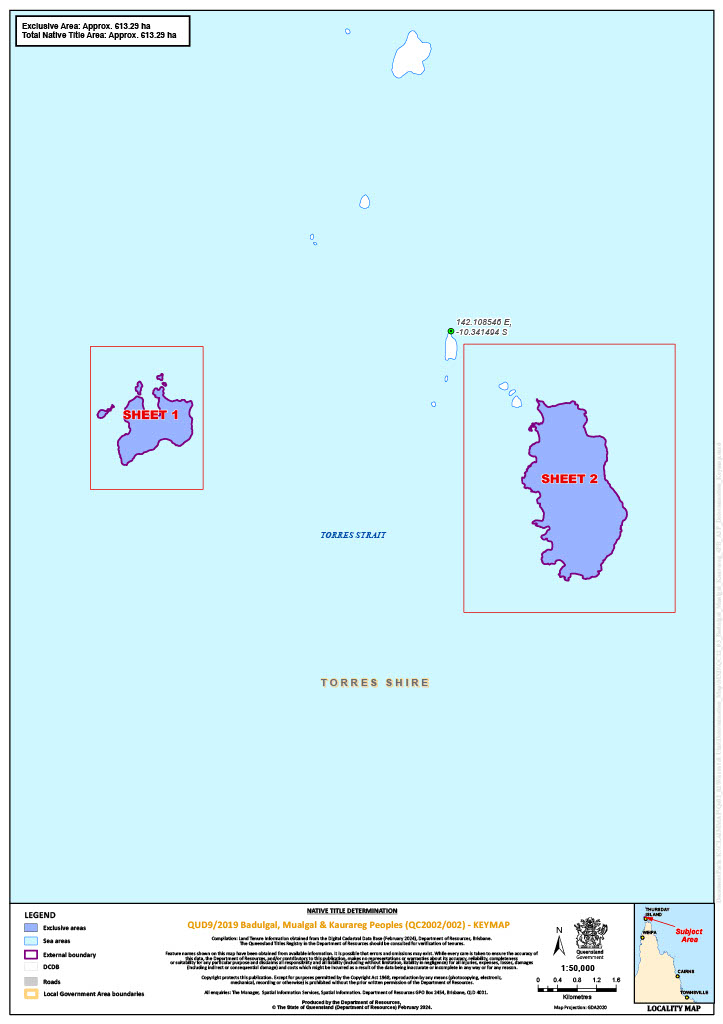
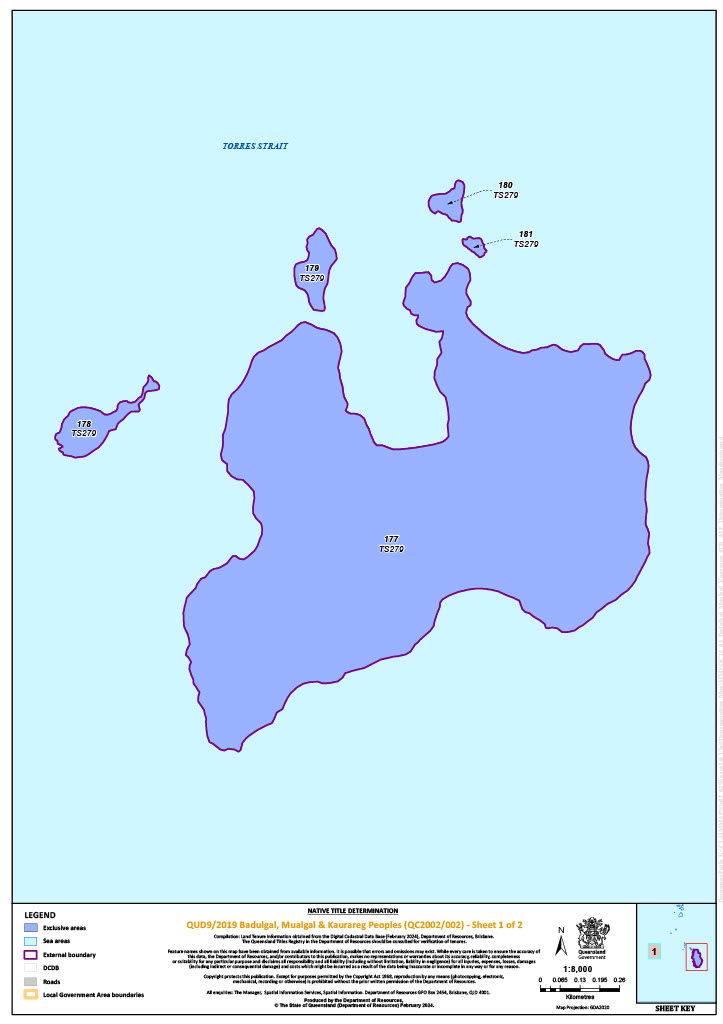
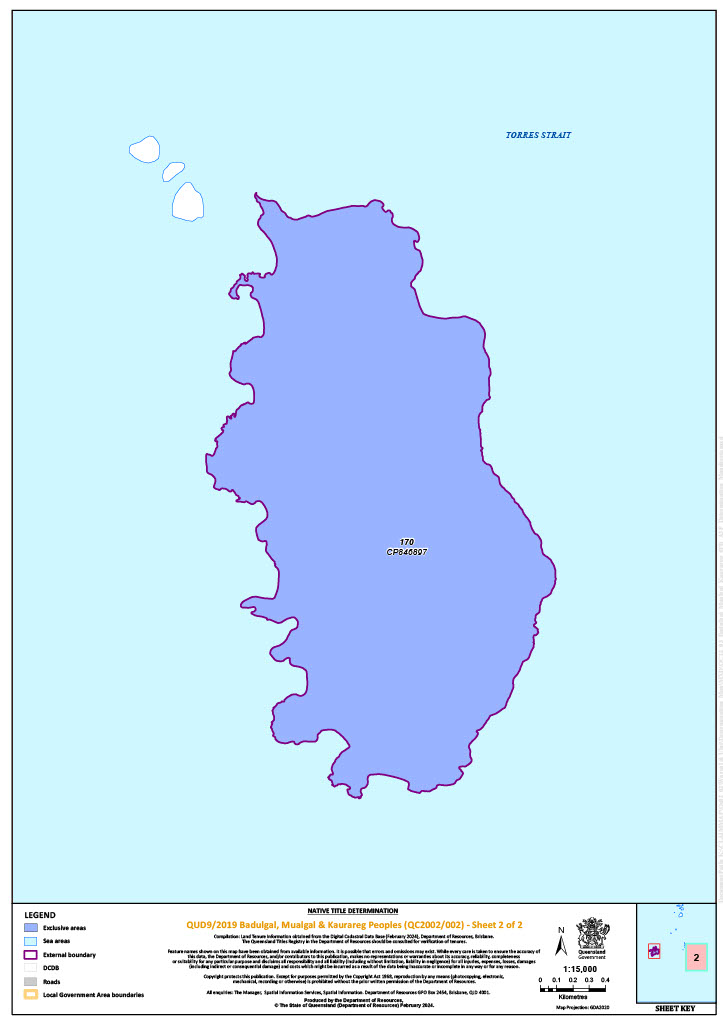
3. The determination area is the land and waters described in Schedule 3 and depicted in the maps at Schedule 5 to the extent those areas are not otherwise excluded by the terms of Schedule 4 (the Determination Area). To the extent of any inconsistency between the written description and the map, the written description prevails.
4. Native title exists in the Determination Area.
5. The native title is held by Badulgal and Mualgal described in Schedule 1 (the Native Title Holders).
6. Subject to orders 7, 8 and 9 below the nature and extent of the native title rights and interests in relation to the land and waters described in Schedule 3 are:
(a) other than in relation to Water, the right to possession, occupation, use and enjoyment of the area to the exclusion of all others; and
(b) in relation to Water, the non-exclusive rights to:
(i) hunt, fish and gather from the Water of the area;
(ii) take the Natural Resources of the Water in the area; and
(iii) take the Water of the area, subject to the operation and any vesting effect of State Water Legislation.
7. The native title rights and interests are subject to and exercisable in accordance with:
(a) the Laws of the State and the Commonwealth; and
(b) the traditional laws acknowledged and traditional customs observed by the Native Title Holders.
8. The native title rights and interests referred to in order 6(b) do not confer possession, occupation, use or enjoyment to the exclusion of all others.
9. There are no native title rights in or in relation to minerals as defined by the Mineral Resources Act 1989 (Qld) and petroleum as defined by the Petroleum Act 1923 (Qld) and the Petroleum and Gas (Production and Safety) Act 2004 (Qld).
10. The nature and extent of any other interests in relation to the Determination Area (or respective parts thereof) are set out in Schedule 2.
11. The relationship between the native title rights and interests described in order 6 and the other interests described in Schedule 2 (the Other Interests) is that:
(a) the Other Interests continue to have effect, and the rights conferred by or held under the Other Interests may be exercised notwithstanding the existence of the native title rights and interests;
(b) to the extent the Other Interests are inconsistent with the continued existence, enjoyment or exercise of the native title rights and interests in relation to the land and waters of the Determination Area, the native title continues to exist in its entirety but the native title rights and interests have no effect in relation to the Other Interests to the extent of the inconsistency for so long as the Other Interests exist; and
(c) the Other Interests and any activity that is required or permitted by or under, and done in accordance with, the Other Interests, or any activity that is associated with or incidental to such an activity, prevail over the native title rights and interests and any exercise of the native title rights and interests.
DEFINITIONS AND INTERPRETATION
12. In this determination, unless the contrary intention appears:
“Animal” means any member of the animal kingdom (other than human), whether alive or dead;
“High Water Mark” means the ordinary high water mark at spring tides;
“land” and “waters”, respectively, have the same meanings as in the Native Title Act 1993 (Cth);
“Laws of the State and the Commonwealth” means the common law and the laws of the State of Queensland and the Commonwealth of Australia, and includes legislation, regulations, statutory instruments, local planning instruments and local laws;
“Native Title Holder” has the same meaning as in the Native Title Act 1993 (Cth);
“Natural Resources” means:
(a) any Animals and Plants found on or in the lands and waters of the Determination Area; and
(b) any clays, soil, sand, gravel or rock found on or below the surface of the Determination Area,
that have traditionally been taken by the Native Title Holders,
(c) but does not include:
(i) minerals as defined in the Mineral Resources Act 1989 (Qld); or
(ii) petroleum as defined in the Petroleum Act 1923 (Qld) and the Petroleum and Gas (Production and Safety) Act 2004 (Qld);
“Plant” means any member of the plant or fungus kingdom, whether alive or dead and standing or fallen;
“Reserves” means a reserve dedicated or taken to be a reserve under the Land Act 1994 (Qld);
“State Water Legislation” means The Rights to Water and Water Conservation and Utilization Act 1910 (Qld), Water Act 1926 (Qld), and Water Act 2000 (Qld);
“Water” means:
(a) water which flows, whether permanently or intermittently, within a river, creek or stream;
(b) any natural collection of water, whether permanent or intermittent;
(c) water from an underground water source.
Other words and expressions used in this determination have the same meanings as they have in Part 15 of the Native Title Act 1993 (Cth).
THE COURT DETERMINES THAT:
13. The native title is held in trust.
14. The Badu Ar Mua Migi Lagal Torres Strait Islander Corporation (ICN: 4583), incorporated under the Corporations (Aboriginal and Torres Strait Islander) Act 2006 (Cth), is to:
(a) be the prescribed body corporate for the purpose of ss 56(2)(b) and 56(3) of the Native Title Act 1993 (Cth); and
(b) perform the functions mentioned in s 57(1) of the Native Title Act 1993 (Cth) after becoming the registered native title body corporate.
Note: Entry of orders is dealt with in Rule 39.32 of the Federal Court Rules 2011.
LIST OF SCHEDULES
Schedule 1 – Native Title Holders vi
Schedule 2 – Other Interests in the Determination Area vii
Schedule 3 – Description of Determination Area ix
Schedule 4 – Areas Not Forming Part of the Determination Area x
Schedule 5 – Map of Determination Area xi
Schedule 1 – Native Title Holders
The Native Title Holders are Badulgal and Mualgal being, respectively, the descendants of one or more of the following apical ancestors:
(a) Badulgal: Getawan, Sagul, Uria, Baira, Inor, Zimoia, Newar, Sagigi, Jawa, Wairu, Paipe, Waria, Kamui, Mabua, Laza, Gainab, Walit, Namagoin, Mariget, Bazi, Ugarie, Karud, Dauwadi, Gizu, Aupau and Zarzar; and
(b) Mualgal: Dadu, Gaia (also known as Gai), Goba, Jack Moa, Kanai (son of Bamar), Koia, Kulka, Kupad, Maga (father of Gema, Babun, Dawai, Bapi and Magena), Maiamaia, Nukau (also known as Nakau), Samukie, Tuku, Waina; including
Torres Strait Islanders who have been adopted in accordance with the traditional laws acknowledged and traditional customs observed by those people.
Schedule 2 – Other Interests in the Determination Area
The nature and extent of the other interests in relation to the Determination Area are the following as they exist as at the date of the determination:
1. The rights and interests of Torres Shire Council under its local government jurisdiction and functions under the Local Government Act 2009 (Qld) and under any other legislation, for that part of the Determination Area within the area declared to be their respective local government area under the Local Government Regulations 2012 (Qld).
2. The rights and interests of the State of Queensland in Reserves, the rights and interests of the trustees of those Reserves and the rights and interests of the persons entitled to access and use those Reserves for the respective purpose for which they are reserved, including the rights and interests of the holders of permits issued by the trustees of the following reserves:
(a) Lot 170 on Plan CP846897; and
(b) Lot 177 on Plan TS279.
3. The rights and interests of the State of Queensland or any other person existing by reason of the force and operation of the laws of the State of Queensland, including those existing by reason of the following legislation or any regulation, statutory instrument, declaration, plan, authority, permit, lease or licence made, granted, issued or entered into under that legislation:
(a) the Land Act 1994 (Qld); and
(b) the Water Act 2000 (Qld).
4. The rights and interests of members of the public arising under the common law, including but not limited to any subsisting public right to fish.
5. So far as confirmed pursuant to s 212(2) of the Native Title Act 1993 (Cth) and s 18 of the Native Title (Queensland) Act (1993) (Qld) as at the date of this determination, any existing rights of the public to access and enjoy the following places in the Determination Area:
(a) coastal waters;
(b) beaches; or
(c) areas that were public places at the end of 31 December 1993.
6. Any other rights and interests:
(a) held by the State of Queensland or Commonwealth of Australia; or
(b) existing by reason of the force and operation of the Laws of the State and the Commonwealth.
Schedule 3 – Description of Determination Area
The determination area comprises all of the land and waters, above High Water Mark, described in the following table and depicted in dark blue on the determination maps contained in Schedule 5, to the extent those areas are not otherwise excluded by the terms of Schedule 4.
Area description (at the time of the determination) | Determination Map Sheet Reference | Note |
Lot 170 on Plan CP846897 Warral (Hawkesbury) Island | Map 1, sheet 2 | ^ * |
Lot 177 on Plan TS279 Ului (West) Island | Map 1, sheet 1 | ^ * |
Lot 178 on Plan TS279 | Map 1, sheet 1 | ~ * |
Lot 179 on Plan TS279 | Map 1, sheet 1 | ~ * |
Lot 180 on Plan TS279 | Map1, sheet 1 | ~ * |
Lot 181 on Plan TS279 | Map 1, sheet 1 | ~ * |
^ denotes areas to which s 47A of the Native Title Act 1993 (Cth) applies.
~ denotes areas to which s 47B of the Native Title Act 1993 (Cth) applies.
* denotes areas that have not been surveyed at the date of the determination.
Schedule 4 – Areas Not Forming Part of the Determination Area
The following areas of land and waters are excluded from the determination area as described in Schedule 3:
1. Those lands and waters which at the time the native title determination application was made were or had been the subject of one or more Previous Exclusive Possession Acts, within the meaning of s 23B of the Native Title Act 1993 (Cth) as they could not be claimed in accordance with s 61A of the Native Title Act 1993 (Cth).
2. Specifically, and to avoid any doubt, the land and waters described in (1) above includes the land and waters on which any public work, as defined in s 253 of the Native Title Act 1993 (Cth), is or was constructed, established or situated, and to which ss 23B(7) and 23C(2) of the Native Title Act 1993 (Cth) and to which s 21 of the Native Title (Queensland) Act 1993 (Qld), applies, together with any adjacent land or waters in accordance with s 251D of the Native Title Act 1993 (Cth).
Schedule 5 – Map of Determination Area
MORTIMER CJ:
INTRODUCTION
1 Warral and Ului are two uninhabited islands which jointly comprise 6.35 square kilometres of land above the high water mark. In Nona on behalf of the Badu People (Warral & Ului) v State of Queensland [2020] FCA 983 at [9], I described how they lay between the ‘home islands’ of three groups:
Warral and Ului lie in the Torres Strait, between the islands of Badu and Moa to the north and the inner islands of the Torres Strait, including Murulag (Prince of Wales Island) and Ngurapai (Horn Island), to the south. Badu has been determined to be Badulgal country (see Nona v State of Queensland [2004] FCA 1578), Moa has been determined to be Mualgal country (see Mualgal People v State of Queensland [1999] FCA 157) and Murulag and Ngurapai have been determined to be Kaurareg country (see Kaurareg People v State of Queensland [2001] FCA 657).
2 On 27 February 2023, in Nona on behalf of the Badulgal, Mualgal and Kaurareg Peoples (Warral & Ului) v State of Queensland (No 5) [2023] FCA 135 the Court made orders answering separate questions stated in this proceeding. The answers to those separate questions disposed of all principal issues concerning who holds native title in the islands of Warral and Ului in the Torres Strait region.
3 The Court found that the persons who hold the native title are the members of the Badulgal and Mualgal Peoples, such group membership being determined in accordance with their traditional laws and customs. The Court found that native title in the islands of Warral and Ului was not held by members of the Kaurareg People, contrary to the contentions of the applicant in the proceeding. The applicant is made up of representatives from each of the Badulgal, Mualgal and Kaurareg communities.
4 The Court found that the Badulgal and Mualgal Peoples hold a single native title over the claim area in the same way as they do over the islands in the determination in Nona and Manas v State of Queensland [2006] FCA 412, which is more colloquially known as the shared islands determination.
5 The Court found that the Badulgal and Mualgal native title rights and interests in the land of Warral and Ului are exclusive in nature.
6 After publication of orders, and extensive reasons for those orders, the Court allowed time for consideration by the applicant of whether to seek leave to appeal from those orders. This consideration took some time, and involved careful consultation with affected groups. Ultimately, no application for leave to appeal was filed. The Court then worked with the active parties towards finalising the proceeding by way of a determination of native title. As I explain below, this process also took some time, understandably, given the Court’s conclusions.
7 By proposed signed orders filed with the Court on 25 June 2024, supported by submissions and an affidavit on behalf of the applicant, the parties have sought a determination of native title under s 87 of the Native Title Act 1993 (Cth).
8 For the reasons set out below, the Court is satisfied it is appropriate to make the orders sought, and that it is within the power of the Court to do so.
THE MATERIAL BEFORE THE COURT
9 Despite a lengthy and substantial contested hearing on the separate questions, this application now comes before the Court as an application for a consent determination. All relevant parties have signed the proposed orders. In support of the proposed consent determination, the applicant relies on an affidavit of Mr David John Knobel filed on 8 July 2024, and written submissions filed on the same day.
10 Aside from the material set out in [9], it is the Court’s findings in Nona No 5 which must govern the assessment of this application.
PROCEDURAL HISTORY
11 This proceeding has been on foot for more than 22 years. The Court traced the history of the claim at [11]-[14] of Nona No 5:
The first native title claim over Warral and Ului was filed on 4 March 2002 and eventually became this proceeding, QUD9/2019. Initially, the claim was made only on behalf of the Badulgal People. The Akiba claim had been filed in November 2001. In March 2002 a number of the home island and shared islands claims in the Western Torres Strait were filed within a few days of each other. On 28 November 2003, three Kaurareg respondents were joined to the (then) Badulgal claim over Warral and Ului. That joinder was on the basis that Kaurareg People asserted native title in the islands. This was consistent with the claims made by the Kaurareg People in Akiba to the sea extending north from their home islands and into the area of the sea between Warral and Ului, and Badu and Mua. No Mualgal people had sought to be joined as respondents at this point, but their assertion of interests in the islands was well understood in the region. Over the next decade or so, the home and shared islands claims were resolved, and the Akiba claim was litigated. The claim over Warral and Ului was not resolved.
On 17 March 2014, Greenwood J referred representatives of the Badulgal, the Mualgal and the Kaurareg Peoples to mediation in an attempt to resolve these disputes. As I noted in Nona at [13]-[15], this mediation was held in February 2015. The outcomes of the mediation included an agreement to amend the application and replace the applicant so as to reflect the shared ownership claim. In these reasons I will describe this as the 2015 agreement. The amended claimant application and the replacement of the applicant was authorised in February 2020, and the amended claim was certified by the Torres Strait Regional Authority in April 2020. It was the authorisation process that prompted the formal expression of disagreement from some within the Badulgal community.
On 4 March 2020, an interlocutory application was filed in this Court seeking orders to join five Badulgal men as respondents to this proceeding (the Badulgal respondents). The Badulgal respondents contended that under customary law, the islands of Warral and Ului were in the exclusive domain of the Badulgal, and the 2015 agreement and consequent shared ownership claim were wrong, and would lead to the diminishment of the Badulgal’s customary rights in favour of the Mualgal and Kaurareg Peoples.
On 15 July 2020, for the reasons set out in Nona, this Court granted leave to replace the applicant so that members of each of the three groups constituted the applicant, and leave to the newly constituted applicant to amend the s 61 application to make the shared ownership claim. The Court also granted the Badulgal respondents’ application for joinder.
12 The hearing of the separate questions was held under difficult conditions during the Covid-19 pandemic in October 2021, with the Court and interstate legal representatives having to spend two weeks in hotel quarantine after entering Queensland. The lay evidence occupied approximately three weeks in various locations: Waiben (Thursday Island), Mua and Badu. The parties then agreed on a timetable for expert evidence and final submissions which took until October 2022. The Court’s orders and reasons were published on 27 February 2023.
13 On 5 May 2023, I made orders referring the proceeding to case management before Judicial Registrar Grant to settle a timetable for disposition of the proceeding and to settle any outstanding issues between the parties. Since then, there have been three substantive iterations of timetabling orders designed to facilitate agreement making on an appropriate final determination.
14 Despite the Court’s findings on the separate questions, the applicant as constituted after the Court’s orders in July 2020 (and therefore including Kaurareg representatives) has continued to have carriage of the claim through to and including this application under s 87 of the Native Title Act. No other party, and in particular the State, has submitted this was impermissible or inappropriate. Since the matter was proceeding by agreement after the absence of any appeal from the orders in Nona No 5, the Court has taken the view that this arrangement was a matter for the parties. As I explain below, although the applicant as constituted in July 2020 continued to have conduct of the claim, only members of the Badulgal and Mualgal groups participated in the authorisation process.
AUTHORISATION
15 The affidavit of Mr Knobel describes the authorisation process. Prior to the authorisation meeting, there were five pre-authorisation information sessions facilitated by the applicant with the assistance of Gur A Baradharaw Kod Aboriginal and Torres Strait Islander Corporation (GBK) at the following times:
(a) morning of Thursday 8 February 2024 on Badu;
(b) afternoon of Thursday 8 February 2024 at Kubin on Mua;
(c) Saturday 9 March 2024 on Horn Island;
(d) Saturday 20 April 2024 in Cairns; and
(e) Friday 26 April 2024 on Thursday Island.
16 An authorisation meeting was held at the Port Kennedy Hall on Thursday Island on 27 April 2024. The notice for the authorisation meeting was published in three newspapers in advance. It was also posted to GBK’s Facebook page and several other community Facebook pages.
17 Mr Knobel deposes that the authorisation meeting resolved that:
(a) the authorisation meeting was sufficiently notified for claimants to be aware of matters for decision;
(b) the attendance at the authorisation meeting was sufficiently representative of the native title rights holding group to make authoritative decisions binding on the group;
(c) the native title holders agreed to and adopted a decision making process for the authorisation meeting;
(d) the description of native title holders was agreed;
(e) the authority of each member of the applicant to continue to act jointly to deal with the final matters to give effect to the decisions of the authorisation meeting was confirmed;
(f) the applicant was authorised to agree to the proposed terms of the s 87 orders including the description of the native title rights and interests over the determination area, subject to resolutions passed regarding the description of the native title rights holding group;
(g) the Badu Ar Mua Migi Lagal (Torres Strait Islander) RNTBC (ICN 4583) was nominated to hold the native title in Warral and Ului on trust and to become the Registered Native Title Body Corporate for the determination area;
(h) the common law holders of native title in the Badu and Mua shared islands, who are members or entitled to be members of the BAMML RNTBC accepted the nomination of that corporation to hold native title on trust and to be the RNTBC for the determination area; and
(i) the native title holders’ legal representative was authorised to make such technical changes to the documentation necessary for the determination to be made, consistent with matters authorised at the meeting, to complete the steps required for resolution of the Warral and Ului claim by consent and to sign the relevant documents on behalf of the native title holders and the applicant.
CONNECTION OF BADULGAL AND MUALGAL
18 Connection was resolved in Nona No 5.
19 During the hearing of the separate questions from 6-22 October 2021 in the Torres Strait, lay evidence was adduced from the following witnesses for the applicant:
(a) Father Paul Tom, Thomas Savage, Eliziah Wasaga and Enid Tom for Kaurareg people;
(b) Nazareth Adidi, Naton Nawia, Flora Warria and Opeta James Kaitap for Mualgal; and
(c) Alick Tipoti, Geiza Stow, Troy Laza and Titom Nona for Badulgal.
20 For the Badulgal respondents, the Court heard evidence from Ronnie Nomoa, George Nona, Pastor Walter Tamwoy (now deceased), Tommy Dinto Tamwoy and Wolfgang Laza.
21 Substantial portions of lay evidence from six witnesses in the trial in Akiba on behalf of the Torres Strait Islanders of the Regional Seas Claim Group v State of Queensland (No 3) [2010] FCA 643; 204 FCR 1, were also admitted: see Nona No 5 at [247]-[440].
22 Evidence concerning previous native title determinations in the region, and what connection was accepted or demonstrated in those other determinations, was also important evidence. That is especially the case in relation to the shared islands determination.
23 Expert reports were also filed in support of the separate questions hearing. The Court heard expert evidence from 18-22 July 2022 in Cairns from the following witnesses:
(a) Dr Kevin Murphy (regarding Badulgal);
(b) Dr Garrick Hitchcock (regarding Mualgal);
(c) Mr Ray Wood (regarding Kaurareg); and
(d) Mr Daniel Leo (regarding the Badulgal respondents).
24 Each of Dr Murphy, Dr Hitchcock and Mr Wood had prepared earlier reports in the region. Those were admitted and were of considerable assistance to the Court.
25 I note Mr Knobel’s evidence that there were two apical ancestors specifically identified in the shared islands determination who are not proposed to be identified as apical ancestors on this determination. Mr Knobel deposes (at [15]-[17]):
The list of Mualgal apical ancestors included in the description of the native title holders for the Warral and Ului determination differs slightly from the list in Schedule 2 of Nona and Manas v State of Queensland [2006] FCA 412 (Nona and Manas). The Nona and Manas list includes the names Anu Namai and Iaka/Aiaka, which are not included in the list of apical ancestors for the Warral and Ului determination.
On 31 October 2023, in response to a query from the State of Queensland about this issue, I received correspondence from anthropologist Dr Kevin Murphy advising that, through the course of research conducted in 2018, it was established that Anu Namai and Iaka/Aiaka were descendants of apical ancestor Maga, whose name is included in the definition of the native title holders in Nona and Manas and the Warral and Ului claim. It is therefore unnecessary to include the names of two of Maga's descendants Anu Namai and Iaka/Aiaka in the description of the native title holders over Warral and Ului.
I understand this explanation satisfied the State and other parties that the list of apical ancestors proposed for the purpose of the Warral and Ului determination is appropriate.
26 I accept Mr Knobel’s evidence. I am satisfied the discrepancy between the lists of apical ancestors proposed in this determination and the existing list in the shared islands determination does not result in the exclusion of any persons who should be included as common law holders in this determination.
PROPER PARTIES TO THE PROCEEDING
27 No issue was raised by any party about the fact that the respondent to this proceeding is, and always has been, the State of Queensland. In Ross on behalf of the Cape York United #1 Claim Group v State of Queensland (No 24) (Olkola determination) [2024] FCA 740 at [53]-[106], I explained why there is no legal or other difficulty with a State being named as a respondent. The same position obtains in respect of the Commonwealth, which became an “active connection party” in the proceeding in November 2020.
THE APPLICABLE REQUIREMENTS OF SECTION 87
28 Section 87 of the NTA applies to an agreement reached “at any stage” of a proceeding following the end of the notification period in s 66, in relation to a proposed determination of native title.
29 Sub-section 87(1) provides:
Application
(1) This section applies if, at any stage of proceedings after the end of the period specified in the notice given under section 66:
(a) agreement is reached on the terms of an order of the Federal Court in relation to:
(i) the proceedings; or
(ii) a part of the proceedings; or
(iii) a matter arising out of the proceedings; and
(aa) all of the following are parties to the agreement:
(i) the parties to the proceedings;
(ii) the Commonwealth Minister, if the Commonwealth Minister is intervening in the proceedings at the time the agreement is made; and
(b) the terms of the agreement, in writing signed by or on behalf of the parties to the proceedings and, if subparagraph (aa)(ii) applies, the Commonwealth Minister, are filed with the Court; and
(c) the Court is satisfied that an order in, or consistent with, those terms would be within the power of the Court.
30 In relation to s 87(1), the applicant submits that:
(a) the notification period for the claim has ended;
(b) there is agreement between the parties about the terms of the orders that will resolve the proceedings, as evidenced by their execution of the s 87 agreement; and
(c) the agreement has been made in writing and filed with the Court, in the form of the proposed determination orders signed by all the parties.
31 I accept those submissions, and accept that the requirements in s 87(1) are satisfied. In particular, although the orders answering the separate questions substantively determined the issue of who holds native title in the islands, and whether it is exclusive, other matters needed to be either agreed or decided before a determination of native title could be made. In that sense, the orders in Nona No 5 did not bring the proceeding to an end and this determination is being made at a stage of the proceeding to which s 87 may apply.
Whether it is appropriate to make the orders sought (s 87(1A))
32 The applicant submitted that:
(a) there is no overlap with any other application for determination of native title (see s 67(1) of the Native Title Act);
(b) the proposed determination area is not the subject of a previously approved determination of native title (see s 68 of the Native Title Act);
(c) the orders sought set out the details of the matters required by s 225 of the Native Title Act; and
(d) the orders concern rights and interests which the common law of Australia is able to recognise (see s 223(1) of the Native Title Act).
33 I have set out my approach to the question of “appropriateness” and the Court’s function in exercising the powers conferred under s 87 and s 87A in previous decisions: see Drury on behalf of the Nanda People v State of Western Australia [2018] FCA 1849 at [52]-[56], by reference to earlier authorities. In Taylor on behalf of the Yamatji Nation Claim v State of Western Australia [2020] FCA42 at [63]-[65], I explained the particular importance of the role of the State in the consent determination process.
34 Although the circumstances of this determination are distinct, because of the contested separate questions hearing and orders, the Court’s assessment of whether orders are appropriate may still include the matters I referred to in Taylor and Drury.
35 In this case, I am also satisfied that the applicant, including as it does representatives of the Kaurareg People, has had a fair opportunity to consider seeking leave to appeal from the decision in Nona No 5, and elected not to do so. Nor did any other party seek leave to appeal from that decision. I am satisfied that after the publication of orders in Nona No 5, although it has taken some time, there has been a constructive process of agreement making, and affirmation by the common law holders of the outcome of that agreement making, so that the orders the Court is asked to make today reflect the will of the parties, and of the common law holders as the Court identified those people in Nona No 5.
NOMINATION OF A PRESCRIBED BODY CORPORATE
36 A prescribed body corporate, the BAMML RNTBC, has been nominated under ss 56(2)(b) and 56(3) of the Native Title Act to hold the native title in trust on behalf of native title holders. The BAMML RNTBC has passed a resolution to consent to that nomination. This is the same PBC which holds the native title for the common law holders under the shared islands determination.
CONCLUSION
37 This determination brings to a close a long chapter in the lives of several communities in the Torres Strait. They may now be uninhabited, but Warral and Ului are important islands and this was clear to the Court during the separate questions hearing. It is appropriate to repeat what I said at [3] in Nona No 5:
What has happened in this proceeding in some ways reflects the tragedy of having to recognise native title by fitting it into the straitjacket of Anglo-Australian law as reflected in the NTA, and the realities for First Nations peoples today in finding a way through that system.
38 The Court also recognises the written submission of the applicant (at [52]) that “the outcome of Nona No 5 requires a form of determination that was not sought by either the Applicant or the Badulgal Respondents”. Nevertheless, the possibility of such an outcome was well alive before and during the conduct of the separate questions hearing, as I observed in Nona No 5 at [5]:
As all parties to the separate question proceeding acknowledged, the Court must decide not only whether the applicant has proven its case of shared ownership, but, if not, must also decide what the evidence establishes on the balance of probabilities is the correct answer to the separate questions about who has native title in Warral and Ului. If the Court finds the applicant has not discharged its burden of proof on the shared ownership claim, that does not mean the Court must dismiss the native title application. All parties accept that the Court should decide whether it is more likely than not that one or more of Badulgal, Mualgal or Kaurareg hold native title over Warral and Ului. All parties accept that the islands belong to one or more of these groups, and not to anyone else. The questions the Court must answer have been structured to allow for this possibility.
39 As I said at [21] of Nona No 5, this has been a deeply personal and difficult journey undertaken by all those represented by the applicant and Badulgal respondents. The Court acknowledges and commends the members of both the applicant and the Badulgal respondents, and the communities that stand with them, for finding a way to bring the claim over the two islands to finalisation. The Court thanks them for their hard work in reaching the outcome recognised today.
40 In these reasons it is also appropriate for the Court and its staff to pay their deep respects to the family of Pastor Tamwoy, who was an important witness and a highly respected Badulgal person. The Court also acknowledges that other families in these three communities are likely to have lost loved ones over the course of this proceeding, because it has taken such a long time.
41 The Court has been greatly assisted throughout this proceeding by the legal representatives for the active parties, as well as the former and current representative bodies for the region, the Torres Strait Regional Authority and then GBK. The Court also acknowledges the work of Judicial Registrar Grant over many years in the multitude of stages and processes that have led to the Court’s determination today. A number of other people’s contributions were acknowledged in Nona No 5 at [19]-[21], and those contributions are acknowledged again in these reasons.
42 Over 22 years, this claim has brought tensions between and within communities, and challenges to the enduring and vital islander concept of gud pasin. It has demanded the personal investment of so many community members in putting before the Court what they know about Warral and Ului. All in addition to the challenges faced by the Badulgal, Mualgal and Kaurareg Peoples in their daily lives. The Court thanks members of all three communities for staying with the native title process, and especially for their engagement in agreement making that has brought finalisation to this claim. There is yet much more to be achieved in the Torres Strait region under the Native Title Act, and the Court wishes the members of all three communities well in their future agreement making, as they move towards a time beyond the struggle for their country that Anglo Australian law has imposed on them.
I certify that the preceding forty-two (42) numbered paragraphs are a true copy of the Reasons for Judgment of the Honourable Chief Justice Mortimer. |
Associate:
Dated: 4 October 2024
QUD 9 of 2019 | |
GEORGE HENRY NONA | |
Fifth Respondent: | RONNIE NOMOA |
Sixth Respondent: | WALTER TAMWOY (DECEASED) |
Seventh Respondent: | TOMMY WIILLIE TAMWOY |


