

FEDERAL COURT OF AUSTRALIA
Papertalk on behalf of the Mullewa Wadjari People v State of Western Australia (No 3) [2024] FCA 1132
ORDERS
WAD 21 of 2019 | ||
| ||
BETWEEN: | LEEDHAM PAPERTALK & ORS ON BEHALF OF THE MULLEWA WADJARI PEOPLE Applicant | |
AND: | STATE OF WESTERN AUSTRALIA and others named in the Schedule Respondent | |
WAD 28 of 2019 | ||
| ||
BETWEEN: | COLIN HAMLETT & ORS ON BEHALF OF THE WAJARRI YAMATJI #1 Applicant | |
AND: | STATE OF WESTERN AUSTRALIA and others named in the Schedule Respondent | |
WAD 32 of 2018 | ||
| ||
BETWEEN: | COLIN HAMLETT & ORS ON BEHALF OF THE WAJARRI YAMATJI #3 Applicant | |
AND: | STATE OF WESTERN AUSTRALIA and others named in the Schedule Respondent | |
WAD 611 of 2018 | ||
| ||
BETWEEN: | GAVIN EGAN & ORS ON BEHALF OF THE WAJARRI YAMATJI #7 Applicant | |
AND: | STATE OF WESTERN AUSTRALIA and others named in the Schedule Respondent | |
WAD 30 of 2019 | ||
| ||
BETWEEN: | VIOLET DRURY & ORS ON BEHALF OF THE NANDA PEOPLE Applicant | |
AND: | STATE OF WESTERN AUSTRALIA and others named in the Schedule Respondent | |
WAD 176 of 2019 | ||
| ||
BETWEEN: | DEREK DRAGE & ORS ON BEHALF OF THE NANDA PEOPLE #3 Applicant | |
AND: | STATE OF WESTERN AUSTRALIA and others named in the Schedule Respondent | |
order made by: | MURPHY J |
DATE OF ORDER: | 20 december 2023 |
THE COURT ORDERS THAT:
1. The application for summary judgment dated 26 May 2023 be allowed.
2. The time for the Mullewa Wadjari People to file any application for leave to appeal Order 1 above be extended to 14 days after the date on which the written reasons for the order granting summary judgment are published.
3. Order 17 of the orders made on 14 August 2023 listing the substantive proceedings for hearing be vacated.
4. All extant hearing preparation orders in the substantive proceedings be vacated.
5. Costs be reserved.
Note: Entry of orders is dealt with in Rule 39.32 of the Federal Court Rules 2011.
ORDERS
LEEDHAM PAPERTALK & ORS ON BEHALF OF THE MULLEWA WADJARI PEOPLE Applicant | ||
AND: | STATE OF WESTERN AUSTRALIA and others named in the Schedule Respondent | |
WAD 28 of 2019 | ||
| ||
BETWEEN: | COLIN HAMLETT & ORS ON BEHALF OF THE WAJARRI YAMATJI #1 Applicant | |
AND: | STATE OF WESTERN AUSTRALIA and others named in the Schedule Respondent | |
WAD 32 of 2018 | ||
| ||
BETWEEN: | COLIN HAMLETT & ORS ON BEHALF OF THE WAJARRI YAMATJI #3 Applicant | |
AND: | STATE OF WESTERN AUSTRALIA and others named in the Schedule Respondent | |
WAD 611 of 2018 | ||
| ||
BETWEEN: | GAVIN EGAN & ORS ON BEHALF OF THE WAJARRI YAMATJI #7 Applicant | |
AND: | STATE OF WESTERN AUSTRALIA and others named in the Schedule Respondent | |
WAD 30 of 2019 | ||
| ||
BETWEEN: | VIOLET DRURY & ORS ON BEHALF OF THE NANDA PEOPLE Applicant | |
AND: | STATE OF WESTERN AUSTRALIA and others named in the Schedule Respondent | |
WAD 176 of 2019 | ||
| ||
BETWEEN: | DEREK DRAGE & ORS ON BEHALF OF THE NANDA PEOPLE #3 Applicant | |
AND: | STATE OF WESTERN AUSTRALIA and others named in the Schedule Respondent | |
DATE OF ORDER: | 26 September 2024 |
THE COURT ORDERS THAT:
1. The parties are directed to confer within 7 days as to the appropriate form of any orders to be made to reflect the published reasons, and further to the orders made on 20 December 2023. If the parties can agree on the appropriate form of the orders, within 14 days the parties shall provide to chambers an agreed minute of draft orders. If the parties cannot agree as to the appropriate form of the orders within 14 days, each party shall forthwith forward a proposed minute of draft orders and short submissions (no more than two pages) as to why those orders, rather than the orders proposed by any other party, should be made.
2. Liberty to apply.
Note: Entry of orders is dealt with in Rule 39.32 of the Federal Court Rules 2011.
MURPHY J:
1. Introduction
1 The substantive proceedings in this matter are six overlapping applications for determination of native title in the Geraldton region of Western Australia, brought on behalf of the Nanda People, the Wajarri Yamatji People and the Mullewa Wadjari People respectively, being:
(a) Colin Hamlett, Kevin Egan & Others on behalf of the Wajarri Yamatji People v State of Western Australia & Others, proceedings WAD 32/2018, WAD 611/2018 and WAD 28/2019 (WY Applications);
(b) Violet Drury, Derek Drage & Others on behalf of the Nanda People v State of Western Australia & Others, proceedings WAD 30/2019 and WAD 176/2019 (Nanda Applications); and
(c) Leedham Papertalk & Others on behalf of the Mullewa Wadjari People v State of Western Australia & Others, proceeding WAD 21/2019 (MW Application).
2 Before the Court is an interlocutory application dated 26 May 2023, brought jointly by the applicants in the Nanda Applications and the WY Applications (together, the N&WY applicants) in which they seek summary judgment against Leedham Papertalk and others on behalf of the Mullewa Wadjari People, the applicant in the MW Application (MW applicant), pursuant to s 31A(2) of the Federal Court of Australia Act 1976 (Cth) (FCA) and r 26.01(1)(a) of the Federal Court Rules 2011 (Cth) (Rules). The N&WY applicants bring the application on the grounds that the MW applicant has no reasonable prospect of successfully prosecuting its case on any of the issues to be decided in a pending hearing of separate questions set by the Court (Separate Questions hearing).
3 It is always appropriate to be cautious before deciding a party’s rights by way of summary judgment, and the power to do so must not be exercised lightly: Spencer v Commonwealth [2010] HCA 28; 241 CLR 118 at [60] (Hayne, Crennan, Kiefel and Bell JJ). In my view particular caution is appropriate when summary judgment is sought in a native title determination application. The preamble to the Native Title Act 1993 (Cth) (NTA) provides that the NTA is intended, amongst other things, to rectify the consequences of past injustices suffered by Australia’s First Peoples, to ensure their full recognition and status within the Australian nation, and to advance the process of reconciliation among all Australians. It is important that applicants seeking a determination of native title are heard, and important too that they feel they have been heard. If an application for determination of native title is decided summarily, without hearing the claimants’ oral testimony they may not feel they have been heard.
4 For those reasons, and because the competing proceedings were fixed for hearing in the Separate Questions hearing, I was initially reluctant to hear the summary judgment application. But in the circumstances of the case I was persuaded that it was appropriate to hear and decide the summary judgment application before the parties were put to the substantial time and expense of a contested ‘on country’ hearing of the Separate Questions. The circumstances include that:
(a) in the WY Applications all participating parties other than the MW applicant have entered into consent minutes to recognise native title held by the Wajarri Yamatji People (as defined) in relation to the WY claim area as specified;
(b) in the Nanda Applications all participating parties other than the MW applicant have entered into consent minutes to recognise native title held by the Nanda People in relation to the contested area;
(c) the MW applicant withdrew from agreements it had entered into in Court-convened mediations to settle the disputes between the MW applicant and the Nanda People, and between the MW applicant and the WY People. Mortimer J (as her Honour then was) held that their withdrawal from those agreements constituted an abuse of process;
(d) the Nanda and WY Applications have suffered lengthy delays, and the N&WY applicants have incurred substantial extra costs, for which the MW applicant is centrally responsible;
(e) the parties have filed all the evidence which they propose to rely upon in a forthcoming hearing of the Separate Questions, which evidence is in its final form. Thus, the summary judgment application could be decided on the full suite of evidence for the hearing; and
(f) the Nanda and WY applicants contended that they should not be put through the substantial time and expense of a contested Separate Questions hearing ‘on country’, listed to take approximately three weeks, if the MW applicant has no reasonable prospect of successfully prosecuting its case on the issues in the Separate Questions hearing.
I concluded that deciding the summary judgment application in advance of the Separate Questions hearing was in the interests of justice and was the course most consistent with the overarching purpose under s 37M of the FCA to facilitate the just resolution of the disputes between the parties according to law as quickly, inexpensively and efficiently as possible.
5 The documentary materials relied on by the parties were substantial and the Court had the benefit of all the evidence filed for the Separate Questions hearing but without the benefit of cross examination. For the reasons I now turn to explain, following hearing the summary judgment application I concluded that the MW applicant has no reasonable prospect of successfully prosecuting its case on four of the issues for the Separate Questions hearing (described as WY Issue 1, Nanda Issue 1, Nanda Issue 3 and Nanda Issue 4) and I made orders to allow the application.
6 These reasons are lengthy, and their length might be said to indicate that it is inappropriate to decide the proceeding summarily. However, the length reflects the fact that the application involves five separate questions and the evidence in relation to four of those issues is lengthy. I was also concerned to ensure that the MW applicant can see that its evidence has been considered.
7 In any event, the fact that an extensive consideration of the evidence was necessary to conclude that the MW applicant has no reasonable prospects of success on the issues in the case is not a reason to refuse summary judgment. As Mansfield J explained in Thardim v Northern Territory of Australia [2016] FCA 407 at [97]:
Ordinary principles governing summary dismissal apply to the power to strike out under s 84C of the NT Act. Such an order should be approached with caution and should be allowed only where a clear case for summary dismissal has been made, and proceedings should be dismissed only in very clear cases where the claim as expressed is untenable upon the version of the evidence favourable to the applicant (and generally without any weighing of conflicting evidence or of the inferences which might be drawn therefrom). The mere complexity of an issue, or the fact that extensive argument may be necessary to demonstrate that the claim is untenable, is not a reason not to dispose of an application summarily. Those propositions are well known: see Dey v Victorian Railways Commissioner (1949) 78 CLR 62 at 91 per Dixon J; General Steel Industries Inc v Commissioner for Railways (1964) 112 CLR 125 at 129-130 per Barwick CJ; Williams v Grant [2004] FCAFC 178 at [48]-[49] per Lander J (North and Dowsett JJ agreeing); Bodney v Bropho (2004) 140 FCR 77 at [51] per Stone J. They were applied in the Town of Batchelor 2008 judgment at [11]-[15] and in the Town of Batchelor 2014 judgment at [120].
(Emphasis added.)
8 It should be understood that the MW People do not claim to be a separate people to the WY People; rather they say that they are descendants of the Thawarda Wadjari people who were at sovereignty members of the same Wajarri society as the WY People. “Wadjari” is just an alternative spelling or pronunciation of “Wajarri”, and both words refer to the same Aboriginal group. The evidence shows numerous variations of the spelling and pronunciation of:
(a) “Wajarri” (including Wadjari, Wadjarri, Wajjari, Wajjaree, Watjarri, Wajeri).
(b) “Thawarda” (including Tharwarda, Thagarda, Tharwerra, Tharguurda).
I use the variations “Wajarri” and “Thawarda”, except where the context requires otherwise. The choice to use those spelling variations is for clarity and is not material to the decision.
2. The evidence and submissions
9 To establish an entitlement to summary judgment on the issues to be decided in the Separate Questions hearing the N&WY applicants centrally relied on the lay evidence filed by the MW applicant for that hearing, being the witness statements of Dr Green, Mr Papertalk and Ms Jackamarra. They contended that the expert evidence filed by the MW applicant, being a report of Mr Kim Barber dated 22 September 2023 (Barber Report), is inadmissible. The N&WY applicants undertook a detailed analysis of the MW applicant’s evidence and submitted that its evidence did not rise to the level that it had a reasonable prospect of successfully prosecuting its case on the issues to be decided in the Separate Questions hearing. They relied upon the following evidence:
(a) the affidavits of Colin McKellar, affirmed 26 May 2023 and 22 September 2023 (second McKellar affidavit) and the annexures thereto;
(b) the Statement of Agreed Issues in Dispute, agreed by the Nanda, WY and MW applicants and the State of Western Australia (the State), dated 22 December 2022 (SAID);
(c) the N&WY Amended Statement of Facts, Issues and Contentions, dated 16 February 2023;
(d) the N&WY Further Amended Statement of Facts, Issues and Contentions, dated 1 December 2023;
(e) the lay evidence filed by the MW applicant for the Separate Questions hearing, being the signed witness statements of:
(i) Mr Leedham Papertalk, dated 28 April 2023;
(ii) Ms Glenda Jackamarra, dated 28 April 2023;
(iii) Dr Charmaine Green, dated 27 April 2023;
(f) the N&WY Outline of Submissions, dated 13 November 2023 (N&WY submissions); and
(g) the N&WY Reply Submissions, dated 1 December 2023.
10 The State supported the summary judgment application. It relied upon the following material:
(a) the evidence filed by the N&WY applicants and the MW applicant, pursuant to orders 3(a) and (b) of the Orders made on 22 October 2023; and
(b) other evidence referred to in the respective Outlines of Submissions by the N&WY applicants and the MW applicant.
11 In opposing summary judgment the MW applicant centrally relied upon the same evidence as the N&WY applicants and also on some limited parts of the lay and expert evidence filed by the N&WY applicants for the Separate Questions hearing. It relied upon the following evidence:
(a) the SAID;
(b) the Mullewa Wadjari Substituted Statement of Facts, Issues and Contentions, dated 31 January 2023 (MW SSFIC);
(c) the Mullewa Wadjari Further and Better Particulars, dated 13 March 2023 (MW F&BP);
(d) the affidavit of Raquel Woodcock, the solicitor for the MW applicant, sworn 6 November 2023, and the annexures thereto, including:
(i) the lay witness statements of Mr Papertalk, Ms Jackamarra and Dr Green;
(ii) a partially redacted version of the Barber Report;
(iii) various historical maps prepared by anthropologists and other researchers depicting the extent of Wajarri country;
(iv) lay witness statements of persons who had made statements for the Nanda or WY applicants for the Separate Questions hearing:
(A) Ms Robin Boddington, dated 25 May 2023;
(B) Mr Bevan Drage, dated 23 May 2023;
(C) Mr David Drage, dated 16 May 2023;
(D) Mr Gavin Egan, dated 18 May 2023;
(E) Mr Allen Egan, dated 7 June 2023;
(v) the expert report of Dr Anna Kenny, anthropologist, dated 19 October 2023 (Kenny Report), who was to give evidence for the N&WY applicants in the Separate Questions hearing; and
(e) the Mullewa Wadjari Outline of Submissions, dated 24 November 2023 (MW submissions).
It submitted that the evidence was sufficient to give rise to specific factual and legal questions which could only be decided following a trial, and that summary judgment must therefore be refused.
3. Background facts
12 The MW applicant accepted, without disagreement, the contents of the N&WY submissions under the headings “Introduction”, “Material relied upon”, “Background”, “Substantive Issues in Dispute”, “Recent History of the Proceedings” and “Some Relevant Law”, and also accepted the factual content of attachments “A”, “B” and “C” to those submissions. I have drawn the following, sometimes directly, from those uncontentious parts of the N&WY submissions.
3.1 The Claims
3.1.1 The Nanda Applications
13 The native title determination application on behalf of the Nanda People in proceeding WAD30/2019 is the result of a combination of two claims, the first, lodged in 1994, the second lodged in 1996. In June 2000, the claim area in those Nanda Applications was reduced to accommodate an overlap with the then Wajarri Elders claim to the east (which was later amalgamated with other Wajarri claims), and the Hutt River claim to the south. The majority of the claim area in the Nanda Applications (17,350 square km) was the subject of a positive determination of native title in 2018: Drury on behalf of the Nanda People v State of Western Australia [2018] FCA 1849. A second determination of native title was jointly made in favour of the Nanda and Malgana Peoples in 2019 which comprised an area of 442 square km: Drury on behalf of the Nanda People v State of Western Australia (No 3) [2019] FCA 1812. The Nanda People #3 claim in proceeding WAD176/2019 was lodged in 2019 to allow the Nanda People to gain the benefit of s 47B of the NTA. It was brought as the primary claim by the Nanda People and lies entirely within the external boundary of the claim.
14 The only remaining portion of the claim area in the Nanda Applications (Nanda claim area) that has not yet been determined (1,830 square km) is that portion that is overlapped by the claim area in the MW application (MW claim area).
3.1.2 The Wajarri Yamatji Applications
15 The native title determination application on behalf of the Wajarri Yamatji People in proceeding WAD28/2019 is the result of the combination of many Wajarri claims, predominantly lodged in the 1990s. From 1999-2002 most of the Wajarri claims coalesced into a Wajarri Elders claim, and the Ngoonooru Wadjari claim. In 2004 these two claims were combined to form a single Wajarri Yamatji application. The majority of the claim area in the WY Application (68,743 square km) was the subject of a positive conditional determination in 2017: I.S. (Deceased) on behalf of the Wajarri Yamatji People (Part A) v State of Western Australia [2017] FCA 1215 (I.S. v State of Western Australia).
16 In 2018 the WY Application was the subject of two more positive conditional determinations: Hamlett on behalf of the Wajarri Yamatji People (Part B) v State of Western Australia [2018] FCA 545; Egan on behalf of the Wajarri Yamatji People (Part C) v State of Western Australia [2018] FCA 1945. In 2021, the WY Application was the subject of two further positive determinations. All those determinations became unconditional on the appointment of Wajarri Yamaji Aboriginal Corporation RNTBC (ICN 7878) as the prescribed body corporate for the determinations: Dann on behalf of the Wajarri Yamatji People (Part D) v State of Western Australia [2021] FCA 867; Hamlett on behalf of the Wajarri Yamatji People (Part E) v State of Western Australia (No 2) [2021] FCA 868; Hamlett on behalf of the Wajarri Yamatji People v State of Western Australia (No 3) [2021] FCA 869. The only remaining portion of the claim area in the WY Application (WY claim area) that is not determined is that which is overlapped by the MW claim area, and a small portion that was once overlapped by the Widi Mob claim.
17 The Wajarri Yamatji #3 Application in proceeding WAD32/2018 was lodged on 5 February 2018 to allow Wajarri Yamatji people to gain the benefit of s 47B of the NTA in the overlap area. The Wajarri Yamatji #7 Application in proceeding WAD611/2018 was lodged on 19 December 2019 due to the uncertainty of the impact of mining exploration licences on the application of s 47B of the NTA. Both of those claims are wholly within the claim area of the WY Application in proceeding WAD28/2019.
3.1.3 The Mullewa Wadjari Application
18 The native title determination application on behalf of the Mullewa Wadjari People in proceeding WAD21/2019 was lodged in the National Native Title Tribunal on 19 August 1996. The claim area in that application formed a roughly circular shape centred on the town of Mullewa with a radius of about 100km (as depicted in Map 4 at [125] below). About half of that claim area overlapped the claim areas in the Nanda and WY Applications. The remainder was south of these overlaps, and previously overlapped the Amangu, Naaguja, Hutt River and Widi Mob claims.
19 In 2015, Justice Barker ordered the MW applicant, along with the applicants in the Naaguja, Hutt River and Widi Mob claims, to seek to resolve their overlaps in an area described as the “Separate Proceeding Area” (SPA). As a result of these orders and subsequent mediation, the MW applicant withdrew its claim from the overlapping Amangu, Naaguja and Hutt River claims. In 2017, the Amangu claim was amended to include most, but not all of the Mullewa Wadjari native title claim group members and was renamed “Southern Yamatji”.
20 A claim inclusive of all the native title claim groups relating to the SPA, called the Yamatji Nation claim, was filed on 28 June 2019. In 2020, the Yamatji Nation settlement agreement was made and a consent determination was made in relation to the SPA: Taylor on behalf of the Yamatji Nation Claim v State of Western Australia [2020] FCA 42.
3.2 The overlapping claims
21 Map 1 reproduced below shows the MW claim area, being the area coloured darker brown, inside the blue or intermittent blue/yellow or blue/green boundaries, and labelled in blue as “WAD 21/2019 Mullewa Wadjari Community”. In this map:
(a) the western end of the MW claim area, inside the intermittent yellow/green or yellow/blue boundaries, labelled “Overlap with Nanda”, overlaps with the Nanda claim area (Nanda Overlap Area); and
(b) the balance of the MW claim area, inside the blue or intermittent blue/green or green/yellow boundaries, coloured darker brown, labelled “Overlap with Wajarri Yamatji”, overlaps with the WY claim area (WY Overlap Area).
22 The dispute between the MW applicant and the Nanda applicant in relation to the Nanda Overlap Area is a dispute as to the extent of WY country. The dispute between the MW applicant and the WY applicant in relation to the WY Overlap Area is a dispute as to whether one or more of three identified persons living at or around effective sovereignty should be added as additional apical ancestors to the WY Application, or are a descendant of one of the existing apical ancestors, such that their descendants should be included in the Wajarri Yamatji native title claim group. There is no dispute that the WY Overlap Area is WY country.
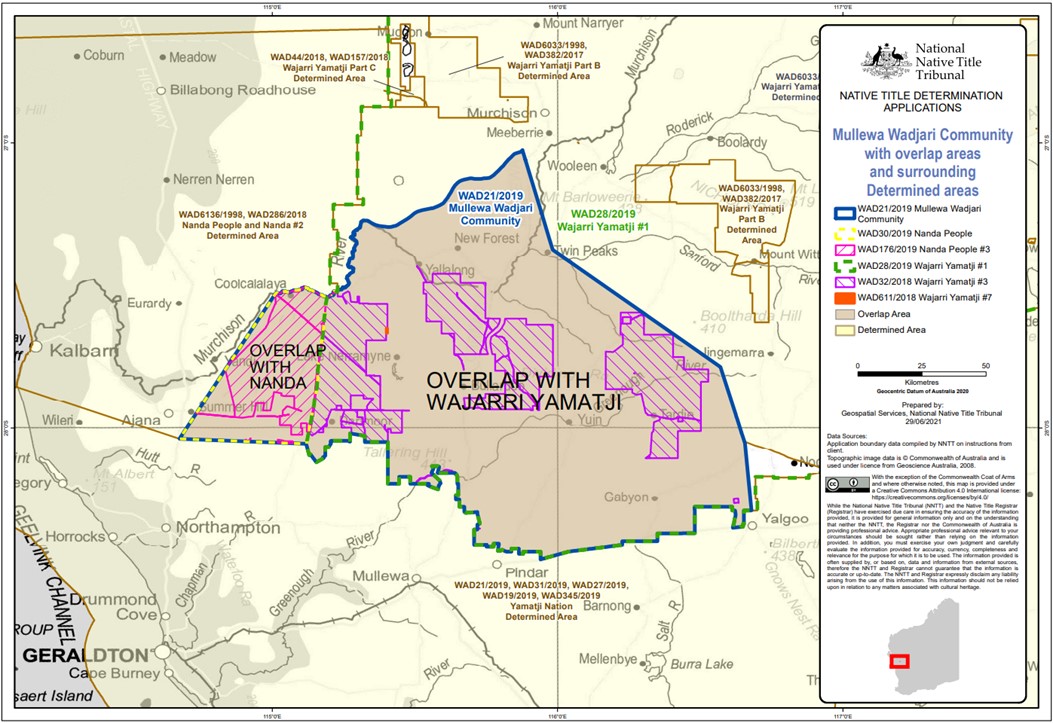
Map 1
23 Map 2 reproduced below shows the MW claim area, together with the Nanda Overlap Area and the WY Overlap Area in the context of surrounding native title determinations, which have recognised:
(a) the area to the north and north-east of the WY Overlap Area as Wajarri Yamatji country;
(b) the area to the south of the WY Overlap Area and the the Nanda Overlap Area as Yamatji Nation country; and
(c) the area to the west and north-west of the Nanda Overlap Area as Nanda country.
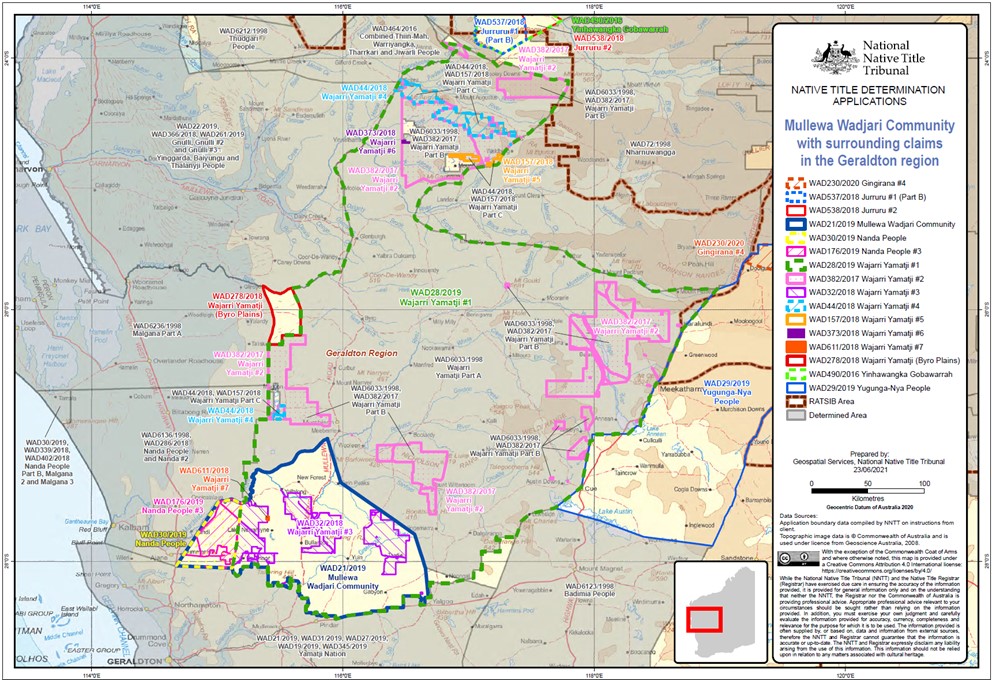
Map 2
24 The Nanda Overlap Area can be seen more clearly in Map 3 reproduced below.
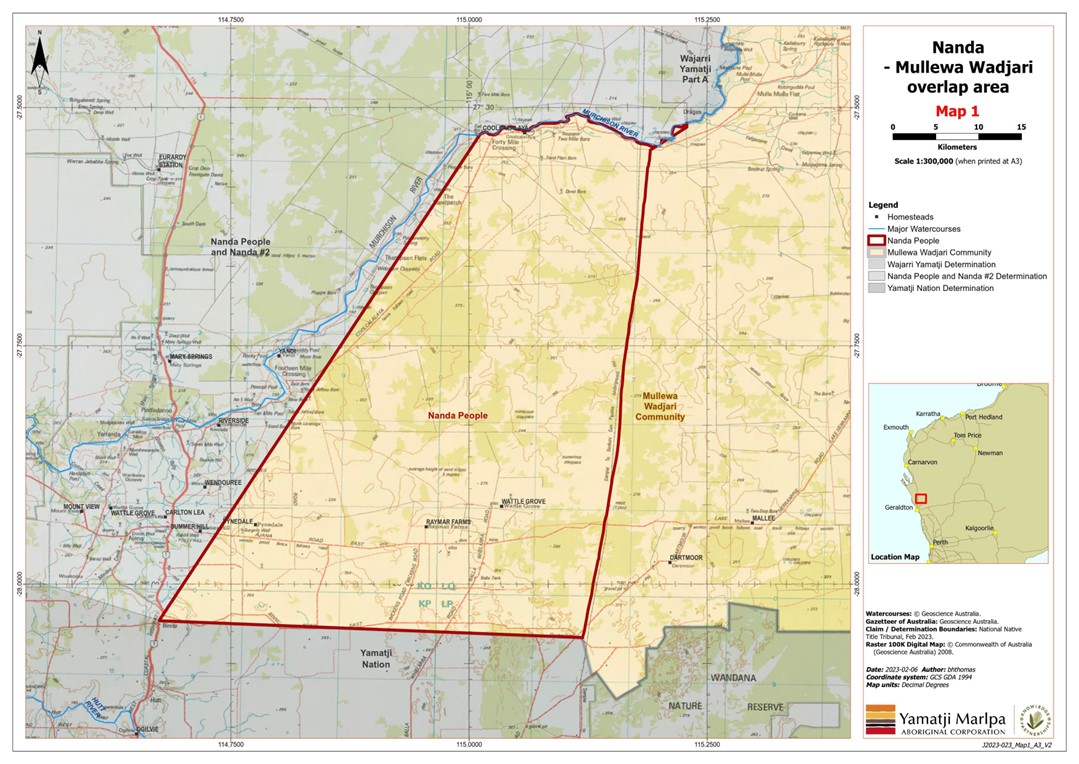
Map 3
3.3 The recent history of the proceedings
25 In Papertalk on behalf of the Mullewa Wadjari People v State of Western Australia [2022] FCA 221 at [17]-[100] (Papertalk (No 1)), Mortimer J (as her Honour then was) set out some of the recent history of these proceedings.
26 Her Honour noted (at [18]) that, by orders made in December 2017, the resolution of the overlapping native title claims of the Nanda, Wajarri Yamatji and Mullewa Wadjari groups was referred to mediation before Judicial Registrar Daniel. Active mediation commenced on 31 January 2018. There were substantial anthropological and genealogical materials in existence to assist the mediation process, and the parties agreed that further necessary anthropological and genealogical research would be conducted by Craig Elliott. Mr Elliott’s anthropological research was completed and provided to the parties in February 2019 and the overlapping claims were then listed for further mediation commencing 25 February 2019. The mediation process was intensive and long-running, and there were no less than 30 mediation events between 31 January 2018 and 24 February 2021.
27 An in-principle agreement between the MW and WY applicants was reached at a mediation on 28 February 2019, relatively early on in the mediation process, which agreement was reduced to writing and signed by the parties. Her Honour described the components of that agreement as involving:
(a) an additional apical ancestor “Angelina (mother of Alice Darby)” being added to the WY Applications;
(b) the withdrawal of the MW applicant’s claim in relation to the WY Overlap Area;
(c) the WY native title claim group to seek to vary the existing WY determinations to add the apical ancestor “Angelina (mother of Alice Darby)” to the description of native title holders pursuant to those determinations; and
(d) the amended WY native title claim group (i.e. including those descended from Angelina) agreeing to “work together in good faith to develop the structure and rules” for the prescribed body corporate to hold the determined WY native title.
28 In a similar but separate process, an in-principle agreement was reached between the MW and Nanda applicants at a mediation on 14 May 2019, which agreement was reduced to writing and signed by the parties.
29 Thus, active mediation began in January 2018, and agreements were reached in February and May 2019. Significant time and expense was then incurred by the N&WY applicants and the State in progressing the agreed mediation outcomes towards consent determinations.
30 Following a meeting of the MW native title claim group, on 14 June 2021 the MW applicant informed the other parties that it would not implement the in-principle agreements reached.
31 Justice Mortimer summarised those events in Papertalk on behalf of the Mullewa Wadjari People v State of Western Australia (No 2) [2022] FCA 593 at [1]-[2], as follows:
These proceedings concern overlapping claims for native title in the Geraldton region of Western Australia. Following protracted mediation and negotiation between the competing applicants, in-principle agreements were reached to withdraw the claims made on behalf of the Mullewa Wadjari People, in return for certain alterations of position by the Nanda and Wajarri Yamatji applicants. After considerable delays, and more than three and a half years since the beginning of mediation, following what purported to be a meeting of the claim group for the Mullewa Wadjari People, the Mullewa Wadjari applicant informed the Nanda and Wajarri Yamatji applicants that it would not implement those agreements. An account of these events and the context in which they occurred is provided in Papertalk on behalf of the Mullewa Wadjari People v State of Western Australia [2022] FCA 221 at [17]-[107], and in a published summary of that judgment.
In Papertalk, the Court determined that there was no enforceable agreement between the relevant parties, and it was not appropriate at that stage for the Mullewa Wadjari overlap claims to be dismissed as an abuse of process. However, the Court was satisfied that the Mullewa Wadjari applicant’s conduct amounted to an abuse of the processes of the Court, in particular its mediation processes.
32 The decision in Papertalk (No 1) was handed down on 16 March 2022. Mortimer J decided that the MW applicant’s conduct was an abuse of process but concluded that it was not appropriate at that stage to dismiss the MW application. On 20 May 2022 her Honour made orders requiring the MW applicant to convene a meeting of the MW native title claim group at which all claim group members were required to attend unless excused by the Court. The orders required that the meeting be chaired by an independent person, and that claim group members be informed that if they decided not to honour the in-principle agreements, the N&WY applicants could apply for costs in relation to their wasted time and resources. In that context the claim group members were directed to decide whether or not the MW applicant would honour the in-principle agreements that it had earlier reached.
33 The reconvened MW claim group meeting again decided not to give effect to the in-principle agreements earlier reached. Costs orders were then made against the MW applicant. The MW applicant then filed an application for leave to appeal and an appeal from the costs orders. Leave to appeal was granted on 8 August 2022. The application for leave to appeal and appeal was heard by the Full Court on 21 November 2022 and during the course of oral submissions the MW applicant withdrew the application for leave to appeal. Those events gave rise to serious delay in the progress of the Nanda and WY Applications and substantial additional costs.
34 The delay and cost occasioned by the MW applicant did not stop there. Because the in-principle settlement had fallen apart, on 11 October 2022 Mortimer J made programming orders to progress the competing applications to trial. Those orders provided:
(a) that evidence in each of the proceedings shall be evidence in each of the other proceedings;
(b) for the filing of statements of facts, issues and contentions (SFIC):
(i) by 4 November 2022 the MW applicant was required to file a SFIC in relation to any issue with which it disagrees contained in:
(A) the document titled Minute of Proposed Consent Determination of Native Title filed on 26 July 2021 in relation to the WY Overlap Area (WY Consent Minute); and
(B) the document titled Minute of Proposed Consent Determination of Native Title filed on 25 June 2021 in relation to the Nanda Overlap Area (Nanda Consent Minute);
(the MW SFIC);
(ii) by 25 November 2022 the N&WY applicants were required to file its SFIC in response (N&WY SFIC); and
(iii) by 9 December 2022 any active respondent was required to file a SFIC in response to that filed by the MW applicant;
(c) that by 16 December 2022 the parties confer for the purposes of identifying the issues in dispute arising from the SFICs filed by the parties, and to the extent that they agree file an agreed statement of issues in dispute by 16 December 2022;
(d) for filing of signed statements of evidence by the parties’ proposed lay witnesses:
(i) by 17 March 2023 by the MW applicant;
(ii) by 14 April 2023 by the N&WY applicants;
(iii) by 28 April 2023 by any active respondent party; and
(iv) by 12 May 2023 by the MW and N&WY applicants in reply;
(e) for filing of expert evidence by the parties’ proposed expert witnesses;
(i) by 21 July 2023 by the MW applicant;
(ii) by 18 August 2023 by the N&WY applicants;
(iii) by 1 September 2023 by any active respondent; and
(iv) by 22 September 2023 by the MW and N&WY applicants in reply;
(f) for an experts’ conference as soon as practicable after 27 October 2023; and
(g) for referral to Judicial Registrar Daniel for case management to assist the parties to reach agreement on a timetable for the conduct of the hearing.
35 The MW applicant did not comply with that timetable. It filed its SFIC on 4 November 2022, but the document was deficient. The N&WY applicants asserted that, amongst other things, it did not address the WY Consent Minute or the Nanda Consent Minute; it did not identify what determination the MW applicant wanted the Court to make; it did not identify the society that the MW applicant asserted had native title rights and interests in the Nanda and WY Overlap Areas; and it made contradictory statements about the nature of MW rights and native title holders as between the Nanda and WY Overlap Areas.
36 In response to complaints by the N&WY applicants about those deficiencies the MW applicant filed an amended SFIC on 24 November 2022. The N&WY applicants filed their SFIC on 1 December 2022, and the State filed its SFIC on 12 December 2022. Following mediation the parties agreed to the SAID filed on 22 December 2022.
37 On the basis that the MW SFIC was inconsistent with the SAID to which it had agreed, on 21 December 2022 Judicial Registrar Daniel made orders requiring:
(a) the MW applicant to file a further amended SFIC (FASFIC) consistent with the agreed SAID filed on 22 December 2022 by 31 January 2023;
(b) the N&WY applicants to file their amended SFICs (ASFIC) in response to the MW FASFIC by 14 February 2023; and
(c) the State to file an ASFIC in response to the MW FASFIC by 28 February 2023.
38 The MW applicant filed its FASFIC on 31 January 2023. The N&WY applicants contended that it was still deficient and sought clarification. On 15 February 2023 the N&WY applicants filed an interlocutory application seeking orders for the MW applicant to file further and better particulars.
39 On 16 February and 2 March 2023, the N&WY applicants and the State respectively filed their ASFICs.
40 On 13 March 2023, the MW applicant filed the MW F&BP.
41 Nor did the MW applicant comply with the timetable for filing its lay evidence. On 14 April 2023, Judicial Registrar Daniel extended the time for the MW applicant to file its lay evidence by a period of six weeks, with corresponding extensions for other parties.
42 On 26 May 2023, the N&WY applicants filed their summary judgment application.
43 Nor did the MW applicant comply with the timetable for filing its expert evidence. On 3 August 2023, the Court made orders to extend the time for the MW applicant to file its expert evidence by 25 days with a corresponding extension for the N&WY applicants. On 22 August 2023, the Court again made orders extending the time for the MW applicant to file its expert report, this time by 18 days, with a corresponding extension for the N&WY applicants. On 12 September 2023, the Court again made orders extending the time for the MW applicant to file its expert evidence by a further 21 days, with a corresponding extension for the N&WY applicants. The MW applicant did not file the Barber Report until 22 September 2023, being two months later than the original due date.
44 On 22 August 2023, the Court made orders listing the Separate Questions for hearing with:
(a) lay evidence to be heard in Geraldton commencing on 8 April 2024, on an estimate of two weeks;
(b) expert evidence to be heard in Perth commencing on 17 June 2024, on an estimate of three days; and
(c) oral closing submissions in Geraldton commencing on 22 July 2024, on an estimate of two days.
45 On the same day the Court made programming orders for the summary judgment application, pursuant to which the parties were required to file any evidence upon which they intended to rely, and to file written submissions.
46 The summary judgment application was subsequently listed for hearing on 7 December 2023. I heard the application that day and on 20 December 2023 made orders allowing the application and extending the time for any application for leave to appeal to 14 days after delivery of reasons for judgment.
4. The Statement of Agreed Issues in Dispute
47 The SAID comprises an agreement between the Nanda, WY and MW applicants and the State in relation to the issues in dispute and various facts. It defines the following relevant terms:
(a) “Nanda People” means those persons described at Schedule 7 of the Nanda Consent Minute.
(b) “Nanda Area” means the lands and waters of the Nanda Applications to the extent that they overlap the MW Application; i.e. the Nanda Overlap Area.
(c) “WY People” means those persons described at Schedule 7 of the WY Consent Minute;
(d) “WY Area” means “the land and waters of the WY Applications, to the extent that they overlap the MW Application”; i.e. the WY Overlap Area; and
(e) “Wajarri Society” means the society identified at paragraph [46] of the WY (Part A) Determination, meaning the determination of native title made by the Court on 19 October 2017 in I.S. v State of Western Australia (as amended by orders made on 29 July 2021 in the context of Hamlett on behalf of the Wajarri Yamatji People v State of Western Australia (No 3) [2021] FCA 869).
4.1 The Agreed Issues
48 The SAID identifies the following issues in dispute to be decided in the Separate Questions hearing:
(1) WY Issue 1 - Should Jack Comeagain Snr, Biddy Wittamurra, Fanny (Judy) Taylor/Papertalk/Comeagain and/or Lottie Hannah be added to Schedule 7, item (a) of the WY Consent Minute as ancestors for the native title holders, or is any one of them a descendant of a person in Schedule 7, item (a) of the WY Consent Minute?
(2) For clarity I use the name, Fanny Taylor, for the woman named alternatively as Fanny (Judy) Taylor/Papertalk/Comeagain.
(3) Nanda Issue 1 - Did the WY People at sovereignty hold rights and interests in the land and waters of the Nanda Area in accordance with the traditional laws and customs of the Wajarri Society?
(4) Nanda Issue 2 - Alternatively, did the Nanda People at sovereignty, hold rights and interests in the land and waters of the Nanda Area in accordance with the traditional laws and customs of the Nanda society?
(5) Nanda Issue 3 - If the answer to Nanda Issue 1 is “yes”, have the WY People continued to acknowledge and observe, substantially uninterrupted from sovereignty to the present day, their traditional laws and customs such that they have rights and interests in, and a traditional connection to, the land and waters of the Nanda Area?
(6) Nanda Issue 4 - If the answer to Nanda Issue 3 is “yes”, what is the nature and extent of the native title rights and interests in land and waters held by the WY People in the Nanda Area, including with respect to the operation of ss 47, 47A and/or 47B of the NTA?
(7) Nanda Issue 5 - Is the MW Applicant authorised to make the claim that the WY People hold native title rights and interests in the Nanda Area. If not, is an order under s 84D(4) of the NTA appropriate? (This issue is separate from Nanda Issues 1-4).
4.2 The Agreed Facts
49 The agreed facts include the following.
50 In relation to the WY Overlap Area:
(1) At sovereignty, the WY People were members of the Wajarri Society that acknowledged and observed a normative system of traditional laws and customs, and were in occupation of, and held rights and interests in, the land and waters which comprise the WY Area.
(2) The members of the WY People have remained, from sovereignty to the present, a body of persons united in and by the acknowledgement and observance of a body of traditional laws and customs.
(3) The traditional laws and customs of the WY People have, from sovereignty to the present, continued to be acknowledged and observed substantially uninterrupted by members of the WY People in the WY Area.
(4) The WY People hold native title rights and interests in, and have a connection to, the WY Area in accordance with their traditional laws and customs in the manner and terms described in the WY Consent Minute (subject to the resolution of WY Issue 1).
51 In relation to the Nanda Overlap Area, if the answer to Nanda Issue 2 is “yes” (i.e. at sovereignty, the Nanda People held rights and interests in the Nanda Overlap Area):
(1) The members of the Nanda People have remained, from sovereignty to the present, a body of persons united in and by the acknowledgement and observance of a body of traditional laws and customs.
(2) The traditional laws and customs of the Nanda People have, from sovereignty to the present, continued to be acknowledged and observed substantially uninterrupted by members of the Nanda People.
(3) The Nanda People hold native title rights and interests in, and have a connection to, the Nanda Area in accordance with their traditional laws and customs in the manner and terms described in the Nanda Consent Minute.
(4) The Court should make the determination sought in the Nanda Consent Minute and that the MW Application should be dismissed to the extent that it overlaps the Nanda Area.
5. Relevant principles
52 There was no material disagreement between the parties as to the principles applicable in an application for summary judgment. Their disagreement concerned the application of those principles in the circumstances of the case.
53 Section 31A of the FCA relevantly provides:
31A Summary judgment
…
(2) The Court may give judgment for one party against another in relation to the whole or any part of a proceeding if:
(a) the first party is defending the proceeding or that part of the proceeding; and
(b) the Court is satisfied that the other party has no reasonable prospect of successfully prosecuting the proceeding or that part of the proceeding.
(3) For the purposes of this section, a defence or a proceeding or part of a proceeding need not be:
(a) hopeless; or
(b) bound to fail;
for it to have no reasonable prospect of success.
(4) This section does not limit any powers that the Court has apart from this section.
(Emphasis added.)
54 Rule 26.01(1)(a) of the Rules relevantly provides that a party may apply to the Court for an order for summary judgment against another party on the basis that the applicant has no reasonable prospect of successfully prosecuting the proceeding or part of the proceeding.
55 Section 31A(3) of the FCA makes it clear that a conclusion to grant summary judgment does not require that the Court be satisfied that the proceeding or part thereof is hopeless or bound to fail. The authorities show that the focus of the Court’s enquiry must be whether there is a reasonable prospect of prosecuting the proceeding; which is “not an inquiry directed to whether a certain and concluded determination could be made that the proceeding would necessarily fail”: Spencer at [52].
56 The principles which guide the exercise of the Court’s power under s 31A of the FCA were usefully summarised by Griffiths J in Harkin on behalf of the Nanatadjarra People v State of Western Australia (No 2) [2021] FCA 3 at [12]-[14], citing McKerracher J in Buurabalayji Thalanyji Aboriginal Corporation v Onslow Salt Pty Ltd (No 2) [2018] FCA 978, as follows:
[12] The general legal principles guiding the exercise of the Court’s power under s 31A(2) of the FCA Act are well known. It is convenient to reproduce McKerracher J’s helpful analysis and description of the principles in Buurabalayji Thalanyji Aboriginal Corporation v Onslow Salt Pty Ltd (No 2) [2018] FCA 978 at [3] (with particular reference to summary dismissal being sought by a respondent party, as is the case here):
Without reference to all the well-known authorities, the parties agree that it is well established that the Court may give judgment for a defending party in relation to the whole or any part of a proceeding where the Court is satisfied that the prosecuting party has no reasonable prospects of successfully prosecuting the proceeding or a part of the proceeding. Further:
• the claim need not be hopeless or bound to fail for it to have no reasonable prospects of success: s 31A of the Federal Court Act;
• a reasonable prospect of success is one which is real, not fanciful or merely arguable: Rogers v Assets Loan Co Pty Ltd (2008) 250 ALR 82 per Logan J (at [41]);
• there will be no prospect of success in circumstances where there is a defect in the pleadings which cannot be cured: Ship “Sam Hawk” v Reiter Petroleum Ltd (2016) 246 FCR 337 per Kenny and Besanko JJ (at [269]);
• s 31A is amenable to resolving straightforward questions of law: Luck v University of Southern Queensland [2008] FCA 1582 per Logan J (at [16]). However, summary judgment may still be appropriate if a question raised is of some complexity: SK Foods LP v SK Foods Australia (in liq) (No 3) (2013) 214 FCR 543 per Flick J (at [115]);
• if a prima facie case in support of summary judgment is established, the onus shifts to the opposing party to point to some factual or evidentiary issues making a trial necessary: Jefferson Ford Pty Ltd v Ford Motor Company of Australia Ltd (2008) 167 FCR 372 per Gordon J (at [127]);
• it is clear that the legislature’s intention in enacting s 31A was to lower the bar for obtaining summary judgment, including summary dismissal, below that fixed by previous authorities: Spencer v Commonwealth of Australia (2010) 241 CLR 118 per Hayne, Crennan, Kiefel and Bell JJ; Jefferson Ford per Gordon J (at [127]);
• s 31A permits dismissal of a proceeding where an inquiry into the merits of the issues of law demonstrates the arguments are insufficiently strong to warrant the matter going to trial: McAleer v University of Western Australia (No 3) (2008) 171 FCR 499 per Siopis J (at [39] and the cases therein cited);
• summary dismissal will not apply to ‘a real question of law that is serious, important or difficult, involves conflicting authority, or is apparently arguable yet novel’: Nichol v Discovery Africa Ltd (2016) 343 ALR 594 per Greenwood, McKerracher and Moshinsky JJ (at [134]);
• the moving party bears the onus of persuading the Court the application has no reasonable prospects of success. The assessment of whether a proceeding has no reasonable prospects of success necessitates the making of a value judgement in the absence of a full and complete factual matrix and argument, with a result that the provision vests a discretion in the Court. That discretion includes whether to deal with the motion at once or at some later stage in the proceedings, when the legal and factual issues have been more clearly defined: Kimber v The Owners of Strata Plan No 48216 [2017] FCAFC 226 per Logan, Kerr and Farrell JJ (at [62]) quoting with approval Eliezer v University of Sydney (2015) 239 FCR 381 per Perry J (at [37]);
• despite the threshold for summary dismissal having been lowered, it must still be exercised with caution. The power is not to be exercised lightly: Spencer v Commonwealth per Hayne, Crennan, Kiefel and Bell JJ (at [60]);
• the Court does not, in such an application, conduct a ‘mini trial based upon incomplete evidence to decide whether the proceedings are likely to succeed or fail at trial’. Rather, it ‘requires a critical examination of the available materials to determine whether there is a real question of law or fact that should be decided at trial’: Australian Securities and Investments Commission v Cassimatis (2013) 220 FCR 256 per Reeves J (at [46]); and
• each application for summary judgment or summary dismissal has to be determined according to its particular circumstances. What is required is a practical judgment of the case at hand. The relevant facts and circumstances will partly depend upon the stage which the proceedings have reached. Among other things, this will affect materials available to the Court for considering the application, for example, where the pleadings have been exchanged, or discovery of documents has occurred: Cassimatis per Reeves J (at [46]).
[13] Particular caution needs to be exercised in determining whether summary dismissal should be granted in circumstances where there are factual disputes and the evidence is not in its final form (see Boston Commercial Services Pty Ltd v GE Capital Finance Australasia Pty Ltd [2006] FCA 1352; 236 ALR 720 at [43]-[45] per Rares J).
[14] The need for caution before dismissing an action summarily was emphasised by the Full Court in Danthanarayana v Commonwealth of Australia [2016] FCAFC 114 at [4] (see also Trkulja v Google LLC [2018] HCA 25; 263 CLR 149 at [22] per Kiefel CJ, Bell, Keane, Nettle and Gordon JJ):
… to summarily dismiss a proceeding, and thereby preclude a person from having their case determined on its merits at a final hearing, is a serious step taken only with great care and if it is possible to conclude with confidence that there is no reasonable prospect of success; this is so despite the fact that under s 31A(2) of the Federal Court of Australia Act 1976 (Cth) (the Court Act) the power to summarily dismiss a proceeding is not dependent on the case being “hopeless” or “bound to fail” for it to have no reasonable prospect of success (Spencer v Commonwealth of Australia [2010] HCA 28; (2010) 241 CLR 118 at [17]-[26]).
57 Summary judgment is granted only “if it is possible to conclude with confidence that there is no reasonable prospect of success”: Danthanarayana v Commonwealth [2016] FCAFC 114 at [4] (Jagot, Bromberg and Murphy JJ); Sop and Sop Pty Ltd v Commissioner for Taxation [2019] FCA 102 at [14]-[15] (Kenny J). This involves practical consideration as to whether the applicants have a more than fanciful prospect of success: Spencer at [25] (French CJ and Gummow J).
58 In Budby on behalf of the Barada Barada People v State of Queensland [2013] FCAFC 149 at [10] (Mansfield, Dowsett and Jagot JJ), the Full Court said:
While it is easy to understand the primary judge’s frustration with the appellant’s dilatory conduct and lack of real progress over a substantial period of time, the discretion to summarily dismiss a proceeding on the basis that it lacks reasonable prospects of success requires not only caution (because a party is thereby deprived of its opportunity for a hearing on the merits) but also an assessment of the substance of the native title claim having regard to the material both available and likely to be adduced. If it appears from that material that there is a real basis for the claim then the mere fact that the claim is in dispute, or that contrary material is available, or that the existing material is preliminary or incomplete is not a proper basis for the exercise of the power of summary dismissal on the ground of lack of reasonable prospects of success.
(Emphasis added.)
59 In Corunna v South West Aboriginal Land and Sea Council [2015] FCA 491; 235 FCR 40 at [21]-[22] Barker J explained:
[21] By s 31A of the Federal Court of Australia Act the Court may grant summary judgment where it is satisfied that a party has no reasonable prospect of successfully prosecuting the proceeding.
[22] In Spencer v Commonwealth of Australia (2010) 241 CLR 118 the plurality (Hayne, Crennan, Kiefel and Bell JJ) at [60] said of the expression “no reasonable prospect” that full weight must be given to it as a whole. Their Honours confirmed that the power to dismiss an action summarily is not to be exercised lightly, but their Honours also emphasised that the evident legislative purpose revealed by the text of the provision will be defeated if its application is read as confined to cases of a kind which fell within earlier, different, procedural regimes. Thus, s 31A(3) provides that the certainty of failure (“hopeless” or “bound to fail”) need not be demonstrated in order to show that a plaintiff has no reasonable prospect of prosecuting an action.
(Emphasis added.)
6. Onus of proof and standard of proof
60 It is the MW applicant which alleges:
(a) that one or more of Jack Comeagain Snr, Biddy Wittamurra, Fanny Taylor and/or Lottie Hannah should be added as additional apical ancestors to the WY Application, or is a descendant of one of the existing apical ancestors, such that their descendants should be included in the WY native title claim group (WY Issue 1);
(b) that, at sovereignty, the WY People held rights and interests in the land and waters of the Nanda Overlap Area in accordance with the traditional laws and customs of the Wajarri Society (Nanda Issue 1); and
(c) if the answer to Nanda Issue 1 is “yes”, that the WY People have continued to acknowledge and observe, substantially uninterrupted from sovereignty to the present day, their traditional laws and customs such that they have rights and interests in, and a traditional connection to, the land and waters of the Nanda Overlap Area (Nanda Issue 3).
It will have the onus to establish those matters in the Separate Questions hearing. However, as the moving party in the summary judgment application, the N&WY applicants have the onus to establish that the MW applicant has no reasonable prospect of success on its case on each of the Separate Questions.
61 The standard of proof in the summary judgment application (and in the Separate Questions hearing) is the ordinary civil standard under s 140(1) of the Evidence Act 1995 (Cth) (Evidence Act), being the balance of probabilities. Section 140(2) of that Act requires that, in deciding whether it is satisfied that a party has proved its case on the balance of probabilities, the Court shall take into account the nature of the cause of action or defence, the nature of the subject-matter of the proceeding, and the gravity of the matters alleged, when determining the degree of persuasion required. Section 140(2) does not only relate to issues of proof so far as the entire case of a party is concerned, but also so far as individual elements of that case are concerned: Leslie v Graham [2002] FCA 32 at [57] (Branson J). As explained in Qantas Airways Ltd v Gama [2008] FCAFC 69; 167 FCR 537 at [139] (Branson J), s 140(2) recognises that the strength of the evidence necessary to establish a fact in issue on the balance of probabilities will vary according to the nature of what is sought to be proved and the circumstances in which it is sought to be proved.
7. The Barber Report
62 Mr Barber, an anthropologist, was briefed by the solicitors for the MW applicant to undertake research in relation to the MW Application and to provide a report to the solicitors for use in the MW Application. Mr Barber was requested to provide opinions on a series of specific questions (the Questions).
63 Relevantly:
(a) in Chapter 1 – Introduction, Mr Barber explained the extent of his discussions with the informants that informed his opinions. He said that his informants were Leedham Papertalk, Charmaine Green and Glenda Jackamarra (defined as “the Claimants”). Mr Barber stated:
[25] I travelled to the Claim area on 3 August 2023, and held discussions with Claimants about their rights and interests in Mullewa during the period 3 to 13 August 2023. These discussions were primarily held with Leedham Papertalk in Mullewa. Further brief conversations were held with Charmaine Green and Glenda Jackamarra in Geraldton on 13 August 2023 (day returned from Geraldton to Perth).
[26] Further Telephone conversations were held with Leedham Papertalk and Charmaine Green to check details and discussing concepts during the period 14th August 2023 to 17th September 2023.
(b) in Chapter III – Literature: Local Organisation of the Claim Area, Mr Barber referred to early historical anthropological research in relation to the Wajarri People and their country. In summary, he opined that Bates (1907-1909) located the Wajarri in the vicinity of the MW claim area; Brown (1912) located the Wajarri in the vicinity of the head of the Murchison River; Tindale (1940 and 1974) located the Wajarri in the MW claim area, although noting some extension of Wajarri interests towards the coast in the post-European contact period; Berndt & Berndt (1977) made similar findings partially in reliance on the works of Bates, Brown and Tindale; and the later work of Thieberger (1993) generally affirmed the location of Wajarri interests and the usage of Wajarri language.
(c) in Chapter IV - The Principles of Local and Social Organisation of the Claim Area, Mr Barber noted that the Claimants allege that the MW claim area lies within the broader Wajarri estate. In this chapter:
(i) under the sub-heading Adoption (which is relevant to Lottie Hannah, who the MW applicant alleges was a Wajarri person on the basis of adoption), Mr Barber opined:
[148] Among the Wadjari, children who are adopted as infants, and live with and are imbedded in the social life of the Wadjari, are regarded as part of the group. These children inherit full rights and interests in the Wadjari estate.
[149] In some circumstances older individuals may come to have close association with the family and become regarded as close family members. These individuals, however, are not accorded full rights to the group. They are supported and fostered by the group and treated as close kinsmen. They cannot, however, lead or make decisions for the group, although they are expected to support and facilitate the actions of the Wadjari leaders and the group.
(ii) under the sub-heading The Section System and Traditional Land Tenure, Mr Barber said:
[150] The claimants have detailed genealogical knowledge of their own and neighbouring groups and longstanding relationships with individuals and groups across the Gascoyne, Pilbara and Western Desert areas. These relationships, and reference and address in these interactions, are made in this idiom. The Claimants are also able to use the section system, as a system of reference and address in their interactions with East Kimberley, Pilbara and Western Desert groups, particularly during ceremonial engagement.
[151] The Claimants, however, argue that the system was adopted in recent times from their northern and eastern neighbours.
(iii) under the sub-heading Composition of the Wadjari (Thagarda Wadjari), Mr Barber said:
[152] The ‘Muluwa/Mullewa Wadjari descend from ancestors of the Wadjari language group which has traditional rights and interests which include the current Claim area.
[153] The use of the term Thagarda by the Claimants is synonymous with ‘law-abiding’ Wadjari, or Wadjari that follow traditional law and custom. In this respect the Claimants are lineages of the broader language group. The Claimants are of the view that through participation in Wadjari law and culture that they maintain the law and culture of the Claim area for their own family and the broader Wadjari group. In particular, the Claimants believe that they maintain the Wadjari traditional responsibilities to their land by continuing to follow and practice Wadjari traditional law through participation’ as Wadjari traditional law exponents’ in the regional traditional law of the Gascoyne, Pilbara, Western Desert and Kimberley’s.
[154] The Claimants relate that their forebears followed their law and assiduously maintained their culture and they lived within and around the Claim area on Wadjari land from prior to sovereignty to the present. The Claimants argue that they, like their forebears continue to attend and actively participate in regional circumcision and subincision ceremonies and initiate their children.
[155] The Claimants also describe themselves as being members of the Wadjari language group. The Claimants also describe themselves as Thagarda Wadjari a classification founded on the proposition that their families practiced Wadjari law and custom from the remote past to the present. The Thagarda Wadjari regard other lineages of the Wadjari as kinsmen of the same language group who also have rights and interests in the Mullewa Wadjari claim area.
(iv) Mr Barber then went on to provide the following opinions regarding the lineages of the Thawarda Wajarri People:
[156] The Thagarda Wadjari can be described as being composed of three lineages.
[157] The first lineage descends from Nellie (born c 1850). The Claimants have no direct knowledge of her background but believe that she was Wadjari. There is no knowledge of her husband. She had a daughter Biddy Wittamura (born c. 1871) who is also regarded as Thagarda Wadjari. Biddy married Anthony. There is no knowledge of the group of Anthony, who died at Billabong [sic] in 1923 whilst on a droving trip from Mingenew.
[158] Biddy and Anthony had a daughter Fanny ‘Judy’ Taylor (Thagarda Wadjari) who also married a Thagarda Wadjari man, Jack Comeagain snr.
[159] Fanny ‘Judy’ Taylor also married an unnamed man and had two daughters Milly Taylor Flanagan and Lottie Hannah. Lottie Hannah had a number of children by unnamed father/s. The children of Lottie Hannah were adopted by Ned Papertalk and Jack Comagain (Snr) both Thagarda Wadjari. These children took the Hannah surname and are regarded as Thagarda Wadjari.
[160] Jack Comeagain had a number of other children, including Jack Comeagain Jr. These children are also regarded as Thagarda Wadjari. Jack Comeagain Jr married Jean Papertalk, also a Thagarda Wadjari. The descendants of Jack Comeagain Jr and Jean Papertalk are regarded as Thagarda Wadjari.
[161] The second Thagarda Wadjari lineage descends from a Thagarda Wadjari man, Apbara who married Dharingga (group unknown). They had a son Bridi who was also called ‘Papertalk’.
[162] Bridi (Thagarda Wadjari) had a son Midalu, Ned Papertalk who married Guki, Alice Darby. The descendants of Ned Papertalk are regarded as Thagarda Wadjari.
[163] A third lineage descends from George Merritt (Yilirrbirri), also a Thagarda Wadjari man. He had a son Alfred Merritt. Alfred Merritt married Minnie Cockel (group unknown). The children of Alfred Merritt and their descendants are regarded as Thagarda Wadjari and part of the Claim group.
[164] The genealogical data indicates that the forebears of the Mullewa Wadjari Claimants resided in the vicinity of the Claim area. The current Thagarda Wadjari reside predominately in Mullewa in the vicinity of the Claim area and Geraldton, others live and work in areas from Perth to the mining towns of the Pilbara.
Those are the only express references to Jack Comeagain Snr, Biddy Wittamurra, Fanny Taylor and Lottie Hannah in the Barber Report, except where Mr Barber referred to them in the genealogical chart in Appendix 3, and where he provides his opinions on the specific Questions.
(d) in Chapter V - Ceremonies and Rituals, under the sub-heading Secular and Religious Leadership, Mr Barber set out what he said he was told by the Claimants, and expressed opinions in relation to their acknowledgement and observance of traditional laws and customs and maintenance of law and culture for the MW claim area. He opined that the information he was provided indicated an orderly system of transferral responsibility for law and culture from generation to generation within the MW claim group, from one senior leader onto the next senior and “best” active law man.
(e) in Chapter VI – Conclusion, Mr Barber made some general findings as to the extent of Wajarri country based on historical anthropological research and his interviews with the Claimants. Mr Barber then provided his opinions on the specific Questions he was asked. For clarity I set out those opinions when dealing with each issue for decision.
(f) Appendices 1 and 2 of the Barber Report comprise maps prepared by Mr Barber, he said from information provided by the Claimants, showing the travels of mythical anthropomorphic beings during the Dreamings, which travels created Wajarri country and which beings have continuing totemic significance to the Wajarri People.
(g) Appendix 3 of the Barber Report comprises genealogical information regarding the MW People prepared by Mr Barber, he says from information provided by the Claimants including in relation to Jack Comeagain Snr, Biddy Wittamura, Fanny Taylor and/or Lottie Hannah and their descendants.
7.1 Whether the Barber Report is admissible
64 The N&WY applicants objected to the admissibility of numerous identified paragraphs of the Barber Report. The MW applicant denied that the report was inadmissible but did not respond to the objections by reference to the impugned paragraphs or opinions.
65 Section 76(1) of the Evidence Act provides that “evidence of an opinion is not admissible to prove the existence of a fact about the existence of which the opinion was expressed”. Section 79(1) is an exception to the opinion rule in s 76(1). It provides:
If a person has specialised knowledge based on the person's training, study or experience, the opinion rule does not apply to evidence of an opinion of that person that is wholly or substantially based on that knowledge.
66 In Dasreef Pty Ltd v Hawchar [2011] HCA 21; 243 CLR 588, the plurality (French CJ, Gummow, Hayne, Crennan, Kiefel and Bell JJ) explained that for opinion evidence to be admissible under s 79(1) of the Evidence Act:
(a) the evidence must satisfy the two criteria expressed in the provision: (i) that the witness who gives the opinion evidence “has specialised knowledge based on the person’s training, study or experience”; and (ii) that the opinion evidence by the witness “is wholly or substantially based on that knowledge”: Dasreef at [32];
(b) the expert’s opinion evidence must be presented in a form which makes it possible to determine whether the requirements of s 79 have been satisfied (i.e. that the opinion is wholly or substantially based on specialised knowledge based on training, study or experience): HG v The Queen [1999] HCA 2; 197 CLR 414 at [39] (Gleeson CJ), approved in Dasreef at [36]. It is crucial that the expert states the facts and assumptions upon which the opinion is based and expose how his or her specialised knowledge had been applied to those facts and assumptions so as to support the opinion: Dasreef at [64] and [101] (Heydon J); and
(c) the expert’s evidence must explain how the field of “specialised knowledge” in which the witness is an expert by reason of “training, study or experience”, and on which the opinion is “wholly or substantially based”, applies to the facts assumed or observed so as to produce the opinion propounded: Makita (Australia) Pty Ltd v Sprowles [2001] NSWCA 305; 52 NSWLR 705 at [85] (Heydon JA), approved in Dasreef at [37].
Any failure to demonstrate that an opinion expressed by a witness is based on the witness’ specialised knowledge is a matter that goes to the admissibility of the evidence, not its weight: Dasreef at [42].
67 The N&WY applicants did not contend that Mr Barber lacked specialised knowledge as an anthropologist. Rather, they submitted that his opinions on the salient issues, particularly the issues arising under WY Issue 1, Nanda Issue 1 and Nanda Issue 3 are inadmissible because the Barber Report:
(a) is not presented in a form which makes it possible to determine whether the requirements of s 79 have been satisfied (i.e. that the opinion is wholly or substantially based on the specialised knowledge he acquired through his training, study or experience as an anthropologist);
(b) does not reveal the facts or assumptions upon which Mr Barber’s opinions are based and does not expose how Mr Barber had applied his specialised knowledge as an anthropologist to those observed facts or assumptions so as to support his opinions;
(c) does not expose Mr Barber’s reasoning process leading to the salient opinions he expressed; and
(d) provides opinions which are speculative.
68 I deal with the admissibility of Mr Barber’s opinion when dealing with each of the issues for decision. For the present, it suffices to provide the following example of the deficiencies with which the Barber Report is littered. Mr Barber opined as follows (at [240]-[241]):
[240] The genealogical data presented in Appendix 3 was provided by the Claimants. This data indicates that the Claimants descend from Wadjari ancestors, who held rights and interests in and around the Claim area in the mid to late 19th century. It also suggests that the Thagarda Wadjari are members of the Wadjari language group, the members of which have traditional rights and interests in and around the Claim area.
[241] The genealogical information suggests that it is arguable that the Wadjari system of native title was cognatic from the latter 1850s a period of significant social change. From that time, and for the span of time of the Claimant genealogical knowledge, it appears that rights and interests continue to be conveyed to Wadjari descendants by cognatic descent.
69 There Mr Barber said that the genealogical information he set out in Appendix 3 in relation to what he describes as the “first lineage” of the MW People (see excerpt at [63(c)(iv)] above) (being the descendants of Jack Comeagain Snr, Biddy Wittamura, Fanny Taylor and Lottie Hannah) was provided to him by the Claimants. Based on that information he expressed the view that the MW native title claim group are descendants of Wajarri ancestors who held rights and interests “in and around” the MW claim area at or around effective sovereignty, which rights and interests had been conveyed to them by cognatic descent.
70 The MW applicant did not address the objections with sufficient specificity. Rather, it submitted that the Barber Report made it clear that the source of the genealogical information in Appendix 3 and of the conclusions Mr Barber reached were based on the discussions he had with the Claimants in August and September 2023. That submission failed to come to grips with the heart of the N&WY applicants’ objections.
71 Those opinions are inadmissible because:
(a) the Barber Report did not identify which of Dr Green, Mr Papertalk and/or Ms Jackamarra provided the information said to support his opinions that:
(i) Jack Comeagain Snr, Biddy Wittamura, Fanny Taylor and/or Lottie Hannah were Wajarri people who, at effective sovereignty, held rights and interests “in and around” the MW claim area; or
(ii) Dr Green, Mr Papertalk and Ms Jackamarra had been conveyed those rights and interests by cognatic descent;
(b) more importantly, the Barber Report did not identify the nature of the information they are said to have provided which is said to justify the opinions Mr Barber expressed;
(c) further, as Senior Counsel for the MW applicant accepted, for the purposes of the summary judgment application it is appropriate for the Court to infer that the witness statements of Dr Green, Mr Papertalk and Ms Jackamarra represent the best information that they could give: see T20.27. It would be wrong to approach the Barber Report on the basis that the Claimants were able to provide Mr Barber with better information than that contained in their lay witness statements, particularly when the Barber Report does not identify which of them said what, nor the nature of the information they provided which justified the opinions expressed. And where the witness statements of Dr Green, Mr Papertalk and/or Ms Jackamarra do not provide a factual foundation for the opinions expressed by Mr Barber, the Barber Report does not expose what other information those informants provided to justify the opinions expressed; and
(d) the genealogical information in Appendix 3 does not disclose any factual foundation to support the opinions that Jack Comeagain Snr, Biddy Wittamura, Fanny Taylor and/or Lottie Hannah were Wajarri people who, at effective sovereignty, held rights and interests in the MW claim area. Nor do the witness statements of Dr Green, Mr Papertalk and Ms Jackamarra provide a factual foundation for such a conclusion. For example, the MW applicant belatedly accepted that there is no evidence that Biddy Wittamura was a Wajarri ancestor with rights and interests in the MW claim area.
72 Fundamentally, the Barber Report is inadmissible because it is not presented in a form which makes it possible to determine whether the opinions which are significant to WY Issue 1, Nanda Issue 1 and Nanda Issue 3 are wholly or substantially based on Mr Barber’s specialised knowledge based on training, study or experience. It does not reveal the facts or assumptions upon which the opinions are based. It does not expose how Mr Barber applied his specialised knowledge as an anthropologist to the observed facts or assumptions to justify the opinions he expressed, and it does not expose the reasoning process leading to the opinions he expressed. As I will explain, sometimes the opinions appear to be little more than speculation.
73 Further, while this does not go to admissibility, the “general findings” in the Barber Report regarding the extent of Wajarri country are imprecise and rise no higher than broad statements that the Wajarri had, and have, traditional rights and interests “in”, “in the vicinity of” and “in and around” the MW claim area. And the opinions regarding the continuity of observance and acknowledgment of traditional laws and customs by the Wajarri people expressed in Chapter V - Ceremonies and Rituals, under the sub-heading Secular and Religious Leadership, are no more geographically specific than references to “in”, “within and around” or “within the vicinity of” the MW claim area. Therefore, if (contrary to my view) the Barber Report is admissible, the opinions are of little or no assistance to the MW applicant in establishing that:
(a) at sovereignty, the WY People held rights and interests in the land and waters of the Nanda Overlap Area in accordance with the traditional laws and customs of the Wajarri Society (Nanda Issue 1); or
(b) the WY People have continued to acknowledge and observe, substantially uninterrupted from sovereignty to the present day, their traditional laws and customs such that they have rights and interests in, and a traditional connection to, the land and waters of the Nanda Overlap Area (Nanda Issue 3).
8. WY Issue 1 - Whether Additional Apical Ancestors should be added to the WY Application
74 The N&WY applicants had the onus to establish that the MW applicant has no reasonable prospect of successfully prosecuting its case in relation to WY Issue 1, which is as follows:
Should Jack Comeagain Senior, Biddy Wittamurra, Fanny (Judy) Taylor/Papertalk/Comeagain and/or Lottie Hannah be added to Schedule 7, item (a) of the WY Consent Minute as ancestors for the native title holders, or is any one of them a descendant of a person in Schedule 7, item (a) of the WY Consent Minute?
75 The MW applicant accepted that there is no evidence that Biddy Wittamurra was a member of the Wajarri People and withdrew the contention that she should be added as a WY apical ancestor or be found to be a descendant of one of the identified apical ancestors.
8.1 The pleadings and evidence regarding Jack Comeagain Snr
76 The MW SSFIC and the MW F&BP are effectively the pleadings which set out the MW applicant’s case.
77 In relation to Jack Comeagain Snr the MW SSFIC alleges as follows:
[5] The MW Applicant says that Jack Comeagain (Snr) was a Wajarri man from the Murchison region around the Boolardy area, and consequently, held rights and interests in the [WY Overlap Area] under the system of traditional laws and customs observed by the society to which the MW Claimants and WY People belong.
…
[7] The MW Applicant says that Fanny Taylor married Jack Comeagain (Snr) circa 1915.
[8] The MW Applicant says that, following their marriage, Jack Comeagain (Snr) adopted customarily (or grew up) Fanny Taylor’s children from prior to the marriage, namely her eldest daughter Milly, and her second eldest daughter Lottie.
[9] The MW Applicant says that, by reason of her adoption by Jack Comeagain (Snr), Lottie Hannah became entitled to rights and interests in Jack Comeagain Snr’s country, which comprises Wadjari country, pursuant to the traditional laws and customs of the normative society to which the MW Claimants and Wadjarri People belong.
78 The MW F&BP provides the following further particulars:
[4] As to paragraphs [4] to [11] of the [MW SSFIC], the nature of the traditional laws and customs by which each of the following are alleged to have a had a ‘connection’ with the ‘WY Area’ (as defined in [3(a)] of the [MW SSFIC]):
A. Jack Comeagain Senior;
…
in accordance with traditional laws and customs which accord them rights and interests on the basis of descent from ancestors present in the WY area at and before the time of effective sovereignty being asserted by the British Crown in the area, including a custom of recognition of descent on the basis of adoption by a parent.
[5] The following facts are related to the identification of the following -
A. Jack Comeagain Senior: oral history of Wajarri Yamatji claim group members of Jack Comeagain Snr as a ‘full blood’ Wajarri man ‘from the Murchison’ travelling from Mullewa to Murchison region stations to attend ‘culture meetings’ including at Wooleen Station as a venue for ceremonies; and participation in ceremonies performed at Mullewa Reserve and nearby law grounds;
79 Each of the three MW lay witness statements made reference to Jack Comeagain Snr.
80 Dr Green said:
[53] Fanny then later married Jack Comeagain Senior and they had more children, including Jack Comeagain Junior. Jack Comeagain Junior was married my mother’s sister, Jean Papertalk.
[54] As Jack Comeagain Senior was married Fanny, he was considered has having grown up (or adopted) both Millie and Lottie.
…
[56] I remember my father used to refer to Jack Comeagain Junior as a Badimia man, but Wajarri and Badimia are very close geographically and culturally.
81 Mr Papertalk said:
[70] The old people told me that Fanny’s daughter, Lottie, was adopted by Jack Comeagain Senior at some point and she moved in from another group into the Mullewa Wadjari area. I was told that Lottie’s father was Ned Papertalk.
82 Ms Jackamarra said:
[32] I was told that Fanny’s husband was Jack Comeagain Senior (Old Jack). We refer to him as Pop. I was told that Fanny met Old Jack in the Murchison area. Old Jack is buried at the Old Pioneer Cemetery in Mullewa.
[33] Senior Wajarri elder Geoffrey Mongoo once said to my partner, Anthony Dann, that he saw Jack Comeagain Junior (the son of Fanny and Old Jack) at the old ceremony grounds up in the Murchison. Only Wajarri ceremony men were allowed to be at the law and ceremony grounds in Wajarri Country. Old Jack and Jack Comeagain Junior were Wajarri law men.
83 The Barber Report expressed the following opinions in relation to Jack Comeagain Snr:
(a) in the following passage (earlier set out at [63(c)(iv)] above)) Mr Barber opined (at [159]) that Fanny Taylor married “a Thagarda Wadjari man, Jack Comeagain Snr.” In that part of the Barber Report he opined:
[156] The Thagarda Wadjari can be described as being composed of three lineages.
[157] The first lineage descends from Nellie (born c 1850). The Claimants have no direct knowledge of her background but believe that she was Wadjari. There is no knowledge of her husband. She had a daughter Biddy Wittamura (born c. 1871) who is also regarded as Thagarda Wadjari. Biddy married Anthony. There is no knowledge of the group of Anthony, who died at Billabong [sic] in 1923 whilst on a droving trip from Mingenew.
[158] Biddy and Anthony had a daughter Fanny ‘Judy’ Taylor (Thagarda Wadjari) who also married a Thagarda Wadjari man, Jack Comeagain snr.
[159] Fanny ‘Judy’ Taylor also married an unnamed man and had two daughters Milly Taylor Flanagan and Lottie Hannah. Lottie Hannah had a number of children by unnamed father/s. The children of Lottie Hannah were adopted by Ned Papertalk and Jack Comagain (Snr) both Thagarda Wadjari. These children took the Hannah surname and are regarded as Thagarda Wadjari.
[160] Jack Comeagain had a number of other children, including Jack Comeagain Jr. These children are also regarded as Thagarda Wadjari. Jack Comeagain Jr married Jean Papertalk, also a Thagarda Wadjari. The descendants of Jack Comeagain Jr and Jean Papertalk are regarded as Thagarda Wadjari.
Those paragraphs do not provide a factual foundation for the opinion that Jack Comeagain Snr was a Thawarda Wajarri man, and the Barber Report does not contain any other references to Jack Comeagain Snr other than in the genealogical information in Appendix 3 and in answer to the specific Questions.
(b) The entry for Jack Comeagain Snr in Appendix 3 states:
nm2: Jack
nm3: Comeagain (snr)
pod: Mullewa, pioneer Cemetery
dod: c. 1940s
cty: Thargarda Wajarri
res: c. 1890s in claim area
notes: work in Boolardy area
notes2: north of rabbit proof fence LP info
The abbreviations “cty” and “res” mean “country” and “residence” respectively.
(c) Mr Barber said the following in answer to the Questions regarding Jack Comeagain Snr:
(i) Question (a):
Did Jack Comeagain Senior possess rights and interests under traditional law and custom in any Mullewa Wadjari Remaining Claim Area [meaning the Nanda Overlap Area] or Wajarri Yamatji area [meaning the WY Overlap Area], and if so, which part or parts of the Mullewa Wadjari Remaining Claim Area or Wajarri Yamatji area?
Answer:
The genealogical information suggests that Jack Comeagain Senior had rights and interests under traditional law and Custom in the entirety of the Mullewa Wadjari claim area as described on Map 1.
(ii) Question (b):
Was Jack Comeagain Senior a Wajarri person?
Answer:
Jack Comeagain appears to have been a Senior Wajarri person, who was engaged in Wadjari law and Custom as of a right.
(iii) Question (c):
Where was Jack Comeagain Senior born?
Answer:
The birthplace of Jack Comeagain Senior is not known. It is assumed that he was born within the Claim area or the broader Wadjari estate (rights and interests in the Wadjari system as described are conveyed by descent, not by birth location per se).
(iv) Question (d):
Who were the parents of Jack Comeagain Senior?
Answer:
The parents of Jack Comeagain Senior are not known. It is assumed that Jack Comeagain Seniors father was Wadjari from the Claim area and the broader Wadjari estate.
(v) Question (e):
What places is Jack Comeagain Senior associated with in the Murchison region?
Answer:
Jack Comeagain Senior is considered to have rights and interests within broader Wadjari land and within the Claim.
8.2 The pleadings and evidence regarding Fanny Taylor/Papertalk/Comeagain
84 In relation to Fanny Taylor the MW SSFIC alleges as follows:
[6] The MW Applicant says that Fanny Taylor/Papertalk/Comeagain (also spelt Kummagin/Commigan/Commigain) (also known as ‘Mingenoogoo’) was the mother of Milly Taylor/Flanagan (born 1905 – 1910/1909), Lottie Hannah (born 1905 – 1910), Jack Comeagain (Jnr) (born 1915), Henry Comeagain (born 1917), May Comeagain (born 1919), Gracie Comeagain (born 1919), Doreen Comeagain (born 1922), David Comeagain (born 1930).
[7] The MW Applicant says that Fanny Taylor married Jack Comeagain (Snr) circa 1915.
…
[11] The MW Applicant says that Biddy Witamurra born circa 1871 and her daughter Fanny Taylor/Papertalk/Comeagain (also spelt Kummagin/Commigan/Commigain) (also known as ‘Mingenoogoo’) had a connection in accordance with traditional laws acknowledged and traditional customs observed by WY People and Mullewa Wadjari People to the WY area, including the area in the vicinity of the Murchison River, Woolgarong Station and Billabalong Station.
85 The MW F&BP provides the following further particulars:
[4] As to paragraphs [4] to [11] of the [MW SSFIC], the nature of the traditional laws and customs by which each of the following are alleged to have a had a ‘connection’ with the ‘WY Area’ (as defined in [3(a)] of the MW SSFIC): -
…
C. Fanny (Judy) Taylor/Papertalk/Comeagain;
…
in accordance with traditional laws and customs which accord them rights and interests on the basis of descent from ancestors present in the WY area at and before the time of effective sovereignty being asserted by the British Crown in the area, including a custom of recognition of descent on the basis of adoption by a parent.
[5] The following facts are related to the identification of the following -
…
C. Fanny (Judy) Taylor/Papetalk/Comeagain: daughter of Biddy Witamurra travelled with Fink during her field work at stations in the Murchison region to introduce her to people and was photographed with Fink in the mid-1950s in the Murchison region and, according to family oral tradition recounted by Lottie Hannah, was present in the MW claim area, travelling there with her son Jack Comeagain (Jnr); and her son and all her daughters ended up out in the Murchison, except her second youngest daughter May Comeagain;
86 Each of the three MW lay witness statements made reference to Fanny Taylor.
87 Dr Green said:
[50] I met Ruth Fink, the Anthropologist in Sydney, who recalled the work she did with Fanny Taylor in Mullewa and the Murchison in the mid 1950’s. I introduced Glenda Jackamarra to Ruth Finke [sic] who showed Glenda Jackamarra documents and photographs of Fanny Taylor. Ruth Finke [sic] spoke of how Fanny Taylor assisted her with research field work in Mullewa, Yalgoo and in the Murchison. Fanny Taylor was with Ruth Fink, the Anthropologist, when Ruth did her work in the Murchison River area and that Fanny Taylor would not have been able to do that work with her if she was not accepted as a member of the Wajarri group.
88 Mr Papertalk said:
[70] The old people told me that Fanny’s daughter, Lottie, was adopted by Jack Comeagain Senior at some point and she moved in from another group into the Mullewa Wadjari area. I was told that Lottie’s father was Ned Papertalk.
89 Ms Jackamarra said:
[5] My mother was Margaret Jackamarra (nee Hannah).
[6] My maternal grandmother was Lottie Hannah.
[7] My maternal great-grandmother was Fanny "Judy" Comeagain (nee Taylor). Fanny was also known as Judy Taylor or Judy Comeagain.
…
[25] I follow my mother's, my maternal grandmother, and my maternal greatgrandmother's country.
[26] They belonged to the Mullewa Wadjari country, and I am connected to this country through them. The Hannah Family inherited this connection from Fanny and Lottie.
…
[39] Fanny and Lottie had a connection to the overlap area through Old Jack, Fanny’s husband. I grew up being told by members of my family that Lottie, and her older sister Millie, were Old Jack’s daughters.
…
[42] I was told by the old people that Fanny was acknowledged and accorded respect by other senior Wajarri people, such as Eulie Dingo, Laurie Donnelly and Jack Darby, who I know to be senior Wajarri elders.
[43] I believe it is significant that Fanny was in the company of other Wajarri elders on country with anthropologist, Ruth Fink, because it shows that they acknowledged her connection to that country. In Wajarri culture, Fanny would not have been permitted to be on country with a visitor unless she was recognised as having such a connection.
[44] I travelled to Sydney about 5 years ago with Charmaine Green and met with Ruth Fink (who I learnt passed away recently). Fanny was Ruth’s guide and translator in the Murchison region while conducting fieldwork in the 1960’s.
[45] Ruth Fink gave me an old photo she took of Fanny Comeagain, Eulie Dingo and Jack Darby.
[46] The Hannah family have a connection to the overlap area, not through the descendants of Angelina (mother of Alice Darby), but through Old Jack and Fanny. I was told stories by the old people that this was Fanny’s country and she spent time out there.
90 Mr Barber expressed the following opinions in relation to Fanny Taylor.
91 In the passage from the Barber Report at [156]-[160] (set out above at [83]), Mr Barber opined (at [157]) that Fanny Taylor’s mother, Biddy Wittamura, was “regarded as Thagarda Wadjari” and that Mr Barber has “no knowledge” as to any Aboriginal group to which Fanny Taylor’s father was associated. He said (at [158]) that their daughter, Fanny Taylor, was Thawarda Wajarri and that Fanny Taylor married “a Thagarda Wadjari man, Jack Comeagain snr.”
92 However, the MW applicant no longer contends that Biddy Wittamura was a member of the Thawarda Wajarri People, and has accepted that there is no evidence regarding which Aboriginal group she belonged to.
93 The Barber Report does not contain any other references in relation to Fanny Taylor other than in the genealogical information in Appendix 3 or in answer to the specific Questions asked regarding her.
94 The entry for Fanny Taylor in Appendix 3 states:
nm1: Fanny “Judy” Taylor
nm2: Mingenoogoo
nm3: Papertalk, Comeagain (Kummagin/Commigan/Commigain)
dob: circa 1883
cty: Amagu/Wilynu - coastal LP
cty2: Canamah
notes: married circa 1915; LP
notes2: photo by Ruth Fink, mid 50s. Fink ‘could’ introduce to people
95 Mr Barber opined as follows on the Questions regarding Fanny Taylor:
(i) Question (i):
Was Fanny Comagain a Wajarri person?
Answer:
Fanny “Judy” Comeagain nee Taylor is the daughter of Biddy Wittamurra a Thargarda Wadjari person who possessed rights and interest under traditional law and custom in the entirety of the Mullewa Wadjari claim area and broader Wadjari land.
(ii) Question (j):
Did Fanny Comeagain possess rights and interests under traditional law and custom in any Mullewa Wadjari Remaining Claim Area [meaning the Nanda Overlap Area] or Wajarri Yamatji area [meaning the WY Overlap Area], and if so, were those rights applicable to or exercisable in relation to all or any part or parts of the Mullewa Wadjari Remaining Claim area or Wajarri Yamatji Area?
Answer:
Fanny Comeagain was a Wadjari person and is regarded as having traditional rights and interests in all of the Mullewa Wadjari Claim area, the Mullewa Wadjari Remaining Claim area and the Wajarri Yamatji area.
8.3 The pleadings and evidence regarding Lottie Hannah
96 In relation to Lottie Hannah the MW SSFIC alleges as follows:
[8] The MW Applicant says that, following their marriage, Jack Comeagain (Snr) adopted customarily (or grew up) Fanny Taylor’s children from prior to the marriage, namely her eldest daughter Milly, and her second eldest daughter Lottie.
[9] The MW Applicant says that, by reason of her adoption by Jack Comeagain (Snr), Lottie Hannah became entitled to rights and interests in Jack Comeagain Snr’s country, which comprises Wadjari country, pursuant to the traditional laws and customs of the normative society to which the MW Claimants and Wadjarri People belong.
[10] The MW Applicant says that under the system of laws and customs observed by the WY People and Mullewa Wadjari Claimants, the descendants of Lottie Hannah continue to hold the same rights and interests in Jack Comeagain Snr’s country.
97 The MW F&BP provides the following further particulars:
[4] As to paragraphs [4] to [11] of the SSOFIC, the nature of the traditional laws and customs by which each of the following are alleged to have a had a ‘connection’ with the ‘WY Area’ (as defined in [3(a)] of the SSOFIC): -
…
D. Lottie Hannah;
in accordance with traditional laws and customs which accord them rights and interests on the basis of descent from ancestors present in the WY area at and before the time of effective sovereignty being asserted by the British Crown in the area, including a custom of recognition of descent on the basis of adoption by a parent.
[5] The following facts are related to the identification of the following -
…
D. Lottie Hannah, the second daughter of Fanny (Judy) Taylor/Papetalk [sic]/Comeagain, was born c 1910, after the first daughter Milly Taylor, was born in 1909. Fanny (Judy) Taylor/Papetalk [sic]/Comeagain married Jack Comeagain (Snr) c 1915 and had five more children to him. Milly was recorded as Jack Comeagain’s eldest daughter on his 1947 Death Certificate. Jack Comeagain adopted or grew up both Milly and Lottie as his children.
98 Each of the three MW lay witness statements made reference to Lottie Hannah.
99 Dr Green said:
[51] I remember being told by my mother that Lottie Hannah was related to the Papertalks.
[52] Fanny had two (2) daughters with Old Papertalk – Millie Flanagan and Lottie Hannah.
[53] Fanny then later married Jack Comeagain Senior and they had more children, including Jack Comeagain Junior. Jack Comeagain Junior was married my mother’s sister, Jean Papertalk.
[54] As Jack Comeagain Senior was married Fanny, he was considered has having grown up (or adopted) both Millie and Lottie.
100 Mr Papertalk said:
[70] The old people told me that Fanny’s daughter, Lottie, was adopted by Jack Comeagain Senior at some point and she moved in from another group into the Mullewa Wadjari area. I was told that Lottie’s father was Ned Papertalk.
101 Ms Jackamarra said:
[39] Fanny and Lottie had a connection to the overlap area through Old Jack, Fanny’s husband. I grew up being told by members of my family that Lottie, and her older sister Millie, were Old Jack’s daughters.
[40] I was told about 15 years ago by my late uncle (DC) that Lottie and Millie were the daughters of Ned Papertalk.
[41] I concluded that Lottie was adopted by Old Jack, and considered Lottie to be his adopted daughter. This is what I grew up believing.
102 Mr Barber expressed the following opinions regarding Lottie Hannah.
103 In the passage at [156]-[160] (set out earlier at [83]), Mr Barber opined (at [159]):
Fanny ‘Judy’ Taylor also married an unnamed man and had two daughters Milly Taylor Flanagan and Lottie Hannah. Lottie Hannah had a number of children by unnamed father/s. The children of Lottie Hannah were adopted by Ned Papertalk and Jack Comagain (Snr) both Thagarda Wadjari. These children took the Hannah surname and are regarded as Thagarda Wadjari.
104 The Barber Report does not contain any other references in relation to Lottie Hannah other than in the genealogical information in Appendix 3 or in answer to the Questions asked regarding her.
105 The entry for Lottie Hannah in Appendix 3 said:
nm2: Lottie Hannah
dob: 1905-1910
cty: Thagarda Wadjari
notes: ‘grown up’, adopted by Jack Comeagain Senior
106 Mr Barber opined as follows on the Questions regarding Lottie Hannah:
(i) Question (f):
Did Jack Comeagain Senior adopt Lottie Hannah and her older sister, Millie Flanagan?
Answer:
Jack Comeagain Senior is regarded as having adopted Lottie Hannah and Milly Taylor Flanagan.
(ii) Question (g):
Does adoption/being ‘grown up’ by a Wajarri person or In Wajarri Society accord rights and interests in accordance with traditional laws and customs to a person adopted or ‘grown up’ and are any such rights transmissible to descendants of the person adopted or ‘grown up’? If not, what rights, if any, does an adopted Wajarri person have in Wajarri Society?
Answer:
Adoption of an infant by a Wadjari person is a means by which that infant becomes part of Wadjari society and thereby has rights and interests in the Wadjari estate.
(iii) Question (k):
Who was Lottie Hannah’s biological father?
Answer:
Lottie Hannah’s biological Father is unknown.
(iv) Question (l):
Was Lottie Hannah a Wajarri person?
Answer:
Lottie Hannah was a Wadjari person. She was adopted under the laws and customs of the Wadjari by Jack Comeagain a Thargarda Wadjari person.
(v) Question (m):
Did Lottie Hannah possess rights and interests under traditional law and custom in any Mullewa Wadjari Remaining Claim Area [meaning the Nanda Overlap Area] or Wajarri Yamatji area [meaning the WY Overlap Area], and if so, were those rights applicable to or exercisable in relation to all or any part or parts of the Mullewa Wadjari Remaining Claim Area or Wajarri Yamatji area?
Answer:
Lottie Hannah is regarded as a Wadjari person as she was adopted by Jack Comeagain Senior, for that reason she held full rights and interests in the Mullewa Wadjari Claim area and broader Wadjari land.
8.4 The MW applicant’s submissions
107 The MW applicant made the overarching submission that it is not the Court’s task in an application for summary judgment to conduct a “mini trial based upon incomplete evidence to decide whether the proceedings are likely to succeed or fail at trial”. Rather, it said the Court’s task “requires a critical examination of the available materials to determine whether there is a real question of law or fact that should be decided at trial”, citing Australian Securities and Investments Commission v Cassimatis [2013] FCA 641; 220 FCR 256 at [46] (Reeves J), as approved in Buurabalayji Thalanyji at [3] and Harkin at [12].
108 It argued that, properly understood, the witness statements of Dr Green, Mr Papertalk and Ms Jackamarra together with the Barber Report are evidence which supports findings in favour of the MW applicant in relation to the issues for the Separate Questions hearing, which issues can only be properly decided following a trial. On its argument, the N&WY applicants wrongly urged the Court to evaluate contested evidence.
109 It said that the dispute in relation to WY Issue 1 is whether or not there is a descent line which has not been included in the WY native title claim group which should be recognised as being included in that group, namely, whether the descendants of Lottie Hannah are included in the Wajarri society because she is a descendant of either her mother Fanny Taylor (who was a Wajarri person), or her adoptive father, Jack Comeagain Snr (who was a Wajarri person).
110 It accepted that the fact that the WY native claim group does not acknowledge the descent lines of Lottie Hannah means that it carries the burden of proving those things. It acknowledged that there is evidence to support the propositions put by the N&WY applicants but said that the Court can only decide those disputed issues on the basis of evidence considered at a trial.
111 The MW applicant said that reaching a conclusion about Aboriginal identity is an elusive exercise, and in relation to living generations there are more factors that need to be considered than for past generations. It noted that the Courts have given consideration to Aboriginal identity based on a tripartite test, which requires demonstration of biological descent from an indigenous people, self-identification and local community acceptance, citing Commonwealth v Tasmania [1983] HCA 21; 158 CLR 1 at [274] (Deane J) and Mabo v Queensland (No 2) [1992] HCA 23; 175 CLR 1 at [70] (Brennan J). It argued that while evidence of self-identification may be absent for past generations, self-identification and communal recognition by current generations may be probative evidence of descent, citing Shaw v Wolf [1998] FCA 389; 163 ALR 205 at 211-212 (Merkel J). It submitted that the element of communal recognition may have some probative value, but in some circumstances, a particular identity may not be publicly acknowledged, and identification may become “a matter, at best, of personal or family, rather than public record…[and] family oral ‘history’ of descent may in some instances be the only evidence available”: Shaw at 213.
112 It relied on the remarks of Mortimer J (as her Honour then was) in Dempsey on Behalf of the Bularnu, Waluwarra and Wangkayajuru People v Queensland (No 2) [2014] FCA 528; 317 ALR 432 at [298], where her Honour said:
… oral accounts may fill the ‘silences’ in the historical records (see Daniel v Western Australia [2003] FCA 666 at [149] per RD Nicholson J), but they may do more than that. It may be oral accounts which provide the only continuous narrative. Oral accounts may explain or give context to any historical records and, in some cases, may qualify or rebut them.
113 It said that the issue of identity becomes more intense, and the value of evidence of recognition by other members of an Aboriginal group become less pertinent where the identity issues are as to belonging to a particular group, and where the matter before the Court is a contest between two competing groups and the identity in question is that of a minority interest which is opposed by a majority, citing Drill on behalf of the Purnululu Native Title Claim Group v State of Western Australia [2020] FCA 1510 (Mortimer J) for that proposition. The MW applicant noted that in the course of resolving this kind of dispute in Drill at [283], Mortimer J referred to the fact that in assessing evidence of ancestry, “direct knowledge” of “key ancestors” and the “lived experience” of a witness in and around the area in question are matters to which weight is to be given.
114 It contended that this is a case where it is necessary to give careful attention to the weight to be given to what may be limited evidence of family oral history, in order to arrive at a conclusion of identity and ancestry.
115 In relation to whether, at sovereignty, Jack Comeagain Snr was a member of the Wajarri People with rights and interests in Wajarri country under traditional laws and customs, the MW applicant noted that Ms Jackamarra stated her belief that Jack Comeagain Snr was a Wajarri man because she had been told by her partner, Anthony Dann, that a senior Wajarri man, Geoffrey Mongoo, told him that Jack Comeagain Snr’s son, Jack Comeagain Jnr, was seen at the old ceremony grounds in the Murchison area. She said that only Wajarri ceremony men were allowed to be at the law and ceremony grounds in Wajarri country.
116 In relation to whether, at sovereignty, Fanny Taylor was a member of the Wajarri People with rights and interests in Wajarri country under traditional laws and customs, the MW applicant submitted that:
(a) Ms Jackamarra said that her maternal great grandmother, Fanny Taylor, had an acknowledged traditional connection to Wajarri country because she was on Wajarri country in the company of other Wajarri elders with an anthropologist, Dr Ruth Fink (now deceased), doing fieldwork in the Murchison region in the 1960s, as a guide and translator; and
(b) Dr Green supported that. She identified Fanny Taylor as a Wajarri person on the basis that she would not have been able to assist Dr Fink in her work in the Murchison River region in the 1950s if she was not accepted as a member of the Wajarri People.
117 The MW applicant denied the N&WY applicants’ contention that Mr Barber made conclusory statements about Jack Comeagain Snr and Fanny Taylor being members of the Wajarri People yet provided no basis for that opinion. It pointed to the introduction to the Barber Report, where Mr Barber said:
I travelled to the Claim area on 3 August 2023, and held discussions with Claimants about their rights and interests in Mullewa during the period 3 to 13 August 2023. These discussions were primarily held with Leedham Papertalk in Mullewa. Further brief conversations were held with Charmaine Green and Glenda Jackamarra in Geraldton on 13 August 2023 (day returned from Geraldton to Perth).
Further Telephone conversations were held with Leedham Papertalk and Charmaine Green to check details and discussing concepts during the period 14th August 2023 to 17th September 2023.
118 The MW applicant noted that in Chapter IV – The Principles of Local and Social Organisation of the Claim Area, and in Chapter V – Ceremonies and Rituals, Mr Barber repeatedly referred to “the Claimants”, their beliefs and the information they had provided to him as the source of the principles and practices and genealogical information which he set out in Appendix 3. It contended that it is readily apparent that the source of Mr Barber’s opinions is the discussions that he had with the Claimants, which he said occurred in August and September 2023, and noted that (at [239] and [240]) Mr Barber expressly said that the genealogical data in Appendix 3 of his report was provided by the Claimants.
119 In relation to whether, at sovereignty, Lottie Hannah was a member of the Wajarri People with rights and interests in Wajarri country under traditional laws and customs, the MW applicant submitted that she acquired such rights through her adoption by Jack Comeagain Snr. It said that:
(a) Ms Jackamarra identified her maternal great grandmother, Fanny Taylor, and her maternal grandmother, Lottie Hannah, as having a connection with the WY Overlap Area through Jack Comeagain Snr. She “grew up being told by members of [her] family that Lottie, and her older sister Millie, were Old Jack’s daughters”. She also said that she later found out that Lottie and Millie were Ned Papertalk’s daughters and concluded that Lottie had been adopted by Old Jack;
(b) Dr Green supported Ms Jackamarra’s evidence of the knowledge in the Wajarri community about Jack Comeagain Snr’s adoption of Lottie Hannah. She said that “Jack Comeagain Senior was married [sic] Fanny, he was considered has [sic] having grown up (or adopted) both Millie and Lottie”; and
(c) Mr Papertalk said that “[t]he old people told me that Fanny’s daughter, Lottie, was adopted by Jack Comeagain Senior at some point and she moved in from another group into the Mullewa Wadjari area. I was told that Lottie’s father was Ned Papertalk”.
120 On the MW applicant’s argument, if at sovereignty Jack Comeagain Snr was a member of the Wajarri People with rights and interests in Wajarri country under traditional laws and customs, and if Lottie Hannah was adopted or brought up by Jack Comeagain Snr in accordance with traditional laws and customs in the Wajarri area, it should not be contentious that Lottie Hannah is entitled to be regarded as a member of the Wajarri People with rights and interests in Wajarri country.
8.5 Consideration regarding WY Issue 1
121 To establish an entitlement to summary judgment on WY Issue 1 the N&WY applicants analysed the MW applicant’s lay evidence and submitted that its evidence did not rise to the level that the MW applicant had a reasonable prospect of success on that issue. It also said that the Barber Report was inadmissible. In opposing summary judgment on WY Issue 1 the MW applicant relied on the MW lay evidence and the Barber Report. For the reasons I now turn to explain, I am satisfied that the MW applicant does not have reasonable prospects of success on WY Issue 1.
8.5.1 Overarching matters
122 A number of overarching matters are material to that conclusion.
123 First, the WY native title claim group does not recognise any of Jack Comeagain Snr, Fanny Taylor and/or Lottie Hannah as apical ancestors of the WY People. Nor do any of the WY native title claim group agree that those persons are descendants from the identified WY apical ancestors listed in Schedule 7, item (a) of the WY Consent Minute. The MW applicant accepted that this means that it will have the onus to establish an affirmative answer to WY Issue 1 in the Separate Questions hearing.
124 Second, the MW applicant’s evidence in relation to WY Issue 1 falls to be considered in the context that the WY People have already had a series of favourable native title determinations in areas adjacent to the WY Overlap Area. The WY People have been recognised as holding native title in adjacent areas in the following determinations:
(a) I.S. v State of Western Australia;
(b) Hamlett on behalf of the Wajarri Yamatji People (Part B) v State of Western Australia [2018] FCA 545;
(c) Egan on behalf of the Wajarri Yamatji People (Part C) v State of Western Australia [2018] FCA 1945;
(d) Dann on behalf of the Wajarri Yamatji People (Part D) v State of Western Australia [2021] FCA 867; and
(e) Hamlett on behalf of the Wajarri Yamatji People (Part E) v State of Western Australia (No 2) [2021] FCA 868.
The first three determinations came into effect after the determination of a prescribed body corporate by orders made on 29 July 2021 in Hamlett on behalf of the Wajarri Yamatji People v State of Western Australia (No 3) [2021] FCA 869 (WAD28/2019, WAD382/2017, WAD44/2018 and WAD157/2018; see Papertalk (No 1) at [26]-[27]).
125 Reproduced below is a map showing the native title determinations surrounding the MW claim area (being part of Annexure “CAM 19” to the second McKellar affidavit). The dotted red line shows the claim area in the initial MW claim, which was an approximately 100 km circle around Mullewa.
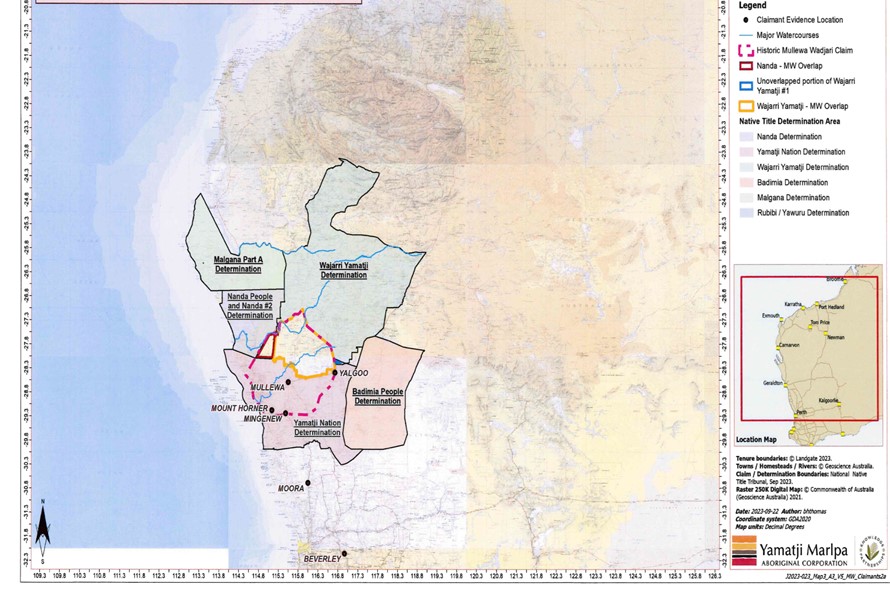
Map 4
126 As a result of the WY determinations to the north of the MW claim area, and the Yamatji Nation determination to the south, many of the facts that must be proven before the Court could recognise the WY People as holding native title rights in the WY claim area (such as facts relating to laws and customs, “society” and “continuity”) have already been found to exist in relation to adjacent areas. Evidence of the facts upon which those determinations were made are not in dispute, and therefore do not need to be the subject of evidence in these proceedings. The MW applicant accepted that those determinations provide a basis for recognition by the Court of facts relating to the existence of the WY society, the laws and customs of the WY society, and the continuity of the rights and interests of the members of that society.
127 The position of the MW people is quite different. The MW group have not been recognised as an Aboriginal society holding native title rights and interests at sovereignty, or at present, and they do not claim to be a separate society from the WY People. They seek to rely on the evidence and admissions relating to the WY People in the SAID, but then depart from the WY People’s position by asserting a different description of WY native title holders for the WY Overlap Area.
128 Third, the MW applicant’s evidence in relation to WY Issue 1 must be considered in the context that the other parties to the WY Applications have agreed to the WY Consent Minute. The WY Consent Minute is signed by all participating parties other than the MW applicant. All of them seek a determination that the WY People (being the WY native title claim group as defined in Schedule 7, item (a) of the WY Consent Minute) hold native title in the lands and waters of the WY Overlap Area. That is, all participating parties other than the MW applicant accept that the WY People (as presently defined) are the right people for the WY Overlap Area.
129 Fourth, for the reasons I will explain further below, the opinions expressed in the Barber Report in relation to WY Issue 1 are inadmissible.
130 Fifth, I accept the MW applicant’s submission that it is not the Court’s task in an application for summary judgment to conduct a “mini trial based upon incomplete evidence to decide whether the proceedings are likely to succeed or fail at trial”, and that the Court’s task “requires a critical examination of the available materials to determine whether there is a real question of law or fact that should be decided at trial”. However, that submission goes nowhere because:
(a) in this case the evidence is not incomplete. The parties filed all of the evidence upon which they proposed to rely for the forthcoming Separate Questions hearing, which evidence is in final form. All of that evidence was before the Court in the application;
(b) the MW applicant mischaracterises the application as involving a “mini trial”. The N&WY applicants did not ask the Court to weigh the N&WY applicants’ evidence on WY Issue 1 against the MW applicant’s evidence, and there was no “mini trial”. Instead, the application involved an examination of the evidence to be relied on by the MW applicant in the forthcoming Separate Questions hearing, and to decide whether the N&WY applicants established that the MW applicant has no reasonable prospect of proving its case on WY Issue 1; and
(c) it failed to take into account that if the moving party for summary judgment establishes a prima facie case, the onus shifts to the opposing party to point to some factual or evidentiary issues that make a trial necessary: Jefferson Ford Pty Ltd v Ford Motor Company of Australia Ltd [2008] FCAFC 60; 167 FCR 372 at [127] (Gordon J), approved in Buurabalayji Thalanyji at [3] (see fifth dot point) (McKerracher J) and in Harkin at [12] (Griffiths J). Here, the N&WY applicants made out a prima facie case for summary judgment in regard to WY Issue 1 and it was therefore necessary for the MW applicant to establish “specific factual or evidentiary disputes that make a trial necessary”. The MW applicant singularly failed to establish that there are factual or evidential questions in relation to WY Issue 1 which must be determined at a trial.
131 At points the MW applicant seemed to proceed as if the N&WY applicants were required to establish that the MW applicant’s case on Nanda Issue 1 was “hopeless” or “bound to fail”. That is not the test: see Spencer at [17]-[26].
132 Sixth, the MW applicant approached the summary judgment application as if all that it had to do to be successful on WY Issue 1 is to show that the evidence raises factual or legal questions regarding whether one or more of Jack Comeagain Snr, Fanny Taylor or Lottie Hannah were members of the Wajarri People who, at effective sovereignty, held rights and interests in the WY claim area under traditional laws and customs. That somewhat misses the point.
133 The entire point of success for the MW applicant on WY Issue 1 is to allow the contemporary descendants of one or more of the three purported apical ancestors to become members of the WY native title claim group, and as a result share in any favourable determination of native title. The difficulty for the MW applicant is that, assuming that it is successful in having one or more of Jack Comeagain Snr, Fanny Taylor or Lottie Hannah added to the list of apical ancestors (or establishing that one or more of them is descended from an identified apical ancestor), their contemporary descendants do not become members of the WY native title claim group unless they can also satisfy the other parts of the claim group definition in Schedule 7 of the WY Consent Minute.
134 To pick up the language of items (b) and (c) of Schedule 7 of the WY Consent Minute, to be members of the WY native title claim group the contemporary descendants of Jack Comeagain Snr, Fanny Taylor or Lottie Hannah must also:
(a) “identify themselves as Wajarri Yamatji in accordance with the traditional laws acknowledged and the traditional customs observed by the Wajarri Yamatji”; and
(b) be “accepted as Wajarri Yamatji in accordance with the traditional laws acknowledged and traditional customs observed by the Wajarri Yamatji”.
The MW applicant adduced no evidence that they self-identify as WY People in accordance with the traditional laws acknowledged and the traditional customs observed by the WY People, nor that they are accepted as WY People in accordance with the traditional laws acknowledged and traditional customs observed by the WY People.
135 In response to this deficiency, the MW applicant submitted that “the value of evidence of group recognition become less pertinent where…the identity issue was as to belonging to a particular group and connection to a particular area and where the matter before the Court is a contest between two competing groups and the identity in question is that of a minority interest which is opposed by a majority”. I accept that evidence that a majority of an Aboriginal group does not accept that a minority of that group are members of that group must be considered in the context of all the surrounding circumstances, including any disputation between the competing groups. Whether or not the minority group have a legitimate claim to be members of the group must be assessed on the evidence. Here (unless the members of the MW group can show they are member of the WY claim group through another apical ancestor) the evidence is insufficient to show that the contemporary descendants of Jack Comeagain Snr, Fanny Taylor or Lottie Hannah have a legitimate claim to be members of the WY People and should be accepted as such.
136 Turning now to matters specific to Jack Comeagain Snr, Fanny Taylor and Lottie Hannah.
8.5.2 Jack Comeagain Snr
137 The N&WY applicants established that the MW applicant has no reasonable prospect of successfully prosecuting its claim that Jack Comeagain Snr should be added to the list of apical ancestors in Schedule 7, item (a) of the WY Consent Minute, or that he is descended from one of the WY apical ancestors identified in that list.
138 First, there is no lay or expert evidence to show who Jack Comeagain Snr’s parents were or to which Aboriginal society or people(s) they belonged. There is no evidence that either of his parents were Wajarri people.
139 Second, the MW applicant’s lay witness statements are not probative to show that Jack Comeagain Snr was a member of the Wajarri People:
(a) Mr Papertalk said nothing to identify Jack Comeagain Snr as a Wajarri man. His evidence in relation to Jack Comeagain Snr was general and of no assistance in establishing which Aboriginal group Jack Comeagain Snr was associated with;
(b) Dr Green did not identify Jack Comeagain Snr as a Wajarri man, and she said that her father referred to his son, Jack Comeagain Jnr, as a Badimia man. She also said that the Badimia People are “very close” culturally and geographically to the Wajarri People but that does not take matters far; the Badimia People are a different society to the Wajarri People and their country is in a different area; and
(c) Ms Jackamarra asserted that Jack Comeagain Snr was a Wajarri law man, but that assertion lacked a foundation in the evidence. It appears to be based on an inference she draws from the fact that a Wajarri elder, Geoffrey Mongoo, told her partner, Mr Dann, that he saw Jack Comeagain Snr’s son, Jack Comeagain Jnr, at “the old ceremony grounds up in the Murchison”.
140 For the purposes of the summary judgment application, Ms Jackamarra’s evidence as to what Mr Mongoo told her partner, Mr Dann about Jack Comeagain Jnr’s attendance at the old ceremony grounds must be accepted. But what it is appropriate to infer from that fact is a matter for the Court, not Ms Jackamarra. As Gordon J explained in Jefferson Ford at [132]:
I now come to a final, sixth principle, which is that in determining whether a real issue of fact exists such as to preclude summary judgment, the court must draw all reasonable inferences – but only reasonable inferences – in favour of the non-moving party: Commonwealth Bank of Australia v ACN 000 247 601 Pty Ltd (in liq) [2006] FCA 1416 at [30]; Boston Commercial Services 236 ALR 720 at [45]. I emphasise ‘reasonable’ because it is on this point that the lowering of the bar effected by s 31A becomes clear. By distinguishing between “hopeless” cases and those without reasonable prospects for success, the statute makes clear that the court need not (indeed, must not) refuse summary judgment on the basis of a factual dispute said to arise only from a plausible, as opposed to a reasonable, inference.
141 In my view the fact that Jack Comeagain Snr’s son attended the old Wajarri ceremony grounds for some unspecified purpose and in an unidentified time period is not a reasonable basis to infer that Jack Comeagain Snr was a member of the Wajarri People, let alone a Wajarri law man. That is particularly so when Dr Green identified his son as a Badimia man, rather than Wajarri. If Jack Comeagain Snr was a Wajarri man I expect he would have been so identified by Mr Papertalk, who is the senior Wajarri law man at present. However, Mr Papertalk said nothing to identify Jack Comeagain Snr as a Wajarri man, let alone a Wajarri law man.
142 Third, there is no probative evidence, either lay or expert, to support the allegation in the MW SSFIC that Jack Comeagain Snr was “from the Murchison region around the Boolardy area” or to support Mr Barber’s opinion in Appendix 3 that he worked in the Boolardy area. The only MW lay witness evidence that places Jack Comeagain Snr in the Murchison region is Ms Jackamarra’s statement. Ms Jackamarra said:
(a) she was told that Jack Comeagain Snr met his wife Fanny in the Murchison area. For the purposes of the application that must be accepted but I do not consider it reasonable to infer from that fact that Jack Comeagain Snr was “from the Murchison region around the Boolardy area”. It is uncontroversial that, at or around effective sovereignty, Aboriginal people travelled outside their own country. Jack Comeagain Snr may or may not have been on his own country when he met his future wife; and
(b) that Geoffrey Mongoo told her partner Mr Dann that he saw Jack Comeagain Snr’s son at the old cemetery grounds “up in the Murchison.” I accept that too, but I do not consider it reasonable to infer from the fact that Jack Comeagain Snr’s son attended the old Wajarri ceremony grounds for some unspecified purpose and in an unidentified time period that Jack Comeagain Snr was from the Murchison region or from around the Boolardy area. There is no lay evidence that Jack Comeagain Snr worked in the Boolardy area, and no foundation in the evidence for Mr Barber’s opinion.
143 Fourth, there is nothing in the MW lay evidence to support the allegations in the MW F&BP as to the “oral history of Wajarri Yamatji claim group members of Jack Comeagain Snr as a ‘full blood’ Wajarri man ‘from the Murchison’ travelling from Mullewa to Murchison region stations to attend ‘culture meetings’ including at Wooleen Station as a venue for ceremonies; and participation in ceremonies performed at Mullewa Reserve and nearby law grounds”.
144 Nothing in the MW applicant’s lay witness statements supports those allegations. Again, as Senior Counsel for the MW applicant accepted, for the purposes of the application it is appropriate for the Court to infer that the lay witness statements of Dr Green, Mr Papertalk and Ms Jackamarra represent the best information that they could give. I infer that if the lay witnesses could have said that Jack Comeagain Snr was a “full blood” Wajarri man “from the Murchison” travelling from Mullewa to Murchison region stations to attend “culture meetings”; and participating in ceremonies performed at Mullewa Reserve and nearby law grounds they would have done so.
145 Fifth, there is little or nothing in the MW lay evidence to show that Jack Comeagain Snr had a connection with the land and waters of the WY Overlap Area in accordance with traditional laws acknowledged and traditional customs observed by the Wajarri People. I would usually expect that to be shown through evidence of matters such as resource use, established residence, knowledge of country, and evidence of spiritual connection through knowledge of sites and places of significance, including story places. The MW lay witness statements do not provide probative evidence of such matters in respect to Jack Comeagain Snr.
146 Sixth, in the Barber Report Mr Barber provided conclusory opinions that Jack Comeagain Snr:
(a) was a “Thagarda Wadjari man” (at [158]);
(b) was from Thawarda Wajarri country and resided in the claim area in c 1890s (in Appendix 3);
(c) “had rights and interests under traditional law and Custom” in the WY Overlap Area (in answer to Question (a));
(d) “appears to have been a Senior Wajarri person, who was engaged in Wadjari law and Custom as of a right” (in answer to Question (b)); and
(e) “is considered to have rights and interests within broader Wadjari land and within the Claim” (in answer to Question (e)).
147 The Barber Report does not though identify which of Dr Green, Mr Papertalk and/or Ms Jackamarra provided the information said to support those opinions, nor does it disclose the nature of the information they provided which is said to justify those opinions. Again, it is appropriate to infer that the lay witness statements of Dr Green, Mr Papertalk and Ms Jackamarra represent the best evidence that they could give and, particularly in circumstances where Mr Barber does not disclose which of them provided the information or what they told him, it would be wrong to conclude that they provided Mr Barber with better information than that which they provided in their witness statements. Further, when one examines the MW applicant’s lay witness statements they do not provide a factual foundation for Mr Barber’s opinions.
148 Fundamentally, the Barber Report is not presented in a form which makes it possible to determine whether Mr Barber’s opinions in relation to Jack Comeagain Snr are wholly or substantially based on his specialised knowledge based on training, study or experience as an anthropologist. It does not reveal the observed facts or assumptions upon which his opinions are based, it does not expose how he applied his specialised knowledge as an anthropologist to the observed facts or assumptions to support the opinions he expressed, and it does not expose the reasoning process leading to the opinions he expressed.
149 Mr Barber’s opinions are also redolent with uncertainty. His answer to Question (a) was that the “genealogical information suggests that Jack Comeagain Snr had rights and interests under traditional law and Custom” (emphasis added). His answer to Question (b) was that “Jack Comeagain Senior appears to have been a Senior Wajarri person” (emphasis added).
150 Some of his other opinions appear to be mere speculation. For example, his answer to Question (c) was that Jack Comeagain Snr’s birthplace is unknown, but he then stated that Jack Comeagain Snr was born within the WY Overlap Area or the broader Wajarri estate, without revealing the factual foundation for that opinion. His answer to Question (d) is that Jack Comeagain Snr’s parents are unknown, but he then opined that Jack Comeagain Snr’s father was a Wajarri man from the WY Overlap Area or the broader Wajarri estate, without revealing the factual foundation for that opinion.
151 Therefore, if (contrary to my view) Mr Barber's opinions regarding Jack Comeagain Snr are admissible, that would make no difference to my conclusion in the application. If his opinions are admissible I would give them little weight because on the salient issues his opinions are uncertain, speculative and not grounded in the evidence.
8.5.3 Fanny Taylor
152 The N&WY applicants established that the MW applicant has no reasonable prospect of successfully prosecuting its claim that Fanny Taylor should be added to the list of apical ancestors in Schedule 7, item (a) of the WY Consent Minute, or that she is descended from one of the WY apical ancestors identified in that list.
153 First, there is significant lacuna in the evidence as to Fanny Taylor’s ancestry. It is uncontentious that status as a Wajarri person that holds rights and interests in relation to land under traditional laws and customs is primarily based on descent: see T32.29. Here there is no probative evidence which is capable of showing that either of Fanny Taylor’s parents were members of the Wajarri People.
154 According to Mr Barber’s opinions in the genealogical information in Appendix 3, Biddy Wittamurra, Fanny Taylor’s mother, was a Wajarri person. However, in submissions the MW applicant accepted that there is no evidence to show that Biddy Wittamurra was a member of the Wajarri People. Mr Barber accepted that there is no evidence as to the Aboriginal group with which Fanny Taylor’s father was associated.
155 Second, Mr Papertalk did not state that Fanny Taylor was a Wajarri person. Rather, he said he was told by the “old people” that Fanny Taylor and her daughter Lottie “moved in from another group into the Mullewa Wadjari area”. That statement is directly contrary to the MW applicant’s case on WY Issue 1.
156 Mr Barber appeared to accept that in the genealogical information he set out in Appendix 3. There Mr Barber said that Fanny Taylor’s country was “Amagu/Wilynu - coastal LP”. I infer that the reference to “Amagu/Wilynu - coastal” is a reference to the Amangu People, and that the reference to “LP” is shorthand for “Leedham Papertalk”, the source of the information. The entry states that Mr Papertalk told Mr Barber that Fanny Taylor came from the Amangu People. That is again directly contrary to the MW applicant’s case on WY Issue 1.
157 Third, Ms Jackamarra stated (at [25]-[26]) that Fanny Taylor belonged to MW country and that she is connected to MW country through her maternal great-grandmother Fanny Taylor, her maternal grandmother Lottie Hannah (Fanny’s daughter), and her mother Margaret Jackamarra (nee Hannah). However, her evidence that Fanny Taylor was a member of the Wajarri People is contradictory and inconsistent. On the one hand she described Fanny Taylor as being “acknowledged and accorded respect” by “other senior Wajarri people” and that she belonged to MW country. On the other hand, she said that “Fanny and Lottie had a connection to the overlap area through Old Jack [Comeagain Snr], Fanny’s husband” (emphasis added). I understood the latter statement as an assertion that Fanny was not Wajarri by descent, but had developed a connection to Wajarri country through her marriage to Jack Comeagain Snr. That understanding is consistent with Mr Papertalk’s evidence that he was told by the “old people” that, together with her daughter Lottie, Fanny Taylor “moved in from another group into the Mullewa Wadjari area”.
158 There is no evidence (and the MW applicant did not contend) that, at sovereignty, Fanny Taylor could have become a member of the Wajarri People and have rights and interests in Wajarri country under traditional laws and customs through marriage to Jack Comeagain Snr on the basis that he was a Wajarri man: see T32.28.
159 Fourth, Dr Green (at [50]) and Ms Jackamarra (at [43]) draw an inference that Fanny Taylor was a member of the Wajarri People from the fact that she assisted the anthropologist, Dr Ruth Fink, as a guide and interpreter in field work on Wajarri country in the 1950’s accompanied by “other Wajarri elders”. (I note that Ms Jackamarra said the field trips occurred in the 1960s but that date range appears to be a mistake.) Dr Green inferred that Fanny would not have been able to do that work if she was not accepted as a member of the Wajarri group. Ms Jackamarra inferred that Fanny doing that work shows that “they” (meaning, the Wajarri elders) acknowledged her connection to Wajarri country. She also said that under Wajarri culture Fanny would not have been permitted to be on Wajarri country with a visitor unless she was recognised as having a connection to that country.
160 For the purposes of the application it must be accepted that Fanny Taylor worked with Dr Fink as a guide and translator on Wajarri country in the 1950s, accompanied by Wajarri elders. But it is for the Court, not Dr Green or Ms Jackamarra, to decide what inferences are reasonable to be drawn, as distinct from merely plausible: Jefferson Ford at [132].
161 At least in part, determining what inferences it is appropriate to draw from the fact that Fanny Taylor assisted Dr Fink as a guide and interpreter on Wajarri country depends on the nature of Dr Fink’s work. For example, if Dr Fink had been engaged in mapping Wajarri sacred sites it might be more likely that Fanny Taylor would not have been able to assist in that work if she was not accepted as a Wajarri person than, say, if Dr Fink had been engaged in research into contemporary Aboriginal communities in the area.
162 Here, while there is limited available evidence as to Dr Fink’s work, it is sufficiently clear that the work did not involve sacred sites, secret womens’ business or the like. Dr Kenny’s report shows that Dr Fink’s 1960 PhD dissertation is entitled “The Changing Status and Cultural Identity of Western Australian Aborigines: A Field Study of Aborigines in the Murchison District WA 1955-1957” (Columbia University, 1960). I infer that Dr Fink was engaged in research for that dissertation on the relevant field trips.
163 Dr Fink’s work was discussed by Barker J in CG (Deceased) on behalf of the Badimia People v Western Australia [2015] FCA 204. His Honour noted (at [20]) that in the post-Second World War era, Dr Fink obtained data in the vicinity of the Badimia claim area for her PhD dissertation about “tribal distribution” in the Murchison region. His Honour briefly described Dr Fink’s work as follows (at [121]):
Fink did her PhD research in the 1950s. She was based in Wajarri country in Mullewa. Her work was not focussed on the Badimia but they figure, at least incidentally, in her work. She was concerned to study the effects of assimilation policies on Aboriginal people. She met ‘town dwellers’, ‘fringe dwellers’ and other Aboriginal people still on pastoral stations.
164 In relation to Dr Fink’s work the State of Western Australia submitted as follows, as Barker J recorded (at [441] (12)-(16)):
(12) Fink carried out fieldwork in the Murchison region during the period 1955-1957 as the basis for her PhD dissertation. Most of her research was in Mullewa, although she also made trips to stations and towns in the Murchison region, including Mount Magnet….
(13) Fink’s research focus was on social, cultural and economic change. Dr Brunton and Mr Robinson [being expert witnesses in the case] agreed that she was interested in the extent to which traditional practices and traditional life had been maintained. Fink herself stated that she ‘was interested in observing changes in indigenous culture, and in trying to assess its present day significance’ and, accordingly, chose the Murchison to undertake her research as she wanted to study an area which had experienced intensive European settlement over a long period and where consequently there would be ‘considerable detribalization and acculturation’ but not to the extent that ‘indigenous culture had completely died out’.
(14) Fink reported in some detail about the extent to which traditional culture had been lost as a result of European settlement in the region. She was particularly focused upon the factors which were causing that process to continue during her period of research in the 1950s. Her findings were summarised by Dr Brunton in his first report.
(15) Fink distinguished three broad groups of Aboriginal people whom she encountered during her research. The first were the ‘town dwellers’ who consisted of Aboriginal people with citizenship rights who lived in the white residential sections of Mullewa. With only a few exceptions, these people would not cooperate with Fink’s research because ‘they did not want to be regarded as natives’, from whom they kept completely separate. The second group of Aboriginal people were the ‘camp dwellers’ who lived on the native reserves around towns in the Murchison. Although some of them had a certain degree of traditional knowledge and interest, Fink considered that ‘their way of life [was] no longer based upon a clearly Aboriginal set of traditions’. Rather, their identity was ‘based upon ties of loosely extended kinship to other Jamajdjis’.
(16) The third group were Aboriginal people who were working on pastoral stations in the Murchison. Although Fink considered that the Aboriginal people living on pastoral stations ‘seemed to show more interest in the past’ than the town or camp dwellers, ‘even they had a very incomplete grasp of their former culture’. Fink found that, as a result of developments since the end of the Second World War, traditional orientation amongst Aboriginal people on the pastoral stations was waning and that younger station workers were being influenced by the attitudes of ‘contempt for anything connected with the Aboriginal past’ held by many of their town relatives.
165 The MW applicant submitted that the Court should conclude that in drawing an inference from her participation in field work with Dr Fink that Fanny Taylor must have been a member of the Wajarri People, Dr Green and Ms Jackamarra were relying on their knowledge and respect for traditional law and custom (T31.8; T32.10). I do not accept that. The inference they drew required that they have an understanding of Wajarri traditional law and custom, as it applied approximately 70 years ago, regarding the circumstances in which a non-Wajarri Aboriginal person could be on Wajarri country. The inference also required an assumption that Dr Fink had not entered into an agreement with Wajarri elders that she could be accompanied by Fanny Taylor although she was not herself a Wajarri person. In my view the inference they drew is just speculation.
166 Amongst other things, there is no evidence to show:
(a) that it was a requirement of Wajarri traditional law and custom, with which Wajarri elders sought compliance in the 1950s, that an Aboriginal person assisting anthropological fieldwork on Wajarri country could only do so if the person was a Wajarri person;
(b) that Dr Green and/or Ms Jackamarra have any knowledge of the requirements of Wajarri traditional laws and customs, as it applied 70 years ago, with which Wajarri elders sought compliance at that time, regarding the circumstances in which a non-Wajarri Aboriginal person could be on Wajarri country;
(c) that the Wajarri elders present on those field trips took the view that Fanny Taylor could only assist in that field work if she was a Wajarri person;
(d) what arrangements or agreements Dr Fink entered into in relation to Fanny Taylor’s assistance on those field trips, including whether she obtained permission from Wajarri elders for Fanny Taylor to attend Wajarri country; or
(e) whether any requirement under traditional laws and customs regarding the attendance of a non-indigenous anthropologist assisted by a non-Wajarri Aboriginal person on those field trips could be met by the attendance of Wajarri elders on the field trips.
167 Another, at least equally available inference, is that Fanny Taylor was engaged by Dr Fink because she was intelligent, knew the Murchison region and the local people in that area well, whether they were Wajarri or members of other groups, and could therefore assist Dr Fink with her work. It is far from unusual for anthropologists to obtain such assistance. I would not infer that Fanny Taylor was a Wajarri woman with rights and interests in Wajarri country under Wajarri traditional laws and customs simply from the fact that she assisted Dr Fink as a guide and interpreter on Wajarri country in the 1950’s, accompanied by several Wajarri elders.
168 Ms Jackamarra also said that she was “told by the old people that Fanny was acknowledged and accorded respect by other senior Wajarri people, such as Eulie Dingo, Laurie Donnelly and Jack Darby, who she knew to be senior Wajarri elders.” Ms Jackamarra did not, though, state that she was told the Wajarri men acknowledged and respected Fanny Taylor as a Wajarri person. Ms Taylor was an intelligent woman who was selected by an important visitor to the area to assist in undertaking research work. The respect she was apparently accorded by the elders may just reflect that. Considered in the context of the paucity of the other evidence in relation to Fanny Taylor, that is not enough to show that there is some specific factual or legal issue in relation to Fanny Taylor that can only be decided following a trial.
169 Fifth, again, there is no probative evidence that Fanny Taylor had a connection with the land and waters of the WY Overlap Area in accordance with traditional laws acknowledged and traditional customs observed by the Wajarri People. I would usually expect that to be shown through evidence of matters such as resource use, established residence, knowledge of country, and evidence of spiritual connection through knowledge of sites and places of significance, including story places. No probative evidence of such matters was adduced in respect of Fanny Taylor.
170 Sixth, the MW lay evidence does not support the allegations in the MW SSFIC and the MW F&BP:
(a) the MW SSFIC alleges that Fanny Taylor “had a connection in accordance with traditional laws acknowledged and traditional customs observed by WY People and Mullewa Wadjari People to the WY area, including the area in the vicinity of the Murchison River, Woolgarong Station and Billabalong Station”; and
(b) the MW F&BP alleges that Fanny Taylor “according to family oral tradition recounted by Lottie Hannah, was present in the MW claim area, travelling there with her son Jack Comeagain (Jnr); and her son and all her daughters ended up out in the Murchison, except her second youngest daughter May Comeagain”.
171 None of the lay witnesses said that Fanny Taylor had a connection to the MW claim area through those particular stations. Indeed, Mr Papertalk said that the old people told him that she came to Wajarri country from another Aboriginal group.
172 Seventh, Mr Barber accepted that he had no knowledge as to the Aboriginal group with which Fanny Taylor’s father was associated. Notwithstanding that, he provided conclusory opinions that:
(a) Fanny Taylor’s mother, Biddy Wittamura, was “regarded as Thagarda Wadjari”, and that Fanny Taylor was “Thagarda Wadjari” (at [157]-[158]);
(b) Fanny Taylor’s country was “Amagu/Wilynu” (in the genealogical information in Appendix 3);
(c) Fanny Taylor “is the daughter of Biddy Wittamurra a Thargarda Wadjari person who possessed rights and interest under traditional law and custom in the entirety of the Mullewa Wadjari claim area and broader Wadjari land” (in answer to specific Question (i)); and
(d) “Fanny Comeagain was a Wadjari person and is regarded as having traditional rights and interest in” the WY Overlap Area (in answer to specific Question (j)).
173 Mr Barber’s opinion that Fanny Taylor was “Thagarda Wadjari” is plainly inadmissible. The Barber Report does not identify which of the Claimants provided the information said to support that opinion, nor does it identify the nature of the information they are said to have provided which is said to justify that opinion. Again, it is appropriate to infer that the witness statements of Dr Green, Mr Papertalk and Ms Jackamarra represent the best evidence that they could give and, particularly in circumstances where Mr Barber does not disclose which person or persons provided the information or what information they are said to have provided, it would be wrong to approach the Barber Report on the basis that they were able to provide Mr Barber with better information than the information they provided in their witness statements.
174 Further, when one examines the MW lay witness statements, they do not provide a factual foundation for Mr Barber’s opinion that Fanny Taylor was a Wajarri person who possessed rights and interest under traditional law and custom in the MW claim area.
175 Again, the Barber Report is not presented in a form which makes it possible to determine whether Mr Barber’s opinions in relation to Fanny Taylor are wholly or substantially based on his specialised knowledge based on training, study or experience as an anthropologist. It does not reveal the observed facts or assumptions upon which his opinions are based, it does not expose how he applied his specialised knowledge as an anthropologist to the observed facts or assumptions so as to support the opinions he expressed, and it does not expose the reasoning process leading to the opinions he expressed.
176 Further, Mr Barber provided the opinion that Fanny Taylor was “Thagarda Wadjari” in circumstances where her father’s Aboriginal group is unknown. Therefore his opinion can only be based on descent from her mother, Biddy Wittamurra, who Mr Barber said was “regarded as Thagarda Wadjari”. However, as Senior Counsel for the MW applicant accepted, there is no evidence that Biddy Wittamura was a Wajarri person and the opinion in relation to Biddy Wittamurra (and therefore Fanny Taylor) has no factual foundation in the evidence. Therefore, if (contrary to my view) the Barber Report is admissible I would give it little weight because it is not grounded in the evidence.
8.5.4 Lottie Hannah
177 The N&WY applicants established that the MW applicant has no reasonable prospect of successfully prosecuting its claim that Lottie Hannah should be added to the list of apical ancestors in Schedule 7, item (a) of the WY Consent Minute, or that she is descended from one of the WY apical ancestors identified in that list.
178 First, Lottie Hannah can only have become a Wajarri person through traditional adoption by Jack Comeagain Snr if he was himself a member of the Wajarri People. As I have explained, the evidence is insufficient to show that Jack Comeagain Snr was a Wajarri person.
179 Second, although Ms Jackamarra said that she is a MW person through both Fanny Taylor and Jack Comeagain Snr, she did not state that her grandmother, Lottie Hannah, was Wajarri by reason of descent from Fanny Taylor. The thrust of the MW applicant’s case was that Ms Jackamurra is Wajarri by descent from Lottie Hannah, who became a member of the Wajarri People through adoption by Jack Comeagain Snr, a Wajarri man.
180 To the extent that Ms Jackamarra’s claim to be Wajarri is based on descent from Fanny Taylor the evidence is insufficient to show that Fanny Taylor was a member of the Wajarri People who, at effective sovereignty, held rights and interests in the MW claim area under traditional laws and customs.
181 Third, again there is no probative evidence that Lottie Hannah had a connection with the land and waters of the WY Overlap Area in accordance with the traditional laws and customs observed by the Wajarri People. As I have said, I would usually expect that to be shown through evidence of matters such as resource use, established residence, knowledge of country, and evidence of spiritual connection through knowledge of sites and places of significance, including story places. No probative evidence of such matters was adduced in respect of Lottie Hannah.
182 Fourth, Mr Barber expressed the following opinions in respect to Lottie Hannah:
(a) prior to marrying Jack Comeagain Snr, Fanny Taylor had married an unnamed man and had two daughters with him, namely Milly Taylor Flanagan and Lottie Hannah;
(b) Lottie Hannah was “a Wadjari person” because she “was adopted under the laws and customs of the Wadjari by Jack Comeagain a Thargarda Wadjari person” (in answer to Question (l)); and
(c) Lottie Hannah “is regarded as a Wadjari person as she was adopted by Jack Comeagain Senior, for that reason she held full rights and interests in the Mullewa Wadjari Claim area and broader Wadjari land” (in answer to Question (m)).
183 For the purposes of the application it must be accepted Lottie Hannah was adopted by Jack Comeagain Snr according to traditional law and custom. Mr Barber does not, however, disclose which of the Claimants provided the information or what information they are said to have provided to support his opinion that Lottie Hannah thereby “held full rights and interests in the Mullewa Wadjari Claim area and broader Wadjari land”. That opinion is inadmissible for the same or similar reasons to those previously expressed.
184 Most fundamentally, if as I have concluded Jack Comeagain Snr was not a Wajarri man, then his adoption of Lottie Hannah cannot have meant she became a member of the Wajarri People.
8.5.5 Conclusion on WY Issue 1
185 The Court should be cautious before deciding a party’s rights by way of summary judgment, and the power to do so must not be exercised lightly (Spencer at [60]). Particular caution is appropriate in a native title determination application. But here the evidence was in final form, and I have given careful attention to it. The N&WY applicants clearly established a prima facie case in favour of summary judgment, and the onus then shifted to the MW applicant to show that the evidence raised specific factual or evidentiary issues that made a trial necessary. It failed to do so and I am well-satisfied that the MW applicant has no reasonable prospect of successfully prosecuting its case on WY Issue 1.
186 The N&WY applicants’ application for summary judgment on WY Issue 1 has been allowed, and judgment should be given against the MW applicant in relation to the issue.
9. Nanda Issue 1 - the sovereignty question
187 The N&WY applicants had the onus to establish that the MW applicant has no reasonable prospect of successfully prosecuting its case in relation to Nanda Issue 1, which is as follows:
Did the WY People at sovereignty hold rights and interests in the land and waters of the Nanda Area in accordance with the traditional laws and customs of the Wajarri Society?
9.1 The pleadings
188 The MW SSFIC alleges as follows in relation to the extent of Wajarri country, and the WY People’s connection with the Nanda Overlap Area, at effective sovereignty:
[12] The MW Applicant says that upon the assertion of British Sovereignty over Western Australia in 1829, the land and waters comprising the area in the native title determination applications WAD 30 of 2019 and WAD 176 of 2019 (Nanda Applications), to the extent that they overlap the MW Application (Nanda Overlap Area) was first settled by non-Aboriginal persons in or about 1860 (date of effective sovereignty).
[13] The MW Applicant says that Nanda overlap area was a part of the country to which the ancestors of the MW Claimants belonged, as part of the Wadjarri Society, to the exclusion of the Nanda People, as those people are described in Schedule 7 of the Minute of Proposed Consent Determination of Native Title filed in the Nanda Applications on 25 June 2021, pursuant to the normative system of traditional laws and customs that determined certain rights and interests in that country (which are particularised in Schedule F of the MW 1999 Form 1). That system has been both observed by the MW Claimants and WY People since the date of effective sovereignty in the area.
[14] The MW Applicant says that primary means of being accorded native title rights and interests under that normative system is through descent from a parent by birth or customary adoption.
[15] The persons to whom the Nanda Overlap Area primarily belonged have historically, from time to time been referred to in that context by some Aboriginal people and/or anthropologists as Tharwada/Tharweera Wadjari, or Nӧkan/Ngugan (Tharwada Wadjari).
[16] The persons sometimes described as ‘Tharwada Wadjarri’ were a circumcising, linguistically, or sub-linguistically, identifiable group or sub-group of the Wadjarri Society who were recognised at the date of the effective sovereignty as part of a normative society to whom the ancestors of the MW Claimants belonged.
[17] The land included in the MW claim area, sometimes described as ‘Tharwada’ country is the territory of the serpent or bimara. Greenough River and Murchison River are significant places within that area of land where the bimara is present. Bimara is the Wajarri word for country that was created by the serpent spirit. It includes the land, rock holes, resources and people who belong to that country and have an obligation under traditional law and custom to look after that country and preserve it for future generations.
…
[19] The MW Applicant says that:
(a) Nanda country is roughly northwest of country, commonly referred to as ‘Tharwada country’, on the opposite side of the Murchison River.
(b) The Nanda people are coastal people.
(c) The Nanda people are not traditionally associated with the area on the Eastern side of the Murchison River, commonly referred to as ‘Tharwada’ or ‘Tharwada Wadjari’ country.
(d) The traditional law is and has been different between the Nanda People to the West of the Murchison River and the people commonly referred to ‘Tharwada’, ‘Tharwada Wadjarri’ or ‘Wadjarri’ to the East of the Murchison River. There is a change of traditional cultural practices and rituals at the Murchison River. The groups on either side of the Murchison River have different traditional cultural practices and rituals.
189 It alleges the following in relation to their asserted Wajarri ancestors’ connection to the Nanda Overlap Area, at sovereignty:
[18] The following apical ancestors of the MW claimants were recognised by the Wadjarri Society, sometimes referred to as including Tharwada/Tharweera Wadjari, Nӧkan/Ngugan People, Wadjari Yamatji People and Wadjari People, to whom the ancestors of the MW claimants belonged, as being persons belonging to the Nanda Overlap Area under their laws and customs:
(a) Angelina/Angeline (Ninganarri) was a Tharwada Wadjari woman born circa 1883 at Murgoo Pastoral Station, was at Billabalong Station when she gave birth to her daughter Alice Darby in 1902 and was at Woolgorong Station in 1948, the year of her death. Those Stations are wholly or partly within the area of overlap between the MW Remaining Area and the WY Area. Angelina, as taught to Leedham Papertalk by his father, Eric Papertalk, was on that Tharwada country with Alice Darby, Jack Darby and her son-in-law Ned Papertalk.
(b) Alice Darby is an apical ancestor of the members of the Papertalk, Merritt, Green, Comeagain, Collins and Collard families referred to as MW claimants in paragraph 3 above. Alice Darby is also associated with Pastoral Stations immediately North of the of the overlap of the MW Remaining Area and WY Area. Alice Darby was a Tharwada person. As taught to Leedham Papertalk by his father, Eric Papertalk, Alice Darby was Tharwada Wadjari and Tharwarda country is located East of the circumcision line, runs Eastward along the Greenough and Murchison Rivers, includes Yallalong Station, Coolcalalya [sic] Station, Meerberrie Station, Billabalong Station, Twin Peaks Station, Yuin Station and extends as far East as the town of Yalgoo.
190 The MW F&BP provides the following further particulars in relation to the extent of Wajarri country, at sovereignty:
[8] As to paragraph [17] of the SSOFIC, the ‘land included in the MW claim area, sometimes described as “Tharwada” country’ is the whole of the area contained within the external boundaries of the MW claim area.
191 It provides the following further particulars in relation to the asserted Wajarri ancestors’ connection to the Nanda Overlap Area, at sovereignty:
[9] As to paragraph [18] of the SSOFIC, traditional laws and customs by which Angelina/Angeline (Ninganarri) and Alice Darby and their descendants are alleged to have rights and interests under Wajarri Yamatji traditional laws and customs (being the same laws and customs as the laws and customs of the Wadjarri Society) in the ‘Nanda Overlap Area’ are laws and customs according rights and interests on the basis of descent from ancestors present in the ‘Nanda Overlap Area’ at and before the time of effective sovereignty being asserted by the British Crown in the area, including a custom of recognition of descent on the basis of adoption by a parent.
192 In summary, the MW applicant advanced its claim in relation to the Nanda Overlap Area on the basis that, at sovereignty, Angelina and her daughter Alice Darby, being members of the Wajarri People held rights and interests in the Nanda Overlap Area under Wajarri traditional laws and customs. It is uncontentious that Angelina and Alice Darby were members of the Wajarri People; Angelina is identified in the WY Consent Minute as an apical ancestor of the WY native title claim group.
9.2 The lay evidence
193 Each of the three MW lay witness statements made reference to the extent of Wajarri country at sovereignty, and two of them referred to their asserted Wajarri ancestors’ connection to Wajarri country at sovereignty:
194 Dr Green said:
[12] My mother was a senior Wajarri woman. Her traditional Wajarri name was Kurni /Kooni.
[13] My mother’s mother was Alice Darby (AD). AD was the daughter of Angelina and Tom Darby. Angelina and Tom Darby were both Wajarri and came from the area north of the Mullewa Wadjari and Wajarri Yamatji overlap area. Angelina is associated with the areas around Murgoo Station, Meebeerie Station and Woolgorong Station.
[14] My mother’s father was Ned Papertalk (NP). NP was the son of Old Papertalk and Rosie Coleman, a Wilunyu woman. NP was married to my grandmother, AD.
[15] NP was a man who had gone through the Wajarri law, and been given Alice Papertalk (nee Darby) as his wife.
[16] My mother’s second elder brother was EP. EP is the father of my cousins, Leedham Papertalk and Patrick Papertalk.
[17] I follow my mother’s country, and my mother followed her mother’s country. I spent more time growing up and visiting my mother’s country.
[18] As a Wajarri person, you can follow either your mothers’ country or your fathers’ country. You can inherit the right to speak for country from either your mother or father, even if you are adopted by a Wajarri person.
My Country
[19] Wajarri country is located around Mullewa and Murchison region.
[20] My mother’s country is around Tallering, Woolgorong, Meebeerie and Billabalong.
[21] The old people told us that the Mullewa Wadjari claim area is our country and we belong to that country and have a cultural and spiritual connection to that country.
…
[24] The Murchison River and Greenough River have Bimara dreaming stories. The Bimara travels inland from the ocean and down the Murchison River. The Murchison River is an important site of significance because of the Bimara dreaming.
[25] There is a story where the Bimara travels down Greenough River, and then it stops at its final resting place -Ellendale Pool.
[26] My mother told me that the area that is subject to the Mullewa Wadjari and Nanda overlap area (Nanda overlap) is Tharwarda Wajarri country.
[27] The Nanda overlap area is an area relates to Tharwarda Wajarri men’s law business and initiation rights. I was told that there are Wajarri men’s sites in the Nanda overlap area, and as women, we have limited knowledge of those sites.
[28] We were taught that women are not allowed to go to men’s sites, and men are not allowed to go to women’s sites.
…
[33] The Wajarri did not conduct cultural activities in isolation, they moved around the area. Any cultural and spiritual activity that is conducted in a particular area determines a Wajarri person’s relationship to that area.
[34] I know from what my family told me that the Nanda people do not have initiation rights and do not conduct law business in the Nanda overlap area.
[35] Over time the Tharwarda Wajarri country has been subsumed into the wider Wajarri tribes.
[36] Tharwarda Wajarri country extends to the Murchison River. The west side of the Murchison River is Nanda country, and the east side of the Murchison River is Tharwarda country.
…
Traditional Law and Custom
[39] When I was a young girl, I remember attending the last corroboree held at the Mullewa reserve in 1977. It was a big ceremony for the young boys that came back as men after going through the law. I remember all the old Wajarri men and women were there, and they were all dancing. It was the last corroboree to ever take place.
195 Mr Papertalk did not say anything specifically about the Nanda Overlap area, but he said:
[11] My mother, Gladys Papertalk, was a Noongar woman from Mount Horner. Her people walked from Mount Horner into the town of Beverly and camped by the river.
…
[13] I follow my father’s country. Strictly speaking, you should follow your father’s country, but not everyone does.
…
My Country
[21] I am a Wajarri man through my paternal great-grandmother, Angelina (mother of Alice Darby).
[22] I was told by my father that Angelina was a Wajarri woman and her country includes the Mullewa Wadjari claim area, and areas that lie wholly within Wajarri Yamatji determination area, such as Murgoo Station, which was Angelina's birth place, and Meeberrie Station.
[23] My father’s parents were Alice Darby and Ned Papertalk, and his maternal uncle was Jack Darby.
…
[25] Angelina and Tom Darby were the parents of Alice Darby and Jack Darby. Jack Darby was a senior Wajarri law man.
[26] I was told by my father that Tom Darby was a senior Wajarri law man that came from the area north of the Mullewa Wadjari claim area.
[27] My father told me that Angelina, Jack Darby, Alice Darby, and Ned Papertalk all had connection to the Mullewa Wadjari claim area.
[28] Angelina and Tom Darby lived around Meeberrie Station until Tom Darby was shot and killed in 1917 by another aboriginal man called Sammy.
[29] I was told that Angelina stayed around Murgoo and Meeberrie, and she is buried out at the Old Pioneer Cemetery in Mullewa.
[30] My father and the other old people told me stories about our country. They took me out on country and taught me about my country.
[31] My traditional country is around Murgoo, Boolardy, Berringarra Station, Mount Narryer, Wooramel, and Meeberrie.
[32] Growing up I was taught about the Tharwarda Wadjari, its language and how my paternal great-grandmother, Angelina, was a Tharwarda Wajarri woman.
[33] Tharwarda Wajarri country is considered to be located east of the circumcision line, and runs eastward along the Greenough and Murchison Rivers and stops as far east of Yalgoo.
[34] The Tharwarda Wajarri are Wajarri people, whose country forms part of the Mullewa Wadjari claim area.
[35] The old people told me that the Tharwarda country includes Meeberrie, Billabalong, Yallalong, Coolacalalaya Station, Twin Peaks and Yuin.
[36] This is the territory of the water serpent or the Bimara.
[37] Greenough and Murchison Rivers are significant sites of the Bimara.
[38] Bimara is the word for the country that was created by the serpent spirit, which includes the land, the rock holes, the food, the resources and the people who belong to that country.
[39] Under our traditional law and custom, the people who belong to that country must preserve and take care of their country (barna) for the future generations.
[40] On the west side of the Murchison River lies Nanda country. They are coastal people. Nanda people are not Thawarda Wajarri people, their law is different.
[41] My father taught me that there is a change of culture and rituals, that changes at the Murchison River.
[42] The tribes on either side of the Murchison River are very different. I was told this as part of becoming a law man.
[43] I was told by the old people that Angelina was on that country with Alice Darby, Jack Darby and her son-in-law Ned Papertalk, but the white man never recorded them being there.
[44] The anthropologist Kingsford and researcher Daisy Bates each identified and drew the boundaries of the Thawarda Wajarri before the Mullewa Wadjari claim was filed in 1996.
[45] There is a site east of Billabalong Station - the story of the Woormbala serpent.
[46] There are Tharwarda Wajarri law grounds around Mount Aubrey, Poondarri, Yandi, Wandana, Bangamulla Pool, and Tallering.
[47] At Wandana there is the bimara story - or the freshwater snake story.
[48] There is also a cave painting at Tallering. In Wajarri language it is pronounced Thallerang.
[49] There are old law grounds at Mount Aubrey. I was told that Angelina had another son called Matt Aubrey and he was named after Mount Aubrey as part of his ceremony of becoming a man.
…
[58] The old people put down the boundaries of the Mullewa Wadjari claim area, I would be breaking our law if I changed those boundaries. If I break the law, there could be consequences for me, and I could get very sick.
196 Ms Jackamarra (who does not claim to be Wajarri by descent from Angelina or Alice Darby) said nothing specifically in relation to the Nanda Overlap Area, but in relation to Wajarri country more generally she said:
[5] My mother was Margaret Jackamarra (nee Hannah).
[6] My maternal grandmother was Lottie Hannah.
[7] My maternal great-grandmother was Fanny ‘Judy’ Comeagain (nee Taylor). Fanny was also known as Judy Taylor or Judy Comeagain.
…
My Country
[21] I was taken out on country from a very young age by my maternal uncle and aunts, my older sister and my parents.
[22] I remember being taken to areas around Yuin to go hunting and swimming in the water holes.
[23] I also remember my maternal uncle taking me up to the country around the Murchison River.
…
[25] I follow my mother's, my maternal grandmother, and my maternal great-grandmother's country.
[26] They belonged to the Mullewa Wadjari country, and I am connected to this country through them. The Hannah Family inherited this connection from Fanny and Lottie.
[27] My mother's country was around the Mullewa area.
…
[29] Lottie’s sister, Grace Comeagain and her husband Harry, used to live in Pine Groves and I remember Lottie would travel up there to stay with them.
…
[34] The old people used to take us out and show us our country, including my late uncle Doug Comeagain (DC). Our country is from around Coolacalalaya station and goes east up to the Murchison River. They told us that country is the Tharwarda Wajarri country.
197 The N&WY applicants accepted that some of Coolcalalaya Station (which Mr Papertalk and Ms Jackamarra said is in Wajarri country) is within the Nanda Overlap Area: T 66. The references in the MW applicant’s lay witness statements to the west side of the Murchison River being Nanda country, and the east side of that river being Wajarri country, are statements to the effect that the western end of the MW claim area overlaps the Nanda Overlap Area.
9.3 The expert evidence
198 The N&WY applicants submitted that Mr Barber did not provide an opinion that specifically tied the presence of Angelina or Alice Darby to the Nanda Overlap Area, nor as to their “belonging” to that area. In opposing summary judgment the MW applicant did not point to the Barber Report to support its submission that there is evidence giving rise to specific factual or legal questions which can only be decided following a trial.
199 Even so, it is worth noting that the Barber Report includes the following “general findings” in relation to the extent of Wajarri country at sovereignty:
[231] Historic anthropological research indicates a Wadjari group in the vicinity of the Claim area and the area described by Bates and Tindale as being Wadjari.
…
[236] The published work of Bates (1907) and the work of Tindale (1940 & 1974) locate and provide detail about the location of Wadjari interests, provided by Wadjari in the early and mid-20th century. The Wadjari informants of both authors were likely to have been born in the mid to late 19th century. The information provided to Bates (1907) and Tindale (1940 & 1974) place Wadjari interests in the vicinity of the current Claim area.
[237] At the time when Bates (1907) and Tindale (1940, 1974) conducted fieldwork their informants are likely to have experience and knowledge of their traditional rights and interests for the period from before sovereignty or from the early days of European settlement. I n this respect it is likely the genealogical information collected by Bates (1907, 1984) and Tindale (1940, 1974) collected detail of structure of indigenous groups in the area extending to the period prior to sovereignty.
[238] This information was not available to the author of this report.
…
[240] The genealogical data presented in Appendix 3 was provided by the Claimants. This data indicates that the Claimants descend from Wadjari ancestors, who held rights and interests in and around the Claim area in the mid to late 19th century…
[242] The work of Tindale (1974) suggests some shift in territorial interests in the region, in particular a shift of interests of inland groups toward the coast. The genealogies indicate the Wadjari have been present in the region and the vicinity of the Claim area since the mid to late 19th century.
[243] The Claimants provided detail of Wadjari myths of bimara (water snake), marlu (red kangaroo) and yalabardi (emu). These myths provide cultural reasoning for the foundation of male Wadjari ritual and ceremony and, rights and interests in the Claim area for the Wadjari.
[244] The travels of the mythic beings in relation to the Claim area were described and provide cultural logic to the area claimed and Wadjari interests in the Claim area and of Wadjari Law and Custom…
(Emphasis added in bold.)
200 Mr Barber gave the following answers to the specific Questions he was asked in relation to whether, at sovereignty, Wajarri country extended over the Nanda Overlap Area:
(i) Question (t):
In relation to the identify [sic] the pre-sovereignty society of the Mullewa Wadjari/Nanda Overlap Area:
(i) At sovereignty, did the Wajarri Yamatji People hold rights and interests in the land and waters of the Mullewa Wadjari/Nanda Overlap Area in accordance with the traditional laws and customs of the Wajarri Society;
A. Have the Wajarri Yamatji People continued to acknowledge and observe, substantially uninterrupted from sovereignty to the present day, their traditional laws and customs such that they have rights and interests in, and a traditional connection to, the land and waters of the Mullewa Wadjari/Nanda Overlap Area.
B. If so, what is the nature and extent of the native title rights and interests in land and waters held by the Wajarri Yamatji People in the Mullewa Wadjari/Nanda Overlap Area.
(ii) Alternatively, at sovereignty, did the Nanda People hold rights and interests in the land and waters of the Mullewa Wadjari/Nanda Overlap Area in accordance with the traditional laws and customs of the Nanda society.
…
Answer (t)(i):
(t)&(i) The available genealogical and ethnographic information suggest that the Wadjari held native title rights and interests in the vicinity of the Claim area from at least the mid to late 19th century.
Answer (t)(i)A:
B. The genealogical and ethnographic information provided by the Mullewa Wadjari (Thagarda) suggests that the Wajarri language group held rights and interests in the land and waters of the Mullewa Wadjari/ Nanda Overlap Area and continue to do so.
Answer (t)(i)(A) above was numbered in the Barber Report as Answer (t)(i)(B). I assume that to be an error and I refer to it as Answer (t)(i)(A).
Answer (t)(i)B:
B. The Wadjari appear to have held rights and interests in the Mullewa Wadjari overlap area; the Claimants argue these interests were comprehensive. There is insufficient data to understand the extent [sic] basis or extent of any Nanda interests within the Mullewa Wadjari Claim area.
Answer (t)(ii):
(ii) There is insufficient information to ascertain whether or not the Nanda People held rights and interests in the Mullewa Wadjari/ Nanda Overlap area. It is noted that the Mullewa Wadjari, claim to have comprehensive and primary rights and interests in the entirety of the Mullewa Claim area and broader Wadjari land.
201 In relation to Alice Darby, Question (u) asked:
Did Angelina possess rights and interests under traditional law and custom in the Mullewa Wadjari Remaining Claim Area [meaning the Nanda Overlap Area] or Wajarri Yamatji area [meaning the WY Overlap Area], and if so, which part or parts of the Mullewa Wadjari Remaining Claim Area or Wajarri Yamatji area?
Answer:
The Claimants regard Alice Darby, and therefore her antecedents, as Tharwarda (Thagarda) Wajarri (Wadjari). I note Claimants believe she was born to the north of Mullewa, possibly within the Claim area (Mullewa Wadjari). I also note that birth location does not appear to convey rights and interests per se within the Claim area as the traditional system of the Claimants appears to be descent based.
202 In relation to Angelina, Question (v) asks:
Was Angelina a Tharwarda Wajarri person?
Answer:
I do not have information about Angelina.
203 The MW applicant pointed to passages in the Kenny Report, where Dr Kenny opined:
(a) at [25]:
The Nanda people who claim the Nanda Overlap Area (as part of the Nanda People Native Title Application Area) self-identify as Nanda. In some instances, however, certain claimants also acknowledge Thawarda ancestral connections. For example, in discussions about their ancestry, Jacko Whitby and Bevan Drage explicitly mentioned their Thawarda (as well as Nanda) forebears.
(b) at [32]-[33]:
Members of neighbouring Wajarri families, who are specifically associated with Wajarri areas adjacent to (east of) Nanda country, are also of the view that the Nanda Overlap Area belongs to the Nanda People. See 4.1 for details.
The notable exception to this widely-held view are members of the Mullewa Wadjari claim which overlaps the Nanda Overlap Area entirely. Members of the Papertalk family thus assert that the Nanda Overlap Area is part of ‘Tharwarda Wadjari’ country and that the western boundary of their own (Mullewa Wadjari) claim area is defined by the ‘circumcision line’.
(c) at [82]-[84]:
I also spoke with Mullewa Wadjari claimants about the Nanda Overlap Area. Charmaine Green, a senior member of the Mullewa Wadjari Community claim (WAD21/2019), said that the Nanda Overlap Area is Mullewa Wadjari. She maintains that the boundary of the Nanda Overlap Area was set by ‘E.P.’ (the late Eric Papertalk) and that there are initiation sites in this area.
According to senior Mullewa Wadjari men Leedham Papertalk and Patrick Papertalk, the Nanda Overlap Area is ‘Wadjari/Tharwarda’ country. Leedham added that the western boundary of ‘Wadjari/Tharwarda’ country is the circumcision line (see 3.4 above).
I note here that the territorial perspectives espoused by Ms Green and Messrs Papertalk – each of whom self-identify as Wajarri – are minority views among the wider group of Wajarri persons interviewed by Weiner and myself at different times between 2007 and 2023.
204 On the MW applicant’s argument, Dr Kenny then jumped to the erroneous conclusion (at [85]):
Based upon the previously recorded views of Wajarri Yamatji and Nanda people (see also 4.2.2), the majority of the interviews I have personally conducted, and the ethnographic record – though limited and at times even contradictory – it is my considered opinion that (a) Wajarri people did not hold territorial rights and interests in the Nanda Overlap Area at sovereignty and (b) Wajarri country lay immediately to the east of the Nanda Overlap Area.
(Emphasis in original.)
205 The MW applicant also relied on Dr Kenny’s opinion (at [113]) which indicated a “limited exception” to her (erroneous) conclusion that, at sovereignty, the Nanda Overlap Area was Nanda country. Dr Kenny opined (at [102]):
According to the Nanda Connection Report as well as a supplementary report by Volpe and Weiner’s independent findings concerning the extent of Wajarri country, the Nanda Overlap Area lies within Nanda country. For the reasons alluded to in footnote 170 below, and more extensively elaborated upon in 4.3 below, this identification includes a small portion of the northern boundary of the Nanda Overlap Area that may possibly once have been Thawarda territory. Recent consultations with Nanda and Wajarri people between May and September 2023 have confirmed that the majority of those interviewed (both Nanda and Wajarri) consider that Nanda people hold traditional rights and interests in the entirety of the Nanda Overlap Area. Details are set out in the following paragraphs.
206 In footnote 170 to that paragraph, Dr Kenny said:
In the Nanda Connection Report I indicated that there were different views about the position of the eastern extent of Nanda country (Kenny 2014: [8]. [152]. These views related mainly to areas along the Murchison River and to the north-east that were once probably associated with Thawarda people and were gradually incorporated into Nanda country through legitimate processes of territorial succession occasioned by demographic decline (Kenny 2014: 50, 77-78. See also Volpe (2016a: 20-22). For further discussion see 4.3 below.
207 Dr Kenny reached the following conclusion (at [113]-[117]):
4.2.3 Conclusion
[113] Based variously on the limited ethnographic and ethno-linguistic record, the findings of earlier native title connection research by Weiner and myself, and the statements of the majority of contemporary senior Nanda and Wajarri people whom I have interviewed, I conclude that, with one limited exception, the entirety of the Nanda Overlap Area at sovereignty lay – and continues to lie – within traditional Nanda country.
[114] The limited exception concerns the narrow riparian zone along both sides of the Murchison River on the northern boundary of the Nanda Overlap Area. In my view, the availability of water and other natural resources within this comparatively rich ecological niche was such that the country concerned was most likely shared and jointly owned at sovereignty by the neighbouring Nanda (southern side of the river) and Thawarda (northern side of the river).
[115] With the post-contact demise of the Thawarda as a territorial group, Nanda have very likely succeeded to this area as exclusive traditional owners. In the immediate vicinity of the Nanda Overlap Area, the culturally licit process of succession was likely conditioned and facilitated by two main factors: (a) the fact that Nanda were, in all likelihood, already joint owners of the land and water concerned; and (b) the Thawarda and Nanda descent connections of persons – namely members of the Drage family, who now identify exclusively as Nanda – provided genealogical continuity with both Nanda and Thawarda forebears. These factors allowed the land and waters concerned to legitimately stay within the family.
[116] Importantly, members of the Drage family also have significant residential associations with parts of former Thawarda territory around and north-east of Coolcalalaya (in the immediate vicinity of the Nanda Overlap Area). For their part, members of the Egan and Dingo families, who identify as Wajarri, have similar residential associations with former Thawarda locations further to the north-east, such as Yallalong. These different geographical foci largely explain why genealogically related persons who now variously identify as either Nanda or Wajarri respectively assert responsibility for different parts of former Thawarda country.
[117] It is also my considered opinion that, at sovereignty, Nanda people are likely to have held and exercised the full suite of traditional territorial rights and interests in the Nanda Overlap Area, with Thawarda people also jointly holding and exercising the same rights and interests in relation only to the riparian zone of the Murchison River, which marginally impinges upon the northernmost section of the Nanda Overlap Area. As indicated above, the latter (Thawarda) rights and interests (as with those of the Nanda) most likely extended to both sides of the river at sovereignty, but are now exclusively held and exercised by the Nanda as a consequence of terminal demographic decline among the Thawarda.
(Emphasis in original.)
9.4 The MW applicant’s submissions
208 As with WY Issue 1, the MW applicant made an overarching submission that it is not the Court’s task in an application for summary judgment to conduct a “mini trial based upon incomplete evidence to decide whether the proceedings are likely to succeed or fail at trial”; and instead it “requires a critical examination of the available materials to determine whether there is a real question of law or fact that should be decided at trial”. It again argued that the N&WY applicants wrongly urged the Court to evaluate the evidence.
209 The MW applicant contended that:
The witness statements filed on behalf of the MW Applicant, together with the Barber Report, properly interpreted, comprise evidence which supports findings in favour of the propositions asserted on behalf of the MW Applicant in relation to the issues in dispute, which can only be properly determined by a trial.
In particular it submitted that the witness statements of Dr Green (at [19]-[21], [24]-[26] and [35]-[36]), Mr Papertalk (at [31], [33]-[42], [44] and [58]), and Ms Jackamarra (at [27] and [34]), set out their evidence about the extent of Thawarda Wajarri country about which they were taught and to which their ancestors were connected, and their evidence is enough to show that there are factual and evidentiary questions which can only be decided following a trial.
210 The MW applicant emphasised the following paragraphs of the MW lay witness statements, in which:
(a) Dr Green said:
(i) (at [27]) that “[t]he Nanda overlap area is an area [that] relates to Tharwarda Wajarri men’s law business and initiation rights. I was told that there are Wajarri men’s sites in the Nanda overlap area, and as women, we have limited knowledge of those sites”;
(ii) (at [34]) that “I know from what my family told me that the Nanda people do not have initiation rights and do not conduct law business in the Nanda overlap area”;
(iii) (at [36]) that “Tharwarda Wajarri country extends to the Murchison River. The west side of the Murchison River is Nanda country, and the east side of the Murchison River is Tharwarda country”; and
(iv) that generally (not specific to the Nanda Overlap Area), her uncle Eric Papertalk had the right to practice ceremonies and take resources from the land such as food (at [30]), that “[h]aving initiation and ceremonial rites does not give you land owning rights, but it gives you the right to speak for that country” (at [32]), and that “[t]he Wajarri did not conduct cultural activities in isolation, they moved around the area. Any cultural and spiritual activity that is conducted in a particular area determines a Wajarri person’s relationship to that area” (at [33]);
(b) Mr Papertalk said:
(i) (at [27]) that “[m]y father told me that Angelina, Jack Darby, Alice Darby, and Ned Papertalk all had connection to the Mullewa Wadjari claim area”;
(ii) (at [33]) that “Tharwarda Wajarri country is considered to be located east of the circumcision line, and runs eastward along the Greenough and Murchison Rivers and stops as far east of Yalgoo”;
(iii) (at [35]) that “[t]he old people told me that the Tharwarda country includes Meeberrie, Billabalong, Yallalong, Coolacalalaya Station, Twin Peaks and Yuin.”;
(iv) (at [41]-[42]) that “[m]y father taught me that there is a change of culture and rituals that changes at the Murchison River”, and that “[t]he tribes on either side of the Murchison River are very different. I was told this as part of becoming a law man.”; and
(v) (at [43] ) that “I was told by the old people that Angelina was on that country with Alice Darby, Jack Darby and her son-in-law Ned Papertalk, but the white man never recorded them being there.”
211 The MW applicant also relied on some parts of the lay affidavits of Bevan Drage and Robin Boddington filed by the Nanda applicants for the Separate Questions hearing, in which:
(a) Bevan Drage said that he has Thawarda ancestors and a connection with Coolcalalaya Station, but also claimed to be Nanda; and
(b) Robin Boddington identified the existence of a Thawarda language group and said:
Some Thaagurda could have gone Nanda way. For that little area between Wajarri and Nanda, Wajarri would have taken over. Everyone uses our Wajarri language.
212 It highlighted that Dr Kenny’s opinion was based on the “majority of interviews” she had conducted and the “limited and at times even contradictory” ethnographic record. It also and noted that Dr Kenny said that certain people who “self-identify as Nanda … also acknowledge Thawarda ancestral connections [and] explicitly mentioned their Thawarda (as well as Nanda) forebears.”
213 The MW applicant noted that Dr Kenny accepted that, at sovereignty, a narrow riparian zone along both sides of the Murchison River on the northern boundary of the Nanda Overlap Area was shared Nanda and Thawarda Wajarri country, but said that she tried to dismiss that by saying that the shared area had been taken over through succession by the Nanda People. It argued that it is important that Dr Kenny did not dismiss the Thawarda people as never having existed, and accepted that the Thawarda had a connection to the riparian zone. On its argument the Kenny Report provided support for what Dr Green and Mr Papertalk said about the existence of the Thawarda group and their connection to at least a portion of the Nanda Overlap Area, to which they are connected through their ancestors. On its argument there is a conflict of views about whether, at sovereignty, Wajarri country extended over the Nanda Overlap Area and the Court can only decide Nanda Issue 1 upon hearing and considering the evidence in a trial.
214 It noted that Mr Papertalk said that “[o]ver time the Tharwada language slowly went extinct”, but submitted that the dying-out of the Thawarda language does not directly affect the identity of descendants of the persons who used that language and the continuing traditional interests in land associated with speakers of that language.
215 The MW applicant concluded by submitting that:
Given the existence of what is contained in the Witness Statements and the content of the Anthropological reports referred to above, it cannot be said that there is not an evidentiary dispute which is required to be resolved at a trial which on a view which could be taken of the content of the Witness Statements and the content of the Anthropological reports could result in a conclusion that some or all of the area of land the subject of the Mullewa Wadjari Nanda Overlap is reasonably to be concluded to have been Thawarda Wajarri land at Sovereignty and continues to be.
9.5 Consideration regarding Nanda Issue 1
216 To establish an entitlement to summary judgment on Nanda Issue 1 the N&WY applicants again analysed the MW applicant’s lay evidence and submitted that its evidence did not rise to the level that the MW applicant had a reasonable prospect of success on that issue. It again said that the Barber Report was inadmissible. In opposing summary judgment on the issue the MW applicant relied on the MW lay evidence and on parts of the Kenny Report. For the reasons I now turn to explain, I am satisfied that the MW applicant does not have reasonable prospects of success on Nanda Issue 1.
9.5.1 Overarching matters
217 A number of overarching matters are material to that conclusion.
218 First, the WY People disavow any claim that, at sovereignty, Wajarri country extended westwards into the Nanda Overlap Area. The MW applicant accepted that this means that in the Separate Questions hearing it will have the onus to establish that, at sovereignty, the Nanda Overlap Area (or part of it) was WY country.
219 Second, the MW applicant’s evidence falls to be considered in the context of its argument that, at sovereignty, the Wajarri People held traditional rights and interests in the Nanda Overlap Area. It did not argue that the MW group had separate native title rights and interests from the WY People in relation to the Nanda Overlap Area; rather it contended that the Nanda Overlap Area is WY country. However, the WY People expressly disavow that they held traditional rights and interests in relation to the Nanda Overlap Area at sovereignty, or now. Thus, the MW applicant seeks to rely upon the WY applicant’s evidence and admissions in the SAID in relation to the WY People, but to argue that, at sovereignty, WY country was different and larger than what the WY People themselves contend.
220 Third, the MW applicant’s evidence in relation to Nanda Issue 1 falls to be considered in the context that native title determinations have been made adjacent to the Nanda Overlap Area which recognise the Nanda People as the right people for that country. As a result of those determinations, many of the facts that must be proven before the Court could recognise the Nanda People as holding native title in the Nanda Overlap Area (such as facts relating to laws and customs, “society” and “continuity”) have already been found to exist, albeit not specifically in relation to that area. Evidence of the facts upon which those determinations were made are not in dispute, and therefore do not need to be the subject of evidence in these proceedings. The MW applicant accepted that those determinations provide a basis for recognition by the Court of facts relating to the existence of the Nanda society, the laws and customs of the Nanda society, and the continuity of the rights and interests of the members of that society.
221 The position of the MW group is quite different. The MW People have not been recognised as an Aboriginal group or society holding native title rights and interests in any area.
222 Fourth, the MW applicant’s evidence falls to be considered against the background that all participating parties except the MW applicant have agreed to the Nanda Consent Minute which seeks a determination that the Nanda People hold native title in relation to the Nanda Overlap Area. That is, all participating parties except the MW applicant consider the Nanda People, not the WY people, to be the right people for the Nanda Overlap Area.
223 Fifth, for the same reasons as explained in relation to WY Issue 1, there is no merit in the MW applicant’s overarching submission that the N&WY invited the Court to conduct a “mini trial based upon incomplete evidence to decide whether the proceedings are likely to succeed or fail at trial” and that the Court’s task “requires a critical examination of the available materials to determine whether there is a real question of law or fact that should be decided at trial”. Those submissions go nowhere because here the evidence is complete and in final form; the application did not involve a “mini trial”; and that submission failed to take into account that if the moving party for summary judgment establishes a prima facie case the onus shifts to the opposing party to point to some factual or evidentiary issues making a trial necessary. Here, the N&WY applicants made out a prima facie case for summary judgment in relation to Nanda Issue 1 and it was necessary for the MW applicant to establish “specific factual or evidentiary disputes that make a trial necessary”. It failed to do so.
9.5.2 Specific matters
224 First, Mr Barber’s opinions in relation to Nanda Issue 1 are inadmissible for similar reasons to those which applied in respect to WY Issue 1. And if (contrary to my view) his opinions are admissible they carry little or no weight and do not assist the MW applicant’s case on the issue.
225 At [231]-[244] of the Barber Report (set out above at [199]) Mr Barber made a number of “general findings” in relation to the extent of Wajarri country, at sovereignty, based on historical anthropological research, and on the genealogical information provided by Dr Green, Mr Papertalk and Ms Jackamarra. The general findings include that:
(a) historic anthropological research indicates a Wajarri group “in the vicinity of” the MW claim area and the area described by Bates (1907) and Tindale (1940 &1974) as being Wajarri (at [231], [236]);
(b) the genealogical data provided by the Claimants indicates that they are descended from Wajarri ancestors, who held rights and interests “in and around” the MW claim area in the mid to late 19th century (at [240]);
(c) the genealogical data provided by the Claimants indicates that the Wajarri have been present in the region and “the vicinity of” the MW claim area since the mid to late 19th century (at [242]); and
(d) travels of the mythic beings in relation to the MW claim area were described by the Claimants and provide cultural logic to the area claimed and Wajarri interests “in” the MW claim area (at [244]).
226 The MW claim area is large and the Nanda Overlap area makes up only approximately 20% of it. It is uncontentious that the remaining approximately 80% of the MW claim area is WY country. Therefore, to opine that, at sovereignty, the Wajarri People held right and interests in an area “in”, “in and around” or “in the vicinity of” the MW claim area tells little or nothing about whether the area referred to falls within the Nanda Overlap Area.
227 Notwithstanding the centrality of the issue as to whether, at sovereignty, the Wajarri People held rights and interest to the Nanda Overlap Area, Mr Barber did not provide a geographically specific opinion in that regard. He only expressed opinions as to the MW People having rights and interests “in and around”, “in the vicinity of” or “in” the MW claim area. He did not state that, at sovereignty, the Wajarri People held rights and interest in the Nanda Overlap Area under traditional laws and customs, nor did he state that Angelina and her daughter Alice Darby were connected to the Nanda Overlap Area. In relation to Alice Darby, Mr Barber expressed the following uncertain opinion in response to specific Question (v):
The Claimants regard Alice Darby, and therefore her antecedents, as Tharwarda (Thagarda) Wajarri (Wadjari). I note Claimants believe she was born to the north of Mullewa, possibly within the Claim area (Mullewa Wadjari). I also note that birth location does not appear to convey rights and interests perse within the Claim area as the traditional system of the Claimants appears to be descent based.
(Emphasis added.)
228 In Question (t) Mr Barber was asked:
At sovereignty, did the Wajarri Yamatji People hold rights and interests in the land and waters of the Mullewa Wadjari/Nanda Overlap Area in accordance with the traditional laws and customs of the Wajarri Society?
His answer to that question is consistent with his “general findings”. He opined only that:
The available genealogical and ethnographic information suggest that the Wadjari held native title rights and interests in the vicinity of the Claim area from at least the mid to late 19th century.
(Emphasis added.)
Mr Barber did not answer the question in the terms asked and instead limited his opinion to the imprecise description “in the vicinity of” the MW claim area.
229 Then, Mr Barber’s opinion shifted, for reasons which he did not reveal. In his two answers to Questions (t)(i) (A) and (B), both of which relate to the Nanda Overlap Area, he said:
A. The genealogical and ethnographic information provided by the Mullewa Wadjari (Thagarda) suggests that the Wajarri language group held rights and interests in the land and waters of the Mullewa Wadjari/ Nanda Overlap Area and continue to do so.
B. The Wadjari appear to have held rights and interests in the Mullewa Wadjari overlap area; the Claimants argue these interests were comprehensive. There is insufficient data to understand the extent basis or extent of any Nanda interests within the Mullewa Wadjari Claim area.
230 I consider those opinions to be inadmissible because:
(a) the Barber Report did not identify which of the Claimants provided the information said to support the shift in Mr Barber’s opinion to be more geographically precise in saying that the genealogical and ethnographic information provided by the Claimants suggests that the Wajarri held rights and interests in the Nanda Overlap Area, and that it appears that the Wajarri held rights and interest in the Nanda Overlap Area;
(b) more importantly, the Barber Report did not identify the nature of the information they are said to have provided which is said to justify Mr Barber’s altered opinion;
(c) further, as Senior Counsel for the MW applicant accepted, for the purposes of the application it is appropriate to infer that the witness statements of Dr Green, Mr Papertalk and Ms Jackamarra represent the best information that they could give. And as I explain below, when one considers those statements, they do not provide a factual foundation for Mr Barber’s opinions in relation to the Nanda Overlap Area; and
(d) the genealogical information in Appendix 3 does not disclose a factual foundation for the opinion that, at sovereignty, the Wajarri group held rights and interests in the Nanda Overlap Area.
231 Fundamentally, the opinions in the Barber Report relevant to Nanda Issue 1 are inadmissible because the report is not presented in a form which makes it possible to determine whether those opinions are wholly or substantially based on Mr Barber’s specialised knowledge based on training, study or experience. The report does not reveal the facts or assumptions upon which the opinions are based. It does not expose how Mr Barber applied his specialised knowledge as an anthropologist to the observed facts or assumptions to justify the opinions he expressed, and it does not expose the reasoning process leading to the opinions he expressed. Sometimes the opinions appear to be little more than speculation.
232 Further, if (contrary to my view) Mr Barber’s opinions relevant to Nanda Issue 1 are admissible, I would give them little weight. Mr Barber said only that: (a) the genealogical and ethnographic information provided by the Claimants suggests that the MW language group held rights and interests in the Nanda Overlap Area; (b) the Wajarri appear to have held rights and interests in the Nanda Overlap Area; and (c) the Claimants argue that those interests were comprehensive. The uncertainty of those opinions and the way they shifted mean that they carry little weight. In my view, the Barber Report is of little or no assistance to the MW applicant’s case on Nanda Issue 1.
233 Second, the MW applicant sought to “cherry pick” the Kenny Report by seeking to rely on Dr Kenny’s opinion (at [114]) that, at sovereignty, a narrow riparian zone on both sides of the Murchison River on the northern boundary of the Nanda Overlap Area “was most likely shared and jointly owned at sovereignty by the neighbouring Nanda (southern side of the river) and Thawarda (northern side of the river)” (emphasis added), but disregarding her opinion that, apart from that “limited exception” the rest of the Nanda Overlap Area was exclusively Nanda country at sovereignty.
234 The MW applicant argued that Dr Kenny’s opinion provided support for what Dr Green and Mr Papertalk said about the existence, at sovereignty, of a Thawarda Wajarri people and of their connection to at least a portion of the Nanda Overlap Area. That submission was just knocking over a straw man. The N&WY applicants did not seek to deny the existence of a Thawarda Wajarri people at sovereignty, and their case is not that the Thawarda Wajarri people did not have a connection to that narrow riparian zone. Rather, their case is that:
(a) Dr Kenny’s opinion (at [114]) was that, at sovereignty, a narrow riparian zone on both sides of the Murchison River on the northern boundary of the Nanda Overlap Area “was most likely shared and jointly owned at sovereignty by the neighbouring Nanda (southern side of the river) and Thawarda (northern side of the river)”. The N&WY applicants submitted that if, at sovereignty, the Thawarda People did have rights and interests based on shared and jointly owned land in that area, that applied to the northern side of the Murchison River which is not within the Nanda Overlap Area in any case (see T-84); and
(b) in any event, over time the Nanda People succeeded to that area.
235 To my mind the MW applicant’s attempt to stave off summary judgment on Nanda Issue 1 by relying on a tiny sliver of the Nanda Overlap Area was indicative of the serious inadequacy of its evidence in relation to that area.
236 It was the MW applicant (not the N&WY applicants) who relied on the Kenny Report in the application, and I should not evaluate the competing evidence. But having been asked by the MW applicant to consider the report I should note that I found it to be admissible, thorough and thoughtful. Dr Kenny said:
3.3 Summary of contemporary perspectives
[30] When asked about the relative extents of territories associated with Nanda or Wajarri peoples within the Nanda Overlap Area, senior Nanda and Wajarri informants gave fairly consistent responses, with one exception. As outlined further below, this exception pertains to the socio-cultural interface between the Nanda and Mullewa Wadjari group of the Mullewa Wadjari Community claim (WAD21/2019).
[31] Nanda people with significant descent-based connections to the Nanda Overlap Area identify it as Nanda country. See 4.2 for details.
[32] Members of neighbouring Wajarri families, who are specifically associated with Wajarri areas adjacent to (east of) Nanda country, are also of the view that the Nanda Overlap Area belongs to the Nanda People. See 4.1 for details.
[33] The notable exception to this widely-held view are members of the Mullewa Wadjari claim which overlaps the Nanda Overlap Area entirely. Members of the Papertalk family thus assert that the Nanda Overlap Area is part of 'Tharwarda Wadjari' country and that the western boundary of their own (Mullewa Wadjari) claim area is defined by the 'circumcision line'.
237 Dr Kenny then went on (at [34]-[55]) to debunk the proposition that the so-called “circumcision line” represented a boundary between the Nanda People and the Wajarri People. She discussed the “circumcision line” as it appeared on the maps of early anthropologists and ethnographers showing how the line was placed at different points over time, and progressively shifted to the west post effective sovereignty along with the post-European contact movement of Aboriginal groups. She opined (at [40]):
The evident historical elasticity of the so-called 'circumcision line' underscores the fact that, in each of its various iterations, it represented little more than European attempts to roughly delimit the demographic preponderance of those who, in the main, practiced circumcision from those who, in the main, did not – all within the continuously changing socio-economic context of contact-induced movements from the east towards the increasingly settled colonial coast. In that respect, the 'circumcision line' tells us more about the general historical locations and movements of Aboriginal populations than it does about traditional territorial boundaries.
238 At [54] Dr Kenny said:
In summary, the location of the 'circumcision line' on 'tribal maps' between 1887 and 1974 has varied markedly. In the post-contact era European commentators have, for the most part, been progressively shifting this 'boundary' west towards the coast. In 1887 and 1912 the 'circumcision line' is thus shown to the east of the Nanda Overlap Area, while in the first decade of the 20th century it is also placed within what is now the Nanda Overlap Area. By 1974 the same line is portrayed to the west of the Nanda Overlap Area. …
She produced a map showing how the circumcision line had shifted over the years.
239 It is unnecessary to evaluate the Kenny Report to reach a conclusion on the application. It suffices to note that the MW applicant did not put on admissible expert evidence to contradict Dr Kenny’s opinions in regard to the circumcision line. In my view the movement in the circumcision line over time may explain why Mr Papertalk and Dr Green understand the boundary of Wajarri country to be west of where the WY People, the Nanda People and all participating parties except for the MW applicant consider the boundary of Nanda/WY country to be. Nor did the MW applicant put on admissible expert evidence to contradict Dr Kenny’s opinions in relation to the narrow shared riparian zone along both sides of the Murchison River on the northern boundary of the Nanda Overlap Area (at [113]-[117).
240 Third, the MW applicant’s pleaded case is that, at sovereignty, Angelina or Alice Darby, both accepted to be Wajarri apical ancestors, were “connected” to or “belonged” to the Nanda Overlap Area. Yet the MW lay witness statements (and as I have said, the expert evidence) do not show that. In summary:
(a) Dr Green said that Angelina came from north of the WY Overlap Area, and that she is associated with Murgoo, Meeberrie and Woolgorong Stations. She said that she follows her mother’s country, who followed Alice Darby’s country, which is around Tallering, Woolgorong, Meeberrie and Billabalong Stations;
(b) Mr Papertalk said that he was told by his father that Angelina’s country includes the MW claim area, and areas that lie within the WY determination area, such as Murgoo Station (which was her birthplace), as well as Meeberrie Station. He said only that “I was told by the old people that Angelina was on [Tharwarda] country with Alice Darby, Jack Darby and her son-in-law Ned Papertalk, but the white man never recorded them being there” (at [43]); and
(c) Ms Jackamarra did not say anything about where Angelina or Alice Darby lived or “belonged”.
241 None of those locations are in the Nanda Overlap Area. Each of them are either:
(a) in the WY Overlap Area, and well east of the Nanda Overlap Area; or
(b) in the area recognised as Wajarri Yamatji country in determinations made in relation to areas to the north of the WY Overlap Area (and well north-east of the Nanda Overlap Area).
242 Reproduced below is annexure “CAM 18” to the second McKellar affidavit, being a map which plots the location of the places which the MW applicant’s lay witnesses state were associated with Angelina and Alice Darby, overlaid on the WY Overlap and Nanda Overlap Areas.
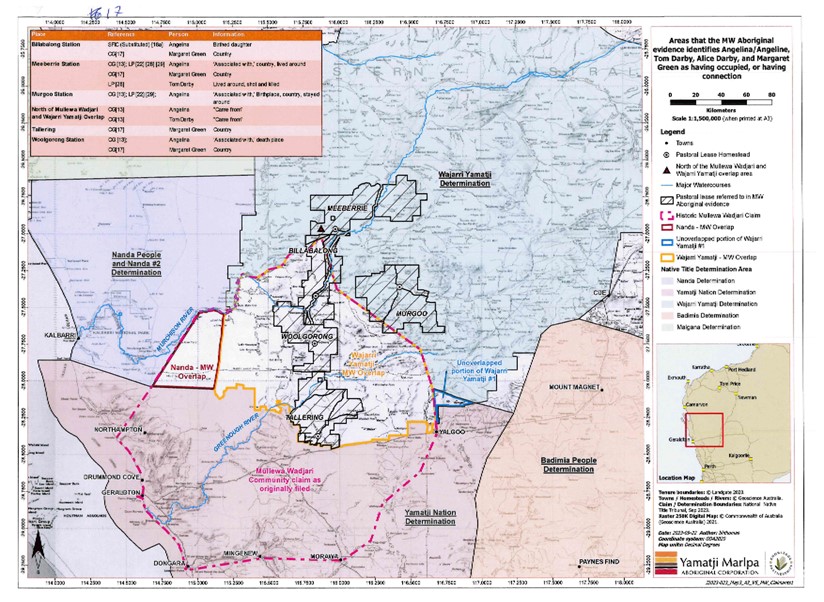
Map 5
243 Fourth, the MW lay witnesses described their other ancestors or themselves as having lived at or having a connection to the following stations or places:
(a)  Berringarra;
(b) Billabalong;
(c) Boolardy;
(d) Kimberley;
(e) Meeberrie;
(f) Moora;
(g) Mount Horner;
(h) Mount Narryer;
(i) Mullewa;
(j) Murgoo;
(k) Pine Grove;
(l) Tallering;
(m) Woolgorong; and
(n) Wooramel.
244 The N&WY applicants submitted that none of those places, except for the southern end of Coolcalalaya Station, fall within the Nanda Overlap area and the MW applicant did not contend otherwise. Having reviewed “CAM 18” to the second McKellar affidavit, “CAM 20” to the second McKellar affidavit, “CAM 21” to the second McKellar affidavit and Map 12 of the Kenny Report I proceed on the basis that, except for part of Coolcalalaya Station, none of the places the MW lay witnesses described their ancestors, or themselves as having lived at or having a connection with fall within the Nanda Overlap Area. They are either:
(a) in the WY Overlap Area, and well east of the Nanda Overlap Area;
(b) in the area recognised as Wajarri Yamatji country in determinations made in relation to areas to the north of the WY Overlap Area (and well north-east of the Nanda Overlap Area);
(c) in the Yamatji Nation determination area, well south-east of the Nanda Overlap Area; or
(d) in other places well north of the Nanda Overlap Area, such as Wooramel Station which lies on the northern boundary of the Malgana Part A determination.
245 Reproduced below is annexure “CAM 20” to the second McKellar affidavit. This is the same as Map 5 above, except that it plots the location of many of the places that the MW applicant’s lay witnesses say that they lived at or are connected to, overlaid on the WY Overlap and Nanda Overlap Areas. None of those locations are in the Nanda Overlap Area.
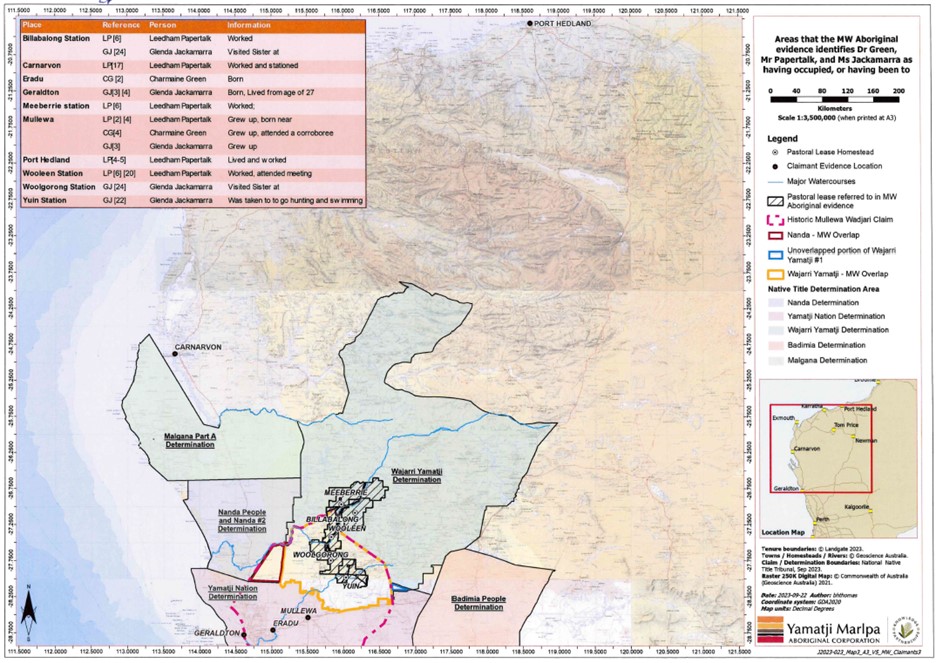
Map 6
246 Reproduced below is also annexure “CAM 21” to the second McKellar affidavit, being a map which depicts some places (not plotted on Map 6 above) which the MW applicant’s lay witnesses said that they lived at or are connected to such as Wooramel, Beringarra, Boolardy, and Mount Narryer Stations. Again, none of those places are in the Nanda Overlap Area.
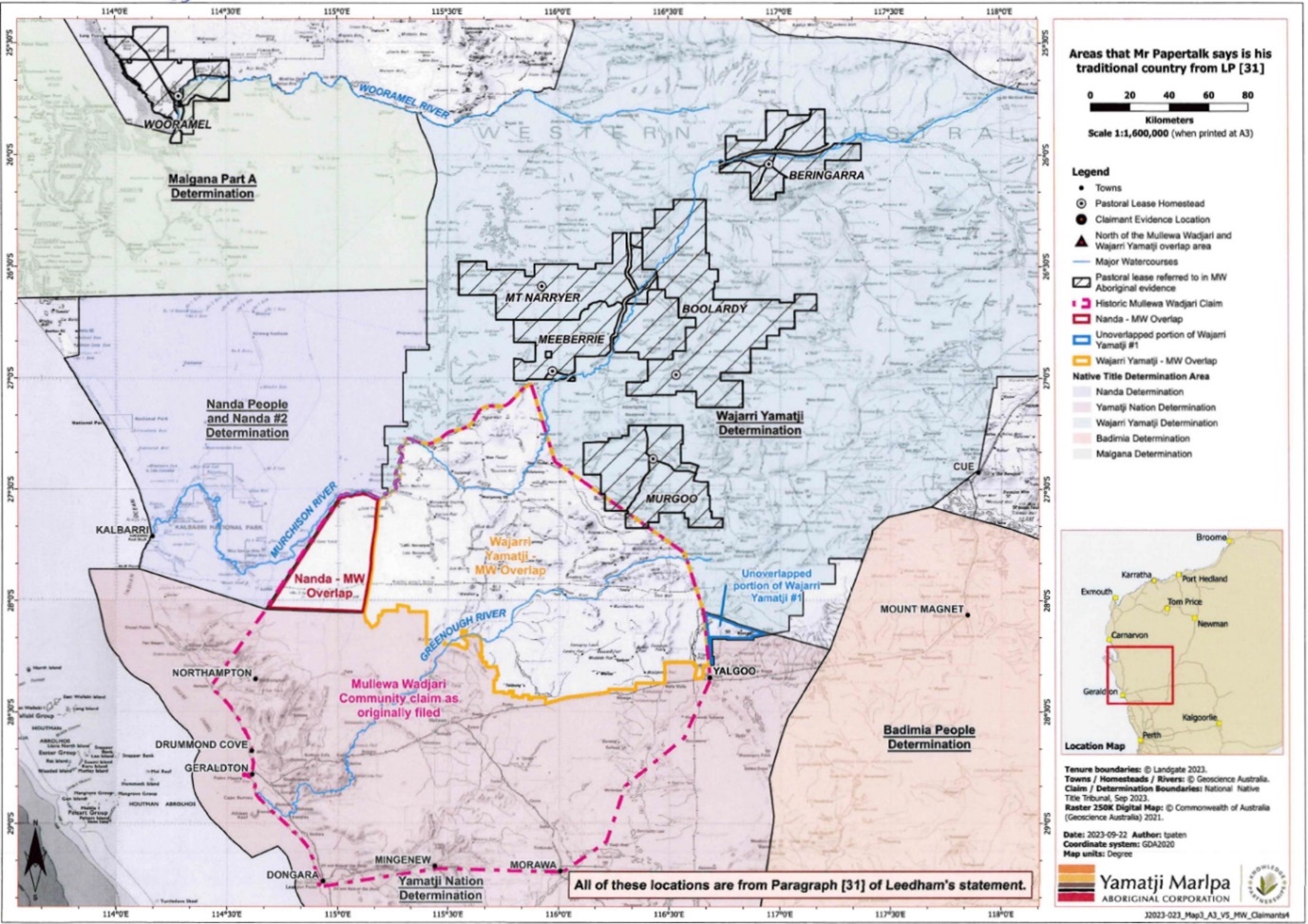
Map 7
247 For completeness I also reproduce below “Map 12” from the Kenny Report which shows the WY Overlap Area and the Nanda Overlap Area overlayed with the location of most of the stations referred to by the MW applicant’s lay witnesses, including Coolcalalaya Station.
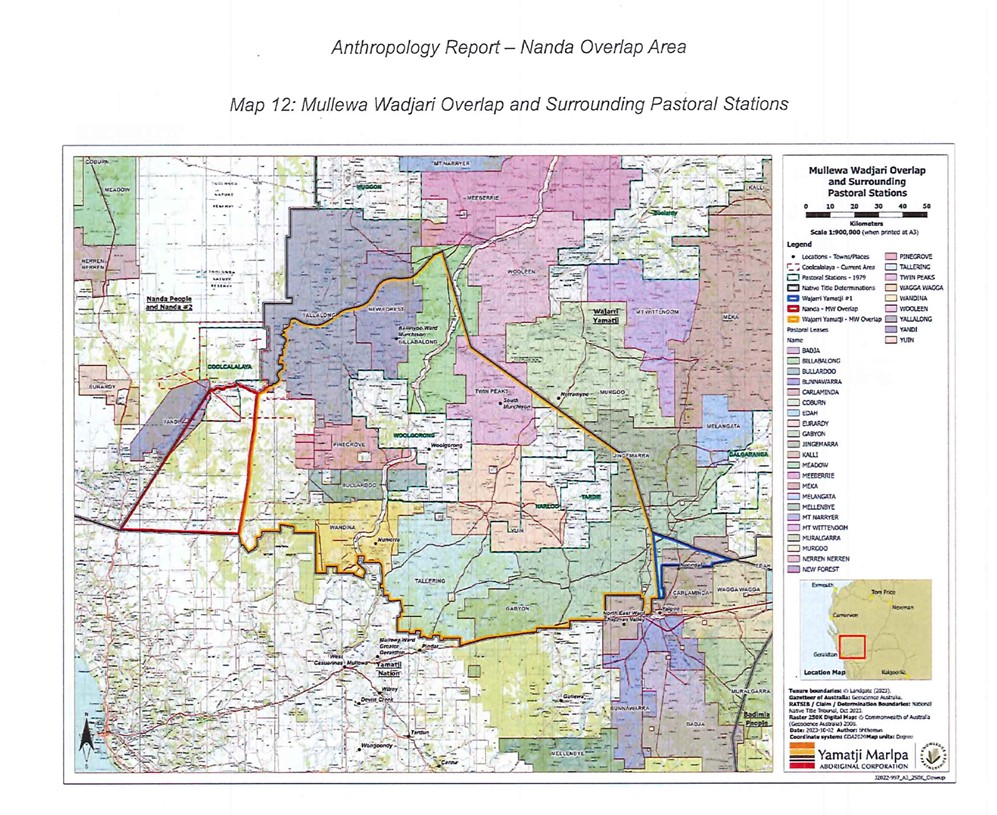
248 Fifth, the highest the MW lay witness statements rise in relation to the Nanda Overlap Area is that:
(a) Dr Green said that:
(i) she was told by her mother that the Nanda Overlap Area is Thawarda Wajarri country;
(ii) the Nanda Overlap Area relates to Thawarda Wajarri men’s law business and initiation rights, and she was told that there are Wajarri men’s sites in that area, which, as a woman, she has limited knowledge of; and
(iii) she was told by her family that the Nanda people do not have initiation rights and do not conduct law business in the Nanda Overlap Area.
She also made a conclusory statement that Thawarda Wajarri country extends to the Murchison River, but did not explain the basis for that opinion.
(b) Mr Papertalk said that:
(i) Nanda country lies to the west side of the Murchison River, and the Nanda are coastal people;
(ii) his father taught him that there is a change of culture and rituals at the Murchison River;
(iii) the old people told him that Thawarda country includes Meeberrie, Billabalong, Yallalong and Coolcalalaya Station, Twin Peaks and Yuin;
(iv) he was told by the old people that Angelina was on “that country” with Alice Darby, Jack Darby and her son-in-law Ned Papertalk, but the white man never recorded them being there; and
(c) Ms Jackamarra said that “[t]he old people used to take us out and show us our country, including my late uncle Doug Comeagain (DC). Our country is from around Coolacalalaya Station and goes east up to the Murchison River. They told us that country is the Tharwarda Wajarri country” (at 34]).
249 The most significant of those statements is Dr Green’s statement that she was told that the Nanda Overlap Area relates to Thawarda Wajarri men’s law business and initiation rights, and that there are Wajarri men’s sites in that area, of which, as a woman, she has limited knowledge. In my view it is appropriate to accord that evidence little weight when:
(a) Dr Green accepted that as women she had limited knowledge about such sites, and the same must apply to her mother who told her some of that;
(b) Knowledge of the location of Nanda ceremonial sites lies with Nanda people, not Dr Green’s family members; and
(c) Mr Papertalk, who is a senior Mullewa Wadjari law man, and the person with knowledge and responsibility for any Wajarri ceremonial sites on the Nanda Overlap Area said nothing about any such sites. Again, it is appropriate to infer that Mr Papertalk’s witness statement represents the best evidence he could give in relation to the connection of the MW group to the Nanda Overlap Area. I infer that, if there are no Nanda ceremonial sites on the Nanda Overlap Area, or more importantly if there are Wajarri ceremonial sites on the Nanda Overlap Area, he would have specifically said so.
250 Mr Papertalk’s statement that he attended men’s ceremonies on Wajarri country is too imprecise to assist the MW applicant in relation to the Nanda Overlap Area. Again, it is appropriate to infer that Mr Papertalk’s witness statement represents the best evidence that he could give in relation to the Nanda Overlap Area, and he did not state that he attended men’s ceremonies on that area. I infer that if he had carried out men’s ceremonies on the Nanda Overlap Area he would have specifically said so.
251 Mr Papertalk said that Wajarri country is “located east of the circumcision line, and runs eastward along the Greenough and Murchison Rivers and stops as far east of Yalgoo.” However, it appears from the Kenny Report that the circumcision line moved over time and did not always follow that line. That may explain why none of the MW lay witnesses said that they or their MW ancestors belonged to, lived at, or even visited the Nanda Overlap Area.
252 I understand Mr Papertalk’s reference to Angelina and Alice Darby (amongst others) being on “that country” as a reference to Thawarda country generally, not to the Nanda Overlap Area. I say that because:
(a) the preceding paragraphs of Mr Papertalk’s witness statement (at [40]-[42]) referred to the boundary between Thawarda Wajarri country and Nanda country at the Murchison River, and the following paragraphs deal with Thawarda Wajarri country more generally;
(b) Mr Papertalk specifically said that Angelina spent time at and was connected to Meeberrie and Murgoo Stations (which are well outside the Nanda Overlap Area). If he was able to say that Angelina lived on or had a connection to the Nanda Overlap Area I infer that he would have specifically said so; and
(c) to understand the reference to “that country” as indicating that Angelina lived on the Nanda Overlap Area would be inconsistent with Mr Papertalk’s other evidence (and that of Dr Green) who said that Angelina came from north of the WY Overlap Area, and was associated with the areas around Murgoo, Meeberrie and Woolgorong Stations (all of which are outside the Nanda Overlap Area).
253 Considered in the context of the overarching matters to which I earlier referred Dr Green’s and Mr Papertalk’s evidence does not give rise to the level of showing that there are specific factual and legal issues which can only be decided following a trial.
9.5.3 Conclusion on Nanda Issue 1
254 Again, the N&WY applicants established a prima facie case in support of summary judgment on Nanda Issue 1, and the onus shifted to the MW applicant to point to some specific factual or legal issue which made a trial necessary. It failed to do so. The Court’s task is to make a practical judgement as to whether the MW applicant has reasonable prospects of success on Nanda Issue 1, and I am well-satisfied that it does not.
255 The N&WY applicants’ application for summary judgment on Nanda Issue 1 has been allowed, and judgment should be given against the MW applicant in relation to the issue.
10. Nanda Issue 3 – the WY continuity question
256 Nanda Issue 3 only arises if the MW applicant is successful on Nanda Issue 1, and it is therefore strictly unnecessary to decide. But the issue was argued and, having regard to the possibility of an appeal, it is appropriate to set out my findings in relation to it.
257 The N&WY applicants had the onus to establish that the MW applicant has no reasonable prospect of successfully prosecuting its case in relation to Nanda Issue 3, which is as follows:
If the answer to Nanda Issue 1 is “yes”, have the WY People continued to acknowledge and observe, substantially uninterrupted from sovereignty to the present day, their traditional laws and customs such that they have rights and interests in, and a traditional connection to, the land and waters of the Nanda Area?
10.1 The pleadings
258 The MW SSFIC alleges as follows:
[20] The MW Applicant says that since the date of effective sovereignty, the ancestors of the MW claimants and their descendants, as members of a Wajarri Society, have continuously asserted that the Nanda Overlap Area is part of the country to which the ancestors of the MW Claimants belong, have observed their entitlement to exercise exclusive rights and interests in the Nanda Overlap Area pursuant to the system of traditional laws and customs that determines who belongs to it, and have recognised their obligation under traditional law and custom to look after that country and preserve it for future generations.
259 The MW F&BP provides the following further particulars:
[1] As to paragraph [2] of the Substituted Statement of Facts, Issues and Contentions (SSOFIC) filed on 31 January 2023, the facts forming the basis for a determination of native title rights and interests of the MW Claim group in the MW Claim area are set out in Schedules A, E and F of the Form 1 filed on 7 January 1999 and comprise:
…
(e) The MW native title claim group, their parents, grandparents and ancestors have, as far back as living memory and recorded history go, used, occupied and enjoyed the whole of the area claimed in this application, held close ties to the land, maintained Aboriginal traditional law and retained their cultural heritage and spiritual connection with their sacred sites, continued to carry out hunting and fishing and collected bush medicines, ochres and all useful products of the land. They continue to ensure that they control access to and thereby protect their sacred areas. Specifically:
• They continue to occupy and live on the land in a traditional manner;
• They participate in managing the land and protecting it from degradation;
• They continue to hold meetings and perform traditional ceremonies on the land;
• They continue to camp, hunt, fish, gather bush tucker, medicines and building materials, and also gather material so make tools and other utensils;
• They continue to use, maintain and care for the water resources of the land;
• They continue to dig for stones, ochres and other minerals on the land;
• They continue to protect the sacred sites and spirituality of the land according to their laws and customs – to this end they conduct, as of right, heritage survey on their land in advance of development;
• They continue to protect their heritage and spiritual beliefs against other groups.
…
[13] As to paragraph [20] of the SSOFIC, the ancestors of the MW claimants and their descendants, as members of a Wajarri Society -
(a) have continuously asserted that the Nanda Overlap Area is part of the country to which the ancestors of the MW Claimants belong by their presence in the Nanda Overlap Area, including engaging in the activities associated with daily sustenance, ritual and ceremony and observance and protection of the area, as particularised at sub-paragraph 1(e) above; and
(b) have observed their entitlement to exercise exclusive rights and interests in the Nanda Overlap Area pursuant to the system of tradition laws and customs that determines who belongs to it by their presence in the Nanda Overlap Area, including engaging in the activities associated with daily sustenance, ritual and ceremony and observance and protection of the area, as particularised at sub paragraph 1(e) above.
260 Mr Papertalk said the following:
(a) his father is Eric Papertalk, who was a senior Wajarri law man (at [8]), with the skin name Nullagadji. MW people use skin names that are from the desert, like the Martu mob, and his father would travel up there to attend ceremonies (at [9]-[10]); and
(b) he is a Wajarri man through his paternal great-grandmother, Angelina. Angelina and Tom Darby are the parents of Alice Darby and Jack Darby. His father’s parents are Alice Darby and Ned Papertalk and his maternal uncle is Jack Darby. Tom Darby was a senior Wajarri law man, Jack Darby was a senior Wajarri law man, his father was a senior Wajarri law man (at [8]), and he is a MW elder and senior Wajarri law man (at [21], [25]-[26], [51]).
261 He also said:
Traditional Law and Custom
[50] I went through the law as a young man.
[51] I am a Mullewa Wadjari elder and a Senior Wajarri law man.
[52] I have authority to speak for Mullewa Wadjari country and that authority was passed down to me from my father and elder brother.
[53] My birth totem is a snake (bimara). I also have the Eagle (walga) and the Dog (doothu) totems. Totems are passed down to provide you with protection.
…
[56] As an elder and Senior law man, I have a cultural and spiritual obligation to ensure that everyone included in the Mullewa Wadjari claim has been acknowledged as having a connection to the Mullewa Wadjari claim area, and that they are recognised.
[57] 1 would be breaking our laws and customs if I did not defend their connection to country in court. The old people made that claim for a reason.
[58] The old people put down the boundaries of the Mullewa Wadjari claim area, I would be breaking our law if I changed those boundaries. If I break the law, there could be consequences for me, and I could get very sick.
[59] I attend the men's ceremonies on Wajarri country and in the Pilbara.
[60] I know of the women's ceremonies but I cannot talk about them.
[61] I was told by the old people that when my grandfather, Mindalu, knew that his time was coming, before he passed away he called a big meeting with all the senior law people, the family and neighboring tribes and he passed down that country to my father.
262 Dr Green said:
(a) her late uncle, Eric Papertalk (EP), was an initiated Wajarri man who spoke for the MW country and drew the original claim boundaries (at [5]);
(b) her mother was a senior Wajarri woman, whose traditional Wajarri name was Kurni/Kooni (at [12]), and her maternal grandmother was Alice Darby, the daughter of Angelina and Tom Darby (at [13]); and
(c) her mother’s father was Ned Papertalk who had gone through Wajarri law and had been given Alice Darby as his wife.
263 She also said:
[27] The Nanda overlap area is an area relates to Tharwarda Wajarri men’s law business and initiation rights. I was told that there are Wajarri men’s sites in the Nanda overlap area, and as women, we have limited knowledge of those sites.
[28] We were taught that women are not allowed to go to men’s sites, and men are not allowed to go to women’s sites.
[29] As a senior lawman, Uncle EP, had the highest cultural knowledge to the Mullewa Wadjari claim area.
[30] Uncle EP had the right to practice ceremonies and take resources from the land, such as food.
[31] I was told by the old people that EP closed the Wajarri law grounds.
[32] Having initiation and ceremonial rights does not give you land owning rights, but it gives you the right to speak for that country.
[33] The Wajarri did not conduct cultural activities in isolation, they moved around the area. Any cultural and spiritual activity that is conducted in a particular area determines a Wajarri person’s relationship to that area.
…
[38] The old people told me that Joe Marlow (JM) and Jack Darby (JD) were Tharwarda men. I was also told that JD was a mabran man, which means medicine man.
Traditional Law and Custom
[39] When I was a young girl, I remember attending the last corroboree held at the Mullewa reserve in 1977. It was a big ceremony for the young boys that came back as men after going through the law. I remember all the old Wajarri men and women were there, and they were all dancing. It was the last corroboree to ever take place.
[40] My mother’s totem was the Ant hill. Munggu is the Wajarri word for the Ant hill. Our mother taught us that she could not look at it and to avoid it if she ever passed one while out on country. We were told to do the same in respect to mothers totem.
[41] My mother’s skin group was Milangka. A Milangka person cannot marry a Milangka person – that is considered marrying the wrong way.
[42] There are 4 skin group names: Baljari (Banaga), Burrugurlu (Milangka), Burungu, and Garimarra.
[43] Wajarri people used to practice marriages using skin groups, but they are not as commonly used now days like the old people did many years ago. In the old days, the old people would also engage in wife swapping.
264 Ms Jackamarra said:
Traditional Law and Custom
[36] 1 remember going to corroborees at the Mullewa Reserve when I was a little girl. I remember all the men and women would dance. They were Wajarri corroborees for the men that returned from being at the ceremony camps out on country. They would come back there and would do corroborees.
[37] There used to be ceremony camps, but all the Wajarri law grounds were closed down about 30 to 40 years ago.
[38] Back in the old days, a Wajarri person could only go through Wajarri law. Initiation practices were for both men and women.
265 In relation to the locations that contemporary MW people have lived at or visited the MW lay witnesses said the following:
(a) Dr Green said:
(i) she was born in Eradu (at [6]);
(ii) she grew up around Mullewa (at [11]);
(iii) she grew up visiting her mother’s country which was around Tallering, Woolgorong, Meeberrie and Billabalong Stations (at [17] and [20]); and
(iv) she attended a corroboree at Mullewa Reserve when she was young girl (at [39]);
(b) Mr Papertalk said:
(i) he was born and grew up near Mullewa (at [2] and [4]);
(ii) when he was about 14 years old, he moved from Mullewa and lived all around the Pilbara region, but mainly in Port Hedland, and he also worked at Mount Newman (at [4] and [5]);
(iii) in 1982 he lived and worked at Meerberrie, Wooleen, and Billabalong Stations (at [6]);
(iv) he lived and worked in Carnarvon (at [17]);
(v) his traditional country is around Murgoo, Boolardy, Berringarra, Mount Narryer, Wooramel and Meeberrie Stations (at [31]); and
(vi) he attends men’s ceremonies on Wajarri country and in the Pilbara (at ([59]), and that he knows of women’s ceremonies but cannot speak of them (at [60]);
(c) Ms Jackamarra said:
(i) she was born in Geraldton, but grew up in Mullewa, and she has lived in Geraldton since she was 27 (at [3] and [4]);
(ii) she was taken to areas on Wajarri country from a very young age by her maternal uncle and aunts, older sister and parents, including to areas around Yuin (at [21]-[22]), and up to the country around the Murchison River (at [23]);
(iii) she follows her mother’s, maternal grandmother’s and maternal great-grandmother’s country, which is around Mullewa (at [25]-[28]) and includes Pine Grove (at [29]);
(iv) she went to corroborees at the Mullewa Reserve when she was a little girl (at [36]); and
(v) her sister, Wendy, worked up and around Woolgorong and Billabalong Stations (at [24]).
10.3 The expert evidence
266 The N&WY applicants did not rely upon the Barber Report except to submit that it provided no geographically specific description of MW individuals or Wajarri ancestors being present in the Nanda Overlap Area or continuing to acknowledge and observe, substantially uninterrupted from sovereignty to the present day, their traditional laws and customs on or in relation to the Nanda Overlap Area. Nor did the MW applicant rely upon the Barber Report.
10.4 The Mullewa Wadjari submissions on Nanda Issue 3
267 In its written submissions the MW applicant said little in relation to Nanda Issue 3. Then, in oral submissions, it said that it relied on the same evidence and submissions as it did in relation to Nanda Issue 1. It is unnecessary to set out those submissions again.
268 The MW applicant made what Senior Counsel described as a “global” submission regarding the MW group’s ancestral connection to the Nanda Overlap Area at sovereignty, the continuity of their acknowledgment and observance of traditional laws and customs in relation to the Nanda Overlap Area, and the extent of WY country. It submitted that the issue is not whether the MW group are a separate Aboriginal society who hold a separate set of laws and customs which they continue to follow, but whether they follow traditional laws and customs which are consistent with those of the Wajarri People of whom they are a part.
269 The MW applicant contended that its lay witness statements show continuity of acknowledgement and observance of a system of Wajarri traditional laws and customs in relation to the Nanda Overlap Area by successive generations of the Wajarri people. On its argument, that can be seen in the lay evidence as to what they were told by their ancestors who spoke about the Nanda Overlap Area and the broader MW claim area, and by their connection with the Nanda Overlap Area (together with the connection of their ancestors) in accordance with customary laws and traditions, including through ceremonies which they attended or which they were told about by their elders, which recognise the spirit beings of the Dreamings (particularly the Bimara) that are connected with the MW claim area.
270 The MW applicant denied that the MW applicant’s case on Nanda Issue 3 was an attempt to extend the territory of the native title rights and interests held communally by the WY People, which required it to demonstrate that the community of WY people, as a whole, has continued to acknowledge and observe traditional Wajarri laws and customs which give rise to native title rights and interests in the Nanda Overlap Area.
271 Rather, it contended that Dr Green and Mr Papertalk, as Wajarri people descended from Angelina and Alice Darby, expressed their view as to the continuity of acknowledgement and observance of Wajarri traditional laws and customs, and said that their views may be found by the Court to be objectively correct. It submitted that the Court must decide on the evidence at trial whether, objectively, the MW lay witnesses’ assertion that they have continued to acknowledge and observe, substantially uninterrupted from sovereignty to the present day, their traditional laws and customs in relation to the Nanda Overlap Area should be accepted. It argued that the issue of continuity of observance and acknowledgement of traditional laws and customs in relation to the Nanda Overlap Area involves contested issues of fact which should not be decided by way of summary judgment.
10.5 Consideration
272 To establish that the MW applicant has no reasonable prospect of succeeding on Nanda Issue 3, the N&WY applicants again relied on the MW lay witness statements. In opposing the application, the MW applicant relied upon the same statements and on parts of the Kenny Report.
273 If, contrary to my view, the answer to Nanda Issue 1 is “yes”, the N&WY applicants established that the MW applicant does not have reasonable prospects of proving its case on Nanda Issue 3.
10.5.1 Overarching matters
274 Several overarching matters are significant to that conclusion.
275 First, as I have said, the WY People (as defined) disavowed any claim that WY country extends over the Nanda Overlap Area, and denied that, substantially uninterrupted from sovereignty to the present day, they have continued to acknowledge and observe their traditional laws and customs such that they have rights and interests in, and a traditional connection to, the land and waters of the Nanda Overlap Area. The MW applicant acknowledged that there is evidence to support that proposition and accepted that it will have the onus to establish an affirmative answer to Nanda Issue 3 in the Separate Questions hearing.
276 The MW applicant did not contend that, since sovereignty, the MW group have separately continued to acknowledge and observe WY traditional laws and customs in relation to the Nanda Overlap Area; rather it submitted that the MW group have done so as part of the WY People. However, as I have said, the WY People expressly disavowed that since sovereignty they have continued to acknowledge and observe their traditional laws and customs in relation to the Nanda Overlap Area.
277 The MW applicant seek to rely upon the WY evidence and admissions in the SAID as to their continuity of acknowledgement and observance of WY traditional laws and customs, but to depart from that by arguing that such acknowledgement and observance related to a different and larger country than the WY People themselves say their acknowledgement and observance related to.
278 That is a substantial hurdle for the MW applicant to overcome. It is difficult to see how the MW applicant can establish that, from sovereignty to the present day, the WY People have continued to acknowledge and observe their traditional rights and customs in relation to the Nanda Overlap Area when the WY People deny that they have done so.
279 I can accept that it is not conceptually impossible for a minority group (here, the MW group) within a larger Aboriginal society (here, the WY People) to prove that their continued acknowledgement and observance of traditional laws and customs in relation to an internally disputed part of a claim area gives rise to rights and interests in relation to a part which is disputed by the majority. But as explained in De Rose v State of South Australia (No 2) [2005] FCAFC 110; 145 FCR 290 at [58] (Wilcox, Sackville and Merkel JJ):
…s 223(1)(a) of the NTA requires a native title claimant community or group to establish that they have rights and interests possessed under the traditional laws acknowledged and the traditional customs observed by that community or group. This proposition does not mean, however, that a claim to communal or group native title rights and interests can succeed only if every member of the claimant community or group has acknowledged and observed the relevant traditional laws and customs. It is a question of fact and degree as to whether the definition of native title rights and interest in s 223(1) is satisfied. There are likely to be cases in which a claim by a community or group succeeds notwithstanding that not all members of the community or group have acknowledged and observed traditional laws and customs. In such cases the question is likely to be whether the community or group, as a whole, has sufficiently acknowledged and observed the relevant traditional laws and customs.
(Emphasis added.)
280 Here, there is no evidence to show that the WY People as a whole have, substantially uninterrupted from sovereignty to the present day, continued to acknowledge and observe their traditional laws and customs such that they have rights and interests in the lands and waters of the Nanda Overlap Area. Instead the evidence shows that the WY People as a whole have not done so.
281 Second, and relatedly, as I have said the MW applicant did not contend that, since sovereignty, the MW group have separately continued to acknowledge and observe WY traditional laws and customs in relation to the Nanda Overlap Area; rather it submitted that the MW group have done so as part of the WY People. It also submitted that the WY People is comprised of the WY native title claim group as defined in the WY Consent Minute plus one or more of Jack Comeagain Snr, Fanny Taylor and Lottie Hannah.
282 However I have found the evidence insufficient to establish that Jack Comeagain Snr, Fanny Taylor or Lottie Hannah were members of the WY People, and therefore their descendants are not WY People unless they can trace ancestry through an apical ancestor identified in the WY Consent Minute. On the basis that the contemporary descendants of Jack Comeagain Snr, Fanny Taylor and Lottie Hannah are not members of the WY People, their evidence (such as it is) of their continued acknowledgement and observance of WY traditional laws and customs in relation to the Nanda Overlap Area is not evidence of continued acknowledgement and observance of traditional laws and customs by the WY People.
283 Third, the MW lay witness evidence (such as it is) directed to show that, substantially uninterrupted from sovereignty to the present day, the WY People have continued to acknowledge and observe their traditional laws and customs in relation to the Nanda Overlap Area falls to be considered in the context that the Nanda People already have the benefit of determinations in areas immediately adjacent to the Nanda Overlap Area. As a result many of the facts relating to Nanda traditional laws and customs, “society” and “continuity” that must be proven before the Court to recognise the Nanda People as holding native title in the Nanda Overlap Area have already been found to exist, albeit not specifically in relation to that area. Evidence of the facts upon which those determinations were made are not in dispute, and therefore do not need to be the subject of evidence in these proceedings. The MW applicant accepted that those determinations provide a basis for recognition by the Court of facts relating to the laws and customs of the Nanda society, the existence of the Nanda society, and the continuity of the rights and interests of the members of that society.
284 The position of the MW applicant is quite different. The MW applicant did not contend that the MW group continued to acknowledge and observe traditional laws and customs as a separate Aboriginal society with rights and interests in the Nanda Overlap Area. They contended that they did so as part of the WY People. However, the WY People deny that they did so and the evidence indicates that the contemporary descendants of Jack Comeagain Snr, Fanny Taylor and Lottie Hannah are not members of the WY People unless they can trace ancestry through an apical ancestor identified in the WY Consent Minute.
285 The MW applicant will be required to establish each of the requirements identified in Members of Yorta Yorta Aboriginal Community v Victoria [2002] HCA 58; 214 CLR 422, helpfully summarised in Lovett on behalf of the Gunditjmara People and Others v Victoria (No 5) [2011] FCA 932 at [22] (North J), as follows:
… In summary those requirements are that there was, at sovereignty, a body of persons united in their acknowledgment and observance of a body of laws and customs, who held rights and interests in land and waters pursuant to those laws and customs, and by which they were connected to the land and waters. The group must have maintained its identity and its connection with the land and waters, and must continue to acknowledge the laws and observe the customs substantially uninterrupted, from sovereignty to the present.
286 Fourth, the MW lay witness evidence falls to be considered in the context that all the participating parties except the MW applicant, have agreed to the Nanda Consent Minute which seeks a determination that the Nanda People hold native title in relation to the Nanda Overlap Area. All other participating parties accept that since sovereignty the Nanda People, rather than the WY People, have continued to acknowledge and observe their traditional laws and customs in relation to that area.
10.5.2 Specific matters
287 Considered in the context of those overarching matters, the MW applicant’s evidence does not rise to the level of showing that there are specific factual or evidentiary issues relevant to Nanda Issue 3 which make a trial of the proceeding necessary.
288 First, the MW applicant’s pleaded case is that Angelina and Alice Darby belonged to or were connected to the Nanda Overlap Area at sovereignty and that, substantially uninterrupted from sovereignty to the present day, successive generations of the Wajarri people have continued to observe and acknowledge WY traditional laws and customs in relation to the Nanda Overlap Area. Yet, as I explained in relation to Nanda Issue 1, the MW applicant did not adduce probative lay or expert evidence to establish that Angelina and Alice Darby belonged to or were connected to the Nanda Overlap Area. Its argument as to continuity of connection to the Nanda Overlap Area falls at the first hurdle.
289 Second, the MW applicant’s pleadings allege that, substantially uninterrupted since sovereignty, successive generations of the Wajarri people maintained their traditional law and customs and their connection with the Nanda Overlap Area, by continuing to:
(a) occupy and live on the land in a traditional manner;
(b) participate in managing the land and protecting it from degradation;
(c) hold meetings and perform traditional ceremonies on the land;
(d) camp, hunt, fish, gather bush tucker, medicines and building materials, and also gather material to make tools and other utensils;
(e) use, maintain and care for the water resources of the land;
(f) dig for stones, ochres and other minerals on the land;
(g) protect the sacred sites and spirituality of the land according to their laws and customs, including by conducting heritage surveys in advance of development; and
(h) protect their heritage and spiritual beliefs against other groups.
290 Yet none of its lay witnesses said that they or their (asserted) Wajarri ancestors:
(a) lived on the Nanda Overlap Area;
(b) participated in managing the land in the Nanda Overlap Area and protected it from degradation;
(c) held meetings and performed traditional ceremonies on Nanda Overlap Area;
(d) camped, hunted, fished, gathered bush tucker, medicines and building materials, or gathered materials to make tools and other utensils on the Nanda Overlap Area;
(e) dug for stones, ochres and other minerals on the Nanda Overlap Area; or
(f) continued to protect the sacred sites and spirituality of the land according to their laws and customs, including by conducting heritage surveys in advance of development on the Nanda Overlap Area.
Their evidence as to their traditional activities related to the MW claim area in general, and not specifically to the Nanda Overlap Area.
291 Further, as I have said, all of the places where Dr Green, Mr Papertalk and Ms Jackamarra said that they and their asserted Wajarri ancestors lived, worked or visited are outside the Nanda Overlap Area. I infer that their witness statements represent the best evidence that they could give, and that if they could have said that they and their Wajarri ancestors had, substantially uninterrupted since sovereignty, continued to undertake traditional activities on the Nanda Overlap Area they would have specifically said so.
292 Third, and relatedly, as explained by the Full Court in Bodney v Bennell [2008] FCAFC 63; 167 FCR 84 at [179] (Finn, Sundberg and Mansfield), where it is in issue whether connection has been maintained to a particular part of a claim area, it is indispensable:
…(i) to examine [the] traditional laws and customs for s 223(1)(b) purposes as they relate to that area, and (ii) to demonstrate that connection to that area has, in reality, been substantially maintained since the time of sovereignty.
(Emphasis in original).
: see also Bodney at [186]-[187]). Here the MW applicant adduced little evidence directed specifically to the Nanda Overlap Area.
293 To establish that the WY People have continued to acknowledge and observe WY traditional law and customs in relation to the Nanda Overlap Area, it was necessary for the MW applicant to put on probative evidence about their acknowledgement and observance of traditional laws and customs in relation to that area. It was not sufficient for it to merely put on such evidence about the broader MW claim area. The Nanda Overlap Area is a relatively small area, well known to the parties, and despite that the MW lay witnesses did not provide probative evidence that they or any other MW ancestor acknowledged or observed traditional laws and customs specifically in relation to the Nanda Overlap Area. They spoke only of the MW claim area generally.
294 Mr Papertalk is a senior Wajarri law man who claimed to have cultural and spiritual responsibility for the MW claim area, and he spoke of a series of Wajarri senior law men who preceded him. For the purposes of the application that evidence must be accepted and in my view that is some evidence of continued observance and acknowledgement of traditional Wajarri laws and customs. But it begs the question as to what area or areas such acknowledgment and observance related to.
295 Mr Papertalk said (at [59]-[60]) that he attended “men’s ceremonies on Wajarri country and in the Pilbara”, and that he knew of “women’s ceremonies” but cannot talk about them. For the purposes of the application that evidence must be accepted, but his involvement in men’s ceremonies on Wajarri country and the Pilbara does not show that he was involved in such ceremonies in relation to the Nanda Overlap Area. Mr Papertalk did not state that traditional Wajarri men’s ceremonies took place on the Nanda Overlap Area, nor that he attended any ceremonies on that area, nor that any of the senior Wajarri law men that preceded him had done so. It is appropriate to infer that his witness statement represents the best evidence that Mr Papertalk could give, and that if he could say that he attended men’s ceremonies on the Nanda Overlap Area, or that preceding generations of Wajarri law men had done so, he would have said that.
296 Nor does Mr Papertalk’s statement that he knew of women’s ceremonies on the MW claim area assist in establishing continuity of acknowledgement and observance by the WY people of traditional laws and customs in relation to the Nanda Overlap Area. His statement related to the MW claim area more generally. Again, it is appropriate to infer that if he could have said that he knew of women’s ceremonies in relation to the Nanda Overlap Area he would have said that. Further, and importantly, none of the female MW lay witnesses said that they, or any other MW woman they identified, undertook activities such as attending women’s ceremonies on the Nanda Overlap Area, or protecting sacred sites or conducting heritage surveys on that area. It is appropriate to infer that if they could have said that they had attended women’s ceremonies on that area, or that any other MW woman they could identify had done so, they would have said that.
297 The body of the Barber Report and the “general findings” said nothing geographically specific in relation to continued acknowledgement and observance of traditional laws and customs in relation to the Nanda Overlap Area. Mr Barber’s opinions in Chapter V - Ceremonies and Rituals, under the sub-heading Secular and Religious Leadership, regarding the continuity of observance and acknowledgment of traditional laws and customs by the Wajarri people are no more geographically specific than references to that having occurred “in”, “within and around” or “within the vicinity of” the MW claim area.
298 Then, in Question (t)(i)(A) Mr Barber was asked the following:
Have the Wajarri Yamatji People continued to acknowledge and observe, substantially uninterrupted from sovereignty to the present day, their traditional laws and customs such that they have rights and interests in, and a traditional connection to, the land and waters of the Nanda Overlap Area?
Answer:
The genealogical and ethnographic information provided by the Mullewa Wadjari (Thagarda) suggests that the Wajarri language group held rights and interests in the land and waters of the Mullewa Wadjari/ Nanda Overlap Area and continue to do so.
299 As previously explained in relation to Nanda Issue 1, that opinion represented a shift from his earlier general findings that were geographically imprecise and referred only to continued observance and acknowledgement of traditional laws and customs “in”, “within and around” or “within the vicinity of” the MW claim area. The Barber Report did not reveal which of the Claimants provided the information which provided a factual foundation for that opinion, or more what information that person or persons provided, nor did it explain the reason for the shift in his opinion. For the reasons previously explained, the opinion is inadmissible. Further, for the same reasons as in relation to Nanda Issue 1, if (contrary to my view) that opinion is admissible it carries little or no weight.
300 The absence of probative lay evidence as to the continuity of acknowledgment and observance of traditional laws and customs in relation to the Nanda Overlap Area and the absence of admissible expert evidence means that there is no evidence that is capable of demonstrating WY traditional laws and customs as they relate to the Nanda Overlap Area, nor that the connection of the WY People to that area has, in reality, been substantially maintained since the time of sovereignty: Bodney at [179].
301 Fourth, as I have said, the MW applicant sought to “cherry pick” from the Kenny Report by seeking to rely on Dr Kenny’s opinion that, at sovereignty, the Thawarda Wajarri had traditional rights and interests in a narrow riparian zone running along both sides of the Murchison River on the northern boundary of the Nanda Overlap Area, but disregarding her other relevant conclusions. Importantly, Dr Kenny concluded that apart from that limited exception all of the Nanda Overlap Area was exclusively Nanda country at sovereignty. And in relation to that limited exception, she concluded that by succession the Nanda People came to hold exclusive traditional rights and interests in the Nanda Overlap Area as a consequence of terminal demographic decline among the Thawarda Wajarri. There is no expert or lay evidence to contradict that. The “cherry picked” part of Dr Kenny’s opinion does not mean that the evidence gives rise to specific factual or evidentiary issues that can only be decided following a trial.
10.5.3 Conclusion regarding Nanda Issue 3
302 The N&WY applicants established a prima facie case in support of summary judgment on Nanda Issue 3, and the onus shifted to the MW applicant to point to some specific factual or legal issue which make a trial necessary, which the MW applicant failed to do. The Court’s task is to make a practical judgment as to whether the MW applicant has reasonable prospects of success on Nanda Issue 3, and I am satisfied that it does not have reasonable prospects of doing so.
11. Nanda Issue 4 – Extent of WY Rights Question
303 Nanda Issue 4 only arises if the MW applicant is successful on Nanda Issue 3, and it is therefore strictly unnecessary to decide. But the issue was argued, and having regard to the possibility of an appeal, it is appropriate that I set out my findings in relation to it.
304 The N&WY applicants have the onus to establish that the MW applicant has no reasonable prospect of success on Nanda Issue 4, which issue is as follows:
If the answer to Nanda Issue 3 is “yes”, what is the nature and extent of the native title rights and interests in land and waters held by the WY People in the Nanda Area, including with respect to the operation of the NTA ss.47, 47A and/or 47B?
11.1 The pleadings
305 The MW SSFIC alleges as follows:
[21] The MW Applicant says that the native title rights and interests in land and waters held by the WY People (including as amended in accordance with the resolution of WY Issue 1) in the Nanda Area, including with respect to the operation of section 47, 47A and/or 47B of the NTA are as set out in the determination of native title made by the Federal Court on 19 October 2017 in I.S. v State of Western Australia [2017] FCA 1215 (as amended by orders made on 29 July 2021 in Hamlett v State of Western Australia (No 3) [2021] FCA 869).
306 The MW F&BP provides the following further particulars:
[14] As to paragraph [21] of the SSOFIC, it is not alleged that –
(i) there are any pastoral leases in the Nanda Area to which s 47(10(b) of the Native Title Act 1993 (Cth) apply; or
(ii) any occupation by the “WY People” (as defined in [3(b)] of the SSOFIC permits the application of ss 47A-47B of the Native Title Act 1993 (Cth) in respect of the Nanda Overlap Area.
307 None of the parties’ submissions addressed Nanda Issue 4 in any detail. For the reasons expressed in relation to Nanda Issues 1 and 3, I consider the MW applicant failed to adduce probative lay or expert evidence to show that the WY People have native title rights and interests in the Nanda Overlap Area, and therefore failed to adduce probative evidence as to the nature and extent of any such rights and interests. In my view the MW applicant does not have reasonable prospects of successfully prosecuting its case on Nanda Issue 4.
12. Nanda Issue 5 - The authorisation Question
308 Nanda Issue 5 is as follows:
Is the MW Applicant authorised to make the claim that the WY People hold native title rights and interests in the Nanda Area. If not, is an order under section 84D(4) of the NTA appropriate?
309 The N&WY applicants have the onus to establish that the MW applicant has no reasonable prospect of establishing that the MW applicant was not authorised to make a claim in relation to the Nanda Overlap Area.
12.1 The pleadings
310 The MW SSFIC alleges as follows:
[22] The MW Applicant asserts the facts set in Schedule R(2) of the Amended Form 1 Native Title Determination Application WAD 6119/98 filed on 31 January 2007.
311 The MW F&BP provides the following additional particulars:
[15] [T]hat it is authorised to make a claim that the ‘WY People’ (as defined in [3(b)] of the SSOFIC hold native title rights and interests in the Nanda Overlap Area. The facts set out in Schedule R(2) of the Amended Form 1 Native Title Determination Application WAD 6119/98 filed on 31 January 2007 establish that the members of the Mullewa Wadjari Native Title Claim group authorised the continuation of the Native Title Determination Application (WC96/93) WAD 6119/98, endorsing the authorisation of the claim filed on 7 January 1999 by the process described in Schedule R and Attachment R to the Application filed on 7 January 1999.
312 The MW applicant submitted that the MW Application was regularly commenced and authorised. The N&WY applicants submitted that Nanda Issue 5 does not arise for consideration in the summary judgment application, because the issue concerns the procedural regularity of the MW Application and does not relate to the underlying merits of the MW Application. In circumstances where the N&WY applicants do not press for summary judgment on this question, I will not decide the issue.
Conclusion
313 For the reasons set out above, the N&WY applicants established that the MW applicant does not have reasonable prospects of success on WY Issue 1, Nanda Issue 1, Nanda Issue 3, or Nanda Issue 4 in the Separate Questions hearing. I earlier made orders to allow the summary judgment application and to extend the time for any application for leave to appeal. In my view it is now also appropriate to give judgment against the MW applicant on those issues.
314 The parties are directed to confer within 7 days as to the appropriate form of any orders to be made to reflect these reasons, further to the orders made on 20 December 2023. If the parties can agree on the appropriate form of the orders, within 14 days the parties shall forward to my chambers an agreed minute of draft orders. If the parties cannot agree, each party shall forward a proposed minute of draft orders and short submissions (no more than two pages) as to why those orders, rather than the orders proposed by any opposing party, should be made.
I certify that the preceding three hundred and fourteen (314) numbered paragraphs are a true copy of the Reasons for Judgment of the Honourable Justice Murphy. |
Associate:
SCHEDULE OF PARTIES
WAD 21 of 2019 | |
Applicants | |
Applicant | CHARLES COLLARD |
Applicant | CHARLES GREEN |
Applicant | GLENDA JACKAMARRA |
Applicant | KAREN JONES |
Applicant | JAMIE JOSEPH |
Applicant | RAYMOND MERRITT |
Applicant | MALCOLM PAPERTALK |
Respondents | |
Respondent | COMMONWEALTH OF AUSTRALIA |
Respondent | SHIRE OF YALGOO |
Respondent | HUDSON RESOURCES LTD |
Respondent | WARREGO ENERGY 127 PTY LIMITED |
Respondent | TELSTRA CORPORATION LIMITED |
WAD 28 of 2019 | |
Applicants | |
Applicant | ROCHELLE BAUMGARTEN |
Applicant | ROBIN BODDINGTON |
Applicant | ROBERT BUDD |
Applicant | PATRICIA NOLA COUNCILLOR |
Applicant | ANTHONY DANN |
Applicant | GAVIN EGAN |
Applicant | GF (DECEASED) |
Applicant | DAVID JONES |
Applicant | LANCE MONGOO |
Applicant | PAM MONGOO |
Applicant | CARRUM MOURAMBINE |
Applicant | ELIZABETH PAPERTALK |
Applicant | JUNE PEARCE |
Applicant | MAX PRIOR |
Applicant | ARTHUR RYAN |
Applicant | CHARLES SNOWBALL JNR |
Applicant | TS (DECEASED) |
Applicant | DAVID WALGAR |
Respondents | |
Respondent | COMMONWEALTH OF AUSTRALIA |
Respondent | SHIRE OF MEEKATHARRA |
Respondent | SHIRE OF MOUNT MAGNET |
Respondent | SHIRE OF YALGOO |
Respondent | DENNIS COMEAGAIN |
Respondent | MARGRET GREEN |
Respondent | KEN PAPERTALK |
Respondent | YAMATJI MARLPA ABORIGINAL CORPORATION |
Respondent | AILSA LYNETTE ARITI |
Respondent | ROSS VINCE ARITI |
Respondent | BAGDEN PTY LTD |
Respondent | KYLIE ANN BLEECHMORE |
Respondent | TIMOTHY ROY BLEECHMORE |
Respondent | JOANNE MAREE CLEWS |
Respondent | ROSS MONTAGUE COLLINS |
Respondent | GEMMA LEE CRIPPS |
Respondent | HELEN MARGARET CRIPPS |
Respondent | MICHAEL THOMAS CRIPPS |
Respondent | DANIEL GERARD CRONIN |
Respondent | DAIN PTY LTD |
Respondent | KENNETH JAMES DARNELL |
Respondent | FEYSVILLE PTY LTD |
Respondent | EMMA-JANE FOULKES-TAYLOR |
Respondent | H M J FOULKES-TAYLOR |
Respondent | J F FOULKES-TAYLOR |
Respondent | ROSS EDMUND FOULKES-TAYLOR |
Respondent | HAMILTON DEVELOPMENTS VIC |
Respondent | DONALD RAYMOND HAMMARQUIST |
Respondent | DANIEL JOHN HASTIE |
Respondent | JASON GARY HASTIE |
Respondent | JOHN DOUGLAS HAYES |
Respondent | S B HAYES |
Respondent | BARBARA WENDY JACKSON |
Respondent | TOM STALEY JACKSON |
Respondent | JOSEPH MAYNARD JENOUR |
Respondent | LEANNE GAYE JENOUR |
Respondent | LIAM TIMOTHY JOHNS |
Respondent | WILLIAM EDWARD JOHNS |
Respondent | JUDAL PASTORAL CO PTY LTD |
Respondent | KAROO BUSH PTY LTD |
Respondent | KIMBERLY PTY LTD |
Respondent | M KIRKHAM |
Respondent | LASTSTAR INVESTMENTS PTY LTD |
Respondent | LAVER PTY LTD |
Respondent | LOTON INVESTMENTS PTY LTD |
Respondent | CATHERINE ANN MARETT |
Respondent | DAVID JOHN MARETT |
Respondent | SOPHIE IRENE MARETT |
Respondent | DAMIEN CHARLES MCKEOUGH |
Respondent | LEANE ALYS MCKEOUGH |
Respondent | MT AUGUSTUS STATION (1980) PTY LTD |
Respondent | ANGELA MARIE-THERESE MULCAHY |
Respondent | ANTHONY BENEDICT VANDELEUR MULCAHY |
Respondent | CAITLIN VANDELEUR MULCAHY |
Respondent | MICHAEL LAWRENCE VANDELEUR MULCAHY |
Respondent | OAKVILLE NOMINEES PTY LTD |
Respondent | OKU PTY LTD |
Respondent | LESLIE MATTHEW PRICE |
Respondent | JOCELYN CHRISTABEL PUMPA |
Respondent | JOSHUA LEIGH PUMPA |
Respondent | RAINSTAR HOLDINGS PTY LTD |
Respondent | REVIVE NOMINEES PTY LTD |
Respondent | ELLEN CECELIA ROWE |
Respondent | K E SEIVWRIGHT |
Respondent | M V SEIVWRIGHT |
Respondent | SENGHOO AUSTRALIA PTY LTD |
Respondent | BROOKE MARTINA SMITH |
Respondent | DARREN PETER SMITH |
Respondent | SMITH-WRIGHT PTY LTD |
Respondent | M T TRANT |
Respondent | KERRY RAYMOND WARK |
Respondent | MARY SUSANNA WARK |
Respondent | WARREGO ENERGY 127 PTY LIMITED |
Respondent | AMPLITEL PTY LTD |
Respondent | TELSTRA CORPORATION LIMITED |
WAD 32 of 2018 | |
Applicants | |
Applicant | GAVIN EGAN |
Applicant | DAVID JONES |
Applicant | GEOFFREY MONGOO |
Applicant | JUNE PEARCE |
Applicant | ERIC SIMPSON |
Applicant | TS (DECEASED) |
Applicant | DAVID WALGAR |
Respondents | |
Respondent | COMMONWEALTH OF AUSTRALIA |
Respondent | SHIRE OF MURCHISON |
Respondent | WARREGO ENERGY 127 PTY LIMITED |
WAD 611 of 2018 | |
Applicants | |
Applicant | GEOFFREY MONGOO |
Applicant | TS (DECEASED) |
WAD 30 of 2019 | |
Applicants | |
Applicant | COLEEN DRAGE |
Applicant | JOHN STEPHEN DRAGE |
Applicant | STEVEN KELLY (FATHER OF MARRICK KELLY) |
Applicant | STEVEN KELLY (GRANDSON OF CORNELIUS KELLY) |
Applicant | WILLIAM MALLARD (JNR) |
Applicant | WILLIAM MALLARD (SNR) |
Applicant | NORA MALLARD |
Applicant | GWEN MITCHELL |
Applicant | HELEN NUTTER |
Applicant | ANNETTE PEPPER |
Applicant | JR (DECEASED) |
Applicant | MARY TULLOCK |
Applicant | GERALD JOHN WHITBY |
Applicant | LORRAINE WHITBY |
Applicant | JANET WILTON |
Respondents | |
Respondent | YAMATJI MARLPA ABORIGINAL CORPORATION |
Respondent | JAMES MICHAEL DREW |
Respondent | LORETO MARY DREW |
Respondent | GABOR HOLDINGS PTY LTD |
Respondent | WARREGO ENERGY 127 PTY LIMITED |
Respondent | TELSTRA CORPORATION LIMITED |
WAD 176 of 2019 | |
Applicants | |
Applicant | HELEN NUTTER |
Applicant | ANNETTE PEPPER |
Applicant | DOUGLAS RYDER |
Applicant | DELVEEN WHITBY |
Respondents | |
Respondent | WARREGO ENERGY 127 PTY LIMITED |
Respondent | TELSTRA CORPORATION LIMITED |


