

Federal Court of Australia
Harris v State Minister for the State of Queensland [2024] FCA 1059
ORDERS
SARAH C DERRINGTON J | |
DATE OF ORDER: |
THE COURT DETERMINES AND DECLARES THAT:
1. Native title does not exist in relation to the land and waters contained within the lease area that is Lot 4 on Crown Plan SE1 in the State of Queensland in respect of which there is no approved native title determination.
Note: Entry of orders is dealt with in Rule 39.32 of the Federal Court Rules 2011.
[1] | |
[23] | |
[32] | |
[40] | |
[46] | |
[47] | |
[60] | |
[67] | |
[72] | |
[78] | |
[107] | |
[111] | |
Rights and interests held by members of the society under traditional laws and customs | [117] |
[130] | |
[130] | |
[139] | |
[142] | |
[173] | |
Which apical ancestors held rights and interests in the Non-claimant Area? | [179] |
[253] | |
[253] | |
[275] | |
[284] | |
[305] |
SARAH C DERRINGTON J:
1 The applicant, Mr Scott Alexander Harris is the lessee of some 901,000 hectares of land located in the Gulf Country in far north-western Queensland on which he operates the cattle station, Strathmore Station. Strathmore Station is the subject of a term lease which commenced on 1 April 1956 and terminates on 31 March 2049. Mr Harris purchased and took possession of Strathmore Station on 14 November 2004. In May 2014, Mr Harris applied to the Department of Natural Resources and Mines (DNRM), pursuant to s 165 of the Land Act 1994 (Qld), to convert Strathmore Station from a term lease to a perpetual lease. On 25 June 2014, the DNRM made an offer to Mr Harris to seek Governor in Council approval to the issue of a perpetual lease on conditions, including that Mr Harris address the requirements of the Native Title Act 1993 (Cth) (NTA). Relevantly, the letter stated:
Investigations have determined that native title may continue to exist over the land to which this offer applies. The State requires you to address the requirements of the Commonwealth Native Title Act 1993 (NTA) before the State will progress the proposed dealing. The NTA sets out how certain dealings can proceed over land and waters where native title may continue to exist.
That is the reason for this proceeding.
2 By an originating application dated 9 April 2015, Mr Harris seeks a determination under s 13(1), and pursuant to s 61(1), of the NTA, that native title, as defined in s 223 of the NTA, does not exist (the non-claimant application), subject to existing determinations of native title, in the area subject to a pastoral lease described as Tenure Reference PH 34/248 (Lease), being Lot 4 Crown Plan SE1, contained in title reference 17668054 (Non-claimant Area). The Non-claimant Area does not include the entire land subject to the relevant lease, in that it is subject to (and therefore, excludes) extant determinations of native title. The dark dashed line shown on the map below delineates the Non-claimant Area within the area subject to the Lease.
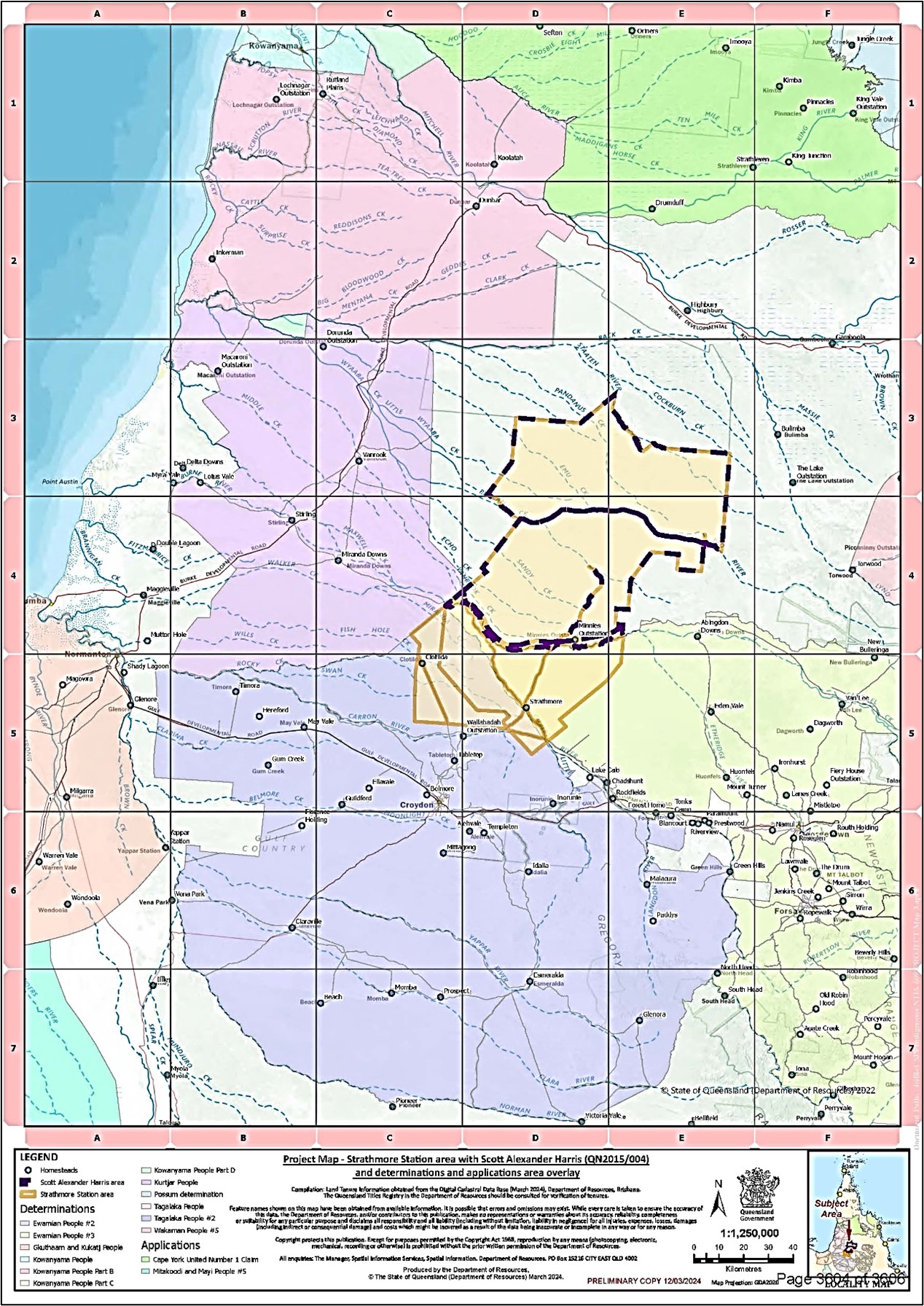
Map showing lease area in broader geographical region with surrounding determinations (Exhibit 9D)
3 The parties tendered a Statement of Facts and Legal Issues Agreed and in Dispute (SOFLI). The material facts relevant to the background and history of the proceedings were deposed to by Mr David Kempton in three affidavits filed respectively on 11 May 2022, 1 July 2022 and 3 August 2022 (together, and respectively, the First, Second and Third Kempton Affidavits). Those background facts include the following.
4 On 17 April 2015, Mr Harris wrote to North Queensland Land Council Native Title Representative Body Aboriginal Corporation (ICN 1996) (NQLC) confirming that he had filed his non-claimant application, and seeking advice as to whether there was any potential native title claimant who may have an interest in the Non-claimant Area and who is in a position to lodge a claim and achieve registration. No response was received from NQLC. On 14 May 2015, the National Native Title Tribunal (NNTT) advised Mr Harris that it was commencing notification of the application.
5 Two determinations of native title, which overlap Strathmore Station, have already been made: Ewamian People #3 Determination (QCD2013/007) and Tagalaka People #2 Determination (QCD2012/013). On 19 May 2015, Mr Harris and his then solicitor, Mr Kempton, attended a joint meeting in Cairns, Queensland, with members of the board of the Ewamiam Aboriginal Corporation (ICN 7950) (EAC) and the Tagalaka Aboriginal Corporation (ICN 2272) (TAC), and their respective advisers, to discuss the requirements of the NTA and seek their support for Mr Harris’ tenure conversion application. On 9 June 2015 and 10 July 2015, respectively, the EAC and the TAC provided letters of support addressed to the Minister for Natural Resources and Mines confirming in principle support for Mr Harris’ application on the understanding that, among other matters, the proposed conversion would not extinguish or require the surrender of native title rights and interests.
6 Subsequently, on 7 August 2015, certain persons on behalf of the Kurtjar People filed a Form 5 – Notice of Intention to Become a Party to an Application. An application for a determination of native title had been filed on behalf of the Kurtjar People on 19 June 2015 over an area which overlapped the north-western edge of Strathmore Station within the Non-claimant Area. Mr Harris was joined as a respondent to that application, by Order of Rangiah J, on 12 September 2016. Ultimately, the Kurtjar applicants sought leave to amend the original claim area on 24 July 2019 and filed an amended application on 2 August 2019 excluding the area of overlap. Consequently, Mr Harris was removed as respondent from that application, by Order of Rares J dated 1 August 2019, and a determination of native title was made by Rares J on 15 October 2021 following a contested hearing: Rainbow on behalf of Kurtjar People v State of Queensland (No 2) [2021] FCA 1251 (Kurtjar People Determination (QCD2022/009)).
7 On 24 February 2022, Mr Harris again wrote to NQLC asking whether it was aware of any persons or groups who might hold native title in the Non-claimant Area. Counterpart letters were sent to the EAC, the TAC, and the Carpentaria Land Council Aboriginal Corporation (ICN 268) (CLCAC), on the same day.
8 By the SOFLI, the parties are agreed that the following native title claims in the vicinity of the Non-claimant Area have been discontinued or amended to exclude overlap with the Non-claimant Area since 1997:
Original Date Filed | Claim Name | Relationship to Non-claimant Area | Claim Status |
1997 | Wakamin (Wakaman) | Bulimba and Torwood Station Area. Both stations share a boundary with Strathmore to the east. Located outside of the Non-claimant Area. | Struck-out 2005 |
1998 | Ewamian | Includes the southern end of Strathmore Station; below the Einasleigh River. Originally included part of the Non-claimant Area (withdrawn). Borders Tagalaka country. Located outside of the Non-claimant Area. | Determined 2013 |
1998 | Tagalaka | Includes the southern end of Strathmore Station; below the Einasleigh River. Originally included part of the Non-claimant Area (not pressed). Borders Ewamian country. Located outside of the Non-claimant Area. | Determined 2012 |
1998 | Kowanyama | Located to the north-west of Strathmore Station. Located outside of the Non-claimant Area. | Determined 2015 |
2002 | Red River | Covered the immediate areas along the course of the Red River. Overlapped part of the Non-claimant Area. | Discontinued 2004 |
2008 | Kunjen | Covered Bulimba Station only. Bulimba Station shares a boundary with Strathmore Station. Located east of the Non-claimant Area. | Discontinued 2009 |
2015 | Kurtijar | Located to the west of Strathmore Station. Originally included part of the Non-claimant Area. Excludes the Non-claimant Area. | Determined 2022 |
9 The map below illustrates the claims referred to in the table.
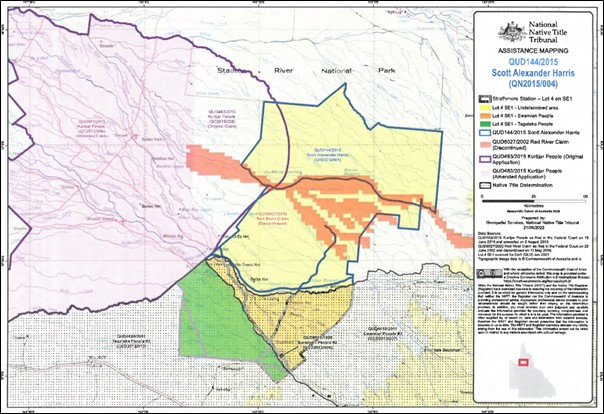
Exhibit DK-44 to the Second Kempton Affidavit
10 Before continuing, it is important to say something about the consequence of this proceeding for the various determinations surrounding the Non-claimant Area, all of which, except the Kurtjar People Determination, were consent determinations. It is well understood that a consent determination does not involve any adjudication as to whether there is a proper evidentiary foundation to establish each of the matters in (a) to (c) of the definition of native title or native title rights and interests as stated in s 223(1): see Lander v State of South Australia [2012] FCA 427 at [11]‑[13] (Mansfield J) and Drury on behalf of the Nanda People v State of Western Australia [2018] FCA 1849 at [52]‑[56] (Mortimer J). As the Full Court said in McLennan on Behalf of the Jangga People No #3 v State of Queensland [2023] FCAFC 191; 301 FCR 452 (McLennan FC) at [92]:
When the Court makes a determination of native title by consent, it makes a determination of a special kind that reflects the exceptional nature of the legislation. It is not concerned with adjudicating common law rights. It is concerned with adjudicating whether there are traditional rights and interests that are recognised by the common law. The NTA responds to the need for a “special procedure…to be available for the just and proper ascertainment of native title rights and interests which will ensure that, if possible, this is done by conciliation and, if not, in a manner that has due regard to their unique character” …
11 The Full Court continued, at [97]:
In making such determinations, the Court is not called upon to consider whether the rights and interests that are to be determined to exist might also be possessed by the same people under the same laws and customs in places that are outside that particular area. As has been explained, the whole of the determination is geographically confined. Therefore, no part of any findings reach beyond the area that is the subject of the application in respect of which the determination is made.
12 Consequently, to the extent reference is made in this judgment to existing determinations of native title in the areas adjacent to or in the broader region, that is not to suggest that this Court is relieved of the obligation to consider the rights and interests that are said to obtain “in relation to” the particular lands and waters of the Non-claimant Area.
13 Nevertheless, once an area has been the subject of a determination of native title, that determination cannot be undermined in subsequent proceedings. As was emphasised by Jagot J in Starkey on behalf of the Kokatha People v State of South Australia [2018] FCAFC 36; 261 FCR 183 at [274], in accordance with s 225 of the NTA, each determination determines the persons holding the common or group rights comprising the native title in the determination area and the nature and extent of those rights in relation to the determination area. To the extent that any witness sought to contend that one or more of the extant determinations was wrong in particular respects, that evidence must be ignored.
14 Similarly, in Nona on behalf of the Badulgal, Mualgal and Kaurareg Peoples (Warral & Ului) v State of Queensland (No 5) [2023] FCA 135, when speaking of the significance of prior consent determinations, Mortimer J said, at [204]:
The determinations of course reflect the content of the various native title applications including any area or group limits on those applications, and connection material prepared in support of them … one of the challenges for the Court … is to ensure its reasoning and conclusions are compatible with those previous determinations about native title … unless there is a rational, reasonable and probative basis for a determination which might otherwise be, or appear, incompatible.
15 The non-claimant application is opposed by NQLC, the second respondent, and the State Minister for the State of Queensland, the first respondent, who, by operation of s 84 of the NTA, is deemed to be a party to this proceeding. NQLC is the active contradictor in these proceedings. It was joined following its interlocutory application dated 18 August 2022, pursuant to s 84(5) of the NTA, by Order of Rares J dated 6 September 2022.
16 The State has taken an active role in the proceedings to assist the Court, consistent with its role being in the nature of parens patriae, and to facilitate the determination of Mr Harris’ application as a matter of public interest. It urged dismissal of the application.
17 This proceeding is more than nine years old. The parties are agreed that there is no present claim by any Aboriginal peoples over the Non-claimant Area. It is Mr Harris’ case that these circumstances, together with the series of native title claims in the vicinity of the Non-claimant Area since 1997, which have been either discontinued or amended to exclude any claim over land or waters within the Non-claimant Area, the absence of any evidence of the existence at Effective Sovereignty of a body of laws and customs which give rise to rights and interests in land, the absence of evidence of sufficient connection, and the clear cessation of any connection, establish, on the balance of probabilities, that native title does not exist in the Non-claimant Area.
18 By contrast, it is the gravamen of the case advanced by NQLC, supported by the State, that through its four lay witnesses and expert anthropologist, it has adduced evidence as to the existence of native title of such weight to cast doubt on Mr Harris’ assertion that ongoing connection, and any substantially uninterrupted observance of traditional laws and customs, was lost at some point after Effective Sovereignty. It contended that, having regard to the totality of the evidence, Mr Harris has not proved, on the balance of probabilities, that no native title exists in the Non-claimant Area. Rather, despite the irrefutable evidence that none of the lay witnesses has maintained any physical connection with the Non-claimant Area, and the undeniably remote and hostile character of the country, NQLC contended the evidence:
(a) points to the continued observance of traditional laws and customs related to the transmission of interests in country through cognatic descent;
(b) shows contemporary connections to country of the countrymen of NQLC’s lay witnesses are primarily based on membership of land holding groups;
(c) justifies a reasonable inference that the contemporary conceptions of traditional law and custom of the countrymen of NQLC’s lay witnesses in respect of the acquisition, enjoyment and transmission of rights in land is an adaptation and evolution of that which prevailed over generations of the past back to the time of Effective Sovereignty; and
(d) demonstrates the existence of a regional society, under which a jural public acknowledges the rightfulness of the assertions of the countrymen of NQLC’s lay witnesses that the Non-claimant Area is their country (albeit that different parts are the country of different land holding groups).
19 For the reasons that follow, a determination should be made that no native title exists over the land and waters the subject of Mr Harris’ application. In summary, I have been persuaded, on the balance of probabilities, that the evidence led by Mr Harris, including his own testimony and the opinion of the expert anthropologist called on his behalf, that no physical or spiritual connection to the Non-claimant Area has been maintained by any person who is descended from any person who may have held traditional rights and interests in the Non-claimant Area at Effective Sovereignty.
20 I have reached this conclusion after giving primacy to the evidence of the Aboriginal witnesses called by NQLC. No onus rested on NQLC to disprove Mr Harris’ claim. Nevertheless, having called evidence, the Court was required to weigh its quality against that adduced by Mr Harris. The lay evidence was inadequate to cast sufficient doubt on my conclusion that any of the Aboriginal witnesses had more than an historical connection to Strathmore Station, being the place where one or more of their parents and family members worked over decades and where they had spent roughly the first 10 years of childhood. None was able to give any evidence describing the manner in which they claim to acquire rights and interests in land, nor was anyone of them able to identify even some elements of a body of traditional laws and customs, in any normative sense, which is substantially the same as one that exists today.
21 More importantly, what evidence was given by the Aboriginal witnesses differed in several respects from some of the critical opinions expressed by the expert anthropologist called by NQLC. This inevitably called into question the certainty with which she expressed her ultimate opinion that, “persisting Native Title rights and interests continue to be asserted and maintained by the descendants of those traditional owners” who “fully owned and occupied the” the subject area at Effective Sovereignty.
22 The effluxion of time, the loss of connection with family members through forced removals and worse, the diversity of tribes and language groups that existed at Effective Sovereignty, the hostile and inaccessible nature of much of the terrain within the Non-claimant Area, and the obvious compromises and concessions that seem to have been made by Aboriginal people in the Cape York Region in order to achieve the many native title determinations that have been made to date across that region, provide an explanation for the confusion, uncertainty, and contradiction that pervaded much of the evidence in the case. The consequence is that I have been persuaded that native title does not exist in the Non-claimant Area.
23 The Court’s power to determine non-claimant applications for native title is found in the NTA. Section 253, somewhat unhelpfully, defines a non-claimant application as “a native title determination application that is not a claimant application”. A claimant application is defined, relevantly, as “a native title determination application that a native title claim group has authorised to be made …”.
24 The NTA is prescriptive of the Court’s approach to the determination of unopposed claimant and non-claimant applications (s 86G), and for agreed outcomes in respect of (at least) claimant applications (s 87). However, there is a lacuna of specific statutory guidance on the Court’s determination of contested claimant and non-claimant applications: CG (Decd) (Obh of Badimia People) v State of Western Australia [2016] FCAFC 67; 240 FCR 466 at [49]. Key sections of the NTA must, therefore, be read together to devine the applicable legislative regime, noting that there is no distinction between provisions relevant to the determination of claimant and non-claimant applications: Mace v State of Queensland [2019] FCAFC 233; 274 FCR 41 at [38]-[39]; Badimia at [49]. The nature and practical effect of such a fused statutory regime was exemplified by the majority of the Full Court in Badimia, at [60], which bears relevance to the outcome of any claimant or non-claimant application:
… the possibility of a negative determination is inherent within every native title determination application, be it a claimant application or a non-claimant application.
(Emphasis added.)
25 Section 223(1) of the NTA defines “native title” for the purposes of the NTA. It provides:
Common law rights and interests
(1) The expression native title or native title rights and interests means the communal, group or individual rights and interests of Aboriginal peoples or Torres Strait Islanders in relation to land or waters, where:
(a) the rights and interests are possessed under the traditional laws acknowledged, and the traditional customs observed, by the Aboriginal peoples or Torres Strait Islanders; and
(b) the Aboriginal peoples or Torres Strait Islanders, by those laws and customs, have a connection with the land or waters; and
(c) the rights and interests are recognised by the common law of Australia.
26 Non-claimant applications may be made to the Federal Court under s 13(1) of the NTA, which are heard and determined in its original jurisdictions: s 81. Section 13(1) relevantly states:
Approved determinations of native title
…
(1) An application may be made to the Federal Court …:
(a) for a determination of native title in relation to an area for which there is no approved determination of native title …
…
27 An approved determination is defined in s 13(3) to mean, relevantly, a determination made on an application under s 13(1). Section 61(1) designates the persons entitled to bring a non-claimant application under s 13(1):
…
(1) A person or persons authorised by all the persons (the native title claim group) who, according to their traditional laws and customs, hold the common or group rights and interests comprising the particular native title claimed …
(2) A person who holds a non - native title interest in relation to the whole of the area in relation to which the determination is sought …
…
(Emphasis in original and added.)
28 Section 253 relevantly defines the word “interest” to be, in the context of land or waters, “a legal or equitable estate or interest in [those] land or waters”. It is uncontroversial that Mr Harris holds such an interest as lessee over the Non-claimant Area for the purpose of his application. Notice of an application must be given to the Native Title Registrar (s 63), who must then provide notice of that application to a certain class of persons outlined under s 66(3).
29 For the reason that Mr Harris’ application is opposed, s 94A governs the Court’s approach to a contested determination of native title. That provision requires that an order by which the Court makes a determination of native title must set out details of the matters mentioned in s 225, which states:
Determination of native title
(1) A determination of native title is a determination whether or not native title exists in relation to a particular area (the determination area) of land or waters and, if it does exist, a determination of:
(a) who the persons, or each group of persons, holding the common or group rights comprising the native title are; and
(b) the nature and extent of the native title rights and interests in relation to the determination area; and
(c) the nature and extent of any other interests in relation to the determination area; and
(d) the relationship between the rights and interests in paragraphs (b) and (c) (taking into account the effect of this Act); and
(e) to the extent that the land or waters in the determination area are not covered by a non-exclusive agricultural lease or a non-exclusive pastoral lease—whether the native title rights and interests confer possession, occupation, use and enjoyment of that land or waters on the native title holders to the exclusion of all others.
(Emphasis in original.)
30 The application of s 225 to both claimant and non-claimant applications (or positive and negative determinations of native title, respectively) has been described in the following way by the Full Court in Mace, at [40]:
Section 225 serves two functions. First, it defines what a “determination of native title” is, and does so by the use of the phrase “whether or not native title exists”. Section 225 authorises a determination that native title exists, and it also authorises a determination that native title does not exist. Second, subs (a)-(e) of s 225 then prescribe the mandatory contents of any determination that native title exists.
(Emphasis added.)
31 Accordingly, reading the relevant provisions together, the NTA authorises the Court to make both a positive determination of native title – which, if made, must also address the matters set out in s 225(1)(a)-(e) – and, relevantly, a negative determination, as sought by Mr Harris in respect of the Non-claimant Area.
THE approach to a negative determination
32 As was submitted by the State, this proceeding is novel to the extent that “it calls for the application of established principles to an unprecedented factual context”, being that a non-claimant applicant grounds his case with positive evidence of the absence of native title, where a respondent has adduced positive evidence as to the existence of native title.
33 The parties do not disagree as to which authorities establish the principles to be applied in this case. It is as to the interpretation and application of those authorities that there is disagreement.
34 The most significant point of disagreement is as to what is meant by the phrase “objectively arguable”, as it was used by the Full Court in Mace (at [97]) and what influence it has on the application of the standard of proof in a case where a negative determination is sought. In brief, Mace was concerned with a non-claimant determination that was required by state legislation in Queensland in order to convert leased land to freehold title. The application was referred to a Full Court, sitting in the Court’s original jurisdiction, under s 20(1A) of the Federal Court of Australia Act 1976 (Cth), because the Chief Justice considered that some uncertainty had arisen about the correct approach to be taken in non-claimant applications and so the matter was sufficiently important to be heard by a Full Bench.
35 In Mace, the Court identified what it considered to be the “clearly established approach” (at [46]) in light of the decisions in Worimi v Worimi Local Aboriginal Land Council [2010] FCAFC 3; 181 FCR 320 and Badimia: Mace at [47]-[67]. In summary, that approach is:
(1) The applicant bears the burden of proof, on the balance of probabilities, that no native title exists in the claim area. So too, a respondent who asserts that native title does exists must also prove that contention on the balance of probabilities.
(2) The question whether that burden has been discharged in a particular case must be assessed on the facts of the particular case (Worimi at [58]):
For example, in an urban environment where valid freehold title has been issued by the Crown over the land in issue … [t]here would be no need to go beyond proof of the extinguishing grant. In other instances, there might be an issue as to the nature or extent of the extinguishment of native title rights and interests.
(3) The Court’s assessment depends on:
(a) the particular facts of the case;
(b) the nature of the land and the tenure involved;
(c) the presence or absence of any present or previous native title claims and the nature and content of those claims; and
(d) any particular evidence adduced on behalf of the parties.
(4) The Court does not employ common law presumptions in seeking to account for native title interests (Worimi at [56]), nor speculate as to what native title rights and interests might or might not exist in the land in question (Worimi at [55]):
The approach contended for by Worimi would involve a “roving inquiry” into whether any person, and if so who, held any, and if so what, native title rights and interests in the land and waters at settlement, and chronologically to the time of the application. Such an approach is of the kind expressly rejected by the Full Court in Jango v Northern Territory (2007) 159 FCR 531 (Jango) at [84]. There may be a number of reasons why, at or by a particular time, no native title rights or interests exist in relation to particular land.
(5) It is the probative strength of any particular evidence adduced on behalf of an applicant, and any on behalf of any respondents, direct or indirect, which will be weighed and assessed – resort to maxims such as that in Blatch v Archer (1774) 1 Cowp 63; 98 ER 969 at 970 cannot, in the context of native title, effect, by the back door, “any alteration to the onus of proof on a non-claimant application”: Mace at [57]. Rather, the “better approach” is for the Court to focus on what is established on the evidence before it, giving appropriate weight to “aspects of the statutory scheme which are designed to have people bring forward all claims to native title over an area”: Mace at [57].
(6) The Court must take account of the gravity of a negative determination, and its permanency in terms of its effect on native title rights and interests which are otherwise sought to be protected by the NTA (Badimia at [48]):
The fact that a determination of native title binds the world and does not operate only between the parties applies to both positive and negative determinations. This fact warrants heightened scrutiny by the Court about its state of satisfaction both that the onus of proof has been discharged and that the terms of the determination to be made are supported in all respects by the findings. But the onus remains the civil standard of the balance of probabilities. If the circumstances are such that a native title claimant application has not been established to the requisite standard, the onus of proof to support a negative determination may or may not have been discharged. If not discharged, it necessarily follows that a negative determination may not be made. If discharged, however, it does not necessarily follow that a negative determination should be made. The propriety or otherwise of making of a negative determination in such a case will depend on a wide range of circumstances. As noted, the legal character of a determination, that it will bind the world at large and not just the parties, will necessarily inform the appropriate exercise of the discretion whether or not to make a negative determination.
(Emphasis added.)
36 It was in response to two submissions by the NTSCORP in Mace that the Full Court expressly introduced the notion of evidence of an assertion of native title which is objectively arguable. In short, NTSCORP had submitted first, that to place the obligation on a person to assert native title by making a native title determination application, or join as a respondent to assert native title defensively, required a “leap of faith” as to native title claimants being aware of public notices and having sufficient resources to respond. Secondly, it had been submitted that a notice of a non-claimant application is not enough to satisfy a court that an applicant has proved its case in circumstances where no research or fieldwork has been carried out and there are no details of potential native title holders in the representative body’s database: Mace at [89]-[90]. The Full Court said, at [97]:
Although, as NTSCORP’s submissions contend, it can be accepted that representative bodies face funding challenges, we do not consider that is a satisfactory explanation, in and of itself, in the context of a non-claimant application, for inviting the Court to refuse to make a negative determination. A representative body’s facilitation and assistance functions are no less important in respect of non-claimant applications that they are in respect of claimant applications, since the former determination will preclude any future claims of native title over the land and waters concerned. The principal evidence likely to impede the grant of a negative determination is evidence of an assertion of native title in the land and waters the subject of the non-claimant application which is objectively arguable, not evidence of the potential for the assertion of native title … To raise an objectively arguable claim of native title sufficient to mean that a non-claimant application needs to go to a full trial, the evidence of native title need not be extensive: it will be the quality of the evidence which is determinative.
(Emphasis added.)
37 This passage cannot be read as importing a gloss on the “clearly established approach” which, in the previous section of the judgment, the Court had been at pains to articulate, and where no reference was made to “evidence of an assertion” which is “objectively arguable”. The Full Court was, in this section of the judgment, dealing specifically with the role of native title representative bodies in non-claimant applications where there had been no trial. With one immaterial exception, no evidence was adduced in Mace about the existence and nature of any claimed native title rights and interests in the application area. Rather, the Court had proceeded on the basis of a statement of agreed facts. The Court was explaining that, to defeat a negative determination, more than evidence of the “potential” for the assertion of native title was required, and that in such circumstances, representative bodies were best placed to assist.
38 This case is unlike Mace. In the present case, both lay and expert evidence, which was tested over the course of two weeks, was adduced by the applicant and the second respondent. The Full Court observed that whether a non-claimant application is to be determined under s 86G (unopposed applications), or under s 61 – as in this case – the same kind of matters need to be established by an applicant, the difference being that, in a contested application, there is likely to be a contradictor and, consequently, “the applicant may face more challenges to its own submissions or evidence, or both”: Mace at [43]. The Full Court continued, at [44], qualifying that difference in the determination of contested applications:
[It] is a forensic difference, but not a legal one. The question for the Court remains the same whether the application is unopposed, or contested: has the applicant discharged its burden of proof that no native title exists in the claim area?
39 Nothing said in the passage in Mace at [97] derogates from the principles as articulated by the Court as summarised above. As such, to the extent that Mr Harris’ submissions invited the Court to find that the assertion of native title raised by NQLC was “not objectively arguable”, I reject that statement of the specific task required of the Court in the circumstances of this case.
40 The definition of native title or native title rights and interests, as provided for in s 223(1) of the NTA, has already been set out above. For present purposes, Mr Harris asks the Court to determine, pursuant to s 225 of the NTA, that neither exist in relation to the Non-claimant Area. Determinations made under s 225 are in respect of native title as defined in s 223(1). The term “native title” means communal, group or individual rights and interests of Aboriginal peoples or Torres Strait Islanders “in relation to land or waters” where three aspects pertain, being those in (a) to (c). A determination of native title cannot be disaggregated into its component parts. It is not a determination as to each of the three aspects described in (a) to (c) of the definition in s 223(1). As the Full Court stated in McLennan FC at [88]:
Native title is a singular conception of a particular kind of rights and interests which are to be the subject of determinations made under s 225.
41 In order to succeed in his application for a declaration that native title does not exist in relation to the Non-claimant Area, Mr Harris must discharge the burden of proving, on the balance of probabilities, that there are no communal, group or individual rights and interests of Aboriginal peoples in relation to the Non-claimant Area possessed under the traditional laws acknowledged, and the traditional customs observed, by any Aboriginal peoples, and who by any traditional laws acknowledged, and any traditional customs observed in relation to the Non-claimant Area, have a connection with it.
42 As has already been referred to, the parties jointly tendered a document (SOFLI) to assist the Court in framing and narrowing the issues at hearing, and to identify the position that each party took on the relevant issues in dispute. Counsel for NQLC submitted that this document should be relied on by the Court as that which contains the full suite of forensic issues to be determined in the proceeding.
43 The parties agree that Sovereignty was acquired by the British Crown over the Non-claimant Area in 1788 and that Effective Sovereignty occurred in the late 1860s when the first European settlers arrived in the Non-claimant Area. The parties also agree that, as at the date of Effective Sovereignty, there were Aboriginal peoples associated with the Non-claimant Area who formed part of a society which acknowledged and observed a common suite of traditional laws and customs (the normative system) in relation to the transmission of rights and interests in the land and waters, in which totemic patriclans were important.
44 The parties also agree that, at Effective Sovereignty, there were laws and customs by which Aboriginal people or peoples associated with the Non-claimant Area acquired rights, with totemic patriclans having an important role in the relevant laws and customs.
45 The legal and factual issues not agreed between the parties, and which form the crux of the dispute the subject of this proceeding, are as follows:
(i) The specific rights and interests that Aboriginal people in the Non-claimant Area hold under traditional laws and customs as acknowledged and observed at the date of Effective Sovereignty.
(ii) The identity of the groups which held primary territorial interests within the Non-claimant Area.
(iii) Who, more probably than not, held rights and interests in the Non-claimant Area under traditional laws and customs of the normative system(s) at Effective Sovereignty, or soon after, relating to land and waters?
(iv) Whether there has been a continuity of observance and acknowledgement of traditional laws and customs in the Non-claimant Area?
(v) Whether contemporary descendants of the Aboriginal people or peoples that held rights and interests in the Non-claimant Area at Effective Sovereignty by their traditional laws and customs, have maintained a connection with the Non-claimant Area?
(vi) Whether the contemporary descendants of Aboriginal people that held rights and interests in the Non-claimant Area at Effective Sovereignty hold native title rights and interests in the Non-claimant Area based on their traditional law and customs?
(vii) Whether there is any native title in the Non-claimant Area?
Overview of lay and expert witnesses
46 As has already been observed, the parties adduced both lay and expert evidence. Mr Harris gave evidence on his own behalf and filed an affidavit dated 9 May 2022 (Harris Affidavit). NQLC called four Aboriginal witnesses, being Ms Glennis Mudd, Ms Gladys Callope, Ms Bernice Douglas, and Mr Christopher Henry, to give lay evidence about their connection to the Non-claimant Area. Both the applicant and NQLC relied on the evidence of two experts, being Dr Philip A Clarke and Dr Natalie Kwok, respectively, both of whom describe themselves as Consultant Anthropologists. Dr Clarke and Dr Kwok both prepared expert reports, filed respectively on 22 May 2023 and 21 November 2022 (an amended version was filed on 23 November 2022) (Clarke Report and Kwok Report), and – together – a Joint Report filed on 5 February 2024 (Joint Report). NQLC also read each of the Kempton Affidavits, as well as the affidavits of Mr George Lance Druery, dated 18 November 2022, and of Mr Kevin John Murphy, dated 18 August 2022 (Murphy Affidavit), none of whom was required for cross-examination.
47 NQLC was critical of the evidence given by Dr Clarke. It submitted that, despite Mr Harris’ having had a period of 5.5 months in which to file his expert evidence, Dr Clarke’s report “provides only a desktop analysis, with Dr Clarke having interviewed no Indigenous witnesses, nor made any apparent attempt to interview such witnesses, nor having undertaken any relevant fieldwork”. This was, it was submitted, in contrast to NQLC having been given only 2.5 months to file its evidence after being joined as a respondent by Order of Rares J on 6 September 2022.
48 This submission ought not to have been made in such a manner. It is strictly true that relevant Orders were made by Rares J on 9 December 2022 requiring Mr Harris to file and serve any expert report by 31 March 2023 (allowing an initial period of 4 months), which was subsequently extended to 15 May 2023, and then 22 May 2023, by Orders dated 23 February 2023 and 12 May 2023, respectively. It is also true that by Order of 6 September 2022, NQLC was ordered to file and serve its evidence by 18 November 2022, which date was subsequently extended to 22 November 2022 by Order dated 23 November 2022. What that submission neglected to draw attention to, however, was that Dr Kwok had previously been engaged by NQLC, by written agreement on 7 June 2021, to provide a report on substantive matters that were ultimately the subject of Dr Kwok’s expert report prepared for this proceeding. The Terms of Reference agreed between NQLC and Dr Kwok in June 2021 included instructions to:
Conduct desktop research into archival and other secondary sources including but not limited to the materials list below [which included material for the Kowanyama People Part B application (QUD 6119 of 1998), the Kurtijar application (QUD 483 of 2015), the Tagalaka applications (QUD 6109 of 1998 and QUD 6020 of 2001) (including four reports by Dr Sandra Pannell) the Ewamian People applications (QUD of 6220 of 1998, QUD 6009 of 1999 and QUD 6018 of 2001) (including two reports by Dr Pannell), and the Red River application (QUD 6027 of 2002) (including a report by Dr Julie Lahn and Professor Phillip Winn]; conduct interviews by phone, video conferencing and face-to-face with people that assert native title interests in the area; and rely on your research for the NWRA [North-West Research Area].
49 Dr Kwok says that she was given new instructions in March 2022 to undertake a review of anthropological evidence. I observe, however, that those subsequent instructions were not annexed to the Kwok Report.
50 By contrast, Dr Clarke was instructed by letter dated 28 February 2023. He was specifically instructed that he was “not expected to undertake any fieldwork in relation to this matter” NQLC submitted that it was assumed “there was underlying evidence forming the basis of the claim being filed” that must have predated these instructions.
51 For much the same reasons as pertain to my rejection of NQLC’s submission that I should give no weight to Mr Harris’ lay evidence (discussed below), I reject any submission that Dr Clarke’s evidence is diminished because of an implied failure on the part of Mr Harris to commission an expert’s report at some earlier point in time, or to conduct fieldwork in support of an expert report. As discussed below, the submission is somewhat disingenuous in the face of NQLC’s failure to respond to any of Mr Harris’ communications seeking assistance with identifying potential native title claimants, and in circumstances where it had commissioned Dr Kwok to undertake the relevant research in mid-2021 but did not communicate that fact to Mr Harris until it sent its first response to his legal representative in July 2022.
52 Both Dr Clarke and Dr Kwok relied extensively on the work of other ethnographers, anthropologists and linguists. In particular, there was frequent reference across both expert reports, and the Joint Report, to the work of scholars including Edward Palmer (19th century pastoralist and amateur anthropologist), Dr Walter E Roth (19th century medical officer/surgeon and amateur ethnographer), Robert H Mathews (19th century surveyor and ethnographer), Dr R Lauriston Sharp (early-mid 20th century ethnographer), Norman B Tindale (mid-late 20th century entomologist/ethnologist), Professor Peter Sutton (late 20th century anthropologist, linguist and ethnologist), Dr Sandra Pannell (21st century anthropologist), and Dr Julie Lahn and Professor Phillip Winn (21st century anthropologists) (together, Lahn & Winn). Dr Clarke’s and Dr Kwok’s opinions are based, essentially, on their interpretation of the works of these scholars, including the earlier interpretations of relevant primary sources by those scholars.
53 My rejection of NQLC’s criticisms above, however, does not necessarily lead to a conclusion that Dr Clarke’s evidence is to be preferred over that of Dr Kwok. Nevertheless, Dr Clarke was a straightforward witness who impressed as being able to draw on his significant academic and professional experience to give considered evidence on the issues about which his opinion had been sought.
54 To the extent that it was submitted that Dr Kwok’s evidence should be given greater weight because of the fieldwork she had undertaken, it is not possible to draw any general conclusions as to the value of that fieldwork, in light of the following circumstances. First, Dr Kwok conceded that she had never been to the land and waters the subject of the Non-claimant Area. Secondly, of the almost 100 interviews conducted by Dr Kwok, either in person or by telephone, Dr Kwok similarly conceded that the interviews were conducted for the “twin purpose of understanding their interests within the northwest research area as well” as those relevant to the Non-claimant Area. It was not explained, however, what proportion of those interviews were directly relevant to Dr Kwok’s research in relation to the Non-claimant Area. Thirdly, no transcripts of the interviews were in evidence. This makes it impossible to verify any conclusions drawn by Dr Kwok from those interviews. As to Dr Clarke’s explanation for his failure to conduct fieldwork, that explanation was, with respect, obvious and rational. Quite apart from having been instructed not to undertake any in the limited time available to produce his report, Dr Clarke explained that it would be unlikely that Aboriginal people would think it to be in their best interests to speak with an anthropologist who had been engaged by a non-claimant applicant, particularly where that application was actively opposed.
55 Mr Harris submitted that little weight should be given to Dr Kwok’s opinions contained in her report because she described them as “preliminary” and, in many instances, characterised them as “tentative” or “possible”. It is true that Dr Kwok was engaged to provide a report “providing preliminary opinions” about potential native title interests and that, as such, many of those opinions are not expressed strongly. However, that does not necessarily diminish those opinions, given the nature of the task she was instructed to undertake. It is also true, as Dr Kwok said in cross-examination, and is consistent with the fact that she had been engaged to undertake at least related work since mid-June 2021, that the Kwok Report demonstrates that she had done a significant amount of research in preparing her report. As Dr Kwok observed in cross-examination:
I think that the manifest level of fine-grain research that I’ve conducted leads me in most of the area to feel that I have done a thorough review of the literature and arrived at solidly-formed opinions.
56 She candidly admitted that she had not been asked to do, nor had she done, a full connection report. Indeed, in the Joint Report, she was at pains to “reiterate the terms of [her] engagement were to prepare a preliminary report”. In cross-examination, Dr Kwok explained that she made this statement because she “didn’t want [her] work to be judged on the basis that [she] was handing up a full connection report, and that’s why [she] provided various qualifications”.
57 It is clear that Dr Kwok was not asked to provide a full connection report. I also accept that she did not purport to do so. That, however, does not explain, and – indeed, somewhat contradicts – how she came to be “firmly of the view that … persisting Native Title rights and interest continue to be asserted and maintained by the descendants of [the] traditional owners” at the time of Effective Sovereignty. That conclusion was arrived at despite her findings that, inter alia, there are only “clues” within Palmer’s late 19th century account that support the accuracy of his mapping; that determining those traditional interests on the eastern side of the Non-claimant Area “presents a less certain proposition”; that the territorial boundaries within which group interests exist on the western side were “not certain”; and that the “personal histories of some of the forebears of the present-day community members were complex and somewhat opaque”. Dr Kwok’s ultimate conclusion is also difficult to reconcile with her indications that, in respect of many issues, more research was required: for example, in relation to the potential apical ancestors; Wakaman interests in the eastern periphery; the genealogies of contemporary native title claimants; and the “impacts of new research findings and novel political developments arising from the [Cape York Land Council’s] Native Title work” that “need to be assessed”.
58 Dr Kwok’s opinions, and in particular her ultimate conclusion, also seemed to be tainted to some extent by her “fundamental thesis” – as she described it in her oral evidence – that all that is required for native title to be established by patrilineal descent is for a person who currently asserts rights and interests in country to be able to trace their lineage back to an apical ancestor, who held rights and interests in that same country at Effective Sovereignty. She went on to add that one “probably [needs] to be recognised by other people in the community as having … that right to country through that line of descent”. Needless to say, Dr Kwok’s views do not accord with the law: Members of the Yorta Yorta Aboriginal Community v Victoria [2002] HCA 58; 214 CLR 422. Further, no attempt was made to adduce any evidence about whether any of the Aboriginal lay witnesses were recognised by other people in a relevant community as having the appropriate rights and interests within the Non-claimant Area.
59 For these reasons, in relation to the evidence of both Dr Clarke and Dr Kwok, it has been necessary for me to evaluate carefully their evidence on each relevant issue where it has differed in a material way, including by analysing, as best I can, the source material on which each has claimed to rely. In so doing, I have been conscious of the caveats urged by Mortimer J in Dempsey (on behalf of the Bularnu, Waluwarra and Wangkayujuru People) v State of Queensland (No 2) [2014] FCA 528; 317 ALR 432:
Historical records
[298] Care must always be taken when relying upon historical records in native title cases. In Anglo-Australian culture, greater value has traditionally been placed on written material than on oral accounts: Commonwealth v Yarmirr (2000) 101 FCR 171; 168 ALR 426; [1999] FCA 1668 at [348] (Yarmirr) per Merkel J. Certainly, oral accounts may fill the “silences” in the historical records (see Daniel v Western Australia [2003] FCA 666 at [149] (Daniel) per RD Nicholson J), but they may do more than that. It may be oral accounts which provide the only continuous narrative. Oral accounts may explain or give context to any historical records and, in some cases, may qualify or rebut them.
[299] Courts must also consider whether “the historical record or account of observers at the time, whether trained or untrained, is not invalidated by a particular preconception, bias or prejudice of the author”: Yarmirr at [351]. For example, a former judge of this court, writing extra-judicially, has observed that certain types of genealogical records may be unreliable, such as those kept by missionaries whose observations are framed by their own individual morality. He goes on to warn that:
Courts must be wary of “text positivism”, the notion that, if a written record is constructed as accurately as possible, the author’s role dissolves into that of an honest broker, passing on the substance of things with only the most trivial of transaction costs.
(Gray, Peter R A, “Saying It Like It Is: Oral Traditions, Legal Systems and Records” (1998) 26 Archives and Manuscripts 248, p 259.)
[300] Particular difficulties arise where historical documents are relied upon to counter oral histories. In Shaw v Wolf (1998) 83 FCR 113 at 130–1; 163 ALR 205 at 222, Merkel J noted that:
… the general historical record, particularly when relied upon to discount descent in a particular case, is not complete or reliable in all instances. Consequently, the Court is to exercise caution in acting on any general historical record or account as evidence disproving a version of history or ancestry of a particular respondent based on oral history, particularly if it has some contemporaneous corroboration.
60 Each of the lay witnesses gave their evidence in a straightforward manner to the best of their recollections. Some of that evidence, however, related to facts and matters said to have occurred between 50-70 years ago. None of the lay witnesses was pressed on his or her testimony in cross-examination to any serious extent. Nevertheless, it is appropriate that I make the following observations about the Aboriginal lay witnesses.
61 First, the affidavit evidence of all four Aboriginal witnesses attested to each deponent having been shown a map by Mr Druery of NQLC (or its lawyers, in the case of Ms Douglas). Each of the Aboriginal witnesses (except for Ms Douglas) deposed in their respective affidavits to having been told by Mr Druery that the blue shaded area on the map shows the area of Strathmore Station over which Mr Harris has made his non-claimant application. All four Aboriginal witnesses asserted that they had been told by their parents, grandparents or others of previous generations that some portion of the blue shaded area is their country and that they have indicated in orange the location of various landmarks in support of that assertion.
62 Secondly, the evidence is silent as to whether any of the witnesses was asked, independently of, or at least, before being shown the already blue-shaded map, what the bounds of his or her country were said to be. The absence of such evidence is significant in light of the oral evidence given by at least two of the Aboriginal witnesses expressing their inability to read maps. In particular, Ms Callope said, “[m]aps, a bit tricky”. Apart from agreeing that she remembered the part of her affidavit where she referred to the Red River as being part of Tagalaka country, Ms Callope did not, in her oral testimony, refer unprompted to the Red River as Tagalaka country. Ms Douglas said similarly, “I don’t know about maps. Don’t know about them things”. When shown the map and asked to comment on the blue-shaded area, Ms Mudd could say only that Sloper Mudd, “really stated the Red River area”. Mr Henry was the only Aboriginal witness who readily appeared to have the ability to read a map.
63 Thirdly, conscious as I am of the difficulties that may attend persons who may wish to assert a native title claim, both in terms of being aware of public notices and having sufficient resources to pursue a claim, it is fair to observe that at least three of the Aboriginal witnesses were not inexperienced with native title applications. Ms Callope had been (with her niece) one of the applicants in the Tagalaka People Claims in 2012: Owens on behalf of the Tagalaka People v State of Queensland [2012] FCA 1396 (QUD 6109 of 1998 (QCD2012/12) (Tagalaka People Determination) and QUD 6020 of 2001 (Tagalaka People #2 Determination)). She is a Tagalaka native title holder and sat on the board of the TAC for approximately 20 years, until 19 November 2022.
64 Ms Douglas is also a Tagalaka native title holder and a member of the TAC, although her evidence was that she does not actively participate in its activities or affairs. I infer from the letter of support dated 10 July 2015, sent to Mr Harris by the TAC, that at least Ms Callope, if not also Ms Douglas, as Board members, were and have been aware since the time of that letter, of Mr Harris’ application. Further, Ms Callope deposed to having attended a meeting with Mr Harris, together with her sister, in Croydon, to talk about Strathmore Station in about 2015.
65 Ms Mudd was an applicant on the Kowanyama People Determination in 2009 (QUD 6119 of 1998; QCD2009/003) and on the Red River claim (QUD 6027 of 2002), which was discontinued a decade ago. Ms Douglas’ sister, Colleen, was also an applicant on that claim.
66 Fourthly, each of the Aboriginal witnesses have, in the past, spoken with anthropologists, including Dr Kwok, who have recorded their oral histories to greater or lesser degrees (Dr Richard Martin, Supplementary Report for the Kurtijar People Native Title Claimant Application QUD483/2015. Prepared for HWL Ebsworth Lawyers. St Lucia, Queensland: UQ Culture & Heritage Unit (8th February 2019) at [12], [207]-[209] (Martin Report); Lahn & Winn, Kunjen people and the Red River – Inland Staaten River region of SW Cape York, Queensland. Final anthropological report to the North Queensland Land Council (June 2005) 98-99). It is fair to observe that there are inconsistencies in the versions of their histories given across the decades. That is not in the least bit surprising. It is, however, difficult to accept that their evidence on this occasion, based as it is on memories of stories told to them decades ago, is more accurate than that given in years closer to the creation of those memories.
Are there identifiable communal, group or individual rights and interests possessed under the traditional laws and customs?
67 The experts were agreed that there were laws and customs by which Aboriginal people or peoples associated with the Non-claimant Area acquired rights and interests in the land and waters of the Non-claimant Area. They were also agreed that the totemic patriclans had an important role in the relevant laws and customs. Neither expert, however, was able to explain with any specificity the content of those laws and customs.
68 Dr Clarke stated that there is insufficient evidence, either ethnographic or lay, to enable a positive conclusion to be drawn about the nature of traditional laws and customs regarding the Non-claimant Area. In particular, he pointed to the absence of evidence as to how rights and interests in land are acquired other than by patrifiliation.
69 By contrast, Dr Kwok’s opinion was based on her fundamental thesis, as described earlier, that so long as someone is descended from an apical ancestor who had traditional native title rights and interests, they continue to have native title rights and interests.
70 Neither of those opinions was of assistance and, indeed, both were contradicted in various ways within each of the expert reports.
71 In seeking to identify the specific rights and interests that Aboriginal people in the Non-claimant Area held under the relevant laws and customs, it is first necessary as a matter of fact to identify the groups who held primary territorial interests within the Non-claimant Area. The experts were also divided on this issue.
The pre-sovereignty land-holding groups
72 This issue is complicated by the “fragmentary and complex” linguistic and ethnohistoric evidence of the area. Dr Clarke stated that, in native title anthropology, membership of a linguistic group is not recognised as sufficient to establish rights to country, although it provides an indication of the existence of wider societal networks. He said further that the association of a dialect with an area was “an aspect of the landowning group’s identity” and is, to that extent, “relevant to determining native title”, noting that “[f]or Aboriginal people, land therefore has a linguistic identity”. In her oral evidence, Dr Kwok observed that, “[i]n more recent times, language group tribes have become more prominent as the land holding group”. She also noted that, “[t]racing the early history … some of these groups … can be found to be aggregated from groups that were identified with a number of different languages at sovereignty”.
73 The diversity in the variants of the spellings of local languages and group names complicates an understanding of the linguistic and ethnohistoric sources. In an attempt to mitigate this, I set out below the table of variations prepared by Dr Kwok. Some labels are used interchangeably throughout this judgment, as they are throughout the evidence.
PRESENTLY ADOPTED | VARIANT SPELLINGS/NAMES |
Ewamian | Ewamin, (Ak)Waumin, Agwamin, Gwamin |
Kawararrangg (after Sommer) | Ok awarrangg, Kauwaranga, Okaurang, Ogh-Awarrangg, Uw Awarrangk |
Kok Narr | Kok Nar, Kok-Nharr, Gog-Nar, Gug Nar |
Koko Bera | Kok Kaber, Koko Pera, Kokopera |
Koko Berrin | Koko Perrin, Kundara, Kundarra, Kwandarr, Okawn’dar, Kwanthar, KuandaR, Goontharra, Gog-Nar? Gog-Nhang? |
Koko Dhawa | Gogo-Dhawa, Gugu-Dhaw, Kok Thaw, Koko Daua, In.hal |
Kunjen (wider reference and other sub-groups) | Koonjan, Koonjen, Kundjen |
Kurtjar | Kurtijar, Gurtjar, Gunggara |
Kutjel | Kutjel, Cuchulberry, Koochulburra |
Ogh Undjan (narrower reference, after Sommer) | Koka-koonjin, Okundjain, Okun’djain, Ogunyjan, Koonjan, Kunjen, Oogonjin, Ngundjan, Ngundjen, Kund’jan, Gundjun, Koko Kuntjan, Kundjin, Uw Ingan, Wingan |
Okuntjel | Okuntjil |
Oykangand | Aikand, Wangarrah, Koko Wangar, Ew Angkar, Koko Mirandang, Uw Oykangand, Oykangand, Oykangandh, Aikand, Oikand, Koko Wansin, Koko Wanjin |
Rib (after Black) | Air-rip, Ariba, A’rap, Arap, Araba, A:rap, Aripa, Ngariba, Areba, Ngarap, Ngarab |
Tagalak | Tagalaka, Dagallagan, Tarkalak, Tagalag, Tagalag, Dagalang, Da:galag, Targalag, Tarkalag, Tagalak, Takalak |
Wakaman | Wagaman, Warkaman, Wakkamon, Warkeeman, Warkeemin, Warkamin, Warkemon, Warkeemon |
Walangama | Wollongurmee, Wollangama, Wallungarma, Wallankammer, Wallenkammer, Oo-ee-kulla? O’eer’kala? Kumulmar? |
74 Dr Clarke’s opinion was that, at Effective Sovereignty, the Non-claimant Area was seasonally occupied by members of descent groups or clans from two language groups. The first comprised the Kundjan (Kunjen, Ngundjan, Okundjain), who occupied an area including the northern section of the Non-claimant Area along the Staaten River. The second comprised the Areba (Arebe, Arip, Rib) who had as part of their country the area from just north of the Red River to the south towards Minnie’s Dip. He based this view on the fact that Kunjen and Areba country extended far beyond the Non-claimant Area, along the river system towards the coast, and stated that, “in [his] view it is reasonable to conclude that the area that became Strathmore Station was not their core country, since it was probably only accessible to foragers during certain seasons”. He referred also (at [40]) to Roth’s 1899 sketch map, on which Roth had remarked in respect of the Mitchell River area, “[n]o blacks here permanently”. Dr Clarke said this suggested “more infrequent use of country to at least the immediate north of the Non-[c]laimant Area”. In any event, his view was that there was no data to suggest where the estates of the relevant patriclans were located.
75 Contrary to the written submissions of the State, this fact was not agreed. Dr Kwok disagreed with the opinion that the Non-claimant Area was only seasonally occupied. In her view, that opinion exhibited a “coastal prejudice”, pointing to the mapping by Palmer of the Dagallan [Tagalak], describing territory that that group occupied as “sandy forest country”. In oral evidence, she also explained that the absence of Aboriginal people in the Mitchell River area, as referred to by Roth, was because they were “being hunted away by the … native police”.
76 Dr Kwok’s opinion was (and NQLC submitted) that the local patriclan estates within the Non-claimant Area were associated with the language groups known in contemporary terms as Tagalaka, Rib, and Kunjen, more specifically Ogh Undjen. Moreover, it was recruitment to the land-holding patriclan that was the important basis of acquisition of native title rights at Effective Sovereignty rather than membership of a language identifying group.
77 Ultimately, by distilling the points of common agreement within their respective opinions, it is possible to conclude that both experts appear to be agreed that the Ogh Undjan group (Kundjan, Kunjen, Ngundjan), or at least a section of it, had interests impinging on the north side of the Non-claimant Area at Effective Sovereignty. Both were also agreed that the Arip group [Araba, Areba, Aripa, Rib], or at least a section of it, maintained interests within the bounds of the Non-claimant Area at Effective Sovereignty. The most significant point of departure between Dr Clarke and Dr Kwok, however, at least for the purposes of this application, was whether the Tagalaka people had rights in the Non-claimant Area at Effective Sovereignty.
Tagalaka interests at Effective Sovereignty
78 Dr Kwok said that the boundaries between the Tagalaka, Rib and Kunjen remain uncertain. She noted however that, “the Red River appears to constitute a point of convergence with Tagalaka interests occupying the eastern and southern portions of the Non-claimant Area, including the upper-most Staaten and country extending between the Einasleigh and Red Rivers”. On the basis of her research and investigations, Dr Kwok provided a schedule of various “[s]ummary conclusions” as to “tentative indications of the interests of various groups” within the Non-claimant Area. As part of that schedule, Dr Kwok (at [238] as amended by the Schedule of Corrections) stated the following in respect of Takalak (Tagalaka) interests:
Takalak interests from south to the Red River. Pre-Sovereignty may have had interests extending northward up the eastern side. Historically described as in occupation of sandy forest country west of the Lynd. Extension up towards junction of Mitchell and Lynd.
I observe, relevantly, that the Non-claimant Area extends beyond the Red River, northwards to the Staaten River, but not eastwards to the Lynd River. Dr Kwok continued:
Arap interests from west, including Pelican, Wyaaba, Cockburn Creeks, Red River, possibly inland stretch of Staaten.
Consistent with the agreement between the experts, part of this area of Arap (Arip) interests is likely within the Non-claimant Area. Dr Kwok further continued:
Ogh Undjan possibly impinging on the application area on the north side. Interests extending from Dunbar at least to Upper Staaten. Tindale has them extending as far south as the Red River.
If the area of Ogh Undjan interests extended as far as the Red River, then it is likely to be partly within the Non-claimant Area, as agreed between the experts. I observe, however, that the area from Dunbar Station south to the Staaten River, is within the area of the Kowanyama People Part B Determination (QUD 6119 of 1998; QCD2012/016). Dr Kwok’s schedule also included the following “[s]ummary conclusions”:
Koko Daua appear to have lain between the Koko Berrin and Ogh Undjan upstream of Galbraith Station. Possibility of having some interests in the north-west.
Kurtjar Some of those within the connection to the subject area, through a language identity grouping which is no longer extant (Rib, possibly Koko Daua?) may presently identify as Kurtjar. The development of more inclusive group identities is a common feature of post-settlement traditional social-political organisation. Some presently distinguish a sub-group of Top Kurtjar which may reflect originally discrete interest.
Koko Berrin Mainly identified as a coastal group but some suggestion they may have been an inland counterpart. Some of those with connection to the subject area, through a language identity grouping which is no longer extant (Rib, possibly Koko Daua?) may presently identify as Koko Berrin.
Wahooboodja (Palmer) possible match for Djapadja (per Sharp) As mapped by Palmer on mid Staaten and neighbouring Dagallagan. Section and moiety names likely a match for Koogobothy. Possible interests. This group has no profile in the literature.
Okenyika/Kokenyig possible alternative (Okundjain) name for Koko Daua. Michell River association though. Moiety and section names suggest match with Koogobathy.
Kutjal I do not support Tindale’s equation of various groups as equivalents under the banner Kutjal. I suggest the group from which the name Kutjal derives from Palmer’s Koogo Kurchal and Dickson’s Cuchulberry, belongs way up the Einasleigh and have territory which crosses over into the Burdekin valley. Excluding these we are left with Okuntjel.
Okuntjel may simply be another word for Takalak. If discrete they may have been absorbed under the broader Kunjun umbrella. There does not appear to be any living memory of a group called Okuntjel or people who identify under that banner.
Wakaman interests are for the most part confined to the east of the Lynd, however, peripheral claims are made on the part of a few individuals.
The Wakaman People #5 Determination (QUD 178 of 2018; QCD2023/008) is located to the north-east of the Lynd River.
Ewamian My reading of the literature does not have this group coming far enough west to have interests in the claim area. If any, on the eastern side. Jim Richards, on behalf of the Ewamian, is claiming a narrow strip on the north side of the Einasleigh across the southern limit of the subject area. Further consultations with Ewamian people warranted.
The Ewamian People #3 Determination is predominantly located to the south-east of the Non-claimant Area.
79 Dr Kwok relies on the work of “Palmer (1882)” as the “earliest and an arguably reliable source” on the Tagalak. On “Map 4: Palmer 1882”, Dagallagan (equivalent to Tagalaka) is shown as encompassing an area extending south of the junction of Einasleigh and Gilbert Rivers, and northward beyond the Staaten River (see below):
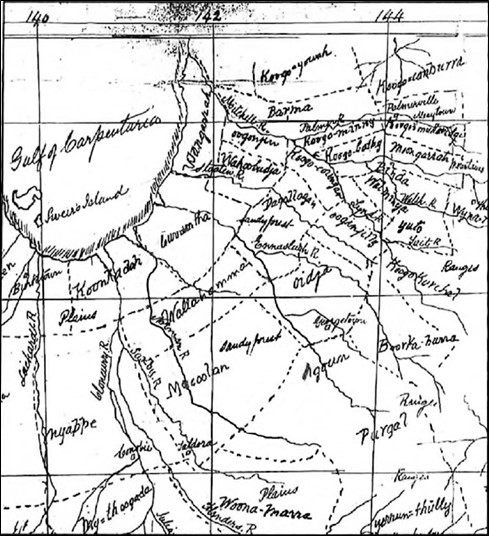
Map 4: Palmer 1882 (Kwok Report at 133)
80 Dr Kwok cites a letter written by Palmer to A. W. Howitt (a 19th century anthropologist), which had been referred to in the report by Lahn & Winn 2005:28-29. In that letter, Palmer described the Dagallagan as occupying country “west of the Lynd through the sandy forest country across the Lower Staaten River (poor country)”. The “sandy forest country” is depicted on Map 4 above.
81 Nonetheless, Dr Kwok states (at [531]) that Palmer’s account “has to be treated with a degree of circumspection”, noting that,
[h]e could have been mistaken in parts; have been caught out by the proliferation of disparate names for the same group; or have imported the views of neighbouring groups, which were not entirely reliable. Nevertheless, in my opinion, there are telling clues within his account that show that Palmer was a careful observer, who was alert to the differences in linguistic conventions maintained by different groups and as such I regard his map as extremely important.
82 As observed by Dr Clarke, Pannell was also cautious about relying on the Palmer map. He referred to Pannell’s connection report for the Tagalaka Determination in which she wrote (in Pannell, Tagalaka Native Title Determination Applications (QC98/43 & QC01/22) Draft Connection Report, June 2002, North Queensland Land Council (2002) 89):
It is difficult to establish with any certainty the provenance of the information which forms the basis of Palmer’s map and written descriptions. From Palmer’s letters and his 1884 article, it appears that this information on the distribution of northern tribes derives from his own observations and from a number of Aboriginal informants present on his two properties, Canobie and Gamboola. In one of his 1882 letters (1882b), Palmer identifies “Tippoo” as his informant for “Mycoola” class names. In the same letter, Palmer writes that he will be able to “pick up other facts” when he returns North [presumably to Gamboola station] again (1882b:1). In this letter, Palmer informs Howitt that the sketch map is:
as correct as can be gathered from the blacks themselves … [and that it is] a rough indication of where they lived, hunted and joined each other (1882b:1).
(Footnotes omitted).
83 I accept that there is a further difficulty with Palmer’s map, in that it does not reference the Rib [Arap, Ariba, Aripa] people. I do not, however, accept Mr Harris’ submission that reference to the Kunjen was also absent. It is at least possible, as accepted by Dr Clarke, that “Oogonjin”, located just below the Mitchell River, “may be a rendering of Kundjan (Kunjen, Ngunjan, Okundjain)”.
84 In addition to the apparent unreliability of Palmer’s map, Dr Clarke pointed to the inconsistency of the suggested extension of Tagalaka country by Dr Kwok with the work of “Bulleta (1896, 1897)” and Mathews (Copies of Correspondence in the A.P. Elkin Collection, Sydney: University of Sydney (1898-1905)).
85 Mathews described the existence of the “Goothanto nation”, an aggregate of tribes which he named “after the tribe of that name occupying the country around the junction of the Gilbert and Einasleigh Rivers”. Mathews identified the “most important of the numerous tribes” in the area as: “Goothanto, Ariba [Arab, Rib], Koogobathy [Koogobatha], Goongarra [Gungarra, Kunggara, Kunggare, Kurtjar?], Owoilkulla [Olkolo], Wallungarma [Wollangama], Karantee [Karunti] and Nahwangan”. Dr Clarke points out that Mathews identified the “Koonjan (i.e., Kundjan, Kumjen, Ngundjan, Okundjain etc) as a ‘tribe’ in the ‘country’ watered by the Lower Mitchell, Alice, Coleman, Palmer and other rivers” (Clarke Report at [92]). In 1899, the country “low down on … the ‘Pelican’, ‘Staaten’ and ‘Cockburn’” rivers was identified in correspondence between Mathews and Walter H Cross as being occupied by the “Ariba [Araba, Areba, Aripa, Rib] tribe”. Cross also remarked in 1899, however, that on Strathmore Station, “he was too far inland to see many Aboriginal people, who were mainly along the coast” (Clarke Report at [93]).
86 Dr Kwok placed some weight on correspondence in 1894 between Sub-inspector Jocelyn Brooke and Howitt. Brooke stated, “[he] [believed] the blacks on the Tate River are called Takalaka, while the blacks at the head of the Mitchell [River] are called Gook-Mene and Gooka Yalanga” (Kwok Report at [66]). I interpolate that the Tate River is a significant distance to the east of the Non-claimant Area, and indeed east of the Lynd River, and that the Mitchell River is located, similarly, a distance to the north of the Non-claimant Area. Dr Kwok cites a later communication from Brooke, in which he wrote, “[t]here is a tribe round Mr Palmer of Gamboola … [t]he tribe is called Takalaka which means a particular kind of sugar bag”. Gamboola Station is at the junction of the Mitchell River and Brown Creek, to the north-east of the Non-claimant Area. The experts were agreed that the name means “[l]ong-nosed [s]ugarbag” of the genus Tetragonula, being a species of native stingless honeybee that occurs across the tropics.
87 Dr Kwok urges some caution in light of Brooke’s translation of Takalaka as to what kind of grouping it is. She observes that it is “not, apparently, a group name reflecting on a distinctive language” and postulates alternative interpretations for its use. She notes, however, that the section names given by Brooke “more closely [resemble] those of the Kunjen-Olkol than those associated with the (Ak)waumin or Rib” (Kwok Report at [129]).
88 Dr Clarke also urged caution about the meaning ascribed by Brooke to Takalaka. He referred to Pannell’s speculation that it was perhaps “a generic name used by other Aboriginal people to refer to anyone who lived and hunted in country where this sugar bag was found”. Pannell suggested that were this so, “it could partially explain why the name ‘Takalaka’, or variants of it, is associated with a number of different areas in the literature dating from 1882 - 1974” (Clarke Report at [77]-[78]).
89 Dr Kwok notes that Sharp maps Takalak “between and near the junction of the Etheridge and Einasleigh Rivers, in the vicinity of Abingdon Downs” (within the Ewamian People #3 Determination area) and “includes them within his Okol type (Kwok Report at [96]). She notes some similarity between the section names proffered by Sharp (“Apari, Uti, Mangela and Arari”) and Brooke for the Takalaka (Kwok Report at [140]).
Sharp (1939)
|
|
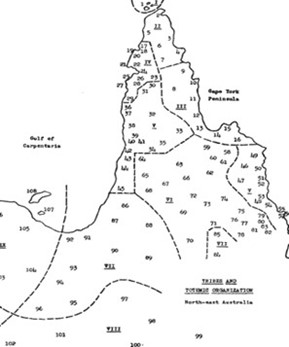
Sharp (1939) Map (Kwok Report at 139)
90 Dr Kwok at [141] of the Kwok Report refers to Sharp’s field notes, in which he observed that:
• Takalak is associated with the “Croydon to Georgetown area”; and
• with “Georgetown, next to AKWAUMING; Abingdon, Ethridge River, Einasleigh River, Gilbert River and Forest Home”;
• Takalak woman, “Lizzie”, describes her father’s country as “Staaten River, near Abingdon”;
• his informant, “Spider … of the Woemin, has Takalak ‘West of Lynd, Gamboola’”; and
• “Okuntjil” is “a name the Takalak call themselves”, and “Okuntjel” is an alternative name for “Takalak employed by the Mitchell River people”.
91 To the extent that Sharp’s field notes refer to “Staaten River, near Abingdon”, the reference would appear to be either an error of recount or transcription. Abingdon is south of the Einasleigh River. Further, the suggestion of Takalak country being as far west as Gamboola appears to be inconsistent with Sharp’s own mapping, where he places Takalak in the vicinity of Georgetown. He places neither Takalak nor Okuntjil as far north as the Mitchell River. As Dr Clarke observed, his “mapping, as distinct from some of his raw field data, is consistent with the accounts from other ethnographers” (Clarke Report at [180]).
92 As to Tindale’s work (Aboriginal Tribes of Australia: Their Terrain, Environmental Controls, Distribution, Limits, and Proper Names: Canberra, Australian National University Press (1974) 185), Dr Clarke records in his report (at [119]) that he provides the following relevant information:
Tagalag
Location: Middle Gilbert River; north nearly to Einasleigh River; south to Gregory Range; at Forest Home; east to Georgetown and Forsayth [sic.]; west to near Croydon. Reference in the 1940 text to Abingdon Downs was a lapse.
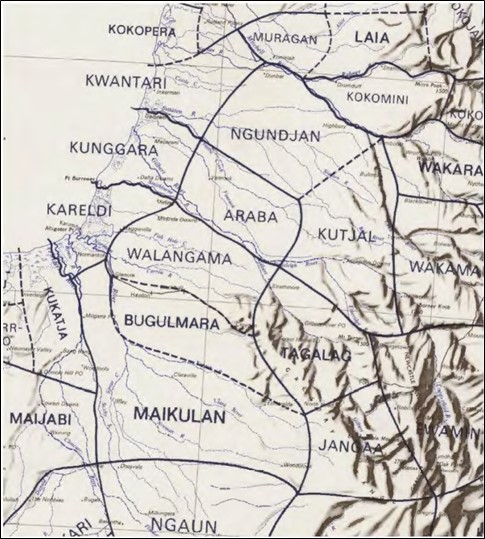
Tindale (1974) Map (Clarke Report at 58)
93 As Dr Clarke observed, this map depicts the Non-claimant Area as part of the tribe territories of the Ngundjan, Araba and Kutjal. Dr Kwok stated that Tindale had mapped the Ngundjen as far south as the Red River. The map is, however, inconclusive. There is a dotted line between the Ngundjan and the Kutjal tribes which, as Dr Clarke explains, means Tindale was uncertain as to their “exact placement”. Dr Kwok observed that care had to be taken with the placement of Croydon on this map and said that the use of the phrase “Croydon mob” should not be taken as an equivalent for Tagalaka. During her oral evidence, Dr Kwok noted, in particular, that her “argument would be that, really, in all the native title claims effected in the surrounding area, there’s no direct equivalence between the name of the group that has come to label a particular native title claim and the group that that applied to more strictly earlier in historical times”.
94 Nevertheless, it is tolerably clear that Tindale did not place Tagalaka within the Non-claimant Area; rather, south of the Gilbert River, despite Lahn & Winn’s apparent acceptance that he did, as cited in the Kwok Report. Lahn & Winn’s ultimate recommendation (2005:88) was that,
[the] area between the Einasleigh and the Red Rivers be … dealt with as the northern periphery of Tagalaka Territory [and suggested that] Pannell’s (2002) Connection Report should be consulted as the basis for a full description of the extent of Tagalaka interests.
95 Pannell did not conclude that Tagalaka were within the Non-claimant Area. She referred to them as the “Croydon tribe” or “Croydon mob” (Clarke Report at [181]).
96 Tindale recorded Arthur Baker’s description of “Dagalang country” (below) as “[running] from Croydon to North Head on N[orth] side of range including Forest Home, Chadshunt and head station end of Strathmore Stn (Cherbourg chart 16)” (emphasis added) (Clarke Report at [192]). This record is inconsistent with the assertion that Tagalaka people had rights and interests north of the Einasleigh River.
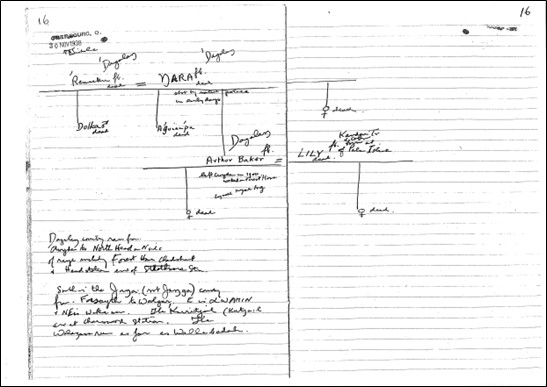
Tindale sheet 16 – Cherbourg (Exhibit 34)
97 In her oral evidence, Dr Kwok said that she did not necessarily agree that the extent of Tagalaka country is “limited by those places, because it says ‘including’ those places”. However, she acknowledged what was written in the document, and agreed that she had taken it into account.
98 The placement of Takalaka people in the Non-claimant Area is also inconsistent with the work of Sutton. As Dr Clarke stated, Sutton recorded local indigenous languages and mapped where the speakers lived. Sutton’s field data illustrated the contraction of territory for the speakers of “Kunjan (Kunjen, Ngundjan, Okundjain) and Areba (Araba, Aripa, Rib) who remained inland, in favour of groups like the Kurtjar (Gurdjar), Gundara and Gugu-bera (Koko Bera, Kokoberra)”, who “[consolidated] their land interests along the coast”. Significantly for present purposes, Dr Clarke points out that Sutton did not record any Kurtjar or Tagalaka interests for the Non-claimant Area (Clarke Report at [141]). He did, however, record interviews with language speakers such as Sloper Mudd and Sloper’s wife, with the map below apparently illustrating the information gleaned from those interviews, together comprising a “language survey of northeast Queensland” (Clarke Report at [138]-[140]).
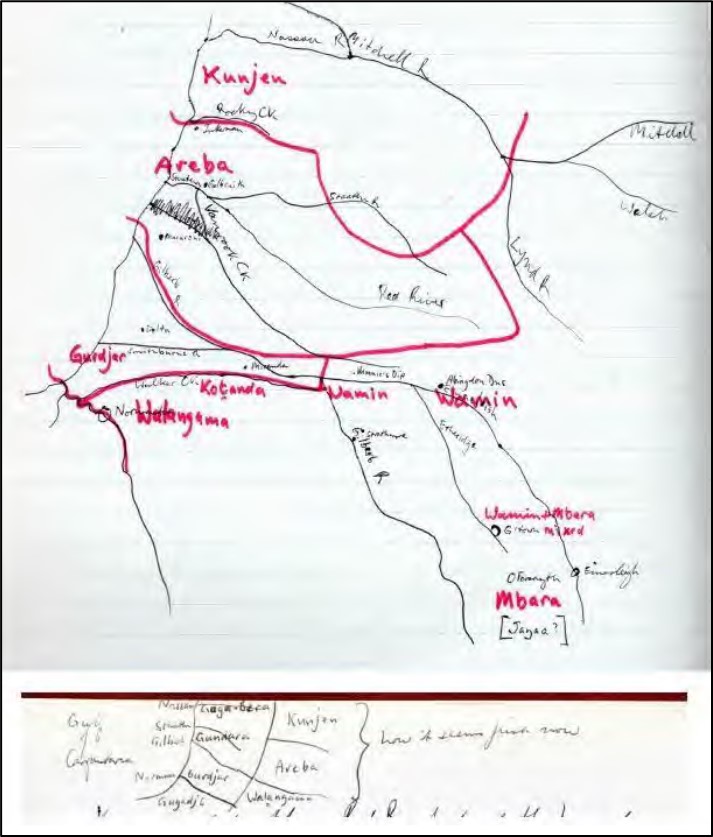
Sutton’s fieldnote maps (Clarke Report at 64)
99 Referring to Sutton (Notes from the Field Survey of North-east Queensland, 1970: Section from Friday, 19th June 1970 to Monday, 6th July 1970. Strathalbyn, South Australia: the Author (1970a) 5-6), Dr Clarke explains that the top map shows “the language distribution at the time of sovereignty”, and the bottom map as “how it seems finish now” in 1970. He explained that, by 1970, Tagalaka people were “widely dispersed across northern Queensland”, also relevantly observing (at [142]):
Prof. Sutton documented the changes to Aboriginal group distribution in the Southwest Cape York Peninsula Region since sovereignty, and importantly for the current investigation he does not record any Kurtjar (Sutton’s ‘Gurdjar’) or Tagalaka (Sutton’s ‘Dagalag’ and ‘Tagalag’) interests for the Non-Claimant Area.
100 Dr Clarke explained further that the map shows the Non-claimant Area “extending from Minnie’s Dip to north of the Staaten River, which is shown mainly as Areba (Aripa, Rib) … and Kunjen (Kundjan, Ngundjan, Okundjain) country, with a thin strip in the southern area of Wamin (Ewamian)”. The latter strip is consistent with the Ewamian People #3 Determination.
101 Dr Kwok did not accept Dr Clarke’s interpretation of this map, on the basis that “[r]ecorded in 1970, Sutton’s information is recorded quite late in the scheme of things and Sutton himself casts doubt on its reliability in multiple, and not necessarily fully valid, ways” (Joint Report at 12). The latter observation appears to be a reference to confusion on the part of Sloper Mudd as to the names of certain languages. Nevertheless, were Dr Kwok’s interpretation to be accepted, it would be necessary to, impermissibly, ignore the Ewamian People #3 Determination or, alternatively, accept an improbable conclusion that Tagalaka country would, as it were, jump over a strip of Ewamian country.
102 Dr Kwok recorded that, in 1976, Sutton reported having found a number of Tagalak speakers about Croydon and lists Dagalag as one of the initial dropping languages of southern Cape York. The geographical association given by Sutton for the language was “with Croydon, and northwards” (Kwok Report at [114], [144]). I note that that observation does not appear to be a direct quote from Sutton’s work and does not have a specific citation. As Dr Clarke observed however, (Clarke Report at [192]), this is consistent with Pannell’s description of Tagalak as the “Croydon tribe” or “Croydon mob” (Pannell 2002:30, 89; Ewamian Native Title Determination Application (QC97/18), Connection Report, February 2004, North Queensland Land Council (2004) 27, 35, 88, 109, and 126). This aspect of Sutton’s work does not appear to provide any legitimate support for an assertion that Tagalaka had rights and interests north of the Einasleigh River.
103 Further, linguist Paul Breen produced the below map in 1981 (cited in Martin, Anthropological Connection Report on Kurtijar People and Country, Prepared for HWL Ebsworth Lawyers & Carpentaria Land Council Aboriginal Corporation, St Lucia, Queensland: UQ Culture & Heritage Unit, 17th August 2017 (2017) 55).
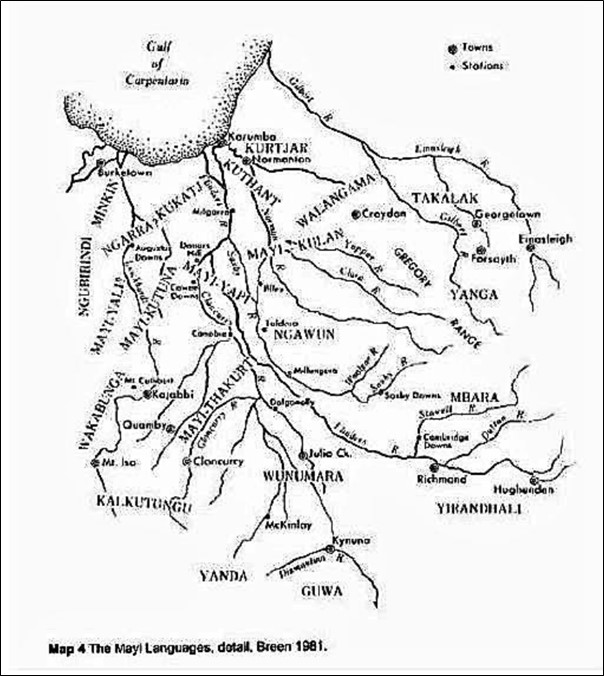
Map of ‘The Mayi Languages’ (Clarke Report Fig 16)
104 Dr Clarke explained that Breen was depicting the language families of Kurtijar, Tagalaka, Tagalak, and Walangama. In his oral evidence, Dr Clarke pointed out that Breen has placed Tagalak “unambiguously” well south of the Einasleigh River.
105 Dr Kwok drew the conclusion that the work of Palmer, Sharp, Tindale, and Sutton “[supports] the view that Tagalak interests extended into the southern end” of the Non-claimant Area. She opined, at [145]:
The combined locational data, as well as information linking Tagalak linguistically and in terms of sectional system type to the Olkolo set, is suggestive that Tagalak may not only be represented within the southern bounds of the non-claimant application area but may also have had interests, in the pre-sovereignty period, extending northward along the eastern side of the present non-application area, including in the uppermost headwaters of the Staaten River.
106 I am unable to accept that opinion. Rather, the preponderance of evidence referred to by both experts, is more consistent with the Non-claimant Area having been occupied by peoples other than the Tagalaka. That evidence leads me to find, on the balance of probabilities, that the Tagalaka people did not have an interest in the Non-claimant Area as at Effective Sovereignty.
Is it possible to identify a body of traditional laws and customs in relation to the acquisition, transmission and exercise of rights in relation to the Non-claimant Area?
107 In Western Australia v Ward [2002] HCA 28; 213 CLR 1 at [17], the majority (Gleeson CJ, Gaudron, Gummow and Hayne JJ, Kirby J concurring) highlighted the following features of the definition in s 223:
First, the rights and interests may be communal, group or individual rights and interests. Secondly, the rights and interests consist “in relation to land or waters”. Thirdly, the rights and interests must have three characteristics: (a) they are rights and interests which are “possessed under the traditional laws acknowledged, and the traditional customs observed”, by the relevant peoples; (b) by those traditional laws and customs, the peoples “have a connection with” the land or waters in question; and (c) the rights and interests must be “recognised by the common law of Australia”.
108 As Reeves J identified in Malone v State of Queensland (The Clermont-Belyando Area Native Title Claim) (No 5) [2021] FCA 1639:
[160] While they may depend on the same evidence, there are two distinct inquiries required by the provisions of ss 223(1)(a) and 223(1)(b) of the NTA: “in the one case for the rights and interests possessed under traditional laws and customs and, in the other, for connection with land or waters by those laws and customs”. The inquiry in (a) involves a question of fact which requires “not only the identification of the laws and customs said to be traditional laws and customs, but, no less importantly, the identification of the rights and interests in relation to land or waters which are possessed under those laws or customs” (italics in original) (see Ward HC at [18] and see also Bodney at [165]).
[161] The inquiry in (b) is not directed to how Aboriginal people use or occupy land or waters, but rather to “whether, by the traditional laws acknowledged and the traditional customs observed by the peoples concerned, they have a ‘connection’ with the land or waters”. This requires the content of the traditional laws and customs concerned to be identified and an examination as to whether the effect of those laws and customs is to provide a connection of the claimants with the land or waters in question (see Ward HC at [64]).
(Emphasis added.)
109 In this context, it is necessary to identify the society whose existence is underpinned by its members’ unity in the acknowledgments and observance of a body of law and customs. As the plurality (Gleeson CJ, Gummow and Hayne JJ) explained relevantly in Yorta Yorta at [49]:
Law and custom arise out of and, in important respects, go to define a particular society. In this context, “society” is to be understood as a body of persons united in and by its acknowledgment and observance of a body of law and customs. Some of these issues were considered in Milirrpum v Nabalco Pty Ltd where there appears to have been detailed evidence about the social organisation of the Aboriginal peoples concerned. Some were touched on by Toohey J in Mabo [No 2] where his Honour referred to North American decisions about similar questions.
(Citations omitted.)
110 The passages from the judgment of Toohey J in Mabo v State of Queensland (No 2) [1992] HCA 23; 175 CLR 1, to which reference is made above, included the following, at 187:
[A]n inquiry into the kind of society from which rights and duties emanate is irrelevant to the existence of title, because it is inconceivable that indigenous inhabitants in occupation of land did not have a system by which land was utilized in a way determined by that society. There must, of course, be a society sufficiently organized to create and sustain rights and duties, but there is no separate requirement to prove the kind of society, beyond proof that presence on land was part of a functioning system.
(Emphasis added.)
The pre-sovereignty society/societies
111 In the present case, as has already been set out, the experts are agreed that there were laws and customs by which the Aboriginal peoples associated with the Non-claimant Area acquired rights and interests in the Non-claimant Area. NQLC submitted that the traditional laws and customs were such that land was held by local patriclan estates and that, subject to the effect of extinguishment, the native title rights and interests of the Aboriginal people in the Non-claimant Area were the rights to possess, occupy, use and enjoy the area to the exclusion of all others.
112 In so far as the existence of a society, as distinct from its kind, from whom such rights and duties emanate, Dr Clarke concluded that “the ‘Goothanto nation’ as described by Mathews in opposition to the ‘Warkeemon [Wakaman] nation’ based in the adjacent central Cape York Peninsula region can be seen as analogous to the Southwest Cape York Peninsula Regional Society” as he, Dr Clarke, has termed it: see Mathews, Copies of Correspondence in the A.P. Elkin Collection. Sydney: University of Sydney (1899) 109-110). This is the society he identified to have been associated with the Non-claimant Area.
113 In Dr Clarke’s opinion (at [96]),
[t]he early ethnography confirms the existence of Aboriginal groups, such as those described as Ariba (Araba, Areba, Rib), Goongarra (Goon-gharra, Gunggara, Kunggara, Kuggaare, Kurtjar?), Koonjan (Kunjan, Kunjen, Ngundjan, Oogonjin?), Kundara (Goondara, Gundara), Dagallagan (Tagalag, Takalaka) and Wallungarma (Wollangama).
114 In her oral evidence, Dr Kwok did not disagree that a “regional society”, in the sense referred to by Dr Clarke, is understood as a group of societies, with different traditional laws and customs, that form part of a larger group. Dr Kwok also said that different groups within the region recognise their neighbours’ interests in country. She did, however, criticise the basis on which Mathews had arrived at his map. In the end, nothing turned on Dr Kwok’s criticism in this regard. Dr Clarke explained in oral evidence that he was simply trying to explain how regional societies existed and it was not his intention to “do a forensic sort of dividing up using the various devices that [Mathews] used in terms of defining people”. He did, however, reiterate that although there was some complexity in terms of the groups included within the regional society, he held Sharp in higher regard than Mathews. Consequently, Dr Clarke approved of Martin’s reliance on Sharp.
115 In concluding that the traditional society of which the Kurtijar people formed a part included members of other Aboriginal language across a broad geographical area, which includes the Non-claimant Area, Martin inferred the following shared attributes for groups who formed part of the Regional Society (Martin Report at [24]):
(a) A history of association (in pre-colonial times);
(b) The same system of spiritual (or totemic) entities associated with the landscape;
(c) The same system of four named sections, known in Aboriginal English as ‘skins’ or ‘heads’ and in the Kurtjar language as dhakal, with the four terms being weergh, rduuaang, yeerdiny, and loord;
(d) A structurally similar system of clan estate groups; and
(e) A shared intertribal institution of male initiation, as well as ceremonies of introduction to country and persons, enactment of ancestral activities, and increase of phenomenon in the landscape; and
(f) Intermarriage and resulting multiple personal potential memberships of different language groups or ‘tribal’ ‘groups’ with recent change towards greater corporatisation of such ‘groups’.
(Footnotes omitted.)
116 Dr Clarke explained that his finding in this regard is consistent with that described by Martin. He suggested further that the existence of the Southwest Cape York Peninsula Regional Society was suggested by Bulleta (1897), who claimed that the “Cook-a-jin (‘Normanton tribe’), O-o-ee-kulla (Olkolo), Goon-gharra (Gungarra, Kungarra, Kunggare) and Air-rib (Araba, Areba, Ariba, Rib) peoples ‘would live peaceably together’” (Clarke Report at [227]). He drew further support from Sharp’s Aboriginal society classification of Division VII, which he named the “Okerlila type”, and which, as shown on the Sharp (1939) map above, included the Kungarra and Aripa tribes: Sharp, “Tribes and Totemism in North-East Australia” ((1939) 9 (3) and (4) Oceania 254, 439).
Rights and interests held by members of the society under traditional laws and customs
117 Dr Clarke expressed his view that “what is missing from our knowledge of the laws and customs relevant to the Non-[c]laimant Area is an account of how individuals could assert rights and interests to land beyond that which came through membership of the patriclan”. Although Dr Kwok indicated that there were a number of sources upon which to base an understanding of the laws and customs of the Non-claimant Area, she did not elaborate on those laws and customs, beyond identifying “the continuing emphasis on principles of descent in the transmission of rights and interests in land and waters”.
118 Nevertheless, both Dr Clarke and Dr Kwok engaged, at least peripherally, in some discussion of the laws and customs of the Southwest Cape York Regional Society. In relation to marriage sections and totems, and ceremonial and ritual life, Dr Clarke referred to the work of Mathews (1899), Roth (Ethnological Studies Among the North-west-central Queensland Aborigines. Brisbane: Edmund Gregory, Government Printer (1897); and North Queensland Ethnography. Bulletin No. 18. Social and individual nomenclature. Records of the Australian Museum, vol.8, no.1 (1910b) 79-106), Sharp (1939), Tindale (Journal of Visit to the Gulf of Carpentaria, by Norman B. Tindale, 1963. AA338/1/25. Adelaide, South Australia: South Australian Museum Archives (1963); and 1974), and Sommer (Speaking Kunjen: An Ethnography of Oykangand Kinship and Communication. Canberra: Pacific Linguistics, Australian National University (2006)) in Sections 2.5 – 2.7 of the Clarke Report. None of it, however, touches on whether “the effect of those laws and customs is to provide a connection of the claimants with the land or waters in question”. It was Dr Clarke’s opinion (at [168]) that,
[t]he available ethnographic records are poor in relation to customary beliefs, but from what is available it can be determined that the identity of each individual, within the Regional Society, was derived through their totemic system from ancestral spirits. It can be reasonably assumed that a shared totemic system, along with the four-section system for determining appropriate marriages, was shared across the Southwest Cape York Peninsular Regional Society. Here, clan membership was determined patrilineally. In northern Queensland, there were some differences in male initiation ceremonies and rituals, such as whether circumcision and subincision were practiced or not, that appear to have distinguished peoples from different regional societies. The Aboriginal people of the Southwest Cape York Peninsular Regional Society did not practice either rite at sovereignty.
(Citations omitted.)
119 In the Kwok Report, Dr Kwok did not identify any traditional laws and customs specific to the three groups of peoples whom she concluded have traditional connection to the land – being the groups today referred to as Tagalaka, Rib, and Kunjen (Ogh Undjen). She agreed in cross-examination that she had not discussed any rules in relation to permission to come onto country, nor regarding the use and care of the land, nor in relation to any relevant ceremonies relating to the land. Dr Kwok said that, had she been asked to provide a “full connection report, some of those topics “would obviously be explored in more detail”.
120 Dr Kwok may have agreed too readily with the proposition that was put to her in cross-examination. In her report (at [239]), she referred to the writings of Palmer in which he had identified, inter alia, that: “the tribal territories [and their “boundaries”] … were sufficiently well known to form landmarks for them to know when they were getting into neutral or debatable ground”; “[n]o actual or individual right seemed to belong to any one person … or even inheritance of the land itself … but merely the right to the game lived on such territory; and each right belonged to the tribe as a whole … [a]ny one else interfering with the game, or trespassing for such purpose, was looked upon as an intruder, and … unless he was accredited as a messenger or herald would pay the penalty most likely with his life”; “[w]hen tribes met at certain places such as large lagoons in another’s hunting-ground, they did so with the permission or consent of the owner of that place” (Palmer, Notes on some Australian tribes (1884) 13(3) Journal of the Anthropological Institute of Great Britain and Ireland 276, 278-279). Even accepting the limitations of Palmer’s map as previously described, this is at least some evidence of the rights and interests in land observed by Palmer within the area mapped by him, which included the Non-claimant Area.
121 It is less straightforward to connect the relevance of Roth’s work as referred to by Dr Kwok. In particular, it is difficult to discern where he is discussing matters related to areas that might encompass the Non-claimant Area, as opposed to those areas within the Rockhampton district, where it seems he did one of “his most comprehensive case studies”. Apart from general references to “home” and “land” cited by Dr Kwok, the only specific reference by Roth to laws and customs in relation to land tenure cited by Dr Kwok was in respect of eastern Cape York.
122 In her report, Dr Kwok also referred to the writings of Sharp – both to his unpublished PhD thesis (“The social anthropology of a totemic system in Northern Queensland” (1937, Harvard University)) and his published work (Sharp 1939). The references to his latter articles were in relation to two of his organisational types, the Olkol (which included Okundjain, Tagalak and Okuntjel tribes) and the Okerlila (which included Aripa and Walangama tribes). It is tolerably clear that the tribes within these two organisational types, as identified by Sharp, were situated within Dr Clarke’s concept of the Southwest Cape York Peninsular Regional Society.
123 In the Joint Report, Dr Kwok referred to Sharp (1939:444-452) as providing evidence in relation to the acquisition of rights and interests in land. She drew from those writings: belief in an originary creative era and the activity of totemic ancestral beings; the importance of patrilineal totemic clans (broader than patrilineages); the relationship with a person’s mother’s father’s totems; conception filiation; and increase rites. Dr Kwok considered that these matters all related to the patrilineal totemic clan system.
124 In relation to the Olkol type, Sharp observed that “[t]he patrilineal totemic clan is an important element in the social structure of all these tribes” (Sharp 1939:444); that “strictly speaking the inheritance of land is patrilineal within the limits not of the actual blood patrilineage but of the clan kin” (Sharp 1939:446); and that, “[f]or some of the western and northern tribes in this area … a spirit baby … [whose] provenience and thus its clan affiliations are known from the territory in which it was found” (Sharp 1939:448). Sharp was able to report evidence of increased ceremonies for some of the tribes and some evidence of totem centres which appeared to be similar to control rites observed amongst neighbouring tribes (Sharp 1939:446-447).
125 As to the Okerlila type, Sharp observed that the “patrilineal clan is well developed” (Sharp 1939:450) and that “[t]he clans are local groups each controlling certain territories and their natural products. These countries need not be contiguous” (Sharp 1939:451). In this group of tribes, “a spirit child … is found usually by the father somewhere in his own clan country … [as] pre-existent in … [that] country[,] … and is thus identified with the paternal clan …” (Sharp 1939:452). Sharp also refers to control rites having been “formerly held at specified places” but notes that “[t]he nature of these ceremonies could not be learned from available informants” (Sharp 1939:452).
126 According to Dr Kwok, Sharp had argued that “the very deep-seated nature of the relationship of person, clan, totem and country, maintained within the Aboriginal world view, lends it a quality of ‘perdurability’”. At [267] of the Kwok Report, she points to an example given by Sharp of a person whose relationship to his country is as a member of the lineage represented by the Rain totem:
Being a member of the Rain lineage, I am given Rain names to identify me as such. One of my public names is Waltolo, the name of the country where my existence as a distinct social personality began. The name serves as a public reminder of the fact that I am peculiarly related to this particular section of the land, and that I therefore have proprietary rights over it which I need share only with those others of my lineage who happen also to have been found there. My relationship to this country, which amounts to joint ownership, is in the nature of a fact which exists in the mental world, a belief which is supported by every other belief which associates me with my lineage and its totems. Accordingly, though others may trespass on my country, they cannot deprive me of my relationship to it, once this has been publically recognised, without altering a whole set of strongly entrenched beliefs.
(Emphasis added.)
127 In relation to Sharp’s writings, his disclaimer in fn 2 on (1939:)254 is important:
The unsatisfactory nature of much of this material is due both to the limited time I could allow for survey work, a limitation aggravated by the exigencies of travel in this area, and to the demoralization of native life which has so swiftly followed the introduction of European and Oriental culture traits into many parts of the region. Such tribes as the Bentinck Islanders of the Gulf of Carpentaria or the Taior on the west coast of the Peninsula are untouched by the lethal influences of civilization, but elsewhere others are extinct and many have undergone foreign and inter-tribal acculturation. I have accordingly drawn on other available sources of information for the area in order to make the study as complete as possible, and all known tribes in the region are listed even though information on their totemism is lacking.
128 Dr Clarke’s opinion is, therefore, consistent with the caveat which Sharp had put on his work. As Dr Clarke observed, there is little information about how the rights and interests to land of an individual could be asserted beyond that which came through the patriclan. Nevertheless, based on the research cited by Dr Clarke and Dr Kwok, there is some evidence that an individual’s rights and interests in land within the Non-claimant Area:
a. were acquired by membership of a totemic patriclan, including in the form of a spirit child;
b. were held in common ownership;
c. conferred a right to occupy, hunt, and gather;
d. conferred a right of refusal to a trespasser who was not an accredited messenger or herald;
e. conferred a right to require permission or consent to be obtained by someone of a different tribe; and
f. could not be extinguished once a person’s relationship to the land had been publicly recognised.
129 In so far as Mr Harris submitted that the evidence went no further than establishing that there was a system of totemic patriclans, I must reject that submission. However, I accept that what evidence there is of the content of the traditional laws and customs which give rise to rights and interests in land is both limited and, in some respects, too general to be of any real assistance. It is also unconnected to any specific group or tribe within the broader regional society.
Has there been continuity of traditional law and customs?
130 Pursuant to the meaning of “native title” as defined in s 223(1)(a) of the NTA, the relevant rights and interests in relation to land and waters must be “possessed under the traditional laws acknowledged, and the traditional customs observed, by the Aboriginal peoples”: see Bodney v Bennell [2008] FCAFC 63; 167 FCR 84 at [45]. The requirement that there must be continuity of that observance and acknowledgment of those laws and customs for native title to be determined over a particular area was explained by the Full Court in Bodney, at [47]:
Because it is the normative system that is the source of the rights and interests, it is necessary in order to prove native title that the normative system has had a continuous existence and vitality since sovereignty. If that normative system has not existed throughout that period, the rights and interests which owe their existence to that system will have ceased to exist. It is therefore necessary for native title claimants to show that the normative system that existed at sovereignty is substantially the same as the one that exists today. If it is not, then any rights and interests are not “possessed under the traditional laws acknowledged and traditional customs observed”.
(Citations omitted. Emphasis added.)
131 It is important to acknowledge that it is the “normative system” from which the relevant rights and interests are sourced that must be continuous, not the society in which the system exists. So much is clear from the comments of Jagot J in Wyman on behalf of the Bidjara People v State of Queensland (No 2) [2013] FCA 1229, who said, at [496]:
… the question is not merely whether a society has continued. The question is whether there has been continued acknowledgment and observance of pre-sovereignty laws and customs of that continued society, albeit recognising that change, adaptation and interruption may not be fatal in that “[s]o long as the changed or adapted laws and customs continue to sustain the same rights and interests that existed at sovereignty, they will remain traditional”. Putting it another way, for the purposes of the NTA, it is the continued acknowledgment and observance of pre-sovereignty laws and customs that enables it to be said that the relevant society itself has continued.
(Citations omitted. Emphasis added.)
132 As to the matters of continuity, change and adaptation to which Her Honour referred, the Full Court in Bodney also noted the following observations, as set out in AB (decd) (obh of Ngarla People) v State of Western Australia (No 4) [2012] FCA 1268 at [92]:
• Change and adaptation of laws and customs will not necessarily be fatal. So long as the changed or adapted laws continue to sustain the same rights and interests as existed at sovereignty, they will remain traditional. Continuity of the society is not the right question. It does not establish that the rights and interests are those that existed at sovereignty, because they may adapt and change: at [74].
• A substantial interruption to laws and customs for the identification of rights and interests in land cannot be mitigated by reference to the effects of white settlement. The continuity enquiry does not involve a consideration of why acknowledgment and observance stopped: at [97].
• The proper inquiry is whether laws and customs find their origin in pre-sovereignty society, not whether they are the same as those that existed at sovereignty. Clearly, laws and customs can alter and develop after sovereignty, perhaps significantly, and still be traditional: at [120].
• It may be that the true position is that what cannot be created after sovereignty are rights that impose a greater burden on the Crown’s radical title: at [121].
(Emphasis added.)
133 In addition, I observe that a critical component of proving continuity is contemporaneity. Indeed, “[d]emonstrating (some or even much) knowledge of the content of the traditional laws and customs that were once acknowledged is not sufficient [to prove continuity] if the laws and customs themselves are no longer acknowledged”: AB at [470]. Further, the relevant normative system that exists contemporaneously must be that same system which existed at sovereignty. In Yorta Yorta, at [89], the Court explained this requirement in the following terms:
… it is necessary to demonstrate that [despite the changes] the normative system out of which the claimed rights and interests arise is the normative system of the society [at sovereignty] … not a normative system rooted in some other, different, society … it must be shown that the society … has continued to exist throughout that period as a body united by its acknowledgement and observance of the laws and customs.
(Emphasis added.)
134 Further to those principles set out above which bear on proof of connection, the principles relevant to connection were summarised by the Full Court in Blackburn v Wagonga Local Aboriginal Land Council [2021] FCAFC 210; 287 FCR 1 at [80]-[88]. The Full Court said, at [83]:
In Bodney, the Full Court explained (at [164]) that the “connection” concept in the NT Act is multifaceted, with differing aspects of it being emphasised in differing factual contexts. The Full Court referred to the following principles that have been established by the cases (at [165]-[179]):
(a) The inquiries required by ss 223(1)(a) and by (1)(b) are distinct, notwithstanding that each is sourced in the traditional laws acknowledged and the traditional customs observed by the claimants. The connection inquiry is not tied to the rights and interest claimed (though their character and their exercise may be important in a given case in demonstrating connection by the traditional laws and customs). Rather, connection involves the relationship of the claimants to the land defined by laws and customs which they acknowledge and observe (citing Northern Territory v Alyawarr, Kaytetye, Warumungu, Wakaya Native Title Claim Group (2005) 145 FCR 442 at [111]).
(b) The connection inquiry requires, first, an identification of the content of the traditional laws and customs and, secondly, the characterisation of the effect of those laws as constituting a connection of the claimants with the land. Connection can be maintained by the continued acknowledgment of traditional laws and observance of traditional customs for the reason that the laws and customs themselves characteristically will, in significant degree, presuppose or envisage direct connections with land or waters or will, if acknowledged and observed, link community members to each other and to the land or waters in a complex of relationships. The laws and customs that connect an Aboriginal community to land are by no means exclusively ones that afford rights and interests in that land, but include laws and customs that define the spiritual, cultural, social and linguistic connection to the land.
(c) The connection inquiry requires demonstration that, by their actions and acknowledgment, the claimants have asserted the reality of the connection to the land or waters so made by their laws and customs. While European settlement may have rendered it impracticable for an Aboriginal community to maintain a traditional presence on substantial parts of their lands, such impracticability does not necessarily mean that the community has not substantially maintained its connection with their land. The land may have subsisted at a spiritual and/or cultural level (referring to Yanner v Eaton (1999) 201 CLR 351 (Yanner) at [38]).
(d) The connection inquiry may require a particular topographic focus, particularly in cases where the claim area includes within its boundaries portions of land or waters for which there is no evidence of use by the claimants and where a question arises whether the claimants have lost or have maintained their connection with a part, or parts, of the claim area. In that respect, the Full Court stated (at [179]):
What, in our view, is indispensable where a matter put in issue in a proceeding is whether connection has been maintained to a particular part of a claim area, are the needs:
(i) to examine the traditional laws and customs for s 223(1)(b) purposes as they relate to that area; and
(ii) to demonstrate that connection to that area has, in reality, been substantially maintained since the time of sovereignty.
(Emphasis in original.)
135 While the SOFLI characterises continuity and the maintenance of connection by contemporary descendants of those rights and interest holders at sovereignty as separate issues, the requirement to prove “connection” is necessarily linked with “continuity”: Bodney at [48]. In fact, it is accepted that maintenance of connection can be proved “by the continued acknowledgment of traditional laws and observance of traditional customs” in a particular area: AB at [91]. As the Full Court explained in Northern Territory of Australia v Alyawarr, Kaytetye, Warumungu, Wakaya Native Title Claim Group [2005] FCAFC 135; 145 FCR 442 at [92]:
It may be that not enough emphasis has been placed on the idea of continuity of observance as a manifestation of connection … The use of ‘connection’ as emphasising a requirement to show continuity of association with the land by observance and acknowledgment of traditional law and custom relating to it gives proper recognition to its origins in the Mabo [(No 2)] judgment. It involves the continuing assertion by the group of its traditional relationship to the country defined by its laws and customs. This relationship may be evidenced by its physical presence there but also in other ways involving the maintenance of the stories and allocation of responsibilities and rights in relation to it.
(Emphasis added.)
136 Despite the inevitable overlap between matters relevant to proof of continuity and connection, it is convenient to first address continuity. Where there is sufficient proof of continuity, the second inquiry is whether that continuity also evidences maintenance of connection.
137 In this regard, the primacy to be accorded to indigenous lay evidence in native title cases has been repeatedly emphasised. In Sampi v State of Western Australia [2005] FCA 777 at [48] (in a passage later endorsed by the Full Court on appeal in [2010] FCAFC 26 at [57]), French J said:
[The Aboriginal witnesses’] testimony about their traditional laws and customs and their rights and responsibilities with respect to land and waters, deriving from them, is of the highest importance. All else is second order evidence.
138 Thus, generally, it is the evidence from Aboriginal witnesses that will provide the most reliable account of observed traditional laws and customs: Jango v Northern Territory of Australia [2006] FCA 318; 152 FCR 150 at [291] (Sackville J). This is not to deny, however, that there may be utility in anthropological evidence “[providing] a framework for understanding the primary evidence of Aboriginal witnesses in respect of the acknowledgement and observance of traditional laws, customs and practices”: Alyawarr, Kaytetye, Warumungu, Wakay Native Title Claim Group v Northern Territory of Australia [2004] FCA 472 at [89] (Mansfield J). Further, His Honour observed that, at [89]:
[T]here may also be circumstances in which an anthropological expert may give evidence about the meaning and significance of what Aboriginal witnesses say and do, so as to explain or render coherent matters which, on their face, may be incomplete or unclear.
139 The parties did not agree that there has been a continuity of observance and acknowledgment of traditional laws and customs in the Non-claimant Area. Mr Harris contended there is no evidence to support the conclusion that there has been continuity of observance and acknowledgment of traditional laws and customs, for the following reasons. First, given the state of the evidence regarding apical ancestors, it is at best unclear who among the proposed apical ancestors would have held rights and interests in the Non-claimant Area. Secondly, the Areba people no longer exist as a cultural entity, and contemporary people with Kundjan connections are associated with areas to the north and northeast of the Non-claimant Area. Accordingly, to the extent that any purported extant native title is sourced upon Areba or Kunjen claims, continuity is an impossibility. No case for succession was argued. Thirdly, there is in any case a lack of evidence from which it could be accepted or even inferred that there is continuity. Finally, the effect of the evidence as to the nature of the land in the Non-claimant Area, including its remoteness and hostility, is such that any ongoing connection with the Non-claimant Area is inherently unlikely.
140 NQLC objected to the applicant’s contentions set out above, alleging, and on the basis that, they do not sufficiently enable NQLC to know the case that it must answer at trial. Under cover of that objection, the gravamen of NQLC’s position is that there has been substantially uninterrupted continuity, characterised by adaptation and transformation, such that native title rights are now held by language identity groups based on the Kunjen (including Ogh Kundjen), Rib, Tagalak and Walangama languages.
141 As NQLC submitted, in the context of contested non-claimant applications, and those to which s 86G of the NTA applies, it is inappropriate to employ evidentiary or adversarial presumptions which may have been developed in the common law in quite different contexts: Mace at [56]; Fortescue Metals Group v Warrie obh of Yindjibarndi People [2019] FCAFC 177; 273 FCR 350 at [290]. The Full Court in Mace observed that it is the quality of evidence of native title that is determinative, and such evidence need not be extensive: Mace at [97]. Leaving aside common law presumptions, it is nevertheless relevant when considering the whole of the evidence adduced at trial, that if the quality of that evidence is poor, and there is evidence that potential evidence had been assessed by a party and discarded, it may be inferred that the evidence which has been adduced is the best available to that party.
The applicant’s lay evidence relevant to continuity
142 Mr Harris’ own evidence, as opposed to the expert evidence called by him, touches on the third and fourth reasons why Mr Harris says there is no evidence to support a conclusion that there has been continuity of observance and acknowledgement of traditional laws and customs in the Non-claimant Area; namely, that there is no evidence from which it could be accepted or inferred that there is such continuity, and that the harsh nature of the country means any ongoing connection is inherently unlikely.
143 Mr Harris’ evidence, as deposed to in the Harris Affidavit, was that, in addition to there being no extant claim over the Non-claimant Area, in his then 18 years as the owner of Strathmore Station,
(a) to the best of his recollection, he has never been approached by any Aboriginal person or people seeking access to the part of Strathmore Station within the Non-claimant Area;
(b) to the best of his recollection, other than the Kurtijar People application, he has never heard of any Aboriginal person or people asserting or claiming that they hold native title rights or interests in the Non-claimant Area – he further deposed that he had not heard of the Red River Claim until his lawyer, Mr Kempton, brought it to his attention;
(c) to the best of his recollection, none of the approximately 100 workers he employs from time to time have claimed to have, or expressed knowledge of, native title rights and interests in respect of the Non-claimant Area, nor have any claimed to be traditional owners of, or expressed any traditional connection to, any part of the Non-claimant Area;
(d) there is no access to the Non-claimant Area other than by the main station road, which he constructed to the northern extremity of Strathmore Station some 100km away, past the house;
(e) he has travelled extensively over Strathmore Station over the past 18 years during mustering, fencing, road building, and looking for sites for stock dams by helicopter, motor vehicle, quad bike, and on foot and has never seen or come across any Aboriginal person or persons in the Non-claimant Area, other than members of his workforce;
144 As noted above, Mr Harris also deposed, together with his lawyer Mr Kempton, to having attended a meeting with members of the Boards of the EAC and TAC on 19 May 2015 in Cairns to discuss the requirements of the NTA and to seek their support for his tenure conversion application.
145 Mr Harris was cross-examined in relation to two matters only. The first was in relation to the meeting on 19 May 2015. It was not clear from the cross-examination, nor from submissions, as to whether it was being suggested to Mr Harris that his evidence in [11] of his affidavit, to which he was taken, was wrong. It was not put to him that the meeting took place in Croydon, rather than in Cairns. Relevantly, Ms Callope’s evidence, which on this point has already been mentioned, was that she recalled meeting with Mr Harris, together with her sister, at a “Taglaka meeting in Croydon that Scott Harris attended to talk about Strathmore Station. I think that was around 2015”. Mr Harris said that he could not recall such a meeting, observing that “[i]t’s nine years ago”. He also said he could not recall ever speaking with a member of the TAC named Ms Gladys Callope. In particular, Mr Harris said he could not recall Ms Callope and her sister ever saying to him that “Strathmore Station was like her second home”, nor Ms Callope’s connection to Strathmore Station. For reasons that I explain below, I do not accept, as submitted by NQLC, that no weight should be placed on Mr Harris’ evidence because he “could not recall a conversation with Ms Gladys Callope in 2015”.
146 Rather, I accept that the meeting detailed in Mr Harris’ affidavit occurred as he described. It is probable that Mr Harris prepared his affidavit with the assistance of his solicitor, who was likely to have had a record of attending the meeting and the place at which occurred. Further, Mr Harris was not challenged about the accuracy of his recollection as to the location of the meeting.
147 The second matter about which Mr Harris was cross-examined was his evidence as to the difficulty of accessing and travelling over the Non-claimant Area. He reiterated the evidence given in his affidavit that he had accessed the Non-claimant Area by foot, quad bike, and horse, albeit that it was “[v]ery difficult” to do so in each case.
148 NQLC submitted that no weight should be placed on Mr Harris’ evidence in circumstances where, inter alia:
(a) he did not communicate his intention to seek a negative determination to NQLC until 1 March 2022;
(b) he has been on notice since 19 July 2022 that NQLC has been undertaking work for the purpose of bringing a claimant application over an area of land that includes the Non-claimant Area;
(c) prior claimant applications have been made over parts of the Non-claimant area; and
(d) his association with the Non-claimant Area is, having regard to the history of Strathmore Station, relatively recent, being since only 2004.
149 True it is that in the context of this country’s history, both pre- and post-sovereignty, 20 years is an insignificant period time. However, in the context of the promulgation of the native title regime in 1993, only some 31 years ago, and the history of claims in and around the area of Strathmore Station, including parts of Non-claimant Area, that stretch back to 1997, 20 years is of some significance. To the extent that NQLC submitted that less weight should be given to Mr Harris’ evidence because of the relatively short period of his association with the Non-claimant Area, that submission must be rejected. Mr Harris did not purport to give any evidence touching upon matters pre-dating his possession of Strathmore Station. He is perfectly qualified to give evidence of matters within his knowledge relevant to the past 20 years and has sought to do no more than that.
150 As outlined above, it is also true that prior claimant applications have been made over parts of the Non-claimant Area – in particular, as part of the Ewamian claim filed in 1998, the Tagalaka claim filed in 1998, the Red River claim filed in 2002, and the Kurtijar claim filed in 2015. The reasons for the excision of parts of the Non-claimant Area from the Ewamian, Taglaka, and Kurtijar claims were not before the Court. Lahn & Winn 2005 was, however, in evidence and is instructive. The authors record that one of them attended a meeting convened by NQLC at Normanton on 24 July 2004 at which the withdrawal of the Red River claim, inter alia, was discussed (Lahn & Winn 2005: [1.2]).
151 A map of the “Potential Claim Area (PCA)” as discussed at that meeting, and an alternative “Potential Claim Area (PCA-2)”, is Map 8 below.
Map 8 (Lahn & Winn 2005:187)
152 Since Lahn & Winn 2005, the area north of the Staaten River (at approximately 6.8 on the vertical axis) has become the subject of the Kowanyama People Determination. The territory from the Staaten River southwards to the Gilbert River, approximately following the line between E and F on the horizontal axis, is included in the Kurtjar People Determination. The area encompassed by Abingdon Downs is the subject of the Ewamian People #3 Determination.
153 As to the remainder, and which is largely encompassed by the Non-claimant Area, the authors refer (at 5) to the “historical remoteness of much of the area (particularly the central Staaten-Red River localities) from settlements, aboriginal station camps, outstations, and the Mitchell River Mission. The central area remains inaccessible and is rarely, if ever, visited by Aboriginal people”. This is entirely consistent with the evidence given by Mr Harris.
154 At section [5.2] (‘Continuity of connection’), Lahn & Winn 2005 record:
The explanation for people’s general lack of continued contact with Red River and inland Staaten country is straightforward. Access to the region was and remains very difficult, largely as a result of its remoteness.
…
Knowledge of the Red River area on Strathmore Station is somewhat more widespread than that of the inland Staaten, which appears even more remote.
155 Relevantly, they explained further:
Strathmore was said to have drawn its labour from nearby town-camps and by arrangement with the regional Aboriginal Protector based in Normanton. These people would be sent from Normanton to Croydon by train, where they would be met at the station and taken directly to the property. Though a few individuals recalled growing up on Strathmore while their mothers were engaged in station-work, there were no accounts of Aboriginal encampments on this station comparable to those further north on properties like Dunbar, Koolatah or Inkerman.
156 As evidenced above, both Dr Kwok and Dr Clarke heavily cite Lahn & Winn 2005. While Dr Kwok did not refer to these passages, Dr Clarke (at [58]) relied on them, amongst others, for his conclusion that,
[t]he lack of outlying Aboriginal camps on Strathmore Station, together with a general scarcity of roads over much of the country and attempts by managers to keep all visitors out, contributed to an overall absence of Aboriginals presence for much of Non-Claimant Area during the 20th century. The Aboriginal quarters at Strathmore Station were not located within the Non-Claimant Area, but further south on the other side of the Einasleigh River.
(Citations omitted.)
157 All of this gives credence to Mr Harris’ evidence as to the absence, but for his workers, of any encounters with Aboriginal people in the Non-claimant Area over the past 18 years. It may also explain why none of the Aboriginal witnesses that gave evidence in this proceeding has ever been back to the Non-claimant Area since their last visits to Strathmore Station many decades ago.
158 It is difficult to understand why NQLC submitted that no weight should be given to Mr Harris’ evidence “in circumstances where [h]e did not communicate his intention to seek a negative determination to NQLC until 1 March 2022” and where he is said to have been “on notice since 19 July 2002 that NQLC [had] been undertaking work for the purposes of bringing a claimant application over an area of land that includes the Non-Claimant Area”. His evidence can hardly be said to have been tainted by the timing of his application.
159 In any event, I reject the implication that Mr Harris has somehow acted precipitously in bringing his application or that he has changed his position between April 2015 and March 2022. The evidence is to the contrary.
160 It is uncontroversial that Mr Harris through his solicitor wrote to NQLC almost 10 years ago, on 17 April 2015, seeking its assistance with identifying any potential native title claimant who may have an interest in the area the subject of Mr Harris’ application. Although Mr Harris’ letter stated that he was “well advanced in discussions with both the Ewamian and Tagalaka Native Title parties on the basis that native title will not be extinguished”, the application form attached to the letter of 17 April 2015, dated 8 April 2015, makes clear that Mr Harris was seeking a declaration that native title “does not exist” in the Non-claimant Area. I accept the evidence of Mr Kempton that he did not ever receive a response from NQLC to that letter.
161 Further, the “Notice of non-claimant applications for determination of native title”, with a notification date of 3 June 2015, published by the NNTT, stated, in respect of Mr Harris’ application:
Order sought by Applicant: The applicant seeks a determination that native title does not exist.
162 It is also uncontroversial that, on 19 May 2015, Mr Harris attended a joint meeting with members of the board of the EAC and the TAC, and their respective advisers to, inter alia, obtain letters of support for the tenure conversion application, consistent with the tenor of his letter to NQLC of 17 April 2015. Both EAC and TAC gave their written in principle support for Mr Harris’ application in mid-2015.
163 In the meantime, and as set out above, the Kurtjar People claim was determined after the original claim area was amended to remove its approximate 6% overlap with Strathmore Station. The Aboriginal people who had been joined as respondents to the application (Joseph Rainbow, Shirley McPherson and Irene Pascoe), and who were the successful applicants on behalf of the Kurtjar People in the Kurtjar People Determination (Rainbow (No 2)), were removed as respondents to Mr Harris’ application on 1 August 2019. NQLC had apparently been “undertaking work on a regional research project in the northwestern reaches of NQLC’s region”, which included the Non-claimant Area. However, it did not communicate this to Mr Harris until 19 July 2022.
164 On 24 February 2022, Mr Harris wrote again to NQLC, the EAC and the TAC, and also to the CLCAC, to enquire about their knowledge of any potential native title holders in respect of the Non-claimant Area. The letter to NQLC noted that no response had been received to Mr Harris’ previous enquiry in 2015.
165 Ms Sharon Prior, on behalf of the EAC, responded that the Ewamian People had not expressed any interest in the non-claimant application. The CLCAC expressed its wish that the historical claims of the Kurtjar People to Strathmore Station be made known to the parties in this application. The TAC did not respond; nor did NQLC.
166 I accept Mr Kempton’s evidence that he wrote again to NQLC on 1 March 2022, and that, as at the date of swearing his affidavit dated 11 May 2022, he had not received any response.
167 There is no basis for the submission that Mr Harris did not communicate his intention to seek a negative determination to NQLC until 1 March 2022. His intention to do so had been made clear from the outset, subject to him being able to identify the native title parties (if any) “for that part of the lease area north of the Einasleigh River”, in respect of which task he had sought NQLC’s assistance in April 2015. Moreover, some five weeks later, on 20 May 2015 and until 2 September 2015, the express and publicly notified “[o]rder sought” by Mr Harris as stated in the “Notice of native title applications” was “a determination that native title does not exist” over the Non-claimant Area (emphasis added). I observe also that, had NQLC observed basic professional courtesies in respect of dealing with correspondence from fellow practitioners, any misapprehensions under which it may have been labouring may not have taken seven years to resolve.
168 As admitted at [5] of the Murphy Affidavit, it was not until 19 July 2022 that NQLC eventually responded to Mr Harris’ letters of 24 February 2022 and 1 March 2022. This was the first occasion on which Mr Harris was told that NQLC had, over 12 months earlier, in June 2021, engaged Dr Kwok to undertake a regional anthropological study in the area described as the “North-West Research Area”. The letter said Dr Kwok’s work had been interrupted by COVID-19 and fieldwork was not started until early 2022. It was not suggested that Dr Kwok’s engagement was prompted by Mr Harris’ alleged change of position. Therefore, it is not clear why Mr Harris was not informed of this work earlier in response to his letter of 24 February 2022. In circumstances where NQLC had been on notice of Mr Harris’ claim for over seven years, and allowed a period of some five months to respond to his two further letters, it seems entirely disingenuous to ask the Court to draw an adverse inference in respect of Mr Harris’ conduct in persisting with his application, having been informed only shortly before the matter was to be set down for trial that anthropological research had already been commissioned by NQLC.
169 I do not accept NQLC’s submission that no weight should be accorded to Mr Harris’ evidence because of those four reasons advanced by NQLC, set out at [148] above.
170 Moreover, I reject the submission that no weight should be accorded to Mr Harris’ evidence because “he did not call any of [those Aboriginal persons who have worked on Strathmore Station and have not claimed to have native title rights and interests in the Non-claimant Area]” to give evidence. It is an absurd proposition to suggest that, in order to prove his claim, Mr Harris should be required to call every former or existing Aboriginal employee to give evidence as to Mr Harris’ state of knowledge about whether they have never claimed to have native title rights and interests in the Non-claimant Area.
171 Similarly, I reject the submission that Mr Harris’ evidence that he has never been approached by any Aboriginal person seeking access to, or claiming native title rights and interests in, the Non-claimant Area should be rejected on the basis that it is opinion evidence as to which Mr Harris has no relevant expertise. It is not evidence as to his opinion. It is evidence of a fact about which he is able to give evidence.
172 Consequently, I accept Mr Harris’ evidence that the Non-claimant Area is difficult to access; that, over the last 18 years, no Aboriginal person has sought access to the Non-claimant Area; and that – to the best of his recollection – none of the Aboriginal persons who has worked on Strathmore Station has claimed to have native title rights or interests in the Non-claimant Area.
173 I have already found, on the balance of probabilities, that the Tagalaka people did not have an interest in the Non-claimant Area as at Effective Sovereignty. Further, I accept the experts’ evidence that the Kunjen and Rib peoples were present within the Non-claimant Area as at Effective Sovereignty. I also accept that the descendants of both the Kunjen and Rib people have been drawn into other groups and no longer exist as a defined people.
174 As to the Rib people, I accept Dr Kwok’s opinion in relation to the Rib people that certain individuals remain who have been incorporated into other groups and who may be able to trace a claim to country through their ancestors, albeit she stated that “there seems to be little knowledge of that name” (ie, Ariba or Rib). Dr Kwok opined that they “seem to have been absorbed under the umbrella, variably of the Kurtjar, Kundjen or possibly Koko Berrin identities”. Nevertheless, no contemporary individuals were identified as tracing a claim to country through their Rib ancestors.
175 As to the Kunjen people, Dr Kwok argued (at [302]) that it is,
necessary to unpack the Kunjen label to determine whether the interests in parts of the country extending into the non-claimant application area, including in the inland Staaten-Red River area and at Wyaaba, Pelican and Cockburn Creeks are the product of an expansive and inclusive application of the Kunjen label and whether in fact, those interests attach themselves to the relevant individuals by way of original membership of their forebears in another group.
176 She observed further that, some seventeen years after Lahn & Winn described in detail the complexities which they had found regarding group figurations and identities, “there seems to be less definition around group boundaries and markedly more complications and indeterminacies”. Dr Kwok also notes, however, that some individuals who identify as Koko Perrin or Kurtjar today “clearly press interests that over-extend the bounds described by earlier forebears or other senior informants of the past”, that is, over Kunjen country.
177 No party submitted that I should find that any Wakaman people continue to press a claim in respect of the Non-claimant Area.
178 Of the Aboriginal witnesses, two pressed their claims as living descendants of Tagalaka apical ancestors, one as a living descendant of Kunjen apical ancestors, and one as a living descendant of Koko Perrin and Kunjen people.
Which apical ancestors held rights and interests in the Non-claimant Area?
179 Mr Harris’ position is that on the basis of the paucity of evidence about how and if a person holds rights in country, the lack of direct correlation between a person working on a pastoral station and holding traditional rights on that station, and the flexible and often contradictory evidence as to what groups certain purported apical ancestors belong to, there are no persons who could be accepted as apical ancestors for the Non-claimant Area.
180 By contrast, NQLC identified multiple persons who it says, more likely than not, held native title rights and interests in the Non-claimant Area at, or around, the time of Effective Sovereignty.
181 Dr Kwok posited the following people as more probably than not holding rights and interests in the Non-claimant Area at Effective Sovereignty and therefore as potential apical ancestors of Tagalaka people: Echo; Jimmy Strathmore aka Jimmy Anderson.
182 Dr Kwok posited the following people as more probably than not holding rights and interests in the Non-claimant Area at Effective Sovereignty and therefore as potential apical ancestors of Kunjen people: Clarke and Maggie, parents of Tommy Burns and Lucy Tommy; Rainbow/Christie/Paddy Walsh and Molly, parents of Rainbow Christie and Bowyang Charlie; Mudd and mother of Sloper Mudd.
183 Dr Kwok also considered Charlie and Maggie, parents of Johnny Casey, more probably than not holding rights and interests in the Non-claimant Area at Effective Sovereignty on the basis of self-identification of Johnny Casey as an Arib man.
184 Several other people were identified by Dr Kwok as potential apical ancestors, but she noted more research was required with respect to that claim: Belbara/Nelly Robertson; Short Charley/Charley A/Charlie Hayes; unnamed forebear of Topsy Cane (aka Owens); Left-Hand Charlie; Maggie Strathmore; Parents of Charlie Highbury; Pindi; Lawrence; Father of Leonard and his sister Doris; Maude wife of Jimmy Staaten, mother of Henry Gumhole et al and Ben Woomera.
185 Contrary to the submissions urged by the State, Dr Clarke did not consider that there were “strong grounds for holding that [Echo] had traditional interests” in the Non-claimant Area, nor that the connections between Maude, wife of Jimmy Staaten and Ben Woomera “warrant further research”, nor that Sloper Mudd “more probably than not held rights and interests in the [Non-claimant Area] at sovereignty”. Those submissions were premised on a misunderstanding of 19-30 of the Joint Report in which the opinions expressed in the right-hand column were those of Dr Kwok alone.
186 In the Joint Report, Dr Clarke and Dr Kwok were largely agreed as to the matters relevant to the assessment of whether an individual is a relevant apical ancestor. Those agreed factors include, in substance: a date of birth within two decades of Effective Sovereignty; a birth place or conception somewhere in or in the vicinity of the Non-claimant Area; assertions of interests made by living descendants in or in the vicinity of the Non-claimant Area with reference to the proposed individual; and whether or not the individuals have been shown by historical records, contemporary assertions, or – specifically, in Dr Clarke’s opinion – other anthropologists, to have apical status in neighbouring native title determinations. Dr Kwok asserted that she also gave weight to evidence of physical presence in or in the vicinity of the Non-claimant Area, and considered it necessary to consider whether there was recognition of individuals as apical ancestors within the broader jural public. Dr Clarke did not seem to disagree with Dr Kwok’s consideration of the broader jural public in principle, but noted the diversity of opinions from within this source and, for that reason, queried its utility. Ultimately, there was no evidence one way or the other about any view held by the jural public.
187 In the event I am wrong about finding that the Tagalaka people did not have an interest in the Non-claimant Area as at Effective Sovereignty, the relevant question is whether there is any arguable assertion of native title by anyone in the present day who traces their claim back through Tagalaka rights and interests in the Non-claimant Area which existed as at Effective Sovereignty. Of course, it is in this context that it is necessary to address the question of whether it is possible to identify the apical ancestors who had rights and interests in the Non-claimant Area. Similarly, and by extension of that analysis, it is necessary to address the question of whether it is possible to delineate the apical ancestors of those claiming to be of Kunjen and Koko Perrin descent from those who had rights and interests in the Non-claimant Area as at Effective Sovereignty.
188 Two Aboriginal witnesses gave evidence of being Tagalaka women, Tagalaka native title holders, and of being living descendants of Tagalaka apical ancestors who may have held rights and interests in the Non-claimant Area.
189 Gladys Callope swore an affidavit dated 10 November 2022 (Callope Affidavit). She was born in Normanton on 15 May 1943. While nothing turns on it for the purposes of this proceeding, I observe that Normanton is in the determination area of the Gkuthaan and Kukatj People Determination (QUD 29 of 2019; QCD2020/002): George on behalf of the Gkuthaan and Kukatj People v State of Queensland [2020] FCA 1310. After Ms Callope was born, she went “straight back to Croydon and then out to Strathmore Station”. She said that Croydon is Tagalaka country.
190 Ms Callope said that she was a Tagalaka woman through her father, Edmond Miles, and her mother Vera Miles née Hayes. Both of her parents were born in Croydon. She said her father’s father was “Left Hand Charlie”, a Tagalaka apical ancestor. Ms Callope deposed that she thought her paternal grandmother was named Topsy, but noted that she was told by her father that “grandad had five wives” and “that there were five Topsys in the family”. Ms Callope’s mother’s mother was “Mary Ann”, and her mother’s father was “Short Charlie”. She said Mary Ann’s second husband was “Jack Howard ‘Bungy’”.
191 Ms Callope’s evidence was that she was told about Takalaka country by “[t]he old people”, specifically her grandmother, Mary Ann, and George Wheeler – she described George as “the other old Tagalaka bloke”, when she was “just [a] little kid sitting around”. I note that, based on the timeframe provided by Ms Callope, this is evidence of what she was told some 70 years ago. Dr Kwok also records that Ms Callope had asserted her claims to Tagalaka country in an interview with Dr Kwok on 24 August 2022 in which she said, “[t]his is our country. My grandfather on my mum’s side. My grandfather on my dad’s side. They always said this is our country”. It is not entirely clear from the Kwok Report what “country” Ms Callope was speaking about, but it appears contextually to be a reference to all of Strathmore Station.
192 Both of Ms Callope’s grandfathers, “Short Charlie” and “Left-hand Charlie” are listed as apical ancestors on the Tagalaka People Determination and the Tagalaka People #2 Determination. Dr Kwok records that, according to Pannell, Short Charlie or “Short Charley” was born in Croydon and, according to the Croydon Police Letterbooks (1925 - 1964), was removed to Palm Island in 1929. She cannot, however, place him in the Non-claimant Area without more research. As to “Left Hand Charlie”, Dr Kwok notes that “[t]here are a number of records relating to a man/men by the name of Lefthand Charlie in the Croydon area” and notes some uncertainty as to his identity, given “Tindale’s inclusion of a man named Lefthand Charlie as a Kukatj man of Burketown and Inverleigh”. She is also unable to confirm which of the variously mentioned “Left Hand Charlies” married Topsy. Similarly, Dr Kwok cannot place Left Hand Charlie in the Non-claimant Area without more research.
193 In oral evidence, when asked whether she recalled that the Tagalaka determination was over a large area of land that included Croydon, Ms Callope confirmed that she knew it was “a very large area” but could not remember all of the land. She also confirmed (with assistance from her niece sitting beside her in the witness box) that she partook in meetings at the relevant time to resolve the determination and approve the native title claims in question. She admitted, in effect, that she knew the determination excluded land north of the Einasleigh River, but “[couldn’t] say how far up … I don’t know”. Ms Callope was unable to name any “landmarks or rivers” that would assist in describing Tagalaka country. She said she could not answer that question because “it’s a big country”, but also commented that she thought the parameters of Tagalaka country were “from Croydon as far as down to Carron, that going towards Normanton … [t]hat’s our boundary … [i]t goes down there”. The area described by Ms Callope is well to the south-west of the Non-claimant Area.
194 Although Ms Callope had said in the Callope Affidavit that “Tagalaka are the right people to speak for country up to the Red River”, this was contradicted by her oral evidence that Tagalaka country stopped at the Gilbert River. This is consistent with the boundaries of the Tagalaka People #2 Determination area. In relation to the northern boundary of Tagalaka country, she remarked, recounting some memory about a meeting that was to be held with “the other mob”: “I don’t think we had done that, to the north. We were supposed to”. Ms Callope said she “[could not] remember the name of them”, nor any other relevant details.
195 Ms Callope said that she had been told about Pandanus Creek and Staaten River and was “pretty sure it’s Tagalaka” who speak for that country. This evidence contradicts her testimony that Tagalaka country extends to the Red River. It would include a much larger area than she had previously said was Tagalaka.
196 Ms Callope’s knowledge of features of the Non-claimant Area was lacking. Again, that is not surprising, since she has not been anywhere in the area in seven decades. She deposed that she had “heard about the Red River” and “can still hear and see [her] father and brother getting ready to go out to Red River and do some work out there, mustering”. She did not say that this was part of her father’s country. She herself had never been there. In her affidavit and in her oral evidence, Ms Callope referred to several places around Strathmore which she said were “special to Takalaka people” – in particular, the Gilbert River and Pelican Creek. Ms Callope explained that it was “all the fish” that made the Gilbert River special, remarking that one can catch “bream, freshwater bream, freshwater catfish” in that river. She also said that she recalls going up to Pelican Creek on one occasion – she didn’t know how she travelled there but speculated that it may have been one of the occasions where the manager would “[take] us kids for a drive …wherever they were mustering … to open the gates”. She was, however, unable to recall why Pelican Creek was said to be a special place. She again speculated “[i]t would be, like the Gilbert River, due to “[a]ll the fish” that could be fished from Pelican Creek. Ms Callope also indicated that waterholes called Battle and Davison respectively were special places, as were Yellow Hole and Wallabadah. She could not say whether the Battle and Davison waterholes were close to the homestead, and only recalled “going there fishing”. She later confirmed that she went down to the areas proximate to Battle Lagoon and “around the homestead” to “[fish] and … [chase] goanna”, reciting the nature of the activities referred to in the Callope Affidavit (at [30]), relevantly:
At Strathmore, we got fish, turtle and goanna.
197 As to Wallabadah, Ms Callope said that was “another place that the manager used to take [them]”. In explaining why that place was special to Tagalaka, she said “there was fish there … [a]nd goanna, whatever food – like, wild bush tucker”. As to Minnie’s Dip, Ms Callope said she “[remembered] that name, but … [couldn’t] remember … the area itself”. Similarly, when asked about why Yellow Hole was special to Tagalaka, she said “it’s the same thing as all the bush tucker”.
198 Ms Callope’s evidence was that, whenever the ringers were mustering or camping, the manager would take stores down to them, and would take Ms Callope and other kids for a drive, and to open the gate for the manager’s car. Ms Callope could not recall all of the places that the manager drove them but was “sure” that they visited Yellow Hole. The tenor of her evidence was that the bulk of her knowledge about the places on and around Strathmore, to the extent that she can accurately recall any of them some seven decades later, whilst being driven around by the Station manager.
199 Bernice Beryl Douglas swore an affidavit dated 9 November 2022 (Douglas Affidavit). She, too, is a Tagalaka Elder and Tagalaka native title holder.
200 Ms Douglas was born on 6 April 1946 in Normanton. Her father, Herbert Douglas, was born in Croydon, in Tagalaka country. Her mother was Vera Douglas née Owen, who was also born in Croydon. Both of Ms Douglas’ mother and father worked on Strathmore Station.
201 In her affidavit, Ms Douglas deposed that Tagalaka country includes Croydon, Pelican Creek, Strathmore Station, Minnie’s Dip, Yellow Hole and Old Miranda. She said she had been,
taught this by my mum and dad and the other old people out there. We knew Strathmore and Red River. There was always talk with our old people about Red River. Granny Edith’s mob is from the Red River because of old Echo. Dad also spoke about Red River, about places he went to hunt and fish. Sloper Mudd used to talk about Pelican Creek, he knew that country. Sloper Mudd was my grandad that worked on Strathmore Station.
202 I observe that Ms Douglas’ father’s mother (paternal grandmother), Edith Douglas née Echo, is listed as an apical ancestor on the Tagalaka People Determination and Tagalaka People #2 Determination. Ms Douglas also deposed that Edith told her that she came from the Staaten River and “had a connection with Red River”, and that Edith’s father was “Old Echo”, who is Tagalaka. Ms Douglas also deposed that Edith’s mother was “Daisy, she was probably from around Croydon”, and that Edith’s siblings were “Tommy Burns and Maudie”. Ms Douglas said that her father’s father is Douglas Frazer, and that her father’s siblings are Frank, Reggie, Henry, Jack, Rene and Myrtle. There were also two adopted siblings, Francis and Kathy.
203 Dr Kwok reports that, on 25 April 2022, she interviewed Ms Douglas’ cousin, Garry Owens, whose father, Manny Owens, also worked on Strathmore Station. Garry is recorded as saying of his father, “he knew about Red River country and Strathmore” and that his father always referred to Red River as “Granny Edie’s country”.
204 Ms Douglas deposed that her mother’s mother was “Topsy Cane”, who came from Croydon and who is a Tagalaka apical ancestor. “Grandma Topsy’s” siblings were Jessie Fred, Meredith and Maudie Christo. Ms Douglas also deposed that “Sloper Mudd was [her] grandad that worked on Strathmore [S]tation”.
205 In terms of traditional ownership of the Gilbert River, Ms Douglas’ oral evidence was that “it’s Tagalaka I would say”. She did not know that this Court had determined the Gilbert River to be Ewamian country. She confirmed that she was “sure” that she had been to Pelican Creek, and stated that she “[knew] [its] name”, but could not provide any further detail. She was asked what part of Strathmore Station she considered to be Tagalaka country, and whether she was referring to the land north or south of the Einasleigh River. Ms Douglas was presented with a map in an attempt to point out the relevant geographical markers more accurately but noted that she “[didn’t] know about maps”. She did recall, however, she was “sure [they had] passed through [the Einasleigh River] on [their] way to go to the Palm Island by plane”.
206 Ms Douglas was also unaware that this Court had made a determination that Old Miranda was Kurtijar country. Ms Douglas said that she had been to Minnie’s Dip when Sloper Mudd, her mother and “other old ladies” would go fishing, and she would “[walk] about in the water and [find] fish and … [t]urtle and lily ….”
207 The only circumstance said to place Old Echo within the Non-claimant Area is the apparent connection between his name and Echo Creek, which runs across the south-west portion of the Non-claimant Area, but also well into the area of the Kurtjar People Determination to the north-west of the Non-claimant Area up to the junction with Wyaaba Creek, to the East of Vanrook Station. Dr Kwok reports that Ms Douglas’ niece, Lorena, told her this in an interview on 21 April 2022, but Lorena is not reported as having said how she knew this information. Otherwise, as noted by Dr Kwok, Echo seems to have worked in and around Croydon and on Strathmore Station.
208 By reference to the Joint Report at 20, the State submitted that “[b]oth experts agree that Echo had interests in the application area”. That submission, however, was misconceived. The observations in the righthand column of the Joint Report in the table from 19-30, headed “Table: sample of potential native title rights holders at effective sovereignty or soon thereafter” from were those of Dr Kwok only. Dr Clarke maintained his position that there are no individuals who are obvious apical ancestors for the Non-claimant Area (Joint Report at 19). I observe that all the evidence that was adduced is consistent with Echo’s recognition as a Tagalaka apical ancestor, but none gives rise to any degree of confidence that he held traditional interests in the Non-claimant Area.
209 As is discussed below, Ms Douglas’ grandfather, Sloper Mudd, identified as Kunjen. The only assertion of an interest by living descendants of a potential apical ancestor to Kunjen rights and interests was made by Glennis Rose Mudd, whose affidavit was dated 11 November 2022 (the Mudd Affidavit), and who claims descent from Sloper Mudd.
210 Ms Mudd said that her grandfather was a Koko Perring (Berrin) man from the Staaten River and that her grandmother, Rosie Mudd, was a Kunjen woman born in the old Trubanamen mission in Kowanyama. Her evidence was: “I get my traditional identity from them”.
211 Lahn & Winn record in 2005 that Ms Mudd had told them that she was unsure about Sloper’s tribal affiliation, “[b]ut offered ‘Koko Perrin’” (Lahn & Winn 2005:100). They reported that another of Sloper’s granddaughters, Tania Casey, described him as a “Kowanyama man”. Both Ms Mudd and Ms Casey stated that Rosie Mudd was Kunjen. Lahn & Winn also report that “Rosie is said to have moved from Kowanyama and met Sloper in Normanton before they ‘ended up’ moving to Georgetown” (Lahn & Winn 2005:100).
212 Ms Mudd’s understanding of her grandfather’s identity was not accepted by either Dr Clarke or Dr Kwok, both of whom were of the opinion that he was Kunjen. Their opinion was based on Sutton’s work, as cited by Dr Clarke, who reported that Sloper Mudd identified as “Kunjen” and “was a ‘full speaker’ of Kunjen, with his wife Rosie and his children … having only some knowledge of it”. Dr Kwok also reports that Sloper Mudd identified himself to Professor Sutton as Kunjen (Sutton’s notes, cited in Lahn & Winn 2005:98). She observes that, “[t]he group and linguistic identity of Sloper Mudd today continues to be complicated and, arguably, confused”. Dr Kwok goes on to point out that Ms Casey considers Sloper to have been Ewamian, apparently due to his “long residence at Georgetown”, but contrary to what was recorded by Lahn & Winn.
213 Ms Mudd gave the following evidence:
My grandad was the head stockman on Strathmore Station for nearly 50 years. My mother worked there with my auntie and uncles as well. My mother lived in huts with my aunties and uncles Alfie Mudd, Clive Mudd, Benny Mudd, Angus Mudd and Mona Mudd Casey out there. They did all sorts of jobs but mainly stockmen work and house-maiding.
214 Her evidence was also that:
The country in the blue shaded area [on the map at GM-1], around Red River and Staaten River in Strathmore Station belongs to the Mudd, Burns, Major, Rainbow and Douglas families. I was told this by my grandfather. My grandad’s sisters were Edith Echo Douglas and Minnie Mudd, who married a Major from Kowanyama. My grandfather’s brother was named Tommy Mudd, but he had his name changed to Burns from a property owner out here. They have all passed away now. I know that is their country because I am the oldest grandchild in the family. I have been around them old people and they told me about that country.
215 Ms Mudd said that her grandparents “taught us about country when we went out there”, being Strathmore Station. Ms Mudd confirmed that she was told those matters by Sloper Mudd when she was a child, and when Sloper Mudd worked at Strathmore Station. She denied that the ownership of country was explained by Sloper with reference to maps, or boundaries or landmarks – only “word of mouth”. On being asked whether what she was told about who the land belonged to related to all of the land in the Non-claimant Area or only part of it, Ms Mudd initially answered “[y]es” (all the land), but went on to say, “[w]ell, he really stated the Red River area”, being the northern area, adding also that she had “never been out there”. Ms Mudd also deposed there is “lots of forest country that way” and explained that her grandfather “knew it very well because it was his country”. She deposed further that when people came “paddy dodging in the old days” people would come to him in Georgetown and take him “to help find them things”.
216 Ms Mudd gave evidence that her grandparents,
taught us about country when we went out [to Minnie’s Dip]. We camped, hunted and fished out on that country. We also went to Yellow Hole, Gilbert River and Einasleigh River.
217 She recalled that when visiting her grandfather at Strathmore Station, they often stayed at Minnie’s Dip near the Einasleigh River, which is within the Non-claimant Area. She also referred to where they stayed as the “outstation for Strathmore”, which was explained by reference to the map (Exhibit 9F) as being “Yellow Holes”, just south of the Gilbert River, and to the west of Strathmore Station. Yellow Holes is situated outside the Non-claimant Area. Ms Mudd said that they did not hunt or fish in the lands to the north of the Einasleigh River.
218 Ms Mudd was unable to say who owned the country between the Gilbert River and Einasleigh River. She did not know that the Ewamian People had a determination over that land, nor had she been told that that land was Ewamian country. She neither knew the nature of the ownership of the land south of the Gilbert River, nor that the Tagalaka People had a determination over that land. She did not accept with certainty that that land was Tagalaka land – she “[thought] so” but did not know for sure. She confidently stated, however, that Croydon was considered Tagalaka country.
219 When asked about the content of what she was taught about country by her grandparents, Ms Mudd explained that “[t]hey would just tell us that this is their country … [t]hey roamed … the land on that country”. When asked about the particular geography of the “country”, Ms Mudd explained “they taught us about Strathmore Station, the country there, and the Gilbert River and Einasleigh River”. When asked to explain the “types of things they taught [her] about country”, she said “[j]ust fishing and hunting and country”, although they “only took what [they] needed for [themselves]” noting that “[w]e was only … kids”. She said further that when she got older, she “didn’t go back there”.
220 In explaining the nature of the time she spent with “them old people”, as she had deposed to in her affidavit, and what they told her about country, she said that it was her grandfather’s sister, Edie Douglas, to whom she was referring. Edie Douglas had lived in Croydon when Ms Mudd was growing up. She explained that they used to travel up and down from Georgetown to Croydon. I observe that that is between Ewamian and Takalaka country. Ms Mudd did not recall the type of things that Edie told her about country. She was also unable to give any further information about any other people who had told her about their country, stating that she had never seen Tommy Burns, because “he died before [she] got older to understand”, and Minnie Mudd also “died before [she] ever got older to understand”.
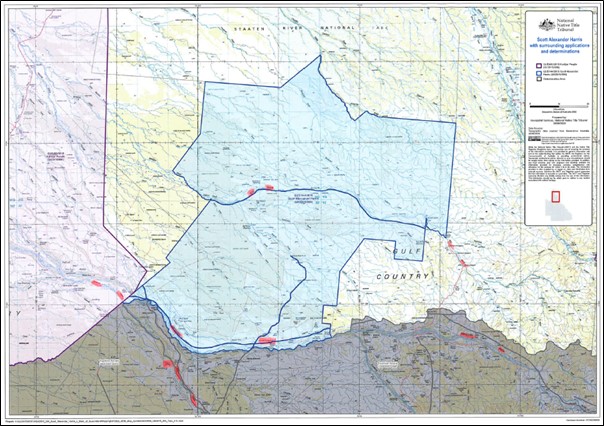
Exhibit GM-1 to the Mudd Affidavit
221 Ms Mudd explained that Edie Douglas was her grandfather’s (Sloper Mudd) sister.
222 Ms Mudd confirmed that she knew her grandfather, Sloper Mudd, is claimed by the Kurtijar People as one of their ancestors but stated that she did not know of him to be a Kurtijar person. Ms Mudd gave evidence that she knew that the Kurtijar People also claim Sloper Mudd’s brother, Mr Burns, as one of their ancestors and confirmed her knowledge that Mr Burns was buried at Dorunda Station on Kurtijar country.
223 Ms Mudd said that her grandfather, Sloper Mudd, “was born at the top of the Smithburne River, which runs into the Staaten River”. As Dr Kwok observed, the Smithburne River “does not literally flow into or from the Staaten and Red River but the various channels of these streams converge over a stretch of country, that is encompassed within the Van Rook lease, as well as neighbouring Miranda Downs and Strathmore Stations”. In fact, the Smithburne River converges with the Gilbert River, after running almost parallel with it from just west of Stirling, just north of Miranda Downs, to the west of the Non-claimant Area and within the area of the Kurtjar People Determination.
224 This is consistent with Dr Kwok’s reference to Lahn & Winn’s research where the authors observe, “[b]ased on their research”, “Sloper Mudd was most likely born on or about the Staaten, somewhere in the Inkerman to Dunbar Station area”. However, in Lahn & Winn 2005, they said that Ms Mudd had told them that Sloper was born “not far from Delta Down” and that “Glennis linked Sloper more to the Macaroni side of the Staaten River” (Lahn & Winn 2005:100). Lahn & Winn also reported that there seemed to be a “marked emphasis” on “the most western inland section” of the Staaten River “with informants mentioning, for example, ‘Macaroni [station] side’ and ‘more or less Dorunda side’, i.e. approaching the coastal area” (Lahn & Winn 2005:99).
225 It is therefore unsurprising that Sloper Mudd and Tommy Burns are listed as apical ancestors on the Kurtjar People Determination. Sloper Mudd is also listed as an apical ancestor on the Ewamiam People #2 and #3 Determinations, and is included in the Kowanyama People Determination, the Kowanyama People #2 Determination (QUD 673 of 2014; QCD2024/007; Ross on behalf of the Cape York United #1 Claim Group v State of Queensland (No 26) (Kowanyama People #2 determination) [2024] FCA 742 (Sch 1, (ss) any of the siblings of … Tommy Burns)), and the Kowanyama People #3 identified parcels Determination (QUD 673 of 2014; QCD2024/008; Ross on behalf of the Cape York United #1 Claim Group v State of Queensland (No 27) (Kowanyama People #3 identified parcels determination) [2024] FCA 743 (Sch 1, (ss) any of the siblings of … Tommy Burns)).
226 He is also included as an apical ancestor of the Kowanyama People in the Kunjen Olkol and Kowanyama People jointly held area Determination (QUD 673 of 2014; QCD2024/009; Ross on behalf of the Cape York United #1 Claim Group v State of Queensland (No 28) (Kunjen Olkol and Kowanyama People jointly held area determination) [2024] FCA 744 (Sch 1, [2](ss) any of the siblings of … Tommy Burns”)), and is similarly included as an apical ancestor of the Kowanyama People only in the Kowanyama People, Kunjen Olkol and Olkola jointly held area Determination (QUD 673 of 2014; QCD2024/011; Ross on behalf of the Cape York United #1 Claim Group v State of Queensland (No 30) (Kowanyama People, Kunjen Olkol and Olkola jointly held area determination) [2024] FCA 746, (Sch 1, [2](ss) any of the siblings of … Tommy Burns”)).
227 Sloper Mudd is, however, not included as an apical of the Kunjen Olkol People in the Kunjen Olkol Determination (QUD 673 of 2014; QCD2024/006; Ross on behalf of the Cape York United #1 Claim Group v State of Queensland (No 25) (Kunjen Olkol determination) [2024] FCA 741 (Sch 1)), nor in the Kunjen Olkol and Kowanyama People jointly held area Determination or the Kowanyama People, Kunjen Olkol and Olkola jointly held area Determination.
228 As has already been observed, the fact of inclusion of an apical ancestor in other native title determinations does not, in itself, preclude a finding that a person should be recognised as an apical ancestor on another determination. Nevertheless, Dr Clarke’s evidence was that to do so “does often pose difficulties anthropologically” and “does beg questions”.
229 Dr Kwok cites Lahn & Winn in support of her statement that “it is clear that Sloper Mudd spent his life heavily involved in the pastoral industry”. According to Lahn & Winn, Sloper Mudd is said to have worked at stations including Abingdon Downs, Dagworth, Forest Home and Miranda Downs but the majority of his working life appears to have been in the Georgetown area and on Strathmore Station in particular (Lahn & Winn 2005:105).
230 The fact that he spent the majority of his working life on Strathmore Station no doubt accounts for “Sloper Mudd’s knowledge of the country about Strathmore, and particularly the Red River area”. As Lahn & Winn observed, “Sloper was described as ‘always going back’ to Georgetown and Strathmore, where his skills, experience and local knowledge of the country guaranteed him employment” (Lahn & Winn 2005:105). Dr Kwok cites a passage from Lahn & Winn 2005, in which an unnamed informant is reported as saying: “‘[Sloper Mudd] used to go out to that Red River. He was the only old bloke who knew that place. Knew the places where to go, where not to go’; ‘you’ve got to have an old bloke like Sloper to tell you where to go [to urinate/defecate] – ‘don’t go there’’”.
231 Neither of the experts is able to say with any confidence that it is probable that Sloper Mudd held rights and interests in the Non-claimant Area. Lahn & Winn record that it appears Sloper Mudd considered returning to Kowanyama permanently in about 1973, four years before his death (Lahn & Winn 2005:104). Relevantly, they record the minutes of a Council Meeting held on 31 January 1973 at Kowanyama (Lahn & Winn 2005:104):
Council received a request from Mr Sloper Mudd, an old resident of Kowanyama to return to this community from George Town [sic] and take-up permanent resident here [sic] together with his family after the ‘wet’. Moved by the Chairman, seconded by the Deputy Chairman that permission be granted. Carried.
232 It is curious that, given their otherwise heavy reliance on Lahn & Winn, neither Dr Clarke nor Dr Kwok referred to this passage in their respective reports. It tends to confirm the other evidence that Sloper Mudd was a Kowanyama man (possibly Koko Berrin or Kunjen, albeit recognised as a Kurtijar apical ancestor), who wished to return “home” in the latter years of his life. That home was not within the Non-claimant Area.
233 In the present circumstances, the weight of the oral history is not strong. Ms Mudd’s evidence is as to matters she was told over 50 years ago. Further, it contradicts evidence she gave to Lahn & Winn almost 20 years ago, when I infer her memory of the matters discussed was likely to have been more accurate. Moreover, everything she can recall being told by her father is consistent with the knowledge of the land he would have acquired during his very long tenure as head stockman of Strathmore Station. That explains how he, and the other individuals working as stockmen on Strathmore Station, had developed “some working familiarity with the Non-Claimant Area” but, as Dr Clarke acknowledged, “there is no evidence to suggest that [that] had led to rights and interests of the kind that could be handed on to their descendants after they had passed away”.
234 On the basis of all the evidence that has been put before the Court in relation to Sloper Mudd, I am satisfied, on the balance of probabilities, that he cannot be accepted as an apical ancestor for the Non-claimant Area.
235 As to Clarke and Maggie, parents of Tommy Burns and Lucy Tommy, Dr Kwok notes that “Tommy Burns had several children to his wife Judy and there is an extensive network of descendants at Normanton, Kowanyama and beyond”. Dr Kwok has not identified any living descendants of Tommy Burns who claim to assert an interest in the Non-claimant Area. The most recent assertion was said to have been made in 2005 to Lahn & Winn by a possible grandson of Tommy Burns (Roger Inkerman) when he said, “top side of the Staaten’s all my country if you go by the father” (Lahn & Winn 2005:116). Dr Clarke interprets this description to refer to Dunbar Station and the region to the north of the Non-claimant Area. As Dr Kwok noted, Alfie Inkerman (also known as Alfie Burns) (considered the apparent son of Tommy Burns) identified himself as of the Rib tribe (Paul Black, Fieldwork in the Normanton area, 1974-75, 6 March 1975. Mid-year report to AIAS (1975) (unpublished)). In the Martin Report at [91], Martin refers to Black’s field notes in which Black recorded “Alfie Tommy” as saying,
all the Ariba an’ Kurtjar was mixed, you see, all mixed, ‘n then come into mob, you know, an’ they get together and they go for … holiday, well they get mixed up, you see, well they’re all one mob, you see.
236 Martin went on to record that “[s]pecific individuals who are said to have ‘married in’ to the Kurtjar people include Johnnie Casey and Bynoe B as well as Tommy Burns, Sloper Mudd, and Rainbow Christie” (Martin Report at [92]).
237 Dr Clarke points to the examples of several inconsistencies in the oral evidence taken from different sources. He observes,
[i]n recent decades, Tommy Burns was chosen as an apical ancestor for the Kowanyama People, Kurtjar People and [the discontinued] Red River native title claims. In the case of the Kurtjar People claim, the description of the connection to country for this family is on the lower Staaten River to the northwest of the Non-Claimant Area.
(Citations omitted.)
238 Dr Clarke also referred to a subsequent report by Martin dated 24 June 2019 (Report for the Kurtijar People Native Title Claimant Application QUD483/2015. Prepared for HWL Ebsworth Lawyers. St Lucia, Queensland: UQ Culture & Heritage Unit. 24th June 2019 (2019b)), in which Martin wrote, “[t]he Burns family is another we might classify as ‘floaters’. Kowanyama elders describe them as coming from the Staaten River and suggest the bulk of their country lay on Dorunda”. Dr Clarke considered that, based upon this description alone, “it is reasonable to conclude that Tommy Burns is not a likely candidate as an apical ancestor for the Non-claimant Area”. However, based on all the data he had analysed, Dr Clarke concluded that “it can be determined that Tommy Burns had links to the areas to the west and northwest of the Non-Claimant Area” (Clarke Report at [321]). I accept that opinion.
239 So far as concerns Christie and Molly, the living descendants identified by Dr Kwok were unwilling to take part in an interview and have not made any claim to the Non-claimant Area (Kwok Report at [439]).
240 Mr Christopher Henry, in his affidavit sworn on 10 November 2022 (Henry Affidavit), deposed to his claim to the Non-claimant Area being as a Koka Berra (Koko Berrin) man through his father, Henry “Gumhole” Jimmy, and his mother, Mainie Kangaroo. Mr Henry was born in Kowanyama on 27 September 1960. He grew up and has lived there for his whole life. He was one of 13 children, but most of his siblings are now deceased (there being six survivors). He remarked that he has many nieces and nephews, who live in Normanton and Kowanyama.
241 Mr Henry said his father was born in a lagoon “somewhere at the junction of the Wyabba and Staaten River” and was “a Koko Berrin man through his descent from Koko Mandu”. Mr Henry says that his father’s parents were “old Robert and nana Jemima Mission” and that his great grandfather on his father’s side was Jimmy Staaten. His mother’s parents were Victor Highbury, who was Kunjen, and Annie Kangaroo. Victor’s parents were “old lady Minnie and Old Kangaroo”.
242 With assistance from a map (Exhibit 9C), Mr Henry confirmed his understanding that that land where his father was born was “a bit west of the land the subject of this application”. He asserted that “[t]he Non-claimant Area of Strathmore Station is in my dad’s country”. In explaining which group speaks for that country, he said “just my … father’s country that further up east towards … the Staaten … from the rivers back into the Red River with the … Palmer River and into the Palmer River junction that come across … from the Staaten across to … the Red River”. He said the name of the people that the country belongs to (his “dad’s country”) is Quanda (it being Quanda country) who are “in that area … [running] down from the … mouth of the Lynd River … to the west side to the Wyaaba”. He continued:
[Quanda country] [r]uns off the Staaten and right back to the – come off – well, almost – they almost side by side really, the Staaten River and Red River. And there’s a – there’s a big permanent lagoon. I – I was only but 15 years of age when that – when he – when I was up there when he took me back up – up in that country again … Then showed me almost that country right back down to the Wya – right back to the Staaten to the … on the west coast back towards the Staaten. Almost on the Staaten really, right back.
243 However, Mr Henry’s evidence was that the Non-claimant Area also belonged to other traditional owners, such as the Douglas and Mudd families. In the Henry Affidavit, he deposed that:
Different mobs traded around that area. We are talking Tagalaka, Kunjen, Koko Berrin and Kutjar. You got Kutjar west side with Koko Berrin. And you got Kutjar and Taglaka west south side, and east you got Kunjen with Koko Berrin. All those tribes were traditional owners in the area, you knew exactly your area and you knew your country in that area, but you will unite with this mob here this side and the other mob this side.
244 What became Exhibit 24 was Mr Henry’s markings on a map that was Exhibit 9C. That map is set out beneath [245]. The orange circle shape on the map identified the area of country he said belonged to his father.
245 Mr Henry was asked, when he identified that to be his country, what people he identified that country to be for. He recalled that “in the language call it the Kokoberrin” and that “there’s another tribe that we call the Quanda” that was a “bit of mix with Kundjen” as a “tribal group” – he claims to still be able to speak that language today. He continued:
But I – I been acknowledged that country when I was young, and as I got older and then I finally went back to Normanton and tried to trace back where my – my stolen generation. They wasn’t working in a station. They were living in the river right in the area right up from the – they used to call it Station Creek, but the Station Creek was a Wyaaba, Pelican and Red River right back up to that. It covers off the – from the Lynd River.
…
It was the Red River itself. Up the top-end of the Red River going into – almost back in the Lynd River up the top-end, on the east side.
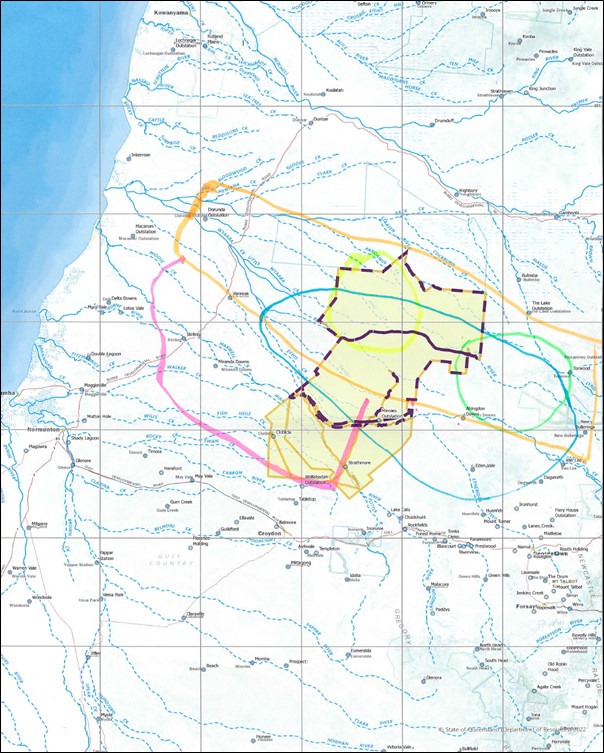
Exhibit 24
246 As noted by Dr Clarke, Mr Henry’s assertion that his father’s traditional country extended from the near coast back into the northern part of the Non-claimant Area would denote an extremely large estate. It is also inconsistent with existing determinations. Mr Henry accepted that the land he had included within his circle to the west of the Non-claimant Area was Kurtijar land, and that the area to the east, which included Abingdon Downs and New Bulleringa, was Ewamian land. That I can have little confidence in Mr Henry’s description of what he claims to have been his father’s country is reinforced by the reported evidence he gave to Martin on 28 November 2018, where he is reported as having said (Martin Report at [207]):
[Kurtjar people are] on the other side of the Staaten, right back to the Gilbert, to the other side of the river here. You got Dorunda there, Macaroni, bottom end of Vanrook, down Wyaaba, coastline, Macanoni Island, Karumba, to back here [Normanton] … I don’t know how far he goes up [inland] … The Norman River, that’s the border line [for the Kurtjar]. You got Rainbow here, Gilbert here, other mob here [gesturing in different directions], but they all come under the same mob. Kurtjar country goes Norman River, Carron River, right up to the Staaten, [and] it went sunrise way, east. I thought they would’ve went up to the Lynd River.
247 Mr Henry’s identification as Koko Berrin is at odds with any claim to the Non-claimant Area. Neither Dr Clarke nor Dr Kwok place Koko Berrin within the Non-claimant Area at Sovereignty. Dr Kwok said:
Meantime, although neither Kurtjar nor Koko Berrin are obviously reflected as having interests in the non-claimant … area from an ethnohistoric point of view, there are persons who currently identifying under these labels, who arguably have legitimate claims on the country in terms of their ancestry. A number of these ancestors were grouped under the Kunjen label in Lahn and Winn’s study.
248 Dr Kwok observed that some of Mr Henry’s relatives, and at times Mr Henry himself, identify themselves and their forebears as Kurtjar but also Koko Berrin (Kwok Report at [462]). Similarly, Dr Clarke concludes that Mr Henry’s “account of his father, Henry (Gumhole) Jimmy, being a Koko Berrin man is consistent with a cultural connection to country near the mouth of the Staaten River (i.e., Gum Hole Station) to the northwest of the Non-Claimant Area” (Clarke Report at [396]).
249 It is fair to observe that Dr Kwok did not express any real confidence in Mr Henry’s understanding of the basis of connection to the Non-claimant Area, stating “it is not evident that [he] has a firm grasp of how his interests are founded” and pointed to the “difficulties in interpreting the basis of connection for this family to the non-claimant … area”. Dr Kwok nevertheless placed considerable importance on Mr Henry’s assertion that “he was shown the country by his father and given to understand that it belongs to him” (Kwok Report at [461]).
250 As to that matter, Mr Henry gave evidence as to why he went out with his father for three months when he was thirteen years old. He said:
Well, my dad was going and I said, “Well, I will come with you.” I thought we just – going to just go over the river here and back on the same day. But we went out there for a few months travelling. And I said, “I want to go home now.” He said, “Yes. Well, we are going home.” I said, “Where, you know?” And being a young fellow, just going along with the flow. And then he said, “This is home here.” I said, “No. I want to go back home, back to Kowanyama.” And then he said, “No. This is – this is where we are.” Then I – I accepted it. I said, “Well, I can’t do anything.” And you have to go along with the flow and come to find out that they were living in that Red River, right round in the Staaten River, right, with the … and I – I just went along with what was there. And then I have the experience of my own. Then I – later on to find – now, when you guys came and I said … this should happen 20 years ago back or 30 years ago back. Then I would have – would have been in luck with my dad then to put – explain all that.
251 Mr Henry circled in green the area on Exhibit 24 where he said his father took him. It included Torwood and Abingdon Downs, both of which Mr Henry said he had visited. Mr Henry’s oral evidence was that they were “staying down near the river bed … [being] the Red River itself … [u]p the top-end of the Red River going into – almost back in the Lynd River back up the top-end, on the east side”. That area is well aside the Non-claimant Area. Mr Henry was unable to identify any landmark that would suggest that he and his father spent the three months in the Non-claimant Area. It is tolerably clear that Mr Henry’s account of his father being a Koko Berrin man is consistent with a cultural connection to country near the mouth of the Staaten River to the northwest of the Non-claimant Area. His father’s connection to Strathmore Station, however, appears to be entirely historical, consistent with his “many, many years” of doing station work. This is consistent with Dr Clarke’s opinion, which I accept.
252 I am not persuaded, on the balance of probabilities, that there is any evidence to displace Dr Clarke’s opinion that Maude – wife of Jimmy Staaten, mother of Henry Gumhole et al – nor Ben Woomera, as possibly Koko Berrin people (Kwok Report at [466], [469]) are apical ancestors who held rights and interests in the Non-claimant Area at Effective Sovereignty.
The evidence of maintenance of connection
253 In the event that I am wrong both about whether the Tagalaka held rights and interests in the Non-claimant Area at Effective Sovereignty, and whether it is possible to identify Tagalaka apical ancestors who held rights and interests in the Non-claimant Area, I turn now to consider the evidence of Ms Callope and Ms Douglas that touches on whether, by their traditional laws and customs, they have continued to maintain a connection with the Non-claimant Area.
254 Ms Callope gave evidence that her family worked at Strathmore. Her father was the head stockman and her mother was a cook. She deposed that other of her family members also worked at Strathmore, her “grandparents Mary Ann [housemaid], … Bungy, … Beverly Bowyang, her father and mother Charlie [Hayes] [a cowboy] and Pearl Hayes [a housemaid], Uncle Jack [a ringer] and Gertie Douglas [a housemaid]”. She said there were many families living in Strathmore when she was there, including the Douglas family. She noted, however, that other families came from Kowanyama and Mapoon. I interpolate that this is consistent with the observations of Lahn & Winn referred to above.
255 Ms Callope’s evidence was that she grew up at Strathmore Station until she was 10 years old. She said that her parents worked on Strathmore Station for that whole 10-year period, and that she lived in the Aboriginal quarters near the homestead on Strathmore Station (which were not located in the Non-claimant Area) during that time. It is therefore unsurprising that Ms Callope twice described Strathmore Station as “like a home to [her]” and as “our second home”. To the extent that it was submitted that Ms Callope’s recollection of meeting with Mr Harris, as deposed to in the Callope Affidavit, and saying to him with her sister Janet that Strathmore was “[their] second home” should be considered a statement supporting Ms Callope’s understanding that Strathmore was “her country” in a native title sense, I reject the submission. It is wholly unremarkable that a person would refer to the place where they spent the first 10 years of life as “like a home to [them]” or as “our second home”. In any event, much like Mr Harris, when cross-examined about attending the meeting in 2015, Ms Callope had no recollection of why she met with Mr Harris and could only recall that he said, “[they] could go out there whenever [they] wanted to”.
256 After leaving Strathmore Station around the age of 10, Ms Callope said she was taken to a station near Julia Creek briefly before returning to Croydon. She eventually settled in Normanton, after she had finished school and her father began working at Miranda Downs, where she has remained ever since. Ms Callope has not been back to Strathmore Station, nor to the Non-claimant Area, in the ensuing 70 years.
257 As has already been mentioned, although Ms Callope referred to several places around Strathmore which she said were “special to [Tagalaka people]”, she was unable to recall why these places had any particular significance for Tagalaka people.
258 Ms Callope gave some evidence of being told about “the wild Murri” and “[the] red legged devil”, unsure of “whether they were trying to frighten [them] or what”, while sitting down at night with George Wheeler. She also said that her brother, Eddie, told her about the red devils (or Quinkans), but not what would happen if she encountered one. She said she was told to avoid the Red River because of its spirits, which advice came from “[f]amilies” and that “[a]ll the family told [her]”. She could not remember the names of any particular people who gave her that advice. She was also asked about her father’s advice to avoid Dingo Waterhole, which she “[j]ust faintly” recalled. She clarified, however, that her father never told her what was at that place that she needed to avoid – she explained that “in those days, they wasn’t allowed to tell us too much things … [s]o there’s not too much that we know”.
259 When recounting what Ms Callope had told her about the “wild Murris”, Dr Kwok observed, “[t]his kind of suspicious attitude toward neighbours and particularly those groups lying further afield is common in traditional Aboriginal Australia” (Kwok Report at [499]). She did not opine that there was anything connecting the stories told to her by Ms Callope to the Non-claimant Area in particular.
260 Ms Callope also gave evidence that, “[w]hen you go fishing … [a]nd you call out to the old people before you throw your line in, and you ask what you want … you’re not there to disturb anything, but you want the fish from the water … [o]r the goanna off the land”. This practice as she described it, was not, however, specific to particular country, and certainly not specific to the Non-claimant Area. When explaining what she would do when fishing at Normanton, Ms Callope said that “[y]ou’ve got to” call out to the old people when fishing there. She advised she doesn’t call out to any persons in particular, just that “we … call to old people … [t]hat’s all”. She recalls seeing her parents also call out to the old people at Strathmore Station, but not whether they would do so in language.
261 Ms Callope was able to recall that her Aunty Gertie’s totem was the porcupine and that she was told by her Aunt that they were not allowed to touch porcupines, and that they can get sick if they do. She said that they “believed it … [i]f we touched the porcupine, we get sick”. She also noted that the particular parts of country where the porcupine can be found were “all up round Normanton, where we are now”, which is not Tagalaka country. She could not remember seeing any particular places where porcupines could be found on Tagalaka country, but noted that “they must be here … I’ve never seen any, but they got to be”. Ms Callope said that her father’s totem was a “big bird, but [she] [did] not know the details”.
262 Ms Callope’s evidence does not reveal that she has any knowledge of the traditional laws and customs of the Non-claimant Area, nor any knowledge about ritual or ceremony conducted in the Non-claimant Area. In particular, she gave no evidence about any traditional laws and customs relating to the transmission of rights and interests in land. She did not give evidence as to whether the right to occupy, hunt, or gather in the Non-claimant Area was restricted to Tagalaka, nor as to whether permission was required to enter on to Tagalaka land. Her inability to give such evidence may no doubt be, in part, because of the shameful circumstance that her “old people were not allowed to teach us these things because they were afraid of us getting taken away”. In part, it may also be attributable to the effluxion of time. Ms Callope also gave no evidence that she has passed on any knowledge or connection to her children or grandchildren, none of whom gave evidence – including her niece, Janette Owens, who had been an applicant in the Tagalaka People Claims, and who accompanied her in the witness box.
263 As Mr Harris submitted, there is simply no evidence that Ms Callope has maintained any connection, either physical or spiritual, with the Non-claimant Area. Nonetheless, even if there were any connection between her as a Tagalaka person and the Non-claimant Area, which is doubtful, that connection has been severed.
264 Further, I infer from the TAC’s letter to Mr Harris in 2015 that had Ms Callope wished to be joined as a respondent to this application to assert any native title rights or interests in the Non-claimant Area, or to commence a claimant application on behalf of the Tagalaka People, as she had done previously, there has been ample time to do so.
265 Ms Douglas said that she went Strathmore Station when she was “five or six” and left when she was “about nine”. As with Ms Callope, that is almost 70 years ago. When she resided at Strathmore Station, Ms Douglas also lived in the quarters that were not close to the homestead, but “down the bush side”, “down around the scrubs” and “[o]ut of the boundary”, noting that it was a “fair walk down there anyway”. She said that she spent a fair amount of time on the Gilbert River “fishing and everything”.
266 Ms Douglas also deposed that she was not told much as a child about ceremony but that “[they] used to do corroboree at Strathmore. The old people taught us down at the Station”. Her evidence was that Sloper Mudd liked to tell her about Pelican Creek “because he would do the Pelican Corroboree” – he would “learn to teach [the] kids to do corroboree with the feathers, and the hunt for … digging turtle out of the dry ground” but noted “[t]hat’s the only thing I know he talk about”. Ms Douglas explained that, to do the Pelican Corroboree, “you just have to get feathers and paint himself up and … as long as he got the white paint on him and all feathers[,] [h]e’s doing a pelican dance”. She also referred to doing the “brolga and emu too sometimes”.
267 Like Ms Callope, Ms Douglas gave some general evidence about “old Quinkan devils” (or, “red legged devils”). She said that all of the old people used to tell her about the red legged devil, and that “the whole mob know about the devil out there … [i]n the ridge, forest”. She could not, however, recall the names of anyone included in “the whole mob”, but noted it was Kowanyama mob, and that it included “[s]ome of the other old boys”. She said the devils could be found around forest country and was asked – in addition to the Red River – whether there is other forest country on Strathmore Station. She said there was lots of places to go, “around Delta”, and that “[e]verywhere up there, you will find it”. She noted that if one was to so venture, they would get lost “[b]ecause everything [looks] the same”.
268 Ms Douglas also confirmed that she had seen the old people talking to the devils in language, and the devils subsequently going away. She said, however, that she didn’t know what they would say. Although she saw it happening in Strathmore Station, she said that it also happened “[a]nywhere”. Ms Douglas said she was sure she had seen one, noting “they are around in Croydon”. She could not say what was said to the devils to make them go away, saying only that they were “language [words]”.
269 Ms Douglas said that the spirits of the old people were everywhere on country, including at Strathmore Station. She said that she had “figured [it] out herself”, rather than being told by her old people, after her experience at a fishing hole at Glencore. She said that the spirits of the old people at Strathmore Station belonged to “all sorts of tribes” but did not know the names of those tribes. She did not know what mob the old people at Strathmore Station belonged to but noted that all the old people “know what tribe they’re from”. She said further that “[t]hey’re always language, anyway, you can’t understand them”.
270 Ms Douglas also gave evidence of being told by her parents while on Strathmore Station to avoid “poisoned ground”, which areas were described by her as “where … the old Aboriginal people fight and everything”. She further explained that it is dangerous to enter poisoned ground, and if one went to a poisoned ground, “[y]ou would be a cripple”. She added that her parents’ caution against visiting poisoned ground was not limited to Strathmore Station, but that they would “tell us everywhere”. Ms Douglas said she was also told “not to go to the caves with paintings near Croydon” because a spirit would follow you unless you smoke yourself entering and leaving the cave. Croydon is, of course, not located in the Non-claimant Area.
271 Ms Douglas was able to explain the importance of the sand goanna to her family. She explained its special quality as “[t]hey eat them when … they’ve got certain time they eat them” and confirmed that they “eat them when they’re fat”. She said there were particular times of the year when they are fat but did not know when that time was. She said there were not any special rules for her family regarding the sand goanna, and that there were not any particular types of country where it was good to catch them, noting only that “you’ve got to be quick with them [to catch them]”. She said she had been hunting for sand goanna, but explained that it was difficult, given their evasiveness and camouflage. She explained that the ‘trick’ for catching them as being that ‘[i]f you’ve got a fast runner, then you’ll get him alright”. She was taught to hunt for sand goanna “when [she] was young” and hunted for them out at Strathmore Station (despite not succeeding in catching any).
272 Ms Douglas gave evidence about leaving fish behind for the old people if you want to catch fish next time. This is a practice she followed in and around Normanton, namely “[o]ut to Forty Mile … just around the rivers up around Normanton” and at “Karumba”. Again, these locations are not within the Non-claimant Area.
273 As was the case with Ms Callope, Ms Douglas was unable to give any evidence about any laws and customs specific to the Non-claimant Area. In particular, she gave no evidence at all about the transmission of rights and interests in land. Her evidence is wholly consistent with her native title rights determined by the Tagalaka People #2 Determination. However, there is no evidence that she has maintained any spiritual connection with the Non-claimant Area. Although she says she has told her children about leaving fish behind for the old people, that is not a practice she said was specific to the Non-claimant Area. Rather, Ms Douglas attends to that practice wherever she fishes. There is no evidence that Ms Douglas has passed on knowledge about traditional laws and customs in the Non-claimant Area to her children or grandchildren. I also observe that none gave evidence.
274 What is apparent from the evidence both of Ms Callope and Ms Douglas is that whatever knowledge they have acquired about the physical characteristics of the Non-claimant Area, most of it was acquired approximately 70 years ago during their excursions with the manager on Strathmore Station (by tractor or truck). It is also tolerably clear that, to the extent that Sloper Mudd is said to have spoken about the Red River, it is likely that this occurred as a result of his work mustering in the Non-claimant Area, rather than in the context of exercising traditional rights in the Non-claimant Area as a Tagalaka person. I also infer that neither Ms Callope nor Ms Douglas considered whether or not they might have any native title rights and interests in the Non-claimant Area until “the lawyers [Legal Officer] from North Queensland Land Council … have showed [them] a map” (Douglas Affidavit at [23]; Callope Affidavit at [17]). This is notwithstanding that Ms Callope was an applicant in the Tagalaka People #2 Determination, which claim overlaps Strathmore Station and abuts the Non-claimant Area, and Ms Douglas is a native title holder pursuant to that Determination. Consequently, I find, on the balance of probabilities, that there are no Tagalaka persons who make an arguable assertion of native title to the Non-claimant Area.
275 Ms Mudd gave evidence that she grew up in Georgetown, which town was considered Ewamian country. Ms Mudd’s evidence of her upbringing was explained in her affidavit as follows:
My mother Ruby Mudd Davis passed away in 1966 and my grandparents grew me up. My grandparents travelled the land, they walked the land all across Staaten River to Croydon and Georgetown. They grew me up in Georgetown. I went to school in Herberton when I was in grade seven, before going to Cairns for business college in 1976. I moved to Kowanyama after business college and worked as an administration officer at the Council there until I was 42 years old, then moved to Normanton in 1999, where I live now.
276 Ms Mudd’s partner is Bruce Jason Rainbow, who worked at Strathmore station as a stockman, and who identified with the Kurtijar People. Ms Mudd has 4 children (Melanie, Clinton, Yasmin and Bianca); 17 grandchildren; and 5 great grandchildren. Her eldest grandchild is 25 years old and the youngest is 5 years old.
277 Ms Mudd has not been back to Strathmore Station since she was 12 years old, over 50 years ago.
278 Ms Mudd said that when she visited her grandparents, uncles and aunties it was near the homestead at Strathmore Station. She said that there were nearby quarters where Aboriginal people would live, that her uncles and aunties lived in those quarters, and her grandfather and grandmother lived on Strathmore Station. Ms Mudd gave evidence that she had heard Sloper Mudd speak in “[p]arts of language”. She also explained that her grandmother “used to speak a lot of … different language”. She would be taught language words by her grandmother “when we were very young” but added “[w]e know a lot of things when they mention it in language” and that “[w]e know what they’re talking about”. She was, however, unable to provide any examples.
279 In her affidavit, Ms Mudd said that her grandfather’s totem was the catfish and that she follows his totem. In her oral evidence, Ms Mudd asserted that she got her catfish totem from her grandmother. To her, it means “[we are] only allowed to take the little catfish to eat” and “[w]hen we catch a big one, we have to put it back”.
280 Ms Mudd was able to give evidence that,
[w]hen we went to visit my grandfather out at Strathmore Station we flicked our head with the water and ask them spirits to help us with good luck to catch the fish and turtles. If you do not do that, you won’t catch any fish or find bush tucker.
281 Ms Mudd said this was a practice done at the water before fishing and described it as “baptising in the country, to get good luck”. She said that she engaged in that practice at Yellow Hole, Minnie’s Dip, the Einasleigh River and the Gilbert River, but also noted that it was done when fishing on anyone’s country. She deposed, as referenced above, that if the practice was not followed “you won’t find any fish or find bush tucker”. She also deposed that “the spirits of our old people will make people sick if someone does the wrong thing on country”. Ms Mudd explained that she was told by Sloper Mudd that “if you touch anything on the country and it’s not yours … you will get sick”.
282 Ms Mudd did not give any evidence that touched on the transmission of rights and interests in land. Beyond her reference to “baptising in the country”, which she said is done wherever she fishes, Ms Mudd gave no evidence of observing any customs or rituals taught to her by any of “her old people”. Nor did Ms Mudd give any evidence that she has passed any of her knowledge of the laws and customs related to the Non-claimant Area on to her own children or grandchildren. As with Ms Callope, I observe that none gave evidence.
283 I am satisfied, on the balance of probabilities, that Ms Mudd has not maintained any connection, either physical or spiritual, with the Non-claimant Area sufficient to ground an arguable assertion of native title to the Non-claimant Area.
284 As has already been observed, Mr Henry was born in Kowanyama and said that he lived there “for a lot of [his] life”. He said that his father and his sister, Beverley George, worked on Strathmore Station for a number of years – in particular, “[her] father did station work for many, many years”.
285 Mr Henry gave evidence of his knowledge of totems and spirit beings in the broad region and of his observation of and participation in ceremony across the region. In particular, he said he recalled the location of a “large permanent waterhole near the junction of Pelican Creek and the Red River”, which he marked in yellow on Exhibit 24. This is the same area referred to by Dr Kwok as “Pelican Waterhole”, which was identified to her by Billy Thomas (a Wakaman person) as situated to the north-east of the Strathmore lease outside the Non-claimant Area.
286 Nevertheless, Mr Henry explained “[t]his area [was] … where … all the old people used to do … the dance of the … dingo story, that ceremony”. He stated that was “the only [thing] they were using it for” and “[n]othing else”. When asked which people would do the dingo dance, he said “my tribe of families … [who] came from all different … just to come to do the ceremony and sharing the knowledge … trade too as well”. He explained the dingo dance was not the dance for that area, but it was “just to celebrate for the people … [a]ll from everywhere just come down there, just trade things … [w]hat they got, … they trade to us … [a]nd then do the dance there”. He said he did not see those old people do the dance, because those “old people [were] already gone”, but that his “dad told [him] all that stuff”. When asked whether there was a story behind the dingo dance, he explained:
[J]ust that it’s about that – the white ochre in that area that they use ceremony when the time is right when they – the message stickman goes to the place to let someone know that there’s going to be a big ceremony in Mount Isa or Normanton and they will – they will walk a couple of months early to get to that area.
287 Mr Henry noted that his dad taught him the dance for the old dingo, and that he himself had taught his grandsons “everything now”.
288 Mr Henry also gave evidence about the “black cockatoo” dance. Relevantly, he said:
Just the black cockatoo dance that – to let everyone know that don’t burn out someone else’s country because of the fire will – will spread and the – the – it was a – it was noticed that the – let someone know that there is a fire coming, so we didn’t want the all – all Australia to get burnt down. So it was two burn in the year and then that’s was the dance we done of the – of the firewood, of the burn up the night.
289 He confirmed that he had last seen the dance performed when he was in Normanton. That performance was described as “the second and the last” time it was performed, and he noted they had “done the dance from the Norman River all the way to the cemetery” but “no more after that”. He has never seen the dance performed again.
290 When asked the story behind the dance, he said:
Well, the story was that it was a woman dance story to look after the Country from the woman side of respect of the Red River. And all around it in that area, all right up in this gulf area. … This – which is – if it’s just amazed that we all the people that came together and want to what share the message they’re going to leave who – doesn’t matter who. But apart from knowledge from my dad told me that – that – okay. Well, I thought I never going to get to the state where I am now. I mean, I could have came here a bit earlier in the year when I were young. But I was still young and free and I – now, I’m 63 and I said … in my heart – this crying out what I’m just telling you. It’s just would happen back then I – it could tell the whole story. And I – I was the last son of him and I had to do something that – yes. Doesn’t matter what it is. I mean, I will be still going out there whoever owns the place. I would love to go back – see that country just one more time.
291 When asked to clarify which country he was referring to when he said he would love to go back and see his country again, he said “[r]ight … [o]n the Red River” and “[r]ight back to Staaten – right down to the … mouth of the river”. Mr Henry was asked which groups perform the black cockatoo dance. He answered that it was his tribal group, “[his] Kundjen, [his] Kokoberrin”.
292 Mr Henry also gave evidence about the “red belly black snake” dance, saying “[i]t has to be done in that Red River area” and that his grandfather, Robert Mission, had taught him the dance.
293 Mr Henry said that he had taught the things his dad had told him to his kids, explaining,
Yes, now, I sit down every time I tell them story and I said “one day we will go out to the country, sit down” – doesn’t matter who.
294 He explained that "[y]ou dance to protect the story”:
Look, protecting – to keep the – keeping the wisdom of the – to taught our young ones. Like, when I were young. And then I want to pass it down to my next generation. To the next generation. And just keep on going. Just live side by side.
295 He said he had taught the red belly black snake dance to his kids, and that it was okay for anyone to perform that dance: “doesn’t matter black or white … if you’re living in Australia, … we … would come together as one, I can say”.
296 Mr Henry said he remembered his father talking about the scrub turkey, which stayed “up in the forest country”. He explained “[i]t is a [mens’] spirit living up in forest country”. In oral evidence, Mr Henry said “it was a dance”. He gave contradictory evidence about whether there was forest country on his country; first answering “[n]o”, and then later saying, “[s]hould be up the top-end there. Yes”.
297 He also deposed to there being “lightning people” who look out for people who do right or wrong and who could be found on the Red River. He explained that “Ben Woomera and Elsie were the right people to do ceremony for the lightning people”. It seems that Ben and Elsie’s son is listed as an apical ancestor in respect of the Ewamian People #3 Determination.
298 Mr Henry gave evidence about the practice of smoking “to let the old people know we were there”. He explained that he was taught about the ironwood tree, and said:
Yes. Number 1, we agreed people to come to – to Country. What we do, we do the smoking. This – the wood that – the tree that we burnt, the smoke, we use the ironwood tree. It’s a solid wood. And it’s a special tree. There’s only one tree in the world that we use at all times. When a – and a loved one passed away, we still use the same ceremony to respect the family.
…
[I]t’s really a tree that we use as a ceremony. We make the woomera to throw the spear and we use that for – for digging holes and everything. Hunting. It’s a special tree that we use at all times.
299 He also gave evidence of the practice of “[putting] mud all over someone and a cup of water from [the country] so that the person would not get lost out there [on country]”. He said:
I’ve been taught from my – my dad’s grandfather’s side. It showed me the – the – the wisdom of – of looking after Country and how to look for people that are lost out there. And even if – even if they’re alive or dead, they will – I will still go and find them and spiritually connect in world. Yes. And I been – experience it all, and I – that’s what I been doing.
300 Despite Mr Henry’s knowledge of a range of cultural practices, stories, and traditions, none of his evidence centres those practices, stories and traditions within the Non-claimant Area. His evidence that the large area he circled in orange on the map (Exhibit 24) as being his “dad’s father’s country” cannot be reconciled with the ethnohistoric evidence, nor with the Kurtjar People Determination and Ewamian People #2 (QUD 6009 of 1999; QCD2013/006) and #3 Determinations and his acceptance of the native title rights consequently determined. His evidence about the Pelican Creek waterhole is, at best, equivocal.
301 Further, Mr Henry has been unable to evidence continuity in terms of ritual and ceremony related to country, let alone related specifically to the Non-claimant Area. Indeed, he denied that the old dingo dance and the black cockatoo dance he was teaching his children and grandchildren was “for the area” – rather, he said they were “just to celebrate for the people”.
302 I have formed the view that Mr Henry has and maintains a strong cultural connection to the broad area of the South-West Cape York Region. That connection is not, however, specific to the Non-claimant Area. In particular, he identifies with his father’s people as Koko Berrin, and it is contrary to the weight of the evidence that Koko Berrin people laid claim to the Non-claimant Area. Further, to the extent that he recalls his visit with his father to the relevant proximate country when he was thirteen years of age, those memories are distant, non-specific to any landmarks within the Non-claimant Area, and do not provide any evidence of laws or customs specific to the Non-claimant Area. Beyond his evidence in relation to Mr Harris’ application that, “[m]y old people were in that country. I should have been asked first”, Mr Henry did not give any evidence at all about any laws or customs related to the transmission of rights and interests in land from his said “old people”.
303 Mr Henry’s evidence that “we still go and spend time on country to sing and dance, keep the culture going” is at odds with his evidence that has not visited the Non-claimant Area, nor the area he visited with his father, since he was 13. Further, his statements that “I would love to go back out to Strathmore”, that he “couldn’t go back without [his] father because he was [his] leader for those places” and“[e]ven if he is not around, I can still talk for that country…”, are difficult to reconcile with NQLC’s submission that Mr Henry inherited rights to country through cognatic descent.
304 The evidence adduced by NQLC is not persuasive in establishing, as was described by Beaumont and Von Doussa JJ in State of Western Australia v Ward [2000] FCA 191; 99 FCR 316 at [243], as the indicia of continuing connection in the non-physical sense, being that,
traditional practices and ceremonies are maintained by the community, insofar as that is possible, off the land, and that ritual knowledge including knowledge of the Dreamings which underlie the traditional laws and customs, continue to be maintained and passed down from generation to generation. Evidence of present members of the community, which demonstrates a knowledge of the boundaries to their traditional lands, in itself provides evidence of continuing connection through adherence to their traditional laws and customs.
305 Mr Harris adduced positive evidence of the absence of native title in the Non-claimant Area. That evidence took the form of his own testimony as to the absence, over nearly two decades past, of any Aboriginal person having sought access to the Non-claimant Area, of any Aboriginal person who has worked on Strathmore Station having claimed to have native title rights or interests in the Non-claimant Area, and of encountering any Aboriginal person, other than his employees, in what is the remote and inaccessible terrain of the Non-claimant Area.
306 His testimony is supported by the absence of any present claim by any peoples over the Non-claimant Area, despite this proceeding having commenced in 2015 and by the only other unresolved claim in relation to land which partially overlaps the Non-claimant Area, having been discontinued in 2004. As to this, I give weight to those aspects of the statutory scheme established under the NTA which are designed to have people bring forward all claims to native title over an area: Mace at [57].
307 Further support for Mr Harris’ assertion of an absence of native title in the Non-claimant Area is found in the expert evidence provided by Dr Clarke, who was called by Mr Harris and also, in some respects, by Dr Kwok, who was called by NQLC.
308 NQLC submitted that the evidence of its four Aboriginal witnesses, together with the expert evidence provided by Dr Kwok, was of such weight as to cast doubt on Mr Harris’ assertion that ongoing connection, and the substantially uninterrupted observance of traditional laws and customs, was lost in relation to the Non-claimant Area at some point in time subsequent to Effective Sovereignty. In support of that submission, the State submitted the evidence adduced by NQLC amounts to an assertion of native title, underpinned by evidence of witness’ historical presence on the land and waters of the Non-claimant Area and transmission to them of cultural knowledge of the boundaries of country, its avoidance places and site-specific stories, sufficient to raise an issue as to the existence of native title.
309 For the reasons I have given, contrary to the submissions of NQLC and the State, and having regard to the whole of the evidence, the evidence adduced by NQLC as to the existence of native title does not cast sufficient doubt on Mr Harris’ assertion of an absence of native title in the Non-claimant Area.
310 I am persuaded, that:
1. at Effective Sovereignty, Aboriginal people acknowledged and observed traditional laws and customs relating to an individual’s rights and interests in land in the Non-claimant Area which, more probably than not, were acquired by membership of a totemic patriclan, including in the form of a spirit child; were held in common ownership; conferred a right to occupy, hunt, and gather; conferred a right of refusal to a trespasser who was not an accredited messenger or herald; conferred a right to require permission or consent to be obtained by someone of a different tribe; and could not be extinguished once a person’s relationship to the land had been publicly recognised; and
2. the identity of the groups which held primary territorial interests within the Non-claimant Area was, more probably than not, the Kunjen and the Arib.
311 I am, however, not persuaded that:
1. it is possible to identify who, as an apical ancestor, more probably than not, held rights and interests in the Non-claimant Area at Effective Sovereignty;
2. it is therefore possible to identify contemporary descendants of the Aboriginal people or peoples who, more probably than not, held rights and interests in the Non-claimant Area at Effective Sovereignty;
3. on the balance of probabilities, there are any contemporary descendants of the Aboriginal people or peoples who, more probably than not, held rights and interests in the Non-claimant Area at Effective Sovereignty, and who have maintained a connection with the Non-claimant Area;
4. on the balance of probabilities, there has been a continuity of observance and acknowledgment of traditional laws and customs in the Non-claimant Area;
5. on the balance of probabilities, any contemporary Aboriginal people hold rights and interests in the Non-claimant Area based on their traditional law and customs.
312 I therefore find that there is no native title in the Non-claimant Area.
I certify that the preceding three hundred and twelve (312) numbered paragraphs are a true copy of the Reasons for Judgment of the Honourable Justice Sarah C Derrington. |
Associate:


