Federal Court of Australia
AZO24 v Commonwealth (Summary Dismissal) [2024] FCA 1053
ORDERS
NSD 1036 of 2023 | ||
Applicant | ||
AND: | First Respondent | |
NEW SOUTH WALES Second Respondent | ||
kennett j | |
DATE OF ORDER: |
THE COURT ORDERS THAT:
1. The proceeding be dismissed pursuant to s 31A(2) of the Federal Court of Australia Act 1976 (Cth).
2. The applicant pay the costs of the first and second respondents, to be taxed if not agreed.
Note: Entry of orders is dealt with in Rule 39.32 of the Federal Court Rules 2011.
KENNETT J:
Procedural history
1 This proceeding was commenced by the filing of an originating application and statement of claim on 19 September 2023. It lay dormant for some months because, despite being directed to do so by a Registrar on 20 October 2023, the applicant did not serve these documents on the respondents.
2 At a case management hearing on 7 March 2024 I made interim suppression orders over the applicant’s identity and allocated a pseudonym to the applicant. At this stage the applicant wished her identity to be kept secret from the public. The applicant also indicated that she wished for her identity and personal information to be removed from her court documents before she served them on the respondents because of a concern the respondents might publicly disclose that information. I indicated to her that her case could not move forward without her identifying herself to the respondents and that, if she was concerned, she could remove her home address from the documents before serving them, as long as she provided an email address where she could be served with documents. This was done. The respondents entered appearances on 11 and 19 April 2024.
3 On 7 March 2024 I also refused an application that I disqualify myself. Reasons were published on 12 March 2024: AZO24 v Commonwealth [2024] FCA 218.
4 On 18 March 2024 the applicant sought to file an interlocutory application seeking a range of interim injunctions against the respondents and other persons. It was brought to my attention by the Registry and, on 20 March 2024 I made an order that no documents be accepted for filing in this proceeding without the leave of a Judge. In doing so I refused leave to file the application submitted on 18 March 2024. Reasons were published on 26 April 2024: AZO24 v Commonwealth (No 2) [2024] FCA 426 (AZO24 (No 2)).
5 The applicant applied for leave to appeal from my decisions on disqualification and filing of the application submitted on 18 March. Leave was refused by Abraham J on 28 May 2024: AZO24 v Commonwealth [2024] FCA 555.
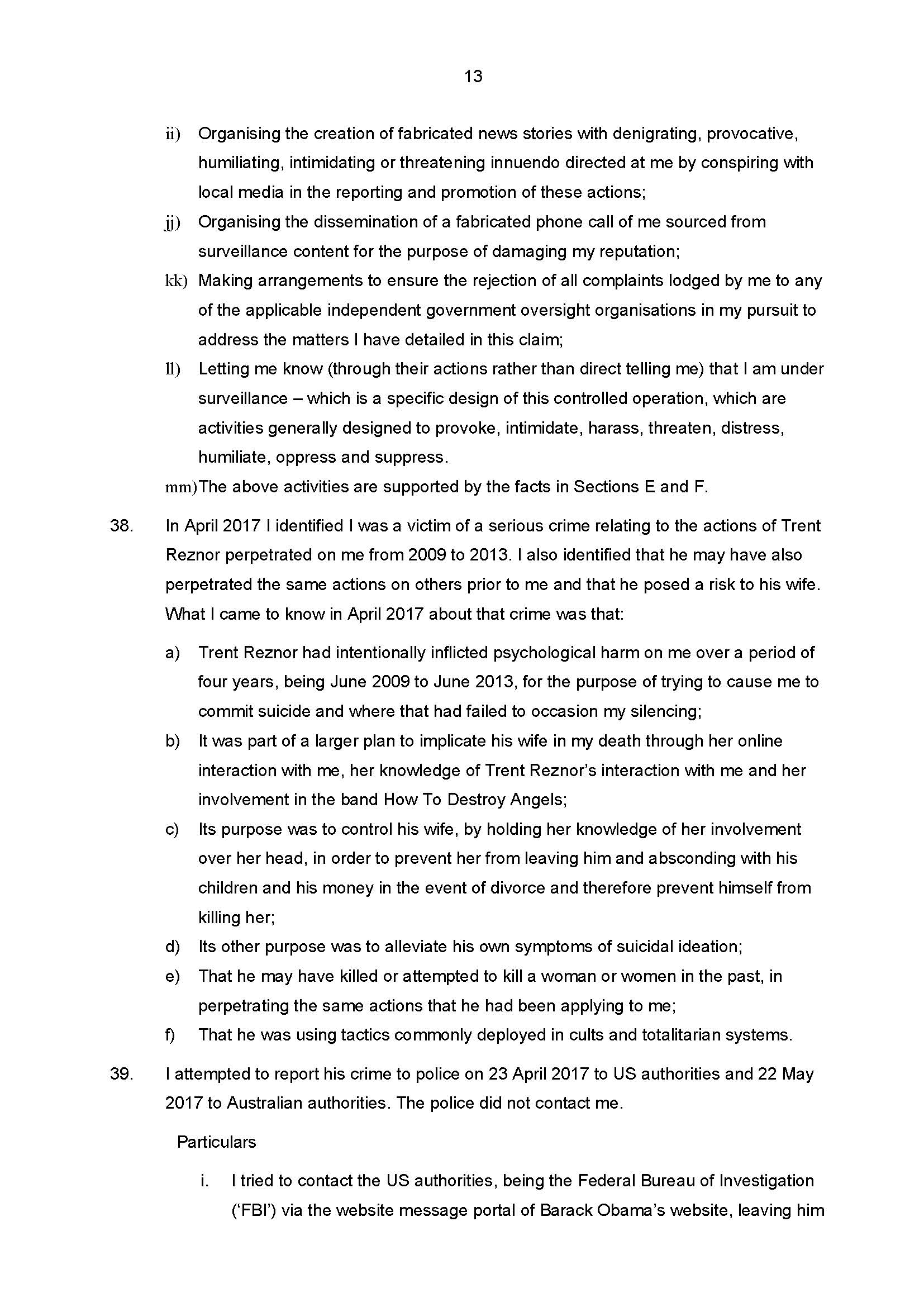
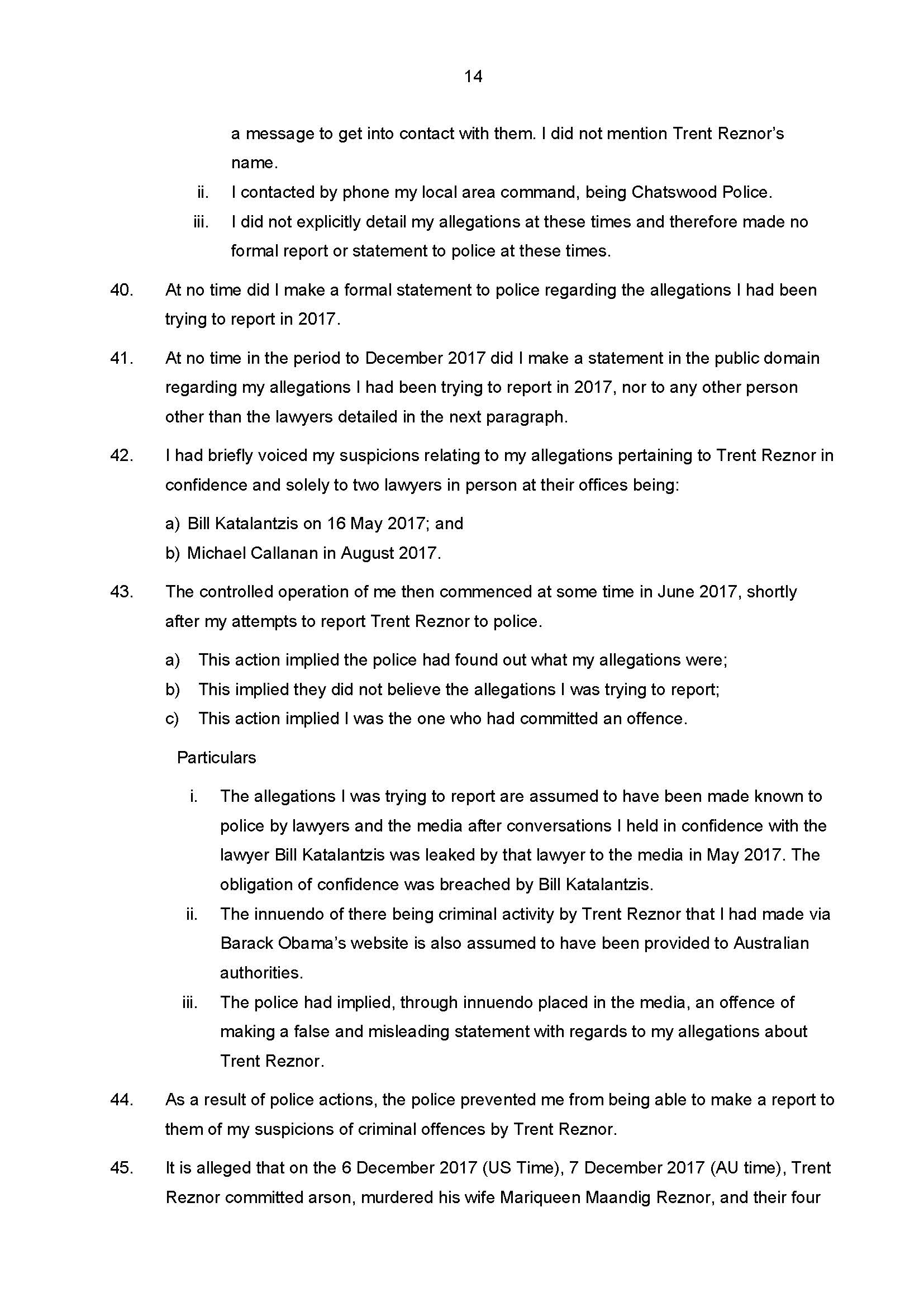
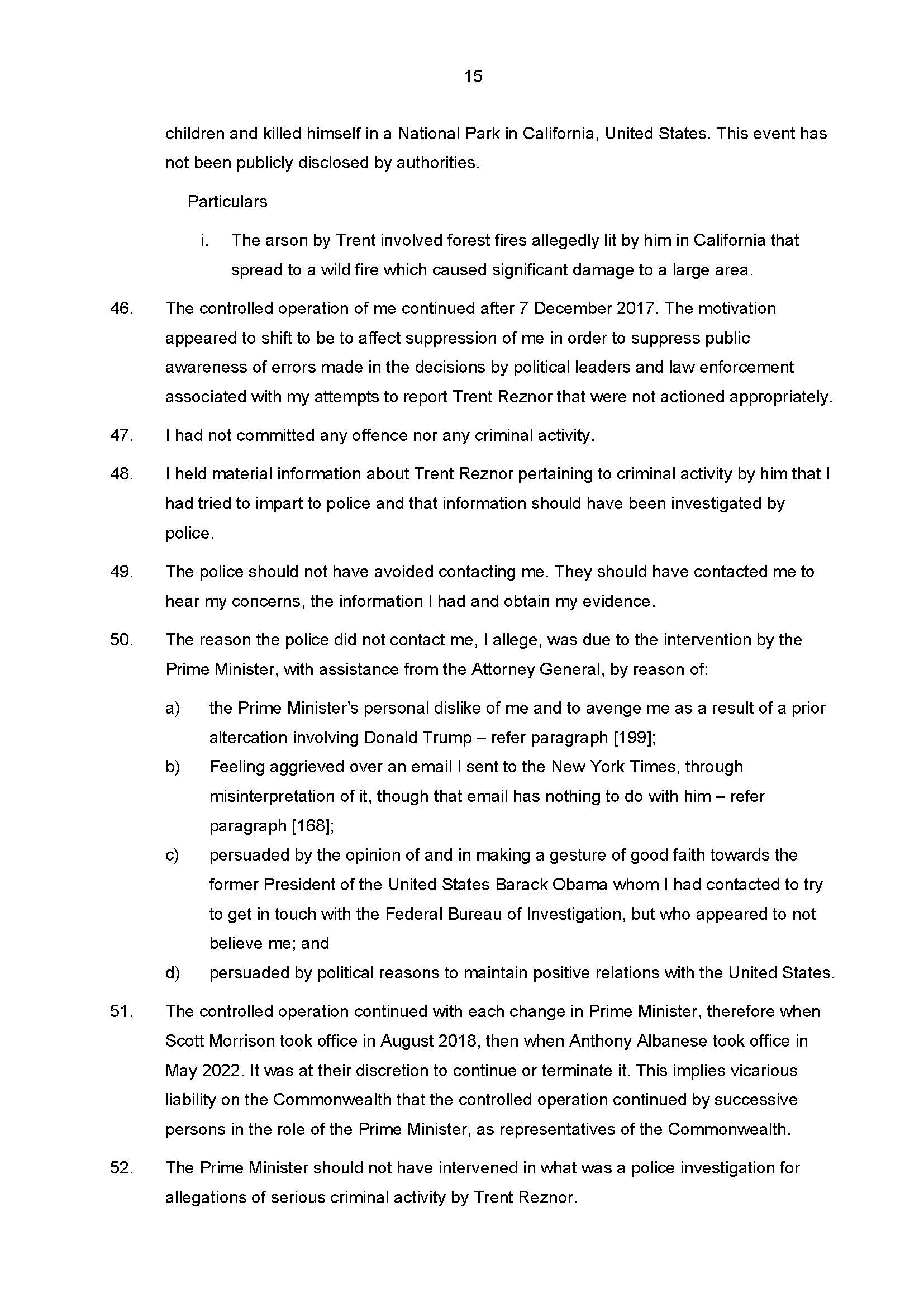
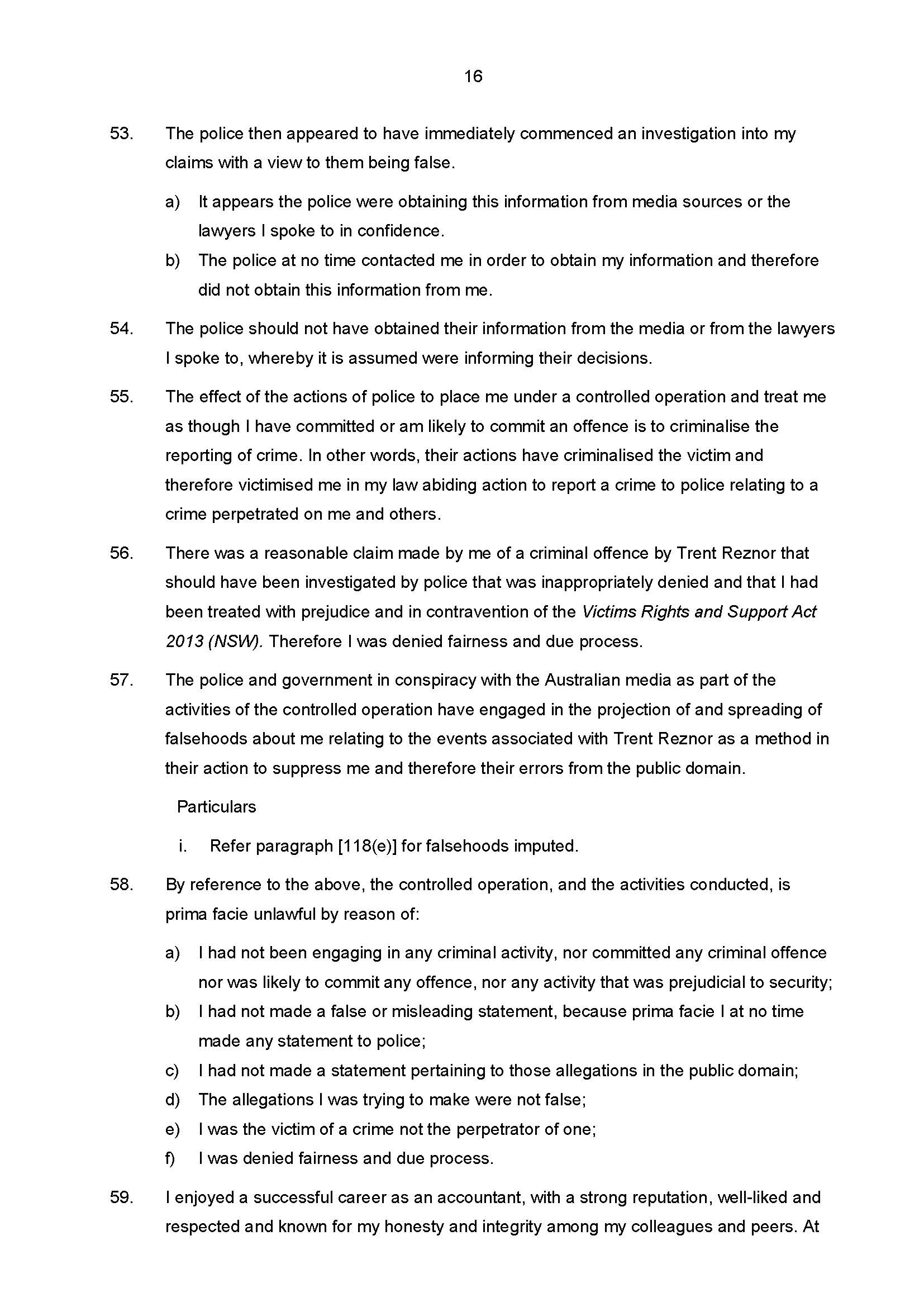
6 The applicant was dissatisfied with the orders made by Abraham J but did not seek special leave to appeal to the High Court from those orders. Instead, on two dates in late May and June 2024 she attempted to file an originating application seeking judicial review of the orders made by Abraham J. These documents were not accepted for filing by the Registry. On 5 July 2024, the applicant attempted to file an application to “re-open” the leave to appeal proceeding that Abraham J had decided, which a Registrar refused to accept for filing on 9 July 2024. On 14 July 2024 the applicant commenced another proceeding seeking judicial review of the decisions not to accept her documents for filing. That originating application was accepted for filing on 18 July 2024. That proceeding (the Registrar Review proceeding) was heard by Needham J and dismissed on 2 September 2024: AZO24 v Registrar, Registry of New South Wales, Federal Court of Australia (No 2) [2024] FCA 1004.
7 Meanwhile, in the current proceeding, on 21 June 2024 I refused leave to the applicant to file an interlocutory application staying her own proceeding. I ordered the respondents to lodge for filing, by 5 July 2024, any interlocutory applications seeking summary dismissal of the proceeding or to strike out the whole or part of the statement of claim together with outlines of submissions on those applications. I also fixed a date for the filing of any evidence and submissions in response by the applicant.
8 Applications were lodged by both respondents, accompanied by outlines of submissions, on 5 July 2024. In the light of the theoretical possibility that my ability to hear the matter might be under further challenge (by an application for special leave to appeal from, or some other form of attack on, the decision of Abraham J), I arranged for another judge to consider whether leave should be granted to file the respondents’ interlocutory applications. Moshinsky J granted this leave on 12 and 15 July 2024.
9 The applicant lodged another interlocutory application (which I gave her leave to file) on 17 July 2024, seeking to stay the proceeding or alternatively to delay the hearing of the respondents’ interlocutory applications (and that I not hear those applications). The reason given was that the applicant thought I should not continue to preside over this proceeding while the Registrar Review proceeding was on foot, given that the ultimate goal of bringing the Registrar Review proceeding was to challenge my decision not to disqualify myself from hearing this proceeding. On 25 July 2024 I declined to make these orders, but extended time for the filing of the applicant’s evidence and submissions by a month (until 20 August 2024) and fixed the respondents’ applications for hearing on 3 September 2024. I did not consider that the existence of the Registrar Review proceeding cast sufficient doubt on the appropriateness of my hearing this case to justify further delay.
10 No evidence or submissions were filed by the applicant.
11 From 20 August 2024 the applicant contacted the Registry by email on several occasions seeking to have the hearing date vacated. A summary of those communications in chronological order is as follows.
(a) At first, the substance of the applicant’s communications was that she had sought orders in the Registrar Review proceeding that the proceeding before me be stayed; that Needham J had not yet decided whether to make those orders; and the hearing would therefore have to be moved.
(b) On 22 August 2024, the Registry (at my request) informed the applicant that if she wished to have the hearing date vacated she would need to have the matter listed so that the respondents could be heard on her proposal.
(c) On 23 August 2024, the applicant replied indicating that she “[did] not consent” to a hearing in the week of 3 September, because it fell in the week of the fifth anniversary of an event she alleges in her statement of claim (I explain this further below).
(d) On 27 August 2024, the applicant emailed to say that she was unavailable on 3 September 2024 due to a “conflict” (which was not explained) and that she was available on certain dates that the respondents had already indicated were not available for them during the case management hearing on 25 July 2024.
(e) On 27 August 2024, at my request, the Registry informed the applicant that, absent the respondents’ consent, vacating the hearing date would require the applicant to have the matter relisted and provide supporting evidence in support of her application.
12 On 27 August 2024, Needham J refused the application in the Registrar Review proceeding that the proceeding before me be stayed because it was an abuse of process: see AZO24 v Registrar, Registry of New South Wales, Federal Court of Australia [2024] FCA 976.
13 The applicant took no action to have this proceeding relisted until, on Thursday 29 August 2024, she sought to file an interlocutory application seeking an order adjourning the hearing that was due to occur on Tuesday 3 September until a date after the disposition of the Registrar Review proceeding and, if necessary, any appeal from that decision. The affidavit filed in support of this interlocutory application deposed that 3 September fell in the same week as the fifth anniversary of 8 September 2019, when (so the applicant believed) she had been deliberately infected with a disease by a contaminated cup of coffee served to her in Zurich, Switzerland, on the authorisation of the Commonwealth. She also asserted that the hearing date of 3 September had been “deliberately set and designed to occur” in the week of this anniversary, which caused her distress. I granted leave to file this application on 30 August 2024 and made it returnable on the morning of 3 September 2024. The applicant was informed by the Registry that she should come prepared to put her arguments in support of that application. On 30 August 2024, the applicant repeated that she was unavailable in the week beginning 2 September. On 2 September 2024, the applicant emailed the Registry to say that she would not attend the Court during that week.
14 When the matter was called on the morning of 3 September 2024 the applicant did not appear. Rule 17.04(b) of the Federal Court Rules 2011 (Cth) (Rules) requires that the Court be satisfied that service has been effected on the respondent to an interlocutory application before proceeding to determine the application in their absence. Neither respondent read or tendered any evidence that the applicant had been served with the interlocutory applications. However, r 17.04(b) is merely an expression of the overarching requirement that the Court afford procedural fairness to each party. I am satisfied that in this case the applicant had more than sufficient notice of the date and time of the hearing and the orders sought by the respondents’ applications because of the history summarised earlier in these reasons and her communications with the Court. In circumstances where that was abundantly clear, I proceeded to hear each of the three interlocutory applications that were before the Court. To the extent necessary, I would dispense with the formal requirements of r 17.04(b) in this case: see r 1.34 of the Rules.
15 These reasons explain:
(a) why I refused the adjournment application on 3 September 2024;
(b) why I have concluded that the proceeding should be summarily dismissed;
(c) my conclusions in relation to costs; and
(d) why, on 30 August 2024, I refused leave to file another interlocutory application lodged by the applicant the previous day.
The adjournment application
16 If the applicant had a genuine objection to appearing at a hearing in the week of 3 to 8 September based on the matters referred to in her affidavit, that objection could have been raised at the time the respondents’ applications were fixed for hearing on 25 July 2024. It was not raised then, and only appears to have been raised when her other attempts to have the hearing delayed were unsuccessful.
17 Assuming it to be true that the applicant became ill while visiting Zurich in September 2019, no basis at all has been shown for the assertion that this occurred as a result of anything done on the Commonwealth’s behalf. It is possible that the applicant genuinely believes this to be the case and that remembering the episode causes her some distress. However, distressed people regularly appear in court. There is no evidence as to why the applicant’s distress extends to the whole of the week in which (she claims) the anniversary occurs, and no evidence from a medical practitioner that it incapacitates her to any particular degree.
18 For these reasons I made an order on 3 September 2024 refusing the application to adjourn the hearing.
The respondents’ applications for summary judgment or strike-out
The claim
19 The originating application seeks at least 49 separate orders, some of which appear to be interlocutory in nature. The final orders sought include declarations of contraventions of the Telecommunications (Interception and Access) Act 1979 (Cth); compensatory and punitive damages under s 107A of that Act and on other bases (including, it would appear, in tort); compensation to the applicant’s parents; other declarations of invalidity or unlawfulness; orders restraining conduct by or on behalf of the respondents that is alleged to be unlawful; return of any items covertly seized from the applicant; and destruction or removal of data.
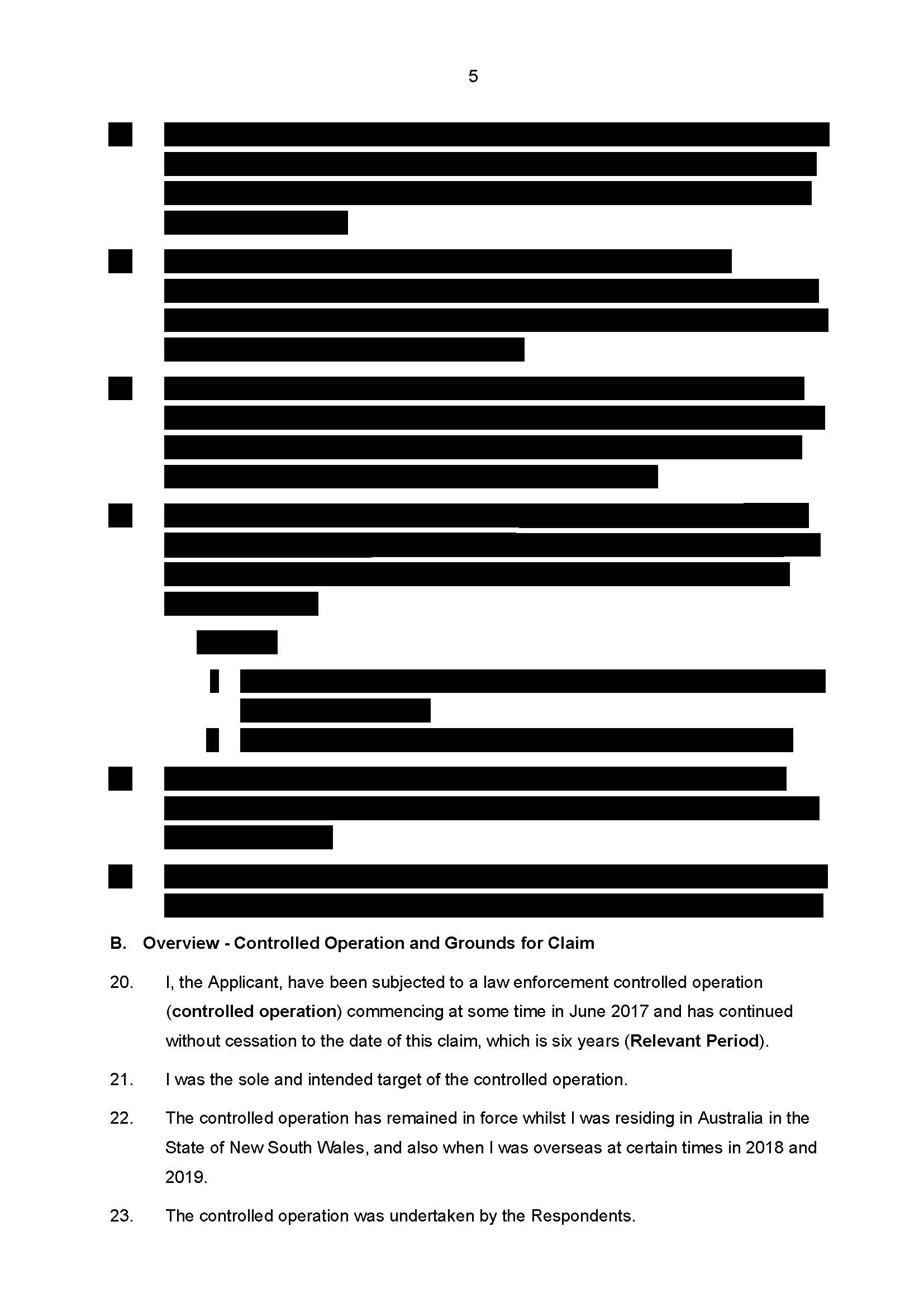
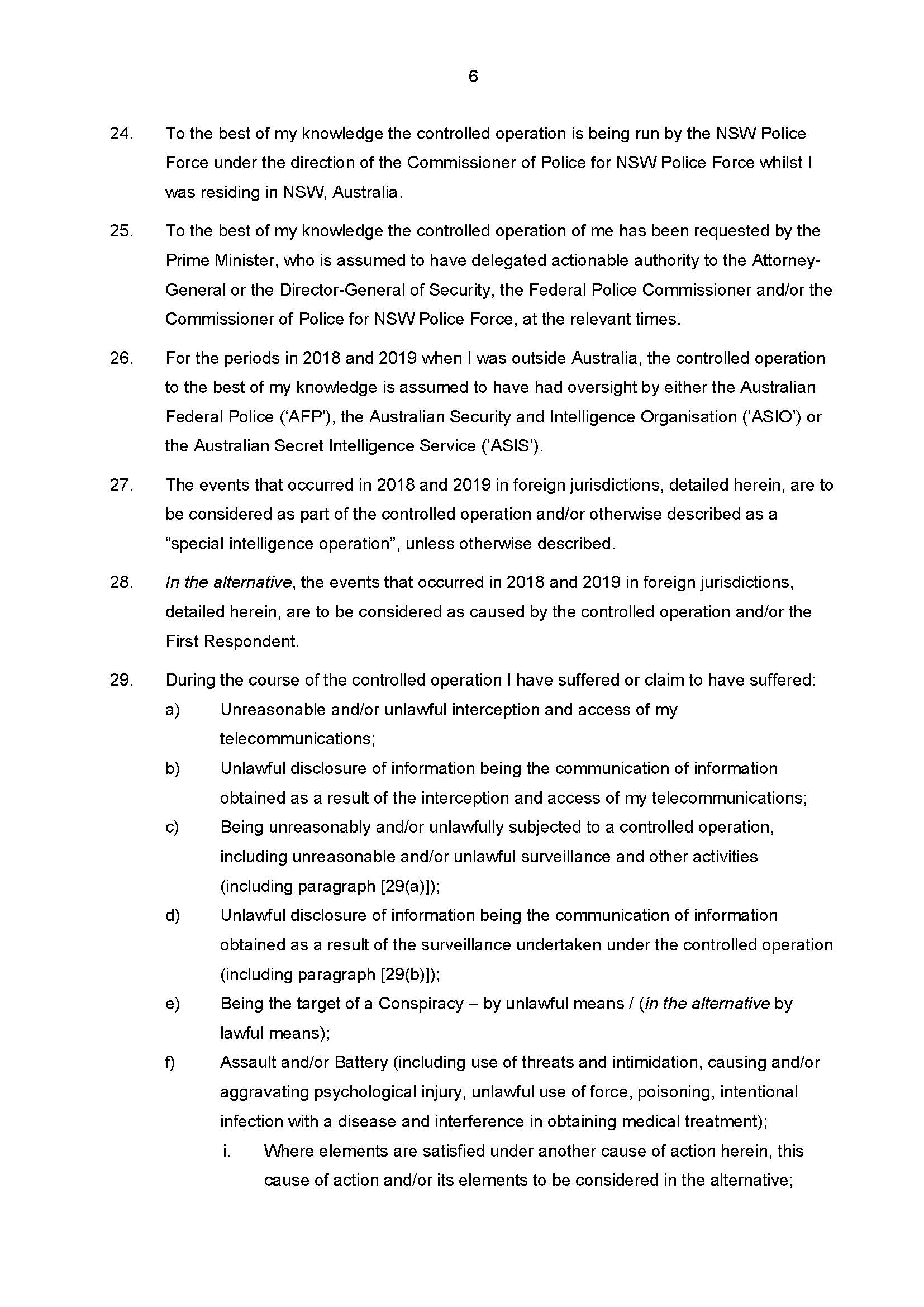
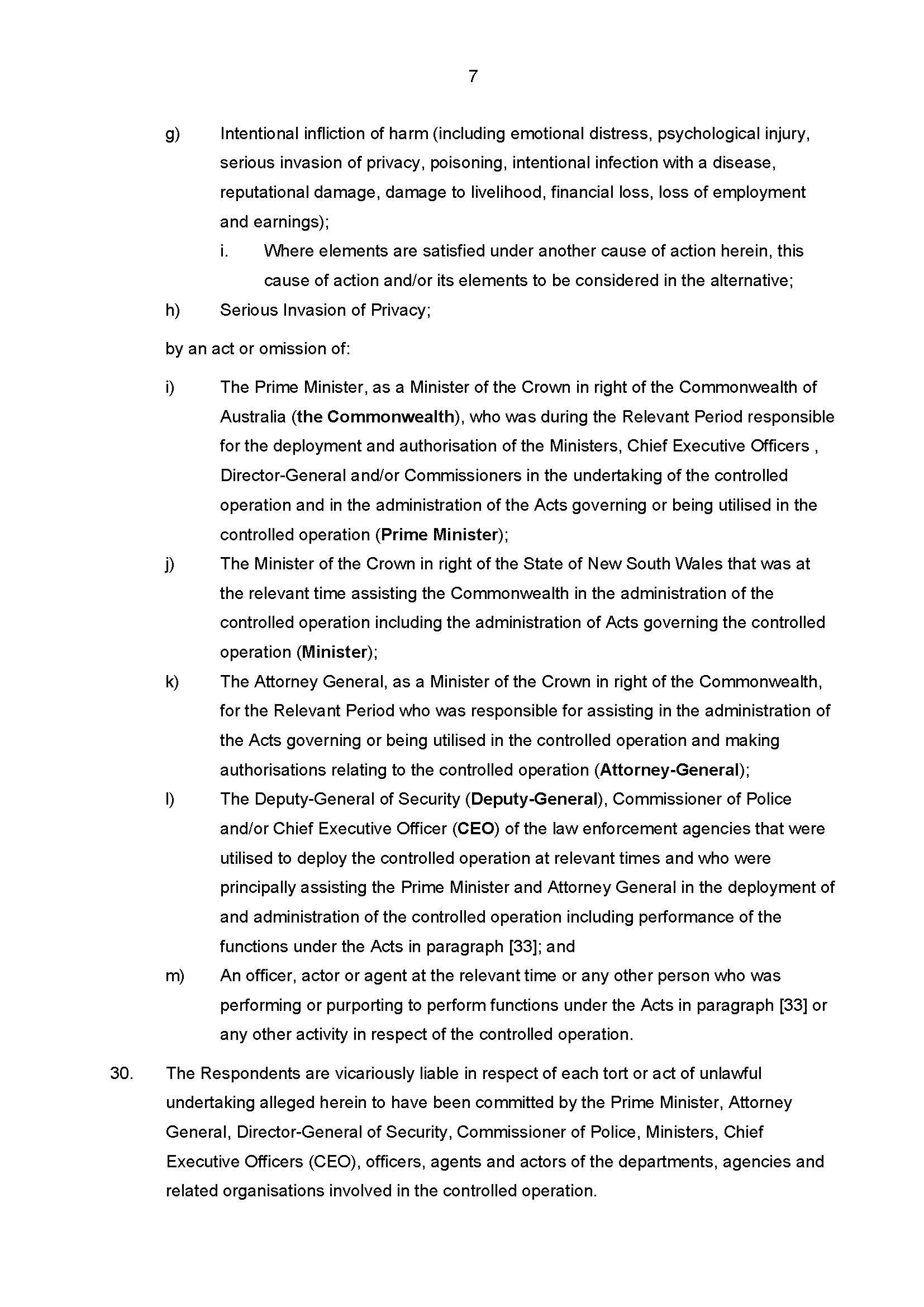
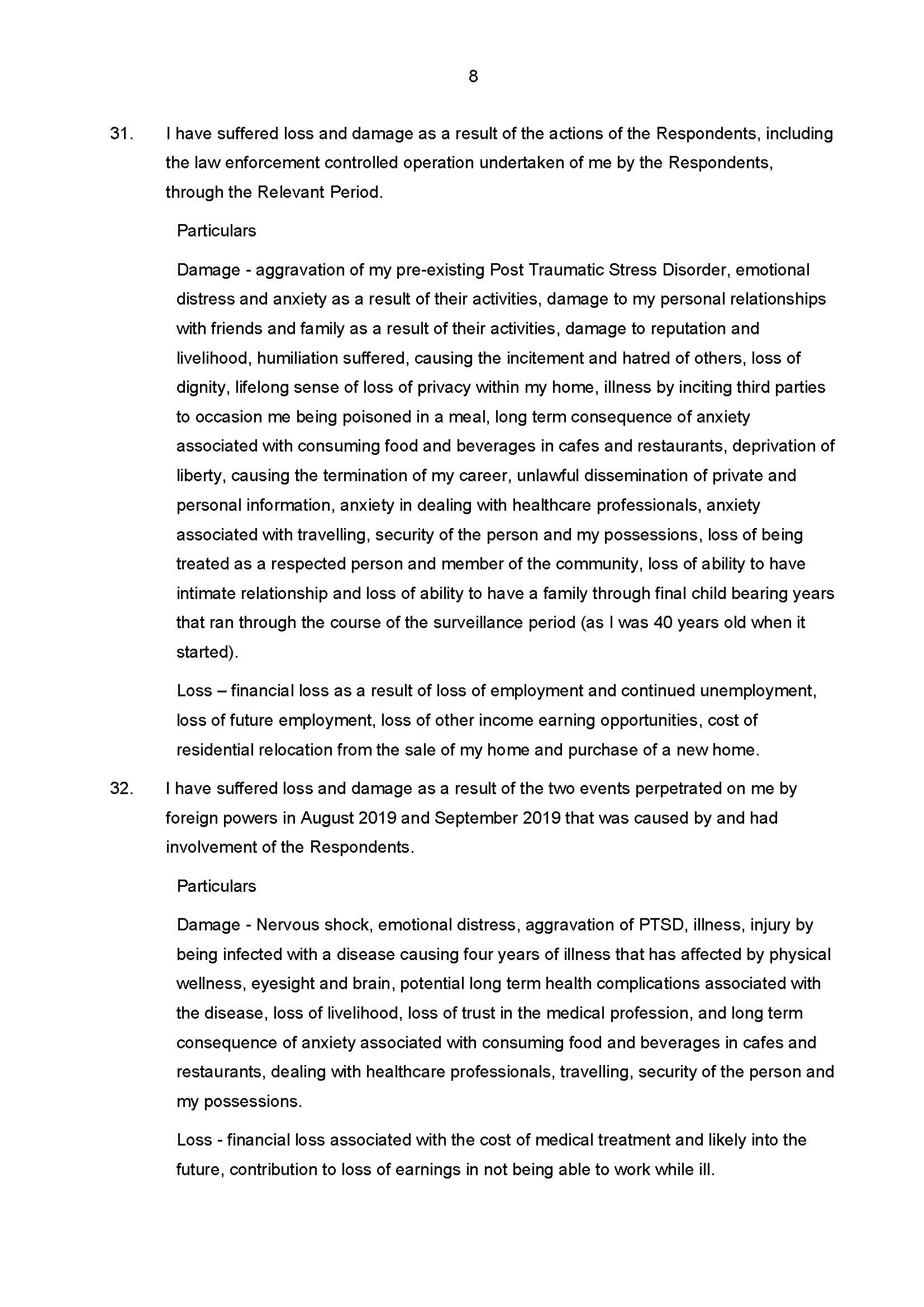
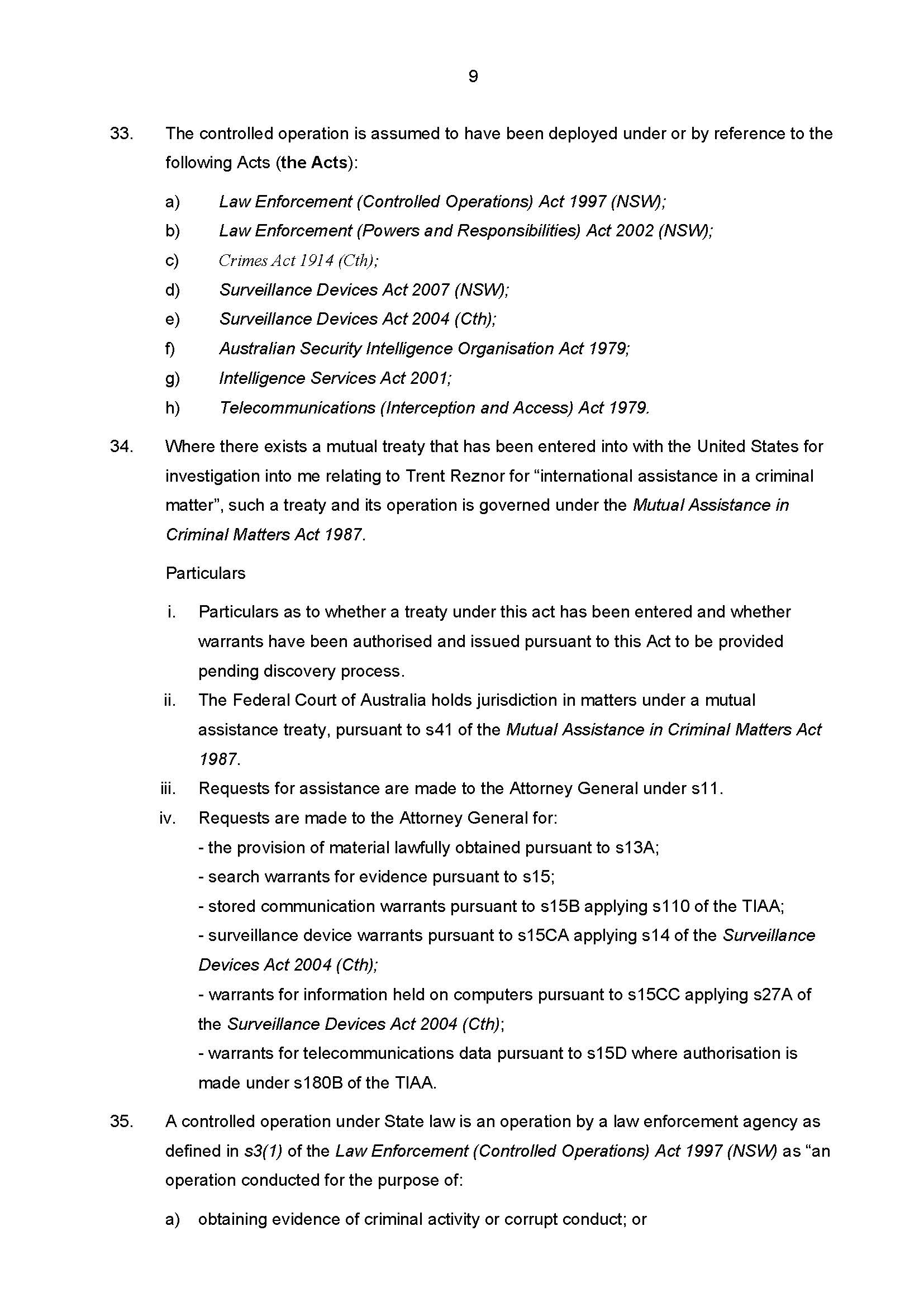
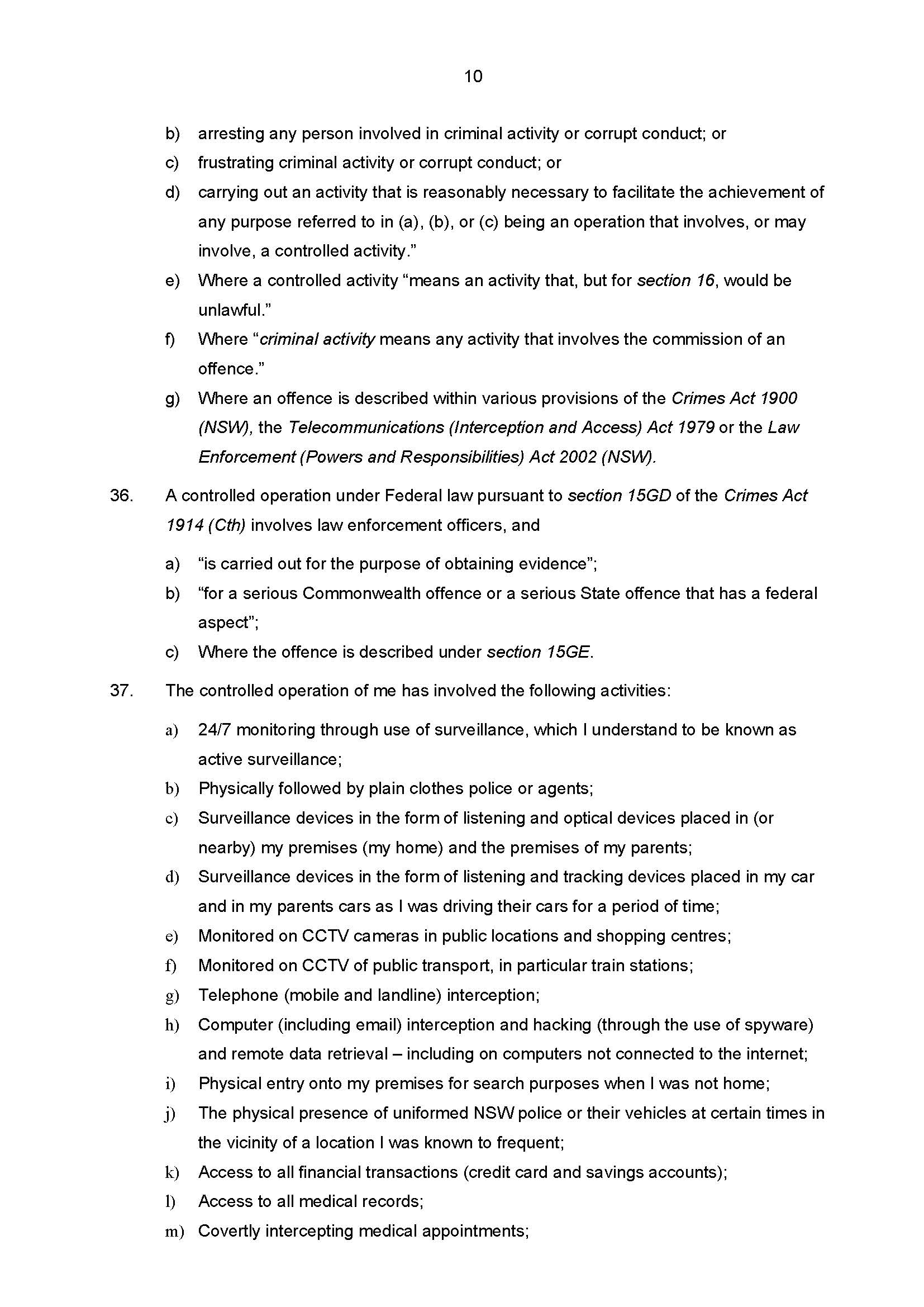
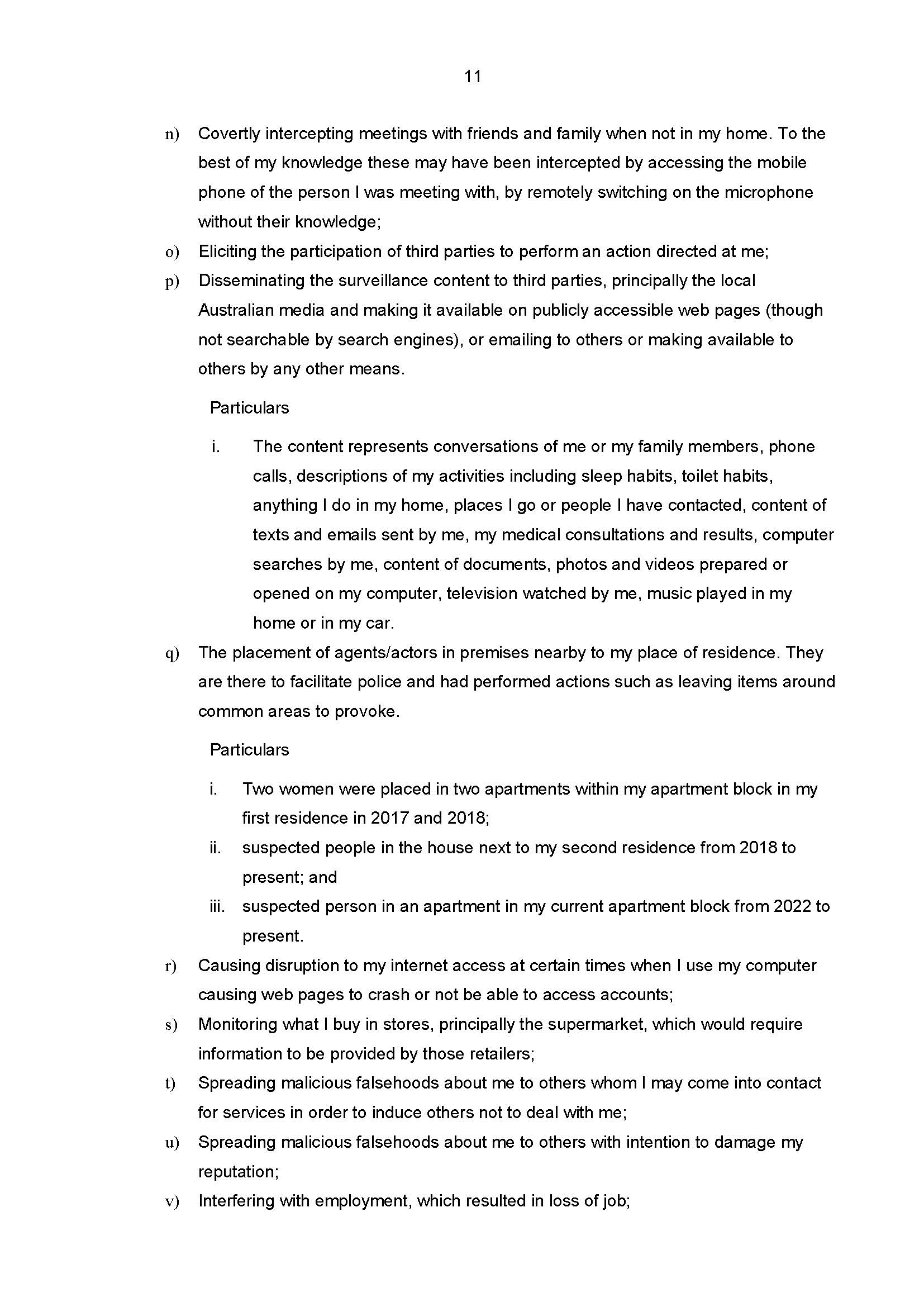
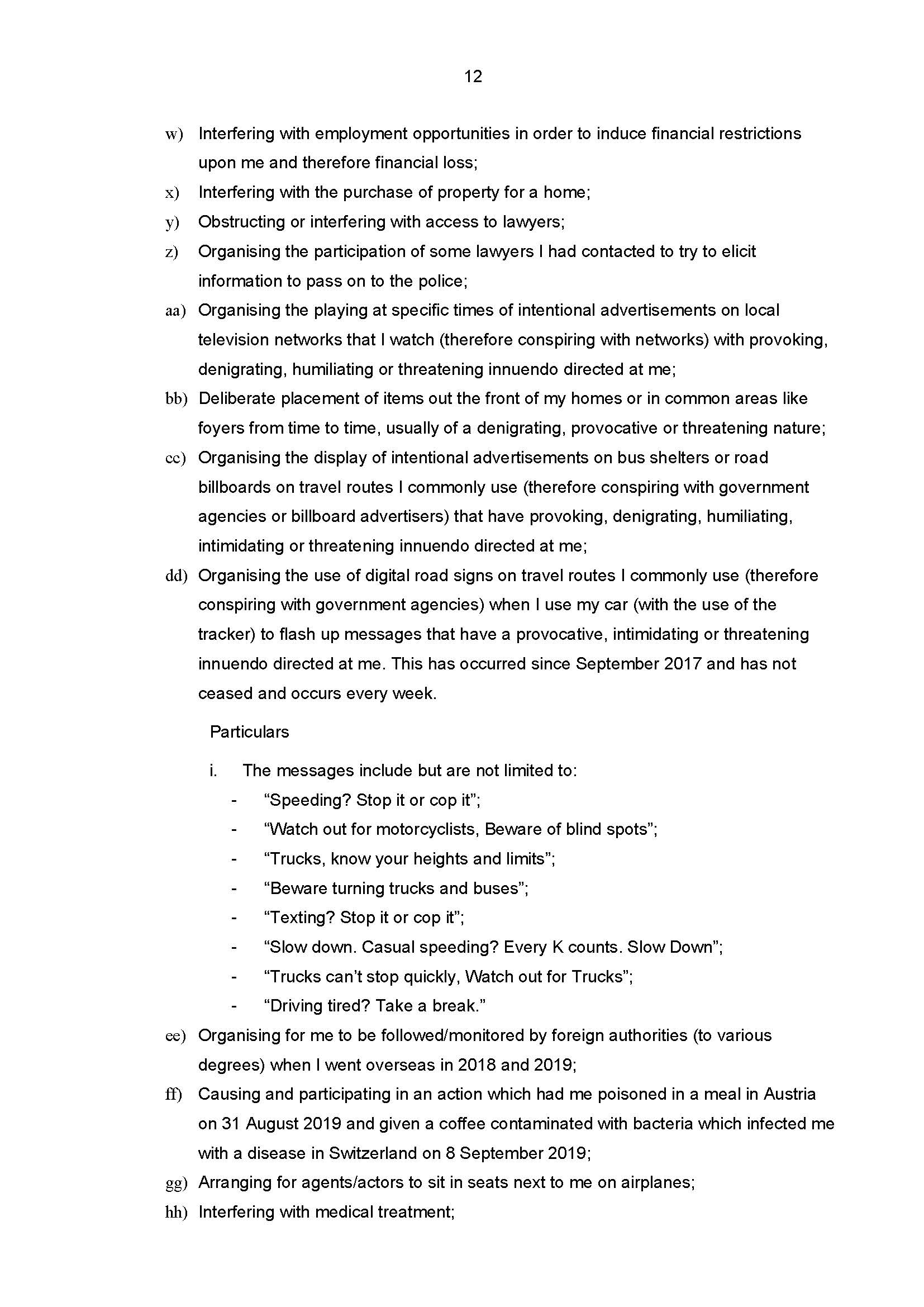
20 The statement of claim comprises 368 paragraphs over 185 pages, plus a one page schedule. It is written in a narrative style and the causes of action that it asserts are difficult to divine. It alleges the conduct of what is described as a “law enforcement controlled operation” by the respondents against the applicant, beginning in 2017 and continuing until the present. An indication of its drafting and subject matter is provided by the “Overview” in Part B, albeit that the overview itself contains 42 paragraphs (many of which contain several sub-paragraphs). It is too long to set out as part of these reasons, but it would be time consuming and possibly unfair for me to summarise it. I have therefore reproduced paragraphs 20 to 61 of the statement of claim as an annexure to these reasons.
Federal Court of Australia Act 1976 (Cth), s 31A
21 Section 31A(2) of the Federal Court of Australia Act 1976 (Cth) provides, relevantly, that the Court may give summary judgment in favour of a person defending a proceeding if the person prosecuting the proceeding has “no reasonable prospect of successfully prosecuting the proceeding”. Section 31A(3) expressly provides that, in order to have “no reasonable prospect of success”, the proceeding need not be hopeless or doomed to fail. The provision thus sets a lower bar than older case law on summary dismissal (such as General Steel Industries Inc v Commissioner for Railways (NSW) (1964) 112 CLR 125), although it is clear that summary dismissal remains a serious step which should be taken only with great care (see eg Spencer v Commonwealth [2010] HCA 28; 241 CLR 118 at [24] (French CJ and Gummow J), [60] (Hayne, Crennan, Kiefel and Bell JJ) (Spencer)). French CJ and Gummow J in Spencer summarised the effect of the section as follows (at [22]):
[Section 31A] authorises summary disposition of proceedings on a variety of bases under its general rubric. It will apply to the case in which the pleadings disclose no reasonable cause of action and their deficiency is incurable. It will include the case in which there is unanswerable or unanswered evidence of a fact fatal to the pleaded case and any case which might be propounded by permissible amendment. It will include the class of case in the longstanding category of cases which are "frivolous or vexatious or an abuse of process". The application of s 31A is not, in terms, limited to those categories.
22 For the following reasons, the applicant has “no reasonable prospect of success” in the present proceeding and it should be dismissed pursuant to s 31A(2).
23 First, the applicant has no realistic prospect of being able to establish the factual allegations that appear to be central to her claims, namely:
(a) that Mr Trent Reznor (an American popular musician of some note, who to all appearances is very much alive) in fact committed suicide in 2017 after having killed members of his family;
(b) that the Governments of the Commonwealth and New South Wales had (and still have) an interest in trying to prevent the applicant from publicising this fact; and
(c) that in pursuit of this interest those Governments have conducted a vast and complex operation, reaching into all aspects of the applicant’s life, intended to spy on and intimidate the applicant (including, for example, placement of road signage delivering subtle threats meaningful only to her, purchasing apartments in the building where she lives, and assigning agents to live in those apartments and spy on or intimidate her).
24 Each of these propositions is obviously extremely implausible. To take a few simple examples of why this is so:
(a) There is evidence of a large body of publicly available information to the effect that Mr Reznor continues to write and perform music and appear in public. There is no suggestion of anybody other than the applicant having suggested that he in fact died seven years ago in dramatic and (one would think) highly newsworthy circumstances. For the applicant’s claim to be correct, it must be the case that large numbers of music fans and participants in the entertainment industry all over the world have been successfully duped over a period of several years by some unidentified person or persons impersonating Mr Reznor.
(b) It is very unlikely that such a world wide conspiracy of silence could be successful for so long, with the only person knowing and wanting to expose the truth being the applicant (who had no connection with Mr Reznor except online, and seemingly inferred the truth from a range of cryptic messages and events).
(c) It is similarly unlikely, even assuming that the Australian and New South Wales governments wished to cover up the fate of Mr Reznor (which itself seems unlikely), that they would act in so many complicated and indirect ways to silence an individual citizen. Most of the steps which the applicant claims were taken in order to intimidate and silence her involved cryptic messages that relied on her to decode their meanings.
(d) The alleged covert operation, for all its complexity and (it can be inferred) vast expense, has not been particularly effective in achieving its alleged aim. It did not prevent the applicant asserting in her statement of claim (which is on the Court’s file) that Mr Reznor murdered his family and is dead. Nor did it prevent her asserting that Mr Reznor is dead in open court on 25 July 2024. Nor has either of the respondents (who allegedly wish to suppress this fact) sought any suppression orders, or applied to close the court on occasions when the content of the applicant’s claims has been referred to.
25 The fact that claims seem unlikely to be correct is not, by itself, a sufficient reason to deny an applicant the opportunity to attempt to prove them at a final hearing. As Megarry J said in a different context in John v Rees [1970] Ch 345 at 402:
[The] path of the law is strewn with examples of open and shut cases which, somehow, were not; of unanswerable charges which, in the event, were completely answered; of inexplicable conduct which was fully explained; of fixed and unalterable determinations that, by discussion, suffered a change.
26 The problem here is not only that the key factual allegations seem implausible. Each one also involves fraud or bad faith which, as a matter of basic principle, must be clearly alleged and proved by cogent material; and the statement of claim fails to allege any concrete facts from which the conclusions the applicant seeks to draw can rationally be drawn. Rather than alleging specific acts on specific dates by identified persons or agencies, the statement of claim relies on the applicant’s speculative inferences, from what are on their face completely innocent events, to assert the existence of (unspecified) decisions made and actions taken against her in the shadows. This is completely unsatisfactory as a form of pleading. More significantly for present purposes, it indicates that there is no proper foundation in fact (and the applicant has no real evidence) to support any of the matters she alleges.
27 In a survey of the case law in Prior v South West Aboriginal Land and Sea Council Aboriginal Corporation [2020] FCA 808 at [27]-[29] (Prior) (which Thawley J recently adopted in Quach v McIntyre [2024] FCA 564), McKerracher J noted that an application for summary dismissal is likely to succeed if “the applicant’s success in the principal proceedings relies upon a question of fact that can truly be described as fanciful, trifling, implausible, improbable, tenuous or one that is contradicted by all the available documents or other materials” (at [29(c)], citing Australian Securities and Investments Commission v Cassimatis [2013] FCA 641; 220 FCR 256 at [47] (Reeves J)). The present case is comfortably within that description.
28 Additionally (and relevantly to the last part of the formulation adopted by McKerracher J), there is some evidence that contradicts the applicant’s core propositions and no evidence at all to support them.
(a) As to Mr Reznor, the second respondent (New South Wales) relies on an affidavit affirmed on 5 July 2024 by Mr Nicholas Betts, a solicitor in the office of the NSW Crown Solicitor, which annexes the results of internet searches which he undertook on 7 June 2024. All of these indicate that Mr Reznor has remained active as a composer and performer, and won various awards, since 2017.
(b) As to the existence of a “controlled operation”, the following material is in evidence.
(i) an affidavit from Ms Marianne Peterswald sworn 5 July 2024, Senior Executive Lawyer at the Australian Government Solicitor, describing inquiries made by her instructing officer with relevant agencies which identified no controlled operations pursuant to the Crimes Act 1914 (Cth) involving the applicant and no investigations or operations relating to her by the Australian Security and Intelligence Organisation (ASIO);
(ii) evidence in Mr Betts’s affidavit that his client is not aware of any controlled operation, and the only evidence able to be found of police activity relating to the applicant was a report made by her to police about alleged online abuse by Mr Reznor in 2014;
(iii) affidavit evidence (sworn 13 August 2024) from a NSW Police officer (Inspector Maree Kiem) describing what had occurred in connection with the report made by the applicant in 2014 (no action was taken); and
(iv) subpoenas which the applicant issued to the Commonwealth Attorney-General, the Director-General of ASIO and the NSW Commissioner of Police, requiring production of broadly-expressed categories of documents relating to any operations connected to the applicant between January 2017 and July 2024, and the responses from their respective solicitors stating that searches had been made and no documents within the scope of the subpoenas had been found.
29 This material is hearsay and would not be sufficient to negative the applicant’s allegations at a final hearing. However, at an interlocutory stage, it carries some weight. In particular, where solicitors (who are officers of the Court) report that searches have been made and no relevant documents found, the proper assumption is that they are telling the truth and there is therefore a strong likelihood that no such documents exist.
30 McKerracher J also noted in Prior that, “if a prima facie case in support of summary judgment is established, the onus shifts to the opposing party to point to some factual or evidentiary issues making a trial necessary” (at [29(f)], citing Jefferson Ford Pty Ltd v Ford Motor Company of Australia Ltd [2008] FCAFC 60; 167 FCR 372 at [127] (Gordon J)). The applicant, however, has not adduced any evidence to indicate that her assertions have substance despite being granted a substantial extension of time in which to do so (and leave to issue subpoenas for production of documents). This strengthens the impression that there is no evidence to support the claim. The state of the evidence makes it apt to describe the applicant’s case as one that is “contradicted by all the available documents or other materials”. It bolsters the conclusion that the key factual allegations have no reasonable prospect of being proved.
31 The submissions filed by New South Wales on its interlocutory application also went through the process of trying to identify the causes of action pleaded by the applicant and contended that the necessary facts to make out each cause of action have not been pleaded. While there is force in these arguments, it is not an efficient use of resources for the Court to analyse the statement of claim at that level of granularity. If there were substance in the applicant’s factual claims in relation to the actions allegedly taken against her, it seems at least possible that she would have a claim for some form of relief even though significant re-pleading would be required. I have therefore based my decision on the absence of any reasonable prospect of the applicant being able to make out her claims at a factual level.
Costs
32 The respondents sought their costs. Each of the respondents has written to the applicant, urging her to discontinue the proceeding and pointing out that an adverse costs order may be the consequence of the proceeding being dismissed. However, neither respondent relies on those communications to seek its costs on an indemnity basis.
33 There is no reason why costs should not follow the event.
Refusal of leave to file an interlocutory application
34 The applicant has requested reasons for a decision that I made in Chambers on 30 August 2024 refusing leave to file an interlocutory application which would seek the issue of a letter of request to the judicial authorities of the United States of America pursuant to s 7(1)(c) of the Foreign Evidence Act 1994 (Cth).
35 The proposed letter of request would seek an examination of the Attorney General for the State of California and another senior official of that State concerning the records held by that State in relation to Mr Reznor and his family and the production of their death certificates. The purpose of the request is explained as being to assist the applicant in proving that Mr Reznor and his wife and children died in 2017.
36 There were broadly two reasons why I considered that this application should not be allowed to be filed and to take up the time of the Court and the respondents.
37 First, the issue of a letter of request involves the expenditure of substantial time and effort by Australian officials and officials in a foreign country. It should not be undertaken lightly. In particular, I do not think it is appropriate for this process to be used for what is essentially a fishing expedition. The applicant asserts (contrary to all indications) that Mr Reznor and his family died in 2017 but has not been able to point to a skerrick of evidence to support this assertion. She evidently hopes that examination of officials of the State of California might produce some evidence.
38 Secondly, the application was simultaneously premature and too late. As an attempt to gather evidence for a final hearing, it was premature because the applications for summary dismissal were pending. As an attempt to obtain evidence with which to resist the applications for summary dismissal, it was made too late. Those applications had been lodged for filing on 5 July 2024, and on 25 July 2024 they were listed for hearing on 3 September 2024. By the time the proposed interlocutory application was sent to the registry on 29 August 2024, not only had the (extended) date for filing of evidence by the applicant passed, but there was no prospect of a letter of request bearing any fruit before the respondents’ applications were heard.
I certify that the preceding thirty-eight (38) numbered paragraphs are a true copy of the Reasons for Judgment of the Honourable Justice Kennett. |
Associate:
ANNEXURE A