

Federal Court of Australia
Nasir v Reynolds [2024] FCA 1027
ORDERS
Applicant | ||
AND: | First Respondent AMY MCCUDDEN Second Respondent ORACLE CORPORATION AUSTRALIA PTY LIMITED (ABN 580003074468) Third Respondent | |
DATE OF ORDER: |
THE COURT ORDERS THAT:
1. Subject to Orders 2 and 3 below, the proceeding be dismissed with costs.
2. On or by 27 September 2024, the applicant:
(a) file any material upon which he intends to rely to oppose an order (proposed order) being made in the following terms:
Pursuant to s 37AO(2)(b) of the Federal Court of Australia Act 1976 (Cth) (FCA Act), Mr Nasir be prohibited from instituting proceedings in this Court without making an application for leave to institute proceedings in accordance with s 37AR of the FCA Act.
(b) notify the Registry in writing as to whether he wishes to have an oral hearing in relation to whether the proposed order ought to be made by the Court and, in the absence of such notification, the issue as to whether the proposed order ought to be made be dealt with on the papers.
3. Any oral hearing in relation to the making of a vexatious proceedings order under Pt VAAA, Div 2 of the Federal Court of Australia Act 1976 (Cth) is to be listed for hearing by the Court on a date to be fixed following 27 September 2024.
Note: Entry of orders is dealt with in Rule 39.32 of the Federal Court Rules 2011.
LEE J:
A INTRODUCTION AND BACKGROUND
1 The applicant, Mr Sajjad Nasir, brings this proceeding against his former employer, Oracle Corporation Australia Pty Ltd (Oracle) and two of its officers, Ms Amy McCudden and Ms Catherine Reynolds (collectively, respondents). From 8 August 2019 until 4 November 2022 (relevant period), Mr Nasir was employed as a data technician by Oracle.
2 By way of an originating application dated 6 June 2024 (originating application) brought under the Australian Human Rights Commission Act 1986 (Cth) (AHRC Act), Mr Nasir alleges that the respondents engaged in unlawful discrimination under the Racial Discrimination Act 1975 (Cth) (RDA Act) (application). Mr Nasir’s original complaint to the Australian Human Rights Commission (AHRC) in relation to this allegation was terminated by the AHRC without inquiry, pursuant to ss 46PF(1)(b) and 46PH(1B)(b) of the AHRC Act. A key reason considered by the AHRC in relation to the termination of the complaint was that Mr Nasir had signed an agreement with Oracle pursuant to which he released Oracle, its related corporations and employees from any liability (Release).
3 On 11 July 2024, I conducted a case management hearing. On that date, I raised the issue concerning the Release with the parties (which was before the Court as an annexure to the originating application) and proposed an order be made (which was not then opposed by Mr Nasir or the respondents) that pursuant to s 37P(2) of the Federal Court of Australia Act 1976 (Cth) (FCA Act), the issue as to whether the Release agreement between Mr Nasir and Oracle constituted a complete defence to the relief sought by Mr Nasir be set down for final determination separately and before any other issue in the proceeding (separate issue). This was done and, among other things, I made orders that Mr Nasir file any affidavit material or submissions upon which he intended to rely in relation to the hearing of the separate issue on or by 31 July 2024 (Order 2) and that the separate issue be listed for final hearing on 8 August 2024 (Order 4).
4 On 22 July 2024, however, Mr Nasir filed a document entitled “notice of appeal” which purported to institute an appeal against the Orders dated 12 July 2024 (Orders) concerning the hearing of the separate issue (appeal application). The notice of appeal came before Wigney J, who treated the “appeal” as an application for leave to appeal: Nasir v Reynolds (Application for leave to appeal) [2024] FCA 865 (at [6]).
5 Three days later, on 25 July, Mr Nasir lodged an interlocutory application in which he sought, inter alia, an order staying the operation of the Orders (stay application). Mr Nasir also sought an order the effect of which was to restrain Oracle and its officers from taking steps to rely on that order pending the determination of his appeal application. The interlocutory application annexed various other documents, including Mr Nasir’s notice of appeal, and a document said to be a notice of a constitutional matter under s 78B of the Judiciary Act 1903 (Cth): Nasir v Reynolds (stay application) [2024] FCA 864 (at [8]).
6 On 1 August, the appeal application and the stay application came before Wigney J. His Honour considered the constitutional issue raised to be inarguable and proceeded to dismiss the stay application reasoning that none of the proposed grounds of appeal raised by Mr Nasir had any apparent merit, and that accordingly, there was no basis for a stay of the Orders: Nasir v Reynolds (stay application) (at [30]). On 5 August, his Honour refused to grant leave to appeal on the same basis and dismissed the appeal application: Nasir v Reynolds (Application for leave to appeal) (at [28]). Accordingly, on 8 August, the separate issue proceeded to final hearing.
7 I will return to the separate issue later in these reasons, but before going further, it is worth providing some further background to the dispute.
B FURTHER BACKGROUND
8 Mr Nasir’s claims arise out of several “complaints” made by him during the relevant period against Oracle, its related corporations, and their respective employees.
9 Because of the focus of the separate issue, it is unnecessary to descend here into the detail of these complaints, save to note that on 31 October 2022, Mr Rachna Sampayo, Senior Vice President of Human Resources (Oracle Singapore) raised several of them with Mr Nasir during a Zoom meeting. By that point, Ms Sampayo had formed the view that Mr Nasir’s complaints were not genuine, and that he had been “weaponizing [sic] the complaint and/or grievance process” (Affidavit of Ms Sampayo affirmed 2 August 2024 (Sampayo Affidavit)). Ms Sampayo gave evidence that in that meeting, she had informed Mr Nasir, among other things, that Oracle, in the light of his conduct, was considering terminating his employment (Sampayo Affidavit (at [6])). I will return to Ms Sampayo’s evidence later in these reasons.
10 On 4 November 2022, prior to the commencement of this proceeding, Mr Nasir entered into the Release with Oracle by which Mr Nasir agreed that his employment would cease on that date. The recitals to the Release provided that:
A Mr Nasir had been employed by the Company since 8 August 2019 (the Employment).
B The Company and the Employee agreed that the Employment will terminate effective at close of business on 4 November 2022 (the Termination).
C In the course of the Employment, the Employee had lodged various complaints against the Company, its related corporations and their respective employees (the Complaints).
D The Employee withdrew all allegations arising out of the Complaints.
E Without admission of liability, the parties entered into this Release for the purpose of resolving all matters in dispute between them and matters arising out of or in connection with the Complaints.
11 The operative provisions of the Release provided, among other things:
1. Without admission of liability, the Company agrees to pay to the Employee, within 14 days of the execution of this Release, the follow:
(a) the sum of $41,500, less tax being an ex gratia payment;
(b) the sum of $7,980.77, less tax being a payment in lieu of notice; and
(c) the sum of $21,634.48, less tax being payment in lieu of accrued annual holidays.
(together called the Payment)
2. The Employee acknowledges that the Payment is in full and final satisfaction and discharge of all claims and entitlements which the Employee has or may have had arising out of the Employment, the Termination and/or the Complaints, whether pursuant to statute, contract or otherwise, including, without limitation of the foregoing, unpaid salary, annual leave, pay in lieu of annual leave, long service leave, pay in lieu of long service leave, pay in lieu of notice, redundancy payment, incentive or bonus payments and allowances.
3. The Employee hereby releases the Company from and indemnifies the Company against all liability relating to or arising out of the Employment, the Termination and/or the Complaints (other than those arising under this Release) and the Employee hereby remits, releases and forever quits all claims, suits, causes of action, debts, dues, damages, expenses and demands (other than those arising under this Release) which the Employee has or may have or would, but for this Release, have had arising out of the Employment, the Termination and/or the Complaints.
4. The Employee acknowledges that the releases are for the benefit of the Company, its related corporations and their respective employees.
…
12 On 15 November 2022, Oracle paid to Mr Nasir the amounts specified in cl 1 of the Release.
C THE SCOPE OF THE DISPUTE
13 In his application, Mr Nasir seeks the following “relief”:
The Applicant asks the Court for an apology from the Respondent and
3. Any Other order court deems appropriate to do certain things to fix the discrimination under the workplace rights and legislation in particular:
4. Remedies of discriminatory conduct under WHS Safety Act
5. Remedies of discriminatory conduct under the FWC Act
6. Remedies of Privacy and personnel information breaches.
14 Although, as can be seen, no relief was sought in relation to the Release, there were some references in the material filed by Mr Nasir to the Release being procured by some form of duress or coercion. More particularly, in a document entitled “Applicant Reply to Respondent Submission” dated 7 August 2024, Mr Nasir notes, among other things (errors in original):
iii) Voluntariness and Informed Consent: For an accord and satisfaction to be valid, it must be entered into voluntarily and with full knowledge of its implications. McColl JA in El-Mir emphasized the importance of agreement and consent. If Mr. Nasir was not fully informed of the consequences or felt compelled to accept the Payment under duress or misrepresentation, the Release may not constitute a true accord and satisfaction. Oracle's policies emphasize transparency and ethical conduct, which should extend to ensuring that any release of claims is made with informed consent. This is further evidenced by the respondent employee Rachna Sampyo’s perjury under a sworn affidavit to the court, where she attempted to forge an email with falsified content but ended up with nothing but an absurdity.
…
2. Conclusion: While the respondent argues that the Release constitutes an accord and satisfaction, it is critical to examine the adequacy of consideration, voluntariness, and informed consent in the context of Oracle's human rights commitments. If these elements are not sufficiently addressed, the validity of the accord and satisfaction may be called into question, and the Release may not effectively discharge Mr. Nasir's claims.
…
iii) Informed Consent and Voluntariness
For the discharge of a cause of action to be effective, it must be based on informed consent and voluntariness. The validity of the Release hinges on whether Mr. Nasir fully understood the implications of accepting the Payment and whether he did so without any undue pressure. Oracle’s ethical standards, as per their Human Rights Statement, require transparency and ethical conduct in all dealings, including the resolution of employment disputes. If there were any deficiencies in how the Release was presented or agreed upon, the discharge may be invalid.
…
In conclusion, while the respondent asserts that the Payment provided under the Release extinguished any cause of action, it is imperative to evaluate the adequacy of the Payment, the voluntariness of the Release, and compliance with Oracle's human rights policies. If any of these elements are lacking, the discharge may not be legally effective, and Mr. Nasir's claims may still be valid.
…
ii) Legal Validity: The assertion relies heavily on the legal principles of accord and satisfaction, where the original cause of action is replaced by a new agreement. However, for this to be valid, the accord and satisfaction must be voluntarily and knowingly agreed upon by both parties. Any evidence that suggests coercion, lack of understanding, or misrepresentation during the agreement process could render the accord and satisfaction invalid. For instance, in Williams v Roffey Bros & Nicholls (Contractors) Ltd [1990] 1 All ER 512, it was held that consideration must be sufficient and freely given, suggesting that any undue influence or misrepresentation can invalidate the agreement. …
(Emphasis added)
15 Given Mr Nasir is a litigant in person, and despite no articulated pleading or relief, I ought to do my best to consider these undeveloped arguments, and I am prepared to proceed on the basis that Mr Nasir wishes to raise a defence of duress at common law or some related defence going to the enforceability of the Release. To the extent duress is asserted, this would require Mr Nasir, of course, to prove that Oracle used illegitimate pressure to force him to enter into the Release and, as a result of which, Oracle obtained a benefit thus rendering the agreement, being the Release, voidable. I will call this and the related allegations the validity issue.
16 I will return to the validity issue and whether the Release constitutes a complete defence to the claims brought by Mr Nasir in these proceedings below, but before doing so, it is necessary to make findings as to the relevant factual chronology.
D FACTUAL FINDINGS
17 It is convenient to set out a chronological narrative constituting my findings as to the key events leading up to the execution of the Release and Oracle’s payments made pursuant to it. As will become apparent, much of this narrative is not strictly relevant to the determination of the separate issue, but in the light of the necessity to address the validity issue, it is appropriate to descend into some detail.
18 In September 2022, Mr Nasir sent Ms McCudden, Human Resources Manager at Oracle, several emails. Those emails contained, among other things, complaints that Mr Jamie Saran, Mr Nasir’s manager, and other staff members had “retaliated” against Mr Nasir for raising security concerns about the use of WhatsApp at Oracle.
19 As Ms McCudden records in a reply email to Mr Nasir titled “RE: Forcing use of restricted APPs and promoting bad OPS practices Confidential Oracle Highly Restricted” on 16 September (Ex A (at 16)):
Hi Sajjad,
I refer to your email below of 12th September 2022, where you have sent me two attachments:
1. The first one is titled “Forcing Wtsapp”; and
2. The second one is titled “DCO-Au Lone worker Practice.”
Following that, on 14th September 2022, you sent me an e-mail with
1. A link to Oracle’s values included in the Code of Ethics and Business Conduct
2. A snip from the above with the ‘Mutual Respect we treat each other with respect and dignity highlighted
It is unclear from your emails why you have sent the email and these attachments and links. Are you making some sort of complaint or is this only for my information? If you are making a complaint, please be specific:
Who are you complaining about?
I. What action(s) are you complaining about?
II. Date and time such action(s) took place.
Regards, Amy
20 Earlier that day, Mr Nasir by email had raised a formal complaint with Ms Sampayo about Ms Reynolds, Senior Director, Human Resources. The complaint concerned “warning letters” that Ms Reynolds had sent to Mr Nasir in relation to Mr Nasir allegedly leaving online team meetings early. The email provided as follows (Sampayo Affidavit (at 24)) (errors in original):
Hi Madam,
I would like to raise a formal Complaint Ms Catherine Reynolds
Senior Director, Human Resources Australia & New Zealand
Oracle Corporation Australia Pty Limited. i have attached the letter that she sent to me and below highlighted the facts .
1
On Friday, 12th August 2022 at 11:42am. Jamie Saran emailed you specifically to ask you why you exited these meetings in the middle of discussions that were relevant to your work?. The email was titled: Team Meeting Participation. To date you have not responded.
Not even working on sick leave
…
On Monday, 8th August 2022 and Wednesday, 10th August 2022 you attended team meetings via zoom. On both occasions, you disconnected from the zoom meeting prior to its conclusion. On the 8th August, you disconnected when Jamie Saran was speaking directly to you about a work related matter. On the 10th August you disconnected when Jamie Saran was providing an update to the team from the previous nights extended leadership meeting.
…
21 On the same day, Ms Sampayo responded as follows (Sampayo Affidavit (at 23)):
Dear Sajjad,
I have already advised you on 29th August 2022 that the warning letters, including the one you refer to below, have been put on hold until the incidents are investigated.
You have also been advised that Shareen Price in HR will be investigating those matters, and you will be given every opportunity to explain what occurred. Please feel free to explain to Shareen why you say the warning letters should not have been issued.
Kind Regards,
Rachna
22 Later, on 23 September, Mr Nasir sent a “recap” email to Ms McCudden, copying in a number of staff, including Ms Sampayo, containing a number of screenshots of conversations with his manager regarding the use of WhatsApp, noting (Ex A (at 14–16)) (errors in original):
Hi Amy ,
i have recap the events below for clarity and screenshots . Manager tried to endorse the use of Wtsapp over slack as team chat etc . i refused to adopt the Wtsapp giving the following reasons including but not limited to:
• is the app being managed centrally
• is the app meet encryption standards set by Oracle
• is te device being regular back up
• who have access yo the backups
• how long the backup retained
i asked i could check with OCI Sofware security team of their advice .
The app was being used as attendance , work updates by then .
Following an EHS event , Manager asked to do the updates first on Wtsapp before anywhere and other EHS updates like lone workers status one of them .
i again refused to use it without a formal review by the team
Manager went into the argument details already given below .
Next day the attached email was sent that a permission from EHS have been sorted
i noticed that the Wtsapp group is extremely unsafe as it gets attention of intruders and sometimes they also try to share material (graphical in nature )
…
reported the issue to OCI security and below how they describe .
…
Team set up meeting with Manager and skip level
…
as out come of that meeting , Manager advised everyone to stop using Wtsapp for any work updates , as there a legal backing perhaps someone from HR provided the permission to use it for any EHS updates like lone workers.
…
i believe i did not anything wrong by refusing the use the app not authorized , that caused him to raise his voice and be threatened of bad consequences. .
Kind regards,
Sajjad Nasir
Data Centre Technician
OCI Region (Australia East Syd)
23 In the following weeks, a number of emails were exchanged between Mr Nasir and various HR staff in relation to Mr Nasir’s complaints. In response, on 5 October, Mr Charlie Boulanger, OCI Security Incident Response Team Leader, sent the following email (Ex A (at 13)):
Hi Sajjad,
What kind of retaliation are you seeing?
Amy,
Ive added you into this thread as Sajjad’s HR rep. I am with security incident response. Sajjad has reported an issue where his team was using non-standard tooling that may have been breaking Oracle policy. This is an extremely valid concern and report, and we in SecIR are glad he brought this to our attention. We are actively investigating the issue and awaiting legal response from the person who approved the third party app usage. If he is facing retaliation from his management chain this is extremely problematic as we maintain a zero retaliation policy for reporting potential security incidents. We want HR to be fully aware of what is occurring here as Sajjad should not be facing retaliation for this issue.
I have also added Kiley and Todd, SecIR management onto this thread for visibility.
--
Charlie Boulanger | OCI Security Incident Response | Team Leader
Oracle USA
Remote Worker | New Hampshire, USA
24 On 7 October, Mr Nasir responded (Ex A (at 12–13)):
Hi Charlie,
Thanks for the support on the issue.
i actually reported the issue to HR multiple times and then decided to report to security as it was being made a point of insult that what my complaints could do and hence its use was even more promoted and encouraged.
Regarding, the retaliation, i have also brought details into HR attention.
25 Later, on 10 October, Ms McCudden sent the following email (Ex A (at 12)):
Dear Sajjad,
I would like to clarify the facts as follows:
1. On 12th September 2022 you sent HR an email which simply said “Please see attached the detail. Thank you.” Attached were a word document and an email chain regarding the DCO-AU Lone worker practice. The word document you attached was titled ‘Forcing use of restricted APPs and promoting bad OPS practices’ referred to the manager getting “loud and forceful” in tone and saying “I am saying to use it”, “I am saying it so you must use it otherwise I will see you,” and that the matter had been reported to OCI DART. Included in that were various screen shots of your discussions with Olufemi Oyinkansola. The email chain was an email from Jamie Saran to the team on 30th June 2022, referring to leveraging the existing OCI-AUS What App channel for lone worker purposes.
2. On 14th September 2022 you followed up with another email, with a link to Oracle’s values in the Code of Ethics and Business Conduct and a snippet regarding mutual respect and dignity.
3. On 16th September 2022 I replied to you asking whether you were making a complaint, and if so:
(i) Who were you complaining about?
(ii) What action(s) are you complaining about? and
(iii) Date and time such action(s) took place.
4. On 23rd September 2022 you responded with various screenshots of conversations between you and David Carneand Olufemi Oyinkansola, and that at the meeting when you refused to use WhatsApp because it wasn’t authorized, your manager raised his voice and threatened “bad consequences.” You did not provide any other details or information, nor any details of any retaliation.
5. On 29th September 2022 I sent you another email, asking that you provide specific details of the acts you were complaining about.
6. On 4th October 2022 you replied that you were complaining about Jamie Saren, there were “multiple dates”(which you did not provide) and that “he forced the use” of WhatsApp. There was no information about any retaliatory acts or threats.
7. HR inquiries into the matter indicate the following:
i. The meeting at which your manager discussed the use of WhatsApp for lone worker requirements took place on 2nd June 2022.
ii. Other than you and your manager, there were other team members also present at the meeting: Sudip Pokhrel, Wilmer Apolinares Bustamante, Akhilesh Kumar and Peter Sefen.
iii. Jamie Saran mentioned to the team that they would keep using WhatsApp as they had been for checking in, and you refused without saying why.
iv. Jamie asked why you were refusing, given WhatsApp had been in use for some time, and you then said because it wasn’t approved. Jamie then advised the team that he would look into the matter with Greg Oldfield, but that everyone in the team was to keep using WhatsApp in the interim until it was sorted out.
v. Jamie Saran advised the team that he was giving an instruction to use it and that he would accept the consequences of that.
vi. There were no raised voices or yelling at this meeting and no threats made.
If you are able to provide details of any specific retaliation against you by your manager in relation to the use of WhatsApp, please do so. Otherwise, if the complaint is that Jamie Saran insisted that the team continue using WhatsApp until he could sort the matter out, this issue is being handled by the security team and my advice to you of 4th October 2022 stands. HR does not propose to investigate the use of WhatsApp.
Kind Regards,
Amy.
26 It is worth pausing here to make two points. The first is that there is nothing before me which causes me to doubt the accuracy of Ms McCudden’s summary of the email exchanges between Mr Nasir and other Oracle staff in September and October 2022. The second is to note Ms McCudden, having regard to all the relevant facts and communications, entreated Mr Nasir to provide information and details of the alleged threats or retaliation from Oracle management concerning the use of WhatsApp and, when no information was forthcoming, indicated that HR “does not propose to investigate the use of WhatsApp”.
27 Returning to the relevant narrative, on the same day (that is, 10 October), Mr Nasir responded as follows (Ex A (at 11)) (errors in original):
Hi Amy ,
I would prefer if you could send out an official email/communication advising against the use of this app to DCO teams' member of this APP and clearly stating the status of “approval ” under investigation as minimum , as so far only a reminder exist that too on the same APP after security team meeting.(an encouragement and belittling official policy itself).
I believe this will take me out of it , and probably will help with lot of things including retaliation and any future mysterious approvals.
Regards,
Sajjad
28 Two days later, Mr Nasir sent the following email to Ms McCudden and others and attached a screenshot of an email from Mr Saran regarding the use of WhatsApp (Ex A (at 2)) (errors in original):
Hi Amy ,
FYI, Below email was sent out today .
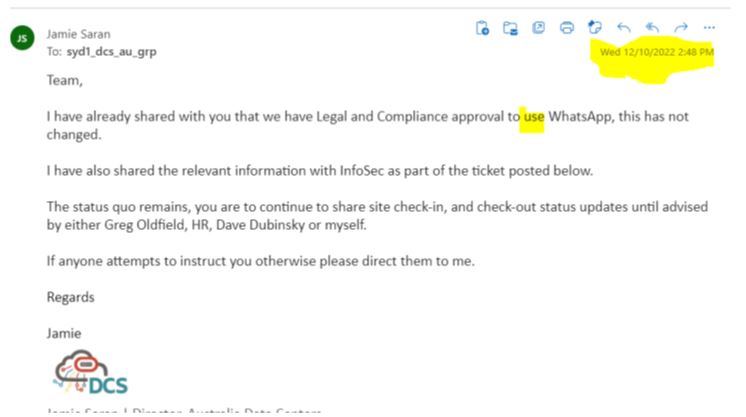
29 On the following day, Mr Boulanger replied to Mr Nasir’s email noting that Mr Saran’s correspondence was the “official guidance” regarding the use of WhatsApp but that he was “still discussing the matter with legal” (Ex A (at 2)).
30 Throughout October 2022, further emails were exchanged between Mr Nasir and various representatives from Oracle HR; most notably between Mr Nasir and Ms Sampayo concerning the “warning emails” Ms Reynolds had sent Mr Nasir earlier that year (see Sampayo Affidavit (at 17–24)). Mr Nasir sent the following email to Ms Sampayo on 21 October:
Hi Madam ,
Please see the following explanation for the point mentioned in the first warning email.
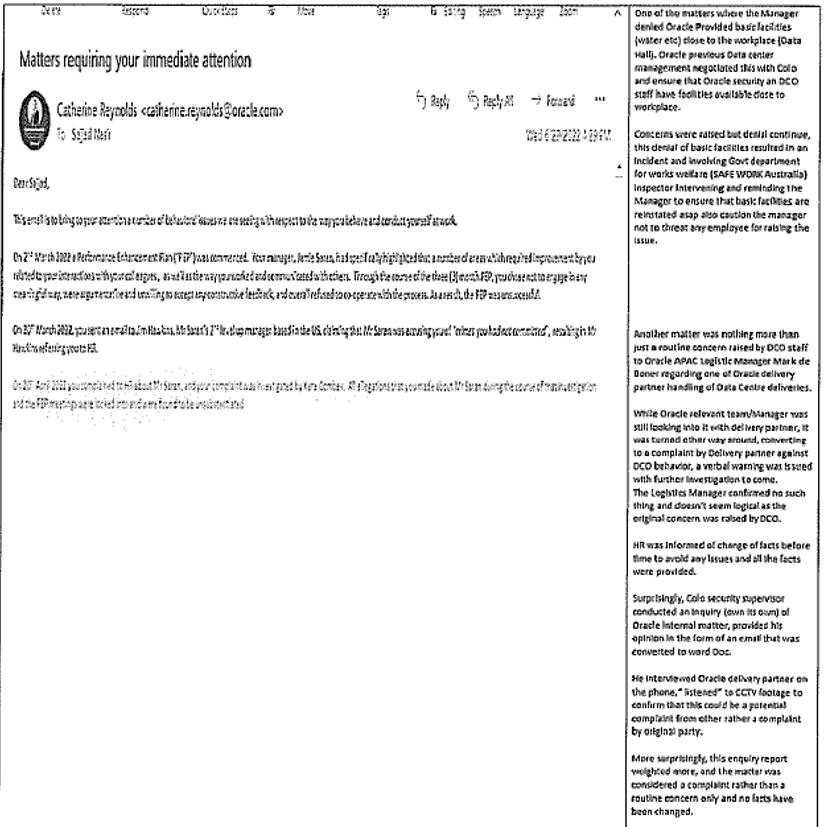
31 Although it is difficult to make out, the substance of Ms Reynolds email (which appears to have been sent to Mr Nasir on 28 June 2022), was that Ms Reynolds wished to bring to Mr Nasir’s attention a number of “behavioural issues” in the way Mr Nasir “behave[s] and conduct[s] [himself] at work” and that on 2 March 2022, a “Performance Enhancement Plan” was commenced as a result of Mr Saran “highlighting a number of areas which required improvement by [Mr Nasir] related to [his] interactions with [his] colleagues, as well as the way [Mr Nasir] worked and communicated with others”, which was ultimately unsuccessful.
32 On 31 October, these exchanges culminated in the Zoom meeting referred to above (at [9]) between Mr Nasir and Ms Sampayo. Ms Sampayo gave evidence that at that meeting, she raised issues with Mr Nasir which, despite its length, is worth setting out in full (Sampayo Affidavit (at [6])):
Sajjad, I have been asked to take a more active role in reviewing your current situation and raising with you today some matters of concern about your behaviours.
In raising these matters with you, I do wish to provide you with an opportunity to understand how Oracle sees the current situation and to provide you with an opportunity to respond. I would like you to be open with me and I would like this discussion to be one where we explore the available alternatives.
I am going to start today’s discussion by initially focussing on how I see the situation. I am not expecting you to necessarily agree with my assessment of the situation, but I think that you would agree that a situation has emerged within your place of work that is not satisfactory and must be addressed for the benefit of all concerned.
As you are aware, I have not been involved in the consideration of the series of issues and concerns that have been raised by you. It is my observation that you have exhibited behaviours which have negatively impacted upon how your fellow employees can and will relate to you. Not surprisingly, they feel that you have created a situation where there is poor communication, virtually no active cooperation and, in many cases, they feel genuinely threatened by your behaviour.
The behaviour in question that I wish to call out is this apparent pattern on your part of weaponizing [sic] the complaint and/or grievance processes. It would appear that many of these complaints and grievances were not genuine. I strongly suspect that, in many cases, allegations were raised by you to cause injury to your fellow workers and/or to intimidate them.
As you would appreciate, in circumstances where your fellow workers feel that your approach to any form of disagreement or difference of opinion is to invoke these processes. The fact of these complaints and grievances is a concern to them. From the perspective of the business, it is a misuse of these important mechanisms for resolution of genuine disputes. They are not processes that can or should be used for other purposes and/or to obtain improper objectives.
Not only do we feel that these complaints were not genuine, but we strongly suspect that your intentions were not genuine in the sense that you wish to resolve a particular issue or grievance. Your allegations (in many cases) were found to be baseless, which again leads us to question your motivation.
I do wish to better understand why it is that you have adopted this approach to interactions in the workplace. Irrespective of your motivation, you must take responsibility for the current situation within your workplace which is characterised by extremely poor communications on your part and a distinct and very real lack of trust in you.
You give every indication that you are not at all happy with the nature and quality of your working relationships by frequently lashing out in circumstances where we do not believe that you were provoked or treated unfairly.
The situation has become worse. We are now at a point where we must discuss your ongoing employment. As I said earlier, I remain prepared to discuss how you see the situation and what alternatives you believe should be considered, but before you respond I wanted to make it clear to you that we are having this particular conversation to explore alternatives and, subject to what you wish to say, one of those alternatives must be your exit from the organisation.
In circumstances where an employer is contemplating termination of employment, it is appropriate that alternatives to termination be discussed.
Please be assured that I have the necessary authority from the business to have a discussion with you as to what a negotiated exit from the business would look like. It would involve agreed communications and I am also open to some form of financial assistance to assist you obtain alternative employment. I would like to explore with you today these options, but I also appreciate that we will need to have a further meeting within the next week so as to determine whether or not these discussions are likely to result in some form of agreement.
We must of course be mindful of the fact that you may not wish to have discussions on a negotiated exit. Any decision on your part to not discuss these matters will be respected, however, the current situation in Australia is not acceptable, and from my perspective not a situation which in the longer term is productive and possibly suitable to you.
Thank you for listening to me today and I would now like to listen to you, noting that if we can discuss a way forward, those discussions would be without prejudice and whatever is agreed would need to be confirmed in writing.
33 Ms Sampayo gave evidence that towards that end of the Zoom meeting, there was the following exchange (Sampayo Affidavit (at [8])):
The Applicant: What do you mean by exit from the company? My kids will die. If I leave how will I get a monthly salary?
[Ms Sampayo]: I would like you to absorb what I have shared with you today and we will have another call to discuss the alternatives, which will also include your exit from the organisation.
The Applicant: I will not find another employer who will give me a job. Can I be forgiven?
[Ms Sampayo]: I'm sorry, I don't understand.
The Applicant: Can the Company not forgive me?
[Ms Sampayo]: Are you acknowledging that you engaged in behaviour that is not appropriate and is in breach of Oracle's Code of Conduct?
The Applicant: Yes.
[Ms Sampayo]: Are you also acknowledging that you used the Complaint/Grievance process as a weapon to intimidate your team member and HR Team members?
The Applicant: Yes, but I won't be sending any further emails. Either I should be forgiven or the Company should give me six months' salary so I can find another job.
[Ms Sampayo]: These are matters that will need to be discussed with senior management and I will come back to you shortly about what next and what the course of action is going to be.
The Applicant: If the Company wants me to leave I will go.
[Ms Sampayo]: Today is our first conversation where I am providing you with the Company's position. I will give you an opportunity to reflect on today and we will have another meeting to discuss next steps and that will include the terms of your exit.
(Emphasis added)
34 It is necessary to pause here again to note that Ms Sampayo’s account of the Zoom meeting was challenged in cross-examination by Mr Nasir, who put to Ms Sampayo that: (1) she repeatedly used the word “weaponising” throughout the meeting (T13.37–15.3); (2) that Ms Sampayo did not explain how Mr Nasir was “weaponising” the complaint process at Oracle (T16.1–7); and (3) that the use of the word “weaponising” constituted a new allegation in respect of which Mr Nasir was not given a reasonable opportunity to respond before being informed that Oracle was considering terminating his employment (T16.29–34).
35 Ms Sampayo, whose evidence I accept, explained that she recollected what was said at the Zoom meeting to the best of her knowledge (T14.39–45) and that the use of the word “weaponising” did not constitute a “new allegation”, but was a characterisation of Mr Nasir’s conduct in misusing the complaint process at Oracle and, as a result, there was no new allegation which necessitated a response. As she explained in cross-examination (T16.1–18):
MR NASIR: I was accused … that I’m using complaint as a weapon, but when I asked for any explanation, there’s no explanation.
HIS HONOUR: Okay. I think it has been put to you that during the meeting, allegations were being put to Mr Nasir. He asked for an explanation, and no explanation was forthcoming, and I think you’re being asked to respond to that contention?---All right. So – and again, based on my recollection of the meeting on 31 October, the meeting wasn’t about the termination. The meeting was to actively review the situation and discuss the concerns about his behaviour. The word “weaponisation” was used as a pattern of the complaints process that Mr Nasir had engaged in, and many of his grievances were, in fact, not genuine as we had done many investigations, and many of his fellow workers were concerned about this and that, from a business perspective, we felt that it was misuse of Oracle’s mechanisms.
Yes?---So the objective of the meeting was to question his motivations and understand why he had adopted such interactions in the workplace because the situation had become worse, and we were at a situation where we needed to discuss his ongoing employment with Oracle …
36 Ms Sampayo went on to explain (T16.38–46):
HIS HONOUR: … What do you say in response to the fact that he asked for information, and he didn’t get a response to it, which I think is what you’re being asked? Is that accord with your recollection or not?---It’s – no, no. It’s not the accurate representation of the facts. Weaponising word that was used was not an allegation. It was representation of the way he was using – raising the complaints, and that was the clarification and understanding of making sure that we – I explained to him where Oracle felt, that his ongoing situation was in the organisation. And to what Mr Nasir is saying is not the true recollection of what transpired in that meeting.
37 Following the Zoom meeting, Mr Nasir sent the following email to Ms Sampayo, copying in other staff (Sampayo Affidavit (at 16)):
Hi Madam,
i would like to request to please consider a respectful exit and some financial support as
i was told to consider exit from the company due to:
misusing the complaint process as weapon
people feel threatened with me due to this reason
i only stated facts and for the complaints raised against me and did offer to take them as it is if that help resolving the issues.
Kind Regards,
Sajjad Nasir
Data Centre Technician
OCI Region (Australia East Syd)
38 Later that evening, on 31 October, Mr Nasir sent another email to Mr Jim Hawkins, Vice President, Data Centre Operations, and Mr Ted Wallace, Senior Vice President, as follows (Sampayo Affidavit (at 27)) (errors in original):
Sir,
Miss Rachna Sampayo informed me in a zoom meeting today that i must consider an exit and inform the HR about it as specifically:
i use the compliant process as a weapon.
People feel threatened about me .
I only responded to the allegations raised against me and facts regarding those allegations .Before HR started the investigation, I asked HR that i could accept all the allegations if that helped with the situation.
Please help with the sitauion.
Kind Regards,
Sajjad Nasir
Data Centre Technician
OCI Region (Australia East Syd)
39 On the following day, 1 November, Ms Sampayo sent an email to Mr Nasir, which advised Mr Nasir that Oracle had considered his request for a “respectful exit” and set out the terms of the proposed exit from the company, as follows (Sampayo Affidavit (at 30–31)):
Dear Sajjad
Thank you for your participation in our meeting yesterday. As you are aware, the purpose of our discussion was for me to outline the concerns of the company with respect to your behaviour and, in particular, to discuss your ongoing employment.
In the course of our discussion, I outlined for you the nature and extent of the impacts that your behaviour was having within the workplace and how it is affecting other employees.
I feel that you understood the nature of my concerns and having regard to your responses in the meeting, it remains the position of the business that you have not at all times been genuine in the raising of concerns and that unfortunately it would appear to me that you have on occasions misused the complaint processes to pursue your own objectives. The impacts of this behaviour on others cannot be ignored and it causes me to continue with our discussions about your ex.it from the organisation.
In the course of our meeting, you acknowledged that you had engaged in behaviours that were not appropriate. You agreed that your behaviour had been in breach of Oracle's code of conduct. You appeared to acknowledge that you had been using the complaint / grievance process as a weapon to intimidate team members and HR team members. You said that you would not be sending any further emails.
I do appreciate the fact that you were open to a negotiated exit and I am very mindful of the impact of any termination of employment will have on you and your family.
I also note that in an email sent to me after our meeting, you requested that the business consider what you describe as a respectful exit and some financial support.
Sajjad, if we are to have a dialogue about the agreed terms of your exit and any financial compensation, I would ask that any emails that relate to these negotiations are not sent to other members of the Oracle management. In particular, Joyce, Traci, Jim and Ted. To the extent that these individuals need to know about the terms of your exit, this information would only be provided to them subject to the terms of any release agreement. I would ask that you preserve confidentiality on these discussions which will have the added benefit of ensuring that any agreed outcomes are not undermined.
The following offer is responsive to your email and is made by Oracle on the basis that we jointly would wish to reach a resolution that permits you to actively seek alternative employment. It is an offer made by Oracle without admission and the terms of this offer would remain confidential. You should assume that if we are able to reach agreement on these terms that there will be a document for you to sign. You will have the opportunity if you wish to take advice about this document which would include our agreement as to the following:
1. We believe that the agreed last day of employment should be Friday, 4 November 2022.
2. We would be prepared to issue you with a statement of service that confirms the roles held by you and the fact of your resignation from Oracle. This statement of service would contain the name of an agreed manager who could act as a referee in the event of a third party enquiry. This agreed manager would be made aware of the matters that have been agreed with Oracle and would not disclose any information as to the background issues surrounding your exit from the organisation. If you wish to be provided with a draft copy of this statement of service, I can send it to you and I remain prepared to reach agreement on the name of the relevant manager.
3. You would not be required to work out any notice period. You will of course be paid up to and including 4 November 2022. You would be paid out your accrued annual leave.
4. In our meeting yesterday, you stated that you were concerned about the financial impacts of any termination of employment. We believe that you would have good prospects for finding alternative employment, however, we are also mindful of the time of the year. Without any admission of liability and on the basis that we would genuinely wish to assist you in finding alternative employment, we propose an ex gratia payment equivalent to Six months' base pay plus 5 weeks' pay in lieu of notice period, which would be taxed as an employment termination payment.
Sajjad, I would appreciate your response to this proposal and I am prepared to hold off any decision with respect to the termination of your employment until close of business Friday. If we can reach in principle agreement, a legal document will be sent to you. The ex gratia payment is made on the basis that you will have no further claims against the company and its management. The release, however, will have no application to any claims for workers compensation benefits or superannuation. The terms of the agreement would remain confidential.
Please feel free to contact me directly in Singapore to discuss this offer. If you would prefer to see a copy of the release document as part of your consideration, I can have a document sent to you. As discussed above, I can also send to you the draft statement of service.
Kind Regards
Rachna Sampayo
40 Two days later, on 3 November, Ms Sampayo sent an email to Mr Nasir attaching the Release agreement. That email provided (Sampayo Affidavit (at 33)):
Dear Sajjad,
Further to our discussion and the ensuing emails between us, I am attaching a Release agreement for your consideration.
This Release provides that:
1. your employment will terminate - by agreement between you and Oracle - effective as of 4th November 2022
2. you will withdraw the various complaints and allegations you have made; and
3. Oracle will make to you the payments set out in the agreement (including payment equivalent to 6 months' salary and payment in lieu of notice, less tax).
Oracle’s offer as set out in the Release agreement expires at noon on Monday 7th November 2022.
Please read through the Release agreement and, if you agree with the terms, sign it and return to me.
Kind Regards,
Rachna Sampayo
41 On the evening of 3 November, Mr Nasir responded as follows (Sampayo Affidavit (at 59)):
Hi Jamie,
I regret to inform you thati will no longer be able to continue with my current role, please accept my resignation wef 4 /11/22 with other terms and conditions agreed with HR.
Following Assets returned on your desk:
Company mobile phone
Company laptop with charger.
Following access cards also returned:
Oracle
Airtrunk
Digital reality
EQUIN!X
no other company asset or access card on my procession.
I would also like to inform tgat I will not be able to attend office tomorrow due to a personal engagement.
Regards,
Sajjad
(Emphasis added)
42 The following morning, 4 November, Ms Sampayo responded as follows (Sampayo Affidavit (at 61)):
Dear Sajjad
I was included in your email of 3 November 2022, confirming your resignation effective 4 November 2022. On this basis, we will regard today as your last day of employment. Thank you for confirming the return of company property. I also note that you will not be in the office today and wish you well in any further employment opportunities.
You are aware from my discussions with you that Oracle was prepared to provide you with additional assistance.
This offer of additional assistance remains open to you, however, I will need confirmation from you that you intend to sign the document that was provided to you. Once I have a copy of the signed document, I will ensure that it is executed on behalf of Oracle and that the additional benefits offered to you will be made available, less applicable tax.
Notwithstanding the assistance that has been offered to you, you will be paid up to and including today's date, plus your accrued but untaken annual leave.
As I intend to have you removed from the IT system in the course of today, perhaps you can provide me with an alternate email address and/or phone number. I will ensure that Jamie is made aware of this correspondence, and again I would ask that you please refrain from on-sending correspondence to other managers within Oracle.
Kind Regards
Rachna Sampayo
43 On the same day, 4 November, Mr Nasir replied to Ms Sampayo’s email attaching a signed copy of the Release agreement, noting (Sampayo Affidavit (at 85)) (errors in original):
Hi Madam,
Please find attached the signed documentation as required, there is no complaints or any such matters.
I would like to request that this document be only shared to necessary people only ,as this shouldn't be discussed when for example if Amy just receives a routine HR employment time period vefication enquiry .
Thanks again for your ho with matter and resolving it to best outcome.
Regards,
44 Later, on 18 November, Ms Sampayo sent Mr Nasir an email confirming that the amounts under the Release had been paid to him on 15 November (Sampayo Affidavit (at 83–84)):
Dear Sajjad
I have now checked with our payroll team and confirm to you that you have been paid:
• Your October full salary which was processed on 15th October, 2022.
• Your November salary up to 4th November, 2022
• Your notice period salary & ex Gratia payment as indicted in the release document.
I have attached your October and November payslips that will show you the payment details …
Thanks and kind Regards
Rachna
45 Mr Nasir responded “Noted with thanks” on the same day by email (Sampayo Affidavit (at 84)).
E CONSIDERATION
E.1 Whether the Release was procured by duress or other vitiating conduct
46 As noted earlier, in order to succeed in relation to duress, Mr Nasir must show that he was subjected to a form of illegitimate pressure by Oracle which had the purpose of inducing him to enter into the Release and in fact caused him to enter into the Release: Crescendo Management v Westpac (1988) 19 NSWLR 40 (at 45 per McHugh JA, Samuels and Mahoney JJA agreeing); see also J D Heydon, Heydon on Contract (Thomson Reuters, 2019) (at [16.10]).
47 As is well known, allegations of common law duress are often accompanied by the assertion of misrepresentation, or an equity based upon undue influence or unconscionable conduct. To the extent Mr Nasir sought to develop any argument, it was focussed on duress and there was no separate misrepresentation claim articulated (which would not already be encompassed within his duress claim). Mr Nasir’s apparent complaint that he did not “fully underst[and] the implications of accepting the Payment” made to him pursuant to the terms of Release was similarly undeveloped, but seems to be connected to his claim he was induced into an incorrect understanding of the Release by those with whom he was dealing.
48 As to any proposed equitable remedy (which again was unarticulated), there are important differences between common law duress and unconscionable conduct; the latter of which is focussed on the quality of the conduct of the party against whom relief is sought, whereas the former is focussed on the effect of the pressure applied by the offending party. Additionally, undue influence is directed to the quality of the consent of the party seeking relief: see, for example, Thorne v Kennedy [2017] HCA 49; (2017) 263 CLR 85 (at 97–104 [25]–[40] per Kiefel CJ, Bell, Gageler, Keane and Edelman JJ). Given the nascent form of the argument, even though we are dealing with a final trial which involves consideration of the enforceability of the Release, it is unnecessary to explore these differences further.
49 As my factual findings above make clear, insofar as duress is concerned, and although Mr Nasir subjectively feels very poorly done by, none of the evidence established that Oracle engaged in threats or conduct towards Mr Nasir which could be considered to be illegitimate to procure his entry into the Release or which amounted to any actionable misrepresentation. Nor am I satisfied on the evidence that illegitimate pressure or unconscientious conduct for which Oracle is allegedly responsible was a reason for Mr Nasir entering into the Release.
50 It is tolerably clear that: (1) when Mr Nasir raised a number of complaints in late 2022 in the lead up to the execution of the Release, from the perspective of his employer, none of those complaints were thought to be corroborated by evidence suggesting that Ms McCudden, Ms Reynolds, Ms Sampayo, Mr Saran or other Oracle staff engaged in “retaliation” or placed illegitimate pressure on Mr Nasir so as to prompt his exit from the company on terms. Further, when confronted with Mr Nasir’s allegations, Ms McCudden, Ms Sampayo and others responded by: (a) attempting to engage in discussions with Mr Nasir about his use of the complaints process (see above (at [19], [21], [23] and [25])); and (b) following further dealings recorded above, informing him that Oracle was considering terminating his employment (see above (at [32]–[33] and [39])).
51 Additionally, the contemporaneous documentation suggests that Mr Nasir did understand he was resolving any dispute with Oracle upon receipt of a payment. Although aspects of Mr Nasir’s conduct and dealings with the Court have caused me concern, he is not an unintelligent man, and his contemporaneous emails (set out above) attest to his level of understanding as to the practical effect of what was going on. But even if I am wrong in this regard, and there was some deficiency in Mr Nasir “fully understanding the implications of accepting the Payment” made to him pursuant to the Release, it has not been demonstrated that any such deficiency arose by reason of any wrongful conduct of those with whom he was dealing.
52 I am not convinced that the conduct of Oracle was relevantly unfair or unreasonable, or that it amounted to illegitimate pressure or was conduct contrary to good conscience, or that Mr Nasir did not sufficiently understand what he was doing.
53 Accordingly, to the extent one can perceive potential arguments that were wholly undeveloped before me, I am satisfied that there is insufficient evidence to make out any conduct able to be attributed to Oracle that would deprive it of the contractual rights it obtained upon entry into the Release.
E.2 Whether the Release constitutes a complete defence
54 I am satisfied that the Release is a complete defence to Mr Nasir’s claims, for the following reasons.
55 First, by cl 2 of the Release, Mr Nasir acknowledged that the Payment (as defined in the Release) was in full and final satisfaction of all claims and entitlements which he had or may have had arising out of the Employment, the Termination and/or the Complaints, whether pursuant to statute, contract or otherwise. The relief sought in this proceeding, and allegations made in support of that relief, are clearly within the broad scope of the Release (which was provided for the benefit of Oracle, its related corporations and relevant employees). In short, Mr Nasir agreed to accept the promise of payment as being in full and final satisfaction of all such claims and entitlements, including against Oracle and its employees. The essence of the accord and satisfaction was the acceptance by Mr Nasir of something in place of his cause of action such that there is a discharge of that cause of action; being an arrangement which operates as a release upon the provision of the satisfaction (that is, the Payment): El-Mir v Risk [2005] NSWCA 215 (at [48] per McColl JA, Handley and Ipp JJA agreeing).
56 Secondly, by cl 3 of the Release, Mr Nasir released Oracle from and indemnified it against, all liability relating to or arising out of the Employment, the Termination and/or the Complaints. The liabilities alleged in these proceedings by Mr Nasir against Ms Reynolds, Ms McCudden and Oracle were all in contemplation at the time the Release was executed. Further, by cl 4 of the Release, whether effected expressly or by accord and satisfaction, the releases were acknowledged by Mr Nasir to be for the benefit of all respondents.
57 For these reasons, the Release operates as a complete defence to the relief sought by Mr Nasir and, subject to matters I will raise shortly, the proceeding must be dismissed. No reason was raised as to why costs should not follow the event.
F ALLEGED BIAS AND VEXATIOUS PROCEEDINGS
58 Before concluding, it is necessary to say something about two matters concerning Mr Nasir’s conduct of this and related proceedings and the relevant procedural history.
59 The first is that following the allocation of the proceeding to my docket, Mr Nasir sent a number of emails to the Registry which contained allegations that Judges of the Court were engaged in corrupt conduct involving, among other things, bribes from Oracle and the fabrication of hearing transcripts. I will not set out the detail of these scandalous messages, save to note that during the final hearing, I raised these emails with Mr Nasir (T38.4–26):
HIS HONOUR: Since I adjourned the first case management hearing, a very large number of emails have been sent to the registry of this court. Included in those emails have been what, on any view of it, are a number of scandalous allegations. Now – including allegations that both Wigney J and myself have engaged in corrupt conduct by accepting bribes from Oracle and also engaged in corrupt conduct by doctoring transcripts. Certain other allegations have been made … do you withdraw those allegations or do you maintain those allegations?
MR NASIR: I don’t want to - - -
HIS HONOUR: And I ask you to reflect, and I ask you to reflect closely on when you think you have a reasonable basis to make such serious allegations against judicial officers of the Commonwealth.
MR NASIR: I withdraw that, your Honour.
HIS HONOUR: Right. Now I don’t expect, Mr Nasir, to see any more emails from you to the Registry, or to any other person of that type, because I want to make it perfectly clear to you that if I do see such communications, then I will give close consideration as to whether any consequences should flow from that. Do you understand?
MR NASIR: Yes, well, I apologise for that. I’m sorry.
60 In the light of Mr Nasir’s apology and withdrawal of the allegations, and absent any further such communications being made, I do not propose at this juncture to take any action in relation to the emails sent by Mr Nasir to the Registry.
61 The second matter is that since the commencement of this proceeding, Mr Nasir has lodged or filed a slew of “interlocutory applications” with the Registry. Subject to any submission that may be made to the contrary, it is open to conclude on the basis of the material currently before me that these applications were either misconceived or legally incomprehensible (or both), and one interlocutory application (Interlocutory Application No. 14) (and its amended versions) was rejected by the Registrar for filing. Mr Nasir has continued to file applications even after I reserved following the final hearing of the separate issue (and indeed has been in further contact with the Registry yesterday, after notification was given this judgment was being delivered).
62 In the table below, I have set out these applications which relate respectively to this proceeding (NSD 725 of 2024) and the proceeding the subject of Mr Nasir’s application for leave to appeal (VID 701 of 2024):
Nasir v Reynolds (NSD 725 of 2024) | |||
No. | Date | Summary | Note |
1 | 16 June 2024 | The applicant seeks “inclusion under s 46PO (3) of the Australian Human Rights Commission Act 1986, alleging violation of Section 18AA of the Racial Discrimination Act 1975 by the Australian Federal Court Registry in relation to proceedings against Oracle Corporation”. | |
2 | 16 June 2024 | The applicant seeks that the case be re-assigned to a different docket judge and a stay of the proceeding. | |
3 | 17 June 2024 | The applicant alleges that Justice Stewart and the Federal Court Registry are “colluding and conspiring with Oracle Corporation” to orchestrate “a false APVO”.
| |
4 | 18 June 2024 | The applicant seeks “inclusion under Section 46PO (3) of the Australian Human Rights Commission Act 1986, alleging violation of Section 18AA of the Racial Discrimination Act 1975 by the Australian Federal Court Registry in relation to proceedings against Oracle Corporation.” | |
5 | 19 June 2024 | The applicant seeks to “join the New South Wales Police Force (NSW Police) as a respondent to the existing proceedings” under s 46PO (3) of the Australian Human Rights Commission Act 1986 and makes various allegations concerning Justice Stewart and the Federal Court Registry. | |
6 | 23 June 2024 | The applicant seeks “inclusion under Section 46PO (3) of the Australian Human Rights Commission Act 1986, alleging violation of Section 18AA of the Racial Discrimination Act 1975 by the Australian Federal Court Registry in relation to proceedings against Oracle Corporation” and makes further allegations of collusion between Oracle and the Federal Court Registry. | |
7 | 5 July 2024 | The applicant seeks “leave to amend their application in NSD 725/2024 to include an allegation of contravention of Section 27 of the Racial Discrimination Act 1975 (RDA) by the Federal Court Registry. This inclusion is sought under Section 46PO of the Australian Human Rights Commission Act 1986, as the alleged unlawful discrimination by the Federal Court Registry.” | An amended or substantially similar version of this application was filed on the same date and on 11 July 2024. |
8 | 12 July 2024 | The applicant seeks “an interlocutory order setting aside or varying the Court’s Order dated 11 July 2024”. | |
9 | 13 July 2024 | The applicant seeks “an order transferring the matter to a different judge, pursuant to the inherent power of the Court to ensure a fair trial, as provided under s 37P (2) of the Federal Court of Australia Act 1976 (Cth)”. | |
10 | 15 July 2024 | The applicant seeks an order to “vary the order dated 11 July 2024 issued by the Court to explicitly address and adjudicate upon the interlocutory applications and requests to issue subpoenas filed by the Applicant”. | |
11 | 18 July 2024 | The applicant seeks: (1) to vary the Order dated 11 July 2024 under r 39.05(b) of the Federal Court Rules 2011 (Cth) on the basis that the order was allegedly obtained by fraud; (2) a stay of the proceedings; and (3) an urgent hearing. | |
12 | 2 August 2024 | The applicant seeks to set aside the Orders dated 1 August 2024 on the basis that the Orders were “made irregularly and illegally, against good faith, under Federal Court Rules 2011 – Rule 39.05”. | |
13 | 6 August 2024 | The applicant seeks an order pursuant to r 29.03(2) of the Federal Court Rules 2011 (Cth) that “the respondent’s affidavit or a part of the affidavit, be removed from the Court file submitted 5/8/2024”. | |
14 | 9 August 2024 | The applicant seeks the removal of the Affidavit of Ms Rachna Sampayo affirmed 2 August 2024 from the Court file. | Amended or substantially similar versions of this application were lodged on 13 and 15 August 2024. |
15 | 19 August 2024 | The applicant sets out a number of tables alleging that the Affidavit of Ms Sampayo affirmed 2 August 2024 contains irrelevant information; is misleading or contains hearsay representations. | |
16 | 19 August 2024 | The applicant seeks an order to join Ms Sampayo to the proceeding on the basis that she allegedly committed “perjury under oath and for providing false, misleading, fabricated and misrepresented [sic] information”. | Amended versions of this interlocutory application was lodged on the same date and on 22 August 2024. |
17 | 22 August 2024 | The applicant seeks leave to file and serve an amended interlocutory application “concerning the affidavit of Rachna Sampayo in the principal proceedings” and that the Court “take into consideration the necessity to address the discrepancies highlighted in the amended application”. | Another version of this amended interlocutory application was lodged on the same date. |
Nasir v Reynolds (VID 701 of 2024) (Leave to Appeal) | |||
No. | Date | Summary | Note |
1A | 25 July 2024 | The applicant seeks orders: (1) staying the operation and enforcement of the Orders dated 11 July 2024 pending the determination of the applicant’s application for leave to appeal; and (2) restraining the respondents from taking any steps to enforce or rely on the Orders dated 11 July 2024 pending the determination of the applicant’s application for leave to appeal. | |
2A | 30 July 2024 | The applicant seeks that the application for leave to appeal be determined on the papers “after persistence [sic] obstruction from the registry from 11/07/24 to 29/07/24”. | |
63 It is worth noting that in addition to the principal proceeding (NSD 725 of 2024) and the leave to appeal proceeding (VID 701 of 2024), Mr Nasir commenced two other proceedings in the Court concerning issues which overlap with the subject of these reasons, namely: (1) Nasir v State of New South Wales (Information and Privacy Commission) (NSD 431 of 2024); and (2) Nasir v Oracle Corporation Australia Pty Limited (SYG 2108 of 2024). In the former proceeding (which was discontinued by Mr Nasir on 7 June 2024), Mr Nasir lodged or filed no less than 25 interlocutory applications between 16 April 2024 and 17 May 2024.
64 In a recent judgment, Storry v Parkyn (Vexatious Proceedings Order) [2024] FCAFC 100, the Full Court made the following observations (at [2]–[7] per Lee, Feutrill and Jackman JJ):
[2] It has become increasingly common for litigants in this Court to exercise their right to appear in person. As was observed by Richard Morehead in his article “The Passive Arbiter: Litigants in Person and the Challenge to Neutrality” (2007) 16(3) Social & Legal Studies 405 (at 406), litigants in person often disturb the normal conventions of the courtroom and substantially challenge the well-ordered roles of judges and lawyers in that they are “classic outsiders – legally uninformed in a technical and rarefied atmosphere, unaware of procedure, often unknowingly in breach of convention”: see also the Hon M J Beazley AO, “Communicating the law: self-represented litigants in the Court of Appeal” (Speech, NCAT Annual Conference, 29 October 2001) (at 1).
[3] Most self-represented litigants behave courteously and are often forced to do so because of circumstances outside their control and sometimes, of course, they present valid claims and defences. But a few self-represented litigants, unrestrained by the norms regulating the professional conduct of lawyers and aggrieved by a perceived wrong, become serial litigants obsessed with seeking vindication of their position and in doing so mount, often repeatedly, arguments which would never be advanced by a responsible practitioner. This phenomenon has occasioned significant problems for this Court in the efficient exercise of its original and appellate jurisdiction.
[4] Any informed observer would conclude the incidence of this phenomenon has increased at the same time as a number of other developments in modern litigation, including: first, the increased demand on judges occasioned by the complexity and size of cases; secondly, the size and scale of the evidentiary material often placed before courts; and thirdly, the reality that courts are an arm of government dependent upon public resources at a time of increased focus on the efficient allocation of those resources.
[5] As Lee J pointed out in Kadam v MiiResorts Group 1 Pty Ltd (No 4) [2017] FCA 1139; (2017) 252 FCR 298 (at 300 [2]), the response to these and related developments in litigation generally has caused what might be described as a revolution in case management. Over the last 20 years, almost every Australian jurisdiction has introduced a provision by either legislation or by way of Rules of Court, setting out the “overriding” or “overarching” purpose of procedural rules: see Federal Court of Australia Act 1976 (Cth) (FCA Act), Pt VB; Civil Procedure Act 2005 (NSW), ss 56–58; Supreme Court Civil Rules 2006 (SA), r 3; Court Procedure Act 2004 (ACT), s 5A (formerly Court Procedures Rules 2006 (ACT), r 21); Uniform Civil Procedure Rules 1999 (Qld), r 5; Civil Procedure Act 2010 (Vic), ss 7–8; Supreme Court (General Civil Procedure) Rules 2005 (Vic), r 1.14; Supreme Court Rules (NT), r 1.10.
[6] The stark contemporary reality is that there are an increasing number of controversies being brought before the Court and a finite number of judges able to manage and determine those matters. Every day a judge of the Court is required to deal with a vexatious proceeding is another day the judge is prevented from using the judicial power of the Commonwealth to quell a real dispute between parties who have invoked the Court’s jurisdiction.
[7] The importance of s 37M(3) of the FCA Act in the work of the Court cannot be overstated. It requires judges of the Court to interpret and apply any power conferred by the civil practice and procedure provisions in the way that best promotes the overarching purpose, being the just resolution of disputes according to law and as quickly, inexpensively, and efficiently as possible: see also s 37M(1). A fundamental aspect of doing more than paying lip service to these case management objectives is taking the necessary steps to ensure that the whole of the Court’s business is managed efficiently. The aim of the overarching purpose provisions is undermined if the Court is passive and refrains from taking active steps to prevent the abuse of the Court’s processes when such abuses become manifest. This involves judges taking a proactive role, where appropriate, in identifying circumstances where the processes of the Court are being repeatedly or frequently abused by a pattern of apparently vexatious proceedings.
(Emphasis added)
65 Mr Nasir’s conduct in lodging or filing what might be described as a tsunami of interlocutory applications and other materials has consumed considerable time and resources of the Court and its Registry staff and has diverted attention away from dealing with the resolution of legitimate and properly constituted proceedings. The disruption caused by his conduct has been exacerbated by the discourteous (and often worse) tone of his communications with the Registry staff (although the tone of his communications is not presently material to the orders I propose to make).
66 In the light of the above, I have formed the preliminary view that it may be the Court could be satisfied that Mr Nasir has frequently instituted or conducted vexatious proceedings in Australian courts and tribunals (being the proceedings, final or otherwise, referred to in this judgment), and if this was established, that a vexatious proceeding order pursuant to s 37AO of the FCA Act could follow. Accordingly, I propose to put in place a process similar to that adopted by the Full Court in Storry to provide procedural fairness to Mr Nasir and give him the opportunity to provide material concerning the question as to whether the Court ought not make a vexatious proceedings order in relation to him.
67 I will make an order that Mr Nasir file any material upon which he intends to rely in opposition to any order being made in the following (or substantially similar) terms:
Pursuant to s 37AO(2)(b) of the Federal Court of Australia Act 1976 (Cth) (FCA Act), Mr Sajjad Nasir be prohibited from instituting proceedings in this Court making an application for leave to institute proceedings in accordance with s 37AR of the FCA Act.
68 Any such material should be filed in this proceeding (NSD 725 of 2024) by the date specified. At the same time, Mr Nasir should also indicate whether he wishes to be heard orally as to whether the order ought to be made. Following the receipt of any material, the matter will either be dealt with by the Court on the papers or, in the event Mr Nasir requires an oral hearing, the matter will be listed for an oral hearing, at which time the Court will be in a position, with the benefit of any material filed by the applicant, to determine whether a vexatious proceedings order ought be made in relation to Mr Nasir. Mr Nasir should not further burden the Registry by sending emails or documents irrelevant to the order proposed.
69 For completeness, given the way the separate hearing has proceeded, I should note that none of the interlocutory applications have been moved upon, and many were, in any event, superseded by events, and I do not consider that any of the relief sought in any so-called “interlocutory application” is material to the consideration of the separate issue which, as I have already ordered, was to be determined before any other issue in the proceeding (and has proven to be determinative of the whole proceeding).
G CONCLUSION
70 Accordingly, I will make the following orders:
1. Subject to Orders 2 and 3 below, the proceeding be dismissed with costs.
2. On or by 27 September 2024, the applicant:
(a) file any material upon which he intends to rely to oppose an order (proposed order) being made in the following terms:
Pursuant to s 37AO(2)(b) of the Federal Court of Australia Act 1976 (Cth) (FCA Act), Mr Nasir be prohibited from instituting proceedings in this Court without making an application for leave to institute proceedings in accordance with s 37AR of the FCA Act.
(b) notify the Registry in writing as to whether he wishes to have an oral hearing in relation to whether the proposed order ought to be made by the Court and, in the absence of such notification, the issue as to whether the proposed order ought to be made be dealt with on the papers.
3. Any oral hearing in relation to the making of a vexatious proceedings order under Pt VAAA, Div 2 of the Federal Court of Australia Act 1976 (Cth) is to be listed for hearing by the Court on a date to be fixed following 27 September 2024.
I certify that the preceding seventy (70) numbered paragraphs are a true copy of the Reasons for Judgment of the Honourable Justice Lee. |
Associate:
Dated: 5 September 2024


