FEDERAL COURT OF AUSTRALIA
Cornford v State Minister for the State of Queensland [2024] FCA 992
ORDERS
First Applicant KRISTY ANNE CORNFORD Second Applicant | ||
AND: | STATE MINISTER FOR THE STATE OF QUEENSLAND Respondent | |
DATE OF ORDER: |
THE COURT DECLARES AND ORDERS THAT:
1. The non-claimant application is to be determined on the papers without a hearing pursuant to s 86G of the Native Title Act 1993 (Cth).
2. Pursuant to s 86G of the Native Title Act 1993 (Cth), there be a determination that no native title exists in the land described as Lot 6 on Crown Plan RS92 (Tenure Reference PPH10/5243), located in the State of Queensland.
3. There be no order as to costs.
Note: Entry of orders is dealt with in Rule 39.32 of the Federal Court Rules 2011.
PERRY J:
1. INTRODUCTION
1 The applicant, Colin Barry Cornford and Kristy Anne Cornford, seek a determination that native title does not exist (a negative determination) in relation to the land and waters described as Lot 6 on Crown Plan RS92 (the Land). The Land is located approximately 45 kilometres south-east of Charleville in the State of Queensland and is known as “Shelbourne”. Colin and Kristy Cornford are the registered lessees of the Land and hold a rolling term lease within the meaning of s 164 of the Land Act 1994 (Qld) as joint tenants. That lease has been extended to 30 September 2041.
2 Colin and Kristy Cornford wish to convert their lease over the Land to freehold title. On 24 January 2023, the Queensland Department of Resources made a conditional offer to convert the lease to freehold. This non-claimant application is made in order to satisfy the condition that Colin and Kristy Cornford address native title in accordance with the Native Title Act 1993 (Cth) (NTA) either by way of an application for a determination that native title does not exist or an Indigenous Land Use Agreement (ILUA).
3 The only respondent to the proceeding is the State Minister for the State of Queensland (the State). On 28 March 2024, the respondent filed a notice pursuant to s 86G of the NTA that the Minister does not oppose an order being made in, or consistent with, the terms sought by the applicant.
4 As noted in the Court’s orders made on 8 May 2024, the parties agreed that the determination of the application could be conducted on the papers, without an oral hearing. I consider that this is an appropriate way to proceed in the circumstances of this case.
5 For the reasons set out below, I consider that the non-claimant application should be allowed and a determination made that there is no native title in the Land.
2. EVIDENCE AND OTHER MATERIAL RELIED UPON
6 The applicant has filed the material upon which it seeks to rely, namely:
(1) the affidavit of Mark Stewart Boge, solicitor for the applicant, affirmed on 7 December 2023; and
(2) the applicant’s submissions filed 8 December 2023.
7 The State relies upon the following material:
(1) the affidavit of Rosalba Ozlem Sanimeli Rigamoto, lawyer, Crown Law, sworn on 27 March 2024; and
(2) the State’s submissions filed 2 April 2024 to the effect that it is open to the Court to make the negative determination sought by the applicant.
3. BACKGROUND
3.1 Notification of the non-claimant application
8 On 12 April 2023, the applicants filed a Native Title Determination Application – Non-claimant Application (non-claimant application). On 14 April 2023, the National Native Title Tribunal (NNTT) provided a copy of the non-claimant application to the respondent and the representative body for the area, Queensland South Native Title Services (QSNTS). QSNTS has not filed a Form 5 Application to become a party to the non-claimant application.
9 On 28 June 2023, the NNTT publicly notified the non-claimant application in the Koori Mail and the Brisbane Courier Mail which specified a notification period commencing on 12 July 2023 and ending on 11 October 2023. Notification was also given to various persons in accordance with s 66(3)(a) of the NTA, including the Principal Legal Officer of QSNTS.
10 On 18 October 2023, the NNTT advised that the notification period for the non-claimant application closed on 11 October 2023 with no relevant entries on the Register of Native Title Claims that fell within the external boundaries of the Land.
3.2 Prior native title applications
11 At various times, the entirety of the Land has been overlapped by three native title applications made on behalf of the Bidjara People, as follows:
(1) Lawton and others on behalf of the Bidjara People and their clan groups (NNTT File No QC1997/001), filed on 15 January 1997 and withdrawn on 4 November 1997;
(2) Fraser and others on behalf of the Bidjara People (No 3) v State of Queensland (QUD6156/1998), filed on 28 October 1997 and discontinued on 5 September 2008; and
(3) Wyman and others on behalf of the Bidjara People (No 6) v State of Queensland (QUD216/2008), filed on 23 July 2008 and dismissed in two parts on 21 February 2014 and 5 July 2016 (Bidjara #6).
12 Justice Jagot dismissed part of the claim in Wyman on behalf of the Bidjara People v State of Queensland (No 2) [2013] FCA 1229 (Wyman 2013), being an area of overlap by the Bidjara #6 claim with claims by other groups, for the reason that (at [672]):
… I am not satisfied that the people who now identify as Bidjara possess rights and interests under traditional law and customs which give them a connection with the land and waters of the overlap area because I am not satisfied that any body of traditional law and customs, as opposed to attenuated or transformed fragments of law and customs, have continued. While there continues to be a body of people who have maintained their identity as Bidjara, the connection of the Bidjara to the land and waters of the claim area including the Carnarvon Gorge and Carnarvon National Park is not a connection which has as its source traditional law and custom.
13 The remainder of the claim in Bidjara #6 was summarily dismissed in Wyman on behalf of the Bidjara People v State of Queensland [2016] FCA 777 (Wyman 2016) along with the claim in Waterton and others on behalf of the Bidjara People (No 7) v State of Queensland (QUD644/2012) (Bidjara #7) (which is not relevant to the Land). This was on the basis that the claims constituted an attempt to re-litigate an issue of fact decided in Wyman 2013 and were therefore an abuse of process. As Jagot J held in Wyman 2016 (at [30]-[31]):
… the Bidjara 6 claim in respect of the overlap area failed because of a finding that there was no continuing traditional Bidjara society.
On this basis, I am satisfied that the continuation of the Bidjara 6 and Bidjara 7 claims represents an abuse of process which should not be permitted to continue. Although the Bidjara 6 and Bidjara 7 claims relate to different land (that is, land outside of the overlap area) as paragraph 39 of the amended points of claim confirms, they are each claims on behalf of the same claimant group. It will be recalled that by paragraph 39 the applicants assert that “the overlap area and Bidjara 6 Area and Bidjara 7 Area is Bidjara country”, meaning country in which the asserted greater than 7000 Bidjara people constituting the claim group hold the asserted native title rights and interests. An essential element of the maintenance of each of the claims is the proposition that the claimant group – which is the same claimant group as in Wyman No 2 – is united in observance and acknowledgment of the traditional laws and the traditional customs of pre-sovereignty Bidjara society. That issue has, however, already been determined against the claimant group.
14 Since the Bidjara #6 claim was dismissed in 2016, no further native title claimant application has been made by any other group of Aboriginal persons.
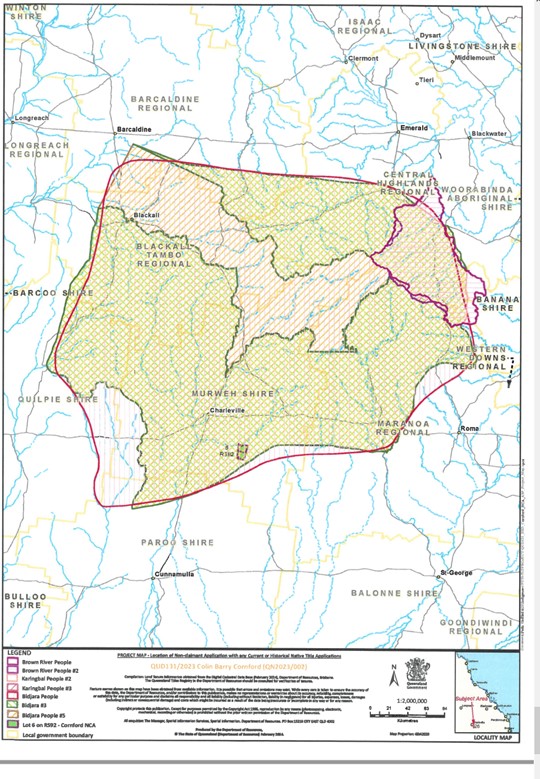
15 A map prepared by the Claim Resolution Team of the Native Title and Indigenous Land Services Team of the Queensland Government (NTILS) depicting the non-claimant application area with all of the overlapping historical native title applications is reproduced at Annexure A to these reasons.
4. RELEVANT PROVISIONS OF THE NTA
16 Under s 13(1)(a) of the NTA, an application may be made to the Court for an approved determination of native title in relation to an area for which there is no other approved determination of native title. Section 13(3)(a) relevantly provides that an approved determination of native title is “a determination of native title made on an application under paragraph (1)(a)…”: see also the definitions of “approved determination of native title” and “native title” respectively in ss 253 and 223 of the NTA.
17 By virtue of s 94A of the NTA, a Federal Court order making a determination of native title must set out details of the matters mentioned in s 225 which relevantly defines “determination of native title” as “a determination whether or not native title exists in relation to a particular area (the determination area) of land or waters”. If a native title determination application is made for an order that native title does not exist, it is unnecessary for the Court order to address the matters in s 225(a) to (e) as those paragraphs are not engaged: CG v Western Australia [2016] FCAFC 67; (2016) 240 FCR 466 at [57] (North, Mansfield, Jagot and Mortimer JJ) (CG).
18 Under s 61(1) of the NTA, “[a] person who holds a non-native title interest in relation to the whole of the area in relation to which the determination is sought”, may make an “[a]pplication, as mentioned in subsection 13(1), for a determination of native title in relation to an area for which there is no approved determination of native title”. An application of this kind is a “non-claimant application”: s 253, NTA. An “interest” in relation to land or waters is broadly defined in s 253 to include “a legal or equitable estate or interest in the land or waters”.
19 After an application is made under s 61 of the NTA, under ss 66(2)–(3), the Registrar must, as soon as reasonably practicable, provide copies of the application to the State Minister and relevant representative bodies and also “notify the public in the determined way” and various others. Under s 66(10)(c) of the NTA, the notice must, inter alia, state that a person who wants to be a party to the application must notify the Court in writing within 3 months starting on the notification day or, after that period, obtain the leave of the Court to become a party. The notification period for the non-claimant application in this case ran (as earlier stated) from 12 July 2023 to 11 October 2023.
20 Under s 86G of the NTA, the Court is empowered to make a native title determination without holding a hearing where, among other requirements, the claim is unopposed. Section 86G(1) of the NTA provides:
If, at any stage of a proceeding in relation to an application under section 61, but after the end of the period specified in the notice given under section 66:
(a) the application is unopposed; and
(b) the Federal Court is satisfied that an order in, or consistent with, the terms sought by the applicant is within the power of the Court;
the Court may, if it appears appropriate to do so, make such an order without holding a hearing or, if a hearing has started, without completing the hearing.
Note: If the application involves making a determination of native title, the Court’s order would need to comply with section 94A (which deals with the requirements of native title determination orders).
21 An application is unopposed for present purposes relevantly “if each other party notifies the Federal Court in writing that he or she does not oppose an order in, or consistent with, the terms sought by the applicant”: NTA s 86G(2). As earlier mentioned, the respondent has given notice in these terms.
22 It follows, as Griffiths J held in Darkinjung Local Aboriginal Land Council v Attorney-General of New South Wales [2018] FCA 1136 (at [22]), that:
There are two “jurisdictional preconditions” to a Court making an order under s 86G(1) of the NTA: (1) the application is “unopposed”; and (2) the order sought (or made) is “within the power of the Court”: Kennedy v State of Queensland [2002] FCA 747; 190 ALR 707 (Kennedy) at [21] per Sackville JA. If those jurisdictional preconditions to s 86G(1) are satisfied, then the Court “may” – that is, has a discretion to – make such an order without a hearing “if it appears appropriate to do so”: Kennedy at [28]–[30]; see also Gandangara Local Aboriginal Land Council v Attorney-General of New South Wales [2013] FCA 646 at [8]–[9] per Griffiths J.
23 Where these preconditions are met, before making a determination that native title does not exist, the Court must first be satisfied on the balance of probabilities that native title does not exist in relation to the Land. The onus of proving that no native title exists lies upon the non-claimant applicant: Mace v Queensland [2019] FCAFC 233; (2019) 274 FCR 41 at [54], [64] and [115] (the Court) (Mace). Further, the question for the Court as to whether the burden of proof on a non-claimant application has been discharged is the same irrespective of whether the non-claimant application is opposed or not opposed, namely: “has the applicant discharged its burden of proof that no native title exists in the claim area?”: Mace at [44] The Full Court in Mace relevantly explained that a clearly established approach emerged from the authorities at [47]–[49]:
The overriding proposition, emphasised by the Full Court in Worimi at [58], is that each case must be assessed on its own particular facts.
The Court’s assessment will depend on those particular facts, on the nature of the land and the tenure involved, on the presence or absence of any present or previous native title claims and the nature and content of those claims, and on any particular evidence adduced on behalf of an applicant, and on behalf of any respondents.
In some cases, and at one end of the evidentiary scale, as the Full Court in Worimi observed at [58] and [59], there may be no need to go beyond proof of an extinguishing grant of freehold title.
24 It follows that a non-claimant application “does not involve any general inquiry into what native title rights and interests may have existed at the time of sovereignty, or effective sovereignty; nor any general inquiry into how those rights and interests may or may not have continued”: Mace at [55].
25 Secondly, irrespective of whether applications are contested or unopposed, the Full Court in Mace held that the Court has a “wide discretion” whether or not to make a determination of no native title which cannot be “turned into any kind of checklist” but must turn on the particular circumstances of each case (at [72]). In the existence of that discretion, the Full Court explained (at [73]) that:
…the Court is able to consider as a factor in the exercise of its power whether it is “appropriate” to make a determination that no native title exists, even if a non-claimant applicant has proven on the balance of probabilities that no native title exists. The cases might be rare indeed where, if the burden of proof is discharged, a Court would consider it inappropriate to make a negative determination. However, in principle it may be no different to the Court’s discretion to withhold relief in proceedings brought in other parts of its jurisdiction where an applicant has otherwise made out a case for relief. The circumstances which arise in the consideration of a determination to be made under the NT Act are broad, and new circumstances may yet arise, so that the Court should not foreclose consideration of such a factor. The “appropriateness” consideration governs and is a condition of the exercise of power in s 86G, and we see no reason why it is not at least a permissible factor to consider in a contested application.
26 Thirdly, the Court’s approach to the exercise of the discretion is not governed by the applicant’s reasons for seeking a negative determination because “[t]he provisions of the NT Act apply nationally, and not by reference to particular circumstances in any given State or Territory which might prompt a non-claimant application”: Mace at [42].
27 In the fourth place, with respect to the role of native title representative bodies in non-claimant application, the Full Court in Mace (at [94]-[96]) held that:
… evidence of the notification process, and (on this hypothesis) the absence of any responses, will not be the only evidence before the Court on a non-claimant application. The weight to be given to the absence of any responses will be considered in the context of all the circumstances relating to the land and waters covered by the non-claimant application, including matters such as whether there have been previous claims over the land and waters and the fate of those claims, and what information the relevant representative body (or Land Council) might have about people who may claim connection to the land and waters based on traditional law and custom. There can be no prescription that absence of responses to NNTT notifications should be given great weight, or no weight, or something in between. What is more important, it seems, is that the Court can reasonably expect a representative body for the region in which the non-claimant application land and waters are located to provide some evidence or information to the Court about what it knows, or does not know, about potential native title holders for the claimed area. …
Representative bodies have, as part of their facilitation and assistance functions under s 203BB(1) of the NT Act, a function which includes assisting persons “who may hold native title” in “consultations, mediations, negotiations and proceedings” relating to, amongst other matters, “native title applications” and “any other matters relating to native title or to the operation of this Act”. That aspect of their facilitation and assistance functions plainly includes assistance in respect of resisting non-claimant applications. Part of the responsibility for advancing the protective aspect of the objects of the NT Act, an aspect which both representative bodies in this case wished to emphasise in their submissions, is for representative bodies to ensure they perform their functions under s 203BB in a way which does seek, within their region, to protect the native title rights and interests of persons who may be affected by a non-claimant application. Just as NTSCORP submits the Court should not rely entirely on the absence of responses to notifications under s 66, neither can representative bodies. As part of a representative body’s functions, there should be some level of active, and proactive, engagement with a non-claimant application, notice of which is required to be given to the representative body.
In our opinion, that is one of the purposes of the terms of s 66(2A) of the NT Act. The obligation imposed on the Native Title Registrar to give notice of an application to the relevant representative body is imposed because Parliament intends a representative body, consistently with its functions, might assist and facilitate any opposition to the non-claimant application by persons who may hold native title. It is also because Parliament intends that a representative body be treated as a likely repository of at least some information about potential native title holders in its region.
28 Finally, and relevantly to the exercise of the discretion, the Full Court in Mace emphasised the need for caution before making a determination that no native title exists (at [66]):
Account needs to be taken of the gravity of a negative determination, and its permanency in terms of its effect on native title rights and interests which are otherwise sought to be protected by the NT Act; see also s 140(2) of the Evidence Act. The appropriate level of caution to be applied, in a determination that native title exists, or does not exist, was described by the majority of the Full Court in Badimia at [48]:
The fact that a determination of native title binds the world and does not operate only between the parties applies to both positive and negative determinations. This fact warrants heightened scrutiny by the Court about its state of satisfaction both that the onus of proof has been discharged and that the terms of the determination to be made are supported in all respects by the findings. But the onus remains the civil standard of the balance of probabilities. If the circumstances are such that a native title claimant application has not been established to the requisite standard, the onus of proof to support a negative determination may or may not have been discharged. If not discharged, it necessarily follows that a negative determination may not be made. If discharged, however, it does not necessarily follow that a negative determination should be made. The propriety or otherwise of making of a negative determination in such a case will depend on a wide range of circumstances. As noted, the legal character of a determination, that it will bind the world at large and not just the parties, will necessarily inform the appropriate exercise of the discretion whether or not to make a negative determination.
5. CONSIDERATION
5.1 Power to make the determination
29 The Court has jurisdiction to hear and determine this application under s 81 of the NTA. Further, Colin and Kristy Cornford, as the registered lessees of the Land (to whom a conditional offer of freehold title over the Land has been made by the State), have standing to bring the application under s 61(1) of the NTA because they are the holder of a non-native title interest in relation to the whole of the area in respect of which the determination is sought: see, eg, South Terrick Pty Ltd ATF South Terrick Trust v State of Queensland [2023] FCA 646 (South Terrick).
30 The statutory requirements to make the negative determination are also met, given that:
(1) the non-claimant application relates to an area for which there is no approved determination of native title (s 13(1)(a), NTA);
(2) the notification period under s 66 of the NTA in relation to the non-claimant application has ended (s 86G(1), NTA);
(3) the State, as the only respondent to the proceeding, has notified the Court in writing that it does not oppose an order in, or consistent with, the terms sought by the applicant: (s 86G(1)(a) and (2));
(4) an order in, or consistent with, the terms sought by the applicant is within the power of the Court (ss 81 and 86G(1)(b)); and
(5) the proposed order sets out the details of the matters mentioned in s 225 of the NTA, bearing in mind that sub-ss (a) to (e) are not engaged (s 94A, NTA; CG at [57] (North, Mansfield, Jagot and Mortimer JJ)).
5.2 Has the applicant established that no native title exists?
31 I accept that the applicant has established on the balance of probabilities that native title does not exist in relation to the Land for the following reasons.
32 First, despite notice being given to the representative body, QSNTS, and public notification of the application in accordance with s 66, no claim has been made by anyone for native title over the Land; nor has the representative body or any other person been joined as a respondent to assert the existence of native title.
33 Secondly, as the Full Court explained in Mace at [94], the weight to be given to the absence of any responses must be considered having regard to all of the circumstances of the particular case. In this case, the fact that QSNTS, as the representative body for the area where the Land is situated, elected not to participate in this application should be given some weight. This is because QSNTS actively engaged, as the representative body, in the earlier applications made by the Bidjara People. Furthermore, QSNTS were joined on their application to the Mace proceedings to oppose the non-claimant application in that case on the basis of yet unasserted native title rights and interests by the Bidjara People with respect to the proposed determination area which was within the Bidjara #6 claim area: Mace at [25], [31]-[32], [104]-[112], and [149]. In such circumstances and given the role of a representative body as explained in Mace, it would be reasonable to expect that there would have been some level of active engagement by QSNTS with this non-claimant application if there was any proposed claim for native title over the Land: see similarly South Terrick at [22] (Collier J).
34 Thirdly, the only native title determination applications which related to the Land were brought on behalf of the Bidjara People. However, as I have earlier explained, these applications were ultimately dismissed on the basis that the Bidjara normative system of traditional law and custom since sovereignty has not continued. As to the context in which this finding was made in Wyman 2013, Jagot J in Wyman 2016 (at [41]) explained that:
(1) that finding “was fundamental to Wyman No 2, and is fundamental to the balance of the Bidjara 6 and Bidjara 7 claims” and “was clear and final”;
(2) the Bidjara applicants had “a full opportunity to litigate this issue … in Wyman No 2”, with the applicants having adduced extensive evidence over a hearing of some 17 days and having legal representation until four days prior to the trial;
(3) an appeal against the decision in Wyman No 2, including the conclusion that traditional Bidjara society had not continued, was dismissed with the Bidjara applicants being legally represented on the appeal;
(4) the Bidjara #6 and Bidjara #7 claims sought to raise the “identical issue of the continuation of a traditional society” and “[could] only succeed if a different, inconsistent, finding on the fundamental issue of the continuation of traditional Bidjara society [were] reached than that in Wyman No 2”. Yet that would involve relitigating the same issue which would be unfair to the State and bring the administration of justice into disrepute.
35 Furthermore, in Mace at [151]-[152], the Full Court relevantly held that:
A finding on a matter such as continuity of observance and adherence to traditional law and custom in the way rights and interests in land are created and passed on is a finding which, in most circumstances, will extend to subsequent claims by a claim group composed of essentially the same people. It is a finding which is not tied in any relevant sense to the particular land and waters involved, or to evidence about that land and waters. Rather, it is a finding about the lack of proof of a continued normative effect of the traditional law and custom which must, for the purposes of the NT Act, be what unites a group of people and provides the rules for the creation and acquisition of rights and interests in land and waters. This was the point made by Jagot and Mortimer JJ in Fortescue Metals Group v Warrie (2019) FCR 350 at [141], referring to Wyman (No 2), in the context of a differently based argument about abuse of process.
The previous Bidjara proceedings, and in particular the outcome in the Bidjara #6 claim, are of considerable persuasive weight in the Mace applicant's case that no native title exists over the Mace land. There is no suggestion that any other group of people, other than the Bidjara People, claim to have native title rights and interests in the Mace land. Indeed, if that were to be suggested, it would be directly inconsistent with Ms Mailman's evidence on this application, and with the position put on behalf of QSNTS, which was directed only at the asserted interests of the Bidjara People in the Mace land. Ms Mailman's evidence, read with the previous Bidjara decisions, establishes, at the least, that the Bidjara People could have been considered the “right” people for the land covered by the Bidjara claims at sovereignty, or at effective sovereignty. However, this Court has found, after a fully contested trial, that those who now identify as Bidjara People do not possess rights and interests under traditional law and customs which give them a connection with the land and waters they identify as Bidjara country, because no body of traditional law and customs, as opposed to attenuated or transformed fragments of law and customs, has continued to the present day. Those findings were unanimously upheld on appeal, and were of sufficient strength to persuade the Court to make a negative determination in the overlap area.
36 Equally, in the present case, I have given considerable weight to the findings in Wyman 2013, Wyman 2016 and Mace in finding that the applicant has proved on the balance of probabilities that there is no native title in the Land.
5.3 Discretion
37 Bearing in mind the caution which should be exercised before making a determination that no native title exists even if proved on the balance of probabilities, I nonetheless consider that it is appropriate to exercise the discretion to grant relief in such terms. In this regard, it does not follow from the Full Court’s observations in Mace at [42] (quoted above at [26]) that the reason for which the non-claimant application is made is necessarily irrelevant, even though this consideration cannot govern the exercise of the discretion. Given the seriousness of the consequences of making a negative determination, the Court may, for example, be more reluctant to make such a determination in circumstances where the making of the declaration has limited utility, notwithstanding that the person had a relevant interest for the purposes of the NTA. That is clearly, however, not the present case where the making of the declaration would be of very considerable utility to the applicant.
38 Finally, the fact that the applicant is proceeding to address native title issues for the freehold conversion by way of a non-claimant application instead of an ILUA is not necessarily irrelevant. Again, given the seriousness of the consequences of making a negative determination, the Court may, for example, be more reluctant to make such a determination in circumstances where an ILUA is more appropriate to address possible native title rights and interests: see, eg, Pate v Queensland [2019] FCA 25, [60] (Reeves J). That is, however, not the present case where, given the findings in the earlier Bidjara proceedings, there is no community or group united in observance and acknowledgment of the traditional laws and customs of pre-sovereignty Bidjara society.
6. CONCLUSION
39 For these reasons, I consider that it is appropriate to make an order that the unopposed non-claimant application be determined on the papers without a hearing pursuant to s 86G of the NTA. I am also satisfied that the applicant has discharged their burden of proving that no native title exists in relation to the Land and that it is appropriate to make a determination that no native title exists in the Land. There will be no order as to costs.
I certify that the preceding thirty-nine (39) numbered paragraphs are a true copy of the Reasons for Judgment of the Honourable Justice Perry. |
Associate:
Dated: 30 August 2024
ANNEXURE A: MAP OF THE NON-CLAIMANT APPLICATION AREA WITH OVERLAPPING HISTORICAL NATIVE TITLE APPLICATIONS