

FEDERAL COURT OF AUSTRALIA
Commissioner of State Revenue v Gleeson, in the matter of Dalma Form Specialist Pty Ltd (subject to deed of company arrangement) [2024] FCA 908
ORDERS
DATE OF ORDER: |
THE COURT ORDERS THAT:
1. Pursuant to s 445D(1) of the Corporations Act 2001 (Cth), the deed of company arrangement entered into by Dalma Form Specialist Pty Ltd and dated 3 May 2024 be terminated.
2. Bruce Gleeson and Daniel Robert Soire be appointed as joint and several liquidators of the second defendant.
3. The plaintiff’s further amended originating process is otherwise dismissed.
4. The Deputy Commissioner of Taxation’s interlocutory process filed on 17 May 2024 is dismissed.
5. The parties are to confer and within 14 days of the date of publication of these reasons:
(a) if the parties can agree upon proposed orders for costs of the proceeding, they are to provide draft orders to the Associate to Markovic J to be made by consent in Chambers; or
(b) if the parties cannot agree upon proposed orders for costs of the proceeding, they are each to provide to the Associate to Markovic J their proposed orders and any submissions, not exceeding two pages in length, and the proceeding is to be listed at a mutually convenient time for hearing on the question of costs.
Note: Entry of orders is dealt with in Rule 39.32 of the Federal Court Rules 2011.
MARKOVIC J:
1 On 21 December 2023 the second defendant, Dalma Form Specialist Pty Ltd (administrators appointed, subject to deed of company arrangement), was placed into voluntary administration. The first defendants, Bruce Gleeson and Daniel Robert Soire, were appointed as its Voluntary Administrators.
2 On 12 April 2024, at the reconvened second creditors’ meeting, the creditors of Dalma Form passed a resolution approving an amended proposal for a deed of company arrangement, the proponents of which were the third, sixth and seventh defendants, Dalma Constructions Pty Ltd, Incline Hire Pty Ltd and Jason Ivan Andrijic (collectively, DOCA proponents).
3 The plaintiff, the Chief Commissioner of State Revenue, is a creditor of Dalma Form. At the second meeting his proof of debt (POD), which on its face was for more than $11 million, was admitted by the Administrators for $1 and he voted against the resolution referred to in the preceding paragraph.
4 On 3 May 2024 the Administrators, Dalma Form, the DOCA proponents and the fourth and fifth defendants, Dalma Hire Pty Ltd, and Dalma Services NSW Pty Ltd, entered into a deed of company arrangement (DOCA) and the Administrators became Deed Administrators. Insofar as the parties to the DOCA, other than the Administrators, are concerned: Incline Hire is a related company of Dalma Form; Mr Andrijic is the sole director and shareholder of Dalma Form and Incline Hire, Rade Cikes is the sole director of Dalma Constructions and Dalma Services; and Igor Cikes, Rade Cikes’ son, is the sole director of Dalma Hire.
5 On 3 May 2024 the Chief Commissioner commenced this proceeding. In his further amended originating process filed on 17 May 2024 (FAOP) he seeks the following orders:
(1) leave be granted to him pursuant to s 444E of the Corporations Act 2001 (Cth) to begin or proceed with a proceeding against Dalma Form;
(2) pursuant to s 90-15 of the Insolvency Practice Schedule (Corporations) being Sch 2 to the Corporations Act (IPS) the decision of the Administrators to admit the Chief Commissioner’s POD for only $1 be set aside and pursuant to s 75-41 and/or s 90-15 of the IPS the resolution passed at the second meeting in favour of the amended proposal for a deed of company arrangement be set aside; and
(3) pursuant to subs 445D(1)(c), (e), (f) and/or (g) and/or s 447A of the Corporations Act the DOCA be terminated.
6 Although his standing to appear is disputed by the second to seventh defendants (who I will refer to collectively as the Dalma Defendants), the Deputy Commissioner of Taxation appears in the proceeding in support of the Chief Commissioner’s application. On 17 May 2024, the Deputy Commissioner filed an interlocutory process seeking the following relief:
(1) an order pursuant to subs 445D(1), (f) and/or (g) of the Corporations Act that the DOCA be terminated;
(2) a declaration that, consequent upon making an order in terms of (1) above and pursuant to s 446AA of the Corporations Act, Dalma Form is taken to have passed a special resolution under s 491(2) of the Corporations Act that it be wound up voluntarily;
(3) an order pursuant to s 499(2D)(a) of the Corporations Act that Stephen Hathway of Helm Advisory, a registered liquidator, be appointed as liquidator of Dalma Form; and
(4) in the alternative to (1) to (3) above, an order pursuant to s 447A of the Corporations Act and/or s 90-15 of the IPS that Part 5.3A of the Corporations Act is to operate in relation to Dalma Form such that:
(a) the DOCA is terminated;
(b) Dalma Form is taken to have passed a special resolution under s 491(2) of the Corporations Act that it be wound up voluntarily; and
(c) Mr Hathway be appointed as liquidator of Dalma Form for the purposes of the winding up.
7 I make two observations about the Deputy Commissioner’s interlocutory process. First, in the course of the hearing the Deputy Commissioner informed the Court that he did not press the prayers for relief in which he sought that Mr Hathway be appointed as liquidator of Dalma Form (paras (3) and (4)(c)). Secondly, there is commonality in the relief sought by the Deputy Commissioner and the Chief Commissioner in that they both seek to have the DOCA terminated. In effect, the Deputy Commissioner appeared in the proceeding to support the Chief Commissioner’s application and indicated in the course of the hearing that if the Chief Commissioner was successful in obtaining the relief he sought in relation to termination of the DOCA, there would be no need to consider his interlocutory process.
8 As set out above, the Administrators are the first defendants. It is convenient to set out their position on the Chief Commissioner’s application. They recognise that they are obliged to act in the best interests of Dalma Form. In that regard and consistently with their position to date (as described below) they remain of the view that a winding up is in the best interests of Dalma Form’s creditors. It follows that the Administrators do not oppose the Chief Commissioner’s application for the DOCA to be terminated (albeit only on certain of the grounds articulated by the Chief Commissioner) and, as a consequence, that Dalma Form be wound up.
9 The Administrators note that the Chief Commissioner contends that he makes no criticism of their conduct of the administration but, notwithstanding that, he puts in issue two aspects of the Administrators’ conduct: first, that the Administrators ought to have admitted the Chief Commissioner’s POD for its full value for voting purposes at the second meeting; and secondly, that the Administrators ought to have informed creditors that the Chief Commissioner’s POD was an assessment pursuant to s 11 of the Tax Administration Act 1996 (NSW) (TA Act) and it was a material omission to have failed to do so. The Administrators invited the Chief Commissioner to withdraw these contentions and to seek termination of the DOCA on a narrow basis relying only on subs 445D(1)(e), (f) and/or (g) noting that if he did so they would file a submitting appearance. The Chief Commissioner declined to do so.
10 Accordingly, while the Administrators sought to assist the Court with the relevant facts, including by providing an evaluation of the return to creditors under the DOCA and in a liquidation scenario, the primary focus of their submissions was on the two contentions raised by the Chief Commissioner, both of which concern his POD.
BACKGROUND
11 Dalma Form was incorporated on 27 November 2013. It provides formwork services on construction projects.
12 On 21 October 2021 the Chief Commissioner informed Dalma Form that it was registered for payroll tax with a start date of 1 July 2017 and monthly payment frequency.
13 By email sent on 25 October 2021 Revenue NSW provided Mr Andrijic with a Notice of Investigation and Audit questionnaire and asked him to complete and return the questionnaire with the requested documentation.
The Administrators’ appointment to Dalma Form
14 As set out above, on 21 December 2023 the Administrators were appointed to Dalma Form.
15 On 22 December 2023 the Administrators sent a letter to Revenue NSW informing it of their appointment and inquiring whether Dalma Form owed any payroll tax.
The first meeting of creditors
16 On 5 January 2024 the Administrators held the first meeting of creditors of Dalma Form by video conference. Mr Soire was the chairperson. In light of a discussion held shortly prior to that meeting with representatives from the Australian Taxation Office (ATO) and Mr Hathway of Helm Advisory, the liquidator of Admin Form Pty Ltd (In Liquidation), which claimed to be a creditor, the first meeting was adjourned for one week to 12 January 2024 to permit the ATO and Admin Form to pursue their proposal for replacement of the Administrators.
17 On 12 January 2024 the first meeting of creditors was resumed. Once again, the meeting was held by video conference and chaired by Mr Soire. A resolution was put to the meeting and moved on behalf of the ATO that the Administrators be removed as administrators and that Mr Hathway be appointed as administrator of Dalma Form in their place. That resolution was not passed.
The Administrators’ first report to creditors
18 On 30 January 2024 the Administrators issued their first report to creditors. Among other things, the first report:
(1) confirmed that PODs had been received from 14 creditors of Dalma Form. The Chief Commissioner, who at that time had not lodged any POD or claim against Dalma Form and had not issued any correspondence to the Administrators, was not one of the known creditors as at the date of the first report;
(2) included a proposal for a deed of company arrangement made by Incline Hire and Mr Andrijic;
(3) referred to the fact that the ATO and Mr Hathway on behalf of Admin Form had informed the Administrators that their investigations suggested that Dalma Form may be part of a group of over 30 companies that had, over the past 15 years, allegedly operated to defraud the ATO of $150 million in unpaid taxes (Alleged Scheme);
(4) noted that the Administrators had carried out preliminary investigations but, without documentary evidence, it was premature for them to draw any conclusions about the alleged conduct and they could not express any conclusions on the allegations of fraud;
(5) asked that if any creditor had any information or documents regarding the Alleged Scheme or that may assist with the investigations, they provide that information to the Administrators immediately;
(6) noted that, in light of the serious allegations raised about the Alleged Scheme, the Administrators intended to adjourn the second meeting for the maximum period of 45 days to allow time for further investigations into the affairs of Dalma Form; and
(7) informed creditors that the Administrators were of the opinion that it would be in their interests for Dalma Form to be wound up. The Administrators formed that opinion despite Mr Andrijic and Incline Hire’s early proposal for a deed of company arrangement.
Early correspondence with the Revenue NSW
19 By email sent on 31 January 2024 Revenue NSW informed the Administrators that (as written):
The abovementioned company is registered for Payroll Tax (RNSW Ref: 164659550).
A Payroll Tax liability may have been identified and a Proof of Debt will be submitted in due course if appliable. The company does not appear to be registered for Land Tax or other state taxes in NSW.
lf you are aware of an additional liability to Revenue NSW, please advise accordingly.
20 On 7 February 2024 the second meeting was convened and adjourned by Mr Gleeson, who acted as chairperson, for 45 business days until 12 April 2024.
21 By email sent on 12 March 2024 Misty Andrews, assistant coordinator for insolvency – tax debt, taxes and grants, Revenue NSW, informed the Administrators that:
Further to our email below, we wish to advise that an investigation into potential Payroll Tax liabilities owed by the abovementioned entity are yet to conclude, however, we anticipate that it is likely RNSW will lodge a claim in this Administration.
In the interim, may we kindly request a copy of the Voluntary Administration Report and Statement Of Administrator’s Opinion at your earliest convenience.
22 On 13 March 2024 Revenue NSW sent an email to the Administrators in which it asked the Administrators to “confirm if [Dalma Form] will continue to trade during the administration period so an Administrator Trading account can be established if required”.
Production of books by Dalma Form
23 On 19 March 2024 Gillis Delaney Lawyers, Dalma Form’s former solicitors, produced books and records in answer to a notice issued by the Administrators pursuant to s 438C of the Corporations Act. Mr Soire explained that the documents produced by Gillis Delaney disclosed that it appeared that the Chief Commissioner had commenced an investigation into Dalma Form’s payroll tax obligations in 2021 and had sought certain information from Dalma Form. The records produced did not disclose that the Chief Commissioner had made any assessment of payroll tax as at the date of the Administrators’ appointment.
24 Mr Soire noted that the production of the documents by Gillis Delaney was, other than the reference in Revenue NSW’s email dated 12 March 2024 (see [21] above), the first time that the Administrators had received any documents referring to an investigation by Revenue NSW. Notwithstanding that Revenue NSW did not lodge a formal POD until 10 April 2024 (see below), from that point on the Administrators provided Revenue NSW with all documents that they provided to Dalma Form’s creditors.
The Administrators’ supplementary report to creditors
25 On 4 April 2024 the Administrators issued a supplementary report to creditors. In the executive summary to that report, among other things, the Administrators stated:
…
• To enable us to recover a retention from Aqualand and better investigate the affairs of the Company including whether or not the Company, its Director, other entities or persons were participants in the Alleged Scheme, the second meeting of creditors that was held on 7 February 2024 was unilaterally adjourned by us for the maximum period of forty-five (45) business days.
• Since the adjournment, we have undertaken significant work, attended numerous meetings and conducted substantial investigations into the Company’s financial affairs. We have also received requests for information and documents from creditors and attended to respond to same. Please refer to Section 4 of this Report for details regarding such work.
…
• The Australian Taxation Office has raised concerns that the Company was part of a group of companies that have undertaken its business operations in such a way as to deprive the ATO of PAYG tax over a ten year period. It is alleged that within the group of companies the Company was one of the client facing companies which performed the construction work or formwork (the Construction Companies). Other companies within the group of companies were labour hire companies which employed the various employees of the group (the Labour Hire Companies) and made the employees available to the Construction Companies.
• The Labour Hire Companies, most of whom have been wound up over the past 10 years, were required to pay the wages, annual leave, superannuation and PA YG tax of their employees, however the Labour Hire Companies have been wound up leaving the ATO as a significant unsecured creditor on each occasion in relation to unpaid PAYG. It is alleged that the Construction Companies (including the Company) only paid sufficient labour hire fees to cover the wages, annual leave and superannuation, leaving the Labour Hire Companies with insufficient funds to pay the PAYG tax (the Alleged Scheme).
• Our investigations reveal that other companies within the group provided administrative and hiring services to the Construction Companies (the Admin Companies) and charged the Construction Companies fees. Based on the information presently available, we have concerns as to whether the fees charged by the Admin Companies may be disproportionate to the services provided or above market rates.
• We have also recently received an amended DOCA proposal from the Proponents.
• We are required to provide creditors with information regarding the amended DOCA proposal and the estimated returns to creditors in both a DOCA scenario and a Liquidation which are contained in Sections 6 and 7 of this Report.
26 The “amended DOCA proposal” referred in the supplementary report (DOCA Proposal) was made by the DOCA proponents. The “key terms” of the DOCA Proposal were recorded in the supplementary report as follows:
• The Deed Administrators will establish a Deed Fund for the Company
• The Company Deed Fund will consist of:
(a) Deed Contribution of $250,000 payable by the Proponents as follows:
- $25,000 within 60 days after the date of execution of the DOCA
- Nine (9) monthly payments of $25,000 commencing one month after the first payment is made
(b) Any amounts owing/recoverable from retentions due to the Company;
(c) Any refunds received or receivable by the Company, the Administrators or the Deed Administrators, including workers compensation premium refunds.
• The Company Deed Fund will be applied to pay the costs and disbursements of the Administrators (and Deed Administrators) in relation to the Company in full and provide a return to the Admitted Creditors of the Company.
• The Deed Administrators will have the power to recover retentions owing to the Company.
27 The Administrators said the following about the DOCA Proposal:
Advantages and disadvantages of the DOCA proposal
Having regard to the results of our investigations into the financial affairs of [Dalma Form], we have considered the advantages and disadvantages of the DOCA proposal and set them out as Annexure “H” of this Report.
Funding of the proposal
The amended DOCA proposal provides for $250,000 to be paid in ten (10) instalments over a period of approximately eleven (11) months from the date of execution of the DOCA. The Proponents are [Mr Andrijic], Incline Hire and Dalma Constructions. As noted in this Report, we have sought information from Dalma Constructions regarding its financial position, however we have not received a response to date.
Accordingly, there is no certainty regarding the Proponents’ ability (particularly Dalma Constructions) to fund the Deed Contribution. We therefore cannot provide any comment regarding the likelihood of the funds being received for the Deed Fund .
Final comments
We note that whilst the attached DOCA proposal does not indicate that the funds currently held by us as [Administrators] forms part of the Deed Fund, it is our understanding that it is the intention of the Proponents to include same and accordingly, this amount has been included in the analysis attached as Annexure “G”. If this is not the case, we will inform creditors immediately.
Based on the above analysis and our investigations to date, it is our view that the DOCA proposal does not provide creditors with greater return than an optimistic Liquidation scenario. Further, we are of the view that investigations are warranted (including conducting public examinations) regarding the aspects outlined throughout this Report and specifically in Section 4(c). These investigations can only be conducted should [Dalma Form] be placed into Liquidation.
For these reasons, we believe that creditors should not resolve to accept the Proponent’s proposal for a DOCA and [Dalma Form] should be wound up.
28 In the supplementary report, in summary, the Administrators also reported that:
(1) they held $3,064.54 in cash;
(2) of three possible retention claims referred to in the first report, one had materialised. That was a claim of $649,000 from Aqualand Constructions Pty Ltd;
(3) they had estimated ordinary unsecured creditors to be between $1,305,273.70 and $2,815,381.46;
(4) they had not been provided with all of the books and records of Dalma Form, a matter of significant concern to the Administrators. Relevantly the Administrators reported (as written):
We have made several requests to the Director to obtain books and records and other information, and , in particular, Company emails. Whilst the Director has purported to comply with such requests, we have not been provided with all books and records of the Company without any proper explanation. This is of significant concern to us.
We have engaged a forensic IT expert to review the outlook data files and MYOB back-up file provided to our office. We have been advised that upon review that:
• The outlook data files provided is a pst file which is created by a user on a local computer to manually save copies of emails, calendar items etc. This means it is not a file (such as an ost file) which is automatically created by the email client application (i.e . Outlook) to store an offline synchronised copy of an online email account. This means that this file is not a duplicate backup of the entire email account and folders.
• There are no emails in the ‘Sent Items’ folder.
• The MYOB file provided is a back-up file used by MYOB Account Right and the first journal entry was entered on 28 November 2013 and the last journal entry was entered on 20 December 2023.
(5) there were a number of potential claims that may be available to Dalma Form in a liquidation including for unfair preferences, uncommercial transactions/unreasonable director related transactions, creditor defeating dispositions, insolvent trading and breach of directors’ duties;
(6) they had identified certain areas of concern which warranted further significant investigations being undertaken including by way of examinations under s 596A and s 596B of the Corporations Act; and
(7) they had undertaken an investigation in relation to the Alleged Scheme which disclosed that Dalma Form had, during the period in which it traded, engaged numerous labour hire companies which had gone into liquidation. The Administrators noted that if Dalma Form “goes into Liquidation, we are of the view that a public examination will enable further information and evidence to be obtained to consider whether there is a claim that [Dalma Form] may have against [Mr Andrijic], Rade Cikes and Igor Cikes and other entities as a result of [Dalma Form] potentially incurring liabilities to the ATO as a participant in the Alleged Scheme”.
The Chief Commissioner submits a POD
29 On 10 April 2024 at 11.37 am Revenue NSW submitted a POD in the amount of $11,374,884.13, for estimated payroll tax liabilities for the 2018 to 2021 financial years. The covering letter, signed by Rochelle Nicholson, a delegate of the Chief Commissioner, stated that “[t]he proof of debt is based on an estimate of Payroll Tax and is authorised under section 11 of the [TA Act]”.
30 On 10 April 2024 by email sent at 2.11 pm the Administrators sought “further information and documents in support of the basis and quantum of the claimed payroll tax liability” in the Chief Commissioner’s POD from Revenue NSW.
31 By email sent on 11 April 2024 at 2.57 pm Revenue NSW responded to the Administrators’ request for further information as follows, with its answers to the Administrators’ queries recorded in italics (as written):
I make reference to your request for further information to support our claim. I have sought advice from our Compliance team who have provided their calculations (attached) and summarised the following to your points below;
1. Copies of the payroll tax assessments; Not issued as yet; POD is based on estimated liability.
2. The basis of the claimed payroll tax liability and the reasons why the payroll tax is an “estimate”;
Payments to labour providers by customer (identified in working papers attached) to be assessed as liable under s42 of the Payroll Tax Act 2007. Penalty tax rate proposed to be applied to assessments is 75%, as CCSR likely to be satisfied that tax default was caused in part by the intentional disregard of the PTA by the taxpayer, as per s27(2) of the Taxation Administration Act 1996.
3. All correspondence with the Company regarding the payroll tax liabilities; Copy of NOI can be provided; finalisation letter not yet issued.
4. Calculations. working papers, or analysis of the Company’s taxable wages for the purposes of the quantification of the Company’s payroll tax liability; Working papers with estimated liability attached.
5. If the Proof of Debt is based on estimated, details and information used by Revenue NSW to calculate the payroll tax See response above.
6. If the Company has been grouped, details regarding:
a. The basis of the grouping;
b. The entities or companies within the group;
c. The taxable wages for each entity that has been assessed/grouped.
Grouping analysis not yet finalised.
Kind confirm receipt of this information and confirmation that our claim will be admitted.
32 On 11 April 2024, after receipt of the email referred to in the preceding paragraph, the Administrators requested that Revenue NSW provide “the NOI referred in point 3 and/ or the notice of determination pursuant to s 42 of the Payroll Tax Act”.
33 Also on 11 April 2024 Revenue NSW provided a proxy form to the Administrators in advance of the second meeting.
34 On the afternoon of 11 April 2024 Mr Soire discussed the Chief Commissioner’s POD and the information received earlier that day from Revenue NSW with Martin Vu, a principal of Jones Partners, who was working on Dalma Form’s administration. Mr Soire recalls that they discussed the following matters:
(1) the working papers including a list of 27 companies whose services were not limited to labour providers but included architectural, bookkeeping, supply and recruitment;
(2) the Chief Commissioner’s claim appeared to be based on a determination under s 42 of the Payroll Tax Act 2007 (NSW) by which the Chief Commissioner determined that certain persons were deemed to be employees of Dalma Form and/or deemed certain payments as wages for the purposes of the Payroll Tax Act;
(3) they ought to inform creditors before the resumption of the second meeting of the Chief Commissioner’s POD and the claim that he made, especially as it was for a very large sum; and
(4) they ought to obtain urgent legal advice about the Chief Commissioner’s POD, including whether it ought to be admitted for voting purposes at the resumption of the second meeting.
35 In light of the Chief Commissioner’s POD and the further information received from Revenue NSW, Mr Soire had a Circular to Creditors prepared and sent. The Circular, sent at 5.25 pm on 11 April 2024, informed creditors that a POD had been received from the Chief Commissioner and another creditor, Lendlease. In relation to the Chief Commissioner’s POD it provided (emphasis in original):
We advise creditors that on 10 April 2024, Revenue NSW lodged a Proof of Debt with our office in the amount of $11,374,884.13 for estimated payroll tax liabilities, interest and penalties for the financial years ended 30 June 2018 to 30 June 2021. We have recently received from Revenue NSW calculations for its estimated payroll tax liabilities and the basis of its claim. We are urgently obtaining legal advice regarding the claim of Revenue NSW.
This claim is significant and if admitted in full or in part, would have an impact on the estimated dividends to creditors in both the DOCA and Liquidation scenarios provided in the Supplementary Report. If the claim is admissible, there will be an equivalent increase in the Company’s creditor claims in both a DOCA and Liquidation scenario. There may also be further claims available against the Director in a Liquidation.
36 In an email sent at 8.57 am on 12 April 2024, the Administrators followed up on their email sent the previous afternoon (see [32] above) and again requested that Revenue NSW provide, as a matter of urgency, the “NOI” and/or the notice of determination. Later that morning, Revenue NSW provided a copy of the Notice of Investigation. It included:
We’ve commenced an investigation of the payroll tax obligations of [Dalma Form] and any other businesses grouped under the Payroll Tax Act 2007.
You’ve been selected for an investigation because we are currently reviewing businesses in your industry to correct common errors, such as incorrectly declared contractor payment and employment agency arrangements. Our compliance program detects these types of errors to help you comply with your tax obligations.
The focus of our investigation will be on payroll tax for the financial years ended 30 June 2018, 2019, 2020, 2021 and the current financial year. Compliance with the Jobs Action Plan, land tax, duties, and other state tax legislation may also be reviewed, where applicable.
37 Mr Soire has since seen the letter and email from the Chief Commissioner and Revenue NSW addressed to Mr Andrijic referred to respectively at [12] and [13] above. He had not seen that correspondence before being provided with the Commissioner’s evidence in this proceeding and, as far as he is aware, the Administrators were not, prior to its receipt on 12 April 2024, provided with the Notice of Investigation (including as part of the material produced by Dalma Form’s former solicitors referred to at [23] above).
38 On the morning of 12 April 2024, the Administrators sought urgent legal advice in relation to the Chief Commissioner’s POD from their solicitors, Polczynski Robinson, including by instructing their solicitors to brief counsel.
39 By email sent at 10.03 am on 12 April 2024 to Revenue NSW the Administrators sought a copy of the notice of determination that was made in relation to Dalma Form and the reasons for the determination. As far as Mr Soire is aware neither he, Mr Gleeson nor any of their staff received any notice of determination as requested at that time or at any time prior to the resumption of the second meeting. The first time that Revenue NSW provided a notice of determination was on 29 April 2024 (see below).
40 At about midday on 12 April 2024, Ms Andrews of Revenue NSW telephoned the Administrators’ office and spoke with Messrs Soire and Vu. Mr Soire recalls that they discussed the following matters in relation to the Chief Commissioner’s POD:
(1) Ms Andrews stated that Revenue NSW’s audit team was finalising its investigations and that she was waiting on information and findings to be reviewed;
(2) Mr Soire asked whether a notice of determination had been issued and, if so, whether it could be provided urgently. Ms Andrews informed them that no notice of determination had yet been issued;
(3) Mr Soire asked for a draft notice or something similar, but Ms Andrews said that could not be provided; and
(4) Ms Andrews stated that if, hypothetically, the Chief Commissioner’s claim was rejected, she would be seeking to have it admitted at least for $1 for voting purposes.
41 Mr Vu made a file note of the discussion with Ms Andrews referred to in the preceding paragraph which Mr Soire observes is consistent with his recollection of the call. Mr Vu’s file note includes (as written):
Dalma Form Specialist
Revenue NSW, Misty, DS and MV, 12:02pm incoming call from Misty.
DS noted the reports that were provided and asked whether there was anything Revenue NSW wished to ask us Concerns around the likelihood of claim being admitted in full.
Estimate POD, audit team finalising their investigations.
Waiting on information and findings to be reviewed.
Notice of determination s42 not yet issued.
In lien of wages being declared, basing claim on contractor payments being made.
Questions:
…
Anything else? Notice of assessment? No.
…
Hypothetically, claim rejected, will be seeking claim be admitted for $1.
42 On 12 April 2024 at about 2.00 pm Messrs Soire and Vu met with the Administrators’ solicitors to discuss the legal issues associated with the Chief Commissioner’s POD. Given the urgency associated with the advice required, Polczynski Robinson provided their advice orally at that meeting. Mr Soire does not recall making a file note of what was said but recalls that the substance of the legal advice was as follows:
(1) the Chief Commissioner’s claim is stated to be based on an “estimate of payroll tax”;
(2) the claim is based on a determination under s 42 of the Payroll Tax Act, but no formal or final notice of determination has been made;
(3) Revenue NSW is raising questions about the relationships between Dalma Form and other entities and it appears that some of those entities that were subcontractors may be treated as employees (and payments to them may be treated as wages) under the Payroll Tax Act, but it is difficult to say in the absence of a determination;
(4) no “notice of assessment” has been issued by Revenue NSW, which means that the conclusive evidence provisions, to the effect that the fact of a notice provides conclusive evidence that the debt is owing, do not apply to the Chief Commissioner’s claim, at least at present;
(5) the Chief Commissioner’s claim is not a debt payable within the meaning of s 44 of the TA Act;
(6) in circumstances where Revenue NSW has indicated an intention to issue a notice of assessment based on a determination to be made under s 42 of the Payroll Tax Act the claim is either a contingent claim or a debt the value of which had not been established;
(7) thus, for the purposes of r 75-85(4) of the Insolvency Practice Rules (Corporations) 2016 (IP Rules), the Administrators will need to make a just estimate of the claim;
(8) according to the Bovis case, in making a just estimate the Administrators are not required to undertake any detailed enquiry but should do so on the basis of the material provided by the Chief Commissioner and the facts known to the Administrators based on their own investigations as at that date;
(9) given that:
(a) no notice of assessment had been issued by Revenue NSW;
(b) Revenue NSW’s investigations were not complete;
(c) no notice of determination had been issued in accordance with s 42(2) of the Payroll Tax Act; and
(d) Dalma Form’s books and records (at least on their face) disclosed that Dalma Form did not employ any employees,
the Administrators, acting impartially and in accordance with r 75-100(3) of the IP Rules, ought to admit the Chief Commissioner’s POD for voting purposes for $1 and mark it as “objected to”, subject to the vote being declared invalid if the objection is sustained; and
(10) it was suggested to counsel that, subject to further and final consideration, the Administrators were minded to admit the Chief Commissioner’s POD for voting purposes for $1 and she did not suggest that this was in any way inappropriate in the circumstances.
43 Mr Soire said that he decided to admit the Chief Commissioner’s POD for voting purposes for $1 and mark it as “objected to” for the following reasons:
(1) the legal advice provided by Polczynski Robinson (and counsel), including that the Administrators ought to admit the Chief Commissioner’s POD for voting purposes for $1 (and the reasoning provided);
(2) Dalma Form’s books and records did not suggest that it had any employees and any liability for payroll tax, including that:
(a) in the course of the administration, no persons had asserted that they were employees; and
(b) Dalma Form did not lodge any payroll tax returns;
(3) in accordance with r 75-95 of the IP Rules, the Administrators were required to ask creditors to give evidence in writing in relation to a debt claimed by a creditor to establish the liability of the company for the debt where it is necessary to do so. However, other than the limited working papers no reasons were otherwise given or particulars supplied with the Chief Commissioner’s POD to demonstrate how s 42 of the Payroll Tax Act was to apply to Dalma Form’s particular circumstances;
(4) the fact that no final determination had in fact been made by the Chief Commissioner under s 42 of the Payroll Tax Act, which he considered was a necessary precursor to establishing that Dalma Form owed a liability under that provision;
(5) the working papers provided by Revenue NSW contained a schedule itemising 27 “contractors” and payments to those persons appeared to be grouped and deemed as wages. But the Administrators were in no position to undertake any detailed factual enquiry as to the relationship between those parties and the “contractors” in the limited time available;
(6) the Administrators were otherwise not in a position to undertake any other factual enquiry given the second meeting had been convened and was due to commence at 2.30 pm on 12 April 2024 (which was the final day of the maximum period of 45 business days since the second meeting was initially held); and
(7) having regard to the available information, he was satisfied that the claim should be admitted (that is, that the Chief Commissioner was a creditor of Dalma Form) but he was unable to ascribe a proper figure to the claim (because of the uncertainties and contingencies involved). Thus, he concluded that it was appropriate to admit the claim for voting purposes at a nominal value of $1.
44 By email sent on 12 April 2024 the Administrators informed Revenue NSW that they intended to admit the Chief Commissioner’s POD for $1 for voting purposes.
The reconvened second meeting
45 The second meeting commenced shortly after 2.30 pm on 12 April 2024. It was a hybrid meeting conducted by video conference and in person. Mr Soire acted as chairperson.
46 Mr Soire recalls that during the meeting Mr Vu, on behalf of the Administrators, announced the creditors in attendance and the adjudication of their claims. Among other things, he noted that the Chief Commissioner had lodged a claim in the amount of $11,374,884.13 which related to an estimate of payroll tax and that no notice of assessment or formal notice of determination with reasons had been issued for that claim. He also stated that, for voting purposes, the Chief Commissioner’s claim had been admitted for $1 and marked objected to pursuant to r 75-100(3) of the IP Rules. All proofs of debt submitted by creditors were tabled at the meeting and no creditor sought to inspect any of them.
47 Mr Soire also recalls that Ms Andrews, who attended the meeting on behalf of the Chief Commissioner, confirmed that the Chief Commissioner’s claim was based on an estimate and that further investigations under anti-avoidance provisions were taking place. She said that she was confident that the anti-avoidance provisions would be applied and that assessments would be raised in the coming weeks. Ms Andrews also said that the Chief Commissioner was yet to make a formal determination, although she noted that Revenue NSW considered the evidence to be strong. In response to a question by Mr Xenos, an observer from the ATO, Mr Soire said that it was not possible to make a just estimate of the quantum of the Chief Commissioner’s claim and, on that basis, it was admitted for $1.
48 In relation to the Chief Commissioner’s POD, the minutes of the second meeting record:
Ms Misty Andrews requested that she be the proxy holder for Revenue NSW and Rowena Masoe is an observer on behalf of Revenue NSW. The Chairperson noted same.
Ms Andrews noted that Revenue NSW’s claim is based on an estimate and these particulars have been provided to the Administrators’ office whilst further investigations under anti-avoidance provisions are taking place. She noted that these anti avoidance provisions are only applied in exceptionally rare circumstances and only where the Chief Commissioner is likely to be satisfied that it is warranted and necessary. She noted that they are confident that these provisions will be applied and assessments raised in the coming weeks.
Mr Xenos asked whether that means a just estimate was made or the whole amount should be admitted. The Chairperson advised that there is no basis for a just estimate.
Mr Polczynski noted that a Proof of Debt was submitted and an estimate provided but no reasons had been provided by Revenue NSW although they had been sought.
Mr Hathway asked Ms Andrews to comment on same. Ms Andrews advised that their investigations have been impacted by the evidence and the agreements in place with the Company were to avoid payroll tax, but Revenue NSW have yet to make a formal determination. However, their evidence is strong and they have provided to the Chairperson and Mr Vu with the particulars of those calculations. Ms Andrews advised that they believe that they may object to the decision regarding the adjudication to that claim.
Mr Vu noted that Revenue NSWs claim was marked objected to. The Chairperson advised that Ms Andrew’s comments were noted.
49 Mr Soire does not recall Ms Andrews saying that the Chief Commissioner’s claim constituted an assessment by way of estimate and as best he can recall Ms Andrews did not say words to that effect. Nor does Mr Soire recall Ms Andrews referring to s 11 of the TA Act and his recollection is that she did not make any reference to any specific section of the TA Act, including s 11.
50 Mr Soire did not refer to the Chief Commissioner’s POD as having constituted an “assessment” because at the time he was not aware of the significance, if any, of whether or not the Chief Commissioner’s POD did constitute an assessment. As far as Mr Soire can recall, this was not something that was discussed in the conference with Polczynski Robinson earlier that day. Mr Soire focused on the fact that:
(1) the Chief Commissioner’s claim was an estimate based on a determination but that determination was yet to be finalised; and
(2) no notice of assessment had been issued by Revenue NSW.
51 At the second meeting creditors were asked to vote on two competing resolutions: one in favour of the DOCA Proposal; and one in favour of a winding up of Dalma Form. Mr Soire informed the meeting that the Administrators recommended against a resolution that Dalma Form execute the proposed deed of company arrangement and, rather, recommended that Dalma Form be wound up.
52 Notwithstanding that, a resolution that “the DOCA be approved by creditors” (DOCA Resolution) was passed on a poll, both by number of creditors and value of claims. Mr Soire notes, and the minutes of the second meeting confirm, that eight creditors with a value of $1,218,403.01 voted in favour of the DOCA Resolution and seven creditors with a value of $551,508.08 voted against it. The minutes of the second meeting record the following results on a poll taken of the vote on the DOCA Resolution:
(1) creditors who voted in favour of the DOCA Resolution:
Number | Creditor name | Voting amount ($) |
1 | Auswood International Pty Ltd | 196,988.00 |
2 | Burgess Arnott & Grava Pty Ltd | 78,160.00 |
3 | Dalma Hire Pty Ltd | 66,525.81 |
4 | Doka Formwork Australia Pty Ltd | 577,544.58 |
5 | Elite QS Consulting Pty Ltd | 22,816.86 |
6 | Gillis Delaney Lawyers | 37,177.70 |
7 | Incline Hire Pty Ltd | 225,940.56 |
8 | Taylor & Co | 13,249.50 |
Total | 1,218,403.01 |
(2) creditors who voted against the DOCA Resolution:
Number | Creditor name | Voting amount ($) |
1 | Acrow Formwork & Scaffolding Pty Ltd | 280,872.86 |
2 | Admin Form Pty Ltd (In Liquidation) | 50,466.60 |
3 | Australian Taxation Office | 66,666.74 |
4 | Plus Form NSW Pty Ltd (In Liquidation) | 98,018.21 |
5 | Revenue NSW | 1.00 |
6 | Shorehire Pty Ltd | 52,919.07 |
7 | Workers Compensation Nominal Insurer | 2,563.60 |
Total | 551,508.08 |
No creditors abstained.
53 In terms of those creditors who voted in favour of the DOCA Resolution:
(1) Incline Hire is a related company of Dalma Form;
(2) Robert Grava was the proxy holder for Mr Andrijic, Incline Hire, Auswood International Pty Ltd, Burgess Arnott & Grava Pty Ltd and Elite QS Consulting Pty Ltd. Mr Grava worked for Dalma Form until an unspecified date in 2023 and then commenced work for Incline Hire;
(3) the directors of Dalma Hire are Rade Cikes and Igor Cikes, both of whom the Administrators consider may have been shadow directors of Dalma Form; and
(4) Stephen Taylor, trading as Taylor & Co, is Dalma Form’s accountant.
54 Mr Soire did not exercise his casting vote as chairperson. Had he been required to do so, he would have exercised it against the DOCA Resolution and in favour of a resolution that Dalma Form be wound up, consistent with the recommendation of the Administrators in the supplementary report and his opinion expressed at the second meeting.
Chief Commissioner issues assessments to Dalma Form
55 By email sent on 29 April 2024 Mercelita Gabrillo Compliance Officer, Customer Service -Taxes & Grants, Revenue NSW, informed the Administrators that:
During the payroll tax investigation of [Dalma Form], payments to numerous contractors were identified in the records and information provided by Dalma Form and obtained from other sources.
As a result of the records and information reviewed, I have made a determination, as Delegate of the Chief Commissioner of State Revenue, under s42 of the Payroll Tax Act 2007 (“PTA”), that the payments to those contractors are wages for the purposes of the PTA and that Dalma Form is the employer. The wages are taxable wages for the purposes of s6 of the PTA, and Dalma Form is liable to pay the payroll tax on the taxable wages under s7 of the PTA.
A copy of the s 42 determination, accompanied by a statement of facts and reasons, and the notices of assessment (Assessments) were attached to the email. The Assessments assessed the following amounts for financial years 2018 to 2021 inclusive for payroll tax, interest and penalty tax:
1 July 2017 to 30 June 2018 for $2,955,755.96;
1 July 2018 to 30 June 2019 for $2,533,666.07;
1 July 2019 to 30 June 2020 for $3,363,584.57;
1 July 2021 to 30 June 2021 for $2,412,303.95.
56 Mr Soire observes that this was the first occasion on which a notice of determination or a notice of assessment had been provided by the Chief Commissioner in relation to the external administration of Dalma Form and that the total claimed in the Assessments is $109,553.58 less than was claimed in the Chief Commissioner’s POD.
57 Dalma Form has filed notices of objection to the Assessments. The Deed Administrators’ consent was not sought by any party in relation to the preparation or lodgement of those objections nor have the Deed Administrators provided their consent.
The DOCA is executed
58 In accordance with their obligations under s 444B(2)(a) of the Corporations Act, namely that Dalma Form must execute the deed of company arrangement within 15 business days of the second meeting, the DOCA was executed on 3 May 2024. That being so, on that day:
(1) the Administrators became Deed Administrators; and
(2) pursuant to cl 7(a) of the DOCA, control of Dalma Form returned to Mr Andrijic.
59 On 2 July 2024, in accordance with cl 5(b) of the DOCA, the first payment was made.
Proposal to vary the DOCA
60 On 17 June 2024 the DOCA proponents submitted a proposal to the Deed Administrators seeking to vary the DOCA (variation proposal). Among other things the variation proposal increases the “Deed Contributions” from $250,000 to $350,000 and adds two additional “Proponents”, namely Dalma Services and Dalma Hire.
Updated analysis of expected returns to creditors
61 The Deed Administrators have reviewed the variation proposal and have provided an updated analysis of estimated returns to creditors (calculated as at 19 June 2024) based on three different scenarios: the DOCA; an amended DOCA based on the variation proposal; and if the DOCA is terminated and Dalma Form wound up. That analysis, which was in evidence before me, was undertaken without any final adjudication of creditor claims or any further work in relation to possible claims available in a liquidation.
62 In summary the updated analysis provides for the following estimated dividends to creditors (expressed as a percentage return) in a “low” and “high” scenario in each case:
Scenario | Low estimate | High estimate |
DOCA | 0.87% | 23.30% |
Amended DOCA | 1.31% | 28.66% |
Liquidation | Nil | 43.51% |
63 Mr Soire was cross-examined about the updated analysis. He gave the following evidence:
(1) he accepted that in each case, the “low” scenario assumes lower returns and higher creditor claims and the “high” scenario assumes higher returns and lower creditor claims;
(2) he accepted that if the Administrators recover their costs of this proceeding, the amount recovered would be added to the funds available for distribution in the DOCA and amended DOCA scenarios. As set out in the Deed Administrators’ report dated 1 July 2024, he accepted both the Administrators’ own estimate of percentage recovery of actual legal costs incurred in this proceeding in the range of 60-90% and the costs incurred as at 1 July 2024 and future estimated costs of the proceeding which at the time were together $197,635.56;
(3) he explained the amount available under the DOCA in a low scenario has decreased since 19 June 2024 such there would likely be less than the estimated $138,000 available for distribution in that scenario;
(4) he agreed, on the assumption that Dalma Form goes into liquidation, that if some or all the voidable transaction claims identified are successful, the amount available for distribution will be “vastly more than 100,000 or 150,000”. However, he was not able to estimate how high the figure might be;
(5) he explained that in an optimistic liquidation scenario, the liquidators’ legal fees are higher because more work would need to be done to make the higher recoveries assumed in that scenario; and
(6) he accepted that if upon examination the liquidators formed a view that there was no or little prospect of a successful claim, they would not incur the legal fees associated with pursuing such a claim.
64 Based on their revised analysis, the Administrators’ view expressed in the supplementary report, that it is in the interests of creditors that Dalma Form be wound up, remains unchanged.
The Deputy Commissioner’s evidence
65 The Deputy Commissioner relied on an extensive amount of evidence in support of his application. However, given my approach to resolution of the questions for determination and the conclusion I have reached in relation to the Chief Commissioner’s FAOP, it is not necessary for me to set out that evidence.
LEGISLATIVE FRAMEWORK AND SOME LEGAL PRINCIPLES
Corporations Act
66 Part 5.3A of the Corporations Act concerns company administrations. The object of Pt 5.3A is set out in s 435A which provides:
The object of this Part, and Schedule 2 to the extent that it relates to this Part, is to provide for the business, property and affairs of an insolvent company to be administered in a way that:
(a) maximises the chances of the company, or as much as possible of its business, continuing in existence; or
(b) if it is not possible for the company or its business to continue in existence—results in a better return for the company’s creditors and members than would result from an immediate winding up of the company.
(Note omitted.)
67 Div 10 of Pt 5.3A is titled “Execution and effect of deed of company arrangement”. It includes s 444E which provides, among other things, that a person bound by a deed of company arrangement cannot, until the deed terminates, bring or proceed with a proceeding against the company except with the leave of the Court.
68 Section 445D of the Corporations Act is in Div 11 of Pt 5.3A which is titled “Variation, termination and avoidance of deed”. Section 445D relevantly provides:
(1) The Court may make an order terminating a deed of company arrangement if satisfied that:
…
(c) there was an omission from such a document and the omission can reasonably be expected to have been material to such creditors in so deciding; or
…
(e) effect cannot be given to the deed without injustice or undue delay; or
(f) the deed or a provision of it is, an act or omission done or made under the deed was, or an act or omission proposed to be so done or made would be:
(i) oppressive or unfairly prejudicial to, or unfairly discriminatory against, one or more such creditors; or
(ii) contrary to the interests of the creditors of the company as a whole; or
(g) the deed should be terminated for some other reason.
(2) An order may be made on the application of:
(a) a creditor of the company; or
(b) the company; or
(ba) ASIC; or
(c) any other interested person.
69 In Decon Australia Pty Ltd v TFM Epping Land Pty Ltd [2022] FCAFC 54 a Full Court of this Court (Yates, O’Callaghan and Halley JJ) relevantly said at [144]:
Section 445D involves a two stage process. The first stage is to determine whether one of the grounds referred to in sub-s (1) has been established and, if it has, the second stage is to decide whether to exercise the discretion to terminate the DOCA based on that ground. See Britax Childcare Pty Ltd v Infa Products Pty Ltd [2016] FCA 848; (2016) 115 ACSR 322 (Burley J) at 342 [90]; Shafston Avenue Construction Pty Ltd v McCann [2019] FCA 1426; (2019) 138 ACSR 299 at 336 [130] (Reeves J). …
70 That is, the Court has a discretion whether to terminate a deed of company arrangement even if it is satisfied that a ground under s 445D(1) of the Corporations Act is established. That discretion is to be exercised having regard to all of the relevant circumstances viewed as a whole including the interests of creditors as a whole and the public interest: see Decon Australia at [145]; TNT Building Trades Pty Ltd v Benelong Developments Pty Ltd (admins apptd) [2012] NSWSC 766; (2012) 91 ACSR 17 at [27].
71 In Sino Group International Limited v Toddler Kindy Gymbaroo Pty Ltd [2023] FCAFC 110; 168 ACSR 311 at [71]-[73] a Full Court of this Court (Farrell, Cheeseman and Feutrill JJ) relevantly said in relation to the exercise of the discretion under s 445D:
71 There are many factors that the Court will take into account when considering if the discretion to terminate a DOCA, once enlivened, should be exercised. Many of the relevant factors in the authorities relate to the interests of creditors as a whole on the one hand, and the public interest on the other. Public interest may be understood as whether the continuation of the DOCA is conducive or detrimental to commercial morality and to the interests of the public at large. The Court must carefully balance the interests of creditors with the public interest in considering whether it is appropriate to exercise the discretion to terminate a DOCA.
72 The following non-exhaustive list of factors, drawn from the authorities, are relevant to the exercise of the Court’s discretion:
(1) Whether the creditors voted to enter into a DOCA, noting that creditors are generally taken to be in a better position to judge what is in their best interests than the Court;
(2) Whether the vote is carried by the votes of related creditors whose interests are not aligned with the unrelated creditors;
(3) Whether the information base upon which the creditors voted was materially flawed whether because it was false, misleading or otherwise omitted information;
(4) The degree to which false, misleading or omitted information had, or is likely to have had, an influence on the manner in which creditors voted;
(5) Whether creditors would be better off under a DOCA or in a liquidation;
(6) Whether the dividend under a DOCA is likely to be insignificant;
(7) Whether the continuation of the DOCA would have the effect of eroding commercial morality or public confidence in financial systems; and
(8) Whether the effect of the DOCA, once implemented, would be to permit an insolvent company to continue to trade, contrary to the public interest.
…
73 The list of factors relevant to the Court’s exercise of the discretion is not closed. As s 445D(1) involves a discretion that must be exercised judicially, any factor that is relevant to the exercise of the discretion, having regard to the purpose of Pt 5.3A of the Act, may be taken into account. There are many factors that the Court will take into account when considering if the discretion to terminate a DOCA, once enlivened, should be exercised. Some of the relevant factors are the same or similar to those which are taken into account in determining if the deed or a provision of it is oppressive, unfairly discriminatory, unfairly prejudicial or contrary to the interest of the company’s creditors as a whole under s 445D(1)(f) of the Act.
72 Section 446AA relevantly provides:
(1) This section applies if a company has executed a deed of company arrangement and:
(a) the Court, at a particular time, makes an order under section 445D terminating the deed of company arrangement; or
…
(2) The company is taken:
(a) to have passed, at the time referred to in paragraph (1)(a) or subparagraph (1)(b)(ii), as the case may be, a special resolution under section 491 that the company be wound up voluntarily; and
(b) to have done so without a declaration having been made and lodged under section 494.
(1) The Court may make such order as it thinks appropriate about how this Part is to operate in relation to a particular company.
(2) For example, if the Court is satisfied that the administration of a company should end:
(a) because the company is solvent; or
(b) because provisions of this Part are being abused; or
(c) for some other reason;
the Court may order under subsection (1) that the administration is to end.
(3) An order may be made subject to conditions.
(4) An order may be made on the application of:
(a) the company; or
(b) a creditor of the company; or
(c) in the case of a company under administration—the administrator of the company; or
(d) in the case of a company that has executed a deed of company arrangement—the deed’s administrator; or
(e) ASIC; or
(f) any other interested person.
74 Section 499 relevantly provides:
…
(2D) If section 446AA applies in relation to the company because of paragraph 446AA(1)(a):
(a) the Court may, immediately after it makes the order referred to in that paragraph, appoint a person to be the liquidator for the purpose of winding up the affairs and distributing the property of the company; and
(b) if no appointment is made under paragraph (a) of this subsection:
(i) the company is taken to have appointed the administrator of the deed of company arrangement referred to in section 446AA to be the liquidator for the purpose of winding up the affairs and distributing the property of the company; and
(ii) the appointment takes effect at the time referred to in paragraph 446AA(1)(a).
IPS
75 Section 90-15(1) of the IPS provides that the Court may make such orders as it thinks fit in relation to the external administration of a company. It may do so on its own initiative or on an application under s 90-20 of the IPS. Section 90-15(3) sets out a non-exhaustive list of the types of orders the Court can make and relevantly includes:
(a) an order determining any question arising in the external administration of the company;
(b) an order that a person cease to be the external administrator of the company;
…
76 Section 90-15(4) sets out a non-exhaustive list of the matters which can be taken into account in considering whether to make an order under s 90-15(1) and provides:
(4) Without limiting the matters which the Court may take into account when making orders, the Court may take into account:
(a) whether the liquidator has faithfully performed, or is faithfully performing, the liquidator’s duties; and
(b) whether an action or failure to act by the liquidator is in compliance with this Act and the Insolvency Practice Rules; and
(c) whether an action or failure to act by the liquidator is in compliance with an order of the Court; and
(d) whether the company or any other person has suffered, or is likely to suffer, loss or damage because of an action or failure to act by the liquidator; and
(e) the seriousness of the consequences of any action or failure to act by the liquidator, including the effect of that action or failure to act on public confidence in registered liquidators as a group.
77 Section 90-20(1) provides for those persons who may apply for an order under s 90‑15 of the IPS. For present purposes they include “a person with a financial interest in the external administration of the company”. A person has a financial interest in the external administration if the person is, relevantly, a creditor: see s 5-30 of the IPS.
IP Rules
78 Rule 75-85 sets out a creditor’s right to vote at a creditors’ meeting. Rule 75-85(4) provides:
A creditor must not vote in respect of:
(a) an unliquidated debt; or
(b) a contingent debt; or
(c) an unliquidated or a contingent claim; or
(d) a debt the value of which is not established;
unless a just estimate of its value has been made.
79 Rule 75-100 concerns decisions in relation to entitlement to vote at a creditors’ meeting. It provides:
(1) The person presiding at a meeting may determine any question that arises as to the entitlement of a person to vote.
(2) In deciding whether a person is entitled to vote at a meeting of creditors, the person presiding must:
(a) have regard to the merits of the person’s claim; and
(b) act impartially and independently.
(3) If the person presiding is in doubt whether a proof of debt or claim should be admitted or rejected, her or she must mark that proof as objected to and allow the creditor to vote, subject to the vote being declared invalid if the objection is sustained.
(4) A decision by the person presiding to admit or reject a proof of debt or claim for the purposes of voting may be appealed against to the Court within 10 business days after the decision.
TA Act
80 Section 7 of the TA Act provides that the purpose of the Act “is to make general provision with respect to the administration and enforcement of the other taxation laws”.
81 The term “assessment” is defined in s 3 to mean:
assessment means an assessment made by the Chief Commissioner under Part 3 of the tax liability of a person under a taxation law, and includes—
(a) a reassessment and a compromise assessment under Part 3, and
(b) an assessment by the Supreme Court or the Civil and Administrative Tribunal on an application for a review.
82 Section 4 sets out the meaning of “taxation laws” and prescribes those Acts that are taxation laws for the purposes of the TA Act. They include the Payroll Tax Act.
83 Section 8 is titled “General power to make assessment” and provides:
(1) The Chief Commissioner may make an assessment of the tax liability of a taxpayer.
(2) An assessment of a tax liability may consist of a determination that there is not a particular tax liability.
(3) For the avoidance of doubt, an assessment of tax liability is taken to have been made when the Chief Commissioner calculates the tax liability of a taxpayer based on a return under the Payroll Tax Act 2007 or any other Act prescribed by the regulations for the purposes of this subsection (whether or not the Chief Commissioner issues a notice of assessment as a result of that calculation or otherwise notifies the taxpayer of the calculation).
84 Section 11 sets out the information on which an assessment is made and provides:
(1) The Chief Commissioner may make an assessment on the information that the Chief Commissioner has from any source at the time the assessment is made.
(2) If the Chief Commissioner has insufficient information to make an exact assessment of a tax liability, the Chief Commissioner may make an assessment by way of estimate.
Payroll Tax Act
85 Section 4 of the Payroll Tax Act provides that “[t]his Act is to be read together with the [TA Act] which provides for the administration and enforcement of this Act and other taxation laws”.
86 Part 2 of the Payroll Tax Act is titled “Imposition of payroll tax”. Sections 6 and 7 respectively provide that payroll tax is imposed on all taxable wages and that the liability to pay payroll tax is on the “employer by whom taxable wages are paid or payable”. Payroll tax is usually payable within seven days after the end of the month in which the taxable wages were paid or payable except in the month of June when they are to be paid within 28 days after the end of the month in relation to taxable wages paid or payable in June: s 9.
87 Section 42 is titled “Agreement to reduce or avoid liability to payroll tax” and provides:
(1) If the effect of an employment agency contract is to reduce or avoid the liability of any party to the contract to the assessment, imposition or payment of payroll tax, the Chief Commissioner may—
(a) disregard the contract, and
(b) determine that any party to the contract is taken to be an employer for the purposes of this Act, and
(c) determine that any payment made in respect of the contract is taken to be wages for the purposes of this Act.
(2) If the Chief Commissioner makes a determination under subsection (1), the Chief Commissioner must serve a notice of the determination on the person taken to be an employer for the purposes of this Act.
(3) The notice must set out the facts on which the Chief Commissioner relies and the reasons for the determination.
(4) This section has effect in relation to agreements, transactions and arrangements made before, on or after the commencement of this section.
QUESTIONS TO BE RESOLVED
88 The following questions arise on the Chief Commissioner’s FAOP:
(1) does the Deputy Commissioner have standing to pursue his interlocutory process?
(2) should leave be granted to the Chief Commissioner pursuant to s 444E of the Corporations Act to begin or proceed with this proceeding?
(3) assuming the answer to (2) is yes:
(a) should the Administrators’ decision to admit the Chief Commissioner’s POD for $1 be set aside?
(b) if the answer to (a) above is yes, should the DOCA Resolution be set aside?
(c) should the DOCA be terminated?
89 As set out above and assuming the answer to (1) above is “yes”, the Deputy Commissioner appears to support the Chief Commissioner in his application to terminate the DOCA or, if the Chief Commissioner is unsuccessful in obtaining that relief, he seeks the same relief in his own right.
A PRELIMINARY ISSUE: THE DEPUTY COMMISSIONER’S STANDING
90 The Dalma Defendants challenge the Deputy Commissioner’s standing.
91 Rule 2.13 of the Federal Court (Corporations) Rules 2001 (Cth) relevantly provides that:
(1) The Court may grant leave to any person who is, or who claims to be:
(a) a creditor, contributory or officer of a corporation; or
(b) an officer of a creditor, or contributory, of a corporation; or
(c) any other interested person;
to be heard in a proceeding without becoming a party to the proceeding.
92 Similarly s 445D(2) and s 447A(4) of the Corporations Act each permit an application to be brought for relief by a creditor or “any other interested person” (see [68] and [73] above). Section 90-20(1) of the IPS provides that a person with “a financial interest” in the external administration of the company has standing to bring an application for orders pursuant to s 90-15 of the IPS. Such a person includes a creditor (see 0 above).
93 It was not in dispute that:
(1) at the time the Deputy Commissioner filed his interlocutory process, he was a creditor of Dalma Form in that Dalma Form owed a debt which was due and payable to the Deputy Commissioner in the sum of $126,672.83 (DCT Debt). The amount due was a running balance account (RBA) deficit debt for the purposes of s 8AAZH of the Taxation Administration Act 1953 (Cth);
(2) according to Stephen Taylor, Dalma Form’s accountant, on 18 June 2024 he reviewed the ATO’s online portal and found that there were multiple accounts for Dalma Form including:
(a) an account described as “Activity statement 003 DFS” which had a zero balance; and
(b) an account styled “Activity statement (Administration) 001 DFS” (Administration Account) which had a debit balance of $279,805.39. Mr Taylor understands that upon Dalma Form entering into administration the ATO created the Administration Account;
(3) on 19 June 2024 Dalma Form made payment of $283,000 into the account styled “Activity statement 003 DFS” (DCT Payment);
(4) on 21 June 2024 Mr Taylor ascertained that a credit of $283,000 was applied to the account styled “Activity statement 003 DFS”. Immediately after doing so Mr Taylor sent a request to the ATO on its online portal requesting that the credit be transferred to the Administration Account so that the amount owing was cleared and Dalma Form recorded as being in credit to the ATO; and
(5) the Deputy Commissioner accepts that on 20 June 2024 he received the DCT Payment which was allocated to the RBA established for Dalma Form.
94 As a result, the Deputy Commissioner accepts that the DCT Debt has been discharged. It follows that the Deputy Commissioner at the time of the hearing was not, and since 20 June 2024 has not been, a creditor of Dalma Form.
95 However, the Deputy Commissioner contends that by reason of the DCT Debt and the claims he has, or is likely to have, in respect of the Alleged Scheme, he was each of a creditor, an interested person and a person with a financial interest in the external administration of Dalma Form at the time that he sought leave to be heard in the proceeding and when he filed the interlocutory application.
96 The Deputy Commissioner submits that even if payment of the DCT Debt has the effect that he is no longer a creditor of Dalma Form, he has a material economic interest in the administration or subsequent liquidation of Dalma Form and, consequently, the outcome of this proceeding. The Deputy Commissioner submits that whether assessed through s 445D(2)(c) or s 447A(4)(f) of the Corporations Act, s 90-15 of the IPS or r 2.13(e) of the Corporations Rules, he is an “interested person” in the relevant sense.
97 The Deputy Commissioner was a creditor of Dalma Form as at the date of commencement of the proceeding and thus had standing to file and ventilate his interlocutory process. However, if the relevant time to assess the question of standing is the time of the hearing, the question to be determined is whether the Deputy Commissioner had and continues to have standing on and from 20 June 2024, including at the hearing. Whether he does will depend on the time at which the question of standing is to be determined or put another way, whether standing can be lost in the way the Dalma Defendants allege.
98 In Shangri-La Construction Pty Ltd v GVE Hampton Pty Ltd (in liq) & Ors [2021] VSC 161; (2021) 152 ACSR 19 a group of creditors, referred to as ‘Opposing Creditors” challenged the plaintiff’s standing to bring an application for the appointment of a special purpose liquidator (SPL) under s 90-15 of the IPS. Detailed submissions were made by the parties in relation to that issue. In the result, Connock J dismissed the plaintiff’s application because his Honour was not satisfied that the plaintiff had established that it was just and beneficial for the winding up, or the creditors as a whole, for the SPL to be appointed or that there was otherwise utility or good reason in the circumstances of the case to appoint the SPL. That being so, his Honour did not need to address the question of the plaintiff’s standing.
99 However, in light of the detailed submissions that had been made, Connock J considered it appropriate to state briefly the conclusion he had reached on that question. His Honour said at [190]-[191] and [193]:
[190] I do not accept the Opposing Creditors’ submission that, although the application was commenced with standing as a creditor, the plaintiff would lose that standing and the right to continue with the application if (as was contended by the plaintiff) the plaintiff ceased to be a creditor of the Company prior to the making of final orders.
[191] There is nothing in the language of s 90-15 or s 90-20 of Sch 2 to the Act, or the related provisions earlier referred to in these reasons, that lends support for the contention that standing can be lost depending upon the purpose of the applicant or application, or depending upon whether the application is properly to be characterised as relating to future or past dealings in the external administration. That is not what the section says, there is no contextual or textual support for it, and it is not supported by any authority. The language of the Act is clear and ss 90-15 and 90-20 do not provide for such qualifications. There is in my view no legitimate basis for seeking to imply or inject into the provisions the suggested qualifications, and so to do also falls foul of well-established principles of statutory construction.
…
[193] Given the above, and noting that the Opposing Creditors did not ultimately maintain their submission that standing under s 90-15 would be lost in all cases where creditor status was lost, it is neither necessary nor desirable to seek to consider or address the many other submissions made by the parties in connection with standing. However, for completeness, I add that had the submission that standing would be lost in all cases been maintained, I would not have accepted that submission. Again, it is not what the sections say; there is no textual or contextual support for the contention, and it is not supported by any authority. This conclusion sits well with the conclusions reached in Boart, Complete Liquid Transport, and Re Living Australia, and the cases there cited. It is also well accepted that s 90-15 has and is intended to have a broad operation.
(Footnotes omitted.)
100 The Dalma Defendants submit that the authorities relied on by Connock J in his Honour’s obiter remarks at [193] did not “deal squarely” with the issue that they seek to raise. While those authorities do not involve the application of s 445D(2) of the Corporations Act or provisions which are in identical terms, they squarely address the question of whether a creditor with standing to bring an application at the time of the filing of the application will lose that standing if they cease to be a creditor after the commencement of the proceeding or the filing of the application and prior to the making of final orders. They are therefore relevant by analogy and instructive in determination of the issue that was before the Court in Shangri-La. In each of Re Boart Longyear Ltd (2019) 370 ALR 30; [2019] FCA 62, Deputy Commissioner of Taxation v Complete Liquid Transport Pty Ltd [2010] FCA 1067 and Mutton v Living Australia Pty Ltd [2020] FCA 739; (2020) 145 ACSR 82 cited at [193] of Shangri-La, it was found that the standing of the creditors in question turned on their status as a creditor as at the commencement of the proceeding rather than at the time of the hearing.
101 In my view the conclusion reached by Connock J in Shangri-La is compelling and, as his Honour observed, sits well with the authorities to which his Honour referred. The Deputy Commissioner was a creditor as at the commencement of the proceeding and when he filed his interlocutory process. Despite payment of the DCT Debt, he did not lose his standing. That is a complete answer to the Dalma Defendants’ contention that the Deputy Commissioner has no standing.
102 In the alternative the Deputy Commissioner contends that he is an “other interested person” for the purposes of the s 445D(2)(c) or s 447A(4)(f) of the Corporations Act.
103 In Allatech Pty Ltd v Construction Management Group Pty Ltd (2002) 167 FLR 324 the plaintiff, Allatech, sought orders under s 445D(1) of the Corporations Act terminating a deed of company arrangement and appointing a liquidator to Construction Management Group Pty Ltd (CMG). Allatech alleged that there was a failure to disclose certain matters to creditors in the voluntary administrator’s report. One of the issues that arose was Allatech’s standing to bring the application. Allatech alleged that it had standing under s 445D(2) as an “other interested person”.
104 In considering whether that was so, Austin J observed (at [16]) that “other interested person” was not defined in the Corporations Act but expressed the view (at [18]) that they are “words of wide scope”, a view which was reinforced by comparing s 445D(2) with other provisions of Pt 5.3A of the Corporations Act which confer standing to make applications of various kinds, for example s 447A. His Honour continued at [19]-[20]:
19 Sections 445D(2) and 447A(4) may be contrasted with ss 447E(3) and 449D(3), as well as with s 445G(1). Standing to make applications under these latter sections, where the subject of the application is rather more specific than the subject of the former sections, is confined to creditors, members, officers (in the case of s 449D(3)) and the commission. The comparison suggests that the words “other interested person”, where they are added to the list, are inserted to broaden the class of potential applicants.
20 In my view, the words “other interested person” in s 445D(2) are intended to encompass applicants whose material rights or economic interests are or may be affected by the operation or effect of the deed of company arrangement which they seek to challenge, at least where the effect is substantial. …
105 Justice Austin considered that to establish standing as “an other interested person” “there must be some additional ingredient beyond the bare claim to be a creditor before it can sensibly be said that the claimant is an interested person for the purposes of s 445D(2)”: at [26].
106 In Allatech Austin J found that the test was satisfied because Allatech had filed a cross-claim in proceedings before the Supreme Court of New South Wales against CMG. His Honour considered Allatech’s cross-claim to be a claim of substance, albeit he noted that he was not in a position to say that it would succeed, and concluded that Allatech “therefore [had] a substantial economic interest in the termination of the deed, because the termination of the deed could well affect the successful prosecution of its claim for recovery of debts in the Construction List proceeding”: at [41].
107 In Sev.en Gamma a.s. v IG Power (Callide) Pty Ltd (Administrators Appointed) [2024] FCA 30 Derrington J considered whether the plaintiff was an “other interested person” for the purposes of s 447A(4)(f) of the Corporations Act. Justice Derrington observed at [103]:
Ultimately, due respect should be accorded to the observations of Austin J and his Honour’s purposive construction of the statutory language, which concluded that a sufficient impact on economic rights was enough to demonstrate standing, in apparent contrast to a direct impact on legal rights. There is no warrant for reading down the observations of Austin J or for reading into s 447A (or any cognate provision) any word or words of limitation.
108 After referring to the decision in BE Australia WD Pty Ltd v Sutton (2011) 82 NSWLR 336 Derrington J relevantly said at [108]-[109]:
108 … The assessment of whether a plaintiff is an “interested person” must be made in the circumstances of each case.
109 As a matter of both principle and authority, the expression “interested person” in s 447A(4) is to be read in much the same manner as the cognate expression in s 445D(2). It is intended to encompass entities whose “material rights or economic interests are or may be affected”.
109 The Deputy Commissioner says that there are three reasons why he is an “other interested person”. I need only address the first of those. That is that, should the Chief Commissioner be successful in terminating the DOCA and Dalma Form goes into liquidation, the DCT Payment will have been paid in the relation back period leaving the Deputy Commissioner vulnerable to a claim that the DCT Payment and a further sum of $624,066.44 paid by Dalma Form in the relation back period are preferences. The Deputy Commissioner submits that if those amounts are clawed back, his rights under s 588FGA of the Corporations Act, including the right to prove for the clawed-back amounts in the liquidation of Dalma Form under subs 588FI(1) and (3), will be enlivened.
110 The Dalma Defendants submit that the Deputy Commissioner is wrong to suggest that the DCT Payment could, in the event that the DOCA is terminated and Dalma Form goes into liquidation, be clawed back as a preference. That is because in circumstances where an order is made under s 445D of the Corporations Act, the winding up is taken to have commenced on the day on which the company entered into administration ie, 21 December 2023, and that is the relation back day.
111 The Dalma Defendants’ submission cannot be sustained. It ignores the effect of s 588FE of Corporations Act which relevantly provides:
(1) If a company is being wound up:
(a) a transaction of the company may be voidable because of any one or more of subsections (2) to (6) if the transaction was entered into on or after 23 June 1993; and
…
(2A) The transaction is voidable if:
(a) the transaction is:
…
(ii) an unfair preference given by the company to a creditor of the company; or
…
(b) the company was under administration immediately before:
(i) …; or
(ii) the Court ordered that the company be wound up; and
(c) the transaction was entered into, or an act was done for the purpose of giving effect to it, during the period beginning at the start of the relation-back day and ending:
(i) … ; or
(ii) when the Court made the order that the company be wound up; and
(d) the transaction, or the act done for the purpose of giving effect to it, was not entered into, or done, on behalf of the company by, or under the authority of, the administrator of the company.
112 Given the operation of s 588FE, I accept that the Deputy Commissioner will, if the Chief Commissioner is successful, be subject to a claim by the liquidators for the DCT Payment as an unfair preference. The other payments made by Dalma Form to the Deputy Commissioner in the six months prior to the appointment of the Administrators will, as the Deputy Commissioner says, also be susceptible to claims by liquidators, if appointed, as unfair preferences.
113 If those amounts are clawed back the Deputy Commissioner will have a right to prove in the liquidation pursuant to s 588FI of the Corporations Act.
114 This chain of events is, if liquidators are appointed, more than merely speculative and demonstrates a sufficient impact on the Deputy Commissioner’s economic rights to establish his standing as an “other interested person” for the purposes of s 445D and s 447A of the Corporations Act in the context of this proceeding.
LEAVE TO PROCEED AGAINST DALMA FORM
115 Section 444E of the Corporations Act applies to a person bound by a deed of company arrangement until the deed terminates. As set out at [67] above it provides that a person bound by a deed of company arrangement cannot, among other things, begin or proceed with a proceeding against the company except with the Court’s leave.
116 Assuming that the Chief Commissioner is bound by the DOCA (he argues that he may not be) the parties did not dispute that leave should be granted to him pursuant to s 444E(3) of the Corporations Act to begin or proceed with this proceeding. I accept that is so.
117 This is not a matter where a creditor seeks to have its claim dealt with other than by the ordinary procedure established by a deed of company arrangement. Rather, the Chief Commissioner ultimately seeks to have the DOCA terminated which he contends is in the interests of all creditors. That relief is only opposed by the Dalma Defendants. There is clearly a serious question to be tried as to whether the DOCA should be terminated.
118 The Chief Commissioner’s claim has a solid foundation and gives rise to a serious dispute as between the Chief Commissioner and the Dalma Defendants: see Chief Commissioner of State Revenue v CCM Holdings Trust Pty Ltd [2014] NSWCA 42 at [40]. Further, the determination of this proceeding will affect the administration and the way in which it is to proceed. That is, the relief sought by the Chief Commissioner (and supported by the Deputy Commissioner) goes to the very heart of the DOCA and whether it should remain in place.
SHOULD THE DOCA BE TERMINATED?
119 The critical question posed by the Chief Commissioner’s application is whether the DOCA should be terminated. While the remaining prayers for relief and questions raised by them are of interest, they are, as explained below, peripheral, and of limited relevance, to the resolution of this question. It is therefore in the interests of all parties that I resolve it first.
120 The Chief Commissioner relies alternatively on subs 445D(1)(c), (e), (f) and (g) of the Corporations Act in support of his application to terminate the DOCA. Further, in the alternative the Chief Commissioner relies on s 447A of the Corporations Act.
121 The Chief Commissioner need only succeed on one of the alternative bases on which he puts his case in order to succeed. To that end, before proceeding further I note that while in his FAOP and amended points of claim (APOC) the Chief Commissioner relies on s 445D(1)(g), he has not articulated with any precision, either in his written or oral submissions, what he says constitutes “some other reason” for the purposes of that subsection. In those circumstances, I will proceed on the basis that this alternate basis for seeking termination of the DOCA is not pressed.
122 Only the Dalma Defendants oppose termination of the DOCA. The Administrators take a neutral view, although Mr Soire’s evidence is that the Administrators remain of the view that it is in the creditors’ best interests for Dalma Form to be wound up, and the Deputy Commissioner supports the Chief Commissioner’s application to terminate the DOCA.
123 As set out at [69] above, consideration of whether to terminate a deed of company arrangement under s 445D is a two stage process: first, the party seeking relief must establish one of the grounds in subs (1); and secondly, if it does, the Court must decide whether to exercise the discretion to terminate the deed based on that ground.
Sections 445D(1)(e) and (f) of the Corporations Act
124 As they were the focus of the Chief Commissioner’s oral submissions it is convenient to commence with these grounds and to address them together.
125 Sections 445D(1)(e) and (f) are set out at [68] above. In summary, they provide that the Court can make an order terminating a deed of company arrangement if effect cannot be given to the deed without injustice or if the deed or a provision of it would be oppressive or unfairly prejudicial to or discriminatory against one or more creditors or contrary to the interests of the creditors as a whole.
126 Based on the Chief Commissioner’s APOC and submissions, he relies on the following as instances of injustices and/or matters that are unfairly prejudicial to, or unfairly discriminatory against, one or more of the creditors:
(1) the Administrators will not be able to investigate those matters about which they expressed concern in their reports;
(2) relatedly, the return to creditors in a liquidation scenario could be significantly higher than under the DOCA;
(3) the DOCA contains certain deficiencies or defects including that under the terms of the DOCA the Chief Commissioner’s claim, which is in excess of $11 million, is not admissible to proof; and
(4) the admission of the Chief Commissioner’s POD for $1 for voting purposes, which the Chief Commissioner says was wrong.
127 Given my preferred approach to the determination of the Chief Commissioner’s application (see below) and the conclusion I have reached, it is only necessary for me to consider items (1) and (2) above. Those two matters are related and I will address them together.
The Dalma Defendants’ submissions
128 The Dalma Defendants submit that the Chief Commissioner has failed to articulate adequately the nature of the claims that are sought to be pursued in a liquidation or lead evidence to demonstrate that those matters are worthy of investigation. They contend that a creditor’s curiosity or preference for further exploration of speculative claims does not render the termination of a deed of company arrangement in the interests of creditors as a whole.
129 The Dalma Defendants note that the Chief Commissioner’s case emanates from particular (4) to [33] of the APOC but submit that no material facts are pleaded in support of that allegation (including the nature, scope or prospects of return of any claims brought in connection with an investigation). They say that the Chief Commissioner’s case is entirely reliant on matters set out in the first and supplementary reports and, given that the Chief Commissioner has not put into evidence the matters which led the Administrators to state their opinions, the Court is left with no more than a bare opinion from the Administrators that, in their view, there are matters that could be investigated in a liquidation.
130 The Dalma Defendants submit that where, as here, an opinion based on specialised knowledge (such as that of an administrator) is admitted without proving the factual matters upon which the opinion is based, “the opinion evidence [has] little or no value”. Reliance on a bare opinion does not discharge the Chief Commissioner’s onus of demonstrating there should be investigations in a liquidation and does not rise to the “sufficient reason” or establish the “real practical point” referred to in Vero Insurance Ltd v Kassem [2011] NSWCA 381; (2011) 86 ACSR 607. The Dalma Defendants contend that, in any event, the Administrators’ opinions as to potential recoveries are qualified in that the Administrators do not assess or account for the strength of the potential claims, the availability of defences, or the prospects and extent of recovery in the event that judgment is obtained against a target (except to note that the prospects of recovery against Admin Form, which is in liquidation, are doubtful). The Dalma Defendants note that Mr Soire confirmed as much in cross-examination and, as was the case in Vero Insurance, the Court is no better informed than the Administrators.
131 The Dalma Defendants submit that the sole attempt made by the Chief Commissioner to correct the deficiency has been by reference to a potential insolvent trading claim but note that the Administrators’ “preliminary view” that Dalma Form “may have been insolvent” was not the subject of any additional evidence and that here, as was the case in Commissioner of State Revenue v McCabe (No 2) [2024] FCA 662, that question would necessarily depend upon, among other things, “the precise and careful application” of the relevant taxation legislation and resolution of Dalma Form’s objections to the Assessments. The Dalma Defendants submit that, in any event, the Administrators’ opinion only establishes that the potential recoveries for such a claim, ignoring potential defences and the recoverability of any judgment, are between “nil and $668,468.80”.
132 The Dalma Defendants submit that the Chief Commissioner also needs to show that there is a “not unrealistic prospect that there may be a return to creditors on a winding up that is better than under the [DOCA]” or that there is a “serious case for the recovery of assets in a liquidation”, or that there is a “real prospect” of a greater recovery in a liquidation than under a deed of company arrangement and he has not done so. They contend that the Chief Commissioner has made no attempt to identify: the prospects of any claim succeeding; the existence of a defendant with capacity to meet a judgment; and how, in light of the time and cost of pursuing any such claim, it would result in a better return to creditors. For that reason no significance can attach to Mr Andrijic’s absence as a witness and his absence cannot be used to found an inference which would, in substance, make up a deficiency of evidence in the Chief Commissioner’s case.
133 The Dalma Defendants submit that the Chief Commissioner’s case rises no higher than the unparticularised and inherently speculative assertion that “[t]he return to creditors, including the [Chief Commissioner], had [Dalma Form] been placed in liquidation, could well be … significantly higher than under the [DOCA]”, which falls far short of the “serious case” or “real prospect” or “not unrealistic” threshold required by the authorities.
134 The Dalma Defendants submit that, even if the Chief Commissioner could point to a claim with a realistic prospect of success or that would lead to a better result in a liquidation (which he has not done), that would not be sufficient, relying on Shafston Avenue Construction Pty Ltd v McCann [2020] FCAFC 85 at [91].
135 The Dalma Defendants provided the Court with an annexure to their submissions (Annexure A) which “draws together the estimated returns in various scenarios”. They submit, having regard to Annexure A, that the return on a “high” liquidation scenario (to be regarded as a “best case”) is only marginally higher than returns under the DOCA or amended DOCA (based on the variation proposal) when one takes into account potential cost recoveries in this proceeding. The Dalma Defendants contend that those costs recoveries might be material and, given the inherent weakness in the Chief Commissioner’s s 445D(1)(c) case (which is the only reason the Administrators are taking an active role in this proceeding), the prospect of a costs order is more than speculative. The Dalma Defendants submit that neither the Chief Commissioner (nor the Deputy Commissioner) have led any evidence that might throw light on the prospects of any potential liquidator claim resulting in a recovery and that each of the relevant factors set out in Shafston therefore points away from termination of the DOCA.
136 The Dalma Defendants submit that the basic economics of a liquidation, having regard to the current state of affairs, strongly suggest that the Administrators in the capacity of liquidators would not necessarily have sufficient resources available to them to carry out any recoveries or investigations, which are estimated to cost hundreds of thousands of dollars and will well exceed available property. They say that the inevitable shortfall of assets to pay priority expenses is clear and that a liquidation would not be self-funding. The Dalma Defendants contend that, absent external funding (of which there is none) or a willingness on the part of the Administrators in the capacity of liquidators to pursue any claims on a speculative basis (about which they cannot currently express a view before looking “at the strengths of the claim”), the Court would conclude that no significant work would be done where the liquidators would not be liable to incur expenses absent sufficient available property.
137 Finally, the Dalma Defendants submit that it is at best unclear what might happen in a liquidation vis-à-vis pursuit of Dalma Form’s objections to the Assessments and thus the ultimate creditor profile of Dalma Form in a liquidation.
Some authorities
138 The Chief Commissioner and the Dalma Defendants rely on a range of authorities to illustrate their respective positions. It is only necessary to refer to some of them. However, a common theme across the authorities is that each case turns on its own facts.
139 In R.W. Pascoe Pty Ltd v Crimson Fresh Produce Pty Ltd (subject to deed of company arrangement) [2023] FCA 705 Derrington J considered an application to terminate a deed of company arrangement based on, among others, s 445D(1)(e). His Honour relevantly said at [23]:
In relation to s 445D(1)(e), on the authorities, the element of injustice may be established if the effect of the deed would be to avoid a proper investigation of relevant transactions: Cresvale Far East Ltd (in liq) v Cresvale Securities Ltd (2001) 37 ACSR 394, 431 [190] – [191] per Austin J; Re Citadel Financial Corporation Pty Ltd (subject to a deed of company arrangement) (2020) 146 ACSR 220, 227 – 228 [21] per Black J. This is somewhat similar to a DOCA being entered into for a collateral purpose, in that it has been entered into not to achieve a possible higher return to creditors and to keep the company on foot, but instead to avoid the company being put into liquidation, which would instate the usual tasks and obligations of the liquidator to investigate the company’s management and affairs. However, it should be noted that s 445D(1)(e) is properly concerned with the effect of the deed, not its purpose.
140 The Full Court in Sino Group summarised the principles applicable to s 445D(1)(f)(i) by reference to the decision in Decon Australia Pty Ltd v TFM Epping Land Pty Ltd (No 2) [2021] FCA 32 (approved by the Full Court in Decon Australia) stating at [64]-[65]:
64 The principles applicable to s 445D(1)(f)(i) were summarised by McKerracher J at first instance in Decon Australia Pty Ltd v TFM Epping Land Pty Ltd (No 2) [2021] FCA 32 at [202] to [203] (approved by the Full Court in Decon Australia Pty Ltd v TFM Epping Land Pty Ltd [2022] FCAFC 54 at [168]):
202 In respect of s 445D(1)(f)(i) of the Corporations Act, and whether the DOCA is oppressive or unfairly prejudicial to, or unfairly discriminatory against, one or more creditors, the following propositions of law are applicable to the current circumstances:
(a) Part 5.3A of the Corporations Act assumes that the creditors are best placed to judge their interests so a setting-aside will not be ordered lightly: University of Sydney v Australian Photonics Pty Ltd [2005] NSWSC 412; (2005) 53 ACSR 579 at [34];
(b) the mere fact that a creditor is prejudiced by the operation of the deed is not a sufficient reason to terminate a deed. The mere existence of the deed procedure usually means that some creditors will gain something and some creditors will lose something out of the arrangement: Fleet Broadband (at [57] and the authorities cited therein);
(c) the test under s 445D(1)(f)(i) is not merely discrimination or prejudice, but unfair discrimination or unfair prejudice. Some degree of discrimination is not necessarily unfair. Thus, it is clear that a DOCA may provide for differential dividends among creditors: Hamilton v National Australia Bank Ltd (1996) 66 FCR 12 (at 38E). Part 5.3A does not require a pari passu distribution. What is required is a better return to creditors than an immediate winding up. That object is met if some creditors are better off than in a winding up and none are worse off under the DOCA than they would be under a winding up: Fleet Broadband (at [62]); and
(d) when deciding whether a deed unfairly prejudices or discriminates against a creditor or group of creditors, consideration must be given to what those purportedly prejudiced creditors would receive, or would be likely to receive, on a winding up, and the reasonableness of any conclusions reached by the administrator on that question: Lam Soon Australia Pty Ltd v Molit (No 55) Pty Ltd (1996) 70 FCR 34 (at 50); TNT Building (at [43]).
203 In respect of determining what is unfairly discriminatory:
(a) there must be reasonable grounds for differentiation between creditors of an equal class (for example, ordinary unsecured creditors) that accord with the object and spirit of Pt 5.3A: Lam Soon (at 46-48). Circumstances may exist where certain creditors must be paid in full to ensure their continued support for the company to allow it to continue to trade: Employers’ Mutual Indemnity (Workers’ Compensation) Ltd v JST Transport Services Pty Ltd (1997) 72 FCR 450 per Branson J (at 464-465 applying Lam Soon);
(b) there will be circumstances when ordinary commercial common sense will demand, in the case of priority creditors, a loss of priority and, in the case of unsecured creditors, some degree of discrimination: Commonwealth v Rocklea Spinning Mills Pty Ltd (2005) 145 FCR 220 per Finkelstein J (at [25]);
(c) where a deed proposes to preserve the company to achieve the objects of Pt 5.3A of the Corporations Act, there should be no expectation of equal treatment of unsecured creditors where such treatment would defeat that purpose: Rocklea per Finkelstein J (at [30]).
(d) ultimately, if there is no prima facie evidence of misfeasance, concealment or a materially inadequate preliminary examination, and the DOCA offers both real financial benefits credibly estimated on preliminary investigation to exceed those available on liquidation, and indirect or collateral benefits from the survival of the company’s business; and no worthwhile avenues for further recovery in liquidation are identified, a major creditor’s curiosity or preference for further exploration of speculative claims is unlikely to render termination of the DOCA in the interests of the creditors as a whole: Mediterranean Olives (at [195]).
65 The question of whether the creditors bound by a DOCA will be “better off” in a winding up is significant to the question of whether the deed involves relevant unfairness: TNT Building Trades Pty Ltd v Benelong Developments Pty Ltd (administrators appointed) [2012] NSWSC 766 at [43]. The question of fairness requires the Court to consider the whole circumstances of a case and evaluate whether there is overall unfairness in the proposal: Hagenvale Pty Ltd v Depela Pty Ltd And Another (1995) 17 ACSR 139 at 151.
141 Insofar as s 445D(1)(f)(ii) is concerned, in Tivo, Inc v Vivo International Corporations Pty Ltd (subject to deed of company arrangement) [2014] FCA 789 Gordon J summarised the factors to which the Court may have regard as follows at [54] (authorities omitted):
In deciding whether a DOCA is oppressive, unfairly prejudicial and/or unfairly discriminatory, and/or contrary to the interests of the creditors as a whole, the courts have regard to factors including:
1. the object of Pt 5.3A;
2. the interests of other creditors, the company and the public;
3. the comparable position of the creditor on a winding-up, compared with their position under the deed; and
4. other relevant facts such as the relative position of all creditors under the deed (ie whether they are better off), the existence of a collateral benefit to the shareholders and the whole of the effect of the deed.
142 In Sino Group, after referring to Tivo at [54], the Full Court said at [67]-[68]:
67 For the purpose of s 445D(1)(f)(ii), it is not necessary to establish, on the balance of probabilities, that if the company is placed in liquidation the creditors will receive a better return. It is sufficient that there is a not unrealistic prospect that there may be a better return to creditors on a winding up than under the deed — that there is a serious case for the recovery of assets in a liquidation that would result in a better return to creditors: Britax Childcare Pty Ltd v Infa Products Pty Ltd [2016] FCA 848; (2016) 115 ACSR 322 at [93] to [94].
68 The question of whether there is a “not unrealistic prospect” of a better recovery in a liquidation is relevant to the question of whether a deed is in “the best interests of the creditors of the company as a whole”, assessed in light of all the circumstances: Shafston Avenue Construction Pty Ltd v McCann [2020] FCAFC 85 at [91]; Decon at [165]. There are numerous other factors that the Court may take into account in determining the extent to which a deed is or is not in the best interests of the creditors of the company as a whole: Shafston Avenue Construction at [91].
143 I return to R.W. Pascoe in which, in the alternative, the plaintiff relied on s 445D(1)(f) of the Corporations Act. After referring to the principles underlying s 445D(1)(f) Derrington J observed that in the case before him a significant factor was that the deed of company arrangement under consideration did not “contemplate in any way, shape or form the continuation” of the company, noting that the company had ceased trading prior to the administration and there was no suggestion that it would trade in the future. His Honour noted as an “important consequence” of the deed being entered into that the director would “be shielded from the process of liquidation” including “powers that may be brought to bear by a liquidator engaging in public examinations and then pursuing recovery proceedings” for director-related transactions or insolvent trading. Justice Derrington considered a further relevant factor to be that no other creditor of the company had sought to oppose the orders sought by the plaintiff and one creditor had appeared to support them: R.W. Pascoe at [26]-[28] and [30].
144 In Vero Insurance the appellant, Vero Insurance, appealed unsuccessfully against a refusal to terminate a deed of company arrangement. The New South Wales Court of Appeal (Campbell, Young and Meagher JJA) held that Vero Insurance had not made out a sufficient basis for terminating the deed under subs 445D(1)(f) or (g), which were the principal bases relied upon by it.
145 At [83] Campbell JA (with whom Meagher JA agreed) observed that it was common ground between the parties that a court decides whether to terminate a deed of company arrangement in accordance with the following principles taken from Vero Insurance’s submissions:
In considering whether to terminate a deed under s 445D(1)(f) of the Act, the court does not make a judgment “… founded upon mere possibility or speculation; it makes a determination on the characteristics of the deed as they are seen to be at the date of hearing.” (University of Sydney v Australian Photonics Pty Ltd (2005) 53 ACSR 579; [2005] NSWSC 412 at [37].)
The discretion given by s 445D must be “untrammelled by any overriding considerations. [One] must look at the whole of the effect of the deed and assess its unfairness, if any, to the plaintiff, but in doing so…bear in mind the scheme of Pt 5.3A … and the interests of the other creditors, the company and the public generally.” (Sydney Land Corp Pty Ltd v Kalon Pty Ltd (No 2) (1997) 26 ACSR 427 approved on appeal: Kalon Pty Ltd v Sydney Land Corp Pty Ltd (No 2) (1998) 26 ACSR 593.)
A deed may be set aside under s 445D(1)(f)(ii) where it precludes creditors from receiving the benefit of recovering voidable transactions. (Bovis Lend Lease Pty Ltd v Wily (2003) 45 ACSR 612; [2003] NSWSC 467.) It is material “that most of the votes in support of the DOCAs were by parties having an interest in avoiding an enquiry by a liquidator.” (Public Trustee (Qld) v Octaviar Ltd (2009) 73 ACSR 139; [2009] QSC 202 at [177].)
A deed may be set aside under s 445D(1)(g) where there is a public interest in the affairs of a company being examined by a liquidator. It may be considered to be “detrimental to commercial morality” to dispense with the opportunity for the investigation of the affairs of a failed company. (Re Data Homes Pty Limited (in liq) [1972] 2 NSWLR 22 at 26 per Mason JA; Emanuele v Australian Securities Commission (1995) 63 FCR 54 at 69; 141 ALR 506 at 520; 19 ACSR 1 at 15; Bidald Consulting Pty Ltd v Miles Special Builders Pty Ltd (2005) 226 ALR 510; [2005] NSWSC 1235 at [290]–[291]; Public Trustee (Qld) v Octaviar Ltd (2009) 73 ACSR 139; [2009] QSC 202 at [174]–[180].)
146 At [89] Campbell JA observed that a significant part of the basis on which Vero Insurance sought to terminate the deed in that case was that it wished to investigate circumstances in which the company came to sell certain units in a development in 2006 and paid a dividend in 2007 and whether it had engaged in insolvent trading. After setting out the relevant facts his Honour noted (at [112]) that while an administrator must make expeditious decisions about certain matters, when a court is deciding whether to terminate a deed of company arrangement it is not faced with the same need for speedy decision making. In that case the resolution to adopt the deed was passed on 11 June 2009, the proceeding to terminate the deed commenced on 1 July 2009 and the hearing before the primary judge took place almost a year later on 22 and 23 June 2010. At [114] Campbell JA said:
An applicant for an order to set aside a DOCA to enable further investigations to take place must persuade the court that there is sufficient reason to put to one side the decision of the majority of creditors to adopt the DOCA. That decision of the court is inevitably made by reference to the circumstances of the individual case. However, the court is entitled to take into account, in deciding whether sufficient reason has been shown, the opportunity that the applicant for such an order has had to show that there is a real practical point in conducting the further investigations. Of course, where the point of setting aside the DOCA is to enable further investigations to take place, an applicant for such an order is not to be expected to put the totality of what could be found in such investigation before the court in the form of evidence. As noted above, an administrator must necessarily make decisions on the basis of sometimes skimpy evidence. However, that does not mean that the court is only entitled to require the same sort of evidence if the court is to be persuaded to set aside the DOCA. In the present case, notwithstanding the lapse of nearly a year, the insurer was not able to provide any more substantial information to the court than was available to the administrators at the time of the meeting of creditors. That is a fact that tends against granting the present application.
147 His Honour addressed a submission made by Vero Insurance on the basis that it was the largest creditor of the company at [120]-[121]:
[120] The insurer submits that the effect of the DOCA remaining on foot is that the wishes of by far the largest creditor are overridden, and creditors who are either related to or friendly to the directors have been able to achieve an outcome in which there is a de facto liquidation of the developer, without the directors being at risk of having the transactions that they caused the developer to enter investigated.
[121] On the assumptions on which I am approaching the question of whether to terminate the DOCA, it is correct that the insurer is by far the largest creditor. However, it is part of the scheme of Pt 5.3A that recognition is given to the free choice of creditors, in accordance with the voting rules (that make allowance for voting by reference to both numbers and value) established under Pt 5.3A. The choice of the creditors, expressed through that voting procedure, was to enter the DOCA. Good reason needs to be shown why the court should override that choice. Even with an undertaking by the insurer to fund investigations, a speculative prospect of there being asset recoveries by a liquidator is not enough to justify termination of the DOCA. The judge was right to decline to do so.
148 Shafston was also an appeal against the dismissal of an application for an order to terminate a deed of company arrangement under s 445D of the Corporations Act. In considering submissions based on the application of s 445D(1)(f)(ii) a Full Court of this Court (Farrell, Davies and Moshinsky JJ) said at [91]:
Before directly addressing these submissions, we note that, if and to the extent that the appellants’ submissions are premised on the proposition that the statutory test in s 445D(1)(f)(ii) is necessarily satisfied in any case in which an applicant shows that there is a “not unrealistic prospect” of a better recovery on a liquidation, we would not accept that proposition. While it is right to say that the Court is not required to, in effect, prejudge the outcome of future proceedings and so an applicant is not required to prove a claim will succeed on the balance of probabilities, it is not sufficient merely to show there is some claim with a realistic prospect of success. It is not sufficient because the statutory test is not whether there exists a claim with a realistic prospect of success, but whether the DOCA is “contrary to the interests of creditors of the company as a whole” assessed in light of all relevant circumstances. If there is a realistic prospect of a better recovery on a liquidation this is plainly relevant, but it is not to be equated with the ultimate question posed by the provision. In particular, the mere existence of a realistic prospect of a better return does not take into account the following matters, which may be relevant: whether the possible “better return” is substantially better, or only a little better, than the return provided by the DOCA; how much longer the return may take to realise on a liquidation; and the nature of the risks to achieving that return in the particular case, such as the existence of specific defences to a claim, the risks in obtaining funding and uncertainties about foreign law. This list, of course, is not exhaustive.
Consideration
149 Having regard to the relevant circumstances I am satisfied that the Chief Commissioner has made out the grounds in subs 445D(1)(e) and (f)(ii) and that effect cannot be given to the DOCA without injustice and/or because the DOCA is contrary to the interests of the creditors as a whole. That is because while the DOCA remains in place a liquidator will not be appointed, Dalma Form’s affairs will not be subjected to investigation and there will be no possibility of recovery proceedings against alleged wrongdoers for insolvent trading, unfair preferences or other available relief. My reasons for reaching that conclusion follow.
150 A relevant factor and the starting point in considering whether the grounds relied on by the Chief Commissioner are made out is the question of whether Dalma Form will continue in existence as contemplated by s 435A of the Corporations Act, which is one of the objects of the voluntary administration process set out in Pt 5.3A of the Act.
151 Although the recitals in the DOCA state that its purpose is to provide for the business, property and affairs of Dalma Form to be administered in a way that maximises its chances, or as much as possible of its business, continuing in existence, there is no operative provision in the DOCA that provides a mechanism for this to occur, nor any clause directed in any way to the continuation of Dalma Form following the period of the administration.
152 The evidence before me established that Dalma Form had (and has) no employees. It entered into contracts with major builders and then engaged sub-contractors to undertake the relevant work. In the first report, the Administrators noted that Dalma Form ceased to actively trade during 2023 and was liaising with builders in order to have retentions released to it. In other words, the evidence before me establishes that Dalma Form had ceased trading before it entered into voluntary administration.
153 Dalma Form contends that it is continuing to trade. It relies on a contract dated on or about 17 May 2024, being after Dalma Form was handed back to Mr Andrijic, with Jonathan and Nicholas Grego to install formwork and steel reinforcement to retaining walls for two residential properties in Gladesville NSW 2111 (Gladesville Contract). The Gladesville Contract is annexed to an affidavit sworn by Celina Rosemary Elsusu, a solicitor in the employ of the Dalma Defendants’ solicitors, on 18 June 2024.
154 The Gladesville Contract is described on its face as a “Small Works Contract”. It is lacking in detail. For example it includes:
3. Contract Price:
• Day Labour plus materials
• Breakdown:
o Formworker: $70/hr + GST
o Steelfixer: $75/hr = GST
o Materials: Cost + 10%
4. Payment Terms:
• Full Payment: As calculated using above rates and agreed hours of work 7 days after satisfactory completion of all works and removal of formwork.
5. Duration of Work:
• The contractor agrees to complete the work within the specified period, subject to force majeure events.
155 However, it does not provide for when the work is to start or finish with any precision, nor provide any detail beyond a broad description of the scope of work, the number of workers required to complete the work, the timeline for the works or the total contract price, for example by way of estimate.
156 In the circumstances, the evidence of Dalma Form’s intention to continue in existence is less than compelling and consists solely of the Gladesville Contract. Mr Andrijic provided no evidence about his intentions for Dalma Form and there was no evidence about whether Dalma Form was negotiating any other contracts for the provision of formwork services and, more generally, how it intended to resume its trading activities to meet the objective of continuing in existence. The Dalma Defendants submit that, given alleged deficiencies in the Chief Commissioner’s evidence (which I address below), no significance attaches to Mr Andrijic’s absence as a witness. At least in relation to this issue, I reject that submission. Mr Andrijic could have explained his intentions as to the future trading of the company. He did not do so such that the only evidence I am left with is the Gladesville Contract which, of itself, does not satisfy me that the intention is for Dalma Form to continue in existence.
157 It is clear that as a result of entry into the DOCA there will be no investigations undertaken into the affairs of Dalma Form as would be the case in a liquidation and no consequential proceedings.
158 In their supplementary report, among other things, the Administrators reported on their investigations to date. A summary of the supplementary report is set out at [25]-[28] above. The following emerges from the supplementary report.
159 First, the Administrators did not have access to all of the books and records of Dalma Form while undergoing their investigations. In particular they did not have all of Dalma Form’s emails. For example, there was no offline synchronised copy of an online email account and there were no emails in the “Sent Items” folder.
160 Secondly, and despite this, the Administrators identified that there may be potential causes of action in the following categories:
(1) unfair preferences estimated to be in the range of $325,840 (pessimistic scenario) to $1,622,559.56 (optimistic scenario);
(2) uncommercial transactions. Given the lack of records, the Administrators were unable to determine the extent and, if pursued, value of these claims and further investigation would be required by a liquidator;
(3) creditor-defeating dispositions or illegal phoenixing. The Administrators’ investigations in relation to this category of claim were, at the time of the issuing of the supplementary report, incomplete. They noted that “further investigations, including public examinations, would need to be completed in a Liquidation scenario”;
(4) breach of directors’ duties by the sole director, Mr Andrijic, under ss 180, 181 and 588G of the Corporations Act. The Administrators noted that Mr Andrijic “may seek to raise certain defences … and therefore, whilst the above is our initial view, such view may ultimately change in a Liquidation scenario once either further investigations are conducted or any potential defences are raised”;
(5) against Igor Cikes, Rade Cikes or other persons who may have been acting as a shadow director of Dalma Form. Based on the information available to them the Administrators were unable to conclude whether either of the Messrs Cikes (or any other person) was a shadow director but identified certain areas of concern which, in their view, warranted further investigation including examinations under s 596A and s 596B of the Corporations Act to determine the existence of any shadow directors. The Administrators stated:
We are not at liberty to provide creditors with complete details of our concerns given such disclosure may prejudice any ongoing investigations, however, they arise from the following matters:
• The inadequacy of [Dalma Form’s] books and records (which is addressed further at Section 4(a) of this Report);
• The failure by certain parties to adequately respond, or in some instances respond at all, to information requests issued by us; and
• The potential claims available to [Dalma Form] and any liquidators of [Dalma Form] should creditors resolve to wind up the Company as set out in Sections 4(c) and 4(h) of this Report.
(6) in relation to the Alleged Scheme, the Administrators reported that they had undertaken an investigation in relation to it which disclosed that during the period Dalma Form traded it had “engaged numerous labour hire companies which have gone into liquidation including Admin Form and SQM Group”. Relevantly, the supplementary report included:
The liquidator of Admin Form has disclosed that the ATO is a creditor of Admin Form for an amount in the sum of $635,455 and the liquidator of SQM Group has disclosed that the ATO is a creditor of SQM Group for an amount in the sum of $8,946,449. The liquidator of Admin Form and SQM Group is of the view that Rade Cikes and Igor Cikes were shadow directors of each company. The investigation has disclosed that Dalma Services has received payments from [Dalma Form] over the past 10 years of amounts totalling $4,480,800.25.
The Director of [Dalma Form] has been unable to provide any [Dalma Form] records disclosing how charges invoiced by Dalma Services were calculated and that the service provided by Dalma Services was provided by Rosa Ayoul. Present investigations disclose that the amounts paid by [Dalma Form] to Dalma Services are disproportionate to the services provided by Dalma Services to [Dalma Form].
The Director of [Dalma Form] is also a director of Incline Hire. Incline Hire has submitted invoices which are marked up by 10% on invoices issued by third party service providers. There seems no reason as to why the Director of [Dalma Form] did not simply request the third party service provider to invoice [Dalma Form] direct. By failing to do so the Director appears to have used his position as a director of [Dalma Form] to gain an advantage for Incline Hire to the detriment of [Dalma Form] in breach of section 182 of the Corporations Act.
If [Dalma Form] goes into Liquidation, we are of the view that a public examination will enable further information and evidence to be obtained to consider whether there is a claim that [Dalma Form] may have against the Director, Rade Cikes and Igor Cikes and other entities as a result of [Dalma Form] potentially incurring liabilities to the ATO as a participant in the Alleged Scheme.
(7) insolvent trading. The Administrators are of the view that Dalma Form may have been insolvent from at least 12 August 2022 but that in a liquidation scenario they would be able to conduct detailed investigations to determine an insolvency date with more precision. Notwithstanding that, the Administrators said that, subject to potential defences, “[b]ased on the estimated insolvent trading date of 12 August 2022 and on the claims received to date, the estimated claim against the [Mr Andrijic] for insolvent trading is $668,468.60”.
161 There is sufficient reason to terminate the DOCA to permit a liquidator to undertake the investigations identified by the Administrators to date.
162 Contrary to the Dalma Defendants’ submissions, the Chief Commissioner identifies the nature of the claims which are sought to be pursued in a liquidation. He does so by reference to the supplementary report in which the Administrators, within the time available to them under the scheme imposed by the Corporations Act for voluntary administrators, have identified potential claims and areas for further investigation by a liquidator. The Dalma Defendants rely on Vero Insurance at [114] (see [149] above) in relation to the standard of evidence that they contend must be led where a creditor seeks to terminate a deed of company arrangement in the present circumstances. But, as Campbell JA made plain in Vero Insurance, the decision to terminate a deed of company arrangement to enable further investigation is to be made by reference to the circumstances of the particular case. In Vero Insurance, the hearing before the trial judge took place almost one year after commencement of the proceeding. Despite that the plaintiff who sought termination of the deed had not put on any further evidence and relied on the voluntary administrators’ report.
163 In contrast, here the Chief Commissioner relies on the supplementary report in circumstances where the second meeting took place on 12 April 2024, he commenced this proceeding on 3 May 2024 and the hearing took place on 8 and 9 July 2024 with all parties agreeing that expedition should be given to its resolution. The opportunity and ability for the Chief Commissioner to “show that there is a real practical point in conducting the further investigations” beyond what arises from the supplementary report was extremely limited. Further the Chief Commissioner, like the Administrators, would have been hampered in any such efforts in the limited time available by the failure on the part of those responsible within Dalma Form to produce all of its books and records.
164 The first report and the supplementary report were admitted into evidence without objection and relied on by all parties. However, the Dalma Defendants submit that, as the reports were admitted without proof of the factual matters on which the opinions contained therein were based, the Administrators’ opinions have little or no value. I am not persuaded that is the case. In their report the Administrators set out the factual matters on which their opinions are based and their reasons for forming those opinions. In cross-examination of Mr Soire, the Dalma Defendants did not seek to undermine those opinions. In my view the Administrators set out sufficient facts which were identified in the course of their investigations to support their preliminary views and/or suspicions.
165 In any event, as the Dalma Defendants point out, the Administrators quite candidly and properly stated in their reports that they could not assess the strength of a number of the claims either because they required additional investigation and/or because they did not know the nature of the defences, if any, that would be raised. In addition, the Administrators were unable to estimate the likelihood of recovery against individuals. Their investigations in relation to Mr Andrijic’s assets are set out in the first report and, although not yet concluded, they had not at that time identified any significant assets.
166 The Dalma Defendants say the only attempt by the Chief Commissioner to overcome the deficiency in his evidence is by reference to a potential insolvent trading claim against the director. They rely on McCabe at [92] and [151]-[152] and submit that, as in that case, the question of whether Dalma Form was insolvent and the date of its insolvency will depend on the application of the relevant taxation legislation and the resolution of Dalma Form’s objections to the Assessments.
167 McCabe concerned an application by the Commissioner of State Revenue for the termination of a deed of company arrangement under subs 445D(1)(a), (b), (c), (f) and/or (g) or s 447A of the Corporations Act. The Commissioner’s primary submission was that it was detrimental to the interests of the public generally and contrary to commercial morality for the deed to stay on foot, relying primarily on s 445D(1)(g): at [2], [4]. He contended that it was in the public interest that the affairs of the relevant companies, referred to as the Comlek Companies, be investigated by a liquidator.
168 Justice SC Derrington set out the circumstances which the Commissioner contended established the detriment to the interests of the public generally at [89]:
(a) The extent of the payroll tax debt and grouping of the Comlek Companies;
(b) The systemic failure to account for payroll tax;
(c) The Comlek Companies’ accountants’ involvement in the failure to so account;
(d) The likelihood that the Comlek Companies were insolvent much earlier;
(e) The misuse of the Pt 5.3A process; and
(f) The matters that may be revealed, and actions taken, by further investigation.
169 In addressing the matters set out at (a), (b), (c) and (d) her Honour observed (at [91]) that the Commissioner’s central contention was that the directors of the Comlek Companies permitted those companies to trade for more than a decade without declaring and paying the full extent of their payroll tax and, in effect, that tax fraud and alleged phoenixing were a reason to terminate the deed of company arrangement. Her Honour said at [92]:
However, the Commissioner eschewed that these proceedings concern breaches of Queensland Revenue laws (as defined in s 6 of the TAA). Consequently, the first two circumstances (being (a) and (b) above) are matters upon which no findings can be made without the application of those laws, and as to which this Court was not invited to make any findings beyond accepting the conclusive nature of the amounts recorded in the assessment certificates: see [48] above. Further, without making findings as to whether there was a systemic failure to account for payroll tax, nor can findings be made about any alleged responsibility on the part of the Comlek Companies’ accountants – who, it must be observed, were not party to these proceedings, and so have not been heard on the issue. Similarly, “the likelihood that the Comlek Companies were insolvent much earlier”, as contended, cannot be determined without the precise and careful application of the Payroll Tax Act, and the resolution of the outstanding Objection. Again, all parties, including the Commissioner, expressly disavowed that it was necessary in these proceedings for the Court to determine the date on which the Comlek Companies became insolvent, and I have proceeded on that basis.
170 Justice SC Derrington also rejected the Commissioner’s submission that it was in the public interest for the deed to be terminated because the Comlek Companies were insolvent earlier than September 2022. In doing so her Honour accepted (at [151]) that there was a real possibility that the companies were insolvent at an earlier date but said that whether that was so depended on the resolution of an objection to the assessments which had been lodged by the Comlek Companies and which, in turn, would “involve the application of the grouping provisions in Pt 4 of the Payroll Tax Act, and the Commissioner’s consequent calculations of interest and penalty tax”. Her Honour found that these were matters within the purview of the Commissioner and were not matters in relation to which a liquidator is typically expert such that the appointment of a liquidator was “unlikely to resolve the question of the precise date of insolvency without specialist payroll tax advice”.
171 While there are some parallels between the facts in McCabe and those before me there are also distinguishing differences. In both this case and in McCabe the objections were not resolved prior to hearing, though here, unlike in McCabe, the objections were lodged after the company was returned to its director. In McCabe the resolution of whether the likely first date of insolvency of the Comlek Companies was earlier than September 2022, which was the time at which the Commissioner first served notices of assessment and garnished one of the Comlek Companies’ bank accounts, depended on the resolution of the objection to the Commissioner’s assessments lodged by the Comlek Companies. In contrast, the Administrators’ analysis in the supplementary report which led to the conclusion that Dalma Form may have been insolvent from at least 12 August 2022 does not turn on the date of issue of the Assessments nor any payroll tax liability. Nor could it, given that the supplementary report predated the lodgement of the Chief Commissioner’s POD which was the first quantified notice of the Chief Commissioner’s claim and, even then, it was expressed to be an estimate.
172 It may well be that in the final analysis the Assessments and the objections will affect the identification of the precise date of insolvency but how that will occur was not the subject of any evidence or developed submission before me. There is no evidence as to whether the objections will be pursued if the DOCA is terminated and Dalma Form goes into liquidation. Nor is there any evidence of the effect, or the likelihood, of the objections succeeding.
173 I turn to consider the relative benefits of the DOCA and a winding up. The Dalma Defendants rely on Britax Childcare Pty Ltd v Infa Products Pty Ltd [2016] FCA 848; (2016) 115 ACSR 322 at [93]-[94]. In Britax Burley J considered whether a deed of company arrangement should be terminated under s 445D of the Corporations Act. The plaintiffs in that case relied on subs 445D(1)(c), (e), (f) and (g) based on an analysis which showed that there would be a greater return to creditors in a liquidation (and prosecution following a liquidator’s investigation) than available under the deed of company arrangement. In that context his Honour said at [93]-[94]:
[93] The analysis required under s 445D(1) does not require the Court to determine whether the proposed courses of action identified by Britax as potentially available are made out on the balance of probabilities. It is sufficient if the Court is satisfied that there is a “not unrealistic prospect that there may be a return to creditors on a winding up that is better than under the [Deed]”; Mustang Marine at [136]. Put another way, the plaintiff must establish a “serious case for the recovery of assets in a liquidation”; Public Trustee (Qld) v Octaviar Ltd (subject to a deed of company arrangement) (recs and mgrs apptd) (ACN 107 863 436) (BS 1848 of 2009) (2009) 73 ACSR 139; [2009] QSC 202.
[94] In Molit (No 55) Pty Ltd v Lam Soon Australia Pty Ltd (admin apptd) (1997) 24 ACSR 47 at 51; [1997] FCA 395, Branson J adopted the following test set out by Lehane J in Hamilton v National Australia Bank Ltd (1996) 66 FCR 12 at 34; 137 ALR 231 at 253; 19 ACSR 647 at 669 (emphasis added):
In my view the task of the Court in a case such as this is to form a view, on all the material before it, as to whether there is a real prospect that in [sic] a liquidation claim in which (or in the fruits of which) the second secured creditor has an interest could and would be pursued so as to afford to the second secured creditor recovery of more of the debt owed to it than it would obtain under the proposed deed of company arrangement.
174 Also relevant are the observations of Dodds-Streeton J in Mediterranean Olives Financial Pty Ltd v Loaders Traders Pty Ltd (Subject to Deed of Company Arrangement) (No 2) [2011] FCA 178 where at [195]-[197] her Honour said the following in relation to the phrase “the interests of creditors of the company as a whole” in s 445D(f)(ii) of the Corporations Act:
195 The interests of creditors as a whole in the relevant context do not, as the plaintiffs submitted, necessarily require certainty of greater material benefit on winding up. Nevertheless, if there is no prima facie evidence of misfeasance, concealment or a materially inadequate preliminary examination; the DOCA offers both real financial benefits credibly estimated on preliminary investigation to exceed those available on liquidation and indirect or collateral benefits from the survival of the company’s business; and no worthwhile avenues for further recovery on liquidation are identified, a major creditor’s curiosity or preference for further exploration of speculative claims is unlikely to render termination of the DOCA in the interests of the creditors as a whole.
196 In contrast, where, for example, the dividend or other benefits to creditors under, or as a result of, a DOCA are small; there are potential claims which, on a preliminary view, warrant further investigation because they afford reasonable prospects of greater returns on winding up; funding is probably available for an investigation; there are reasonable prospects that litigation or other necessary steps to prosecute the claims can be funded; and the defendants appear capable of satisfying their liability; termination of the DOCA may be in the interests of the creditors as a whole.
197 Each case will depend upon its own facts and combination of circumstances, which must be mutually balanced.
175 Contrary to the Dalma Defendants’ submissions, the Chief Commissioner is not required to establish either that the potential causes of action will be made out or the prospects of any claim succeeding.
176 The Chief Commissioner has not himself undertaken any analysis or given evidence as to how the returns on a liquidation (following prosecution of some or all of the claims identified above) would result in a better return to creditors. This may be explained by the limited time the Administrators had to undertake their investigations, the inadequate and incomplete company records produced to the Administrators and the expedition of the listing of this matter for hearing. Despite that, there was evidence of the relative potential returns to creditors before me.
177 As set out at [62] above, the Administrators prepared an updated analysis of estimated returns to creditors calculated as at 19 June 2024 for three scenarios: the DOCA; an amended DOCA (based on the variation proposal); and liquidation in the event the DOCA is terminated.
178 That analysis shows that on a “low” estimate the return to creditors is at best 1.31% (amended DOCA) and at worst nil (liquidation) and on a “high” estimate the return to creditors is at best 43.51% (liquidation) and at worst 23.3% (DOCA). In other words, the analysis demonstrates, subject to the assumptions made by the Administrators, that the return to creditors on a “high” estimate in a liquidation will exceed those under the DOCA or amended DOCA based on the variation proposal. On a “low” estimate the difference in return to creditors is negligible.
179 The Dalma Defendants rely on Annexure A which sets out estimated returns to creditors based on the evidence given by Mr Soire in cross-examination. A copy of Annexure A is reproduced as Annexure A to these reasons. Based on the percentage recoveries shown in Annexure A the Dalma Defendants contend that the return on a “high” liquidation scenario is only marginally better than returns under the DOCA or amended DOCA when one takes into account potential cost recoveries in this proceeding.
180 The essential difference between the returns in Annexure A and those calculated by the Administrators is the addition of potential costs recoveries in this proceeding in the former. However, for the following reasons, the calculations in Annexure A are unreliable and do not assist the Dalma Defendants.
181 First, they assume that the Administrators will recover their costs of the proceeding and in the high scenario assume they will recover 90% of those costs. At the conclusion of the hearing the parties agreed that I should reserve on the question of costs to permit them to consider the outcome and my reasons. The outcome on costs is unknown and, in the event an order is made in the Administrators’ favour, the percentage recovery is also unknown.
182 Secondly, if a costs order is made in the Administrators’ favour, then those funds will be available in both a DOCA (or amended DOCA scenario), if the DOCA is not terminated, and in a liquidation scenario, if the DOCA is terminated. The cross-examination of Mr Soire and thus Annexure A do not account for the latter, making Annexure A at least incomplete if not unreliable.
183 Thirdly, the question of the extent to which the Chief Commissioner will be admitted as a creditor is unknown, particularly given the objections lodged by Dalma Form. However, Annexure A only accounts for admission of the Assessments in full in the “high” liquidation scenario.
184 True it is, putting to one side potential voidable preference claims, that: there is nothing before the Court, other than incomplete inquiries made in relation to Mr Andrijic’s assets, as to the capacity of any putative defendant to meet a claim; the “high” liquidation scenario assumes that recovery actions and other litigation will be pursued which may or may not be successful and which will bring with it a level of uncertainty as to likely recovery; and it is likely that a liquidation will take longer than administration of the DOCA to completion, although how much longer is somewhat uncertain.
185 As to the last of those matters, while Mr Soire estimated the outer time limit for liquidation at seven years and the timeframe for effectuation of the DOCA (or amended DOCA) at 12 to 14 months, he gave the following evidence in re-examination, making his latter estimate somewhat uncertain:
Mr Krochmalik: … You were also asked some questions by Mr Anderson about the estimated duration of the time to effectuate either the current deed of company arrangement or the revised deed of company arrangement?
Mr Soire: Yes, yes.
Mr Krochmalik: And my recollection is that you said that your best estimate is that it might be between 12 and 14 months to have that DOCA effectuated or either of those DOCAs effectuated, yes?
Mr Soire: Yes.
Mr Krochmalik: All right. What are the factors that would dictate the length of time, while the DOCA remained on foot, before it could be effectuated?
Mr Soire: The payment terms. So I think the payment terms are nine or 10 months. So it’s at least nine or 10 months. 10 And then at the end of that period, we would have to process and declare a dividend. It requires notification, advertisement of a dividend notice. That takes some time. Payment then of the dividend – adjudicating on any claims that might arise from calling a proof of debts – those types of things would, basically – at the end, when the funds are available for a dividend distribution, cause it to be that
Mr Krochmalik: Right?
Mr Soire: length of time.
Mr Krochmalik: One of the things you said there was adjudication of the various claims, yes?
Mr Soire: Yes.
Mr Krochmalik: Is there anything that you can think of in relation to this particular administration that might cause some potential delay in relation to adjudication?
Mr Soire: We would look to do that throughout the period of the repayment period. We wouldn’t wait to the end for – for doing that.
Mr Krochmalik: Right. But is there any particular – is there any particular claim that might be the subject of some lengthier adjudication process that might be out of your hands?
Mr Soire: Revenue New South Wales.
Mr Krochmalik: And can you just explain to her Honour why that is?
Mr Soire: Because it’s subject to an objection.
Mr Krochmalik: All right. And do you have any indication as to how long that objection process might take?
Mr Soire: No, I don’t.
Mr Krochmalik: Right. Is it correct that the adjudication process would need to await the determination of the objection?
Mr Soire: For that claim, yes.
Mr Krochmalik: All right. So it’s possible that it could take longer than 12 to 14 months. Do you agree with that?
Mr Soire: Correct.
186 The final matter to address is funding in a liquidation scenario. As the Dalma Defendants submit it is apparent based on the available analysis that a liquidation would not be self-funding. There is no evidence before me that either the Chief Commissioner or the Deputy Commissioner (or any other creditor) intend to fund liquidators to carry out investigations, if appointed.
187 In an exchange of correspondence between the Administrators and the Deputy Commissioner in late January 2024 it was clear that at that time the Deputy Commissioner did not intend to fund the Administrators. At the time the Deputy Commissioner maintained that Mr Hathway should be appointed as administrator and, indeed, until the morning of the second day of the hearing, he pressed a prayer for relief that, in the event of termination of the DOCA, Mr Hathway should be appointed as Dalma Form’s liquidator.
188 In their letter dated 19 January 2024, sent to the ATO following a meeting between the Administrators, their lawyers and representatives of the ATO, the Administrators noted, among other things (emphasis added):
We repeat our request that you forward all documentation relevant to the fraud issue to this office so that we may properly investigate these issues. We note you have indicated that it remains the preference of the ATO for Stephen Hathway to be appointed as administrator of [Dalma Form] and that the ATO will proceed with an application to the Court for the purpose of seeking orders appointing Stephen Hathway as the administrator of [Dalma Form] in place of ourselves. You have also indicated that you are not interested in funding any investigation to be conducted by us.
189 In its letter in response dated 24 January 2024 the ATO relevantly said:
The [Deputy Commissioner] is firmly of the view that the appointment of Mr Hathway as either Administrator and/or Liquidator of [Dalma Form] would be beneficial to the creditors of all three entities. It is envisaged those benefits, given the evident relationship between the entities, would include reduced costs and more streamlined investigations.
Regarding the matter of funding, the [Deputy Commissioner] is unable to properly consider an application for funding at this time as he has made clear his preference that Mr Hathway be appointed as Administrator and until that outstanding issue resolves it would be premature to consider a funding request.
190 In his affidavit affirmed on 17 May 2024, Liam Sweeney, Technical Leader in the Lodge and Pay section of the ATO, deposes that the Deputy Commissioner is prepared to engage in discussion with Mr Hathway as liquidator of Dalma Form to provide him with indemnity funding to conduct investigations into its affairs and to pursue any arguable claims which the liquidator or Dalma Form may have in the liquidation.
191 The Deputy Commissioner invited me to infer that, if the DOCA is terminated and Dalma Form placed in liquidation, there may be and is likely to be a source of funding from him. He submits that this is particularly so in circumstances where he is interested in resolving the Alleged Scheme which he contends includes Dalma Form.
192 It is apparent that the Deputy Commissioner was prepared to fund Mr Hathway in carrying out investigations in the event that he replaced the Administrators as administrator of Dalma Form or the Deputy Commissioner was successful in his application to have him appointed as liquidator if the DOCA is terminated. I would readily infer that, at the very least, the Deputy Commissioner would engage in discussions with the Administrators in relation to funding if the DOCA is terminated, and they are appointed Dalma Form’s liquidators. I am satisfied that the Deputy Commissioner wishes to have an investigation undertaken into the affairs of Dalma Form and may be prepared to fund those investigations.
193 Further, while there is no evidence before me of any inquiries made, it will be open to liquidators, if appointed, to pursue funding from a commercial funder.
194 I am satisfied that the Chief Commissioner has for these reasons established the grounds in s 445D(1)(e) and (f)(ii) of the Corporations Act. Given that conclusion, it is not necessary for me to consider the other matters on which the Chief Commissioner relies to establish the grounds under s 445D(1)(e) and (f) nor the alternate ground relied on under s 445D(1)(c) of the Corporations Act.
Exercise of the discretion to terminate the DOCA
195 The Chief Commissioner has established the grounds in s 445D(1)(e) and(f)(ii) such that it falls to be determined whether in the exercise of my discretion the DOCA should be terminated.
196 In my view the circumstances of this case favour the termination of the DOCA. The following factors have led me to that conclusion.
197 First, more than one of the grounds in s 445D(1) has been made out.
198 Secondly, while the majority of creditors both in number and value, leaving aside the issue of the Chief Commissioner’s POD which I address further below, voted in favour of the DOCA Resolution, those creditors were for the most part either related to or otherwise associated with Dalma Form.
199 Thirdly, as set out above, I am not satisfied based on the scant evidence before me that Dalma Form has resumed trading nor that it is Dalma Form’s intention to do so. Neither Mr Andrijic or any other person gave evidence of what steps Dalma Form has taken since 3 May 2024 or will take to achieve that goal. The single contract, which is lacking in detail and the authenticity of which is disputed by the Chief Commissioner and the Deputy Commissioner, does not establish the fact of or intention to continue to trade. In those circumstances, the object of Pt 5.3A would not be served by allowing Dalma Form to remain in the control of its director, Mr Andrijic.
200 Fourthly, at the time of the second meeting and continuing, including in their evidence relied on in this proceeding, the Administrators were and remain of the view that a winding up is likely to provide a better return to creditors than the DOCA or any amended DOCA based on the variation proposal. It follows that it is in the interest of all creditors to set aside the DOCA.
201 Fifthly, as observed in Bidald Consulting Pty Ltd v Miles Special Builders Pty Ltd [2005] NSWSC 1235; (2005) 226 ALR 510; at [287] the discretionary power in s 445D is to be exercised having regard both to the interests of creditors as a whole and in the public interest. The latter includes “considerations of commercial morality and the interests of the public at large”. The interests of the public which can be taken into account include public policy. One such public policy is the policy against allowing an insolvent company to be able to trade. Another is for a director to avoid public examination and the possibility of the type of clawback litigation available in a winding up: Bidald at [288]-[289].
202 Here there are numerous potential causes of action that the Administrators have identified which ought to be investigated, as well as the possibility that Dalma Form is involved in the Alleged Scheme. The maintenance of the DOCA will not permit those investigations to proceed and will avoid both the public examination of Mr Andrijic and others and the commencement of any proceedings against a range of potential defendants including Mr Andrijic. The procedures available under Pt 5.3A ought not to be used for that purpose. To do so is inconsistent with the objectives of that Part as set out in s 435A of the Corporations Act.
203 Sixthly, as the DOCA was only entered into on 3 May 2024, this proceeding seeking its termination was commenced promptly, as at the date of the hearing, only one payment had been made pursuant to its terms and no distributions had been made, there is no identifiable detriment to any person in its termination at this stage.
204 Finally, the Dalma Defendants submit that the Chief Commissioner appears to endorse the use of the powers of a liquidator to perform investigations into Dalma Form and other entities which are properly characterised as regulatory functions. They contend that those regulatory investigations do not depend upon Dalma Form’s mode of external administration. That is so insofar as the Chief Commissioner, or the Deputy Commissioner, wish to pursue investigations under the legislation which they respectively administer or bring proceedings for alleged breaches. However, the investigations and the potential causes of action which have been identified by the Administrators are not of a regulatory nature. Rather if pursued they are, subject to defences, likely to lead to recovery for the benefit of creditors.
Section 447A of the Corporations Act
205 In his FAOP, in the alternative, the Chief Commissioner seeks termination of the DOCA under s 447A of the Corporations Act. However, he made no submissions in support of that relief and, in any event, given the conclusion I have reached in relation to the application of s 445D it is not necessary for me to consider whether relief would be granted under that section.
THE DEPUTY COMMISSONER’S INTERLOCUTORY PROCESS
206 As set out above, Deputy Commissioner only presses his interlocutory process in the event that the Chief Commissioner was unsuccessful in obtaining the relief sought in para 5 of his FAOP, namely the termination of the DOCA. The Chief Commissioner has been successful in obtaining that relief and consequently the Deputy Commissioner’s interlocutory process does not arise for determination.
THE CHIEF COMMISSIONER’S POD
207 There is one remaining issue that arises on the Chief Commissioner’s FAOP, being whether the Administrators’ decision to admit the Chief Commissioner’s POD for $1 should be set aside. A contest of sorts arose as between the Chief Commissioner, on the one hand, and the Administrators, on the other, as to whether it was necessary to resolve all of the questions that arise or only the ultimate question: whether the DOCA should be terminated.
208 The Chief Commissioner urges that I resolve all remaining questions including whether the Administrators’ decision to admit the Chief Commissioner’s POD for $1 should be set aside and relatedly, whether the DOCA Resolution be set aside. Whether that is so turns principally on the question of whether the Chief Commissioner’s POD constitutes an assessment for the purposes of the TA Act.
209 The Administrators take a different view. They say that is not necessary for me to resolve all questions raised by the Chief Commissioner’s FAOP, in particular, it is not necessary to resolve those questions which turn on the characterisation of the Chief Commissioner’s POD for the purposes of the TA Act and about which there is a dispute as between the Chief Commissioner and the Administrators. I intend to adopt the Administrators’ approach.
210 As noted above, the critical question in this proceeding is the fate of the DOCA. While the questions surrounding the Chief Commissioner’s POD are novel and of interest, at least to the Chief Commissioner and possibly to voluntary administrators and other appointees who may find themselves in a similar fact situation to that which arose in this case, as the Chief Commissioner seemed to accept, it is (and as demonstrated was) not necessary to resolve those questions in order to determine whether the DOCA should be terminated.
211 Even if the Chief Commissioner succeeded in having both the Administrators’ decision to admit the Chief Commissioner’s POD for $1 and the DOCA Resolution set aside, that would not lead to an order under s 445D(1) of the Corporations Act. It would at most only provide an additional factor weighing in favour of the making of an order under s 445D(1) of the Corporations Act. Having already determined that such an order should be made, it is not necessary for me to resolve this residual question.
CONCLUSION
212 It follows from the above that an order should be made pursuant to s 445D(1) of the Corporations Act that the DOCA be terminated. The Deputy Commissioner’s Interlocutory application should be dismissed.
213 The parties agreed that I should reserve on the question of costs. Accordingly, the parties are to confer and within 14 days of the date of publication of these reasons:
(1) if they can agree on proposed orders for costs of the proceeding, they are to provide my Associate with draft orders to be made by consent in Chambers; or
(2) if they cannot agree on proposed orders for costs of the proceeding, they are each to provide their proposed orders and any submissions, not exceeding two pages in length, to my Associate. In that event the proceeding will be listed at a mutually convenient time to hear argument on the question of costs.
214 I will make orders accordingly.
I certify that the preceding two hundred and fourteen (214) numbered paragraphs are a true copy of the Reasons for Judgment of the Honourable Justice Markovic. |
Associate:
ANNEXURE A
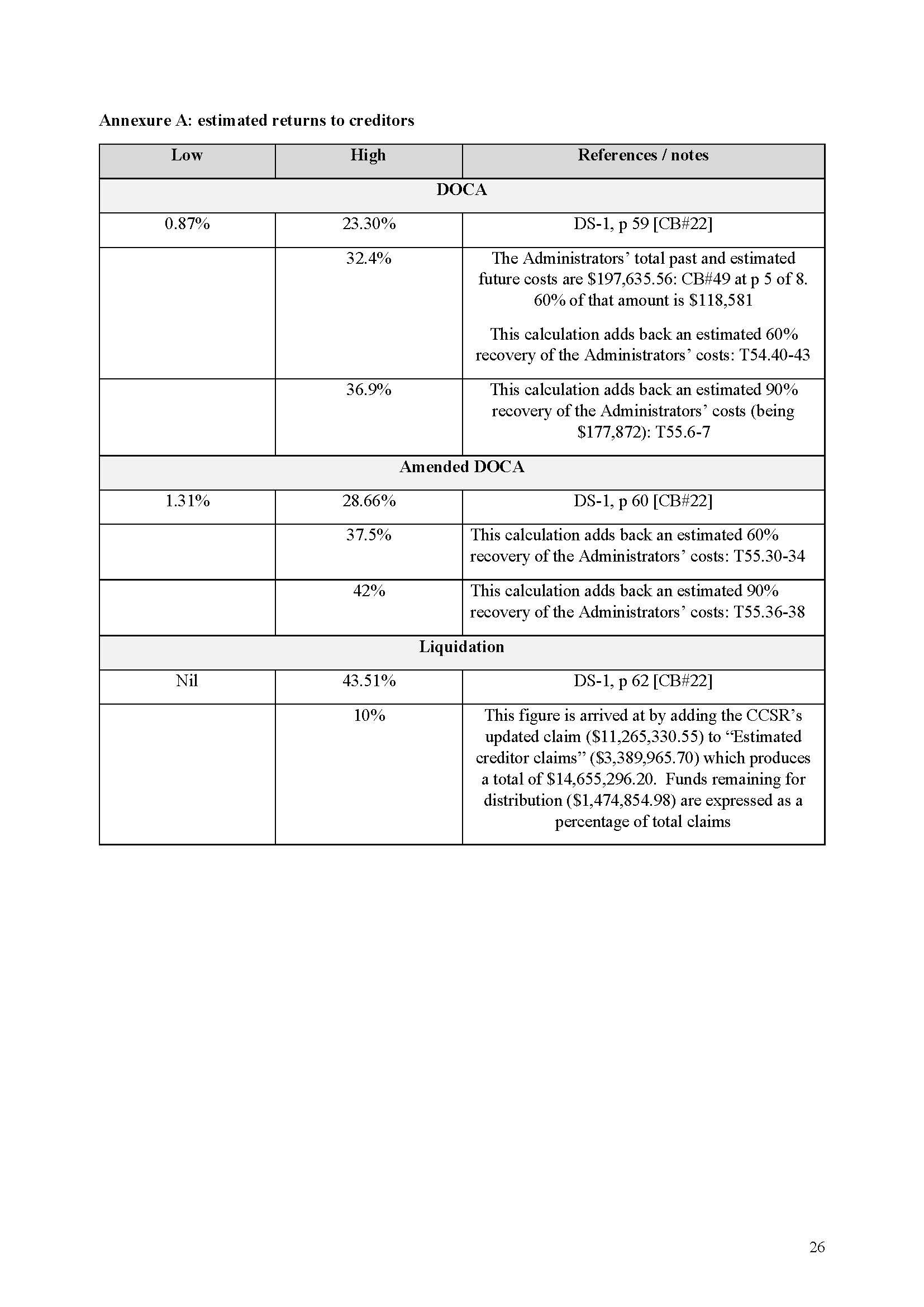
NSD 512 of 2024 | |
DALMA HIRE PTY LTD | |
Fifth Defendant: | DALMA SERVICES PTY LTD |
Sixth Defendant: | INCLINE HIRE PTY LTD |
Seventh Defendant: | MR JASON IVAN ANDRIJIC |


