

FEDERAL COURT OF AUSTRALIA
Fair Work Ombudsman v Blue Sky Kids Land Pty Ltd (in liq) (No 3) [2024] FCA 785
ORDERS
DATE OF ORDER: |
1. During various periods from 19 October 2015 until 9 June 2018 inclusive, the First Respondent contravened the following civil remedy provisions of the Fair Work Act 2009 (Cth) (FW Act) and the Fair Work Regulations 2009 (Cth) (FW Regulations) (all capitalised terms, not otherwise defined below are defined in the reasons for judgment and the glossary of select terms that follow).
(a) s 45 of the FW Act, by failing to pay each of Xibing Cen, Xing Yang, Tzu Fong Yu and Jin Zhang (the Employees) the minimum rate of pay in contravention of cl 17 of the General Retail Industry Award 2010 (Award);
(b) s 45 of the FW Act by failing to pay each of the Employees casual loadings, in contravention of cl 13.2 of the Award;
(c) s 45 of the FW Act by failing to pay each of the Employees Saturday penalty rates, in contravention of cl 29.4(b) of the Award;
(d) s 45 of the FW Act by failing to pay each of the Employees Sunday penalty rates, in contravention of cl 29.4(c) of the Award;
(e) s 45 of the FW Act by failing to pay each of Xibing Cen, Xing Yang and Jin Zhang public holiday penalty rates, in contravention of cl 29.4(d) of the Award;
(f) s 45 of the FW Act by failing to pay Xibing Cen and Tzu Fong Yu overtime rates, in contravention of cl 29.2 of the Award;
(g) s 45 of the FW Act by failing to pay superannuation contributions on behalf of each of the Employees, in contravention of cl 22.2 of the Award;
(h) s 45 of the FW Act, by failing to pay each of the Employees weekly, fortnightly or on a regular pay day, in contravention of cl 23 of the Award;
(i) s 44(1) of the FW Act by failing to pay Xing Yang her accrued untaken annual leave entitlements, in contravention of s 90(2) of the Act;
(j) s 44(1) of the FW Act by failing to give Xing Yang notice of termination or payment in lieu, when her full-time employment was terminated on 18 October 2015, contrary to s 117 of the Act;
(k) s 323(1) of the FW Act, by failing to pay Xibing Cen at least monthly in June and July 2017;
(l) s 340(1)(a)(ii) of the FW Act, by threatening to dismiss Jin Zhang from her employment because, or for reasons which included that, she exercised a workplace right to participate in an interview with a Fair Work Inspector;
(m) s 358 of the FW Act, by threatening to dismiss Jin Zhang from her employment, in order to engage her as an independent contractor to perform the same, or substantially the same, work under a contract for services;
(n) s 535(1) of the FW Act, by failing to:
(i) make and keep for seven years records of the rate of remuneration paid to each of the Employees, as prescribed by reg 3.33(1)(a);
(ii) make and keep for seven years records that specify the basis on which it became liable to make superannuation contributions to the Employees, including a record of any election made by the employees as to the funds to which contributions were to be made and the date of any relevant election, as prescribed by reg 3.37(1)(e);
(iii) make and keep for seven years records of the gross and net amounts paid to Xing Yang for the period from May 2011 to December 2012 inclusive, as prescribed by reg 3.33(1)(b);
(iv) make or keep records of the entitlement to casual loading for each of the Employees, as prescribed by reg 3.33(3)(c);
(v) make and keep records of the entitlement to Saturday, Sunday and public holiday penalty rates of each of the Employees, as prescribed by reg 3.33(3)(d);
(vi) apart from the Xing Yang Timesheets, make and keep records of the hours worked by Xing Yang for the period from 19 October 2015 to 26 June 2016, as prescribed by reg 3.33(2);
(vii) apart from the Tzu Fong Yu Timesheets, keep records for seven years of the hours worked by Tzu Fong Yu, as prescribed by reg 3.33(2);
(viii) make or keep records of the overtime hours worked by each of Xibing Cen and Tzu Fong Yu or the times they started and finished working overtime hours, as prescribed by reg 3.34;
(o) s 535(4) of the FW Act, by making or keeping the following employment details forms, payroll documents and timesheets, knowing them to be false or misleading: the Xing Yang Employment Details Form 1, Xing Yang Employment Details Form 2, Xing Yang Payroll Register Document, Xibing Cen Payroll Register Document 1, Xibing Cen Payroll Register Document 2, the Xibing Cen Timesheets 2 and the Jin Zhang Payroll Register Document 1;
(p) s 535(2) of the FW Act, by failing to include the following information in employee records:
(i) the correct date on which Xing Yang’s employment began, as prescribed by reg 3.32(e);
(ii) the correct net amounts paid to Xing Yang in the period from 6 February 2017 to 11 June 2017, as prescribed by reg 3.33(1)(b);
(iii) the correct net amounts paid to Xibing Cen in the period from 27 November 2017 to 24 December 2017, as prescribed by reg 3.33(1)(b);
(iv) the correct net amounts paid to Jin Zhang in the period from 7 August 2017 to 26 November 2017, and from 18 December 2017 to 7 January 2018, as prescribed by reg 3.33(1)(b); and
(v) the correct hours worked by Xibing Cen in the period from 11 December 2017 to 28 January 2018, as prescribed by reg 3.33(2).
(q) s 536(1) of the FW Act, by failing to give pay slips to each of the Employees in the form prescribed by the FW Regulations or which included the information prescribed by the Regulations, within one day of making payment to them in relation to the performance of work or at all;
(r) s 707A of the FW Act, in that on 18 January 2018 it intentionally hindered or obstructed Fair Work Inspectors Stuart Liljeqvist and Dale Woods in the exercise of their powers or functions, when it directed that BSKL’s Woden store be closed;
(s) s 707A of the FW Act, in that it intentionally obstructed Fair Work Inspector Liljeqvist in the exercise of his powers or functions, when in January 2018 it directed Tzu Fong Yu to destroy the Woden Timesheets;
(t) s 712(3) of the FW Act, by failing to produce the Xing Yang Timesheets and the Xing Yang Payroll Register Documents 2, in compliance with the First BSKL NTP issued by Fair Work Inspector Liljeqvist on 23 January 2018;
(u) s 712(3) of the FW Act, by failing to produce the Xibing Cen Timesheets 3, the Tzu Fong Yu Payroll Register Document and the Jin Zhang Timesheets 2 (to the extent that they related to periods after 1 December 2017), in compliance with the Second BSKL NTP issued by Fair Work Inspector Liljeqvist on 23 January 2018;
(v) s 712(3) of the FW Act, by failing to produce the Jin Zhang Timesheets 2 in compliance with the Third BSKL NTP issued by Fair Work Inspector Liljeqvist on 12 June 2018;
(w) s 712(3) of the FW Act, by failing to produce the Tzu Fong Yu Timesheets and the Tzu Fong Yu Payroll Register Document in compliance with the Fourth BSKL NTP issued by Fair Work Inspector Liljeqvist on 12 June 2018;
(x) s 712(3) of the FW Act, by failing to produce the Xibing Cen Timesheets 3 in compliance with the Fifth BSKL NTP issued by Fair Work Inspector Liljeqvist on 21 June 2018;
(y) s 718A of the FW Act, in that it produced each of the following documents to Fair Work Inspector Liljeqvist, who was exercising powers or performing functions under the FW Act, knowing, or being reckless as to whether, each of the documents was false or misleading: the Xing Yang Employment Details Form 1, the Xing Yang Employment Details Form 2, the Xing Yang Payroll Register Document, the Xibing Cen Payroll Register Document 1, the Xibing Cen Payroll Register Document 2, the Xibing Cen Timesheets 2, the North Rocks Timesheets and the Jin Zhang Timesheets.
2. Each of the First Respondent’s contraventions set out in declarations 1(a), (n) and (q), insofar as they occurred on or after 15 September 2017 were serious contraventions within the meaning of s 557A of the FW Act.
3. The Second Respondent contravened ss 535(4) and 718A of the FW Act, in that on 12 March 2018, in response to the First Q Fay NTP, it produced each of the Jin Zhang Payroll Register Document 1 and the Baulkham Hills Timesheets to Fair Work Inspector Liljeqvist, when they were false or misleading and when it knew, or was reckless as to whether, they were false or misleading.
4. The Third Respondent:
(a) contravened s 707A of the FW Act by intentionally hindering or obstructing Fair Work Inspectors Stuart Liljeqvist and Dale Woods on 18 January 2018 in the exercise of their powers or functions, when, knowing the inspectors were proposing to visit the Woden store, he directed Tzu Fong Yu to close the store well before the end of trading hours;
(b) was involved, within the meaning of s 550(2) of the FW Act, in the First Respondent’s contraventions as set out in 1(a), (b), (c), (d), (e), (f), (g), (j), (k), (l), (m), (n), (o), (p), (q), (t), (u), (v), (w), (x) and (y) above; and
(c) was involved, within the meaning of s 557A(5A) of the FW Act, in the First Respondent’s serious contraventions as set out in 1(a), (n) and (q) above and 2 above; and
(d) was involved, within the meaning of s 550(2) of the FW Act, in the Second Respondent’s contraventions set out in 3 above.
5. The Fourth Respondent:
(a) contravened s 707A of the FW Act, in that in January 2018 she intentionally obstructed Fair Work Inspector Stuart Liljeqvist in the exercise of his powers or functions by directing Tzu Fong Yu to destroy the Woden Timesheets; and
(b) was involved, within the meaning of s 550(2) of the FW Act, in the First Respondent’s contraventions as set out in 1 (b), (c), (d), (e) and (f) above.
THE COURT ORDERS THAT:
6. By 4pm on 1 August 2024, the applicant file and serve short minutes of order giving effect to the reasons for judgment.
7. The applicant file any affidavits on the question of pecuniary penalties by 4pm on 29 August 2024, together with an outline of submissions and any variation to the proposed form of orders in relation to superannuation.
8. The respondents file any affidavit(s) on the question of pecuniary penalties by 4pm on 26 September 2024, together with an outline of their submissions in response to those filed by the applicant.
9. No outline of submissions may exceed 30 pages without the leave of the Court.
10. The question of orders in relation to superannuation and penalties be listed for hearing on a date to be fixed.
11. There be liberty to apply on two (2) days’ notice with respect to the timetabling orders.
Note: Entry of orders is dealt with in Rule 39.32 of the Federal Court Rules 2011.
KATZMANN J:
1 Guo Dong Gu (also known as Nathan Gu) (Mr Gu) and Fei Rong Yang (also known as Fay Yang) (Fei Yang) are directors of two related companies, Blue Sky Kids Land Pty Ltd (BSKL) and Q Fay Trading Company Pty Ltd (Q Fay) (together, the Employers). They are also husband and wife. BSKL operated a number of children’s clothing stores. Q Fay imported children’s clothing from the People’s Republic of China to supply to the BSKL stores. Fei Yang is the sole shareholder of BSKL and she and Mr Gu are the sole shareholders of Q Fay.
2 On 6 September 2019 the Fair Work Ombudsman filed an originating application and statement of claim in which applying for relief arising out of numerous alleged contraventions of various civil remedy provisions of the Fair Work Act 2009 (Cth) (FW Act) and the Fair Work Regulations 2009 (Cth) (FW Regulations). Unless otherwise indicated, the references to those provisions were operative throughout the periods the subject of the proceeding.
3 The allegations include contraventions of various provisions of the General Retail Industry Award 2010 (Award) and the National Employment Standards laid down in the FW Act; failing to make and keep employee records of the kind prescribed by the FW Regulations; making and keeping false or misleading employee records; failing to issue pay slips; intentionally obstructing Fair Work Inspectors; producing to a Fair Work Inspector documents that were known to be false or misleading; threatening to dismiss an employee for exercising her right to participate in an interview with a Fair Work Inspector; and/or to engage her under a contract for services to undertake the same or substantially the same work. Mr Gu and his wife are said to be liable, together with the relevant company, for the alleged contraventions.
4 On 13 March 2020, a little over six months after the proceeding was commenced, the Employers resolved to go into voluntary liquidation. On 25 May 2020 I granted the Ombudsman leave to proceed against them under s 500(2) of the Corporations Act 2001 (Cth): Fair Work Ombudsman v Blue Sky Kids Land Pty Ltd (in liquidation) [2020] FCA 718.
5 The claim largely concerns the wages paid to, and the records (or lack thereof) relating to the employment of, four women who worked in one or more of the BSKL stores over disparate periods of time from 30 July 2012 in one case to 9 June 2018 in another (the Employees). Nevertheless, the documentary evidence upon which the Ombudsman relies is voluminous. The Court Book consists of in excess of 7,000 pages. There is also a Supplementary Court Book of nearly 1,000 pages and a Further Supplementary Court Book of more than 600 pages. Documents were not always organised in a logical order. Navigating this material has not been easy.
6 The Employees are: Xibing Cen, who had been employed as a bookkeeper in China (known as “Bing”); Jin Zhang (known as “Sery”), who was a maths teacher in China; Tzu Fong Yu (known as “Serene”), who holds a diploma in accounting and worked as a secretary in Taiwan; and Xing Yang, who had worked for an insurance company in China.
7 Before the Employers went into liquidation, they filed defences in which they made a number of admissions. At that time they were legally represented. The liquidator did not appear and has taken no interest in the proceeding. Mr Gu and Fei Yang were represented by Ying Zhang of Ren Zhou Lawyers from 9 October 2019 until 17 April 2020 and by Jingyi Li of Yingke LawFirm from 25 November 2021 until 26 September 2023. Otherwise they had no legal representation.
8 Mr Gu and Fei Yang initially raised the penalty privilege. Accordingly the evidence was taken in two tranches. After the Ombudsman’s evidence was adduced, the hearing was adjourned and Mr Gu and Fei Yang were given the opportunity to amend their defences and file evidence. They availed themselves of that opportunity and an amended defence was filed for both of them on 24 December 2021. That was prepared by the respondents’ then solicitor, Jingyi Li. Later, Mr Gu and Fei Yang filed a further amended defence in response to the Second Further Amended Statement of Claim, which was filed on 16 June 2023 which was also prepared by Jingyi Li. On 6 December 2023 the Ombudsman was granted leave to file a Third Further Amended Statement of Claim, which essentially removed certain allegations and orders and reduced the amount of certain claims. Mr Gu did not object. None of the respondents sought to amend their defences further.
9 In the Further Amended Defence, Mr Gu and Fei Yang made a number of admissions to allegations concerning the conduct of the Employers. By that time, the Employers were in liquidation and Mr Gu and Fei Yang had no authority make admissions that could bind them. As they were intimately involved with the running of the two companies and the operation of the business, however, and were the only directors of both Employers at the time the conduct occurred, their admissions are still relevant.
10 Mr Gu appeared throughout the hearing in person, assisted by a Mandarin interpreter. Fei Yang did not appear. With the leave of the Court Mr Gu appeared for her, too. He cross-examined some of the Ombudsman’s witnesses and made relatively brief oral closing submissions, which were largely unhelpful. He addressed none of the contraventions, focusing only on particular aspects of the Employees’ evidence. During his submissions he twice asked for an adjournment, including to obtain additional evidence, but I declined to accede to his request as he was given some eight and a half months in total to file his evidence, after the Ombudsman had consented to multiple extensions of the original 13-week period for the respondents to file their evidence after the first tranche of hearing dates and he had been in possession of the Ombudsman’s opening submissions for more than three years and the Ombudsman’s detailed and inaptly named “outline” of closing submissions for nearly seven weeks. When I fixed the additional dates for submissions on 27 October 2023 (after the Ombudsman had all but concluded her oral argument) I asked Mr Gu whether the proposed dates of 6 and 7 December 2023 would be a problem for him. While he responded, unhelpfully, that he did not yet know, I adjourned the remainder of the case for hearing on those dates, informing Mr Gu of my view that such a lengthy adjournment would give him plenty of time to get across the Ombudsman’s submissions and the opportunity to seek advice if he so desired. I informed him that it was my expectation that he would be ready to address the Court on his responses to the Ombudsman’s submissions. I asked him whether he understood what I was saying. He said he did.
11 Of course the Court has the power to adjourn a proceeding at any time. But s 37M of the Federal Court of Australia Act 1976 (Cth) (FCA Act) imposes an obligation on the Court to exercise the power in the way that best promotes the overarching purpose of the civil practice and procedure rules. That purpose is to facilitate the just resolution of disputes according to law and as quickly, inexpensively and efficiently as possible. It includes a number of objectives which would be defeated by the provision of yet a further adjournment. Those objectives are the just determination of all proceedings before the Court; the efficient use of the judicial and administrative resources available for the purposes of the Court; the efficient disposal of the Court’s overall caseload; the disposal of all proceedings in a timely manner; and the resolution of disputes at a cost that is proportionate to the importance and complexity of the matters in dispute. I did not think that granting him the adjournment he requested would be the best way to promote the overarching purpose — far from it.
12 I have tried to avoid unnecessary repetition in this judgment. Some of the evidence, however, is relevant to several allegations and some of the alleged contraventions have common elements. Consequently, a certain amount of repetition is unavoidable and a certain amount is desirable for the sake of clarity.
13 The Ombudsman read affidavits from each of the Employees; from Stuart Liljeqvist; Ying Zheng; Karnee Mitchell; Rebecca Cummings, Dale Woods; Peter Smith; Quentin Bai; and Zhaukun Du. At all relevant times Messrs Liljeqvist, Woods and Ms Zheng, Ms Mitchell and Ms Cummings were Fair Work Inspectors. Mr Smith is the Assistant Team Leader in the Calculations Team of the Office of the Fair Work Ombudsman (FWO). Mr Du and Mr Bai are both certified Mandarin Chinese translators. Mr Bai translated Ms Yu’s affidavit to her. Mr Du translated WeChat messages, various documents, and audio recordings.
14 Of those witnesses, only the Employees were required for cross-examination. A good deal of their evidence was not challenged and the cross-examination was largely ineffectual.
15 In addition, the Ombudsman called Xiaoying (Zoey) Jin, who was employed at the BSKL stores in Belconnen and Woden from about the middle of December 2017 to around 28 February 2018. She was also cross-examined.
16 I am satisfied that all the Ombudsman’s witnesses were endeavouring to give an honest account of their experiences. Unless otherwise indicated, I accept that they gave truthful and reliable evidence, to the best of their recollections. In several respects, they corroborated each other. I regard this as significant since there was no suggestion that they had colluded with each other to give false evidence. Indeed, as far as I can tell there was no evidence that they had even met.
17 Numerous documents were exhibited to FWI Liljeqvist’s first affidavit affirmed on 30 September 2020. They included file notes of conversations conducted with Mr Gu and staff during or following staff visits. I was initially concerned about relying on Mr Gu’s statements to the Fair Work Inspectors. Neither the file notes nor the affidavit itself indicate that an interpreter was used during the conversations or that the parties to the conversations had any difficulty understanding each other. On reflection, however, my initial concerns were allayed. Mr Gu has lived in Australia and carried on business here for a number of years. It was evident from the interactions in the courtroom that he had some capacity to communicate in English, although an interpreter was provided and used during the hearing. At case management hearings he appeared in person without an interpreter, although he made it clear that he did not always understand everything that was being said. FWI Liljeqvist’s affidavit was served on Mr Gu when he had legal representation. While he required the Employees for cross-examination, he did not require any of the inspectors. In those circumstances, it seems to me he must be taken not to have had any issue with anything they said, including their accounts of what he told them.
18 Three affidavits were filed for the respondents. They were an affidavits from Mr Gu affirmed on 25 August 2022, Weihong Tan affirmed on 26 August 2022 and a certified interpreter, Jing Sun, who translated Mr Gu’s affidavit into Mandarin. Ms Tan claimed to have been employed by BSKL in or around November 2016 until around March 2019 at the Baulkham Hills store and occasionally at the North Rocks and Penrith locations. The Ombudsman objected to certain parts of the Tan affidavit and I struck out paragraphs 12 and 13. Mr Gu claimed never to have seen the affidavit and declined to rely on it.
19 The Ombudsman also read affidavits affirmed by Antonio Fiorenza on 20 October 2023, 24 October 2023, and 27 October 2023. The second merely showed that the supplementary court book had been served on the respondents’ former solicitors when they were still on the record. The third contained up-to-date company searches and information potentially relevant to the utility of making orders for compensation. In the first, Mr Fiorenza deposed that on the day before the affidavit was affirmed he called Jenny Li of YingKe Law Firm asking her “to confirm whether” Ms Sun failed to annex to her affidavit Chinese language versions of the Gu and Tan affidavits in light of the fact that the Sun affidavit purported to exhibit both original and translated affidavits of both Mr Gu and Ms Tan. Ms Li informed Mr Fiorenza both orally and in writing by email the same day that no Chinese language versions of either affidavit existed and that each was translated to its deponent by Ms Sun from the English. She said that the representation in the Sun affidavit that there were Chinese language versions of the two affidavits was the result of “a grammatical error/confusion”.
20 Mr Gu was extensively cross-examined. I take into account that he was giving evidence through an interpreter. Even so, he was a most unsatisfactory witness. He frequently offered non-responsive answers. Some of his answers were argumentative. Some were confusing. Some were internally inconsistent. Some were difficult to believe, if not incredible. Some, I am satisfied, were dishonest. I agree with the Ombudsman’s characterisation of his overall presentation as that of “an evasive, dissembling and unreliable witness, who sought to improvise his evidence in a manner that he believed assisted the respondents’ case”. I came to the conclusion that I could place no reliance on anything he said unless it was against interest or there was independent evidence to support it.
21 No evidence was adduced from Fei Yang and no explanation was proffered for the absence of evidence from her. In these circumstances the Ombudsman invited the Court to draw inferences that nothing she could say would have assisted the respondents’ case, to more readily accept the evidence of her witnesses which she would have been in a position to contradict, and to more comfortably draw inferences from that evidence. In Jones v Dunkel (1959) 101 CLR 298 the High Court held that these inferences may be drawn if the necessary conditions for their operation are made out, as they are here. As Heydon, Crennan and Bell JJ explained in Kuhl v Zurich Financial Services Australia Ltd (2011) 243 CLR 361 at [63] (footnotes omitted):
The rule in Jones v Dunkel is that the unexplained failure by a party to call a witness may in appropriate circumstances support an inference that the uncalled evidence would not have assisted the party’s case. That is particularly so where it is the party which is the uncalled witness. The failure to call a witness may also permit the court to draw, with greater confidence, any inference unfavourable to the party that failed to call the witness, if that uncalled witness appears to be in a position to cast light on whether the inference should be drawn. These principles have been extended from instances where a witness has not been called at all to instances where a witness has been called but not questioned on particular topics. Where counsel for a party has refrained from asking a witness whom that party has called particular questions on an issue, the court will be less likely to draw inferences favourable to that party from other evidence in relation to that issue.
22 These principles apply to all proceedings, including proceedings such as this in which civil penalties are claimed: see Adams v Director of the Fair Work Building Industry Inspectorate (2017) 258 FCR 257 at [147] (North, Dowsett and Rares JJ) and the other cases referred to there. Reliance on the penalty privilege does not prevent the Court from drawing such an inference. In any case, here the filing by Mr Gu and Ms Yang of the Further Amended Defence constitutes a waiver of the penalty privilege they previously invoked. The privilege against self-incrimination does not assist the respondents, as that privilege can only be claimed by a witness and then only under oath or affirmation: Chong v CC Containers Pty Ltd (2015) 49 VR 402 at [236] (Redlich, Santamaria and Kyrou JJA).
23 I discussed these principles at length in Fair Work Ombudsman v Foot & Thai Massage Pty Ltd (in liq) (No 4) [2021] FCA 1242 at [222]–[232]. It is unnecessary to say anything more about them here. One matter I mentioned, however, does bear repeating. That concerns the significance of the failure to adduce evidence where the absent witness is a party. In Foot & Thai at [232] I referred to the remarks of Street J in Dilosa v Latec Finance Pty Ltd (1966) 84 WN (Pt 1) (NSW) 557 at 582, cited with approval by Santow J in Australian Securities and Investments Commission v Adler [2002] NSWSC 171; 41 ACSR 72; 20 ACLC 576; 168 FLR 253 at [448] (appeal dismissed in Adler v Australian Securities and Investment Commission [2003] NSWCA 131; 21 ACLC 1810; 46 ACSR 504; 179 FLR 1 per Giles JA, Mason P and Beazley JA) and by the High Court in Kuhl at [63]. In Dilosa at 582 Street J said:
The inference which a Court can properly draw in the absence of a witness, where such absence is not satisfactorily accounted for, is that nothing which this witness could say would assist the case of the party who would normally have been expected to have called that witness. The significance of this inference differs according to the closeness of the relationship of the absent witness with the party against whom the inference is sought to be propounded. Where the absent witness is a party himself then considerable importance may well attach to the inference.
24 The evidence adduced by the Ombudsman indicates that Fei Yang managed the Blue Sky Kids business, was involved in the hiring of the Employees, informed them of their pay rates, and is said to have played a critical role in a number of the alleged contraventions. In those circumstances, her failure to give evidence, unexplained as it was, is undoubtedly significant. Consequently, I accept the Ombudsman’s invitation. I do infer that nothing Fei Yang could say would have assisted the respondents’ case and I have greater confidence than I might otherwise have had about the reliability of the accounts given by the Employees such that inferences in the Ombudsman’s favour can more comfortably be drawn.
25 BSKL was registered on 4 March 2004. At all material times it has been a company incorporated under the provisions of the Corporations Act 2001 (Cth); a “constitutional corporation” within the meaning of s 12 of the FW Act; a “national system employer” within the meaning of s 14(1)(a) of the FW Act; and an entity that operated a business from stores that sold children’s clothing to consumers, which traded under the name “Blue Sky Kids Land” (the business).
26 Q Fay is and was at all material times:
(a) a company incorporated under the provisions of the Corporations Act and registered since 14 December 2010;
(b) a “constitutional corporation” within the meaning of s 12 of the FW Act;
(c) a “national system employer” within the meaning of s 14(1)(a) of the FW Act; and
(d) an entity that operated a business importing children’s clothing stock from the People’s Republic of China, to supply to the BSKL Stores.
27 Mr Gu has been a director of BSKL from 1 February 2011. Ms Yang has been a director of BSKL since 14 February 2006. Since 14 December 2010, Mr Gu has also been a director of Q Fay and, since 1 July 2012, one of two directors of Q Fay together with Ms Yang. The evidence establishes that both were intimately involved in the running of the business of the two companies.
28 At all material times, BSKL operated the business from a number of shops in New South Wales. Those shops were situated in the Charlestown Square shopping centre in Charlestown; Westfield Hurstville; Westfield Kotara; Stockland Merrylands; the North Rocks shopping centre; Westfield Parramatta; Rouse Hill Town Centre; and the Westfield shopping centre in Tuggerah (together, the BSKL stores). In their Further Amended Defence, Mr Gu and Fei Yang also admitted that at all material times BSKL operated its business at Stockland Baulkham Hills; Westfield Belconnen; Westfield Hornsby; Westfield Liverpool; Westfield Mt Druitt; Westfield Penrith; Stockland Shellharbour; and Westfield Woden. Additionally they admitted that at all material times BSKL operated an office in Villawood from which it administered the BSKL business and managed the inventory for the business (the Villawood warehouse).
29 For at least the periods of time set out in the table below (Assessed Employment Periods), Xing Yang, Xibing Cen and Jin Zhang and Tzu Fong Yu were employed in the listed locations:
Employee | Assessed Employment Period(s) | Location |
Ms Xing Yang | 19 October 2015 to 11 June 2017 | Charlestown store |
Ms Xibing Cen | 14 May 2016 to 9 June 2018 | Tuggerah store |
Ms Jin Zhang | 26 August 2016 to 12 February 2018 | Parramatta, Hurstville, and Merrylands stores |
North Rocks, Baulkham Hills, Parramatta, Hurstville, and Merrylands stores and, on one occasion, Penrith | ||
Ms Tzu Fong Yu | 10 February 2017 to 15 September 2017 24 January 2018 to 27 February 2018 | Woden store |
30 Xing Yang, Xibing Cen and Tzu Fong Yu were all employed by BSKL. The respondents admit that Jin Zhang was employed by Q Fay but that is contentious.
31 Each of the Employees worked alone.
32 During the Assessed Employment Period, each of the Employees performed all of following duties on at least one occasion. They opened and closed the stores. They sold children’s clothing, accessories and shoes. They displayed and replenished stock on the shelves of the stores in which they worked. They recorded sales and compiled a daily sales report. They cleaned. They ordered stock from the Villawood warehouse. And they banked the stores’ takings, as necessary.
The investigation and production of documents
33 During the period from 29 November 2017 to 19 November 2018 the Ombudsman carried out an investigation of BSKL to determine its compliance with the FW Act and Regulations (the investigation). The investigation included visits to Blue Sky Kids Land branded stores and interviews of employees and Mr Gu.
34 The investigation was triggered by a complaint made by Xing Yang about her pay and conditions. Ms Yang’s first job after she arrived in Australia was with BSKL. She deposed that she knew the rate of pay was too low, but she took it anyway because she needed a job; she, was not aware of what the proper pay rates were in Australia; and she knew that it was common for other Chinese people to receive similar rates in other jobs. She said that she realised she was being underpaid when she saw in the news that another business had been underpaying people. WeChat messages exchanges between Ms Yang and Mr Gu annexed to Ms Yang’s affidavit (annexure XY-10) are telling. They include the following (as translated):
23 October 2017 12:38 PM
A: As an employee working here for six years, I've been working hard. Our Company never sent me simple greetings when I got ill. I feel so disappointed. I think I deserve a salary of $11/hour due to my high working efficiency and attitude for so many years.
…
Nathan: … All of our shops should have been closed if we strictly observe the law …
35 At this time the minimum hourly rate of pay was $20.88.
36 FWI Liljeqvist had primary carriage of the investigation. At various times he was assisted by Fair Work Inspectors Brownell, Cummings, Woods, Mitchell, and Zheng. FWI Zheng is a native Mandarin speaker who is fluent in both Mandarin and Cantonese.
37 During the investigation, Fair Work Inspectors “considered” Blue Sky Kids Land branded stores in Baulkham Hills, Belconnen, Charlestown, Hornsby, Hurstville, Kotara, Liverpool, Merrylands, Mount Druitt, North Rocks, Parramatta, Penrith, Shellharbour, Rouse Hill, Tuggerah and Woden and conducted 15 site visits to a number of those stores. Those visits occurred in January and February 2018. They also visited the Villawood warehouse. At the site visits they spoke to employees and Mr Gu, inspected records, downloaded documents, and took photographs. A proposed site visit to the Woden store on 18 January 2018 was thwarted in circumstances the Ombudsman alleges amount to hindering and obstructing inspectors in the performance of their functions or the exercise of their powers in contravention of s 707A(1) of the FW Act.
38 FWI Zheng interpreted where necessary during some of the site visits. On other occasions, when speaking to staff who required an interpreter, the inspectors would use the services of the Translating and Interpreter Service.
39 When the investigation began, FWI Liljeqvist intended to investigate possible underpayments of all BSKL employees. As the investigation progressed, however, due either to a lack of records or inconsistent records, he decided to limit the investigation to those employees who were willing to assist. They were the Employees. They assisted the Ombudsman by participating in recorded interviews and providing information, records and documents.
40 FWI Liljeqvist issued multiple notices to produce on BSKL and Q Fay and on other entities during the course of the investigation.
41 On or around 9 November 2018, FWI Cummings issued a “Findings of contravention” letter (Contravention Letter) to BSKL. Ten days later she sent BSKL two revised pages of the Contravention Letter to reflect additional calculations by the FWO of annual leave, annual leave loading and payment in lieu of notice owing to Xing Yang. On 5 August 2019, FWI Liljeqvist sent BSKL a further revised Contravention Letter to reflect minor corrections to the calculations by the FWO.
42 The investigation with which this proceedings concerned was not the first time BSKL or Mr Gu had come to the attention of the regulator.
43 FWI Liljeqvist discussed the previous “interactions” in his first affidavit.
44 The first “interaction” occurred nearly 20 years ago. On 19 September 2006 the Office of Workplace Services (the predecessor of the FWO) began to undertake a “targeted audit” of the Penrith store. That day Workplace Inspector (WI) Helen Yuen visited the store and apparently spoke to some person or persons but was unable to speak to Mr Gu. Her notes from the visit record, amongst other things, that the store had two to three employees and that various records, including pay slips, were kept.
45 The nature and purpose of the audit was explained in a letter to Mr Gu from WI Yuen:
Review of businesses by the Office of Workplace Services (OWS)
The role of the OWS is to ensure that the rights and obligations of both workers and employers are understood and enforced fairly under the Workplace Relations Act 1996 (the Act).
The Act requires employers to keep accurate and complete time and wages records and to issue pay slips to each worker. The record keeping and pay slip requirements are designed to ensure that workers receive their correct wages and conditions.
Commencing 27 September 2006, the Act allows the issuing of Infringement Notices to impose a monetary penalty on an employer for failing to meet their time and wages records and pay slip obligations. Initially the amount of the infringement notice penalty will be $55.00 for an individual and $275.00 for a body corporate, as an alternative to initiating court proceedings.
The Act gives OWS Workplace Inspectors the power to inspect and copy time and wages records. In the event that employers fail to comply with these requirements penalties may be applied.
As you may be aware, the OWS has been undertaking an initial review of businesses in shopping centres to ensure employers are keeping time and wages records and issuing pay slips as required by the Act.
Unfortunately you were not available when I visited your business today. Please find attached information materials relating to the time and wages records and pay slip obligations of employers covered by the Act.
Please forward time and wages records and a copy of a sample pay slip for the last pay period to me for all employees by close of business Wednesday, 27 September 2006 …
In the event that your business is found not to be complying with your obligations, you will be asked to rectify the matter voluntarily. If voluntary compliance is not achieved the OWS may undertake further compliance orientated actions to ensure the requirements of the Act are met. If serious or wilful breaches of the Act are uncovered at the time of the audit, the OWS will investigate further.
Information on employers’ time and wages records and pay slip obligations is available at www.ows.gov.au. You may also contact the WorkChoices Infoline on 1300 363 264 for further information about your rights and responsibilities.
Further information about the campaign can be obtained from the OWS on 1300 724 200.
46 In response to the audit, Mr Gu provided the OWS with copies of records and pay slips. Three documents only are annexed to FWI Liljeqvist’s affidavit. They relate to one employee, Li Juan, who, according to those documents, started work only eight days before the audit.
47 On 27 October 2006, WI Yuen, sent Mr Gu a fax stating (without alteration):
Thank you for talking to me earlier today in regards to your record keeping and payslips. They appear to be meeting the regulations in regards to record keeping. However, you will need to update your records to show the following:
* The Industrial instrument by which the employees receive their entitlements. This needs to be filled out in the records in the section where it says “Name of award(s)/agreement(2) / NAPSA.” For your company, this needs to be completed with “Shop Employees (State) Award”
You also need to name the superannuation fund in which you pay superannuation to on both the payslip and employment records.
48 The same day WI Yuen followed up the fax with a phone call. In the report of her investigation, which appears behind tab 41 in FWI Liljeqvist’s first affidavit, she noted (without alteration):
Contacted employer today and asked whether he just completed the templates I had given him, or whether he actually use them, he said he had only opened the shop and penrith in June 2006 and was downloading the sheets from the Internet and using them as he found them very good. I trust that this is correct.
Indicated that he needs to put the Award in his records, however would fax more information in regards to it. Also will fax over the voluntary compliance advice.
49 On 3 November 2006, WI Yuen telephoned Mr Gu again. Her note of that event reads as follows:
Called employer Nathan Gu to see if he understood my fax and to discuss. Gave further explanation & requested he fax back the voluntary undertaking. He said he would send it back today or Monday.
50 On 6 November 2006, Mr Gu entered into a “compliance undertaking” with the OWS. The undertaking provided that from the next pay period BSKL would issue pay slips to all employees and keep employment records for all employees in accordance with the requirements of the Workplace Relations Act 1996 (Cth) (WR Act) and the Workplace Relations Regulations 2006 (Cth).
51 The next contact Mr Gu had with a workplace regulator occurred in 2011. By then the FW Act had been passed, the WR Act had been repealed, and the FWO had replaced the OWS. In about April 2011 the Ombudsman received a complaint from Lai Kai (Lisa) Wong alleging that she had been employed for a three-hour trial at the BSKL store in Burwood and had not been paid for the time worked. On 12 April 2011 the Ombudsman wrote to BSKL informing the company of the complaint, the role of the Ombudsman and what the company might expect if a contravention of workplace laws were identified. The letter also included the following information:
Where to find further information
If you are unsure if the issues raised relate to a lawful entitlement, please call the Fair Work Infoline on 13 13 94. Further Information can also be accessed www.fwa.gov.au.
IMPORTANT NOTICE
From 1 January 2010 employers should be aware of changes to the national workplace regulations system under the Fair Work Act 2009. From this date, the National Employment Standards (NES) and modern awards come into effect. The NES are a set of 10 minimum standards of employment, and apply to all employees in the national system, regardless of any industrial instrument or contracts of employment.
In association with the NES, modern awards will make up a new safety net for employees. Modern awards will apply to employees based on particular industries or occupations. Employers to make sure they are aware of their rights and obligations under the Fair Work Act 2009 by contacting the Fair Work Infoline on 13 13 94, or visiting www.fairwork.gov.au.
Should you have any queries prior to the Fair Work Inspector contacting you, please contact the Fair Work Ombudsman on 13 13 94 or visit www.fwo.gov.au.
52 An Assisted Voluntary Resolution process failed to resolve the complaint and the directors of BSKL were informed that the complaint would be referred to a Fair Work Inspector to consider whether there should be a full investigation.
53 On 18 October 2011 a Fair Work Inspector gave notice to “the proper officer” of BSKL to produce documents and records relating to Ms Wong and advised that the records were required for the purpose of:
• Determining whether the Act is being or has been complied with, specifically:
 section 44 (compliance with the National Employment Standards;
 section 45 (compliance with a Modern Award);
section 50 (compliance with an Enterprise Agreement;
section 535 (compliance with employer obligations in relation to employee records)
section 536 (compliance with employer obligations in relation to pay slips)
• Determining whether a fair work instrument, namely the [MA000004] General Retail Industry Award 2010 is being or has been complied with.
• Determining whether a provision of the Fair Work Regulations 2009 pursuant to the Fair Work Act 2009 (Cth), namely Part 3-6, Division 3, Subdivision 1,2.
54 The investigation was terminated, however, owing to a lack of evidence that BSKL had made an offer of employment to Ms Wong.
55 About six months later, on 12 April 2012, the Ombudsman received a similar complaint from Xiuyan (Vicki) Yang who alleged that she had not been paid for three days work at the Parramatta store. On 16 May 2012 FWI Marcel Smithers had a telephone conversation with Mr Gu and he followed it up with an email in which he asked Mr Gu by close of business the following day to provide evidence, such as timesheets he alleged were available, to determine the actual hours worked. He also informed Mr Gu that s 323 of the FW Act requires employers to pay employees in full and in money in relation to the performance of work. and that:
The minimum rates for a Casual Employee G1 General Retail Employee is currently $21.25 per hour for an Adult.
56 The next day FWI Smithers emailed Mr Gu acknowledging receipt of certain documents and informing Mr Gu of the following:
It is my understanding that the time performed on 26 March (which is not detailed as time worked on your timesheet) was an unpaid trial engagement. Please note that under s.323 of the Fair Work Act 2009 all work performed by an employee must be paid in monies, in full and at least monthly. There is no such thing as unpaid trial work. Please refer to the Fact Sheet – Internships, Vocational Placements & Unpaid Work should you require further information.
As advised the minimum rate of payment is $21.25 per hour. It appears that the quantum amount outstanding is $456.88 gross (21.5 hours). You will need to make this payment, less applicable taxation, to Vicki (Xiuyuan) Yang by electronic funds transfer. If you do not have her bank account details, I can obtain these upon your request.
Once you have made the payment, you will need to provide to me a copy of the Electronic Funds Transfer Receipt as proof of payment as soon as possible. This will finalise the matter and the Fair Work Ombudsman will not take any further action.
57 The matter was resolved on 28 May 2012 after Mr Gu (albeit somewhat grudgingly) provided a cheque for the specified outstanding amount.
THE LIABILITY OF THE EMPLOYERS
58 Section 793 of the FW Act attributes conduct by an officer, employee or agent of a corporation to the corporation itself, provided the conduct in question falls within the scope of their actual or apparent authority. It also facilitates proof of knowledge, intention, opinion, belief, purpose and other matters where the state of mind of the body corporate needs to be established. It provides:
Liability of bodies corporate
Conduct of a body corporate
(1) Any conduct engaged in on behalf of a body corporate:
(a) by an officer, employee or agent (an official) of the body within the scope of his or her actual or apparent authority; or
(b) by any other person at the direction or with the consent or agreement (whether express or implied) of an official of the body, if the giving of the direction, consent or agreement is within the scope of the actual or apparent authority of the official;
is taken, for the purposes of this Act and the procedural rules, to have been engaged in also by the body.
State of mind of a body corporate
(2) If, for the purposes of this Act or the procedural rules, it is necessary to establish the state of mind of a body corporate in relation to particular conduct, it is enough to show:
(a) that the conduct was engaged in by a person referred to in paragraph (1)(a) or (b); and
(b) that the person had that state of mind.
Meaning of state of mind
(3) The state of mind of a person includes:
(a) the knowledge, intention, opinion, belief or purpose of the person; and
(b) the person’s reasons for the intention, opinion, belief or purpose.
…
(5) In this section, employee has its ordinary meaning.
59 The effect of s 793 is that the conduct and state of mind of an official, employee or agent is attributed to the body corporate: Director of the Fair Work Building Industry Inspectorate v Robinson (2016) 241 FCR 338 at [48]–[50] (Charlesworth J).
60 Thus, if Mr Gu and/or Fei Yang engaged in the conduct the subject of the contraventions and the conduct was within the scope of their actual or apparent authority, BSKL and, where relevant, Q Fay, also engaged in that conduct, and the state of mind of one or both of them is taken to be the state of mind of BSKL or Q Fay, as the case may be.
61 Generally speaking the burden of proof rests with the Ombudsman. As this is a civil matter, the standard of proof is the balance of probabilities or, put another way, “to the reasonable satisfaction of the tribunal”: Briginshaw v Briginshaw (1938) 60 CLR 336 at 361–362 (Dixon J). In determining whether the burden has been discharged, the Court is required to take into account the nature of the cause of action or defence; the nature of the subject matter of the proceeding; and the gravity of the matters alleged: Evidence Act 1995 (Cth), s 140. As Dixon J explained in Briginshaw at 362, “[t]he seriousness of an allegation made, the inherent unlikelihood of an occurrence of a given description, or the gravity of the consequences flowing from a particular finding are considerations which must affect the [resolution of that question]”. Here, the consequences of adverse findings are serious, in that they expose the respondents to the risk of civil penalties. In these circumstances, the satisfaction of the Court “should not be produced by inexact proofs, indefinite testimony, or indirect inferences”: Briginshaw at 362.
62 In some instances, however, the burden of proof shifts to the employer: see FW Act, ss 361 and 557C. Section 361 is only relevant in relation to the general protections allegations and is discussed in that context. In short, it creates a presumption that action taken for a prohibited reason was taken for that reason if such an allegation is made and the presumption is not rebutted. Section 557C, however, is relevant to numerous contraventions so it is appropriate to refer to it now.
63 Section 557C was inserted into the Act by the Fair Work Amendment (Protecting Vulnerable Workers) Act 2017 (Cth) (Protecting Vulnerable Workers Amendment Act), which commenced on 15 September 2017. It applies to all contraventions alleged to have occurred on or after that date: FW Act Sch 1 Pt 4 cl 24A. Section 557C shifts the burden of proof from the applicant (here the Ombudsman) to the employer where the employer fails to comply with record-keeping or pay slip requirements in the FW Act or Regulations. It reflects a legislative policy that an employer should not be able to take advantage of its wrongdoing to defeat a claim that it has underpaid its employees: Gallagher v AAG Labour Services Pty Ltd [2020] FCA 1753 at [18].
64 Section 557C relevantly reads as follows:
Presumption where records not provided
(1) If:
(a) in proceedings relating to a contravention by an employer of a civil remedy provision referred to in subsection (3), an applicant makes an allegation in relation to a matter; and
(b) the employer was required:
(i) by subsection 535(1) or (2) to make and keep a record; or
(ii) by regulations made for the purposes of subsection 535(3) to make available for inspection a record; or
(iii) by subsection 536(1) or (2) to give a pay slip;
in relation to the matter; and
(c) the employer failed to comply with the requirement;
the employer has the burden of disproving the allegation.
(2) Subsection (1) does not apply if the employer provides a reasonable excuse as to why there has not been compliance with subsection 557C(1)(b).
(3) The civil remedy provisions are the following:
(a) subsection 44(1) (which deals with contraventions of the National Employment Standards);
(b) subsection 45 (which deals with contraventions of modern awards);
…
(g) subsection 323(1) (which deals with methods and frequency of payment;
(h) subsection 323(3) (which deals with methods of payment specified in modern awards or enterprise agreements);
…
(j) any other civil remedy provisions prescribed by the regulations.
65 As Colvin J explained in Ghimire v Karriview Management Pty Ltd (No 2) [2019] FCA 1627; 290 IR 331 at [14], it is the legal, not merely the evidential, burden of proof which shifts to the employer:
Section 557C provides for more than an evidentiary burden on the defaulting employer when it comes to an absence of records. It is not a mere reversal of the evidentiary onus. Further, it is not a provision, for example, that operates to deem a matter to be proved in the absence of evidence to the contrary. In such cases, an issue may arise as to whether the obligation is to adduce some evidence which raises a genuine issue as to whether the matter occurred or whether the burden of disproving the matter falls on the party who disputes the matter. Rather, s 557C states expressly that the defaulting employer bears the burden of disproving the allegation. It is a provision concerned with the overall burden of proof.
66 Thus, as his Honour went on to say at [16], if the evidence adduced by the employer is insufficient to disprove the allegation on the balance of probabilities, then the effect of s 557C is that the claim must be upheld.
67 In their Amended Defence, the Employers pleaded that they “reserve[d] its right to rely upon s.557C and a reasonable excuse for any failure to provide pay slips for Ms Xibing Cen and … Ms Jin Zhang” (at [46]). Since the Employers did not exercise that right and there is, in any event, no material before the Court capable of disclosing a reasonable excuse, they carry the burden of disproving the allegation.
68 For these reasons, it is convenient to deal first with the record–keeping and pay slip contraventions. Before doing so, however, I should address two preliminary questions.
Who employed Tzu Fong Yu and Jin Zhang?
69 In Fair Work Ombudsman v Ramsey Food Processing Pty Ltd (2011) 198 FCR 174 Buchanan J held that the question of which of two corporations was the employer of employees involves a search for “substance and reality” (at [57]) and that, in order to answer that question, it is necessary to decide which of the two had the right to recruit and dismiss them, what work they had to perform, and who should perform it (at [50], [68], [98]). Ramsey was concerned with whether a labour hire company set up by the respondent was the true employer. His Honour found that it was not because it bore none of the characteristics of an employer (at [98]). The position here is different because it is common ground in present case that both BSKL and Q Fay were employers of labour. I accept, however, that in deciding which is the employer it is necessary to consider which of the two corporations exercised control over the employees in question, which of them paid their wages, and which of them had the right to discipline them: see Ramsey at [49]–[56]).
70 That is not a simple question in a case such as this where the potential employers have common directors and failed to keep adequate records.
71 In their joint defence the Employers admitted that Q Fay employed Ms Zhang and denied that either of them employed Ms Yu. In their Further Amended Defence filed on 16 June 2023, however, Mr Gu and Fei Yang admitted that BSKL employed Ms Yu. The Ombudsman submits that both Ms Zhang and Ms Fong Yu were employed by BSKL.
72 In the Amended Defence the Employers pleaded that they did not know and could not admit that Ms Yu worked at the Woden store at least for part of the Assessed Employment Period and denied that she was employed by either of them.
73 In their Further Amended Defence, however, Mr Gu and Fei Yang admitted she worked for BSKL and Mr Gu also gave evidence to that effect in his affidavit. As he was one of the controlling minds of both Employers at the relevant time, I find that at all material times Ms Yu was employed by BSKL.
74 The question of who employed Ms Zhang is more complicated.
75 Before addressing this question, however, it is convenient at this point to say something about the position initially taken by the respondents about the identity of Ms Yu’s employer, which the Ombudsman described as “the Woden store fiction”.
76 On 16 January 2018, during a conversation with the Fair Work Inspectors at a café near the Parramatta store following the site visit, Mr Gu told the inspectors that BSKL is the company that pays the wages but that:
[The Canberra store is] in a different arrangement. [T]here is a contract with the workers in this store where they will buy and sell clothes at a wholesale price from Q Fay. Judy and Daisy are the managers. I arrange and pay for the lease and fit out of the store. The workers may then get back any profits they make after paying the wholesale cost of the stock.
77 No such contract was proffered in evidence. There was no probative evidence to support it and powerful evidence to contradict it. It was a lie.
78 The First and Second BSKL NTPs were served personally on Mr Gu during the site visit to the Villawood warehouse on 23 January 2018. As will be seen, the Second BSKL NTP required the production of all records relating to BSKL employees for the duration of the assessed period.
79 In her first affidavit Ms Yu deposed that in or around early February 2018, Fei Yang telephoned her, saying words to the following effect:
If Fair Work come into the store, tell them that Daisy is your boss and that you have nothing, no sources. There is no Head Office in Sydney and we just do our own business in Canberra.
80 In her second affidavit, Ms Yu deposed that while reading through her evidence on or about 17 October 2021 (the day before the hearing started), she checked her voice messages from early 2018 on the WeChat app on her mobile phone and found two voice messages from Fay (Fei Yang). The second of these I refer to later in these reasons in the context of the Ombudsman’s allegations that BSKL and Fei Yang contravened s 707A of the FW Act by directing the destruction of timesheets. The first is also significant. It was left on 23 January 2018, the same day the First and Second BSKL NTPs were served on Mr Gu. Audio files of both messages were exhibited to the affidavit together with an English translation. The English translation reads (without alteration):
Fei: If someone happens to come and check, first, you should tell them who you are, (telling them) you are a citizen, and you did nothing wrong. There’s nothing wrong, OK? Then if they ask you anything about the company, you should basically and in principle say that you have no idea of anything (about the company). If they ask how the roster is arranged, tell them someone in Canberra will send notices about the working time, that Daisy who used to work here would send text messages about working time to your number. Then the most important question is about wages, for wages ....When asked about wages, tell them your wages have nothing to do with the Sydney headquarter, that you do your own accounting independently, that the wages are not fixed, sometimes... Because the workers in Canberra generally answered like this, and we have told them to talk like this. Even though you are responsible for your own profits and losses and do your independent accounting, they may still ask how your wages are calculated and who does the calculation. (Answer them:) How do I know? As for who did the calculation, it was Daisy, the Daisy who worked here before. (If they ask) where Daisy is. (Tell them) Daisy has returned to Mainland China. (If they ask) who does the calculation now, (tell them) “I don’t know; this is my first day at work. I don’t know. We calculate once every three or four weeks sometimes, and it’s not the time yet. I don’t know.” Are you clear now? There are mainly two principles; first, your Canberra store is independent and has nothing to do with us (Sydney headquarter), and you are responsible for your own profits and losses. You get paid more if the business is good, less if the business is not as good. You (the Canberra store) pays the wages, but the lowest will not be less than $20. This is the first principle. The second principle is that you work a day or two (per week) (or it could mean: you have only worked there for one or two days), you are not familiar with the people in the company. If they ask you whether you know the manager or boss, tell them that you know them, that they come occasionally, and you met them once, but that you don’t know anything else about the company. (Answer them) that you don’t know anything, understand? Generally speaking, they won’t check the Canberra store a second time after one visit, but I am telling you this just in case. Remember, the less you say, the better; if they ask you, simply answer “I don’t know”, for everything.
81 It is obvious that if this were the truth, it would be unnecessary to tell Ms Yu about what to say. And the 53 voice messages annexed to Ms Yu’s second affidavit are inconsistent with it. Fei Yang was instructing Ms Yu to lie to the FW inspectors.
82 It is possible that the call Ms Yu recollected as having been made in early February 2018 was the one that occurred on 23 January 2018. It is also possible that there were two such calls. It does not matter, however, whether the call on 23 January 2018 was the only call.
83 On 14 February 2018 FWI Liljeqvist emailed Mr Gu, acknowledging receipt of certain records in response to the Second BSKL NTP but complained that no records were provided for eight stores, including Belconnen and Woden. Ying Zhang of Ren Zhou Lawyers emailed FWI Liljeqvist on 20 February 2018 but the email only addressed issues relating to the production of records relating to Xing Yang. On 12 March 2018 FWI Liljeqvist sent another email to Mr Gu asking what companies are or were in control of the Belconnen and Woden stores in the periods stated in the notices to produce served on BSKL and Q Fay. The following day Kevin Hu of Ren Zhou Lawyers replied, indicating he would discuss the matter with Ying Zhang. On 29 March 2018 FWI Liljeqvist emailed Mr Gu again, copying Ying Zhang, again referring, among other things, to the failure to produce records in relation to the Belconnen and Woden stores and, in the event, that the stores were controlled by other entities seeking evidence to support that such as contract, company names and ABNs. On 29 March 2018 FWI Liljeqvist wrote to each of the Employers, referring to their failure to produce records and/or documents required by the NTPs within the specified time, asking whether they had a reasonable excuse, and foreshadowing legal action if they did not provide one. In her response, Ying Zhang wrote, relevantly (without alteration):
IN relation to ACT (Belconnen shop and Woden Shop), Q Fay was the supplier to two shops. Both shops were closed as well. These two entities were not under our company. We do not understand at this stage what you are looking for from US.
84 On 4 May 2018 FWI Liljeqvist emailed Mr Gu to inform him that the FWO considered BSKL had not fully complied with the notices for a number of reasons including by failing to produce records for the ACT stores.
85 In response to a request for an explanation for non-compliance with the First Q Fay NTP addressed to Mr Gu and Fei Yang, Mary Zhou, who was then acting for the respondents, forwarded a letter to FWI Liljeqvist in which the following statement appeared:
ACT Store is supplied by us. Daisy (XINYI DING) is our major business partner, and she is in China.
86 The Fourth BSKL NTP, issued on 12 June 2018, specifically sought production of all records or documents relating to Ms Yu during her two periods of employment.
87 In response FWI received a statement in Mandarin and English. The English version is set out below (without alteration).
Statement
Firstly, we did not employ Serene as one of staff who work in Canberra area. Serena did not work for us but for Daisy during the period from 1st February to 30th September 2018. We were as a supplier for Canberra stores over the timeframe and provided all fittings and facilities for free, including EFPOS, which is the foundation of our cooperation. The company did not participate in store operation and only help them to pay something when they needed. Nathan also emphasized that the company only provided products to stores when he met fair work inspectors at the first time. Therefore, we did not have any record for Tzu Fong Yu (Serene) who was dismissed by Daisy by reason of failure of providing TFN in September in 2017.
Secondly, Serene contacted Fay in January 2018 and intended to work at our store again. However, Fay was overseas at that time and did not know business operation in Canberra and Serene came back to work without any permission. Daisy entrusted Nathan to find the right person to take over the whole business, while it was hard to look for a person after Daisy left, which also caused the lease ended. Zoey and Judith planned to take over the business and still negotiate details with Nathan during the period. Finally both of them gave up to taking it over after fair work started investigation in Canberra. The two stores were closed down on 25th February 2018.
Thirdly, Nathan did not know and communicated with Serene until at the beginning of February 2018. Nathan clearly told Serene for the first time that she was not one of our staff and we did not employ any staff in Canberra area, especially the one without TFN or cooperate with anyone without ABN. Zoey and Judith were not our employees and they were just potential persons who intended to take over the business during the period and therefore no one arrange serene to work. Serena asked Nathan to pay for her several days of work by cash. She refused to provide TFN and hided it her income without any details to ATO. Nathan told her either to leave the company or take over the business.
88 The author of the statement was not identified.
89 This statement is replete with falsehoods. Almost none of it is true.
90 For a start, as I have already indicated, in their Further Amended Defence Mr Gu and Fei Yang admitted that Ms Yu was employed by BSKL and Mr Gu deposed that at all material times she worked for BSKL. Second, Ms Yu ceased employment on 28 February 2018. Third, Ms Yu was not dismissed by anyone in September 2017. Fourth, the effect of Ms Yu’s evidence, which I accept, is that she returned to work in January 2018 with Fei Yang’s blessing. Fifth, BSKL did employ staff in the Canberra area, both at the Belconnen and the Woden stores. Sixth, while he denied in cross-examination that he was responsible for ensuring that Ms Yu was paid, Mr Gu admitted in his affidavit to paying Ms Yu’s wages. Documents purporting to be her timesheets were exhibited to his affidavit. He also deposed that BSKL asked her to provide “tax information”. Seventh, when asked by FWI Liljeqvist during the visit to the Parramatta store on 16 January 2018 whether there were workers he considered to be managers in the business, he named “Judy, Fiona and Fay (Fei Yang)” but not Daisy, whom he only identified as a manager of a store. Eighth, annexed to Ms Yu’s second affidavit are some 53 voice messages from Fei Yang, providing instructions to Ms Yu of the kind one would expect from an employer or manager. Ninth, Daisy was never Ms Yu’s boss.
91 In cross-examination Mr Gu maintained that Daisy ran the Woden store, contradicted his evidence in chief and sought to resile from the admission in the Further Amended Defence. He claimed that Daisy operated both the Belconnen and the Woden stores and that they were not owned or operated by BSKL. He testified that BSKL entered into a franchise agreement with Daisy in relation to the Belconnen and Woden stores. He claimed to have seen a photocopy of the document in the “Fair Work files”, by which I understood him to mean the evidence served on him by the Ombudsman. But no such document was included in the Ombudsman’s evidence. Counsel put to Mr Gu that none of the documents the Ombudsman had sent to him included a franchise agreement between Daisy and BSKL to run the Woden and Belconnen stores. Mr Gu responded by saying he could go home and find it. While no formal call was made for the supposed document, Mr Gu never produced one. After Mr Seck, counsel for FWO, said he was not making a call, Mr Gu volunteered that he received all the documents from Fair Work and Fair Work did not acknowledge that there was a franchise agreement between BSKL and Daisy. Counsel then put to Mr Gu that his evidence was that he entered into a written agreement with Daisy to franchise the Woden and Belconnen stores and Mr Gu replied:
It was an oral agreement. In writing, there was only – it’s contained in my first affidavit, and I was told to cancel that one by Fair Work.
92 Mr Gu only filed and read one affidavit. In that affidavit he deposed that in or about mid 2016 he told Daisy that arrangements could be made for the Woden store to be transferred to her name and she could be a franchisee for the business. That appeared in [92], which was struck out. In the following paragraph, he deposed that Daisy was in charge of the Woden store from mid-2016 but that she left on 31 December 2017 and that the Woden store was never transferred to her. He also claimed that he had visited the Woden store in or about February 2017, saw Ms Yu working there, and told her she was not permitted to work with Blue Sky as the Woden store was not recruiting employees. Ms Yu categorically denied this claim in her affidavit in reply.
93 I reject Mr Gu’s account, not only because it was not open to him to resile from the admission, but also because it was largely incoherent and is contrary to reliable evidence.
94 Both the Woden and the Belconnen stores appear in the list of the stores from which BSKL earned money from sales during the 2016 and 2017 financial years and for which it was paying rent in documents Mr Gu deposed he sent to his accountant in April 2017 and exhibited to his affidavit (exhibit GG tab 25).
95 If Daisy were running the Woden and Belconnen stores, a number of witnesses — including Daisy herself — could have been called to support the allegation, yet none were called. The contemporaneous records clearly show that Fei Yang was Ms Yu’s manager and that she managed the Woden store in the same way she managed the other stores. Mr Gu’s claim to have visited the Woden store in February 2017 was never put to Ms Yu in cross-examination and in the face of her emphatic denial I do not accept it.
96 Ms Yu said that, when she was interviewed by Fair Work Inspectors on or about 6 June 2018, she was asked whether Daisy (Xinyi) was her boss or not. Some two months after the interview, she contacted her on WeChat. A copy of the chat is annexed to her first affidavit. It relevantly records:
Xinyi 16:33
Is there anything wrong with the brain of fair work officers? How could I be the boss? Why haven't they made it clear until now?
…
Serene 16:39
They cannot prove that you’re not the boss. Well, that's because all bosses of your office pointed at you!
Xinyi 16:39
After I left,
Xinyi 16:39
The shop is still open.
Xinyi 16:39
How could it be me?
Serene 16:41
Yeah, this lie didn't make any sense at all.
Xinyi 16:41
You and Judith also said I was not the boss.
Xinyi 16:41
And if they could use their brain,
Xinyi 16:41
They might know that
Xinyi 16:41
It absolutely made no sense.
Xinyi 16:41
You may ask them to contact me personally if they have any questions.
…
Xinyi 16.43
Let them ask Westfield!
Xinyi 16.:43
Who signed the contract with the shopping mall?
Serene 16:44
Really? I don't know. Do you have their phone number?
Xinyi 16:44
It's definitely not me!
Xinyi 16:44
It will be clear if they ask Westfield.
Serene 16:45
Ok, I’ll tell them about this.
Xinyi 16:45
Yes, please tell them for me.
Xinyi 16:45
Let them ask Westfield.
97 Ms Yu then asked whether she had any other way of verifying that she was not the owner, Daisy asked her who transferred her wages, adding “It’s definitely not me!”. She suggested that Ms Yu give the inspectors the account number from which her wages were transferred, indicating that was evidence, and encouraged Ms Yu to pass this information onto the inspectors and to let her know if they had any further questions.
98 I find that the representations about the Woden store made to the Ombudsman, and in Mr Gu’s case the Court were knowingly false and reflect poorly on both Mr Gu and his wife.
99 Ms Zhang gave unchallenged evidence, which I accept, that she was hired by “a lady named Fay”, who I infer was Fei Yang, after answering an advertisement on a website (bbs.tigtag.com) that showed that BSKL were hiring. It was Fay who gave her directions about when, where and how to work. She worked in shops that were called “Blue Sky Kids Land”; Fay referred to the shops as “Blue sky kids land shop” in text messages she sent to Ms Zhang in August and September 2016; her usernames on WeChat were “Bluesky Manager” and “Fay-1blusky.Manager”; and daily reports referred to “blue sky kids land” until February 2018. She deposed that her timesheets were sent each week to a “bluskykidsland” email address. None of this evidence was challenged.
100 Ms Zhang never signed a contract. She said that her wages were paid by BSKL in cash which was given to her in envelopes. I place no weight on her statement that her wages were paid by BSKL. In the circumstances, that can only be a reflection of her belief. Photographs of the envelopes were annexed to her affidavit but they do not mention the name of any employer.
101 Ms Zhang deposed that she had never heard of any company called Q Fay until about January 2018 when, one day that month, Mr Gu printed off some documents at the Baulkham Hills store where she was working which included a pay slip (the first she had ever seen) which bore the name “Q FAY TRADING CO Pty Ltd”. The pay slips, which are annexed to her affidavit, refer to the period from 8 to 14 January 2018. The circumstances in which this occurred are suspicious. Ms Zhang deposed:
128 In or about January 2018, Nathan visited the Baulkham Hills store while I was working. He showed me a document that he asked me to fill out. He said to me words to the effect:
“Can you write your full name in Chinese, your address and your tax file number on this form. I only know your name as Sery. It is for our employee registry.”
129 I wrote my details on that document, but Nathan would not let me write the date on the form. He said to me words to the effect of “Do not write the date”.
130 I don’t have a true copy of that document because Nathan took it with him.
131 I had never been asked for these details by anyone at BSKL before this.
132 Nathan then went to the computer and printed out some more documents and put them in the office at the back of the Baulkham Hills store. He said words to the effect of:
“Somebody from Fair Work may come here. If they do, show them these documents. Tell them you are paid $20 an hour.”
133 I understood that he was referring to the documents he had printed off. Behind Tab 13 is a true copy of that document (Payslip).
134 I had never seen that Payslip before Nathan printed off. I don’t know who Q FAY TRADING CO Pty is. The Payslip says “Pay Slip For: “ZHANG””. I don’t know if that refers to me. I was never given a payslip for my work at Blue Sky Kids Land stores. I had never heard of the name Q FAY TRADING CO Pty Ltd.
135 I was never paid $20 an hour for my work at any of the BSKL stores.
102 I accept this evidence. In cross-examination of Ms Zhang Mr Gu did not challenge any part of this account. Neither did he contradict it in his affidavit or in oral testimony. He merely asked her whether she had seen delivery notices or notes from Q Fay. Ms Zhang replied that, while she checked whether goods had arrived she took no notice of other details of delivery notices or other documents. Mr Gu drew her attention to two sales reports from the Baulkham Hills store computer dated 3 February 2018 and 10 February 2018, which referred to Q Fay in the header, but Ms Zhang pointed out that those reports were generated after January 2018, the time at which she deposed she had learned about Q Fay’s existence.
103 On 16 January 2018, following the site visit to the Parramatta store, FWI Liljeqvist (in the presence of FWI Cummings) asked Mr Gu “what company pays the staff”. He replied:
Blue Sky Kids Land pays the wages. My other company, Q Fay Trading company, is an importer/exporter company. The clothes sold in the Blue Sky stores are manufactured in China and Q Fay imports the clothes from China …
104 On the other hand, three months later, on 12 March 2018, according to FWI Cummings, Mr Gu represented to the Ombudsman that Q Fay also employed retail staff at the Baulkham Hills, Hornsby, Liverpool, Mount Druitt and Penrith BSKL retail stores.
105 Paradoxically, however, in response to two notices to produce directed to BSKL, BSKL produced a number of records relating to Jin Zhang, including timesheets, an employment details form and a payroll register document, albeit that the latter two documents represented that she was employed by Q Fay.
106 Mr Gu deposed that at all material times Ms Zhang worked for Q Fay. He also deposed that from 2017 Baulkham Hills store was operated under the name of Q Fay; the income and expenses that store were recorded and kept by Q Fay; and her salary was paid by Q Fay.
107 Apart from Mr Gu’s word, there was no evidence to support his assertion that the Baulkham Hills store operated under the Q Fay name and, as we shall see, plenty of evidence to the contrary.
108 In any case, even if the Baulkham Hills store operated under a different name, it was uncontroversial that Ms Zhang worked at a number of other BSKL stores as well, including Merrylands, Hurstville, Parramatta and North Rocks, none of which Mr Gu said was operated under the Q Fay name or by Q Fay; and from a time shortly after 10 September 2016 she worked at both the Baulkham Hills and North Rocks stores but was mostly rostered to work at the North Rocks store.
109 Bank records do not assist. In cross-examination Mr Gu testified that employees who wanted to be paid in cash including Xibing Cen, who he admitted was employed by BSKL, were not paid from the BSKL bank account but by him, from his personal account. That evidence and his attempts to explain it made no sense.
110 Payroll records produced by Q Fay, and which were exhibited to Mr Gu’s affidavit (tab 1 of exhibit GG), represent that Ms Zhang was its employee. Payroll records for the period 3 July 2017 to 18 February 2018 were exhibited to Mr Liljeqvist’s first affidavit and were among the records produced to the Ombudsman on 12 March 2018 in response to the First Q Fay NTP served on 21 February 2018.
111 A PAYG payment summary for Ms Zhang for the period 29 August 2016 to 30 June 2017 was exhibited to Mr Gu’s affidavit (at tab 22 of exhibit GG). It suggests that Ms Zhang was paid a total of $29,620 gross and tax of $13,128 was withheld. It was dated 25 July 2018 and not prepared until then. In cross-examination Mr Gu agreed that he instructed one of his staff to prepare the PAYG summaries for all staff he believed to be employees of Q Fay around the end of July 2018.
112 A letter from the Australian Taxation Office (ATO) sent to Ms Zhang on 24 January 2020 also indicates that payments were made by Q Fay to a superannuation account in her name. Yet Ms Zhang deposed that she was never asked by Fay, Nathan or anyone else at BSKL for details of any superannuation fund and as far as she is aware no superannuation was paid for her in relation to her work at BSKL stores when she was working there. A document exhibited to Mr Gu’s affidavit (at tab 20 of exhibit GG), apparently attached to a message from Q Fay to the ATO on 12 August 2019 on the subject of “Superannuation: Lodge SGC Statement”, also represents that Ms Zhang as an employee of Q Fay.
113 In addition there are the two isolated pay slips, printed out by Mr Gu in January 2018 on a visit to the Baulkham Hill store and given to Ms Zhang to show “Fair Work”, were printed on Q Fay letter head.
114 On the other hand, the list of Q Fay employees attached to the message to the ATO also includes Weihong Tan. In her affidavit, filed by the lawyers for Mr Gu and Fei Yang, Ms Tan stated that she was employed by BSKL, worked principally as a salesperson in the Baulkham Hills store and that BSKL paid her superannuation.
115 In Ramsey at [76]–[78] Buchanan J said:
[76] There may be many reasons why companies, businesses or enterprises associated with each other might wish to organise their affairs in a way where one legal personality employs labour for the ultimate use and benefit of other legal personalities. Such arrangements will often not be characterised or accompanied by the apparent profitability or identified reward which might be necessary in order to regard an arm’s-length arrangement as a genuine one.
[77] In such intra-group arrangements there may be overlapping, or even common, directorships, interlocking shareholdings (either cross-ownership or through ultimate ownership) and there is frequently a system of cross-guarantees in place. Little of this may be apparent to outsiders. The details may not be discoverable through the public records system. Arrangements between or amongst companies related in this way where one company (or more) operates to engage labour while others are concerned with management, operations, marketing or sales are by no means unusual. They are certainly not illegal. Arrangements along these lines may even be indispens[i]ble for some forms of business activity, eg joint ventures. Although more than mere lip service must be paid to the separation of legal personality provided by individual incorporation, the tests applied to other labour hire arrangements, of independence and separate business, are either not relevant or are much less readily applied in such a circumstance.
[78] Nevertheless, it must be possible to identify a rational explanation for the arrangement and the explanation must be satisfactorily related to an intelligible business objective. That is so because otherwise, doctrines of agency, at least, may operate to defeat a bare claim of independence and isolated liability, supported only by a bare reference to separate incorporation.
116 Documents created by one of the parties cannot alter the true position based on an assessment of the evidence: Romero v Auty [2000] VSC 462; 19 ACLC 206 at [25] (Warren J).
117 On a consideration of the evidence as a whole, I am satisfied that Ms Zhang was employed by BSKL and not Q Fay at all relevant times.
118 First, there is no rational explanation for the alleged arrangement and no intelligible business objective. The evidence indicates that Q Fay was the importer and supplier of clothes to the Blue Sky Kids Land stores and that BSKL employed the staff to work in those stores. Mr Gu all but admitted as much, when he told the Fair Work Inspectors at the time they first spoke to him. It will be recalled that he informed them that BSKL paid the wages of the shop assistants and Q Fay was “an exporter/importer company”.
119 Second, I do not accept Mr Gu’s evidence that the Baulkham Hills store operated under the name of Q Fay at any material time.
120 Fei Yang referred to the Baulkham Hills store as “Blue sky kids land shop 057 Stockland Baulkham Hills”.
121 Exhibits KEM 4 and KEM 10 to the affidavit of FWI Mitchell include the Baulkham Hills store as a “Blue Sky Shop”. Exhibit KEM-6 shows that on 28 November 2016 and 13 December 2017 emails were circulated to BSKL stores, attaching a table setting out Christmas trading hours for various stores, including the Baulkham Hills store, at the following address: baulkhamhillblueskykidsland@gmail.com. Fair Work Inspectors Liljeqvist, Cummings and Zheng testified that on 12 February 2018 they visited the “Blue Sky Kids Land” store within the Stockland Baulkham Hills shopping centre, where they interviewed Ms Zhang. A contemporaneous file note of the visit prepared by FWI Liljeqvist records the attendance. In response to a notice to produce issued by FWI Cummings to Stockland Corporation Pty Ltd on 7 February 2018 requiring, amongst other things, copies of any and all current lease agreements with any or all of the respondents, Stockland produced a contribution deed and a lease agreement in which BSKL is named as the lessee, signed by Mr Gu and Fei Yang on behalf of BSKL and as guarantors. The trading name of the lessee and the premises is recorded as “Blue Sky Kids Land”. The lease was for a term of five years commencing on 19 November 2013 and terminating on 18 November 2018.
122 The Baulkham Hills store was included in a list of stores on the BSKL website when FWI Liljeqvist visited the website in January 2018. FWI Liljeqvist verified that in August 2020 when he used the “Internet Archive Wayback Machine” website to check the position at three points in time: 24 March 2015; 18 February 2017; and 9 February 2018. Screenshots of the store locator page were exhibited to his first affidavit (at tab 4). It confirms that the Baulkham Hills store was a Blue Sky Kids Land store at least up until 9 February 2018.
123 Of course the mere fact that the Baulkham Hills shop was leased to BKSL or its contents insured in the name of BSKL does not mean that Ms Zhang was employed by BKSL. Nor does the fact that the store was branded Blue Sky Kids Land. But these matters do discredit Mr Gu’s evidence that the Baulkham Hills store was operated under the name or by Q Fay and raise questions about the reliability of his evidence more generally.
124 Third, I take into account the unchallenged evidence of Ms Zhang about the circumstances in which she was employed and in which she learned of the name Q Fay and the failure of either Mr Gu or Fei Yang to contradict it.
125 Fourth, on 29 June 2018 Mary Zhou of Ren Zhou Lawyers, then acting for the respondents, wrote to FWI Liljeqvist saying: “we have sent you the required information by express post regarding the two employees, Tzu Fong Yu and Jin Zhang of Blue Sky Kids Land Pty Ltd, in response to your letter dated 12 June 2018”.
126 Fifth, in their Further Amended Defence, filed on 15 June 2023, in response to the allegation in para 87 of the Ombudsman’s pleading that “the Employer” underpaid Ms Zhang, Mr Gu and Ms Zhang pleaded:
in respect of Jin Zhang the paragraph is denied, and says further that BSKL paid approximately $54,816[.]
127 I am not satisfied that the mere fact that timesheets for the Baulkham Hill store were produced to the Ombudsman in response to a notice to produce addressed to Q Fay should be given any weight. They are in exactly the same form as those produced by BSKL and do not carry any reference to Q Fay. In light of the above matters and the absence of bank records disclosing the source of Ms Zhang’s wages, I place no weight on the payroll records which bear the name Q Fay. Nor can I give any weight to the letter from the ATO as the evidence shows that payments were made on 29 October 2019, more than 20 months after Ms Zhang’s employment came to an end.
128 If I am wrong to conclude that Ms Zhang was employed by BSKL, I would find that she was employed by Q Fay, in which case any findings I make against BSKL, in which the identity of her employer matters, I would make the same findings against Q Fay.
In what category were the Employees employed?
129 The Ombudsman alleges that, with the exception of Xing Yang before the commencement of the Assessed Employment Periods, at all relevant times each of the Employees was engaged as a casual employee within the meaning of that term in the Award. Mr Gu claims they were part-time employees.
130 The Ombudsman alleges that Ms Yang was employed by BSKL as a full-time employee at least during the period from 30 July 2012 to 18 October 2015 and thereafter as a casual. In her affidavit of 30 September 2020 she deposed that she became a full-time employee at the Charlestown store at the end of July 2012 after the woman who had previously been working there returned to China. She said she was told by both Mr Gu and Fei Yang that they wanted her to work full-time and that Mr Gu told her she would be working at least five days a week, sometimes more. Mr Gu and Fei Yang admitted in their further amended defence that Xing Yang was a full-time employee in this period. Mr Gu does not dispute the allegation about the first period but he contends that she was employed on a part-time basis after 18 October 2015.
131 Whether the Employees were casual employees at the relevant times is not determined by the label the parties might have attached to their relationship: Workpac Pty Ltd v Rossato (2021) 271 CLR 456 at [97] (Kiefel CJ, Keane, Gordon, Edelman, Steward and Gleeson JJ). Nor is it determined by the fact that they were not paid a casual loading, any more than the fact that Ms Yang did not receive accrued annual leave entitlements at the end of her employment as a full-time employee would mean that she was not a full-time employee before then. It is to be determined by reference to the terms of the Award.
132 The Award provides for three categories of employment: full-time employees; part-time employees; and casual employees. Each of these terms is defined in the Award.
133 The Ombudsman referred in her submissions to the authorities dealing with the meaning of “casual employee” in the FW Act and invited the Court to make findings that the four Employees were “casual employees” within the meaning of the term in both the Award and the FW Act. But the meaning of “casual employee” in the FW Act is a distraction. The question here is whether, after her period of full-time employment ended, Xing Yang was a casual employee within the meaning of that term in the Award, not whether she was a casual employee within the meaning of that term in the FW Act.
134 Clause 13 of the Award defines a casual employee as “an employee who is engaged as such”. In Hamzy v Tricon International Restaurants (2001) 115 FCR 78 at [38] the Full Court (Wilcox, Marshall and Katz JJ) observed that:
The essence of casualness is the absence of a firm advance commitment as to the duration of the employee’s employment or the days (or hours) the employee will work. But that is not inconsistent with the possibility of the employee’s work pattern turning out to be regular and systematic.
135 Despite the definition in cl 13, cl 12.6 provides that an employee who does not meet the definition of a part-time employee and who is not a full-time employee will be paid as a casual employee in accordance with cl 13.
136 “Full-time employee” is defined in cl 11 as “an employee who is engaged to work an average of 38 hours per week”.
137 “Part-time employee” is defined in cl 12, which relevantly provides as follows:
12.1 A part-time employee is an employee who:
(a) works less than 38 hours per week; and
(b) has reasonably predictable hours of work.
12.2 At the time of first being employed, the employer and the part-time employee will agree, in writing, on a regular pattern of work, specifying at least:
• the hours worked each day;
• which days of the week and the employee will work;
• the actual starting and finishing times of each day;
• that any variation will be in writing;
• minimum daily engagement is three hours; and
• the times of taking and the duration of meal breaks.
12.3 Any agreement to vary the regular pattern of work will be made in writing before the variation occurs.
12.4 The agreement and variation to it will be retained by the employer and a copy given by the employer to the employee.
12.5 An employer is required to roster part-time employee for a minimum of three consecutive hours on any shift.
12.6 An employee who does not meet the definition of a part-time employee and who is not a full-time employee will be paid as a casual employee in accordance with clause 13.
12.7 A part-time employee employed under the provisions of this clause will be paid for ordinary hours worked at the rate of 1/38th of the weekly rate prescribed for the class of work performed. All time worked in excess of the hours as agreed under clause 12.2 or varied under clause 12.3 will be over time and paid for at the rates prescribed in clause 29.2– Overtime.
12.8 Rosters
(a) Part-time employees roster, but not the agreed number of hours, may be altered by the giving of notice in writing of seven days or in the case of an emergency, 48 hours, by the employer to the employee.
(b) The rostered hours of part-time employees may be altered at any time by mutual agreement between the employer and the employee.
(c) Rosters will not be changed except as provided in clause 12.8(a) from week to week, or fortnight to fortnight, nor will they be changed to avoid any award entitlements.
12.9 Award entitlements
A part-time employee will be entitled to payments in respect of annual leave, public holidays, personal leave and compassionate leave arising under the NES or this award on a proportionate basis. Subject to the provisions contained in this clause all other provisions of the award relevant to full-time employees will apply to part-time employees.
…
(Emphasis added.)
138 The effect of cl 12.6 is that, if an employee works less than 38 hours and does not have reasonably predictable working hours, as evidenced by the regular pattern of work included in the written agreement or as later varied, the employee is a casual employee regardless of the basis upon which they were originally engaged.
139 The fact that the Employees worked according to a roster does not make them part-time employees.
140 Since all the relevant contracts of employment were oral, where there is a dispute about the terms of the contracts, post-contractual conduct is admissible to resolve it: see EFEX Group Pty Ltd v Bennett [2024] FCAFC 35 at [58]–[59] (Lee J) and the authorities referred to there.
141 Xing Yang deposed that, after 19 October 2015 she had no set roster. She said that sometimes she worked three days a week, at other times four or five and in one week worked seven. Mr Gu deposed that Xing Yang always worked on fixed dates and pursuant to a set roster. After she ceased being a full-time employee, however, her days and hours were only fixed from week to week and could vary from week to week according to her employer’s requirements. That is apparent from the following analysis of her timesheets.
142 Her timesheets for the first week after she ceased working as a full-time employee show that she worked a total of 33.5 hours, 8.5 hours on Monday, Tuesday and Wednesday and eight hours on Saturday. In the second week, commencing 26 October 2015, she worked a total of 25 hours; 8.5 hours on Tuesday and Wednesday and eight hours on Saturday. In the third week, commencing 2 November 2015, she worked only 16.5 hours over two days, 8.5 hours on the Wednesday and eight hours on the Saturday. On each of the fourth and fifth weeks, commencing 9 November 2015 and 16 November 2015, she worked a total of 25 hours, 8.5 hours on the Tuesday and Wednesday and eight hours on the Saturday. In the sixth week, commencing 23 November 2015, she worked a total of 22.5 hours; 8.5 on the Tuesday, eight on the Saturday and six on the Sunday. In the seventh week, commencing 30 November 2015, she worked a total of 25.5 hours; 8.5 on both the Tuesday and Wednesday and 8.5 on the Saturday. In the eighth week, commencing 7 December 2015, she worked a total of 17 hours; 8.5 on the Monday and 8.5 on the Saturday. In the week commencing 8 February 2016, she worked a total of 39.5 hours over five days; 8.5 on the Tuesday, Wednesday and Friday, eight on the Saturday and six on the Sunday. The following two weeks she worked a total of 33.5 hours over four days each week; 8.5 on the Tuesday, Wednesday and Friday and eight on the Saturday. In the week commencing 29 February 2016, she worked a total of 25 hours; 8.5 on the Tuesday and Friday and eight on the Saturday.
143 The Ombudsman analysed the working patterns of all four Employees over a 12 week period from 20 March to 11 June 2017, apparently selected at random. That analysis reveals that Xing Yang worked 28.3 hours in the first week; 37 in the second; 28.3 in each of the third and fourth weeks; 25.3 in the fifth; 19.3 in the sixth and seventh; eight in the eighth; 27.3 in the ninth; 10th and 11th; and eight in the 12th. While in the first five weeks she worked on Mondays, Thursdays and Saturdays, she worked an additional 8.3 hours on the Wednesday of the second week; did not work Mondays on any of the other weeks in the period; worked only two days in the seventh week (eight hours on the Wednesday and 11.3 hours on the Thursday); only one day (Saturday) in the ninth week and one day (Wednesday) in the 12th week.
144 Mr Gu deposed that the employees “organised rostered swaps between themselves” and the staff would then post the roster to the WeChat group. Mr Gu pointed to WeChat posts on 28 May 2017, 4 June 2017, and 11 June 2017 notifying staff of rosters for the following week (tab 9 of exhibit GG). It is evident from those posts that the days she worked could vary from week to week. In cross-examination Mr Gu agreed that the hours of the employees differed from week to week. Consequently, as the Ombudsman submitted, “there were no guaranteed or predictable hours”.
145 The Ombudsman also pointed to the absence of evidence of a written agreement with guaranteed hours for Xing Yang and the lack of other indicia of part-time employment such as the failure to pay accrued annual leave on termination for her or the others he claimed to be part-time employees even though he knew it was payable for part-time employees. The first matter is significant but the second is equivocal. A failure to pay annual leave entitlements to a part-time employee could simply be a contravention of the FW Act.
146 Having regard to all the evidence, I am not satisfied that after 18 October 2015 Xing Yang met the definition of a part-time employee in the Award.
147 First, the evidence does not indicate that her hours of work were reasonably predictable.
148 When he was interviewed by FWI Liljeqvist on 16 January 2018, Mr Gu was asked how he set the employees’ hours and calculated their wages. In his contemporaneous note, the accuracy of which was not disputed, FWI Liljeqvist wrote:
Nathan said that every week the manager sets the employees hours and then employees fill out timesheets indicating the hours they worked and then these timesheets are sent to Villawood head office. If there are lots of different hours for an employee, then a timesheet is sent. If the employee has the same hours every week then no timesheet is required to be sent.
149 Throughout the Assessed Employment Periods Xing Yang was required to submit timesheets.
150 As the Ombudsman submitted, with the exception of her three final weeks of work, both the particular days she worked in any particular week and the number of days (and therefore the hours) from week to week were variable.
151 Second, there is no evidence that Xing Yang entered into a written agreement with BSKL (or, for that matter, any oral agreement) to a regular pattern of work specifying at a minimum the hours to be worked each day, the days of the week she was to work, the start and finishing times each day, that any variation would be in writing, that the minimum daily engagement is three hours, and the times of taking and the duration of the meal breaks. Certainly, the posts on WeChat about shifts to be worked from one week to the next do not amount to, or evidence, such an agreement and do not satisfy the terms of cl 12.2 of the Award.
152 Thus, even if Xing Yang was not engaged as a casual, she was required to be paid as one in accordance with cl 12.6.
Xibing Cen, Tzu Fong Yu and Jin Zhang
153 It was common ground that none of the other Employees was ever a full-time employee. The question is whether they were casual employees, as the Ombudsman argued, or part-time employees as the respondents would have it. For the following reasons, I conclude that they were all casual employees.
154 When these employees were engaged, they were given no firm advance commitment as to the duration of their employment or the days or hours they would be required to work. They did not have reasonably predictable working hours. As I have already mentioned, Mr Gu told the Fair Work Inspectors that employees who worked fixed hours each week did not need to submit timesheets. The evidence discloses that all the Employees were required to submit timesheets during the Assessed Employment Periods. The timesheets show that the hours and/or days could vary from one week to the next, and often did. The changes to hours and days of work in the weekly rosters are inconsistent with the roster provisions applying to part-time employees in cl 12.8 of the Award. And none of the Employees was party to an agreement for a regular pattern of work as cl 12.2 of the Award prescribed for part-time employees.
155 Ms Cen deposed that, when she worked in the BSKL stores, she did not have a set roster but worked different hours from week to week. She said that generally speaking said the rosters were organised by Fay, who I take to mean Fei Yang, and sent to the WeChat group chat each week, showing which employees were rostered to work at which stores for the following week. On some occasions, she said, Fay did not organise a roster. On one such occasion, Fei Yang sent the employees a WeChat message to the following effect:
you guys negotiate your days; so long as the shop is open, it doesn’t matter who is working.
156 On these occasions the staff would work out a roster for themselves.
157 Mr Gu deposed that he had a discussion with Ms Cen in which he told her she was being offered the position on the basis that she would be employed as a part-time employee and she agreed. This was his evidence:
Please understand that I am offering you this position with the expectation that you will work consistent shifts for an extended period. I do not want you to work for a short period of time and then quit your job. I do not want to train additional staff.
158 In her affidavit in reply Ms Cen denied that there was any such conversation. In her affidavit in chief she deposed that she was interviewed for a position by one Qi Li, after which she was telephoned by Fay, who said she was a manager for all Blue Sky Kids Land stores, indicated there was a job available for her, and told her what she would be paid. Ms Cen mentioned that Qi Li had told her during her induction that “Nathan” was the boss of Blue Sky Kids Land. Ms Cen said that she did not have many interactions with him and did not know what his role as boss “actually consisted of”.
159 I do not consider Mr Gu’s evidence to be credible.
160 First, Ms Cen’s denial was not the subject of cross-examination. Nor was the evidence that she gave about the circumstances in which she was employed in which Mr Gu did not feature.
161 Second, Mr Gu’s evidence is not supported by any other evidence.
162 Third, Mr Gu’s evidence is inconsistent with the weight of the evidence to which I will come in due course, which indicates that it was Fei Yang and not Mr Gu who engaged staff and made offers of employment.
163 Fourth, even if Mr Gu did offer Ms Cen the job, it beggars belief that, as an employer of many people over a number of years, he would be able to remember such a conversation unless there was a record of it and no such record was identified, let alone put before the Court. On the other hand, it is much more likely that Ms Cen would remember the circumstances in which she acquired the job, who it was who offered her employment, and the terms upon which the offer was made.
164 Fifth, as the Ombudsman submitted, Mr Gu’s evidence about the offer has an air of unreality to it. There is no context to it. And it is not at all clear what Mr Gu meant by “consistent shifts”.
165 Ms Yu usually worked between two and five days a week. As with Xing Yang, her hours were also variable. Her unchallenged, uncontested evidence was that Fay asked her what hours she would like to work but she gave no evidence, nor was it suggested to her, that there was any agreement that she would work a set number of hours each week. While she deposed that she told Fay that she would like to work two or three days a week and wanted to work three days part-time, that is no evidence that she was engaged to work as a part-time employee within the meaning of that term in the Award.
166 Ms Zhang’s situation was not materially different. There is no evidence to suggest that she agreed to a regular pattern of work or that she was employed on the basis that she would work reasonably predictable hours. Like the other Employees, she worked according to a weekly roster. While in some consecutive weeks she worked the same days and/or the same hours, there was otherwise no consistent pattern over her Assessed Employment Period. Like the other Employees, the days and hours she worked were determined on a week to week basis.
167 The Ombudsman’s analysis of her work patterns over the 12 weeks from 20 March to 11 June 2017 reveals that, while there were some consistent features in Ms Zhang’s case (for example, she worked 8.5 hours every Wednesday), she worked different hours each week, varying from 23 in the week commencing 24 April to 40.5 in the previous week; that she did not work on a Monday until the week commencing 8 May and then only until the week commencing 5 June; and that she worked variable hours on five Fridays in the period and variable hours on five Tuesdays.
168 It follows that I am satisfied that Ms Cen, Ms Yu and Ms Zhang were casual employees.
FAILURE TO COMPLY WITH NOTICES TO PRODUCE
169 It is convenient to begin with these allegations.
170 Section 712 gives a Fair Work Inspector the power to require a person by notice to produce documents and imposes an obligation on the person to comply with the notice absent a reasonable excuse. It reads:
(1) An inspector may require a person, by notice, to produce a record or document to the inspector.
(2) The notice must:
(a) be in writing; and
(b) be served on the person; and
(c) require the person to produce the record or document at a specified place within a specified period of at least 14 days.
The notice may be served by sending the notice to the person’s fax number.
(4) A person who is served with a notice to produce must not fail to comply with the notice.
Note: This subsection is a civil remedy provision (see Part 4-1).
(5) Subsection (3) does not apply if the person has a reasonable excuse.
171 On 23 January 2018, FWI Liljeqvist served two notices on BSKL requiring it to produce records or documents under s 712 of the FW Act, one seeking documents relating to Xing Yang for the period from 1 May 2011 to 30 June 2017 (First BSKL NTP), the other another seeking documents relating to all employees of BSKL for the period from 1 December 2017 to 23 January 2018 (Second BSKL NTP).
172 On 8 February 2018, documents were produced in response to the First BSKL NTP and Second BSKL NTP, including a form containing employee details for Xing Yang (Xing Yang Employment Details Form 1); a “payroll register” for Xing Yang for the period from 27 June 2016 to 18 June 2017 (Xing Yang Payroll Register Document); a “payroll register” for Xibing Cen for the period from 27 November 2017 to 28 January 2018 (Xibing Cen Payroll Register Document 1); and timesheets for the period 27 November 2017 to 28 January 2018 for the North Rocks Store (North Rocks Timesheets).
173 On 14 February 2018, FWI Liljeqvist emailed Mr Gu and informed him that BSKL had not complied with the First BSKL NTP and Second BSKL NTP in certain respects.
174 On 20 February 2018, BSKL again produced the Xing Yang Employment Details Form 1 and Xing Yang Payroll Register Document to FWI Liljeqvist and, through its lawyers, stated (relevantly) (without alteration):
1. Ms Xing Yang’s first contact with Blue Sky Kids is around December 2012.
2. We enclosed all records we held about Xing Yang.
3. While Xing Yang worked at the site, there is no clock cards available, our client relied on her honesty to tell when to arrive when to depart. Our client pay accordingly. At time, it was by fax/webchat. At time, it was by fax/webchat. Ms. Xing Yang was the person looking after the store. Xing Yang used computer. The computer was broke. When the hard disk recovered there was only one time sheet (about Sept 2016).
…
175 On 21 February 2018, FWI Liljeqvist served a notice to produce on Q Fay requesting documents relating to all employees for the period from 1 July 2017 to 21 February 2018 (First Q Fay NTP).
176 On or around 12 March 2018, Q Fay responded to the First Q Fay NTP and produced documents, including “payroll registers” for the period from 3 July 2017 to 25 February 2018 for Jin Zhang (Jin Zhang Payroll Register Document 1); and timesheets for the period from 3 July 2017 to 25 February 2018 for the Baulkham Hills Store (Baulkham Hills Timesheets).
177 On 28 March 2018, FWI Liljeqvist sent two letters; one to BSKL, informing BSKL that it had failed to fully comply with the First BSKL NTP and the Second BSKL NTP; and the other to Q Fay informing Q Fay that it had failed to fully comply with the First Q Fay NTP.
178 On 15 May 2018, BSKL produced further documents.
179 On 12 June 2018, FWI Liljeqvist served three notices to produce; one on BSKL, requesting documents relating to Jin Zhang for the period from 1 August 2016 to 15 February 2018 (Third BSKL NTP); another on BSKL, requesting documents relating to Tzu Fong Yu for two periods: from 1 February 2017 to 30 September 2017 and from 1 January 2018 to 28 February 2018 (Fourth BSKL NTP); and one on Q Fay, requesting documents relating to Jin Zhang for the period from 1 August 2016 to 15 February 2018 (Second Q Fay NTP).
180 On 21 June 2018, FWI Liljeqvist served a notice to produce on BSKL, requesting documents relating to Xibing Cen for the period from 1 May 2016 to 10 June 2018 (Fifth BSKL NTP).
181 On 29 June 2018, BSKL responded to the Third BSKL NTP and the Fourth BSKL NTP (and Q Fay responded to the Second Q Fay NTP) and produced the following documents:
(a) a statement in Mandarin and translated to English saying that Tzu Fong Yu was not employed by BSKL and was instead employed by another employee, Xinyi Ding (also known as “Daisy Ding”);
(b) a statement in Mandarin and translated into English saying that “Sery” (Jin Zhang) did not provide a tax file number, that she was paid $20 per hour and subsequently $20.55 per hour, and that “she may not mention that her actual income should be the income after 47% tax withheld”;
(c) a form containing employee details for Jin Zhang (Jin Zhang Employment Details Form);
(d) a “payroll register” for Jin Zhang for the period from 22 August 2016 to 18 February 2018 (Jin Zhang Payroll Register Document 2); and
(e) timesheets purportedly showing the hours Jin Zhang worked for the period from 29 August 2016 to 18 February 2018 (Jin Zhang Timesheets).
182 On 4 July 2018, BSKL responded to the Fifth BSKL NTP by producing the following documents: a form containing employee details for Xibing Cen (Xibing Cen Employment Details Form); “payroll registers” for Xibing Cen for the period 2 May 2016 to 10 June 2018 (Xibing Cen Payroll Register Document 2); and timesheets for Xibing Cen for the period 2 May 2016 to 10 June 2018 (Xibing Cen Timesheets 2).
183 All the notices to produce required production, amongst other things, of “all pay records or documents demonstrating the hours worked, rate of remuneration paid and all deductions including taxation for all employees employed and/or terminated …, including, amongst other things payroll summaries”.
184 Each of them complied with the terms of s 712(2) in that it was in writing; was served on the person from whom production was sought; and required production at a specified place within a specified period of at least 14 days. The respondents did not plead that they had a reasonable excuse for not producing any documents.
185 The Ombudsman alleges (in [180A]–[180S]) that s 712(3) of the FW Act was contravened by BSKL or, in the alternative Q Fay, failing to produce the following documents in response to the nominated notice to produce:
(1) annotated timesheets for Xing Yang for the period 19 June 2016 to 11 June 2017 (Xing Yang Timesheets), in response to the First BSKL NTP;
(2) annotated timesheets for Xibing Cen for the period 9 May 2016 to 21 January 2018 (Xibing Cen Timesheets 3), in response to the Second and Fifth BSKL NTPs;
(3) timesheets for Jin Zhang for the period 29 August 2016 to 14 January 2018 (Jin Zhang Timesheets 2), in response to the Second BSKL NTP (to the extent that the records related to the period after 1 December 2017), the Third or Fourth BSKL NTP, or, alternatively the First or Second Q Fay NTPs;
(4) annotated timesheets for Tzu Fong Yu for the period 6 February 2017 to 17 September 2017 (Tzu Fong Yu Timesheets), in response to the Fourth BSKL NTP;
(5) “payroll registers” for Xing Yang for the periods 27 June 2015 to 26 June 2016 and from 29 June 2016 to 25 June 2017 (Xing Yang Payroll Register Documents 2), in response to the First BSKL NTP; and
(6) a “payroll register” for Tzu Fong Yu for the period from 6 February 2017 to 28 February 2018, in response to the Second BSKL NTP and the Fourth BSKL NTP (Tzu Fong Yu Payroll Register Document).
186 These documents were exhibited to Mr Gu’s affidavit which was filed on 25 August 2022 (in tabs 7, 14, 13, 12, 16 and 24 of exhibit GG). For this reason I will refer to these documents collectively, as the Ombudsman did in her submissions, as the Gu documents.
187 FWI Liljeqvist’s uncontested evidence, included in his affidavit in reply, is that the Gu documents fell within the scope of those notices to produce, the employer of the particular employee was required to produce them in response to the notices to produce, and that he had seen none of them until he read the Gu affidavit.
188 The Employers did not plead to the allegations. They were first included in the Second Amended Statement of Claim which was filed after they went into liquidation. Mr Gu and Fei Yang admitted that the employer of the Employees was required by s 712(3) to comply with a notice to produce and admitted that the documents were produced under cover of Mr Gu’s affidavit but otherwise denied the allegations.
189 The Ombudsman’s allegation is correct. The documents clearly fell within the terms of the relevant notices to produce and should have been produced within the time prescribed in the relevant notice to produce – unless, of course, they were created later.
190 There is no doubt that Mr Gu was aware that the Employers had been served with the NTPs. In his affidavit he acknowledged receipt of them and set out steps he claimed he had taken to comply with them. He deposed that in response to the First and Second BSKL NTPs he and two employees (Lisa and Wang Yan) searched for the documents in the office at the Villawood warehouse where some of the hard copies of the documents were held in filing cabinets in which invoices and financial books were kept. He said that, since all stores submitted their “employee records” to the office regularly by fax, all the records for all employees should have been kept there. He deposed that “the company’s computer”, which was located at the office, did not contain any of the employees’ details and therefore he did not search the company computer. He said that some of “the company and financial records for the company” were stored on the hard drive of his personal computer and that he checked “the relevant folders” that he had saved based on the employees’ names. He said that, if the records could not be found at any of these locations, they visited all the stores to search the computers in the stores. He said that the Charlestown store’s computer was broken in July 2017 and replaced so all records that were stored on the broken computer were missing. He said that a thorough search had been carried out after which he reviewed all the documents requested by the First and Second BSKL NTPs. He admitted that he did not produce Xing Yang’s timesheets.
191 Mr Gu acknowledged that he was notified on 14 February 2018 that BSKL had failed to comply with the First and Second BSKL NTPs and, without explaining why they had not been produced, deposed that the Xing Yang Employment Details Form 1 and Payroll Register documents were produced on or around 20 February 2018.
192 Mr Gu claimed in his affidavit that on 29 June 2018 he and his then lawyer produced the documents required by the Third and Fourth BSKL NTPs. He said he provided written statements to explain why BSKL did not keep employment records for Ms Yu for the period from 1 February 2017 to 30 September 2017 and from 1 January 2018 to 28 February 2018 and a written statement to explain why the records of Ms Zhang’s tax payment was not available at that time. He said he also supplied Ms Zhang’s employment details and timesheets.
193 Mr Gu said that on 4 July 2018 he and his then lawyer produced Xibing Cen’s Employment Details Form, Payroll Register and “timesheet” in response to the Fifth BSKL NTP.
194 Notwithstanding the denials in Mr Gu and Fei Yang’s Further Amended Defence, Mr Gu accepted in his affidavit that he did not produce the Xing Yang Timesheets in response to any of the BSKL NTPs and he accepted in cross-examination that their production was required by the BSKL NTPs.
195 Mr Gu deposed that the Xing Yang Timesheets were not included in any of the responses because “when the FWO issued the NTPs, the documents that I reviewed… were not particularly well organized” and he did not find them in his searches of the stacks of paper in the filing cabinet of the office. He claimed that it was in about late 2019 or early 2020, when the company was “in the preparation of liquidation” and they were cleaning the office and warehouse, that he found some marked-up timesheets for each of the Employees. He said that in the course of preparing his affidavit, he looked carefully through those papers “page by page” and the Xing Yang Timesheets were amongst them. In cross-examination he said that he found the documents at the warehouse, that he did not know who placed them there, but they were not there when he first looked.
196 Mr Gu offered no explanation for the failure to produce the Tzu Fong Yu Timesheets, the Jin Zhang Timesheets 2 or the Xibing Cen Timesheets 3, the Xing Yang Payroll Register Documents 2 and the Tzu Fong Yu Payroll Register Document. He claimed that the latter two documents were “retained by [BSKL]”.
197 Mr Gu insisted that he had produced the Xibing Cen Timesheets 3 to the Fair Work Inspector as requested.
198 In cross-examination Mr Gu apparently accepted that the Tzu Fong Yu Timesheets were not produced in response to any of the NTPs because they were “discovered at a later stage” and that the Jin Zhang Timesheets 2 for the Merrylands store had not been produced in response to any notice. He said he could not recall whether he found the North Rocks timesheets in the warehouse or the North Rocks store or whether he found the Parramatta timesheets in that store or the warehouse; and he claimed to have found the Hurstville timesheets in both the warehouse and the store. He claimed to have produced both the Parramatta and Hurstville timesheets in response to a notice to produce. Later, however, he claimed (falsely) that “Fair Work” did not request timesheets for the Hurstville store covering the period of time to which those timesheets related. Then, when he was taken to the terms of the Third BSKL NTP and the First Q Fay NTP, both of which required production of all records and documents showing the hours worked by Ms Zhang during her entire period of employment, he insisted he had provided to the inspector all the timesheets for Parramatta, Hurstville and North Rocks.
199 Mr Gu denied that he had not produced the Xing Yang Payroll Register Documents 2. But he admitted that he did not produce the Tzu Fong Yu Payroll Register Document, although he claimed to have created the document at the time he paid Ms Yu and updated it more or less on a weekly basis when he made a further payment to her so that it was, in effect, a live document.
200 As the Ombudsman submitted, to the extent that Mr Gu asserted that the Gu documents were produced in answer to one or other notice to produce, his evidence contradicts the evidence given by FWI Liljeqvist and upon which the inspector was not cross-examined. The failure to challenge the inspector’s evidence that he had never seen the documents before they were exhibited to Mr Gu’s affidavit would ordinarily preclude a witness from giving such evidence in accordance with the principle which has come to be known as the rule in Browne v Dunn (1893) 6 R 67. But the Ombudsman did not ask the Court to reject the evidence. Rather, she submitted that the evidence should be given no weight.
201 The documents did not appear in FWI Liljeqvist’s affidavit or in any of the other affidavits upon which the Ombudsman relied. There is no reason to think that the Ombudsman or the Ombudsman’s witnesses were delinquent in this regard or that the documents were deliberately omitted. In the absence of any challenge to the evidence of FWI Liljeqvist, I accept his evidence and reject Mr Gu’s evidence to the contrary.
202 In Fair Work Ombudsman v Devine Marine Group Pty Ltd [2014] FCA 1365 at [156] White J observed that:
Section 712 is contained in Pt 5-2 Div 3 Subdiv D of the FW Act, which concerns the functions and powers of Fair Work inspectors. It is obvious that s 712 is an important part of the armoury of powers of fair work inspectors appointed by the FWO. The powers are to be exercised to assist the inspectors in the discharge of the functions identified in s 706 of the FW Act. That includes the function of determining whether there has been compliance with the FW Act itself and with an Award made under the Act (s 706(1)(a)). The concept of “reasonable excuse” in s 712 is to be construed having regard to this statutory context.
203 It is unnecessary to consider whether any of the explanations proffered by Mr Gu for not producing some of the documents was reasonable since, if Mr Gu wished to argue that there was a reasonable explanation, the Employers were bound to plead it in their defence (see Federal Court Rules 2011 (Cth) (FCR), r 16.08), and neither of them did. In any case, having regard to the statutory scheme, I would find it difficult to except that any of the explanations Mr Gu proffered would amount to a reasonable explanation within the meaning of the expression in s 712. I accept the Ombudsman’s submission that failure to keep records in a manner that enables them to be readily located is not a reasonable excuse. That is apparent when s 712 is read in the context of the legislative requirement to make and keep records for a seven year period in a form readily accessible by an inspector, as I discuss below.
204 Consequently I find that BSKL contravened s 712(3) by failing to produce the Gu documents in response to the notices to produce which called for their production.
THE RECORD-KEEPING AND PAY SLIP CONTRAVENTIONS
Failure to make or keep records
205 At all relevant times, s 535(1) provided that, in relation to each of its employees, an employer must make, and keep for seven years, employee records of the kind prescribed by the regulations; s 535(2) provided that the records must include any information prescribed by the regulations and, if a form is prescribed by the regulations, the records must be in that form; and s 535(3) provided that the regulations may provide for the inspection of those records. Sections 535(4) and (5) were inserted by the Protecting Vulnerable Workers Amendment Act and commenced on 15 September 2017. Section 535(4) provides that an employer must not make or keep a record for the purposes of this section that the employer knows is false or misleading. Section 535(5) provides that subs (4) does not apply if the record is not false or misleading in a material particular.
206 Regulation 3.31–3.43 describe the kinds of employee record that an employer is required to make and keep the purposes of s 535(1). They include, relevantly:
a record that is legible, in English, and in a form that is readily accessible to an inspector (reg 3.31(1));
a record that specifies the name of the employer and employee; whether the employee’s employment is full-time or part-time, permanent, temporary or casual; and the date on which the employee’s employment began (reg 3.32);
a record that specifies the rate of remuneration paid to the employee; the gross and net amounts paid to the employee; and any deductions made from the gross amount paid to the employee (reg 3.33(1));
in the case of a casual or irregular part-time employee who is guaranteed a rate of pay set by reference to a period of time worked, a record that sets out the hours worked by the employee (reg 3.33(2));
where applicable, a record that sets out the details of any incentive-based payment; loading; penalty rate; or another monetary allowance or separately identifiable entitlement to which the employee is entitled (reg 3.33(3));
where a penalty rate or loading (however described) must be paid for overtime hours actually worked by an employee, a record that specifies the number of overtime hours worked by the employee during each day or when the employee started and ceased working overtime hours (reg 3.34); and
where superannuation contributions are required to be made for the benefit of an employee, (a) a record that specifies the amount of the contributions made; (b) the period over which they were made; (c) the date on which each contribution was made; (d) the name of any fund to which the contribution was made; and (e) the basis on which the employer became liable to make the contribution, including a record of any election made by the employee as to the fund to which contributions are to be made and the date of any relevant election (reg 3.37(1)).
207 In his affidavit Mr Gu conceded that BSKL “practised poor file management throughout the years in operation” and said that “documents were not well-stored or well-organised”. The Ombudsman described the Employers’ record-keeping as “shambolic”.
208 During the site visit to the Villawood warehouse on 23 January 2018, FWI Cummings gave Mr Gu a “Powers of Inspectors” fact sheet and a Chinese translation of the FWO webpage on the Protecting Vulnerable Workers “Bill”. She also explained to him the new powers of the Ombudsman. They then had a conversation to the following effect.
FWI Cummings: Where are the time and wage records that indicates the wages paid to the employees?
Nathan: I can print my bank account transactions out for you but I don't have anything else.
FWI Cummings: If you can copy or print bank statements for all wages paid to all staff from 1 December 2017 to today’s date that will be helpful in relation to your requirements under the NTP.
209 Later FWI Cummings informed Mr Gu:
As the director of the business, you have to keep records. There is a reverse onus of proof where employers who don’t meet recordkeeping or pay slip obligations and can’t give a reasonable excuse will need to disprove allegations in wage claims made in court. If an employee claims there is a breach and the employer didn’t keep the right records, or make those records available or give them a pay slip, the employer needs to prove that they did pay the employee correctly or gave them the right entitlements. If the employee kept records and the employer didn’t, we will use the employee’s records.
210 Despite what Mr Gu told FWI Cummings, at various times, beginning with the response to the First and Second BSKL NTPs and concluding with Mr Gu’s affidavit, various “payroll registers” and sundry other documents were produced, which purported to show the wages paid to the Employees.
211 The Ombudsman alleges that the Employer(s) contravened s 535(1) by failing to make and keep various records in contravention of s 535(1) or, in one case, s 535(2).
212 First, she alleges that neither BSKL nor Q Fay made and kept any records in relation to each of the Employees of the following matters:
(1) the rate(s) of remuneration paid to them, contrary to reg 3.33(1)(a);
(2) details of their entitlement to a casual loading, contrary to reg 3.33(3)(c);
(3) details of their entitlement to Saturday, Sunday and public holiday penalty rates, contrary to reg 3.33(3)(d); and
(4) the period over which any superannuation contribution was made on their behalf; the date on which any such contribution was made; the name of the fund to which such contribution was made; and the basis upon which her employer became liable to make the contribution (reg 3.37(b)–(e)).
213 These allegations are based on the failure by either BSKL or Q Fay to produce records of this kind in response to any of the seven notices to produce, which sought such records.
214 Second, the Ombudsman alleges that BSKL did not keep records of the gross and net amounts paid to Xing Yang for the period 1 May 2011 to 26 June 2016, as required by reg 3.33(1)(b). She also alleges that payroll registers for the period from 29 June 2015 to 26 June 2017 were not kept in a form that was readily accessible to a Fair Work Inspector. These allegations are based on the failure to produce records of this kind in response to the First BSKL NTP.
215 Third, the Ombudsman alleges that BSKL did not make or keep records recording the hours Xing Yang worked between 1 May 2011 and 26 June 2016, as required by reg 3.33(2) but the allegation was pressed only for the period from 19 October 2015 to 18 June 2016 inclusive.
216 Fourth, the Ombudsman alleges that no records of the hours worked by Ms Yu were kept for seven years, based on the failure to produce such records in response to the Second or Fourth BSKL NTP or the First Q Fay NTP.
217 Fifth, the Ombudsman alleges that BSKL did not make and keep records for Ms Cen and Ms Yu of the number of overtime hours they worked or when each of them started and ceased working overtime hours, contrary to reg 3.34.
218 Sixth, the Ombudsman alleges that the Gu documents were not kept in a form readily accessible to an inspector, contrary to reg 3.31(1)(b).
219 All these allegations were denied.
The first allegation – failure to make or keep records relating to rates of remuneration, Saturday, Sunday and public holiday penalty rates and superannuation contributions
220 The First BSKL NTP issued on 23 January 2018 required the production of the following records or documents for Xing Yang for the period from 1 May 2011 to 30 June 2017:
1. All records or documents made or held by the Company including records or documents that specify:
a. the employee’s full name;
b. the employee’s date of birth;
c. whether the employee’s employment is, or was, full−time or part−time, permanent, temporary or casual;
d. the dates on which the employee’s employment began and ended (if not still employed);
e. the industrial instrument (award/agreement) to which the employee is paid;
f. the classification under that instrument to which the employee is paid;
g. the duties performed by the employee; and
h. the employee’s current contact details
for all employees engaged, employed and/or terminated during the period from 1 May 2011 to 30 June 2017 (the Relevant Period).
2. All pay records or documents demonstrating the hours worked, rate of remuneration paid and all deductions including taxation for all employees employed and/or terminated during the Relevant Period, including but not limited to:
a. payroll summaries;
b. bank transfer documents;
c. cash payments
3. All time records or documents that show or detail the hours worked by all employees during the Relevant Period including the start and finish times and the dates worked, including but not limited to:
a. time sheets;
b. rosters;
c. clock cards;
4. All records or documents demonstrating any periods of annual leave and personal/carer’s leave taken by all employees during the Relevant Period including the amounts paid for any leave taken;
5. All records or documents demonstrating the payment for any untaken paid annual leave due when an employee’s employment ended for all employees whose employment ended during the Relevant Period.
6. Copies of all Tax File Number Declaration forms relating to the employment of all employees during the Relevant Period;
7. All records or documents relating to the engagement and/or termination of any employee during the Relevant Period including all written offers of employment, and/or notices of termination;
8. All records or documents demonstrating superannuation contributions made for all employees employed during the Relevant Period including the amount(s) paid and the superannuation fund name;
9. All records or documents that contain information about any visa held by a worker engaged by the Company to perform work during the relevant period, including visa applications, type, passport number and immigration sponsorship documentation of any visa holder.
(Original emphasis.)
221 The Second BSKL NTP, also issued on 23 January 2018, required the production of the same records or documents for all employees for the period from 1 December 2017 to 23 January 2018.
222 The First Q Fay NTP issued on 21 February 2018 called for the production of the same records or documents for all employees for the period 1 July 2017 to 21 February 2018.
223 On 12 June 2018 FWI Liljeqvist sent the Second Q Fay NTP and the Third BSKL NTP seeking production by 5pm on 29 June 2018 of the same records or documents sought in the First BSKL and Q Fay NTPs but this time confined to Ms Zhang:
224 Despite the denials of liability, Mr Gu did not take issue with the Ombudsman’s allegations in his affidavit or submissions.
225 No records were produced to the Ombudsman or proffered in evidence of the rates of remuneration; the details of the entitlements to casual loadings or Saturday, Sunday and public holiday penalty rates, or the dates on which any superannuation contributions were made, the name of the fund to which they were made and the basis upon which the Employer became liable to make those contributions.
226 It is common ground that no casual loadings or Saturday, Sunday or public holiday penalty rates were paid to the Employees and that no superannuation contributions were made as required by the Award. There is a question as to whether s 535(1) requires a record to be made and kept of an employee’s entitlement to be paid a loading or penalty rate or an employer’s obligations with respect to superannuation contributions where no payment or contribution was made. Neither the Ombudsman nor Mr Gu made any submissions on this question.
227 Section 535(1) and regs 3.33(3)(c) and 3.33(3)(d) require employers to make and keep a record of the details of the payment, loading, rate or entitlement in circumstances where the employee has an entitlement. In my view, on a proper construction of s 535(1) (read in context and with regs 3.33(3)(c) and 3.33(3)(d)), where an employee is entitled to be paid a casual loading or a penalty rate, s 535(1) requires the employer to make or keep a record of the loading or rate to which the employee is entitled, even if the employer fails to pay that loading or rate. This construction is consistent with the apparent purpose(s) of the record-keeping provisions of the FW Act and Regulations. In addition to enhancing the regulator’s ability to detect non-compliance, the record-keeping requirements serve as a prompt for employers to ensure that they pay their employees their entitlements. No records of the amounts of casual loading or penalty rates to which the Employees were entitled were made or kept. Consequently, the allegations that the Employers did not make and keep records of the kind specified in regs 3.33(3)(c) and 3.33(3)(d) are made out.
228 Regulation 3.37(1) is worded differently, however. It provides that, if an employer is required to make superannuation contributions for the benefit of an employee, the employer must make and keep a record of the amount of the contributions made, the period over which the contributions were made, the date on which each contribution was made, the name of any fund to which a contribution was made and the basis on which the employer became liable to make the contribution. Unlike reg3.33(3), which requires a record to be made and kept of the amounts to which the employee is entitled to be paid, reg 3.37(1) requires a record to be made and kept of the contributions and the name of the fund to which the contributions were made, which suggests that reg 3.37(1) only calls for the making and keeping of records of superannuation contributions actually made.
229 The Ombudsman did not allege that the Employer failed to make and keep a record that specifies the amount of the contributions made, as required by reg 3.37(1)(a), although no record of any appears to have been produced by either BSKL or Q Fay. The references to amounts in certain payroll registers in the column headed “super” may represent an amount notionally set aside for superannuation, but it is not a record of contributions paid to a superannuation fund. Mr Gu and Fei Yang both admitted and denied that no superannuation contributions were made to a superannuation fund for the benefit of Ms Zhang. In his affidavit Mr Gu conceded that Ms Zhang’s payroll records did not record superannuation contributions; he deposed that “the payment of superannuation was later paid as SGC payments made by Q Fay”.
230 The only records in evidence relating to superannuation related to Ms Zhang were not records made or kept by either BSKL or Q Fay. They were:
(1) the letter from the ATO from the ATO dated 24 January 2020, addressed to Ms Zhang informing her that contributions of $2,883.90 had been transferred into her account (exhibited to her affidavit at tab 14); and
(2) a document on the letterhead of the ATO Business Portal disclosing that four SCG Statements had been lodged with the ATO for the 2018 financial year, exhibited to Mr Gu’s affidavit (exhibited to Mr Gu’s affidavit at tab 20).
231 It is common ground that no contributions were made while Ms Zhang was employed in the Blue Sky Kids Land business and no records of the kind an employer is required to keep with respect to superannuation contributions were made or kept by either BSKL or Q Fay.
232 Where no contributions are made, it follows that no record would be kept of the period over which they were, the date on which they were made or the name of the fund to which they were made. In the absence of a pleading that the Employer contravened s 535(1)(a) by failing to comply with reg 3.37(a), it seems to me that the allegations based on paras (b) to (d) fall away.
233 However, reg 3.37(1)(e) also requires that the employer must make and keep a record that specifies the basis on which the employer became liable to make superannuation contributions, including a record of any election made by the employee as to the fund to which contributions are to be made and the date of any relevant election. There is no evidence to indicate that either BSKL or Q Fay made or kept such a record in relation to any of the Employees. In those circumstances, I am satisfied that in each case BSKL failed to make or keep the kind of records prescribed by reg 3.37(1)(e).
The second allegation – Ms Yang – failure to record gross and net amounts
234 I cannot accept the Ombudsman’s allegation that no records of the gross and net amounts paid to Xing Yang during the period in question (1 May 2011 to 26 June 2017) were produced to the Ombudsman in response to the First BSKL NTP which called for their production. That is because exhibit SAL-1 to FWI Liljeqvist’s first affidavit contains the documents produced in answer to the various notices to produce and tab 13 of the exhibit includes the documents produced in response to the First and Second BSKL NTPs without discrimination. Amongst those documents is a payroll register for the period from 20 November 2017 to 28 January 2018, but it also includes entries for all pay periods from 27 June 2016 to 18 June 2017 below which the following entries appear:

235 The first figures appear in a column headed “EFT”, the second in a column headed “net pay”, and the third in a column headed “superannuation”. It appears that the figures in the column “net pay” should be in the column headed “taxes”, which has no entries.
236 For the weeks commencing 12 September 2016 and 19 September 2016 no payments are recorded. Instead the words “have to check bank statements” appear in the third document.
237 Exhibit GG to Mr Gu’s affidavit includes (at tab 16) documents entitled “Payroll Register 29 June 2015 to 26 June 2016”, “Payroll Register 29 July 2016 to 26 June 2017”, and “Payroll Register all years from 2013–2017”, which also includes entries for the years 2013, 2014 and 2015 which were included in the payroll register produced to the Ombudsman.
238 There is no week to week breakdown of the figures recorded for the years 2013–2014 but the Regulations do not specifically require that and the Ombudsman did not submit that reg 3.33 should be construed in such a way.
239 Nevertheless, no documents were produced for the 2011 or 2012 years. Had they been made and kept, they should have been produced in answer to the First BSKL NTP. The seven years during which they were required to be kept had not lapsed at that time. No explanation for their absence was advanced. I am therefore satisfied that BSKL did not make and keep records of the gross and net amounts paid to Xing Yang from May 2011, when she started working for BSKL, until 31 December 2012.
240 Consequently, to this extent the second allegation is made out. I find that BSKL contravened s 535(1) by not making or keeping a record of the gross and net amounts paid to Ms Yang during the period from May 2011 to December 2012 inclusive, as prescribed by reg 3.33(1)(b).
The third allegation – failure to make or keep records of hours worked by Xing Yang
241 This allegation is now confined to the period from 19 October 2015 (when Xing Yang began working as a casual employee) to 18 June 2016.
242 No documents of this kind were produced in response to the First BSKL NTP, which required their production, or to any subsequent notice to produce. Nor were any exhibited to Mr Gu’s affidavit. The Xing Yang Timesheets, included in tab 7 of exhibit GG, covered a later period.
243 Consequently, I find that BSKL contravened s 535(1) by failing to make or keep records of the hours worked by Xing Yang during the period from 19 October 2015 to 18 June 2016, as prescribed by reg 3.33(2).
The fourth allegation – failure to keep for seven years records of hours worked by Tzu Fong Yu
244 It will be recalled that Ms Yu worked for BSKL during two periods, from 10 February 2017 to September 2017 and from 7 to 14 January 2018. No documents recording the hours she worked in either period were produced to the Ombudsman although both the First BSKL NTP and the Fourth BSKL NTP called for their production. Ms Yu’s uncontradicted evidence was that in January 2018 she was ordered by Fei Yang to delete timesheets kept on the computer and destroy hard copies held at the store and that she carried out those orders. I discuss this matter in detail below as it is the subject of another allegation. Mr Gu exhibited “marked up” Tzu Fong Yu timesheets for the period 6 February 2017 to 17 September 2017, although they had not been produced in response to either of the notices to produce. As a result, the Ombudsman’s allegation was narrowed in submissions to the period from 7 to 14 January 2018. That allegation must be upheld. The inference from the evidence is that this timesheet was destroyed in accordance with Fei Yang’s instructions. A record that has been destroyed cannot be kept.
245 I therefore find that BSKL contravened s 535(1) because it did not keep any record of the hours worked by Ms Yu for the period from 7 to 14 January 2018, as prescribed by reg 3.33(2).
The fifth allegation - failure to make or keep records of the number of overtime hours worked by Xibing Cen and Tzu Fong Yu or the time they started and finished working overtime hours
246 No such documents were produced at any time, either in answer to the notices to produce which called for them or in evidence. In those circumstances I am satisfied that BSKL contravened s 535(1) by failing to make or keep records of the number of overtime hours worked by Ms Cen and Ms Yu or the times they started and finished working overtime hours, as prescribed by reg 3.34.
The sixth allegation - failure to make or keep records or to keep them in a form accessible to an inspector
247 It will be recalled that these allegations relate to the Gu documents.
248 The Ombudsman alleges that BSKL and Q Fay contravened s 535(1) by failing to make and keep the documents (the primary allegation) or, in the alternative, s 535(2) by failing to make and keep them in a form readily accessible to an inspector as required by reg 3.31(1)(b) (the alternative allegation).
249 No submissions were made in support of the primary allegation. The implication is that the Gu documents, which only materialised as exhibits to Mr Gu’s affidavits, were not true records but had been fabricated. No other basis for the allegation is discernible. Their late appearance is certainly both suspicious and convenient, particularly in the light of the statements Mr Gu made to FWI Cummings on 23 January 2018. But the Ombudsman did not plead that the Gu documents were fake. Nor was the proposition put to him in cross-examination. In these circumstances, nothing more should be said about the matter.
250 What of the alternative allegation?
251 Mr Gu effectively admitted that these documents were not readily accessible to an inspector as he deposed to the steps he undertook to comply with the notices to produce and only found the documents years later. As the Ombudsman submitted, it appears from his affidavit that the records were not readily accessible even to him.
252 But the allegation is that the records were not kept in a form that was readily accessible, which is the concern of the legislation, not that the records were not readily accessible or were in a place which was not readily accessible. While I do not doubt that the Ombudsman could have proved that the Employer made records of wages paid in cash which were in a form not readily accessible to an inspector (because they were made on post-it notes placed on the envelopes containing the cash or slips of paper which were placed in the envelopes which were then handed to the employees), that was not her case.
253 For these reasons I find neither of these allegations proved.
254 At all relevant times, s 536(1) provided that an employer must give a pay slip to each of its employees within one day of paying an amount to the employee in relation to the performance of work, and s 536(2) provided that the pay slip must include any information prescribed by the regulations and, if a form is prescribed by the regulations, be in that form.
255 Regulations 3.45 and 3.46 prescribe the form and content of the pay slips.
256 Regulation 3.45 provides that, for s 536(2)(b), a pay slip must be in electronic form or hard copy.
257 Regulation 3.46 provides as follows:
(1) For paragraph 536(2)(b) of the Act, a pay slip must specify:
(a) the employer’s name; and
(b) the employee’s name; and
(c) the period to which the pay slip relates; and
(d) the date on which the payment to which the pay slip relates was made; and
(e) the gross amount of the payment; and
(f) the net amount of the payment; and
(g) any amount paid to the employee that is a bonus, loading, allowance, penalty rate, incentive-based payment or other separately identifiable entitlement; and
(h) on and after 1 January 2010—the Australian Business Number (if any) of the employer.
(2) If an amount is deducted from the gross amount of the payment, the pay slip must also include the name, or the name and number, of the fund or account into which the deduction was paid.
(3) If the employee is paid at an hourly rate of pay, the pay slip must also include:
(a) the rate of pay for the employee’s ordinary hours (however described); and
(b) the number of hours in that period for which the employee was employed at that rate; and
(c) the amount of the payment made at that rate.
(4) If the employee is paid at an annual rate of pay, the pay slip must also include the rate as at the latest date to which the payment relates.
(5) If the employer is required to make superannuation contributions for the benefit of the employee, the pay slip must also include:
(a) the amount of each contribution that the employer made during the period to which the pay slip relates, and the name, or the name and number, of any fund to which the contribution was made; or
(b) the amounts of contributions that the employer is liable to make in relation to the period to which the pay slip relates, and the name, or the name and number, of any fund to which the contributions will be made.
258 The Ombudsman alleges that the employer of the Employees was required to give each Employee a pay slip within one working day of making a payment to her in relation to the performance of work but failed to do so, in contravention of the FW Act.
259 Mr Gu informed the Fair Work Inspectors during their visit to the Parramatta store on 16 January 2018 that whenever staff were paid he always gave them pay slips. At least in relation to the Employees, that was false.
260 All the Employees gave evidence that they were never provided with pay slips (or at least pay slips containing the requisite information) or, in the case of the two provided to Ms Zhang for the purpose of misleading the Fair Work Inspectors, within the requisite period, I accept their evidence.
261 In their Amended Defence (at [41]), the Employers admitted that they did not give pay slips to any of the Employees within one working day of the payment or at all, as required by s 536(1), and so did Mr Gu and Fei Yang (at [75]–[79]) of their Further Amended Defence.
262 I find that neither BSKL nor Q Fay gave pay slips to any of the Employees. Since I have found that BSKL was the employer of all the Employees, I find that BSKL contravened s 536(1) of the FW Act throughout the assessment periods.
Making or keeping false or misleading records in contravention of s 535(4) of the FW Act
Providing false information and false documents to a Fair Work Inspector in contravention of s 718A(1) of the FW Act
263 As the Ombudsman’s allegations relate to the same documents, it is convenient to deal with these matters together.
264 It will be recalled that s 535(4) of the FW Act provides that an employer must not make or keep a record for the purposes of s 535 that the employer knows is false or misleading. Section 718A provides that a person must not give information or produce a document to the Ombudsman or a Fair Work Inspector if the person knows it is false or misleading or is reckless as to whether it is.
265 Section 718A provides as follows:
False or misleading information or documents
(1) A person must not give information or produce a document to the Fair Work Ombudsman, an inspector, or a person referred to in subsection 712AA(2), (the official) exercising powers or performing functions under, or in connection with, a law of the Commonwealth if the person knows, or is reckless as to whether, the information or the document:
(a) is false or misleading; or
(b) for information—omits any matter or thing without which the information is misleading.
Note 1: This subsection is a civil remedy provision (see Part 4-1).
Note 2: Sections 137.1 and 137.2 of the Criminal Code create offences for providing false or misleading information or documents.
(2) Subsection (1) does not apply as a result of paragraph (1)(a) if the information or the document is not false or misleading in a material particular.
(3) Subsection (1) does not apply as a result of paragraph (1)(b) if the information did not omit any matter or thing without which the information is misleading in a material particular.
(4) Subsection (1) does not apply to a person who produces a document if the document is accompanied by a written statement signed by the person or, in the case of a body corporate, by a competent officer of the body corporate:
(a) stating that the document is, to the knowledge of the person, false or misleading in a material particular; and
(b) setting out, or referring to, the material particular in which the document is, to the knowledge of the person, false or misleading.
(5) Subsection (1) does not apply if, before the information was given or the document was produced by a person to the official, the official did not take reasonable steps to inform the person that the person may be liable to a civil remedy for contravening subsection (1).
(6) For the purposes of subsection (5), it is sufficient if the following form of words is used:
“You may be liable to a civil remedy for giving false or misleading information or producing false or misleading documents”.
266 The alleged contraventions concern the following documents:
(1) the Xing Yang Employment Details Form 1 and the Xing Yang Employment Details Form 2;
(2) the Xing Yang Payroll Register Document;
(3) the Xibing Cen Payroll Register Document 1 and Xibing Cen Payroll Register Document 2;
(4) the Xibing Cen Timesheets 2;
(5) the Jin Zhang Payroll Register Document 1; and
(6) the North Rocks Timesheets, Baulkham Hills Timesheets and Jin Zhang Timesheets for the period 27 November 2017 to 28 January 2018.
267 The Ombudsman alleges that BSKL and Q Fay contravened s 535(4) by making and keeping the documents in question and s 718A(1) of the FW Act by producing them to a Fair Work Inspector.
268 All the allegations are denied.
269 There is no question that each of these documents were made and kept by BSKL or, in the case of some of the Zhang records, Q Fay, and that they were produced to a Fair Work Inspector in response to notices to produce issued under the power conferred upon inspectors by s 712 of the FW Act.
270 In order to make out her allegations the Ombudsman must also prove that at the time these documents were made and/or kept and at the time they were produced to FWI Liljeqvist, each of BSKL and Q Fay knew, or was reckless as to whether, the documents were false or misleading.
271 “Reckless” as a criterion of legal liability has various uses: Banditt v The Queen (2005) 224 CLR 262 at [1] (Gummow, Hayne and Heydon JJ). As far as I am aware, there has been no judicial consideration of the meaning of “reckless” in s 718A. But the term also appears in s 345(1), which provides that a person must not knowingly or recklessly make a false or misleading representation about the workplace rights of another person, or the exercise or the effect of the exercise of a workplace right by another person. In Australian Municipal, Administrative, Clerical and Services Union v Commissioner of Taxation [2022] FCA 1225 at [458], picking up on what Logan J said in Retail and Fast Food Workers Union Incorporated v Tantex Holdings Pty Ltd [2020] FCA 1258; 299 IR 56 at [43]–[44], Jagot J accepted that:
(1) a false or misleading representation is made “knowingly” where the maker of the representation does so “purposely or deliberately or intentionally” while knowing that the representation is untrue (Tantex at [46]; also Australian Building and Construction Commissioner v Construction, Forestry, Maritime, Mining and Energy Union (The Adelaide Airport Case) [2021] FCA 951 at [117]); and
(2) a representation is made “recklessly” when the maker of the representation either closes their eyes to the obvious as to the truth of the representation, or, knowing that it is likely that the representation is not correct, chooses to make it, not caring whether it is correct or misleading. In this regard the maker of the representation must have this state of mind. It is not sufficient to prove that a reasonable person in the maker’s position would have had such a state of mind (Tantex at [42]–[51]).
(Emphasis added.)
272 The Ombudsman submitted that this was the approach that should be taken to the meaning of reckless in s 718A. It is reasonable to proceed on this basis. I am unaware of anything to indicate that Parliament intended the word to have a different or special meaning in s 718A.
Xing Yang Employment Details Form 1 and the Xing Yang Employment Details Form 2 – incorrect start dates
273 These two documents were produced in response to the First and Second BSKL NTPs respectively. Xing Yang Employment Details Form 1 recorded the date Ms Yang commenced employment as 3 April 2013. Xing Yang Employment Details Form 2 recorded the date she commenced employment as 22 July 2012. Form 1 was produced on or about 20 February 2018 and Form 2 on 15 May 2018, after BSKL was informed that it had failed to fully comply with the First and Second BSKL NTPs.
274 Ms Yang was shown the two forms at or about the time her affidavit was prepared. She deposed that she had never seen them before she was shown them by someone from the FWO on 24 August 2020 and the handwriting on them was not hers.
275 In his affidavit Mr Gu claimed that he had made “a genuine mistake” regarding the details in these two forms. He said nothing meaningful about the provenance of the information. The only other thing he said was:
Blue Sky practised poor file management throughout the years in operation. Documents were not well stored or well organized. I had to look for the required documents from unorganised documents, and some of them were stored in places that I did not recall were storage locations, such as the file cabinet and some boxes in the warehouse. I have since found further documents that are attached to this affidavit, such as Yang’s marked up timesheets. I genuinely believed that the information provided on Yang Employment Detail Form 1 and Yang Employment Detail Form 2 were accurate when I found them from Blue Sky’s old files.
276 While I accept that BSKL’s file management was poor, Mr Gu’s assertion that he genuinely believed the information in the two forms was accurate was disingenuous.
277 A comparison of the two documents indicates that they were written by the same person. Two different commencement dates are given. They could not both be correct. In fact both are wrong. Ms Yang’s evidence was that she commenced employment on 5 June 2011. The timesheets annexed to her affidavit actually show that she commenced on 4 June 2011.
278 Mr Gu was cross-examined on these documents. His answers were evasive. Ultimately, however, he conceded that the dates in those forms were false and that he had no basis for believing either was true. It follows that the statement in his affidavit that he “genuinely believed” that the information provided in the two forms was “accurate” must also have been knowingly false.
Xing Yang Employment Details Form 1
279 He was asked whether the handwriting on Form 1 was his. First he said part of it was — the middle part. He was reluctant to accept that the writing in that part of the document was the same as the writing elsewhere in the document:
MR SECK: And I want to put to you that that appears to be the same handwriting as the handwriting in the first section of the employment record.
MR GU THROUGH THE INTERPRETER: To me, they are different, but if you think they are the same, they are the same, then.
MR SECK: You agree that it’s the same handwriting, and it’s your handwriting, Mr Gu, in the first section?
MR GU THROUGH THE INTERPRETER: I disagree, but you said it’s the same.
280 Then he was asked to identify the person who would have completed the form:
MR SECK: And is the – is the – if you didn’t complete this form, do you know who would have completed the form?
MR GU THROUGH THE INTERPRETER: Definitely someone from our company. You can – you can say it’s me who filled out this form.
MR SECK: Are you accepting, Mr Gu, that you filled out the form?
MR GU THROUGH THE INTERPRETER: Okay.
281 I find it difficult to believe that this belated acceptance was anything other than a recognition that he had been caught out in a lie.
282 At this point the cross-examiner invited Mr Gu to accept that what he wrote on the form was based on information he believed to be accurate. Mr Gu denied that:
MR SECK: Now, when you fill out the form, you obviously base it on information which you’ve obtained from the – based on information which you think is accurate. That’s right?
MR GU THROUGH THE INTERPRETER: No.
283 Mr Gu said that every employee was required to enter their commencement date on the store’s computer. He accepted that Xing Yang would have entered her commencement date on the computer but said that was not the source of the information he had entered in the form because he did not “have that computer”. He claimed that “the computer system of that computer already broke down in 2017”.
284 When it was put to him that he would have inserted the information based on the timesheets, he denied it and said that he took it from “bank statement information” he was able to locate. Later, however, he said the commencement date recorded in the form was the date Xing Yang gave him on the form with her tax file number and he had used the information on that form to complete his one. He then accepted that when he inserted the date in the employment form he knew it was incorrect.
285 Mr Gu confessed to completing the form in January or February 2018, although he acknowledged that he was required to do so at the beginning of the employee’s employment. He also confessed to creating the document in order to produce it in answer to the notice to produce. He claimed to have done so because he was unable to print out the original form, a claim I have difficulty believing.
Xing Yang Employment Details Form 2
286 Mr Gu accepted that it was his handwriting that appeared on Form 2 and that he prepared the document. He said he did so “because after first time, Fair Work asked us to provide the correct information, so I went back, checked the bank statements and other documents”. He downloaded the form from the Ombudsman’s website. He claimed that he provided an explanation through his solicitor but agreed that no explanation for the change was provided to FWI Liljeqvist when the document was produced. He said he inserted the date from the records but her commencement date was unclear, by which he agreed he meant that he could not find a definitive record which set out her first day of employment:
MR GU THROUGH THE INTERPRETER: Correct. That’s because there was information for her interview, information when she filled out the form, information when transfer took place, and also information of our communication, but I couldn’t determine which date was the first commencement date because I have no access to the two computers.
MR SECK: Right. So even though you had no knowledge of the date of commencement of employment, you decided to put in a date anyway, which is 22 July 2012. Correct?
MR GU THROUGH THE INTERPRETER: Correct. Correct. That’s because I looked into her records in the company, unless I can have access to the Charlestown or Kotara’s MYOB system.
287 He conceded that he had no basis for believing that the date was true.
288 I am comfortably satisfied, based on this evidence, that Mr Gu knew that the information about Xing Yang’s start dates in both Forms 1 and 2 was false, that he knew it was false at the time he completed them and at the time he conveyed the information (through his solicitors) to FWI Liljeqvist, and that therefore BSKL knew it was false. To the extent that the documents included information that was knowingly false, BSKL contravened s 535(4) by making and keeping a false or misleading record and s 718A of the FW Act by producing a false or misleading record them to an inspector.
Xing Yang Payroll Register Document – incorrect net pay
289 The Xing Yang Payroll Register Document was a payroll register relating to Xing Yang for the period from 27 June 2016 to 18 June 2017 produced by BSKL to FWI Liljeqvist in response to the First and Second BSKL NTPs.
290 The Ombudsman alleges that the document was false or misleading because it represented that Xing Yang had received net pay of between $224 and $631.50 in the pay periods 6 February to 5 March 2017, 13 to 19 March 2017, 27 March to 2 April 2017 and 17 April to 11 June 2017 when Xing Yang had only received net amounts of between $120 and $506, the remainder having been paid to another employee, Mei Mei Li.
291 The allegation was supported by Xing Yang’s evidence.
292 Xing Yang deposed that in 2017 Ms Li had issues with her bank account and asked Ms Yang whether she would receive her wages into her bank account and withdraw them from an ATM on her (Ms Li’s) behalf. She said that from February to November 2017 (after Ms Li left the employ of BSKL) Mr Gu paid Ms Li’s wages into her (Xing Yang’s) bank account, Xing Yang would withdraw the money from an ATM, and provide the cash to Ms Li. Xing Yang annexed copies of WeChat messages between Mr Gu and Ms Li regarding the arrangement between herself and Ms Li, together with an English translation.
293 The WeChat messages corroborate her account. The English translation of an exchange between Mr Gu and Ms Li at the beginning of the period reads as follows.
Nathan: There may be not enough money for yangxing to pay you. Let me think about how to deal with it. What about I transfer your wage to Yangxing and let her give the money to you? Please ask her about this.
meimei: Ok, I’ll ask her when I’m back. Thank you.
Nathan: Nevermind, she just needs to withdraw money from the ATM machine.
meimei: Ok
meimei: Yangxing said you might transfer the money to her account, but please transfer our wages separately, so that she will not get confused. Thank you.
294 One of the exchanges between Xing Yang and Ms Li reads:
Xing: I’ll leave it in the shop on Thursday.
Xing: 110.5*2 weeks
meimei: Ok, thanks.
…
295 An image attached to another exchange between Xing Yang and Ms Li which follows untranslated voice messages was of a bank statement which apparently showed that on 10 July 2017 Xing Yang transferred to Ms Li’s bank account four weeks’ wages: $104 x 4, totalling $416, for the period from 22 May to 18 June 2017.
296 Xing Yang deposed (and I accept) that the amounts transferred into Xing Yang’s bank account by Mr Gu which were for Ms Li’s wages were those which included the word “return” in the transaction description.
297 Xing Yang believed that BSKL reported to the ATO the amounts transferred to her on behalf of Ms Li with the effect that her yearly income was inflated for the 2016/17 tax year.
298 During the periods the subject of the Ombudsman’s allegations, when the relevant entries in the Xing Yang Payroll Register Document are compared to the amounts transferred into Xing Yang’s bank account in wages for her and wages for Ms Li, it is apparent that the net income attributed to Ms Yang in the Xing Yang Payroll Register Document overstates her net income by the amounts paid to her for payment out to Ms Li.
299 The Employers did not admit the allegation and Mr Gu and Fei Yang denied it. Indeed, they went so far as to say that they had no involvement in the making or content of the agreement. That was false. In his affidavit Mr Gu deposed:
In February 2017, upon Mei Mei’s request and consent, I transferred Mei Mei’s wages to Yang’s bank account, Yang would then withdraw money and pay Mei Mei. This arrangement continued until June 2017. This arrangement was confirmed by Yang and can be found in paragraphs [60]–[63] of the Affidavit of Yang. But the payment period was from February 2017 to June 2017 because Yang stopped working for Blue Sky on 10th of June 2017. Mei Mei also stopped working for Blue Sky since June 2017. Payment made to Mei Mei was mistakenly included in Yang's payroll register document because the payroll register was prepared based on recorded bank transfers[.]
300 In cross-examination Mr Gu admitted that he knew the net figures on the Xing Yang Payroll Register Document for the periods in question all the periods in question were false because they included the payments (separately identified in the bank statements) which were ultimately going to be paid to Ms Li for her wages. Tab 16 of exhibit GG to Mr Gu’s affidavit included a payroll register which covered all the relevant periods where the net figures were reduced by the amounts intended for Ms Li, albeit without tracking the alterations. Mr Gu testified that the amendments to the payroll register included in this version were made sometime after 2018 because he knew that the figures in the version he had produced to FWI Liljeqvist in the Xing Yang Payroll Register Document were false.
301 If the Xing Yang Payroll Register Document was, indeed, prepared from the bank transfers, then it is theoretically plausible that Mr Gu mistakenly included them in the net wages paid to Xing Yang because he did not recall at the time the arrangement about Ms Li’s wages. That was not his evidence, however. He did not say that he had forgotten about the arrangement at the time he prepared the Xing Yang Payroll Register Document. Moreover, in contrast to the reason he offered in his affidavit, he informed the Court in cross-examination that the entries in the payroll register had been made at or around the time the payments were made. If that evidence was truthful, it is highly unlikely that the overstatement of the net wages attributed to Xing Yang in the Xing Yang Payroll Register Document was due to a lapse of memory.
302 Mr Gu denied that he knew that the overstated net wage figures in the Xing Yang Payroll Register Document were false at the time he produced the document to the Ombudsman. But I do not accept that his denials were truthful.
303 I am well satisfied that the Xing Yang Payroll Register Document was false or misleading and that Mr Gu knew it was both at the time he created the document including the false entries and at the time he produced it to FWI Liljeqvist. Consequently I am satisfied that BSKL contravened s 535(4) by making and keeping this document and that BSKL contravened s 718A by producing the document to FWI Liljeqvist.
Xibing Cen Payroll Register Document 1 (XCPRD 1) and Xibing Cen Payroll Register Document 2 (XCPRD 2) – incorrect net pay
304 XCPRD 1 was a payroll register document for Xibing Cen for the period from 27 November 2017 to 28 January 2018 produced by BSKL to FWI Liljeqvist in response to the Second BSKL NTP. XCPRD 2 was a payroll register document for Ms Cen for the period 2 May 2016 to 10 June 2018 produced by BSKL to FWI Liljeqvist on 4 July 2018 in response to the Fifth BSKL NTP.
305 The Ombudsman alleges that these two documents incorrectly recorded the net amounts paid to Ms Cen during the period from 27 November 2017 to 24 December 2017.
306 Ms Cen deposed that between November 2013 and January 2018 her wages were paid by electronic transfer into a joint account she had with her husband. Her bank statements were obtained by FWI Liljeqvist in response to a notice to produce issued to her bank. Copies of her bank statements from 1 July 2017 to 28 January 2018 were annexed to her affidavit (at XC-5) and exhibited to FWI Liljeqvist affidavit (at tab 39). Bank statements for all four respondents were also obtained by FWI Liljeqvist in response to notices to produce and are exhibited to his affidavit (at tabs 31, 33 and 35).
307 Mr Gu deposed that BSKL “kept the payroll register at all material times and updated it from time to time for its own record and to provide the information to the accountant”. He exhibited to his affidavit (at tab 17 of exhibit GG) what he said was the payroll register for Ms Cen It purportedly recorded hours, wages, taxes, net pay and superannuation for the period from 2 May 2016 to 10 June 2018. He admitted that he was responsible for transferring Ms Cen’s wages to her bank account.
308 Mr Gu provided no bank statements or other evidence to prove that the net amounts recorded there were actually paid to Ms Cen. The net figures recorded in XCPRD 1 and XCPRD 2 in the period between 27 November 2017 and 24 December 2017 differ from the amounts deposited in Ms Cen’s account as shown in annexure XC-5 to her affidavit. Unsurprisingly, perhaps, the figures in the payroll documents are higher than those in the bank statements.
309 The bank records show that on 27 December 2017 Mr Gu transferred into Ms Cen’s account $344.50 for the period from 27 November to 3 December 2017. XCPRD 1 and XCPRD 2 show net pay for the same period of $472.
310 The bank records show that on the same day Mr Gu transferred into Ms Cen’s account $448.50 for the period from 4 December to 10 December 2017 but XCPRD 1 and XCPRD 2 record the net pay for the same period of $531.
311 The bank records show that the following day Mr Gu transferred to Ms Cen’s account $344.40 for the period from 11 December to 17 December 2017 but XCPRD 1 and XCPRD 2 record the net pay for the same period as $472.
312 The bank records show that on 15 January 2018 Mr Gu transferred $396.50 to Ms Cen’s account for the period from 18 December to 24 December 2017 but XCPRD 1 and XCPRD2 record the net pay for the same period as $480.
313 There is no reason why I should not accept the accuracy of the figures in Ms Cen’s bank statement. Mr Gu’s bank statement confirms that the amounts recorded there were transferred from his account to hers. Mr Gu conceded in cross-examination that both payroll registers incorrectly recorded the net pay Ms Cen received during the periods in question.
314 I conclude that at least in these respects the payroll register is an unreliable source of information and that the net amounts recorded there for the periods in question are false.
315 Although Mr Gu refused to concede that he knew the net pay figures were wrong, he also said that the figures were wrong because he “didn’t really know” how to calculate her tax because she did not provide her tax file number until sometime after 2018. It was put to him in cross-examination that at the same time he was recording the amounts in the payroll registers he would be writing in the net pay column the same amount he deposited into her bank account for that pay period. He explained that he made the record “for accounting purpose, for tax return purpose”. He said they were recorded “inaccurately for the purposes of accounting”. What he meant by this was not explained or explored. I accept the Ombudsman’s submission that the evidence elicited in cross-examination demonstrates that Mr Gu knew that the net amounts recorded in XCPRD 1 and XCPRD 2 during the period in question were false but that he thought it was justified “for accounting” reasons. In any case, since the figures were transferred from his own account, he was admittedly responsible for calculating the pay for all the Employees, and he prepared the payroll registers, Mr Gu must have known that the net amounts in the payroll registers were false.
316 I therefore find that XCPRD 1 and XCPRD 2 were false or misleading to the extent that they did not record the correct net amounts paid to Ms Cen for the period from 27 November 2017 to 24 December 2017 and that at the time the documents were made and at the time they were produced to FWI Liljeqvist, Mr Gu and therefore BSKL knew that they were false or misleading in this respect. Consequently I am satisfied that BSKL contravened s 535(4) by making and keeping this document and that BSKL contravened s 718A by producing the document to FWI Liljeqvist.
Xibing Cen Timesheets 2 – incorrect hours
317 The Xibing Cen Timesheets 2 were timesheets for Xibing Cen for the period from 2 May 2016 to 10 June 2018 produced in response to the Fifth BSKL NTP.
318 The Ombudsman alleges that the Xibing Cen Timesheets 2 were false in that, for a period of six and a half weeks from 11 December 2017 to 28 January 2018, the start and finish times in the timesheets were incorrect such that, rather than working a total of 183 hours (as recorded in the timesheets), Ms Cen actually worked a total of 230 hours. Mr Gu and Fei Yang deny the allegations. BSKL does not admit them.
319 Ms Cen’s evidence was that on each day she worked she normally worked throughout the time the store was open, 9am to 5:30pm on weekdays, except for Thursdays when she normally worked from 9am to 9pm, 9am to 5pm on Saturdays and 10am to 5pm on Sundays. She deposed that every week she worked on a Sunday she took a photograph of the timesheets so that she could fax them to head office or send them to the Tuggerah WeChat group chat. On weeks that she did not work on a Sunday, she said she would generally download her timesheet from the Tuggerah WeChat group chat if it had been uploaded to that group. Copies of timesheets from the Tuggerah BSKL store, annexed her affidavit (at XC-2), support her evidence.
320 Timesheets produced to FWI Liljeqvist by BSKL in response to the Fifth BSKL NTP, however, differ in numerous respects.
321 For Tuesday 12 December 2017, in contrast to the timesheet in annexure XC-2, which records the finish time as 5.30pm, the Xibing Cen Timesheets 2 record the finish time as 5.00pm. For Sunday 17 December 2017, the timesheet in annexure XC-2 records the finish time as 5.00pm, whereas in the Xibing Cen Timesheets 2 it is recorded as 4.00pm. For each of 19, 21 and 23 December 2017 the start time in annexure XC-2 is recorded as 9.00am but in the Xibing Cen Timesheets 2 it is recorded as 9.30am. For Wednesday 27 December 2017 and Saturday 30 December 2017 there are differences in both the start and finish times. For 27 December 2017 the start time in annexure XC-2 is 9.00am, in the Xibing Cen Timesheets 2 it is recorded as 10.00am and the finish time in XC-2 is 5.30pm but it is 5.00pm in the Xibing Cen Timesheets 2. For 30 December 2017 the start time in annexure XC-2 is 9.00am but in the Xibing Cen Timesheets 2 it is recorded as 10.00am and the finish time in XC-2 is 5.30pm but it is 4.00pm in the Xibing Cen Timesheets 2. Similarly, for Sunday 31 December 2017 the timesheet in annexure XC-2 shows a finish time of 5.00pm whereas the Xibing Cen Timesheets 2 records a finish time of 4.00pm. For Thursday 4 January 2018 the timesheet in annexure XC-2 shows a start time of 9.00am and a finish time of 9pm, whereas the Xibing Cen Timesheets 2 record a start time of 10.00am and a finish time of 5.00pm. For Saturday 6 January 2018 the timesheet in annexure XC-2 shows a start time of 9.00am and a finish time of 5.00pm, whereas the Xibing Cen Timesheets 2 record a start time of 10.00am and a finish time of 4.00pm. Finally, for Sunday 7 January 2018 the timesheet in annexure XC-2 shows a finish time of 5.00pm whereas the Xibing Cen Timesheets 2 recorded a finish time of 4.00pm.
322 For the week commencing 15 January 2018, during which the timesheet in annexure XC-2 shows Ms Cen worked on Tuesday 16 January 2018 from 9.00am to 5.30am and not the following day, the Xibing Cen Timesheets 2 have no record of her working on the Tuesday but record her working on Wednesday17 January 2018 from 10.00am to 5.00pm. The timesheet in annexure XC-2 for Thursday 18 January 2018 shows Ms Cen worked from 9.00am to 9.00pm, but the Xibing Cen Timesheets 2 record her working from 10.00am until 5.00pm. The timesheet in annexure XC-2 shows Ms Cen worked on Saturday 20 January 2018 from 9.00am to 5.00pm, but the Xibing Cen Timesheets 2 record her working from 10.00am to 4.00pm that day. The timesheet in annexure XC-2 shows that Ms Cen finished work at 5.00pm but the Xibing Cen Timesheets 2 record her finishing at 4.00pm.
323 There are similar issues with the timesheets for the week commencing 22 January 2018. Whereas the timesheet in annexure XC-2 shows that Ms Cen worked on Tuesday 23 January 2018 from 9:30am to 5.30pm, the Xibing Cen Timesheets 2 have no record of her working that day. For Wednesday 24 January 2018 the timesheet in annexure XC-2 shows that Ms Cen worked from 9:30am until 5.30pm but the Xibing Cen Timesheets 2 record that she worked from 10.00am until 5.00pm. For Thursday 25 January 2018 the timesheet in annexure XC-2 shows that Ms Cen worked from 9.00am until 9.00pm but the Xibing Cen Timesheets 2 record her working from 10.00am until 5.00pm. According to the Xibing Cen Timesheets 2 Ms Cen worked from 10.00am until 5.00pm on Friday 26 January 2018 (Australia Day) although the timesheet in annexure XC-2 does not show her working that day. On Saturday 27 January 2018 the timesheet in annexure XC-2 shows that Ms Cen worked from 9.00am until 5.00pm, whereas the Xibing Cen Timesheets 2 record her working from 10.00am until 4.00pm. Finally, for Sunday 28 January 2018 the timesheet in annexure XC-2 shows that Ms Cen finished work at 5.00pm but the Xibing Cen Timesheets 2 recorded her finishing at 4.00pm.
324 No timesheets for the period 8 to 14 January 2018 were annexed to Ms Cen’s affidavit although there is no dispute that she worked five days that week, from Wednesday to Sunday inclusive.
325 As it happens, Xibing Cen Timesheets 1, being the timesheets produced by BSKL in response to the First and Second BSKL NTPs, upon which the Ombudsman’s calculations were based, show that Ms Cen worked from 9.00am to 5.30pm (a total of 8.5 hours) on Wednesday 10 January and Friday 12 January 2018; from 9.00am to 9.00pm on Thursday 11 January 2018 (a total of 12 hours); from 9.00am until 5.00pm on Saturday 13 January 2018 (a total of 8 hours); and from 10.00am until 5.00pm on Sunday 14 January 2018 (a total of 7 hours). The total number of hours for the week is 44:
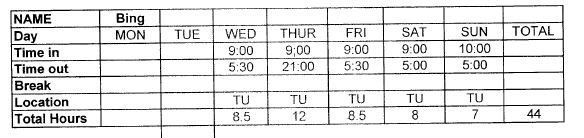
326 For the same pay period, the Xibing Cen Timesheets 2, produced by BSKL in response to the Fifth BSKL NTP, contain different starting and finishing hours and a half hour lunch break each day, reducing Ms Cen’s hours for the week to 33. They are also in a different format:
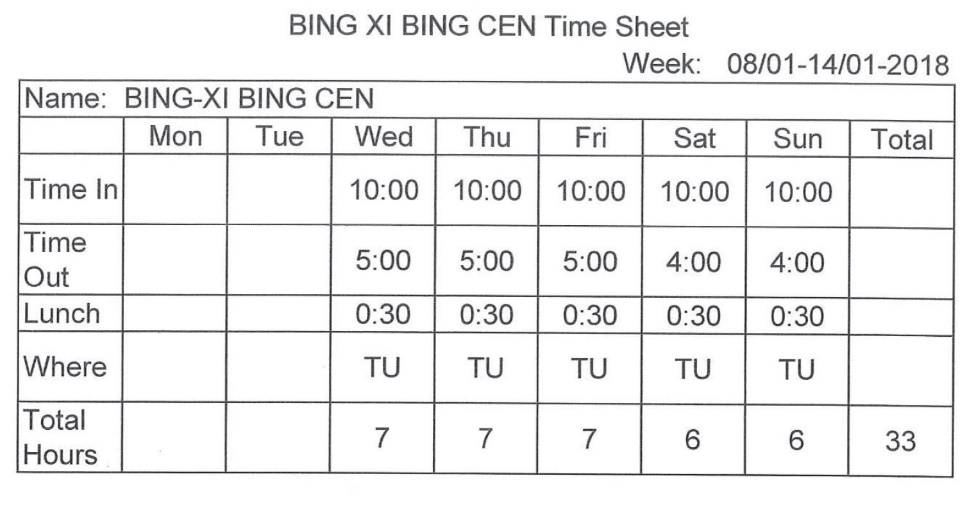
327 The “marked up” timesheets for Xibing Cen, exhibited to Mr Gu’s affidavit (at tab 14 of exhibit GG), paint yet another picture. For the same pay period they reproduce the timesheet in Xibing Cen Timesheets 1, making no allowance for lunch breaks, with handwritten alterations which reduce the hours she worked each day and therefore the overall hours to 37:
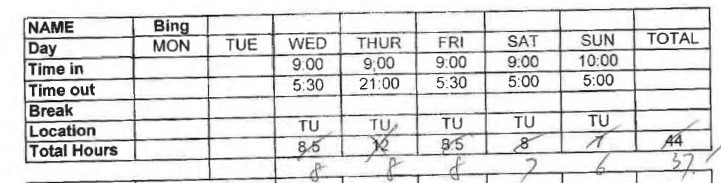
328 I am satisfied that the timesheet in Xibing Cen Timesheets 2 are incorrect and that the timesheet in Xibing Cen Timesheets 1 is correct and therefore so, too, are the Ombudsman’s calculations.
329 Ms Cen deposed that from on or about 14 January 2018 until 9 June 2018 she was paid in cash. She said her wages were generally brought to her in an envelope with a post-it note or small slip of paper recording the total amount paid. Annexed to her affidavit and marked XC-6 were photographs of such documents. The Ombudsman submitted that in the week from 8 to 14 January 2018 the slip of paper showed that she was paid $572 and calculates that, based on her evidence that she was paid $13 an hour, she would have worked 44 hours that week, not 33 hours as the timesheet for the same pay period in Xibing Cen Timesheets 2 purports to show. While the figure said to be $572 is not entirely clear, Ms Cen deposed that on 1 February 2018 Mr Gu gave her a post-it note with her name and $572 written on it which recorded a cash payment made to her at the same time she received the post-it note related to the work she performed in the period from 8 to 14 January 2018. She was not challenged on this evidence and I accept it. Mr Gu’s evidence in chief was that Ms Cen’s timesheets were “adjusted” in accordance with certain procedures. He said that:
The mark ups and corrections that are shown on Cen’s timesheets and that are annexed to this affidavit (see below) were mostly performed by me. If I was not in the office, Lisa, Yan Wang, Melton Qiao, Fei Yang, would do these mark-ups. I made these mark-ups and corrections of the timesheets to reflect the actual hours Cen worked. Every time I mark up the timesheet and made a payment in accordance with the amended timesheet, I would either call Cen or have a face-to-face conversation with Cen similar to the following:
Nathan: You recorded your time wrong for this week. The store closed at 5PM on Wednesday but you recorded it as closed at 6PM, so I need to reduce one hour from your timesheet for Wednesday. Or I need to reduce 30 minutes from your timesheet for the lunch break.
Cen: Ok. No problem.
330 In her second affidavit, Ms Cen refuted this evidence. She said she never spoke to Lisa, Yan Wang or Mr Gu about any irregularities in timesheets and as far as she was aware her timesheets were never amended by any of these people.
331 I do not accept Mr Gu’s evidence in this regard.
332 First, Ms Cen was paid in accordance with the information recorded in the timesheet contained in Xibing Cen Timesheets 1, produced to the Ombudsman in response to the First and Second BSKL NTPs, not in accordance with any “adjusted” timesheet.
333 Second, Ms Cen did not record the time the store closed in any of the timesheets; she recorded the time she ceased work (“time out”).
334 Among the documents downloaded from a computer at the Villawood warehouse was the Blue Sky Kids Land Code of Practice and Obligations. It showed that BSKL required its employees to undertake work both before and after the closing time of the store as well as during so-called lunch breaks. It included the following directions:
1. All the employees are required to arrive 10 minutes earlier to do all kinds of cleaning and sanitation work, including wiping up the counter (surface and interlayer) and the stools and shelves, and cleaning the display windows and mirrors, and to check whether the goods on the shelves and on the stage are arranged in order according to the sizes, thereby making preparations for opening the door.
2. Before getting off work, employees shall complete all the cleaning work (such cleaning work includes dusting, mopping the floor, cleaning the floor of the changing room and the storage room, and sorting out the goods and articles). When there are no customers, the employees can only pull down the door 2 minutes before getting off work. Then they will check out the accounts, count the cash and card accounts, and indicate the details on lay-by and refund money.
3. Those employees who come to work late and leave early shall make up their working hours consciously. Otherwise, money for such insufficient working hours shall be deducted from their salary.
4. The storage room shall be sorted out at least once a week, where goods shall be arranged neatly, with the side containing the size put outwards to facilitate the search for and counting of the goods.
…
335 Third, none of the timesheets in annexure XC-2 or Xibing Cen Timesheets 1 referred to lunch breaks for Ms Cen, so if Mr Gu’s evidence were correct, he would be speaking to her every week to inform her that alterations had been made to the timesheets and he gave no such evidence. Ms Cen gave unchallenged evidence that she did not have a lunch break. She deposed that she ate lunch in a backroom of the store from which she would emerge to serve customers. Considering that the store was supposed to be open throughout shopping hours, the notion of a lunch break for employees working on their own was illusory.
336 Mr Gu’s attention was drawn in cross-examination to the Tuggerah shop timesheets in annexure XC-2 which show that there were a number of occasions when not just Ms Cen but other employees finished work after 5pm. The records show staff finishing variously at 5pm, 5.30pm, 6pm and even 7pm on days other than a Thursday when the shop was supposed to be open until 9pm. Mr Gu agreed that those records suggested that, even if the shop closed at 5pm, there was work for the employees to do after 5pm. He also agreed that his practice was not to pay employees for work performed after closing time. But he claimed to have obtained their consent for that. As the Ombudsman submitted, however, ex post facto consent to a reduction in working hours is not a lawful excuse for not paying wages for work performed by employees.
337 Mr Gu deposed that the timesheets in annexure XC-2 were incorrect and offered two “examples”. First, he pointed to the timesheet which records that on 23 January 2018 Ms Cen started work at 9.30am when she sent messages to the BSKL WeChat group, saying she was “stuck on the train until after 9:33am”. Second, he said that the Tuggerah store often opened at 9.30am or 10.00am when Westfield required the store to be opened at 9.00am and Ms Cen’s timesheets were adjusted to reflect that.
338 Tab 18 of exhibit GG contained a screenshot of the WeChat message and a translation, as well as emails from the centre management advising that the store was not open for business on several days or at particular times contrary to the trading hours of Westfield Tuggerah. They were all day on Thursday, 26 January 2017; Tuesday, 25 April 2017; Monday, 12 July 2017; Monday, 2 October 2017; Sunday, 11 March 2018, Saturday, 31 March 2018; Sunday, 1 April 2018; Easter Sunday, 16 April 2017; and at the following times: 5.15pm on 22 February 2017; 8.00pm on 11 May 2017; 8.15pm on Thursday, 21 July 2017; 6.30pm on 7 June 2017; 4.30pm on Sunday, 19 November 2017; 8:30pm on Thursday, 1 February 2018; 4pm on 17 February 2018; 7.45pm on Thursday, 1 March 2018; 7.30pm on Thursday, 8 March 2018; 8.00pm on Thursday, 15 March 2018; 4.10pm on Sunday, 18 March 2018; 9.25am on Wednesday, 19 April 2017; 4:30pm on Sunday, 25 March 2018; 10.30am on Monday, 2 April 2018; 5.00pm on Friday, 6 April 2018; 4:30pm on Sunday, 13 April 2018; 6.30pm on Thursday, 24 May 2018; 4.15pm on Sunday, 27 May 2018; and 6.00pm on Thursday, 31 May 2018.
339 The correspondence from the Westfield Tuggerah centre management advice that the trading hours were 9.00am to 5.30pm on Monday to Wednesday and Friday; 9.00am to 9.00pm on Thursday (except on 26 January 2017 when it closed at 5.00pm); 9.00am to 5.00pm on Saturday; and 10.00am to 5.00pm on Sunday.
340 Ms Cen was cross-examined about both the Tuggerah store closures and the WeChat messages she sent on 23 January 2018.
341 First, Mr Gu asked Ms Cen whether she was aware that the Tuggerah store had received numerous complaints from the shopping centre that she was not opening or closing the store according to the trading hours or even in the middle of the trading hours. She replied that she was unaware and asserted that it did not happen on her roster. She said she always abided by the company’s requirements with respect to the opening and closure of the store and she was never late.
342 Second, Ms Cen was taken to the WeChat messages which indicated that she was late on 23 January 2018. The message was admitted into evidence as Exhibit 4. During the hearing neither Mr Gu nor the Ombudsman was able to point to an English translation in the Court Book, but the interpreter translated it into English as follows:
2018 January 23 at 9.33
XIBING CEN: To Boss and Leader, this morning, the train looks like crazy. From the time I left my home, I was informed that we need to transfer from bus and the bus only arrives while we are being waiting for the adjustment. The train’s not coming. The bus is not coming. It’s possible that I will be late.
The train’s moving, thank God.
FEI [YANG]: Don’t be too much panic.
343 When it was put to Ms Cen that she contacted Fei Yang from a train at 9.33am on 23 January 2018 to say she was running late (the subject of the WeChat message in exhibit GG tab 18), Ms Cen said she could not recall it but that, if something happened to delay her, she always reported it to the company. After she was taken to the WeChat message itself, she pointed out that by the time she sent the message, the train was already moving after having been stuck at Wyong station, so she must have been “several minutes late”. According to the Transport NSW website, the duration of the train journey from Wyong Station to Westfield Tuggerah station is 10 minutes. There is no evidence to indicate that she started work on that day at 10.00am as the timesheet for that day in the Xibing Cen Timesheets 2 bundle represents. Nor was any evidence adduced to show that she was told she would be docked wages for the time she was late.
344 Ms Cen was asked how many times such a situation had occurred during her employment. Her answer — “two or three times” — was not challenged.
345 Curiously BSKL produced no timesheet for the pay period 22 to 28 January 2018 in response to the First and Second BSKL NTPs. Rather, it produced a handwritten note which showed that she worked 8 hours on 23 January 2018 (a Tuesday) and 24 January 2018, 11.5 hours on (Thursday) 25 January 2018, 8 hours on 27 January 2018 and 7 hours on 28 January 2018, totalling 42.5 hours, which is half an hour shy of the hours recorded in the timesheet for the same period included in annexure XC-3. It reduced the hours included in the XC-3 timesheet for the Thursday by half an hour and made no reduction to the timesheet for the Tuesday.
346 Contrary to the Ombudsman’s submission, Ms Cen did not give evidence that she did not work on the days listed in the Westfield correspondence. Rather, in her affidavit in reply she pointed out (correctly) that the timesheets she provided in annexure XC-2 to her first affidavit showed that she did not work on the days the centre management said the store was closed; on 21 July 2017 when the centre management said that the store closed at 8:15pm; or on 1 February 2018 when the management said the store closed at 8.30pm. She did not, however, address the other dates the subject of the complaints.
347 Whether or not Ms Cen claimed to have worked on the days or times the centre management said the store was closed, however, is irrelevant to any fact in issue, because the Ombudsman’s claim is confined to representations in the Xibing Cen Timesheets 2 about hours worked in the period from 11 December 2017 to 28 January 2018 and none of the reported closures occurred on days or times in this period. Her attention was not drawn in cross-examination to a timesheet for any of those days. Nor was I taken to any evidence to indicate that Ms Cen was reprimanded or even questioned about any of the reported closures or that her wages were reduced because she did not work on a day included in the timesheets in annexure XC-2, as might reasonably be expected if the reported closures were due to fault on her part.
348 In cross-examination Mr Gu confirmed that the practice was for timesheets to be faxed weekly from each store to the Villawood warehouse but said that sometimes they were sent to the office email address. He also confirmed his earlier evidence that he would check the timesheets against what he understood to be the agreed hours worked and, if he thought there were differences, the general practice was that he or a member of his staff would make handwritten annotations on the timesheets. Yet, timesheets in Xibing Cen Timesheets 2 (produced in response to the Fifth BSKL NTP) differed from both those in XC-2 and those produced in response to the First BSKL NTP (Xibing Cen Timesheets 1).
349 Mr Gu’s attention was drawn to one such document during cross-examination which, like all the timesheets in annexure XC-2 to Ms Cen’s affidavit and those in Xibing Cen Timesheets 1, recorded the times worked for all staff employed at the Tuggerah store during the weeks they covered. That was a timesheet for 12 December 2017 which, in contrast to the timesheets for the same day contained in annexure XC-2 and the Xibing Cen Timesheets 1, recorded only Ms Cen’s hours, contained no handwritten annotations, included a half hour break for lunch each day, and referred to her by both her full name and her nickname (Bing). All the timesheets produced in response to the Fifth BSKL NTP were of the same kind. None of them referred to other employees who worked during the week covered by the timesheet, none contained handwritten annotations or alterations, and all included a half hour break for lunch. Mr Gu acknowledged that the timesheet for 12 December 2017 produced in response to the Fifth BSKL NTP did not contain any handwritten annotations. He said it was a document he found and denied it was a new creation. He said it was created in December 2017 and “definitely not by [him]” and that timesheets of this kind were created only where a “further explanation” was required and where changes had been made. The only handwritten “annotations” or “adjustments” appeared in the timesheets contained in tab 14 of exhibit GG to Mr Gu’s affidavit.
350 I am satisfied on the evidence, contrary to Mr Gu’s assertions, that the various “adjustments” Mr Gu made to Ms Cen’s timesheets were made unilaterally. That is to say they were made without her consent. With the exception of the two or three occasions when Ms Cen was running late, I am not satisfied that the entries in the timesheets in annexure XC-2 were incorrect. Those two or three occasions pale into insignificance when compared to the changes to the timesheets to correlate her finishing times to the times the store closed when, like other employees, she worked beyond closing time. Moreover, I cannot accept Mr Gu’s evidence that the so-called adjustments were made before the wages were paid, not least because the payment made in cash to Ms Cen on 1 February 2018 shows otherwise.
351 Further, I am satisfied that the Xibing Cen Timesheets 2 were false or misleading and that Mr Gu (and therefore BSKL) knew they were, both at the time the amendments were made and at the time BSKL produced the Xibing Cen Timesheets 2 to FWI Liljeqvist. As Mr Gu was responsible for paying the Employees’ wages by reference to the timesheets he received from the stores and he had a role in amending those timesheets, he undoubtedly knew that the timesheets in Xibing Cen Timesheets 2 were false.
352 Consequently I am satisfied that BSKL contravened s 535(4) by making and keeping the amended timesheets and that BSKL contravened s 718A by producing them to FWI Liljeqvist.
Jin Zhang Payroll Register Documents 1 (JZPRD#1) – incorrect net amounts
353 The Ombudsman alleges that certain payroll register documents relating to Ms Zhang were also false or misleading to the knowledge of BSKL. They were the payroll register documents which recorded the net pay received by Ms Zhang for the periods 7 August to 26 November 2017 and 18 December 2017 to 7 January 2018. These documents were among those produced to the Ombudsman on 12 March 2018 in response to the First Q Fay NTP. The Ombudsman contends that they were false or misleading because, contrary to the representations made in them that Ms Zhang received a total net amount of $6,935.62, she actually received $8,723. The Ombudsman’s figures were derived Ms Zhang’s evidence including the hourly rates at which she said she was paid and the figures appearing on the envelopes annexed to her affidavit. A comparison of the figures on the envelopes to the figures in JZPRD#1 and tab 1 of exhibit GG appears in annexure E to the Ombudsman’s submissions.
354 BSKL did not admit the allegations and Mr Gu and Fei Yang deny that JZPRD#1 record that Ms Zhang was paid the first figure and that she received the second. Mr Gu relied on tab 1 of exhibit GG, which was a payroll register document not previously produced to the Ombudsman or to FWI Liljeqvist, asserting in his affidavit that that document was a copy of Ms Zhang’s payroll. The document in tab 1 of exhibit GG is an amended version of JZPRD#1. The figures it contains are different from those appearing in documents produced in response to the First Q Fay NTP.
355 Both JZPRD#1 and tab 1 of exhibit GG purport to be payroll records relating to Ms Zhang which contain the wages paid to her, the amount of tax on those wages, and her net pay. Neither of them include any payment for superannuation in any of the periods included in the documents. JZPRD#1 differs from tab 1 of exhibit GG in three respects. First, JZPRD#1 does not include any reference to the hours for which the asserted wages were said to have been paid. Second, tab 1 of exhibit GG records payments that do not appear in JZPRD#1. Third, tab 1 of exhibit GG contains alterations to most of the figures.
356 Ms Zhang annexed to her first affidavit all the envelopes she had retained in which she received her salary. Affixed to some of those envelopes were post-it notes that were included inside the envelope at the time of receipt. She deposed that she provided all the envelopes she had and may have lost some or thrown them away because she did not think she would need to keep them. Unfortunately, not all the envelopes show the amounts paid, although it is uncontentious that during the times they cover, Ms Zhang was working at one or more BSKL stores.
357 The amounts recorded on the envelopes given to Ms Zhang and annexed to her first affidavit do not correspond to the net figures recorded for the same period either in the payroll register produced to the Ombudsman in response to the First Q Fay NTP or those recorded in JZPRD#1. If correct, the document in tab 1 of exhibit GG indicates that JZPRD#1 did erroneously record Ms Zhang’s net pay during the periods in question. Mr Gu deposed that he did not believe the documents to be false or misleading, while at the same time representing that the net amounts paid to Ms Zhang during the periods in question were different from, and even greater than, the amounts for which the Ombudsman contends.
358 In his affidavit Mr Gu deposed that cash payments were made by putting the cash in an envelope with a note recording the amount of money contained in the envelope and the hours the employee worked during the relevant pay period and the envelopes would be delivered to the employee, usually by him but if he was not available by others. He claimed that Q Fay maintained JZPRD#1 at all material times and updated it from time to time. He also claimed that the company paid tax and superannuation payments, although at all times $0 was recorded in JZPRD#1 for superannuation and the amounts of tax said to have deducted from week to week in JZPRD#1 differed from the amounts recorded in tab 1 of exhibit GG. As I explain later, the records said to prove that Mr Gu paid tax do no such thing.
359 Mr Gu testified that his practice was to record the amounts on the payroll register at the same time he was making the cash payments. Yet in cross-examination he conceded that the amounts in JZPRD#1 were inconsistent with amounts recorded on slips of paper provided to Ms Zhang at the time she was paid. He acknowledged that wages for all employees paid in cash was placed in envelopes and the money was inserted at his direction. He claimed to have recorded the amounts of cash paid to Ms Zhang on a piece of paper other than the payroll register which was never provided in answer to any of the notices to produce and which he did not retain.
360 The Ombudsman submitted that the document in tab 1 of exhibit GG is largely accurate when compared to the figures on the envelopes. I took the Ombudsman to mean that, where figures appear on the envelopes (either directly or on a post-it note affixed to the envelope) the figures in the “Net Pay” column of the document in tab 1 of exhibit GG are either the same as. or close to, the figures appearing on the post-it notes and envelopes kept by Ms Zhang and annexed to her first affidavit. She submitted that the production of the document in tab 1 of exhibit GG gives rise to the following inferences: first, that Mr Gu obviously had a source of information which allowed him to create the documents and must have had the same information at the time he created JZPRD#1; and, consequently, that Mr Gu must have known that representations in JZPRD#1 were false at the time the document was created (and at the time it was produced to FWI Liljeqvist). On Mr Gu’s own evidence, he generally recorded the information in the payroll register at or around the same time as he put the cash amounts in the envelopes and wrote on the envelopes and post-it notes or someone else was doing that at his direction.
361 Neither the gross pay nor the net pay recorded in JZPRD#1 corresponds to either the cash amounts that Zhang claims to have received or the figures on the envelopes. As no hours are recorded in the document, it is impossible to discern the rate of pay applied to produce the amounts that appear there. It is common ground that JZPRD#1 is completely unreliable. Though it does not presently matter, there are a number of difficulties with the document at tab 1 of exhibit GG which persuades me that it, too, is unreliable. But I will come to that later.
362 I conclude that JZPRD#1 was false or misleading because Ms Zhang did not receive a total net amount of $6,935.62 and because it understated Ms Zhang’s net pay during the periods in question, and that Mr Gu (and therefore BSKL and Q Fay) knew that it was false or misleading. By the Ombudsman’s reckoning, based on Mr Smith’s calculations, Ms Zhang received a total net amount of $8,723. Mr Gu effectively conceded the falsity of JZPRD#1 by exhibiting to his affidavit (at tab 1 of exhibit GG) payroll documents that purport to show that Ms Zhang received a total net amount of $9,091 in the same period.
363 It follows that I am satisfied that, to this extent, BSKL and Q Fay contravened s 535(4) by making and keeping a record for the purposes of s 535, namely JZPRD#1, which it knew was false and misleading, and I am also satisfied that, by producing JZPRD#1 to FWI Liljeqvist, BSKL and Q Fay contravened s 718A.
North Rocks Timesheets, Baulkham Hills Timesheets and Jin Zhang Timesheets – incorrect hours worked by Jin Zhang in the period from 27 November 2017 to 28 January 2018
364 The North Rocks Timesheets are timesheets for the period 27 November 2017 to 28 January 2018 relating to the North Rocks store produced to FWI Liljeqvist by BSKL on or about 8 February 2018 in response to the First and Second BSKL NTPs. The Baulkham Hills Timesheets are timesheets for the period from 3 July 2017 to 25 February 2018 relating to the Baulkham Hills store produced by Q Fay to FWI Liljeqvist on 12 March 2018 in response to the First Q Fay NTP. The Jin Zhang Timesheets are timesheets showing the hours Ms Zhang purportedly worked from 29 August 2016 to 18 February 2018 produced by BSKL on 29 June 2018 in response to the Third BSKL NTP and the Fourth BSKL NTP.
365 As I mentioned earlier, the Ombudsman does not press the allegation that BSKL (or, alternatively Q Fay) contravened s 535(4) by making and keeping these documents, as alleged in her pleadings at [61]–[66], but she presses her allegation that by providing them to FWI Liljeqvist BSKL contravened s 718A.
366 The Ombudsman alleges at [61]–[66] of her pleading that in the period from 27 November 2017 to 28 January 2018 each of the North Rocks Timesheets, Baulkham Hills Timesheets and Jin Zhang Timesheets were false or misleading because they did not correctly record Ms Zhang’s start or finish times and because they recorded Ms Zhang as working on dates when she did not work at all or did not work at the store recorded on the Timesheets.
367 While the Employers do not admit these allegations, Mr Gu and Fei Yang do. In the absence of a challenge by the Employers and in view of the admissions by Mr Gu and Fei Yang, I am satisfied that the timesheets were false or misleading because they did not include the correct hours worked by Ms Zhang in the period from 27 November 2017 to 28 January 2018.
368 The Ombudsman also alleges that the North Rocks Timesheets were false or misleading because they recorded that Jin Zhang worked at the North Rocks store on the dates set out in table 1 of schedule B to her pleading when in fact she worked at the Baulkham Hills store on those date and that the Jin Zhang Timesheets were also false or misleading as they recorded that she worked at the Baulkham Hills store on the dates set out in table 2 of schedule B when in fact she worked at the North Rocks store on those dates. Both schedules are reproduced as schedules to these reasons.
369 The Ombudsman alleges that the Employers knew or were reckless as to whether the representations in the respective documents were false or misleading when they were produced to FWI Liljeqvist. Annexure F to the Ombudsman’s closing submissions compares the start and finish times as recorded in the various timesheets against Ms Zhang’s Opal Card records upon which she and the Ombudsman relied to establish where and when she worked.
370 The Employers did not admit these allegations and Mr Gu and Ms Yang denied them.
371 As the Ombudsman submits, although an employer is not obliged under the FW Regulations to make or keep a record of the place an employee works, such that making or keeping a document of this nature knowing it to be false or misleading is not a contravention of s 535(4), it is a contravention of s 718A(1) of the FW Act to produce a document of this nature to a Fair Work Inspector exercising powers or functions under the FW Act knowing, or being reckless as to whether, the document is, or contains information that is, false or misleading.
372 In view of the admissions by Mr Gu and Ms Yang to the allegations in [61]–[66] of the Ombudsman’s pleading, I conclude that they admit that Ms Zhang worked at different stores to those recorded in the relevant timesheets. In any event the evidence from Ms Zhang’s Opal records is powerful evidence in support of the allegations.
373 I am satisfied that all of the relevant representations were false or misleading.
374 The remaining question is whether BSKL knew, or was reckless as to whether, the documents were false or misleading. The Ombudsman did not press her allegation that Mr Gu knew that they were false or misleading and I therefore infer that she did not press her allegation that BSKL had such knowledge. But she did persist with the alternative allegation that he was reckless as to whether they were false or misleading.
375 The Ombudsman relied on the following evidence: Mr Gu was admittedly responsible for calculating the Employees’ pay and paying their wages using the timesheets he received from his wife; he reviewed and amended timesheets; noted irregularities in timesheets to make sure that they did not record to employees working on the same day in two different stores; and he conceded in cross-examination that he produced to the inspector multiple versions of the timesheets despite not knowing whether they were true. The latter concession appears in the following exchange:
MR SECK: It cannot be true, Mr Gu, that the North Rocks timesheets and the Baulkham Hills timesheets are both correct, because Ms Jin Zhang could not be working both at the Baulkham Hills store and at the North Rocks stores on the same days.
HER HONOUR: Or between 9 and 5 or 9 and 5.30 on the same days.
MR SECK: Yes. Between 9 and 5 or 9 and 5.30 on the same days.
MR GU THROUGH THE INTERPRETER: That’s right.
MR SECK: And do you say she was working at Baulkham Hills or North Rocks on 27, 28 and 29 December 2017?
MR GU THROUGH THE INTERPRETER: I confirmed based on the information on the timesheet.
MR SECK: Answer my question, Mr Gu. Do you say that Jin Zhang was working at either North Rocks or Baulkham Hills on 27, 28 and 29 December 2017?
MR GU THROUGH THE INTERPRETER: Both locations are possible. It depends on which one she filled out. She could only work at one store, so one timesheet must be wrong.
MR SECK: You just don’t know which timesheet is wrong, is that your point, Mr Gu?
MR GU THROUGH THE INTERPRETER: I don’t really know.
376 As both versions of the timesheets could not be true, one of them must have been false. Mr Gu either closed his eyes to the obvious when he produced them to FWI Liljeqvist or knew that one was false, yet produced them both to the inspector, not caring whether they were false. It follows that Mr Gu produced them to the inspector reckless as to whether the information in them was false or misleading.
377 For the above reasons I find that:
(1) on or about 8 February 2018 BSKL contravened s 718A(1) of the FW Act by producing to FWI Liljeqvist the North Rocks Timesheets;
(2) on 12 March 2018 Q Fay contravened s 718A(1) of the FW Act by producing to FWI Liljeqvist the Baulkham Hills Timesheets and JZPRD#1; and
(3) on 29 June 2019 BSKL contravened s 718A(1) of the FW Act by producing to FWI Liljeqvist the Jin Zhang Timesheets.
Failure to include information in employee records in contravention of s 535(2)(b) of the FW Act
378 The Ombudsman pleaded that the Employer contravened s 535(2) because it failed to include in an employment record the following information:
(1) the correct date on which Xing Yang’s employment began, contrary to the requirement in reg 3.32(e);
(2) the correct net amounts paid to Xing Yang in the period from 6 February 2017 to 11 June 2017, contrary to the requirement in reg 3.33(1)(b);
(3) the correct net amounts paid to Xibing Cen in the period from 24 November 2017 to 24 December 2017, contrary to the requirement in reg 3.33(1)(b);
(4) the correct net amounts paid to Jin Zhang in the periods from 7 August 2017 to 26 November 2017 and from 18 December 2017 to 7 January 2018, contrary to the requirement in reg 3.33(1)(b); and
(5) the correct hours worked by Xibing Cen in the period from 11 December 2017 to 28 January 2018, contrary to the requirement in reg 3.33(2).
379 The Employers did not admit the allegations. Mr Gu and Fei Yang admitted the first allegation but denied the others.
380 The information in question is information contained in some of the documents the subject of the previous section, which were produced in response to FWI Liljeqvist’s notices to produce. The first allegation arises from the inaccuracies in the Xing Yang Employment Details Forms; the second arises from the inclusion in the Xing Yang Payroll Register Document of amounts earned by and payable to Ms Li, the third arises from the inconsistencies between the amounts deposited into Ms Cen’s bank account and the net wages for the same periods in the Xibing Cen Payroll Register Document 1, the fourth arises from the failure to include in the Xibing Cen Timesheets 2 the hours Ms Cen actually worked.
381 The Ombudsman’s contention is that the obligation imposed by s 535(2) to include “information” prescribed by the Regulations is an obligation to include accurate information. If that contention is right, then it must follow from my findings that the information in question was false that BSKL contravened s 535(2).
382 The Ombudsman referred to one authority in support of her contention. That was Fair Work Ombudsman v Mai Pty Ltd [2016] FCCA 1481 at [91]–[93] in which an employer was found to have contravened s 536(2), the analogue of s 535(2), by providing employees with pay slips containing inaccurate information. In that case, however, the respondents admitted they were liable for these contraventions (see [7]) and the finding was made solely on the basis of the admissions.
383 Be that as it may, having regard to the legislative purpose, the Ombudsman’s contention must be accepted. The objects of the FW Act include “ensuring a guaranteed safety net of fair, relevant and enforceable minimum terms and conditions” (s 3(b)) and “providing effective compliance mechanisms”. At least one evident purpose of s 535 is to further these objects by ensuring that a person with an interest in furthering these objects (such as an employee, a registered organisation or the Ombudsman) is able to readily ascertain whether the minimum terms and conditions have been met. The simplest example is determining whether or not the employee is being paid the right rate under the right award for the work they are engaged to perform. Before the commencement of the Protecting Vulnerable Workers Amendment Act, an employee, registered organisation or the Ombudsman who could not provide satisfactory evidence of employment or that work had been performed at certain times or on certain days, such as weekends, public holidays or when overtime rates applied, would fail to make out a claim for unpaid wages or entitlements. It must therefore be taken to be implicit that the “information” an employer is required to include in a record is accurate one.
384 I therefore make the following findings.
385 For the reasons given above (at [285]), the first allegation is made out. The Xing Yang Employment Details Forms recorded two different commencement dates for Xing Yang, both of which were incorrect. The timesheets made and kept by BSKL show that Xing Yang had been working for nearly two years before the date included on Form 1 and for more than one year before the date included on Form 2. I therefore find that BSKL contravened s 535(2) by failing to include in its records the date on which Xing Yang’s employment began.
386 For the reasons given above (at [303]), the second allegation is made out. BSKL contravened s 535(2) by failing to include in its records that the net amount paid to Ms Yang during the period 6 February to 11 June 2017 as it included wages payable to Ms Li.
387 For the reasons given above (at [316]), the third allegation is made out. BSKL contravened s 535(2) by failing to include in the Xibing Cen Payroll Register Document 1 her net wages for the period 27 November to 24 December 2024 as the net wages it included in that document for that period did not correspond to the amounts it transferred into Ms Cen’s bank account for the same period.
388 For the reasons given above (at [363]), BSKL contravened s 535(2) by failing to include in JZPRD#1 the net amounts that were paid to Ms Zhang in the periods 7 August 2017 to 26 November 2017 and 18 December 2017 to 7 January 2018 in that it did not include the wages that were actually paid to her during those periods.
389 For the reasons given above (at [352]), BSKL also contravened s 535(2) by failing to include in the Xibing Cen Timesheets 2 the hours Ms Cen actually worked during the period from 11 January 2017 to 28 January 2018.
THE ALLEGED AWARD CONTRAVENTIONS
390 Section 45 of the FW Act provides that a person must not contravene a term of a modern award. A person does not contravene a term of a modern award and a modern award does not give a person an entitlement, however, unless the award applies to the person (FW Act, s 46). It is unnecessary to prove that the respondents knew of the existence of the award or the term which was contravened; nor is it necessary to prove that they intended to contravene the award: EZY Accounting 123 Pty Ltd v Fair Work Ombudsman [2018] FCAFC 134; 360 ALR 261; 282 IR 86 at [9] (Flick, Bromberg and O’Callaghan JJ).
391 The Employers’ Amended Defence was filed before Mr Gu and Fei Yang waived reliance on the penalty privilege. Thus, they claimed not to know and to be unable to admit the allegations made in relation to Ms Cen, Ms Yu and Ms Zhang. In the case of Ms Yu, they denied the allegations pleading that they did not employ her.
The evidence from the Employees
392 In this part of the judgment I summarise the evidence given by the Employees which bears on most of the allegations that their Employer(s) contravened various terms of the Award which give rise to the Ombudsman’s allegations that BSKL or, in the alternative in Ms Zhang’s case, Q Fay, contravened s 45 of the FW Act.
393 Ms Cen deposed that, a few days after she was interviewed for a job with BSKL, she was telephoned by “Fay”, who I take to be Fei Yang, who introduced herself as a manager for all BSKL stores. During the course of the conversation Fay told her she would be paid $60 a day while training, after which she would be paid $10 an hour. While training she was in fact paid $60 a day. On those days she worked from 9.00am to 5.30pm on weekdays, 9.00am to 5.00pm on Saturdays, and 9.00am to 4.00pm on Sundays.
394 When Ms Cen first started working for BSKL she was paid $10 an hour for all hours of work, including Saturdays, Sundays and public holidays. She said she worked on at least two public holidays; on (Monday) 27 December 2016 and (Monday) 2 January 2017. After about one year, in or about November 2014, Fay sent her a message to inform her she would be receiving a raise of $1 an hour after which her pay rate increased to $11 an hour. She received a similar message about 12 months later and her pay rate increased to $12 an hour. In about November 2016 she received another such message and her pay rate increased to $13 an hour. In 2018 her pay rate increased again, though she could not recall the “exact amount” she was paid.
395 Ms Cen’s wages were paid by electronic bank transfer into a joint account she held with her husband except for a period from about 14 January 2018 to 9 June 2018, during which she was paid in cash.
396 Ms Cen complained about her low rate of pay or asked for a pay rise on several occasions during her employment. She recalled one such instance in about December 2016 when she spoke to Fay who had come to the store to check on her. This was her account of the conversation:
Ms Cen: “I would like a pay rise,”
Fay: “This is the best we can pay you,”
Ms Cen: “Other people get paid a lot more than us.”
Fay: “Our business is not doing great. If you don’t want to work that is fine, but lots of people would work for this kind of pay.”
397 Ms Cen worked at the Tuggerah and Erina stores on the NSW Central Coast until the Erina store closed about a year after she began working for BSKL, after which she worked exclusively at the Tuggerah store except for one or two occasions when she was asked to cover a shift for someone at the Kotara or Charlestown stores. I referred above to her hours of work.
398 Ms Cen was not given any set breaks while working. When she wanted to eat lunch, she would usually eat in the room at the back of the shop and if a customer came into the store while she was eating, she would put her lunch down and attend to the customer.
399 After the Fair Work Inspectors attended the Tuggerah store in January 2018, Ms Cen, together with other colleagues, was asked to attend a meeting at the café outside the BSKL store. Mr Gu was there. He asked her what evidence the officers took away from the store and then gave her a tax file declaration form and a superannuation nomination form. She had never previously been provided with these forms. He told her:
You need to fill in your name, address and tax file number, and then leave the rest of the form for me to fill in. You don’t need to fill in the date, any payment information or any information about being part-time, full-time or casual.
400 When Ms Cen returned home that day, she took the forms with her. She deposed that her husband told her not to sign the forms because she would not be filling in all the information herself. Accordingly, she wrote her name, date of birth, address and telephone number and her husband wrote the tax file number but she did not sign the forms.
401 Ms Cen gave unchallenged evidence that she had never previously been provided with those forms. In cross-examination Ms Cen was questioned about her refusal to sign the forms. She adhered to her evidence in chief and I accept that evidence. Her position was both reasonable and prudent.
402 Ms Cen’s employment came to an abrupt end on or about 7 June 2018 when she turned up at work at the Tuggerah store only to find that the EFTPOS machine was not working and the store telephone had no dial tone. A manager from Westfield entered the store and told her the shop was going to be closed and had to be vacated by the following Tuesday. She worked her last shift on 9 June 2018.
403 Xing Yang deposed that she began working for BSKL in May 2011. She undertook 12 days of training for which she was paid $60 a day. Like Ms Cen, when she started work she was not asked to provide her tax file number or information about superannuation. After she completed her training, she started working at the Kotara store and in August 2011 she worked at the Charlestown store. She became a full-time employee at the end of July 2012 and continued as such until the Kotara store closed after which, as I have said, she was engaged as a casual employee within the meaning of that term in the Award.
404 At the Charlestown store Ms Yang worked the hours the shopping centre was open, with the result that she worked a 12 hour shift on Thursdays.
405 Ms Yang was initially paid in cash. Mr Gu would come to the store and give her the money in an envelope. “After 2012” she was paid by electronic funds transfer. Copies of her bank records from 26 November 2011 to 24 June 2017 were annexed to her affidavit.
406 The evidence in her affidavit about her pay rates is confusing and the confusion was not clarified in oral evidence. She deposed:
When I first started working at BKSL, I was paid $10 per hour after tax, then it was increased to $11 per hour after tax and then it was increased to $13 per hour before tax. Before I left BSKL, my hourly wage was increased to $15 per hour before tax.
407 That evidence reflects what she wrote in her request to the Ombudsman for assistance, a copy of which appears in tab 2 of exhibit SAL-1 to FWI Liljeqvist’s first affidavit.
408 Ms Yang deposed that she took the job with BSKL because she had newly arrived in Australia and needed to work. She said she was aware the pay was “not right”, believed it to be “too low”, but knew it was common for Chinese people to obtain jobs which paid similar rates and did not know Australian law and was unaware of the correct pay rates or the minimum wage.
409 Ms Yang said (at [53]) that BSKL started withholding tax from her wages sometime in 2012 but she was only asked for her tax file number when she was working at the Charlestown store and not before when she worked at the Kotara store. She said that when her pay was transferred into her bank account, “BSKL would write in the description of the transfer the amount of tax that was withheld from each pay”. She was unsure whether that was correct because she never received a pay slip. She started to receive PAYG summaries in 2012, copies of which were annexed to her affidavit.
410 She said she was unsure when the pay increases occurred as she never received a pay slip.
411 She deposed that she was always paid the same amount per hour and the amount did not increase when she worked on weekends, worked longer hours, or on public holidays. During her employment with BSKL Ms Yang worked a total of 24 public holidays.
412 Ms Yang took holidays twice while she was employed by BSKL, once in 2012 and once in 2015 but was never paid annual leave.
413 In 2017 Ms Yang learned that other businesses were underpaying staff and that gave her the confidence to approach the Ombudsman.
414 Tzu Fong Yu deposed that she was hired by Fay following a meeting outside the Westfield Woden store in early February 2017. She said that at the meeting they had a conversation to the following effect:
Fay: “We pay very low.”
Me: “Very low? How low do you pay?”
Fay: “$10 per hour is beginning. First two weeks is training so we pay $10 per hour.”
Me: “Oh, ok I need a job”.
Fay: “What hours would you like to work?
Me: “Two or three days a week. I just want to work three days part-time”.
Fay: “Do you have any retail experience?”
Me: “In Taiwan we had our own business in my own family, so retail is not a big problem for me. Only problem is communicating with the customer here.”
415 Ms Yu said she was paid $10 an hour when she started and after two weeks her pay was increased to $12 an hour and on or about 3 July 2017 to $13 per hour. She was paid by direct deposit into her bank account, amounts that corresponded to the hours she worked at the store and the pay rates as advised by Fei Yang. Her bank statements were annexed to her affidavit.
416 Ms Yu worked from 10 February 2017 until 27 February 2018 with a hiatus of several months from September 2017 when she took time off without pay for a holiday during which she was injured, returning to work at the Woden store in January 2018.
417 In around mid-February 2018 she was informed by Fei Yang that the Woden store would be closing.
418 Ms Yu deposed that she generally worked between two and five days a week, on most days starting at around 9.00 or 9.30am and finishing at around 5.30 or 6.00pm. On Fridays she would work the 9.30am to 3.00pm shift or the 2.30pm to 9.00pm shift, crossing over with another employee for about 30 minutes to an hour between the morning and afternoon shifts.
419 She usually brought her lunch from home and ate it during a quiet period in the middle of the day, taking about a 15 minute break. On occasions, she locked the store and bought her lunch somewhere in the Westfield Woden complex and returned to the store to eat it. She also locked the store once or twice a day to go to the public toilets in Westfield as there was no toilet in the store.
420 During her first period of employment at the BSKL store, Ms Yu kept a record in her personal diary of the days and hours she worked. Her affidavit contains a list of those dates and times, together with copies of documents obtained through the Google Maps app which recorded her daily movements and time stamps for the days she travelled to and from her home and the Woden store and which corroborate her diary entries.
421 From time to time, generally weekly on Saturdays or Sundays, Ms Yu would receive a roster via WeChat to tell her when and where she would be working that week. The message was sent by Lisa from head office. If she had to change a shift or was sick she called Lisa who told her to swap shifts with another employee but that was rarely necessary.
422 She was never rostered to work on a public holiday as the Woden store was always closed on public holidays.
423 Ms Yu advised that there was a computer at the store on the desk with the cash register. Each day she entered her start and finish time on a Word document on the computer. Her name appeared on the timesheets as “Serene”. She did not record any breaks. At the end of the week she printed out the timesheet for the week, took a photograph of it on her mobile phone and sent it to Lisa at head office by WeChat. Those photographs were annexed to her affidavit as were copies of the pages from her diary. She placed the timesheet in a folder which was kept in a drawer in the desk. She did not save the documents to the computer.
424 Jin Zhang deposed that she was employed to sell children’s clothes in BSKL stores from around 26 August 2016 to around 12 February 2018. Before she secured the job she had a conversation with Fay to the following effect which she recounted in her affidavit:
Ms Zhang: I saw the ad for the job to sell kids’ clothes. I have experience selling other clothes at another store in Hornsby.
Fay: It is good that you have experience. How many days do you work? Our shop is open 7 days a week.
Ms Zhang Any time, but most weeks I can only work 5 days. If you are open for more than that, there will need to be a roster.
Fay: I like it, you are easy going. How much are you currently paid?
Ms Zhang: $12 an hour.
Fay: Ok. You would start at $10 an hour, paid in cash. Later on when you get familiar with that, we will pay you $12 an hour.
425 Ms Zhang began work at the Merrylands store on 26 August 2016 and she was trained at a number of BSKL stores by different people. On or about 10 September 2016 she was asked whether she would like to work mostly at Parramatta or North Rocks and she replied North Rocks. She was given the key to both stores.
426 Ms Zhang never signed a contract but believed that, after a week’s work, she had passed her trial as Fay continued to offer her work.
427 Ms Zhang worked according to a weekly roster which was circulated on WeChat messenger by Fay. Ms Zhang typed her hours onto a timesheet on the stores’ computers. Each Sunday, whoever was working at a particular store would send the timesheet for the store by email to the blueskykidsland email address.
428 She was able to take a half-hour lunch break at the Parramatta, Hurstville and Merrylands stores where more than one employee worked each day but not at Baulkham Hills or North Rocks where she worked on her own.
429 Ms Zhang deposed that when she first started working at Blue Sky Kids Land stores she was paid $10 an hour. On 16 July 2017 Fay sent her a message on WeChat advising her that her wages would be increased. As translated, the message reads:
The boss told me to raise your salary to $12 since 14 August (Monday). Hope you could work harder, do your best to protect the Company’s benefits, and devote yourself to the Company. Thank you. Also try your best to develop the business of NR.
I infer that “NR” is a reference to the North Rocks store.
430 She understood Fay was the manager and Nathan (Mr Gu) the boss.
431 Ms Zhang then sent a text message to Mr Gu in the following terms (as translated):
Hi, boss. I’m Sery. They said you would raise my salary in August. I’ll work harder. Thank you a lot.
432 Copies of these messages were annexed to Ms Zhang’s affidavit.
433 Ms Zhang deposed that thereafter, from 14 August 2017 until she ceased work on 12 February 2018, she was paid $12 an hour. She said she did not know what other BSKL employees were paid because she never inquired.
434 It appears that, in the course of the preparation of her affidavit, Ms Zhang must have been asked whether she had ever been paid $11 an hour because at two points in her affidavit where she sent WeChat messages to Fay saying that she had been overpaid when, if she had been paid $11 an hour, she would not have been.
435 She said she was never paid extra for working on weekends and public holidays and was never paid annual leave or sick leave.
436 Ms Zhang was always paid in cash. She deposed that she had not submitted a tax return for any of the work she performed at the Blue Sky Kids Land stores because she did not earn more than $18,000 in any of the years she worked there. She also said she never received a PAYG summary or group certificate.
437 I interpolate that throughout the Assessed Employment Periods an Australian resident who earned income below the tax-free threshold of $18,200 was not required to file a tax return: see Income Tax Assessment Act 1936 (Cth), s 161(1) and the annual legislative instruments relating to the lodgment of returns for the financial years 2016-2018 made under that section.
438 Ms Zhang never spoke up about low wages during her work at the Blue Sky Kids Land stores. She said that, until she was contacted by the Ombudsman, she did not realise the wages were low because she was paid similar wages in her previous job with another Chinese employer in the retail industry and she understood that that was the going rate for work with all Chinese employers.
439 On 12 February 2018 Ms Zhang was working at the Baulkham Hills store when it was visited by the Fair Work Inspectors. There is no dispute about that. FWI Liljeqvist referred to the matter in his first affidavit and a contemporaneous file note of the visit appears in tab 11 to his affidavit.
440 The note indicates that FWI Cummings, Liljeqvist and Zheng attended the Baulkham Hills store at around 11:50am that day, that they met Ms Zhang there, showed her their badges, explained who they were and the role of the Ombudsman, before proceeding to question her about her employment. Notably, the file note records that FWI Cummings told Ms Zhang that they had already visited a number of other stores and that Mr Gu was “aware of [their] presence in making such enquiries”.
441 Ms Zhang deposed that during the course of the conversation with the inspectors she was asked how much she was paid and whether she received pay slips. She disclosed that when she was first asked, she said she was paid $20 an hour and that she gave that answer because “Nathan had told me to”. Later, however, during the visit she said she told them that she was paid $12 an hour and she did not receive pay slips. That account is supported by FWI Liljeqvist’s file note. Ms Zhang said she changed her answer because she felt bad for not telling the truth the first time. The file note indicates that she was given a warning by FWI Cummings (interpreted to her by FWI Zheng) between the first and second answer (pursuant to s 718A(5) of the FW Act) that she may be liable to a civil remedy for knowingly or recklessly providing false or misleading information.
442 Ms Zhang called Mr Gu the next day to tell him that she had spoken to the inspectors and within seven days her employment came to an end. The circumstances in which that occurred are the subject of the Ombudsman’s allegation that there was a contravention of s 340(1) of the FW Act and are discussed below in that context.
443 On 19 February 2018, five days after Mr Gu was informed that he had failed to fully comply with the First and Second BSKL NTPs and after she had stopped working for the Blue Sky Kids Land business, Ms Zhang received a voice message from Fei Yang. The content of that message was not put before the Court but what was before the Court (at tab 2 pp 301–2 of Exhibit JZ) was Ms Zhang’s text at 6.56pm that day. As translated it reads:
My working time and salary: $10/hour from 26 August 2016 to 8 January 2017. $12/hour from 9 January 2017 to 12 February 2018.
444 If there was a response from Fei Yang, it was not proffered in evidence. I infer that there was none.
445 In cross-examination, Mr Gu asked Ms Zhang whether Fay mentioned to her that the rate was after-tax or before tax. Ms Zhang replied: “No, just say that $10 an hour”. Then he asked whether he had mentioned it to her and she replied:
$10 an hour was actually what Fay has told me when I first phoned for the job seeking. At that time, I didn’t even know you. You didn’t mention that to me.
446 Then Mr Gu asked her whether she said anything to Fay or her colleagues that “you want them, like, with no tax because your husband’s salary is high?” Ms Zhang replied that Fay did not mention anything about tax or her husband’s work.
447 I accept Ms Zhang’s account. I infer that nothing Fei Yang could have said would have assisted the respondents’ case.
448 The evidence the Employees gave about their hourly rate of pay was corroborated by Xiaoying (Zoey) Jin in a recorded interview with FWI Woods on 14 March 2018, a transcript of which was annexed to his affidavit, after being warned that she might be liable to a civil remedy if she hindered or obstructed him. Ms Jin told FWI Woods that when she first spoke to Mr Gu about the vacant position (in December 2017) she was told she would be paid $12 an hour.
449 The alleged underpayments were calculated by Peter Smith, a member of the Calculations Team in the FWO. The Calculations Team is a specialist team within the Knowledge Resources and Calculations branch of the FWO. Its role is to undertake calculations of underpayments for matters under investigation by the Ombudsman and to review underpayment calculations performed by Fair Work Inspectors. At the relevant time Mr Smith was the Assistant Team Leader of the Calculations Team. FWI Liljeqvist provided the Calculations Team with instructions and records and asked Mr Smith to make certain assumptions. With the assistance of other members of the Team and under the supervision of the Team Leader, Mr Smith analysed the documents, from time to time seeking clarification from FWI Liljeqvist.
450 Mr Smith carried out the relevant calculations, based on the instructions and documents he was given, and the assumptions he was asked to make by, FWI Liljeqvist. This process is described in detail in his affidavit.
Mr Smith’s assumptions and conclusions
451 Mr Smith was instructed to assume that BSKL was the employer and to assume that the Employees were employed for the periods alleged by the Ombudsman and admitted by the respondents; that during the assessment period Ms Cen, Ms Yang and Ms Zhang worked in NSW and Ms Yu in the ACT; that the applicable industrial instrument was the Award; that each of the Employees was an adult; rostered on a weekly basis; that, apart from the period in which Ms Yang was a full-time employee, all the Employees were casual employees; and that during the assessment period the Employees were employed as retail assistants who worked alone and had responsibility for security and the general running of the shop so that their entitlements should be calculated in accordance with the Award classification of “Retail Employee Level 3”. He said he was also given instructions about the Employees’ pay rates and, while the rates at which he was instructed the Employees were paid are not expressly recorded in his affidavit, it is apparent from the rates entered on the spreadsheets of calculations that they are the rates at which the Employees deposed they were paid and, in the case of Ms Yu after 28 January 2018, at the rate pleaded by the Ombudsman.
452 Mr Smith’s calculations for each employee are contained in Excel spreadsheets which are exhibited to his affidavit at PS-1. These spreadsheets record:
(1) the hours each employee worked each day;
(2) the hourly rate paid to each employee;
(3) the total pay each employee received over the assessed;
(4) the total amounts of minimum wage, casual loading, Saturday rates, Sunday rates, overtime, and public holiday to which each employee was entitled for work performed; and
(5) the differences between the total amount of wages to which each employee was entitled and the amounts actually paid to them.
453 The rates at which the Ombudsman alleges the Employees should have been paid are included table in para [31] of Mr Smith’s affidavit, reproduced below:
Entitlement | All pay periods after | |||
1/07/2015 | 4/07/2016 | 3/07/2017 | 1/01/2018 | |
Minimum wages [per hour] | $19.74 | $20.22 | $20.88 | |
Casual loading | $4.94 | $5.06 | $5.22 | |
Additional Saturday penalty amount | $1.97 | $2.02 | $2.09 | |
Additional Sunday penalty rate amount | $19.74 | $20.22 | $19.84 | |
Additional public holiday penalty rate amount | $29.61 | $30.33 | $31.32 | |
Overtime (first three hours Mon–Sat) | N/A | N/A | N/A | $36.54 |
Overtime (after three hours Mon–Sat & all day Sun) | N/A | N/A | N/A | $46.98 |
Overtime (first three hours Mon–Sat) | N/A | N/A | N/A | $52.50 |
454 Since Mr Smith was not required for cross-examination and no challenge is made to his methodology or his calculations, provided that the assumptions are supported by the evidence, there is no good reason not to accept his calculations.
455 Mr Smith reviewed “the timesheet evidence” to determine the hours Ms Cen worked and the bank statements to determine the amounts she was paid for the hours worked, “with the deposit description identifying the pay period to which the amount related”. When he multiplied the hours worked by Ms Cen on each occasion by the relevant hourly rate ($12 per hour from 14 May 2016 to 13 November 2016, $13 per hour from 14 November 2016 to 11 February 2018, and $20.88 per hour from 14 May 2018 to 9 June 2018), he concluded that this was the same amount paid into Ms Cen’s bank account on all but seven occasions. While his affidavit does not expressly refer to the amounts that Ms Cen was paid in cash, it is apparent from the spreadsheet exhibited to his affidavit (exhibit PS-1) that Mr Smith was given instructions about the amounts Ms Cen received in cash.
456 On the seven occasions where there were discrepancies between the amount Ms Cen was paid per week and the instructions Mr Smith was given about her hourly rate, Mr Smith “input variances to balance the amounts”. Mr Smith did not explain what he meant by that, but it is apparent from the calculations spreadsheet in exhibit PS-1. In substance the variances are anomalies in the multiplication of the hourly rate and the hours in the timesheets for a particular week when compared to the amounts Ms Cen received.
457 The variances are identified on the spreadsheet in the week in which they occur. Two of them occur during the period when Ms Cen was paid by electronic funds transfer, the remaining five when she was paid in cash.
458 In the week ending 27 November 2016, Ms Cen was paid $374.40 for 28.5 hours of work whereas $13 multiplied by 28.5 is $370.50, an excess (variance) of $3.90. In the week ending 5 March 2017, Ms Cen was paid $370.58 for 28.5 hours, representing an hourly rate of just over $13. Mr Smith accounted for that variance in his calculations by entering a variance of $0.08 for the whole period. Likewise, in the weeks that Ms Cen was paid in cash, Mr Smith entered variances of $65 (for the week ending 14 January 2018), $63.50 (for the week ending 21 January 2018), $65 (for the week ending 28 January 2018), -$22.90 (for the week ending 4 February 2018) and $31.15 (for week ending 11 February 2018).
459 As with Ms Cen, for Xing Yang, Mr Smith reviewed “the timesheet evidence” to determine the days and hours she worked and the bank statements to determine the amounts she was paid for the hours worked, “with the deposit description identifying the pay period to which the amount[s] related”. Mr Smith also considered whether any outstanding amounts were owed to her in relation to her accrued entitlements during the period when she was a full-time employee.
460 Mr Smith was provided with the timesheets annexed to Xing Yang’s affidavit for the period from 30 May 2011 to 14 May 2017; a handwritten document showing the days and hours Xing Yang worked from 15 May 2017 to 11 June 2017 (annexure XY-2 to Xing Yang’s affidavit); and Xing Yang’s bank statements for the period 26 November 2011 to 26 June 2017. Each of these documents is exhibited to his affidavit (in exhibit PS-2).
461 I interpolate that Xing Yang deposed in her first affidavit that she did not keep a copy of the timesheets for her last four weeks of work for BSKL as she was preoccupied with her health and was very unwell but created a handwritten record of the hours she worked in those weeks.
462 When Mr Smith multiplied the hours worked by Xing Yang on each occasion by the relevant hourly pay rate he was instructed to assume ($13 per hour from 16 October 2015 to 3 July 2016 and $15 per hour from 4 July 2016 to 11 June 2017), the result was invariably higher than the amount deposited in Ms Yang’s bank account. Mr Smith assumed that the differences between the gross and net amounts in the bank statement reflected a tax deduction made by her employer.
463 In relation to the period when Xing Yang was a full-time employee (30 July 2012 to 18 October 2015), Mr Smith relied on the following instructions: Ms Yang did not take any paid leave and was not paid any annual leave or annual leave loading when her period as a full-time employee came to an end; and she did not receive notice of termination at that time either.
464 Mr Smith deposed that he was supplied with Ms Yu’s diary from 6 February 2017 to 15 October 2017 showing handwritten entries of the days and hours Ms Yu worked, a spreadsheet created by Ms Yu showing days and hours worked for the periods 6 February 2017 to 10 September 2017 and 22 January 2018 to 4 March 2018; timesheets for the period 29 January 2018 to 11 February 2018; Ms Yu’s Google Maps data for the periods February 2017 to September 2017 and January and February 2018; and bank statements. Copies of each of these documents were annexed to Ms Yu’s first affidavit and included in exhibit PS-2 to Mr Smith’s affidavit.
465 As with the other Employees, the hourly rates are those alleged by the Ombudsman in her pleading as the hourly rates paid to her during her Assessed Employment Period (at [12]), which are supported by her evidence. Mr Smith calculated Ms Yu’s daily and weekly hours of work by relying on the diary and spreadsheet created by Ms Yu and Google Maps data to determine when Ms Yu was present at her workplace. He deposed that in each case he took a conservative approach by rounding the time back to the nearest five minutes for both start and finishing times when the data showed that her starting before opening time or finishing after closing time.
466 Mr Smith relied on instructions from FWI Liljeqvist about the rates at which Ms Yu had been paid. The rates he relied on were $10 per hour from 10–26 February 2017, $12 per hour from 27 February–2 July 2017, $13 per hour from 3 July–15 September 2017, $14.05 from 24 January–4 February 2018 (a two week period in which Ms Yu was paid $555 for 39.5 hours of work) and $13.93 from 5–27 February 2018 (a three week period in which she was paid $1,240 for 89 hours of work). The first three figures correspond to Ms Yu’s evidence. Her evidence, it will be recalled, was that she was paid $10 an hour when she was first employed, that her pay increased after the first two weeks to $12 an hour and on 3 July 2017 to $13 an hour. She deposed that in about September 2017 she was told her pay would increase but she was not told by how much. It appears that the last two figures of $14.05 and $13.93 are derived from dividing the amounts paid into her bank account during the periods in question by the hours Mr Smith calculated that she worked during those periods.
467 Mr Smith deposed that when he multiplied the hours, he calculated Ms Yu worked each week by the hourly rate of pay he was instructed to apply, the result corresponded “on some occasions” with the amounts paid into Ms Yu’s bank account. The discrepancies between the amounts Ms Yu was actually paid and the amounts she would have been paid at the pleaded hourly rate pleaded for the hours Mr Smith calculated she worked each week amounted to an average of $9.21 in excess of the pleaded rate. The discrepancies ranged from -$15.17 (in the week ending 23 July 2017), that is to say $15.17 less than she should have been paid at the assumed hourly rate, to $106.17 (in the week ending 30 July 2017), that is to say $106.17 more than she should have been paid on the assumed hourly rate. Mr Smith attributed the discrepancies to the conservative approach he adopted in calculating Ms Yu’s hours and input variances to balance the amounts. On this basis, Mr Smith assumed that the amounts paid to Ms Yu were gross payments and treated them as such in his calculations.
468 Mr Smith was supplied with Ms Zhang’s Opal Card activity statements for the period from 22 August 2016 to 17 February 2018, and photographs of envelopes and post-it notes recording the cash amounts that Ms Zhang was paid at certain times. Each of these documents is included in exhibit PS–2 to his affidavit and is also annexed to Ms Zhang’s affidavit.
469 Mr Smith used the Opal Card activity statements to determine the daily and weekly hours she worked, assuming that her start and finish times were rounded to the nearest half hour, based on the last Opal Card log off time before commencing work in the morning and the first Opal Card log on time after work in the afternoon. He used the photographs of envelopes and post-it notes annexed to Ms Zhang’s affidavit to determine the amounts paid to Ms Zhang, where available, to determine whether or not the amounts paid to Ms Zhang had been subject to a tax deduction.
470 Mr Smith was instructed by FWI Liljeqvist that Ms Zhang was paid at the rate of $10 per hour from 26 August 2016, when she commenced employment, until 13 August 2017 and thereafter, until she ceased employment on 12 February 2018, $12 per hour.
471 Mr Smith concluded that the amounts paid to Ms Zhang in cash were gross amounts from which no tax was deducted. He reached that conclusion because the figures derived from multiplying the hours he calculated Ms Zhang worked by the assumed hourly rates corresponded to the amounts the photographs showed she had received in cash.
472 Mr Smith deposed that he had originally calculated Ms Zhang’s rate of pay as $10 per hour from 26 August 2016 to 1 January 2017, $11 per hour from 2 January 2017 to 13 August 2017, and $12 per hour from 14 August 2017. But he concluded that the $11 figure was erroneous as a “review of the evidence indicates that the actual rate of pay to Ms Zhang during this period was in fact only $10.00 per hour”. Both the original and the amended calculations are included in exhibit PS-1. Although Mr Smith does not indicate what evidence he reviewed to reach that conclusion, it is reasonable to infer that it was based on information provided to the Ombudsman by Ms Zhang, as Ms Zhang deposed in her first affidavit that she was mistaken in thinking that her wages had increased to $11 (see above at [434]).
Should the assumptions and conclusions be accepted?
473 Mr Gu challenged the evidence in the timesheets upon which the Employees relied to prove their hours of work. He also challenged the evidence about their hourly rates and Mr Smith’s conclusion that tax was not withheld from the wages paid to Ms Cen, Ms Yu and Ms Zhang. He insisted that the hourly rates they were told they would be paid, and were paid, were after tax rates.
474 On the question of hourly rates, I accept the evidence of the Employees. It was corroborated by contemporaneous WeChat records and it was consistent. The evidence Mr Gu gave on the subject was unreliable for a variety of reasons, not least because of the following exchange that took place between him and FWI Cummings towards the end of the site visit to the Villawood warehouse on 23 January 2018:
FWI Cummings: Since employees get different wages, where is the document that you refer to that has the different rates for each employee that you would refer to when paying their wages?
Nathan: I don’t need to keep records.
FWI Cummings: Well you told us before that people get between $15 - $18 so how do you know who gets paid what rate of pay?
Mr Gu did not respond. While he later produced so-called payroll registers, they did not record the hourly rate, and, apart from the payroll registers, the only evidence he offered in chief on the subject of records of payments made to employees related to cash payments was at [53] of his affidavit where he deposed (without alteration):
As to records for payments that were made to employees, as I have said above at [10], sometimes employees were paid in cash. When I made cash payment, I would put the cash in an envelope, and insert a note with the amount of money contained in the envelope and the hours the staff had worked for the relevant payment period. I would then hand the envelop to the staff. I am the person who was in charge of paying employees the majority time. When I was not available, I would ask other people to help me to deliver the envelope containing cash wages, and I would orally tell them to do the same thing as I did.
475 In cross-examination, Mr Gu contradicted the evidence in his affidavit that he paid the employees in cash “the majority of the time”, instead saying that he only handed the envelopes containing cash to employees under “special circumstances”. As I mentioned earlier, however, he accepted that the amount of money that was put into the envelopes was at his direction.
476 He did not say that he kept a record of the hourly rates paid or payable to any employee.
477 On the question of tax, Mr Gu deposed that emails exhibited to his affidavit (at tab 25) show that he sent wage documents to his accountant to ascertain the amount of tax that should be withheld from wage payments to my employees. They do nothing of the kind. Tab 25 of exhibit GG consists of three emails, two of which emanate from Mr Gu, but contain no content, and some spreadsheets. Each of the emails is on the subject of “Notice of BAS preparation”. The first merely contains the following information in the subject line: “Fw: Notice of BAS preparation”. It is dated 11 March 2019. The other two consist of a generic email from the accountant, Charlotte Gui of the accounting firm RDK, Public Accountants, addressed to “Dear Client”, requesting that tax files be prepared and posted to her as on as possible in order to avoid late lodgement penalties and interest charges, and an email from Mr Gu to Ms Gui on the same subject, again with no content. Nothing purports to be attached to either of the emails sent by Mr Gu, although Mr Gu deposed that there were attachments to the emails. Included in tab 25 of exhibit GG were eight pages of tables purportedly showing sales, expenses (including wage payments) for the 2016 and 2017 financial years apparently prepared for inclusion in BSKL’s BAS statements. The documents raise more questions than they answer. If anything, they support the Ombudsman’s case.
478 For present purposes it is sufficient to make the following observations.
479 First, the tables list wages paid to 12 employees. One of those employees is Xing Yang but none of Ms Cen, Ms Yu or Ms Zhang appears on the list. The tables indicate that tax was calculated and probably paid on Xing Yang’s wages but that is uncontroversial. Nothing in the emails or their attachments supports Mr Gu’s case that the wages paid to Ms Cen, Ms Yu and Ms Zhang were net of tax or that tax was withheld.
480 Second, in his affidavit Mr Gu deposed that he never intended to underpay Xing Yang and refused to acknowledge that she was underpaid “as the FWO asserts”. Yet, the gross wages entered for Xing Yang in the tables appear to reflect the hourly rates she said she was paid which were well below the Award rates.
481 I now turn to the particular assumptions made, and conclusions reached, by Mr Smith.
482 The Ombudsman’s conclusion that the amounts paid to Xing Yang were net amounts after tax was deducted should be accepted. The Ombudsman does not contend otherwise.
483 Xing Yang deposed that BSKL started withholding tax from her payments from some time in 2012, which suggests that the $10 per hour rate she was initially paid was free of tax. She also deposed that the amount of tax withheld from each pay was described in each electronic funds transfer:
When my pay was transferred into my bank account, BSKL would write in the description of the transfer the amount of tax that was withheld from each pay. I am unsure if this is correct because I never received a pay slip. I used to check my pay every week by checking my bank statements. I used to check the time sheets records against the pay I received to make sure the pay was correct. They withheld more tax when I worked more hours, but I could never be sure of the amount because I never received a pay slip.
484 Annexure XY-4 to Xing Yang’s affidavit is a copy of her bank statements for the period 26 November 2011 to 24 June 2017. They show deposits into her account from an account referred to as “blueskykidsland”. Each deposit is accompanied by a description of the period worked and the tax withheld (each description generally following the format of pay period followed by amount of tax withheld as in “1210to1810tax108”). For the period 19 October 2015 to 3 July 2016, during which the Ombudsman alleges Ms Yang was paid a flat hourly rate of $13, the descriptions for each “blueskykidsland” transaction continue to refer to an amount of tax withheld from her pay.
485 I accept Mr Smith’s calculations of her net pay, as they were based on (and accurately reflect) Xing Yang’s bank records. The same is true of his calculations of her gross pay. The gross wage for each pay period was derived by adding together the deposit from BSKL and the amount of tax mentioned in each description.
486 I accept Mr Smith’s calculations of the hours that Xing Yang actually worked, as they were based on the timesheets that she created during her employment. Although Mr Gu claimed that the timesheets annexed to her affidavit were “adjusted” before payment, the effect of Mr Smith’s unchallenged evidence is that the bank records confirm that she was paid for the hours of work recorded in the timesheets annexed to her affidavit. For the purposes of calculating Ms Yang’s entitlement, Mr Smith included variances to reflect that Xing Yang was on occasions paid for more hours than she actually worked, albeit at below award rates.
487 That Xing Yang was paid in accordance with the timesheets annexed to her affidavit, rather than those Mr Gu claimed to have “adjusted”, can be seen from the following examples. In each of the weeks commencing 19 September 2016 and 26 September 2016, the timesheets annexed to Ms Yang’s affidavit record that she worked 61 hours. The marked-up timesheets exhibited to Mr Gu’s affidavit (at tab 7 of exhibit GG) suggest that he reduced her hours for each of those weeks to 57. Yet the entries in Ms Yang’s bank statements for these pay periods indicate that for each week she was paid $866 and $49 was withheld in tax, indicating a gross pay of $915. At this time, her gross pay was $15 per hour. 15 multiplied by 61 is 915. Similarly, in the week commencing 10 October 2016, the timesheet annexed to Ms Yang’s affidavit records that she worked a total of 37 hours. The marked-up timesheet for the same period exhibited to Mr Gu’s affidavit suggests that he reduced her hours to 35. Yet, the entry in Ms Yang’s bank statement for that pay period (two weeks in arrears) shows that she was paid $506 and $49 was withheld in tax, indicating a gross pay of $555. At this time Ms Yang’s gross pay was $15 per hour. 15 multiplied by 37 is 555. The same pattern is evident throughout the Assessed Employment Period.
488 I accept Mr Smith’s calculation of the hours that Ms Cen worked. It is supported by the timesheets she created and kept.
489 I also accept Mr Smith’s conclusions about the wages she was paid. Not only are they consistent with the evidence she gave but, in most cases, they are supported by her bank records. In relation to the seven occasions where the amounts recorded in the bank statements or on the envelopes, paper slips and post-it notes did not correspond to the multiplication of the hourly rate by the number of hours in the timesheets, Mr Smith relied on the former.
490 Furthermore, I accept Mr Smith’s conclusion that the amounts paid to Ms Cen were gross, and not net after tax was withheld. Mr Gu submitted that Ms Cen (as well as Ms Zhang and Ms Yu) did not provide him with a tax file number, and that accordingly his business was required to withhold tax at a rate of 45 to 47 percent. But there is no credible evidence to support a finding that tax was in fact withheld for her.
491 Unlike the deposits into Xing Yang’s bank account, where the deposits are accompanied by a reference in the descriptions to “blueskykidsland”, the deposits into Ms Cen’s bank account are said to come from “gu” or “dong”, both being descriptions Mr Gu used when wages were paid from his personal bank account or accounts. Mr Gu was cross-examined about payments being made from his personal bank account. His evidence on the subject was unintelligible. Repeated attempts to elicit an intelligible explanation failed.
492 In cross-examination, Mr Gu repeatedly suggested to Ms Cen that the amounts she was paid were after tax was withheld by her employer. Ms Cen was adamant that they were not:
There is no tax paid by the company. I started in year 2013 and finished in year 2018, I only got one tax return. If the company has paid the tax, I should get tax returns.
…
I knew there is no tax paid.
493 Presumably Ms Cen was referring to an annual group certificate, payment or income statement recording her year to date wages and the amount of tax withheld. If tax had been withheld, she should have received such a document from BSKL each year she worked for it. Yet no such document was produced in response to any of the notices to produce addressed to the company and no such document is exhibited to Mr Gu’s affidavit. Mr Gu provided no evidence of any payment made by BSKL to the ATO for tax withheld from Ms Cen’s pay, despite the lengthy period of time he had to file evidence. As I have already observed, the only document in evidence which Mr Gu claimed he sent to his accountant did not include any of the Employees except for Xing Yang. Ms Cen’s absence from that list supports the Ombudsman’s contention and Mr Smith’s conclusion that no tax was withheld from her wages during her employment. So, too, does the fact that none of the deposits of wages into her account appear to have come from a BSKL bank account.
494 In cross-examination Mr Gu asked Ms Cen whether she refused to provide her tax file number because she was in receipt of payments from Centrelink, insinuating that Ms Cen deliberately withheld the information in order to avoid detection for social security fraud. No such proposition was ever put to Ms Cen, however, and there was no evidence to support it. Ms Cen denied that she had refused to provide her tax file number and testified that her reason for requesting to be paid in cash was as follows:
I told you about this tax issues because my husband has been taking care of my mum and I ask[ed] for cash payment so I can have some control of my finance[s] and my husband wouldn’t know.
495 In any case, the insinuation that Ms Cen wished to avoid providing a tax file number for the reason of disguising her income does not assist the respondents. It goes no further than suggesting that Ms Cen was complicit in the respondents’ underpayment contraventions.
496 In his affidavit Mr Gu merely pointed to the bank statements in tab 7 of exhibit PS-2 relating to the joint account she had with her husband into which her wages were paid, observing that “it details regular deposits made [by her husband] from 1 May 2016 to 30 June 2018”. It is impossible to discern how the fact that Ms Cen’s husband deposited money in the joint account is relevant to any of the issues in this proceeding. If anything, the fact that her wages were paid into an account to which he had access supports Ms Cen’s evidence as to the reason she asked to be paid in cash.
497 Notably, unlike Xing Yang’s bank records, the descriptions of the deposits by BSKL in Ms Cen’s bank statements contain no reference to any amount of tax.
498 I do not consider the payroll registers to be a reliable record of what was paid to Ms Cen, either as to her gross or net wages.
499 Mr Gu admitted in his affidavit that BSKL did not start withholding tax for Ms Cen until after the Ombudsman’s investigation was under way when he said he pressed Ms Cen to provide him with her tax file number. In those circumstances, the references to tax and gross and net pay in the payroll register produced to FWI Liljeqvist and exhibited to Mr Gu’s affidavit were obviously inserted after the Ombudsman’s investigation had begun and were prompted by the investigation.
500 There is no reason not to accept Mr Smith’s calculations of the hours that Ms Yu worked. In cross-examination, Mr Gu put to Ms Yu that the hours recorded in her timesheets were “not in accordance with the trading hours of the shopping centre” and that her Google Maps data showed that on certain occasions she recorded herself continuing to work until after she had in fact left the store. But Mr Smith did not rely on the timesheets where the hours recorded there did not accord with the Google Maps data. Rather, he preferred the Google Maps data and the information he was given about the opening and closing hours of the shopping centre. The hours that Mr Smith calculated Ms Yu worked are calculated conservatively, and take into account both the Google Maps data and the shopping centre closing hours. If there are any errors in his calculations, they favour the respondents.
501 Nor is there any reason not to accept Mr Smith’s calculations of the pay that Ms Yu actually received, as they were based on Ms Yu’s bank records.
502 I also accept Mr Smith’s conclusion that the amounts paid to Ms Yu were gross wages, not (as Mr Gu insisted) net after tax.
503 As with Ms Cen and Ms Zhang, Mr Gu submitted that Ms Yu’s pay was net after a PAYG tax withholding of 45-47%. I reject the submission. No credible evidence was adduced to support and the weight of evidence is to the contrary.
504 First, the payroll registers for Ms Yu annexed to Mr Gu’s affidavit (tab 24 of exhibit GG), which purport to show that tax was withheld from Ms Yu’s pay, are unintelligible.
505 The tax recorded in those documents as a percentage of the gross wages recorded in the documents often differs from pay period to pay period and in the 38 pay periods only two record a percentage within the range of 45-47%. The inference is irresistible that the gross figures were calculated after the payments were made. Furthermore, it is apparent that there was no consistent method for calculating the proportion of tax withheld from Ms Yu’s wages. In some weeks, up to 44% of her pay is said to have been withheld in tax. In other weeks, it is as little as 18% or 20%.
506 All this is evident from the following table. The first three columns are taken from the payroll register document in tab 24 of exhibit GG. The column entitled “tax as a percentage of gross wages” includes my calculations.
Pay period | (Gross) wages | Tax | Tax as a percentage of gross wages |
6/02/2017 – 12/02/2017 | $350.00 | $150.00 | 43% |
13/02/2017 – 19/02/2017 | $690.00 | $305.00 | 44% |
20/02/2017 – 26/02/2017 | $450.00 | $162.00 | 36% |
27/02/2017 – 5/03/2017 | $450.00 | $150.00 | 33% |
6/03/2017 – 12/03/2017 | $720.00 | $234.00 | 33% |
13/03/2017 – 19/03/2017 | $680.00 | $236.00 | 35% |
20/03/2017 – 26/03/2017 | $400.00 | $130.00 | 33% |
27/03/2017 – 2/04/2017 | $400.00 | $130.00 | 33% |
3/04/2017 – 9/04/2017 | $550.00 | $184.00 | 33% |
10/04/2017 – 16/04/2017 | $300.00 | $96.00 | 32% |
17/04/2017 – 23/04/2017 | $420.00 | $144.00 | 34% |
24/04/2017 – 30/04/2017 | $400.00 | $136.00 | 34% |
1/05/2017 – 7/05/2017 | $550.00 | $178.00 | 32% |
8/05/2017 – 14/05/2017 | $550.00 | $178.00 | 32% |
15/05/2017 – 21/05/2017 | $400.00 | $130.00 | 33% |
22/05/2017 – 28/05/2017 | $400.00 | $130.00 | 33% |
29/05/2017 – 4/06/2017 | $400.00 | $130.00 | 33% |
5/06/2017 – 11/06/2017 | $550.00 | $178.00 | 32% |
12/06/2017 – 18/06/2017 | $530.00 | $176.00 | 33% |
19/06/2017 – 25/06/2017 | $450.00 | $144.00 | 32% |
26/06/2017 – 2/07/2017 | $550.00 | $178.00 | 32% |
3/07/2017 – 9/07/2017 | $550.00 | $153.50 | 28% |
10/07/2017 – 16/07/2017 | $380.00 | $107.00 | 28% |
17/07/2017 – 23/07/2017 | $500.00 | $162.00 | 32% |
24/07/2017 – 30/07/2017 | $830.00 | $238.50 | 29% |
31/07/2017 – 6/08/2017 | $830.00 | $232.00 | 28% |
7/08/2017 – 13/08/2017 | $830.00 | $232.00 | 28% |
14/08/2017 – 20/08/2017 | $680.00 | $199.00 | 29% |
21/08/2017 – 27/08/2017 | $420.00 | $121.00 | 29% |
28/08/2017 – 3/09/2017 | $680.00 | $199.00 | 29% |
4/09/2017 – 10/09/2017 | $570.00 | $141.00 | 25% |
11/09/2017 – 17/09/2017 | $420.00 | $82.00 | 20% |
18/09/2017 – 24/09/2017 | $0 | $0 | N/A |
25/09/2017 – 1/10/2017 | $0 | $0 | N/A |
22/01/2018 – 28/01/2018 | $300.00 | $69.00 | 23% |
29/01/2018 – 4/02/2018 | $420.00 | $98.00 | 23% |
5/02/2018 – 11/02/2018 | $380.00 | $70.00 | 18% |
12/02/2018– 18/02/2018 | $450.00 | $140.00 | 31% |
19/02/2018 – 25/02/2018 | $450.00 | $140.00 | 31% |
26/02/2018 – 28/02/2018 | $450.00 | $140.00 | 31% |
Total (average): | $19,330.00 | $6,003.00 | (31%) |
507 Second, the tables in tab 25 of exhibit GG purportedly showing that Mr Gu sent documents to his accountant to ascertain the amount of tax that should be withheld does not contain any entries for Ms Yu, although it contains entries for the Woden store and there is no dispute that Ms Yu was employed at the Woden store during the 2016-2017 financial year.
508 Third, there is no indication in Ms Yu’s bank records that the amounts she was paid were net payments after tax. As in the case of Ms Cen, and unlike Xing Yang, the descriptions in the electronic funds transfer in Ms Yu’s bank statements contain no reference to tax and are all said to come from one or other of Mr Gu’s personal accounts. And Ms Yu’s name, like those of Ms Cen and Ms Zhang, does not appear in the document listing the BSKL employees which Mr Gu sent to his accountants for tax purposes.
509 As Mr Smith deposed, to the extent that the amounts Ms Yu actually received differ from the sums derived by multiplying the hours worked by the hourly rate that the Ombudsman alleges she was paid, this is more likely than not the outcome of the conservative approach he took to calculating her hours.
510 I accept Mr Smith’s conclusions relating to Ms Zhang’s hours of work. While Mr Gu challenged the reliability of Ms Zhang’s timesheets, Mr Smith did not rely on them to determine the hours she worked. In oral argument, Mr Gu challenged the Ombudsman’s allegation as to the total hours Ms Zhang worked, which were based on Mr Smith’s calculations. He submitted that Ms Zhang worked a total of 2441.5 hours (in contrast to the Ombudsman’s figure of 2684 hours) without explaining how that figure was calculated.
511 The Ombudsman’s decision to rely on the Opal records appears to be the fairest way of resolving the dispute about hours. I have no confidence in the accuracy of the timesheets upon which Mr Gu relied, which contained his unilateral alterations. During the course of the investigation FWI Cummings compared the North Rocks Timesheets, the Baulkham Hills Timesheets and the Jin Zhang Timesheets with the records Ms Zhang provided (the Opal Card records and the spreadsheets). She found that the records Ms Zhang provided were consistent with MYOB records obtained from the two stores of the sales she made whereas the Timesheets produced by Mr Gu were not. The MYOB records are contained behind tabs 8 and 11 of exhibit RAC–1. The MYOB records behind tab 8 consist of photographs taken by FWI Cummings on 12 February 2018 at the Baulkham Hills Store of a screen displaying a sales report for the period 1 January 2017 to 12 February 2018 on the MYOB computer application. The MYOB records behind tab 11 consist of photographs taken by FWI Cummings on 28 February 2018 at the North Rocks Store of a screen displaying a sales report for the period 1 November 2017 to 28 February 2018. Both sets of MYOB records refer to Ms Zhang as “SERZHA”. These records show the dates and times Ms Zhang processed sales at the Baulkham Hills Store and the North Rocks Store. In several instances, the MYOB records show Ms Zhang processing transactions at a different store from the store recorded on the timesheets produced by Gu.
512 I also accept Mr Smith’s conclusion that no tax was withheld from Ms Zhang during the time she was employed in the Blue Sky Kids Land business. The evidence of the amounts paid to Ms Zhang in cash is sparse compared to the other employees. The envelopes and post-it notes annexed to her affidavit only cover a small proportion of the total period in which she was employed: the period in which she said she was paid $12 an hour. In the absence of reliable records from the employer, for the period before 15 September 2017 when the Ombudsman bears the burden of proof, it is necessary to draw inferences from the contemporaneous and, in particular, unimpeachable documents annexed to Ms Zhang’s affidavit to determine the amounts she was actually paid. That is precisely what Mr Smith did.
513 Mr Gu’s narrative — that tax was withheld each pay period — does not withstand scrutiny.
514 In the conversation with FWI Liljeqvist and FWI Cummings on 16 January 2018 Mr Gu was asked where he discovered what rates to pay his employees. He replied:
My accountant advises what to pay. I do the wages and then I send the accountant the wages information in a prepared document. All staff are full-time or part-time workers get paid $15 - $18 cash. I pay tax separately.
515 There is no evidence from the accountant to corroborate this version of events or, for that matter, from his wife or any member of his staff.
516 Mr Gu was also asked whether the $15–$18 figure was “a flat rate of pay”. He replied: “yes”. He confirmed, in conversation with FWI Cummings on 23 January 2018, that he paid “a fixed rate for all hours”. I find it difficult to believe that it was on the advice of his accountant that he paid his employees a flat rate of pay regardless of whether they worked overtime, public holidays, Saturdays or Sundays. I infer from his failure to adduce evidence from the accountant that there was nothing she could say to assist the respondents’ case.
517 In cross-examination, Ms Zhang rejected Mr Gu’s suggestion that either he or his wife had mentioned to Ms Zhang (when she was hired) that her pay (of $10 an hour) was after tax. She insisted that Fay had only said “$10 an hour”. Mr Gu then asked Ms Zhang whether she had mentioned to her colleagues or Fay that she wanted to be paid “with no tax” because her husband’s salary was high. Ms Zhang said she had not. There is an internal inconsistency in these questions. Moreover, if I were to accept as true the suggestion implicit in the question that Ms Zhang was paid with no tax deducted at her own request, that would not assist the respondents’ case as it would make it more probable, not less, that tax was not deducted from her wages and the amounts she received were therefore gross, not net.
518 In closing argument Mr Gu submitted:
That is I did get a copy of her tax file number before 13 February. Therefore, it is not contradicting the PAYG, which was provided on 25 July. And one more thing is no matter the tax number document was provided me to on 20 January or 13 January, still it doesn’t mean she must pay tax. It is said quite clear that if the income is under 18,000, then no need to declare a tax return. She received a tax file document, still didn’t lodge tax return. Therefore, I don’t believe she will declare a tax return even after she provided a tax file number document. And also I also told her information about her income. I was accused that because of – because she provided truthful information, so I wanted to get back to her. Her income no matter is $10 an hour $12. I told her before that it was after tax. She actually didn’t tell Fair Work to... her information how tax was paid.
According to ATO’s requirement, if an employee did not provide a tax file number, then we must pay tax and a rate of 45 per cent to 47 per cent.
519 I do not accept this submission. There is no evidence that Ms Zhang was given the PAYG forms completed in 2018. In his affidavit Mr Gu did not take issue with her evidence that she never received a PAYG summary or group certificate for her work at the Blue Sky Kids Land stores and did not prove that she had. Nor did Mr Gu challenge her evidence that she did not submit a tax return because she did not earn more than $18,000 in any of the years she worked there. Mr Gu’s belief, whether truthful or not, is irrelevant. It is not clear what Mr Gu meant by “information about her income”, but if he meant that he told Ms Zhang that she was paid $10 an hour and later $12 after tax, there was no evidence to support the submission. Ms Zhang’s evidence was that all the information she received about her pay rates was imparted by Fei Yang and Ms Yang never mentioned tax to her. In cross-examination Mr Gu merely asked her whether he had mentioned to her that the rates were after tax or before tax and she denied that he had. He never put to her that he had informed her that her hourly rates were after tax rates. The fourth sentence of the submission is unintelligible.
520 For the reasons that follow, I am satisfied that Mr Smith was correct to conclude that the amounts Ms Zhang was paid in cash were gross payments, and not net after tax.
521 First, the evidence that tax was remitted to the ATO is unconvincing.
522 Mr Gu deposed that Q Fay “has paid tax and superannuation for Zhang”. The only documents upon which he relied to corroborate his assertion were prepared after he became aware that the Ombudsman was investigating his companies.
523 Mr Gu relied on two photographs of PAYG summaries for Jin Zhang exhibited to his affidavit (tab 22 of exhibit GG). One is dated 25 July 2018 and covers the period 29 August 2016 to 30 June 2017. It represents that Ms Zhang was paid a gross amount of $29,620 from which $13,128 was withheld for tax. Mr Gu denied signing the document and said that the signature “should be Yan Wang’s”, but even if that is true it is of no consequence. The second covers the period 1 July 2017 to 28 February 2018. It represents that Ms Zhang was paid gross amounts of $29,196 from which $10,584 was withheld for tax. The date of this summary is not visible in the photograph. Neither document was produced in answer to the notices to produce which called for the production of such documents, however, and there was no evidence to indicate that either document was ever submitted to the ATO.
524 Mr Gu also relied on a copy of a Q Fay bank statement (tab 23 of exhibit GG) which showed a payment made to the ATO of $13,764.78 on 29 June 2018 — four months after Ms Zhang’s employment came to an end. Mr Gu deposed that this was a lump sum which “incorporated” tax for Ms Zhang. Not only is his word generally unreliable but the amount in the bank statement which he claimed “incorporated” Ms Zhang’s tax was more than $10,000 shy of the total amount he claimed to have withheld.
525 Second, as was the case in relation to Ms Cen and Ms Yu, the documents he claimed to have forwarded to his accountant do not mention Ms Zhang. If tax had been withheld from her wages, the accountant would surely have had a record of it and such a record should have been produced in answer to the relevant notices to produce.
526 Third, the pay slips Mr Gu printed off and gave to Ms Zhang to show the Fair Work Inspectors in January 2018 are inconsistent with his narrative that tax was withheld from her wages. They represented that she was paid $20 an hour, record the same amount ($340) as both her gross and net pay, and record “$0.00” tax against the item “PAYG Withholding”.
527 Fourth, these pay slips also contradict both the payroll registers in JZPRD#1 (produced to FWI Liljeqvist on 13 March 2018 in response to the First Q Fay NTP) and those exhibited to Mr Gu’s affidavit at tab 1 of exhibit GG. And the versions of the payroll registers in JZPRD#1 and tab 1 of exhibit GG are inconsistent with each other. Virtually every entry in JZPRD#1 contradicts the representations in the payroll registers in tab 1 of exhibit GG. The following examples are merely illustrative.
528 In the week commencing 6 November 2017, JZPRD#1 represents that Ms Zhang earned gross wages of $713.48, of which $335.33 was withheld in tax (47% of the gross wages recorded), leaving Ms Zhang with net pay of $378.15. Yet the payroll register in tab 1 of exhibit GG represents that in the same week Ms Zhang worked 28.5 hours, earned gross wages of $600 of which $195 was withheld in tax (32.5% of the gross wages recorded), leaving Ms Zhang with a net pay of $405. In the week commencing 25 December 2017, JZPRD#1 represents that Ms Zhang earned gross wages of $711.32, of which $334.32 was withheld in tax (47% of the gross wages recorded) leaving her with net pay of $377. On the other hand, the payroll register at tab 1 of exhibit GG represents that in the same week Ms Zhang worked 28.5 hours, for which she earned gross wages of $600, of which $228 was withheld in tax (38% of the gross wages recorded), leaving her with net pay of $372.
529 Similarly, for the week commencing 8 January 2018, JZPRD#1 represents that Ms Zhang earned gross wages of $711.32, of which $334.32 was withheld for tax (47% of the gross wages recorded), leaving Ms Zhang with net pay of $377. JZPRD#1 does not record the hours worked by Ms Zhang in that time period. The payroll register in tab 1 of exhibit GG represents that Ms Zhang worked 34.5 hours in that week and received gross wages of $840, from which $365 was withheld for tax (43.45% of the gross figure), leaving her with a net pay of $475.
530 Fifth, apart from the two pay slips Mr Gu gave Ms Zhang to show the inspectors, Mr Gu offered no evidence of Ms Zhang’s gross hourly rate.
531 The payroll register documents exhibited to Mr Gu’s affidavit in tab 1 of exhibit GG-1 do not assist. The hourly rate of pay reflected in those documents (ascertained by dividing the gross wages and net wages recorded each week by the number of hours recorded for that week in the payroll document) changes virtually every week. The highest gross hourly rate is $27.41 (for the week 3 July to 7 July 2017, $7.00 more than the amount recorded in the two pay slips he printed and gave to Ms Zhang in January 2018) — before Ms Zhang said that her pay increased — and varies thereafter for almost every week. In a number of weeks after the pay increase, it falls to $20 an hour before rising and falling again. In 24 of the 77 weeks for which that document purports to record Ms Zhang’s wages, the net pay appears to be the product of multiplying the unamended hours recorded in the Jin Zhang Timesheets 2 by the rate at which the Ombudsman alleges Ms Zhang was paid. While the Ombudsman did not submit that this was a deliberately false document designed to mislead the Court, it is utterly unreliable. I cannot accept that it represents the true position. ***
532 In cross-examination, Mr Gu denied that the pay slips he told Ms Zhang to show to Fair Work Inspectors in January 2018 (which recorded that Ms Zhang was paid at $20 per hour, with no tax withheld) were false, while at the same time saying that “her income was over 20 an hour”. I am satisfied that they were false.
533 Sixth, when the amounts of net pay recorded in JZPRD#1 are compared with the payroll registers in tab 1 of exhibit GG for a 33 week period from 3 July 2017 to 25 February 2018, a period apparently chosen at random by the Ombudsman, the percentage of tax said to have been withheld differs in 27 out of the 33 weeks or 82% of the period. The payroll registers in tab 1 of exhibit GG represent that tax was withheld from Ms Zhang’s wages at 12 unique rates over the period, from a low of 32.5% to a high of 47%. Across the whole of the period covered by the payroll registers in tab 1 of exhibit GG (a period of 76 weeks), 36 different rates of tax were supposedly applied in different weeks, if the percentages are rounded to one decimal place or 14 different rates, if the percentages are round to the nearest whole number.
534 If tax were in fact withheld from Ms Zhang’s earnings, I fail to see why the percentage of the amount withheld to the alleged gross figure would differ from one pay period to the next. If Mr Gu was telling the truth, then the rates below 45% make no sense at all.
535 I am also satisfied that Mr Smith was correct to conclude that Ms Zhang was paid at an hourly rate of $10 an hour before 13 August 2017 and $12 per hour after 14 August 2017, as she, herself, had deposed.
536 The $10 an hour figure is consistent with evidence given by Ms Cen, Ms Yu and Xiaoying Jin that when they started they were paid at the rate of $10 an hour.
537 Mr Smith’s conclusion that Ms Zhang was paid $12 an hour during certain periods is supported by the photographs of the envelopes that show a figure for hours worked and the total amount paid. For example, one photograph marked 18 to 24 September 2017 depicts the numbers “38” and “456”. The Ombudsman alleged that during this period, Ms Zhang was paid $12 per hour. If Ms Zhang had been paid $12 per hour for 38 hours, her gross pay would have been $456. Another envelope marked 11 to 17 September 2017 depicts the number “29.5” next to the number “354”. If Ms Zhang had been paid $12 per hour for 29.5 hours, she would have been paid $354 gross.
538 If Ms Zhang had been paid $12 per hour after a tax withholding of 47% (as an employee who did not provide a TFN) then she would have been paid a gross hourly rate of $22.64 during that period. There is no evidence in any of the documents produced by Mr Gu that Ms Zhang’s gross pay was ever calculated at $22.64 per hour. Moreover, as Xing Yang was paid gross amounts of $13 and then $15 per hour, it would be surprising if Ms Zhang was paid similar amounts after a tax deduction of 47%. It would mean that Xing Yang, an experienced employee, was paid barely half of what Ms Zhang was paid.
539 Mr Gu submitted that, based on his calculations of the hours that Ms Zhang worked (some 242.5 hours less than Mr Smith’s calculations), her “average payment was over $20 an hour already” and that this would have been clear from Ms Zhang’s PAYG information, had he been able to obtain it — whatever that means. In the third and fourth respondents’ Third Amended Defence, Mr Gu denied that Ms Zhang was only paid $28,815 and asserted that BSKL paid her $54,816.
540 I reject the submission. It relies on the premise that Ms Zhang’s wages were net after tax (presumably withheld at the rate of 47% for an employee who has not provided a TFN), which is not supported by the evidence.
541 There is no dispute that BSKL operated stores which sold children’s clothes. The Award covers employers throughout Australia in the general retail industry and their employees in the classifications listed in clause 16 to the exclusion of any other modern award (cl 4.1). “General retail industry” is defined, absent the contrary intention, to mean “the sale or hire of goods or services to final consumers for personal, household or business consumption” including, relevantly, “clothing … retailing” (cl 3.1).
542 In their Amended Defence, prepared by Ying Zhang of Ren Zhou Lawyers, the Employers admitted that the business operated by BSKL concerned clothing retailing by the sale of clothing to consumers for personal and/or household consumption and that that business fell within the definition of “general retail industry” within cll 3.1 and 4.1 of the Award.
543 It is incontrovertible that BSKL and its employees were covered by the Award.
In what classification(s) were the Employees employed during Assessed Employment Periods?
544 The evidence the Employees gave about their duties was unchallenged and uncontradicted.
545 During her Assessed Employment Period, Xing Yang worked exclusively in the Charlestown Store. It was a small store in which only one person worked at any one time. As she worked alone in the store, she was required to open and close the store and was given keys to the store for that purpose. Usual duties involved opening and locking up the store; selling children’s clothes, accessories and shoes; taking special orders from customers for products that were not in stock and arranging for those products to be sent to the store from the warehouse; cleaning the store; arranging the display; and banking the money received as necessary.
546 During her Assessed Employment Period Ms Cen worked almost exclusively at the Tuggerah store, occasionally covering a shift for someone at the Kotara or Charlestown store. Like Xing Yang, Ms Cen worked alone unless she had to train a new staff member, “which did not happen very often”. Her normal duties consisted of opening and closing the store; organising product displays; cleaning; selling clothes to customers; completing paperwork for lay-bys; and reporting sales by fax to BSKL head office.
547 Similarly, during her Assessed Employment Periods Ms Yu’s duties included selling children’s clothes to the public; opening and closing the store; displaying and replenishing stock on shelves; recording sales and compiling a daily sales report; cleaning; and personally depositing store takings at the local branch of the ANZ bank. With the exception of the first three days, she was usually the only employee in the store, except for Fridays when she worked with another employee during a cross-over period of about 30 minutes to an hour between shifts.
548 At the North Rocks and Baulkham Hills stores Ms Zhang was required to undertake included the following tasks: opening and closing the store; welcoming customers and selling clothing, shoes and accessories to them; cleaning the store and making sure that it was inviting and comfortable for customers; checking, replenishing and reordering stock as required; managing deliveries of stock; displaying stock in the store window and throughout the store; topping up ink in the printer; ordering stationery; securely handling cash, including moving cash from one store to another; counting cash and card sales each day and sending a daily report of sales to Fei Yang; and transferring clothes between stores on request.
549 As I indicated earlier, the Ombudsman alleges that all four Employees are properly classified as “Retail Employee Level 3” pursuant to item B.3 of Schedule B of the Award. Mr Gu and Ms Zhang admitted as much in their further amended defence but BSKL and Q Fay made no such admission.
550 The Award provides for four levels all “retail employees”.
551 Retail Employee Level 1 is an employee performing one or more of certain functions at a retail establishment: See Sch B cl B.1.1 Those functions are:
• the receiving and preparation for sale and or display of goods in or about any shop;
• the pre-packing or packing, weighing, assembling, pricing or preparing of goods or provisions or produce for sale;
• the display, shelf filling, replenishing or any other method of exposure or presentation for sale of goods;
• the sale or hire of goods by any means;
• the receiving, arranging or making payment by any means;
• the recording by any means of a sale or sales;
• the wrapping or packing of goods for dispatch and the dispatch of goods;
• the wrapping or packing of goods for dispatch and the dispatch of goods;
• the delivery of goods;
• window dressing and merchandising;
• loss prevention;
• demonstration of goods for sale;
• the provision of information, advice and assistance to customers;
• the receipt, preparation, packing of goods for repair or replacement and the minor repair of goods;
• all directly employed persons engaged in retail stores in cleaning, store greeting, security, lift attending, store cafeterias and food services;
• Clerical Assistants functions Level 1; or
• work which is incidental to or in connection with any of the above.
552 “Shop Assistant” is one of the indicative job titles which are said to usually fall within the definition of a Retail Employee Level 1: Sch B.1.3.
553 Retail Employee Level 2 is an employee performing work at a retail establishment higher skill level than a Retail Employee Level 1 and includes, for example, forklift operators and ride on equipment operated.
554 Schedule 3 cl B.3 relevantly provides as follows (emphasis added):
B.3 Retail Employee Level 3
B.3.1 An employee performing work on a retail establishment and a higher level Retail Employee level 2.
B.3.2 Indicative of the tasks which might be required at this level while the following:
• Supervisory assistance to a designated section manager or team leader,
• Opening and closing of premises and associated security,
• Security of cash, or
• Fitting of surgical corset.
B.3.3 Indicative job titles which are usually within the definition of a Retail Employee 3 include
…
• Person employed alone, with responsibilities for the security and general running of a shop.
555 Having regard to the nature and extent of the work performed by the Employees during the Assessed Employment Periods, I am satisfied that they should have been paid according to the rates payable for Retail Employee Level 3.
Failure to pay minimum weekly wage in contravention of clause 17 of the Retail Award
556 The minimum weekly wages set by the Award are prescribed by cl 17, according to classifications. At the commencement of the Assessed Employment Periods the minimum weekly wage for a Retail Employee Level 3 was $750.20 and increased annually following the annual wage reviews conducted by the Fair Work Commission. The table below contains the minimum weekly rates for the relevant years as determined by the Commission:
Effective date | Rate per week |
15 October 2015 to 3 July 2016 | $750.20 |
4 July 2016 to 2 July 2017 | $768.20 |
3 July 2017 to 9 June 2018 | $793.60 |
557 The Award does not expressly refer to a minimum hourly rate. Clause 12.7 provides that a part-time employee “will be paid for ordinary hours at the rate of 1/38th of the weekly rate for the class of work performed” and cl 13.2 provides that a casual employee will be paid both the hourly rate payable to a full-time employee and an additional 25% of the ordinary hourly rate for a full-time employee. Despite the infelicitous wording, I conclude that, on a proper construction, the intention of the Award fixes a minimum hourly rate payable for both part-time and casual employees which is determined by dividing the minimum weekly rate by 38.
558 When the minimum weekly rates included in the above table are divided by 38 they produce hourly rates of $19.74; $20.22 and $20.88.
559 The Ombudsman pleaded that for the relevant periods:
(1) the Employees were paid the hourly rate upon which Mr Smith relied;
(2) the relevant employer was required to pay each of the employees the following minimum hourly rates of pay for each ordinary hour of work:
Effective date | Rate |
15 October 2015 to 3 July 2016 | $19.74 |
4 July 2016 to 2 July 2017 | $20.22 |
3 July 2017 to 9 June 2018 | $20.88 |
(3) each of the Employees (except for Xibing Cen in the period from 14 May 2018 to 9 June 2018):
(a) worked the following total number of ordinary hours for her employer;
(b) was entitled to be paid the following total amounts in respect of minimum rates of pay by the Employer for ordinary hours worked;
(c) was paid the following amounts by the employer for ordinary hours worked; and
(d) was underpaid the following amounts in respect of minimum rates of pay:
Employee | Total ordinary hours worked | Minimum weekly wage entitlement | Paid | Underpayment |
Xibing Cen | $1,795.25 | $36,690.63 | $23,632.48 | $13,058.13 |
Xing Yang | $2,490.50 | $49,899.75 | $35,593.00 | $14,306.75 |
Jin Zhang | $2,684.50 | $55,057.74 | $28,815.00 | $26,242.74 |
Tzu Fong Yu | $1,052.09 | $21,595.73 | $13,291.00 | $8,304.73 |
TOTAL | $61,912.37 | |||
560 For the reasons given above, I accept that the Employees were paid the alleged hourly rates, that they should have been paid at the minimum hourly rates the Ombudsman cited in her pleading and that the differences when calculated over the Assessed Employment Periods are those calculated by Mr Smith and are reflected in the Ombudsman’s pleading.
561 It follows that I am satisfied that throughout the Assessed Employment Periods BSKL failed to pay each of the Employees the minimum rate of pay in contravention of cl 17 of the Award.
Failure to pay casual loading in contravention of clause 13.2 of the Retail Award
562 As I have already mentioned, at all relevant times cl 13.2 of the Retail Award provided that:
A casual employee will be paid both the hourly rate payable to a full-time employee and an additional 25% of the ordinary hourly rate for a full-time employee.
563 The casual loadings during the Assessed Employment Periods are included in Mr Smith’s affidavit. Like the minimum wages, they increased annually following the Commission’s annual wage From 15 October 2015 to 3 July 2016, the casual loading per hour was $4.94. It increased to $5.06 effective 4 July 2016 and to $5.22 effective 3 July 2017.
564 The Ombudsman’s claim is captured in the following table, which appeared in her pleading:
Employee | Hours to which casual loading applied | Total entitlement for casual loading | Paid | Underpayment |
Xing Yang | 2411.50 | $12,091.25 | Nil | $12,091.25 |
Xibing Cen | 1516.25 | $7,761.03 | $9.00 | $7,752.03 |
Tzu Fong Yu | 1009.24 | $5,182.91 | Nil | $5,182.91 |
Jin Zhang | 2,399.50 | $12,310.27 | Nil | $12,310.27 |
TOTAL | $37,336.46 | |||
565 These figures are drawn from Mr Smith’s affidavit. I do not understand the $9 figure for Ms Cen. It is anomalous and is not satisfactorily explained in his affidavit or the Ombudsman’s submissions. Mr Smith said that he calculated the total casual loading payable to each Employee for each hour worked in which the loading was payable and then “applied the remainder of the gross wages paid to the Employees that were not made for specific purposes and which were not already applied to the minimum wage on that day, for each of those hours worked, against the amounts payable to the Employees”. He determined that this only applied to Ms Cen. But nothing turns on the anomaly.
566 The respondents denied that the Employees were owed a casual loading, consistent with their assertion that they were part-time employees not casuals. They did not argue that they paid a casual loading to any of them. As I have found otherwise and as I have also found that there is a satisfactory foundation in the evidence for Mr Smith’s assumptions as to hours worked and hourly rates, it follows that I accept that BSKL contravened s 45 of the FW Act by failing to pay casual loadings to the Employees in contravention of cl 13.2 of the Award.
Failure to pay Saturday penalty rate in contravention of cl 29.4(b) of the Award
567 At all relevant times cl 29.4(b) provided that:
A penalty payment of an additional 25% will apply for ordinary hours worked on a Saturday for full-time and part-time employees. A casual employee must be paid an additional 10% for work performed on a Saturday between 7.00 am and 6.00 pm.
568 The Ombudsman pleaded that, the Employer was required to pay the following additional 10% loadings to the Employees for work performed on a Saturday between 7am and 6pm, and failed to do so:
Effective date | Saturday loading (per hour) |
15 October 2015 to 3 July 2016 | $1.97 |
4 July 2016 to 2 July 2017 | $2.02 |
3 July 2017 to 9 June 2018 | $2.09 |
569 The sum total of this claim is captured in the following table, which also appears in the pleading:
Employee | Hours to which Saturday loading applied | Total entitlement for Saturday loading | Paid | Underpayment |
Xing Yang | 631.50 | $1,261.71 | Nil | $1,261.71 |
Xibing Cen | 424.50 | $862.43 | $27.17 | $835.26 |
Jin Zhang | 238 | $491.97 | Nil | $491.97 |
Tzu Fong Yu | 176 | $358.94 | Nil | $358.94 |
TOTAL | $2,947.88 | |||
570 A breakdown of the Ombudsman’s figures appears in Mr Smith’s affidavit. I am satisfied that the assumptions upon which they were based are sound. Accordingly, I find that BSKL contravened s 45 of the FW Act by failing to pay each of the Employees Saturday penalty rates for work performed on Saturdays between 7am and 6pm in contravention of s 29.4(b) of the Award.
Failure to pay the Sunday penalty rate in contravention of cl 29.4(c) of the Award
571 At all material times until 1 July 2017 cl 29.4(c) provided that:
A penalty payment of an additional 100% loading will apply for all hours worked on a Sunday. This penalty payment also applies to casual employees instead of the casual loading in clause 13.2.
572 The effect of this clause is that all employees to whom the Award applies who work on a Sunday must be paid twice their hourly rate (or, as it is commonly known, double time). From 1 July 2017 (with effect in relation to the Employees from 3 July 2017 as per s 165(3) of the FW Act), however, the percentage loading fell to 95%.
573 As with Saturday penalty rates, the Ombudsman alleges that the Employer was required to pay Sunday penalty rates in accordance with the Award but that it did not.
574 The loadings that should have been paid are set out in the following table:
Effective date | Loading | Sunday loading (per hour) |
15 October 2015 to 3 July 2016 | 100% | $19.74 |
4 July 2016 to 2 July 2017 | 100% | $20.22 |
3 July 2017 to 9 June 2018 | 95% | $19.84 |
575 The claim made by the Ombudsman appears below:
Employee | Hours to which Sunday loading applied | Total entitlement for Sunday loading | Paid | Underpayment |
Xing Yang | 79 | $1,582.98 | Nil | $1,582.98 |
Xibing Cen | 277 | $5,546.32 | Nil | $5,546.32 |
Jin Zhang | 291 | $5,837.47 | Nil | $5,837.47 |
Tzu Fong Yu | 42.84 | $861.31 | Nil | $861.31 |
TOTAL | $13,828.08 | |||
576 Mr Gu and Ms Yang admit the Ombudsman’s allegations as to the hours worked by the Employees and they also admit that, by reason of the fact that the Employees were paid flat rates they were not paid any amounts attributable to the Sunday loading but, curiously, denied that they should have been paid the amounts claimed.
577 For the reasons given in relation to the claim with respect to non-payment of Saturday penalty rates, this claim must also be upheld.
Failure to pay the public holiday penalty rate in contravention of clause 29.4(d) of the Retail Award
578 At all relevant times until 1 July 2017, cl 29.4(d) provided that:
(i) Work on a public holiday must be compensated by payment at the rate of an additional 150%.
(ii) Provided that by mutual agreement of the employee and the employer, the employee (other than a casual) may be compensated for a particular public holiday by either:
(A) An equivalent day or equivalent time off instead without loss of pay. The time off must be taken within four weeks of the public holiday occurring, or it shall be paid out or
(B) An additional day or equivalent time as annual leave.
(iii) The employee and employer are entitled to a fresh choice of payment or time off by agreement on each occasion work is performed on a public holiday.
(iv) If no agreement can be reached on the method of compensation, the default arrangement shall be as per clause 29.4(d)(i).
579 Paragraph (i) was amended, effective 1 July 2017, and applying to the Employees from 3 July 2017, by substituting the following for what formerly appeared:
(i) Work on a public holiday must be compensated by payment of an additional 125% for all hours worked by a full-time or part-time employee. A penalty payment of an additional 150% will apply for all hours worked by a casual employee (inclusive of the casual loading).
580 It was no part of the respondents’ case that the proviso applied.
581 Put shortly, the Ombudsman pleaded that Xing Yang, Xibing Cen and Jin Zhang worked on public holidays, were therefore required to be paid public holiday loadings but were not paid any public holiday loadings. The loadings in force during the Assessed Periods were as follows: $29.61 per hour from 15 October 2015 to 3 July 2016; $30.33 from 4 July 2016 to 2 July 2017; and $31.22 from 3 July 2017 to 9 June 2018.
582 The allegation, supported by the evidence of the three women and the timesheets, was that they worked the public holidays set out in the following table:
Public holidays worked | Employee/s |
26 December 2015 (Boxing Day) | Xing Yang |
26 January 2016 (Australia Day) | Xing Yang |
26 March 2016 (Easter Saturday) | Xing Yang |
26 December 2016 (Boxing Day) | Xing Yang |
27 December 2016 (additional day, in lieu of Christmas Day falling on a Sunday) | Xibing Cen, Jin Zhang |
2 January 2017 (additional day, in lieu of New Year’s Day falling on a Sunday) | Xing Yang, Xibing Cen, Jin Zhang |
26 January 2017 (Australia Day) | Xing Yang |
15 April 2017 (Easter Saturday) | Xing Yang |
17 April 2017 (Easter Monday) | Xing Yang |
583 The Ombudsman pleaded that they were underpaid as follows:
Employee | Hours to which public holiday loading applied | Total entitlement for public holiday loading | Paid | Underpayment |
Xing Yang | 57.50 | $1,727.78 | Nil | $1,727.78 |
Xibing Cen | 14 | $424.62 | Nil | $424.62 |
Jin Zhang | 12.50 | $379.13 | Nil | $379.13 |
TOTAL | $2,531.53 | |||
584 These details are aggregates of the figures appearing in Mr Smith’s affidavit. Mr Smith confirmed in his affidavit that the three employees worked on the days alleged and that the days were public holidays. Lists of the public holidays in NSW and the ACT are exhibited to his affidavit. He deposed that he reviewed those lists, determined the public holidays during the Assessed Employment Periods, and then reviewed the timesheets, observing that Ms Yu did not work on a public holiday. The aggregate totals in the Ombudsman’s pleadings are drawn from Mr Smith’s calculations.
585 Mr Gu and Fei Yang admitted in their Further Amended Defence that an employee required to work on a public holiday who works on a public holiday is entitled to be paid a loading “as determined by the Award” but for no apparent reason disputed the Ombudsman’s allegations as to the amounts required to be paid, which are calculated by reference to the award rates. They also admitted that Ms Cen, Xing Yang and Ms Zhang worked on the public holidays the Ombudsman identified in her pleading; and that they should have been paid for the hours and in the amounts claimed for the periods in question; and that the total underpayment amounted to the sum of $2,531.53 in accordance with the table in the Ombudsman’s pleading.
586 I am satisfied that Ms Cen, Xing Yang and Ms Zhang worked the public holidays as alleged and that they did not receive any public holiday loadings. There is no reason to doubt the accuracy of the calculations.
587 Accordingly, I find that BSKL contravened s 45 of the FW Act by failing to pay Ms Cen, Xing Yang and Ms Zhang public holiday rates in contravention of cl 29.4(d) of the Award in the amounts pleaded.
Failure to pay overtime rates in contravention of clause 29.2 of the Retail Award
588 Despite evidence that Xing Yang and Ms Zhang worked 12 hour shifts on Thursdays, or at least some Thursdays, the Employees worked on Thursdays for 12 hours, from 9.00am to 9.00pm, and when it is common ground they were not paid overtime, no claim was made for these defaults. The Ombudsman’s claim relates only to Ms Cen and Ms Yu and only for the period from 1 January 2018 to 9 June 2018, presumably because, until 12 December 2017, cl 29.1(a) provided that:
Subject to clause 29.1(b) an employer may require an employee other than a casual to work reasonable overtime at overtime rates in accordance with the provisions of this clause.
589 Clause 29.1(b) describes the circumstances in which an employee may refuse to work overtime.
590 At all relevant times until 12 December 2017, cl 29.2 provided as follows:
(a) Hours worked in excess of the ordinary hours of work outside the span of hours (excluding shiftwork),or roster conditions prescribed in clauses 27 and 28 are to be paid at time and a half for the first three hours and double time thereafter.
(b) Hours worked by part-time employees in excess of the agreed hours in clause 12.2 or as varied under clause 12.3 will be paid at time and a half for the first three hours and double time thereafter.
(c) The rate of overtime on a Sunday is double time, and on a public holiday is double time and a half.
(d) Overtime is calculated on a daily basis.
591 The span of hours are prescribed by cl 27.2, which, insofar as it is relevant, was in the following terms:
(a) Except as provided in clause 27.2(b) ordinary hours may be worked, within the following spread of hours:
Days | Spread of hours |
Monday to Friday, inclusive | 7.00 am–9.00 pm |
Saturday | 7.00 am–6.00 pm |
Sunday | 9.00 am–6.00 pm |
592 The exceptions in cl 27.2(b) are irrelevant as they apply to work for newsagencies, video shops and retailers whose trading hours extend beyond 9.00pm on a week day or 6.00pm on a weekend.
593 At all times during the Assessed Employment Periods, cl 27.3 provided:
Maximum ordinary hours on a day
An employee may be rostered to work up to a maximum of nine ordinary hours on any day, provided that for one day per week an employee can be rostered for 11 hours.
594 Clause 29.3 allowed for time off instead of payment for overtime but only if an employee so elected and the employer agreed.
595 From 12 December 2017, with effect from 1 January 2018, cl 29.2 included two new subclauses. The new subclauses are numbered (c) and (e) and the pre-existing subclauses are renumbered to accommodate them. This is what they say:
(c) Hours worked by casual employees:
(i) in excess of 38 ordinary hours per week or, where the casual employee works in accordance with a roster, in excess of 38 ordinary hours per week averaged over the course of the roster cycle;
(ii) outside of the span of ordinary hours for each day specified in clause 27.2;
(iii) in excess of 11 hours on one day of the week and in excess of 9 hours on any other day of the week;
shall be paid at 175% of the ordinary hourly rate of pay for the first three hours and 225% of the ordinary hourly rate of pay thereafter (inclusive of the casual loading).
…
(e) The rate of overtime for casual employees on a Sunday is 225% of the ordinary hourly rate of pay, and on a public holiday is 275% of the ordinary hourly rate (inclusive of the casual loading).
596 These changes were introduced following the decision of the Full Bench of the Commission in Re 4 Yearly Review of Modern Awards – Casual Employment and Part-Time Employment [2017] FWCFB 3541; 269 IR 125. In addition to the changes to cl 29.4, the Full Bench determined that cl 29.1(a) be amended by deleting the words “other than a casual” so that overtime penalty rates applied to casual employees under the award (at [646]–[678]). In Shop, Distributive and Allied Employees Associate v Prouds Jewellers Pty Ltd [2020] FWCFB 4864 (Hatcher VP, Asbury DP and Masson DP) explained (at [25]):
[These amendments were made] to the Award in 2017, on the application of the SDA [Shop, Distributive and Allied Employees’ Association], as part of the Full Bench consideration of part-time and casual employment provisions in modern awards in the conduct of the 4 yearly review of modern awards. Prior to the addition of this provision, casual employees had no entitlement to overtime, and the SDA brought its application on that premise. The current clause 29.2 was added on the basis that it would prescribe exhaustively the circumstances in which casual employees would be entitled to overtime.
597 The rates at which overtime should have been paid were, as alleged, namely:
Effective date | Overtime days and hours | Overtime rate |
1 January 2018–9 June 2018 | Monday to Saturday, in excess of 11 hours on one day of the week and in excess of 9 hours on any other day of the week, first three hours (overtime on shifts longer than 11 hours) | $36.54 |
In excess of 38 ordinary hours per week, where the excess hours fall on a Sunday (Sunday overtime) | $46.98 |
598 The Ombudsman’s claim is encapsulated in the following table, which was included in her pleading:
Employee | Hours on which overtime rates applied | Total entitlement for overtime rates | Paid | Underpayment |
Xibing Cen | 4 hours of overtime on shifts longer than 11 hours | $146.16 | $52 | $94.16 |
9 hours of Sunday overtime | $422.82 | Nil | $422.82 | |
Total | $516.98 | |||
Tzu Fong Yu | 1 hour of overtime on shifts longer than 11 hours | $36.54 | Nil | $36.54 |
TOTAL | $553.52 | |||
599 The reverse onus applies to these claims. BSKL did not discharge its onus. Mr Gu accepted in cross-examination that he did not pay a higher rate than the flat hourly rate to any of the Employees for hours worked in excess of 40 in a week. Mr Gu and Fei Yang admitted the allegations in their further amended defence, including the amount of the claim.
600 Accordingly, I find that BSKL contravened s 45 of the FW Act by failing to pay overtime rates to Xibing Cen and Tzu Fong Yu during the period from 1 January 2018 to 9 June 2018 in contravention of cl 29.2 of the Award.
Failure to make superannuation contributions on behalf of the employees in contravention of cl 22 of the Retail Award
601 Clause 22 relevantly provided:
22.1 Superannuation legislation
(a) Superannuation legislation, including the Superannuation Guarantee (Administration) Act 1992 (Cth), the Superannuation Guarantee Charge Act 1992 (Cth), the Superannuation Industry (Supervision) Act 1993 (Cth) and the Superannuation (Resolution of Complaints) Act 1993 (Cth), deals with the superannuation rights and obligations of employers and employees. Under superannuation legislation individual employees generally have the opportunity to choose their own superannuation fund. If an employee does not choose a superannuation fund, any superannuation fund nominated in the award covering the employee applies.
(b) The rights and obligations in these clauses supplement those in superannuation legislation.
22.2 Employer contributions
An employer must make such superannuation contributions to a superannuation fund for the benefit of an employee as will avoid the employer being required to pay the superannuation guarantee charge under superannuation legislation with respect to that employee.
602 The Ombudsman alleges that during the Assessed Employment Periods the employer(s) of all four Employees failed to make superannuation contributions for their benefit would avoid it or them being required to pay the superannuation guarantee charge under cl 22.2 of the Retail Award, in contravention of s 45 of the FW Act. The Ombudsman alleges that the amounts that should have been paid are those in the third column of the table below for the reasons given in the second column.
Employee | Paid ordinary time earnings | Superannuation contribution payable (9.5% of total ordinary time earnings paid) |
Xibing Cen | $23,720.65 | $2,252.42 |
Xing Yang | $35,593.00 | $3,381.34 |
Tzu Fong Yu | $13,291.00 | $1,262.65 |
Jin Zhang | $29,870.50 | $2,837.70 |
TOTAL | $9,633.84 | |
603 These allegations were admitted in their entirety by all respondents in relation to Xibing Cen, Xing Yang, and Jin Zhang. In their Amended Defence. the Employers denied they had any obligation to make superannuation contributions for the benefit of Tzu Fong Yu, presumably on the basis that they were maintaining the fiction that she was not employed by either of them.
604 In view of the respondents’ admissions, the admission by Mr Gu and Fei Yang in their Further Amended Defence that Ms Yu was employed by BSKL, the unravelling of what the Ombudsman dubbed “the Woden store fiction”, and for those contributions that should have been made on or after 15 September 2017, the failure of the Employers to discharge their burden of disproving the Ombudsman’s allegations, I am satisfied that the allegations are made out.
605 I therefore find that BSKL contravened cl 22.2 of the Award and therefore s 45 of the FW Act by failing during the Assessed Employment Periods to make superannuation contributions for the benefit of the Employees in the amounts mentioned in the table, totalling $9,633.84. The Ombudsman accepts that Q Fay made superannuation contributions for Ms Zhang in late 2019 which exceed the amount of the Ombudsman’s claim for her, as a result of which she only seeks the payment of $6,986.41 in compensation, reflecting the failure to make superannuation contributions for the other three employees.
Failure to pay the Employees weekly or fortnightly or on a regularly pay day
606 Clause 23 of the Award provides that:
Wages will be paid weekly or fortnightly according to the actual hours worked each week or fortnight, or may be averaged over a period of a fortnight.
All wages shall be paid on a regular pay day. The employer must notify the employee in writing as to which day is the pay day. Where for any reason the employer wishes to change the pay day, then the employer shall provide at least 4 weeks’ written notice to the employee of such change.
An enterprise which prior to the 1st January 2010, paid particular classifications of its employees on a monthly pay cycle may continue to pay these particular classifications of employees on a monthly pay cycle. However no employee classified at level 3 or below under this Award may be paid on a monthly pay cycle and must be paid either weekly or fortnightly.
607 The Ombudsman alleges that during the Assessed Employment Periods, the Employer did not pay the Employees weekly or fortnightly or on a regular pay day but on an ad hoc basis.
608 In their further amended defence Mr Gu and Fei Yang admitted the allegation.
609 Ms Cen deposed that she was not paid on a regular pay day and typically was paid four weeks in arrears. Ms Zhang complained that her pay was three weeks’ late on one occasion. That complaint is supported by the WeChat record in tab 2 of Exhibit JZ to her affidavit which includes the following message, addressed to Fei Yang, sent at 13.38 on 19 February 2017:
Sery: Fay, I received an envelope containing my salary dated 30 January – 5 February, but I haven’t received my salary dated 23---29 January. I’m out now. Could I take a picture of the envelope and send it to you tonight when I get home?
Fay: All right.
610 Xing Yang complained that she was not paid regularly and on occasions she was paid four, five or six weeks’ late. Ms Yu said that her pay was deposited into her bank account about two to three weeks after the period of work to which it related but then deposed to being paid on 33 occasions at various different intervals ranging from two days to 25 days afterwards.
611 Notwithstanding the discrepancy in Ms Yu’s account, it is apparent that cl 23 was contravened in each case. Wages were not paid on a regular pay day. The evidence indicates that the Employees were never informed, in writing or otherwise, that there was a pay day and, in the case of the three employees who were paid by electronic funds transfer, it shows that generally, if not invariably, they were paid neither weekly nor fortnightly. In addition, Ms Zhang gave evidence of having to chase up late payments.
612 For these reasons I find that BSKL contravened s 45 of the FW Act by contravening cl 23 of the Award.
Failure to pay annual leave loading
613 Clause 32.3 of the Award relevantly provides:
(a) During a period of annual leave an employee will receive a loading calculated on the rate of wages prescribed in clause 17—Minimum weekly wages of this award. Annual leave loading is payable on leave accrued.
(b) The loading will be as follows:
(i) Day work
Employees who would have worked on day work only had they not been on leave—17.5% or the relevant weekend penalty rates, whichever is greater but not both.
(ii) Shiftwork
Employees who would have worked on shiftwork had they not been on leave- a loading of 17.5% or the shift loading (including relevant weekend penalty rates) whichever is the greater but not both.
614 The Ombudsman’s claim relates solely to Ms Yang and to the untaken annual leave she had accrued when her full-time employment came to an end. I deal with the substantive claim in the next section of the judgment, as it is a claim that BSKL contravened s 45 of the FW Act by not paying accrued untaken annual leave in accordance with s 90(2) of the Act. It is sufficient to observe here that Mr Gu and Fei Yang admit that Ms Yang had accrued untaken annual leave, that it should have been paid and that so, too, should the loading.
ALLEGED CONTRAVENTIONS OF THE NATIONAL EMPLOYMENT STANDARDS
615 The National Employment Standards (NES) are minimum standards that apply to the employment of national system employees. They underpin what can be included in modern awards and enterprise agreements and cannot be displaced. See FW Act, s 61. They set minimum standards in relation to the following matters:
(a) maximum weekly hours (Division 3);
(b) requests for flexible working arrangements (Division 4);
(c) parental leave and related entitlements (Division 5);
(d) annual leave (Division 6);
(e) personal/carer’s leave and compassionate leave (Division 7);
(f) community service leave (Division 8);
(g) long service leave (Division 9);
(h) public holidays (Division 10);
(i) notice of termination and redundancy pay (Division 11);
(j) Fair Work Information Statement (Division 12).
616 Section 44 of the FW Act relevantly provides that an employer must not contravene a provision of the NES.
Failure to pay Xing Yang in lieu of notice of termination in contravention of s 117(2) of the FW Act
617 Section 117 of the FW Act, which appears in Div 11 of the Act, dealing with notice of termination and redundancy pay, relevantly provides that an employer must not terminate an employee’s employment unless the employer has given the employee written notice of the day of termination in accordance with its terms or:
the employer has paid to the employee (or to another person on the employee’s behalf) payment in lieu of notice of at least the amount the employer would have been liable to pay to the employee (or to another person on the employee’s behalf) at the full rate of pay for the hours the employee would have worked had the employment continued until the end of the minimum period of notice.
618 The minimum period of notice for an employee like Ms Yang with more than three years and less than five years continuous service is three weeks: FW Act, s 117(3)(a).
619 It will be recalled that Xing Yang deposed that in October 2015 the Kotara BSKL store closed and her hours at the Charlestown store were reduced to accommodate the employees from Kotara. The Ombudsman alleges that BSKL was required to give her three weeks’ notice or payment in lieu of notice.
620 The respondents denied the allegation.
621 It is common ground that no notice was given when Ms Yang’s full-time employment came to an end in accordance with s 117(2)(a) and (3) and that Ms Yang did not receive payment in lieu of notice. The question for determination is whether BSKL terminated Ms Yang’s employment in October 2015.
622 For the reasons I gave in Broadlex Services Pty Ltd v United Workers’ Union [2020] FCA 867; 296 IR 425, an employer terminates an employee’s employment within the meaning of that expression in Div 11 of the FW Act by unilaterally bringing about a significant reduction in their hours of work and remuneration.
623 The facts in Broadlex were very similar, the issue identical. The only real difference was that the claim in that case was for redundancy pay, which is an entitlement conferred by s 119 of the Act. Both s 117 and s 119 confer entitlements on employees to receive certain payments if their employment is terminated by their employer, although the conditions in which payment must be made differ. It was common ground in Broadlex that the job the employee was doing was redundant, the only question was whether the employee’s employment had been terminated. In Broadlex, an employee, who was employed to work as a cleaner on a full-time basis, was told by her employer three years later that her hours would be reduced from 38 hours a week to 20 hours a week (that is, by 18 hours a week) with a consequential reduction in her wages by 40%. While she refused to sign a form of consent to the change, she worked the reduced hours, doing the same duties she had performed when working full-time. In the present case, roughly speaking the reduction in hours was from an average of 44 hours a week to an average of about 28 hours a week (16 hours a week). On any view, that is a significant reduction. Here, too, there was a consequential reduction in the employee’s wages. While there was no agreement as to the percentage reduction (as there was in Broadlex) and a calculation was not undertaken by the Ombudsman, it is sufficient to note that in her last week of full-time employment in October 2015, when Xing Yang worked a total of 56.5 hours, she was paid $626 and in the following week she worked 33.5 in the following week and was paid $391.50. In the weeks that followed her hours fell, not rising above 28.5 until February 2016.
624 The dispute between the parties in the present case turns on the identity of the party who terminated the employment or, put another way, at whose initiative the reduction in hours occurred. The Ombudsman’s case was that it occurred at the initiative of BSKL. Mr Gu contended that it was at Ms Yang’s initiative.
625 This is what Ms Yang said in her affidavit:
The Kotara store closed in October 2015 and 4 employees from the Kotara Store came to work at the Charlestown Store. At this time, my hours were reduced to nearly half. Fay made the roster and gave me fewer hours to work. I understood that this was because the employees from the Kotara store had to be rostered into other stores, and so my hours were reduced. I was not given anything in writing telling me about the change. Fay did not talk to me about my hours being reduced, it was without warning.
After this happened I spoke to Fay about my hours being reduced and we exchanged words to the following effect:
Me: I have been here many years.
Fay: So, Yang Xing, normally you work five days or six days and now we close to Kotara, we had more staff, I cut your hours.
626 Ms Yang was not challenged in cross-examination about this evidence. Yet, at [40] of his affidavit Mr Gu gave this account of the circumstances in which Ms Yang’s hours were reduced. He deposed that he called Ms Yang and they had a conversation to the following effect:
Yang: I would like to work less shifts due to family commitments.
Nathan: I understand that you have other obligations and more important things to attend to. No worries, you can work less shifts. I will check with if other staff can work your shifts.
627 I reject Mr Gu’s version of events. Since the conversation was not put to Ms Yang in cross-examination, it was not open to Mr Gu to give evidence about it: Browne v Dunn. In any case, I do not believe it. Xing Yang’s evidence is far more credible. Unlike Mr Gu’s, it has a ring of truth about it. And, unlike Mr Gu’s, it is supported by contemporaneous evidence.
628 In cross-examination it was put to Mr Gu that Xing Yang worked at the Kotara store until 18 October 2015. He denied that, adding that, when she worked at the Kotara store “it should be much earlier” – “sometime in 2012”. When asked directly when the Kotara store closed, he said he did not really remember, “possibly it was in 2013”. He said he would “need to check the record” but, if he did, he did not inform the Court and he never produced the record.
629 Timesheets annexed to Ms Yang’s first affidavit corroborate her account and undermine Mr Gu’s. They show that the Kotara store was open in the week commencing 12 October 2015, that she worked there on 15 October 2015 and that Ms Li worked there six days that week; another employee, Wangyan (Yan Wang), two days; and a third, Vya, one day. Timesheets for the following months show that all these employees worked only in the Charlestown store after 18 October 2015. This evidence is consistent with Xing Yang’s evidence that the Kotara store closed in October 2015 and utterly inconsistent with Mr Gu’s evidence that it closed “much earlier”, in 2012 or 2013. It also supports Xing Yang’s account that her hours were reduced to accommodate employees who had worked at the Kotara store and not because of a desire on her part for reduced hours. I reject the proposition that Xing Yang’s hours were reduced at her own request.
630 Consequently, I find that in October 2015 BSKL repudiated Xing Yang’s contract of employment under which she was employed as a full-time employee by unilaterally reducing both her hours and her employment status and that the contract came to an end when she accepted the repudiation by agreeing to work for BSKL on the new terms. It was therefore incumbent on BSKL to give her the requisite notice or payment in lieu, in accordance with s 117(2).
Failure to pay Xing Yang accrued annual leave and annual leave loading on termination of employment in contravention of s 90(2) of the FW Act
631 Section 90 of the FW Act provides;
Payment for annual leave
(1) If, in accordance with [Division 6 of Pt 2-2], an employee takes a period of paid annual leave, the employer must pay the employee at the employee’s base rate of pay for the employee’s ordinary hours of work in the period.
(2) If, when the employment of an employee ends, the employee has a period of untaken paid annual leave, the employer must pay the employee the amount that would have been payable to the employee had the employee taken that period of leave.
632 These obligations only apply with respect to employees who are not “casual employees”, now defined in s 15A: FW Act, s 86.
633 In the Amended Defence filed by the Employers the allegation was denied. But the respondents did not plead that they had a reasonable excuse for not making the payments. Moreover, in their further amended defence, Mr Gu and Fei Yang admitted the Ombudsman’s allegations in full.
634 Xing Yang gave unchallenged evidence that she took holidays only twice during her employment with BSKL: once in 2012 and once in 2015 and was never paid annual leave. This would have left her with accrued untaken annual leave when her full-time employment came to an end on 18 October 2015.
635 The Ombudsman alleges that, when Xing Yang’s full-time employment ended, she had accrued untaken annual leave of 450.67 hours and was entitled to be paid, but was not paid, $9,093.63 for her accrued untaken annual leave and, pursuant to s 90(2) and cl 32.3 of the Award, an additional amount of $1,589.31 in annual leave loading. The calculations are supported by Mr Smith’s evidence.
636 Accordingly, I find that BSKL contravened s 90(1) and therefore s 44 of the FW Act by failing to pay Xing Yang accrued untaken annual leave in the amount of $9,093.63 and cl 32.3 of the Award and therefore s 45 of the FW Act by failing to pay an additional amount of $1,589.31 in annual leave loading.
FAILURE TO PAY XIBING CEN AT LEAST MONTHLY
637 Section 323(1) relevantly provides that an employer must pay an employee amounts payable to the employee in relation to the performance of work in full (subject to some exceptions which are irrelevant) and at least monthly. The obligation applies to all amounts payable during a relevant period including, relevantly, loadings; overtime or penalty rates and leave payments.
638 The Ombudsman alleges that on two occasions BSKL contravened the section because it paid her on 13 June 2017 for work performed in the period from 29 May 2017 to 4 June 2017 and then not again until 24 July 2017 for work performed in the period 5 June 2017 to 25 June 2017. There is no dispute that work was performed in these periods and that the dates (and times) are recorded on Ms Cen’s timesheets.
639 The Employers pleaded that they did not know and could not admit the allegation without interrogating Mr Gu and Fei Yang. Mr Gu and Fei Yang denied it, claiming that Ms Cen did not submit timesheets for the latter period until 24 July 2017 but they did admit to not paying her for more than a month after the work had been performed. The Ombudsman claimed that Ms Cen submitted her timesheets weekly by fax to head office. The evidence given by Ms Cen on the subject is ambiguous. She deposed that each week she took a photograph of the timesheets so that she could either fax them to head office or send them to the Tuggerah WeChat group and that her “interactions with head office generally consisted of faxing them [her] store’s weekly timesheets …”. The ambiguity was not rectified in oral evidence. Mr Gu did not give any evidence to support the assertion in the further amended defence.
640 Nevertheless, bank statements included at pp 1433–1434 of FWI Liljeqvist’s first affidavit show that monies were paid by Mr Gu into Ms Cen’s account on 13 June 2017 and on 24 July 2017, which the Ombudsman apparently accepts were made on BSKL’s behalf for work Ms Cen performed for BSKL and that there were no payments from either BSKL or Mr Gu (or for that matter Fei Yang) in the interval between those two dates. In the circumstances I am satisfied that Ms Cen was not paid for the work to which the payment on 24 July 2017 related within one month of the time that work was performed. It follows that I am satisfied that on this occasion BSKL contravened s 323(1).
641 It is not a condition precedent to the obligation to comply with s 323(1) that the employee supply proof within the month that the hours were worked. As the Ombudsman submitted, it is the employer’s responsibility to make and keep a record of the hours that casual employees work: see s 535(1) and regs 3.31, 3.32, and 3.33, especially reg 3.33(2). Ms Cen’s unchallenged and uncontradicted evidence was that she received rosters through WeChat which were sent to the group chat by Fei Yang each week and which showed which employees were rostered for the following week, although there were some occasions when she did not organise a roster but left it to the staff to do so. Thus, as the Ombudsman also submitted, BSKL generally had a record of the hours she was rostered to work and, where it did not could have obtained one and could have required the production of missing timesheets.
THE GENERAL PROTECTIONS ALLEGATIONS
642 These allegations concern the circumstances in which Ms Zhang’s employment was brought to an end.
Alleged contravention of s 340(1) by threatening to dismiss Ms Zhang if she did not sign an independent contractor agreement
643 Section 340(1) provides:
A person must not take adverse action against another person:
(a) because the other person:
(i) has a workplace right; or
(ii) has, or has not, exercised a workplace right; or
(iii) proposes or proposes not to, or has at any time proposed or proposed not to, exercise a workplace right; or
(b) to prevent the exercise of a workplace right by the other person.
(Emphasis added.)
644 A person has a workplace right if, among other things, the person is able to participate in in a process or proceedings under a workplace law …”: FW Act, s 341(1)(b). The FW Act is a workplace law: FW Act, s 12.
645 “Adverse action” is defined in s 342 and relevantly includes dismissing an employee or threatening to do so. There is no definition of a dismissal in s 342 or elsewhere in Pt 3-1 Div 3, where s 340 is located. But s 12 defines “dismissed” by reference to the definition in s 386, in Pt 3-2 Div 3, which is concerned with protecting employees from unfair dismissal. Section 386(1) provides that a person is dismissed if the person’s employment has been terminated on the initiative of the employer or the person was forced to resign because of the conduct of the employer. “It is a sound rule of construction to give the same meaning to the same words appearing in different parts of a statute unless there is reason to do otherwise”: Registrar of Titles (WA) v Franzon (1975) 132 CLR 611 at 618 (Mason J), 616 (Barwick CJ), 621 (Jacobs J). There is no reason to suggest otherwise here.
646 The ordinary meaning of a threat includes “a declaration of an intention to inflict punishment, pain or loss on someone in retaliation for, or conditionally upon, some action or course”: see Macquarie Dictionary (online).
647 In Fair Work Ombudsman v Australian Workers’ Union [2017] FCA 528; 271 IR 139 at [53]-[54] Bromberg J considered the meaning of “threatening to take action” in s 342 and concluded from his examination of the authorities in the predecessor legislation that:
First, “threatening to take action” must involve the communication of a threat directed at an ascertainable person which is received or is likely to be received by that person. That a particular outcome is threatened by existing or prospective circumstances is not a threat of the requisite kind. Second, to threaten means to communicate an intent to inflict harm or, in other words, a warning of an intention to inflict harm. Third, the essence of a threat is that it is made for the purpose of intimidating a person. Accordingly, “threatening to take action” must involve an expression of an intimidatory purpose. Fourth, it is not necessary that a subjective intent to carry out the threat be established. Fifth, the notion of a threat is not confined to an intent to inflict harm which was unlawful or unjustified. Sixth, the presence of malice or some other injurious motive is not a prerequisite. Lastly, a threat to take action may be conditional (in the sense that X will occur if Y does not).
648 A threat is conduct which viewed objectively will induce a belief that it will be carried into effect. It may be express or implied. See Australian Building and Construction Commissioner v Molina (2020) 277 FCR 223 at [24] (Bromberg, Colvin and Abraham JJ).
649 The use in s 340(1)(a) of the conjunction “because” indicates that there must be a causal connection between the taking of the adverse action and the possession or exercise of the workplace right but the proscribed reason need not be the sole reason for the adverse action. It is sufficient if the reason the action was taken includes the prohibited reason (FW Act, s 360) provided that reason was “a substantial and operative factor” in the taking of the action: Board of Bendigo Regional Institute of Technical and Further Education v Barclay (2012) 248 CLR 500 at [104] (Gummow and Hayne JJ).
650 Where, as here, it is alleged in an application in relation to a contravention of s 340 that a person took adverse action for a “particular reason or with a particular intent”, there is a statutory presumption that the action was taken for that reason unless the person who took the action proves otherwise: FW Act, s 361.
651 The Ombudsman alleged that BKSL (or alternatively Q Fay) contravened s 340(1)(a)(ii) of the FW Act by threatening to dismiss Ms Zhang if she did not sign an independent contractor agreement for reasons that included that she had exercised a “workplace right”, namely, that she had participated in an interview with a Fair Work Inspector on 12 February 2018.
652 No admissions were made by the corporate respondents but Mr Gu and Fei Yang admitted that Ms Zhang exercised a workplace right in that she was able to participate in an interview at her workplace with a Fair Work Inspector who was exercising powers under s 709(b) of the FW Act. While there is a controversy in the authorities about the breadth of the expression “able to exercise a workplace right” (see the discussion in Alam v National Australia Bank Limited (2021) 288 FCR 301 at [65]–[79] per White, O’Callaghan and Colvin JJ), it is unarguable that an employee is able to participate in an interview with a Fair Work Inspector exercising powers conferred on them by the FW Act and participating in such an interview is exercising a right to participate in a process under a workplace law.
653 The burden rests with the Ombudsman to prove that BKSL (or Q Fay) threatened to dismiss Ms Zhang if she did not sign an independent contractor agreement. Having regard to the presumption in s 361, however, the burden is on BKSL as Ms Zhang’s employer (or alternatively Q Fay) to exclude the posited reason as an actuating reason.
654 Ms Zhang deposed that on 13 February 2018, the day after the Fair Work Inspectors visited the Baulkham Hills store, she called Mr Gu, told him that “Fair Work came to the Baulkham Hills store” and that they asked her some questions. She said that Mr Gu asked her what she said and she replied that she “told them the truth”. She said that, in response, Mr Gu asked her to meet him at the Parramatta store. She did as she was asked and the two of them went to a nearby café where she was handed two documents, both entitled “Independent Contractor Agreement”, one with BSKL, the other with Q Fay. Copies of the documents were exhibited to her affidavit at tabs 15 and 16.
655 She said they then had the following conversation:
Nathan: “If you want to work, you have to sign this period if you don’t sign it, you don’t need to work.”
Zhang: “I will have to take this home and talk to my husband.”
Nathan: “Ok. It’s going to be like a subcontractor, not employee. You will be paid by commission and you will also have a basic pay rate of $20 an hour. If you don’t sign this, you will lose your job.”
Zhang: “I will need to ask my husband”.
656 Ms Zhang deposed that she then went home and during the night had a WeChat conversation with Fei Yang. These messages are also annexed to her affidavit in both Chinese and English. The English translations are not disputed. They show that she told Fei that she could not sign the contract. Ms Zhang’s message, sent at 9.30pm reads:
Fay, I cannot sign the contract that Nathan gave me, so I will no longer go to work from tomorrow. Could you please settle my salary from January to 12 February as soon as possible? I can go to get it at parr [Parramatta]. Thank you.
657 Fei Yang replied:
I saw your daily sales was only $10 for several days. It was just $5 yesterday. Do you have so much pressure that you don’t wanna work any longer? Although our Company loses money every day, I’ve never pushed you, right? Ok, no problem.
658 In their Further Amended Defence (at [145]), Mr Gu and Fei Yang deny the alleged contravention. While they admit giving Ms Zhang “an independent contractor agreement” at the café near the Parramatta store and they also admit that Ms Zhang informed Mr Gu that she had told the FW Inspectors the truth, they contend that Mr Gu gave her three options: first, “to provide [him] with relevant information for the purpose of creating an employee record (including full name, address, phone number, email address and tax file number) so that the employment could continue”; second, “to become an independent contractor in which case that information would not be required; and third, “to end her relationship with BSKL”. Their case is that, faced with those alternatives, Ms Zhang elected to resign.
659 While this version of events was put to Ms Zhang in cross-examination, she did not accept it.
660 Ms Zhang could not remember the first option being put to her and insisted that there was no third option. She testified that Mr Gu gave her only two options: sign an independent contractor agreement, otherwise she would be dismissed or she would have to resign.
661 The contention that Mr Gu gave her the three options was not propounded in this affidavit. He merely asserted that he did not threaten to dismiss her but that she “abandoned the work voluntarily”, relying on the above WeChat messages. But in cross-examination he testified that she was given three choices. When asked what those choices were, he replied:
I said since Fair Work is here — so you must provide your personal information and TFN. Otherwise, I can’t let you work here unless you sign contract and you do it by yourself. The third one is you resign from the job. I can’t use someone without personal information provided.
662 Despite the express admission in the further amended defence that Ms Zhang informed Mr Gu that she had told the FW Inspectors the truth, in cross-examination he denied it, saying that Ms Zhang “told [him] she answered Fair Work Ombudsman’s questions” but that she “didn’t tell [him] she was telling the truth”. But he and his wife are bound by that admission. No party is permitted to withdraw an admission in a defence or subsequent pleading unless the other party consents or the Court gives leave: FCR, r 26.11. Neither consent nor leave was given, let alone sought.
663 It is abundantly clear that Ms Zhang’s employment came to an end with her resignation because she declined to sign an independent contractor agreement and after she informed Mr Gu that she had met with the FW Inspectors and told them the truth. Those matters are common ground.
664 I do not accept the contention or Mr Gu’s evidence that Ms Zhang willingly resigned her employment because she was unwilling to provide her personal information and tax file number. Rather, for the following reasons I accept Ms Zhang’s account and reject the allegation that she was unwilling to provide that information and conclude that she was given an ultimatum: to enter into one or other of the independent contractor agreements or resign and, if not, she would be dismissed. In other words, she was not given any real option. That is sufficient to constitute a threat within the meaning of s 342.
665 First, Mr Gu agreed that he had asked Ms Zhang for her tax file number in January 2018 and that she provided it to him, although not “on the spot” in either January or February. He also agreed that the document he gave her to sign and on which she provided the tax file number was a tax file declaration. In his file note of the interview with Ms Zhang on 12 February 2018, FWI Liljeqvist recorded the following exchange, which supports Ms Zhang’s evidence that she provided her tax file number to Mr Gu before she was given the ultimatum:
RC did you fill out a tax Declaration?
JZ – Yes I gave my TFN.
666 Second, Mr Gu testified that it was his “impression” that Ms Zhang provided her tax file number after 13 February 2018 and denied that she had done so before she resigned. As the Ombudsman submitted, however, it is illogical that Ms Zhang would choose to abandon her employment by not providing her personal details and tax file number but would voluntarily do so afterwards. While Mr Gu claimed to have retained a copy of the declaration, he was unable to produce it in answer to a call. The pay slips FWI Cummings exhibited to her affidavit (at tab 9), which were found at the Baulkham Hills store on 12 February 2018 are for “Zhang”, not “Sery”, which suggests that Mr Gu knew her real name by that date at least and tends to confirm her evidence that she had provided both her name and her tax file number to him on the occasion of his visit to the Baulkham Hills store after which he printed the pay slips the inspectors found at the store on the day of their visit. Whether that occurred in January or February 2018 does not much matter. I am satisfied that it occurred before the inspectors interviewed Ms Zhang on 12 February 2018.
667 Third, Ms Zhang’s account that she was told by Fei Yang when she was offered the job that she would be paid $10 an hour and that would increase to $12 was not challenged or contradicted. I infer that nothing Fei Yang could say about the matter would assist the respondents’ case.
668 Fourth, Mr Gu agreed in cross-examination that he told Ms Zhang to tell the FW Inspectors that she was paid $20 an hour (although he also claimed that her income was “over” $20 an hour). It is difficult to know why it would have been necessary for him to do so if in fact she was paid $20 an hour.
669 The remaining question is whether BSKL (or Q Fay) has rebutted the statutory presumption.
670 Mr Gu only asked Ms Zhang to meet him at the Parramatta store and presented her with an independent contractor agreement after she told him she had spoken to the FW Inspectors and had told them the truth. As I am satisfied that Ms Zhang had already provided Mr Gu with her true name and tax file number before he presented her with the independent contractor agreements, it is an inescapable inference that her confession to him that she had told the FW Inspectors the truth, including about her rate of pay, was at least a, if not the sole, reason he had presented her with the agreements the day after she had spoken to the inspectors.
671 I therefore find that Ms Zhang’s exercise of her workplace right to participate in an interview with a FW inspector was a substantial and operative reason for what, in effect, was a threat to dismiss her. Consequently, I find that BSKL contravened s 340(1)(a)(ii) of the FW Act.
Alleged contravention of s 358 by threatening to dismiss Ms Zhang if she did not enter into an independent contractor agreement
672 Section 358 provides:
An employer must not dismiss, or threaten to dismiss, an individual who:
(a) is an employee of the employer; and
(b) performs particular work for the employer;
in order to engage the individual as an independent contractor to perform the same, or substantially the same, work under a contract for services.
673 The Ombudsman alleges that the conduct the subject of the s 340(1) contravention also constitutes a contravention of s 358 because, in presenting Ms Zhang with the ultimatum on 13 February 2018, the object or purpose was to dismiss or threaten to dismiss her from employment in order to engage her to perform the same, or substantially the same work.
674 For the reasons I have already given, I accept that BSKL threatened to dismiss Ms Zhang from its employment on 13 February 2018 when Mr Gu presented her with the ultimatum to sign one of the two independent contractor agreements and, if not, resign or be dismissed. The remaining question is whether the threat was made for the purpose of engaging her in the same, or substantially the same, employment.
675 As the Ombudsman submitted, the phrase “in order to” in s 358 means for the purpose of achieving the particular objective and the presumption in s 361 operates.
676 It was put to Mr Gu in cross-examination that his intention was to engage Ms Zhang to perform the same duties she was performing as a shop assistant at his stores in the same role as she hitherto carried out. He denied this. He said that his purpose was “to let her to do her own business”. The answer is question-begging. The question is whether his purpose or intention was for Ms Zhang to carry out the same, or substantially the same duties as an independent contractor, that is, in her own business rather than the business of her then employer. In this case the terms of the agreements largely answer the question.
677 The BSKL agreement defined the services to be performed under the contract in the following way (without alteration):
The Contractors have the right to manage the store by themselves, including recruiting staff and they will provide the following services:
l) Greeting customers who enter the shop
2) Assisting shoppers to find the goods and products they are looking for
3) Being responsible for processing cash and card payments
4) Answer queries from customers
5) Keeping the store tide and clean
6) Receiving and storing the delivery of large amounts of stock
678 The Q Fay agreement provided a similar but expanded description in a schedule to the agreement (again without alteration):
Description of services: Shop assistant
Scope of Services:
1) Greeting customers who enter the shop
2) Be involve in stock control
3) Assisting shoppers to find goods and products they are looking for
4) Being responsible for processing cash and card payments
5) Answering queries from customers
6) Giving advice and guidance on product selection to customers
7) Balancing cash registers with receipt
8) Dealing with customer refunds
9) Keeping the store tidy and clean
10) Receiving and storing the delivery of large amounts of stocks
679 In cross-examination Mr Gu agreed that during her period of employment at the various stores she performed almost all these tasks. While he denied that she was involved in “controlling stock” and claimed that she lacked the capacity to provide advice and guidance to customers on product selection or “balance cash registers with receipt” or receipts on the basis that she could not speak English, for the following reasons I cannot accept that.
680 Ms Zhang worked alone in the Baulkham Hills store and for the most part also in the North Rocks store. To undertake the job she must have been able to perform those duties. It is reasonable to infer that the store did not merely cater to Chinese customers. Ms Zhang is not unintelligent. She deposed that in China she was a mathematics teacher. She said that she could read English, describing her reading as “okay”. While she said that her English speaking was not good enough to teach mathematics in Australia, I am satisfied that she had some capacity to speak and understand English and would not otherwise have been able to work at the Baulkham Hills store. When Mr Gu questioned her about her English language skills she replied:
Before I came to Australia, my IELTS [International English Language Testing System] test result was 5.5, and when I was in – when I came to Australia and working here, we have got a lot of local customers, and so I’m sure that my listening was okay, my reading is okay. For my spoken English, I think it’s for, like – for the, like, daily communications, it’s okay. It has – it does not hinder my communications with – the customers.
681 That answer was not challenged. According to the website of the Australian Government’s Department of Home Affairs, a person who scores 5.5 in the IELTS has “vocational English”: https://immi.homeaffairs.gov.au/help-support/meeting-our-requirements/english-language/vocational-english.
682 Ms Zhang’s description of her duties as an employee of BSKL, summarised at [548] above, with which Mr Gu did not take issue in his affidavit, closely matches the lists in the two independent contractor agreements.
683 Moreover, as the Ombudsman submitted, it defies logic that Mr Gu did not consider Ms Zhang had the capacity to perform duties he was asking her to consider providing as an independent contractor.
684 In any case, while Mr Gu and Fei Yang denied the contravention in their Further Amended Defence, they did so because they denied there was a threat to dismiss Ms Zhang, not because they did not intend to engage her as an independent contractor to perform the same or substantially the same duties as she performed as an employee. In fact they admitted (in [154] of their Further Amended Defence) that the duties she performed during her employment at the Blue Sky Kids Land stores and the duties proposed to be performed under the independent contractor agreement(s) were the same, or substantially the same.
685 I am not satisfied that BSKL (or Q Fay) has discharged its burden of proof. Indeed, regardless of who carried the burden of proof on this question, I am well satisfied that Mr Gu threatened to dismiss Ms Zhang from her position as an employee in order to engage her as an independent contractor to perform the same, or substantially the same, duties as she was performing as an employee.
686 Accordingly, I find that BSKL contravened s 358 of the FW Act as alleged.
HINDERING OR OBSTRUCTING FAIR WORK INSPECTORS IN CONTRAVENTION OF S 707A OF THE FW ACT
687 Section 707A, which commenced on 15 September 2017, provides:
Hindering or obstructing the Fair Work Ombudsman and inspectors etc.
(1) A person must not intentionally hinder or obstruct:
(a) the Fair Work Ombudsman or an inspector in the performance of his or her functions or the exercise of his or her powers as the Fair Work Ombudsman or an inspector; or
(b) an assistant referred to in section 710 assisting an inspector on premises; or
(c) a member of the staff of the Office of the Fair Work Ombudsman in the performance of his or her functions or the exercise of his or her powers in relation to an FWO notice.
Note: This subsection is a civil remedy provision (see Part 4-1).
(2) Subsection (1) does not apply if:
(a) the person has a reasonable excuse; or
(b) if the Fair Work Ombudsman or inspector referred to in paragraph (1)(a) or (b) (as the case requires) was required to show his or her identity card to the person under subsection 708(3) or paragraph 711(3)(b)—the Fair Work Ombudsman or inspector:
(i) failed to do so; or
(ii) failed to tell the person of the effect of this section.
(3) A reference in subsection (1) to the Fair Work Ombudsman includes a reference to a delegate of the Fair Work Ombudsman.
688 There has been no judicial consideration of the meaning and scope of s 707A.
689 The phrase “intentionally hinder or obstruct” is not defined. In these circumstances, having regard to the principles of statutory interpretation, one would infer that the Parliament intended the phrase to carry its ordinary meaning. The Ombudsman referred in her submissions to the definitions of “hinder” and “obstruct” in the Macquarie Dictionary. Relevantly, the definition of “hinder” includes “to prevent from acting or taking place; stop” and “obstruct” includes “to block or close up, or make difficult of passage, with obstacles…” and “to interrupt, make difficult or oppose the passage, progress, course etc.”. ***
690 The Explanatory Memorandum to the Fair Work Amendment (Protecting Vulnerable Workers) Bill 2017 confirms that this was the intention (at [172]):
The phrase “intentionally hinder or obstruct” is not defined, but is intended to take its ordinary meaning in the industrial context. The phrase generally refers to any act or conduct that actually makes it more difficult for the person who is being hindered or obstructed to discharge their functions. This does not include an act or conduct that is accidental.
691 The Explanatory Memorandum also said (at [173]):
The act must be of such a nature that it is an “appreciable” obstruction or interference. A trivial act, or even an act which could not reasonably be regarded as an obstruction or interference, would not fall within the new provision. A subjective intention to hinder or obstruct must also be established.
692 This was the meaning given to the phrase as it appeared in s 767(1) of the predecessor legislation, the WR Act, by Flick J in Darlaston v Parker (2010) 189 FCR 1 at [52]. Section 767(1) provided that a permit holder seeking to exercise certain rights “must not intentionally hinder or obstruct any person, or otherwise act in an improper manner”. The same phrase appears in ss 500 and 502 of the FW Act. Section 500 is the analogue of s 767(1) of the WR Act.
693 In BGC POS Pty Ltd v Construction, Forestry, Maritime, Mining and Energy Union [2019] FCA 74; 285 IR 43 at [26] Colvin J observed that the ordinary meaning of the words “hinder” and “obstruct” overlap: “[t]o hinder is to delay, interrupt or cause difficulty to do something or for something to happen” and “[t]o obstruct is to block or get in the way of something, but may refer to preventing or interfering with a physical action or the movement of something …”. Noting that a person may hinder or obstruct without intending to achieve that result, his Honour went on to say at [27]:
The addition of the word intentionally makes clear that the provision does not extend to accidental or involuntary conduct. Rather, it confines the provision to conduct that is engaged in deliberately or consciously. Further, in its ordinary meaning it applies only to “actual, subjective, intent”: SZTAL v Minister for Immigration and Border Protection (2017) 91 ALJR 936 at [26]. The distinction between subjective and objective intent is usually only of significance where an element of a statutory provision concerns the result of conduct rather than the conduct itself.
694 His Honour developed this point later in his reasons at [39]-[48]. At [39]-[41] his Honour said:
Neither hinder nor obstruct are terms that import a particular state of mind with which the conduct is performed. Nor do they include as part of the meaning an aspect of purpose. It is not necessary for a person to have the purpose of hindering or obstructing in mind in order for the person’s conduct to fall within one of those descriptions. Whether conduct hinders or obstructs depends upon its effect not its purpose. As verbs they have a meaning circumscribed by a particular outcome of the conduct (delay, interrupt, block, get in the way). They also embrace both accidental and deliberate conduct.
Therefore, to state that a person may not intentionally hinder or obstruct may be said to be ambiguous because the verb has two aspects, the act itself and the result. The term intentional may apply to one or both.
In cases where a statute provides that a person must be shown to have intended a result then it must be shown that “the person meant to produce that particular result and that that was the person’s purpose in doing the act”: SZTAL at [27]. However, that is not this case. Section 502(1) does not expressly proscribe conduct by reference to a particular result. Rather, it proscribes intentionally engaging in conduct of the kind encompassed by two verbs which in their ordinary meaning describe actions which may be accidental or deliberate by reference to a result. By using verbs of that kind there is no explicit or express statement of a result. Rather, the significance of the result is brought in as part of the semantic character of the word. The word “intentionally” focuses upon the two verbs which grammatically describe actions (albeit by the result of the action). It is plainly requiring deliberateness in action. However, anything beyond that is more implicit.
695 I followed and applied this reasoning in Australian Building and Construction Commissioner v Construction, Forestry, Maritime, Mining and Energy Union (Kiama Aged Care Centre Case) [2021] FCA 920; 309 IR 353, a case relevantly concerned with s 500 of the FW Act.
696 The Ombudsman submitted that in Construction, Forestry, Mining and Energy Union v John Holland Pty Ltd (2010) 186 FCR 88 at [46] Dowsett J (and Spender J at [26]) expressed a different view of the necessary intention and that the approach I took in Kiama Aged Care Centre Case was correct and should be applied to s 707A as well. But there is no relevant difference in approach. In John Holland all that their Honours were saying is that there must be a subjective intention to hinder or obstruct. In the cited passages they were addressing a finding by the primary judge that the conduct of the permit holders in that case was intentional in that it was “unreasonable as the permit holders must be taken to have been aware that their conduct in entering the premises in all the circumstances described in these reasons was likely to impede Mr Ingham in the conduct of his duties to John Holland”.
697 Dowsett J said at [46]:
The requirement that any hindrance or obstruction be intentional prima facie requires that there be a subjective intention to hinder or obstruct. It is not sufficient that the relevant conduct was willed and the permit holder “must be taken to have been aware” of such hindering or obstructive effect. It may be sufficient that the permit holder acts, knowing that there will be a hindering or obstructive effect. It may also be possible to infer subjective intent from objective facts. However s 767 says nothing about deemed intention.
698 Spender J at [26] merely held that the test for intention was subjective, not objective. I would not take a different view of the requisite intention in s 707A. Neither Dowsett J nor Spender J expressed the view that specific intent had to be proved, that is, that it is necessary to prove that the permit holder not only intended to hinder or obstruct the permit holder but also intended to achieve a particular result.
699 The Explanatory Memorandum also has something to say about the reasonable excuse exception (at [176]–[179]):
The term “reasonable excuse” is not defined so its ordinary meaning applies. In this context, a person may have a reasonable excuse if they are not reasonably able to comply with an Inspector’s request for co-operation. For example, a person may temporarily delay entry to a premises by an Inspector because they are required to undertake certain checks or procedures to comply with work health and safety laws.
The person wishing to make a “reasonable excuse” bears the evidential onus (not a legal onus). It is appropriate to reverse the evidential burden because the facts giving rise to a reasonable excuse would be within the particular knowledge of the alleged contravener. In contrast, it would be impracticable and unduly expensive for the applicant to lead evidence on this point.
…
The legal burden of proof does not change under these arrangements.
700 I disagree with the assertion that the legal burden of proof does not change and that the person claiming to have a reasonable excuse only carries an evidential burden. Rather, I am of the opinion that, properly construed, the reasonable excuse exception is a defence and that the person claiming to have a reasonable excuse carries both the evidential and the legal burden: see, for example, Taikato v The Queen (1996) 186 CLR 454. That follows from what Walsh JA said in Currie v Dempsey (1967) 69 SR (NSW) 116 at 125; [1967] 2 NSWR 532 at 539:
… the burden of proof … lies on a plaintiff, if the fact alleged (whether affirmative or negative in form) is an essential element in his cause of action, eg, if its existence is a condition precedent to his right to maintain the action. The onus is on the defendant, if the allegation is not a denial of an essential ingredient in the cause of action, but is one which, if established, will constitute a good defence, that is, an “avoidance” of the claim which, prima facie, the plaintiff has.
701 In the case of s 707A of the FW Act, the essential elements of the cause of action are contained in subs(1). Absence of a reasonable excuse is not one of them.
702 That said, in this case, the respondents do not contend that they have a reasonable excuse.
703 The powers of a Fair Work Inspector include the power to enter premises (s 708) and the power to exercise other powers while on the premises (s 709).
704 Section 708 relevantly provides:
Power of inspectors to enter premises
(1) An inspector may, without force:
(a) enter premises, if the inspector reasonably believes that this Act or a fair work instrument applies to work that is being, or applied to work that has been, performed on the premises; or
(b) enter business premises, if the inspector reasonably believes that there are records or documents relevant to compliance purposes on the premises, or accessible from a computer on the premises.
…
(3) The inspector must, either before or as soon as practicable after entering premises, show his or her identity card to the occupier, or another person who apparently represents the occupier, if the occupier or other person is present at the premises.
705 Section 711 gives an inspector the power to require a person to tell the inspector the person’s name or address if the inspector reasonably believes the person has contravened a civil remedy provision and to require the person to give evidence of the correctness of those matters if the inspector reasonably believes that what they were told was false. Section 711(3) imposes an obligation on the person to comply with the requirement if the inspector advises the person that they may have contravened a civil remedy provision if they fail to comply with the requirement and the inspector shows their identity card to the person.
706 Section 709 provides:
The inspector may exercise one or more of the following powers while on the premises:
(a) inspect any work, process or object;
(b) interview any person;
(c) require a person to tell the inspector who has custody of, or access to, a record or document;
(d) require a person who has the custody of, or access to, a record or document to produce the record or document to the inspector either while the inspector is on the premises, or within a specified period;
(e) inspect, and make copies of, any record or document that:
(i) is kept on the premises; or
(ii) is accessible from a computer that is kept on the premises;
(f) take samples of any goods or substances in accordance with any procedures prescribed by the regulations.
707 The Ombudsman contends that Mr Gu and BSKL contravened s 707A on 18 January 2018 when Fair Work Inspectors were allegedly prevented from entering the Woden store and that Fei Yang and BSKL also contravened s 707A later that month by ordering the destruction of certain records held at the store.
Closure of the Woden Store on 18 January 2018
708 This episode was the subject of the evidence given by Xiaoying (Zoey) Jin.
709 The Ombudsman alleges that:
(1) on or before 18 January 2018, FWI Liljeqvist and FWI Woods:
(a) reasonably believed that the FW Act or the Retail Award applied to work that was being, or had been, performed at the Belconnen and Woden stores; and
(b) reasonably believed that there were records or documents relevant to determining if the FW Act or the Retail Award was being, or had been, complied with at, or accessible from a computer at, those stores.
(2) on 18 January 2018, FWI Liljeqvist and FWI Woods visited the Belconnen Store for the purposes of intending to exercise:
(a) powers under s 708 of the FW Act to enter the premises;
(b) powers under s 709 of the FW Act to inspect any work, process or object; interview any person; and inspect, and make copies of, any record or document that was kept at, or was accessible from a computer that was kept at, the Belconnen store; and
(c) functions under s 682(1)(c) of the FW Act to inquire into, and investigate, the followings acts or practices that may have been contrary to the FW Act or a modern award:
(i) failure to comply with the Retail Award (s 45 of the FW Act);
(ii) failure to comply with the National Employment Standards (s 44(1) of the FW Act);
(iii) failure to comply with record-keeping obligations (s 535 of the FW Act); and
(iv) failure to comply with pay slip obligations (s 536 of the FW Act);
in relation to BSKL;
(3) at the conclusion of the visit, an employee at the Belconnen store known as Nancy informed Mr Gu that FWI Liljeqvist and FWI Woods had visited the Belconnen Store, through a message to the group entitled “ACT/NEW BSKL” (BSKL WeChat Group) via the WeChat social media/messaging application at or about 11:00am on 18 January 2018;
(4) in response to the message in paragraph 174 above, Mr Gu directed Ms Jin to close the Woden Store for the day — directly in a telephone conversation with her at or about 11.00am that day, and indirectly, by instructing Ms Lisa Lin, another employee of BSKL, who worked at the Villawood warehouse, to call Zoey and relay the direction to her, which she did;
(5) in response to Mr Gu’s direction, at or about 11:13am on 18 January 2018 Zoey closed the Woden Store and informed Mr Gu that she had done so;
(6) Mr Gu’s actions hindered or obstructed FWI Liljeqvist and FWI Woods in the exercise of their powers or functions or had that effect;
(7) Mr Gu intended to hinder or obstruct FWI Liljeqvist and FWI Woods in the exercise of their powers or functions; and
(8) Mr Gu was acting on behalf of BSKL within his actual or apparent authority such that his conduct and state of mind are deemed to be the conduct and state of mind of BSKL.
710 As I have already observed, the evidence of the Fair Work Inspectors was unchallenged.
711 From a discussion with Xing Yang in November 2017, his review of the interactions with BSKL and Mr Gu, and his early work on the investigation, FWI Liljeqvist understood that the Blue Sky Kids Land branded stores sold children’s clothing. He therefore believed that the FW Act and the Award were very likely to apply to any employer and employees working at those stores and the Retail Award was also very likely to apply. Together with FWI Mitchell, he first visited the Tuggerah store on 10 January 2018 where he spoke to Xibing Cen. On 16 January 2018, this time accompanied by FWI Cummings, he visited the Parramatta store where he interviewed Mr Gu.
712 At approximately 10am on 18 January 2018 FWI Woods and Liljeqvist conducted a site visit at the Belconnen store. FWI Liljeqvist interviewed the person working at the store, who identified herself as Nancy. After speaking with Nancy, they left the Belconnen Store and drove to Westfield Woden to conduct a site visit at the Woden store. According to Google Maps the distance by car from Westfield Belconnen to Westfield Woden is between 15.4 km to 18.2 km, depending on the route, and the drive time is between 18 minutes and 22 minutes.
713 FWI Liljeqvist’s intention was to exercise his powers as a Fair Work Inspector to enter the premises, interview the person or persons working there, and inspect copies of records or documents relevant to the investigation. He intended to obtain information about what employers were working and their names, who employed them, the hours they worked and their rates of pay, whether there was any record of the hours worked, and whether the employees received pay slips.
714 At approximately 1pm FWI Woods and FWI Liljeqvist arrived at Westfield Woden and located the Woden store. They both deposed that, when they arrived at the store, it appeared to be closed. The shutters were pulled down. No-one could be seen inside. And the lights were off. Each of the inspectors took a photograph which is annexed to their respective affidavits and which supports their conclusion. FWI Liljeqvist was surprised to find the Woden store closed because he knew that shopping centres have strict rules about when stores are allowed to open and close. Consequently, he decided to try and determine whether the Woden store had been open earlier in the day.
715 The inspectors made inquiries at nearby retail outlets without success and then approached the Westfield Centre Management information desk to see if the store had been open earlier in the day. They learned that it had. As they left the shopping centre, FWI Woods telephoned Nancy at the Belconnen store. He asked her whether she had a contact number for the staff member who was working at the Woden store. She told him she did not. Her response to the inspector’s inquiry, it will be seen, was false.
716 FWI Woods deposed that, because the Woden store appeared to be closed, he was not able to exercise his powers under the FW Act to enter the premises or interview staff and inspect or take copies of records or documents.
717 FWI Woods returned to the Woden store on 23 January 2018 with FWI Sue-Ann Feltus where they met and spoke to Xiaoying (Zoey) Jin. During the course of the conversation she informed them that Mr Gu was her boss and that she communicated with him, Fay and other employees via WeChat. FWI Woods asked to seek the WeChat messages on Ms Jin’s phone. He formed the view that they might be relevant to the investigation and photographed them. As the Ombudsman submitted, they establish that, after the inspectors visited the Belconnen store, steps were taken by Mr Gu to ensure that the Woden store was closed before the inspectors managed to get there.
718 Ms Jin gave the following evidence.
719 She was working in the Woden store on 18 January 2018. Usually she worked with another woman by the name of Judith, but she was the only one working there that day. During the morning, around lunchtime or shortly before, she received a telephone call from either Lisa or Fay who instructed her to close the store and stop work immediately. She did as she was told. She was given the impression that a great deal of urgency was required. Usually the store would close according to the closing hours of the Westfield complex in which the store was situated, either 4.30 or 5.00pm. Shortly after she had closed the store, Mr Gu called her to confirm that the store had been closed. He did not say why the store should be closed. She testified that Mr Gu asked her to go home.
720 Shortly after the telephone conversation or shortly before Ms Jin closed the store, she checked her mobile phone and discovered that Nancy, the sales assistant at the Belconnen shop, had been trying to contact her via the WeChat group to which the employees in the ACT and “the Sydney area” belonged as well as Mr Gu and Fay, whom I take to be Fei Yang. The English translations of the chatter that day, which were tendered by the Ombudsman, are telling. Those posting the messages were identified by Ms Jin and Tzu Fong Yu.
Thursday 11.00-11.02
Nancy: The fair work officers have come. I told them that I was a new employee and I just came to work last Wednesday, so I didn’t know how much my salary was. That’s it.
Nathan: Are you working at woden?
Nathan: Call me
Nancy: No, I’m at bel
I’m Nancy
Nathan: Who’s at woden?
Who’s working at woden? Call me.
Nancy: Maybe Zoey
Nathan: You give her a phone call and let her contact me.
Nancy: They’ve asked me a lot of questions.
There were two officers.
Ok.
Nathan: You call woden first and let them contact me.
Call me.
Nancy: Ok
Nathan: How long have they left?
Nancy: Ten minutes
She didn’t answer my phone. She may be busy now.
Thursday 11.08
Nathan: Do you know who is working there?
Judith: Zoey
She’s working there.
Lisa: @zoey, zoey, please answer the phone.
Judith: Call the phone number in the shop
Lisa: Nobody answered.
I’ve called her several times.
Does anyone have zoey’s mobile phone number?
Judith: No.
Nathan: Just wait a moment
Nancy: I’ve called her several times as well.
Thursday 11:13
Nancy: No one answered.
Zoey: Dear all, I’ve closed the shop. Don’t worry.
There were customers here just now.
…
Thursday 13.13
Lisa Thank God, Fay told us something about this yesterday and made us prepared in advance.
…
Thursday 17.41
Zoey: No fair work officer came this afternoon.
Zoey: I’ll tell you if any officer comes later.
(Emphasis added.)
721 Mr Gu identified Lisa when he was under cross-examination as an employee who worked in the respondents’ office. I infer that this was Lisa Lin.
722 In his affidavit Mr Gu denied hindering or obstructing the investigation of the Woden store. He confirmed that, after he saw Nancy’s message at 11.00am, he tried to call Ms Jin but she did not pick up the phone. His evidence about the reason for the call was inconsistent. First, he said that he tried to call her “to find out what had happened at the store”. But then he said the reason for the call was “to make sure that she was comfortable with the Fair Work officers” as they had previously had an “unpleasant experience with the officers at another store”, asserting that on a visit to the Parramatta store FWO officers threatened some of his staff that their visas might be cancelled and they could be deported if they did not cooperate or tell the truth. He said he called Ms Jin at around 5.41pm and told her she could go home and close the store simply because her shift was over. At the same time, he said that at the time he called her she had already closed the store. He claimed she had said as much in her evidence.
723 As I have already observed, none of the inspectors was required for cross-examination None of Ms Jin’s evidence was challenged. Mr Gu’s cross-examination was perfunctory and went nowhere. I accept the evidence of the Ombudsman’s witnesses and do not accept Mr Gu’s account where it is at odds with their evidence.
724 Contrary to Mr Gu’s account, Ms Jin did not admit that Mr Gu called her at around 5.41pm to tell her she could go home and close the store. While it is true that she testified that Mr Gu spoke to her on the phone after she had closed the store, that was a reference to the closure “around lunchtime”, not long after the inspectors had been to the Belconnen store, not at around 5.41pm after the end of normal closing hours.
725 In cross-examination Mr Gu accepted that it was about a 15 to 20 minutes’ drive from the Belconnen store to the Woden store. While he admitted to knowing that the inspectors had visited the Belconnen store that morning, he claimed that he did not know that the inspectors were going to the Woden store. He also denied believing that they might go to the Woden store. He said he was not concerned about Woden. He admitted that he wanted to contact Zoey but he denied that it was his intention to contact Zoey to get her to close the Woden store. He said he “just wanted to tell her [their] solicitors’ advice”. Of course, that evidence is inconsistent with Mr Gu’s evidence in chief that he only rang Zoey at around 5.41pm to tell her she could go home and close the store. He denied it was his intention or purpose to stop the inspectors from entering the premises and obtaining documents or to make it more difficult for them to conduct their investigation. He claimed that his understanding was that Zoey had closed the store because she went out for lunch, not that she had been directed to close the store. He denied telling either his wife or Lisa to direct Jin to close the store. He claimed that his wife did not know what was happening and did not make a phone call.
726 I do not accept Mr Gu’s evidence that he did not know that the inspectors were going to the Woden store or that he did not believe that they might go there. It is inconsistent with the evidence he gave in his affidavit that the purpose of his call was to make sure Ms Jin was comfortable with the Fair Work officers and it is also inconsistent with the contemporaneous evidence in the WeChat messages, particularly his inquiry of Nancy about the time the officers had left the Belconnen store. Nor do I accept that he was giving truthful evidence when he testified that when he read in the group chat that Ms Jin had closed the shop, his understanding was that she had closed the store because she had gone out to lunch. In context, Ms Jin’s reassuring comment (“Don’t worry”), which immediately followed her advice to him that she had “closed the shop”, does not indicate that she merely closed the store so she could go out to lunch. Nor would Mr Gu have understood it in that way. Moreover, if she had closed the store for lunch, one would have expected him to show some concern about it since Westfield’s policy was for shops to remain open during the opening hours of the shopping complex.
727 Ms Jin’s evidence that she had been told to close the store is consistent with her statements in the group chat that she had closed the store and there was no need to worry. If Mr Gu only wanted to give her advice about what to say to the inspectors, there would be no need for her to close the store.
728 I am satisfied that Ms Jin closed the Woden store after the Fair Work Inspectors had visited the Belconnen store and spoken to Nancy. I am also satisfied that Ms Jin did so, not because she was going to lunch or for any other personal reason, but because she had been directed to do so. I take into account the fact that evidence to the contrary was not adduced from Fei Yang or Lisa and I infer that there is nothing they could say that would assist the respondents’ case.
729 Ms Jin did not say that Mr Gu told her in so many words to close the door for the rest of the day. She could not recall his precise words. She said that, after she read the messages on WeChat, she closed the store and Mr Gu called her to confirm that the store had been closed. I accept that evidence. I am satisfied that the instruction to close the store was given to her directly by Mr Gu and earlier, either by his employee, Lin (Lisa) Lin, or by his wife and fellow director, Fei Yang.
730 I am also satisfied that Mr Gu knew that the inspectors had been to the Belconnen store that morning and were on their way to the Woden store. That is obvious from the group chat. It is also obvious from the group chat that there was a heightened concern to contact Ms Jin after the inspectors’ visit to the Belconnen store, which confirms Ms Jin’s evidence that the call she received to close the store was “a very urgent call”. Mr Gu knew that visits to other stores had taken place and knew what sort of questions would be asked and what documents the inspectors were likely to want to see. He knew that because of what Nancy had told him and also because he was present at the Parramatta store when FWI Liljeqvist and FWI Cummings visited that store two days earlier and had been questioned by them at the conclusion of their visit, amongst other things, about the wages paid to employees and the record-keeping practices of the business. I am sure he would have been concerned about what Ms Jin might say to the inspectors.
731 The premature closure of the Woden store was unequivocally an act or conduct which made it more difficult for the inspectors to carry out their functions. It created an obstacle that interrupted and delayed the progress of the investigation. It meant that they were unable to interview Ms Yu or inspect records and documents kept at the premises. In circumstances in which there was no other reason to close the Woden store and in view of the matters mentioned in the previous paragraph, I am satisfied that the direction was given in order to prevent the inspectors from entering the store that day. In instructing Ms Jin to close the store, knowing or believing that the inspectors were on their way to Woden, I find that Mr Gu intended to prevent them from entering the Woden store.
732 As Mr Gu was a director of BSKL, who undoubtedly had the power and authority to direct the company’s employees about when to close its stores, the conduct in which Mr Gu engaged was also engaged in by BSKL (s 793(1)) and Mr Gu’s state of mind (his knowledge, intention, opinion, belief and purpose and the reasons he had for it) is sufficient to establish the state of mind of BSKL (s 793(2)).
733 Accordingly, I am satisfied that both Mr Gu and BSKL intended to hinder or obstruct FWI Liljeqvist and FWI Woods in the performance of their functions or the exercise of their powers by directing Ms Jin to close the Woden store before they arrived there and thereby contravened s 707A of the FW Act.
Destruction of electronic and paper employee records at the Woden Store in January 2018
734 These allegations arise out of evidence given by Tzu Fong Yu in her second affidavit. They relate to events the Ombudsman alleged occurred in January 2018 but the evidence is that the events occurred in January–February 2018.
735 The Ombudsman alleges that at all material times until January 2018 electronic copies of timesheets were stored on a computer located at the Woden store and paper copies of the electronic timesheets were also kept there and they included records of the hours worked by Ms Yu. The Ombudsman also alleges that in January 2018 Fei Yang directed Ms Yu to destroy the Woden timesheets by deleting the electronic copies kept on the computer and destroying the paper copies held at the store, and that Ms Yu followed the direction, by placing the paper copies in the recycling bin at her home except for two timesheets relating to pay periods in January (for which she had not been paid).
736 The Ombudsman contends that Fei Yang’s directions hindered or obstructed FWI Liljeqvist in the exercise of his powers and functions under the FW Act because the Woden timesheets fell within the scope of the notices to produce served on BSKL and, if Q Fay were an employer of staff there, it, too; because, “by virtue of” Fei Yang’s directions, FWI Liljeqvist was only able to obtain the two timesheets Ms Yu retained; and by not being able to obtain the other Woden timesheets, he was unable to obtain accurate records of the hours Ms Yu worked.
737 The Ombudsman claims that Fei Yang intended to hinder or obstruct FWI Liljeqvist and both she and BSKL contravened s 707A of the FW Act, the latter because in issuing the directions Ms Yang was acting on behalf of BSKL within her actual or apparent authority as a director of BSKL.
738 The allegations were not admitted by the corporate respondents and are denied by Fei Yang and Mr Gu. For the following reasons I am satisfied that they are made out.
The evidence and consideration
739 It will be recalled that the Second BSKL NTP, which FWI Liljeqvist handed to Mr Gu on 23 January 2018, required, among other things:
all time records and documents that show or detail the hours worked by all employees … including the start and finish times and dates worked, including but not limited to:
(a) time sheets.
740 In her first affidavit Ms Yu deposed that, shortly after she resumed work in January 2018, she had a telephone conversation with Fei Yang to the following effect:
Fay: Don’t do anything with the timesheets. Put everything now on WeChat. We need to clean up the timesheets in the computer.
Me: Okay, I will do that.
741 Ms Yu deposed that, shortly after the conversation with Fei Yang on 24 January 2018, she checked that there were no Woden timesheets saved on the store computer for any employee in the store and put all the paper copies of staff timesheets in the recycle bin at her home, except for two timesheets from 15 to 21 January 2018 and 22 to 28 January 2018 which she kept because she had not been paid for those shifts at that time.
742 In her second affidavit, Ms Yu deposed that, after the telephone conversation in which the direction was given (referred to above), on 1 February 2018, Fei Yang left her a voice message to the following effect:
Fei: Clean up the computer. You have the contact information of the employees. Delete all those employees who are no longer working there, OK? And then you have timesheets on your desk, right? Delete/destroy all timesheets, whether it is in the fax or Email, delete all timesheets on your computer, and after deleting them. Then clean up the timesheets on the computer and those in the Email. After it is all done, empty the recycle bin. If someone asks why all timesheets are gone, (tell them) “it is very normal; we clean up our computers regularly; otherwise it (the hard drive) will be full. We just cleaned them up recently.” Now you should know (how to talk); someone should have reminded you about this specifically, right? Rip off [scil up] all the timesheets in the store, all of them, OK? Sometimes some students work an extra hour or two; they (possibly ATO) may ask them to pay tax if they find it out, which is also very annoying. So, just destroy them all.
743 Exhibited to Ms Yu’s affidavit was a copy of the audio file and an English translation. The English translation is word for word what Ms Yu deposed was the effect of the voice message.
744 It will be recalled that Ms Yu deposed in her first affidavit that Ms Yang called her early in February to tell her that, “[i]f Fair Work come into the store”, she should “tell them that Daisy [was her] boss” and that she had “nothing, no sources”.
745 Fei Yang was a member of the ACT WeChat group.
746 Mr Gu put to Ms Yu in cross-examination that she told Fei Yang that she would “like to do the clean up of the computers”, suggesting that she did so on 10 February 2017. She denied the proposition, reminding Mr Gu that 10 February 2017 was her first day of work, and it is inconsistent with Ms Yang’s text message. While Mr Gu asserted that he had a WeChat record to that effect, he never produced it. In his affidavit, Mr Gu gave evidence inconsistent with the proposition put to Ms Yu in cross-examination. He deposed that he understood that on 22 February 2017, Ms Yu “tidied up” the Woden store in accordance with company policy and that she sent Ms Yang a WeChat message checking if she could dispose of hard copies of some documents and that Ms Yang consented because “the reports have been recorded in the computer” and so “the paper reports could be recycled”. In her affidavit in reply Ms Yu denied this ever happened.
747 Tab 6 of exhibit GG was said to contain the WeChat message. It did not support either the proposition or Mr Gu’s purported understanding. In its English translation it reads:
Serene: Fay I have already sorted out the draw[ers] when I went to work yesterday, I have packed many of the statements from last years and previously. I have put them at the back and did not abandon them as I am not sure if they are recyclable.
Fay: Thank you. The Company statements have all been entered into account on computer, and you can keep those as scrap paper. The accounts books should be retained.
Serene: Okay, I understand that.
748 On the face of the document, Ms Yu did not volunteer to clean up the computers. Nor did she decide to dispose of any documents. In any event, the documents mentioned by both Ms Yu and Fei Yang in the chat are evidently not timesheets.
749 I am satisfied on the evidence that in late January 2018 and on 1 February 2018 Fei Yang instructed Ms Yu to permanently delete soft copies of the Woden store timesheets from the computer and to destroy all the hard copies in the store.
750 I have no doubt that it was Fei Yang’s intention that the timesheets be destroyed in order to prevent them from coming into the inspector’s possession.
751 In giving Ms Yu the instructions to delete the soft copies and destroy the hard copies of the timesheets, Fei Yang plainly intended that Ms Yu carry out her instructions, the effect of which was to frustrate the attempt by FWI Liljeqvist to obtain some of the documents the subject of the Second BSKL NTP and inhibit or interfere with his ability to obtain accurate records of the working hours of BSKL employees at the Woden store. Neither BSKL nor Q Fay produced any timesheets for the Woden store in response to the Second BSKL NTP or the Fourth BSKL NTP, served on 12 June 2018, which (amongst other things) specifically sought production of Ms Yu’s timesheets.
752 That Fei Yang intended to hinder or obstruct the inspector in the exercise of his powers and/or functions can be inferred from at least the following matters:
(1) at the time she gave the instructions, she would have known that the inspectors had conducted site visits, were interviewing employees, had spoken to her husband and were looking for documents, including timesheets, to determine the hours staff were working and whether they were being paid correctly;
(2) she was a member of the ACT BSKL WeChat group where the messages about the visit to the Belconnen store were posted, posting messages herself on 14, 17 and 20 January 2018;
(3) her voicemail message on 23 January 2018, the English translation of which is extracted in full at [80] above, in which she instructed Ms Yu to mislead the inspectors, shows that she knew a visit to the Woden store was in prospect and that the maintenance of timesheets in the template used by BSKL and disclosing the employees’ true hours of work, to put it euphemistically, would be inconvenient.
753 There is little room for doubt that Fei Yang’s instructions were given as a result of what occurred during the inspectors’ earlier site visits and in anticipation of a similar visit to the Woden store.
754 I find that Fei Yang’s conduct was both an intentional and appreciable interference with the exercise of his powers and functions of the kind to which s 707A was clearly directed. I am fortified in coming to this conclusion by Fei Yang’s decision not to give evidence and I infer that nothing she could have said on this subject would have assisted the respondents’ case.
755 Consequently, I find that by issuing the instructions to remove the timesheets from the computer and destroy the hard copies, Ms Yang contravened s 707A by intentionally hindering or obstructing FWI Liljeqvist in the exercise of his powers and functions under the FW Act and that, as she was at all material times acting on behalf of BSKL within her actual or apparent authority as a director and manager, BSKL is taken to have engaged in the same conduct. Her knowledge and intention is enough to prove BSKL’s knowledge and intention.
756 Along with s 557C, the Protecting Vulnerable Workers Amendment Act inserted ss 557A and 557B into the FW Act. Like s 557C, those sections commenced on 15 September 2017 and do not operate retrospectively: see Sch 1 Pt 4 cl 18(1).
757 At all material times, s 557A relevantly provided as follows:
Serious contravention of civil remedy provisions
(1) A contravention of a civil remedy provision by a person is a serious contravention if:
(a) the person knowingly contravened the provision; and
(b) the person’s conduct constituting the contravention was part of a systematic pattern of conduct relating to one or more other persons.
Note For the liability of bodies corporate for serious contraventions, see section 557B.
Example: Generally, subsection 323(1) requires an employer to pay an employee the full amount payable to the employee in relation to the performance of work.
A contravention of subsection 323(1) is a serious contravention if the employer knowingly does not pay the employee in full (even if the employer does not know the exact amount of the underpayment) and that contravention is part of a systematic pattern of conduct by the employer. The systematic pattern of conduct of the employer may relate to more than one employee and may consist of different contraventions.
Systematic pattern of conduct
(2) In determining whether the person’s conduct constituting the contravention of the provision was part of a systematic pattern of conduct, a court may have regard to:
(a) the number of contraventions (the relevant contraventions) of this Act committed by the person; and
(b) the period over which the relevant contraventions occurred; and
(c) the number of other persons affected by the relevant contraventions; and
(ca) the person’s response, or failure to respond, to any complaints made about the relevant contraventions; and
(d) except if the provision contravened is section 535—whether the person also contravened subsection 535(1), (2) or (4) by failing to make or keep, in accordance with that section, an employee record relating to the conduct constituting the relevant contraventions; and
(e) except if the provision contravened is section 536—whether the person also contravened subsection 536(1), (2) or (3) by failing to give, in accordance with that section, a pay slip relating to the conduct constituting the relevant contraventions.
(3) Subsection (2) does not limit the matters that a court may have regard to.
(4) Subsection 557(1) does not apply for the purposes of determining whether the person’s conduct was part of a systematic pattern of conduct.
(5) Subsection (4) does not otherwise affect the operation of subsection 557(1) in relation to serious contraventions of civil remedy provisions.
…
Application for a serious contravention order and alternative orders
(6) If a person is applying for an order in relation to a serious contravention of a civil remedy provision, the person’s application under subsection 539(1) to must specify the relevant serious contraventions.
(7) If, in proceedings for an order in relation to a serious contravention of a civil remedy provision, the court:
(a) is not satisfied that the person has committed a serious contravention against that provision; and
(b) is satisfied that the person has contravened that provision;
the court may make a pecuniary penalty order against the person not for the serious contravention but for the contravention of that provision.
758 Section 557A(5) is concerned with when a person is involved in a serious contravention. I refer to it below, where it is relevant, when dealing with the question of accessorial liability.
759 Section 557A was substantially amended by the Fair Work Legislation Amendment (Closing Loopholes No 2) Act 2024. However, those amendments commenced on 27 February 2024 and do not apply retrospectively: see FW Act, Sch 1, Pt 16, cl 114. The applicable provisions are those extracted at [757] above.
760 There is a dearth of authority on the operation of ss 557A and 557B. In this Court, there have been only three judgments in cases in which the provisions were invoked: Basi v Namitha Nakul Pty Ltd [2022] FCA 712, a judgment of Halley J, and two judgments of my own: Fair Work Ombudsman v DTF World Square Pty Ltd (in liq) (No 3) [2023] FCA 201 and Fair Work Ombudsman v Sushi Bay Pty Ltd (in liq) (No 2) [2024] FCA 76.
761 The Explanatory Memorandum to the Protecting Vulnerable Workers Amendment Bill, which introduced the new provisions, stated at [21] that s 557A required three steps to be taken. The first is to identify the relevant proscribed conduct in the applicable civil remedy provision (for example, that a particular term of a modern award has been contravened and therefore there has been a contravention of s 45 or employee records have not been made or kept in contravention of s 535(1)). The second is to consider whether the contravening conduct was deliberate. And the third is to determine whether the contravening conduct forms part of a systematic pattern of conduct. The EM stated at [22] that the word “deliberate” is not defined and is intended to be read synonymously with the word “intentional” used elsewhere in the FW Act.
762 The Explanatory Memorandum also stated at [23]–[24]:
New subsection 557A(2) provides examples of the kinds of matters a court may have regard to in determining whether a person’s conduct constituting the contravention of the provisions was part of a systematic pattern.
The reference to a “systematic pattern of conduct” is to a recurring pattern of methodical conduct or a series of coordinated acts over time. It does not encompass ad hoc or inadvertent conduct. A contravention is more likely to be considered part of a systematic pattern of conduct if:
• there are concurrent contraventions of the Fair Work Act occurring at the same time (e.g. breaches of multiple award terms and record-keeping failures);
• the contraventions have occurred over a prolonged period of time (e.g. over multiple pay periods) or after complaints were first raised;
• multiple employees are affected (e.g. all or most employees doing the same kind of work at the workplace, or a group of vulnerable employees at the workplace); and
• accurate employee records have not been kept, and pay slips have not been issued, making alleged underpayments difficult to establish.
These factors are only intended to be indicative and a serious contravention may still be established in the absence of one or more of them.
763 At all material times 557B provided (and continues to provide):
Liability of bodies corporate for serious contravention
(1) For the purposes of subsection 557A(1), a body corporate knowingly contravenes a civil remedy provision if the body corporate expressly, tacitly or impliedly authorised the contravention.
(2) This section does not limit section 793.
764 Thus, as the Ombudsman submitted, for the purposes of determining whether a corporation like BSKL knowingly contravened a civil penalty provision, the knowledge of the corporation can be proved by proving knowledge on the part of an officer, employee or agent of the corporation, as provided for in s 793 or by showing that the corporation authorised the contravention, whether expressly, tacitly or impliedly. Where there is evidence of actual knowledge on the part of the office-holder, employee or agent, it is unnecessary to inquire into whether the company authorised the contravention.
765 In Sushi Bay at [350] I observed:
In effect, s 557B is a deeming provision in that it deems a body corporate to know that a civil remedy provision has been contravened if the body corporate authorised the contravention, whether expressly, implicitly or tacitly. In its ordinary meaning, to “authorise” an action or conduct is to sanction, formally approve or give permission for it. The word is relevantly defined in The New Shorter Oxford English Dictionary (4th ed, Clarendon Press, 1993) as to “[g]ive formal approval to; sanction, countenance” and in the 1981 and 2020 editions of the Macquarie Dictionary as “to give authority or legal power to; empower (to do something)” and “to give authority for; formally sanction (an act or proceeding)”.
766 The Explanatory Memorandum states (at [32]) that the authorisation may be given by a natural person within the body corporate or “via a policy, rule, course of conduct or practice” of the body corporate but the actions of the body corporate must be considered as a whole. It goes on to explain that this reflects elements of Pt 2.5 of the Criminal Code Act 1995 (Cth), stating that the criminal framework has been adapted in the present context for use in a civil penalties framework, referring to the report of the Australian Law Reform Commission entitled Principled Regulation: Federal Civil and Administrative Penalties in Australia, ALRC Report 95, in which the ALRC considered that s 12.3 of the Criminal Code, especially the “corporate culture” provisions, provided an appropriate test for attributing civil penalty liability to corporate bodies (at [7.138]).
767 The relevant provision of the Criminal Code is s 12.3. Section 12.3(1) relevantly provides that if knowledge is an element of an offence, the knowledge “must be attributed to a body corporate that expressly tacitly or impliedly authorised or permitted the commission of the offence”. Section 12.3(2) goes on to identify ways in which authorisation or permission may be established. They include:
(c) proving that a corporate culture existed within the body corporate that directed, encouraged, tolerated or led to non-compliance with the relevant provision; or
(d) proving that the body corporate failed to create and maintain a corporate culture that required compliance with the relevant provision.
768 For these reasons the Ombudsman submitted, that s 557B of the FW Act should be regarded as “a statutory recognition that, even though a Corporation does not have a ‘state of mind’ as such, it manifests its knowledge and intention via its institutionalised organisational policies, procedures, directions conduct and practices”.
769 In DTF World Square I found that knowledge was established in relation to various record-keeping and underpayment contraventions where, among other things, the payroll officer had knowledge of the application of the relevant award; knew that the employees were required to be paid in accordance with the award; knew that the workplaces (in that case, restaurants) were open on weekends and public holidays and that employees were working on such days; that employees were paid below the award rates; and where a director of the company was aware of the way the pay was administered and the circumstances in which the record-keeping and award contraventions had occurred: DTF World Square at [229]–[247].
770 The Ombudsman alleges that, to the extent that they occurred on or after 15 September 2017, each of the following contraventions was a “serious contravention” within the meaning of s 557A(1) of the FW Act: the contraventions of s 45 for failing to pay minimum wages as required by cl 17 of the Award; the contraventions of s 535(1) for failing to make or keep records; and the contraventions of s 536(1) for failing to issue pay slips.
771 The allegations are denied.
The contraventions of s 45 regarding failure to pay minimum wages
772 As Xing Yang was no longer in the employ of BSKL by 15 September 2017, these contraventions are only concerned with the contravening conduct with respect to Xibing Cen, Tzu Fong Yu and Jin Zhang. It covers a period of nearly nine months.
773 The Ombudsman pleaded that the Employer knowingly contravened s 45 because it knew that:
(1) the Award applied or, at least, that an award applied which covered the retail industry; it knew that the Award or an award contained rates of pay in respect of the Employees; and it was unlawful not to comply with an award, providing particulars to support the plea;
(2) it paid the Employees flat rates of pay;
(3) the rates it paid were insufficient to satisfy the minimum rates of pay in the Award; and/or the minimum rates of pay for an employee under an award in the retail industry.
774 The Ombudsman also pleaded that the Employer did not exercise due diligence to prevent non-compliance such that there was a corporate culture that directed, encouraged, tolerated or led to non-compliance or the Employer failed to create and maintain a corporate culture that required compliance.
775 Consequently, the Ombudsman pleaded, the Employer expressly authorised the contraventions or at least implicitly or tacitly authorised them.
776 The Ombudsman claimed that the contravening conduct was part of a systematic pattern of conduct in that:
(1) the Employer committed the contravention multiple times on a regular basis in respect of each of the employees;
(2) the Employer committed 19 similar types of contraventions, 14 of which were committed multiple times (the Minimum Wage Relevant Contraventions);
(3) the Minimum Wage Relevant Contraventions were committed over a period from 19 October 2015 to 9 June 2018;
(4) the contraventions related four employees;
(5) the Employer failed to appropriately respond to complaints and enquiries about the Minimum Wage Relevant Contraventions; failed to make or keep employee records in accordance with s 535(1) of the FW Act; made or kept false or misleading records in contravention of s535(4) of the FW Act; failed to include information in employee records in accordance with s 535(2) of the FW Act; and failed to give pay slips in accordance with s 536 (1) of the FW Act.
777 In her written submissions the Ombudsman also relied on the failure to provide an appropriate response to the minimum wage contraventions, both insofar as complaints made by the Employees as to the rate of pay were not addressed and where no steps were taken during the investigation to rectify the minimum wage contraventions (insofar as the conduct set out below occurred during the Assessed Employment Periods and also overlapped with the timeframe of the Investigation).
778 It is beyond doubt that the contravening conduct was part of a systematic pattern of conduct. As the Ombudsman submitted, the failure to pay minimum wages was repeated and regular; there were numerous other contraventions relating to underpayment of wages and contraventions of ss 535 and 536; and the contraventions occurred over a significant period of time and in circumstances in which complaints were not addressed or shrugged off and active steps were taken to frustrate, or interfere with, the investigation into the complaints.
779 Equally, there is no doubt that BSKL (and Q Fay for that matter) knowingly contravened the Award requirement for payment of the minimum wage.
780 First, well before the commencement of the Assessed Employment Periods, BSKL knew that the Award was likely to apply to it and to its employees — at least by 2 December 2011 when it was advised of the outcome of the Ombudsman’s investigation into the complaint by Lisa Wong, and in the letter to Fei Yang, FWI Martiskin wrote that the terms and conditions of employment of BSKL employees may have been governed by the Award. Mr Gu knew as early as 27 October 2006 that an award applied to BSKL’s employees, as he was informed on that date by WI Yuen both by fax and telephone that BSKL needed to update its records to that BSKL’s employees received their entitlements under the Shop Employees (State) Award.
781 Second, on 16 May 2012 FWI Smithers informed Mr Gu in writing that the minimum rates for a casual employee G1 Gen Retail Employee was at that time $21.25 per hour for an adult.
782 Third, on 9 July 2017 BSKL’s accountants emailed Mr Gu informing him of the national minimum wage and the minimum weekly wage for casual employees covered by the Award from 1 July 2017. The email reads (without alteration):
The Fair Work Commission has announced a 3.3% increase to minimum wages. The increase applies from 1 July 2017. The national minimum wage is currently $18.29 per hour or $694.90 per 38 hour week (before tax). Casual employees covered by the national minimum wage also get at least a 25% casual loading. For General retail industry and fast food industry, the minimum weekly wages is $763.2 per 38 hours.
783 A Chinese translation followed.
784 The email was downloaded from Mr Gu’s computer by FWI Cummings on the day of the inspectors’ visit to the Villawood warehouse.
785 In cross-examination Mr Gu admitted he knew about the Award and the minimum weekly wage for casual employees covered by the Award when he received this email.
786 Fourth, Mr Gu knew what the Employees were paid because he was admittedly responsible for processing the payment of wages, sometimes paid the Employees himself either in cash or by electronic funds transfer from his personal bank account and, on his own account, checked their timesheets before doing so.
787 Fifth, Fei Yang knew what the Employees were paid because she engaged them, told them what they would be paid and knew the rates were very low. It will be recalled that the unchallenged evidence is that when interviewing Ms Yu for the job Fei Yang informed her that “we pay very low”, starting at $10 an hour.
788 Mr Gu’s knowledge is sufficient to prove knowledge on the part of BSKL.
789 In any event, as the Ombudsman submitted, it is clear that BSKL authorised the contraventions in that it was aware of the obligation to pay at least the minimum rates but did nothing to ensure that it discharged its obligation or to remedy the situation, despite its multiple interactions with the Ombudsman, even after the accountants contacted them in 2017. It is evident that BSKL failed to create and maintain a corporate culture that required compliance and that it encouraged, if not directed, non-compliance.
The contraventions of s 535(1) regarding failure to keep records
The contraventions of s 536(1) regarding failure to issue pay slips
790 It is convenient to deal with these two matters, together, as the Ombudsman did in her submissions.
791 It will be recalled that s 536(2) provides that pay slips must be in the form prescribed by the Regulations and include any information prescribed by the Regulations.
792 Mr Gu knew from his discussions with WI Yuen that pay slips in a particular format were required to be issued to all employees within one day after they were paid. He entered into a compliance undertaking to keep records and provide pay slips which satisfied the requirements under the WR Act. He admitted in cross-examination that the inspector who visited his store in 2006 explained to him how to create a pay slip and the importance of providing them to employees. As the Ombudsman submitted, the record-keeping and pay slip obligations under the WR Regulations were substantially the same as those imposed by the FW Act and FW Regulations. The pay slip obligations are virtually identical.
793 I therefore find that each of the contraventions of the following provisions of the FW Act that occurred on or after 15 September 2017 were “serious contraventions” within the meaning of s 557A of the Act: s 45 of the FW Act with respect to the contraventions of cl 17 of the Award (failing to pay minimum wages); s 535(1) (failing to make or keep certain records); and s 536(1) (failing to issue pay slips).
794 Section 550(1) of the FW Act provides that a person who is involved in a contravention of a civil remedy provision of the Act is taken to have contravened that provision. Section 550(2) defines the circumstances in which a person is involved in a contravention. It provides that:
A person is involved in a contravention of a civil remedy provision if, and only if, the person:
(a) has aided, abetted, counselled or procured the contravention; or
(b) has induced the contravention, whether by threats or promises or otherwise; or
(c) has been in any way, by act or omission, directly or indirectly, knowingly concerned in or party to the contravention; or
(d) has conspired with others to effect the contravention.
795 In the case of a serious contravention within the meaning of s 557A(1), s 557A(5A) provides that:
A person (the involved person) who is involved in a contravention of a civil remedy provision by another person (the principal) commits a serious contravention of the provision only if:
(a) the principal’s contravention was a serious contravention; and
(b) the involved person knew that the principal’s contravention was a serious contravention.
796 The general principles for determining involvement for the purpose of s 550(1) are well established. They are derived from the criminal law. The following summary is drawn from my summaries in DTF World Square and Sushi Bay.
797 The terms and expressions aiding, abetting, counselling, procuring and knowingly concerned are drawn from the criminal law. The words “aiding” and “abetting” are synonyms. They both mean helping, assisting or encouraging: Australian Securities and Investments Commission v Somerville (2009) 77 NSWLR 110 at [41] (Windeyer AJ). A person “counsels” the commission of a contravention if the person urges or advises its commission: see Stuart v The Queen (1974) 134 CLR 426 at 445 (Gibbs J, with whom Mason J agreed); MKP Management Pty Ltd v Shire of Kalamunda [2020] WASCA 130; 56 WAR 56; 285 A Crim R 1; 245 LGERA 85 at [91] (Buss P, Mazza and Vaughan JJA) and the other cases referred to there. “Procuring” means taking action to bring about the result: Somerville at [41]. Thus, a person “procures” a contravention if the person causes the contravention to be committed, persuades the principal to commit the contravention, or brings about its commission: Western Australia v Burke (No 3) [2010] WASC 110 at [19] (Murray J).
798 To participate in a contravention and therefore be concerned in it, the person must have engaged in conduct which implicates or involves her or him in the contravention or “assents to or concurs in the conduct which constitutes the contravention”, so that there is a “practical connection” between the person and the contravention: Qantas Airways Ltd v Transports Workers’ Union of Australia [2011] FCA 470; 280 ALR 503; 211 IR 1 at [324]–[325] (Moore J), Leighton Contractors Pty Ltd v Construction, Forestry, Mining and Energy Union [2006] WASC 144; 154 IR 228 at [29] (Le Miere J). See also Construction, Forestry, Mining and Energy Union v Clarke [2007] FCAFC 87; 164 IR 299 at [26] (Tamberlin, Gyles and Gilmour JJ). It is unnecessary, however, that the person physically do anything to bring about the contravention if, by their statements and with their agreement what they said and agreed to do became associated with the conduct constituting the contravention: Leighton Contractors at [29] citing R v Tannous (1987) 10 NSWLR 303 at 308 (Lee J, Street CJ and Finlay J agreeing at 304 and 310).
799 To be liable, whether by aiding, abetting, counselling or procuring, a putative accessory must intentionally participate in the contravention, which means that the person must know “the essential matters” that go to make up the events: Yorke v Lucas (1984) 158 CLR 661 at 667 (Mason ACJ, Wilson, Deane and Dawson JJ); 676 (Brennan J).
800 To be knowingly concerned in a statutory contravention, the person must have been an intentional participant with knowledge, at the time of contravention, of the essential elements constituting it: Yorke v Lucas at 670 (Mason ACJ, Wilson, Deane and Dawson JJ). But the person need not know that the elements amount to a contravention: Yorke v Lucas at 667. A person may be an accessory without knowing that the conduct in which they are involved is unlawful: Australian Competition and Consumer Commission v Giraffe World Australia Pty Ltd (No 2) (1999) 95 FCR 302 at [186] (Lindgren J); Devine Marine at [176] (White J); Gore v Australian Securities and Investments Commission (2017) 249 FCR 167 at [15], [38] (Dowsett and Gleeson JJ); at [165] (Rares J). As Dowsett and Gleeson JJ observed in Gore at [15] and [38]:
[I]t is settled that in general, it is not necessary to prove knowledge of the law, or knowledge that a particular fact situation attracts legal consequences. That proposition applies to the proof of both principal and accessorial liability. …
[N]either Giorgianni [v The Queen (1985) 156 CLR 473] nor Yorke v Lucas required that it be proven that an alleged accessory knew of the relevant legal provisions which rendered the principal contravener’s conduct unlawful. Those decisions establish only that it must be proven that the alleged accessory knew the relevant factual matters leading to illegality. … To require more would be inconsistent with the long-established proposition that ignorance of the law is no defence.
801 Moreover, while it is necessary for an alleged accessory to have knowledge of the essential elements of the contravention, to be a knowing participant in the contravention a person need not have participated in all the essential elements of the contravention: Australian Competition and Consumer Commission v Productivity Partners Pty Ltd (trading as Captain Cook College) (No 3) [2021] FCA 737; 154 ACSR 472 at [103]–[108] (Stewart J). Although this was a point of contention at the trial, his Honour’s conclusion in this respect was not challenged on appeal: Productivity Partners Pty Ltd (t/as Captain Cook College) v Australian Competition and Consumer Commission (2023) 297 FCR 180 at [273] (Wigney and O’Bryan JJ).
802 Constructive or imputed knowledge is not enough; actual knowledge is required. But “wilful blindness, the deliberate shutting of one’s eyes to what is going on, is equivalent to actual knowledge (Giorgianni v The Queen (1985) 156 CLR 473 at 482 per Gibbs CJ) or, as Mason J put it in the same case (at 495), “[i]t is enough if the [person] has deliberately shut his eyes to a relevant fact or has deliberately abstained from obtaining knowledge by making an inquiry for fear that he may learn the truth”. Put another way, actual knowledge may be inferred from “exposure to the obvious”: Giorgianni at 507–8 (Wilson, Deane and Dawson JJ). Consequently, “a combination of suspicious circumstances and failure to make inquiry may sustain an inference of knowledge of the actual or likely existence” of the matter in question: Pereira v Director of Public Prosecutions [1988] HCA 57 at [11]; 35 A Crim R 382 at 385; 63 ALJR 1 at 3; 82 ALR 217 at 220 (Mason CJ, Deane, Dawson, Toohey and Gaudron JJ).
803 White J observed in Australian Securities and Investments Commission v ActiveSuper Pty Ltd (in liq) (2015) 235 FCR 181 at [403] that it is not always an easy task to decide whether a person has actual knowledge in this way; it is necessary to consider the person’s “knowledge of matters giving rise to suspicion, the circumstances in which the [person] did not make the obvious enquiry, and the [person’s] reasons, to the extent that they are known, for not making the enquiry”.
804 In his speech in The Zamora (No 2) [1921] 1 AC 801 at 812 Lord Sumner remarked:
A thing may be troublesome to learn, and the knowledge of it, when acquired, may be uninteresting or distasteful. To refuse to know any more about the subject or anything at all is then a wilful but a real ignorance. On the other hand, a man is said not to know because he does not want to know, where the substance of a thing is borne in upon his mind with a conviction that full details or precise proofs may be dangerous, because they may embarrass his denials or compromise his protests. In such a case he flatters himself that where ignorance is safe, ‘tis folly to be wise, but there he is wrong, for he has been put upon notice and his further ignorance, even though actual and complete, is a mere affectation and disguise.
805 After referring to these remarks in ActiveSuper at [403], White J commented:
In the former circumstance described by Lord Sumner, the person will not have actual knowledge of the matter. In the latter circumstance, the person does have that knowledge but deliberately refrains from asking questions or seeking further information in order to maintain a state of apparent ignorance. That is not a circumstance of constructive or imputed knowledge, but of actual knowledge reduced to a minimum by the person’s wilful conduct: Richardson & Wrench at 694 (Burchett J). It stands in contrast to the circumstance of “honest ignorance” to which Brennan J referred in Yorke v Lucas at 677.
806 Knowledge of a system which produces particular outcomes which constitute contraventions is sufficient to establish knowledge of contravening conduct. It is unnecessary to prove that an alleged accessory knew the details of each particular instance of contravening conduct. See EZY Accounting 123 Pty Ltd v Fair Work Ombudsman [2018] FCAFC 134; 360 ALR 261; 282 IR 86 at [34] (Flick, Bromberg and O’Callaghan JJ).
807 As the Ombudsman acknowledged, the reverse onus imposed by ss 361 and 557C of the FW Act does not apply to the accessorial liability claims. The burden of proof rests with the Ombudsman.
808 The Ombudsman pleaded that Mr Gu was involved in most of the contraventions because he aided, abetted, counselled or procured them and/or was, by his acts or omissions, directly or indirectly knowingly concerned in, or party to, them (at [227]). The basis for the allegation is set out in the preceding paragraphs of the Third Amended Statement of Claim. In submissions, however, she limited her case to the latter alternative, namely that he was knowingly concerned in the contraventions. In substance, she alleged that, together with Fei Yang, Mr Gu was responsible for the overall direction, control, management and supervision of the operations of BSKL and Q Fay; managed employees; paid them wages; knew the duties they performed, the operating hours of the business, and the employment conditions applicable to employees of the business; and that he knew, or was wilfully blind, to the essential elements of the contraventions.
809 The contraventions in which Mr Gu is alleged to have been involved are the contraventions by BSKL of:
(1) ss 535(1); 535(2); and 535(4) relating to the failure to make and keep records (the record-keeping contraventions);
(2) s 536(1) relating to the failure to provide pay slips;
(3) s 45 with respect to the breaches of the following clauses of the Award: cl 17 (minimum rates); cl 13.2 (casual loadings); c. 29.4(b) (Saturday penalty rates); cl 29.4(3) (Sunday penalty rates); cl 29.4 (d) (public holiday penalty rates); cl 29.2 (overtime rates); cl 22 (superannuation contributions); cl 23 (paying employees weekly or fortnightly on a regular pay day);
(4) s 323(1) by failing to pay Xibing Cen at least monthly for work performed over four weeks in 2017;
(5) s 340(2)(a)(ii) by constructively dismissing Jin Zhang because she exercised her workplace right to speak to Fair Work Inspectors when they attended the Baulkham Hills store;
(6) s 358 by threatening to dismiss Ms Zhang in order to engage her as an independent contract to perform the same, or substantially the same, work under a contract of services;
(7) s 712(3) by failing to comply with each of the five the notices to produce served on them;
(8) s 718A by producing to FWI Liljeqvist the various documents found to be knowingly false or misleading; and
(9) the serious contraventions of s 45; s 535(1) and 536(1).
810 The Ombudsman also alleged that Mr Gu was involved in the contravention by Q Fay of s 718A by producing to FWI Liljeqvist the various documents found to be false or misleading.
811 The Ombudsman’s submissions address each of these allegations. She also argued that Mr Gu was involved in the contravention of s707A (hindering and obstructing Fair Work Inspectors as a result of his role in the premature closure of the Woden store). But Mr Gu was alleged (and found) to be a principal. The Ombudsman did not plead that he was an accessory.
812 In response to the Ombudsman’s allegation (at [6]) of her pleadings, that at all material times Mr Gu knew of the employment conditions applicable to employees of the business, including that the Award applied to the business and the employees who worked within it, Mr Gu admitted in his Further Amended Defence:
i. at all material times, Mr. Gu was aware that there was a National Minimum Wage;
ii. in about 2015, Mr. Gu became aware of the minimum Centrelink unemployment benefits, and misunderstood that these unemployment benefits were equal to the National Minimum Wage;
iii. on 9 July 2017, Mr Gu was informed that:
1. a 3.3% increase to the minimum wage had been awarded;
2. the National Minimum Wage was $18.29 per hour or $694.90 per 38 hour week
3. the minimum weekly wage far a retail employee was $763.20 per 38 hour week;
4. casual employees were entitled to a 25% loading.
813 Mr Gu admitted that he is a person whose conduct and state of mind is attributable to BSKL or Q Fay “for conduct engaged in within the scope of his actual or apparent authority” by reason of s 793 of the FW Act.
814 Otherwise, however, he denied the allegations.
The record-keeping and pay slip contraventions (ss 535(1); 535(2), 535(4), and 536(1))
815 Mr Gu admitted in his further amended defence (at [223]) that at all material times he was a person responsible for, and involved in, making of decisions on behalf of the Employers, including dealing with record-keeping in respect of the Employees and issuing pay slips to the Employees. He made limited admissions as to his knowledge of the essential elements of the contraventions. Nonetheless I am satisfied that Mr Gu was an intentional participant with the requisite knowledge at the time of these contraventions and was therefore knowingly concerned in them.
816 The evidence shows that as early as October 2006, during the audit by the OWS, Mr Gu was apprised of the kinds of records BSKL was required to make and keep, that he knew about the obligation to issue pay slips to employees and the information it had to include. He was informed by WI Yuen in her letter of 19 September 2006 that the WR Act required employers to keep accurate and complete time and wages records and to issue pay slips to each worker. He was also told that these requirements were “designed to ensure that workers receive their correct wages and conditions”. And he was informed that information on employers’ time and wages records and pay slip obligations was available at the OWS website and given the URL address and the number of the “Infoline” for further information about BSKL’s rights and responsibilities.
817 He was provided with template documents for recording the very information required to be made and kept for the purposes of the predecessor provisions to ss 535(1) and 536(1). In the compliance undertaking he signed on 6 November 2006, he acknowledged that “[BSKL] was not complying with its obligations in regards to records relating to employees and pay slips”, in particular, with regard to the contents of time and wages records and the contents of pay slips, and undertook that “this employer company will issue pay slips to all employees and keep employment records for all employees in accordance with the requirements of the [WR Act] and [WR Regulations] from the next pay period”.
818 In cross-examination he suggested that he signed the compliance undertaking because he had no alternative and regardless of whether he understood it, although he claimed he had no need of a translator or interpreter. He denied trying to understand it before he signed it.
819 He admitted that WI Yuen had given him forms to complete and that he understood the need to complete them in order to comply with the WR Act and regulations. He admitted that he needed to record the name of the applicable award and, if he did not know it, that he had an obligation to find that out. He admitted that he knew from completing the forms that he was required to document the start and finish time of work for each day the employee worked; the period of the meal break; the ordinary rate of pay; the hours and pay for working on Saturdays, Sundays; and public holidays; as well as overtime worked. He also admitted that he knew from that time of the need for an employee’s superannuation fund to be named in pay slips and employee records. He admitted that employees who worked additional hours (he said in excess of 40 hours) were entitled to be paid overtime. Although he denied it, he would have known from the form of the pay slip WI Yuen gave him, and that he partially completed, that there were “ordinary hourly rates” and different rates for working on Saturdays, Sundays and public holidays.
820 Mr Gu also admitted that he was provided with the document entitled “Employment Records Part 1 Employment Details” and that he was told this was an example of the kind of record BSKL needed to keep.
The Award contraventions (s 45)
821 Mr Gu knew the hours the Employees worked because he reviewed their timesheets, either directly or indirectly. He knew what wages were paid to the Employees and he knew when they were paid because he was responsible for ensuring that they were paid, calculated their wages based on the timesheets, and at times paid them out of his own bank account, at times delivering cash to them. When he delivered the cash, he deposed that he would put the cash in an envelope, and insert or attach a note recording the amount and the hours worked for the period for which the payment was made. But he always knew what they were paid because, as he acknowledged in cross-examination, he instructed his staff as to how much should be paid and for what period.
822 There is a difference of opinion about whether knowledge of an award and its application to the employment of the relevant employees is an essential element of a contravention of s 45. See DTF World Square at [258]–[262]. The view I have taken aligns with the view taken by Rangiah J in Fair Work Ombudsman v Hu (No 2) [2018] FCA 1034; 279 IR 162 (FWO v Hu). As his Honour put it at [166] of his judgment:
In order to prove that an employer has contravened s 45 of the FWA, it is necessary to prove that the employer contravened a term of a modern award. In this case, the relevant term is cl 15 of the Award. It is enough to prove that the employer entered an agreement which fixed a piecework rate that did not enable the average competent employee to earn at least $22.86 per hour up to 7 July 2014 and $23.62 per hour after that date. It is unnecessary to prove that the employer knew of the Award or the content of cl 15. In Yorke v Lucas (1983) 49 ALR 672, it was held at 672 that in order for a party to be knowingly involved in a contravention, the party must have “knowledge of all the essential elements of the contravention.” As it is not an essential element of a contravention of cl 15 that the employer knew of the Award or the content of the clause, it is similarly unnecessary to prove that the alleged accessory had knowledge of the Award or its terms.
823 His Honour went on to say that it was unnecessary for the Ombudsman to prove that the alleged accessories knew the prescribed hourly rates under the Award as long as they knew that the piecework rate did not enable the average competent adult employee to earn at least $22.86 per hour up to 7 July 2014 and $23.62 per hour thereafter (at [167]).
824 As it happens, however, I am satisfied that Mr Gu knew about the Award, knew of its contents and knew it applied to the relevant employees.
825 Mr Gu admitted in his Further Amended Defence (at [223]) that at all material times he was a person responsible for, and involved in, other decisions on behalf of the Employer, including paying the Employees’ wages and dealing with issues they raised about their wages. There is no doubt that he was aware of the nature of their duties and responsibilities and the circumstances in which they worked.
826 Mr Gu conceded in cross-examination that he understood that he was responsible on behalf of the Employers for ensuring that they complied with Australian workplace laws. He also conceded that he knew there was an award that applied to BSKL as early as 27 October 2006, that he should put a copy in his records, that there was a minimum wage, and that BSKL had to “comply” with that award. Furthermore he admitted that he knew, as the person responsible for running BSKL, that he had to go and identify what the law said was the minimum wage for his employees. He testified that he was told the minimum hourly rate by staff at the job centre (the “Government Employment Service”) and was directed to pay it.
827 As the stores were required to be open during the opening hours of the shopping centres which housed them and he had reviewed the Employees’ timesheets, he knew that they worked on Saturdays, Sundays and public holidays.
828 Yet Mr Gu knew that none of the Employees was paid casual loadings, overtime, or Saturday, Sunday or public holiday penalty rates because he knew that the Employees were paid at a flat rate.
829 In FWO v Hu (No 2) at [169] Rangiah J held that it was necessary for the Ombudsman to prove that an alleged accessory knew that an employee was a casual employee in order to establish a contravention of the Award for failing to pay a casual loading. The Ombudsman did not argue otherwise in the present case.
830 The Ombudsman submitted that, for the following reasons, the Court should infer that Mr Gu knew that the Employees were casual employees at the relevant time:
He agreed that from 2012 onwards, he understood that a casual employee was someone who did not have fixed regular hours. In response to a question from [the Court], Gu said that what he meant by “casual” when he wrote “casual” in Li Juan’s Employment Details Form in 2006 was that it was not a fixed position and that he otherwise did not understand the relationship between full time, part-time and casual at the time. He also agreed in cross examination that he knew full-time and part-time employees were entitled to annual leave and sick leave and that casual employees were not. He later qualified his answer by saying he knew casuals were paid a higher rate and total amount and that all employees are entitled to sick leave.
Despite Gu’s claims of ignorance, Gu recalled receiving information from the regulator that said one of his other employees was a casual employee in the G1 Shop Assistant classification. He was aware that employees often swapped shifts between themselves without prior consent. He agreed that he knew from checking the Employees’ time sheets that they would be different from week to week. However, he only conceded there were certain changes such as working 30 minutes extra. This is completely at odds with the Employees’ time sheets, which do not show a set pattern of work days each week. Given Gu’s role in checking the Employees’ time sheets, it can be safely inferred he knew the Employees did not have a fixed or guaranteed weekly hours and that there was a considerable variation in their shifts from week to week.
Two [Fair Work Inspectors] also gave evidence that Gu told them on 16 February 2018 that “if there are lots of different hours for an employee, then a timesheet is sent. If the employee has the same hours every week, then no timesheet is required to be sent.” All of the Employees were required to submit timesheets. This admission indicates that Gu understood that the Employees worked different hours week to week.
831 The Ombudsman also pointed to Mr Gu’s admission that he knew that part-time employees were entitled to be paid annual leave and that the Employees had not been paid annual leave, which might also indicate that he knew that they were not part-time employees and should therefore have been paid a casual loading as there was no dispute that during the Assessed Employment Periods none of the Employees was a full-time employee. On the other hand, one of the Employees, Xing Yang had been employed previously as a full-time employee and she was not paid annual leave either.
832 Nevertheless, I accept the Ombudsman’s submission. I am satisfied that Mr Gu knew that the Employees had no reasonably predictable hours or regular pattern of work, not least because he routinely reviewed their timesheets but also because he knew that there was no agreement, orally or in writing, to a regular pattern of work for any of them during the Assessed Employment Periods.
833 Mr Gu denied he knew about the existence of the Award from 2010, claiming that he had only heard about it since 2016/2017 when his accountant sent him a copy.
834 That evidence was false. As I have already observed (at [780]), he knew that an award applied as early as October 2006; he knew that the Award applied as early as April 2011; and, if not by then, by May 2012, he also knew that the Award prescribed minimum rates of pay. Mr Gu was prepared to admit that it was possible he had read the letter sent to him by FWI Martiskin in December 2011. I consider that it is more likely than not that he did. Although the letter was sent to the Burwood store and he only visited the store from time to time, it is highly unlikely that correspondence addressed to a director of BSKL would not be passed on to the directors at the earliest opportunity. In any event, Mr Gu accepted in cross-examination that he had read an email from FWI Smithers dated 16 May 2012 advising him of the minimum hourly rate of pay prescribed under the Award. Since he knew in May 2012 that the minimum hourly rate for an adult casual employee in the retail industry was $21.25 per hour, he must have known that the rates at which the Employees were paid (three years and more later) were below the Award rates.
835 Later in cross-examination Mr Gu conceded that he knew the rates for casual employees were higher than the rates for full-time and part-time employees. When asked whether he understood at the time that the higher rate reflected the casual loading payable to casual employees, he claimed to have “no knowledge of that”. When asked, however, whether he understood at the time that one of the reasons casual employees received a higher hourly rate compared to full-time and part-time employees was because casual employees were not entitled to annual leave, he replied that he “didn’t have clear knowledge at that time” (my emphasis), whatever that means.
836 In cross-examination Mr Gu claimed not to understand the nature of an award. He also claimed that, after his accountant sent him a copy of the Award he did not do anything with it. Mr Gu’s evidence on this subject was unsatisfactory:
MR SECK: I am going to move onto another topic, Mr Gu. Are you aware of an award called the General Retail Industry Award?
[MR GU]: I heard about that.
MR SECK: And did you know about the existence of the award from 2010 onwards?
[MR GU]: I only heard about it since 2016/2017.
MR SECK; Right. You understand an award is a legal instrument that sets out minimum terms and conditions for employees.
[MR GU] I haven’t read – haven’t read it. My accountant once sent me a copy of that.
HER HONOUR: You weren’t asked whether you had read it. You were asked whether you understand that an award is a legal instrument which sets out wages and conditions for employees.
[MR GU]: I haven’t read it in details.
HER HONOUR: You’re not answering the question, Mr Gu. The question is whether you understand the nature of an award.
[MR GU]: No.
…
HER HONOUR: Just a moment. After the accountant sent you the award, what did you do with it?
[MR GU] I didn’t do anything.
…
837 Mr Gu also denied knowing of the existence of the FW Act before early 2018 when a “staff member from Fair Work came to talk to [him]”. I infer that he was referring to FWI Liljeqvist.
838 That evidence was also false. Mr Gu knew of the FW Act in April 2011 when the Ombudsman wrote to BSKL informing it of the complaint received from Lisa Wong. The letter not only mentioned the Act, but it alerted Mr Gu to changes to the national workplace regulations system effected by the FW Act; the introduction of the National Employment Standards; and the commencement of modern awards.
839 I do not accept Mr Gu’s evidence that he did not understand the nature of an award.
840 The evidence indicates that during the audit of BSKL by the OWS, he had received a copy of the award which then applied to his business (the Shop Employees (State) Award) in about October 2006, approximately four months after he claimed to have opened the Penrith store. When taken to the email from WI Yuen dated 27 October 2006 and the reference there to the need to identify the award and the name of the award, he claimed he had never seen the email before. He then admitted to having seen it but claimed not to remember when. Nevertheless, he admitted that in 2006 he knew that there was an award which applied to his business and that “our employees basically fit that award”.
841 And in the letter Mr Gu received from the Ombudsman in April 2011, it will be recalled that he was told that that the National Employment Standards are a set of minimum standards that apply to all employees in the national system and that, “[i]n association with the NES, modern awards will make up a new safety net for employees”.
842 Nor do I accept that Mr Gu had no understanding of the Award when he had received correspondence from FWI Smithers about it in May 2012 and when, according to FWI Liljeqvist’s contemporaneous note, he told the inspector when they met in Parramatta on 16 January 2018 that his accountant regularly informs him of his obligations and at the end of the financial year sends him minimum entitlement information and superannuation information, too.
843 In the letter from the Ombudsman he received in 2011, Mr Gu was also told that:
Employers [are] to make sure they are aware of their rights and obligations under the Fair Work Act 2009 by contacting the Fair Work Infoline on 13 13 94, or visiting www.fairwork.gov.au.
844 Moreover in the notice to produce served on BSKL on 18 October 2011, BSKL was informed that one of its purposes was to determine whether the Award was being or had been complied with (see [55] above).
845 At the time he received this correspondence, or shortly thereafter, Mr Gu either took steps to familiarise himself with the obligations owed by employers under the FW Act and, amongst them, the obligation to comply with the Award and the terms of the Award that applied to his companies and his employees, including the category and classification in which each of them was employed, or he ignored the information he was given. Either way, he had the requisite knowledge of the Employees’ entitlements.
846 If Mr Gu did familiarise himself with the Award, either after receiving the Ombudsman’s letter or at any stage thereafter before the beginning of the Assessed Employment Periods, he would have known about the Employers’ obligations at all relevant times. If he did not familiarise himself with the Award, when it had been brought to his attention, he was wilfully blind to their obligations. Having been alerted to the obligations under the Award, he failed to make the obvious inquiry about the rates his companies were required to pay to their employees or the Employees. He offered no reasons for failing to do so and there is no apparent reason, particularly when he was told by the Ombudsman in 2011 how important this was, and was provided with an internet address where the information could be accessed and a telephone number he could call to make any inquiry. Any ignorance thereafter (about any of the essential elements of the Award contraventions), “even if actual and complete”, “is a mere affectation and disguise”. The conclusion is inescapable that Mr Gu deliberately abstained from making an inquiry for fear that he might learn the truth.
847 For all these reasons I am satisfied that Mr Gu was an intentional participant in all the Award contraventions and had knowledge of their essential elements. It follows that I am satisfied that he was knowingly concerned in the contraventions of s 45 of the FW Act by failing to pay minimum rates, Saturday, Sunday and public holiday rates, overtime and superannuation.
The contravention of s 323 (failing to pay Xibing Cen at least monthly for a period in 2017)
848 There is no doubt that Mr Gu was involved in these contraventions. As I have already explained, he took it upon himself to pay Ms Cen and, during the period in question, he did so outside the time required by law. Nor do I doubt that he knew he was paying her outside the requisite time. Even if he was unaware of the terms of s 323, I infer that he knew his employees had to be paid at least monthly because the bank statements in evidence indicate that all other wage deposits (both to her and Xing Yang) were made within a month of the period or periods worked.
The contraventions of s 340(2)(a)(ii) (threat to dismiss Jin Zhang for participating in an interview with FW inspectors) and s 358 (threat to dismiss Ms Zhang in order to engage her as an independent contractor on the same, or substantially the same terms)
849 Mr Gu was the person who presented Ms Zhang with the independent contractor agreements and who gave her the ultimatum to sign one of the agreements or resign.
850 I accept the Ombudsman’s submission that there was a causal connection between the giving of the ultimatum and the interview with the FW Inspectors. It was shortly after Ms Zhang told Mr Gu that she had spoken to the inspectors and had told them the truth, that he presented her with the ultimatum and gave her the agreements. There is no (or at least no credible) evidence to suggest that he ever contemplated doing so before that conversation. Since he presented her with the agreements and knew the work she was employed to undertake, he must have known that the duties described in the agreements were the same, or substantially the same, as the duties she had been performing as an employee and therefore must have intended that, if she opted to continue working at a Blue Sky Kids Land store, she would have continued to perform the same, or substantially, the same work.
851 It follows that I am satisfied that Mr Gu was knowingly concerned in these contraventions.
The contraventions of s 712(3) (failure to comply with the notices to produce)
852 I am also satisfied that Mr Gu was knowingly concerned in the contraventions of s 712(3).
853 There is no doubt that Mr Gu knew of the notices to produce at or around the time they were served and that he was aware of their contents. He was served personally with the First and Second BSKL NTPs, and the recipient of emails from FWI Liljeqvist which attached the later NTPs. He deposed to searching personally for the documents after he received the notices to produce on computers, at stores and in the Villawood warehouse, where they are said to have ultimately been located. He also deposed that, after finding documents covered by the First and Second BSKL NTPs, he reviewed the documents. It follows, then, again on the assumption that the Gu documents were in existence during the times in which the NTPs called for their production, that it was his failure to locate them that caused BSKL not to produce them. He was undoubtedly aware that the Gu documents were not produced to the inspector within the requisite time because he produced them, for the first time, in the exhibit to his affidavit.
The contraventions of s 535(4) and s 718A (making or keeping false or misleading records and producing to FWI Liljeqvist documents known to be false or misleading)
854 The records/documents with which these contraventions are concerned are listed in [260] above. Mr Gu admitted in his Further Amended Defence that the Employer made and kept the documents the subject of these contraventions. He also admitted (in [224] of the Further Amended Defence) that at all material times he knew, or was wilfully blind to the fact that the Employer kept the records/documents.
855 As he was Mr Gu provided the documents to his lawyers to produce to FWI Liljeqvist, he was implicated or involved in their production and, for the reasons given at [261]–[369], he knew they were false or misleading.
856 Mr Gu was the person who entered the false starting dates of Xing Yang’s employment in Form 1 and Form 2 and I found (at [282]) that he knew the information was false at the time he did so and at the time he produced the documents to FWI Liljeqvist. Mr Gu was the person who included in the Xing Yang Payroll Register Document wages he knew had been earned by, and were payable to, Ms Li, so he knew that the net wages attributed to Xing Yang in that document were not her wages and therefore, to that extent at least, he knew the document was false or misleading. Mr Gu conceded that XCPRD 1 and XCPRD 2 incorrectly recorded Ms Cen’s pay during the period the subject of this contravention. I found (at [310]) that he knew the relevant entries were false and, to the extent that those documents included the false or misleading entries, he knew the documents were false or misleading at the time the entries were made and kept and when the documents were produced to FWI Liljeqvist.. I found that Mr Gu either created the Xibing Cen Timesheets 2 or they were created at his direction and that Mr Gu knew at the time that they were false or misleading (at [348]). I found that Mr Gu, who paid Ms Zhang and who made the relevant entries in JZPRD#1 knew that the entries were false or misleading and that, to this extent, at least the document itself was false or misleading when he produced it to FWI Liljeqvist (at [363]).
857 The final group of documents with which these contraventions are concerned are the North Rocks Timesheets, the Baulkham Hills Timesheets and Jin Zhang Timesheets in which Ms Zhang’s hours were incorrectly recorded for a period of time. These were contraventions of s 718A only. Mr Gu was unquestionably implicated in these contraventions. It will be recalled that the Ombudsman did not press the allegation that Mr Gu knew that the documents were false, relying on the alternative basis that he was reckless as to whether they were false or misleading. I found that Mr Gu was reckless as to whether the information in the timesheets was false or misleading because it was obvious that both sets of timesheets could not both be correct and he either closed his eyes to the obvious when he produced them to FWI Liljeqvist or he knew that one was false, yet produced them both to the inspector, not caring whether they were false. This is tantamount to a finding of wilful blindness and sufficient to enable the inference to be drawn that Mr Gu was knowingly concerned in the contraventions for the purposes of s 550(1).
858 Accordingly, I find that Mr Gu was knowingly concerned in all the contraventions of s 535(4) and s 718A.
The serious contraventions of ss 45, 535(1) and 536(1)
859 The question here is whether Mr Gu knew that the contraventions by BSKL were serious contraventions.
860 There is no authority on how s 557A(5A) is to be construed. While the first element (that the principal’s contravention was a serious contravention) is straightforward, the second (that the involved person knew that the principal’s contravention was a serious contravention) is open to interpretation. What is it exactly that the involved person (the accessory) must have known to establish that they knew the principal’s contravention was a serious contravention? What did the legislature intend? The Explanatory Memorandum provides no assistance. Neither do the Ombudsman’s submissions.
861 In my opinion, in order to find that the accessory knew that the principal’s contravention was a serious contravention, it is necessary to be satisfied that the accessory knew the essential elements of s 557A(1), that is to say, that the involved person knew that the principal knowingly engaged in the conduct that contravened the relevant civil remedy provision and that the principal’s contravening conduct was part of a systematic pattern of conduct relating to one or more persons. In the absence of any extrinsic material to suggest as much (I was not taken to any), it strikes me as highly unlikely that Parliament would have intended to depart from the well-developed principles of accessorial liability.
862 On his own evidence Mr Gu was intimately involved in the running of the Blue Sky Kids Land Business. For the reasons I have already given, at all material times Mr Gu had actual knowledge of the essential elements of the conduct constituting the serious contraventions. He also knew that the contravening conduct was part of a systematic pattern of conduct relating to one of more person because he knew that the contravening conduct in each case was not isolated but repeated; that it had occurred over a significant period of time; and that more than one person was affected by it. It follows that he knew that these contraventions were serious contraventions.
863 Accordingly, I find that Mr Gu was knowingly concerned in the serious contraventions of ss 45, 535(1) and 536(1).
864 The Ombudsman originally alleged that Fei Yang was involved in the contraventions of ss 45, 535(1), 535(4), 535(2), 536(1) and 718A (1) and the corresponding serious contraventions of those provisions. But the only allegations she pressed were the allegations that she was involved in the contraventions of:
(1) s 45 with respect to the breaches of the following clauses of the Award: cl 17 (minimum rates); cl 13.2 (casual loadings); c. 29.4(b)(Saturday penalty rates); cl 29.4(c) (Sunday penalty rates); cl 29.4 (d) (public holiday penalty rates); cl 29.2 (overtime rates); cl 22 (superannuation contributions); cl 23 (paying employees weekly or fortnightly on a regular pay day); and
(2) the serious contraventions of s 45.
865 The allegations were denied.
866 In her written submissions, the Ombudsman also sought a finding that Fei Yang was knowingly concerned in the contravention of s 707A, based on her role in the destruction of the Woden store timesheets. As was the case with Mr Gu, however, in relation to the other contravention of s 707A, the case she pleaded and proved was that Fei Yang was liable for this contravention as a principal, not as an accessory.
867 Once again, as was the case with Mr Gu, despite the way the claim was pleaded, the Ombudsman merely submitted that Fei Yang was knowingly concerned in these contraventions.
The Award contraventions (s 45)
868 Fei Yang admitted in the Further Amended Defence that at all material times during the Assessed Employment Periods, she was a person responsible for, and involved in, making decisions on behalf of “the Employer”, including hiring Xibing Cen, Jin Zhang and Tzu Fong Yu but she pleaded that she was “only very occasionally involved in questions concerning rates of pay” and “only very occasionally involved in the management of employees”, and that her involvement was limited to assisting Mr Gu. She denied any knowledge of the Award.
869 Nevertheless, she admitted that at all material times she was a director of both BSKL and Q Fay and a person who interviewed and made offers of employment to employees; was involved in the preparation of rosters; managed employees; and knew of the respective operations of the Employers, including the duties of employees and the operating hours of the business.
870 The Ombudsman submitted that Fei Yang either knew of, or was wilfully blind to, the application of the Award to the Employers and their employees, was extensively involved in the management of the employees, and in fixing their hours and rates of pay and for these reasons was knowingly implicated in the underpayment contraventions.
871 The plea that Fei Yang was only very occasionally involved in the management of employees and questions concerning pay rates cannot be accepted. The evidence is to the contrary and, in her absence, I infer that nothing she could say about it would assist her.
872 Each of the Employees and Mr Gu, himself, described her as the manager. Ms Zhang deposed that two of Fei Yang’s usernames on WeChat were “Bluesky Manager” and “Fay-1bluesky.Manager”.
873 In cross-examination Mr Gu denied that his wife was the one who was responsible for setting the rosters, saying “she only participate[d]”. Despite that response, he also denied that she had a role in setting the hours. He claimed that she only made recommendations to others who arranged the rosters or to the person in charge of the shop. In the absence of evidence from Fei Yang, herself, however, and in view of my assessment of Mr Gu’s credibility and in light of the evidence of the Employees and the WeChat messages, I have no difficulty accepting that it was she who was responsible for rostering the Employees.
874 Both the Employees and Mr Gu described Fei Yang as the manager, in this case and during the Assessed Employment Periods.
875 Xibing Cen deposed that Fei Yang was her “direct manager”, that she organised her rosters and was her point of contact for any other issues relating to her employment, such as her wages or duties she was required to perform. It was Fei Yang who informed Ms Cen what she would be paid during training and after she completed training. It was Fei Yang who generally organised and circulated rosters through the local WeChat group each week. And it was Fei Yang who informed her of the rate at which she would be paid and who notified her when her rate would increase. It was Fei Yang to whom she complained that her pay rate was too low and from whom she sought an increase. It was Fei Yang who messaged Ms Cen with instructions about how she should deal with the Fair Work Inspectors.
876 Xing Yang deposed:
I always thought that Fay was the boss like Nathan, because she gave directions to me and the other employees. Fay used to say that she was not the boss and just a manager, but I thought she was more in charge than Nathan, because she gave more directions than Nathan …
877 Fei Yang directed Xing Yang to train Xibing Cen. Fei Yang instructed Xing Yang to inform job applicants that “the pay is $10 or $11 an hour”. Whenever she was required to work “extra days, such as Saturdays”, it was Fei Yang who directed her to do so. If she had an issue with her pay, she contacted Fei Yang about it. It was Fei Yang who told her that her pay rate would increase.
878 Xing Yang said that Fei Yang spoke to employees nearly every day on WeChat, informing them of discounts, new arrivals, sales prices, and how to set up displays. When Xing Yang’s hours were unilaterally reduced upon the closure of the Kotara store in October 2015, it was Fei Yang to whom she complained and Fei Yang told her “I cut your hours”.
879 It was Fei Yang who interviewed Tzu Fong Yu for the job at the Woden store. She described Xing Yang in her affidavit as one of her two bosses, the other being Mr Gu. She deposed that she spoke to both of them many times on the phone about her employment conditions including pay, hours and leave, and regularly communicated with them through WeChat groups. It was Fei Yang who interviewed her for the job and Fei Yang who advised her of her hours and pay rates. When she wanted to take a holiday, she discussed it with Fei Yang and it was Fei Yang who authorised it. When she was injured and needed time to recuperate, it was Fei Yang whom she informed. When she was ready to return to work, it was Fei Yang she contacted and Fei Yang who arranged for her return. It was Fei Yang who informed her that the Woden store was closing. And it was Fei Yang who directed Tzu Fong Yu to destroy timesheets.
880 Ms Zhang, too, deposed that “Fay” was the manager of BSKL and was known generally as the manager. When Jin Zhang inquired about the possibility of employment with BSKL, she was given her phone number and called her. It was Fei Yang who hired her, Fei Yang who told her what she would be paid, and Fei Yang who directed her when, where and how to work. It was Fei Yang who sent her the roster each week. When she was running late for work, it was Fei Yang she contacted. It was Fei Yang who told her that her hourly rate would be increased to $12 in August 2017. When she thought there was an error in her pay and when she decided to reject Mr Gu’s ultimatum, in February 2018, it was Fei Yang whom she informed. In a voice message a few days later, Fei Yang referred to Ms Zhang as having worked for her.
881 Ms Zhang’s evidence was supported by a number of WeChat messages annexed to her affidavit.
882 As this evidence was credible and uncontradicted, I am satisfied that Fei Yang knew the terms and conditions of employment of all four Employees. Whether or not she set the pay rates, she certainly knew what they were, because the uncontradicted evidence of the Employees, which I accepted, was that in each case it was she who told them what they would be paid, both at the time they started work for BSKL and during the course of their employment. And there was contemporaneous evidence to show that she knew what they were paid. She also knew at all relevant times that their hours and days of work were not reasonably predictable because the evidence shows that none were fixed at the commencement of their employment (save for the period in which Xing Yang was a full-time employee) and she knew that their hours and days of work varied from week to week because she was the person who determined the hours and fixed the weekly rosters, albeit that she sanctioned alterations from time to time. For the same reason she was also aware that they worked Saturdays, Sundays and public holidays as required. Moreover, she knew that they did not receive loadings, overtime rates or penalty rates for weekend or public holiday work because the rate she told them they would receive both at the outset of their employment during the Assessed Employment Periods was a flat hourly rate, regardless of the number of hours, the day of the week or whether they worked public holidays. As she generally knew their hours of work from week to week, she must have known from time to time that they worked beyond the number of hours designated in the Award as ordinary hours.
883 I am not satisfied, however, that Fei Yang knew that the Award applied and, although the Ombudsman pleaded that she either knew or was wilfully blind to the application of the Award to BSKL and the Employees, the Ombudsman did not submit that she knew that the Award applied or was wilfully blind to its application. It is true that the letter dated 2 December 2011 from FWI Martiskin was addressed to her and that it referred to the Award and the need for employers to ensure that they were aware of the rights and obligations set out in the FW Act and modern awards. If I were satisfied that Fei Yang had read the letter or that the letter was read to her or that its contents were drawn to her attention at any time before the end of the Assessed Employment Periods, in all likelihood I would have found that she had the requisite knowledge. But when Mr Gu’s attention was drawn to the document in cross-examination, he said it was “100% impossible” that his wife received the document because it was sent to the Burwood shop and they were not in the shop. He agreed that it was possible that he would have read the letter, but not his wife, because “she couldn’t, because she couldn’t understand it”. The cross-examiner did not take the matter any further. He made no attempt to ascertain or establish that Fei Yang could read English, whether through Mr Gu or otherwise, or to prove that Mr Gu had drawn the letter or its contents to the attention of his wife. The evidence from the Employees was that all communications between them and Mr Gu and Ms Yang were in Mandarin Chinese. Although there was evidence that she visited the stores on occasions, there is no evidence to suggest that she interacted with any customers on those occasions.
884 Nevertheless, for the reasons given in [882], I am satisfied that Fei Yang was a knowing participant in the contraventions of s 45 which relate to the failure to pay casual loadings, overtime rates, and Saturday, Sunday and public holiday penalty rates. They are, respectively, the contraventions of cll 13.2; 29.2(c) and 29.4 That evidence demonstrates that Fei Yang knew the essential elements of those clauses. With respect to cl 13.2, they are that the employee is a casual employee and that she is not paid an additional 25% above the ordinary hourly rate. Knowledge of the essential elements of cl 29.2 for casual employees is demonstrated by knowledge that employees worked outside the ordinary span of hours, in excess of 38 ordinary hours per week or in excess of 11 hours on one day of the week and in excess of nine hours on any other day of the week. Knowledge of the essential elements of cl 29.4 is demonstrated by knowledge of any of the following: that employees worked after 6pm on a weekday; that they worked on a Saturday or Sunday and/or on a public holiday, and that they were not paid extra for it.
885 Since Fei Yang knew that the Employees’ hours or work were not reasonably predictable and knew that they were paid flat rates, she had knowledge of the essential elements of cl 13.2. Since she generally fixed the rosters and was a member of the relevant WeChat groups on which the rosters were posted, she knew the hours and the days the Employees worked, which means that she would have known when they worked excess hours, when they worked on weekends and when they worked on public holidays. The evidence also indicates that she knew that BSKL Employees were paid flat rates which is sufficient to establish that she knew they were not paid casual loadings, overtime rates, Saturday, Sunday or public holiday penalty rates. Consequently, she knew the essential elements of cll 29.2 and 29.4.
886 I would add that Fei Yang’s direction to Ms Yu to destroy the timesheets for the Woden store, knowing that the FW Inspectors would wish to see them, indicates a consciousness of wrongdoing. As the timesheets would show the hours and days worked, they would also show when overtime, Saturday, Sunday and public holiday rates were payable and they would also show the irregular pattern of work. As I mentioned earlier, I am of the opinion that it is unnecessary to prove that an employer or an alleged accessory knows of the applicable award to sustain an allegation that a particular clause of the Award has been contravened. It is not an essential element of the contraventions of any of the clauses in question.
887 On the other hand, while I am satisfied that Fei Yang knew at all relevant times that the rates of pay were low, the evidence is insufficient to establish that she knew the minimum prescribed rates and, if she did not know the minimum prescribed rates she could not have known that the rates BSKL paid were below the minimum prescribed rates. In the absence of evidence that the correspondence from the Ombudsman had come to her attention, there is insufficient evidence to infer that she was a knowing participant in the contraventions of cl 17.
888 Nor is there any evidence, or at least sufficient evidence, to establish that Fei Yang knew at the relevant times that no superannuation contributions were made to a superannuation fund, as required by cl 22.2 or that she knew the Employees were not paid weekly or fortnightly on a regular pay day, as required by cl 23. Certainly, the Ombudsman did not point to any.
889 It follows that I am satisfied that Fei Yang was knowingly concerned in the contraventions by BSKL of s 45 of the Award by failing to pay casual loadings, Saturday, Sunday and public holiday penalty rates, but not otherwise.
The serious contraventions (s 557A)
890 The remaining question is her liability for the serious contraventions.
891 Although there is no doubt that Fei Yang knew the Employees’ wages were low, for the reasons given above, I am not satisfied that she knew that BSKL failed to pay minimum rates contrary to cl 17 of the Award. It follows that I am not satisfied that she was involved in the serious contraventions committed by BSKL.
892 It follows from the above findings that, with a few exceptions, the Ombudsman has made out her case. I now turn to consider the question of relief.
893 The Ombudsman seeks declarations reflecting the findings; orders rectifying the underpayments to compensate the Employees (with interest); orders that superannuation contributions be made on their behalf to their nominated superannuation funds; and pecuniary penalties. An order was made on 5 June 2020 that the question of liability be heard separately from, and before, the hearing of any other. That said, given that I have accepted Mr Smith’s evidence which supports the making of compensation orders in the amounts the Ombudsman sought, there is no apparent reason why the Employees should have to wait any longer to be compensated. Consequently, I propose to indicate the orders I am minded to make and will enter them within 14 days of the publication of judgment unless during that time either party can show cause why they should not be made.
894 To the extent that the Ombudsman has made out her case, I will make declarations substantially in the form, or to the effect of, those sought by the Ombudsman. Section 23 of the FCA Act gives the Court the power to do so and nothing in the FW Act limits that power or restricts its exercise. The conditions which must generally be satisfied before the power is exercised have been satisfied here: see Forster v Jododex Australia Pty Ltd (1972) 127 CLR 421 at 437–8 (Gibbs J). I agree with the Ombudsman that there is utility in granting declaratory relief. As Wheelahan J observed in Australian Building Commissioner v Construction, Forestry, Mining, Maritime and Energy Union (Syme Library Case) (No 2) [2019] FCA 1555 at [78], declarations are a convenient way to capture the Court’s findings and a more effective one than the publication of the reasons alone. Furthermore, it is appropriate to mark the Court’s disapproval of the respondents’ conduct in this way: Fair Work Ombudsman v South Jin Pty Ltd (No 2) [2016] FCA 832 at [7] (White J).
895 The Court may make any order it considers appropriate if it is satisfied that a person has contravened a civil remedy provision (FW Act, s 545(1)), including an order for compensation for loss suffered because of a contravention: FW Act, s 545(2)(b). The power conferred by s 545(1) is a broad one, “constrained only by limitations that are strictly required by the language and purpose of the section”: Australian Building and Construction Commissioner v Construction, Forestry, Mining and Energy Union (2018) 262 CLR 157 at [103] (Keane, Nettle and Gordon JJ, Gageler J agreeing at [51]).
896 The power is wide enough to capture both economic and non-economic loss and there is no doubt that the Court may order both the principal (the employer) and the accessories (those persons found to have been involved in the employer’s contraventions) to pay compensation: see, for example, Veeraragoo v Goldbreak Holdings Pty Ltd (No 2) [2018] FCA 1448 at [42]-[52] (Colvin J) and the cases cited there and Fair Work Ombudsman v IE Enterprises Pty Ltd [2020] FCA 848 at [24] (Anderson J).
897 It is appropriate to make such orders. Mr Gu and Fei Yang were intimately involved in the Award contraventions. BSKL is only liable because of their conduct. BSKL remains in liquidation, so it is unlikely that the Employees will obtain full, if any, recompense from it. As the Ombudsman submitted, orders of this kind are commonly made in these circumstances.
898 The Ombudsman applied for interest on the amounts of the underpayments. The Court is obliged to include an amount of interest on any sum ordered to be paid, unless good cause is shown to the contrary: FW Act, s 547(2). None was shown here. In making an award of interest the Court is required to take into account the period between the day the cause of action arose and the day the order is made: FW Act, s 547(3).
899 The orders the Ombudsman seeks are orders to the effect that:
(1) within 28 days of the Court’s orders, BSKL, Mr Gu and Fei Yang, jointly and severally, pay to the Ombudsman the sum of $118,987.12, being the total amount the Employees were underpaid as a result of the contraventions of s 45 of the FW Act, excluding the contraventions relating to superannuation, and an additional amount of $12,933.30 reflecting the amounts that should have been paid to Xing Yang for accrued untaken annual leave and payment in lieu of notice, plus interest;
(2) within 14 days of receipt of the above sum, the Ombudsman pay the following amounts as compensation plus interest:
(a) $28,131.96 to Xibing Cen;
(b) $43,903.77 to Xing Yang;
(c) $14,744.43 to Tzu Fong Yu; and
(d) $45,140.26 to Jin Zhang;
unless the Ombudsman is unable to locate any of them, in which case she should pay the amount(s) to the Commonwealth within 7 days thereafter.
(3) within 28 days of the Court’s orders, BSKL, Mr Gu and Fei Yang, jointly and severally, make superannuation contributions on behalf of Xibing Cen; Xing Yang and Tzu Fong Yu to their nominated superannuation funds:
(a) in the amount of $6,986.41 made up as follows:
(i) $2,252,42 for the benefit of Xibing Cen;
(ii) $3,381.34 for the benefit of Xing Yang;
(iii) $1,262.65 for the benefit of Tzu Fong Yu;
(b) in relation to the ordinary time earnings component of those sums referred to in (2) above, being the amounts of the underpayments excluding superannuation, at the superannuation guarantee charge rate prescribed by applicable superannuation legislation currently in force; and or in the amount of any relevant superannuation guarantee charge under the Superannuation Guarantee (Administration) Act 1992 (Cth).
(4) within 28 days of the Court’s orders, BSKL make superannuation contributions on behalf of Xing Yang to her nominated superannuation fund on the sum of $12,933.30 at the prescribed rate and/or in the amount of any relevant superannuation guarantee charge under the Superannuation Guarantee (Administration) Act 1992 (Cth);
900 The effect of the proposed orders in (1), (2) and (3) above is that, if BSKL has insufficient funds to pay the money, Mr Gu and/or Fei Yang must do so.
901 As is customary interest will be calculated at the rates referred to in cl 2.2 of the Interest on Judgments Practice Note (GPN-INT), which can be found on the Court’s website, and for the sake of clarity I will include the amounts, rather than the interest rates, in the orders. While I have had regard to the periods during which the amounts have been outstanding, I am disposed to award interest on the amounts of the underpayments from the last day each of the Employees worked for BSKL.
902 As the sums in (1), (2), (3) and (4) above reflect the amounts Mr Smith concluded the Employees should have been paid and I have accepted his conclusions, I am minded to make orders that BSKL and Mr Gu pay the total sum of the underpayments to the Ombudsman for payment out to the Employees. Since I have not found that Fei Yang was involved in the contraventions of s 45 relating to the failure to pay minimum rates or superannuation, I cannot order that she be jointly and severally liable with the other respondents to pay the total sum. I also have concerns about proposed orders (3) and (4).
903 I am not minded to make proposed order (3) above because it is undesirably vague in circumstances where the respondents are unrepresented. I require the Ombudsman to quantify the amount. Nor am I minded to make order (4). The Ombudsman should make an election. If the contribution is to be at the prescribed rate, that rate should be identified and, if it is to be in a lump sum, the amount should be calculated and the method of calculation exposed.
904 Within 14 days, the Ombudsman should file short minutes of orders giving effect to these reasons.
905 That leaves the question of pecuniary penalties. The Ombudsman should file any affidavits going to this question within 28 days, together with an outline of her submissions. Mr Gu and Fei Yang should have a further 28 days to file any affidavit(s) on the question within 28 days thereafter, together with an outline of their submissions. The hearing will take place at the earliest convenient time thereafter.
I certify that the preceding nine hundred and five (905) numbered paragraphs are a true copy of the Reasons for Judgment of the Honourable Justice Katzmann. |
Associate:
Table 1 | Table 2 | Table 3 | Table 4 | Table 5 |
Dates Jin Zhang worked according to the North Rocks Timesheets | Dates Jin Zhang did not work according to the North Rocks Timesheets | Dates Jin Zhang worked according to the Baulkham Hills Timesheets | Dates that Jin Zhang did not work according to the Jin Zhang Timesheets | Dates Jin Zhang worked according to the Jin Zhang Timesheets |
8 December 2017 | 17 December 2017 | 9 November 2017 | 31 August 2016 | 17 September 2016 |
12 December 2017 | 24 December 2017 | 13 November 2017 | 2 September 2016 | 25 September 2016 |
26 December 2017 | 30 December 2017 | 17 November 2017 | 3 September 2016 | 2 October 2016 |
4 January 2018 | 2 January 2018 | 19 November 2017 | 18 September 2016 | 9 October 2016 |
9 January 2018 | 6 January 2018 | 20 November 2017 | 11 November 2016 | 22 October 2016 |
12 January 2018 | 27 January 2018 | 24 November 2017 | 12 November 2016 | 2 May 2017 |
16 January 2018 | 26 November 2017 | 13 November 2016 | 18 May 2017 | |
19 January 2018 | 27 November 2017 | 2 December 2016 | 20 June 2017 | |
23 January 2018 | 1 December 2017 | 13 February 2017 | 25 June 2017 | |
2 December 2017 | 19 March 2017 | 1 July 2017 | ||
29 December 2017 | 26 March 2017 | 11 July 2017 | ||
4 January 2018 | 26 April 2017 | 2 August 2017 | ||
7 January 2018 | 27 April 2017 | 10 August 2017 | ||
19 January 2018 | 30 April 2017 | 1 October 2017 | ||
2 February 2018 | 21 May 2017 | 4 November 2017 | ||
9 February 2018 | 19 June 2017 | 9 November 2017 | ||
26 June 2017 | 13 November 2017 | |||
14 July 2017 | 17 November 2017 | |||
15 July 2017 | 18 November 2017 | |||
16 July 2017 | 20 November 2017 | |||
6 August 2017 | 24 November 2017 | |||
12 August 2017 | 26 November 2017 | |||
26 August 2017 | 27 November 2017 | |||
10 November 2017 | 1 December 2017 | |||
14 November 2017 | 2 December 2017 | |||
21 November 2017 | 10 December 2017 | |||
31 December 2017 | 29 December 2017 | |||
14 January 2018 | 4 January 2018 | |||
20 January 2018 | 7 January 2018 | |||
3 February 2018 | 19 January 2018 | |||
10 February 2018 | 2 February 2018 | |||
9 February 2018 | ||||
Table 1 | Table 2 | Table 3 |
Dates Jin Zhang worked at the North Rocks Store according to the North Rocks Timesheets | Dates Jin worked at the Baulkham Hills Store according to the Jin Zhang Timesheets | Dates Jin Zhang worked at the Baulkham Hills Store according to the Baulkham Hills Timesheets |
30 November 2017 | 19 July 2017 | 19 July 2017 |
7 December 2017 | 26 July 2017 | 26 July 2017 |
14 December 2017 | 6 September 2017 | 6 September 2017 |
21 December 2017 | 10 September 2017 | 10 September 2017 |
10 January 2018 | 13 September 2017 | 13 September 2017 |
11 January 2018 | 20 September 2017 | 17 September 2017 |
17 January 2018 | 24 September 2017 | 20 September 2017 |
18 January 2018 | 27 September 2017 | 24 September 2017 |
24 January 2018 | 28 September 2017 | 27 September 2017 |
25 January 2018 | 29 September 2017 | 28 September 2017 |
3 October 2017 | 29 September 2017 | |
4 October 2017 | 3 October 2017 | |
5 October 2017 | 4 October 2017 | |
6 October 2017 | 5 October 2017 | |
9 October 2017 | 6 October 2017 | |
10 October 2017 | 9 October 2017 | |
11 October 2017 | 10 October 2017 | |
12 October 2017 | 11 October 2017 | |
13 October 2017 | 12 October 2017 | |
17 October 2017 | 13 October 2017 | |
18 October 2017 | 17 October 2017 | |
19 October 2017 | 18 October 2017 | |
20 October 2017 | 19 October 2017 | |
21 October 2017 | 20 October 2017 | |
22 October 2017 | 21 October 2017 | |
23 October 2017 | 22 October 2017 | |
24 October 2017 | 23 October 2017 | |
25 October 2017 | 24 October 2017 | |
26 October 2017 | 25 October 2017 | |
27 October 2017 | 26 October 2017 | |
28 October 2017 | 27 October 2017 | |
1 November 2017 | 28 October 2017 | |
3 November 2017 | 1 November 2017 | |
7 November 2017 | 3 November 2017 | |
8 November 2017 | 7 November 2017 | |
11 November 2017 | 8 November 2017 | |
15 November 2017 | 11 November 2017 | |
22 November 2017 | 15 November 2017 | |
25 November 2017 | 22 November 2017 | |
29 November 2017 | 25 November 2017 | |
4 December 2017 | 29 November 2017 | |
5 December 2017 | 4 December 2017 | |
6 December 2017 | 5 December 2017 | |
13 December 2017 | 6 December 2017 | |
15 December 2017 | 13 December 2017 | |
17 December 2017 | 15 December 2017 | |
20 December 2017 | 17 December 2017 | |
22 December 2017 | 20 December 2017 | |
24 December 2017 | 22 December 2017 | |
27 December 2017 | 24 December 2017 | |
28 December 2017 | 27 December 2017 | |
30 December 2017 | 28 December 2017 | |
2 January 2018 | 30 December 2017 | |
6 January 2018 | 2 January 2018 | |
27 January 2018 | 6 January 2018 | |
27 January 2018 |
Assessed Employment Periods | Minimum periods of time the four employees, the subjects of these proceedings, were employed by the Corporate Respondents. Also, the periods of time for which the FWO assessed those employees’ entitlements. |
Baulkham Hills Timesheets | Timesheets for the period from 3 July 2017 to 25 February 2018 for the Baulkham Hills Store produced by Q FAY in response to the First Q FAY NTP on 12 March 2018 |
Belconnen Store | Shop premises in Belconnen, ACT from which BSKL operated the Business |
BSKL | Blue Sky Kids Land Pty Ltd, the first respondent |
BSKL stores | Shop premises from which BSKL operated the Blue Sky Kids Land business |
BSKL WeChat Group | The WeChat group entitled “ACT/NEW BSKL” |
Employees | The four employees the subject of many of the pleaded contraventions: Xibing Cen, Xing Yang, Jin Zhang and Tzu Fong Yu. |
Employer | BSKL or, in the alternative, Q Fay. |
Fei Yang | The Fourth Respondent, Fei Rong Yang (also known as “Fay”) |
Fifth BSKL NTP | Fifth notice to produce requesting documents relating to Xibing Cen for the period from 1 May 2016 to 10 June 2018 issued to BSKL on 21 June 2018 |
First BSKL NTP | Notice to produce records or documents relating to Xing Yang for the period 1 May 2011 to 30 June 2017, issued to BSKL on 23 January 2018 |
First Q Fay NTP | Notice to produce records or documents relating to all employees for the period from 1 July 2017 to 21 February 2018, issued to Q Fay on 21 February 2018 |
Fourth BSKL NTP | Notice to produce records or documents relating to Tzu Fong Yu for two periods: from 1 February 2017 to 30 September 2017 and from 1 January 2018 to 28 February 2018 issued to BSKL on 12 June 2018 |
FWO | The Office of the Fair Work Ombudsman |
Gu documents | Documents exhibited to the Gu affidavit filed on 25 August 2022 that were not produced in response to the NTPs, namely: the Xing Yang Timesheets; Xibing Cen Timesheets 3; Jin Zhang Timesheets 2; Tzu Fong Yu Timesheets; Xing Yang Payroll Register Documents 2; and the Tzu Fong Yu Payroll Register Document. |
Jin Zhang Employment Details Form | A form containing employee details for Jin Zhang produced by BSKL on 29 June 2018 in respect to the Third BSKL NTP and the Fourth BSKL NTP. |
Jin Zhang PAYG Documents | PAYG summaries for Jin Zhang for the years ending 2017 and 2018 (which were made and kept by the Employer), provided to the FWO by Mr Gu and Ms Fei Yang under the cover of an affidavit of Mr Gu dated 25 August 2022. |
Jin Zhang Payroll Register Document 1 | Payroll register documents for the period from 3 July 2017 to 25 February 2018 for Jin Zhang produced by Q FAY in response to the First Q FAY NTP on 12 March 2018. |
Jin Zhang Payroll Register Document 2 | Payroll register document for Jin Zhang for the period from 22 August 2016 to 18 February 2018 produced by BSKL on 29 June 2018 in respect to the Third BSKL NTP and the Fourth BSKL NTP. |
Jin Zhang Timesheets | Timesheets showing the hours Jin Zhang purportedly worked for the period from 29 August 2016 to 18 February 2018 produced by BSKL on 29 June 2018 in respect to the Third BSKL NTP and the Fourth BSKL NTP |
Jin Zhang Timesheets 2 | Annotated timesheets for Jin Zhang for the period from 29 August 2016 to 14 January 2018 (which were made and kept by the Employer), provided to the FWO by Mr Gu and Ms Fei Yang under the cover of an affidavit of Mr Gu dated 25 August 2022. |
North Rocks Timesheets | Timesheets for the period 27 November 2017 to 28 January 2018 for the North Rocks Store produced by BSKL to the First BSKL NTP and Second BSKL NTP on or around 8 February 2018. |
OWS | Office of Workplace Services |
Protecting Vulnerable Workers Amendment Act | Fair Work Amendment (Protecting Vulnerable Workers) Act 2017 (Cth) |
Second BSKL NTP | Notice to produce records or documents for all employees for the period 1 December 2017 to 23 January 2018, issued to BSKL on 23 January 2018. |
Second Q Fay NTP | Notice to produce records or documents relating to Jin Zhang for the period 1 August 2016 to 15 February 2018, issued to Q Fay on 12 June 2018. |
Third BSKL NTP | Notice to produce documents relating to Jin Zhang for the period 1 August 2016 to 15 February 2018, issued to BSKL on 12 June 2018 |
Tzu Fong Yu Payroll Register Document | A payroll register document for Tzu Fong Yu for the period from 6 February 2017 to 28 February 2018 (which were made and kept by the Employer), provided to the FWO by Mr Gu and Ms Fei Yang under the cover of an affidavit of Mr Gu dated 25 August 2022. |
Tzu Fong Yu Timesheets | Annotated timesheets for Tzu Fong Yu for the period from 6 February 2017 to 17 September 2017 (which were made and kept by the Employer), provided to the FWO by Mr Gu and Ms Fei Yang under the cover of an affidavit of Mr Gu dated 25 August 2022 |
Villawood warehouse | The Employer’s head office located at Unit 2, 17A Birmingham Avenue, Villawood, NSW. |
Woden Timesheets | Employee records retained at the Woden store until sometime in January 2018, being soft copies of timesheets, which were stored on a computer located at the Woden store, and hard copies of the electronic timesheets which were retained at the Woden Store) |
Xibing Cen Employment Details Form | A form containing employee details for Xibing Cen produced by BSKL on 4 July 2018 in response to the Fifth BSKL NTP. |
Xibing Cen PAYG Documents | PAYG summaries for Xibing Cen for the years ending 2017 and 2018 (which were made and kept by the Employer), provided to the FWO by Mr Gu and Ms Fei Yang under the cover of an affidavit of Mr Gu dated 25 August 2022 |
Xibing Cen Payroll Register Document 1 | A payroll register document for Xibing Cen for the period from 27 November 2017 to 28 January 2018 produced by BSKL on or around 8 February 2018 in response to the First BSKL NTP and Second BSKL NTP. |
Xibing Cen Payroll Register Document 2 | A payroll register forms for Xibing Cen for the period 2 May 2016 to 10 June 2018 produced by BSKL on 4 July 2018 in response to the Fifth BSKL NTP. |
Xibing Cen Timesheets 1 | Timesheets for the period 27 November to 28 January 2018 for the Tuggerah Store which show the hours that Xibing Cen worked for that period produced by BSKL on or around 8 February 2018 in response to the First BSKL NTP and Second BSKL NTP. |
Xibing Cen Timesheets 2 | Timesheets for Xibing Cen for the period 2 May 2016 to 10 June 2018 produced by BSKL on 4 July 2018 in response to the Fifth BSKL NTP. |
Xibing Cen Timesheets 3 | Annotated timesheets for Xibing Cen for the period from 9 May 2016 to 21 January 2018 (which were made and kept by the Employer), provided to the FWO by Mr Gu and Ms Fei Yang under the cover of an affidavit of Mr Gu dated 25 August 2022. |
Xing Yang Employment Details Form 1 | A form containing employee details for Xing Yang produced by BSKL on or around 8 February 2018 in response to the First BSKL NTP and Second BSKL NTP. |
Xing Yang Employment Details Form 2 | An Employment Details Form for Xing Yang produced by BSKL on 15 May 2018 in response to a letter from FWI Liljeqvist sent on 28 March 2018 (as pleaded in paragraph 24 of the 2FASOC). |
Xing Yang Payroll Register Document | A payroll register document for Xing Yang for the period from 27 June 2016 to 18 June 2017 produced by BSKL on or around 8 February 2018 in response to the First BSKL NTP and Second BSKL NTP. |
Xing Yang Payroll Register Documents 2 | Payroll register documents for Xing Yang for the period from 27 June 2015 to 26 June 2016 and from 27 June 2016 to 26 June 2017 (which were made and kept by the Employer), provided to the FWO by Mr Gu and Ms Fei Yang under the cover of an affidavit of Mr Gu dated 25 August 2022. |
Xing Yang Timesheets | Annotated timesheets for Xing Yang for the period from 19 June 2016 to 11 June 2017 (which were made and kept by the Employer), provided to the FWO by Mr Gu and Ms Fei Yang under the cover of an affidavit of Mr Gu dated 25 August 2022 |
NSD 1444 of 2019 | |
FEI RONG YANG |


