

FEDERAL COURT OF AUSTRALIA
Shapkin v Minister for Immigration, Citizenship and Multicultural Affairs [2024] FCA 681
ORDERS
Applicant | ||
AND: | MINISTER FOR IMMIGRATION, CITIZENSHIP AND MULTICULTURAL AFFAIRS First Respondent ADMINISTRATIVE APPEALS TRIBUNAL Second Respondent | |
DATE OF ORDER: |
THE COURT ORDERS THAT:
1. The application be dismissed.
2. The applicant pay the costs of the first respondent.
Note: Entry of orders is dealt with in Rule 39.32 of the Federal Court Rules 2011.
CHEESEMAN J
INTRODUCTION
1 The applicant, Mr Vladimir Alexandrovich Shapkin, is a citizen of New Zealand who was born in Uzbekistan. Mr Shapkin appeared in person, as he did in the proceeding before the Administrative Appeals Tribunal. He is legally qualified having been admitted to the Supreme Court of New South Wales in December 2021. He obtained a Juris Doctor from the University of Sydney in June 2019. He describes his occupation as ‘Estranged Husband/Musician/Lawyer’. This application for judicial review arises out of the refusal of Mr Shapkin’s application for Australian citizenship by conferral under s 21(1) of the Australian Citizenship Act 2007 (Cth).
2 Mr Shapkin applies for judicial review of decisions of the Tribunal and a Delegate of the Minister for Immigration, Citizenship and Multicultural Affairs in respect of Mr Shapkin’s application for citizenship by conferral. The Minister is the First Respondent and appeared by his solicitor to oppose the application. The Tribunal is the Second Respondent and has filed a submitting notice save as to costs. The application is made pursuant to ss 5 and 7 of the Administrative Decisions (Judicial Review) Act 1979 (Cth) (ADJR Act) and s 39B of the Judiciary Act 1903 (Cth).
3 In broad terms, Mr Shapkin seeks review of:
(1) The Delegate’s purported failure to assess whether he was a person of good character for the purpose of s 21(2)(h) of the Citizenship Act in deciding to refuse his citizenship application in circumstances where the delegate was satisfied that the prohibition in s 24(6)(a) of the Citizenship Act applied;
(2) The Tribunal’s purported failure to assess whether he was a person of good character, alternatively, the Tribunal’s decision to affirm the Delegate’s decision not to assess whether he was of good character; and
(3) The Tribunal’s decision to affirm the Delegate’s decision to refuse his citizenship application.
4 Mr Shapkin seeks to compel the Minister and the Tribunal to assess whether he is a person of ‘good character’ for the purpose of, and in his submission, in accordance with the duty to do so under s 21(2)(h) of the Citizenship Act. Alternatively, Mr Shapkin seeks a declaration from this Court to the effect that he is of ‘good character’ and upon the making of that declaration that his citizenship application thereafter to be remitted for decision.
5 Mr Shapkin’s application is premised on the core contention that each decision-maker had a duty to specifically assess in full, and make a decision in respect of, his general eligibility for citizenship under s 21(2)(h) in circumstances where the constraint in s 24(6) on the power to approve him becoming an Australian citizen was engaged.
6 The relevant constraint is that the Minister must not approve a person becoming an Australian citizen if the circumstances identified in s 24(6) relating to criminal offences apply (the offences prohibition). Mr Shapkin’s complaint focuses on the fact that the Delegate did not assess whether Mr Shapkin satisfied the good character criterion in s 21(2)(h) in circumstances where one of the prohibitions on approval in s 24(6) applied. It is not in dispute that the Delegate did not assess the character component of the general eligibility criteria in s 21(2)(h). Mr Shapkin’s contention that the Delegate erred in not assessing whether he was of good character permeates many of the grounds of review, including Mr Shapkin’s argument that the Delegate has unreasonably failed to make a decision in respect of his character.
7 I do not accept the core premise on which Mr Shapkin’s arguments are based. The Delegate was not under a duty to decide whether Mr Shapkin was of good character under s 21(2)(h) in circumstances where approval of his application for citizenship was prohibited by s 24(6). Mr Shapkin has not established that the Delegate failed to make, or unreasonably delayed in making, a decision in respect of his character where the Delegate was under no duty to make such a decision. Given that one of the prohibitions in s 24(6) applied, which prevented Mr Shapkin’s citizenship application being approved, there was no utility in undertaking an assessment of Mr Shapkin’s character for the purpose of s 21(2)(h). Similarly, at the time of the Tribunal’s decision, at least one of the circumstances in s 24(6) applied with the result that Mr Shapkin’s citizenship application could not be approved at that time.
8 The Minister submits, and I accept, that even if the Tribunal or the Minister erred in the approach taken to s 21(2)(h), any error would not be material to either decision given that the circumstances outlined in ss 24(6)(a) and/or 24(6)(g) applied at the relevant time.
9 Mr Shapkin has not otherwise made out the grounds of review on which he relies in this application. The review application will be dismissed with costs for the reasons which follow.
LEGISLATIVE SCHEME
10 Citizenship by conferral is governed by Subdivision B of Division 2 of Part 2 of the Citizenship Act. The Citizenship Act provides for an application to be made to the Minister for a person to be approved to become an Australian citizen. To be approved, a person must satisfy the statutory requirements as to eligibility. For a person to become an Australian citizen, the Minister must decide to approve the person becoming an Australian citizen (s 24(1)) and may require the person to make a pledge of commitment (ss 20, 26 and 27).
11 Sections 21(2)-(8) set out the criteria for when a person is eligible to become an Australian citizen (the eligibility criteria). Section 21(2) contains cumulative criteria as to ‘general eligibility’ (the general eligibility criteria). Relevantly, the general eligibility criteria includes a requirement that the Minister must be satisfied that the applicant is of good character at the time of the Minister’s decision on the application (the good character criterion): s 21(2)(h).
12 Section 24 is addressed to the Minister’s function in approving or refusing applications for Australian citizenship by conferral pursuant to s 21. If a person makes an application under s 21, the Minister must, by writing, approve or refuse to approve the person becoming an Australian citizen: s 24(1). The Minister must not approve the person becoming an Australian citizen unless the person is eligible to become an Australian citizen under subsection 21(2), (3), (4), (5), (6), (7) or (8): s 24(1A). However, the Minister may refuse to approve the applicant becoming an Australian citizen even if the applicant is eligible to become an Australian citizen under subsection 21(2), (3), (4), (5), (6) or (7): s 24(2).
13 Further, the Minister may be required to refuse an application in certain circumstances. Relevantly, under s 24(6) the Minister must not approve the person becoming an Australian citizen at a time when proceedings for an offence against an Australian law (including proceedings by way of appeal or review) are pending in relation to the person: s 24(6)(a). Similarly, the Minister must not approve an application if the person is the subject of an extant good behaviour bond or Community Correction Orders imposed by a court in respect of an offence, breach of which may result in further action against the person: s 24(6)(g).
14 The requirements in relation to making the application are provided by s 46 of the Citizenship Act and the Australian Citizenship Regulation 2016 (Cth).
15 A decision under s 24 to refuse to approve a person becoming an Australian citizen may be the subject of an application to the Tribunal for review: s 52(1)(b) and 52(2) of the Citizenship Act. An adverse decision in respect of the general eligibility criteria under s 21(2) or any of the individual general eligibility criteria is not listed as being amenable to review under s 52(1)(b), rather it is the ultimate decision to refuse to approve a person becoming an Australian citizen that is reviewable before the Tribunal.
16 For the purpose of reviewing the decision, the Tribunal may exercise all the powers and discretions conferred on the Minister and may affirm, vary or set aside the decision under review: s 43(1) of the Administrative Appeals Tribunal Act 1975 (Cth) (the AAT Act). The Tribunal may make a decision in substitution for a decision that it sets aside or it may remit the matter for reconsideration in accordance with any directions or recommendations of the Tribunal: s 43(1)(c) of the AAT Act.
BACKGROUND
17 On 12 April 2006, Mr Shapkin first arrived in Australia on a Special Category visa. He was granted a temporary visa on 16 August 2019. He was later granted a partner visa on 24 April 2020 which remained in effect at the time Mr Shapkin lodged his application for citizenship on 27 May 2021.
Delegate’s decision
18 On 8 March 2022, Mr Shapkin was invited by the Department of Home Affairs to comment on adverse information that it had received, namely that Mr Shapkin had proceedings pending in the Penrith Local Court in relation to two charges. The first charge was in respect of the offence ‘Destroy or damage property (DV)’. The second charge was in respect of the offence ‘Stalk/intimidate intend fear physical etc harm (domestic)’. The Department attached a copy of s 24(6) of the Citizenship Act to its letter. In the body of the letter, the Department expressly stated:
Before a delegate can approve your application, they must:
not be prohibited from approving you becoming an Australian citizen under s 24(6) of the Citizenship Act, which will be the case if certain circumstances concerning criminal offences apply to you. (I have enclosed a copy of section 24(6) which sets out the circumstances when this prohibition applies)
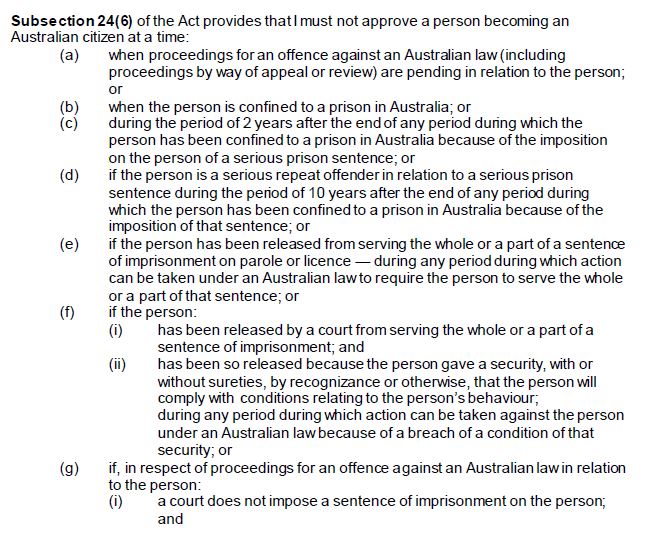
19 Section 24(6), which was included in the letter, provides, amongst other things, that:
The Minister must not approve the person becoming an Australian citizen at a time:
(a) when proceedings for an offence against an Australian law (including proceedings by way of appeal or review) are pending in relation to the person; …
20 Mr Shapkin did not respond to the invitation to comment. I interpolate to note that Mr Shapkin does not suggest any denial of procedural fairness based on not being afforded an opportunity to respond to the information obtained by the Department in relation to the criminal charges then pending against him.
21 On 22 March 2022, a Delegate refused Mr Shapkin’s application for citizenship by conferral and delivered written reasons (D or the Delegate’s Decision). The Delegate was satisfied as to Mr Shapkin’s identity and was therefore satisfied that the information taken into account in assessing the application in fact related to Mr Shapkin. The Delegate was satisfied that the application was made in accordance with s 46 of the Citizenship Act and the Regulation.
22 The Delegate’s reasons are contained in a decision template that is structured by reference to, amongst other things, the general eligibility requirements in s 21(2) of the Citizenship Act. In respect of the criterion in s 21(2)(h) the Delegate has crossed the box to indicate that this criterion was ‘Not assessed’. The boxes labelled ‘Satisfied’ and ‘Not Satisfied’ for this criterion are not crossed:

23 The Delegate was satisfied in relation to all the criteria except in relation to the good character criterion which was ‘Not assessed’.
24 The decision template then directs the decision-maker’s attention to consideration of the prohibitions on approval contained in s 24(3), (4), (4A), (5), (6) and (7) of the Citizenship Act. In this part of the template, the Delegate has cross boxes to indicate whether in respect of each of the prohibitions: ‘Prohibition does not apply’, ‘Prohibition applies’; or ‘Not assessed’.
25 The Delegate found that a prohibition in s 24(6) applied as a result of the criminal charges then pending against Mr Shapkin. The relevant prohibition is in s 24(6)(a). Accordingly, the Delegate concluded that Mr Shapkin’s citizenship application could not be approved. The relevant part of the decision is as follows:
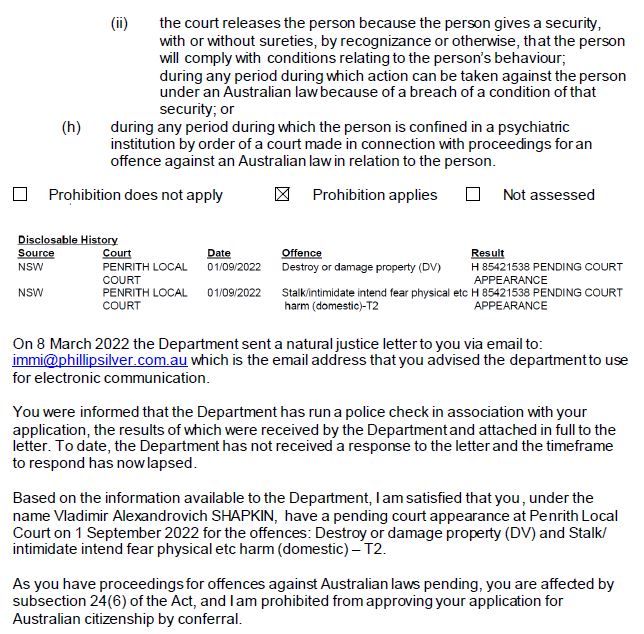
The proceeding before the Tribunal
26 The Tribunal’s decision was delivered on 5 September 2023. The Tribunal affirmed the decision of the Delegate not to grant Mr Shapkin citizenship (T, or the Tribunal’s Decision). The procedural history before the Tribunal was as follows.
27 On 27 March 2022, Mr Shapkin applied to the Tribunal for review of the Delegate’s Decision. Mr Shapkin contended that the Delegate’s Decision was wrong and that he would be contesting the criminal charges pending against him. Mr Shapkin requested that the Tribunal await the outcome of his criminal proceeding before determining his application to allow him ‘to satisfy the requirements under paragraph 24(6)(a)’.
28 On 1 September 2022, Mr Shapkin was found guilty of the offences with which he had been charged: T[3]. Mr Shapkin was sentenced to an 18-month Community Corrections Order set to expire on 29 February 2024 and was required to pay a fine of $1,000: T[3].
29 On 2 September 2022, Mr Shapkin filed an all grounds appeal in relation to his criminal charges in the District Court: T[4].
30 On 13 December 2022, the District Court dismissed Mr Shapkin’s appeal.
31 On 9 January 2023, Mr Shapkin attempted to file a notice of intention to appeal with the Supreme Court of New South Wales, however the Court of Criminal Appeal Registry wrote to him the following day informing him that it was unable to lodge his application as the matter had already been appealed to the District Court. The Registry noted that Mr Shapkin may wish to consider other options of challenging his conviction, including by asking the District Court to state a case under s 5B of the Criminal Appeal Act 1912 (NSW) on a point of law. On 10 January 2023, Mr Shapkin filed a notice of motion requesting that the District Court submit a question of law to the Court of Criminal Appeal.
32 On 22 June 2023, Mr Shapkin’s application was heard by the Tribunal. As mentioned, Mr Shapkin appeared in person. The Tribunal decided to affirm the decision of the Delegate not to grant Mr Shapkin citizenship.
The Tribunal’s decision
33 The Tribunal identified the issue for determination as ‘whether Mr Shapkin is prevented from becoming a citizen by operation of subsection 24(6) of the Act at the time of the Tribunal’s decision’: T[10]. The Tribunal encapsulated Mr Shapkin’s central contention as being that the Delegate had erred in law in failing to assess whether Mr Shapkin met the good character requirement in s 21(2)(h) before considering if the prohibitions in s 24(6)(a) applied: T[11].
34 The Tribunal concluded that in the absence of an express provision requiring a decision-maker to do so, decision-makers, including the Tribunal, were not required to determine each of the eligibility criteria set out in s 21 prior to considering whether the prohibitions on approving a citizenship application in s 24(6) applied: T[11].
35 Before the Tribunal Mr Shapkin relied on Lew v Minister for Immigration and Citizenship [2009] AATA 949 (Tamberlin DP). The Tribunal recorded Mr Shapkin’s argument relying on Shi, as applied in Lew, as follows (at T[17], footnotes omitted):
Citing Shi, Mr Shapkin appears to argue that it is open for the Tribunal to consider the facts as they were at the time of the delegate’s decision to circumvent the bar provided in 24(6)(g), and the facts as they are presently to dispose of the bar provided by 24(6)(a).
36 The Tribunal expressed some doubt as to whether the prohibition in s 24(6)(a) continued to apply at the time of its decision. The Tribunal’s doubt was because Mr Shapkin had not elaborated in his evidence on the current status of his appeal against his convictions, by which I infer the Tribunal intended to refer to Mr Shapkin’s application to have a case stated, with the result that the Tribunal was left in a position where it was not clear on the evidence if ‘proceedings for an offence against an Australian law (including proceedings by way of appeal or review)’ were relevantly pending: T[13]. However, notwithstanding this deficiency in the evidence, the Tribunal was satisfied that subject to any successful appeal, as at the date of its decision, Mr Shapkin continued to be subject to the Community Corrections Order and so, the Tribunal was satisfied that s 24(6)(g) prohibited Mr Shapkin’s citizenship being approved at that time: T[19]. In reaching the conclusion in relation to the application of s 24(6)(g) based on the circumstances prevailing at the time of its decision, the Tribunal relied on Lew at T[13] and did not accept Mr Shapkin’s argument extracted at [33] above. Accordingly, the Tribunal affirmed the Delegate’s Decision.
37 For completeness I note that before the Tribunal Mr Shapkin relied on the following affidavits in relation to his character:
(1) Danielle Maree Shapkin (estranged wife) sworn 21 June 2023:
(2) Seraphima Vladimirovna Shapkin (by tutor) sworn 21 June 2023 (daughter aged 3 at time affidavit made); and
(3) Sophia Vladimirovna Shapkin (by tutor) sworn 21 June 2023 (daughter aged 5 at time affidavit made).
38 On the review application, Mr Shapkin tendered these affidavits for the limited purpose of establishing that these affidavits were not considered by the Tribunal.
GROUNDS OF JUDICIAL REVIEW
39 The application for judicial review was filed on 2 October 2023. It is relevantly within time.
40 The grounds of the application may be summarised as follows:
(1) in respect of the Delegate’s Decision, Mr Shapkin relies on s 7 of the ADJR Act in asserting that the Delegate failed to make, or unreasonably delayed in making, a decision in respect of the good character criterion in s 21(2)(h) of the Citizenship Act;
(2) in respect of the Tribunal’s Decision, Mr Shapkin relies on s 5 of the ADJR Act in asserting that the Tribunal:
(a) failed to observe the procedures required by s 21 of the Citizenship Act, arguing that once s 21(1) is enlivened that all of the general eligibility criteria set out in s 21(2)(a)-(h) must be considered prior to considering s 24: ADJR Act s 5(1)(b);
(b) improperly exercised its power because it involved:
(i) taking into account an irrelevant consideration, being s 24(6): ADJR Act s 5(1)(e);
(ii) failing to take into account a relevant consideration, being s 24(2): ADJR Act s 5(2)(a); and
(iii) uncertainty: ADJR Act s 5(2)(b);
(c) erred in law, arguing that s 24(6)(g), even if it applied, does not prohibit the decision maker from considering the general eligibility criteria set out in s 21(2): ADJR Act s 5(1)(f); and
(d) otherwise acted contrary to law (ADJR Act s 5(1)(j)) because:
(i) s 21(2) of the Citizenship Act must be fully applied once s 21(1) is enlivened even if s 24(6) applies; and
(ii) Lew was incorrectly applied and ought to have been distinguishable.
41 While Mr Shapkin’s complaints about the Tribunal’s decision are variously framed, in substance his argument principally reduces to the proposition that properly construed, the relevant sections of the Citizenship Act require the relevant decision maker to consider and decide on each aspect of s 21(2) once s 21(1) is enlivened, even if a prohibition on approval applies, relevantly the offences prohibitions in s 24(6).
42 Mr Shapkin’s submission in relation to Lew appears to be that the analysis in Lew only applied in circumstances where at the time of the Tribunal’s decision, the circumstances in s 24(6)(g) still applied but the circumstances in s 24(6)(a) did not continue to apply. On this review, Mr Shapkin submits that, unlike in Lew, in the present case that the circumstances identified in both ss 24(6)(a) and (6)(g) applied at the time of the decision.
CONSIDERATION
43 It is common ground that the Tribunal in making its decision did not assess whether Mr Shapkin satisfied the good character criterion because of the view it reached in relation to the application of the offences prohibitions. Accordingly, it is not necessary for me to consider the affidavits that Mr Shapkin tendered for the limited purpose identified above.
44 I will consider Mr Shapkin’s grounds of review by reference to the following topics:
(1) Is there a duty on the relevant decision-maker, that is, the Delegate of the Minister or the Tribunal, to make a ‘decision’ in respect of the character criterion in s 21(2)(h)?
(2) Has there been a relevant failure on the part of the Delegate, or the Tribunal, by not assessing whether Mr Shapkin satisfied the character criterion in s 21(2)(h)?
(3) Did the Tribunal err in its reliance on Lew?
Is there a duty on the relevant decision-maker to make a ‘decision’ in respect of the character criterion in s 21(2)(h)?
45 Mr Shapkin’s core contentions are that:
(1) The Minister is under a duty to make a decision in relation to the character criterion in s 21(2)(h), even where one or more of the offences prohibitions in s 24(6) are engaged; and
(2) Likewise, the Tribunal is under a duty to make a decision in relation to the character criterion in s 21(2)(h), even where one or more of the offences prohibitions in s 24(6) are engaged, and must do so before considering the application of the circumstances giving rise to the prohibitions on approval in s 24(6).
46 The Minister’s overarching submissions in response are that:
(1) The only relevant duty imposed on the Minister is to make a decision under s 24(1), that is, a decision to approve or refuse to approve the applicant becoming an Australian citizen; and
(2) The only relevant duty imposed on the Tribunal arises under s 43 of the AAT Act and that is to review the decision made by, in this case, the Delegate, under s 24(1) and to affirm, vary or set aside that decision.
47 The Minister refers to BMF16 v Minister for Immigration and Border Protection [2016] FCA 1530 at [21] where Bromberg J described it as being uncontentious that the Minister has a duty to make a decision under s 24(1). The duty on the Minister to either grant or refuse a citizenship application has also been recognised by the Full Court of this Court in Grass v Minister for Immigration and Border Protection [2015] FCAFC 44; 231 FCR 128 at 130 [9] and 140 [52] (Perram, Yates and Mortimer JJ) and Singh v Minister for Immigration and Citizenship [2012] FCAFC 12; 199 FCR 404 at 418 [55] (Finn, Dowsett and Bennett JJ).
48 Similarly, it is well accepted that the Tribunal has a duty to review a decision and make the correct or preferable decision on the material before the Tribunal under s 43(1): Drake v Minister for Immigration and Ethnic Affairs (1979) 24 ALR 577 at 589; Shi v Migration Agents Registration Authority [2008] HCA 31; 235 CLR 286 at 314 [98] (Hayne and Heydon JJ) and 324 [141] (Kiefel J).
49 For the following reasons, I reject Mr Shapkin's submissions as to the respective decision-makers being under a duty to assess the good character criterion under s 21(2)(h) in circumstances where an offences prohibition is engaged.
50 Section 21(1) of the Citizenship Act permits a person to make an application for citizenship to the Minister. Subsections 21(2) to (8) ‘deal with eligibility’ for the purpose of making such an application: Note 1 to s 21(1). Relevantly, s 21(2) deals with ‘general eligibility’ and sets out a cumulative list of criteria required for eligibility. It is clear from the text of s 21(2) that it merely sets out the criteria which must be satisfied if a person is to be eligible to acquire citizenship by application under Part 2, Division 2 of the Citizenship Act. To the extent that Mr Shapkin submits that the inclusion in subsection 21(2) of the words ‘if the Minister is satisfied’ points to a statutory duty on the Minister to have regard to the matters in s 21(2) in the context of refusing an application, I do not agree. As a matter of textual analysis, s 21(2) does not impose a duty on the decision-maker to consider the criteria set out in s 21(2) in circumstances where an application must be refused on the basis of one or more of the prohibitive directions in the subsections of s 24. That construction is consistent with the purpose served by s 21(2) in the context of the scheme for acquisition of citizenship by application.
51 The Minister’s duty to make a decision is instead found in s 24 of the Citizenship Act which is aptly titled ‘Minister’s decision’. Section 24(1) requires, in mandatory terms, that the Minister must make a decision in writing, to approve or refuse to approve an application for Australian citizenship under s 21(1). Thus, the duty imposed on the Minister is to make a decision as to whether to approve or refuse to approve an application for citizenship made under s 21(1). There is no express duty to assess and determine each of the general eligibility criteria in s 21(2) prior to refusing a citizenship application.
52 Mr Shapkin submitted that a decision in respect of the general eligibility criteria was a necessary integer of not only a decision to approve but also a decision to refuse a citizenship application. Mr Shapkin submitted that for this reason the assessment of character under s 21(2)(h) could be characterised as an intermediate decision to which the duty under s 24(1) applied, citing Australian Broadcasting Tribunal v Bond [1990] HCA 33; 170 CLR 321 (Mason CJ, with Brennan J and Deane J agreeing).
53 It may be assumed, without deciding, that decisions in respect of the general eligibility criteria, provided for under s 21(2), may be characterised as an intermediate decision along the pathway to making a final determination in accordance with s 24(1) that citizenship should be granted, noting that the Minister retains a discretion to refuse an application even where the eligibility criteria are satisfied: s 24(2). Indeed, it is arguable that where the Minister is minded to approve a citizenship application, the power to do so is conditioned on the eligibility criteria, including the general eligibility criteria in s 21(2), being satisfied: s 24(1A). The prohibition in s 24(1A) imposes an express duty upon the Minister to consider whether, inter alia, the general eligibility criteria are satisfied before a citizenship application can be approved. However, that is not the issue in this review.
54 This review concerns a decision not to approve a citizenship application. The position is different with respect to decisions not to approve a citizenship application. That is made plain by the balance of s 24 which includes that a citizenship application may be refused even where the eligibility criterion in subsection 21(2), (3), (4), (5), (6) or (7) are satisfied, but critically that in certain circumstances, a citizenship application must not be approved. One of the instances in which a citizenship application must be refused is where the circumstances in s 24(6) apply. I do not accept that a decision in respect of the general eligibility criteria is a necessary integer of, or an ‘intermediate’ decision required for, making a decision not to approve a citizenship application under s 21(1) where the circumstances in s 24(6) apply.
55 Mr Shapkin submitted that the general eligibility criteria are fundamental to making the decision under s 24(6). That is not correct. Relevantly, the assessment of the general eligibility criterion of character has no bearing on whether the offences prohibitions in s 24(6) apply. First, there is no analogue of s 24(1A) in respect of decisions to refuse a citizenship application. There is no express obligation on the Minister when refusing an application to first consider whether the general eligibility criterion of character is satisfied. Similarly, there is no express obligation on the Minister to consider all the general eligibility criteria before refusing an application.
56 Second, even if the general eligibility criteria are satisfied, the Minister nonetheless retains a discretion to refuse the application: s 24(2).
57 Third, and in my view, critically, s 24 itself provides a description of circumstances which, if applicable, prohibit the Minister from granting approval even if the general eligibility criteria are all satisfied. Thus, where the text of s 24 itself provides triggers which require refusal of a citizenship application regardless of whether a person satisfies the general eligibility criteria, the proper construction is that there is no duty on the Minister to consider the good character criterion prior to refusing a citizenship application where one or more of the offences prohibitions on approval applies. In such circumstances, consideration of the good character criterion is not fundamental to the decision to refuse the citizenship application in the way that Mr Shapkin contends.
58 Other aspects of the statutory scheme which support the proper construction at which I have arrived include the following.
59 Section 52(1)(b) provides for the Tribunal to review ‘a decision under section 24’ and s 20 refers to a person becoming an Australian citizen if the Minister ‘decides under subsection 24(1) to approve the person becoming an Australian citizen’. Contrary to Mr Shapkin’s submission, no purpose consistent with the statutory scheme would be served by requiring a decision-maker to assess the good character criterion in s 21(2)(h) when one or more of the offences prohibitions in s 24(6) is or are engaged.
60 If Mr Shapkin’s construction is accepted it would undermine the efficiency of the statutory scheme for citizenship by conferral. On Mr Shapkin’s approach, the Minister would be required to reach the requisite state of satisfaction (positive or negative) on the character criterion even in circumstances where regardless of the Minister being satisfied as to the applicant’s good character, the Minister would be required to reject the application by reason of the prohibitions on approval contained in the various subsections of s 24. Mr Shapkin’s argument as to there being a purpose in requiring a decision-maker to assess the good character criterion where one of the offences prohibitions is engaged is based on two mistaken premises.
61 First, that an assessment that Mr Shapkin was of good character would bind a decision-maker considering any future citizenship application made by Mr Shapkin at a time when the circumstances triggering the offences prohibitions no longer applied. That is not correct – if a future application was being considered for approval the Minister would be required by the terms of s 21(2)(h) to assess character as at that future date (and would only need to do so if the offences prohibitions in s 24(6) did not apply at that future date).
62 Second, Mr Shapkin contends that to construe the relevant provisions so as to require the Minister to favourably assess his character under s 21(2)(h) would not be lacking in utility. Mr Shapkin submits that for the Minister to assess his character under s 21(2)(h) of the Citizenship Act would be useful in the event of any future decision-making process in respect of the cancellation of his visa. As I apprehended his argument, although it was somewhat unclear, Mr Shapkin contends that a favourable assessment would have utility in that it would assist him in seeking to avoid his permanent residency or visa being revoked. In this way, I understood Mr Shapkin to be suggesting that a favourable assessment under s 21(2)(h) would in some way bind the Minister in relation to whether Mr Shapkin passes the character test for the purpose of the Migration Act 1958 (Cth). Mr Shapkin’s submission is misconceived. The assessment of character for the purpose of s 21(2)(h) of the Citizenship Act is a distinct task directed to a different statutory purpose than the application of the character test applying the proscriptive criteria in s 501(6) under the Migration Act for the purposes of the visa cancellation regime. Mr Shapkin acknowledges that the statutory criteria in relation to the assessment of character under the Migration Act are distinct from the assessment required by s 21(2)(h) of the Citizenship Act.
63 For these reasons, I reject the necessary predicate in Mr Shapkin’s argument that the Delegate had a duty to decide the good character criterion under s 21(2)(h) in circumstances where a s 24(6) offences prohibition was engaged.
64 Mr Shapkin’s submissions in relation to the Tribunal’s decision are predicated on the same premise — that the Tribunal is under a duty to make a decision in relation to the good character criterion in s 21(2)(h), even where one or more of the offences prohibitions in s 24(6) are engaged, and must do so before considering the offences prohibitions in s 24(6).
65 Mr Shapkin raises the following additional arguments in relation to the Tribunal’s decision. He submits that:
(1) The Tribunal was required to address the decision-making process in the strict order of the provisions of the Act ‘numerically, chronologically and sequentially’;
(2) The Tribunal was required to, and did not, take into account the whole of the criteria in s 24(2) of the Citizenship Act, therefore the resulting exercise of power was uncertain; and
(3) While s 24(6) prohibits approval of citizenship, it does not prohibit the Tribunal from being satisfied of the general eligibility criteria in s 21(2).
66 These submissions relate to the scheme of Part 2, Division 2 of the Citizenship Act generally and are rejected on the basis of the proper construction of the relevant provisions for the reasons already given. To the extent that Mr Shapkin’s submissions raise additional arguments, they are rejected for the following reasons.
67 There is nothing in the Citizenship Act that prescribes that the good character criterion must be considered by a decision-maker before the decision-maker considers whether any of the prohibitions on approval in s 24(6) apply. For the reasons already given, the legislative regime in respect of citizenship by conferral construed properly and in accordance with principle does not permit of the construction advanced by Mr Shapkin.
68 In oral address, Mr Shapkin relied upon ss 15AA and 15AB of the Acts Interpretation Act 1901 (Cth) and the explanatory memorandum to the Australian Citizenship Bill 2005 (Cth), in particular the following passages:
…
The only outstanding legislative recommendation adopted by the government is to improve presentation of the Act so that it is ‘logically organised, numbered, consistent and with related matters dealt with together, and ensuring that the balance of matters dealt with between the Act and the Australian Citizenship Regulations conforms to modern standards.’
…
The Office of Parliamentary Counsel advised that replacement of the 1948 Act was highly desirable in view of the extent of the proposed changes to the Act, in particular the restructuring required to ensure that the legislation is accessible, easy to understand, logically organised and numbered, and conforms to modern standards in respect of the balance of matters dealt with between the Act and the associated regulations.
…
The Bill replaces the Australian Citizenship Act 1948 (the old Act). There are three major changes proposed, as follows:
1. Structure and location of the provisions
The purpose is to ensure consistency throughout the Act. This includes changes in terminology, so that the provisions are consistent and easier to understand and apply.
…
69 On the basis of those materials, Mr Shapkin advanced the following submission:
…So it’s much easier and consistent to apply them chronologically, numerically, from top to down, instead of down up. It’s not easy to do that. And it does affect the application and the consequential interpretation of the Act.
And that, I think, was the [error] of law that everybody got into, because they started applying section 24(6), and then, “Okay, no, we need to apply section 21”, as in 30 submissions of the respondents. So there was also legislative changes sought to improve ensuring consistency and simplicity in the provisions relating to citizenship, but that’s by descent. I think those are the major — that’s the major evidence where we can ascertain the actual intention of Parliament.
70 It may readily be accepted that one of the purposes of the Bill was to improve the presentation of the Citizenship Act so that it is logically organised, numbered, consistent and with related matters dealt with together. But that does not take matters very far. It does not lend support to the submission advanced by Mr Shapkin that the Citizenship Act must be applied in a way that adheres rigidly to a mechanical application of the individual legislative provisions in strict numerical sequence from lowest to highest.
71 The requirement in s 24(1A), that a person satisfy s 21(2), is independent to the requirements in s 24(6) of the Act. The prohibitions in s 24(3) to (6) are independent of whether the Minister is satisfied of the general eligibility criteria in s 21(2): cf AUS17 v Minister [2020] HCA 37; 269 CLR 494 at [10] (Kiefel CJ, Gageler, Keane and Gordon JJ), where the purpose of the provisions in the Migration Act, there under consideration, would be ‘thwarted’ if one criterion were to be ignored before assessing another criterion. There is no logical or policy reason why the Citizenship Act should be construed so as to prevent a decision maker addressing s 24(6)(a) before addressing s 21(2)(h). Whether an applicant satisfies s 21(2)(h) is not a circumstance that must be factored into whether s 24(6)(a) or (g) applies: cf AUS17 at [11]. To the contrary, there are good reasons why the Minister or Tribunal may wish to consider the prohibitions in s 24(6) before assessing the general eligibility criteria.
72 For example, if the prohibition in s 24(6)(a) applies, the Minister may not be in a position to consider whether a person is of ‘good character’ as there are proceedings for an offence against Australian law pending in relation to that person but the outcome of those proceedings is not known. The Minister will not know (and cannot predict) whether a person will be found guilty of an offence, or may succeed in an appeal from conviction, which may be relevant to the assessment of character under s 21(2)(h). Similarly, if the prohibition in s 24(6)(g) applies, the Minister cannot know whether a person will comply with the requirements of their non-custodial sentence, which may also be relevant to the question of whether they are of ‘good character’ for the purpose of s 21(2)(h).
73 Finally, in the course of his oral address, Mr Shapkin raised an additional argument that I understood to be directed at supporting his preferred construction of the relevant provisions. It will be recalled that Mr Shapkin describes his occupation as including being an ‘estranged husband’. Mr Shapkin’s further argument derived from his status as an estranged husband.
74 He contended that the overarching purpose of the relevant provisions was to effectuate a scheme by which citizens of countries other than Australia were incentivized to enter a genuine continuous relationship with an Australian citizen and, provided that the foreigner was in good health and of good character, they, in return, would be granted Australian citizenship. As far as I followed his argument, Mr Shapkin appeared to be submitting that to construe the relevant provisions in such a way that the Minister is not under a duty to determine the character criterion before refusing a citizenship application would undermine the purpose of the statutory scheme as he conceived it. Mr Shapkin says that by his entry into a ‘genuine continuous relationship’ with an Australian citizen, Ms Shapkin, he has ‘satisfied [his] part of the scheme’s criteria, being that [he] was – not required, but was incentivised to marry, be in a genuine continuous relationship, produce two children, raise them up’.
75 Having considered Mr Shapkin’s argument, it does not change the understanding I have reached as to the proper construction of the relevant provisions. Mr Shapkin’s conception of the purpose of the statutory scheme as it applies to applicants who are, or have been, in a relationship with an Australian citizen treats the conferral of Australian citizenship as a kind of statutory dowry which the Minister is required to confer on applicants in this category. On Mr Shapkin’s approach, the bestowal of citizenship is directed to citizens of other countries to induce them to, and thereafter reward them for, entering into a relationship with an Australian citizen. Mr Shapkin’s argument misapprehends the legislative scheme. It is not supported by the text, context and purpose of the legislative provisions in issue.
76 To the extent that Mr Shapkin attempted to pursue this topic as extending beyond the issue of statutory construction raised by his review grounds, as a freestanding allegation of misleading conduct against the Minister, it was irrelevant to the issues raised on this review.
77 For these reasons, Mr Shapkin’s grounds of review that are based on the relevant decision-maker having a duty to make an assessment under s 21(2)(h) in circumstances where one or more of the offences prohibitions in s 24(6) apply will be dismissed.
Was there a relevant failure to assess, or delay in assessing character for the purpose of s 21(2)(h)?
78 I do not accept Mr Shapkin’s submissions as to there having been a relevant failure or unreasonable delay, however characterised, on the part of the Minister, or the Tribunal, in not assessing whether Mr Shapkin satisfied the character criterion in s 21(2)(h). My reasons are as follows.
79 As will be apparent based on the reasons given in relation to the proper construction of the relevant provisions, Mr Shapkin’s submissions on this issue are predicated on a false premise. I do not accept Mr Shapkin’s principal contention that there is a duty to assess all of the criteria for general eligibility or to make separate ‘decisions’ as to the satisfaction of the criterion of character in circumstances where one or more of the offences prohibitions applies. It is well-established that a refusal or failure to make a decision is only reviewable if the decision-maker is under a duty to act or decide. Whether or not a power conferred by legislation is coupled with an implied duty to consider whether to exercise that power is a matter of statutory construction, taking into account the text of the relevant legislation and its purpose. There is no generalised presumption that a statutory power is necessarily coupled with an implied duty to consider whether to exercise it: Yasmin v Attorney-General [2015] FCAFC 145; 236 FCR 169 at 196 [113].
80 For the reasons already given, the construction for which Mr Shapkin contends is contrary to the proper construction of the relevant provisions. The grounds of review that are based on establishing that there has been a relevant failure or delay in relation to the assessment of character under s 21(2)(h), whether by not making a decision or not applying a procedure required by s 21, in circumstances where one or more of the offences prohibitions in s 24(6) apply, will be dismissed.
Did the Tribunal err in its reliance on Lew?
81 Mr Shapkin argues that Lew was incorrectly applied and ought to have been distinguished by the Tribunal. He appears to contend that the analysis in Lew only applied in circumstances where at the time of the decision, the circumstances in s 24(6)(g) applied but the circumstances in s 24(6)(a) did not apply. Mr Shapkin submits that unlike in Lew, in the present case both ss 24(6)(a) and (6)(g) were to be applied at the time of the decision.
82 Lew was a case in which a delegate refused an application for citizenship where the applicant for citizenship was facing pending proceedings for an offence against an Australian law at the time of the application. By the time of the Tribunal’s review, Mr Lew had been sentenced and was subject to a good behaviour bond and there were no longer criminal proceedings pending for a relevant offence. In Lew, the Minister contended that that Mr Lew continued to be barred from conferral of citizenship by reason of s 24(6)(g).
83 In Lew, Tamberlin DP concluded that in deciding whether the application for citizenship should be granted, it was open to the Tribunal to have regard to circumstances occurring after the date of the original decision: see Lew [12], relying at [11] on Shi v Migration Agents Registration Authority [2008] HCA 31. I interpolate to note that Tamberlin DP’s analysis was an orthodox application of well-established principles: see Frugtniet v Australian Securities and Investments Commission [2019] HCA 16; 266 CLR 250 at 256-257 [14]-[15] (Bell, Gageler, Gordon and Edelman JJ) and the authorities cited therein. Accordingly, in circumstances where at the time of the Tribunal’s decision Mr Lew fell squarely within the provisions of s 24(6)(g) of the Citizenship Act, Tamberlin DP found that the Tribunal had no alternative but to comply with the statutory directive not to approve Mr Lew’s citizenship application: Lew [13].
84 Lew was a decision that was on point and was against Mr Shapkin. Mr Shapkin’s attempt to rely on it to his advantage before the Tribunal was predicated on a misunderstanding of the decision. The Tribunal was correct not to accept Mr Shapkin’s argument based on it.
85 Mr Shapkin has changed the argument based on Lew that he now presses before this Court. His present argument relies on a difference in the facts in Lew as at the time of the Tribunal’s decision in that case and the facts in his own case at the time of the Tribunal’s decision. For the reasons which follow, it may be accepted that the factual difference identified by Mr Shapkin exists, however, it is a distinction without a difference in terms of the conclusion that it was open to the Tribunal when applying s 24(6) to consider Mr Shapkin’s circumstances prevailing at the time of Tribunal’s decision.
86 In Lew, it was the case that at the time of the Tribunal’s decision the circumstances in s 24(6)(g) applied whereas the circumstances in s 24(6)(a) did not. In the present case, the position appears to be that the circumstances in both ss 24(6)(a) and (6)(g) both applied as at the date of the Tribunal’s position, even though the Tribunal relied on s 24(6)(g) in isolation because of the deficiency in the evidence regarding the status of the stated case application. That is the position that Mr Shapkin has taken before this Court.
87 The relevant analysis in Lew is as follows:
11. The High Court recently pointed out in Shi v Migration Agents Registration Authority [2008] HCA 31, that the Tribunal ‘steps into the shoes’ of the original decisionmaker and, generally speaking, must apply the relevant law and factual circumstances in place at the time the decision is made by the Tribunal, except in circumstances where there are indications to the contrary. See also Re Smith and Defence Fund Retirement and Death Benefits Authority (1978) 1 ALD 374.
12. In the present case, there is no indication that the Tribunal should confine its consideration of the law or circumstances to those in place at the time the original decision was made. It is therefore open to the Tribunal to decide whether the citizenship application should be granted, having regard to circumstances and changes in the law that have taken place since the date of the original decision by the delegate.
88 There is no principled basis on which to confine the relevant conclusion in Lew as applying only where at the time of the Tribunal’s decision, the circumstances in s 24(6)(g) applied but the circumstances in s 24(6)(a) did not apply. Accordingly, the ground of review based on the Tribunal’s reliance on Lew will be dismissed.
CONCLUSION
89 Although Mr Shapkin invoked s 39B of the Judiciary Act, the grounds of review as framed in his originating application and submissions focused on the ADJR Act. Mr Shapkin did not advance any grounds independent of the ADJR Act in respect of judicial review under s 39B of the Judiciary Act. Mr Shapkin’s application for relief under the Judiciary Act must therefore fail for the same reasons as set out above in respect of the ADJR Act.
90 Even if the Tribunal or Minister erred in their approach to assessing good character for the purposes of s 21(2)(h), any error would not have been material to either decision given that the Delegate and the Tribunal were required to refuse Mr Shapkin’s application for citizenship by reason of one of the statutory bars to approval in s 24(6) applying at the time of each decision.
91 For these reasons, the application for review will be dismissed with costs.
I certify that the preceding ninety-one (91) numbered paragraphs are a true copy of the Reasons for Judgment of the Honourable Justice Cheeseman. |
Associate:


