

FEDERAL COURT OF AUSTRALIA
Lee v Dentons Australia Limited [2024] FCA 622
Table of Corrections
19 June 2024 | In paragraph [40(1)] “affected” has been replaced with “effected” |
19 June 2024 | In the first sentence of paragraph [41] the words “on the basis that service was not effected” have been inserted after “not set aside” |
19 June 2024 | In paragraph [71(2)] the word “(sic)” has been inserted after “7 November 2023” |
19 June 2024 | In the first sentence of paragraph [75] “preceded” has been replaced with “proceeded” |
ORDERS
Applicant | ||
AND: | DENTONS AUSTRALIA LIMITED ABN 69100963308 Respondent | |
DATE OF ORDER: | 14 June 2024 |
THE COURT ORDERS THAT:
1. The orders made on 19 December 2023 be confirmed.
2. The application dated 29 January 2024 be dismissed.
3. The applicant pay the respondent’s costs of the application.
Note: Entry of orders is dealt with in Rule 39.32 of the Federal Court Rules 2011.
CHEESEMAN J
INTRODUCTION
1 By interlocutory application, the applicant, Siew Yi Lee, applies pursuant to s 35A(5) of the Federal Court of Australia Act 1976 (Cth) (the FCA Act) and/or r 3.11 of the Federal Court Rules 2011 (Cth) (the FCR) for a review of the dismissal by a Registrar of the Court on 19 December 2023 of her application to set aside a Bankruptcy Notice. The Bankruptcy Notice was issued on 13 May 2023. The respondent to the originating application and on this application for review is Dentons Australia Limited, a judgment creditor on whose application, the Bankruptcy Notice was issued to Dr Lee in respect of a judgment debt in the sum of $112,559.65. Dentons operates as a legal practice and previously acted for Dr Lee. The judgment debt which underlies the Bankruptcy Notice relates to unpaid invoices for legal services provided by Dentons and associated disbursements including counsel fees.
NATURE OF REVIEW
2 The power to set aside a bankruptcy notice is not expressly conferred by the Bankruptcy Act 1966 (Cth) but arises by necessary implication pursuant to the general powers conferred by s 30(1) of the Bankruptcy Act: Bryant the Commonwealth Bank of Australia (1994) 217 ALR 251, 253 (Davies, Foster and O’Loughlin JJ). That power is a power which has been prescribed by the Federal Court (Bankruptcy) Rules 2016 (Cth) (Bankruptcy Rules) as a power which may be exercised by a Registrar if the Court or a Judge so directs: s 35A(1)(h) of the FCA Act, r 2.02 and Part 1 of Schedule 1 of the Bankruptcy Rules. A direction made by the Chief Justice of the Court authorises the registrars of the Court to exercise the relevant power.
3 An application for a review of a Registrar’s exercise of power under s 35A(1) of the FCA Act is brought as of right under s 35A(6) pursuant to an application under s 35A(5). The review is by way of hearing de novo: Harris v Caladine [1991] HCA 9; 172 CLR 84; Bechara v Bates [2021] FCAFC 34; 286 FCR 166 at [17]. De novo review is not directed to a consideration of the correctness of the Registrar's decision or redressing error by the Registrar. On de novo review, the Court hears the case again unaffected by what has gone before. The task of the Court on review is to determine afresh the application. The review proceeds as if the power had not been delegated. In consequence, on review, the Court can entertain new arguments, receive new evidence or adjourn the proceeding but only to the extent, and in the circumstances where, it would do so in a matter that had already been set down for determination. Further, the applicant on review is the applicant on the application irrespective of whether the applicant was successful before the Registrar. The same onus arises as if the application was being heard for the first time: Robson as former trustee of the estate of Samsakopoulos v Body Corporate for Sanderling at Kings Beach CTS 2942 [2021] FCAFC 143; 286 FCR 494 at [63] (Colvin J, with whom Allsop CJ, Markovic, Derrington and Anastassiou JJ agreed on this point).
RELIEF SOUGHT
4 By Interlocutory Application dated 29 January 2024, Dr Lee applies for the following orders:
1. Pursuant to s 35A(5) of the Federal Court of Australia Act 1976 (Cth) and/or r 3.11 of the Federal Court Rules 2011 (Cth), the orders made by Judicial Registrar Birchall on 19 December 2023 be set aside.
2. A declaration that the Bankruptcy Notice BN 259844 issued on 13 May 2023 (Bankruptcy Notice) was not served in accordance with reg 102 of the Bankruptcy Regulations 2021 (Cth), s 28A of the Acts Interpretation Act 1901 (Cth) and/or the orders made by Registrar Segal on 10 October 2023.
3. Alternatively, if the Bankruptcy Notice was served on the Applicant on 31 October 2023 in accordance with the orders made by Registrar Segal on 10 October 2023 or otherwise, a declaration that:
a. the Applicant's application to set aside the Bankruptcy Notice (lodged at 5.17pm on 21 November 2023 and re-lodged on 22 November 2023) (Set Aside Application) was made before the expiration of the time fixed for compliance with the Bankruptcy Notice for the purposes of s 40(6A) of the Bankruptcy Act 1966 (Cth); and
b. the Applicant applied to the Court for an order setting aside the Bankruptcy Notice before the expiration of the time fixed for compliance with the Bankruptcy Notice for the purposes of s 40(7) of the Bankruptcy Act 1966 (Cth).
4. If a declaration is made in accordance with prayer 3 above, an order that the Set Aside Application be remitted to the Judicial Registrar to be determined in accordance with law or, alternatively, be listed for a case management hearing before a Judge.
5. Costs.
BACKGROUND
5 Dentons entered into an agreement for the provision of legal services with Dr Lee on 5 May 2021. Dentons corresponded with Dr Lee using the email address sydneycosmeticspecialistclinic@gmail.com which was an email from which Dr Lee sent emails to Dentons.
6 Dr Lee is a medical practitioner who operated a business called The Sydney Cosmetic Specialist Pty Ltd (SCS). As at August 2023, property searches conducted by Dentons revealed that Dr Lee was the registered proprietor of three properties:
(1) 27 Fern St, Pymble, NSW 2073 (Pymble Address or Property as required)
(2) Suite 16, 369 Victoria Avenue, Chatswood, NSW 2067 (Chatswood Address or Property as required)
(3) 21 Romford Road, Epping, NSW 2121 (Epping Address or Property as required).
7 The SCS business was conducted from the Chatswood Address. The Chatswood Address was the registered address of SCS at all relevant times.
8 The title search of the Chatswood Address run in August 2023 states that the property is subject to a registered lease to Australia Yunhua Pty Ltd which expires on 30 November 2023 with two options to renew of three years each. Ms Massey deposes that on 15 March 2024 she obtained a copy of the lease, which amongst other things, reveal that a third party, Australia Yunhua Pty Ltd, is only permitted to use the Chatswood Address as a restaurant.
9 Dr Lee deposes that her driver’s licence (with an expiry date “in 2025”) listed her address as the Epping Address. Dr Lee has not put a copy of her driver’s licence in evidence. She says that at different points in time between 2012 and 2023 she has stayed at the Epping Address.
10 Dr Lee also deposes that in “early 2021” she gave Ms Barwick of Dentons a copy of her driver’s licence for it to be photocopied. Dr Lee’s evidence on this issue was not controverted or otherwise responded to in the evidence read by Dentons. On this basis, Dr Lee maintains that Dentons was aware of her connection with the Epping Property. That would appear to be correct in that Dentons appear to have taken a copy of Dr Lee’s driver’s licence nominating the Epping Address as her residential address at some point in early 2021.
11 As at August 2023 Dr Lee’s address on the electoral roll was at the Pymble Address. There is no evidence that Dr Lee’s address on the electoral roll was changed during 2023. Dentons submits that if Dr Lee moved to a different address after the listing of her address as the Pymble Address on the electoral roll, she was required by s 101(5) of the Commonwealth Electoral Act 1918 (Cth) to update her address 21 days after having lived at a new address for a period of one month.
12 Dr Lee contends that a search of public websites at the relevant time would have revealed that the Pymble Address was on the market for rent. Dr Lee deposes that the Pymble Address was on the market for lease since July 2023. Dr Lee exhibits screenshots of those websites which appear to contain a “created” or “listed” date of 31 May 2023 for the Pymble Address listing.
13 Dr Lee does not suggest that at any time she expressly and explicitly informed Dentons that she was not residing at the Pymble Address. Dr Lee points to the provision of a copy of her driving licence to Dentons in early 2021 as an indicia of her residential address being the Epping Address at that time.
PROCEDURAL HISTORY
14 On 11 April 2022, Dentons filed its claim in the District Court against Dr Lee and SCS in respect of unpaid invoices and claimed a monetary judgment in the sum of approximately $110,000. In the statement of claim, Dentons nominated the same address for Dr Lee and SCS. The address nominated was Suite 16, Level 1, 269 Victoria Avenue, Chatswood, NSW 2067. It will be immediately apparent that there is a typographical error in the address nominated on the statement of claim for Dr Lee and SCS whereby the street number has been given as “269” instead of “369”. The Chatswood Address has been misstated in the statement of claim in this way. The statement of claim was subsequently served personally on Dr Lee at the Pymble address on 17 May 2022.
15 On 12 July 2022, Dr Lee and SCS filed an application for a cost assessment in respect of the fees Dentons claimed to be outstanding. She gave the Chatswood Address as the address for herself and SCS. She nominated sydneycosmeticspecialistclinic@gmail.com as the email address for her and SCS.
16 By letter dated 8 March 2023 the costs assessor informed the parties that the assessment was complete. On its face, the letter is addressed to Dr Lee at her Chatswood Address. The letter was sent by email to Dr Lee and SCS using the sydneycosmeticspecialistclinic@gmail.com address. The email was also sent to the email address of the solicitor then representing Dr Lee and SCS.
17 A costs assessor’s certificate was issued on 26 April 2023, after Dentons paid the assessor’s costs which were otherwise due for payment by Dr Lee.
18 On 8 May 2023, the Supreme Court of New South Wales made a “judgment/order” in Dentons’ favour against Dr Lee and SCS for $112,559.65 (being the outstanding debt plus the fees paid to the costs assessor). That judgment/order was entered on that same day. In the judgment/order, Dr Lee’s address is given as the Pymble Address. SCS’s address is given as Suite 16, Level 1, 269 Victoria Avenue Chatswood NSW 2067, perpetuating the typographical error that has been included in the statement of claim but only in respect of SCS’s address.
19 On 12 May 2023, Dentons applied to the Australian Financial Security Authority (AFSA) for a bankruptcy notice to be issued to Dr Lee in respect of the judgment debt, having obtained a sealed copy of the judgment. The Bankruptcy Notice was issued by AFSA on 13 May 2023 and was addressed to “Miss Siew Yi Lee” at the Pymble Address.
20 During August 2023, Dentons attempted personal service on Dr Lee without success. In preparing for personal service, Dentons undertook searches which indicated that as at August 2023, Dr Lee was the registered proprietor of the Pymble Address, was the mortgagor of a mortgage registered over the Pymble Address and her address on the electoral roll was the Pymble Address. The property searches undertaken by Dentons (set out above) also revealed that Dr Lee was the registered proprietor of the Chatswood Property and the Epping Property.
21 On 8 September 2023, Dentons applied to this Court in proceedings NSD977/2023 for orders for substituted service of the Bankruptcy Notice on Dr Lee.
22 On 10 October 2023, Registrar Segal made the following orders (Substituted Service Orders):
1. Service of Bankruptcy Notice No. BN 259844 of 2023 issued on 13 May 2023 and addressed to the Respondent together with a sealed copy of the final judgment dated 11 May 2023 and a sealed copy of this order may be effected by the following means occurring on or before 17 October 2023:
a. By sending by pre-paid ordinary post addressed to the Respondent at 27 Fern Street, Pymble, NSW, 2073, Australia;
b. By handing to any person apparently over the age of 16 years at 27 Fern Street, Pymble, NSW, 2073, Australia or, if this is not possible, by affixing to the front door or leaving in the mailbox of the premises at that address, in all cases in an envelope addressed to the Respondent; and
c. By scanning and sending by email to the Respondent at the following email address sydneycosmeticspecialistclinic@gmail.com;
2. Service in accordance with this order shall be deemed good and sufficient service of the Bankruptcy Notice on the Respondent.
3. The Bankruptcy Notice shall be deemed to be served on the Respondent on 31 October 2023.
4. The Bankruptcy Notice be amended by deleting the following words in paragraph 1 on page 2 of the notice “after service on you of the Bankruptcy Notice” and substituting “after 31 October 2023”.
5. The Applicant lodge an appropriate application with the Official Receiver to make the amendments to the Bankruptcy Notice required by Order 4.
6. A copy of the amended Bankruptcy Notice issued by the Official Receiver pursuant to Order 5 and served pursuant to Order 1 is to be annexed to any affidavit proving that service.
7. Costs of this application be reserved for purposes of any creditor’s petition based on this Bankruptcy Notice.
23 In October 2023, Dentons caused emails to be sent to sydneycosmeticspecialistclinic@gmail.com attaching the Bankruptcy Notice, judgment and Substituted Service Orders. In response to those emails, Dentons received bounceback messages.
24 On 12 October 2023, Dentons caused a copy of the Bankruptcy Notice, Supreme Court judgment, Substituted Service Orders and a covering letter to be sent via Australia Post using express, tracked post to the Pymble Address. The Bankruptcy Notice attached was that which had been issued by AFSA on 13 May 2023. It is common ground that Dentons did not comply with Orders 1(b) (personal service on a person at the Pymble Address) and 4 to 6 of the Substituted Service Orders (requiring amendment to the Bankruptcy Notice that had been issued on 13 May 2023).
25 On 13 October 2023, Dentons undertook a search of the Australia Post tracking records and noted that the status of the tracked envelope was recorded as follows:
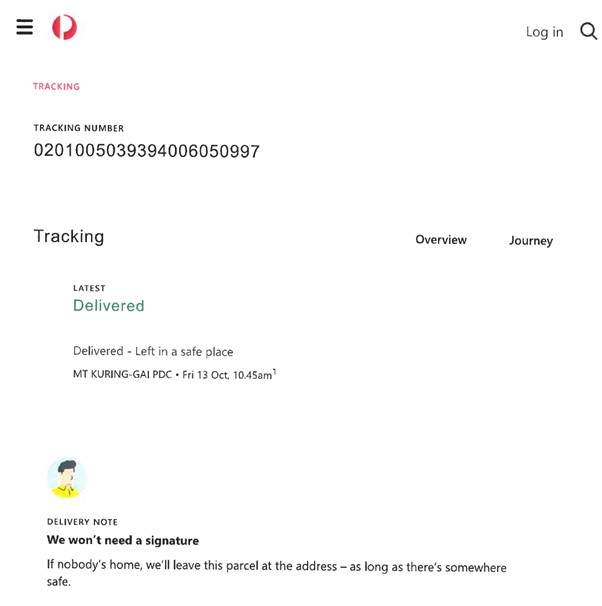
26 The entry bears the date and time of Friday 13 October, 10:45am. The evidence does not disclose what the superscript “1” references.
27 Dr Lee deposes that on 7 November 2023 she found an envelope in her mailbox at the Pymble Address and found inside it the Bankruptcy Notice, the Supreme Court judgment and the Substituted Service Orders. Dr Lee says that she was clearing the mailbox at the Pymble Address about once a month at this time. Dr Lee’s evidence does not expressly disclose whether she checked or cleared her mailbox at the Pymble Address in the period between 13 October 2023 and 7 November 2023. Dr Lee further deposes that prior to 7 November 2023 she was not aware of the Bankruptcy Notice, the Supreme Court proceeding (2023/00144620) or the judgment.
28 On 16 November 2023, Dr Lee engaged Kwok Tsy Fu, a solicitor, to advise on the Bankruptcy Notice.
29 On 21 November 2023 at 5.17pm, Mr Fu lodged an application to set aside the Bankruptcy Notice via the elodgement portal in proceeding number NSD977/2023, being the proceeding in which the Substituted Service Orders had been made.
30 On 22 November 2023 at 12.14pm, Mr Fu was informed that the lodgement has been rejected. The application to set aside the Bankruptcy Notice should have been lodged as a new proceeding and not as an interlocutory application in proceeding NSD977/2023.
31 At 2.38pm, 22 November 2023 Mr Fu lodged the application via the elodgment portal as a new proceeding which was allocated the proceeding number NSD1418/2023.
32 On 27 November 2023, Mr Fu was informed that the application had been accepted and processed.
33 On 14 December 2023, Registrar Birchall heard the application to set aside the Bankruptcy Notice and delivered judgment on 19 December 2023 dismissing the application.
34 On 29 January 2024, Dr Lee lodged the present interlocutory application seeking a review of Registrar Birchall’s decision. I made orders timetabling the proceeding to hearing including in relation to the filing of evidence. The parties subsequently consented to the review application being heard on the papers relying on their respective written submissions.
EVIDENCE
35 Dr Lee relies upon:
(1) four affidavits she has sworn on 21 November 2023, 29 January 2024, 20 February 2024, 21 February 2024 and the exhibits thereto; and
(2) the affidavit of her former solicitor Kwok Tsy Fu sworn on 12 December 2023.
36 Dr Lee also seeks leave to rely on a fifth affidavit made by her and sworn on 15 March 2024. Dr Lee requires leave because the affidavit was filed after the time provided by the orders made on 15 February 2024. The parties have addressed the content of that affidavit in their submissions and the respondent does not raise any issue of prejudice. Accordingly, Dr Lee may rely on that affidavit. On 26 March 2024, I reserved the application for judgment and ordered by consent that it be heard on the papers. On 28 March 2024, after the application was reserved, Dr Lee’s solicitor also emailed my chambers an affidavit sworn by Dr Lee on 28 March 2024. No application has been made to seek leave to reopen to rely on that affidavit.
37 Dentons relies on two affidavits of Louise Jane Massey, solicitor and the exhibits thereto. The first was sworn on 11 December 2023 and later refiled on 21 March 2024. The second was sworn and filed on 21 March 2024.
38 The parties were required, by 4pm, 8 March 2024 to file a statement of agreed facts and a separate list of facts in dispute which set out the party seeking to include the fact and the reason why its inclusion is disputed. There were three documents filed with the Court on 8 March 2024 comprising of:
(1) a statement of agreed facts filed by Dentons and lodged at 2:38pm;
(2) a statement of agreed facts filed by Dr Lee lodged at 4:06pm; and
(3) a table of disputed facts filed by Dr Lee lodged at 5:12pm.
39 Despite the duplication and confusion in the way the documents have been presented, it appears based on the written submissions which have been lodged that both Dentons and Dr Lee rely upon the statement of agreed facts and the table of disputed facts filed by Dr Lee on 8 March 2024 and I will proceed on that basis.
ISSUES FOR DETERMINATION
40 Dr Lee submits that the Bankruptcy Notice should be set aside in effect for two reasons:
(1) the Substituted Service Orders properly construed excluded the operation of reg 102 of the Bankruptcy Regulations 2021 (Cth) and because the Substituted Service Orders were not complied with, service of the Bankruptcy Notice has not in fact been effected; and
(2) in the alternative, if the operation of reg 102 is not excluded by the Substituted Service Orders, then service has not been effected in any event because:
(a) delivery by express post did not constitute delivery by a “courier service” within the meaning of reg 102(1)(a) of the Bankruptcy Regulations;
(b) s 28A(1)(a)(ii) of the Acts Interpretation Act 1901 (Cth) (AIA) which relevantly permits service on a natural person to be affected by means of pre-paid post to the address of the place of residence of the person last known to the person serving the document does not apply in the present circumstances;
(c) the Pymble Address was not the address of Dr Lee’s residence or business last known to Dentons; and
(d) the Australia Post tracking search in respect of the express post sent by Dentons is ambiguous and does not prove that the Bankruptcy Notice was delivered to the Pymble Address.
41 In the event that the Bankruptcy Notice is not set aside on the basis that service was not effected, Dr Lee then relies upon the written submissions advanced on her behalf before Registrar Birchall in support of her contention that the application to set aside the Bankruptcy Notice was made within time under subsections 41(6A) and (7) of the Bankruptcy Act. I infer that the references to subsections 40(6A) and (7) of the Bankruptcy Act in Dr Lee’s interlocutory application dated 29 January 2024 are intended to refer to subsections 41(6A) and (7).
42 For completeness, I note that Dr Lee did not seek to reagitate the submissions that were advanced on her behalf before Registrar Birchall as to the Bankruptcy Notice being misleading because it was accompanied by the Substituted Service Orders whereas Dentons ultimately sought to establish that service was valid under reg 102 of the Bankruptcy Regulations. In this review, as was the case before the Registrar, Dr Lee did not lead evidence to the effect that she was misled as to the date for compliance with the Bankruptcy Notice based on her review of the Substituted Service Orders. Nor did Dr Lee submit that the Bankruptcy Notice was objectively misleading. Accordingly, I do not express an opinion on that issue. Rather, the argument that is advanced by Dr Lee on the present review is as to what she contends is the misleading effect of the Substituted Service Orders per se. The submission is limited to a submission that to construe the Substituted Service Orders as other than as an exhaustive code for service of the Bankruptcy Notice is to make the Orders misleading on their face. I will return to that issue below.
LEGISLATIVE PROVISIONS
43 The relevant legislative provisions are as follows.
44 Section 40(1)(g) of the Act provides (emphasis added) that a “debtor commits an act of bankruptcy”:
if a creditor who has obtained against the debtor a final judgment…has served on the debtor in Australia…a bankruptcy notice under this Act and the debtor does not:
(i) where the notice was served in Australia—within the time fixed for compliance with the notice; or
[…]
comply with the requirements of the notice or satisfy the Court that he or she has a counter-claim, set-off or cross demand equal to or exceeding the amount of the judgment debt or sum payable under the final order…
45 Section 41 of the Bankruptcy Act relevantly states:
41 Bankruptcy notices
(2A) The notice must specify a period for compliance with the notice. That period must be:
(a) if the notice is to be served in Australia—the statutory period after the debtor is served with the notice; or
…
(6A) Where, before the expiration of the time fixed for compliance with a bankruptcy notice:
(a) proceedings to set aside a judgment or order in respect of which the bankruptcy notice was issued have been instituted by the debtor; or
(b) an application has been made to the Court to set aside the bankruptcy notice;
the Court may, subject to subsection (6C), extend the time for compliance with the bankruptcy notice.
…
(7) Where, before the expiration of the time fixed for compliance with a bankruptcy notice, the debtor has applied to the Court for an order setting aside the bankruptcy notice on the ground that the debtor has such a counter‑claim, set‑off or cross demand as is referred to in paragraph 40(1)(g), and the Court has not, before the expiration of that time, determined whether it is satisfied that the debtor has such a counter‑claim, set‑off or cross demand, that time shall be deemed to have been extended, immediately before its expiration, until and including the day on which the Court determines whether it is so satisfied.
46 Subsection 41(6C) is not presently relevant.
47 Section 5 of the Bankruptcy Act includes the following definitions:
time fixed, for compliance with a bankruptcy notice, means the period specified in the notice (as required by subsection 41(2A)).
statutory period means:
(a) if a period longer than 21 days is prescribed—the prescribed period; or
(b) otherwise—21 days.
48 Rule 2.01 of the Bankruptcy Rules states:
(1) Unless these Rules otherwise provide, a person must make an application required or permitted by the Bankruptcy Act to be made to the Court:
(a) if the application is not made in a proceeding already commenced in the Court—by filing an application in accordance with Form B2; or
(b) in any other case—by filing an interim application in accordance with Form B3.
49 Division 2.3 of the FCR governs the lodgement and filing of documents with the Court:
2.21 How documents may be lodged with the Court
(1) A document may be lodged with the Court by:
(a) being presented to a Registry when the Registry is open for business; or
(b) being posted to a Registry with a written request for the action required in relation to the document; or
(c) being faxed to a Registry in accordance with rule 2.22; or
(d) being sent by electronic communication to a registry, in accordance with rule 2.23.
(2) A document in an existing proceeding that is to be lodged with the Court in accordance with paragraph (1)(b), (c) or (d) must be sent to the proper Registry.
(3) If a document in an existing proceeding is lodged with a Registry other than the proper Registry, the document must be accompanied by a letter:
(a) identifying the proper place for the proceeding; and
(b) requesting that the document be sent to the proper Registry.
(4) Subject to rules 2.22 and 2.23, a document that is required to be sealed, stamped or signed by the Court must be accompanied by the required number of copies for sealing, stamping or signing.
Note 1: Proper Registry is defined in the Dictionary.
Note 2: The Court’s requirements in relation to preparing and lodging documents are set out in practice notes issued by the Chief Justice.
…
2.23 Sending a document by electronic communication
(1) A document that is sent by electronic communication to a Registry for filing must:
(a) be sent by using the Court’s website at http://www.fedcourt.gov.au; and
(b) be in an electronic format approved by a Registrar for the Registry; and
(c) if a document is required to be in accordance with an approved form—so far as is practicable, be in an approved form that complies with rule 2.12 or 2.13; and
(d) be capable of being printed in the form in which it was created without any loss of content.
Note: The electronic format approved by a Registrar for a Registry is available on the Court’s website at http://www.fedcourt.gov.au.
(2) An affidavit must be sent as an image.
(3) If the document is in an existing proceeding, it must be sent to the proper Registry by using the Court’s website at http://www.fedcourt.gov.au.
(4) The person who sends the document must:
(a) keep a paper or electronic copy of the document prepared in accordance with this rule; and
(b) if ordered to do so by the Court, produce the hard copy of the document.
2.24 Documents sent by electronic communication
(1) If a document sent to a Registry by electronic communication in accordance with rule 2.23 is accepted at the Registry, and is a document that must be signed or stamped, a Registrar will:
(a) for a document that these Rules require to be endorsed with a date for hearing—insert a notice of filing and hearing as the first page of the document; or
(b) for any other document—insert a notice of filing as the first page of the document.
(2) If a notice has been inserted as the first page of the document in accordance with subrule (1), the notice is taken to be part of the document for the purposes of the Act and these Rules.
2.25 When is a document filed
(1) A document is filed if:
(a) it is lodged with the Court in accordance with rule 2.21(1); and
(b) either:
(i) for a document in an existing proceeding—it is accepted in the proper Registry by being stamped as ‘filed’; or
(ii) in any other case—it is accepted in a Registry by being stamped as ‘filed’.
(2) A document in an existing proceeding is taken to have been filed on the day when it was received by a Registry that is not the proper Registry if the document:
(a) is presented to a Registry other than the proper Registry; and
(b) is sent by the Registry to the proper Registry; and
(c) is filed in accordance with subparagraph (1)(b)(i).
(3) If a document is faxed or sent by electronic communication to a Registry, the document is, if accepted by a Registry under subrule (1), taken to have been filed:
(a) if the whole document is received by 4.30 pm on a business day for the Registry—on that day; or
(b) in any other case—on the next business day for the Registry.
Note 1: Business day is defined in the Dictionary.
Note 2: File is defined in the Dictionary as meaning file and serve.
Note 3: Because of the Court’s computer security firewall, there may be a delay between the time a document is sent by electronic communication and the time the document is received by the Court.
50 A bankruptcy notice may be served under reg 102(1), which relevantly provides (emphasis added):
Unless the contrary intention appears, if a document is required or permitted by the Act or this instrument to be given or sent to, or served on, a person…the document may be:
(a) sent by a courier service to the person at the address of the person last known to the person serving the document; or
(b) left, in an envelope or similar packaging marked with the person's name and any relevant document exchange number, at a document exchange where the person maintains a document exchange facility.
Note 1: See also section 28A of the Acts Interpretation Act 1901.
Note 2: The Electronic Transactions Act 1999 deals with giving information in writing by means of an electronic communication.
51 Regulation 102(2) provides that “In the absence of proof to the contrary, the document is taken to have been received by, or served on, the person when the document would, in the due course of business practice, be delivered to that address or document exchange”.
52 Section 28A of the AIA provides as follows:
28A Service of documents
(1) For the purposes of any Act that requires or permits a document to be served on a person, whether the expression “serve”, “give” or “send” or any other expression is used, then the document may be served:
(a) on a natural person:
(i) by delivering it to the person personally; or
(ii) by leaving it at, or by sending it by pre‑paid post to, the address of the place of residence or business of the person last known to the person serving the document; or
(b) on a body corporate—by leaving it at, or sending it by pre‑paid post to, the head office, a registered office or a principal office of the body corporate.
Note: The Electronic Transactions Act 1999 deals with giving information in writing by means of an electronic communication.
(2) Nothing in subsection (1):
(a) affects the operation of any other law of the Commonwealth, or any law of a State or Territory, that authorises the service of a document otherwise than as provided in that subsection; or
(b) affects the power of a court to authorise service of a document otherwise than as provided in that subsection.
53 The statutory predecessor to reg 102 was reg 16.01(1)(a) of the Bankruptcy Regulations 1996 (Cth) which relevantly provided:
16.01 Service of documents
(1) Unless the contrary intention appears, where a document is required or permitted by the Act or these Regulations to be given or sent to, or served on, a person (other than a person mentioned in regulation 16.02), the document may be:
(a) sent by post, or by a courier service, to the person at his or her last-known address; or
(b) left, in an envelope or similar packaging marked with the person's name and any relevant document exchange number, at a document exchange where the person maintains a document exchange facility; or
(c) left, in an envelope or similar packaging marked with the person's name, at the last-known address of the person; or
(d) personally delivered to the person; or
(e) sent by facsimile transmission or another mode of electronic transmission:
(i) to a facility maintained by the person for receipt of electronically transmitted documents; or
(ii) in such a manner (for example, by electronic mail) that the document should, in the ordinary course of events, be received by the person.
(2) A document given or sent to, or served on, a person in accordance with subregulation (1) is taken, in the absence of proof to the contrary, to have been received by, or served on, the person:
(a) in the case of service in accordance with paragraph (1) (a) or (b) - when the document would, in the due course of post or business practice, as the case requires, be delivered to the person's address or document exchange facility; and
(b) in the case of service in accordance with paragraph (1) (c), (d) or (e) - when the document is left, delivered or transmitted, as the case requires.
54 It will be necessary to refer to reg 16.01 as part of my consideration of the submissions advanced based on authorities decided by reference to that iteration of the relevant regulation.
CONSIDERATION
Did the Substituted Service Orders exclude other means of service, including service in accordance with reg 102?
55 Dr Lee submits that the Substituted Service Orders operated to exclude reg 102, arguing that such an intention may be implied from the terms of the Substituted Service Orders. Dr Lee relies on the observations of the Full Court in Skalkos v T & S Recoveries Pty Ltd [2004] FCAFC 321; 141 FCR 107 at [30] (Sundberg, Finkelstein & Hely JJ).
56 Dentons submit that on the proper construction, the Substituted Service Orders do not exclude the operation of reg 102. Dentons raise an anterior point as to whether the Court has the power to preclude reliance on the modes of service available under reg 102.
57 The first aspect of the contest between the parties on this issue is whether Skalkos is authority for the proposition that an order of the Court may exclude the operation of reg 16.01 of the Bankruptcy Regulations 1996 as it then was, and by analogy reg 102 as presently in force. The relevant text of the regulations are extracted at [50] (reg 102) and [53] (reg 16.01) above. Neither party advanced submissions which sought to relevantly distinguish Skalkos on the basis of the manner in which the relevant regulation is now expressed.
58 The relevant passage of the Full Court’s reasons in Skalkos is as follows (at [29] to [30] (emphasis added)):
29 … In any event, a contrary intention for the purposes of reg 16.01(1) must appear from the Act or the Regulations, or from some other legislation. … Nor does it appear from quite accurate statements such as those in factors (a), (e) (f) and (g). It is true that provisions such as reg 16.01 contemplate the possibility of something less than actual receipt by the person to be served. But as Tindal CJ said in Bishop v Helps (1845) 2 CB 45 at 57; 135 ER 857 at 862 (a passage quoted in Fancourt at 96):
“It was probably considered that the public convenience would be promoted by the present provision, and that its advantages would greatly outweigh the inconvenience which, in some few cases, might possibly arise from it.”
In our view, the fact that in some cases reg 16.01 can produce harsh results, which is what the combination of the factors relied on is directed to establishing, does not constitute a contrary intention for the purposes of reg 16.01(1). Factors (d), (h) and (i) assume that it is open to a debtor to prove non‑receipt of the notice. As we have said, this assumption is ill‑founded.
30 The appellant also contended that the order for substituted service itself constituted a contrary intention for the purposes of reg 16.01. Assuming the Court has power to preclude reliance on the modes of service prescribed by reg 16 (perhaps under s 309(2) of the Act), an order for substituted service will constitute a contrary intention only if it evinces an intention that it is to operate either to the exclusion of reg 16 or to the exclusion of any other mode of service. We agree with his Honour that the substituted service order is permissive in terms, prescribing a method “by which service may be effected”. It is silent about service otherwise than in accordance with its terms. The order does not constitute a contrary intention for the purposes of reg 16.01(1).
59 Dr Lee places reliance on Skalkos at [30] as authority for the proposition that the Court has power to preclude reliance on the modes of service specified in the regulation. I am unable to accept that submission. It is clear that the Court assumed, without deciding, that the Court had power to exclude recourse to reg 16.01 and on the basis of that assumption proceeded to construe the relevant orders in Skalkos. In assuming the existence of a power, the Court posited that “perhaps” the source of such a power was to be found in s 309(2) of the Bankruptcy Act. Section 309(2) of the Bankruptcy Act provides as follows:
(2) Where a notice or other document is required by this Act to be served on or given to a person, the Court may, in a particular case, order that it be given or served in a manner specified by the Court, whether or not any other manner of giving or serving the notice or other document is prescribed.
60 The Full Court, acting on an assumption as to the existence of the power, concluded that the substituted orders in that case did not evince the requisite intention in any event. The anterior question as to the existence of the power was, in the circumstances, not necessary to resolve, and was accordingly left open. I will proceed in a similar fashion by assuming that the Court has the relevant power and moving directly to construing the relevant orders. It will only be necessary to determine the anterior issue as to power, if the Substituted Service Orders properly construed evince an intention to preclude Dentons relying on alternative modes of effecting service, including those specified in reg 102.
61 In Skalkos the primary judge found that the effect of the substituted service orders in that case did not preclude the creditor from serving in any other way permitted by law. The Full Court in Skalkos agreed that the substituted service orders in that case were permissive, not prescriptive, or otherwise mandatory.
62 Skalkos demonstrates that service in accordance with the means specified in the Bankruptcy Regulations will not necessarily be excluded because substituted service orders are made. The starting point is the terms of the particular orders made and whether properly construed the orders evince an intention to preclude reliance on reg 102 of the Bankruptcy Regulations. The principles concerning the interpretation of orders are summarised by the learned authors in Herzfeld P, Prince T, Interpretation (2nd edition, Thomson Reuters, 2020) at [36.70] as follows:
Orders are subject to “ordinary rules of construction”. Thus, “the court construes [the orders] just like any other document. It does not delve into the subjective intention of the judge pronouncing the[m]”. More generally, “[e]ven if surrounding circumstances are used to construe a court order the task is still one of ascertaining what the words of the order mean”.
The orders must be construed on their terms, read as whole, and given effect accordingly. Extrinsic material, such as the reasons for judgment, cannot be used to deny the effect of the words of the orders. Orders should be construed so as to give them valid effect, if possible. It may be appropriate to construe an order against the interest of the applicant for the order, for instance if the order is silent on a matter about which the applicant made no submissions when seeking it.
…
(footnotes omitted)
Applying those principles and on the assumption that the Court has power to require that service be effected in accordance with its orders and not otherwise thus excluding the availability of service under reg 102 in a particular case, I now turn to the construction of the Substituted Service Orders made in these proceedings (extracted in full at [22] above).
63 I begin with the scheme of the Substituted Service Orders read as a whole.
64 Order 1 of the Substituted Service Orders relevantly provides that service of the Bankruptcy Notice “may” be achieved by taking the cumulative list of prescribed actions set out in order 1(a) to (c) inclusive. In its ordinary usage, “may” is understood to be permissive in character. It is often contrasted with the words “must” or “shall” which are generally understood to have an imperative or mandatory character. In my view, the plain meaning of the words used in order 1 is to provide a permissive alternative means of service should Dentons wish to avail itself of that means of service. There is no suggestion in the words used in order 1 of an intention to exclude any other available means of service, or specifically the modes of service specified in reg 102. That is clear from the use of the phrase “may be effected by the following means” in order 1.
65 The consequence of Dentons availing itself of the alternate means of service afforded by order 1, is regulated by order 2 which provides that “[s]ervice in accordance with this order shall be deemed good and sufficient service”. The shift from the permissive “may” to the imperative “shall” in order 2 is consistent with the purpose of order 2 which is directed to achieving with certainty what will constitute “good and sufficient service” if the modes of service in order 1 are utilised. The change from the permissive expression “may” in order 1 to the prescriptive formulation “shall” is necessary to achieve the purpose to which order 2 is directed in this regard.
66 The shift from “may” in order 1 to “shall” in order 2 is continued in order 3 which provides that the Bankruptcy Notice shall be deemed to be served on the Respondent on 31 October 2023. Similarly to order 2, the use of prescriptive language in order 3, reflects the need for certainty in the deeming mechanism directed to fixing the date on which service is achieved if the means by which service is effected are as specified in order 1. Having regard to the cumulative modes of service specified in order 1, the deeming mechanisms in orders 2 and 3 have work to do in providing certainty as to the validity and date of service effected by these means. The deeming mechanisms in orders 2 and 3 are to be construed on their terms, read as a whole, in the context of the whole of the orders. Properly construed in this way, the deeming mechanism in orders 2 and 3 are simply not engaged unless service is effected in accordance with order 1. To read order 3 as effecting a deeming date of service in respect of modes of service other than those mentioned in order 1(a) to (c) is to construe order 3 in isolation and without regard to the orders as a whole. To do so, would be against principle.
67 Likewise orders 4, 5 and 6 are prescriptive in relation to steps that Dentons must take if service is to be effected in reliance on order 1 and thereby attract the benefit of the deeming mechanisms in orders 2 and 3. Each of orders 4, 5 and 6 are expressed in imperative language. Construing the orders on their terms, read as a whole and in context, there is no ambiguity. The orders provide Dentons with an option to serve in accordance with the cumulative modes of service in order 1 on condition that if that option is taken up, orders 4, 5 and 6 must be complied with, and the result will be that good and effective service will be deemed to have occurred on 31 October 2023 by operation of orders 2 and 3.
68 The submissions advanced for Dr Lee recognised that the substituted service orders in Skalkos which were framed by reference to the term “may” were similarly found to be permissive in nature and therefore were not found to operate to exclude recourse to reg 16.01.
69 The similarity of the orders considered in Skalkos and the present Substituted Service Orders is not limited to the use of the permissive formulation in order 1 of both sets of orders. In fact, the orders considered in Skalkos are structured in a way that is strikingly similar to the Substituted Service Orders in this case. That is not surprising given that the issue of substituted service orders is a common feature of practice and procedure. It is not unusual for the formulation of the expression of procedural orders to be informed by orders that have been the subject of judicial review, particularly at the appellate level. It is convenient to extract the form of the substituted service orders in Skalkos (T & S Recoveries Pty Ltd v Skalkos, in the matter of Skalkos [2004] FCA 816 at [4] (Wilcox J)):
1 Service of Bankruptcy Notice No 300 of 2003 addressed to Theodore Skalkos may be affected [sic] by serving:
(i) the Bankruptcy Notice together with a sealed copy of this order as follows:
(a) by sending on or before 4 April 2003 by pre-paid ordinary post addressed to the judgment debtor at 118-124 Bourke Road, Alexandria;
(b) by personal service on or before 4 April 2003 on any person apparently over the age of sixteen years at 118-124 Bourke Road, Alexandria.
2 Service in accordance with this order shall be deemed good and sufficient service of the Bankruptcy Notice upon the Debtor.
3 The Bankruptcy Notice shall be deemed to be served on the Debtor on 11 April 2003.
4 A copy of the Bankruptcy Notice to be served pursuant to para. 1 of this order is to be annexed to any affidavit proving that service.
5 The copies of the Bankruptcy Notice for service and proof of service all be amended by deleting the words in paragraph 3 of the notice “after service on you of this Bankruptcy Notice” and substituting “after 11 April 2003”.
6 A copy of this order be given to the Official Receiver in Sydney.
7 Costs of this application be reserved for the purposes of any future creditor’s petition based on this bankruptcy notice.
70 It is immediately apparent that the structure of the orders presently under consideration closely follows the structure of the orders considered in Skalkos.
71 Dr Lee seeks to distinguish the analysis in Skalkos in so far as it focussed on the permissive framing of order 1 by submitting that the Full Court did not address the prescriptive language in orders 4 to 6 which she relies on as support for her contention that the Substituted Service Orders ousted reg 102. In order to circumnavigate the construction proffered by the Full Court, in Skalkos of order 1 and the use of “may”, the following further arguments were advanced for Dr Lee:
(1) because orders 4 to 6 of the Substituted Service Orders are framed in prescriptive terms and are not required by reg 102, the Substituted Service Orders formed a code as to how service was to be effected, to the exclusion of the operation of reg 102;
(2) the Substituted Service Orders should be construed as an exclusive code for service because the incompatibility between the regime for service provided in the orders versus that available under reg 102 is such as to objectively mislead the recipient of the Bankruptcy notice. Dr Lee submits that order 3 of the Substituted Service Orders deems service to occur on 31 October 2023, with the result that the time fixed for compliance would be 21 November 2023 whereas in absence of compliance with the Substituted Service Orders, on the Registrar’s reasoning service occurred on 16 October 2023 with the result that the time fixed for compliance was 7 November 2023 (sic). Dr Lee submits that to construe the orders in this way is productive of confusion and is objectively misleading and so this construction should be avoided;
(3) Dr Lee submits that it would not be apparent to any debtor from the face of the Substituted Service Orders that the Substituted Service Orders had not been complied with;
(4) Dr Lee submits that the confusion is amplified by the fact that Dentons failed to make the amendments required by order 4 of the Substituted Service Orders which would have in effect helped clarify that certain things must be done within 21 days “after 31 October 2023. To my mind the fact that the Bankruptcy Notice that was delivered had not been so amended mitigates potential confusion to which Dr Lee refers; and
(5) Dr Lee’s submission culminates in a submission that the conflicting consequential time periods ought to be avoided given the penal consequences of a bankruptcy notice and thus the Substituted Service Orders should be read as operating as a code to the exclusion of reg 102.
72 Dr Lee also seeks to distinguish Skalkos on the following basis:
Regulation 102 does not require that any of the specific matters set out in orders 4 to 6 to be carried out. The Orders are therefore not compatible with the methods of service set out in reg 102. In this respect, Skalkos did not consider the effect of order 5 of the orders there (which is analogous to orders 4 and 6 here). Their Honours only focused on the words “may be effected”, without considering the substituted service orders as a whole. “May” is merely presumptively permissive. On a proper construction of the Orders here, the word “may” is mandatory in nature given that the Orders operate as Code.
(footnotes omitted)
73 I am not persuaded that Skalkos can be distinguished in the manner advanced by Dr Lee. In my view, orders 4 to 6 of the Substituted Service Orders must be read in their context. Those orders effectuate the replacement of words on the bankruptcy notice to make clear that the time of service is 31 October 2023, which is the deemed time of service provided by orders 2 and 3, if, and only if, substituted service has been effected in accordance with order 1. A cursory review of the Bankruptcy Notice makes it plain that the Notice has not been amended to substitute the words "after service on you of the Bankruptcy Notice” with the words “after 31 October 2023” as required by order 4.
74 Dr Lee submits reg 102 does not impose the same requirements in respect of service as contained in the Substituted Service Orders. So much may be readily accepted. I do not accept however by reason of order 4 to 6, that the Substituted Service Orders are necessarily incompatible with reg 102. Compliance with orders 4 to 6 is only required if Dentons is to successfully affect service in accordance with the Substituted Service Orders. It is common ground that Dentons did not do so. Dr Lee does not advance any cogent reasons as to why orders 4 to 6 should be understood as being applicable where Dentons seek instead to affect service in accordance with reg 102. The “prescriptive” nature of order 4 to 6 is only engaged where substituted service in accordance with the permission granted in order 1 is relied upon. Dentons do not proceed on that basis. So understood, I do not accept Dr Lee’s submission that Skalkos can be distinguished and the implicit criticism that Dr Lee makes in respect of the Full Court in Skalkos failing to consider the substituted orders as a whole.
75 Dr Lee’s submissions proceeded on the premise that the Substituted Service Orders could impliedly evince an intention to operate exclusively and to the exclusion of reg 102. Dentons now submits that if the Substituted Service Orders were intended to operate in the manner advanced by Dr Lee, the Court would have to evince that intention “on the face of the [Substituted Service Orders]”. I do not understand Denton’s submission to be that orders cannot impliedly evince an intention in the manner advanced by Dr Lee. Rather, Dentons points to Bobos v Deputy Commissioner of Taxation [2019] FCA 1910 (Markovic J) and submits that there is a high bar to overcome. In Bobos, the relevant substituted service order provided that “Service… of the Bankruptcy Notice is… to be effected by the following means”. Justice Markovic noted that the substituted service orders relevant in Bobos did not use the permissive term “may” and were otherwise silent on service by means other than in accordance with their terms: at [89]. Nonetheless, Markovic J found that the substituted service orders did not evince or constitute a contrary intention for the purposes of reg 16.01(1) of the Bankruptcy Regulations: at [90].
76 Dr Lee submitted that the relevant question on this application is:
(1) whether the Substituted Service Orders evinced a contrary intention which requires analysing the Substituted Service Orders as a whole; and
(2) not comparing the text of orders 1 and 2 of the Substituted Service Orders with equivalent orders in Skalkos and Bobos.
77 I accept the first part of Dr Lee’s submission but not the later. In circumstances where, as I have identified above, there are substantial similarities between the Substituted Service Orders and the ones considered by the Full Court in Skalkos, I do not accept that the analysis in Skalkos is not a useful source of guidance particularly having regard to the observation made above as to common practice of the formulation of procedural orders being informed by previous orders directed to the same procedure. Similarly, Markovic J’s analysis of Bobos also serves as a useful comparator and lends support to Denton’s submission as to standard of satisfaction required before making a finding that the Substituted Service Orders properly construed impliedly exhibit an intention that the orders will operate to the exclusion of all other methods of service.
78 For these reasons, I am not satisfied that properly construed the Substituted Service Orders operated to preclude Dentons relying on the alternative modes of service specified in reg 102.
Was service effected in accordance with reg 102?
79 Having reached the conclusion that the Substituted Service Orders did not preclude other modes of service, it is next necessary to consider whether Dentons effected service in accordance with reg 102.
80 Dr Lee submits that to send the Bankruptcy Notice by express post service does not qualify as a courier service in accordance with reg 102. Dr Lee contends that is so because:
(1) the words “courier service” should not be construed by reference to s 28A(1) of the AIA because the legislative history of reg 102 demonstrates a ‘contrary intention’ for the purpose of s 28A(1); and
(2) even if a postal service could qualify as a courier service, Dentons has not demonstrated in fact that the “express post” option it used meets the necessary criteria of a “courier service”.
81 I do not accept Dr Lee’s submissions for the following reasons.
82 Section 28A(1)(a)(ii) of the AIA when applicable, permits service on a natural person to occur by delivery of the document by pre-paid post to the address of the place of residence or business of the person last known to the person serving the document.
83 Dr Lee submits that s 28A(1)(a)(ii) of the AIA does not apply to reg 102(1)(a) of the Bankruptcy Regulations because:
(1) s 2(2) of the AIA provides that the application of the AIA to all Acts pursuant to s 2(1) of AIA is subject to a contrary intention; and
(2) such a contrary intention may be discerned from the omission from reg 102 of the express option to send documents by post which had been included in the predecessor reg 16.01(a).
84 Dentons submits that Dr Lee’s construction of reg 102 is misconceived. I agree.
85 The starting point is the text of reg 102 itself. There are two immediate points of note. First, reg 102 expressly includes a note which explicitly directs attention to s 28A of the AIA. The second is that nothing in the ordinary meaning of the text of reg 102(1) indicates a parliamentary intention which could be said to exclude the option of service by pre-paid post in accordance with s 28A(1)(a)(ii). I do not accept that a contrary intention is to be inferred from the omission of the reference to delivery by post in reg 102. Properly understood the evolution of the relevant regulation supports the conclusion that the regulation has been reformulated to be more streamlined with the note directing attention to s 28A of the AIA in reg 102 forming part of the Bankruptcy Regulations: AIA s 13(1), applying by virtue of the Legislation Act 2003 (Cth) s 13(1)(a) and s 46(1)(a) of the AIA as noted in AIA s 2(1).
86 Regulation 16.01 expressly referred to pre-paid post, as well as leaving an envelope at the last known address and personally delivering to the person however did not include a note directing attention to s 28A of the AIA. By contrast, the drafting mechanism employed in reg 102 removed modes of service covered by s 28A of the AIA from the regulation itself and achieves the same objective by including a note directing attention to s 28A of the AIA. Indeed, the modes of service permitted by reg 16.01 (a) (in respect of pre-paid post), (c) and (d) appear to be captured by AIA s 28A(1)(a)(i) and (ii). Similarly, the subject matter in reg 16.01(e) concerning facsimile transmission or another mode of electronic transmission appears to be now captured by Note 2 which notes that the Electronic Transaction Act 1999 (Cth) deals with giving information in writing by means of an electronic communication. That approach is a well-recognised tool of statutory drafting that serves the function of reducing the necessity for future amendment to be replicated across multiple statutes in circumstances where the provisions mirror each other. In the present context the AIA is the more natural source of truth given its function as the repository of the rules of interpretation in respect of all Acts, in the absence of a contrary intention in a given Act or provision.
87 Once it is accepted that reg 102 must be read with regard to s 28A of the AIA and that there is not a contrary intention which operates to exclude pre-paid post as an option for service, it follows that pre-paid post (which includes express post) is a permissible mode of service. It is thus not necessary to determine whether delivery by tracked express post answers the description of being “sent by a courier service” in reg 102(1)(a) read in isolation from s 28A of the AIA. If it was necessary to decide this issue, I would be satisfied that the express post service with next day delivery featuring the ability to track delivery by unique tracking identifiers provided by Australia Post in the present case meets the description of being a “courier service”. Dentons submits that to accept the rigid construction of reg 102 advanced by Dr Lee would have the effect of calcifying the term “courier service”. I accept that submission. In this regard, I note the observations of Emmett J (when His Honour was on this Court) in Hacker v The Owners - Strata Plan No. 17572 [2005] FCA 1936 at [39].
Was the Pymble Address Dr Lee’s residential address last known to Dentons?
88 The next issue is whether the Pymble Address was Dr Lee’s residential address last known to Dentons.
89 Dr Lee submits that the Pymble Address was not the residential address of hers which was last known to Dentons. She contends that:
(1) the affidavit of attempted service of Malcolm Graham Woodward “reveals that between 21 and 23 August 2023 there were no occupants at the Pymble Address”;
(2) a search of public websites would have revealed that the Pymble Address was on the market for rent and listed as “available”; and
(3) there was publicly available information and information that Dr Lee provided to Dentons which showed that her last address was the Chatswood Address.
90 Ms Massey deposes that Dentons conducted various searches to ascertain Dr Lee’s residential address including a title search of the Pymble Address dated 16 August 2023 which revealed that Dr Lee was the registered proprietor, the mortgagor on a mortgage over the Pymble Address and as at 17 August 2023 the Pymble Address was recorded as her residential address on the Australian Electoral Roll.
91 The principles applicable to the interpretation of “last known address” are succinctly set out by Bank-Smith J in Abu-Amsha v Wagner [2019] FCA 900 at [41], when considering the predecessor reg 16.01:
[41] The principles may be stated simply. The phrase ‘last-known address’ is to be construed taking into account that the purpose of the rule is that the court process should be brought to the person’s attention: Skalkos at [33]; Civic Video Pty Ltd v Warburton [2013] FCA 934; (2013) 216 FCR 61 at [74]. A premises may be a person’s last-known address even if they do not reside at that address if it is established that they had such a degree of connection with the premises that they may properly be described as his or her last-known address: Skalkos at [37]. The last-known address of the person is the address made known by the debtor, including by public records: Civic Videoat [74]; Napiat Pty Ltd v Salfinger; Re Salfinger (No 7) [2011] FCA 1322; (2011) 202 FCR 264 at [61]–[62]. The last-known address may be that supplied to the world at large, or supplied to the creditor personally. It may be that a creditor is obliged to take steps to ascertain the debtor’s most recent address as made known by him or her in readily accessible public records: Civic Videoat [76]–[78]. A debtor cannot have two or more last-known addresses within the meaning of the regulation: Napiat Pty Ltd v Salfinger at [67].
92 I am satisfied that the evidence demonstrates that the Pymble Address is appropriately characterised as Dr Lee’s residential address last known to Dentons at the time most proximate to the relevant act of service relied upon. The title search undertaken in August 2023 demonstrated that Dr Lee was the registered proprietor of the Pymble Address. Further, the electoral roll search also listed the Pymble Address as Dr Lee’s address. Dr Lee gives evidence that throughout 2023 she “mainly stayed at my relative [sic] or close friend’s place and did not stay at the [Pymble Address]”. There is no suggestion that Dr Lee made that known to Dentons. That Dentons had been provided with a driver’s licence with the Epping Address at an earlier point in time (early 2021) does not detract from the fact that Dentons were entitled to rely on the electoral roll search undertaken in August 2023. In the absence of being on notice of contrary information, Dentons was entitled based on the searches conducted in August 2023, to act on the basis that the Pymble Address was the residential address for Dr Lee that was last known to it in the lead up to the documents being despatched by express post on 12 October 2023.
93 As observed by Bank-Smith J in the extract above, the purpose of the rule is for the notice to be brought to the recipient’s attention. Dr Lee deposes to finding the envelope sent by Dentons on 7 November 2023. I am satisfied that Dr Lee had sufficient connection with the Pymble Address such that an envelope delivered to address would likely have been brought to her attention, even though Dr Lee says that she did not reside at the Pymble Address and had listed it on the market for rent. Those were not matters of which Dentons were aware.
94 I do not accept Dr Lee’s submission that Mr Woodward’s affidavit supports the proposition that the Pymble Property was unoccupied from 21 to 23 August 2023. Rather, as submitted by Dentons, I find that Mr Woodward’s evidence goes no further than revealing that on the occasions that he attended the Pymble Address, he did not meet the occupant(s) of that address. Even if it were accepted that the Pymble Address did not have any occupants, it does not advance matters very far in circumstances where Dr Lee as the registered proprietor deposes to checking her mailbox on a monthly basis and continued to maintain the Pymble Address as her residential address on the Electoral Roll.
95 I am satisfied that Dentons having established that on the basis of the objective evidence, Dr Lee’s last known address to Dentons was the Pymble Address. I am not persuaded that the Chatswood Address from which Dr Lee says she conducted her business is the relevant address last known to Dentons, taking into account the whole of the objective evidence in the period leading up to date service is claimed to have been effected. In reaching this conclusion I have afforded greater weight to the property and electoral roll searches conducted in August 2023 and what they revealed about Dr Lee’s connection with the Pymble Property compared to what they revealed about Dr Lee’s connection with the Chatswood Property and the Epping Property.
Has service been proved for the purpose of reg 102(2)?
96 The next issue raised by Dr Lee goes to proof of service, in particular whether there is “proof to the contrary” for the purpose of reg 102(2) such that the time of service is not dictated by the applicable business practice relevant to the method of delivery.
97 Dr Lee’s submissions are directed to critiquing the Registrar’s findings on this issue. However, my task is to undertake a review de novo. I will address the submissions made in relation to proof of service issue on that basis rather than through the lens of alleged error on the part of the Registrar.
98 Dr Lee submits that the tracking result for the express post delivery is ambiguous and does not support a finding in respect of delivery to the Pymble Address.
99 Dr Lee’s submissions are premised on a selective reading of the Australia Post tracking search (extracted at paragraph 25 above). The tracking search must be read in the context of the whole of the evidence concerning the express post delivery, including that it is common ground that Dr Lee found the envelope in the mailbox at the Pymble Address, albeit Dr Lee says this was on 7 November 2023. Adopting that approach, I note the following features of the tracking search. First, under the heading “LATEST”, there is in green text the word “Delivered”, indicating that the envelope has been successfully delivered. Under that green text, there is in smaller font the words “Delivered – left in a safe place”, reinforcing the message that the envelope has been delivered and left in a safe space. Underneath that message are the words “MT KURING-GAI PDC • Fri 13 Oct, 10.45am1”. It is unclear based on the evidence what the superscript 1 refers to. Under the heading “DELIVERY NOTE” it states “We won’t need a signature If nobody is home, we’ll leave this parcel at the address as long as there’s somewhere safe.”
100 Read as whole and reasonably, with regard to the whole of the relevant surrounding evidence, I infer that the search results indicate that at the time of the search, being 13 October 2023, the envelope had been delivered to the address specified on the envelope, which was the Pymble Address, and had been left in a safe place at that address because nobody was home at the time of delivery. Further, the safe place in which the envelope was left was the mailbox at the Pymble Address. I infer that on two bases. First, the mailbox at a residential address is likely the most obvious safe place in which an envelope would usually be left by a postman delivering express post after ascertaining that no one was home and where a signature was not required. Secondly, that Dr Lee subsequently found the envelope in the mailbox at the Pymble Address supports the inference I have drawn in circumstances where there is no suggestion of there being a later delivery to that location.
101 Dr Lee does not lead any evidence to explain what “MT KURING-GAI PDC” is a reference to, although one possibility is perhaps the Mt Kuring-gai parcel delivery centre. In my view, it does not matter what it in fact refers to because Dr Lee’s submission that the tracking result indicates that the envelope was left in a safe place at “MT KURING-GAI PDC” (and not the Pymble Address) is not an inference I would draw based on the information in the tracking search. The word “at” does not precede the words “MT KURING_GAI PDC”. Read reasonably, the tracking search makes it tolerably clear that the envelope has been delivered to the designated address for delivery, and left in a safe place at that address. Ms Massey deposes to the search of the tracking number being undertaken on 13 October 2023. At that time the “LATEST” status is shown as “Delivered” and that is reinforced by the additional information “Delivered – left in a safe place”. In that context, I infer from the reference to “MT KURING-GAI PDC • Fri 13 Oct, 10.45am1” that it was at that time that the tracking database was updated to reflect that the latest status was that the envelope had been delivered and left in a safe place. I infer that the reference to Mt Kuring-gai PDC relates to the branch of Australia Post responsible for the delivery and providing confirmation of delivery so that the tracking database can be updated.
102 Dr Lee’s submission does not grapple with the fact that she says she found the envelope in her mailbox at the Pymble Address, albeit on 7 November 2023, and that the envelope contained the Bankruptcy Notice, the judgment and the Substituted Service Orders. There is in evidence a scan of the envelope with the unique tracking number identifier that was taken at the time the envelope was posted and which matches the tracking number which corresponds to the tracking search result.
103 For these reasons, I am satisfied that Dentons has proved that the envelope was in fact served at the Pymble Address on 13 October 2023. I note that if I had adopted a similar approach to this issue as taken by the Registrar that would result in a finding that the envelope was relevantly served on 16 October 2023. I am satisfied that the evidence supports the finding I have made as to the earlier date, but I note that having regard to the date on which Dr Lee made her application to set aside the Bankruptcy Notice, the difference between my finding and that of the Registrar is of no consequence. On the basis of either date, Dr Lee’s application was not made within the requisite time.
Was Dr Lee’s application to set aside the Bankruptcy Notice made within time?
104 The final issue that Dr Lee raises is as to whether the application to set aside the Bankruptcy Notice was made within time.
105 The substance of Dr Lee’s submissions is that:
(1) the meaning of “time fixed for compliance with a bankruptcy notice” is 21 days;
(2) the meaning of the word day should be given its ordinary construction, that is a period of 24 hours;
(3) the applicant therefore had until at least 11:59pm, 21 November 2023 to make an application to the Court to set aside the Bankruptcy Notice within the meaning of s 41 of the Bankruptcy Act;
(4) Dr Lee’s application was made to the Court on 21 November 2023 because:
(a) it was electronically lodged on 21 November 2023 at 5:17pm:
(b) the word “made” should be read as “lodged” and does not require the application to be accepted for filing by the Registry or Court (relying inter alia in contradistinction upon the former text of s 41(6A) which required the application to be “filed with the Registrar”);
(c) the decision in Lamb v Sherman [2023] FCAFC 85; 298 FCR 79, which is to the contrary of the position taken by Dr Lee is in Dr Lee’s submission “plainly wrong”;
(5) assuming that the date of service was in fact 31 October 2023 with the consequence that the last date fixed for compliance was 21 November 2023, it follows from the above that Dr Lee did make an application to the Court within the time fixed for compliance.
106 These submissions ultimately hinged on a finding that the Bankruptcy Notice was served on 31 October 2023, with the result that the time for compliance was 21 November 2023. I have found that the Bankruptcy Notice was served on 13 October 2023. Given my finding that the relevant date of service was 13 October 2023, it is strictly not necessary to address this issue. In addition, I note that had it been necessary to determine this issue, I would be bound to follow the Full Court’s decision in Lamb v Sherman. Applying that decision, which is directly on point and is, with respect, carefully reasoned, I would have been compelled to conclude that the application to set aside the Bankruptcy Notice was not made within time.
CONCLUSION
107 I have found that the Bankruptcy Notice was served in accordance with reg 102 of the Bankruptcy Regulations. Further, I have found that Dr Lee’s application to set aside the Bankruptcy Notice was not made before the expiration of time fixed for the compliance with the Bankruptcy Notice for the purposes of subsections 41(6A) and (7) of the Bankruptcy Act: see Van Epps v Child Support Registrar [2023] FCA 1068 at [31] to [35] (Collier J) in respect of s 41(7) and applying by analogy authorities in respect of 41(6A) including Di Gregorio v Lumi Financial Pty Ltd [2022] FCA 94 at [5] (Rofe J). It follows that this Court lacks the jurisdiction to hear the application to set aside the Bankruptcy Notice. The orders made by the Registrar on 19 December 2023 are confirmed. Dr Lee’s application seeking review of the Registrar’s decision is dismissed. I see no reason why costs should not follow the event. I will make orders accordingly.
I certify that the preceding one hundred and seven (107) numbered paragraphs are a true copy of the Reasons for Judgment of the Honourable Justice Cheeseman. |
Associate:


