

FEDERAL COURT OF AUSTRALIA
Australian Securities and Investments Commission v BSF Solutions Pty Ltd (Liability) [2024] FCA 553
ORDERS
DATE OF ORDER: |
THE COURT:
1. Grants leave to the applicant to amend the Concise Statement in the form handed to the Court on 30 April 2024.
2. Adopts the following defined terms in the paragraphs which follow:
Term | Definition |
ACL | Australian Credit Licence pursuant to s 35 of the Credit Act |
BSF | BSF Solutions Pty Ltd, the first respondent |
Cigno | Cigno Australia Pty Ltd, the second respondent |
Cigno Services | The following Services: (a) processing loan applications for proposed credit contracts with BSF, and providing to consumers the proposed credit contracts with BSF after the applications were approved; (b) receiving and processing loan repayments, either directly from consumers or by entering into agreements with direct debit providers to arrange for consumers’ accounts to be directly debited and paid to Cigno, monitoring those payments and taking steps to recover debts from defaulting consumers; (c) monitoring repayments and defaults of the loans, including arranging changes to consumers’ repayment schedules and notifying consumers about upcoming payments and defaults; (d) sending account statements, reminders and other communications to consumers and receiving and responding to all consumer enquiries concerning the loans; and (e) remitting to BSF funds received from consumers. |
Cigno Fees | Account Keeping Fee, Default Fee, and Change of Payment Schedule Fee as referred to in the Services Agreements |
Credit Act | National Consumer Protection Act 2009 (Cth) |
Credit Code | National Credit Code, being Schedule 1 to the Credit Act |
Harrison | Brenton James Harrison, the third respondent |
Loan Agreement | The agreements entered into by consumers with BSF entitled “No Fee for Credit Loan Agreement” or “No Upfront Charge Loan Agreement” |
Loan Management Facilitation Agreement | The agreement dated 20 July 2022 between BSF and Cigno bearing that name |
No Upfront Charge Loan Model | The business model implemented during the Relevant Period whereby Cigno marketed small loans to consumers, processed loan applications and managed repayments, and BSF advanced those loans, as part of which: (a) pursuant to the Loan Management Facilitation Agreement, BSF charged Cigno an assessment fee of $19.99 for the assessment and approval of each loan application that BSF received, irrespective of whether the application was approved; (b) BSF required consumers to enter into a Loan Agreement; and (c) Cigno required consumers to enter into a Services Agreement |
Relevant Period | The period from July 2022 to 3 October 2023 |
Services Agreements | The agreements entered into by Cigno with consumers described as “Account Keeping Agreements”, of which Cigno entered into 150,112 |
Swanepoel | Mark Swanepoel, the fourth respondent |
3. Declares that, in the Relevant Period, on each occasion that BSF entered into or performed a Loan Agreement, BSF contravened s 29(1) of the Act by engaging in a credit activity without holding an ACL authorising BSF to engage in that activity, being the activity of being a credit provider under a credit contract (for the purpose of Item 1(a) of s 6(1) of the Credit Act), the activity of carrying on a business of providing credit, being credit the provision of which the Credit Code applies to (for the purpose of Item 1(b) of s 6(1)), and the activity of performing the obligations, or exercising the rights, of a credit provider in relation to a credit contract or proposed credit contract (for the purpose of Item 1(c) of s 6(1)), in that:
(a) BSF was, and remained during the Relevant Period, a credit provider to consumers pursuant to the No Upfront Charge Loan Model;
(b) BSF entered into, performed and gave effect to 150,112 Loan Agreements with consumers; and
(c) BSF advanced loan amounts and sought recovery of loan amounts.
4. Declares that, in the Relevant Period, on each occasion that BSF demanded, received or accepted a fee described as a “Late Payment Fee”, BSF contravened s 32(1) of the Credit Act by demanding, receiving or accepting fees, charges or other amounts from consumers for engaging in a credit activity without holding an ACL authorising BSF to engage in that activity, being:
(a) the credit activity of carrying on a business of providing credit, being the provision of which the Credit Code applies to (for the purpose of Item 1(b) of s 6(1) of the Credit Act); and
(b) the credit activity of performing the obligations, or exercising the rights, of a credit provider in relation to a credit contract (for the purpose of Item 1(c) of s 6(1) of the Credit Act).
5. Declares that, in the Relevant Period, on each occasion that Cigno provided any of the Cigno Services pursuant to the No Upfront Charge Loan Model, Cigno contravened s 29(1) of the Credit Act by engaging in a credit activity without holding an ACL authorising Cigno to engage in the credit activity, in that in relation to each customer who entered into a Loan Agreement with BSF:
(a) in performing a Services Agreement with a consumer, Cigno exercised the rights of a credit provider (BSF) on behalf of BSF in relation to a credit contract or a proposed credit contract (for the purpose of Item 1(c) of s 6(1) of the Credit Act); and
(b) Cigno provided a credit service (as defined in s 7 of the Credit Act), by:
(i) providing credit assistance (as defined in s 8 of the Credit Act) to consumers by:
A. suggesting that they apply for a particular credit contract with a particular credit provider (being BSF); and
B. assisting them to apply for a particular credit contract with a particular credit provider (being BSF); and
(ii) acting as an intermediary (as defined in s 9(a) of the Credit Act) between consumers and BSF for the purposes of securing a provision of credit for the consumer under a credit contract with the credit provider (being BSF).
6. Declares that, in the Relevant Period, on each occasion that Cigno demanded, received or accepted the Cigno Fees, Cigno contravened s 32(1) of the Credit Act by demanding, receiving or accepting fees, charges or other amounts from consumers for engaging in a credit activity without holding an ACL authorising Cigno to engage in that activity, being the credit activity of:
(a) exercising the rights of a credit provider (being BSF) on behalf of BSF in relation to a credit contract (for the purpose of Item 1(c) of s 6(1) of the Credit Act);
(b) to the extent that Cigno demanded, received or accepted the Account Keeping Fee, providing a credit service (as defined in s 7 of the Credit Act) by:
(i) providing credit assistance (as defined in s 8 of the Credit Act) to consumers by:
A. suggesting that they apply for a particular credit contract with a particular credit provider (being BSF);
B. assisting them to apply for a particular credit contract with a particular credit provider (being BSF); and
(ii) to the extent that Cigno demanded, received or accepted the Account Keeping Fee, acting as an intermediary (as defined in s 9(a) of the Credit Act) between consumers and BSF for the purposes of securing a provision of credit for the consumer under a credit contract with the credit provider (being BSF).
7. Declares that Harrison was involved in BSF’s contraventions of:
(a) s 29(1) of the Credit Act and, by virtue of s 169(b) of the Credit Act, thereby himself contravened s 29(1) of the Credit Act; and
(b) s 32(1) of the Credit Act and, by virtue of s 169(b) of the Credit Act, thereby himself contravened s 32(1) of the Credit Act.
8. Declares that Swanepoel was involved in Cigno’s contraventions of:
(a) s 29(1) of the Credit Act and, by virtue of s 169(b) of the Credit Act, thereby himself contravened s 29(1) of the Credit Act; and
(b) s 32(1) of the Credit Act and, by virtue of s 169(b) of the Credit Act, thereby himself contravened s 32(1) of the Credit Act.
9. Orders that BSF be permanently restrained (whether by servants, agents or employees) from:
(a) demanding, receiving or accepting fees, charges or other amounts from consumers (including the “Late Payment Fee” and amounts of principal) in respect of Loan Agreements entered into during the Relevant Period for as long as it does not hold an ACL authorising it to engage in the credit activities of:
(i) carrying on a business of providing credit, being credit the provision of which the code applies to (for the purpose of Item 1(b) of s 6(1) of the Credit Act); and
(ii) performing the obligations, or exercising the rights, of a credit provider in relation to a credit contract (for the purposes of Item 1(c) of s 6(1) of the Credit Act);
(b) engaging in the credit activities of being a credit provider under a credit contract (for the purpose of Item 1(a) of s 6(1) of the Credit Act), carrying on a business of providing credit, being credit the provision of which the Credit Code applies to (for the purpose of Item 1(b) of s 6(1) of the Credit Act), and performing the obligations, or exercising the rights, of a credit provider in relation to a credit contract or a proposed credit contract (for the purpose of Item 1(c) of s 6(1) of the Credit Act) for so long as it does not hold an ACL authorising it to engage in credit activities by:
(i) entering into or performing agreements with consumers on the same or substantially the same terms as the Loan Agreement;
(ii) providing credit to consumers pursuant to a model the same or substantially the same as the No Upfront Charge Loan Model;
(iii) entering into or performing any agreement on the same or substantially the same terms as the Loan Management Facilitation Agreement; and
(iv) implementing a model on the same or substantially the same terms as the No Upfront Charge Loan Model.
10. Orders that Cigno be permanently restrained (whether by its servants, agents or employees) from:
(a) in respect of Services Agreements entered into during the Relevant Period, engaging in credit activities by exercising the rights of a credit provider (being BSF) on behalf of BSF in relation to a credit contract (for the purpose of Item 1(c) of s 6(1) of the Credit Act) by providing the Cigno Services;
(b) in respect of Services Agreements entered into during the Relevant Period, demanding, receiving or accepting fees, charges or other amounts from consumers, including the Cigno Fees and amounts of principal owing to BSF;
(c) exercising the rights of a credit provider in relation to a credit contract or proposed credit contract (for the purpose of Item 1(c) of s 6(1) of the Credit Act) and providing a credit service (as defined in s 7 of the Credit Act) for as long as it does not hold an ACL authorising it to engage in the credit activities, including by:
(i) entering into or performing agreements with consumers on the same or substantially the same terms as the Services Agreements;
(ii) entering into or performing any agreement on the same or substantially the same terms as the Loan Management Facilitation Agreement; and
(iii) implementing a model which is the same or substantially the same as the No Upfront Charge Loan Model; and
(d) demanding, receiving or accepting fees, charges or other amounts from consumers, including the Cigno Fees and amounts of principal owing to BSF, for as long as it does not hold an ACL authorising it to engage in the credit activities, including:
(i) the credit activity of exercising the rights to a credit provider (including BSF) on behalf of the credit provider in relation to a credit contract (for the purpose of Item 1(c) of s 6(1) of the Credit Act) by providing the Cigno Services;
(ii) in relation to the Account Keeping Fee, the credit activity of providing a credit service (as defined in s 7 of the Credit Act) by providing credit assistance (as defined in s 8 of the Credit Act) to consumers by:
(1) suggesting that they apply for a particular credit contract with a particular credit provider (including BSF); and
(2) assisting them to apply for a particular credit contract with a particular credit provider (including BSF); and
(iii) in relation to the Account Keeping Fee, acting as an intermediary (as defined in s 9(a) of the Credit Act) between consumers and a credit provider for the purposes of securing a provision of credit for the consumer under a credit contract with a credit provider (including BSF).
11. Orders that Harrison be permanently restrained from:
(a) being involved in any conduct by BSF demanding, receiving or accepting fees, charges or other amounts from consumers (including the “Late Payment Fee” and amounts of principal) in respect of Loan Agreements entered into during the Relevant Period for so long as BSF does not hold an ACL authorising it to engage in the credit activities of:
(i) carrying on a business of providing credit, being credit the provision of which the code applies to (for the purpose of Item 1(b) of s 6(1) of the Credit Act); and
(ii) performing the obligations, or exercising the rights, of a credit provider in relation to a credit contract (for the purposes of Item 1(c) of s 6(1) of the Credit Act);
(b) being involved in any conduct by BSF engaging in the credit activities of being a credit provider under a credit contract (for the purpose of Item 1(a) of s 6(1) of the Credit Act), carrying on a business of providing credit, being credit the provision of which the Credit Code applies to (for the purpose of Item 1(b) of s 6(1) of the Credit Act), and performing the obligations, or exercising the rights, of a credit provider in relation to a credit contract or a proposed credit contract (for the purposes of Item 1(c) of s 6(1) of the Credit Act) for so long as BSF does not hold an ACL authorising it to engage in the credit activities by:
(i) entering into or performing agreements with consumers on the same or substantially the same terms as the Loan Agreement;
(ii) providing credit to consumers pursuant to a model the same or substantially the same as the No Upfront Charge Loan Model;
(iii) entering into or performing any agreement on the same or substantially the same terms as the Loan Management Facilitation Agreement; and
(iv) implementing a model on the same or substantially the same terms as the No Upfront Charge Loan Model.
12. Orders that Swanepoel be permanently restrained from:
(a) being involved in any conduct by Cigno, in respect of Service Agreements entered into during the Relevant Period:
(i) engaging in credit activities by exercising the rights of a credit provider (being BSF) on behalf of BSF in relation to a credit contract (for the purpose of Item 1(c) of s 6(1) of the Credit Act) by providing any of the Cigno Services; and
(ii) demanding, receiving or accepting fees, charges or other amounts from consumers, including the Cigno Fees and amounts of principal due to BSF;
(b) being involved in any conduct by Cigno:
(i) exercising the rights of a credit provider in relation to a credit contract or proposed credit contract (for the purpose of Item 1(c) of s 6(1) of the Credit Act) and providing a credit service (as defined in s 7 of the Credit Act) for so long as Cigno does not hold an ACL authorising it to engage in the credit activities, including by:
A. entering into or performing agreements with consumers on the same or substantially the same terms as the Services Agreements;
B. entering into or performing any agreement on the same or substantially the same terms as the Loan Management Facilitation Agreement; and
C. implementing a model which is the same or substantially the same as the No Upfront Charge Loan Model; and
(ii) being involved in any conduct by Cigno demanding, receiving or accepting fees, charges or other amounts from consumers, including the Cigno Fees and amounts of principal owing to BSF, for so long as Cigno does not hold an ACL authorising it to engage in the credit activities, including:
A. the credit activity of exercising the rights of a credit provider (being BSF) on behalf of the credit provider in relation to a credit contract (for the purpose of Item 1(c) of s 6(1) of the Credit Act) by providing the Cigno Services; and
B. in relation to the Account Keeping Fee, the credit activity of providing a credit service (as defined in s 7 of the Credit Act) by:
(1) providing credit assistance (as defined in s 8 of the Credit Act) to consumers by:
(a) suggesting that they apply for a particular credit contract with a particular credit provider (being BSF); and
(b) assisting them to apply for a particular credit contract with a particular credit provider (being BSF); and
(2) acting as an intermediary (as defined in s 9(a) of the Credit Act) between consumers and a credit provider for the purposes of securing a provision of credit for the consumer under a credit contract with a credit provider (being BSF).
13. Directs that the applicant serve and send to my Associate by 31 May 2024 proposed adverse publicity orders pursuant to s 182 of the Credit Act and proposed orders for the further conduct of the proceedings.
14. Directs that the respondents serve and provide to my Associate by 7 June 2024 its response to the proposed orders referred to in para 13 above, together with any written submissions in support.
15. Directs the applicant to serve and provide to my Associate by 14 June 2024 any proposed revisions to its proposed orders pursuant to para 13 above, together with any written submission support.
16. Lists the matter for a case management hearing in relation to the terms of the adverse publicity orders and further orders for the case management of the matter at 9.30 am on 21 June 2024.
17. Reserves the question of the costs of the proceedings to date.
(10
Note: Entry of orders is dealt with in Rule 39.32 of the Federal Court Rules 2011.
JACKMAN J:
Introduction
1 In these proceedings, the Australian Securities and Investments Commission (ASIC) alleges contraventions by the first respondent (BSF) and the second respondent (Cigno) of the National Consumer Credit Protection Act 2009 (Cth) (Credit Act), having regard to the provisions of the National Credit Code (Credit Code), being Schedule 1 to the Credit Act. ASIC also alleges that the third respondent, Mr Harrison, was involved in BSF’s contraventions, and that the fourth respondent, Mr Swanepoel, was involved in Cigno’s contraventions.
2 The central thrust of ASIC’s allegations is that BSF and Cigno established a lending business model (referred to as the No Upfront Charge Loan Model), which they implemented from about July 2022 to 3 October 2023 (Relevant Period). Under that model, Cigno marketed small loans to consumers, processed loan applications and managed repayments, and BSF advanced those loans to consumers (BSF Credit). Although loans ceased being written pursuant to the No Upfront Charge Loan Model from 21 December 2022, BSF and Cigno have continued to demand, receive and accept fees, charges and other amounts from consumers pursuant to agreements entered into before that date. Neither BSF nor Cigno held an Australian Credit Licence (ACL). ASIC alleges that both have contravened, and continue to contravene, the prohibition against engaging in a credit activity without a licence, contrary to s 29(1) of the Credit Act, and the prohibition against demanding, receiving or accepting fees, charges or other amounts from a consumer for engaging in a credit activity, contrary to s 32(1) of the Credit Act. Mr Harrison and Mr Swanepoel were during the Relevant Period, and remain, the sole director and secretary of BSF and Cigno respectively. ASIC alleges that they were “involved in” the respective contraventions by BSF and Cigno, within the meaning of s 5(1) of the Credit Act.
3 A central issue in the proceedings is whether either of the fees described by Cigno as the “Account Keeping Fee” or the “Change of Payment Schedule Fee” was “a charge [that] is or may be made for providing the” BSF Credit, within the meaning of s 5(1)(c) of the Credit Code. In this regard, it should be noted that on 27 June 2022 (that is, in the month before the Relevant Period began), the Full Court delivered judgment in Australian Securities and Investments Commission v BHF Solutions Pty Ltd [2022] FCAFC 108; (2022) 293 FCR 330 (the BHF Proceeding), in which it was held that an earlier model established by parties related to BSF and Cigno was unlawful. In particular, the Full Court in the BHF Proceeding held that the “Financial Supply Fee” charged by Cigno Pty Ltd in that case was “a charge [that] is or may be made for providing the credit”. I deal with the Full Court’s reasoning in the BHF Proceeding in detail below.
4 In broad terms, ASIC contends that, pursuant to the No Upfront Charge Loan Model, if a consumer borrowed money from BSF, and repaid the loan in accordance with the terms of the loan agreement with BSF (Loan Agreement) without defaulting, the consumer would not be required to pay any amounts to BSF other than to repay the principal. ASIC accepts that there was, pursuant to the terms of the Loan Agreement, no requirement to pay BSF interest or any other fees or charges for the provision of the credit. ASIC contends that it was because of the consumer’s entry into an “Account Keeping Agreement” with Cigno (Services Agreement) that the consumer paid anything for their loans. ASIC contends that it was pursuant to the Services Agreements that the consumers were charged for the provision of the credit they obtained pursuant to the No Upfront Charge Loan Model.
5 ASIC contends that the Account Keeping Fee (and any Change of Payment Schedule Fee) paid by consumers to Cigno was the fee by which consumers paid for the loan. ASIC submits that if a consumer repaid their loan in accordance with the terms of their Loan Agreement without defaulting and without requesting any change to their payment schedules under the Loan Agreement, the only fee they would be required to pay, pursuant to the No Upfront Charge Loan Model, was the Account Keeping Fee paid by the consumer to Cigno. If, in addition, a consumer requested any change to their payment schedules under the Loan Agreement, the only fees they would be required to pay pursuant to the No Upfront Charge Loan Model were the Account Keeping Fee and the Change of Payment Schedule Fee paid by the consumer to Cigno. In addition, a “Default Fee” was payable if the consumer defaulted on loan repayments.
6 The question of pecuniary penalties sought against all four respondents, and questions of final injunctive relief against Mr Harrison and Mr Swanepoel from carrying on or being involved in the carrying on of any business engaged in credit activity, have been ordered to be heard separately and subsequently to the other questions in the proceedings.
Salient Legislative Provisions
7 Section 29(1) of the Credit Act, which is a civil penalty provision, prohibits a person from “engag[ing] in a credit activity if the person does not hold a licence authorising the person to engage in the credit activity”.
8 “Credit activity” is defined in the table in s 6 of the Credit Act, which provides relevantly:
(1) The following table sets out when a person engages in a credit activity.
Meaning of credit activity | ||
Item | Topic | A person engages in a credit activity if: |
1 | credit contracts | (a) the person is a credit provider under a credit contract; or (b) the person carries on a business of providing credit, being credit the provision of which the National Credit Code applies to; or (c) the person performs the obligations, or exercises the rights, of a credit provider in relation to a credit contract or proposed credit contract (whether the person does so as the credit provider or on behalf of the credit provider); or |
2 | credit service | the person provides a credit service; or |
9 In the present case, ASIC alleges that BSF engaged in the credit activity specified in items 1(a), 1(b) and/or 1(c) and that Cigno engaged in the credit activity specified in items 1(c) and/or 2.
10 For the purposes of s 6(1) of the Credit Act, “credit contract” has the same meaning as in s 4 of the Credit Code, which provides:
For the purposes of this Code, a credit contract is a contract under which credit is or may be provided, being the provision of credit to which this Code applies.
11 The Credit Code applies to the provision of credit as described in s 5(1) of the Code:
5 Provision of credit to which this Code applies
(1) This Code applies to the provision of credit (and to the credit contract and related matters) if when the credit contract is entered into or (in the case of precontractual obligations) is proposed to be entered into:
(a) the debtor is a natural person or a strata corporation; and
(b) the credit is provided or intended to be provided wholly or predominantly:
(i) for personal, domestic or household purposes; or
(ii) to purchase, renovate or improve residential property for investment purposes; or
(iii) to refinance credit that has been provided wholly or predominantly to purchase, renovate or improve residential property for investment purposes; and
(c) a charge is or may be made for providing the credit; and
(d) the credit provider provides the credit in the course of a business of providing credit carried on in this jurisdiction or as part of or incidentally to any other business of the credit provider carried on in this jurisdiction.
12 Section 6 of the Credit Code provides a number of exclusions from the application of the Credit Code. The respondents submit that if I find that the Account Keeping Fee is not a charge for the provision of credit but that the Change of Schedule Payment Fee is such a charge, than the exemption in s 6(5) of the Credit Code applies (T374.27–375.08). However, for the reasons given below, I have found that both those fees are charges for the provision of credit. Accordingly, there is no need for me to consider s 6(5) of the Credit Code. In any event, s 6(5) applies only to the provision of credit under a “continuing credit contract”, which is defined in s 204 as requiring that the credit contract contemplates multiple advances of credit. The Loan Agreements in the present case contemplated only a single advance of credit.
13 By s 13(1) of the Credit Code, in any proceedings in which a party claims that a credit contract is one to which the Credit Code applies, it is presumed to be such unless the contrary is established. It follows that the Loan Agreements in the present case are presumed to be credit contracts to which the Credit Code applies unless the contrary is established by the respondents.
14 For the purposes of s 6(1) of the Credit Act, a person provides a “credit service” if the person either provides “credit assistance” to a consumer or “acts as an intermediary”: s 7 of the Credit Act.
15 Section 8 of the Credit Act defines “credit assistance” as follows:
8 Meaning of credit assistance
A person provides credit assistance to a consumer if, by dealing directly with the consumer or the consumer’s agent in the course of, as part of, or incidentally to, a business carried on in this jurisdiction by the person or another person, the person:
(a) suggests that the consumer apply for a particular credit contract with a particular credit provider; or
(b) suggests that the consumer apply for an increase to the credit limit of a particular credit contract with a particular credit provider; or
(c) suggests that the consumer remain in a particular credit contract with a particular credit provider; or
(d) assists the consumer to apply for a particular credit contract with a particular credit provider; or
(e) assists the consumer to apply for an increase to the credit limit of a particular credit contract with a particular credit provider; or
(f) suggests that the consumer apply for a particular consumer lease with a particular lessor; or
(g) suggests that the consumer remain in a particular consumer lease with a particular lessor; or
(h) assists the consumer to apply for a particular consumer lease with a particular lessor.
It does not matter whether the person does so on the person’s own behalf or on behalf of another person.
16 Section 9 of the Credit Act defines “acts as an intermediary” as follows:
9 Meaning of acts as an intermediary
A person acts as an intermediary if, in the course of, as part of, or incidentally to, a business carried on in this jurisdiction by the person or another person, the person:
(a) acts as an intermediary (whether directly or indirectly) between a credit provider and a consumer wholly or partly for the purposes of securing a provision of credit for the consumer under a credit contract for the consumer with the credit provider; or
(b) acts as an intermediary (whether directly or indirectly) between a lessor and a consumer wholly or partly for the purposes of securing a consumer lease for the consumer with the lessor.
It does not matter whether the person does so on the person’s own behalf or on behalf of another person.
17 In the present case, ASIC alleges that Cigno both “provide[d] credit assistance to a consumer” (ss 7(a) and 8) and/or “acted as an intermediary” (ss 7(b) and 9).
18 Section 32(1) of the Credit Act, which is also a civil penalty provision, deals with the consequences of charging fees where s 29(1) is contravened. It provides:
32 Prohibition on charging a fee etc.
Prohibition on charging a fee etc.
(1) A person must not demand, receive or accept any fee, charge or other amount from a consumer for engaging in a credit activity if, by engaging in that credit activity, the person contravenes, or would contravene, section 29 (which deals with the requirement to be licensed).
Civil penalty: 5,000 penalty units.
19 In the present case, ASIC alleges that BSF contravened s 32(1) by demanding, receiving and/or accepting a fee described as a “Late Payment Fee” for engaging in the credit activity specified in either or both items 1(b) or 1(c) of s 6(1). ASIC also alleges that Cigno contravened s 32(1) by demanding, receiving and/or accepting the Account Keeping Fee, the Default Fee and/or the Change of Payment Schedule Fee for engaging in the credit activity specified in either or both items 1(c) or 2 of s 6(1).
20 Section 169 of the Credit Act provides that a person who is involved in a contravention of a civil penalty provision is taken to have contravened the provision. The term “involved in” is defined in s 5(1) of the Credit Act as follows:
A person is involved in a contravention of a provision of legislation if, and only if, the person:
(a) has aided, abetted, counselled or procured the contravention; or
(b) has induced the contravention, whether by threats or promises or otherwise; or
(c) has been in any way, by act or omission, directly or indirectly, knowingly concerned in or party to the contravention; or
(d) has conspired with others to effect the contravention.
21 The concepts used in that definition of “involved in” are also adopted in s 177(1)(c)–(f) in relation to the power of the Court to grant injunctions.
Salient Contractual Provisions
The Loan Management Facilitation Agreement
22 On 20 July 2022, Cigno and BSF entered into a “Loan Management Facilitation Agreement”. Recital B stated that BSF offers credit to customers under Loan Agreements, and does not charge any person any fees or any other charge for the provision of credit under Loan Agreements, and that the only fees payable by the customer to BSF are Late Payment Fees. Recital C stated that BSF assesses and approves loan applications from prospective customers and chooses whether to disburse funds to any prospective customer according to BSF’s own procedures. Recital D stated that Cigno is in the business of assisting its customers managing customers’ accounts. Recital E stated that Cigno may charge fees at its discretion to its customers for its services associated with assisting its customers in sourcing short term funding and managing customers’ accounts. Recital F stated that Cigno “does not provide credit to its customers and does not charge any fees to its customers for the provision of credit and will not do so”.
23 The provisions of the Loan Management Facilitation Agreement included the following, noting that the term “Referrals” is defined in cl 1.18 as customers of BSF which have been referred to it by Cigno:
(a) Cigno will pay BSF an assessment fee for each Referral assessed by BSF, which Cigno will pay regardless of the outcome of BSF’s assessment (cl 3.3); the assessment fee was an amount of $19.99 (as stipulated in the BSF Handbook: first affidavit of Ms Balding at [46] and CB 1126); I note that Mr Swanepoel gave evidence in his ASIC examination that the assessment fee was $10 (CB 559 line 15), but I regard the documentary evidence in the BSF Handbook as more reliable;
(b) Cigno warranted that it would not pass on the assessment fee to customers either directly or indirectly (cl 3.4);
(c) BSF agreed not to charge Referrals for the provision of credit and to only charge a Late Payment Fee if the Referral defaults under the loan agreement (cll 4.1–4.2);
(d) Cigno promised to act on behalf of the Referral to facilitate repayment of all amounts owing to BSF under its Loan Agreement with the Referral (cll 6.3–6.6);
(e) if a potential customer communicated to Cigno a request not to use the services of Cigno and, instead, to deal directly with BSF, Cigno promised to immediately provide the customer with the usual contact details for a customer to deal directly with BSF at no charge (cll 9.1–9.2);
(f) Cigno and BSF disavowed any agreement between them for Cigno to undertake customer identification and verification procedures on behalf of BSF, and confirmed that information or documents supplied by Cigno to BSF relating to the Referral’s identity was done by Cigno on the Referral’s behalf (cl 13.1); and
(g) Cigno and BSF confirmed that they were unrelated parties and that the agreement did not create an agency relationship, partnership or joint venture between the parties (cll 12–13).
24 In relation to the last point, cl 12.1 provided as follows:
Notwithstanding the provisions of this Agreement, nothing in this Agreement will create an ongoing relationship between the parties and neither party will in any way pledge that the parties have an ongoing relationship, are related, associated or incur any obligation on behalf of the other, except for the obligations specifically referred to in this Agreement.
25 In addition, cl 13.1 provided as follows:
Nothing in this Agreement will create an agency relationship, partnership or joint venture between the parties, including that no agreement or arrangement exists between the Lender [i.e. BSF] and Referrer [i.e. Cigno] for the Referrer to undertake customer identification and verification procedures of the Referral on behalf of the Lender. Where the Referrer supplies the Lender with information or documents relating to the Referral’s identity, the Referrer is doing so on behalf of the Referral.
The Loan Agreement
26 From July 2022 until 21 December 2022, BSF entered into agreements with individual customers known as a “No Fee for Credit Loan Agreement”, which after a short period, had its name changed to “No Upfront Charge Loan Agreement” (Loan Agreement). The terms of the two agreements are the same.
27 Under the Loan Agreement between BSF and its customer, BSF promised to provide a Loan Amount to the customer in return for a promise to repay the Loan Amount and any fees payable under the Loan Agreement (cl 1.1). BSF did not charge interest or any other fees for the provision of credit to customers (cl 2.1).
28 The Loan Agreement provided for a Late Payment Fee of $20 if the borrower failed to make a required payment when due to BSF (cl 2.2). However, BSF retained a discretion to waive the Late Payment Fee (cl 2.3), or to apply a 50% discount to that fee (cll 2.4, 3.1–3.4), including in circumstances where the borrower gave advance notice of an impending late payment before the relevant date for payment.
29 The customer agreed to pay the Loan Amount in instalments (cll 1.1, 2.2) subject to the customer’s express right to make early repayments at any time before the instalment due date, without penalty (cl 6.7). Any unpaid fees were capitalised and became part of the Loan Amount (cl 2.5).
The Services Agreements
30 Between 18 July 2022 and 21 December 2022, Cigno entered into Services Agreements with individual customers. There were two versions of the Services Agreements, both of which were entitled “Account Keeping Agreement”. The first of them was used for only three days, from 18 to 20 July 2022 (Version 1). A total of 2,450 consumers entered into Version 1 agreements (CB 5713). The second version was then used from 21 July 2022 to 21 December 2022. (Version 2). A total of 99,562 consumers entered into Version 2 agreements (CB 5713).
31 The principal difference between the two versions concerns the way in which the Services are described in cl 1.1. In Version 1 of the Services Agreement, cl 1.1 provided as follows:
We agree to provide you with the following account keeping services (Services):
a. assist you to source credit from a Lender;
b. conduct a preliminary assessment of your credit application with a Lender;
c. facilitate all communications between you and the Lender concerning your Loan Agreement;
d. provide management services concerning your Cigno Account;
e. process payments owed by you to us and the Lender on your behalf; and
f. facilitate all other services related to the Loan Agreement.
32 In Version 2 of the Services Agreement, cl 1.1 provided as follows:
We agree to provide you with the following account keeping services from the Commencement Date of this Account Keeping Agreement (this excludes any services performed by any party relating to the Loan Agreement prior to the Commencement Date) (Services):
a. facilitate all communications between you and the Lender concerning your Loan Agreement;
b. provide management services concerning your Cigno Account;
c. process payments owed by you to us and the Lender on your behalf; and
d. facilitate all other account keeping services related to the Loan Agreement from the Commencement Date.
33 The term “Commencement Date” is defined in Recital B as the day immediately following the date when the customer enters into a Loan Agreement to which the Services Agreement relates. The amendments made to cl 1.1 after the initial three-day period of 18 to 20 July 2022 were plainly intended to make it clear that the Services Agreement did not apply to any services which may have been provided by Cigno to the customer before the customer entered into a Loan Agreement. In saying that, I am not finding that the contractual stipulations are determinative of any issue in these proceedings.
34 An Account Keeping Fee was payable by the customer to Cigno for the provision of the Services provided to the customer under the Services Agreement (cl 3.1). The Account Keeping Fee was expressed to be payable by the customer to Cigno “for costs associated with maintaining your Cigno Account including but not limited to communications between us and you, communications between us and the Lender and various reconciliations” (cl 3.3). The Account Keeping Fee was payable weekly in advance (cl 3.1 and Item 4 of the details). The Account Keeping Fee continued until the “Total Amount Owing” under the Services Agreement, and any amount owing under the Loan Agreement (including if the customer chose to deal directly with the “Lender”), was repaid or Cigno terminated the Services Agreement (cll 3.3, 8.1– 8.4 and 9). The customer could close his or her Cigno Account only if he or she repaid the Total Amount Owing under the Services Agreement, and any amount owing under the Loan Agreement: cl 8.2. In effect, whether the initial term was shortened or extended, once there was no customer account to keep, no Account Keeping Fee was charged. There was no penalty or fee payable under the Services Agreement for early repayment of the Total Amount Owing.
35 The amount of the Account Keeping Fee was identified in Item 4 of the details of the Services Agreement for each customer, and reduced to a weekly fee of $5.95 after the “Initial Period Finalisation Date” (being the date when the final instalment was due) specified in Item 6 of the details (cll 3.2 and 3.7). The Services Agreement does not disclose how the amount stated in Item 4 of the details was calculated, nor would one ordinarily expect that such an agreement would do so. ASIC engaged an expert accountant, Ms Oliver, to provide an explanation of the methodology by which the Account Keeping Fee was calculated, and Ms Oliver gave unchallenged evidence that the code used by Cigno calculated the weekly Account Keeping Fee as:
(a) a fixed amount of $5.95; plus
(b) if the payment date is before the date for payment of the final instalment (referred to as the Initial Period Finalisation Date in the Services Agreements), an additional variable fee calculated as follows:
(i) the sum of:
(A) the loan amount multiplied by a “Configuration Percentage” (ranging from 35% to 85% depending on the number of repayments and whether they were made weekly or fortnightly); and
(B) a fixed component of $13;
(ii) dividing (i) by the length of the loan in weeks.
36 The Default Fee was payable to Cigno if the customer defaulted on loan repayments (cl 3.4). This was initially $67 as at 18 July 2022 (CB 1093). It remained $67 throughout the Relevant Period, and the evidence of customers’ account statements shows that each time a Default Fee was charged, it was in the amount of $67. There is some evidence that the Default Fee (or “Dishonour Fee”) was $79 as at 21 July 2022 (CB 1085, and see screenshots of Cigno’s websites as at 27 July 2022 at CB 2036 and as at 17 August 2022 at CB 2363), and then reduced to $67 (see screenshots of Cigno’s websites as at 5 October 2022 at CB 2613, 26 October 2022 at CB 2952 and 21 December 2022 at CB 3233). However, ASIC submits, and I accept, that the reference in the template draft of Version 2 and on the Cigno websites were errors, and the Default Fee remained at $67 throughout the Relevant Period.
37 The Change of Payment Schedule Fee was payable to Cigno if the customer requested a change in his or her schedule of loan repayments (cl 3.6). This was $15 as at 18 July 2022 (CB 1093) and remained at that level throughout the Relevant Period (see screenshots of Cigno’s websites referred to in the preceding paragraph).
38 Cigno agreed to facilitate collection of all payments due to it and the Lender in intervals and amounts as set out in the Loan Agreement (cl 5.1). In receiving or collecting repayment on behalf of the customer in accordance with the payment schedule and the Loan Agreement, Cigno agreed to allocate repayments proportionately between the amount owing to the Lender and the amount owing to Cigno, and if there was a shortfall in amounts owing, then payments would be applied between the respective obligations in Cigno’s reasonable discretion (cl 5.3). Cigno would retain a copy of the Loan Agreement to enable it to calculate and collect repayments from the customer to forward to the Lender (cl 5.4).
The Websites of Cigno
39 The evidence includes screenshots taken by officers of ASIC of the two Cigno websites during the Relevant Period on various dates. Although the websites changed from time to time, the salient aspects remained consistent in their essential content. It is convenient to refer to the screenshots taken on 5 October 2022 (CB 5/2590–2909). That set of screenshots begins with a page headed “Short Term Cash Loans Up to $1,000” with a scale ranging from $50 to $1,000 and the words “APPLY NOW” in a box on which the potential customer could click (CB 2590). The next page is headed “Why Choose Cigno?”, and included in the answer to that question is a reference to “EMERGENCY cash when you need it”, below which appeared the following:
Sometimes waiting days (or even weeks) for a loan just isn’t good enough. With Cigno, you can get cash within hours. Our 24/7 online platform lets you apply anywhere, anytime – even on weekends. It’s the easiest way to get fast cash loans in Australia.
40 The “Cigno Loan Options” were set out (CB 2592–3), and included payday loans, bad-credit loans, Centrelink loans, and emergency loans. A page headed “How it Works” (CB 2596–7) referred to three steps, namely easy online application, fast approval, and same day cash. Pausing there, the reference to “Cigno Loan Options” may have the led some readers to think that Cigno was the lender, reinforced by what appears in the following paragraph of these reasons to “a Cigno Loan”. However, an astute reader would have picked up from the material in the next two paragraphs that Cigno and the Lender were different entities.
41 A section headed “FAQs” (CB 2598) included the question “What is the cost of a Cigno loan?” to which the answer is given: “Fees vary depending on the length of your specific loan and the terms of the relevant payday lender. You can visit our Costs page for more information about this.” (CB 2600). The reference to the Costs page appears to be a reference to the page headed “How Much Does it Cost?” (CB 2613–4). ASIC submits, and I accept, that the pronoun “it” in that question refers to the loan, or to use the language of the Credit Act, the provision of credit. The answer to that question is given as follows:
Once you have chosen a loan amount to suit your needs and submitted your application, we will work with our lenders to get you pre-approval. You will then be given the opportunity to choose from a variety of loan and flexible repayment options that you can afford.
There are no costs payable by you to the Lender for the provision of the loan however should you choose to use the Cigno Account Keeping Service you will be required to pay a Weekly Account Keeping Fee.
We believe in being up-front about our fees and have no hidden charges. The Weekly Account Keeping Fee is calculated based on several factors. Be assured however that we will make sure you are fully aware of exactly how much you will need to pay before you are locked into any contract. Until you agree to the contract, you are under no obligation. You can choose to not proceed at any time without any penalty.
EXAMPLE: a loan of $250 with the Cigno Account Keeping Service may incur a weekly Account Keeping Fee of $28.50.
WARNING: This calculation is an example only for a contract period of 10 weeks. It is solely for illustrative purposes. It does not constitute a quote and does not take into account your personal needs and financial circumstances.
It’s important to make your payments in accordance with your payment schedule so that you don’t incur extra fees or have any defaults added to your credit record.
42 It is then stated that there are no early payment or early termination fees payable to Cigno or the Lender should the customer choose to make an early or additional payment or pay out his or her contract early. Reference is then made to the circumstance of the customer needing to change or postpone the payment schedule, and the customer is told to let Cigno know at least one business day before the relevant payment is scheduled. It is then stated that although the Lender does not allow a change of payments and a missed payment is an event of default, Cigno will communicate with the Lender on the customer’s behalf and secure a 50% reduction to the Lender’s dishonour fee, and Cigno may charge a Change of Payment Schedule Fee of $15. It is then stated that if the customer does not let Cigno know that he or she needs to change a payment and “your payment dishonours”, Cigno may charge a dishonour fee of $67, and in addition, the Lender may charge a default fee of $20. The statement is then made that “as your agent”, Cigno will email the customer the repayment dates and send repayment reminders.
43 A page headed “How it Works” (CB 2608) states the following:
Cigno is an emergency cash specialist. Our role is to act as your agent in relation to applying for and managing loans. Our services include:
• Assisting you to secure credit from a lender using Cigno’s quick and easy application process;
• Collecting and collating your details and verification documents required to submit a credit application with a lender on your behalf;
• Conducting an assessment of your credit application prior to submitting to a lender;
• Presenting the finalised credit application to a lender in a particular format to ensure the fastest response possible;
• Communicating with a lender concerning your credit application;
• Agreeing with the lender to make payments on your behalf as and when due under the Loan Agreement; and
• Provide ongoing management services to you, including:
• Ongoing access to the Cigno customer service team;
• Ongoing access to all Cigno online resources and the member portal;
• Corresponding on your behalf with the lender regarding your loan agreement;
• Collecting and processing payments owed by you to the lender;
• Providing regular payment reminders via email and SMS;
• Providing regular account statements and upon request;
• Assisting you to change or modify your payment schedule; and
• Facilitating all other services and reconciliations related to your Cigno account and the loan agreement
Through us you can receive up to $1,000 in your account today with manageable repayment options.
44 ASIC submits, and I accept, that the list of services indicates that the services actually provided by Cigno included services performed for the customer before the customer entered into the Loan Agreement. In my view, that is clearly correct in relation to the first five bullet points in the above extract. There is then set out a diagram showing the three steps of easy online application, fast approval, and same day cash.
45 The evidence of screenshots taken by officers of ASIC of the Cigno websites during the Relevant Period did not include screenshots of what was displayed if one clicked on one of the boxes with the words “APPLY NOW”. However, evidence concerning that matter was included in an interlocutory affidavit of Ms Moore, the solicitor for the respondents, dated 3 November 2023. ASIC tendered certain paragraphs of that affidavit as admissions. However, Ms Moore was careful to identify on each occasion when she gave evidence on information and belief whether the information had been provided by Mr Harrison, being the sole director of BSF, or by Mr Swanepoel, the sole director of Cigno. Where evidence had been given on the instructions of Mr Harrison, I admitted that evidence only against BSF and Mr Harrison, and where the evidence had been given on instructions by Mr Swanepoel, I admitted that evidence only against Cigno and Mr Swanepoel. I admitted the screenshots at Tab 4 of the annexures to Ms Moore’s affidavit only against Cigno and Mr Swanepoel. However, the opening and closing written submissions on behalf of all four respondents contained an extensive discussion of the evidence in Ms Moore’s affidavit concerning the additional material on the Cigno websites which had not been included in the screenshots obtained by officers of ASIC. ASIC did not make any submission to the effect that the relevant portion of the respondents’ opening and closing written submissions did not fairly set out the effect of the additional elements of the Cigno websites and indeed sought to tender the underlying evidence of Ms Moore against all respondents. Accordingly, I proceed on the basis that it is common ground between all four respondents and ASIC that those portions of the respondents’ opening written submissions (being paras 30 to 42) and the respondents’ closing written submissions (paras 47 to 59) are correct. The respondents accepted the appropriateness of that approach (T242.37–38, 392.19–42). I set out in the following paragraphs the effect of those portions of the respondents’ written submissions.
46 To apply for a loan via the Cigno website, a potential customer clicked one of the APPLY NOW icons displayed on the Cigno website. Alternatively, if the potential customer had previously used Cigno’s services, they could click the LOGIN icon and sign in to Cigno’s member portal.
47 If the potential customer clicked the APPLY NOW icon, they were redirected to a webpage entitled “Cigno: Warning About Borrowing”. That page stated that it can be expensive to borrow small amounts of money, and borrowing may not solve the customer’s money problems. It then directed the reader to a telephone number for information about other options for managing bills and debts, and recommended talking to various providers of services to see if a payment plan could be worked out. The reader was also told about the possibility of an advance from Centrelink if the person was on government benefits, and also referred to the Government’s MoneySmart website for information as to how small amount loans work and other options.
48 If the potential customer chose to continue with the loan application process, they would be required to click the Continue icon, which would take them to the next webpage titled New Client – Choose Option, which showed the following:
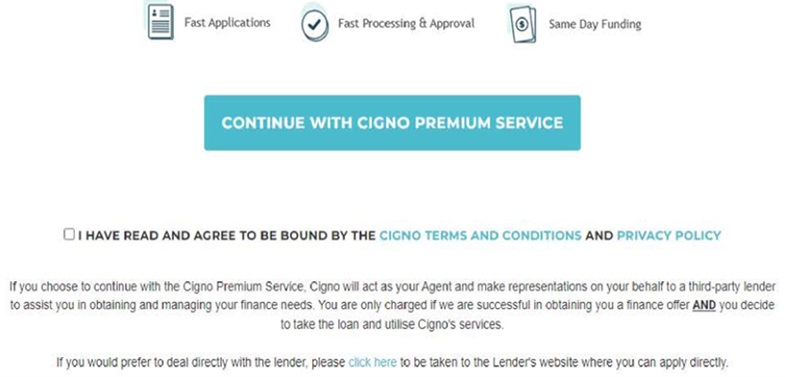
Pausing there, I note that the final sentence appeared in relatively small print, and was located after the box marked CONTINUE WITH CIGNO PREMIUM SERVICE and after the box to be ticked evidencing the customer having read and agreed to be bound by the Cigno terms and conditions and privacy policy.
49 If the potential customer chose to deal directly with the lender by clicking the click here hyperlink, the customer was taken to a webpage that displayed the following text:
You have chosen to deal directly with the lender.
We can direct you to proceed with: BSF Solutions Pty Ltd
Note, this is still optional for you. You can continue to their website in which you will be subject to their normal loan application process. Do [sic] wish you all the success in your findings for a cash solution!
BSF Solutions can be contacted via: www.bsfsolutions.com.au
If you would prefer to use the Cigno Premium Services, please click here: New Cigno Loan
I note that customers who choose to deal directly with BSF entered into agreements with BSF on different terms from the Loan Agreement, and which provided that the cost of the loan was 5% of the loan amount (Tab 2 of MM-1). As I say later in these reasons, there were only two customers who did so, and their transactions are not part of the case brought by ASIC.
50 If the potential customer initially chose to engage Cigno’s services by clicking Continue with Cigno Premium Service (and ticking the box to indicate that they had read and agreed to be bound by Cigno’s terms and conditions and privacy policy), or subsequently clicked the hyperlink New Cigno Loan after considering the option to deal directly with BSF, the potential customer was taken to an online form titled Cigno — New Application.
51 Returning Cigno customers who logged into the member portal to apply for a loan were previously provided with the new customer disclosures during their initial loan obtained through Cigno. They were not provided with that information again.
52 The potential customer completed the online form by inputting personal and contact details, as well as loan details, including the amount sought and the reason for requesting the loan. Once the form was completed, the potential customer was required to upload proof of identity and bank statements.
53 If the potential customer successfully completed the form and uploading steps, Cigno gave the potential customer’s loan application to BSF using an application programming interface, unless the potential customer owed money to Cigno, in which case Cigno would notify the potential customer that the application was not forwarded to the lender.
54 Upon receipt of the application, BSF assessed the application against BSF’s lending criteria and communicated to Cigno whether the application was approved or declined.
55 If the potential customer’s application was approved, Cigno advised the potential customer of the approval and invited them to accept their agreements by clicking a link that took the potential customer to the member portal on the Cigno Website.
56 Once at the Cigno website, the potential customer was advised of BSF’s loan approval amount, was asked to consider whether proceeding was the right choice, and was reminded that they could choose to deal directly with the lender by clicking on the hyperlink to the lender’s website.
57 If the potential customer chose to proceed with Cigno, they were:
(a) presented with a series of choices regarding their desired loan amount and payment schedule;
(b) advised of the total Cigno Account Keeping Charges;
(c) presented with two separate web frames containing a proposed Services Agreement and Loan Agreement, respectively; and
(d) invited to agree to the Services Agreement and Loan Agreement by separately clicking a box that confirmed their acceptance of each agreement.
58 If the potential customer accepted the Services Agreement and the Loan Agreement, they were again provided with a summary of their payment schedule and notified that a copy of their agreements had been sent to their email.
Evidence of Individual Consumers
59 ASIC tendered documentary evidence giving details of 16 consumers who entered into Loan Agreements and Service Agreements, and the fees that they were charged in relation to those agreements. Affidavits by two of those consumers were read by ASIC, one of whom (Ms Kim) was cross-examined. ASIC does not suggest that those 16 consumers are a representative sample of the entire class of about 100,000 consumers who entered into Loan Agreements and Service Agreements. However, it may assist in understanding the transactions in question to set out the evidence concerning one of those consumers, Ms McDougall, being the first in the list of 16 consumers annexed to ASIC’s Concise Statement, and one of the two deponents to affidavits.
60 On 26 August 2022, Ms McDougall conducted a Google search for quick cash loans and obtained several results, including Cigno, and clicked on a link to its website. Ms McDougall followed a link on Cigno’s website to start the application process and applied for a $250 loan. She submitted the personal information and bank statements required for the loan application, and received approval for the loan about one hour later. Within about five minutes of accepting the loan terms, Ms McDougall received an email from Cigno attaching the Loan Agreement and the Services Agreement, and later the same day she received the $250 loan into her bank account. The covering email of 26 August 2022 set out a payment schedule with fortnightly payments of $124 due on 1, 15 and 29 September 2022, with a final payment of $120.13 due on 13 October 2022. The Loan Agreement provided that BSF would lend her the BSF Credit of $250, Ms McDougall promised to pay a Late Payment Fee of $20 each time a payment amount was not paid on or before the payment date, and Ms McDougall was required to repay the BSF Credit in instalments. The Services Agreement with Cigno provided that the Loan Amount was $250, the Account Keeping Fee was $34.59 payable weekly in advance, and fees that may be payable were a Default Fee of $67 and a Change of Payment Schedule Fee of $15.
61 Ms McDougall made the fortnightly repayments on the due dates in September and October 2022, and on 15 October 2022 received an email from Cigno which said that her account had been finalised and attached an account statement. The account statement showed that she had paid weekly account keeping fees of $34.59 which totalled $242.13, and that she had paid Cigno a total of $492.13 for the $250 loan.
62 On 16 October 2022, Ms McDougall applied for a second loan of $250 with Cigno, by logging into the member portal on the Cigno website. Since her personal details were already in the portal, she only needed to select the amount that she wanted to apply for and to follow a link to a secure portal, from which she logged into her bank account to provide Cigno with access to her bank statements. About one hour after submitting the loan application on the Cigno website, she received an email from Cigno which said that Cigno had secured a loan for her from BSF, and contained a link which required her to read and accept the agreements. Ms McDougall did not accept the agreements at that time, as she was still contemplating if it was worthwhile taking out the new $250 loan, and Cigno sent her a number of reminders over the following four weeks.
63 Late on 23 November 2022, Ms McDougall decided to click on a link on one of the follow-up emails from Cigno and accept the loan. At about 1 am on 24 November 2022, Ms McDougall received an email from Cigno which confirmed that her loan application had been finalised, and attached a Loan Agreement and a Services Agreement. The covering email set out the payment schedule for $125 to be paid on each of 8 December 2022, 22 December 2022 and 5 January 2023, with a final payment of $123.08 payable on 19 January 2023. The Loan Agreement with BSF provided that BSF would lend her the BSF Credit of $250, she agreed to pay a Late Payment Fee of $20 each time a payment amount was not paid on or before the payment date, and she was required to repay the BSF Credit in fortnightly instalments. The Services Agreement with Cigno provided that the Loan Amount was $250, the Account Keeping Fee was $31.01 payable weekly in advance, and fees that may be payable were a Default Fee of $67 and a Change of Payment Schedule Fee of $15. On 24 November 2022, within about two or three hours of receiving the 1 am email from Cigno, Ms McDougall received the $250 loan into her bank account.
64 In December 2022, Ms McDougall tried to contact Cigno on the phone to reschedule her upcoming payments, and received an automated message asking her to contact Cigno by email or chat. Ms McDougall did not do so. During January and early February 2023, Ms McDougall received a number of emails from Cigno informing her that her scheduled repayments had failed, and some of the emails attached default notices. On 18 February 2023, Ms McDougall received an email from Cigno telling her that her repayment had failed because of insufficient funds, and attached a default letter entitled “Third and Final Notice Further Action Pending”. That default letter said that her total outstanding balance was $723.83. On 20 February 2023, Ms McDougall sent an email to Cigno asking if Cigno could organise a payment plan as she was experiencing financial difficulties. A further exchange of emails between Ms McDougall and Cigno took place, and on 20 February 2023 a payment plan of $60 per fortnight beginning on 1 March 2023 was agreed. Ms McDougall began making repayments to Cigno of $60 per fortnight from 1 March 2023, but then experienced difficulties in March and April 2023 in logging into her Cigno member portal. On 12 May 2023, Ms McDougall received an email from Cigno saying that it had been notified that its direct debit authority had been cancelled by Ms McDougall or by her bank, and requested that she make manual payments to its bank account, which Ms McDougall did not do. On 12 May 2023, Ms McDougall received an email from Cigno attaching a default notice. On about 24 May 2023, Ms McDougall’s fortnightly $60 payments to Cigno resumed, although she had not taken steps to reactivate the direct debit.
65 At the time of affirming her affidavit on 20 October 2023, Ms McDougall was still being charged with fortnightly repayments of $60 to Cigno. Her account statement dated 8 August 2023 showed that for the second loan of $250, Ms McDougall had been charged $828.63 in fees, and had repaid Cigno a total of $785. The fees charged to Ms McDougall comprised:
(a) the weekly Account Keeping Fee, initially in the amount of $31.01 per week, but from 19 January 2023 in the amount of $5.95 per week;
(b) four Change of Payment Schedule Fees of $15 each;
(c) four Default Fees of $67 each; and
(d) six Late Payment Fees, two of which were charged at $20 each, and four of which were discounted by 50% to $10 each.
66 The outstanding balance as at 20 October 2023 was $59.08, which Ms McDougall expected to be debited on 25 October 2023.
Evidence of ASIC Examinations
67 ASIC tendered portions of transcripts of examinations conducted pursuant to s 253 of the Credit Act of Mr Harrison, Mr Swanepoel and Mr Hussein (of Mantaq Solutions Pty Ltd (Mantaq)). Section 303(1) provides that a statement that a person makes at an examination is admissible in evidence against the person in proceedings subject to various exceptions. One of those exceptions is where the statement is not admissible in evidence against the person in the proceedings because of subs 295(3). That provision applies where, before making an oral statement giving information or signing a record, the person (other than a body corporate) claims that the statement, or signing the record, as the case may be, might tend to incriminate the person or make the person liable to a penalty. Subsection 295(3) provides that the statement is not admissible in evidence against the person in criminal proceedings or proceedings for the imposition of a penalty, other than proceedings in relation to the falsity of the statement, or the falsity of any statement contained in the record. The examinees all made claims for that privilege in answering questions at their examinations.
68 I note that an objection on the ground of hearsay had been made in the respondents’ schedule of objections to the tender of the examination transcripts of the three examinees, but no argument was put to me at the hearing on that ground (see T207.45–211.14 and 224.39–40). Counsel for the respondents stated that, in the case of Mr Harrison and Mr Swanepoel, if the examinee who claimed the privilege had the benefit of a limitation order under s 136 of the Evidence Act 1995 (Cth) to the effect that the transcript was not admitted against him, then the tender of the transcripts was not controversial (T210.21–22). The objections to the tender of the transcript of Mr Hussein’s examination were resolved by agreement (T224.39–40). Accordingly, there was no need for me to rule on the objection previously foreshadowed on the ground of hearsay.
69 Accordingly, I admitted the identified portions of the examination transcript of Mr Harrison subject to a limitation under s 136 that it was not admitted against Mr Harrison. Similarly, I admitted the identified portions of the examination transcript of Mr Swanepoel subject to a limitation under s 136 that it was not admitted against Mr Swanepoel (T220.5-11). I admitted the identified passages of Mr Hussein’s transcript without any s 136 limitation, given that Mr Hussein is not a party to the proceedings (T226.5-13).
Aggregated Customer Numbers and Aggregated Payments
70 The total number of customers who entered into Loan Agreements with BSF in the period 18 July 2022 to 26 June 2023 (being the date of the relevant notice by ASIC under s 253 of the Credit Act) was 100,583 (CB 1049, 1055). The total number of such Loan Agreements was 150,114 (CB 1049, 1055). The figures show that some customers entered into more than one Loan Agreement, as illustrated by the case of Ms McDougall to whom I have referred above.
71 The total number of customers who entered into Loan Agreements with BSF in the period from 18 July 2022 to 26 June 2023 after Cigno referred their loan application to BSF was 100,581 (CB 1049, 1055). The total number of such Loan Agreements originating from loan applications that Cigno referred to BSF was 150,112 (CB 1049, 1055).
72 It follows that only two customers out of about 100,000 customers entered into Loan Agreements without having been referred to BSF by Cigno. Thus, while it is true to say that the Cigno website offered a choice between using Cigno’s services and approaching BSF directly, only a very small number of customers chose the latter. I have referred at para 48 above to the way in which the option of dealing directly with the lender appeared in relatively small print, and was located after the boxes to be clicked on for continuing with the Cigno service and for having read and agreed to the Cigno terms and conditions and privacy policy. Those features of the website, in my view, were not designed to enhance the prospect of customers deciding to deal directly with the lender. I infer from the nature of those features of the website that the very small number of customers who chose to deal directly with BSF was consistent with the expectations and intentions of Cigno and BSF, and of Mr Swanepoel and Mr Harrison as their sole directors respectively.
73 In the period from July 2022 to 30 May 2023 (being the date of Mr Swanepoel’s examination), Cigno did not refer its customers to any lenders other than BSF (CB 528). That evidence was given as part of Mr Swanepoel’s examination, which, as I have indicated above, was not admitted against Mr Swanepoel himself. However, as I have indicated at paragraph 49 above, if a customer chose to deal directly with the lender by clicking on the relevant hyperlink on the Cigno website, the customer was taken to a page on the Cigno website that identified only one such lender, namely BSF. I infer from that page on the Cigno website that during the Relevant Period, Cigno did not refer its customers to any lenders other than BSF. As the material in para 49 above is common ground among all respondents and ASIC, I draw that inference against all respondents, including Mr Swanepoel.
74 Mr Harrison gave evidence in his examination that Cigno was the only entity that referred borrowers to BSF for loans in the period July to December 2022 (CB 387 lines 12–14, CB 395 lines 1–5). That evidence was admitted against all respondents other than Mr Harrison. However, I draw an inference against all respondents, including Mr Harrison, that Cigno was the only entity that referred borrowers to BSF for loans in the period July to December 2022, based on the fact (to which I have referred above) that only two customers out of about 100,000 customers entered into Loan Agreements without having been referred to BSF by Cigno. It is theoretically possible that those two customers had been referred by another broker or intermediary, but there is no evidence to indicate that that was a realistic possibility. In my view, it is more likely than not that those two customers had taken up the option presented by the Cigno website (see paras 48 and 49 above) to deal directly with the lender, namely BSF.
75 It follows from the above material that the businesses of Cigno and BSF were closely intertwined. With only two exceptions, the customers who entered into Loan Agreements with BSF (numbering more than 100,000) had their loan applications referred to BSF by Cigno. Further, Cigno did not refer its customers to any lenders other than BSF. Accordingly, I regard it as appropriate to refer, consistently with ASIC’s contentions, to BSF and Cigno having established and implemented a lending business model, namely the No Upfront Charge Loan Model. The elements of that model are set out in the Loan Facilitation Management Agreement, the Loan Agreements and the Services Agreements, and also in the aspects of the Cigno websites to which I have referred above.
76 The conclusion that BSF and Cigno participated in an overarching business model does not depend on any finding that they were in a relationship of agency, partnership or joint venture or any other kind of ongoing legal relationship apart from the contractual relationship under the Loan Management Facilitation Agreement, and I do not make any such finding. Accordingly, the conclusion that BSF and Cigno participated in the No Upfront Charge Loan Model is not contradicted by cll 12 and 13 of the Loan Management Facilitation Agreement (in which Cigno and BSF confirmed that they were unrelated parties and that the agreement did not create an agency relationship, partnership or joint venture between the parties).
77 There are some inconsistencies between the agreements, on the one hand, and the Cigno websites, on the other hand, which I resolve in the following way. As to the amount of the Default Fee, as I have indicated above, I find that that fee was charged in the amount of $67 throughout the Relevant Period, despite references on the Cigno websites in the early stages of the Relevant Period to the fee (referred to as “Dishonour Fee”) being $79. Second, I find that the Cigno websites correctly described the services provided by Cigno as including a range of services which pre-dated the entry by the customer into a Loan Agreement. That is a matter which is reflected in Version 1 of the Services Agreement. While I accept that the limitation in the description of services in Version 2 of the Services Agreement provides an accurate statement of the binding contractual promise on the part of Cigno under Version 2, limiting its contractual promise to provide services to those which were provided after the Commencement Date, I do not regard that as an accurate statement of the services in fact provided by Cigno. That does not require me to find that Version 2 of the Services Agreement was a sham, but merely that the binding contractual promises by Cigno did not correspond to what Cigno told potential customers who read its websites it would provide, and what Cigno did in fact provide, by way of services.
78 In terms of the aggregated amounts of payments made pursuant to the No Upfront Charge Loan Model, the 100,581 consumers who entered into 150,112 Loan Agreements borrowed a total of $34,709,015 from BSF. As at 3 October 2023, those customers were charged fees in the following amounts:
(a) in excess of $63,426,811.85 charged by Cigno, comprising:
(i) Account Keeping Fees of $33,961,220.31;
(ii) Default Fees of $24,682,034.55; and
(iii) Change of Payment Schedule Fees of $4,783,557; and
(b) in excess of $6,588,660 charged by BSF, being the Late Payment Fees.
79 In addition, Cigno paid to BSF assessment fees in the period 18 July 2022 to 26 June 2023 (being the date of ASIC’s s 253 notice) in the total amount of $9,196,120, there having been 460,036 loan applications referred by Cigno to BSF in that period (CB 1076 and 1100; CB 1050 and 1056). It will be recalled that assessment fees were payable irrespective of whether the customer entered into a Loan Agreement with BSF, and the evidence thus indicates that about one third of loan applications lodged with Cigno resulted in Loan Agreements.
Operation of Integrated and Automated Systems and BSF and Cigno
80 ASIC relied on a number of aspects of the business operations of Cigno and BSF to demonstrate that those companies did not operate independent and separate businesses, but should be regarded as having collaborated in implementing a shared business model in the No Upfront Charge Loan Model. Some of those aspects, taken on their own, may not be regarded as particularly significant. However, in my view, the evidence to which I refer in the paragraphs below is an illustration of the principle that a true picture may emerge from the overall accumulation of detail viewed from a distance, and thus the overall effect of the detail is not necessarily the same as the sum total of the individual details: Transport Industries Insurance Co Ltd v Longmuir [1997] 1 VR 125 at 141 (Tadgell JA, with whom Winneke P and Phillips JA agreed), cited with approval in Seven Network (Operations) Ltd v Fairfax Media Publications Pty Ltd [2023] FCAFC 185 at [40] (Wheelahan, Anderson and Jackman JJ).
81 Pursuant to the No Upfront Charge Loan Model, Cigno collected information from consumers in support of their loan applications and provided those applications electronically to BSF. Bank statements were required to support a loan application. Cigno performed a preliminary assessment of loan applications before referring customers to BSF (CB 654–5, not admitted against Mr Swanepoel). Cigno’s websites described its services as including an assessment of credit applications prior to submitting them to the lender (CB 1710, 2032, 2357, 2608, 2948 and 3226). That performance assessment functionality was built into the software used for the purposes of the No Upfront Charge Loan Model (CB 655, not admitted against Mr Swanepoel).
82 As set out below, BSF and Cigno used the same service provider to support their information technology systems. BSF was a small company with only two employees (CB 1461). BSF did not have the internal infrastructure to collect the principal amounts which were owed to it by its customers who dealt with it through Cigno (CB 12456, not admitted against Cigno and Mr Swanepoel).
83 Cigno had a computer system for managing loan applications and the loans themselves. Mr Hussein acknowledged in his ASIC examination that this system was called “Barcasoft”, and said that it was known as the “LMS” or “loan management system” (CB 772), and he took part in creating it in 2014 (CB 774-5). Mr Hussein said that, among other things, during the Relevant Period that system calculated costs and fees charged to clients (CB 775–7).
84 Cigno’s processes were largely automated. The online loan application process required consumers to fill in personal details and to upload identification documents and provide bank account statements (Ex MM-1, tab 4, not admitted against BSF and Mr Harrison; and see para 47 above which is common ground between all respondents and ASIC). Mr Swanepoel confirmed in his ASIC examination that Cigno collected bank statements from loan applicants in order to do a performance assessment on a consumer, that Cigno performed that assessment before referring the customer to BSF, and that the assessment was built into the software (CB 654–5, not admitted against Mr Swanepoel). BSF had a computer system for managing the receipt of loan applications which was also an automated system (CB 387, 389-90, not admitted against Mr Harrison). When Cigno sent consumers’ loan applications to BSF, the merits of those applications were not considered manually by BSF, in that if the application met BSF’s criteria, BSF’s system would send back to Cigno’s system an approval by way of an electronic application programming interface which would signal to Cigno to proceed with presenting the customer with the Loan Agreement with BSF (CB 387–9, not admitted against Mr Harrison). Conversely, if the loan application forwarded by Cigno to BSF did not include the customer identification and bank statements required to be provided in support of an application, then the loan application would be automatically declined (CB 390–1, not admitted against Mr Harrison). Mr Hussein said in his examination that Cigno performed a number of checks before sending loan applications to BSF, including checking the account name, any existing debt checks and verification of the applicant’s income, to ascertain whether it was worth sending the application to BSF (CB 780–1).
85 BSF advanced loans to consumers electronically, and consumers made payments pursuant to their Loan Agreements and Services Agreements largely by direct debit. BSF and Cigno had arrangements with third-party service providers to provide those services. BSF had an agreement with Zepto Payments Pty Ltd (Zepto) (previously known as Split Payments Pty Ltd) dated 23 April 2021. Cigno entered into an agreement with Ezidebit Pty Ltd (Ezidebit) dated 10 May 2021, which was executed by Mr Swanepoel on behalf of Cigno.
86 BSF and Cigno held bank accounts with ANZ and BNK Corporation Ltd (also known as Goldfields Money) (BNK). BSF held three bank accounts with ANZ in respect of which Mr Harrison was a signatory, and one bank account with BNK in respect of which Mr Swanepoel was the signatory. Cigno held two accounts with ANZ and one account with BNK, in respect of which Mr Swanepoel was a signatory. An analysis of those bank accounts was conducted by Ms Rana, an ASIC financial investigator and accountant, which showed relevantly the following. Loan amounts were advanced by BSF to consumers from its ANZ bank account, of which Mr Harrison was a signatory. BSF used Zepto to facilitate the advance of loans to consumers. The loan amounts advanced to consumers passed through a CUSCAL float, and the total of the loans that were paid from BSF’s ANZ bank account into the CUSCAL float was $34,184,119. The amount that was paid from the float account to consumers was also $34,184,119 (CB 5763). This approximates the amount of $34,709,015 (CB 1050 and 1056) that BSF notified ASIC, in response to a statutory notice, it had lent pursuant to the No Upfront Charge Business Model. Ms Rana’s analysis revealed that Cigno received a total of $78,772,698.56 from Zepto, Ezidebit and “potential repayments from borrowers”, and remitted to BSF the amount of $41,879,702.59 (CB 5763 and 5781). Ms Rana’s analysis also revealed that in relation to BSF, funds were paid by BSF to accounts of other entities in which Mr Harrison had a commercial interest, and similarly funds were paid by Cigno to accounts of other entities in which Mr Swanepoel had a commercial interest.
87 BSF and Cigno engaged service providers to perform support functions for them as described below. Those service providers were either related bodies or were independent third-party entities.
88 MiFin Services Pte Ltd (MiFin) provided software and administrative support. MiFin was registered in Singapore, and one of its directors during the Relevant Period was Mr Swanepoel. Cigno had a services agreement with MiFin dated 5 May 2021, and executed on behalf of Cigno by Mr Swanepoel (CB 1349). Recital A to that agreement states that Cigno manages and services loans for BSF under a Loan Service Management Agreement which took effect from 5 May 2021. ASIC submits that that agreement makes plain that Cigno regarded itself as providing services “for BSF”, and not for (or not only for) the consumers who entered into Services Agreements with it. However, the agreement between Cigno and BSF of 5 May 2021 is not in evidence, and I am unable to say whether it relates to the No Upfront Charge Loan Model (which was not implemented and available to the public until July 2022). MiFin also entered into a Software Development and Maintenance Agreement with Mantaq dated 10 March 2023 (CB 5268), which was executed on behalf of MiFin by Mr Swanepoel. Mr Harrison said in his ASIC examination that MiFin provided services to BSF by providing the software which BSF licensed and used, and also provided back office administration and call centre staff (CB 344–6, not admitted against Mr Harrison). Mr Swanepoel said in his ASIC examination that Cigno used “offshore staff” employed by a third party offshore services provider that was in turn engaged by MiFin, and that it also licensed software from MiFin (CB 488–9, not admitted against Mr Swanepoel).
89 Mantaq provided software development and maintenance services. Mr Hussein was the sole director of Mantaq, which was incorporated on 13 May 2008, and which provided services to, or on behalf of, the Cigno corporate group (including Cigno). He was also, since April 2020, the Chief Technical Officer for Swan Management Services (CB 750), in respect of which he reported to Mr Swanepoel (CB 760). Mantaq entered into the Software Development and Maintenance Agreement with MiFin dated 10 March 2023 (CB 5268), executed by Mr Hussein on behalf of Mantaq and by Mr Swanepoel on behalf of MiFin. Cigno and BSF were both clients of Mantaq, and Mantaq registered domain names for both Cigno and BSF (CB 753– 4).
90 The documents produced in answer to a subpoena issued to Mantaq (CB Tab 38) evidence instructions or requests provided by, or on behalf of, Cigno or BSF relating to the creation or maintenance of the Cigno websites or the loan management systems of BSF or Cigno. The documents produced are printouts of Mantaq’s system records that record work undertaken in relation to 21 discrete tasks, the date those tasks were created in the system, communications between individuals in relation to the work done in respect of each of those tasks (described as “task followers”) and the period of time over which the work or communications occurred. Task 1 was listed on 4 July 2022 (CB 12560), and task 21 was listed on 12 September 2022 (CB 12597). The records reveal:
(a) the first four tasks were created in July 2022 before the No Upfront Charge Loan Model commenced operations;
(b) work was being undertaken on the website “cignoloans.com.au”;
(c) work was being undertaken in relation to both Cigno’s loan management system (CB 12578 for task 13) and BSF’s loan management system (CB 12576 for task 12);
(d) work was being done on the application programming interface between BSF and Zepto (described as “SP” by reference to its previous name of Split Payments Pty Ltd) relating to the transfer of funds between BSF and Zepto (CB 12590 for task 18);
(e) work included the involvement of Mr Hussein (from Mantaq) and staff from MiFin; and
(f) the records reveal the integration of the loan management systems of Cigno and BSF as demonstrated by the entry for 15 September 2023 which states that once a successful payment has been recorded for Cigno there should be a corresponding payment that will go to the BSF side, and once a payment is defaulted on Cigno, it should be defaulted as well on the BSF side and there should be a lender late payment fee (CB 12594).
91 Mr Swanepoel referred in his ASIC examination to a debt collector called “Milton Graham”, but subsequently advised that the relevant company was “illion” (CB 1606). Cigno entered into an agreement with illion Australia Pty Ltd (illion) for the provision by illion of debt collection services (CB 1608). It appears that Milton Graham was a trading name of illion (CB 4279, first entry). When Cigno referred a debt to the debt collectors, it appears to have done so on behalf of both BSF and itself. For example, Ms Kim received a letter dated 19 April 2023 headed “Notification of Referral to External Collections” (CB 12369), which bore the logos of Cigno, BSF and Milton Graham, and notified the consumer of how much was owed to each of BSF and Cigno, saying that her Cigno account was set to be referred to the external collections agency, Milton Graham, within three business days.
92 Mr Swanepoel and Mr Harrison were both, at different times and for an overlapping period, directors of Swan Management Services Pty Ltd. That company was the registrant of the “cignoloans.com.au” domain name, and as Ms Rana’s evidence shows, received substantial funds from Cigno as a result of the No Upfront Charge Loan Model. The company search of Swan Management Servies (CB 823–7) shows that:
(a) Mr Swanepoel was a director from 1 July 2016 to at least 15 January 2024, the sole director from 3 May 2018 to at least 15 January 2024, and the sole secretary from 1 July 2016 to at least 15 January 2024; and
(b) Mr Harrison was the sole director from 4 January 2016 to 1 July 2016, a director from 20 April 2017 to 3 May 2018 and the sole secretary from 4 January 2016 to 1 July 2016.
93 BSF and Cigno had common bank account signatories and delegated users, in that:
(a) Ms Shazad was a delegated user of BSF’s BNK account and Cigno’s BNK account (CB 7867–8);
(b) Ms Kitching and Mr Stylianou were both signatories of one of BSF’s ANZ accounts and one of Cigno’s ANZ accounts (CB 5515 and 5500), as well as the bank account of Pyramid Capital Pty Ltd (CB 5506, a company associated with Mr Swanepoel which Ms Rana identifies as having received $14 million from Cigno); and
(c) the BNK “Delegated User Registration Form” (CB 7872) listed the BSF entities together with the Cigno and Swan entities, as well as Pyramid Capital Pty Ltd.
94 The Swan Group Holdings Pty Ltd Directors’ Report dated 30 November 2022 (CB 943) refers to Cigno having taken legal advice from Piper Alderman, and “in conjunction with BSF Solutions Pty Ltd, made any necessary changes to its business model to both trade legally and comply with the ASIC Product Intervention Order”.
95 Mr Harrison was the registrant contact for domain names owned by Swan Management Services (namely “cignoau.com.au” and “cignoaustralia.com.au”), of which Mr Swanepoel was a director, and Mr Harrison had previously been a director.
The BHF Proceeding
96 The BHF Proceeding was commenced by ASIC on 29 September 2020 against BHF Solutions Pty Ltd (BHFS), which was a credit provider of which Mr Harrison was the sole director and secretary, and Cigno Pty Ltd, a company of which Mr Swanepoel was the sole director and secretary. ASIC sought declarations and injunctions in relation to the loan agreements made by BHFS and services agreements made by Cigno Pty Ltd pursuant to a business model operated by BHFS and Cigno Pty Ltd (referred to as the Continuing Credit Model) in the period from 18 October 2019 to 14 April 2020. References in the following paragraphs to paragraph numbers are to the decision of the Full Court, namely Australian Securities and Investments Commission v BHF Solutions Pty Ltd [2022] FCAFC 108; (2022) 293 FCR 330, unless otherwise stated.
97 BHFS and Cigno Pty Ltd had entered into an agreement described as the Loan Management Facilitation Agreement on or around 1 July 2019: [31]. Pursuant to that agreement and the Continuing Credit Model:
(a) BHFS entered into loan agreements with borrowers. The only fee chargeable to consumers under those loan agreements was a fee of $15: [9] and [36]. Cigno Pty Ltd acted on behalf of BHFS in collecting that fee, which it then transferred to BHFS: [9] and [63]; and
(b) Cigno Pty Ltd entered into services agreements with borrowers. Pursuant to those services agreements, Cigno Pty Ltd managed the relationship with consumers and their loan repayments under their loan agreements with BHFS: [9], [56] and [60].
98 Four different fees were payable by consumers to Cigno Pty Ltd ([56], [58], and [60]), namely:
(a) a Financial Supply Fee, which was calculated as a fee of $13 plus 60% of the loan amount;
(b) an Account Keeping Fee of $5.95 per week over the course of the loan;
(c) a Change of Payment Schedule Fee of $22 each time consumers changed their repayment schedule; and
(d) a Default Fee of $79 each time consumers defaulted on their repayments.
99 Cigno Pty Ltd marketed the loans through its website “www.cignoloans.com.au”: [37(b)] and [46]. Consumers applied for loans via Cigno Pty Ltd’s website: [37(b)]. The online loan application process on Cigno Pty Ltd’s website included a step which enabled consumers to deal directly with the lender (ie BHFS), rather than to apply for the loan through Cigno Pty Ltd: [49]–[52]. The hyperlink to be clicked on by those who wished to deal directly with the lender was in smaller type and located after a large box on which the consumer could click with the words “Continue with Cigno Premium Service”: [49]. In the BHF Proceeding, it was an agreed fact that no individual borrowers chose to deal directly with BHFS, rather than to pay for the service offered to customers by Cigno Pty Ltd: [37(c)]. Cigno processed the loan applications and advised consumers that the loan application had been approved: [63] and [66]. Cigno Pty Ltd provided consumers with the proposed credit contracts with BHFS after the applications were approved: [66]. Consumers entered into two agreements, namely a loan agreement with BHFS and a services agreement with Cigno Pty Ltd: [12]–[13] and [66]. Pursuant to the services agreement, Cigno Pty Ltd charged consumers a number of fees, one of which was a variable fee calculated by reference to the size of the loan and a base amount of $13 (namely, the Financial Supply Fee): [60]. Cigno Pty Ltd received and processed the loan repayments: [63] and [67]–[69].
100 In the BHF Proceeding, ASIC alleged that:
(a) BHFS contravened s 29 of the Credit Act by engaging in a credit activity without holding an ACL by entering into a credit contract and carrying on a business of providing credit; and
(b) Cigno Pty Ltd contravened s 29 of the Credit Act by engaging in a credit activity without holding an ACL by performing obligations and exercising rights of BHFS and providing credit services in relation to BHFS’s credit contract.
101 The Full Court held that the Financial Supply Fee imposed on consumers for the services provided by Cigno Pty Ltd in connection with credit provided by BHFS was a charge that “is or may be made for providing the credit” within the meaning of ss 5(1)(c) and 6(5) of the Credit Code: [182]–[183] (O’Bryan J), with whom Besanko J (at [1]) and Lee J (at [2]–[5]) agreed. As a consequence, the Full Court held that BHFS had engaged in a “credit activity” within the meaning of s 6(1) of the Credit Act without holding an ACL (at [211]) and remitted for further consideration by the trial judge whether Cigno Pty Ltd had also done so (at [212]–[215]).
102 The Full Court construed the expression “charge … made for providing the credit” in ss 5(1)(c) and 6(5) of the Credit Code as a charge that is made in exchange for, on account of, or by reason of the provision of credit on an assessment of all relevant facts in a practical commercial sense, looking to the substance of the credit arrangements rather than their contractual form, and is not determined by analysing whether as a matter of the law of contract the charge is the contractual consideration for the provision of credit: [171]–[172], [179], [182]– [183] (O’Bryan J, with whom Besanko and Lee JJ agreed). That construction was said to require a direct relationship between the charge and the provision of credit: [172].
103 At [182], O’Bryan J said the following:
The respondents contend that the Financial Supply Fee was charged by Cigno for the services it supplied, none of which constituted the provision of credit. While the contention is not inaccurate as far as it goes, it does not take into account all of the relevant facts. Critically, it ignores the following facts:
(a) First, the services supplied by Cigno in return for the Financial Supply Fee – receiving, verifying, assessing and processing loan applications – were all anterior to and directed to the provision of credit (by BHFS).
(b) Second, from the perspective of a credit applicant, those services were not an end in themselves. The services only had value to the credit applicant if the application is approved and credit is provided.
(c) Third, the Financial Supply Fee, as the title of the fee implies, was not charged unless credit was provided (by BHFS). It was the provision of credit that triggered the imposition of the fee.
(d) Fourth, the Financial Supply Fee was calculated as a percentage of the loan amount and therefore varied according to the amount of credit provided (by BHFS).
104 Justice O’Bryan said that those facts provided a sufficient basis on which to conclude that the Financial Supply Fee was a charge that was made for providing the BHFS credit, having regard to the commercial substance of the arrangements and in a practical commercial sense: [183].
105 Justice O’Bryan said further that the contractual arrangements between Cigno Pty Ltd and BHFS, documented in the Loan Management Facilitation Agreement, explained why Cigno Pty Ltd advertised the provision of credit on its website whereas BHFS did not. In addition, O’Bryan J said that those contractual arrangements explained why the majority of credit charges were imposed by Cigno Pty Ltd and not by BHFS, referring to Cigno Pty Ltd guaranteeing the repayment of the credit under the agreement and thereby ultimately bearing the credit risk on the loans provided: [184]. That was a reference to cl 2.6 of the Loan Management Facilitation Agreement, whereby Cigno Pty Ltd guaranteed to BHFS that, in the event that BHFS’s funds were not repaid within eight weeks, Cigno Pty Ltd would immediately pay BHFS the principal sum plus BHFS’s $15 fee: [33] and [35]. That guarantee is not a feature of the Loan Management Facilitation Agreement in the present case.
106 Justice O’Bryan then said that given his Honour’s findings with respect to the Financial Supply Fee, it was unnecessary to decide whether the Account Keeping Fee or the Change of Payment Schedule Fee were charges that were made for providing credit: [185]. O’Bryan J noted that, like the Financial Supply Fee, those fees were only payable if credit was provided by BHFS. O’Bryan J then said:
However, the Account Keeping Fee and the Change of Payment Schedule Fee were payable for administrative services following the provision of credit, being account keeping and changing payment schedules respectively. On the facts of this case, it seems more difficult to characterise those fees as charges made for providing credit.
107 The primary judge dealt with the issues remitted by the Full Court in Australian Securities and Investments Commission v BHF Solutions Pty Ltd (No 2) [2023] FCA 787 (the Remitter Judgment). In that judgment, the primary judge:
(a) made declarations to the effect that BHFS and Cigno Pty Ltd had respectively contravened s 29(1) of the Credit Act by engaging in credit activity without holding an ACL; and
(b) granted final injunctive relief permanently restraining BHFS and Cigno Pty Ltd from engaging in further conduct in contravention of s 29(1) of the Credit Act.
108 As I have noted above, the Full Court decision in the BHF Proceeding was delivered on 27 June 2022, about three weeks before the No Upfront Charge Loan Model was implemented and made available to the public. ASIC also relies on transactions entered into shortly before the hearing of the BHF Proceeding at first instance (which commenced on 23 June 2021), whereby the corporate entities involved in the BHF Proceeding transferred or lent assets to the corporate entities involved in the No Upfront Charge Loan Model. On 22 April 2021, BHFS entered into a loan agreement with BSF whereby BHFS agreed to lend BSF $4 million, executed by Mr Harrison for BHFS (CB 1411 and 1440). On 6 May 2021, Cigno Pty Ltd entered into an Asset Sale Agreement with Cigno whereby it sold various assets to Cigno, executed by Mr Swanepoel for both Cigno Pty Ltd and Cigno (CB 5283 and 5298). However, there is no evidence of the No Upfront Charge Loan Model having been conceptualised or considered as early as April or May 2021, and accordingly I do not place any significance on the transactions entered into at that time.
Was there a charge for providing the credit?
109 As indicated above, s 5(1) of the Credit Code provides that the Credit Code applies to the provision of credit (and to the credit contract and related matters) if, when the credit contract is entered into or proposed to be entered into, four matters are satisfied. The only one of those matters which is in issue in these proceedings is para (c), namely “a charge is or may be made for providing the credit”. The respondents accept that paras (a), (b) and (d) are satisfied (T374.22–25). ASIC contends that the Account Keeping Fee and the Change of Payment Schedule Fee are such charges. As I have indicated above, those charges were made by Cigno under the Services Agreements, although the credit provider was BSF. However, as the BHF Proceeding demonstrates, a charge may satisfy the requirement in para (c) even though it is charged by an entity other than the credit provider. That is consistent with the use of the passive voice in para (c), without stipulating the entity which imposes the charge.
The Account Keeping Fee
110 It is inevitable that a prospective customer for the provision of credit in the present case would want to know what the cost was of the provision of credit. That matter was anticipated on the Cigno website, which included among the so-called Frequently Asked Questions (CB 2598) “What is the cost of a Cigno loan?” The reader was then told that fees vary depending on the length of the loan and the terms of the lender, and invited the reader to look at the “Costs” page for more information (CB 2600). As I have indicated at para 37 above, that is a reference to the page headed “How Much Does it Cost?” (CB 2613), and the pronoun “it” in that question refers to the loan, or to use the statutory language, the provision of credit. The answer given on the website was that there are no costs payable to the lender for the provision of the loan, but that those who engage Cigno would be required to pay a weekly Account Keeping Fee, and gave an example of a $250 loan for 10 weeks using Cigno’s services incurring a weekly Account Keeping Fee of $28.50. The answer also referred to other fees that can be incurred, including the Change of Payment Schedule Fee. I regard the aspect of the answer relating to the Account Keeping Fee as a practical and commercial response, reflecting the commercial reality that the Account Keeping Fee was an important element in the cost to customers of the credit which was proposed to be provided.
111 As I have indicated above, the Full Court in the BHF Proceeding expressly rejected the view that whether a charge is made for the provision of credit depends on analysing the contractual form of, or the contractual consideration for, the provision of credit. In the present case, cl 3.3 in both Version 1 and Version 2 of the Services Agreement provided that the Account Keeping Fee “is payable by you to us for costs associated with maintaining your Cigno Account”. The language thus used does not expressly confine the relevant “costs” to those incurred by Cigno, as distinct from those incurred by BSF as the lender. However, even if one were to construe cl 3.3 as being so confined, it does not determine the issue of the purpose for which the charge was to be made.
112 It is instructive to compare the features of the Account Keeping Fee in the present case with the four matters referred to in O’Bryan J’s reasons at [182] in relation to what was known as the Financial Supply Fee in the BHF Proceeding. The first matter was that the services supplied by Cigno Pty Ltd in return for the Financial Supply Fee were all anterior to and directed to the provision of credit by BHFS. That is not true of the Account Keeping Fee in the present case, because some of the services supplied by Cigno related to the period after the credit was provided and the Loan Agreement was entered into. But as ASIC submits, nothing in the terms, context or purpose of the Credit Code requires that the charge spoken of in s 5(1)(c) pertains only to services provided before the advance of the loan amount. As Lee J stated at [4], the language of s 5(1)(c) identifies “what it actually is that the consumer pays or promises to pay in order to obtain a provision of credit”. Accordingly, the respondents accept that a charge can have more than one purpose (T365.45–46). As ASIC submits, para (c) does not use words such as “only” or “solely”. It follows that a charge may be made for the provision of credit even though it may also be made for other purposes, such as for administrative services or to defray administrative expenses. It is therefore relevant to consider whether some, even if not all, of the services supplied by Cigno in return for the Account Keeping Fee were anterior to the provision of credit by BSF.
113 Under the terms of Version 1 of the Services Agreement, some of the services supplied by Cigno in return for the Account Keeping Fee were anterior to the provision of credit by BSF, although some of them related to the period after that credit was provided and the Loan Agreement was entered into. Under Version 2 of the Services Agreement, the services promised by Cigno all post-dated the provision of credit by BSF as a matter of the law of contract. However, as I have indicated above, as a matter of fact, Cigno did provide a range of services to customers before credit was provided by BSF, including receiving, verifying, assessing and processing loan applications. That is what the Cigno website stated in explaining “How it Works” (CB 2608). Under Version 2 of the Services Agreement, Cigno was not contractually obliged to provide those pre-contractual services and the Account Keeping Fee was not treated as contractual consideration for those services. However, the commercial reality is that those services were provided by Cigno to customers in assisting them to obtain credit, and Cigno would need to defray the cost of providing those services from the revenue it earned from customers. The main source of that revenue was the Account Keeping Fee. Accordingly, in my view, the practical commercial reality was that charging the Account Keeping Fee would enable Cigno to provide pre-contractual services to customers which were directed to the provision of credit by BSF. ASIC submits, and I accept, that a customer’s promise to pay the Account Keeping Fee throughout the life of the loan, in exchange for, or on account of, activities performed or services supplied by Cigno (whether before and after, or only after) entry into the Loan Agreement, was made in order to obtain the provision of the credit.
114 The second matter referred to at [182] was that, from the perspective of a credit applicant, the services provided by Cigno Pty Ltd were not an end in themselves, and had value to the credit applicant only if the application was approved and credit was provided. That proposition is also true of the services in fact provided by Cigno in the present case. The third matter referred to at [182] was that the Financial Supply Fee in that case was not charged unless credit was provided by BSF, and thus it was the provision of credit that triggered the imposition of the fee. That proposition is equally true of the Account Keeping Fee in the present case. The fourth matter referred to at [182] was that the Financial Supply Fee was calculated as a percentage of the loan amount and therefore varied according to the amount of credit provided by BHFS. That proposition is also true of the Account Keeping Fee in the present case. As the evidence of Ms Oliver demonstrates, the amount of the BSF Credit was an integer in the formula for calculating the Account Keeping Fee, and had the effect that the Account Keeping Fee would vary according to that amount.
115 The respondents submitted that, in the BHF Proceeding, the Financial Supply Fee was an upfront payment which was payable irrespective of whether or not the account was closed early, whereas the Account Keeping Fee in the present model was payable over time and would cease when the account was closed (T365.22–35). ASIC also accepted that, in the BHF Proceeding, the Financial Supply Fee was “a one-time fee” (closing written submissions at [46(c)(i)]; T248.39–41). However, as a matter of fact, the Financial Supply Fee considered in the BHF Proceeding was spread out over the periodic payments which were due to Cigno Pty Ltd (as O’Bryan J said at [66]–[67] and [72]–[73]). Therefore, I do not accept the premise that the fee was a single upfront fee. In any event, I do not regard the timing of the payment of the fee, or whether it ceases to be payable when the loan is repaid, as matters of any real significance in dealing with whether a charge was made for the provision of credit. In a conventional loan, interest is typically payable on a periodic basis during the life of the loan, and is undoubtedly a charge for the provision of credit. Conversely, a loan establishment fee is typically paid upfront by way of a lump sum, and is typically payable irrespective of whether the loan is repaid early, and that too is undoubtedly a charge for the provision of credit.
116 The respondents also rely on the absence of a guarantee by Cigno of the customer’s debt to BSF, in contrast to cl 2.6 of the Loan Facilitation Management Agreement in the BHF Proceeding, but I do not regard that matter as having any material bearing on the present issue. While O’Bryan J referred to that guarantee as explaining why the majority of credit charges were imposed by Cigno Pty Ltd and not by BHFS (at [184]), it is not necessary to form a view as to why the majority of credit charges were imposed by Cigno, and not by BSF, in the present case in order to deal with the issue whether the Account Keeping Fee was a charge for the provision of credit.
117 The respondents seek to rely upon the position of “Buy Now Pay Later” (BNPL) providers, citing a submission by ASIC to the Commonwealth Department of Treasury in relation to the proposed regulation of BNPL providers in January 2023 (Ex 1). One of the reasons given by ASIC (at [16]) for BNPL providers not being required to hold an ACL was because they do not charge consumers for providing the credit, and thus the arrangement is not credit to which the Credit Code applies pursuant to s 5 of the Credit Code. ASIC said that BNPL providers do not charge interest, but most do charge missed payment fees when a consumer misses a payment: [36]. ASIC said that some BNPL providers are able to recover the cost of providing the credit by charging a fee to merchants when a consumer uses a BNPL payment method (at [28] and [47]), and BNPL providers generally prohibit merchants contractually from increasing the cost of goods and services to the individual consumer where their BNPL arrangement is used (at [48]).
118 The respondents seek to draw an analogy with the No Upfront Charge Loan Model as follows:
(a) Cigno (as the merchant) and BSF (as the lender) are separate entities which entered into the Loan Management Facilitation Agreement setting out the terms on which the merchant will refer its customers, the lender will assess and extend credit to those customers and the basis on which fees will be paid by the merchant to the lender;
(b) the merchant will enter into agreements with its customers for goods and services independently of the lender, subject to any prohibitions that might be imposed by the lender on the merchant about passing on certain fees and costs to a customer who chooses to apply for the lender’s credit; and
(c) the lender will enter into loan agreements with consumers referred by the merchant to the lender, typically on a low-cost or no-cost basis.
119 However, the putative analogy breaks down at a fundamental level. Under the BNPL model, the goods and services provided by merchants are desirable and valuable to consumers for their own sake, and the credit provided by BNPL providers is merely a means whereby customers pay for those goods and services. By contrast, the services provided by Cigno have no value to the consumer independently of the credit offered by BSF. The rationale for Cigno’s services, and for Cigno’s Account Keeping Fee, is inextricably connected with the provision of credit by BSF. It is entirely artificial to suppose that Cigno’s services (and its Services Agreements) are independent of BSF and the loans which BSF is offering to provide.
120 It is true that the position of BNPL providers is relevantly comparable to that of BSF. Just as BNPL providers are able to recover the cost of providing credit by charging merchants, BSF was able to recover the cost of providing credit by receiving fees from Cigno. But the fact that BSF’s position was analogous to that of BNPL providers does not mean that Cigno’s position was analogous to that of merchants. Unlike merchants, the services that Cigno provided were valuable only because they facilitated the provision of credit.
121 Accordingly, in my view, the Account Keeping Fee was imposed on account of, or by reason of, the provision of credit by BSF, and was imposed in exchange for that credit, assessed as a matter of practical commercial substance. There was a direct relationship between that charge and the provision of credit.
The Change of Payment Schedule Fee
122 As I have indicated above, the Full Court in the BHF Proceeding did not make a finding as to whether the Change of Payment Schedule Fee in that case was a charge for the provision of credit. However, at [185], O’Bryan J referred to that fee as being payable for administrative services following the provision of credit, and said that it seemed more difficult to characterise that fee as a charge made for providing credit. The Change of Payment Schedule Fee in the BHF Proceeding was $22, whereas the corresponding fee in the present case is $15.
123 As I have indicated above, a fee may be for the provision of credit, even though it is also for another purpose, such as for providing an administrative service or defraying administrative expenses. As a matter of practical commercial reality, given that there was no fee, charge or penalty imposed on borrowers for making an early repayment of the amounts they owed to BSF and Cigno, it would naturally be expected that customers would request a change to their payment schedule only in circumstances where they wished to obtain a further deferral of the debt which they owed. In those circumstances, the commercial reality was that the Change of Payment Schedule Fee was a fee imposed in exchange for, or by reason of, the service provided by Cigno of arranging with BSF a change to the payment schedule on the basis that BSF had provided credit to the consumer and, for the purpose of the provision of that credit, BSF was agreeing to an adjusted timeframe for payment involving a further deferral of the time for repayment. ASIC draws attention to the definition of “credit” in s 3(1)(a) of the Credit Code, whereby credit is provided if, under a contract, payment of a debt owed by one person to another is deferred. ASIC submits, and I accept, that the provision of credit involves both the amount that is owing and also the period before which it has to be repaid (T290.46–291.7). Accordingly, a fee which is paid in order to extend the period by which a debt is deferred is a charge made for the provision of credit as a matter of practical commercial reality.
124 The respondents submit that ASIC is precluded by the terms of its Concise Statement from running an argument that there is a new provision of credit upon the change of the payment schedule, but in my view that submission misunderstands ASIC’s argument. ASIC is not submitting that there is a new provision of credit or a new credit contract upon a change to the payment schedule, but merely that the deferral of a debt lies at the heart of the concept of the provision of credit. The Change of Payment Schedule Fee was paid for an extension of the original provision of credit, not for a new provision of credit.
125 ASIC further submits, and I accept, that the services provided by Cigno to consumers in exchange for the Change of Payment Schedule Fee were not an end in themselves, and had value to consumers only because credit had actually been provided to consumers. The relevant services involved, in substance, amending the schedule for future payments under the Loan Agreement.
126 While it is true to say that the Change of Payment Schedule Fee was payable following the provision of credit, as O’Bryan J said of the corresponding fee in the BHF Proceeding at [185], that question of timing is accommodated by the language used in s 5(1)(c) of a charge being one which “may be made” for the provision of credit. Further, as I have said above in relation to the Account Keeping Fee, it does not matter that the service for which the charge may be made was provided after the loan was advanced.
127 Accordingly, as a matter of practical commercial substance, in my view, the Change of Payment Schedule Fee was imposed on account of, or by reason of, the provision of credit by BSF, and was imposed in exchange for that credit. There was a direct relationship between the charge and the provision of credit.
Did BSF and Cigno engage in credit activity?
128 This question relates to the alleged contraventions of s 29(1) of the Credit Act, which prohibits a person from engaging in a credit activity if the person does not hold a licence authorising the person to engage in the credit activity. It also relates to the alleged contraventions of s 32(1) which prohibits a person from demanding, receiving or accepting a fee, charge or other amount from a consumer for engaging in a credit activity if, by engaging in the credit activity, the person would contravene s 29. I have set out earlier in these reasons the legislative provisions relating to “credit activity”.
129 The respondents concede that if it is found that the Account Keeping Fee or the Change of Payment Schedule Fee was a fee for the provision of credit, then the Court would find that BSF engaged in credit activity (respondents’ closing written submissions at [178]). That concession is well made. In relation to each Loan Agreement entered into the Relevant Period, BSF engaged in the credit activity of:
(a) being a credit provider under a credit contract for the purposes of Item 1(a) in s 6(1) of the Credit Act;
(b) carrying on a business of providing credit, being credit to the provision of which the Credit Code applies, for the purposes of Item 1(b); and
(c) performing the obligations, or exercising the rights, of a credit provider in relation to a credit contract or proposed credit contract for the purposes of Item 1(c).
130 The respondents also concede (closing written submissions at [179]) that, if it is found that the Account Keeping Fee or the Change of Payment Schedule Fee was a fee for the provision of credit, then Cigno engaged in credit activity for the purposes of Item 1(c) in s 6(1) of the Credit Act on each occasion that the evidence shows that Cigno engaged in any of the following activities (as set out in [192] of ASIC’s closing written submissions):
(a) processing loan applications for the BSF Credit, and providing to consumers the proposed credit contracts with BSF after the applications were approved, including by maintaining accounts and records with respect to consumers;
(b) receiving and processing loan repayments, either directly from consumers or by entering into agreements with direct debit providers to arrange for consumers’ accounts to be directly debited and paid to Cigno, monitoring those payments and taking steps to recover debts from defaulting consumers, including by:
(i) maintaining accounts and records with respect to consumers;
(ii) arranging for the collection of payments from consumers by arranging for customers’ bank accounts to be directly debited;
(iii) monitoring repayments to consumers, including their due date;
(iv) arranging for changes to consumers’ repayment schedule;
(v) advising consumers when they have defaulted on their repayments;
(vi) demanding that consumers remedy defaults;
(vii) collecting monies from consumers corresponding to repayments for amounts advanced or fees charged, including by entering contracts or arrangements for third parties to collect those monies; and
(viii) transferring money collected from consumers to BSF, which money corresponded to repayments of amounts advanced by, and the Late Payment Fees charged by, BSF under Loan Agreements;
(c) monitoring repayments and defaults of the loans, including arranging changes to consumers’ repayment schedules and notifying consumers about upcoming payments and defaults, including by engaging in the activities described in (b) above;
(d) sending account statements, reminders and other communications to consumers and receiving and responding to all consumer enquiries concerning the loan; and
(i) maintaining accounts and records with respect to consumers;
(ii) monitoring repayments by consumers, including their due date;
(iii) arranging for changes to consumers’ repayment schedules;
(iv) advising consumers when they have defaulted on their repayments; and
(v) demanding that consumers remedy defaults; and
(e) remitting to BSF funds received from consumers, including by,
(i) maintaining accounts and records with respect to consumers;
(ii) collecting monies from consumers corresponding to repayments from amounts advanced or fees charged, including by entering contracts or arrangements for third parties to collect those monies; and
(iii) transferring money collected from consumers to BSF, which money corresponded to repayments of amounts advanced by, and the Late Payment Fees charged by, BSF under the Loan Agreements.
131 The respondents also concede (closing written submissions at [179]) that, if the Account Keeping Fee or the Change of Payment Schedule Fee was a fee for the provision of credit, then Cigno:
(a) provided credit assistance to consumers by assisting the consumer to apply for the BSF Credit (for the purposes of s 8(d) of the Credit Act); and
(b) acted as an intermediary within the meaning of s 9 of the Credit Act between BSF and consumers by:
(i) assessing the information provided by consumers;
(ii) recommending consumers’ loan applications to BSF; and
(iii) sending consumers the Proposed Loan Agreements after the loan applications were approved by BSF.
132 That concession was not expressed to extend to ASIC’s contention that Cigno acted as an intermediary by processing loan applications for the BSF Credit (ASIC’s closing written submissions at [199(a)]), but I am satisfied that Cigno did act as an intermediary in that way. In addition, the concession referred to in (a) in the preceding paragraph of these reasons was not expressed to extend to ASIC’s submission that Cigno provided credit assistance to consumers by suggesting that consumers apply for, or remain in, a particular credit contract with a particular credit provider, being BSF, for the purposes of ss 8(a) or 8(c) of the Credit Act (see ASIC’s closing written submissions at [196(c)]). However, in my view, by processing loan applications for the BSF Credit, and providing to consumers the proposed credit contracts with BSF after the applications were approved, Cigno did provide credit assistance to consumers for the purposes of s 8(a) by suggesting that consumers apply for a particular credit contract with a particular credit provider, being BSF.
133 Cigno expressly opposes the submission by ASIC that Cigno’s conduct in “receiving and processing loan repayments, either directly from consumers or by entering into agreements with direct credit providers to arrange for consumers’ accounts to be directly debited and paid to Cigno, monitoring those payments and taking steps to recover debts from defaulting consumers” involved either suggesting that the consumer apply for a particular credit contract with a particular credit provider or assisting the consumer to apply for a particular credit contract with a particular credit provider (ss 8(a) and (d) of the Credit Act) or suggesting that a consumer remain in a particular credit contract with a particular credit provider (s 8(c) of the Credit Act) (respondents’ closing written submissions at [180]). ASIC’s submission to that effect is made in its closing written submissions at [196(b)–(d)]. I accept the respondents’ submission in that regard, as I do not see how the conduct of receiving, processing and monitoring payments and recovering debts from defaulting consumers satisfies the language of s 8(a), (c) or (d) of the Credit Act.
134 I note that the concessions by the respondents to which I have referred in relation to this issue were made subject to what they described as a “formal submission” that the reasoning of the primary judge in the Remitter Judgment concerning the contraventions by Cigno Pty Ltd of s 29(1) of the Credit Act were erroneous (T372.38–373.19, noting that the reference in that transcript to para 167 of the respondents’ closing written submissions should be read as a reference to para 181). The respondents did not contend that the Remitter Judgment should not be followed in the present case in that respect. In any event, I agree with the reasoning in the Remitter Judgment in relation to that matter. The same reservation by the respondents applies to their concessions as to contraventions of s 32(1) of the Credit Act (see respondents’ closing written submissions at [181]).
135 In sum, both BSF and Cigno contravened s 29(1) of the Credit Act.
Did BSF and Cigno demand, receive and accept fees for engaging in a credit activity?
136 ASIC contends that BSF contravened s 32(1) of the Credit Act by demanding, receiving and accepting the Late Payment Fee for:
(a) engaging in the credit activity of carrying on a business of providing credit for the purposes of Item 1(b) of s 6(1) of the Credit Act; and
(b) performing the obligations, or exercising the rights, of a credit provider in relation to a credit contract for the purposes of Item 1(c) of s 6(1) of the Credit Act.
137 The respondents concede that if BSF and Cigno contravened s 29(1) of the Credit Act (as I have found above), then BSF contravened s 32(1) of the Credit Act on each occasion that the evidence establishes that BSF demanded, received or accepted a Late Payment Fee from a consumer (closing written submissions at [182]). That concession is well made. The enforcement of BSF’s contractual rights under its Loan Agreements to demand, receive or accept a Late Payment Fee was an activity inherent in, and for the purpose of, carrying on the business of providing credit, and was also in performance of BSF’s rights under the Loan Agreement.
138 As to Cigno, ASIC submits that Cigno contravened s 32(1) of the Credit Act by demanding, receiving and accepting the Account Keeping Fee, the Default Fee, and the Change of Payment Schedule Fee for engaging in the credit activities referred to above.
139 The respondents concede that, if BSF and Cigno contravened s 29(1) of the Credit Act, then Cigno contravened s 32(1) of the Credit Act, but only when the evidence establishes that a particular fee or charge was demanded, received or accepted by Cigno for engaging in a specific credit activity established against Cigno (closing written submissions at [183]). I am satisfied that on each occasion referred to in the evidence that Cigno demanded, received or accepted the Account Keeping Fee, the Default Fee and the Change of Payment Schedule Fee, it did so for engaging in one or more of the specific credit activities to which I have referred above as having been established against Cigno. In relation to each of the Account Keeping Fee, Default Fee and Change of Payment Schedule Fee, those fees were demanded, received and accepted for the credit activity of exercising the rights of BSF as a credit provider, within the meaning of Item 1(c) of s 6(1) of the Credit Act. In addition, the Account Keeping Fee was demanded, received and accepted (as a matter of practical commercial reality even if not by way of strict contractual consideration under Version 2 of the Services Agreement) for Cigno suggesting that the consumer apply for, and assisting the consumer to apply for, a particular credit contract with BSF (within the meaning of Item 2 of s 6(1) and ss 7(a) and 8(a) and (d) of the Credit Act). The Account Keeping Fee was also demanded, received and accepted (again as a matter of practical commercial reality) for Cigno acting as an intermediary between BSF and a consumer partly for the purposes of securing a provision of credit for the consumer with BSF (within the meaning of Item 2 of s 6(1) and ss 7(b) and 9(a) of the Credit Act). It follows that, by demanding, receiving or accepting those fees without holding an ACL, Cigno breached the prohibition in s 32(1) of the Credit Act.
Accessory Liability of Mr Harrison and Mr Swanepoel
140 ASIC alleges that Mr Harrison and Mr Swanepoel were involved in the contraventions of the Credit Act by BSF and Cigno respectively. It is well-established that a person will only be liable as an accessory under statutory provisions to the same effect as those applicable under the Credit Act if the person has actual knowledge of the essential facts constituting the contravention: Yorke v Lucas (1985) 158 CLR 661 at 670 (Mason ACJ, Wilson, Deane and Dawson JJ). Further, in order to know the essential facts, it is not necessary to know that those facts are capable of characterisation in the language of the statute: Rural Press Ltd v Australian Competition and Consumer Commission [2003] HCA 75; (2003) 216 CLR 53 at [48] (Gummow, Hayne and Heydon JJ). Nor is it necessary that the accessory knows that those matters amount to a contravention: Yorke v Lucas at 667 (Mason ACJ, Wilson, Deane and Dawson JJ), 676 (Brennan J).
141 In the present case, the respondents rely on the reasoning of the Full Court in Rafferty v Madgwick [2012] FCAFC 37; (2012) 203 FCR 1, which involved the question of whether Madgwicks was involved in the contravention of a statutory provision with a number of elements, one of them being entering into a “franchise agreement”. The Full Court found that, although Madgwicks knew the terms and conditions of the agreement in question, they thought that the agreement was very unlikely to be a franchise agreement: [262]. The Full Court said that in order for Madgwicks to hold the requisite state of mind for accessory liability, they had to be aware that the relevant party was entering into a franchise agreement, although that did not require a correct legal judgment as to whether the statutory provision applied, or that Madgwicks knew that the relevant conduct was a contravention of that provision: [257]–[260] (Kenny, Stone and Logan JJ). However, in Gore v Australian Securities and Investments Commission [2017] FCAC 13; (2017) 249 FCR 167 at [35], Dowsett and Gleeson JJ said the following in relation to Rafferty:
Clearly, the Court considered that it was not necessary to prove that Madgwicks knew of any aspect of the Franchising Code or the relevant legislation. It is perhaps a little unclear as to whether Madgwicks had to know that the relevant proposed agreement was a franchise agreement in the sense in which that description is generally used, or whether they had to know that it was a franchising agreement according to a definition in the Franchising Code. However, even in the latter case, it seems that Madgwicks would only have had to know the facts which led to the engagement of the relevant provisions. The categorical rejection of the proposed need for any knowledge concerning the legislation and the Franchising Code cannot have any other result.
142 At [38], their Honours said that the decisions in Giorgianni v The Queen (1985) 156 CLR 473 and Yorke v Lucas established only that it must be proven that the alleged accessory knew the relevant factual matters leading to illegality, and said that the decision in Rafferty is to similar effect.
143 Applying those principles to the present case, it was necessary for ASIC to allege and prove that Mr Harrison and Mr Swanepoel had actual knowledge of the relevant facts leading to the conclusion that the Credit Code applied, and leading to the conclusion that the other elements of ss 29(1) and 32(1) also applied, but not that Mr Harrison and Mr Swanepoel knew that those conclusions were correct or appropriate. In particular, it was necessary for ASIC to allege and prove that Mr Harrison and Mr Swanepoel knew the facts which lead to the conclusion that charges were (or may be) made for the provision of credit, but it was not necessary for ASIC to allege and prove that Mr Harrison and Mr Swanepoel were actually aware that charges were (or may be) made for the provision of credit.
Pleading Issues
144 Much of the debate before me as to the accessory liability case concerned matters of pleading and procedural fairness. In the present case, there were no pleadings in the strict sense. Rather, ASIC filed a Concise Statement in support of its originating application. The Commercial and Corporations Practice Note issued by this Court states that material supporting the originating application may take the form of a document entitled “Concise Statement”, or a statement of claim or affidavit: para 5.3. Paragraphs 5.4–5.9 deal with the concise statement method. The nature and purpose of a concise statement was the subject of consideration by McKerracher and Colvin JJ in Allianz Australia Insurance Ltd v Delor Vue Apartments CTS 39788 [2021] FCAFC 121; (2021) 287 FCR 388 at [140]–[154]. Their Honours pointed out that the purpose of a concise statement is to enable the applicant to bring to the attention of the respondent and the Court the key issues and key facts at the heart of the dispute and the essential relief sought from the Court before any detailed pleadings. It is not intended to substitute the traditional form of pleading with a shorter form of pleading. Rather, it is a different form of document directed to exposing the real nature of the dispute, and the use of the brief narrative form is encouraged where appropriate: [140].
145 Their Honours pointed out at [144] that where the matter proceeds on the basis of a concise statement and concise response, then unlike pleadings, those documents are not conceived of as a comprehensive statement of all the matters that must be established in order for a claim or defence to succeed. In such instances, the concise statement and response serve a function of providing a fair disclosure of the nature of the case to be advanced with more precise issues being disclosed by other means, and to the extent considered to be appropriate, in the interests of fairness. Their Honours gave as one example of those other means the provision of written outlines of opening submissions in advance of the hearing in order to expose the issues. At [149], their Honours said that if a claim that is at the heart of the case that a party seeks to advance at the final hearing is not to be found in the concise statement, then there will need to be an application for leave to amend that will be dealt with in accordance with the established procedural law as to late amendments to alter a case.
146 In the present case, ASIC’s Concise Statement alleged (in para 22) that by reason of the matters in paras 11 to 13, Mr Harrison and Mr Swanepoel were involved in the contraventions of ss 29(1) and 32(1) of the Credit Act by BSF and Cigno respectively. Paragraphs 11 to 13 were as follows:
11. In the Relevant Period, Harrison was the sole director of BSF, had an indirect ownership interest in it, managed its business, was responsible for its day-to-day significant decisions, exercised control over its systems and processes and designed and implemented the No Upfront Charge Loan Model on behalf of BSF, including by approving the terms of the Loan Agreement.
12. In the Relevant Period, Swanepoel was the sole director of Cigno Australia, had an indirect ownership interest in it, managed its business, was responsible for its day-to-day significant decisions, exercised control over its systems and processes and designed and implemented the No Upfront Charge Loan Model on behalf of Cigno Australia, including by approving the terms of the Services Agreement.
13. The respondents implemented the No Upfront Charge Loan Model shortly after the decision of the Full Court in ASIC v BHF Solutions Pty Ltd (2022) 293 FCR 320, [2022] FCAFC 108 (BHF Proceeding) on 27 June 2022.
147 Those paragraphs did not make any express allegation in terms of actual knowledge of particular facts by Mr Harrison or Mr Swanepoel. Further, although it was contended in para 10 of the Concise Statement that neither BSF nor Cigno held an ACL in the Relevant Period, there was no allegation that Mr Harrison or Mr Swanepoel knew of that fact, although it could readily be said that the lack of an ACL by either company was a matter which was obvious to each of them as sole director of their respective companies.
148 On 18 October 2023, the solicitors for the respondents requested particulars of the design and implementation steps alleged in paras 11 and 12 of the Concise Statement (among other matters), which was responded to by ASIC on 27 October 2023 in the following terms:
Item 9. In relation to paragraph 11, please give particulars as to what ASIC alleges were the design and implementation steps, which it says Mr Harrison did in relation to the No Upfront Charge Loan Model.
18 In relation to the “design” and “implementation” allegations in paragraph 11, ASIC alleges (without limitation) that Mr Harrison:
18.1 formulated, or participated in formulating, the No Upfront Charge Loan Model;
18.2 obtained legal advice from Piper Alderman on behalf of BSF (and in conjunction with Cigno Australia), and made changes to its business model, as referred to in the Financial Statement for Swan Group Holdings Pty Ltd for financial year 2022 (BHC.0003.0004.0001);
18.3 negotiated, approved and executed the Loan Management Facilitation Agreement on behalf of BSF;
18.4 negotiated, approved and carried into effect the Loan Agreements;
18.5 ensured that the business processes, systems and procedures of BSF, and the staff of BSF, were able to, and did, carry into effect, the No Upfront Charge Loan Model as contemplated by the Loan Management Facilitation Agreement; and
18.6 commenced the provision of credit by BSF pursuant to the No Upfront Charge Loan Model from July 2022.
19 ASIC further alleges that the No Upfront Charge Loan Model was implemented after the Full Court handed down its decision on 27 June 2022 in Australian Securities and Investments Commission v BHF Solutions Pty Ltd (2022) 293 FCR 330; [2022] FCAFC 108 (Full Court Judgment).
20 ASIC reserves the right to provide further particulars, including following the service of evidence or discovery.
Item 10. In relation to paragraph 12, please give particulars as to what ASIC alleges were the design and implementation steps, which it says Mr Harrison did in relation to the No Upfront Charge Loan Model.
21 We understand that Item 10 of your 18 October Letter intended to refer to Mr Swanepoel; not Mr Harrison.
22 In relation to the “design” and “implementation” allegations in paragraph 12, ASIC alleges (without limitation) that Mr Swanepoel:
22.1 formulated, or participated in formulating, the No Upfront Charge Loan Model;
22.2 obtained legal advice from Piper Alderman on behalf of Cigno Australia (and in conjunction with BSF), and made changes to its business model, as referred to in the Financial Statement of Swan Group Holdings Pty Ltd for financial year 2022 (BHC.0003.0004.0001);
22.3 negotiated, approved and executed the Loan Management Facilitation Agreement on behalf of Cigno Australia;
22.4 negotiated, approved and carried into effect the Services Agreements;
22.5 ensured that the business processes, systems and procedures of Cigno Australia, and the staff of Cigno Australia, were able to, and did, carry into effect, the No Upfront Charge Loan Model as contemplated by the Loan Management Facilitation Agreement; and
22.6 commenced the provision of the Cigno Australia Services (as defined in the Concise Statement) by Cigno Australia pursuant to the No Upfront Charge Loan Model from July 2022.
23 ASIC further alleges that the No Upfront Charge Loan Model was implemented after the Full Court handed down its decision on 27 June 2022 in the Full Court judgment.
24 ASIC reserves the right to provide further particulars, including following the service of evidence or discovery.
149 ASIC submits, and I accept, that the concepts of “design” and “implementation” necessarily involve actual knowledge of what it is that is being designed and implemented. Further, the particulars provided of paras 11 and 12 are expressed in terms which inherently involve actual knowledge of the transactions and processes referred to. Further, ASIC submits, and I accept, that the first of those particulars (referring to the formulating of the No Upfront Charge Loan Model) necessarily involves actual knowledge of both the BSF side and the Cigno side of what was an integrated and overarching business model, as do the other references in the particulars to the No Upfront Charge Loan Model. Accordingly, while the particulars in relation to Mr Harrison tend largely to focus on the transactions and processes undertaken by BSF, and the particulars relating to Mr Swanepoel tend largely to focus on the transactions and processes involving Cigno, it cannot be said that the particulars as a whole stop short of alleging that Mr Harrison knew of the Cigno transactions and processes and that Mr Swanepoel knew of the BSF transactions and processes.
150 ASIC also submitted that, read fairly, the Concise Statement and the particulars disclose an allegation that each of Mr Harrison and Mr Swanepoel knew that the No Upfront Charge Loan Model involved a charge for the provision of credit (T396.42–398.22). I do not accept that submission. However, for the reasons given above, I do not regard that as one of the essential facts which it must be alleged Mr Harrison and Mr Swanepoel actually knew. In my view, the Concise Statement, when read with the particulars of design and implementation steps, do disclose an allegation that Mr Harrison and Mr Swanepoel knew the essential primary facts, being the facts leading to the legal conclusion that charges were (or may be) made for the provision of credit, and it is not necessary to allege that they also knew that those primary facts led to that legal conclusion.
ASIC’s application to amend its Concise Statement
151 During the course of his final address (T296.44–298.09, 299.08–23), Senior Counsel for ASIC sought to amend paras 11 and 12 of the Concise Statement as follows:
11. In the Relevant Period, Harrison was the sole director of BSF, had an indirect ownership interest in it, managed its business, was responsible for its day-to-day significant decisions, exercised control over its systems and processes and designed and implemented the No Upfront Charge Loan Model (as described in paragraphs 3 and 4 above) on behalf of BSF, including by approving the terms of the Loan Agreement. Harrison had actual knowledge of each of the matters alleged in paragraphs 10, 11 and 13 of this Amended Concise Statement, and the matters alleged in paragraph 18 of the letter dated 27 October 2023 from the applicant’s solicitors to the respondent’s solicitors.
12. In the Relevant Period, Swanepoel was the sole director of Cigno Australia, had an indirect ownership interest in it, managed its business, was responsible for its day-to-day significant decisions, exercised control over its systems and processes and designed and implemented the No Upfront Charge Loan Model (as described in paragraphs 3 and 4 above) on behalf of Cigno Australia, including by approving the terms of the Services Agreement. Swanepoel had actual knowledge of each of the matters alleged in paragraphs 10, 12 and 13 of this Concise Statement, and the matters alleged in paragraph 22 of the letter dated 27 October 2023 from the applicant’s solicitors to the respondent’s solicitors.
152 The paragraphs to which cross-reference is made in those proposed amendments are as follows:
3. From about July 2022 to date (Relevant Period), BSF and Cigno Australia implemented a business model whereby Cigno Australia marketed small loans to consumers, processed loan applications and managed repayments, and BSF advanced those loans (No Upfront Charge Loan Model). Pursuant to a “Loan Management Facilitation Agreement” dated 20 July 2022 between BSF and Cigno Australia, BSF charged Cigno Australia an assessment fee of $19.99 for the assessment and approval of each loan application that BSF received, irrespective of whether the application was approved.
4. As part of the No Upfront Charge Loan Model:
(a) BSF required consumers to enter into a “No Fee for Credit Loan Agreement” or a “No Upfront Charge Loan Agreement” (Loan Agreement); and
(b) Cigno Australia required consumers to enter into an “Account Keeping Agreement” (Services Agreement).
…
10. Neither BSF nor Cigno Australia held an ACL in the Relevant Period.
…
13. The Respondents implemented the No Upfront Charge Loan Model shortly after the decision of the Full Court in ASIC v BHF Solutions Pty Ltd (2022) 293 FCR 330, [2022] FCAFC 108 (BHF Proceeding) on 27 June 2022.
153 Those amendments were opposed by the respondents by reason of their lateness, the prejudice which was said would be caused by the amendments, the lack of an affidavit explaining the reasons for the lateness of the amendments, and the supposed futility of the amendments.
154 Except in one respect, I do not regard the proposed amendments as altering the substance or effect of paras 11 and 12 of the Concise Statement, when read in conjunction with the particulars which were provided on 27 October 2023. ASIC submits, and I accept, that the express allegation of actual knowledge on the part of Mr Harrison and Mr Swanepoel of the matters alleged in paras 11, 12 and 13 of the Concise Statement, and the matters alleged in paras 18 and 22 of the particulars provided on 27 October 2023, merely made explicit what was already clearly inherent in the articulation of those matters. As ASIC submits, one cannot design or implement a business model without having actual knowledge of the elements constituting that business model. Accordingly, it was plain from the language used in the Concise Statement and the particulars that ASIC was making an allegation of actual knowledge of those elements on the part of Mr Harrison and Mr Swanepoel. Accordingly, I do not regard the respondents as prejudiced by those amendments to the Concise Statement. Nor in my view is there any need for ASIC to prove by way of affidavit the reason or reasons for making the late application to amend, in circumstances where the proposed amendments are made out of an abundance of caution, and are not necessary in order to disclose fairly to the respondents the case which ASIC seeks to establish.
155 The one respect in which the proposed amendments do make a substantive addition to the allegations previously articulated is in the cross-reference to para 10, in that the original Concise Statement did not make an allegation that Mr Harrison and Mr Swanepoel had actual knowledge that neither BSF nor Cigno held an ACL in the Relevant Period. However, the respondents did not make any submission that they were prejudiced in this particular regard. Indeed, it is difficult to see how Mr Harrison or Mr Swanepoel (as the sole directors of BSF and Cigno respectively) could conceivably have contended that they did not have actual knowledge of that matter. Accordingly, I do not regard there as being any prejudice to the respondents arising out of the additional allegation of actual knowledge of the matters alleged in para 10. Further, I regard the absence of that allegation in the original Concise Statement as a matter of oversight on the part of ASIC, which was not picked up by ASIC until I raised the point in the course of its final address (T299.8–23). In those circumstances, I do not regard it as necessary for ASIC to have provided by way of affidavit evidence an explanation for the lateness of the application to amend.
156 Accordingly, despite the able and measured argument by Senior Counsel for the respondents to the contrary, I grant leave to ASIC to file an Amended Concise Statement in the form referred to above. The respondents accepted that their Further Amended Concise Statements of Defence, which I granted the respondents leave to file on the second last day of the hearing (T235.12–13), would stand as their Concise Responses in the event that I granted leave to ASIC to amend its Concise Statement (T355.30–42).
Evidence of Mr Harrison’s actual knowledge
157 Mr Harrison was the sole director and secretary of BSF during the Relevant Period (CB 790). Mr Harrison approved and executed the Loan Management Facilitation Agreement on behalf of BSF on or about 20 July 2022 (CB 1038). He also approved and executed the template Loan Agreement which was provided by BSF to ASIC in response to a statutory notice, as director on behalf of BSF stating that thereby BSF “accepts the Borrower’s offer to Borrow” (CB 1061). Mr Harrison was identified by Mr Hussein as having been the main decision-maker at BSF (CB 762). It should be noted that during the Relevant Period, BSF had only two employees in addition to Mr Harrison (CB 1462).
158 On 22 December 2022, Mr Harrison signed a letter by BSF to ASIC seeking regulatory relief from the anti-avoidance provisions in ss 323A–323D of the Credit Act in relation to the No Upfront Charge Loan Model (CB 5337–51). The contents of that letter demonstrate a detailed knowledge of the operation of the No Upfront Charge Loan Model, in relation to which it was said that the “BSF Product” provided a number of benefits for consumers, and that the BSF Product had the legitimate purpose of providing credit to consumers on terms “that are affordable to the consumer and profitable for a lender who can assess large quantities of applications through largely automated technological processes” (CB 5346). Although Cigno was not referred to by name in that letter, extensive reference was made to the involvement of a “third party”, and the terms of the transactions between customers and the third party, being elements of what was referred to as the “Potential Scheme” (para 28 of the letter). Reference was also made to the website of the third party (para 28 of the letter).
159 The Loan Agreement signed by Mr Harrison contains cross-reference to the Services Agreement (defined in cl 18.10 as the “Service Contract”) and to the “Service Provider” (defined in cl 18.11 as “a third party that offers services in relation to credit contracts offered by us”). I infer that Mr Harrison had actual knowledge throughout the Relevant Period of the terms of the Services Agreement (both Version 1 and Version 2), in light of the references to it in the Loan Agreement, the fact that Cigno was the only entity which referred customers to BSF, and the importance of the Services Agreement to the No Upfront Charge Loan Model. I also infer that Mr Harrison read the contents of the Cigno websites from time to time during the Relevant Period, and was familiar with what was said on the Cigno websites throughout the Relevant Period. I regard that as an obvious inference in circumstances where the Cigno websites were the vehicle by which the customers made loan applications and found out about the terms of borrowing from BSF. In light of the very large amounts of money lent by BSF, and the very substantial amounts of money that it received by way of assessment fees and Late Payment Fees, I am comfortably satisfied that Mr Harrison would have taken the time to satisfy himself as to the correctness and the appropriateness of the contents of the Cigno websites. I note that ASIC also places reliance on the fact that Mr Harrison was the “registrant contact name” for “cignoau.com.au” as well as the domain name “cignoaustralia.com.au” (CB 288–9 and 1631, 1652, 1668, 1672), although I do not place significance on that matter in the absence of evidence as to what that role means in practice.
160 Accordingly, I find that Mr Harrison had actual knowledge of the essential facts which lead to the conclusions that Cigno made charges for the provision of credit, the engagement by BSF in credit activities, the demanding, receiving and accepting of fees, charges or other amounts from consumers for engaging in credit activities, and the fact that BSF did not hold a licence authorising it to engage in those credit activities. I draw the inferences to which I have referred in relation to that finding with greater confidence in light of the fact that Mr Harrison did not give evidence at the hearing: Jones v Dunkel (1959) 101 CLR 298 at 308 (Kitto J), 312 (Menzies J) and 320– 321 (Windeyer J); Kuhl v Zurich Financial Services Australia Ltd [2011] HCA 11; (2011) 243 CLR 361 at [63] (Heydon, Crennan and Bell JJ).
161 The words “aiding” and “abetting” are synonymous: Australian Securities and Investments Commission v Australian Investors Forum Pty Ltd (No 2) [2005] NSWSC 267; (2005) 53 ACSR 305 at [115] (Palmer J). Aiding and abetting a plan has been described as helping or assisting or encouraging its implementation, and procuring has been described as taking action to bring about the improper result in that there must be a causal connection between that action and the conduct impugned: Australian Securities and Investments Commission v Somerville [2009] NSWSC 934; (2009) 77 NSWLR 110 at [41] (Windeyer AJ). A person procures a contravention if he or she causes it to be committed, persuades the principal to commit it or brings about its commission: State of Western Australia v Bourke (No 3) [2010] WASC 110 at [18]–[19] (Murray J); Truong v R [2004] HCA 10; (2004) 223 CLR 122 at [30] (Gleeson CJ, McHugh and Heydon JJ). Being “concerned” in a contravention requires association with, implication in, or a practical connection with the contravening conduct: Qantas Airways Ltd v Transport Workers’ Union of Australia [2011] FCA 470; (2011) 280 ALR 503 at [324]–[325] (Moore J); Construction, Forestry, Mining and Energy Union v Clarke [2007] FCAFC 87; (2007) 164 IR 299 at [26] (Tamberlin, Gyles and Gilmour JJ); Fair Work Ombudsman v South Jin Pty Ltd [2015] FCA 1456 at [227] (White J). Mr Harrison’s conduct satisfied each of those alternative elements of the definition of “involved in”.
162 Accordingly, I find that Mr Harrison was involved in BSF’s contraventions of ss 29(1) and 32(1) of the Credit Act.
Evidence of Mr Swanepoel’s actual knowledge
163 Mr Swanepoel was the sole director and secretary of Cigno during the Relevant Period (CB 796). Mr Swanepoel approved and executed the Loan Management Facilitation Agreement on behalf of Cigno (CB 1038). I infer that Mr Swanepoel must have been familiar with the terms of the Services Agreements (both Version 1 and Version 2), which were fundamental to Cigno’s performance of the Loan Management Facilitation Agreement. It should be noted that during the Relevant Period, Cigno had only one employee apart from Mr Swanepoel (CB 963). Mr Swanepoel must also have known the terms of the Loan Agreement, being the agreement into which Cigno recommended that consumers enter.
164 Further, the Swan Group Holdings Pty Ltd Directors’ Report dated 30 November 2022 states in relation to matters subsequent to the end of the financial year that, on 14 July 2022, ASIC made Product Intervention Orders 2022/647: Short Term Credit and Continuing Credit Contracts, and then stated:
Cigno Australia Pty Ltd took legal advice from Piper Alderman Solicitors and in conjunction with BSF Solutions Pty Ltd, made any necessary changes to its business model to both trade legally and comply with the ASIC Product Intervention Order.
165 Mr Swanepoel was the sole director of Swan Group Holdings Pty Ltd (CB 811), which was the sole shareholder of Cigno (CB 797). Mr Swanepoel must have known of the terms of that advice and the changes made in conjunction with BSF to the business model.
166 I infer that Mr Swanepoel was familiar with the contents of Cigno’s websites throughout the Relevant Period, given the importance of the websites as the means of communicating to consumers Cigno’s services and BSF’s offer of loans, and as the vehicle through which loan applications were made. I note also that Mr Swanepoel was the registrant contact name for the Cigno website “cignoloans.com.au” (CB 1619, 1639, 1654), although I do not place any significance on that matter in the absence of evidence as to what it entails in practice. In addition, Mr Hussein gave evidence in his ASIC examination that it was Mr Swanepoel who gave authorisations to make changes to Cigno’s loan management system (CB 777). I thus infer that Mr Swanepoel had actual knowledge of that system, although I regard that as relatively peripheral to the present issue.
167 Accordingly, I find that Mr Swanepoel had actual knowledge throughout the Relevant Period of the essential facts which lead to the conclusions that Cigno made charges for the provision of credit, that Cigno engaged in credit activities without holding a licence authorising it to engage in those credit activities, and that Cigno demanded, received and accepted fees, charges and other amounts from consumers for engaging in those credit activities. To the extent that those findings depend on inferences, I draw those inferences more confidently in light of the fact that Mr Swanepoel did not give evidence. I also find that Mr Swanepoel’s conduct satisfied each of the alternative elements of the definition of “involved in”. Accordingly, I find that Mr Swanepoel was involved in the contraventions of ss 29(1) and 32(1) of the Credit Act by Cigno.
Relief
168 ASIC seeks, at this stage of the proceeding, declarations, injunctions and adverse publicity orders pursuant to ss 166, 177 and 182 respectively of the Credit Act. ASIC has not formulated the adverse publicity orders which it seeks, but the making of such orders was not opposed by the respondents if I find that the alleged contraventions are established (T391.25–392.02). Accordingly, I will set a timetable for the drafting and determination of the precise form of those orders. ASIC is content for the question of costs to be reserved pending the determination of the remaining issues concerning pecuniary penalties (if any) and the further injunctions which ASIC seeks against Mr Harrison and Mr Swanepoel restraining them from engaging in any business involving credit activity.
169 The relevant principles concerning the making of declarations under s 166 of the Credit Act were stated by Halley J in the Remitter Judgment in the BHF Proceeding relevantly as follows:
(a) s 166(2) of the Credit Act provides that if the Court is satisfied that a person has contravened a civil penalty provision, the Court must make a declaration to that effect: [89];
(b) s 166(3) requires that the declaration specify (a) the court that made the declaration, (b) the civil penalty provision that was contravened, (c) the person who contravened the provision, and (d) the conduct that constituted the contravention: [90];
(c) the declaration must specify the conduct that constitutes the contravention with sufficient particularity to enable the declaration to stand on its own: [91];
(d) the declaration must be sufficiently time specific and must accurately describe the conduct that gave rise to the contravention: [92]; and
(e) the declaration should be informative as to the basis on which the Court declares that a contravention has occurred, and should contain appropriate and adequate particulars of how and why the conduct is a contravention: [93].
170 The principles concerning the grant of injunctions under s 177 of the Credit Act were stated relevantly by Halley J in the Remitter Judgment as follows:
(a) the Court may grant an injunction if it is satisfied that a person has engaged, or is proposing to engage, in conduct that constitutes or would constitute a contravention: [95];
(b) s 177 is remedial in that it is designed to minimise the risk of further damage to members of the public, and is not limited by considerations relevant to the grant of injunctive relief in equity: [96]; and
(c) in circumstances where a contravention has been identified, it is appropriate for the Court to restrain the respondents from committing future contraventions of a similar kind: [101].
171 In the course of its final address in the present case, ASIC reformulated the declarations and orders which it seeks from those set out in its originating application. The respondents criticised a number of aspects of that reformulation, and I have adopted some of those criticisms in the form of the declarations and orders which I regard as appropriate. In doing so, I have applied the principles summarised above, as stated in the Remitter Judgment.
172 There is one issue of principle which I regard as requiring the provision of further reasons. ASIC seeks injunctions in relation to the contraventions of s 32(1) of the Credit Act in the terms of that provision, namely that a person must not “demand, receive or accept any fee, charge or other amount” from a consumer. The respondents submit that an injunction in those terms would suffer from an undesirable ambiguity, in that it would leave the respondents in doubt as to whether the demand, receipt or acceptance of repayments of principal which had been advanced by BSF would be prohibited. ASIC submit that such principal repayments are included in the concept of “other amount” in s 32(1), whereas the respondents submit that principal repayments are not within the proper construction of s 32(1), particularly having regard to the language which follows, namely “for engaging in a credit activity”. I accept that there is a bona fide dispute as to the proper construction of s 32(1) in this regard, and that it would be undesirable to leave the question open as to whether the respondents are prohibited from demanding, receiving or accepting repayments of principal from consumers.
173 In my view, the question is resolved in the circumstances of the present case by reference to the terms of s 29(1), which the respondents have also contravened and should be restrained from contravening in the future. Section 29(1) prohibits a person from engaging in a credit activity if the person does not hold a licence authorising the person to engage in the credit activity. The definition of “credit activity” in s 6(1) of the Credit Act includes Item 1(c), which provides relevantly that a person engages in a credit activity if the person exercises the rights of a credit provider in relation to a credit contract (whether the person does so as the credit provider or on behalf of the credit provider). Demanding, receiving and accepting repayments of principal are all rights of BSF (as a credit provider) in relation to the Loan Agreements (being credit contracts). The prohibition in s 29(1) therefore applies to prohibit BSF from exercising those rights in relation to the repayment of principal (given that BSF does not hold an ACL authorising it to do so). The result may be regarded as punitive, but in my view it follows inescapably from the terms of s 29(1).
174 Accordingly, I regard it as appropriate to adopt the statutory language in s 32(1) in formulating the injunctions which correspond to the contraventions of that provision, on the basis that the words “other amount” in the injunctions include amounts by way of repayment of principal by customers to, or for the benefit of, BSF.
175 I note that, as Halley J said in the Remitter Judgment at [84], the expression “on behalf of the credit provider” in the definition of “credit activity” is broader than the common law concept of agency, and includes acting in someone’s interest, or in aid of someone. It is well-established that the phrase “on behalf of” does not have a strict legal meaning and may be used in conjunction with a wide range of relationships concerned with the standing of one person as auxiliary to, or representative of, another person or thing: The Queen v Toohey; Ex parte Attorney-General (NT) (1980) 145 CLR 374 at 386 (Stephen, Mason, Murphy and Aickin JJ); NMFM Property Pty Ltd v Citibank Ltd (No 10) [2000] FCA 1558; (2000) 107 FCR 270 at [1239]–[1244] (Lindgren J).
Conclusion
176 Accordingly, ASIC has succeeded against all four respondents. I have made declarations and injunctions concerning the contraventions of the Credit Act, and will in due course deal with the terms of adverse publicity orders.
I certify that the preceding one hundred and seventy-six (176) numbered paragraphs are a true copy of the Reasons for Judgment of the Honourable Justice Jackman. |
Associate:
NSD 1110 of 2023 | |
MARK SWANEPOEL |


