Federal Court of Australia
Bloom v Legend Corporation Pty Ltd (No 2) [2024] FCA 540
ORDERS
Applicant | ||
AND: | LEGEND CORPORATION PTY LTD (ABN 69 102 631 087) Respondent | |
DATE OF ORDER: |
THE COURT ORDERS THAT:
1. The respondent has leave to rely on the minute of amended defence dated 6 March 2024.
2. By 4.00 pm AWST on 23 May 2024, the respondent must file and serve the amended defence.
3. The respondent must pay the applicant's costs thrown away by reason of the amendments, if any, in any event.
4. Costs of the respondent's application for leave to rely on the minute of amended defence in the cause.
5. The matter is listed for a case management hearing at 2.15 pm AWST on 24 May 2024.
Note: Entry of orders is dealt with in Rule 39.32 of the Federal Court Rules 2011.
(edited from the transcript)
JACKSON J:
1 The respondent in this proceeding, Legend Corporation Pty Ltd, seeks leave to amend its defence. The applicant, Mr Bloom, opposes leave. The issue is whether the defence, if amended, will introduce new factual issues which will prejudice Mr Bloom in his pursuit of the claim. Among other things, Mr Bloom says that the amendments will put the trial dates in jeopardy. They have been set down for 10 to 28 February 2025.
Background to the relevant issue
2 The proceeding has a long history. It arises out of events that are said to have taken place on 22 December 2014. The statement of claim alleges that on that day, Mr Bloom was installing Christmas lighting in a carport. According to the statement of claim, he was on a ladder and using his thumb and index finger to fasten a cable tie, known as a Cabac tie, to secure an electrical extension cord to a metal roof baton. Mr Bloom claims that the cable tie snapped, causing him to lose his balance and fall. He pleads that he has suffered catastrophic injuries, including tetraplegia.
3 Mr Bloom's claim alleges that Legend Corporation committed various breaches of provisions of the Australian Consumer Law (ACL) (being Schedule 2 to the Competition and Consumer Act 2010 (Cth)), and also that it was negligent. Some of the ACL claims arise out of a representation made on the packaging of the cable ties to the effect that they had a minimum strength of 22.2 kg. This is said to have been false or misleading, and Mr Bloom says he relied on it.
4 Mr Bloom also alleges breach of a statutory guarantee under s 54 of the ACL that the cable ties were of acceptable quality, and breach of a requirement found in s 138 of the ACL to ensure that the cable tie did not have a safety defect. As is described in Bloom v Legend Corporation [2022] FCA 746, Legend Corporation did not manufacture the cable tie. The actual manufacturer appears to have been a Chinese company. But Legend Corporation imported the cable ties into Australia. Due to an extended definition of 'manufacturer' in s 7 of the ACL, Legend Corporation comes within the meaning of that term for the purposes of the ACL claims.
5 Paragraph 11 of the defence has always denied the account of the incident given above. And paragraph 14 has always contained a different account of what happened. From the start, it has been pleaded in the defence that if the accident occurred, it was because Mr Bloom lost balance when standing on the ladder. The defence says that with a view to preventing himself from falling, Mr Bloom reached for and took hold of the electrical extension cord, which was held in place by several cable ties.
6 When this plea was originally advanced, it appears that the understanding of Legend Corporation's legal advisors, at least, was that the cable tie which snapped during the incident was one which was found on the ground of the carport, its head having been detached and difficult to locate. This is said to have informed the way that the matter was originally pleaded. It appears that Mr Bloom's legal advisers, after further forensic work, wished to put a case based on a different cable tie being the one that failed.
7 In any event, it is pleaded in paragraph 14 of the defence, that when Mr Bloom reached for and took hold of the extension cord, that caused the relevant cable tie to carry a load, being Mr Bloom's weight, in excess of its minimum tensile strength of 22.5 kg [sic], with the result that it failed. As a consequence, it is said, Mr Bloom fell to the ground.
The opposed amendments
8 Mr Bloom opposes aspects of the proposed amendments which seek to give an explanation for why he lost his balance which is not in the defence at present. These are proposed pleas by which Legend Corporation:
11.3 denies that the Applicant lost his balance and fell whilst holding the Cabac tie, or as the result of the Cabac tie snapping; [and says that]
11.4 if the Applicant fell whilst holding the Cabac tie, the Respondent does not admit that the Applicant was simply holding the cable tie between his thumb and index finger (and not using a tool such [as] pliers);
11.5 if the Applicant lost his balance and fell, the Respondent says that he did so because he was perched precariously on top of an old 2 step ladder placed on uneven ground reaching with both hands above his head whilst attempting to wrap and tighten a cable tie around a purlin and extension power cord, and not because the cable tie snapped;
11.6 if the Cabac tie was used and it snapped, then the Respondent says that it snapped after the Applicant lost his balance and suddenly transferred some of his body weight onto the cable tie.
9 Mr Bloom also opposes a later plea along the same lines, by which the present explanation of the accident in paragraph 14 of the defence (described at [5] and [7] above) would be replaced with the following:
If the Applicant fell off a ladder as alleged in paragraph 3 of the Statement of Claim, which is denied, he did so because he lost his balance whilst standing precariously on an unstable ladder while holding or attempting to cut a cable tie and not because of the condition of the Cabac tie.
10 Mr Bloom also opposes proposed new pleas in which, after denying that the relevant cable tie did not have the represented minimum strength of 22.2 kg, Legend Corporation:
13.3. says that if, at the time of the accident, the Cabac tie had a strength of less than 22.2kg, then that was not due to any manufacturing fault, and was not its state at the time of supply;
13.4. says that if the Cabac tie had a localised defect at the time of the accident, then that was due to degradation of the cable tie after supply as a result of its age, exposure to sunlight, excessive heat during storage, and/or contact with a damaging chemical.
11 Mr Bloom also opposes proposed new paragraph 21.2, which introduces a plea of contributory negligence. The particulars to this enlist the same allegation that Mr Bloom was perched precariously on an old two-step ladder placed on uneven ground. In addition, it contains particulars alleging that Mr Bloom:
21.2.2 failed to position himself on a stable platform within easy reach of the purlin and failed to adequately brace his body against stable points of contact so as to prevent him from losing his balance;
21.2.3 applied excessive and unnecessary force in attempting to tighten the cable tie when only wrist/finger force was required to secure the power cord;
21.2.4 lent with his body weight into tightening the cable tie when only finger force was required.
12 The proposed amended defence includes other amendments which are not opposed, and do not need to be described.
Some relevant procedural history
13 In opposing the amendments, Mr Bloom refers in detail to the long procedural history of the matter. It is not necessary to traverse all that detail. The proceeding was commenced in January 2017. It was ordered to mediation in September 2021. Much of the intervening time was consumed by trying to arrange for expert testing of what was alleged to have been cable ties from the same bag as the one that allegedly snapped, as well as the subject cable tie itself (as mentioned above, which tie is the one that snapped on 22 December 2014 may be in issue).
14 Since that testing was going to destroy the ties that were tested (at least in part), it was necessary for it to occur pursuant to an agreed protocol and under the supervision of experts from both sides. This proved extraordinarily difficult to arrange, partly due to disputes that arose between the parties and their experts along the way. The delays were exacerbated by the COVID pandemic.
15 The mediation also took some time to complete. In large part, that was because the parties needed to collect further evidence, including further expert evidence as to liability and quantum, and due to interlocutory disputes that arose along the way. The mediation concluded unsuccessfully in October 2023.
16 It is also relevant to record that in the meantime, according to the respondent, the destructive testing of the cable ties revealed that they did not have a minimum strength below 22.2 kg.
17 Subsequent to the reporting of the results of that testing, Mr Bloom served three expert reports from a plastics expert, Dr Priddy. These advanced other explanations for the alleged failure of the cable tie (whether they are different explanations or not need not be determined for present purposes). The explanations concern defects which, according to Dr Priddy, were, or at least may have been, introduced during the manufacturing process.
18 Legend Corporation has also obtained expert reports concerning the manufacturing process of the cable ties to respond to Dr Priddy's opinions in that regard. It will be necessary to refer to that material later on.
Why Mr Bloom opposes the amendments
19 Mr Bloom filed written submissions in opposition to the application for leave to amend. Those submissions were prepared by counsel different to the barrister who appeared at the hearing, Mr McCabe, and it is not necessarily the case that Mr McCabe adopted all of the submissions. But with one exception mentioned below, he did not withdraw them either, so I will describe them generally.
20 Mr Bloom submits that what he says are the new issues sought to be raised by the proposed amended defence could have been raised when the proceeding was commenced, given that one of Legend Corporation's experts had inspected the place of the alleged accident and provided a report to Legend Corporation before that time. He says that the delay in raising the issues is inordinate, unexplained and therefore 'inexcusable'.
21 Senior counsel for Legend Corporation points out, however, that the report in question, from Dr Armand Zurhaar dated 8 August 2016, was put forward on the basis that the first cable tie I have described above was the relevant cable tie. Mr Bloom has subsequently advanced the position that a different cable tie was involved. That could have affected the contents of Dr Zurhaar's report which, on my review of it, was in any event a very preliminary one in which Dr Zurhaar indicated that he could not express firm opinions on various subjects.
22 Mr Bloom also submits that the proposed amendments have very little merit. It is not clear from the written submissions why he says this. He adduces no evidence, for example, to the effect that the ground in the carport was not uneven, or that he was not on a ladder in the position that is alleged in the proposed amended defence. From Mr Bloom's subsequent submissions, however, his complaint appears to be more that there is no evidence demonstrating that the amendments do have merit.
23 In substance, the main concern advanced on Mr Bloom's behalf appears to be that he will be prejudiced by the need to obtain expert evidence to refute the new allegations. He submits that the allegations about the stability of the stepladder, the unevenness of the ground and the ergonomics or biomechanics of his alleged position on the ladder are not matters about which the Court can take judicial notice. So he submits that if the amendments are allowed, he will probably wish to reenact the accident. It must be said, however, that the specific and elaborate submissions concerning the nature of the reenactment which were made in the written submissions were modified, to a significant extent, by the oral submissions made by Mr McCabe. While Mr McCabe did not disavow the need for a reenactment, he appeared to accept that it would not necessarily need to be a detailed step-by-step attempt to recreate the incident. He submitted it could instead involve measurements taken and observations made of a human model in certain positions, so that an ergonomics or biomechanics expert could express opinions as to the cause of Mr Bloom having lost balance (and potentially create some form of computer reconstruction).
24 Mr Bloom further submits that the ladder may well have deteriorated since the accident, which was nearly 10 years ago. He complains that any new expert evidence might show that the proposed amendments never had any merit. He asserts that he should not have had to anticipate the matters arising out of the proposed plea of contributory negligence, stating that he simply lost his balance and fell due to a defectively-manufactured cable tie.
25 Mr Bloom submits that the 'testing regime' - by which he seems to mean the proposed reenactment and resulting expert reports - is likely to imperil the trial dates in February 2025. He points to delays and difficulties he says will ensue in finding a suitable person to reenact the incident, in finding suitable biomechanical and ergonomic experts, and in making all the necessary arrangements for the reenactment. It must be said, once again, that at least some of these difficulties are likely to fall away if the expert evidence is adduced, instead, in the way that Mr McCabe outlined at the hearing.
26 Mr Bloom also submits that he will experience psychological trauma because he will have to be present at the reenactment to direct the proceedings to ensure accuracy. Once again, that possible problem would appear to have fallen away as a result of modifications likely to take place to any reenactment. Mr McCabe, appropriately, withdrew a further submission about the effect of a reenactment on Mr Bloom's health, which does not need to be described further.
27 Mr Bloom's written submissions also say that it is unclear whether Legal Aid will be willing to fund the costs of the further work, which he cannot fund himself. Mr Bloom says that the process of Legal Aid approving the costs could itself take weeks, if not months.
28 Mr McCabe addressed a few further issues about the proposed amendments in his oral submissions. First, he raised what he described as a technical problem with the way that paragraph 11.4, which has been reproduced above, is pleaded. The concern seems to be that it could be inferred that paragraph 11.4 is alleging that Mr Bloom was holding a tool such as pliers, rather than holding the cable tie between his thumb and index finger, but that is not clear, given the way that the paragraph is pleaded.
29 Mr McCabe raised a further 'technical objection' to paragraph 11.5. In particular, he submitted that the plea that the ladder was simply 'old' does not adequately disclose what characteristics of the ladder are said to have contributed to the incident.
30 Mr McCabe also addressed paragraphs 13.3 and 13.4 of the proposed amendments reproduced above, which were not addressed in the written submissions filed on behalf of Mr Bloom. According to Mr McCabe, these paragraphs advance an alternative explanation for the alleged failure of the Cabac tie arising from degradation in the tie after the time at which it was supplied by Legend Corporation. He referred to solicitors' correspondence and a report provided by Dr Zurhaar dated 13 November 2019, where Dr Zurhaar had inspected both of the potentially relevant cable ties, and reported that he could not see any visually detectable signs of degradation.
31 Thus, Mr McCabe submitted the issues sought to be raised by proposed paragraphs 13.3 and 13.4 are new, and they may well require further expert evidence to be adduced, and they exacerbate the concerns that the trial dates in February next year may be lost, thereby prejudicing Mr Bloom.
Principles
32 In Caason Investments Pty Ltd v Cao [2015] FCAFC 94; (2015) 236 FCR 322, a majority of the Full Court (Gilmour and Foster JJ) summarised the principles applicable to the amendment of pleadings as follows (citations removed):
[19] The power of the Court to grant or refuse leave must be exercised in the way that best promotes the Court's overarching purpose to facilitate the just resolution of disputes according to law as quickly, inexpensively and efficiently as possible: s 37M(3) of the [Federal Court of Australia Act 1976 (Cth)] and the Federal Court Rules 2011 (Cth) (FCR) …
[20] The Court's power to grant leave to amend is broad and has the remedial objective of ensuring that any defect in the pleadings is cured and that the real questions in the controversy are properly agitated and to avoid a multiplicity of proceedings. The object of the Court is not to punish parties for mistakes made in the conduct of their case, but to correct errors with the result that a decision can be made on the real matters in controversy.
[21] Leave to amend should be granted unless the proposed amendment is futile, such that the issue sought to be added is unlikely to succeed, the amendment is likely to be struck out or would cause substantial prejudice or injustice to the opposing party in a way that cannot be compensated by costs. Rule 16.21 of the FCR identifies the grounds on which pleadings may be stuck out.
33 Of course, since at least the decision of the High Court in Aon Risk Services Australia Ltd v Australian National University [2009] HCA 27; (2009) 239 CLR 175, it has been clear that the need for efficient case management, the interests of other litigants in the court and the public interest also need to be weighed in when exercising the discretion. Delay and costs are not to be disregarded. In Aon at [102], Gummow, Hayne, Crennan, Kiefel and Bell JJ said:
The objectives stated in r 21 [of the Court Procedures Rules 2006 (ACT)] do not require that every application for amendment should be refused because it involves the waste of some costs and some degree of delay, as it inevitably will. Factors such as the nature and importance of the amendment to the party applying cannot be overlooked. Whilst r 21 assumes some ill-effects will flow from the fact of a delay, that will not prevent the parties dealing with its particular effects in their case in more detail. It is the extent of the delay and the costs associated with it, together with the prejudice which might reasonably be assumed to follow and that which is shown, which are to be weighed against the grant of permission to a party to alter its case. Much may depend upon the point the litigation has reached relative to a trial when the application to amend is made. There may be cases where it may properly be concluded that a party has had sufficient opportunity to plead their case and that it is too late for a further amendment, having regard to the other party and other litigants awaiting trial dates. Rule 21 makes it plain that the extent and the effect of delay and costs are to be regarded as important considerations in the exercise of the court's discretion. Invariably the exercise of that discretion will require an explanation to be given where there is delay in applying for amendment.
34 Their Honours discussed the usual need for an explanation for the amendment further at [103]:
The fact that an explanation had been offered for the delay in raising the defence was regarded as a relevant consideration in [Queensland v J L Holdings Pty Ltd (1997) 189 CLR 146 at 152]. Generally speaking, where a discretion is sought to be exercised in favour of one party, and to the disadvantage of another, an explanation will be called for. The importance attached by r 21 to the factor of delay will require that, in most cases where it is present, a party should explain it. Not only will they need to show that their application is brought in good faith, but they will also need to bring the circumstances giving rise to the amendment to the court's attention, so that they may be weighed against the effects of any delay and the objectives of the Rules. There can be no doubt that an explanation was required in this case.
Factors relevant to the exercise of the discretion
35 In exercising the discretion as to whether to permit leave to amend here, I take account of the following matters.
36 It is true that the proposed amendments specify an alleged cause of the accident that has not, to date, been pleaded with particularity. Namely, that Mr Bloom was perched precariously on top of an old two-step ladder, placed on uneven ground, reaching with both hands above his head while attempting to wrap and tighten a cable tie. But the cause of Mr Bloom losing his balance has always been an issue. Mr Bloom says it is because the cable tie snapped in his hand. Legend Corporation has always denied this, so it has always been incumbent on Mr Bloom to prove the circumstances of the accident.
37 Further, Legend Corporation has always averred positively that Mr Bloom lost his balance while standing on the ladder before the cable tie snapped, so it has always been open to Legend Corporation to adduce evidence establishing when he lost his balance and, inevitably, why. It would take no great foresight to anticipate that Legend Corporation will raise questions about the stability of the ladder and how Mr Bloom was standing on it. All that Legend Corporation now seeks to do with the amendments is to state why Mr Bloom lost his balance, with more particularity.
38 The cause of the fall is also presently an issue because paragraphs 7 and 8 of the statement of claim allege that the accident was materially contributed to by the various breaches of the ACL described above, and was also materially contributed to by Legend Corporation's negligence. Both of those allegations are denied in the existing defence.
39 In view of the present state of the pleading, it would be artificial to permit cross-examination of Mr Bloom and others about the circumstances of the accident without permitting that cross-examination to refer to the possibility of the alternative explanation for Mr Bloom's loss of balance that is sought to be advanced in the new amendments. All the new amendments do, therefore, is to put Mr Bloom specifically on notice that those matters will be raised.
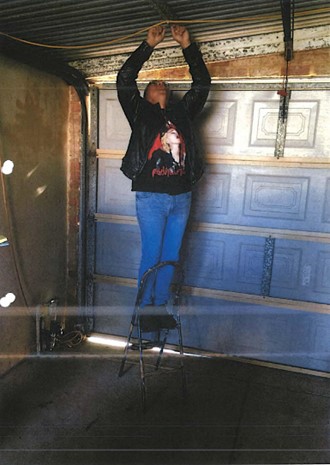
40 The proposed amendments cannot be said to be futile. It is open to Legend Corporation to put them, and Mr Bloom has pointed to no specific reason why they raise no arguable defence. Legend Corporation has provided a photograph taken in June 2016 of a person standing on the step ladder in question, in the carport, reaching above himself to touch a roof purlin. That photograph is reproduced at Annexure A to these reasons. Whether or not judicial notice can be taken of the factual matters Legend Corporation wishes to establish (on which I express no view), it is apparent that the cause of Mr Bloom's apparent loss of balance is contestable. His submissions to the contrary are resolved to an assertion that his explanation is correct. It is open to Legend Corporation to put its alternative explanation.
41 To be clear, I rely upon the photograph solely for that proposition; namely, that the cause of the accident is contestable. Without further evidence in submissions, I would place no more specific reliance on it. For example, I have no view, at this stage, that the position of the person shown in the photograph is the same as the position that Mr Bloom had on the day in question. The point is simply that it is open, on the face of the physical characteristics of the carport and the situation as it was said to be at the time, for Legend Corporation to raise these points. There is no basis to think that they will necessarily be futile.
42 I do accept that it will be contrary to the interests of Mr Bloom, and more broadly contrary to the public interest, if the trial dates listed in February next year were to be lost as a result of the amendments. This matter has dragged on more than enough, and any further delay in hearing it would be lamentable. But I am not persuaded that the amendments do imperil the trial dates.
43 It may be accepted that Mr Bloom will be entitled to adduce expert evidence of the kind that he has outlined after any reenactment (although I leave open the question of the admissibility of any reenactment evidence, which senior counsel for Legend Corporation has placed in issue). In any event, the trial is nearly nine months away. The parties have not yet proposed orders to program the matter to trial, including orders for lay and any further expert evidence. There is no suggestion that the amendments will require further discovery.
44 I also consider that the difficulties Mr Bloom points to in arranging the reenactment and the expert reports are exaggerated, at least insofar as those difficulties were advanced in the written submissions. He has produced no evidence of the difficulties, for example, no evidence of a shortage of local suitably qualified ergonomic and biomechanical experts. As I have already indicated, those difficulties are in any event less likely to arise if Mr Bloom proceeds in the way that Mr McCabe outlined at the hearing today. And any delays can be minimised by close case management.
45 As for the explanation as to why the amendments were only proposed at this relatively late stage in the proceeding, senior counsel for Legend Corporation frankly conceded that, in all the attention that was being paid to the difficult process of arranging for the destructive testing of the cable ties, as well as the ensuing exchanges of expert evidence I have also mentioned above, Legend Corporation's legal representatives lost sight of the need to specifically plead the alternative cause of the accident they now seek to advance.
46 A better explanation than that may have been required if the matter were closer to trial, if the likelihood that it would derail the trial or cause excessive delay or costs were greater, and if I had not already reached the view that the main matter sought to be put was already inherent in the issues on the pleadings. In the circumstances, however, I accept the explanation as a satisfactory one for the timing of the proposed amendments.
47 It is also relevant that Legend Corporation proposed the opposed amendments at the end of January 2024. That was in circumstances where the parties had been in mediation for some two years, and so could not have been expected to be working on refining their pleadings. When the amendments were proposed, trial dates had not been set down. Even now, the trial is almost nine months away. This case is therefore quite different to Aon, especially where I do not accept that the amendments will cause the trial dates to be lost.
48 Turning to some more specific submissions, there is no evidence of the conditions in which the stepladder has been stored. But it appears from things said at the bar table that Mr Bloom's solicitors have had custody of it since 2016. Therefore, the submission that it may have deteriorated since that time is speculative. Also, senior counsel informed the Court that in addition to photographs and measurements of the stepladder that were in evidence, Dr Zurhaar took further measurements, such as the respective lengths of the legs of the stepladder, and the ground having a 2% run off. That will permit submissions to be made concerning the cause of the incident.
49 As for paragraph 11.4 of the proposed amended defence, while I agree, with respect, that the plea is clumsily put, its import in the context of the rest of paragraph 11 is clear enough. Namely, that there is no admission that the cable tie did snap, or could have snapped if it had simply been held between Mr Bloom's thumb and index finger, from which it might follow that he was holding it using a tool.
50 In relation to the technical objection (as it was described) to paragraph 11.5 of the proposed amended pleading, I do not consider that there is sufficient ambiguity to mean that Mr Bloom is not on proper notice of the case to be made against him in that regard. In essence, it is alleged that the condition of the ladder contributed to his losing his balance. And on the basis of the photographs and measurements I have just mentioned as well as (hopefully) the ladder itself, he will be equipped to respond to that allegation if paragraph 11.5 is in the defence.
51 Legal Aid's approval of the costs is an issue that would have arisen regardless of when the proposed plea was introduced. Any delays in obtaining that approval, of which there was no evidence, are a matter between Mr Bloom and Legal Aid, and are not a good reason to shut Legend Corporation out from putting an arguable defence.
52 As for Mr Bloom's objections to proposed paragraphs 13.3 and 13.4, it appears from the history of the expert evidence, as outlined by senior counsel for Legend Corporation, that those proposed amendments arise from the opinions advanced by Dr Priddy. As a result of Dr Priddy's reports, Legend Corporation was put on notice that Mr Bloom may adduce evidence that the cable tie failed because of a manufacturing defect, and the proposed amendments would enable Legend Corporation to seek to adduce responsive evidence that there was no manufacturing defect. Mr Bloom's evidence on those subjects was filed as recently as September 2023, and that explains why it is raised at this relatively late stage.
53 Senior counsel for Legend Corporation also took me to excerpts from the report of Mr Trevor Smith dated 28 July 2023, a manufacturing expert whom Legend Corporation may call to give evidence that, on the basis of specific technical matters that are not necessary to describe in these reasons, the fracture of at least one of the cable ties may have been the result of exposure to chemicals after the cable tie was bought by Mr Bloom. Dr Priddy has had an opportunity to respond to that evidence. From that history, I draw two matters. Firstly, as I have said, there is an adequate explanation as to why these points are being raised now. Secondly, the issue is already inherent in the expert evidence that the parties have adduced. It is not, therefore, readily apparent to me that any further expert evidence is required to be put on but if it is then, as I have said, the risk of further delay can be minimised by active case management.
54 Finally, the plea of contributory negligence does not add further to the factual issues to be determined. It simply arises out of the earlier allegation that Mr Bloom lost his balance for the reasons put forward by Legend Corporation.
Conclusion
55 All in all, given the stage that the proceeding has reached and the length of time until trial, I do not consider that Legend Corporation should be shut out from pleading with specificity an explanation for the accident that was always likely to be raised in light of the present state of the pleadings, or from putting a case about manufacturing defects that has arisen as a result of expert evidence filed relatively recently by Mr Bloom.
56 Leave to rely on the proposed amended defence will be granted. I will hear from the parties as to costs.
I certify that the preceding fifty-six (56) numbered paragraphs are a true copy of the Reasons for Judgment of the Honourable Justice Jackson. |
Associate:
ANNEXURE A