FEDERAL COURT OF AUSTRALIA
Ezy-Fit Engineering Group Pty Limited v Microm Nominees Pty Limited [2024] FCA 441
File number: | SAD 99 of 2019 |
Judgment of: | BANKS-SMITH J |
Date of judgment: | |
Catchwords: | CONTRACT - agency - principal and agent - ostensible authority - implied actual authority - general principles - contract to buy lathe and milling machine - whether contract made between purchaser and dealer in Australia or between purchaser and manufacturer in Poland CONTRACT - construction - pre-contractual representations - whether terms implied - whether statements in technical brochures incorporated as express terms SALE OF GOODS - general principles - liability of seller - fitness for purpose - whether breach of term implied under s 14(a) Sale of Goods Act 1895 (SA) CONSUMER LAW - allegation of misleading or deceptive conduct contrary to s 18 of the Australian Consumer Law (ACL) - conduct by way of representations made in technical brochures - pre-contractual representations - whether machine was defective and failed to perform in accordance with representations - reliance - whether representations were misleading CONSUMER LAW - pleading of numerous disaggregated representations - whether pre-commissioning and post-commissioning representations made DAMAGES - where delivery time estimated - whether delay in performance caused applicants to lose tender for lucrative opportunity to manufacture periscopes - whether delay in performance had impact on receipt of government grant DAMAGES - general principles - whether machine capable of repair - whether rectification reasonable - rectification costs - whether allowance should be made for rectification costs where damages assessed under s 236 of the ACL DAMAGES - assessment of damages - loss of profits - whether defective machine resulted in lost opportunity to profit from high-end work - appropriate method of calculating damages - hypothetical alternative purchase - assessment of probability of opportunity eventuating - fair compensation - date and period of assessment - calculation TORT - negligence - standard of care of manufacturer EVIDENCE - expert evidence - where evidence of valuer rejected at trial - whether reasoning of valuer disclosed EVIDENCE - parliamentary privilege - whether s 16 of the Parliamentary Privileges Act 1987 (Cth) prohibits using statements made in a Senate Estimates Committee hearing for making factual findings EVIDENCE - whether failure to call witnesses gives rise to Jones v Dunkel inference |
Legislation: | Competition and Consumer Act 2010 (Cth) s 139B, Schedule 2 (Australian Consumer Law) ss 18, 29, 236, 237 Evidence Act 1995 (Cth) s 79 Parliamentary Privileges Act 1987 (Cth) s 16 Law Reform (Contributory Negligence and Apportionment of Liability) Act 2001 (SA) s 6 Sale of Goods Act 1895 (SA) ss 11, 14 |
Cases cited: | Amadio Pty Ltd v Henderson (1998) 81 FCR 149 Ashington Piggeries Ltd v Christopher Hill Ltd [1972] AC 441 Aqua-Marine Marketing Pty Ltd v Pacific Reef Fisheries (Australia) Pty Ltd (No 5) [2012] FCA 908 Australian Competition and Consumer Commission v TPG Internet Pty Ltd [2013] HCA 54; (2013) 250 CLR 640 Australian Competition and Consumer Commission v Valve Corporation (No 3) [2016] FCA 196 Bathurst Regional Council v Local Government Financial Services Pty Ltd (No 5) [2012] FCA 1200 Bellgrove v Eldridge (1954) 90 CLR 613 BP Refinery (Westernport) Pty Ltd v Shire of Hastings (1977) 180 CLR 266 Brown Falconer Group Pty Ltd v South Parklands Hockey & Tennis Centre [2005] SASC 75; (2005) 91 SASR 152 Butcher v Lachlan Elder Realty Pty Ltd [2004] HCA 60; (2004) 218 CLR 592 Cammell Laird & Co Ltd v Manganese Bronze & Brass Co Ltd [1934] AC 402 Campbell v Backoffice Investments Pty Ltd [2009] HCA 25; (2009) 238 CLR 304 Campomar Sociedad, Limitada v Nike International Ltd [2000] HCA 12; (2000) 202 CLR 45 Commonwealth v Amann Aviation Pty Ltd (1991) 174 CLR 64 Dalecoast Pty Ltd v Guardian International Pty Ltd [2003] WASCA 142 Dasreef Pty Ltd v Hawchar [2011] HCA 21; (2011) 243 CLR 588 Doppstadt Australia Pty Ltd v Lovick & Son Developments Pty Ltd [2014] NSWCA 158 DTR Nominees Pty Ltd v Mona Homes Pty Ltd (1978) 138 CLR 423 Fitzpatrick v Job t/as Jobs Engineering [2007] WASCA 63 Fortuna Seafoods Pty Ltd (as trustee for The Rowley Family Trust) v Ship 'Eternal Wind' [2005] QCA 405; [2008] 1 Qd R 429 George and Courtier Pty Ltd v Terrey [1996] NSWCA 206 Goodman Fielder Consumer Foods Ltd v Cospak International Pty Ltd [2004] NSWSC 704 Google Inc v Australian Competition and Consumer Commission [2013] HCA 1; (2013) 249 CLR 435 Gould v Vaggelas (1984) 157 CLR 215 Greco v Bendigo Machinery Pty Ltd (1985) ATPR 40-521 Gurdag v BS Stillwell Ford Pty Ltd (1985) 8 FCR 526 Hannaford (trading as Torrens Valley Orchards) v Australian Farmlink Pty Ltd [2008] FCA 1591 Henderson v Amadio Pty Ltd (No 1) (1995) 62 FCR 1 Henville v Walker [2001] HCA 52; (2001) 206 CLR 459 HTW Valuers (Central Qld) Pty Ltd v Astonland Pty Ltd [2004] HCA 54; (2004) 217 CLR 640 Hungerfords v Walker (1989) 171 CLR 125 International Harvester Co of Australia Pty Ltd v Carrigan's Hazeldene Pastoral Co (1958) 100 CLR 644 Jones v Dunkel (1959) 101 CLR 298 Jones v Schiffmann (1971) 124 CLR 303 Kizbeau Pty Ltd v WG & B Pty Ltd (1995) 184 CLR 281 La Trobe Capital and Mortgage Corporation Ltd v Hay Property Consultants Pty Ltd [2011] FCAFC 4; (2011) 190 FCR 299 Leyonhjelm v Hanson-Young [2021] FCAFC 22; (2021) 282 FCR 341 Lysaght Bros & Co Ltd v Falk (1905) 2 CLR 421 Makita (Australia) Pty Ltd v Sprowles [2001] NSWCA 305; (2001) 52 NSWLR 705 March v E & MH Stramare Pty Ltd (1991) 171 CLR 506 Marks v GIO Australia Holdings Ltd [1998] HCA 69; (1998) 196 CLR 494 McBride v Christie's Australia Pty Ltd [2014] NSWSC 1729 Miller and Associates Insurance Broking Pty Ltd v BMW Australia Finance Limited [2010] HCA 31; (2010) 241 CLR 357 Monroe Schneider Associates (Inc) v No 1 Raberem Pty Ltd (1991) 33 FCR 1 Murphy v Overton Investments Pty Ltd [2004] HCA 3; (2004) 216 CLR 388 Neilsen v Hempston Holdings Pty Ltd (1986) 65 ALR 302 Outback Health Screening Pty Ltd v Gwam Investments Pty Ltd [2010] SASC 37 Payne v Parker [1976] 1 NSWLR 191 Perre v Apand Pty Ltd [1999] HCA 36; (1999) 198 CLR 180 Potts v Miller (1940) 64 CLR 282 Professional Services of Australia Pty Ltd v Computer Accounting and Tax Pty Ltd [No 2] [2009] WASCA 183 Protec Pacific Pty Ltd v Steuler Services GmbH & Co KG [2014] VSCA 338 Quikfund (Australia) Pty Ltd v Prosperity Group International Pty Ltd (in liq) [2013] FCAFC 5; (2013) 209 FCR 368 Ricochet Pty Ltd v Equity Trustees Executor & Agency Co Ltd (1993) 41 FCR 229 Rider v Pix [2019] QCA 182; (2019) 2 QR 205 Robinson v Harman (1848) 1 Exch 850; (1848) 154 ER 363 Sellars v Adelaide Petroleum NL; Poseidon Ltd v Adelaide Petroleum NL (1994) 179 CLR 332 Shepard v Noyes Bros Pty Ltd [1985] ATPR 40-588 Sunland Waterfront (BVI) Ltd v Prudentia Investments Pty Ltd [2013] VSCA 237 Swick Nominees Pty Ltd v Leroi International Inc (No 2) [2015] WASCA 35 Tabcorp Holdings Ltd v Bowen Investments Pty Ltd [2009] HCA 8; (2009) 236 CLR 272 Taco Co of Australia Inc v Taco Bell Pty Ltd (1982) 42 ALR 177 Wardley Australia Ltd v State of Western Australia (1992) 175 CLR 514 Wilson v Arwon Finance Pty Ltd [2020] WASCA 137 Yorke v Lucas (1985) 158 CLR 661 Seddon NC and Bigwood RA, Cheshire and Fifoot Law of Contract (11th Aust ed, LexisNexis Butterworths, 2017) Sutton KCT, Sales and Consumer Law (4th ed, LBC Information Services, 1995) |
Division: | General Division |
Registry: | South Australia |
National Practice Area: | Commercial and Corporations |
Sub-area: | Commercial Contracts, Banking, Finance and Insurance |
Number of paragraphs: | |
Date of last submissions: | 7 February 2022 |
Solicitor for the Applicants: | Cosoff Cudmore Knox |
Counsel for the First Respondent: | The first respondent did not appear |
Counsel for the Second Respondent: | Mr RD Williams with Ms M Conduit |
Solicitor for the Second Respondent: | Hall & Wilcox |
Counsel for the Cross-Claimant | Mr RD Williams with Ms M Conduit |
Solicitor for the Cross-Claimant | Hall & Wilcox |
Counsel for the Cross-Respondent | The cross-respondent did not appear |
ORDERS
DATE OF ORDER: |
THE COURT ORDERS THAT:
1. The matter is adjourned for a directions hearing on a date to be fixed.
2. Prior to the hearing the parties are to confer and submit a joint minute of proposed orders, or competing minutes, which address the proposed steps to be undertaken to finalise the calculation of the lost profits assessment, having regard to these reasons.
Note: Entry of orders is dealt with in Rule 39.32 of the Federal Court Rules 2011.
REASONS FOR JUDGMENT
BANKS-SMITH J:
1 This proceeding centres around the supply and performance of a specialised automated turn-mill known as the FTM1000.
2 A turn-mill is a dual-purpose machine that is principally a lathe used for turning metal, but is also capable of undertaking milling work. A lathe engages in turning, a process whereby metal is removed by turning (rotating) the workpiece while engaging a stationary cutting tool. Milling is a process of removing metal with a rotating cutting tool. For milling, generally the workpiece remains stationary while the cutting tool moves along various axes. Such a dual-purpose machine has the intended benefit of reducing the double-handling of workpieces.
3 The FTM1000 is a CNC turn-mill. CNC is an acronym for 'computer numerical control'. This means it is computer automated and programmable. CNC machining is a manufacturing process of removing metal with a machine tool that is computer controlled, and may be done by milling, grinding or turning. The key advantage of a CNC machine is that once a part has been manufactured and the machine is properly set up, the machining is easily repeatable and should produce identical results over multiple copies.
4 The term 'turn-mill' indicates a machine that operates predominantly as a lathe but can also perform milling work. The term 'mill-turn' indicates a machine that operates predominantly as a mill but can also operate as a lathe.
5 The FTM1000 is large - over 7 m in length. Attachment A to these reasons includes photos of the external view of the FTM1000 (closed and open). The machine operates utilising three linear axes (X, Y and Z) and two rotational axes (A and B).
6 There are two themes that underlie this proceeding. First, the applicants contend that the machine was delivered late, denying them the opportunity to successfully tender for a lucrative job relating to submarine periscope tubes. Second, they contend that once delivered, the machine was a 'lemon', and as a result they were denied the opportunity to profit from other high-end work.
7 As to the first theme, the second respondent denied any late delivery was causally connected to the lack of success in tendering for the periscope work and contended that the applicants would not have been successful in securing the work in any event. As to the second theme, it contended that although the machine had some defects, they were capable of rectification.
8 The first applicant, Ezy-Fit Engineering, is a manufacturing business with a focus on machining hydraulic cylinders. Its headquarters and workshop are in South Australia. It utilises more than 45 machine tools of various sizes in its business, including CNC and manual lathes, mills, and equipment for honing and welding. It is one of Australia's largest hydraulic cylinder manufacturers.
9 The second applicant, Ezy-Fit Marine, is an arm of the Ezy-Fit group. It is not a subsidiary of Ezy-Fit Engineering. It has the same directors and shareholding as Ezy-Fit Engineering, and was used to market similar services, but with a focus on marine and defence customers. It ceased operations in early 2019, although it remains registered.
10 At the outset it should be noted that the applicants, and to a lesser extent the second respondent, rarely distinguished between the two entities during the course of the trial or submissions, referring generally, and apparently cumulatively, to Ezy-Fit. In these reasons I will generally adopt this convention for convenience, but in doing so I do not disregard particular questions of relief applicable to the distinct legal entities and will address such issues separately. Where it is of particular relevance (for example, when I introduce the fact that Ezy-Fit Engineering was the contracting party and in relation to any quantum), I will identify the entity by name.
11 The first respondent, which trades under the name Ron Mack, is an Australian supplier of specialist metalwork machinery, including CNC machines. Ron Mack originally filed a notice of address for service and a defence, and had some early involvement in procedural matters, but declined to participate in the trial. It indicated it would abide by the judgment of the Court.
12 The second respondent, Fabryka Automatow Tokarskich we Wroclawiu (which at some point became part of the HACO group and traded as FAT HACO) is a joint stock company incorporated under the laws of Poland. It manufactures, supplies, exports and installs industrial equipment such as lathes, turn-mills and CNC variants of these machines. FAT HACO has defended the proceeding, which in effect proceeded as a dispute between Ezy-Fit and FAT HACO.
13 In about 2014 the Ezy-Fit group decided to seek work in respect of the repair or manufacturing of periscopes for the Australian Navy's Collins Class submarines. Various precision equipment was required for such work.
14 In December 2014 Ezy-Fit Engineering submitted an application for a Government grant for the acquisition of equipment, and in July 2015 was told that it was successful.
15 As I find below, after considering different options, on 15 October 2015 Ezy-Fit Engineering entered into an agreement with Ron Mack to purchase the FTM1000. Ron Mack in turn entered into an agreement with FAT HACO to purchase the FTM1000 in order to on-sell to Ezy-Fit.
16 Between October 2014 and October 2016, Ezy-Fit Marine submitted a number of quotations to BAE Systems Australia Pty Ltd with respect to the periscope project. Ezy-Fit was informed in February 2017 that it was unsuccessful.
17 The FTM1000 left the factory in Poland in April 2017 and was delivered to Ezy-Fit's premises in May 2017. Commissioning of the machine continued on site for some time. Issues arose between the parties as to its alleged late delivery and commissioning. FAT HACO representatives visited Australia for rectification or adjustment works on three occasions during 2017 and 2018.
18 Despite those rectification visits, the applicants contended that the FTM1000 continued to be defective and did not perform in accordance with Ezy-Fit's requirements. Adding to issues about the cause or nature of such defects were 'collisions' that occurred whilst the machine was being used in August 2019, February 2020 and February 2021 respectively.
19 In May 2019 the applicants issued this proceeding, claiming damages for breach of contract, damages under the Australian Consumer Law (ACL) on the basis of misleading or deceptive conduct, and damages for negligence.
20 FAT HACO filed a notice of cross-claim against Ron Mack, seeking relief only if it is found liable to one or both of the applicants. The relief sought by FAT HACO relevantly includes damages for breach of contract, under the ACL, and for negligent misstatement. It seeks contribution from Ron Mack pursuant to s 6 of the Law Reform (Contributory Negligence and Apportionment of Liability) Act 2001 (SA) (Apportionment Act) and an indemnity from Ron Mack in relation to FAT HACO's legal costs.
21 The matters that arose at trial were factually dense and the causes of action intertwined. The applicants' closing submissions set out some 173 contested findings of fact that they said were to be determined.
22 I have determined that:
(a) Ezy-Fit Engineering entered into a contract to purchase the FTM1000 with Ron Mack, and not with FAT HACO;
(b) Ron Mack was not the agent of FAT HACO;
(c) alleged delay by FAT HACO in relation to the delivery of the FTM1000 was not the reason why Ezy-Fit Marine failed to succeed in its tender for the BAE periscope project work;
(d) nor did the alleged delay affect the receipt of the Government grant;
(e) once commissioned, the FTM1000 had a number of defects;
(f) some of those defects led to failure by the machine to mill with high precision on all axes and to undertake complicated milling;
(g) it was an implied term of the contract between Ezy-Fit and Ron Mack that the machine would be fit for purpose;
(h) Ezy-Fit has made out a claim against Ron Mack for breach of the implied term as to fitness for purpose;
(i) both Ron Mack and FAT HACO made certain pre-contractual representations as to the ability of the FTM1000 to operate with high precision on all axes and to undertake complicated milling;
(j) in light of the defects, the representations were misleading or deceptive within the meaning of s 18 of the ACL;
(k) a 'backstop' claim in negligence against Ron Mack and FAT HACO has not been proved;
(l) the defects in the machine are able to be rectified, and a reasonable time period during which those repairs might be undertaken is six months;
(m) the assessment of damages that fairly compensates Ezy-Fit Engineering is a sum that accords with the estimated rectification costs ($193,200), together with compensation for loss of profits from the hypothetical use of an alternative machine from 25 July 2017 until six months after judgment (as to which the parties are to be heard further);
(n) the probability of success of Ezy-Fit Engineering securing the opportunity for high-end work utilising an alternative machine had it been pursued is assessed at 30%; and
(o) Ezy-Fit Marine has not established a separate entitlement to damages.
PART B: OVERVIEW OF THE WITNESSES
23 It will be necessary to delve into the evidence in some detail when dealing with particular events. However, it is useful to commence with a general description of the role of the various lay and expert witnesses. At the time of the trial, which was conducted remotely as a result of COVID19 restrictions on travel then in place, I made detailed notes as to my impression of witnesses and the evidence they gave. I reconsidered these matters and made further notes when the various written closing submissions were filed. Despite submissions requesting that I do so, I make no adverse credibility findings in relation to the witnesses.
24 The applicants called six lay witnesses, all of whom provided witness statements and were cross-examined. Other than where specifically noted below, there were no significant reliability issues with respect to the witnesses, who on the whole gave their evidence in a straightforward manner.
25 Mr Green was a sales executive at Ezy-Fit until his retirement in February 2018. He gave evidence with respect to many matters relating to the proceeding: Ezy-Fit's bid for Commonwealth Government grant funding; its bid to manufacture periscopes for BAE; the communications with Mr Tim Walker of Ron Mack about the purchase of the FTM1000, including contractual documentation; communications with FAT HACO; the commissioning of the machine; the machine's maintenance records; the rectification site visits; and the manner in which the machine was utilised. I had reservations about aspects of Mr Green's evidence during the hearing. Although very knowledgeable and experienced, Mr Green exuded a certain stubbornness which at times undermined the objectivity of his evidence. He appeared to be personally invested in an outcome that would benefit the applicants and justify the decisions he had made on their behalf, and at times this coloured his answers. However, these matters did not give rise to a credibility issue in relation to Mr Green's relevant evidence. I did take them into account in considering the reliability of some of Mr Green's evidence. This is explained below where relevant (for example at [170] and [300] in relation to what was said at a meeting of 9 September 2015 at Ezy-Fit's premises).
26 Mr Loughlin was a machine operator at Ezy-Fit who obtained some experience using the FTM1000. He gave evidence about: the training he received from the FAT HACO representatives during the commissioning of the machine; the process by which defects were documented cumulatively; the rectification site visits; and the performance of the FTM1000 after collisions occurred in the use of the machine on site. He also machined a sample test piece that was the subject of some evidence. I consider that Mr Loughlin was a somewhat reluctant witness who approached the task of giving evidence carefully, but with Ezy-Fit's interests in mind. On the whole I have accepted his evidence and no credibility issues arises. However, I had some reservations about aspects of Mr Loughlin's evidence during the hearing, and where relevant this is explained in the reasons (for example, at [428] in the context of his recollection of his response to certain test results).
27 Mr Kerin is the owner and managing director of Ezy-Fit. He gave evidence about: various matters including the business structure and work of Ezy-Fit generally; the Government grant; and the construction of a new building to accommodate precision machinery. He gave his evidence in a straightforward manner, with no unnecessary elaboration or hesitation. Much of his evidence about events was at a general level, the day-to-day conduct of matters and detail having been left to others. To the extent he was unsure of a number of details, I consider this to be a product of his reliance on others and the result of the passage of time since events, rather than indicating any obfuscation on his part.
28 Mr Klappers was the general manager of Ezy-Fit. He gave evidence about: the pricing of work by Ezy-Fit; Ezy-Fit's finances; the work that was undertaken by Ezy-Fit using the FTM1000; communications with BAE; and other work undertaken by Ezy-Fit, for example, use of the coordinate measuring machine (CMM) for dimension inspection reports. Mr Klappers was an impressive witness who was precise, careful and appropriately objective.
29 Mr Hollamby was employed by Ezy-Fit as an estimator. He gave evidence about charge out rates for work using the FTM1000.
30 Mr Stewart was a machine operator at Ezy-Fit and worked exclusively with the FTM1000 from around September 2018. In particular, he gave evidence about a collision during his use of the machine in February 2021.
31 FAT HACO called four lay witnesses, all of whom provided witness statements and were cross-examined. There were no particular reliability issues with respect to the witnesses, who gave their evidence in a straightforward and responsive manner.
32 Mr Maicher was an electrical engineer and head of the electronics department at FAT HACO. He gave evidence about: two rectification visits that were undertaken; the Siemens software utilised in the machine; kinematics work and testing undertaken on site; and matters relevant to the commissioning of the machine, including calibrations.
33 Mr Ostrowski was the sales and marketing director of FAT HACO and the key witness as to the contractual arrangements for the sale of the FTM1000. He gave evidence about the nature of the relationship between FAT HACO and Ron Mack; the visit to the factory in Poland by Mr Green; the process for requested variations to the FTM1000; and the alleged delays with delivery of the machine. My impression was that he answered questions honestly, and when he did not recall particular details, he said as much without hesitation.
34 Mr Misiolek was a mechanical engineer and head of the service department at FAT HACO. He gave evidence about: the testing of the FTM1000 prior to shipment; its commissioning; the second rectification visit; issues of paint stripping from the machine; and other testing work carried out on the machine.
35 Mr Hoppe was an engineer at FAT HACO and, with the assistance of a Polish interpreter, gave evidence about the third rectification visit, and the involvement of an engineer from Siemens.
36 Expert technical evidence relating to the FTM1000 was adduced by Mr Thomas Hegmann on behalf of the applicants and by Mr David Miller on behalf of FAT HACO. Mr Miller also provided evidence as to costs of rectification. Expert quantum evidence was adduced by Mr Brian Morris and Mr Anh Nguyen respectively.
37 Mr Hegmann is an engineer with over 30 years' experience in manufacturing and servicing complex machine tools and related systems, including turn-mills. Mr Hegmann has his own company, H & H Machine Tools, which builds machines for the manufacturing of aircraft, including for Boeing. His business operates primarily in the aviation sector. Mr Hegmann carried out an inspection of the FTM1000 on 6 and 7 November 2019 and prepared three reports dated 12 December 2019 (First Hegmann Report); 8 May 2020 (Second Hegmann Report); and 28 September 2021.
38 Mr Miller is an engineer with a PhD in mechanical engineering (specialising in 3D milling) and the owner of his own CNC workshop. He provided evidence on issues of liability and quantum. He carried out inspections of the FTM1000 on 19-21 February 2020 and 25 March 2021.
39 Mr Miller provided seven reports dated 23 April 2020 (First Miller Report on liability); 14 August 2020 (on liability); 1 January 2021 (Third Miller Report on quantum); 6 July 2021 (on liability); 30 July 2021 (on liability and quantum); 15 September 2021 (Sixth Miller Report on liability); and 8 October 2021 (on liability and quantum).
40 Mr Hegmann and Mr Miller also prepared a Joint Technical Report dated 20 September 2021. Although there were few areas of agreement in the report, there was a greater level of agreement during oral evidence, which was heard concurrently.
41 Mr Morris is a forensic accountant engaged by the applicants. He considered the quantification of Ezy-Fit's alleged loss on two bases, being loss of profits and wasted expenditure. He prepared two written reports and was cross-examined.
42 Mr Nguyen is a forensic accountant engaged by FAT HACO. He provided a quantification of Ezy-Fit's and Ezy-Fit Marine's loss based on assumptions provided to him by FAT HACO. He prepared two written reports and was cross-examined.
43 In addition, Mr Morris and Mr Nguyen prepared a joint accounting report dated 21 October 2021 which narrowed many of the issues. It was apparent that the large difference in their conclusions was the result of different assumptions they were instructed to make.
44 During the trial I upheld an objection to the tender by the applicants of a valuation report prepared by the valuing firm Mason Gray Strange. The reasons for upholding the objection are given later in these reasons. No other valuation evidence was tendered.
PART C: THE BAE TENDER, THE GOVERNMENT GRANT AND OTHER PREPARATION
Events concurrent with contract negotiations
45 Organisation of the evidence in these reasons has been complicated by the overlap in the relevance of some of the evidence going to the many issues, and by its at-times overwhelming level of detail. Although there are different ways in which the evidence could have been collected, I will commence with the process by which Ezy-Fit Marine unsuccessfully tendered for the periscope work, and then address Ezy-Fit Engineering's application for a Government grant to assist in the acquisition of machinery. These matters were playing out at the same time as Ezy-Fit Engineering was negotiating with Ron Mack about the purchase and delivery of the FTM1000, and provide context to those negotiations.
Why the BAE evidence is relevant
46 In summary, the evidence about the BAE tender process is relevant to the proposition that, but for the delay in procuring the FTM1000, Ezy-Fit Marine would have been the successful tenderer for the periscope work, and so it lost the opportunity to secure this high-end work. Communications with BAE during the tender process and information given to Ezy-Fit Marine (and Ezy-Fit) about why it was unsuccessful inform this exercise.
47 The evidence about the Government grant process provides background to concerns expressed by Ezy-Fit about estimates given by Ron Mack and FAT HACO of the delivery date for the FTM1000. The grant process involved deadlines. Those deadlines were extended, ultimately to a date that accommodated extensions in the delivery estimates. The evidence informs the contention by Ezy-Fit that (to paraphrase) time was of the essence.
Ezy-Fit's 'defence readiness' strategy
48 In about 2010 Ezy-Fit decided to pursue what it considered might be lucrative work in the field of defence. Mr Kerin said he was aware that the car industry in South Australia was winding down, agricultural work was also dwindling, and many products were being imported from China. Accordingly, he considered that defence work would be the next big opportunity. Ezy-Fit set on a course of what Mr Kerin referred to as 'defence readiness', in order to better position itself to tender for or otherwise secure such work. This course included acquiring new machinery as necessary in order to compete for and undertake precision defence work.
Summary of the BAE tender process
49 BAE is a defence and security company which provides services to, amongst other clients, the Australian Defence Force. According to Mr Kerin, there were discussions 'for a couple of years' with BAE about potential periscope work prior to the events the subject of this proceeding. For example, at some point BAE invited Ezy-Fit to do some repair work on a periscope, although in the end the work was not actually undertaken.
50 On 11 August 2014 Ezy-Fit formally received a request from BAE, as service provider to the Commonwealth, to provide a quotation for Collins Class periscope system tubes.
51 Mr Green determined that the periscope work could be undertaken by Ezy-Fit, but that it would require the use of three machines which would need to be acquired: a CNC turn-mill, a CNC milling machine and a CMM. A CMM is used to confirm critical measurements and is used for quality assurance purposes to measure work undertaken by other machines.
52 Between November 2014 and November 2016 Ezy-Fit Marine submitted some seven quotes to BAE in respect of the periscope work.
53 The first quote of 20 November 2014 was for a price of $3,245,000 (all quoted figures referred to are GST inclusive). Subsequent quotes included a quote of 5 May 2016 where the number of periscopes was reduced from ten to four, a quote of 25 October 2016 where the style of quote and prices proposed changed significantly, and a final quote on 18 November 2016. The final quote included three options, ranging from quoted prices of $5,245,516 to $6,298,890. The precise amounts are not important, and I recount them only because they are consistent with evidence from Ezy-Fit that it was asked to increase its quote but was then told it was too expensive.
54 On 28 February 2017 Ezy-Fit received a letter from BAE confirming that it was unsuccessful in its bid for the periscope project.
55 In summary, it is the applicants' case that Ezy-Fit Marine was unsuccessful in the periscope tender because of delays relating to the acquisition of the FTM1000.
56 Leaving aside the documentary evidence, the main evidence about the BAE tender was given by Mr Klappers. He provided useful general information about Ezy-Fit's experience and the nature of the tender process. For example, he explained that the periscope work was the largest tender that it had sought at that time and was a shift in focus for the companies; although Ezy-Fit had undertaken some work in the naval sector, it had been its standard hydraulic cylinders type work; it was a massive investment for Ezy-Fit to undertake the periscope work; defence work requires considerable skill, precise measurements, technical requirements and more complex equipment; as at 2017 Ezy-Fit was a smaller player and was trying to grow and establish that part of its business and to develop their understanding of the defence market; the defence sector is highly competitive with high and exacting standards; and that the periscope project was worth a lot of money, but if things went wrong 'it could be the opposite' and could be very costly.
57 Another Ezy-Fit employee, Mr Haydn Powell, undertook most of the negotiations and quoting for the periscope project. Mr Powell did not give evidence. Despite Mr Powell's role, Mr Klappers said he was kept in the loop. Further, Mr Klappers was one of four people from Ezy-Fit who attended meetings with BAE throughout 2014, 2015 and 2016.
58 As noted, the first invitation to quote was received by Ezy-Fit on 11 August 2014. It was addressed to Mr Powell. The original request related to the supply of five attack and five search periscope tubes, with an anticipated execution of a contract with the successful bidder in November 2014. That timeline was clearly extended at some point.
59 The first quote provided by Ezy-Fit, being the quote dated 20 November 2014, was addressed to Mr Kevin Harness, the project manager for the periscope project at BAE. It was for a price of $3,245,000 and included the following 'clarifications and exclusions':
1) [Ezy-Fit Marine] intends, at our own cost, to increase the scope of our manufacturing premises to allow the installation of additional equipment to ensure successful manufacture of the periscope tubes. This will include installation of a new CNC lathe capable of high accuracy and close tolerance machining, a new CNC milling machine and machine tooling, and Coordinate Measuring Machine (CMM) Quality Control Station. The CMM will be housed in its own climate controlled clean room. The time factor for such building improvements, which would include a climate controlled purpose built premises to house the long turning and milling equipment, and installation of the related equipment is approximately 1 year but subject to extension of that time if impractical.
2) This quote is subject to The Ezy-Fit Group achieving a successful outcome of an application for funding through the Australian Governments' Next Generation Manufacturing Investment Programme. If the grant application fails to achieve the necessary level of funding EFM reserves the right to withdraw this quote without penalty.
60 Mr Klappers confirmed in his evidence that as at 20 November 2014 Ezy-Fit was looking to complete the building works and acquire new machinery by about November 2015.
61 According to Mr Green, there was a meeting on 28 November 2014 which he attended with Mr Powell and Mr Harness at which there were 'advanced' discussions about Ezy-Fit manufacturing the periscope tubes.
62 On 4 December 2014 Mr Powell provided a further periscope tubes quote, offering to present it to BAE.
63 This was followed up by a meeting with Ms Sharon Wilson and Mr Adam Watson of BAE at Ezy-Fit's premises on 15 December 2014. Mr Green prepared a note of the meeting, stating that the visit was 'highly informative and encouraging' and that Ezy-Fit informed BAE of its history, capabilities, future potential, and aspirations. Case histories were provided and Mr Green stated that Ezy-Fit was encouraged to add those 'achievements' into a revised presentation.
64 Meanwhile, and as discussed further below, on 22 December 2014 Mr Green submitted Ezy-Fit's application for a Commonwealth Government grant to assist in the purchase of machinery for the periscope project.
65 A further quote, dated 27 February 2015, was provided by Mr Powell to Mr Harness in similar terms to that of November 2014. Mr Klappers did not recall the reason why the revised quote was provided but was aware that matters did 'drag out' and that there had been 'toing and froing' between BAE and Mr Powell. According to Mr Klappers, as at 27 February 2015 it was the position that it would be another year for the building work to be undertaken and for machinery to be acquired, as those tasks had not by then commenced.
66 A further revised quote was provided in March 2015, but nothing significant arises from the revisions.
67 According to Mr Green, on 3 August 2015 he attended a meeting with Mr Harness in order to try and obtain some indication of whether Ezy-Fit might be successful in its tender. He said that Mr Harness told him he (Mr Harness) couldn't say anything - but that he indicated the Government's preference was that the products be made in Australia and that only Ezy-Fit was preparing its quotation on this basis. Mr Green took from the conversation that Ezy-Fit Marine was in a good position to win the periscope work, but that Mr Harness would not be held to any obligation.
68 On 4 August 2015 Mr Green provided the information required by the Government in order to accept the Government grant.
69 During October 2015 Ezy-Fit ordered the FTM1000 from Ron Mack, and Ron Mack estimated that the machine would leave Poland in approximately mid- January 2017.
70 In November 2015 Mr Kerin, Mr Green, Mr Powell and Mr Klappers attended an Ezy-Fit management meeting. The minutes reflect that Ezy-Fit was unsure whether it should continue to bid on two machines for the periscope work because of financial conditions, but it decided to do so. Mr Klappers' evidence was that the two machines referred to in the minutes were the FAT HACO lathe and the DMF600 (defined below).
71 From 1 April 2016 Ezy-Fit made a number of inquiries with Ron Mack about the estimated delivery time for the FTM1000 (discussed further below).
72 On 5 May 2016 Mr Powell provided a further quote, addressed to Mr Andrew Prettejohn at BAE. The quote was for a reduced number of periscope tubes (four) and was in the sum of $1.5 million. The quote stated that 'the equipment has been ordered and is due … at the very end of 2016', and that 'the time factor for such building improvements … and installation of related equipment is approximately 1 year but subject to extension of that time if impractical'. Mr Klappers confirmed that at that point the time frame for completion of the machine installation and building works was May 2017.
73 On 30 June 2016 Mr Powell sent an email to Mr Prettejohn of BAE, seeking an update on the project and stating relevantly:
… Could you please give me an update of the current status of the periscope poles requirement.
Just to fill you in, we have ordered 2 machines from Europe that we would use to manufacture the poles. Our investment in these machines is several millions, and we are now about to embark on the building of the factory to house them which will be purpose built with the poles in mind. We are expecting the first of the machines to arrive around Christmas and it would be greatly appreciated to know where we stand with the project.
If at all possible, I'd like to pay you a visit and discuss the project, this will help me to make some projections.
74 In September 2016 Ms Wilson gave a speech in which the periscope project was apparently mentioned. Neither the date of the speech nor its audience is clear. However, the document evidencing the speech is an online news article published by 'Defence Connect' dated 22 September 2016. Mr Kerin gave evidence that he was 'buoyed' by the speech (although he dated it as being published in December 2016 and this date is likely an error on his part). The article provided a transcript of the speech, which included the following:
A local supplier was integral to our success on this program - Ezy Fit marine, based in SA, has invested in a new CNC machine to produce tubes, a CMM measurement machine in a environmentally controlled room and a new facility. I know Thales is looking at the company to make tubes for other customers.
75 Also in about September 2016, according to Mr Kerin, BAE representatives attended on site to conduct an audit of the building works. Mr Kerin said that the auditors noted an absence of marked lines and the presence of storage on walkways. Mr Kerin told them that Ezy-Fit was in the process of construction, and that the building would be ready between December 2016 and January 2017. He said the auditors made comments to the effect that Ezy-Fit had a long way to go, and he assured them with words to the effect that 'we would get it done'.
76 On 25 October 2016 Ezy-Fit submitted a further quote to BAE for the complete set of 10 periscope tubes for a total sum of $9,685,430. This quote was in a different form, with various subcategories, but it was accepted by Mr Klappers that it reflected a significant increase in price. Mr Klappers also said it was his understanding that BAE had spoken to Mr Powell and had asked for a quote to be re-submitted because previous offers were 'a little bit low'.
77 A version of this quote with marked-up comments, apparently made by BAE, was in evidence. By those comments it was apparent that there were issues regarding the level of any downpayment to Ezy-Fit. Further, Ezy-Fit set out in the quote that:
Initial delivery of the first tube is expected to be approximately 9 months … but is subject to change should there be any supply delays beyond the control of Ezy-Fit Marine.
78 By its comment in response, BAE said that it required Ezy-Fit to commit to a definitive schedule and so (according to Mr Klappers) put the risk of delays in the supply of materials onto Ezy-Fit. Mr Klappers accepted that in general if Ezy-Fit was let down by suppliers, there could be significant issues, including penalties.
79 At about this time Mr Prettejohn informed Ezy-Fit that Ezy-Fit was third in the list of tenderers after Thales and Hoffman (as later confirmed by Mr Kerin in an email exchange with Ms Taylor of 17 March 2017).
80 On 10 November 2016 Mr Powell emailed Mr Prettejohn, apparently responding on behalf of Ezy-Fit to the BAE comments. Mr Powell's comments included the following:
I will provide a Manufacturing Plan but I can only offer what the raw material supplier can provide and this means at least 29 weeks for manufacture and then another 6 weeks for freight, 35 weeks in all. We then have to complete manufacture of the tubes, qualify welding procedures as we will not have access to equivalent strength materials until the billets are forged, and this will take some time. I've spoken with the provider, and they will not promise early delivery so therefore I can't offer something that is unreasonable. I will provide the quote with a reasonable delivery date but I already know this will not be to the liking of BAE or the CoA, but we warned about this several times over the last couple of years. Undue delays to the project have been out of our control and it will be difficult to deliver in an unreasonable time frame.
…
Considering the outlay we have already invested in this project, approximately $6 million, and given a further $4 million would need to be spent on materials, weld procedure qualifications and other costs, Ezy-Fit does not believe to ask a down payment of $4 million is unreasonable. We are willing to negotiate this but we would believe it unreasonable of BAE to attempt to reduce the down payment to a much lesser figure. Additionally, we are being asked for financials which due to our expenditure puts us at a disadvantage when the money we have spent was spent in good faith that we would eventually receive an order for this job. To reduce the down payment will also reduce our financial viability which of course exacerbates any negatives that may result due to our high expenditure. We have set this up to be able to offer the best manufacturing facility on the planet for manufacture of these tubes, and in comparison any competitor using manual equipment will have a high risk of failure in comparison to a pre-tested sample manufactured and proven on a CNC Lathe of the capacity we are installing. Additionally we have one of the world's finest tube hones to guarantee internal tolerances can be achieved. I was quite taken aback the other day when I was told our quote is not looking the best currently, when we above all other companies worldwide have invested so much to deliver the lowest risk and most accurate and repeatable results BAE and CoA could ask for.
However, this takes time and money but there is no competitor that could match our facilities and capabilities in one house. Even our manual 12m lathe, being only around 6 years old, is arguably superior to the much older lathes our competitors are offering. This gives us current capacity to produce the tubes, and the installation of the CNC lathe will increase our capability enormously whilst reducing our risk by a like amount.
…
In summary, it seems that now the CoA needs these items quick smart the pressure is being put on the supply chain to improve a reasonable delivery schedule to one that is unreasonable. We cannot promise what we don't think is achievable, however much the CoA would like us to do this. Also delivering a fixed price with a quote validity until February poses a challenge, especially as the money markets are now experiencing the most volatility we've seen in quite a while.
81 Mr Powell's comment in this extract to the effect that he had been told Ezy-Fit's quote 'was not looking the best currently' is consistent with Mr Klappers' evidence about a meeting in November 2016 with BAE which he attended, where the various BAE comments were discussed. Mr Klappers' evidence was that the question of the price was discussed at length because BAE had previously told Ezy-Fit to put its price up, and was now being told that it looked 'a little bit dear'. Mr Klappers said that the goalposts continued to change at about this time; that BAE and the Commonwealth seemed to be 'toing and froing' and that things 'just seemed to be changing all the time'; and that things had 'dragged on for three years and then all of a sudden the Commonwealth wanted new submarine periscope tubes in nine months, which was highly unlikely to happen with anyone'. Mr Klappers agreed that the driving force for the BAE tenders at that time appeared to be time and costs. Mr Klappers also said that BAE mentioned that Ezy-Fit did not at that time have the equipment to perform the work, but that Ezy-Fit kept telling them that the machine was on order.
82 Separately, I note that at around this time (relevantly on 15 November 2016) the information provided to Ezy-Fit by Mr Walker was that the estimated ex-factory date for the FTM1000 was 'mid-end February', being a month later than estimated in the 15 October 2015 contract.
83 On 18 November 2016 Ezy-Fit provided its final quote to BAE, 'splitting' the tubes as requested by BAE and quoting separately for attack tubes and search tubes The clarifications and exclusions stated that initial delivery of the first tube was expected to be 12 months after placement of the order and subsequent ordering of raw materials in accordance with the production schedule.
84 Separately, as at 23 January 2017, Mr Green had estimated that based on information provided by Ron Mack, delivery of the FTM1000 to Ezy-Fit's factory was likely to be in the week commencing 29 May 2017. Mr Green did not go back to BAE at this time seeking to amend the clarification or exclusions, or indicating that the initial delivery date needed to be extended. I infer that Mr Green did not consider the 29 May 2017 delivery estimate required him to alter the tender quote and did not consider that the delivery estimate would prevent Ezy-Fit meeting the BAE timeline indications.
85 On 28 February 2017 Ezy-Fit received a letter from BAE confirming that it was unsuccessful in its bid for the periscope project. The letter relevantly read:
RE: TENDER OPPORTUNITY FOR THE MANUFACTURE OF PERISCOPE TUBES
Dear Haydn,
The purpose of this letter is to inform Ezy-Fit Marine Pty Ltd (Ezy-Fit) that another party has been identified as the preferred tenderer for the abovementioned opportunity with whom we intend to enter into final contract negotiations.
BAE Systems Australia Limited … would like to thank Ezy-Fit for its participation to date in the tendering process. We are happy to provide Ezy-Fit with a debrief in due course should Ezy-Fit request this.
The Commonwealth Government grant and the delivery timeline
86 Around the same time that Ezy-Fit became interested in participating in the BAE tender, it became aware of a Commonwealth Government program known as the Next Generation Manufacturing Investment Program. Ezy-Fit saw this as an opportunity to obtain funding towards the procurement of new machinery. Mr Green was responsible for seeking a grant under the grant scheme on behalf of Ezy-Fit.
87 Mr Green was also responsible for developing the methodology for the periscope project on behalf of Ezy-Fit. In that role, Mr Green identified and recommended to Mr Kerin that Ezy-Fit acquire the FTM1000, a CNC milling machine known as the DMF600 and the CMM as the set of machines for the periscope project and Ezy-Fit's wider defence readiness strategy.
88 On 22 December 2014 Ezy-Fit applied for the Government grant. It gave the project the title 'Collins Class Attack and Search Periscope Tubes', and described the project as:
Ezy-Fit Hydraulics (the manufacturing division of [Ezy-Fit Pty Ltd]). A leading hydraulic cylinder manufacturer is planning to extend its considerable expertise into the machining and processing of periscope assemblies and allied services.
89 The application provided an estimate of expenditure over the course of the financial years ending June 2015 and June 2016 respectively in the total sum of $5,065,700. Of that amount, a total of $3,865,700 was said to be 'eligible project costs'.
90 In support of the grant application, Ezy-Fit listed the quotes that it said supported the estimated project costs. The list included a 'Ron Mack Machinery Quote No:- 141208 - FAT FTM 1000 x 7500 Long Bed CNC Lathe' (the quote included was actually for a FAT FTM 700 x 7100 lathe, rather than a turn-mill, but nothing apparently turns on this, and after the application was made Mr Green pursued the acquisition of a turn-mill, being the FTM1000, rather than the FTM700).
91 In the grant application Ezy-Fit also said:
Value Added Operations - The project is currently being manufactured off shore at extensive additional cost and with long delays in delivery. The Ezyfit Group plan to bring this work into Australia and thereby open up a new capability market for future periscope projects and to promote this expertise to additional new customers in the defence and allied fields.
…
Project Timeline - Ezyfit are obligated to complete the project within 18 months of receipt of material, the current material delivery is provisionally advised as 12 months
92 Ezy-Fit applied for funding on the basis that its own contribution to the $3,865,700 eligible project costs was 50%, being $1,932,850. Ezy-Fit disclosed that $1,000,000 of this sum would be obtained by way of loan from a specified bank over the course of 10 years. The program grant amount sought was the remaining 50%, being $1,932,850.
93 In terms of timing milestones set out in the application, the first milestone provided that the workshop facilities and CMM were to be completed and installed by 30 October 2015. A second milestone provided that the equipment installation and commissioning for the CNC lathe and the milling machine would be completed by 31 March 2016.
94 Mr Green confirmed that Ezy-Fit was informed in July 2015 that the grant application was successful.
95 By letter dated 24 September 2015 Mr Green received a funding agreement for execution. It was executed by Ezy-Fit on 25 September 2015.
96 The funding agreement required the grantee (Ezy-Fit) to undertake the 'Project' to achieve the 'Outcomes', those terms being defined respectively as follows:
The project involves the purchase and installation of a CNC milling machine, a CNC turning machine and a co-ordinate measuring machine. The project also includes the purchase of new tooling for the CNC machines, and extensions to the grantee's [Ezy-Fit's] manufacturing premises in Salisbury South, South Australia.
…
The grantee will use the capability provided by the new equipment to manufacture periscopes for the Collins class submarines. In addition, the project will also allow the grantee to develop a world class periscope machine capability and strengthen its position in the manufacture of high value custom made cylinder and other applications for customers in the defence and commercial marine and offshore oil and gas markets.
97 The funding agreement included updated milestones. Relevantly, the milestone for the equipment installation and commissioning was a start date of 1 October 2016 with an end date of 16 January 2017.
98 From Mr Green's perspective, 16 January 2017 was therefore a critical date for Ezy-Fit in terms of receiving the grant funding.
99 Ron Mack stated in its quote dated 15 October 2015 (15 October 2015 Quote) that the estimated delivery time for the FTM1000 would be approximately 'mid-January 2017 ex-factory Poland'.
100 In anticipation of the critical date of 16 January 2017, Mr Green followed up the anticipated delivery date on a number of occasions. Evidence included the following:
(a) an email from Mr Green to Mr Walker of 8 April 2016 in which Mr Green said:
I placed the order for this machine on the 12th October last year in good faith and on advice from yourself that the factory needed 12 months + shipping to deliver this machine - if shipment does not take place until January we will not expect to see this machine until Late March / Early April making 18 months from order. I have to advise that our financial arrangements with the banks for forward exchange will expire in late December. I also advise that the government milestone under the grant agreement is due for documentation settlement on the 16th January 2017. I would remind you that our order explicitly states delivery dates etc. I suggest you discuss this situation further with the factory to expedite the delivery within the agreed time frame.
(b) an email exchange between Mr Walker and Mr Green on 7 and 8 April 2016 in which Mr Walker indicated that FAT HACO had suggested a shipment date of mid-January 2017, consistent with the date referred to in the 15 October 2015 Quote, but had said FAT HACO would give a more accurate delivery date in August 2016;
(c) Mr Green's evidence under cross-examination:
… And the issue that I had, which was - the main issue that I had was that these guys could not give me a firm delivery date. It wasn't the fact that it was going to be one month or the other. The fact of the matter was every time I asked I couldn't get a firm delivery date. And that was - so I couldn't put an extension claim in with the government because I didn't know what I was working on, and that became my biggest issue, that the - that they didn't know when they were going to finish it and I couldn't make the financial arrangements in Australia to pay for it.
Yes. And you say that in this email, that you - your concerns are that you - the financial arrangements and, in particular, the government milestone under the grant agreement being due on 16 January?---Yes. Well, that's what it says on the government milestone.
Yes. So your concern, again, at this time was a delivery date in order to meet the government grant milestones?---Yes.
(d) an email from Mr Green to Mr Walker of 14 April 2016 in which Mr Green indicated he could split a milestone payment across the lathe and the mill to accommodate a later delivery date for the FTM1000, but that a date was still required. He stated:
… however if the delivery does not enable us to process all paperwork prior to the end of the financial year 2017 then the order has to be cancelled as we will lose the government funding.
(e) an email of 2 September 2016 in which Mr Green said the following to Mr Walker:
I have to apply for a variation to the machine [deliveries] and payments which is currently set down for December 2016 for both machines - I have to split the DMG & FAT machines as we have to supply invoices / photos etc of the machine on site to be able to submit claims - I need to vary this milestone payment - so I need an approximate date we can expect delivery on-site.
(f) an email of 11 October 2016 in which Mr Green again sought an indication from Mr Walker of 'which month the machine will be delivered';
(g) an email of 18 October 2016 in which Mr Green said the following to Mr Walker:
It is becoming increasingly important that I receive information regarding the delivery of the machine - our bank is requesting information when funding is required for payment and I have to modify the government milestone to ensure we do not lose the funding for this machine. Please advise.
(h) an email of 31 October 2016 in which Mr Green asked Mr Walker for a machine delivery schedule that week, and said he needed to advise the Federal Government of the change of delivery from the original advice;
(i) as at 8 November 2016 Mr Walker had passed onto Mr Green a comment from FAT HACO that it would be preferable for FAT HACO 'and for the lathe' if the shipment date was the end of February 2017 or beginning of March 2017, as this would give a little more time for final testing;
(j) on 14 November 2016 Mr Green informed Mr Walker that he had spoken to the grant office and that a May 2017 delivery could put the grant at risk, as a number of weeks are required to process milestone claims and the grant was to expire in June, but that he had been advised an April 2017 delivery was acceptable. He asked Mr Walker to confirm whether delivery and commissioning by the end of April 2017 was possible;
(k) on 15 November 2016 Mr Walker replied, stating:
Hi Phil, it is not possible for ourselves or FAT to give a specific delivery date for the FTM-1000. As you know all too well there are so many variables that may come into play (especially when shipping is involved) that no one can give an exact date, this is why all our quotations state delivery dates as estimated / approximate.
The delivery date quoted when the machine order was finalised and the exact specification nailed down was estimated to be on or before mid Jan 2017. As we have advised, FAT have told us that the estimated revised ex-factory date is mid - end Feb (which I don't think too unreasonable considering the length of delivery time and complexity of the machine) and they have said they will do everything in their power to make this happen.
I know you want us to tie exact dates down but this is the best information that can be offered at the moment.
(l) on 17 November 2016 Mr Green wrote to Mr Walker stating, relevantly, that he intended to submit to the Government a variation of the delivery date to the first week in May 2017;
(m) on 29 November 2016 Mr Green provided a proposed variation request to the grant office, submitting:
Variation to Milestone 4. Due to delayed delivery of the CNC Lathe we request an additional milestone be inserted to separate the finalisation of the CNC Milling Machine installation & commissioning from the CNC Lathe installation & commissioning. The revised date request for the completion of the CNC Lathe Installation & Commissioning is 12 May 2017. There are no implications or obligations within this request on the financial year payments.
(n) on 23 January 2016 Mr Green went 'above Mr Walker's head' and wrote to Mr Darryl Mack, setting out his concerns about the delays in delivery, and indicating that by his estimation delivery of the machine would now be the week commencing 29 May 2017. Mr Green referred to the critical timing of the delivery and the obligations under the grant, and sought a guaranteed delivery week for the purpose of making a submission to the Government for an extension under the grant scheme. Mr Green also sought some financial allowance to cover additional costs to extend the arrangement to late May 2017 (a second letter referring to pressure from the Government grant body to seek a delivery variation was sent by Mr Green to Mr Mack on the next day);
(o) on 6 February 2017 Mr Green wrote to Mr Walker, stating:
As advised I have to put a closure of the Milestone that includes this machine. I have had discussions today with the Federal Government department responsible for allocating funding and have negotiated a completion date of the 11 June 2017. Once this variation is submitted, this is a line we are unable to cross, if we had been made aware of the delivery situation at the time of your quoting we could have made different arrangements for grants / bank loans / forward exchange cover. We are incurring significant extra costs for the extension of late delivery from January to late May and we will need to have a discussion with you regarding these unexpected charges.
(p) on 9 February 2017 Mr Green provided a further variation milestone request to the grant office, with a revised completion date for installation and commissioning of the CNC lathe of 11 June 2017, a revised date that was accepted.
101 For completeness, I note that none of these communications reference BAE or discussions with BAE, and Mr Green did not suggest in his oral evidence that he was concerned about a connection between any delay in delivery of the machine and the BAE tender. He accepted on a number of occasions under cross-examination that his concern during this period was in relation to the Government grant milestone and the impact of delay upon funding.
102 Ultimately Ezy-Fit received all of the Government grant for which it had applied.
Progress of the building works
103 According to Mr Klappers, building works for the brand-new purpose-built factory that housed the FTM1000 and the DMF600 were almost complete as at May 2017, but works continued throughout the whole of 2017. This was supported by an email dated 31 May 2017 sent by Mr Powell to a potential customer, in which Mr Klappers and Mr Kerin were included. The email stated that:
As a point of interest, the Ezy-Fit Engineering Group is in the final phase of building a brand new, purpose built factory for the production of large to very large marine components for the defence industry.
104 I note that Mr Green's evidence was that those building works were complete in about December 2016 or January 2017. However, in light of the email of 31 May 2017 that supports Mr Klappers' evidence, it is more likely that Mr Klappers' evidence is correct on this point and I accept it.
105 The Government grant covered the purchase of machinery in addition to the FTM1000. Mr Green gave evidence about the acquisition from DMG of the DMF600, a mill that, according to Mr Green's model for periscope production, was required because of specific milling work that could not be undertaken on the FTM1000, and because it would have been inefficient to do all milling on the FTM1000. Mr Green's evidence was that the DMF600 mill could be used by Ezy-Fit for high-end milling work regardless of the periscope project.
106 Mr Green gave evidence that the DMF600 was a 'very large, high calibre machine' and was ordered in December 2015 at a cost of $1.683 million.
107 There is no indication that the date of delivery of the DMF600 caused any concern in relation to the Government grant or the BAE tender.
Purchase of CMM and the CMM room build
108 According to Mr Green, this building project involved making use of a void between two existing factories to create a space for the CMM by moving air conditioning units to the roof and adding insulation. The CMM room was referred to in the Government grant and was completed for a cost of $184,300.
109 The CMM order was arranged and finalised around May and June 2016.
110 Again, there is no indication that these works caused any concern in relation to the Government grant or BAE tender.
The debrief and evidence as to why Ezy-Fit was unsuccessful
111 Mr Klappers recalled that the failure to be awarded the periscope tender was a significant blow to Ezy-Fit. No evidence was called from BAE as to why the tender was unsuccessful. However, Ezy-Fit sought to rely on information it was given at the time from BAE and indirectly.
112 According to a note apparently prepared by Mr Green, Ezy-Fit Marine was told by BAE that it did not win the BAE periscope project because it presented a higher risk than another competitor, Thales, and that its price was too high.
113 Mr Kerin said he was told at a debrief meeting with BAE representatives that the bid was rejected because Ezy-Fit were not going to be ready in time. The representatives also said words to the effect that BAE needed to minimise risk.
114 In March 2017 Mr Kerin met with Ms Sarah Taylor, who was described as 'Member and Government Relations Manager/Defence Teaming Centre'. Mr Green prepared a paper that he provided to Ms Taylor about the tender process. The purpose of the meeting appears to have been to request that Ms Taylor lobby (then) Minister Pyne's office about the failed bid. Ms Taylor wrote to Mr Pyne's office. There were also communications with Senator Xenophon's office. According to Mr Klappers, at the time it was hoped that Senator Xenophon might be able to persuade Minister Pyne to review the tender decision or obtain some clarification as to why Ezy-Fit had been unsuccessful.
115 Mr Klappers gave evidence that he was told, likely by BAE, that the decision maker made the decision not to make the periscopes in Australia because they did not want to take the risk of them being made in Australia. The relevant evidence under cross-examination (and to which no objection was taken) was as follows:
They didn't want to take the risk with choosing - - -?---Making them here in Australia.
And having them made by Ezy-Fit?---Or - or anyone, even Hoffmann's. I think the - the - the Commonwealth was very scared about the risk situation. I think one of the comments was that, 'No one has ever made periscope tubes in Australia before'. That was - that was a Commonwealth Government line.
And the risk was that no one in Australia would have the capability to do this work - - -?---I don't know about the capability but the expertise maybe.
We might be splitting hairs. How would you distinguish expertise from capability?---Well, I suppose it's both the same. It - because we know for a fact that Thales have made these in the past, for the last 30, 40, 50 years, whatever it may be. But it's - it's obviously critical that you have the right equipment and the right people; they go hand in hand.
Yes. And to your understanding the navy or the Commonwealth went above BAEs head and determined that Thales were the people with the right equipment and the right people for this job?---I would say that they - they went that way - it was a comfort thing knowing that Thales had made them before. No one in Australia had - had attempted to make them before, and I think it was just much easier to go back to buy them from where you bought them from before.
116 Mr Klappers also referred to an email in which Mr Powell said that the real reason Ezy-Fit was not awarded the contract was because the contract could not be awarded in time 'due to delays by the government'. Timeframes that were being imposed were a result of how long it had taken to get to that point. Mr Klappers agreed with Mr Powell's view, and said that:
BAE went backwards and forwards for three years and then, I think, in the end, the Commonwealth had had enough of it and said, you know, 'You need to get cracking.'
Yes?---
And then, of course, no one was ready to get cracking in nine months.
117 On 29 May 2017 there was a Senate Estimates committee hearing, properly referred to as 'Senate of the Foreign Affairs, Defence and Trade Legislation Committee, for Estimates' at which various people gave evidence. Certain transcript extracts were provided to Ezy-Fit by Senator Xenophon's office, and the parties sought to rely on those extracts. I received no submissions in relation to s 16 of the Parliamentary Privileges Act 1987 (Cth). However, it is apparent that the parties were potentially inviting me to infer certain matters from the transcripts.
118 Parliamentary privilege as it applies to the Commonwealth Parliament is codified in the Parliamentary Privileges Act. Relevantly, s 16 provides:
16 Parliamentary privilege in court proceedings
(1) For the avoidance of doubt, it is hereby declared and enacted that the provisions of article 9 of the Bill of Rights, 1688 apply in relation to the Parliament of the Commonwealth and, as so applying, are to be taken to have, in addition to any other operation, the effect of the subsequent provisions of this section.
(2) For the purposes of the provisions of article 9 of the Bill of Rights, 1688 as applying in relation to the Parliament, and for the purposes of this section, proceedings in Parliament means all words spoken and acts done in the course of, or for purposes of or incidental to, the transacting of the business of a House or of a committee, and, without limiting the generality of the foregoing, includes:
(a) the giving of evidence before a House or a committee, and evidence so given;
…
(3) In proceedings in any court or tribunal, it is not lawful for evidence to be tendered or received, questions asked or statements, submissions or comments made, concerning proceedings in Parliament, by way of, or for the purpose of:
(a) questioning or relying on the truth, motive, intention or good faith of anything forming part of those proceedings in Parliament;
(b) otherwise questioning or establishing the credibility, motive, intention or good faith of any person; or
(c) drawing, or inviting the drawing of, inferences or conclusions wholly or partly from anything forming part of those proceedings in Parliament.
119 In contrast to the circumstances in, for example, Leyonhjelm v Hanson-Young [2021] FCAFC 22; (2021) 282 FCR 341, I was not referred to the transcript for the purpose of ascertaining whether or not something was in fact said in the Senate Estimates committee hearing. Rather, it appeared that the transcript was relied upon for the drawing of conclusions from statements that were made. Having regard to s 16(3)(c), it is not open to me to do so and I have not taken those transcripts into account.
Determination - grant not affected by delay
120 In my view, although Mr Green was required to make submissions and seek variations to the grant milestones as a result of the delivery time for the FTM1000 being pushed out, the variations were accommodated. The grant funds were received.
121 There is no doubt that Mr Green was concerned about the risk the variation would not be granted. The evidence reveals a number of anxious requests to Mr Walker from Mr Green for definitive time frames that he could pass on to the grant office in order to secure the Government grant. However, he did not express in any of those communications concern about the BAE tender process. In fact, having regard to the above evidence, Mr Green's position was that the delay itself was not an issue ('it wasn't the fact that it was going to be one month or the other') - the issue was that he needed a definitive date for adjusting the milestones. Although he gave the grant office an initial project timeline, the completion date was said to be 'within 18 months of receipt of material', and was not linked to the delivery date of the new lathe. Even Mr Green's reference in his email of 14 April 2016 to Mr Walker about potentially cancelling the FTM1000 order was in the context of losing the Government funding. When Mr Walker reiterated that all delivery times were estimates and that it was not possible to give a specific date for delivery having regard to variables, Mr Green was able to work with that information. As at 6 February 2017 he had assessed a delivery and commissioning date of 29 May 2017, but in fact negotiated with the grant office a timeline that allowed for delivery and commissioning by 11 June 2017. Mr Green secured and Ezy-Fit received payment of the Government grant in full.
122 The Government grant was received regardless of the extension to the anticipated delivery time of the machine.
Determination - delay in delivery did not cause Ezy-Fit to lose BAE tender
123 As set out below, I find that the contract for the purchase of the FTM1000 by Ezy-Fit was made with Ron Mack on 15 October 2015. In summary, under the contract the estimated time when the machine was due to leave Poland was approximately the middle of January 2017, and on that basis (according to Mr Green) it ought to have arrived in South Australia on around 5 March 2017. In the end it was shipped from Poland in early April 2017, and arrived at Ezy-Fit's premises for commissioning on 31 May 2017.
124 I deal separately with whether that delay constituted a breach of contract. For present purposes, the question is whether it was the cause of Ezy-Fit losing the BAE tender.
125 The evidence about Ezy-Fit's communications with Ron Mack and Mr Green's attempts to secure a definitive delivery date out of Poland is referred to at [100] above. It reveals Mr Green's concern about the need to update the grant office and secure financing arrangements for the balance required to acquire the machine. The communications emphasise the grant office timeline, not the tender process.
126 The tender process commenced well before the contract to acquire the FTM1000 was entered into. The November 2014 quote to BAE stated that it was subject to a Government grant application being successful. Ezy-Fit knew that the grant application was successful from July 2015. The FTM1000 was not ordered until October 2015. Ezy-Fit was able to ensure the terms of the Government grant were met by successfully negotiating the milestone extensions.
127 Mr Klappers' evidence indicated that Ezy-Fit had cause for some uncertainty as to its prospects of being the successful tenderer. It was a step up for Ezy-Fit to tender for a job of the size and specialisation involved, and it was by its own admission a 'smaller player': see generally the evidence at [56] above. As at August 2015 it perceived that being an Australian company would give it an advantage, based on what Mr Green had been told by Mr Harness, but at the same time Mr Green knew that Mr Harness would not be held to any obligation as to the selection of the successful tenderer. Even after the information was provided, and after the FTM1000 was ordered, Ezy-Fit had second thoughts about purchasing the FTM1000 for the periscope work having regard to financial commitments, but it decided to proceed. As at May 2016 Ezy-Fit informed BAE that the time frame for building works and installation was May 2017 'but subject to extension of time'. So, BAE was aware from May 2016 that Ezy-Fit was indicating May 2017 installation. Mr Powell made it clear in his email to BAE of 30 June 2016 that Ezy-Fit was proceeding with machine orders and building works, but it knew at this time that it was unclear whether or not it would be the successful tenderer. It was therefore taking a calculated risk in this regard, insofar as it portrayed that it was undertaking this work for the particular periscope job alone rather than for a more general 'defence readiness' aim.
128 There is no doubt that Ezy-Fit received some mixed messages as to the prospects of success of its bids throughout the drawn-out process. Ms Wilson's reported September 2016 speech referencing Ezy-Fit's status as a local supplier (at a time when it had been given Ezy-Fit's timing projection of a May 2017 machinery installation) understandably led to some optimism in the Ezy-Fit camp.
129 However, this optimism must have declined in the same month when, as Mr Kerin reported, the BAE auditors on site said that Ezy-Fit 'had a long way to go'.
130 To add to matters that would have diminished Ezy-Fit's optimism, in November 2017 Mr Klappers was on notice about concerns around pricing, and that the Commonwealth, having 'dragged things out', suddenly wanted production in a relatively short time frame: see generally at [81] above. Ezy-Fit was also on notice at this time that Ezy-Fit was 'third in line'. In response, Ezy-Fit suggested in the 10 November 2016 letter that it had 'current capacity' to produce the periscope tubes if necessary.
131 Ezy-Fit was aware of BAE's concerns when it provided its final bid on 18 November 2016. Ultimately, it was unsuccessful.
132 Mr Green was led to believe the reason was that Ezy-Fit presented a higher risk than Thales and its price was too high (see [112] above). There is no reason to doubt this explanation: this was Ezy-Fit's first foray into this area of work; it was a smaller company; it had been rated as 'third in line'; and it had been told that its pricing was high. Nothing in Mr Green's evidence suggested that delay in the delivery of the FTM1000 was a particular concern to BAE.
133 Mr Klappers' oral evidence on this topic was important. Whilst I acknowledge the hearsay nature of the evidence as to why Ezy-Fit was unsuccessful in its bid, the evidence was given by Ezy-Fit's own witness and, as I said at the outset, I considered Mr Klappers to be a commendable witness. Furthermore, the reasons are consistent with the concerns expressed to Ezy-Fit prior to the last bid. Therefore, I have taken it into account and found it to be useful evidence in terms of weight.
134 To the extent Mr Klappers was told Ezy-Fit was not going to be ready in time, the evidence was consistent with this. Although some works had been completed, the building works for the purpose-built factory were not complete as at May 2017 and continued throughout the whole of 2017. The comment reported by Mr Kerin (at [75] above) about the audit visit suggests the audit-confirmed state of the building works was a factor. It is not apparent that delay in delivery of the FTM1000 was a particular concern. The May 2017 time frame had been disclosed. To the extent Mr Klappers was told that the Commonwealth had concerns about the periscopes being made in Australia, so much is also a credible factor going to risk. The concern was that 'no-one has ever made periscope tubes in Australia before'. Even with capacity (such as equipment), there was a concern about expertise. Thales had made periscope tubes for '30, 40 or 50 years'. Mr Klappers understood that the Commonwealth took comfort from the fact that Thales had experience. Mr Klappers also understood that the time taken for the process to play out (several years) had led to an unrealistic time frame being imposed.
135 The explanation as to why Thales was ultimately preferred over Ezy-Fit (and Hoffman, apparently) was not impugned by other evidence and in those circumstances is rational and credible. I accept that some concern about the delivery time-frame for the FTM1000 may have been encompassed within BAE's general concerns as to Ezy-Fit's capacity to be ready in time, but the evidence overwhelmingly supports an inference that the decision maker ultimately made a decision based on risk and costs. Thales was a known quantity in terms of risk. Ezy-Fit, and the Australian production of tubes, was not. There was no evidence to suggest that Ezy-Fit's quote should have been preferred from a costs perspective, and the information given to Ezy-Fit at the November 2016 meeting was consistent with costs being a genuine concern on the part of BAE. Even if it is assumed that BAE accepted that Ezy-Fit had 'current capacity' to produce the tubes with equipment then on site (and there was no real evidence about this assertion), it is apparent from the tender decision that it still had concerns about the absence of experience.
136 The evidence does not establish that Ezy-Fit would have been the successful tenderer save for the timing of the delivery of the FTM1000. To the extent delay was relevant to BAE, it appears to have been only peripheral. The evidence persuades me that risk from inexperience counted against it, in the face of a competitive tender from an experienced periscope manufacturer. The cost of its final quote was the other factor that led to Ezy-Fit being unsuccessful in its tender for the periscope project.
PART D: THE CONTRACT TO PURCHASE THE FTM1000
The evidence - formation of contract to purchase the FTM1000
137 What follows is a regrettably lengthy and detailed record of communications. This task has been necessary for two reasons. First, although there is no dispute that a contract was formed, there is a dispute about its date. Second, there is a dispute as to whether there was a contract between FAT HACO and Ezy-Fit at all. In short, if there is no contract as between Ezy-Fit and FAT HACO, the claim in contract against FAT HACO falls away. If the contract is between Ezy-Fit and Ron Mack, claims arising under it fall to be determined without any assistance from Ron Mack.
138 The evidence informs those matters.
139 I also reiterate that although I refer generally in the reasons to Ezy-Fit, the contracting party was Ezy-Fit Engineering.
140 Mr Green was the person at Ezy-Fit involved in identifying the FTM1000 and had the lead role in negotiating the contract for its purchase.
141 At the time, Mr Green was close to retirement. He had many years of experience working as a machinist and a hand machine computer programmer, and selling manual and computerised lathes and milling machines, including CNC machine tools. Between 2002 and 2013 Mr Green worked for Deckel-Maho-Gildemeister (DMG), which manufactured and sold large scale CNC machine tools worldwide. Mr Green was the area sales manager for South Australia and Western Australia. At that time, he looked after the defence industry for DMG nationally.
142 During that time Mr Green was approached by an engineering and machining business known as Levett Engineering, and joined them as a salesman. Mr Green said that Levett had (relevantly) advanced DMG CNC machines similar to the FTM1000.
143 While he was employed by DMG, Mr Green sold a number of machines to Ezy-Fit and in that context had dealings with Mr Kerin. When Mr Green was laid off by Levett, he approached Mr Kerin for work. He commenced working for Ezy-Fit in about September 2014.
144 In late October 2014 Mr Kerin assigned Mr Green to the periscope project, and he was given the task of developing a production method for manufacturing the periscope tubes. He was provided with a list of the raw materials that were required and copies of the periscope drawings. Mr Green came up with a very specific proposal to manufacture the tubes, which would require the procurement of the new CNC lathe, CNC milling machine and CMM. Mr Green investigated a number of manufacturers (Okuma, Mazak, DMG Mori, and ESP Machinery) but he considered that none of those were able to provide machines that would enable the periscopes to be manufactured using the technique he had come up with.
Preliminary contact with FAT HACO
145 Mr Green said that he first heard of FAT HACO through a machine salesman that visited Ezy-Fit's premises in around November 2014. A Google search led him to the FAT HACO website, from which he could see that the company manufactured big machines. There was a link on the website to a US sales agent, Toolmex, and on 27 November 2014 Mr Green made contact with Toolmex. On 1 December 2014 he received a response directing him to FAT HACO. Mr Ostrowski of FAT HACO was copied into the response.
146 On 2 December 2014 Mr Ostrowski forwarded the email from Toolmex to Mr Walker at Ron Mack, asking him to 'follow this enquiry please'.
Communications commence with Ron Mack
147 Mr Walker of Ron Mack emailed Mr Green the same day, commencing the chain of communications between Ron Mack and Ezy-Fit that led to the purchase of the FTM1000. Mr Walker said, relevantly:
Hi Phil, your enquiry for the FAT lathe has been passed on to us as the Australian Agents for these machines.
There are 2 ranges of lathes that can offer the length and bore you requested (refer attached brochures), are you able to advise what is the max work piece weight or maybe have a look at the specifications and let me know which model you think is most suitable?
Communication between Ezy-Fit and Ron Mack and Ron Mak and FAT HACO
148 On 4 December 2014 Mr Green emailed Mr Walker requesting a quote for a CNC lathe, providing certain requested specifications, and asking for a budget price as soon as possible.
149 On the same date Mr Walker emailed Mr Ostrowski, copying into his email the specifications provided to him by Mr Green, and adding some questions about those specifications for Mr Ostrowski's response. FAT HACO responded to Mr Walker and suggested that if the customer really needed the particular Y-Axis and long boring bar option specified, it should be offered the FTM1000 machine, and attached a drawing. The response also provided a pricing table with different columns, one headed 'end user price' and one headed 'dealer price'. Mr Ostrowski gave evidence that it was typical for FAT HACO with all of its dealers to suggest end user prices 'because we know sometimes dealers are shooting very high' but that FAT HACO was not able to control the prices set by the dealers.
150 On 5 December 2014 Mr Walker replied to Mr Green, stating relevantly:
Hi Phil, I think I have answers to most of your questions and because of the urgency in getting these prices to you I will try to keep it as brief as I can. I have offered the FTM-700 and 1000 for your reference as the larger bore is available on the FTM-1000.
151 Quotes were provided for both the FTM700 (which Mr Green subsequently included in the Government grant application on 22 December 2014) and the FTM1000. The price quoted for the 'FTM 1000 x 7500 multi-tasking centre', without add-ons, was 'approx $1,150,000 + GST'. As to estimated delivery times, it was said that they could be confirmed 'once a final model/specification has been selected'.
152 Mr Green said in his evidence that he had some phone calls with Mr Walker at around this time. Mr Green accepted during cross-examination that at the time of making his initial enquiries with Ron Mack in about December 2014 and during early 2015, he did not provide any information to Ron Mack in relation to the periscope project or the purpose for which the machine was to be used. Mr Green was unable to recall the specifics of any conversation he had with Mr Walker about the periscope project.
153 On and around 16 December 2014 Mr Green and Mr Walker exchanged email correspondence. Mr Walker told Mr Green that he had been in contact with FAT HACO who confirmed that a particular 'nose' could be provided with the FTM1000. Mr Walker also said that FAT HACO had inquired as to whether Mr Green had all the information he needed for now, and when Ezy-Fit might have an indication as to whether 'the project' was looking promising. Mr Green told Mr Walker that the project had been submitted (presumably the quotation given to BAE in November 2014) and that it was hoped to have a response by the end of January. By that time Mr Walker had separately emailed Mr Ostrowski (on 15 December 2014) indicating that he had given 'the customer pricing' and that he (Mr Walker) thought Ezy-Fit was trying to get a Government grant for purchase of a machine. These very general references to a 'project' and a 'grant' are relevant later in the context of FAT HACO's knowledge.
154 The next communications between Mr Walker and Mr Green were on around 9 April 2015, when Mr Walker asked whether the inquiry about the machine was live. Mr Green replied to the effect that Ezy-Fit was awaiting confirmation as to the periscope project proceeding, and that the inquiry was still live.
155 On 30 July 2015 Mr Green was informed that the Government grant application had been accepted. This presumably was the catalyst for Mr Green making further contact with Mr Walker in early August 2015.
156 On 3 August 2015 Mr Walker emailed Mr Green attaching a Technical Document for the FTM1000 (some 19 pages), and also attaching a General Brochure which referred to a number of machines, including the FTM1000 (1 page addressing the FTM700/1000). It included a list of 'machine standard equipment' and 'machine optional equipment'. Both brochures were FAT HACO documents that had been provided to Mr Walker by FAT HACO. Mr Ostrowski accepted that FAT HACO provided the documents to Ron Mack to be passed onto potential customers for discussion purposes. Mr Green said the Technical Document was the same as that he had received in December 2014 when he first made inquiries.
157 The Technical Document and General Brochure provided 3 August 2015 are important - they are the source of the pre-contractual representations that Ezy-Fit relies upon for part of its ACL case.
158 Between 6 August 2015 and 25 August 2015 there were direct communications by email between Mr Walker and Mr Ostrowski seeking prices and clarification on specifications. On 6 August 2015 Mr Walker asked a series of questions, including the price for particular spindles and bore capacity, noting a response was 'not super urgent'. On 19 August 2015 Mr Ostrowski replied, editing the body of the original email with his answers, and noting 'It is not easy, but we can produce such machine'. On 25 August 2015 Mr Walker followed up this email, stating relevantly:
As I told you our customer for the FTM-1000 has now requested a formal quote from me so they can progress to the next stage, he has also asked me to confirm where you are and indicated they may want to visit FAT and so I need detailed information as follows
…
I have to try to submit the quote early next week so let me know as soon as you can thanks.
159 On 25 August 2015 Mr Walker wrote to Mr Green, informing him that he was 'just waiting for some feedback from FAT to be able to complete the quote'.
160 On 26 August 2015 Mr Ostrowski responded to the 25 August 2015 email, by editing the original content of Mr Walker's email. A total of eleven queries were put to Mr Ostrowski, most of which concerned the specifications of the machine (including questions about spindle bores, tool holders and boring bar options).
161 In these email exchanges, Mr Walker asked Mr Ostrowski about the price and the potential for further negotiation on price:
The price has increased approx €30,000 since I gave him the initial budget prices. I have worked out price with all option like you told me to before but it is still around €30,000 higher. I know customer is looking at other options and he has told me the price should not increase as with the revised exchange rate it will be getting closer to Mazaks price. What room do you have for negotiation on the FTM-1000? Can I deduct this €30,000 now when I work out the pricing? I still think they may be expecting more negotiation, the guy I am dealing with used to be a sales guy for DMG and know the machine tool game.
162 In reply, Mr Ostrowski said:
I want to sell this lathe. But before talking about discounts, let's agree first the total specification. Then I know when do I have some area for dropping down. In my opinion 30.000 Euro is realistic. But be aware that the boring bar + holder will again increase the price.
163 Mr Walker also asked Mr Ostrowski for a delivery time on a particular specification of the FTM1000 machine:
What would delivery time be for FTM-1000 x 7500mm with Ø360mm spindle bore and the following specification:
Live tools (not sure turret or B axis)
C axis
Y axis
Double spindle nose
Sub spindle with hyd chuck
Ø800 SMW pneumatic chuck (possibly x 2)
Long boring bar option
2 x hyd steadies Ø125 ~ Ø460mm with NC positioning
164 In reply to this, Mr Ostrowski wrote that 'production will take us about 11 months'.
165 On 27 August 2015 Mr Walker emailed Mr Green, explaining that there was some delay with the quote because he was waiting on confirmation from FAT HACO about boring attachment options.
166 On 28 August 2015 Mr Walker emailed Mr Green with a Ron Mack quote attached (28 August 2015 Quote), but adding that:
As I mentioned before there has been a factory price increase since our last quote and this is reflected in the current attached prices however I have already discussed this with the factory and they are prepared to offer a price reduction to cover this but they have asked that, after reviewing all the options, we confirm the exact specification you require and they will come back with a package price, so if you can let me know this ASAP I will discuss with FAT and come back with a revised quote for you.
167 The attached quote bears the date 5 December 2014 but was confirmed by Mr Green to be the quote that he received with the 28 August 2015 email. The 28 August 2015 Quote included the following with respect to the price and estimated delivery time:
FAT FTM 1000 x 7500mm Y Axis Turning Centre €783,000 + GST
…
Delivery
The estimated delivery time would be approx 11 months ex-factory Poland.
…
168 The email and 28 August 2015 Quote are also important because they indicate that Ron Mack separately passed on to Ezy-Fit technical information about the FTM1000. This was revised from the information contained in the Technical Document and General Brochure (differences included that information about the 'A' variant of the FTM1000 was excluded; some new photos, diagrams and additional information about certain specifications were included; and the Ron Mack logo appeared on the top of each page). I will refer to the Ron Mack revised and extracted version of the Technical Document, first provided to Mr Green with the 28 August 2015 Quote, as the Ron Mack Technical Document.
169 On 8 September 2015 Mr Walker forwarded to Mr Green a copy of an email from Mr Ostrowski with images of a boring bar. On 9 September 2015 Mr Walker forwarded two further emails from Mr Ostrowski with revised suggested specifications and design to account for a potential problem with stability.
170 According to Mr Green, Mr Walker also visited the Ezy-Fit premises on 9 September 2015 in order to meet Mr Green and Mr Kerin (9 September 2015 Meeting). Mr Green said he was 'certain' that at the meeting they discussed the BAE periscope project and discussed the Government grant. He said he told Mr Walker, at the latest at that visit, that the machine was to be funded in part by the Government grant. He said he was certain that he or Mr Kerin told Mr Walker that they were seeking to procure a large CNC lathe or mill-turn for the purpose of machining periscopes. He said he was not certain, but he 'believes' that the periscope plans were visible on Mr Kerin's desk. Mr Green said he was told that the machine would be compliant with DIN8607, a particular standard for the accuracy of the lathe (although he said the standard was a bit outdated and did not cover many of the subsequent features added to the machine). Mr Green was certain they discussed the importance of timing, and 'in particular the requirement for delivery before December 2016', although he said he did not recall further details of the conversations. I examine this evidence again at [298]-[301] below, and in particular how the pleaded allegation as to disclosure of purpose at the meeting was partially impugned under cross-examination. For present purposes it suffices to say that I accept in general terms Mr Green's evidence that Mr Walker was told that the machine was required for the purpose of manufacturing periscopes.
171 Mr Green prepared a spreadsheet that compared the quoted cost of the FTM700 (as initially included in the Government grant) with later quoted costs of the FTM1000 for discussions he was proposing to have with Mr Kerin, at some point.
172 On 23 September 2015 Mr Walker sent a further email to Mr Green, replying to his request and relaying that the factory had confirmed that 'the main and sub spindles are synchronous'.
173 On 25 September 2015 Mr Green sent a 'final specification' for the FTM1000 to Mr Walker. It did not refer to production or delivery dates. Mr Green said he would be putting 'all offers on the table' to Mr Kerin for his consideration the following week.
174 On 30 September 2015 Mr Ostrowski wrote to Mr Walker, relevantly stating:
The specification looks ok - it will be beautiful lathe. I think you have all prices from me. Now the easiest job - sell the machine!
Let me know if you will need any support from my side. For sure the customer will expect special discount. Please remember that I can give you 3-4% on this machine. If needed more, we must talk.
175 Mr Walker replied to Mr Ostrowski on 1 October 2015 suggesting that he thought Ezy-Fit might be looking for a little more than 4%, and concluding 'Let me know what you think we should do'. Mr Ostrowski replied, saying 'Difficult to say what to do. Let's stay on our -5%, do the best you can from your side and we will see the reaction'.
176 On 2 October 2015 Mr Green emailed Mr Walker stating:
Please advise FAT that the machine offer needs to be actioned urgently - I am going to Europe for 4 weeks starting the 16/10 - decisions have to made by this time next week.
If we do not achieve the government dated milestones funding is withdrawn.
177 Later that day Mr Walker emailed Mr Green on Ron Mack letterhead providing an updated quotation for the FTM1000, for €1,188,000 + GST. Relevantly, the quotation stated that 'The estimated delivery time would be approx 11 months ex-factory Poland' (2 October 2015 Quote). The Ron Mack Technical Document was attached to the 2 October 2015 Quote.
178 On 7 October 2015 Mr Green emailed Mr Walker asking a number of questions about the specifications. Mr Walker provided an annotated response but indicated he needed to take a number of the questions to the manufacturer before responding further. Mr Walker emailed Mr Ostrowski, asking whether he had 'an updated technical spec for FTM-700', and asking if it was available with a 400 mm Y-Axis. Mr Ostrowski replied, noting the bigger stroke was available only on the FTM1000, and sending a brochure for the FTM700. Separately and on the same date, Mr Ostrowski emailed Mr Walker a technical brochure for the FTM1000, which had some minor formatting changes and a different 'machine optional equipment' section. There is no suggestion this was passed on to Ezy-Fit.
179 On 8 October 2015 Mr Walker provided further answers to Mr Green's questions of 7 October 2015, including a pricing variation of a particular spindle taper.
180 On 12 October 2015 (Monday) Mr Green sent an offer for the FTM1000 to Mr Walker. It was on the letterhead of Ezy-Fit Engineering. Mr Green said he would be on leave for four weeks from the following Friday. The offer commenced:
The Ezy-Fit Engineering Group are setting up a specialised machine shop for the precision machining of large components predominantly for defence based products. This facility will be housed in a new state of the art machining environment.
The FTM 1000 x 7500mm Turning Centre has been selected as first choice in the turning machine criteria and it is our intention, subject to satisfactory negotiation to proceed to order.
The Ezy-Fit Engineering Group applied for and were successful in our application for funding under the Commonwealth Government 'Next Generation Grant Program' and your Quotation Dated 5th December 2014 was offered one of the solutions to the machining project we submitted. Total funding has been confirmed and bank guarantees will be provided to confirm funding. The Ezy-Fit Engineering Group are obligated under the Terms & Conditions of the Grant Program to produce paid invoices as per the Milestone dates specified under the Commonwealth Agreement.
To this end we make the following offer to Ron Mack Machinery …
181 The offer was priced as €1,150,000.00 + GST. It included the line item 'Delivered to our Factory Door after 1/12/2016 and before 30/12/2016'. It also referred to 80% of the purchase price being 'Payable on Delivery - Govt Milestone - Prior to 16/01/2017'.
182 The offer concluded:
Our MD has requested a viewing of the machine manufacturer to confirm final sign off on options and features. Our plan is to visit the Wroclaw Factory and then travel on to Berlin for return to Australia . Our intention is to inspect the factory and confirm the final option specification. We will require 4 complimentary Singapore Airlines Business class tickets Berlin to Adelaide departing Sunday February 7th and complimentary accommodation in Wroclaw for the 2nd/3rd/4th February. We will require assistance to get from Dresden on the 2nd and to return to Dresden on the 4th. Due to the time of year and unfamiliar roads / language etc it will be safer to have factory assistance for this last leg of the journey.
If this offer is acceptable as a sign of good faith we are attaching our Purchase Order No 7228.
183 The Purchase Order was a one-page order for one 'Machine Package' addressed to Ron Mack, dated 12 October 2015, and bearing number 7228.
184 Mr Walker acknowledged receipt of the offer on the same day and emailed Mr Green to say that he would discuss it with the factory.
185 Various emails then passed between Mr Walker and Mr Ostrowski on 12 and 13 October 2015 about the revised Ezy-Fit quote. Mr Walker told Mr Ostrowski he had received a 'formal offer for the FTM1000 x 7500mm and Purchase Order conditional on their offer being accepted'. Mr Ostrowski recommended the inclusion of a coolant and also suggested two more months for delivery to facilitate testing.
186 On 14 October 2015 Mr Walker emailed Mr Green providing certain comments. He attached a revised version of the previous 2 October 2015 Quote (14 October 2015 Quote). It was on Ron Mack letterhead. Among other changes, the 14 October 2015 Quote contained a lower price and a modified warranty. It also specified that the estimated delivery time would be 'approx 13 months ex-factory Poland'. In his covering email, Mr Walker relevantly stated:
v) I think you are aware that the factory had already given me a 5% discount on the machine price which is normally around their maximum, however they asked me to pass on their comments that they do really want this order and after accepting the additional warranty cost they have also offered an additional €20,000 price reduction which now equates to a total discount of €150,750 and this excludes this additional terms FAT have accepted.
vi) Because of the technical specification of this machine and the time of year they have requested an additional 2 months on the originally stated delivery time.
…
viii) FAT have to invest a large amount of money during the manufacturing period of the FIM-1000 which is why they request a relatively small percentage of deposit against a PO. Because of the especially large discount they are offering they cannot reduce the deposit amount to 10% and they hope you understand their position.
…
We hope these revised terms meet with your approval …
…
187 A copy of the Ron Mack Technical Document that had been included with the 28 August 2015 Quote was included with the 14 October 2015 Quote and was also on Ron Mack letterhead.
188 On 14 October 2015 Mr Green replied to Mr Walker as follows:
Good Day Tim,
Thanks for your response - I have discussed your offer with our Managing Director and we have accepted the machine details and amended price of E1,168,000.00 + Gst
We have two areas of concern as follows:-
1. Will FAT accept the payment schedule as detailed?
2. Are you able to get the machine build date started from this week whilst we arrange the transfer of the deposit in the next couple of weeks.
3. If these payment terms are acceptable what is the estimated date of delivery to our premises?
…
189 A table described as 'invoice requirements' was included. The table provided for payments of 10%, 10%, 70% and 10% respectively on 1 December 2015, on 1 April 2016, on delivery and on commissioning.
190 On 14 October 2015 Mr Walker replied:
All ok with FAT Phil, just waiting for estimated delivery time but it will commence from receipt of PO [purchase order] and not the deposit. They would still request the first deposit payment ASAP.
If you can organise PO we can get the wheels in motion.
191 Mr Green replied that evening:
Good day Tim
Please take the PO you have as active.
Will confirm with company email tomorrow.
192 Mr Walker also emailed Mr Ostrowski on 14 October 2015 to update him on the status of Ezy-Fit's order:
Hi Irek, good news, it looks like we are almost there. Customer has basically accepted the terms I quoted them this morning, there is just an issue relating to the deposit and delivery date. Please see their comments below …
193 Mr Ostrowski replied to Mr Walker on the same day:
As discussed the payment terms are acceptable.
In the next days I will study all details, but we start today with this machine. It is extremely difficult for me to confirm delivery time.
I will put everywhere in production documents, that the readiness for dispatch is 12 months. That means that I should have ready for testing until end of October '16. We need, hopefully with your technician, 3-4 weeks for testing. I must calculate 1 month general delay and 1 month security for adjusting during testing if needed. In my opinion the realistic shipment date I can confirm without fear will be end of January '17. However if everything will go perfectly (as usual in our factory), even end of November '16 is possible. Please confirm shipment until end of January '17. If we will be able to surprise the customer positively, it will be great.
194 On 15 October 2015 Mr Walker emailed Mr Green in response to the email referred to at [191] above:
No probs Phil. I'll revise the quote anyway to reflect the final terms and email thru to you shortly.
195 Later on 15 October 2015 Mr Walker emailed the updated quote to Mr Green, also on Ron Mack letterhead, stating:
Revised quote attached Phil. Please check over and make sure all looks ok.
196 The 15 October 2015 Quote followed the format of the 2 October 2015 Quote, but was dated 15 October 2015 and included revisions made by Mr Walker referred to in his covering email of 14 October 2015. It also included revised terms and conditions, including changes to the terms of payment and delivery. As to delivery, the terms provided:
The estimated delivery time would be approx on or before mid-January 2017 ex-factory Poland.
(original emphasis)
197 At 11.34 am on 15 October 2015 Mr Walker emailed Mr Green with the subject line 'order confirmation', stating:
Hi Phil, thank you very much for your PO 7228 for a new FAT FTM-1000 x 7500mm to the value of €1,168,000 + GST as per our quotation ref:1015ezyfithydraulicsfatftm-1000x7500.
198 At 3.41 pm on the same day Mr Walker emailed to Mr Green a tax invoice on Ron Mack letterhead for the Purchase Order, and for the first 10% deposit, payable to a Ron Mack bank account.
29 October 2015 Ron Mack purchase order
199 On 29 October 2015 Ron Mack issued purchase order 13227 (on Ron Mack letterhead and dated 15 October 2015) to FAT HACO for the purchase of the customised machine.
200 On 29 October 2015 Mr Ostrowski replied saying 'we put everything to production'.
201 On 30 November 2015 Mr Green emailed Mr Walker with a copy of a payment schedule for the four respective payments, consistent with the schedule included in the 15 October 2015 Quote. All payments were made in accordance with the terms as set out in the 15 October 2015 Quote, and Mr Green agreed under cross-examination that the parties proceeded on the basis of those terms.
202 All invoices were issued to Ezy-Fit by Ron Mack and all payments by Ezy-Fit were made to Ron Mack.
203 Mr Green's evidence in chief was that he did not 'agree' to the later delivery date in the 15 October 2015 Quote. He stated in any event that he could not deal with the change because he went on holiday, and by that time there was no possibility of organising an alternative machine for delivery by December 2016. He stated he did not recall when he noticed that the delivery date in the 15 October 2015 Quote was different to that in the 14 October 2015 Quote. He accepted that he was issued with an invoice on 15 October 2015 for the first deposit.
204 However, Mr Green gave somewhat different evidence under cross-examination. Mr Green accepted that he knew the 14 October 2015 Quote was going to be amended by Mr Walker to reflect the changes Mr Green had asked for. He agreed that when Mr Walker sent through the revised quote and asked him to check it, he did check it and made sure it 'looked ok'. He agreed that the changes for four optional accessories had been included/removed as appropriate. He accepted that he checked the quote and that the terms of payment were amended to reflect the schedule he had asked for. As to the delivery time amendment in the 15 October 2015 Quote, the following exchange ensued:
… So the delivery time is:
Approximately on or before mid-January 2017 ex-factory Poland.
? ---Yes.
And that's something that you checked at the time?---That was something that I wasn't happy with, but we were in a situation where it was basically a fait accompli. We - everything was in place to place - to buy this machine and it came as a shock that every time I got an answer back or a revised quote the delivery started drifting away. But Ezy-Fit were in a - basically, a situation where we've - it was a take it or leave it. And we were too far down the track at this point for us to - so as long as it left by mid-January, and I allowed six to - six weeks to two months for delivery. I talked by phone to the people in Canberra and they said that at that point I would have to put in an extension, a request for an extension.
So I take from that very long answer, Mr Green, that you read and understood as at 15 October that the delivery date was approximately on or before mid-January 2017 ex Poland?---Ex Poland.
And that, in your understanding, it might take up to two months to arrive from Poland in Australia?---It's normally four weeks if - it depended on the ship. But you never know what's going to happen with customs and stuff like that. So the situation is if I worked on the worst case scenario, the worst case scenario would be that the machine would be on the floor mid-March.
So you understood, as at 15 October, that the machine would be on the - on your floor in approximately mid-March 2017?---Yes.
205 Against the backdrop of this evidence I turn to the analysis as to the relevant date of the contract and, it follows, its terms.
Determination - the date of the contract
206 Although Ezy-Fit pleaded that the 15 October 2015 Quote formed part of the express terms of the contract, Ezy-Fit's principal contention as it unfolded at trial was that the contract was dated 14 October 2015 (with its different delivery term). It also contended that the contract was entered into with Ron Mack as agent for FAT HACO.
207 In the alternative it argued that the contract was dated 15 October 2015 and included the Ron Mack Technical Document enclosed with the 14 October 2015 Quote.
208 FAT HACO's position is that there are two distinct contracts. It contends that the first was a contract between Ezy-Fit and Ron Mack dated 15 October 2015, and the second was a contract between Ron Mack and FAT HACO made in November 2015, each having their own separate terms and conditions. This is consistent with FAT HACO's submission that Ron Mack was not acting as FAT HACO's agent.
209 The date of the contract is a matter of importance in determining the delivery date. Ezy-Fit argued that the term referred to in the 15 October 2015 Quote (that 'the estimated delivery time would be approx. on or before mid-January 2017 ex-factory Poland') was not a term of the contract, and that instead the term included in the 14 October 2015 Quote applied.
210 In my view, Ezy-Fit's argument cannot be accepted.
211 Following receipt of the 14 October 2015 Quote, Mr Green responded by accepting the price but sought to amend the payment schedule, and asked what the estimated delivery date to Ezy-Fit's premises would be if those payment terms were acceptable. In short, there was no final agreement in place as of 14 October 2015.
212 The fact that the Purchase Order had been placed on 12 October 2015 is not determinative. It was implicitly conditional on the underlying agreement being reached.
213 Ezy-Fit submitted that Mr Walker's email of 14 October 2015 in which he said he was 'just waiting for estimated delivery time' was to be understood as a reference to the date of delivery to the Ezy-Fit factory, and not delivery time ex-factory Poland. On that basis, it was submitted, there had already been agreement on the latter ('approx 13 months ex-factory Poland'), but not the former. It was further submitted that Mr Green had no time to consider the late delivery change as he was travelling overseas two days later.
214 In light of Mr Green's oral evidence, I do not accept these submissions.
215 Mr Green's evidence under cross-examination was that he was expecting a revision to the 14 October 2015 Quote from Mr Walker. He subsequently received it. To my mind, his oral evidence included a clear concession that he checked the terms in the 15 October 2015 Quote, as Mr Walker had suggested, and he knew about the revised term as to delivery. He proceeded to arrange and make payment of the deposit on 1 December 2015 with such knowledge.
216 Mr Green understood that the revision to the delivery term was a relevant revision, and a change from the position he had anticipated. He reviewed the changes in the quote regardless of his leave plans. He did not challenge that change in ensuing correspondence about the invoicing or otherwise.
217 Ezy-Fit relied on an extract from Goodman Fielder Consumer Foods Ltd v Cospak International Pty Ltd [2004] NSWSC 704 at [47]-[52] in which Master Macready referred to different approaches to a 'battle of the forms'. Master Macready referred to a 'last shot' doctrine, a 'higher status' doctrine and a 'synthesis' approach, before concluding that the preferable approach is the more nuanced 'synthesis' approach: that is, where the parties have proceeded with the contractual arrangements, it is appropriate 'to reconcile if at all possible the conflicting versions of terms of which they were both aware when they decided to proceed with production and delivery' (at [57]). I do not consider this to be an example of a standard battle of terms and conditions in competing forms, because amendments to the 14 October 2015 Quote were anticipated by both Mr Walker and Mr Green. In any event, my finding is consistent with the 'synthesis' approach. Having reviewed the communications, quotations and revised quotations, and having regard to Mr Green's evidence, it is clear that the terms of the 14 October 2015 Quote and the 15 October 2015 Quote are capable of being reconciled, with (relevantly) the delivery term revised and reflected in the 15 October 2015 Quote. So much was understood by Mr Green before Ezy-Fit proceeded down the path of paying a deposit and conducting itself in accordance with the revised quotation.
218 For those reasons, I find that the contract was formed on 15 October 2015. Its terms are addressed in Part F.
219 This analysis does not resolve the question of whether the contract was made with Ron Mack as agent of FAT HACO, to which I now turn.
220 Ezy-Fit contends that in entering into the contract for the sale of the FTM1000, Ron Mack acted as an agent for FAT HACO (as disclosed principal), so that the contract was between Ezy-Fit and FAT HACO. The agency was said to arise from implied actual authority or, alternatively, apparent or ostensible authority, on the basis that Ron Mack and FAT HACO held out Ron Mack as the agent for FAT HACO through its dealings with Ezy-Fit.
221 FAT HACO contends that there was no implied actual authority as between FAT HACO and Ron Mack, and similarly no ostensible authority. Consistent with this, its position is that there were two distinct contracts (see [208]).
222 It is not in issue that the onus is on Ezy-Fit to establish the agency relationship that it alleges arises between FAT HACO as principal and Ron Mack as agent: Lysaght Bros & Co Ltd v Falk (1905) 2 CLR 421 at 429 (Griffith CJ).
223 'Ostensible' or 'apparent' authority is created when a representation is made by the principal to the contractor that the agent has authority to enter into a contract on behalf of the principal, and the contractor has then acted on this representation.
224 Implied actual authority is a relationship between the principal and the agent in the absence of an express agreement conferring that authority on the agent. It can be inferred based on a course of conduct.
225 In Quikfund (Australia) Pty Ltd v Prosperity Group International Pty Ltd (in liq) [2013] FCAFC 5; (2013) 209 FCR 368 the Full Court (Foster, Barker and Griffiths JJ) conveniently explained these differences:
[70] There is a difference between implied actual authority and apparent or ostensible authority. That difference was explained by Diplock LJ in Freeman & Lockyer (a firm) v Buckhurst Park Properties (Mangal) Ltd [1964] 2 QB 480 at 502-503 in the following way:
It is necessary at the outset to distinguish between an 'actual' authority of an agent on the one hand, and an 'apparent' or 'ostensible' authority on the other. Actual authority and apparent authority are quite independent of one another. Generally they co-exist and coincide, but either may exist without the other and their respective scopes may be different. As I shall endeavour to show, it is upon the apparent authority of the agent that the contractor normally relies in the ordinary course of business when entering into contracts.
An 'actual' authority is a legal relationship between principal and agent created by a consensual agreement to which they alone are parties. Its scope is to be ascertained by applying ordinary principles of construction of contracts, including any proper implications from the express words used, the usages of the trade, or the course of business between the parties. To this agreement the contractor is a stranger; he may be totally ignorant of the existence of any authority on the part of the agent. Nevertheless, if the agent does enter into a contract pursuant to the 'actual' authority, it does create contractual rights and liabilities between the principal and the contractor. It may be that this rule relating to 'undisclosed principals,' which is peculiar to English law, can be rationalised as avoiding circuity of action, for the principal could in equity compel the agent to lend his name in an action to enforce the contract against the contractor, and would at common law be liable to indemnify the agent in respect of the performance of the obligations assumed by the agent under the contract.
An 'apparent' or 'ostensible' authority, on the other hand, is a legal relationship between the principal and the contractor created by a representation, made by the principal to the contractor, intended to be and in fact acted upon by the contractor, that the agent has authority to enter on behalf of the principal into a contract of a kind within the scope of the 'apparent' authority, so as to render the principal liable to perform any obligations imposed upon him by such contract. To the relationship so created the agent is a stranger. He need not be (although he generally is) aware of the existence of the representation but he must not purport to make the agreement as principal himself. The representation, when acted upon by the contractor by entering into a contract with the agent, operates as an estoppel, preventing the principal from asserting that he is not bound by the contract. It is irrelevant whether the agent had actual authority to enter into the contract.
In ordinary business dealings the contractor at the time of entering into the contract can in the nature of things hardly ever rely on the 'actual' authority of the agent. His information as to the authority must be derived either from the principal or from the agent or from both, for they alone know what the agent's actual authority is. All that the contractor can know is what they tell him, which may or may not be true. In the ultimate analysis he relies either upon the representation of the principal, that is, apparent authority, or upon the representation of the agent, that is, warranty of authority.
[71] A common feature of both species of authority is conduct on the part of the alleged principal which, in all the circumstances, evidences the clothing of the alleged agent with the requisite authority to bind his or her principal.
…
[78] At [1023]-[1032] in NMFM Property Pty Ltd v Citibank Ltd (No 10), Lindgren J considered whether there was any actual authority that had been given to the advisers outside the relevant formal contractual arrangements. His Honour observed that a mere introducer of business could become an agent without ever entering into a formal agency agreement. He went on to note that a finding of actual authority depended on the existence of consensus. His Honour said that the Court ought not to find such a consensus if to do so would be inconsistent with the express arrangements between the parties.
[79] It is clear from the above brief conspectus of some of the relevant authorities that assertions made by the alleged agent that he or she is acting for the alleged principal can never by themselves prove the existence of the alleged agency. More is required. There must be some conduct on the part of the alleged principal from which the relationship of agency can be inferred and which breathes life into the assertions of the alleged agent.
226 There are a number of authorities that deal with the capacity in which manufacturers or intermediaries might supply goods to end purchasers: for example, as principal, distributor, reseller or agent. As observed in International Harvester Co of Australia Pty Ltd v Carrigan's Hazeldene Pastoral Co (1958) 100 CLR 644, in the business world the word 'agent' is often used where a person offers for sale a particular item, but it is not to be implied from such usage that the legal obligations of agency attach. The High Court said at 653:
No one supposes that the 'distributing agent' or 'exclusive agent' in a particular 'territory' for a proprietary commodity or specific kind of article or machine is there to put a 'consumer' into contractual relations with the manufacturer. In the case of any wide geographical distribution there is a general understanding of the practices of allotting territories, of zoning, of providing some regional superintendence of dealers or distributing 'agents' as well as of the maintenance, and sometimes of the proper use, of the machine or article. None of this implies that the manufacturer or the head supplier contracts with the ultimate buyer or 'consumer' as vendor.
227 In International Harvester, a pastoral farming company (Carrigan) purchased a hay baler manufactured by International Harvester through a company known as Hassan & Kensell Pty Ltd, which subsequently was wound up. The machine was defective and Carrigan sued International Harvester for breach of contract.
228 The events commenced when Carrigan's representatives went to an International Harvester stand at an agricultural show in Sydney, were given a pamphlet, and were told by International Harvester's representative to visit its 'agent', being Hassan. That company carried on business as 'machinery and general agents', and was also described as a dealer for certain named machinery. All contractual documents were addressed to Hassan. Its name was inserted on the forms next to the word 'dealer'. A witness from Hassan called on behalf of International Harvester gave evidence that 'we buy the machines from [International Harvester] and sell them'. Although Carrigan was successful at first instance, the High Court found that there was nothing to indicate that International Harvester ever authorised Hassan to contract on its behalf and nothing to indicate that it purported to do so. The claim in contract against International Harvester therefore could not succeed. All the evidence - including evidence about communications after the date of the contract with both Hassan and International Harvester about alleged defects with the machine - was consistent with the position that Hassan sold the machine as principal in its own right.
229 In George and Courtier Pty Ltd v Terrey [1996] NSWCA 206, the question was whether a contract for the purchase of a fruit sorter was made between the respondent purchaser and the appellant, being the machine manufacturer, or between the purchaser and the second respondent, described as a machinery agent. The manufacturer accepted that the machine was not fit for purpose, but it denied a contractual relationship. The trial judge concluded that the second respondent was merely an agent of the machine manufacturer. This conclusion was upheld on appeal. The Court of Appeal decided that although there was some evidence that supported a contrary characterisation (such as the second respondent charging an amount higher than the quoted price, and the inclusion of a sales tax quotation), on balance the somewhat equivocal documentary evidence when taken with other evidence suggested the manufacturer contracted directly with the purchaser as principal. Relevant evidence included: the direct communications between the manufacturer and the purchaser that filled in gaps about the specifics of the machine; the commissioning by the manufacturer, a service that, according to written terms between the appellant and the second respondent would not have been provided if the second respondent was selling as principal; and the largely administrative role played by the second respondent, who acted as a conduit and little more.
230 In Hannaford (trading as Torrens Valley Orchards) v Australian Farmlink Pty Ltd [2008] FCA 1591 (Finn J) the question was whether an exporter of cherries (Australian Farmlink) was an agent for the grower (Torrens Valley Orchards), or a buyer from the grower for resale. The ultimate purchasers of the cherries were businesses in Hong Kong and Singapore. The primary judge concluded that Australian Farmlink was not the agent of Torrens Valley Orchards. Rather, it purchased cherries for resale. The practical result was that Torrens Valley Orchards was not compelled to accept reductions in prices that Australian Farmlink agreed with the purchasers.
231 His Honour noted that the relationship of agency at law can only be established by consent of the principal and agent (regardless of whether they understand or accept the relationship as agency); and that the required characteristic is that one party acts, and is authorised to act, on behalf of the other. His Honour also noted that this 'representative' characteristic 'must be able to be discerned in the factual relation of the parties'.
232 Relevantly, the primary judge observed that the distinction between sale or agency where sales are effectuated by an intermediary can be 'a fine one not easy to draw', and that 'courts have emphasised that decided cases are for the most part of limited assistance given the quite fact (and agreement) specific nature of the inquiry to be made' (at [46]).
233 However, his Honour identified indicators of varying significance of either agency or resale, noting they are not necessarily determinative (at [51]-[54]):
(1) Is it apparent from the facts that the seller (or manufacturer) has conferred on the intermediary an authority to negotiate or sell on the seller's behalf and so bring about a direct contract between the seller and third party buyer?
(2) By whom is the sale price set?
(3) How is the intermediary remunerated? A commission pre-arranged with the seller ordinarily indicates agency. In circumstances where the intermediary marks up the sale price and retains the difference, this may suggest resale. If a principal has permitted the intermediary to keep such a mark-up instead of other commission or remuneration, this may nevertheless be consistent with agency.
(4) Is it apparent from the circumstances that the intermediary is to answer to the buyer for the quality of the goods sold? If so that may suggest resale.
(5) How are proceeds of sale received and accounts kept? If the intermediary must account to the seller, this may be indicative of agency.
234 In the present case, the parties relied upon parts of the chain of communications leading to the 15 October 2015 contract that have already been referred to. However, there was also additional evidence relevant to this issue.
235 Mr Green purported to give evidence as to what he understood by Mr Walker's description in the 2 December 2014 email that Ron Mack was FAT HACO's 'Australian agent'. He said that he understood from that email that Ron Mack was 'more than a mere distributor'; that they were 'backed by FAT HACO'; that Ron Mack was a 'conduit', transferring funds and negotiating sales and shipping; and that it acted without 'any real input into the specifications and customisation of the machine that [we] ultimately ordered'.
236 Mr Green also gave evidence to the effect that in the course of his experience at DMG he sold machines for different manufacturers and that the arrangements could be different with different manufacturers. He said that by the term 'agent' he meant DMG was 'represent[ing] the company that built the machines in Australia' and selling their machines in Australia. He said that for some manufactures he might buy machines and have them in stock and on-sell them to customers; for others, for example if it was a bespoke product, he might liaise more with the manufacturer of the product for the customer.
237 Mr Green also made inquiries as to whether Ron Mack could support the product in terms of maintenance in Australia
238 I have not relied on Mr Green's subjective understanding of the terms 'agency' or 'distribution', but instead have had regard to the content and nature of the relationship between the parties, taking into account Mr Green's evidence where it has assisted in that regard.
239 Mr Ostrowski gave evidence concerning the relationship between FAT HACO and Ron Mack. His evidence was not relevantly impugned and was to the following effect: FAT HACO sells machines to an international network of dealers; Ron Mack is the only dealer of FAT HACO products in Australia; the terms of the arrangement with Ron Mack are not set out in any document that Mr Ostrowski has been able to identify; Mr Ostrowski personally does business with FAT HACO's dealers and is familiar with the arrangements in place; FAT HACO has almost the same arrangements with all dealers, including Ron Mack; Ron Mack has been buying FAT HACO machines since at least 2007, with records indicating sales as far back as 2000; Ron Mack purchases FAT HACO machines and resells them under its own name; Ron Mack and FAT HACO use a simple system of purchase orders and order confirmations, which are signed by Ron Mack and returned; Ron Mack undertakes all marketing and promotional activities of FAT HACO machines in Australia at its own cost; FAT HACO can only appoint other dealers in Australia by mutual agreement with Ron Mack; Ron Mack is responsible for warranty and after-warranty services for its customers; Ron Mack is responsible for delivery, start-up and commissioning; to assist Ron Mack, FAT HACO provides technical description, catalogues, answers any technical questions and can provide after sales technical support; FAT HACO gives Ron Mack price lists for basic machines and optional equipment; FAT HACO is not aware of what Ron Mack charges its customers or the margin that Ron Mack makes; and other than purchasing FAT HACO products, Ron Mack does not pay FAT HACO.
240 Mr Ostrowski said further that Ron Mack is a dealer but not an agent for FAT HACO and does not have authority to enter into contracts or make representations on its behalf. It is permitted to use Ezy-Fit's brochures and technical descriptions.
241 Mr Ostrowski said that FAT HACO does not have control over how Ron Mack contracts with its customers and Ron Mack may do so on any terms it chooses. The following exchange from his cross-examination on this point is also useful:
… And so what I'm suggesting to you is that in this case, in relation to this machine, FAT Haco is setting the price?---We suggest always end user price - - -
Yes. Yes?--- - - - because we know that sometimes dealer are shooting very high, but, anyway, we are not capable to control it.
No. But you - you have a degree of control over it, don't you?---We don't. We just suggest the price, but what the - what the dealer is offering to the ..... we don't know.
No. But you know, certainly, what you want from the dealer, in terms of the price, don't you?---We suggest that - that they do this.
242 Mr Ostrowski said that generally FAT HACO sells its products to Ron Mack without knowing the identity of Ron Mack's customers but on this occasion it knew.
243 Mr Ostrowski also deposed that a dealer can buy customised items for stock. The sales process undertaken when dealing with customised items is not necessarily different to that involved with a standard item. He said that with very specialised machines, the customer may speak with FAT HACO.
First direct communication between Mr Green and FAT HACO
244 The first direct contact between Mr Green and Mr Ostrowski was not until 6 February 2016, when Mr Green and Mr Walker visited the factory in Poland. The visit was arranged by Mr Walker.
Second contract as between Ron Mack and FAT HACO
245 As I have found above, Ezy-Fit's contract to purchase the machine is dated 15 October 2015. FAT HACO contends this contract was made between Ezy-Fit and Ron Mack, and that a second contract was made between Ron Mack and FAT HACO on 9 November 2015.
246 FAT HACO relies on the following:
(a) on 29 October 2015 Ron Mack issued FAT HACO a revised purchase order 13227 dated 15 October 2015 for the supply of a machine described as 'FTM1000 x 7500mm';
(b) on 3 November 2015 FAT HACO issued confirmation order number 218001/49 to Ron Mack with a detailed specification for the machine; and
(c) on 9 November 2015 Ron Mack confirmed acceptance of the specification.
247 According to FAT HACO, the purchase order, the specification and the specification acceptance constituted the written agreement between Ron Mack and FAT HACO for the manufacture and supply of the FTM1000.
248 FAT HACO summarised some of the differences between the contracts as follows:
Ron Mack/Ezy-Fit | FAT HACO /Ron Mack | |
Date of entry | 15 October 2015 | 9 November 2015 |
Price | €1,168,000 + GST | €950,000 |
Delivery Location Instructions | Transport to your factory door | Sea freight: To be advised |
Payment Terms | 10% payable on or before 1/12/2015, additional 10% payable on or before 1/4/2016, 70% payable on or before delivery, 10% payable on commissioning and acceptance | 10% prepayment by 1/12/2015 (€95,000); 10% transfer by 1/4/2016 (€95,000); 80% letter of credit until final payment on 30/3/2017 (€760,000) |
Additional email exchanges October 2015
249 Between 19 and 22 October 2015 Mr Ostrowski and Mr Walker also exchanged further emails relevant to the issue of agency.
250 In particular, on 19 October 2015 Mr Walker emailed Mr Ostrowski, saying that Darryl Mack (managing director of Ron Mack) had asked him (Mr Walker) to confirm a few points about the 'new order':
i) Can you confirm the warranty terms we agreed to in writing thanks?
ii) Darryl want to make sure you will send an engineer to work with ours for the installation?
iii) Let me know as soon as you have some packing dimensions and weights so we can get a quote for the shipping, as I mentioned we have only estimated the price for now. May be you can get a quote for us too to see if any cheaper to organise from your end.
251 Mr Ostrowski replied on 20 October 2015 as follows:
1. I confirm the 2 years warranty of spare parts. The workmanship on your service team.
2. I confirm that we will send our engineer for help while start-up. It is difficult to say for how long term. I would like not longer than 2 weeks. But we will see the reality.
3. For this I need some weeks.
252 Mr Walker sent a further email to Mr Ostrowski on 20 October 2015, stating:
One more query Darryl [Mack] has raised after looking over the Terms and Conditions of the order, is that we have had to accept a final balance payment of 10% on completion of the commissioning & acceptance from the customer and he asked me to raise the point with you to see if you can accept the same terms from us?
253 Mr Ostrowski responded on 21 October 2015, refusing Mr Walker's request for the change in Ron Mack's payment terms, stating that it is 'in general against our rules', and asking Mr Walker to not 'lean on [him]' about concessions.
254 On 17 October 2017 and on 27 November 2017, letters of demand and invoices were sent by Ezy-Fit to Ron Mack alleging that the FTM1000 did not perform.
255 In July 2018 Ezy-Fit's solicitors issued a letter of demand on Ezy-Fit's behalf to Ron Mack, asserting amongst other things that there was a contract between it and Ron Mack (with no mention of FAT HACO); that Ron Mack had failed to rectify alleged defects of the FTM1000; and that it had incurred significant losses caused by Ron Mack's contractual breaches.
Ostensible authority - analysis
256 The factual matters that Ezy-Fit relies upon in support of a conclusion that Ron Mack acted with FAT HACO's ostensible authority are:
(a) by its email of 2 December 2014 FAT HACO directed Ron Mack to deal with Ezy-Fit (email from Mr Ostrowski to Mr Walker asking him to 'follow this enquiry please');
(b) in his email of 2 December 2014 to Mr Green, Mr Walker described Ron Mack as 'the Australian agents for these machines';
(c) Ron Mack had little involvement in the negotiation of the contract and was only a conduit for passing on information from Ezy-Fit, 'breathing life' into the initial holding out of Ron Mack as FAT HACO's agent;
(d) in his covering email of 14 October 2015 to Mr Green, Mr Walker said that FAT HACO offered Ezy-Fit discounts on the purchase price of the FTM1000 and a modified warranty, and 'gave the impression' that it was FAT HACO and not Ron Mack that had agreed the contractual terms with Ezy-Fit;
(e) the specifications for the machine were prepared by FAT HACO and seen by Mr Green on FAT HACO letterhead, although these terms were ultimately incorporated by Ron Mack into the contract for the purchase of the machine on Ron Mack letterhead;
(f) Ron Mack gave the impression that it could bind FAT HACO to terms that Ezy-Fit negotiated with Ron Mack, in particular by stating that production would begin upon receipt of a purchase order; and
(g) the purchase price was stated in euros, consistent with the contract being for the benefit of FAT HACO and not Ron Mack.
257 Ezy-Fit submitted that additional matters relevant to the context in which the question of agency is to be determined include that:
(a) Ron Mack marked-up the sale price for the FTM1000 by only 22%, whereas the dealer mark-up recommended by FAT HACO was 31%;
(b) defects after commissioning were addressed by FAT HACO in direct and indirect correspondence with Ezy-Fit and by attendances at Ezy-Fit's factory;
(c) FAT HACO substantially arranged shipping for the FTM1000;
(d) commissioning was largely conducted by FAT HACO; and
(e) Mr Green discussed technical matters directly with people at the FAT HACO factory when he visited in February 2016.
258 Whilst accepting that there is some evidence that might in part support Ezy-Fit's position, taking into account the following matters, I am not satisfied that it has established agency by ostensible authority.
259 FAT HACO had no direct communications with Ezy-Fit until after the contract was entered into. There was therefore no direct representation or holding out by FAT HACO to Ezy-Fit of any authority on the part of Ron Mack prior to this time. Mr Ostrowski's undisputed evidence was that his first direct communications with Mr Green were in February 2016, when Mr Green visited the factory in Poland. There was no suggestion that any other FAT HACO representatives made direct contact with Ezy-Fit prior to this time.
260 Further, Mr Ostrowski's evidence as to the relationship between FAT HACO and Ron Mack is persuasive and I have no reason to doubt it. As the sales and marketing manager of FAT HACO, he had first-hand knowledge of the circumstances. In this regard (as with Mr Green's evidence), I have focused on Mr Ostrowski's descriptions of the content of the relationship with Ron Mack and have not accorded weight to Mr Ostrowski's label of 'agency' as determinative of the true legal relationship in the present case.
261 Mr Ostrowski's evidence is not consistent with FAT HACO holding out Ron Mack as FAT HACO's agent. Although his evidence about the relationship between FAT HACO and Ron Mack was not necessarily directed solely at the particular circumstances of the Ezy-Fit contract, the business relationship he outlined was consistent with the manner in which the contract was formed in the present case, and consistent with a relationship of dealer (or reseller), rather than agency.
262 The email exchanges of 2 December 2014 do not assist Ezy-Fit. That FAT HACO referred Ezy-Fit's inquiry to Ron Mack is equivocal and is equally consistent with FAT HACO referring the inquiry to an Australian dealer. That Mr Walker described Ron Mack as an 'agent' does not define the legal status of the relationship: Quikfund at [79]; and International Harvester at 653. Otherwise, a person could simply give themselves authority. It was a representation made by Ron Mack. It was not a statement made to or by FAT HACO or repeated by Mr Walker at any other time. It does not evidence a 'holding out' by FAT HACO.
263 I am not satisfied on the evidence that Ron Mack was a mere 'conduit'. It had more than an administrative role. Mr Walker did not simply pass on information, but assessed it, addressed it with Ezy-Fit, asked questions about it on behalf of Ezy-Fit and sought to adopt it for the purpose of encouraging Ezy-Fit to enter into a contract with it Ron Mack. The authorities as to the role of a 'conduit' are discussed further below in relation to the distinct legal issues arising under the ACL claim, but for current purposes in the context of agency, it is sufficient to refer to examples of the evidence that indicate the level of involvement of Mr Walker (and Ron Mack). In addition to the manner in which the Ron Mack Technical Document was drafted, I note in this regard Mr Walker's email to Mr Green of 16 December 2014 in which Mr Walker provided his own advice to Mr Green about pneumatic chucks upon request, and Mr Walker's attendance at the meeting at Ezy-Fit's premises on 9 September 2015.
264 I do not read the email of 14 October 2015 relied upon by Ezy-Fit as bearing the meaning Ezy-Fit asserts. The contents of the email cannot reasonably be understood as evidence that FAT HACO, in agreeing to certain terms, is purporting to agree them with Ezy-Fit. The terms are those that came to be adopted by Ron Mack and incorporated in the 15 October 2015 Quote. The email is more properly understood as negotiations driven by Ron Mack for the purpose of achieving the terms it was seeking to agree with Ezy-Fit. The terms must be read having regard to the fact that regardless of what FAT HACO agreed with Ron Mack, FAT HACO was not in a position to dictate the price agreed as between Ron Mack and Ezy-Fit. Mr Ostrowski's evidence was clear in this regard. Further, Mr Walker expressly refers to the fact that FAT HACO has already given 'me' (that is, Ron Mack) a discount. The price reduction offered by FAT HACO is to be read in that context. The fair reading of the email is that Ron Mack had negotiated a further price reduction and so was able to pass on a further price reduction to Ezy-Fit. Although there may be some ambiguity in certain phrases in the email, in context, I am satisfied that the email does not indicate that FAT HACO agreed or purported to agree contractual terms directly with Ezy-Fit, rather than with Ron Mack.
265 Further, there is another context in which the dynamic between the parties was relevant, being the contractual arrangements as between Ron Mack and FAT HACO. The emails of 19 October 2015 and 20 October 2015 are useful examples. Those emails may be understood as indicating that FAT HACO offered Ron Mack a warranty term of two years on spare parts (consistent with Mr Ostrowski's evidence), but did not agree to provide workmanship, which was to be provided by Ron Mack. Further, FAT HACO rejected Mr Walker's request that Ron Mack be extended the same final balance payment term as Ron Mack 'had to accept … from the customer'. The purchase orders and order confirmations between FAT HACO and Ron Mack reflect different terms to those agreed between Ron Mack and Ezy-Fit.
266 These emails, in combination with the separate purchase orders and confirmations with separate prices and payment conditions, are consistent with there being a separate contract as between FAT HACO and Ron Mack. Indeed, if Ron Mack was FAT HACO's agent, there would have been no need for two sale agreements. There may well have been a separate agreement as between FAT HACO and Ron Mack that addressed commission or other agency terms, but a second sale contract would have been unnecessary.
267 Little turns on the fact that FAT HACO Technical Document and General Brochure were provided to Ron Mack for circulation to Ezy-Fit. Based on Mr Ostrowski's evidence, this was standard conduct from FAT HACO's perspective. Its purpose was to provide answers to technical questions. Such distribution of information is equally consistent with the conduct of a dealer. By way of analogy, in International Harvester the manufacturer had provided copies of its brochures to the purchaser at the agricultural show, but it was not found to be a principal to the dealer. Nor is it surprising that in the case of a complex machine, a reseller or dealer would seek to ascertain additional specific information or answers from the manufacturer to pass on to the purchaser, particularly where options for specifications were available and discussed. Regardless, in the end the revised technical details were provided to Ezy-Fit on Ron Mack letterhead by way of the Ron Mack Technical Document.
268 Nor is the alleged connection between the (Ezy-Fit) Purchase Order and the start of production compelling. Ezy-Fit's suggestion appears to be that Ron Mack, by asking Ezy-Fit to provide a purchase order so that production could commence, was able to bind FAT HACO, consistent with an agency relationship. However, the 29 October 2015 email to FAT HACO attaching the Ron Mack purchase order 13227, together with the reply from Mr Ostrowski the following day about production commencing, suggest that it was the later Ron Mack purchase order that triggered production, rather than the (Ezy-Fit) Purchase Order. Mr Ostrowski was asked in cross-examination whether production of the machine commenced on 14 October 2015 and his response was that the procedure might have started then - 'start the procedure, send the documents etc'. To me, this evidence was to the effect that it depends on what is meant by 'production'. I do not consider this evidence established that production commenced earlier or on receipt by Ron Mack of Ezy-Fit's purchase order.
269 The fact that the contract referred to payment in euros does not assist either way in determining the nature of the relationship.
270 The fact that the margin negotiated by Ron Mack was perhaps less than it might otherwise have been, having regard to information about dealer prices provided by FAT HACO, does not prove that a commission arrangement was in place (a commission arrangement being consistent with agency, and so Ezy-Fit's case). Rather, the different payment terms reflected in the purchase order and confirmation form of 9 November 2015 support a conclusion that there were separate contracts of sale between Ron Mack and Ezy-Fit and FAT HACO and Ron Mack respectively.
271 The evidence from FAT HACO was that it came to Australia to assist in commissioning at the request of Ron Mack. I do not consider that FAT HACO's visits to Australia to assist in repairs to the machine assist Ezy-Fit's argument. Ezy-Fit did not refer to any contractual terms that governed these visits. It is not surprising that a manufacturer might, for reputational and other reasons, seek to cooperate in the repairs to a machine. FAT HACO's post-delivery conduct is consistent with a finding of a contract between Ron Mack and FAT HACO: Ron Mack was involved in most of the communications about the commissioning/rectification visits; David Wigmore of Ron Mack was present on at least some of those occasions; and FAT HACO had contractual obligations to Ron Mack arising out of the supply of the machine. The conduct does not indicate any holding out by FAT HACO of authority on the part of Ron Mack.
272 It can be accepted that FAT HACO provided assistance with shipping. However, as is apparent from the email of 19 October 2015, Ron Mack asked FAT HACO to obtain a shipping quote from its end (Poland) for comparison. So much was consistent with the fact that maintained initial responsibility for obtaining details and quotes for shipping.
273 When Mr Green wished to inspect the factory in Poland, Mr Walker accompanied him. Ron Mack remained involved despite Ezy-Fit being in a position to deal with FAT HACO directly.
274 Mr Green undertook inquiries as to Ron Mack's ability to support and service the machine, evidencing knowledge on his part that with respect to the machine, there would be an ongoing relationship with Ron Mack, and not directly with FAT HACO. This is not strongly indicative evidence on its own, as an agent may be the first point of contact, but it is also not inconsistent with a sale by Ron Mack as a re-seller in its own right.
275 That all the payment invoices were issued to Ezy-Fit by Ron Mack in accordance with the 15 October 2015 Quote payment schedule (and not the schedule the subject of the purchase order with FAT HACO), and that Ezy-Fit made correlating payments to Ron Mack, is consistent with a sale by Ron Mack as re-seller in its own right. That Ron Mack may have awaited receipt of funds from Ezy-Fit before itself paying FAT HACO hardly seems surprising or unusual.
276 FAT HACO referred to two other matters that it contended were consistent with its denial of any agency.
277 First, it pointed to the fact that Ezy-Fit issued letters of demand to Ron Mack and not to FAT HACO, conduct consistent with an understanding on Ezy-Fit's part that its real contracting party was Ron Mack and not FAT HACO. In International Harvester similar subsequent correspondence from the dissatisfied purchaser to the intermediate (Hassan) was considered to be 'consistent with the conclusion to which everything else irresistibly leads that [Hassan] sold the machine as principals': at 651. In that case, the correspondence and complaints to Hassan were all said to be 'in character' with the course of business the documents otherwise suggested, being a sale by Hassan on its own account. Relevantly, the purchaser had also communicated with the manufacturer who sought to offer thoughts on the issues. This did not alter the outcome.
278 Second, FAT HACO pointed to the fact that in Ron Mack's pleaded defence, it denied it was FAT HACO's agent. Although I formally record that such a denial was pleaded, as Ron Mack did not come to Court to further prove or elucidate its plea, I have not taken it into account in assessing the characterisation of the respective relationships.
279 In all of the circumstances, it is apparent that the transaction to purchase the FTM1000 proceeded on the basis that Ron Mack sold the machine as a re-seller in its own right to Ezy-Fit. FAT HACO was not the relevant contracting party with Ezy-Fit.
280 The evidence is consistent with a resale by Ron Mack as seller in its own right, and not a sale by it as agent. There was no conduct, even when viewed cumulatively, that amounted to a representation by FAT HACO to Ezy-Fit that Ron Mack had authority to bind FAT HACO. It follows that reliance on any such conduct on the part of Ezy-Fit is not established.
Implied actual authority - analysis
281 The factual matters that Ezy-Fit relies upon in support of a conclusion that Ron Mack acted with FAT HACO's implied actual authority are:
(a) FAT HACO provided Ezy-Fit with a table that set out an 'end user' price, indicating it had some control over the prices that Ron Mack would charge;
(b) the FTM1000 was not a stock machine that Ron Mack could sell without FAT HACO's authority;
(c) FAT HACO knew that Ezy-Fit was the end customer for the FTM1000 and Ezy-Fit's initial contact was made direct to it;
(d) Ron Mack conveyed communications from FAT HACO to Ezy-Fit in circumstances intended to bind FAT HACO. Ezy-Fit referred in particular to Ron Mack's email to Mr Ostrowski of 1 October 2015, in which Mr Walker said that he thought Ezy-Fit might be looking for a little more of a discount, and to Mr Ostrowski's reply in which he said 'Difficult to say what to do. Let's stay on our -5%, do the best you can from your side and we will see the reaction';
(e) FAT HACO commenced production upon receipt of Ron Mack's purchase order; and
(f) in dealings with another agent, FAT HACO provided a 'final customer price' that 'includes your commission', a course said to be consistent with FAT HACO generally treating its distributors as its legal agents.
282 There is an overlap between some of the matters relied upon for this second category of alleged agency, but this was not addressed in any substance in the submissions.
283 The first matter relied upon is a reference to the pricing table with the different columns headed 'end user price' and 'dealer price', referred to at [248] above. However, Mr Ostrowski's evidence was that it was typical for FAT HACO with all of its dealers to suggest end user prices 'because we know sometimes dealers are shooting very high' but that it was not able to control the prices set by the dealers. He said that FAT HACO is not aware of what Ron Mack charges its customers or the margin that Ron Mack makes. I am not satisfied that FAT HACO exercised control over end prices. That Ron Mack was able to determine its own end prices is consistent with the conduct of a reseller: Hannaford at [52].
284 Whilst I accept that the FTM1000 was a customised machine, I do not accept that simply because Ron Mack was required to make specific inquiries of FAT HACO about the machine in response to questions raised by Ezy-Fit and to ascertain its capabilities, it follows that Ron Mack required FAT HACO's authority to sell the machine. That is not borne out by the evidence. It suggests only that discussions were required in order to customise the machine.
285 Similarly, mere knowledge on the part of FAT HACO of the identity of Ezy-Fit as the ultimate purchaser did not elevate the relationship between FAT HACO and Ron Mack to one of actual agency.
286 As to the allegedly binding comments made through Ron Mack, the evidence indicates that Ron Mack was seeking concessions from FAT HACO that would benefit Ron Mack, even if such concessions also potentially benefitted Ezy-Fit (if it obtained a lower price as a result). I am not persuaded that such evidence, without more, indicates a negotiation by Ron Mack on FAT HACO's behalf that might otherwise support an implied actual authority. Rather, the particular evidence is consistent with the separate contracts discussed above, with each of FAT HACO and Ron Mack seeking to protect their own sale prices.
287 I have addressed the submission based on the Ezy-Fit Purchase Order above (at [268]). I am not satisfied that an implied actual authority is revealed when the circumstances of that purchase order are considered together with the purchase order issued by Ron Mack.
288 Finally, it might be the case in some other circumstances that remuneration by a commission pre-arranged with a manufacturer indicates an agency relationship: Hannaford at [52]. However, the limited evidence that there was an arrangement apparently in place between FAT HACO and another third-party agent does not assist Ezy-Fit. Any such arrangement does not govern the relationship in the present case. The communications in this case make no reference to a commission and the evidence of Mr Ostrowski was to the contrary. I have not found the evidence of an arrangement with another agent to be helpful in the analysis in the present case.
289 It follows that I am not persuaded that the evidence established to the requisite standard that there was a consensual agreement between FAT HACO and Ron Mack by which Ron Mack was authorised to act as FAT HACO's agent. Agency by implied actual authority is not established.
PART F: PURPOSE AND TERMS OF THE CONTRACT
290 Purpose is relevant in two contexts. First, it is relevant to the implication of a term of fitness for purpose in the contract. Second, it is relevant to the misleading or deceptive conduct representations.
291 Ezy-Fit's pleaded case on purpose (with original emphasis) was that:
6. The purpose for which the Applicants required the Machine was:
6.1 increasing their capability and capacity to perform high volumes of complex, high value, replicable, high precision custom lathing and milling work (including work requiring positional 5-axis capability); and
6.2 so that the Applicants could market this increased capability and capacity to existing and potential customers for commercial, aviation, transportation, heavy industry, oil and gas, defence and marine applications,
('the Purpose').
7. In connection with the Purpose, Ezy-Fit Marine was, as of late 2014, participating in a tendering process for a contract with BAE Systems Australia Pty Limited to machine periscopes for the Collins Class submarines ('the BAE Tender').
8. Part of the Purpose was to facilitate the performance of the work that was the subject of the BAE Tender which required:
8.1 a high level of accuracy and replicability;
8.2 a lathe with milling capability so that the work in connection with the BAE Tender would be performed efficiently.
9. Ezy-Fit Marine intended to procure the Machine as part of its submission for the BAE Tender, and to meet the Purpose.
292 In its closing submissions Ezy-Fit said that the 'immediate purpose' of the FTM1000 was for a major defence contract to machine periscopes for Australia's Collins Class submarines.
293 I accept having regard to the evidence about the BAE tender process that Ezy-Fit's immediate purpose for purchasing the FTM1000 was to enhance its prospect of securing the BAE tender and to perform the works required for the periscope project.
294 Mr Green had determined that the periscope work could be undertaken by Ezy-Fit, but that it would require additional machines with specific capacity for that work. He was responsible for recommending to Ezy-Fit that it acquire the FTM700 (later substituted by the FTM1000), the DMF600 and the CMM as the set of machines for the periscope project.
295 However, I also accept that Ezy-Fit hoped that the FTM1000 would be used for other defence work if opportunities arose, bearing in mind it was part of a 'defence readiness strategy', and for other work to which it was suited. So much is apparent from the statement in the grant application referred to above that Ezy-Fit hoped to build a 'new capability market for future periscope projects and to promote this expertise to additional new customers in the defence and allied fields'.
Was purpose known to Ron Mack at time of contract?
296 Mr Green accepted during cross-examination that at the time of making his initial enquiries with Ron Mack in about December 2014 and early 2015, he did not provide any written information to Ron Mack in relation to the periscope project or the purpose for which the machine was to be used. Although there were many communications between Mr Green and Mr Walker prior to the contract date, Mr Green was unable to recall the specifics of any conversation he had with Mr Walker about the periscope project.
297 Mr Green's email to Mr Walker of 16 December 2014 referred to a 'project'. I accept on that basis that there were general references in communications between Mr Walker and Mr Green to a 'project'. Mr Green's email to Mr Walker of 9 April 2015 said he was waiting on news as to whether the 'project' was proceeding (at [154] above).
298 However, it is at the 9 September 2015 Meeting that Mr Green alleges important information was conveyed to Mr Walker. As mentioned above (at [170]), Mr Green said that it was during the 9 September 2015 Meeting that he discussed with Mr Walker both the BAE periscope project and the Government grant. He said that he was certain that he or Mr Kerin told Mr Walker that they were seeking to procure a large CNC lathe or mill-turn for the purpose of machining periscopes. He said he was not certain, but 'believes' the periscope plans were visible on Mr Kerin's desk. He said Mr Walker said the machine would be compliant with DIN8607.
299 At this point I note that Ezy-Fit's pleaded case about the discussions at the meeting is that:
(a) during [the meeting] Mr Green:
(i) discussed with Mr Walker the BAE Tender, and in particular the characteristics of a machine required to perform work on the periscopes in connection with the BAE Tender; and
(ii) showed Mr Walker Ezy-Fit's proposed layout for where the Machine would be housed, and the drawings for the periscopes to be manufactured and machined by Ezy-Fit in connection with the BAE Tender; and
(b) in response, Mr Walker stated, by saying words to that effect, that the Machine was suitable for the Purpose, including the work the subject of the BAE Tender.
300 It is clear that Mr Green's evidence under cross-examination to which I have referred did not establish the pleaded matters. None of the evidence rose to disclosure by Mr Green (or anyone else at the meeting) to Ron Mack of the particular details of the BAE periscope project. A 'belief' that drawings may have been 'visible' on a desk is far different to the pleaded case that Mr Green showed Mr Walker the drawings for the periscopes. The potential that plans were visible on the desk does not persuade me that Mr Walker was informed at the meeting of details about the periscope project. There was no evidence that Mr Walker looked at the plans or had any aspect of them explained to him. Mr Green's evidence departed from the pleaded case in this regard. In the absence of more specific recollections on his part as to the content of those conversations or corroborative written evidence, I do not accept that Mr Green gave Mr Walker detailed information at the meeting about the BAE project or about the nature of the periscopes that were to be machined for that project.
301 I am prepared, however, in the absence of contradictory evidence, to accept in general terms Mr Green's evidence that Mr Walker was told the machine was required for the purpose of manufacturing periscopes. I am prepared to accept this happened because: this was something Mr Green said he was certain about; there was other evidence that Mr Walker knew about a 'project'; it is credible that there was a discussion about the DIN8607, the European standard relevant to the lathe function, as this standard was referred to separately in other documentary evidence; and the reference to DIN8607 indicates the conversation at the meeting included the type of machinery that Ezy-Fit was interested in for the purpose of the project.
302 The 12 October 2015 letter from Ezy-Fit to Ron Mack (at [180] above) is also important. It referred to 'precision machining of large components predominantly for defence based products', although it did not refer specifically to periscopes. It referred to the FTM1000 being selected as the first choice in the 'turning machine criteria'.
303 I am satisfied that the evidence established that Ron Mack knew from at least September 2015 that Ezy-Fit intended to use the FTM1000 for precision machining of periscopes and potentially for other 'defence based products'. I am satisfied that Ron Mack knew that Ezy-Fit required a machine that would perform high precision machining (that is, with accuracies above open tolerance, as discussed from [306] below). I am not satisfied that Ron Mack had been informed of the details of the design or manufacture of the periscopes, or that the 'project' related to the BAE project for Australia's Collins Class submarines, or about the particular milestones required under the Government grant process. Mr Green had particular design knowledge about the periscopes because it was provided to him by BAE, but it was not conveyed to Mr Walker and Ron Mack.
304 There is no evidence Ron Mack had prior experience in supplying machines for the particular purpose of machining of periscopes. However, by the 9 September 2015 meeting, Ron Mack had been negotiating a potential sale of the bespoke machine, had knowledge of the technical specifications being offered by FAT HACO, and had provided Mr Green with the Ron Mack Technical Document. Ron Mack had presented to Ezy-Fit the opportunity to purchase a machine described as having high precision capacity. Objectively, he was on notice of Ezy-Fit's expectations in that regard.
305 I also accept, based on the same 12 October 2015 letter, that Ron Mack knew that it was Ezy-Fit's intention to set up a specialised machine shop. However, I reject Ezy-Fit's submission that Ron Mack knew that Ezy-Fit was purchasing the DMF600 as part of its machinery acquisitions at the time. The evidence relied upon was an email that indicated Mr Darren Schrapel of DMG Mori had emailed Mr Walker, copying in Mr Green, to discuss arrangements for Ezy-Fit to travel to Germany in 2016, because DMG Mori proposed that Ezy-Fit's costs for the visit would be split between DMG Mori and Ron Mack. Mr Green said that he visited DMG Mori's factory in Seebach on 2 February 2016 before traveling to Wroclaw in Poland with his wife to visit the FAT HACO factory, where he met Mr Walker at a hotel. I am not satisfied that this evidence indicates that Mr Walker was informed of any interdependency of the purchase of the DMF600 and the FTM1000, or indeed had any knowledge of the relevance of the DMF600 or Mr Green's visit to the factory in Seebach.
High precision and tolerances - meaning
306 There is then the question of what was meant by 'high precision' in various documents or the tolerances that those words implied.
307 As noted, Mr Walker told Mr Green at the 9 September 2015 Meeting that the machine would be built in compliance with DIN8607. FAT HACO also referred to DIN8607 in its First and Second Geometrical Accuracy Inspection Sheets (post contract) which are referred to below.
308 Leaving aside DIN8607, the parties (and the experts) agreed that there was no express term of the contract as to the standards or tolerances that the machine was required to achieve for the purpose of machining periscopes.
309 Ezy-Fit in its letter of offer to Ron Mack of 12 October 2015 used the term 'precision machining'. FAT HACO in its Technical Document used the term 'high precision' on a number of occasions. Ron Mack in the Ron Mack Technical Document provided with the 14 October 2015 Quote refers to 'high precision'.
310 There is no evidence that Mr Green discussed tolerances or precision specifications with Mr Walker prior to the contract date and Mr Green gave evidence that he had no recollection of any such discussions. Further, he accepted under cross-examination that he did not discuss the precision or tolerances of the machine with FAT HACO during his visit to Poland. He also said he would not have assumed he needed to do so.
311 Mr Hegmann gave evidence that absent a contractual term he considered it appropriate to refer to the international standard ISO 10791-7, which he said provided a standard test for roundness for machining (one type of machining accuracy). He said that the tolerance for a machining test piece with 320mm diameter under the standard (assumed to be ISO 10791-7) is an absolute of 0.025mm, meaning plus/minus 0.012mm. He also observed that he had seen some periscope drawings and understood the tolerance for those to be within 0.01mm. He said that he would consider a plus/minus 0.05mm (so 0.10mm) to be a 'fairly open tolerance' by comparison ('open' meaning, in effect, undemanding).
312 Mr Miller did not agree that ISO 10791-7 was a standard that applied to turn-mills and he did not consider it an appropriate reference point. He observed, for example, that if the standard were applied to the Integrex machine (a comparison machine referred to by Mr Hegmann and discussed further below), it would only meet it in one plane.
313 Mr Miller accepted that some customers of machining businesses will want tolerances as high as plus/minus 0.05mm and some as low as plus/minus 0.025mm.
314 There were references in the evidence to the tolerances achieved by the FTM1000 at various times under testing.
315 In a report prepared by Siemens in April 2018 (defined and discussed further below), a test by way of machining a workpiece was discussed. For a workpiece with a diameter of approximately 414mm, there was reference to the machine achieving a tolerance of 0.05mm, which was described in the report as 'not bad for this kind of machine' (in context, the reference to 0.05mm is a reference to plus/minus 0.05mm, as is apparent from the results in the report and from Mr Miller's and Mr Hegmann's evidence explaining those results). However, a tolerance of plus/minus 0.05mm, according to Mr Hegmann, would be open tolerance and would be ten times the periscope tolerances he had seen. He later said that the results in the Siemen's report indicated a 'normal' tolerance, rather than a tolerance applicable for high precision work. There was some dispute in closing submissions about Mr Hegmann's use of the term 'normal' on one occasion in contrast to 'open'. I accept Ezy-Fit's submission that Mr Hegmann used the word interchangeably with 'open'. He did not purport to suggest it meant anything else. I accept this because it would be odd in the context of the other evidence to have introduced another term without any further explanation, and because objectively it would be odd in the circumstances to equate 'normal' with 'high precision'. I accept FAT HACO's submission that the tests involved both drilling and milling. This was Mr Hoppe's evidence, and he was not challenged on it.
316 Mr Loughlin expressed concern in his evidence that 'there was not a written document which specified the expected accuracy of the FTM1000' (there was a relevance objection to this evidence, but as Mr Loughlin is an experienced machinist, I considered his observation relevant). Mr Loughlin also said he was not familiar with standards such as the DIN8607, which suggests that even an experienced operator was not obliged to proceed by reference to any particular known standards.
317 When Mr Loughlin machined a test piece in September 2021, he sought to test the machine against a tolerance of plus/minus 0.025mm for a 500mm diameter test piece. Mr Loughlin said that from his experience as a machinist, a tolerance of plus/minus 0.025mm or plus/minus 0.05mm is 'a reasonable tolerance to expect from a large, quality machine'. According to Mr Hegmann (who noted the results of the test piece indicated that about half the features were in tolerance and half were out) a tolerance of 0.1mm is 'not demanding'.
318 I also note that it was clear from Mr Loughlin's evidence that acceptable tolerances might vary depending upon the type of accuracy being measured (positional as against circularity, for example).
319 Drawing these threads together, it is apparent that there was no express agreement as to acceptable tolerances between FAT HACO and Ron Mack, nor between Ron Mack and Ezy-Fit. Nor am I satisfied that the words 'high precision' had a particular meaning in relation to periscopes. Mr Hegmann is the only person who disclosed any experience with periscope tolerances, and whether the same tolerances were applicable to the BAE periscope project is unknown. Only Ezy-Fit had the drawings. Mr Loughlin's understanding of what might be suitable tolerances differed from Mr Hegmann's. The difference in opinion between Mr Hegmann and Mr Miller as to whether the ISO standard was a suitable reference point, together with Mr Loughlin's lack of knowledge about standards, undermine any suggestion that the ISO standard is an accepted industry standard that might, absent express inclusion, apply as a term. There was no other evidence that supported Mr Hegmann's position.
320 A lack of agreement as to the expected tolerances is also apparent from Mr Maicher's emailed comments to Ron Mack responding to circularity test results carried out by Mr Loughlin in February 2018 which were said to be out of tolerance. Mr Maicher said, 'The accuracy in our opinion is ok, can you tell me what you expect?'.
321 Ezy-Fit repeats in various ways in both the representations case and the breach of contract case that the FTM1000 was intended to be a high precision machine.
322 Whilst it is not possible on the evidence before me to ascribe a meaning to 'high precision' by reference to a particular standard or particular tolerances for different workpieces, it is tolerably clear that the words 'high precision' convey machine performance within tolerances that are finer than an open tolerance. There were relatively consistent references in the evidence to open tolerance, in the context of the FTM1000, being a tolerance of greater than plus/minus 0.05mm. In the end, it is not necessary to define 'high precision' with specificity beyond finding, as I do, that it requires accuracy that is greater than open tolerance. I accept that at least for circularity accuracy on workpieces with similar diameters to those presented in the evidence, 'high precision' conveys a requirement of accuracy within a tolerance of plus/minus 0.05mm.
323 Importantly, and as found below, the experts considered that the machine was not performing at an acceptable level as a high precision machine having regard to the 'squareness' issue (described below). In particular, as FAT HACO accepted in its closing submissions, Mr Hegmann and Mr Miller agreed that the squareness issue means that the machine cannot be used for high precision milling work. I accept their opinion.
324 However, it was not established that the machine did not have the capacity to undertake high precision machining if the squareness defect was rectified.
Was purpose known to FAT HACO at time of contract?
325 There is no evidence that FAT HACO was aware of the purpose for which Ezy-Fit required the FTM1000 as at the time of contract.
326 Mr Ostrowski's evidence under cross-examination was that Mr Green mentioned to him that Ezy-Fit was tendering for a periscope project when Mr Green visited the factory in Poland in February 2016. This is the first mention of any disclosure to FAT HACO of the periscope project. The only evidence prior to that time of any reference to a project or a grant is that referred to at [153] above. Those general references do not satisfy me that FAT HACO was informed of the nature of the project or any relevant details of the Government grant prior to entry into the contract.
327 In short, there is no evidence that FAT HACO was aware at the time Ezy-Fit entered into the contract with Ron Mack or when it entered into its own contract with Ron Mack that the immediate purpose for purchasing the FTM1000 was the periscope project or that Ezy-Fit had a broader intention to use the machine for other defence-related work.
328 Nor was there any evidence that FAT HACO knew that Ezy-Fit was purchasing the DMF600 as part of its machinery acquisitions at the time or knew about any interdependency between the intended operations of the FTM1000 and the DMF600.
329 In its closing submissions Ezy-Fit submitted that the express terms of the contract (assuming that the contract was found to be dated 15 October 2015) are found in:
(a) the Ron Mack Technical Document enclosed with the 14 October 2015 Quote;
(b) the 15 October 2015 Quote; and
(c) the Purchase Order.
330 I do not accept this submission. Rather, the express written terms are to be found in the 15 October 2015 Quote together with the Purchase Order.
331 It is not apparent how any terms within the Ron Mack Technical Document were incorporated into the contract. Ezy-Fit submitted that:
The implied term of fitness for purpose and merchantable quality should be read in the context of the findings relating to Pre-contractual Representations contained in the Technical Document, which representations were incorporated into the contract as express terms.
(emphasis added)
332 It separately submitted that 'a later version of the [T]echnical [D]ocument was incorporated into the contract'. The later version was not identified but presumably is a reference to the Ron Mack Technical Document provided with the 14 October 2015 Quote.
333 I note that Ezy-Fit, when asked by Ron Mack's solicitors, declined to provide further and better particulars of where in the pleaded contract documents the alleged express terms were said to be set out.
334 In short, neither the 15 October 2015 Quote nor the Purchase Order refer to or purport to incorporate the Ron Mack Technical Document enclosed with the 14 October 2015 Quote. The 15 October 2015 Quote is in the form of a letter that sets out the specifications for the machine and refers to the 'following terms and conditions', which specifically cover price, terms of payment, property in the machine, delivery, delivery conditions, installation, training, service, warranty, and the time period within which the quote remained open for acceptance. There is no reference to the Ron Mack Technical Document. Further, the content of the Ron Mack Technical Document does not resemble contractual terms. Rather, it refers to (for example) options and features that are not susceptible to being contractual terms. I am not satisfied that the matters set out in the Ron Mack Technical Document were incorporated as express contractual terms.
335 As is apparent from Part K, the only express term from the 15 October 2015 Quote that remains relevant to the question of breach of contract is that relating to delivery. It is addressed in that Part.
336 Having regard to the pleading and its closing submissions, Ezy-Fit alleges that the contract for the purchase of the FTM1000 (whether between Ron Mack and Ezy-Fit or FAT HACO and Ezy-Fit) included implied terms to the following effect:
(a) that the FTM1000 would be fit for purpose and of merchantable quality and, in particular, fit for the Purpose [as defined in the statement of claim];
(b) that the FTM1000 would comply with all relevant Australian Standards and International Standards which include DIN standards relevant to machines such as the FTM1000;
(c) that the FTM1000 would be programmed with machining codes consistent with those usually used in the industry, so that an experienced operator could safely and reliably operate the FTM1000;
(d) that the time for shipping delivery, and commissioning were of the essence; and
(e) that the FTM1000 would be delivered complete and fully tested.
337 Other pleaded implied terms were not pursued.
338 As to the pleaded implied term as to fitness for purpose and merchantable quality, Ezy-Fit relies on terms implied by Articles 35(1), (2)(a), (b) and (c) of the United Nations Convention on Contracts for the International Sale of Goods (Vienna Convention) (insofar as the contract was with FAT HACO) or s 14(a), (b) and (c) of the Sale of Goods Act 1895 (SA) (as then in place) insofar as the contract was with Ron Mack.
339 In light of the finding I have made as to the parties to the contract, it is not necessary to address Article 35 the Vienna Convention. Neither Ezy-Fit nor FAT HACO made submissions about the terms implied by or the application of Article 35.
340 Section 14 of the Sale of Goods Act relevantly provides:
14 - Implied conditions as to quality or fitness
Subject to the provisions of this Act, and of any Statute in that behalf, there is no implied warranty or condition as to the quality or fitness for any particular purpose of goods supplied under a contract of sale, except as follows:
(a) where the buyer, expressly or by implication, makes known to the seller the particular purpose for which the goods are required, so as to show that the buyer relies on the seller's skill or judgment, and the goods are of a description which it is in the course of the seller's business to supply (whether he be the manufacturer or not), there is an implied condition that the goods shall be reasonably fit for such purpose: Provided that in the case of a contract for the sale of a specified article under its patent or other trade name, there is no implied condition as to its fitness for any particular purpose;
(b) where goods are bought by description from a seller who deals in goods of that description (whether he be the manufacturer or not), there is an implied condition that the goods shall be of merchantable quality: Provided that if the buyer has examined the goods, there shall be no implied condition as regards defects which such examination ought to have revealed;
(c) an implied warranty or condition as to quality or fitness for a particular purpose may be annexed by the usage of trade;
…
341 No submissions were made as to the application of these provisions.
342 Ezy-Fit otherwise submitted that the terms were to be implied by reference to BP Refinery (Westernport) Pty Ltd v Shire of Hastings (1977) 180 CLR 266. Again, no submissions were made as to the application of these principles.
343 As Ron Mack was not represented at trial, effectively the Court is left to deal with this issue without a contradictor and without the benefit of analysis from the parties to the contract.
344 I have found, however, that there was an implied term for fitness for purpose in accordance with s 14(a) of the Sale of Goods Act. I deal with this in Part K when I address liability for breach of contract.
345 As to the implication of a term as to merchantable quality, no submissions were received, and I take it to have been abandoned. In contrast, I chose not to treat the fitness for purpose implied contract term claim as abandoned because, at least in the context of representations, there was some reference to fitness for purpose that provided a framework for the contract case.
346 The only evidence of any pre-contractual reference to a standard was Mr Green's evidence, referred to above, that at the meeting with Mr Walker in September 2015 Mr Walker said that the machine would be built in compliance with DIN8607. Mr Green said Ezy-Fit obtained a copy of that standard from the company SAI Global. In light of that specific indication from Mr Walker, it would be inconsistent with the agreed terms of the contract to incorporate any other standards. There was no suggestion that it was obvious that other standards would apply. Further, no other standards were identified by Ezy-Fit, and the alleged term is expressed so broadly that the parties to the contract could not know what standards would or would not need to be met. Leaving aside DIN8607, I am not satisfied a term as to compliance with standards is implied.
347 The alleged term concerning the programming of machine codes is also expressed at a level of generality such that, applying the principles in BP Refinery, it could not fairly be implied as a term of the contract. It would not have been difficult for Ezy-Fit to specify such matters if it wished to do so, but it did not. It cannot, having found issues in relation to machine codes, fall back on an implied term without at minimum providing some detail as to applicable industry standards or evidence that supports a contention that particular programming or experience requirements are so obvious to go without saying.
Delivery and commissioning time of the essence
348 By this plea it appears that Ezy-Fit asserts that there was an implied term that time was of the essence.
349 The evidence, included in Part C above (at [100]), does not support this assertion. In considering this issue I have been guided generally by the principles in DTR Nominees Pty Ltd v Mona Homes Pty Ltd (1978) 138 CLR 423.
350 Ezy-Fit's letter of offer to Ron Mack of 12 October 2015 referred to delivery being 'to our Factory Door after 1/12/2016 and before 30/12/2016'. There was also the reference to a Government milestone for payment being 'Payable on delivery - Govt Milestone - Prior to 16/01/2017'. However, FAT HACO in its email to Mr Walker of 13 October 2015 expressed concern about the December 2016 delivery time and suggested another two months. The 14 October 2015 email from Mr Walker to Mr Green and 14 October 2015 Quote specified that the estimated delivery time would be 'approx 13 months ex-factory Poland'. Mr Green then sought an estimated date of delivery to Ezy-Fit's factory. Mr Walker knew on 14 October 2015 that there remained an issue with the delivery date. He sought information from FAT HACO and was given a 'realistic' shipment date of the end of January 2017. He then included in the 15 October 2015 Quote the term to the effect that the estimated delivery time would be approximately on or before mid-January 2017 ex-factory Poland. The term is clearly qualified by these words. Mr Green said that he checked the revised terms: he wasn't happy with the longer delivery time, but he spoke to the grant office and they said to put in a request for an extension; he took into account that 'you never know what's going to happen with customs'; and he estimated from the indication in the quote that the delivery time meant that the machine would be on the floor in mid-March. He said Ezy-Fit were 'too far down the track' to challenge that.
351 In those circumstances I do not accept that it was an essential (and implied) term of the contract that compliance by Ron Mack with an estimated delivery time of approximately on or before mid-January 2017 ex-factory Poland required that it be shipped on or before mid-January 2017. I am not satisfied that time was of the essence in this regard. Mr Green knew there was scope for change because of risks (such as with customs) and he made his own assessment of the likely delivery time, having regard to shipping and based on the ex-factory estimate provided by Ron Mack.
352 Nor did Mr Green take steps after the date of the contract to escalate a delivery date to an essential term by way of conduct that would indicate a variation of the contract with Ron Mack to that effect. Mr Walker reminded Mr Green that the 15 October 2015 Quote referred to an estimated delivery date and said that it was estimated because of all the variables in play. Mr Green asked Mr Walker to discuss the situation with FAT HACO to expedite the delivery date. Mr Green was concerned about a delivery date because of the grant requirements, but he took steps to obtain extensions. He talked about cancelling the order if he could not process paperwork with the grant office, but he was in fact able to deal successfully with the grant office. He asked for a further approximate date for that purpose and received one - and the Government grant funds were received. Similarly, Mr Walker had conveyed to FAT HACO that there was a serious risk that the order for the FTM1000 would be cancelled if delays meant Ezy-Fit could not access the Government grant funds. But, as it happens, the precursor to cancellation did not come to pass. Ezy-Fit received the grant funds.
353 Similarly, I am not satisfied that the time for commissioning was of the essence or that a term to that effect is to be implied. That date was largely contingent upon delivery to South Australia, and there was uncertainty about the time that the commissioning would occupy. Mr Green may have had his own view about how long it would take, but Ron Mack was more circumspect. No estimated time for commissioning was referred to in the contract. There was inconsistent evidence about how long the commissioning of a machine might take. In October 2015 Mr Ostrowski said that he would send an engineer out:
'for help while start-up'. It is difficult to say for how long term. I would like not longer than 2 weeks. But we will see the reality.
354 That is not persuasive evidence that commissioning was to take two weeks. All it suggests is that an engineer would come out to 'help' for two weeks. As at April 2017 the estimate for commissioning time from FAT HACO was six weeks. The email to that effect was qualified by expressions such as 'rough planning' and a recognition that 'some modifications are possible' depending on how the job proceeded. There was other evidence throughout the trial as to the potential length of commissioning of a machine, all of which undermines any submission that there was some obvious industry standard or usual length. The experts agreed that it might take up to 12 months for set up and commissioning of all three relevant machines and for the production of a piece of 'high-end, precision military equipment, like a periscope'.
FTM1000 would be delivered complete and fully tested
355 There is no basis for the implication of the term that the FTM1000 would be delivered 'complete and fully tested'. The alleged term is vague. The parties always knew that the machine would need commissioning after delivery. To support other contentions, Ezy-Fit alleged that commissioning was to include certain tests. It cannot have it both ways. This term cannot be implied.
PART G: DELAYS, COMMISSIONING AND TESTS
The pre-commissioning visit to Poland
356 What was or was not said during the pre-commissioning visit to Poland is relevant to whether representations were made by FAT HACO about suitability for purpose, delivery and particular specifications. It is also relevant to FAT HACO's knowledge of the FTM1000's purpose.
357 In early February 2016 Mr Green and Mr Walker attended the FAT HACO factory in Poland. Mr Green requested to go, and Mr Walker arranged it on behalf of Ron Mack with Mr Ostrowski. As part of the trip Mr Green also attended the DMG factory in Germany where the DMG machine was made.
358 Mr Green's evidence was that he prepared a list of topics for discussion ahead of the meeting. He had a general discussion with Mr Ostrowski when they met, and Mr Ostrowski took him and Mr Walker on a tour of the factory. The casting for the machine had been manufactured by that time and they were able to see the casting, but manufacturing of the machine had not commenced beyond that. Mr Ostrowski showed Mr Green and Mr Walker some drawings and design documents for the FTM1000.
359 He said he spoke to people he understood to be designers and 'emphasised that the machine must be specified (including in respect of chuck pressure and the inclusion of steadies) so as [not] to crush the delicate materials it would be handling'. He recalled discussing a separate tool set, which he did not need to buy at that time. He recalled that there was discussion 'relating to the calibration of tools arising from the size of the machine and coolant'. He recalled a discussion about spindle bearings and it being sensible to have a spare pair in case there was a 'major prang' on the machine. He did not recall there being any substantive discussions about accuracy. He did not discuss the precision or tolerances of the machine. He did not recall specific discussions in relation to each of his discussion topics.
360 Although he did not recall it, Mr Green said there 'must' have been some discussion about periscopes in Poland. He said there were issues of confidentiality around defence projects, and so he would never have given anyone drawings of what was proposed, for example.
361 He also recalled a discussion about Ezy-Fit potentially sending an engineer or operator to the factory in Poland at some point.
362 Although Mr Green emphasised in his evidence what he considered to be the disappointing state of FAT HACO's factory and the age of its building, he said that after the trip he had no concerns about FAT HACO's capability, and recommended carrying on with the project.
363 Mr Ostrowski said that he recalled mention at his meeting with Mr Green and Mr Walker of Ezy-Fit tendering for a project involving periscopes in Australia. He did not remember any technical matters being discussed with him. He did not recall discussion about the pressure of chucks. He recalled that Mr Green had some separate discussions with FAT HACO engineers. Mr Ostrowski had asked his engineers to discuss any technical matters.
364 On 12 February 2016 Mr Green sent an email to Mr Walker which referred to the meeting and summarised various points and items that required a response.
365 Relevantly, Mr Green's summary included a note about the chuck pressure (referred to further below in relation to defects):
Pneumatic Chuck on main spindle - minimum Chuck Pressure 2 Bar (330Kn- 6 Bar) - may need to consider holding methods for thin wall section.
366 The evidence about discussion of the periscope project indicates it was of a general nature only. At most, it seems that FAT HACO was told the machine was to be utilised as part of a periscope project. It can be accepted that, at least with respect to certain specifications of the machine, there were some discussions with designers (not Mr Ostrowski). Relevantly, for example, the 12 February 2016 email reference to the chuck pressure on the main spindle is consistent with Mr Green's recollection of a discussion about chuck pressure.
367 By correspondence after the meeting Ezy-Fit requested some minor variations to the machine specifications. Nothing seems to turn on this. In particular, Mr Green did not suggest the variations resulted in delivery delays.
368 The evidence relating to the alleged delay in delivery of the FTM1000 is set out at [100] above.
369 Under the contract between Ron Mack and Ezy-Fit, the machine was estimated to leave Poland in approximately the middle of January 2017. Mr Green estimated it ought to have arrived in South Australia on around 5 March 2017. In the end it was shipped from Poland in early April 2017, and arrived at Ezy-Fit's premises for commissioning on 31 May 2017.
370 Delivery was very much connected to the Government grant regime (at [101] above). On 9 February 2017 Mr Green provided a further variation milestone request to the grant office, with a revised completion date for installation and commissioning of the CNC lathe of 11 June 2017. That revised date was accepted.
371 After that extension was sought, it does not appear that Ezy-Fit separately agitated any complaint with Ron Mack or FAT HACO about the perceived delay in delivery, apart from informing Mr Walker of price increases it had incurred due to exchange rates. In an email of 15 May 2017 Mr Green suggested there should be a reduction in the final price that was due, and otherwise confirmed arrangements were in place for delivery on 29 May 2017.
372 Mr Maicher, Mr Ostrowski and Mr Misiolek gave evidence about testing that was carried out in Poland before the machine was transported. A report headed 'Geometrical Accuracy Inspection Sheet (According to DIN8607) and Operating Accuracy for Machine Type FTM1000 with Subspindle' completed by, relevantly, Mr Misiolek in early April 2017 was in evidence (First Geometrical Accuracy Inspection Sheet). The results did not state the identifying number of the machine being tested or its year of production, and there was conjecture between the expert witnesses as to whether the test results in fact related to the FTM1000. However, even acknowledging those matters, I have no reason to reject Mr Misiolek's evidence to the effect that: he inspected the geometry of the machine before it was delivered to Ron Mack; the First Geometrical Accuracy Inspection Sheet sets out the results of his tests; and that the results were equal to or better than the 'norms' specified in the sheet. Mr Misiolek confirmed under cross-examination that he undertook the tests, even though he left out the serial number of the report.
373 Mr Ostrowski said that 'all set up was checked and a base test was done', and the machine was checked according to specifications, within the limits of the machine order.
374 Mr Maicher said that no ball bar test (a particular type of machining test, explained further below) was undertaken in Poland. He said that it can be a 'very nice tool' but he preferred to test 'the old fashioned way' using gauges and undertaking practical machining work.
375 Mr Maicher said that he had observed that practical machining tests were done on the FTM1000 in Poland. Although he did not see a written report, I have no reason to doubt Mr Maicher's evidence that he observed that machining tests were undertaken. He said that he saw the testing being undertaken and saw that his colleagues were turning a shaft to track geometry and alignment. He assumed they would have checked it to DIN standards, as that was the usual course. The full name of the First Geometrical Accuracy Inspection Sheet, with its reference to DIN8607, supports his evidence that testing would have been done to DIN standards.
376 The FTM1000 arrived at Ezy-Fit's premises for commissioning on 31 May 2017. A commissioning schedule in the form of 'rough planning' was prepared by FAT HACO, and covered a six-week period.
377 FAT HACO sent three engineers from Poland to Ezy-Fit's premises in Adelaide to commission the FTM1000. They arrived on around 14 June 2017. Those engineers were Mr Marson Bodarchic, Mr Marson Vitor and Mr Paul Szorbinski. The commissioning engineers did not give evidence. According to Mr Loughlin, Mr Dave Wigmore from Ron Mack was also present from time to time during the commissioning.
378 According to Mr Ostrowski, commissioning tests involved conducting functional tests with tools and materials. A final tuning of the axes and a ball bar test would usually be completed, although Mr Maicher said that a ball bar test was not standard procedure on commissioning. Mr Ostrowski said that it was not usual for FAT HACO to assist in commissioning a machine on site for Ron Mack, but it did so on this occasion at its request.
379 Mr Maicher and Mr Misiolek said that they understood from the engineers who attended that levelling was undertaken, although FAT HACO did not produce a levelling report at trial. Mr Maicher was quite emphatic in his evidence that it would have been necessary to undertake levelling. Of more weight is that fact that Mr Green accepted that a levelling test was carried out during commissioning. Mr Green purported to describe the levelling undertaken as 'primitive', but it is unclear what that meant, or whether his opinion reflected any real inadequacy in the levelling process. In short, I am satisfied having regard to Mr Green's evidence that levelling occurred, and there is no evidence to suggest that the machine was not level immediately following performance of the levelling test by FAT HACO.
380 Mr Misiolek gave evidence during cross-examination that it is standard practice for FAT HACO to undertake turning tests and practical machining tests. The schedule had provided for 'machining, problem solving' in week five. His evidence was that he had seen a report on practical machining undertaken at the commissioning. Practical machining would have been consistent with the tasks anticipated in the schedule. FAT HACO was unable to produce the alleged report. However, I accept on balance, having regard to Mr Misiolek's evidence, that practical machining tests were undertaken.
381 There was no evidence that a ball bar test was conducted. According to FAT HACO, even if no ball bar test was carried out at commissioning, there was no utility in performing a ball bar test to diagnose problems or errors, when practical machining had been performed. This appears to be a justifiable position - Mr Hegmann's oral evidence was that 'the real-world situation' of machining is the best test and is to be preferred to the ball bar test, which is a theoretical test.
382 Mr Loughlin was not directly involved in the commissioning. He accepted that when the engineers were undertaking the commissioning, he was not in a position to regularly observe what was happening, as he was in another building operating another machine. He was also on holiday for a week during the commissioning. He did not know whether or not accuracy testing was carried out.
383 FAT HACO provided Mr Loughlin with training over a period of seven days between 17 July 2017 and 25 July 2017. Mr Loughlin gave evidence about the training, stating that he would not really call it 'training'; although he accepted that after that period he could operate the machine if it was working perfectly. He agreed that the period working with the FAT HACO engineers had been helpful with respect to certain features that were different to other machines he had worked with. He also said that deficiencies in the machine were frustrating.
384 There was also a service report dated 25 July 2017 signed by the FAT HACO engineers that identified the machine as 'FTM1000 x 7500 SN:160700', referred to as a commissioning report. The report was signed by Mr Wigmore from Ron Mack, and it can be taken that it was therefore disclosed to Ron Mack. The report referred to assembling the machine equipment, checking the geometry and providing full training of the use and programming of the machine for seven days.
385 A Second Geometrical Accuracy Inspection Sheet was in evidence. This report identified that it was for 'Machine No: 160700' with year of production 2017. According to Mr Ostrowski, this was part of the service report (referred to in the preceding paragraph). Ezy-Fit denied receipt of this Second Geometrical Accuracy Inspection Sheet. Non-receipt by Ezy-Fit does not evidence whether or not the test was undertaken. I accept on the balance of probabilities that the test was done at the commissioning. The test is linked to the machine's serial number and the results are different to those in the First Geometrical Accuracy Inspection Sheet. That is, it is not simply a copy of the First Geometrical Accuracy Inspection Sheet with the serial number inserted. It is a different report. The body of the service report refers to geometry checking.
386 The evidence of both Mr Green and Mr Loughlin during cross-examination was that they understood that once Ezy-Fit received the FTM1000, time would be required to experiment and adjust settings with the machine because 'it's not just a plug and play type machine'. Mr Loughlin acknowledged that with new machines there are always teething problems that may limit use of a machine from its full potential from day one.
387 I accept that commissioning included levelling and the geometrical accuracy tests referred to in the Second Geometrical Accuracy Inspection Sheet. I am not satisfied that there was ball bar testing. I accept that practical machining was undertaken.
388 FAT HACO provided Ezy-Fit with the OEM Manual (being a FAT HACO reference manual) on the day before the engineers left, a matter referred to by Mr Loughlin. The OEM Manual includes instructions for operation, servicing and programming of the machine.
389 The formal process of commissioning was completed on 25 July 2017. The parties appear to have proceeded on that basis.
390 It does not follow that FAT HACO washed its hand of any issues with the machine from that date. Nor does it follow that it indicated at the time that the machine was complete and without any defects. As is apparent, it continued to respond to matters that were raised by Ron Mack, including by responding to emails when the engineers returned to Poland after the commissioning, and attempting to isolate issues relating to the kinematics.
391 Ezy-Fit complains in the proceeding about the standard of the commissioning. It contends that the FTM1000 was inadequately commissioned and performed no useful work between 25 July 2017 and the first rectification visit (explained below). It referred to a long list of defects in the machine that were identified after the commissioning and after rectification visits. At Mr Green's request, Mr Loughlin commenced collating a list of defects from around 30 July 2017. This iterative list and whether the matters complained of constituted defects are the subjects of Part H and Part J respectively.
PART H: DEFECTS AND RECTIFICATION VISITS
392 Within a week of commissioning, and during a time when some teething problems might well be expected, Mr Green commenced sending emails to Ron Mack listing issues that he wished to have resolved, and those lists were added to over time. Even where items were explained or rectified, they were retained on the list. Mr Loughlin gave evidence that, as requested by Mr Green, he added items to the defects list but did not remove those which had been rectified or those that were no longer issues. He added items regardless of whether they impacted ability to use the machine. Mr Green and Mr Loughlin collaborated in the preparation of the defects lists.
393 It is difficult to identify the ongoing relevance of many of those historic defects that remained in the lists but were in fact rectified. Although Ezy-Fit made generalised assertions that it could not use the FTM1000 because of the rectified defects, it is not apparent that all such alleged defects contributed to any down time or restrictions on use. For this reason, only allegedly unrectified defects are dealt with in these reasons.
394 After commissioning, FAT HACO sent representatives to South Australia on three occasions to address alleged defects. The First Rectification Visit was between 21 September 2017 and 6 October 2017. The Second Rectification Visit was between 22 January 2018 and 5 February 2018. The Third Rectification Visit was between 23 April 2018 and 27 April 2018. On each occasion defects were rectified.
395 After those visits, three collisions (accidental contact between different pieces of the machine) occurred during Ezy-Fit's use of the FTM1000. Whether those collisions contributed to or damaged the machine is in issue.
396 FAT HACO submitted that following the Third Rectification Visit in April 2018 the FTM1000 was operating at or beyond the requirements for that machine. It accepted that there continue to be some issues with the FTM1000, but submitted they can be rectified for relatively modest sums, in comparison to the value of the machine.
397 Therefore, the purpose of the following analysis is to isolate those substantive items that remain contested. That is, the analysis seeks to identify those items where status as a defect is in issue, whether the defects can be fixed and, if so, how.
398 This task has distilled the overarching question of the defects with the FTM1000 to one of assessing four categories:
(a) the 'squareness' issue, not the subject of the pleading but identified by the experts and pursued;
(b) the B-Axis positional accuracy error (originally Item 37, described below);
(c) the B-Axis clamped vs unclamped state error'; and
(d) some 28 defects the subject of the defects list in the statement of claim (with limited overlap).
399 The status and relevance of these matters is the subject of expert evidence, addressed further in Part J.
400 It is appropriate to say something about the manner in which the various alleged defects were compiled by the parties. Ezy-Fit in Schedule 1 to its statement of claim itemised 69 alleged defects identified post-commissioning, all of which are relied upon in relation to the breach of contract, negligence and misleading or deceptive conduct claims. These are defined as the 'Defects' in the statement of claim, although regrettably that definition is said to be inclusive. Further 'non-exhaustive' defects were said to be identified in an affidavit of Mr Klappers.
401 FAT HACO denies Ezy-Fit's allegations in its pleading. It contends that, in the alternative, to the extent there were any defects as alleged, they have been rectified or are capable of rectification. In the further alternative, it contends that the defects were caused or contributed to by collisions during the operation of the machine by Ezy-Fit employees or inadequate maintenance, or both.
402 By way of Annexure A to its closing submissions, FAT HACO provided a chronological summary of the issues raised by Ezy-Fit relating to the FTM1000, the date Ezy-Fit notified Ron Mack of those issues, and the date it alleges those issues were resolved, having regard to contemporaneous documents and the evidence given by Mr Loughlin and Mr Green under cross-examination. Annexure A also provided a summary of the experts' position in relation to the alleged defects and the proposed rectification costs.
403 Annexure A includes the items from Schedule 1. FAT HACO also included in Annexure A a small number of alleged defects that are not in Schedule 1 but which were the subject of correspondence, all of which are said to have been rectified or were not defects in any event. In its reply closing submissions, Ezy-Fit addressed some of the matters set out in Annexure A. FAT HACO then responded to those comments.
404 By this iterative process, and having regard to the expert evidence, the number of disputed items was reduced.
405 I turn now to the alleged defects that were said to remain after the respective rectification visits and that were the subject of evidence and submissions by the parties.
Defects and the First Rectification Visit
406 As summarised in Annexure A, between 7 August 2017 and 5 September 2017 Ezy-Fit notified Ron Mack of 24 issues it had with the FTM1000.
407 Mr Maicher and another FAT HACO engineer, Mr Szumski, attended at Ezy-Fit to address the issues it had raised. The trip was originally planned to be for two weeks but was extended. According to Mr Maicher, Ron Mack had asked FAT HACO to assist on site. Mr Wigmore of Ron Mack accompanied them for the first few days. Mr Maicher deposed to working through the list of problems that had been identified by Ezy-Fit and resolving them. He did this with Mr Loughlin as his 'partner' in the factory.
408 Ezy-Fit asked Mr Maicher to make some changes to the Siemens software on the machine, but as it was supplied and owned by Siemens, he said there were only so many changes he could make. The software did not respond well to the changes and the task was difficult. Mr Maicher made some changes to the machine including changing the 'G Code' parameters at Mr Loughlin's request.
409 Mr Maicher also undertook turning, milling, thread milling and tapping tests. He recalled that Mr Loughlin indicated verbally that he accepted the test results. Multiple tool changes were undertaken in the presence of Mr Loughlin. Mr Maicher said that there was constant training given to Mr Loughlin during the visit, observing that the type of machine was complex and required an experienced operator (I considered Mr Maicher had the expertise to give such evidence). Mr Maicher said that in particular they provided training in areas of interest to Mr Loughlin. Mr Loughlin said that he did some basic turning tests on a test piece and the results indicated that the machine could turn reasonably well.
410 According to Mr Maicher, the machine was working when he arrived, despite Ezy-Fit having shut it down due to a pneumatic chuck 'error' code. He said the error code required a pressure adjustment, such an adjustment being a basic function of the machine. He showed Mr Loughlin how to adjust the pressure.
411 Mr Maicher considered that at the end of the visit the machine was working and safe to use and the items he had been attending to had been checked off. On 5 October 2017, Mr Maicher wrote to Mr Walker:
Hi, … driven tool issue is ok, y axis problem gone partly, we made some compensations, we did not made geometry extensive tests as we intend to do all software issues first of all. customer wants to make much more tests we are capable to do, we believe they can do them alone or with ron mack assistance, for example max size shaft turning, spindle speed max 350rpm, somebody made mistake during talking [a reference to the contract terms], we done all to satisfy Chris all points are cleared, we made few mistakes which we discovered during our stay as well, let them work is the best thing i guess to do now
412 It was Mr Maicher's position that notwithstanding that many (but not all) of the issues raised by Ezy-Fit were minor, he wanted to help and fix them as quickly as possible, which he did. He said that he worked through the issues with Mr Loughlin, and agreed with Mr Loughlin that he would be able to use the machine following the work that had been done.
413 Correspondence between Ezy-Fit and Ron Mack on 5 and 6 October 2017 indicated that Ezy-Fit considered FAT HACO were making changes to the parameters on the last day of the visit and that the machine was not finished. On 6 October 2017 Ron Mack asked the FAT HACO engineers to stay for a few more days to observe Ezy-Fit undertake independent testing in order to satisfy itself that the issues were resolved. Mr Maicher informed Ron Mack that they were unable to stay due to other appointments, and that they were assisting with further testing and not making further adjustments that day. Mr Maicher said that if something came up it might be necessary for them to return to Australia.
414 Mr Ostrowski said the following to Mr Walker in an email of 6 October 2017:
As I was talking to Adrian [Maicher] yesterday they managed to finish all points which have been mentioned by the customer. They made also many tests together with customer's operator. That was the reason that Adrian and Pawel stand one week longer than was planned. I understand that the customer would like that our people stay longer and make more tests. But there are few issues about it. The customer did not know himself what tests does he want to do. There were just ideas of operator and the boss of Ezy-Fit to follow with this or other test. It seems to be that the customer was not informed how long our engineers will stay. If his wish was that they will stay still longer, they should inform us few days earlier, not in the last day of their stay. Besides we should have plan what the customer wants to see, what tests have to be done etc. It was bit too much improvisation from all 3 parties: FAT, RonMack and customer. I suggest, that the customer will start normal working on the machine. Maybe with your engineer. If there will be any problem we will help immediately. In case of necessity to visit the customer again, our engineers will come again ASAP.
415 Mr Loughlin's recollection of the visit was that on a number of occasions the main chuck shuddered, and that it was necessary to modify the machine so that the operator could change the chuck pressure.
416 Ezy-Fit accepted that it could make some use of the machine as a 'basic lathe' after the First Rectification Visit, but submitted this does not excuse its various defects and limitations.
Defects outstanding after the First Rectification Visit
417 FAT HACO accepted in its submissions that there were issues that were not fixed after the First Rectification Visit:
(a) Schedule 1 Item 58 (software issue) which was fixed after the First Rectification Visit but subsequently proved to be an issue again, recorded as Item 57 (manufacture mode);
(b) Schedule 1 Item 30 (circular and helical machining) and Item 29 (main C-Axis);
(c) Schedule 1 Item 36 and Item 37 (B-Axis) where testing showed that there was no issue along the Y-Axis and the X-Axis but an issue remained which was subsequently recorded by Ezy-Fit as Item 21 (centre alignment); and
(d) Schedule 1 Item 56 (graphics), an item not said to materially affect the operation of the machine.
418 Based on its reply submissions, Ezy-Fit did not disagree that these were the remaining items at that time.
Machine testing undertaken by Mr Loughlin
419 During and after the visit, Mr Loughlin undertook further testing of a workpiece that had been machined during the visit. 'Circular and helical' machining testing was carried out to test whether holes were being machined 'out of round'. Mr Loughlin considered there was a problem with the parameter settings that required them to be adjusted and said they should undertake ball bar tests to check the adjustments are made. He reported to Mr Green that:
When machining the same above hole using the Face C function (i.e. using the X and C axis) the hole was only about 0.05mm out of round. This is reasonable but personally I feel it should be slightly better. What it does highlight is a problem with a number of parameter settings that will need adjusting
420 Mr Loughlin shared the circularity test results with Mr Maicher. Mr Maicher considered the accuracy to be 'okay'. He wrote in response:
The accuracy in our opinion is ok, can you tell me what you expect? Taking into account the inertia of [the] whole system (rather big and heavy element) can you explain what is the base of this point?
421 FAT HACO subsequently undertook ball bar testing at the Second Rectification Visit.
422 Mr Loughlin also carried out thread cutting tests, and he found the result of those tests to be passable.
Further defects and the Second Rectification Visit
423 Between 17 October 2017 and 12 December 2017, Ezy-Fit provided Ron Mack with an updated version of the document it called the 'FTM Issues Report' with an additional 22 items identified.
The Second Rectification Visit
424 Between 22 January 2018 and 5 February 2018, Mr Maicher (for electronic issues) and Mr Misiolek (for mechanical issues) attended at Ezy-Fit to address the issues raised by Ezy-Fit, again accompanied (at least in part) by Mr Wigmore of Ron Mack.
425 Mr Maicher planned for the visit. In particular, he wrote to Mr Walker on 16 January 2018 saying:
Thanks for this info [request to do machining test]. Before we make this test we need to perform following
- Software upgrade to version V4.7+SP5 (supposed to cure one of the points)
- Repeat radio touch probe calibration
- FFWON feature for B axis (required for 5 axis milling)
- B axis checkup and tuning (it was done but not for FFWON control)
- 5 axis calibration using CYCLE 996 (using touch probe and calibrated ball we are going to find swivel data record deviations)
- Ballbar circularity test for all of the planes (report will be created as customer requires)
- Once all above are ok, we can start to machine and only then.
Moreover I would like to implement some software features make life easier for operator - those he complained about
As well as mechanical improvements. It can be done along my activities on the software. Norbert [Misiolek] and Dave [Wigmore] will take care of it …
426 Mr Maicher explained in cross-examination that this was a roadmap of the tasks he was going to perform during his visit.
427 Mr Maicher said that in particular he spent a few days working on calibrations of kinematics at Mr Loughlin's request ('kinematics' refers to the parameters or settings of a CNC machine that control the movement of axes). However, he said this work went beyond the required specification. He said that the machine was sold not as a 5-Axes machine but as a 3+2-Axes machine (addressed further below) and that the work he undertook to finetune the kinematics played a role in 5-Axes machining.
428 Mr Maicher also conducted a ball bar test. He did not consider that one was required, but said that Mr Green requested one. The ball bar test apparatus was especially calibrated in the United Kingdom. Mr Maicher considered the results to be satisfactory. He provided copies to Mr Walker and Mr Wigmore, and also to Mr Loughlin. Mr Loughlin agreed that he had observed and been presented with the results of a ball bar test during the Second Rectification Visit but denied that he accepted the results as satisfactory. His evidence was that he could not recall what he said to the FAT HACO engineers, but that he would have said 'I've seen a lot better'. This would appear to be a hindsight reflection rather than reliable evidence and I am not satisfied that such words were said. In any event, Mr Loughlin did not record any complaint about the test in his cumulative list of defects.
429 Mr Maicher said that a significant amount of time was spent on the Siemens software which did not respond well to the changes Ezy-Fit wanted him to make. He spent considerable time in contact with Siemens in Europe.
430 Mr Maicher said under cross-examination that for reasons that were unknown to him, he was unable to resolve the issues with the Siemens software. His evidence was that the circularity of holes made on his machining test and their positioning compared to each other was perfect. The problem was they were all shifted in one plane (the X-Axis) and he could not understand why. The software would not respond when he attempted to correct it and this is why he asked the Siemens engineer to attend at Ezy-Fit. FAT HACO ultimately organised for Siemens to come and address that issue.
431 The work undertaken by Mr Misiolek during the visit primarily concerned arranging for some additional covers to address a complaint about chips (waste material from machining) staying in the machine during milling, and also arranging some new rubber covers that would adapt better to the Australian heat. His evidence was that in his view from a mechanical perspective the FTM1000 was ready for operation from the start of his visit, and that at the end of the visit, it was working at a level higher than provided for in the contractual specifications.
432 I interpolate to observe that on 5 February 2018 Ezy-Fit provided a machine acceptance document to Mr Walker and asked that it be signed by Ron Mack and FAT HACO. Ezy-Fit stated in the covering email that it did not consider the machine was finished or fit for purpose, but wanted Ron Mack and FAT HACO to sign the document by way of an assurance that it was 'finished'. On 8 February 2018 FAT HACO agreed that it would sign off on the acceptance form, but issues as to the machine's accuracy were raised in email exchanges during the following week, and ultimately FAT HACO did not sign the machine acceptance document. According to an email from Mr Walker to Mr Ostrowski of 12 February 2018, Mr Wigmore of Ron Mack considered in one sense the machine accuracy 'was now ok' but there appeared to be an inaccuracy on the C-Axis caused by some conflict with kinematics. Correspondence about this issue continued for some time and led to the Third Rectification Visit. As will be seen, this evidence is relevant to part of the ACL claim: to the extent Ezy-Fit alleged that FAT HACO or Ron Mack's purported willingness to sign the acceptance form indicated that the machine was 'complete' at the Second Rectification Visit, this correspondence does not support the contention.
Defects outstanding after the Second Rectification Visit
433 Some items in the lists provided to Ron Mack were queries rather than defects, or possibly operator error. For example, Schedule 1 Item 10 (machine issue reporting), Schedule 1 Item 4 (intermittent tool error) and Schedule 1 Item 59 (standard G codes and machine function) were not considered defects by the experts. Notwithstanding this, FAT HACO chose to note them in its list of disputed defects, but as matters that could be rectified.
434 After the visit, as was apprehended by Mr Maicher, issues remained as to whether Schedule 1 Item 68 (5-Axes machining) formed part of the contractual specifications. Similarly, an issue was raised by Ezy-Fit that the FTM1000 was not set up to use multi-tools (Schedule 1 Item 3 (multiple tool holder). Whether this was a feature that Ezy-Fit had paid for as part of the contract specification remained in issue.
435 Further, the rectification of some issues was awaiting the manufacture and fitting of guards, including Schedule 1 Item 14 (doors - swarf, experts say not a defect but subsequently resolved); Item 28 (main spindle chuck clamping fault - subsequently resolved); Item 54 (swarf in rear machine cabinet); and Item 53 (swarf particles getting behind guarding Z-Axis slideway - but experts say subsequently resolved). Schedule 1 Item 60 (touch probe) was also in issue, although not said to affect the operation of the machine.
436 According to FAT HACO, at the conclusion of the Second Rectification Visit the only real issue which remained to be resolved was the software calibration issue referred to by Mr Maicher, which affected the positional accuracy of milling, and for which Mr Maicher required assistance from the Siemens engineer.
437 Based on its reply submissions, Ezy-Fit did not disagree that these were the outstanding items at that time.
438 According to Annexure A, another 10 issues were notified before the Third Rectification Visit.
439 Of those 10, defects said to remain outstanding following the visit or otherwise not resolved were Schedule 1 Item 57 (manufacture mode); Item 21 (centre alignment); Item 35 (SP2 standstill monitoring); Item 50 (hydraulic oil leak); and Item 65 (paint).
440 Based on its reply submissions, Ezy-Fit did not disagree that these were the outstanding items after the visit.
441 The purpose of the Third Rectification Visit was for Mr Hoppe of FAT HACO and Mr Van Vlaenderen of Siemens to check the kinematics of the FTM1000.
442 Mr Hoppe is a highly qualified engineer. With the assistance of an interpreter, he gave evidence about the visit. He said that Mr Van Vlaenderen and he spent three or four days working on the machine, rechecking its calibrations. Mr Hoppe observed Mr Van Vlaenderen carrying out a test with a Renishaw probe and standard Siemens measuring tests. A correction table was accepted and saved in the machine control system. That is, small corrections of the kinematic vectors were introduced in the correction table.
443 Mr Hoppe then undertook testing on the machine. This included drilling and milling a series of circular pockets or holes on a test piece using XY interpolation and XC interpolation ('interpolation' meaning to drive a hole into the piece). Mr Hoppe gave the workpiece to Ezy-Fit employees for CMM testing. He considered that the results of the test were 'quite good'.
444 Mr Miller referred to and confirmed that the CMM results of the six holes in the test piece showed the testing was applied a tolerance of plus/minus 0.05mm and all the holes were within that tolerance (this is the tolerance that Mr Hegmann described as 'open'). Mr Miller explained that if the tests were to apply a lower tolerance of 0.025mm, then three holes would still have been within tolerance, two would be slightly out of tolerance and one would be out of tolerance.
445 Mr Loughlin's evidence was that after the Third Rectification Visit, Mr Hoppe and Mr Van Vlaenderen said words to the effect that the machine was fixed, but Mr Loughlin said to Mr Kerin in the presence of the engineers that it was still not complete.
446 Having regard to the test results, it is apparent that after the Third Rectification Visit there remained issues with machining lower tolerances than 'open'. The expert evidence at trial confirmed this to be the case.
447 For completeness, I reject the suggestion by Ezy-Fit that Mr Hoppe's choice to give evidence using an interpreter indicated there might have been a communication issue between Mr Hoppe and the Siemens engineer. There was simply no evidence to this effect or any reason to doubt Mr Hoppe's evidence.
448 The results of the testing at the Third Rectification Visit by Mr Van Vlaenderen and Mr Hoppe, including the results for the machined holes, are set out in the Siemens Report which records activities at Ezy-Fit's premises from 23 April 2018. The report is referred to by Mr Miller and Mr Hegmann in their evidence, and is mentioned again below in the context of some of the defects.
The recalibration and alleged reversal
449 Mr Green accepted under cross-examination that a Siemens engineer recalibrated the machine during the April 2018 visit and that the measurements achieved were 'quite good'.
450 This recalibration became an issue in the proceeding. In short, FAT HACO contended that Siemens had recalibrated the machine and tested it, and that it was working appropriately at the end of the visit, but in May 2018 Ezy-Fit undid those recalibrations.
451 Mr Green also accepted that Ezy-Fit had subsequently changed the parameters - he assumed it was done by Mr Loughlin. This accords with an email from Mr Green to Mr Walker of 24 May 2018 which said in part:
At the meeting with the Wim (Siemens Engineer) and Grzegorz (FAT Haco Engineer) Ezy-Fit requested that should any modifications that are made during their visit that change the operation of the machine, then Ezy-Fit are to be advised in writing so that the machine operator can be made aware of such changes. On the Monday morning after the engineers left on Friday previously the machine operator commenced to use the machine and once again by trial and error found that one of the main machine specifications that controls all tool lengths had been modified by 0.5mm giving an error on diameter of 1mm. We have returned to the 240.00mm calibration to be able to use the machine as a turning machine and have stopped all milling operations until we are able to better understand the implications of the settings that were modified
452 According to FAT HACO, Ezy-Fit should have remeasured the tools, rather than change the parameters and thereby wipe the calibrations.
453 It is fair to say that Mr Loughlin's memory as to this visit was somewhat muddled, a matter he admitted. He struggled to recall whether he was present or on leave at the time of the Third Rectification Visit. He initially said under cross-examination that he was not aware the recalibration had taken place. However, once taken to Mr Green's email, he agreed that changes were made to the machine during the visit by Siemens and FAT HACO, and that he undid those changes:
So you're aware that the changes that had been made to the machine Ezy-Fit - that had been made to the machine during the Siemens and FAT HACO visit, Ezy-Fit then undid those changes and returned to the 240 millimetre calibration that was previously in place?---Yes. I recall changing something back because it no longer matched our tool length measuring machine, and that's where the discrepancy was coming in, because it - prior to that it did match it.
Yes. And so that you - the change that was made was made by you?---That is correct. Yes.
454 The ongoing relevance of this reversal of apparently only one setting by Mr Loughlin remained unclear at trial. The evidence did not establish that each setting was reversed or that the machine was recalibrated by him as a whole. Further, the reversal was notified to FAT HACO, and one would expect it would have been given attention if it was a serious issue that could not be again reversed or rectified. To the extent Mr Miller appeared to assert that Mr Loughlin's conduct in this regard was a significant intervening event, I am not satisfied that was the case.
Further defects notified after the Third Rectification Visit
455 As depicted in Annexure A, there are further alleged defects said to have arisen or been notified after the Third Rectification Visit. Not all were formally notified. However, some 17 items included in Schedule 1 fall into this group. Many were not considered by the expert witnesses to be formal defects.
456 Of those listed items, those said to remain in issue as disputed defects are Schedule 1 Item 27 (chuck covers); Item 19 (C-Axis - home position); Item 45 (visiport window); Item 48 and Item 49 (coolant); Item 55 (Z-Axis creep); Item 66 (Y-Axis); Item 20 (spindle alignment); Item 26 (main chuck pressure of jaws); Item 2 (tool calibration) and Item 46 (visiport window positioning). Further, although Item 51 (rear coolant cover) is identified as resolved, it appears it may have been an ongoing issue and so it remains noted in this list.
457 Again, based on its reply submissions, Ezy-Fit did not disagree that these were the remaining outstanding items at that time.
458 In July 2018 Ezy-Fit, through its solicitors, wrote the letter of demand to Ron Mack. Subsequently, Mr Ostrowski informed Ron Mack that FAT HACO remained willing to support Ron Mack as much as possible, and that Mr Maicher, together with a member of the FAT HACO Board, were willing to visit Ezy-Fit to look at the alleged problems with the machine. It appears that communications did not continue, and ultimately this proceeding was commenced.
459 The evidence in relation to the numerous alleged defects was disproportionately dense and detailed. Whilst I have read it, I have not referred to all of the evidence in these reasons - to do so would be neither helpful nor efficient. It is fair to say that some of the issues raised by Ezy-Fit were trivial and readily fixed, but some were not.
460 In the end, the task undertaken above has distilled and identified those defects that are central to determining the status of the machine, and whether such defects support a grant of relief. Expert evidence must inform any conclusion about those matters. This is dealt with in Part J below.
461 Post-commissioning, Ezy-Fit caused three collisions whilst using the FTM1000. Evidence about the collisions took up some time at trial but in the end, and contrary to FAT HACO's submission, I am not persuaded that the issues with the performance of the machine are explained by the first two collisions.
462 According to Mr Miller, machine tool collisions are not unusual. However, any collision carries a risk that it will affect the precision alignment of the relevant machine.
463 The first collision was in August 2019. FAT HACO first became aware that there had been one or more collisions when it received Mr Miller's first report dated 23 April 2020. Ezy-Fit later provided evidence about the collision by way of an affidavit of Mr Loughlin filed in July 2020. The collision was caused by Mr Barrett, an Ezy-Fit machinist, and involved the milling head, manufactured by Sauter, coming into contact with the main chuck. Mr Loughlin's evidence was that he heard a (relatively quiet) collision sound and was informed by Mr Barrett that the machine had been operating at low speed when the collision occurred. Mr Loughlin said that the collision was 'relatively low impact and low energy' and unlikely to cause serious problems. He said that following the collision he performed alignment checks on the FTM1000 and said that its alignment was 'no worse' than prior to the collision. Nevertheless, he instructed Mr Barrett to notify the shop floor supervisor that a collision had occurred.
464 Mr Miller inspected the FTM1000 between 19 and 21 February 2020. He said that at that time there had been no post-collision adjustment. He said that the milling head showed signs of a significant collision, as the front rotating collar of the milling unit had a substantial section that had been completely fractured and dislodged from the head. Photos of the damage were in evidence. Mr Miller considered that damage of that nature can only result from a high energy collision.
465 Mr Miller also observed on the first day of his inspection a significant impact on the large chuck jaws. He was of the view that the damage may have occurred separately or as a result of the same collision. On the second day of his visit he observed that the jaws had been changed or machined.
466 Mr Hegmann was relatively dismissive about the significance of this collision in his evidence. He said that collisions occur from time to time, even though operators attempt to avoid them, and that usually after a collision a re-alignment will be undertaken. He considered that, having regard to earlier test results, the issues he observed with the machine pre-dated the collision, so the collision did not explain the issues.
467 I am not satisfied that FAT HACO has established the first collision was the cause of defects observed by the experts. I consider it appropriate to give weight to Mr Loughlin's assessment that once alignment checks were performed, he did not notice a difference with the performance of the machine.
468 The second collision was in around February 2020. The incident involved the workpiece coming into contact with the 'collet' (or collar) of the milling head. Mr Miller's evidence was that during his February 2020 visit to Ezy-Fit he saw a note from night shift to day shift on the tool bench near the FTM1000 mentioning a collision. The collision, which was confirmed by Mr Stewart during cross-examination, damaged the collet and the tool slots. Mr Stewart's evidence was that the collision did not do much damage and did not affect the operation of the FTM1000. No disclosure of this incident was made by Ezy-Fit prior to trial. Mr Loughlin's July 2020 affidavit was silent on the further collision. Whilst earlier disclosure would have been appropriate, there is no reason to reject Mr Stewart's evidence to the effect that the collision was of no real impact.
469 On 18 February 2021, there was a major collision of the FTM1000 which impacted its milling operations. This was a collision of a machine tool with the chuck jaws of the sub-spindle whilst still rotating at 220rpm. The collision was caused by inadvertence. Mr Stewart made a typographical error when programming the machine. The collision caused the tool holder to snap, distortion of the spindle sub-structure, damage to the B-Axis clamp assembly mechanism and other structural misalignments.
470 Mr Stewart and Mr Loughlin conducted some tests the day after the collision which showed it was out of alignment.
471 The damage prevented use of the machine for any substantial milling operations and limited its operation to lathing functions only. Prior to the collision, Mr Stewart said he used the milling function for rough facing and drilling work. After, he used it for 'facing' and for drilling 'open tolerance' holes and other functions that do not require precision. Mr Stewart said the tool changer had not been used since the collision (Mr Stewart gave this evidence in an affidavit that pre-dated the repairs to the milling head).
472 Mr Klappers gave evidence about sourcing parts for the Sauter milling head. His evidence was that Ezy-Fit was unable to source parts for repair of the FTM1000 until late July 2021.
473 Mr Loughlin gave evidence that the repairs were carried out by the end of August 2021, and that he conducted a practical machine test on 4 September 2021. This involved machining a piece with various circular and square holes. The drawing of the results was dimensioned with plus/minus 0.025mm tolerance. He said that from his experience as a machinist, plus/minus 0.025mm tolerance or plus/minus 0.05mm is a reasonable tolerance to expect from a large, quality machine.
474 Mr Loughlin considered that, following repairs, the FTM1000 operated in a similar manner to before the collision. As Mr Loughlin was the person best placed at the time to observe changes affecting the use of the machine, and in the absence of any serious challenge, I accept his evidence in this regard.
475 Ezy-Fit submitted that its claim does not include loss relating to this collision.
476 I accept that it was Ezy-Fit's own conduct by way of the third collision that impacted the operation of the FTM1000 machine between 18 February 2021 and 4 September 2021.
PART J: THE STATE OF THE MACHINE - DEFECTS
477 In this section I use the word 'defect' to refer to items that Ezy-Fit asserted were defects. That does not mean each item is in fact a defect. Whether or not each item is in fact a defect is the subject of a finding for each relevant item. Further, for convenience, in this section I assess repair costs of those items found to be defects. Whether or not damages are awarded in respect to such repair costs is addressed in Part N.
Some details about the FTM1000
478 I have included in Attachment B to these reasons a generic diagram that indicates the direction of the various axes in a 5-Axes or 3+2-Axes machine, together with a description provided by Ezy-Fit as to the operation of those axes in the FTM1000. Ezy-Fit and FAT HACO referred to this diagram.
479 I have also included in Attachment C to these reasons a bundle of photos of the FTM1000 with the axes as labelled by Ezy-Fit. These are useful in understanding the following summary of terms, the evidence about the axes, and the various tests undertaken by the expert witnesses.
480 In summary, the lathe operates on three linear axes (X, Y and Z) and so, on three planes (XY, YZ and ZX). The mill operates on two rotational axes (B and C).
481 The piece being turned or milled is referred to as a work piece. It is held in place by spindles.
482 In the case of the FTM1000, there are three spindles:
(a) spindle 1 (also known as 'the main chuck', or 'the chuck') is the part of the FTM1000 that is used to hold work pieces - the spindle holds a work piece using 'chuck jaws', and then rotates the work piece for turning work;
(b) spindle 2 (the 'milling head' or 'Sauter milling head') is the part of the FTM1000 that holds tools and can move along the length of the machine; and
(c) spindle 3 (also known as the 'sub-spindle') is the part of the FTM1000 that can be used to hold the end of longer work pieces when turning. It faces spindle 1. It is also possible to mount a workpiece in the sub-spindle and perform machining solely on that spindle.
483 The steady is the part of the FTM1000 between spindle 1 and spindle 3. It can be used as an additional support to prevent sagging and to assist with load bearing when machining a large workpiece.
484 Both Mr Hegmann and Mr Miller were highly qualified experts. Both had the opportunity to see the FTM1000 on site and conduct tests. I referred to them in the introductory section of these reasons but now provide further information.
485 Mr Hegmann obtained training and qualifications in mission critical control systems for radars at the German Airforce Air Defense Training Facility in Fort Bliss Texas, USA before graduating from Frankfurt Goethe Institute of Technology in Germany in 1986 with a degree in electronics systems engineering. He worked with numerous machine tool manufacturers in Europe, commissioning and testing control systems and 5-Axes machine tools before founding H&H Machine Tools. H&H has worked extensively with Boeing in the design and manufacture of machining systems for aerostructures. H&H designs and manufactures the key components of its 5-Axes machines in house, including the milling heads and spindles.
486 Mr Miller is an engineer with a PhD in mechanical engineering, specialising in 3D milling. Mr Miller is the managing director and owner of DSM Consulting Engineers, a consultancy business and CNC workshop. DSM designs and builds custom automatic machinery, using servo-controlled axes, robots and custom machine components. Much of Mr Miller's experience is in the medical field, using milling technology to design and manufacture medical devices. DSM also repairs and maintains a number of CNC machines, including mills, lathes and some turn-mill machines.
487 Unsurprisingly, there was no serious dispute or challenge as to their expertise. It could be said that Mr Hegmann has greater experience with 5-Axes machining centres and Mr Miller has greater experience with smaller milling machines and with repairs and maintenance. However, I did not consider this distinction to be of significance when assessing much of their evidence.
488 Their style of giving evidence, however, was distinct. Mr Miller could be described as over-enthusiastic at times. Clearly Mr Miller has a deep passion for and curiosity about his work. He was inclined to proffer detailed explanations and (useful) demonstrations. Mr Miller came armed with more information about the potential causes of issues and how they might be addressed, together with estimates of the costs involved in repair. Mr Hegmann, on the other hand, was more reserved and inclined to answer only the questions put to him and in few words.
489 In my view, both were attempting to assist the Court and no issues as to credibility arose.
490 Their respective styles also seem to have been a product of a difference in the scope of their briefs. Mr Hegmann said he was asked to establish what was wrong with the machine, and not how to fix it. However, in oral evidence and to some extent in the joint report, Mr Hegmann was able to address some, but not all, of the matters raised by Mr Miller.
491 Mr Hegmann visited Ezy-Fit on 6 and 7 November 2019, together with a senior machine tool engineer from his office. They carried out a number of tests on the machine.
492 Mr Hegmann explained in the First Hegmann Report that he met with Mr Loughlin at Ezy-Fit, where Mr Loughlin gave a brief demonstration on how to operate the machine and an explanation of the issues and claimed defects.
493 Mr Hegmann had been briefed with a number of documents, including apparently the First Geometrical Accuracy Inspection Sheet.
494 Mr Hegmann sought to replicate the tests referred to in the First Geometrical Accuracy Inspection Sheet.
495 He also performed a ball bar test (twice) using a telescopic ball bar and diagnostic software made by Renishaw, a company that produces the ball bar testing equipment.
496 Mr Hegmann also worked through the 'defect list' provided as part of the brief, seeking to test and verify each item.
497 He commented on various tests in his report.
498 Mr Miller attended Ezy-Fit on 19, 20 and 21 February 2020. Mr Miller attended with, relevantly, Mr Maicher and Mr Jurgen Havegeer of FAT HACO. Lawyers for the respective parties were also present. Mr Miller noted the damage from the first collision during this visit.
499 Mr Miller's initial instructions were focused on responding to the First Hegmann Report.
500 Mr Miller sought to reproduce the tests conducted by Mr Hegmann. To this end he conducted a number of ball bar tests using a Renishaw ball bar kit provided by FAT HACO, a geometric accuracy test and alignment tests.
501 Mr Miller supervised and observed another ball bar test on 27 February 2020. With Mr Miller was Mr Alan Morrison, an agent for Renishaw. The Renishaw testing is discussed below.
The ball bar test - circularity deviation
502 Both experts agree that a ball bar test is an appropriate means to test the accuracy of a machine, and that it can give valuable information.
503 A ball bar consists of a carbon-fibre telescopic shaft with precision balls at each end and a transducer in the middle to measure changes in the shaft length. The balls fit into magnetic sockets placed on the machine itself. One is fastened to a stationary part of the machine, the other to the head. The transducer communicates wirelessly with a computer running diagnostics software.
504 The machine being tested is programmed to perform a circular movement of the milling head in each of its three geometrical planes (XY, YZ, ZX). The ball bar detects deviations from the programmed circle. The computer software analyses the measured data and generates a graph showing and measuring the deviations from the test circle radius.
505 The measurement being made is therefore the deviation from the ideal circle which is programmed. Zero deviation, according to Mr Miller, is not achievable. All machine tools exhibit some error in a ball bar test. Various standards provide for tolerances of deviation (noting that no such standards were identified in the contractual terms in this case).
506 There are a number of caveats as to use of the ball bar test. First, it does not involve use of a load (or workpiece). Deviation would increase in loadbearing conditions. Second, it measures in the sub-micron range (described by Mr Miller as being 50 times thinner than a human hair) and so any contamination or instability in set-up could be interpreted as significant machine tool error. Third, its results are specific to the point along the length of the machine where the test is conducted. Fourth, (according to Mr Miller, citing Renishaw) factors such as machine geometry, control systems and wear may cause the radius of the test circle to deviate from the programmed circle.
507 In summary, a ball bar test presents a snapshot of performance at a point along the length of the machine, at a point in time, and when under non-loadbearing conditions. This has limited utility but is useful as a 'health check'. It is not as useful as practical machining but is easier to perform. Practical machining of a test piece and then measuring it on an independent instrument such as a CMM is a more conclusive way of determining the accuracy of a machine.
508 The experts did not disagree as to these general comments about ball bar tests.
Comparing the ball bar test results
509 Ball bar tests were undertaken by FAT HACO (January 2018), Mr Hegmann (November 2019), Mr Miller (February 2020) and Mr Morrison of Renishaw (February 2020). All test results showed differences.
510 Mr Hegmann did not have the FAT HACO ball bar results when he conducted his tests. He conducted two tests on the FTM1000, and compared those results to ball bar testing carried out on two other machines. One machine was a new 'QUBE' mill-turn made by his factory, H&H. The second was an 'Integrex' that was seven years old, smaller than the FTM1000, but similarly a turn-mill.
511 Mr Hegmann provided results for each of the three planes - XY, YZ and ZX. He interpreted the graph results by reference to three tolerances: positional tolerance, best fit radius and circularity. Positional tolerance is an estimate of the positioning accuracy of the machine, having regard to a number of diagnosed error values such as straightness in both axes, scaling errors in both axes and squareness between axes. The best fit radius is a calculation of the approximate radius of the circle achieved by the machine during the test. Circularity is the difference between the largest and smallest radius recorded by the ball bar as the machine moves around the circle. The larger the circularity value, the worse the performance of the machine.
512 Mr Hegmann compared the positional tolerance results for the FTM1000 with the QUBE machine and the Integrex machine. He found the FTM1000's positional tolerance to range from 0.146mm to 0.233mm. which he considered unacceptable. As to circularity, he referred to a standard test for roundness, being ISO 10791-7. According to Mr Hegmann, that standard suggests that for a circle diameter of 218mm, a tolerance of 0.020mm is acceptable. The diameter tested in the case of the FTM1000 was relatively similar, at 200mm, and it showed a circularity of between 0.061mm and 0.112mm, being around 300% to 600% over the standard tolerance of 0.020mm. On this basis, Mr Hegmann was of the view that the FTM1000 was out of tolerance.
513 In summary, according to the First Hegmann Report, the test results showed an inherent inaccuracy of the machine caused by mechanical errors generally and the milling head in particular, such that it could not be used as a turn-mill and could not produce accurate parts even if used as a standard lathe.
514 Mr Miller sought to repeat the ball bar tests carried out by Mr Hegmann at two locations on the machine and in each of the three planes. The tests were generally conducted twice, and the results between the two tests were similar. Calibration of the ball bar was checked between tests.
515 Mr Miller said that the results demonstrated a typical machine-tool performance for a turn-mill machine, with significantly lower errors in all tests than those recorded by Mr Hegmann. There were three exceptions. First, when the FTM's speed was increased to a level significantly higher than that at which the machine would typically operate, and had a 'feed forward compensation' setting enabled, the error level increased, although it was still less than that recorded by Mr Hegmann. Second, a further test was likely a mis-test and its results were not relevant. The third test exhibited some large 'discontinuities' and the test was subsequently stopped. Mr Miller inspected the ball seat where he found minute fragments of debris. The result of this test appeared to be similar to some achieved by Mr Hegmann. Once the ball seats were realigned and cleaned, similar results to the previous test were again achieved.
516 Mr Miller agreed that the positional tolerance, best fit radius and circularity give an assessment of the performance of the machine.
517 According to Mr Miller, his results for the ZX plane were particularly good, exceeding the performance of the Integrex machine in both circularity and positional tolerance.
518 However, his results for the XY plane and YZ plane showed a significant 'out of squareness' issue. The squareness error is the most significant error revealed by the tests, and the fact that they have the Y-Axis in common was, according to Mr Miller, perhaps telling.
519 But Mr Miller said that the squareness issue could be resolved. In his view:
The results for both the XY plane and YZ plane would be significantly improved if the alignment or compensation between axes (X and Y, and Y and Z) is adjusted properly by Ezy-Fit. The circularity and positional tolerance errors would both reduce significantly if the out of squareness issue is rectified. This would be rectified as follows by any competent machine tool service company:
• Measurement of the axis alignment errors.
• Mechanical re-alignment of the axes.
• Possible compensation of motion in the controller.
520 Mr Miller used the Renishaw software to simulate potential improvements to the ball bar test results of the machine if the squareness issue was reduced (from 0.3146mm to zero). Mr Miller said that these simulations showed a reduction (improvement) in the circularity and positional tolerances, which suggested that squareness was the major source of those errors.
521 Mr Miller did not consider Mr Hegmann's comparison with the QUBE to be appropriate, as it uses linear motors, being a 'much more precise and expensive position control methodology'. As to the Integrex, a direct comparison did not take into account the additional size and weight of the FTM1000. I accept that the comparison with the QUBE and the Integrex might provide some assistance, but it is limited due to difference with the machines, for the reasons given by Mr Miller. Despite this, Mr Miller said that his testing of the FTM1000 achieved results equal to or better than the Integrex in the ZX plane, and that if the squareness error was resolved, the FTM1000 would be able to achieve comparable results to the Integrex in the other planes (XY and YZ), as shown by the simulation results. He said that even without the squareness error being resolved, the FTM1000 results are not substantially worse than the Integrex results (in the XY and YZ planes).
522 According to Mr Miller, this evidence demonstrates the ability of the FTM1000 to achieve interpolation tolerances (interpolation being drilling) of an acceptable magnitude, and shows its ability to perform acceptably accurate interpolated milling - but subject to the squareness issue.
Renishaw testing on 27 February 2020
523 Mr Miller referred to further tests undertaken by an industry expert, Mr Alan Morrison of Renishaw Australia, shortly after he had undertaken his own tests. Mr Morrison prepared a report on his tests. Although Mr Morrison did not give evidence, both Mr Hegmann and Mr Miller referred to and commented on his report, and there was no objection by either party to its use.
524 Mr Morrison found there was a large squareness error in the XY and YZ planes.
525 According to Mr Miller, the tests undertaken by Mr Morrison gave results that were very similar to his own results for the XY and YZ planes, but differed from his ZX plane results. Mr Miller explained that the difference in their respective results on the ZX plane might be explained on the basis that there was an issue with the feed forward compensation setting for the ZX tests conducted with Mr Morrison. He said Mr Morrison's results reflected his own results for that plane when he had encountered that compensation issue. Mr Miller said there was insufficient time to repeat the test. On balance I am prepared to accept that Mr Miller's results for the ZX plane were not undermined by the evidence that Mr Morrison obtained different results in that plane, in circumstances where there does appear to be a credible explanation for the difference.
The FAT HACO testing at the Second Rectification Visit
526 FAT HACO undertook ball bar testing during the Second Rectification Visit. Mr Hegmann observed that the FAT HACO test results used a different scale factor (0.04mm/div), being four times coarser compared to the results obtained by himself, Mr Miller and Mr Morrison. This gave an appearance of greater roundness in the ball bar results. Mr Hegmann was able to do a simulation of the FAT HACO tests using the consistent scale factor (0.01mm/div) and so consider comparative results. Mr Hegmann said that the ZX plane (used for turning) test results were particularly good but that the results in the other planes were unsatisfactory.
The results and the squareness issue
527 I have included in Attachment D to these reasons (simply by way of example) the comparison of all the ball bar tests with respect to the YZ plane (Graphs), collated by Mr Hegmann.
528 Figure 1 shows the results of Mr Miller's tests. Figure 2 shows the results of Mr Morrison's tests, and there was no real challenge to the view that the axes in those two diagrams were flipped in orientation. Figure 3 shows the result of Mr Hegmann's tests. It is noticeably different in shape. Figures 4 and 5 are to be viewed together. Figure 4 shows FAT HACO's results using the larger scale. Figure 5 is a simulation of the FAT HACO results but with the equivalent scale used by each of Mr Miller, Mr Morrison and Mr Hegmann.
529 According to Mr Hegmann, none of the results shown in the Graphs were acceptable, apart from the FAT HACO ZX plane results. Referring again to the ISO standard as a guide for performance, he said that circularity should be equal to or better than 0.02mm. None of the other ball bar test results met this standard. He said the positional tolerance achieved by Mr Miller of 0.0501mm is not acceptable, and all other results were worse than this.
530 When taken to the Graphs, he said they were 'all over the place'; none of them looked good; and they were out of the tolerance he expects to be normal.
531 Mr Miller did not purport to defend the results, in the sense that he agreed that they disclosed issues, in particular with the XY and YZ planes.
532 However, Mr Miller maintained that there is a level of consistency and harmony between the ball bar results obtained by each of himself, Mr Morrison and FAT HACO. He considered that Mr Hegmann's results are an outlier and should be disregarded. He was of the view that the errors in Mr Hegmann's results were likely to be due to a damaged ball bar seat.
533 Mr Miller's view was that consideration of the source of the error and whether it can be rectified should proceed without regard to Mr Hegmann's ball bar test results.
534 Importantly, however, both Mr Hegmann and Mr Miller agreed that the results indicate that the FTM1000 has a squareness error, where one axis is travelling further than the other on the YZ plane and, to a lesser extent, on the XY plane. The squareness issue affects the ability of the machine to perform high precision work. Mr Miller said that the machine exhibited a squareness error that was higher than normally acceptable for the X/Y axis combination.
535 The primary plane used for lathing (the ZX plane) does not have the same squareness error, other than in Mr Hegmann's ball bar results.
536 The relative consistency of the other tests has persuaded me that Mr Hegmann's ball bar test results are unreliable, including those in relation to the ZX plane. Mr Hegmann is a very experienced user of the ball bar test. I do not doubt his expertise in conducting such tests. However, Mr Hegmann frankly agreed during oral evidence that his test results were outliers when compared to the results of Mr Miller, Renishaw and FAT HACO. Ezy-Fit conceded in closing submissions that the ball bar test results show that Mr Hegmann could have made a measurement error.
537 I am not satisfied that there is evidence of any obvious error in the method invoked by each of Mr Miller, Renishaw and FAT HACO in undertaking the ball bar tests such that they should similarly be discounted or considered unreliable. Despite his different results, Mr Hegmann was well positioned to comment on the other test results. I acknowledge Mr Hegmann's view that each of the tests conducted by Mr Miller, Renishaw and FAT HACO showed some differences in their results, a matter that affects 'repeatability' (to which I will turn shortly).
538 Further, as Mr Miller acknowledged, even putting Mr Hegmann's tests to the side, there is no question that the test results of Mr Miller, Renishaw and FAT HACO revealed deficiencies in the operation of the machine in the YZ and XY planes such that it was not performing as a high precision machine, as indicated by the squareness issue.
539 The question is, then, can the squareness issue be addressed?
540 The experts agreed that the squareness issue can be repaired, and that inaccuracies with the FTM1000 can be rectified, but that further investigation of the root cause of the squareness issue would need to occur first.
541 There were two main points of disagreement. First, the experts agreed that for the squareness error to be rectified by programming compensation, the error must be repeatable. 'Repeatability' refers to the tendency of a machine to consistently make the same error. However, they did not agree as to whether the ball bar results indicated repeatability. Second, they did not agree as to whether the squareness issue could feasibly be rectified.
542 Mr Miller said that the squareness error is repeatable and would likely be fixed by compensation. He relied upon the close alignment of the results of Mr Miller, Renishaw and FAT HACO's ball bar results as seen in the Graphs, noting the results had remained relatively consistent across a period of time (2018-2020). This was so, he said, notwithstanding that the machine had been used during this period and there would have been some wear and tear. He considered that some variations in circularity and squareness are natural and depend on what part of the machine is being tested and the temperature (that is, as I understood his evidence, it is not necessary for the results to be precisely identical down to the last micron to show repeatability). He also said there will be some 'lumps' in different quadrants which represent changeover when the axes are changing direction. He observed that there is mirror imaging involved in some of the Graphs so that they may appear different, but when flipped and rotated accordingly the similarities remain obvious. In Mr Miller's view, the fact that the shape of the Graphs that resulted from those tests is sufficiently the same and the fact that there is a consistently flat slope in one quadrant indicate that the machine is very repeatable and very stable. In those circumstances, he said, it is normal to fix an error by compensation. He said that all CNC machines have compensation capacity, with 'a myriad of compensation options, hundreds and hundreds of parameters, for each axis, for lots of different compensations'.
543 In contrast, Mr Hegmann did not consider the ball bar tests indicated repeatability. He said there were differences in both the magnitude and the shape of the error as between the ball bar tests. He said there was a trend that the results were not consistent (for example pointing to a difference in squareness issues between tests of some 0.03mm). However, he did not descend into any more detailed explanation as to how those results of Mr Miller, Renishaw and FAT HACO might produce similar shapes but in his view still be so inconsistent as to deny repeatability. Nor did he explain the nature of an inconsistency that would deny repeatability.
544 It has not been easy to resolve the question of repeatability. The experts did not agree. In the end, I favour the view of Mr Miller that the Graphs, once Mr Hegmann's results are excluded, indicate sufficiently that a similar squareness issue is apparent and that the error is repeatable. Over a period of time the ball bar tests for the YZ and XY planes continued to indicate a squareness issue and the Graphs all indicated a similar shape inclined towards an oval and with a slope in one quadrant. It is not in issue that the results were unsatisfactory - but there is a degree of consistency in those unsatisfactory results. I accept that there are differences reflected by the Graphs, but Mr Hegmann did not persuade me that those differences were so clear or varied as to counter Mr Miller's opinion.
545 However, it does not follow that programming compensation will resolve the issue.
546 Mr Hegmann did not consider that the squareness issue in this case could be addressed by programming compensation. This follows from his conclusion as to an absence of repeatability but his explanation was useful. He explained:
In my experience, I have tried that many times before, and squareness is - cannot be compensated properly. You have all kinds of side-effects in a machine tool. But if ..... machine tool, it has to be square. And then the machine tool has to be repeatable, meaning the machine tool can have errors, yes. But the machine tool has to be - in such a way that these errors can be repeated. So if you have an error of, let's say - just a number, one millimetre error, and we have always this one millimetre error, of course we can compensate for that one millimetre error, because we know it's a one millimetre error. If that millimetre error changes to 1.1 millimetre or 0.9 millimetre and changes all the time, back and forth, well, we cannot compensate for that because we do not know the repeatability of this machine.
547 Mr Hegmann said that in order to find the root cause you would need to 'start taking [the machine] apart'.
548 Although Mr Miller had indicated that it was 'normal' to fix such repeatable errors by compensation, in oral evidence he qualified this somewhat, observing that errors cannot always be addressed fully by compensation, and that some errors lend themselves to being fixed by compensation more than others.
549 Mr Miller also appeared to accept that the squareness issue in this case was one that might not be remedied by compensation alone. He referred to other potential steps such as mechanical realignment that may have to be undertaken. All of this opens up the question of the root cause of the error.
550 The experts agreed in the Joint Technical Report that the likely major cause of the squareness error is mechanical misalignment.
551 However, Mr Miller also pointed to a potential issue with sag related to the hydraulic pressure accumulator as contributing to the squareness error. A hydraulic cylinder is used to take some of the weight of the long and heavy Y-Axis to avoid sag. Mr Hegmann agreed in principle that loss of hydraulic pressure in the accumulator may potentially contribute to the squareness error.
552 Mr Miller referred to a second issue, being the potential lack of squareness (or perpendicularity) of the Y-Axis to the other axes to which it is bolted, stating that 'it is difficult to rectify, but it isn't the end of the world'. He said that it would be necessary to 'take some covers off' and adjust the perpendicularity, and it may involve a 'simple thing [such] as shimming'. Shims are thin pieces of metal which are placed when bolting two axes together to adjust the angle between the axes. Mr Miller said:
There's - there is, of course, an - you know, so an element of the squareness error, for example, would be potentially how the machine was assembled, and it may have had an inherent squareness error in there which would require reshimming of the Y-axis to the other axes. So that's a - a very real possibility. So with the magnitude of the squareness error that we're seeing, that - that's probably quite likely: that that reshimming would need to occur in order - if you can't compensate it using, you know, compensation tables.
553 Those variables might result in a suite of things that would need to be considered. Mr Miller explained:
… I'm not saying that the hydraulic accumulator and pressure compensator would completely resolve the issue. I'm saying it's a part of the suite of things you need to do in order to address the issue. So that's - it's important to address all the possible items which could impinge upon the squareness issue because if you - if you were to go to the point of taking the machine apart a bit and then adjusting that access, that would be unnecessary and it would fact - in fact be incorrect. The adjustments you did would be - would have to be redone - once you fixed the hydraulic compensator. So if - in the natural course of when rectifying any - sort of errors in a machine, you always start at the things which you identify as problems. And the ones that are cheapest and easiest to fix … But yes, let's say it was $2000 to come out and rectify that problem. That will then remove that from being part of the list of possible causes. And then you move onto the next - you know, compensating - try compensating. If that doesn't sufficiently remove it, you would then need to - perhaps [move to] realignment.
And is it really this situation, Mr Miller, that in order to work out what the root cause of thing - such as the squareness error are, you need to go through a process of ticking off potential suspects in terms of the cause of the problem?
You do. Obviously, understanding the geometry and the way the machine is built is helpful in that. So looking at a plan of exactly how the machine is constructed and so this is not a - this is a common issue for machines like the FTM1000. So there is a thing called sag compensation - exists and it's a standard parameter in machines, I believe. So that - this is a - not an uncommon thing to have to compensate for.
554 In summary, Mr Miller proposed that the squareness issue might be caused by, and could be corrected by, the following steps at the associated costs (addressed in the Third Miller Report):
(a) step 1 - adjust the hydraulic counterweight pressure to the correct level - external contractor quoted cost of $1500;
(b) step 2 - update the machine compensation values to create precision alignment - external contractor quote of $16,000; and
(c) step 3 - performing a mechanical repair by adjusting the shims - 4.5 days with two technicians at a rate of $150 each per hour, a cost of $10,800.
555 However, Mr Miller said that improving squareness by mechanical repair might involve the simple step of shimming, but it may not. In other words, Mr Miller allowed for the risk that additional disassembly and manual adjustment might be required. He said it might be necessary to further disassemble the machine so as to realign it. Mr Miller said he had experience of pulling apart a machine and realigning everything in order to make the machine work. He said that when a 50-tonne machine has been transited (presumably a reference to the FTM1000) things might move because 'there's lots of variable in there'. Mr Miller was not challenged on this evidence. I also take into account that Mr Miller's company undertakes repairs and maintenance of CNC machines, including mills, lathes and some turn-mill machines.
556 Mr Hegmann's evidence in the Second Hegmann Report was that the squareness error can be rectified by a mechanical repair:
I agree that squareness errors could be rectified by a machine tool service company.
But it sounds easier than what it is.
As the squareness errors are different in the different tests, it would be required to disassemble a significant part of the machine to inspect and to rectify.
This could mean that parts may have to be re-machined, or re-adjusted.
After re-assembly the squareness would need to be checked again and it is possible that it needs further adjustment, as the initial error was large.
It might need some iterations to achieve the desired result. It is a labour intensive, specialised and costly exercise.
557 Mr Hegmann's suggested process for rectification of the squareness error is consistent with the tasks identified and costed by Mr Miller. Both suggest starting with the likely issues and moving towards disassembly as required. The difference is that Mr Miller has identified the likely issues and also suggested the likely costs of undertaking the different steps. Mr Miller accepted that an iterative process may be required.
558 To be weighed against this are two statements by Mr Hegmann to the effect that repair of the machine is not commercially viable. These comments need to be read in context.
559 The first occasion is in the First Hegmann Report. The evidence was limited to an opinion that 'it is commercially not viable to rectify all its defects. Re-doing from scratch would be too costly and I would not be prepared to do it'. It is unclear what Mr Hegmann suggested would need to be re-done from scratch. More relevantly, however, this statement was made prior to receiving Mr Miller's evidence and prior to the oral evidence. During the course of his oral evidence Mr Hegmann agreed, for example, that software compensation of deviations and practical workarounds are common practice. When addressing each item on an individual basis he often accepted that certain defects could be rectified. Therefore, the comment must be read taking into account that the scope of defects and the capacity to repair them was revised during the oral evidence.
560 The second occasion was during oral evidence, in response to questions from counsel for Ezy-Fit about squareness and whether it is possible to repair the issue:
… I guess almost anything can be repaired, but is it commercially viable? …
…
I see. And you talked about it not being commercially viable. What do you mean by that? What is her Honour to understand from ‑ ‑ ‑
I guess the squareness error can be repaired, probably, but what effort – you know, what needs to be done? The machine needs to be, I guess, disassembled. It needs to identify where did it come from, is that the only issue? What other issues it might have? So you've got to actually start taking it apart to find out what's going on. So to put a number [cost] to that is very difficult, almost impossible.
561 Again, Mr Hegmann's evidence is not inconsistent with that of Mr Miller, although he is more circumspect when it comes to potential costs.
562 I am satisfied that the likely cause of the squareness issue is mechanical misalignment. I accept on balance that the squareness issue can be resolved in a manner consistent with that proposed by Mr Miller. I consider it more likely than not that the machine can be repaired by the process proposed by Mr Miller. The prospect of successful repairs is not certain. But nor would I describe it as speculative or doubtful, and on that basis, I distinguish it from a case of 'doubtful remedy' as discussed in Bellgrove v Eldridge (1954) 90 CLR 613 and relied upon by Ezy-Fit (discussed below in relation to quantum in Part N).
563 Objectively a process has been identified that recognises less significant causes would be addressed first before progressing, if required, to disassembly and re-alignment. It is not denied by Mr Miller that the repair process would be labour intensive and costly. However, it is to be recalled that the purchase price of the machine is significant. That fact, together with the estimated costs of repairs, is to be given weight in an objective assessment as to commercial viability and whether the course of proposed repairs and their costs are reasonable.
564 Mr Miller's costings were not challenged in cross-examination. I consider, however, that they are conservative. A greater amount should be provided for the costs of repairs, to take into account the potential for a greater and more time-consuming level of disassembly to that which has been costed by Mr Miller, to allow for more senior engineers or technicians during any ongoing disassembly and re-alignment (as it is reasonable to assume a higher level of expertise may be required) and to allow time for testing and further adjustment or appropriate compensation. I have the benefit of Mr Miller's estimates of time and hourly rates, and also Mr Hegmann's estimates of generally suitable hourly rates. Although that information is somewhat limited, I have a sufficient basis for making an estimate as to the additional costs of rectification. In addition to Mr Miller's estimate based on two technicians present for 4.5 days, I consider there should be an additional allowance for a further 15.5 days with two technicians (so providing for a 20-day window). This period may appear generous, but in light of the iterative process and the need to test and adjust along the way, I consider it is a fair assessment of the time that might properly be involved working with the machine to rectify this issue.
565 Mr Miller provided for 8-hour days with two technicians being charged at $150 per hour, a total for 4.5 days of $10,800. I will adopt Mr Miller's 8-hour day base for consistency. However, in line with the approach that I have applied generally to hourly rates, I will apply Mr Hegmann's higher rate for an engineer or technician of $250 per hour, rather than Mr Miller's rate of $150 per hour. I prefer Mr Hegmann's evidence that generally a suitable rate having regard to the tasks involved is $250 per hour. The process anticipated by Mr Miller is not simple and it is to be assumed that experienced engineers or technicians will be involved. The estimated costs for adjustment would therefore increase from $10,800 to $80,000 (20 days x 8 hours x $250 per hour x two technicians). To this is to be added the hydraulic counterweight pressure adjustment cost of $1,500 and the update to the machine compensation values cost of $16,000. The appropriate total estimate of the cost of the repair of the squareness issue is therefore $97,500.
566 For completeness in relation to squareness, I note two further matters. First, both experts apparently agreed that the machine was not level when they conducted their tests, and Mr Miller's evidence was that the lack of levelling could also contribute to the squareness error. It would appear, based on his evidence, that levelling is a relatively routine and standard task. This did not really resolve the bigger question about root cause.
567 Second, the ball bar tests by Mr Miller, Renishaw and FAT HACO all took place after the Third Rectification Visit, and so it is apparent that whatever steps were undertaken by FAT HACO at that visit did not correct the issue going forward. In any event, as Mr Hegmann explained, and I accept, the performance issues (particularly the squareness issue) evident from the ball bar test undertaken by FAT HACO in January 2018 do not relate to and would not have been fixed by the Siemens engineer who attended in April 2018.
The B-Axis alignment error (originally Item 37)
568 In addition to the ball bar tests, Mr Hegmann and Mr Miller each performed a geometric accuracy test, another test they agreed was appropriate to test the performance of the FTM1000.
569 The purpose of this test is to determine if the milling spindle axis (the B-Axis milling head) is sufficiently accurate to perform milling operations. Mr Hegmann explained that the milling head has a brake, and it would be locked into position when the machine was being used only as a lathe. On that basis the B-Axis issue presently considered does not affect use of the machine as a lathe.
570 The milling head for the FTM1000 was made by a German company, Sauter. As previously mentioned, it is the part of the FTM1000 that holds tools and can move along the length of the machine.
571 The milling head can operate in a locked position at 5° increments.
572 The experts agreed that two issues arose in relation to the B-Axis milling head. Adopting FAT HACO's terminology, I will refer to the first as the 'B-Axis alignment error' and to the second as the 'B-Axis clamped v unclamped error'.
573 As to the B-Axis alignment error, the experts agreed that their respective geometric accuracy tests showed a variation in the B-Axis alignment in an unlocked position. Miller surmised that the variation was a result of the collision involving the Sauter milling head, and a failure to properly realign after the collision. Mr Hegmann, on the other hand, considered the results showed a similar trend to those the subject of the Siemen's report, which was undertaken prior to the collision. He would not put the results down to a collision, particularly as he also saw a deviation in different planes (not only one).
574 Putting the effect of the collision to the side for now, according to Mr Miller, he measured an error of 0.600mm of deviation on a 300mm long test bar between the clamped and unclamped position. This showed that the machine was not correctly aligning the B-Axis with the 0° position before clamping. Mr Miller said the error was highly repeatable, and during his visit with the FAT HACO engineer they were able to remove the difference between the locked and unlocked orientation of the B-Axis by changing the B-Axis encoder compensation value. He undertook a laborious process at first to correct this (which worked), but then he observed how the FAT HACO engineer changed the parameter in a five-minute process. He said that by the adjustment of one machine parameter, he was able to repair the alignment error in the three main orientations (90°, 0°, -90°). These were the only positions that he tested, albeit at one or two locations along the machine bed.
575 Mr Hegmann accepted during oral evidence that compensation of a deviation of this type is common practice and that, even if not adjusted, the machine could be used for milling work, but not for high precision milling work. The experts agreed that without adjustment the variation in the unlocked position may make milling unacceptably inaccurate. Mr Hegmann did not try to undertake any adjustments himself. However, he was prepared to accept that Mr Miller's change of parameter fixed the issue for the locked locations to which Mr Miller's test related. He was prepared to accept during oral evidence that if you followed the same process adopted by Miller for the three positions (90°, 0°, -90°) and carried that process out multiple times you could resolve the issue for each of the various positions. Noting that the Sauter milling head moves through a rotation of 180° at 5° increments, there would be 36 positions to be adjusted.
576 As to the costs of rectifying the problem, Mr Miller's evidence was that it took a FAT HACO engineer five minutes to make the change and it took him 45 minutes to one hour to make the change manually. He estimated that the cost of rectification per change is $300, being two hours for a service technician at $150 per hour.
577 Mr Hegmann agreed that a slightly less experienced engineer may take one to two hours to adjust the parameters for any given position on the machine. However, he considered in general that an hourly rate of $250 per hour for a technician was 'probably more appropriate'.
578 Therefore, according to FAT HACO, adopting an hourly rate of $250 per hour for a technician, the cost of rectification of all 36 positions (36 x 2 hours x $250 per hour) is $18,000 (plus GST).
579 Ezy-Fit argued that the Sauter milling head was supposed to lock at 1° increments, and so the costs of rectification would be five times higher. This does not follow. It is unclear how other positions could be rectified if the machine did not lock at those additional positions in any event. Whether it should have locked at additional positions is a different issue (addressed in relation to the ACL claim below as representation number 20).
580 Ezy-Fit also contended that there was no certainty that alignment of the milling head for the 36 positions would not cause loss of or disruption to other settings. This seems to be speculative. Neither expert raised disruption to other settings from this process as an issue.
581 In conclusion, the alignment error is recognised by both experts, is a defect, but is capable of rectification.
The B-Axis clamped v unclamped error
582 The second issue relates to the change in use of the milling head from a locked to an unlocked state. Both Mr Miller and Mr Hegmann measured axial movement in the milling head when the spindle head was clamped (for lathing/milling) and unclamped (for milling). In Mr Hegmann's tests, the axial movement was measured at 0.53mm and in Miller's tests it was measured at 0.58mm.
583 Mr Miller's evidence is that the axial movement recorded by both him and Mr Hegmann is not an error but a function of the Sauter milling head. He disclosed in his first report that Sauter specify this axial movement in its calibration report. He wrote:
They [Sauter] give accurate measurements of the axial travel that is observed during testing. In the case of this particular milling head - this axial play (between milling and locked (lathe) mode) is quoted as 0.59mm.
584 The Sauter calibration report to which Mr Miller referred is a Sauter test specification dated 14 July 2016, written in German, which was not discovered by FAT HACO but was evidently obtained by Mr Miller, and tendered and put to Mr Hegmann for comment during the trial. Ezy-Fit complains that the document was not discovered, but Ezy-Fit should not have been taken by surprise by the existence of the Sauter test specification in light of Mr Miller's' reference to it as early as in his first report. Mr Hegmann also had the opportunity to consider it during the trial. The fact that it was written in German did not appear to trouble either Mr Miller or Mr Hegmann in referring to the part of it that referred to the relevant axial movement.
585 Mr Miller said that his testing of the clamp/unclamp process showed no variation in the clamp/unclamp motion during testing. In all tests the clamp/unclamp distance was measured at 0.58mm. Miller's evidence is that this was repeated at least 100 times. Tests were replicated at different times with different setups. His results differed from the Sauter calibration values in the Sauter test specification by only 0.01mm. Mr Miller accounts for the difference between the axial movement set out in that specification (0.59mm) and his test results (0.58mm) as a potential consequence of collision damage.
586 In any event, Mr Miller's evidence was that because of repeatability, this slight change in axial travel can be resolved by re-teaching the tool positions to account for the axial movement.
587 Mr Hegmann accepted during oral evidence that the 0.59mm axial movement to which Mr Miller referred in his report was 'quite possibly' the 0.59mm axial movement set out in the Sauter test specification. Whilst he considered the Sauter calibration to be unusual, he accepted that if a machine operator were aware of this then it might be a normal feature for them to address as part of use of the milling head.
588 Having considered both Mr Hegmann's and Mr Miller's evidence, I am not persuaded that Ezy-Fit has established to the requisite standard that this error is a defect in the machine. I accept Mr Miller's evidence that the axial movement of the spindle during clamped and unclamped states is a normal feature of the particular Sauter milling head that is highly repeatable. This is not a defect with the machine and can be resolved by 'reteaching' the tools. I prefer Mr Miller's evidence because there is consistency between the third party documentary evidence and his own test results. Mr Hegmann's view as expressed in his first report may well have been different had he had access to the Sauter test specification and time to consider it at the time he conducted his own tests on the machine.
589 In any event, the cost of reteaching the tools is estimated by Mr Hegmann to be a day's work to complete. Adopting his hourly rate of $250 per hour for a technician, the cost of rectification of this issue based on an eight hour day would not be more than $2,000 (plus GST).
Item 2 - Tool calibration issue
590 According to the joint expert report, it is alleged that there was a tool calibration issue, whereby the machine's tools were sometimes out by approximately 0.5mm from the baseline. This mis-calibration occurred after a FAT HACO visit where various adjustments for other issues were made. Whilst Mr Hegmann in the joint report considered this to be a defect, Mr Miller concluded that it was not a defect but rather a 're-teaching' of tools that is required after any adjustment to the controller, and is a task required in relation to other machines, not just the FAT HACO machine. Mr Miller considered the issue that was observed related to a service visit and the need for reteaching after that visit. It was also consistent with the documented Sauter milling head axial movement, referred to above.
591 Because he has descended into some detail about this error, I prefer Mr Miller's evidence and explanation. I am not satisfied that the calibration issue is a defect. I accept it is related to the Sauter milling head issue. It does appear to be an annoying aspect of the standard operation of the machine, which requires an operator to check and make adjustments to the tool calibration before use, when necessary. Nevertheless, a recalibration can be undertaken.
592 I accept Mr Hegmann's assessment that the recalibration task could be undertaken at a cost of approximately $2,000, being eight hours at $250 per hour for an operator.
593 This alleged defect is that the machine is not properly set up to accommodate the use of multiple tools. Mr Miller considered the issue could be resolved by way of a software adjustment, and Mr Hegmann also accepted that the alleged defect could be rectified by a software adjustment. Mr Hegmann was unable to estimate the time that such a change might take. Having regard to hourly rates accepted by Mr Hegmann, and accepting the highest estimate of time provided by Mr Miller, the cost would be approximately $10,000.
594 However, there is a threshold issue as to whether the machine was intended to operate with the option of a multiple tool holder.
595 Mr Green accepted under cross-examination that the multiple tool holder feature was not an option offered on the purchase of the FTM1000. When Mr Green first raised it as a defect, he had assumed the FTM1000 might have that option because it was a feature on a DMG mill-turn machine in the Ezy-Fit factory. According to Mr Green, the controller on that DMG machine was the same as the controller on the FTM1000, but the program on the FTM1000 was not set up to enable use of such tooling, and 'we accepted that the machine wouldn't use that tooling'. In short, Mr Green appears at one point to have made an assumption that the machine might have that capacity but he accepted that it did not. He made changes to tool orders as a result, returning certain tools.
596 I am not satisfied there was agreement that the FTM1000 have multiple tool holder capacity. Therefore, I do not accept the absence of a set-up for this option to be a defect.
Item 19 - C-Axis home position (main chuck)
597 As observed by both Mr Hegmann and Mr Miller, the C-Axis would intermittently lose its home position and would need to be re-homed before use.
598 Mr Klappers explained that the C-Axis is the rotational axis of the Z-plane. The rotation spins workpieces in the main chuck during turning. A part referred to as the 'encoder ring' is mounted near the rear of the spindle drive. It 'reads' the position of the C-Axis and is critical in positioning the C-Axis during machining.
599 Mr Klappers gave evidence to the effect that this issue arose in November 2017 and June 2018, and intermittently since October 2019. However, a third-party machine repair specialist (Mr Paul Watson) attended on site in June 2020. Mr Klappers understood that the encoder ring was cleaned and from that time the operator of the FTM1000 did not report further issues with reference to the C-Axis until June 2021. At that time the operator informed Mr Klappers that there were again issues with the C-Axis referencing. Mr Watson visited again and Mr Klappers stated that attention to the encoder ring again resolved the issue at that time. FAT HACO objected to evidence from Mr Klappers in which he quoted aspects of Mr Watson's reports that opined on the cause of the issue, on the basis that those reports purported to be expert opinions of a third party who was not available for cross-examination. That objection is upheld.
600 In the First Miller Report, Mr Miller said that it was likely that a sensor was broken or needed adjustment. He noted the C-Axis functioned correctly once homed.
601 Mr Miller provided a more detailed response in the Third Miller Report. He said that testing of the FTM1000 had confirmed that the home position for the C-Axis was problematic. There were two likely causes.
602 The first likely cause was that the homing sensor was broken or needed adjusting. This could be rectified. It would involve removing the covers and accessing the sensor. If damaged, the sensor would be replaced. If contaminated, it would be cleaned and tested. Experienced CNC machine tool service personnel would be required to carry out the repair work. Mr Miller itemised in his evidence the actual steps for the process and the costs, with the costs based on his experience with similar repairs and maintenance and utilising a 'typical industry hourly rate' for labour of $150. The total cost was $16,400.
603 The second likely cause might be a software issue when switching into milling mode on the C-Axis. Mr Miller said that as the FTM1000 has a dual-sensor set up, when switching between sensors, the homing position may need re-setting. Mr Miller said the issue could be addressed by remote access by a software change, or could be done by a local Siemens software programmer. The process of identifying the software change would be iterative. Mr Miller said the issue should be resolved within 40 hours work. Using typical rates for software servicing of $150, he estimated the cost for this issue to be rectified at $6,000.
604 After Mr Miller was provided with Mr Klappers' affidavit and asked to comment on it, Mr Miller allowed for the potential that the issue might be the encoder requires cleaning from time to time (he suggested six monthly). Separately, he had noted a build-up of swarf (fine filings produced by machining) in the rear of the machine in 2020 before the slideway covers were upgraded. He concluded that regular cleaning would likely resolve the issue if swarf build-up were the cause, but that the C-Axis cover should also be installed with sealant to stop coolant ingress. I consider it likely Mr Miller in making his statements in the Sixth Miller Report was influenced by the references in Mr Klappers' affidavit to the opinions of Mr Watson, which I have discounted.
605 Mr Hegmann was unable to provide a reason for the issue with C-Axis homing, saying in the Second Hegmann Report that the cause would need to be investigated and it might depend upon whether there was an external sensor to detect the home position or whether 'the home position comes from the drive motor'. He considered it unlikely that the issue was caused by a broken sensor, as if it were broken the C-Axis 'would not find its home position at all'. He agreed under cross-examination that if swarf build-up was the underlying problem, then the homing issue might be resolved by regular cleaning, but he was not satisfied that it was the underlying problem. As Mr Hegmann pointed out, the issue with homing was observed early in the life of the machine and before it was routinely operated, so before there should have been any significant swarf build-up. Further, whilst regularly cleaning and removing swarf is part of the maintenance of such a machine, the machine is also intended to operate with the presence of some swarf produced by machining. The presence of some swarf should not bring about this issue. Having regard to Mr Hegmann's evidence and the fact that the issue arose so early in the chronology of events, I am not satisfied that a build-up of swarf is the cause of this error.
606 As I have noted, Mr Hegmann explained that in his brief, he was only asked to determine whether issues existed, and not how they might be resolved. Therefore, on occasion he was not able to address in any detail the suggestions of Mr Miller as to the likely cause of an issue or the repairs that might be carried out. This was an example where the difference in the approach of the experts was highlighted.
607 Mr Miller exhibited familiarity with the sensor system utilised by the FTM1000. He had carefully considered and explained the steps that might be involved in addressing the likely issues. He was not challenged on his indication that he had experience in undertaking similar repair and maintenance work. I am satisfied on the basis of his evidence that it is likely that the issue is caused by either the need to adjust the homing sensor or by reprogramming. I also accept it would be necessary to try one of the suggested responses before the other, and that possibly both would be required.
608 Mr Hegmann was unable to comment on the costings for sensor replacement or repair prepared by Mr Miller, saying that the costs might be in that range, but he would need to see drawings and more itemisation of costs.
609 As to the reprogramming costs, Mr Hegmann considered an hourly rate of $250 was more appropriate. Mr Miller was prepared to accept that revised rate as appropriate.
610 Therefore, accepting that it is likely that the cause would be identified and addressed by the steps indicated by Mr Miller, the estimated costs of rectification would be $26,400 ((40 x $250) + $16,400). I note that the $16,400 estimate includes estimates of labour using Mr Miller's lower labour rate, but the number of hours of labour included in the total is not great, and no point was taken by Mr Hegmann in regard to this cost item.
611 The main spindle (C-Axis) and sub-spindle hold a workpiece in place and are misaligned by about 0.25mm. Mr Hegmann agreed the misalignment exceeds the tolerance provided for by DIN8607. Mr Miller said that the issue was one of levelling. He initially considered that the cause may be inadequate foundations on the factory floor. I was not persuaded by his evidence on this point, which appeared to be speculative. Regardless, Mr Miller said that the issue can be resolved by levelling. Mr Hegmann did not expressly say whether the issue could be resolved by levelling (or indeed by any other step). He did not contend otherwise. There was debate as to whether FAT HACO should have levelled the machine on its rectification visits or whether that responsibility lay with Ezy-Fit. Regardless, the misalignment is not simply one of maintenance, but a defect. I say this because the misalignment appears to have appeared after the machine was levelled during commissioning. In the absence of resistance to the proposition by Mr Hegmann, I am persuaded to the requisite standard by Mr Miller's explanation that the defect can be remedied by proper levelling.
612 Mr Hegmann gave evidence accepting that levelling might involve a few days' work with experienced personnel. Based on his suggested rate of $250 per hour, and allowing for three days work, FAT HACO calculated the estimated highest cost at $6,000.
613 This item relates to a misalignment of the B-Axis with the centres of the main spindle and sub-spindle. Both Mr Hegmann and Mr Miller observed this error. Mr Hegmann suggested that some adjustment was required to achieve correct dimensions. He also considered that FAT HACO had made some parameter adjustments to the Y-Axis to 'mask' this issue. Ezy-Fit also submitted that Mr Miller had changed his mind as to the cause of the misalignment (initially suggesting it was a levelling issue, and then suggesting it was caused by the first collision), and so his evidence should be doubted. Mr Miller countered with the contention that he was able to rectify the issue by adjusting the parameters of the B-Axis encoder, but that Ezy-Fit reversed his changes. The evidence as to whether the misalignment was caused by a collision is equivocal, particularly where Mr Miller opined that there could be a similar outcome from a levelling issue. I will therefore proceed on the basis that the error exists, and it cannot be put to the side based on a possibility that it was caused by a collision. What is important is that both Mr Miller and Mr Hegmann agreed that the alignment issue could be resolved by adjustment of the B-Axis encoder offset.
614 Mr Miller explained in some detail that he was able to remove this error by adjusting the B-Axis encoder offset. He explained in oral evidence that he observed how Mr Maicher dealt with the issue by changing the software parameters. Then Mr Miller said he 'went back to first principles' in order to understand what Mr Maicher had done, changed the variables slowly and was able to achieve the same results. He also said that he showed the Ezy-Fit machine operator how to find the parameter and how to adjust it.
615 I am satisfied that this adjustment is the same remedial adjustment addressed in relation to the B-Axis alignment error and Items 36 and 37 below. Ezy-Fit submitted that it was a discrete issue. However, even if that is the case, Mr Hegmann's oral evidence was clear that the resolution of this issue (Item 21) was the adjustment to the encoder, as described by Mr Miller when dealing with the B-Axis alignment error. The outcome would therefore be the same. Relevantly, there was this exchange between Mr Hegmann and counsel for FAT HACO:
So issue number 21, centre alignment.
Yes.
That's an issue, I think, both you and Mr Miller have observed. And Mr Miller, and again yesterday, gave evidence about adjusting the B-axis encoder offset in order to resolve this issue. And you would accept, wouldn't you, that if the B-axis alignment was incorrect, then this misalignment could be improved by adjusting parameters or compensating the machine in the manner that Mr Miller described yesterday?
Yes.
616 The costs and capacity to undertake this task are dealt with above in relation to the B-Axis alignment error.
Item 26 - Main chuck S1 - pressure of jaws
617 This issue relates to the pressure applied by the jaws of the chuck to the workpiece. The workpiece might be crushed or deformed if it is thin-walled and the pressure is too great. According to Mr Hegmann, the lowest pressure that can be applied is 2.5 bars, when it should be adjustable to 2 bars.
618 The issue of a 2-bar minimum pressure was raised in correspondence between Mr Green and Ron Mack, and between Ron Mack and FAT HACO, during February 2016 and April 2016. It is referred to in the pleading as a 'Further Specification Representation', being a sub-claim of the 'Pre-commissioning Representations'. It was said to have been relied upon by Ezy-Fit, such that but for the representation it would have terminated the contract or would not have incurred some of the expenses it incurred.
619 The communication referred to at [365] above that listed discussion points after the visit to Poland is relevant:
Pneumatic Chuck on main spindle - minimum Chuck Pressure 2 Bar (330Kn = 6 Bar) - may need to consider holding methods for thin wall section.
620 Subsequent editing and comments on the list passing from Mr Ostrowski, addressed to 'Tim (and Phil)' did not include any revision or comment on this item. Therefore, I accept that there was a representation made during the Poland visit or the subsequent communications to the effect that the FTM1000 would operate with a 2-bar minimum chuck jaw pressure.
621 As it happens, the lowest pressure to which the jaws can be adjusted is 2.5 bars.
622 However, the difficulty with Ezy-Fit's case with respect to this representation is that I am not satisfied that Ezy-Fit relied upon it in the manner pleaded.
623 According to Mr Green in his oral evidence, even a minimum 2-bar pressure would have crushed a periscope. His position was that the issue of jaw pressure was not a big deal and was something that could be dealt with. He said it was no impediment to manufacture of the periscopes and that 'it wasn't rocket science' to provide a work around. He said Ezy-Fit would have made a ring that surrounded the periscope and the steadies would have held that ring. This position was confirmed by an email sent by Mr Walker to Mr Ostrowski on 1 April 2016 in which Ron Mack told FAT HACO 'Phil says do not to worry about the chuck/steady rest pressure, [Ezy-Fit] will work around any issues that may arrive when the machine is here and figure out a solution'.
624 In those circumstances, Ezy-Fit was aware of an issue with 2-bar pressure, an issue that clearly also arose with 2.5-bar pressure, but decided to proceed regardless, taking on itself the task of resolving any issue that arose.
625 On that basis, Ezy-Fit did not rely on the pleaded representation, and was not misled or deceived by it.
626 However, addressing relief in case I am wrong, Mr Miller agreed that there were work-arounds for this kind of issue. As to costs, he said that assisted means of support such as internal bungs or external collars could be manufactured at a cost of $3,000 to $7,000, depending on the material of the bung or collar and the machining detail/geometric complexity. Ezy-Fit submitted in its closing submissions that it should be compensated to purchase and install a new chuck. However, there was no evidence of the costs of a chuck that would deal with the issue that was said to arise even at 2-bar pressure, no quantification of the costs that might be involved in its installation, and no express claim in the pleaded case for a replacement chuck (Ezy-Fit submitted that the Court could adopt a cost based on a price for a chuck included in the original costing between FAT HACO and Ron Mack, but there is no basis for accepting this as a proper comparison in any event).
627 Accordingly, as the best assessment of damages in the circumstances, I would have proceeded on the basis that the repair cost was $7,000.
628 While chuck covers were introduced post-commissioning to protect sensors near the chuck, there was an ongoing issue with the sensors becoming contaminated and triggering a safety signal, leading to the machine stopping. According to Ron Mack, the issue is related to coolant build-up. Mr Hegmann described the chuck covers as an 'inadequate retrofit'. The lay evidence suggested this was not a minor inconvenience, but something that caused a level of disruption.
629 Communications with FAT HACO in June 2018 about this problem did not result in a clear solution. FAT HACO suggested that Ron Mack take it up further with Autoblok (presumably involved in the pneumatic chuck manufacture), as it said Ron Mack had some experience with them. Ron Mack considered it was related to coolant build-up, and its service team was able to fix the issue when it occurred. It also suggested regular maintenance.
630 The experts, however, were not far apart on this issue. Mr Miller said that he did not witness the problem, but the cause was likely a maintenance or design issue. I accept that the sensor issue requires a level of maintenance not otherwise expected. I accept, as Mr Hegmann contended, that this constitutes a defect. Mr Hegmann agreed that regular cleaning may address the issue. He also agreed that if regular swarf removal did not resolve the problem then guards (new chuck covers) could be designed. Mr Miller was of the view that it would cost up to $16,000 to design, fabricate and install those chuck covers. Mr Hegmann agreed that those estimated costs sounded reasonable. I consider such a repair cost is therefore an appropriate estimate.
631 Ezy-Fit contended that I cannot be satisfied that additional maintenance and new guards would fix the issue. This is to some extent true - but I do not need to be satisfied as a matter of absolute certainty that the suggested steps would rectify the defect. It seems to me likely, on the basis of the evidence of Mr Miller as supported by Mr Hegmann, that those steps will resolve the issue.
Item 29 - Main C-Axis vibration
632 This alleged defect relates to a shudder in the C-Axis when in control mode, which is most evident when doing circular interpolation.
633 Mr Hegmann considered the shuddering might be caused by the Siemens motor that drives the C-Axis being small in comparison to the size of the C-Axis. He said shuddering may cause damage to cutting tools and the workpiece. Mr Miller agreed that under certain circumstances milling operations might be affected by this issue, but considered the C-Axis was able to handle quite substantial cutting and that that 'chatter' (shuddering) was only seen on the 'outer periphery' of the machine.
634 Mr Miller considered an experienced machinist would easily be able to reprogram the machine to resolve the 'chatter' issue.
635 Mr Hegmann said that the issue can be rectified by tuning or by changing the motor type. No costing was provided for changing the motor type.
636 On balance, I am persuaded that the error is one that can be rectified by tuning. Mr Hegmann considered this course was open. Acknowledging the conflict of evidence, and having regard to the generality of Mr Hegmann's evidence as to the need for any new motor, I am not satisfied that Ezy-Fit has established a change of motor was required.
637 Mr Hegmann said during oral evidence that tuning is not a major exercise and that it might take two days with testing at $250 per hour. Accordingly, I consider the reasonable cost of rectification of this defect to be $4,000.
Item 30 - Circular and helical machining - vibration
638 This has been addressed in dealing with Item 29 above (the experts made no additional comments in relation to Item 30). A vibration was also noted at low rotational speeds for circular and helical milling.
Item 35 - SP2 standstill monitoring (alarm)
639 It is alleged that when unclamping spindle 2, movement in the angular position occasionally results in a standstill alarm that requires the system to stop. The error was raised in correspondence between Mr Green and Mr Walker in October 2017, reporting the error had occurred twice. An internal Ezy-Fit communication in March 2018 suggested the error occurred five times in one week. The error was added to the defects list for the attention of FAT HACO for the Third Rectification Visit but, having regard to the fact that Mr Hegmann witnessed the error, it appears it was not resolved. Mr Hegmann considered the error to be a defect. It results in downtime while the machine recovers from the alarm.
640 Mr Miller considered the error was not a defect but a minor matter that required 'adjustment'. I accept the issue is minor in the scheme of things, but in light of the fact that it occurred intermittently, apparently over a period of some time, I consider it to be a defect.
641 Both Mr Hegmann and Mr Miller agreed that the defect can be rectified by a tuning of the axis. Mr Miller suggested the task would take a couple of hours. Mr Hegmann agreed. Mr Miller suggested a rate of $150 an hour, and Mr Hegmann again preferred $250 per hour. Accepting the higher estimate, I would calculate the rectification cost at $500.
Item 36 - Machining inaccuracy (B-Axis misalignment)
642 This has been addressed in relation to Item 37.
643 This has been addressed when considering the B-Axis alignment error and the B-Axis clamped and un-clamped error.
644 Both Mr Hegmann and Mr Miller observed that the machine's visiport window was not working, but agreed that this did not affect the operation of the machine. Mr Miller said it could be rectified easily by a local technician installing a spare part. Mr Hegmann had nothing to add. On this basis, I consider this minor issue rises only to one of maintenance, rather than a defect.
Item 46 - Visiport window - positioning
645 This relates to the same visiport window relevant to Item 45 but the allegation is that it is poorly positioned. Although this does not affect the operation of the machine, Mr Hegmann and Mr Miller agreed that the positioning was an issue. I accept this constitutes a defect. The window provides a view to part of the machine where the workpiece cannot in fact be viewed. According to Mr Miller, one window is not sufficient for a machine of this size and more than one should have been ordered as part of the machine specifications. However, the defect can be rectified by installation of an additional window. Mr Miller said that the window could be replaced and an additional window installed for an approximate cost of $15,000, a figure which Mr Hegmann accepted as appropriate.
Item 48 - Coolant leaking from behind the main head
646 This item relates to leaking from a fitting. Mr Miller did not observe the leak on his inspections. The experts agreed it was not related to paint stripping (which was suggested at one point). Mr Hegmann did not consider it impacted the use of the machine, but said the source should be investigated. FAT HACO submitted that this was a maintenance-type issue that would be resolved by proper maintenance. Absent any further useful information, I am not satisfied that the evidence establishes that this leak constitutes a defect.
Item 49 - Coolant does not stop when low
647 This issue is the absence of a switch or alarm to indicate when the coolant level is low. Mr Hegmann agreed there is a risk that an operator may continue to machine a workpiece when there is insufficient coolant in the tank, and this has the potential to damage the machine. The operator therefore needs to observe the machine during its operations.
648 Mr Hegmann agreed that a practical solution was to fill the coolant tank to sufficient levels prior to running a job. Another alternative is to adjust the programming of the low-level switch, if one is present, at a likely cost of $1,000 to $2,000. If one is not present, it would be possible to install a low-level switch but at a cost of up to $10,000, due to the additional engineering work required.
649 A difficulty with this item is that it was not clear whether the contract provided for installation of a coolant low-level switch or alarm, and there was also doubt as to whether the machine even had such a switch. Mr Hegmann said he 'didn't think' it had a switch. Ezy-Fit has not satisfied me that the absence of a switch was a defect. I accept that the absence of a switch or alarm may well be frustrating for the operator, but there appear to be a number of solutions to the problem, depending on the level of investment Ezy-Fit might want to make in guarding against low levels of coolant. The simplest solution, endorsed by Ezy-Fit's expert, is to fill the coolant tank to sufficient levels before undertaking a job and to monitor the level.
650 The experts agreed there was a puddle of hydraulic oil found in a catch tray at the back of the machine (not intended for that use). The experts did not identify a cause.
651 Ezy-Fit contended that the hydraulic oil leak was caused by FAT HACO during the Second Rectification Visit, when they adjusted a steady at the request of Mr Green. Mr Green said that he asked the FAT HACO engineers to remove a steady because he wanted the machine to operate in a particular way for certain workpieces. Mr Maicher said he hesitated in removing the steady because they were not designed to be removable, and it was not part of the machine order. He agreed to remove one steady and did this with Mr Misiolek. It took them a couple of hours, he then blocked the software for that steady, and Mr Misiolek sealed the hydraulic pipe. Mr Green accepted that the engineers made the change 'as a favour to [Ezy-Fit]'. Mr Green then said that the engineers did not plug the end of the hydraulic hoses they released during that task and caused a leak, which continued until they worked out what was causing the leak (as the leak was activated when they used a particular feature).
652 Mr Maicher denied that FAT HACO caused such a leak. I have no reason to doubt the evidence of Mr Maicher that the pipe was initially sealed, noting he was personally involved with Mr Masiolek in this task involving the steady (I have gone into some detail about this leak because it is raised again in the context of the negligence claim). In any event, I do not consider any such leak was the cause of defect Item 50 and so its relevance falls away. To the extent Ezy-Fit submitted that the leak identified as Item 50 hydraulic leak was the same leak detailed above, I do not agree. Mr Green's evidence was that they sourced the cause of the leak following the removal of the steady during the Second Rectification Visit. Mr Hegmann and Mr Miller witnessed a leak well after the Second Rectification Visit. The leak they observed was different, and its source unknown. One would have thought if there were an obvious source for the leak, the experts would have commented upon it, but they did not. However, Mr Hegmann said that locating the source of the leak was the equivalent of 'getting a plumber in' and part of the usual maintenance tasks involved in operating such a machine. Regular maintenance would generally locate and fix such leaks. Mr Miller suggested a cost of $3,000 for finding the leak and fixing it, a figure which Mr Hegmann said was reasonable.
653 I am persuaded by the evidence of Mr Miller and Mr Hegmann that this is a relatively routine leak that one might expect to be detected and fixed by the usual maintenance of a machine, and so it does not rise to the level of a formal defect with the machine.
654 Both Mr Hegmann and Mr Miller observed coolant leaks near the rear of the machine, and noted this was a slip hazard. Mr Miller said the coolant cover needs replacing or upgrading.
655 Mr Miller suggested that the costs of repair if a leak were found would be $2,600 ($200 in consumables and $2,400 in repair costs). Otherwise, the issue was only one of maintenance. Mr Hegmann did not comment on these estimates, and I have no reason to doubt them.
656 This was clearly a minor item that could easily be rectified for a cost of $2,600.
Item 54 - Swarf in rear machine cabinet
657 The experts agreed that there was a build-up of swarf in the rear machine cabinet. A separate issue with the slideway covers not closing properly due to a faulty screw had been resolved and the cover guard upgraded, according to Mr Miller. That fault meant the covers did not operate to prevent swarf entering into the rear of the machine. With the upgrade, the issue should be reduced.
658 The experts agreed that despite the new cover there remained swarf build-up in the rear of the machine, but it did not affect the operation of the machine and it was a maintenance issue. The swarf needs to be cleaned as part of regular maintenance of the machine.
659 Ezy-Fit contended that it was not given appropriate training as to swarf removal. That issue would seem to be easily resolved by appropriate requests for guidance. I accept that swarf removal is part of the ongoing maintenance of the machine. It might be that the FTM1000 requires a greater commitment to swarf removal than was anticipated by Ezy-Fit, but I am not satisfied that swarf build-up reveals a fault or defect in the machine.
660 Mr Hegmann observed a 'backlash' in the Z-Axis that could cause a 'jump' in the axis. Ezy-Fit submitted this may impact turning. Mr Miller was unable to replicate or observe this error, even with ball bar tests in the Z-Axis.
661 The evidence generally supported a finding that the machine operated well in the ZX plane (being the lathing plane). Mr Miller described the ball bar test results in that plane as very good. Mr Hegmann agreed that there were results for that plane (January 2018) that were good.
662 Mr Hegmann said that the issue could be rectified if its source was known (bearing in mind that he was not instructed to ascertain how purported defects might be rectified).
663 Acknowledging the conflict in the evidence between Mr Hegmann and Mr Miller on this matter, I am not satisfied that Ezy-Fit has met the burden of establishing this 'creep' is a defect. I take into account the difficulty in replicating this purported defect during testing, and the evidence that test results for the machine operating in the relevant plane were good. However, to the extent the issue recurs, the outcome which I consider most likely is that the issue can be resolved through maintenance and servicing, including compensation. Mr Miller suspected the issue relates to programming compensation and so can be resolved by inputting the correct compensation settings. Further, the Z-Axis is run by a rack and pinion drive and Mr Hegmann accepted that if the rack and pinion drive is the cause of the issue it might be able to be adjusted during service. He agreed that it is normal to have a rack and pinion serviced on a regular basis (although he noted that the machine's design would have to allow for backlash to be taken out in that manner). Contrary to Ezy-Fit's submission, I am satisfied that Mr Hegmann and Mr Miller have the expertise to give an opinion as to servicing of the rack and pinion drive.
664 Ezy-Fit has not met its onus in relation to this item.
665 Some of the tools in the machine's visualiser software appear to be upside down in the graphics, as against how they should be visualised. This was not an issue that prevented any use of the machine. According to Mr Miller, this is a software problem that should be resolved by Siemens. At the time of his reports, Mr Miller understood that FAT HACO was awaiting new software from Siemens. Mr Hegmann said the graphics were 'nice to have' but not really critical.
666 I am not satisfied there remains any issue with graphics that cannot or has not been resolved by Siemens.
667 Mr Hegmann observed that the machine was left in 'manufacture mode', rather than 'customer mode'. In customer mode certain programs were not executing. Following the Third Rectification Visit, the Siemens engineer apparently informed Mr Loughlin that manufacture mode gave an appropriate level of access to programs. Mr Loughlin did not agree with this. Nor did Mr Hegmann or Mr Miller. Both agreed that the error affected the operation of the machine, but that the issue could be resolved by making changes to the machine's software. Mr Miller expressed concern that Ezy-Fit had complicated the task of updating the machine's software by disabling remote access. Be that as it may, he considered that the re-programming could be done at a cost of $6,000. Mr Hegmann agreed that cost would be reasonable.
668 Ezy-Fit submitted that I should not accept the evidence that the error could be rectified, because Siemens had attempted to rectify the issue and failed. I do not accept that submission. I have no reason to reject the opinions of Mr Hegmann and Mr Miller that the issue can be rectified. Further, Mr Miller explained that it might take some 40 hours of coding, and so to my mind he had given thought to the manner in which the work would be undertaken. His opinion was not simply a best guess or conjecture.
669 I accept that the manufacture mode setting was a defect capable of rectification.
670 This has been addressed in relation to Item 57.
Item 59 - Standard G codes and machine function
671 'G codes' are machine coding or programming instructions for machine movement. Ezy-Fit complained that a number of default settings and G codes were set differently from the FTM1000 as compared with all other Siemens machines owned by Ezy-Fit.
672 Neither Mr Hegmann nor Mr Miller considered this a defect. They considered it was simply use of a different setting from machine type to machine type. I do not consider this to be a defect and accept the opinion of Mr Hegmann and Mr Miller in this regard. It is simply a system that is different to that with which Ezy-Fit had previously worked.
673 The touch probe came with two sets of operating software, one supplied by Siemens and one by Renishaw. Mr Hegmann and Mr Miller agreed that the machine should have had only one operating software installed, and while the presence of both was confusing for the operator, it did not affect the operation of the FTM1000.
674 Mr Green accepted that the issue was not one with the machine itself, but that clarification was required as to which software to use.
675 Mr Miller said it would take a few hours to remove one of the operating systems and would cost about $300 to $600. Mr Hegmann agreed with this estimate.
676 I do not consider this to be a defect with the machine.
677 The experts observed paint stripping across the machine. Although this did not affect the operation of the machine, they agreed this was a problem in that paint flakes were mixing with the machine's coolant and needed to be removed, which takes time.
678 Mr Hegmann said that the paint peeling might cause deterioration of metal surfaces and so reduce the life of the machine. However, Mr Miller was of the view that the stainless steel surfaces did not need to be painted; that the machine's coolant provided a thin layer of oil to the machine's surfaces that inhibited rust and that this was in fact one of the benefits of using coolant; and that he saw no evidence of rust on the machine.
679 Mr Miller said he had machines that were over 20 years old with exposed stainless steel and no evidence of rust, which he attributed to the protective layer of coolant/oil.
680 Mr Miller observed that the type of coolant used by Ezy-Fit is 'CIMPERIAL - 16EP-HFP' and the specification sheet for the product states: 'CORROSION PROTECTION: The oily residue keeps machine tools and work-piece materials free of corrosion and staining. Good on most non-ferrous alloys as well'.
681 On this basis, Mr Miller recommended the removal of all loose paint using a stiff brush and scaffolding for access where necessary, and said this removal could be undertaken without harm to the underlying steel. He estimated this could be done at a cost of $600 to $1,200 (four to eight hours cleaning). It is a step that could be repeated in the future if necessary.
682 He said it was possible to repaint the machine for cosmetic purposes, but it would be difficult and unnecessary.
683 When asked about an earlier proposal made by FAT HACO to re-cover the Machine with 'inox' or stainless steel, Mr Miller said that it would be excessive, unnecessary and introduce new problems, such as potentially trapping swarf and coolant.
684 Mr Hegmann agreed that the cost of an inox covering would be 'astronomical'. He thought the cost of removing the machine's covers to remove 'every little piece of paint' might be 'several thousand dollars'. However, he was reluctant to commit to a cost without understanding the extent of what needed to be done. Mr Hegmann gave this evidence before Mr Miller explained his proposal to remove all loose and flaky paint using a brush, as described above, and did not comment on that process. He also expressed some concern about the safety of paint flakes in the coolant but accepted that this was outside his area of expertise.
685 It is clear that the paint flaking is a defect with the machine, although having regard to the evidence about the anticorrosive qualities of the coolant (evidence not challenged by Mr Hegmann), the paint issue is largely cosmetic. In my view, Mr Miller has provided a reasoned solution. His reference to the anticorrosive qualities of coolant is supported by the specification sheet to which he referred. His proposal appears to be a proportional response to the issue. Mr Hegmann did not suggest that a response along the lines of covering the machine with inox was required.
686 In those circumstances I accept that the paint issue can be rectified in accordance with Mr Miller's proposal.
687 The alleged issue with the Y-Axis is that occasionally the control system comes up with an alarm message and the machine stops. According to Mr Hegmann, movement of the Y-Axis outside a certain tolerance seems to 'throw up' the alarm. Mr Hegmann said it could be caused by mechanical movement or backlash. Mr Miller did not observe this error and said the Siemens software should indicate the nature of the alarm. He acknowledged that background Y-Axis movement had been compensated for on the machine, which he said was standard practice. He saw nothing that suggested the functionality of the Y-Axis was problematic or affected any other functions.
688 Mr Hegmann said the issue could be rectified to avoid the alarm going off if the root cause were identified. Neither Mr Miller nor Mr Hegmann had any evidence of substance to add to this issue. Neither said anything about rectification costs.
689 In short, the evidence on this issue was thin and the alleged defect is not established. I am not satisfied that the issue relates to any error with the Y-Axis as against, for example, an error with the alarm itself.
690 Ezy-Fit in its submissions seeks a finding that FTM1000's inability to perform 5-Axes machining is a defect.
691 The issue as to 5-Axes machining appears to distil to:
(a) whether there was either a contractual specification or a representation that the FTM1000 would have 5-Axes capability; and
(b) if so, whether 'capability' means that the machine was to come readily equipped to operate in that manner or whether it meant no more than with adjustments/programming the machine could be adjusted if required so such machining could be undertaken.
692 Mr Hegmann explained that 5-Axes machining is the ability of a milling machine to have all axes synchronised to perform programmed movement at the same time. This is different from '3 + 2 axis' where a machine's three planar axes engage in programmed movement while its two rotational axes are locked in position (this explanation was supported by both Mr Maicher and Mr Miller).
693 Somewhat confusingly, Mr Green also referred during cross-examination to '5-Axes positional machining', which he said was different to 5-Axes machining, in that it involved the locking of the machine with one axis doing some work. Although it was not clear, he seemed to suggest that he was concerned about the FTM1000 performing 5-Axes positional machining. He also said that he had sold 5-Axes machines for many years, so he clearly had the expertise to understand the difference. In short, it was unclear from Ezy-Fit's case as to whether Ezy-Fit alleged that it required 5-Axes machining or 5-Axes positional machining.
694 The pleading referred to a purported express term in the contract (relevantly with Ron Mack) that the FTM1000 would be capable of a variety of machining tasks, including 'positional 5-Axes machining'. But there is no express term in the contract documents that refers to either 5-Axes machining or 5-Axes positional machining.
695 None of the submissions addressed '5-Axes positional machining' or 'positional 5-Axes machining'. They referred only to 5-Axes machining.
696 FAT HACO denied that it represented the FTM1000 would come readily equipped with 5-Axes machining capacity. It contended that the machine was sold as a '3 + 2 axis' machine, and in relation to 5-Axes machining, it only represented that the machine could gain that capacity with additional calibration work.
697 Mr Miller said that the documents outlining the specifications of the machine did not indicate the machine would have 5-Axes machining capacity. He noted that a particular specification listed on the machine's order confirmation (part of the contract between FAT HACO and Ron Mack), was 'Option Transmit - milling cycles'. He said this was consistent with a '3 + 2 axis' machine. Accordingly, he did not consider this item from the defects schedule was in fact a defect. Mr Hegmann accepted that if the FTM1000 was not specified as being equipped with 5-Axes machining, this item was not a defect.
698 I note that Mr Maicher also stated in his evidence in chief that the reference to Option Transmit was consistent with 3+2-Axes milling. He explained that 'Transmit' is a milling cycle licence.
699 The Ron Mack Technical Document does specify the machine's control system as a 'Siemens 840D CNC Control System', which Mr Ostrowski explained to Mr Walker in in an email of 23 October 2015 is compatible with 5-Axes machining. Mr Hegmann also noted that a particular software function intended for 5-Axes machining operations known as a 'Traori' function was ultimately installed and set up on the FTM1000.
700 In an email sent by Mr Green on 12 February 2016 summarising the details of his visit to the FAT HACO factory in Poland, he listed a number of items he described as 'discussed and either resolved or left open for resolution'. Item 5 referred to 'simultaneous 5 axis capable' and Mr Green asked 'how is the machine calibrated?'. In a response forwarded to Mr Green on 9 March 2016, Mr Ostrowski wrote next to the item 'it must be done with the touch probe (Renishaw in this machine). There is an automatic cycle for measuring of kinematic in Siemens Controller'.
701 In a defects report provided to Ron Mack in October 2017 (after the First Rectification Visit), Mr Green added Item 26, which referred to 5-Axes machining, stating that no integrated 5-Axes machining had been performed, and that reporting and measuring of performance and accuracy were required. FAT HACO responded to the effect that the contract did not specify the machine would be prepared for 5-Axes machining, but its engineers could implement it as an 'additional subject' and 'a separate project'. Later iterations of the document indicate FAT HACO engineers attempted to do so, and Ezy-Fit did not at any point throughout the various versions of that document challenge FAT HACO's original comment that the machine was not contractually specified for 5-Axes machining.
702 This is consistent with Mr Maicher and Mr Misiolek's evidence. They said the machine was not sold as having 5-Axes machining capacity, but was capable of being modified, and that they carried out work to that end at the request of Ezy-Fit. They were not cross-examined on this.
703 I am satisfied that there was no stipulation in the contract between Ron Mack and Ezy-Fit that the FTM1000 would be built to undertake 5-Axes machining. Even if Mr Green is right in that Ezy-Fit intended that the machine be built to undertake 5-Axes positional machining, there is no contractual stipulation to this effect.
704 I am also satisfied that neither FAT HACO nor Ron Mack represented that the machine would come readily equipped to perform 5-Axes machining. Through Mr Ostrowski, FAT HACO represented to Ezy-Fit at most that the FTM1000 would be 5-Axes machining capable. However, in view of the above evidence, I consider those words are to be understood as meaning no more than the machine had the capacity to be programmed or adjusted for 5-Axes machining, rather than coming readily equipped for it. FAT HACO's comments on 5-Axes machining consistently reflected this. The absence of a reference to 5-Axes machining in the machine's technical specifications and Mr Green's evidence under cross-examination reinforces my view.
705 The fact that the machine was not set up to undertake such work is not a defect.
706 It follows that I find the following issues comprised defects with the FTM1000 following commissioning and the three rectification visits:
(a) the squareness issue;
(b) the B-Axis alignment issue;
(c) Item 19 - C-Axis home position;
(d) Item 20 - spindle alignment;
(e) Item 21 - centre alignment (overlaps with the B-Axis alignment issue);
(f) Item 27 - chuck covers;
(g) Item 29 - main C-Axis vibration;
(h) Item 35 - SP2 standstill monitoring;
(i) Item 46 - visiport window;
(j) Item 51 - rear coolant cover;
(k) Item 57 - manufacture mode; and
(l) Item 65 - paint.
707 I also find, for the reasons given with respect to each item, that each is capable of rectification.
708 The FTM1000 has been used extensively by Ezy-Fit since commissioning, albeit with some interruptions, as is apparent from the evidence about the rectification visits. Mr Klappers and Mr Stewart gave evidence about its use. At trial, Mr Klappers' evidence was that it was being used for one shift a day, essentially on a full-time basis. I will return to this matter in Part N.
709 The pleaded claim for breach of contract must be read having regard to the terms of the contract as discussed in Part F above.
710 The pleading and submissions tended to conflate contractual terms and representations and it was difficult to clearly discern which alleged defects were said to comprise breaches of which alleged contractual terms. However, consistent with the manner in which Ezy-Fit opened and conducted its case, the allegations distil to these: the machine was delivered late and it was defective.
711 The submissions made the bare allegation that the late delivery constituted a breach of an express term of the contract relating to delivery.
712 I take this to be a reference to the estimated delivery time of 'approx on or before mid-January 2017 ex-factory Poland'.
713 I have dealt with the relevant evidence in Part C (at [100] above) and in Part G ('Delay in delivery'). As discussed, the delivery time was expressed as an estimate and the estimate was updated. Whilst Ezy-Fit was unhappy with the extensions of the estimates, it sought and received updates on the estimated date and in the end, at its request, was given a date for the purpose of amending the grant milestones timetable. In all of the circumstances, the failure to secure departure from the factory in Poland by 'approx mid-January 2017' did not constitute the breach of an express term. It is unclear what date range Ezy-Fit contends fell within that estimated and approximate range, but in any event, its conduct indicates that it waived any requirement that Ron Mack was obliged to secure the departure by mid-January 2017. Alternatively, and again acknowledging that it was not happy with the estimates given, Ezy-Fit agreed to a variation of such term. This is apparent from (at least) Mr Green's evidence that the delay itself was not an issue ('it wasn't the fact that it was going to be one month or the other') - the issue was that he needed a definitive date for adjusting the milestones.
714 I have also found in Part C that the delay did not affect Ezy-Fit's receipt of the Government grant. Nor did it cause Ezy-Fit to lose the BAE tender.
715 Ezy-Fit also complains that as a result of the late delivery, Ezy-Fit was unable to send someone to Poland for pre-acceptance testing. This was not a contractual stipulation and so can be dismissed.
716 The applicants' submissions on defects in the context of breach of contract were brief. It was said that 'The performance of the FTM1000 upon commissioning constitutes a breach of the implied and express terms of the contract'.
717 Ezy-Fit did not identify express terms within the 15 October 2015 Quote which it says were breached by the defects. It is also to be recalled that the Ron Mack Technical Document is not incorporated in the contract. Accordingly, I will turn to the implied terms argument.
Implied term - fitness for purpose
718 The pleading as to the implied fitness for purpose term is inclusive ('fit for purpose and of merchantable quality and, in particular, fit for the Purpose'), potentially leaving at large the scope of the purpose relied upon.
719 Having regard to the definition of 'Purpose' in the statement of claim (see [291] above), Ezy-Fit's case is very particular. Its case is that it was an implied term that the machine was fit for the purpose of increasing Ezy-Fit's capability and capacity to perform high volumes of complex, high value, replicable, high precision custom lathing and milling work (including work requiring positional 5-Axes capability), so that Ezy-Fit could market this increased capability and capacity to existing and potential customers for commercial, aviation, transportation, heavy industry, oil and gas, defence and marine applications. Further, such purpose included facilitating the performance of the work that was the subject of the BAE tender to machine periscopes which required a high level of accuracy and replicability and a lathe with milling capacity so the work in connection with the BAE tender would be performed efficiently.
720 I do not accept that a term with that level of particularity is to be implied in circumstances where the contract otherwise contained specifications, and where neither the subject nor requirements of the BAE tender could properly be said to be obvious.
721 I would, accept, however, that a 'particular purpose' within the meaning of s 14(a) of the Sale of Goods Act ([340] above) was the use of the FTM1000 for the high precision machining of periscopes and potentially for other defence-based products.
722 I should add that I have considered whether there is any unfairness to Ron Mack in describing the purpose in this manner, rather than as pleaded. The more particular a purpose, the less likely it might be for a purchaser to establish that the purpose was conveyed to the seller by implication. However, as is apparent from my finding as to Ron Mack's knowledge, the trial proceeded on the basis that Ezy-Fit indicated to Ron Mack (at least) that it required the machine for the purpose as I have described it ([303] above). Therefore, I do not consider there is any relevant unfairness.
Section 14(a) Sale of Goods Act
723 There are three relevant elements to the provision. First, it must be established that the buyer made known to the seller the particular purpose for which the buyer wanted the goods. Second, the purpose must be disclosed in such a way as to make it clear that the buyer in fact relied on the seller's skill or judgment. Third, the goods must be of the description which is in the course of the seller's business to supply.
724 The relevant principles are well known and may be extracted from the seminal authorities on analogous provisions of Ashington Piggeries Ltd v Christopher Hill Ltd [1972] AC 441 and Cammell Laird & Co Ltd v Manganese Bronze & Brass Co Ltd [1934] AC 402. See also Sutton KCT, Sales and Consumer Law (4th ed, LBC Information Services, 1995), Chapter 9.
725 In summary, as to the first element:
(a) the buyer must make known either expressly or impliedly to the seller the particular purpose for which the goods are required before or at the time the contract is entered into;
(b) the term 'particular purpose' refers not to the precise or special nature of the purpose itself but the defined nature of the disclosed purpose;
(c) a relatively liberal interpretation is given to the manner in which the buyer makes their purpose known to the seller (including by implication), and is dependent upon the facts of the case (Cammell Laird at 428-429); and
(d) the purpose must be made known with sufficient particularity to enable the seller to identify the characteristics which the goods need to possess, and to show the seller the extent to and manner in which their skill and judgment are relied upon.
726 As to the second element:
(a) whether the purpose is communicated in such a way as to indicate reliance is a question of fact;
(b) an inference of reliance can be drawn from the circumstances;
(c) partial reliance is sufficient, and need not be exclusive of the buyer's own expertise and common sense (Aqua-Marine Marketing Pty Ltd v Pacific Reef Fisheries (Australia) Pty Ltd (No 5) [2012] FCA 908 at [159] (Collier J), citing Ashington Piggeries v Christopher Hill);
(d) however, liability relates to reliance on matters which fall within the expertise of the seller, rather than within the expertise of the buyer; and
(e) where there is partial reliance, the burden of proof is on the seller to establish that the defect lay within the expertise of the buyer to detect and avoid (Ashington Piggeries v Christopher Hill at 508-509 (Diplock LJ)).
727 As to the third element, the words 'deals in goods of that description' were intended to confine the section to a dealer in the way of business as against in a private capacity. It may apply even where the seller is dealing in the particular goods for the first time (Ashington Piggeries v Christopher Hill at 474 (Guest LJ); Rider v Pix [2019] QCA 182; (2019) 2 QR 205 at [11], [17] (Sofronoff P, Morrison JA and Flanagan J)).
728 Where a seller breaches such a condition, the buyer may treat the breach as a breach of warranty and sue for damages: s 11(1) of the Sale of Goods Act.
729 Applying those principles, in my view it is apparent that Ezy-Fit made known the particular purpose for the machine to Ron Mack prior to entry into the contract.
730 In this regard I refer to the findings in Part F. I am satisfied that the evidence establishes that Ron Mack knew from at least September 2015 that Ezy-Fit intended to use the FTM1000 for high precision machining of periscopes and potentially for other 'defence-based products'.
731 I consider the purpose was disclosed in such a way as to make it clear that Ezy-Fit relied at least in part on Ron Mack's skill or judgment to ensure the FTM1000 was fit for Ezy-Fit's purpose. I address reliance in detail below in the context of the ACL claims, in particular at [780]-[790], and adopt those reasons in relation to this second element. However, having regard to the particular principles that apply to s 14(a) of the Sale of Goods Act, I also note that there was little information about FAT HACO publicly available to Ezy-Fit and it turned to Ron Mack with many of its questions about the specifications that it required. Mr Walker had expertise with machines. For example, when a question of choice of chucks arose, Mr Walker told Mr Green about the differences between them and referred to his experience in selling machines with pneumatic chucks (Mr Walker's email to Mr Green of 16 December 2014). Whilst clearly Mr Green had a level of expertise about machining, he relied upon Mr Walker to ascertain answers to his various questions and to identify if the FAT HACO machine was one that could be specified in a manner that made it suitable for the purpose. In the absence of any evidence from Ron Mack to the contrary, I find that despite Mr Green's own expertise, such matters were within Mr Walker's, and so Ron-Mack's, sphere of expertise for the purpose of s 14(a), and reliance is established.
732 As to the third element, Ron Mack admitted in its defence that, amongst other things, it was engaged in the business of supplying industrial machinery including lathes, mills, turning machines with milling capacity and CNC automated machinery for industrial use, and providing service engineers in that regard. It does not matter whether or not Ron Mack had previously sold a turn-mill that was intended for use for periscopes or defence work. Mr Walker's correspondence with Mr Green routinely descended into detail about specifications. Mr Walker provided the Ron Mack Technical Document, with its references to 'high precision' and complex milling some two months before the contract was formed. Mr Walker engaged with Mr Green about the features of the machine. I can safely assume that Ron Mack in the course of its business deals in machine tools including machines designed to perform work with accuracy above open tolerances.
733 It follows that there was an implied condition as to the fitness for purpose of the FTM1000 under the contract between Ezy-Fit and Ron Mack.
Determination - breach of contract
734 The defects revealed that the machine is not fit for purpose. In particular, due to the defects identified as the squareness issue, the B-Axis alignment issue and defects Items 19, 20, 21 and 29, the machine could not operate with high precision on all axes. Nor could it undertake complicated contour milling. In breach of the implied term, it is not fit for the purpose of high precision machining of periscopes.
735 Ezy-Fit relevantly seeks damages for breach of contract from Ron Mack by way of its prayer for relief. Quantum is dealt with in Part N below.
736 As I noted in Part F, Ezy-Fit otherwise submitted in the alternative that the terms (including as to fitness for purpose) were to be implied by reference to BP Refinery, but no submissions were received as to the application of these principles. Where a s 14(a) Sale of Goods Act claim succeeds, it might be assumed that a common law case would succeed for the same reasons (as was the case in Outback Health Screening Pty Ltd v Gwam Investments Pty Ltd [2010] SASC 37 at [41]-[42]). However, as the common law plea of fitness for purpose was put in the alternative, and not actively pursued, I do not consider it is necessary to address it.
PART L: LIABILITY - AUSTRALIAN CONSUMER LAW
737 Ezy-Fit alleges that each of a number of representations made by FAT HACO (directly or through Ron Mack) or, in the alternative, by Ron Mack, were false, misleading or deceptive or likely to mislead or deceive contrary to s 18 of the ACL. I take that to be a plea that FAT HACO or Ron Mack engaged in conduct contrary to s 18 by making representations which were misleading or deceptive or likely to mislead or deceive.
738 Ezy-Fit also pleads that each of the representations was false and misleading, or likely to mislead, contrary to s 29(1)(a) and (g) of the ACL in that, contrary to certain quality and performance representations, the machine was not of a high standard of quality and performance. This pleading does not appear to have been pursued by way of any submissions by either party and so I take it to be abandoned.
739 Further, although FAT HACO denied in its pleaded defence that it was engaged in trade and commerce in Australia, this denial was not pursued at trial, and no submissions were made about it. Rather, its defence to the ACL claim proceeded on different and highly contested grounds. I have proceeded on the basis that it was not seriously in issue that FAT HACO relevantly carried on business in Australia.
740 Ezy-Fit relies on s 139B of the Competition and Consumer Act 2010 (Cth) in pleading that Mr Walker acted for and on behalf of FAT HACO in making representations.
741 It also submitted that Ron Mack was a conduit for FAT HACO and that as a result, representations made by Ron Mack were made on FAT HACO's behalf, so as to bind FAT HACO (this is not the manner in which a conduit argument is generally put, and the authorities are discussed below).
742 Ezy-Fit also pleads that to the extent that the representations were in respect of future matters, FAT HACO and Ron Mack did not have reasonable grounds for making them. No relevant submissions were made about this and I have assumed this argument is not relied upon.
743 And finally, Ezy-Fit asserts that it relied on each of the representations and this reliance caused loss and damage.
744 The applicable principles concerning the statutory prohibition of misleading or deceptive conduct in the ACL are well known and there was no real dispute between the parties concerning those principles.
745 The central question is whether the impugned conduct, viewed as a whole, has a sufficient tendency to lead a person exposed to the conduct into error (that is, to form an erroneous assumption or conclusion about some fact or matter): Taco Co of Australia Inc v Taco Bell Pty Ltd (1982) 42 ALR 177 at 200; Campomar Sociedad, Limitada v Nike International Ltd [2000] HCA 12; (2000) 202 CLR 45 at [98]; Australian Competition and Consumer Commission v TPG Internet Pty Ltd [2013] HCA 54; (2013) 250 CLR 640 at [39]; and Campbell v Backoffice Investments Pty Ltd [2009] HCA 25; (2009) 238 CLR 304 at [25].
746 The need for objective assessment of the conduct in light of all the circumstances, and as a whole, was emphasised in Campbell at [102] (Gummow, Hayne, Heydon and Kiefel JJ), by reference to Butcher v Lachlan Elder Realty Pty Ltd [2004] HCA 60; (2004) 218 CLR 592 at [109] (McHugh J):
The question whether conduct is misleading or deceptive or is likely to mislead or deceive is a question of fact. In determining whether a contravention of s 52 has occurred, the task of the court is to examine the relevant course of conduct as a whole. It is determined by reference to the alleged conduct in the light of the relevant surrounding facts and circumstances. It is an objective question that the court must determine for itself. It invites error to look at isolated parts of the corporation's conduct. The effect of any relevant statements or actions or any silence or inaction occurring in the context of a single course of conduct must be deduced from the whole course of conduct. Thus, where the alleged contravention of s 52 relates primarily to a document, the effect of the document must be examined in the context of the evidence as a whole. The court is not confined to examining the document in isolation. It must have regard to all the conduct of the corporation in relation to the document including the preparation and distribution of the document and any statement, action, silence or inaction in connection with the document.
(footnotes omitted)
747 In the case of a representation to the public, the effect of the conduct is to be tested against a representative member. This approach does not apply where the conduct is directed to a single person. In that circumstance, as summarised by Edelman J in Australian Competition and Consumer Commission v Valve Corporation (No 3) [2016] FCA 196 at [219]:
… attention must be directed to the relationship between the two persons, the context in which the statement is made, the reasonably known characteristics of the recipient of the statement, and the effect on a reasonable person in the position of the recipient of the statement.
748 For example, in the context of discussing a required causal link in cases where a representation was made to an individual, Gleeson CJ said in Butcher v Lachlan Elder Realty at [37]:
… it is necessary to consider the character of the particular conduct of the particular agent in relation to the particular purchasers, bearing in mind what matters of fact each knew about the other as a result of the nature of their dealings and the conversations between them, or which each may be taken to have known.
749 In the case of a publication in a communication said to be misleading, whether a particular statement is misleading may require an overall assessment of the publication or communication: Australian Competition and Consumer Commission v Valve Corporation (No 3) at [214].
750 The reference in Ezy-Fit's s 18 ACL pleading to the representations being allegedly 'false' (in addition to misleading or deceptive) is curious, although if an express representation is demonstrably false, it is not usually necessary to go beyond that finding to conclude that it is misleading or deceptive: Australian Competition and Consumer Commission v Valve Corporation (No 3) at [217].
751 As to reliance, an applicant need not establish that it relied solely on the impugned conduct in doing the act it says was induced by that conduct. Proof that the impugned conduct made some non-trivial contribution or materially contributed to the decision of the applicant to act in a particular way will be sufficient, notwithstanding that other matters were also influential in making the decision: Ricochet Pty Ltd v Equity Trustees Executor & Agency Co Ltd (1993) 41 FCR 229 at 234-235; and Henville v Walker [2001] HCA 52; (2001) 206 CLR 459 at [14] (Gleeson CJ), [60]-[61] (Gaudron J). Reliance may be established although only one of a number of representations made was a substantive consideration for entering into the agreement: Dalecoast Pty Ltd v Guardian International Pty Ltd [2003] WASCA 142 at [56].
752 Two issues require preliminary comment:
(a) a pleading ruling made during the closing submissions as to the disaggregated nature of the representations; and
(b) the so-called conduit issue.
753 The manner in which the alleged representations and misleading or deceptive conduct were identified and pleaded added an undue layer of legal complexity and factual density to the proceeding. They were gathered by Ezy-Fit under three overarching descriptions defined as Pre-contractual representations, Pre-commissioning representations and Post-commissioning representations. Under those headings a number of separate representations were pleaded, many of which had separate pleaded 'sub-representations'.
754 During written closing submissions FAT HACO submitted that Ezy-Fit needed to succeed in respect to each and every sub-representation in order to succeed on their claim in relation to the overarching representations. That is, it submitted that each of the representations were to be read as cumulative rather than disaggregated, referring to Sunland Waterfront (BVI) Ltd v Prudentia Investments Pty Ltd [2013] VSCA 237 at [121]-[126]. This is really an argument about how the pleaded representations are to be understood.
755 It is true that Ezy-Fit used unhelpful drafting techniques which may have suggested a cumulative approach (such as stating that representations 'included' a number of sub-representations). But even taking such drafting techniques into account, it is tolerably clear that Ezy-Fit's case was that there were a number of separate representations made about the features and capacity of the FTM1000. The representations were not cumulative in the sense that any discrete representation was dependent upon another discrete representation being established (a matter that distinguishes it from the pleaded case in Sunland Waterfront). Particulars of each of the discrete representations were served by Ezy-Fit. The balance of the pleading in a number of places referred to reliance on 'each' of the Pre-contractual representations.
756 Having heard submissions from the parties, and on reviewing the pleading and opening submissions, I did not accept FAT HACO's submission. The representations were expressed in the plural. The amended statement of claim referred to reliance on the Pre-contractual representations 'or any of them', and similar terms were used in other parts of the pleading. Counsel for Ezy-Fit addressed the issue squarely in his oral opening and disclosed clearly that Ezy-Fit's case proceeded on the basis that each of the sub-representations set out discrete representations.
757 I permitted Ezy-Fit leave to further amend its amended statement of claim to make the position expressly clear, but in doing so, I said that in my view the proposed amendment clarified what was already the position, rather than changing Ezy-Fit's case. FAT HACO did not seek to re-open its case following the grant of leave.
Conduits, attribution and direct liability
758 Another complexity with Ezy-Fit's pleaded case is that it is not always clear which party is said to be liable for which representation, assuming the elements of misleading or deceptive conduct are otherwise made out. It is often simply asserted in the pleading that FAT HACO, or Ron Mack in the alternative, is liable.
759 There are (relevantly) four potential scenarios.
760 First, FAT HACO might be liable to Ezy-Fit for engaging in misleading or deceptive conduct regardless of any conduct on the part of Ron Mack.
761 Second, FAT HACO might be liable because the conduct of Ron Mack is attributed to it (Ezy-Fit alleges this is the case by the application of so-called conduit principles or under s 139B(2) of the Competition and Consumer Act).
762 The conduit issue was raised by Ezy-Fit primarily as a means of emphasising the potential liability of FAT HACO as against Ron Mack. Ezy-Fit submitted that 'representations passing through Ron Mack were attributable to FAT HACO because Ron Mack was a mere conduit'. However, properly understood, the conduit argument in the context of s 18 of the ACL relates to whether an intermediary (by analogy, Ron Mack) may avoid liability for misleading or deceptive conduct if they have passed on the impugned information only as a conduit.
763 In Yorke v Lucas (1985) 158 CLR 661, Mason ACJ, Wilson, Deane and Dawson JJ said (at 666):
That does not, however, mean that a corporation which purports to do no more than pass on information supplied by another must nevertheless be engaging in misleading or deceptive conduct if the information turns out to be false. If the circumstances are such as to make it apparent that the corporation is not the source of the information and that it expressly or impliedly disclaims any belief in its truth or falsity, merely passing it on for what it is worth, we very much doubt that the corporation can properly be said to be itself engaging in conduct that is misleading or deceptive.
764 The majority of the High Court adopted and applied that reasoning in Butcher v Lachlan Elder Realty, observing that 'in applying those principles [from Yorke], it is important that the agent's conduct be viewed as a whole': at [39]. In Butcher v Lachlan Elder Realty, a real estate agent passed on to prospective purchasers of a property a brochure supplied by the vendor. That brochure contained a survey diagram of the property that was in fact inaccurate. The majority decided having regard to the nature of the parties, the character of the transaction, and the content of brochure including the presence of a disclaimer, the real estate agent was acting as a conduit. Accordingly, it 'did no more than communicate what the vendor was representing, without adopting it or endorsing it': at [40].
765 As summarised by Jagot J in Bathurst Regional Council v Local Government Financial Services Pty Ltd (No 5) [2012] FCA 1200 (upheld on appeal) at [3094]:
… It may be accepted that a corporation is not liable for misleading conduct when:
(a) the circumstances make it apparent that the corporation is not the source of the information and that it expressly or impliedly disclaims any belief in its truth or falsity and is merely passing on the information for what it is worth;
(b) the corporation, while believing the information, expressly or impliedly disclaims personal responsibility for what it conveys, for example, by disclaiming personal knowledge; and
(c) the corporation, while believing the information, ensures that its name is not used in association with the information,
…
766 The central question is whether ordinary and reasonable members of the relevant class to whom the representation was made would consider the representation to be adopted or endorsed by the intermediary: Google Inc v Australian Competition and Consumer Commission [2013] HCA 1; (2013) 249 CLR 435 at [15].
767 So, properly understood, the conduit argument might have the potential to assist Ron Mack but it does not of itself 'attribute' liability to FAT HACO.
768 However, in the alternative, Ezy-Fit alleges that the conduct of Ron Mack is attributable to FAT HACO under s 139B(2) of the Competition and Consumer Act. That section provides:
Conduct of directors, employees or agents of bodies corporate
…
(2) Any conduct engaged in on behalf of a body corporate:
(a) by a director, employee or agent of the body corporate within the scope of the actual or apparent authority of the director, employee or agent; or
(b) by any other person:
(i) at the direction of a director, employee or agent of the body corporate; or
(ii) with the consent or agreement (whether express or implied) of such a director, employee or agent;
if the giving of the direction, consent or agreement is within the scope of the actual or apparent authority of the director, employee or agent;
is taken, for the purposes of this Part or the Australian Consumer Law, to have been engaged in also by the body corporate.
769 Ezy-Fit submitted that any representation by Ron Mack on the basis of information provided by FAT HACO is attributable to FAT HACO. FAT HACO accepted that it made certain representations (namely in the Technical Document and General Brochure provided to Ron Mack in August 2015), and there is no dispute that Ron Mack was authorised to pass those documents on to Ezy-Fit, which it did. However, there are other representations said to have been made by Ron Mack during the course of its negotiations with Ezy-Fit which FAT HACO says were made independently by Ron Mack. FAT HACO submitted that those representations were not made on its behalf, and Ron Mack was not authorised to make general statements on behalf of FAT HACO (in this context the agency findings already made are relevant).
770 Third, if Ron Mack was not operating as a mere conduit, both it and FAT HACO might be liable for representations, such that there are apportionable claims. Examples include McBride v Christie's Australia Pty Ltd [2014] NSWSC 1729 at [447]-[461] (Bergin CJ in Equity); and Bathurst Regional Council at [3097]. It would be necessary to consider which if any representations made by FAT HACO were adopted by Ron Mack as its own in the ordinary course. Relevantly, Ron Mack separately provided the 28 August 2015 Quote with the Ron Mack Technical Document to Ezy-Fit. I note the parties wished to be heard further on apportionment if such findings are made.
771 Fourth, Ron Mack might be liable for direct representations made by it to Ezy-Fit. The only example referred to by Ezy-Fit in its closing submissions is a representation allegedly made by Mr Walker to Mr Green at the meeting at Ezy-Fit's premises in September 2015 to the effect that the machine would be fit for purpose.
772 These four potential outcomes are to be borne in mind when addressing the ACL claims.
The Pre-contractual representations
773 The pleaded case and Ezy-Fit's submissions (in particular as to what Ezy-Fit describes as the Pre-contractual representations that are said to include 'Specification Representations' and 'Fitness for Purpose Representations') have been difficult to reconcile. The pleaded case relevantly purports to incorporate specifications in the Technical Document and General Brochure. By the submissions it was said that the relevant representations as to performance of the FTM1000 include those identified in the submissions but that the Court should 'of course' have regard to all pleaded representations and particulars. It was also pleaded in a general manner that each of the numerous representations (and, it follows, sub-representations) were false and misleading or likely to mislead. It was also submitted that the machine did not perform in accordance with certain representations, but not all representations referred to in either the pleading or the submissions were pursued. This approach of failing to clearly articulate only those matters relied upon has not assisted in the resolution of this proceeding.
774 The fair and practical way in which to proceed is to address only those representations specifically referred to in the submissions and ultimately relied upon for the purpose of relief. Relevantly, at para 642 of Ezy-Fit's closing submissions, Ezy-Fit:
(a) asserted that it follows from the defects left outstanding after the Third Rectification Visit, and from the test results achieved at that time, that the FTM1000 'did not perform in accordance with the following representations and contractual terms'; and
(b) then listed 22 particular representations and contractual terms.
775 In the circumstances, it is not incumbent upon the Court to attempt to identify, extract and address all other Pre-contractual representations that Ezy-Fit might purport to rely upon. Amongst other difficulties, to undertake such a task would involve speculation as to their relevance. FAT HACO compiled those 22 representations in an annexure to its closing submissions (Annexure C). Ezy-Fit had the opportunity to respond to those submissions, including Annexure C. It raised certain matters in relation to Annexure C, but did not allege that FAT HACO had failed to incorporate other Pre-contractual representations essential to the determination of this proceeding.
776 The alleged representations in this section are sourced from statements in either the Technical Document (numbers 1 to 20) or the General Brochure (numbers 21 and 22) provided to Ezy-Fit before the contract was entered into. As already observed, FAT HACO does not deny that the Technical Document and General Brochure contain certain representations. Its counsel said as much in closing oral submissions. There are some differences between the statements in the Technical Document and the statements in the Ron Mack Technical Document, although, as will be seen, the content of certain representations in those documents is relevantly the same.
The Technical Document and General Brochure
777 The Technical Document and General Brochure were provided to Mr Green by Mr Walker on 3 August 2015. The initial inquiries between Ezy-Fit and Ron Mack and between Ron Mack and FAT HACO between October 2014 and December 2014 had culminated in Mr Green asking and Mr Walker answering a number of technical questions about the FTM700 and the FTM1000. Mr Walker had asked FAT HACO for information relating to some of those questions. Those communications halted after December 2014, but Mr Green resumed them by contacting Mr Walker upon receiving news that the Government grant application had been successful on or about 31 July 2015.
778 Mr Walker then emailed him the Technical Document and General Brochure.
779 The Technical Document was long and contained both general and specific information. One can infer from the detail included that it was a document prepared with the intention that it would be read by interested potential customers. It included drawings, dimensions and graphs. Measurements were provided for the FTM1000 in different bed lengths (one of which was the 7500 length). Consistent with Mr Ostrowski's evidence, it is apparent that it was not drafted specifically for Ezy-Fit, but for potential customers of a large and expensive machine. The document commences with a general introduction but then moves to a main heading 'Technical Description' which is divided into sections as follows:
1. The FTM 1000 Lathe in Standard Execution with Siemens 840 D SL with Shop Turn is Intended for:
2. Main Dimensions FTM 1000, FTM1000A
3. Main Features FAT FTM 1000 Lathe:
4. Machine Specification - FAT FTM 1000 / FTM 1000 A
5. Technical Description
5.1. General
5.2. How we achieved high precision and durability of FTM 1000 / FTM 1000A
5.3. Headstock with powerful drive
5.4. Tool System:
5.5. C-axis Operation
5.6. Working area of FTM 1000, FTM 1000A
5.7. Tool Interference:
5.8. Side view of working area FTM 1000, FTM 1000A
5.9. Tailstock:
5.10. Hydraulic chuck with chuck actuator option)
5.10.1. Hydraulic power pack (standard)
5.10.2. Hydraulic chuck with hydraulic chuck actuator (option)
5.10.3. Pneumatic chuck
5.11. Hydraulic s/c steady rest (option)
5.12. Operator panel and sliding front doors:
5.13. Linear measuring system
5.14. Chip conveyor:
6. The Control Equipment:
Schedule - lists of Machine Standard Equipment and Machine Optional Equipment
Reliance on Technical Document and General Brochure
780 Mr Green's evidence in chief was that he relied upon the Technical Document and General Brochure when deciding whether FAT HACO could provide a machine suitable for the 'Periscopes Project' [the BAE project]. He said that the documents 'impacted my recommendation to Terry Kerin in this regard. The contents informed Ezy-Fit's decision to enter into the contract to purchase the FTM1000'.
781 However, under cross-examination, he said that he understood from looking at the Technical Document that it was 'general high-level information about the FTM1000', and that it was 'general marketing material'. He noticed it was general marketing material because it referred (in the picture on the front cover) to a different bed length (the picture was of an FCT1000 and was described as an FTM1000 x 3500). It was not tailored to Ezy-Fit. He accepted that he assumed that in the documents FAT HACO was painting the product in a general way and 'in its best light', and that was how he read and understood the documents. He said that the General Brochure was the only document where there was a picture of the FTM1000, and FAT HACO did not have a specific brochure for the FTM1000 (x 7500).
782 Mr Green said that there was very little information about FAT HACO on the internet apart from some videos on its website of some large machines it had installed in Finland and America. Mr Green said, however, that on the basis of his research he came to the conclusion that FAT HACO was a sophisticated manufacturer that could deliver a high-quality product, and it appeared to have a machine that met his specifications.
783 Mr Green said he did not do any further specific research into the FTM1000, although he recalled ongoing discussion which led to 'stepping up' to the FTM1000 over the FTM700. Those discussions were with Mr Walker by telephone, and there were also email exchanges.
784 It is apparent from Mr Walker's exchanges with Mr Ostrowski that Mr Green asked Mr Walker questions about the FTM1000, including at least about the boring bar, between receipt of the Technical Document and General Brochure and the 28 August 2015 Quote. I note, for example, Mr Ostrowski's emailed comments to Mr Walker of 26 August 2015 (at [160] above).
785 The other evidence as to Mr Green's reliance centred on his discussions with Mr Walker at the 9 September 2015 Meeting. He said in his evidence in chief that 'If I had any concerns, or if Tim Walker had informed me, that the FAT HACO FTM1000 would perform in the manner it subsequently has, then I would have looked at purchasing a different machine'.
786 Whether or not Ezy-Fit established that Mr Green relied upon the representations in the Technical Document and General Brochure was hotly contested. As the evidence indicates, Mr Green said that he relied upon them. In assessing that evidence, however, regard should be had to the observations of Quinlan CJ and Vaughan JA in Wilson v Arwon Finance Pty Ltd [2020] WASCA 137 at [227]:
Often a reliance finding will be established by inference from the objective facts. On occasions - as occurred in the present case - a witness will give direct evidence to the effect that he or she took particular steps (or refrained from taking particular steps) on the faith of or induced by an understanding or belief brought about by a representation or other conduct on the part of another. Any such evidence is inherently self-serving. It will usually be treated with caution and scrutinised carefully by a trial judge in much the same way, and for much the same reasons, as a trial judge will carefully consider the veracity and reliability of hypothetical evidence (where such evidence may be lead). Such hypothetical evidence is normally assessed in light of the surrounding objective facts and circumstances. Unless objective evidence confirms its reliability such evidence often has little probative value. Demeanour can play little part in accepting the evidence; it may, however, be ground for rejecting the evidence. The last observation demonstrates that rejection of a party witness' direct evidence of reliance may result in him or her failing to establish reliance.
787 As mentioned, whilst under cross-examination, Mr Green qualified the nature of his reliance by his acknowledgement that the documents were designed (in effect) for a general audience rather than Ezy-Fit and were high-level. Contrary to FAT HACO's submission, that does not mean that Mr Green did not rely upon information in them. Nor was it expressly put to him that he did not rely upon them in part or at all.
788 I take into account that Mr Green was a very experienced salesman in the machine tools market. He knew about machine tools. He knew the manufacturers of machine tools. He contacted a large number of machine manufactures in identifying which might have the capacity to make the kind of machine he was after. His evidence referred to inquiries he made at about the time he approached FAT HACO to some four other manufacturers, none of which were able to provide him with a positive response. This indicates that Mr Green was undertaking a process that relied upon information being given to him by a number of companies as to their capacity to deliver the required machine.
789 Although he undertook his own inquiries about FAT HACO, it was apparent that the information he obtained from the internet was not detailed. On the other hand, the Technical Document was indeed detailed, even if some parts of it were expressed generally. So much is apparent from its length, content and the categories of information, as set out above. It was designed to be read so that a customer could make choices. This is readily apparent from the fact that it referred to particular available options and customisation.
790 To my mind the objective facts support a conclusion that Mr Green relied at least in part upon the information in the Technical Brochure and General Brochure in deciding that FAT HACO could provide the type of machine he was sourcing, and ultimately Ezy-Fit's decision to purchase it. He sought out and received information about the type of machines that FAT HACO could provide. He was looking at a significant financial investment. He needed a machine that would perform in a certain way. He looked at both the Technical Document and General Brochure and, viewed objectively, these were not superficial 'glossies' but contained a level of technical information about standard features and options, albeit some of the information was expressed generally. Further, the General Brochure contained the first pictures and diagrams of the FTM1000 that had been made available to Mr Green. The fact that he was experienced in the field may mean that he had a better understanding than others about particular information in the documents, but that does not deny reliance. Objectively, it was necessary to look at the Technical Document in order to ascertain whether the features that Mr Green was seeking were available. After receipt of these documents it is apparent that he raised questions with Mr Walker about aspects of the proposed machine. I have no reason to reject Mr Green's subjective evidence of reliance in those circumstances, although I accept that it is to be given little weight. Regardless, with some exceptions identified below, the objective facts support a finding of reliance by Ezy-Fit on representations in those documents.
791 Mr Green was employed by Ezy-Fit. Although he had no day-to-day involvement with Ezy-Fit Marine, he knew it was envisaged at the time that Ezy-Fit Marine would be the company that would undertake the periscope and defence work that was brought in. He was involved in the BAE communications which specifically referenced Ezy-Fit Marine conducting the periscope work. He sourced the FTM1000 initially for the periscope project. His decision to purchase the FTM1000 was also a decision on behalf of Ezy-Fit Marine, insofar as it was premised on an understanding that the machine was suitable for part of the work the subject of the periscope project for which Ezy-Fit Marine was tendering, and for the marine and defence work it was hoping to pursue. It was intended that Ezy-Fit Marine would be the entity that initially benefited from access to the FTM1000. I am satisfied that the objective facts support a conclusion that, through Mr Green (who advised Mr Kerin), Ezy-Fit Marine similarly relied on certain information in the Technical Document and General Brochure in deciding the FTM1000 would be available to it and was suitable for its requirements relating to the periscope project and other potential marine and defence work going forward.
792 Returning to the legal principles, it is sufficient for Ezy-Fit to establish that the impugned conduct made some non-trivial contribution to its decision to enter into the contract for the FTM1000, notwithstanding that other matters were also influential in making the decision. It is not necessary for it to establish that it relied upon each and every representation in order to succeed in its ACL case.
793 Ezy-Fit's course of continuing to rely on each representation has no doubt rendered this issue more complex than it needed to be. After all, the experts agreed that the machine as delivered had certain defects and was not able to properly perform accurate milling functions due to (at least) the squareness issue, absent rectification. Because of this, I will deal only briefly with some of the representations and focus on those of substance.
794 The following consideration of the representations adopts the numbering used by FAT HACO in Annexure C.
(1) 'the FTM 1000 brings together the requirements for better machining high precision, easy to operation, quick way from drawing to workpiece, low maintenance and special features'
795 These words are contained within the introductory paragraph of the Technical Document, before the substance commences. In my view, the statements are of the nature of promotional laudatory words which would not support a finding of misleading or deceptive conduct. They are also general in nature and depend upon subjective factors as to what might be 'better'. I am not persuaded that Mr Green relied upon this representation in deciding to pursue the purchase of the FTM1000. That is not to say that all representations made in these particular documents are of that nature. The fact that a statement is in a marketing brochure does not of itself preclude other representations in the same document from being misleading or deceptive. Each representation is to be considered in context.
(2) ‘User friendly: generate the program with graphical support, no ISO/DIN knowledge required'
796 These words are taken from the section of the Technical Document headed 'Technical Description'. Under that main heading is a sub-heading 'The FTM1000 Lathe in Standard Execution with Siemens 840 D SL with Shop Turn is intended for: …'. FAT HACO contended that the FTM1000 was not purchased in standard execution but in bespoke form. It is true that options were negotiated between the date when these documents were provided and the contract date, but I am not persuaded that all representations in the documents lost force or are invalidated simply because some options were negotiated. Whether the modifications requested by Ezy-Fit had any relationship to particular statements in the documents needs to be considered. In this case, there is no suggestion that the representation that the Siemens software was 'user friendly' was invalidated by modifications requested by Ezy-Fit. However, the representation is general in nature, and Mr Miller's evidence was that the Siemens control software is leading industrial control software and is in fact user friendly, although training and recourse to manuals is required. Again, the term 'user friendly' invokes a level of subjective and objective values, but I am not satisfied that there is evidence that establishes that the representation was misleading or deceptive. Further, assuming the references to ISO and DIN are references to knowledge of standards, Mr Loughlin's evidence was that he did not have recourse to standards, and he was an experienced operator. This rather supports the indication that knowledge of such standards was not required in order to operate the machine.
(3) 'Fast and simple programming, even during the machining process.'
797 This expression is also general in its nature and the same reasons relating to the first and second representations are applicable. I am not satisfied that the representation is of the nature that Mr Green relied upon.
(4) the FTM1000 would be 'low maintenance' with '… optimum swarf removal …' and '… [e]asy chip disposal from within work area to a chip conveyor …'
798 These representations appear to be taken from different parts of the Technical Document. As to the representation regarding 'low maintenance', this has been addressed in relation to representation (1), and the comments are repeated.
799 The representation regarding 'optimum swarf removal' is addressed in relation to representation (5) below.
800 The words 'easy chip disposal from within work area to a chip conveyor' are in para 5.1 of the Technical Document, which more fully states: 'Compare the FTM1000 machine - with its 60° inclined bed and 70° column - with a flat bed or other CNC lathes, the main FTM's advantages are:' …'Easy chip disposal from within work area to a chip conveyor'. This is a comparative statement. There is no evidence to suggest that, as compared to other CNC lathes, the FTM1000 does not have easy chip disposal from the work area to the conveyor.
801 Accordingly, it is not established that the representations were respectively relied upon or misleading or deceptive.
(5) '… construction ensures optimum swarf removal, easy setting and inspection of tools, optimal access to the workpiece for the operator and best cutting force distribution'
802 These words are taken from part 3 of the Technical Document under the heading 'Main features FAT FTM 1000 lathe'. The phrase in full reads: 'Two angles (60° for bed and 70° for column) construction ensures optimum swarf removal, easy setting and inspection of the tools, optimal access to the workpiece for the operator and best cutting force distribution'.
803 There is no evidence that the angle of the bed and the angle of the column do not allow this functionality or that the statement is otherwise misleading or deceptive.
804 Ezy-Fit submitted that as a number of alleged defects referred to swarf build-up, the machine clearly does not have optimum swarf removal. This reasoning does not follow. As the findings in relation to defects indicate, swarf removal is a maintenance issue (see Item 54 in particular). None of the defects are connected to a problem with the method of removing swarf. I do not consider Ezy-Fit has established that the representation is misleading or deceptive.
(6) 'High number of machining possibilities: the FTM 1000 can be equipped with C-axis and driven tools, direct measuring system on all axes, tool presetter, hydraulic steady rest, Y axis, milling B-axis with tool changer, sub-spindle, NC operated hydraulic rest and tailstock, special boring bar attachment'
805 This statement also comes from under the heading 'Main Features FAT FTM 1000 lathe'. It is clearly directed at options that were available for the machine. The representation is that the FTM1000 has a high number of possibilities and can be equipped with certain features. There is no evidence that the FTM1000 cannot be equipped with the features that have been listed. Ezy-Fit submitted that the words constitute a representation as to the quality of those options if selected. I am not satisfied that is the nature of the representation, which rather is directed at the potential options of the machine, so that a customer might select those it wishes to include.
806 Ezy-Fit has not established the statement is misleading or deceptive.
(7) 'Complete flexibility … for a maximum number of machining options'
807 These words are taken from a statement made in a Siemens brochure which is incorporated into the Technical Document under the heading 'The Control Equipment'. It states that the ShopTurn technology package offers 'Complete flexibility thanks to high-performance DIN/ISO programming for a maximum number of machining options'. There is no evidence that ShopTurn software has not provided complete flexibility for different DIN or ISO standards to be applied in programming. There is no doubt that there were issues relating to the machine's software (noting for example the finding in relation to Item 57) but they do not render this general statement as to the features of the Siemens control equipment misleading or deceptive.
(8) 'Shortest machining time for large series and special applications'
808 Again these words have been incorporated by way of the Siemens brochure. The statement made in the brochure is that the ShopTurn software package offers 'Shortest machining time for large series and special applications'. This is by its nature a general and laudatory statement. There is no evidence that the ShopTurn software does not provide the shortest machining time as compared to other software programming packages. Ezy-Fit contended that the alarm issue (Item 35) revealed the representation to be misleading, as it involved interruptions to machining. The finding in relation to Item 35 indicates the alarm issue was one that required tuning of the axis, which is not a finding that impugns the representation.
809 Ezy-Fit has not established the statement is misleading or deceptive.
(9) 'Cycles: stock removal, drilling, tapping, threading, grooving, undercut, milling cycles with C-axis …'
810 These words are part of a broader statement to the effect that 'the FTM1000 lathe in standard execution with Siemens 840 D SL with Shop Turn is intended for …'.
• 'Cycles: stock removal, drilling, tapping, threading, grooving, undercut, milling cycles with C-axis such as pocket milling and path milling'
• …
811 There is no evidence to suggest that the design of the FTM1000 is not intended for undertaking or performing those listed cycles. The representation in and of itself is not misleading or deceptive. It does not suggest any particular accuracy or specification in relation to those cycles.
(10) 'the machine can carry out complicated milling, drilling and tapping operations'
812 These words come from a statement made at para 5.4.2 of the Technical Document under the heading 'Tool System'. It states 'A 12-position tool turret with driven tools (12,5 kW - VDI 60) is optionally available. In combination with the continuous C-Axis, the machine can carry out complicated milling, drilling and tapping operations. Different tool-disc types available'.
813 I note that under the same heading it is also said in para 5.4.6 that the FTM1000 can be optionally equipped with a milling head B-Axis and integrated 40 stations tool changer.
814 According to FAT HACO, Ezy-Fit did not select the option referred to in para 5.4.2, but instead selected a milling head B-Axis with a tool changer and '2xtool changers'. FAT HACO submitted that the representation as to complicated milling that Ezy-Fit relies upon is in effect tethered to the selection of the tool option offered in para 5.4.2.
815 I am not persuaded that this is the case. It seems to me that, in context, the Technical Document provides that a number of tool systems can be utilised and accordingly the machine has the capacity to carry out (relevantly) complicated milling operations. It would be strange (and unlikely) that the representation would be limited to one type of tool system only, when a feature of the machine was that different tool systems may be utilised. I consider this to be simply a product of the manner in which the document has been drafted, but the representation itself is not obscure. In those circumstances, I am satisfied that the representation, viewed in context, was made.
816 I am also satisfied that the reference to complicated milling capacity was the type of representation that was relied upon by Mr Green. Milling capacity was relevant to the reasons the machine was being investigated for acquisition. This is not the only reference to milling in the documents, and the consistent picture painted by the various references is that the machine would be able to perform precision milling work. I have considered whether it is appropriate to understand 'complicated milling' as something requiring accuracy greater than open tolerance. After all, the Court must guard against inserting specificity into a representation which may otherwise appear to be untenable by way of its generality: see, for example, Protec Pacific Pty Ltd v Steuler Services GmbH & Co KG [2014] VSCA 338 at [152]. However, as will become apparent, I have also found that representations were made as to the ability of the machine to undertake high precision work on all axes. In the context in which the representation was made, I am satisfied on balance that the words 'complicated milling' similarly refer to or assume that the work can be undertaken to an accuracy higher than open tolerance.
817 Although Mr Miller was of the opinion that the C-Axis of the machine, in concert with the X-Axis and the Z-Axis, can perform complex milling operations, I have found that after delivery and commissioning of the FTM1000, that was not the case. In particular, the accuracy and ability to properly undertake milling (other than in a rough or insufficiently precise manner) was affected by a number of defects. Those include the squareness issue, the B-Axis alignment issue, and defect Items 19, 20, 21 and 29.
818 Accordingly, I consider this representation to have been misleading.
(11) '… the requirements for better machining high precision …'
819 This is a repeat of representation (1) above.
(12) 'large premium-quality ballscrews ensure precise positioning'
820 The full statement from which the words are extracted is under the heading 'Main Features FAT FTM 1000 Lathe'. It reads 'Large premium-quality ballscrews ensure precise positioning; for machines of working length over 4500mm there is a rack and pinion drive for Z-axis'.
821 The FTM1000 acquired by Ezy-Fit has a working length over 4500mm and a rack and pinion drive Z-Axis. I find that, having regard to their extensive and specialised experience, both experts were qualified to opine on the design of the rack and pinion drive (Ezy-Fit appeared to submit to the contrary).
822 Mr Miller's evidence was that normal wear and tear of the Z-Axis rack and pinion will dictate occasional adjustment of the backlash value in the controller, and that this is normal for machines like the FTM1000. I addressed this in relation to defect Item 55. During oral evidence Mr Miller explained why there may be movement of the ballscrews and the need to compensate from time to time to obtain 'micron accuracy'. His explanation of the manner in which the ballscrews operate was not challenged by Mr Hegmann.
823 I have not found that the Z-Axis movement was such that it could not be compensated in the ordinary course, nor that this constituted a defect. Even assuming the representation to have been made and relied upon, it has not been found to be misleading or deceptive.
(13) 'High precision of all axes'
824 The statement made in para 5.1 under the sub-heading 'General' is in full:
Compare the FTM1000 machine - with its 60° inclined bed and 70° column - with a flat bed or other CNC lathes, the main FTM's advantages are:
1. Easy chip disposal from within work area to a chip conveyor
2. Easy access of an operator to the workpiece……
3. High precision of all [axes]
4. Better cutting force distribution
5. No limitation of machining diameter by cross slide
825 FAT HACO submitted that there is no evidence to suggest that, as compared to other CNC lathes, the FTM1000 does not have a 'high precision' of the axes.
826 This submission should be read taking into account the discussion above about the meaning of 'high precision' at [306]-[324] above.
827 In any event, I do not accept that the words are to be read as if 'high precision' is only relative to the (undisclosed) precision capacity of other machines. A plain and objective interpretation of the phrase is that the FTM1000 has high precision in all axes selected. The paragraph immediately preceding the extract relevantly states that the machine can be equipped with a C-Axis, Y-Axis, and a milling head B-Axis.
828 I am satisfied that the representation was made and that it is of the type of representation that was relied upon by Mr Green. I say this because Mr Green was looking for a machine that would enable Ezy-Fit to perform the works under the BAE project, had Ezy-Fit been successful in securing the tender. Reliance is out as a matter of objective inference, having regard to the other matters referred to at [790] above.
829 It follows from my defect findings that the machine is not performing with high precision, a fact agreed by the experts. So much is apparent from the established defects in relation to the squareness issue. It is also apparent from the B-Axis alignment issue and defects Items 19, 20, 21 and 29.
(14) 'the Linear Measuring System ensures a high positioning accuracy and higher repeatability'
830 Section 5.13 of the Technical Document (Linear measuring system) states: 'FTM1000 is as standard equipped with Linear Measuring System in the X-axis. The Linear Measuring System ensures a high positioning accuracy and higher repeatability …'.
831 This representation appears to be relevant only to the turning function of the machine. The contract specification provides that the X-Axis and Z-Axis of the FTM1000 would have a linear scale direct measuring system. It is not apparent whether such a system was selected for the Y-Axis.
832 I am not satisfied that Ezy-Fit has made out its case in relation to this alleged representation. It is unclear why the measuring system was apparently selected for two but not three axes, and it is unclear what was said to be represented by the general expressions 'high positioning accuracy and higher repeatability'. Ezy-Fit made no particular submissions about this alleged representation. Defect Items 66 and 55 were said to affect the Y-Axis and Z-Axis respectively, but those defects were not established. Furthermore, the experts agreed that the machine's ZX plane (for lathing) has very good accuracy. In the circumstances, the claim that this representation was misleading or deceptive is not established.
(15) the FTM1000 could perform '… heavy milling…'
833 The words are included within a statement under the heading 'Main Features FAT FTM 1000 Lathe' in the Technical Document related more generally to the C-Axis:
C-Axis: 2 options are available: C-axis positioning with dual pressure brake or full contouring C-axis driven by worm gear is utilized when the machine is equipped with rotating tools, the spindle can be locked at the required position during heavy milling or soft braked to stabilize the spindle during slow rotation contour milling'.
834 It can be seen that in context very little information is provided about 'heavy milling'. The statement about the C-Axis proceeds on the assumption that it might be used to undertake heavy milling, but nothing more is added. The words purport to have no real content other than inferring that the machine may be utilised to undertake heavy milling. Unlike the position with the term 'complicated' milling, I cannot properly, without more, infer that 'heavy' indicates precision. Mr Hegmann alluded to the vagueness of the description 'heavy milling' in his oral evidence, but in any event both Mr Hegmann and Mr Miller said they had observed the machine undertaking heavy milling. It has not been established that the representation in the given terms was misleading or deceptive.
(16) the FTM1000 could '… make eccentric drilling, tapping, key-slot milling with static spindle …'
835 Paragraph 5.5 of the Technical Document explains that FAT HACO has two kinds of C-Axis available:
C-Axis positioning: the spindle is driven by main motor, with hydraulic brake on spindle, spindle encoder for positioning every position (+/-0,02°). Life tooling in combination with the C-axis positioning option, it is possible to make eccentric drilling, tapping, key-slot milling with static spindle.
Full contouring C-axis: the spindle is driven by a special worm gear drive with spindle encoder on the spindle for positioning every position (+/-0,02°). The worm gear drive has a separate CNC servo motor and ensures high torque (max 2500Nm) during slow rotating (max 12,6 rpm) of the spindle. Life tooling in combination with the full contouring C-axis, it is possible to make complicated contour milling operation during slow rotation of the spindle, as well as eccentric drilling, tapping, key slot milling, etc …
836 FAT HACO submitted that Ezy-Fit did not adduce evidence to confirm whether the FTM1000 was specified with 'C-Axis Positioning' or 'C-Full Contouring C-Axis'. I do not accept this submission. The 14 October 2015 Quote from Ron Mack to Ezy-Fit referred to a 'C Axis (Full Contouring) with Brake' and a 'Full contouring C axis with servo motor drive'. The copy of the Ron Mack Technical Document enclosed with the quotation relevantly contained the same words in its para 5.5 to those in para 5.5 of the Technical Document. The same specification ('C Axis (Full Contouring) with Brake' and a 'Full contouring C axis with servo motor drive') was included in the 15 October 2015 Quote which forms part of the contract between Ron Mack and Ezy-Fit. The 3 November 2015 confirmation order issued by FAT HACO to Ron Mack also specified that there was to be a 'Full contouring C-Axis with servo motor drive'.
837 In those circumstances, I infer that the FTM1000 was specified by Ezy-Fit by reference to the second option. It follows that Ezy-Fit has not established reliance by Mr Green on this representation that relates only to the first option in para 5.5 of the Technical Document.
(17) the FTM1000 could perform '… complicated contour milling operation during slow rotation of the spindle …'
838 These words appear in the second paragraph extracted from para 5.5 of the Technical Document above. I infer that Mr Green made a selection of this second option and so it is apparent that he read the paragraphs and his decision was informed by them. For the same reasons provided in relation to representation (10), I accept that the representation was misleading: the machine following delivery and commissioning was unable to properly undertake milling (other than in a rough or insufficiently precise manner) because it was affected by a number of defects. The evidence did not indicate that the speed of rotation corrected such defects. The relevant defects include the squareness issue, the B-Axis alignment issue, and defect Items 19, 20, 21 and 29.
(18) the FTM1000 could perform '… precise positioning …'
839 This is a repeat of representation (12) above.
(19) the FTM1000 would have '… high precision of all axes …'
840 This is a repeat of representation (13) above.
(20) 'B-axis of milling/turning head has the ability to stop on an accuracy every 1 deg, locked by hydraulically activated HIRTH tooth gear'
841 This statement is contained in the Ron Mack Technical Document attached to the 14 October 2015 Quote. It was not contained in the Technical Document. Ezy-Fit has not persuaded me that FAT HACO made this representation to Ezy-Fit. Ron Mack was not FAT HACO's agent. The evidence does not establish FAT HACO authorised or directed inclusion of the statement. Ezy-Fit has not persuaded me that the representation by Ron Mack is to be attributed to FAT HACO (see discussion of s 139B(2) of the Competition and Consumer Act at [855] below).
842 The milling head installed on the FTM1000 can stop at 1° increments but can only lock at 5° increments. The parties are at odds as to what the representation means. Ezy-Fit submitted that a new milling head should be provided that meets the specification of locking at 1° increments. FAT HACO submitted that the specification does not require locking on every 1° increment. Rather, it provides that the milling head stops at 1° increments. It submitted that the machine can in fact stop at 1° increments, but only locks at 5° increments.
843 I note that this alleged non-compliance with the specifications was not pleaded as a defect, despite the long and detailed defect lists maintained by Ezy-Fit. Whilst Ezy-Fit in its closing submissions sought to make something of it, this alleged defect did not feature in the trial (although locking and unlocking arose in the context of the B-Axis alignment error). Neither expert suggested that the milling head needed to be replaced because it could not be locked at 5° increments or could indeed be replaced. Ezy-Fit provided no evidence of whether such a milling head exists, and as Ezy-Fit raised replacement only in the closing submissions FAT HACO was not in a fair position to adduce any evidence that may have assisted the Court.
844 Ezy-Fit's case for any representation by FAT HACO relating to this contract specification is not made out. To the extent Ezy-Fit purported to rely on this issue as a pre-contractual representation made directly by Ron Mack, I am not satisfied that the representation was sufficiently clear in its terms; that there was reliance on the representation (as Ezy-Fit alleges it was to be understood) by Mr Green in his decision to recommend that Ezy-Fit enter into the contract with Ron Mack; or that as a matter of procedural fairness it is appropriate that a claim for replacement of the milling head, made only in the closing submissions, should be allowed.
(21) '… [the FTM1000] can carry out complicated milling, drilling and tapping operations …'
845 This is a repeat of representation (10) above, although the words are sourced from the General Brochure.
(22) the 'C-Axis … enables very high positioning precision and high torque during slow spindle rotation …'
846 The statement as set out in the brochure is: 'C-Axis with Servo-Motor and special wormgear drive enables very high positioning precision and high torque during slow spindle rotation'.
847 There was very little evidence about this representation and Ezy-Fit made no submissions about it in closing.
848 At its highest, the evidence was that Mr Hegmann suggested the motor for the C-Axis seemed 'under-dimensioned'. Mr Miller said:
The spindle motors are of a suitable size for the machine. The C-axis servo drive (as specified in the quote and technical documentation) has a torque limit of 2500 Nm. It is likely that this could be specified at a higher torque if that was required. This would ideally be done at order, otherwise there would be additional costs involved in upgrading the motor or mechanical assembly after delivery. For typical precision milling work, which generally uses low feed rates and depths of cut this should be quite adequate.
849 Mr Miller also gave some oral evidence about torque limits, which did not take things further.
850 It is not possible to discern properly from this limited evidence whether the contract specifications provided for 'high torque', or whether Ezy-Fit selected something consistent with or different to the words in the General Brochure. Reliance on the representation is therefore not established.
851 Ezy-Fit has not established that there was a misleading or deceptive representation made in this regard.
Two other Pre-contractual representations
852 There are two other alleged Pre-contractual representations, said to arise from other communications between Mr Walker and Mr Green and to have been conveyed to Ezy-Fit by Ron Mack in circumstances that make FAT HACO liable.
853 First, Ezy-Fit submitted that it was to be inferred from Mr Green's evidence about the 9 September 2015 Meeting, attended by Mr Walker, that Mr Walker made a representation at the meeting that the FTM1000 would be fit for the purpose of and suitable for the 'Periscopes Project'. The representation was described in the submissions as:
In the course of negotiations prior to Ezy-Fit entering into the contract, Ezy-Fit informed Ron Mack and FAT HACO of the purpose of the FTM1000. The FTM1000 was the key element of a new machine shop being set up by Ezy-Fit to win and perform large defence work, and its immediate purpose was a major defence contract to machine periscopes for Australia's Collins Class submarines ('the Periscopes Project').
854 In my view the evidence about this meeting did not rise to the level of establishing to the requisite standard that the representation in terms described by Ezy-Fit was made by Mr Walker. I repeat the findings in Part F above at [296]-[305] and in particular Mr Green's evidence about the 9 September 2015 Meeting. Ezy-Fit submitted that an inference the representation was made is to be drawn from the 'representations relating to capability' (referring to the representations in the Technical Document) and from Mr Walker's failure to make any representation that the machine would not meet Ezy-Fit's needs. That appears to be an allegation of a different type of representation, being a representation by Mr Walker's conduct in failing to disclose a matter, and it was not pleaded. In any event, taking into account Mr Green's non-specific evidence about the substance of any conversations at the meeting, I am not satisfied Ezy-Fit has made out its case in this regard, noting the narrow manner in which it is alleged this particular representation was made and its particular content.
855 Further, even if I had found that Ron Mack had made such a representation at the meeting, I would not have been satisfied that it was to be attributed to FAT HACO. Ron Mack was not FAT HACO's agent. There was no evidence to suggest FAT HACO knew of or authorised the making of any such representations by Ron Mack on its behalf at the meeting, so as to meet the elements of attribution under s 139B(2) of the Competition and Consumer Act. Mr Ostrowski's evidence clearly showed that Ron Mack was not authorised to make representations on FAT HACO's behalf.
856 Second, Ezy-Fit submitted that Ron Mack represented by the 28 August 2015 Quote and the 2 October 2015 Quote that the FTM1000 would be delivered 'approximately 11 months ex-factory Poland', and by the 14 October 2015 Quote that it would be delivered 'approximately 13 months ex-factory Poland'.
857 This appears to be based on prior communications which were overtaken by the contractual terms. The evidence about timing has been addressed in detail already. Importantly, Mr Green accepted that he knew about the revised delivery term included in the 15 October 2015 Quote. There could have been no reliance on the earlier indication. No misleading or deceptive conduct based on this alleged representation is made out.
The quality and performance representations
858 Although Ezy-Fit submitted that certain findings should be made about these pleaded representations (which it referred to as findings 23 to 25), those findings are not relied upon elsewhere in its submissions. It was not contended that they were misleading or deceptive or contributed to the applicants' loss as claimed in this proceeding. Without any assistance from Ezy-Fit as to these matters, it is not appropriate that the Court speculate or consider those matters further.
859 Similarly, although Ezy-Fit sought findings that certain representations as to warranties were made by FAT HACO or Ron Mack (findings 26 and 27), those findings are not relied upon elsewhere in its submissions. It was not contended they were misleading or deceptive or contributed to the applicants' loss as claimed in this proceeding. It is not appropriate that the Court speculate or consider those matters further.
Conclusion - FAT HACO's liability for the Pre-contractual representations
860 I find that FAT HACO relevantly represented that the FTM1000:
(a) could operate with high precision on all axes;
(b) could undertake complicated milling, drilling and tapping operations; and
(c) could undertake complicated contour milling during slow rotation of the spindle.
861 Due to the defects identified as the squareness issue, the B-Axis alignment issue and defects Items 19, 20, 21 and 29, those representations were misleading. For the reasons given, I am satisfied that Ezy-Fit (through Mr Green) relied upon the representations in deciding to enter into the contract with Ron Mack to purchase the FTM1000. I am satisfied that the impugned conduct made (at least) some non-trivial contribution to that decision, having regard to the type of machine that Mr Green was seeking to identify and purchase for Ezy-Fit. Ezy-Fit Marine also relied upon the same representations as discussed at [791] above.
862 Even if I am wrong as to the meaning to be given to 'complicated contour milling' and 'complicated milling', the misleading representation as to performing with high precision on all axes would justify relief. The defects rulings establish that the machine does not perform with high precision on all axes. Similarly, if I am wrong as to the 'high precision' representation but right as to the 'complicated contour milling' and 'complicated milling' representation, I consider Ezy-Fit would be entitled to relief (subject to the findings as to loss and damages). I am satisfied these representations were material to the decision to purchase the FTM1000. Further, I note FAT HACO's emphasis on the capacity of the FTM1000 to carry out work as a lathe, and its submission that it was Ezy-Fit's intention to use it primarily as a lathe. Acknowledging such capacity and assuming Ezy-Fit held that intention, the representations were nevertheless misleading. Ezy-Fit purchased a machine that was represented to have the capacity to carry out high-precision machining, including milling. In any event, I am satisfied that it also intended to utilise the machine wherever appropriate for milling work.
863 I am therefore satisfied that FAT HACO engaged in misleading or deceptive conduct within the meaning of s 18 of the ACL.
Conclusion - Ron Mack's liability for the Pre-contractual representations
864 In its closing submissions Ezy-Fit focused on the potential liability of FAT HACO. Little is said in support of a separate case against Ron Mack. What is said is only general. Ezy-Fit sought a finding that, in the alternative to a finding that Ron Mack acted as a conduit for FAT HACO, Ron Mack had independently made representations about the FTM1000 in its own right. Then elsewhere in its closing submissions, under the heading 'FAT HACO's liability under the ACL', it submitted that 'Ron Mack may have also made representations in its own right' and 'insofar as Ron Mack has made representations in the same terms as the Pre-contractual Representations, Pre-commissioning Representations and Post-commissioning Representations, Ron Mack also made a misleading representation in contravention of s 18 of the ACL'.
865 In these circumstances, I will provide only brief reasons.
866 In the chronology above that led to the 15 October 2015 contract, I referred to the direct communications between Mr Walker and Mr Green. In particular, I referred to the Ron Mack Technical Document, which Ron Mack separately prepared and provided to Ezy-Fit. This included technical information about the FTM1000, with certain revisions from those contained in the Technical Document and General Brochure that had been prepared by FAT HACO. Differences included that the information about the 'A' variant of the FTM1000 was excluded and new photos and diagrams were included, as was additional information about certain specifications. The Ron Mack logo appeared on the top of each page.
867 The Ron Mack Technical Document was provided again by way of an attachment to the 2 October 2015 Quote from Mr Walker to Mr Green.
868 After receipt of that quote, there were further discussion between Mr Walker and Mr Green about specifications (for example, on 7 October 2015).
869 The Ron Mack Technical Document was attached to the 14 October 2015 Quote received by Mr Green. I have considered its content. It includes the same representations I have referred to at [812], [824] and [838] and summarised at [860] above.
870 I consider Ron Mack adopted those representations in its communications with Mr Green. Specifically, it provided the 28 August 2015 Quote to Ezy-Fit with the Technical Document refined and redrafted to address the FTM1000 (that is, in the Ron Mack Technical Document). It provided the Ron Mack Technical Document again on 2 October 2015 and on 14 October 2015, immediately prior to the date of the contract. Ron Mack deliberately revised the original FAT HACO document and placed it on Ron Mack letterhead. I infer from the timing and content of the documents provided to Ezy-Fit that Ron Mack adopted the statements from the FAT HACO Technical Document, including the relevant representations, as part of a course aimed at securing the contract between Ron Mack and Ezy-Fit.
871 I infer that Mr Green (and so Ezy-Fit) relied upon the representations, for the reasons given in relation to his reliance on them when they were made by FAT HACO. They were misleading for the same reasons.
872 I am persuaded on balance that in these circumstances, like those in McBride v Christie's Australia, Ron Mack also made the representations and so engaged in misleading conduct within the meaning of s 18 of the ACL.
873 It will be necessary to consider apportionment of liability as between FAT HACO and Ron Mack in due course. It will also be necessary to understand what, if anything, is said to flow from the difference between Ezy-Fit's submissions (that provide for both FAT HACO and Ron Mack to be liable) and the pleaded case which purported to plead liability under the ACL by FAT HACO or Ron Mack in the alternative.
The Pre-commissioning representations
874 Ezy-Fit pleads that after the contract was entered into and prior to the commissioning of the machine, Ron Mack and FAT HACO made a number of representations. Those pleaded and revised by way of Ezy-Fit's submissions were that:
(a) the machine would be fit for the periscope project;
(b) the commissioning and operator training on the FTM1000 would take six weeks;
(c) upon completion of the six-week commissioning the FTM would be ready for production;
(d) the machine would have a pneumatic chuck with a minimum 2-bar pressure;
(e) the machine would have 5-Axes capability; and
(f) in relation to delivery, Ezy-Fit's variations to the contract made in March and April 2016 would not affect the timing of delivery, an exact date for delivery would be provided in August 2016, and the machine would be shipped from Poland in January 2017 so as to meet obligations under the Government grant.
875 It is pleaded that the fit for purpose representation was made by FAT HACO during the pre-commissioning trip to Poland. The evidence about this trip is collected in Part G. At its highest, the evidence about any discussion of the periscope project indicates it was of a general nature only. At most, it seems that FAT HACO was told the machine was to be utilised as part of a periscope project. Mr Green did not give FAT HACO any drawings or talk about the BAE periscope project. He did not discuss precision or tolerances. There was some evidence of discussion of the nature of the material to be used in the context of the chucks, but I do not consider that was sufficient to disclose to FAT HACO what was required for the periscope project. Mr Green did not allege Mr Walker said or did anything of relevance at the meeting.
876 I am not satisfied that FAT HACO made any representation at the meeting in Poland as to suitability for the periscope project as alleged or that any representations amounted to conduct that was misleading or deceptive.
877 As to alleged representations about the time for commissioning and operator training, I have addressed the evidence in Part F (Delivery and commissioning time of the essence). For the same reason that no term to that effect is to be implied, no representation is implied.
878 As to the alleged representation by FAT HACO that the machine would be complete upon commissioning, Ezy-Fit did not develop the argument, submitting only that 'no comment was required'. Presumably the representation is said to be implied, although it is unclear. Absent any submission on this point, or identification of the evidence said to be relevant, I will not speculate as to the particular conduct said to have been relied upon. No misleading or deceptive conduct is established.
879 As to the 2-bar pressure representation, I have addressed the evidence in relation to defect Item 26. No misleading or deceptive conduct is established.
880 As to the 5-Axes representation, Ezy-Fit purports to rely on representations made at the meeting in Poland. I have dealt with this issue (including the Poland meeting) in relation to defect Item 68. No misleading or deceptive conduct by the alleged representation is established.
881 As to delivery and the minor variations that were agreed, there is no evidence that the alleged representation was made, but in any event the variations did not delay delivery. As noted at [367], Mr Green did not suggest the variations resulted in delivery delays.
882 Otherwise, the evidence as to delivery dates has been addressed in detail at [100] (including email exchanges referred to by Ezy-Fit in relation to this representation), [350]-[352] and [370]-[371] above. In short, delivery dates were estimates that were updated and Ezy-Fit has not established that any representation was made that was misleading or deceptive. In response to those estimates, Mr Green took steps to ensure suitable extensions to the Government grant milestones were secured.
883 It is not strictly necessary in light of my findings to address reliance, but I note it is relevantly pleaded that if any of the Pre-commissioning representations had not been made, Ezy-Fit would have terminated the contract for breach or anticipatory breach, and would have entered into a different contract to purchase a different machine in connection with the BAE tender.
884 However, there is insufficient probative evidence to establish the alleged reliance. Mr Kerin gave some evidence that he considered pulling out of the contract after Mr Green's visit to Poland, but that was in the context of Mr Green telling him he had concerns about 'the presentation of the factory' not being to a high standard. Mr Green also told him the staff had been competent and had 'said the right things'. This high-level evidence does not indicate Mr Kerin relied on the particular representations alleged to have been made at the Poland meeting. Mr Kerin also said in his affidavit evidence that at some point 'in 2017' he told Mr Green that Ron Mack should be given an ultimatum that if the machine was not provided by a certain date [not specified] then the deal was off. I am unable to give this evidence any particular weight due to its vague and general nature and because it is not supported by Mr Green's conduct at the time. As to the alleged delivery delays, Mr Green did not seek to terminate the contract but instead ensured the Government milestones were adjusted - his evidence was that the milestones for the Government grant were his concern, rather than the delays themselves. Although the evidence shows that Mr Green in an email to Ron Mack of 15 May 2017 referred to a potential issue with exchange rates and suggested some compensation might be provided (at [371] above), he did not suggest in the email that the contract might be terminated.
The Post-commissioning representations
885 Ezy-Fit pleads that after commissioning was completed and during the rectification visits, Mr Walker and representatives of FAT HACO made a number of representations to Mr Green which constituted misleading or deceptive conduct. Those pleaded and addressed in Ezy-Fit's submissions were that:
(a) after commissioning the FTM1000 was complete;
(b) defects identified after the purported commissioning were minor and otherwise could be fixed;
(c) FAT HACO and Ron Mack (or their representatives) were capable of rectifying the defects with the FTM1000;
(d) the FTM1000 had correct geometrical settings and accuracy values to allow Ezy-Fit to use the FTM1000 for production;
(e) after each rectification visit, the FTM1000 was complete and defect free;
(f) the FTM1000 met accuracy standards based on DIN8607 at the time it left the factory in Poland; and
(g) the FTM1000 met accuracy standards based on DIN8607 after commissioning at Ezy-Fit's premises.
886 As to reliance, although pleaded in a different form, by the time of the closing submissions Ezy-Fit sought a finding that it relied on the Post-commissioning representations in allowing FAT HACO to return on multiple occasions to attempt to rectify the machine.
887 There is a disconnect between some of the alleged representations and reliance. Even if representations were made by Ron Mack or FAT HACO that the machine was complete at different points, Ezy-Fit's case is that it uncovered ongoing issues after those visits and requested those defects or issues be attended to. That is, Ezy-Fit allowed FAT HACO to return to do more work, not because of the completion representations, but because (on its case) it knew those representations to be wrong. Whilst it might be inferred that it relied upon a representation to the effect that FAT HACO was able to rectify defects in allowing FAT HACO to return, had Ezy-Fit not done so, presumably, it would have been obliged to pay for a third party to attempt to deal with the defects, and such costs would be relevant. Ezy-Fit did not address its reliance case in any detail. It submitted that reliance is to be inferred from the fact that Ezy-Fit gave up time and resources for the rectification visits. It did not seek to formulate a claim for loss and damage arising from this alleged reliance.
888 In those circumstances, I am unable to find that Ezy-Fit has established its case as to reliance under the ACL relating to the relevant Post-commissioning representations.
889 However, I make the following further observations about the alleged 'complete' representations:
(a) there was no express representation made by Ron Mack or FAT HACO that the FTM1000 was complete and ready following commissioning, but Ezy-Fit asserts the representation is to be implied;
(b) it is unclear what 'complete and ready' is intended to convey - I will assume Ezy-Fit asserts that the phrase conveys the machine was defect free and ready to be used for immediate production;
(c) both Mr Green and Mr Loughlin gave evidence that it would take some time to experiment and adjust settings so as to use the machine (it was not just 'plug and play');
(d) accordingly I am not satisfied that the representation relating to commissioning was made as pleaded - rather, it was anticipated that there would be a period of familiarisation and practice undertaken with the machine;
(e) as to the First Rectification Visit, Mr Maicher's emails of 5 and 6 October 2017 made it apparent that the FAT HACO team was unable to stay longer as requested, suggested that the client should start working with the machine, and said that if there were problems the team would return to Australia;
(f) as to the Second Rectification Visit, on 5 February 2018 Ezy-Fit provided the machine acceptance document to Mr Walker, but the document was not signed by FAT HACO or Ron Mack;
(g) further, although Mr Misiolek gave evidence that he thought the machine was ready from a mechanical perspective, Mr Maicher made it clear that software issues remained;
(h) therefore, I am not satisfied that FAT HACO (or Ron Mack) represented after either the First Rectification Visit or the Second Rectification Visit that the machine was complete and defect-free;
(i) Mr Loughlin said that the FAT HACO engineers told him at the Third Rectification Visit that the machine was complete, but he disagreed with them at the time; and
(j) therefore, even accepting that the representation was made, to Mr Kerin's knowledge Mr Loughlin did not accept that it was true and in those circumstances, Ezy-Fit's reliance on the representation is impugned.
Determination - misleading conduct by representations
890 Ezy-Fit has made out its case (subject to quantum issues) in relation only to the conduct by each of FAT HACO and Ron Mack in making those Pre-contractual representations identified above.
891 Whilst apportionment will need to be considered in due course, there is no role for the conduit argument relied upon by Ezy-Fit, and no separate finding of attribution of the conduct of Ron Mack to FAT HACO.
PART M: LIABILITY - NEGLIGENCE
892 In light of my findings in relation to the statutory ACL claims, I do not propose to address in detail the negligence claims against FAT HACO and Ron Mack. There is no basis for concluding that an assessment of damages in tort would be any different to the ACL assessment, even assuming a claim in negligence were to succeed (and the lack of any difference seems to have been assumed by Ezy-Fit).
893 Ezy-Fit described its claims in negligence as 'backstop' claims.
894 It submitted that the negligence claim against Ron Mack is only maintained to the extent that Ezy-Fit does not have a claim against Ron Mack for breach of an express or implied term of the contract. It has succeeded in its contract claim against Ron Mack. Further, its written submissions did not develop any negligence claim against Ron Mack, focusing instead on the claim against FAT HACO. Counsel for Ezy-Fit also said in closing submissions that it was 'unlikely' that both FAT HACO and Ron Mack would be found liable in negligence. In those circumstances, I will treat the negligence claim against Ron Mack as no longer pursued.
895 Nor will I consider further any claim in negligence brought by Ezy-Fit Marine. Having failed in relation to its claim relating to the periscope project losses, the loss of profits claim on Ezy-Fit's case sits with Ezy-Fit Engineering (see [1097] below).
896 More generally, it is important to recall that proof of a negligence claim is more onerous than a s 18 ACL claim. In Miller and Associates Insurance Broking Pty Ltd v BMW Australia Finance Limited [2010] HCA 31; (2010) 241 CLR 357 Heydon, Crennan and Bell JJ at [99] observed:
Proof of the statutory claim will almost invariably be less onerous for a plaintiff than proof of negligence on the same facts. Liability for misleading conduct under the statute is strict and it follows that a corporation may act reasonably and yet engage in conduct that is misleading or deceptive. The conclusion that [the alleged contravenor's] conduct was not misleading or deceptive does not sit with the conclusion that it was nonetheless negligent.
(footnote omitted)
897 In relation to the negligence claim against FAT HACO, I have formed the view that even if a duty of care was owed as alleged, no breach has been established by Ezy-Fit.
898 Ezy-Fit pleaded that FAT HACO owed a duty of care as the manufacturer and supplier of the FTM1000 to exercise due skill and care at all reasonable times to avoid reasonably foreseeable risk of Ezy-Fit suffering loss and damage by reason of:
(a) improper or inadequate design, manufacture, supply, installation or commissioning of the FTM1000;
(b) improper or inadequate repair and maintenance of the machine; and
(c) a failure to ensure timely delivery and commissioning of the machine.
899 It refined the scope of that pleading by its submissions. First, it submitted that FAT HACO owed Ezy-Fit a duty of care not to cause economic loss at the time it began to design and manufacture the FTM1000. It said the duty required FAT HACO to exercise reasonable skill and care in the design and manufacture of the FTM1000, and the applicable standard of care is that of a reasonable machine tool manufacturer.
900 Second, it submitted that further or in the alternative, a duty of care arose upon FAT HACO attending Ezy-Fit's premises to commission the FTM1000. Again, it said the requisite standard of care is that of a reasonable machine tool manufacturer.
901 Third, it submitted that further or in the alternative, a duty of care arose upon FAT HACO attending Ezy-Fit's premises to attempt to repair the FTM1000. The requisite standard was said to be that of a reasonable machine tool manufacturer or repair specialist, referring to Swick Nominees Pty Ltd v Leroi International Inc (No 2) [2015] WASCA 35 at [138].
902 Ezy-Fit submitted that the recognised 'salient features' which give rise to a duty of care to prevent economic loss were present, citing Swick Nominees at [384].
903 It submitted that it was foreseeable that FAT HACO, by failing to discharge its standard of care, would cause economic loss to the end user of the FTM1000.
904 The pleaded breaches of the duty of care were that the machine does not comply with the contract documents, has the pleaded defects, is not fit for purpose, was delivered and commissioned late and the defects were not repaired promptly or competently.
905 It was submitted in closing submissions that by manufacturing a machine that falls substantially short of its represented capabilities, FAT HACO failed to discharge its duty to design and manufacture with due care and skill. Further Ezy-Fit submitted that in failing to commission and repair the FTM1000, FAT HACO failed to discharge its duty to attempt to repair the machine to the requisite standard.
Insufficient evidence of carelessness amounting to a breach of duty
An assumption about a duty of care
906 I have formed the view that having regard in particular to the manner in which Ezy-Fit has described the alleged standard of care, there is insufficient evidence of carelessness amounting to breach of duty on the part of FAT HACO. Because of this and having regard to the professed 'backstop' nature of the claim, I will proceed by assuming, without deciding, that FAT HACO as the manufacturer of the FTM1000 had a duty of care to Ezy-Fit to protect against economic loss, although I will briefly note the respective submissions of the parties.
907 Both Ezy-Fit and FAT HACO referred to the well-known authorities on whether a duty exists to protect against pure economic loss, including Perre v Apand Pty Ltd [1999] HCA 36; (1999) 198 CLR 180. In that case McHugh J concluded (at 220) that the question is to be determined by reference to salient features comprising: foreseeability of loss; indeterminacy of liability; autonomy of the individual; vulnerability to risk; and the defendant's knowledge of the risk and its magnitude. Those salient features were described further in Fortuna Seafoods Pty Ltd (as trustee for The Rowley Family Trust) v Ship 'Eternal Wind' [2005] QCA 405; [2008] 1 Qd R 429 at [75], but are not limited, as observed in Swick Nominees at [385]. Acknowledging those salient features, the law has, however, favoured an incremental approach where reasoning proceeds by reference to analogous cases: Swick Nominees at [387].
908 FAT HACO's submissions focused in particular on the 'vulnerability' element, observing that Ezy-Fit had entered into a contract with Ron Mack; it had the opportunity to negotiate those terms and in fact did so; it could specify the quality and the content of the work in that contract and so protect against lack of performance by Ron Mack; and it was open to it inspect the FTM1000 and send an engineer to the factory in Poland prior to delivery. On that basis, FAT HACO contended that Ezy-Fit was not vulnerable to any risk and no duty should be found to exist.
909 Ezy-Fit relied on the reasons in Swick Nominees. In that case the manufacturer of an air compressor conceded that it owed a duty to a commercial consumer of its product to exercise reasonable care to prevent the product causing foreseeable risk or loss (including economic loss) as a result of the machine being unable to perform its ordinary function (Buss JA at [76], [120], [123]). The purchaser failed at first instance and on appeal in its negligence claim, having failed to precisely identify the process that a reasonably competent engineer would have adopted in relation to manufacture and design, and having failed to call expert evidence in that regard.
910 It can be accepted that FAT HACO knew the FTM1000 was to be utilised by Ezy-Fit (as the disclosed customer of Ron Mack). Contrary to Ezy-Fit's submissions, I do not accept that the machine was some 'off the shelf' product - instead, the machine had been the subject of specific discussions, questions and modifications, those being the subject of Ezy-Fit's communications with Ron Mack prior to entry into the contract. However, it can be inferred that FAT HACO knew the machine was to be used to generate profit, such that Ezy-Fit might suffer economic loss if the machine was unable to reliably perform its usual operations.
911 In the circumstances, it is not necessary to determine the question whether FAT HACO owed a duty of care to Ezy-Fit as pleaded. Having regard to the manner in which Ezy-Fit has put its case and the standard of care which it asserts should have been met by FAT HACO, for the following reasons I am not satisfied that it has established any failure to take reasonable care or any breach of duty.
No negligence relating to delay in delivery or commissioning
912 Ezy-Fit's reliance on alleged late delivery and commissioning as a breach of a duty of care may be rejected. Having regard to the findings already made, Ezy-Fit has failed to establish any breach or loss relating to late delivery or commissioning on the facts of this case.
Standard of care at the time FAT HACO began manufacture or design
913 Ezy-Fit contended that FAT HACO failed to meet the standard of care it was obliged to meet. It suggests the standard as being that which a reasonably competent engineer in the position of FAT HACO would have met in manufacturing or designing a machine that was able to reliably perform its usual operations. Insofar as it provides content to the standard of care, it does so in its submissions. It groups the matters it says are relevant to manufacture and commissioning. It submitted that in relation to the manufacture and commissioning of a milling machine, a manufacturer exercising a reasonable standard of care ought to:
(a) perform a ball bar test prior to delivery and at commissioning, with results similar to an Integrex machine;
(b) perform a geometric accuracy test prior to delivery and at commissioning;
(c) perform a levelling test after commissioning;
(d) provide documentation relevant to the maintenance of the machine (Ezy-Fit alleged that FAT HACO failed to provide chuck maintenance instructions and the Sauter document recording the 'stroke' or 'float' of the B-Axis between milling and turning operations, being presumably the Sauter test specification);
(e) provide the customer with the results of any testing;
(f) if operator training is offered, then perform that training only when the machine is fully operational; and
(g) provide a machine tool that complies with any relevant contract or representations made to the end user.
914 Insofar as manufacturing is concerned, FAT HACO manufactured the machine with input from Ron Mack and certain optional specifications selected by Ezy-Fit. FAT HACO conducted a range of tests on it before it left Poland ([372]-[375] above]).
915 The FTM1000 was manufactured in accordance with the specifications in its contract with Ron Mack (noting in this regard that Ezy-Fit has been unsuccessful in its contentions that the machine was to be manufactured with operable 5-Axes machining and have a milling head that locked on each 1° increment).
916 I have accepted that the First Geometrical Accuracy Inspection Sheet relates to testing that was carried out prior to shipment of the FTM1000 from Poland. I have also accepted Mr Maicher's evidence that practical machine testing was undertaken. He saw the testing being undertaken and saw that his colleagues were turning a shaft to track geometry and alignment. He assumed they would have checked it to DIN standards, as that was the usual course.
917 The contention that FAT HACO ought to have carried out a ball bar test in Poland prior to shipment is misplaced. Mr Hegmann's oral evidence was that the geometrical accuracy test results obtained in Poland before the machine was shipped to Australia were acceptable. Mr Hegmann assumed in giving that evidence that the results in the First Geometrical Accuracy Inspection Sheet related to the FTM1000 and I have found that to be the case. As Mr Hegmann explained, the ball bar test is a test to perform a health check of a machine and to diagnose problems and error sources. Mr Miller's evidence was that whether or not a ball bar test is required before delivery of the machine depends on factors such as transport. I accept FAT HACO's submission that there was no need or utility to perform a ball bar test on a machine that had achieved good results from practical machining and was soon to be shipped half-way around the world. Failure to do so in the circumstances does not establish any failure to meet the standard of care which Ezy-Fit contends is applicable.
Standard of care on commissioning
918 It is to be recalled that FAT HACO sent three engineers to Australia for the purpose of commissioning the FTM1000. I refer generally to the findings about commissioning at [376]-[389] above.
919 I have found that a levelling test was carried out during commissioning. There is no evidence to suggest that the machine was not level following the levelling test conducted by FAT HACO.
920 I have accepted that FAT HACO carried out turning and practical machining tests as part of the commissioning. I have also accepted that geometrical accuracy tests were undertaken during commissioning, having regard to the Second Geometrical Accuracy Inspection Sheet which formed part of the service report dated 25 July 2017, and having regard to the content of the service report. The service report was provided to Ron Mack, as is apparent from Mr Wigmore's signature.
921 Although I have found that no ball bar test was carried out at commissioning, I repeat the comments above from Mr Hegmann that 'the real-world situation' is the best test and to be preferred to the ball bar test, which is a theoretical test. Further, even had ball bar tests been required at this time in order to meet a standard of care (observing that Mr Maicher did not consider a ball bar test was standard procedure at commissioning, but Mr Ostrowski considered it was usual for a machine with a B-Axis), I would not have found that the results needed to be similar to those of an Integrex. I have discussed the Integrex and its relevance as a comparison machine ([510], [512] and [521] above). Although the comparison is useful, there are differences between the FTM1000 and the Integrex. Nor would failure to obtain results consistent with the Integrex of itself establish negligence. It would still be necessary to consider what actions should have been taken in response to those tests over the course of the next visits and whether reasonable steps were taken in that regard.
922 FAT HACO provided Ezy-Fit with the OEM Manual (a 135 page document) on the day before the engineers left, a matter referred to by Mr Loughlin ([388] above). The OEM Manual includes instructions for the operation, servicing and programming of the FTM1000.
923 Ezy-Fit stated in its submissions that the SMW Autoblok manual for the chuck's control unit was supplied to FAT HACO. It is not entirely clear when this occurred, but even assuming that it was supplied to FAT HACO but not passed on to Ezy-Fit at commissioning, it is apparent that FAT HACO later approached Autoblok directly when an issue arose, received a further copy of the manual by email and provided it to Ron Mack in November 2017.
924 In circumstances where it was clearly possible to obtain manuals quickly upon request, I am not satisfied that Ezy-Fit has established a reasonable engineer in the circumstances would have ensured each and every manual relating to components incorporated in the machine would be provided to a customer at commissioning. The evidence did not establish this. In any event, I am not satisfied that provision of a manual sometime after commissioning but promptly upon a request being made is relevantly inconsistent with any such standard of care or establishes a breach of duty.
925 A question arose as to the provision of a copy of the Sauter test specification to Ezy-Fit (discussed at [584] above). The Sauter milling head was manufactured in Germany and was a component of the FTM1000. It is not clear whether Sauter ever provided the Sauter test specification to FAT HACO. FAT HACO did not discover it, which suggests it may not have received it. Mr Miller obtained the Sauter test specification from Sauter directly. In those circumstances, Ezy-Fit has not established that FAT HACO failed to meet the standard of care of a reasonably competent engineer. Whether it was usual for a specification of this nature to be provided by Sauter to a manufacturer or customer has not been established. Whether such a specification would ordinarily be requested by a manufacturer utilising the milling head is not known. Again, I am not satisfied that FAT HACO's conduct is relevantly inconsistent with any such standard of care or establishes a breach of duty.
926 Ezy-Fit has not established that any standard of care upon commissioning required FAT HACO to supply Ezy-Fit with the results of any testing carried out prior to delivery or at commissioning.
927 As to operator training, FAT HACO provided Mr Loughlin with training over a period of seven days between 17 July 2017 and 25 July 2017 following commissioning of the machine. He was not directly involved in the commissioning in any event and was on leave for a week (at [382] above). I am not satisfied Ezy-Fit has established on the evidence any purported standard of care requires that in order to be satisfactory, training must be undertaken when the machine was fully operational. Nor am I satisfied that Ezy-Fit failed to provide a reasonable standard of training to Mr Loughlin.
928 Finally, Ezy-Fit submitted that the standard of care to be met by a reasonable machine tool manufacturer is to provide a machine tool that complies with any relevant contract or representations made to the end user. The submission ignores the very point made in Miller and Associates Insurance Broking extracted above as to the higher threshold of liability for a claim in negligence. Further, it fails to take into account that the question of the duty of care cannot be isolated from the scope or content of that duty, and the accepted principle that a manufacturer is not an insurer. There is no absolute duty to design and manufacture a defect-free product: Fitzpatrick v Job t/as Jobs Engineering [2007] WASCA 63 at [38], [202]; and Swick Nominees at [132].
929 I am not satisfied that the standard of care required of FAT HACO was to provide, in effect, a defect-free machine. The fact that I have made findings as to certain defects does not establish negligence on the part of FAT HACO, having regard to the manner in which Ezy-Fit has formulated and described the content of the alleged standard of care.
930 Ezy-Fit submitted that in relation to repairs, a manufacturer exercising a reasonable standard of care ought to:
(a) perform a levelling test and perform any levelling;
(b) perform a ball bar test and provide results to the client;
(c) perform any repairs that a reasonable machine tool repair specialist can perform;
(d) permit the client to perform practical machining to ensure that any faults are resolved;
(e) provide a report at the completion of the rectification visit; and
(f) provide the customer with any instructions related to changes made on the machine.
931 There was no expert evidence expressly directed to the requisite standard of care upon carrying out repairs, although some of the expert evidence of Mr Hegmann and Mr Miller touched on some of these items. Whether or not FAT HACO carried out each or any step does not answer the question of whether its conduct disclosed a lack of reasonable care. The approach to the visits must be viewed more broadly. However, I will address those matters
932 As to levelling, there is no evidence as to whether the machine was level or not during the First, Second or Third Rectification Visits. To suggest that the machine was not level or that levelling was required is speculation. Mr Hegmann and Mr Miller inspected the machine (at the earliest) approximately 18 months after FAT HACO last visited Ezy-Fit, and the machine may have become more or less level over that time. Their evidence does not assist on the issue of levelling at the time of the rectification visits. Mr Miller's evidence was that, whilst the supplier of a machine is to level the machine at commissioning, after that it is the end user's obligation. Mr Miller's evidence was that, in accordance with the OEM Manual, levelling needed to be carried out by Ezy-Fit on a weekly basis initially, and then on a monthly or two monthly basis if the foundation is stable and does not move. There was no evidence that indicated Ezy-Fit performed regular levelling of the machine. Taking those matters into account, Ezy-Fit has not established that FAT HACO failed to consider whether Ezy-Fit had undertaken levelling tests or failed to consider or perform levelling at the time.
933 FAT HACO undertook a ball bar test at the Second Rectification Visit. Mr Maicher gave evidence about this and said that he considered the results to be satisfactory ([428] above). He provided copies of the results to Mr Walker, Mr Wigmore and Mr Loughlin. Mr Loughlin did not record an issue with the results of the test at the time.
934 Practical machining testing was carried out during and between visits. Mr Maicher undertook turning, milling, thread milling and tapping tests at the First Rectification Visit. He undertook tool changes in the presence of Mr Loughlin. Mr Loughlin carried out some turning tests. Mr Maicher considered other tests could be carried out by Ron Mack. He knew that Ezy-Fit wanted to undertake independent testing. He reviewed the results of testing undertaken by Mr Loughlin. Further machine testing was undertaken at the Third Rectification Visit. Therefore, FAT HACO undertook some practical machine testing. So did Mr Loughlin. It is not the case that Ezy-Fit was not permitted to undertake practical machine testing to validate the effect of any repair.
935 As to repairs, defects were not left unattended by FAT HACO. I have previously referred to Annexure A to FAT HACO's closing submissions, which reveals a pattern of FAT HACO having attended to defects and sought to resolve them at the following rectification visit. It has not been necessary to deal with the resolved defects. Mr Maicher was candid about his inability to fix accuracy issues during the Second Rectification Visit and the need to arrange for the Siemens engineer to attend for the Third Rectification Visit ([430] above). However, with the exception of that issue and the installation of guards ([435] above), and leaving aside any 'hidden issues' undetected at the time (this potential having been referred to by Mr Maicher in cross-examination), all other items raised by Ezy-Fit were seemingly resolved at the end of the Second Rectification Visit. Relevantly, FAT HACO also considered that Siemens had properly recalibrated the parameters during the Third Rectification Visit. Mr Green accepted under cross-examination that a Siemens engineer recalibrated the machine at that time and that the measurements achieved were 'quite good'.
936 As to the suggestion that the standard of care required reports and instructions, Ezy-Fit has not descended into detail. Ron Mack's engineer Mr Wigmore was present for some of the visits. Mr Loughlin was present at times and was quite involved in aspects of it. Some test reports were provided. Practical instructions were provided, particularly to Mr Loughlin. Written instructions by way of (at minimum) the OEM Manual were provided.
937 I also note a specific example raised by Ezy-Fit in this context. It asserted that FAT HACO was negligent in relation to allegedly causing a hydraulic leak. I have addressed and rejected the contention that Ezy-Fit established that alleged Item 50 (hydraulic leak) was a defect ([651]-[653] above). Ezy-Fit has not established that there was a separate leak caused by the actions of Mr Misiolek and Mr Maicher. Mr Maicher denied that they had caused a leak, and as I have said, I have no reason to doubt his evidence on this point. In any event, Ezy-Fit has not established that any leak was the product of any failure to exercise appropriate care by Mr Misiolek and Mr Maicher, nor that it suffered any related loss.
938 Taking into account those matters, Ezy-Fit has not established that FAT HACO breached the standard of care that it submitted was to be met. I am not satisfied that Ezy-Fit has established that FAT HACO responded to the defects or alleged defects without reasonable care. There was no refusal to assist or failure to respond. Considerable time was invested in visiting Australia and in undertaking tests and repairs, and communications remained open. Whilst it is now apparent that defects remained after the Third Rectification Visit, that outcome does not establish negligence.
939 At the conclusion of the First Rectification Visit, Mr Ostrowski described to Mr Walker the difficulties he encountered, observing that Ezy-Fit was not sure itself what tests it wanted carried out. However, he suggested that Ezy-Fit start using the machine, perhaps with a Ron Mack engineer, and if there was a problem, FAT HACO would help immediately and would come out to Australia again 'ASAP'. Mr Maicher considered that at the end of the visit the machine was working and safe to use. He told Ron Mack that the engineers could not further extend their stay when asked to do so on short notice, but that they would return if necessary ([411]-[414] above). So, FAT HACO clearly remained willing to continue the performance review process with Ezy-Fit.
940 Mr Maicher planned the matters to be addressed at the Second Rectification Visit ([425] above). FAT HACO performed work beyond the scope of specifications at Ezy-Fit's request, such as some of the recalibration of kinematics ([427] above). When problems arose with the Siemens software, FAT HACO contacted Siemens and organised for a representative to visit. Although Mr Wigmore had indicated the accuracy of the machine 'was now ok', FAT HACO did not sign the machine acceptance document at that point but continued to arrange for Siemens to come to Australia. Apart from the software calibration issue, certain guards were to be manufactured and issues about the scope of the contract remained, but otherwise FAT HACO understood that issues were resolved ([434]-[436] above). Mr Misiolek considered that from a mechanical perspective the machine was ready for operation when he left.
941 At the end of the Third Rectification Visit, both FAT HACO and Mr Green considered the results of the Siemens test were quite good.
942 Subsequently, FAT HACO said it remained willing to support Ron Mack as much as possible, and that Mr Maicher, together with a member of the FAT HACO Board, were willing to visit Ezy-Fit to look at the alleged problems with the machine.
943 On each occasion when FAT HACO left Australia after rectification visits, it considered it had addressed the defects or, to the extent they remained, that it had put steps in place to attend to them further. In my view, its testing and attention to the repairs do not disclose a failure to take reasonable care in relation to the defects.
944 For those reasons, I am not satisfied that Ezy-Fit has made out a case in negligence. It is not necessary to consider FAT HACO's contentions as to contributory negligence on the part of Ezy-Fit.
Ezy Fit's pleaded claim for relief
945 The applicants claim damages, interest and costs. They seek the same relief regardless of the cause of action. Relevantly, as identified at the commencement of the trial, they claim damages for lost opportunities to make profits.
946 As to the contract claim, the pleaded case expressly relies on the alleged breaches, including as to fitness for purpose, and is to the effect that the machine is defective and that as a result, the applicants have lost opportunities to win work and have incurred other costs and expenses.
947 As to the ACL claim based on the Pre-contractual representations, the applicants plead to the effect that but for the representations, Ezy-Fit would not have entered into the contract with Ron Mack or in the alternative would have entered into a different contract to purchase a different machine to meet the 'Purpose' (see pleaded definition at [291] above).
Summary of competing positions
948 Ezy-Fit submitted that lost opportunity to acquire profits is the appropriate measure of Ezy-Fit's loss, whether damages are awarded in contract, under the ACL or in tort.
949 It submitted that it should be compensated for lost opportunity to acquire profits for the entire useful life of the FTM1000 (said to be 15 years). In a scenario which assumed that Ezy-Fit Marine would not have secured the BAE tender work, it submitted that the value of Ezy-Fit's lost opportunity on the assumptions made by Mr Morris was nevertheless approximately $4.4 million (Mr Morris's Scenario 2).
950 Ezy-Fit denied that repairing the machine is a reasonable course to adopt, and so denied that rectification costs are an appropriate measure of damages. Accordingly, it contended that its losses from lost opportunities to profit continue to accrue.
951 Ezy-Fit submitted that Ezy-Fit Engineering and Ezy-Fit Marine are, for the purposes of assessing loss, effectively 'one and the same' and the applicants' total loss is the same whichever entity incurred it, although the submission was qualified (see [1097]).
952 FAT HACO submitted that, applying the principles from Bellgrove relating to the sale of a defective building (assuming liability is established), the appropriate measure of damages is the costs of rectifying the outstanding defects, being a sum of about $160,000 to $180,000. It submitted that such an assessment is the appropriate measure whether in contract or in tort.
953 FAT HACO submitted that Ezy-Fit Marine has no claim to damages arising from breach of contract as it was not a contracting party. This is to be accepted.
954 It also submitted that there is no basis upon which Ezy-Fit Engineering can claim any loss of profit in respect of work that was to be undertaken by Ezy-Fit Marine.
955 Otherwise, to the extent damages are assessed on the basis of lost opportunity, and on the same assumption that Ezy-Fit did not secure the BAE tender work, FAT HACO submitted that no such loss is established (Mr Nguyen's Scenario F).
956 The assessment of damages in this case has been complicated by many factors, including that the respective quantum experts have each put forward many different methods of assessment. At least 10 scenarios were before the Court, with different and nuanced assumptions. However, after the elimination of certain assumptions, and taking into account my findings about the BAE tender, the proposed method of assessment for lost opportunity costs pursued by Ezy-Fit reduces to Scenario 2. In the alternative, it submitted that if the Court found it was entitled to the costs of rectification, then it should also be entitled to loss of profits until 12 months after judgment (12 months being the time it estimated to notionally repair the machine). Although FAT HACO submitted that Ezy-Fit had not put forward a damages case on this basis, it is to be recalled that it was FAT HACO that sought to have damages assessed by reference to rectification costs, and so Ezy-Fit's alternative position was proposed as a response to that proposition. Further, as discussed below, the potential to repair is in any event relevant to an assessment of the time period over which any loss of profits claim might subsist, having regard to principles of causation.
957 Because I have found that FAT HACO is liable to Ezy-Fit under the ACL and not in contract, I have assessed damages primarily having regard to principles that apply to s 236(1) of the ACL. However, for context it is appropriate to first set out relevant principles relating to breach of contract, not only because Ezy-Fit has succeeded against Ron Mack both under the ACL and in contract, but because the principles inform an assessment even when undertaken under the ACL.
958 A party is entitled to damages for breach of contract if a compensable and measurable loss has occurred, so long as loss was caused by the breach, is not too remote and could not have been reasonably avoided by mitigating action: Hungerfords v Walker (1989) 171 CLR 125 at 143 (Mason CJ and Wilson J).
959 Damages for breach of contract are assessed having regard to what is required to place the aggrieved party in substantially the position it would have been in if the contract were carried out, so far as money can do so: Robinson v Harman (1848) 1 Exch 850; (1848) 154 ER 363; and Tabcorp Holdings Ltd v Bowen Investments Pty Ltd [2009] HCA 8; (2009) 236 CLR 272 at [13].
960 There are a number of ways in which damages for breach of contract might be assessed.
961 The law protects not only the expectation of receiving performance under the contract, but also the expectation of receiving benefits that flow from its performance, often described as damages for loss of profits. The onus of proving damages lies on the applicant. The applicant must prove on the balance of probabilities that their expectation of a certain outcome 'had a likelihood of attainment, rather than being mere expectation': Commonwealth v Amann Aviation Pty Ltd (1991) 174 CLR 64.
962 Another method of assessment is where an applicant seeks to recoup expenses incurred in relation to the performance of the contract, damages in such a case being described as reliance damages or damages for wasted expenditure: Amann at 81.
963 In assessing damages in cases which are concerned with the sale of goods, the measure to be applied where defective goods have been tendered and accepted is prima facie the difference between the value of the goods at the time of delivery and the value they would have had if they conformed to the contract: Bellgrove at 617. Accordingly, a difference in value may represent the buyer's loss. Whilst that outcome might be appropriate in the case of many types of marketable goods which can be readily bought and sold in an available market, whether this difference in value approach is appropriate for assessing loss in a particular case will depend upon a number of matters.
964 For example, in Bellgrove, the High Court acknowledged that a house built on a person's land was not a marketable commodity in the usual sense. Accordingly, it considered rectification costs may be an appropriate measure of damages in relation to a defective building (at 617):
In the present case, the respondent was entitled to have a building erected upon her land in accordance with the contract and the plans and specifications which formed part of it, and her damage is the loss which she has sustained by the failure of the appellant to perform his obligation to her. This loss cannot be measured by comparing the value of the building which has been erected with the value it would have borne if erected in accordance with the contract; her loss can, prima facie, be measured only by ascertaining the amount required to rectify the defects complained of and so give to her the equivalent of a building on her land which is substantially in accordance with the contract.
965 The qualification to this principle is that the rectification work undertaken must be both necessary to produce conformity with the contract, and a reasonable course to adopt: Bellgrove at 618. An extravagant response to bring alignment with a relatively minor cosmetic stipulation might be an example of an unreasonable course. Further, an award of the cost of rectification will not compensate a buyer where it is doubtful that rectification is possible such that the award is a doubtful remedy: Bellgrove at 620.
966 As discussed below, there is no reason in principle why damages that reflect the costs of repairs on the rectification basis described cannot be considered for conduct in breach of s 18 of the ACL.
967 Section 236(1) of the ACL provided at the relevant time:
If:
(a) a person (the claimant) suffers loss or damage because of the conduct of another person; and
(b) the conduct contravened a provision of Chapter 2 or 3;
the claimant may recover the amount of the loss or damage by action against that other person, or against any person involved in the contravention.
968 Section 237 relevantly provides:
(1) A court may:
(a) on application of a person (the injured person) who has suffered, or is likely to suffer, loss or damage because of the conduct of another person that:
(i) was engaged in a contravention of a provision of Chapter 2, 3 or 4 …
make such order or orders as the court thinks appropriate against the person who engaged in the conduct, or a person involved in that conduct.
Note 1: For applications for an order or orders under this subsection, see section 242.
Note 2: The orders that the court may make include all or any of the orders set out in section 243.
(2) The order must be an order that the court considers will:
(a) compensate the injured person, or any such injured persons, in whole or in part for the loss or damage; or
(b) prevent or reduce the loss or damage suffered, or likely to be suffered, by the injured person or any such injured persons.
969 The phrase 'because of' in s 236 and s 237 expresses the notion of causation without defining it. Accordingly, the provisions should be understood as taking up the common law practical or common-sense concept of causation discussed by the High Court in March v E & MH Stramare Pty Ltd (1991) 171 CLR 506, except in so far as that concept is modified or supplemented expressly or impliedly by the provisions of the statute: Wardley Australia Ltd v State of Western Australia (1992) 175 CLR 514 at 525.
970 Whilst it provides a useful analogy, it is not strictly correct to approach the assessment by reference to the tort measure of damages: Murphy v Overton Investments Pty Ltd [2004] HCA 3; (2004) 216 CLR 388 at [44]-[45]. Indeed, once a causal connection between the loss or damage and the contravening conduct is established, there is nothing in the legislation which suggests the orders to be made should be limited by drawing an analogy with the law of contract, tort or equitable remedies: Marks v GIO Australia Holdings Ltd [1998] HCA 69; (1998) 196 CLR 494 at [38]-[40].
971 Damages under s 236 have been awarded on a number of different criteria, including by analogy with some types of contract damages: see generally Seddon NC and Bigwood RA, Cheshire and Fifoot Law of Contract (11th Aust ed, LexisNexis Butterworths, 2017) at [11.129]. See also Gurdag v BS Stillwell Ford Pty Ltd (1985) 8 FCR 526 at 535-536; and Greco v Bendigo Machinery Pty Ltd (1985) ATPR 40-521.
972 There is no doubt that where there is an entitlement to damages both in contract and for a s 18 ACL contravention, difficult issues may arise (and I will return to the position of Ron Mack below).
973 In Sellars v Adelaide Petroleum NL; Poseidon Ltd v Adelaide Petroleum NL (1994) 179 CLR 332 the High Court held that where a plaintiff would have made another contract but for the defendant's representation, then damages for misleading or deceptive conduct may include compensation for the loss of the benefits that would have flowed had they made such other contract. In such a scenario, the measure of damages for the ACL contravention may resemble damages measured on an expectation basis in contract.
974 However, there is an important distinction. In seeking damages for lost opportunity under s 18 and s 236 of the ACL, a plaintiff must prove that, but for the misleading or deceptive conduct, they would have taken a different action that would have earned them the profits they are seeking to be compensated for. There is not a default entitlement for a plaintiff to profits that could have accrued had the representation actually been true: Marks v GIO at [46]-[49].
975 In proving an alternative course of action, the principle in La Trobe Capital and Mortgage Corporation Ltd v Hay Property Consultants Pty Ltd [2011] FCAFC 4; (2011) 190 FCR 299 applies. In that case, a lender who made a bad loan in reliance on negligent advice sought damages in the value of the difference between the profit received from a hypothetical ordinary borrower it would have engaged but for the negligent advice and the profit actually received from the bad borrower. The primary judge decided that because the lender could not establish a specific transaction that they would have entered into but for the negligent advice, they failed to prove they lost hypothetical profits. The Full Court reversed that decision, deciding that the lender did not have to provide evidence of a specific transaction it lost out on. The lender's unchallenged general evidence that it engaged in the practice of lending and would likely have engaged in a transaction of some kind was sufficient (at [89], [95]-[96], [112]-[115]).
976 Ezy-Fit relies on the approach in Sellars in submitting that lost opportunity to acquire profits is the appropriate measure of Ezy-Fit's loss, whether damages are awarded in contract or under the ACL.
Sellars and the assessment of hypothetical loss
977 The leading case in assessing hypothetical lost profits is Sellars. It establishes (at 355) that where an applicant alleges a wrongdoer's action has caused them to lose out on hypothetical profits, a court's assessment of that loss occurs in two stages. First, the applicant must prove on the balance of probabilities that the wrongdoer's action caused them to lose a commercial opportunity of some value. Having done this, the court must ascertain the value of that lost opportunity by the degree of probability of that opportunity eventuating. This approach applies consistently to breach of contract and misleading or deceptive conduct damages assessments.
Causation, mitigation, and limits to claims for lost opportunity
978 With respect to breach of contract, the principles of mitigation are well established. An applicant cannot claim for consequential loss that they could have reasonably mitigated.
979 With respect to claims of misleading or deceptive conduct under the ACL, the principles of mitigation apply effectively in the same way, although they are often articulated as manifestations of an applicant's onus of proving causation. For example, in Gould v Vaggelas (1984) 157 CLR 215 at 221-222, Gibbs CJ described loss caused by unreasonable acts or omissions of the plaintiff as not caused by the misleading or deceptive conduct in question and hence not recoverable. The chain of causation that might otherwise link the loss to the misleading or deceptive conduct is broken by the conduct of the plaintiff.
980 Because of this fine line between principles of causation and mitigation under the ACL, there may be some ambiguity as to what party bears the onus of proof. An applicant must prove on the balance of probabilities that but for the misleading or deceptive conduct, alternative action would have been taken which would have brought about profits greater than the profits from events which actually occurred: Sellars at 355, 362, 367. On the other hand, a respondent bears the onus of proving that an applicant failed to take reasonable steps to mitigate loss: Monroe Schneider Associates (Inc) v No 1 Raberem Pty Ltd (1991) 33 FCR 1 at 17. In reconciling these principles, it seems that the applicant is required to prove all facts necessary to sustain its award of damages, but that in some cases, questions as to the extent to which the applicant has caused their own loss are better understood through the lens of mitigation. In Henville v Walker at [148] McHugh J said (albeit in a trade practices context):
Arguably, once a plaintiff demonstrates that a breach of duty has occurred that is closely followed by damage, a prima facie causal connection will be established. It is then for the defendant to show that the plaintiff should not recover damages. In the words of Dixon CJ in Watts v Rake [(1960) 108 CLR 158 at 160], it is the defendant who must disentangle, so far as possible, the various contributing factors.
981 There is also the question of the period over which the opportunity was lost. Under the ACL, where an applicant claims consequential loss due to the purchase of a less profitable asset compared to the more profitable hypothetical asset they would have purchased but for the wrongdoing of the respondent, the period for which they can claim consequential loss does not by default run to the date of hearing or judgment: Neilsen v Hempston Holdings Pty Ltd (1986) 65 ALR 302 at 313-314; Professional Services of Australia Pty Ltd v Computer Accounting and Tax Pty Ltd [No 2] [2009] WASCA 183 at [41]-[42], [45]; Shepard v Noyes Bros Pty Ltd [1985] ATPR 40-588 at 46,750; and Gurdag at 536.
982 On the other hand, such a claim for consequential loss does not end as soon as the applicant becomes aware of their true position. The relevant date from which claims for consequential loss are limited is the date at which it would be reasonable for the applicant to dispose of the asset obtained due to the misleading or deceptive conduct: Neilsen at 313; and Professional Services at [113]. This is consistent with the High Court's comments on causation and mitigation in Gould at 221-222, 228 (Gibbs CJ), 244-246 (Wilson J). However, in alternative circumstances the Court has recognised the applicant should not be compelled to incur further risk and costs when they believe they have a good claim for recovery of consequential losses against a respondent: Henderson v Amadio Pty Ltd (No 1) (1995) 62 FCR 1 at 194-195 (varied but on other grounds in Amadio Pty Ltd v Henderson (1998) 81 FCR 149). What is reasonable for the applicant to do will depend on the circumstances of the case.
Assessment of rectification costs
983 Ezy-Fit's primary case on relief is that the costs of rectification are not an appropriate measure of compensation regarding the FTM1000. It asserts that it must be compensated on the assumption that damages for rectification is a doubtful remedy.
984 FAT HACO, on the other hand, contended that the machine can be rectified, and relied on evidence as to the likely costs of doing so. Its position was that this is the appropriate measure for damages in this case, whether in contract or in tort. It did not specifically refer to rectification in its submissions relating to the ACL. It focused on the experts' loss of opportunity scenarios. It denied any loss of opportunity claim was established under the ACL, but cited Henville v Walker (at 470) for the proposition that the measure of damages is to be determined by asking what measure of damages properly conforms to the remedial purpose of the statute and does justice and equity in the circumstances of the case. Having properly referred to Henville v Walker, FAT HACO cannot be taken to have contended that loss of opportunity was the only basis upon which the Court could assess damages under s 236 of the ACL. Taking into account FAT HACO's endorsement of rectification costs in the context of an assessment of damages for tort and contract, I will also consider it in relation to the ACL claim.
985 Rectification costs in the main can be estimated. I will adopt the highest estimate of costs provided for in Schedule B to FAT HACO's closing submissions because those estimates take into account input from Mr Hegmann, are referred to in the reasons above and best provide for contingencies inherent in the process of estimation. By reference to the findings in Part J, those costs are:
Defect | Rectification cost |
The squareness issue | $97,500 |
The B-Axis alignment issue | $18,000 |
Item 19 - C-Axis home position | $26,400 |
Item 20 - spindle alignment | $6,000 |
Item 21 - centre alignment | Included in B-Axis alignment issue |
Item 27 - chuck covers | $16,000 |
Item 29 - main C-Axis shudder | $4,000 |
Item 35 - SP2 standstill monitoring | $500 |
Item 46 - visiport window | $15,000 |
Item 51 - rear coolant cover | $2,600 |
Item 57 - manufacture mode | $6,000 |
Item 65 - paint | $1,200 |
Total (excluding any GST) | $193,200 |
986 I accept that by analogy with the principles set out in Bellgrove, albeit that case was in contract, and noting [971] above, the FTM1000 is a bespoke asset that can be rectified. Ezy-Fit is entitled as part of the damages assessment to the costs of rectification as a measure of damages, provided that the costs are reasonable. For the reasons discussed when dealing with the squareness issue (at [562]-[565] above) I consider rectification is a reasonable course to adopt, and that the estimated costs are reasonable in the circumstances. The estimated costs allow for a degree of contingency. I do not consider Ezy-Fit acted unreasonably in refraining from rectifying the FTM1000 earlier in circumstances where it maintained these proceedings. This is explained further at [1062]-[1072] below.
987 I assess the rectification costs in the sum of $193,200.
988 The finding that the machine can be rectified is important in the context of Ezy-Fit's claim for the lost opportunity to make profits. It has some bearing on the time period of the assessment of any lost profits, having regard to principles of causation.
989 This finding does not bar an overall assessment under s 236 of the ACL that also has regard to loss of profits. For example, it is established that damages on a difference in value basis may be awarded in addition to losses induced by the misleading conduct and directly incurred in operating a piece of equipment: Gould at 221-222, 241, 255, 266-267; and Kizbeau Pty Ltd v WG & B Pty Ltd (1995) 184 CLR 281 at 291. Damages awarded on the basis of a difference in value would not deny Ezy-Fit the potential to also pursue the lost opportunity head of loss. In theory, there is no reason why a lost opportunity head of loss may not also be considered where there is an award of damages on a rectification basis.
990 Initially it appeared that Ezy-Fit sought to recover an amount equivalent to the purchase price of the FTM1000 as part of its relief. By the time of trial, this sum did not appear in its damages assessment, but at various times the question of the value of the defective FTM1000 arose in submissions and the accountants' reports. Noting that damages are often assessed on the basis of the difference between the real value and the contract price (Potts v Miller (1940) 64 CLR 282; and Kizbeau), it is unsurprising that value was mentioned from time to time, but it was not an issue that was given any particular attention.
991 In that regard, Ezy-Fit purported to rely on an expert report prepared by Mr Andrew Robertson, a senior auctioneer and valuer with Mason Gray Strange, said to be 'auctioneers and valuers of plant and equipment'. Relevantly, Mr Robertson sought to provide a fair market value of the FTM1000 as at the date of valuation, being 15 July 2020. Mr Robertson purported to value the FTM1000 at 'between $100K to $200K'. The part of the report that referred to the FTM1000 was two pages.
992 FAT HACO objected to the admissibility of the report during the trial and I upheld the objection. I offered to provide formal reasons at the time but Ezy-Fit did not require them. I rejected the tender of the report for the following reasons:
(a) Mr Robertson said he has over 50 years' experience as a general auctioneer and valuer, and had a career-long focus on plant and equipment;
(b) his report did not refer to any experience in valuing lathes or milling machines;
(c) Mr Robertson commenced from the position that the FTM1000, if not defective and had normal use and wear, would be worth 'in excess of $1m'. He did not explain why he started at that point;
(d) he said that in the course of determining the value he made inquiries of a number of machine dealers in the industry. Although he disclosed their names, he did not disclose any of the information they gave him;
(e) Mr Robertson was asked to assume the machine had the defects in Schedule 1 to the statement of claim (with which he was provided);
(f) Mr Robertson disclosed his letter of instruction but said that in addition he spoke to Mr Kerin and 'the current operator of the machine'. He did not disclose the content of those discussions;
(g) he asserted that the machine had unique qualities without explaining what they were, and also asserted that there are 'high workplace safety issues' associated with marketing the machine, without explaining what they might be or how they might arise;
(h) he said the machine has been defective over a period of years and 'has a history within the industry', and that it is unlikely that a dealer would be prepared to sell the machine; and
(i) he then jumped to the conclusion that it was worth an estimated fair market value of $100k - $200K (being a range, rather than a particular value).
993 Mr Robertson did not sufficiently reveal his reasoning in a way that permitted scrutiny by the Court. He did not explain how he had specialised expertise that enabled him to assess the value of the FTM1000. Having regard to his conversations with third parties, I was not satisfied that he had disclosed the assumptions from which he had formed his conclusions or inferences. The cogency of reasoning is vital in the context of expert evidence. So much is well recognised: Dasreef Pty Ltd v Hawchar [2011] HCA 21; (2011) 243 CLR 588; and Makita (Australia) Pty Ltd v Sprowles [2001] NSWCA 305; (2001) 52 NSWLR 705.
994 I accepted that the subject matter of Mr Robertson's opinion necessarily required him to draw inferences and involved a degree of speculation. That circumstance did not remove the necessity of sufficient articulation of the reasoning that led to his opinion.
995 For those reasons, I considered Mr Robertson's report did not meet the requirements of s 79 of the Evidence Act 1995 (Cth) and was inadmissible. My reasons applied equally to the (even more briefly described) purported valuations of the CMM and the DMF contained within the same inadmissible report.
996 Even if I had considered the report admissible, I would not have given it probative weight. It was of particular concern that Mr Roberston apparently spoke to Mr Kerin of Ezy-Fit without disclosing the content of the conversations. I was unable to assess Mr Robertson's level of independence. I add that the report was also premised on the FTM1000 having certain defects that ultimately have not been established.
997 It followed that there was no expert evidence before the Court as to the value of the FTM1000 at any point in time, including, relevantly, the time of trial (noting, for example, the 'left in hand' assessment model referred to in HTW Valuers (Central Qld) Pty Ltd v Astonland Pty Ltd [2004] HCA 54; (2004) 217 CLR 640).
998 There was some evidence that another machine which could undertake most of the work done by the defective FTM1000 (known as the Takang) would cost approximately $770,000 as at August 2021. I am not satisfied this is probative evidence of the value of the defective FTM1000. Whilst it may be accepted that it is not unusual to look at the price of comparable assets in order to assess value, there was no expert evidence of such a task and I cannot be satisfied that it is appropriate to equate the value of a brand new Takang with that of the defective FTM1000.
999 I add that Mr Miller suggested that the Takang cannot do the work of the defective FTM1000 and that the Takang would need to be augmented with additional features to be considered an equivalent machine. Mr Miller estimated the costs of these additional features by reference to the price of components of the FTM1000. He said this approach would lead to a cost of $1.32 million. I do not accept that is a sound method of estimating the FTM1000's value. There was no evidence that additional capacity could be added to the Takang in that manner or of the cost of doing so.
1000 There are examples in various contexts where a reduction in an asset's value might be assessed by regard to the costs of repairs. However, that proposition was not squarely put to me by Ezy-Fit in this case. In any event, if I am wrong and there is a basis to seek damages based on reduction in value assessed by the costs of repair, I have separately assessed those repair costs above.
1001 In summary, the market value of the defective FTM1000 was not established by the parties.
Ezy Fit's lost opportunity case
1002 Ezy-Fit pursues lost profits on two bases considered by Mr Morris (its quantum expert), which it referred to in its submissions as Scenario 2 ('High-end work') and Scenario 3 ('Periscopes project'), both of which provide for a loss period of 15 years.
1003 Scenario 2 contemplates that Ezy-Fit received a non-defective FTM1000 which allowed it to win high-end work at a charge out rate of $220 per hour for each of the FTM1000 and the DMF600 for two shifts a day after a ramp-up period.
1004 Scenario 3 contemplates that Ezy-Fit received a non-defective FTM1000 which allowed it to win high-end work at a charge out rate of $300 per hour and that it won the BAE tender to manufacture the periscopes for the Collins Class submarines. As I have found that loss of the BAE tender did not arise from the conduct of the respondents, Scenario 3 can be put to the side.
1005 Mr Morris's Scenario 2 generally corresponded with Mr Nguyen's Scenario D, save for certain assumptions.
1006 A superficial consideration of the outcomes of Scenario 2 and Scenario D reveals a difference in opinion to the extent that Mr Morris, on the basis of assumptions he was asked to make, suggests that Ezy-Fit's lost profits may be assessed at approximately $4.4 million, whereas Mr Nguyen finds on his given assumptions that Ezy-Fit would have made a loss.
1007 Ezy-Fit submitted lost profits are the appropriate measure of damages taking into account principles from Amann (at 81) and that the same position applies in contract having regard to Robinson v Harman, and to claims under the ACL having regard to Sellers.
1008 I accept that Ezy-Fit's lost profits claim is properly characterised as a loss of opportunity claim: see by analogy Doppstadt Australia Pty Ltd v Lovick & Son Developments Pty Ltd [2014] NSWCA 158 at [262]-[264]. As noted above, I will approach the lost opportunity claim from the perspective of ACL relief, because I have found FAT HACO liable in that regard, and not liable in contract. It will be necessary to say something about the contract claim later.
1009 Under the ACL claim, the hypothetical I must consider is whether Ezy-Fit would have acquired lost profits if it had bought an alternative machine with the capabilities of a non-defective FTM1000. I consider below whether Ezy-Fit would have in fact purchased an alternative machine but for the misleading conduct. For now, I note that the submissions and quantum expert evidence tended to refer to a 'non-defective FTM100', which might be understood as a reference to an expectation assessment in contract. To avoid ambiguity, I will refer to an 'alternative machine'.
1010 At the outset, it is necessary to comment on the manner in which the respective experts were asked to undertake their quantum assessments. Both quantum experts gave their evidence in an objective manner and neither their expertise nor credibility were impugned. The following comments do not reflect on the experts, who appear to have undertaken the tasks requested of them.
1011 The tasks asked of the quantum experts became complex in the extreme. Numerous assumptions were provided, some of which had no apparent source in the evidence before the Court. The overlay of complexity is apparent from, for example, the underlying assumption for some of the analyses that Ezy-Fit, after a period of time, would have bought an additional machine or machines and recruited them to undertake work otherwise being done by the defective FTM1000. Discounted cash flow analyses have been undertaken on a number of bases, not all of which are comparable.
1012 Both Ezy-Fit and FAT HACO, perhaps unsurprisingly, criticised the assumptions and at times speculative set-offs and deductions employed by the respective accounting experts, without offering a clear pathway through the different opinions if certain assumptions were not established.
1013 The level of difficulty and uncertainty presented by the quantum evidence seems to have been recognised, at least by Ezy-Fit. In its closing submissions, Ezy-Fit conceded that the Court might be attracted to a simpler opportunity loss scenario than that considered by the experts, particularly insofar as the experts' model involved the 'recruitment' of additional machines. It was also suggested that it might be necessary for the quantum experts to recalculate some of their figures to take into account the findings of the Court. FAT HACO also considered it might be necessary to address the Court on certain aspects of the damages assessment (for example, tax treatment) at a later date.
1014 Ezy-Fit's concession was appropriately made. In the end I have not accepted the complex model upon which the experts were asked to proceed, preferring instead a simpler and objectively more realistic approach. It is premised on the hypothetical scenario that an alternative machine, had it been acquired, would have undertaken lucrative work at a high charge out rate, taking into account the relative probability of Ezy-Fit securing such high-end work.
1015 It remains the responsibility of the Court to estimate damages as best it can in circumstances where they cannot be determined precisely. The task sometimes can involve 'guess work rather than estimation': Jones v Schiffmann (1971) 124 CLR 303 at 308. Uncertainty as to profits by reason of contingencies is not a reason for refusing to assess damages on that basis: Amann at 83.
1016 Bearing this in mind, I attempted to ascertain a fixed quantum figure so that this proceeding could be resolved by these reasons. Such an outcome would have been preferable. However, after unravelling the expert evidence as far as was reasonably feasible, I have formed the view that fairness to the parties dictates that I make certain findings, indicate the basis upon which damages is to be assessed, and then hear further from the parties as to the calculation of the claim (noting this is not an invitation for further evidence to be adduced).
1017 The task of assessing damages requires a number of assumptions to be addressed. It also proceeds on the basis of findings already made. These findings relevantly include:
(a) the approval of the Government grant was not delayed because of conduct on the part of FAT HACO or Ron Mack;
(b) Ezy-Fit Marine did not miss out on the BAE tender because of conduct on the part of FAT HACO or Ron Mack;
(c) the delays in delivery and commissioning of the FTM1000 were not conduct in breach of contract or in contravention of s 18 of the ACL;
(d) the formal process of commissioning was completed on 25 July 2017;
(e) the first and second collisions did not cause any damage of significance to the FTM1000;
(f) the third collision led to a pause in the use of the FTM1000 between 18 February 2021 and 4 September 2021, but the collision was caused by error on the part of Ezy-Fit; and
(g) the established defects are capable of repair which is reasonable in the circumstances.
Was there a commercial opportunity to perform high-end work?
1018 At the time the FTM1000 was commissioned, Ezy-Fit already had a factory of machines, including high-end manual lathes, and had very good capacity for machining and fabrication work. However, it was not suggested that Ezy-Fit had capacity at the time in the form of its other machines to perform all the additional work for which it said the (non-defective) FTM1000 had capacity. For example, the FTM1000 provided unique capacity for Ezy-Fit because it had an unusually long length, allowing it to work on longer pieces. Also, the capacity to carry out high-precision milling on the same machine, and reduce the need to move workpieces, was said to have benefits including efficiency.
1019 According to Ezy-Fit, leaving aside the periscope project, there is and has been at all relevant times a market of other high-end work in which Ezy-Fit, if it had a machine with the capabilities of a non-defective FTM1000, could win sufficient high-end work. Having regard to the instructions given to Mr Morris, it was assumed for the purpose of loss assessment that this market was of an extent and nature to provide work at a rate of $220 per hour to occupy both the FTM1000 and DMF600 for two shifts a day (five days a week).
1020 There was no evidence of the dollar value of this market as a whole. However, it can reasonably be inferred that the value of the market as a whole exceeded the value placed by Ezy-Fit on the opportunity it sought to pursue. I make this finding having regard to the range and type of work potentially requiring precision machining and the international and domestic entities that undertake or require such work (names like Rolls Royce, Boeing and Thales arose during the trial), together with the example of the high-value BAE tender, and having regard to other specific evidence adduced by Ezy-Fit.
1021 In this regard Ezy-Fit (primarily through Mr Klappers) gave evidence that: the group already had a few defence industry customers; the Federal Government had announced that further Navy projects would be undertaken in South Australia; Ezy-Fit had been performing hydraulic engineering work for customers in the sector for many years; the work is subject to less competition than other work because it is more demanding and has stringent tolerance and quality assurance requirements; Ezy-Fit had prepared and positioned itself by building a new factory to serve as a hub for such work and acquiring new machines; Ezy-Fit Marine had already performed some quality marine work for Austal; the group had undertaken work for other naval clients such as MacTaggart Scott; Ezy-Fit undertook 'fly-wheel' work for ASC Pty Ltd; and Ezy-Fit undertook the refurbishment of hydraulic cylinder work for Liebherr Australia.
1022 I note that the value of some of the work undertaken by Ezy-Fit Marine to which Mr Klappers referred was not insignificant. For example, Mr Klappers referred to work in a 12-month period for Austal Ships valued at $563,108, for Babcock valued at $103,256, and for MacTaggart Scott valued at $755,392.
1023 Following its acquisition, the FTM1000 was used for aspects of the ASC work and the Liebherr work. Mr Klappers also gave evidence that Ezy-Fit did numerous different fabricating and machining jobs for Bombardier, including train sets and tram wheels, for which the FTM1000 was used at the time. However, Mr Kerin recalled three occasions when Ezy-Fit could have obtained work but was required to turn it down because of the defective FTM1000: a job for Bombardier in early 2017 worth about $300,000; a recoiler task from Verseng or Broens (a recoiler is used to store and permit unrolling of rolls of steel); and work involving machining barrels for Liebherr.
1024 There was also in evidence an email exchange with Rolls Royce from July 2017 marketing the capacity of the Ezy-Fit group, which included photos that identified the FTM1000 and the DMF600, together with photos of other machines. Mr Klappers gave evidence to the effect that the FTM1000 was advertised by Ezy-Fit through brochures to clients and prospective clients. The FTM1000 appeared on the company's website.
1025 Mr Klappers adduced a copy of an Ezy-Fit marketing brochure prepared for the purpose of a 'Pacific Expo 2019', that had a picture of a US Navy ship on the front (as a 'good talking point'), referred to a range of capacities and included photos of the FTM1000 and other machines. Mr Klappers also referred to an expression of interest received from a company known as Navantia, and Mr Powell's response, which referred to the 'new 7.5m swing CNC lathe' (the FTM1000) and the new CMM facility.
1026 Mr Klappers also provided a document that was said to set out Ezy-Fit's manufacturing capability and prices. Relevantly, it identified Ezy-Fit's CNC machine capacity at 2019 as seven CNC milling machines and 12 CNC turning machines (including the FTM1000). Manual capacity was listed as at 2017, and included two manual honing machines, one manual milling machine, seven manual turning machines and other manual saws and grinders. Two CMM machines were listed under services.
1027 Mr Hollamby provided a bundle of 'estimate sheets' he had prepared on behalf of Ezy-Fit representing a cross-section of actual jobs being pursued by Ezy-Fit, and these were provided to Mr Morris for the purpose of his report. Prospective clients for those jobs included Hydraulic Solutions and Sales, Torque, Rolls Royce, Rolls Royce Canada, Babcock, ASC, Oilpath Hydraulics, Liebherr, Axiom and One Steel. These were said to show the range of high-end work available to Ezy-Fit. Some, but not all, estimate sheets included reference to the proposed use of the FTM1000 and the DMF600. Some seemed to refer to milling only. Some referred to the use of other machines. There were some 38 estimate sheets in evidence (the conversion rate to actual jobs was not established).
1028 Mr Klappers provided an extract from a Quote Register maintained since 2010, with colour-shaded quotes according to whether orders were placed (green), on-hold, possible or cancelled (yellow) or unsuccessful (red). Mr Klappers admitted it was not a complete record, but said it was 'generally accurate'. Although only a matter of impression, and taking the calendar years of 2017 and 2018 as examples, it can fairly be said that based on the number of green-shaded entries, Ezy-Fit was successful in converting approximately 30% of the quotes it submitted to actual jobs, and the number of potential customers (some with a number of different jobs) was approximately 64. However, some of the jobs being tendered for were relatively low value. Because of its deficiencies, I do not give this Quote Register any particular weight, apart from observing that it gives an idea of the range and number of prospective clients in the industry, including some defence work clients. The estimate sheets refer more particularly to high-end work.
1029 Acknowledging the evidence about the market was limited, I accept on the balance of probabilities that there was an opportunity for Ezy-Fit to profit from high-end work that would have permitted it to operate the FTM1000 for two shifts per day at a charge-out rate of $220 per hour. Ezy-Fit was in a position to operate the machine for two shifts a day, five days a week. There was evidence to support an hourly rate of $220 per hour being charged for such work (discussed below).
1030 I am satisfied that this was an opportunity of some value and its potential exceeded the opportunities that Ezy-Fit was able to secure with the defective FTM1000. I have taken into account Mr Kerin's evidence about particular jobs that were rejected because the FTM1000 was defective; the example of the BAE tender as an opportunity for a high-end and lucrative job; and Mr Klappers' evidence, based on his experience in the market, that there is a market for defence work, including from the Commonwealth Navy, and other high-end work requiring precision machining. The estimate sheets indicate the range and number of customers in the market. That chance had some value and was not merely speculative.
1031 Having regard to the marketing Ezy-Fit undertook and its ongoing contacts with customers in the field, and the fact that it continued to secure work for the DMF600, I am satisfied that had the opportunity presented itself to Ezy-Fit to undertake such additional work with an alternative machine, it would have taken it up.
1032 I have been careful to consider whether the opportunity was one which required the use of both an alternative machine and the DMF600. I am not satisfied that is the case. It can be accepted that Ezy-Fit intended to use both the FTM1000 and the DMF600 for the periscope project. It does not follow that all the high-end work it hoped to procure required both those new machines, such that the supply of the defective FTM1000 caused Ezy-Fit to lose the opportunity to also procure profits from the DMF600. The experts were asked to assume that the opportunity required (in effect) the use of both machines. I am not satisfied that this assumption has a basis in the evidence. As discussed further below, the machines operated independently of each other and could be exploited independently. FAT HACO denied that use of the DMF600 (or CMM) was dependent upon the operations of the FTM1000, and I accept that submission.
1033 Ezy-Fit has not established on the facts that the commercial opportunity to make profits from an alternative machine also required the use of the DMF600. However, I accept on the balance of probabilities that there was an opportunity for Ezy-Fit to profit from high-end work that would have permitted it to operate an alternative machine for two shifts per day at a charge-out rate of $220 per hour.
1034 In the context of this exercise it is not necessary to distinguish between opportunities for Ezy-Fit Marine and opportunities for Ezy-Fit Engineering. The lost opportunity claim sits with Ezy-Fit Engineering, as explained further below.
Does the opportunity and hypothetical model extend to use of the other machines?
1035 Mr Morris was asked to assume for the purpose of his opinion that had the FTM1000 not been defective, then lost profits from the anticipated uplift in high-end work extended to work that would have been undertaken by an alternative machine (or a non-defective FTM1000) and the DMF600. He was also asked to assume that in November 2018 Ezy-Fit would have acquired additional capacity (another new machine, referred to as the recruited machine) which would also have been fully occupied. The recruited machine would perform the work being undertaken at that time by the FTM1000 and DMF600, freeing those machines up to undertake the new high-end work.
1036 These assumptions have a number of difficulties. First, the scenario which involves the purchase of yet another machine to do the work being undertaken by the FTM1000 and the DMF600 gives rise to questions of causation. Leaving aside the fact that the assumption does not fit with the hypothetical scenario where the FTM1000 was not purchased and instead an alternative machine was purchased, there is no evidence that supports a theory that Ezy-Fit would have bought an additional machine. As indicated above, Ezy-Fit in closing submissions suggested a less complicated manner of assessment which does not involve the recruitment of a new machine may be more appropriate, and I accept that is a less speculative and more credible scenario.
1037 Second, the extension of lost profits to the DMF600 is inconsistent with the evidence. The evidence established that the DMF600 is a good machine that independently has been well utilised.
1038 Mr Green recognised that the DMF600 could work separately and independently from the FTM1000 and could be used for a wide range of purposes beyond periscopes, including other high-end precision work. Mr Loughlin also recognised that it could undertake work separately and independently from the FTM1000, and further, that it is a machine that is capable of being used for precise naval, defence or other high-end precision work. Mr Kerin agreed that it can do a variety of work and that there have been no issues with the machine.
1039 Mr Klappers said that the DMF600 has been used for at least one shift a day, occasionally two, and has consistently been busy.
1040 Mr Miller and Mr Hegmann also agree that the machines operate independently. Mr Miller explained that the DMF600 is an extremely versatile machine; that notwithstanding its large size, it is capable of machining small and large components; and it is capable of producing work pieces for a wide range of industries including aerospace, automotive, marine, mining, oil and gas, and general manufacturing.
1041 I am satisfied on the evidence that the DMF600 is a very capable machine that has performed and is capable of performing high precision work of real value, including work separate and independent from that being undertaken on the FTM1000. Ezy-Fit has not satisfied me on the evidence that there is any particular link or co-dependency involved in exploiting the use of the DMF600. I do not accept Ezy-Fit's submission that with a defective FTM1000, Ezy-Fit has had difficulty attracting suitable work for the DMF600. It has in fact attracted suitable work. Further, although Mr Green's model for the particular BAE periscope project anticipated the use of both machines, the evidence of the potential market for other work does not sufficiently link the use of an alternative machine and the DMF600 so as to warrant, in my view, a conclusion that there was a particular high-end market for work that required the use of both machines. Nor does it show that an opportunity to exploit the DMF600 was denied or compromised because of the defective FTM1000. Ezy-Fit has not established that an opportunity of that nature existed.
1042 The relevance of the CMM in the accounting exercise was unclear. It does not appear that loss was sought relating to its use. However, in case I am wrong, then I make the following observations.
1043 As to the CMM, according to Mr Klappers, it is used extensively for the MacTaggart Scott work and for verifying Ezy-Fit's own internal parts. Ezy-Fit uses it for work that requires a high accuracy or requires a dimensional inspection report. Ezy-Fit also offer customers such as MacTaggart Scott and ASC use of the CMM. It is a selling point for Ezy-Fit and is an attractive machine for Ezy-Fit to have. Before Ezy-Fit purchased a CMM it was not able to perform such accurate reports and had to manually measure with burniers, micrometres and manual gauges.
1044 Mr Miller explained that a CMM works independently from all other machines. It can be used to check tolerances of completed parts from any of Ezy-Fit's CNC turning or milling machines, or from machines of external suppliers. It can therefore be used regularly regardless of the presence of the FTM1000 or the DMF600.
1045 I am not satisfied on the evidence that use of the CMM was dependent upon use of or promotion of the FTM1000.
What is the degree of probability of the commercial opportunity eventuating?
1046 The second task required by Sellars is to assess the chance of the commercial opportunity being fulfilled.
1047 This is not an easy assessment. I accept that although Ezy-Fit did not secure the BAE tender (which anticipated use of the FTM1000), it may well have been successful in securing other tenders, particularly once it had experience with the use and capacity of an alternative machine.
1048 The evidence of Mr Hollamby and Mr Klappers was that Ezy-Fit operates in a competitive market that includes domestic and international participants. One named competitor was Hoffmans and it is apparent that Thales was another. Mr Kerin's evidence was that there is a limited supply of high-quality work to go around. Ezy-Fit was seeking to develop and enter a new area of particular high-end work the subject of the opportunity. I can also infer from the BAE tender process that the market is competitive for certain work, even if the number of competitors is not high. Mr Klappers also referred to the risk in high-end work such as the BAE project that things 'might go wrong'. Ezy-Fit was, however, a long-standing and experienced operator in relation to both milling and turning work with a number of repeat clients.
1049 I do not have to be satisfied that Ezy-Fit would have been successful in pursuing the opportunity on the balance of probabilities. Rather, the task, as a matter of informed estimation, is to assess the probability of that opportunity eventuating.
1050 Having regard in particular to the presence of experienced local and international competitors in a competitive market, the fact that Ezy-Fit was entering the market and did not have the same level of experience as some of its competitors, and the specialised nature of the work sought by customers, I consider the prospect of securing the opportunity was limited. In all the circumstances, and doing the best I can in accordance with the principles, I assess Ezy-Fit's probability of success of securing that opportunity had it been pursued is 30%.
1051 Damages are to be assessed on the basis that Ezy-Fit had a 30% prospect of receiving profits based on securing work that occupied an alternative machine for two shifts a day at $220 per hour over the relevant period (to which I will shortly turn). That is, the damages to which Ezy-Fit is entitled are 30% of the difference between the profits that would have been earned had an alternative machine been fully utilised to that extent, and the profits it was able to earn (projected where necessary) by work undertaken by the defective FTM1000. That difference represents the opportunity that Ezy-Fit lost, and the 30% is my assessment of the probability that the opportunity would have been fully realised, taking into account all the factors mentioned above.
1052 Having reached these key conclusions, I now turn to address a number of assumptions that are also relevant to the assessment of the quantum of lost profits.
If Ezy Fit had not bought the FTM1000, would it have bought an alternative machine?
1053 FAT HACO submitted that there was no evidence that there was any other alternative machine available for Ezy-Fit to purchase comparable to the FTM1000. It is true that Mr Green's evidence was that he looked at a number of other companies such as DMG and Mazak to supply a CNC machine, but there were no machines other than the FTM1000 that, in his view, were suitable for his specifications. Mr Green ruled out a Chinese manufactured 'Big Bore Lathe' that did not have the sophistication he wanted. However, Mr Green said that he stopped looking for another machine once the FAT HACO machine was identified. He said he believed he may have found a suitable alternative had he kept looking, or he may even have considered other machining methods. He said he may have sought a custom build from a company in Germany.
1054 Separately, Mr Ostrowski said that the FTM1000 was 'not very specific' and 'nothing [that is] unusual in machine tools'. He said that although the FTM1000 was the first machine of its size for this model, FAT HACO built even larger machines with a capacity for both milling and turning.
1055 Applying the principle reflected in La Trobe, and acknowledging that Mr Green's evidence in this regard is hindsight evidence as to what he would have done, I am satisfied on the balance of probabilities that Mr Green on behalf of Ezy-Fit would have procured a suitable alternative machine to the FTM1000 but for the relevant misleading Pre-contractual representations. He was committed to the periscope project at the time, was clearly enthusiastic about it, had excellent contacts in the industry both within Australia and internationally, and is likely to have persevered until he came up with a machine that satisfied his specifications. I am also satisfied that an alternative machine with the same capabilities as a non-defective FTM1000 would have been available.
1056 Accordingly, I am satisfied that Ezy-Fit would have made another contract for a different machine, and so undertaken a different course of action, but for the misleading conduct of FAT HACO and Ron Mack.
When would an alternative machine have arrived?
1057 There is no reason to doubt that had an alternative machine been identified and purchased at around or sometime shortly after 14 October 2015 (the latest date on which the Pre-contractual representations were made), it would have arrived and been commissioned and started to perform work from around July 2017. I consider it reasonable to adopt the same time frame for delivery and commissioning as was the case with the FTM1000.
What is the start date for assessing when Ezy Fit would have commenced the additional work?
1058 Based on a commissioning date of 25 July 2017, and because the BAE work had not been won, it would have been necessary for Ezy-Fit to have a ramp-up period before an alternative machine was properly utilised. Mr Morris was instructed to allow for an average utilisation of 50% during the first 12 months of use and I accept that is a reasonable assessment, having regard to the evidence from Mr Loughlin and Mr Green as to the necessity to spend time learning how to use machines (Mr Morris provided for a ramp-up of 20% for the first quarter of the year post commissioning, 40% for the second, 60% for the third and 80% for the fourth, but for convenience I have referred to an average of 50%). I also take into account that there would have been a delay between seeking, winning and commencing work utilising the machine. Mr Hollamby gave evidence consistent with the need to allow six to twelve months for a machine to be occupied, and that there would be a gradual ramp-up over this period. Therefore, whilst the start date is 25 July 2017, the ramp-up period of 12 months at 50% utilisation is to be taken into account in the assessment of lost profits.
What hourly rates would be charged for work on an alternative machine?
1059 Mr Hollamby gave evidence as to actual and expected hourly rates for charging for work done on the FTM1000. Assuming the FTM1000 worked effectively, he considered it could be charged out at a rate of $250 per hour. However, he considered a realistic and achievable rate would be $220 per hour. Mr Hollamby provided source documents on rates to Mr Morris for his expert report. Mr Nguyen's analysis based on the estimate sheets produced by Mr Hollamby gave a weighted average of $193 per hour.
1060 FAT HACO contended that rates for the FTM1000 have been in the range of $140 to $180 per hour, but that does not necessarily offer much assistance in relation to an alternative machine, which might function at a higher level and secure higher rates. I accept FAT HACO's submission that $300 or $350 per hour might be unachievable. However, in the circumstances, and having regard to Mr Hollamby's personal experience in charging out the various Ezy-Fit machines, I accept that a rate of $220 per hour for an alternative machine is appropriate for the analysis of lost profits.
1061 I also accept that Ezy-Fit usually operated its factory for two shifts a day and would operate an alternative machine for two shifts a day, five days a week. Had it been relevant, I would not have accepted that the analysis should proceed on the basis of three shifts a day. Although there was a suggestion in Mr Hollamby's evidence that Ezy-Fit could move to using an alternative machine for three shifts a day, that seemed to me to be speculative and not something that Ezy-Fit had seriously contemplated.
What is the period of the lost opportunity?
1062 Mr Morris was asked to assume that the period when loss would cease was February 2032, on the assumption that the FTM1000 would have had a lifespan of 15 years. When Mr Nguyen responded to Mr Morris's report, he made the same assumption.
1063 Although an applicant is not compelled to sell a defective asset in order to mitigate loss, some challenge is required to the proposition that it is appropriate that Ezy-Fit simply keep the FTM1000 until 2032, having claimed large lost profits from FAT HACO. The question is whether and when it was reasonable for Ezy-Fit to stem its losses by repairing the machine.
1064 I have referred to some of the relevant authorities in this regard above at [981]-[982]. I also note that the question is relevant from the perspective of both causation and mitigation.
1065 It is apparent that shortly after the Third Rectification Visit (April 2018), Ezy-Fit formed the view that the machine still did not perform consistently with the representations made. In July 2018 its lawyers sent a letter of demand to Ron Mack. It commenced proceedings in May 2019.
1066 Should the Court find that Ezy-Fit ought to have taken some step in the interim rather than simply retaining the defective FTM1000? The parties did not address this issue in any detail. The expert accounting evidence assumed that the period of lost opportunity profits extended for the life of the FTM1000, apparently being 2032. Although Mr Hegmann anticipated a life expectancy of 10-15 years, as no real issue was taken with the estimate of 15 years assumed by the accountants, I will accept that its life expectancy is 15 years.
1067 In the absence of any other submission as to other points in time that might be relevant, I will focus on Ezy-Fit's submission, made in the alternative, that if the Court were to decide that rectification damages were appropriate, then Ezy-Fit should still be entitled to damages for lost opportunity up to the date of judgment, and post judgment for a period that would facilitate repairs.
1068 In short, I accept this submission. I do not consider it appropriate that damages be assessed on the basis that the date on which the lost opportunity ceased should be taken to be 2032, in circumstances where, as I have found, the outcome that accords with the probabilities is that rectification of the machine is possible.
1069 I have considered whether, by way of mitigation or in assessing causation, I should find that Ezy-Fit ought to have taken steps to repair the FTM1000 so as to reap the lost profits it now seeks from FAT HACO, such that it is not entitled to lost profits after a certain point. In light of the uncertainty after the Third Rectification Visit as to the cause of the underperformance of the machine, it is not surprising that (failing any compromise) Ezy-Fit chose to issue proceedings.
1070 As to the question of repair, Ezy-Fit and FAT HACO had cooperated over a considerable period of time in order to seek to improve the performance of the machine, as evidenced by the rectification visits. Ezy-Fit was not satisfied that the defects had been addressed. The matter then quickly became the subject of formal dispute and litigation. Accordingly, I do not consider Ezy-Fit acted unreasonably in refraining from further attempts to repair the machine at the time.
1071 However, the iterative progress of the expert evidence during the trial has established to the requisite standard that the FTM1000 can be repaired. Whilst it may not agree, Ezy-Fit is no longer reasonably justified in proceeding on an assumption that the machine cannot be. Accordingly, in my view, and as Ezy-Fit appears to accept, an award of damages that reflects rectification costs would support a conclusion that the period of lost opportunity is to be curtailed. In my view, allowing six months for repairs notionally to be carried out, damages for lost opportunity should be assessed from the hypothetical date of commissioning of an alternative machine (25 July 2017) until six months after the date of judgment. Notional loss of extra profits after that six-month period would not be caused by the contravening conduct of FAT HACO (or Ron Mack) and so would over-compensate Ezy-Fit. I am not satisfied an additional period of 12 months for repairs should be provided for (as suggested by Ezy-Fit). That suggested time period is objectively excessive.
1072 I have also considered, in the alternative to repair, whether Ezy-Fit ought to have sold the FTM1000 and acquired another machine in order to undertake the work it had hoped to undertake on the FTM1000. There is no evidence that indicates it was in a position to expend the significant cost that would be involved in replacing the FTM1000 by purchasing a non-defective FTM1000 or another alternative machine. There was some very limited evidence from Mr Kerin to the effect that (as at October 2019) he was not 'currently' in a position to purchase a new expensive machine. He also said he didn't know how he would remove the FTM1000. He did not refer to attempting to sell it. On the other hand, according to Mr Klappers, Ezy-Fit had so much work during 2019 that it had difficulty managing the current workload and the business was performing well financially. It may be that Ezy-Fit could have organised its financial affairs so as to finance an alternative machine. I note, for example, that Mr Kerin said that in 2019 he had spent $100,000 on a new boring machine. Ezy-Fit's hypothetical model of recruiting another machine (the Takang) assumed acquisition costs of some $770,000. There would appear to have been some financial capacity on Ezy-Fit's part. However, there is insufficient evidence from which I can infer that Ezy-Fit could or should have bought another machine that would perform the work intended to be done by the (non-defective) FTM1000 at any relevant time.
1073 Mr Hollamby gave evidence that the defective FTM1000 was used almost solely for Bombardier train wheel work and work relating to the Liebherr barrels. He estimated there was a sufficient amount of that work to keep it busy for (at that time) about 18 months.
1074 At the time of trial the FTM1000 had been used for at least one shift a day over the previous few years and from time to time for two shifts a day. Mr Klappers confirmed this to be so. At the time of trial it was being used for one shift a day. Between September 2018 and June 2020 it operated for two shifts a day. After the February 2021 collision the FTM1000 was repaired because Ezy-Fit wanted to keep using it.
1075 In other words, there remained opportunities for Ezy-Fit to utilise the defective FTM1000 for certain work and at certain rates, and opportunities were in fact identified and secured by Ezy-Fit. These opportunities were not lost opportunities, but opportunities that were secured by Ezy-Fit. It is to be assumed that Ezy-Fit continued to use and make profits from the FTM1000 during the period of assessment. This is to be taken into account in the assessment of loss. It is also to be assumed for that purpose that Ezy-Fit continued to use and make profits from the FTM1000 during the downtime caused by the third collision (Ezy-Fit seemed to accept that it was to bear the consequence of the third collision).
How should lost profits be calculated?
1076 As Ezy-Fit anticipated, it will be necessary for the parties to consider and for the quantum experts to re-calculate the quantum of lost profits, relevantly taking into account these findings. I will hear from the parties further as to directions in this regard. As requested by FAT HACO, I will also defer any finding in relation to the experts' purported provision for tax on losses. It will be necessary to hear from the parties as to matters such as any other discounts to be applied, other factors said to affect profit apart from the hourly rate, and any entitlement to interest, having regard to these findings. As I have indicated, this is not an invitation to file new evidence.
Rejection of the 'recruitment' model
1077 As mentioned above, Mr Morris was instructed to assume that Ezy-Fit would have purchased an additional Takang mill-turn in November 2017 at a cost of $722,000 (adjusted for inflation). It would have recruited that machine to undertake the work then being undertaken by the FTM1000 and the DMF600, freeing up the FTM1000 and the DMF600 to exclusively perform new high-end work for two, alternatively three, shifts a day for each machine. The effect of this assumption is that in this hypothetical scenario, Ezy-Fit would perform the work it did in reality perform, plus two shifts of work a day on the FTM1000 and DMF600 of hypothetical high-end work.
1078 FAT HACO's position is that leaving aside the other issues with Mr Morris's assumptions, the Takang could not undertake all of that work, and that it would have been necessary to recruit two machines, the Takang and a MACO ($741,354), to undertake all of the work then being done by the FTM1000 and the DMF600. Accordingly, Mr Nguyen's analysis took into account the cost of acquiring two machines.
1079 There was no evidence to support the assumption that Ezy-Fit would recruit an additional machine (or machines). Indeed, Mr Kerin had suggested Ezy-Fit was not in a position to buy an additional machine (at [1072] above).
1080 The hind-sight approach of recruiting additional machines seems to me to be speculative and is not anticipated by the pleaded case. I do not accept that the recruitment model is an appropriate or realistic assumption for the task undertaken by the quantum experts in the context of an assessment for the purpose of s 236(1) of the ACL.
The contract measure of damages
1081 It may be that Mr Morris was initially invited to make certain assumptions on the basis of a contract case. As Ezy-Fit has failed in its agency case against FAT HACO, it has been necessary to approach the assessment from the perspective of s 18 and s 236(1) of the ACL, rather than contract. The ACL case was relevantly pleaded on the basis that Ezy-Fit would not have bought the FTM1000 and would have bought another machine. That is an orthodox case and I have accepted it. I have sought to assess damages under s 236 and s 237 of the ACL accordingly.
1082 Ezy-Fit appeared to proceed on the basis that the outcome of an assessment of damages for any cause of action would be the same. In the face of that approach, any damages assessment against Ron Mack for its breach of contract could not properly exceed the assessment of damages made under the ACL (and it goes without saying that there must be no double recovery). It will be necessary to hear from Ezy-Fit as to whether having regard to the findings it pursues any measure of damages in contract and how it asserts it is calculated (and again, this course does not permit the tender of further evidence).
1083 FAT HACO did not address how the alleged failure to mitigate is said to relate to a specific head of loss. It only claimed that the alleged failure to mitigate should reinforce the view that Ezy-Fit's loss should be limited to the costs of rectification.
1084 FAT HACO pleaded that Ezy-Fit failed to take reasonable steps to mitigate its loss. I will refer to the steps that FAT HACO identified in the closing submissions:
(a) failure to carry out proper maintenance;
(b) failure to avoid collisions and utilise their best machinist (Mr Loughlin);
(c) failure to have Mr Loughlin present every day during the April 2018 Third Rectification Visit and his conduct in reversing certain calibrations;
(d) refusal to provide FAT HACO with remote access to the FTM1000 in order to address issues that had been raised; and
(e) failure to perform regular levelling.
1085 It is not clear why failure on the part of Ezy-Fit to take those steps in relation to the defective FTM1000 impacts upon the hypothetical profit generated by using an alternative machine: see, by analogy a similar conclusion reached in Doppstadt Australia at [218].
1086 Similarly, it is not clear why downtime in actual use of the FTM1000 as a result of the third collision would impact on the use of an alternative machine.
1087 To return to the quote extracted above from Henville v Walker, it was for FAT HACO to disentangle these factors.
1088 However, to the extent mitigation is otherwise relevant, the evidence indicates the following.
1089 The complaint about failure to maintain is not established. There are particular items referred to in the context of the consideration of the purported defects where maintenance matters are raised. Prior to trial, Ezy-Fit had not produced its maintenance records for the FTM1000. FAT HACO appeared to draw certain inferences from this, but the records were subsequently produced. Mr Green gave evidence that he assisted with arranging maintenance of the machine. Mr Klappers gave evidence of occasions from May 2019 when repair specialists were called in to deal with specific matters. I prefer the cumulative weight of these matters to the generalised statement by Mr Hegmann and Mr Miller in their joint report to the effect that the machine did not appear to have been property maintained. It is unclear whether Mr Hegmann or Mr Miller were aware of the maintenance records. Further, the evidence that there was a hiatus in maintenance did not reveal that it caused any defect. I am not satisfied that any failure to maintain the machine has been the cause of any defect.
1090 The collisions have been addressed separately. Whilst it would no doubt have been preferable to avoid them, no loss from the first two collisions was established. The relevance of the third collision in the assessment has been addressed above.
1091 Ezy-Fit submitted that experienced machinists operated the FTM1000. I accept that to be the case. Both Mr Loughlin and Mr Stewart had extensive experience. Mr Green was generally available to provide assistance. According to Mr Maicher, Mr Loughlin was able to discuss machining matters at an appropriate level. The fact that Mr Loughlin did not observe all of the Third Rectification Visit does not evidence a failure to take reasonable steps to mitigate loss. Mr Maicher did not say that Mr Loughlin's presence was required at all times. There was no suggestion that Ezy-Fit declined to make other senior staff available if required. I have addressed the reversing of the calibration above (at [449]-[454] above). Mr Loughlin's conduct does not prove any failure to reasonably mitigate loss.
1092 As to the allegation that Ezy-Fit denied FAT HACO remote access to the machine, it is not established that the defects or loss could have been mitigated by such access. In fact, it was accepted by FAT HACO that certain issues could not be resolved remotely. At most, some issues that may have been resolved remotely may have been resolved sooner, if access had been available, but the evidence in this regard was equivocal. It is perhaps disappointing that more endeavours were not made by Ezy-Fit to facilitate remote access to the machine, but I am not satisfied that it would have made any difference of substance, having regard to the nature of the defects that were being addressed by the FAT HACO and Siemens engineers.
1093 As to levelling, I have accepted in relation to some of the purported defects that Ezy-Fit needed to undertake levelling. These purported defects have been found generally to be issues of maintenance and not defects that were causative of loss. The difficulties with performing precision work were the product of defects of more significance than any failure to regularly level the machine.
1094 Failure by Ezy-Fit to reasonably mitigate its loss as alleged by FAT HACO is not established.
1095 Ezy-Fit Marine has no entitlement to contractual damages.
1096 Further, it has no claim in relation to the loss of the BAE periscope project, for the reasons given.
1097 Although I have found that Ezy-Fit Marine relied upon the impugned Pre-contractual representations, Ezy-Fit's counsel conceded during closing submissions that Ezy-Fit Marine has no claim for loss of opportunity under Scenario 2. Having lost the BAE tender it appears to have wound down its attempts to secure or be allocated new work in its name, and in the end stopped trading in early 2019. More to the point, based on counsel's submissions, the work done under Scenario 2 was undertaken and anticipated to be undertaken by Ezy-Fit Engineering. There was support for this submission in the evidence of Mr Klappers, who confirmed that work previously contracted and invoiced by Ezy-Fit Marine was now contracted to and invoiced by Ezy-Fit Engineering.
1098 It must be borne in mind that the companies are separate legal entities. Mr Kerin's evidence was that Ezy-Fit Marine was set up for accounting, risk management and insurance reasons.
1099 There was previously an informal process (confirmed by Mr Klappers and Mr Kerin) that when Ezy-Fit Marine was awarded work, the work was submitted to Ezy-Fit Engineering to undertake, Ezy-Fit would invoice Ezy-Fit Marine, and Ezy-Fit Marine would issue the invoice to the client. Mr Klappers considered Ezy-Fit Marine to be no more than a 'sales arm' of Ezy-Fit Engineering. In the past Ezy-Fit Engineering would charge Ezy-Fit Marine at cost.
1100 Having set up two distinct legal entities, the distinction is to be maintained where relevant. Revenue or profits are not to be considered globally as belonging to 'the group'.
1101 Taking into account counsel's concession, Ezy-Fit Marine has failed to make out a claim for damages or other relief against FAT HACO or Ron Mack.
Wasted expenditure basis for assessment
1102 Ezy-Fit submitted that wasted expenditure was not the right fit for an assessment in this case. I have proceeded to assess damages in the manner it contended was the right fit, that is, on a lost opportunity basis. Accordingly, it is not necessary to consider this alternative further.
1103 However, should it be relevant for any purpose, I note that Ezy-Fit contended that it had overcapitalised in building the factory having regard to the space to be occupied by the FTM1000.
1104 Unless Ezy-Fit pursued a no-transaction model, where it bought neither the FTM1000 nor an equivalent machine, nor any other machines (and that was not its pleaded case), I am not persuaded that it has established a case for overcapitalising that would see such loss being borne by FAT HACO or Ron Mack. The factory was intended to be used for other machines, not only the FTM1000, and has been used for other machines. Whether the factory would have cost less or more for a configuration of different machines and any effect on its value are largely speculative. It appears on the limited calculations undertaken by Mr Morris that the factory was built to a scale that anticipated housing more machines and operating space than were required for the FTM1000, the DMF600 and the CMM (Mr Morris recalled from a visit that perhaps 50% of the factory space was taken up by the operations of the FTM1000 and the DMF600).
1105 Nor has it been necessary to resolve disputes between the parties as to the manner in which any foreign exchange losses or the receipt of the Government grant are to be taken into account, matters said to arise on a wasted expenditure assessment. I note, however, that as Ezy-Fit was unsuccessful in its claims about delay, the grounds for the foreign exchange contention fall away. As to the Government grant, its receipt or retention was not conditional upon success with the BAE tender. Nor was Ezy-Fit obliged to apply it towards the acquisition of the FTM1000 (see generally [96] above). In my view, Ezy-Fit was entitled to retain the benefit of the Government grant for the reasons expressed in Brown Falconer Group Pty Ltd v South Parklands Hockey & Tennis Centre [2005] SASC 75; (2005) 91 SASR 152.
1106 Ezy-Fit submitted that the Court should draw a Jones v Dunkel inference with respect to the failure to call the engineers who attended the commissioning of the machine, the Siemens engineer Mr Van Vlaenderen, Mr Walker and Mr Wigmore (or any other Ron Mack service engineer).
1107 FAT HACO submitted that the Court should similarly draw an inference in relation to Ezy-Fit's failure to call Mr Powell, who was involved in the BAE negotiations for Ezy-Fit Marine.
1108 Jones v Dunkel (1959) 101 CLR 298 indicates that where a particular inference is fairly available on the evidence, the court may more readily draw the inference by the unexplained failure of a party to call a witness who is likely to have relevant knowledge and may be regarded as having been 'in the camp' of that party.
1109 As elucidated by Glass JA in Payne v Parker [1976] 1 NSWLR 191 at 201-202, whether Jones v Dunkel should be applied depends on the establishment of three conditions:
(a) the missing witness would be expected to be called by one party rather than the other;
(b) their evidence would elucidate a particular matter; and
(c) their absence is unexplained.
1110 Ezy-Fit has not identified particular inferences that might be affected by the application of Jones v Dunkel.
1111 As to the engineers who attended commissioning, Mr Maicher said under cross-examination that all three still worked for FAT HACO and he did not know why they did not give evidence.
1112 Relevantly in relation to commissioning, for the reasons given, the findings which I have made on the balance of probabilities were that: levelling was conducted (as to which there was evidence from Mr Green); that practical machining tests were undertaken (having regard to evidence from Mr Misiolek that he saw the results); and that geometric tests were conducted (as recorded in in the Second Geometrical Accuracy Inspection Sheet, and supported by references to the testing in the service report). Had I found that no such steps had been undertaken, I may have been assisted in such a finding by the failure to call the engineers, but that was not the outcome. I was satisfied that there was sufficient evidence that those tests were undertaken.
1113 As to Mr Van Vlaenderen, Mr Hoppe was present during the visit and he gave evidence about the testing undertaken. In the circumstances, it is not apparent that evidence from a second engineer present at the same time would have meaningfully added to the evidence available. Mr Hoppe was available for cross-examination and was cross-examined. No questions were asked of him about Mr Van Vlaenderen's capacity to give evidence. The Siemens Report was in evidence. Mr Miller was asked questions about it. I have found that Mr Hoppe and Mr Van Vlaenderen undertook both drilling and milling. I accepted Mr Hoppe's direct evidence about this. Mr Hegmann said in oral evidence that the Siemens engineer referred only to drilling. To the extent Ezy-Fit might have invited me to infer that no milling was carried out, then I have had regard to the absence of Mr Van Vlaenderen, but in the end I have no reason to reject Mr Hoppe's evidence and I have accepted it.
1114 As to Mr Walker, Mr Wigmore or any other Ron Mack service engineer, the position is clear. Ron Mack is the subject of a cross-claim brought against it by FAT HACO. There is no basis upon which Mr Walker, Mr Wigmore or any other Ron Mack service engineer might be regarded as having been 'in the camp' of FAT HACO. I would not apply Jones v Dunkel in those circumstances.
1115 Turning to Mr Powell, Mr Klappers said that although Mr Powell no longer worked for Ezy-Fit Marine, having left in 2019, he understood that he was working for a company in the United Kingdom. Mr Klappers did not know whether Mr Powell had been asked to give evidence or not.
1116 There is no doubt that Mr Powell was heavily involved in the BAE tender communications. The many written communications to which he was a party were adduced in evidence and were self-explanatory. As to meetings, they were generally also attended by Mr Klappers, who gave evidence about the BAE tender process generally on behalf of Ezy-Fit. Mr Klappers' evidence was consistent with written communications by Mr Powell (for example, at [80]-[81] above). There is no reason to doubt Mr Klappers' evidence. It is not necessary to call all persons present at a meeting to give evidence about that meeting, absent some conflict about what was or was not said (and there was no suggestion of such conflict here), or some credibility issue. Mr Green also gave evidence about the tender process. Having regard to Mr Klappers' evidence generally about the BAE tender process and the role of Ezy-Fit Marine, I am not satisfied that Mr Powell would have elucidated any particular relevant matter in issue. FAT HACO has not identified particular inferences to which an application of Jones v Dunkel might be relevant. Accordingly, I do not consider it appropriate to apply Jones v Dunkel in relation to any particular finding based on inference as a result of Mr Powell not being called to give evidence.
1117 The parties agreed during the trial that questions of apportionment of liability under the Apportionment Act would be deferred until after these reasons are published.
1118 FAT HACO made it clear in closing submissions that although it made no substantive submissions about its cross-claim against Ron Mack, it is maintained.
1119 It seems to me likely that issues as between FAT HACO and Ron Mack will be dealt with in the course of submissions relating to apportionment, and the cross-claim for all intents and purposes falls away. However, I will hear from FAT HACO before making orders that might otherwise dismiss it.
1120 For the above reasons, Ezy-Fit has succeeded in relation to its claims in contract and under s 18 of the ACL against Ron Mack. It has succeeded in its claim against FAT HACO under s 18 of the ACL. The claims brought by Ezy-Fit are otherwise to be dismissed.
1121 I propose to discuss the making of further directions with the parties concerning the calculation of the quantum of damages in a manner that reflects the reasons for judgment, and as to orders that otherwise give effect to these reasons.
1122 The proceedings are therefore adjourned for further directions on a date to be allocated.
I certify that the preceding one thousand one hundred and twenty twol (1122) numbered paragraphs are a true copy of the Reasons for Judgment of the Honourable Justice Banks-Smith. |
Associate:
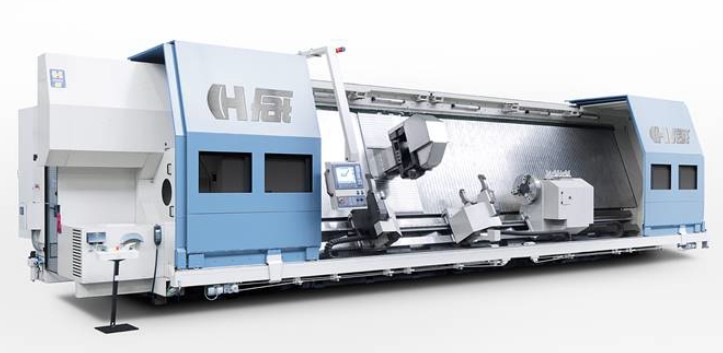
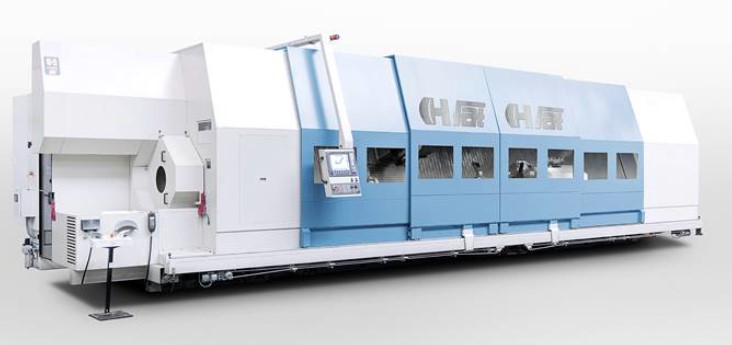
(1) General representation of 5 axes:
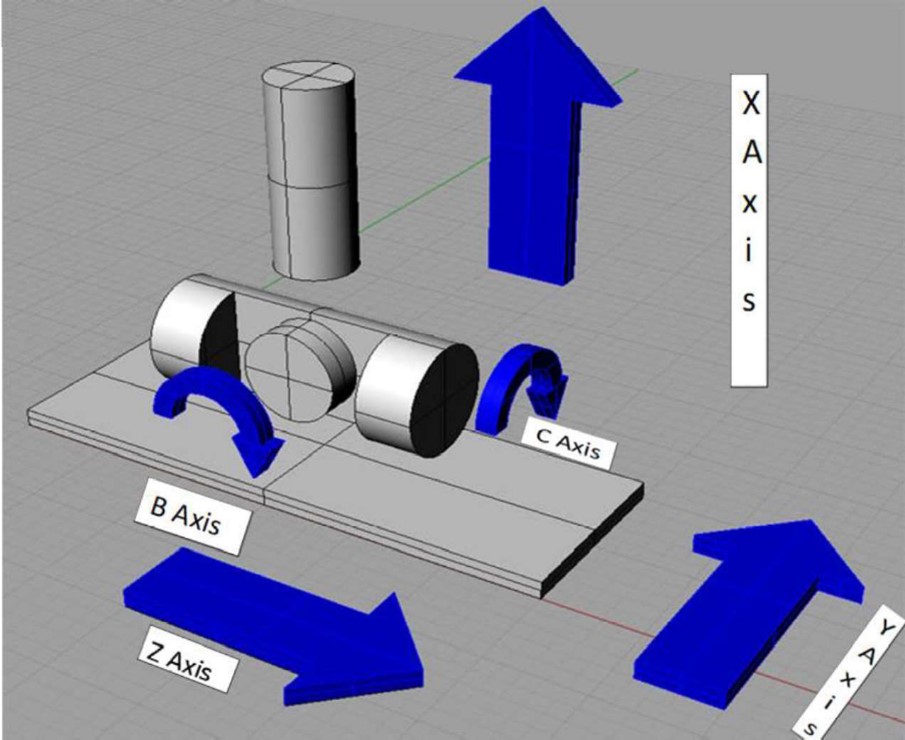
(2) Ezy-Fit's explanation of the axes on the FTM1000
Y-Axis movement from the doors at the 'front' of FTM1000 to the back (e.g. milling head moving from the left side of a workpiece to the right side of a workpiece).
X-Axis movement from the floor of the FTM1000 to the ceiling of the FTM1000.
Z-Axis movement along the main axis of rotation of the FTM1000 - that is, the length of the FTM1000 between spindle 1 and spindle 3.
B-Axis rotation around the Y-Axis (e.g. the milling head swinging back and forth).
C-Axis rotation around the Z-Axis (e.g. 'spinning' cylindrical workpieces for turning or for 'facing' during milling operations).
Bundle of photos of FTM1000 showing axes/spindles/chuck/jaw
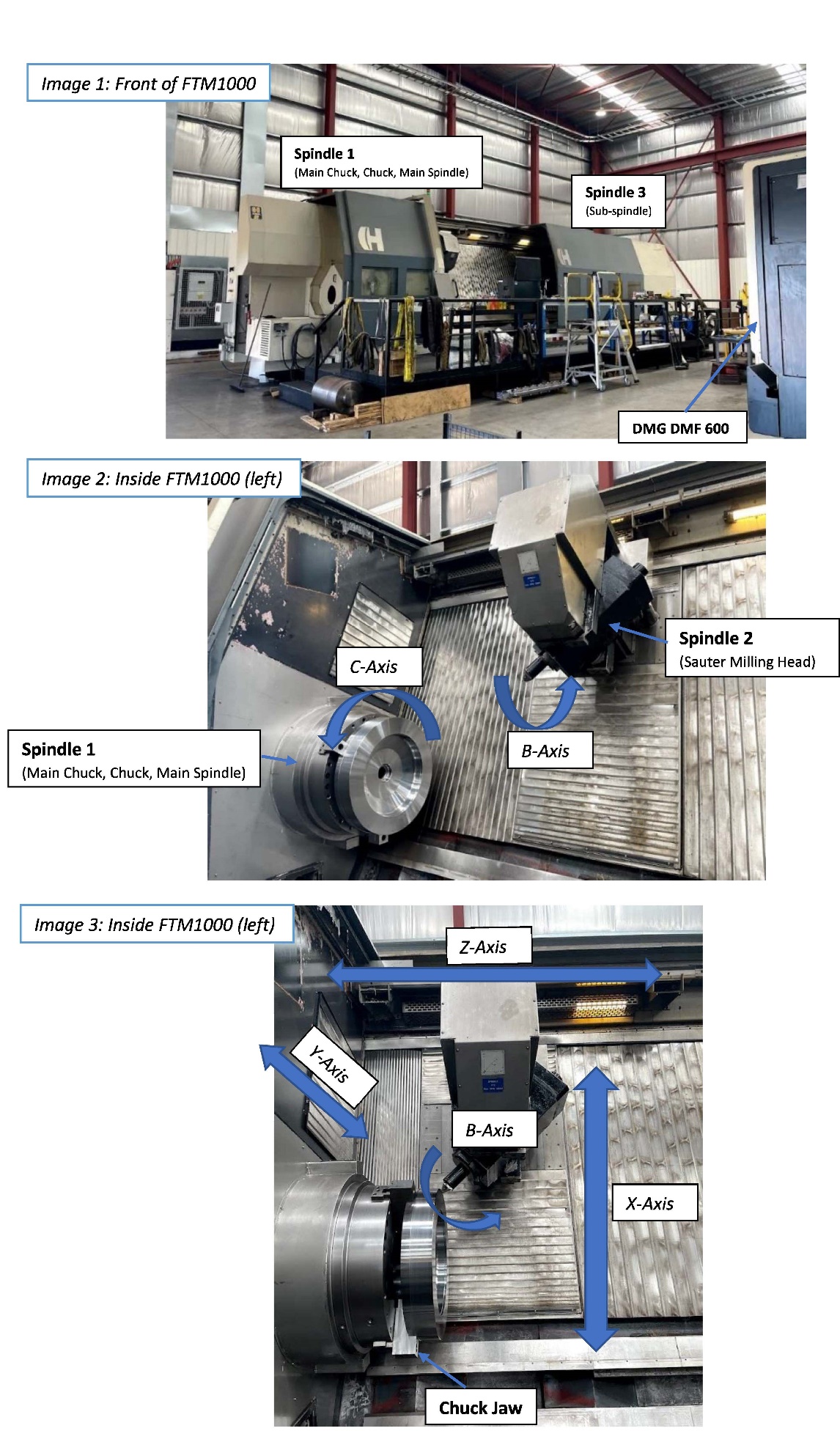
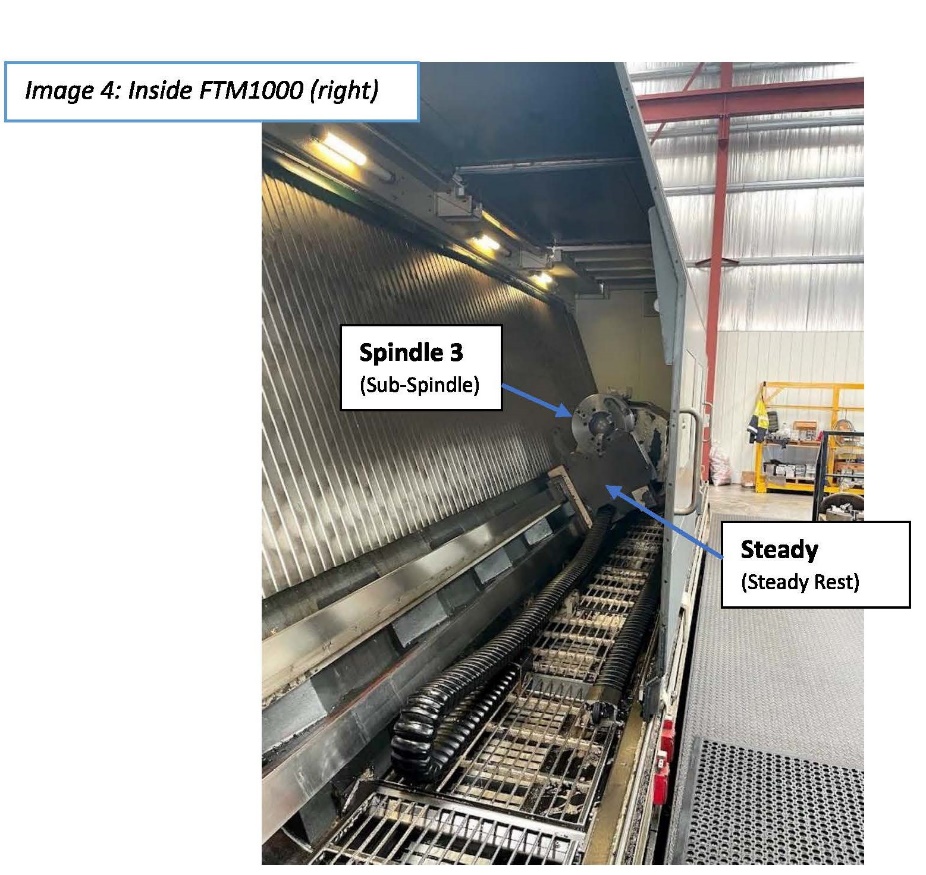
Figure 1:
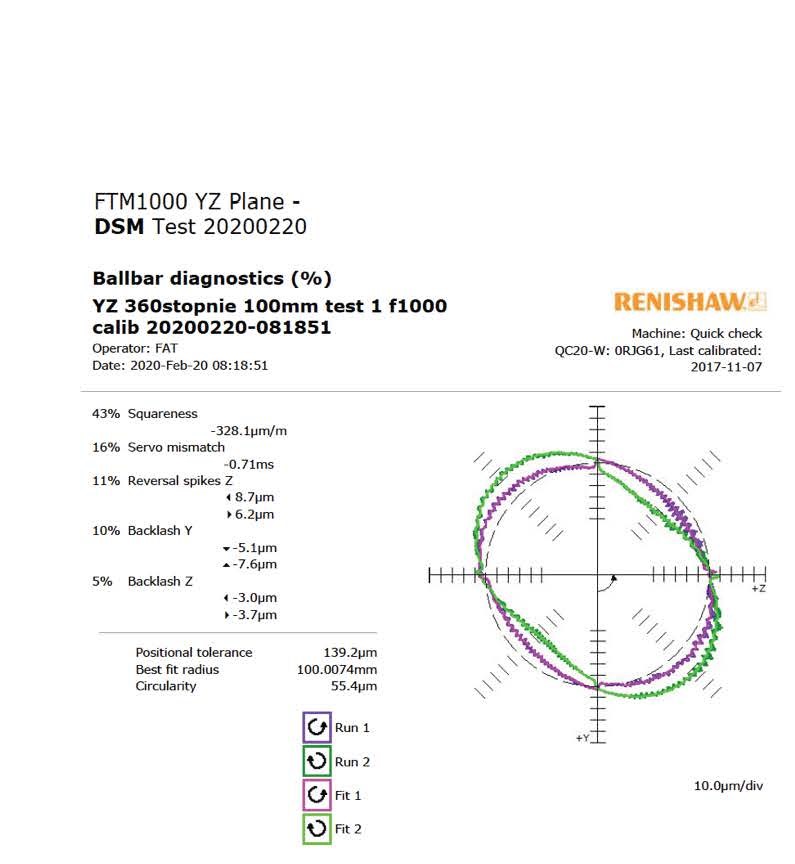
Figure 2:
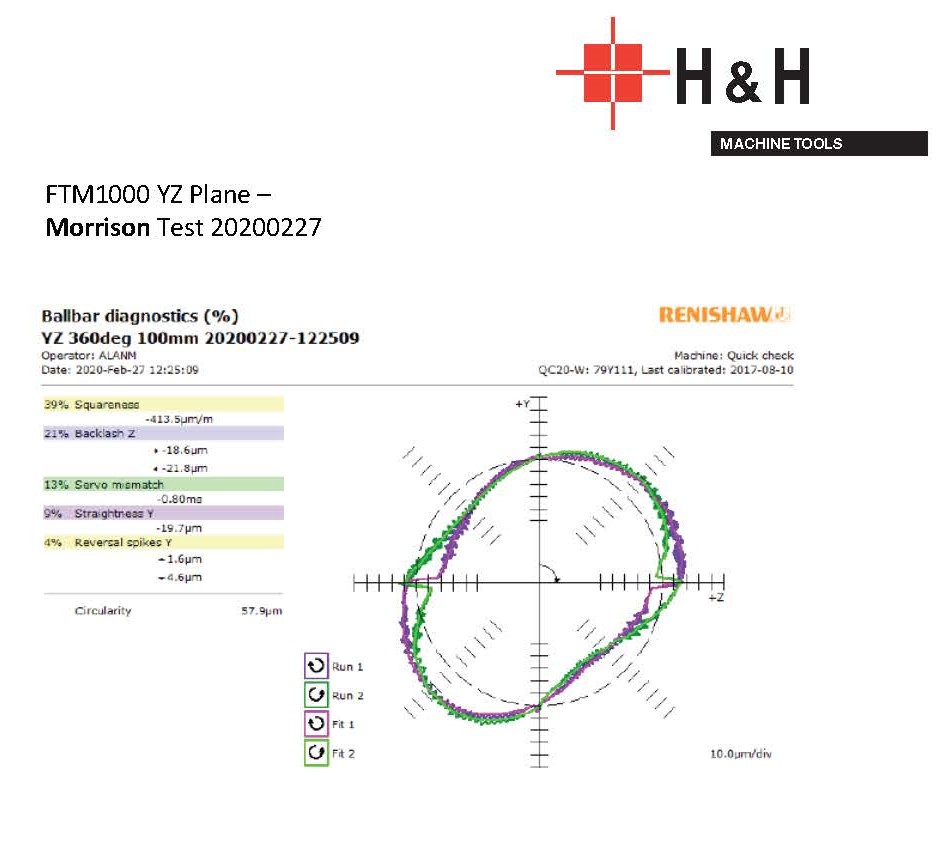
Figure 3:
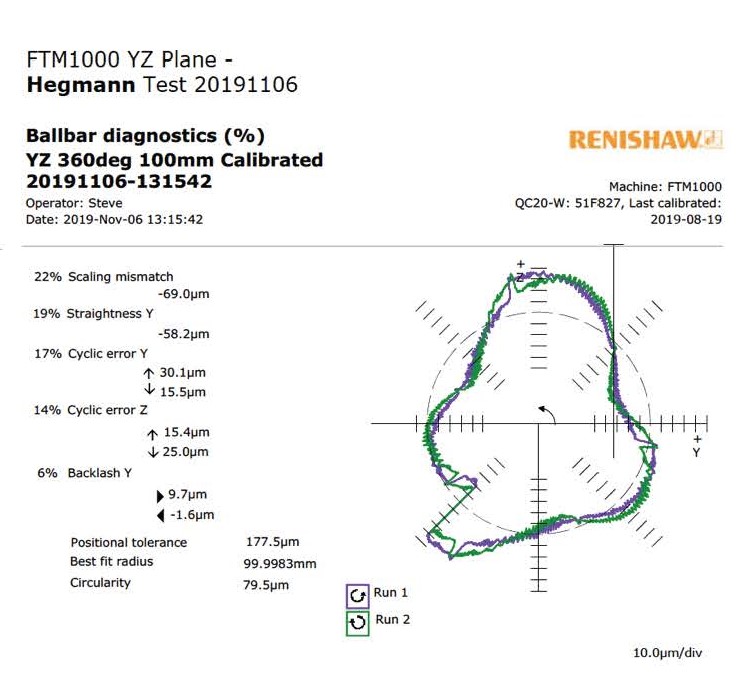
Figure 4:
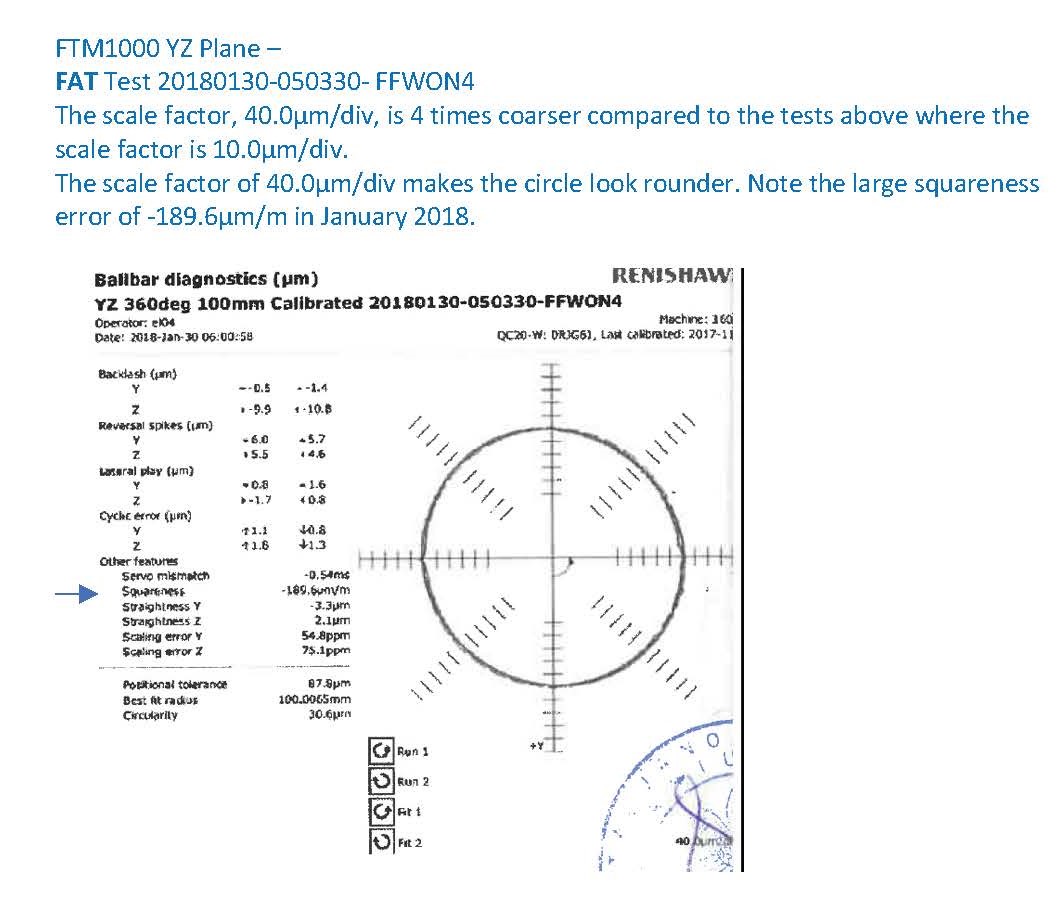
Figure 5: