

Federal Court of Australia
Briggs on behalf of the Boonwurrung People v State of Victoria [2024] FCA 288
ORDERS
First Applicant SYLVIA FAY MUIR Second Applicant | ||
AND: | STATE OF VICTORIA and others listed in the Schedule Respondent | |
DATE OF ORDER: | 25 March 2024 |
THE COURT ORDERS THAT:
1. The Applicant’s interlocutory application dated 22 February 2024 be refused.
2. The Applicants pay the costs of the Wurundjeri respondents to be taxed in default of agreement.
Note: Entry of orders is dealt with in Rule 39.32 of the Federal Court Rules 2011.
MURPHY J:
INTRODUCTION
1 The applicants in this native title determination application brought an interlocutory application dated 22 February 2024 seeking leave to adduce additional expert evidence in relation to the Separate Questions ordered to be decided in the case. The application seeks leave to file a report of Dr Ian Keen, an anthropologist, dated 14 February 2024, which addresses the following question:
On the assumed fact that the following Aboriginal women - Elizabeth Maynard, the mother of Jane Foster (name unknown), and Eliza Nowen – were abducted by non-Aboriginal sealers in or around the 1820s/30s (i.e. prior to effective sovereignty) from traditional Boonwurrung country (particularly Point Nepean or Western Port), can it be inferred solely from that fact that each woman was likely (i.e. on the balance of probabilities), to have been a member of the Boonwurrung people?
2 If leave to adduce additional expert evidence is granted, the applicants seek further orders to allow the Bunurong respondents to file responsive expert evidence if they wish, to be followed (if appropriate) by another joint experts’ conference facilitated by a Judicial Registrar, further written submissions, and a further hearing in relation to the Separate Questions in which all experts would again give evidence.
3 The application to adduce additional expert evidence was made at a time when the hearing of the Separate Questions took place between 10 and 14 July 2023, and the parties filed their written closing submissions and reply submissions between 4 September 2023 and 23 October 2023, following which judgment was reserved.
4 For the reasons I explain, the application has little merit and it must be refused.
THE FACTUAL AND PROCEDURAL BACKGROUND
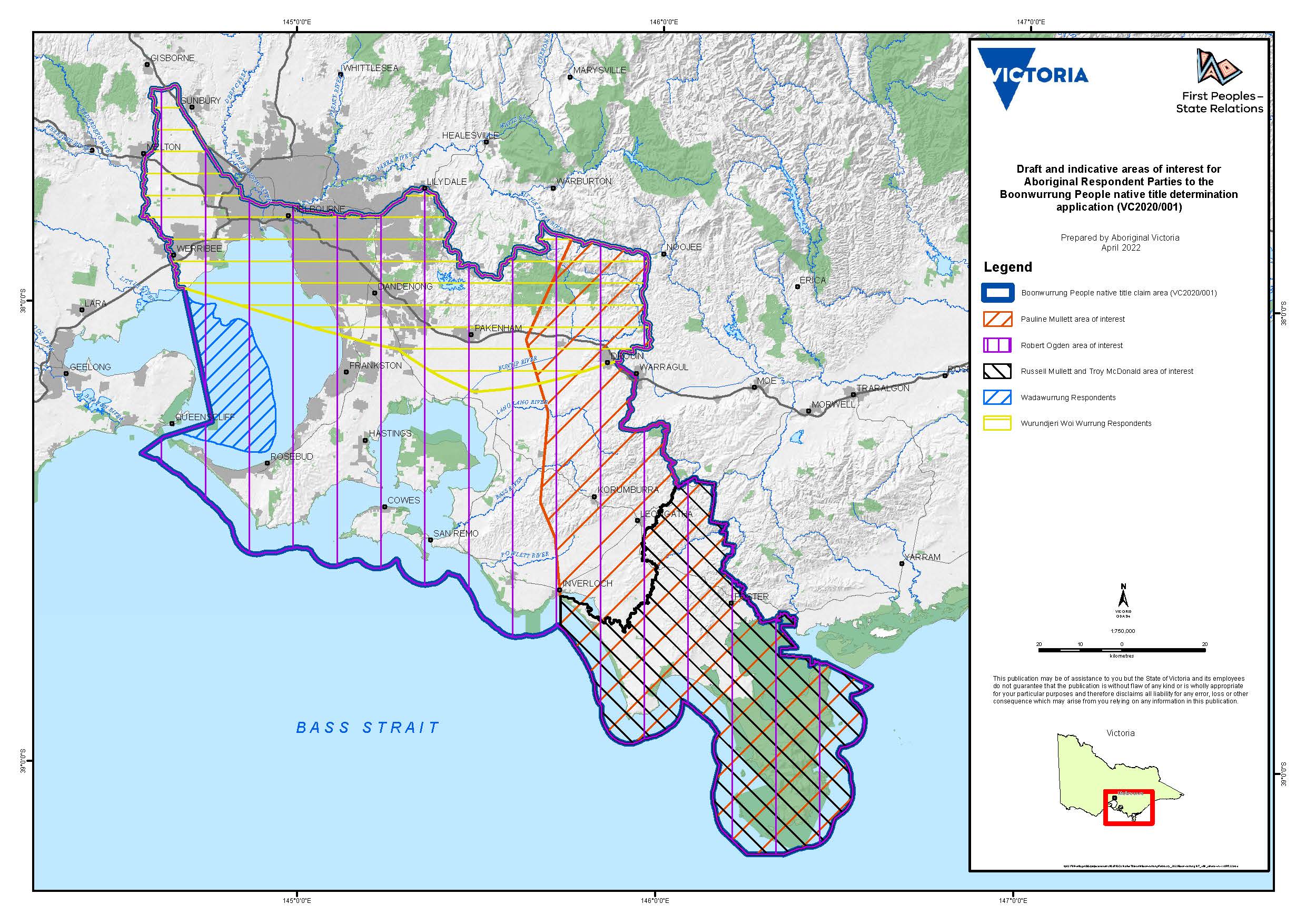
5 The substantive proceeding is a native title determination application in relation to a swathe of land and waters in Victoria filed by the applicants, Professor Carolyn Briggs AM and Sylvia Muir on behalf of the Boonwurrung People (Boonwurrung Application), on 1 June 2020. The substantive application alleges that the Boonwurrung People have native title rights and interests in relation to lands and waters in the Melbourne region, extending from Werribee in the west and Melton in the north-west to Wilsons Promontory in the east. The claim area includes the coast of Port Philip Bay (including the waters of the eastern half of the bay), taking in the whole of the Mornington Peninsula, the whole of Western Port Bay (including the coastal land and the waters of the bay and Phillip Island) and eastwards along the coast, including San Remo, Wonthaggi, Inverloch and Tarwin Lower, including the coastal waters extending to three nautical miles. The northern boundary of the claim area extends up to near Lilydale and includes Belgrave, Noojee, Drouin and Warragul, Mirboo North and Foster, and encompasses Dandenong, Frankston, Korumburra and Leongatha (Boonwurrung claim area).
6 Robert Ogden, Tasma Walton, Jarrod West, Gail Dawson and the Bunurong Land Council Aboriginal Corporation (Bunurong respondents) allege that they are Bunurong people who have traditional rights and interests in relation to the same lands and waters as in the Boonwurrung claim area. The Bunurong respondents allege that they are Boonwurrung people by descent from four named Aboriginal women Elizabeth Maynard, Eliza Nowan (also known as Eliza Nowen), Marjorie Munro (also known as Marjorie Munroe and Marjorie Munrow), and Jane Foster. They allege that Elizabeth Maynard, Eliza Nowan and Marjorie Munro were abducted from the coast of traditional Boonwurrung country by non-Indigenous sealers in the 1820s/1830s, and that Jane Foster’s mother was also abducted by non-Indigenous sealers. On their case, each of those women was a member of the Boonwurrung people at the time they were abducted, that they are descended from those women, and that they are therefore Boonwurrung people themselves. In essence, they seek amendment of the Boonwurrung Application to include the four named women as apical ancestors.
7 The Bunurong respondents do not claim to be a distinct people from the Boonwurrung people, and “Bunurong” and “Boonwurrung” are just two of the spelling variations (amongst many others) for the name of the First Nations people who assert native title rights and interests over the Boonwurrung claim area. For clarity I use the word “Boonwurrung” to describe the people who had traditional rights and interests in Boonwurrung country at effective sovereignty, and I use “Bunurong” to refer to the Bunurong respondents. That should not, however, be understood as my expressing a particular view as to the correct spelling of the name of the relevant people nor as to the correct identity of the people who held or hold traditional rights and interests in relation to the Boonwurrung claim area.
8 The applicants accept that that Marjorie Munro was a member of the Boonwurrung people, who, at effective sovereignty, held rights and interests in part of the Boonwurrung claim area, under traditional laws and customs, but they deny that in relation to the other three named Aboriginal women, and they do not accept that the Bunurong respondents are Boonwurrung people.
9 The other respondents to the Boonwurrung Application relevantly include:
(a) the State of Victoria;
(b) the Commonwealth of Australia;
(c) Troy McDonald and Russell Mullett, who allege that they are Gunaikurnai people who assert traditional title rights and interests in relation to the land and coastal waters of Wilsons Promontory, and Pauline Mullett, who alleges she is a Kurnai person who asserts traditional rights and interests in relation to same area but also extending north to the northern boundary of the Boonwurrung claim area (Gunaikurnai/Kurnai respondents);
(d) Ronald Jones, Perry Wandin and the Wurundjeri Woi Wurrung Cultural Heritage Aboriginal Corporation, who allege that they are Wurundjeri people who assert traditional rights and interests in the northern part of the Boonwurrung claim area (Wurundjeri respondents); and
(e) Terance Rangi, Shannen Mennen, Ernest Kinsey, Felicity Polley, Lee Hartman, Patrick Fagan and Sean Fagan, who allege that they are Wadawurrung people who assert traditional rights and interests in the waters of Port Philip Bay within the Boonwurrung claim area (Wadawurrung respondents).
“Attachment A” to these reasons is a map showing the Boonwurrung claim area and the areas of interest asserted by the Indigenous respondents.
The preservation of evidence hearing
10 Between 5 and 15 December 2022, the Court heard preservation evidence in the Boonwurrung Application. In this hearing (Preservation of Evidence Hearing) the applicants, the Gunaikurnai/Kurnai respondents and the Wurundjeri respondents each called lay witnesses to give evidence. Professor Briggs, Ms Muir, Elsie Anderson and Beryl Carmichael gave evidence for the applicants and were cross-examined.
The Separate Questions
11 It is uncontentious as between the parties that there can be no effective negotiation or mediation between the Boonwurrung people and the Gunaikurnai/Kurnai respondents, the Wadawurrung respondents or the Wurundjeri respondents as to what are the correct boundaries of their respective traditional lands and waters until the dispute between the Boonwurrrung and the Bunurong is resolved. And all attempts directed at resolving the dispute between the applicants and the Bunurong respondents by negotiation or mediation have failed.
12 To address that position, by orders made on 7 March 2023 (as amended by orders on 19 June 2023), the Court ordered the determination of Separate Questions directed at deciding the dispute between the applicants and the Bunurong respondents. Those orders state as follows:
1. Pursuant to r 30.01 of the Federal Court Rules 2011 (Cth), the following questions (Separate Questions) are to be decided separately from any other question in native title determination application VID 363 of 2020 (Application):
(a) Were each of the following persons members of a group comprising Boonwurrung (also described as Bunurong) people who, at sovereignty, held rights and interests in any part of the land and waters covered by the Application under traditional laws and customs?
(i) Louisa Briggs;
(ii) Ann Munrow;
(iii) Elizabeth Maynard;
(iv) Eliza Nowan, also known as Eliza Nowen;
(v) Marjorie Munro, also known as Marjorie Munroe and Marjorie Munrow; and
(vi) Jane Foster.
(b) If the answer to 1(a)(iii) is yes, are Robert Ogden and Jarrod West the descendants of Elizabeth Maynard?
(c) If the answer to 1(a)(iv) is yes, are Tasma Walton and/or Gail Dawson the descendant of Eliza Nowan?
(d) If the answer to 1(a)(vi) is yes, is Sonia Murray the descendant of Jane Foster?
(e) At sovereignty did membership of the Boonwurrung (also described as Bunurong) claim group require “mutual recognition” as described by Justice Brennan in Mabo v Queensland (No. 2) (1992) 175 CLR 1, at 70? For the avoidance of doubt, this question is not limited to a legal question as to whether Justice Brennan’s dicta regarding “mutual recognition” is an element of native title law, either under common law or under the Native Title Act 1993 (Cth). It includes the question as to whether, as an issue of fact, membership of the Boonwurrung (also described as Bunurong) claim group requires “mutual recognition” as described by Justice Brennan.
13 The Separate Questions were heard from 10 to 14 July 2023 (the Separate Question Hearing). Pursuant to the timetabling orders, in the period leading up to the hearing:
(a) the Bunurong respondents filed:
(i) witness outlines by the Bunurong Indigenous witnesses, Tasma Walton, Gail Dawson, Jarrod West, Dyan Summers and Robert Ogden;
(ii) two expert reports by Dr Timothy Pilbrow, an anthropologist; and
(iii) two expert reports by Dr Jacqueline D’Arcy, a historian;
(b) the Boonwurrung applicants filed:
(i) two expert reports of Dr Ian Clark, a historical geographer; and
(ii) an expert report of Mr Ray Wood, an anthropologist; and
(c) a Joint Experts’ Conference was convened on 20 and 21 June 2023 (Boonwurrung/Bunurong Joints Experts’ Conference) attended by Dr Pilbrow and Dr D’Arcy for the Bunurong respondents, and Dr Clark and Mr Wood for the applicants, following which the experts produced a Joint Experts’ Report dated 21 June 2023 (Boonwurrung/Bunurong Joint Experts’ Report).
14 By agreement of the parties, the State produced a voluminous Hearing Book (comprising 12 lever arch binders) for the Separate Questions Hearing which contained all of the documents upon which the parties proposed to rely.
15 Prior to the Separate Questions Hearing the participating parties accepted that Marjorie Munro was a Boonwurrung woman who at effective sovereignty held traditional rights and interests in the Boonwurrung claim area under traditional laws and customs. Then, during the Separate Questions Hearing, the participating parties accepted that Louisa Briggs, one of the apical ancestors named in the Boonwurrung Application, was a member of the group comprising Boonwurrung people who held traditional rights and interests in the Boonwurrung claim area under traditional laws and customs. Following those developments, the remaining Separate Questions concerned four of the asserted apical ancestors: Ann Munrow, Elizabeth Maynard, Eliza Nowan and Jane Foster.
16 At the Separate Questions Hearing:
(a) the applicants did not call any lay witnesses as by orders of the Court the evidence of Professor Briggs, Ms Muir, Elsie Anderson and Beryl Carmichael in the Preservation of Evidence Hearing is to be treated as evidence in relation to the Separate Questions;
(b) Ms Walton, Ms Dawson, Mr West, Ms Summers and Mr Ogden gave lay evidence for the Bunurong respondents and were cross-examined;
(c) Dr Clark and Mr Wood gave expert evidence for the applicants and Dr Pilbrow and Ms D’Arcy gave expert evidence for the Bunurong respondents, doing so in concurrent session. They were each cross-examined.
17 By agreement of the parties, following the Separate Questions Hearing the Bunurong respondents produced a Consolidated Hearing Book (comprising five lever arch binders) which consolidated the Hearing Book so that it only contained those documents which the parties relied upon.
18 Pursuant to timetabling orders made on 14 July 2023, and subsequently amended on the application of the parties, the parties filed their written closing submissions and reply submissions between 4 September 2023 and 23 October 2023. Judgment has been reserved since 23 October 2023.Having regard to the voluminous materials relied on by the parties and some complexity in the subject matter drafting reasons for judgment has involved significant work, but it is well advanced.
THE RELEVANT PRINCIPLES
19 There is no dispute between the parties as to the relevant principles to be applied in an application to re-open a matter after judgment is reserved. Instead, their differences concern the application of those principles to the facts of the case.
20 The Court has an inherent power to re-open a matter for hearing up until the time of entry for judgment. The power is discretionary, but exceptional, and is to be exercised having regard to the public interest in maintaining the finality of litigation: Smith v New South Wales Bar Association (1992) 176 CLR 256 at 265 (Brennan, Dawson, Toohey and Gaudron JJ). Their Honours said the following (at 266-267):
If an application is made to re-open on the basis that new or additional evidence is available, it will be relevant, at that stage, to inquire why the evidence was not called at the hearing. If there was a deliberate decision not to call it, ordinarily that will tell decisively against the application. But assuming that that hurdle is passed, different considerations may apply depending on whether the case is simply one in which the hearing is complete, or one in which reasons for judgment have been delivered. It is difficult to see why, in the former situation, the primary consideration should not be that of embarrassment or prejudice to the other side.
(Citations omitted).
21 In Spotlight Pty Ltd v NCON Australia Ltd (2012) 46 VR 1 at [17]-[18] (Harper and Tate JJA, Beach AJA) the Victorian Court of Appeal said:
There are good reasons why the circumstances must be exceptional before a court may allow a case, having been closed and judgment reserved, to be re-opened. The need for finality in litigation is one. … Were applications to re-open to be allowed almost as of course, such applications would be regularly made. That would add enormously to inefficiencies in the administration of justice, even if the re-opened hearing was strictly confined. The discipline which ought to attend the conduct of litigation by highly competent litigators would also inevitably decline.
The very strict rule that, subject to any applicable process of appeal or review, the presentation of their cases by parties to litigation must conclude with the end of the trial, has another important justification. It is that, very often, the boundaries of the re-opened issues would be hard to define and as difficult to protect. The re-opened hearing would then be bedevilled by arguments about whether one party or the other was seeking to take advantage of the re-opening to polish parts of its case which were more or less within the scope of the re-opened proceeding but not clearly on one side or the other of the prescribed limits.
22 The overriding principle to be applied by the court in determining whether or not to grant leave to re-open a case for the admittance of further evidence, is that it must be in the interest of justice in the proceeding: see Inspector-General in Bankruptcy v Bradshaw [2006] FCA 22 at [24] (Kenny J); Colin R Price & Associates Pty Ltd v Four Oaks Pty Ltd [2017] FCAFC 75; 251 FCR 404 at [171] (Rares, Murphy and Davies JJ); The Silver Fox Company Pty Ltd as Trustee for the Baker Family Trust (ACN 083 629 225) v Lenard’s Pty Ltd (No.2) [2004] FCA 1310 at [22] and [25] (Mansfield J).
23 As the State submitted, the authorities show that there are four recognised categories of cases which, subject to the interests of the administration of justice, may justify the granting of leave to re-open, although the categories are not necessarily closed: Bradshaw at [24]; Spotlight at [25]-[26]. Broadly, the categories are:
(a) fresh evidence. This brings into consideration whether the evidence is “new” in the sense that the applicant was unaware of it at the time of the original hearing, and also that it is evidence the applicant could not have obtained with reasonable diligence: Kedem v Johnson Lawyers Legal Practice Pty Ltd [2014] FCAFC 3 at [74] (North, Barker and Katzmann JJ);
(b) inadvertent error. This may occur, for example, where counsel inadvertently overlooked an issue that arises on the pleadings or during a proceeding: Urban Transport Authority (NSW) v Nweiser (1992) 28 NSWLR 471 at 474–5 (Clarke JA);
(c) mistaken apprehension of the facts. Similarly, this may occur where counsel has misapprehended the nature or significance of facts proven or agreed: Nweiser at 474–5; and
(d) mistaken apprehension of the law:
24 In contrast, the discretion to re-open should not ordinarily be exercised where counsel has made a tactical or forensic decision not to lead evidence on an issue: Nweiser at 474-5, 478. Save for exceptional cases, parties are bound by the forensic decisions of their counsel: McCarthy v McIntyre [2000] FCA 1250 at [30] (Whitlam, Emmett and Hely JJ); Hamilton v The Queen (2021) 274 CLR 531 at 557 [54] (Kiefel CJ, Keane and Steward JJ).
25 Any prejudice to the party resisting the application that is likely to be suffered will be relevant: Nweiser at 478. As will the public interest in the timely conclusion of litigation: Australian Securities and Investments Commission v Rich [2006] NSWSC 826; (2006) 235 ALR 587 at [18].
26 The probability that the additional evidence will affect the result is also relevant: Telstra Corporation Ltd v Australian Competition and Consumer Commission [2008] FCA 1436; (2008) 171 FCR 174 at [209] (Lindgren J). If success in re-opening is not likely to make any difference to the outcome of the trial, that would weigh against putting the parties and the court to the delay, trouble and expenditure of resources involved in reopening.
27 The requisite degree of probability has been stated in different ways. In Re Australasian Meat Industry Employees' Union (WA Branch); Ex parte Ferguson (1986) 67 ALR 491 at 493–94 Toohey J said that the evidence should only be admitted “when it is so material that the interests of justice require it” or where the evidence “would most probably affect the result”. In Daniel v Western Australia (2004) 138 FCR 254 at 269 RD Nicholson J said that it must be shown that the new evidence, if accepted, would “most certainly affect the result”. A party should not, however, be permitted to re-open a case merely because, in retrospect, it can be seen that better evidence about an issue in dispute might have changed the result. Were it otherwise, there would be no end to litigation: Davis v Insolvency and Trustee Service Australia (No 2) [2011] FCAFC 9; 190 FCR 437 at [9] (Keane CJ, Besanko and Perram JJ).
28 The concerns raised on an application to adduce further evidence after the close of the case involve consideration not only of the interests and prejudice of the parties, and the public interest in the finality of litigation, but also the availability of public resources. In Aon Risk Services Australia Ltd v Australian National University (2009) 239 CLR 175 at [93] (Gummow, Hayne, Crennan, Kiefel and Bell JJ) the High Court observed that “the rules concerning civil litigation no longer are to be considered as directed only to the resolution of the dispute between the parties to a proceeding.” That finds reflection in the “overarching purpose” stated in s 37M of the Federal Court of Australia Act 1976 (Cth) (FCA Act) to facilitate the just resolution of disputes according to law as quickly, inexpensively and efficiently as possible, including objectives of:
(a) the just determination of all proceedings before the Court;
(b) the efficient use of the judicial and administrative resources available for the purposes of the Court;
(c) the efficient disposal of the Court’s overall caseload;
(d) the disposal of all proceedings in a timely manner; and
(e) the resolution of disputes at a cost that is proportionate to the importance and complexity of the matters in dispute.
THE APPLICANTS’ SUBMISSIONS
29 The application is supported by an affidavit of Jason Briggs, the solicitor on the record for applicants, sworn 22 February 2024. The applicants did not file written submissions in support of the application, but most of Mr Briggs’s affidavit is submissions rather than evidence and I accepted it on that basis.
30 Centrally, Mr Briggs submitted that on the fourth day of the Separate Questions Hearing, the Court for the first time “identified” a “discrete question” relating to each of the four allegedly abducted Aboriginal women, being:
Whether it is reasonable to infer that just because someone was taken from the coast of Western Port Bay or Port Philip Bay, that they were Boonwurrung/Bunurong.
He submitted that “discrete question” is directly relevant to the Court’s determination of the Separate Questions and it was necessary for the applicant to adduce evidence by Dr Keen to properly respond to it.
31 However, in oral submissions Mr Levy, counsel for the applicants, abandoned the contention that the Court had “identified” (in the sense of raised for the first time) a question which was not previously known to the parties. He accepted that in raising that issue the Court was merely articulating a question of which the parties were already aware, and upon which they had adduced evidence and made submissions.
32 The primary thrust of the applicants’ submissions then became that:
(a) prior to and at the time of the Separate Questions Hearing the applicants’ lawyers were not aware of important developments in the mid-20th century in anthropological theory and models in relation to Aboriginal social organisation at a local level;
(b) the applicants’ lawyers were not aware of those developments because they were not apprised of them by the experts the applicant had retained;
(c) those developments in anthropological theory and models and their significance to the facts relevant to the Separate Questions are addressed in Dr Keen’s report. If it is accepted that the composition of the Boonwurrung group at a local level prior to effective sovereignty was in accordance with Dr Keen’s opinion (which accords with settled anthropological theory), that would be a conclusive answer to the Bunurong respondents’ contention that merely because the four named Aboriginal women were abducted from Boonwurrung country in the 1830s they were likely to have been Boonwurrung people; and
(d) Dr Keen’s opinions are therefore significant to the just determination of a central factual question in the decision on the Separate Questions and it is in the interests of justice that the applicants be given leave to adduce evidence from him.
33 The applicants note that Dr Keen’s report states that up until the mid-20th century the prevailing anthropological theory or model for the social organisation of Aboriginal “residence groups” on land in Australia was of a “patrilineal, patrilocal band”. That theory, propounded by, amongst others, the then influential British social anthropologist A.R. Radcliffe-Brown (e.g. in “The Social Organisation of Australian Tribes” (Radcliffe-Brown 1930-31)), was said to have presumed that a significant proportion of such residence groups were also members of the traditional “land-owning group” for that land. Dr Keen described the Radcliffe-Brown model of local Aboriginal social organisation as follows:
According to this model, residents of a hunter-gatherer band or “horde” included males of the land owning group on whose land the group resided, minus females of the group who had married men of other groups, plus unmarried females of the land-owning group and in-marrying wives of men of the group. Since the land-owning group was exogamous the wives were members of other land-owning groups or clans.
34 The applicants’ argued that if, prior to effective sovereignty, local Aboriginal social organisation operated in that way, it could more readily be inferred that an Aboriginal person observed on Boonwurrung country in the 1830s was more likely than not a member of the Boonwurrung land-owning group (except that Dr Keen’s opinion was that due to exogamous marriage practices that inference cannot be drawn where an Aboriginal woman was married).
35 However, Dr Keen said that the Radcliffe-Brown model of Aboriginal social organisation prior to effective sovereignty was not based on actual observations or evidence of how Aboriginal people were socially organised and lived their lives, but instead reflected unproven “assumptions and theoretical models” about the social organisation of hunter-gatherer groups, and had long been discredited. Dr Keen drew a distinction between on the one hand, an Aboriginal “land-owning group” in Australia, and on the other hand, “residence groups” of Aboriginal persons who occupied and used the land at that time.
36 Mr Briggs submitted that Dr Keen’s opinion finds support in a book by the eminent Australian anthropologist Professor Peter Sutton (Sutton P, Native Title in Australia, An Ethnographic Perspective (Cambridge University Press, 2003)) and he cited several passages from chapter two of that book. There, Professor Sutton said that Radcliffe-Brown’s writings on local Aboriginal organisation had “held considerable sway until the Hiatt-Stanner debate of the 1960s”, but that as far as local Aboriginal social organisation is concerned Radcliffe-Brown’s views were now seen as removed from “ethnographic reality.” Professor Sutton expressed the opinion that “[c]ontrary to Radcliffe-Brown’s model, there are many more clans (and thus estates) represented in these bands than just the clan of the patrilineal core members, or that clan plus those of incoming spouses. In fact the average number of clans with members in a single band, on this sample, is more than six.”
37 Mr Briggs also submitted that Dr Keen’s opinion finds support in:
(a) a 2021 paper by Emeritus Professor Nicolas Peterson of the Australian National University which summarised the errors in the Radcliffe-Brown model, titled “Understanding classical Aboriginal land tenure: key concepts and issues”; and
(b) the findings and reasonings of Blackburn J in Milirrpum v Nabalco Ply Ltd (1971) 17 FLR 141, and the evidence of Dr Kingsley Palmer in Smirke on behalf of the Jurruru People v State of Western Australia (No 2) [2020] FCA 1728 at [754] (Mortimer J).
38 The applicants said that the testimony of Dr Pilbrow, the Bunurong respondents’ expert in the Separate Questions Hearing, “substantially replicated” the “now discredited Radcliffe-Brown model”. They said that when it is understood that the Radcliffe-Brown model is contrary to mainstream anthropological theory in regard to Aboriginal social organisation at a local level prior to effective sovereignty, it cannot rationally be inferred from the presence of an Aboriginal woman on Boonwurrung country in the 1830s that she was more likely or not to have been a Boonwurrung person. They said that is the conclusion Dr Keen reached.
39 The applicants gave a number of explanations for why they and their lawyers were not aware of the (asserted )significant developments in anthropological theories and models in the mid-20th century (particularly the move away from Radcliffe-Brown’s theories and models) until after the Separate Questions Hearing, and for their not appreciating the importance of those developments on the facts of this case.
40 They said that notwithstanding the publication of many anthropological reports since 2000 regarding the group status of Aboriginal women abducted from the Victorian coastline, none of those reports referred to the (asserted) significant developments in anthropological theories and models, or referred to their significance. They said that, since a 2003 report by their expert, Dr Clarke, the question as to whether it may rationally be inferred solely from the fact that a woman had been abducted from Boonwurrung country that the woman was a Boonwurrung person had, with one exception, been ignored in anthropological reports.
41 The applicants said that the exception was a joint experts’ conference in September 2018 in an application for a native title determination application brought in 2014, titled Gunaikurnai People Native Title Group & Ors v State of Victoria & Ors proceeding VID 737 of 2014 (Gunaikurnai Application). As is usual, following that Court-convened conference the experts prepared a joint report dated 7 September 2018 (First Joint Gunaikurnai Experts’ Report). That report was tendered, without objection, in this proceeding.
42 Each of the experts involved in the First Joint Gunaikurnai Experts’ Report (Dr Mahnaz Alimardanian, an anthropologist, Ms Kathleen Lothian, a historian, Dr Suzi Hutchings, an anthropologist, Mr Wood, an anthropologist, Dr Valerie Cooms a historian and Mr James Annand, an anthropologist) agreed:
(a) in relation to Eliza Nowen and Jane Foster, that “[t]here are insufficient facts in the basis material for us to determine whether or not [Eliza Nowen/Jane Foster] had a traditional association with the Bunurong/Boonwurrung group and country”; and
(b) in relation to Elizabeth Maynard, that “the information does not include which Port Phillip group this woman belongs to, and this is the difficulty with determining whether she belonged to the Bunurong/Boonwurrung aggregation of local groups”.
43 Following that, a further joint experts’ conference was convened in the Gunaikurnai Application on 27 and 28 May 2019. As is usual the experts prepared another joint experts’ report dated 11 May 2019 (Third Joint Gunaikurnai Experts’ Report). That report was also tendered, without objection, in this proceeding.
44 Each of the experts involved in the Third Joint Gunaikurnai Experts’ Report (Dr Pilbrow, Ms Lothian, Dr Hutchings, Mr Wood, Dr Cooms, Mr Annand and Dr Dean Fergie, an anthropologist) agreed as follows in relation to Eliza Nowen and Marjorie Munro:
We consider it a prima facie case that any person who was taken from the Western Port area in this period is more likely than not to belong to the Western Port area, and thus to the Boonwurrung group. The abductions occurred prior to effective sovereignty and large-scale displacement of people from their original countries.”
For similar reasons the experts also agreed that the evidence indicated that Elizabeth Maynard had a connection to part of the Boonwurrung claim area.
45 As the applicants submitted, none of the expert reports filed by the parties in this proceeding, nor any of the earlier expert reports which the parties tendered, mentioned the significant developments in anthropological theory and models that occurred during the mid-20th century to which Dr Keen referred, or in particular the discrediting of Radcliff-Brown’s theories and models regarding the social organisation of local Aboriginal groups. Nor, as the applicants and the applicants’ lawyers said, did the expert witnesses they engaged in the case alert the applicants’ lawyers to the significance of those developments on the facts of this case. They said that, as a consequence, the applicants’ lawyers were not aware of those (asserted) significant developments and thus did not appreciate the significance of those developments to this case.
46 That was said to have occurred because:
(a) the applicants’ lawyers relied upon Dr Clark, a historical geographer, to express and develop his reasoning, first expressed in his 2003 report, that it cannot rationally be inferred solely from the fact that prior to effective sovereignty an Aboriginal woman was abducted from Boonwurrung country that the woman was a Boonwurrung person. The applicants said that Dr Clark is not an anthropologist and consequently was not apprised of the mid-20th century significant developments in anthropological theories and models about Aboriginal social organisation prior to effective sovereignty as explained by Dr Keen. As a result, Dr Clark did not refer to that extant body of research in his report, nor in his evidence in the Separate Questions Hearing;
(b) the applicants engaged Mr Wood, an anthropologist, for the Separate Questions Hearing but only in relation to Question 1(e), which concerned “mutual recognition”. He was not asked to provide a written report about the other Separate Questions and was not formally retained in relation to the (asserted) “discrete question” which is the subject of Dr Keen’s report. The applicants accepted, however, that at the Joint Experts’ Conference in this proceeding, and in his evidence in the Separate Questions Hearing, Mr Wood generally supported Dr Clarke’s opinion that it could not be inferred, from the fact that, prior to effective sovereignty, an Aboriginal woman was abducted from traditional Boonwurrung country, that she was, a Boonwurrung woman;
(c) the applicants’ experts did not refer the applicants’ lawyers to chapter two of Professor Sutton’s book until after the Separate Questions Hearing. And notwithstanding that the applicants had relied upon other parts of that book the applicants’ lawyers had not read chapter two; and
(d) at the time of the Separate Questions Hearing the applicants’ lawyers were not aware of the findings and reasonings of Blackburn J in Milirrpum, nor of the evidence of Dr Palmer in Smirke.
47 The applicants said that, as a consequence, Mr Levy did not cross-examine Dr Pilbrow on his evidence (which was said to have “substantially replicated” the Radcliffe-Brown theory and model). Nor, as a consequence, did the applicants seek to put on evidence of an expert such as Dr Keen to meet those (asserted) deficiencies in Dr Pilbrow’s opinions.
48 Mr Briggs, however, conceded that the applicants’ lawyers ought to have been apprised of those matters at the time of the Separate Questions Hearing and he apologised for that failure.
49 Apparently so as to address any suggestion of delay in bringing this application, Mr Briggs deposed that the applicants’ lawyers did not become aware of the findings and reasonings of Blackburn J in Milirrpum or of Dr Palmer’s evidence in Smirke, or of their significance to the case, until October 2023 when they were preparing the applicant’s submissions in reply. He also said that, in October 2023, the applicants’ lawyers located the 2021 paper by Professor Peterson via a Google search.
50 Then, Mr Briggs deposed that in November 2023 the applicants’ lawyers sought advice from Mr Wood, noting that in his evidence in the Separate Questions Hearing he had had indicated the existence of “ethnographic literature” as to “what Australian Aboriginal communities were like in the pre-contact eras, being “detailed studies” which showed that prior to effective sovereignty the "average camp had a pretty mixed composition of people from a wide catchment of … groups”. Mr Wood responded on 9 December 2023 by explaining that the developments in anthropological theory and models about the social organisation of Aboriginal groups at a local level was explained in chapter two of Professor Sutton’s book. Mr Levy said that it was then that he became aware of the contents of chapter two of the book.
51 Then, Mr Briggs deposed that he contacted Professor Peterson in December 2023 and asked whether he would be able to speedily write a report for use in the Separate Questions Hearing. Professor Peterson was unable to assist, but recommended Dr Keen. The applicants’ lawyers then approached Dr Keen who advised on 8 January 2024 that he was unable to prepare a report within the necessary short timeframe, but after discussions he agreed to provide a short report, which is annexed to Mr Briggs’s affidavit.
CONSIDERATION
52 When the principles relevant to granting leave to reopen a case after judgment is reserved are applied to the facts of this case it is plain that the application must be dismissed.
53 First, and fundamentally, the application for leave to adduce additional expert evidence must be refused because the discretion to allow the re-opening of a case after judgment has been reserved should only be exercised in “exceptional circumstances”. The public interest in finality of litigation and the associated requirement that parties present all the evidence and submissions at the one hearing is the underlying rationale for that approach: Spotlight at [17]-[18]. The applicants put on nothing to show that this case involves “exceptional circumstances”.
54 Second, I have no difficulty in accepting that Dr Keen’s opinions are relevant to the issues before the Court in the Separate Questions. But to justify a grant of leave to adduce further evidence after judgment is reserved, the applicants must show that the evidence “is so material that the interests of justice require it” or that the evidence “would most probably affect the result”: Re Australasian Meat Industry Employees' Union at 493–94. I would not permit the applicants to re-open the case merely because, in retrospect, after judgment was reserved, they have sourced better evidence about an issue which was always known to them. Were it otherwise, there would be no end to litigation: Davis at [9].
55 I am not satisfied that Dr Keen’s evidence would “most probably” affect the result. I say that, first, because Dr Keen’s report was provided in response to a question which is both partial and hypothetical. The applicants asked Dr Keen whether it can be inferred “solely” from the assumed fact that an Aboriginal woman was abducted in the 1830s from traditional Boonwurrung country (particularly Point Nepean or Western Port) that she was likely to have been a member of the Boonwurrung people. That question was framed by the applicants and answered by Dr Keen without reference to the other evidence upon which the Bunurong respondents relied to support an inference that the named women were Boonwurrung people. That significantly reduces the probative value of Dr Keen’s opinion.
56 Second, the applicants contended that Dr Pilbrow’s evidence should not be accepted by the Court because it is not founded in the mainstream anthropological theories and models on which Dr Keen relied, and it “substantially replicated” the discredited theories of Radcliffe-Brown. Essentially, they argued that Dr Keen’s opinions are important to a just determination of the Separate Questions because his opinion does not suffer from the asserted deficiencies of Dr Pilbrow’s evidence.
57 But Dr Pilbrow was not asked about the anthropological theories and models that lay behind his opinions, and there is no basis to infer that he missed or misunderstood the significant developments in anthropological theories and models to which Dr Keen referred, and/or the significance of those developments having regard to the facts of the case.
58 Nor can it be inferred from the fact that Dr Pilbrow did not refer to the relevant developments in anthropological theories and models in the 1960s/1970s that the opinions he expressed were based upon outdated anthropological theories and models. There is no basis to infer that the move away from Radcliffe-Brown’s theories was unknown or unappreciated amongst anthropologists, including Dr Pilbrow. Professor Sutton’s seminal text, which was published in 2003, addressed Radcliffe Brown’s approach in detail and engaged in a sustained critique of that approach: see Sutton P, Native Title in Australia, An Ethnographic Perspective, pp 38, 44-53. And there was no reason for Dr Pilbrow’s reports to revisit academic debates which were settled around 50 years ago.
59 In the absence of cogent evidence I would not infer that an experienced anthropologist like Dr Pilbrow somehow missed or misunderstood those significant developments, nor that his evidence was based in long discredited anthropological theories and models.
60 The applicants also contended that the experts involved in Third Joint Gunaikurnai Experts’ Report also missed or misunderstood the relevant developments in anthropological theories and models in the 1960s/1970s.
61 Again, there is no basis for such an inference. All the Court has before it is the agreed opinion of those experts in the Third Joint Gunaikurnai Experts’ Report, in which they opined (in briefly stated terms) that prima facie any person who was abducted from the Western Port area in the 1830s was more likely than not to belong to the Western Port area, and thus to the Boonwurrung group. They did not say what anthropological theories and models regarding Aboriginal social organisation lay behind that conclusion. In the absence of cogent evidence there is no basis for an inference that they missed or misunderstood the relevant developments in anthropological theories and models, nor that they misunderstood the significance of those developments in relation to the Separate Questions Hearing, nor that their opinion was based in their having relied on outdated anthropological theories and models.
62 Third, the applicants’ lawyers said that they omitted to earlier file expert evidence in the nature of Dr Keen’s report because they were:
(a) not apprised by the experts they engaged as to the asserted significant developments in the mid-20th century in anthropological theory and models concerning the social organisation of Aboriginal groups at a local level prior to effective sovereignty, nor of the importance of those developments having regard to the facts of this case;
(b) not aware of the contents of chapter two of Professor Sutton’s book, Native Title in Australia, which explained those significant developments; and
(c) not aware of the findings and reasoning of Blackburn J in Milirrpum, nor of the evidence of Dr Palmer in Smirke, in relation to the social organisation of Aboriginal groups at a local level.
63 The nature of the proposed additional expert evidence (an expert opinion in relation to past significant developments in anthropological theory and models and their application in this case) means that it is not “fresh evidence”. It is “new” in the sense that the applicants’ lawyers were not aware of it, but it could have been discovered by the applicants’ lawyers with reasonable diligence. That is sufficiently clear when:
(a) the applicants were aware that the issues in the Separate Question Hearing included whether inferences could properly be drawn as to membership of the Boonwurrung people prior to effective sovereignty, at least in part based on the place of abduction of an Aboriginal woman in the 1830s. In those circumstances it was not outside the competence of experienced practitioners in the field of native title law to understand the relevance or need to adduce expert evidence on the social organisation at a local level of Kulin groups prior to effective sovereignty. Had the applicants’ lawyers acted with reasonable diligence they would have adduced evidence in the nature Dr Keen’s report in the Separate Questions Hearing;
(b) Mr Wood was able to immediately alert the applicants’ lawyers to chapter two of Professor Sutton’s book once he was asked the appropriate question;
(c) Professor Sutton’s book is a very well-known text, and the applicants relied on other parts of the book in their submissions; and
(d) the applicants’ lawyers were able to discover Professor Peterson’s 2021 paper via a Google search.
64 It is plain that the applicants’ lawyers were aware of the decision in Milirrpum. Mr Levy, counsel for the applicants, referred to it in opening submissions and when cross-examining Dr Pilbrow. It is also plain that the applicants and their lawyers were aware of Professor Sutton’s seminal text. The Boonwurrung Application referred to the book and Mr Levy referred to it in opening the applicants’ case at the Preservation of Evidence Hearing. Even so, I accept that it was only when preparing closing written submissions that Mr Levy came to consider the significance of the findings and reasoning in Milirrpum to this case, and it was not until Mr Wood directed Mr Briggs to chapter two of Professor Sutton’s book that Mr Levy read that chapter and came to consider it to be significant to this case.
65 Those matters do not indicate “inadvertent error”, “mistaken apprehension of facts” or “mistaken apprehension of the law” so as to fall within one of the established categories in which granting leave to adduce additional evidence after judgment is reserved may be justified. Instead, they raise the issue of reasonable diligence in the applicants’ preparation of their case. Mr Briggs accepted, correctly in my view, that the applicants’ lawyers ought to have been aware of the significant developments in anthropological theories and models to which Dr Keen referred, and of the significance of that on the facts of this case. That also points away from granting leave to adduce additional expert evidence: Kedem at [74].
66 Fourth, as Mr Levy accepted in oral submissions, the question as to whether it can rationally be inferred from the place of her abduction that an Aboriginal woman abducted in the 1830s from traditional Boonwurrung country was a Boonwurrung person is not a new issue identified by the Court on the fourth day of the Separate Questions Hearing. Nor is it an issue that until then had been overlooked by the applicants, the other parties, or the Court.
67 Mr Levy first raised that issue on 15 December 2022 in the Preservation of Evidence Hearing, approximately seven months before the Separate Questions Hearing. He said the following:
MR LEVY: … It will be my submission in this process that there is what I would call an anterior issue which – from everything I’ve read so far – was never really identified but was assumed by all the experts, and that is that if – if I could put it in general terms – if an Aboriginal person was observed on a stretch of coastline of Australia in 1820, anywhere, that Aboriginal person on the balance of probabilities was a member of the group that traditionally owned that coastline.
HIS HONOUR: Yes.
MR LEVY: It will be my submission, and I will be in a position to do it, to file a short expert report about that, for example that at that time Aboriginal people ordinarily married people from other groups, so if there was a woman there – a woman and a man, they would’ve been from different groups. The other relevant point is, which seems to be well-known, that Aboriginal people --- it wasn’t a castle, they went all over each other’s groups. So it will be my submission that that’s something that needs to be looked at.
…
MR LEVY: It hasn’t been addressed by any expert so far. In the joint report [for the Wilson’s Promontory applications], it’s just assumed. It says on the balance of probabilities - - -
HIS HONOUR: I don’t need to be persuaded today. The fact that a person is on the coastline of Victoria, somewhere between Melbourne and Wilsons Promontory, does not mean they’re necessarily Boonwurrung.
MR LEVY: But the joint expert report you were taken to last week, they all presumed that but didn’t identify that in submissions.
HIS HONOUR: I follow that. That’s a decision I can make, isn’t it?
MR LEVY: It is, absolutely.
(Emphasis added.)
68 In response to concerns raised by the Court as to the likely cost and delay associated with receiving expert evidence on that topic Mr Levy went on to say:
MR LEVY: No, your Honour I’m only doing it out of caution. I regard it as you could take judicial notice that Aboriginal people hunted and fished on each other’s country and various groups in the region also married people from other groups at that time.
(Emphasis added.)
69 Mr Levy said that one of his primary submissions would be that it could not be rationally inferred from the archival records regarding women abducted from the coast of Port Phillip Bay or Western Port Bay that the person was a member of the Boonwurrung group rather than one of a several other Aboriginal groups.
70 The applicants also raised that issue in their written opening submissions for the Separate Questions Hearing filed 6 July 2023 at [22]-[23] (in relation to Elizabeth Maynard) and at [34]-[35] (in relation to Eliza Nowen).
71 In relation to Elizabeth Maynard the applicants submitted:
But even if it is accepted that Elizabeth Maynard was abducted by George Meredith from Point Nepean, it cannot be concluded that she was therefore (or likely) Boonwurrung. At its highest, this evidence indicates that Elizabeth Maynard may have been a member of any of the five Eastern Kulin Aboriginal groups. It cannot logically be inferred or concluded from Elizabeth Maynard’s place of abduction that she was Boonwurrung, noting that traditionally Aboriginal groups regularly used and were present upon the country of neighbouring groups (including for hunting, fishing, gathering, other resource use, and ceremonial reasons), including the country of their husbands.
The Bunurong respondents specifically claim that Elizabeth Maynard is Nandergoroke, the abducted wife of Derrimut, a Boonwurrung man who is buried in the Carlton Cemetery. If so, as Dr Clark points out, the “prevailing exogamous marriage practices of the Eastern Kulin Nation” mean that Elizabeth Maynard definitely would not be Boonwurrung, but would “likely” be Woiwurrung (Wurundjeri) or from another Eastern Kulin wurrung or group with whom the Boonwurrung intermarried.
72 In relation to Eliza Nowen the applicants submitted:
At its highest the archival evidence indicates that Eliza Nowen may have had an association with Port Phillip and Western Port. If so, she may have been a member of any of the five Eastern Kulin Aboriginal groups, but it cannot logically be inferred or concluded that she was Boonwurrung.
The fact that some of the coastline of Port Phillip Bay, and Western Port, is Boonwurrung country does not alter this conclusion, noting that traditionally. Indeed, as Dr Clark notes, it is quite possible that Jane Foster may have been an Aboriginal child from Kangaroo Island who circuitously came to Tasmania via Stewart Island (New Zealand) by means of two separate boat trips. Aboriginal groups regularly used and were present upon the country of neighbouring groups (including for hunting, fishing, gathering, other resource use, and ceremonial reasons), including the country of their husbands.
73 The applicants again raised that issue during the expert witness phase of the Separate Questions Hearing, including in cross-examination.
74 Mr Briggs was wrong to state, on oath, that on the fourth day of the Separate Questions Hearing the Court identified a “discrete question”, as to whether it is reasonable to infer that simply because someone was taken from the coast of Western Port Bay or Port Phillip Bay in the 1830s that they were Boonwurrung. It is plain, as Mr Levy accepted, that that question was not new. The applicants and the applicants’ lawyers were well-aware of that question; and they had filed expert evidence, cross-examined the Bunurong respondents’ experts, and made submissions in relation to it.
75 Fifth, the applicants and their lawyers had every opportunity to adduce evidence from experts of their choice and to direct those experts to address the questions framed by the applicants’ lawyers. The applicants’ lawyers made a forensic decision to engage and rely upon two experienced experts, Dr Clark, a historical geographer, and Mr Wood, an anthropologist, and they framed the questions for those experts. Dr Clark opined that it could not be inferred from archival records and that an Aboriginal woman was abducted from traditional Boonwurrung country in the 1830s that it was more likely than not that the woman was a Boonwurrung person. In relation to Mr Wood, the applicants’ lawyers made a decision to provide him with limited instructions which directed him to separate question 1(e) relating to “mutual recognition”. Save for exceptional cases parties are bound by the forensic decisions of their lawyers (McCarthy at [30]; Hamilton at [54]) and this case is not exceptional.
76 Sixth, as the Victorian Court of Appeal recognised in Northern Health v Kuipers [2015] VSCA 172 at [29] (Kyrou and McLeish JJA), the principles in Aon are, in a general sense, applicable to the late service of an expert report and to what is in the interests of justice. Applying those principles and having regard to the overarching purpose in s 37M of the FCA Act to facilitate the just resolution of disputes as speedily, inexpensively and efficiently as possible, it is plain from the likely delay, the likely wasted costs, case management considerations and inefficiency in the use of judicial and administrative resources, that leave should be refused.
Likely delay
77 There is likely to be significant delay if leave is granted to adduce evidence from Dr Keen. If leave is granted, procedural fairness requires that the Bunurong respondents be permitted to obtain a responsive report by Dr Pilbrow. It may also be that they should also be permitted to obtain a report from another expert, as there may be an unfairness in allowing the applicants to rely on three experts and the Bunurong respondents just two. There is no evidence as to how long it would take the Bunurong respondents to obtain a responsive report by Dr Pilbrow or from another expert. The extent of the delay is likely to depend upon the other engagements of those experts. It may take months.
78 Then, upon receipt of the responsive report/s of Dr Pilbrow and perhaps another expert it will be necessary to convene a further joint experts’ conference involving the four existing experts, plus Dr Keen and perhaps another expert. Depending upon the experts’ availability and the availability of Judicial Registrar Daniel that may also take many months to organise.
79 Then, the Separate Questions must be listed for a further hearing before me which depends on my availability, most likely in the second half of this year (given the amount of time that will be involved in obtaining responsive expert/s reports and convening a further joint experts’ conference). I have minimal availability in the second half of this year, in part because I have scheduled four months of long leave.
80 Such delay will mean that the decision on the Separate Questions will be pushed into next year. That is inconsistent with the overarching purpose in s 37M for the just resolution of disputes according to law as quickly, inexpensively and efficiently as possible. The Separate Questions were ordered in early March 2023, and heard in July 2023. Because of counsels’ difficulties written closing and reply submissions were not filed until October 2023. It is highly undesirable for the decision on the Separate Questions to be pushed off until late 2024 or even 2025.
Likely wasted costs?
81 There are likely to be significant wasted costs if leave is given for Dr Keen’s report to be filed. The Bunurong respondents will incur further costs in seeking a responsive report by Dr Pilbrow and perhaps in obtaining a report by another expert, by participating in a further joint experts conference, by appearing at a further hearing, and in preparing further written closing submissions to address the new evidence. The other respondents will also incur further costs in considering the new evidence, appearing at a further hearing, and in preparing further written closing submissions to address the new evidence.
Other case management considerations?
82 As I have said, the dispute between the applicants and the Bunurong respondents is just one of the disputes within the Boonwurrung Application. There are also the disputes between the Boonwurrung people and the Gunaikurnai, Wurundjeri and Wadawurrung people to be either resolved between the parties or decided by the Court.
83 There are reasons to think that some aspects of those disputes can be successfully mediated but that cannot occur until the dispute between the Boonwurrung and the Bunurong respondents is resolved. It is therefore quite undesirable for the decision on the Separate Questions to be pushed off until late 2024 or even 2025. Doing so will give rise to substantial delay in the resolution of the disputes between the applicants and each of the Gunaikurnai/Kurnai respondents, the Wadawurrung respondents and the Wurundjeri respondents. That is contrary to the overarching purpose.
Efficient use of judicial and administrative resources?
84 Granting leave to the applicants to adduce evidence from Dr Keen will involve inefficiency in the use of judicial and administrative resources. For her part, Judicial Registrar Daniel will be required to consider his report and the responsive expert’s reports, organise and supervise another joint experts’ conference and continue to case manage the Boonwurrung/Bunurong dispute. For my part, I will be required to consider further expert’s reports, hold a further hearing involving four or five expert witnesses, consider further written closing submissions, and then return to the draft reasons which are already well advanced, doing so after a long period away from the case. That is also contrary to the overarching purpose.
85 For all of the above reasons the application to adduce additional expert evidence must be refused.
COSTS
86 The Court has a general discretion under s 43 of the FCA Act to make such order as to costs as it considers appropriate: see for example Ruddock v Vardarlis (No 2) [2001] FCA 1865; 115 FCR 239 at [9]-[11] (Black CJ and French J). The general discretion to award costs is absolute and unfettered, although it must be exercised judicially. The usual principle is that costs would ordinarily follow the event in the absence of special circumstances justifying some other order.
87 Section 85A of the Native Title Act 1993 (Cth) (the NTA), however, provides:
(1) Unless the Federal Court orders otherwise, each party to a proceeding must bear his or her own costs.
Unreasonable conduct
(2) Without limiting the Court's power to make orders under subsection (1), if the Federal Court is satisfied that a party to a proceeding has, by any unreasonable act or omission, caused another party to incur costs in connection with the institution or conduct of the proceeding, the Court may order the first-mentioned party to pay some or all of those costs.
88 In Cheedy on behalf of the Yindjibarndi People v State of Western Australia (No 2) [2011] FCAFC 163; 199 FCR 23 at [9] (North, Mansfield and Gilmour JJ) the Full Court explained:
It is now well established that in proceedings to which s 85A applies:
(1) s 85A(1) removes the expectation that costs will follow the event, but the Court retains its discretion as to costs under s 43 of the FCA Act;
(2) the "unreasonable conduct" of the parties is not a jurisdictional fact which pre-conditions the exercise of the discretion, and on the other hand, s 85A(2) does not control or limit the discretion in s 85A(1);
(3) whilst the exercise of the discretion when making a costs order should be judicial, the starting point is that each party will bear its own costs; and
(4) it is not proper to use the power to award costs to punish either a successful or an unsuccessful party or as a deterrent to other would-be applicants: Reid at [54].
See generally Ward v Western Australia (No 2) (1999) 93 FCR 305 and De Rose v State of South Australia (No 3) [2005] FCAFC 137; Finn J referred to these principles in a compendious way in McKenzie v State of South Australia [2006] FCA 891 at [8]. See also Reid v State of South Australia [2007] FCA 1479 at [53] and [54].
89 The Wurundjeri respondents seek their costs of the application, on the basis that bringing the application involved an unreasonable act by the applicants. Two days prior to the hearing of the application Slater & Gordon, the solicitors for the Wurundjeri respondents, sent an email to Mr Briggs which relevantly said:
Respectfully, our view is that your clients’ interlocutory application has extremely limited prospects of success, for the reasons set out in our written submissions and those of the Bunurong Respondent, the State of Victoria and the Commonwealth. Accordingly, we invite your client to withdraw the application. If your clients agree to withdraw their application by 12pm tomorrow, we will not pursue costs with respect to the work performed to date.
If your clients do not agree to withdraw their application and the application is dismissed, our clients will rely on this email in support of their applications for costs.
90 Mr Briggs responded by email within the hour. He said only:
Noted and ignored.
Mr Levy conceded that Mr Briggs should not have responded in that cavalier manner.
91 The applicants contended that the role of the Wurundjeri respondents in the Separate Questions was only directed to the position of Ann Munro and there was no need for them to participate in the application to adduce additional expert evidence. I do not accept that. As submitted by Mr Willis SC, senior counsel for the Wurundjeri respondents, it was important for the Wurundjeri respondents to oppose the application because it had the capacity to delay judgment and to stymie the progress and resolution of the overall matter.
92 The applicants also contended that there was no need for the Wurundjeri respondents to participate in the application because their submissions were essentially the same as those made by the State, the Commonwealth and the Bunurong respondents. That may be so, but it does not follow that it was necessary for the Wurundjeri respondents to abandon their opposition to the application by leaving the opposition to the other respondents.
93 This being a native title determination application the starting point is that each party should usually bear their own costs. But for the reasons I have explained, I consider the application was entirely devoid of merit. In my view the applicants acted unreasonably within the meaning of s 85A of the NTA in bringing the application; in high-handedly dismissing the Wurundjeri respondents’ costs concerns, and in continuing with the application in the face of the Wurundjeri respondents’ advice that having regard to all of the respondents’ submissions the application had “extremely limited prospects of success”. To my mind it should have been clear to the applicants’ lawyers that the application did not have reasonable prospects of success, and that bringing it was unreasonable. In the circumstances it is appropriate to depart from the usual position under the NTA that each party bears its own costs, and to exercise the broad discretion in relation to costs by ordering the applicants to pay the Wurundjeri respondents’ costs of and incidental to the application.
I certify that the preceding ninety-three (93) numbered paragraphs are a true copy of the Reasons for Judgment of the Honourable Justice Murphy. |
Associate:
ATTACHMENT A
SCHEDULE OF PARTIES
VID363/2020 | |
COMMONWEALTH OF AUSTRALIA | |
Third Respondent: | MORNINGTON PENINSULA SHIRE COUNCIL |
Fourth Respondent: | WYNDHAM CITY COUNCIL |
Fifth Respondent: | PATRICK FAGAN |
Sixth Respondent: | SEAN FAGAN |
Seventh Respondent: | LEE HARTMAN |
Eighth Respondent: | ERNEST KINSEY |
Ninth Respondent: | SHANNEN MENNEN |
Tenth Respondent: | FELICITY POLLEY |
Eleventh Respondent: | TERANCE RANGI |
Twelfth Respondent: | BUNURONG LAND COUNCIL ABORIGINAL CORPORATION (ICN: 3630) |
Thirteenth Respondent: | GAIL KUNWARRA DAWSON |
Fourteenth Respondent: | ROBERT OGDEN |
Fifteenth Respondent: | TASMA WALTON |
Sixteenth Respondent: | JARROD WEST |
Seventeenth Respondent: | RONALD WILLIAM JONES |
Eighteenth Respondent: | PERRY JAMES WANDIN |
Nineteenth Respondent: | WURUNDJERI WOI WURRUNG CULTURAL HERITAGE ABORIGINAL CORPORATION (ICN: 8714) |
Twentieth Respondent: | TROY STEPHEN MCDONALD |
Twenty-First Respondent: | RUSSELL WILLIAM MULLETT |
Twenty-Second Respondent: | FIRST NATIONS LEGAL & RESEARCH SERVICES |
Twenty-Third Respondent: | JOHN MICKLE |
Twenty-Fourth Respondent: | PAULINE MULLETT |
Twenty-Fifth Respondent: | ESSO AUSTRALIA RESOURCES PTY LTD |
Twenty-Sixth Respondent | MOBIL OIL AUSTRALIA PTY LTD |
Twenty-Seventh Respondent: | MOBIL REFINING AUSTRALIA PTY LTD |
Twenty-Eighth Respondent: | VIVA ENERGY AUSTRALIA PTY LTD |
Twenty-Ninth Respondent: | LIFE SAVING VICTORIA LIMITED ACN 102 927 364 |
Thirtieth Respondent: | AMPLITEL PTY LTD |
Thirty-First Respondent: | TELSTRA CORPORATION LIMITED ABN 33 051 775 556 |


