

Federal Court of Australia
Tucker (liquidator), in the matter of Dundas Mining Pty Ltd (receivers and managers appointed) (in liq) [2024] FCA 149
ORDERS
DATE OF ORDER: |
THE COURT ORDERS THAT:
1. Leave be granted to the plaintiff to amend paragraph 2 of the interlocutory application filed on 22 November 2023 in the following form:
The orders made by Judicial Registrar Luxton on 29 August 2023 27 October 2023 (the 29 August order) be vacated.
2. The time by which the plaintiff must apply for review of the Registrar’s orders be extended, nunc pro tunc, to 22 November 2023.
3. The orders made by Judicial Registrar Luxton on 27 October 2023 be vacated.
4. The times by which:
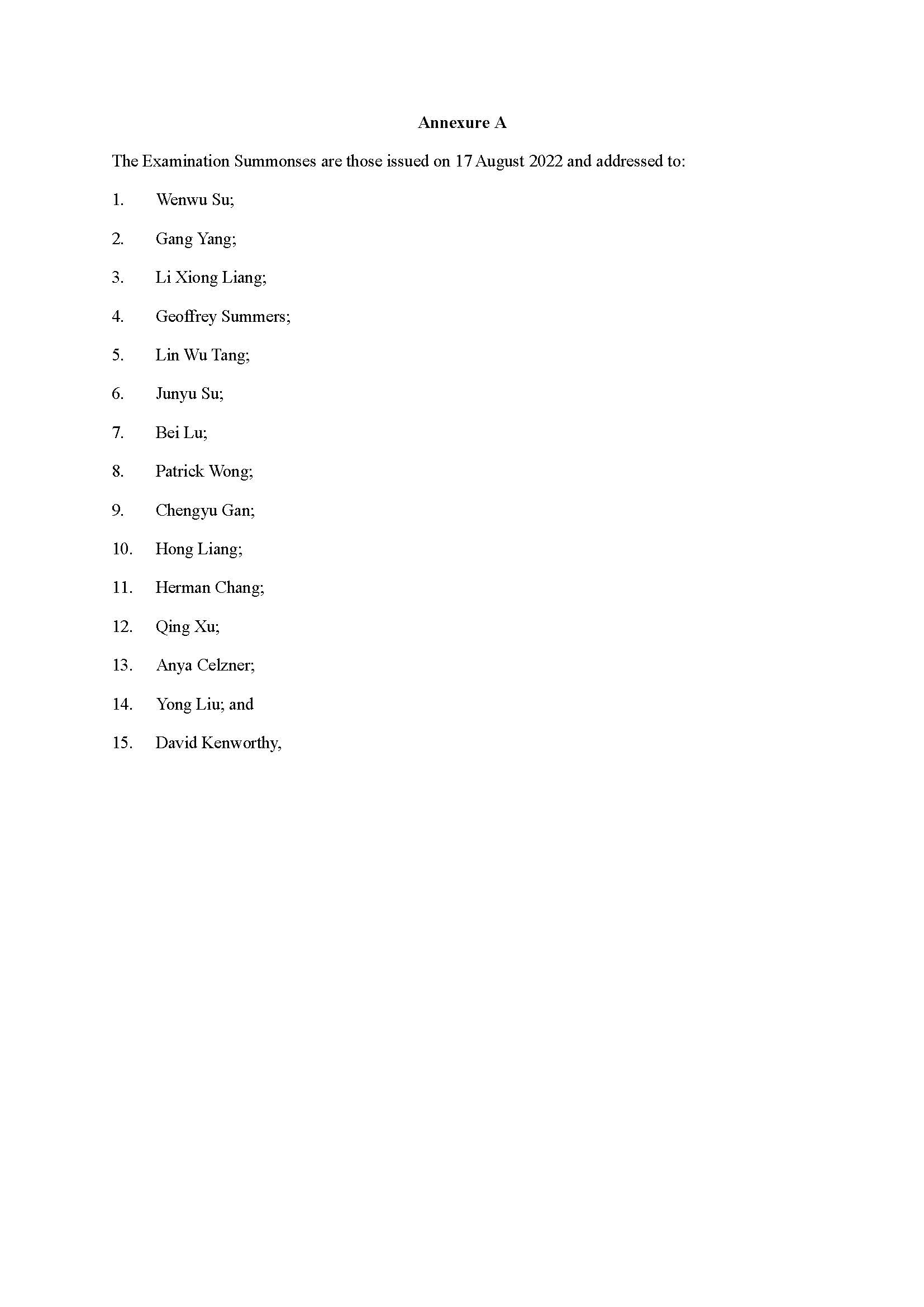
(a) the examination summonses described in Annexure A to these orders (Examination Summonses); and
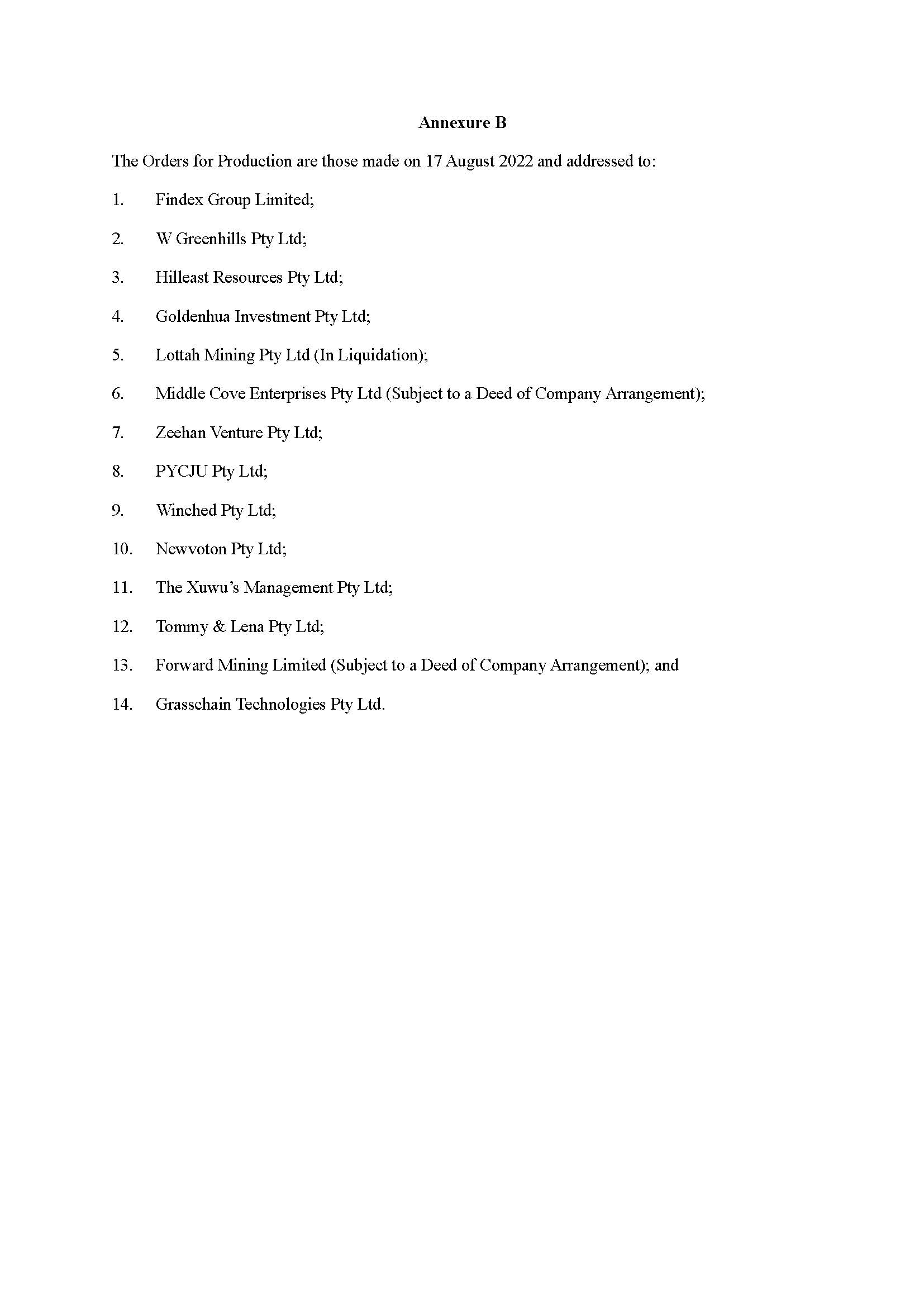
(b) the orders for production described in Annexure B to these orders (Orders for Production),
must be made returnable, are extended, nunc pro tunc, to a date to be fixed.
5. The Examination Summonses be listed for the production of documents on a date to be fixed.
6. The Orders for Production be varied so as to require production to the Court on a date to be fixed.
7. The plaintiff is to serve a copy of these orders on each affected party as soon as practicable, and, in any event, with 7 days of these orders being made.
8. Service may be affected on each of the persons the subject of the Examination Summonses and the Orders for Production by email to the last known address of that person’s legal representative.
9. The plaintiff’s costs of and incidental to this application be paid out of the liquidation of Dundas Mining Pty Limited (in liquidation) (ACN 608 839 050).
Note: Entry of orders is dealt with in Rule 39.32 of the Federal Court Rules 2011.
(REVISED FROM THE TRANSCRIPT)
HALLEY J:
A. Introduction
1 By an interlocutory application dated 22 November 2023, the plaintiff, Richard Scott Tucker and John Allan Bumbak as joint and several liquidators (Liquidators) of Dundas Mining Pty Ltd (in liquidation) (ACN 608 839 050) (Dundas), seeks orders for an extension of time to seek a review of orders made by a Registrar of this Court (interlocutory application).
2 The specific orders sought are (a) an extension of time pursuant to r 1.39 of the Federal Court Rules 2011 (Cth) (Rules) by which the Liquidators must apply for a review of the Registrar’s orders, (b) that the orders made by Judicial Registrar Luxton on 29 August 2023 be vacated, and (c) examination summonses addressed to 15 examinees, and orders for production addressed to 14 examinees, be varied so as, in the case of the orders for production, to require production to the Court on a date not before 31 January 2024 or such other date as the Court may determine and, in respect of the examinees, for examinations on dates not before 29 February 2024 or such other date as the Court may determine.
3 The interlocutory application is opposed by Geoffrey Summers by his counsel, Mr G Bigmore KC. Mr Summers is a former director of Dundas and is one of the persons sought to be examined by the plaintiff.
4 The Liquidators have provided a proposed form of order to the Court today, in which they now formally seek an order that (a) the time by which the Liquidators may apply for a review of the Registrar’s orders be extended nunc pro tunc to 22 November 2023, (b) the orders made by Judicial Registrar Luxton on 27 October 2023 be vacated, and (c) the time by which examination summonses and orders for production be made returnable be extended nunc pro tunc to a date to be fixed, and related orders.
5 The related orders include an application for leave to amend paragraph 2 of the interlocutory application, which included a typographical error as to the date on which the orders made by Judicial Registrar Luxton were sought to be vacated. Specifically, the plaintiff seeks leave to replace 29 August 2023 with 27 October 2023. I am satisfied that is a typographical error that can be corrected and there is no relevant prejudice, therefore I will make an order to that effect.
6 The Liquidators rely on four affidavits from Amelia Richmond-Scott, a partner of Lavan, the solicitors for the Liquidators, sworn on 22 November 2023, 29 November 2023, 14 December 2023 and 20 February 2024. Ms Richmond-Scott gives evidence of the steps that the Liquidators have taken to progress the examination summonses and orders for production of documents, the attempts that the Liquidators have made to obtain funding to proceed with the examinations and their investigations into the insolvency of Dundas and the recent arrangements that the Liquidators have made with Lavan to permit the examinations to take place.
7 Mr Summers relies on an affidavit he affirmed on 24 October 2023 and two affidavits of Mihali Palassis, a solicitor employed by Lavan, sworn on 13 October 2023 and 27 October 2023. Mr Summers relied on the affidavits of Mr Palassis to establish that on the Liquidators’ evidence, Dundas had become insolvent from at least 24 November 2021 and the Liquidators had exhausted $3.4 million in funding, but had not yet examined him.
B. Background
8 By way of a brief factual background, the following matters set forth in the evidence of Ms Richmond-Scott provide context to the interlocutory application.
9 In 2017, Dundas acquired Allegiance Mining Proprietary Limited (Allegiance) which owns the Avebury Nickel Mine in Tasmania.
10 On 30 November 2021, the Liquidators were appointed as joint and several voluntary administrators of Dundas and Allegiance.
11 In the period from 7 March 2022 to 6 July 2022, Allegiance was the subject of a deed of company arrangement (Allegiance DOCA).
12 The Liquidators were the deed administrators of the Allegiance DOCA, to which Dundas was a party. A further party to the Allegiance DOCA was Mallee Resources Limited (Mallee). Pursuant to the Allegiance DOCA, Mallee was to acquire Dundas’ shares in Allegiance and Mallee was to make two payments to the Liquidators in consideration of those shares in the form of (a) a payment of $3.4 million, and (b) shares in Mallee to the value of $12.5 million or their AUD equivalent.
13 At the time the Allegiance DOCA was executed, Mallee was listed on the ASX, although, at that time, it had been suspended from trading.
14 In or about March 2022, Mallee made a payment of $3.4 million to the Liquidators.
15 On 6 July 2022, Mallee transferred 19,841,270 shares in Allegiance to the Liquidators (Mallee shares). The Liquidators intended to sell the Mallee shares once Mallee’s suspension from trading had been lifted to fund their investigations into the liquidation of Dundas.
16 On 31 May 2022, the Liquidators made an application for the issue of summonses for examination and the production of documents.
17 On 17 August 2022, the Court issued the examination summonses and made them returnable on 12 October 2022.
18 Shortly after the examination summonses were issued, the Liquidators were approached by creditors of Dundas in relation to a proposed scheme of arrangement. The Liquidators formed the view that, if that proposed scheme of arrangement had eventuated, it would be unnecessary to conduct the examinations. The Liquidators therefore sought an adjournment of the examinations to explore the potential scheme of arrangement.
19 The Court granted the adjournment of the examinations summonses to a date to be fixed and made a sunset order that, if the examinations did not commence by 31 May 2023, the summonses would be taken to have been discharged.
20 Although the discussions between the Liquidators and creditors of Dundas continued until March 2023, ultimately, no scheme of arrangement was able to be agreed.
21 On 3 February 2023, Mallee was delisted, which prevented the Liquidators from being able to sell the Mallee shares on the market. Notwithstanding that delisting, in the period after 3 February 2023, the Liquidators believe that Mallee was taking steps to relist, they were being kept informed of those steps, and they planned to sell the Mallee shares once Mallee had been relisted, and to use the proceeds to fund the examinations.
22 By April 2023, Mallee had still not been relisted, and the sunset for the conduct of the examinations was extended to 31 August 2023.
23 In the period from April 2023, the Liquidators attempted to obtain alternative funding, but those attempts were unsuccessful.
24 In August 2023, the Liquidators sought another adjournment of the examinations on the basis that they were engaged in discussions with the Allegiance DOCA proponent which might result in a cash payment. The Court agreed to modify the sunset order so that the examination summonses would be discharged if they were not made returnable on or before 31 October 2023 (August sunset orders).
25 As at August 2023, the Liquidators believed that Mallee was making reasonable progress towards relisting and they would imminently obtain funding and be able to progress the examinations.
26 On 5 September 2023, however, Mallee entered into voluntary administration, and the prospects of the Liquidators being able to sell the Mallee shares was lost.
27 On 13 October 2023, the Liquidators made an application to discharge the August sunset orders and list the examination summonses and orders for production for hearing (discharge application).
28 On 27 October 2023, the discharge application was heard by a Judicial Registrar. In the course of the hearing of the application, the Liquidators informed the Judicial Registrar that they were ready to proceed with the examinations, despite their inability to procure funding, and they wished for the examination summonses to be listed for hearing.
29 The Judicial Registrar dismissed the application on the basis that it was not apparent to him that the Liquidators would be in a position to conduct the examinations (Registrar’s decision). He found that there was no affidavit evidence explaining the circumstances or the funding arrangements, and there had been extensive affidavit material about the difficulties which the Liquidators had encountered in obtaining funding.
C. Legal Principles
30 The relevant legal principles for a review of a decision of a Registrar are well established and were not relevantly in dispute. The relevant legal principles were summarised by the Liquidators in their written submissions.
31 Relevantly, s 35A of the Federal Court of Australia Act 1976 (Cth) (FCA Act) enumerates the powers of registrars, and r 3.11 of the Rules provides that a party may apply to the Court under s 35A(5) of the FCA Act for a review of any exercise of a power by the Court by a Registrar, and that such application must be made within 21 days after the date on which the power was exercised.
32 Further, r 1.39 of the Rules provides that the Court may extend or shorten a time fixed by the Rules before or after the time expires and whether or not an application for extension of time is made before the time expires.
33 The nature of a review under s 35A(6) of the FCA Act of an order made by a Registrar was explained by the Full Court in Bechara v Bates (2021) 286 FCR 166; [2021] FCAFC 24. The Full Court observed at [17] (Allsop CJ, Markovic and Colvin JJ):
The nature of a review under s 104(3) of the Circuit Court Act and under s 35A(6) of the Federal Court Act of an order made by a registrar (often but not always in the context of the review of the making of a sequestration order in bankruptcy) has been the subject of a significant number of decisions of this Court. All are consistent. To underpin the validity of the delegation of judicial power of the Commonwealth to a non-judicial court officer there must be a rehearing de novo before a judge of the Court (whether Circuit Court or Federal Court). The review does not hinge, or focus, upon error in the decision of the registrar. It is a hearing de novo, in which the matter is considered afresh on the evidence and on the law at the time of the review, that is at the time of the hearing de novo. The importance of the de novo rehearing is Constitutional, being the supervisory condition that enables judicial power to be delegated to a registrar. All the jurisprudence stems from this requirement marked out by the High Court in the landmark decision in 1991 of Harris v Caladine 172 CLR 84, which is discussed in many of the cases referred to below.
34 The hearing de novo power to be exercised by the Court under s 35A(6) includes the power to make consequential orders on the rehearing: see Robson as former trustee of the estate of Samsakopoulos v Body Corporate for Sanderling at Kings Beach CTS 2942 (2021) 286 FCR 494; [2021] FCAFC 143 at [254]-[255] (Colvin J).
D. Consideration
35 Mr Summers submits that he ceased to be a director of Dundas some five years ago and provided all documents in his possession in respect of Dundas and other related entities over four years ago.
36 He submits that there is an inadequate explanation for his examination by the Liquidators. He submits that the limited material before the Court today as to the reason for his examination, has to be balanced against the prejudice to him of having to be the subject of examinations in respect of events that occurred many years ago, and in circumstances where he has otherwise provided relevant documents to the Liquidators.
37 The Court accepts that any examination, particularly with respect to events that have occurred many years ago, is likely to cause considerable inconvenience to an examinee and is a serious imposition on their time and broader wellbeing. Having said that, a liquidator has a right to examine former directors of insolvent companies. There are powerful public policy reasons why that is so, particularly in circumstances where companies go into insolvency owing substantial sums of money to creditors.
38 I am satisfied that, in the circumstances, it is appropriate to make the orders substantially in the form of the orders sought by the Liquidators.
39 The reasons for the need to examine Mr Summers were addressed in the confidential affidavit that was relied upon by the Liquidators in support of the original issue of the summonses for examination, including the examination of Mr Summers. In any event, the summons for examination was issued as of right to Mr Summers, as a former director.
40 The two critical issues in determining whether there is utility in making the orders today are first, whether the Liquidators have provided an adequate explanation for their delay in progressing the summons for examination and production of documents and second, whether there is a reasonable prospect that the Liquidators will be in a position to, in fact, conduct the proposed examinations and to advance the summonses for the production of documents.
41 I am satisfied that both those matters have been addressed by the Liquidators in the evidence on which they rely.
42 I have concluded that it is appropriate to make the orders for the following reasons.
43 First, the orders are necessary to give effect to the orders that the Liquidators had previously obtained for the examination of some 15 witnesses and production of documents from 14 entities. It is not the task of the Court today to determine whether or not the Liquidators have a sufficient basis to have obtained those orders for summonses for examination and production of documents. That exercise has been done already, and there is nothing to suggest that any relevant events have occurred which would render the earlier consideration by the Registrar irrelevant. In any event, the Liquidators, as of right, are entitled, pursuant to s 596A of the Corporations Act 2001 (Cth) (Corporations Act), to obtain a summons for the examination of Mr Summers, as he was a director of Dundas during at least some of the period of two years prior to the appointment of the Liquidators as administrators of Dundas.
44 Second, I am satisfied that the Liquidators had good reason to hold off pressing ahead with the proposed summons for examination and production of documents. First, by reason of the possibility of a scheme of arrangement and, second, the difficulty that the Liquidators encountered when the available sources of funding did not materialise, in particular, the delisting and subsequent voluntary administration of Mallee, together with unsuccessful attempts to obtain funding from alternative sources. A liquidator is under no obligation to continue to progress steps in a liquidation in the absence of any available funds: s 545 of the Corporations Act.
45 Third, on realising that the steps that had been anticipated might lead to obtaining funding, the Liquidators moved swiftly to relist the proceeding to seek an extension of the sunset clauses.
46 Fourth, there is now no reason to believe that the examinations will not succeed. Arrangements have been entered into between the Liquidators and their solicitors, Lavan, whereby the solicitors have agreed to proceed with the examinations and request for production of documents on a “no win no pay” basis. In addition, the solicitors have confirmed that, to the extent that they are unable to arrange appropriate fee arrangements with counsel, the solicitors are in a position to undertake the examinations themselves.
47 Fifth, on any view, this is a significant administration in which creditors’ claims exceed $145 million, and the extent and scope of the complexity of the circumstances in which Dundas went into liquidation is underlined by the number of summonses for examination and orders for production of documents.
48 Sixth, on the limited evidence before me, it would appear that the affairs of Dundas and its books and records are in disarray, and there is a pressing need to conduct further investigations to understand the circumstances in which Dundas has collapsed.
49 Further, it is necessary to note that, other than the understandable, but inevitable, prejudice to Mr Summers of being the subject of an examination with respect to events that occurred some time ago, Mr Summers is not able to point to any specific prejudice, particularly in circumstances where the Liquidators have, as of right, the ability, if these orders were not otherwise made, to issue, or to request the Court issue, a fresh examination summons on Mr Summers, which he would not be able to resist.
50 Finally, it is necessary to address the issue of the need for an extension of time within which to make the application for review of the Registrar’s decision.
51 Ultimately, the evidence establishes that, by reference to the factors identified by Stewart J in Coshott v Official Trustee in Bankruptcy, in the matter of the Bankrupt Estate of Michael Petrovic Lenin (deceased) [2019] FCA 913 at [24], the length of the delay was minor, the material was attempted to be filed four hours late and Mr Summers was served three business days after the date by which he was otherwise required to have been served.
52 The explanation provided for the delay, while unfortunate in that a solicitor had simply assumed that the Federal Court Registry would have a similar approach to deadlines for filing documents to the Western Australian Supreme Court Registry, that is, at any time up to midnight on the relevant day, is understandable. Lawyers, unfortunately, from time to time, make assumptions that different courts have similar practices.
53 Relevant to prejudice, it is difficult to understand how the short delay could lead to any specific prejudice to Mr Summers, other than the general prejudice with respect to having to be the subject of an examination.
54 Finally, as to the merits, given the significance of the collapse of Dundas and the amount of creditors outstanding, there does appear to be compelling reasons for examinations of former directors to assist the Liquidators in understanding the context in which Dundas ultimately went into liquidation.
55 I am satisfied in the circumstances that it is therefore appropriate to extend the time within which the Liquidators may apply to seek a review of the Registrar’s decision.
E. Disposition
56 In those circumstances, orders substantially in the form sought by the plaintiff are to be made.
I certify that the preceding fifty-six (56) numbered paragraphs are a true copy of the Reasons for Judgment of the Honourable Justice Halley. |
Associate:


