

FEDERAL COURT OF AUSTRALIA
Fair Work Ombudsman v Sushi Bay Pty Ltd (in liq) (No 2) [2024] FCA 76
ORDERS
DATE OF ORDER: | 14 February 2024 |
THE COURT ORDERS THAT:
1. Within 14 days, the Ombudsman file and serve a document setting out the declarations and orders reflecting the reasons for judgment.
2. If the fifth respondent, being the only active respondent, contends that any of the proposed declarations or orders does not reflect the reasons for judgment, by 13 March 2024 she identify the basis for her contention and provide supporting submissions limited to five (5) pages.
3. The matter be listed for case management of the remaining questions at 9:30am on 18 March 2024.
4. There be liberty to apply on two (2) days’ notice.
Note: Entry of orders is dealt with in Rule 39.32 of the Federal Court Rules 2011.
KATZMANN J:
1 This is a case about the conduct of four companies (Sushi Bay Pty Ltd, Sushi Bay ACT Pty Ltd, Auskobay Pty Ltd and Auskoja Pty Ltd (the corporate respondents)) and one person, Ms Yi Jeong (also known as Rebecca) Shin (collectively the respondents), all of whom are said to have contravened the Fair Work Act 2009 (Cth) (FW Act) and the Fair Work Regulations 2009 (Cth) (FW Regulations) in numerous respects.
2 The corporate respondents are members of the Sushi Bay group of companies (Sushi Bay Group). At all relevant times they employed staff to run, and serve in, restaurants in New South Wales, the Australian Capital Territory and the Northern Territory. Ms Shin was the sole director and shareholder of each of the corporate respondents throughout that time. She was also their Chief Executive Officer.
3 The Fair Work Ombudsman alleges that the respondents contravened the FW Act and Regulations by paying some 163 employees (the Employees) below award rates; failing to pay annual leave or annual leave loading; unreasonably requiring employees to repay or refund money paid to them by the corporate respondents; making and keeping records which were false or misleading in a material particular; giving pay slips to employees which they knew to be false or misleading; and providing the Ombudsman or a Fair Work Inspector information or documents which they knew to be false or misleading. Some of the alleged contraventions are said to be “serious contraventions” within the meaning of the FW Act because they were committed knowingly and as part of a systematic pattern of conduct. The Employees represent about 73% of the corporate respondents’ workforce. Approximately 85% of them were temporary visa holders.
4 The contraventions are said to have occurred over a period of nearly four years, from 29 February 2016 to 26 January 2020 (the Contravention Period).
5 The Ombudsman seeks declaratory relief, orders requiring the corporate respondents to reimburse the affected employees (with interest), and pecuniary penalties. This judgment is concerned with liability only.
6 Separate defences were filed by the corporate respondents on the one hand and Ms Shin on the other. At the time the defences were filed, all respondents were represented by Hillard & Berry Solicitors.
7 Thousands of pages of evidence were filed and served by the Ombudsman. None of the respondents filed any evidence.
8 After the Ombudsman filed and served her evidence and the time for the respondents to file their evidence had expired, each of Sushi Bay, Sushi Bay ACT and Auskoja was wound up in insolvency and a liquidator appointed. Auskobay was wound up earlier, about two weeks before its evidence was due to be filed. After Auskobay was wound up, Hillard & Berry served notices of ceasing to act. The liquidator informed the Ombudsman that he did not intend to defend the proceeding or file any evidence and that he did not require any witnesses for cross-examination. On 1 June 2023, Wigney J granted the Ombudsman leave to proceed against the corporate respondents under s 471B of the Corporations Act 2001 (Cth): Fair Work Ombudsman v Sushi Bay Pty Ltd [2023] FCA 548.
9 On 31 May 2023, Ms Shin advised the Ombudsman that she did not intend to appear at the hearing. Accordingly, the hearing proceeded in the absence of all respondents. In considering whether the Ombudsman’s allegations have been made out, I have borne in mind that she carries the onus of satisfying the Court that the contraventions have been committed, that the allegations she makes are serious, and that findings against her will in all likelihood result in the imposition of civil penalties. For this reason, although she only needs to prove that the allegations are made out on the balance of probabilities, the necessary state of satisfaction should not be produced by “inexact proofs, indefinite testimony or indirect inferences”: Briginshaw v Briginshaw (1938) 60 CLR 336 at 362 (Dixon J). See, too, Evidence Act 1995 (Cth), s 140.
10 On the other hand, the fact that Ms Shin did not adduce evidence or make submissions is not without consequences.
11 Ms Shin had every opportunity to answer the Ombudsman’s allegations. If they were contestable, she could have filed evidence disputing some or all of the allegations and answering the Ombudsman’s evidence. She could have appeared by a lawyer or in person. A document entitled “Statement of facts and legal issues” filed on her behalf by her then lawyers, MathasLaw, and prepared by a principal of that firm, includes the following assertions. First, the reason she did not give evidence is a concern that she may make admissions that could be used against her in criminal proceedings as contemplated by s 554 of the FW Act, which provides that criminal proceedings may be commenced against a person for conduct that is substantially the same as conduct constituting a contravention of a civil remedy provision. Second, she cannot give evidence of this concern because in so doing she may be open to be cross-examined on other grounds and that reason is sufficient to displace a Jones v Dunkel inference that might otherwise be drawn against her.
12 Jones v Dunkel (1959) 101 CLR 298 is authority for several propositions. The first is that the unexplained failure of a party to give evidence or call witnesses may lead to an inference that the missing evidence or absent witness would not have assisted that party’s case (at 308 (Kitto J), 312 (Menzies J) and 321 (Windeyer J)). The second is that a court may take that circumstance into account in deciding whether to accept particular evidence that relates to a matter on which the absent witness could have spoken: Heydon JD, Cross on Evidence (12th ed, LexisNexis Butterworths, 2021) at [1215]. It does not matter that the party who could have called the evidence does not carry the onus of proof: O’Donnell v Reichard [1975] VR 916 at 921 (Gillard J); Steele v Mirror Newspapers Ltd [1974] 2 NSWLR 348 at 367 (Hutley JA). The third is that evidence the witness might have contradicted can be accepted more readily: Jones v Dunkel at 312 (Menzies J). And the fourth is that any inference favourable to the other party for which there is a foundation in the evidence can more comfortably be drawn: Jones v Dunkel at 308 (Kitto J); at 312 (Menzies J). While a Jones v Dunkel inference cannot fill gaps in the evidence and cannot convert conjecture or suspicion into inference, if the inference is drawn it can “weigh the scales, however slightly, in favour of the opposing party”: Adler v Australian Securities and Investments Commission [2003] NSWCA 131; 21 ACLC 1810; 46 ACSR 504; 179 FLR 1 at [649] (Giles JA, Mason P and Beazley JA agreeing at [1] and [2] respectively).
13 In his textbook, Cases and Materials on Evidence (Butterworths, 1975) at 62, Heydon observed:
[A] party’s failure to give any satisfactory explanation of a prima facie case against him may suggest that the case is sound, either because silence is assent – an implied admission, or because it shows a consciousness of guilt or liability, or because inferences from the prima facie case, being unchallenged, are thereby strengthened. The presumption is the stronger where the facts are particularly within his knowledge.
14 The fact that the proceedings are proceedings for a pecuniary penalty is not a satisfactory explanation: Australian Securities and Investments Commission v Adler [2002] NSWSC 171; 41 ACSR 72; 20 ACLC 576; 168 FLR 253 at [504] (Santow J); Adler at [664]–[669]. The proceedings are still civil proceedings. The Court is expressly charged with applying the rules of evidence for civil matters when hearing proceedings relating to a contravention of a civil remedy provision: FW Act, s 551.
15 It is not clear whether in the Statement Ms Shin was referring to any inference that may be drawn from her failure to give evidence, but I will proceed on the basis that she was.
16 There are difficulties with both her assertions she makes.
17 As to the first assertion a concern that she might make admissions that could be used against her in subsequent criminal proceedings is not a legitimate explanation: Cross on Evidence at [1215].
18 If, by the first assertion, Ms Shin is to be taken to have been invoking the privilege against self-incrimination, that can only be claimed by a witness and then only under oath or affirmation: Chong v CC Containers Pty Ltd (2015) 48 VR 402 at [236] (Redlich, Santamaria and Kyrou JJA). Besides, that is not an explanation sufficient to displace a Jones v Dunkel inference if it is otherwise available. As Hill J said in Australian Competition and Consumer Commission v Universal Music Australia Pty Ltd (2001) 115 FCR 442 at [33]:
Where the proceedings are criminal (and the present proceedings are not; they are proceedings, inter alia, for the recovery of a civil penalty) it might be thought that the failure of the accused to go into evidence should not lead to the drawing of Jones v Dunkel inferences. After all it is clear that a witness can not be compelled to give evidence which is likely to incriminate the witness or expose the witness to a penalty. However, even in criminal cases it has been held that the failure of the accused, who is in a position to deny, explain or answer the evidence adduced by the prosecution, to give evidence will permit the jury to draw inferences adverse to the accused more readily: see Azzopardi v The Queen (2001) 205 CLR 50; 179 ALR 349, affirming Weissensteiner v The Queen (1993) 178 CLR 217. A fortiori, therefore, the failure of a respondent to proceedings for recovery of a pecuniary penalty to give evidence on a matter relevant to an issue in the proceeding and deny, explain or answer the evidence adduced against the respondent will permit the Court more readily to draw the inferences to which the decision in Jones v Dunkel refers.
19 In any case, as Ms Shin acknowledged, s 555 of the FW Act would generally prevent the use in any subsequent criminal proceedings of any evidence she might give or documents she might produce in this proceeding where the conduct alleged to constitute the offence is substantially the same conduct. The only exception is where the criminal proceeding relates to the giving of false evidence in this proceeding.
20 The second assertion, it will be recalled, was that if Ms Shin were to give evidence on oath or affirmation about her concern, she would expose herself to the risk of cross-examination. That is obviously so. But fear of cross-examination is also an unsatisfactory explanation.
21 The Ombudsman read affidavits from nine witnesses. Three were members of the staff of the Office of the Fair Work Ombudsman. Those witnesses were Evan Richard Brownell, Investigator, Compliance and Enforcement and a former Fair Work Inspector (FWI) and Team Leader; Radha Kumbhari, a Calculations Team Officer in the Calculations Team; and FWI Yoomin Lee, the Compliance and Enforcement Branch. Four were former employees of Sushi Bay. From one of those employees, Yongho (also known as Phillip) Kim, was a long-time employee and a member of the corporate respondents’ management team from 2016 as Human Resources (HR) and Management Team Manager. The remaining two witnesses were interpreters who had translated certain affidavits.
22 Amongst other things, FWI Lee’s evidence detailed the respondents’ previous interactions with the Ombudsman, including an audit in 2009 of Sushi Bay, an audit in 2014 of Sushi Bay QLD Pty Ltd (another entity in the Sushi Bay Group), an audit in 2019 of Sushi Bay ACT, and an investigation in 2019 into the respondents. FWI Lee also deposed to a site visit to the corporate respondents’ head office in Eastwood, New South Wales (Head Office) and the Belconnen “store” or “branch” (restaurant) on 4 February 2020. A good deal of the documentary evidence upon which the Ombudsman relied was contained in a single exhibit to FWI Lee’s affidavit. The exhibit included company searches; correspondence with officers of the corporate respondents including Ms Shin; documents obtained by Fair Work inspectors on site visits to Sushi Bay entities; documents produced to the Ombudsman in response to notices to produce (NTP) issued to the corporate respondents; and documents produced by the Department of Home Affairs, MYOB (a business management platform) and St George Bank. Various Excel spreadsheets created by the corporate respondents were also exhibited to that affidavit.
23 Mr Brownell’s evidence related to the course of a 2016 investigation into Sushi Bay ACT and Ms Shin that led to proceedings in the Federal Circuit Court of Australia (FCCA) in 2017.
24 Ms Kumbhari calculated the amounts of the alleged underpayments.
25 Sushi Bay was incorporated on 29 September 2006. It has long been on the Ombudsman’s radar.
26 On 24 July 2009, the Ombudsman wrote to Ms Shin advising that Sushi Bay, trading as Robina Sushi Bay, had been selected for an audit of its time and wages records. To facilitate the audit, the Ombudsman requested that Ms Shin provide certain information, including time and wage records for each employee for the month of June 2009. Upon inspection of the records Ms Shin produced in response to that request, the Ombudsman determined that Sushi Bay had contravened the predecessor to the FW Act, the Workplace Relations Act 1996 (Cth), by underpaying hourly rates to three employees.
27 On 5 November 2009 the Ombudsman sent a “Determination of Contravention” letter to Ms Shin as the director of Sushi Bay outlining the findings from the audit and requiring Sushi Bay to rectify the contraventions by taking certain action, including reviewing the wage rates paid to all current and former staff and providing evidence of any “back payments”. The letter contained a warning that the Ombudsman might bring enforcement action, including litigation, against Sushi Bay to recover any outstanding amounts and obtain penalties against both the company and any individual involved in the contraventions.
28 On 26 November 2009, after receiving notification that the underpayments had been rectified, the Ombudsman wrote to Ms Shin advising that a decision had been made to take no further compliance action. That letter included the following advice:
To assist you to comply with current and future obligations, further information can be accessed at www.fwa.gov.au or by calling the Fair Work Infoline on 13 13 94.
IMPORTANT INFORMATION
From 1 January 2010 employers should be aware of changes to the national workplace relations system under the Fair Work Act 2009. From this date, the National Employment Standards (NES) and modern awards come into effect. The NES are a set of 10 minimum standards of employment, and apply to all employees in the national system, regardless of any industrial instrument or contract of employment.
In association with the NES, modern awards will make up a new safety net for employees. Modern awards will apply to employees based on particular industries or occupations. Employers should make sure they are aware of their rights and obligations under the Fair Work Act 2009 by contacting the Fair Work Infoline on 13 13 94, or visiting www.fairwork.gov.au.
(Original emphasis.)
29 Sushi Bay ACT was incorporated on 15 October 2012, Auskobay on 13 March 2012 and Auskoja on 9 September 2012.
30 In 2014, the Ombudsman conducted an audit of Sushi Bay Qld. On 13 November 2014, FWI Christine Polzin advised Ms Shin by email of the results of that audit, attaching a letter setting out the Ombudsman’s findings. On the same date infringement notices were sent to Sushi Bay Qld and each of the corporate respondents. In short, each of these companies was found to have failed to keep employee time and wage records before June/July 2014 and Sushi Bay Qld was found to have underpaid employees by paying below award rates in contravention of s 45 of the FW Act in that employees were incorrectly classified, paid below the prescribed hourly rates, not paid penalty rates for working weekends or public holidays, not paid annual leave loading, and not given the opportunity to negotiate part-time hours agreements. Each of the corporate respondents and Sushi Bay Qld were penalised $2,550 and Sushi Bay Qld was required to “rectify the contraventions”. The audit findings included detailed information about the Restaurant Industry Award 2010 (Restaurant Award or Award), the classification of employees under the Award and the minimum rates that should have been paid.
31 On 1 December 2014, Daniel Oh, Chief Operational Officer for the Sushi Bay Group, responded to the audit, attaching what he referred to as “the rectified wage conditions of employees in compliance with the [FW] Act”. The Ombudsman was dissatisfied with the response and on 2 December 2014 FWI Polzin emailed Mr Oh attaching a letter to “the Proper Officer” of Sushi Bay Qld pointing out numerous deficiencies in the response (“contraventions that remain outstanding”). Mr Oh replied on 31 December 2014 with evidence of payments made to current and former employees and new employment contracts for current part-time employees. But the Ombudsman remained concerned that several employees who began their employment at the introductory level were kept at that level for more than the maximum period of three months and that no pay slips were supplied. FWI Polzin wrote to Mr Oh and Ms Shin on 5 January 2015, referring to these matters, among other things, and insisting on receiving pay slips to confirm the rectification of the underpayments.
32 On 1 May 2015, the Ombudsman sent Ms Shin, in her capacity as director of Sushi Bay Qld, a “letter of caution” the express purpose of which was to encourage voluntary compliance and ensure that the activities of non-compliant employers were monitored “in the event of subsequent non-compliance”. The Ombudsman informed Ms Shin of her opinion that Sushi Bay Qld had contravened s 45 of the FW Act by failing to classify employees in accordance with Schedule B to the Restaurant Award; by failing to pay the prescribed hourly rates; by failing to pay employees the prescribed rates of pay for Saturday and Sunday work, or work performed on public holidays; by failing to pay employees annual leave loading on taken leave; and by failing to negotiate part-time hours agreements with employees engaged on a part-time basis. While she did not consider it was in the public interest to bring civil proceedings at this time, the Ombudsman warned Ms Shin that the fact that Sushi Bay Qld had already been issued with a letter of caution would be taken into account in deciding whether it would be in the public interest to commence proceedings if there were future contraventions.
33 In about February 2016 the Ombudsman started a “Fast Food and Restaurant Campaign” targeting employers in the ACT. As part of that campaign, she began investigating compliance with the FW Act by Sushi Bay ACT. In the course of that investigation FWI Michelle Reid served Sushi Bay ACT with a notice to produce under s 712 of the FW Act (April 2016 NTP). Documents were produced in response to the April 2016 NTP and various email exchanges ensued. Between May 2016 and April 2017 there was extensive correspondence between FWI Reid and Ms Shin. In June 2016, Ms Shin was invited to attend an interview with FWI Reid but she declined the invitation.
34 On 26 May 2017 FWI Reid wrote to Ms Shin informing her of the outcome of the investigation and the Ombudsman’s findings that Sushi Bay ACT had contravened various provisions of the FW Act (ss 44, 45, 90, 96, 323, 535), the FW Regulations (reg 3.33) and the Restaurant Award (cll 12, 13, 15, 20, 30.1, 34.1, 35.2) and foreshadowing enforcement action. Joseph Lee, Chief Administrative Officer for Sushi Bay ACT, replied on Ms Shin’s behalf, admitting the contraventions, although quibbling with some of the Ombudsman’s calculations. That reply included the following statements:
During the last two weeks of extensive review performed on the fourteen contraventions listed in the same email, we came to realize that Sushi Bay ACT Pty Ltd has made unintended breaches of a number of sections in Fair Work Act 2009 since we has had a poor understanding for details of the award so far. It is our sincere regret that our negligence has caused underpayment toward our employees’ hard work and effort. We value our employees more than any assets in our business and therefore we owe them our deepest apology. We consider it a serious matter and we have taken this time as an opportunity to educate the existing payroll team. Going forward, this issue will well be· documented internally to avoid it being repeated in the course of our future business.
35 With respect to remediation Mr Lee advised:
1. Hall staff will be categorized at least level 2 in Sushi Bay ACT Pty Ltd according to the definition of Food and Beverage attendant grade 2 (Level 2) ; noting that Level 1 does not include service to customers.
2. Kitchen staff with prior industry experience would at least be classified at the Kitchen Attendant Grade l (Level 1) according to the job description set out B.3.1 of the Award.
3. All employees categorized at Introductory Level would continue to be categorized at this level only for a maximum period of three months.
4. All employees working 38 hours or less in a week whose working hours vary from one week to another that their shifts is not reasonably predictable will be categorized as Casual according to sub-clause 12.6 and clause 13.
5. For all employees other than casual employees, all relevant leaves will accrue and be paid accordingly.
6. Leave loading of 17.5% will need to be paid in addition to the payment for annual leave.
Sushi Bay ACT Pty Ltd will at all times abide by the laws and regulations set forth by the authorities including Fair Work. In order for us to be fully knowledgeable however, we need the guidance of your good office on correctly computing for the underpayment amount of the 22 employees in the list.
36 On 28 June 2017, FWI Reid responded to Mr Lee, explaining why the Ombudsman’s calculations were correct.
37 On 23 October 2017, the Ombudsman advised Ms Shin that she intended to bring proceedings against Sushi Bay ACT and Ms Shin to seek rectification of underpayments, imposition of civil penalties and other orders. Proceedings of that nature were commenced in the FCCA on 3 November 2017 (the 2017 Proceedings).
38 On 28 June 2019, the FCCA made the following declarations and orders based on a statement of agreed facts:
THE COURT DECLARES THAT:
(1) The first respondent contravened the following civil remedy provisions of the Fair Work Act 2009 (Cth) (“the Act”):
(a) Section 44(1) by contravening the following provisions of the National Employment Standards contained in Part 2-2 of the Act;
(i) Failing to pay annual leave entitlements in accordance with section 90(2);
(ii) Failing to accrue paid personal/carers leave in accordance with section 96;
(b) Section 45 by contravening the following clauses of the Restaurant Industry Award 2010:
(i) Failing to pay adult minimum wages as required by clause 20;
(ii) Failing to pay junior minimum wages as required by clause 20.3;
(iii) Failing to pay casual loading as required by clause 13.1;
(iv) Failing to pay penalty rates as required by clause 34.1;
(v) Failing to make part-time agreements as required by clause 12.3; and
(c) Section 535(1) by failing to keep records of the kind prescribed by the Fair Work Regulations 2009 (Cth).
(2) The second respondent was involved in the first respondent’s contraventions as set out above, within the meaning of section 550 of the Act.
THE COURT ORDERS THAT:
(3) Pursuant to section 546(1) of the Act and within 42 days, the first respondent is to pay a pecuniary penalty of $103,680 in respect of the contraventions as set out above.
(4) Pursuant to section 546(1) of the Act and within 42 days the second respondent is to pay a pecuniary penalty of $20,736 in respect of her involvement (within the meaning of section 550 of the Act) in the first respondent’s contraventions as set out above.
(5) Pursuant section 545(1) of the Act, the first respondent will, within three months of the date of this order, provide for workplace relations compliance training (“training”) on the following terms:
(a) The first respondent must engage, at its own expense, a person or organisation with expertise in workplace relations, and approved by the applicant, to conduct the training;
(b) The training must relate to compliance with the Act and the Restaurant Award, including the first respondent’s obligations in respect of minimum wages, casual loading, penalty rates, personal leave and annual leave entitlements, part-time agreements and record-keeping;
(c) The training must be undertaken by:
(i) All persons employed or engaged by the first respondent whose duties relate to the management of employees, the administration of payroll, and the administration and compliance with Australian workplace laws; and
(ii) The second respondent.
(d) Within 30 days of completing the training, the first respondent must provide the applicant, in writing, with a report specifying the date(s) on which the training was completed, the details of the delivery and content of the training and the names and positions of all persons who undertook the training;
(6) Pursuant to section 545(1) of the Act, the first respondent will, at its own expense, engage a third party, or third parties, with appropriate qualifications in accounting and workplace relations to undertake an audit of the first respondent’s compliance with the Act and the Restaurant Award on the following terms:
(a) The audit period will be the first accounting quarter commencing after the making of the orders;
(b) The audit is to be completed within 30 days of the end of the audit period;
(c) The audit will apply to all employees employed by the first respondent at any time during the audit period;
(d) The audit will assess the first respondent’s compliance with the following obligations according to each employee’s classification of work, category of employment and hours worked during the audit period:
(i) Wages and work related entitlements under the Restaurant Award; and
(ii) Accrual and payment of entitlements under the National Employment Standards in Part 2-2 of the Act.
(e) Within 14 days of the audit being completed, the first respondent will rectify any contraventions identified in the audit;
(f) Within 30 days of the audit being completed, the first respondent will provide to the applicant:
(i) A copy of the audit report, which will include a statement of the methodology used in the audit;
(ii) A copy of the source materials used to audit the times worked by employees (including but not limited to rosters, time cards and time sheets) and the amounts paid to the employees (including but not limited to pay slips and pay reports);
(iii) Written details of any contraventions identified in the audit;
(iv) Evidence of rectification by the first respondent of any contraventions identified in the audit.
(7) The applicant has liberty to apply on seven days’ notice in the event that any of the preceding orders are not complied with.
39 The following month the Ombudsman received requests for assistance from two former employees – Minha and Jihye Hwang – who claimed that they had failed to receive their proper entitlements, including overtime, weekend penalty rates, annual leave loading and superannuation.
40 The Ombudsman then began an investigation into their employment between 1 January 2014 to 31 July 2019 (the 2019 Investigation). In about August 2019, the 2019 Investigation was expanded to include other employees engaged by the other corporate respondents. As part of that investigation notices to produce were served and site visits were conducted at Sushi Bay restaurants and offices. One such notice was served on Sushi Bay on 29 August 2019 for records and documents relating to the employment of Mr and Mrs Hwang, including time and wage records (August 2019 NTP) to which Sushi Bay responded in September and October 2019.
41 On 17 October 2019, in accordance with the Training Order, Ms Shin, Sol Shin (Sushi Bay’s COO from 2017) and Mr Lee (among others) participated in a half day workplace relations training conducted by Australian Industry Group, which included training on the FW Act, National Employment Standards, the Restaurant Award (including classifications, minimum rates, allowances, penalty rates and overtime payable under the Restaurant Award), record keeping obligations, and “serious contraventions” under the FW Act.
42 On 3 November 2019, Kenneth Hong, principal of H & H Lawyers, emailed to the Office of the Ombudsman a number of documents relating to a “self-audit” conducted by UG Accountants for Sushi Bay ACT for the period 1 July to 6 October 2019 (Audit Period) in respect of eight Sushi Bay ACT employees (Audit Employees). Those documents included a report from the accountants, a document containing “recalculations” of the hourly rates and total hours worked by the Audit Employees during the Audit Period, and payroll advices purporting to record, amongst other things, the total number of hours worked by, and the gross and net amounts paid to, those employees in that period.
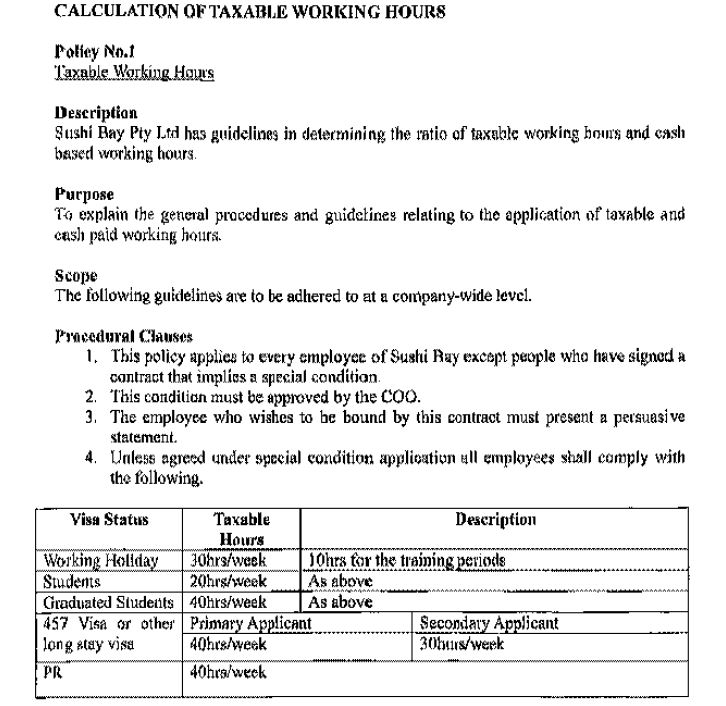
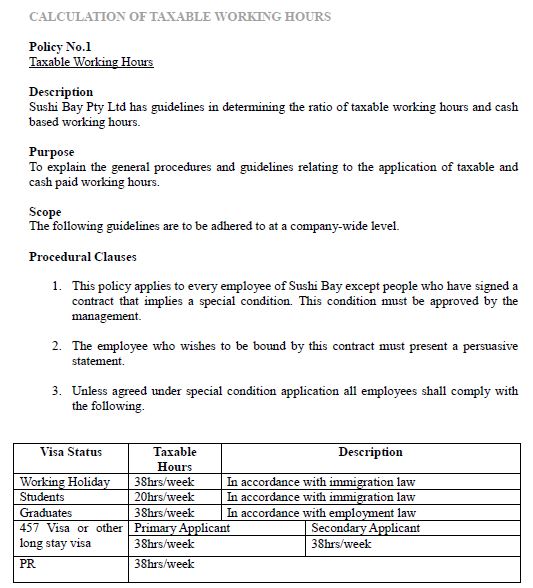
43 On 4 February 2020 a number of Fair Work inspectors conducted an unannounced site visit on the Sushi Bay Group Head Office and the Sushi Bay restaurant in Belconnen where they obtained a number of records.
44 On 24 April 2020, FWI Edward Skeels issued a NTP to MYOB requiring production of records or documents relating to any MYOB products used by the respondents to record the payment of wages to various employees during the period 1 June 2016 and 31 January 2020 (MYOB NTP). MYOB produced documents to the Ombudsman on 29 June 2020 (MYOB Records).
45 On 3 July 2020, FWI Skeels issued a NTP to St George Bank which required production of bank statements for all accounts held by the respondents during the period 1 March 2016 to 29 January 2020. The relevant documents were produced in July 2020.
46 On 6 October 2020, FWI Skeels issued a NTP to Sushi Bay which required production of payroll records and documents relating to the Ombudsman’s investigation into the respondents (October 2020 NTP). On 2 November 2020, Mr Simon Berry of Hilliard & Berry, sent emails to the Ombudsman attaching documents in response to the October 2020 NTP.
47 Based on the admissions, I make the following findings.
48 Each of the corporate respondents is a “constitutional corporation” and “national system employer” within the meaning of ss 12 and 14(1)(a) of the FW Act, respectively. They were part of the Sushi Bay Group that shared a common sole director and shareholder (Ms Shin) and were collectively managed out of the Head Office from which a centralised payroll system operated. The corporate respondents operated sushi restaurants in the following relevant locations: Belconnen, ACT; Darwin, NT; Carlingford, NSW; Campbelltown, NSW; Charlestown, NSW; Forster, NSW; Glendale, NSW; Liverpool, NSW; Merrylands, NSW; Miranda, NSW; Miranda Westfield, NSW; Parramatta, NSW; Penrith, NSW; Rouse Hill, NSW; Shellharbour, NSW and Wollongong, NSW (the Sushi Bay Restaurants).
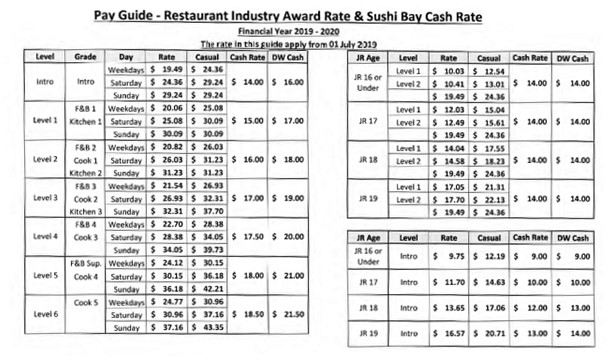
49 At the relevant times each of Sushi Bay and Auskoja was an “approved work sponsor” within the meaning of the Migration Act 1958 (Cth) and employed persons to work on Temporary Work (skilled) visas (subclass 457 visas) in the Sushi Bay Restaurants.
50 The corporate respondents held various bank accounts with St George Bank. Ms Shin was the sole signatory on those accounts.
51 At various times during the Contravention Period, Sushi Bay employed the 66 people listed in Table 1 in Annexure A to these reasons (Sushi Bay Employees):
(a) Mr Hwang from, relevantly, 29 February 2016 to 14 July 2019;
(b) Mrs Hwang from 29 February to 19 June 2016, and then from on or about 29 June 2017 to 9 September 2018;
(c) the 22 persons listed at lines 2 to 23 of Table 1 of Annexure A (Sushi Bay 457 Employees) at various times during the period 6 May 2019 to 26 January 2020 (457 Period); and
(d) the 42 persons listed at lines 25 to 66 of Table 1 of Annexure A (Sushi Bay Dual Rate Employees) at various times during the period 21 October 2019 to 26 January 2020.
52 At various times from 21 October 2019 to 26 January 2020, Sushi Bay ACT employed the 15 people listed in Table 2 in Annexure A (Sushi Bay ACT Employees). Each of these employees worked at the Belconnen restaurant and was employed for the period or periods set out in column B of Table 2 in Annexure A.
53 Auskobay employed the 46 people listed in Table 3 of Annexure A to these reasons (Auskobay Employees) during the following periods:
(a) Mrs Hwang from 20 June to 31 December 2016; and
(b) the 45 people listed at lines 2 to 46 in column A, Table 3 in Annexure A at various times during the period 21 October 2019 to 26 January 2020.
54 Each of the Auskobay Employees was engaged to perform work at the Sushi Bay restaurant locations set out in column C of Table 3 of Annexure A and was employed during the periods set out in column B.
55 At various times from 6 May 2019 to 26 January 2020, Auskoja employed the 37 persons listed in Table 4 of Annexure A (Auskoja Employees). They were:
(a) the three people listed at lines 1 to 3 in Table 4, who were each on 457 visas (Auskoja 457 Employees); and
(b) the 34 people listed at lines 4 to 37 in Table 4 (Auskoja Dual Rate Employees).
56 Each of the Auskoja Employees was engaged to perform work at the Sushi Bay restaurant locations set out in column C of Table 4 in Annexure A and were employed during the periods set out in column B.
57 The Restaurant Award applied to the employment of each of these Employees.
58 In September 2022, the affidavits of Phillip Kim, Minha and Jihye Hwang, and Kitae Kim were served on Simon Berry of Hilliard & Berry. At the hearing, I granted Phillip Kim a certificate under s 128 of the Evidence Act 1995 (Cth).
59 There is no reason why I should not accept any of this evidence. Apart from minor objections to certain paragraphs of the affidavits taken by Ms Shin, it was unchallenged. Moreover, much of the evidence is supported by the contemporaneous documents produced by the respondents in response to the Ombudsman’s notices to produce or obtained by the Ombudsman at site visits. Unless otherwise indicated, the narrative below is drawn from their affidavits.
60 Mr Kim was employed by Sushi Bay (and at times Sushi Bay ACT) from 8 May 2005 to 19 April 2020. He started work as a kitchen attendant in the Castle Hill restaurant and was later promoted to restaurant supervisor. In or about 2008, he was promoted, along with Mr Oh, to positions in the Sushi Bay Group’s management team. On some days he worked as a supervisor at the Castle Hill restaurant and on others he worked at the Sushi Bay Group Head Office in Eastwood.
61 From the middle of 2013, Mr Kim visited various restaurants to discuss operations, including hiring employees and staff complaints, with the relevant supervisors.
62 Mr Kim was appointed to the position of HR Manager in 2016. Even though he was employed by Sushi Bay, because the Group’s operations were managed by a centralised system he performed duties as HR Manager on behalf of a number of companies in the Sushi Bay Group. He reported to Sushi Bay’s COO who, in turn, reported to Ms Shin.
63 The corporate respondents admitted that Mr Kim was the person responsible for arranging and signing employment contracts on behalf of the corporate respondents; hiring, transferring or discussing pay and conditions with employees; and determining, in conjunction with the relevant restaurant managers, the status and classification of employees.
64 Around 11 March 2020, Mr Kim accepted an offer of voluntary redundancy made by Ms Shin. His last day of work was 19 April 2020.
The other members of the management team
65 Daniel Oh was employed by Sushi Bay as COO from about 2005 until at least July 2017 and was responsible for arranging and signing employment contacts on behalf of the corporate respondents. Mr Oh had prior experience operating a Japanese restaurant and working in an immigration lawyer’s office such that he was aware of Australian labour and immigration laws. From about 2016, Mr Kim reported to Mr Oh who in turn reported directly to Ms Shin .
66 Joseph Lee was employed by Sushi Bay as Chief Administrative Officer from early 2017. He was authorised to direct the payroll team in the performance of their duties on behalf of each of the corporate respondents.
67 Sol Shin was employed by Sushi Bay as COO from about 2017. He was also the sole director of Auskosu Pty Ltd, another entity in the Sushi Bay group, and Ms Shin’s son. He reported directly to his mother. From time to time, Mr Kim would seek direction from Mr Shin in relation to the Operational Guidelines (discussed below), visa sponsorship procedures, contract forms and matters regarding specific employees.
68 Mr Hwang first came to Australia in 2010 on a “working holiday visa”. In March 2014 he obtained a student visa which continued until about July 2015. During this time he studied business at a private educational college.
69 In early March 2014 Mr Hwang started working for Sushi Bay at the restaurant in Liverpool as a kitchen hand and cook. In about October or early November 2014, Mr Hwang was transferred to work at the Rouse Hill restaurant. He returned to the Liverpool restaurant in early 2015 and worked there until about early 2016.
70 The evidence indicates that Mr Hwang signed two employment contracts. One, which I infer was the first in time, is undated. Amongst other things, it stated that he was employed in the position of “cook”, described his duties and hours of work, acknowledged that he was employed subject to the terms of the Restaurant Award, and represented that he would be paid in accordance with the Award.
71 In early 2015, Phillip Kim and Daniel Hwang (another member of the management team) visited the Liverpool restaurant and asked Mr Hwang whether he was interested in Sushi Bay sponsoring him for a Temporary Work (Skilled) (subclass 457) visa (457 visa).
72 On 24 July 2015, Mr Hwang signed a new employment contract which “replace[d] and supersede[d]” the first. Amongst other things, it stated that the agreement had to be read in conjunction with the Restaurant Award which also applied to his employment contract, described his position as “chef”; provided that his ordinary hours of work would be an average of 38 per week plus “reasonable overtime as required” for which (absent any “Award flexibility agreement”) he would be paid in accordance with the Award; and stipulated that he would receive a base salary of $55,000 a year which would be paid by electronic funds transfer (EFT). Nevertheless, he was told by one of the managers that he was expected to work around 50-55 hours a week and that he would be paid according to Sushi Bay’s “internal policy”. He was told that it would be difficult for him to get overtime pay or take sick leave but that it would be possible for him to take annual leave.
73 The second employment contract also provided that Mr Hwang’s employment was subject to the condition that he held a valid visa, which allowed him to be employed under the terms and conditions in that contract, and that Sushi Bay agreed to support his application for the grant of a 457 visa. Importantly, it stated that Sushi Bay “also agrees to give all undertakings imposed under the Migration Act 1958 and Migration Regulations 1994 in connection with the sponsorship”. The contract was expressed to take effect upon the grant of the 457 visa and to last four years from the commencement of employment unless otherwise terminated in accordance with the contract.
74 Around 4 September 2015, Mr Hwang was emailed a copy of a letter from the Department of Immigration and Border Protection notifying him that he had been granted a 457 visa. Mrs Hwang was included on his visa application as his dependant.
75 Sushi Bay arranged for Mr Hwang to obtain a Certificate III in Asian Cookery and a Diploma in Hospitality Management.
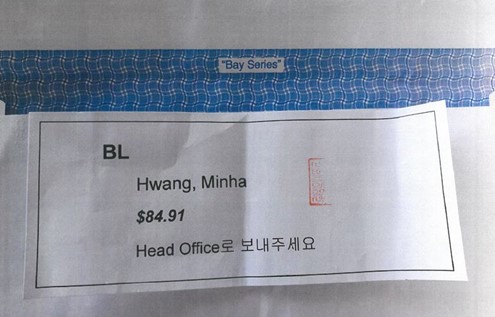
76 Around February 2016 a manager told Mr Hwang that he would be transferred to the Campbelltown restaurant. He worked there from about 8 February 2016 until August 2018. In about February 2017, Phillip Kim informed him that he was going to be appointed as a “key person”. As a result of the appointment he became second-in-charge at the Campbelltown restaurant and was responsible for supporting the restaurant supervisor and training staff, in addition to his duties as a chef. In about September 2018, he was transferred to the Belconnen restaurant to be that restaurant’s supervisor.
77 Mr Hwang resigned from his position with Sushi Bay on 14 July 2019.
78 Mrs Hwang first came to Australia in about November 2013 on a “working holiday” visa. She started working for Sushi Bay on a full-time basis on about 1 October 2014. She worked at the Campbelltown restaurant in the kitchen and on the floor, greeting customers and taking orders.
79 About one month after Mrs Hwang started working at the Campbelltown restaurant, she signed an employment contract that stated she was to be employed as a cook, that her ordinary hours of work would be an average of 38 hours per week and that she would be paid, by EFT, an amount “as per applicable industry award”.
80 In or about August 2015, Mrs Hwang asked to be transferred to a different restaurant and in or about September 2015 she was transferred the Merrylands restaurant. While working at the Merrylands restaurant she received pay slips from Auskobay.
81 From about 31 December 2016 to 29 June 2017 she was absent from work for health reasons. She returned to work for Sushi Bay at the Rouse Hill restaurant. She was later transferred to work at various Sushi Bay restaurants in Parramatta.
82 In about September 2018 Mrs Hwang resigned from the employ of Sushi Bay.
83 Mr Kitae Kim first came to Australia on a “working holiday” visa in around August 2012. About a month later he started working at the Parramatta restaurant and in October 2012 he transferred to the new Merrylands restaurant. He flew home in around July 2013 to finish his university studies and returned to Australia in late February 2016 on a student visa. He resumed employment with Sushi Bay in mid-April 2016 at the Campbelltown restaurant. While working at the Campbelltown restaurant he also worked occasionally at other Sushi Bay restaurants. In around August 2017, Sushi Bay sponsored him for a 457 visa.
84 In mid-April 2018 Mr Kim was transferred to Darwin. He began work at the Darwin restaurant on 23 April 2018. At first he worked as a cook but was later promoted to the position of “supervisor”. He began working as a supervisor on about 12 August 2019, although he signed his “supervisor contract” some eight days later. As a supervisor his responsibilities included supervising kitchen and floor staff; preparing rosters; overseeing food preparation; ordering stock; interviewing and training new staff; seeking approval from Head Office in relation to upgrading staff levels; processing staff leave requests and resignations; paying supplier invoices from cash sales; overseeing hygiene; and assessing employees to “level up”, that is to say to prepare for being assessed for a new level. He resigned on 18 July 2020.
Knowledge of the Restaurant Award
85 From at least 13 November 2014, when Ms Shin received the email from FWI Polzin, she was aware that the Restaurant Award applied to the corporate respondents and to employees working in the Sushi Bay Restaurants. She knew that the Award prescribed minimum rates of pay. She also knew that pay rates depended on the classifications of the employees. And she knew that different, higher, rates applied for working on weekends and public holidays, that an annual leave loading applied to all periods of taken annual leave and accrued annual leave untaken at the end of employment, and that accrued untaken annual leave must be paid out when the employment ceases.
86 From at least 2014, Phillip Kim was also aware that the Restaurant Award prescribed minimum wages, casual rates, weekend and public holiday penalties, and overtime rates. Like Ms Shin, he certainly knew about these things after the Ombudsman began investigating Sushi Bay Qld. Around late 2014 to early 2015, Mr Kim helped Mr Oh prepare responses to the Ombudsman inquiries about records kept by that company.
87 During his time at Sushi Bay, Mr Kim learned that some of the hours worked by some employees were not paid in accordance with the Restaurant Award. He deposed that he did not raise this with restaurant managers or other employees because “that was decided by the CEO and [he] was in no position to give an explanation”.
88 Mr Kim undertook training on Australian employment laws and the Restaurant Award. In or around 2017 or 2018, he attended a seminar conducted by the Ombudsman about modern awards, and “allowances” for sick leave and annual leave. Ms Shin and Mr Lee also attended. On 17 October 2019 Mr Kim attended internal training arranged at Head Office conducted by the Australian Industry Group. That training covered many subjects including awards, penalty rates, sick leave, annual leave and holiday (presumably public holiday) leave.
THE RECORD-KEEPING AND PAYROLL SYSTEM
89 The Ombudsman alleged that the contraventions arose out of two features of the operation of the Sushi Bay Group’s centralised payroll system.
90 The first feature was called the “Dual Rate Method”. By this method the Ombudsman claimed that certain employees were paid for a set number of “contracted hours” per fortnight in accordance with rates which were compliant with the Restaurant Award but that any additional hours worked were paid in cash at rates below the Award rates. Those employees were Mrs Hwang, the Sushi Bay Dual Rate Employees, the Sushi Bay ACT Employees, the Auskobay Employees and the Auskoja Dual Rate Employees (collectively, the Dual Rate Employees).
91 The second feature was called the “Deduction Method”. It was applied to the calculation of wages paid to sponsored employees of Sushi Bay and Auskoja on subclass 457 visas (the 457 Employees). The Ombudsman alleged that these employees were paid a gross fortnightly salary consistent with their employment contract but were required to pay particular amounts back to their employer during some fortnights.
92 The Ombudsman submitted that the apparent object of the system was to conceal from the relevant authorities that employees were paid below the minimum rates and entitlements prescribed by the Restaurant Award and, in many cases, were working more hours than their visa conditions permitted.
93 In their defences, the corporate respondents largely admitted that the Dual Rate Method and Deduction Method were features of its payroll system. The affidavits of Phillip Kim, Mr and Mrs Hwang and Kitae Kim explain how the Sushi Bay Group’s record-keeping and payroll system operated. I make the following findings based on their evidence, the admissions made by the corporate respondents and the documents obtained from them by the Ombudsman and tendered in evidence.
94 The Sushi Bay Group employed a payroll team which operated out of Head Office. The team generally consisted of about eight or nine staff members who reported to, and were directed by, Joseph Lee. When Phillip Kim became HR Manager, he began working more closely with the payroll team.
95 The payroll team processed the fortnightly payroll for each of the companies in the Sushi Bay Group. Their work included generating pay slips and emailing them to employees, paying employees by EFT, and paying and collecting cash from employees.
96 From time to time, the payroll team asked Mr Kim to give them instructions about how specific employees should be paid. The instructions covered such subjects as the appropriate rate to pay an employee, the correct ratio of “taxable wages” and “cash wages” (see Dual Rate Method below), and whether an employee was subject to deductions (see Deduction Method below). On other occasions, Mr Kim directed the payroll team based on requests from other members of the management team. Mr Kim would only issue such directions after he had obtained approval from the COO and Ms Shin or other relevant members of the management team. He did not otherwise have authority to issue directions to the payroll team.
97 The payroll system was operated from Head Office. The corporate respondents determined and recorded the following matters with respect to each of the Employees: their status and purported classification under the Restaurant Award in an Excel spreadsheet (Classification Document); a standard number of hours per fortnight (Award Hours) for which they were paid the hourly rate prescribed by the Restaurant Award for their designated classification, including any applicable minimum rates, Saturday rates, Sunday rates, public holiday rates and casual loadings (Award Rates); and an hourly rate, referred to as the “Sushi Bay Cash Rate” of between $14 to $18.50 (Base Cash Rate), which was the base rate to be paid for hours that each employee worked in excess of the Award Hours in a fortnight (Cash Hours). While the corporate respondents disputed this, I find (as Ms Shin admitted) that the Base Cash Rates applicable to the Employees during the relevant periods are those set out in column H of Tables 1 to 4 in Annexure A of the Ombudsman’s pleadings.
98 In relation to those Employees who held student visas or were engaged on a part-time basis, the Award Hours were 40 hours per fortnight, including up to six hours a week for Saturday work and six hours a week for Sunday work. In relation to all other Employees, the Award Hours were 76 hours per fortnight, including up to six hours a week for Saturday work and six hours a week for Sunday work.
99 Every fortnight, the managers of each of the Sushi Bay Restaurants prepared and signed records of the days and hours worked by each of the Employees during that fortnight and faxed them to Head Office. The payroll team would then create an Excel spreadsheet for each fortnightly pay period for each corporate respondent (Total Hours Worked Spreadsheets) on which they recorded the names of the Employees who worked that fortnight; the actual hours worked in each week of the fortnight and on each day, derived from the records kept by the relevant restaurant; the prescribed number of Award Hours for the fortnight; and the way in which the actual hours worked were to be apportioned and therefore paid as Award Hours and Cash Hours per week, including which of those hours were worked on a Saturday, Sunday and public holiday.
100 The Total Hours Worked Spreadsheets and the Classification Document were obtained following the Ombudsman’s visit to Head Office in February 2020.
101 The effect of the admissions of the corporate respondents is that the Total Hours Worked Spreadsheets accurately record the hours worked by the Employees as well as the proportion of those hours that were “taxable hours” paid by EFT and those that were “cash hours”.
102 The payroll team prepared the Total Hours Worked Spreadsheets using records prepared by restaurant supervisors that were sent to Head Office. These records included fortnightly rosters; timesheets recording the hours and days worked by employees over a fortnightly period; and records of the cash wages received from Head Office by employees of the particular restaurant.
103 In mid-2013 Sushi Bay developed “Operational Guidelines” (2013 Operational Guidelines). The evidence indicates that they were prepared by Daniel Oh and updated by him in 2017 (2017 Operational Guidelines). Mr Oh provided training about different policies in the Operational Guidelines at regular monthly meetings called “Key Person Incentive Program” (KPIP) meetings. KPIP meetings took place at Head Office. They were attended by restaurant supervisors and the management team. Mr Hwang also attended approximately six or seven KPIP meetings while working as the supervisor of the Belconnen restaurant. On the occasions he attended he recalled “Head Office managers” discussing, amongst other topics, sales targets, customers service issues and hiring.
104 Phillip Kim attended several “Head Managers’ meetings” with Ms Shin during which the 2017 Operational Guidelines were discussed and in which Ms Shin directed the management team to inform restaurant supervisors that they should be followed. As supervisor of the Darwin restaurant, Kitae Kim was told to familiarise himself with the Operational Guidelines.
105 In or about June 2013 the corporate respondents codified the distinction between Award Hours and Cash Hours in the Operational Guidelines in a policy called “Calculation of Taxable Working Hours” (Working Hours Policy). While the corporate respondents made no such admission, their own records demonstrate as much.
106 The table at the bottom of the Working Hours Policy set out the visa status of an employee and the number of “taxable hours” an employee holding that visa could work. An employee’s “taxable hours” were paid at the rate set out in the Restaurant Award. If an employee worked more than their “taxable hours”, the additional hours were to be paid at the Base Cash Rate, which was invariably below the Award Rates.
107 This is the version of the policy which appeared in the 2013 Operational Guidelines:
108 This is the version in the 2017 Operational Guidelines:
109 “Working holiday” visa holders were usually full-time employees. “Students” were part-time or casual employees. “Graduated Students” or “graduates” were full-time employees. Employees who held 457 visas or had obtained permanent residency were also full-time employees.
110 The Ombudsman alleged that, from at least November 2015, the corporate respondents made and kept a pay guide which prescribed the applicable Award Rates to be paid for Award Hours and the Base Cash Rates payable for Cash Hours (SOC/ASOC [25]). The corporate respondents denied the allegation (Defence [23]). But the evidence (including their own records) belies the denial. On the basis of the evidence I make the following findings.
111 The rates which all employees of the Sushi Bay Group were paid were set out in a document entitled “Pay Guide – Restaurant Industry Award Rate & Sushi Bay Cash Rate”. The payroll department was required to apply the rates set out in the Pay Guide.
112 This is an example of a Pay Guide, prepared by Phillip Kim for the 2019–2020 financial year that was obtained during the unannounced site visit to Head Office in February 2020:
113 The legal hourly rates for the “taxable hours” worked appear under the column headed “Rate” and lower hourly rates under the column headed “Cash Rates” and “DW Cash” (for employees in Darwin). The lower cash hourly rates were paid for overtime hours.
114 The system of paying employees for overtime hours (at lower rates and in cash) was in place before Phillip Kim started working for Sushi Bay.
115 From around November 2015, Phillip Kim was responsible for preparing and updating the Pay Guide. The rates were based on the minimum hourly rates under the Restaurant Award. When the Ombudsman announced increases in minimum rates, Mr Kim, the COO and other managers working at the Head Office would discuss the appropriate increase in the “taxable rates” and “cash rates” at a management team meeting. A draft Pay Guide was then presented to Ms Shin for her approval.
116 On these occasions the COO would confirm that the rates were based on the rates in the Restaurant Award. Ms Shin would then approve the draft or direct that a number in the guide be changed. Once approved, Mr Kim would communicate the new rates to restaurant managers who would then announce the increase to employees. Mr Lee would share the Pay Guide with the payroll team.
117 During the periods of employment set out in Annexure A, each of the relevant corporate respondents paid the respective Dual Rate Employees according to the Dual Rate Method. That is to say, in respect of the Award Hours, the Dual Rate Employees were paid at Award Rates and in respect of any Cash Hours worked during each fortnight at Cash Rates. As recorded in the Total Hours Worked Spreadsheets, the Dual Rate Employees were paid:
(a) at their Base Cash Rate for any Cash Hours worked Monday to Friday;
(b) at 125% of their Base Cash Rate for any Cash Hours worked Saturdays;
(c) at 150% of their Base Cash Rate for any Cash Hours worked Sundays; and
(d) at 200% of their Base Cash Rate for any Cash Hours worked on public holidays,
(collectively, Cash Rates).
118 From time to time during their employment, 33 of the Dual Rate Employees were paid for all hours worked in certain periods at the Cash Rates, as indicated in the table below:
Name | Cash Rate Period |
Sushi Bay | |
Yujeong Bae | 20/01/2020 to 26/01/2020 |
Keonwoo Baek | 18/11/2019 to 01/12/2019 |
Donggeun Choi | 11/11/2019 to 17/11/19 |
Solie Choi | 11/11/2019 to 16/112020 |
Jihye Hwang | 29/06/2017 to 17/07/2017 |
Geonwoo Kim | 06/01/2020 to 12/01/2020 |
Jisu Lee | 13/01/2020 to 26/01/2020 |
Pyeonghwa Lee | 06/01/2020 to 12/01/2020 |
Yeeun Lee | 06/01/2020 to 12/01/2020 |
Capa Lileth | 04/11/2019 to 17/11/2019 |
Jihyeok Park | 06/01/2020 to 12/01/2020 |
Ga Hee Son | 25/11/2019 to 15/12/2019 |
Sushi Bay ACT | |
Yeji Hong | 25/11/2019 to 01/12/2019 |
Hyemin Hwang | 21/10/2019 to 17/11/2019 |
Taewook Kang | 25/11/2019 to 01/12/2019 |
Bokyung Lee | 28/10/2019 to 03/11/2019 |
Auskobay | |
Juhwan Maeng | 06/01/2020 to 12/01/2020 |
Seongjin Cheon | 21/12/2019 to 27/12/2019 |
Yeonju Jang | 11/11/2019 to 17/11/2019 |
Deokryeong Jeong | 06/01/2020 to 12/01/2020 |
Heejoon Jo | 06/01/2020 to 12/01/2020 |
Minkyu Jo | 06/01/2020 to 12/01/2020 |
Chulmin Kim | 06/01/2020 to 12/01/2020 |
Geumjong Kim | 11/11/2019 to 24/11/2020 |
Kiryang Kim | 30/12/2020 to 12/01/2020 |
Kyoungsuo Kim | 11/11/2019 to 17/11/2019 |
Hyebeen Rim (Lim) | 06/01/2020 to 12/01/2020 |
Seongho Shin | 06/01/2020 to 12/01/2020 |
Auskoja | |
Nahyun Choi | 20/01/2020 to 26/01/2020 |
Dareum Jang | 25/11/2019 to 01/11/2020 |
Kyounghee Jang | 06/01/2020 to 12/01/2020 |
Minjong Lee | 11/11/2019 to 18/11/2019 |
Jinjoo Park | 6/01/2020 to 26/01/2020 |
119 Each fortnight the payroll team paid the Dual Rate Employees on behalf of their respective employing corporate respondent by:
(a) using the hours set out in the Total Hours Worked Spreadsheets to calculate the gross amounts payable to each Dual Rate Employee for their Award Hours by applying the relevant Award Rates;
(b) calculating the withholding tax and net amount to be paid to each Dual Rate Employee by EFT in respect of the Award Hours;
(c) arranging for payment by EFT to each Dual Rate Employee of the net amounts for the Award Hours and the applicable tax amount to be withheld;
(d) using the hours set out in the Total Hours Worked Spreadsheets to calculate the amount payable to each Employee for the Cash Hours worked, by applying the relevant Cash Rates; and
(e) creating, in Sushi Bay’s MYOB payroll account, a record for each pay period of the Award Hours and amounts paid in respect of those hours, which generated the following records of the Award Hours, the Award Rates and the gross and net amounts paid in respect of the Award Hours:
(i) “Payroll Activity [Detail]” records;
(ii) “Payroll Activity [Summary]” spreadsheets;
(iii) “Payroll Advice” records; and
(iv) from time to time, pay slips in respect of the Dual Rate Employees.
120 The only matter not admitted by the corporate respondents was the Ombudsman’s allegation (made in [31](e) of the SOC/ASOC) that the payroll team facilitated cash payments to the Dual Rate Employees by sending faxes to the Sushi Bay Restaurants requiring managers to pay certain specified employees in cash or by sending cash in particular denominations to Sushi Bay Restaurants to be paid to specified employees. But the affidavits of Mr and Mrs Hwang and Kitae Kim support the allegation. On the basis of their uncontested evidence, I find the allegation proved and make the following additional findings.
121 Mr Hwang was paid partly by EFT and partly in cash. Most fortnights, Sushi Bay would pay the same amount (reflecting his “taxable hours”) into his bank account. The amount of cash wages he received varied depending on the number of “cash hours” he worked.
122 Each fortnight a courier delivered envelopes from Head Office to the restaurant he was working at (Campbelltown and then Belconnen). The envelopes were addressed to individual employees and contained, amongst other things, cash wages and paper slips (relevant to the Deduction Method). While working as a supervisor at the Belconnen restaurant, he was responsible for distributing the envelopes to employees. He would ask employees to sign a paper record to confirm the cash amount they received.
123 Each fortnight, Mr Hwang would prepare a document which recorded the total hours worked by employees on weekdays, Saturdays and Sundays. Mr Hwang prepared these records by referring to “employee timesheets” that were completed by employees at the end of each shift. They recorded the hours the employees worked that day. Mr Hwang would then send a copy of the record, along with the employee timesheets, to Head Office with the courier who came to deliver the envelopes containing the cash payments. When he worked at the Campbelltown restaurant, Mr Hwang saw his supervisors carry out the same process. A similar practice was followed in the Darwin restaurant when Kitae Kim was the supervisor there, although he would fax the records to Head Office.
124 At the end of each day of work, Mrs Hwang was required to record on paper her start and finish times. Every fortnight when she was working at the Campbelltown restaurant, the paper records of working hours were sent to Head Office by fax and the originals were delivered to Head Office by the courier Sushi Bay used to deliver envelopes containing cash and other documents. While working at the Merrylands, Rouse Hill and Parramatta restaurants she observed this same process.
125 Every fortnight, on a Thursday or Friday when she was rostered for work, Mrs Hwang saw a person deliver items in a plastic bag to the restaurant supervisor, sometimes along with other documents. At times, Mrs Hwang was the person who accepted delivery of the bag, which she then deposited in the safe. When Mrs Hwang looked into the bag she noticed that it contained envelopes with employees’ names written on them, some of which contained cash.
126 Each fortnight Mrs Hwang generally received part of her pay directly into her bank account and part in cash. The amount paid into her bank account was usually the same amount recorded on the pay slips she received. She understood that the hourly Cash Rates she was paid were lower than the rates recorded on her pay slip and below the minimum Award Rates.
127 As a supervisor, Kitae Kim was responsible for distributing cash payments to employees. Each fortnight he was instructed by the payroll team at Head Office to pay certain employees their “cash wages”. He received his instructions by faxes which identified the relevant employees and the cash wage amounts. He made the cash payments from cash derived from “branch cash sales”, which was kept in the safe at the restaurant. He put the relevant amount of cash for each individual employee in an envelope and handed the envelopes to the employees at the end of their shifts. He required employees who received cash envelopes to count the cash in their envelopes and sign a logbook to verify the amount of cash they received. When he did not have enough cash from sales to pay employees, he was instructed by someone from the payroll team to tell those employees that they would receive their cash wages in a few days.
128 The Sushi Bay Group had a policy that required the 457 Employees to pay cash back to Head Office during some pay periods, depending on the number of hours they worked. The policy appears to have been developed by Daniel Oh in consultation with Ms Shin and was ultimately approved by Ms Shin.
129 Each fortnight, one or more of the payroll team, on behalf of the relevant employing corporate respondent, calculated payments to the 457 Employees and caused them to be paid using the following method:
(a) paying the 457 Employees a gross fortnightly salary consistent with their employment contracts (including additional amounts for leave loadings during periods of annual leave) (457 Gross Salary) by paying the net component by EFT to each 457 Employee, and withholding the relevant taxation component;
(b) calculating and recording in Excel spreadsheets (Deduction Spreadsheets) the following:
(i) the 457 Gross Salary;
(ii) amounts referred to as “Actual 457 Gross”, which were generally the amounts the 457 Employees would have been entitled to receive for their Award Hours at the Award Rates (by applying the Award Rates to the Award Hours recorded in the Total Hours Worked Spreadsheets) (Actual Gross);
(iii) the differences between the 457 Gross Salary and the Actual Gross (the 457 Gross Salary minus the Actual Gross) paid to each 457 Employee (457 Difference);
(iv) a notional “to be deducted amount” (Notional Deduction Amount), being the total of:
(A) the 457 Difference;
(B) 9.5% of the 457 Difference for superannuation;
(C) 5.45% of the 457 Difference plus superannuation for payroll tax;
(D) 3% of the 457 Difference plus superannuation for workers compensation;
(E) (from in or about November 2018) for periods in which annual leave loading was paid, an additional deduction calculated in respect of annual leave loading paid as part of the 457 Gross Salary and annual leave loading the relevant employer calculated would have been payable on the Actual Gross;
(v) the amount which, according to the respondents’ modus operandi, the 457 Employee was entitled to be paid for any Cash Hours worked in the fortnight, by multiplying the relevant Cash Rates by the Cash Hours worked (Cash Amount); and
(vi) the difference between the Notional Deduction Amount and the Cash Amount;
(c) depending on whether the Notional Deduction Amount was higher or lower than the Cash Amount, either:
(i) paying the 457 Employees the difference in cash for the Cash Hours (if the Notional Deduction Amount was lower than the Cash Amount); or
(ii) requiring the 457 Employees to pay back a portion of the amount paid by EFT (if the Notional Deduction Amount was higher than the Cash Amount), being the Actual Deduction Amounts.
130 The Deduction Spreadsheets were obtained by the Ombudsman during the site visit to Head Office in February 2020.
131 Each fortnight, one or more of the payroll team created a record in Sushi Bay’s MYOB payroll account of the gross and net amount of the 457 Gross Salary for each pay period, which generated the following records:
(1) Payroll Activity [Detail] records;
(2) Payroll Activity [Summary] spreadsheets;
(3) Payroll Advice records; and
(4) from time to time, pay slips in respect of the 457 Employees.
132 The effect of the policy was that, if a sponsored employee did not work their full-time contracted hours (76 hours per fortnight), the employee would be paid their contracted hours but would have to repay, by bank transfer or in cash, the amounts attributed to the hours they did not in fact work.
UNREASONABLE REQUIREMENTS TO SPEND OR PAY CONTRAVENTIONS (SECTION 325)
133 Since 15 September 2017, s 325 of the FW Act has relevantly provided:
Unreasonable requirements to spend or pay amount
(1) An employer must not directly or indirectly require an employee to spend, or pay to the employer or another person, an amount of the employee’s money or the whole or any part of an amount payable to the employee in relation to the performance of work, if:
(a) the requirement is unreasonable in the circumstances; and
(b) for a payment—the payment is directly or indirectly for the benefit of the employer or a party related to the employer.
Note: This subsection is a civil remedy provision (see Part 4‑1).
134 Previously the section relevantly provided as follows:
(1) An employer must not directly or indirectly require an employee to spend any part of an amount payable to the employee in relation to the performance of work if the requirement is unreasonable in the circumstances.
Note: This subsection is a civil remedy provision (see Part 4‑1).
135 The amendment was made by the Fair Work Amendment (Protecting Vulnerable Workers) Act 2017 (Cth) (Protecting Vulnerable Workers Amendment Act).
136 Section 327 relevantly provides that, in proceedings for the recovery of an amount payable to an employee in relation to the performance of work, any amount an employee is required to spend (or pay) contrary to s 325(1) is taken never to have been paid to the employee.
137 A detailed discussion of the legislative history, context and purpose of s 325 and the related provisions appears in Australian Education Union v Victoria (Department of Education and Early Childhood Development) (2015) 239 FCR 461 (Bromberg J). It is unnecessary for present purposes to say anything about those matters here.
138 The purpose of the 2017 amendment was “to clarify the operation” of the section: Explanatory Memorandum (EM) on the Fair Work Amendment (Protecting Vulnerable Workers) Bill 2017 (Protecting Vulnerable Workers Amendment Bill) [82].
139 As I observed in Fair Work Ombudsman v Foot & Thai Massage Pty Ltd (in liquidation) (No 4) [2021] FCA 1242 at [523], the effect of s 327 is that, if an employee is required to spend (or pay) any part of his wages in contravention of s 325, then the amount so spent (or paid) can be recovered from the employer as an underpayment of wages claim.
140 “Require” and “spend” bear their ordinary meanings: Foot & Thai at [525]. In the absence of a statutory definition, “pay” must also bear its ordinary meaning. An employer may require payment without making a demand. Consistent with the remedial purpose of the section, a beneficial interpretation should be given to it. An authoritative request would suffice: Foot & Thai at [528]. There is little practical difference between the verbs “spend” and pay” in this context. “Spend” is relevantly defined in The Macquarie Dictionary (1st ed, Macquarie Library, 1981) as “to pay out, disburse, or expend; dispose of (money, wealth, resources, etc.)”. That definition remains unchanged in the most recent edition of the Macquarie Dictionary, published almost 40 years later: Macquarie Dictionary (8th ed, Macquarie Dictionary Publishers, 2020). As I found in Foot & Thai at [564], a requirement to refund to an employer a portion of monies earned from the performance of work is prima facie unreasonable and amounts to a contravention of s 325.
141 The Ombudsman pleaded (at SOC/ASOC [78]) that, by reason of the Deduction Method:
(a) during the Contravention Period, Sushi Bay required Mr Hwang and the Sushi Bay 457 Employees set out in Annexure B, Table 1, to spend or pay the Actual Deduction Amounts, being amounts of their own money or money payable to them for the performance of work, in respect of fortnightly pay periods and in the amounts detailed in Annexure B, Table 1; and
(b) during the 457 Period, Auskoja required the Auskoja 457 Employees to spend or pay the Actual Deduction Amounts, being amounts of their own money or money payable to them for the performance of work, in respect of the fortnightly pay periods and in the amounts detailed in Annexure B, Table 2.
The tables are annexed to these reasons.
142 As a result, the Ombudsman pleaded (at SOC/ASOC [79]–[80]), Sushi Bay and Auskoja contravened s 325 because it was unreasonable for them to require the 457 Employees to spend or pay the Actual Deduction Amounts and because the requirement was directly or indirectly for the benefit of the respondents.
143 None of the respondents disputed that the 457 Employees were paid in accordance with the Deduction Method. The only question, then, is whether the requirement that each of the affected employees pay the Actual Deduction Amounts was unreasonable in the circumstances. While the corporate respondents denied the allegation, Ms Shin admitted it was. For the reasons which follow, I find that it was.
144 Minha Hwang gave the following evidence about his own experience. I make the following findings based on that evidence.
145 During the time Mr Hwang worked at the Campbelltown and Belconnen restaurants while sponsored on a 457 visa (8 February 2016 to 14 July 2019) he usually worked between five and six days each week for a total of between 50 and 55 hours. On most days he worked 11 to 11.5 hours per day, from the time the restaurant opened until it closed, excluding a one-hour unpaid lunch break. He usually worked at least one day on weekends and regularly worked on public holidays.
146 During his initial interview to work at the Sushi Bay restaurant in Liverpool, Mr Kim told him that he would be paid as a full-time employee and would work full-time hours but would be paid a “tax wage” and a “cash wage” because he was on a student visa and subject to work restrictions. In some fortnights, Mr Hwang was required to pay back part of his wage to Head Office, which I take to be a reference to his employer. Generally, if he worked over 50 hours per week and each day on the weekend, he did not need to pay anything.
147 When the envelopes containing cash wages and pay slips were delivered to him (and others) each fortnight at the restaurant where he worked, Mr Hwang also received envelopes containing paper slips which recorded the deduction amount he was required to pay back to Head Office. An example such a paper slip appears at page 807 of volume 1 of the Court Book:
148 The figure of $84.91, shown on this paper slip, aligns with an entry in the Deduction Spreadsheet for Mr Hwang for the pay period 25 March 2019 to 7 April 2019:

149 When he received a paper slip in his envelope, Mr Hwang would withdraw the specified amount in cash from his bank account and put it in the envelope. When he worked at the Belconnen restaurant, he gave the courier envelopes containing the deduction amounts from himself and other employees sponsored on 457 visas to return to Head Office.
150 Mr Hwang was given four weeks paid annual leave a year. He took annual leave on multiple occasions. Each time, his “taxable wage” was deposited into his bank account. When he returned to work he would then receive an envelope containing a paper slip directing him to pay an amount back to Sushi Bay. For two weeks annual leave the deduction was around $700.
151 Kitae Kim’s experience was similar. He was required to return to Sushi Bay part of his wages during fortnights in which he worked less than 50 to 55 hours per week. Like Mr Hwang, when Mr Kim received an envelope which contained a paper slip with an amount and words in Korean to the effect of “please pay back to Head Office”, he would withdraw the amount in cash, put the money in the envelope and, when he next had a shift, he would put the envelope in the safe in the restaurant.
152 On multiple occasions during his employment at the Parramatta, Merrylands and Campbelltown restaurants when the courier from Head Office came to drop off cash envelopes on Thursdays, Kitae Kim saw the restaurant supervisor take envelopes from the safe (including the envelope containing cash that he had put into the safe) and hand them to the courier along with other documents.
153 Some repayments were made directly into Ms Shin’s personal bank account by EFT. Ms Shin agreed that she received five such payments during the 457 Period pursuant to the Deduction Method from two Employees. Kitae Kim deposed that while working at the Darwin restaurant, he would receive a call from the accounts department instructing him to transfer a deduction amount by EFT to a St George bank account. That was Ms Shin’s personal bank account. Although only five such transactions occurred during the 457 Period, Ex YL-1 (between pages 8454 and 8493 of the Court Book) contains additional evidence of 39 occasions during 2018 and 2019, showing transfers of the so-called “deduction amounts” from the accounts of Sushi Bay employees into her personal account.
154 Kitae Kim took four weeks’ annual leave in June 2019. When he returned to work, he was informed by Head Office over the phone that he had to pay the deduction amounts which related to the pay periods in which he did not work.
155 The following, by way of example, is an extract of transactions from Ms Shin’s personal bank account records that on 1 July 2019, Kitae Kim transferred to Ms Shin $108.40 and $793.95 and that on 4 July 2019 he transferred to her $445.65:
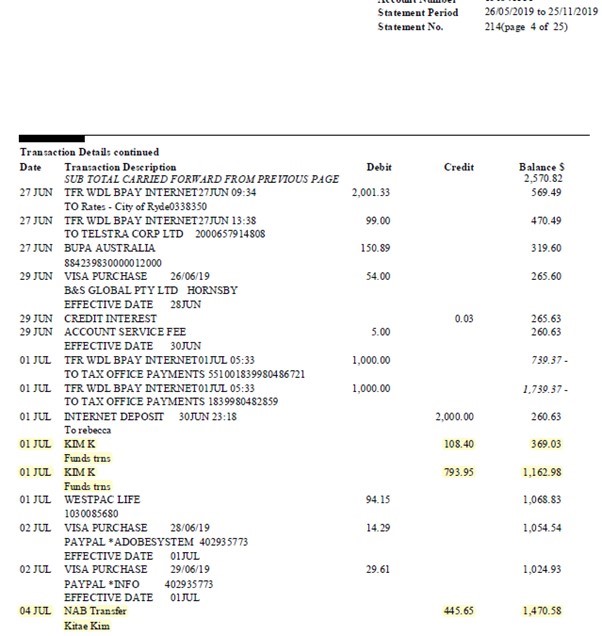
The Deduction Spreadsheets for the pay periods 20 May to 2 June 2019, 3 June to 16 June 2019, and 17 June to 30 June 2019 respectively record that Kitae Kim was required to repay the same amounts as he transferred:



156 From conversations with other sponsored employees at the Darwin restaurant Kitae Kim learned that they, too, received telephone calls instructing them to repay amounts paid to them by Sushi Bay. He overheard other employees receiving these calls on Thursdays (pay day). On about three to five occasions when he worked at the Darwin restaurant, someone from the accounting department rang the restaurant and directed him to tell a particular 457 employee to call Head Office about the need to pay the deduction.
157 Whether a payment is unreasonable in the circumstances involves questions of fact and degree and is likely to be informed by the following non-exhaustive considerations. The starting point is that “the ultimate purpose” of s 325 is to protect employees from practices the effect of which is to deny them the remuneration they have earned and are therefore entitled to enjoy. Thus, “a central consideration” in determining whether a deduction is unreasonable in the circumstances will be the extent to which the employee acquired the benefit of the deduction. Other relevant considerations include whether the benefit was acquired at the employee’s expense, which would “tend to indicate unreasonableness”, the extent to which the employer has benefitted, and the quality of the assent given by the employee. See Australian Education Union at [176]-[183].
158 Here, as the Ombudsman submitted, the employees in question derived no benefit from the monies they paid back to their employers; the only ones to benefit were their employers. Mr Kim deposed that, when speaking with employees or in emails with members of the payroll department, he would refer to the cash back “policy” as the “pay back condition”. On the other hand, he also deposed that he told them it was their “individual choice”. But Mr Hwang gave no evidence to suggest that he was offered any choice. Indeed, he said he was directed to do so. The same is true of Kitae Kim. Consequently, I am not satisfied that this was an invariable practice. In any event, as the 457 Employees were dependent on their employer’s sponsorship not only for their rights to work but also their rights to live in Australia and therefore vulnerable to dismissal and even deportation, I think it unlikely that they had any effective choice.
159 Further, the effect of the operation of the policy or condition is that it reduced the income of the 457 Employees well below award rates and potentially operated as a disincentive for employees to take annual leave. And, as the Ombudsman submitted, the obvious reason for the policy or condition was to avoid paying award rates while at the same time giving the appearance of compliance. Under no circumstances could such behaviour be considered reasonable.
160 In these circumstances, as the Ombudsman submitted, it is difficult to understand upon what basis either of Sushi Bay or Auskoja could deny the contraventions, as they did in their defence, especially when Ms Shin was prepared to admit them as she did in her Statement of Agreed Facts.
161 It follows that I am satisfied that each of Sushi Bay and Auskoja contravened s 325 as alleged.
THE AWARD CONTRAVENTIONS (SECTION 45)
Legislative requirements
162 Section 45 of the FW Act provides that a person must not contravene a term of a modern award.
163 The relevant provisions of the Restaurant Award are:
(1) clause 20.1, which required that adult employees be paid minimum rates of pay for each ordinary hour of work on Monday to Friday (weekdays);
(2) clauses 15.1 and 20.3, which required that junior employees be paid minimum rates as a percentage of the rate prescribed for adult employees;
(3) clause 12.8 until 12 December 2017 and cl 12.10 thereafter, which required that part-time employees be paid for ordinary hours at the rate of 1/38th of the weekly rate prescribed in cl 20;
(4) clause 13.1, which required employers to pay casual employees a casual loading of 25% of their minimum hourly rates;
(5) clause 34.1, which required employers to pay their employees Saturday, Sunday and public holiday penalty rates for working on Saturdays, Sundays or public holidays;
(6) clause 33.1, which required employers to pay their employees overtime rates as set out in cl 33.2 for all work done outside the spread of hours or rostered hours set out in cl 31; and
(7) clause 35.2(b), which required employers to pay an annual leave loading of 17.5%, in addition to the payment provided for in the National Employment Standards (NES) set out in s 44 of the FW Act.
The allegations
164 In summary, the Ombudsman alleges that at various times during the Contravention Period the corporate respondents contravened these clauses of the Award and therefore s 45 of the FW Act (the award contraventions).
165 Sushi Bay and Auskoja were alleged to have contravened all the provisions of the Award set out above. Sushi Bay ACT and Auskobay were alleged to have contravened all the provisions except for (2) (junior minimum rates) and (7) (annual leave loading). In relation to (5) (penalty rates), Sushi Bay ACT was not alleged to have contravened the requirement to pay public holiday penalty rates.
Consideration
166 For the following reasons I accept the Ombudsman’s submission that, provided the Court accepts the classifications she argues applied to the Employees, I should find that the corporate respondents committed the award contraventions.
167 First, the evidence about the hours worked by, and the amounts paid to, the Employees is derived from the corporate respondents’ own records. The same is true of the figures used to calculate the Employees’ annual leave entitlements. Ms Kumbhari explained that she, together with members of her team, extracted information from the records produced by the corporate respondents in response to notices to produce or court orders, following site visits, or by third parties in response to a notice to produce or voluntarily. The underpayments in respect of each of the Employees, and thus the extent of the award contraventions, are summarised in Annexure B to Ms Kumbhari’s first affidavit.
168 Second, Ms Kumbhari was not required for cross-examination and no evidence to the contrary was adduced. It follows that neither the assumptions she made nor her calculations have been challenged. With one qualification, there is no reason why I should not accept her evidence.
169 The qualification relates to one employee. After the hearing, while judgment was reserved, minor errors in the underpayment calculations in respect of employee Changseung Oh were identified and I granted leave to the Ombudsman to correct the errors.
170 I deal with the contraventions of cl 35.2(b) concerning the failure to pay the annual leave loading the next section in conjunction with the contraventions of s 44 of the FW Act
171 I now turn to consider the Ombudsman’s allegations concerning the classifications of the Employees.
172 From 29 February 2016 to 30 June 2016, cl 20.1 of the Restaurant Award provided that:
An adult employee within a level specified in the following table (other than an apprentice) will be paid not less than the rate per week assigned to the classification, as defined in Schedule B—Classification Structure and Definitions, for the area in which such employee is working.
Classification | Minimum weekly wage $ | Minimum hourly wage $ |
Introductory level | 656.90 | 17.29 |
Level 1: Food and beverage attendant grade 1 Kitchen attendant grade 1 | 675.90 | 17.79 |
Level 2: Food and beverage attendant grade 2 Cook grade 1 Kitchen attendant grade 2 Clerical grade 1 Restaurant person grade 1 Door person/security officer grade 1 | 701.80 | 18.47 |
Level 3: Food and beverage attendant grade 3 Cook grade 2 Kitchen attendant grade 3 Clerical grade 2 Restaurant person grade 2 Timekeeper/security officer grade 2 Handyperson | 725.90 | 19.10 |
Level 4: Food and beverage attendant grade 4 (tradesperson) Cook grade 3 (tradesperson) Clerical grade 3 Restaurant person grade 3 | 764.90 | 20.13 |
Level 5: Food and beverage supervisor Cook grade 4 (tradesperson) Clerical supervisor | 812.80 | 21.39 |
Level 6: Cook grade 5 (tradesperson) | 834.60 | 21.96 |
173 On 1 July 2016 and each consecutive year, minimum rates increased for employees at all levels.
174 Tables are included in the SOC/ASOC that particularise the increases in minimum rates and other entitlements over the Contravention Period. All the corporate respondents admitted both the rates and entitlements in these tables and the fact that they were required to pay the Employees in accordance with them.
175 The corporate respondents denied the classifications assigned by the Ombudsman to all the Employees. Where employees were classified at the Introductory Level for more than three months, the Ombudsman contends that they should have been classified as Level 1 employees after the three months expired. Otherwise, however, the Ombudsman did not take issue with the classifications as they appear in the respondents’ records, save for some 457 Employees whose qualifications and/or duties she alleges warranted higher classifications.
176 The Ombudsman submitted that Sushi Bay wrongly classified the following 24 full-time employees: Minha Hwang, SungTaek Byeun, Gobong Choi, Sangyoung Choi, Joohyun Do, Arom Hur, Sojung Hwang, Hyun Seok Jeon, Eun Joo Jeong, Haesuk Jung, Gahee Kim, Hyeyoung Kim, Kitae Kim, Minji Kim, Soojin (Jinnie) Kim, Hye Seong Kwon, Jong Soon Lee, Won Hyeok Lee, Jonghyuk Lim, Suji Ma, Junga Mok, Jiyoung Yang, Do Kyoung Yi and Changseung Oh.
177 With the exception of Minha Hwang and Changseung Oh, the dispute concerning the classifications for these employees relates to the 457 Period.
178 The Ombudsman also submitted that erroneous classifications had been assigned to three Auskobay Employees (Han Na Jeong, Jun Heui Lee and Junsik Oh) and three Auskoja employees (Cheolhee Hong, Seungtae Kim and Seungheon Lee), who were employed on a full-time basis, except for Junsik Oh who was employed on a part-time basis.
179 The given names of the Employees are spelt or written slightly differently in different documents. Generally, I have preferred the way the names have been written by the employees themselves in their resumes.
180 Some of the material upon which the Ombudsman to support her classifications relates to an employee’s role and duties at a Sushi Bay restaurant in which the employee worked before the 457 Period. In the absence of any evidence to the contrary, however, the presumptions of continuity operates and I infer that the duties the employees performed during the 457 Period were not materially different from those they previously performed at other Sushi Bay restaurants.
181 As will be seen, I am satisfied that these employees were wrongly classified and, with one exception that, the Ombudsman’s contentions as to their proper classifications should be accepted.
Minha Hwang
182 During the period from 29 February 2016 to 14 July 2019 the Ombudsman contended that Mr Hwang should have been classified as a level 5 – cook grade 4 (tradesperson). Sushi Bay classified him as a level 3 – cook grade 2.
183 The classification of “cook grade 2” is defined in cl B.3.5 of Sch B to the Restaurant Award as:
[a]n employee who has the appropriate level of training and who performs cooking duties such as baking, pastry cooking or butchering.
184 The classification of “Cook grade 4 (tradesperson)” is defined in cl B.3.8 to mean:
a demi chef or equivalent who has completed an apprenticeship or has passed the appropriate trade test or who has the appropriate level of training and who is engaged to perform general or specialised cooking, butchering, baking or pastry cooking duties and/or supervises and trains other cooks and kitchen employees.
185 A “demi chef” is an assistant to the chef de partie. I discussed the meaning of “chef de partie” in Fair Work Ombudsman v DTF World Square Pty Ltd (in liq) (No 3) [2023] FCA 201 at [179]. I referred there to the definitions in the Oxford English Dictionary (OED) and the Macquarie Dictionary, namely, in the case of the OED, a “chef in charge of a particular area of production in a restaurant; a station chef or line cook” and in the case of the Macquarie Dictionary, a “chef in a large kitchen who is responsible for a particular area of production, as roasts, grills, vegetables, sauces, etc.; station chef”.
186 “Appropriate level of training” is defined in cl 3.1 of the Restaurant Award in the following way:
appropriate level of training means that an employee:
(a) has completed an appropriate training program that meets the training and assessment requirements of a qualification or one or more designated units of competency from a Training Package;
(b) has been assessed by a qualified skills assessor to have skills at least equivalent to those attained in an appropriate training course; and/or
(c) at 31 December 2009 (except for a Food and beverage attendant grade 2 as defined in Schedule B–Classification Structure and Definitions) has been doing the work of a particular classification for a period of at least three months,
(however, to avoid doubt, the minimum classification rate for an employee who has completed AQF Certificate III or higher qualifications relevant to the classification in which they are employed is Level 4 in clause 20.1. For Food and beverage attendants grade 2, classification at grade 3 is subject to the employee having completed AQF Certificate II qualifications relevant to the grade 3 classification)[.]
(Emphasis added.)
187 “AQF” is an initialism for the Australian Qualifications Framework, which contains the national policy for regulated qualifications in Australian education and training.
188 Mr Hwang’s 2015 employment contract states that he was employed in the position of “chef”. Clause 5.1 describes his duties as including planning menus and estimating food requirements; training cooks and kitchen hands as required; preparing and cooking food; monitoring dishes, stock, ingredients and food material to ensure quality; and preparing specific food in accordance with set menus and dietary requirements.
189 In his affidavit Mr Hwang deposed, and I accept, that he carried out duties as a chef in the kitchen including preparing sushi rolls, cooking hot food and fish cutting; trained other staff in the kitchen from time to time; and that as restaurant supervisor his duties included ordering and checking inventory, preparing weekly rosters; reporting staff working hours and sales to Head Office and supervising kitchen and hall staff.
190 Mr Hwang holds a Certificate III in Asian Cookery from Culinary Solutions Australia as well as a Diploma in Hospitality. While he could not remember precisely when he obtained the qualifications, he deposed and I accept that he “completed them as part of the application process to be sponsored by Sushi Bay for 457-visa”. In other words, he held them at least by the time his 457 visa was granted in September 2015.
191 It is evident from documents produced to the Ombudsman by the Department of Home Affairs that a Certificate III in Asian Cookery from Culinary Solutions Australia and a Diploma in Hospitality are both qualifications recognised within the Australian Qualifications Framework.
192 It follows from the fact that Mr Hwang had these qualifications throughout the period in question and from the terms of cl 3.1 of the Restaurant Award that his classification by Sushi Bay as a cook-grade 2 was wrong. The lowest classification he could lawfully have had was cook grade 3 (tradesperson). That is defined in cl B.3.6 as
a commi [sic] chef or equivalent who has completed an apprenticeship or who has passed the appropriate trade test or who has the appropriate level of training, and who is engaged in cooking, baking, pastry cooking or butchering duties.
193 I also considered the meaning of “commis chef” in DTF World Square at [183], where I relied on the definitions in the OED (“a junior chef”) and in the Macquarie Dictionary (“a chef working under the supervision of a chef de partie, especially one who is gaining experience in every aspect of the process”).
194 Since he started working at the Campbelltown restaurant on 8 February 2016, Mr Hwang trained kitchen staff from time to time. Kitae Kim, who, it will be recalled, was a cook before he became a supervisor, deposed (and I accept) that shortly after he started working at the Campbelltown restaurant he received training from Mr Hwang to improve his fish-cutting techniques and general cooking skills. Performance assessment records made and kept by Sushi Bay show that in February 2017 Mr Hwang had “acceptable skills” in, amongst other things, “coaching” staff and “monitoring” after coaching to assess progress. Since training others is not included in the definition of cook grade 3 (tradesperson), I conclude that that classification is not appropriate and that which is most closely aligned with the work Mr Hwang was required to, and did perform, was as a cook grade 4 (tradesperson). Accordingly, as the Ombudsman submitted, Mr Hwang met the level 5 classification in the Restaurant Award and should have been paid accordingly during the period from 29 February 2016 (the day the claim begins) until 14 July 2019 (his last day of work).
195 SungTaek Byeun was classified by Sushi Bay as a level 3 – cook grade 2. The Ombudsman contended that he should have been classified as level 4 – cook grade 3 (tradesperson).
196 The records produced by the Department of Home Affairs show that on 6 February 2015 Mr Byeun graduated with an “Associate Degree” in Hotel Culinary Art from Gumi University in South Korea and that before his graduation he worked as a cook there. A letter dated 30 November 2015 from Daniel Oh described him as “a senior member of the Carlingford restaurant’s kitchen staff, handpicked to lead the team given his academic and professional qualifications in hospitality and culinary art”. It provides the following inclusive list of his duties and responsibilities “as a senior cook”:
• Prepare and cook all Sushi Bay menu items with consistency and exceptional quality standard expected by the Sushi Bay group, the management and the Sushi Bay customers;
• Assist the chef and management in planning and creating new menu items for special functions, dietary requirements and special orders;
• Portion and place finished menu items on colour coded plates for the train;
• Monitor and quality control all finished menu items prior to service;
• Demonstrating techniques and advising on cooking procedures to other cooks;
• Training and supervising other cooks and kitchen hands from time to time, stepping in kitchen managerial duties for the Chef as necessary;
• Supervise the receipt and ordering of ingredients and foodstuff for daily business as required, in consultation with management; and
• Adhere to and enforce food preparation, cooking, hygiene and occupational safety issues with the kitchen team.
197 In the nomination for a 457 visa, Sushi Bay described the position Mr Byeun was to undertake and his responsibilities and main duties in the following way:
Responsibilities Supervising and running the kitchen at Sushi Bay Restaurant Blacktown.
Main duties Planning menus and estimating food requirements; supervising and training cooks and kitchenhands; preparing and cooking menu items and seasonal dishes; monitoring the preparation, cooking and presentation of the dishes; monitoring kitchen supplies, ingredient stock and food material to ensure availability and quality; observing and updating relevant food safety and health regulation requirements; and observing and directing kitchen staff with relevant occupational, health and safety regulations.
198 The author of the document certified that “the tasks of the position include a significant majority of the tasks of the nominated occupation 351311 – Chef as listed in the ANZSCO dictionary, Legislative Instrument or Labour Agreement”. The author also certified that Mr Byeun had “qualifications and experience … commensurate with the qualifications and experience specified for the nominated occupation in the ANZSCO dictionary, Legislative Instrument or Labour Agreement” which was identified as a “Diploma of Hospitality”.
199 It is difficult to know why the Ombudsman considered that Mr Byeun should have been classified as level 4 – cook grade 3 (tradesperson) rather than level 5 – cook grade 4 (tradesperson), given his supervisory responsibilities some years earlier. Nevertheless, I am satisfied on the evidence that he should at least have been classified and paid as a level 4 – cook grade 3 (tradesperson) since he was plainly overqualified for the classification according to which he was paid. Having regard to the definition in the Restaurant Award of “appropriate level of training”, the minimum classification to which he could have been assigned was level 4.
200 Gobong Choi was classified by Sushi Bay as a level 3 – cook grade 2. The Ombudsman contended that he should have been classified as level 4 – cook grade 3 (tradesperson).
201 Mr Choi holds a Certificate III in Asian cookery and a Diploma of Hospitality both issued by Culinary Solutions Australia on 12 May 2016 and bearing the AQF logo. They also carry the endorsement that “[t]he qualification … is recognised within the Australian Qualifications Framework”. It follows, as I explained earlier, having regard to the definition in the Restaurant Award of “appropriate level of training”, that the minimum classification to which he could have been assigned under the Restaurant Award was level 4 – cook grade 3 (tradesperson). In these circumstances I uphold the Ombudsman’s contention. In any event, the other evidence supports at least that classification.
202 In a letter nominating him for the full-time position of “chef” at the Parramatta restaurant signed by Mr Oh, Sushi Bay listed his non-exhaustive duties and responsibilities as:
• Prepare and cook all Sushi Bay menu items with consistency and exceptional quality standard expected by the Sushi Bay group, the management and the Sushi Bay customers;
• Lead the kitchen team at the Penrith restaurant kitchen;
• Plan and create new menu items for special functions, dietary requirements and special orders;
• Portion and place finished menu items on colour coded plates for the train;
• Monitor and quality control all finished menu items prior to service;
• Demonstrating techniques and advising on cooking procedures to cooks;
• Training and supervising cooks and kitchen hands;
• Supervise the receipt and ordering of ingredients and foodstuff for daily business as required, in consultation with management; and
• Discuss and enforce food preparation, cooking, hygiene and occupational safety issues with management and kitchen staff.
203 Mr Choi’s employment contract dated 21 August 2016 identifies his position as “chef”. The description of his duties is consistent with those listed in the letter from Mr Oh.
204 Sangyoung Choi was classified by Sushi Bay as level 3 – food and beverage attendant grade 3, which is defined in cl B.2.3 of Sch B to the Restaurant Award as:
an employee who has the appropriate level of training and is engaged in any of the following:
(a) supplying, dispensing or mixing of liquor;
(b) assisting in the cellar;
(c) undertaking general waiting duties of both food and liquor including cleaning of tables;
(d) receipt of monies;
(e) assisting in the training and supervision of food and beverage attendants of a lower grade;
(f) delivery duties; and
(g) taking reservations, greeting and seating guests.
205 In contrast, the Ombudsman contended that she should have been classified as level 5 – food and beverage supervisor. A food and beverage supervisor is defined in cl B.2.5 as:
an employee who has the appropriate level of training including a supervisory course and who has the responsibility for supervision, training and co-ordination of food and beverage staff, or stock control for a bar or series of bars.
206 On any view of the matter Sushi Bay’s classification was wrong and none of the other food and beverage attendant categories are apt to capture the training Mr Choi had undertaken or the duties she performed.
207 Clause 2 of her employment contract, dated 22 July 2015, shows that Ms Choi was employed in the position of “Restaurant Manager” and her duties, as described in cl 5.1, included “selecting, training and supervising hall and kitchen staff”. That evidence is supported by documentation submitted by Sushi Bay to the Department of Immigration. The material before the Court suggests that Ms Choi had been doing this work for some years, from at least 1 November 2011 when she was first employed as restaurant manager at the Sushi Bay restaurant in Penrith.
208 Ms Choi also holds a Diploma in Hospitality dated 21 July 2015 issued by Culinary Solutions Australia. The certificate carries the AQF logo and the endorsement that the qualification is recognised within the AQF. That appears to be an appropriate qualification for the role she was engaged to perform. The subjects covered by her diploma include “manage operational plan”, “lead and manage people” and “coach others in job skills” which would appear to be supervisory courses.
209 Ms Choi’s duties and responsibilities went way beyond those of a food and beverage attendant grade 3. The list in cl 5.1 of her employment contract includes:
• Arranging the purchasing and making orders of supplies, ingredients and foodstuff for daily business according to restaurant budget;
• Maintaining records of stock and financial transactions; setting restaurant budget as required;
• Ensuring dining facilities including the hall, service areas and the kitchen comply with health and food safety regulations, and ensuring all dining equipment and utensils including serving plates, restaurant tables and chairs are clean, functional and of suitable appearance;
• Taking reservations, planning and organising special functions at the restaurant;
• Being responsive to customer feedbacks and ensuring their satisfaction with meal and service;
• Planning new menu items and specials in consultation with chef and the head office;
• Planning and implementing marketing and promotional strategies in conjunction with the head office and other branches to improve sales and business performance;
• Selecting; training and supervising hall and kitchen staff; and
• Observing and keeping up-to-date relevant food safety and health regulations, and informing other staff of relevant updates.
210 I am satisfied that Ms Choi should have been classified as level 5 – food and beverage supervisor, as the Ombudsman contended.
211 Joohyun Do was classified by Sushi Bay as level 2 – cook grade 1 when he worked at the Miranda restaurant. Since the evidence indicates that he, too, held a Certificate III in Hospitality (Asian Cookery) at that time, the minimum classification for him was level 4 – cook grade 3 (tradesperson) within the meaning of that term in cl B.3.6. Since that is the classification for which the Ombudsman contended, I uphold the Ombudsman’s contention.
212 Arom Hur was a chef employed at the Darwin restaurant. She was classified by Sushi Bay as a level 2 – cook grade 1. The Ombudsman contended that she, too, should have been classified as level 4 – cook grade 3 (tradesperson). There is no doubt about that. In Ms Hur’s case, as in the others, that was the minimum classification at which she was to be paid as she had held a Certificate III in Hospitality (Asian Cookery) since November 2012 and a Diploma of Hospitality since November 2014. Ms Hur’s duties included training and supervision of cooks and kitchen hands and the evidence of Kitae Kim was that she, together with Sojung Hwang, to whom I am about to turn, trained him to become a supervisor.
213 Sojung Hwang was also a chef. She was employed at the Wollongong restaurant during the 457 Period.
214 Ms Hwang was classified by Sushi Bay as a level 3 – cook grade 2. The Ombudsman contended that she should have been classified as level 4 – cook grade 3 (tradesperson). Once again, the Ombudsman is right. Ms Hwang has held a Certificate III in Asian cookery since 25 May 2016 and a Diploma of Hospitality dated 15 June 2016, both issued by Culinary Solutions Australia and carrying the endorsement of the AQF, so this is the minimum applicable classification.
215 Hyun Seok Jeon is in the same position. He was classified by Sushi Bay as level 2 – cook grade 1. Yet, he also held a Certificate III in Asian cookery and a Diploma of Hospitality issued by Culinary Solutions Australia in 2016 both carrying the endorsement of the AQF. As the Ombudsman submitted, he was properly classified as level 4 – cook grade 3 (tradesperson).
216 Eun Joo Jeong was employed by Sushi Bay as “Restaurant Manager”. It appears she was employed in that capacity from at least 2015 and during the 457 Period, under two consecutive contracts, the second of which was signed on 21 September 2018. Her duties included “selecting, training and supervising hall and kitchen staff” and arranging for the purchase of “supplies, ingredients and foodstuffs”. Ms Jeong was awarded a Diploma of Hospitality by Culinary Solutions Australia on 4 August 2015.
217 Sushi Bay classified Ms Jeong as level 3 – food and beverage attendant grade 3. As the holder of the qualification of Diploma of Hospitality, however, the minimum classification in which she could have been employed was level 4 in cl 20.1 which, in her case, is a food and beverage attendant grade 4 (tradesperson), defined in cl B.2.4 as:
an employee who has the appropriate level of training and who carries out specialised skilled duties in a fine dining room or restaurant.
218 The Ombudsman contends that this is the correct category rather than the higher level of “food and beverage supervisor”, which on the face of things appears to be the more appropriate one.
219 I therefore find that Ms Jeong should at least have been classified as level 4 – food and beverage attendant grade 4 (tradesperson).
220 During the 457 Period Haesuk Jung worked at the Blacktown restaurant. He was classified by Sushi Bay as a level 2 – cook grade 1 whereas the Ombudsman contended that he should have been classified as level 5 – cook grade 4 (tradesperson).
221 The evidence discloses that on 25 May 2016 Mr Jung acquired a Certificate III in Asian cookery and a Diploma of Hospitality from Culinary Solutions Australia. Accordingly, the minimum classification in which he could have been employed was level 4 – cook grade 3 (tradesperson).
222 In support of her contention that Mr Jung should have been classified as level 5, the Ombudsman pointed to two documents. The first was a letter from the COO dated 14 June 2016 nominating Mr Jung “in the position of Chef at [the] Rouse Hill restaurant under the … 457 visa program”. There, Mr Oh stated that his duties and responsibilities would include, among other things, training and supervising cooks and kitchen hands and “supervis[ing] the receipt and ordering of ingredients and foodstuff for daily business as required, in consultation with management”. The second was an undated resume in which Mr Jung said he was employed from June 2014 -September 2014” and “June 2015 – Present” at the Rouse Hill “branch” of Sushi Bay where he was responsible for food preparation, managing stock and training. The combination of his qualifications and the nature of the duties he was required to perform indicates that his proper classification was level 5 – cook grade 4 (tradesperson).
223 Gahee Kim was employed at the Belconnen restaurant during the 457 Period. She was also classified by Sushi Bay as a level 2 – cook grade 1. But she, too, acquired a Certificate III in Asian cookery and a Diploma in Hospitality in 2016. Accordingly, the minimum applicable classification for her was level 4 – cook grade 3 (tradesperson), which is the classification for which the Ombudsman contended. I am satisfied that this is the correct classification. While she undertook some supervisory duties, she was subordinate to Minha Hwang.
224 Hyeyoung Kim was a chef at the Penrith restaurant during the 457 Period. She was classified by Sushi Bay as a level 1 – kitchen attendant grade 1. As the Ombudsman submitted, that was erroneous. She should have been classified as level 4 – cook grade 3 (tradesperson) for she held a Certificate IV in Commercial Cookery, which she acquired in June 2017. That certificate was issued by Evolution Hospitality Institute. It is endorsed with a logo incorporating the words “Nationally Recognised Training” and the statement that “[t]his qualification is recognized with the Australian Qualification Framework”.
Kitae Kim
225 Kitae Kim’s position is no different. Sushi Bay classified him as level 2 – cook grade 1. But as the Ombudsman contended, he should have been classified level 4 – cook grade 3 (tradesperson), at least because he had acquired a Certificate III in Asian cookery and a Diploma in Hospitality Management from Culinary Solutions in May 2017.
226 Minji Kim was classified as level 2 – food and beverage attendant grade 2. The Ombudsman contended that she should have been classified as level 4 – cook grade 3 (tradesperson). The Ombudsman is right because Minji Kim acquired a Certificate III in Asian cookery and Diploma in Hospitality Management from Culinary Solutions both dated 7 August 2017. In addition, she was employed as a “chef” and the duties outlined in her contract support a classification as a cook rather than a food and beverage attendant.
227 Soojin Kim was employed as a restaurant manager. Her duties and responsibilities, as described in her employment contract, included “arranging the purchasing and making orders of supplies, ingredients and foodstuff for daily business according to restaurant budget”; “maintaining records of stock and financial transactions”; and “selecting, training and supervising hall and kitchen staff”.
228 Sushi Bay classified her as a level 3 – food and beverage attendant grade 3.
229 The Ombudsman contended that she should have been classified as level 5 – food and beverage supervisor. It will be recalled that a food and beverage supervisor is defined in the Award as “an employee who has the appropriate level of training including a supervisory course and who has the responsibility for supervision, training and co-ordination of food and beverage staff, or stock control for a bar or series of bars”. In contrast, a level 3 – food and beverage attendant grade 3 is not required to have undertaken a supervisory course and has no responsibility for supervision, training and coordination of food and beverage staff.
230 Ms Kim’s resume records that she has an Associate Degree in Culinary Art from Baewha Women’s University in South Korea and a Bachelor of Food and Nutrition from Korea National Open University as well as a Korean cooking qualification. It also records that she had been a member of the “Senior Hall Staff” at the Sushi Bay restaurant in Merrylands since 2013.
231 The Business Nomination Visa application Sushi Bay submitted to the Department of Immigration and Border Protection contains the following representations:
Describe the qualifications, essential skills, employment experience and registrations/licences required to be held by the nominee.
Qualifications | Diploma of Hospitality or equivalent |
Essential skills | Customer service experience in service and hospitality industry |
Employment experience | At least 3 years in restaurant and/or hospitality service |
…I certify that the qualifications and experience of the nominee are commensurate with the qualifications and experience specified for the nominated occupation in the ANZSCO dictionary, Legislative Instrument or Labour Agreement.
232 As a diploma is recognised within the AQF, Ms Kim’s minimum classification under the Restaurant Award was level 4. It follows that Sushi Bay’s classification was wrong. It does not, however, follow that the Ombudsman’s contention is correct. While the evidence clearly establishes that Ms Kim had responsibility for supervision, training and co-ordination of food and beverage staff, I was not taken to any evidence to indicate that her training had included any “supervisory course”. Her resume does not disclose the subjects she studied to obtain her Korean qualifications and there is no evidence that acquired has any formal qualifications in Australia. For this reason, I am not satisfied that she should have been classified as level 5. I therefore find that she should have been classified as level 4 – food and beverage attendant grade 4.
233 Hye Seong Kwon was employed as a chef. He was classified by Sushi Bay as level 3 – cook grade 2. The Ombudsman contended that he should have been classified as level 4 – cook grade 3 (tradesperson).
234 Mr Kwon acquired a Diploma of Hospitality from Culinary Solutions Australia on 28 June 2016. Accordingly, the minimum classification at which he should have been paid was level 4. I therefore accept the Ombudsman’s contention.
235 Won Hyeok Lee was employed as a cook and classified by Sushi Bay as level 3 – cook grade 2. In November 2011 he acquired a Certificate IV in Hospitality (Commercial Cookery) and a Diploma in Hospitality from the Holmes Institute Pty Limited, qualifications the evidence indicates are recognised by the AQF. His certificates also carry the Nationally Recognised Training logo. On the basis of his qualifications, the minimum classification at which he should have been paid was level 4, as the Ombudsman contended. I therefore find that he should have been classified as such.
236 Jong Soon Lee was employed as a chef but was classified by Sushi Bay as level 2 – cook grade 1. Yet the evidence indicates that she held a Diploma of Hospitality and a Certificate IV in Commercial Cookery from the Holmes Institute Sydney. In view of her qualifications the minimum classification at which she should have been paid was level 4, which is the classification for which the Ombudsman contends. Consequently, I find that she should have been classified accordingly.
237 Jonghyuk Lim was employed in the position of restaurant manager. His duties included selecting, training and supervising staff. Although he had been a restaurant manager for at nearly four years and acquired a Diploma in Hospitality from Culinary Solutions Australia in September 2015, Sushi Bay classified him at level 1. The Ombudsman submitted that he was properly classified as level 4 – food and beverage attendant grade 4 (tradesperson). In view of his diploma his minimum classification was level 4. I therefore uphold the Ombudsman’s submission.
238 Suji Ma was employed as a chef. She was classified as level 3 – cook grade 2. Yet she acquired a Certificate III in Asian cookery from Culinary Solutions Australia in September 2014 and a Diploma in Hospitality from the same organisation in February 2015, which means that the minimum classification in her case was level 4 – cook grade 4 (tradesperson). The Ombudsman contended that she should have been classified at that level and the Ombudsman is right.
239 Junga Mok was employed as a restaurant manager. Although she acquired a Diploma of Hospitality in March 2015 from Culinary Solutions Australia, Sushi Bay classified her as level 3 – food and beverage grade 3. In view of her qualification, her minimum classification was level 4 – food and beverage attendant grade 4 (tradesperson). The Ombudsman submitted that that is the classification that applies to her and I so find.
240 Jiyoung Yang was classified as a level 3 – cook grade 2. The Ombudsman contended that she should have been classified as level 4 – cook grade 3 (tradesperson).
241 Ms Yang was employed as a chef. She holds a Culinary Arts Associate Degree from the Dongwon Institute of Science and Technology in South Korea dated 10 February 2012. Her resume indicates that she worked as a chef from 2010 to 2016 in various kitchens in South Korea and Australia. Her employment contract stipulated that her duties relevantly included:
planning menus and estimating food requirements;
training cooks and kitchen hands as required;
preparing and cooking food;
monitoring dishes, stock, ingredients and food material to ensure quality; and
preparing specific food in accordance with set menus and dietary requirements.
242 In Ms Yang’s nomination for a 457 visa, Sushi Bay described the position she was to undertake in the following way:
Responsibilities Supervising and running the kitchen at Sushi Bay Restaurant Rouse Hill.
Main duties Planning menus and estimating food requirements; Supervising and training cooks and kitchenhands; Preparing and cooking menu items and seasonal dishes; Monitoring the preparation, cooking and presentation of the dishes; Monitoring kitchen supplies, ingredient stock and food material to ensure availability and quality; Observing and updating relevant food safety and health regulation requirements; and observing and directing kitchen staff with relevant OH&S regulations.
243 The author of that document certified that “the tasks of the position include a significant majority of the tasks of the nominated occupation 351311 – Chef as listed in the ANZSCO dictionary, Legislative Instrument or Labour Agreement”. The author also certified that Ms Yang had “qualifications and experience … commensurate with the qualifications and experience specified for the nominated occupation in the ANZSCO dictionary, Legislative Instrument or Labour Agreement”. This included a Diploma in Hospitality or Commercial Cookery.
244 As with other employees, I am satisfied on the evidence that Ms Yang should at least have been classified and paid as a level 4 – cook grade 3. Having regard to the definition in the Restaurant Award of “appropriate level of training”, the minimum classification to which she could have been assigned was level 4. She was clearly overqualified for the classification at which she was paid.
245 Do Kyoung Yi was employed as a chef. She holds a Diploma of Hospitality and a Certificate III in Asian cookery issued by Culinary Solutions Australia in July 2016. Yet Sushi Bay classified her as level 2 – cook grade 1. Again, having regard to her qualifications she should at least have been classified as level 4 – cook grade 3 (tradesperson), which is the classification for which the Ombudsman contended. I find that is the appropriate classification for her.
246 Changseung Oh began working for Sushi Bay in the week commencing 26 August 2019 and was classified by Sushi Bay as “Introductory – Attendant”. Clause B.1 of Sch B to the Restaurant Award defines “Introductory level” in the following way:
Introductory level means a worker who enters the industry and is unable to meet the competency requirements of Level 1. Such an employee will remain in this level for a maximum of three months. Provided that an additional three months may be served at this level by mutual agreement between the employer and the employee …
247 The next level is food and beverage attendant grade 1 or kitchen attendant grade 1.
248 In the absence of evidence of an agreement that he remain at the introductory level after three months, Mr Oh should have been paid at the end of the three-month period at the level 1 classification. Assuming in favour of the respondents that Mr Oh started work on the last day of the week, 30 August 2019, he should have been paid as a level 1 employee from 30 November 2019.
249 When Han Na Jeong, Jun Heui Lee and Junsik Oh commenced employment with Auskobay they were classified at the introductory level. The Ombudsman alleges that after three months each of these employees should have been classified as a level 1 employee. Yet Auskobay continued to classify each of them at the lower, introductory level for more than three months.
250 Han Na Jeong began working for Auskobay sometime in the week commencing 8 July 2019, Jun Heui Lee in the week commencing 1 July 2019, and Junsik Oh in the week commencing 25 March 2019.
251 Assuming in the respondents’ favour that these employees started work on the last day of the week, 14 July 2019, 7 July 2019 and 31 March 2019 respectively, they should all have been classified as level 1 at least by 21 October 2019 when their assessment periods commenced. The Ombudsman apparently accepts that each of these three employees was an entrant into the industry and was unable to meet the competency requirements for level 1 at the commencement of their employment. There is no evidence in any of these cases of an agreement that they remain at the introductory level beyond their first three months.
252 Cheolhee Hong, Seungtae Kim and Seungheon Lee were all employed in the position of “chef”. Throughout the 457 Period, Mr Hong was employed in the Miranda restaurant, Mr Kim in the Merrylands restaurant, and Mr Lee in the Forster restaurant.
253 Each of them had completed Certificate III or higher qualifications relevant to the classification in which they were employed. All were in possession of a Diploma of Hospitality or Hospitality Management and either a Certificate III in Hospitality (Commercial Cookery) or Commercial Cookery “recognised within the Australian Qualifications Framework”. Mr Kim also held a Certificate IV in Commercial Cookery.
254 Despite their qualifications, however, Auskoja classified Mr Hong as level 3 – cook grade 2 and Mr Kim and Mr Lee as level 2 – cook grade 1. The Ombudsman contended that they should each have been classified as level 4 – cook grade 3 (tradesperson). Having regard to their qualifications that is the minimum classification in which each of them could have been employed.
255 It follows that I find that the corporate respondents contravened s 45 of the FW Act in these respects.
THE ANNUAL LEAVE CONTRAVENTIONS (CONTRAVENTIONS OF SECTIONS 44 AND 45 OF THE FW ACT)
Legislative requirements
256 Section 44, which is a civil remedy provision, provides that a national system employer must not contravene a provision of the NES. The NES are minimum terms and conditions that apply to all national system employees. They are set out in Pt 2-2 of the FW Act. One of the provisions in the NES is s 90. Section 90 provides:
Payment for annual leave
(1) If, in accordance with this Division, an employee takes a period of paid annual leave, the employer must pay the employee at the employee’s base rate of pay for the employee’s ordinary hours of work in the period.
(2) If, when the employment of an employee ends, the employee has a period of untaken paid annual leave, the employer must pay the employee the amount that would have been payable to the employee had the employee taken that period of leave.
257 As I mentioned in the previous section of these reasons, cl 35.2(b) of the Restaurant Award requires employers to pay an annual leave loading of 17.5%, in addition to the payment provided for in the NES.
The allegations
258 The Ombudsman alleged (at SOC/ASOC [104]–[108]) that Sushi Bay contravened s 44(1) by failing to pay Minha Hwang, Sangyoung Choi, Haesuk Jung and Soojin (Jinnie) Kim, amounts sufficient to satisfy their annual leave entitlements as prescribed by s 90(1). She also alleges that Sushi Bay contravened s 45 by failing to pay the annual leave loading prescribed by cl 35.2(b) of the Restaurant Award to Mr Hwang; Mrs Hwang; Sangyoung Choi; Sojung Hwang; Hyun Seok Jeon; Eun Joo Jeong; Haesuk Jung; Gahee Kim; Hyeyoung Kim; Kitae Kim; Minji Kim; Soojin (Jinnie) Kim; Won Hyeok Lee; Suji Ma; Junga Mok; Jiyoung Yang; and Do Kyoung Yi.
259 The substance of these allegations is that during the 457 Period Sushi Bay was required to pay these employees their annual leave entitlements at their base rate of pay plus the 17.5% annual leave loading for all hours of annual leave taken (propositions accepted by Sushi Bay in the defence) but that they were underpaid in two respects. First, they were only paid at base rates, that is to say they were not paid any loading. Second, the effect of the Deduction Method was that they were paid less than both their statutory and award entitlements. The Ombudsman also alleged that Auskoja failed to pay annual leave loadings to two of its employees for 76 hours of approved annual leave that each of them took (at SOC/ASOC [176]). Cheolhee Hong and Seungtae Kim were entitled to $297.54 and $301.72 respectively but were only paid $0 and $28.98 respectively.
260 The corporate respondents admit that they were the employers of the relevant employees and were required to comply with the FW Act and Regulations but denied these allegations.
Consideration
261 For the reasons given above at [128]–[132] (relating to the use of the Deduction Method) and [166]–[168] (relating to the calculations having been based on the corporate respondents’ own records), I find these allegations proved.
262 In addition, I note the evidence given by Minha Hwang about his experience with taking annual leave as a 457 Employee. He would receive his “tax wage” from Sushi Bay by EFT but, when he returned to work, he would receive a paper slip directing him to pay an amount back to Head Office. I also note that Mrs Hwang’s final pay slip shows that she received a payment of $690.48 for 35.46 hours of “unused annual leave” calculated at a rate of $19.47 per hour. That amount did not include any annual leave loading.
263 It follows that Sushi Bay and Auskoja contravened s 45 by reason of their contraventions of cl 35.2(b) of the Restaurant Award and Sushi Bay contravened s 44 by not paying these employees annual leave at their base rate for all their ordinary hours of work during the periods the subject of their claim.
Contraventions of s 535(4) of the FW Act and reg 3.44 of the FW Regulations
264 These allegations relate to the payroll records and working hours records produced by the relevant corporate respondents in response to the April 2016 NTP (the 2016 Records); records produced to the Ombudsman that were used in the audit of Sushi Bay ACT in 2019 (2019 Audit Records); the MYOB Records, and the payroll advices and pay slips relating to Minha and Jihye Hwang (the Hwang Records).
Legislative requirements
265 Section 535 of the FW Act provides that:
Employer obligations in relation to employee records
(1) An employer must make, and keep for 7 years, employee records of the kind prescribed by the regulations in relation to each of its employees.
Note This subsection is a civil remedy provision (see Part 4-1).
(2) The records must:
(a) if a form is prescribed by the regulations—be in that form; and
(b) include any information prescribed by the regulations.
Note This subsection is a civil remedy provision (see Part 4-1).
(3) The regulations may provide for the inspection of those records.
Note: If an employer fails to comply with subsection (1), (2) or (3), the employer may bear the burden of disproving allegations in proceedings relating to a contravention of certain civil remedy provisions: see section 557C.
(4) An employer must not make or keep a record for the purposes of this section that the employer knows is false or misleading.
Note: This subsection is a civil remedy provision (see Part 4-1).
(5) Subsection (4) does not apply if the record is not false or misleading in a material particular.
266 Subsections (4) and (5) and the note to subs (3) were inserted by the Protecting Vulnerable Workers Amendment Act and commenced on 15 September 2017.
267 Part 3-6, Division 3, Subdivision 1 of the FW Regulations deals with employee records an employer is required to make and keep for the purposes of s 535(1).
268 Regulation 3.44(1), which was repealed with effect from 21 December 2017 (shortly after s 535(4) and (5) commenced), provided:
An employer must ensure that a record that the employer is required to keep under the Act or these Regulations is not false or misleading to the employer’s knowledge.
Note: Subregulation (1) is a civil remedy provision to which Part 4-1 of the Act applies. Division 4 of Part 4-1 of the Act deals with infringement notices relating to alleged contraventions of civil remedy provisions.
269 Regulation 3.44(6) provides:
A person must not make use of an entry in an employee record made and kept by an employer for this Subdivision if the person does so knowing that the entry is false or misleading.
Note: Subregulation (6) is a civil remedy provision to which Part 4-1 of the Act applies. Division 4 of Part 4-1 of the Act deals with infringement notices relating to alleged contraventions of civil remedy provisions.
270 Section 793(1) of the FW Act relevantly provides that any conduct engaged in on behalf of a body corporate by an officer, employee or agent of that body (an official) within the scope of his or her actual or apparent authority is taken for the purposes of the Act to have been engaged in also by the body. Section 793(2) relevantly provides that if, for the purposes of the Act, it is necessary to establish the state of mind of a body corporate it is enough to show that the conduct was engaged in by the official and that the official had that state of mind. “State of mind” is defined in s 793(3) to include the knowledge, intention, opinion, belief or purpose of that person and the person’s reasons for the intention, opinion, belief or purpose. It follows that any conduct in which Ms Shin, as an officer of all of the corporate respondents and/or Phillip Kim, Joseph Lee or any other employee or agent of the corporate respondents engaged on behalf of one or more of the corporate respondents is taken to have been conduct in which they also engaged and that their knowledge is sufficient to demonstrate the knowledge of the corporate respondent(s) on whose behalf they were acting.
271 In their defence the relevant corporate respondents admitted that the 2016 Records, 2019 Audit Records, Hwang Records and MYOB Records were records that the relevant corporate respondent was required to make and keep within the meaning of that expression in s 535(1) of the FW Act.
272 By the April 2016 NTP, Sushi Bay ACT was required to produce, amongst other things, “all documents and records” relating to or recording rates of pay or salaries, gross amounts and net amounts paid in cash or otherwise, deductions made from wages and days and times worked by employees engaged to perform work at the Belconnen restaurant during the period from 1 December 2015 to 31 March 2016.
273 In response to the April 2016 NTP, Sushi Bay ACT produced what Ms Shin claimed in her letter of 2 May 2016 were “all records and documents during the period from 1 December 2015 to 31 March 2016” required by FWI Reid. Ms Shin described them in the following way (without alteration):
1. Information about all employees engaged by Sushi Bay ACT Pty Ltd
— Employ Information Summary (including Bank detail, Superannuation fund details, TFN)
— Employment agreements/Contracts
— Employee’s Visa/Copies of ID
2. Documents and records related to the payment of wages
— Payroll payment summary
— Payroll advice (including the rate of pay or salary, gross and net amounts, penalty rates, superannuation contributions, payment dates)
— Bank transfer records (payroll payment report/superannuation payment report)
3. Records of the working hours
— Total working hours
4. Leave Entitlements Summary
274 The record-keeping contraventions concern the “documents and records relating to the payment of wages” and “records of the working hours” as described in items 2 and 3 above. The 2016 Records are the “payroll advice” records that purportedly recorded the hours worked by, and the rates of remuneration and gross and net amounts paid to, employees between 29 February 2016 to 27 March 2016 (2016 Records Period) and the records titled “total working hours” that purportedly recorded the total hours, and total weekday, Saturday and Sunday hours, worked by employees.
275 The Ombudsman alleged (at SOC/ASOC [52]) that the 2016 Records were false and misleading for three reasons: first, they represented that 17 employees of Sushi Bay ACT identified in [37] of the SOC/ASOC (the 2016 Employees) worked different hours from those they actually worked (as recorded in the Total Hours Worked Spreadsheets); second, they represented that the 2016 Employees did not work any overtime hours when they in fact worked regular overtime hours; and third, they did not record the cash amounts paid to the 2016 Employees for additional hours worked so that the gross and net amounts appearing in the 2016 Records were incorrect.
276 The Ombudsman alleged (at SOC/ASOC [54]) that throughout the 2016 Records Period and as at 2 May 2016 (when the documents were produced to FWI Reid), Sushi Bay ACT knew the documents were false or misleading because it knew their contents and also knew that the 2016 Employees were paid in accordance with the payroll system; that the actual hours they worked were as set out in the Total Hours Worked Spreadsheets and that they were paid Cash Rates as set out in the Pay Guide for some of the hours they worked. She relied on the knowledge and conduct of Ms Shin, Phillip Kim, Daniel Oh and/or the payroll team, which by s 793 of the FW Act is attributed to Sushi Bay ACT: see Director of the Fair Work Building Industry Inspectorate v Robinson (2016) 241 FCR 338 at [48]–[50] (Charlesworth J).
277 These allegations are established by the documents themselves which were exhibited to Mr Brownell’s affidavit, the evidence given by Phillip Kim, Kitae Kim and Mr and Mrs Hwang, and on the facts I have already found.
278 As an example, the “total working hours” document and the corresponding payroll advice for the pay period 14 to 27 March 2016 record that Juhui Bae worked a total of 76 hours, comprising 56.75 weekday hours, 12 hours on Saturdays and six hours on Sundays and was paid a base hourly rate of $17.29, $21.613 on Saturdays and $25.935 on Sundays:
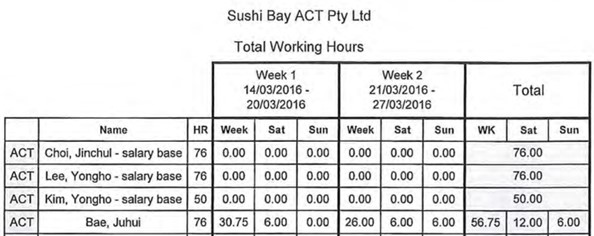
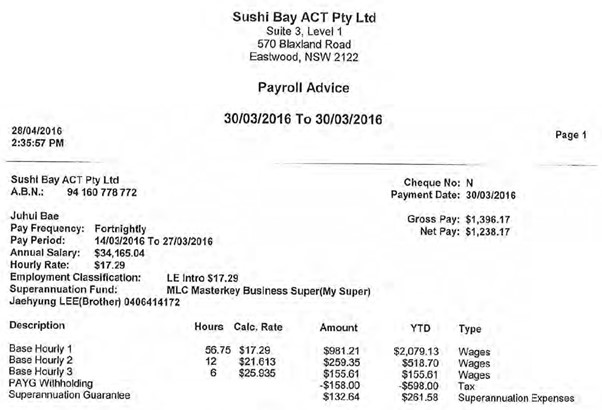
279 A document titled “Payroll Report” records that on 30 March 2016 Juhui Bae was paid $1,238.17, his net pay as recorded in the payroll advice, by way of EFT.
280 However, the (accurate) Total Hours Worked Spreadsheet for the same period records that Juhui Bae:
(a) worked 84 (not 76) hours, comprising of 61 (not 56.75) weekday hours, 17 (not 12) hours on Saturdays and six hours on Sundays;
(b) received wages by EFT for 76 hours of work; and
(c) received cash wages for the additional 4.25 hours worked over the weekdays, and the additional five hours worked over the Saturdays.
281 The cash wages were paid in accordance with the relevant Pay Guide at that time that set the Base Cash Rate at $14.00, $17.50 for Saturdays and $21.00 for Sundays.
282 As there were false records and accurate records prepared for the same pay period, effectively by the same individuals within the payroll team, Sushi Bay ACT must have known that the 2016 Records were false or misleading. The same goes for all the records contraventions by the various respondents.
283 The Ombudsman further alleged that Sushi Bay ACT made use of the entries in the 2016 Records when Ms Shin provided them to FWI Reid in response to the April 2016 NTP.
284 This allegation is also made out. Phillip Kim’s evidence points inexorably to the conclusion that Ms Shin established the payroll system and approved the Pay Guides. He acted as he did only because of her instructions. She must therefore have known that the entries in those records were false and misleading for the reasons propounded by the Ombudsman at the time the entries were made when she sent the records to FWI Reid. As she knew, Sushi Bay ACT knew.
285 The respondents pleaded in their defences that the Ombudsman was estopped from making these allegations, apparently on the basis of the principle in Port of Melbourne Authority v Anshun Pty Ltd (1981) 147 CLR 589. In short, the position the respondents took was that if the Ombudsman wished to make such a claim she should have done so in the 2017 Proceedings and her failure to do so precluded her from making one in this proceeding. Nevertheless, Ms Shin subsequently admitted the allegations in her Statement of Agreed Facts and can therefore be taken to have waived reliance on the defence and the liquidator chose not to defend the proceeding. In any event, for the reasons advanced in the Ombudsman’s written submissions and pleaded in her reply, no such estoppel would arise. In short, as the Ombudsman explained, the 2017 Proceedings were conducted on the basis that the 2016 Records produced to FWI Reid by Sushi Bay ACT and Ms Shin on behalf of Sushi Bay ACT were made and kept in compliance with Sushi Bay ACT and Ms Shin’s obligations under the FW Act and accurately recorded in respect of the 22 employees of Sushi Bay ACT the total hours worked each fortnight and/or the pay rates paid and/or the total net and gross amounts paid. It was not until the site visit to Head Office on 4 February 2020 that the Ombudsman became aware that those records were false or misleading. A party to legal proceedings will not be estopped from bringing a claim unless it was unreasonable for the party not to have done so in the earlier proceedings. In the absence of any evidence to indicate that the Ombudsman was aware that the 2016 Records were false or misleading before the site visit in 2020, it could scarcely be said that it was unreasonable of her not to bring such a claim in the 2017 Proceedings.
286 It follows that I find that Sushi Bay ACT contravened reg 3.44(1) by failing to ensure that these records were not false or misleading to its knowledge and that, by providing the records to FWI Reid on 2 May 2016 which it knew contained misrepresentations as to the hours of work, rates of pay and wages, it contravened reg 3.44(6) by making use of entries in those records knowing them to be false or misleading.
287 It will be recalled that order 6 of the orders made by the FCCA in June 2019 relevantly required that Sushi Bay ACT arrange for an audit of its compliance with the FW Act and the Restaurant Award to be conducted by a suitably qualified person and within 30 days of the completion of the audit provide the Ombudsman with a copy of the audit report, source materials, written details of any contraventions identified in the audit, and evidence of rectification of any such contraventions.
288 The Audit Records produced to the Ombudsman by Sushi Bay ACT concerned eight employees (Audit Employees) and spanned a period from 1 July to 22 September 2019 (Audit Period). These records included:
(a) an electronic zip folder entitled “Roster and Timesheet” containing rosters and individual employee timesheets which purportedly recorded the hours worked by the Audit Employees during the Audit Period;
(b) a document entitled “Payroll Advices”, which recorded the total hours worked, the rates of remuneration, and the gross and net wages paid to the Audit Employees for each fortnight during the Audit Period; and
(c) a document entitled “Calculation sheet”, which specified the Audit Employees’ hourly rates of pay and total hours worked, at various times over the Audit Period.
289 The Ombudsman alleges that Sushi Bay ACT contravened s 535(4) of the FW Act by making and keeping each of the 2019 Audit Records in respect of the Audit Period knowing they were false or misleading.
290 The Ombudsman claims that the 2019 Audit Records were each false or misleading in a material particular because they recorded that the Audit Employees worked fewer hours than they in fact worked; that they did not work any overtime hours when they in fact worked overtime hours; and/or that they did not record the cash amounts paid to the Audit Employees for additional hours worked.
291 Exhibit YL-1 to FWI Lee’s affidavit included the 2019 Audit Records. They bear out the Ombudsman’s allegations. None of them mentioned any cash payments or accurately recorded the Audit Employees’ hours of work. This is best illustrated by the following examples which show that the payroll advices understated their hours of work and did not disclose the cash payments or the nature and extent of the underpayments.
292 The payroll advice for the pay period 1 July 2019 to 14 July 2019 provided in relation to Taehee Kim represents that this employee worked 58 weekday hours, 12 hours on Saturdays, and six hours on Sundays and was paid a base rate of $20.06 per hour on weekdays, $25.075 on Saturdays, and $30.09 on Sundays:
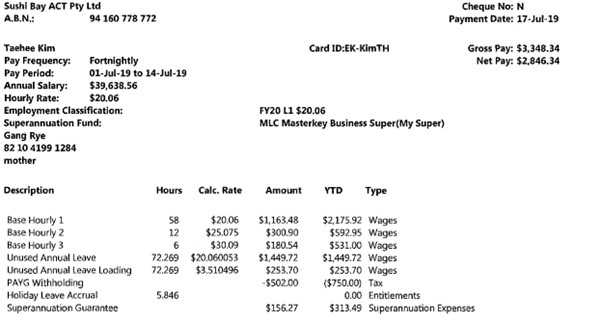
293 The “re-calculation” document represents that Taehee Kim was paid at the same rates as those recorded in the payroll advice. The relevant parts are extracted below:

294 The Total Hours Worked Spreadsheet for the same period, however, reveals that on weekdays Taehee Kim worked 83.5 hours rather than 58, 16.5 hours on Saturdays rather than 12 and 6.5 hours on Sundays rather than six. Moreover, the Pay Guide at the relevant time set the Base Cash Rate at $15.00 per hour for work on weekdays, $18.75 for Saturdays and $22.50 for Sundays, in contrast to the amounts recorded in the payroll advice of $20.06 per hour on weekdays, $25.075 on Saturdays, and $30.09 on Sundays.
295 As with the 2016 Records, the company’s conduct and knowledge is established by the conduct and knowledge of the members of the payroll team, Phillip Kim and/or Ms Shin. As the Ombudsman submitted, the evidence concerning Joseph Lee indicates that he, too, must have known that all the companies in the Sushi Bay Group paid employees in accordance with the payroll system. Phillip Kim deposed that Mr Lee was provided with a copy of the Pay Guide when it was approved by Ms Shin. The evidence discloses that Mr Lee was also involved in discussions between Ms Shin and the COO regarding employees’ wages and that he corresponded with the Ombudsman on behalf of Sushi Bay ACT in relation to the Ombudsman’s investigation into Sushi Bay ACT. Accordingly, Mr Lee must have known that employees were paid partly in cash and that that fact was not disclosed in the records he provided to the Ombudsman.
296 I therefore find that Sushi Bay ACT contravened s 535(4) of the FW Act as alleged. The effect of the representations was that the 2019 Audit Records represented that Sushi Bay ACT was paying the Audit Employees at hourly rates prescribed by the Restaurant Award for all hours worked when it was not. The hours and net amounts recorded for each pay period were incorrect and not in accordance with the Award. They were, to its knowledge, false and misleading.
297 On 16 September 2019, in response to the August 2019 NTP issued by FWI Mathias, Sushi Bay produced records which relevantly included:
(a) payroll advices in respect of Minha Hwang for the period 29 February 2016 to 14 July 2019, which purportedly recorded Mr Hwang’s hours of work, rates of remuneration, and gross and net amounts paid by Sushi Bay (Minha Payroll Advices);
(b) payroll advices in respect of Jihye Hwang for the periods 29 February to 19 June 2016, and 17 July 2017 to 9 September 2018, which purportedly recorded Mrs Hwang’s hours of work, rates of remuneration, and the gross and net amounts paid by Sushi Bay (Jihye Payroll Advices); and
(c) pay slips in respect of Mrs Hwang issued by Sushi Bay for the periods 29 February to 19 June 2016 and 17 July 2017 to 9 September 2018, which purportedly recorded the rates of remuneration paid, the gross and net amounts paid, and the hours worked by Mrs Hwang (Jihye Sushi Bay Pay Slips).
298 The records were attached to an email addressed to FWI Mathias from Kenneth Hong of H & H Lawyers, the respondents’ then solicitors.
299 On 18 October 2019, in response to a request by FWI Skeels for production of additional documents required under the August 2019 NTP, Sushi Bay produced to FWI Skeels the following documents:
(a) 13 pay slips in respect of Mrs Hwang issued by Auskobay for the period 20 June 2016 to 31 December 2016, which purportedly recorded the rates of remuneration paid, the gross and net amounts paid, and the hours worked by Mrs Hwang (Jihye Auskobay Pay Slips); and
(b) 90 pay slips in respect of Mr Hwang issued by Sushi Bay, which purportedly recorded the rates of remuneration paid, and the gross and net amounts paid for the period from, relevantly, 29 February 2016 to 14 July 2019 (Minha Pay Slips).
300 These documents were attached to an email from Dai Ueda of H & H Lawyers.
301 I shall refer to these records collectively, as the Ombudsman did, as the Hwang Records.
302 The Ombudsman pleaded that, in relation to the Minha Payroll Advices, the Jihye Payroll advices, the Jihye Sushi Bay Pay Slips and the Minha Pay Slips (collectively the Sushi Bay Hwang Records), Sushi Bay contravened:
(a) reg 3.44(1) of the FW Regulations by failing to ensure that each of the Sushi Bay Hwang Records made and kept during the period from 29 February 2016 to 14 September 2017 were not false or misleading to its knowledge; and
(b) s 535(4) of the FW Act by making and keeping the Sushi Bay Hwang Records in respect of the period 15 September 2017 to 14 July 2019 knowing they were false or misleading.
303 She also pleaded that Auskobay contravened:
(a) reg 3.44(1) of the FW Regulations by failing to ensure that the Jihye Auskobay Pay Slips made and kept during the period from 20 June to 31 December 2016 were not false or misleading to its knowledge; and
(b) reg 3.44(6) of the FW Regulations by making use of entries in the Jihye Auskobay Pay Slips by providing them to Mrs Hwang during the period from 20 June to 31 December 2016 knowing that the entries were false or misleading.
304 The Ombudsman alleged that each of the Hwang Records was false or misleading in a material particular because:
(a) to the extent they contained a record of hours worked, they recorded that:
(i) Mr or Mrs Hwang, as applicable, worked a different number of hours from those that they in fact worked; and/or
(ii) Mr Hwang did not work any overtime hours when Mr Hwang in fact worked overtime hours; and/or
(b) to the extent they contained a record of amounts paid, they failed to record any Cash Rates paid for Cash Hours worked or the Actual Deduction Amounts Mr Hwang paid back to Sushi Bay and therefore:
(i) they suggested that Sushi Bay and/or Auskobay was paying Award-compliant hourly rates to Mr and Mrs Hwang for all hours worked, when they were not; and
(ii) the gross and net amounts recorded for each pay period were incorrect.
305 For the following reasons I am satisfied that these allegations have been proved and the alleged contraventions were committed.
306 Mr Hwang was paid partly by EFT and partly in cash. Most fortnights, Sushi Bay would deposit the same amount into his bank account. The amount of cash wages he received would vary from fortnight to fortnight depending on the hours he worked.
307 The pay slips Mr Hwang received each fortnight and the payroll advices generated were not accurate because they only recorded his “taxable wage” and “taxable hours” and did not record the additional hours he worked that were paid in cash or the cash deductions he was required to pay back to Head Office. The pay slips and payroll advices also recorded higher hourly rates than the rates at which he was actually paid.
308 For example, the pay slip he received for the period 25 March to 7 April 2019 records that he worked 76 hours that fortnight. The corresponding payroll advice records the same hours. The Total Working Hours Spreadsheet for the same period, however, records that he worked 96.5 hours that fortnight. The pay slip and payroll advice record his net pay as $1,711.38, which matches the amount he received by EFT from Sushi Bay on 10 April 2019. While the pay slip and payroll advice record that his base hourly rate was $27.83, he was in fact paid at a lower hourly rate because his wages were paid at Cash Rates for an additional 15.50 weekday hours and five additional Saturday hours. The pay slips and payroll advices are false or misleading in that they do not record the cash payments he received or any of the deductions he was required to pay back.
309 This is a copy of the pay slip:
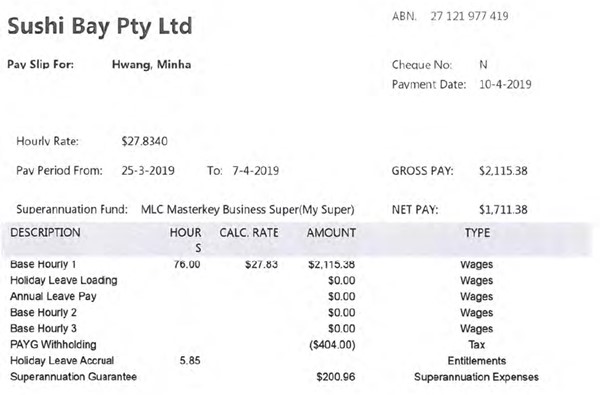
310 This is a copy of the payroll advice for the corresponding period.
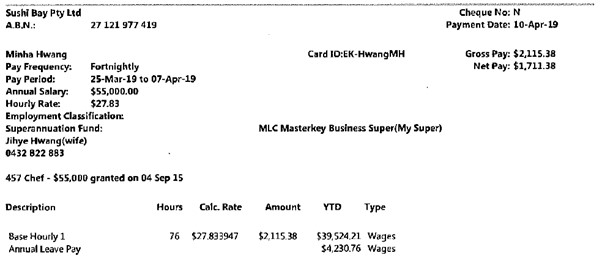
311 Mrs Hwang’s experience was the same.
312 When Mrs Hwang first started working for Sushi Bay each fortnight she received paper pay slips in the same envelope which contained the cash component of her wages. Later she received her pay slips by email. The pay slips were incorrect because they did not record all the hours she worked and because the amounts recorded reflected only what she received by bank transfer and did not disclose the cash amounts she received at the lower hourly “cash rate”.
313 When she first started working at the Campbelltown restaurant, Mrs Hwang was only paid in cash for the first month and that when she started at the Rouse Hill restaurant, she was paid in cash for the first week or two. After that, she received part of her wages by EFT and part in cash. That part of her wages which was paid by EFT corresponded to the amount recorded on the pay slips she received from Sushi Bay or Auskobay, as the case may be.
314 When she signed a new contract with Sushi Bay and Auskobay, Mrs Hwang was told to tick the “part-time” box on the form despite the fact that she was required to work full-time hours and usually worked 55 hours or more over five to six days a week.
315 The pay slip Mrs Hwang received from Auskobay for the period 20 June to 3 July 2016, for example, represented that she worked 40 hours that fortnight and received a net pay of $611.03 whereas the Total Hours Worked Spreadsheet for the same period records that she worked 97.5 hours. The relevant Pay Guide at this time set the Base Cash Rate at $16.00. Yet the base hourly rate recorded in the pay slip for “taxable hours” was said to be $18.47 and higher still for “taxable hours” on weekends.
316 Likewise, the payroll advices generated in respect of Mrs Hwang did not record her true total working hours, rates of pay, gross and net amount amounts she received from her employer, or the fact that she was partly paid in cash.
317 For these reasons, I am satisfied that the Hwang records were false or misleading.
318 I am also satisfied that their employers knew that these records were false or misleading.
319 As HR Manager, Phillip Kim knew that the payroll team generated pay slips which only recorded contracted fortnightly hours (or “taxable hours”) and “taxable wages”. His own pay slips did not include the cash component of his salary which he received during some fortnights up until February 2020 and pay slips for other employees which he would see from time to time similarly did not record the Cash Rates or cash amounts paid to those employees.
320 Mr Kim’s knowledge of the corporate respondents’ policies and practices, which I am satisfied on the evidence was shared by other members of the payroll team and senior officers, such as Daniel Oh, Joseph Lee and Ms Shin, is sufficient to establish knowledge on the part of Sushi Bay and Auskobay.
321 I therefore find that Sushi Bay contravened reg 3.44(1) of the FW Regulations by failing to ensure that each of the Sushi Bay Hwang Records made and kept during the period from 29 February 2016 to 14 September 2017 were not false or misleading to its knowledge and s 535(4) of the FW Act by making and keeping the Sushi Bay Hwang Records in respect of the period 15 September 2017 to 14 July 2019 knowing they were false or misleading.
322 I find that Auskobay contravened reg 3.44(1) of the FW Regulations by failing to ensure that the Jihye Auskobay Pay Slips made and kept during the period from 20 June to 31 December 2016 were not false or misleading to its knowledge.
323 Furthermore I find that Auskobay contravened reg 3.44(6) of the FW Regulations by making use of entries in the Jihye Auskobay Pay Slips when it provided them to Ms Hwang during the period from 20 June to 31 December 2016, knowing that entries concerning the hours she worked, her hourly rates of pay, and her net pay were false or misleading.
324 On 24 April 2020, FWI Skeels issued a notice to produce to MYOB. On 29 June 2020, in answer to that notice, MYOB produced the MYOB Records.
325 Each of the MYOB Records purported to record the rates of remuneration, the gross and net amounts paid, deductions made from gross amounts paid, hours worked, and loadings and penalty rates paid in respect of the Employees during the 457 Period.
326 The Ombudsman pleaded (at SOC/ASOC [77]) that, at least during the 457 Period, each of the corporate respondents contravened s 535(4) of the FW Act by making and keeping the respective MYOB Records knowing they were false or misleading .
327 The Ombudsman alleged (at [75]) that each of the MYOB Records was false or misleading in a material particular because:
(a) they recorded that the Employees worked less hours than those they in fact worked;
(b) they did not record any overtime hours worked by the Employees when the Employees worked overtime hours; and/or
(c) they each contained a record of amounts paid to the Employees which did not include the Cash Rates paid for Cash Hours worked and/or the Actual Deduction Amounts the 457 Employees paid back, meaning that:
(i) they suggested that the corporate respondents were each paying Award-compliant hourly rates to their respective Employees for all hours worked, when they were not; and/or
(ii) the gross and net amounts recorded in respect of the Employees for each pay period were incorrect.
328 These allegations were all denied by the corporate respondents.
329 I am satisfied that the allegations are made out. It is sufficient for present purposes to refer to the example given in the Ombudsman’s submissions. That relates to Mr Hwang. The misrepresentations made in his case are typical of those made in relation to the other corporate respondents which is unsurprising, given the centralised payroll system.
330 The payroll advice from MYOB for the fortnight 20 May 2019 to 2 June 2019 records Mr Hwang’s gross pay as $2,115.38 and his net pay as $1,711.38. It states that he worked 76 hours at “Base Hourly 1” for which he was paid $27.833947 per hour:
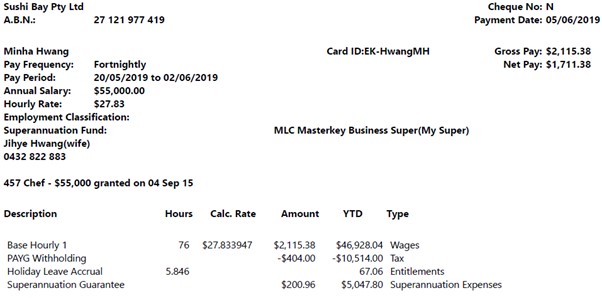
331 Yet, according to the Total Hours Worked Spreadsheet for the same period, in the first week of that fortnight Mr Hwang actually worked a total of 61.5 hours (44.50 hours during weekdays, six hours on the Saturday and 11 hours on the Sunday) and in the second week he worked a total of 58 hours (40.50 hours on the weekdays, 11.50 hours on the Saturday and six hours on the Sunday). That means that, rather than 76 hours that fortnight, he worked a total of 119.50 hours of which 85 were worked on weekdays, 17.50 hours were worked on Saturdays and 17 hours were worked on the Sundays).
332 This is an extract of the Total Hours Worked Spreadsheet:

333 Mr Hwang received by EFT wages for 52 hours worked during the weekdays, 12 hours during the Saturdays and 12 hours during the Sundays; and received in cash, wages for 33 hours worked on the weekdays, 5.50 hours worked on the Saturdays and 5 hours worked on the Sundays.
334 Misrepresentations of the same kind were made in the payroll advices made and kept by the other corporate respondents during the relevant period.
335 In each case, the payroll advices recorded hourly Award Rates for weekdays, weekends and (where relevant) public holidays and the corresponding gross and net pay for an employee’s so-called “taxable hours” when the Total Working Hours Spreadsheet disclosed that the employees in question often worked in excess of their “taxable hours” a fortnight. In each case, too, the payroll advices only recorded the amounts paid by EFT. They did not disclose the additional hours worked, the cash payments, or the deductions made from the gross salaries of employees who were sponsored on 457 visas.
336 Based on the evidence given by Phillip Kim and the documents to which I have referred, I find that the false or misleading representations made in the MYOB Records were made with his knowledge, the knowledge of all members of the payroll team, Ms Shin and her son. That evidence proves that each of the corporate respondents knew that the MYOB Records were false or misleading because each was aware of the centralised payroll system and its operation.
337 It follows that during the 457 Period each of the corporate respondents contravened s 535(4) of the FW Act by making and keeping the MYOB Records knowing that they were false or misleading.
Contraventions of s 536(3) of the FW Act
338 Section 536 of the FW Act prescribes an employer’s obligations with respect to pay slips. It relevantly provides that:
(1) An employer must give a pay slip to each of its employees within one working day of paying an amount to the employee in relation to the performance of work.
Note 1: This subsection is a civil remedy provision (see Part 4-1).
…
(2) The pay slip must:
(a) if a form is prescribed by the regulations– be in that form; and
(b) include any information prescribed by the regulations.
Note 1: This subsection is a civil remedy provision (see Part 4-1).
Note 2: If an employer fails to comply with subsection (1) or (2), the employer may bear the burden of disproving allegations in proceedings relating to a contravention of certain civil remedy provisions: see section 557C.
(3) An employer must not give a pay slip for the purposes of this section that the employer knows is false or misleading.
Note: This subsection is a civil remedy provision (see Part 4-1).
(4) Subsection (3) does not apply if the pay slip is not false or misleading in a material particular.
339 Subsections (3) and (4) were inserted by the Protecting Vulnerable Workers Amendment Act and therefore commenced on 15 September 2017.
340 The Ombudsman alleged (at SOC/ASOC [68]) that, in the period from 15 September 2017 to 14 July 2019, Sushi Bay contravened s 536(3) of the FW Act by giving Minha and Jihye Hwang pay slips knowing they were false and misleading.
341 On the basis of the findings made at [321] above, I find that the contraventions of s 536(3) of the FW Act are made out.
Contraventions of s 718A of the FW Act
342 Section 718A of the FW Act, which was also inserted by the Protecting Vulnerable Workers Amendment Act, provides that:
(1) A person must not give information or produce a document to the Fair Work Ombudsman, an inspector, or a person referred to in subsection 712AA(2), (the official) exercising powers or performing functions under, or in connection with, a law of the Commonwealth if the person knows, or is reckless as to whether, the information or the document:
(a) is false or misleading; or
(b) for information—omits any matter or thing without which the information is misleading.
Note 1: This subsection is a civil remedy provision (see Part 4‑1).
Note 2: Sections 137.1 and 137.2 of the Criminal Code create offences for providing false or misleading information or documents.
(2) Subsection (1) does not apply as a result of paragraph (1)(a) if the information or the document is not false or misleading in a material particular.
(3) Subsection (1) does not apply as a result of paragraph (1)(b) if the information did not omit any matter or thing without which the information is misleading in a material particular.
(4) Subsection (1) does not apply to a person who produces a document if the document is accompanied by a written statement signed by the person or, in the case of a body corporate, by a competent officer of the body corporate:
(a) stating that the document is, to the knowledge of the person, false or misleading in a material particular; and
(b) setting out, or referring to, the material particular in which the document is, to the knowledge of the person, false or misleading.
(5) Subsection (1) does not apply if, before the information was given or the document was produced by a person to the official, the official did not take reasonable steps to inform the person that the person may be liable to a civil remedy for contravening subsection (1).
(6) For the purposes of subsection (5), it is sufficient if the following form of words is used:
“You may be liable to a civil remedy for giving false or misleading information or producing false or misleading documents”.
343 “Inspector” means a Fair Work Inspector: FW Act, s 12.
344 FWI Mathias issued the August 2019 NTP to Sushi Bay under s 712 of the FW Act. Section 712 gives a Fair Work inspector the power to require a person, by notice, to produce a record or document to the inspector. Unless the person who is served has a reasonable excuse, a person who is served with a notice under s 712 must not fail to comply with the notice. The notice must be in writing; it must be served on the person; and it must require the person to produce the record or document at a specified place within a specified period of at least 14 days. The August 2019 NTP satisfied these requirements. It also satisfied the requirement in s 718A(5) by including the following warning:
You may be liable to a civil remedy under the Act for giving false or misleading information or producing false or misleading documents. It is also a serious offence under the Criminal Code (Cth).
345 The Ombudsman alleged (at SOC/ASOC [69]–[72]) that Sushi Bay contravened s 718A of the FW Act by producing the Minha Payroll Advices, Jihye Payroll Advices and the Jihye Sushi Bay Pay Slips on 16 September 2019 in response to the August 2019 NTP, knowing that each was false or misleading.
346 It follows from the findings at [307]–[321] above that this allegation is also made out. I so find.
Legislative requirements
347 Section 557A relevantly provides as follows:
Serious contravention of civil remedy provisions
(1) A contravention of a civil remedy provision by a person is a serious contravention if:
(a) the person knowingly contravened the provision; and
(b) the person’s conduct constituting the contravention was part of a systematic pattern of conduct relating to one or more other persons.
Note For the liability of bodies corporate for serious contraventions, see section 557B.
Example: Generally, subsection 323(1) requires an employer to pay an employee the full amount payable to the employee in relation to the performance of work.
A contravention of subsection 323(1) is a serious contravention if the employer knowingly does not pay the employee in full (even if the employer does not know the exact amount of the underpayment) and that contravention is part of a systematic pattern of conduct by the employer. The systematic pattern of conduct of the employer may relate to more than one employee and may consist of different contraventions.
Systematic pattern of conduct
(2) In determining whether the person’s conduct constituting the contravention of the provision was part of a systematic pattern of conduct, a court may have regard to:
(a) the number of contraventions (the relevant contraventions) of this Act committed by the person; and
(b) the period over which the relevant contraventions occurred; and
(c) the number of other persons affected by the relevant contraventions; and
(ca) the person’s response, or failure to respond, to any complaints made about the relevant contraventions; and
(d) except if the provision contravened is section 535—whether the person also contravened subsection 535(1), (2) or (4) by failing to make or keep, in accordance with that section, an employee record relating to the conduct constituting the relevant contraventions; and
(e) except if the provision contravened is section 536—whether the person also contravened subsection 536(1), (2) or (3) by failing to give, in accordance with that section, a pay slip relating to the conduct constituting the relevant contraventions.
(3) Subsection (2) does not limit the matters that a court may have regard to.
(4) Subsection 557(1) does not apply for the purposes of determining whether the person’s conduct was part of a systematic pattern of conduct.
(5) Subsection (4) does not otherwise affect the operation of subsection 557(1) in relation to serious contraventions of civil remedy provisions.
…
348 Section 557B provides:
Liability of bodies corporate for serious contravention
(1) For the purposes of subsection 557A(1), a body corporate knowingly contravenes a civil remedy provision if the body corporate expressly, tacitly or impliedly authorised the contravention.
(2) This section does not limit section 793.
349 These provisions were inserted into the FW Act by the Protecting Vulnerable Workers Amendment Act and so only apply to contraventions on or after 15 September 2017 when that Act commenced.
350 In effect, s 557B is a deeming provision in that it deems a body corporate to know that a civil remedy provision has been contravened if the body corporate authorised the contravention, whether expressly, implicitly or tacitly. In its ordinary meaning, to “authorise” an action or conduct is to sanction, formally approve or give permission for it. The word is relevantly defined in The New Shorter Oxford English Dictionary (4th ed, Clarendon Press, 1993) as to “[g]ive formal approval to; sanction, countenance” and in the 1981 and 2020 editions of the Macquarie Dictionary as “to give authority or legal power to; empower (to do something)” and “to give authority for; formally sanction (an act or proceeding)”.
351 The EM to the Protecting Vulnerable Workers Amendment Bill stated at [23]–[24]:
New subsection 557A(2) provides examples of the kinds of matters a court may have regard to in determining whether a person’s conduct constituting the contravention of the provisions was part of a systematic pattern.
The reference to a ‘systematic pattern of conduct’ is to a recurring pattern of methodical conduct or a series of coordinated acts over time. It does not encompass ad hoc or inadvertent conduct. A contravention is more likely to be considered part of a systematic pattern of conduct if:
• there are concurrent contraventions of the Fair Work Act occurring at the same time (e.g. breaches of multiple award terms and record-keeping failures);
• the contraventions have occurred over a prolonged period of time (e.g. over multiple pay periods) or after complaints were first raised;
• multiple employees are affected (e.g. all or most employees doing the same kind of work at the workplace, or a group of vulnerable employees at the workplace); and
• accurate employee records have not been kept, and pay slips have not been issued, making alleged underpayments difficult to establish.
352 The EM explained that these factors are only intended to be indicative and a serious contravention may still be established in the absence of one or more of them. That intention is evident from the plain words of s 557A(3).
The allegations
353 The Ombudsman’s case in this regard relates to the contraventions of s 45 (the award contraventions); s 325 (the unreasonable requirements to spend or pay contraventions); s 535(4) (with respect to the MYOB Records); and s 718A (the provision of the Hwang Records to FWI Mathias).
354 In summary, the Ombudsman pleaded that at all relevant times from 15 September 2017 (when these provisions commenced) and 26 January 2020 (when the Contravention Period ends) (the Serious Contravention Period), the corporate respondents knew that, by operating the payroll system according to the Dual Rate Method and Deduction Method, they did not pay the Employees the minimum rates prescribed by the Restaurant Award for all hours or work; did not pay them the correct penalty rates for working on Saturdays, Sundays or public holidays; and did not pay them overtime rates when they worked overtime. Consequently, she claims that they each knowingly engaged in the contraventions of s 535(4) of the Act by making and keeping the false or misleading MYOB Records and the various contraventions of s 45 which prescribe minimum rates, Saturday and Sunday rates, public holiday rates, and overtime rates. As against Sushi Bay and Auskoja the Ombudsman also claims that they knowingly engaged in the contraventions of s 325 and, in relation to Sushi Bay, in the contraventions of s 718A.
355 In particular, the Ombudsman pleaded (at SOC/ASOC [178]) that at all relevant times during the Serious Contravention Period each of the corporate respondents knew that:
(1) the Restaurant Award applied to it and the Employees;
(2) the Restaurant Award contained rates of pay it was required to pay the Employees for the performance of work, which included minimum rates, casual rates, weekend and public holiday penalties, and overtime rates;
(3) the Employees were paid and employment records created in accordance with the payroll system such that the Dual Rate Method operated in relation to the payment of wages to the Dual Rate Employees and the Deduction Method operated in relation to the payment of wages to the 457 Employees;
(4) the Total Hours Worked Spreadsheets accurately recorded the hours actually worked by the Employees;
(5) the Deductions Spreadsheets accurately recorded the amounts actually paid to the 457 Employees and the Actual Deduction Amounts that the 457 Employees were required to pay back in accordance with the Deduction Method;
(6) it made and kept records in accordance with the payroll system, including the MYOB Records, which did not include all hours worked by, or all amounts paid to, the Employees;
(7) the MYOB Records were false and misleading; and
(8) (as a consequence of the operation of the payroll system), it paid the Dual Rate Employees for some, but not all, hours they worked each fortnight in accordance with the Award Rates for the classifications it assigned to them and Cash Rates for all other hours worked, being the Cash Hours, which were less than the Award Rates.
356 The Ombudsman additionally pleaded (at SOC/ASOC [179]) that at all material times Sushi Bay also knew that:
(1) Minha Hwang and the Sushi Bay 457 Employees were paid in accordance with the Deduction Method and required to pay back the Actual Deduction Amounts;
(2) as a consequence of the payroll system and the Deduction Method, it paid Mr Hwang and the Sushi Bay 457 Employees below Award Rates for the first 76 hours each fortnight by calculating and paying them according to a lower classification under the Restaurant Award than that which was applicable to their role and duties and/or by deducting certain payroll costs for these hours, and the Cash Rates for all other hours worked; and
(3) the Minha Payroll Advices, Jihye Payroll Advices and Jihye Sushi Bay Pay Slips it produced to FWI Mathias on 16 September 2019 were false or misleading.
357 The Ombudsman also pleaded (at SOC/ASOC [180]) that at all material times Auskoja knew that:
(1) the Auskoja 457 Employees were paid in accordance with the Deduction Method and were required to pay back the Actual Deduction Amounts; and
(2) as a result of the payroll system and the Deduction Method, the Auskoja 457 Employees were paid below Award Rates for the first 76 hours each fortnight because they were paid according to a lower classification under the Restaurant Award than that which was applicable to their roles and duties and/or by deducting certain payroll costs for these hours, and because they were paid Cash Rates for all other hours worked.
358 The Ombudsman pleaded (at [181]) that, consequently, at all relevant times during the Serious Contravention Period each of the corporate respondents knew that it did not pay its Employees the minimum rates for all hours of work; the correct penalty rates for work performed on Saturdays, Sundays or public holidays; and overtime rates for overtime work performed.
359 She alleged (at [182]–[189]) that the corporate respondents expressly or, alternatively, tacitly or impliedly, authorised the Serious Contraventions pleaded against them and, if not, that they knowingly engaged in them (at [190]).
360 She claimed (at [191]–[194]) that the contraventions were part of a systematic pattern of conduct relating to numerous people over a period of time ranging from three months to several years.
361 Two questions arise: first, whether the corporate respondents knowingly contravened the relevant provisions and second, whether the conduct constituting the particular contraventions was part of a systematic pattern of conduct relating to one or more other persons.
Consideration
362 Each of these questions must be resolved in the affirmative.
363 First, as I observed above at [93] and following, each of the corporate respondents made admissions in the Defence about the operation of the Dual Rate Method and the Deduction Method. They also admitted that they determined in concert, and made and kept records of, the Employees’ status and purported classifications under the Restaurant Award, the Award Hours and Award Rates each Employee would be paid according to their classification and the Base Cash Rate and Cash Hours each Employee would be paid for hours worked in excess of their Award Hours in a fortnight (at SOC/ASOC [22]). Moreover, they admitted that the payroll team created the Total Hours Worked Spreadsheets and recorded their actual working hours, the prescribed number of Award Hours, and how the actual hours worked were to be apportioned and paid as Award Hours and Cash Hours (at [27]). Further, they admitted that the MYOB Records were created to record payments made to the Employees (at [31(e)] and [34]).
364 Second, the undisputed evidence of Phillip Kim, read with the contemporaneous documents, is sufficient to establish to the requisite standard that each of the corporate respondents knew that they were contravening the relevant provisions as his knowledge is enough to establish the corporate respondents’ knowledge (FW Act, s 793).
365 The overwhelming inference to be drawn from the evidence is that other senior employees and officers of the corporate respondents must also have known of, if not also sanctioned, those contraventions when they occurred.
366 Phillip Kim was responsible for preparing and updating the Pay Guides from as early as November 2015. He admitted he knew that the Restaurant Award prescribed minimum wages, casual rates, weekend and public holidays and overtime rates for employees of the Sushi Bay Group. He consulted the Award when formulating “suggested rates”. Since he discussed the Pay Guides with the COO and the Guides were approved by Ms Shin, I find that Daniel Oh, Mr Shin and Ms Shin also knew of these matters. In addition, Mr Lee knew of these matters as he was responsible for sharing the Pay Guides with the payroll team and would direct the payroll team in the administration of the centralised payroll system. Mr Kim was aware that many employees worked long hours, including from opening to closing times, that the restaurants were open seven days a week and most public holidays and that employees would work weekends and public holidays. Mr Kim knew that the Cash Rates paid for hours worked in excess of “taxable hours” were below the Award rates, as the Pay Guides required.
367 Since the Pay Guides distinguished between Award Rates and Cash Rates, which were invariably below the Award Rates, I find that at all material times each of Ms Shin, Mr Kim, Daniel Oh, Mr Shin and Mr Lee knew that the Restaurant Award applied to the corporate respondents; that it contained rates of pay it was required to pay their employees for the performance of work including minimum rates, casual rates, weekend and public holiday penalties and overtime rates; that their employees were paid and employment records created in accordance with the payroll system such that the Dual Rate Method operated in relation to the payment of wages to the Dual Rate Employees; and that they paid the Dual Rate Employees for some, but not all, hours they worked each fortnight in accordance with the hours worked and Cash Rates for the Cash Hours which were less than the Award Rates.
368 The knowledge of these matters possessed at least by Ms Shin and Mr Oh predates the contravention period. In addition, as mentioned above at [41], Ms Shin, Mr Shin and Mr Lee (among others) participated in workplace relations training in October 2019, which included training on the FW Act, NES, Restaurant Award (including classifications, minimum rates, allowances, penalty rates and overtime), record keeping obligations, and serious contraventions under the FW Act.
369 Mr Kim’s uncontradicted evidence was that the Sushi Bay Group had a policy requiring employees who were sponsored for 457 visas to return part of their wages during some pay periods and that the policy was decided in a meeting attended by Ms Shin and Daniel Oh. I therefore find that Sushi Bay and Auskoja knew that the Deduction Method operated in relation to the payment of wages to the 457 Employees, that they were paid in accordance with the Deduction Method and were required to repay the Actual Deduction Amounts, and that they were paid below Award Rates.
370 The corporate respondents admitted that the Deductions Spreadsheets accurately recorded the amounts paid to the 457 Employees and the amounts they were required to pay back in accordance with the Deduction Method.
371 Mr Kim also deposed that the Total Working Hours Spreadsheets were accurate records of the hours employees worked and that he knew from his own observations that pays slips created by the payroll department only recorded the contracted fortnightly hours for full-time employees (76 hours) and part-time employees (40 hours) (the “taxable hours”) and “taxable wages” but did not include the Cash Rates or the cash amounts paid. To the extent that the payroll department generated other records which failed to disclose the actual hours worked and the total wages paid (such as the payroll advices, payroll reports and pay slips) the employees in that Department responsible for populating those records must have known that they were inaccurate and the knowledge of any of them is sufficient to prove knowledge on the part of the corporate respondents.
372 I therefore find that the corporate respondents knew that the MYOB Records made and kept in accordance with the payroll system did not include all hours worked by, or all amounts paid to, the Employees and that the Hwang Records produced to FWI Mathias on 16 September 2019 were false or misleading.
373 Third, in each case the contravening conduct was part of systematic pattern of conduct in that it occurred over a period of time (ranging from three months in the case of Sushi Bay ACT to nearly four years in the case of Sushi Bay) and involved contraventions of multiple civil remedy provisions, in multiple respects, and in relation to multiple employees. It was the result of a calculated and institutional effort to avoid the corporate respondents’ legal obligations and conceal their wrongdoing.
374 Section 550(1) of the FW Act provides that a person who is involved in a contravention of a civil remedy provision of the Act is taken to have contravened that provision. Section 550(2) defines the circumstances in which a person is involved in a contravention. It provides that:
A person is involved in a contravention of a civil remedy provision if, and only if, the person:
(a) has aided, abetted, counselled or procured the contravention; or
(b) has induced the contravention, whether by threats or promises or otherwise; or
(c) has been in any way, by act or omission, directly or indirectly, knowingly concerned in or party to the contravention; or
(d) has conspired with others to effect the contravention.
375 Section 557A(5A) provides that:
A person (the involved person) who is involved in a contravention of a civil remedy provision by another person (the principal) commits a serious contravention of the provision only if:
(a) the principal’s contravention was a serious contravention; and
(b) the involved person knew that the principal’s contravention was a serious contravention.
376 I take it that the legislative intention was that an involved person will only commit a serious contravention if they knew both that the contravention was committed knowingly and that the conduct constituting the contravention was part of a systematic pattern of conduct relating to one or more other persons. That interpretation is supported by the available extrinsic material.
377 According to the Supplementary Explanatory Memorandum on the Protecting Vulnerable Workers Amendment Bill (Supplementary EM) at [11], the purpose of s 557A(5) was “to clarify how a person ‘involved in’ the contravention of a civil remedy provision (accessory) by the principal wrongdoer (principal) may be penalised for a ‘serious contravention’”. It went on to explain at [14]–[15] that:
The accessory is subject to the higher penalties for serious contraventions in these circumstances because their conduct (that is, their involvement in the underlying contraventions) is more serious: they were knowingly involved in contraventions by the principal, which they knew to be both deliberate and systematic at the time they occurred.
This approach is broadly consistent with the current approach to accessorial liability under section 550 of the Fair Work Act. In general this requires the alleged accessory to have participated in the contravention to some degree (see section 550), and also have had knowledge of the ‘essential elements’ of the contravention.
378 The Supplementary EM also pointed out at [16] that:
For accessorial liability, there is a two-step process. First the accessory must be found to have been ‘involved in’ the contravention in the usual way (see section 550). Second it must be established on the balance of probabilities that the accessory additionally knew they were involved in a serious contravention by the principal at the relevant time (see proposed subsection 557A(5A)).
The allegations
379 The Ombudsman pleaded (at SOC/ASOC [196]–[213]) that Ms Shin was involved in the contraventions, including the serious contraventions, by relevant corporate respondents of regs 3.44(1) and 3.44(6) with respect to the 2016 Records; the contraventions of ss 325 and 45 (save for the failure to pay annual leave loadings); and the serious contraventions relating to the contraventions of ss 325 and 45 in that through her acts or omissions, she aided, abetted, counselled, procured and/or was directly or indirectly knowingly concerned in or party to the contraventions.
380 The terms and expressions aiding, abetting, counselling, procuring and knowingly concerned are drawn from the criminal law. As I observed in DTF World Square at [250], the words “aiding” and “abetting” are synonyms. They both mean helping, assisting or encouraging: Australian Securities and Investments Commission v Somerville (2009) 77 NSWLR 110 at [41] (Windeyer AJ). A person “counsels” the commission of a contravention if the person urges or advises its commission: see Stuart v The Queen (1974) 134 CLR 426 at 445 (Gibbs J, with whom Mason J agreed); MKP Management Pty Ltd v Shire of Kalamunda [2020] WASCA 130; 285 A Crim R 1 at [91] (Buss P, Mazza and Vaughan JJA) and the other cases referred to there. “Procuring” means taking action to bring about the result: Somerville at [41]. Thus, a person “procures” a contravention if the person causes the contravention to be committed, persuades the principal to commit the contravention, or brings about its commission: Western Australia v Burke (No 3) [2010] WASC 110 at [19] (Murray J).
381 To participate in a contravention and therefore be concerned in it, the person must have engaged in conduct which implicates or involves her or him in the contravention or “assents to or concurs in the conduct which constitutes the contravention”, so that there is a “practical connection” between the person and the contravention: Qantas Airways Ltd v Transports Workers’ Union of Australia [2011] FCA 470; 280 ALR 503; 211 IR 1 at [324]–[325] (Moore J), Leighton Contractors Pty Ltd v Construction, Forestry, Mining and Energy Union [2006] WASC 144; 154 IR 228 at [29] (Le Miere J). See also Construction, Forestry, Mining and Energy Union v Clarke [2007] FCAFC 87; 164 IR 299 at [26] (Tamberlin, Gyles and Gilmour JJ). It is unnecessary, however, that the person physically do anything to bring about the contravention if, by their statements and with their agreement what they said and agreed to do became associated with the conduct constituting the contravention: Leighton Contractors at [29] citing R v Tannous (1987) 10 NSWLR 303 at 308 (Lee J, Street CJ and Finlay J agreeing at 304 and 310).
382 To be liable, whether by aiding, abetting, counselling or procuring, a putative accessory must intentionally participate in the contravention, which means that the person must know “the essential matters” that go to make up the events: Yorke v Lucas (1984) 158 CLR 661 at 667 (Mason ACJ, Wilson, Deane and Dawson JJ); 676 (Brennan J).
383 To be knowingly concerned in a statutory contravention, the person must have been an intentional participant with knowledge, at the time of contravention, of the essential elements constituting it: Yorke v Lucas at 670 (Mason ACJ, Wilson, Deane and Dawson JJ).
384 It is not necessary, however, that the person also knows that the elements amount to a contravention: Yorke v Lucas at 667. Put another way, a person may be an accessory without knowing that the conduct in which they are involved is unlawful: Australian Competition and Consumer Commission v Giraffe World Australia Pty Ltd (No 2) (1999) 95 FCR 302 at [186] (Lindgren J).
385 Constructive or imputed knowledge is not enough; actual knowledge is required. But actual knowledge may be inferred from “exposure to the obvious”: Giorgianni v The Queen (1985) 156 CLR 473 at 507–8 (Wilson, Deane and Dawson JJ). Consequently, “a combination of suspicious circumstances and failure to make inquiry may sustain an inference of knowledge of the actual or likely existence” of the matter in question: Pereira v Director of Public Prosecutions [1988] HCA 57 at [11]; 35 A Crim R 382 at 385; 63 ALJR 1 at 3; 82 ALR 217 at 220 (Mason CJ, Deane, Dawson, Toohey and Gaudron JJ).
386 Knowledge of a system which produces particular outcomes which constitute contraventions is sufficient to establish knowledge of contravening conduct. It is unnecessary to prove that an alleged accessory knew the details of each particular instance of contravening conduct. See EZY Accounting 123 Pty Ltd v Fair Work Ombudsman [2018] FCAFC 134; 360 ALR 261; 282 IR 86 at [34] (Flick, Bromberg and O’Callaghan JJ).
387 In her Statement of Agreed Facts, Ms Shin admitted all the contraventions pleaded against the corporate respondents in which she was alleged to have been involved, but she made few admissions about her own involvement.
388 She admitted that during the period from 29 February to 27 March 2016 and on 2 May 2016 (when the 2016 Records were produced to FWI Reid), the 2016 Records were made and/or kept by Sushi Bay ACT and the operation of the payroll system was such that Sushi Bay ACT was paying the 2016 Employees at Cash Rates for some hours worked.
389 Ms Shin also admitted that at all material times during the Contravention Period (from 29 February 2016 to 26 January 2020) she personally received five payments of Actual Deduction Amounts and signed records of receipt of the Actual Deduction Amounts.
390 She also admitted that at all material times during the Contravention Period she knew that the Restaurant Award applied to each of the corporate respondents and their employees and that the corporate respondents did not pay the Employees at rates set by the Restaurant Award for all hours worked.
391 That said, some of the admissions Ms Shin made in her Statement of Agreed Facts to the contraventions by the corporate respondents included admissions relevant to her involvement. They include her admissions that:
(1) she was the sole director and shareholder of the Sushi Bay Group of companies all of which were managed out of Head Office ([2](f)(i));
(2) she was the sole signatory on the bank accounts held by each of the corporate respondents ([6](c));
(3) she consented to a statement of agreed facts in the 2017 Proceeding admitting to her involvement in, and therefore contraventions of, s 45 of the FW Act by failing to pay minimum adult and junior rates required by cl 20 of the Restaurant Award; failing to pay casual loadings required by cl 13.1 of the Restaurant Award; failing to pay penalty rates on Saturdays, Sundays and public holidays as required by cl 34.1 of the Restaurant Award; and contraventions of s 535(1) of the FW Act by failing to make and keep records of the kind prescribed by the FW Regulations ([38]);
(4) the 2016 Records were records Sushi Bay ACT was required to make and keep pursuant to s 535(1) of the FW Act and they were each false or misleading because they recorded the 2016 Employees worked different total hours from those they in fact worked; recorded that they did not work any overtime hours when they in fact worked regular overtime hours; and did not record the cash amounts paid to them for additional hours worked so that they suggested Sushi Bay ACT was paying Award-compliant hourly rates to the Audit Employees for all hours worked when it was not; and the gross and net amounts recorded for each pay period were incorrect ([42]–[43]);
(5) Sushi Bay ACT made use of entries in the 2016 Records by providing them to FWI Reid in response to the April NTP ([44]);
(6) the requirement for the 457 Employees to spend or pay the Actual Deduction Amounts was both unreasonable in the circumstances and for the direct or indirect benefit of the corporate respondents ([48]);
(7) each of the corporate respondents contravened s 45 of the FW Act by failing to pay minimum adult and junior rates required by cll 20, 12.8 (later cl 12.10) and 15.1 of the Restaurant Award; failing to pay casual loadings required by cl 13.1 of the Restaurant Award; failing to pay penalty rates on Saturdays, Sundays and public holidays as required by cl 34.1 of the Restaurant Award ([50]–[137]); and
(8) the documents produced to FWI Reid on 2 May 2016 were submitted under cover of a letter dated 2 May 2016 which she signed.
Consideration
392 Based on Phillip Kim’s unchallenged and uncontradicted evidence, I make the following findings.
393 Between 2007 to 2009, Mr Kim spoke to Ms Shin approximately two to three times per week, usually when she attended daily management meetings or one-on-one meetings with Mr Kim. From 2016 onwards, he attended a meeting with Ms Shin approximately once a week. Ms Shin would give instructions to Mr Kim and other members of the management team during management meetings conducted at Head Office (including KPIP meetings). Between 2016 and April 2020, Mr Kim continued to report directly to Ms Shin and would exchange short messages with her when necessary for approval or direction on a particular issue.
394 In addition, between 2008 to 2017, Mr Kim and other managers provided Ms Shin with “daily reports” that were sent to her via email. Mr Kim was responsible for preparing these reports which were a compilation of individual reports from various departments and restaurants. If Ms Shin was asked to make a decision in a daily report, she would inform Mr Kim of her decision via email or over the phone and he would inform the relevant person. From 2016 onwards, the daily reports were also prepared by other managers working at Head Office.
395 Ms Shin was the only person who had final authority to make decisions about the operations, policies, and practices that were applied across the Sushi Bay Group. She had ultimate responsibility for all wage and expense-related decisions. This included setting employees’ rates of pay and the operation of the payroll system on the basis of the Dual Rate Method and the Deduction Method. In particular, Ms Shin approved the policy of applying the “pay back condition” in respect of the 457 Employees. She was the only one with authority to sign documents to be sent to the Department of Immigration. Important decisions regarding wages, vacancies, contracts, and pay rates had to be discussed with Ms Shin. For example, before the end of each financial year, Mr Kim sought Ms Shin’s approval to update the pay rates, specifically the “taxable” and “cash” components of employees’ wages. The 2017 Operational Guidelines expressly required CEO approval in reviewing wages and bonus payments. Ms Shin approved the Pay Guides which prescribed the different rates to be paid for Award Hours and Cash Hours respectively. Ms Shin also approved the Working Hours Policy laid down in the Operational Guidelines that was used by the corporate respondents to calculate the amounts paid to employees for different hours work. Ms Shin had the final say on the contents of the Operational Guidelines.
396 Ms Shin sent and received emails that evidence her knowledge of the payroll system and its effects. On 26 April 2017, for example, she received an email concerning the Dual Rate Method in which Joseph Lee stated that it “results in an hourly rate that is much lower than the minimum wage”. And on 20 December 2017, Mr Lee sent Ms Shin an email attaching an internet banking report which included a summary of wages paid by corporate respondents to employees via EFT and a separate Excel spreadsheet entitled “CashWage” which recorded the total amounts paid. On 22 December 2018, she forwarded a generic email from the Ombudsman relating to amendments to the FW Regulations to acct@sushibay.com.au, which was the email address used by Mr Lee.
397 As the sole director and CEO, Ms Shin was responsible for ensuring that the corporate respondents complied with their obligations under the FW Act and Regulations. When issues relating to compliance with the FW Act or Regulations arose, the procedure was for restaurant managers to report to Mr Kim (or another member of the management team) who would then report the matter to Ms Shin. Ms Shin was in charge of any issues relating to legal matters, including investigations by the Ombudsman. Ms Shin was also copied into correspondence in relation to employee complaints. For example on 30 July 2019, Mr Kim sent an email to Sol Shin, copying Ms Shin, advising them that Mr and Mrs Hwang had made a complaint about unpaid wages and entitlements.
Was Ms Shin involved in the contraventions of reg 3.44(1) and 3.44(6)?
398 It will be recalled that reg 3.44(1) imposed an obligation on an employer to ensure that a record the employer is required to keep under the Act or Regulations is not false or misleading to the employer’s knowledge and that reg 3.44(6) imposes an obligation on a person not to make use of an entry in an employee record made and kept by an employer knowing that the entry is false or misleading. The contraventions of these provisions relate to the 2016 Records which Ms Shin admitted Sushi Bay ACT was required to make and keep and which she produced to FWI Reid on 2 May 2016 in response to the April 2016 NTP. I found that the 2016 Records were false and misleading because they recorded different hours from those the 2016 Employees worked; represented that the 2016 Employees did not work any overtime hours when they in fact worked regular overtime hours; and did not record the cash amounts paid to the 2016 Employees so that the gross and net amounts appearing in the 2016 Records were incorrect.
399 Without doubt Ms Shin was involved in these contraventions.
400 Since it was Ms Shin who provided the 2016 Records to FWI Reid without pointing out the errors and misrepresentations and the 2016 Records reflected the payroll system featured in the Pay Guides she approved, she intentionally participated in Sushi Bay ACT’s contraventions of both provisions and must have known that the 2016 Records were false or misleading for the reasons alleged and found.
401 It follows that Ms Shin at least aided and abetted and was knowingly concerned in the contraventions by Sushi Bay ACT of regs 3.44(1) and 3.44(6).
Was Ms Shin involved in the award contraventions (s 45)?
402 The Ombudsman submitted that it is unnecessary to prove that an alleged accessory knew of the existence or content of the relevant industrial instrument. There is a divergence of opinion in the authorities in this Court about the extent of knowledge required, such as whether the alleged accessory must have known that the particular award that was contravened applied to the relevant employees. I have expressed my own views on the subject, most recently in DTF World Square at [258]–[263].
403 In the present case, however, it does not matter which view is correct because, as she admitted, Ms Shin had actual knowledge that the Restaurant Award applied to the corporate respondents and their employees throughout the Contravention Period. The evidence also shows that she even knew of the relevant clauses which were contravened and had that knowledge at least from the time of her dealings with the Ombudsman in 2014 and 2015. Ms Shin also admitted that she knew the corporate respondents did not pay the Employees at rates set by the Restaurant Award.
404 Ms Shin effectively admitted that she was involved in all the relevant contraventions of s 45. Having regard to her position as sole director and CEO and the role she played in fixing wage rates, I find that she aided and abetted, counselled or procured, and was knowingly concerned in, these contraventions.
Was Ms Shin involved in the contraventions of s 325?
405 Ms Shin was also involved in the contraventions of s 325 because she approved the policy of applying what Mr Kim referred to as the “pay back condition” in respect of employees on 457 visas and she personally received payments of Actual Deduction Amounts during the relevant periods.
406 I therefore find that she was at least knowingly concerned in these contraventions and aided and abetted, if not also counselled and procured, them.
Was Ms Shin involved in the serious contraventions?
407 Ms Shin made no admissions about her involvement in these contraventions. She merely admitted that the contraventions of ss 325 and 45 in which she was alleged to have been involved were all serious contraventions within the meaning of s 557A of the FW Act. The question for determination is whether Ms Shin knew that the relevant contraventions were serious contraventions.
408 In relation to the contraventions of s 325, the period of the contraventions is from 6 May 2019 to 26 January 2020 in the case of Sushi Bay (SOC/ASOC Annexure B Table 1) and 6 May to 3 November 2019 in the case of Auskoja (SOC/ASOC Annexure B Table 2). And in relation to s 45, the contraventions span the entire Contravention Period.
409 As I indicated above, to establish that Ms Shin was involved in the serious contraventions the Ombudsman must prove that Ms Shin knew the relevant contraventions were committed knowingly and that the conduct constituting the contravention was part of a systematic pattern of conduct relating to one or more other persons.
410 There is no room for doubt that Ms Shin knew that the contraventions of s 325 were committed knowingly and that the conduct constituting the contraventions was part of a systematic pattern of conduct. She knew herself from the payments she received from certain 457 Employees which were paid directly into her account and for which she signed. As I mentioned earlier, that occurred on at least five occasions, as she admitted in her Statement of Agreed Facts at [156]. She would also have known that these were not isolated instances. Even if she did not devise the cash back policy or condition, it could not have been enforced without her approval.
411 As the sole director and shareholder of the two companies Ms Shin was their “directing mind and will” (Tesco Supermarkets Ltd v Nattrass [1972] AC 153 at 171 per Lord Reid); “the very ego and centre” of the companies’ personalities: Lennard’s Carrying Company Ltd v Asiatic Petroleum Company Ltd [1915] AC 705 at 713. In other words, her knowledge was their knowledge.
412 Having regard to her position and her extensive involvement in their businesses as described by Phillip Kim in particular, I find that Ms Shin knew that the corporate respondents knowingly contravened ss 45 and 325 in that those respondents knew the essential elements giving rise to the contraventions. Once again, her knowledge is their knowledge. The payroll system would not have operated without her approval. It is evident that she knew that the underpayment of the relevant employees was part of a systematic pattern of conduct.
413 By 17 October 2019, when she undertook training as required by the orders made by the FCCA, if not earlier, Ms Shin must also have known that these contraventions were “serious contraventions”.
414 I am fortified in reaching all the conclusions concerning Ms Shin’s involvement in the various contraventions of the FW Act and Regulations by her failure to give evidence. I infer that there was nothing that she could say that would assist her case.
415 I find that Ms Shin was involved in the serious contraventions of ss 325 and 45 as alleged.
416 It follows that Ms Shin is taken to have committed all the contraventions alleged against her.
417 The Ombudsman has made out all her allegations, save in relation to the classification of one employee (Soojin (Jinnie) Kim).
418 The matter should now proceed to a hearing on relief. In the meantime, the Ombudsman should file and serve a document setting out declarations and orders to give effect to these reasons. Ms Shin, as the only active respondent, will have an opportunity to respond. I will make orders to facilitate this.
I certify that the preceding four hundred and eighteen (418) numbered paragraphs are a true copy of the Reasons for Judgment of the Honourable Justice Katzmann. |
Associate:
Dated: 14 February 2024
ANNEXURE A – DETAILS OF EMPLOYEES
Table 1: Employee Details – First Respondent (Sushi Bay Employees)
Column A | Column B | |
Name | Assessment period | |
457 Employees | ||
1. | Hwang, Minha | 29/02/2016 to 14/07/2019 |
2. | Byeun, SungTaek | 06/05/2019 to 26/01/2020 |
3. | Choi, Gobong | 06/05/2019 to 26/01/2020 |
4. | Choi, Sangyoung | 06/05/2019 to 26/01/2020 |
5. | Do, Joohyun | 06/05/2019 to 26/01/2020 |
6. | Hur, Arom | 06/05/2019 to 26/01/2020 |
7. | Hwang, Sojung | 06/05/2019 to 26/01/2020 |
8. | Jeon, Hyun Seok | 06/05/2019 to 26/01/2020 |
9. | Jeong, Eun Joo | 06/05/2019 to 26/01/2020 |
10. | Jung, Haesuk | 06/05/2019 to 26/01/2020 |
11. | Kim, Gahee | 06/05/2019 to 26/01/2020 |
12. | Kim, Hyeyoung | 06/05/2019 to 26/01/2020 |
13. | Kim, Kitae | 06/05/2019 to 26/01/2020 |
14. | Kim, Minji | 06/05/2019 to 26/01/2020 |
15. | Kim, Soojin (Jinnie) | 06/05/2019 to 26/01/2020 |
16. | Kwon, Hye Seong | 06/05/2019 to 26/01/2020 |
17. | Lee, Jong Soon | 06/05/2019 to 26/01/2020 |
18. | Lee, Won Hyeok | 06/05/2019 to 26/01/2020 |
19. | Lim, Jonghyuk | 06/05/2019 to 26/01/2020 |
20. | Ma, Suji | 06/05/2019 to 26/01/2020 |
21. | Mok, Junga | 06/05/2019 to 26/01/2020 |
22. | Yang, Jiyoung | 06/05/2019 to 26/01/2020 |
23. | Yi, Do Kyoung | 06/05/2019 to 26/01/2020 |
24. | Hwang, Jihye | 29/02/2016 to 19/06/2016 |
29/06/2017 to 09/09/2018 | ||
25. | Bae, Yujeong | 20/01/2020 to 26/01/2020 |
26. | Baek, Keonwoo | 18/11/2019 to 26/01/2020 |
27. | Chen, Hsuan-Chi | 21/10/2019 to 26/01/2020 |
28. | Cho, Hyewon | 21/10/2019 to 26/01/2020 |
29. | Choi, Donggeun | 04/11/2019 to 10/11/2020 |
30. | Choi, Solie | 11/11/2019 to 26/01/2020 |
31. | Feng, Wei (Ruby) | 21/10/2019 to 26/01/2020 |
32. | Garcia, Gideon-Grant Cayabas | 21/10/2019 to 26/01/2020 |
33. | Gong, Sang Su | 21/10/2019 to 26/01/2020 |
34. | Han, Jihye | 21/10/2019 to 26/01/2020 |
35. | Hwang, Yeji | 21/10/2019 to 26/01/2020 |
36. | Jeong, Siyun | 21/10/2019 to 26/01/2020 |
37. | Kang, Seyeon | 21/10/2019 to 29/12/2020 |
38. | Kang, Sumin | 21/10/2019 to 03/11/2020 |
39. | Kim, Ji Eun | 21/10/2019 to 26/01/2020 |
40. | Kim, Dongkyung | 21/10/2019 to 26/01/2020 |
41. | Kim, Geonwoo | 06/01/2020 to 26/01/2020 |
42. | Kim, Hwa Yeong | 21/10/2019 to 26/01/2020 |
43. | Kim, Jihyun | 21/10/2019 to 26/01/2020 |
44. | Kim, Yujin | 21/10/2019 to 17/11/2019 |
18/01/2020 to 26/01/2020 | ||
45. | Ko, Kwangsoon | 21/10/2019 to 26/01/2020 |
46. | Lee, Hoguk | 04/11/2019 to 17/11/2019 |
18/11/2019 to 29/12/2019 | ||
47. | Lee, Jaeho | 21/10/2019 to 17/11/2020 |
18/11/2019 to 26/01/2020 | ||
48. | Lee, Jihye | 21/10/2019 to 26/01/2020 |
49. | Lee, Jisu | 13/01/2020 to 26/01/2020 |
50. | Lee, Jongbeom | 21/10/2019 to 26/01/2020 |
51. | Lee, Minju | 21/10/2019 to 26/01/2020 |
52. | Lee, Pyeonghwa | 06/01/2020 to 26/01/2020 |
53. | Lee, Yeeun | 06/01/2020 to 26/01/2020 |
54. | Lileth, Capa | 04/11/2019 to 26/01/2020 |
55. | Oh, Changseung | 21/10/2019 to 17/11/2019 |
18/11/2020 to 26/01/2020 | ||
56. | Park, Jihyeok | 06/01/2020 to 26/01/2020 |
57. | Park, SeoJung | 28/10/2019 to 26/01/2020 |
58. | Permatasari, Lin | 21/10/2019 to 26/01/2020 |
59. | Sa, Jinhee | 21/10/2019 to 26/01/2020 |
60. | Son, Ga Hee | 25/11/2019 to 26/01/2020 |
61. | Song, Mookyung | 21/10/2019 to 26/01/2020 |
62. | Sung, Yejin | 21/10/2019 to 29/12/2019 |
30/12/2019 to 26/01/2020 | ||
63. | Won, Hyeongjun | 21/10/2019 to 26/01/2020 |
64. | Yuk, Ilho | 21/10/2019 to 26/01/2020 |
65. | Yun, Eunbee | 21/10/2019 to 26/01/2020 |
66. | Yun, Junhee | 21/10/2019 to 26/01/2020 |
Table 2: Employee Details – Second Respondent (Sushi Bay ACT Employees)
Column A | Column B | Column C | |
Name | Assessment period | Restaurant | |
Dual Rate Employees | |||
1. | An, Byounghoon | 21/10/2019 to 20/01/2020 | Belconnen |
21/01/2020 to 26/01/2020 | |||
2. | Cho, Sunghee | 21/10/2019 to 26/01/2020 | Belconnen |
3. | Hong, Yeji | 25/11/2019 to 26/01/2020 | Belconnen |
4. | Hwang, Hyemin | 21/10/2019 to 17/11/2020 | Belconnen |
5. | Hwang, Seokchan | 02/12/2019 to 26/01/2020 | Belconnen |
6. | Kang, Taewook | 25/11/2019 to 26/01/2020 | Belconnen |
7. | Ko, Hayoung | 21/10/2019 to 17/11/2019 | Belconnen |
18/11/2020 to 26/01/2020 | |||
8. | Koo, Soyoung | 21/10/2019 to 15/12/2019 | Belconnen |
9. | Lee, Bokyung | 28/10/2019 to 29/12/2020 | Belconnen |
30/12/2019 to 26/01/2020 | |||
10. | Lee, Juyoung | 21/10/2019 to 17/01/2020 | Belconnen |
11. | Lim, Bomi | 30/12/2019 to 26/01/2020 | Belconnen |
12. | Lyons, Tara | 21/10/2019 to 26/01/2020 | Belconnen |
13. | Maeng, Juhwan | 06/01/2020 to 26/01/2020 | Belconnen |
14. | Paek, Inbeom | 21/10/2019 to 29/12/2019 | Belconnen |
30/12/2019 to 26/01/2020 | |||
15. | Xing, Zheng | 21/10/2019 to 01/12/2019 | Belconnen |
Table 3: Employee Details – Third Respondent (Auskobay Employees)
Column A | Column B | Column C | |
Name | Assessment period | Restaurant | |
1. | Hwang, Jihye | 20/06/2016 to 31/12/2016 | Merrylands |
2. | Baek , Kyunghwa | 14/12/2019 to 26/01/2020 | Shellharbour |
3. | Beom, Sungjun | 21/10/2019 to 26/01/2020 | Merrylands |
4. | Bui, Viet Anh | 21/10/2019 to 26/01/2020 | Miranda |
5. | Cheon, Seongjin | 21/12/2019 to 26/01/2020 | Miranda |
6. | Choi, Junkyu | 21/10/2019 to 10/11/2019 | Merrylands |
11/11/2019 to 26/01/2020 | |||
7. | Choi, A Ra | 21/10/2019 to 17/11/2019 | Shellharbour |
8. | Do, Sejeong | 21/10/2019 to 12/01/2020 | Miranda |
9. | Gu, Jagyung | 21/10/2019 to 26/01/2020 | Shellharbour |
10. | Hwang, Soonhwa | 21/10/2019 to 26/01/2020 | Miranda |
11. | Jang, Yeonju | 11/11/2019 to 26/01/2020 | Merrylands |
12. | Jeong, | 06/01/2020 to 26/01/2020 | Miranda |
13. | Jeong, Gaeul | 21/10/2019 to 26/01/2020 | Wollongong |
14. | Jeong, Ha Min | 21/10/2019 to 12/01/2019 | Merrylands |
15. | Jeong, Han Na | 21/10/2019 to 26/01/2020 | Shellharbour |
16. | Jo, Eunhwa | 21/10/2019 to 26/01/2020 | Shellharbour |
17. | Jo, Heejoon | 06/01/2020 to 26/01/2020 | Wollongong |
18. | Jo, Minkyu | 06/01/2020 to 26/01/2020 | Merrylands |
19. | Kim, Chulmin | 06/01/2020 to 26/01/2020 | Carlingford |
20. | Kim, Dahae | 21/10/2019 to 15/12/2019 | Wollongong |
16/12/2019 to 26/01/2020 | |||
21. | Kim, Dohyun | 21/10/2019 to 26/01/2020 | Merrylands |
22. | Kim, Euihyeon | 21/10/2019 to 01/12/2019 | Carlingford |
02/12/2019 to 26/01/2020 | |||
23. | Kim, Geumjong | 11/11/2019 to 12/01/2020 | Wollongong |
24. | Kim, Jaehwa | 21/10/2019 to 26/01/2020 | Carlingford |
25. | Kim, Jinwoo | 21/10/2019 to 05/12/2019 | Shellharbour |
06/12/2019 to 26/01/2020 | |||
26. | Kim, Kiryang | 30/12/2020 to 26/01/2020 | Shellharbour |
27. | Kim, Kyoungsuo | 11/11/2019 to 26/01/2020 | Merrylands |
28. | Kim, Nayoung | 21/10/2019 to 12/01/2020 | Miranda |
29. | Kim, Sukyoung | 21/10/2019 to 03/11/2019 | Merrylands |
04/11/2019 to 26/01/2020 | |||
30. | Kim, Won Hyang | 21/10/2019 to 12/01/2020 | Miranda |
31. | Lee, Jun Heui | 21/10/2019 to 15/12/2019 | Carlingford |
32. | Lee, Wooseob | 21/10/2019 to 17/11/2019 | Wollongong |
33. | Oh, Junsik | 21/10/2019 to 26/01/2020 | Wollongong |
34. | Oh, Sulhwan | 21/10/2019 to 26/01/2020 | Merrylands |
35. | Park, Heesun | 21/10/2019 to 12/01/2020 | Miranda |
36. | Park, Misun | 21/10/2019 to 01/12//2019 | Carlingford |
02/12/2019 to 26/01/2020 | |||
37. | Park, Yeonjeong | 21/10/2019 to 17/11//2019 | Miranda |
18/11/2019 to 26/01/2020 | |||
38. | Park, Young | 21/10/2019 to 03/11/2019 | Merrylands |
04/11/2019 to 26/01/2020 | |||
39. | Rim (Lim), | 06/01/2020 to 26/01/2020 | Wollongong |
40. | Shin, Eunbi | 21/10/2019 to 29/12/2019 | Merrylands |
30/12/2019 to 26/01/2020 | |||
41. | Shin, Seongho | 06/01/2020 to 26/01/2020 | Miranda |
42. | Shin, Eunji | 21/10/2019 to 26/01/2020 | Merrylands |
43. | Soon, David Yong | 02/12/2019 to 26/01/2020 | Wollongong |
44. | Tran, Thi Thuy Tien (Jane) | 21/10/2019 to 26/01/2020 | Wollongong |
45. | Woo, Jinha | 21/10/2019 to 26/01/2020 | Miranda |
46. | Yang, Hojin | 21/10/2019 to 12/01/2020 | Miranda |
Table 4: Employee Details – Fourth Respondent (Auskoja Employees)
Column A | Column B | Column C | |
Name | Assessment period | Restaurants | |
457 Employees | |||
1. | Hong, Cheolhee | 06/05/2019 to 26/01/2020 | Miranda |
2. | Kim, Seungtae | 06/05/2019 to 26/01/2020 | Merrylands |
3. | Lee, Seungheon | 06/05/2019 to 26/01/2020 | Forster |
Dual Rate Employees | |||
4. | An, Chihyun | 21/10/2019 to 26/01/2020 | Glendale |
5. | Bae, Byung Chan | 21/10/2019 to 15/12/2019 | Charlestown |
6. | Chan, Szehen | 02/12/2019 to 26/01/2020 | Glendale |
7. | Cho, Haeyeon | 21/10/2019 to 15/12/2019 | Charlestown |
8. | Choi, Nahyun | 20/01/2020 to 26/01/2020 | Forster |
9. | Gang, Eun Chong | 21/10/2019 to 29/12/2019 | Charlestown |
10. | Han, Soobin | 04/11/2019 to 26/01/2020 | Forster |
11. | Jang, Dareum | 25/11/2019 to 26/01/2020 | Charlestown |
12. | Jang, Kyounghee | 06/01/2020 to 26/01/2020 | Glendale |
13. | Jung, Daeun | 21/10/2019 to 26/01/2020 | Charlestown |
14. | Kim, Daihyun | 21/10/2019 to 01/12/2020 | Glendale |
15. | Kim, Honggu | 30/12/2019 to 26/01/2020 | Glendale |
16. | Kim, Jong Il | 21/10/2019 to 26/01/2020 | Charlestown |
17. | Lau, Siu Wang | 16/12/2019 to 26/01/2020 | Charlestown |
18. | Lee, Heeju | 21/10/2019 to 27/10/2019 | Forster |
28/10/2019 to 26/01/2020 | |||
19. | Lee, Hye Kyoung | 21/10/2019 to 29/12/2019 | Glendale |
20. | Lee, Hyobin | 21/10/2019 to 26/01/2020 | Forster |
21. | Lee, Kangill | 21/10/2019 to 17/11/2019 | Forster |
18/11/2019 to 26/01/2020 | |||
22. | Lee, Minjong | 11/11/2019 to 12/01/2020 | Charlestown |
23. | Lee, Seungwon | 21/10/2019 to 26/01/2020 | Charlestown |
24. | Oh, Insong | 21/10/2019 to 26/01/2020 | Charlestown |
25. | Oh, Yujin | 21/10/2019 to 10/11/2020 | Forster |
11/11/2020 to 26/01/2020 | |||
26. | Park, Huijun | 21/10/2019 to 26/01/2020 | Glendale |
27. | Park, Jeongjae | 21/10/2019 to 01/12/2019 | Glendale |
28. | Park, Jinjoo | 06/01/2020 to 26/01/2020 | Forster |
29. | Park, Jisook | 21/10/2019 to 26/01/2020 | Charlestown |
30. | Park, Taebyung | 21/10/2019 to 26/01/2020 | Forster |
31. | Park, Yesung | 21/10/2019 to 22/11/2019 | Charlestown |
32. | Seo, Daewon | 21/10/2019 to 26/01/2020 | Glendale |
33. | Shin, Eunjae | 21/10/2019 to 26/01/2020 | Charlestown |
34. | Song, Geunyoung | 21/10/2019 to 03/11/2019 | Glendale |
35. | Song, Judy | 21/10/2019 to 26/01/2020 | Charlestown |
36. | Sulpura, Tommy Hadinata Thio | 09/12/2019 to 12/01/2020 | Charlestown |
37. | Yu, Sunwoo | 13/01/2020 to 26/01/2020 | Charlestown |
ANNEXURE B- ACTUAL DEDUCTION AMOUNTS
Table 1: Actual Deduction Amounts paid by Sushi Bay 457 Employees and Mr Hwang
Employee | Pay Period |
Byeun, SungTaek | 17/06/2019 – 30/06/2019 |
Choi, Gobong | 17/06/2019 – 30/06/2019 |
09/09/2019 – 22/09/2019 | |
21/10/2019 – 03/11/2019 | |
04/11/2019 – 17/11/2019 | |
02/12/2019 – 15/12/2019 | |
Choi, Sangyoung | 06/05/2019 – 19/05/2019 |
20/05/2019 – 02/06/2019 | |
17/06/2019 – 30/06/2019 | |
01/07/2019 – 14/07/2019 | |
15/07/2019 – 28/07/2019 | |
29/07/2019 – 11/08/2019 | |
12/08/2019 – 25/08/2019 | |
26/08/2019 – 08/09/2019 | |
09/09/2019 – 22/09/2019 | |
23/09/2019 – 06/10/2019 | |
07/10/2019 – 20/10/2019 | |
21/10/2019 – 03/11/2019 | |
04/11/2019 – 17/11/2019 | |
18/11/2019 – 01/12/2019 | |
02/12/2019 – 15/12/2019 | |
16/12/2019 – 29/12/2019 | |
30/12/2019 – 12/01/2020 | |
13/01/2020 – 26/01/2020 | |
Hwang, Sojung | 06/05/2019 – 19/05/2019 |
20/05/2019 – 02/06/2019 | |
03/06/2019 – 16/06/2019 | |
17/06/2019 – 30/06/2019 | |
01/07/2019 – 14/07/2019 | |
15/07/2019 – 28/07/2019 | |
29/07/2019 – 11/08/2019 | |
07/10/2019 – 20/10/2019 | |
18/11/2019 – 01/12/2019 | |
02/12/2019 – 15/12/2019 | |
16/12/2019 – 29/12/2019 | |
30/12/2019 – 12/01/2020 | |
13/01/2020 – 26/01/2020 | |
Jeon, Hyun Seok | 06/05/2019 – 19/05/2019 |
20/05/2019 – 02/06/2019 | |
17/06/2019 – 30/06/2019 | |
29/07/2019 – 11/08/2019 | |
30/12/2019 – 12/01/2020 | |
13/01/2020 – 26/01/2020 | |
Jeong, Eun Joo | 06/05/2019 – 19/05/2019 |
20/05/2019 – 02/06/2019 | |
03/06/2019 – 16/06/2019 | |
17/06/2019 – 30/06/2019 | |
01/07/2019 – 14/07/2019 | |
15/07/2019 – 28/07/2019 | |
29/07/2019 – 11/08/2019 | |
12/08/2019 – 25/08/2019 | |
26/08/2019 – 08/09/2019 | |
09/09/2019 – 22/09/2019 | |
07/10/2019 – 20/10/2019 | |
21/10/2019 – 03/11/2019 | |
04/11/2019 – 17/11/2019 | |
18/11/2019 – 01/12/2019 | |
02/12/2019 – 15/12/2019 | |
16/12/2019 – 29/12/2019 | |
30/12/2019 – 12/01/2020 | |
13/01/2020 – 26/01/2020 | |
Jung, Haesuk | 17/06/2019 – 30/06/2019 |
Kim, Gahee | 06/05/2019 – 19/05/2019 |
20/05/2019 – 02/06/2019 | |
03/06/2019 – 16/06/2019 | |
17/06/2019 – 30/06/2019 | |
01/07/2019 – 14/07/2019 | |
12/08/2019 – 25/08/2019 | |
16/12/2019 – 29/12/2019 | |
30/12/2019 – 12/01/2020 | |
13/01/2020 – 26/01/2020 | |
Kim, Hyeyoung | 06/05/2019 – 19/05/2019 |
20/05/2019 – 02/06/2019 | |
03/06/2019 – 16/06/2019 | |
17/06/2019 – 30/06/2019 | |
01/07/2019 – 14/07/2019 | |
29/07/2019 – 11/08/2019 | |
12/08/2019 – 25/08/2019 | |
26/08/2019 – 08/09/2019 | |
09/09/2019 – 22/09/2019 | |
21/10/2019 – 03/11/2019 | |
04/11/2019 – 17/11/2019 | |
18/11/2019 – 01/12/2019 | |
02/12/2019 – 15/12/2019 | |
30/12/2019 – 12/01/2020 | |
13/01/2020 – 26/01/2020 | |
Kim, Kitae | 20/05/2019 – 02/06/2019 |
03/06/2019 – 16/06/2019 | |
17/06/2019 – 30/06/2019 | |
Kim, Minji | 06/05/2019 – 19/05/2019 |
20/05/2019 – 02/06/2019 | |
17/06/2019 – 30/06/2019 | |
15/07/2019 – 28/07/2019 | |
29/07/2019 – 11/08/2019 | |
12/08/2019 – 25/08/2019 | |
26/08/2019 – 08/09/2019 | |
09/09/2019 – 22/09/2019 | |
07/10/2019 – 20/10/2019 | |
21/10/2019 – 03/11/2019 | |
04/11/2019 – 17/11/2019 | |
18/11/2019 – 01/12/2019 | |
Kim, Soojin (Jinnie) | 17/06/2019 – 30/06/2019 |
15/07/2019 – 28/07/2019 | |
29/07/2019 – 11/08/2019 | |
07/10/2019 – 20/10/2019 | |
18/11/2019 – 01/12/2019 | |
02/12/2019 – 15/12/2019 | |
16/12/2019 – 29/12/2019 | |
30/12/2019 – 12/01/2020 | |
Kwon, Hye Seong | 06/05/2019 – 19/05/2019 |
17/06/2019 – 30/06/2019 | |
09/09/2019 – 22/09/2019 | |
Lee, WonHyeok | 03/06/2019 – 16/06/2019 |
01/07/2019 – 14/07/2019 | |
15/07/2019 – 28/07/2019 | |
29/07/2019 – 11/08/2019 | |
16/12/2019 – 29/12/2019 | |
30/12/2019 – 12/01/2020 | |
Lim, Jonghyuk | 06/05/2019 – 19/05/2019 |
20/05/2019 – 02/06/2019 | |
03/06/2019 – 16/06/2019 | |
17/06/2019 – 30/06/2019 | |
01/07/2019 – 14/07/2019 | |
15/07/2019 – 28/07/2019 | |
29/07/2019 – 11/08/2019 | |
12/08/2019 – 25/08/2019 | |
26/08/2019 – 08/09/2019 | |
09/09/2019 – 22/09/2019 | |
23/09/2019 – 06/10/2019 | |
07/10/2019 – 20/10/2019 | |
21/10/2019 – 03/11/2019 | |
04/11/2019 – 17/11/2019 | |
18/11/2019 – 01/12/2019 | |
02/12/2019 – 15/12/2019 | |
16/12/2019 – 29/12/2019 | |
30/12/2019 – 12/01/2020 | |
13/01/2020 – 26/01/2020 | |
Ma, Suji | 06/05/2019 – 19/05/2019 |
20/05/2019 – 02/06/2019 | |
03/06/2019 – 16/06/2019 | |
17/06/2019 – 30/06/2019 | |
15/07/2019 – 28/07/2019 | |
29/07/2019 – 11/08/2019 | |
12/08/2019 – 25/08/2019 | |
Mok, Junga | 20/05/2019 – 02/06/2019 |
03/06/2019 – 16/06/2019 | |
17/06/2019 – 30/06/2019 | |
01/07/2019 – 14/07/2019 | |
09/09/2019 – 22/09/2019 | |
23/09/2019 – 06/10/2019 | |
07/10/2019 – 20/10/2019 | |
21/10/2019 – 03/11/2019 | |
04/11/2019 – 17/11/2019 | |
18/11/2019 – 01/12/2019 | |
13/01/2020 – 26/01/2020 | |
Yang, Jiyoung | 03/06/2019 – 16/06/2019 |
17/06/2019 – 30/06/2019 | |
29/07/2019 – 11/08/2019 | |
12/08/2019 – 25/08/2019 | |
09/09/2019 – 22/09/2019 | |
07/10/2019 – 20/10/2019 | |
21/10/2019 – 03/11/2019 | |
Yi, Do Kyoung | 06/05/2019 – 19/05/2019 |
20/05/2019 – 02/06/2019 | |
03/06/2019 – 16/06/2019 | |
17/06/2019 – 30/06/2019 | |
01/07/2019 – 14/07/2019 | |
15/07/2019 – 28/07/2019 | |
29/07/2019 – 11/08/2019 | |
12/08/2019 – 25/08/2019 | |
26/08/2019 – 08/09/2019 | |
09/09/2019 – 22/09/2019 | |
23/09/2019 – 06/10/2019 | |
21/10/2019 – 03/11/2019 | |
04/11/2019 – 17/11/2019 | |
02/12/2019 – 15/12/2019 | |
13/01/2020 – 26/01/2020 | |
Hwang, Minha | 14/03/2016 - 27/03/2016 |
28/03/2016 - 10/04/2016 | |
11/04/2016 - 24/04/2016 | |
05/09/2016 - 25/09/2016 | |
26/09/2016 - 9/10/2016 | |
3/10/2016 - 23/10/2016 | |
19/12/2016 - 1/01/2017 | |
27/03/2017 - 9/04/2017 | |
22/05/2017 - 04/06/2017 | |
05/06/2017 - 18/06/2017 | |
19/06/2017 - 2/07/2017 | |
28/08/2017 - 10/09/2017 | |
11/09/2017 - 24/09/2017 | |
12/02/2018 - 25/02/2018 | |
26/02/2018 - 11/03/2018 | |
12/03/2018 - 25/03/2018 | |
26/04/2018 - 8/04/2018 | |
09/04/2018 - 22/04/2018 | |
26/04/2018 - 6/05/2018 | |
18/06/2018 - 1/07/2018 | |
16/07/2018 - 29/07/2018 | |
06/08/2018 - 26/08/2018 | |
27/08/2018 - 09/09/2018 | |
29/10/2018 - 18/11/2018 | |
19/11/2018 - 02/12/2018 | |
03/12/2018 - 16/12/2018 | |
04/02/2019 - 24/02/2019 | |
25/03/2019 - 7/04/2019 |
Table 2: Actual Deduction Amounts paid by Auskoja 457 Employees
Employee | Pay Period |
Hong, Cheolhee | 06/05/2019 – 19/05/2019 |
09/09/2019 – 22/09/2019 | |
Kim, Seungtae | 12/08/2019 – 25/08/2019 |
26/08/2019 – 08/09/2019 | |
23/09/2019 – 06/10/2019 | |
Lee, Seungheon | 23/09/2019 – 06/10/2019 |
21/10/2019 – 03/11/2019 |
2016 Employees | The 17 employees of Sushi Bay ACT to whom the 2016 Records relate |
2016 Investigation | The Ombudsman’s investigation into Sushi Bay ACT that commenced in 2016 |
2016 Records | The documents produced by Ms Shin, on behalf of Sushi Bay ACT, in response to the April 2016 NTP in respect of 17 employees of Sushi Bay ACT for fortnights including 29 February to 27 March 2016 |
2016 Records Period | 29 February to 27 March 2016 |
2017 Proceedings | Previous proceedings commenced by the Ombudsman in the FCCA against Sushi Bay ACT on 3 November 2017 on the basis of the 2016 Investigation. |
2019 Audit Records | The records produced by Sushi Bay ACT to the Ombudsman that were used in the audit in respect of the Audit Employees for the Audit Period. |
457 Difference | An amount calculated as part of the Deduction Method being the difference between the 457 Gross Salary and the Actual Gross |
457 Employees | The 26 employees of Sushi Bay and Auskoja sponsored on subclass 457 visas being Mr Hwang, the Sushi Bay 457 Employees and the Auskoja 457 Employees, who were paid according to the Deduction Method |
457 Gross Salary | The gross fortnightly salary the 457 Employees were entitled to receive under their employment contracts (including additional amounts for leave loading during periods of annual leave) |
457 Period | 6 May 2019 to 26 January 2020 |
457 visa | Temporary Work (Skilled) (subclass 457) visa |
Actual 457 Amount Paid | The amount actually paid to each of the 457 Employees under the Deduction Method, being the total of: (d) their 457 Gross salary; plus (e) any amount the 457 Employee was paid in cash for any Cash Hours; minus (f) any Actual Deduction Amount |
Actual Deduction Amounts | The amounts the 457 Employees were required to repay from the amount paid to them by EFT (being the net amount of their fortnightly 457 Gross Salary) if the Notional Deduction Amount was higher than the Cash Amount, as recorded in the New Deductions Spreadsheet during the 457 Period |
Actual Gross | The amount the 457 Employees would generally have been entitled to receive for their Award Hours at the Award Rates, obtained by multiply the Award Rates by the Award Hours |
April 2016 NTP | The NTP FWI Reid gave to Sushi Bay ACT under s 712 of the FW Act on 15 April 2016 |
AQF | Australian Qualifications Framework |
Audit Employees | The eight employees to whom the 2019 Audit Records relate |
Audit Period | 1 July to 6 October 2019 |
August 2019 NTP | The NTP FWI Mathias gave to Sushi Bay under s 712 of the FW Act on 29 August 2019 requiring the production of records relating to Mr and Mrs Hwang |
Auskobay Employees | The 46 employees employed by Auskobay as listed in Table 3, Annexure A |
Auskoja 457 Employees | The three employees employed by Auskoja who it sponsored on 457 visas, listed at lines 1 to 3 in Table 4, Annexure A, paid according to the Deduction Method |
Auskoja Dual Rate Employees | The 34 employees employed by Auskoja listed at lines 4 to 37 in Table 4, Annexure A, paid according to the Dual Rate Method |
Auskoja Employees | The 37 employees of the Fourth Respondent listed in Table 4, Annexure A |
Award Hours | The working hours in respect of which Employees were paid Award Rates, generally being: (a) for those Employees who held student visas or were engaged on a part-time basis, 40 hours per fortnight including up to 6 hours per week for work performed on a Saturday and 6 hours per week for work performed on a Sunday; (b) for all other Employees, 76 hours per fortnight, including up to 6 hours per week for work performed on a Saturday and 6 hours per week for work performed on a Sunday. |
Award Rates | The hourly rates of pay that the Employees were paid for their Award Hours which were consistent with those proscribed under the Restaurant Award |
Base Cash Rate | A flat hourly rate, of between $14.00 to $18.50, which the corporate respondents paid Employees for Cash Hours, that is hours worked in excess of the Award Hours in a fortnight, as set out in the Pay Guides and updated each financial year |
Cash Amount | A nominal amount the 457 Employees were entitled to be paid under the Deduction Method for any Cash Hours worked in the fortnight, calculate by multiplying the relevant Cash Rates by the Cash Hours worked |
Cash Hours | The hours that an Employee worked in excess of the Award Hours in a fortnight in respect of which the corporate respondents paid Cash Rates |
Cash Rates | The hourly rates paid to Employees for any Cash Hours worked in each fortnight, being: (a) their Base Cash Rate for any Cash Hours worked Monday to Friday; (b) 125% of their Base Cash Rate for any Cash Hours worked Saturdays; (c) 150% of their Base Cash Rate for any Cash Hours worked Sundays; and. (d) 200% of their Base Cash Rate for any Cash Hours worked on public holidays. |
Classification Document | An Excel spreadsheet in which the corporate respondents recorded each of the Employees’ status and purported classification under the Restaurant Award in an Excel spreadsheet |
Contravention Period | 29 February 2016 to 26 January 2020 |
corporate respondents | Sushi Bay Pty Ltd, Sushi Bay ACT Pty Ltd, Auskobay Pty Ltd and Auskoja Pty Ltd |
Deduction Method | The system for paying the 457 Employees described at Judgment [128]–[132] |
Deduction Spreadsheets | Two Excel spreadsheets “OLD Sponsorship Deduction” from on or about 9 July 2014 to 5 July 2017, and “NEW Sponsorship Deduction” from on or about 19 July 2017 to in or about January 2020, created and updated by the Payroll Team as a part of the Deduction Method |
Dual Rate Employees | Those employees paid in accordance with the Dual Rate Method, being Mrs Hwang, the Sushi Bay Dual Rate Employees, the Sushi Bay ACT Employees, the Auskobay Employees and the Auskoja Dual Rate Employees |
Dual Rate Method | The system for paying employees Award Rates for Award Hours worked and Cash Rates for Cash Hours worked as described at Judgment [117]–[127] |
EFT | Electronic Funds Transfer |
Employees | See Judgment [3] |
FCCA | Federal Circuit Court of Australia |
FWI | An individual who is appointed as a Fair Work Inspector pursuant to s 701 of FW Act |
Head Office | Each of the corporate respondents’ registered office and the place where the payroll system was administered by the payroll team, namely: 570 Blaxland Road, Eastwood, New South Wales |
Hwang Records | The Minha Payroll Advices, Jihye Payroll Advices, Jihye Sushi Bay Pay Slips, Minha Pay Slips and Jihye Auskobay Pay Slips |
Jihye Auskobay Pay Slips | The 13 pay slips in respect of Mrs Jihye Hwang issued by Auskobay for the period 20 June 2016 to 31 December 2016, which allegedly recorded the rates of remuneration paid, the gross and net amounts paid and the hours worked by Mrs Hwang, produced by Sushi Bay to the Ombudsman on 18 October 2019 |
Jihye Payroll Advices | The payroll advices in respect of Mrs Jihye Hwang for the periods 29 February to 19 June 2016, and 17 July 2017 to 9 September 2018, which allegedly recorded Mrs Hwang’s hours of work, rates of remuneration and the gross and net amounts paid by Sushi Bay, produced by Sushi Bay to the Ombudsman in response to the August NTP |
Jihye Sushi Bay Pay Slips | The pay slips in respect of Mrs Jihye Hwang issued by Sushi Bay for the periods 29 February to 19 June 2016, and 17 July 2017 to 9 September 2018, which allegedly recorded the rates of remuneration, gross and net amounts paid and the hours worked by Mrs Hwang, produced by Sushi Bay to the Ombudsman in response to the August NTP |
KPIP | Key Person Incentive Program |
Minha Pay Slips | The 90 pay slips in respect of Mr Hwang issued by Sushi Bay from 29 February 2016 to 1 July 2019, which allegedly recorded the rates of remuneration and gross and net amounts paid produced by Sushi Bay to the Ombudsman on 18 October 2019 |
Minha Payroll Advices | The payroll advices in respect of Mr Hwang for the period 29 February 2016 to 14 July 2019, which purportedly recorded Mr Hwang’s hours of work, rates of remuneration and gross and net amounts paid by the Sushi Bay, produced by Sushi Bay to the Ombudsman in response to the August NTP |
Mr Kim | Yongho “Phillip” Kim, employee of Sushi Bay in the role of Human Resources and Operations Manager for the Sushi Bay Group from in or about 2008 to in or about April 2020 |
Mr Lee | Joseph Lee, Chief Administrative Officer for the Sushi Bay Group from at least early 2017 |
Mr Oh | Daniel Oh, Chief Operation/Financial Officer from in or about 2005 until at least July 2017 |
Mr Shin | Sol Shin, the son of the Fifth Respondent and the Chief Operational/Financial Officer for the Sushi Bay Group from in or about 2017 |
MYOB | A business management platform |
MYOB NTP | The NTP FWI Skeels gave to MYOB under s 712 of the FW Act on 24 April 2020 requiring production of records or documents relating to any MYOB products used by the respondents to record the payment of wages to various employees during the period 1 June 2016 and 31 January 2020. |
MYOB Records | The records produced by MYOB to the Ombudsman in response to an NTP issued by FWI Skeels to MYOB on 24 April 2020 |
NES | National Employment Standards |
Notional Deduction Amount | A notional amount to be deducted from the 457 Employees, calculated by the payroll team as a part of the Deduction Method, which represented the “cost” of employing an employee on a 457 visa, being the total of: (a) the 457 Difference; (b) 9.5% of the 457 Difference for superannuation; (c) 5.45% of the 457 Difference plus superannuation for payroll tax; (d) 3% of the 457 Difference plus superannuation for workers compensation; and (e) from in or about November 2018, for periods in which annual leave loading was paid, an additional deduction calculated in respect of annual leave loading paid as part of the 457 Gross Salary and annual leave loading the relevant employer calculated would have been payable on the Actual Gross |
NTP | Notice to Produce |
October 2020 NTP | The NTP FWI Skeels gave to Sushi Bay under s 712 of the FW Act on 6 October 2020 requiring the production of payroll records and documents relating to the Ombudsman’s investigation into respondents |
Pay Guide | A document the corporate respondents made entitled “Pay Guide – Restaurant Industry Award Rate & Sushi Bay Cash Rate”, which formed a part of the payroll system, and which specified the Award Rates paid for Award Hours and Base Cash Rates paid for Cash Hours to the Employees |
payroll team | Persons Sushi Bay employed to perform centralised payroll services at Head Office |
Serious Contravention Period | 15 September 2017 to 26 January 2020 |
Sushi Bay 457 Employees | The 22 persons listed at lines 2 to 23 of Table 1 of Annexure A |
Sushi Bay ACT Employees | The 15 employees listed in Table 2, Annexure A |
Sushi Bay Dual Rate Employees | The 42 persons listed at lines 25 to 66 of Table 1 of Annexure A |
Sushi Bay Employees | The 66 people listed in Table 1 in Annexure A |
Sushi Bay Group | A group of companies which included each of the corporate respondents managed out of Head Office. |
Sushi Bay Hwang Records | The Minha Payroll Advices, Jihye Payroll Advices, Jihye Sushi Bay Pay Slips, Minha Pay Slips |
Sushi Bay Restaurants | Sushi restaurants operated by the corporate respondents in the following relevant locations: Belconnen, ACT; Darwin, NT; Carlingford, NSW; Campbelltown, NSW; Charlestown, NSW; Forster, NSW; Glendale, NSW; Liverpool, NSW; Merrylands, NSW; Miranda, NSW; Miranda Westfield, NSW; Parramatta, NSW; Penrith, NSW; Rouse Hill, NSW; Shellharbour, NSW and Wollongong, NSW |
Total Hours Worked Spreadsheets | Excel spreadsheets created by one or more members of the payroll team for each fortnightly pay period in respect of each of the corporate respondents which, in respect of each of the Employees who worked that fortnight, recorded: (a) the actual hours worked in each week of the fortnight on weekdays, Saturdays, Sundays, and any public holidays; (b) the prescribed number of Award Hours for the fortnight; (c) how the actual hours worked were to be apportioned to (and therefore paid as) Award Hours and Cash Hours per week, including which of these hours were worked on a Saturday, Sunday, and, if relevant, a public holiday |
Working Hours Policy | A policy called ‘Calculation of Taxable Working Hours’ which codified the distinction between Award Hours and Cash Hours, contained in a policy document of the corporate respondents titled Operational Guidelines |
NSD 122 of 2022 | |
AUSKOBAY PTY LTD (ACN 156 242 063) (IN LIQUIDATION) | |
Fifth Respondent: | YI JEONG SHIN |


