FEDERAL COURT OF AUSTRALIA
Australian Mud Company Pty Ltd v Globaltech Corporation Pty Ltd (No 5) [2024] FCA 58
ORDERS
DATE OF ORDER: |
THE COURT ORDERS THAT:
1. The proceeding be adjourned to a date to be fixed (after hearing from the parties) for the making of final orders.
2. The parties be heard as to any other orders.
Note: Entry of orders is dealt with in Rule 39.32 of the Federal Court Rules 2011.
BESANKO J:
Introduction
1 These reasons deal with a claim for pecuniary relief by way of damages and an account of profits in relation to the infringement of an Australian Standard Patent.
2 Liability was heard and determined before relief. The issue of liability included the determination of a claim for infringements of the patent and a cross-claim that the patent is invalid. I delivered reasons on 26 November 2018 (Australian Mud Company Pty Ltd v Globaltech Corporation Pty Ltd [2018] FCA 1839; (2018) 138 IPR 33) and made orders on 14 December 2018. I made declarations of infringements of the patent, granted injunctions and dismissed the cross-claim. My decision was the subject of an appeal to the Full Court of this Court which was dismissed (Globaltech Corporation Pty Ltd v Australian Mud Company Pty Ltd [2019] FCAFC 162; (2019) 145 IPR 39). There was then an application to the High Court for special leave to appeal which was also dismissed.
3 The applicants are Australian Mud Company Pty Ltd (Australian Mud) and Reflex Instruments Asia Pacific Pty Ltd (Reflex). Australian Mud is the owner of the relevant patent, being Australian Standard Patent No 2010200162 entitled “Core Sample Orientation” (the Patent). Reflex is the exclusive licensee of the Patent and it manufactured and supplied the core sample orientation tools which are the embodiment of the invention described in the Patent (ACT Tool). Australian Mud neither manufactured nor supplied the ACT Tool in Australia or overseas during the relevant period. In those circumstances, it will be sufficient for me to refer to Reflex.
4 The respondents are Globaltech Corporation Pty Ltd (Globaltech Corporation) and Globaltech Pty Ltd. Globaltech Corporation manufactured and supplied the infringing tools. The infringing core orientation tools were developed and sold under the names “Orifinder v3A”, “Orifinder v3B” and “Orifinder v5”. The relevant versions for the purposes of these reasons are the Orifinder v3B and the Orifinder v5. It is sufficient in the circumstances to refer to Globaltech Corporation as Globaltech.
5 Section 122(1) of the Patents Act 1990 (Cth) (the Act) provides that the relief a court may grant for the infringement of a patent includes an injunction and, at the option of the plaintiff, either damages or an account of profits.
6 On 21 September 2022, the applicants notified the Court and Globaltech that they made the following election with respect to the pecuniary relief it sought for the infringement of the Patent:
1. In respect of Orifinder Tools (as defined in order 4(a) made by Besanko J on 14 December 2018) supplied by the Respondents that have been used in Australia, the Applicants elect to claim damages.
2. In respect of Orifinder Tools supplied by the Respondents that have been exported from Australia, the Applicants elect to claim an account of profits.
3. If there are any other Orifinder Tools supplied by the Respondents that are not covered by 1 or 2 above, the Applicants elect to claim damages in respect of those tools.
7 Globaltech has made a submission that this “split” election is not valid and effective and this submission is addressed below.
8 Both the applicants and the respondents are part of a larger group of companies. Australian Mud and Reflex are wholly owned subsidiaries of Imdex Pty Ltd (Imdex) and form part of the Imdex Group. Globaltech Corporation and Globaltech Pty Ltd are part of the Boart Longyear Group which includes Boart Longyear Australia Pty Ltd (BLYA).
9 In order to understand how the applicants put their claim for damages and for an account of profits it is necessary to describe, at this stage at a general level, the business models adopted by Globaltech and BLYA on the one hand, and Reflex on the other. Initially, the relevant period in terms of the supply of infringing tools was said to be from May 2015 to January 2019. However, as the matter developed it became clear that the relevant period is from May 2015 to April 2019.
10 There are two agreements between Globaltech and BLYA which are relevant in terms of Globaltech’s business model. The first agreement is dated 31 October 2013 and entitled “Equipment Distribution Agreement” and the second agreement is undated and entitled “Amended and Restated Equipment Distribution Agreement”. The first agreement applied from at least May 2015 to December 2015 and the second agreement applied from 1 January 2016 to at least April 2019. The first agreement was amended and restated by the second agreement according to the recitals in the second agreement. I will refer to these agreements together as the Distribution Agreements.
11 XXXXXX X X X X X XX X X X X X X X X X XXX X X X X X X X X X X X XX X XXX X XXXXXXXXXXXXXXXXXXX XXXXXXXXXXXXXX XXXXXXXXXXX XXXXXX XXXXXXXXXXXXXXXXXXXXXXXX XXXXXXXXXXXX XXXXXXXX XXXX X X XXXXXXXXXXXXXXXXXXXXX XXXXXXXXXXXXXXXXXXX XXXX XXXXX XXXXXXXXXXXXXXXXX XXXXXXXXXXXXXXXXX XXXXXXXXX XXX XX X X X X X XXXXXXXXXXXXXXXX XXXXXXXXXXX X XXXXXXXXX XXXXX XXXXXXXXXXXXXXXXXXXXXX X XXXXXXXXXXXXX X X X X X X X X XXXXXXX XXXXXXXXXXXXXXXX XXXXXXXXXXXXXX XXXXXXXXXX XXXXXX XXXXXXXXXXXXXXXXXXXX XXXXXXXXXXXXX XXXXXXXXX X XXXXXX XXXXXXXXXXXXXXXXXXXXXX XXXXXXXXXXXXX XXX X X X XX X XXXXXXXXXXXXXXXXX XXXXXXXXXXXXXXX XXXXXXXXXX XXXXXXXX XXX XXXXXXXXXXXXXXXXXX XXXXXXXXXXXXXXXXXXXXX XXXXXXXXX XX XXXXXXXXXXXXXXXXXXXXXXXXX XXXXXXXXXXXXXXXXXX X X X X XXXXX XXXXXXXXXXXXXXXXXXXXXXXXXXXXXXXX XXXXXXXXXXXXXX XXX XXXXXXXXXXXXXXXXXXXXXXX XXXXXXXXXXXXXXXXXX XXXXXXXX XXXX XXXXXXXXXXXXXXXXX XXXXXXXXXXXXXX X X X XX XXXXXXXXXXXXXXXXX
12 Mr Khaled Hejleh is the managing director of Globaltech and he gave unchallenged evidence that Globaltech manufactured the Orifinder v5 Tools and sold them to BLYA at “cost price”. Mr Hejleh also gave unchallenged evidence that the advantage of this business model is that it enabled Globaltech to take advantage of BLYA’s extensive and expensive global distribution channel and networks. As he saw it, Globaltech paid an amount of what would otherwise be part of the rental revenue in order to utilise the BLYA distribution channel.
13 The rental model used by BLYA involved the imposition of a daily charge based on the tool being used. Reflex’s model also involved the imposition of a daily charge, but its charge applied to the period the tool was out of its possession irrespective of whether the customer was using it on a particular day. Dr Michelle Lisa Carey, who was employed by Imdex as the Chief of Product Management and Marketing, said that Reflex charged on a daily basis whilst the customer had possession of the tool.
14 Reflex manufactures and supplies downhole instruments, including a digital core orientation tool or system known as the Reflex Advanced Core Tool or Reflex ACT. There have been various versions of the Reflex ACT. Reflex has a manufacturing facility at Balcatta in the State of Western Australia where it manufactures the tools it supplies, including the ACT Tool. It provides a number of its ACT Tools globally and domestically by way of hiring which it finds more profitable than sale. Its business in this area has grown.
15 Reflex seeks relief from Globaltech in relation to infringing tools which Globaltech sold to BLYA and which BLYA then rented to customers within Australia.
16 Reflex’s claim for damages is that it lost a number of rental opportunities by reason of Globaltech’s sale of the infringing Orifinder Tools to BLYA and that BLYA’s history of renting tools to its Australian customers reflects Reflex’s loss of opportunities on a one to one basis. Reflex’s damages are the lost profits from the rental transactions it would otherwise have entered into, but for Globaltech’s infringing conduct. This is one aspect of Reflex’s claim and I will refer to it as Reflex’s lost profits claim.
17 Globaltech also sold a number of infringing tools to BLYA which BLYA then provided to overseas entities which were related companies. These were tools which were shipped overseas by BLYA to be used as part of the Boart Longyear Group of companies’ overseas fleet. As with all the rental arrangements, Globaltech received royalty payments with respect to these tools and with respect to the tools “shipped overseas by BLYA to its related companies for their use”, Reflex claims an account of profits.
18 Reflex’s split election is based on what happened to the infringing tools after Globaltech sold them to BLYA and, in particular, whether they were used in Australia or exported from Australia.
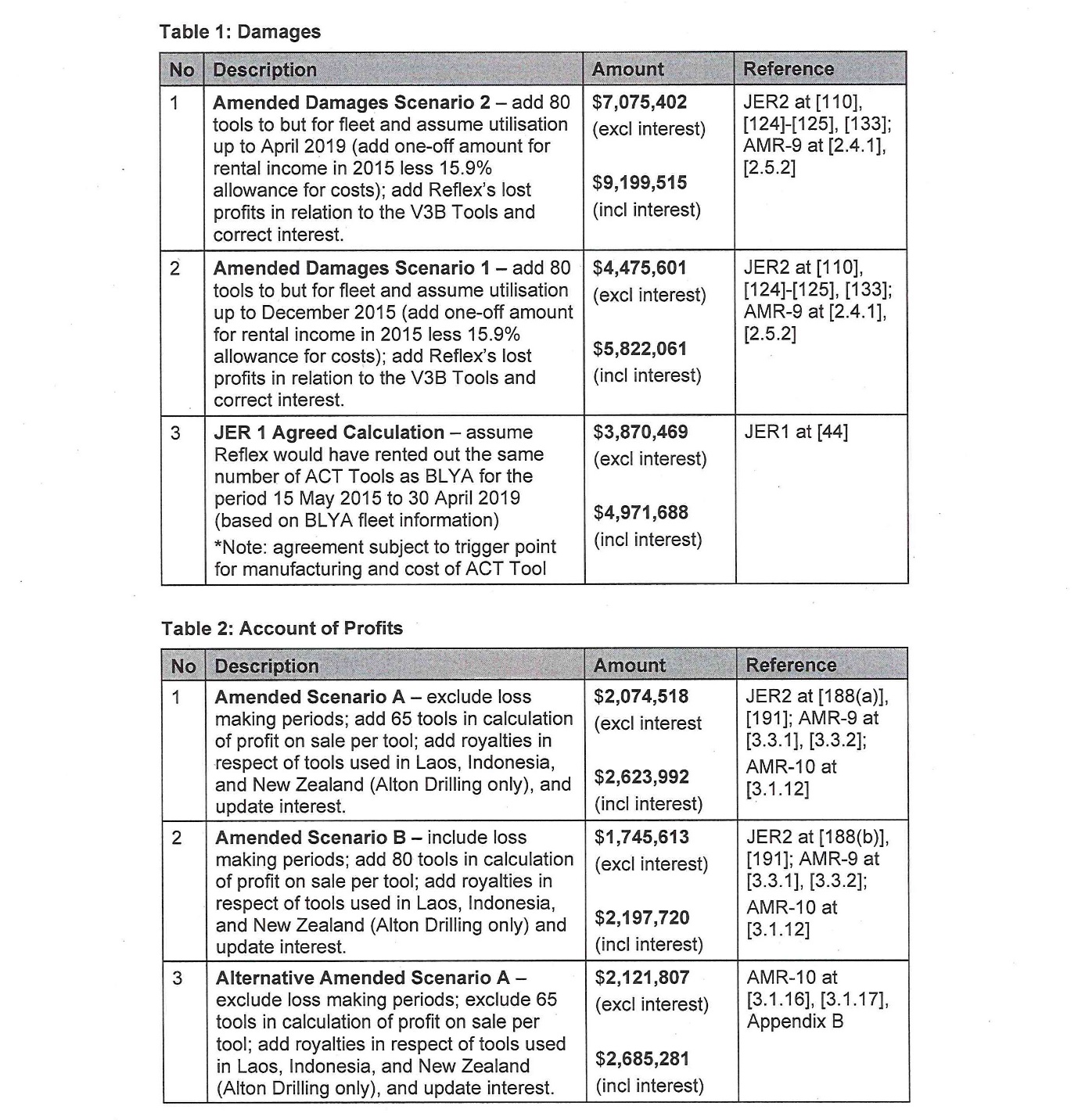
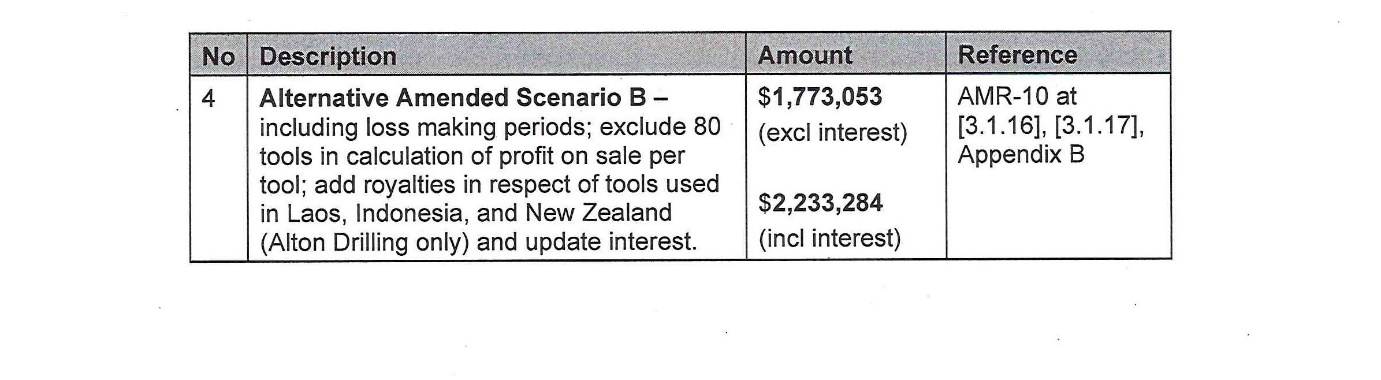
19 A summary of Reflex’s claims is as follows. Reflex’s primary case on damages is that it is entitled to the amount of $7,075,402 before interest. It has also put forward calculations of its damages which are lower than this figure and which are based on different assumptions. Reflex’s primary case on its claim for an account of profits is that it is entitled to $2,074,518 before interest. Again, it has put forward other calculations of its account of profits as alternatives. The document attached to these reasons and marked “Revised Annexure A” was prepared by Reflex and it sets out the alternatives advanced by Reflex with respect to its claims for damages and with respect to its claim for an account of profits.
The Validity of Reflex’s Split Election
20 The evidence establishes that between 2015 and 2019, Globaltech supplied at least 1,177 infringing Orifinder v5 Tools to BLYA. I put to one side for the purposes of considering the validity of the election, the supply by Globaltech of 16 infringing Orifinder v3B Tools in 2012. I also put to one side for the purposes of considering the validity of the election, the supply of 80 Orifinder v4 Tools by Globaltech to BLYA and the subsequent conversion of those tools by Globaltech to Orifinder v5 Tools in 2015. The issues arising in relation to those matters will be addressed later in these reasons.
21 The evidence establishes that of the 1,177 infringing Orifinder v5 Tools supplied by Globaltech to BLYA, 412 tools were used in Australia and 763 tools were exported from Australia. The small discrepancy in the figures of two tools is not material for present purposes.
22 Reflex’s election is to the effect that it claims the remedy of damages with respect to the 412 infringing tools used in Australia and it claims the remedy of an account of profits with respect to the 763 infringing tools which were exported from Australia.
23 Reflex submits that its election is valid. It submits that whilst it is true that s 122(1) of the Act refers to either damages or an account of profits, the right to elect arises in relation to each and every infringement and it is clear on the authorities that each and every supply of an infringing tool is a separate and distinct infringement. It claims that this is also illustrated by the way in which the limitation period provided for in s 120(4) of the Act is applied where there is a course of supply of an infringing product over time, some supplies within and some supplies outside the limitation period. Supplies outside the limitation period which, but for this circumstance would be actionable, cannot be the subject of relief, whereas within the limitation period can be the subject of relief. Reflex also pointed out that Globaltech had not identified a general principle in support of its submission.
24 Reflex relied on two authorities in which this Court has proceeded on the basis that a split election is valid and effective: LED Builders Pty Ltd v Eagle Homes Pty Ltd [1999] FCA 584; (1999) 44 IPR 24 (LED Builders) at [18] per Lindgren J and Aristocrat Technologies Australia Pty Ltd v Konami Australia Pty Ltd (No 3) [2022] FCA 1373; (2022) 170 IPR 42 (Konami) at [10] per Nicholas J.
25 Globaltech submits that Reflex’s split election is invalid. Some of its arguments seemed to be directed to the proposition that a split election can never be valid in any circumstances. As an alternative, Globaltech put a more limited proposition. As I understood the more limited proposition, it is that where there have been multiple infringements of a patent by the supply of the same or a similar product over a period of time, there needs to be some distinguishing feature between the supplies for which damages are claimed and the supplies for which an account of profits is claimed before a split election will be considered valid. Globaltech submits that there is no such distinguishing feature in this case. All supplies of the infringing tools were made by Globaltech to BLYA pursuant to the Distribution Agreements and no distinction was drawn in those agreements between tools which were to be used in Australia and tools which were to be exported from Australia. Furthermore, Globaltech submits that the two cases relied on by Reflex do not assist its argument because in both cases, there was no argument about the validity of the split election and in both cases there was a relevant distinguishing feature between the infringements.
26 Before considering these arguments, I record a submission made by Reflex to the effect that it had an alternative claim for damages should its election be invalid. It will not be necessary for me to deal with the submission and claim in this context because I hold Reflex’s election to be valid. Reflex contends that if the split election is invalid, it nevertheless has a claim for damages with respect to the 763 infringing Orifinder v5 Tools which were exported from Australia. Reflex does not put this claim for damages on the same basis as its claim for damages in relation to the 412 tools used in Australia. It submits that there are two, or at least one, other methods of calculating damages with respect to the 763 infringing Orifinder v5 Tools depending on the facts. The first of these other methods is a calculation of damages based on royalties under assumed licences of the 763 tools or some number thereof. To proceed to calculate damages in this way, there would ordinarily need to be evidence of licences and the royalties payable thereunder. The second of these other methods is a calculation of damages by reference to what has been called a reasonable user charge, it being assumed that Reflex would not have allowed another party to use its intellectual property rights without charge.
27 These alternative approaches to determining damages have been considered in a number of cases, including in Watson, Laidlaw & Co Ltd v Pott, Cassels & Williamson [1914] 31 RPC 104 at 117–120 per Lord Shaw; General Tire and Rubber Company v Firestone Tyre and Rubber Company Limited [1975] 2 All ER 173; (1975) 1B IPR 713 at 725–728 per Lord Wilberforce; [1976] 93 RPC 197 (General Tire); Meters Ltd v Metropolitan Gas Meters Ltd [1911] 28 RPC 157 at 163–165 per Fletcher Moulton LJ; Pearce v Paul Kingston Pty Ltd (1992) 25 IPR 591 at 592; and Winnebago Industries Inc v Knott Investments Pty Ltd (No 4) [2015] FCA 1327; (2015) 241 FCR 271 at [12]–[100] per Yates J.
28 Reflex submits that there is evidence of a reasonable royalty or (if necessary) reasonable user charge in the form of the royalty received by Globaltech as set out in the Distribution Agreements and that the experts could readily calculate the loss should that become necessary.
29 Globaltech submits that it is not open to Reflex to advance either of these methods of calculating damages with respect to the 763 tools because it is not how Reflex conducted its case at trial and this means that Globaltech has not adduced evidence that it might otherwise have done. Furthermore, Globaltech submits that even if Reflex is permitted to advance the claims, the evidence is not sufficient to establish the claims. If Globaltech is correct and Reflex’s election is invalid and if it is correct and it is not open to Reflex to put an alternative case based on a royalty under a licence or a reasonable user charge or such a case fails because of a lack of evidence, then subject to the issue concerning the 80 tools, Reflex’s case concerning the infringing Orifinder v5 Tools is limited to the 412 tools supplied by Globaltech to BLYA and used in Australia.
30 As I will now explain, I hold that Reflex’s election is valid and there is no need to consider Relex’s alternative argument in this context. I will need to return to the argument in a different and more limited context.
31 Reflex has elected between damages and an account of profits with respect to each infringement of the Patent, being the manufacture and sale or supply of an infringing tool. It is well established that an applicant cannot receive both damages and an account of profits for the infringement of a patent. The applicant must choose one or the other (Colbeam Palmer Ltd v Stock Affiliates Pty Ltd [1968] HCA 50; (1968) 122 CLR 25 (Colbeam Palmer v Stock Affiliates) at 32 per Windeyer J). It is equally well established that each act of patent infringement is a separate cause of action, being a statutory tort. The patentee or the exclusive licensee has a separate right to recover in relation to each act of infringement (Leplastrier & Co Ltd v Armstrong-Holland Ltd (1926) 26 SR (NSW) 585 at 591–592 per Harvey CJ; Black & Decker Inc v GMCA Pty Ltd (No 5) [2008] FCA 1738; (2008) 79 IPR 450 at [14] per Heerey J).
32 In both LED Builders and Konami, pecuniary relief was assessed and awarded on the basis of an account of profits for profit generating arrangements and damages for infringements which did not result in a profit. It is true that in neither case was the validity of the split election in dispute. That is one point of difference from this case. Globaltech submits that there is another point of difference. In Konami, the wrongdoer chose to make some supplies of infringing products (i.e., conversion of existing gaming machines) on a no charge basis and with respect to those supplies, Aristocrat claimed damages, and in LED Builders, the difference between the “account of profits infringements” and the “damages infringements” turned on whether or not the wrongdoer had commenced constructing houses using the infringing plans. Globaltech’s submission is that in this case, there is nothing in its conduct as the wrongdoer to distinguish between any of the supplies to BLYA. It supplied infringing tools to BLYA and it was up to BLYA and outside Globaltech’s control to determine whether the tools were used in Australia or exported from Australia. That is a point of difference, but it was never made clear how that was a material difference in terms of the innocent party’s right of election.
33 Globaltech submits that there is no case where the issue of a split election was disputed and the Court decided that a split election was valid. That appears to be true so far as my researches and those of counsel have been able to ascertain, but equally there is no case which has held that a split election is invalid. Globaltech sought to place some reliance on the way in which hearings as to liability (including any cross-claim alleging invalidity) and relief are ordinarily conducted in this Court. Where liability and relief are split, as they often are, the Court will not ordinarily in the liability hearing involve itself in identifying each and every infringement where the applicant’s case is of an allegedly infringing product being supplied over a period of time. That is probably correct, but I cannot see how that circumstance bears on whether or not split elections are valid. It seems to me that both LED Builders and Konami, and the latter in particular, provide good examples of why a split election ought to be allowed. Konami was not able to avoid the consequences of its infringements because its commercial arrangements resulted in it converting electronic gaming machines free of charge.
34 I am not persuaded by the other two major arguments advanced by Globaltech in support of its contention that Reflex’s election is invalid.
35 First, Globaltech submits that in some way, never clearly identified, there is an inconsistency between, on the one hand, the assumption underlying a claim for damages that 412 tools had not been supplied (i.e., as if the statutory tort had not been committed) and the assumption underlying a claim for an account of profits that 763 tools had been supplied and the statutory tort had been waived and the innocent party was entitled to the profits made by the infringer. The two remedies do proceed on a different basis, but I am unable to see how that affects the right of election.
36 Secondly, Globaltech submits that in some way, again never clearly identified, Reflex’s election was inconsistent with Reflex’s own business model of not differentiating between the revenue received from the supply of ACT Tools in Australia and the supply of ACT Tools in the rest of the Asia Pacific or APAC region. I am unable to see how the circumstance of Reflex’s treatment of revenue in its accounts affects the right of election.
37 In my opinion, absent leading authority or a clear general principle grounded in logic and sound policy considerations, the general principle that each infringement is a separate cause of action in respect of which the applicant has a right of election determines this issue. An applicant is entitled to exercise that right in a way that best suits its interests (Edelman J, McGregor on Damages (20th ed, Sweet & Maxwell, 2018) at [14-014]). It is not bound to exercise the election in a way that mitigates loss to the infringer. If an applicant chooses a split election that creates a difficulty for it in terms of the assumptions to be made and the facts that it must prove, then that is a problem for the applicant to resolve.
The Witnesses at the Hearing
38 Reflex called three witnesses at the hearing.
39 Mr Andrew Murray Ross is a chartered accountant and partner in the Sydney office of KordaMentha which is an investment and advisory firm. He practices as a forensic accountant. Mr Ross has over 30 years’ experience in the provision of financial advice, valuation and forensic accounting and his curriculum vitae indicates that he has assisted in quantifying economic loss in a wide variety of industries. Furthermore, he has substantial experience in providing expert evidence in cases before the courts.
40 Mr Ross has provided no less than five reports dealing with Reflex’s claims. The large number of reports came about for one or more of the following reasons: Mr Ross’ instructions being changed, including instructions about the assumptions he was to make, further documents being provided or further non-documentary evidence being put forward.
41 Mr Ross’ first report relates to Reflex’s claim for damages and his second report relates to Reflex’s claim for an account of profits. His third report relates to both claims, and his fourth report relates to the claim for an account of profits. Mr Ross’ fifth report was provided in response to a note prepared by Ms Dawna Kathleen Wright (exhibit R13), who was the expert called by Globaltech.
42 Mr Ross conferred with Ms Wright about the issues and they prepared two confidential joint experts’ reports. They gave concurrent evidence (or evidence in joint session) during the hearing and it is true (as Reflex submits) that there is a substantial measure of agreement between them as to the financial and accounting issues raised, including in relation to the overall methodology for both the claim for damages and the claim for an account of profits. There was no issue about the honesty of either of the experts.
43 Reflex also adduced evidence from two Imdex employees. The evidence-in-chief of these witnesses was given by way of affidavits and each of them was then the subject of short cross-examinations. There were objections to parts of the evidence-in-chief of these witnesses, but for the most part I overruled the objections holding that the objections really went to the weight to be accorded to the evidence.
44 Mr Leslie James McGill is employed by Imdex as the Operations Support Manager. At the time he swore his first affidavit, his position was that of Commercial Manager. He has sworn two affidavits, one on 2 April 2021 and the other on 23 March 2023 in connection with an order for discovery. The important affidavit is the first one.
45 At the time Mr McGill swore his first affidavit, he was responsible for managing all aspects of the commercial affairs of Reflex and Australian Mud, including “commercial analysis, management reporting, legal and operational support globally, and evaluating [the] performance of Reflex and AMC”. He said that he was also involved in supporting the product management and development function, amongst other duties. Mr McGill said that he had worked for Imdex for over 12 years in total and that during that time, he held various commercial and financial roles which he identified. They included Commercial Manager, Group Financial Controller, Group Reporting Manager and Assistant Company Secretary. Mr McGill described Reflex’s business and the accounting system of the Imdex Group. He also described the ACT Toolkit and the cost of the toolkit. Mr McGill prepared a spreadsheet which shows, among other things, the rental revenue generated by ACT kits in the APAC region for the period from July 2013 to January 2020. He described various aspects of the spreadsheet, including revenue and the utilisation rate.
46 The other Imdex employee was Dr Michelle Lisa Carey. Dr Carey affirmed two affidavits. As I have said, she is the Chief of Product Management and Marketing at Imdex. Dr Carey has been an employee of Imdex since 2012. She described her qualifications and experience. Dr Carey said that in her present role, she is responsible for making decisions as to which products will be developed by Imdex. This research and development process involves, among other matters, Dr Carey approving development of products and software, supervising and monitoring development of products and software, reviewing the product development cycle and deciding if a particular product or software should be commercialised once it has been developed.
47 Dr Carey’s responsibility during her time as an employee of Imdex included responsibility for monitoring the performance of instruments in the Reflex rental fleet. Dr Carey gave evidence as to the implementation and success of the Reflex rental fleet, the manufacture of ACT Tools, the management of the rental fleet, the composition and operation of the sales teams, market trends and conditions and the capacity of Reflex to manufacture additional ACT Tools. In her second affidavit, Dr Carey described the components in an ACT kit and the itemised cost of the components.
48 Mr McGill and Dr Carey were honest and straightforward witnesses. Globaltech did not suggest otherwise. Nor did Globaltech suggest that they were not qualified in the fields which they identified. Globaltech did criticise their evidence, but not on these grounds. Globaltech’s point was different. It accepted that some rental opportunities had been lost to Reflex as a result of its infringing conduct, but in calculating the extent of those lost opportunities, the general nature of the evidence adduced by Reflex, and the fact that it was not the best evidence otherwise available, weighed heavily against Reflex.
49 Globaltech also called three witnesses at the hearing.
50 I have already mentioned Ms Wright. She is a chartered accountant and a senior managing director of the forensic and litigation consulting practice at FTI Consulting. In that role, she provides services in the areas of forensic accounting, valuation and financial investigation. She has more than 20 years of experience and her experience includes as an expert witness, consulting expert and an expert determiner. Ms Wright prepared two reports and was the author of the note referred to earlier (exhibit R13). Ms Wright’s first report relates to Reflex’s claim for an account of profits and her second report relates to Reflex’s claim for damages. As I have already said, Ms Wright conferred with Mr Ross and there is a substantial measure of agreement between them. She is a co-author of the joint experts’ report and gave evidence with Mr Ross in the joint session.
51 Mr Khaled Hejleh is the managing director of Globaltech. He is familiar with all aspects of Globaltech’s business and technology. Seven affidavits and answers to interrogatories affirmed by Mr Hejleh were tendered and formed his evidence-in-chief.
52 Reflex submits that a number of Mr Hejleh’s affidavits were only required because he needed to correct or provide key qualifications to conclusions in other affidavits he had sworn. Reflex gave examples of where this had occurred, the most notable of which was his correction in his affidavit of 14 June 2023 of a statement he had made in his affidavit of 2 June 2023. Further, Reflex submits that this correction is evidence of the fact that Mr Hejleh was willing to rely on his recollection in the absence of business records on matters perceived to assist Globaltech’s case with the result that further details were required to present a full picture. Mr Hejleh’s evidence was that BLYA’s v5 Tools located overseas were returned to Globaltech and destroyed by it. Reflex issued a Notice to Produce dated 8 June 2023 in respect of that subject matter and that notice led to a return of only three handwritten documents. Reflex submits that Mr Hejleh then revealed in his oral evidence that some of the 763 Orifinder v5 Tools exported overseas may have remained overseas after September 2019. This is important because if that were so, then those tools would continue to result in the payment of royalty revenue to Globaltech and could have formed part of Reflex’s claim for an account of profits. The relevant passage in Mr Hejleh’s evidence is as follows:
And so what date, then, were all the v5 tools, located overseas, returned to Globaltech? ---They returned in bits and pieces with – we have no control on that. When they turn up, we – they get warranty immediately and then get destroyed after that date. We don’t – we have no control when they come back. All what we did is replaced everything. We – we supplied the replacement, new stock replacement for everything that was out there.
So it’s the case, is it, that there could be still some v5 tools located overseas that haven’t been returned?---Could be.
Yes?---No control on it.
53 Reflex submits that the inaccuracies and lack of detail in Mr Hejleh’s affidavits with respect to key matters, such as the total of tools manufactured as opposed to supplied, and the dates of revenue from the supply of infringing tools, had material costs consequences for it because it had to seek particulars and query details of various assertions or conclusions made by Mr Hejleh. It was submitted that these difficulties for Reflex were compounded by the fact that Globaltech’s business records were incomplete in some respects and production of material on relevant issues by Globaltech to Reflex was very slow, with some material only being served on the last day of evidence.
54 Reflex asks the Court to prefer the objective documentary evidence, being the financial records of Globaltech and BLYA, the evidence of the expert witnesses based on those records and the evidence of Mr Cameron, to the evidence of Mr Hejleh where there are any inconsistencies.
55 As I will explain later in these reasons, I found a number of aspects of Mr Hejleh’s evidence to be unsatisfactory.
56 Globaltech adduced evidence from a BLYA employee, Mr Joshua Brent Cameron, who is the Instrumentation Regional Manager APAC, Geological Data Services, of BLYA. He has affirmed three affidavits. Mr Cameron’s knowledge of BLYA’s activities prior to January 2016 was limited. The v3B Tools were supplied and sold in 2012 and Mr Cameron said that during the period from March 2012 to June 2014, he was an assistant driller/researcher. In other words, he was part of BLYA’s drilling services team and involved in deploying tools, including core orientation tools down holes. Mr Cameron agreed that in 2012, BLYA used Reflex’s Ace core orientation tools. From June 2014 to November 2019, Mr Cameron’s role at BLYA was as a Technical Representative – Geographical Data Services. He agreed that he was not involved in negotiating agreements on behalf of BLYA with manufacturers of downhole equipment and he agreed that he had no personal knowledge of the extent of any use or supply of any v4 or v5 Tools by BLYA before January 2016. He agreed that the first date upon which he became aware of BLYA supplying the tool called “TruCore” was in January 2016.
57 Mr Cameron produced a spreadsheet showing what he asserted was the total number of tools in BLYA’s total fleet of v5 Tools available for rent in Australia during the period from January 2016 to 30 April 2019 and the status of those tools, that is to say, whether they were on hire, out of service for repair etc., in a given month in that period. Mr Cameron produced a similar spreadsheet in a later affidavit.
58 Mr Cameron was an honest witness whose knowledge was limited. He was asked to address a number of precisely framed questions.
The Facts
59 I propose to deal with the facts in two parts or sections. First, I will set out my findings of fact in relation to a number of general matters and, in the course of doing so, I will also identify areas where there is a dispute as to the facts. Secondly, I will then deal with the specific factual disputes between the parties in the context of the particular issues to which they relate.
Reflex and Imdex
60 As I have said, Australian Mud and Reflex are wholly owned subsidiaries of Imdex and are part of the Imdex Group. Imdex is listed on the Australia Stock Exchange and it has related corporate bodies worldwide. The Imdex Group is a large group and it employs approximately 500 staff globally.
61 The Reflex ACT Tools form part of Reflex’s rental fleet which operates worldwide and includes Australia. For the purposes of Imdex’s accounting system, its operations are divided into five geographical regions as follows:
(1) Asia Pacific;
(2) Northern America
(3) South America;
(4) Europe;
(5) Middle East and Africa.
62 The Asia Pacific geographical region includes Australia, Papua New Guinea, Indonesia, Mongolia, Philippines, New Zealand and Cambodia.
63 Mr McGill has used APAC information in circumstances where Australia specific information is not identified within Imdex’s accounting and transactional system as this is the best information for the Australian market “that is available to me”.
64 In or about 2012, Imdex was moving the entirety of the Reflex instrument fleet to a rental model. Reflex hired a number of products both globally and domestically and those products included the ACT II and ACT III tools. I accept Dr Carey’s evidence that since 2012, the rental fleet, which includes the ACT Tools and other tools, has continued to grow in relation to rental based income and to establish itself as a market leader in the mining industry. That growth in the rental fleet is reflected in the annual reports for the period between 2015 and 2018. I also accept Dr Carey’s evidence that since 2012 and throughout the period from 2015 to 2019, the ACT Tools have been one of the most successful product lines in the rental fleet. The ACT Tools and their associated IP are treated by Imdex as Reflex’s most important assets.
65 Imdex continues to invest in research and development and has developed a next generation ACT Tool which is intended to replace the Reflex ACT III. The ACT-IQ was commercially demonstrated during the relevant period, but it was not contributing revenue as part of the rental fleet.
66 ACT Tools are among the most mature and durable products in the Reflex rental fleet. The durability and longevity of the tool means that, in relation to manufacturing, Reflex does not increase the fleet size in anticipation of older tools becoming unreliable, or a large number of older tools failing at the same time. Dr Carey described the ACT Tools as “low-touch, when compared to other rental tools, as the ACT Tools typically require little maintenance and few repairs”. ACT Tools are developed to withstand the harsh downhole environment. ACT Tools are built with no moving parts as the internal components are soldered together to reduce the likelihood of faults. I accept that evidence.
67 Since 2012, the ACT Tools have been supplied in kits which comprise two tools. It is a “two-tool system”. This mode of supply has now become industry standard. The Orifinder v5 Tool is also supplied in kits which comprise two core orientation tools.
68 There are significant peaks and troughs in the mineral exploration industry. The exploration phase of the mining life cycle generally occurs over a series of campaigns across a period of anywhere between two and ten years and each of the campaigns typically lasts for around three to six months. During this time, an ACT kit is usually required to remain onsite, depending on the type and length of the exploration campaign. The remaining phases of the mining cycle, post-exploration, may last decades depending upon the size of the mine. A diamond exploration drilling rig can work for up to 24 hours a day and during this time, each individual core orientation tool, assuming there is a two-tool system, may be required to perform for up to 12 hours a day. A core orientation tool performs an average of between 10 to 20 orientation readings per day, depending on the hardness of the drilling environment and the length and diameter of the core involved.
69 In the Australian market, an ACT kit is typically hired two to four times a year depending on the length of the drilling campaign. The tool remains in the rental fleet and is continuously hired to different customers throughout its lifespan. A typical rental agreement between Reflex and a customer includes the “Master Customer Agreement” and customers are responsible for all costs associated with renting the Reflex tools, including, among other costs, freight, service charges, consumable items and repairs and recalibration of the tools that are misused or damaged as a result of negligence on the part of the customer. Rental charges are incurred from the time a customer collects an ACT kit or the time the kit is dispatched from the Reflex facility or warehouse until the time it is returned. The rental rate is charged daily and under the terms of the Master Agreement, can be charged regardless of whether the tool is being used. ACT kits delivered in Australia typically reach the nominated site within approximately a week of being dispatched by Reflex. It follows from what I said earlier that Reflex charges for this period as the daily rental rate is applied from the time the ACT kit leaves the Reflex facility or warehouse until it is returned. Customers are not required to return the ACT kit to any particular Reflex facility. Reflex instead gives customers the option to return the kit to any Reflex warehouse or facility.
70 Both Mr McGill and Dr Carey described the components in an ACT kit. Their descriptions are not inconsistent. I accept both accounts, although I found Dr Carey’s description the clearer of the two.
71 Mr McGill said that ACT Tools are supplied in kits consisting of two ACT Tools, being downhole units, one controller and a selection of running gear, being equipment and consumables relevant to the operation of the ACT Tools in the field. Mr McGill produced data which identified the current range of ACT kits, the accompanying components and the associated manufacturing costs as at January 2021. That data was in the form of a spreadsheet which he said was used to calculate the total standard material costs of an ACT kit and for the purposes of reporting and budgeting. The material produced by Mr McGill did not include other costs of goods sold, expense items such as repairs, consumables and freight. His evidence was that an ACT kit comprises components which fall into two categories, being optional or compulsory. He described the compulsory components as referring to components that must be supplied in each ACT kit and that includes the two ACT Tools. The optional components refer to components that may vary in the ACT kit which includes running gear, consumables and handheld devices. In the case of handheld devices, such a component is required for the operation of the ACT Tools, but the customer has a choice to select from different models. In those circumstances, the handheld devices are classified as optional. Mr McGill said that running gear and consumables are also classified as optional components as these components may vary from each ACT kit depending on the size of the ACT Tool. Mr McGill’s instructions were to the effect that certain optional components were only included in an ACT kit when expressly requested by a customer and those components included the ACT III docking station and the ori-auditor and core removal tool componentry. The cost of the controller varies. The manufacturing costs also vary depending upon the core size with the core size “H” being the most expensive size ACT Tool in the range.
72 One of the documents produced by Mr McGill was a schedule showing the total price for “a common kit type” and that includes a figure identified as “running gear” or “optional items” with notations against that figure as follows: “Assume all running gear” and “assume all optional items are taken”.
73 Dr Carey said that an ACT kit consists of the following:
(1) a Pelican case;
(2) two downhole units, being the two ACT Tools;
(3) a handset controller, being either the Reflex ACT II or ACT III controller;
(4) a barrel extension;
(5) a marking jig;
(6) a user guide;
(7) a docking station; and
(8) miscellaneous consumables.
74 Dr Carey produced a spreadsheet generated by Imdex’s computer system which identifies the current components of an ACT kit and other related products that are sold separately. This is the same document produced by Mr McGill. Reflex offers its customers the option to purchase additional components that are set out in the ACT kit schedule which are not supplied in a standard ACT kit. These components are not essential for the use of the ACT Tools in core drilling operations. However, they provide a stream of revenue for Reflex. For example, a customer can purchase a core removal tool which is used to remove a core sample that is stuck inside a lifter case while protecting the end of the core sample from damage.
75 There is a dispute between the parties about the manufacturing costs of an ACT kit which is addressed in the next section which deals with the specific issues.
76 Mr McGill produced a spreadsheet showing, among other things, the rental revenue generated by ACT kits in the APAC region, including Australia, for the period July 2013 to January 2020 (Confidential Annexure LJM-5). The utilisation of tools is a percentage figure representing the relationship between the number of tools on hire and the number of tools in the fleet. Before Reflex manufactures an ACT Tool, a capital expenditure request must be raised and approved by the management of Imdex. Capital expenditure requests are considered by Imdex management with respect to overall ACT fleet availability and once approved, instructions are given to the Imdex facility in Balcatta to commence the manufacture of ACT Tools.
77 The figures for rental revenue generated from the ACT kits are figures for the APAC region, including Australia. APAC ACT customers are charged a daily rental rate as well as an additional loss or damage protection “coverage rate”, if so, elected by the customer, per ACT kit which is invoiced monthly. A coverage rate is an additional daily charge paid by customers to protect against the risk of accidental damage or loss. The customer can elect to pay a coverage charge which increases the daily rental rate. If the coverage charge is applied, Reflex assumes the risk and customers are not liable for the cost of replacing the tool where it is lost or damaged in the ordinary course of business. In the event that the customer does not pay the coverage rate and the tool is lost or damaged in the ordinary course of business, the customer is liable to pay for the cost of replacing the tool as determined by Reflex or as agreed between the parties.
78 Mr McGill agreed in cross-examination that he could have details of the revenue for ACT Tools in Australia.
79 ACT Tools are manufactured at Imdex’s manufacturing facility at Balcatta.
80 Reflex maintains an inventory of the components for ACT Tools at its facility in Perth for the purposes of repairs, servicing and manufacturing. Dr Carey expressed the opinion, which I accept, that the manufacture of an ACT Tool is relatively simple as the tool is modular and the parts are largely preassembled. In her experience, a single Reflex technician can assemble several ACT Tools in a day, including any calibrations required. Reflex typically stores at least three months’ anticipated supply of components for its rental tools onsite in inventory to avoid any shortages. In cross-examination, Dr Carey said that she could have provided by way of evidence, more detail of the inventory held by Reflex, such as the number of parts held in any particular month.
81 Reflex controls both the labour and materials involved in the manufacturing process for ACT Tools and it does not experience capacity restraints in relation to the manufacture of additional tools. Imdex has an established framework that streamlines supply chains and ensures that it is able to adjust to rapid changes in sourcing volumes and changing customer needs. Reflex has continued to review all aspects in relation to warehouse locations, inventory turns, risk management of key products and logistics and customer service to improve its supply chain.
82 Reflex is the sole manufacturer of ACT Tools. It controls their manufacture, supply and distribution. The tools are distributed to customers through Reflex’s national and global offices, warehouses, and authorised agents and distributors.
83 Dr Carey believes that during the relevant period, the supply of ACT Tools was impacted by rentals of infringing Orifinder core sample orientation tools supplied by Globaltech that would otherwise have been supplied by Reflex. Dr Carey expressed the belief that Reflex would have been able to ensure capacity to manufacture additional ACT Tools, if necessary, in a short period of time by adopting two strategies. First, Reflex could have diverted resources, including stopping all non-essential work, to focus on manufacturing ACT Tools. Dr Carey gave an example. If an unexpected request meant that ACT Tools were required within a month, production for other tools, such as the Reflex EZ-GYRO and Reflex EZ-TRAC survey tools, could have been stopped and resources be reallocated strictly to the manufacture of ACT Tools. Servicing and repair teams could have been instructed to assist with manufacturing and the sales and sales support team could have assisted with packaging ACT kits. Secondly, in Dr Carey’s experience, demand for ACT Tools was typically limited to the most popular sizes, such as the N2 and HQ. It was therefore possible to resize the ACT Tools stored in inventory. This process is relatively quick and simple as the internal electronic components for all ACT Tools are the same. The manufacturing and service departments can resize a tool by removing the internal electronic components and simply placing them into a different outer casing.
84 Reflex has procedures in place for tools to be transferred from different countries to account for any shortfalls in the rental fleet. Reflex considers that all of its tools are global. However, the transfer of ACT Tools and rental tools in general is not a common practice to satisfy a small one-off demand due to the additional costs involved.
85 There is a dispute between the parties as to Reflex’s capacity to manufacture additional ACT Tools in the manner Reflex asserts which is addressed in the next section which deals with the specific issues.
86 I have already referred to the concept of utilisation of tools and to the fact that this refers to the number of ACT kits “on hire” expressed as a percentage of the total APAC ACT rental fleet each month. It is related to an area of substantial dispute between the parties.
87 The way in which Reflex operates its business is that ACT kits are classified into three categories. First, “available” refers to ACT kits that are ready and available to be hired to customers. These include tools which are stored in Reflex’s warehouses or the warehouses of distributors. Secondly, “unavailable” refers to ACT kits that are not available for rent due to a range of reasons, including being in transit between locations, undergoing service or repair, or being held on a customer’s site as a spare tool. Thirdly, “on hire” refers to ACT kits that are currently being hired by customers and generating revenue.
88 Mr McGill said that in his experience the maximum practical utilisation percentage that Imdex typically reaches for the APAC region is between 55 to 60%. He referred to this as the Utilisation Threshold. He explained that at this threshold, it will typically become difficult in practical terms to operate because ACT kits are dispersed across multiple customer sites, often in remote locations, multiple Reflex warehouses (Perth, Kalgoorlie and Brisbane) and across nine different size variants, making it difficult to ensure that the correct size ACT kit can quickly be made available in the correct location to meet customer demand. Mr McGill said that the remaining 40 to 45% of ACT kits are recorded as either unavailable or available, but not on hire due, for example, to the kit being in the incorrect location or of the wrong size. Mr McGill said that a utilisation of 100% is therefore not practically possible. He said that once the Utilisation Threshold was reached, there will typically be an increase in the number of capital expenditure requests coming from the Reflex general managers. A capital expenditure request is a request to build additional ACT Tools and hence expand the fleet to meet customer demand.
89 The information produced by Mr McGill in relation to the topic of the cost of goods sold related to the APAC region between July 2014 and January 2020 inclusive. Mr McGill said that he was satisfied that the APAC cost of goods sold was representative of Australia. He formed the conclusion that Australia represented such a large percentage of APAC revenue and that since all Reflex tool types were offered across the whole APAC region, he was satisfied that the APAC cost of goods sold is representative of Australia.
90 Both Mr McGill and Dr Carey gave evidence about selling costs in relation to the tools and the activities of sales and sales support staff. Their evidence was not inconsistent. Dr Carey’s evidence was more detailed. I accept the evidence, subject to a consideration of the complaints made about it by Globaltech.
91 Mr McGill prepared information for the relevant sales and sales support staff for the APAC region, including Australia. The sales and sales support staff are employed on a fixed salary basis and not on a commission basis. Mr McGill described them as core members of the Reflex team. His evidence was that the team had undergone little change over the relevant period despite Reflex’s product offering expanding over the relevant period and thereby increasing business complexity.
92 Dr Carey said that Imdex has a separate sales and sales support team for each geographical region. The composition of the sales team since 2012 has remained static despite market volatility and both seasonal and cyclical changes in customer demand. The sales team has the capability to service a large number of customers without additional assistance as the rental fleet operates efficiently with minimal intervention once the rental agreement and the rental details are entered into the system and the status of the tool is changed. It is common for a single customer to hire several ACT kits at a time so that not every new hire requires significant involvement from the sales team. Furthermore, ACT Tools do not often fail and customers are familiar with the product and the sales team is rarely required to arrange for replacements to be sent to customers or organise training demonstrations. The work of a sales representative cannot be performed by a contractor or a consultant because of the level of expertise required. If there is a spike for customer demand for ACT Tools, the sales team is typically required to work harder and longer to service customers rather than additional members joining the team. In cross-examination, Dr Carey agreed that she was not involved in the actual negotiation of rental contracts and that she could have provided details such as the names and hours worked of sales staff.
The Market for Electronic Core Orientation Tools
93 During the period from a time in 2015 to 2019, the ACT Tools were the only electronic core sample orientation tools available on the Australian market other than the infringing electronic core orientation tool referred to as the Orifinder v5 Tool or the TruCore Tool. There was at one point another orientation tool known as the ORIshot and supplied by a company called Coretell Pty Ltd, but that tool was held to infringe certain innovation patents (Australian Mud Company Pty Ltd v Coretell Pty Ltd (No 4) [2015] FCA 1372).
94 Globaltech does not dispute that between 2015 and 2019 and up to the present day, the majority of exploration mining companies use electronic core orientation tools to orientate recovered drill samples. A small proportion of the core orientation market has not transitioned to electronic methods and continues to use mechanical methods to orientate core. This small proportion of the market primarily relates to mining exploration companies who are drilling vertical or near vertical holes. This small proportion of the Australian market would have been unlikely to have ever rented an Orifinder v5 Tool or any other electronic tool during the relevant period. If the Orifinder v5 Tool had not been in the market and such a customer needed to rent a core orientation tool, they would have rented another mechanical device and did not have to rent an electronic tool from Reflex.
Globaltech
95 Globaltech supplied Orifinder v3A kits between October 2011 and approximately April 2012 to potential customers outside Australia only. They are not part of Reflex’s claim in this proceeding. The Orifinder v3B kits were supplied between April 2012 to approximately 31 October 2012 to customers both in Australia and overseas. According to Mr Hejleh, sales of the Orifinder v5 Tools commenced in May 2015 and ceased in January 2019. “Orifinder income” generated within the period 1 November 2012 to 30 April 2015 was in relation to a tool known by the parties as the Orifinder “v4” Tool which does not form part of these proceedings. The development by Globaltech of the Orifinder Tools commenced in 2009.
96 During the relevant period, according to Mr Hejleh, Globaltech’s sole customer for the sale of the Orifinder v5 Tools in Australia was BLYA and Globaltech did not sell or rent the Orifinder v5 Tools to any other customers in Australia. BLYA branded the Orifinder v5 Tools it purchased from Globaltech as “TruCore”. Globaltech has never used a rental model for its Orifinder Tools. It manufactured and sold those tools to BLYA at cost price, but it did not retain any property rights in the Orifinder v5 Tools upon their delivery to BLYA. It was a matter for BLYA as to what it did with those tools.
97 Mr Hejleh said that BLYA has an extensive and expensive distribution channel and networks which are very costly as they require hundreds of personnel, multiple warehouses in many countries, global logistics, legal support and the like. Globaltech does not have such a network. It sells its tools at cost price and it derives a percentage of BLYA’s rental revenue. This made commercial sense to Globaltech as it effectively paid an amount of the rental revenue it might otherwise have received to utilise the BLYA distribution channel. I have already referred to this evidence. I accept it in general terms.
98 Globaltech supplied 18 v3B kits between April 2012 and approximately 31 October 2012. Mr Hejleh said that 1,276 Oritool v5’s were supplied by Globaltech and 924 Oripad v5’s were supplied by Globaltech. Before it commenced the supply of the Orifinder v5 Tools, Globaltech supplied a tool known as the v4 Tool. Australian Mud and Reflex, or their parent and subsidiary companies, alleged that the v4 Tool infringed Patent No 2008229644 in proceeding number NSD 142 of 2015. That is a different patent to the one which is the subject of the present proceedings. Globaltech denied infringement. On 21 September 2015, Globaltech and Imdex Global BV executed a Deed of Settlement which granted a release to Globaltech in relation to the supply of v4 Tools. On 19 October 2015, a judge of this Court made orders by consent in the v4 proceedings whereby Globaltech was required to cease making, hiring, selling or otherwise disposing of, offering to make, hire, sell or otherwise dispose of, using or importing, or keeping for the purpose of doing any of those things, the core orientation tool marketed or sold under the name of Orifinder version 4. Those orders were made after the Court was informed by Globaltech that sales of the v4 Tool had ceased several months earlier and Globaltech was willing to abandon the v4 Tool and settle the proceedings since it had developed a new core orientation tool, being the v5 Tool.
99 A spreadsheet in Globaltech’s business records indicates that it supplied BLYA with a total of 80 v4 Tools. In expectation of the settlement of the v4 proceedings, BLYA returned the v4 Tools to Globaltech and Globaltech replaced those tools with v5 Tools. Mr Hejleh’s recollection is that the replacement with the v5 Tools occurred in or about July to August 2015 which was about one to two months before the Deed of Settlement was signed. However, Globaltech does not have any records to allow him to be more precise with the exact dates of receipt of the v4 Tools and replacement with the v5 Tools. The dates are matters of dispute.
100 Mr Hejleh says that to the best of his knowledge all sales, revenue and royalties relating to Globaltech’s supply of v5 Tools to BLYA was included in the figures he previously provided in answers to interrogatories and in his previous affidavits. Mr Hejleh produces invoices for royalty payments for use by BLYA of what he says were v4 Tools between January 2015 and July 2015. He said that none of the invoices relate to the v5 Tools as the v5 Tools had not been developed, manufactured or supplied to BLYA during the periods identified in the invoices. Mr Hejleh asserts that Globaltech does not have any records showing where or when the replaced v5 Tools were used by BLYA. He does say that Globaltech’s business records do not show that it received any royalties for BLYA’s use of the v5 Tools until February 2016. In other words, no royalties were received before February 2016.
101 There is a substantial dispute between the parties as to how, if at all, the 80 tools affects Reflex’s lost profits claim and this dispute is addressed in the next section of these reasons.
102 Mr Hejleh asserted in his evidence that following orders made in the present proceedings and in or around February 2019, Globaltech began replacing v5 Tools which had been supplied to BLYA with an alternative core orientation tool which was known as the “UPIX” Tool. He said that BLYA’s v5 Tools that were located in Australia were returned to Globaltech’s Forrestfield premises and destroyed by Globaltech’s production staff. Replacement UPIX Tools were shipped to BLYA. He states that by March 2019, all v5 Tools located within Australia had been replaced by the UPIX Tool. BLYA’s v5 Tools that were located overseas were returned to Globaltech’s Singapore premises and destroyed by Globaltech’s production staff in Singapore. A replacement UPIX Tool was shipped from Singapore to BLYA outside of Australia. He said that by September 2019, all v5 Tools located overseas had been replaced by the UPIX Tool. As I have already indicated, under cross-examination, it is apparent that Mr Hejleh was no longer able to assert this. He said that no royalties were received by Globaltech in respect of the use of the v5 Tools by BLYA within Australia after March 2019, and outside Australia after September 2019. Royalties after those dates resulted from the use by BLYA or its customers of the UPIX Tool. Mr Hejleh corrected one of his statements in a later affidavit. He said that BLYA’s v5 Tools that were located overseas were returned to Globaltech’s Australian premises and destroyed by Globaltech’s production staff in Australia. A replacement UPIX Tool was shipped from Singapore by BLYA outside of Australia.
BLYA
103 Mr Cameron states that the BLYA fleet of v5 TruCore Tools was in use by BLYA in the sense that the product fleet was rented or available to rent by BLYA’s customers in Australia from January 2016 through to 30 April 2019 because the records he had indicated usage of tools from January 2016 (albeit only one unit) ending in April 2019. Mr Cameron was asked by those instructing him to provide data in respect of the utilisation rates of the BLYA fleet during that period. In his response, his focus was on the period from January 2016 through to 30 April 2019. He refers to this as the v5 TruCore fleet period. Mr Cameron produced a document from BLYA’s records which shows the total number of tools in BLYA’s total fleet of v5 TruCore Tools available for rent in Australia during the v5 TruCore fleet period and the status of those tools, that is to say, whether they were on hire, out of service for repair etc., in a given month in the v5 TruCore fleet period. Again, by reference to the period from January 2016 to 30 April 2019, Mr Cameron identified the number of v5 TruCore Tools BLYA purchased from Globaltech as 1,176 tools or 588 kits. He identified the number of those tools which remained in Australia to be used as part of BLYA’s Australian based fleet as 412 tools or 206 kits. BLYA also hired out tools in the wider APAC region which, in BLYA’s case, means Australia, Laos, Indonesia and New Zealand and Mr Camerson identified that it supplied by way of export 42 tools or 21 kits to Indonesia, Laos and New Zealand. Finally, Mr Cameron identified the number of tools which were shipped overseas by BLYA to be used as part of the Boart Longyear Group of companies overseas based fleet and were not at any time used in Australia as 763 tools.
104 In his third affidavit, Mr Cameron corrected a statement he made previously about the number of tools “on hire” in a given month. He said that he did not mean to suggest that the number of tools identified as being “on hire” for any given month were each on hire for the full 30 or 31 days in each such identified month. He said that in any given month, some or all of those tools which he identified as being “on hire” may have been hired for a lesser number of days within that month. The number of days that a tool is on hire in a month at a given customer is recorded in the BLYA monthly royalty reports and Mr Cameron was responsible for generating these reports during the period from January 2016 to January 2019. Mr Cameron produces the monthly royalty reports for these months. In addition, he has extracted data from BLYA’s records for the months of February 2019 to April 2019.
105 The two matters referred to in the last two paragraphs are disputed issues in the case: the first as to whether the total tools “sold” included the 80 tools and the second as to whether the days on hire for BLYA should be reflected in Reflex’s loss of opportunities.
An Introduction to the Issues
106 This is a case where substantial efforts were made, particularly by the experts, to identify issues for the Court’s resolution without the need for evidence in proof of facts which upon careful consideration could be the subject of agreement. As I have said, by the time the hearing had finished, Mr Ross had provided no less than five expert’s reports and Ms Wright had provided two reports and her note. Furthermore, in the second half of 2022, the parties had identified what each of them considered to be the issues. Following that, the experts conferred on at least two occasions and following those conferences, they produced joint experts’ reports containing a statement of the matters upon which they agreed and a statement of those matters upon which they disagreed. That was all done with a view to identifying the issues at the hearing as precisely as possible. That result was largely achieved and, to the extent it was not, that seemed to be because of changes in instructions, including as to assumptions, or the production of further evidence, including documents.
107 I mention these circumstances because they mean that I can approach the matters requiring determination by reference to the issues as defined by the parties, and not by, in effect, “starting from scratch” with Mr Ross’ first report.
108 There were some matters raised earlier in the proceeding which were in dispute that are no longer in dispute.
109 First, there is no longer an issue about whether royalties payable in relation to the use of the infringing tools overseas which use does not infringe the Australian Patent can be taken into account in Reflex’s account of profits claim. Globaltech now accepts that those royalties can be taken into account. Secondly, whilst there is a remaining issue about interest, the experts agree about the methodology to be used. Thirdly, there was an issue as to whether, and to what extent, taxation should be taken into account in the award of pecuniary relief. That matter is no longer in dispute because Globaltech accepts that an award of pecuniary relief in this proceeding is to be made on a pre-tax basis. There remains a relatively minor issue about whether a small discount on the award for an account of profits should be made on the basis that Globaltech has in all likelihood paid tax on the profits it received and (so it is contended) may have difficulty recovering that tax or will experience delay or incur costs on doing so.
110 I turn now to address each of the issues. As I understand it, both parties accept that should any one or more of my conclusions mean that there is a need for further calculations to be performed, that can be done relatively quickly by the experts by appropriate variations to the modelling they have already carried out.
Damages
Introduction
111 Leaving aside the effect of Ms Wright’s note (exhibit R13) which I will come back to, the starting point for the damages claim is the JER1 Agreed Calculation set out in Revised Annexure A. This is a calculation about which the experts agree, subject to certain qualifications. The qualifications are as follows.
112 First, there is an assumption in the JER1 Agreed Calculation of a one to one relationship between the number of rentals of infringing tools and the rentals which would have been achieved by the innocent party in the “but-for” counterfactual that is said by Globaltech to be unrealistic. There must be, according to Globaltech, a reduction for contingencies and uncertainties. That reduction can be applied at the level of the one to one assumption or at the end of the overall calculation, but in either case, it should be a substantial discount.
113 Secondly, there is an assumption in the JER1 Agreed Calculation about the Utilisation Threshold, that is, the point at which Reflex would have needed to manufacture additional tools and, therefore, incur additional costs, in order to meet the additional demand for tools envisaged in the but-for counterfactual. There is a dispute between the parties about the appropriate assumption in that respect.
114 Thirdly, there is an assumption in the JER1 Agreed Calculation about the cost of manufacturing each new ACT Tool which must be taken into account in the but-for counterfactual. There is a dispute between the parties about the appropriate assumption in that respect.
115 Finally, there is a dispute about whether there are lost profits in relation to the Orifinder v3 Tools which should be added to the JER1 Agreed Calculation.
116 I turn now to the other two scenarios in Revised Annexure A. Reflex has abandoned any claim for a one-off amount for rental in 2015 less 15.9% allowance for costs and so that may be put to one side. The claim for Reflex’s lost profits in relation to the v3B Tools speaks for itself.
117 The major difference between the JER1 Agreed Calculation on the one hand, and the two Scenarios on the other, is the 80 tools being an assumption that, in addition to the tools on hire assumed in the JER1 Agreed Calculation, there are another 80 tools on hire in the but-for counterfactual until December 2015 in the case of Scenario 1 and until April 2019 in the case of Scenario 2. The issue concerning the additional 80 tools is described in detail and addressed below. There are also a number of issues involving the 80 tools and those issues include the following: (1) whether the 80 tools should be taken into account at all; (2) whether they should be taken into account until December 2015 or until April 2019; (3) whether it should be assumed that the 80 tools were fully utilised or partially utilised; and (4) whether they should be included in the cost per Orifinder v5 Tool for the purposes of the calculation of the account of profits.
118 Before leaving this general introduction, I return briefly to Ms Wright’s note. That was a substantial issue raised by Globaltech late in the course of the proceeding. The note was prepared by Ms Wright following her receipt of the third affidavit of Mr Cameron affirmed on 14 June 2023. In that affidavit, Mr Cameron referred to his earlier affidavits in which he produced documents showing the infringing tools “on hire” in a given month. I have already referred to his evidence. Nevertheless, his precise evidence is worth setting out. It is as follows:
6. In doing so, I did not mean to suggest that the number of tools identified as being “on hire” for any given month were each on hire for the full 30 or 31 days in each such identified month. In any given month, some or all of those tools which I identified as being “on hire” may have been hired for a lesser number of days within that month.
7. The number of days that a tool is on hire in a month at a given customer is recorded in the BLYA Monthly Royalty Reports. I was responsible for generating these reports during the period January 2016 through to January 2019. Annexed to this affidavit and marked Confidential Annexure JBC-4 is a copy [of] these reports for each of these months. I did not generate these reports from February 2019 onwards, and so I also annex as part of Confidential Annexure JBC-4 data that I have extracted from the EZRentOut system for the months February 2019 to April 2019.
119 Ms Wright adjusted her damages calculation in the JER1 Agreed Calculation ($3,870,469 before interest) by apportioning for the days the kits were actually hired based on the Monthly Royalty Reports produced by Mr Cameron. This results in a reduction from $3,870,469 to $1,695,221 in the JER1 Agreed Calculation. Mr Ross disagreed with this approach and is of the opinion that there should be no reduction for this reason. This dispute is addressed below. As I understood Globaltech’s submission, it was that even if this matter did not support a precise reduction of the order put forward by Ms Wright, it did support, together with other factors, a substantial discount in the order of 30 to 40% to the amount that might otherwise be awarded.
One to One Assumption and Discounts
120 Reflex’s business model was to manufacture a fleet of electronic core orientation tools which it hired or rented out to customers in Australia. It made profits on those transactions. Globaltech’s business model was different. It manufactured the infringing tools and sold them (at cost according to Mr Hejleh) to BLYA. It was BLYA which then assembled a fleet of tools and made those tools available to be hired or rented out in Australia. Reflex seeks to use BLYA’s hiring out or rental figures to establish its loss of hiring or rental opportunities. There is nothing inherently flawed in approaching the matter in that way.
121 The experts agreed as to the appropriate general methodology for the determination of Reflex’s loss of profits as a result of Globaltech’s infringements and that was the identification and then comparison of actual cashflows to Reflex and the “but-for” cashflows. The but-for cashflows involve an identification of the position Reflex would have been in had the infringements not occurred and the cashflows which would have resulted.
122 The starting point in the analysis is the identification of the relevant principles in circumstances where the Court is dealing with a but-for counterfactual. I do not think that the parties were in dispute about the relevant principles, as distinct from their application to the facts of this case. Reflex submits that the one to one assumption is justified on the facts of the case, whereas Globaltech submits that absent a practical certainty (which is not shown here), there must always be discounts for contingencies and the uncertainties.
123 The matter which is the subject of the Court’s consideration is a state of affairs which is a hypothetical or a counterfactual. It is not a historical fact. The law takes a different approach in the case of a hypothetical or a counterfactual. The distinction was identified by Brennan J (as his Honour then was) and Dawson J in Malec v JC Hutton Pty Ltd [1990] HCA 20; (1990) 169 CLR 638 in the following passage (at 639–640):
The fact that the plaintiff did not work is a matter of history, and facts of that kind are ascertained for the purposes of civil litigation on the balance of probabilities: if the court attains the required degree of satisfaction as to the occurrence of an historical fact, that fact is accepted as having occurred. By contrast, earning capacity can be assessed only upon the hypothesis that the plaintiff had not been tortiously injured: what would he have been able to earn if he had not been tortiously injured? To answer that question, the court must speculate to some extent. As the hypothesis is false — for the plaintiff has been injured — the ascertainment of earning capacity involves an evaluation of possibilities, not establishing a fact as a matter of history. Hypothetical situations of the past are analogous to future possibilities: in one case the court must form an estimate of the likelihood that the hypothetical situation would have occurred, in the other the court must form an estimate of the likelihood that the possibility will occur. Both are to be distinguished from events which are alleged to have actually occurred in the past. Lord Diplock said in Mallett v. McMonagle:
“The role of the court in making an assessment of damages which depends upon its view as to what will be and what would have been is to be contrasted with its ordinary function in civil actions of determining what was. In determining what did happen in the past a court decides on the balance of probabilities. Anything that is more probable than not it treats as certain. But in assessing damages which depend upon its view as to what will happen in the future or would have happened in the future if something had not happened in the past, the court must make an estimate as to what are the chances that a particular thing will or would have happened and reflect those chances, whether they are more or less than even, in the amount of damages which it awards.”
(Citation omitted.)
124 Justices Deane, Gaudron and McHugh made a similar point when their Honours said (at 642–643):
A common law court determines on the balance of probabilities whether an event has occurred. If the probability of the event having occurred is greater than it not having occurred, the occurrence of the event is treated as certain; if the probability of it having occurred is less than it not having occurred, it is treated as not having occurred. Hence, in respect of events which have or have not occurred, damages are assessed on an all or nothing approach. But in the case of an event which it is alleged would or would not have occurred, or might or might not yet occur, the approach of the court is different. The future may be predicted and the hypothetical may be conjectured. But questions as to the future or hypothetical effect of physical injury or degeneration are not commonly susceptible of scientific demonstration or proof. If the law is to take account of future or hypothetical events in assessing damages, it can only do so in terms of the degree of probability of those events occurring. The probability may be very high — 99.9 per cent — or very low — 0.1 per cent. But unless the chance is so low as to be regarded as speculative — say less than 1 per cent — or so high as to be practically certain — say over 99 per cent — the court will take that chance into account in assessing the damages. Where proof is necessarily unattainable, it would be unfair to treat as certain a prediction which has a 51 per cent probability of occurring, but to ignore altogether a prediction which has a 49 per cent probability of occurring. Thus, the court assesses the degree of probability that an event would have occurred, or might occur, and adjusts its award of damages to reflect the degree of probability. The adjustment may increase or decrease the amount of damages otherwise to be awarded. See Mallett v. McMonagle; Davies v. Taylor; McIntosh v. Williams. The approach is the same whether it is alleged that the event would have occurred before or might occur after the assessment of damages takes place.
(Citations omitted; see also Sellars v Adelaide Petroleum NL [1994] HCA 4; (1994) 179 CLR 332 at 349–351 per Mason CJ, Dawson, Toohey and Gaudron JJ; at 365–368 per Brennan J.)
125 In this case, the Court is concerned with the value of the lost opportunity, not the prior issue of whether it has been established on the balance of probabilities that there has been a loss of an opportunity. Clearly, there has been a loss of an opportunity in this case and I did not understand Globaltech to suggest the contrary (Generic Health Pty Ltd v Bayer Pharma Aktiengesellschaft [2018] FCAFC 183; (2018) 267 FCR 428 (Generic Health v Bayer Pharma Aktiengesellschaft) at [182]–[183]).
126 Globaltech submitted that unless the lost opportunity clearly coincided with what occurred, or coincides as a matter of practical certainty, some discounting is inevitable. Infringement of a patent is a statutory tort and the object of an award of damages is to compensate the innocent party by putting him or her in the position he or she would have been in had the tort not occurred. The object is not to punish the infringer unless an award of aggravated damages is in issue and that is not the case here (General Tire at 726 per Lord Wilberforce). Globaltech referred to Generic Health v Bayer Pharma Aktiengesellschaft and pointed out that the Full Court said that in the case of a hypothetical counterfactual short of a certainty, some discounting, albeit perhaps very modest, is inevitable (at [186]–[187]):
186 Whichever way one expresses it, in assessing the possibilities or probabilities of a hypothetical counterfactual, one is engaged in the task of estimation, even if the estimation involves an assessment of the counterfactual as being close to a certainty. But being close to a certainty is not the same thing as a certainty. If one is estimating, one still needs to apply a discount, albeit a very modest one, to reflect the assessment that one is not at a certainty. If one is looking at the value of a lost opportunity which is not certain to occur, then the valuation must involve some discount, even if a very modest one.
187 Given that Generic Health is a wrongdoer, it may be accepted that damages should be liberally assessed, although not, of course, to punish it: General Tire (1976) at 212 per Lord Wilberforce. The object is to compensate Bayer. To say that damages should be liberally assessed in no way cuts across what we have just said: that, in estimating or valuing a lost opportunity or in assessing a hypothetical counterfactual for any scenario short of certainty, some discount must be made to reflect that less than certain position, even if the discount is very modest indeed.
The discount applied by the Full Court was 2% in a case which bears some factual similarities to the present in terms of the number of market participants (see at [9]). (See also Bayer Pharma Aktiengesellschaft v Generic Health Pty Ltd [2017] FCA 250; (2017) 124 IPR 23 at [193] per Jagot J; H Lundbeck A/S v Sandoz Pty Ltd [2018] FCA 1797; (2018) 137 IPR 408 at [368]–[373].) Globaltech submitted, correctly, that resort to the notion that damages are to be assessed liberally (General Tire at 726 per Lord Wilberforce) does not in some way overcome the need for a discount (Generic Health v Bayer Pharma Aktiengesellschaft at [187]).
127 Globaltech submitted that a number of contingencies mean that there should be a heavy discount to Reflex’s loss of profits claim. The way it presented its argument was to identify all of the contingencies and then argue for an overall discount of 30 to 40%. In other words, it did not seek to attach (necessarily) particular contingencies to the one to one assumption and then other contingencies to other elements of the calculation.
128 As I understood it, the contingencies identified by Globaltech were as follows:
(1) As I said, Globaltech relied on the fact that as a past counterfactual falling short of a practical certainty some discounting was inevitable;
(2) the generality of the evidence adduced by Reflex and its failure to adduce the best evidence available to it warranted a discount;
(3) the fact that Reflex had a different business model from that of Globaltech and BLYA meant that there should be a discount; and
(4) the fact that BLYA was not hiring the tools out for all the days in the month as pointed out by Mr Cameron in his third affidavit meant that there should be a discount. This is the matter addressed in Ms Wright’s note.
129 I will deal with each of these arguments in turn.
130 With respect to the first alleged contingency, it is outlined above. I consider this to be a case (perhaps relatively rare) where, if a discount is called for, it is a small, or very small, discount. I say that because on the but-for counterfactual, Reflex would be the only supplier in the market. The reference to the mechanical core orientation tools and the market therefor is really a distraction because Reflex’s case is that it would have picked up those customers in the market looking for an electronic core orientation tool, not those in the market who by necessity (i.e., vertical or near vertical drilling) or otherwise, were looking for a mechanical core orientation tool.
131 As to companies not wanting to deal with Imdex, that is certainly possible, but to my mind a negligible factor. It did not affect BLYA and, in any event, it is hard to see what other choice a company looking for an electronic core orientation tool would have.
132 With respect to the second matter, Globaltech began its argument in this respect by referring to the general nature of the evidence adduced by Reflex. It referred to the fact that a number of the statements contained in the evidence of Mr McGill and in the evidence of Dr Carey were general in nature and, although admitted, were admitted subject to arguments as to weight. In addition to these matters, Globaltech submitted that there was no evidence of the type one might expect in a case of this nature. There was no evidence of customers “transferring” from their use of the Reflex ACT Tool to the Globaltech’s v5 Tool. There was no precise evidence as to how the market worked or how it was affected by the presence of the infringing tools. These deficiencies were not retrieved (so it was said) by the evidence of either Mr McGill or Dr Carey because their evidence was very general. This made it very difficult for Globaltech to meaningfully cross-examine witnesses as to what was actually done (Bayer Pharma Aktiengesellschaft v Generic Health Pty Ltd [2013] FCA 226 at [26] per Jagot J).
133 An allied point made by Globaltech is that it is well established that evidence as to what would have happened in a hypothetical situation is generally given very little weight (Sigma Pharmaceuticals (Australia) Pty Ltd v Wyeth [2018] FCA 1556; (2018) 136 IPR 8 at [273]–[286] especially at [276]–[277]).
134 There is a superficial attraction in some of the points made by Globaltech about the general nature of the evidence adduced by Reflex and that other more specific evidence was available. However, for reasons I will explain, I am not persuaded that there needs to be a discount for this reason. As to the submission about evidence typically called in cases of this nature, I see no deficiency in Reflex’s case in this respect bearing in mind it is the only supplier in the but-for counterfactual. It is not a case where, for example, evidence about losing customers might be considered vital or, at least, highly significant.
135 The relevant points about the general nature of the evidence may be illustrated by reference to two examples in the case of each witness.
136 As I said earlier, Mr McGill prepared a spreadsheet which became Confidential Annexure LJM-5 showing, among other things, the rental revenue generated by ACT kits in the APAC region, including Australia, for the period July 2013 to January 2020. Mr McGill said that he was able to access some information which was Reflex specific, but some of the information he had provided in his affidavit was “Asia-specific information and not specifically referable to Reflex’s business in Australia”. Mr McGill said that he could have included information in his affidavit evidence (as distinct from producing the information) which specifically related to Reflex’s business in Australia regarding Australia revenue information and he could have provided what were referred to as the “on hire” figures. He had to make assumptions about the figures in Confidential Annexure LJM-5 using APAC regional information. Mr McGill said that Reflex is able to access who the customers were which he used to build up the Australian only revenue number. Mr McGill said that he does not know why information about the Australian customers and their locations and about the tools they had were not included in his affidavit. Mr McGill was not involved in sales activities during the relevant period and he agreed that he himself had limited knowledge of the members of the sales team and their relevant period of service and so on. Mr McGill also gave evidence in relation to the cost of goods sold. I have already referred to that evidence (at [89]). Mr McGill calculated the cost of goods sold for Reflex’s instrumentation business for the APAC region and then expressed the opinion that the information in relation to the APAC cost of goods sold was representative of Australia.
137 The examples in relation to Dr Carey’s evidence are as follows.
138 The first example relates to Dr Carey’s evidence about Reflex’s capacity to manufacture additional tools at its manufacturing plant at Balcatta in Perth, Western Australia. I refer to the evidence set out above (at [83]).
139 Dr Carey was asked to provide her view as to whether there would need to be any changes to the resources allocated for manufacture if, during the relevant period, Reflex was required to manufacture an additional approximately 60 tools per month, that is, 30 kits, for an individual year. Dr Carey said that she was confident that demand for an additional 60 ACT Tools approximately per month over the course of a year would be within the capabilities of the manufacturing team. She considered that that would be the position without the need to resize already manufactured ACT Tools or to reallocate resources from other departments such as the sales team. Dr Carey considered that Reflex could have met part of this demand by utilising ACT Tools held in inventory.
140 The second example is Dr Carey’s evidence with respect to the sales teams in the event that there was an increased demand for ACT Tools. I refer to the evidence set out above (at [92]).
141 Dr Carey was asked to provide her view on whether Reflex would have required additional staff in the sales team on the assumption that in the relevant period there were an additional 60 tools per month, that is, 30 kits, entering the rental fleet each month for a period of a year. Dr Carey considered that the answer to that question was “no”. She said that the rental of ACT Tools involved minimal administrative work or client support and she described it as “low-touch”. She does not consider that there would have been an increase in the number of staff members in the sales team or in the resources available to the sales team for the servicing of an additional approximately 60 ACT Tools, which equates to 30 ACT kits, a month or 360 ACT kits per year. Dr Carey pointed out that an additional 360 kits per year does not equate to 360 new customers per year and that, as many customers are repeat customers, a sales representative is not required to negotiate the terms of a rental contract each time an ACT kit is hired. In those circumstances, she considered that the administrative process is not resource intensive. She said that she was confident that an expansion of the ACT rental fleet by up to 360 ACT kits in one year during the relevant period would not require changes to the sales team.
142 Globaltech’s argument is that, in these circumstances where, among other things, the evidence is so general, a discount to the damages which might otherwise be awarded was warranted. Globaltech’s argument went further than this and it was submitted that the Court should draw a Jones v Dunkel inference to the effect that more precise evidence by way of oral evidence and documentary evidence would not have assisted Reflex in proving its but-for counterfactual (Jones v Dunkel [1959] HCA 8; (1959) 101 CLR 298).
143 I do not consider this to be a case for a Jones v Dunkel inference. Both witnesses were employed by Imdex or Reflex during the relevant period and both had knowledge of the areas about which they gave evidence. It is true that Reflex might have called factory employees and members of the sales teams employed at the time and those persons may have given evidence about the capacities of those sections of Reflex’s business. It is also true that documents might have been tendered. For example, documents showing the inventory of components of ACT Tools held at the Balcatta manufacturing facility might have been tendered. Nevertheless, I do not consider this case to be a case for the drawing of a Jones v Dunkel inference. Having regard to the context, I am not prepared to infer that Reflex refrained from calling the evidence because it feared to do so. In any event, I am satisfied that the evidence is sufficient having regard to the context. Again, the fact that Reflex is the only supplier in the market in the but-for counterfactual is significant. The ACT Tools are successful aspects of a worldwide business which has been growing. Because of its success, it is an arm or line of the business to which Imdex and Reflex are prepared to commit resources by way of research and development. The ACT Tool is durable and low maintenance (“low-touch”). A number of Reflex’s customers are repeat customers who would not have to have the terms and conditions explained to them on each and every occasion.
144 The third matter said by Globaltech to warrant a discount is the different business model of Reflex from that of Globaltech and BLYA. As developed, the argument was to the following effect. There are other counterfactuals than that postulated by Reflex. Reflex had not addressed the counterfactuals and if and how it would have benefited under those counterfactuals. This circumstance warranted a discount.
145 Globaltech identified two alternative counterfactuals. The first counterfactual comprises circumstances in which BLYA acquired all 1,177 infringing tools for on rental to customers and that would involve BLYA approaching Reflex, Reflex changing its established business model from one of rental to one of sale and Reflex deciding to sell tools to a competing Australian company for the purpose of that company on-hiring those tools in direct competition with Reflex’s own business in Australia and globally, and Reflex making substantially the same profit as Globaltech in fact made. Globaltech submits that the difficulty with this scenario from Reflex’s point of view is that it has not led evidence with respect to it. The second counterfactual is that BLYA’s actual customers for the infringing tools would have become Reflex’s customers for the ACT Tools in the counterfactual. Globaltech submitted that there are some evidentiary difficulties with that scenario, including the presence of manual core orientation tools and evidence that some customers might not have wanted to deal with Reflex or Imdex. Furthermore, this counterfactual does not deal with how Reflex would have addressed the 763 tools supplied to BLYA which were sent overseas.
146 It seems to me that once the split election issue is decided in favour of Reflex, the question as to the counterfactual is not raised in relation to the 763 tools. It is raised with respect to the 412 tools which were used in Australia. The issue as to an appropriate counterfactual does not arise in relation to the 763 tools because, in the case of those tools, the pecuniary relief is assessed on the basis of the facts as they occurred. None of this is to say that it is not open to Globaltech to say, as it does, that there are uncertainties in the particular counterfactual identified by Reflex.
147 With respect to the fourth matter, that is, that the Orifinder v5 Tools were not hired out every day of the month, Mr Cameron affirmed an affidavit shortly before trial. He sought to do so in order to clarify the meaning of statements made in his earlier affidavits in which he referred to or listed the number of tools “on hire” in a given month. His evidence is set out above (at [103]–[104]).
148 This evidence from Mr Cameron led to the preparation by Ms Wright of exhibit R13. That document of one and-a-half pages contains Ms Wright’s calculation of the effect of that evidence on JER1 Agreed Calculation of $3,870,469 before interest. As I have said, the effect of Ms Wright’s calculations is significant.
149 Globaltech submitted that Mr Ross’ proposed answer to this evidence failed to meet the point. Mr Ross’ answer was that Globaltech’s utilisation rates would not be determinative of the utilisation rates and revenue. Globaltech submitted that the actual utilisation achieved by BLYA was the best indicator of what Reflex could have achieved in light of the evidence available and the need to form a view as to a “hypothetical counterfactual world”. Nor was the other matter advanced by Mr Ross an answer. It was not correct to say that adopting the daily rental data addressed the wrong question. Globaltech submitted that the additional revenue Reflex would have achieved in the hypothetical counterfactual was closely related to and reflected by the rental model which BLYA used which was a daily rental model and what BLYA achieved in the market. It was clear from the evidence of Dr Carey that Reflex charged a daily rate. Although there was a difference between the way in which Reflex charged and the way in which Globaltech charged, that did not provide an answer to this point. The argument here is that Reflex charged whilst the tool was in a customer’s possession, whereas Globaltech charged for the use of the tool. That might lead to higher charges in the case of Reflex because a tool may be in a customer’s possession, but not used. However, what both suppliers did was to charge on a daily basis and that was standard in the industry.
150 Globaltech accepted that using BLYA’s figures may lead to an understatement of Reflex’s damages because of the difference between time when used and time when in possession. However, the best evidence of what would have occurred in the counterfactual was what occurred with BLYA since the hypothetical market which Reflex would have sought to access in the counterfactual world was the one which BLYA in fact accessed. At least some discount or form of adjustment is warranted. Mr Ross is critical of a number of aspects of Ms Wright’s calculations. The way in which Globaltech put the matter was to say that it is also appropriate to make an adjustment because the parties have at all times through their respective expert accountants utilised BLYA data for the purposes of the damages calculation and the third affidavit of Mr Cameron “simply provides an additional layer of information concerning BLYA’s previously provided data, which should be taken into account”.
151 I will come back to this fourth matter after I have identified Reflex’s response to Globaltech’s claim that Reflex’s loss of profits claim should be discounted.
152 Reflex denied that any discounting was warranted. It submitted that to the extent there were factors pointing towards a discount, there were equally factors pointing the other way.
153 The issue of discounts was addressed by the experts in the second joint experts’ report. The experts note that Reflex’s Statement of Issues does not refer to the concept of discounting. Globaltech’s Statement of Issues does refer to the concept of discounting and the following question for the experts:
What discounts should be made in the damages calculation to reflect factors and contingencies such as:
(i) that not all sales of Infringing Tools by Globaltech Corporation to BLYA were lost sales to the Applicants; and
(ii) that not all rentals by BLYA to third parties were lost rentals to be Applicants.
154 Neither expert discounted their calculations for “factors and contingencies”. Ms Wright specifically noted in her second report that her loss assessment did not allow for any risk associated with whether the but-for cashflows would have been achieved.
155 Mr Ross did not consider that there should be any discounting of his calculations of Reflex’s loss of profits or Globaltech’s profits from the sale of infringing tools. Mr Ross’ reasons for this view were as follows.
156 First, Mr Ross did not consider that discounting in the sense in which that arises in relation to the discounted cashflow methodology was relevant. There was no single date of loss because, on Mr Ross’ instructions, he was asked to assume that each supply of an infringing tool was a separate infringement of the Patent. Therefore, there was no single date of loss to apply in this matter. It seems that this is correct, but does not answer the main point made by Globaltech.
157 Secondly, Mr Ross did not consider that any discounting of the account of profits was warranted. In his view, he has calculated the actual profits made by Globaltech and that is the amount to which Reflex is entitled. In my opinion, this view is correct.
158 Thirdly, Mr Ross noted in his first expert’s report that his calculation of Reflex’s lost profits may be understated for any one or more of the following reasons:
(1) he had not considered any other loss to Reflex by reason of Globaltech’s conduct other than the reduction in revenue from rentals due to the infringing tools. To the extent there was such other loss, Reflex’s loss of profits is understated;
(2) he has not taken into account possible losses after the end of the relevant period; and
(3) he has made conservative assumptions as to the number of infringing tools, manufacturing costs of additional tools (note: based on 1,177 tools), manufacturing costs of each tool and selling costs (note: not based on Dr Carey’s statements about selling costs not likely to change).
I will come back to these matters after I have fully outlined his evidence on these points.
159 The experts note a difference in one assumption in two calculations of Reflex’s lost profits. The first set of calculations assume, consistent with Mr Ross’ instructions for his first report, that had Globaltech not supplied infringing tools in the extended relevant period, the same number of ACT Tools (i.e., on the available information 1,177 infringing tools) would have been rented out by Reflex and the latter calculations assume, consistent with the assumptions Mr Ross adopted for his second report, that had Globaltech not supplied infringing tools in Australia in the extended relevant period, Reflex would have rented out at least the same number of ACT Tools in Australia. Mr Ross is not able to express any opinion on which, if either of these calculations was more likely to represent Reflex’s lost profits, as to do so requires expertise in the operation of the market for ACT Tools.
160 Ms Wright remained of the view that the calculations do not adequately account for the risk that the but-for scenario cashflows in the assessment of Reflex’s lost profits would not have been achieved. The current calculations do not, but should, include a discount to allow for factors and contingencies, such as those posed in the question in the respondents’ Statement of Issues. Ultimately, however, the matter is one for the Court to determine. Ms Wright agreed with Mr Ross that it would be “less necessary” to apply a discount to any assessment of Globaltech’s account of profits given that the profits were actually earned by Globaltech.
161 In the joint session, Mr Ross said that he considered that a number of his assumptions were conservative and that this was to be weighed against any factors suggesting a need for discounts. Those matters were identified in his first and second reports. Mr Ross said that he had identified the conservative assumptions that he had made and he referred to the manufacturing costs trigger point as one of those. He then went on to say the following:
As time has gone on and we’ve been given more information, some of the issues of uncertainty have abated. So we’ve now moved from 1177 calculation to the 412 calculation, and that removes a substantial degree of uncertainty. No doubt there may be other issues that are considered as still uncertain.
162 Ms Wright agreed that the question of whether there needs to be any discounts applied is “more relevant” to the 1,177 Calculation. The point she made was because the 1,177 Calculation resulted in what she considered to be a significantly overstated figure, there was a need for a greater discount. She further said that because the 412 Calculation was grounded in BLYA’s actual experience, that reduced the uncertainty in achieving the cashflows and so there was less need to consider discounting.
163 Mr Ross said that he was in a position to produce calculations in accordance with such assumptions as the Court considered should be made. For example, he would be able to calculate Reflex’s lost profits if the Court considered that it would not have achieved a one to one rental and instead would have achieved a rental of, for example, nine out of the ten tools rented by BLYA. Ms Wright agreed that that could be done. The experts agreed that they would also be able to calculate the total royalty figure in the event that the Court considered a reduction in the one to one assumption was appropriate.
164 I turn to examine those matters which Mr Ross identified as his conservative assumption which can be weighed against factors suggesting the need for a discount. First, I do not think other unidentified loss falls into this category. It is not known whether there is such loss, or the possibility of such loss. Secondly, I do not consider that possible loss after September 2019 can be weighed in the balance. Although in view of Mr Hejleh’s evidence in cross-examination, I think it distinctly likely there were infringing tools being used overseas after September 2019, the fact is that there is no claim made for such loss. With respect to the assumption about the Utilisation Threshold, that could in theory be invoked in this context, but I take the view for the reasons set out below, that the percentage adopted by Mr Ross is appropriate, rather particularly favourable to Globaltech. With respect to Mr Ross’ approach to the manufacturing costs for each ACT Tool, I consider that to be favourable to Globaltech and a matter that can be taken into account, although it is fairly minor. I am unable to quantify in a sensible way any “benefit” to Globaltech from Mr Ross’ approach to selling costs.
165 I return to the question of whether there should be a discount of the damages award. I consider the fourth matter identified by Globaltech (see [147] above) largely falls away because I am persuaded that although Reflex had conducted its case of lost opportunities by reference to the number of BLYA rentals, that did not mean that once those numbers are ascertained, it was not then appropriate to have regard to Reflex’s method of charging. I consider it is appropriate to have regard to Reflex’s method of charging which was from dispatch of the tool to its redelivery. To the extent there is any remaining force in the fourth matter identified by Globaltech, I take it into account together with the first matter in arriving at the conclusion that a small discount of the damages award of 3% is appropriate. I do emphasise that in reaching the conclusion that the discount should be small, I have placed significant weight on the circumstance that Reflex would have been the only supplier of electronic core orientation tools in the but-for counterfactual.
166 Reflex put a submission that were the Court to reach the conclusion that there was to be a discount in the damages award based on loss of profits, the extent of the discount should be reflected in damages based on lost royalties or reasonable user charges. This is the argument put by Reflex as an alternative argument in the event that its election was invalid and it was left to claim damages in relation to the 763 tools exported from Australia (at [26]).
167 Reflex puts its argument in the context of the one to one assumption as follows. Assume 100 tools are rented by BLYA, then the relevant translation for the purposes of the calculation is 97 lost opportunities to Reflex. In that context, Reflex submits that there are three tools for which Reflex receives royalties or reasonable user fees. It is more difficult to translate other discounting factors not directly related to the one to one assumption to the necessary element of the equation, i.e., 97:100. Reflex submitted that the royalties received by the infringer, that is, Globaltech, are the appropriate measure and the calculation of Globaltech royalty could be performed say the experts.
168 Globaltech put two arguments against Reflex’s alternative argument. Those arguments were, in fact, put in response to Reflex’s alternative argument in the context of the split election, but there is no reason the same arguments are not equally relevant to the present issue.
169 Globaltech’s first argument at one point seemed to be that to approach the matter in the manner suggested by Reflex was “illogical”. Reference was made by Globaltech to the Full Court’s decision in Generic Health v Bayer Pharma Aktiengesellschaft and the fact that the Court made a discount of 2% without any reference being made to an allowance with respect to the 2% by way of a royalty or reasonable user fee. Insofar as it was being suggested by Globaltech that a lost profits case could not be combined and conducted with a claim for royalties or reasonable user fees, I do not think that is right. That seems to be contrary to a long line of authorities. I have set out the relevant authorities and passages above (at [27]).
170 Globaltech was on firmer ground with its second argument. It submitted that such an alternative claim was not made, or clearly made, by Reflex and that it was wrong for Reflex to suggest that the calculation of the claim would involve no more than a simple and straightforward calculation by the experts.
171 The matter is not in the Statement of Issues or the Response thereto in circumstances in which the issue of the one to one assumption and the issue of discounts is raised. One might have expected it to have been raised. It is not addressed in the expert’s respective reports or the joint experts’ reports. It could have been addressed as an alternative and some calculations proffered, recognising at the same time that the precise discount would not have been known until the Court had delivered its reasons.
172 Relatedly, there is the issue of the appropriate quantification of the royalty or reasonable user fee, both whether that issue has been adequately explored and whether the royalty paid to Globaltech is an appropriate measure. I am not convinced on the first issue. On the face of it, the royalty paid to the wrongdoer seems a reasonable measure, but the parties have had ample opportunity to raise the matters they wished to raise and I do not consider it appropriate to allow Reflex to raise the matter and put further calculations at this late stage.
173 There should be a discount of 3% and Reflex’s alternative argument is rejected.
The Utilisation Threshold
174 In the second joint experts’ report, Mr Ross (at para 133) and Ms Wright (at para 137) set out their calculations in tabular form of Reflex’s loss of profits claim as at 14 April 2023 and one of the items in each table is the costs of manufacturing the additional Reflex tools necessary to meet the demand under the but-for counterfactual. As previously indicated, the parties are in dispute as to the appropriate Utilisation Threshold which triggers the manufacture of additional ACT Tools.
175 Mr McGill gave evidence concerning the Utilisation Threshold. He gave evidence about what happened at or about the time the Utilisation Threshold was reached. That evidence is summarised above (at [88]) and I will not repeat it.
176 Mr McGill gave evidence that in his experience the maximum practical utilisation that Imdex typically reaches for the APAC region is between 55 to 60%.
177 Mr Ross was required to calculate the point at which Reflex would have to incur manufacturing costs to produce additional tools. He relied on the evidence of Mr McGill and he prepared his calculations on the basis that the appropriate utilisation rate for the purposes of determining the manufacture of additional tools was 57.5%. Ms Wright did likewise in some of her calculations, but she questioned the figure, noting that on her analysis of Reflex’s actual manufacturing and utilisation rate, Reflex also manufactured additional tools when the utilisation rate was as low as 30 to 40%. The upshot of Ms Wright’s analysis of Reflex’s historical data was that Reflex manufactured ACT Tools in APAC when the monthly utilisation in APAC was below 57.5%. Ms Wright gave an example based on the relationship expressed in percentage terms between the APAC fleet and the global fleet and this led her to an estimate that Reflex manufactured approximately 108 tools from May 2016 to August 2017 when the average APAC utilisation was only 33.4%.
178 Ms Wright prepared calculations showing the effect on Mr Ross’ calculations of trigger points between and including 57.5% and 30%. Those calculations produced some very high numbers for the additional tools to be to be manufactured at the low utilisation thresholds. Ms Wright asked her instructing solicitors for any documents — presumably of Reflex — by way of policy or directive that might show when additional ACT Tools are manufactured, but nothing was provided. That is consistent with Mr McGill’s evidence that there was no firm policy or directive. Ms Wright does not consider that the determination of an appropriate or commercially sound trigger point to be within her area of expertise. She said that she simply noted that Reflex has manufactured tools when utilisation was lower than the adopted trigger point of 57.5%.
179 Mr Ross responded at length in the first joint experts’ report. He disagreed with Ms Wright’s reservations and said that if anything, his assumed percentage of 57.5% was too low. A number of his comments were directed to the 1,177 Calculation rather than the 412 Calculation and, in the second joint experts’ report, the experts identified these comments as no longer relevant, presumably to the extent they related to the 1,177 Calculation.
180 In the joint session, Mr Ross said that the circumstances were now such that the experts were considering “210 additional tools” in the context of the 412 Calculation. Ms Wright agreed that the issue concerning the Utilisation Threshold was a good deal less significant in the “412 world” than it was in the “1177 world”.
181 The key points made by Mr Ross in response to Ms Wright’s evidence were as follows. First, a conclusion about the utilisation rate at which Reflex had manufactured tools in the past could not be drawn simply by considering the proportion of the APAC fleet expressed as a percentage of the global fleet. The evidence would need to be more specific than that. Secondly, he gave as an example the additional tools to be manufactured on an assumed Utilisation Threshold of 45%. The number of additional tools is 888. The point he made, in my view with a good deal of force, is that it would not make commercial sense for a company to manufacture an additional 888 tools to meet an increase in demand (at any one time) for 210 tools. Thirdly, even the assumption of a Utilisation Threshold of 57.5% results in the manufacture of an additional 360 tools to meet a demand (at any one time) of 210 tools and that is a generous or conservative assumption. In fact, Mr Ross went further and said that he considered the increased demand for tools under the but-for counterfactual (the 412 Calculation) could be met from the existing fleet of ACT Tools.
182 It is true, as Globaltech pointed out, that Mr McGill agreed in cross-examination that his opinion was based on his “anecdotal experience”. Mr McGill described the range of 55 to 60% as his observation of when additional requests for capital expenditure are made and he said that that is not to say they were not made below that. There was no policy of Reflex at the relevant time as to when a capital expenditure request should be issued. Mr McGill accepted that there were occasions where tools were manufactured at a time where the utilisation rates were significantly lower than 55 to 60%.
183 Globaltech submitted that a typical maximum figure was not a realistic basis for an assumption as to when additional tools would be manufactured across the relevant period. It submitted that the best evidence of utilisation and manufacturing trigger points is what in fact occurred. It submitted that Reflex had neglected to provide specific evidence relating to its manufacturing capabilities, evidence relating to manufacturing tools for Australia specifically, and evidence relating to the reasons why tools were manufactured or capital expenditure requests were made at any particular time despite Dr Carey accepting, as she did, that better evidence, for example, as to maximum manufacturing capacity was available. Globaltech submitted that the most appropriate manufacturing trigger point for use in the damages model is 45% which is BLYA’s average utilisation of its fleet from January 2016 to April 2019. That is higher than Reflex’s average utilisation over the relevant period of 39 to 40%. Finally, Globaltech submitted that Reflex impermissibly sought to introduce a new element in the case and that is that Reflex could have met the additional demand from existing stock. That is to introduce, according to Globaltech, “an entirely different methodology for the damages calculation”.
184 I have carefully considered Globaltech’s submissions, but in the end I have concluded that the approach taken by Mr Ross is correct. I have reached that conclusion by having regard to the combined force of three matters. First, there is the evidence of Mr McGill that the maximum practical utilisation that Imdex typically reaches for the APAC region is between 55 to 60%. Secondly, I accept what I take to be the views of the experts and, in any event is a view I have formed, that there is a good deal more room for different views as to the appropriate Utilisation Threshold in the case of a smaller number of additional tools to be manufactured to meet the demand under the but-for counterfactual, for example, the 412 Calculation as against the 1,177 Calculation. Thirdly, I think the Court is entitled to have regard to what makes commercial sense, not as a decisive factor, but as a significant factor and for reasons advanced by Mr Ross, the lower “scenarios” do not make a great deal of commercial sense.
The Costs of Manufacturing Additional ACT Tools
185 The cost of manufacturing each additional ACT Tool was a matter in dispute with Reflex advancing a cost of $2,233 per tool and Globaltech advancing a cost of $2,701 per tool. As I have said, ACT Tools are supplied in kits with each kit containing two tools and other pieces of equipment. The dispute relates not to the cost of individual items in the ACT kit, but to the items which are included in the ACT kit.
186 Mr Ross’ evidence was that the cost was $2,233 per tool and $4,466 per kit and that was based on the evidence of Dr Carey to the effect that Reflex provided each customer with an ACT kit comprising a pelican case, two downhole units, being ACT Tools, a handset controller, being either the Reflex II or III controller, a barrel extension, a marking jig, a user guide, a docking station and miscellaneous consumables and the cost of each of these items. Dr Carey described these items together as comprising the “standard ACT Kit”. There are, in addition, optional components which are sold “outright”, rather than placed on hire. They include a core removal tool which is used to remove a core sample that is stuck inside a lifter case while protecting the end of the core sample from damage.
187 The first joint experts’ report suggests that the dispute between the experts turned on whether optional items and the pelican case were included in the ACT kit provided to rental customers.
188 Mr Ross’ calculations and his evidence in joint session satisfy me that the parties do not differ on the inclusion of the pelican case. Mr Ross has included the cost of the pelican case in his calculations. The parties differ on the inclusion or otherwise of what is referred to as the optional running gear.
189 Mr Ross said that the costs items he had taken for his calculation were conservative in that he had taken the higher cost for individual items so that “the implicit assumption was that every kit was the highest spec kit”.
190 In terms of the evidence, the final point to note in terms of the evidence is that Ms Wright’s opinion is based in part, at least, on evidence of a previous employee of Reflex, Mr Kelvin Brown, who prepared a table containing details of “Total price for a common kit type” and included in the table was a price for running gear/optional items and notations in relation to that item as follows:
Assume all running gear
Assume all optional items are taken
191 Globaltech submitted that its approach was correct because it is done by reference to what the document referred to as the “common type kit” and that would be more reflective of the cost of a kit commonly supplied than what Dr Carey referred to as a “standard kit” which implies that it is a base model rather than the most commonly supplied model.
192 I reject Globaltech’s submission. I see no reason not to accept Dr Carey’s evidence about the items comprising the “standard ACT kit”, that is, I infer the kit supplied in the usual case. The document produced referring to a common type kit does not persuade me otherwise. That document might refer to a common type kit, but it clearly identifies the assumption that optional items are taken and is to be read in that light.
193 I find that the cost of manufacturing each ACT kit was $4,466 or $2,233 per ACT Tool.
The Additional 80 Tools
194 The calculations prepared by the experts and resulting in the JER1 Agreed Calculation were done on the basis that 412 tools were sold by Globaltech to BLYA and became part of its Australian fleet and BLYA rentals reflected Reflex’s lost rental opportunities. At some point, probably in late 2014 or early 2015, Globaltech sold 80 Orifinder v4 Tools to BLYA which put them to use. At some point, those 80 tools were returned to Globaltech, converted by Globaltech into Orifinder v5 Tools without charge and sent back to BLYA. The 412 tools were sold on and after 1 January 2016. Two questions arise. Should the 80 tools be taken into account in assessing Reflex’s lost profits claim by way of lost rental opportunities in 2015? Secondly, are the 80 tools part of the 412 tools after 1 January 2016 (Globaltech’s contention) or are they in addition to the 80 tools such that they are taken into account in assessing Reflex’s lost profits claim by way of loss of rental opportunities insofar as it concerns the period from 1 January 2016 to April 2019 (Reflex’s position).
195 It is convenient to start with a description of how the issue concerning the 80 tools arose.
196 The starting point is Mr Ross’ first report dated 23 April 2021. He was instructed that the relevant period for the assessment of Reflex’s loss was from 15 May 2015 to 23 January 2019 and that based on the evidence of Mr Hejleh, Globaltech supplied 1,177 Orifinder Tools by sale.
197 Mr Hejleh affirmed an affidavit on 23 April 2021 and in that affidavit he said that Globaltech supplied Orifinder v3B kits between April 2012 to about 31 October 2012 and that sales of Orifinder v5 Tools commenced in May 2015 and ceased in January 2019.
198 Mr Cameron’s first affidavit was affirmed on 1 July 2022. As I have said, he was asked a specific question by BLYA’s solicitors and that question was to provide data in respect of the utilisation rates of the BLYA fleet of v5 TruCore Tools during the period in which that tool was in use by BLYA meaning the period in which the product fleet was rented or available to rent by BLYA’s customers in Australia. Mr Cameron said that the records he had indicated the usage of tools from January 2016, although only one unit, ending in April 2019 (which he defined as the v5 TruCore Fleet Period) and that therefore the period of utilisation was January 2016 to 30 April 2019.
199 Mr Cameron’s second affidavit was affirmed on 7 December 2022. He was again asked specific questions by BLYA’s solicitors and those questions were restricted to the period from 1 January 2016 to 30 April 2019. In answer to those questions, he said that in that period, Globaltech sold 1,176 (588 kits) to BLYA of which 412 tools (206 kits) were used as part of BLYA’s Australian based fleet and 763 were shipped overseas by BLYA to its related companies for their use.
200 It is necessary now to turn to Ms Wright’s first report dated 23 April 2021. She was given instructions that Globaltech generated income from the Orifinder v4 Tool from 1 November 2012 to 30 April 2015. The Orifinder v4 Tool is not directly relevant in these proceedings. Ms Wright was given instructions that the sales of the Orifinder v5 Tool commenced in May 2015 and ceased in January 2019. Ms Wright’s report (Table 6) indicated that Reflex received revenue in relation to Orifinder v5 Tools in May and June 2015 of $210,336 comprising $168,475 from the sale of infringing tools or their repair and maintenance and $41,862 by way of rental income.
201 A combination of Table 6 and Annexure 2.2 of the first joint experts’ report supports the conclusion that Globaltech received revenue of $135,646 in relation to the period from and including July to November 2015.
202 Mr Ross’ 412 Calculation was based on the figures provided by Mr Cameron and commenced on 1 January 2016. The experts agreed with the following proposition as a matter of general principle: if there was revenue derived by Globaltech during the periods mentioned, then that sale or supply of additional infringing v5 Tools in the 2015 calendar year and those additional sales or supplies would need to be taken into account in assessing Reflex’s loss of profits as are the sales or supplies after 1 January 2016.
203 Before turning to how Mr Ross analyses the additional tools, it is necessary to identify some further information provided to Mr Ross. He was instructed that in the transcript dated 15 May 2015 of separate proceedings involving the present parties (or related bodies corporate) concerning the Orifinder v4 Tool, a statement was made that Globaltech supplied by way of sale a number of v4 products and “in total, the number is less than 100”. There were further statements that less than 80 were sold to a third party who rents them out. By reference to Ms Wright’s calculations, Mr Ross assumed that the sale component of the revenue received by Globaltech in 2015 related to 80 additional tools. He has assumed that 65 of the 80 additional infringing tools were supplied in June 2015 (and Reflex would have supplied the same number of additional ACT Tools commencing in July 2015) and that the remaining additional tools were supplied in September 2015. He then amends his 412 Calculation on the assumption that there are an additional 80 tools on hire from the months previously mentioned to December 2015 (Scenario 1) and to April 2019 (Scenario 2). As can be seen from Revised Annexure A, Scenario 2 results in a very substantial increase in revenue on the but-for counterfactual and, therefore, profits.
204 Ms Wright’s opinion on this issue is set out in the second experts’ joint report. Her opinion is that the additional documents and information provide no basis, or no sufficient basis, to change her opinion of Reflex’s lost profits as reflected in the Reflex 412 Calculation in the first joint experts’ report. She notes that one of the documents refers to conversions of v4 Tools to v5 Tools. However, it does not specify the period over which the conversions occurred. The spreadsheet attached to the document does not appear to relate to tools sold in the period from May to November 2015 and there is a statement in the affidavit of Mr Hejleh affirmed on 24 March 2023 to the effect that the quantum associated with the supply of v4 Tools was the subject of a settlement agreement with the applicants dated 21 September 2015. Ms Wright considered that the transcript of the proceedings involving the v4 Tool contains a question by the judge as to what Globaltech will do with the v4 Tools and a response by counsel for Globaltech to the effect that Globaltech would get the v4 Tools back and change the electronics and that that is “essentially how it works”. Ms Wright notes that the transcript of the proceedings involving the v4 Tools does not specify the timeframe in which the converted tools were supplied by Globaltech and utilised by BLYA or whether revenue (if any) was derived from the supply or rental of the converted tools. Ms Wright’s conclusion is that there is no information in the additional documents to suggest that the revenue Globaltech recorded in the general ledger from May to November 2015 relates to the supply of converted and infringing tools which should, therefore, be included in the calculation of Reflex’s lost profits. Ms Wright maintains her opinion set out in the first joint experts’ report that the Reflex 412 Calculation is correct.
205 Ms Wright makes certain observations about Mr Ross’ amendments to the Reflex 412 Calculation on the assumption (by Ms Wright) that some amendments are appropriate. First, she makes the observation that Mr Ross had been instructed that by June 2015 Globaltech had converted all Orifinder v4 Tools to v5 Tools, including those tools that had been sold to BLYA and she makes the observation that there is nothing in the additional documents and information which supports this assumption. Further, Ms Wright makes the observation that the additional documents do not identify the number of v4 Tools converted to v5 Tools. Mr Ross makes an estimate that the number was 80 tools and Ms Wright observes that there are numerous assumptions which underpin the estimate. Furthermore, the additional documents do not indicate the timing of the supply of the converted tools. Mr Ross’ reliance on assumptions relates to the commencement of the loss period for the amended Reflex 412 Calculation. Finally, the additional documents and information do not identify what BLYA actually did with the converted tools.
206 Ms Wright also makes certain observations about Mr Ross’ Scenario 1 and his Scenario 2. She criticises the assumption that the 80 tools would have been permanently rented out by BLYA, that is, they would be utilised 100% of the time. That assumption is inconsistent with BLYA’s actual utilisation of its fleet which during the period January 2016 and April 2019 was 45%. Ms Wright makes the observation that the transcript of the proceedings involving the v4 Tools refers to a number of tools being sold to a third party and the third party renting those tools out, but does not identify how many of the 80 tools are rented out. There is no suggestion that the 80 tools would be utilised in any different manner from the other tools in BLYA’s fleet. Ms Wright notes that the total lost profit under the agreed Reflex 412 Calculation in the first joint experts’ report was $3,870,469 which relates to rental earned by reference to a fleet of 412 tools. Ms Wright notes that, according to Mr Ross’ Scenario 2, the addition of 80 tools to the fleet results in a lost profit of $7,501,000. Ms Wright considers that it is unrealistic to “expect” that the inclusion of an additional 80 tools increases profits by $3,130,032. Ms Wright’s opinion is that if, contrary to her opinion that the 80 converted tools should not be included in the calculation they are included, then a utilisation rate of 45% should be applied, it being consistent with BLYA’s actual utilisation rate.
207 In joint session, Mr Ross explained the genesis of the issue surrounding the 80 tools. It was that both he and Ms Wright had some information which suggested that there was some revenue in 2015 relating to infringing tools before the commencement of the agreed calculation from 1 January 2016. In her first report, Ms Wright identified revenue and costs in relation to the Orifinder v5 in May and June 2015 and in the entire 2016 financial year. Ms Wright agreed that the genesis of the issue was that there was revenue identified for May and June 2015 for the Orifinder v5 “in the manner I was instructed to interrogate the general ledger produced that result”. In her second report dealing with damages, Ms Wright noted at para 5.4.4 that she had been provided with invoices by Globaltech and that those invoices were dated from December 2015 to January 2019 and record a total of 1,177 tools sold. Ms Wright noted that the relevant period was from May 2015 to January 2019, but that she had not been provided with any invoices for the period prior to December 2015. In joint session, Mr Ross said that the identification of revenue and costs said to be attributable to v5 Tools in 2015 was the origin of his exercise to try and identify what the revenue was and where it came from. He said that “as things sit right now”, all he had is Mr Hejleh saying that 80 tools were supplied to BLYA in 2015, being the ones that were originally Orifinder v4’s which were returned to Globaltech and then sent out again as Orifinder v5’s. However, he had no information as to the connection between those 80 tools and the revenue or expenses recorded in that period. Mr Ross put the matter thus:
So I still don’t know, even sitting here today, whether that revenue and expense relates to those 80 tools or something else, other than that, as I said, Ms Wright was instructed that she could identify infringing revenue by looking at specific accounts and those accounts were ones which she found.
208 Ms Wright said that she agreed that if there are additional tools they should be taken into account, but that she did not agree that the capturing of that revenue necessarily indicated that there were additional tools that had not already been taken into account. She considered that there was insufficient information as to precisely what the revenue related to and it was not a safe assumption that it is necessarily additional tools that have not already been taken into account. She considered that that was a matter for the Court to determine.
209 Mr Ross summed up his view by reference to his fourth report. He referred to one additional document that had been produced recently and also Mr Hejleh’s affidavit of 2 June 2023 at para 10 wherein he states that Globaltech supplied BLYA with a total of 80 v4 Tools as shown in the spreadsheet. Those tools were returned and Globaltech replaced them with v5 Tools. His recollection was that the replacement that he refers to occurred in July and August 2015, approximately two months before the Settlement Deed in relation to the proceedings involving the v4 Tools which was in September 2015. However, Mr Hejleh said that he had no records to identify the exact date of those replacements. Mr Ross considered that, in the circumstances, it was no longer necessary for him to estimate how many tools had been supplied prior to December 2015 or January 2016 and that Mr Hejleh’s evidence is that the number is 80. It was not a matter for him to decide whether they were infringing tools. Ms Wright said that it was still not 100% clear that the additional tools were not already captured in the 412 or 1,177 tools and that that was a matter for the Court to decide.
210 It is convenient at this point to address in some detail the evidence of Mr Hejleh. Seven affidavits of Mr Hejleh were tendered. Mr Hejleh’s first affidavit was affirmed on 23 April 2021. The affidavit was affirmed for the purpose of providing information required for Globaltech to account for its profits from the sale, hire or disposal of the Orifinder Tools as required by orders made by the Court on 16 December 2020. Mr Hejleh said that the v3A kits were supplied between October 2011 to about April 2012 to potential customers outside Australia only, solely for the purpose of experimental testing. He said that Orifinder v3B kits were supplied by Globaltech between April 2012 to about 31 October 2012 to customers both in Australia and overseas, for the purpose of experimental testing or for commercial use. He said that sales of the Orifinder v5 Tools commenced in May 2015 and ceased in January 2019. Orifinder income generated within the period 1 November 2012 to 30 April 2015 was in relation to a tool known by the parties as the Orifinder v4 Tool.
211 Mr Hejleh’s second affidavit was affirmed on 12 August 2022. This affidavit deals with the Australian market for Orifinder Tools, ACT Tools and mechanical core orientation tools, Globaltech’s customer for the Orifinder v5 Tools (i.e., BLYA) and an alternative tool to the Orifinder v5 Tool (i.e., the UPIX Tool).
212 Mr Hejleh’s third affidavit was affirmed on 24 March 2023 in connection with a list of documents filed by the respondents. Mr Hejleh affirmed that Globaltech did not keep any records of the dates or supply of conversions of any Orifinder v4 Tools to Orifinder v5 Tools or TruCore Tools. Mr Hejleh identified a document produced in response to one of the categories of discovery, namely an Excel spreadsheet from Globaltech’s production tracking records. He considered that the document is likely to contain some conversions of Orifinder v4 Tools to Orifinder v5 to Truc ore Tools, although he could not say with any precision what that number would be. His recollection is that the number of such conversions was around 100 tools. He states that the quantum associated with the supply of v4 Tools was the subject of a settlement agreement with the applicants dated 21 September 2015. He also states that any royalty payments associated with the converted tools had been recorded in the v5 invoices previously discovered.
213 Mr Hejleh’s fourth affidavit was affirmed on 25 January 2019 (the number is by order of tender). In that affidavit, Mr Hejleh states that the v3A kits were supplied between October 2011 and about April 2012 to potential customers outside Australia only, solely for the purpose of experimental testing. Mr Hejleh states that 28 kits of the v3A were supplied by Globaltech. The v3B kits were supplied between April 2012 to about 31 October 2012 to customers both in Australia and overseas for the purpose or experimental testing or for commercial use. Mr Hejleh states that Globaltech supplied 18 v3B kits. Mr Hejleh states that v5 Tools and components were supplied by Globaltech to its third party customers in both Australia and overseas between May 2015 and January 2019.
214 Mr Hejleh’s fifth affidavit is, in fact, an affidavit containing answers to interrogatories affirmed on 16 December 2020 and relates to the sales of v5 Tools to Australian customers and overseas customers and the quantities of v5 Tools. I will need to come back to this affidavit in detail.
215 Mr Hejleh’s sixth affidavit was affirmed on 2 June 2023. In that affidavit, he addresses the conversion of the v4 Tools to v5 Tools. He states that prior to the supply of v5 Tools, Globaltech supplied a different tool identified as the v4 Tool. The applicants allege that the v4 Tool infringed another of their patents and Globaltech denied infringement. For commercial reasons, Globaltech elected to discontinue supply of the v4 Tool. On 21 September 2015, Globaltech and Imdex Global BV executed a Deed of Settlement in relation to the proceedings. On 19 October 2015, this Court made orders by consent operating as injunctions in relation to the v4 Tool.
216 Mr Hejleh deposes that the orders in the proceedings involving the v4 Tools were made after the Court had been informed by Globaltech that sales of the v4 Tool had ceased several months earlier and that Globaltech was willing to abandon the v4 Tool and settle the proceedings since it had developed a new core orientation tool, namely, the v5 Tool. Mr Hejleh deposes that Globaltech supplied BLYA with a total of 80 v4 Tools as shown in a spreadsheet located within Globaltech’s business records. Mr Hejleh deposes that in expectation of the settlement of the v4 proceedings, BLYA returned the v4 Tools to Globaltech and Globaltech replaced those tools with the v5 Tools. His recollection is that the replacement of the v4 Tools with the v5 Tools occurred in about July to August 2015. Globaltech does not have any records to allow him to be more precise with exact dates of receipt of the v4 Tools and their replacement with the v5 Tools.
217 Mr Hejleh deposes that all sales revenue and royalties relating to Globaltech’s supply of v5 Tools to BLYA was included in the numbers he had previously provided in Globaltech’s answers to interrogatories dated 16 December 2020 and his previous affidavits. He notes that Reflex’s requested copies of certain invoices from May 2015 to November 2015, which Reflex had identified by reference to Globaltech’s ledger. He produces the invoices and he comments that each of them is for royalty payments for use by BLYA of the v4 Tools between January 2015 and July 2015. None of the invoices relate to the v5 Tools as the v5 Tools had not been developed, manufactured or supplied to BLYA during the periods identified in these invoices. Although Globaltech does not have any records showing where or when the replaced v5 Tools were used by BLYA, Mr Hejleh said that he was able to say that Globaltech’s business records do not show that it received any royalties for BLYA’s use of the tools until February 2016.
218 Mr Hejleh’s seventh affidavit affirmed on 14 June 2023 has been referred to earlier (at [52]).
219 Mr Hejleh was not an impressive witness and, as I said earlier, a number of aspects of his evidence were unsatisfactory. He was defensive and, on occasions, he fenced with the cross-examiner. He gave the impression that he would only agree with a proposition which was adverse to Globaltech’s interests if there was, in effect, no other way of answering the question. Mr Hejleh has been the Managing Director of Globaltech since 1999 and he is the person that gives instructions in relation to these proceedings. I found his lack of knowledge about other suppliers in the market difficult to accept. There are not a large number of manufacturers and suppliers and it was difficult to accept some of his answers (see, for example, transcript 91 at line 18). Relatedly, it was difficult to accept he would not remember whether or not he reviewed the submissions Globaltech put before the Court (see transcript 91 at line 45). I consider his explanation around paras 8 and 9 of his affidavit affirmed in August 2022 to be less than satisfactory (transcript 92 and 93). I thought he was defensive about whether a customer using an electronic core orientation tool was or was not likely to move to another electronic core orientation tool if he could no longer use the existing tool. As I will explain later in these reasons, I found Mr Hejleh’s evidence concerning the spreadsheet and the use of Orifinder v3B Tools unsatisfactory. Finally, I found it difficult to accept that he could not remember whether Xnavitech ever distributed the Orifinder Tools (transcript 105).
220 Mr Hejleh produced to Reflex seven invoices issued in respect of v4 royalties that related to the use of the v4 Tool between January 2015 and July 2015. Mr Hejleh was not cross-examined on those invoices. Globaltech submits that it is clear from the invoices that the v4 Tool was used until at least July 2015. Mr Hejleh gave evidence that Globaltech supplied the “converted” v4 Tools in July or August 2015. The submission is that no further royalties were paid to Globaltech for the use of the v5 Tool from July 2015 until use of the v5 Tool commenced in 2016.
221 Globaltech points to the evidence of Mr Cameron to the effect that his records only showed BLYA’s use of v5 Tools from January 2016 to April 2019 and that during that period, the total number of v5 Tools in BLYA’s Australian fleet was 412 and that BLYA purchased a total of 1,177 v5 Tools from Globaltech in the relevant period. Mr Hejleh’s evidence was that 80 of the v4 Tools were replaced with v5 Tools and were supplied to BLYA. He deposed that “Any royalty payments associated with the converted tools has been recorded in the V5 invoices previously discovered to the Applicants in these proceedings” and, Globaltech submitted, it was not suggested to him in cross-examination that that statement was incorrect.
222 Mr Hejleh agreed that 80 tools converted from v4 Tools to v5 Tools were sent by Globaltech back to BLYA. Globaltech did not charge BLYA for the work associated with the conversion. BLYA had paid for the tools as v4 Tools. Mr Hejleh’s evidence is that the 80 tools are in the table in the answers to interrogatories and are part of the 1,177 tools. Globaltech submits that it was never put to him that he was wrong about this.
223 Mr Hejleh was cross-examined on the possible existence of a Xnavitech webpage and an Islex webpage, both webpages said to have purportedly been advertising an Orifinder Tool in 2017. I do not think the purpose of that cross-examination was ever made clear. Globaltech submitted that the precise purpose of this cross-examination was unclear and it assumed that Reflex was trying to establish that the additional revenue Mr Ross identified in May and June 2015 was revenue from sales of Orifinder v5 Tools to Xnavitech and Islex.
224 Mr Hejleh’s evidence was that the images shown in the webpages were of an Orifinder Tool, not the TruCore Tool which is the tool that Globaltech supplied to BLYA. He was also clear that the Orifinder v5 Tool was not in production in 2017 having repeated that fact multiple times in answer to questions put to him. The production of the Orifinder v5 Tool stopped in 2015. Only the TruCore v5 Tool was in production at 2017, which is the name of the v5 Tool made exclusively for BLYA under the Distribution Agreements and looks different to the TruCore v5 Tool. Globaltech submitted that there is no evidentiary basis for the Court to find that it supplied an infringing Orifinder v5 Tool to either Xnavitech or Islex at that time, or any other time after the exclusive supply agreement commenced with BLYA.
225 Globaltech submits that the 80 tools comprise v4 conversions which form part of the identified 1,177 tools and, therefore, BLYA’s Australian tool fleet of 412, and were not some additional or separate supply.
226 Globaltech submits that there were not 80 tools above BLYA’s fleet of 412 tools, but if there were, those tools have not been used by BLYA in Australia. If they had been used, then additional royalty payments would have been payable to Globaltech and no additional royalties have been identified as paid or payable, including for the period May 2015 to December 2015.
227 Mr Cameron was cross-examined about the number of tools. Mr Cameron said that he had no independent recollection of BLYA renting out the TruCore v5 orientation tool before January 2016. This correlates (so Globaltech submits) with the royalties Globaltech received from the use of the v5 Tool from BLYA which commenced in January 2016. While Mr Cameron understood the data in his confidential annexures to be taken from v5 Tools purchased from Globaltech within the date range January 2016 through to 30 April 2019, prior to January 2016 Mr Cameron only knew of the TruCore Tool being used by BLYA internally for testing in 2015.
228 Globaltech submits that it was never put to Mr Cameron that there could have been an additional 80 tools in use by BLYA in Australia that were supplied at no cost by Globaltech that were not included in the fleet or usage numbers in confidential annexures to his affidavits.
229 It is not easy to reconcile the evidence which I have described. Nevertheless, considering the evidence, I think that the following conclusions should be drawn.
230 First, I do not consider it appropriate to find that the converted tools were supplied by Globaltech to BLYA before July/August 2015 having regard to the following matters:
(1) It was not put to Mr Hejleh by the applicants that he was wrong about the period of July/August. In fact, Reflex relies on Mr Hejleh’s evidence in its closing submissions (see para 90 of the Applicants’ Outline of Closing Submissions on Quantum and footnote 180).
(2) It was not put to Mr Hejleh by the applicants that his evidence that the invoices relating to royalties received between January 2015 and July 2015 concerned v4 Tools and not v5 Tools was wrong.
(3) The transcript of the hearing in the proceeding concerning the v4 Tools on 15 May 2015 clearly indicates that the conversions of the v4 Tools was to take place in the future. Counsel for Globaltech said the following on 15 May 2015:
MR FOX: Well, there’s that element to it. But also, just to give a little more of the detail, is that we have a small number of the – less than 100, and the small number is, on instructions, less than 20. We have a small number of these products which we rent out. In respect of the less than 80, if I can call it that, that have been sold, there are a number of those that are – we have sold to a third party, and the third party then rents them out. And part of the commercial relationship, so that your Honour understands the complete notion of this – and again, a matter of some degree of commercial sensitivity, and I can’t give you the specifics – it would not be correct for your Honour to assume that, when we sell the product to those third parties who rent, that we don’t then get some benefit from the rental receipt, if I can call it that.
So the financial relationship is more than just a simple sale. End result is we will replace all of those version 4 products which are in the marketplace in Australia to – including to people that we’ve sold product to – we will replace them with the new version that doesn’t infringe.
HER HONOUR: What will you do with the version 4?
MR FOX: We will get them back and then we will change the electronics. That’s essentially how it works. But that’s ultimately for my client to determine. But it’s agreeing to not do this …. I mean, the crux of all of this is – my client is faced ---
HER HONOUR: No. I understand …
(Emphasis added.)
231 It is true that Mr Hejleh has said on oath on more than one occasion that sales of the Orifinder v5 Tools commenced in May 2015 and ceased in January 2019. He also said on oath that the v4 Tools generated income within the period of 1 November 2012 to April 2015. These matters, and the instructions to Ms Wright that sales of Orifinder v5 Tools commenced in May 2015, make a case for the proposition the sales of the Orifinder v5 Tools commenced in May 2015 and meant or, at least, included the resupply without charge of converted v5 Tools. There is no evidence of other supplies of v5 Tools in 2015. At the same time, one would not ordinarily describe what occurred with the conversion of the v4 Tools to v5 Tools as sales. I have taken these matters into account, but they do not outweigh the three matters I have identified.
232 Secondly, as I will explain, I am not satisfied that the 80 tools were, for the period 1 January 2016 to April 2019, additional to the tools comprising the BLYA fleet identified by Mr Cameron. I do not consider that there is sufficient evidence of use of the 80 tools between July/August 2015 to December 2015.
233 Finally, I turn then to the period from 1 January 2016 to April 2019. The issue here is simple to state and is as follows: are the 80 tools which have been in the possession of BLYA since July/August 2015 within the 1,177 tools identified by Mr Hejleh as having been provided by Globaltech to BLYA and as identified by Mr Cameron as having been provided by Globaltech to BLYA between 1 January 2016 and 30 April 2019, or are the 80 tools in addition to the 1,177 tools?
234 I did not find Mr Hejleh’s evidence on this topic helpful. He asserted that the 80 tools were within the 1,177 tools without stating any reasons why that would be so in circumstances in which his answers to interrogatories linked the quantity of 1,177 tools to sales income (emphasis added).
235 Mr Cameron’s evidence is more difficult to apply to the issue because one part of his evidence appears to support Reflex’s contention that the 80 tools are not part of the 1,177 tools and another part suggests that they are part of the 1,177 tools. Paragraphs 5 and 19 of Mr Cameron’s second affidavit and his evidence in cross-examination make it clear that the 1,177 tools relate to tools purchased by BLYA from Globaltech and that that was done between January 2016 and 30 April 2019. The 80 converted v5 Tools were neither purchased as v5 Tools and nor were they provided to BLYA between January 2016 and 30 April 2019.
236 On the other hand, para 5 of Mr Cameron’s first affidavit is to the effect that having consulted the records, Mr Cameron states that the period of usage in Australia of v5 TruCore Tools as part of BLYA’s fleet was from January 2016 to 30 April 2019. His evidence as to the size of the Australian fleet after 1 January 2016 leads to the conclusion that the 80 tools are part of the Australian fleet.
237 I have carefully considered Mr Cameron’s evidence. He understood what the v4 Tool was, but was “not too sure” whether BLYA started using the v4 Tool provided by Globaltech around 2014. Nor was he aware of the precise commercial arrangements between BLYA and Globaltech. Mr Cameron’s role as technical representative – geological data services division between 2014 and 2019 meant that he was responsible for “shipping and receiving kits, providing onsite training and basic technical support”. Mr Camerson was the technical representative when BLYA launched the TruCore core orientation tool, but he could not say when that took place. Other evidence establishes that the launch was in or about August 2014. He was not aware of the TruCore Tool being supplied to BLYA in 2014. The first time he became aware of BLYA supplying the TruCore Tool was in January 2016. When it was put to Mr Cameron that he did not have any independent understanding of BLYA using or supplying the TruCore Tool before that date, Mr Cameron said, “Internally for testing in 2015”. It was then put to him and he agreed that with respect to BLYA using or supplying the TruCore Tool before 1 January 2016, “it’s just not within your personal knowledge”. It is not entirely clear whether he was saying he did not know of BLYA using or supplying the TruCore Tool prior to 1 January 2016 or whether he was saying that he did not know whether or not BLYA used or supplied the TruCore Tool prior to 1 January 2016. The immediately preceding answer in his evidence suggests the former is the correct position.
238 By contrast, a later question in cross-examination relating to core orientation tools was clear because it was whether or not he knew BLYA was using or renting out core orientation tools in 2014 and 2015. He agreed that he did not know.
239 I have found this issue difficult to resolve. There were 80 infringing v5 Tools in BLYA’s possession in July/August 2015 and they were never purchased as v5 Tools from Globaltech by BLYA. At the same time, Mr Cameron gave evidence that having consulted the records of BLYA of the use of the v5 TruCore Tools and that, he said, was during the period from 1 January 2016 to April 2019. Whilst Mr Cameron was tested by Reflex in cross-examination about his knowledge of the use of v5 TruCore Tools prior to 1 January 2016, it was never directly put to him that BLYA’s fleet of v5 TruCore Tools included, in addition to the figures that he provided, another 80 tools. That matter and the fact that Reflex carries the onus of establishing the number of lost rental opportunities which underpin its lost profits claim, lead me, reluctantly, to the conclusion that Reflex’s case as to the additional 80 tools for both the period prior to 1 January 2016 and the period from that date to April 2019 has not been established.
The Utilisation Rate in relation to the 80 Tools
240 In view of my conclusions with respect to the 80 tools, this issue does not arise. Nevertheless, as the matter was fully ventilated before me, it may be convenient if I express my view.
241 On the assumption that the 80 tools are to be taken into account, Globaltech submits that there is no basis for an assumption that the tools would be rented out continuously while they are on the market. It is inherently unrealistic, as Mr McGill stated, that there would be full utilisation of a fleet and is contrary to the actual utilisation by Reflex of approximately 41% and BLYA of approximately 45%. There is no reason to suppose that a different position would have applied in relation to the 80 tools regardless of when they entered the market or the size of this group of tools.
242 It is fair to say Mr Ross noted that there was no information about the use of the 80 tools and he agreed that his calculation in the Amended Damages Scenarios were at either ends of the “spectrum”. He saw no reason to adopt the utilisation rate achieved in relation to the larger group of tools, that is to say, the 412 tools.
243 With respect to Mr Ross, I do not accept his opinion on this topic. It seems to me that the utilisation rate in relation to the 412 tools of 45% is the best evidence available and would have been the appropriate utilisation rate to use.
Whether there should be an Award of Damages in relation to the Orifinder v3B Tools
244 Reflex claims a relatively small amount in relation to the manufacture and supply by Globaltech to customers in Australia and overseas of the v3B tool between April 2012 and 31 October 2012. It is not in dispute that a relatively small number of v3B Tools were manufactured and supplied by Globaltech to customers in Australia and overseas during that period. Reflex claims a loss of profits with respect to that supply on the basis that had Globaltech not supplied the infringing v3B Tool, it (Reflex) would have supplied its ACT Tool. Mr Ross calculates the loss of revenue at $99,272 and the non-manufacturing cost of goods sold at $24,371. The lost profit is $74,901 and interest to 30 June 2023 has been calculated by Mr Ross at a figure of $32,175.
245 Globaltech defends this claim on the basis that these supplies were not lost opportunities to Reflex.
246 As I said earlier, I do not find Mr Hejleh’s evidence on this topic to be satisfactory.
247 In his first affidavit sworn on 23 April 2021 (exhibit R1), Mr Hejleh said that the v3B Tools were manufactured and supplied for commercial use or experimental testing. In his evidence, he said that the tools were not on the market. He said that they were being trialled and tested and that they were not in production. At one point, he described them as “experimental commercial”. He said that the customer paid for them, but that Globaltech would have offered them for free if the customer insisted. Mr Hejleh said that all of the descriptions of use in the spreadsheet produced by Globaltech, namely, “experimental testing”, “commercial trials” and “commercial” were trials. He referred to a particular customer and the fact that the provision of the v3B Tools to that customer involved trials. He sought to support his opinion by referring to the fact that Globaltech was receiving a “pittance” for the tools and doing no more than covering costs. He also said that the customers would have had other tools and would have interrupted their use of those other tools in order to try the v3B Tools.
248 Globaltech produced a spreadsheet which showed the income received in relation to the v3B Tools. That spreadsheet divided the income into the three descriptions I referred to earlier of “experimental testing”, “commercial trials” and “commercial”. Mr Ross did not include the income relating to “experimental testing” in his calculation of profits.
249 The spreadsheet was produced by Globaltech and that is significant. Mr Hejleh never explained adequately the difference between the descriptions in the spreadsheet. He never explained adequately the difference between trials on the one hand, and commercial trials and commercial on the other, or the difference between commercial trials and commercial. In addition, I think the instructions provided to Ms Wright have some significance in this regard. Ms Wright was asked to assume that the Orifinder v3A kits were supplied from October 2011 to about April 2012 to potential customers outside Australia only, solely for the purpose of experimental testing. She was instructed to assume that the Orifinder v3B kits were supplied from April 2012 to about 31 October 2012 to customers, both in Australia and overseas, for the purpose of experimental testing or for commercial use. Even on Globaltech’s own view of the use of the v3B Tools, there must be some difference between experimental testing and commercial use.
250 Globaltech relied on two other arguments to defend this claim by Reflex. I reject both of those arguments.
251 First, Globaltech submitted that it is an answer to the claim that it made a loss on the supply of the v3B Tools and this loss was calculated by Ms Wright at $58,850. I accept Ms Wright’s evidence that there was a loss, but I fail to see how this can be an answer to Reflex’s claim with respect to the v3B Tools. The fact of a loss does not negate the fact that there were genuine commercial opportunities for Reflex to supply its ACT Tools had Globaltech not supplied the infringing v3B Tools.
252 Secondly, Globaltech asks the Court to infer that the customers who received the v3B Tools would have been using another tool and that other tool, in all likelihood, would have been Reflex’s ACT Tool. I accept that there are notations on the spreadsheet which indicate that a customer was at the same time using the ACT Tool. However, I do not consider that that indicates that a commercial trial did not involve a commercial use and a commercial benefit, that is, an opportunity which would otherwise have been taken by Reflex.
253 Ms Wright said that whether the v3B Tools were to be taken into account was a matter for the Court and she had no issue with Mr Ross’ calculations.
254 I uphold Reflex’s claim with respect to the v3B Tools.
Account of Profits
255 The Alternative Amended Scenarios A and B in Revised Annexure A exclude the 80 tools from the calculation of Globaltech’s costs of manufacture and therefore increase its profits should the 80 tools not be taken into account in the calculation of damages. If they are taken into account in calculating damages, then Reflex accepts that they must be taken into account in the calculation of profit on sale per tool. I think my conclusions with respect to the 80 tools mean they are excluded, but I will hear the parties to the extent necessary.
256 There are four issues in relation to the calculation of the account of profits and they are as follows: (1) are losses sustained by Globaltech over various periods taken into account in the calculation of its profits?; (2) are there profits earned by Globaltech in relation to uses in Laos, Indonesia and New Zealand to be taken into account in the account of profits?; (3) should there be a small discount in the amount awarded for the account of profits to recognise that Globaltech will be seeking to recover tax paid that it will be required to disgorge?; and (4) should Globaltech be required to pay interest on amounts paid as tax?
Relevant Principles
257 With respect, a clear and succinct statement of the purpose and scope of the remedy of an account of profits appears in the following passage of the plurality (Mason CJ, Deane, Dawson and Toohey JJ) in Dart Industries Inc v Decor Corporation Pty Ltd [1993] HCA 54; (1993) 179 CLR 101 (at 110–111):
Damages and an account of profits are alternative remedies. An account of profits was a form of relief granted by equity whereas damages were originally a purely common law remedy. As Windeyer J. pointed out in Colbeam Palmer Ltd. v. Stock Affiliates Pty. Ltd., even now an account of profits retains its equitable characteristics in that a defendant is made to account for, and is then stripped of, profits which it has dishonestly made by the infringement and which it would be unconscionable for it to retain. An account of profits is confined to profits actually made, its purpose being not to punish the defendant but to prevent its unjust enrichment. The ordinary requirement of the principles of unjust enrichment that regard be paid to matters of substance rather than technical form is applicable.
(Footnotes omitted.)
258 A little later in their Honour’s reasons, they identified the purpose of the equitable remedy of an account of profits as not being to compensate a plaintiff, nor to fix a fair price for the infringing product, but to prevent unjust enrichment of the defendant (at 114–115) (see also McHugh J at 123).
259 In Unilin Beeher BV v Huili Building Materials Pty Ltd (No 2) [2007] FCA 1615; (2007) 74 IPR 345, Allsop J (as his Honour then was) identified the task as one involving the identification of the actual profit an infringer has gained from the infringement. That means it is appropriate to deduct costs directly attributable to selling and delivering infringing articles from the revenue made from such sales and deliveries and that it may be appropriate to deduct a proportion of general overheads. The infringer bears the onus of showing which overheads assisted in the production or sale of the infringing product and of providing a fair basis for allocating the overheads.
Are Losses sustained by Globaltech over various periods taken into account?
260 The dispute between the parties was whether loss making periods should be excluded from the calculations for the purposes of an account of profits. The experts agreed that this was one of the few issues outstanding in relation to the calculation of the account of profits and that it is an issue for the Court and not one upon which they can express an expert opinion.
261 Reflex identified two losses made by Globaltech. First, it identified losses in relation to the v3 Tool of $58,850 prior to November 2012. Secondly, it identified losses in relation to the v5 Tool of $364,218 in the financial year ended 30 June 2016.
262 Mr Ross excluded both of these losses from his calculations. Ms Wright excluded the loss of $58,850 from her calculation of the account of profits, but she did not exclude the loss of $364,218.
263 Globaltech identified a third loss which it said should be treated in the same way as the loss of $364,218. This is a loss of $308,174 incurred in the period from June to November 2015. Although there is a statement in the second joint experts’ report to the effect that the loss of $364,218 and the loss of $308,174 raise a different issue, Globaltech made it clear that the issue is one of law and there is no reason the losses should be treated any differently.
264 It will be seen from the Revised Annexure A that both the Amended and Alternative Amended Scenario A exclude the loss making periods and that the Amended and Alternative Amended Scenario B include the loss making periods. The evidence of the experts was, as I have said, to the effect that this is an issue for the Court. They agreed that the information in the general ledger of Globaltech does not contain information which would enable one to conclude that the cost in one year produces an outcome in the next year. The experts agreed that there is no evidence which would enable one to conclude that the loss made in the financial year ended 30 June 2016 was “attributable” to profits made in the following financial year.
265 Globaltech submitted that to allow the innocent party to exclude losses from the calculation of profits would be contrary to the purpose of the remedy of an account of profits. That purpose is to prevent unjust enrichment and it is not to punish an infringer. Globaltech submitted that to allow an innocent party to “pick and choose the periods of time over which they choose to take some profits, while ignoring other periods of time over which they do not wish to recognise the infringer’s losses”, would not meet the purpose of requiring the disgorging of profits, but not punishment. The election is as to remedies and it is not an election as to “preferred slices of time” during which an infringing product existed or is used.
266 Globaltech put a further argument related to the act which Reflex said was an infringement. Globaltech said that Reflex’s case was that the infringement of the Patent was the supply of goods in Australia and that Reflex had submitted in its opening that the infringement occurred in Australia, the tools were supplied to BLYA and Globaltech received royalties pursuant to the Distribution Agreements and that it is not to the point that the tools were used overseas. The infringement was not the use of the tools overseas, but was the supply of the tools in Australia which generated the entitlement to the royalties. Globaltech submitted that it followed from Reflex’s acceptance that its case was based on infringements by Globaltech in Australia, that there was no basis for Reflex’s suggestion that it can ignore Globaltech’s periods of loss from its supply of infringing tools when valuing the account of profits in respect of those infringing tools. The argument seemed to be that one needed to focus on the initial supply in Australia and not the royalties made overseas and that such focus led to the conclusion that losses must be taken into account.
267 I do not accept the submissions made by Globaltech. In my respectful opinion, this issue was determined by Nicholas J in Konami and I should follow that decision. His Honour dealt with the matter at [466]–[469] of his reasons. His Honour considered that there was no principle that required the Court to calculate profits by reference to any particular time period. His Honour referred to the basis upon which Konami prepared its financial statements in that case. The submission made by Konami was that the costs incurred at an earlier time may be necessary to achieve profitability at a later time and that if sales were continuing to be made, it would create a false overall picture to distinguish loss making years from profitable years. As I read his Honour’s reasons, he considered that losses for a period may be taken into account in assessing profits where the losses are fairly attributable, in the sense of contributing, to the making of profits at a later point in time. There must be evidence of the link either direct or evidence sufficient to found an inference. His Honour said that, even accepting the correctness of that proposition, Konami had made no attempt in its evidence or its submissions to make good the proposition. That is also the position in the case before me. Globaltech have not adduced any evidence to show that losses in one year are properly attributable to sales of infringing product in other years.
268 I do not consider that the losses sustained by Globaltech are to be taken into account in the calculation of profits for the purposes of the account of profits. They are to be excluded from the calculation of Globaltech’s profits.
Are there Profits earned by Globaltech in Laos, Indonesia and New Zealand which are to be taken into account in the Account of Profits?
269 Reflex contends that royalties in respect of tools used in Laos, Indonesia and New Zealand (one client only) should be included. The amounts are relatively small and are as follows: $5,180 Laos; $16,466 Indonesia; and $57,157 New Zealand.
270 In the first joint experts’ report, there is a note to the effect that the royalty revenue that Globaltech derived from the supply of infringing tools to BLYA’s customers outside Australia was agreed and was approximately $1.263 million. That figure was based on the experts’ review of the general ledger data that had been made available to the experts by Globaltech. That data extended only so far as the month of September 2019.
271 Mr Ross considered that the figure was understated. He considered that it was likely understated because it did not appear that it included any royalty revenue relating to the supply by BLYA of infringing v5 Tools to customers in Indonesia or Laos and it did not include any royalty revenue relating to the supply by BLYA of infringing v5 Tools to customers outside Australia after September 2019.
272 In his second affidavit, Mr Cameron said that in addition to tools that BLYA hired in Australia, it also hired tools in a wider Asian Pacific region and that meant in BLYA’s case, Australia, Laos, Indonesia and New Zealand. In the same affidavit, he made an observation in the following terms:
19 …
(b) In total, the BLYA APAC fleet of tools total 227 kits (454 tools). “APAC” means the Asia Pacific region, which comprises Australia, Indonesia, Loas [sic] and New Zealand. As per My First Affidavit the number of tools BLYA purchased from Globaltech which BLYA retained in its business to be used as part of BLYA’s Australian based fleet is 206 kits (which equates to 412 tools). In addition to this Australian based fleet, BLYA supplied (by way of export) kits to Indonesia, Laos and New Zealand. These exports account for a further 21 kits (42 tools);
273 In the second joint experts’ report, it was said that Mr Ross had confirmed that the royalty revenue included in the calculations of Globaltech’s profit from the supply of infringing products in the first joint report included some royalty revenue specifically designated as having been derived in relation to the use of infringing tools in New Zealand. However, Mr Ross’ review of the royalty invoices previously discovered by Globaltech had identified some invoices billed to BLYA that appeared to include royalty payments for the use of infringing tools in New Zealand. On a review of the Globaltech general ledgers, the total amounts invoiced, including amounts for tools used in both Australia and New Zealand, referenced BLYA only and were treated as part of Globaltech’s royalty revenue from Australian customers. The information presented on these invoices did not allow for the amount of royalty revenue received by Globaltech in relation to the use of tools in New Zealand to be identified. That meant that it was not possible on the information provided by Globaltech to that point (i.e., 14 April 2023) to identify how much of the royalty revenue presently recorded as being from Australian customers, related to the use of infringing tools outside of Australia. In Mr Ross’ opinion, it must follow that the calculations of Globaltech’s profit from the supply of infringing products in the first joint experts’ report (14 February 2023) were understated. Ms Wright disagreed with Mr Ross’ opinion that the royalty revenue was likely understated. The general ledger data available to the experts only extended to September 2019 with the last royalty revenue identified in July 2019. The additional documents provided did not provide any royalty data past September 2019. In Ms Wright’s view, one could not say either way that the royalty revenue was likely understated in view of the absence of records beyond September 2019. Ms Wright noted that the general ledger data appeared to contain entries for royalty revenue relating to Boart Longyear New Zealand which did not appear to contain any references to Indonesia or Laos. Ms Wright agreed that the invoices provided by Globaltech are to the effect that a portion of the royalty revenue recorded as being from Australian customers appears to relate to the use of infringing tools outside Australia and, for example, in New Zealand. Ms Wright agreed that if there was additional royalty revenue from Boart Longyear Indonesia, Laos and New Zealand that is not currently in the royalty revenue figure of $1,263,093, then Globaltech’s profits would be understated. Ms Wright agreed with Mr Ross that there was currently insufficient information to identify the quantum of any royalty revenue from the supply of infringing tools by BLYA to Laos or Indonesia. Ms Wright agreed that if Globaltech derived royalty revenue that was currently not captured in the $1.263 million, then Globaltech’s profits from the supply of infringing products outside Australia would be understated.
274 Reflex submitted that Mr Ross accepted that the general ledger produced by Globaltech did not show the payment of royalties from Laos and Indonesia. Reflex submitted that, nevertheless, Globaltech had produced documents which, on their face, disclosed royalties from the use of v5 Tools in these jurisdictions and had not brought any evidence forward to support a finding that, contrary to those documents, no royalties had been paid.
275 In his evidence, Mr Ross said that he had inspected a number of Boart Longyear monthly royalty reports that were produced in response to a subpoena about a week before trial. He agreed that those documents set out royalties generated in Laos, Indonesia and New Zealand on various dates in 2016, 2017 and 2018. He was taken to his fourth report which is part of exhibit A12. In that document he states that since preparing his third report, he had been provided with an electronic “zip” file containing 29 documents which he was instructed were produced in response to a BLYA subpoena. These documents are each titled “Monthly Royalty Report” and appear to record revenue generated by BLYA (and the associated royalty revenues payable to Globaltech) from the supply of infringing v5 Tools to BLYA customers in New Zealand. He agreed in his evidence that, in fact, he had also been provided with similar documents (dealt with in his third report) in relation to Indonesia and Laos. Mr Ross said that although the amounts recorded as payable to Globaltech in relation to BLYA New Zealand, appear to have been included in Globaltech’s general ledgers, he could not find any record in those general ledgers of the amounts recorded as payable to Globaltech in relation to the one particular client. As a result, it was not clear to him whether those amounts were paid, but not recorded in Globaltech’s general ledgers, paid and recorded in those general ledgers which does not facilitate identifying their source, or not paid by BLYA. In his evidence, Mr Ross appeared to agree that in relation to the three countries, there are the royalty reports, but Mr Ross is unable to point to any ledger that he has inspected which shows, as a matter of fact, that the payments were actually made.
276 The issue seems to come down to this. The royalty reports produced by BLYA indicate that royalties were payable in relation to customers in Laos, Indonesia and New Zealand. However, it is not possible to determine from Globaltech’s general ledger whether or not the royalties were actually paid.
277 It is appropriate that I note the following. In Mr Ross’ third report (AMR9) he states in para 3.1.2 that in preparing the calculation set out therein, he had relied on information produced by the respondents in relation to royalties received by BLYA from customers in Laos and Indonesia. He corrected this in his evidence. He had relied on information produced by BLYA in relation to royalties received by BLYA from customers in Laos and Indonesia. A similar position applied in relation to the one client in New Zealand dealt with in para 3.1.9 of Mr Ross’ fourth report (AMR10). In his evidence, he made a correction to that paragraph as follows:
In 3.1.9, your Honour, I state that I was unable to find any record of the amounts to which reference are being made in that paragraph in the general ledgers of Globaltech. In fact, on further review this morning, I’ve identified that those amounts in each case comprise part of larger amounts that are recorded in the general ledger of Globaltech and in each case they are recorded as Australian revenue. So that – so that the rest of the description in there is not necessary in terms of what else they might be because they are, in fact, recorded in the general ledger as Australian revenue. That has no impact on any of the calculations that I have made in that report.
278 Globaltech submits that, save for the limited respect in which Mr Ross was able to confirm that some foreign royalties were paid to Globaltech concerning use of the v5 Tool in New Zealand, the Court should find that Globaltech did not otherwise receive such foreign royalty revenue from BLYA. If Globaltech had received it, then it would have appeared in its records.
279 Globaltech submits there is no basis to include such amounts on any account of profits because an account of profits seeks to disgorge profits which have actually been made by Globaltech and it is not sufficient to show amounts received by BLYA.
280 Documents have been produced which show royalties from the use of infringing tools in three overseas jurisdictions. In a commercial context as applied here, one would need proof of good reason to show that monetary entitlements were not paid. No such good reason has been shown by Globaltech. The royalty amounts in relation to the overseas jurisdictions should be included under the account of profits.
Should a Discount be made to the amount awarded for an Account of Profits for the possibility that Taxation paid by Globaltech is not recovered or recovery is delayed?
281 There is no dispute between the parties but that the account of profits is calculated on a pre-tax basis. There is a dispute between the parties about a claim by Globaltech for a modest discount of 5% for the possibility that Globaltech will not be able to recover the tax it has paid or there will be a delay in recovering by way of credit or refund the tax it has paid.
282 In Konami, Nicholas J ordered that the infringer was required to disgorge its profits on a pre-tax basis, subject to a discount of 15% of the tax component which, in his Honour’s opinion, provided a fair and reasonable allowance for the contingency (unlikely in his Honour’s view) that the infringer could not recover and the delay in recovering the tax by way of credit or refund (at [483]–[486]). In Konami, Nicholas J had before him what appears to have been reasonably extensive evidence from taxation experts as to how Konami in that case might recover tax paid, either by way of credit or a refund. I refer to his Honour’s discussion of that evidence (at [472]–[474]). No taxation evidence of a similar nature was advanced in this case. Globaltech submitted that that does not matter because the Court has the benefit of understanding from Konami the general procedures for seeking recovery of tax paid and because the reasons for allowing a small discount are uncontroversial and are matters about which judicial notice may be taken.
283 Reflex made two points in response. First, it submitted that it is significant that there is no evidence about the tax position in this case. In other words, there was no evidence supporting a conclusion that Globaltech would experience delay in recovering by way of credit or refund the tax it has paid and no evidence of the possibility that it may not obtain such credit or refund. Secondly, it submitted that in Konami, Mr Ross had given evidence about Konami paying tax of 25%. Fifteen per cent of 25% is 3.75%. If an amount is to be allowed, it should be no more than 3.75%.
284 It is unclear to me whether further evidence is a necessary aspect of this claim. That is a relevant consideration because I would not allow further evidence, other than an arithmetical calculation. I will hear the parties further with respect to the claim.
Should the Interest be calculated on the Profits minus amounts paid by way of Taxation?
285 Globaltech submitted that the taxation component of profits made should be excluded from the calculation of interest and that that simply reflected that Globaltech did not have the benefit of the use of any amounts paid away as tax and it should not be required to disgorge such amounts. That was the approach taken by Nicholas J in Konami (at [486]) and is the approach that should be taken here.
286 It is not entirely clear to me what Reflex says in response to this issue. I will hear the parties further on this issue to the extent I consider necessary and appropriate.
Conclusions
287 A summary of my conclusions is as follows:
(1) The applicants’ election identified above (at [6]) is valid.
(2) The award of damages based on Reflex’s lost profits is to be discounted by 3%.
(3) The appropriate utilisation rate of Reflex’s fleet as discussed above (at [174]–[184]) is 57.5%.
(4) The appropriate cost of manufacturing an ACT Tool (see [185]–[193] above) is $2,233 per tool or $4,466 per kit.
(5) The applicants’ claim with respect to the additional 80 tools is rejected.
(6) The applicants’ claim with respect to the Orifinder v3B Tools as identified above (at [244]–[254]) is upheld.
(7) Globaltech’s losses are to be excluded from the calculation of profits for the purposes of the account of profits.
(8) The amounts earned by Globaltech in relation to Laos, Indonesia and New Zealand are to be included in the calculation of profits for the purposes of the account of profits.
(9) I will hear the parties as to the issues identified in [281]–[284] and [285]–[286] above and any other outstanding issues.
I certify that the preceding two hundred and eighty-seven (287) numbered paragraphs are a true copy of the Reasons for Judgment of the Honourable Justice Besanko. |
Associate:
Revised Annexure A