

FEDERAL COURT OF AUSTRALIA
Allkem Limited, in the matter of Allkem Limited (No 2) [2023] FCA 1657
ORDERS
ALLKEM LIMITED (ACN 112 589 910) Plaintiff | ||
First Interested Person ARCADIUM LITHIUM PLC Second Interested Person | ||
DATE OF ORDER: |
THE COURT NOTES THAT:
A. The plaintiff and Arcadium Lithium plc will seek to rely on the Court's approval of the scheme of arrangement for the purpose of qualifying for exemption from the registration requirements of the US Securities Act of 1933, provided for by section 3(a)(10) of that Act, in connection with the implementation of, and provision of consideration under, the scheme of arrangement.
THE COURT ORDERS THAT:
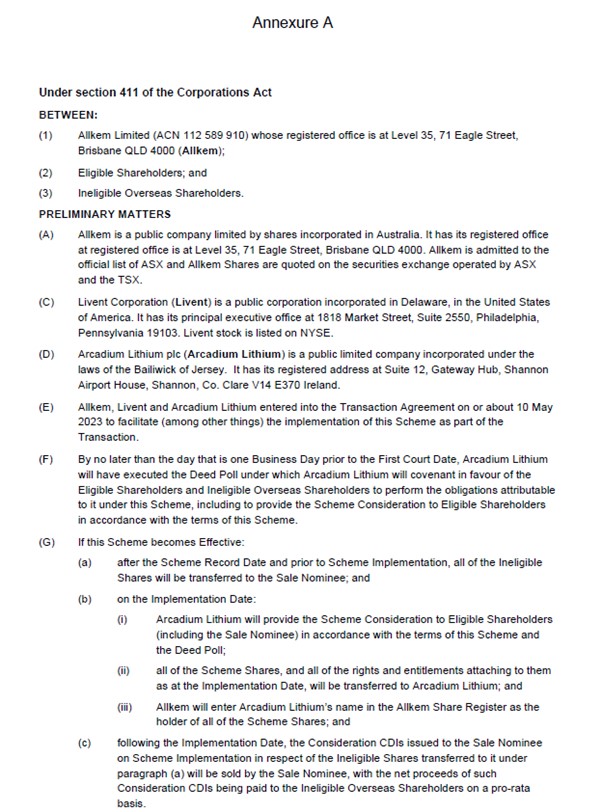
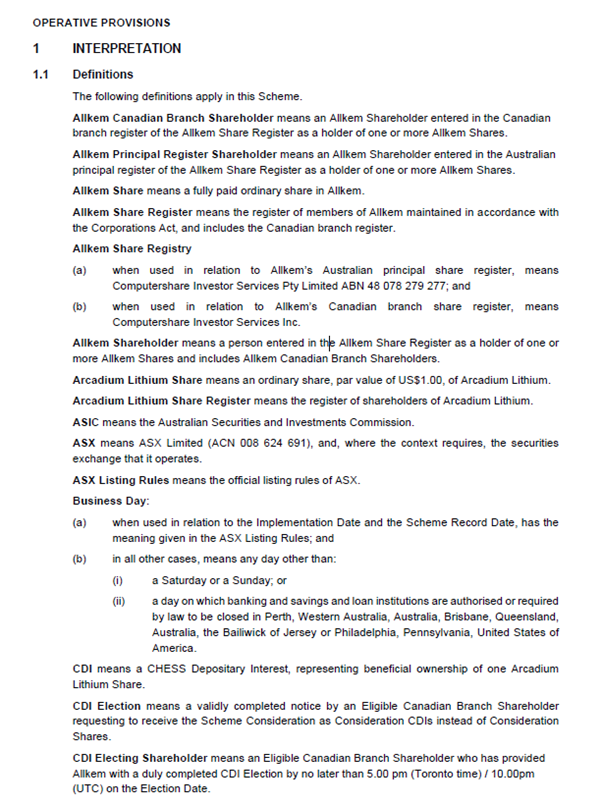
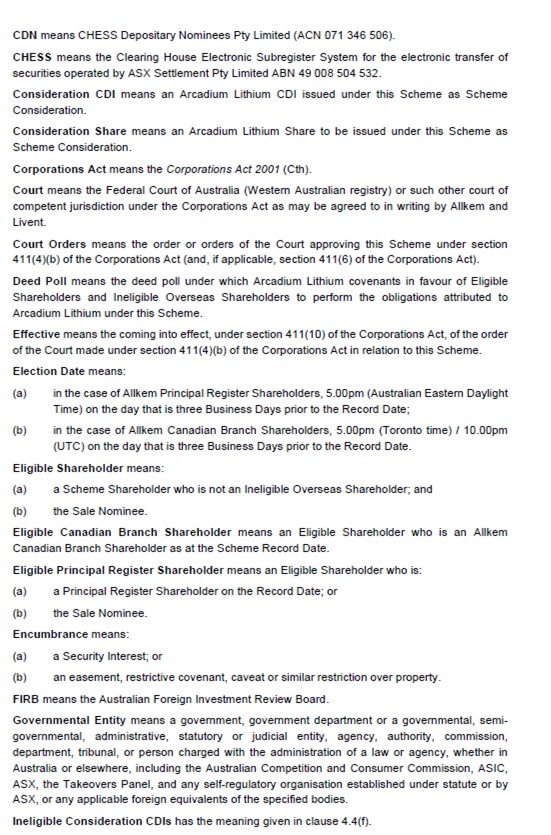
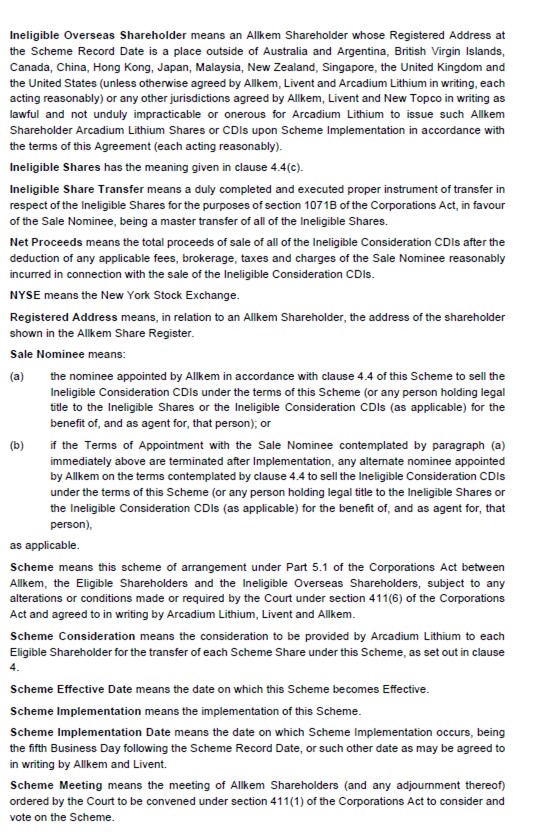
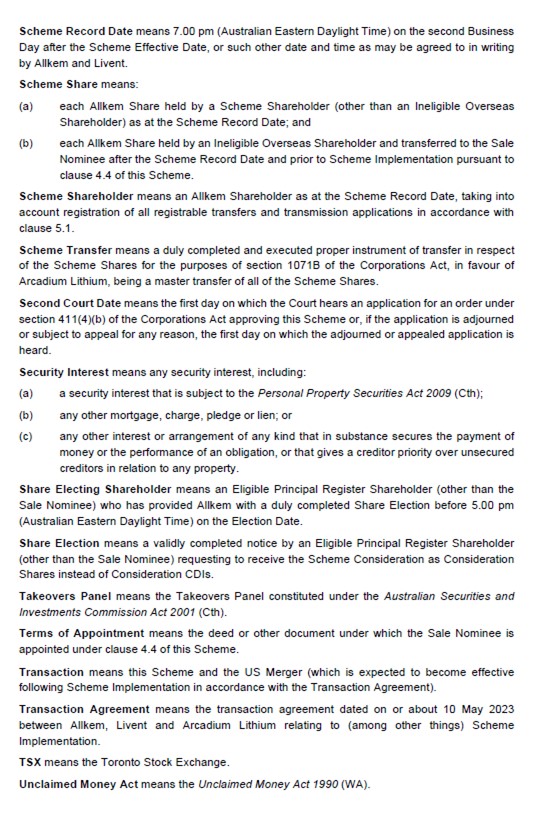
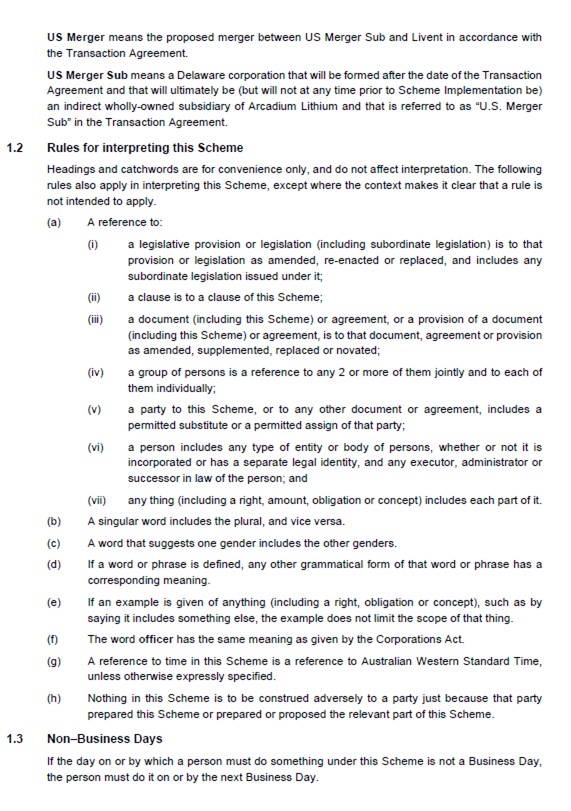
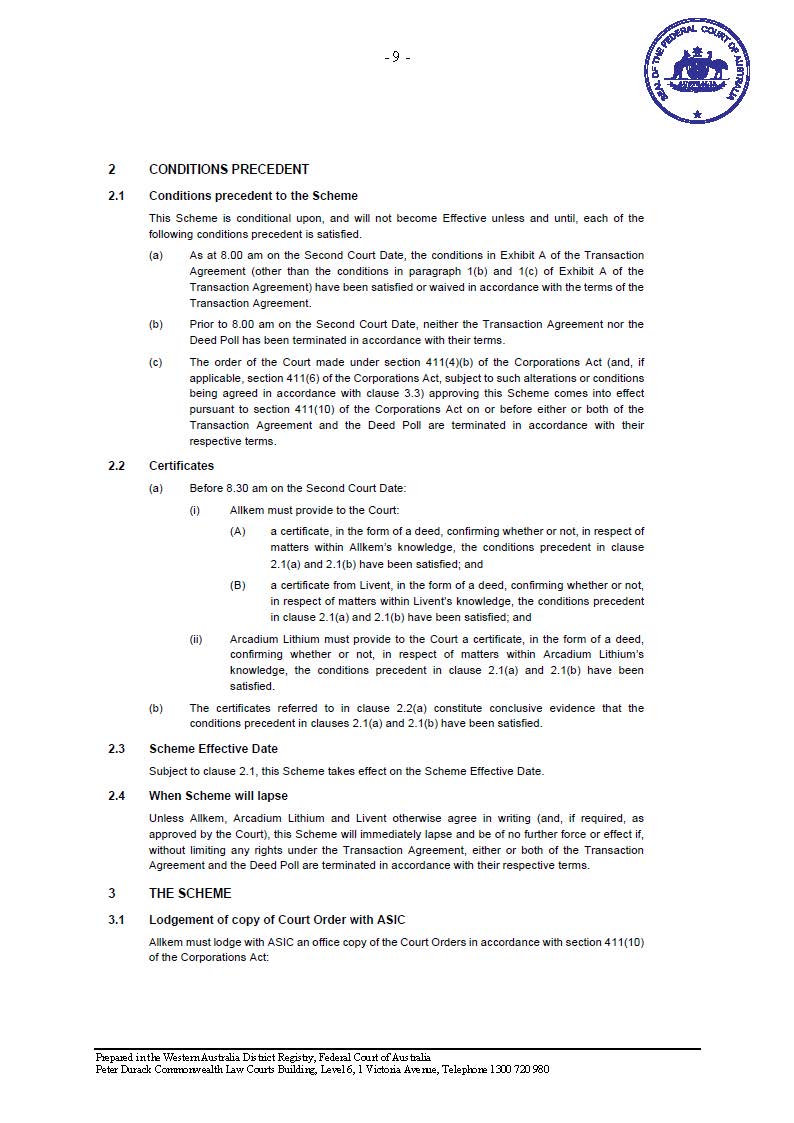
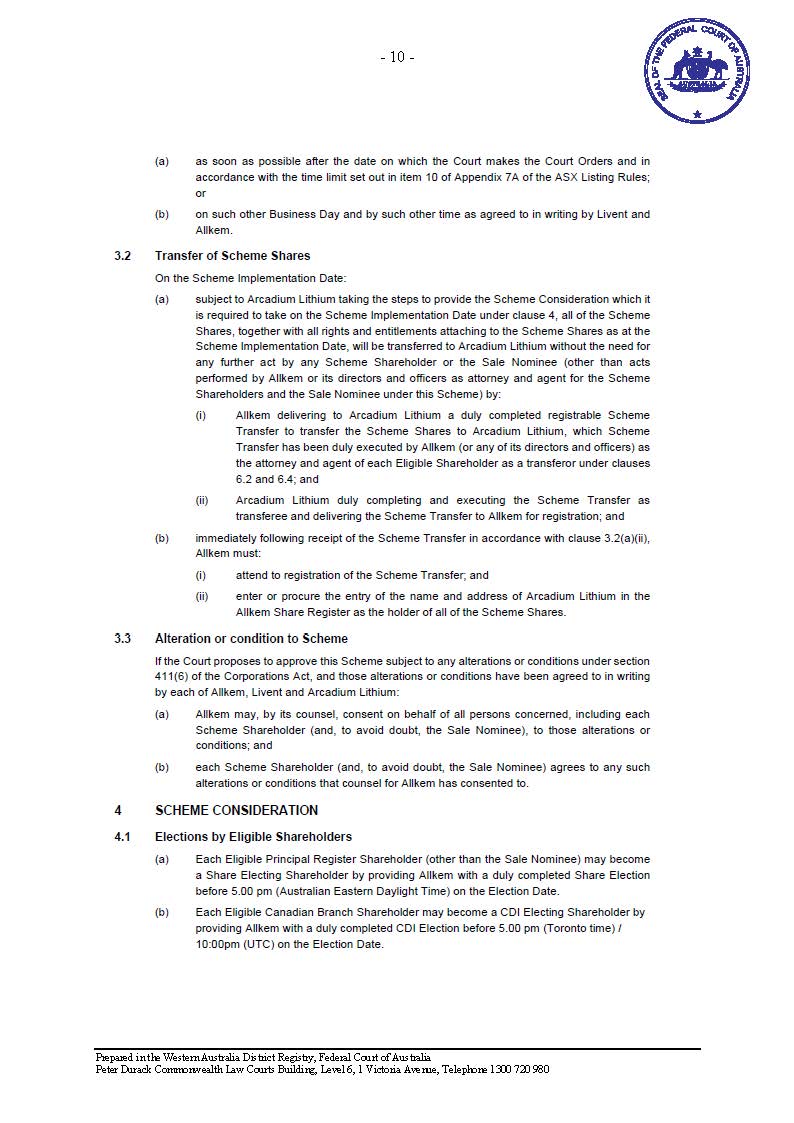
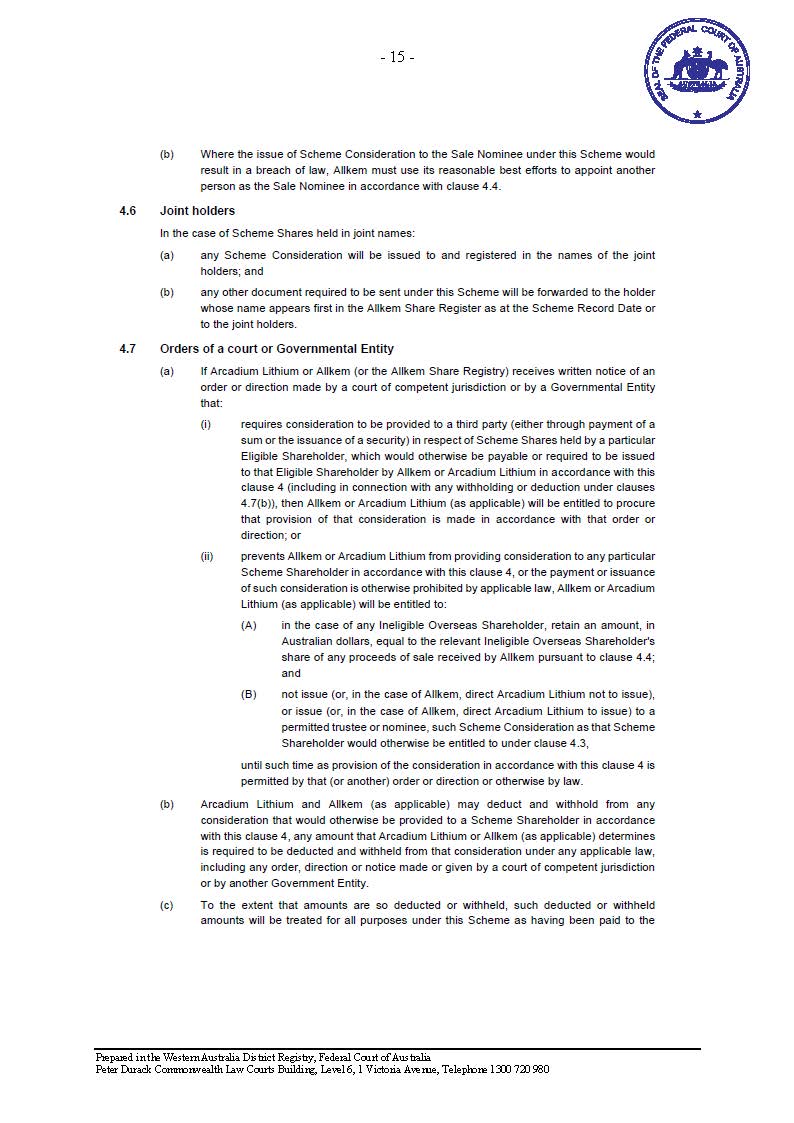
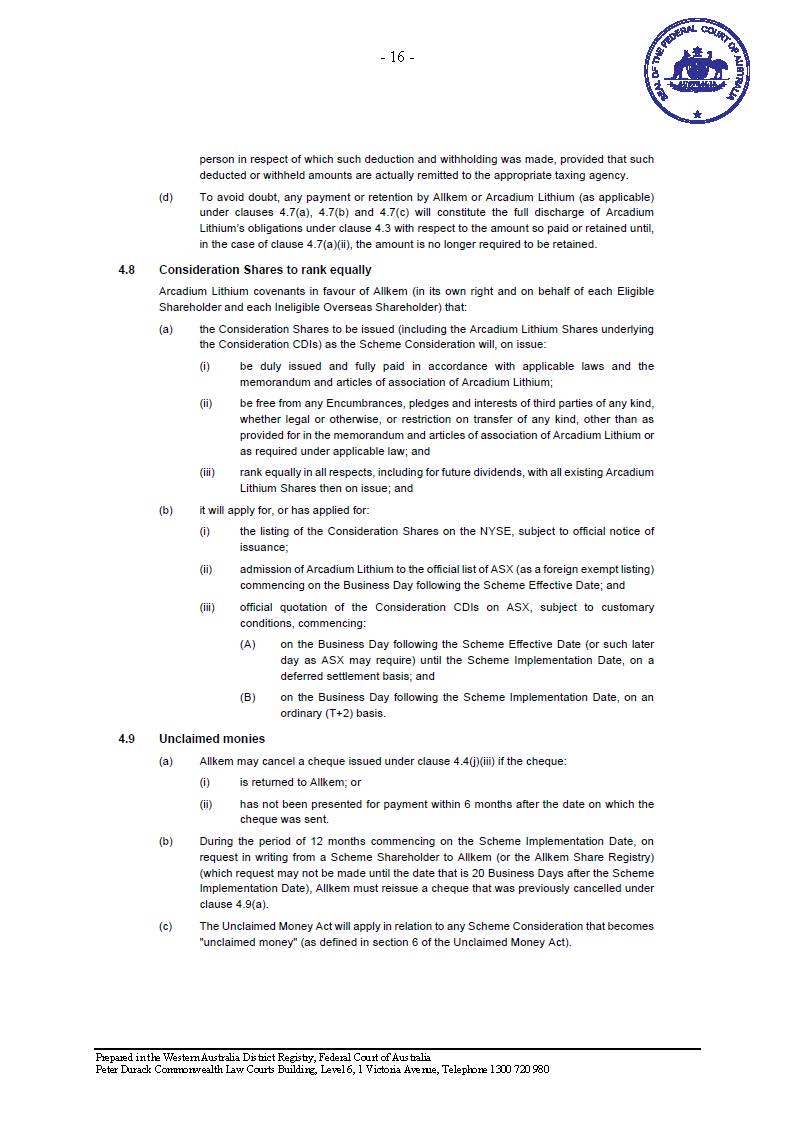
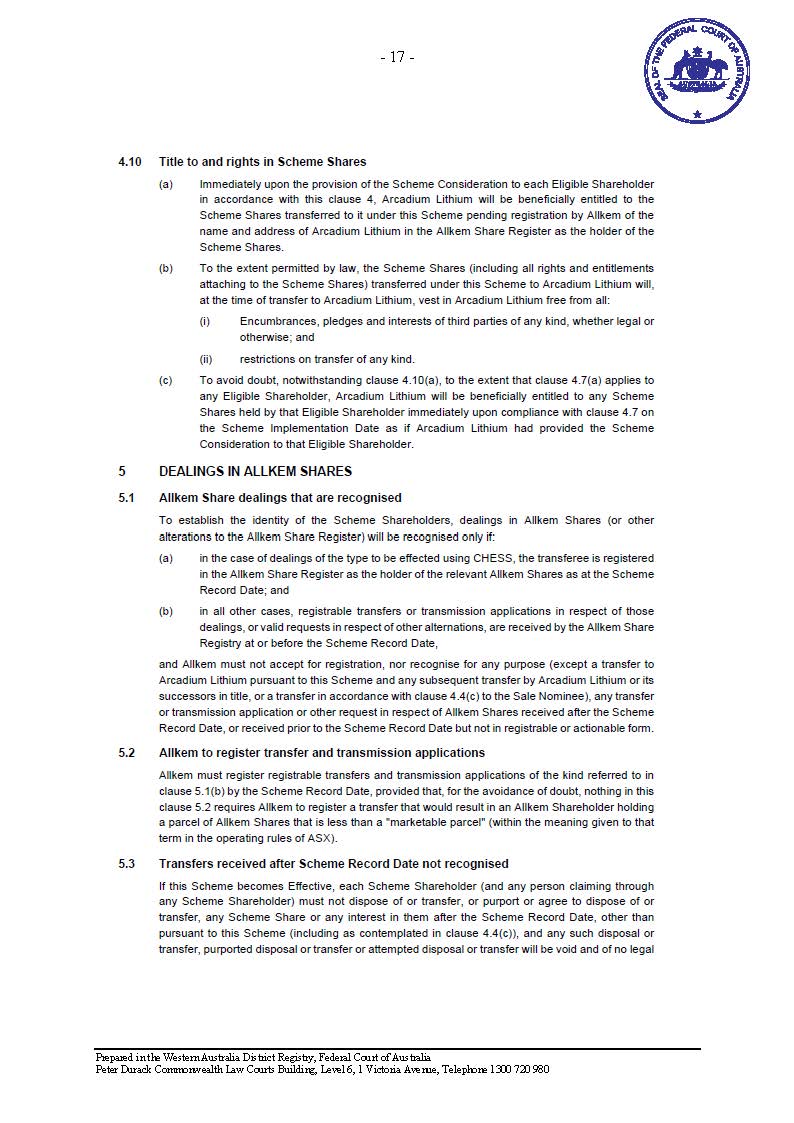
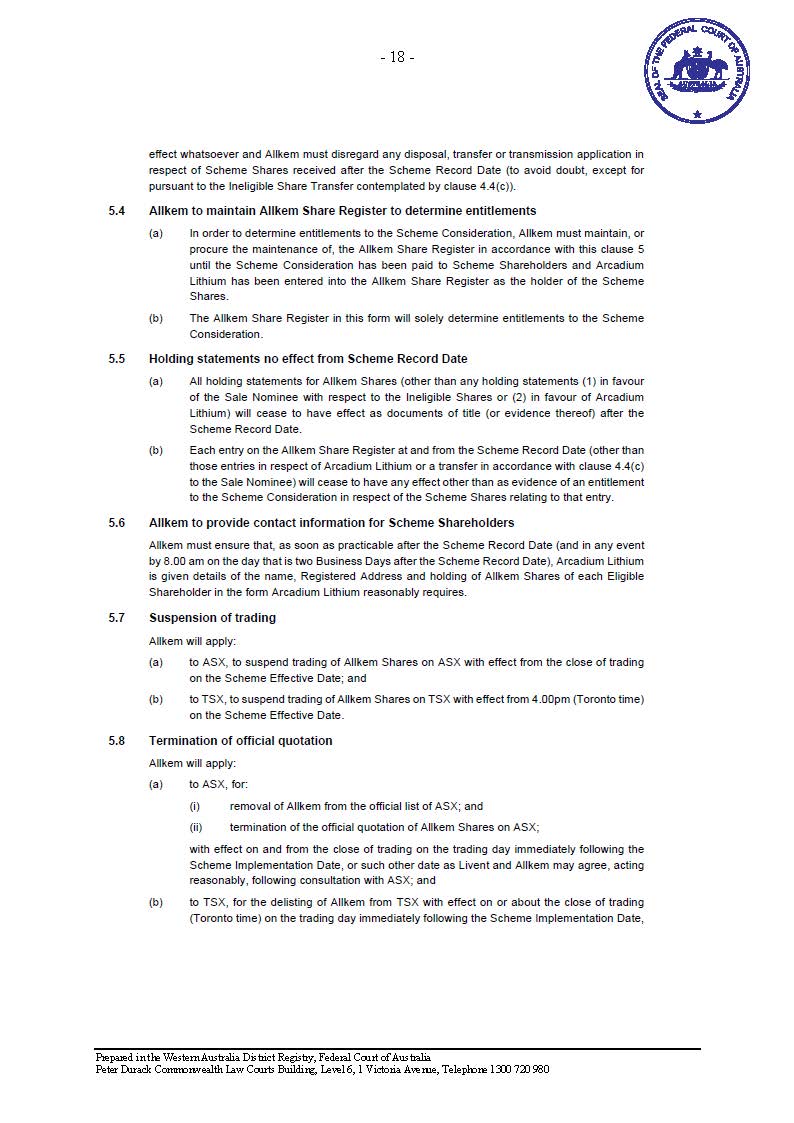
1. Pursuant to s 411(4)(b) of the Corporations Act 2001 (Cth), and subject to the condition in order 2 below, the scheme of arrangement between the plaintiff and the holders of fully paid ordinary shares in the capital of the plaintiff, as set out on pages 627 to 646 of the affidavit of Richard Stacy Anthon sworn on 28 November 2023 (Scheme), a copy of which is Annexure A to these orders, is approved.
2. Pursuant to s 411(6) of the Corporations Act, any amendment to Arcadium Lithium plc's Articles of Association (being Exhibit E to the Transaction Agreement annexed to the affidavit of James Yu-Wen Wang affirmed 18 October 2023 as 'JYW-3') made prior to Scheme Implementation (as defined in the Scheme) be limited to:
(a) deletion of Article 7.3(f)(17), 7.3(g)(7) and 7.3(h)(3); and
(b) deletion of Article 8.3 and replacement with 'A director may be removed from office by ordinary resolution of the Company in a general meeting with or without clause'.
3. Pursuant to s 1322(4)(a) of the Corporations Act the Court declares that, with effect nunc pro tunc from the time they occurred, the following acts, matters and things, namely:
(a) the scheme meeting held on 19 December 2023; and
(b) the resolution passed at the scheme meeting,
are not invalid by reason of any contravention of s 412(1) of the Corporations Act insofar as members received an incorrect notification of the scheme meeting.
4. Pursuant to s 411(12) of the Corporations Act, the plaintiff is exempted from compliance with s 411(11) in relation to the Scheme.
5. The plaintiff must lodge an office copy of these orders with ASIC by 22 December 2023.
Note: Entry of orders is dealt with in Rule 39.32 of the Federal Court Rules 2011.
BANKS-SMITH J:
1 At a first scheme court hearing on 8 November 2023, I made orders approving the convening of a Scheme Meeting of shareholders of Allkem Limited for the purpose of considering a Scheme of arrangement and approving the distribution of a Scheme Booklet: Allkem Limited, in the matter of Allkem Limited [2023] FCA 1397 (first reasons).
2 The Scheme forms part of a broader conditional transaction which is intended to combine Allkem and Livent Corporation under a new company, Arcadium Lithium plc, to create a global lithium chemicals producer with a presence in key lithium regions in a number of continents.
3 The Scheme Meeting was held on 19 December 2023. Allkem shareholders approved the Scheme by the requisite statutory majorities.
4 Section 411(4) of the Corporations Act 2001 (Cth) relevantly provides that an arrangement is binding on the members of a company and the company if, at a meeting convened in accordance with an order of the Court, a resolution in favour of the arrangement is passed by the given statutory majorities, and the arrangement is approved by order of the Court.
5 At the second court hearing on 20 December 2023, Allkem sought approval of the Scheme. Having regard to the evidence before me, and having heard from counsel as to a number of particular matters disclosed below, I was satisfied that it was appropriate to approve the Scheme in accordance with the orders made that day.
6 These are my reasons for doing so.
Evidence for the second court hearing
7 In addition to the affidavits on which it relied at the first court hearing, Allkem relied on:
(a) third affidavit of Richard Anthon, attaching the CDI election and withdrawal forms, the proxy form, the notice and access letter, and adducing evidence as to the lodgement of the Scheme Booklet with ASIC and the dispatch of Scheme materials to Allkem shareholders on the principal and Canadian registers;
(b) affidavit of Kara Van Hummel, Client Service Manager of Computer Share Investor Services Pty Limited, deposing to the dispatch of the final Scheme Booklet, the proxy forms and other Scheme documentation to Allkem shareholders on the principal register;
(c) affidavit of Roxanne Parsaud, Relationship Manager in Client Services at Computershare Investor Services Inc, as to the dispatch of the final Scheme Booklet, the proxy forms and other Scheme documentation to Allkem shareholders on the Canadian register;
(d) fourth affidavit of Richard Anthon as to communications with shareholders, including as to telephone information lines, a video presentation and investor briefing presentations;
(e) affidavit of Danny Hunt, Chief Operating Officer for the Asia and Pacific region at Morrow Sodali Pty Limited, as to shareholder communications;
(f) fifth affidavit of Richard Anthon as to the conduct of the Scheme Meeting and attaching a copy of the share poll report and the ASX announcement concerning the results of the Scheme Meeting;
(g) third affidavit of Toby Newnes deposing to the satisfaction of conditions precedent for Allkem and Livent, the service on ASIC of all documents filed in this matter, the absence of any notice of intention to oppose the approval of the Scheme and the absence of any alternative proposal to the Scheme;
(h) second affidavit of Guy Alexander as to the satisfaction of conditions precedent for Arcadium and the outcome of the Livent stockholder meeting; and
(i) fourth affidavit of Toby Newnes, relevantly attaching a copy of a 'no objection' letter from ASIC dated 20 December 2023.
8 Allkem's evidence was prepared consistently with the Court's Schemes of Arrangement Practice Note GPN-SOA.
Relevant considerations for the second court hearing
9 The Court has a discretion whether to approve a scheme under s 411(4), and is not bound to approve it merely because the statutory majorities have been achieved: Re NRMA Ltd (No 2) [2000] NSWSC 408 at [21] (Santow J).
10 The matters the Court must take into account in deciding whether to approve a scheme have been summarised in many cases: see, for example, Chevron (TAPL) Pty Ltd v Chevron Australia Pty Ltd, in the matter of Chevron (TAPL) Pty Ltd (No 2) [2022] FCA 381 at [9], citing Seven Network Limited, in the matter of Seven Network Limited (No 3) [2010] FCA 400 at [31]-[44] (Jacobson J). They include whether:
(a) the orders of the Court convening the scheme meeting were complied with;
(b) the resolution to approve the scheme was passed by the requisite majority, and whether other statutory requirements have been satisfied;
(c) all conditions to which the scheme is subject (other than court approval and lodgement of the Court's orders with ASIC) have been met or waived;
(d) the scheme is fair and reasonable so that an intelligent and honest shareholder, properly informed and acting alone, might approve it;
(e) there was full and fair disclosure to shareholders of all information material to the decision whether to vote for or against the scheme;
(f) the company has brought to the attention of the Court all matters that could be considered relevant to the exercise of the Court's discretion; and
(g) the Court is satisfied under s 411(17) that the scheme has not been proposed to avoid Chapter 6 of the Act, or that the company has a statement from ASIC that it has no objection to the scheme.
11 However, the Court is not to substitute its commercial judgment for that of the body of members: Seven Network at [32]. Further as to the reference to what is 'fair and reasonable', Beach J said the following in Amcor Limited, in the matter of Amcor Limited (No 2) [2019] FCA 842 at [11]:
Now as I have said, my task is to consider whether the Scheme is fair and reasonable with the test of fairness and reasonableness including a consideration of whether 'an intelligent and honest [shareholder], properly informed, acting alone, might approve [the scheme]' (Fowler v Lindholm (2009) 178 FCR 563 at [79] per Emmett, Gordon and Jagot JJ). But the Scheme shareholders' vote in favour of the Scheme is evidence of its inherent fairness. Put another way, if a majority of the Scheme shareholders have approved the Scheme, it is unlikely that the Scheme would be unreasonable. Further, I do not have to be satisfied that no better Scheme could have been devised.
Formal matters
Lodgement of orders and registration of Scheme Booklet
12 Allkem's solicitors registered the Scheme Booklet with ASIC in substantially the form approved by the Court and provided ASIC with a sealed copy of the orders.
Dispatch of the Scheme Booklet
13 There was evidence in an appropriate form of the dispatch of the Scheme Booklet in accordance with the orders of 8 November 2023. There was one procedural irregularity disclosed. Under the orders, dispatch to shareholders with an address overseas was to be by international airmail or air courier. However, materials to shareholders with a Canadian address on the Canadian register were sent from Canada, and so by standard Canadian post in accordance with usual practice. There is no suggestion that those shareholders were prejudiced by any relevant abridgement of the notice period or suffered any injustice as a result, and I accepted Allkem's submission that s 1322(2) may be relied upon in such circumstances: that is, I was satisfied that the Scheme meeting and the resolution passed at it are not invalidated by reason of the procedural irregularity.
14 Another error was disclosed. Following its dispatch, it was identified that the Scheme Booklet contained a minor error in the form of the omission of a word in the proposed resolution to be put at the Scheme Meeting. This was the result of a deletion by the designer and typesetter engaged by Allkem to prepare the final Scheme Booklet and was clearly inadvertent. I accepted Allkem's submission that the error is unlikely to have caused Allkem shareholders any confusion, particularly because the resolution in the proxy form (in both the online and hard copy version of the Scheme Booklet) did not contain the typographical error, and there was evidence to the effect that the resolution displayed at the Scheme Meeting (both in person and through the online platform) did not contain the typographical error.
15 However, Allkem suggested, and I agreed, that an order be made under s 1322(4)(a) of the Corporations Act to the effect that the Scheme Meeting and the resolution passed are not invalidated by reason of this error. That is the purpose of paragraph 2 of the orders. The preconditions found in s 1322(6) for the making of the order were all satisfied: the irregularity was of a procedural nature; Allkem had acted honestly; it was just and equitable that the order be made; and I was satisfied that no substantial injustice had been or was likely to be caused to any person.
Advertising of hearing
16 Allkem made the requisite announcements to the ASX of the release and dispatch of the Scheme Booklet, and published a notice via the ASX Market Announcement Platform setting out details of the second court hearing.
Conduct of Scheme Meeting
17 The fifth affidavit of Mr Anthon adduced appropriate evidence that the conduct of the Scheme Meeting accorded with the orders.
Scheme approved by the requisite majorities
18 The Scheme was passed by the requisite majorities for the purposes of s 411(4)(a)(ii) of the Corporations Act, namely:
(a) 72.07% of Allkem shareholders present and voting (in person or by proxy, attorney or corporate representative) voted in favour of the Scheme; and
(b) 89.27% of the votes cast on the resolution at the Scheme Meeting were cast in favour of the Scheme.
19 The 338,031,225 shares voted were approximately 53% of the 639,321,293 shares on issue as at the record date. As to the headcount of Allkem shareholders who voted, 2,019 Allkem shareholders voted, which represented approximately 3.96% of the total number of Allkem shareholders. This is not the lowest percentage of voting shareholders recorded in the authorities, but it is close to it: see Decimal Software Limited, in the matter of Decimal Software Limited (No 2) [2018] FCA 2040 at [19] (5.21%); Real Energy Corporation Limited, in the matter of Real Energy Corporation Limited (No 2) [2021] FCA 422 at [3] (2.4%) (Yates J); the decisions gathered in Re Bardoc Gold Ltd; Ex Parte Bardoc Gold Ltd (No 2) [2022] WASC 113 at [25] (fn 16) (Hill J); and Essential Metals Limited, in the matter of Essential Metals Limited (No 2) [2023] FCA 1306 at [33] (5.2%) (Jackson J) (Essential Metals (No 2)).
20 Regardless, low shareholder turnout does not prevent the Court from making orders approving a scheme of arrangement. As observed by Yates J in Real Energy at [7], citing a number of authorities, 'the apathetic shareholder who chooses not to vote should not be presumed to be antagonistic to the scheme; nor does such a shareholder warrant paternalistic protection'.
21 However, it is appropriate where there is a low voter turn out to consider whether there may have been any issue with respect to dispatch of information to shareholders or any other matter that may have deterred voters from attending or voting at the Scheme Meeting: Decimal Software at [21]; and Essential Metals (No 2) at [35].
22 There was no indication that Allkem shareholders were excluded or prevented from attending the Scheme Meeting, and there was ample direct evidence of dispatch of the Scheme Booklet and related materials to Allkem shareholders.
23 The authorities often look to other attendance records to see if the voting turnout for the scheme meeting might have been unusual or whether it was consistent with voting patterns for meetings of the company's members: DDH1 Limited, in the matter of DDH1 Limited (No 3) [2023] FCA 1153 at [15] (Colvin J); and Essential Metals (No 2) at [37].
24 The evidence indicated that the voter turnout for the Scheme Meeting was greater than at the 2023 Allkem AGM: 321,116,071 shares were voted at the AGM on 8 November 2023, which is less turnout than the Scheme Meeting, and 1,364 shareholders voted, which is significantly less than the number of shareholders that voted at the Scheme Meeting.
25 Accordingly, I was satisfied that the relatively low voter turnout compared to total shareholder numbers was not a reason to decline to approve the Scheme.
Satisfaction of conditions precedent
26 The Court received appropriate evidence and certification in this regard.
Discretionary considerations
Good faith and proper purpose
27 I had no reason to doubt that Allkem shareholders voted in good faith and not for an improper purpose. I took into account that the independent expert (Kroll) opined that in the absence of any other relevant information or superior proposal (and there was none), the Scheme is fair and in the best interests of Shareholders in the context of the transaction as a whole. Further, neither ASIC nor any shareholder appeared at the second court hearing to object to its approval.
Fair and reasonable scheme
28 I accepted Allkem's submission that the Scheme is fair and reasonable such that an intelligent and honest shareholder, properly informed and acting alone, might approve it. This understanding of the meaning of 'fair and reasonable' is consistent with that described in Seven Network. As observed in Amcor Limited, approval by the requisite majorities is prima facie evidence that it is fair. The expert's opinion provided further support. No superior proposal had emerged. The Scheme contemplates measures to protect Allkem shareholders against performance risk (as addressed in the first reasons).
Full and fair disclosure
29 I was satisfied to the necessary level on the evidence before me at the first court hearing that there would be full and fair disclosure to Allkem shareholders regarding the Scheme, having regard to the content of the Scheme Booklet. There was nothing new before the Court that changed that view. Relevantly, in circumstances where it was apparent that a third-party shareholder engagement firm, Morrow Sodali, had been engaged to conduct inbound and outbound communications with Allkem shareholders, and where it was disclosed that there were video presentations and investor briefings, I was concerned with whether the content of any shareholder communications may have undermined or compromised the integrity of the Scheme process: Essential Metals Limited, in the matter of Essential Metals Limited [2023] FCA 240 at [102]; and OreCorp Limited, in the matter of OreCorp Limited [2023] FCA 1359 at [21]-[22] (Colvin J). There was detailed evidence before me to the effect that the communication regime was carefully monitored and checked. There was no evidence that there were material deviations from the Scheme Booklet during the course of shareholder communications and no evidence of anything which could be said to undermine the integrity of the Scheme process.
Satisfaction of s 411(17)
30 As noted, the Court received a copy of ASIC's standard 'no objection' statement before the hearing, satisfying the requirements of s 411(17)(b) of the Corporations Act. It is otherwise well established that the Court should not refuse approval of a scheme of arrangement merely because it could have been effected under Chapter 6 of the Corporations Act.
Public policy and oppression of minorities
31 There is no evidence before the Court that any minority Allkem shareholders have been oppressed or that the Scheme offends any aspect of public policy.
Two important matters
32 It remains to address two important matters.
US Securities Act exemption
33 The first matter is that Allkem and Arcadium intend to rely on this Court's approval for the purpose of qualifying for the exemption under s 3(a)(10) of the Securities Act of 1933 (USA) from US registration/prospectus requirements in connection with the issuance of Arcadium shares (including CDIs) to Allkem shareholders by way of consideration under the Scheme.
34 In summary, in the case of an Australian scheme of arrangement in which the bidder is proposing to issue securities as consideration, including to target members in or who are citizens or residents of the US, the bidder may be able to avoid the need to comply with the US registration/prospectus requirements if the scheme of arrangement satisfies the conditions for the exemption from registration afforded by s 3(a)(10) of the Securities Act of 1933: see generally Amcor Limited at [33].
35 The exemption stipulated in s 3(a)(10) of the Securities Act of 1933 is in the following terms:
(10) Except with respect to a security exchanged in a case under title 11 [of the United States Code], any security which is issued in exchange for one or more bona fide outstanding securities, claims or property interests, or partly in such exchange and partly for cash, where the terms and conditions of such issuance and exchange are approved, after a hearing upon the fairness of such terms and conditions at which all persons to whom it is proposed to issue securities in such exchange shall have the right to appear, by any court, or by any official or agency of the United States, or by any State or Territorial banking or insurance commission or other governmental authority expressly authorized by law to grant such approval.
36 There are many examples of second court hearings for schemes where this issue has arisen. In short, the courts have proceeded on the basis that the exemption would be available if the court in question holds a hearing to determine whether the proposed terms and condition are fair to all those who receive securities. I have set out above the approach to whether a scheme is considered fair and reasonable (at [10]-[11]). It is to be noted, however, that it is not for the court to express any view as to whether its procedures or processes are sufficient to satisfy the requirements of the exemption: Aston Resources Limited, in the matter of Aston Resources Limited (No 2) [2012] FCA 401 at [8] (Jacobson J), citing Central Pacific Minerals NL [2002] FCA 239 (Emmett J). Further, the court does not act as the valuer of shares, but is assisted by expert opinion on that matter: Aston Resources at [11], citing Permanent Trustee Company [2002] NSWSC 1177 (Barrett J).
37 However, as a line of authorities indicates, a standard approach has been adopted in relation to the exemption, noting particular matters: Atlantic Gold NL, in the matter of Atlantic Gold NL (No 2) [2014] FCA 869 at [8] (Jacobson J); In the matter of Ardent Leisure Limited trading as Ardent Leisure Limited; Ardent Leisure Management Limited in its capacity as the responsible entity of the Ardent Leisure Trust (No 2) [2018] NSWSC 1990 at [19] (Black J); Amcor Limited at [37]-[38]; Tronox Limited, in the matter of Tronox Limited (No 2) [2019] FCA 681 at [51] (O'Callaghan J); Re Ellerston Global Investments Ltd [2020] NSWSC 1108 at [18] (Black J); and Ex Parte Saracen Mineral Holdings Ltd [No 2] [2021] WASC 32 at [63] (Hill J).
38 I will follow this approach. Therefore, I note that:
(a) I was advised before the commencement of the hearing to approve the Scheme that reliance would be placed on the s 3(a)(10) exemption of the Securities Act of 1933 on the basis of my approval of the Scheme;
(b) I have been informed that Arcadium shares and CDIs are to be offered as scheme consideration, and an independent expert report concluded that the proposal is in the best interests of shareholders of Allkem;
(c) I held a hearing in open court on 20 December 2023 to consider the fairness and reasonableness of the proposed Scheme, and it was open to any member of the public including any member of Allkem to attend;
(d) notice of the date of the approval hearing was included in the Scheme Booklet provided to all shareholders of Allkem prior to the proposal being considered by the Scheme Meeting, and was advertised on the ASX, so that those to whom the securities are to be issued had the opportunity to oppose or otherwise raise any objection to the Scheme; and
(e) no Allkem shareholder gave notice of any intention to appear at the second court hearing to oppose the approval of the Scheme, and none in fact opposed it.
Introduction of a condition
39 An issue was raised during the course of the second hearing, that required consideration of whether it was appropriate to introduce a condition with respect to approval of the Scheme.
40 Mr Alexander's second affidavit annexed a copy of a public announcement issue by Livent on its Livent Investor Relations website with respect to the outcome of the meeting of Livent shareholders. The meeting was held at 9.00 am New York time on 19 December 2023. As set out in the first reasons (at [9]), Allkem, Livent and Arcadium entered into a Transaction Agreement on or about 10 May 2023 to facilitate (among other things) the implementation of the Scheme, insofar as Allkem shareholders are concerned, and the implementation of a Merger in accordance with Delaware law, insofar as Livent stockholders are concerned. These processes are separate but parallel.
41 The public announcement relevantly indicated that the stockholders approved the proposal to adopt the Transaction Agreement. However, certain proposals were also put at the meeting by way of a non-binding advisory vote. Those proposals related to potential amendments to the provisions of the Articles of Association of Arcadium, which the Livent stockholders supported in a non-binding manner.
42 The Articles were included by way of Exhibit E to the Transaction Agreement, a copy of which was adduced in evidence by way of the affidavit of Mr Wang ([18(a)] of first reasons). The Scheme Booklet included (at Annexure D) a 'Summary of Transaction Agreement', and noted that a copy of the Transaction Agreement was available on the ASX website.
43 Relevantly, the proposals relate to matters addressed by current Articles 7.3(f)(17), 7.3(g)(7) and 7.3(h)(3) and 8.3.
44 Article 77.3 deals with nominations and proposals by shareholders. Article 7.3(f) sets out the information that a member is to provide in any notice providing for the nomination of person for election to the Board or for other business proposed to be brought before a general meeting. It sets out a long list of information about the member to be included. Relevantly, Article 7.3(f)(17) currently provides that the member must also provide 'such additional information that the Company may reasonably request regarding such member or [associate persons]'.
45 Article 7.3(g) deals with information to be provided by a member with respect to any nominee for election to the Board. Again, a long list of information is prescribed. Article 7.3(g)(7) currently provides that the members must also provide 'such additional information as the Company may reasonably require…'.
46 Article 7.3(h) deals with information to be provided by a member regarding business proposed to be brought before a general meeting. Similarly, a list of information is prescribed. Article 7.3(h)(g) currently provides that in addition, a member must also provide such additional information that the Company may reasonably require.
47 Article 8.3 currently provides that a director may be removed in a number of circumstances, 'including but not limited to' where a director is convicted of an offence or a material act of dishonesty.
48 I was informed that as a result of the outcome of the non-binding advisory votes referred to above, negotiations are continuing between the parties as to whether Articles 7.3(f)(17), 7.3(g)(7) and 7.3(h)(3) are to be deleted, and as to whether Article 8.3 is to be deleted and substituted by the words: 'A director may be removed from office by ordinary resolution of the Company in a general meeting with or without clause'.
49 Accordingly, and to provide for agreement between the parties to amend the Articles in that manner, Allkem sought an order that:
Pursuant to s 411(6) of the Corporations Act, any amendment to Arcadium Lithium plc's Articles of Association (being Exhibit E to the Transaction Agreement annexed to the affidavit of James Yu-Wen Wang affirmed 18 October 2023 as 'JYW-3') made prior to Scheme Implementation (as defined in the Scheme) be limited to:
(a) deletion of Article 7.3(f)(17), 7.3(g)(7) and 7.3(h)(3); and
(b) deletion of Article 8.3 and replacement with 'A director may be removed from office by ordinary resolution of the Company in a general meeting with or without clause'.
50 Section 411(6) of the Corporations Act provides:
(6) The Court may grant its approval to a compromise or arrangement subject to such alterations or conditions as it thinks just.
…
51 This power of the court is broad and is expressed without limitation. In Snowside Pty Ltd as trustee for the Snowside Trust v Boart Longyear Ltd [2017] NSWCA 215 (Bathurst CJ, Beazley P and Leeming JA) the Court said:
[25] …It would be quite inconsistent with the statutory language to read down the broad terms of s 411(6) by reference to a decision on a legislative scheme which lacked such a power. It is clear that s 411(6) empowers the court to grant its approval to a scheme which is different from that which was approved by members or creditors; if that were not so, the subsection would be entirely otiose.
[26] Subsection 411(6) is not without limitation. But the power is not circumscribed by the limitations favoured by the appellants, namely, to alterations which are not 'material' or 'substantial' or 'significant'. Instead, it is circumscribed by the requirement that the Court thinks the alteration is one that is just.
52 There is no question that the discretion must be exercised judicially.
53 In their text Schemes, Takeovers and Himalayan Peaks, Fourth Edition, at [4.7], Tony Damian and Andrew Rich explain the principles and collect a large number of examples where the court has exercised its discretion to grant approval to a scheme, subject to alterations or conditions. Unsurprisingly, none of those examples are directly analogous to the present case, but they provide guidance as to the matters that might be relevant in the exercise of the discretion.
54 In light of the urgency with which this matter required determination, it was not possible to consider a large body of authorities. However, relevant themes that emerge from the cases cited by Damian and Rich are:
(a) the discretion may be exercised if the alteration is of a minor or technical kind that does not really affect the detail of the scheme, but may also be used where the alteration is of a more substantive nature;
(b) a relevant question is whether it affects the substantive nature of the scheme or is more of a minor kind that improves the working of the scheme;
(c) the court is to consider whether the scheme would still have been agreed to by the requisite majorities if the members had considered and voted on the scheme with the suggested amendments in place;
(d) what is important is whether the scheme remains, in substance, what was agreed by the members; and
(e) the discretion is unconfined by any particular statutory criteria other than the alteration or condition must be 'just'.
55 Examples referred to by Damian and Rich where the discretion under s 411(6) has been utilised include provision for substitution of a proposed bidder by a subsidiary; changes of record dates; and changes to the method of payment of consideration. Changes to transactional documents or conditions relating to amendments to ancillary arrangements were provided for in Quintis Limited, in the matter of Quintis Limited (subject to deed of company arrangement) (receivers and managers appointed) (No 2) [2018] FCA 1510 (Yates J) and Re Ovato Print Pty Ltd [2020] NSWSC 1882 (Black J).
56 I do not consider that the potential amendments to the Articles are of a minor or typographical nature. Clearly they are more substantive. However, I accepted Allkem's submission that the possible changes to the Articles do not alter the substance of the Scheme and appear to be in the interests of the members. The identified changes have the potential to remove particular restrictions that the company may otherwise impose on the members' ability to put matters before a meeting of members, thus increasing the power of members to participate in the company's business at meetings. They potentially enhance the manner in which members may control the constitution of the Board. The proposed change to Article 8.3 would make the position more consistent with that under Australian law. The proposed changes were supported in a non-binding manner by the Livent stockholders. In those circumstances, I accepted the submission that it can safely be inferred that the requisite majority of Allkem shareholders would have voted in favour of the Scheme regardless of such changes, had they been invited to do so.
57 I was also taken to the disclosures that were made within the Scheme Booklet about the Articles, to assess the significance of the potential changes. Shareholders were referred to organisational materials relating to what was then referred to as NewCo, and in particular were referred to section 7.13 of the Scheme Booklet and Annexure H. Although section 7.13 mentioned the Articles, nothing was said relevant to the present matters. Annexure H contained a comparison of shareholder rights and corporate laws under Australian and Jersey law. Shareholders were invited to read the Newco organisational documents, including the Articles if they wished to do so, and were referred to Exhibit E to the Transaction Agreement available on the ASX website. In a section that compares the rights of shareholders to bring a resolution before a meeting, current Article 7.3(h) is paraphrased, including 7.3(h)(3). Current Article 8.3 is also paraphrased. There is also reference to shareholders having the right to nominate director nominees if they comply with notice requirements.
58 I took into account these disclosures, which highlighted matters that a shareholder may have noticed if they chose to read the Articles, but nothing in the manner in which they are described in the Scheme Booklet altered my view that it can safely be inferred that the requisite majority of members would have voted in favour of the Scheme regardless of the potential changes to the Articles, had they been invited to do so.
59 In all of the circumstances I considered it just to provide for the potential that there would be changes agreed to the Articles as a result of negotiations between the parties prior to the Scheme implementation, but confined to those set out in the order sought by Allkem.
60 I made order 2 accordingly.
Conclusion
61 Having regard to the above matters, including the support of the Scheme shareholders, the opinion of the independent expert, the absence of opposition to the Scheme by any shareholder and the comprehensive disclosure in the Scheme Booklet, I exercised my discretion to approve the Scheme.
62 I also granted the exemption from the requirements of s 411(11) - I accepted Allkem's submission that there is no utility in having the Court's orders annexed to Allkem's constitution, as those orders do not effect a change to the constitution.
I certify that the preceding sixty-two (62) numbered paragraphs are a true copy of the Reasons for Judgment of the Honourable Justice Banks-Smith. |
Associate:


