

Federal Court of Australia
Koolan Iron Ore Pty Ltd v Infrassure Ltd (No 2) [2023] FCA 1654
ORDERS
KOOLAN IRON ORE PTY LTD (ABN 87 099 455 277) Applicant | ||
AND: | Respondent | |
DATE OF ORDER: |
THE COURT ORDERS THAT:
1. The parties must file a minute of consent orders reflecting these reasons and dealing with costs or, if necessary, competing minutes by 4.00 pm AWST on 22 February 2024.
2. The matter is listed for mention at 9.00 am AWST on 29 February 2024.
3. Liberty to apply in respect of paragraphs 1 and 2.
Note: Entry of orders is dealt with in Rule 39.32 of the Federal Court Rules 2011.
REASONS FOR JUDGMENT
JACKSON J:
1 The applicant, Koolan Iron Ore Pty Ltd is a subsidiary of Mount Gibson Iron Limited, a mining company that is listed on the Australian Securities Exchange (ASX). Koolan operates an open cut iron ore mine on Koolan Island, off the Kimberley Coast of Western Australia. At the relevant times the mine comprised the Main Pit and the Acacia East Pit (ACE). Part of the mine was separated from the ocean by a seawall. On 24 October 2014 there was a slump in the seawall, which was followed by a further slump on 8 November 2014 and then, on 25 November 2014, the catastrophic failure of the seawall and the inundation of the Main Pit (the Incident). This prevented Koolan from operating the Main Pit for a period of time. The Main Pit was dewatered and mining in that pit recommenced in 2018.
2 The respondent, Infrassure Ltd is part of a group of insurers known as a Market who indemnified Koolan under a Material Damage and Business Interruption insurance policy (Policy). Infrassure's share of any liability under the Policy was 7.5%.
3 Koolan claimed under the Policy for the physical damage to the mine resulting from the failure of the seawall and for the resulting business interruption. The claim in respect of physical damage was settled in June 2016. The claim for business interruption was also settled in July 2017, in relation to all insurers in the Market other than Infrassure. These reasons determine the remaining disputes between Koolan and Infrassure.
4 Infrassure does not dispute that Koolan suffered some loss resulting from the interruption to the operation of the mine, and nor does it dispute that it is liable to indemnify Koolan for loss of that kind. The dispute is about the quantum of Koolan's claim. On 10 June 2021, Infrassure paid Koolan its calculation of its share of the indemnity due as a result of the business interruption loss, $801,832. Koolan, however, alleges that Infrassure is liable to indemnify it for $8,491,337, and also that it is liable for interest under s 57 of the Insurance Contracts Act 1984 (Cth).
5 The approximately $7.7 million difference between the parties is explicable by a number of issues about the construction of the Policy, how Koolan would have operated the mine if the seawall had not failed, and whether certain adjustments to the claim should be allowed. The most significant issue is whether Koolan has established that, if the seawall had not failed, it would have changed its mine plan, so that from March 2015 it would have mined specified volumes of iron ore at a lower cost, and so on a more profitable basis, between then and 23 October 2015. That is the end date of the Indemnity Period on which the parties are agreed, being the 12 months starting on the date of the first slump in the seawall.
6 By its originating application, Koolan seeks a declaration that it is entitled to be indemnified by Infrassure under the Policy for 7.5% of Koolan's calculation of the business interruption loss. It also seeks declarations as to the proper construction of the Policy. It claims judgment in the sum of $8,491,337 plus interest under the Insurance Contracts Act and costs (that sum does not, however, take into account the amount of $801,832 that Infrassure paid Koolan just before trial).
7 The trial took place during the COVID-19 pandemic, by video link from locations in Perth, Sydney and Brisbane, and included witnesses appearing from Hong Kong and Christmas Island.
8 The Policy and the parties' submissions are replete with capitalised defined terms and acronyms. These reasons will not swim against that tide. Terms defined in provisions of the Policy that are set out below will be used throughout these reasons without further defining them.
9 Given the complexity and disparate nature of the issues, it is not possible to state the outcome succinctly at this point. The parties agreed that when these reasons are delivered, they will confer in an attempt to agree the amount of Infrassure's remaining liability, if any.
10 Before describing the issues in more detail it is convenient to set out the key terms of the Policy. Its identifying details are Material Damage and Business Interruption Insurance policy bearing Unique Market Reference/policy number Q10592513/01 on policy wording with endorsements bearing number B0621CMSMG0513.
11 The Policy wording is standard wording that was issued by the Insurance Council of Australia and National Insurance Brokers of Australia in 1987. In fact, cases and other materials reviewed below suggest that wording of this kind has been in use in the United Kingdom and other insurance markets for a century. It has been used in a wide range of commercial operations and was not specifically prepared for use in the mining industry.
12 The relevant terms are found in Section 2 of the Policy, headed 'Business Interruption'. The indemnity clause is as follows:
In the event of any building or any other property or any part thereof used by the Insured at the premises for the purpose of the Business being physically lost, destroyed or damaged by any cause or event not hereinafter excluded (loss, destruction or damage so caused being hereinafter termed Damage) and the Business carried on by the Insured being in consequence thereof interrupted or interfered with, the Insurer(s) will, subject to the provisions of this Policy including the limitation on the Insurer(s) liability, pay to the Insured the amount of loss resulting from such interruption or interference in accordance with the applicable Basis of Settlement.
13 The total amount claimed from the Market was below the limitation on liability referred to here.
14 The Basis of Settlement is then set out. It contains four items. Only Item 1 and Item 4 are relevant to the dispute. Item 1 provides as follows:
The Insurance under this item is limited to loss of Gross Profit due to: (a) Reduction in Turnover and (b) Increase in Cost of Working and the amount payable as indemnity thereunder shall be:
(a) In respect of Reduction in Turnover
the sum produced by applying the Rate of Gross Profit to the amount by which the Turnover during the Indemnity Period shall, in consequence of the Damage, fall short of the Standard Turnover,
less any sum saved during the Indemnity Period in respect of such of the charges and expenses of the Business payable out of Gross Profit as may cease or be reduced in consequence of the Damage.
(b) In respect of Increase in Cost of Working
the additional expenditure necessarily and reasonably incurred for the sole purpose of avoiding or diminishing the reduction in Turnover which, but for that expenditure, would have taken place during the Indemnity Period in consequence of the Damage, but not exceeding the sum produced by applying the Rate of Gross Profit to the amount of the reduction thereby avoided;
less any sum saved during the Indemnity Period in respect of such of the charges and expenses of the Business payable out of Gross Profit as may cease or be reduce[d] in consequence of the Damage.
15 Item 1(b) can be labelled 'Increased Costs of Working' (ICW). It is unclear why the final sentence just quoted is not indented to Item 1(b) like it is to Item 1(a). Koolan submits that the fact that this 'savings' clause appears twice in identical terms appears to be a typographical error, and that nothing turns on it. I agree. The item means the same if the savings clause appears at the end of Item 1 and if it appears at the end of both Item 1(a) and Item 1(b) individually.
16 Item 1 then makes provision for a reduction of the amount payable in certain circumstances which are not relevant.
17 The term 'Gross Profit' is defined as follows:
GROSS PROFIT:
the amount by which:-
(a) the sum of the Turnover and the amount of the Closing Stock and Work in Progress shall exceed
(b) the sum of the amount of the Opening Stock and Work in Progress and the amount of the Uninsured Working Expenses as set out in the Schedule.
NOTE
The amounts of the Opening and Closing Stocks and Work in Progress shall be arrived at in accordance with the Insured's normal accountancy methods, due provision being made for depreciation.
18 There are no 'Uninsured Working Expenses' (UWEs) set out in a schedule to the Policy. However, it ended up as common ground that when the UWEs are not specified in the schedule, they are simply the variable costs of producing Turnover (or Output, as to which see below).
19 Other terms used in Item 1 are defined as follows (italicisation in original):
TURNOVER: the money (less discounts, if any allowed) paid or payable to the Insured for goods sold and delivered and for services rendered in course of the Business at the Premises.
INDEMNITY PERIOD: the period beginning with the occurrence of the Damage and ending not later than the number of months specified in the Schedule thereafter during which the results or the Business shall be affected in consequence of the Damage.
…
REDUCTION IN TURNOVER: the amount by which the Turnover during a period shall, in consequence of the Damage, fall short of the part of the Standard Turnover which relates to that period.
20 As already indicated, the Indemnity Period here is 12 months. Following this is a provision (or set of provisions) that is central to Koolan's primary claim. It is framed as a group of definitions but, as will be seen, it also has substantive effect:
RATE OF GROSS PROFIT: The Rate of Gross Profit earned on the Turnover during the financial year immediately before the date of the Damage ANNUAL TURNOVER: The Turnover during the 12 months Immediately before the date of the Damage STANDARD TURNOVER: The Turnover during the period in the 12 months immediately before the date of damage which corresponds with the Indemnity Period … | ) ) ) ) ) ) ) ) ) ) ) ) ) ) ) ) ) ) | To which such adjustments shall be made as may be necessary to provide for the trend of the Business and for variations in or other circumstances affecting the Business either before or after the Damage or which would have affected the Business had the Damage not occurred, so that the figures thus adjusted shall represent as nearly as may be reasonably practicable the results which but for the Damage would have been obtained during the relative period after the Damage. |
I will call the provision found in the right-hand column above the adjustments clause.
21 There is an option in the following terms for the Insured to replace the 'Turnover' with 'Output':
At the option of the Insured the term 'Output' may be substituted for the term 'Turnover' and, for the purpose of this Policy, 'Output' shall mean the sale and/or invoice value of goods manufactured and/or processed by the Insured in course of the Business at the Premises. Provided that only one such meaning shall be operative in connection with any one event involving Damage.
22 Koolan has taken that option in relation to the present claim. From now on, therefore (with one exception to be explained below), these reasons will substitute 'Output' in place of 'Turnover', without marking the substitution with square brackets or in any other way.
23 Item 4 of Section 2 is as follows:
The insurance under this item is limited to increase in cost of working (not otherwise recoverable hereunder) necessarily and reasonably incurred during the Indemnity Period in consequence of the Damage for the purpose of avoiding or diminishing reduction in Output and/or resuming and/or maintaining normal business operations and/or services.
This item is subject to a sublimit of $7,500,000.
24 The pleadings are in broad terms only. It is preferable to focus on the way that the issues emerged from the written outlines of opening submissions, supplemented by written closing submissions, filed on behalf of each of the parties. Also, to a large extent the details of Koolan's claim appeared in certain claim spreadsheets prepared on its behalf in order to quantify the claims under the several alternatives that are about to be explained.
25 The issues are described here in a relatively brief, introductory way. It will be necessary to go into the parties' cases in more detail when I come to resolve the issues in Sections V and VI below.
26 The main issues in this case revolve around the mine plan for the Main Pit. In broad terms, a mine plan for open cut mining sets out which parts of the pit will be excavated, and when. Mining companies are constantly making, implementing and revising plans of that kind. As at October and November 2014, when the seawall failed, Koolan was working to a mine plan that came to be called the 'existing mine plan' or EMP.
27 As has been seen, the amount of indemnity under Item 1 of the Policy is calculated by reference to the amount by which the Output during the Indemnity Period (24 October 2014 to 23 October 2015), fell short of a concept labelled 'Standard Output'.
28 The Rate of Gross Profit is then applied to that shortfall (the Reduction in Output) as an essential step in the calculation of the indemnity. But both Standard Output and Rate of Gross Profit are subject to the adjustments clause included in the provision which has been quoted at [20] above. The main issues concern the mine plan on which the adjusted Standard Output and adjusted Rate of Gross Profit should be based.
Would Koolan have adopted the RMP?
29 At the heart of the case are Koolan's contentions that:
(a) the above provisions require Output to be calculated by reference to the mine plan which would have been implemented had the relevant Damage not occurred; and
(b) here, if the seawall had not failed, from 1 March 2015 Koolan would have mined according to a different mine plan from the EMP, known as the 'revised mine plan' or RMP.
30 Importantly, the RMP was not proposed, let alone adopted or implemented, before the seawall failed. In circumstances explained below, it was proposed for the purposes of the insurance claim.
31 These contentions give rise to issues of construction and issues of fact. As far as construction goes, according to Koolan, the Policy provides for indemnity based on a hypothetical calculation because of the requirement in the adjustments clause to make adjustments to the Rate of Gross Profit and Standard Output so that the resulting figures are 'as nearly as may be reasonably practicable the results which but for the Damage would have been obtained' during the relevant period. So if the Court determines as a matter of fact that Koolan would have adopted the RMP during the Indemnity Period, the Policy requires the adjusted figures to reflect that.
32 Infrassure disputes that construction. It submits that the provisions of the Policy set out in Section II above start with a presumption that the Output in the Indemnity Period would have been the same as the Standard Output, that is, the Output for the 12 months immediately before the date of the Damage. Infrassure says that a similar presumption is the starting point for calculating the Rate of Gross Profit. Infrassure contends that these presumptions mean that the Insured must prove its Standard Output and Rate of Gross Profit on the basis of historical facts at the end of the Indemnity Period. Hypothetical possibilities such as the RMP may not be taken into account for the purposes of the adjustments clause.
33 As for issues of fact, the main one, which took up the bulk of the evidence, is whether Koolan would indeed have changed to the RMP as from 1 March 2015 if the seawall had not failed. Infrassure says that the course of events and Mount Gibson's internal and external communications leading up to the Incident (and beyond) show that Koolan would not have adopted the RMP, but would have continued to mine on the basis of the EMP.
To what extent would the EMP or the RMP have been achieved?
34 There are also issues in this case about the extent to which the mine plan or plans - whichever they would have been - would have been achieved. These issues revolve around what are called the 'physicals', namely, the forecast amounts for total ore and waste that would have been mined, the total material moved or TMM, and the quantities of ore that would have been extracted.
35 On the assumption that Koolan would have continued to mine according to the EMP, Infrassure submits that Koolan consistently fell short of its plans in the past, so the Court should conclude that it would have fallen short if it had continued with the EMP. Koolan, however, points to new equipment and other productivity improvements which, it says, mean that it would have had the capability to achieve the targets in the EMP had it mined according to that plan. But if the Court finds that it would have fallen short, the parties are agreed that the Court should find that Koolan would have achieved 91% of the EMP.
36 If the Court finds that Koolan would have mined according to the RMP, Infrassure submits that Koolan has failed to discharge its onus of proving the amount of ore that would have been mined under the RMP, so that its claim must fail entirely. Its submissions in support of that were directed, not to whether Koolan was capable of mining and processing the amounts shown in the RMP, but whether it had established that it would have developed the particular mine schedule on which it relies for the physicals under the RMP. Infrassure submits that Koolan has not done so, because the personnel involved and the software package used would have been different. Koolan submits that all it has to show is that it had the capability to mine the amounts contemplated under the RMP, and it has established that, even if it used different software and different personnel.
37 Alternatively, if the Court is prepared to make a finding that Koolan would have achieved the physicals in the RMP up to a certain level, Infrassure submits that Koolan would have fallen short by a similar margin to the shortfall against target for FYE 2014 (this judgment will use the convention 'FYE' to designate financial year ending on 30 June in the relevant year), that is, 17%.
38 There are four other issues which are not as significant as the EMP or RMP issue in their monetary impact, and so may be called subsidiary issues.
39 In broad terms, Items 1(b) and 4 provide indemnity for additional expenditure during the Indemnity Period that was incurred for the purpose of avoiding or diminishing the Reduction in Output that would otherwise have occurred in consequence of the Damage. Koolan has included in its claim spreadsheets, for each of the alternatives (RMP, EMP and 91% EMP), a figure labelled 'Increased Cost of Working - UWE's'. At a conceptual level, the figures (which differ between the spreadsheets) were derived in the following way.
40 Koolan has calculated the Rate of Gross Profit which it says it would have achieved had the seawall not failed, in mining certain volumes from both the Main Pit and ACE. But because the seawall did fail, the company in fact mined a lower volume of ore, from ACE only. The actual costs it incurred in order to mine that ore were higher than the costs would have been if one were to assume that the same Rate of Gross Profit applied to the actual Output. Koolan says that the difference reflects increased costs which it incurred in working ACE as a consequence of the failure of the seawall.
41 Infrassure disputes these 'ICW-UWEs' amounts. It submits that Koolan has not established that the actual expenses meet any of the criteria in Item 1(b), alternatively Item 4. Infrassure says that Koolan was required to identify specific work that was required to avoid or diminish any Reduction in Output, and to cost that work. These things Koolan has not done. Infrassure also submits that on the evidence, Koolan has not established that any additional expenses were necessarily and reasonably incurred for the sole purpose of avoiding or diminishing the Reduction in Output consequent on the Incident.
42 In relation to additional expenditure under Item 4, Koolan says this allows it to claim additional costs as a last resort if its claim under Item 1(b) fails. But Infrassure submits that Item 4 only applies to additional costs 'not otherwise recoverable' under the Policy, and costs in the nature of those claimed by Koolan are recoverable under Item 1(b), even though Koolan has failed to prove its case under that item.
43 At the time of the Damage, Koolan had on hand 358,981 tonnes of iron ore which had been mined and was stockpiled (Stock on Hand). Koolan subsequently sold that ore, at prices that were lower than the prices it would have achieved had the Damage not occurred. That is because the failure of the seawall led to a delay in shipments, which in turn led to lower prices in a falling price environment. There was a pause in shipping from Koolan Island from November 2014 and shipments did not resume until January 2015. All this is common ground. But the parties are in dispute as to whether that shortfall in sale value is the subject of indemnity under the Policy.
44 As will be explained in more detail when I come to determine the issues that arise under this heading, in Section VI below, Koolan has claimed, in effect, the Rate of Gross Profit on the difference between the price that would have been realised on the stockpiled ore had it been sold in a world where the Incident had never occurred, and the price that was in fact realised for that ore.
45 Koolan also bases its claim, in the alternative, on the adjustments clause, or on a salvage sale clause in the Policy, which will be set out in Section VI.
46 Infrassure says none of that is permissible under the Policy, essentially because Koolan has elected to base its claim on Output, that is ore produced during the Indemnity Period, rather than Turnover, being revenue from ore sold during that period. Infrassure also takes issue with the applicability of the salvage sale clause.
47 There is also a factual issue about when the Stock in Hand was in fact sold. Koolan says it should be treated on a 'first in first out' basis, so that it will have been sold within two months of when shipping resumed. Infrassure submits that it should be taken to have been sold throughout the entire Indemnity Period. This potentially matters because of fluctuations in the iron ore price over the relevant period. But it only matters potentially, because if Koolan's primary approach is correct, the aggregate Output during the Indemnity Period is the basis of the calculation, and the times at which any particular ore was sold will not be relevant.
48 Mount Gibson sells most of its product at prices denominated in United States dollars, but it reports its financial results in Australian dollars. So any decline in the US dollar relative to the Australian dollar will adversely affect those results.
49 In order to hedge against that risk, in FYE 2015 and FYE 2016 Mount Gibson entered into forward foreign currency contracts, whereby it agreed to deliver an amount of US dollars in return for Australian dollars at a conversion rate fixed in advance. If the US dollar was low against the Australian dollar compared to the fixed conversion rate, then Mount Gibson would experience a gain (because under the contracts it would receive more Australian dollars than it would have, had it not hedged). Conversely, if the Australian dollar was low, Mount Gibson would experience a loss.
50 In either case, the gain or loss would need to be reflected in Mount Gibson's accounts. Mount Gibson's accounting practice in reporting these gains or losses was to allocate them to its operating subsidiaries pro rata against the percentage of revenue which the subsidiary earned.
51 During the Indemnity Period, Mount Gibson reported losses on the forward foreign currency contracts. Infrassure submits that these losses should reduce the amount of adjusted Standard Output that Koolan uses to calculate the indemnity, as well as the Rate of Gross Profit that is applied to the Reduction in Output that is derived (in part) from that adjusted Standard Output.
52 Koolan disputes this. It says that the foreign exchange losses have nothing to do with the Incident and that they are a mere accounting entry made at 'head office' level.
53 The interruption to mining operations at the Main Pit resulted in Koolan making a number of employees redundant. Koolan has thereby saved those employees' salaries or wages and other employment costs, and it accepts that this reduces its claim, under the 'savings' provision in Item 1(a). But in order to achieve those savings, redundancy payments were made. Koolan contends these should be netted off from the savings. Infrassure contends that the Policy does not permit or require this.
54 In addition to the above issues, Koolan claims interest under s 57 of the Insurance Contracts Act. That section provides that the insured is entitled to interest commencing on the day as from which it was unreasonable for the insurer to have withheld payment of an amount for which it is liable under the contract of insurance. Regulation 38 of the Insurance Contracts Regulations 2017 (Cth) prescribes an interest rate of 3% more than the mean of the 10 year Bond yields over the relevant period, rounded down to the nearest quarter of 1%.
55 Koolan claims that the date from which interest should run is 31 August 2017, which is one month after all the other insurers in the Market considered themselves to have been possessed of enough information to settle Koolan's business interruption claim. Infrassure takes issue with this, but only if Koolan fails in its RMP claim. In that event, Infrassure points out that Koolan only advanced the alternative EMP claim in early 2020. So if the Court does reject the RMP claim, it will have vindicated Infrassure's decision not to settle on the basis of that claim in 2017.
56 It is worth noting that the interest claim is what gives this Court jurisdiction over the matter. Because the applicant seeks interest pursuant to s 57 of the Insurance Contracts Act, jurisdiction arises under s 39B(1A)(c) of the Judiciary Act 1903 (Cth), which relevantly provides that the original jurisdiction of the Court includes jurisdiction in any matter arising under any laws made by the Commonwealth Parliament. A matter will arise under an Act if the Act or a provision within it establishes a right or duty asserted by the parties: see Rana v Google Inc [2017] FCAFC 156; (2017) 254 FCR 1 at [18]; R v Commonwealth Court of Conciliation and Arbitration; Ex parte Barrett (1945) 70 CLR 141 at 154. As set out by Allsop CJ in National Australia Bank Limited v Nautilus Insurance Pte Ltd (No 2) [2019] FCA 1543 at [96]:
… a substantial claim for interest is based on a right granted by s 57 of the Insurance Contracts Act. The provision is a code for the right to claim interest: NRMA Insurance Ltd v Tatt (1989) 94 FLR 339.
57 Given federal jurisdiction is attracted in relation to a matter in relation to the interest claim, that jurisdiction is not limited to the questions incidental to the aspect of that matter which attracted the federal jurisdiction. Rather, the jurisdiction extends to the resolution of the whole matter: Nautilus at [81]; see also, Re Wakim; Ex parte McNally [1999] HCA 27; (1999) 198 CLR 511 at [135]; Philip Morris Inc v Adam P Brown Male Fashions Pty Ltd (1981) 148 CLR 457 at 475; Fencott v Muller (1983) 152 CLR 570 at 603. Here, the matter encompasses the entirety of the dispute between the parties.
58 After the end of the trial my Chambers settled with the parties a list of the issues to be determined, as explained more fulsomely in the discussion above. The list is as follows (slightly modified to ensure consistency in the use of defined terms):
1. If the seawall had not slumped on 24 October 2014 and 8 November 2014 and failed on 24 November 2014 (together, the Incident), would the applicant have worked the mine:
a) according to
i) the EMP particularised in para 20A(b) of the Further Amended Statement of Claim, from 24 October 2014 to 28 February 2015; and
ii) the RMP constituted by the Reforecast Mine Plan found at tab 11 of the Court Book, the Hypothetical Board Paper found at tab 467 of the Court Book and the Reforecast Life of Mine Plan found at tab 476 of the Court Book, from 1 March 2015 to 23 October 2015; or
b) according to the EMP from 24 October 2014 to 23 October 2015?
2. If the outcome of the previous issue is (a), on the proper construction of the Policy referred to at para 8 of the Further Amended Statement of Claim, are the Rate of Gross Profit and Standard Output as adjusted according to the adjustments clause permitted or required to be calculated on the basis of that outcome?
3. To what extent would the applicant have achieved the forecasts/targets contained in the mine plan(s) to which the applicant would have worked in the Indemnity Period had the Incident not occurred?
4. Is the applicant entitled to the items claimed as 'Increase Cost of Working at ACE' (UWE's) in Appendix G of the Reissued Third Supplementary expert report of John McKenzie, referenced in paragraph 13 of the report (CB 42a)
a) under Item 1(b) of Section 2 of the Policy; or
b) to the extent that the answer to a) is 'no', under Item 4 of Section 2 of the Policy (up to the $7.5 million sub-limit)?
5. Regarding the Stock on Hand on Koolan Island as at 24 October 2014, is the applicant entitled under the Policy to indemnity:
a) under Item 1(a) of Section 2 of the Policy for diminution in the value of the Stock on Hand as a result of the Incident; or
b) under the salvage sale clause; or
c) not at all?
6. If the applicant is not entitled to indemnity for the diminution in value under Item 1(a) of Section 2 of the Policy, or is entitled only to indemnity in accordance with the salvage sale clause, when and over what period of time should the Stock on Hand be taken to have been sold?
7. Should the calculation of the indemnity factor in, either when determining the value of the Standard Output and the value of the actual Output during the Indemnity Period or as a saving, foreign exchange losses which were allocated to the applicant in its financial statements in respect of the Indemnity Period and foreign exchange losses that would have been allocated to the applicant if the Incident had not occurred?
8. Is the applicant entitled to deduct the cost to it of redundancies that were necessary as a result of the Incident from savings in employment costs attributable to the Incident?
9. From what point in time, if at all, should the respondent pay the applicant interest under s 57 of the Insurance Contracts Act 1984 (Cth)?
59 After one more preliminary section dealing with the witnesses, I will structure these reasons by reference to this list of issues.
60 As already foreshadowed, the parties agreed, and I accept, that the most convenient course to take will be for me to express my opinion as to how each of the issues is to be determined, and then leave it to the parties to seek to reach agreement as to the quantitative impact of those determinations on Koolan's claims. There is a degree of interaction between the way the issues will be resolved, so it was not possible to present an agreed set of figures at trial (or even competing sets of figures). If the parties are unable to reach agreement as to the quantum of the claim after considering these reasons, it may be necessary to conduct a further hearing or to resolve the areas of disagreement on the papers.
61 There were 11 lay witnesses, all of whom were called by Koolan. One of the lay witnesses was Mark Davidson, a loss adjustment consultant who prepared Koolan's indemnity claim as presented to the Market. The rest of the lay witnesses were present or former employees or officers of Koolan or Mount Gibson. Five of those lay witnesses, including Mr Davidson, were not required for cross examination, so their statements were admitted into evidence without any oral testimony. In what follows, all excerpts from witness statements exclude evidence ruled or agreed to be inadmissible which, in some circumstances, has required editing of those excerpts.
62 There were also two expert witnesses: Koolan called John McKenzie, an accountant with expertise in quantifying business interruption claims, and Infrassure called Michael Potter, a forensic accountant. Mr Potter was Infrassure's only witness. Expert reports from a third person, Craig Tucker, were ultimately not adduced into evidence.
63 Due to the COVID-19 pandemic, each witness who was cross examined gave evidence by video link.
64 I will now give a description of the witnesses who were cross examined, and my overall assessments of the ways in which they gave evidence. I recorded these assessments at the time of the trial.
65 Mr Beyer was the Chief Executive Officer (CEO) of Mount Gibson throughout the period that is material to the present claim.
66 Mr Beyer has a Bachelor of Engineering, Mining from the University of Queensland and a Master of Geoscience, Mineral Economics from Macquarie University. Before coming to Mount Gibson he worked as a mining manager and then general manager at Western Mining Corporation, and subsequently as a general manager and then senior director at Newmont Mining Corporation. He commenced employment with Mount Gibson in November 2011 as its Chief Operating Officer (COO). He was appointed acting CEO shortly after that (due to the resignation of the then CEO) and his appointment became permanent in May 2012. Since October 2018, Mr Beyer has been the Managing Director and CEO of Regis Resources Ltd, a publicly listed gold mining company.
67 Mr Beyer's evidence was central to Koolan's claim and he was cross examined at length. He presented as a highly experienced senior mining executive with a sound grasp of the technical aspects of mining activities, albeit at a level of detail that one would expect of a chief executive who is able to delegate to others.
68 Mr Beyer's manner was relaxed until the cross examination became more directly challenging of his evidence, whereupon he sometimes expressed annoyance or exasperation with the cross examiner. Generally he listened carefully to questions and for the most part did his best to answer them, although on particular points where he was challenged his answers became less helpful. Mr Beyer displayed a modest level of distrust of the cross examiner throughout and was generally astute to discern where a line of questioning was going.
69 That is all unremarkable for a person who was cross examined for two long days, and those observations are not intended by way of criticism. What they reflect, however, is that Mr Beyer did not present as a witness with no stake in the outcome. That is so even though the matters traversed in cross examination involved no criticism of any of the actions he actually took, and no risk of damage to his reputation. After all, most of his evidence went to what would have occurred in a world that never eventuated. Although Mr Beyer has not been employed by Mount Gibson since 2018, it is difficult to imagine how he would have behaved differently in the witness box if he had still been its CEO. Indeed, as will be seen he appeared more partisan than its present CEO, Peter Kerr.
70 That is significant because of the caution which the Court must adopt when assessing testimony about a past counterfactual. The main issue to which Mr Beyer's evidence went was whether Koolan would have mined on the basis of the RMP from March 2015, if the seawall had not failed. His evidence was largely about what he and the board of Mount Gibson (Board) would have done in that hypothetical situation. As discussed below, the courts have long acknowledged the risks that evidence of that kind will be self-serving and that it will be affected by hindsight. In light of the first of those risks, any lack of independence in a witness is particularly significant. It was clear that Mr Beyer was concerned to support Koolan's claim here.
71 I have no reason to think that Mr Beyer gave his evidence other than honestly. But, as is also discussed below, a genuine belief by a witness as to how he would have acted in a hypothetical situation will generally not be enough to persuade the Court that he would have acted in that way. In my view, Mr Beyer's apparent conviction that he would have recommended adoption of a revised mining plan from March 2015 was affected by hindsight and a desire to support Koolan's claim, and in general that reduces the weight I give to his evidence.
72 Mr Lee is the Chairman of the Board of Mount Gibson, and has been since 19 February 2014. So he was Chairman throughout the period relevant to this claim.
73 Mr Lee has a Bachelor of Laws from the University of Sydney. He is the Chief Executive and an Executive Director of Allied Group Limited, which is listed on the Hong Kong Stock Exchange. He is Chairman of Tian An China Investments Company Limited. He is also, relevantly, a non-executive director of APAC Resources Limited, which is a substantial shareholder of Mount Gibson. Mr Lee has been on the Board since 29 January 2010.
74 Like Mr Beyer, Mr Lee was cross examined at length. For the most part he presented as calm, impartial and objective. He was extremely careful in the manner in which he listened to and answered questions. He professed to avoid speculation, even in relation to uncontroversial matters such as whether one of the reasons a director of Mount Gibson was appointed was because he had 40 years of technical, operational, managerial and corporate expertise.
75 Occasionally, Mr Lee's level of caution about the questions that were being put to him led to unnecessary confusion; for example in the following passage, where the cross examiner asked him about the two slippages in the seawall which preceded the catastrophic failure (ts 288):
So what those two slippages must have revealed to the company and to the board is that there was a pre-existing issue of instability in that southern wall, wasn't - that must be the case, mustn't it?---No. I don't see how you - you - you come up with that conclusion.
Well, isn't it inescapable? Unless there is some internal event that caused it, it must mean an inherent condition in the wall?---I don't see how you - you're - you're saying - let me clarify what you're saying. You're saying that the board knew that there was some - already before these two slippages, that the board knew that there was some instability in - - -
No. No, not before. What it - I'm not suggesting before. That what the incidents revealed to the board is that there must have been a pre-existing instability problem?---I'm - I'm confused. Because you - you are - you are - you are - the way you're - you're asking the question is that you are assuming the board to have realised that there is an instability prior to the instability.
Well, the - - -?---That's not what happened.
Okay. Well, you tell me what happened?--- ..... we tried to - we have - we have suffered a minor ..... we're trying to repair. This is the - you're talking about the - the two slippages.
Yes?---Yes. So we have to repair the two slippages.
Okay. Well, maybe the point you're trying to make is that you had no understanding at the time as to what the causes of those slippages were?---No, I did not.
76 When Mr Lee was taken to records of Board meetings he attended in 2014 and 2015, he disclaimed having any independent recollection of the meeting or Board paper in question, and consistently said 'I rely on the minutes'. He gave evidence of this nature on at least eight occasions. Only on very few occasions did Mr Lee say he had 'a little bit of a recollection of it' (ts 256) or a 'vague recollection' (ts 248). And when the cross examination became more directly challenging, Mr Lee's answers became unhelpful. For example, he professed to have no independent recollection of a Board meeting on 29 April 2015, when he gave evidence in his witness statement about a matter that was recorded in the minutes of the meeting. When confronted with the apparent contradiction between the giving of that evidence and the lack of independent recollection, Mr Lee had no good answer. More generally during cross examination, he tended to repeat or paraphrase what was said in the Board minute or paper that was being presented to him, rather than engage with the question of what he himself could now remember.
77 Given the various executive and board positions Mr Lee occupies, I expect that he has attended many board meetings and seen many board papers. So I accept that his apparent lack of recollection of specific matters was truthful. It did, however, limit the usefulness of his evidence. It amounted to an inability or unwillingness to place himself in the states of mind he held in the relevant parts of 2014 and 2015 and, instead, a tendency to make inferences in hindsight based on the documents that were put to him at the time of preparing his witness statements.
78 Like Mr Beyer, I have no reason to think Mr Lee's evidence was other than honest. But in general I consider it to be reconstruction based on inferences from the written record and on hindsight. That limits the weight I put on Mr Lee's evidence. That is especially so given the risks, already mentioned in connection with Mr Beyer, that evidence about what Koolan would have done had the seawall not failed may be self-serving and affected by reconstruction and hindsight.
79 Mr Kerr has been the CEO of Mount Gibson since October 2018. He is a chartered accountant with a work history in a large accounting firm, and then as a mining executive in various roles, including Chief Financial Officer (CFO) and managing director. He joined Mount Gibson as its CFO in 2012 and held that role throughout the period relevant to this claim.
80 Mr Kerr was cross examined for half a day. Although he is Mount Gibson's present CEO, he appeared to be an impartial and disinterested witness, more so than Mr Lee and certainly more than Mr Beyer. He agreed with the cross examiner frequently, occasionally offering explanation or qualification. His answers were generally helpful and at no point did he appear to be approaching the questions with concern about the possible consequences of his answer, or with any intention to be obstructive.
81 I accept Mr Kerr as an honest witness, and his apparent impartiality increases the weight I put on his evidence. In what has no doubt already emerged as a theme, however, it does not follow from those conclusions that the Court should accept uncritically his evidence about what Koolan would have done in the counterfactual scenario where the seawall did not fail.
Andrew Thomson, Brett Morey and Scott de Kruijff
82 These three lay witnesses were not cross examined at length, and it is not necessary to comment on them separately. Mr Thomson was the COO of Mount Gibson during the time relevant to the claim. He now works as a consultant elsewhere, although at the time of the trial he had been engaged to be interim general manager of operations at Koolan Island. Mr Morey was Technical Services Manager at Koolan Island for most of the relevant period, although in 2015 he became Operations Manager at Koolan Island. He still works for Mount Gibson. Mr de Kruijff was General Manager at Koolan Island for most of the relevant period. He does not work for Mount Gibson anymore.
83 Each of these witnesses answered the questions put to them in straightforward ways, and were prepared to concede points where necessary. Where they did not concede, the reasons they gave were plausible. I consider that each of them gave their evidence honestly and impartially.
John McKenzie and Michael Potter
84 Neither of these expert witnesses was cross examined at length, and they too can be described together. Each was willing to concede points where appropriate. They neither professed expertise they did not have, nor sought to avoid having to engage with points by professing lack of relevant knowledge. Neither crossed the line separating an expert witness from an advocate. In the case of each of them, I accept that their evidence was given with the measure of independence appropriate to expert witnesses.
85 The only attack on the general expertise of either of these witnesses was a submission by Koolan that Mr Potter, a forensic accountant, has no experience in business interruption insurance claims and said in cross examination that he has no expertise in studying mine processing and loading operations. In the end, the basis on which I will resolve the issues below means that I do not need to comment on Mr Potter's business interruption experience. I accept, however, that he did not profess any particular expertise in connection with mining.
86 I will now turn to consider the evidence and submissions relevant to each of the issues and to determine those issues.
Koolan's claim that it would have adopted and achieved the RMP
87 Koolan's primary claim is that, had the seawall not failed, it would have mined according to the RMP from 1 March 2015. As already indicated, the RMP did not exist prior to the seawall failure. It was created for the purposes of the insurance claim. For the purposes of this proceeding, Mr Beyer and Mr Kerr have also prepared a hypothetical board paper (HBP) which, Koolan says, replicates as nearly as practicable the approval process that would have occurred had the seawall not failed. Mr Lee's evidence was that he would have supported the recommendation in the HBP and that he expects that the Board would have approved it. Koolan thus seeks to effectively reconstruct the decision making process and the manner in which a number of variables would have contributed to a decision to implement the RMP.
88 There are two key differences between the EMP and the RMP. Both depend on strip ratios. The strip ratio is the ratio of waste removed to ore recovered, usually measured by volume. The first key difference between the EMP and the RMP is that under the latter, an area at the western end of the Main Pit known as Main West 3 or MW3 would not be mined. That is a high strip ratio area, so if it were not mined, the average strip ratio of the material mined would be considerably less. The second key difference is that only the low strip ratio areas in ACE would be mined.
89 The result, Koolan says, would have been a significant reduction in TMM, and so a significant reduction in the unit cost per tonne of ore produced, due to a reduction in waste tonnes mined. In simple terms, if the unit cost of production of a tonne of ore is higher than the sale price of that tonne, the mine is unprofitable. Reducing the relative amount of waste mined reduces the total cost of mining and thus increases the profitability of the mine per tonne of ore sold. That is why, Koolan says, when the iron ore price is low, there is a focus on mining ore with a lower strip ratio. However, as will emerge below, there can also be good reasons to mine at a high strip ratio.
90 Infrassure's case in response emphasises the hypothetical nature of the RMP as a plan that was produced after the failure of the seawall solely for the purpose of the business interruption claim. It submits that the authorities caution against accepting such evidence, regardless of the credibility of those giving it.
91 Infrassure submits that the hypothetical that Koolan has sought to recreate does not faithfully reflect the true position that would have been reached. It omits to consider alternative options that Mount Gibson had in fact been considering prior to the seawall failure, such as a short term suspension in mining. It also omits other important information, such as the need to announce a significant reduction in reserves if the RMP were adopted.
92 Infrassure also points to Koolan's actual behaviour in an environment of falling prices in the year or so leading up to the failure of the seawall. As at 1 January 2014, the price was over AU$150/dry metric tonne (dmt). By 24 October 2014, when the first slump occurred, it had fallen by over a third, to AU$91/dmt. By the time of the final failure, it was AU$80/dmt, a fall of some 46% from January. But despite that, there is no evidence of Koolan actually changing its mine plan before the failure. Infrassure submits that the price environment was no worse in early 2015, and that the Court should not accept evidence Mr Beyer gave that by early 2015 he would have seen coming an important threshold for Koolan Island, namely that its internal rate of return (IRR) would drop below 15%.
93 Further, Infrassure says that when, in the real world, Mr Beyer was presenting financial forecasts to the Board regarding potential returns from rebuilding the seawall, he was doing so on the basis of the EMP, without proposing or seeking out an alternative mine plan.
94 Infrassure also points to evidence about the time it would have taken to prepare and present the RMP ready for consideration by the Board and submits that Koolan could not have had it ready for approval by late February 2015, the time of the HBP.
95 Infrassure further relies on Koolan's omission to call evidence from any Board member other than Mr Lee. It makes, in effect, a submission about that based on Jones v Dunkel (1959) 101 CLR 298. Infrassure also submits that Mr Lee's hypothetical evidence should not be given any weight.
96 Koolan's preferred alternative case to the RMP is that it would have continued mining according to the EMP, had the seawall not failed. Koolan also has a third alternative, which is that it would have mined according to the EMP but only achieved 91% of budgeted mining performance. Infrassure accepts that the claim should be calculated on that basis.
97 Nevertheless, Koolan's primary case is that, not only would it have mined to the RMP, it would have achieved the figures forecast in it. It points to the fact that the TMM forecast for the RMP, approximately 29 million tonnes (Mt), is 22% lower than the TMM forecast for the EMP for the 12 months following the slump in the seawall, approximately 37.2 Mt. Even if Koolan had only mined 91% of the EMP forecast (about 33.9 Mt), which is the percentage that Infrassure accepts should be applied to the EMP claim, that would still be more than the TMM forecast under the RMP. That TMM is also less than the TMM which Koolan achieved over the 12 months prior to the first slump in the seawall.
98 Koolan also points to six new and three second hand dump trucks that had been delivered to the island just before the slump, to replace the existing fleet of nine, which it says would have brought further efficiencies. It had greater excavator capacity on the island than was necessary to achieve the TMM under the RMP. Also, it was considering an upgrade to the primary crushing unit. All this, it says, means that it would have achieved the RMP, had it adopted it.
99 Assessing these competing cases will require consideration of a range of evidence, both about what did actually occur in connection with mining at Koolan Island during the relevant period, and about what would have happened, on Koolan's case, if the seawall had not failed, as well as an issue about what was permitted under the Policy.
The proper construction of the Policy
100 It is convenient to consider that construction issue first. For the reasons about to be given, I will determine it adversely to Koolan. In theory, I could stop there. In practice, as a trial judge whose conclusion about the proper construction of the Policy may be mistaken, I will not stop there, and will go on to make findings of fact as to whether Koolan would have adopted the RMP, as it says it would have, and the extent to which the company would have achieved whatever plan it mined under.
101 It is true that the agreed statement of issues set out above puts the contractual construction question after the factual question of whether Koolan would have adopted the RMP. Nevertheless, it appears to me that arriving at a proper understanding of the Policy is the logical place to start.
102 The parties' cases as to the proper construction of the Policy have been briefly outlined above at [29]-[32]. According to Koolan, the Policy provides for indemnity which can be based on a hypothetical calculation of the kind that it advances in its primary case, because of the requirement in the adjustments clause to make adjustments to the Rate of Gross Profit and Standard Output.
103 Infrassure submits that on the proper construction of the Policy, it does not permit Koolan's loss to be calculated by reference to the RMP. That is said to be so regardless of whether, as a factual matter, Koolan would have implemented the RMP during the Indemnity Period. That is because, Infrassure submits, the provisions of the Policy start with a presumption that the Output in the Indemnity Period would have been the same as the Standard Output. A similar presumption exists for Rate of Gross Profit, namely that the Rate of Gross Profit for the financial year prior to the Damage would have been the Rate of Gross Profit in the Indemnity Period. In Infrassure's submission, these presumptions are important, because they mean that the parties have agreed on a formula that removes the need for the Insured to prove what its Output and Rate of Gross Profit would have been on a hypothetical basis. Rather, the calculation is made on the basis of historical facts.
104 Infrassure relies on specific words in the adjustments clause, including the word 'adjustments' itself, which it says connotes small changes. These must be 'necessary', meaning, Infrassure submits, that there must be a compelling reason to make them. The 'trend of the Business' and the 'variations in or other circumstances affecting the Business either before or after the Damage' will be, by the time of assessment of indemnity, matters of historical fact. The requirement that the figures thus adjusted represent the results that would have been obtained 'as nearly as may be reasonably practicable' is also, in the words of Infrassure's written opening submissions (para 20), 'an objective recalibration of results by reference to trends, variations or other circumstances affecting the Business'.
105 In Infrassure's submission, there is no overarching principle of insurance law that displaces or modifies the basis of settlement of a claim agreed on by the parties: Brescia Furniture Pty Ltd v QBE Insurance (Australia) Ltd [2007] NSWSC 598 at [405]. That means, it says, that any requirements arising from what Koolan calls in its submissions 'the indemnity principle' must yield to the terms of the Policy. So, for example, if an interruption to the business of a mine leads to a deferral of production, not loss of production, because the resource remains in the ground and can be extracted later, the insurer nevertheless has to pay based on the proposition that the production has been lost during the Indemnity Period, and so is liable to give more than a complete indemnity, if that were judged over the life of the mine.
106 In contrast to the adjustments permitted under Infrassure's construction of the Policy, Koolan's RMP claim, Infrassure submits, constitutes a 'major rewriting of their business plan which, in fact, did not occur in the indemnity period' (ts 64).
107 Koolan makes several points in response to this. First, it does not accept that the RMP was a wholesale rewriting of the EMP. All the RMP would have done, Koolan says, is to remove MW3 from the EMP and remove a high strip ratio (11:1) area of ACE so that the remaining orebody mined had a low strip ratio of 3:1.
108 Koolan appeared to submit that Infrassure's construction of the Policy was of uncertain application because, for example, it was not clear whether Infrassure would have accepted that only one of those changes would have been within the parameters of the indemnity provided under the adjustments clause or if, for example, a change from a strip ratio of 11:1 to 8:1 rather than 3:1 would have been acceptable.
109 Second, Koolan says that there is no warrant to read any requirement into the adjustments clause that the adjustments that are to be taken into account must be small. In fact, Koolan submitted that the word 'adjust' here should be understood to have the same meaning as it does in the widely used insurance term of 'loss adjuster', simply meaning assessing how much should be paid for a claim.
110 Third, Koolan submits that the words in the adjustment clause referring to the 'trend of the Business' cover the trend of businesses that constantly review and revise their mining plans to take account of both matters that are within their control, such as costs, and matters that are not within their control, such as the iron ore price and currency exchange rates.
111 Fourth, Koolan submits that, taken in context, the adjustments clause, in providing for 'trends in the Business' and for 'variations in or other circumstances affecting the Business either before or after the Damage or which would have affected the Business had the Damage not occurred', is referring to the top two risks affecting Koolan's business, namely the market price of iron ore, and exchange rates. Koolan says that those two matters directly and fundamentally affect how any iron ore producer goes about its business on a daily, monthly and yearly basis. These would have driven change from the EMP to the RMP.
112 Above all, Koolan emphasises the concluding words of the adjustments clause, which require the figures adjusted in accordance with it to 'represent as nearly as may be reasonably practicable the results which but for the Damage would have been obtained during the relative period after the Damage'. This, counsel for Koolan submitted in opening, expresses an 'overriding intention' albeit 'within the confines of the clause' to ensure that Koolan 'is indemnified as nearly as can be for what it has been deprived of … in terms of business interruption by the failure of the seawall'. In these circumstances, he submitted, the Policy requires Koolan to prove a hypothetical which, he accepted, 'we can never know for certain would have eventuated but for the seawall failure' (ts 26).
General principles of construction
113 Contracts of insurance are to be construed according to the same principles of construction that are applied to commercial instruments in general: Swashplate Pty Ltd v Liberty Mutual Insurance Company trading as Liberty International Underwriters [2020] FCAFC 137 at [58]. In construing an insurance policy, as with other instruments, preference is given to a construction supplying a congruent operation to the various components of the whole: Wilkie v Gordian Runoff Limited [2005] HCA 17; (2005) 221 CLR 522 at [16].
114 In Onley v Catlin Syndicate Ltd as the Underwriting Member of Lloyd's Syndicate 2003 [2018] FCAFC 119 at [33] (Allsop CJ, Lee and Derrington JJ), the Full Court summarised 'the well-established principles concerning the construction of policies of insurance as commercial contracts' as follows (citations removed):
Necessarily, a policy of insurance is assumed to be an agreement which the parties intend to produce a commercial result as such, it ought to be given a businesslike interpretation being the construction which a reasonable business person would give to it. The contract is naturally enough interpreted, in a temporal sense, as at the date on which it was entered into. The Courts frequently have regard to the contextual framework in which a contract is formed, to the extent to which it is known by both parties, to assist in identifying its purpose and commercial objective. It goes without saying that a construction that avoids capricious, unreasonable, inconvenient or unjust consequences, is to be preferred where the words of the agreement permit.
115 However, the imperative to arrive at a 'businesslike' or commercial interpretation of a contract must not be taken too far. An interpretation is commercial if it is not commercially absurd: Rockment Pty Ltd t/a Vanilla Lounge v AAI Limited t/a Vero Insurance [2020] FCAFC 228; (2020) 282 FCR 561 at [54] (Besanko, Derrington and Colvin JJ), citing HDI Global Specialty SE v Wonkana No. 3 Pty Ltd [2020] NSWCA 296; (2020) 104 NSWLR 634 at [54], [124]-[125].
116 In Rockment at [56] their Honours said:
Therefore, references to a commercial result are not intended to invite a consideration of the actual financial consequences for each of the parties of a particular construction in the events which have occurred by the time that a dispute arises. Such inquiries would quickly descend into an assessment with hindsight as to what a fair and reasonable contract might provide given the circumstances that have unfolded. It would be contrary to the very certainties that the law of contract seeks to provide as to the allocation of risks, rights and obligations, if the meaning of agreements were to be adjudicated by reference to such an imprecise foundation.
117 To the above may be added certain points specific to the construction of insurance contracts which were made by Kirby J in Johnson v American Home Assurance Company (1998) 192 CLR 266 at 272-276. While his Honour was in dissent, his statements of principle have been applied in numerous subsequent authorities, for example: Todd v Alterra at Lloyds Ltd (on behalf of the underwriting members of Syndicate 1400) [2016] FCAFC 15; (2016) 239 FCR 12 at [42]; Dalby Bio-Refinery Ltd v Allianz Australia Insurance Limited [2019] FCAFC 85 at [18]. Insofar as they are relevant here, they include:
(1) While the Court should give the words of the policy their ordinary operation, 'it should be an operation which takes into account the commercial and social purposes of an insurance policy': American Home Assurance at [19(1)].
(2) Account must be taken of the fact that insurance policies are often written in an international market, where particular words and phrases are elucidated by courts in different jurisdictions. Settled interpretations of commonly used language will not be disturbed without good reason: American Home Assurance at [19(2)].
(3) '… [A] fair and reasonable construction should be adopted which would take into account the variety of persons entering an insurance contract and the entitlement of such persons to know the bargain which they have secured': American Home Assurance at [19(4)] (footnote removed).
118 In AIG Australia Limited v Kaboko Mining Limited [2019] FCAFC 96 at [43] (Allsop CJ, Derrington and Colvin JJ) summarised how definitions are to be deployed in the construction of contracts (citations removed):
… [I]t must be recognised that usually definitions do not have substantive effect. They are not to be construed outside of the operative provisions to which they apply. Where there is an issue as to the proper construction of an operative provision in a commercial instrument then the provision should be read by inserting the definition into the provision. The same principles as to construing definitional provisions as stated in the context of the proper construction of statutes apply to the construction of commercial instruments.
Business interruption policies
119 Turning to the kind of business interruption policy which is in issue here, in Financial Conduct Authority v Arch Insurance (UK) Ltd (Hiscox Action Group intervening) [2021] UKSC 1, Lords Hamblen and Leggatt (with whom Lord Reed agreed) described how such policies work (referring to clauses such as the adjustments clause as 'trends clauses'):
253 The standard method used in business interruption insurance to quantify the sum payable under the policy takes an earlier period of trading for comparison purposes. In most wordings this is the calendar year preceding the operation of the insured peril. A 'standard turnover' or 'standard revenue' is derived from the turnover of the business in this period. This figure is then compared with the actual turnover or revenue during the indemnity period. The results of the business in the comparator period are also used to derive a percentage of turnover that represents gross profit. The rate of gross profit is then applied to the reduction in turnover to calculate the recoverable loss. Increase in the cost of working during the indemnity period is also typically covered.
254 Whilst the basic comparison between the turnover of the business in the prior period and in the indemnity period will produce a rough quantification of the lost revenue, there may be specific reasons why a higher or lower figure would be expected for the indemnity period apart from the operation of the insured peril. For example, the general trend in the business may be such as to make it likely that there would have been increased or decreased turnover during the indemnity period in any case compared with the previous year. Equally, there may be specific reasons why the turnover during the prior year was depressed, such as a strike that affected the business, or why it would be expected to have been depressed anyway during the indemnity period, such as a scheduled strike. The purpose of the trends clause is to provide for adjustments to be made to reflect 'trends' or 'circumstances' such as these. The aim is to achieve a more accurate figure for the insured loss than would be achieved merely by a comparison with the prior period and to seek to arrive at a figure which, consistently with the indemnity principle, is as representative of the true loss as is possible. The adjustment may work in favour of either the policyholder or the insurer, but it is meant to be in the interests of both.
120 Observations of Meagher JA (Beazley P and Leeming JA agreeing) in Mobis Parts Australia Pty Ltd v XL Insurance Company SE [2018] NSWCA 342 (Mobis NSWCA) also provide guidance as to how business interruption policies such as the Policy should be read. The wording of the policy under consideration in Mobis NSWCA was substantially the same as the Policy in this case, although the issues in Mobis NSWCA did not directly concern the adjustments (or trends) clause. At [146]-[147] and [149] Meagher JA said:
Turning to the provisions extracted above, which form part of a commercial contract of insurance, the Court must give a businesslike interpretation to 'the language used by the parties' in light of 'the commercial circumstances which the document addresses and the objects which it is intended to secure': McCann v Switzerland Insurance Australia Ltd [2000] HCA 65; (2000) 203 CLR 579 at [22] (Gleeson CJ). As the general object of section 2 of the policy is to indemnify Mobis Australia against loss of its gross profit, the prospect of under- or over-indemnification may colour the meaning of the language used: see Castellain v Preston (1883) 11 QBD 380 at 386 (Brett LJ).
But the indemnity under section 2 is not simply against 'actual loss', unlike that in business interruption wordings generally adopted in the United States, discussed in Riley [as to which see immediately below] at paras 1.10 and 12.14, and in the 'hybrid' policy considered by this Court in Coalex Pty Ltd v Commercial Union Assurance Co of Australia Ltd (1988) 5 ANZ Ins Cas 60-858 at 75,381 (col 2). Rather, the Local Policy contained a formula for the assessment of the insured loss of gross profit, which (as noted at [122] above) qualifies the application of the principle of indemnity insofar as it might be said to depart from perfect indemnification in some contingency: see also Coalex v Commercial Union at 75,380 (col 2). In Henry Booth & Sons v The Commercial Union Assurance Co Ltd (1923) 14 Lloyds LR 114 at 114 (col 2), Greer J explained the object of such a formula thus:
It is the common practice in policies of this sort, in order to prevent lengthy disputes, that there should be an agreed method of ascertaining the loss. Sometimes the assessment of the loss is in favour of the assurance company and sometimes the assured, but it is nevertheless good sense to have a method which can be readily applied without difficulty and without raising a great number of points for dispute.
…
… A reasonable businessperson seeking to understand these lengthy clauses would not begin by assuming that they mean nothing more than the expression 'full indemnity for actual loss to gross profit', and then proceed to enquire whether anything in the language required otherwise. His or her attention would remain fixed on the sense of the language describing the method for ascertaining the loss as coloured by its immediate and commercial context: see Mount Bruce Mining Pty Ltd v Wright Prospecting Pty Ltd (2015) 256 CLR 104; [2015] HCA 37 at [46]-[52] (French CJ, Nettle and Gordon JJ).
121 These cases are consistent with the useful commentary in Riley on Business Interruption Insurance (11th ed 2021, Sweet & Maxwell) on the business interruption policy generally in use in the United Kingdom, of which the Policy here is an example. Using the example of a fire which causes both physical damage and interruption to a business, the authors, Damian Glynn and Toby Rogers, ask (Riley 1.10):
What method of general application is there to ascertain, for the purposes of protection by insurance, the intangible, often hypothetical, loss of future earnings which is only commencing when the fire engines have driven away on the day of the damage (or shortly thereafter)?
Experience has shown that the proportionate effects of a fire (for example) upon the earning capacity of a business can be readily and accurately measured, in most cases, by comparing the turnover in the months following the damage with that in the corresponding period, in the 12 months preceding it, subject to appropriate adjustments for special circumstances or trends of business …
122 The authors refer to turnover as a 'yardstick' which in general can be used to measure the interruption of trading, subject to making provision for necessary adjustments. Elsewhere they say that 'turnover can be used as the foundation stone to assess the net effect of a fire or other insurance peril upon the earnings of a business' (Riley 1.10). Reduction in turnover is thus 'a reliable guide to and a suitable index for measuring the proportionate effect of the fire upon the earnings of a business' (Riley 1.11). Turnover is also 'the index by which to measure the loss of gross profit' (Riley 1.13). This, the authors say, 'is the basis from which the business interruption insurance transacted in the UK developed' (Riley 1.1).
123 This provision of a formula for loss, Mr Glynn and Mr Rogers write (Riley 2.52):
is a peculiarity which distinguishes a UK business interruption policy from the policies issued for practically all other classes of insurance. It could, like a contract of fire insurance to which it is complementary, omit any reference to the method to be adopted for ascertaining an insured's loss. This would on the face of it be the ultimate in simplicity, a goal towards which insurers are constantly urged to direct their efforts. Business interruption insurance, however, is vastly different from that for material damage which deals with tangible, identifiable forms of property and the material loss sustained in respect of them at a fixed point of time. By way of contrast, a business interruption policy is concerned with something intangible - the effect of damage on trading results which might materialise in the future had the damage not occurred.
The formula set out in the policy is a very flexible one which lends itself to a wide range of post incident circumstances. The key element of the formula is that it specifies a starting point for the calculation of what is a hypothetical situation. That starting point is represented by the pre-incident trading results of the business.
124 In relation to trends or adjustments clauses, which the authors call 'other circumstances clauses', (Riley 2.62, cross references removed) they say:
In the event of a claim, such changes that were likely to impact on the rate of gross profit in any event can be taken into account by application of the provisions of the other circumstances clause. It must be stressed, however, that as with the application of this clause to anticipated turnover, the starting point is the historic margin achieved by the business. Any claimed increases need to be evidenced. In this context the budgeted figures are indicative of expected changes but, on their own, do not constitute evidence of actual changes.
125 Concerning the adjustments clause (Riley 2.63):
Without this clause the policy cannot be regarded as fulfilling the basic principle of an insurance that is to indemnify, because the turnover, charges and profits which would have been realised during a period of interruption are hypothetical and never capable of absolute proof. This clause allows for adjustments to be made to produce as near as is reasonably possible a true indemnity for an insured's loss, albeit within a restricted period, i.e. the maximum indemnity period, subject to policy conditions, limits.
126 However, speaking of attempts to express the adjustments clause in plain English by providing that the policy would pay for any shortfall between the actual post-incident figures and those that the business would otherwise have achieved had the loss not occurred (Riley 2.68, cross reference removed):
In this apparent simplification one vital step was now missing. With the more traditional wording the onus was upon the party seeking to invoke the other circumstances clause to evidence why the results would have improved, or deteriorated, from the same period in the prior year. Without the necessity to relate figures back to past performance, the intangible nature of business interruption claims becomes virtually unworkable. For instance, a policyholder could submit budgeted figures, however aspirational they might be, and expect their claim to be settled on that basis.
It is the rigour of having to reconcile back to the prior year, if requested to do so, that engenders the level of compromise required by all parties to resolve a claim without recourse to alternative dispute resolution or the courts.
127 The proper construction of the Policy is, of course, ultimately a question of law for the Court to determine. But the parties appeared to accept Riley as authoritative commentary and in my view it is appropriate to have regard to it, particularly in light of the need to take account of the fact that the Policy employs standard wording that has been used in the insurance industry in the United Kingdom, and therefore internationally, for up to a century now.
128 These passages from Arch Insurance, Mobis NSWCA and Riley all confirm that the Policy seeks to balance at least two important commercial imperatives, in order to produce a businesslike result. The first is the need for a fair indemnity for the loss that the insured has suffered. The second is the need for the amount of the insurer's liability to be calculated by reference to an agreed formula by reference to an identifiable starting point, so that the process of assessing the trading results of a business in a hypothetical situation that will never occur in reality does not become unworkable.
129 To identify these principles does not answer the question of how the Policy achieves or balances them, on the proper construction of its text. But they do assist in identifying its purpose and commercial objective, including that of the adjustments clause. To the text of the Policy I now turn.
The terms of the Policy in this case
130 The relevant provisions of the Policy are set out at [11]-[23] above. It is Item 1 of the Policy that limits the indemnity, in the way just described, to loss of Gross Profit due to Reduction in Output and Increase in Cost of Working (the latter can be disregarded for the purposes of the present issue).
131 As explained at [17] above, Gross Profit depends on Output less the variable costs of producing the Output (other amounts that are added to and subtracted from Output in the definition can also be disregarded for present purposes).
132 'Reduction in Output' is defined as the amount by which the Output during a period, in consequence of the Damage, falls short of the part of the Standard Output that relates to the period. 'Standard Output' is the Output during the period in the 12 months immediately before the date of Damage which corresponds with the Indemnity Period. If the interruption in Business continues for less than 12 months from the date of the Damage, a period corresponding to that period will be taken as the 'comparator period' referred to in the passage from Arch Insurance. Obviously this is to ensure that matters such as seasonal fluctuations in revenue and profit are reflected in the Standard Output. But in this case, there was no mining at the Main Pit for the entire 12 months after the first slump in the seawall. As a result, the Standard Output is assessed over the preceding 12 months (24 October 2013 to 23 October 2014).
133 Under Item 1(a) the limit on the indemnity is the sum produced by applying the Rate of Gross Profit to the amount by which the Output during the Indemnity Period, in consequence of the Damage, falls short of the Standard Output. 'Rate of Gross Profit' is defined as the Rate of Gross Profit earned on the Output during the financial year immediately before the date of the Damage. It, too, is subject to the adjustments clause. From the amount obtained by applying Rate of Gross Profit to Reduction in Output must be deducted amounts saved in consequence of the Damage; again, this can be disregarded for the purposes of the present issue.
134 Turning to the adjustments clause which is at the heart of the issue between the parties, it is convenient to set it out again, however with added formatting to demonstrate more clearly what I consider is the internal structure and syntax of the provision:
To which such adjustments shall be made as may be necessary to provide
(a) for the trend of the Business and
(b) for
(i) variations in or
(ii) other circumstances affecting
the Business
(iii) either before or after the Damage or
(iv) which would have affected the Business had the Damage not occurred,
so that the figures thus adjusted shall represent as nearly as may be reasonably practicable the results which but for the Damage would have been obtained during the relative period after the Damage.
135 Koolan submits that the clause as a whole is broad and intended to capture a wide range of matters that might affect the Insured. It says that the words 'trend', 'variations' and 'circumstances' are broad and express a clear intention to err on the side of indemnity (ts 513). According to Koolan, there is no need to try to characterise the reason for an adjustment as a 'trend' or 'variation' or 'other circumstance' as long as it meets the broad objective of ensuring that the adjusted figures represent as nearly as may be reasonably practicable the results which would have been achieved during the Indemnity Period had the Damage not been incurred. It gives examples of investing in an expensive revenue-producing machine towards the end of the comparator period or scheduling the purchase for early on in the Indemnity Period, the fall of a major competitor, or the imposition of tariffs on the mining industry as example of things that may constitute a trend, variation or other circumstance.
136 I accept that the words of the clause are broad. As standard wording used in relation to an enormous range of businesses, they are no doubt intended to capture a wide variety of circumstances. But that does not absolve those interpreting and applying the clause from the requirement to be faithful to the text and to ensure that it is the words of the clause that are applied, not some amorphous concept derived from them. I do not accept that the terms centred on 'trend', 'variations' and 'circumstances' are subsumed in the broad objective of representing the results that would have been achieved if the Damage had not occurred. That would make them redundant. As will be seen, in my view this point is central to the proper construction of the adjustments clause.
137 In emphasising the broad objective, Koolan relies on [254] of Arch Insurance as quoted above. It also refers to the use of the word 'indemnity' at several points in the Basis of Settlement (not including the headings, which the parties have agreed are not to be used in the construction or interpretation of terms and conditions - cl 16). But I doubt that takes the argument very far. In the provisions under consideration here, with one exception the word is used solely in the defined term 'Indemnity Period'. The exception is that it is used once in Item 1(a), but that is immediately after saying that the insurance under the item is limited to loss of Gross Profit due to Reduction in Output and ICWs, directing attention to the formula rather than any principle that a perfect indemnity is to be achieved.
Some specific terms in the adjustments clause
138 Before addressing the proper construction of the adjustments clause as a whole, it is convenient to consider certain submissions the parties made about specific words or phrases in it.
139 First, the parties join issue over the use of the word 'adjustments' itself. Koolan submits that there is nothing in the clause that warrants reading it down so that figures for Rate of Gross Profit or Standard Output can only be adjusted by a small amount, say 5% or 15%. Koolan submits that the word simply refers to altering a figure or substituting one figure for another. Koolan points to the common use in the insurance industry and in the Policy itself of the term 'loss adjuster' to describe someone who calculates how much an insurer should pay for a claim.
140 To be fair to Infrassure, while it did submit in opening that the word 'adjustments' connotes small changes, it does not say that there is a numerical limit inherent in the word, as Koolan's submissions imply that it might. Infrassure's ultimate position was that the use of the word is significant because it 'connotes modifications to individual integers in the existing business model rather than a wholesale adoption of a new business plan' (Infrassure's closing submissions or ICS para 308). Infrassure refers to the Macquarie Dictionary meaning of 'adjust' as 'to fit, as one thing to another; make correspondent or conformable; adapt; accommodate: to adjust things to a standard'.
141 With an important qualification, I broadly accept Infrassure's submission. The imperative expressed at the beginning of the clause is to make necessary 'adjustments' to Rate of Gross Profit and Standard Output. That is not the same thing as simply substituting a different figure for either of those numbers. In other words, the adjusted numbers must still be recognisably based on and referable to the actual numbers for Rate of Gross Profit and Standard Output. That is simply inherent in the concept of 'adjusting'. With respect, I do not consider that the common use of the term 'loss adjuster' in the insurance industry advances Koolan's case in this regard. There is no basis in the text or context of the clause to believe that the word is being used in that specialised sense here. Rather, the ordinary meaning of the term must be assigned to it: see Australian Casualty Co Ltd v Federico (1986) 160 CLR 513 at 527.
142 The qualification to my acceptance of Infrassure's submission is that I do not consider it useful to assess whether the changes Koolan proposes can properly be characterised, in Infrassure's words, as a 'wholesale adoption of a new business plan'. It would not be commercially workable to base the operation of the adjustments clause on such contestable descriptions. The relevant limitation imposed by the text of the clause is that described in the previous paragraph. And I consider that Koolan's case observes that limitation; as will be seen, the RMP necessarily involves modifications, albeit significant ones, to the EMP, which lead to changes to components of the indemnity calculation such as the Output of the Main Pit and variable costs. These seem to me to meet the description of adjustments. They may be very substantial adjustments, but as Koolan submits, the clause does not impose any numerical threshold beyond which an adjustment cannot be made. I therefore do not accept Infrassure's submission that the word 'adjustments', when used in the Policy, is confined to small changes only. Hence the resolution of the main issue is not to be found in the parties' contest over that word.
143 Another word Koolan focussed on is 'trend'. Koolan submitted that in the context of an iron ore producer it could refer to 'the general direction in which mining on Koolan Island moved, developed, changed, unfolded or tended to move, develop, change or unfold, before or after the Damage' (Koolan's closing submissions or KCS para 46, ts 517).
144 I broadly accept that submission. What needs to be construed is not the word 'trend' by itself but the term 'the trend of the Business', as one of the things for which adjustments must be made. The relevant definition of the noun 'trend' in the Shorter Oxford English Dictionary (2nd ed) is 'a general course, tendency or drift (of thought, fashion, behaviour, events etc.); esp a new or increasing tendency. Now also, a fashion'. The trend of a business is therefore apt to describe the direction in which the business is moving, assessed most obviously (but not necessarily or solely) by reference to common metrics such as revenue and profit growth (or contraction).
145 However it is measured, in the adjustments clause a trend is a tendency that is observed and observable at the time of assessment of the loss. It may well be observable from developments before the incident giving rise to the claim and not after, as the incident may have caused an abrupt rupture in whatever trend could have been observed. But the possibility that a trend remains observable after the incident cannot be altogether ruled out. It will depend on the facts.
146 But while I broadly accept Koolan's submission, I do not agree that a trend is to be identified at the very high level of generality in which the submission is couched. By referring to how mining on Koolan Island 'moved, developed, changed, unfolded' as a 'trend', Koolan lays the groundwork for its submission that the change from EMP to RMP meets the description of a trend. But it does not. A trend is not just any change in the business. Nor is it the broadly expressed tendency of the business to change, that is changeability itself. It is, rather, an observable direction in which the business is heading.
147 That direction is likely to be the combination of external and internal factors. For example, an external factor, such as a decline in iron ore prices, may contribute to a downward trend in revenue. An internal programme of ongoing redundancies may contribute to a downward trend in costs. But either way, what is observed is a direction in which a relevant characteristic or metric of the business is travelling. Obviously, the assumption is that the direction of movement can be extrapolated into the Indemnity Period to produce an adjustment to the Rate of Gross Profit or Standard Output. Arguably, a decision to significantly revise the mine plan terminates or reverses a trend. In any event, a change of a mine plan is not itself a trend.
148 Infrassure accepted that the phrase 'the trend of the business' potentially could capture an internal business decision that is implemented before the loss occurs. For the reasons just given, I agree with that to this limited extent: an internal business decision made at that time may result in a trend. For example a decision to expand into a new business line may produce an upward trend in the business's profits and turnover. But in my view, it is inapt to equate an internal business decision with a trend. A trend is in the nature of a tendency or a direction, not something that produces a tendency or direction. A decision is more appropriately characterised as the cause or the source of a trend.
149 I therefore do not accept the examples of asserted trends which Koolan says come within the term as used in the adjustments clause. According to Koolan, the evidence in regard to trends is to be found in the way that it and the companies mining at Extension Hill and Tallering Peak (and other iron ore producers in Western Australia) regularly reviewed and revised their business decisions in response to external circumstances such as iron ore prices and exchange rates and to matters over which they have control, such as costs. If established, this may amount to a practice, or to an approach, but it is not a trend.
150 The understanding of the word 'trend' set out above is consistent with the approach that Mullins J took in PMB Australia Ltd v MMI General Insurance Ltd [2000] QSC 329. That case concerned a basis of settlement for business interruption in almost identical terms to that in the Policy, including as to definitions of Standard Turnover and the adjustments clause. Mullins J referred to evidence that the managing director of the insured had travelled to Europe before the loss-causing event to try to 'identify potentially profitable products and customers, but there were no definite sales negotiated' (at [217]). In that context, her Honour observed (at [219]) that although she had no doubt that the managing director:
was endeavouring to steer the plaintiff in a different direction when it came to marketing its products overseas, the change in strategy was not being achieved by mid 1996. The trend of a business cannot be determined on the basis of a desire that has not been implemented. The trend must be determined by reference to actual trading, wherever possible. I therefore do not accept that the calculation of standard turnover should proceed on the basis of allowing for exports at a rate of 2,068 tonnes for the period of 12 months ended 23 June 1997. On the basis of the evidence adduced, the only reasonable amount to allow in the calculation of standard turnover for exports must be a figure based on the actual exports.
151 It does not appear that the meaning of the adjustments clause was in issue in PMB Australia the way it was here, and I do not take this passage as authority as to its proper construction. But it is, with respect, a sensible approach to assessing whether the evidence has established that there is a trend in the Business for which an adjustment must be made. In any event, for the reasons given I do not consider that the posited change from EMP to RMP answers the description of a 'trend in the business'.
'Variations' and 'other circumstances'
152 There are two other phrases in the adjustments clause which describe the matters for which adjustments must be made: 'variations in … the Business' and 'other circumstances affecting the Business'. In its oral closing, Koolan ultimately submitted that if the adoption of the RMP is not a 'trend', then it would at least be a 'variation' in the Business (ts 522).
153 In relation to the second term ('other circumstances affecting'), Koolan submits that this is a 'clear reference to the top two risks affecting its business: iron ore price and exchange rates' (ts 522). While I do not agree that it is a clear reference to those specific things, I do accept that changes in iron ore prices and exchange rates are, using the wording of the adjustments clause, 'circumstances affecting the Business' both 'before or after the Damage' and 'which would have affected the Business had the Damage not occurred'.
154 Infrassure submits that it is significant that the adjustments clause refers to 'variations in or other circumstances affecting the Business … or which would have affected the business had the Damage not occurred'. That is because Infrassure reads this phrase so that the reference to something affecting the Business had the Damage not occurred only modifies the 'circumstances affecting the Business', not the 'variations in … the Business'. This, Infrassure says, indicates that only a variation that was actually implemented, whether before or after the Damage, can be taken into account, so that a hypothetical decision to vary the Business after the Damage cannot be.
155 As will be explained below, I accept that only variations that took place (whether before or after the Damage) can be taken into account for the purposes of the adjustments clause. But I do not agree that the structure of the clause dictates that result in the way that Infrassure submits. My attempt to set the clause out in a way that exposes its somewhat obscure syntax is above. The words 'variations in' only make sense if they are linked to the phrase 'the Business' where it subsequently occurs (which Infrassure's reading does). The words 'circumstances affecting' are similarly linked to the same instance of 'the Business'. What that means is that the words that follow 'the Business', that is, 'either before or after the Damage or which would have affected the Business had the Damage not occurred' modify both 'variations in … the Business' and 'circumstances affecting the Business'. Infrassure's preferred reading is selective about which of the words following 'the Business' (where it appears the second time) modify 'variations in' and 'circumstances affecting' respectively, where the syntax of the clause provides no basis for the distinction.
156 In a related submission, Infrassure also said that the words 'affecting the business' were inherently about objectively provable external matters. But while the verb 'affect' when used in this sense will often connote something that comes from outside, it is not necessarily limited to that; the Macquarie Dictionary definition includes, for example, 'produce an effect or change in'. A variation within a business can produce a change in it.
157 More importantly, it is difficult to reconcile the distinction Infrassure seeks to draw with the syntax of the adjustments clause explained above. Once again, this is because the words 'affecting the Business' do modify 'variations in … the Business'. The formatted version of the adjustments clause set out above shows that, while the result is a little awkward (because the word 'affecting' is only linked to 'circumstances' while the word 'affected' is linked to both 'variations' and 'circumstances'), it is only a little, and the phrase 'variations in … the Business … which would have affected the Business had the Damage not occurred' still makes sense.
158 I therefore do not accept Infrassure's submissions to the effect that either the syntax of the clause, or the use of the word 'affecting', dictate a construction where only external 'circumstances' can be taken into account, where they would have occurred whether the Damage had occurred or not. In my view, the clause also permits adjustments on the basis of 'variations in … the Business … which would have affected the Business had the Damage not occurred'. I do accept that 'circumstances affecting' does connote some factor external to the Business that bears upon it, but in my view 'variations in … the Business' are capable of encompassing changes resulting from an internal business decision, such as a change from the EMP to the RMP.
The proper construction of the adjustments clause as a whole
159 It is, of course, not enough to focus on specific terms; the adjustments clause must be construed as a whole, and in its context in the Policy as a whole. As to that, Infrassure submits, relying on the quote from Henry Booth & Sons v Commercial Union Assurance Co Ltd (1923) 14 Lloyds LR 114 in Mobis NSWCA as set out above, that the correct way to calculate Koolan's business interruption loss is to start with the Output during the 12 months immediately preceding the failure of the seawall and to make adjustments for the 'trend of the Business', which Infrassure submits is reflected by the existing life of mine plan, and for 'variations in or other circumstances affecting the Business' which it says are constituted by matters such as ore prices, exchange rates and vicissitudes likely to affect business operations, such as unexpected machinery breakdowns and unbudgeted rain days.
160 Infrassure submits (ICS para 309) that if:
the parties had intended that the insured could rewrite its business plan, not based on any trend of the business that existed prior to the Incident, but based on a supposed about-face of strategy occurring part way through the indemnity period, then there would have been no point in requiring the parties to conduct an enquiry into the preceding 12 months then adjusting that historical outcome. The Policy would simply have directed the insured to model the financial results likely to flow from the manner in which the insured would have conducted the business in the Indemnity Period, without regard to the past.
161 It was not entirely clear what construction of the clause Infrassure was arguing for, as distinct from its description of how the clause applied in this case. It was perhaps best encapsulated in the submission that (Infrassure's opening submissions paras 19 and 20): 'The whole tenor of the clause is that the application of the agreed formula in Item 1 is subject to adjustment to reflect trends, variations or other circumstances affecting the Business. This is essentially an objective exercise'; and 'the clause envisages an objective recalibration of results by reference to trends, variations or other circumstances affecting the Business'.
162 I accept this submission, largely for the reasons Infrassure gives, although it will be necessary to describe with a bit more precision what is meant by 'an objective exercise' here. In my view, what it means is simply that the trends, variations or other circumstances must have occurred, so that they are objectively observable from the facts that have transpired.
163 I have found that the text of the adjustments clause, construed literally, is capable of encompassing the kind of internally proposed change from EMP to RMP for which Koolan advocates here. That is, while I do not consider that it is a 'trend of the Business', or a circumstance affecting the business, it would be a 'variation in … the Business'.
164 I also consider that there is nothing inherent in the nature of the change from EMP to RMP which means that it is not possible to provide for it by means of an adjustment, that is a change to an integer or integers of the calculations of Standard Output or Rate of Gross Profit. I do not accept that what Koolan is proposing in changing mine plans is to simply replace those numbers with different numbers of its own. And I do not see how one can derive from the text of the clause any limit on the extent of a change or changes that will take them outside the scope of the term 'adjustments'.
165 Nevertheless, there must be limits of some kind. This is a term that is intended to provide for a workable basis on which insured and insurer can resolve the amount of insurance in a situation where, as Riley points out, it is not possible to simply the calculate the value of what was lost. Rather, it is necessary to derive a number for something that never was - gross profit that was never earned. Viewed objectively, it is likely that the parties intended to make it as easy as possible for them to reach agreement about that by the application of a relatively simple formula that would be a reasonably accurate approximation of those results that were never, in fact, achieved. That was recognised a century ago in Henry Booth & Sons.
166 This approach is inherent in the very bones of the Policy. It requires the application of a formula that starts with an approximation of, or proxy for, the actual results. To begin with, the Standard Output is obviously not going to be the same as the Output that would have been achieved in the Indemnity Period. Further, the Rate of Gross Profit is calculated, not on the basis of the equivalent period before the Damage (where the business interruption lasts for less than one year), or even on the basis of the 12 months leading up to the Damage, but on the basis of the financial year ending immediately before the Damage.
167 So, here, the formula applies the Rate of Gross Profit for the period 1 July 2013 to 30 June 2014 to the Output for a different period, 24 October 2013 to 23 October 2014. Plainly, the adjustments clause can take account of under or over indemnification that can occur because of discrepancies between these periods; account could be taken, for example, of a strike in July 2013 that affected the Gross Profit for the earlier period, but not for the later one. But it is significant that the provision applies with a formula that is likely to produce discrepancies of that kind. That suggests that it is aimed at producing a workable proxy for the results that the Business would have achieved but for the Incident, not actual quantification of those results, so as to permit relatively efficient and trouble-free quantification of claims.
168 It is inconsistent with that objective for a party to be able to posit an adjustment that is based on a trend, variation or circumstance that is entirely hypothetical. For that is likely to lead to precisely what has occurred here - prolonged disputation about intangible matters that are inherently difficult to prove or disprove.
169 To illustrate how unworkable it can be, it is important to appreciate that if the insured is able to posit a hypothetical variation, no part of which has manifested in the real world, there is nothing to stop the insurer from doing so either. An insurer determined to minimise its liability could posit a situation where, in fact, the insured would have changed its business for the worse, and earned much less than it did in the previous year. As absurd as that may sound, it is something that would be open on the construction of the Policy for which Koolan contends.
170 The only thing that makes it unlikely that the insurer, rather than the insured, would avail itself of that possibility is the fact that it will be easier for the insured to find witnesses who will attest to their post facto belief that they would have acted in an entirely hypothetical way. To recognise that fact is to highlight how commercially unworkable Koolan's reading of the Policy is.
171 In my view, a construction of the Policy that eliminates that possibility is both businesslike and readily derived from the text. It is not necessary to strain the words of the adjustments clause, let alone to add to them. All that is required is to recognise that when it refers to trends, variations or other circumstances, it is referring to things that actually exist or existed, that is, that have manifested in the real world. That is a natural and sensible way to understand them. A variation, for example, is simply a variation that has happened. A variation that has not happened is no variation at all.
172 There are two possible textual objections to this approach, but I do not consider either of them to be sound. The first is that the clause encompasses variations 'which would have affected the Business had the Damage not occurred'. That might be thought to invite the very kind of hypothetical inquiry that this preferred construction excludes. But that thought pays insufficient attention to the words used. They do not refer to variations which would have occurred had the Damage not occurred. They refer to variations which would have affected the Business in a counterfactual world where the Damage not occurred. It is the effect of the variation which is, as it were, obscured by the intervening Damage, not the variation itself. The variation must still be observable in the real world.
173 The second textual objection is that the objective at the end of the clause is not achieved. But it would be a mistake to read it as an overriding objective that must be achieved in all circumstances. For, as Infrassure submits, that would be to rob the formula, which is plainly central to the operation of the Policy, of any work to do. If that is what the parties had intended, they would have just provided for indemnity in the amount of the Gross Profit that would have been obtained during the Indemnity Period. But the key words in the command to achieve the objective - 'as nearly as may be reasonably practicable' - provide considerable room for flexibility. The command is not to achieve results as nearly as possible or even as nearly as reasonably possible to the results which would have been achieved; it is only to approach those results 'as nearly as may be reasonably practicable'. Those words admit of some flexibility, depending on the circumstances: see, in a different context, Rough v Rix (1982) 30 SASR 301 at 307. The objective at the end of the clause is a lodestar to guide the parties in identifying the adjustments that are to be made, not a destination that must be reached at all costs.
174 This construction is both commercially workable, and sufficiently flexible to take account of a wide variety of circumstances. The words of the adjustments clause encompass both variations before and variations after the Damage. The latter could occur in a situation where the Damage has not completely interrupted all the Insured's business activities. In the case of Koolan, for example, if Damage to its ship loading facilities were to interrupt its Turnover (on that option), but it was able to keep extracting ore from the mine, a change to the RMP which actually occurred after the Damage may provide a proper basis for an adjustment. But a variation that never was, because it is entirely hypothetical, would not.
175 To illustrate with another scenario, if the Board had resolved to adopt the RMP three days before the first slump of the seawall, that would answer the description of a variation in the Business. It would have been objectively manifested, in that it was formally adopted. It would not have been implemented, but contrary to Infrassure's submission I do not consider that implementation is a workable criterion. There is too much room for disagreement about when a variation has been implemented and the extent to which implementation has occurred.
176 It is true that on this scenario there would still be room for a dispute about the extent to which the plan would have been achieved (a dispute that is of course present here). But business interruption insurance is always going to involve some element of projecting observed trends, variations and circumstances forward into an unknown hypothetical past. As the scope of the respective factual disputes below illustrates, that is of a different order of difficulty than an attempt to make a different business plan.
177 I do not consider that this construction is inconsistent with the passage from PMB Australia on which Infrassure relies as described at [150] above. There was no specific variation (or trend, or other circumstance) in issue there; the managing director of the insured had travelled to Europe with the vague goal of trying to identify 'potentially profitable products and customers'. In any event, as discussed, I do not consider that the passage purports to lay down the proper construction of the clause; it is better understood as reflecting a common sense approach to the evidence.
178 Koolan relied on Prudential LMI Commercial Ins Co v Colleton Enterprises Inc, 976 F.2d 727 (4th Cir. 1992). In that case, the business interruption policy required that in determining the loss insured against, 'due consideration shall be given to … the earnings of the business before the date of damage or destruction and to the probable earnings thereafter, had no loss occurred'. The majority opinion referred to what appeared to be established principle in the United States, that this clause referred to 'just what the business itself would have done if no interruption had occurred - no more': National Union Fire Ins Co v Anderson-Prichard Oil Corp, 141 F.2d 443 (10th Cir. 1944) at 445. In that regard, the majority said:
Ordinarily, the strongest and most reliable evidence of what the business 'would have done' is likely to be what it 'had been doing' in the period just before an interruption. Not only has this obvious probative force, but this information is likely always to be readily accessible and verifiable.
179 Again, I do not consider that this case is authority for or against any particular construction of the Policy here; it was a different case about a differently worded contract. But it does, once again, demonstrate a sensible approach to the evidence. I will adopt that approach when I turn to the evidence, as I will do shortly.
Koolan's RMP claim is not permitted under the Policy
180 For those reasons, I do not consider that Koolan's claim based on the RMP is permitted by the Policy. As the evidence below will reveal, and as is not in dispute, the RMP had not been proposed, let alone adopted (or implemented) by the time of the slump and then failure of the seawall. It is therefore a variation that did not exist in any sense, until it was postulated for the purposes of the insurance claim. It is outside the scope of the indemnity for which the Policy, read as a whole, provides.
181 Nevertheless, as already indicated, I will proceed to make findings of fact on the assumption that I am wrong about that, and that the adjustments clause does require adjustments to Rate of Gross Profit and Standard Output to be made to provide for a variation in the Business of the kind just described. A question of fact thus arises: if the seawall had not slumped and failed, would Koolan have worked the mines at Koolan Island according to the EMP up to 28 February 2015, and then according to the RMP from 1 March 2015, or would it have worked according to the EMP for the entire Indemnity Period? There is then a further issue of fact, as to the extent to which Koolan would have achieved the RMP and/or the EMP, as the case may be.
182 By raising this question, Koolan is seeking to persuade the Court that a past hypothetical event would have occurred. It seeks to establish that if the seawall had not failed and the Main Pit had not been flooded, it would have changed the mine plan for the Main Pit, and mined according to that changed plan from 1 March 2015. So, put very broadly, its case is that it would have acted differently at a particular time, had certain events preceding that time not occurred. And it seeks to establish that, in part, by the evidence of several witnesses who say what they would have done if those preceding events had not occurred.
183 The cases are replete with cautions about evidence of that kind. None of them are directly on point, as they deal with different fact situations, often in a personal injuries context. So they do not represent binding authority as to how I must deal with the evidence. But with respect, they all illustrate and confirm the approach which common sense, and common experience of human fallibility, would dictate in any event.
184 In cases where a medical practitioner has failed to warn a person about the risks of a procedure, and the person has undergone the procedure, direct evidence of the subjective intentions of the person, on the hypothesis that he or she had been warned, is relevant to the issue of causation of loss: see Chappel v Hart (1998) 195 CLR 232 at [93(7)]. There, Kirby J said (footnotes removed):
The subjective criterion involves the danger of the 'malleability of the recollection' even of an upright witness. Once a disaster has occurred, it would be rare, at least where litigation has commenced, that a patient would not be persuaded, in his or her own mind, that a failure to warn had significant consequences for undertaking the medical procedure at all (where it was elective) or for postponing it and getting a more experienced surgeon (as in this case). Yet, these dangers should not be overstated. Tribunals of fact can be trusted to reject absurd, self-interested assertions.
185 And as his Honour explained in Ellis v Wallsend District Hospital (1989) 17 NSWLR 553 at 560:
It is true that answering that question [what Mrs Ellis would have done had she been properly advised of the risks involved in the operation] involves an exercise in retrospective reasoning. The patient cannot, when the mishap leading to damage and litigation has occurred, determine the answer authoritatively by the response in court to the question of what he or she would have done had only full and proper advice been given. However honest the patient may try to be, self-interest and the knowledge of the misfortunes that have followed the treatment will necessarily colour the patient's response to that question. Nonetheless, the answer remains an important ingredient in the decision by the fact finding tribunal as to what it thinks the patient, subjectively and at the time before operation, would have done if properly and fully advised.
And as Samuels JA said in the same case at 582, 'the subjective test necessarily entails the risk of distortion by hindsight'.
186 In Chappel v Hart, in a footnote (64), McHugh J emphasised the importance of objective evidence in such situations, as follows:
In practice, there is likely to be little difference in the application of the subjective and objective tests in medical issue cases. Human nature being what it is, most plaintiffs will genuinely believe that, if he or she had been given an option that would or might have avoided the injury, the option would have been taken. In determining the reliability of the plaintiff's evidence in jurisdictions where the subjective test operates, therefore, demeanour can play little part in accepting the plaintiff's evidence. It may be a ground for rejecting the plaintiff's evidence. But given that most plaintiffs will genuinely believe that they would have taken another option, if presented to them, the reliability of their evidence can only be determined by reference to objective factors, particularly the attitude and conduct of the plaintiff at or about the time when the breach of duty occurred. For that reason, the restrictions on appellate review laid down in Abalos v Australian Postal Commission (1990) 171 CLR 167; 96 ALR 354 and other cases are likely to have little application.
See also Rosenberg v Percival [2001] HCA 18; (2001) 205 CLR 434 at [87]-[89] (Gummow J).
187 It would be a mistake to apply this reasoning directly and uncritically to the present case. For it depends in part on acknowledging the reality that if something catastrophically bad has happened to a person, and the person is asked hypothetically and with hindsight what he or she would have done, it is to be expected that the person will say that they would have acted in a way to avoid the catastrophe: see Rosenberg v Percival at [26] (McHugh J), [221] (Callinan J). The dynamic here is not precisely the same; Koolan's witnesses are not, for example, hypothetically avoiding the failure of the seawall. They are merely giving evidence as to a business decision that would have been made, as iron ore prices continued to fall.
188 Nevertheless, the malleability of the witnesses' recollection and the dangers of hindsight are present here. That is so even allowing that the witnesses are honest. Each of them is, unavoidably, giving evidence in circumstances where they know that iron ore prices continued to fall and remained low throughout 2015, not reaching their nadir in the period under consideration until 15 December 2015 (see the graph at [252]). And as in the personal injury cases, the evidence is self-serving, in the sense that it benefits the employer they have or had, or the company of which they are Chairman, and with whose interests they identify (which includes, in my assessment, the former CEO Mr Beyer).
189 The malleability of recollection sounds, in part, in the fact that hypothetical evidence of this kind can be given without the constraints imposed by a desire to recollect accurately the real course of events. In Sigma Pharmaceuticals (Australia) Pty Ltd v Wyeth [2018] FCA 1556 Jagot J referred at [280] to the artificiality of the task that had been given to witnesses who were asked what they would have done, and how it was 'fraught with the risk of hindsight being brought to bear even from the most scrupulous and cautious of witnesses'. Her Honour then said (at [281]):
Other aspects of ordinary human experience must be factored into the equation. There are many kinds of pressures to which a person may be subject in giving evidence, whether consciously or not. These pressures are likely to hold less sway if the person is being asked to recall what happened. When a person is being asked instead to conjecture what would have happened, the constraints imposed by the usual nature of a witness's task, to recall things, are removed. When this is combined with the magnitude of the claims in this case it does not take much to infer that a more reliable guide to what would or might have happened is inference from available contemporaneous material and objective contemporaneous circumstances assuming rational commercial decisions rather than the evidence of witnesses speaking many years later in the context of litigation.
190 Given the general applicability of such concerns, it is unsurprising that the opinions expressed by the High Court in the personal injury cases above have been applied in commercial contexts: see for example Fabcot Pty Ltd v Port Macquarie-Hastings Council [2011] NSWCA 167 at [185]-[187]. In Attard v James Legal Pty Ltd [2010] NSWCA 311, a solicitors' negligence case in a commercial context, Tobias JA (Beazley and Giles JJA agreeing) went so far as to say that hypothetical evidence that a person would have proceeded in a certain way if he had received certain advice is 'of little probative value unless the reliability of the statement is confirmed by reference to objective factors' (at [120]) and that 'unless other objective evidence confirms its reliability, such statements should be given little, if any, weight' (at [126]). In Hosmer Holdings Pty Ltd v CAJ Investments Pty Ltd (1995) ATPR 41-442, Moore J had no regard to an affidavit from a director of the respondent as to what he might have done, had the respondent not engaged in contravening conduct, the respondent having accepted that such an affidavit is of little or no weight.
191 In Wilson v Arwon Finance Pty Ltd [2020] WASCA 137, a case where the appellant said he would not have entered into a transaction if he had not been induced to hold a certain assumption, Quinlan CJ and Vaughan JA summarised the position as follows (at [227], footnotes removed):
Often a reliance finding will be established by inference from the objective facts. On occasions - as occurred in the present case - a witness will give direct evidence to the effect that he or she took particular steps (or refrained from taking particular steps) on the faith of or induced by an understanding or belief brought about by a representation or other conduct on the part of another. Any such evidence is inherently self-serving. It will usually be treated with caution and scrutinised carefully by a trial judge in much the same way, and for much the same reasons, as a trial judge will carefully consider the veracity and reliability of hypothetical evidence (where such evidence may be lead). Such hypothetical evidence is normally assessed in light of the surrounding objective facts and circumstances. Unless objective evidence confirms its reliability such evidence often has little probative value. Demeanour can play little part in accepting the evidence; it may, however, be ground for rejecting the evidence. The last observation demonstrates that rejection of a party witness' direct evidence of reliance may result in him or her failing to establish reliance.
192 Quinlan CJ and Vaughan JA cited Rosenberg v Percival and Chappel v Hart in the course of making these observations. Then, after referring to the hypothetical nature of some of the appellant's evidence, their Honours said (at [229], footnotes removed):
Factual conclusions are best reached, as far as possible, on the basis of contemporary materials, objectively established facts and the apparent logic of events. That admonition has its usual force when considering a question of reliance in light of a party witness' direct evidence that he or she relied in a particular way. The real question is the appropriate inference to be drawn from the whole of the evidence. Accordingly, if, on the whole of the evidence, the court is not satisfied on the balance of probabilities that the asserted assumption or expectation contributed to the claimant's actions (or inactions), he or she will fail to make out the required connection between the charged party's representation or other conduct - leading to the claimant's relevant assumption or expectation - and the asserted detriment.
193 All of those matters lead me to adopt the caution expressed in the above authorities. I will give greater weight to the objectively observable behaviour of the witnesses and operations of Koolan and Mount Gibson, in the real world, as disclosed by contemporaneous materials and objective facts, than I will give to the 'direct' evidence of what the witnesses would have done, even when that evidence is given with conviction. The task is to make an inference about what Koolan would have done, based on all the evidence. The direct evidence of the witnesses is relevant to that, but the inherent unreliability of that evidence, leads me to adopt the approach just stated. That is consistent with the approach taken in Prudential LMI (see [178] above).
194 This does not limit the Court to evidence of occurrences prior to the relevant 'break event', here, the failure of the seawall. Evidence of what happened in the real world after the event may still be relevant, and indeed preferable to hypothetical evidence. In Tyco Australia Pty Ltd v Optus Networks Pty Ltd [2004] NSWCA 333 there was an issue as to what computer equipment (if any) would have been acquired by Optus, if a disaster at one of its data centres had not occurred. In relation to facts that came into existence after the disaster, Handley JA observed (at [89]-[90], Giles and Hodgson JJA agreeing):
… The Court can consider the probabilities before the casualty, and any plans Optus had for the acquisition of additional computer equipment. However the inquiry is not restricted to facts in existence at the date of the casualty. The Court can also look at subsequent events such as the use of leftover equipment. Indeed as Latham CJ said in Willis v The Commonwealth (1946) 73 CLR 105, 109: 'where actual facts are known, speculation as to the probability of those facts occurring is surely an unnecessary second-best'. See also per Dixon J at 116. This question had been considered in In Re Bradberry [1943] Ch 35 where Uthwatt J said at 45:
A principle is to be drawn from these authorities … that where facts are available they are to be preferred to prophecies.
Thus evidence of the subsequent use of leftover equipment was capable of identifying the kinds of equipment Optus would have acquired in any event.
195 Similarly in this case, evidence of what Koolan did after the Incident is relevant.
196 It should also be appreciated that the application of the above principles must take place in a situation where, ultimately, it is not an individual that says he or she would have acted differently. The hypothetical conduct to be established is that of a corporate entity whose governing 'mind' was a board of directors comprised of a number of individuals. And it was not a simple question of whether the Board would have done 'X' if they had been told 'Y'. Koolan seeks to effectively construct the hypothetical decision making process, and the manner in which a number of variables would have contributed to a decision, through the production of the HBP. These matters further complicate the process of inference described above.
197 Hughes Aircraft Systems International v Airservices Australia (No 3) (1997) 80 FCR 276 is a case in which there was a similar attempt to construct the decision making process of the board of a corporate body. There the issue was the admissibility of the evidence, including whether it should be excluded as misleading and confusing under s 135(b) of the Evidence Act 1995 (Cth). The issue was not weight: see 279B. Nevertheless, the following comments of Finn J shed light on the correct approach to be taken to the evidence of Board deliberations in the present case (at 280-281):
How, given this hypothesis, the CAA would have acted is, for practical purposes, a question as to how the appropriate organ, the board, would have acted. That question would have to be answered in a setting where a multimember, deliberative body would in any event have been required to make some discretionary judgments consequent upon a recommendation made to it by the [Tender Evaluation Committee]. In all likelihood one would in this have to consider some number of possibilities and probabilities. But it would be important and relevant to know the state of mind that the individual board members would have brought to the question even if there be some level of uncertainty (possibly large) as to whether that state of mind would in the hypothetical situation have been likely to have been translated into the decision suggested by that state of mind. To the extent that by evidence presently given the board members are able to illuminate their then state of mind in the sense referred to by Hodgson J in Tanna's case [Tanna v Deutsche Bank (Asia) AG [1996] ANZ ConvR 598] (explained below), that evidence is clearly admissible. And it is admissible notwithstanding that the evidence may be said to embody the expression of a board member's opinion as to how he would have decided the hypothetical question. It is so admissible because an expression of such an opinion relates to the doing of an intentional act and such an act presupposes relevantly an 'actual past state of mind, which in turn bears on the probabilities of what that [board member] would have [decided]'. It is in this sense that Hodgson J referred to state of mind in Tanna's case at pp 26-28.
198 It will be helpful to return to these observations later in a context where, in this case, there is no direct evidence as to what any members of Koolan's Board other than Mr Lee would have done if the seawall had not failed.
199 The reference to Tanna v Deutsche Bank (Asia) AG [1997] ANZ ConvR 598 in the above quote comes from the following passage, in which Hodgson J explains the basis on which hypothetical evidence of what a person would have done if he had understood the effect of certain mortgages was admissible, even though it was, strictly speaking, not evidence of anything actually observed or of actual beliefs or intentions held at the relevant time:
In my opinion, evidence of that kind may often be the most direct and understandable way in which a person can express a relevant actual past state of mind, which in turn bears on the probabilities of what that person would have done. The state of mind in question may not have been active or explicit or even fully conscious, because no actual consideration was given to the particular question at the time; but nevertheless what the person would have done in certain circumstances is plainly related to his or her state of mind at the time, comprising a multitude of beliefs and attitudes. It would be impossible directly to describe this state of mind fully and accurately. Very often the best that can be done is for the person to say what he or she would have done, if the relevant events had occurred: that is, in this case, if the defendants had not breached their duty. Such evidence may be far from conclusive, even from a completely honest witness, because it may be the result of unconscious reconstruction affected by the wisdom of hindsight; but in my opinion, it is clearly admissible.
200 Partly on that basis, in Hughes Aircraft, Finn J ruled that the evidence of what the board members would have done was not inadmissible as opinion evidence (that being the primary basis of the objection to it). But his Honour did exclude the evidence under s 135(b) of the Evidence Act as potentially misleading or confusing. That was because the reconstruction of the decision process did not follow the decision making procedure that would have been followed, essentially because it did not make provision for a recommendation from the Tender Evaluation Committee, a step that would ordinarily have taken place.
201 With these principles in mind I will set out a chronological account of the events that did transpire in the real world that are relevant to the issues of whether Koolan would have worked to the RMP from 1 March 2015, and the extent to which Koolan would have achieved the forecasts and targets set in the applicable plans. Those events occurred both before and after the failure of the seawall. The basic facts are not contentious; the controversy concerns the inferences to be drawn from them. However, before presenting the relevant chronology of events, it is convenient to describe two subjects: Mount Gibson's mining operations and its mine planning process.
Mount Gibson's mining operations
202 In 2014 and 2015 Mount Gibson had three operating mines: Koolan Island; Extension Hill (located some 260 km east of the Mid-West town of Geraldton) and Tallering Peak (some 175 km south-east of Geraldton). They all are or were open cut. Production at Tallering Peak ceased in late 2014. In March 2015, Mount Gibson acquired the Shine project about 85 km north of Extension Hill, but that was not in production before the end of the Indemnity Period.
203 Koolan Island is in the Buccaneer Archipelago, about one kilometre off the Kimberley Coast and some 2000 km north of Perth. Apart from the Main Pit and ACE, the island relevantly contains a ROM (run of mine) pad, where the ore is placed after it is excavated from the pit and before it is crushed and blended. There is a crusher located there. The island also has a ship loading facility.
204 Mining at Koolan Island is conducted via a conventional open pit operation, whereby the ore and waste material is blasted and hauled away into ore stockpiles or waste dumps as the case may be. The stockpiles are on the ROM pad. The ore can be blended before, during or after crushing and, once crushed, it is screened and put into post-crusher stockpiles of lump or fine ore. Further blending can take place in this area to suit customer requirements. A conveyor belt then takes it to the ship loading facility for shipping. During periods of high iron prices, at least, it was optimal to blend the lower grade, higher impurity ore from ACE with the higher grade, lower impurity ore from the Main Pit, so as to maximise overall prices and revenue sale volumes.
205 Koolan submitted that the relatively short and simple path from mine to ship which it had at the island gave it flexibility in relation to how it operated the mine, because it did not have to be concerned with bottlenecks or other holdups on rail or road.
Mount Gibson's mine planning process
206 There was evidence as to Mount Gibson's practices in developing and reviewing plans as to how to mine its two pits at Koolan Island (and its other mines).
207 There were three processes for this. First, there was a life of mine plan (LOM plan) which was reviewed in April or May of each year. This is a strategic plan which sets out a high level justification for the viability of the mine over its estimated life. The iron ore price is a key assumption in the plan. At the relevant times, Mr Beyer, Mr Kerr (Mount Gibson's then CFO), and Andrew Thomson (Mount Gibson's then COO) set the strategy and principal assumptions that underpinned the plan. The LOM plan then informed the annual budget for the coming year. It does not appear that the LOM plan or updates to it were regularly the subject of separate Board approval. It appears that de facto approval of the LOM plan took place when the Board approved the budget for each coming year.
208 Next, there was the Quarterly Planning Process (QPP - while this refers to a process, the term 'QPP' also seems to have been used within Mount Gibson to describe the plans that were produced as the outcome of the process, and it will be used interchangeably in both ways in this judgment too). This process was adopted in early 2013 as a result of a report into Mount Gibson's mine planning which Mr Thomson commissioned shortly after his appointment as COO. The QPP was a plan, prepared quarterly, for each mine for the following quarter. It was based on the LOM plan, but was a more detailed and shorter term plan, which took into account actual results for the previous three months as well as actual market conditions. The QPP was prepared for each site by technical and operations personnel from the mine, and technical people from Perth. The outcome was a presentation that the site General Manager would give to the CEO, COO, CFO and others which allowed them to understand and question the plan to ensure that it was the best alternative for the next quarter. Once approved, it would be implemented.
209 Finally, there was the Quarterly Planning Review (QPR) which was implemented as a result of the same report in early 2013. This was a review of the actual results over the previous three months in comparison to the QPP. This helped identify the assumptions that were to be used for the next QPP.
210 Koolan submits that through these interlocking processes, Mount Gibson's practice was to optimise the design and scheduling (which I understand to include the scheduling of how much material was to be removed, from where, and when) of its mine plan on an ongoing basis. Koolan points to what it says is a history of Mount Gibson adjusting its mining strategy on Koolan Island and its other two operating mines, Extension Hill and Tallering Peak, based on the iron ore price.
211 In cross examination, both Mr Lee and Mr Beyer made the point that the relatively short lives of Mount Gibson's mines made it particularly necessary to be flexible. Mr Lee explained that if a mine plan became loss-making, there may be little opportunity to recover those losses later.
First period of low iron ore prices - 2008-2009
212 The evidence relevantly commenced with Mount Gibson's Annual Report for FYE 2009. Koolan relied on parts of the Chairman's Letter which said that in the space of several months, commencing in the second quarter of FYE 2008, demand for iron ore in China slowed. The letter describes Mount Gibson's response to this, which included a reduction of mine production at Tallering Peak and a modification of the mine plan to source 'additional high grade ore' (CB 527 p 6584). And:
Operations at Koolan Island were modified substantially and mine management moved quickly to curb expenditure by reducing mine operating activities, reducing equipment requirements and suspending capital projects. This was achieved without a significant reduction of Mount Gibson employees however contract employees were reduced throughout our operations and projects.
With the suspension of both the Main Pit cutback and Main West pit at Koolan Island, operations focused on the East-Barramundi and Mullet-Acacia pits and with the commencement of new medium term offtake agreements production was increased and in June record production was achieved.
Second period of low iron ore prices - 2012
213 In 2011, the method of setting prices that had been in use in the iron ore industry changed significantly. The system of the large iron ore producers negotiating annual benchmarks was replaced by a pricing mechanism based on the Platts Iron Ore Index Price, which is published daily for iron ore product with Fe content ranging from 58% to 65%. In this judgment, unless otherwise indicated, all iron ore prices are quoted on the basis which was standard in Mount Gibson, that is, the Platts Iron Ore Index 62% FE CFR (cost and freight basis) North China benchmark. That benchmark is quoted in US dollars/dmt but for Mount Gibson's purposes could be converted into Australian dollars by applying the foreign exchange rate.
214 The market, including Koolan's customers, would generally pay more for high iron content, low impurity lump, and pay less for fines. The benchmark price would typically be discounted for lower grade, higher impurity and fines products. A premium would often be paid on lump ore given it is sufficiently coarse and is not required - like fines - to undergo an initial stage of agglomeration known as sintering.
215 This pricing methodology was reflected from that time on in Mount Gibson's two main iron ore offtake contracts, with SCIT Trading Ltd and Sino Chance Trading Ltd (together, Offtake Contracts).
216 The ore in the Main Pit is of a high grade of 66% Fe. Production from satellite pits commenced in April 2007 before construction of the seawall occurred to enable the dewatering of the high grade Main Pit orebody. Full scale production of the high grade ore commenced in the Main Pit in 2011.
217 Mr Beyer joined Mount Gibson as its COO in 2011, but he soon became its acting CEO and then held that position on a permanent basis from May 2012.
218 In August 2012, iron ore prices fell by 23% to their lowest level since 2009. They fell from AU$112/dmt on 1 August 2012 to AU$87/dmt in early September 2012.
219 Mr Beyer's evidence was that since his appointment, he had not been satisfied with the overall conduct of mining operations at Koolan Island and the declining iron ore price provided the impetus for him to reassess the strategic direction of Koolan Island as well as the other mines. On 20 September 2012, he gave a memorandum to the Board which presented management's review of the impacts of prevailing low iron ore prices on Mount Gibson's business, summarised plans to deal with that, and presented a recommended plan for Board approval.
220 The memorandum recommended changes at the three operating mines - Tallering Peak, Extension Hill and Koolan Island, to achieve cash expenditure savings of approximately AU$150 million compared to the June 2012 budget. It summarised the plan that was recommended for Koolan Island as follows (CB 62 p 1536):
Koolan Island's recent forecasting effort reduced anticipated costs considerably. Perth and site management have examined many aspects of the operations for cost reduction opportunities and expect to identify more gains. However, the improvement in cashflow is driven to a large extent by stripping out some A$40 million in capital expenditure, and deferring a cut-back and ground support work on the Main Pit East.
The Recommended Plan, comprising a single-shift operation with two excavators and five trucks focused on Stage 1 of the Main Pit West, will sustain the operation with a lower cost as well as maintain the island's infrastructure.
221 The recommendation assumed recommencement of normal operations in mid-2013. In that regard it said (p 1533):
Assuming recommencement of normal operations in mid-2013, the Recommended Plan scenario sees iron ore sales modestly in line with the Budget scenario. Production deferred from 2012/13 under the Care & Maintenance scenario would be in effect pushed out to future years where cost pressures are likely to increase and iron ore prices could be trending down towards longer term forecast levels. Accordingly, management is proposing the Recommended Plan as the best option for the Company.
222 In cross examination, Mr Beyer described the recommendation as 'a slowdown in mining activity, along with a monetisation of stockpiles that had built up over time. So the strategy was one that was based on, probably, minimising cash spent while looking to do its best to maintain sales' (ts 92). He said that the existence of a stockpile was 'an important part of, you know, doing what you can to preserve cash or, you know, maximise cashflow at a time of low prices'.
223 The memorandum also said that work needed to be done to re-evaluate 'the Koolan Island mining extraction strategy' and indicated that it would be completed as soon as possible with the 'intention of developing an extraction plan that limits downside risk should key geotechnical assumptions not be achieved' (p 1536).
224 On 18 October 2012, Mount Gibson announced to the ASX 'substantial changes to Mount Gibson's operational profile that will significantly reduce or defer cash expenditure in the current financial year and maximise cash generation in the current environment of volatile iron ore prices'. According to the market announcement:
The main thrust of these initiatives is to maximise sales from the substantial ore stockpiles which have been built up to date, which total just under 2 million tonnes of standard product, as indicated earlier in this report.
Exploiting these existing stockpiles will enable a significant slowdown in mining and waste stripping expenditure in the current financial year and will have a substantial benefit in terms of cash generation in FY2013. The slowdown will involve mining on a single shift basis at all mines.
The most significant change will be at Koolan Island, where waste stripping needed to ramp up production beyond the current 3 million tonnes per annum production rate will be slowed down. These actions will substantially reduce capital and operating expenditure previously budgeted to occur in FY2013, during which time work to determine the optimum production and waste mining profile for the remainder of the mine life will be completed. Deferred waste stripping will be undertaken in subsequent years according to the outcome of this work.
225 Waste stripping is the removal of material during the development phase of operations which is necessary to access ore underneath during the production phase. The waste removed does not contain commercially recoverable quantities of ore. In simple terms, removing the waste costs money, which is typically not offset by the sale of any part of the material removed. So it can be seen that if iron ore prices are low, and cashflow deteriorates, it may make sense for the company to minimise waste stripping.
226 In relation to Koolan Island, the stockpiles mentioned earlier in the report were said to be partly the result of a build up of post-crusher stockpiles in the previous quarter due to stronger ore production. At the end of September, these post-crusher stockpiles totalled approximately 670,000 tonnes of standard product, with a further 160,000 tonnes of direct shipping ore stockpiled ready for crushing. Under the plan that had been adopted, there would only be a modest drop in sales from Koolan Island (from 3.5 to 3.4 million tonnes per annum (Mtpa) in FYE 2013 and from 3.9 to 3 Mtpa in FYE 2014). The drop in production due to the slowdown was partially offset by increased sales from the stockpile.
227 In the same announcement, Mr Beyer is quoted as saying (p 1561) that:
… the immediate market outlook remains uncertain. In these circumstances, the only prudent course of action is to implement comprehensive measures that control costs and enable our operations to remain cash positive across the price cycle, including the low points. The initiatives we have announced today will maximise our cash flow and preserve our financial capacity in volatile and challenging conditions.
228 In its quarterly report for the quarter ended 31 December 2012, Mount Gibson reported that it remained 'on track to achieve its target of eliminating or deferring $120 million to $150 million in capital and operating expenditure from its original budget estimates for FY2013 following the implementation of business optimisation initiatives announced in October 2012' (CB 71 p 1658). It said that two thirds of those savings 'estimated at $80 million to $100 million, relate to the deferral of waste stripping at Koolan Island until later in the mine life'. It also said the mine optimisation study at Koolan Island had advanced significantly in the quarter. This appears to be a reference to the re-evaluation of the extraction plan at Koolan Island that was described in Mr Beyer's memorandum to the Board of 20 September 2012.
2013 - the iron ore price rebounds
229 By February 2013, the market had experienced what a Mount Gibson internal strategy discussion presentation called a 'strong rebound', although it was noted that despite this rebound, brokers had not adjusted their medium and long term Fe price forecasts and remained cautious in the longer term.
230 That presentation, dated 25 February 2013, was the outcome of the mine optimisation work just mentioned. It forecast cumulative cashflow based on three scenarios of annual iron ore production from Koolan Island of 2 Mtpa, 3 Mtpa and 4 Mtpa respectively. It found that the 4 Mtpa option was best for the net present value (NPV) of the mine and for cashflow (over what period for the latter is not entirely clear, but it appears to have gone out to at least 2020). In broad terms, NPV measures the total projected net cashflow of the project, with cashflow in future years discounted by a certain rate to reflect the time value of money.
231 Mr Beyer explained in cross examination that this was so based on the 'price deck' (ts 94). A little later, he gave the following evidence about the importance of the price deck to board papers such as this one (ts 129-130):
So a price deck is the set of assumptions that we're using for a price outlook. And it's an important aspect to understand, because when we - we might be comparing two projects or two scenarios, and one might have an internal rate of return of, say, 20 per cent. Another one might have an internal rate of return of 30 per cent. The first question that you have to ask is have you used the same price deck. The same set of pricing assumptions going out into the future. Because you can make a pretty - you know, you can make a project look good or bad just by changing the price deck and, you know, quite often see some people will make a project look extremely good by using a very optimistic price deck. And then when you compare it to spot price, for example, it might be different. And so when I'm talking about price decks in this context, it's around what was the outlook we were assuming for and the price deck assumptions we were assuming, going forward, that sat behind the basis of all of these plans.
232 The presentation showed broker consensus iron ore prices at US$123/dmt in 2014, US$114/dmt in 2015, dropping to a 'long term' forecast after 2016 of US$90/dmt. It also presented a 'forward curve' for the Australian dollar against the US dollar which was at 0.99 in 2015 dropping to 0.80 in 2025. However the price assumptions used in the presentation were higher than these broker consensus figures. For 2014 it was US$135/dmt and for 2015 it was US$130/dmt.
233 Mr Beyer also explained in cross examination that NPV was one of the financial metrics that Mount Gibson would look at when assessing a mining project, along with IRR and forecast cashflows.
234 According to Mr Beyer (Beyer I para 52):
Part of the logic behind ramping up to 4 mtpa was that the more tonnes that are mined (up to a threshold), the more efficient the mining becomes and the cheaper the costs become to mine a single tonne (known as unit cost). The graph shows that mining throughput between 3 and 4 mtpa gives a positive cumulative pre-tax cashflow in comparison to mining 2 mtpa, assuming the price assumptions are accurate.
March 2013 - the Board approves the new mining plan
235 Mr Beyer accepted that whether to proceed with this recommendation was a strategic decision reserved to the Mount Gibson Board. It appears that the Board approved it because Mount Gibson announced the adoption of this strategy to the ASX on 18 March 2013. In cross examination, Mr Beyer said that the adoption of this strategy was a decision that the Board made.
236 The announcement was for a lift from the then current production schedule of 2 Mtpa. The summary at the start of it said (p 1797):
• Optimisation study confirms that maximum value is generated by the staged ramp up to 4 Mtpa of premium hematite iron ore products
• 4 Mtpa annualised run rate targeted to be achieved by the end of calendar 2014
• Staged ramp-up reduces financial and technical risks of Main Pit development
- 'smoothed' waste stripping profile to remove spikes in strip ratio required under prior mining plan
- majority of waste stripping expenditure completed within four years
- increased material movement and efficiencies minimises unit mining costs
- after three years, remaining life-of-mine average cash expenditure per tonne of ore sold is expected to be reduced by approximately 50%, reflecting the major reduction in strip ratio
- step reduction in costs to deliver an extended cash harvesting period in latter half of mine life
• Koolan Island workforce to be built up by approximately 100 positions over 9 months
237 The announcement also said (CB 77 p 1798):
To capitalise on the benefits of the optimised mine plan, the proposed mining changes will be implemented immediately, resulting in up to $50 million of waste movement that was previously deferred being brought forward to the current financial year ending 30 June 2013.
238 Mr Beyer was also quoted in the announcement as saying (at p 1799):
Mount Gibson Chief Executive Officer Jim Beyer said the optimised mine plan would deliver the best possible outcome to shareholders by maximising returns from Koolan Island for the minimum risk in a volatile iron ore market.
'The optimised Koolan Island mine plan better aligns geotechnical risk management, capital expenditure and cash-flow, whilst also protecting Mount Gibson from undue financial risk associated with increased market volatility,' he said.
'Put simply, the plan positions the mine to maintain positive cashflows and invest in stripping to open up the reserves in Main Pit while prices are higher, and sets the operation up to become a low-cost cash generator.
'This will also better balance the overall performance of Mount Gibson's existing asset portfolio. The Company's Mid West business is now entering its cash harvesting phase, and the operations as they now stand will be winding down as Koolan Island's cash generating capacity peaks in the second half of the current decade.'
239 A presentation attached to the announcement had the following on a slide headed 'Koolan Island - Optimising for the future' (p 1805):
Optimisation study outcomes:
• Ramp-up to 4Mtpa confirmed as most value accretive production profile
• Immediate resumption of deferred stripping and mining ramp-up
• Up to $50m of previously deferred stripping brought back into FY2013
• Targeting annualised 4Mtpa run rate by end of calendar 2014
• Staged cutbacks of Main Pit reduce technical and financial risk
• Average strip ratio to end of mine life of ~4.5:1
• New pit sequencing provides for significantly improved geotechnical risk management
• 'Smoothed' strip ratio - indicative maximum strip ratio in any year of ~8.3:1 vs 13:1 previously (August 2010 forecast)
• Stripping investment declines after three years to further reduce financial risk in volatile price environment
• Forecast to remain cash flow positive during stripping investment phase (subject to iron ore price and currency fluctuations)
• Koolan Island cash unit mining costs to be reduced to range of $8-10/t moved (including site admin), trending to lower end of range in line with productivity improvements from increased material movement
• Reducing strip ratio drives significant reduction in ore costs and sets up for 'cash harvesting' in latter half of mine life
240 A graph in the announcement, set out below, illustrates the 'smoothing' of the strip ratio mentioned above. The previously forecasted strip ratio had been projected to peak at about 13:1 in the second half of 2014 before declining precipitously to about 5:1 in mid-2015 and dropping steadily to about 1:1 in 2019. The stripping ratio under the newly adopted plan, while increasing from about 6:1 at the time of the announcement to about 8:1 in mid-2015, dropped from then on, and so never reached a peak of 13:1. Mr Beyer confirmed this interpretation of the chart in cross examination.
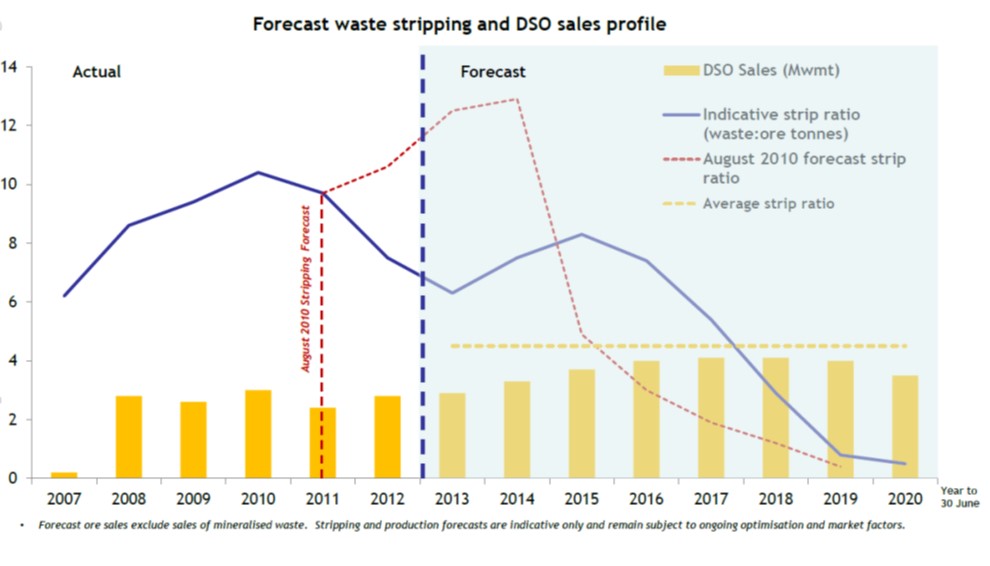
241 On a later slide the integration of this plan with Mount Gibson's other working mines was described as follows (p 1810):
• Complements existing Mid West operations
• Koolan Island stripping aligned with higher cash generation at Tallering Peak and Extension Hill operations
• Koolan Island cash generating capacity increases as cash flow moderates from current Mid West operations
242 The concept, then, was to remove high strip ratio material in the early years so as to be able to mine low strip ratio material in later years. That low strip ratio mining, leading to better cashflow, is the 'cash harvesting' mentioned in the announcement; Mr Beyer seemed to accept this in cross examination (ts 99). He agreed that it made sense to strip out waste material if that produced better access to a greater body of ore later in the life of the mine, 'If you've got the cash to spend up front' (ts 95). He accepted that in financial accounting for mining companies, it was permissible to capitalise and then amortise waste costs over the life of the mine, but referred to that as 'accounting profit'. This strategy produced the best value based on the pricing outlook assumptions that Mount Gibson was using at that time.
243 In cross examination, Mr Beyer explained the concept further as follows, commencing with the distinction between accounting profit, which can take into account non-cash expenses such as amortisation, and cashflow, and linking the approach to the relatively short life of the mine (ts 99):
So you may not be making much profit, depending on what the price scenario is. You know, you get this scenario where, as I said before, you can be making a lot of cash and no profit, or you can be making a lot of profit and actually no cash, which is a situation that causes us great concern when we're doing these strategic plans, is ensuring that we're looking at both what's the profit looking like going forward, and what is the cashflow of the time and your ability to fund that investment, and do you have the cash available. So I think, in this scenario, that comment is saying that the cash harvesting for the latter half of the mine life would be quite - it's - as it says, it's setting up for it, because what it's done is - as part of this mine plan, it's spending a lot of money in the early couple of two or three years of moving all the waste so that not much - as you pointed out, I think, on one of the drawings where the strip ratio was higher in the early period and not in the back period, that means that you've got - you're in a good position to generate cash flow in the front end and - in the back end, sorry. And that's not too unusual for short mine-life operations. It does require you to spend more money up front, and position it - if you've got the money, it positions the company to be able to spend the money so it can make the cash at the back end. It's quite different to a long-life operation, which runs - can run quite differently.
244 Infrassure's submissions present the plan announced on 18 March 2013 as the culmination of the mine optimisation work that Mr Beyer initiated when he became CEO, and so developed under his leadership and approved by the Board after he presented it to them. Infrassure says that in that sense, 'it was Mr Beyer's plan' (ICS para 40). It was a later iteration of this plan to which Koolan was still mining when the seawall failed in November 2014, that is, the EMP.
245 On 28 March 2013, Mount Gibson, Koolan, APAC (as the guarantor) and Sino Chance (as the buyer) entered into one of the Offtake Agreements, an amended and restated version of the 'Sino Chance Trading Limited - Koolan Island Long Term Hematite Ore Sale Agreement' they had entered into in 2008. By the amended and restated agreement, Sino Chance agreed to take 20% of Koolan's total available production each contract year, with the term of the agreement extending to the permanent cessation of Koolan's mining operations at the Koolan Island mine. Payment for 95% of the value of each shipment became due within five business days after completion of the loading of the shipment: cl 6.1. The 5% balance was payable promptly after completion of the discharge of each shipment at the port of discharge: cl 6.2.
246 It may be that despite the long term nature of the plan it had just announced, Mount Gibson was still focussed on maintaining a positive cashflow for all its mines. A budget presentation dated 21 May 2013 by a consulting services firm known as Momentum Partners to the COO and CFO noted as an 'underlying imperative' that 'Board directive is that sites MUST be cash positive at low iron ore prices' (CB 81 p 1906). That was said, however, in a context that Momentum Partners were presenting the 2013/14 production plan and revenue/expenditure budget and that '2013/14 strategic plans are not part of this presentation'.
247 Mount Gibson's quarterly report dated 16 October 2013 showed that the ramp up towards production of 4 Mtpa at Koolan Island was progressing to plan.
248 In November 2013 a paper was presented to the Board on exploration and ore reserve growth. It presented three areas in which Mount Gibson would grow ore reserves. The first was to convert existing resources to reserves through improved mine design, among other things.
249 The concepts of resources and reserves come from the JORC Code (the Australasian Code for Reporting of Exploration Results, Mineral Resources and Ore Reserves prepared by the Joint Ore Reserves Committee of the Australasian Institute of Mining and Metallurgy, Australian Institute of Geoscientists and Minerals Council of Australia). The JORC Code sets out standards that are widely used in the public reporting of mining companies in Australia and is required to be followed by the ASX Listing Rules. Under the JORC Code, mineral resources are concentrations or occurrences of a solid material of economic interest in or on the Earth, in a form, grade and quantity that presents reasonable prospects for eventual economic extraction. Ore reserves are the economically mineable parts of a resource. After applying various modifying factors, such as allowances for loss, the result is an estimated tonnage and grade which can be the basis of a technically and economically viable project.
250 Specific to Koolan Island, one of the slides in the presentation explained how Mount Gibson continued to investigate how to 'win' ore below the then current final pit design. This involved cut backs which would enable accessing additional reserves from deeper in the Earth's core.
251 Also in November 2013, Mount Gibson held its annual general meeting. Mr Beyer's presentation to the meeting covered the optimisation and implementation of the detailed plan to ramp up production at Koolan Island to 4 Mtpa.
2014 - the iron ore price declines
252 The events that follow took place in the context of a steady decline in iron ore prices throughout 2014 and well into 2015. The graph below shows that decline in both US dollar and Australian dollar terms. In the period shown in the graph, the low in Australian dollar terms was not reached until 15 December 2015 (AU$53.10), after which the price began a steady rise. However, from the beginning of April 2015 until at least the end of November 2015, the Australian dollar price rose and fell within a band of about AU$60 to AU$80.
US dollar and Australian dollar iron ore prices 2012 to 2016
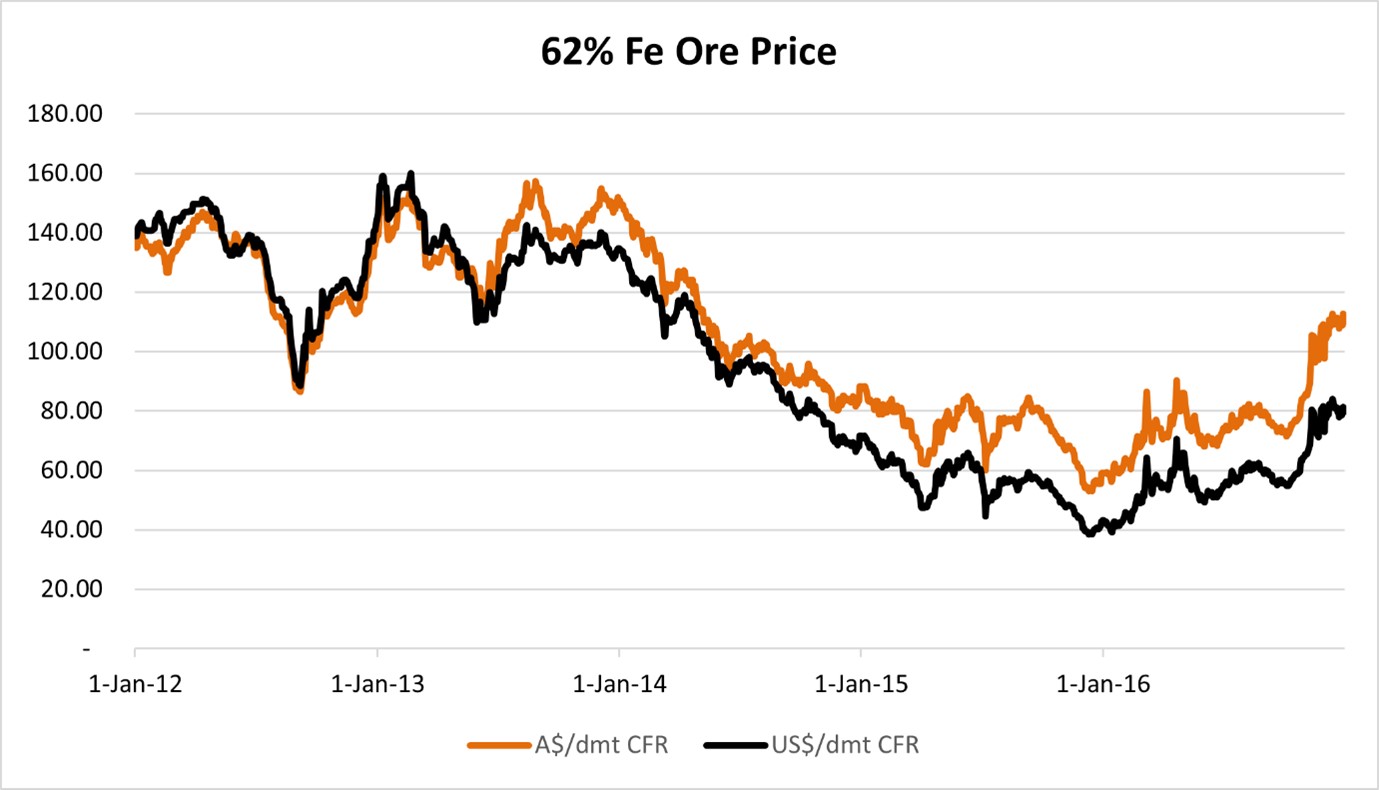
253 A presentation by Mount Gibson of its interim financial results for the first half of FYE 2014 said that Mount Gibson was financially strong, with $484 million in cash and minimal debt. The company's cash had increased by $108 million during the first half of the financial year. The presentation described Koolan Island as ramping up to 4 Mtpa by the end of 2014 and as a 'Long life asset with life extension potential'. It said that the '[o]ptimised ramp up to 4Mtpa' was 'reducing unit mining costs and increasing productivity' and that the mine had the potential to convert resource to reserves.
254 This presentation was released to shareholders and the market. Infrassure submits that the statements in it and in previous presentations about the ramp up to 4 Mtpa at Koolan Island, as well as the work done to prepare and implement that plan, means that there would naturally be a degree of attachment to it, especially on the part of Mr Beyer.
255 On 4 April 2014 Mount Gibson, Koolan, Shougang Concord International Enterprises Company Limited (as the guarantor) and SCIT (as the buyer) entered into the other Offtake Agreement, an amended and restated version of their 'Koolan Island Long Term Hematite Ore Sale Agreement' from 2008. The amended and restated agreement was in substantially similar terms to the 2013 amended agreement with APAC and Sino Chance, save that SCIT agreed to take 80% of production from the Koolan Island mine until the permanent cessation of operations from the mine.
The Board meeting of 29 April 2014
256 At a Board meeting on 29 April 2014, Mr Lee, who was Chairman of Mount Gibson by that time, queried whether budgeting for the 4 Mtpa target was realistic. According to Mr Lee's evidence, he raised this query because the 4 Mtpa target required TMM of about 28.4 Mt, where the TMM for the financial year to date had only been about 20.8 Mt, some 27% less.
257 The minutes record Mr Lee's query and Mr Beyer's response as follows:
Mr Lee queried whether budgeting 4Mtpa for KI was realistic. Mr Beyer observed that this was a challenging target. KI would continue to go through a recapitalization period over the next two years and would spend substantial sums on prestripping so as to be able to maintain 4mtpa. The 8:1 mine strip ratio over the next 2.5 years could result in a negative cash flow for KI during this period. The impact would be reflected in future budgets by delivering a very low cost per tonne once stripping was substantially completed[.]
258 Mr Beyer confirmed in cross examination that his view at that point in time was that the 4 Mtpa plan was the optimal plan for Koolan Island, in the context of how things were looking at that time, and that he was telling the Mr Lee and the rest of the Board that the high strip ratio of 8:1 over the next 2½ years was well worth it because it would achieve very low costs per tonne once stripping had been completed. Mr Beyer appropriately accepted that he was urging Mr Lee to 'remain on track with the plan … [i]n the context of how things were looking at that time' (ts 108).
259 The minutes also record the following discussion against a heading 'Strategy Discussion - Part 1' (p 2764):
Mr Beyer referred to the Board paper titled 'Board Strategy Discussion' dated 24 April 2014 and provided an overview of the iron ore market and forecast performance summary for Mount Gibson.
Mr Beyer confirmed that there was growing volume on the supply side for iron ore which may result in a downward revision of previous price forecasts.
Mr Chen [a director of Mount Gibson until the date of this Board meeting] considered that prices would likely move to US$100/t for the next 3 to 4 years. Steel mills were unprofitable at current prices and higher prices are not sustainable. Perhaps in 3-4 years there may be further upward pressure on prices depending upon the demand and supply balance.
Mr Beyer noted that broker consensus forecasts were for prices to move from US$120/t, US$115/t, to US$110/t over the next 3 years then to US$100/t and to US$90/t, [o]ver the longer term, an exchange rate falling from current levels to circa A$1:00/US$0.80.
Mr Hill observed that there was a perception in the market that Mount Gibson was more of a cash business than an operating business and that whereas the Company might return 12-15% in mining operations it was only returning 3-4% in cash returns. The question investors asked was whether they could achieve greater returns with the money returned to them.
260 In cross examination Mr Beyer accepted that this last comment attributed to a director, Geoff Hill, was to the effect that some investors were looking at Mount Gibson's cash balance and wondering why part of that cash was not being returned to them.
261 The minutes record ensuing discussion as follows (p 2764) (Mr Alan Jones and Mr Russell Barwick were non-executive directors present at the Board meeting, and Mr Simon Bird was described as 'Lead Independent Director'):
Mr Jones considered that the key question for the Board was whether the Company intended to be in iron ore market for the longer term. With declining prices it was essential that the business produce as much ore as it could now and generate as much cash as possible. Actual accounting profit was almost irrelevant.
Mr Barwick considered that if the decision was made to stay in iron ore then a move overseas was required or alternatively the Company needed to switch to another commodity. Mr Bird shared the views of Mr Barwick and considered that the Company needed to strive to achieve higher returns and may need to accept a higher level of political risk.
Mr Hill queried whether the real value to be made was in developing the underlying infrastructure assets.
Mr Lee noted that the Company was in a strong position with a substantial cash balance and a capable management team with experience in a number of different commodities in the mining industry.
262 Despite that last comment, in cross examination Mr Lee gave the following general evidence about his attitude (ts 258):
I look more at producing in the most cost effective way, as I said before… so that's my view. That I look more at the costs. How Mount Gibson is going to achieve their - at the most - their - their cost price is going to be one of the lowest. That's the only way you can stay competitive in this market. That is more my focus. Cash preservation. Cost reduction. Cost of production needs to be low. These are focuses that I take into consideration.
He acknowledged that this was not his sole focus, but he said that those were the main factors that he took into consideration.
263 Nevertheless, Mr Lee accepted that mining at a high strip ratio in order to be able to recover more ore at the end of mine life was properly characterised as an investment. Indeed, that was the term used to describe it in the announcement of 18 March 2013. Mr Beyer also accepted in cross examination that high strip ratio mining can be considered an investment if it exposes a rich body of ore which can then be mined with a low strip ratio.
264 Importantly, Mr Lee also acknowledged that the other directors had their own views and focuses. The discussion recorded in the minutes set out above supports that. Mr Lee accepted that as Chairman, he would try to reach a consensus view that was in the best interests of Mount Gibson.
Mr Beyer asks about mining at the average strip ratio
265 There is evidence that in early May 2014, Mr Beyer was at least considering the possibility of a lower strip ratio mine plan which did not involve advance stripping. That evidence is an email dated 4 May 2014 from Mr Beyer to John Kelly (Mount Gibson's General Manager, Technical Services) and Andrew Thomson (Mount Gibson's COO) in which Mr Beyer asked (CB 133 p 2901):
Andrew/John
I have a question that requires answering.
If we mined Koolan Island each year at the average strip ratio only what are the max ore sales/production tonnages we could deliver?
Assume the existing plan for the load and haul fleet of equipment at Koolan Island remains unchanged.
The question is based on what would happen if we limited the cash expenditure to just the average LOM strip ratio and hence undertook no advance stripping.
Obviously this is VERY early stage and just exploring ideas and possible options so PLEASE don't discuss with others except Paul S.
A quick turnaround (day or two or tell me when ?) on this would be appreciated. I'm not looking for high accuracy at this stage but some idea on the order of magnitude.
Andrew
Can we touch on this tomorrow.
Jim
266 According to Mr Beyer's evidence, at this time he was considering different options in relation to progressing mining at Koolan Island, including the potential of not undertaking any advance stripping. By 'advance stripping', he was (Beyer I para 61):
referring to the element of the plan that was in place at the time that would result in a high strip ratio for the next two financial years, and consequently higher capital expenditure. I was wanting to consider any options whereby the strip ratio could be reduced for that period to the 'average' strip ratio of 4.7:1.
267 In cross examination, Mr Beyer elaborated on why he made this request (ts 114):
Well, in general we were seeing a decline in the iron ore price, and I - as I tend to generally always do, is I was wanting to understand options … [T]hat query was looking … at an environment where the iron ore price was obviously in a declining state from where it had been earlier in the year or … late the prior year, and that just gets you wondering and thinking about what your options might be. So that's what would have been driving that question and that I was asking these guys.
268 Mount Gibson was in the annual budget review process at the time, but Mr Beyer did not remember whether he asked the question as part of that process. He characterised it as 'just an idea and a thought bubble that I had, requesting a question and partly I wouldn't have wanted it to have been a distraction on other work that was happening' (ts 115). At another point he said (ts 118), 'So I was just looking for, I guess, ideas as to what could be ways to reduce the cash demand of the business'.
269 Mr Kelly replied to Mr Beyer's email of 4 May 2014, to the effect that he would have an answer within a couple of days of the request, but there is no evidence of how he replied at that time and Mr Beyer could not remember what became of the request. Mr Kelly sent Mr Beyer and Mr Thomson a 'Production Rate Strategy Study' for Koolan Island on 26 May 2014, but it does not show a significant reduction in strip ratios in 2015 and its relationship to Mr Beyer's request of 4 May 2014 is unclear. While Mr Beyer gave evidence in his fourth witness statement that it was the outcome of his earlier query, in cross examination he was considerably less clear.
270 In any event, a slide in the Production Rate Strategy Study which summarised the outcome of the study at a production rate of 4 Mtpa touched on strip ratio. It said (CB 137 p 3013):
• Investigated minimising high ratio areas but little change to output -
- Few areas available to target without impacting short term
• Reducing ACE and/or MW3 had little impact
271 In cross examination, Mr Beyer was asked to interpret this but his response, which appeared to be based on what he could work out in the witness stand, rather than any recollection of the document, did not shed much light, and even he found it ambiguous. In my view the meaning of the slide as a whole remains obscure.
272 The next slide was somewhat clearer, addressing as it did a 3 Mtpa production rate that would be achieved, in part, by removing MW3. The slide said, however, that this would need to be brought 'back on line by 2016 or abandon the stage entirely' (CB 137 p 3014). Mr Beyer accepted in cross examination that on this scenario, it appeared to be saying that removing MW3 could only be a temporary solution, otherwise it would need to be abandoned completely.
273 It is convenient at this point to depart from the chronology to examine the evidence about whether MW3 would have been 'sterilised' (see next paragraph) if it had not been mined in accordance with the LOM plan that was in place in mid-2014, that is, in accordance with the EMP. Infrassure submits that the view within Mount Gibson was that if that did not occur, the ore in MW3 would be lost. This, Infrassure says, is a reason why Koolan would not have adopted the RMP, which would have removed MW3 from the mining schedule.
274 Mr de Kruijff's evidence in relation to the LOM plan that was developed in April 2014 was (de Kruijff I para 101):
It was assumed in the Apr' 14 LOM that MW3 pre-stripping would take place concurrently with mining of the central area, otherwise the underlying ore would be 'sterilised' if left behind. Sterilised in this context means it would become inaccessible to ever be mined in the future.
275 However, Mr de Kruijff went on to say that unnamed 'site planners were able to design the pit so that this ore could still be mined if economic at a later date' (para 102). By 'site planners' he appears to be referring to on-site mine personnel involved in mine planning. In any event, he was referring to the preparation of the RMP for the purposes of the insurance claim in July 2015. This is not evidence that the previous view about the sterilisation of MW3 had changed by February 2015 (when it is said the RMP would have been proposed in the counterfactual world).
276 Mr Thomson similarly gave evidence that in late 2014 a redesign of the mining options for the western end of the Main Pit had been conducted to show that mining in that area could be deferred without it becoming sterilised (inaccessible). In cross examination, referring to the slide about abandoning MW3 entirely, he said that 'later there was a new design run which allowed … access [to] that material without sterilising or cutting it off. That was the danger here, that if you didn't bring it back by '16, you might sterilise it' (ts 376).
277 Mr Thomson thought that Marijan Korica, the Mine Planning Superintendent for the Koolan Island mine, had prepared that new design. But Mr Thomson had not seen the document, and it was not referred to in Mr Korica's evidence (he gave one witness statement) or otherwise tendered to the Court. Mr Thomson confirmed that he could not explain how the work could have been done without any document showing it available at trial. All he recalled was that a discussion happened 'at that time' (ts 379) and that he was in Europe on holidays that year and that upon his return, the plan was in discussion.
278 It is curious, given the volume of studies and models that Koolan put into evidence, that none of these witnesses could produce or identify any documentation confirming that a pit redesign prepared in the second half of 2014 did not lead to the ore in MW3 being sterilised. In the absence of such confirmation and of any supporting detail, I put little weight on this evidence as showing that MW3 was not going to be sterilised if advance stripping was not conducted in earlier years. While I do not doubt the honesty with which Mr Thomson gave this evidence, I am not satisfied he was accurately remembering the timing and sequence of events.
279 Mr Beyer also asserted that the RMP allowed for 'high cost tonnes to be mined in a future mine plan if the iron ore price increased' (Beyer I para 118(e)). However, his evidence does not indicate what price would need to be reached before mining those tonnes became economic. That being so, once again, I put little weight on this evidence in the absence of supporting detail and documentation. In theory, any body of ore is capable of being mined economically if the ore price becomes high enough; that abstract proposition does not help to assess whether, in practice, a particular ore body has become sterilised.
280 Other than the above general evidence from the witnesses, Koolan could only point to two pieces of evidence to support the view that leaving MW3 out of the mine plan would not sterilise the ore. One was a comment in the Board paper of 26 April 2017 seeking approval to restart mining in the Main Pit (CB 438 p 6235):
The revised Main Pit design, optimised by excluding a high-strip, relatively low-grade cut-back in the western end is contained entirely within the original Main Pit and as such the design parameters remain unchanged from those successfully implemented during the original phase of mining.
281 This related to geotechnical factors. It is said to be a reference to MW3. But I simply cannot extract from it any support for the proposition that it had been determined by late 2014 or early 2015 that MW3 could be omitted from any restart without sterilising the ore in it. It goes as far as saying that the design for recommencement of mining the Main Pit in 2017 would exclude the western end, presumably a reference to MW3, and that the design parameters are the same as they were in the original phase of mining. But whether or not the design parameters remain unchanged does not provide a clear answer as to whether MW3 would be able to be mined at a later time. Its relevance is further obscured by the fact that, of course, the Main Pit had not been mined according to the RMP up to the time of this Board paper.
282 The other potentially relevant piece of evidence is a statement by Mr Thomson in cross examination that the mine plan extracted MW3, and he was on site at the time of giving his evidence, and it had not been 'cut off' because of the alternate design. But this says nothing about what the view was in late 2014 or early 2015.
283 On the basis of the above, I find that the prevailing view at Koolan in the middle of 2014 was that the ore in MW3 would be sterilised if pre-stripping in accordance with the EMP was not performed. And there is no sound evidence on which to conclude that this view had changed before at least mid-2015 (which was after the period relevant to the hypothetical production of the RMP).
284 To return to the outcome of Mr Kelly's work in early 2014, Infrassure submits that the inference to be drawn is that he had not been able to develop a tenable approach to mining in the Main Pit that undertook no pre-stripping. Infrassure submits that is especially so where Mr Kelly was not called to give evidence. It submits that the self-evident conclusion flowing from Mr Kelly's study (summarised above) was that the answer to Mr Beyer's query as to whether advance stripping could be avoided was 'no'.
285 I am not, however, prepared to make those inferences. There is simply not enough evidence about any clear response by Mr Kelly to Mr Beyer's initial request, or what relationship the Production Rate Strategy Study had to that request. The ambiguity of the study further muddies the waters.
286 In any event, Mr Beyer's evidence was that the Production Rate Strategy Study considered options that were similar to the RMP. But while it did consider elements that are later found in the RMP, such as the removal of MW3 from the mine plan, it neither recommended their adoption nor combined them in a form recognisable as what later became the RMP.
287 There is an investor presentation of Mount Gibson dated 8 May 2014 which highlighted the ramp up to 4 Mtpa at Koolan Island in a similar way to the February 2014 presentation described above. Once again, Infrassure submits that this presents Mount Gibson as a sound investment based on the 4 Mtpa strategy at Koolan Island.
A broker visit to Koolan Island and broker reports
288 Mount Gibson hosted some broker analysts at Koolan Island in May 2014. It relies on the following passage from one of the research reports prompted by the visit, this one from JP Morgan (CB 399c p 5908, emphasis in original):
Strip ratios will remain elevated in the near-term as the company focuses on cutting back open pit waste; guidance of approximately 8x is expected out to FY16, before dropping aggressively thereafter (roughly in line with JPMe). The company noted, however, they were cognizant of the iron ore price and could reduce near-term stripping if the market outlook deteriorated significantly.
289 Infrassure relied on a different aspect of the research reports, namely positive treatment by the brokers of the strategy at Koolan Island. JP Morgan referred to Koolan Island as 'the jewel in MGX's portfolio' (MGX is the ASX code for Mount Gibson), referring in that regard to the ramp up of production to 4 Mtpa, the high grade of its reserves and the low rate of impurities.
290 Goldman Sachs similarly called Koolan Island 'the jewel in MGX's proverbial crown', saying (CB 399b p 5895):
While its strip ratio remains very high, the excellent product grade and quality, as well as limited logistical constraints mean that it remains, in our view, a premium asset. Following this site visit, our confidence in the mine's operational performance has improved. We retain our view that if the company can deliver on the current mine plan over the next 2 years, this asset will be highly cash flow generative through to the end of the decade.
291 However, later on, Goldman Sachs explained why they retained a 'sell' recommendation on Mount Gibson, as follows (p 5897):
Across our iron ore stock coverage, MGX operates the slimmest group margins, and in what we expect to be negative near-term iron ore market environment, we believe MGX faces an uncertain and potentially volatile earnings outlook.
Our commodities team forecast that in CY14 the iron ore market will transition from net deficit to a net surplus position, placing downward pressure on iron ore prices. Despite this outlook, MGX continues to invest for its future, pushing ahead with (i) Koolan Island expansion to increase production from 3mpta to 4mtpa; (ii) ongoing drilling at Extension Hill to extend the resource; and (iii) moves to replace Tallering Peak with higher cost (i.e., lower margin) volume from Shine.
In recent months, its key assets (namely Koolan Island, Extension Hill) have seen cash margins compress by the falling iron ore price and stubbornly robust A$. The addition of the barely profitable Shine project, will tighten group margins further, in our view. If the macro environment continues to deteriorate as we expect, MGX will come under significant margin pressure and may be forced to reconsider its capital commitments.
While we believe the stock market's outlook for iron ore prices has a negative bias, we do not believe it has sufficiently factored in the magnitude of the impact to earnings, cash flow or valuation for MGX. Our Sell rating on MGX is underpinned by our 12-month target price of A$0.55, which implies c.27% downside from current levels. Our target price methodology is unchanged, and remains based on an 80/20 weighted average of NPV/PE multiple (11.5x CY14E EPS) valuations.
292 Infrassure sought to minimise the significance of Koolan Island to this opinion by emphasising the importance of the 'barely profitable Shine project'. But I do not consider it is explained away that easily; Goldman Sachs was clearly concerned about tightening margins as iron ore prices fell generally, including at Koolan Island.
293 Not all the brokers were pessimistic, though. PCF Securities endorsed the strategy at Koolan Island in these terms (CB 399d p 5944):
There are some concerns in the market regarding the high strip ratio for FY 2015 and the first half of 2016. We view this as perplexing, as the concerns are over what is essentially a low risk, brown field expansion, which will generate cash flow from mining during the strip phase, paying for the capex, while the company has no debt (outside of some equipment finance) and nearly $500m in cash.
This situation is favourable when compared to a greenfield project, which invariably has a large upfront capital spend during a build phase, without the operating cash flow of the existing operation and carries the risks of a new mining operation (ie; Reserve reconciliation, commissioning risk, operation performance and project finance risk).
As strip ratio drops in late FY 2016, management will move to a cost out phase as they did with Tallering Peak, which saw the $/t rate actually fall on lower mining rate, although gains will be more modest at KI.
As the strip falls, Koolan will throw off cash in the last 4-5 years as strip drops to <2:1. With processing and ship load cost adding up to $7, C1 cost will drop to $30-$35/t, making it one of the lowest cost iron ore mines globally.
There is flexibility to manage the risk over the next 2 years given the balance sheet strength and the potential for re-scheduling the stripping to make the operation cash flow neutral under much lower iron ore prices, should that eventuate.
294 The parties relied on other statements of fact made in the broker reports but it is not necessary to set them out as I put no weight on them; the evidence in question was hearsay and the brokers were not called to give evidence, let alone expert evidence about mining at Koolan Island.
295 The relevance of the reports is rather that, on balance, they represent a public endorsement from reputable investment advisers of the strategy at Koolan Island. That endorsement is likely to have been important to Mount Gibson's senior management and, it can be inferred, would have made them more willing to persevere with the EMP in the face of low iron ore prices (see also [302] below). I do not consider that the pessimistic note in part of the Goldman Sachs report detracts significantly from that inference.
296 In June 2014 the Board received a presentation entitled 'FY 2015 Preliminary Budget and Outlook for FY 2016'. The budget presented was based on an assumed iron ore price of US$110/dmt and an assumed (unhedged) exchange rate of AU$1.00/US$0.90 'in line with consensus forecasts' (CB 150 p 3095). That is to be compared with a spot price that fluctuated between US$89/dmt and US$95/dmt in June 2014, down about 30% from US$134.75 at the beginning of the year.
297 Cashflow sensitivities were presented showing that the group's operations were 'cash breakeven at FOB A$88/WMT' (p 3102, 'WMT' or wmt is wet metric tonnes). In relation to the physicals at Koolan Island the presentation said 'High strip ratio expected to continue throughout FY 2015, benefits to be realised from FY 2017' (p 3105). This page contained graphs for TMM at Koolan Island up to 30 June 2016 which, it can be inferred, were consistent with the EMP.
298 A budget that was substantially the same as the one contained in this presentation was approved at a Board meeting on 2 July 2014. Discussion about the budget is recorded in the minutes of the meeting (CB 158 p 3347) as follows:
Mr Barwick believed that the budget was consistent with the pre-budget meeting. The budget was challenging but pragmatic to the particular ore bodies and took into account the fact that EH was rail constrained, TP was complete and Shine had no final commitment. It was correct to treat the next phase of mining at KI as a new project in its own right. Mr Barwick noted that the Board understood that pre-stripping would be cashflow negative for the first two years but would result in low cost production in future years.
Mr Beyer reiterated this view and added that if steps were taken to reduce the pre-stripping expenditure this would reduce the long term benefit. The main focus for management remained on costs and productivity. Once pre-stripping was complete Mr Beyer believed that KI's costs would be as low as BHP and RIO. To defer this expenditure and reduce cash demand would reduce production to 2mt per year dropping the IRR to 34% and resulting in $200M less cash generated.
Mr Lee queried the viability of KI and Shine based on assumptions of US$80 Platts 62%Fe CFR based on a A$1:US$0.85. Mr Kerr confirmed that Shine would be uneconomic and KI would have a greater initial cash flow demand however in later years would still deliver a 71% return pretax.
299 According to Mr Lee's evidence, he made this query because he wanted to check whether the plans in place for Koolan Island were viable in a lower price environment than that forecast in the budget.
300 Mr Beyer accepted in cross examination that the numbers he quoted about reducing production 'to 2mt per year dropping the IRR to 34% and resulting in $200M less cash generated' must have come from some modelling done around the time but he could not recall it specifically (ts 127). Infrassure points out that there was no evidence as to how this modelling might have been used in the development of the RMP, but it must be recalled that at the time of this Board meeting the iron ore price was around AU$100/dmt, compared to about $80 at the end of February 2015 when the RMP was, hypothetically, going to be approved, so it is not clear that the modelling would have had a use at that later time.
301 Later on in the minutes another director, Mr Bird confirmed that he found the pre-budget briefing to be helpful, that he understood the strategy behind Koolan Island pre-stripping and that he was satisfied with the information provided.
302 A little later still, Mr Beyer 'confirmed that management would continue to drive cost efficiencies where ever practicable ensuring that the Company was best placed to survive in a low price environment' (p 3348). And a little later (pp 3348-3349):
Mr Beyer was queried as to the analysts reaction to the KI strategy in particular the reduction in cash balance of $71M anticipated during Q12015. Mr Beyer was confident that analysts understood the KI strategy and the need for upfront capital expenditure to implement the strategy.
303 Mr Lee's Chairman's Report in Mount Gibson's Annual Report for FYE 2014 dated 19 August 2014 said (CB 170 p 3576):
The 2013/14 year was certainly one of two halves. The first half was notable for relatively stable and elevated iron ore prices, while the second half was marked by a steep decline in prices as significant new production entered the market, mostly from the Pilbara. This decline was most severe for lower grade products with an iron grade of less than 58% Fe.
…
Operationally, we have consistently demonstrated this capability to build value by optimising our existing assets.
In this regard, our focus in the coming year will be further cost reduction, completing our ramp-up at Koolan Island to 4 million tonnes per annum, and continuing our investment in pre-stripping that will fundamentally lower operating costs and maximise cash harvesting in the last half of the mine life.
304 Mr Beyer's CEO Report said (p 3578):
Our ongoing commitment to cost reduction and business optimisation will also stand us in good stead.
At Koolan Island, we have already seen significant operational improvement from the implementation of our optimised production ramp-up to 4 million tonnes per annum. This approach enables us to maximise returns from Koolan Island even in a volatile iron ore market.
The ramp-up is on track with productivity levels improving substantially, and unit cash mining costs reducing over the year. We are expecting further reductions to be realised in the year ahead from our strategy of pursuing continuous improvement. This is fundamental to our strategy at Koolan, where we are investing substantial capital in pre-stripping over the next two years to position the operation for extremely low cash costs thereafter.
305 The Directors' Report in the Annual Report noted the following about iron ore prices (p 3596):
After averaging US$134 per dry metric tonne ('dmt') for the first half of the year, the benchmark Platts CFR price for 62% Fe fines fell sharply in the second half, touching a two year low of US$89/dmt in June 2014 and averaged US$111/dmt for the six month period. Over the full year, the Platts CFR price averaged US$123/dmt, compared with US$127/dmt in the preceding year.
306 On 9 September 2014, Paul Salmon, who, according to Mr Korica, was a person working in the Perth head office and responsible for creating the EMP, sent the EMP as an attached zip file to two other Mount Gibson employees. In evidence is a presentation titled 'Quarterly Plan Presentation to COO and CFO' which is dated 16 September 2014 and appears to be based on that attachment. That is the date on which Mr de Kruijff says the EMP was approved as Koolan's 'intended mine plan for the upcoming period'. While there does not appear to be any direct evidence of Mr Beyer or anyone else approving this iteration of the EMP, it does not appear to be in dispute that this was the plan to which Koolan was mining at the time of the first slump in the seawall.
307 In September to October 2014 Koolan improved its operational capacity with the commissioning of a new excavator, the delivery of nine replacement haul trucks and works to upgrade the primary crusher. Also in September 2014, Koolan agreed to extend a contract under which Koolan was able to use a mobile crushing unit supplied for Cape Crushing for a further three months and then on a month to month basis.
308 In the same month, Mount Gibson noted in a presentation to industrial special risks insurance underwriters as the top two risks facing it (CB 176 p 3755):
1 Lack of protection from currency pricing fluctuations leading to financial impact
2 Lack of protection from commodity pricing fluctuations compared to budget leading to financial impact
For each of these, the consequence was assessed as 'Catastrophic', the likelihood as 'Possible' and the level as 'Extreme'.
309 In relation to Koolan Island the presentation noted (p 3738), 'Optimised ramp up to 4Mtpa - reducing unit mining costs and increasing productivity' and 'Mobile fleet replacement estimated at ~$60m over two years, with ~$45m to be incurred in FY2015'. It included a slide with a chart demonstrating how Koolan Island was 'recapitalising for strong future cashflow' (p 3740) with a line showing the stripping ratio increasing from about 8:1 in 2014 to a peak of about 9:1 in 2015 and decreasing from then on.
September 2014 - Mr Lee is given information about cashflows and IRR
310 Mr Lee's evidence is that as the iron ore price continued to decline in the second half of 2014, his concerns about the viability of the plan at Koolan Island continued to increase. He says that on about 16 September 2014, he had a phone call with Mr Beyer and Mr Kerr in which he questioned the viability of the plan in the event that the iron ore price continued to decline. He says that in response, on 17 September 2014, Mr Kerr emailed him a slide summarising the latest life of mine cashflow estimates for Koolan Island and an IRR calculation.
311 The slide is a chart that contained graphs of three different cashflow scenarios for Koolan Island based on different iron ore price assumptions. The summary contained in the chart was as follows (CB 184b, emphasis in original) - the price and exchange rate information in square brackets drawn from the graphs on the same slide, with the price quoted being for 62% Fe fines CFR (northern China):
Koolan remains a very attractive investment at current prices
• Koolan Island FY15 operating cashflow is marginal at current spot prices [US$83/dmt, AU$1.00/US$0.916, = AU$91/dmt].
• After plant/equipment and geotechnical capex (~AS79m), pre-tax cashflows are negative.
• However, despite the high level of waste stripping in the next 2.5 years, the mine's economics remain robust.
• Koolan Island will deliver a look-forward pre-tax IRR of 58% at current spot prices, and 26% in the Low Price Scenario [US$75/dmt, AU$1.00/US$0.916, = AU$82/dmt].
• New mining equipment will facilitate material reductions in mining costs from ~A$7.50 per tonne moved to ~A$6.00 per tonne moved.
• Other cost reduction initiatives will be actioned during the year including: fixed price agreements for key Caterpillar, Komatsu and Hitachi parts; tendering of road transport services, lubricants and oils, and general consumables; further reductions in hired equipment; reduced use of labour hire contractors; and savings through centralised purchasing.
• A deferral or slow down of current mining activities would increase unit costs and/or incur termination costs.
• Costs on suspension are estimated at A$35-45m for personnel redundancies, contract terminations, payout of equipment leases, demobilisation & holding costs.
312 Mr Beyer suggested to Mr Kerr that he send this presentation to Mr Lee 'with a brief covering email that says this shows how robust it is' (CB 185a). Mr Beyer also told Mr Kerr to make the last sentence just quoted bold, 'or at least the estimate cost'. It appears that Mr Kerr did so. Mr Kerr's email to which this chart was attached said, 'Based on our modelling, Koolan continues to have robust returns at today's spot price and also at significantly lower prices' (CB 184a). The Australian dollar spot price of iron ore was AU$92.90 on 17 September 2014 and had dipped below AU$90.00 earlier that month.
313 Mr Beyer accepted in cross examination that his view at the time was that Koolan remained a very good project and that he was keen to see it continue based on the mine plan at the time, even taking into account the negative cashflow that was likely to occur over the next 2½ years. He confirmed that the statement that 'Koolan remains a very attractive investment at current prices' was his personal view as well as the view of management (ts 142). After some hesitation to embrace Mr Kerr's comment in the covering email to the effect that Koolan had robust returns at significantly lower prices, Mr Beyer accepted that he thought that it was a robust project.
24 and 25 September 2014 - Board meeting and Board strategy meeting
314 There was a Board meeting on 24 September 2014 where Mr Lee invited Li Shaofeng, a director representing the significant shareholder Shougang Fushan Resources Group Limited, a coking coal producer, to comment on the iron ore industry and price outlook. The minutes (CB 186A p 3959.004) record Mr Li's response as follows:
Mr Li considered that it was unlikely there would be a price rebound in the short term. Steel makers and mills were struggling to make reasonable margins in this market although the lower price would eventually have a positive impact for steel mills. Price outlook may improve if the Chinese government introduces a new policy of stimulus at the government conference in March 2015. In the current environment the companies most likely to survive will be those with a cost advantage. Coking coal pricing was also at historically low levels however coking coal producers had other opportunities such as increasing opportunities in the downstream market by increasing production of washed coking coal rather than selling the raw material. In terms of looking forward there was a view that perhaps China is coming towards the end of a 3 year down cycle in the steel industry as reforms and consolidation of the steel industry now start to take effect. Mr Li was optimistic for the future of iron ore but more positive towards coking coal where Shougang was already successful.
315 Mr Beyer said in cross examination that Mr Li had good insight into the steel markets in China due to his position with a vendor of coking coal into that market. Mr Lee also said that Mr Li's views were important to him.
316 At a Board strategy meeting on 25 September 2014, Mr Beyer gave a presentation which included a chart forecasting the CFR iron ore price in US$/dmt as declining from its present level of $100 down to about $85 from about the middle of calendar 2017. Due to forecast exchange rates, the forecast Australian dollar price did not decline continuously but rather sat just above or dipped just below a level of AU$100 over the period 2014 to 2019. The same presentation contained a chart showing a break even iron ore price for Koolan Island of AU$79/dmt (averaged out over FYE 2015 to FYE 2021). This showed the breakeven price declining from AU$108/dmt in FYE 2015 and AU$94/dmt in FYE 2016 to as low as AU$62 in FYE 2020.
317 The presentation included the slide that Mr Kerr sent to Mr Lee on 17 September 2014. Mr Beyer's evidence was that he recalled that (Beyer I para 78):
the discussion around that time centred on the fact, that despite the drop in iron ore price, Koolan Island under the current plan remained an attractive investment at then current spot prices, and would be even more so in the event the iron ore price rebounded, as we had seen in late 2012 after iron ore prices had hit similar lows.
318 On a later page in the same strategy presentation the summary of the outlook for iron ore was 'Supply is set to grow, though will underperform expectations. Has more longevity than thought, and will struggle to break $100/t on the downside sustainably' (p 3975). The '3-5 year view' for iron ore was identified as 'Poor'.
319 According to Mr Lee's evidence, at this strategy discussion he voiced concerns about the viability of the plan at Koolan Island. He says that management assured him, however, that continuing with the plan was the appropriate course of action.
320 No minutes of the strategy meeting appear to have been produced. However, a handwritten note Mr Kerr took at the meeting did go into evidence which contained the following note (Exhibit 6):
[LSH Run KI close down for 3 yrs, put cash in bank instead of waste mining.]
321 The initials 'PK' were circled next to this. Mr Kerr confirmed that this means it was an action item for him arising out of the meeting, suggesting that it was a request by Mr Lee to Mr Kerr to run some numbers on that basis. Neither Mr Lee, Mr Kerr nor Mr Beyer had any particular recollection of this exchange, although Mr Kerr did recall Mr Lee asking whether the right thing to do at Koolan Island at the time was to simply close it down for three years. Infrassure submits that this request indicates that when Mr Lee queried the viability of Koolan Island at the strategy meeting, what he had in mind as an alternative was closing it down, not changing the mine plan to the RMP. Infrassure submits that this was the alternative on Mr Lee's mind not only on this occasion but on other occasions too.
322 Seemingly as a result of Mr Lee's request, on 1 October 2014 Mr Kerr sent a memorandum to Mr Beyer, Mr Thomson, Ms Gillian Dobson (Mount Gibson's CFO from October 2018) and one other person which included rough cost estimates for two mine suspension or closure options for both Koolan Island and Extension Hill. Mr Kerr said that these were scenarios that may require further consideration should Australian dollar iron ore prices decline significantly from the then current levels. One was a medium term scenario, being suspension of operations for a two-year period involving placement of the site onto full care and maintenance status. The estimate of $35-45 million in the chart attached to Mr Kerr's email of 17 September 2014 was a high level estimate of costs for Koolan Island on that scenario. The other scenario was short term, being six months suspension.
October 2014 market release and investor teleconference
323 On 14 October 2014, Mount Gibson issued its quarterly report for the period ended 30 September 2014. It noted that the group had cash and term deposits of AU$465 million as at 30 September 2014. The following comments were attributed to Mr Beyer:
Mount Gibson continued to deliver a strong operational performance in volatile conditions in the September quarter, during which the iron ore price fell sharply. Importantly, Mount Gibson was partially buffered against this price decline by the comparatively high grade and quality of our product mix.
While conditions remain challenging, Koolan Island productivity and mining costs continue to improve at a rapid rate, giving us great confidence that our investment in new fleet and waste stripping over the next couple of years will position Koolan Island to become one of Australia's lowest cash cost operations thereafter.
Meanwhile, Extension Hill continues to generate steady production and positive cashflow.
These factors, together with our ongoing business improvement programme, high grade Ore Reserves, product mix and strong balance sheet, leave Mount Gibson well positioned to both navigate the volatile conditions and pursue value accretive growth opportunities.
324 The quarterly report had an image of the replacement haul trucks arriving at Koolan Island on 1 October 2014. Under that it said:
The significant lift in mining volumes contributed to further improvement in productivity and cost performance with unit cash mining costs averaging at the bottom end of guidance of $7-9 per tonne moved for the quarter. The Company remains on track to achieve its targeted mining rates required to deliver ore production of 4 million tonnes per annum in the 2015-16 year.
In line with previous guidance, Mount Gibson expects to invest approximately $60 million over two years to replace the Koolan Island mining fleet, of which $45 million will be spent in the current financial year. At the end of September, the Company had spent $23 million of this total on the load and haul fleet.
Commissioning of this mobile equipment is expected to further boost productivity as activity rates continue to increase in line with the ramp-up schedule, and as Mount Gibson continues to deliver ongoing business improvement initiatives.
As indicated previously, the ramp-up at Koolan Island requires initial investment in waste stripping to complete a cutback in Main Pit over the next two years. Once this cutback is complete, the strip ratio will begin to reduce rapidly, resulting in a significant reduction in cash operating costs which are expected to be in the bottom quartile of global iron ore producers.
325 On 14 October 2014, the same day as the release of the quarterly report, Mr Beyer attended a teleconference with investors. An October Investor Presentation bearing the same date was in evidence (CB 199) and I infer that Mr Beyer spoke to it on the call. It noted that Mount Gibson had cash and term deposits of AU$465 million. Once again, it said that Koolan Island was ramping up to a 4 Mtpa 'run rate'. The ramp up was said to have reduced unit mining costs and increased productivity. It said that the Koolan Island unit cash mining and admin costs had been reduced to the bottom end of previous guidance of $7-9/tonne for TMM in FYE 2015. Further improvement in productivity was expected following the delivery of replacement mining fleet. Cash operating costs were targeted to be in the lowest cost quartile after a cutback in the Main Pit was completed.
326 There was a transcript of the investor teleconference of 14 October 2014 in evidence (Exhibit 3), indicating that Mr Beyer made the following comments about the impact of a lower iron ore price:
Obviously revenue from the quarter was materially impacted by the lower iron ore price. The Platts 62 index, on which our pricing is based, was down to $90 a tonne US from 103 in the prior quarter. On the back of that, the average realised FOB price we received for our standard fines product, after all adjustments, things like freight, grade, moisture, impurities, was down from $83 per dry metric tonne US to $65 per dry metric tonne US. Look, this gave us a tight cash operating margin and when combined with the substantial money that we're investing at Koolan Island to replace the mining fleet, and to push our waste mining as hard as we can, we saw our cash balance at quarter end finish up at around $465 million.
As you know, Koolan will require elevated capital while we complete our cutback of [the] main pit over the next two years, but the prize here is very significant and certainly worthwhile. Once this recapitalisation is complete, the strip ratio will drop off very rapidly, grades will continue to lift, both of which positions Koolan to move well beyond the global cash cost curve and make it very competitive, even with the big boys from the Pilbara.
While any continued depressed iron ore price will see us drawing on some of our cash reserves, this investment generates extremely attractive post-tax rates of return even at these levels of pricing. Frankly, in my view, the expected return on our investment at Koolan Island is probably better than, or equal to, any new iron ore project anywhere in the world.
327 A little later, Mr Beyer had the following exchange with another person present on the call:
MR LAWCOCK: Good morning. Just a couple of quick questions. Firstly, just for clarification, the realised price of 65 a tonne, Jim, does that include the remnant sales from TP as well as the mine gate sales? And then the second question is, just curious, is there a price at which you wouldn't continue on with the Koolan Island strategy, or are you too far into it now to back out? Thanks.
MR BEYER: Okay, the answer to your first question is no. Remnant and mine gates aren't included. The answer to your second question is, it would have to be significantly lower than what it is, even at lower prices than today … well, not even today, go back to yesterday or a couple of days ago when the … I think the Aussie was about $80, even well below that, the internal rate of return generated by Koolan Island is … post-tax internal rate of return is very strong and we would continue with it. Obviously if the iron ore price tanked to $40 a tonne, we'd probably review it, but Koolan Island is an excellent investment and when you model, it you'll see it.
328 Mr Beyer then had the following exchange with an unnamed investor:
INVESTOR: Thanks guys. Jim, I just wanted to just talk about the pre-strip at Koolan. If you sort of took that out, will your cashflow break even for the quarter if you take out obviously the fleet replacement plus the additional stripping costs? Will you sort of break even now?
MR BEYER: Ah yeah. Yeah, look, if we - if you took out the stripping that's above the life of mine average strip ratio, then it is, but I guess we don't spend too much time looking at that 'cause that's a … I mean it's not part of the plan so, you know, but the short answer to your question is yes. But that's not the plan.
INVESTOR: Yeah, okay. I was guessing we can cash at 43 cents or whatever it was, and … then you were trading at cash, effectively.
MR BEYER: Yeah, you know, and I guess everybody can make commentary on the views of the market, but at the end of the day when we've got the cash balance that we've got and, you know, we just see there must be some … obviously there's some negative sentiments that's probably not completely correctly founded, but we just … no matter how we slice and dice Koolan Island, it is a great investment. And as much as we'd like to describe it as that, I guess people … perhaps some people aren't seeing it for what it is, so we just have to maybe recognise that or respect that from a certain point of view. But, you know, in terms of responsibilities to our shareholders, we look at the Koolan Island investment and it doesn't matter how you cut it, it's a pretty bloody good investment for us.
329 In cross examination about this teleconference, Mr Beyer presumed, but could not remember, that the reference to the iron ore price tanking to $40 per tonne was a reference to the US dollar price. He confirmed that at this time he had complete confidence in the quality of the Koolan Island asset. At this time, the spot iron ore price was AU$94.93 and US$83.50.
330 Koolan made two submissions about this call. First, it said that in what was transcribed as 'go back to yesterday or a couple of days ago when the … I think the Aussie was about $80, even well below that, the internal rate of return generated by Koolan Island is … post-tax internal rate of return is very strong', the reference to $80 must have been to US dollars, because the Australian dollar ore price had not dropped to $80 or below in the two days or even two years before the call. In cross examination Mr Beyer agreed that it looked like he was referring to the US dollar price. I accept that is so.
331 The other submission Koolan made was that Mr Beyer's reference to US$40 was 'an off the cuff, hyperbolic illustration of his comment regarding the price having tanked and his support for the EMP, rather than Mr Beyer having seriously considered USD40 as representing a price at which he would consider reviewing the mine plan' (KCS para 150). I accept that submission, as there is no indication in any of the documents that Koolan had modelled the NPV or the IRR of the project at a price of US$40, which was about half the then prevailing price after what had already been a long sustained drop.
332 Nevertheless, Mr Beyer was keenly aware of prevailing iron ore prices and is unlikely to have picked the figure of US$40 at random. Hyperbolic though it may have been, in my view it illustrates the strength of his conviction that it would be worth persevering with the EMP at Koolan Island, even in the face of very low iron ore prices.
October and November 2014 - the first two slumps in the seawall
333 On 24 October 2014, the first slump occurred in the seawall at Koolan Island. Remediation works were unsuccessful and a second slump occurred on 8 November 2014 on the same section of the seawall.
334 A Board meeting was held on 11 November 2014, after the second slump but before the third and final slump. At it, Mr Beyer gave an update on remedial actions that were being undertaken in relation to the seawall. Mr Beyer confirmed that a number of solutions were being considered, that is, solutions to save the seawall, and indicated a likely need for a longer term agreed solution.
335 Infrassure submits that this shows that Mount Gibson anticipated resuming mining in the Main Pit. That must follow from the lack of any suggestion that the Main Pit was to be abandoned, although Mr Beyer is noted in the minutes as repeating the AU$35-45 million estimate for closing costs at Koolan Island. But there is no indication from the minutes as to when mining was anticipated to resume. On Mr Beyer's evidence, the time period for remediation was not certain.
336 At the same Board meeting on 11 November 2014, Mr Kerr is recorded as telling the Board that Koolan Island 'would experience negative cash flow for the next two years while substantial capital investment in waste stripping was undertaken' (CB 213). Under a heading 'Viability of Koolan Island' the minutes of the same meeting record Mr Beyer's advice to the Board as follows:
Mr Beyer noted that even at a CFR 62% Fe price of A$85/dmt, the return from developing KI would achieve a pre-tax IRR of around 35-40%. The viability of continuing at KI would only come into question if the pre-tax IRR dropped below 15%.
KI will deliver a high grade product at a low operating cost. The next phase of KI development should be looked at as a new mine that will be competitive with the majors. A decision to slow down mining at KI would preserve cash but the impact would be to substantially delay access to reserves. Unless the waste is moved KI will run out of saleable ore within months.
Mr Beyer referred the Board to the document titled '2014 Koolan Island Cashflow Scenarios' dated 16 September 2014, noting that even at a CFR 62% Fe price of A$82/dmt, KI had a pre-tax IRR of 26%.
The Board requested management to update the KI scenario analysis implied prices for pre-tax IRRs of 0%, 7% and 15%.
Mr Beyer noted that the key of area of focus to improve overall returns at KI was to reduce the mining unit cost per tonne of material moved. KI had a current strip ratio of 9:1 with recent unit costs at $6 per tonne. The overall costs are highly leveraged to this rate and if improvements could be implemented to reduce those mining unit costs down by say A$0.50/tonne, then the multiplier effect across the strip ratio tonnages would result in substantial savings per ore tonne of $15M per annum.
Mr Beyer confirmed that management would continue to pursue cost saving opportunities particularly during this interim phase while mining in Main Pit was suspended. Where practicable resources would be deployed to other areas of KI where mining was ongoing and employees encouraged to take accrued leave.
The '2014 Koolan Island Cashflow Scenarios' document Mr Beyer referred to is the slide showing IRR on different assumptions which is described at [311] above.
337 Mr Lee's evidence was that at this Board meeting he expressed his concerns about (Lee I para 28):
the viability of continuing with the plan at Koolan Island in circumstances where the iron ore prices were continuing to decline and it would have resulted in high levels of capital investment over the next two financial years. In response, Mr Beyer explained that it was worth continuing with the plan until the pre-tax IRR reached 15%.
338 However, consistently with his general approach in cross examination, when cross examined about the minutes of the meeting of 11 November 2014 he said he had no recollection of the meeting at all. When this was pointed out to him he responded by saying that the Mr Beyer's comment in the first paragraph from the Board minutes quoted above must have been because somebody raised a question about the 15%.
339 This was clearly reconstruction on Mr Lee's part, not recollection. While he suggested that his memory was better when he gave his witness statement in 2019, even that was put in terms of an assumption. This is an example of why I said in Section IV above that in general Mr Lee's evidence was reconstruction based on inferences from the written record and on hindsight.
340 Also, the many extracts from Mount Gibson's Board minutes set out above indicate that whoever took the minutes was in the practice of recording quite carefully and comprehensively what each director said on subjects such as the viability of continuing at Koolan Island. And yet there is no record in the minutes of 11 November 2014 of Mr Lee expressing his concerns about the viability of mining at Koolan Island.
341 All this leads me to put no weight on Mr Lee's evidence quoted immediately above. Simply put, it is difficult to accept evidence given in a witness statement when, in the witness box, a little over two years after providing the statement, the witness disavows any recollection of the event. It is, after all, only on the latter occasion that the witness is giving his evidence to the Court.
Mr Beyer's evidence about the IRR
342 Mr Beyer agreed in cross examination that on then current spot prices, Koolan Island remained a robust project. The spot prices of iron ore at the time of the Board meeting of 11 November 2014 were AU$88.15 and US$76.00. Mr Beyer also confirmed that the reference to the viability of Koolan Island coming into question meant no more than that; in other words, the viability of continuing would be reviewed, it would not be considered unviable merely because the IRR had dropped to 15%.
343 Mr Beyer also explained that the IRR would not necessarily drop in a linear fashion with the iron ore price, so it would need to be calculated each time, and he did not recall having any sort of 'ready reckoner' in mind as to what iron ore price would produce an IRR that would cross that 15% threshold (ts 170). Numbers provided in his first witness statement, which indicated that the threshold would be reached if the price dropped to AU$77.73, were prepared subsequent to the Board meeting.
344 As Infrassure points out, the statement about viability coming into question was made in a context where the Board and senior management had considered the alternative of closing the mine down. Mr Beyer confirmed that in cross examination; he accepted that the question that would be answered at that point would be whether to stop mining or to continue. There is no suggestion in the evidence that if the IRR dropped below 15%, what would be considered would be the continuation of mining to a different mine plan, which reduced mining in high strip ratio areas so as to increase cashflow by increasing the amount of ore sold per unit of material moved. Mr Beyer confirmed that he was not suggesting a revision of the mine plan to the Board at this time.
The annual general meeting on 12 November 2014
345 At Mount Gibson's annual general meeting (AGM) on 12 November 2014, Mr Lee referred to (CB 208 pp 4220-4221):
… the Company's current financial and operational strength.
This strength was evident in our navigation of the volatile market conditions of the last year, demonstrating the benefits of the Company's disciplined focus on cost efficiency, operational optimisation and targeted allocation of capital.
This discipline, as I'm sure you will agree, has never been more important given the challenges our industry faces and current market conditions.
The 2013-14 year was certainly one of two halves, notable for stable and elevated iron ore prices in the first and a significant decline in prices during the second as significant new production entered the market. This decline was most severe for lower grade products with an iron grade of less than 58% Fe.
…
… [O]ur focus in the coming year will be further cost reduction, completing our ramp-up at Koolan Island to 4 million tonnes per annum and continuing our staged investment in new fleet and pre-stripping that will fundamentally lower operating costs and maximise cash harvesting in the last half of the mine life.
As I'm sure many of you have noticed, at current iron ore prices, this investment will require us to utilise some of our cash reserves. I would like to reassure you however of the eventual substantial returns we expect this investment will bring.
Obviously, we have recently suffered a minor setback requiring us to repair an area of localised instability in the southern pit wall. However, we expect the impact to be modest, with repairs anticipated to take about 3 months to complete at a cost of $5-10 million. Accordingly, we have reduced our sales guidance to 6.0 to 6.4 million tonnes for the current financial year.
Once our cutback at Main Pit is complete in about two years, Koolan Island will be positioned to enter the bottom quartile of the global cost curve, with cash operating costs comparable to the Pilbara giants.
It will also be one of Australia's very highest grade producers of direct shipping grade iron ore, making it an even more valuable asset in a market far less forgiving for products of lower quality.
Grade and quality are key factors that set Mount Gibson apart. Across our operations, we are already delivering substantially higher grade products than our peers, and our anticipated average sales grade of 61% Fe in 2014-15 will be a major competitive advantage in an environment of wider discounts for low grade iron products.
With such rigour underpinning all aspects of Mount Gibson's business, I look forward with confidence that we have the right management team, assets, and strategy to weather a more difficult period for our industry in general. This ongoing strategy, which includes cost management, capital management and shareholder returns, will need to remain flexible in light of lower iron ore prices, the ongoing capital spend at Koolan Island and the need to hold cash for growth opportunities.
346 Mr Lee's evidence was that he specifically included the caveat in the last paragraph, that the strategy would need to remain flexible in light of lower iron ore prices, because of the discussion at the 11 November Board meeting about 15% as a threshold below which the viability of Koolan became questionable. Mr Lee said that in reality, management would have been assessing the viability of the plan before it fell to that level. But given that Mr Lee had no recollection of that meeting when he was in the witness box, I put no weight on this explanation for the inclusion of the caveat.
347 As such, and in any event, a bland and no doubt prudent caveat of that kind does not displace the impression created by Mr Lee's Chairman's address to the AGM considered as a whole, as reflected in the extensive passage set out above. Even the caveat is still in terms suggesting that the 'ongoing capital spend at Koolan Island' is a given. This is evidence that even after the first and second slumps in the seawall, Mount Gibson remained committed to the EMP, and that was so after it acknowledged that iron ore prices being what they were, they would need to eat into cash reserves.
348 The third slump in the seawall occurred on 25 November 2014, resulting in the seawall being breached and the Main Pit being totally inundated with water.
349 The Board met by teleconference on 26 November 2014. According to the minutes of that meeting (CB 217):
Mr Beyer confirmed that the Company's shares were in a trading halt and that management was focused on three key areas:
• Immediate actions to reduce the cash expenditure at KI;
• Developing an engineering solution and understanding the cost impact; and
• Progressing with the insurance claim process.
350 Mining operations in the Main Pit had been suspended since the first slump on 24 October 2014. The majority of the workforce had been stood down and demobilised. The Board agreed that it would need to treat the Main Pit as closed, and Mr Beyer indicated that for initial modelling purposes this would be assumed to be so for at least 12 months. Koolan was forced to take other steps to minimise the impact of the Incident, including redundancies and the issue of force majeure notices to customers and suppliers.
351 In December 2014, Koolan mined and sold ore from ACE, which had been unaffected by the Damage to the seawall. It focussed on low strip ratio areas of ACE. This ore was sold unblended, recalling that previously ore from ACE had only been used for blending with high grade ore from the Main Pit.
352 A presentation given to a Board meeting on 4 December 2014 contained an updated set of Koolan Island cashflow scenarios in the same format as those described at [311] above. These appear to have been prepared on the assumption that Koolan Island would be mined according to the EMP from 1 January 2015 until the end of 2021. Some scenarios included the assumed cost of rebuilding the seawall, at varying amounts from AU$50 million to AU$100 million. But there was also a slide showing scenarios that did not include that cost. Their outcomes can be summarised as follows (CB 223 p 4306):
Scenario | Ore Price (US dollars) | Exchange rate Australian dollars/US dollars | Ore Price (Australian dollars) | Pre-Tax IRR |
Budget Pricing Assumptions | $110/dmt | $1.00/$0.90 | $122/dmt | N/A |
7% IRR Scenario | $67.4/dmt | $1.00/$0.90 | $75/dmt | 7% |
0% IRR Scenario | $64.8/dmt | $1.00/$0.90 | $72/dmt | 0% |
Spot Pricing Assumptions | $69.8/dmt | $1.00/$0.87 | $80/dmt | 19% |
353 The reason the IRR for the first scenario is 'N/A' is because the IRR is calculated on the basis that the negative cashflow in early years in the scenario is the cash invested, with the positive cashflow representing the return on that investment that is used to calculate the internal rate of return. The first scenario had no negative cashflow so no IRR could be calculated.
354 In cross examination, Mr Beyer confirmed that the scenarios in the Board presentation about restarting were assessing the viability of doing so within 12 months, on the basis of the EMP. As at 24 November 2014, the spot price of iron ore was about AU$80, so as to produce an IRR of 19% on the figures above. Infrassure points out that this did not produce any work on changing the mine plan. Mr Beyer confirmed that he had not, as at that date, issued any instructions to recast the mine plan.
355 But I put little weight on that by itself; as already mentioned, the spot price had only been near AU$80 for a few days before the final failure of the seawall, and even that was after two slumps which had stopped mining and led the company to focus on remediation. So one would not expect management to be focussing at the same time on recasting the mine plan. That it did not do so, in the real world, before the final failure of the seawall says little about what it would have done had prices been at or below AU$80 for any sustained period of time, on the hypothesis that the seawall remained sound.
2015 - iron ore prices continue to decline
356 On 28 January 2015, Mount Gibson released its quarterly report for the period ended 31 December 2014. Its cash and term deposits were $354 million. Mr Beyer is quoted as saying that 'the Company remains in a very strong financial position with substantial cash reserves and negligible debt' (CB 238 p 4429). On the next page the quarterly report said:
The detailed evaluation work now underway includes assessment of the likely timing and cost of options to rebuild the Main Pit seawall and resume production. The options will then be considered in the context of the outlook for the iron ore market, iron ore prices and exchange rates, and on the basis of what action will best preserve and create value for shareholders. A decision to move towards recommencing production from Main Pit at Koolan Island will only be made if Mount Gibson believes it is viable to do so. Mount Gibson anticipates it will be in a position to provide an update on the preferred course of action in the first half of calendar 2015.
357 Infrassure submits that this is relevant because when Mount Gibson did come to evaluate reopening options in February and April 2015, it did so on the basis of the EMP and did not identify or develop the RMP until later in 2015, and then only for the purposes of the insurance claim. That is so even though, according to this statement, it was to do so based on the outlook for the iron ore market, iron ore prices and exchange rates.
358 The iron ore price generally declined further throughout much of 2015. As discussed below, there were occasional increases in the price and periods of relative stability from December 2014 through to the end of February 2015. However, on 5 March 2015 it dropped below AU$77.73, being the level at which Koolan Island would reach an IRR of 15%. And that was the IRR below which, Mr Beyer had acknowledged at the Board meeting of 11 November 2014, the viability of 'continuing at KI' would come into question. The iron ore price remained below that level for most of the remainder of calendar year 2015 (except at the end of May 2015 and throughout June 2015 the price hovered around AU$80).
359 The Board met on 16 February 2015. The minutes record the following:
Mr Beyer tabled a Board paper titled 'KI Rebuild Valuation' which VALUATION provided a summary of potential investment returns dependent upon iron ore price and various ranges of rebuild costs. The Board paper was taken as read.
Mr Beyer noted that assuming a rebuild cost of $100M and a CFR price below A$74/dmt, rebuilding the seawall would deliver a negative pre-tax IRR. A price of A$76.5/dmt would deliver a pre-tax IRR of 5% and A$82/dmt a pre-tax IRR of 15%.
360 The Board paper mentioned here stated that the financial viability of rebuilding the seawall was highly sensitive to the ore price and to the capital expenditure requirement. As summarised in two bullet points (CB 245 p 4577):
• Once solution and associated capex range is determined, decision to proceed with seawall will depend on medium term view of ore prices and exchange rates.
• At current ore prices of ~A$80/dmt, seawall capex of A$69m and A$112m would deliver post-tax IRRs of 15% and 10% respectively.
361 Mining at ACE ceased in April 2015, due to the low iron ore price, but the price had recovered sufficiently for mining of low strip ratio areas at ACE to recommence in July to continue through past October 2015.
362 On 13 April 2015 Mr Lee sent an email to Mr Beyer which included the following (CB 276 p 4884):
CASH preservation is essential. Neither members of the Board or my goodself wish to stand before the Shareholders at the AGM telling them we have burnt a significant part of the cash that we have allocated for reinvestments or dividends should we not find any better case of the money. In this regard, our dwindling cash balance is giving me a significant cause for concern. I am not trying to sound petty, but I hope to look all Shareholders in the eye and tell them the Board and management have tried their best. I note some of our competitors have fallen, but that is not an excuse for us. We have been blessed with significant cash and if we had given it back to Shareholders, you and I both acknowledge that the Company would be in the hands of liquidators now, a position Atlas is facing.
363 In a Board paper responding to specific queries Mr Lee had raised, Mr Beyer said that a design for a rebuild of the seawall had been identified that would cost in the order of $20-$50 million, which he said was a significant reduction on earlier estimates. But he acknowledged that at current iron ore prices, restarting the Main Pit was not viable.
364 At a Board meeting on 15 April 2015, there was discussion of the possibility of rebuilding the seawall at Koolan Island. Mr Beyer said that even at capital expenditure estimates much less than previous estimates ($20-50 million compared with $100 million), at the then current iron ore prices of AU$66/dmt, the seawall rebuild was not financially viable. Further, according to the minutes (CB 277 p 4914):
Mr Beyer considered that a restart of the Koolan operation would only be justified with an effective iron ore price of between A$80-85/dmt taking into account replacement fleet costs and assuming a pre-tax IRR of 15%. The Board discussed possible IRR hurdles for project approval and while no decision was made it was considered the likely range of acceptable IRRs for the Koolan Island Main Pit project would sit between 15-20%. It was acknowledged that this hurdle rate would be established by the Board for management to use and this would take a number of factors into account including commodity, location and project execution risks.
…
Mr Beyer confirmed that no further work would be performed on the KI seawall reinstatement proposal unless the iron ore price increased by at least A$20/dmt and further that the response of the insurance claim was known. Mr Dougas noted that the future development of KI would likely rest within the next iron ore cycle.
In cross examination, Mr Beyer accepted that these figures were premised on the EMP.
365 The minutes of a Board meeting on 29 April 2015 recorded the following among the Board's deliberations (CB 280 p 4942):
Although regrettable, the Board recognised that the timing of the KI seawall incident may have assisted in preserving the overall cash position by accelerating decisions around KI. If the KI seawall had not collapsed management would have been assessing the viability of pushing through with the high cost and low recovery pre-strip phase of mining at Main Pit as part of its business wide review of the operations.
366 Mr Lee's evidence was that this was 'a reference to the debate that was taking place prior to the failure of the sea wall around whether management should continue with the plan at Koolan Island' (Lee I para 40). But consistently with the rest of his evidence, Mr Lee appeared not to have any independent recollection of this meeting, in cross examination saying only, 'I rely on the minutes' (ts 303).
367 There was evidence that at the beginning of 2015 Mount Gibson changed its mine plan at Extension Hill. Koolan relies on this as evidence that it would have implemented a similar revised mine plan at Koolan Island, had the seawall not failed.
368 On 28 January 2015, Mr Olney, who was the Resident Manager at Extension Hill, emailed Mr Thomson, Mr Kelly and Mr Salmon, saying (CB 240):
I've been intending to have another look at the recent pit optimization and pit design. An issue we have is that the new design significantly increases our mined waste which may result in us having to increase our waste dump size. The new design increases our ore tonnes - but also increases the stripping ratio.
Considering our current situation, I think we should re-optimize the pit with a 55%Fe cut-off grade. The intent would be to achieve 4Mt/pa without ramping up the TMM. We will lose some ore, but at a significant cost saving. We are mining a lot of subgrade that we don't need at present. We may be able to go back and mine it at the end of the project (or even later).
How do you feel about this? We would need to move on it fairly quickly.
369 The 'recent pit optimisation' was a reference to a study that Coffey Mining Pty Ltd had conducted in June 2014. It had been based on an iron ore price assumption of AU$88.02 per tonne, but since then the iron ore price had declined so that, according to Mr Olney, he thought that Mount Gibson would not be able to sell material of less than 55% Fe content profitably. On his evidence, the 'intention was to reduce costs by minimising the mining of material below 55%, and thereby reduce the stripping ratio' (Olney para 40). The earlier Coffey optimisation had been based on a cut off of 50% Fe between ore and waste.
370 Mr Thomson's response to Mr Olney's suggestion was (CB 240):
This is a good idea. I have asked John to get somebody and proceed to get a first work up done as quickly as possible. We will then sit and review before we lock anything in because although we want to minimise the waste haul we also want to watch that we don't completely cut [off] options to recover low grade later if possible. Anyway we will get the first work done and see what the HG ore loss and pit geometry looks like.
371 Mr Thomson recalls a conversation with Mr Olney at the time in which they agreed not to mine any material that was not economic, but at the same time they wanted to avoid sterilising the lower grade material so as to protect access to it in the future if the iron ore price improved. Mr Thomson explained what was driving the need to change the mine plan as follows (Thomson para 67):
The market conditions were showing that margins at Extension Hill were diminishing and the price expectations of the time were showing that lower grade (lower than 62% Fe) was likely to lose value further. This in turn meant that there was less market for, or ability to blend lower grade material from the pit (referred to as subgrade in Reece's email) thus forcing this into waste. To address this we intended to reclassify the assumptions for the pit optimisation so that we would not consider material of lower than 55% Fe of value and thus would change the economics driving the pit shell optimisation. The change of assumptions with price naturally changes the economics too. As we see in the results a smaller volume of mining is thus required and this is shown as both less reserves and less stripping ratio.
372 Mr Kerr sent Mr Kelly the iron ore price assumptions that should be used on 1 February 2015. They were based on US$65.00/dmt at a grade of 62% Fe and an exchange rate of AU$1.00 to US$0.80. They also included a lump premium of 15%. Mr Kerr noted that the assumed revenue numbers were slightly above then current spot prices but below the current consensus forecast 'from the banks' (CB 246).
373 It appears that Coffey worked on the revised optimisation study in February 2015. It produced a report on 'Pit Optimisation and Detailed Pit Design Work' for Extension Hill on 11 March 2015 (CB 263). On Mr Olney's evidence, there was some urgency to complete the work due to the continued decline in the iron ore price.
374 Infrassure submits that the urgency came from the fact that Extension Hill only had a remaining life of about 18 months. There was no suggestion that it was in any 'investment' phase involving pre-stripping. The profits to be earned from it had to be maximised over the remaining life of the mine. In Infrassure's submission, the optimisation work was not a significant change in strategy for a mine that had many years left to run; it was an adjustment to maximise cashflow for a mine that would soon have run its course.
375 On 18 March 2015 a presentation of a revised mine plan was given to the QPP meeting. The presentation included a slide which said the following (CB 264 p 4730):
Quantity Changes Using Proposed New Pit Design
• New design has reduced quantities:
• Subgrade ore treated as waste
• Reduced DSO ore (+55 Fe) quantity by 0.71mt
• Reduced waste and subgrade quantity by 4.11mt
• Reduced TMM quantity by 4.82mt
• Lowered strip ratio from 1.04 to 0.49
• [SR: (W+SG)/DSO Ore]
DSO means direct shipping ore, for the export market.
376 According to Mr Olney, the revised pit design showed a reduction in pit size and excluded from mining areas that had a high concentration of waste (less than 50% Fe) and subgrade material (50-55% Fe) material. Mr Beyer's first witness statement summarised the change at Extension Hill as follows (Beyer I, para 132):
In contrast to Koolan Island prior to the collapse of the Seawall, at this time Extension Hill was mining ore of a grade between 50 and 55%, in addition to higher grade ore. One of the drivers of the change at Extension Hill was the decision to reclassify the subgrade ore as unsaleable waste. As a consequence of this change a quantity of high grade material was no longer economic due to no value assigned to the subgrade, which resulted in a reduction of the stripping ratio and TMM. The Reforecast Mine Plan at Koolan Island does not involve changing the cut-off grade between ore and waste. However, it is similar to the extent it involved the reduction of the stripping ratio and TMM in order to save cash in a low price environment.
377 Shortly after the QPP presentation, Mr Thomson gave verbal approval to mine according to the revised plan at Extension Hill. It was given on the basis of a scenario under which two production crews and a skeleton crew would work the mine at 67% capacity. While Mr Thomson's evidence is not clear as to what he meant by 'shortly after', there is an email from Mr Olney in evidence dated 26 March 2015 indicating that Mr Thomson gave his approval on that day.
378 Mr Olney gave evidence of his belief that Extension Hill began working to the re-optimised plan from around 1 March 2015, however that belief appears to have been based on inference from the dates of certain emails, rather than recollection, and I put little weight on 1 March 2015 as the precise date on which mining to the new plan started. Mr Thomson's recollection and the contemporaneous email are more reliable, and I find that mining at Extension Hill according to the revised plan commenced on about 26 March 2015. In any event, there is no suggestion in the evidence that this change to the mine plan at Extension Hill required or obtained the approval of Mount Gibson's Board.
379 At a special purpose Board meeting on 15 April 2015 there was consideration of whether Extension Hill should be closed. In summary, the minutes recorded Mr Beyer's advice that because there were large closure costs at Extension Hill due to contractual obligations to providers of infrastructure, the preferable option was to continue mining there even if the iron ore price dropped as low as AU$55/dmt. These closure costs, Infrassure submits, are a point of differentiation between Extension Hill and Koolan Island because they mean that it was rational to continue mining there rather than suspend operations, in which case it made sense to re-optimise the pit design. This, Infrassure submits, says nothing about what might have been done in the hypothetical world at Koolan Island, where closure costs were much lower and the mine was in the investment stage of negative cashflow to prepare for strong returns later on in its life.
Insurance claims are settled, the mine reopens
380 On 15 June 2016 all insurers, including Infrassure, settled Koolan's claim for physical damage as a result of the failure of the seawall.
381 In April 2017 the Board approved a project to reopen the mine at Koolan Island. That was based on a mine plan that excluded mining of MW3, just as the RMP does. The strip ratio for the first year of production was 6.3, dropping to 4.2 in the second year and 1.2 in the third year. That compares, however, with a strip ratio of about 4 for the first full year of mining under the RMP, about 5.5 for the second full year and 2.1 for the third full year. It is difficult to know how to compare these numbers, though, because it appears that there was no intention to mine ACE, whereas ACE figures as at 2015 were incorporated in the RMP. Relevantly, the Board paper that was approved was based on an average iron ore price of US$55/dmt and an exchange rate of US$1.00/AU$0.75 yielding an Australian dollars price of $73.33/dmt.
382 However by the time mining did actually recommence at Koolan Island, the mine plan had been revised again to reflect a study known as 'Project 21' (CB 440 p 6259, de Kruijff I para 124). This increased the approximate tonnes of ore mined from 13 million to 21 million. Mr de Kruijff's evidence is that MW3 was still excluded, although that decision could be reassessed in the future if it becomes economically viable based on the iron ore price.
383 Mr de Kruijff said that the then current plan (his witness statement was given in March 2019) largely reflected the RMP. But it is hard to see how that can be so when the strip ratio in the Project 21 plan started at 11.7 (albeit on the basis of a relatively low volume of ore in that startup year), and then falling to 5.8 in the second year and 5 in the third year before dropping to just over 1 in the two subsequent years. But he also gave evidence that the strip ratio under the Project 21 plan was influenced by the fact that an amount of waste material had been washed into the pit from the seawall. So it is difficult to compare the two plans.
384 The Project 21 plan does reflect a more traditional model of mining more ore later in the life of the mine, when strip ratios are lower. In contrast, the RMP was for the largest annual amount of ore to be mined in the first full year of its operation, encompassing the Indemnity Period.
385 It is clear that it would be unsafe to try to make much of comparing different plans prepared at different times under different conditions. Mr de Kruijff's evidence in cross examination makes the point clearly (ts 411):
… [I]f you let me explain, the difference of the 13 million tonne restart plan to the 21 million tonne restart plan was the original restart plan was just for half the pit. Because we weren't sure how much damage had been done to the eastern part of the pit from the flooding. So we re-evaluated the eastern end. And to make it - to make the 21 million tonne plan, we had to redesign the eastern part to allow for some backfill to clean the wall after the failure, which will alter - you know, it's not like and like looking before and - of the main pit, because we actually had to put some material back in the restart plan. I think it was - and I can't remember exactly, but it was - it was some - it was a million or 2 million tonnes of material that had to go back into the pit to help to then mine - remine that face so that we had a known face in the pit. So it's just difficult to compare the plan before and after the sea wall, because the sea wall failure had some implications to how we mine the main pit afterwards, compared to how we were doing it before. That's all. So it does alter the tonnage a little bit on the waste stripping required. So I'm just - I can't sort of clearly have those comparisons, except to say that our main strip - our 21 million-tonne main strip plan was the same as it was before, except for that extra work we would have to do on the eastern part of the wall, but we still did exclude that western area which we call Main West 3 - was excluded from the restart - well, from both plans: the restart, above the wall, hypothetically - the restart ..... for the insurance.
386 Mr de Kruijff ended up clarifying his witness statement by saying that the comparison between the RMP and the Project 21 plan was focussing on the ore to be mined, not necessarily the waste to be moved. But, with respect, the waste to be moved was also important to the issue before the Court.
387 For those reasons, I do not propose to put any weight on comparisons between the RMP and the actual restart plan three years after the Incident.
388 On 6 July 2017 all insurers in the Market other than Infrassure settled Koolan's business interruption claim.
The evidence about what Koolan would have done had the seawall not failed
389 It is now necessary to consider the direct evidence about how Koolan would have gone about mining at Koolan Island in 2015 on the hypothesis that the seawall did not fail. I call it 'direct' evidence to distinguish it from the above evidence of actual events which may indicate, by inference, what the company would have done. As Lindgren J said in Allstate Life Insurance Co v Australia & New Zealand Banking Group Ltd (No 5) (1996) 64 FCR 73 at 75, in one sense:
there can never be 'direct' evidence of what a person would have done in a situation different from that which occurred. But where that is what is to be proved, the person in question is better qualified than all others to give evidence on the matter. To exclude his or her evidence would be to exclude the 'most direct' evidence available.
390 The direct evidence here is, necessarily, statements by individual witnesses as to what they and others would have done. A documentary record of a series of events that never came to be is, of course, lacking, although as already mentioned Koolan did produce and rely on the HBP which, it says, shows how the change to the mine plan would have come about.
391 On Mr Beyer's evidence, the actual birth of the RMP was in instructions he gave to Mr de Kruijff and the management team at Koolan Island to prepare a reforecast mine plan for the purposes of the insurance claim. Mr Beyer said he gave this instruction in July 2015; Mr Korica's evidence suggests that the process may in fact have started in June 2015, but the precise date does not matter.
392 While in cross examination Mr Beyer accepted that Mr Kelly would have led the project if a revised mine plan was to be developed in late 2014 or early 2015 (in the hypothetical world), Mr Kelly was not in fact involved in the development of the RMP for the purposes of the insurance claim. Mr Kelly at head office would have relied on different mine planning software (XPac) to the software that was in fact used to produce the physicals for the RMP (MineSched).
393 Mr Beyer's hypothetical evidence about what would have happened if the seawall had not failed, and why, was put in his first witness statement in summary form as follows (Beyer I para 113):
If the Incident had not occurred, Mt Gibson would have continued to revise the mine plan at Koolan Island in the ordinary course of its business operations and, in my strong view, would have changed strategy to aim for low strip ratio/low cost tonnes by 1 March 2015 at the latest. I hold this view for several reasons:
(a) As a result of the falling iron ore price, which by early 2015 had dropped to record low levels [with what now appeared to be a lower chance of recovery than earlier short term dips, I would have become very concerned and instructed Andrew Thomson, who in turn would have instructed the Koolan Island management, to consider the financial viability of the mine plan and to present alternate scenarios to take account of the unprecedented market conditions. This would have been the natural consequence of considering the materially negative cashflows which we would have been experiencing by then, and the ever growing concern that we were experiencing a longer term price reset at lower levels. The long-term reset had major implications for longterm cashflows, profitability and returns,] as was alluded to in the Board strategy papers of the meeting dated 25 September 2014. This would have resulted in me presenting a paper to the Board in early 2015 outlining different options, together with a recommended plan (as occurred in September 2012).
(b) The IRR of Koolan Island was approaching 15% based on the iron ore price in early 2015 and would have descended beneath that tipping point threshold on 5 March 2015. I would have seen that threshold coming by early 2015, before it was passed. … [T]he IRR would not have been the only metric that we would have looked at to assess the viability of continuing the mine plan.
(c) … [W]e had not yet implemented changes as of November 2014 in a declining price environment[.] In September 2012 although there was a price drop, the price improved shortly afterwards to the point where Mt Gibson felt confident to institute the ramp-up plan in February 2013 at Koolan Island.
(d) Throughout 2014, the Chairman of the Board, Mr Seng Hui Lee, was questioning management on its [ie the plan at Koolan Island's] viability. [M]y strong view is that I, together with other members of the management team, would have, of our own initiative, presented different options to the Board for a revised strategy at Koolan Island going forward[.]
(e) In any event, Mt Gibson was continually assessing, and if appropriate, adjusting and refining its strategy in relation to changing market conditions and making decisions accordingly.
The passage which appears in square brackets in (a) above was admitted into evidence on the basis that it is evidence only of Mr Beyer's state of mind.
394 Mr Beyer also gave evidence that his belief that he would have pursued the RMP was reinforced by the following (Beyer I para 126):
(a) Mt Gibson's mine planning process was robust and had proven historical flexibility.
(b) The declining iron ore price environment required changes to be made to ensure economic viability of the mine. As the CEO, I had a responsibility to shareholders and other stakeholders to operate each mine in a responsible manner in order to generate maximum cashflows from each operation. This is, in effect, what Mt Gibson did during the indemnity period, when we mined only the low strip ratio tonnes in ACE.
(c) Mt Gibson implemented comparable changes at Extension Hill in relation to both mine optimisation and timing of implementation.
(d) Mt Gibson's industry peers took similar actions in 2014 and 2015 (see section I below).
(e) I had stated, prior to the complete failure of the Seawall on 26 November 2014 that the viability of continuing with the plan would be called into question once the IRR fell below 15%. On the basis of the financial model, the IRR would have fallen below 15% on 5 March 2015 and remained below it for most of the indemnity period. The iron ore price approaching this level would have triggered an assessment of different options as a result of which an optimised mine plan would have been identified.
395 In his third witness statement, Mr Beyer gave further hypothetical evidence about how Mount Gibson would have gone about making the change in strategy to which he refers, which he says would have occurred by 1 March 2015 at the latest (Beyer III para 3):
The way in which this change would have come about in practice is as follows:
(a) I would have instructed Andrew Thomson (then the Chief Operating Officer of Mt Gibson) who would in turn have instructed the Koolan Island management, to consider the financial viability of the existing mine plan and to come back to me with some alternative mine plan options for Mt Gibson to respond to the low iron ore price outlook;
(b) Andrew would have come back to me with one or more alternatives, and I would have considered the results of Andrew's work and the alternative option(s) posited;
(c) I would have asked Andrew to work together with Peter Kerr (at that time, CFO of Mt Gibson) to calculate the financial implications of each of the options.
(d) I would have considered the previous paper I presented to the Board in support of a change of direction in light of the sharp drop in the iron ore price in 2012 titled 'Operational Options to improve cashflow impacts of lower iron ore prices' (see paragraphs [34-44] of my first statement);
(e) I would have decided to go for a low strip ratio option, for the reasons outlined at paragraphs [113] and [126] of my first statement;
(f) I would have consulted with Mr Kerr regarding my decision and discussed what we felt appropriate to present to the Board and include in the Board paper. I would have asked him to prepare a draft paper for the Board, and would have worked with him to finalise a draft Board paper. This had been my usual practice when preparing papers of this type for Board meetings.
(g) I would have spoken to the Chairman, Lee Seng Hui, about my concerns, and my recommendation that we revise the mine plan. I expect that I would have mentioned the issue at the Board meeting we held on 16 February 2015, at which I would have flagged the work I had done and my intention to circulate a paper to Board members ahead of a special Board meeting to be held in late February 2015.
(h) I would have circulated the paper to the Board members (or instructed the General Counsel, David Stokes, to do so) by email and would have arranged a special Board meeting to answer any questions about the Board paper and make a decision. Most Board members would have attended the meeting by video conference, although some would have dialled in by telephone. Some of the Board members might have called me ahead of the meeting with any questions they had on the Board paper. I would have expected questions such subjects as:
(i) the implications for Mt Gibson's ore reserves (i.e. by how much do the reserves change?)
(ii) fleet capacity (i.e. do we have the capacity to deliver the TMM);
(iii) labour (i.e. do we have the labour force or will we need to employ more workers);
(iv) flexibility (i.e. can we change the depending on market movements, are we going to sterilise any areas of the pits from future use);
(v) risks (i.e. what are the key risks in achieving this plan);
(vi) opportunities (i.e. is the plan too conservative, where are the opportunities to do more); and
(vii) reporting (i.e. what benchmarks will now be reported against).
396 Koolan also relies on evidence Mr Beyer gave that the changes necessary to change the EMP to the RMP were relatively straightforward. According to Mr Beyer, the changes at Koolan Island would have been simple.
They were obvious alterations to the mine plan that could have been implemented in order to save cash, in summary comprising:
(i) the omission of mining in the high strip ratio Western end of the Main Pit, which had already commenced as part of the QPP process; and
(ii) the focus on mining only low strip ratio tonnes in ACE, which had already been contemplated as early as May 2014 …
The hypothetical board paper (HBP)
397 Mr Kerr's evidence explains the circumstances in which the HBP was prepared. It was at Mr Beyer's request, in June 2020, and, obviously, for the purpose of this proceeding. Mr Beyer asked Mr Kerr to help him prepare a hypothetical board paper to replicate, as near as they could, the paper that Mr Beyer says he would have taken to the Board in February 2015 had the seawall not failed. Mr Kerr was the CFO of Mount Gibson in February 2015 and would commonly work with Mr Beyer to prepare papers for the Board. Mr Kerr and Mr Beyer then worked together to prepare the HBP.
398 It also appears that Mr Lee saw a draft of the HBP and had some input into it. Consistently with most of his evidence, however, he had no recollection of this.
399 By consent, the HBP was admitted into evidence subject to the limitation that it is not to be taken as evidence of the truth of any of the matters stated in it.
400 The HBP is hypothetically dated February 2015. It is presented as a paper for the approval of a revised mine plan by the Board of Mount Gibson.
401 The paper commences by noting the significant fall in iron ore prices in both US dollar and Australian dollar terms. It describes the outlook for prices based on 'forward curve' and analyst prices as weak and uncertain. The introduction to the paper says (CB 467 p 6402):
The mine plan currently being pursued at Koolan Island was formulated in a higher price environment where maximising ore volumes, even with the associated high waste stripping requirement, was the economic strategy pursued. However, with the recent lower prices, some components of the ore volumes are now uneconomic. As such, a revised mine plan is appropriate to ensure the operation can remain cashflow positive in the near term and maximise economic returns in the longer term, notwithstanding that total life-of-mine ore tonnages will reduce.
402 The HBP then goes on to describe the existing LOM plan, approved in April 2014, the FYE 2015 budget approved on the basis of it in June 2014, and revisions as a part of QPRs in late 2014. It says (CB 467 p 6402):
The FY15 Budget assumed a benchmark iron ore price for 62% Fe fines [fn: Platts quoted price on a Cost and Freight basis (CFR) for delivery in northern China.] of US$110 per dry metric tonne (dmt). At the time the FY15 Budget was prepared, the benchmark price had for nearly two years traded well above US$100/dmt and expectations were for prices to remain strong for the foreseeable future as China continued its steel-making and construction boom.
However, iron ore prices started to decline in the second half of 2014, initially to around US$80/dmt at the end of September 2014 and then further to around US$70/dmt at year end. During that period, management made some changes to the Koolan LOM plan as part of the September and December QPP reviews to remove certain higher cost ore zones. Now that the iron ore price has continued to fall even further in the last two months to current levels of around US$63/dmt, and the outlook remains weak and uncertain, more changes are required to the LOM plan to maximise the cashflows of the Koolan operation.
Accordingly, similar to recent changes made at the Extension Hill operation, where higher strip ratio ore was removed from the mine plan, it is proposed that revisions be made to the Koolan LOM plan to ensure the operation can maximise mine cashflows in the near and longer terms. At Extension Hill, approximately 0.6Mt of ore with an elevated waste to ore stripping ratio has been removed from the LOM plan, resulting in reductions in cash costs per tonne of ore mined, to ensure economic viability in the current low iron ore price environment. A similar change is proposed for Koolan Island.
403 The HBP then includes a chart which displays the iron ore price in Australian dollars and US dollars in the same way as the graph at [252] above, but only for the period January 2013 to, as best one can tell, sometime in February 2015, when the Australian dollar price was around AU$80/dmt. As seen in the graph below, it then has dotted lines from that time until about the end of 2018 displaying both 'Forward Curve', hovering just below AU$80/dmt, and 'Consensus Mean', starting at about AU$93/dmt and rising to just under AU$100/dmt by the beginning of 2018.
Historical iron ore prices (in US$ and A$) as shown in HBP
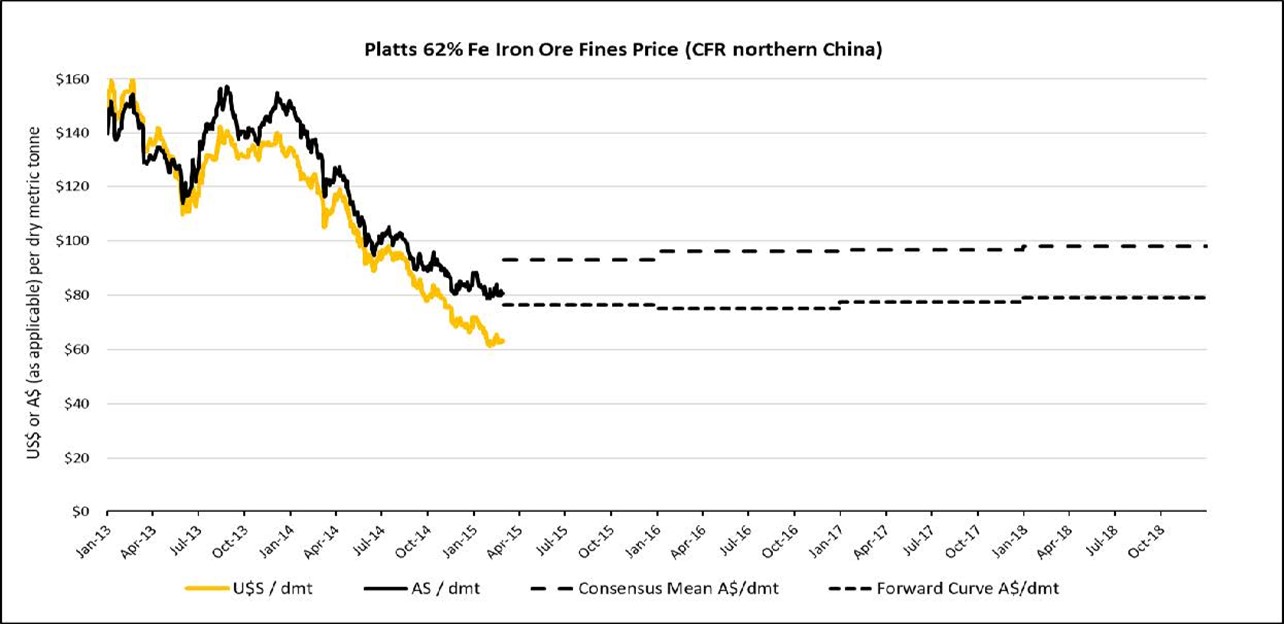
404 After commenting on movements in exchange rates, it says 'Looking forward, prices are expected to remain weak and volatile' (CB 467 p 6403). Further iron ore price and exchange rate data are presented, which are described in more detail below. The view is then expressed that the 'available forecast data indicates that the outlook for the iron ore price remains weak and that the Australian dollar may not fall too much further to offset this' (p 6404). The HBP then notes that Koolan's operations have not achieved budgeted levels due to iron ore prices, comparing a cashflow deficit of $98 million with a budgeted cash outflow for the same period of $22 million.
405 The HBP then goes on to consider three options (p 6404):
• Closure - close the operation and hold the site on 'care & maintenance' for an indefinite period pending improvements in iron ore prices.
• Revised mine plan - adjust the existing LOM plan to reduce costs by removing high strip ratio tonnes.
• Existing mine plan - continue with the existing April 2014 LOM plan as adjusted by the September and December 2014 QPP reviews.
406 There is a table that compares the three options, including for the RMP, 'Remaining LOM ore of 20.3Mt at a waste/ore strip ratio of 2.6x' and for the EMP, 'Remaining LOM ore of 25.6Mt at a waste/ore strip ratio of 4.1x'. So some 5 Mt of ore less would be mined over the life of the mine, but at a lower average strip ratio.
407 The recommendation in the HBP is against closure, on the basis that 'operations can continue on a financially sustainable basis as long as changes are made to the LOM plan' (p 6404). The estimated closure costs of $35-45 million are also mentioned. Mentioned too is that 'Costs for a future restart would also be substantial given the size and remoteness of the site' (p 6405).
408 There is then a comparison of the RMP against the EMP. The HBP says that 'as previously contemplated, adjustments are now proposed to remove an area of higher strip ratio ore at the far western strike extent of the Main Pit, known as the Main West Stage 3 (MW3) zone' (p 6405). There is also a reference to how ACE will be mined.
409 Then the HBP says (p 6405):
Fleet and infrastructure capacity - The recently upgraded mining fleet, including the excavator and nine Caterpillar trucks purchased in September 2014, is sufficient to cover the mining volumes in the existing LOM mine plan and the revised LOM plan. The monthly mining volumes (i.e. total material moved, or TMM) for the revised LOM plan is in line with, or below, the volumes actually mined in 2013 and 2014. In addition, the existing installed infrastructure, comprising crushing (owned and contract), sizing, shiploading, maintenance, logistics and accommodation facilities, are sufficient for both the existing and revised mine plans for the foreseeable future.
410 After some further commentary on costs, workforce and logistics, the following conclusion is reached (p 6406):
Incorporating the matters outlined above, the proposed revised LOM plan produces a significantly improved near term cashflow and better total LOM net present value (NPV) compared with the existing LOM plan. This is despite the reduction in total ore tonnages over the now-shorter life of the mine, as these are the higher cost and now uneconomic tonnes.
411 A chart is then produced showing cumulative cashflow over LOM for the RMP of AU$669 million for the EMP and AU$724 million for the RMP, assuming a 'base case' price of US$70/dmt and an exchange rate of AU$1.00/US$0.75. I will return to this below.
412 After some other commentary, it is said (p 6407):
When the above cashflows are presented in present value terms (i.e. in dollars of today), assuming an 8% real discount rate, the revised LOM plan produces improved value for the Company relative to the existing plan. Figure 6 illustrates the post-tax NPV sensitivities to iron ore price and, as expected, in all of the low price scenarios the proposed new LOM plan delivers a superior NPV relative to the existing LOM plan. This is unsurprising given the removal of the uneconomic ore tonnes and associated required waste removal, leading to the improved near-term cashflows.
413 Below is the chart described as Figure 6 in the passage above showing the RMP to be superior for post-tax NPV at prices from US$80/dmt down to US$40/dmt.
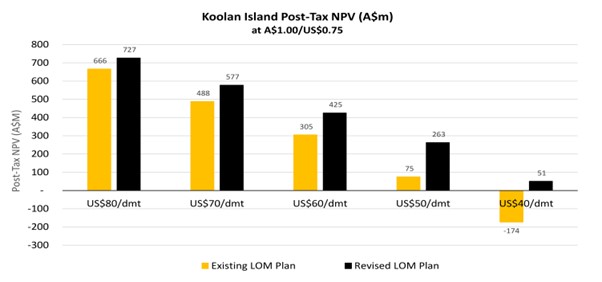
414 A risk assessment is then presented which says that the RMP has minimal risks, the most significant economic risk for the Koolan Island operation being a decision not to pursue the RMP. There is then this comment (p 6408):
The secondary risk identified by management for the revised plan is that potentially saleable Main Pit west end (MW3) or ACE material (i.e. ACE Stage 2 as shown in … Figure 2) is 'sterilised' such that future recoverability is compromised for if/when iron ore prices return to higher levels. However, this material will simply be left in-situ and will continue to be available for future mining should iron ore prices increase and justify extraction.
415 The concluding recommendation in the HBP is (p 6408):
Management recommends pursuing the proposed revised LOM plan for Koolan as set out in the paper, for the following key reasons:
• Avoids the mining of presently uneconomic high-strip ratio material within the far western end of the Main Pit (MW3) and in the ACE deposit;
• Results in significantly higher near-term cashflows than the existing LOM plan, at a time of low iron ore prices and a generally weak outlook;
• Produces a higher total LOM cumulative cashflow and NPV than the existing mine plan;
• Materially lower breakeven price;
• Does not carry any increased mining or technical risk relative to the existing plan; and
• Does not sterilise the remaining Main Pit western end (MW3) or ACE material which, although uneconomic today, may become economic in the future should iron ore prices rise to required levels.
Findings on whether Koolan would have adopted the RMP
416 In my view, Koolan has not established that it would have mined according to the RMP from 1 March 2015 (or from any time within the Indemnity Period).
417 The reasons why I have reached that view can be grouped under four main themes:
(1) Koolan and its senior management consistently displayed a commitment to the EMP.
(1) It is uncertain when any significant revision to the EMP would have been initiated, or when any such revision would have been completed.
(2) Koolan has not established that if any such revision had been initiated, the outcome would have been materially similar to the RMP.
(3) In light of the lack of evidence from Board members other than Mr Lee, whether the Board would have approved the RMP is unknown.
418 Before developing these themes, it is appropriate to mention the extent to which I do accept Koolan's submissions on these subjects.
419 Koolan submits that there was a significant and persistent decline in the iron ore price commencing in early 2014 and continuing into early 2015. This has been established; see the graph at [252].
420 Koolan also submits that the two variables tracked in the graph: iron ore price and US dollar to Australian dollar exchange rates - had a significant impact on its business. That is plainly so. It is evidenced by the risks Mount Gibson assessed in its presentation to insurers in September 2016 [308], if evidence be needed. Koolan also relied on the evidence of Mr Beyer as Mount Gibson’s CEO that he looked at the iron ore price daily and I accept that; it would be surprising if he did not. Mr Beyer's evidence in cross examination was that the consistently declining iron ore price throughout 2014 was a trend that he could not and did not ignore. I also accept that.
421 Koolan further submits that Mount Gibson and its subsidiaries are flexible businesses which constantly adjust their operations to meet changing iron ore prices and foreign exchange conditions. I accept that proposition at the level of generality at which it is expressed. It appears fundamental to the operations of an iron ore mining business that the process of mining is optimised to maximise profit in changing conditions. I accept the evidence that this was particularly so for a business faced with relatively short mine lives, such as Mount Gibson. But that flexibility does not answer the question of whether, in the specific circumstances here, Mount Gibson would have changed the EMP significantly to transform it into the RMP.
422 To explain why I decline to answer that question in the affirmative, I will now develop the four themes listed above.
Koolan was committed to the EMP
423 There are abundant indications in the chronological sequence of events set out above that Mount Gibson's senior management was committed to the strategy of waste stripping in the early years of the EMP, in order to reap the rewards of low strip ratio and so low cost mining in later years. They were committed to see that strategy through, despite low iron ore prices.
424 As adopted, the EMP had a clear commercial rationale. It was a simple rationale; excavate high strip ratio material early on so that more ore-rich material could be removed, at a lower cost per unit of ore produced, later on. This later phase was described in the ASX announcement of the plan as an 'extended cash harvesting period'. It was a strategy that contemplated, in Mr Beyer's words, 'spending a lot of money in the early couple of two or three years' and one that 'does require you to spend more money up front' [243].
425 This was a rationale based on a long term view of the life of the Main Pit and, indeed, of how production at Koolan Island fitted in with Mount Gibson's other mines. It was expressed, at the time, to be a rationale that took account of volatile iron ore prices [238]-[239] where, as counsel for Koolan said in opening, 'The word 'volatile' in Mount Gibson speak is basically prices falling' (ts 38). So it was a plan ostensibly designed to take account of what did in fact happen; iron ore prices going down.
426 I take into account that the plan was also announced to be to 'invest in stripping to open up the reserves in Main Pit while prices are higher' [238]. But as subsequent events showed, Mr Beyer was prepared to stick with the plan even after significant falls in price. That is consistent with its status as a major redirection of the mining strategy at Koolan Island, which Mr Beyer took to the Board and announced to the market, both when it was approved and several times subsequently in terms of its successful implementation. It is likely that Mr Beyer felt some attachment to see that plan through.
Senior management consistently defended the EMP
427 The chronological account of events set out above contains numerous instances in which Mr Beyer or Mr Kerr defended the strategy that was embodied in the EMP [238], [257], [317], [319], [326]-[328], [336]. At one point, Mr Lee spoke publicly in favour of the strategy [345]. I need only summarise the instances of the most significance, which took place in the months leading up to the failure of the seawall.
428 Mr Beyer clearly remained committed to the strategy throughout 2014. In July 2014 he expressed his confidence that broker analysts understood the need for 'upfront capital expenditure' [302]. Capital expenditure would not have been necessary if the mine was expected to remain cashflow positive as prices declined. Mr Beyer also seemed confident that further declines could be accommodated by further cost reductions, and Mr Lee said as much in his address to shareholders at the 2014 AGM [298], [303]-[304], [345].
429 It appears that Mr Lee did not express any serious reservations about the viability of the EMP until September 2014 [310]-[313]. Mount Gibson's senior management's response to those reservations was to reassure him about the economics of the mine plan. Mr Beyer effectively asked Mr Kerr to assure Mr Lee about 'how robust it is'. Mr Kerr did so, in particular by means of the figures presented in the slide that he emailed to Mr Lee on 17 September 2014, in which it was said that 'Koolan remains a very attractive investment at current prices'. Mr Kerr's advice to Mr Lee was not only that returns would be robust at the then spot price of around AU$92/dmt, but 'also at significantly lower prices'.
430 Mr Lee received similar assurances at a Board strategy session later in the same month [316]-[319]. That was in a context where the forecast for the iron ore price over the next three years that was presented at the session was 'Poor'.
431 In October 2014 Mr Beyer was still expressing 'great confidence' in the company's 'investment … in waste stripping' at Koolan Island [323].
432 Prominent among Mr Beyer's public statements of enthusiasm for the EMP was the investor call of 14 October 2014 [325]-[332]. Mr Beyer acknowledged the impact of a low iron ore price on cashflows; at the time of the presentation, he said that the average price received during the preceding quarter was US$65/dmt. But Mr Beyer still had no reservations about pressing ahead with the EMP, saying that although Koolan Island would require 'elevated capital over the next two years … the prize here is very significant and certainly worthwhile'. Mr Beyer specifically contemplated that a 'continued depressed iron ore price will see us drawing on some of our cash reserves', but 'this investment generates extremely attractive post-tax rates of return even at these levels of pricing' with an expected return on investment 'better than, or equal to, any new iron ore project anywhere in the world'. He specifically said in answer to a question that the iron ore price would need to be significantly lower than $80 (probably, as discussed above, US dollars), and even if it hypothetically 'tanked' to US$40/dmt, that would only prompt a review, not necessarily a change in strategy.
433 I accept, as Koolan submitted, that Mr Beyer was likely 'wearing his CEO salesman hat' on the call (ts 535), but there is no suggestion that he was misleading investors in any way as to the depth of his conviction that it was worth sticking with the long term strategy he had persuaded the Board to adopt.
434 Then, at the Board meeting of 11 November 2014, Mr Beyer continued to support the EMP and to endorse the returns to which it would lead [334]-[336].
435 Then, at the AGM of 12 November 2014, Mr Lee spoke publicly as Chairman in favour of the existing strategy that was reflected in the EMP [345]-[346]. That endorsement of the strategy included, contrary to the tenor of much of Mr Lee's evidence, a reassurance to shareholders that using the company's cash reserves would bring 'eventual substantial reserves'. In other words, Mr Lee was saying that the company, and he, were comfortable with negative cashflow at Koolan Island for a while. That is consistent with numerous indications in internal documents that management was prepared to experience negative cashflow in the first years of the plan [257], [298], [311], [336].
Koolan showed no signs of departing from the EMP, even though prices were falling
436 Relatedly, at all times, Mount Gibson had substantial cash reserves. Those reserves had declined from around AU$484 million at the beginning of 2014 [253] to AU$465 million in September 2014, a relatively modest decline in the circumstances [323]. Mr Beyer told the market in October 2014 that the company's strong balance sheet was one of the things that left it 'well positioned to … navigate the volatile conditions'. In the investor call of October 2014 he pointed to it as implicitly in favour of the continued policy of 'investment' at Koolan Island. Even at the end of January 2015, when announcing cash reserves of $354 million, Mr Beyer was reported as describing this as 'a very strong financial position' [356].
437 It is only to be expected that the Board and senior management would not want the cash position to keep declining. Nevertheless, the company retained a large cash balance that enabled it to continue what it had consistently characterised as an investment in the future.
438 Thus, when the Board collectively reaffirmed its support for the EMP in June 2014 by approving the FYE 2015 budget [296]-[302], it did so at a meeting where the independent director Mr Barwick noted, without apparent demur, that the Board understood that pre-stripping would be cashflow negative for the first two years. Even Mr Lee's query of the viability of Koolan Island at that Board meeting concerned what was then a hypothetical further drop in the US dollar iron ore price, along with a slight further decline in the Australian dollar against the US dollar (which would offset the price decline in Australian dollar terms). Mr Kerr's response to that query was to the effect that the project would still be profitable overall.
439 These discussions were taking place in a context where the US dollar iron ore price had already fallen about 30% from the end of 2013. And yet there was no suggestion that Mount Gibson would change its strategy at Koolan Island in response to those falls.
440 At the September 2014 Board strategy session, Mr Beyer gave a presentation forecasting a decline in iron ore prices from US$100/dmt to about US$85/dmt from about the middle of 2017. However, given the exchange rates, the Australian dollar price hovered around AU$100/dmt in the period 2014 to 2019 [316]. As at September 2014, the three to five year view for iron ore was identified as being poor [318]. But even after considering falling prices at that session, which was specifically devoted to strategy, the Board made no change to the strategy of proceeding with the EMP.
441 A slide presented at the strategy session also said that a deferral or slow-down of mining activities would increase unit costs and/or incur termination costs. The idea that high strip ratio areas could be eliminated to increase the profitability of the mine per tonne of material moved was not even suggested.
442 Mr Beyer was cross examined about his likely reaction to the price of iron ore in early 2015. Specifically, it was put to him that from the end of November 2014 to early February 2015, the Australian dollar ore price had stabilised and did not drop further until early March 2015. The point of the questioning appeared to be that because ore prices had stabilised at around AU$80 over that period, including to the end of February, the HBP recommending the RMP would not have been proposed in February 2015 as posited (this is also relevant to the next theme I will develop, about the timing of any change of strategy).
443 Mr Beyer's response was to the effect that he was looking at a longer term trend where the ore price had declined over a number of months from the beginning of 2014. Koolan submitted, in effect, that this trend should be accepted as providing motivation for the hypothetical reconsideration of the plan that is reflected in the HBP.
444 But it is difficult to put much weight on Mr Beyer's focus on the long term decline in prices evident throughout 2014. That is for the very reason that there had been a decline throughout that year, and that had not prompted Mount Gibson's senior management to consider any significant change to the EMP. To the contrary, Mr Beyer had steadfastly defended the strategy of investment by negative cashflow in early years in order to reap low cost mining in later years which had the EMP at its heart.
445 Koolan's submissions also emphasised evidence Mr Beyer gave noting that the ore price had not rebounded as it had in the past, but the same observation can be made about that: it had been declining, and not rebounding, for about a year by the time of the seawall failure, and yet that had prompted no change of plan. I therefore accept the point implicit in the cross examination to this extent: in the real world, the price had been declining for a long time, and Mount Gibson's senior management remained determined to persevere with the EMP.
446 Throughout this time leading up to the failure of the seawall, only Mr Lee expressed concern about the viability of the EMP. I will consider his concerns soon. Aside from them, the only other internal communications before the failure of the seawall which are capable of supporting the thesis that Koolan would have changed its mine plan significantly in response to low iron ore prices are those between Mr Beyer and Mr Kelly in May 2014 [265]-[272], [284]. But Mr Beyer accepted in cross examination that this was nothing more than a 'thought bubble' and just part of his desire to understand options. The outcome of the query, if there was any outcome, was unclear. In any event, there was no evidence to establish that Mr Beyer had received advice that mining at no more than the average strip ratio was feasible or advisable. In the end, then, little can be made of Mr Beyer's inquiry of May 2014.
447 There is also evidence in the report from JP Morgan that unnamed representatives of Mount Gibson had said in May 2014 that the company was 'cognizant of the iron ore price and could reduce near-term stripping if the market outlook deteriorated significantly' [288]. But I put little weight on this unattributed hearsay appearing only in a stockbroker's report and not in any sworn evidence. Apart from that, it is to be assessed in the context of the generally (but not exclusively) favourable broker comment about the current strategy [289]-[295]. It must also be compared with the direct evidence of what Mr Beyer told the market on numerous subsequent occasions, even as the iron ore price continued to decline. In any event, by speaking of a reduction in near-term stripping, the comment may be referring to a slow down, not an acceleration of low strip ratio ore of the kind seen in the RMP.
448 I therefore consider that nothing in the behaviour of Mount Gibson's Board and senior management provides any real reason to think that the company was prepared to depart from the strategy it had adopted and defended up to the time of the failure of the seawall.
Mr Lee's concerns do not indicate that Mount Gibson would have abandoned the strategy
449 Koolan effectively seeks to set against this behaviour the concerns of Mr Lee. One reason it submits that the Court should be satisfied that it would have mined according to the RMP is Mr Lee's view that cash preservation and low cost production were paramount in a low iron ore price environment.
450 Mr Lee's concerns, expressed throughout 2014, about the viability of continuing with the then-current mine plan having regard to the iron ore price and the exchange rate, have been described above. In April 2014 he expressed concern about the budgeted target of 4 Mtpa for Koolan Island, however that was not about the financial viability of the EMP, but about whether the TMM for it would be achieved [256]. At a Board meeting in July 2014 he did query the viability of mining at Koolan Island at a certain iron ore price and exchange rate (more favourable than the Australian dollar price that prevailed throughout most of 2015), however he was assured by Mr Kerr that Koolan Island would still deliver attractive returns in the long run [298]. He queried the viability of 'the plan' (according to his evidence) again in September 2014, and was again assured that the mine had a robust IRR at prices lower than those that were then prevailing [312]. He received a similar response when he queried the viability of 'the plan at Koolan Island' at a Board strategy meeting in September 2014 [319] and at a Board meeting in November of 2014 (after the first slump in the seawall but before its final failure) [337].
451 I make three observations about this evidence of Mr Lee's. First, the evidence was consistently to the effect that what he was querying with management was the viability of 'the plan'. This appears to be a reference to the EMP. But the only contemporaneous documentation of how Mr Lee put his concerns about financial viability is in the minutes of the Board meeting on 2 July 2014 where Mr Lee is recorded as questioning the viability of 'KI and Shine', not the viability of any specific mining plan. Accepting Mr Lee's evidence as honestly given, I still have doubts about the accuracy of his recollection as to how specific his concerns about cashflow were to the EMP. It is at least equally possible that his concerns were more generally expressed about the viability of the mine at Koolan Island, not any specific mine plan.
452 The second observation I would make about Mr Lee's expressions of concern is that they were consistently met by reassurances from Mount Gibson's senior management. Some of these have just been described. In addition, at the Board meeting of April 2014, Mr Beyer indicated that he was prepared for Koolan Island to have a negative cashflow over the next 2½ years [257]. Mr Lee himself appears to have been satisfied with that as at the same meeting he noted that Mount Gibson 'was in a strong position with a substantial cash balance and a capable management team with experience in a number of different commodities in the mining industry' [261]. Similarly, at the Board meeting of July 2014, Mr Kerr referred to Koolan Island's 'greater initial cash flow demand' but also to a 71% return pre-tax in later years [298]. The email and slide provided to Mr Lee in response to his query in September 2014 was optimistic about the mine's 'robust returns at today's spot price and also at significantly lower prices' and its 'robust' economics [311]-[312]. Mr Lee also received assurances at the Board strategy meeting of September 2014 and at the Board meeting of 11 November 2014. It is true that the latter were given in the context of discussion of the 15% IRR threshold, but that was after the first slump in the seawall when mining had been suspended and concerns about viability could be expected to have sharpened.
453 It is relevant in this regard to note that while Mr Lee made it very clear in his evidence that he was mainly concerned with low cost and cost effective production, and with cash preservation, he did not tether that to any particular iron ore price. The impression his evidence gave was that this was his overriding concern, no matter the market conditions. And yet, for a period of time including in a consistently declining iron ore market, Koolan continued to mine according to the EMP and in accordance with management's view that to do so was, in effect, an investment in the long term profitability of the mine. Mr Lee accepted that it was correct to characterise it as an investment.
454 The third and related observation is that Mr Lee freely acknowledged that his focus on cost reduction and cash preservation was his view only, and that the other members of the Board had their own independent views. He accepted that his role as Chairman was to try to reach a consensus - he did not attempt to suggest that his view would somehow prevail. But if any of the other directors had concerns about persisting with the EMP, that is unknown, as no other director of Mount Gibson gave evidence. I will consider this point in more detail as the fourth theme of these findings.
455 I therefore do not accept Koolan's submission that the evidence demonstrates that the Board as a whole was concerned to ensure cash preservation and low cost of production. Mr Lee's evidence does not say as much, and if it did I would not be disposed to place much weight on it in the absence of clear contemporaneous documentation or evidence from the other directors themselves. Koolan relies on the statement in a presentation by a third party in May 2013 referring to a directive from the Board that all sites must be cashflow positive: see [246] above. But I put little weight on that in the absence of direct evidence that the Board actually issued such a directive, and of the circumstances in which it did so, and in the absence of evidence that the directive remained in place throughout 2013 and 2014 and into 2015.
456 Therefore I do not accept that Mr Lee’s evidence indicates that the Board or senior management would have abandoned the EMP. It is the evidence of one person, albeit the Chairman, who did not have a clear recollection of his concerns in 2014. There is an absence of any evidence of other directors echoing his concerns. It is not clear precisely where his concerns lay, and regardless of what those concerns pertained to, they were consistently rebutted by Mr Beyer and Mr Kerr.
What was said and done after the seawall failed
457 It is also necessary to consider the evidence about what was said and done in the real world, after the seawall failed. The evidence about Mr Beyer's and the Board's deliberations in January to April 2015 about repairing the seawall and resuming mining in the Main Pit is canvassed at [356]-[366] above. Infrassure points out that at this time, even when iron ore prices were as low as AU$66/dmt [364], the idea of redesigning the mine plan did not enter Mr Beyer's mind.
458 Some allowance must be made for the fact that, in the real world, the Main Pit had flooded, Koolan was unable to mine, and its focus was no doubt on whether the seawall was to be rebuilt, if so how, and how much that would cost. It would be understandable if Mr Beyer and others in management had no appetite for taking on another major project - redesigning the mine plan - at the same time.
459 Nevertheless, I do place some weight on the fact that with iron ore prices that were continuing to fall in the first half of 2015, Mr Beyer did not commission any work on redesigning the mine plan or even suggest to the Board that such work should be done, or that it could be done in the future once serious studies on the feasibility of restarting the mine commenced. The EMP remained as the premise of Mr Beyer's deliberations about restarting the mine throughout the first half of 2015. While I do not accept Infrassure's submission that this alone should be fatal to Koolan's case, I do accept that it is another factor that undermines the plausibility of the hypothesis that in the counterfactual world, Mr Beyer would have initiated a significant redesign of the mine plan in February 2015.
460 Mr Lee's insistence on the importance of cash preservation after the failure of the seawall [362] can be given very little weight as an indication of what his attitude would have been had it not failed. The circumstances were obviously very different. Mount Gibson was unable to earn any cash from the sale of high grade ore from the Main Pit and it faced substantial capital costs to repair the seawall, dewater the Main Pit and restart mining there.
461 Similarly, I put little weight on the hindsight and hypothetical comment in the Board minutes of 29 April 2015 [365]-[366], made at a time when mining was not in fact being conducted and an insurance claim was on foot. Mr Lee's evidence that it was a reference to the debate that was taking place prior to the failure of the seawall does not advance Koolan's case, as Mr Lee appeared not to have any memory of the meeting in question, and anyway all the evidence of any 'debate' that actually did occur before the Incident was in terms of closure, not mining lower strip ratio areas in the Main Pit.
Uncertainty about when revision to the EMP would have been initiated or completed
462 The second theme to be developed is that, even if it were to be accepted that a continued decline in the iron ore price would have necessitated a change in the mine plan, there is no reason to think it likely that the change would have happened by March 2015.
463 The uncertainty inherent in Koolan’s case boils down to two aspects of the evidence. First, the hypothetical nature of some of it, for example the evidence about when a revision to the EMP would have been initiated, what Koolan says it would have done in relation to the IRR ‘threshold’ of 15%, and uncertainty as to how long it would have taken to prepare and approve a significant revision of the EMP. Second, the limited nature of the assistance provided by evidence about what happened in the real world, for example, Mount Gibson’s mining of ACE and Extension Hill. Altogether, this evidence provides no basis for finding that any significant revision to the EMP would have occurred by March 2015.
The evidence about when consideration of a revision to the EMP would have been initiated
464 It is true that there was a marked drop in the iron ore price from the beginning of March 2015, at which time it dropped below the price necessary to return an IRR of 15%. Mr Beyer's evidence is that he would have seen that coming. But that is inevitably coloured by hindsight. If actual knowledge of the drop in early March 2015 is eliminated, the Australian dollar price was relatively stable at on, or just above, AU$80/dmt from mid-November 2014 to the end of February 2015. Importantly, mid-November is before the final slump in the seawall. So before the intervening event that has led to this litigation, the price was 'approaching' an IRR of 15%, and yet there was no sign that Mr Beyer or anyone at Koolan took steps to consider changing the mine plan.
465 Mr Beyer also said that approaching the end of 2014, there would have been a lot of consideration of what to do, had the seawall not failed, pointing to what occurred at Extension Hill. But for reasons given below, Extension Hill was quite different to Koolan Island, and in the end Koolan did not place much reliance on the changes there.
466 In truth, the timing of Mr Beyer's hypothetical step to commence the process leading to the RMP, as given in his own evidence, was uncertain. As quoted at [393] above, his first witness statement was vague about when he would have instructed Mr Thomson to consider the viability of the EMP and present alternate scenarios. This would have been prompted, he says, as a result of the falling iron ore price, and he mentions the level to which the price had dropped 'by early 2015', but does not make it clear that he would have issued the instruction at that (vague) time. And a paper would have been presented to the Board also 'in early 2015'. The change in strategy (manifested how is not clear) would have occurred by '1 March 2015 at the latest'.
467 In his third witness statement, also quoted above (at [395]), Mr Beyer describes the process as, once again, resulting in a change of strategy by 1 March 2015 at the latest. He would have mentioned the issue at a Board meeting that was held on 16 February 2015, so presumably he would have set the process in train before that date. The paper recommending the RMP would have been circulated ahead of a special Board meeting to be held in late February 2015.
468 In his fourth witness statement, Mr Beyer said (paras 21-22):
In paragraph [3] of my Third Statement I noted I would first have instructed Andrew Thomson to consider alternative mining options, and that I would have mentioned the issue at the Board meeting on 16 February 2015 and would have subsequently circulated a paper to Board members ahead of a special Board meeting in late February 2015.
My expectation is that the length of time this task would require is approximately 3-4 months, between the end of November 2014 and the beginning of February 2015.
469 So this suggests (but does not say clearly) that Mr Beyer would have set the process in motion at the end of November 2014. The fact that there are only two months (or so) between the end of November and the beginning of February does not enhance the clarity of this evidence. But there was no material movement in the iron ore price between, at least, 18 November and 28 November 2014. There was no sign of concern on the part of Mr Beyer in the real world during this period and the final failure of the seawall, as an intervening event, did not occur until 25 November. So it is hard to credit the evidence that Mr Beyer would have issued the instruction at the end of November 2014.
470 The evidence in Mr Lee's first witness statement about what Koolan would have done had the seawall not failed was also very general. He said that he would have been pressing management for a change to the plan as the IRR fell towards the 15% threshold, and that it was inconceivable that, in the circumstances of the decline in the iron ore price in late 2014 and early 2015, that management would have continued with a plan that required significant cash expenditure, or that the Board would have tolerated that as an ongoing strategy.
471 In his second witness statement, Mr Lee said that he would have supported Mr Beyer taking the RMP to the Board, that he expects that would have happened in February 2015 and approved at a special Board meeting at the end of that month, and that he would have supported the recommendation in it. Mr Lee was confident that, had the Board been presented with the HBP or similar in February 2015, it would have approved the recommended course of action to implement the RMP.
472 However, given Mr Lee's general lack of recollection of events that were not apparent from the documentary record, I put little weight on this. In view of that, I do not consider that his evidence illuminates his actual past state of mind in the sense that Finn J explained in Hughes Aircraft. He is, rather, constructing a hypothesis as to what would have happened, had he been presented with the HBP in February 2015. The timing expressed in that hypothesis is based entirely on the premise that this is when the HBP would have been prepared, which is in turn based entirely on Mr Beyer's evidence. Mr Lee's evidence therefore does not help the Court come to a view about when, in the counterfactual world, consideration of any change to the EMP would have been initiated.
473 A more specific indication of when Mr Beyer might have been prompted to commence consideration of a revision to the strategy embodied in the EMP concerned the IRR for the project. It will be recalled that the Board minutes of 11 November 2014 record Mr Beyer as saying that 'The viability of continuing at KI would only come into question if the pre-tax IRR dropped below 15%' [336].
474 In his first witness statement, Mr Beyer said (Beyer I para 84-85):
It was my view at that time, as is recorded in the minutes, that the existing mine plan at Koolan Island was worth pursuing unless the pre-tax IRR dropped below 15%.
If the iron ore price dropped to the point that the pre-tax IRR were to approach 15% it would have been my intention to re-assess the viability of continuing with the current plan at Koolan Island, in a similar way to how I responded to the falling prices in September 2012. This would have involved an assessment of different options to consider for operating the mine as well as the possibility of suspending operations. These options, including a recommended option, would have been presented to the Board for consideration and a decision on my recommendation.
475 Infrassure's submissions identify a number of issues about this evidence. I summarise and comment on them as follows:
(1) IRR was calculated over the life of the mine, not just one year. Mr Beyer confirmed that mining decisions about revising the mine plan over the life of the mine would be made, not just on spot prices but on forecast future prices too, including exchange rates. That is, the company would have assessed the IRR on the plan to which it was currently working by reference to those forecasts. Mr Beyer accepted that this would have been the fundamental question, although he said that IRR was not the only metric, and the company would also have been looking at forecast NPV and cashflows.
(2) Based on spot prices, the IRR was already at, or very close to, 15% in the second half of November 2014, before the third and final slump of the seawall occurred. Yet the company was looking at resuming mining once remediation had been completed, without any suggestion of revising the mine plan. While I accept that this is relevant, as said above, it is not compelling evidence of what Koolan would have done in the counterfactual world where there had been no slump in the seawall. The period between the drop of the IRR to 15% and the final failure of the wall was less than one week. Management can hardly be expected to have started considering to revise the mine plan when remediation was the immediate task.
(3) The comparison with what Mr Beyer did in September 2012 is not apt. At that time Mr Beyer, the new CEO, was dissatisfied with how mining was being conducted at Koolan Island and so was looking for a basis on which to change it. Falling prices thus permitted him to present a different mine plan to the Board in March 2013 - the mine plan that became the EMP. But in contrast to the plan that was in place when he became CEO, the EMP was Mr Beyer's plan; a plan that he defended vigorously throughout most of 2013 and most of 2014. So the situation in November 2014 to March 2015 was materially different to the situation in September 2012 to March 2013. I accept this submission. The sequence of events described above shows that Mr Beyer was much more invested in the EMP than he was in its predecessor, so the steps he took to revise that predecessor in late 2012 to early 2013 are not a good guide to what he would have done in late 2014 to early 2015 had the seawall not failed.
(4) The Board minutes of 11 November 2014 suggest that Mr Beyer considered that cost reductions, not a revision of the mine plan, would have been an effective way to improve returns at Koolan Island. I accept this submission too; that is the effect of Mr Beyer's comments in the second last paragraph of the extract of the minutes at [336] above.
(5) According to Infrassure, the work done by Mr Kelly in May 2014 showed that stopping or diminishing pre-stripping was not a viable option. As discussed at [284]-[285] above, I do not consider the evidence about that work or its outcome is that clear. But it is true that Mount Gibson has not adduced any evidence to persuade me that any real work had been done to consider that course of action before the seawall failed. Koolan's unexplained failure to adduce evidence from Mr Kelly about any such work further diminishes the weight I put on Mr Beyer's assertions that it had been done. That evidence, including documentation of the work itself, was in Koolan's power to produce, and its absence supports a conclusion that Koolan has not discharged its onus of establishing that any real work suggesting that the EMP could be revised in the manner proposed in the HBP had been conducted before the seawall failure: see Coshott v Prentice [2014] FCAFC 88; (2014) 221 FCR 450 at [80]-[81].
476 Therefore, while I do not entirely accept all of Infrassure's submissions on the point, they do lead me to not accept Mr Beyer's evidence that if the seawall had not failed, and if the IRR of Koolan Island had approached 15%, he would have reassessed the viability of the mine in a similar way to the assessment that was conducted in September 2012.
477 In my view, the upshot of the evidence about what would have happened if the IRR had dropped to 15% was this:
(a) the IRR would have been calculated at forecast future prices, not just spot prices;
(b) that would only have resulted in a review of the mine plan - what outcome that review would have had was uncertain as at November 2014, a slowdown was possible, and closing the mine remained an option on the table, albeit one not favoured by management due to the associated costs;
(c) however, while those options were on the table, an option that was not on the table at that point was a revision of the EMP, that is, continuing to mine at full capacity but to a different plan, and there had been no work done to show that stopping or diminishing pre-stripping was a desirable option; and
(d) Mr Beyer's preferred way of dealing with further price falls was by way of cost reductions, not changing the mine plan.
The prices that Mount Gibson would have assumed if it were revising the EMP
478 It is necessary to consider the first of the matters just listed a little more. I said earlier that the HBP presented iron ore price and exchange rate data that were to be described in more detail, and also that I would return to the 'base case' numbers in the HBP. That is because Infrassure relies on these figures as the best evidence of broker consensus forecasts, and thus Mount Gibson's long term view on iron ore prices and foreign exchange rates. Infrassure submits that in previous (real) Board papers, Mount Gibson adopted the mean or median position of consensus forecasts as the principal basis for its own price forecasting.
479 The mean forecasts presented in the HBP, looking 'forward' to 2017, are for an iron ore price of US$72.50/dmt and an exchange rate of AU$1.00/US$0.75. The 'base case' that was adopted in the HBP was an iron ore price of US$70/dmt and an exchange rate of AU$1.00/US$0.75. That is potentially significant because, on either set of figures, the Australian dollar price is well above the AU$77.73 threshold, under which the IRR drops below 15%. The HBP, in Infrassure's submission, thus casts further doubt on the basal proposition that Mr Beyer would have initiated revision of the EMP in the first place.
480 Infrassure further submits, relying on a spreadsheet model produced by Mount Gibson's Business Development and Planning Executive, Mr Wen-Jun Lee, that using the numbers last quoted produces an IRR for the project of 56%. This, it says, means that the fact that the spot price fell to AU$75.41 in March 2015 does not matter. Mount Gibson, using the mean or median broker consensus forecasts, would have seen no need to revise the EMP.
481 To begin with, I accept that Mount Gibson would have made important decisions, such as strategic revision to the mine plan, on the basis of long term forecasts. That is sensible, and is reflected in real Board papers and in the HBP itself. Mr Beyer accepted that a mining company should not make its decisions based solely on spot prices. He said 'I think you need to look at the spot price and the short term outlook and the long term outlook' (ts 91).
482 What Mr Beyer would not accept, however, was that the 'base case' in the HBP represented the view of Mount Gibson's management about the iron ore price on a sustainable basis. When asked whether that was a fair characterisation of the analysis, Mr Beyer's response was (ts 187-188):
…. No, I don't think so. I think that's just the number that we used. That's just the number that we used for the - as part of the presentation of the analysis. I mean, I - you know, we - I think it's - yes. I'm not sure there's a - yes. I - that's just a number that's used for that particular example and that calculation, isn't it:
Figure 5 below depicts the annual cashflows of the existing and proposed revised life of mine plans at an assumed based case iron ore 70 and 75.
It's just the numbers that are assumed for the calculation. I'm not sure I see that as being an interpretation of what our long term view is.
What, so you're telling me that, hypothetically, you wouldn't have had a long term view at all?---Hypothetically, as I do in reality, is I look at a range of prices to see what scenario looks like it's the best and gives you the best position, which is what this paper does.
Yes, but it has to reflect your reasonable assessment of the future, because the purpose of this board paper, hypothetically, is to persuade the board to particular decision, isn't it?---That is what it's designed to do, as you can see in figure 6, where it depicts the scenario for a range of iron ore prices.
483 A little later in the cross examination, senior counsel for Infrassure returned to the subject of the base case numbers as Mount Gibson's view of the long term iron ore price (ts 198):
Well, can I suggest to you that the words 'base case' intended to convey to the board and this is the proposition that we're putting to you. We're asking you to assess this case on those assumed base case numbers; do you agree with that?---We're asking them to consider the case as presented in figure 5 under the scenario that's there. I'm not suggesting that it's the base case. It's - it's one of the price deck scenarios.
Well - so the words that appear on 6406, at the foot of page, don't mean what they say? Is that what you're suggesting?---No. They mean - they mean that there's an assumed base case of the iron ore price. What you're suggesting or what you appear to be suggesting to me is that that's what we're taking as being our assumed view of what the iron ore price will be, and that - to me that's two different things. And maybe I'm getting confused with - with what you're asking, but my interpretation of what you're asking is does the word 'base case iron ore price' mean our view on what the iron ore price is going to be, and if that is your question, my answer to that is no.
484 I do not accept Mr Beyer's evidence that the base case in the HBP does not reflect Mount Gibson's likely view of long term iron ore prices and currency exchange rates as at February 2015. It is impossible to see what else it reflects. It was an assumption that was fed into a model to produce a chart, shown below, that was intended to persuade the Board (hypothetically) to adopt the RMP. It would have been irresponsible for Mr Beyer and Mr Kerr to have chosen an iron ore price at random for that purpose, and of course they did not. They chose an iron ore price that was broadly consistent with long term consensus forecasts. Mr Beyer accepted that the analysts whose forecasts produced the consensus numbers were respected analysts.
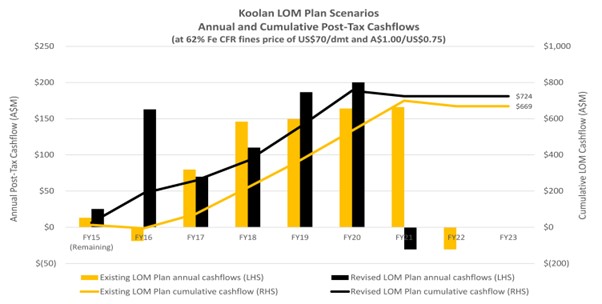
485 The fact that a range of prices were presented in 'Figure 6' (see [413]) does not detract from that. As the HBP says, that figure is showing 'sensitivities' as to what the NPV would be if the iron ore price were different to the base case. That the HBP, in accordance with sensible management and financial practice, presents a range of prices to show what the result will be if the price does not turn out to match the base case. But that does not mean that the base case is not the view of management as to likely forecast prices.
486 In cross examination Mr Beyer kept returning to the numbers presented in the HBP showing that on different prices, the RMP produced a better NPV for Koolan Island than the EMP. But that does not answer the question of whether, in the hypothetical world, he would have commissioned the work that showed this to be the case in the first place. Infrassure's submission is that, given the robust IRR that was still being produced on the basis of forecast iron ore prices reflected in the base case numbers, it would not.
487 Infrassure also points to a further reason why the IRR would have been robust if assessed in February 2015. Wen-Jun Lee's spreadsheet model for calculating IRR was based on a full year of negative cashflow in FYE 2014. But if the calculation were to be performed half way through FYE 2014, say in January 2015, the number for negative cashflow looking forward would be reduced. If one assumes a smooth monthly spend during the year, it would be reduced by half. That will substantially increase the IRR, because the negative cashflow - the investment on the basis of which the return is calculated - would substantially decrease. Even though that assumption of steady monthly spend is no doubt inaccurate, the point remains that the IRR would increase substantially if it is calculated after six months of past spending is eliminated from the forward looking calculation
488 Another significant feature of the price expectations reflected in the HBP is that the mean consensus broker forecasts contained in it showed the price improving over the three years from 2015 to 2018 [403]. That would have provided further impetus to stay with the EMP, where in later years more ore would be mined, at a lower strip ratio and sold so as to exploit higher prices.
489 Alternatively, one can look at the price assumptions which, in the real world, Mr Kerr instructed Mr Kelly to use for the reassessment of Extension Hill in February 2015 [372]. These yield an Australian dollar price of $81.25, also above the 15% IRR threshold.
490 I am not prepared to conclude, solely on the basis of Wen-Jun Lee's spreadsheet, that the IRR that would have been produced on the HBP price figures was as high as 56%. The complex and technical nature of the spreadsheet makes me reticent to rely on the input of those figures into it. But even if that submission is set aside, the evidence summarised above all points to the same conclusion: namely, that even if the spot price had declined to below the 15% IRR threshold, that is not necessarily the price input that Mount Gibson would have used to calculate an IRR for Koolan Island. The long term forecasts that Mount Gibson would have used did not yield an IRR below 15% for the EMP. They are likely to have yielded a significantly higher IRR, especially if costs sunk by the beginning of 2015 are excluded from the calculation. All this sheds further doubt on the proposition that the falling spot price would have prompted revision of the EMP.
491 Koolan's response to that is to emphasise that Mr Beyer's hypothetical evidence is to the effect that he would have reassessed the viability of the current plan if the pre-tax IRR were to 'approach' 15%. But this is to place too much weight on the choice of one word in general hypothetical evidence given with hindsight. I prefer the evidence found in Board minutes produced before the final failure of the seawall, that the viability of continuing at Koolan Island 'would only come into question if the pre-tax IRR dropped below 15%' (emphasis added) [336]. Mr Beyer confirmed in cross examination that this meant what it said.
492 It is also relevant that Mount Gibson's standardised mine planning process [206]-[211] does not support the timing that Koolan now puts forward for its hypothetical revision to the EMP. The changes to the plan to result in the RMP would have been substantial and strategic in nature; they would have been changes to the LOM plan. But the LOM plan was only reviewed in April or May in each year. The QPP was shorter term and would not have encompassed the major change in strategy reflected in the RMP. The QPP for the quarter ending December 2014 that was approved in September 2014 is the one that Koolan relies on as containing the EMP, so it did not make any changes that can be identified with the RMP. None of this is to say that Koolan was incapable of initiating a major strategic change at a time other than the April/May LOM review; the point is simply that the scheduled mine planning process does not provide support to Koolan's case as to timing.
493 The mine plan change at Extension Hill in the first quarter of 2015 also does not advance Koolan's case. It is plain from the evidence summarised at [367]-[379] above that the change was prompted mainly by the need to alter the cut-off grade for ore from 50% Fe to 55% to take account of the inability to sell lower grade ore in the depressed market. The relatively high grade deposits in the Main Pit at Koolan Island would not have presented the same issue. And it was a mine nearing the end of its life; not one in a pre-stripping investment phase. That is in contrast to Koolan Island where high strip ratio mining was being conducted as an 'investment phase', the returns on which would be experienced later on.
494 Koolan's reliance on the change at Extension Hill is thus appropriately limited. It acknowledges that Extension Hill was different to Koolan Island, although it points to Mr Beyer's evidence that it was 'similar to the extent that it involved the reduction of the stripping ratio and TMM in order to save cash in a low price environment' [376].
495 Koolan's ultimate submission on the matter is that the fact that Mount Gibson implemented the re-optimised mine plan at Extension Hill supports the proposition that Mount Gibson would have implemented the similarly low strip ratio RMP at Koolan Island. It says that it 'does not seek to draw any more detailed connection between the two mines save for the fact that, in response to a low price environment, [Mount Gibson] implemented a lower strip ratio mine plan in short order, at the expense of ore' (KCS para 189).
496 I accept that submission, as far as it goes, but in my view it does not go very far. As Koolan's submissions acknowledge, the two projects were very different, and what motivated the change at Extension Hill was specific to its circumstances, in particular the lower grade ore held there compared to the ore at Koolan Island, and the need to change mining to take account of the fact that much of that ore needed, in effect, to be reclassified as waste.
497 This was in a context where short term cashflow at Extension Hill needed to be maximised given it was nearing the end of its life and being mined at a low strip ratio. As mentioned above, Koolan Island was different in that regard. Another difference mentioned above is that the costs of closing Extension Hill were high.
498 The evidence about Extension Hill shows, as an abstract proposition, that Mount Gibson was prepared to change its mine plan to take account of lower prices, including so that ore reserves could be reduced in exchange for mining at a lower strip ratio. But the different circumstances at, and characteristics of, Koolan Island mean that this does not provide strong support for the idea that changes meeting that description would have been introduced at the island at around the same time, March 2015.
499 What the Extension Hill change does show, however is that:
(a) Mount Gibson was, at that time, assuming an iron ore price of AU$81.25/dmt, as just mentioned. Given that the remaining mine life for Extension Hill was about 18 months, presumably that forecast price related to that period;
(b) Mount Gibson was open to mine plans that involved a slowdown in work (see [377] above); and
(c) it took approximately two months, from conception by Mr Olney on 28 January 2015 to mining according to the new plan on about 26 March 2015, for the plan to be changed and implemented, and that was in circumstances where Extension Hill was a simpler operation, where the low iron ore price imposed some urgency, and where Board approval was not required.
500 Koolan also relies on the fact that during the Indemnity Period it mined ACE 'in a low strip ratio manner' (KCS para 84(h)). Presumably the point is that this is similar to the approach posited under the RMP.
501 The purpose of mining at Koolan Island during that period was to provide the best case options for limiting loss and continuing to provide cash. One opportunity that was identified in relation to ACE was 'Low strip Acacia options to provide positive cash flow' (KCS para 347, CB 239a p 4438). This was in a context where ore from ACE had previously only been blended with the high grade Main Pit ore.
502 There is evidence that Koolan mined ore from ACE from December 2014 to April 2015. It appears that ACE was mined in a low strip manner at this time. Then, on 18 June 2015, the Board resolved to approve the recommencement of further mining operations at ACE; approximately 0.8 wmt of ore to generate a cashflow of approximately AU$12.8 million. A graph in the Board's decision paper, set out below, displayed a high strip ratio of approximately 17.6x in the first month decreasing rapidly to a maximum of 2.7x thereafter. ACE was then mined, presumably according to that plan, from July 2015 until February 2016.
ACE material moved including strip ratio
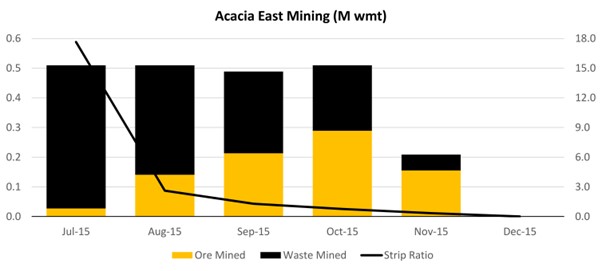
503 However, just as it is difficult to conclude, from the absence of any step to develop the RMP after the seawall failed, that the RMP would not have been developed in the counterfactual world (see [354]-[355] above), so it is hard to draw inferences about what would have happened in that world from what did happen after the seawall failed. The failure of the seawall imposed cost and operational pressures on Koolan, to which it had to adapt in the decisions it made about mining after that point. That limits the use that can be made of the evidence of how mining proceeded at ACE.
No mining of MW3 after the Incident
504 The observation just made pertains as well to evidence from Mr de Kruijff that after the failure of the seawall, iron ore was also accessible in MW3, which was not affected by the Incident, but 'the high strip ratio ruled out any mining operations in that area' (de Kruijff I para 84). It is hard to make any inference about what would have happened in the counterfactual world from a decision that Koolan made in the real world when faced with inability to mine most of the Main Pit and the likelihood of substantial costs being required to restart that mining.
Other mining companies' responses to low prices
505 For completeness, I note that Koolan also referred to changes that two other iron ore mining companies made to their mine plan in early 2015 (Mineral Resources and Fortescue Metals). But without detailed evidence and submissions about the circumstances of each mine, it is not possible to draw any meaningful support for Koolan's case from those changes.
How long would it have taken to devise and approve a revision to the EMP?
506 I have set out Mr Beyer's evidence about what he would have done in the counterfactual world at some length above [393]-[396]. There are two other reasons why I cannot put weight on that evidence. The first is that it is in the nature of submissions. The second is that it necessarily sets out a large number of things that would have had to occur if mining to the RMP were to commence by 1 March 2015. Mr Beyer would have had to commission the study. The results of the study would have had to come back by mid-February. Mr Beyer and Mr Kerr would have had to prepare a Board paper recommending the RMP. A special meeting of the Board would have had to be convened by the end of February 2015. The Board would have had to approve the revised plan.
507 All this is far more complicated than, say, evidence from a patient that if she had been warned of a risk, she would not have had an operation. Each of the steps just outlined might not have happened at all, or happened differently, or happened at a different time. I simply cannot be persuaded on the balance of probabilities that everything would have dropped into place at the times suggested in Mr Beyer's hypothetical evidence.
508 There was, in fact, significant uncertainty in the evidence as to how long the process of revising the EMP would have taken, assuming that it had been commenced at all. That is, how long would it have taken to devise and implement the RMP from the time that Mr Beyer set that process in motion?
509 Infrassure submits that the time it took for the changes at Extension Hill to be approved, as just described, makes it implausible that Koolan could have obtained approval for the change to the RMP from 1 March 2015.
510 Infrassure also points to the time it took to develop the previous LOM plan which comprised the EMP, in 2012-2013. It appears to put this on the basis that Mr Beyer's recommendation to the Board that the new plan be approved was made on 20 September 2012 and the ASX announcement that the strategy of a staged ramp up in production had been finalised was made on 18 March 2013. The difference between those two dates is just under six months.
511 Infrassure also relies on evidence from Mr Korica that it took him about six months to produce the physicals for the RMP between June 2015 and 2016. But that was for the purposes of the insurance claim, when there was no urgency imposed by operational and financial imperatives and no doubt Mr Korica had other things on his plate. I make nothing of that particular time frame.
512 Infrassure also relies on Mr Beyer's evidence in his fourth witness statement that the process would have taken three to four months [468], and puts it together with the vague reference in his first witness statement to 'early 2015' [393], to say that the process would not have been completed by March 2015. But in truth, as I have already described it [468]-[469], Mr Beyer's evidence about how long it would have taken is unclear.
513 So as well as the significant uncertainty about when the process of revision would have started (assuming it would have started), the evidence about that and how long the process would have taken is shifting and uncertain, and therefore unreliable. Koolan has not established that it would have commenced mining to the RMP by 1 March 2015 (or at any other time).
514 This uncertainty about when Mr Beyer would have acted, assuming that he would have acted at all, and about when the revision process would have completed, alone is fatal to Koolan's case. That case was consistently to the effect that Koolan would have started mining to the RMP on 1 March 2015. There was no alternative case based on a range of dates or on a different date. As Infrassure submitted, any such alternative case would depend on a number of facts that were not before the Court, including price expectations at that different point in time and the amount of pre-stripping expenditure that would have been behind Koolan at that time. So since Koolan has not established on the balance of probabilities that it would have commenced mining to the RMP from the beginning of March 2015, it has not made out its case at all.
It has not been established that a revision would have been materially similar to the RMP
Whether any Board paper would have been materially similar to the HBP
515 Further, I am not persuaded on the balance of probabilities that any Board paper produced in early 2015 would have been the same as the HBP. I have a number of concerns about the HBP as produced to the Court.
516 First, it appears to me to omit material information. It is telling that the HBP contains no calculation of the IRR of the mine based on the then current mine plan. In cross examination, Mr Lee accepted that it should have been included. Mr Kerr accepted that the Board regularly asked to see IRR analyses on various different assumptions, although he said that cashflow was a more important metric. He said that if he had been in the Board meeting, he would have explained 'that the IRRs are probably very large and not really the key focus here' (ts 360). But he accepted that in the hypothetical world, Board members could have asked about it.
517 As said above, on the price assumptions contained in the HBP, the IRR for the EMP would have been well above the 15% which, on Mr Beyer's evidence, would not have prompted a reassessment of the viability of the mine plan. That would only occur if the IRR dropped to, or below, 15%. And yet this important metric, which appeared regularly in Board papers in the real world (for example, [298], [336], [359], [364]) is absent. While it was by no means the only metric, or even necessarily the most significant one, it was still material to the Board's deliberations.
518 Other potentially important pieces of information lacking from the HBP were:
(a) what level ore prices would need to rise to before the 5 Mt of ore removed from the mine plan would become economic again, that is, not sterilised [406], [414];
(b) what effect the changes would have on JORC reportable reserves [248], [253], a matter which Mr Beyer and Mr Lee both accepted was of importance to investors; and
(c) the impact of a slowdown or short term suspension, as distinct from complete closure, even though they were options that had been considered and even adopted in previous periods of low iron ore prices [212], [222]-[226], [322].
519 In addition, there are parts of the HBP that are inaccurate, of doubtful validity and self-serving. For example, the excerpt quoted at [402] above bases the HBP on the premise that iron ore prices started to decline in the second half of 2014. But in truth, the price had been in steady decline all year. Contrary to the statement in the HBP, it had not been trading well above US$100/dmt through the time leading up to June 2014. Although it did start trading at the beginning of calendar 2014 at approximately US$130/dmt, it gradually trended downward until it had dropped to US$105 in March 2014, then to US$105.50 at the start of May, and then from 16 May dropped below US$100 save for a brief rise to US$100.75 on 22 May.
520 Further, the excerpt says that the iron ore price has continued to fall even further in the last two months, that is, leading up to the hypothetical date of the HBP as February 2015. But in fact, as explained at [442]-[445] above, the price had been stable in Australian dollar terms from mid-November 2015 all the way to the end of February 2015. The impression arises that the figures used in the HBP are selective.
521 An example of where the HBP is of doubtful validity is the references in it to the changes to the mine plan at Extension Hill as justifying the proposed change at Koolan Island [402]. As discussed above, Extension Hill was quite different. That is reflected in what was ultimately Koolan's modest reliance on it in closing submissions. With respect, the reference to Extension Hill in the HBP appears self-serving.
522 The broader problem is that the whole HBP is unavoidably self-serving. It has been prepared with hindsight in order to support a particular position that Koolan had already reached for the purposes of this litigation. It is impossible to accept that even with the best intentions and the utmost good faith, Mr Beyer and Mr Kerr could have truly placed themselves in the state of mind that they were in in February 2015, looking at options to deal with the decline in the iron ore price (assuming that they would have even started to do so in the first place). There is no suggestion that the process of arriving at the HBP was, or could be, conducted by persons blind to the fact of the insurance claim, the basis on which it had been put, the movement of iron ore prices post-February 2015, and all other subsequent developments.
523 As an aside, the complexities and uncertainties inherent in the HBP are a good illustration of why, as a matter of commercial common sense, the construction of the Policy set out above, which avoids the need for such an exercise, is likely to be correct.
524 I therefore do not accept a further reason why, Koolan submits, the Court should be satisfied that it would have proceeded with the RMP, namely that the HBP demonstrates better cashflow and a better NPV over the LOM plan if that option is taken. Even so, the HBP omits other important information. I am not persuaded that any paper put to the Board for approval of a change to the EMP would have materially resembled the HBP.
Whether any revised mine plan would have been materially similar to the RMP
525 The problems of uncertainty, and of hindsight, and of the purpose for which the HBP was prepared, affect not only the HBP itself, but the RMP on which it was based. Like the HBP, the RMP was prepared for the purposes of the insurance claim. And it was prepared by Mr de Kruijff and his team, even though Mr Beyer accepted that it was reasonable to think that Mr Kelly would have been the one leading the project had it been done in the counterfactual world. Mr Kelly played no part in the development of the RMP and gave no evidence. The mine scheduling software he would have used at head office was different to that which was actually used at Koolan Island to develop the RMP.
526 In response to Infrassure's submissions about the different software, Koolan could only point to evidence from Mr Korica that the software packages perform similar functions. While I accept that evidence, similarity in the functions performed does not necessarily lead to similarity in the outcome. For example, that both software packages perform the function of mine scheduling does not mean that the mine schedules they are going to produce are going to be similar or the same.
527 Koolan also complains that Infrassure's position is disingenuous, given the years they had to raise any genuine queries about the software, but whatever the history between the parties, Koolan now has the onus of persuading the Court that the RMP produced is the same as the RMP that would have been produced had the Main Pit not flooded.
528 I do accept, however, Koolan's submission that the question of the software package goes to weight. The absence of any evidence that satisfies me that the software package that was used (MineSched) was likely to produce a similar result to the software package that would have been used in the counterfactual world (XPac) causes me to put less weight on the RMP as produced as evidence of what Koolan would have done in that world. The same goes for the difference in personnel. That is especially so given the outcome of the study that Mr Kelly did perform in early 2014, which did not lead to any change to the EMP.
529 Infrassure made a Jones v Dunkel submission about Koolan's unexplained failure to call Mr Kelly (or the person who helped him prepare the different scenarios in May 2014, Mr Salmon). But Koolan submitted that their absence was explained by the fact that they had been made redundant as a result of the flooding of the Main Pit in 2015. I accept Koolan's submission and make no Jones v Dunkel inference based on the absence of any evidence from Mr Kelly or Mr Salmon.
530 There is, however, another reason to doubt that anything resembling the RMP would have been produced. The main thrust of the revised plan involved the removal from the plan of the mining of MW3, a relatively high strip ratio deposit on the western side of the Main Pit. A concern that this would lead to the sterilisation of MW3, that is to it becoming permanently inaccessible, was identified and, as set out at [272]-[283], Koolan has not provided any clear evidence that the concern had been dispelled by mid-2015.
A slowdown in mining cannot be ruled out
531 Another reason to doubt that the outcome of any reconsideration of the strategy would have been materially similar to the HBP or RMP is that an option that Koolan had actually employed in the past at times of low prices is omitted from consideration, namely a slowdown in mining.
532 When Koolan changed its mining in response to low iron ore prices in 2009, the change was not to mine more profitably, but to slow down at Koolan Island and to suspend operations at Extension Hill [212]. I acknowledge that this was five to six years before the time that is centrally important here, under a senior management team that did not include Mr Beyer. So I do not put a great deal of weight on this. It does, however, indicate that there were feasible options other than the one reflected in the RMP.
533 As another example of its flexible approach to mine planning, Koolan points to the change to its mine plan that took place in September to October 2012 in response to low iron ore prices [218]-[227]. But it is notable that the main thrust of the plan was to slow down the rate of mining, to sell ore from stockpiles, and to defer waste stripping, depending on the outcome of work to determine the optimum production and waste mining profile for the remainder of the mine life. In view of evidence of this kind, it is difficult to see how a change to the mine plan in 2015 that involved slowing down or deferring high strip ratio mining, rather than eliminating it, can be ruled out.
534 Also notable is that in 2012 Mr Beyer was reluctant to push production out too far into future years, where cost pressures could be increased and iron ore prices could be lower. It must be recalled that the essence of the RMP is to accelerate the mining of ore, so as to sell more of it at a time of record low iron ore prices, rather than leave it in the ground to be mined after prices recovered.
535 Consistently with that, it appears that at the September 2014 strategy session, the scenario Mr Lee did ask Mr Kerr to analyse was to shut the island down for three years, not to mine it more profitably [321]. It is true that Mr Kerr's initial analysis of that option was discouraging, although he still said that the closure scenarios might require further consideration if iron ore prices declined significantly further [322].
Conclusion on content of the HBP and the RMP
536 Taking all these matters into account, I am not persuaded that if the seawall had not failed, any Board paper and associated revised mine plan produced by Koolan would have been the same or materially similar to the HBP and the RMP respectively.
What decision the Board would have made on a proposed revision is unknown
537 Finally, I am also not persuaded that the Board would have agreed to the recommendation in the HBP, had it been put to it.
Mr Lee's hindsight evidence is not reliable
538 The only Board member to give evidence was Mr Lee. For reasons already given, I put little weight on his evidence. Further, in his first witness statement the evidence was very general. The only reference to any sort of plan resembling the RMP was that, in the period between December 2014 and October 2015, 'management sought approval to continue mining low strip ratio tonnes in ACE' (para 36).
539 Subsequently, the HBP was presented to Mr Lee. I have already commented on this in connection with the question of timing. It appears that Mr Lee saw it in draft after it had been worked up by Mr Beyer and Mr Kerr. But he could not remember that.
540 In any event, it is natural that a person presented with a paper in such circumstances will accept that it was equivalent to, or similar to, the paper that would have been presented to the Board. After all, no other possible paper has been put to him, and the entire context is pointing to the expected result: that he would have accepted and supported the HBP. The artificiality of that situation is, in my view, extreme. It exacerbates the problems with such hypothetical evidence identified in the authorities described above. All this leads me to put little weight on Mr Lee's hypothetical evidence about what he would have thought.
Koolan's case as to how the other directors would have viewed the HBP/RMP
541 And what of the other directors, and what they would have thought? There was no evidence from any of them. Koolan's case about their views proceeded, rather, by inference. It effectively asked the Court to infer that the Board would have accepted Mr Beyer's recommendation and agreed with Mr Lee.
542 Mr Beyer gave evidence that he was confident that the Board would have endorsed his recommendation (Beyer III para 7). Mr Lee was similarly 'confident that, had the Board been presented with the Hypothetical Board Paper (or similar) in February 2015, it would have approved Mr Beyer's recommended course of action to implement the Revised Mine Plan (as defined in the Hypothetical Board Paper)' (Lee II para 7).
543 But this evidence is at a high level of generality and I put little weight on it. As Finn J observed in Hughes Aircraft (see [197] above), what discretionary judgment a board, a multi-member, deliberative body would have made consequent upon a recommendation made to it would require consideration of a number of possibilities and probabilities, where 'it would be important and relevant to know the state of mind that the individual board members would have brought to the question'.
544 I accept that, as Koolan submits, there was no instance in the evidence of the Board not approving a recommendation from senior management. But that by itself is not enough to lead me to infer that the Board would have accepted the recommendation here. Here, Mr Beyer would have been proposing a significant change of plan, to discard a strategy that he had championed vigorously for two years, including in the face of, and by reference to, steep declines in the price of iron ore. As identified above, there were good reasons to persevere with the EMP. The wisdom of the hypothetical proposed change was contestable. It is a hypothetical plan to respond to a sustained decline in ore prices, not by slowing down to await an improvement, but by speeding up the amount of ore to be extracted and sold while prices were low. The fact that the directors endorsed other decisions in the past (as evidenced by a selection of nine sets of Board meeting minutes) is insufficient for me to infer on the balance of probabilities that they would have done so here, assuming that they had been presented with the HBP.
545 Uncertainty about what the other directors would have thought is exacerbated by material omissions from the HBP, listed at [519] above. One of the matters omitted was the IRRs for the EMP and the RMP, when the Board's attitude to the alleged threshold of 15% was unclear [476].
The absence of evidence from the other directors is significant
546 And that is all in circumstances where evidence of the state of mind of individual Board members other than Mr Lee is entirely lacking. Mr Lee accepted that they all had their independent opinions, which were not the same as his, and that he tried to achieve decisions on a consensus basis [454].
547 That is so when five of the six directors in early 2015 were still directors at the time of trial and none of them were called as witnesses. And I am conscious that from the Board minutes in evidence, it appears that the one director that has been called was the director who questioned the strategy most often. I do not accept a submission by Koolan that his position as Chairman made him different; as already mentioned, his evidence was clear that he tried to see that decisions were made by consensus, and there was no suggestion that his position permitted him to direct others how to decide.
548 Infrassure submitted that I should make a Jones v Dunkel inference based on the unexplained failure to call at least five of the other six directors. Koolan sought to explain their absence by submitting, in effect, that their hindsight hypothetical evidence would have meant that there would have been little probative value to their evidence had they been called solely for the purpose of saying whether they would have accepted the recommendation in the HBP, without the context of a Board meeting. That context would include the discussion that would have ensued at the Board meeting itself.
549 I do not accept Koolan’s submission. It was unsupported by evidence from anyone as to why the Board members had not been called. And more fundamentally, as Finn J explained in Hughes Aircraft, such evidence is the best direct evidence available as to how a multi-member deliberative body would have decided or behaved. It would have been within the power of Koolan to give the Board members such context as they may have needed to give evidence as to their likely past hypothetical states of mind.
550 And to the extent that I do accept the submission, it would hardly advance Koolan's case as a whole. If the evidence of all the Board members as to what they would have done is not worth hearing, it is hard to see how I can make a finding in Koolan's favour on the basis of the evidence of only one Board member.
551 Ultimately, I accept that the Jones v Dunkel principles should make me further reluctant to make the inference that Koolan wants me to make: effectively that, on the basis of Mr Lee's and Mr Beyer's general evidence, and the fact that the Board accepted management recommendations in relation to other matters, I should infer that the other Board members would have accepted the recommendation in the HBP. I am not prepared to make that inference. The unexplained failure to call five people whose opinion would have together made up the decision of the Board in 2015, when they are still members of the Board, points to the conclusion that they were not called because their evidence would not have advanced Koolan's case: Jones v Dunkel at 308 (Kitto J), 312 (Menzies J), 320-321 (Windeyer J).
552 The difficulty in making the inference Koolan seeks is exacerbated, as Infrassure points out, by the fact that there is no evidence of any Board member's thought processes in approving the EMP in 2013 [229]-[244]. Mr Lee gave no evidence in chief about the adoption of the EMP, and when the strategy presentation of February 2013 and the ASX announcement of 18 March 2013 were shown to him in cross examination, he had no recollection of them, or of the lift to 4 Mtpa of production that they were discussing.
553 Infrassure also points out that no evidence from any other Board member has been adduced to explain their attitude to an IRR of 15% as a threshold of any kind. The Board appears to have requested modelling at 7% and 0% as well, suggesting that it may have been prepared to allow the IRR to drop further than 15%. I accept that submission too; as set out above, Koolan has not established that the IRR of 15% was a line that Mount Gibson was not prepared to cross, and has not established what the company would have done if it had been crossed.
554 All in all, Koolan has not established that the Board would have approved the HBP or RMP, even if they had been put to the Board in February 2015.
To what extent would Koolan have achieved the mine plan
555 It is now necessary to deal with the issues concerning the extent to which Koolan would have achieved the forecasts or targets contained in the mine plan to which it would have worked in the Indemnity Period had the Incident not occurred, whether the EMP or the RMP.
556 First, assuming that the Court finds that Koolan would have continued with the EMP, Infrassure submits that it would only have achieved 91% of the targets for mining material in that plan. Koolan maintains it would have achieved 100%, although it accepts that if the Court finds that it would have fallen short of that, 91% is the correct number.
557 Second, if I had found that Koolan would have mined according to the RMP, Infrassure submits that Koolan has failed to discharge its onus of proving that it would have achieved the physicals required under that plan. This, it says, means that Koolan has entirely failed to prove its case in that regard. Alternatively, it submits that the Court should significantly discount the RMP claim by 17%, to reflect Koolan's historical performance on its mine plans.
To what extent would Koolan have achieved the EMP?
558 Given the conclusions I have reached above, the numerical outcome of the claim as determined in this judgment must be based on the EMP. To what extent would it have been achieved?
559 Infrassure relies on what appear to be Mount Gibson internal management reports, prepared on a monthly basis. The reports on which it relies span from July 2013 to September 2014. They show Koolan consistently falling short on its TMM targets, with the exception of September 2014, when the TMM was 1% above target. If that is excluded, the shortfalls range from 4% (February 2014) to 44% (April 2014) with a median shortfall of 22%. There is also an annual report for FYE 2014, showing a shortfall in TMM of 28%, and a quarterly report for the first quarter of FYE 2015, showing a shortfall of 9%.
560 In relation to the ore output of the mine, however, the figures are not so consistent. For three months in mid to late 2013, the DSO for the mine exceeded targets. It also exceeded targets in May, June and September 2014. In other months, there was a shortfall of DSO against target. The range of results is wide, from 584% above target (in August 2013) to 78% below target (in December 2013). The median is a shortfall of 10%. The annual shortfall for FYE 2014 is 17% and the shortfall for the first quarter of FYE 2015 was 16%.
561 As against this, Koolan relies on general evidence from Mr de Kruijff that the physicals for 'the last 7 months of QPP2 would have been achievable with the mining and crushing capacity available' to Koolan, as set out previously in Mr de Kruijff's witness statement (de Kruijff II para 52). In that regard, Koolan relies on the evidence that it had implemented several upgrades, improvements and extensions to its excavation, loading, hauling, crushing and screening capacity at Koolan Island. Some of those matters are mentioned in the chronology of mining operations at Koolan Island above: see [307], [323]-[325].
562 Koolan also relies on evidence Mr Morey (Technical Services Manager at Koolan Island at the relevant time) gave in cross examination about productivity improvement projects that had been pursued throughout 2014, which increased the efficiency of operations at the island. It also relies on Mr Morey's evidence about the likely effect of a new excavator and new and replacement dump trucks that had been mobilised to the island in September and October 2014. Mr Morey's evidence is that trucking capacity had been the main constraint on Koolan's productivity in the 12 to 18 months preceding the failure of the seawall, and the new fleet significantly loosened that constraint. Mr Morey's opinion (in evidence without objection) was that Koolan was likely to achieve the forecast TMM, by which he seems to mean the TMM forecast in the EMP.
563 However, in cross examination, Mr Morey accepted, as a general proposition, that part of the planning process is to have targets that are stretching, so as to maximise the performance of the mine within plan parameters. He also accepted that with a dynamic mining operation like Koolan Island, there can be very big discrepancies between what is forecast and what is achieved. He accepted that it was not unusual for the company's targets for ore mining not to be achieved, although he did not agree that they were never achieved. He accepted that the number of variables in a complex mining operation means it is almost impossible to take account of all of them and, for example, that it was possible that new equipment would fail to achieve what was hoped for.
564 Mr Morey also said in cross examination that he factored the expected improvements from the new fleet into the planning process for FYE 2015, although he also said that the other improvements in mining practices gave Koolan the confidence that the assumptions underpinning the plan were achievable.
565 Koolan also relies on the fact that in September and October 2014, immediately preceding the first slump in the seawall, with the benefit of new equipment, Koolan had achieved or exceeded its TMM and DSO targets. So, it submits, it should be compensated on the basis of the full forecast EMP. While it is true that Koolan did achieve or exceed its TMM and DSO targets in September and October 2014, in the months before it fell short of both of those targets with the exception of exceeding its DSO targets in October 2013 (1%), May 2014 (12%) and June 2014 (38%). So Koolan achieving and exceeding its targets was clearly not the norm, and it happened much less frequently than Koolan falling short of its targets. It therefore does not appear appropriate that Koolan should be compensated on the basis of the full forecast EMP.
566 Koolan points out that Mr Morey was not directly challenged in cross examination on his opinion that the EMP and the RMP would have been achieved. But while that is true, I consider that it was sufficiently clear to Mr Morey that it was being put to him that targets, such as the ones he said would be achieved, were stretch goals, they were never achieved and there were various reasons why, in any given period, Koolan might fall short of them. No Browne v Dunn (1893) 6 R 67 point arises (and Koolan did not submit that it did). The lack of a direct challenge is just a matter to be assessed in the overall weight to be given to Mr Morey's evidence.
567 I also note that, according to the evidence of Ms Dobson, Mount Gibson's CFO, the EMP budgeted for a significant increase in TMM and ore mined for the 12 months preceding the Incident (1 October 2013 to 30 September 2014). The TMM for that preceding period was about 30.5 Mt, and the ore mined about 2.8 Mt. That compares to about 37.2 Mt for TMM under the EMP, an increase of around 21%, and 3.8 Mt for ore mined, an increase of about 34%.
568 In my view, the way to decide between these competing positions becomes clear once the overall nature of the exercise is recalled. It is the exercise mandated by the Policy, including the adjustments clause.
569 That requires the parties to start with the Standard Output, being the Output of the mine for the period 24 October 2013 to 23 October 2014. That Standard Output must necessarily have reflected the TMM and ore mined under the EMP, as that was the plan to which Koolan actually mined during that period.
570 To that, adjustments must be made as necessary to provide, relevantly, for variations in Koolan's mining business which would have affected it, had the Incident not occurred. There are two variations that are particularly relevant here. First, the EMP naturally contemplated that there were going to be changes in the TMM and ore mined from year to year. Second, as described at [306], on 16 September 2014 Koolan adopted changes and refinements to its mine plan for the next 18 months (with particular focus on the immediate three months) as part of the QPP (that iteration of the mine plan being labelled QPP2 for FYE 2015).
571 The exercise required under the Policy, then, is to adjust the Standard Output actually achieved in the 12 months to 23 October 2014 to reflect those variations (and any others found to be relevant). The exercise is not to find, as a matter of hypothetical fact, the TMM and ore mined that Koolan would have achieved during the Indemnity Period. As Mullins J said in PMB Australia at [210]:
Building up a standard turnover is not a matter of strict proof, as it calls for estimation of what would have occurred, if something had not happened. Ultimately it is a question of whether the estimate of standard turnover is reliable.
572 The starting point here, most relevantly, is that Koolan's ore mined for the 12 months preceding the Incident was 2.8 Mt. Since, in relation to this issue, we are only dealing with material moved and ore mined, not with dollar revenue, that is a reasonable proxy for the Standard Output during that period. In circumstances where the insurance claim is in litigation, Koolan bears the onus of persuading the Court that this should be adjusted to reflect in full the revised Output that would be commensurate with the ore mined as forecast in the EMP. For the following reasons, I am not persuaded that an adjustment to that extent is warranted here:
(1) Koolan is projecting an increase to 3.8 Mt for the Indemnity Period under the EMP. That is a very ambitious increase of 34%. The increase in TMM is also ambitious, at 20%.
(2) Koolan had consistently fallen short of its monthly targets for TMM and usually fallen short of its monthly targets for ore mined. There is good reason for this, and it does not involve any criticism of the competence of those doing either the forecasting or the mining. It is simply good business practice to set stretch targets for goals such as the quantity of ore mined. Mr Morey's evidence confirms that.
(3) Doubtless the improvements made to Koolan's dump truck fleet and the new excavator increased its mining capacity. But those increases were already factored into the targets in the EMP relevant for the Indemnity Period, which were themselves stretch targets.
(4) As Mr Morey inevitably acknowledged, there are a range of unforeseen and unforeseeable contingencies that affect any mining operation. Koolan's actual record suggests that the contingencies are more likely to affect the results adversely than they are to lead to unexpected upside.
(5) Mr de Kruijff's evidence, properly understood, does not express confidence that the ambitious targets in the EMP would be achieved. He says, rather, that the goals were 'reasonable and achievable' or 'achievable' (de Kruijff II paras 51 and 52). In other words, they were realistic forecasts that were capable of being achieved. But it does not follow that they would have been achieved, let alone that they would have been exceeded. All of that makes it appropriate to build in a discount.
(6) Mr Morey's proper acknowledgement that the targets in the EMP were stretch targets that were subject to contingencies, and were often not achieved, also makes it appropriate to build in a discount, notwithstanding his opinion that Koolan was likely to achieve its forecast TMM.
573 In view of all this, I consider that the adjustment to the Standard Output should allow for a material shortfall on the targets in the EMP. It follows from the parties' agreed position that the shortfall should be 9%. As Infrassure submits, that still allows for a substantial improvement on the Output that was actually achieved during that period. A reduction of 9% in the targets in the EMP will still yield ore mined of 3.5 Mt, an increase of about 24% on the unadjusted Standard Output (using DSO as a proxy for Output).
To what extent would Koolan have achieved the RMP?
574 This issue is doubly hypothetical, as it only arises if I am mistaken in both the conclusion that the Policy does not permit Koolan to calculate its claim on the basis of the RMP, and the conclusion that Koolan has not established that it would have adopted the RMP. It is therefore appropriate to deal with it relatively briefly.
575 Koolan relies on the statement of Mr Korica, the Mine Planning Superintendent for Koolan Island, in support of its submission that it would have achieved the RMP physicals. Infrassure did not require him for cross examination. Koolan submits that this means that the physical data he prepared and explained should be accepted.
576 Nevertheless, Infrassure challenges the validity of the data, and submits at the threshold that Koolan has not established the physicals under the RMP at all. That is because the RMP was, as outlined above, prepared by different personnel, in a different location (the Island, rather than Perth head office) using different software, compared to the personnel and software that would have been used in the hypothetical counterfactual that Koolan advances as the basis for its RMP claim. Infrassure emphasises the 'black box' nature of the software, where it has not been established how it takes the data that are put into it to produce the figures that appear in the RMP. These are said to involve complex algorithms that no one has explained. So, Infrassure submits, the Court should not find that the figures in the RMP spreadsheet establish the outcome that would have been achieved had Koolan implemented the RMP from 1 March 2015. If those figures are thus disregarded, Koolan has simply not established that it would have moved any amount of material had it mined according to the RMP.
577 The short answer to this argument is that it is not consistent with the approach to be taken under the Policy, as outlined in the previous section in relation to the EMP physicals. To deal with the present issue it must be assumed, contrary to my actual conclusion, that Koolan would have mined according to the RMP from 1 March 2015. That would then be a variation in Koolan's business which must lead to an adjustment to the Standard Output.
578 Therefore Koolan is not starting from a blank sheet and is not required to prove as a past hypothetical fact what it would have achieved had it mined according to the RMP. It is, rather, seeking to persuade the Court what adjustment should be made to the Standard Output to reflect that variation. Even if I were to agree that Koolan has not established precisely how it would, in fact, have mined had it adopted the RMP from 1 March 2015, that does not relieve me of the need to give effect to the requirement in the Policy to determine that adjustment. Only if the evidence was so lacking that the Court would be engaging in conjecture or speculation would that be so.
579 On no view could the adjustment be said to be negative 100% on the Standard Output. On any view, Koolan would have succeeded in mining at least a large proportion of the forecast amounts under the RMP. The RMP physicals appear on their face to have been prepared by competent personnel using software that is commonly used for that task and with reasonable inputs. They may therefore be taken into account in making the adjustment.
580 It does not follow, however, that I must accept the forecasts in the RMP uncritically and adjust the Standard Output by the full amount reflected in those forecasts. Infrassure's alternative submission was that the discount should be 17%, to reflect the amount by which Koolan fell short on its forecast for DSO in FYE 2014.
581 For the following reasons, I do not consider that the discount on the targets in the RMP should be that high, but I do consider that a discount of 10% is an appropriate reflection of the amount by which the Standard Output should be adjusted, on the assumption that Koolan would have adopted the RMP from 1 March 2015 (and the assumption that the Policy permits that to be taken into account):
(1) While Koolan did fall short of its forecast targets for FYE 2014, and for the 12 months to 23 October 2014, it does not follow that it would have fallen short of its targets under the RMP to the same extent. The lower amount of TMM forecast for the RMP, compared to the TMM actually achieved in the previous periods, makes it likely that Koolan would have come closer to the RMP targets than it did to the targets for the previous periods.
(2) Nevertheless, Koolan would still have been mining to the EMP from 24 October 2014 to 28 February 2015, so the matters set out in the previous section suggest that it would have fallen short in those months.
(3) If the RMP is to be treated seriously as a reasonable approximation of the plan that Koolan would have adopted in March 2015, consistently with the approach confirmed by Mr Morey, the targets in it would still be stretch targets.
(4) Although the TMM projected under the RMP was lower than the TMM actually achieved in the previous periods, the ore to be mined was significantly higher (about 5.0 Mt compared to 2.8 Mt mined in the 12 months to 23 October 2014). The reports on which Infrassure relies show that the relationship between TMM and ore mined is not a directly proportional one. That is, the amounts by which Koolan fell short of or exceeded its TMM targets month to month and over longer periods did not correspond to the amounts by which it fell short or exceeded its targets for DSO. For example, over FYE 2014 Koolan fell short of its TMM target by 28% but fell short of its DSO target by 17%. For the first quarter of FYE 2015 it fell short by 9% on TMM but by 16% on DSO. So the relative ease with which Koolan might achieve a less ambitious target for TMM does not necessarily entail the same ease to achieve a more ambitious target for ore.
(5) The RMP projected that all the low strip ratio ore in ACE would be mined out within the Indemnity Period. But Koolan did mine low strip ratio ore from ACE in the real world, and that was not completed until February 2016.
582 All these matters together provide a proper basis to conclude that adjusting the Standard Output to reflect a higher amount of ore that would have been mined under the RMP, so as to achieve 90% of the target under the RMP, would have been a reasonable adjustment to make under the Policy if, contrary to my conclusions, it was open to Koolan to base its claim on the RMP. There is no inconsistency between this and my conclusion that the EMP, with its more ambitious TMM targets should be assessed at 91%; the latter number reflects the agreement of the parties, not what I would necessarily have assessed in the absence of that agreement.
583 It will be recalled that ICW stands for 'Increased Costs of Working' and UWE stands for 'Uninsured Working Expenses'. As briefly introduced in Section III, Koolan claims an amount referable to the concept of ICW under Item 1(b) of the Basis of Settlement, alternatively under Item 4. I will deal with each item in turn.
584 The subject of Koolan's claim under Item 1(b) was introduced briefly in Section III. It is now necessary to go into that claim in more depth in order to determine it.
585 I will first identify the way in which Koolan claims ICWs under Item 1(b), that is, the rationale that underlies the amount it claims. I will then describe the grounds on which Infrassure objects to the claim, and the issues to which that gives rise. There is a general issue of construction and fact as to whether Koolan's approach establishes the amount claimed under Item 1(b), and a further issue of fact. I will then resolve each issue in turn.
The way in which Koolan claims ICWs under Item 1(b)
586 It is convenient to set out Item 1 of the Basis of Settlement again:
The Insurance under this item is limited to loss of Gross Profit due to: (a) Reduction in Output and (b) Increase in Cost of Working and the amount payable as indemnity thereunder shall be:
(a) In respect of Reduction in Output
the sum produced by applying the Rate of Gross Profit to the amount by which the Output during the Indemnity Period shall, in consequence of the Damage, fall short of the Standard Output,
less any sum saved during the Indemnity Period in respect of such of the charges and expenses of the Business payable out of Gross Profit as may cease or be reduced in consequence of the Damage.
(b) In respect of Increase in Cost of Working
the additional expenditure necessarily and reasonably incurred for the sole purpose of avoiding or diminishing the reduction in Output which, but for that expenditure, would have taken place during the Indemnity Period in consequence of the Damage, but not exceeding the sum produced by applying the Rate of Gross Profit to the amount of the reduction thereby avoided;
less any sum saved during the Indemnity Period in respect of such of the charges and expenses of the Business payable out of Gross Profit as may cease or be reduce[d] in consequence of the Damage.
587 The indentation of the last part of the clause has been changed to reflect the view I expressed at the outset that it pertains only to Item 1(b), not the whole item. Recall that 'Output' is relevantly defined as the 'sale and/or invoice value of goods manufactured and/or processed'.
588 In Riley, Mr Glynn and Mr Rogers explain the purpose of Item 1(b) as follows (Riley, 2.71, internal cross references omitted):
It is in an insured's interest to restore a business to normal trading conditions as quickly as possible after an incident and, moreover, there is a duty to do so imposed by the policy claims conditions. This, however, may involve considerable expense in undertaking special measures to reduce the loss of turnover during the indemnity period and to hasten the resumption of normal trading. But action on these lines is also of benefit to the insurers as its effect is to reduce the amount which would otherwise be payable for loss of gross profit. Therefore, Item1(b) - under the heading, increase in cost of working - compensates the insured for the additional expenditure necessarily and reasonably incurred for the sole purpose of avoiding or diminishing the reduction in turnover which would otherwise have taken place.
No sum insured is stated in respect of this benefit nor is anything to be added to the amount insured on gross profit to provide for it because it is an alternative to loss which would otherwise be payable as loss of gross profit. An exception to this arises, however, when it is anticipated that the amount which may have to be expended on increase in cost of working in the event of a claim will exceed the amount of the gross profit which will be conserved by such expenditure. Specific insurance is then required in respect of the excess amount …
589 Koolan's claim under Item 1(b) commences with the proposition that it mined ACE for ore in order to mitigate the loss caused by the inundation of the Main Pit. Koolan's previous practice was to blend Main Pit ore with ACE ore to produce a mix of grade, impurities and lumps and fines which would optimise the sale price on the market of the ore from the two pits. It could not do that after the inundation of the Main Pit (save, perhaps, by using stockpiled ore) but it determined that unblended ACE ore was still saleable. It mined ACE in two stages during the Indemnity Period, the first in December 2014 to April 2015 and the second from July to October 2015. I will review the evidence about this in more detail below.
590 The way in which Koolan calculates this component of its claim appears from the Third Supplementary Expert Report prepared by its expert accountant, Mr McKenzie. Appendix D(iii) of that third report is a table entitled 'Restatement Utilising 91% of EMP Claim'. There are also tables restating the claim on the RMP and 100% EMP bases, but Appendix D(iii) is the relevant one given the conclusions I reached in Section V. The table is as follows (markup in the original):
Mr McKenzie's calculation of Koolan's 91% EMP claim
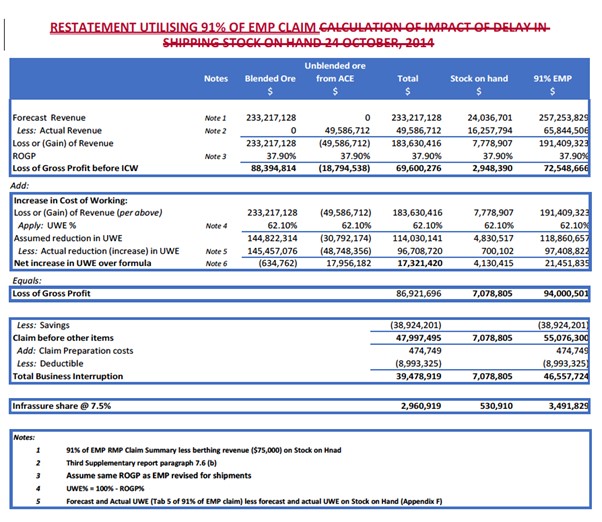
591 All the figures relevant for this explanation of Koolan's claim appear in the column titled 'Unblended ore from ACE'. The first number in that column (after the zero) is actual Output earned from mining and processing ore from ACE during the Indemnity Period, that is, $49,586,712 (where 'actual Output' is referred to in the rest of these reasons, it is a reference to the Output during the Indemnity Period). For the purposes of Item 1(b), Koolan treats that actual revenue as revenue that has avoided or diminished the Reduction in Output caused by the Incident. Koolan thus seeks to claim expenditure which, it says, was additional expenditure necessarily and reasonably incurred for the sole purpose of achieving that actual Output.
592 How do Mr McKenzie and Koolan calculate that additional expenditure? They start with the Rate of Gross Profit that would have been earned on the adjusted Standard Output, that is, the 'ROGP' (Rate of Gross Profit) of 37.90%, which has been calculated on the basis that 91% of the EMP would have been achieved had the seawall not failed.
593 Then, they effectively assume that if the Rate of Gross Profit were to be 37.90%, then the percentage of the actual Output that should represent the variable costs of achieving that actual Output is 62.10%, being 100% minus 37.90%. This applies the following logic:
(a) for present purposes, Gross Profit is the amount by which Output exceeds UWEs (see [17] above);
(b) UWEs are all the variable costs, so Gross Profit is the amount by which the Output exceeds variable costs (see [18] above);
(c) if the Rate of Gross Profit is 37.90%, that means that Output exceeds variable costs by 37.90% of the Output;
(d) therefore the variable costs must be 62.10% of the actual Output, because 100% of the Output exceeds the variable costs by 37.90% of the Output.
594 On these assumptions, the UWEs/variable costs that would have been incurred, assuming a Rate of Gross Profit of 37.90%, are calculated at $30,792,174, being 62.10% of actual Output of $49,586,712 (that is not the precise figure produced by this calculation, but the difference does not appear to be material for the purposes of explaining the conceptual approach - it may be produced by rounding).
595 Then, they calculate the actual variable costs which, they say, were incurred in order to produce that actual Output from ACE, namely $48,748,356. It follows, Koolan submits, that it incurred variable costs that were $17,956,182 greater than the expenses that would have been incurred to mine the same amount of ore as would have been produced under the 91% EMP assumption, had the seawall not failed. That is the actual costs of $48,748,356 minus the costs of AU$30,792,174 which, Koolan says, it would have incurred if the seawall had not failed.
596 To apply Item 1(b) according to Koolan's reasoning, then, the 'additional expenditure necessarily and reasonably incurred for the sole purpose of avoiding or diminishing the Reduction in Output which, but for that expenditure, would have taken place during the Indemnity Period in consequence of the Damage' is the difference between:
(a) the amount of the variable costs (UWEs) of producing the actual Output in the Indemnity Period; and
(b) the variable costs (UWEs) that would have been incurred to produce an equivalent amount of Output, had the seawall not failed and had Koolan Island been mined according to the EMP.
597 The resulting figure of $17,956,182 is less than what is referred to as the 'economic limit' in Item 1(b). This is the stipulation in that item that the ICW claim cannot exceed 'the sum produced by applying the Rate of Gross Profit to the amount of the reduction thereby avoided'. Here, then, the economic limit is calculated by applying the Rate of Gross Profit to the reduction of the shortfall in Output that resulted from mining and processing ore from ACE during the Indemnity Period. That is 37.90% of the actual Output of $49,586,712, producing, on Mr McKenzie's figures, $18,794,538 (again, allowing for discrepancies in rounding).
The grounds on which Infrassure objects to the ICW claim under Item 1(b)
598 Infrassure objects to this component of Koolan's claim on several grounds. It does not dispute the accuracy of any of the figures used. It disputes the way that they are used, on a conceptual level. It also disputes the evidentiary foundation for Koolan's position that the expense of mining ore at ACE during the Indemnity Period was 'necessarily and reasonably incurred for the sole purpose of avoiding or diminishing the reduction in Output'.
599 First, Infrassure says that the amount of ore mined in the Indemnity Period was a fixed number. So, the additional expenses that Koolan incurred in order to mine the approximately $49.5 million worth of ore from ACE must be a fixed number. It cost whatever it cost to extract and process that ore. This, Infrassure says, should be so regardless of whether the assumption underlying the adjusted Standard Output is the RMP, the EMP or 91% of the EMP. And yet, the additional expenses incurred, on Koolan's calculations, vary according to which mine plan serves as the basis for the calculation. This variation, Infrassure says, shows that the expenses claimed for ICWs are not calculated by identifying and costing up specific steps that were taken by it to avoid or diminish the Reduction in Output. To fail to do that is, Infrassure submits, impermissible under the Policy.
600 Another illustration of how Koolan's approach to the calculation is said to impermissibly depart from the Policy in that way is drawn from the claim spreadsheets produced by Mr Davidson which, in great detail, quantify Koolan's claim on the RMP and EMP bases. Infrassure points to how a change to the Rate of Gross Profit percentage in those spreadsheets produces no change the bottom line total of the claim for Gross Profit on lost output (Item 1(a)) plus ICWs (Item 1(b)). Given the importance of the Rate of Gross Profit percentage for the calculation of the claim, that result cannot be right.
601 As a matter of the construction of the Policy, Infrassure submits that the ICW cannot be calculated by reference to the lost profit of the Business following an insured event. Infrassure relies on two cases in that regard: Polikoff Ltd v North British & Mercantile Insurance Co Ltd (1936) 55 Ll L Rep 279, and Australian Pipe & Tube Pty Ltd v QBE Insurance (Australia) Limited (No 2) [2018] FCA 1450. These, Infrassure submits, show that under similar policy wording it is not permissible to claim, in effect, for costs that prove to be a higher proportion of output or turnover than they would have been but for the loss causing Incident. I will consider these cases below.
602 Fundamentally, Infrassure submits, it is Item 1(a) which compensates Koolan for any lost profits, and Item 1(b) (and Item 4) cannot also be calculated on a basis that focusses on lost profit.
603 Second, Infrassure submits that Koolan has simply not proved that the amounts that it claims meet the requirements of Item 1(b). Under those requirements, the expenditure claimed must have been 'additional expenditure'. It must have been 'necessarily and reasonably' incurred. And it must have been incurred for the 'sole purpose' of avoiding or diminishing the Reduction in Output. A calculation demonstrating that actual Output was achieved less profitably than an equivalent amount of Output in the counterfactual world does none of those things. Once again, Infrassure relies on Australian Pipe.
604 Third, Infrassure also specifically disputes Koolan's position that the mining of ACE ore during the Indemnity Period was for the sole purpose of avoiding or diminishing the Reduction in Output. The evidence shows, rather, that mining at ACE was also for the purposes of enabling site closure to be undertaken more cheaply, and to permit rehabilitation costs to be allocated to the ore mined. Infrassure relies on Board papers which, it says, suggests that mining was not done for the sole purpose of diminishing the Reduction in Output.
The construction of the Policy concerning ICW
605 The first basis of Infrassure's objection to Koolan's approach to claiming ICWs requires consideration of the Policy. Essentially, Infrassure contends that on the proper construction of Item 1(b) of the Basis of Settlement, 'additional expenditure' refers to specific items of expenditure that are identified as being additional and as fulfilling the other requirements of the clause. It does not refer to expenditure that is calculated by reference to the reduced profitability of the Business following an insured event. Yet the latter is what Infrassure says Koolan has done.
606 The opening words of Item 1 provide that the insurance under the item 'is limited to loss of Gross Profit due to (a) Reduction in Output and (b) Increase in Cost of Working…'. The item then defines each of those capitalised terms. But the way it commences makes its object plain: to indemnify against loss of Gross Profit.
607 Item 1(a) is explicitly about lost Gross Profit. Under the definition of Gross Profit in that item, it means, speaking broadly for present purposes, the difference between revenue and expenses that vary according to the amount of revenue (the amount of products or services) produced. The premise of this is obvious. The interruption to the Business has robbed the Insured of some or all of the revenue it would have earned in the Indemnity Period, but against that, the Insured is likely to have saved the variable costs that would otherwise have been incurred. That is why those variable costs are referred to as uninsured working expenses, that is, UWEs.
608 The corollary of this starting assumption is that fixed costs, which do not vary with output, will continue to be incurred regardless of the interruption to the Business. Indemnifying the Insured against the amount of Gross Profit lost means that the Insured will be made whole, because it is assumed that the fixed costs were always going to be paid out of the Gross Profit. To the extent that those fixed costs have nevertheless been saved, they are the subject of the savings proviso at the end of Item 1(a). Thus, after fixed costs are deducted, and any savings are added back in, the Insured will emerge with the net profit it would have enjoyed had the Damage not occurred. That is, of course, subject to the operation of the adjustment machinery which is considered in Section V above.
609 In that way, Item 1(a) indemnifies for the Gross Profit on the lost Output. Item 1(b) then deals with something different. It recognises that for Output that has in fact been earned during the Indemnity Period, and so is not the subject of the indemnity under Item 1(a), the event that has caused the interruption in the Business may have increased the costs of earning that Output. So Item 1(b) provides indemnity for that too. This is still, in accordance with the opening words of Item 1, insurance for loss of Gross Profit, because without it, the Gross Profit that otherwise would have been earned would be diminished by the additional expenses that have been caused by the Incident.
610 On this understanding of Item 1, the additional expenditure to which Item 1(b) refers must be made up of expenditure that would not have been incurred but for the Damage, whether as a variable cost or a fixed cost. That is inherent in the idea that Item 1(b) is part of the insurance against lost Gross Profit. Variable costs that would have been incurred anyway cannot form part of the Gross Profit which is the basis of the indemnity; rather, they are deducted from Output to derive that Gross Profit. Fixed costs that would have been incurred anyway may not often be increased as a result of the Damage, but that cannot be ruled out. In any event, they are assumed to be defrayed, in part out of the counterfactual Gross Profit which is the subject of Item 1(a), and the remainder out of the actual Gross Profit earned on the actual Output.
611 In either case, only an expense which would not have been incurred, or which would not have been as high, but for the Damage will eat into Gross Profit in the manner contemplated by the indemnity under Item 1(b). Only an expense of that kind will leave the Insured out of pocket when compared with the Gross Profit that would have been earned on the actual products produced or services provided had the Damage never occurred.
612 The so called economic limit in Item 1(b) is a safeguard which means that the insurer will not pay the Insured more than lost Gross Profit on that actual Output which diminishes or avoids the Reduction in Output that is the subject of Item 1(a), on the assumption that the Rate of Gross Profit applies to that Output. The requirements that the additional expenditure be necessarily and reasonably incurred, and that it be incurred solely for the purpose of avoiding or diminishing the Reduction in Output, provide further safeguards to the insurer. They make it clear that it is only expenses incurred for the purpose of the activity that avoids or diminishes the Reduction in Output, that is, expenses of producing the goods actually produced or of providing the services actually provided, that are to be taken into account for the purpose of the indemnity under Item 1(b).
613 Understood this way, 'additional expenditure' is simply expenditure that it is greater than or in addition to the expenditure that would have been incurred to produce or provide the goods actually produced or services actually provided had the Damage not occurred. This understanding of the item is consistent with the explanation given in Riley, set out above. As is also said in Riley (at 2.72), Item 1(b) is 'specifically restricted to the additional, or what might be called abnormal, expenditure incurred'.
614 I therefore do not accept a submission Koolan made, that all the expenditure incurred in mining ACE during the Indemnity Period was 'additional expenditure', because if it had waited to resume 'normal business operations' it would have mined nothing in that period, and its expenditure would have been nil (KCS para 366-367). That is inconsistent with the evident purpose of Item 1 as a whole to insure for loss of Gross Profit, in the case of Item 1(b), loss occasioned by expenditure greater than that which would have been required had the Damage not occurred.
615 Whether a given item of expenditure meets that criterion and the other criteria in the item is a question of characterisation to be determined on the basis of facts found in the ordinary way. Certainly the most straightforward way of doing that will be to provide evidence establishing the incurring of an item or category of expenditure, establishing that it would not have been incurred or would have been lower by an identified amount if the Damage had not occurred, and establishing the purpose of the Insured in incurring it. That may include evidence that it had the effect of increasing Output, and so by inference that it had the purpose of diminishing or avoiding the Reduction in Output caused by the Damage.
616 That is not what Koolan has done here. Nevertheless, I do not consider it possible to rule out at a conceptual level the approach that it has taken. At that level, the approach is consistent with the construction of Item 1(b) given above. It does not seek compensation for UWEs that are excluded from indemnity under Item 1(a), because it only concerns the costs of producing actual Output, which is not covered by that sub-item. It purports to comply with Item 1(b) by identifying expenditure that is additional to expenditure that would have been incurred, taking the adjusted Rate of Gross Profit as the measure of the latter.
617 For that reason, I do not consider that Polikoff rules out the claim that Koolan has made. Once again, the policy wording in that case was substantially the same as it is in this case. The particular issue that is potentially relevant here, and the way it was resolved, was described by Branson J as follows (at 289-290):
The next point is as to the extra cost of working. This point is dealt with by the learned arbitrator in part of par. 37, and it arises in the following way. The claimants have calculated that in respect of certain wages and expenses they have been put to an expense since the fire which is a higher percentage of the turnover since the fire than the same wages and expenses bore to the turnover before the fire. They say: 'Our business costs us more to work because the percentage of the expenses is greater in relation to the turnover than the expenses under the same heads were in relation to the turnover before the fire.'
Now, in my view the finding of the learned arbitrator upon this point is accurate. He says:
These items do not represent any increased payments at all or any payments but represent the calculations in Schedules K and L purporting to show that owing to the reduced turnover the claimants paid a higher percentage of wages on their turnover than before the fire. Their calculations entirely leave out of consideration that the policy gives them profit on their loss of turnover.
And so he disallows those items altogether.
I entirely agree with him; I think that the calculation does leave out of account the fact that the policy gives them a profit on the loss of turnover. If they had in fact paid more money in respect of these particular services, different considerations might have arisen, but the mere fact that they apply a percentage to the reduced turnover, and that that percentage is higher than the percentage of those costs to the unreduced turnover before the fire, seems to me to be quite immaterial, in view of the fact that the policy compensates them for the loss of profit upon that part of the turnover which is lost, and which reduces the pre-fire turnover to the turnover upon which these percentages are calculated.
618 The insured in Polikoff was basing its claim on the extent to which fixed costs, being wages, were a greater proportion of the reduced turnover. The answer is that, as explained above, compensation under Item 1(a) for loss of Gross Profit made the insured whole in respect of those fixed costs. Koolan is attempting something different here. It is, in effect, trying to quantify additional variable costs by comparing the Rate of Gross Profit actually derived with the rate calculated for the previous financial year (as adjusted). It is pointing to what it says are variable costs that were higher than they would otherwise have been. Polikoff does not rule that out.
619 Contrary to Infrassure's submission, it is permissible for Koolan's claim to address lost profit, as that is what Item 1 is explicitly about. And Koolan is not just complaining that its costs are higher in proportion to its revenue than they would have been had the Incident not occurred. Rather, it is identifying actual costs incurred - albeit, all the costs incurred to mine ACE during the Indemnity Period - and saying that a proportion of those costs is additional expenditure, because it is higher than the expenditure that would have resulted in the adjusted Rate of Gross Profit, which reflects the expenditure that would have been incurred had the Incident not occurred.
620 This explains why Koolan's claim for ICWs differs depending on whether it is put on the RMP, EMP or 91% EMP basis. The actual expenditure does not change, but the amount by which it is additional will change, depending on the Court's findings as to the plan to which Koolan would have worked and so the Rate of Gross Profit that is to be used. Given my conclusion that the claim is to be assessed on the 91% EMP basis, that problem falls away.
621 I also do not accept that the odd feature of Mr Davidson's spreadsheets identified by Infrassure points to any fundamental flaw in Koolan's approach. This was the fact that changing the Rate of Gross Profit in the spreadsheets did not appear to change the bottom line amount of the claim. I was taken through an example of those spreadsheets by Koolan's solicitor, Mr Darwin, and am satisfied that the anomaly is a result of the fact that the spreadsheet was not constructed to apply changes to the Rate of Gross Profit in a particular cell across the very many affected numbers found throughout the spreadsheet. That anomaly does not affect the calculations of Mr McKenzie that are summarised above and which represent the basis on which Koolan ultimately put the matter in closing submissions.
Koolan has not established its claim for ICW under Item 1(b)
622 The reason I would not rule Koolan's approach out at a conceptual level is that it is perhaps possible to imagine a business whose output of products or services, and the costs it incurs to achieve that output, are so stable, indivisible, generic and fungible, as to support an inference that if the costs of producing part of its expected annual output are proportionately higher than they would have been absent the Damage, that must be because the Damage has caused them to be higher.
623 The problem for Koolan, though, is that its mine at Koolan Island is not a business of that kind. While it is not the most complicated enterprise imaginable, like almost any business in the real world, it does have complexities which raise significant uncertainties in relation to the simple proposition that if the costs of producing a given amount of ore from ACE are higher than the costs of producing an equivalent amount of ore absent the Damage, the difference must represent additional expenditure.
624 Most obviously, the Rate of Gross Profit, which is an essential input to the calculation, is a rate that is calculated across both the Main Pit and ACE. They were at different stages of their lives, of different sizes, differently configured, with different ore and other material to be moved. The cost of mining and processing a given tonne of ore in the Main Pit must have been different to the cost of mining a given tonne of ore from ACE. It is therefore impossible to know, from the adjusted Rate of Gross Profit calculated by Koolan (and, as far as I know, accepted by Infrassure) for any given mine plan across both pits, what the costs of mining ore at ACE alone would have been if the Incident had not occurred. For all the Court knows, the different characteristics of ACE meant that it was always a more expensive pit to mine. If the many volumes of evidence produced by the parties contained figures showing the actual pre-incident costs of mining specifically at ACE, they were not pointed out to me.
625 I am conscious that in relation to the EMP versus RMP issue, Koolan submitted that during the Indemnity Period it mined ACE in a low strip ratio manner. This could mean that mining ore at ACE was relatively more profitable than mining ore in the Main Pit. That would strengthen an inference that the costs in excess of the inverse Rate of Gross Profit figure, that is, the 62.10% figure referred to in [592] above, represent additional expenditure. But Koolan did not rely on the low strip ratio at ACE in relation to the ICW issue, much less provide evidence and figures that might enable the Court to identify what it would have cost to mine ACE alone had the Incident not occurred. To try to make allowance for the strip ratio as a factor possibly making it cheaper to mine at ACE would be to speculate.
626 Also important is the fact that the Rate of Gross Profit depends on the price realised for iron ore. I will assume that it was adjusted to reflect the large variations that obviously occurred over time as a result of market prices and exchange rates. But it would appear from the evidence discussed above that the prices on which the Rate of Gross Profit was calculated were for ore from both the Main Pit and ACE that was blended to produce optimal pricing per tonne. ACE ore sold alone, it seems, was likely to attract relatively lower prices because of its lower grade and higher impurities (albeit also higher lump content) compared to blended ore. This means that the inverse Rate of Gross Profit operation conducted by Mr McKenzie is applied to a lower revenue per tonne and so derives lower assumed variable costs to compare with the actual costs of producing the actual Output. The resulting difference, which is the amount of the ICW component of Koolan's claim, could therefore be inflated, compared to what it would have been had the inverse Rate of Gross Profit been adjusted to reflect the lower rate of revenue per tonne.
627 In all the circumstances, then, I do not consider that it is appropriate to infer that the AU$17,956,182 produced as a result of Mr McKenzie's calculations represents the additional expenditure necessarily and reasonably incurred for the sole purpose of avoiding or diminishing the Reduction in Output which, but for that expenditure, would have taken place during the Indemnity Period in consequence of the Damage.
628 That being so, it was incumbent on Koolan to establish the amount of that expenditure by evidence showing that items or categories of expenditure were made necessary, or made necessary above a certain amount, by the Incident. That is consistent with the approach that Beach J took in Australian Pipe where, at [247] (emphasis in original), his Honour held that a particular report, the FAS Report, had not established the claim of the insured, ITM, because the matters set out in the report did not establish that:
(a) ITM incurred additional expenditure; indeed, the items such as electricity and factory expenses etc. appear to be existing expenditure which is alleged to have been wasted;
(b) additional expenditure was necessarily and reasonably incurred, the FAS Report being silent on this point; and
(c) additional expenditure was incurred for the sole purpose of avoiding or diminishing the reduction in turnover; again, the FAS Report is silent on this point.
629 Koolan made no real attempt to address the evidence at this kind of level. In closing submissions, counsel sought to explain why the costs of mining ACE during the Indemnity Period were higher by reference to a spreadsheet providing particulars of Koolan's RMP claim. This contained a sheet showing that the estimated costs of mining during the Indemnity Period were $3.77 per tonne and another showing that the actual costs were $5.93 per tonne. But that estimated cost is for the cost of all the tonnes that (Koolan claimed) would have been mined under the RMP and so related to ore in both the Main Pit and ACE. So it is no help in the task of determining how much more expensive mining at ACE was, and why.
630 Koolan also pointed to some general evidence from Mr Beyer to the effect that the more tonnes that are mined, the more efficient and cheaper per tonne it is to mine (up to a threshold). And it referred to an email from Mr Beyer to Board members about the decision to recommence mining at ACE, Mount Gibson's quarterly report for October to December 2014, which refers to the 'limited mining campaign in Acacia East' (CB 238 p 4431) and to a Board paper dated 18 June 2015 seeking approval to recommence mining at ACE.
631 Koolan submits that these show that substantial contributors to the additional costs were costs (KCS para 353):
(a) involved in two mobilisations/start-ups and two demobilisations at ACE when but for the Seawall collapse, mining ACE would have been continuous and consistent until the end of mine;
(b) involved in increasing manpower at the Island, some on short term contracts;
(c) involved in mining low volumes slowly in one mine instead of mining substantial volumes across neighbouring mines; and
(d) involved in scheduling and optimising manpower and equipment associated with a much smaller mining operation.
632 But none of the documents relied on address the cost of mining at ACE in the way outlined in Australian Pipe or otherwise provide a basis to identify and quantify specific costs or categories of costs as attributable to these factors. It is true that the documents provide limited support for the idea that demobilisation costs were incurred. The email from Mr Beyer to the Board members stated 'Detailed scheduling and optimisation of ACE should see the manning requirement come down from the levels in the table' and in the quarterly report for October-December, a key point was that 'Non-essential activities at Koolan Island suspended and site workforce reduced following seawall failure in late November, reducing site expenditure significantly' (CB 226a). But Koolan pointed to no evidence of what any specific costs were, or the extent to which they were additional to expenditure that would have been incurred in the counterfactual world.
633 The Board paper estimates costs for the second stage of mining at ACE during the Indemnity Period and says:
Mining costs have been constructed from first principles. Costs are materially lower than those incurred earlier in the year due to a substantial reduction in overhead costs. They are broadly consistent with Extension Hill mining costs, while also reflecting the additional costs to operate in a remote location. Crushing costs have increased slightly due to the low volumes and short term of this project related to maintenance cycles. Port costs are in line with previous benchmarks.
634 If anything, this suggests that mining at ACE might have been cheaper, at least in the second stage, than it would have been had the Incident not occurred. Koolan points out that estimated mining costs for ACE in early 2015 were AU$11.82/wmt compared to mining costs in July to November 2014 of between $5.77 and $7.68. But it appears that the latter costs are the costs of mining at Koolan Island as a whole, including the Main Pit, and so do not provide any useful comparator to assess whether costs of mining ACE alone were higher, let alone why.
635 None of this provides a basis to conclude that the costs of mining at ACE during the Indemnity Period were higher than they would have been had the Incident not occurred. In effect, Koolan is pointing to matters that could be expected to increase the costs of mining, and to the AU$17,956,182 Mr McKenzie has derived, and saying that the latter must be the result of the former. But for the reasons given, that causal link, leading to that specific quantum of additional expenditure, has not been made out.
636 I therefore conclude that Koolan has failed to establish the additional expenditure it incurred as a result of mining at ACE during the Indemnity Period. Its claim for ICW-UWEs under Item 1(b) therefore fails.
637 I note for completeness that Koolan pointed out that Mr McKenzie has used the same method of calculating ICWs in many previous cases and it has generally been accepted by insurers as an appropriate method. That is understandable, as it is no doubt a convenient way of arriving at a rough and ready number for ICWs which avoids the need to descend in detail to specific costs and categories of costs. In many cases that will be more cost effective for all concerned. But that does not mean it is the approach that must be taken when, as has happened here, one party insists on strict proof, in accordance with the terms of the Policy, in a court of law. The same may be said of Koolan's reliance on an example given in a loss adjusting textbook, Gordon Southern's Consequential Loss Risk and Insurance - Concepts and Applications (Globe Press, Melbourne, 1989).
638 A further factual issue is whether Koolan has established that it mined ACE during the Indemnity Period for the sole purpose of avoiding or diminishing the Reduction in Output. The conclusion I have just reached means it is not strictly necessary to resolve this, but consistently with the approach I have taken as the first instance trial judge, I will make findings on it anyway.
639 It will be recalled that Infrassure submits that, as well as the purpose of diminishing the Reduction in Output caused by the Incident, mining at ACE was also for the purposes of enabling site closure to be undertaken more cheaply, and to permit rehabilitation costs to be allocated to the ore mined. Infrassure relies in that regard on a Board paper presented for the purposes of a Board meeting held on 15 April 2015 which contains a slide headed 'Koolan Stage 1 plan validation' (CB 276 p 4909). This presents a table comparing cashflow if no mining occurs to cashflow if mining takes place at ACE (as it was at the time of the Board paper). The slide contains the following text:
As previously presented, the mining of Acacia East Stage 1 (currently underway) is value-adding as it creates revenues and enables initial site closure activities to be undertaken more cheaply than if the site were already closed. The modelled scenarios reflect equivalent site closure and initial reclamation activities.
Both scenarios deliver the site to the same level of rehabilitation. Stage 1 option benefitted [from] some of the work being undertaken and 'costed' to the stage 1 ore.
640 Infrassure submits that this shows that the mining at ACE did not have the sole purpose required by Item 1(b).
641 Infrassure also relies on a Board paper that Mr Beyer presented on 18 June 2015 for the purposes of obtaining approval to recommence mining at ACE. It contains the following (CB 292 p 5010, bold in original):
Potential Impact on Insurance Claim
From an insurance claim perspective, Mount Gibson has an obligation to act as a 'prudent uninsured' to take actions to reduce the losses suffered from the Main Pit seawall failure as much as reasonably practicable. However, given the content of the business interruption coverage calculations (which focus on insured gross accounting profits and actual cost savings ultimately achieved), it is possible that the Company's ultimate business interruption claim may be reduced by some or all of the profits made from restarting operations in the ACE satellite pit. Despite this, given the highly technical and complex nature of the business interruption calculation, and the fact that the policy cover period ends in October 2015 (i.e. after 12 months from the initial seawall slump), it is considered appropriate to go ahead and recommence mining while personnel and equipment are available, in order to seek to obtain the modelled cash flows rather than wait for finalisation of the presently uncertain business interruption claim outcomes once the cover period expires.
642 On the same page the paper refers, as a key opportunity, to:
Reduction of preparation costs for closure. There is scope to perform some of the preparation work for closure whilst mining at the Acacia East pit. This would reduce some of the budgeted costs to prepare the site for closure which would be incurred in full if not proceeding with the Acacia East restart. This benefit has not been costed into this financial evaluation.
643 Infrassure says this also shows that the recommencement of mining at ACE did not have the sole purpose of diminishing the Reduction in Output.
644 However, it is necessary to assess this in light of Koolan's evidence as to the purpose of mining at ACE during the Indemnity Period. Mr Beyer's evidence was simply that after being presented with an assessment from Mr de Kruijff of the viability of mining ore at ACE alone (when ACE ore had previously been blended with Main Pit ore), Mr Beyer 'decided that it was economically viable to refocus mining efforts in the low strip ratio areas of ACE whilst the options to rebuild the Seawall were considered' (Beyer I para 90). Similarly, when the iron ore price experienced a recovery after May 2015, it became economically viable to mine under what became stage 2 at ACE.
645 The quarterly report just mentioned says that the purpose of additional mining from ACE was 'to supplement ore sales during June half of 2015' (CB 238 p 4429). A QPR meeting presentation dated 28 January 2015 states the purpose of mining at ACE as 'to provide positive cash flow' (CB 239a p 4459). The Board paper of 18 June 2015 commenced by identifying as the 'issue' (p 5007):
An opportunity has been identified to recommence mining at the Acacia East pit - ~0.8M wmt of ore at an overall strip ratio of ~1.7x, to generate cash flow of ~A$12.8m at the FY 2016 Budget assumptions of US$62/dmt (62% Fe, CFR) and A$1:00:US$0.78.
646 In my view this evidence demonstrates that the sole purpose of Koolan's mining at ACE during the Indemnity Period was to earn cashflow, which, in the terms of the Policy, was to diminish the Reduction in Output that would otherwise have occurred. It is unsurprising that a commercial enterprise facing such disruption to its cash earning activities would consider recommencing those activities to the extent possible in the circumstances. Mr Beyer's evidence and the documents just described, taken as whole, show that Koolan was motivated by the economic viability of mining at ACE.
647 The fact that the Board papers also acknowledged other benefits of those mining activities does not provide a reason not to accept Mr Beyer's evidence and Koolan's purpose disclosed at face value. That purpose was to make money from economically viable mining. It would not be a commercial interpretation of the Policy to read it as requiring absolute purity of expression, so that the Insured must refrain from consideration of any possible benefit other than diminishing or reducing the Reduction in Output.
648 The discussion in the Board paper of the impact on the insurance claim does not alter my conclusions in that regard. It merely reflects a prudent insured acknowledging as part of its consideration that recommencing mining may ultimately reduce the amount of the insurance claim. And indeed, in the course of doing so it reconfirms Koolan's objective as being 'to seek to obtain the modelled cash flows'.
649 I therefore consider that Koolan has established that, for the purposes of Item 1(b), its sole purpose of mining at ACE in the Indemnity Period was to diminish the Reduction in Output that would otherwise have been caused by the Incident. But, as indicated above, it has failed to prove the additional expenditure, if any, that resulted from that mining.
650 It will be recalled that Item 4 provides for a separate head of indemnity as follows:
The insurance under this item is limited to increase in cost of working (not otherwise recoverable hereunder) necessarily and reasonably incurred during the Indemnity Period in consequence of the Damage for the purpose of avoiding or diminishing reduction in Output and/or resuming and/or maintaining normal business operations and/or services.
651 Koolan submits that this is a 'category of claim of last resort for any increase in costs as a consequence of the Damage which cannot be recovered under some other head of claim in the Policy' (KCS para 402). Infrassure submits that Item 4 only applies to increase in cost of working 'not otherwise recoverable hereunder', but the increased costs of working are recoverable under Item 1(b), so that Item 4 does not apply.
652 I do not discern any appreciable difference between the parties in their construction of Item 4, and I accept that construction is correct. It is consistent with the purpose of Item 4 as explained in Riley (at 2.78), which indicates that it is intended to cover expenditure that had been incurred as a result of an incident which does not meet the criteria to qualify as an ICW, or it exceeds the economic limit under Item 1(b): see also Australian Pipe at [252]. That must be the purpose of the proviso 'not otherwise recoverable hereunder' in Item 4; it is difficult to think of what else it could mean and Koolan did not provide any alternative construction.
653 It follows from this that the ICWs claimed by Koolan are not recoverable under Item 4. Koolan claimed them squarely on the basis that they were additional expenditure incurred for the sole purpose of avoiding or diminishing the Reduction in Output which, but for that expenditure, would have taken place during the Indemnity Period in consequence of the Damage. It follows that, had costs of that nature been established by the evidence, they would have been recoverable under Item 1(b) and so excluded from recovery under Item 4. The fact that Koolan has failed to establish its case under Item 1(b) on the evidence does not alter that. Plainly, Item 4 was not intended by the parties to give Koolan dispensation from the need to establish its claim under Item 1(b).
654 In any event, just as Koolan has failed to establish that the AU$17,956,182 it claims (or Infrassure's 7.5% share of that) is additional expenditure, so it has failed to establish that it represents an 'increase in cost of working'. Koolan's claim under Item 4 fails.
655 At the start of the Indemnity Period, 358,981 tonnes of ore were stockpiled at Koolan Island, made up of 105,298 tonnes of lump and 253,683 tonnes of fines.
656 In essence, Koolan claims to be entitled to indemnity for loss suffered because it could not sell this ore at the start of the Indemnity Period. As a result of the Damage, there were no shipments of ore from Koolan Island in November and December 2014. Koolan says the first shipment after the Incident was on 15 January 2015. (The monthly report for October 2014 refers to a shipment of 42,000 tonnes of lump that sailed from Koolan Island on 1 November 2014, after berthing on 31 October 2014, but it does not appear that Koolan claims that this shipment is to be factored into the sales value of Stock on Hand, and so it seems (and Infrassure says) it can be ignored for present purposes.)
657 The delay in shipments until January 2015 led to a reduction in the price of the ore, because iron ore prices were falling. Koolan has factored the resulting shortfall into the main body of its claim by including, as part of the Standard Output, the amounts which it says would have been received for the sale of the ore had the Damage not occurred. This is based on hypothetical sales of specified amounts of lump and fines which, Koolan says, would have taken place in October, November and December of 2014, but did not because of the Incident. These sales would have led to revenue of $23,963,283. Koolan then provides a credit, in effect, by including in the actual Output in the Indemnity Period the amounts said to have been in fact realised for the sale of the Stock on Hand. These amounts are not separated out from the other ore sold during the period, being that mined from ACE. So, of the figure of $65,844,506 that appears in each claim summary, being the sales value of actual Output, including Stock on Hand, it is not known exactly what proportion of that is referable to ore mined during the Indemnity Period (as distinct from Stock on Hand).
658 Whatever that actual sale price of the Stock on Hand may be: it appears to be common ground that the Stock on Hand had all been sold within the Indemnity Period (or within some shorter period of time), but it is also common ground that it is not possible to earmark that ore in any way, so as to determine when, exactly, any part of it was sold.
659 The resulting calculation appears in the fourth numerical column of Mr McKenzie's table reproduced at [589] above. It appears to add a net AU$2,948,390 to the claim (again, this appears to incorporate rounding differences and, again, Infrassure would be liable to pay 7.5% of that).
660 I will now describe and determine each issue arising in relation to the Stock on Hand in turn.
The construction of Item 1(a) and the definition of 'Output'
661 The first issue is whether Item 1(a) of the Policy permits Koolan to frame its claim in this way. It will be recalled that this item relevantly entitles Koolan to 'the sum produced by applying the Rate of Gross Profit to the amount by which the Output during the Indemnity Period shall, in consequence of the Damage, fall short of the Standard Output'. Output is defined to mean 'the sale and/or invoice value of goods manufactured and/or processed by the Insured in course of the Business at the Premises'.
662 Koolan submits that the Output is thus the sale or invoice value of the goods, not the goods themselves. This, it submits, means that the goods do not need to have been manufactured and processed during the Indemnity Period. What is relevant is that the stockpiled ore was loaded and shipped during the Indemnity Period and so, under the Offtake Contracts described at [215] above, that is when the price of the ore was fixed and so when it received a 'sale and/or invoice value'.
663 Infrassure says this approach is impermissible under the Policy, because the Standard Output is the output for material mined during the Indemnity Period, not material already mined before that period. According to Infrassure, what Koolan has elected to count towards the indemnity, by electing to base it on Output, is the production during the Indemnity Period that it has lost, not the revenue received during that period (that is, not Turnover). This, Infrassure says, renders irrelevant the references to Closing Stock and Opening Stock that appear in the calculation in the definition of 'Gross Profit' which forms the basis of the indemnity (see [17] above). The stockpiled ore, then, is Opening Stock which would only have been counted if Koolan had maintained the Turnover basis of the indemnity.
664 To resolve this dispute, it is necessary to recall that the definition of 'Output' is just that - a definition - and that definitions are to be read into the operative provisions in which they are used (see [118] above). In this case the operative clause is Item 1(a). If the definition of 'Output' is put into that clause (italicised), it relevantly limits the indemnity to:
the sum produced by applying the Rate of Gross Profit to the amount by which the sale and/or invoice value of goods manufactured and/or processed by the Insured in course of the Business at the Premises during the Indemnity Period shall, in consequence of the Damage, fall short of the Standard Output.
665 The constructional choice posed by the parties' competing submissions that this reveals is between applying the temporal modification 'during the Indemnity Period' to 'the sale and/or invoice value', or applying it to the 'goods manufactured and/or processed by the Insured in course of the Business'.
666 In my view, the choice is clear. The temporal modification appears closest to the latter phrase, that is, to the reference to 'goods manufactured and/or processed'. On ordinary principles of English syntax, it is likely to be that phrase which it modifies. There would have to be some further indication in the provision to reach a different conclusion. But to the contrary, the wording reinforces that natural understanding of the provision. For the temporal modification is most likely to be applied to something that happens in time, that is, to an occurrence, described with a verb or verbs. The verbs here are 'manufactured and/or processed', so it is natural to understand the provision to mean that this is what is to happen during the Indemnity Period for the clause to apply. The 'sale and/or invoice value', in contrast, is a static concept comprised of nouns which do not naturally lend themselves to temporal modification. If that had been the intention of the draftsperson, it is likely that the provision (incorporating the definition) would have spoken of 'goods sold or invoiced during the Indemnity Period'.
667 Koolan's construction of the clause is therefore inconsistent with the ordinary natural meaning of the words used. Nor is there anything in the textual or commercial context of the provision which supports that construction. To the contrary, in electing 'Output' over 'Turnover', Koolan is taken to have chosen not to rely on the definition of the latter term, being (relevantly) 'the money … paid or payable to the Insured for goods sold and delivered … in course of the Business at the Premises' (italics added). If that definition had been read into Item 1(a) then, relevantly here, the temporal modification 'during the Indemnity Period' would be read to have applied to the italicised verbal phrase, which captures the concept of selling and delivering.
668 If that definition were to apply to the sale of iron ore by Koolan under its two main Offtake Contracts, it would be relevant to note that under those contracts, title, property and risk passes to the Buyer when the goods are loaded onto the customer's nominated ship at the island: cl 8.2 of each of the Offtake Contracts. The ore thus delivered is invoiced (as to 95% of its value) within five business days after completion of loading of a shipment: cl 6.1(a). Loading onto the ship is thus apt to fall within the concept of when goods are both sold and delivered in the definition of 'Turnover', as the definition contemplates that money may not yet be paid, but only 'payable'. So sale and delivery, on a Turnover basis of indemnity, would have occurred when the ore was loaded on board. What this illustrates is that by putting the case that it has in relation to Stock on Hand, Koolan is seeking to claim on a basis which it has elected not to apply.
669 Infrassure's construction of the Policy is thus correct on this point. Koolan cannot include ore that was stockpiled at the commencement of the Indemnity Period but sold during that period in its calculation of lost Output, because Output only captures ore that was extracted and processed during that period.
670 Koolan's next argument relies on the way in which the adjustments clause contemplates adjustments to Standard Output and Rate of Gross Profit for:
… other circumstances affecting the Business either before or after the Damage or which would have affected the Business had the Damage not occurred, so that the figures thus adjusted shall represent as nearly as may be reasonably practicable the results which but for the Damage would have been obtained during the relative period after the Damage.
671 The emphasis in the quote is Koolan's. It argues that these words require the sale price that would have been achieved on sale of the Stock on Hand to be taken into account as an adjustment to the Standard Output, so that it includes the value that the Stock on Hand would have realised had the Damage not occurred. That, Koolan says, is the value that it would have realised had it been sold over October to December 2014.
672 It is not clear to what extent Koolan pressed this argument, as it was put only briefly in the outline of written submissions and was not mentioned in closing oral submissions. Koolan's written submissions were not served until the last day of trial, after Infrassure's counsel had finished their oral closing, and so Infrassure did not have any real opportunity to respond.
673 In any event, I do not accept the argument. It suffers from the same problem as the previous one, namely that the indemnity cannot be calculated by reference to a loss in value of goods manufactured and processed before the commencement of the Indemnity Period. The adjustment in question is an adjustment to Standard Output, so as to bring it as close as reasonably practicable to the 'results which but for the Damage would have been obtained during the relative period after the Damage'. In that context, the 'results' being referred to must be results measured by Output; specifically the Output that would have been achieved in the Indemnity Period.
674 Since the Stock on Hand was manufactured (extracted) and processed before the Indemnity Period, it cannot be used as an adjustment to arrive at a projected counterfactual Output during the Indemnity Period. Rather, to the extent that the Stock on Hand was produced during the 12 months immediately before the commencement of the Indemnity Period, its sale value should be included as part of the Standard Output before any adjustment. But in any event, the Court having found that Koolan would have proceeded to achieve 91% of the EMP had the Incident not occurred, the adjustment to the Standard Output will, broadly speaking, reflect the Output that would have been achieved during the Indemnity Period by way of the extraction and processing of ore under the EMP, discounted by 9%. There is no room in that adjustment to take account of the sale of stock that was on hand at the start of the Indemnity Period and thus could not have formed part of the EMP Output during the Indemnity Period.
675 It must be recalled, however, that having elected to proceed on the basis of Output, Koolan will have the benefit of ore that would have been produced and stockpiled towards the end of the Indemnity Period but would not have been sold/delivered/invoiced by the end of that period. To permit this, but also to permit Koolan to claim, in effect, as part of the adjusted Standard Output the sale price of ore that had already been produced before the start of the Indemnity Period, would be to permit a kind of double dipping.
676 Koolan advances a further alternative basis on which to claim indemnity for the reduced price at which the Stock on Hand was sold. It relies on the 'salvage sale' clause in the Policy which, insofar as it is relevant, is as follows. For reasons that will become apparent, the following quote departs from the practice adopted in the rest of this judgment, because it does not substitute 'Output' for 'Turnover':
If, following Damage giving rise to a claim under this Policy, the Insured shall hold a salvage sale during the Indemnity Period:
(i) Clause (a) of Item 1 of this Section [2] shall, for the purpose of such claim, read as follows:
In respect of Reduction in Turnover, the sum produced by applying the Rate of Gross Profit to the amount by which the Turnover during the Indemnity Period (less the Turnover for the period of the salvage sale) shall, in consequence of the Damage, fall short of the Standard Turnover, from which shall be deducted the Gross Profit actually earned during the period of the salvage sale.
677 The term 'salvage sale' is not defined in the Policy. The effect of the clause, if it applies, is to exclude the Turnover during the period of the salvage sale from the calculation of the actual Turnover achieved by the Business during the Indemnity Period. The Insured therefore obtains a higher indemnity than it otherwise would, as Turnover that is actually achieved during that period is not taken into account, so the overall Turnover used to calculate the Reduction in Turnover is lower. But then deducted, after the Rate of Gross Profit is applied to that Reduction in Turnover to produce the amount of the indemnity, is the Gross Profit actually earned on the salvage sale. This ensures that the Insured does not receive double compensation by receiving both the Gross Profit actually earned on the salvage sale and the Gross Profit calculation under Item 1(a), to the extent that it is attributable to the period of the salvage sale.
678 To understand the point of this, compare that outcome to the outcome that would result if a salvage sale were to occur without the benefit of this special provision. The Insured would receive whatever Turnover is attributable to the salvage sale and so would not get the benefit of the application of the adjusted Rate of Gross Profit percentage to that Turnover. But having sold the stock at salvage sale prices, the Insured's actual Gross Profit on that part of the Turnover may well be less than the 'normal' adjusted Gross Profit (which used the previous financial year's results as the starting point). The Insured could thus be out of pocket. By avoiding that outcome, the above clause makes the Insured whole in a salvage sale situation.
679 Koolan's alternative argument is that the sale of the stockpiled ore during the Indemnity Period should be treated as a salvage sale because that ore lost value as a result of the Damage. Koolan submits that in order to qualify as a salvage sale, the sale must be of stock that has lost value as a result of the Damage without being completely destroyed, and was sold for a lower price than it would have fetched if the Damage had not occurred. The Stock on Hand fulfils these criteria, because the Damage caused it to lose value as a result of the delay in selling it.
680 Koolan further submits (KCS para 283(b)):
The temporal restriction under which the salvage sale clause operates is that '…the Insured shall hold a salvage sale during the Indemnity Period'. That is, in order to rely on the clause, there is a requirement that the diminished stock is sold for a reduced value during the Indemnity Period. There is no requirement that the stock is produced during the Indemnity Period.
681 Koolan adds (KCS para 284) (KIO is Koolan):
It should hardly be necessary to remind Infrassure that it is the insurer of KIO, to whom it owes a duty of utmost good faith. That it is prepared to acknowledge that KIO suffered a loss following circumstances which it agreed to insure, and yet run finely tuned technical arguments seeking to find reasons to avoid paying for that acknowledged loss under the Policy is inconsistent with that duty. The Court should not be a party to assisting Infrassure with its efforts.
682 Infrassure submits, however, that Koolan has not identified why the sale of the stockpiled ore would fall within the meaning of the term 'salvage sale' as used in the clause or how, if it does, the diminution in the sales value of that ore would be claimable under the clause. Infrassure says that in view of Koolan's election, the salvage sale clause only applies to Output, not Turnover, and thus cannot provide indemnity in relation to the sale of material mined before the beginning of the Indemnity Period.
683 In my view, Koolan's construction of the meaning of 'salvage sale' stretches its ordinary meaning. The relevant definition of 'salvage' in the Shorter Oxford English Dictionary is 'The saving of property from fire or other danger'. The stockpiled ore has not in any sense been saved from any danger. To illustrate with a purely hypothetical, perhaps speculative example: if the Incident had caused flooding to the stockpiles on Koolan Island so that the iron ore became mixed with a high level of impurities, but was still saleable at a discounted price, that may have qualified as stock saved from danger and thus able to be the subject of a salvage sale. But that is not what occurred here, and there is nothing in the evidence suggesting that any Stock on Hand was subjected to 'damage' of this kind.
684 In any event, it is not necessary to decide whether Koolan's construction of the term stretches that meaning past breaking point, because there is a more fundamental objection to the application of the clause. It is essentially the objection raised by Infrassure: the clause cannot apply in these circumstances where the Output option has been selected by the Insured. As Koolan submits, the temporal restriction in the salvage sale clause requires that the Insured 'shall hold a salvage sale during the Indemnity Period'. But fixing upon the sale of stock as determining the relevant period is inconsistent with calculating the rest of the loss by reference to the period during which ore is produced, as Output.
685 In order to appreciate this, consider how the rationale of the clause, described above in respect of Turnover, might work if Output were to be substituted instead. A salvage sale is conducted during, say, the first three months of a twelve-month Indemnity Period. If the salvage sale clause is applied literally, whatever Output is actually achieved during those three months is excluded from the Rate of Gross Profit calculation. That is so even though it has nothing to do with the salvage sale, which is the sale of different goods that were produced before the commencement of the Indemnity Period. The Insured gets the benefit of not having to take into account the sale value of the goods actually produced during the salvage sale period, which is arbitrary because the sale has no connection with the goods produced during that period. The duration of the sale could be the result of a range of factors which have nothing to do with the actual Output during that period. And then the Insured has to deduct from the indemnity the actual Gross Profit earned on different goods that were produced before the Indemnity Period. This could be a relatively modest amount of stock sold over a long period of time, and yet it could cause the elimination from the calculation of a relatively large amount of actual Output produced during that period.
686 In short, the subject of the elimination and the subject of the adding back are not the same: Output during a period (the duration of which is the arbitrary product of the time it takes to sell goods produced during a different period) is eliminated, and the actual Gross Profit on different goods produced during a different period are added back in. There is thus a disconnect between the Rate of Gross Profit calculation that forms part of the Indemnity and the actual Gross Profit added back in.
687 These problems do not occur if the 'Output' option is not taken, so that the Turnover basis for indemnity is maintained. For the Turnover that is eliminated during the period of the salvage sale is comprised of sales that have occurred during that period, likely to be the Turnover generated by the salvage sale itself. Then the actual Gross Profit deducted from the indemnity is the actual Gross Profit earned during the same period, that is, the actual Gross Profit on that same Turnover. The subject of both the elimination and the adding back in is the same: sales during a period are eliminated and the actual Gross Profit on those same sales is added back. No disconnect arises.
688 In my view, it is necessary to read down the general words of the Policy in order to avoid it working commercial absurdity in the way that it would if it were to apply under the Output basis of indemnity. The words to be read down are the simple words in the Turnover/Output alternative clause set out at [21] above: 'At the option of the Insured the term "Output" may be substituted for the term "Turnover"'. It does not do violence to those non-specific and non-prescriptive words to understand them to mean that the substitution may occur only when applicable, meaning not when it works absurdity or commercial nonsense. The result is that the salvage sale clause is simply not applicable, because it relates to Turnover, which is not the basis of Koolan's claim.
689 This is hardly a novel approach; as long ago as 1893, in Glynn v Margetson & Co [1893] AC 351, Lord Halsbury recognised:
Looking at the whole of the instrument, and seeing what one must regard, for a reason which I will give in a moment, as its main purpose, one must reject words, indeed whole provisions, if they are inconsistent with what one assumes to be the main purpose of the contract.
690 Importantly, in that case and also here, the purpose is determined from the words of the contract itself, rather than extrinsic evidence, or some presumption or assumption on the part of the Court. As a result, no rewriting of the contract takes place; it is simply a matter of giving effect to the intention of the parties evident from the instrument taken as a whole.
691 This approach is consistent with the last sentence of the clause in which the 'Output' option is contained, which says that 'only one such meaning [Turnover or Output] shall be operative in connection with any one event involving Damage'. The intent behind this is obviously that the Insured cannot use 'Turnover' or 'Output' in connection with different aspects of the claim that may arise from an instance of Damage, depending on what suits it. The understanding of the Policy outlined above does not permit the Insured to effectively base a claim under the salvage sale clause in respect of Turnover when, in all other respects, it has elected to claim on an 'Output' basis. Rather, it means that if that election has been made, the salvage sale clause is not applicable at all.
692 Here, if the Insured takes the Output option, the purpose of the Policy is to make the Insured whole in respect of the Gross Profit that would have been earned on goods produced during the Indemnity Period had the Damage not occurred. Its purpose is not, in addition to that, to make the Insured whole in respect of the Gross Profit that would have been earned on goods that were not produced during the Indemnity Period. Koolan's salvage sale argument thus suffers from the same fundamental problem as its other arguments about Stock on Hand. That is, it is not indemnified for the loss of sale value of ore mined and processed before the Indemnity Period.
693 I therefore reject the suggestion in Koolan's submissions that to rule out application of the salvage sale clause is to accept 'finely tuned technical arguments seeking to find reasons to avoid paying for … acknowledged loss'. It is, rather, to give effect to the commercial purpose of the Policy, as revealed by its own words, and as modified by Koolan's own decision to take the Output option. The Incident may have caused a diminution in value of ore that was extracted and processed before the Incident, and that may have occasioned loss to Koolan. But the Policy provides indemnity on a specific conceptual basis; it is not an indemnity for all losses that may have been occasioned by the Damage.
694 Koolan's claim for indemnity in respect of the diminution in the value of the Stock on Hand resulting from the delay in selling it is rejected. The Stock on Hand must be eliminated from the calculation of the indemnity.
When the Stock on Hand was sold
695 That being so, it is common ground that it is necessary to make a determination as to the realised sale value of the Stock on Hand so that it can be deducted from Koolan's headline claim. Because of the incessant fluctuations in the ore price and exchange rates, that depends on when the ore was sold. As indicated above, it is common ground that it is not possible on the evidence to determine precisely when that was. That is, the evidence does not permit determination as a matter of fact when each portion of the ore that was stockpiled was actually delivered to the buyers, and so when the sale price of that ore was actually fixed.
696 Both parties agreed that in those circumstances, the task of the Court is to arrive at a reasonable and sensible approach to fixing the value. Junior counsel for Infrassure accepted that Infrassure was not submitting that the difficulties with the evidence means that Koolan has failed to discharge its onus of proof, and he accepted that 'the Court has to make the best approximation it can in the circumstances' (ts 502). In its written submissions, Infrassure submitted that the Court should select the approach that is more likely to accurately reflect the sales value of the Stock on Hand. That is how I will proceed.
697 There was conflicting expert evidence on the subject of when the ore should be taken to have been sold. Koolan's expert accountant, Mr McKenzie, who had particular experience in business interruption claims, said a reasonable assumption was that the ore stockpiled as at 24 October 2014 was the first ore shipped when shipments resumed from January 2015. Infrassure's expert, Mr Potter, assumed that the stockpiled ore was spread out across all shipments attributable to the Indemnity Period (that is, the actual Output component of the indemnity calculation).
698 Deciding on how to allocate sales of Stock on Hand requires identification of the best inference, based on an incomplete set of facts. Those facts are as follows:
(1) The Main Pit contained high grade ore (approximately 66% Fe) while ACE contained lower grade ore (approximately 58% Fe).
(2) ROM stockpiles were separated into different grades and then blended into the crusher.
(3) At the start of the Indemnity Period, 358,981 tonnes of ore were stockpiled at Koolan Island, made up of 105,298 tonnes of lump and 253,683 tonnes of fines.
(4) There were 11 shipments of ore over the course of the Indemnity Period and into December 2015 (having selected the Output option, it was necessary to take account of shipments dispatched after the end of the Indemnity Period on 23 October 2015 which contained ore mined and processed before that date). These ranged between 49.98% and 59.34% in grade. The first shipment was in January 2015 (74,020 tonnes of fines at 56.32% Fe) and there were shipments in each of February (74,200 tonnes of fines at 57.10% Fe), March (148,926 tonnes of lump at 59.34% Fe) and April 2015 (142,440 tonnes of fines at 57.67% Fe and 74,422 tonnes of lump at 58.76% Fe).
(5) The only ore production during the Indemnity Period was from ACE, over two periods of December 2014 to April 2015 and July 2015 to October 2015.
(6) A Board presentation dated 4 December 2014 describes, as among the activities underway at the site at the time, 'Crushing and sale of medium and low grade Acacia East stockpiled material'. This of course shows that, at that time, medium and low grade ACE stockpiled material was on hand.
(7) But the reference in the Board presentation, not just to crushing but to sale, suggests that there were no Main Pit stockpiles on hand. For if there was Main Pit ore ready to be crushed or sold, one would expect that to have been mentioned. There is no apparent reason why, if Main Pit ore was stockpiled, it would not have been sold during this period (assuming it was already crushed).
(8) The Mount Gibson quarterly report for the period ended 31 December 2014 referred to the ACE material that was to be mined in the first phase of mining during the Indemnity Period, but said in addition 'all sales of Acacia East material, including existing stockpiles, expected to be completed by the end of June 2015'. This shows that the stockpiled ore was expected to be sold by June 2015 at the latest, contradicting Mr Potter's assumption that it was sold over 12 months. And again, the lack of any mention of Main Pit stockpiled ore to be sold suggests that there was none at this time. Rather, this statement implies that the 'existing stockpiles' were of 'Acacia East material'.
(9) The same quarterly report said 'mine planning in December identified approximately 400,000 tonnes of accessible material grading 58-59% Fe in the Acacia East Pit … the Company expects the mining and sale of this higher-silica material to generate a gross cash margin of approximately $5-10 million'. This suggests there was no intention to blend the ore that was produced during the Indemnity Period from ACE with any other ore, including stockpiled ore. That is supported by the evidence of Mr Beyer that the mine planning in December 2014 concerned whether it was economically viable to mine and sell ore from ACE on its own where it had previously only been blended with ore from the Main Pit. This planning gave rise to 'stage 1' of mining ACE.
(10) A photograph of the stockpiles and ROM pad at Koolan Island suggests that ore was dropped on top of the stockpiles by a conveyor from the crusher and it was taken from the bottom of the stockpiles for loading onto the ships. Mr Potter, Infrassure's forensic accounting expert, did not disagree with that description in cross examination, although he did not profess an expertise in mining operations of that kind.
(11) Mr McKenzie, Koolan's accounting expert with a great deal of experience in quantifying business interruption claims for mining enterprises, expressed the opinion that it was reasonable to assume, based on detailed information in the claim spreadsheets, that the Stock on Hand were the first tonnes, not already loaded, to be sold after the Incident. The cross examination of Mr McKenzie in relation to the Stock on Hand was based on asking him to accept a number of assumptions, but he was not challenged on whether his interpretation of the actual evidence in the spreadsheets was reasonable or accurate.
699 Infrassure's argument is as follows. It said it was not aware of any evidence to indicate that the Stock on Hand consisted of anything other than the normal average output of the mine, that is, a blend of both pits. The average grade mined for September 2014, for example, was 63.4%, indicating a preponderance of higher grade Main Pit ore. And yet, none of the shipments during the Indemnity Period exceeded 60% Fe grade. This suggests that the Stock on Hand must have been blended with the lower grade ACE ore that was mined during the Indemnity Period.
700 I do not accept that argument. It is predicated on the basis that the Stock on Hand as at 24 October 2014 was a blend of the usual output of the mine from both pits, and thus comprised predominantly of higher grade Main Pit ore. But such evidence as there is, is to the contrary (see points (6)-(8) above). That being so, the premise of Infrassure's argument falls away. Infrassure submitted that it was Koolan that was in a position to be able to establish the source of the stockpiled ore and so the paucity of evidence about that means the Court should select the inference less favourable to Koolan. But given the approach the parties agreed I should take to this question as outlined in [695] above, I do not consider it would be appropriate to resolve the matter that way.
701 In any event, I give weight to Mr McKenzie's expert opinion, summarised at point (11) above. That was not objected to (despite the lack of explanation as to how he derived the information from the spreadsheets) or challenged in cross examination. Mr McKenzie was prepared to accept that his opinion might change on the assumption that the Stock on Hand was a much higher grade, around 64% Fe, but that assumption is not made good by the evidence.
702 I also give some weight to the fact that the grades of the shipments during the Indemnity Period were broadly consistent with the approximate grade of unblended ACE ore. There would have needed to be very thorough mixing and blending within the stockpiles to reduce the grade that far below that of the Main Pit ore, but the evidence is inconsistent with that kind of mixing and blending. Rather, point (10) above suggests that the ACE ore mined during the Indemnity Period was deposited on the top of the stockpiles and different ore was removed from the bottom of the stockpiles.
703 Also, Infrassure could point to no reason why Koolan would want to mix higher grade ore with lower grade product in this way. It would not make sense in a falling iron ore price environment to deliberately produce as much sub-optimal grade ore as possible and in the course of doing so postpone as much as possible the sale of the higher grade ore that was on hand (if it was indeed on hand).
704 Mr Potter accepted that his calculation, which spread the shipments of stockpiled ore across 12 months, was entirely a function of the length of the Indemnity Period; if it had been six months he would have spread the shipments out over that period and likewise if it had been 24 months. This exposes its arbitrary nature. That is not a criticism of Mr Potter - he was doing the best he could on the assumption that there was no information permitting a different approach. But while there was indeed little information, I am persuaded that there was enough to make Mr McKenzie's approach the preferable one, on the basis set out above.
705 Proceeding on that basis, it is possible to be precise about when the ore should be taken to have been shipped and so to determine the price of that ore, in view of the known breakdown between lump and fines. The figures for shipments during the Indemnity Period (MFI 1) show that the 105,298 tonnes of lump were all shipped in the March 2015 shipment and that the 253,683 tonnes of fines were shipped in the January and February 2015 shipments, and also formed part of the April 2015 shipment. The parties should adjust their calculations accordingly.
706 It will be recalled that this issue arises because Mount Gibson entered into forward foreign currency contracts to hedge its foreign exchange risk. It suffered losses on those hedging arrangements over the Indemnity Period.
The parties' competing positions
707 The issue emerged as a reason why Infrassure submitted that the claim should be reduced, not as a reason why Koolan submitted that it should be increased. So it is convenient to start with Infrassure's submissions on the subject. It is necessary to traverse them in a little detail because there appeared to be a difference between Infrassure's written closing submissions and its oral submissions.
708 The written submissions relied on a letter of instruction dated 26 October 2020 from Koolan's solicitors, Herbert Smith Freehills, to Mr McKenzie. That letter said (CB 41, emphasis in original):
1 Mount Gibson Iron Limited (MGI), the parent company of KIO, is party to foreign exchange (forex) arrangements under which, at the time of the loss, a portion (approximately USD75m) of its USD sales revenue on a group wide basis was agreed to be received in AUD at a fixed conversion rate, regardless of the USD/AUD exchange rate prevailing at the time of the sale. …
2 MGI historically operates 3 mines - KIO, Extension Hill and Tallering Peak (which was not operational at the time of the loss), each of which operates in a subsidiary company within the MGI group. Any forex losses incurred by MGI under these arrangements are allocated amongst the MGI group companies for accounting purposes proportionately to the percentage of revenue achieved by that group company (mine) relative to the total revenue of the MGI group.
3 The hypothetical pro-rata allocation of forex losses for accounting purposes to KIO under the RMP and EMP Claims is based upon the Standard revenue which KIO is forecast to earn under those plans, relative to actual revenue of other subsidiaries in the MGI group over the relevant period.
4 The actual allocation of forex losses for accounting purposes to KIO during the Indemnity Period is lower than those 'Standard' allocations because, as a result of the Damage, output and therefore revenue at KIO was lower (both in a standalone and proportional sense). The actual allocation to the other operating mine's subsidiary (Extension Hill) was commensurately higher than would have been the case had KIO achieved the Standard revenue forecast under either the RMP or EMP Claims.
709 Mount Gibson's CFO, Ms Dobson, confirmed in her evidence that these instructions were accurate.
710 Ms Dobson goes on to explain that in FYE 2014, Mount Gibson recorded a total foreign exchange loss of $165,000 (presumably this is Australian dollars). In FYE 2015 the loss was $7,778,000 (evidently these numbers have been rounded in Mount Gibson's annual reports). While Koolan refers to this evidence in its closing submissions, it is not clear what it seeks to make of it.
711 It is relevant to understanding the way the argument developed to note that Infrassure put some store on the fact that in both the RMP and EMP claim spreadsheets, the foreign exchange losses were taken into account for the purpose of calculating the Rate of Gross Profit, but were not included in the calculation of Standard Output, that is, the revenue Koolan expected to receive (on the RMP and 100% EMP scenarios) had the Incident not occurred. In other words, the foreign exchange losses reduced the Rate of Gross Profit but did not reduce the Reduction in Output to which it was applied.
712 However, in light of the fact that I have found that Koolan has only made out its 91% EMP claim, it is appropriate to focus on the 91% EMP claim spreadsheet. Foreign exchange losses appear in a sheet forecasting the revenue Koolan would have received in that scenario. The foreign exchange losses there total AU$5,009,869 (this is the same number as appears in the 100% EMP spreadsheet, so it may not be accurate, but that does not matter for present purposes). And yet, that number is not deducted from the headline revenue (Standard Output) figure in the 91% EMP claim spreadsheet or deducted in the Rate of Gross Profit calculation such that foreign exchange losses were not taken into account at all in that claim spreadsheet. So to the extent that Infrassure was relying on inconsistency of approach in the claim spreadsheets, this robs the point of some force.
713 Infrassure nevertheless submitted in writing that the foreign exchange losses of approximately AU$5 million should be deducted from the Standard Output and also that they should be incorporated into the Rate of Gross Profit calculation. Infrassure's written closing submissions appear to emphasise the precise wording of the description of the foreign exchange arrangements in paragraph 1 of the letter of instruction set out above, namely that 'a portion (approximately USD75m) of its USD sales revenue on a group wide basis was agreed to be received in AUD at a fixed conversion rate'.
714 This means, according to Infrassure, that the sale value of the Output would have been less than it would have been absent the hedging arrangements. Infrassure submitted that, in the words of the definition of Output in the Policy, the 'sale and/or invoice value' of the ore sold, as calculated in Australian dollars, would have been reduced. Infrassure thus appeared to be submitting that the foreign exchange arrangements changed the actual amount of money Koolan would have received for selling iron ore, had the Incident not occurred.
715 In oral closing submissions, senior counsel for Infrassure recapped his client's position in a manner consistent with the above, and made the submission that it 'makes no sense at all that if the business actually received in Australian dollars an amount which is $4 million lower than that in respect of this mine, then that is the right figure to be used when calculating the business interruption plan' (ts 492). So this too appeared to be based on the actual amount of money that would have been received as payment for iron ore shipped from Koolan Island.
716 However, when I raised with senior counsel the question of whether the evidence disclosed a connection between the hedging arrangements and the contracts for the sale of iron ore, he said that 'factually, I'm not suggesting that the sale contracts, in this case the offtake agreements, have a pricing mechanism of this kind built into them' (ts 493). In that, he was correct: the Offtake Contracts make no provision for any part of the sale consideration under them to be paid or received in Australian dollars.
717 Senior counsel then went on to acknowledge that he had not cross examined Ms Dobson and that 'it was conducted at head office level and then, in effect, for accounting purposes allocated to sales revenue' (ts 493). Senior counsel then made the submission that if Koolan nevertheless considered the foreign exchange losses to be relevant for the purposes of the Rate of Gross Profit calculation, it should also be relevant for the Standard Output calculation. As explained above, that point does not hold for the 91% EMP claim spreadsheet.
718 Senior counsel then submitted that reducing the Rate of Gross Profit calculation and the Standard Output to reflect the foreign exchange losses (ts 493):
also reflects the economic reality that overall Mount Gibson received a certain amount of Australian dollar income which was influenced and affected by the hedging contracts and then it, quite properly, allocated that income and revenue to the mines because it needs to monitor the financial performance of each mine. But the fact that there wasn't, it wasn't actually built into the sales contracts relating to those mines, in my respectful submission, shouldn't make a difference in this analysis.
719 The following exchange between bar and bench then ensued (ts 493):
HIS HONOUR: … But my understanding of the facts is that that somebody at Mount Gibson every year or from time to time throughout the year, perhaps Ms Dobson in consultation with others would say, well, we need to take out these forward exchange contracts for X dollars just to hedge against the foreign currency risk that we experience because we're getting paid in US dollars.
MR MEHIGAN: Yes.
HIS HONOUR: So it - so to that extent, of course, there was a connection between the two things. The fact that you're being paid in US dollars under the contracts, under the sale contracts, and the fact you're entering into the forward hedging. But … for example, the amount of the hedging contract isn't somehow pinned to the amount of revenue earned from year to year. It's a risk management tool that is entered into with the sales contracts firmly in mind. But not necessarily directly linked to their performance.
MR MEHIGAN: I have to accept that on the facts, yes.
720 It thus seemed, by this point, that Infrassure was accepting that the foreign exchange losses were the result of hedging instruments entered into at head office level, the amounts of which were not directly related to the sales to any particular customers as achieved by any particular subsidiary. The losses were then allocated to particular mines (subsidiaries) by accounting entries. A little later senior counsel returned to paragraph 2 from the letter of instruction quoted above, as describing the link between sales revenue and foreign exchange losses.
721 Koolan does not dispute the AU$5,009,869 figure (although, again, this seems to be the figure on a 100% EMP basis, not 91% EMP). It also accepts that the actual foreign exchange losses that were allocated to Koolan in Mount Gibson's group accounts for the relevant period was much lower than that, at approximately AU$1.3 million. This reflects the fact that Koolan's actual revenue was significantly depressed due to the Incident, so a relatively lower proportion of the foreign exchange losses was allocated to it. It appears to be accepted that in the group accounts, the losses were allocated proportionate to revenue.
722 Koolan submits, however, that:
(1) Mount Gibson's foreign exchange hedging arrangements do not relate to either of the Offtake Contracts.
(2) Mount Gibson would have made the exact same losses on the arrangements whether or not the seawall had failed.
(3) The amount referable to the hedging arrangements depended on a prediction of group wide US dollar revenue, not the amounts that Koolan would sell its iron ore for over any particular period. The foreign exchange losses that appear in Koolan's accounts are a pro rata allocation based on the total revenue of the parent company, after the parent company incurred the losses.
(4) The amount of loss allocated to Koolan depended on the revenue of the other businesses in the group, which in turn had nothing to do with the Damage.
723 Koolan also relied on Mr McKenzie's view, expressed in his Third Supplementary Report at paragraph 2.5. There, he says that his instructions are that 'Forex arrangements are made at a Mt Gibson Group level and were not affected as a result of the damage'. He calls it a 'mere accounting allocation of the overall group loss which was the same in both the standard (no loss) and actual worlds' (para 3.3, noting that this went into evidence on the basis that it was evidence only of the assumptions that Mr McKenzie made). Mr McKenzie goes on to explain that the foreign exchange losses are presented in, but ultimately eliminated from, the Standard Output and Rate of Gross Profit calculations in both Koolan's RMP and EMP claims. While he describes this as confusing, he appears to consider the ultimate result - that the foreign exchange losses are not factored into the claim - to be correct.
724 Resolving this issue must, in the end, come back to the application of the Policy to the facts. Despite some suggestion to the contrary in Infrassure's written submissions, by the end of oral closing submissions, there did not appear to be any dispute about those facts. As salient to the present issue, they were:
(1) Koolan is a subsidiary of Mount Gibson. Mount Gibson prepares accounts at a group level.
(2) Koolan operates the business of mining at Koolan Island. Koolan sells iron ore to its two main customers under the Offtake Contracts. The customers pay for the iron ore in US dollars. Mount Gibson is a party to the Offtake Contracts but not in any capacity as seller.
(3) Mount Gibson entered into foreign exchange hedging arrangements under which it could, in effect, sell a fixed number of US dollars at a fixed Australian dollar exchange rate. These arrangements did not form part of the Offtake Contracts and, save in one respect, were not otherwise linked to sales by Koolan under those agreements. The only discernible link is that predicted revenue by Koolan formed part of Mount Gibson's deliberations and calculations as to the amount of US dollars to be covered by the foreign exchange hedging arrangements. So too did the predicted revenue of the other operations within the group.
(4) During the Indemnity Period, Mount Gibson experienced losses on the foreign exchange hedging arrangements. Those losses were unaffected by the Incident. They would have been experienced, in the same amount, had the Incident not occurred.
(5) Mount Gibson allocated a portion of those losses to the accounts of Koolan. The portion was proportionate to Koolan's revenue, as a fraction of the overall revenue of Mount Gibson's operating subsidiaries.
725 Infrassure did not make a submission as to how the Policy would apply to these facts, other than to contend that the foreign exchange losses would have reduced the 'sale and/or invoice value' of the ore that Koolan would have sold had the Incident not occurred.
726 In the absence of any more direct link between the hedging arrangements and the Offtake Contracts, I do not see how that can be so. The relevant phrase forms part of the definition of Output in the Policy which, more fully, is that '"Output" shall mean the sale and/or invoice value of goods manufactured and/or processed by the Insured in course of the Business at the Premises'. This has been considered above in other contexts, but for present purposes it is simple enough. It means the amount of money that is received, or invoiced, as consideration for iron ore processed by 'the Insured' at the Premises.
727 While Mount Gibson is an Insured under the Policy, which is a group policy, there has never been any suggestion other than that the relevant Insured here is Koolan, that the relevant Business is the mine at Koolan Island operated by Koolan, and the relevant Premises are at that Island (I do not suggest that Infrassure sought to resile from any of that). It must follow that the Output, then, is the amount of money that Koolan has sold its iron ore for. That is the amounts agreed between it and the customers who buy the iron ore.
728 It is true that those amounts are denominated in US dollars and the claim (and Mount Gibson's accounts) are denominated in Australian dollars. Conceivably a dispute could arise about conversion between the two for the purposes of this claim, but that is not this dispute. The Court can only assume, then, that the sale or invoice value of the iron ore that Koolan mined and processed at Koolan Island is an amount which has been converted into Australian dollars in an uncontentious way. Mount Gibson's foreign exchange hedging arrangements have no bearing on that.
729 Since the hedging arrangements are not part of the Offtake Contracts, or even pegged in any way to the revenue earned under those Contracts, there is no basis to treat losses (or gains) on them as reducing (or increasing) the value of Koolan's Output under the Policy (whether for the purposes of calculating the unadjusted Standard Output or for the purposes of any adjustment). The same is true in relation to Rate of Gross Profit. I am fortified in that conclusion by the fact that the same losses would have been suffered regardless of the Incident, and regardless of the actual amount of revenue that Koolan earned during the Indemnity Period.
730 The fact that the foreign exchange losses are allocated by Mount Gibson by way of entries made in the group accounts does not change that. The Policy is quite prescriptive as to the concepts that are to be employed in calculating the indemnity under it. For example, while it uses the term 'Rate of Gross Profit', it defines 'Gross Profit' to mean:
the amount by which:
(a) the sum of the Output and the amount of the Closing Stock and Work in Progress shall exceed
(b) the sum of the amount of the Opening Stock and Work in Progress and the amount of the Uninsured Working Expenses as set out in the Schedule.
731 'Output' and 'Uninsured Working Expenses' are concepts specific to the Policy. As to the other terms used, it is revealing that a note follows this definition which says: 'The amounts of the Opening and Closing Stocks and Work in Progress shall be arrived at in accordance with the Insured's normal accountancy methods, due provision being made for depreciation'. That specific provision needs to be made to apply normal accounting methods in limited instances confirms that elsewhere, the Policy operates according to the ordinary meaning of the words used. Accounting entries made at a group level are not relevant.
732 Koolan's claim need not be adjusted to take account of the losses experienced on foreign exchange hedging arrangements during the Indemnity Period. Those losses do not need to be incorporated into either the Standard Output or the Rate of Gross Profit.
733 The redundancy issue is based on a simple and uncontentious set of facts that were recounted at the beginning of this judgment. To recap: the interruption to Koolan's mining activities resulting from the Incident required it to lay off a number of employees. Koolan accepts that the reduction in salaries, wages and other employment expenses reduces the indemnity under the Policy, pursuant to the savings provision in Item 1(a). The issue arises because Koolan had to make redundancy payouts to certain employees when they were laid off. Koolan contends that these should be netted off from the savings, because they are a cost of achieving those savings. Infrassure says that this is not what the Policy permits or requires.
734 On the EMP basis, Mr McKenzie and Mr Potter agree that redundancy costs incurred by Koolan total $6,596,019. Mr McKenzie calculates that Koolan's payroll savings (including on costs) as a result of the Incident were $16,689,873. Koolan submits that first of these figures should be deducted from the other, so that the savings applied in reduction of the indemnity for employment costs should be $10,093,854.
735 It will be recalled that under Item 1(a) of the Policy, the indemnity in respect of Reduction in Output is limited to:
the sum produced by applying the Rate of Gross Profit to the amount by which the Output during the Indemnity Period shall, in consequence of the Damage, fall short of the Standard Output,
less any sum saved during the Indemnity Period in respect of such of the charges and expenses of the Business payable out of Gross Profit as may cease or be reduced in consequence of the Damage.
736 Koolan submits that it would be (KCS para 310):
contrary to the meaning of 'Savings' to deduct the 'real world' gross saving (of wages, in this instance) but not to net off the 'real world' cost of achieving that saving (redundancies, in this instance). It would not be a reasonable and commercial interpretation of the “Savings” clause to give the insurers credit for the wages saved but for them not to have to net off the cost paid to achieve the saving.
737 Infrassure, however, submits that the savings clause simply requires expenses which were of a type needed to earn Gross Profit prior to the Damage to be deducted from the amount payable under Item 1. It says (ICS para 391):
There are no additional words that provide for a deduction in the savings depending on how those savings are achieved. KIO's case appears to be based on an approach that, because Infrassure is receiving the “benefit” of KIO's reduction in wages and salaries in the indemnity period, Infrassure must allow to KIO the cost of achieving that reduction.
738 Infrassure points out further that the benefit to Koolan from the savings in wages and salaries extended beyond the Indemnity Period; as it happened, for over two years until mining recommenced at the Main Pit. Infrassure submits that this is a reason why 'any appeal by KIO to a principle that Infrassure must pay KIO for the cost of the savings enjoyed by Infrassure by virtue of the Savings Clause is misplaced' (ICS para 392).
739 The purpose of the savings provision is clear enough from the wording of the Policy. Item 1(a) is an indemnity for loss of Gross Profit which, broadly, is Output less variable expenses. The savings provision proceeds on the basis that expenses that are not uninsured variable expenses are 'payable out of the Gross Profit'. Thus, overheads and other fixed expenses which will be payable regardless of the interruption to or reduction in business activities caused by the Damage are 'insured', because the Insured is made whole in respect of the Gross Profit from which those expenses would otherwise have been met.
740 The savings provision is based on the recognition that some of those insured expenses, although nominally fixed and not varying with Output, may nevertheless be reduced or eliminated as a result of the Damage. To the extent that the insurers are paying the Gross Profit lost as a result of the reduced Output, the result would be a windfall to the Insured. That is because it can pocket the amount of the 'insured' fixed expenses which it would otherwise have defrayed from the Gross Profit, but which have been reduced or eliminated as a result of the Damage. The savings provision prevents that windfall from arising.
741 Turning then to the text of the savings provision, it is worded broadly. It refers to 'any sum saved'. That is capable of encompassing a calculation where payments required in order to achieve savings are taken into account to produce a net saving.
742 This is confined to any sum saved 'during the Indemnity Period'. The natural meaning of this is that the money actually spent during the Indemnity Period in a particular category of expense is to be compared with the money that would have been spent in that category during that period had the Damage not occurred. It is the time at which the expenditure occurred that must be identified, not the time over which the Insured might experience a benefit as a result of the expenditure.
743 Finally, the sum saved during the Indemnity Period must be 'in respect of' the charges and expenses of the Business payable out of Gross Profit that have ceased or reduced in consequence of the Damage. Those connecting words 'in respect of' are elastic and potentially wide. Once again, they are wide enough to admit of the possibility that a sum which takes account of an amount of money that must be paid in order to achieve a saving or reduction is a sum saved in respect of the charges or expenses that have ceased or reduced.
744 The breadth of these words, read in the context of the evident commercial purpose of the savings provision means that on the proper construction of the provision as applied to these facts, where redundancy payments are necessary in order to achieve savings in wages and salaries, those payments are to be taken into account when deriving what is, in fact, the 'sum saved during the Indemnity Period in respect of' the employment expenses that have been reduced in consequence of the Damage.
745 It is true that, on the facts here, Koolan experienced a 'benefit' (reduced wages/salaries) of which payment of the redundancies was a necessary condition (it must be assumed). That benefit, the reduced salaries, extended beyond the Indemnity Period. But that is simply a consequence of the way the time constraint in the savings provision is expressed. It will not be unusual for an expense that is 'insured', because it is payable out of the insured Gross Profit in respect of the Indemnity Period, to produce benefits that the Insured would continue to enjoy after the end of the Indemnity Period. For example, if the flooding were to make it necessary to build a new road in order to transfer ore from ACE to the ROM pad, the cost of that road would likely be covered as an ICW under Item 1(b). But the road would be Koolan's to use, not just for the Indemnity Period, but for the life of the mine. Such a benefit is simply a consequence of the ultimate purpose of Item 1, which is to make the Insured whole in respect of its Gross Profit. It is not, in my view, any obstacle to the construction of the savings provision set out above.
746 At a conceptual level, this means that the amount of Gross Profit for which Koolan will receive indemnity will be increased by the amount of the redundancy expenses, so that those expenses (it must be assumed) will be defrayed from that indemnity/Gross Profit. It is consistent with the commercial objective of the Policy as explained above for the redundancies to be paid out of Gross Profit. They cannot be said to be a variable expense. They are an expense made necessary by the Incident which will, if excluded from the indemnity, leave Koolan out of pocket compared to the Gross Profit which it would have earned had the Incident not occurred.
747 Koolan's position on the redundancies issue should be accepted. For the reasons given it is consistent with both the text of the Policy and the commercial objective of the Policy as evident from that text.
748 Finally, an issue arises under s 57 of the Insurance Contracts Act which provides that an insurer who is liable to pay 'an amount' under a contract of insurance is liable to pay interest on the amount for the period commencing on the day as from which it was unreasonable for the insurer to have withheld payment of the amount.
749 Koolan contends that 31 August 2017 is that day. Koolan asserts that since that time, Infrassure has accepted that it was liable to pay Koolan on at least the EMP basis. It submits that at any point, Infrassure could have made a progress payment on the basis of its position as to how much it was liable for. It only made a progress payment, Koolan says, on the eve of the trial.
750 Infrassure submits, relying on Diosdado Sayseng v Kellogg Superannuation Pty Ltd [2007] NSWSC 857, that, if it succeeds on the EMP versus RMP issue (which, of course, it has), interest should be payable from the day on which it had had reasonable time to investigate Koolan's EMP claim. It points out that Koolan did not present calculations quantifying its EMP claim until Mr Davidson's second witness statement, served on 3 February 2020. The EMP calculations, it says, were then 'scrutinised' by way of the exchange of expert evidence, which took until service of Mr McKenzie's fourth supplementary report to complete. That occurred on 21 June 2021. Infrassure says that, allowing it a week to digest that last report, interest should run from 28 June 2021.
751 This 'loss adjustment' conducted by way of exchange of expert reports was, Infrassure says, conducted with reasonable expedition. In Mobis Parts Australia Pty Ltd v XL Insurance Company SE (No 10) [2018] NSWSC 37 at [39]-[50], Stevenson J accepted (in very different circumstances) that the course of events in litigation was the most reliable guide to determining a reasonable time for the investigation of a claim (upheld in Mobis NSWCA at [162]-[167]). Infrassure submits that the time it took for the EMP claim to be quantified, about 16 months, compares favourably to the period it took the other insurers in the Market to settle Koolan's RMP claim, which was about 2½ years.
752 Infrassure also submits that interest should only be payable at all if the payment of $801,832 it made on 10 June 2021 did not amount to full indemnity under the Policy.
753 The question is not whether Infrassure had a bona fide basis to withhold payment. There are two different questions: first, when it can be said that Infrassure had had sufficient time to investigate the claim and form a view, and second, whether Infrassure's decision to withhold payment was correct, in view of the ultimate determination of the Court as to its liability: see Sayseng at [4]-[7] and the authorities described there.
754 As to the first of these questions, Infrassure cannot reasonably have been expected to deal with the EMP claim before it was put to it in quantifiable terms. Counsel for Koolan submitted that Infrassure could have done its own investigation, but he candidly admitted that there was no evidence about whether any of Infrassure's investigations involved looking at the EMP. So the contention that Infrassure could have or ought to have investigated the EMP claim prior to 3 February 2020 is not persuasive. Although it is conceivable that that there would be material within the mass of documents on which the EMP claim could have been investigated, the onus was on Koolan to define its claim. On the evidence before me, it was not until Mr Davidson's second witness statement on 3 February 2020 that it made any claim based on the EMP.
755 From that date, Infrassure required sufficient time to investigate the EMP claim in order to form a view. Even after that date, the EMP claim was not formally incorporated in the proceedings until the further amended statement of claim on 12 March 2021. From there, it appears there was more work to be done in finalising the figures of the EMP claim, evidenced by the further expert reports that were filed in 2020 and 2021.
756 Counsel for Infrassure made fallback submissions in respect of when it was appropriate for Infrassure to have finished investigating the claim. As above, Infrassure's position was that the interest should run from 28 June 2021, a week after Mr McKenzie's final report was served. The very earliest Infrassure says it could be found that it should have investigated the EMP claim is 12 March 2021, when the further amended statement of claim was filed, which would mean 'that Infrassure should have worked out what it should pay and considered its position even though it hadn't been served with the material supporting the claim' (ts 509).
757 However in my view, the appropriate date is 7 December 2020. That is the first weekday, one month after the date of Mr McKenzie's third supplementary report of 6 November 2020. That is the point at which the numbers of the EMP claim had crystallised and the reformulation of the EMP claim in that report was ultimately relied upon in trial. It is appropriate to allow Infrassure one month after that to have considered the claim and arranged payment.
758 As to the second question, the outcome of this litigation means that Infrassure was correct to have withheld any payment until 7 December 2020.
759 Koolan's success on some of the subsidiary issues may mean that the payment of $801,832 made on 10 June 2021 was insufficient to discharge Infrassure's liability, so that some interest will continue to run after that date. The extent to which that is so will depend on the calculations the parties make after considering these reasons for decision.
760 It is now possible to summarise my conclusions by reference to the agreed list of issues set out in Section III above.
1. If the Incident had not occurred, Koolan would have worked the mine according to the EMP from 24 October 2014 to 23 October 2015.
2. On the proper construction and application of the Policy, the Rate of Gross Profit and Standard Output as adjusted according to the adjustments clause are not permitted or required to be calculated on the basis of the RMP.
3. In the Indemnity Period, Koolan would have achieved the forecasts/targets contained in the EMP to a level of 91%.
4. Koolan is not entitled to the items claimed as 'Increase Cost of Working at ACE' (UWE's) in Appendix G of the Reissued Third Supplementary expert report of John McKenzie:
(a) under Item 1(b) of Section 2 of the Policy; or
(b) under Item 4 of Section 2 of the Policy.
5. Koolan is not entitled to indemnity under the Policy at all in relation to the alleged diminution in value of the Stock on Hand on Koolan Island as at 24 October 2014.
6. The Stock on Hand should be taken to have been sold:
(a) in the case of 105,298 tonnes of lump, in the March 2015 shipment shown in MFI 1; and
(b) in the case of the 253,683 tonnes of fines, in the January, February and April 2015 shipments shown in MFI 1.
7. The calculation of the indemnity should not factor in the losses experienced on the foreign exchange arrangements referred to in Herbert Smith Freehills' letter of instruction to Mr McKenzie dated 26 October 2020.
8. Koolan is entitled to deduct the cost to it of redundancies that were necessary as a result of the Incident from savings in employment costs attributable to the Incident.
9. Infrassure must pay Koolan interest under s 57 of the Insurance Contracts Act 1984 from 7 December 2020.
761 As foreshadowed at the outset of this judgment, the parties should confer on the basis of these determinations to attempt to bring in a minute of consent orders to finalise the proceeding. Given the time of year, they should be permitted until the end of January next year to do so, with liberty to apply.
I certify that the preceding seven hundred and sixty-one (761) numbered paragraphs are a true copy of the Reasons for Judgment of the Honourable Justice Jackson. |
Associate:


