

FEDERAL COURT OF AUSTRALIA
Essential Metals Limited, in the matter of Essential Metals Limited (No 2) [2023] FCA 1306
ORDERS
IN THE MATTER OF ESSENTIAL METALS LIMITED (ABN 44 103 423 981) | ||
ESSENTIAL METALS LIMITED (ABN 44 103 423 981) Plaintiff | ||
DEVELOP GLOBAL LIMITED (ACN 122 180 205) Interested Party | ||
DATE OF ORDER: |
THE COURT ORDERS THAT:
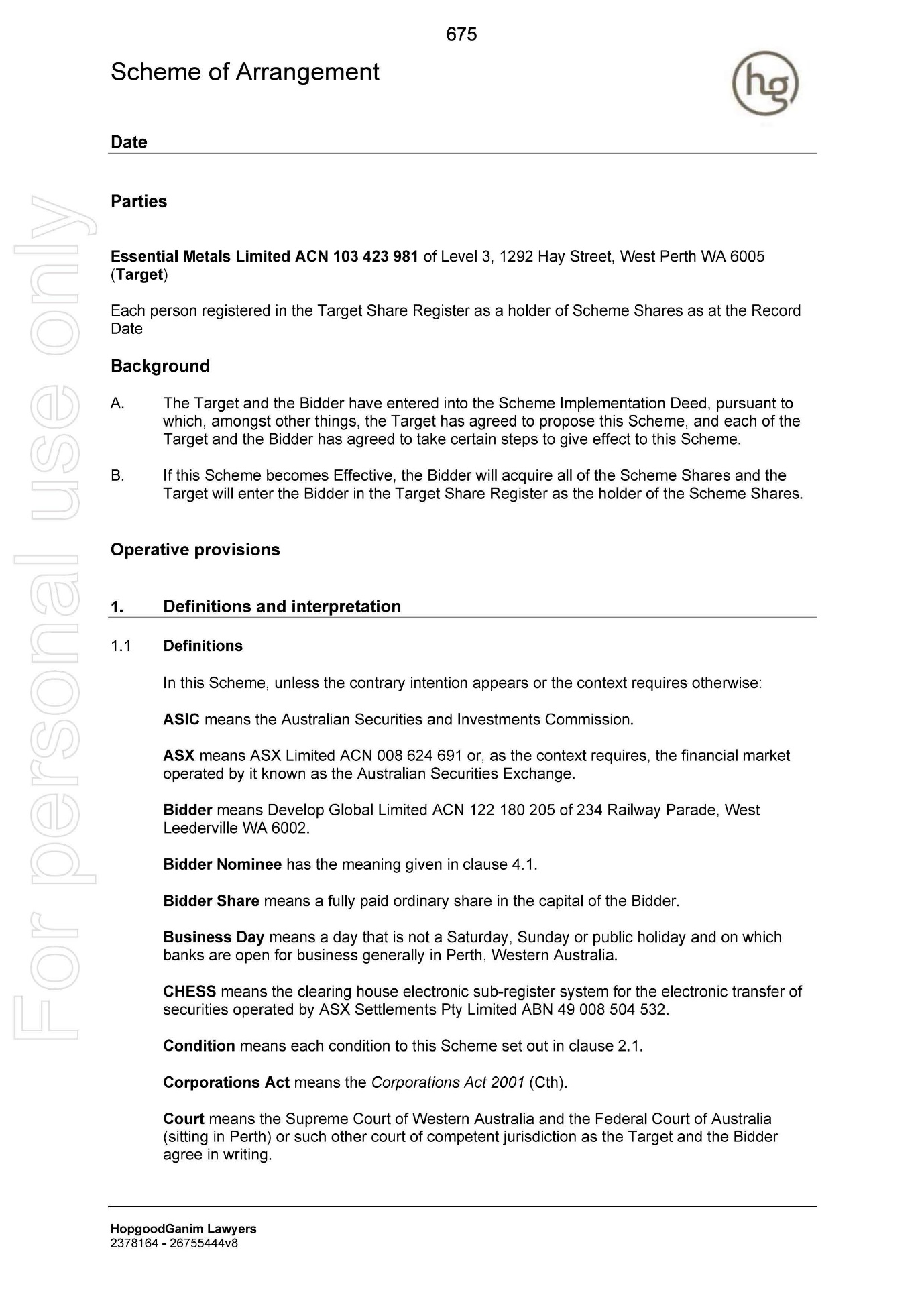
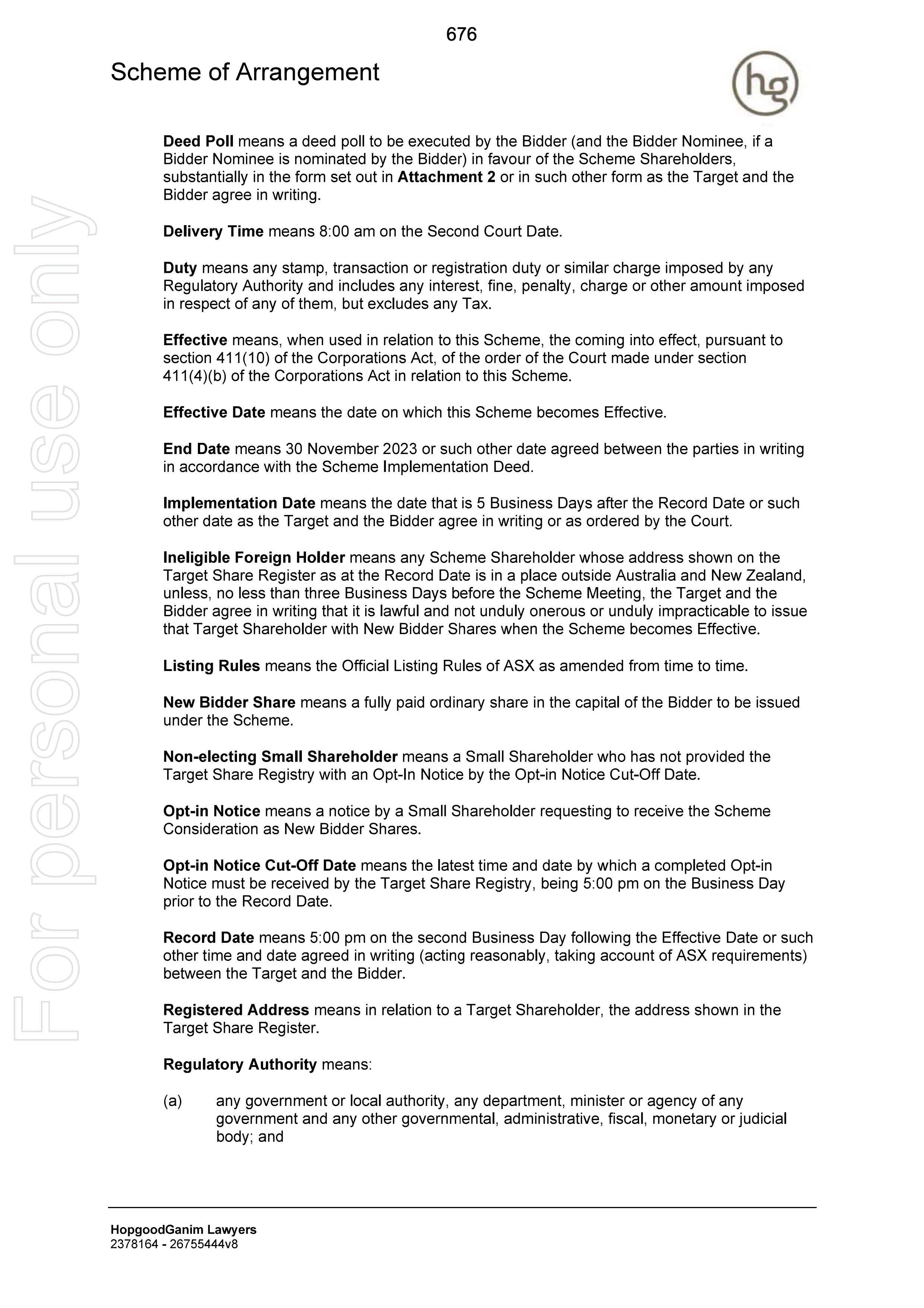
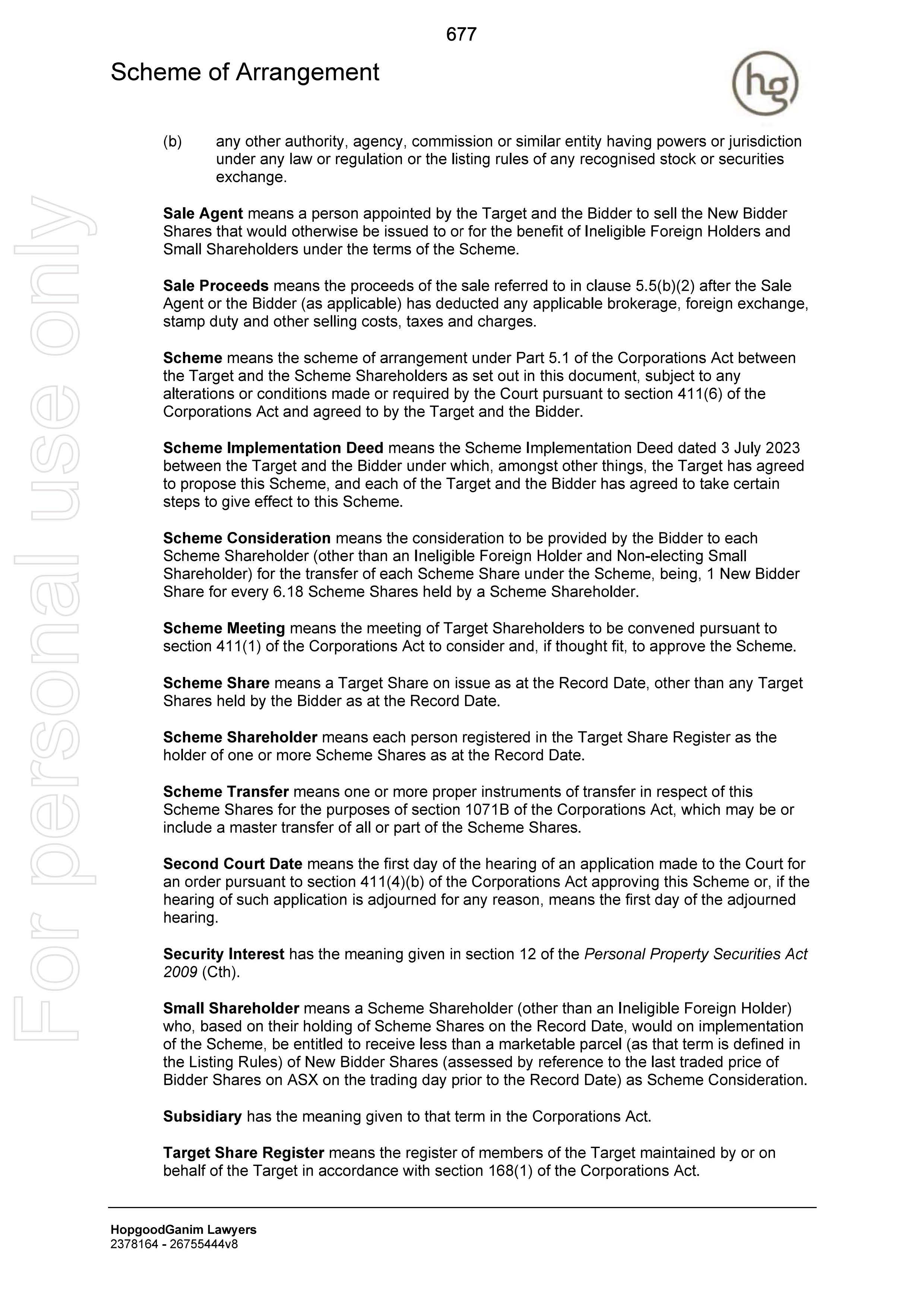
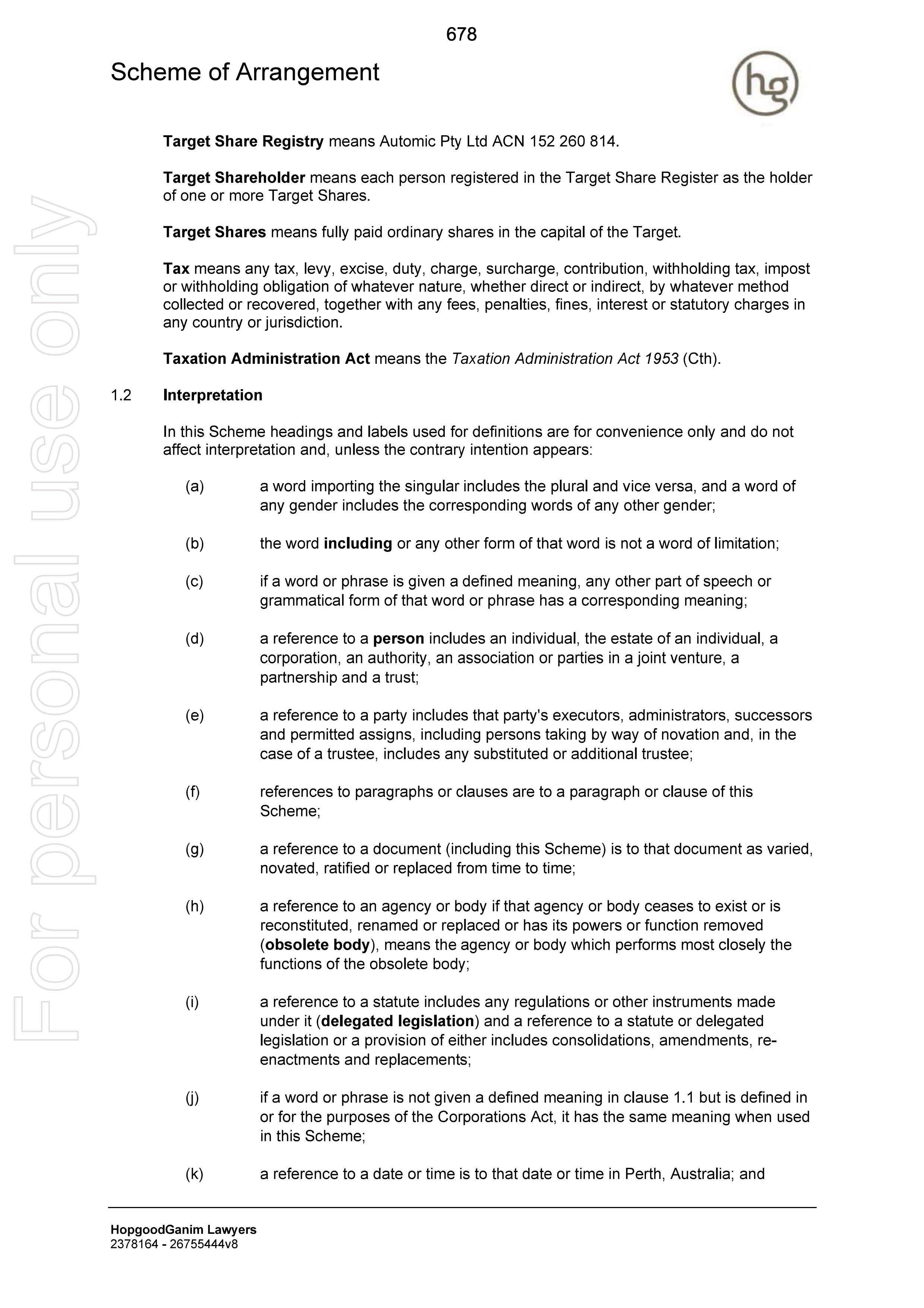
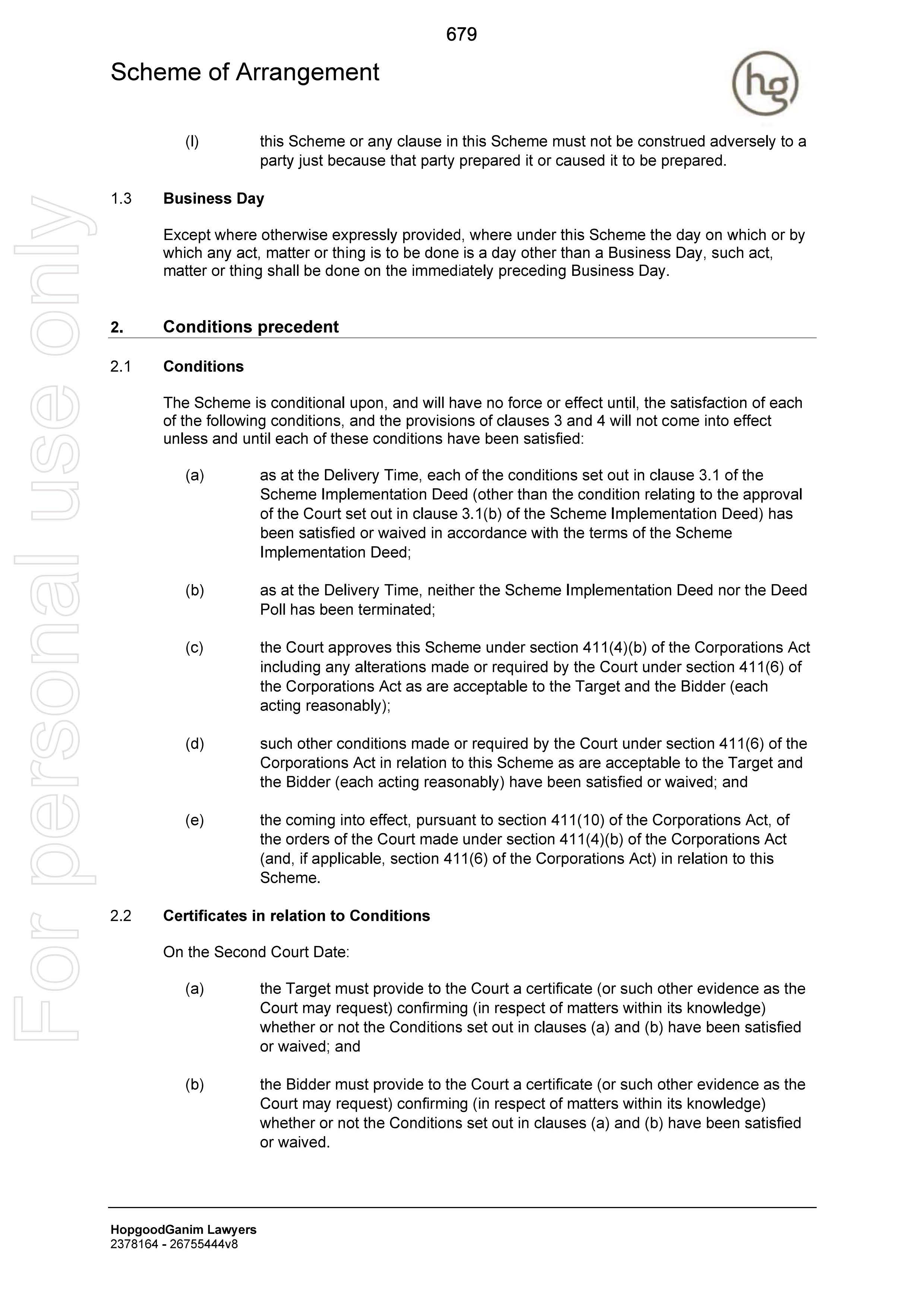
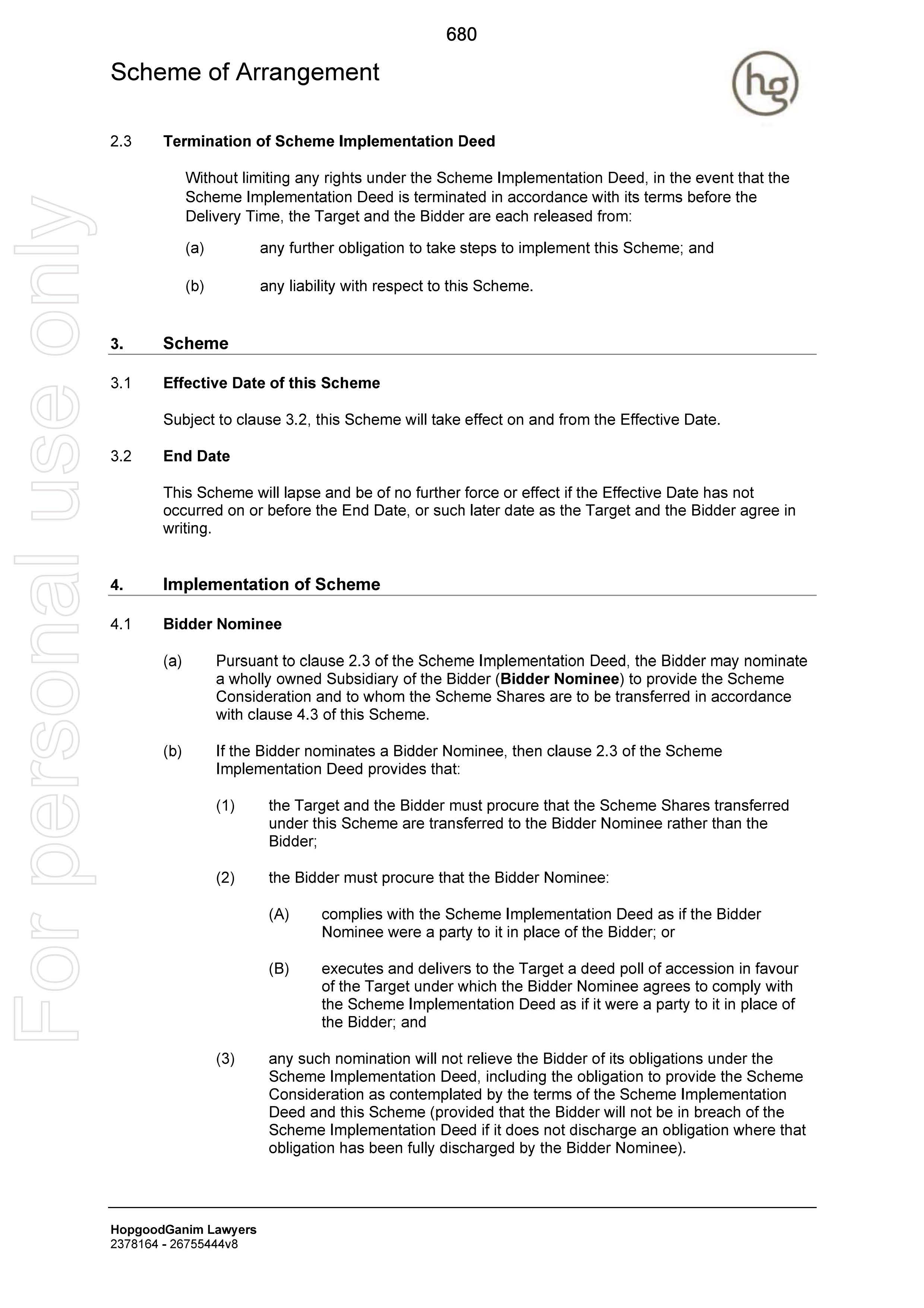
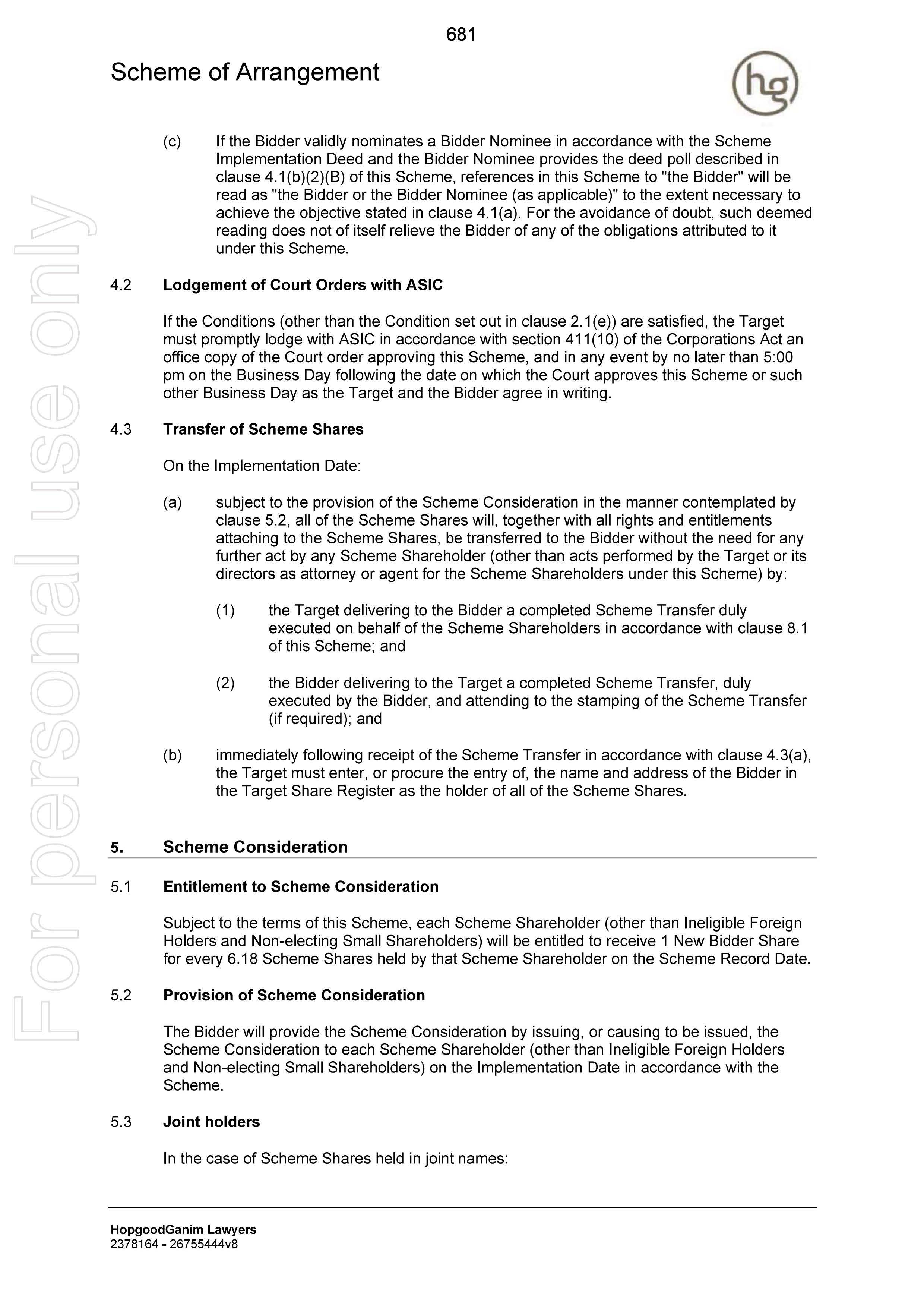
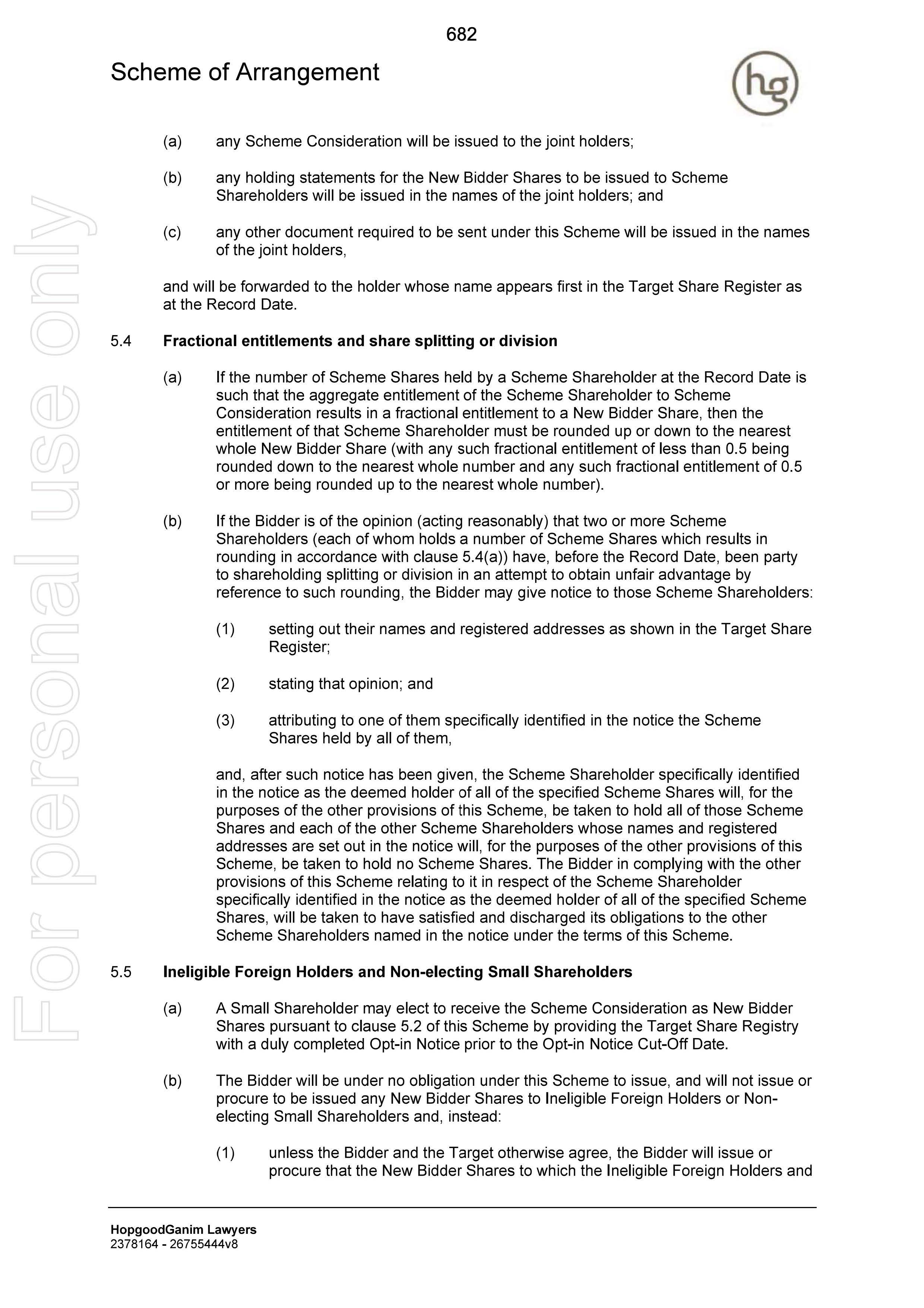
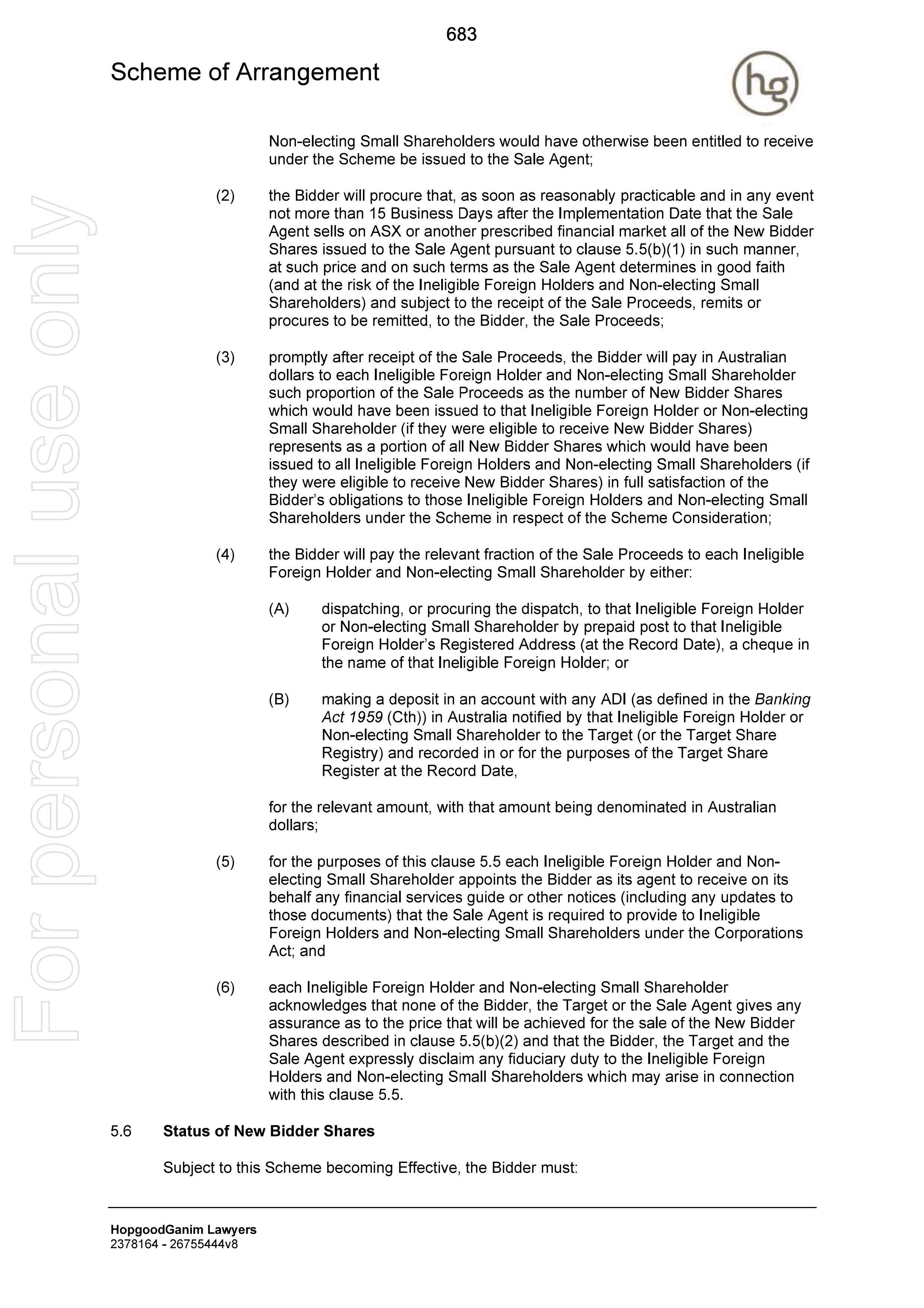
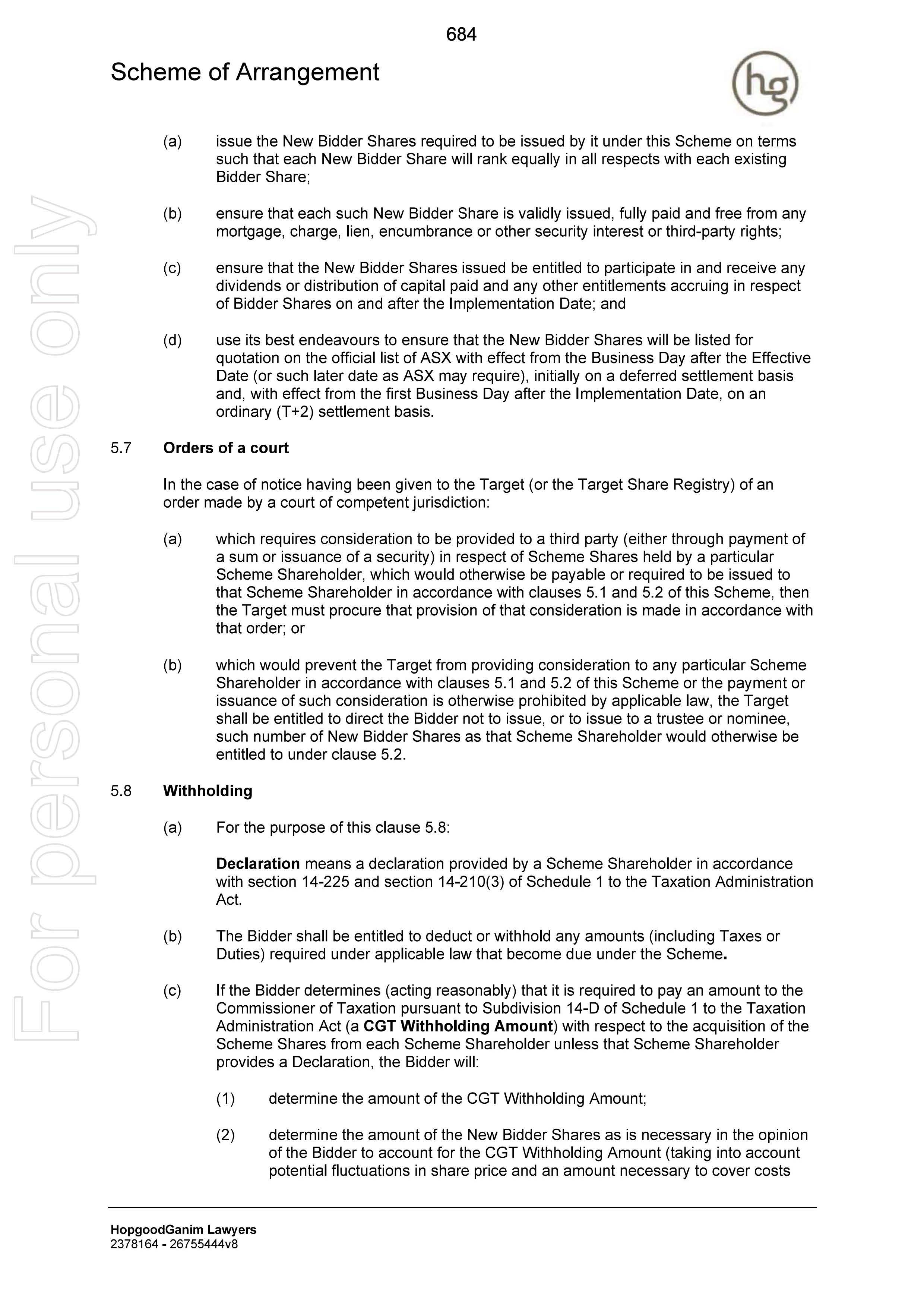
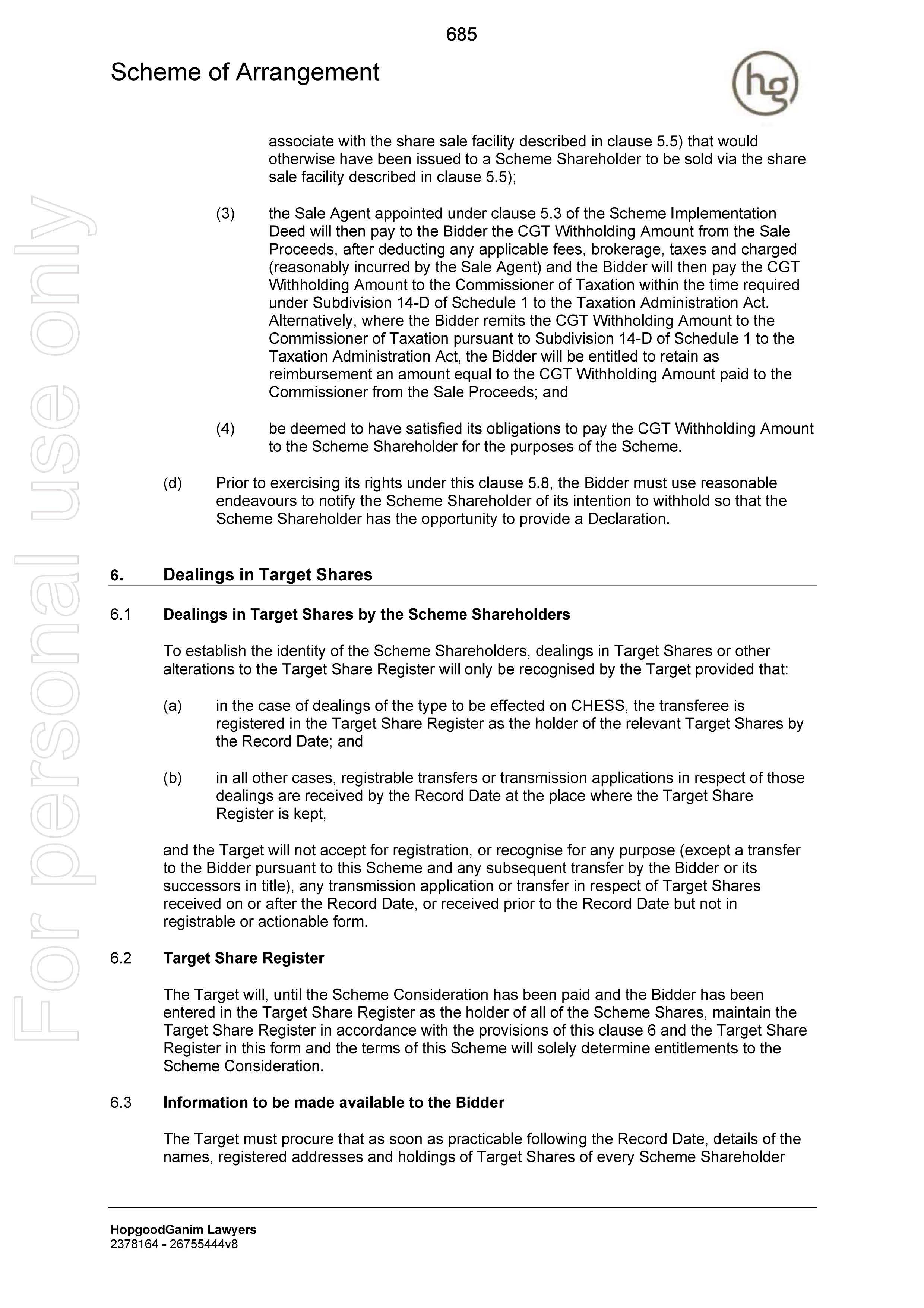
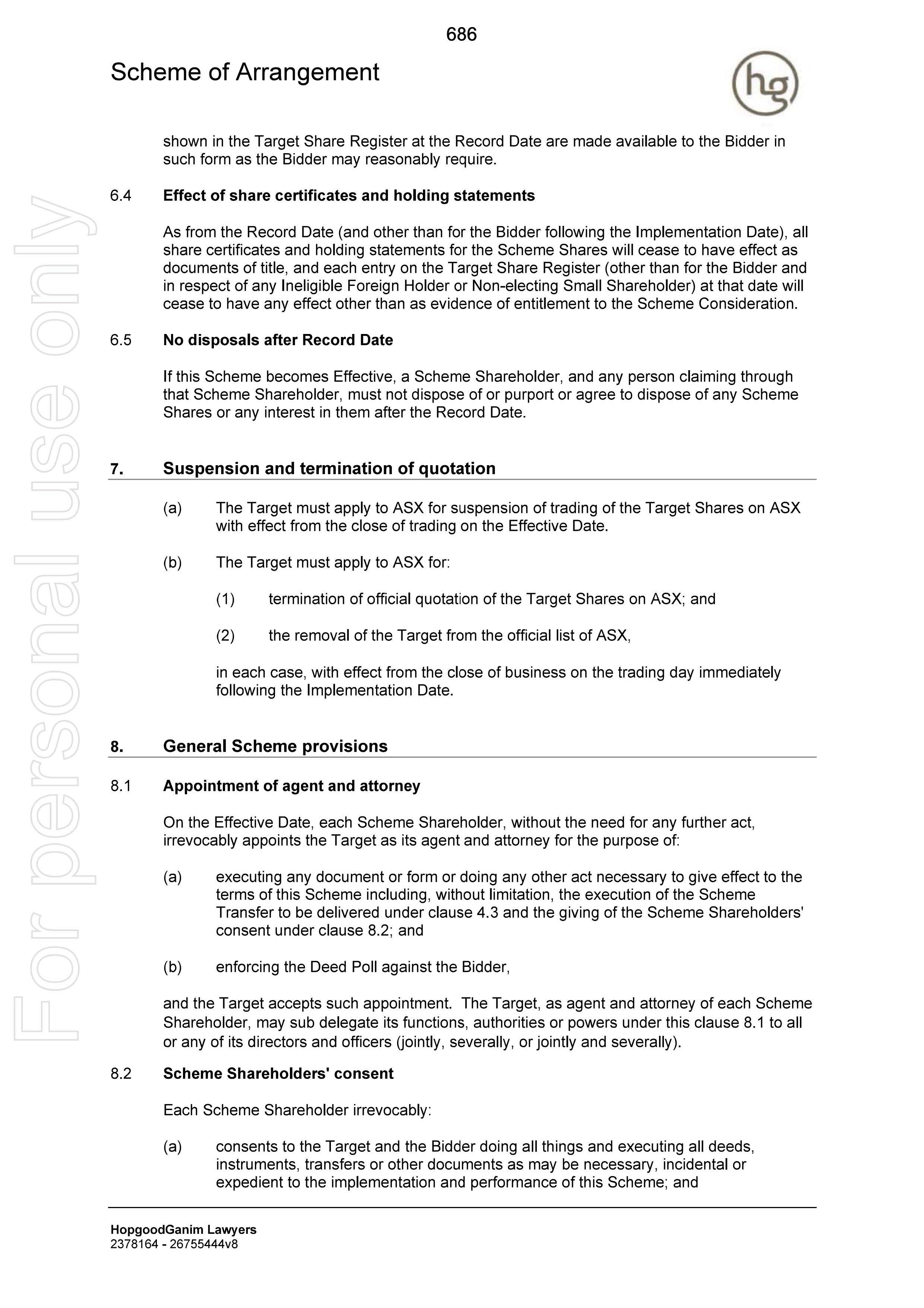
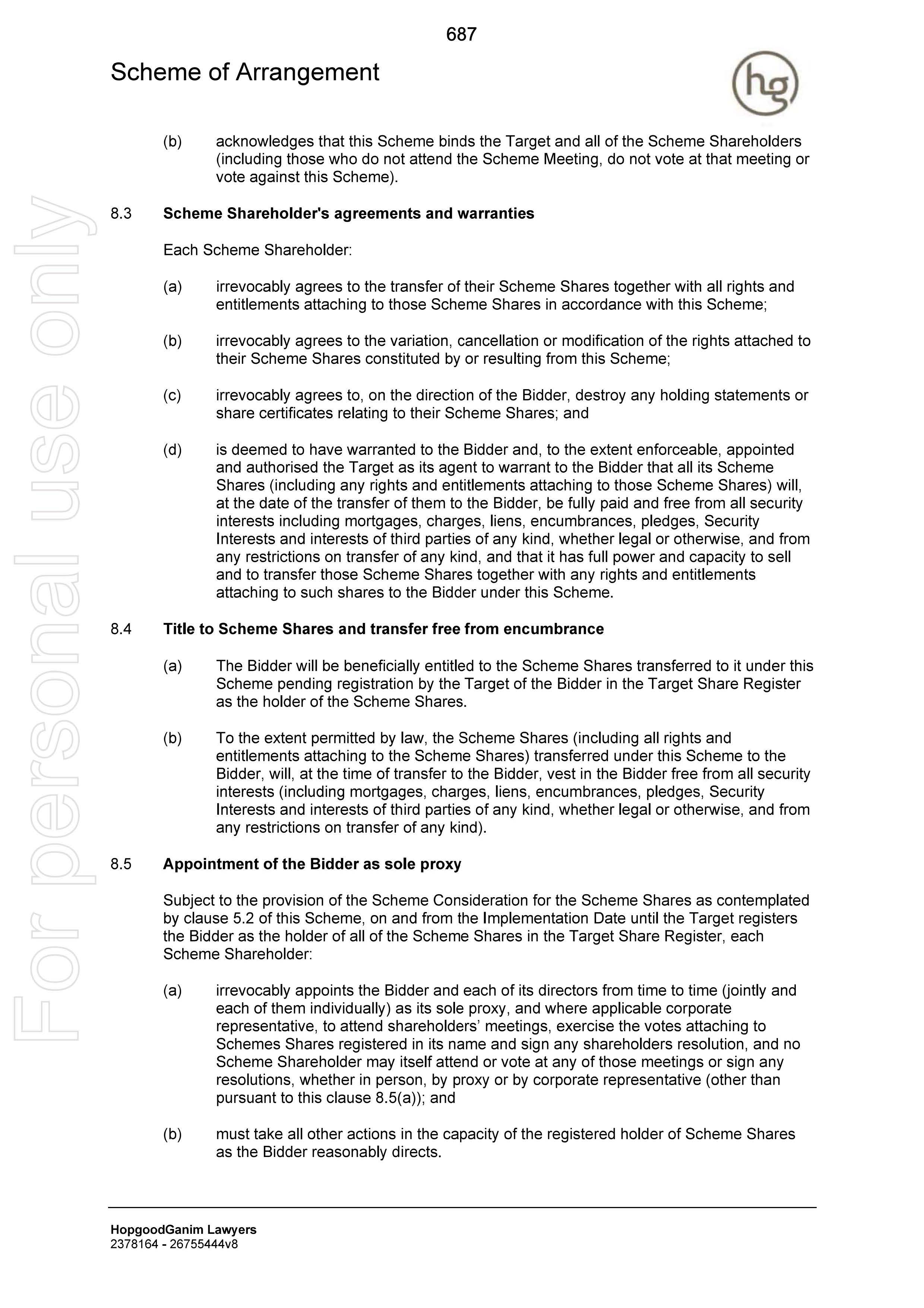
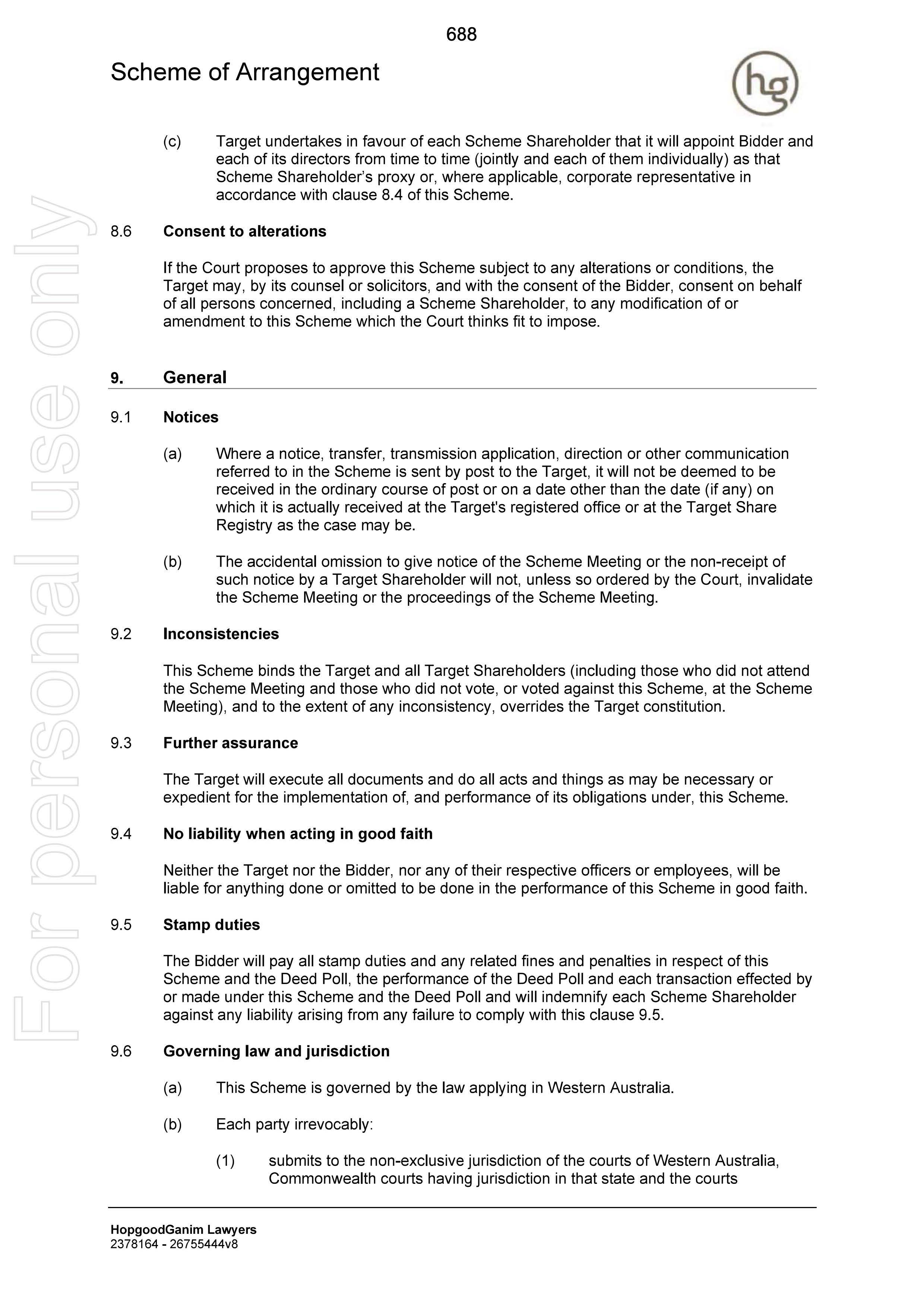
1. Pursuant to s 411(4)(b) of the Corporations Act 2001 (Cth), the scheme of arrangement between the plaintiff and the holders of fully paid ordinary shares in the capital of the plaintiff, as set out on pages 673 to 689 of the affidavit of Gregory William Fitzgerald sworn on 20 October 2023 (Scheme), a copy of which is Annexure A to these orders, is approved.
2. Pursuant to s 411(12) of the Corporations Act, the plaintiff is exempted from compliance with s 411(11) in relation to the Scheme.
3. Pursuant to s 1322(4)(a) of the Corporations Act, the Court declares that, with effect nunc pro tunc from the time they occurred, the following acts, matters and things, namely:
(a) the scheme meeting; and
(b) the resolution passed at the scheme meeting,
(c) are not invalid by reason of any contravention of s 412(1) of the Corporations Act insofar as the plaintiff dispatched black and white versions of the scheme booklet to shareholders who received the scheme booklet by mail.
4. The plaintiff must lodge an office copy of these orders with the Australian Securities and Investments Commission by 26 October 2023.
Note: Entry of orders is dealt with in Rule 39.32 of the Federal Court Rules 2011.
ANNEXURE A
JACKSON J:
1 On 14 September 2023, orders were made (First Orders) convening a meeting of the shareholders of the plaintiff, Essential Metals Limited (Scheme Meeting), for the purpose of considering and, if thought fit, agreeing to a scheme of arrangement (Scheme): Re Essential Metals Limited [2023] FCA 1101 (Essential Metals (No 1)).
2 In broad terms, the Scheme involves Develop Global Limited acquiring all of the shares in Essential. The proposed scheme consideration is one fully paid ordinary share in Develop for each 6.18 Essential shares held. Essential's flagship project as a minerals explorer is the Pioneer Dome Lithium Project in the Eastern Goldfields region in Western Australia. The Scheme has been proposed so that the development of Pioneer Dome can proceed in a timely and efficient manner. Further details of the Scheme are outlined in Essential Metals (No 1) at [2]-[6].
3 At the Scheme Meeting on 18 October 2023, the resolution to approve the Scheme was approved by a majority of shareholders present and voting and by more than 75% of the votes cast.
4 On 24 October 2023, the second hearing for approval of the Scheme pursuant to s 411(4)(b) of the Corporations Act 2001 (Cth) was held. No person other than Essential and Develop sought to appear. Develop supported the approval of the Scheme. That is after the second hearing was advertised in the Australian newspaper in accordance with the First Orders. Orders approving the Scheme were made at that second hearing. These are the reasons for those orders.
Materials relied upon
5 In addition to the evidence already adduced at the first hearing, Essential relied upon the following affidavits:
(a) a second affidavit of Essential's company secretary, Gregory William Fitzgerald, sworn 20 October 2023;
(b) three further affidavits of Essential's solicitor, Nino Anthony Odorisio sworn 20 October 2023 and 24 October 2023 (two), being his fourth, fifth and sixth affidavits;
(c) three affidavits of a manager employed by Automic Registry Services, Essential's share registry, Eric Roger Merven, sworn 20 October 2023, 23 October 2023 and 24 October 2023; and
(d) an affidavit of a training manager employed by Automic, Kane Pretki sworn 24 October 2023.
Requirements for approval of a scheme of arrangement
6 A court's power to approve a scheme is derived from s 411(4)(b) of the Corporations Act: Re Hibernian Friendly Society (NSW) Limited [2002] FCA 1139 at [8] (Conti J). Section 411(4) of the Act provides for a scheme of arrangement to be binding on, relevantly, members of a company with share capital if, at a meeting convened in accordance with an order of the Court, a resolution in favour of the scheme is passed by a majority in number of members present and voting (unless the Court otherwise orders), and by 75% of the votes cast on the resolution, and the scheme is approved by the Court.
7 The Court has a discretion whether to approve a scheme, and it is not bound to approve it merely because it has previously made orders convening a meeting to approve the scheme: Re Seven Network Limited (No 3) [2010] FCA 400 at [31] (Jacobson J). The fundamental issue informing the exercise of the discretion is whether the proposal is fair and reasonable, in the sense that an intelligent and honest shareholder, who is a member of the relevant class, and acting alone in respect of their interests as shareholder, might approve it. The jurisdiction is supervisory; the Court is concerned to be satisfied that there has been an absence of oppression and that the compromise or arrangement is one that is capable of being accepted: see Re NRMA Limited (No 2) [2000] NSWSC 408 at [22] (Santow J) approved in Fowler v Lindholm [2009] FCAFC 125; (2009) 178 FCR 563 at [79] (Emmett, Gordon and Jagot JJ).
8 It has been said that the shareholders' vote in favour of a scheme is evidence of its inherent fairness; if a majority of the shareholders have approved the scheme, it is unlikely that the scheme would be unreasonable: Re Amcor Limited (No 2) [2019] FCA 842 at [11] (Beach J). In Re Seven Network at [32], Jacobson J said:
It has been said on many occasions that the court will usually approach the task upon the basis that the members are better judges of what is in their commercial interests than the court. Santow J said in Re NRMA Ltd (No 2) at [23], citing earlier authority:
After all, it is their (the members') money which is at stake.
9 The following additional matters have been held to be relevant to the exercise of the statutory discretion (Re Seven Network at [35]-[40]):
(a) whether the shareholders have voted in good faith and not for an improper purpose;
(b) whether the plaintiff has brought to the attention of the court all matters that could be considered relevant to the exercise of the court's discretion;
(c) whether there has been full and fair disclosure of all information material to the shareholders’ decision;
(d) whether minority shareholders would be oppressed by the scheme; and
(e) whether the scheme offends public policy.
10 Other matters of which the Court must be satisfied when deciding whether to approve a scheme include whether:
(a) there has been compliance with the orders of the Court convening the scheme meeting;
(b) the resolution to approve the scheme has been passed by the requisite majorities;
(c) all conditions to which the scheme is subject (other than court approval and lodgement of the Court's orders with the Australian Securities and Investments Commission (ASIC)) have been met or waived;
(d) all other statutory requirements have been satisfied; and
(e) the Court is satisfied under s 411(17) that the scheme has not been proposed to avoid Chapter 6 of the Corporations Act (regarding takeovers), or that the company has a statement from ASIC that it has no objection to the scheme.
See Re APN Outdoor Group Limited (No 2) [2018] FCA 1633 at [5] (Markovic J); Chevron (TAPL) Pty Ltd v Chevron Australia Pty Ltd, in the matter of Chevron (TAPL) Pty Ltd (No 2) [2022] FCA 381 at [9] (Banks-Smith J).
11 In general, it is not the court's function to override the views of the shareholders, but the court is not a mere rubber stamp and will look at the arrangement to ensure that it is a reasonable one: Re Wesfarmers (No 2) [2018] WASC 357 at [15] (Vaughan J). The court is heavily reliant on counsel to bring to its attention those features of the scheme that require attention: Re Seven Network at [42].
Procedural matters and other prerequisites
ASIC lodgement
12 Paragraph 5 of the First Orders contemplated that Essential would lodge the Scheme Booklet with ASIC, as required by s 412(6) of the Corporations Act, prior to dispatch of the booklet to shareholders. Mr Odorisio's fourth affidavit confirms that lodgement occurred on 14 September 2023.
13 Paragraph 13 of the First Orders required those orders to be lodged with ASIC as soon as practicable. Mr Odorisio's fourth affidavit also contains correspondence confirming that this was done, on the same day that the First Orders were made.
14 Under s 412(6) of the Corporations Act, before registering the Scheme Booklet, ASIC was required to conclude that it appeared to comply with the requirements of the Act, and ASIC was required to form the opinion that the booklet did not contain any matter that was false in a material particular or materially misleading in the form and context where it appeared. It was therefore a matter of some weight that ASIC proceeded to register the Scheme Booklet: Chevron (TAPL) Pty Ltd (No 2) at [15] (Banks-Smith J).
Dispatch of the Scheme materials to shareholders
15 Mr Fitzgerald's second affidavit contains evidence demonstrating that Essential posted to the Australian Stock Exchange's (ASX) market announcements platform, and so made generally available:
(a) the details of the meeting of shareholders convened under the First Orders;
(b) the Scheme Booklet;
(c) the details of the dispatch of the Scheme Booklet with the covering letter to shareholders; and
(d) Essential's annual report for the financial year ending 30 June 2023.
16 Mr Merven's first affidavit also establishes:
(a) that the Scheme Booklet and the notice of the Scheme Meeting were dispatched by email on 18 September 2023 to all shareholders of Essential who had elected to receive their shareholder communications that way;
(b) that the Scheme Booklet and notice of the Scheme Meeting were sent by post to other shareholders also on 18 September 2023; and
(c) that the Scheme Booklet and notice of the Scheme Meeting were subsequently (on 9 October 2023) sent by post to 58 email recipients, from whose addresses bounceback notices had been received, and to shareholders who came on to the register after 14 September 2023.
17 Three issues connected with the dispatch of these materials arose at the second hearing.
18 The first concerned whether shareholders received the period of notice of the Scheme Meeting that was required under the Corporations Act. Section 249HA of the Corporations Act requires that at least 28 days' notice must be given of a meeting of a company's members. Section 249J(4) relevantly provides that when a notice of meeting is sent by post, it is taken to have been given three days after it is posted. Notices of the Scheme Meeting were posted on 18 September 2023. So if the provisions just mentioned apply, then shareholders who had not elected to receive their notices electronically (where the deemed delay in receipt under s 249J(4) is one business day), would be taken to have received their notices on 21 September 2023 (since the day of dispatch is not counted as the first of the three deemed days: see s 105). Essential correctly accepted that this was 27 days before the Scheme Meeting, not the 28 days required under s 249HA.
19 However, Essential pointed out that the dispatch of the scheme materials on 18 September 2023 was authorised by paragraph 5 of the First Orders. Paragraph 2 of those orders provided, as is usual, that the meeting was to be convened in accordance with the provisions of Part 2G.2 of the Corporations Act (in which ss 249HA and 249J are found), but that was said to be subject to the orders and pursuant to s 1319 of the Act. Section 1319 provides:
Where, under this Act, the Court orders a meeting to be convened, the Court may, subject to this Act, give such directions with respect to the convening, holding or conduct of the meeting, and such ancillary or consequential directions in relation to the meeting, as it thinks fit.
20 It is well established that this empowers the Court to give procedural directions in relation to a meeting which may not correspond with the procedural requirements of a general meeting convened under the company's constitution, or with the procedural requirements of Part 2G.2: see Re Australian Consolidated Press Ltd (1994) 14 ACSR 639 at 640; Re Amcor Limited [2000] VSC 157 at [6]; Re Strategic Energy Resources Ltd (No 2) [2012] VSC 75 at [7]; Re Amcom Telecommunications Limited (No 3) [2015] FCA 596 at [57]-[59]; Re Sienna Cancer Diagnostics Limited [2020] FCA 899 at [115]; Re Catholic Church Insurance Limited [2023] FCA 1197 at [115]. In Re Australian Consolidated Press, McLelland J explained that this is in a context where the meeting is one convened by the Court, and is not a general meeting conveyed under the articles of association (as the relevant instrument was then called): at 640.
21 Consistently with this, orders were made truncating the notice period for scheme meetings to less than 28 days, in Re Equigold NL (No 2) [2008] FCA 826 at [8] and in Re Security Matters Limited [2023] FCA 19 at [116]-[122].
22 I was satisfied on the basis of those authorities that the shorter deemed notice period that occurred after Essential complied with the First Orders was not a procedural irregularity that required comment under s 1322(2) of the Corporations Act (proceedings affected by procedural irregularities not invalidated unless substantial injustice) or any remedial order under s 1322(4) (such as an extension of time under s 1322(4)(d)). Nor as a matter of substance was the shorter notice period likely to have deprived any shareholder of a proper opportunity to consider the scheme materials (noting that in England, 21 days' notice is the rule of thumb for scheme meetings: see Re Security Matters at [121]).
23 The second issue, which counsel appropriately drew to my attention, was one respect in which Essential had not complied with the First Orders. Paragraph 7 of those orders provided that if it came to Essential's attention that any email notice resulted in the return of a receipt or notice that the email was undeliverable, then Essential was to forthwith dispatch a hard copy version of the shareholder notice letter and other forms to the shareholder. This occurred, but not 'forthwith', as the letters were not dispatched until 9 October 2023. But this irregularity was minor in my view, as only 58 shareholders were affected, there is no reason to think that they did not ultimately receive the notices of meeting, and it can be inferred in any event that the email bouncebacks would, in many cases, have been the result of the shareholders' own failure to maintain email accounts or to notify Automic of a change in email addresses.
24 The third procedural issue was that for some 77 shareholders, who received all the scheme materials in hard copy, the Scheme Booklets had been printed in black and white. This was an inadvertent error in the printing process which only came to Essential's attention the night before the second hearing.
25 Essential accepted that this means that certain charts, graphs and maps in the Scheme Booklet, which were in colour, would be difficult or impossible to read. Nevertheless, it submitted that for the following reasons, that did not mean that the Scheme should not be approved:
(a) it appears to have been an oversight or misunderstanding;
(b) 77 Scheme Booklets were affected, compared to a total number of 4,925 shareholders;
(c) there was evidence that even if it is assumed that all 77 shareholders voted at the meeting without having received full and proper disclosure, that represented only about 3% of the shareholders by number;
(d) the full colour version was available on the ASX platform, on Essential's website, and at Essential's registered office;
(e) no issue was raised or enquiries made about the issue;
(f) the substance of the Scheme Booklet and the independent experts' report provided by BDO Corporate Finance (WA) Pty Ltd (BDO Report) could be read; and
(g) it was not in the nature of other printing problems which Essential described as 'more egregious', such as those in Re Wesfarmers (No 2) (advantages, disadvantages and other relevant considerations for shareholders section was missing from the version of the scheme booklet uploaded to the ASX website) and Re Beadell Resources Ltd (No 2) [2019] WASC 53 (corruption of text rendering a report in the scheme booklet unreadable).
26 I was persuaded by these submissions, which speak for themselves, that the printing error was no impediment to approval of the Scheme. I add three points by way of supplementation or qualification. The first is that Essential drew the issue to ASIC's attention, and on the afternoon of the second hearing, ASIC indicated that it had no objection to the proposed Scheme, notwithstanding the irregularity.
27 Second, my own examination of the black and white version of the Scheme Booklet confirmed that it was unlikely that the error caused any substantial difficulties for shareholders. There were only two charts in the main body of the Scheme Booklet that were affected, and the shareholders could pick up the necessary information from the surrounding text. The charts in the BDO Report remained fairly legible, despite the error. The same could not be said of various geological and other maps in the Independent Technical Assessment and Valuation Report into Essential's mineral assets, which was prepared by a company called Valuation and Resource Management Pty Ltd, and which was itself annexed to the BDO Report. But any shareholder who had reached the body of that report and who wished to scrutinise those diagrams in any detail could be expected to have obtained a colour copy online or otherwise.
28 Third, the cases to which Essential referred were of limited assistance because they inevitably depended on their own facts, and each error is different. In Re Wesfarmers (No 2), the incomplete scheme booklet was available online for only two hours and that was a week before members were due to start lodging votes by proxy: see [27]. In Re Beadell there was a 'random character change to some words within the Independent Technical Specialist Report', it is not clear how extensive or material the problem was (Vaughan J described it as a minor matter, at [16]), and it was caught in time to provide an 'errata letter' along with the incorrect scheme booklet: at [16]-[18]. In contrast, here, the error was not picked up until after the Scheme Meeting.
29 Essential also referred to three cases in which schemes had been approved despite a black and white printing error. But each case, once again, depended on its own facts. In Re MOD Resources Ltd (No 2) [2019] WASC 360 at [12]-[17], the company picked the error up in time to send a colour version of the scheme booklet out to shareholders. In Re Dreamscape Networks Ltd [2019] WASC 412 at [105], Hill J found that there was 'no discernible difference between the colour and black and white versions of the scheme booklet'. In Re Nusantara Resources Ltd [2021] WASC 334 at [95], her Honour found that there was 'no critical or effective difference between the colour and black and white versions of the Scheme booklet' and that the 'interpretation of text and images within the Scheme booklet are the same in both instances'. Nevertheless, for the reasons given above I determined that the printing error in this case was not a substantial reason in the way of approving the Scheme.
30 It was also appropriate to make an order under s 1322(4)(a) of the Corporations Act declaring that the Scheme Meeting and the resolution passed at it are not invalid by reason of the black and white printing. It is arguable that s 1322(2) operated to confirm that those things were valid, because this was a procedural irregularity without substantial injustice, but given the commercial importance of the resolution to Essential and its shareholders (and to Develop), it was appropriate to put the matter beyond doubt: see Re Wesfarmers (No 2) at [30]-[35]. The preconditions found in s 1322(6) for the making of orders were all satisfied: the irregularity was of a procedural nature; Essential had acted honestly; it was just and equitable that the order be made; and I was satisfied that no substantial injustice had been or was likely to be caused to any person.
The Scheme Meeting
31 Mr Odorisio acted as chair of the Scheme Meeting of Essential Shareholders, which took place on 18 October 2023. He has given evidence of the conduct of the Scheme Meeting, which was in accordance with the First Orders, including the taking of a poll on the resolution to approve the Scheme.
32 Mr Merven attended to the registration of attendees, the supervision of voting and the counting of the vote at the meeting. His evidence is that 82.76% of shareholders by number (headcount) and 93.39% of votes were cast in favour of the resolution to approve the Scheme. 15.71% by headcount and 6.61% of votes were cast against (with 4 persons holding less than 0.3% of the shares voted at the meeting abstaining). So the necessary majorities of 50% by headcount (s 411(4)(a)(ii)(A)) and 75% by votes cast (s 411(4)(a)(ii)(B)) were both obtained.
33 The shares voted at the meeting (for and against) were about 44% of the total shares on issue. By headcount, those attending in person or by proxy were only 5.2% of the total number of shareholders. This appears to be close to, or at, the lowest number of voting shareholders recorded in the authorities: see Re Decimal Software Ltd (No 2) [2018] FCA 2040 at [19] (Banks-Smith J) and the survey in Re Bardoc Gold Ltd (No 2) [2022] WASC 113 at [25] (fn 16).
34 In Re Vita Group Ltd (No 2) [2023] FCA 623 at [6], Jackman J expressed the view that evidence of shareholder participation is irrelevant and unnecessary. Nevertheless, the Schemes of Arrangement Practice Note (GPN-SOA), published since then, indicates that the Court expects a scheme proponent to lead evidence at the second hearing as to voter turnout as compared to the total number of members of the company (para 3(j)). In Re Alloggio Group Ltd (No 2) [2023] FCA 1053 at [15], Kennett J expressed the view that:
such evidence is unlikely to be necessary, but it does not follow that it is wholly irrelevant to the exercise of a judicial discretion. A very low turnout of members might lead the Court to seek confirmation that the Scheme Booklet and notice of the meeting had been successfully distributed to members in accordance with the Court's orders, and that all who wished to vote in person or by proxy were able to do so. On the other hand, evidence that a substantial percentage of members voted may serve to indicate that there is no reason for such concern.
This was followed in Re DDH1 Ltd (No 3) [2023] FCA 1153 at [13].
35 The evidence that has been led here shows that there was a notably low voter turnout. In my view that calls for inquiry as to why that was so and whether the reasons for it may impact on the exercise of the discretion to approve the Scheme. In Decimal Software, an essentially identical level of turnout led Banks-Smith J to consider carefully (at [21]) whether there may have been any issue with respect to dispatch of information to shareholders or any other matter that may have deterred voters from attending or voting at the Scheme Meeting.
36 I have already had occasion to comment on aspects of the procedure by which shareholders were notified of the meeting; save for the delay in sending out notice after the receipt of bounceback emails, there is no evidence of any irregularity, and that instance of non-compliance was minor and only affected at most 58 shareholders out of 4,925. Announcements made to the ASX on at least three occasions in September 2023 provided further notice and reminders of the Scheme Meeting and are likely to have impressed the importance of voting on shareholders.
37 Also, comparing the vote on the scheme resolution to the normal course of voting at the company's annual general meetings can provided a useful cross check: see e.g. Re DDH1 Ltd (No 3) at [15]. In this case, there was evidence that some 14 to 19 million votes were cast by about 140 shareholders on resolutions at Essential's 2022 annual general meeting, compared to more than 117 million votes from more than 250 shareholders at the scheme meeting, with the vote overwhelmingly in favour. I was satisfied that the relatively low voter turnout compared to total shareholder numbers is not a reason to decline to approve the Scheme.
38 I was therefore satisfied that all procedural requirements in relation to the resolution to approve the Scheme were satisfied (save in relation to the bounceback emails, which was minor non-compliance).
No objection from ASIC
39 The Court must not approve a scheme of arrangement under s 411 unless it is satisfied that the Scheme has not been proposed for the purpose of enabling any person to avoid the operation of any of the provisions of Chapter 6 (Takeovers), or ASIC provides a statement in writing that it has no objection to the compromise or arrangement: s 411(17). A letter to the latter effect from ASIC was produced at the second hearing.
Conditions precedent
40 Certificates from both Essential and Develop were produced to the Court, verifying that all conditions precedent to the Scheme (other than Court approval) had been satisfied or waived.
The exercise of the discretion
41 Fundamentally, I determined that it was appropriate to exercise the discretion to approve the Scheme because the outcome would be to effect a relatively straightforward transaction, under which Develop would acquire Essential, and in return, the shareholders in Essential would receive a specified number of shares in Develop. The potential commercial benefits of the transaction for shareholders in Essential are described in Essential Metals (No 1) and need not be repeated. Subject to the matter considered in the next section of these reasons, it appeared to be a proposal fit for the consideration of Essential's shareholders.
42 I was satisfied that there was no reason not to approve the Scheme. There was no evidence of differential treatment between shareholders, or oppression, and no suggestion that the Scheme was proposed other than in good faith for a legitimate commercial purpose. It was thus a proposal which an intelligent and honest shareholder acting in their own interests could approve.
43 The features of the Scheme were fully disclosed to shareholders as was anticipated by the evidence referred to in Essential Metals (No 1) at [18]-[25], and the fact that both Essential and Develop are listed companies provides a further level of disclosure and transparency. There was no reason to think that the votes in favour of the Scheme by the requisite majorities of shareholders represented anything other than their properly informed judgment that the Scheme was in their best interests as shareholders.
44 There was also no reason to suppose that the Scheme offended public policy.
The independent expert's opinion
45 In Essential Metals (No 1) (at [30]-[35]) it was noted as relevant that the opinion expressed in the BDO Report, being the opinion of two independent experts, was that the Scheme was not fair but was reasonable. I described the issue and the authorities relevant to it there, and need not repeat that.
46 Since then, the Scheme has been approved by an overwhelming majority of the votes cast at the Scheme Meeting. To the extent that there was any concern that the Scheme consideration undervalued shares in Essential, that is a commercial matter for shareholders to determine for themselves. They have voted in favour when the market price of both Essential shares and Develop shares have been fully observable at all times.
47 That is in a context where I already found in Essential Metals (No 1) that there was satisfactory disclosure of the issue in the Scheme Booklet. That is a key consideration, and as well the Court should consider whether shareholders are acting on sufficient information in order to make their decision, and should also assess the independent expert's explanation for their conclusion. See generally Re Beadell Resources Ltd [2018] WASC 410 at [61]-[64] (Vaughan J).
48 Here, the BDO Report that was provided to shareholders is on its face comprehensive. The report explains the experts' conclusion as follows (BDO Report p 2):
We have considered the terms of the Scheme as outlined in the body of this report and have concluded that, in the absence of a superior offer, the Scheme is not fair but [is] reasonable and in the best interests [of] the Shareholders of Essential.
In our opinion, the Scheme is not fair because the value of a share in the Proposed Merged Entity (on a minority interest and diluted basis) is lower than the value of 6.18 Essential shares prior to the Scheme (on a controlling interest and diluted basis), when a comparison is made at each of the respective low, preferred and high valuation points. However, we consider the Scheme to be reasonable because the advantages of the Scheme to Shareholders are greater than the disadvantages. In particular, following the Scheme, Shareholders would retain exposure to the Pioneer Dome Lithium Project ('Pioneer Dome') while also benefitting from being part of a larger, more diversified entity led by Mr Beament, with potential synergies realisable from its mining services business. This contrasts with the TLEA Scheme (see Section 9.2) [an earlier scheme proposed and rejected at a scheme meetinSg in April 2023] which did not provide Shareholders with the ability to retain an interest in Essential's assets.
49 This provides an intelligible rationale for the experts' opinion, which is developed in detail in the rest of the report. The opinion is that the Scheme is in the best interests of shareholders, and the reasons why are explained. Shareholders were able to assess the opinion for themselves.
50 It was also relevant that the Scheme Booklet says (on p 8):
The Scheme Consideration represented a premium of 34.9% to the closing Essential Share price of A$0.415 per share on 30 June 2023 and 30.8% to the Essential 20-day VWAP [volume weighted average price] of A$0.428 valuing Essential at ~A$152.6 million and A$0.56 per share based on the closing price for Develop shares of A$3.46 per share on 30 June 2023. Based on the closing price of Develop Shares on the Last Practicable Date, the implied value of the Scheme Consideration is A$0.4757 per Essential Share. The implied consideration per Essential Share will change with changes to the Develop share price.
51 Shareholders were no doubt capable of calculating how these numbers changed with changes in the market price of each of Essential and Develop leading up to the Scheme Meeting.
52 Further, on 26 September 2023, Essential released its Annual Report for the financial year ended 30 June 2023 and on 28 September 2023 Develop also released its Annual Report. On 28 September 2023, BDO wrote to Essential saying that they had considered these annual reports and they did not require any material change to the BDO Report or the issue of any supplementary report. BDO's opinion remained that in the absence of a superior proposal, the Scheme is not fair but it is reasonable and in the best interest to the shareholders of Essential.
53 No person has appeared to submit to the Court that the independent expert's opinion, or any unfairness in the Scheme itself, is a reason not to approve the Scheme.
54 Essential drew to my attention, however, to one instance of public comment on the BDO Report. The person providing that comment was Bill Beament, the Managing Director of Develop. On 16 September 2023, a couple of days after the First Orders were made, Mr Beament was reported in the West Australian newspaper as questioning the independent experts' opinion as based on a 'post-deal value' for a Develop share of $1.73. Mr Beament is reported to have said:
Please tell me where I can buy Develop shares at $1.73…
I have spent more than $10m buying Develop shares in recent months and I paid up to $3.20 a share.
And I certainly believe that I got more than fair value.
It was great value.
55 It is unfortunate that someone associated with the Scheme should make these comments when the scheme proponent has gone to great length and expense to ensure that communications with shareholders appropriately disclose the advantages and disadvantages of the Scheme together with supporting information to enable shareholders to make a fully informed decision. The BDO Report was part of the materials which the Court approved to be sent to shareholders when it made the First Orders. So, as Barrett J put it in Re Centro Retail Ltd [2011] NSWSC 1321 at [11], 'Because the meeting is convened in accordance with an order of the court and the court has approved the explanatory statement, the court-approved "message" should not be interfered with by unilateral supplementation by the company.'
56 It is true that Mr Beament is not an officer of Essential, and so any interference with the court-approved message cannot be attributed to the company. But he is prominently mentioned throughout the Scheme Booklet in a manner that suggests that his leadership of the combined group will be one of the advantages of the Scheme. There is therefore more than a passing chance that some shareholders will identify him with Essential as the Scheme proponent and may not assess his statement in its full context as the private opinion of a third party. So although Mr Beament had every right to express his opinion publicly, that he chose to do so in this way is regrettable.
57 I was not persuaded, however, that it was any strong reason not to approve the Scheme. It was an isolated instance, apparently without the authority or knowledge of Essential, and I have no basis to conclude that it did, in fact, make any material difference to the opinion of any shareholders. As Essential submitted, in a sense the article was a positive in that it served to draw attention to the independent experts' opinion. Neither ASIC nor any other person has complained about the statement. I need say no more about it.
58 All in all, the qualification to the independent experts' opinion that the Scheme is not fair but is reasonable was no reason not to approve the Scheme.
Other matters drawn to the Court's attention
59 I have also considered the matters that were brought to the Court's attention at the first hearing, as described in Essential Metals (No 1) at [38], [40]-[71] and [76]-[79]. It is not necessary to repeat the discussion found there. None of those matters were reasons not to approve the Scheme.
Scheme approved
60 For those reasons, orders approving the Scheme and declaring that a procedural irregularity did not invalidate the Scheme Meeting or the shareholder resolution to approve the Scheme were made.
I certify that the preceding sixty (60) numbered paragraphs are a true copy of the Reasons for Judgment of the Honourable Justice Jackson. |
Associate:


