Federal Court of Australia
Bloc Constructions (ACT) Pty LTD v ABS Façade (ACT) Pty Ltd [2023] FCA 1282
ORDERS
BLOC CONSTRUCTIONS (ACT) PTY LTD Applicant | ||
AND: | First Respondent JOHN O’BRIEN Second Respondent | |
DATE OF ORDER: | 25 October 2023 |
THE COURT ORDERS THAT:
1. The Originating Application dated 3 August 2022 be dismissed.
2. The applicant is to pay the first respondent’s costs of the application as agreed or taxed.
3. The moneys paid into the Court by the order made on 3 August 2022 be paid to the solicitors for the first respondent on or before 4pm on Thursday 9 November 2023.
Note: Entry of orders is dealt with in Rule 39.32 of the Federal Court Rules 2011.
PERRY J:
1. INTRODUCTION AND BACKGROUND
1 The applicant, Bloc Constructions (ACT) Pty Ltd, is a project delivery, planning and construction firm. The first respondent, ABS Façade (ACT) Pty Ltd, is a business specialising in façade installation and rectification in the commercial building industry.
2 By an undated document, the applicant and first respondent executed a “draft Major Works Subcontract terms” (the contract). The contract provided that Bloc Constructions had engaged ABS Façade to carry-out certain works in relation to an apartment complex known as DKSN North.
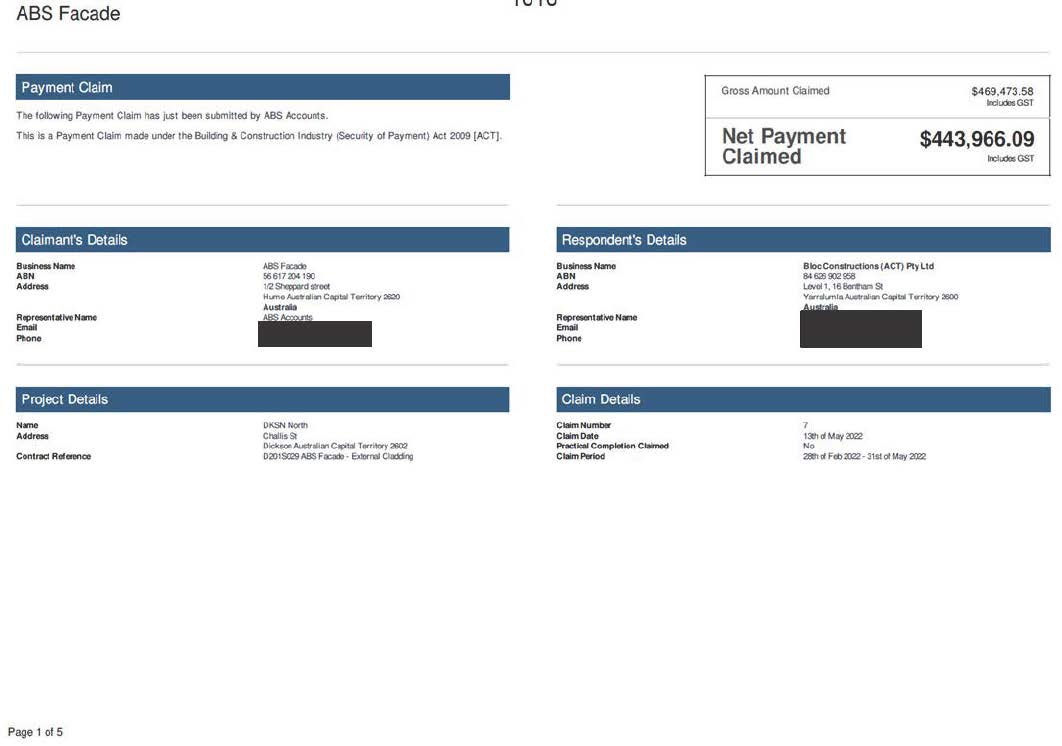
3 A dispute arose between the parties under the contract. That dispute related, amongst other things, to a payment claim made by ABS Façade against Bloc Constructions submitted on 13 May 2022 (payment claim seven). On 14 June 2022, ABS Façade filed an adjudication application pursuant to s 19 of the Building and Construction Industry (Security of Payment) Act 2009 (ACT). By that application, ABS Façade relevantly sought a determination that it was entitled to an amount of $328,267.13 payable by Bloc Constructions. On 25 July 2022, the second respondent (the adjudicator) made a determination under the Act that Bloc Constructions was required to pay ABS Façade in the sum of $318,975.49.
4 By an originating application dated 3 August 2022, Bloc Constructions seeks a writ of certiorari quashing the adjudicator’s determination, or alternatively a declaration that the determination is void for jurisdictional error. Further, Bloc Constructions seeks orders that the $318,975.49 paid by it into the Court pursuant to an order made on 3 August 2022 be repaid to it.
5 Prior to hearing, the parties were able to significantly narrow the issues in dispute. I convey my appreciation to the parties for their ability to work constructively to resolve these issues.
6 As a result of that agreement, Bloc Constructions sought judicial review of the adjudicator’s determination on three grounds only, namely that:
(1) payment claim seven failed to identify the construction work or related goods and services to which it related, as required by s 15(2)(a) of the Act;
(2) the adjudicator failed to determine the payment to be made by Bloc Constructions, and so failed to carry out his statutory function pursuant to s 24(1)(a) of the Act; and
(3) no reference date under the contract existed for making payment claim seven, and the adjudicator therefore lacked jurisdiction to entertain the adjudication application.
7 For the reasons that follow, none of these grounds have been established and the application for judicial review should be dismissed with costs. Further, it was common ground that, if Bloc Constructions were unsuccessful, the moneys paid into the Court by Bloc Constructions in accordance with the order dated 3 August 2022 should be paid out to ABS Façade and orders should be made accordingly.
8 While the parties did not initially agree upon the basis and scope of this Court’s jurisdiction to hear the matter, it is apparent from ABS Façade’s reply submissions that they were ultimately of the view that the Court has jurisdiction to hear the matter pursuant to s 9(3) of the Jurisdiction of Courts (Cross-Vesting) Act 1987 (Cth) (the Cross-Vesting Act). I agree. Nonetheless, because there was an initial contest over jurisdiction, and since the Court must be positively satisfied of its own jurisdiction to hear this dispute, it is worth briefly stating how that jurisdiction arises: Hazeldell Ltd v Commonwealth [1924] HCA 36; (1924) 34 CLR 442, 446 (Isaacs ACJ); AgriWealth Capital Limited v Australian Financial Complaints Authority Limited [2023] FCAFC 118 at [18]–[37] (Perry, Downes and Kennett JJ).
9 Section 9(3) of the Cross-Vesting Act provides that:
(3) The Federal Court … may:
(a) exercise jurisdiction (whether original or appellate) conferred on that court by a provision of this Act or of a law of the Australian Capital Territory or the Northern Territory relating to cross-vesting of jurisdiction; and
(b) hear and determine a proceeding transferred to that court under such a provision.
10 That provision has the effect of picking up, “as Commonwealth law, the jurisdiction of the Australian Capital Territory Supreme Court to hear and determine the present dispute”: Crosby v Kelly [2012] FCAFC 96; (2012) 203 FCR 451 at [35] (Robertson J), Bennett J (at [1]) and Perram J (at [2]–[3]) agreeing. The effect of s 9(3) is thus to confer jurisdiction on this Court over all matters which lie within the jurisdiction of the Australian Capital Territory Supreme Court (ACT Supreme Court).
11 In turn, by virtue of s 48A of the Australian Capital Territory (Self-Government) Act 1988 (Cth), which vests the ACT Supreme Court with “all original and appellate jurisdiction that is necessary for the administration of justice in the Territory”, the ACT Supreme Court has jurisdiction to grant common law prerogative relief for jurisdictional error, including certiorari, with respect to decisions made under Territory legislation: Pines Living Pty Ltd v John O’Brien & Walton Construction Pty Ltd [2013] ACTSC 156 at [27]–[28] (Master Mossop (as his Honour then was)); Faull v Commissioner for Social Housing [2013] ACTSC 121; (2013) 277 FLR 61 at [107]–[109] (Refshauge J). It follows that I agree that the application for certiorari to quash for jurisdictional error lies within this Court’s jurisdiction.
12 It is helpful briefly to explain relevant aspects of the Act.
13 The object of the Act is to ensure that a person can receive and recover any progress payments owing to them if the person “undertakes to carry out construction work under certain construction contracts”, or “undertakes to supply related goods and services under certain construction contracts”: s 6(1)(a) and (b) of the Act respectively. Specifically, the Act grants an entitlement to a progress payment for construction work, whether or not the construction contract provides for progress payments, and establishes a recovery procedure for construction work progress payments: s 6(2) of the Act. As Finkelstein J explained in Protectavale Pty Ltd v K2K Pty Ltd [2008] FCA 1248 at [7] (in respect of the Building and Construction Industry Security of Payment Act 2002 (Vic) (the Victorian Act), in words equally apt to describe the scheme established by the present Act, as explained further below):
The Payment Act places the claimant in a privileged position in the sense that he acquires rights that go beyond his contractual rights: Jemzone Pty Ltd v Trytan Pty Ltd (2002) 42 ACSR 42, 50. The premise that underlies the legislation is that cash flow is the lifeblood of the construction industry (Amflo Constructions Pty Ltd v Jefferies [2003] NSWSC 856 at [27]) and that the principal under a construction contract should pay now and argue later (Multiplex Constructions [2003] NSWSC 1140 at [96]).
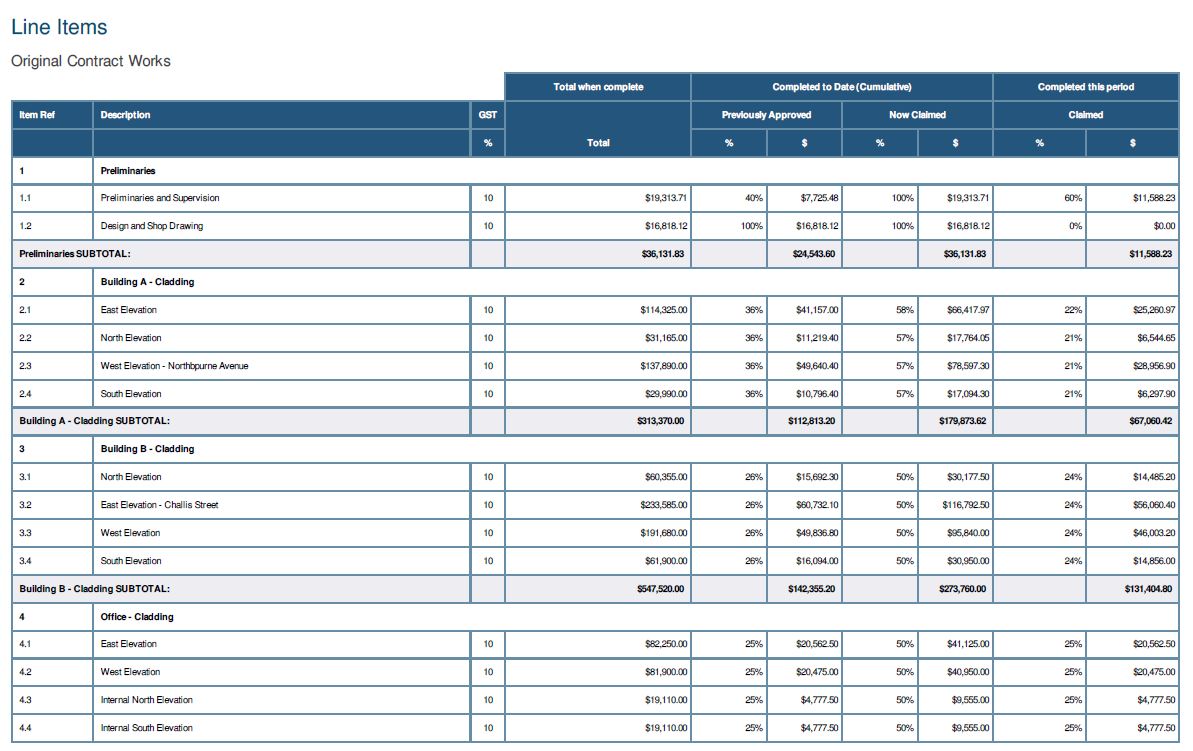
14 The structure of the Act is relevantly divided in a two-fold manner to reflect these objects:
1) Part 3 of the Act, entitled “Right to progress payments”, creates the general entitlements of a person to claim progress payments; and
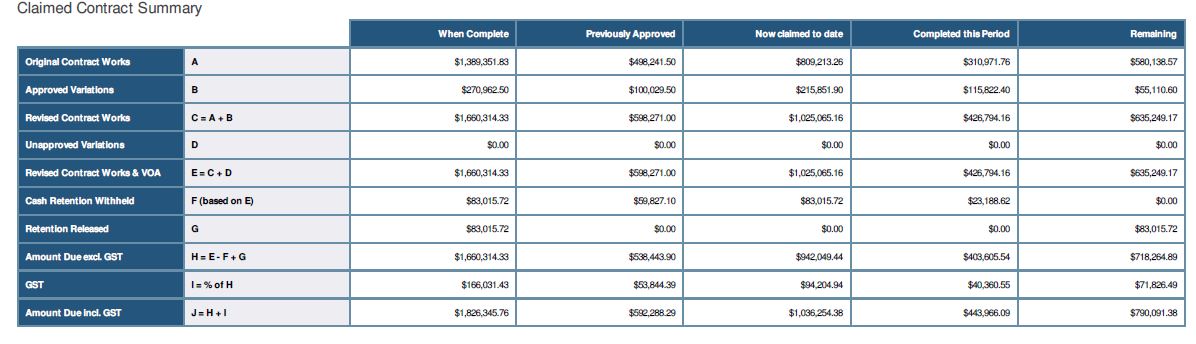
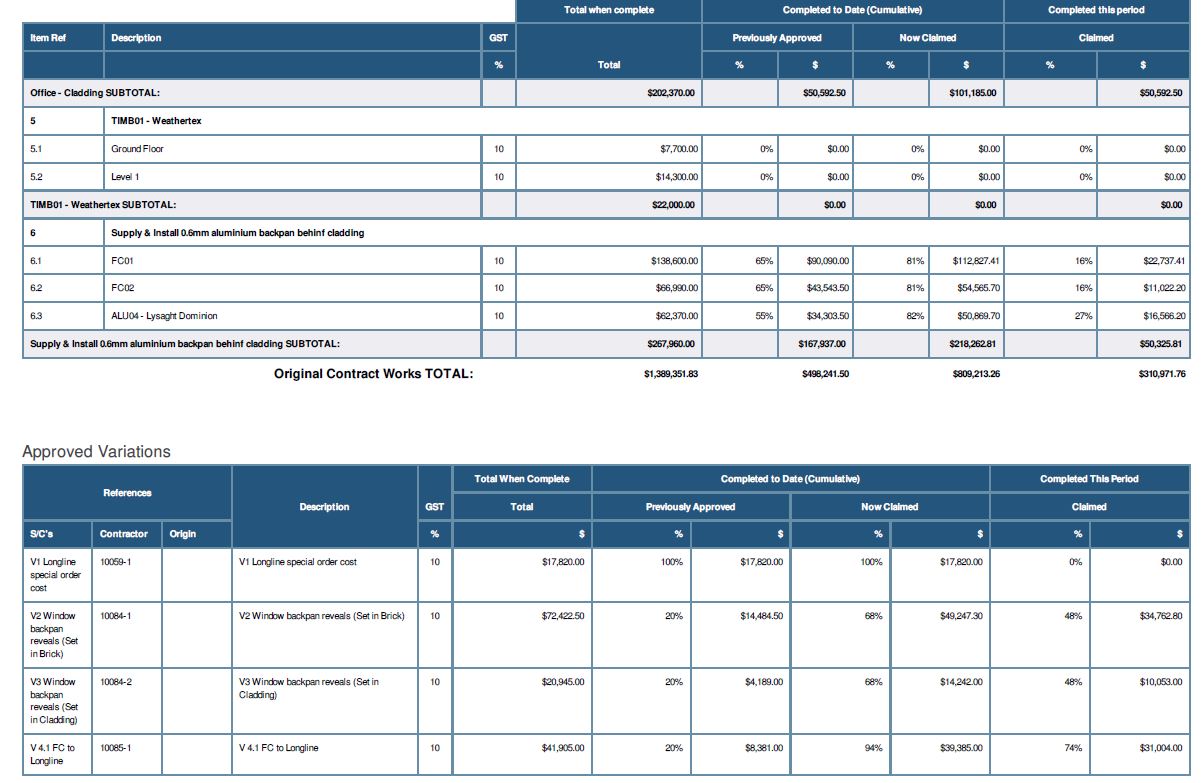
2) Part 4 of the Act, entitled “Procedure for recovering progress payment”, creates a procedure for recovering progress payments.
3.1 Part 3 of the Act: the entitlement to progress payments for construction work
15 Turning first to Part 3 of the Act (ss 10-14), s 10 creates the entitlement to progress payments and relevantly reads:
Right to progress payments
(1) On and from each reference date under a construction contract, a person is entitled to a payment (a progress payment), if the person has undertaken, under the contract, to—
(a) carry out construction work; or
(b) supply related goods and services.
(2) A progress payment may include—
(a) the final payment for construction work carried out, or for related goods and services supplied, under a construction contract; or
(b) a single or one-off payment for carrying out construction work, or for supplying related goods and services, under a construction contract; or
(c) a milestone payment.
(3) In this section—
…
reference date, for a construction contract, means—
(a) a date stated in, or worked out under, the contract as the date when a claim for a progress payment is to be made in relation to work carried out or undertaken to be carried out, or related goods and services supplied or undertaken to be supplied, under the contract; or
(b) if the contract does not provide a date mentioned in paragraph (a)—
(i) the last day of the calendar month in which the construction work was first carried out, or the related goods and services were first supplied, under the contract; and
(ii) the last day of each subsequent named month.
(Emphasis in original.)
16 The operation of s 10 of the Act, particularly s 10(3), is directly raised by Bloc Constructions’ application for judicial review.
17 Section 11 in turn defines the amount of progress payment to which a person is entitled. That section provides:
Amount of progress payment
The amount of a progress payment to which a person is entitled in relation to a construction contract is—
(a) the amount worked out under the contract; or
(b) if the contract does not provide for an amount, the amount worked out on the basis of the value of—
(i) construction work carried out or undertaken to be carried out by the person under the contract; or
(ii) related goods and services supplied or undertaken to be supplied by the person under the contract.
(Emphasis in original.)
18 Section 13 specifies the date upon which a progress payment becomes payable. Relevantly, if the contract provides a date to pay progress payments, then the “progress payment under a construction contract is payable … on the day when the payment becomes payable under the contract”: s 13(1)(a) of the Act.
19 Finally, s 14 concerning the “effect of a pay when paid provision” provides that:
(1) A pay when paid provision of a construction contract has no effect in relation to any payment for—
(a) construction work carried out or undertaken to be carried out under the contract; or
(b) related goods and services supplied or undertaken to be supplied under the contract.
(2) In this section:
money owing, to a person under a construction contract, means money owing for—
(a) construction work carried out or undertaken to be carried out under the contract; or
(b) related goods and services supplied or undertaken to be supplied by the person under the contract.
pay when paid provision, of a construction contract, means a provision of the contract—
(a) that makes the liability of 1 party (the first party) to pay money owing to another party (the second party) contingent on payment to the first party by a further party (the third party) of the whole or any part of that money; or
(b) that makes the due date for payment of money owing by the first party to the second party dependent on the date on which payment of the whole or any part of that money is made to the first party by the third party; or
(c) that otherwise makes the liability to pay money owing, or the due date for payment of money owing, contingent or dependent on the operation of another contract.
(Emphasis in original.)
20 This provision assumes particular significance in the context of the third ground of Bloc Constructions’ judicial review application.
3.2 Part 4 of the Act: the procedure for recovering progress payments
21 As earlier mentioned, Part 4 of the Act creates a procedure by which construction work progress payments can be recovered. Critically, Part 4 is not framed as creating a mechanism for conclusively or finally disposing of the parties’ rights, but exists without prejudice to their rights apart from the Act. Thus s 38 of the Act relevantly provides that:
(1) Nothing in this part affects any right that a party to a construction contract—
(a) may have under the contract; or
(b) may have under part 3 (Right to progress payments) in relation to the contract; or
(c) may have apart from this Act for anything done or omitted to be done under the contract.
(2) Nothing done under this part affects any civil proceeding arising under a construction contract, whether under this part or otherwise, except as provided by subsection (3).
(3) In any proceeding before a court or tribunal in relation to any matter arising under a construction contract, the court or tribunal—
(a) must in any order or award it makes in the proceeding, take into account any amount paid to a party to the contract under or for the purposes of this part; and
(b) may make the orders it considers appropriate for the restitution of any amount so paid, and any other orders it considers appropriate, having regard to its decision in the proceeding.
22 The evident purpose of this Part is therefore to create a mechanism by which interim payments may be promptly paid during the course of building works, subject to the possibility of a later and final resolution of the parties’ rights. Equivalent legislation in New South Wales has been described as creating “a fast track interim progress payment adjudication vehicle” in Brodyn Pty Ltd v Davenport [2003] NSWSC 1019 at [14] (Einstein J) and “a speedy and effective means of ensuring that progress payments are made during the course of the administration of a construction contract, without undue formality or resort to the law” in Coordinated Construction Co Pty Ltd v Climatech (Canberra) Pty Ltd [2005] NSWCA 229; (2005) 21 BCL 364 at [45] (Basten JA). Chesterman J (as his Honour then was) described legislation in Queensland to similar effect as “emphasis[ing] speed and informality” in Minimax Fire Fighting Systems Pty Ltd v Bremore Engineering (WA) Pty Ltd [2007] QSC 333 at [20]. This informal and speed-oriented purpose must be borne in mind when construing the relevant provisions relating to interim progress payments under Part 4 of the Act: see, eg, Project Blue Sky Inc v Australian Broadcasting Authority [1998] HCA 28; (1998) 194 CLR 355 at [69] (McHugh, Gummow, Kirby and Hayne JJ); Construction, Forestry, Maritime, Mining and Energy Union v Australian Building and Construction Commissioner [2020] FCAFC 192; (2020) 282 FCR 1 at [4]–[5] (Allsop CJ).
23 Section 15 of the Act is the starting-point for the substantive provisions of Part 4, enabling the parties to make a claim for progress payments. That section relevantly provides:
Payment claim
(1) A person who is or who claims to be entitled to a progress payment under section 10(1) (the claimant) may give a claim (a payment claim) to the person who, under the construction contract concerned, is or may be liable to make the payment (the respondent).
(2) A payment claim must—
(a) identify the construction work or related goods and services to which the progress payment relates; and
(b) state the amount of the progress payment that the claimant claims is payable (the claimed amount); and
(c) state that it is made under this Act.
(3) The claimed amount may include any amount -
…
(b) that is held under the construction contract by the respondent and that the claimant claims is due for release.
(Emphasis in the original.)
The operation of s 15(2)(a) of the Act is directly raised by the first basis of Bloc Constructions’ application for judicial review.
24 Section 16 enables a respondent to reply to a payment claim through the provision of a payment schedule and provides:
Payment schedule
(1) A respondent who is given a payment claim may reply to the claim by giving a schedule of proposed payment (a payment schedule) to the claimant.
(2) A payment schedule must—
(a) identify the payment claim to which it relates; and
(b) state the amount of the payment, if any, that the respondent proposes to make (the scheduled amount).
(3) If the scheduled amount is less than the claimed amount, the schedule must indicate—
(a) why the scheduled amount is less; and
(b) if the scheduled amount is less because the respondent is withholding payment for any reason—the respondent’s reasons for withholding payment.
(Emphasis in original; note to subs (1) omitted.)
25 In circumstances where a respondent does not provide a claimant schedule, and fails to pay the claimed amount in time, the claimant is capable of recovering the unpaid portion of the claimed amount as a debt due to the claimant: s 17(1)–(2) of the Act.
26 Sections 19–28 are contained in Division 4.2 of the Act, entitled “adjudication of disputes”. Section 19 provides a mechanism whereby a claimant may bring a claim before an adjudicator, and relevantly provides that:
Adjudication applications
(1) A claimant may apply to an authorised nominating authority, chosen by the claimant, for adjudication of a payment claim (an adjudication application) if—
(a) the respondent provides a payment schedule under this part, but—
(i) the scheduled amount indicated in the payment schedule is less than the claimed amount indicated in the payment claim; or
(ii) the respondent fails to pay the whole or any part of the scheduled amount to the claimant by the due date for payment of the amount; or
(b) the respondent fails—
(i) to provide a payment schedule under this part within the time allowed by section 16 (4); and
(ii) to pay the whole, or any part of, the claimed amount to the claimant by the due date.
(Emphasis in original.)
27 Section 24 in-turn outlines the requirements of the adjudicator’s decision. That provision relevantly provides:
Adjudicator’s decision
(1) The adjudicator for an adjudication application must decide—
(a) the amount of the progress payment, if any, to be paid by the respondent to the claimant (the adjudicated amount); and
(b) the day on which the amount became or becomes payable; and
(c) the rate of interest payable on the amount.
(Emphasis in original.)
The operation of s 24(1)(a) of the Act is directly raised by the second basis for Bloc Constructions’ application for judicial review.
28 The consequences of an adjudication decision are outlined, amongst others, in ss 25–27 of the Act. Unless specified, a respondent is required to pay an adjudicated amount within 5 business days after the day on which the adjudicator’s decision is given: s 25 of the Act. If the respondent fails to pay the adjudicated amount, the claimant may provide an adjudication certificate specifying (amongst others) the adjudicated amount: s 26(1)–(3) of the Act. That certificate may be filed and enforced as a judgment for a debt: s 27(1) of the Act.
4. THE JUDICIAL REVIEW APPLICATION
29 The judicial review application originally raised a wide-array of issues. As I have indicated, prior to the hearing, the parties narrowed the issues in dispute considerably. Before me, the following issues are no longer in dispute for the purposes of this application:
(1) whether there was a binding agreement between the parties—in this respect and bearing in mind s 38 of the Act, the parties filed an Agreed Fact stating that “for the purposes of this proceeding only, the parties agree that at all material times the applicant and the first respondent were bound by the terms of the draft Major Works Subcontract”;
(2) whether there had been a formal “Handover Agreement” between ABS Façade and a replacement contractor, to complete the remaining façade works following ABS Façade’s exit from the development; and
(3) whether the adjudicator had erred in law in finding that the retentions clause in the contract was a “pay when paid clause”, and so voided by s 14 of the Act.
30 I identified at the outset of these reasons the three remaining bases on which relief is sought by Bloc Constructions and address each in turn below.
4.2 The first ground: whether the payment claim failed to identify the construction work or related goods and services to which it related
31 By the first ground of their judicial review application, Bloc Constructions contends that payment claim seven submitted on 13 May 2022 failed to comply with s 15(2)(a) of the Act. It will be recalled that s 15(2)(a) of the Act provides that “a payment claim must identify the construction work or related goods and services to which the progress payment relates”. Bloc Constructions contends that the purported payment claim on 13 May 2022 did not comply with s 15(2)(a) of the Act, and that the adjudicator therefore lacked jurisdiction to make the determination.
32 This issue concerns the existence or non-existence of a jurisdictional fact which must objectively exist before the statutory power to adjudicate is enlivened: see Northbuild Constructions Pty Ltd v Central Interior Linings Pty Ltd [2011] QCA 22; [2012] 1 Qd R 525 at [32] (Chesterman JA); KDV Sport Pty Ltd v Muggeridge Constructions Pty Ltd & Ors [2019] QSC 178 at [12] (Brown J). Relevantly, “where the question is whether the decision-maker has erred as to the jurisdictional facts … that question has to be answered by the court in which it is litigated upon the evidence before that court”: Corporation of the City of Enfield v Development Assessment Commission [2000] HCA 5; (2000) 199 CLR 135 at [22] (Gleeson CJ, Gummow, Kirby and Hayne JJ). Ground one therefore turns upon whether, as a matter of fact, a payment claim was made which identified the construction work or related goods and services to which the progress payment related. Thus, a close examination of the relevant evidence pertaining to the 13 May 2022 purported payment claim is required.
4.2.1 Evidence related to the first ground of the judicial review application
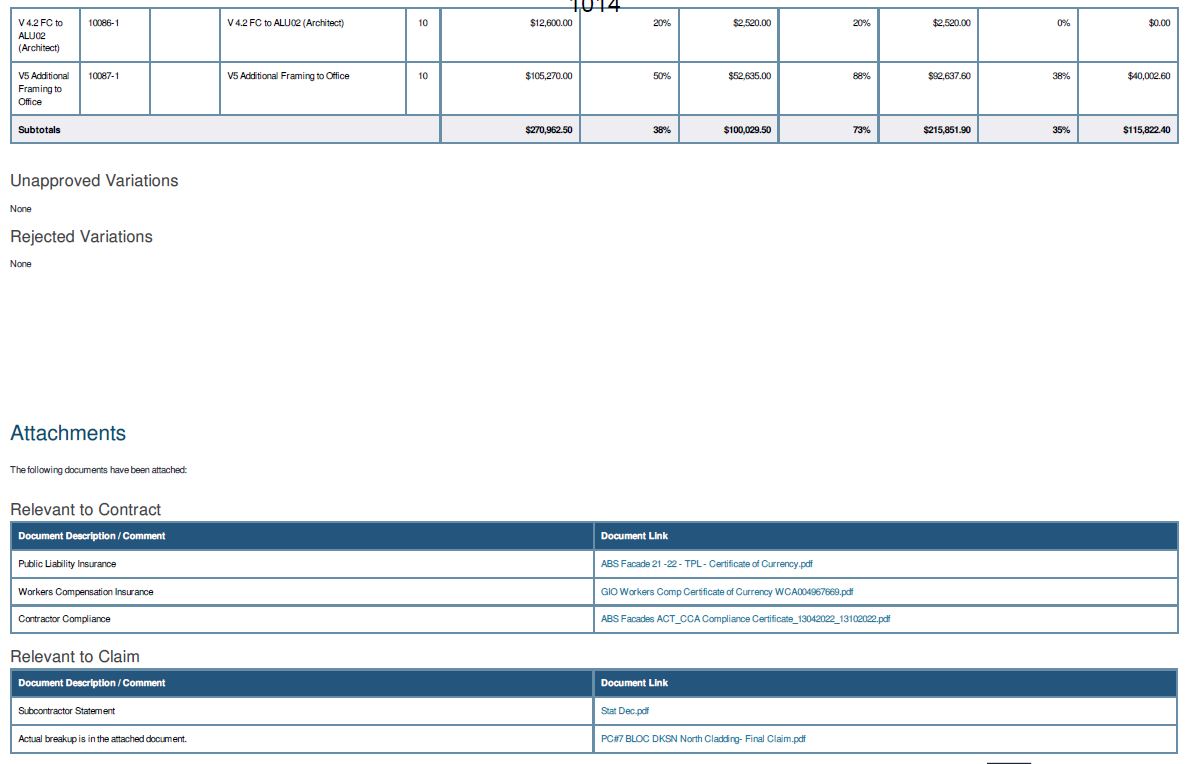
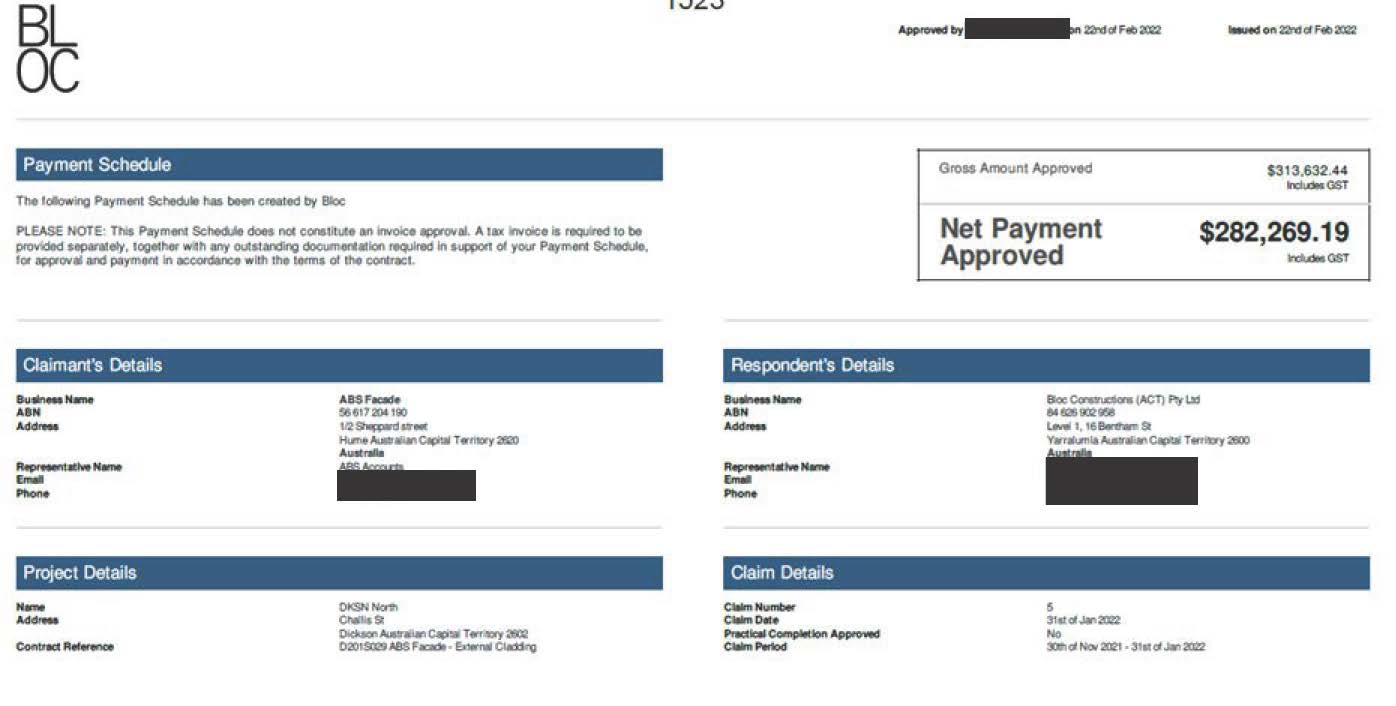
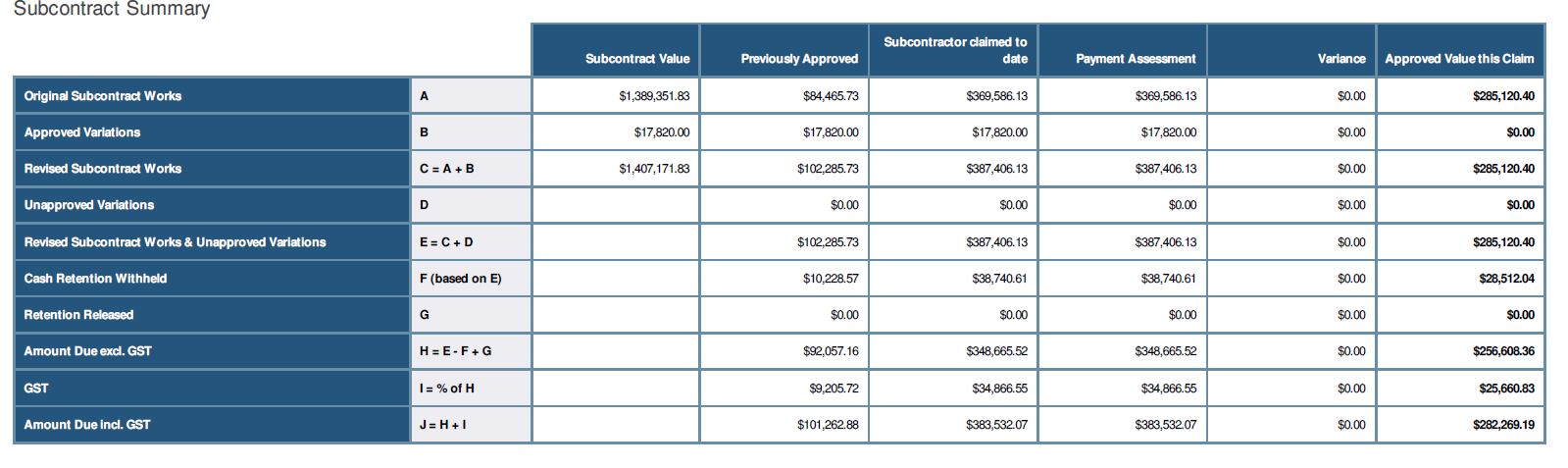
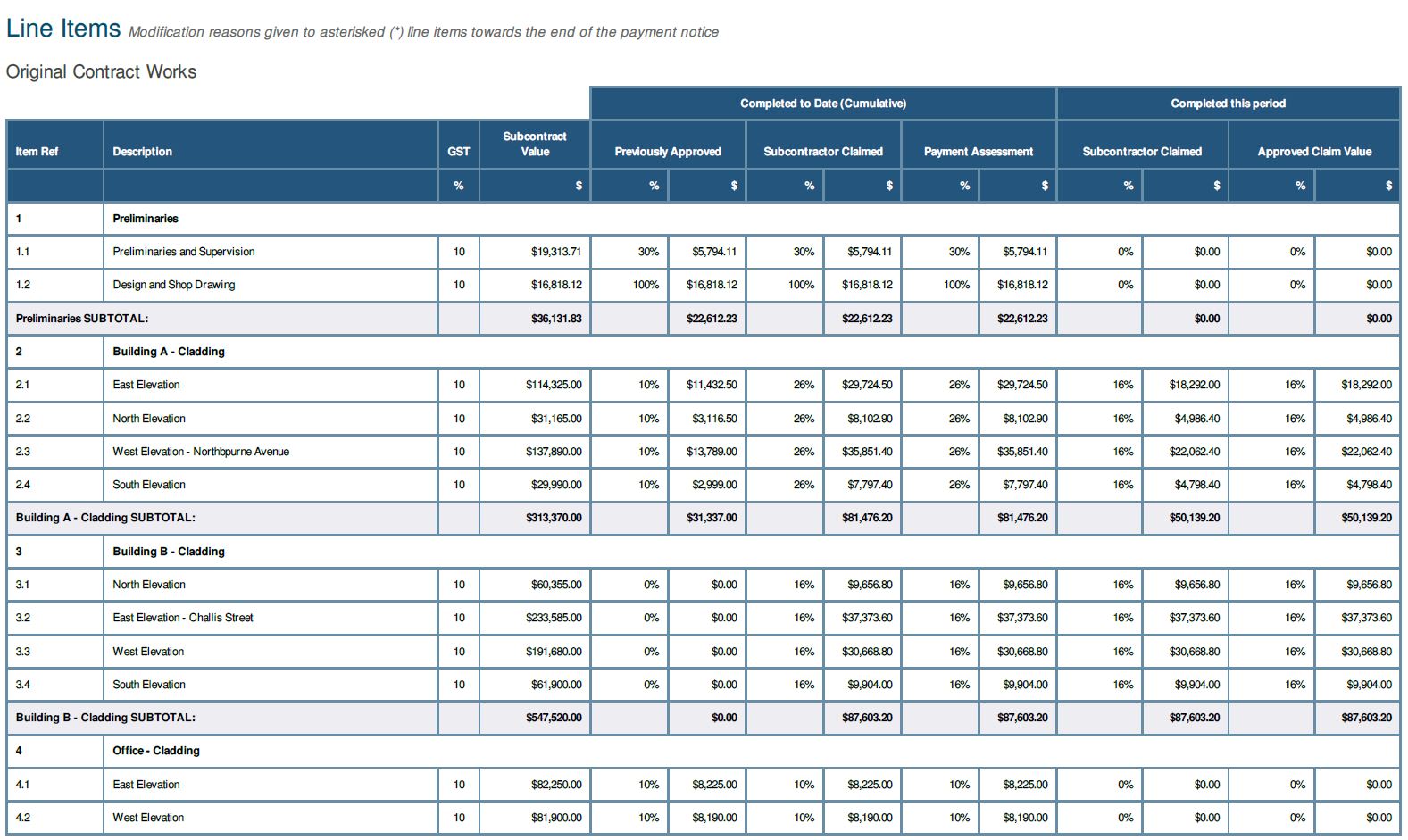
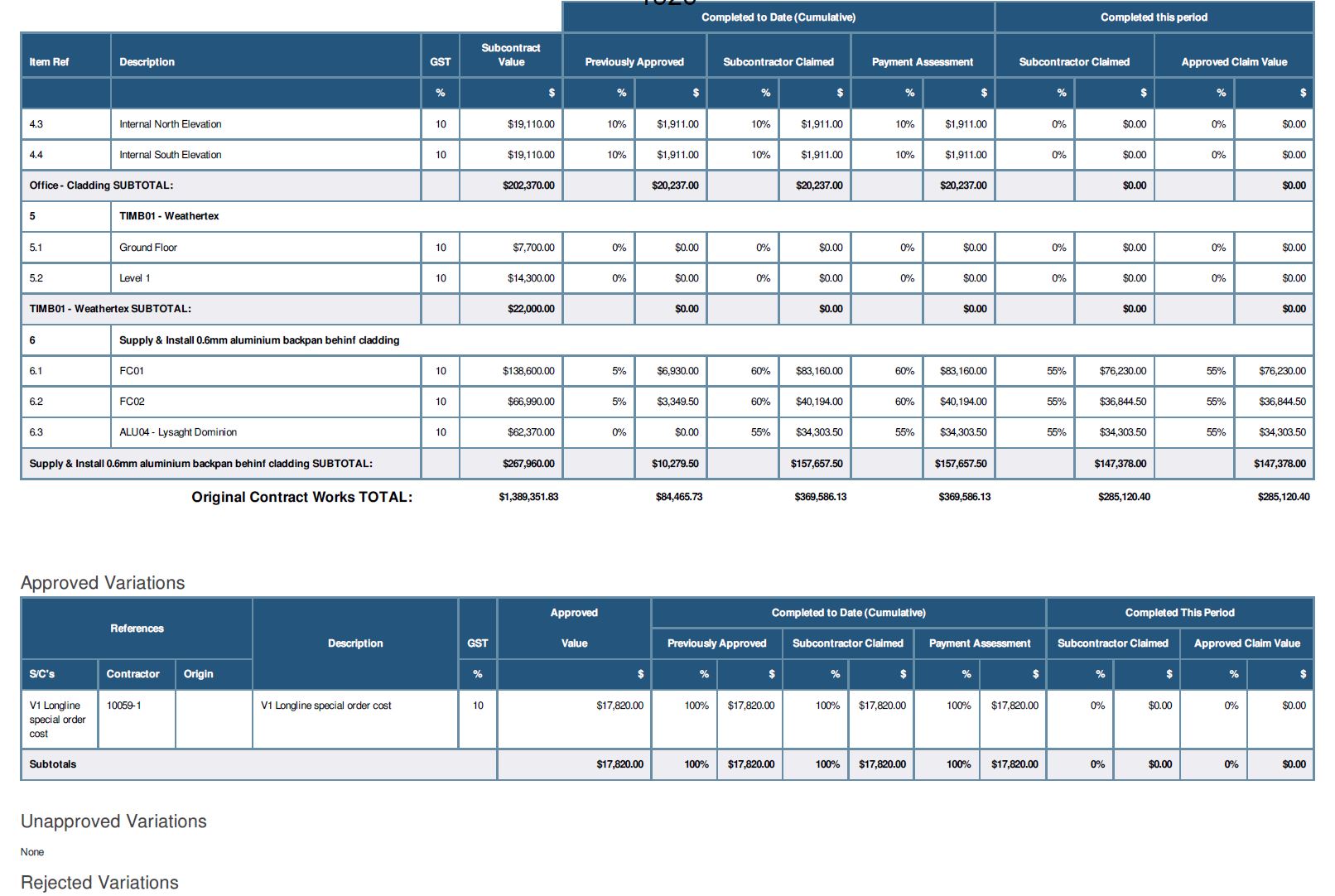
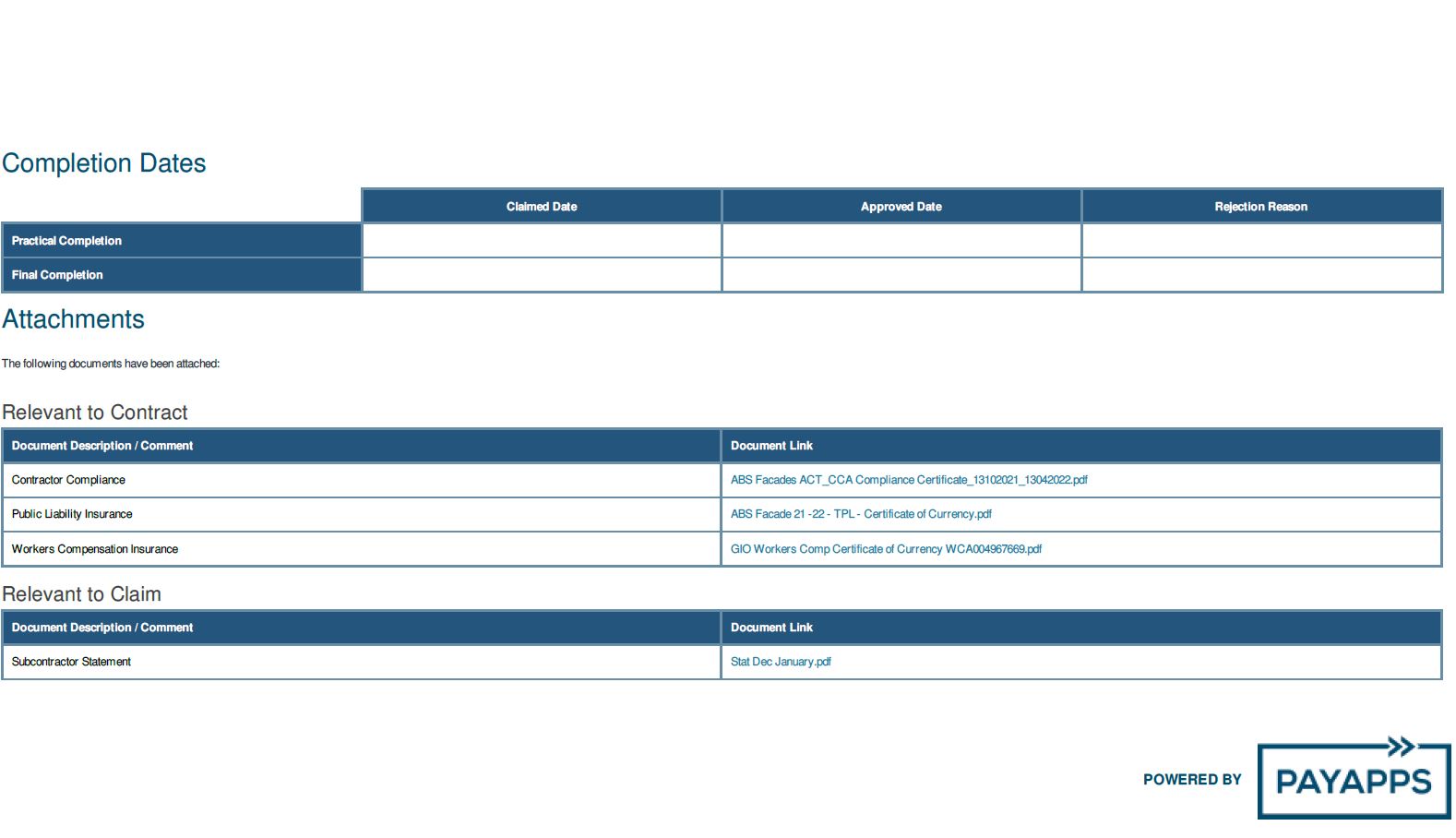
33 During the process of construction pursuant to the contract, the parties exchanged six “payment claims”. Those claims employed a common valuation methodology to calculate the outstanding payments owed between the parties. In broad terms, and at risk of simplification, that payment methodology involved the provision of a payment schedule, made through the pay application called Payapps. The schedule outlined the net payment approved, and summarised the basis on which the particular claim value had been calculated. The payment schedule further set out various “line items”, being a statement of costs claimed in relation to each specific cladding area. Those line items also included an “approved claim value”, expressed in terms of completion percentages. An example of this payment methodology is found at Annexure A to these reasons. That annexure concerns the fifth payment claim, issued on 22 February 2022. The other six initial “payment claims” are made in identical terms, save that the values, completion percentages, and other payment details in each of the tables differs according to the nature of the works completed.
34 During the period March to mid-April of 2022, ABS Façade were in discussions with Bloc Constructions regarding works that were to be handed over to a replacement contractor. That necessitated the making of a further payment claim (payment claim seven). This was to be the last payment claim between ABS Façade and Bloc Constructions, before ABS Façade exited the site. That claim was sent by an employee of ABS Façade on 13 May 2022. The body of the covering email attaching payment claim seven stated the following:
Please find attached final claim for DKSN North (Cladding). It was also uploaded via Payapps, however the attached PDF is the actual breakdown of the final claim.
If you need any additional information, please let me know.
35 As indicated in that email, ABS Façade’s payment claim seven involved the sending of two different documents. The first document involved the Payapps claim. This document calculated payment claim seven using an identical methodology and structure to that used with respect to the first six payment claims, although the values, completion percentages and other payment details in the tables differed again from these in each of the other six payment claims. That document is found at Annexure C to these reasons.
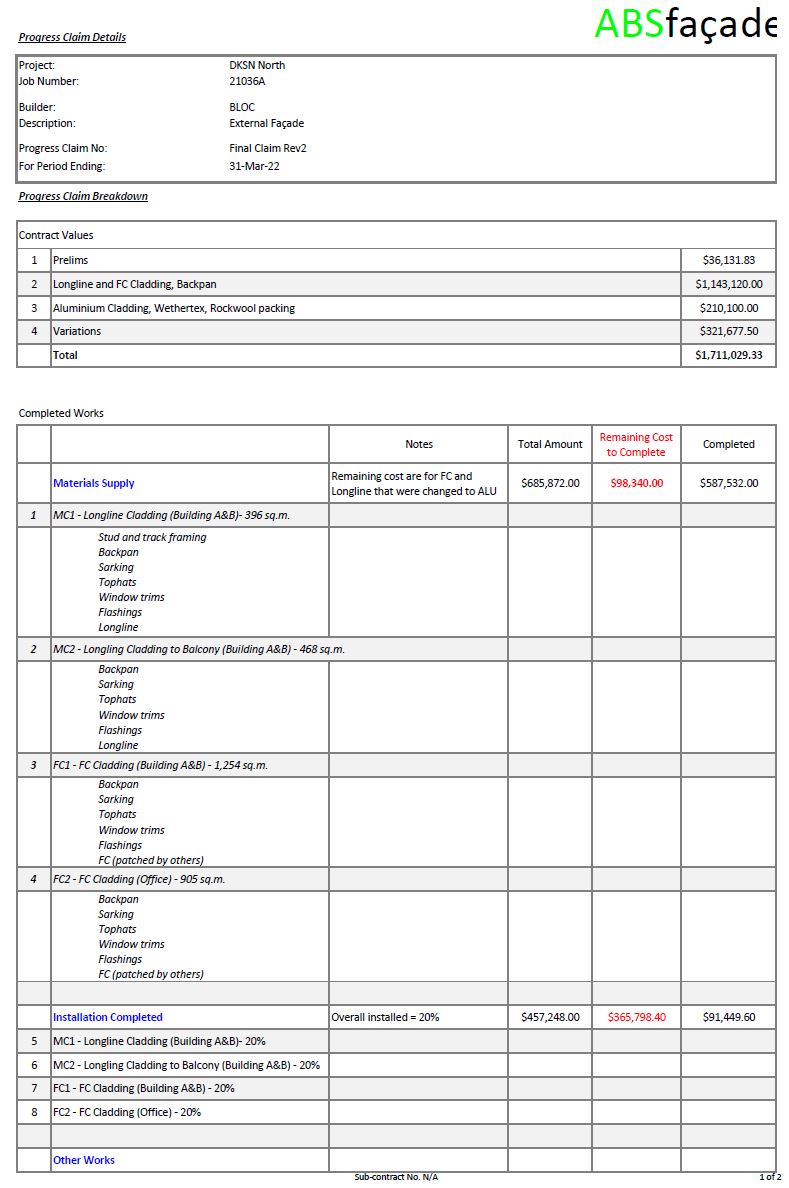
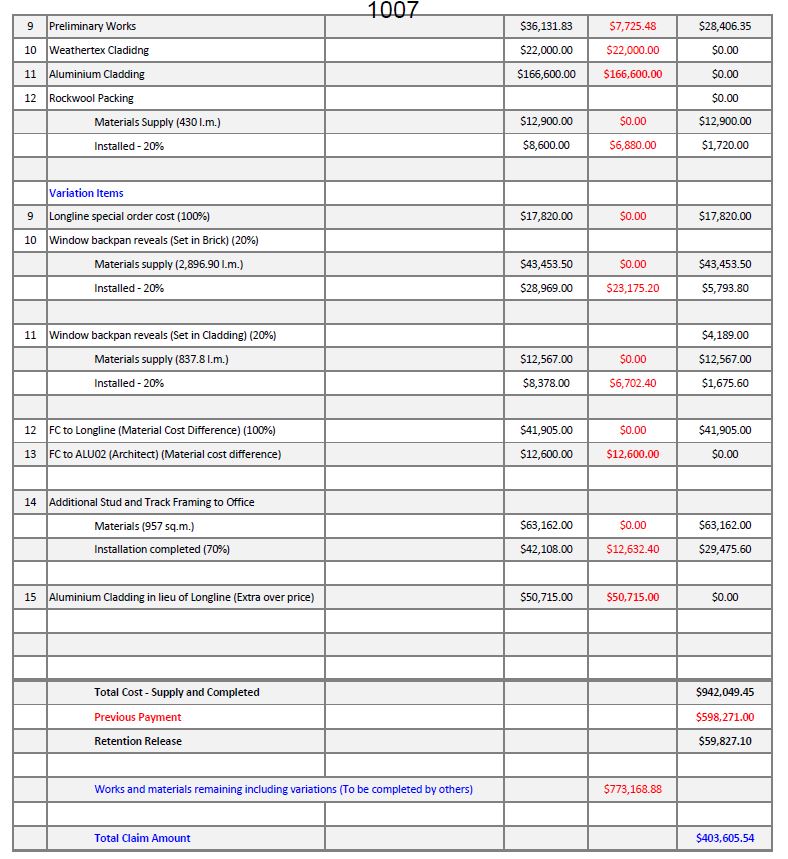
36 The second document annexed to the email, described as the “actual breakdown of the final claim”, was an “attached PDF” (PDF Breakdown). That document is found at Annexure B to these reasons. As is apparent from the face of the PDF Breakdown, this document was structured differently from (though not necessarily inconsistently with) the Payapps payment schedule.
37 At a high level, Bloc Constructions’ complaint in relation to the first ground of its judicial review application is that the information contained in these two documents did not meet the statutory requirement that a payment claim must “identify the construction work or related goods and services to which the progress payment relates” for the purposes of s 15(2)(a) of the Act.
4.2.2 Principles concerning the making of a payment claim
38 Halsbury’s Laws of Australia explains that all Australian jurisdictions protect a contractor’s and subcontractor’s entitlement to payment for construction work: LexisNexis, Halsbury’s Laws of Australia (updated to 10 January 2022) 65 Building and Construction ‘7 Statutory Rights to Secure Payment for Contractors and Subcontractors’ [65-775]. More specifically, s 13(2) of the Building and Construction Industry Security of Payment Act 1999 (NSW) (the NSW Act), s 17(2)(a) of the Building and Construction Industry Payments Act 2004 (Qld) (now repealed) (the Qld Act) and s 14(2)(c) of the Victorian Act are in relevantly identical terms to s 15(2)(a) of the Act and have been the subject of judicial consideration. Further as I have earlier explained, that legislation has been held to serve similar aims, namely, to provide “a fast track interim progress payment adjudication vehicle”: Brodyn at [14]. It is therefore helpful and relevant to draw upon the jurisprudence developed in these other jurisdictions by analogy, as indeed Courts have done in these jurisdictions: see, eg, KDV Sports and Minimax. So much was not controversial. I also note that s 68(1) of the current legislation in Queensland, the Building Industry Fairness (Security of Payment) Act 2017 (Qld), imposes an equivalent requirement in relevantly identical terms to s 15(2) of the Act.
39 The principles concerning whether the making of a payment claim complies with these legislative provisions are well-settled, and were helpfully summarised by Brown J in KDV Sport at [8]–[18]. The following points of principle, in particular, are worth emphasising.
40 First, the capacity of the Court to interfere with an adjudication decision is limited to cases where jurisdictional error is established (as I have earlier explained). As a consequence, Brown J, for example, explained in KDV Sport at [7]:
The question for the Court is not whether the Court would have come to the same conclusion as the adjudicator; the question is whether the adjudicator performed the functions demanded by the Payments Act [Qld] keeping in mind that the legislative intent is that a person with the relevant expertise is selected for the task by an informed body to facilitate the rapid decision making required. There are many errors of fact and law which might be made by an adjudicator which would not be regarded as going to jurisdiction.
41 Secondly, the requirement imposed by s 15(2)(a) and its equivalents in other jurisdictions concerns the sufficiency of the information provided in the payment claim. The claim must have “reasonably identified the construction work to which it related such that the basis of the claim was reasonably comprehensible to the applicant”: T & M Buckley Pty Ltd v 57 Moss Rd Pty Ltd [2010] QCA 381; (2010) 27 BCL 280 at [38] (Philippides J, with whose reasons Fraser JA at [1] and White JA at [2] agreed) by analogy. A failure to reasonably identify the construction work to which the payment claim relates will mean that the requirements in s 15(2)(a) have not been satisfied.
42 Thirdly, the requirement of reasonable comprehensibility is “not overly demanding”: Protectavale at [11]–[12] (Finklestein J). In particular, because the Act “emphasises speed and informality … one should not approach the question whether a document satisfies [s 15(2)(a) of the Act] from an unduly critical viewpoint”: Protectavale at [11], quoting Minimax at [20] (Chesterman J) with approval. Nonetheless, a payment claim must be sufficiently detailed to enable the principal to understand the basis of the claim. As Finkelstein J further explained at [12]:
If a reasonable principal is unable to ascertain with sufficient certainty the work to which the claim relates, he will not be able to provide a meaningful payment schedule. That is to say, a payment claim must put the principal in a position where he is able to decide whether to accept or reject the claim and, if the principal opts for the latter, to respond appropriately in a payment schedule: Nepean Engineering Pty Ltd v Total Process Services Pty Ltd (in liq) (2005) 64 NSWLR 462, 477; John Holland Pty Ltd v Cardno MBK (NSW) Pty Ltd [2004] NSWSC 258 at [18]-[21]. That is not an unreasonable price to pay to obtain the benefits of the statute.
43 Similarly, Justice Philippides emphasised with respect to the Queensland equivalent requirement that “the issue for determination was not whether the payment claim explained in every respect the means by which a particular claim item had been calculated, but whether the relevant construction work or related goods and services was sufficiently identified”: T & M Buckley at [38]. As such, her Honour agreed at [36] and [37] with the observations by Santow JA in Nepean Engineering Pty Ltd v Total Process Services Pty Ltd (in liq) [2005] NSWCA 409; (2005) 64 NSWLR 462 at [47]–[48] that a payment claim must only provide “sufficient specificity … for its recipient to actually be able to identify a ‘payment claim’ for the purpose of determining whether to pay, or to respond by way of a payment schedule indicating the extent of payment, if any”.
44 Fourthly, the question whether the requirements of s 15(2)(a) are satisfied is determined objectively: KDV Sport at [15] (Brown J) and the authorities there cited. Whether a party subjectively considers the information provided to be sufficient cannot bear upon whether a Court is satisfied that the statutory requirements in s 15(2)(a) are met.
45 Fifthly and this notwithstanding, “it is not wrong to examine the issue from the vantage point of the parties to the particular contract”: KDV Sport at [16]. Thus, the test is whether the payment claim is sufficient “to enable the respondent to understand the basis of the claim”: Climatech at [25] (Hodgson JA) (emphasis added). Accordingly, the assessment is one which “takes into account the background knowledge of each of the parties derived from their past dealings and exchanges of documentation”: Neumann Contractors Pty Ltd v Peet Beachton Syndicate Limited [2009] QSC 376; [2011] 1 Qd R 17 at [25] (White J). Similarly, McDougall J held in Leighton v Arogen [2012] NSWSC 1323 (at [69]-[70]) (in a passage cited by Brown J with approval in KDV Sport at [15]):
It may be accepted that payment claims and payment schedules are to be understood as the parties to the relevant construction contract would have understood them. Thus, documents which appear to be extremely summary, or to the uniformed but not unintelligent observer brief to the point of incomprehensibility, may be sufficiently meaningful to the parties to enable them to know, respectively, the bases on which a particular payment claim is advanced and the bases on which it is opposed.
In this context, it may well be appropriate to take into account, in particular factual circumstances, the background knowledge of the parties (for example) by correspondence passing between them before and at the time the payment claim and payment schedule were exchanged. That material might enable the court to have a more informed understanding of the way that the parties would have perceived, and understood, the real issues sought to be raised.
(See also e.g. Protectavale at [10] (Finkelstein J).)
46 Finally, it is to be borne in mind that the ultimate issue is whether the payment claim identifies, in a reasonable way, the particular work in respect of which the claim is made: KDV Sport at [17] (Brown J). An error or inaccuracy in the payment claim will therefore not result in non-compliance with s 15(2)(a), so long as the payment claim still reasonably identifies the work in respect of which the claim is made: ibid. If a party disagrees with the payment claim, or considers a claim to be in error, they are entitled to respond to that claim by way of a payment schedule.
4.2.3 Disposition of the first ground
47 In essence, Bloc Constructions submitted that payment claim seven involved so radical a departure from the first six payment claims as not to comply with the requirements of s 15(2)(a) of the Act. In particular, in submissions, Bloc Constructions took issue with ABS Façade’s provision of the PDF Breakdown. Bloc Constructions submit that this two-page spreadsheet impermissibly asserted a lump sum for materials and a lump sum for labour, rather than supporting the claims by reference to specific components as it had done in the first six payment claims. Bloc Constructions contends that the lump-sum methodology adopted by ABS Façade in payment claim seven means that the payment claim did not “identify the construction work or related goods and services to which the progress payment relates” as required by s 15(2)(a) of the Act.
48 I do not accept that submission. In my view, payment claim seven satisfies the statutory requirement imposed by s 15(2)(a), for the following reasons.
49 First, much of Bloc Constructions’ argument on this issue proceeded from a criticism of the PDF Breakdown. Importantly, however, payment claim seven was not solely constituted by the two-page spreadsheet. Rather, it comprised both the PDF Breakdown, and the Paysapps claim. Bloc Constructions’ criticism of the PDF Breakdown in isolation, without reference to the Payapps claim, could not therefore provide an adequate basis to attack to attack the sufficiency of payment claim seven as a whole.
50 Importantly in this regard, at the trial and in documents filed after the hearing, Bloc Constructions conceded that payment claim seven was comprised of both the PDF Breakdown and the Payapps claim: see, eg, agreed Chronology of Events filed 11 August 2023, item dated 13 May 2023 (filed pursuant to orders made on 1 August 2023 requiring the parties to provide a joint chronology, with areas of disagreement marked up). That concession was rightly made. The covering email to the payment claim makes plain that payment claim seven includes both the PDF Breakdown, and “also” the Payapps upload. Considered in a common sense, practical manner, there could be no doubt that both documents constituted the payment claim.
51 In this context, Bloc Constructions’ isolated criticisms of the PDF Breakdown are of limited utility to its case with respect to the first issue. The question raised by this basis of judicial review concerned the sufficiency of the information within the payment claim as a whole. Submissions which attack one aspect of the payment claim, without considering the details of the claim in full, are not likely to shed light on the overall sufficiency of information provided in payment claim seven. For this reason, much of the focus of Bloc Constructions’ submissions—which compared the PDF Breakdown against other cases—were misplaced.
52 A question arises, in relation to this point, as to why ABS Façade decided to provide both the Payapps claim and PDF Breakdown for payment claim seven, when its previous six payment claims relied upon the Payapps system only. ABS Façade’s uncontested evidence on this issue, accepted by the adjudicator at [68]-[73], was that it considered the method of providing payment claims via Payapps to be inherently limited. This was because the Payapps system had several features which could not be overridden and customised, including that Payapps automatically calculated a claim with a certain percentage withheld for retention. Through payment claim seven, however, Bloc submits that it wished to claim the return of all retention amounts. It follows that any claim submitted on Payapps could not reconcile with the actual amount ABS Façade wished to claim in payment claim seven. However, ABS Façade’s position was that it was required to submit its payment claims via the Payapps system, and therefore could not simply provide the PDF Breakdown. As a result, ABS Façade submitted payment claim seven using the Payapps system, supplemented by the PDF Breakdown which provided the “actual breakdown” of the correct amount claimed for payment claim seven, including with retentions being calculated.
53 Secondly, in that context, I do not accept Bloc Constructions’ claim that payment claim seven “radically departed” from the valuation methodology previously adopted by ABS Façade in its payment claims. To the contrary, ABS Façade’s seventh payment claim included a Payapps claim, and therefore used an identical calculation methodology and structure to that provided in the first six payments. In addition to this information, ABS Façade then provided a further PDF Breakdown of its claim.
54 Critically, as outlined above, the test imported by s 15(2)(a) is one which “takes into account the background knowledge of each of the parties derived from their past dealings and exchanges of documentation”: Neumann Contractors at [25] (White J). The background knowledge of each party here indicates that Bloc Constructions could understand the basis of the claim against them. Specifically, ABS Façade had repeatedly provided payment claims using the Payapps system, and Bloc Constructions had repeatedly accepted the sufficiency of information in those payment claims. In circumstances where the seventh payment claim included this same methodology, the proposition that Bloc Constructions was unable to understand the nature of the claim against them is, with respect, implausible. In this respect, I adopt the reasoning of McDougall J in Isis Projects Pty Ltd v Clarence Street Pty Ltd [2004] NSWSC 714, who held (at [38]):
Where payment claims … have been used, apparently without objection, on 11 previous occasions, it is very difficult to understand how the use of the same format on the 12th and 13th occasions could be said not to comply with the requirements of [the Act]. If payments claims in that format had sufficiently identified the construction work to which the progress payment claimed related on 11 previous occasions, I find it hard to understand how they would lose that character on the 12th and 13th occasion.
(Upheld on appeal in Clarence Street Pty Ltd v Isis Projects Pty Ltd [2005] NSWCA 391; (2005) 64 NSWLR 448 at [33]–[34] (Mason P, Giles JA at [65] and Santow JA at [66] agreeing).)
55 Those comments are equally apt with respect to the present issue. ABS Façade submitted payment claims to Bloc Constructions using the Payapps system, apparently without objection, on six previous occasions before the present dispute arose. The seventh payment claim used an identical methodology, and supplemented that information with a further PDF Breakdown.
56 Thirdly, in oral reply submissions, Bloc Constructions submitted that the true issue with payment claim seven concerned the discrepancies between the PDF Breakdown, and the Paysapps claim. As raised orally in reply, Bloc Constructions’ complaint was two-fold:
(a) the amounts charged differed between the two documents; and
(b) the PDF Breakdown included a total installation figure of 20%, but that figure does not align with the Payapps system.
57 However, Bloc Constructions’ claim that the amounts charged differs between the documents is readily explicable on the face of the documents. The PDF Breakdown provides a “total claim amount” of $403,605.54. When combined with an additional 10% goods and services tax, the total claim amount is $443,966.09. That figure is identical to the net payment claimed in the Paysapps system of $443,966.09.
58 Likewise, the criticism of the total installation amounts is misplaced. The PDF Breakdown provides for a calculation of the “overall installed” amount, which is stated to be 20%. Whilst the Paysapps claim does not include a similar 20% figure, that is because the Payapps claim does not include a global “overall installed” calculation. Rather, it provides a percentage breakdown for the façade across particular buildings and zones. As such, there is no necessary discrepancy between the total installation amount across the two documents.
59 In any event, merely claiming that there are discrepancies between the two documents is insufficient to establish that payment claim seven did not comply with s 15(2)(a) of the Act. Ultimately, the proper test for determining compliance with this provision is whether the “payment claim reasonably identified the construction work to which it related such that the basis of the claim was reasonably comprehensible” to the respondent party: T & M Buckley at [38] (Philippides J) (emphasis added). The test is one of reasonable comprehensibility, not accuracy. Mere “[e]rrors or inaccuracies in the payment claim will rarely, if ever, provide a basis for concluding that it is not made in accordance with [s 15(2)(a) of the Act]”: KDV Sport at [17] (Brown J). If a party considers the payment claim to be in error, they are entitled to challenge that payment claim, first by replying to that payment claim through a payment schedule (s 16 of the Act), and then through an adjudication of the any remaining dispute (Division 4.2 of the Act). Only if an error is so significant that the basis of a claim is not reasonably comprehensible will those errors provide a basis for setting aside a payment claim for non-compliance with s 15(2)(a) of the Act.
60 In submissions, with respect, Bloc Constructions advanced no reason as to why any purported discrepancies were so significant as to fail to meet the standard of reasonable comprehensibility imposed by the Act. To the extent that Bloc Constructions disagreed with the payment claim, they were entitled to (and in fact did) challenge those claims through the mechanisms in the Act. For the reasons outlined above, and in circumstances where payment claim seven included the same Payapps methodology accepted by Bloc Constructions for the first six payment claims, none of the purported discrepancies of which the applicant complained provide a basis for finding that the payment claim did not comply with s 15(2)(a) of the Act.
61 Accordingly, the first ground of Bloc Constructions’ judicial review application has not been established.
4.3 The second ground: whether the adjudicator failed to determine the payment to be made by Bloc Constructions
62 Secondly, Bloc Constructions alleges that the adjudicator did not comply with s 24(1)(a) of the Act. That section provides that “the adjudicator for an adjudication application must decide the amount of the progress payment, if any, to be paid by the respondent to the claimant” (emphasis added). In essence, Bloc Constructions argues that the adjudicator failed to determine the amount “to be paid”, because the adjudicator’s reasons required the parties to determine the amount actually required to be paid as part of the adjudication amount. Bloc Constructions submits that the consequence of this reasoning was that the decision was affected by jurisdictional error.
63 This second issue therefore turns on whether the adjudicator did, in fact, decide an amount of progress payment to be paid. That requires careful consideration of the adjudicator’s decision itself.
4.3.1 Relevant aspects of the adjudicator’s decision
64 For the purposes of the second ground, it suffices to focus upon the following aspects of the adjudicator’s reasons.
65 First, as I have noted, the face of the decision records the “Adjudication Amount” as being $318,975.49 (including GST). The method of calculating that figure was specified in [309]–[310] of the adjudicator’s reasons, as follows:
I am satisfied that the Claimant has established an entitlement under the Act to be paid an adjudicated amount of $318,975.49 (including GST).
For the purposes of an interim payment under the Act I decide that … of the monies claimed in the Payment Claim … the Claimant has established an entitlement to be paid an amount of $318,975.49 (including GST), calculated as follows:
Preliminaries: $ 16,818.12
Variations: $ 213,332.50
Retention: $ 59,827.10
Less Respondent’s set off: -$Nil
Subtotal: $ 289,977.72
Plus GST: $ 28,997.77
Total: $318,975.49 (including GST)
(Emphasis in original.)
66 Those calculations were each based upon a consideration of various claims made by the parties, and related evidence presented before the adjudicator. The adjudicator’s reasons set out, in some detail, the basis on which he arrived at these calculations.
67 Second, the total adjudication amount of $318,975.49 includes the sum of $16,818.12 for the category of “Preliminaries”. The basis on which the adjudicator reached the figure of $16,818.12 for this item was summarised at [266]–[267] of his reasons as follows:
I am satisfied that the Claimant has established an entitlement to be paid the Preliminaries amount claimed for design and shop drawings. As this amount can be quantified and there is no evidence that it has been previously paid, I am satisfied that the Claimant is entitled to the amount claimed: $16,818.12.
In the event that the amount has in fact been paid, pursuant to Payment Claim #6 or otherwise, the parties will need to take that into account when assessing the amount which the Claimant can pursue payment pursuant to this Adjudication.
(Emphasis in original.)
4.3.2 Disposition of the second issue
68 By its second ground, Bloc Constructions impugns the adjudicator’s reasoning at [266]-[267] At a high level, Bloc Constructions contends that the adjudicator’s reasons in these passages had the effect of valuing some of the construction work, but then leaving to the parties to determine how much of that work must actually be paid. That approach is said to fall into error, because s 24(1)(a) of the Act requires the adjudicator to decide the amount “to be paid” to the claimant by the respondent.
69 That submission must be rejected.
70 First, I accept that s 24(1)(a) imposes an obligation on an adjudicator to calculate the precise amount which a respondent must pay to a claimant. If an adjudication fails to provide that calculation, or leaves the calculation at the parties’ discretion, the adjudicator would fail to fulfil their statutory duty to “decide the amount of the progress payment, if any, to be paid”, and their decision would be affected by jurisdictional error.
71 Secondly, however, I reject Bloc Constructions’ submissions that the adjudicator in this case has not complied with that statutory requirement. To the contrary, the adjudicator’s decision makes clear that he had calculated the amount to be paid: that is, a total of $318,975.49 (including GST). That figure is provided on the face of the adjudication document, under the heading “Adjudication Amount”. It is further repeated, once at [309] and twice at [310] of the adjudicator’s reasons, under the heading “adjudicated amount”. The basis for reaching that conclusion is detailed in an itemised breakdown at [310]. In my view, those statements disclose, quite plainly, that the adjudicator has calculated an amount “to be paid”, as is required by s 24(1)(a) of the Act.
72 Third, in that context, I do not accept Bloc Constructions’ criticism of [267] of the adjudicator’s reasons. Specifically, this paragraph did not, contrary to Bloc Constructions’ submissions, require the parties to determine how much of the overall amount awarded was required to be paid between them.
73 With respect, that argument proceeds from a misunderstanding of the adjudicator’s reasons. In this regard, it has oft been emphasised that the reasons of an administrative decision-maker are to be read fairly and “are not to be construed minutely and finely with an eye keenly attuned to the perception of error”: Minister for Immigration and Ethnic Affairs v Wu Shan Liang [1996] HCA 6; (1996) 158 CLR 259 at 272 (Brennan CJ, Toohey, McHugh and Gummow JJ, quoting with approval Collector of Customs v Pozzolanic Enterprises Pty Ltd [1993] FCA 456; (1993) 43 FCR 280 at 287 (the Court)).
74 As outlined above, at [266], the adjudicator found that an amount of $16,818.12 for preliminaries should be awarded. As is apparent from the adjudicator’s reasons, one issue with respect to this item was whether this amount had already, in fact, been paid. In this regard, the adjudicator stated that there was “no evidence that it had been previously paid”, and his decision to award $16,818.12 in full to the claimant for preliminaries was based on the state of the evidence before him. Having made those findings, the adjudicator then stated (in the sentence on which Bloc Constructions focused) that “[i]n the event that the amount has in fact been paid … the parties will need to take that into account when assessing the amount which the Claimant can pursue” (at [267]).
75 Read in context, at [267], the adjudicator was not indicating that the parties were to negotiate or separately determine how much of the preliminaries component the parties were to pay. The adjudicator had already determined that amount—$16,818.12. Rather, the adjudicator was indicating that if that amount had been paid, that would affect the amount which ABS Façade could ultimately pursue in later claims. In this regard, it is worth re-emphasising that the adjudication scheme established by the Act does not finally determine the parties’ rights and liabilities. Nor does the adjudication mechanism affect any right that a party to a construction contract has under that contract, or under the Act itself: s 38(1) of the Act. Rather, the purpose of the adjudication mechanism is to provide “a fast track interim progress payment adjudication vehicle”, pending a final and conclusive later resolution of the parties’ rights and liabilities: Brodyn at [14].
76 In that statutory context, the adjudicator’s comments at [267] are entirely intelligible, and are not affected by any error. On the one hand, the adjudicator indicated that, based on the evidence before him and for the purposes of the interim adjudication under the Act, the amount to be paid was $16,818.12 for preliminaries. On the other hand, the adjudicator stated that, if Bloc Constructions had already paid this amount, the payment would be relevant to any later amount which ABS Façade could pursue. That reasoning was based on an entirely correct understanding of the relevant statutory scheme.
77 Thus, viewed in its totality and in light of the relevant statutory scheme, the adjudicator’s reasons, including [267], complied with the requirement of s 24(1)(a) of the Act. A fair reading of the adjudicator’s reasons make it plain that the adjudicator awarded an amount to be paid by Bloc Constructions to ABS Façade. The second ground of Bloc Constructions’ judicial review application must therefore be dismissed.
4.4 The third ground: whether there was a reference date for payment claim seven
78 The third ground on which Bloc Construction seeks judicial review is that no reference date under the contract existed for making payment claim seven, and that the adjudicator therefore lacked jurisdiction to entertain the adjudication application. In essence, Bloc Constructions’ argument on this issue relied upon six different steps, which may be summarised as follows:
(1) the existence of a reference date is a statutory precondition to the making of a valid payment claim which founds the jurisdiction of the adjudicator to award an adjudication amount: Southern Han Breakfast Point Pty Ltd (in liq) v Lewence Construction Pty Ltd [2016] HCA 52; (2016) 260 CLR 340 (citing ss 8(1) and 13(1) of the NSW Act, which is relevantly analogous to ss 10(1) and 15(1) of the ACT Act);
(2) the Act allows the parties to nominate a reference date by reference to the relevant contractual terms (s 10(3) of the Act (para (a), definition of “reference date”));
(3) the contract provided a single reference date by which the “final payment claim” was to be made (defined in cl 13.12 of the contract), being 10 business days after the expiry of the last defects liability period, which is 52 days after the date of practical completion under the contract: cl 1.1(pp) and Annexure A item A.17 of the contract;
(4) assessed objectively, payment claim seven sent by ABS Façade to Bloc Constructions on 13 May 2022 was a “final payment claim” for the purposes of the contract;
(5) at the time of making payment claim seven, the relevant reference date for the final payment had not yet arisen, because no completion of the contract had occurred; and
(6) as no relevant reference date had arisen, the adjudicator lacked jurisdiction to award an adjudication amount.
79 Of these steps, only steps four and six were in dispute between the parties. ABS Façade contested the characterisation of payment claim seven as a “final payment claim” for the purposes of the contract. In its submission, payment claim seven is properly characterised as a (non-final) progress claim, the relevant reference date for which was the 23rd day of each calendar month prior to practical completion: see cl 13.1-13.6 and cl 1.1(lll) of the contract defining “Progress Claim Date”. Accordingly, ABS Façade submitted that it was entitled to make a (non-final) progress payment claim by 23 April 2022, the adjudicator had jurisdiction to award an adjudication amount, and no error was made out with respect to this issue.
80 For the following reasons, I agree with ABS Façade’s submission. This ground of Bloc Constructions’ judicial review application therefore also fails.
4.4.2 Relevant principles concerning the determination of a reference date
81 The relevant principles concerning this ground of review were again largely not in dispute between the parties.
82 First, the applicant correctly submits that “the existence of a reference date under a construction contract … is a precondition to the making of a valid payment claim [under the Act]”: Southern Han at [61]. Likewise, the “service of a [valid] payment claim … is an essential precondition to taking subsequent steps” in the progress payments procedure under the Act and, therefore, to an adjudication application and an adjudication within the jurisdiction conferred by the Act: Southern Han at [44]. In other words, the existence of a reference date founds the jurisdiction of the adjudicator to award an adjudication amount: Cat Protection Society of Victoria v Arvio Pty Ltd [2018] VSC 757 at [28]–[33] (Digby J) (applying Southern Han).
83 Secondly, because the validity of the payment claim founds the jurisdiction of the adjudicator to award an adjudication amount, “the Court is required to determine for itself the validity of a payment claim”: Cat Protection Society at [33]. As such, it is necessary for the Court itself “to determine whether in fact the reference date that is asserted … exists”: ibid. As with issue one above, “that question has to be answered by the court in which it is litigated upon the evidence before that court”: Enfield at [22] (Gleeson CJ, Gummow, Kirby and Hayne JJ). In this regard, as Digby J explained in Cat Protection Society at [32], to determine the existence of jurisdictional facts does not involve the Court engaging in impermissible merits review but rather is necessary to determine “the underlying legality of the power and processes that are presently subject to judicial review”.
84 Thirdly, it has already been seen that the reference date as defined in s 10(3) is relevantly “a date set by contractual force”: Southern Han at [70]. The reference in that provision to “a date stated in, or worked out under, the contract as the date when a claim for a progress payment is to be made” is plainly a “date fixed by operation of one or more express provisions of the construction contract”: Southern Han at [70]. Hence, in determining whether a particular reference date has arisen in this case, it is the contract which is determinative: Southern Han at [72]–[81].
85 Fourthly, a progress payment may include “the final payment for construction work carried out … under a construction contract” (s 10(2)(a) of the Act).
86 Finally, the assessment of whether a reference date exists under a contract is to be determined objectively, that is, the Court “should ascertain the meaning that the documentation would convey to a reasonable person having the background knowledge that should reasonably be ascribed to the parties at the time the document was served”: Cat Protection Society at [61]. That approach accords with well-established principles of contractual construction: see, eg, Equuscorp Pty Ltd v Glengallan Investments Pty Ltd [2004] HCA 55; (2004) 218 CLR 471 at [34] (the Court); Maggbury Pty Ltd v Hafele Australia Pty Ltd [2001] HCA 70; (2001) 210 CLR 181 at [11] (Gleeson CJ, Gummow and Hayne JJ).
4.4.3 Relevant provisions of the contract
87 Applying these principles, the contract between the parties here relevantly provides for two different types of payment claims, with two different reference dates: (non-final) progress payment claims; and the final payment claim. First, with respect to the former, cl 13.2 of the contract relevantly provides that:
Value of Progress Payments
The Subcontractor must not make any Progress Claim which exceeds the value of the Works to the extent that the Works have been completed on the relevant Progress Claim Date.
(Emphasis in original.)
88 As earlier mentioned, the term “Progress Claim Date” is then defined in cl 1(lll)(i) of the contract as meaning “prior to Practical Completion of the whole of the works, the 23rd day of each month for works done from the first to the last day of the current month”. The term “practical completion” is earlier defined in the contract: cl 1(hhh) of the contract. Practical completion, as defined, will be achieved only where, amongst other things, the Works are complete according to the Contract Documents, the building is fit for use and occupation, all services have been commissioned and are fully operational, and all approvals essential for the use, operation and maintenance of the Works have been supplied. There is no doubt that, at the time of submitting payment claim seven, the parties had not achieved practical completion of the relevant project.
89 The second type of payment is a “final payment claim”. Clause 1(oo) of the contract provides that the term “[f]inal payment claim has the meaning given in sub-clause 13.12” (emphasis omitted). Clause 13.12(a) of the contract both defines “final payment claim” and imposes a substantive obligation on the Subcontractor, providing that:
Final Payment Claim
On the Final Payment Claim Date, the Subcontractor must give the Builder a written Final Payment Claim (being a Progress Claim together with all other claims whatsoever in connection with the subject matter of this Subcontract in respect of any matter or thing which occurred during the Defects Liability Period for the Works) in the form of the Progress Claim Proforma in ANNEXURE E.
(Emphasis in original.)
90 The term “final payment claim date” is defined as the date which is “ten (10) Business Days after the expiry of the last Defects Liability Period”: cl 1(pp)(i) of the contract. The defects liability period ends 52 weeks after the date of practical completion: cl 23.1 and annexure A item A.17 of the contract.
91 Clauses 13.12(c) and (f) of the contract further stipulate that:
Within ten (10) Business Days, the Builder must deliver to the Subcontractor a Final Certificate containing the details set out in sub-clause 13.6. The Final Certificate will evidence the moneys finally due and payable between the Subcontractor and the Builder on any account whatsoever in connection with the subject matter of this Subcontract.
…
The Final Certificate will be conclusive evidence that the Works have been completed satisfactorily, and the discharge of each party’s obligations in connection with the subject matter of this Subcontract …
(Emphasis in original.)
92 Clause 13.13 then provides for the parties’ release from the contract after making the “Final Payment Claim Progress Claim”, in these terms:
Release after Final Payment Claim Progress Claim
After the date for submitting the Final Payment Claim under sub-clause 13.12 has passed, the Subcontractor releases the Builder from any claim in respect of any fact, matter or thing arising out of, or in any way in connection with, the Subcontractor’s Works or this Subcontract which occurred during the Defects Liability Period.
(Emphasis in original.)
93 In addition, the contract also provides for payment and then release of certain retention moneys. For reasons that will become relevant below, it is helpful to set out the relevant clauses relating to that process. Clause 10.2 of the contract relevantly provides:
Retention Money
If the Subcontractor does not provide the security under sub-clause 10.1 by way of bank guarantee or performance bond, then the Builder may retain from each Progress Payment an amount equal to the percentage specified in Item A.12 of the Contract Particulars (ANNEXURE A Retention Money) of the otherwise gross amount of the payment until the Builder holds the security amount. This Retention Money will be retained by the Builder as security for the performance by the Subcontractor of its duties and obligations under this Subcontract. No interest is payable by the Builder on the Retention Money.
(Emphasis in original.)
94 Clause 10.3 provides for the means of release of the retention money, in these terms:
Release
The Builder must release 50% of the security held in accordance with sub-clause 10.1 within ten (10) Business Days of the later of:
(a) Date for Practical Completion; or
(b) the provision of warranties in accordance with sub-clause 21.3(d),
and will release the balance of the security upon issue of the Final Certificate.
95 In summary, therefore, the following points may be made about the contract:
(1) the ordinary process for making progress payment claims under the contact is through the “progress payment” mechanism created by cl 13.2:
(a) a progress payment is entitled to be claimed on the 23rd day of every month; and
(b) the claim for a progress payment cannot exceed the value of the works completed on that claim date;
(2) the exception to the ordinary mechanism of submitting progress payments is the final payment claim date, which falls ten days after the 52-week period following the date of practical completion.
4.4.4 Disposition of the third issue
96 Bloc Constructions submitted that, viewed objectively, payment claim seven was a purported final payment claim for the purposes of the contract. Drawing by analogy on the decision in Cat Protection Society holding that a payment claim was a “final” payment claim for the purposes of the contract in that case, Bloc Constructions relies upon a number of factors in support of this submission, namely:
1) ABS Façade described the claim as “final” in certain documents relating to the claim;
2) ABS Façade called for the balance of retentions, in circumstances where retention release was only capable of being called for after the final claim;
3) ABS Façade called for the balance of all monies; and
4) the payment clam was made in the context of negotiations to replace ABS Façade on site.
97 As to the first factor, it is true that ABS Façade described payment claim seven as a “final claim” in correspondence with Bloc Constructions regarding the claim. For example, under the heading “Final Claim for DKSN North (Cladding)” (emphasis added), the covering email of the payment claim stated:
Good Afternoon …
I hope you are well.
Please find attached final claim for DKSN North (Cladding). It was also uploaded via Payapps, however the attached PDF is the actual breakdown of the final claim.
If you need any additional information, please let me know.
Thanks.
(Emphasis added.)
98 Similarly, the tax invoice sent by ABS Façade to Bloc Constructions invoiced an amount of $443,966.09, under the heading “[f]or the works completed at the DKSN North Cladding per the attached final claim” (emphasis added).
99 Significantly, however, ABS Façade submitted the seventh payment claim following the normal monthly reference date for payment claims. Furthermore, it did not refer to the claim as the “Final Payment Claim” for the purposes of the contract or the Act but merely as the “final claim” simpliciter. Nor is that surprising in circumstances where (as is common ground) the seventh payment claim did not meet the definition of a final claim under the contract. Specifically, as I have outlined above, the Final Payment Claim was defined as a “Progress Claim together with all other claims … [arising] during the Defects Liability Period” (emphasis added). However, Bloc Constructions could not, and did not purport to, make “all other claims” (i.e. apart from an ordinary progress claim) with respect to matters occurring “during the Defects Liability Period” because the Defects Liability Period, as defined in the contract, commenced only after the date of practical completion, and no practical completion had been achieved. Indeed, the PayApps description of payment claim seven itself expressly stated under the heading “Claim Details”:
Practical Completion Claimed No
(CB1010)
100 Without practical completion, the seventh payment claim therefore could not be characterised as a Final Payment Claim for the purposes of the contract—the claim is simply a “progress claim”, as governed by cl 13.2 of the contract.
101 In line with this, payment claim seven indicated that only certain percentages of the project were completed. Thus, as counsel for ABS Façade submitted, ABS Façade’s seventh payment claim was “not relying upon the final claim date which requires, as precondition, the achievement of practical completion. They were expressly eschewing, on the face of this document, reliance upon the final claim date”. Furthermore, both parties were aware that ABS Façade was negotiating for a replacement subcontractor to enter the site and complete the remaining works.
102 As against these considerations, it would elevate semantics over the substance of the contract to hold that ABS Façade’s references to the “final claim” in correspondence meant that progress claim seven was objectively speaking the “final payment claim” for the purposes of the contract.
103 In support of its argument, Bloc Constructions also relied upon the fact, under the contract, the return of retention was capable of being called only after making the final payment claim: cl 10.3 of the contract. Hence Bloc Construction contended that ABS Façade’s call for retentions objectively indicated that payment claim seven was a purported final payment claim.
104 In this regard, it is correct to say that cl 10.3 of the contract provides for the release of security only “upon issue of the Final Certificate”, and thus after the final payment claim. However, before the adjudicator, Bloc Constructions contended (and the adjudicator apparently accepted) that this clause was a “pay when paid” provision, and was void by virtue of s 14 of the Act: see adjudicator’s decision at [276]–[287]. On this view, ABS Façade was entitled to claim retentions in payment claim seven, and did not need to wait until the final payment claim to call for the retention release.
105 It is not necessary to determine in this proceeding whether cl 10.3 was void by virtue of s 14 of the Act. Rather, the point is relevant because it demonstrates that it is at least arguable that ABS Façade could call for retentions, even if a final payment claim had not been made. In those circumstances, I do not consider ABS Façade’s decision to call for retentions to be objective evidence that this was a purported final payment claim.
106 It follows that, contrary to the applicant’s submissions, the decision in Cat Protection Society is distinguishable. In that case, as I have mentioned, Digby J held that a payment claim was a “final payment claim” under the Victorian Act. In reaching that conclusion, Digby J held (at [62]):
It is I consider significant that the [payment] claim dated 24 May 2018:
(a) was expressed to be a final payment claim for the purposes of the [Victorian] Act;
(b) included a claim for return of retention moneys (…);
(c) included a claim for the return of deposit moneys (…); and
(d) appears to claim the unpaid balance of the Contract Sum, subject to adjustments at the time of the claim, taking into account that only part of the works was completed prior to the Contract being terminated in late February/early March 2018.
107 Those features are, however, distinguishable from the present case. First and significantly, the payment claim considered in Cat Protection Society expressly stated that it was “the final payment claim for the purposes of that Act (at [58]; (emphasis added). No such claim was here made. On the contrary, as I have held, ABS Façade was plainly aware that payment claim seven could not meet the definition of the Final Payment Claim within the contract because practical completion had not been achieved, as stated on the face of the claim.
108 Second and again in contrast to the present case, the claim for “Return of retention moneys” in Cat Protection Society was not made in circumstances where there was any issue about the entitlement to call for the return of these monies otherwise than in or after a final payment claim, and was part of what the Court held was the contractor’s “apparent claim for the unpaid balance of the contract sum subject to adjustments” (at [64])
109 Third, unlike Cat Protection Society, no issue about deposit monies was at issue in this case.
110 Fourth, no issue as to the ‘unpaid balance’ of the contract sum here arises notwithstanding the bare assertion to the contrary in the applicant’s reply submissions at [31(c)]. Furthermore, while the final payment claim in Cat Protection Society did not expressly claim the “unpaid balance”, Digby J considered that it was significant that a claim to that effect was apparently made because a claim for the unpaid balance could only be made in the context of a final payment claim under the contract in that case.
111 Thus the circumstances in the present case are relevantly distinguishable from those which led Digby J to conclude that the payment claim in that case “in substance and effect constituted a purported [final] claim”.
112 In short, viewed objectively, the seventh payment claim was clearly not a final payment claim for the purposes of the contract. Rather, the description of the seventh claim as the “final claim” in the documents reflected the fact that the claim was made in circumstances where ABS Façade was to hand over the remaining works to a replacement subcontractor. Counsel for the respondent rightly described the applicant’s argument to the contrary as, with respect, “a classic straw man. [Bloc Constructions] seek to erect this claim as a final claim, say that the date for final claim had not arisen, and, therefore, say that it’s not valid.”
113 The third ground of Bloc Constructions’ judicial review application is dismissed.
114 In written and oral submissions, both Bloc Constructions and ABS Façade briefly addressed the question of whether the alleged errors were material. However, this question does not arise given my findings that no error has been established.
115 The appeal is therefore dismissed with costs. As foreshadowed, I make a further order that the moneys paid into the Court by the order made on 3 August 2022 be paid to the solicitors for ABS Façade.
I certify that the preceding one hundred and fifteen (115) numbered paragraphs are a true copy of the Reasons for Judgment of the Honourable Justice Perry. |
Associate:
Dated: 25 October 2023
ANNEXURE A: EXAMPLE OF THE FIRST SIX PAYMENT CLAIMS – PAYMENT FIVE DATED 22 FEBRUARY 2022
ANNEXURE B: THE PDF BREAKDOWN OF PAYMENT CLAIM SEVEN DATED 13 May 2022
ANNEXURE C: THE PAYAPPS PAY COMPONENT OF PAYMENT CLAIM SEVEN DATED 13 MAY 2022