

FEDERAL COURT OF AUSTRALIA
Davey v Vrsecky (Trustee), in the matter of Dessmann [2023] FCA 1274
ORDERS
IN THE MATTER OF PETER PATRICK DESSMANN | ||
Appellant | ||
AND: | PETR VRSECKY (AS TRUSTEE OF THE BANKRUPT ESTATE OF PETER PATRICK DESSMANN) First Respondent | |
PETER PATRICK DESSMANN Second Respondent | ||
DATE OF ORDER: |
THE COURT ORDERS THAT:
1. The appeal be dismissed.
2. The appellant pay the first respondent’s costs of and incidental to the appeal.
Note: Entry of orders is dealt with in Rule 39.32 of the Federal Court Rules 2011.
BEACH J
1 This bankruptcy matter came before me yesterday and concerned an appeal from the orders of a judge of the Federal Circuit and Family Court of Australia (Division 2) made on 12 May 2023.
2 Essentially, the appellant sought before the primary judge an order granting leave to proceed against the second respondent (the bankrupt) under s 58(3)(b) of the Bankruptcy Act 1966 (Cth), which leave her Honour refused. Section 58(3) provides:
58 Vesting of property upon bankruptcy—general rule
…
(3) Except as provided by this Act, after a debtor has become a bankrupt, it is not competent for a creditor:
(a) to enforce any remedy against the person or the property of the bankrupt in respect of a provable debt, or
(b) except with the leave of the Court and on such terms as the Court thinks fit, to commence any legal proceeding in respect of a provable debt or take any fresh step in such a proceeding.
3 Her Honour as a precursor dealt with the appellant’s application to amend his primary application, ultimately refusing such leave to amend and then refusing leave to proceed under s 58(3)(b).
4 Her Honour explained why she refused leave to amend, and most of those questions do not need to trouble me now. The present appeal is addressed to a narrower question concerning s 82(3) which I will come to in a moment. Suffice it to say that I agree with her Honour that the leave to amend questions lacked substance. Moreover, I agree with her Honour that the leave to proceed sought under s 58(3)(b) concerning various VCAT and Supreme Court of Victoria proceedings was misconceived. Either such proceedings had already been disposed of by the time of her Honour’s judgment or, if not, in any event the bankrupt was not a party to those proceedings.
5 There is one essential question that now remains concerning s 82(3) as it applies to a Magistrates’ Court order made on 5 June 2020, and the appellant’s three grounds of appeal are devoted to it although this is not readily apparent on the face of the notice of appeal. The grounds are expressed as follows:
1 The Appellant was denied procedural fairness at the Directions Hearing on the 12 May 2023 when the Court found summarily that section 82(3) Bankruptcy Act did not apply to the circumstances of this case.
2 Her Honour erred at law in finding summarily that s.82(3) only applied to criminal matters.
Particulars: Mathers & Anor -v- Commonwealth (2004) 134 FCR 135
3. Her Honour erred at law in determining that the Orders sought to be proceeded against the bankrupt were in fact provable debts within the estate of the bankrupt and accordingly not within the scope of section 82(3).
6 Now in this respect and relevantly to the s 82(3) question, her Honour said (at [12] to [16]):
The new proposed paragraph (d) of the application to this court is for the applicant to have leave to proceed against the bankrupt for rectification of some orders made by the Magistrates’ Court. The Magistrates’ Court orders were appealed to the Supreme Court of Victoria. Justice Keogh determined the appeal. Justice Keogh’s decision was further appealed to the Court of Appeal.
Justice Keogh considered, and it seems that it is no longer disputed, that to the extent that the magistrate made certain orders for compensation to be paid by the bankrupt to the applicant, that compensation could not be assessed by the Costs Court, contrary to the magistrate’s orders. In addition, Justice Keogh also apparently held, and nobody now disputes, that the magistrate was wrong in saying that the compensation ordered by the magistrate could be calculated under the practitioner’s remuneration order.
The position is that while the magistrate did make orders for compensation to be payable by the bankrupt to the applicant, there are absolutely no funds in the bankrupt estate and no reasonable prospect of any return to creditors. Therefore, there is no benefit whatsoever in leave being granted for the applicant to be able to proceed against the bankrupt.
In an affidavit filed by the applicant late yesterday in support of this application, the applicant claimed that the compensation ordered by the magistrate was actually a penalty within the meaning of s.82(3) of the Act. That subsection provides that penalties or fines imposed by a court in respect of an offence against a law, whether a law of the Commonwealth or not, are not provable in bankruptcy. The court asked the applicant what the offence was that the bankrupt had committed in relation to the order for compensation. The applicant was unable to identify any offence, and, in effect, conceded that s.82(3) would not apply and the debt was in fact provable.
All in all, it seems to me that there would be no benefit to anyone in granting the applicant leave to amend the existing application to add the proposed paragraph (d) because there would be no benefit in giving the applicant leave to proceed against the bankrupt. Consequently, leave to add the proposed paragraph (d) to the existing application will not be granted.
7 Now putting to one side what the appellant thought that he was trying to do by the “new proposed paragraph (d)” of the application before her Honour, I am here concerned with what her Honour said at [15].
8 Now it would appear that her Honour may, understandably, have not fully appreciated what the appellant, who was self-represented, had put to her below although that does not amount to a denial of procedural fairness as asserted in ground 1. But none of this matters as her Honour’s conclusion that s 82(3) does not apply in my view is correct in any event. Let me elaborate.
9 Section 82(3) provides as follows:
82 Debts provable in bankruptcy
…
(3) Penalties or fines imposed by a court in respect of an offence against a law, whether a law of the Commonwealth or not, are not provable in bankruptcy.
…
10 There is no need in the present case for any exegesis seeking to define the boundaries and content of what is meant by a “penalty” or “fine” for the purposes of the phrase “[p]enalties or fines”.
11 Suffice it to say that howsoever one reasonably defines such notions, in the present case the relevant liability arising from the Magistrate’s order made on 5 June 2020 could not sensibly be described as a penalty or fine.
12 The Magistrate’s order provided for compensation to be paid to the appellant including relevant costs orders. The transcript of the Magistrate’s reasons delivered on that day also refer to breaches of various obligations under the Civil Procedure Act 2010 (Vic) (CPA) by one or more of the defendants including the bankrupt, or their lawyers.
13 Reference was also made in the orders entered to inter-alia making the relevant orders under the CPA. In evidence before me was the following form of the order made:
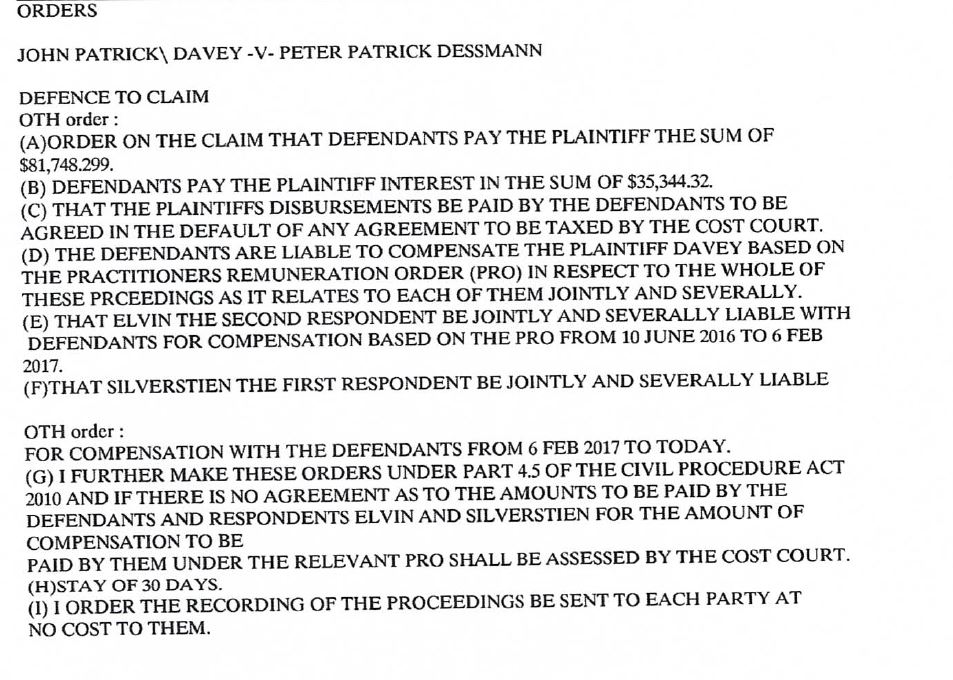
14 Now assuming in favour of the appellant for present purposes that as against the bankrupt in the Magistrates’ Court proceeding the compensation orders including costs orders were made against the bankrupt and in favour of the appellant by reason partly of contraventions or breaches of the CPA, such orders being compensatory cannot meet the description of a “fine” or “penalty” irrespective of how one characterises the underlying act or omission which justified the Magistrate making the order.
15 Moreover, Mathers v Commonwealth of Australia (2004) 134 FCR 135 does not require me to find otherwise. After all, and putting to one side any discussion concerning differences between concepts such as “offence”, “criminal offence”, “contraventions” and the like and whether one is talking about any criminal, civil or even hybrid characterisation, Heerey J was dealing with the concept of a pecuniary penalty which is a “penalty” for the purposes of s 82(3). Contrastingly, the case before me concerns a compensation order.
16 The compensation order in the appellant’s favour had no punitive or deterrent component designed to protect or promote any public interest relevant to any criminal or quasi-criminal context. Rather, the order both in form and in substance was to compensate the appellant.
17 Further, one has to be careful of the Magistrate’s references to aspects of the CPA.
18 His Worship referred to Part 4.5, but that is a reference to costs. But no power exercisable thereunder concerns penalties or fines as such. Any costs order is compensatory.
19 Further, true it is that his Worship referred to breaches of s 17 (a failure to act honestly), s 18(d) and s 21 (being misleading or deceptive). But none of this goes anywhere as I am concerned with the characterisation of the orders made, not the underlying causal conditions, and whether they fall within s 82(3) of the Bankruptcy Act.
20 Further, s 29 of the CPA does not assist. This provides:
29 Court may make certain orders
(1) If a court is satisfied that, on the balance of probabilities, a person has contravened any overarching obligation, the court may make any order it considers appropriate in the interests of justice including, but not limited to—
(a) an order that the person pay some or all of the legal costs or other costs or expenses of any person arising from the contravention of the overarching obligation;
(b) an order that the legal costs or other costs or expenses of any person be payable immediately and be enforceable immediately;
(c) an order that the person compensate any person for any financial loss or other loss which was materially contributed to by the contravention of the overarching obligation, including—
(i) an order for penalty interest in accordance with the penalty interest rate in respect of any delay in the payment of an amount claimed in the civil proceeding; or
(ii) an order for no interest or reduced interest;
(d) an order that the person take any steps specified in the order which are reasonably necessary to remedy any contravention of the overarching obligations by the person;
(e) an order that the person not be permitted to take specified steps in the civil proceeding;
(f) any other order that the court considers to be in the interests of any person who has been prejudicially affected by the contravention of the overarching obligations.
(2) An order under this section may be made—
(a) on the application of—
(i) any party to the civil proceeding; or
(ii) any other person who, in the opinion of the court, has a sufficient interest in the proceeding; or
(b) on the court's own motion.
(3) This section does not limit any other power of a court to make any order, including any order as to costs.
21 Clearly any order is compensatory, although the justification for any order must establish a causal connection with the contravention(s) of the overarching obligation(s); see also ss 28 and 30 of the CPA. Further, and for completeness, I am not here dealing with s 56(1) and discovery sanctions.
22 The appellant’s argument before me concerning the application of s 82(3) therefore fails.
23 So, the appellant had a provable debt constituted by the liability owed to him under the compensation order. And that being so, leave to proceed was necessary under s 58(3) in respect of any such debt. And such leave was not justified by the appellant before the primary judge, particularly given that there were no relevant legal proceedings on foot or then contemplated in respect of which it would have been fruitful to grant leave. Moreover, the bankrupt’s estate has no assets as the evidence provided to me by the first respondent, the trustee, indicates. Further, there has been no independent justification advanced before me as to why any leave to proceed should be granted in respect of any new or existing proceeding. Indeed, the appellant’s point before me was that he would not need leave to proceed if his point under s 82(3) had been good. If s 82(3) applied then one would not have a provable debt and accordingly s 58(3) would not operate.
24 Finally, after the hearing yesterday the appellant sent to my chambers a copy of Director-General, Department of Services, Technology & Administration v Veall (No 6) [2012] NSWSC 1118 and sought belatedly and unjustifiably for the first time to raise s 82(2) which provides:
82 Debts provable in bankruptcy
…
(2) Demands in the nature of unliquidated damages arising otherwise than by reason of a contract, promise or breach of trust are not provable in bankruptcy.
…
25 But neither that case nor s 82(2) assists. This is because I am not dealing with “[d]emands in the nature of unliquidated damages” or generally facts or circumstances before any judgment. I am dealing with the Magistrate’s order where any earlier causes of action or demands or their underlying circumstances, whether for liquidated or unliquidated amounts, had merged with that judgment.
26 Further, an unassessed compensation or costs order does not fall within s 82(2). Now true it is that the “value” of such an order may not have crystallised. But if not, that is a s 82(4) matter concerning a provable debt.
27 Further, it is not in doubt that a judgment debt or order including an order for costs is provable if the order is made prior to bankruptcy, as it was in the context that I am considering. I am not dealing with a case where the Magistrate’s order was made after the bankruptcy commenced. The general rule is that debts or liabilities arising from judgments issued prior to the date of bankruptcy are provable debts.
28 Moreover, even if some part of the Magistrate’s order had not been assessed or taxed prior to the commencement of the bankruptcy, that does not entail that one does not have a provable debt; see, for example, Foots v Southern Cross Mine Management Pty Ltd (2007) 234 CLR 52 at [65] to [67].
29 Further and for completeness, one can see from the form of the Magistrate’s order that I have set out earlier that the substantive compensation and interest were fixed at $81,748.29 and $35,344.32 respectively and that the later references to other compensation concerned costs; so the references to the “Practitioners Remuneration Order”, Part 4.5 of the CPA which deals with costs, and the “Cost Court”. As I say, all relevant elements of the order that I have identified constituted a provable debt.
30 In any event s 82(2) was not raised before the primary judge and I would not give leave to raise it now. Too little, too late and too lame. But even if I had granted leave to raise this new point I would have dismissed it as meritless.
31 The appeal must be dismissed with costs.
32 Let me make one other suggestion. The legislature should consider a general leave to appeal requirement being imposed for all judgments emanating from the Federal Circuit and Family Court of Australia (Division 2) that are sought to be challenged before this Court, whether relating to migration, bankruptcy or otherwise. These cases are of course important for the individual litigants, but this is no justification for the waste of judicial resources at this Court’s level where 90 to 95% of the appeals emanating from the lower court have little if any merit and should be filtered out through a leave threshold. Moreover, implicit in the justification for the leave threshold is that the lower court is doing a fine job in its adjudication of the cases before it. Further, introducing a general leave requirement would be conducive to promoting the use of short-form judgments which would enhance efficiency in this Court’s functioning.
I certify that the preceding thirty-two (32) numbered paragraphs are a true copy of the Reasons for Judgment of the Honourable Justice Beach. |
Associate:


