

Federal Court of Australia
Yoong v Director, Professional Services Review [2023] FCA 1186
ORDERS
Applicant | ||
AND: | DIRECTOR, PROFESSIONAL SERVICES REVIEW Respondent | |
DATE OF ORDER: |
THE COURT ORDERS THAT:
1. Pursuant to s 11(1)(c) of the Administrative Decisions (Judicial Review) Act 1977 (Cth), the time for the filing of the application with respect to the decision made on 21 May 2019 to issue the Notice to Produce Documents pursuant to s 89B of the Health Insurance Act 1973 (Cth) and the Notice to Produce Documents itself be extended to 16 November 2021.
2. The application for judicial review is granted.
3. In the absence of agreement as to the orders otherwise required to give effect to these reasons and/or as to costs:
(a) on or before 4pm on Friday 20 October 2023, the respondent is to file and serve an outline of written submissions not exceeding 5 pages in length in support of her proposed orders;
(b) on or before 4pm on Friday 27 October 2023, the applicant is to file and serve an outline of written submissions not exceeding 5 pages in length in response;
(c) on or before 4pm on Wednesday 1 November 2023, the respondent is to file and serve any submissions in reply not exceeding 3 pages in length; and
(d) final orders will be determined on the papers without a further oral hearing.
THE COURT NOTES THAT:
4. The parties are to endeavour in the first instance to agree to orders which otherwise give effect to these reasons and as to costs.
Note: Entry of orders is dealt with in Rule 39.32 of the Federal Court Rules 2011.
PERRY J:
[1] | |
[11] | |
[13] | |
[13] | |
[19] | |
[24] | |
[25] | |
[33] | |
[40] | |
4.4 Subsequent circumstances giving rise to the present proceeding | [45] |
[61] | |
[84] | |
6.1 Grounds 1(a) and 1(b): jurisdictional error and unauthorised exercise of power | [84] |
[86] | |
[102] | |
6.2 Ground 1(c): uncertain or unreasonable exercise of power | [114] |
[128] | |
[128] | |
7.2 Ground 2(e): exercise of the power under s 106ZPM(2) on dictation | [130] |
[130] | |
7.2.2 Legal principles: improper exercise of statutory power on dictation | [133] |
[147] | |
7.2.4 Dr Rankin’s evidence that he made an independent decision to issue the s 106ZPM notice | [152] |
7.2.5 Was the Second Decision made on dictation (ground 2(e))? | [158] |
[182] |
1 The applicant, Dr Matthew Yoong, is a specialist general practitioner and fellow of the Royal Australasian College of General Practitioners. The applicant has worked full-time in a single-doctor practice in Brisbane for over 25 years since completing his training. The applicant provides services in respect of which benefits under the Medicare system are paid within the meaning of the Health Insurance Act 1973 (Cth) (HI Act).
2 The respondent is the Director of the Professional Services Review (PSR) appointed under s 83 of the HI Act. The Director has an investigative function under Part VAA of the HI Act which establishes the Professional Services Review Scheme (PSR Scheme) for reviewing and investigating the provision of “services” by a person to determine whether the person has engaged in inappropriate practice.
3 On 15 April 2019, a delegate of the Chief Executive of Medicare (CEM) made a request under s 86(1) of the HI Act that the Director review the provision of services by the applicant during the period 1 May 2017 to 30 April 2018 (the Review Period), for the purpose of considering whether he may have engaged in inappropriate practice. On 30 April 2019, the Director decided to undertake that review pursuant to s 89A of the HI Act (the Review Decision). An earlier challenge by the applicant to the request by the CEM and to the Director’s decision to undertake the review was unsuccessful: Yoong v The Chief Executive of Medicare [2021] FCA 701 (Yoong (No 1)).
4 The applicant commenced this proceeding by an originating application on 16 November 2021. By an amended originating application for judicial review filed on 10 June 2022 with leave of the Court, the applicant seeks orders pursuant to s 16(1)(a) of the Administrative Decisions (Judicial Review) Act 1977 (Cth) (ADJR Act) and/or s 39B of the Judiciary Act 1903 (Cth) quashing or setting aside:
(1) a decision made by the Director, Professor Julie Quinlivan, on 21 May 2019 purportedly pursuant to s 89B of the HI Act to issue a notice to produce documents to the applicant (the Notice to Produce), seeking production of the “complete clinical records” for 76 patients of the applicant (the First Decision); and
(2) a decision made on 8 November 2021 under s 106ZPM(2) of the HI Act by the Acting Director of the PSR, Dr David Rankin, to give notice (the s 106ZPM notice) that s 106ZPM(1) prevents Medicare benefits being payable in respect of services rendered or initiated by the applicant pending compliance with the Notice to Produce as a result of intentional non-compliance with the Notice (the Second Decision).
5 The applicant also seeks an extension of time under s 11(1)(c) of the ADJR Act within which to seek judicial review of the First Decision.
6 The applicant’s challenge to the First Decision, raises the question of the proper construction of the Notice to Produce and s 89A of the HI Act pursuant to which it was issued. Specifically, the applicant contends that this requires the Court to determine:
(1) whether the Notice to Produce “required Dr Yoong to produce all clinical records which he held or could obtain, for all time, in respect of each identified patient, regardless of whether those records concerned services Dr Yoong provided during the Review Period” as the Director contends; and
(2) if the Notice to Produce has this broad scope, did the power under s 89B of the HI Act empower the Director to issue a notice of such breadth to the applicant;
(Grounds 1(a) and (b))
(3) in the alternative, was the exercise of the power to issue the Notice to Produce for all clinical records of the identified patients otherwise a proper exercise of the power under s 89B given the guidance published by the respondent, the length of the applicant’s time in general practice, the “exponential increase in the scope of production required and corresponding attenuation of the relevance of the records to the review” and the state of the respondent’s evidence.
(Grounds 1(c) and (d))
7 It is common ground that if the First Decision is invalid and the Notice to Produce is therefore invalid, it follows that the Second Decision lacked a lawful foundation and should be quashed.
8 In the alternative, if the First Decision was not beyond power, the applicant contends the Second Decision is invalid because it was made by Dr Rankin, as Acting Director, at the direction or behest of the Director, Professor Quinlivan (Ground 2).
9 The Director summarised his position with respect to the amended application as follows:
(a) A review by the Director under Division 3A of Part VAA of the HI Act is an investigatory function, and the power in s 89B(1) is conferred upon the Director in aide of that review. A statutory investigative power should not be construed narrowly, and there is no textual or contextual reason for doing so in this case. Section 89B(1) permits the Director to request production of a broad scope of documents, including clinical records outside the period of review. The Second Decision was within power and the Notice to Produce is a valid notice.
(b) There is no uncertainty in the Notice to Produce, but even if there was, this would be an appropriate case for severance.
(c) If the Court accepts that the documents sought in the Notice to Produce are “relevant to the review” (as contended for by the Respondent), the Applicant has not demonstrated any basis to invalidate the Notice on grounds of unreasonableness, which requires an exceptional case.
(d) The available evidence does not support an inference that Dr Rankin made the Second Decision at the direction or behest of the Director.
10 For the reasons set out below, the application for an extension of time should be granted and the application for judicial review upheld on the basis of ground 1 of the application for judicial review. In those circumstances and subject to hearing from the parties, in my view the consequence is that a declaration should be made that the Notice to Produce and the s 106ZPM notice are invalid rather than orders in the nature of certiorari to quash the First and Second Decisions because it is the notices themselves which have legal operation and effect under the HI Act. However, with respect, the evidence falls well short of establishing that Dr Rankin made the Second Decision on dictation and as such, were it necessary to decide, I would have dismissed ground 2.
2. THE APPLICATION FOR AN EXTENSION OF TIME
11 The applicant seeks an extension of time pursuant to s 11(1)(c) of the ADJR Act to seek judicial review with respect to the First Decision. However, there is no time limit imposed insofar as the applicant seeks relief for jurisdictional error under s 39B of the Judiciary Act, although delay can (but is not suggested here to) be relevant in exercising the discretion to grant relief: Norouzi v The Director of the Professional Services Review Agency [2020] FCA 1524 at [15] (Logan J).
12 The well-established principle that the prospective merits of the grounds of review are relevant to the exercise of the discretion to grant an extension of time was not in issue: see, e.g., Hunter Valley Developments Pty Ltd v Cohen [1984] FCA 176; (1984) 3 FCR 344 at 349 (Wilcox J); Norouzi at [22]. It was also common ground that, in the circumstances of this case it was appropriate for the Court to hear full argument on the merits before determining the application for an extension of time. Given the significant merit of grounds 1(a) and 1(b) (which I have ultimately decided must be upheld), the application for an extension of time should be granted.
3.1 Evidence relied upon by the parties
13 In support of the application, the applicant relies upon the affidavits of Michael Thomas Fletcher sworn on 15 November 2021 (first Fletcher affidavit) and 24 February 2022, and the affidavit of the applicant sworn on 24 February 2022 (the applicant’s affidavit).
14 The first Fletcher affidavit was read subject to certain paragraphs not being read as agreed by the parties prior to the hearing of evidence.
15 With respect to the applicant’s affidavit, the respondent objected to certain paragraphs ([2]–[12] and [20]–[21]) on the basis that this evidence was not part of the factual material before the decision-maker at the time of the decision. Those paragraphs of the applicant’s affidavit, which were pressed as relevant to background (the applicant’s qualifications, experience, and details of his practice at the Riverside Medical Centre) and to certain particulars relied upon in the application, were admitted provisionally, subject to relevance. As to the latter, at [20]–[21] of his affidavit, the applicant explains that many of the 76 patients listed in the Notice to Produce have been patients of his from between 5 to 25 years and have been seen by him for a variety of discrete, different and unrelated conditions. In my view, these paragraphs are relevant and admissible. That affidavit was otherwise read save for the third and fourth sentences of [19], [39] and Annexure MY05.
16 The respondent relies upon the affidavits of David Rankin affirmed on 31 January 2022 and affirmed on 1 April 2022 (second Rankin affidavit). Dr Rankin made the Second Decision in his capacity as the Acting Director of the PSR. The respondent also relies upon the affidavits of Margaret Parker, Special Counsel, PSR, affirmed on 31 January 2022 and 1 April 2022 save for the second sentence of [16]. Both Dr Rankin and Ms Parker were cross-examined.
17 The bundle of material before the decision-maker for the First Decision and the bundle of material before the decision-maker for the Second Decision were received into evidence as Exhibit R1 and Exhibit R2 respectively.
18 Finally, a document containing a chain of internal email correspondence at the PSR on 8 November 2021 was tendered during the cross-examination of Ms Parker and received into evidence as Exhibit A1. That document had been provided to the applicant prior to the hearing by way of informal discovery by the respondent.
19 The applicant submits that the evidence of Dr Rankin was unsatisfactory and inconsistent with the contemporaneous documents, and therefore that Dr Rankin should not be accepted as a credible witness. Relevantly to ground 2 of the application for judicial review, the applicant contends that while Dr Rankin formally made the decision to issue the s 106ZPM notice on 8 November 2021, he, together with Ms Skinner, Ms Parker and two solicitors from the Australian Government Solicitor (AGS), proceeded to act on that day on the basis that that decision had already been substantively made by Professor Quinlivan. The corollary of that submission was that Dr Rankin did not proceed to issue the s 106ZPM notice on the basis that he was required to make an independent decision, aside from ensuring that the necessary formalities for the issue of the notice had been satisfied.
20 The applicant takes specific issue with Dr Rankin’s claimed belief, asserted for the first time during cross-examination, that an “important fact” that was the basis for his decision to issue the s 106ZPM notice to the applicant was his belief on 8 November 2021 that the applicant “did not believe in the construction [of the s 106ZPM notice] being presented by his solicitors”.
21 While the applicant further submits that it is open for the Court to find that Dr Rankin’s oral evidence was in part invented during cross-examination to address deficiencies in his account, the applicant accepts that it is not necessary for the Court to find that Dr Rankin was deliberately dishonest. Rather, the applicant submits that the Court should find that Dr Rankin was not a credible witness and had, whether intentionally or unintentionally, reconstructed his evidence to reflect what he realised ought to have occurred with the benefit of hindsight, rather than giving a truthful recollection of the events of 8 November 2021.
22 The respondent accepts that Dr Rankin’s memory of his exact thought processes on 8 November 2021 is imprecise and has evolved such that it should be treated with some caution. However, the respondent submits that the Court ought not to find that Dr Rankin’s evidence should not be believed in its entirety or that he has reconstructed all of his evidence, including his insistence that he came to his own independent decision as to the issuing of the s 106ZPM notice. The respondent contends that not only is Dr Rankin’s evidence otherwise cogent, clear, and rational; it is also consistent with the contemporaneous documents and Ms Parker’s evidence. Accordingly, in the respondent’s submission, it is not open to the Court to simply dismiss Dr Rankin’s evidence as a whole on the basis that certain aspects of his evidence were not reliable.
23 Ultimately, I accept the respondent’s submission that, while Dr Rankin’s evidence should be treated with caution, that is not a basis for rejecting the entirety of his evidence. His evidence should be accepted where it is consistent with other evidence including contemporaneous documents, as in fact was substantially the case. I elaborate on my reasons for this finding at Parts 7.2.4 and 7.2.5 below. I should also make it clear at the outset that, as I later explain, I do not accept that Dr Rankin was intentionally untruthful in his evidence, even though some aspects of his evidence were unreliable and inconsistent.
24 It is relevant to first consider the factual context in which the issues raised by the grounds in the application fall to be determined.
25 On 15 April 2019, by way of a letter from their delegate pursuant to s 86 of the HI Act, the CEM requested the Director to review the applicant’s provision of services to determine whether he may have engaged in inappropriate practice during the Review Period, being from 1 May 2017 and 30 April 2018. I note that the background to the concerns of the PSR with respect to the applicant prior to the initiation of this review is set out in the judgment of Rangiah J in an earlier challenge by the applicant in this Court: Yoong (No 1) at [9]–[31].
26 On 30 April 2019, the Director, Professor Quinlivan, sent a letter to the CEM advising, in accordance with s 88A(4) of the HI Act, of the Review Decision.
27 The Director also sent a letter to the applicant on the same date giving him written notice of the Review Decision in accordance with s 89A. The letter to the applicant further advised that:
(1) during the Review Period, the applicant had rendered and initiated two services for patients in excess of 99% of his peers and initiated two services (i.e. ordered scans) for patients in excess of 99% of his peers, and that this “variance to your peers” raised “concerns as to whether all the [Medicare Benefits Scheme] requirements were met for each service and whether each service was clinically relevant”;
(2) “[i]n accordance with s 89B of the [HI] Act, I may decide to issue a formal notice requiring Dr Yoong to produce any documents (including clinical or practice records) that are relevant to my review”; and
(3) under the heading “Information to assist you”, a booklet titled Your Guide to the PSR Process was said to be enclosed and the applicant’s attention was relevantly drawn to the review section of the Guide outlining the process of the review and possible outcomes.
28 As to the last of these matters, I accept the applicant’s evidence that no copy of the Guide was in fact enclosed with the letter. However, the applicant accessed a copy of the Guide on the website of the PSR. The version of the Guide accessed by the applicant on 2 February 2022 sets out the following at p 43:
You will also be required to produce documents to the Director and the Committee as a part of the process. Under Section 89B or 105A of the [HI] Act both the Director and the Committee have the power to require that you supply them with clinical records for services you have provided during the review period. You will be provided with a written notice that sets out the documents that are required to be supplied. The Director and the Committee can only request documents created during the review period.
(Emphasis added.)
29 The equivalent passage in the version of the Guide which should have been enclosed with the letter was expressed differently, although it also indicated that a notice to produce would be confined albeit by relevance to the review as opposed to documents created during the review period:
The Director will obtain details of a random sample of your services that you billed or that relate to particular MBS and/or PBS items. The Director will then request medical records corresponding to this sample of services.
…
Soon after deciding to undertake a review, the Director will send you and/or a third party (or parties) a notice to produce documents that are relevant to the review. This generally comprises clinical records relevant to the services under review.
(Emphasis added.)
30 Further, also on 30 April, the Director sent a request for the provision of data for Medicare Benefits Schedule items rendered by the applicant during the Review Period by 14 May 2019, namely:
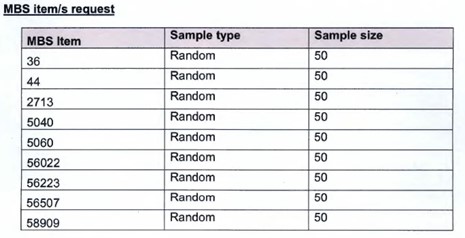
31 With respect to the variance identified in the Director’s letter, the applicant submits (referring to material before the Director) that:
Without entering into the merits of that view, it may be observed that:
(a) the two identified services were consultations of 40 minutes or more within business hours (item 44) or after hours (item 5060);
(b) the identified referrals were referrals for a facial scan (item 56022) and an upper GI scan (item 58909), which Dr Yoong initiated a total of 26 times (item 56022) and 25 times (58909) during in the Review Period (ie each referral was made on average twice a month);
(c) Dr Yoong’s patient mix was itself radically different from his peers. For instance, during the review period Dr Yoong saw more male patients aged 30-49 than 98 percent of his peers, more female patients aged 30-49 than 70 percent of his peers and more male patients aged 50-64 than 96 percent of his peers. He also saw fewer patients aged 0-14 then 93% of his peers.
(Citations and emphasis omitted.)
32 Notwithstanding the disclaimer at the commencement of this submission, the last of these matters in particular is an appeal to the merits of the applicant’s claims. As such, it would not be appropriate or relevant for me to make findings with respect to those matters save (by way of background) to note that they are likely to indicate the nature of the response which the applicant intends to make to the suggestion that he has engaged in inappropriate conduct should the processes under the HI Act progress further.
33 On 21 May 2019, the Director issued a notice to produce which was addressed to the applicant purportedly pursuant to s 89B of the HI Act (the Notice to Produce). I set out the Notice to Produce in detail below. For present purposes, it suffices to say that the Notice to Produce stated that it was issued in accordance with s 89B of the HI Act, and that the applicant was required to produce “complete clinical records for the patients identified on the attached list” by 5pm on Tuesday 11 June 2019. The attached list referred to 76 patients with their basic identification information. The Notice also stated that clinical records should include certain types of records (such as clinical or practice records and patient health summaries). It further advised that if the applicant did not have possession, custody or control of, and could not obtain, any of the complete records for the listed patients, he must inform the Director and provide by the same date details of a person who does have possession, custody or control of, or can obtain, any of the documents if the applicant can readily obtain that information.
34 The applicant received the Notice to Produce on or around 22 May 2021. He understood the Notice to Produce to require the production by him of clinical records for services rendered to or initiated for the identified patients during the Review Period only and as extending to records which he did not possess but could obtain from other third parties such as medical specialists, pathology providers or hospitals. His understanding was based upon his reading of the letter from the Director dated 30 April 2019 and the content of the Guide which he accessed online. On the basis of that understanding, the applicant endeavoured to comply with the Notice to Produce, compiling and producing 9,103 pages of clinical records concerning services rendered or initiated during the Review Period. I accept the applicant’s submission that, even on this understanding of the scope of the Notice to Produce, compliance was “a very significant undertaking”.
35 On 3 June 2019, the applicant requested an extension of time within which to produce the documents the subject of the Notice to Produce, which was granted on 4 June 2019, such that the documents were due to be produced on 10 June 2019. On 5 June 2019, the applicant requested a longer extension of time, which was granted on 6 June 2019, as a result of which the documents were due to be produced two weeks later on 25 June 2019.
36 On 23 June 2019, the applicant requested a further extension of time until 31 July 2019 on the basis that he required more time to comply with the Notice to Produce due to his full-time general practice. In response, the PSR advised the applicant on 25 June 2019 that a limited extension of time would be granted until 11 July 2019, and that the records required for production by that date “need only be the ones held by you/your practice”. In other words, the PSR purported to narrow the scope of records sought by the Notice to Produce informally by letter notwithstanding (as I shortly explain) that s 106ZPM(1) of the HI Act operates so as to suspend payments for services rendered through Medicare for a medical practitioner where there has been non-compliance.
37 On 11 July 2019, the applicant requested a further extension of time to 31 July 2019. On 12 July 2019, the Director declined to grant that request and provided a limited extension of time to Monday 22 July 2019 at 5pm. In that letter, the Director advised that the “PSR has requested the records in your custody, control or possession … [and] does not require you to seek any additional records from third parties” (emphasis in original in italics reproduced with boldface). The Director also warned that non-compliance proceedings may be commenced if the records requested in the Notice to Produce were not received by the revised deadline.
38 On 23 July 2019, the Director notified Medicare of the applicant’s non-compliance with the Notice to Produce and instructed that as of midnight that day, all Medicare benefits would cease to be payable for services provided or initiated by the applicant, until such time as he complied with the Notice to Produce. On the same day, the Director wrote to notify the applicant of her decision.
39 On the following day, the applicant’s solicitors, MinterEllison, requested that the Director grant the applicant a one-week extension until 31 July 2019 to comply with the Notice to Produce. The Director declined to grant a further extension by way of email from Ms Parker dated 24 July 2019. The applicant’s solicitors responded by email of the same date to advise that the applicant would seek an urgent interim stay of the effect of the Notice to Produce.
4.3 The First Proceeding in the Federal Court
40 The applicant commenced proceedings in the Federal Court for interlocutory relief, by way of an originating application for judicial review in relation to the decision made on 23 July 2019 and for judicial review of the CEM’s decision to commence the review (QUD443/2019) (the First Proceeding).
41 On 25 July 2019, this Court set aside by consent the Director’s decision made on 23 July 2019 and, upon the applicant’s undertaking to produce the documents the subject of the Notice to Produce to his solicitors, stayed the Review Decision and the Director’s decision to issue the Notice to Produce. The applicant delivered the relevant documents the subject of the Notice to Produce to his solicitors’ office on 31 July 2019.
42 On 29 November 2019, the applicant filed a further amended originating application for judicial review in the First Proceeding.
43 On 25 June 2021, this Court dismissed the judicial review application in the First Proceeding (Yoong (No 1)), finding that neither the CEM nor the Director owed a practitioner an obligation of procedural fairness in deciding to request or undertake a review under s 86(1) of the HI Act: see Yoong (No 1) at [108], [110] (Rangiah J).
44 On 21 September 2021, Rangiah J ordered by consent that the documents produced to the applicant’s solicitors be provided to the Director. The PSR collected the relevant documents on 27 September 2021. As earlier mentioned, the applicant produced 9,103 pages of clinical records for services delivered to patients during the Review Period.
4.4 Subsequent circumstances giving rise to the present proceeding
45 It subsequently emerged that the PSR’s understanding of the scope of the Notice to Produce was substantially different from that of the applicant when the solicitors for the applicant wrote on 28 September 2021 to the PSR advising that the applicant had accidentally included a hard copy historical card record in the material produced to the PSR, which contained notes of a patient’s attendances before the commencement of the Review Period. As the letter from the applicant’s solicitor demonstrates, he (and his solicitors) construed the Notice to Produce as requiring production of all clinical records for the patients listed in the Notice during the Review Period only. Notably, it will be recalled that this view accorded with that expressed in the Guide published on the PSR’s website which the applicant had earlier accessed and, while this had been replaced in July 2018, had still been available on the internet.
46 In response to the letter from the applicant’s solicitors, on 29 September 2021, Ms Parker wrote to advise that the Notice to Produce (NTP):
requires the production of the complete clinical records for the patient (as at the date of the NTP), not just the records from the review period. The material described in your letter as being outside the review period, is required to be produced under the NTP and is not outside its scope as suggested.
If it is the case that only records from the review period have been produced, the NTP has not been complied with. Can you please confirm the scope of the records that have been produced?
47 The next day, on 30 September 2021, an email from Ms Skinner, Senior Legal Officer, PSR, expressed concern that the applicant may not have provided clinical notes for consultations outside the Review Period, based on the PSR’s view that the Notice to Produce required the applicant to produce “the complete clinical record for each of the 76 patients identified in the Notice” (emphasis omitted). Accordingly, Ms Skinner advised that the Director was not satisfied at the time of the letter that the applicant had complied with the Notice to Produce and it was therefore open to the Director to take action under s 106ZPM of the HI Act.
48 On the same day, the applicant’s solicitors responded to Ms Parker’s email as follows:
Our client read the Notice to Produce as requiring the production of the clinical records for the patients for the review period. Our client has done so. On our reading of s 89B of the [HI] Act, that was entirely reasonable. That section, which was attached to the Notice, defines “relevant documents” which the PSR can require to be produced as “documents that are relevant to the review” including “clinical or practice records of services rendered or initiated during the review period”. The Notice, properly construed, does not require complete clinical records for the patients to be produced. We think it is doubtful that the Notice, read in the way you now contend it should be read, could be valid under the [HI] Act.
A similar response was sent by the applicant’s solicitors to Ms Skinner’s email dated 30 September 2021.
49 On 1 October 2021, Ms Parker advised that the Director was prepared to “narrow the scope of the Notice” to the period 1 May 2012 to 21 May 2019 notwithstanding that the PSR did not resile from its position as to the proper and appropriate scope of the Notice to Produce:
Please be advised that Professional Services Review (PSR) does not resile from its position as to the proper scope of the notice issued to Dr Yoong by the Director under section 89B of the Health Insurance Act 1973 (the Act) on 21 May 2019 (the Notice). The complete clinical record for a patient is relevant to the review of a particular service provided to a patient, because it allows that service to be properly understood in the context of the patient’s medical history as available to the medical practitioner, and the course of treatment. This is uncontroversial, as is the power to issue a notice even if compliance with it is burdensome or time consuming (I-MED Radiology Network Ltd v Director of Professional Services Review [2020] FCA 1645).
…
While the PSR considers the scope of the Notice to be appropriate, in the interests of assisting Dr Yoong and proceeding the matter without any further unnecessary delay the Director is prepared to narrow the scope of the Notice so that Dr Yoong is only required to provide records from five years prior to review period up to the date to the Notice. That period would be 1 May 2012 – 21 May 2019. Once such records are produced the Director would consider the Notice has been complied with and would not proceed to take action for non-compliance.
(Emphasis in original and added.)
50 As to next steps, the PSR advised that the applicant was required to seek an extension of time from the Director to provide the outstanding records by 5pm on 6 October 2021.
51 On 7 October 2021, the applicant’s solicitors responded by email requesting that the Director reconsider her position on the scope of the Notice to Produce and the applicant’s alleged non-compliance with that notice. That correspondence, noting the decision in I-MED Radiology Network Ltd v Director of Professional Services Review [2020] FCA 1645, stated that the Director must exercise their power of production for the statutory purpose for which that power is conferred and that there was “no proper basis on the face of the Notice to require the production of clinical records for a period of 5 years prior to, and more than a year after, the review period”.
52 On 14 October 2021, the Director wrote again to the applicant’s solicitors and reiterated a preparedness to “narrow” the scope of the Notice to Produce to all clinical records for the 7-year period between 1 May 2012 and 21 May 2019. The Director also raised a concern that the historical record cards for all patients had not been produced, and further advised that a notice would be issued under s 106ZPM of the HI Act if the applicant failed to demonstrate that he was taking meaningful steps to fully comply with the Notice to Produce. (I interpolate that a failure to take “meaningful steps” in the PSR’s view to comply with the Notice to Produce is not the criterion which triggers the obligation on the Director to give a s 106ZPM notice. Even though in some cases such a failure may be considered by the Director to be evidence of an intentional non-compliance with the Notice to Produce, it is not necessarily conclusive of that question.)
53 On 19 October 2021, the applicant’s solicitors wrote to PSR raising a number of concerns with the conduct of the review, including with the timeframe within which the Director requested the additional documents, and requesting that the Director treat the applicant “fairly and with integrity.”
54 On 21 October 2021, the AGS wrote on behalf of PSR to the applicant’s solicitors with respect to the applicant’s lack of compliance and advised that:
12. Noting the concerns you have raised about timeframes, the Director is prepared to give Dr Yoong until Monday 8 November 2021 to either produce the further records as required under the Notice (as narrowed), or otherwise demonstrate that he is taking meaningful steps to do so within reasonable timeframes. Such steps would need to include:
a. acknowledging the scope of the Notice as requiring production of all clinical records from 1 May 2012 to 21 May 2019, and
b. making arrangements to provide all records for this period, including any ‘historical record cards’, to PSR.
13. If Dr Yoong has not produced the further records or otherwise demonstrated by Monday 8 November 2021 that he is taking meaningful steps to fully comply with the Notice within reasonable timeframes, the Director intends to give notice under section 106ZPM of the [HI] Act that this non-compliance prevents Medicare benefits from being payable in respect of services rendered or initiated by Dr Yoong.
(Emphasis in underlining in the original; emphasis in bold and italics added.)
55 The Director, Professor Quinlivan, took leave from Monday 8 November 2021 to Friday 12 November 2021 inclusive. I accept that at the time that the letter was sent on 21 October 2021, Professor Quinlivan knew that she would be on leave between these dates and that Dr Rankin would be Acting Director over that period.
56 On Friday 5 November 2021:
(1) the Director provided a handover note to Dr Rankin;
(2) Ms Skinner sent an email to Dr Rankin, which enclosed a brief to the Acting Director and the letter from AGS to MinterEllison dated 21 October 2021; and
(3) MinterEllison sent AGS a response to the letter from AGS dated 21 October 2021 maintaining that the scope of the Notice to Produce did not correspond with the power conferred by s 89B of the HI Act. (That letter was not brought to the PSR’s attention until 8 November 2021.).
57 On the evening of 7 November 2021, Ms Skinner of the PSR prepared a draft letter comprising written notification to the applicant that Medicare benefits would no longer be payable to him pursuant to s 106ZPM of the HI Act.
58 A number of events occurred on 8 November 2021, which I discuss further below in Part 7.2.3. Significantly, Dr Rankin assumed the role of Acting Director, and purported to exercise the power under s 106ZPM of the HI Act to prevent Medicare benefits from being payable in respect of services rendered or initiated by the applicant from midnight that day. The applicant was notified of this decision by letter at 6.45pm AEST (7.45pm AEDT).
59 On 16 November 2021, the applicant commenced proceedings in this Court seeking judicial review of the decision made by the Director on 21 May 2019 and the decision made by the Acting Director on 8 November 2021.
60 On 19 November 2021, the Court made orders suspending the decision made under s 106ZPM to disqualify the applicant until the final determination of this proceeding or such other order of the Court.
61 While the HI Act was amended after the First Decision was made on 21 May 2019 and before the Second Decision was made on 8 November 2021, there are no relevant differences between the two versions of that Act for purposes of the provisions to be considered in this proceeding. Accordingly, references to the HI Act below are to the applicable version of that Act at the relevant time. For convenience, I will refer to the relevant statutory provisions using the present tense.
62 The HI Act relevantly governs the provision of Medicare benefits. As Logan J explained in I-Med at [38]:
At the heart of that Act, and engaging with the head of parliamentary legislative competence in s 51(xxiiiA) of the Constitution, is s 10(1), which provides for an entitlement to medicare benefits where medical expenses are incurred in respect of a professional service rendered in Australia to an eligible person. By s 10(2), and subject to the HIA, the amount of medicare benefit in respect of that professional service is the whole, or a percentage, of fees set out in a detailed Schedule to regulations made under that Act.
63 Part VAA of the HI Act comprises ss 79A to 106ZR. The object of Part VAA establishing the PSR Scheme is described in s 79A as follows:
The object of this Part is to protect the integrity of the Commonwealth medicare benefits, dental benefits and pharmaceutical benefits programs and, in doing so:
(a) protect patients and the community in general from the risks associated with inappropriate practice; and
(b) protect the Commonwealth from having to meet the cost of services provided as a result of inappropriate practice.
64 In furtherance of this object, the PSR Scheme is “a scheme for reviewing and investigating the provision of services by a person to determine whether the person has engaged in inappropriate practice”: s 80(2) of the HI Act. The Professional Services Review Agency (PSR Agency) is established by Part VAA of the HI Act as a non-corporate Commonwealth entity, which presently falls under the Department of Health and Aged Care Portfolio. The PSR Agency seeks to protect the Australian public from the risks and costs arising out of inappropriate practice within the publicly funded Medicare and Pharmaceutical Benefits Scheme.
65 The history and operation of Part VAA of the HI Act is helpfully explained by Griffiths J in National Home Doctor Service Pty Ltd v Director of Professional Services Review [2020] FCA 386; (2020) 276 FCR 338 (NHDS) at [6]–[79] (see, in particular, the key features of the PSR Scheme outlined at [12] and an explanation of the four tiers of the scheme at [20]–[79]). The main features of the PSR Scheme are also summarised in s 80 of the HI Act.
66 I will focus upon the key provisions for the purposes of this proceeding.
67 A review under the PSR Scheme is initiated by a request from the CEM to the Director. Specifically, the CEM may “request the Director to review the provision of services by a person” for a specified period, following which the Director “must decide whether to undertake a review”: ss 80(3) and 86(1) of the HI Act. Significantly for present purposes, the relevant period of review must be specified in the request by the CEM, and “must fall within the 2 year period immediately preceding” the date on which the request was made: s 86(2) HI Act. Notably, the phrase “during the review period” appears repeatedly throughout this Part.
68 The Director is required to decide whether to undertake the review within one month of receiving the request: s 88A(1) HI Act. As the applicant submits, “there is a relatively low threshold to commence a review”. The Director must proceed with a review if she or he is satisfied that there is “a possibility that the person has engaged in inappropriate practice in providing services during the review period”: s 88A(2) of the HI Act. In other words, once the requisite state of mind is reached, there is no discretion as to whether or not to proceed with the review: I-Med at [61] (Logan J). Section 82(1)(a) of the HI Act defines “inappropriate practice” relevantly to mean:
conduct in connection with rendering or initiating services … such that a Committee could reasonably conclude that:
(a) if the practitioner rendered or initiated the services as a general practitioner—the conduct would be unacceptable to the general body of general practitioners;
69 As such, the concept of inappropriate conduct is an evaluative one.
70 If the Director decides to undertake a review, she or he is required to give written notice of the decision to conduct a review within seven days to the practitioner whose services are to be reviewed and to the CEM: ss 88A(4)–(5) of the HI Act. However, s 88A(5) provides that the failure to give written notice within the seven day period does not affect the validity of the decision.
71 Where the Director decides to undertake the review, s 88B of the HI Act provides that:
he or she:
(a) may review any or all of the services provided by the person under review during the review period; and
(b) may undertake the review in such manner as he or she thinks appropriate; and
(c) in undertaking the review, is not limited by the reasons included in the request under subsection 86(3).
(Emphasis added.)
72 The “review period” is defined relevantly to mean the period specified in the initial request by the CEM: s 81 of the HI Act. A “service” is defined by s 81 to refer to a service that has been “rendered” or “initiated” if, at the time it was rendered or initiated, a Medicare or dental benefit was or would have been payable in respect of that service.
73 It is clear from the terms of ss 88B(a) and (c) that the discretion conferred on the Director with respect to the scope of the review is intended to be broad. As the review is not constrained by the reasons included in the request to the Director, the section gives the Director the discretion to follow ‘new leads’ which the review may uncover, as long as they relate to services provided by the person during the review period. Thus, as Logan J observed in I-MED at [66], the combined effect of ss 88B(a) and (c) is that the Director is entitled to undertake “a roving review-‘any or all of the services provided by the person’-within the confines of the Review Period” . It is also clear from s 88B(b) that the Director has a wide discretion as to how she or he undertakes the review. The review must, however, be undertaken within 12 months save where the period is lawfully extended: s 94 of the HI Act.
74 Significantly, insofar as the Director’s role is concerned, the HI Act provides for a number of different possible outcomes, namely:
(1) the Director may under s 91 of the HI Act decide to take no further action such as where there are insufficient grounds on which a Committee could reasonably find that the person under review had engaged in inappropriate practice during the review period or circumstances are such that a proper investigation by a Committee would be impossible;
(2) the practitioner and the Director may enter into an agreement whereby the practitioner acknowledges that she or he has engaged in inappropriate practice and specified action is to take effect (s 92);
(3) the review may be referred to a Professional Services Review Committee to investigate whether the person under review engaged in inappropriate practice in providing the services specified in the referral (see Division 4 of Part VAA of the HI Act); or
(4) if none of the above outcomes are achieved within the 12 month period of the review, the Director is taken to have made a decision to take no further action in relation to the review (s 94).
75 It is, therefore, clear that it is not the Director’s function to determine whether or not the practitioner has engaged in inappropriate practice. Rather, where outcome (3) occurs, that function is vested in a Committee which must be constituted by Panel members with relevant expertise: ss 93 and 95 of the HI Act.
76 During the review, s 89B of the HI Act empowers the Director to require the medical practitioner under review (and others where required) to produce documents or provide information. That section relevantly provides:
(1) In this section:
relevant documents means documents that are relevant to the review and includes clinical or practice records of services rendered or initiated during the review period by:
(a) the person under review; or
(b) a practitioner employed or otherwise engaged by the person under review; or
(c) a practitioner employed or otherwise engaged by a body corporate of which the person under review is an officer.
(2) For the purpose of undertaking a review, the Director may, by written notice given to:
(a) the person under review; or
(b) any other person whom the Director believes to have possession, custody or control of, or to be able to obtain, relevant documents;
require the person to whom the notice is given:
(c) to produce to the Director, or to a person nominated by the Director, such relevant documents as are referred to in the notice; and
(d) if the person does not have possession, custody or control of, and cannot obtain, any of those documents:
(i) to inform the Director or a person nominated by the Director of that fact; and
(ii) if the person knows, or can readily find out, the name and address of a person who has possession, custody or control of, or can obtain, any of the documents—to give that name and address to the Director or to a person nominated by the Director.
(3) The notice must state:
(a) the period within which, and the place at which, the documents are to be produced; and
(b) the period within which a name and address referred to in subparagraph (2)(d)(ii) are to be given.
(4) The period to be stated in the notice must be a period ending at least 14 days after the day on which the notice is given.
(5) The notice is to set out the terms of section 106ZPM or 106ZPN, whichever is applicable to contraventions of the notice. However, a failure to comply with this subsection does not affect the validity of the notice.
(Emphasis in original and added.)
77 As Logan J held in I-Med at [53], “Subsections 89B(3), (4) and (5) specify certain formal requirements in respect of a notice in relation to the allowance of time, and the specification of a place, for production, as well as making explicit on the face of the notice the statutory consequences of a failure to comply with a notice.” Subsection 89B(6) makes provision for the inspection, retention and copying of produced documents by the Director.
78 Failure to comply with a notice validly issued under s 89B of the HI Act gives rise to the serious consequences prescribed by s 106ZPM of that Act, as follows:
(1) If:
(a) a person under review is required to produce a document or give information by a notice given under subsection 89B(2) or 105A(2); and
(b) the person intentionally refuses or fails to comply with the requirement within the period specified in the notice;
a medicare benefit or dental benefit is not payable in respect of a service rendered or initiated by the person under review, by a person employed or otherwise engaged by the person under review, or by a person employed or otherwise engaged by a body corporate of which the person under review is an officer, at a time after the end of the period specified in the notice and before the document is produced or the information is given, as the case may be.
(2) If the Director considers that subsection (1) prevents medicare benefits and dental benefits from being payable in respect of services rendered or initiated by the person under review, the Director must give a notice to that effect to the person.
(3) The Director must give a copy of a notice under subsection (2) to the Chief Executive Medicare.
(4) If:
(a) subsection (1) prevents medicare benefits and dental benefits from being payable in respect of services rendered or initiated by the person under review at a time; and
(b) the Director gave a notice under subsection (2) to the person before that time;
the person is taken to be:
(c) fully disqualified at that time for the purposes of section 19D; …
79 Section 19D, in turn, makes it an offence for a practitioner (or person acting on her or his behalf) to render or initiate a professional service in respect of which a Medicare benefit is not payable relevantly under s 106ZPM, unless the practitioner informs the person of the disqualification and its effect.
80 In short, therefore, where the criteria for s 106ZPM(1) are met, the section operates of its own force to suspend payments for services rendered through Medicare for a medical practitioner and their patients pending compliance with the notice to produce. Practically speaking, however, the suspension will come into effect when notice is given.
81 Section 106ZPM, therefore, has a number of significant aspects which may be summarised as follows:
(1) Where a practitioner under review intentionally refuses or fails to comply with a notice to produce under, relevantly, s 89B(2), the prohibition in s 106ZPM(1) is engaged and operates so as to suspend Medicare benefits for services rendered or initiated by the practitioner unless or until the notice to produce is complied with.
(2) By contrast, s 106ZPM(2) requires the Director to form a specific state of mind before giving a notice under that provision. Furthermore, once the Director forms the requisite state of mind, the Director has no discretion but “must” issue the notice under s 106ZPM. I agree with the applicant that the formation of that state of mind is a jurisdictional precondition to the issue of a valid notice. In this regard, as the applicant submits it is relevant that “the legislature has expressly identified that certain technical defects in notices given under Part VAA, including notices to produce documents, are not intended to result in invalidity of the notice, but has not enacted any saving provision for a notice to produce which fails to confine itself to seeking relevant documents.”
(3) It is an offence under s 19D for the practitioner not to inform patients of their disqualification where the criteria in s 106ZPM are met, namely, the practitioner has in fact intentionally refused or failed to comply with a notice to produce and the Director has given the practitioner notice of the disqualification under s 106ZPM(2).
82 It follows that I agree that “there are serious professional and financial consequences for a person under review who fails to comply with a notice to produce”, as the applicant submits.
83 As will be apparent, the applicant’s case on ground 2 focused on whether or not the Acting Director had formed the requisite state of mind for the purposes of issuing the notice under s 106ZPM(2). Importantly, the automatic prohibition imposed by s 106ZPM(1) and the obligation imposed on the Director to give notice under s 106ZPM(2) where she or he considers that sub-s (1) applies, explains (as I later develop) Ms Parker’s view that it was necessary for the draft notice to be prepared in advance of Dr Rankin, as the Acting Director, deciding whether or not to issue the notice. This is because if he did decide that the criteria in s 106ZPM(2) were met, it would follow that it was his view that s 106ZPM(1) had been triggered so as to automatically suspend the payment of Medicare benefits pending compliance.
6. IS THE S 89B NOTICE BEYOND POWER?
6.1 Grounds 1(a) and 1(b): jurisdictional error and unauthorised exercise of power
84 The applicant contends that, because the Notice to Produce was not confined to requiring production of documents which met the statutory description of “relevant documents” under s 89B(1) of the HI Act, the purported exercise of power to issue the Notice to Produce was:
(a) infected by jurisdictional error; and
(b) not a lawful exercise of the power conferred by s 89B of the HI Act,
with the consequence that the decision to issue the Notice to Produce should be quashed or set aside pursuant to s 16(1)(a) of the ADJR Act or s 39B of the Judiciary Act.
85 Grounds 1(a) and (b) plead that the Notice to Produce was beyond power because it was not limited to “relevant documents” as defined by s 89B of the HI Act. Instead it required the production of “complete clinical records” without reference to whether they related to any services rendered during the relevant Review Period. For the reasons set out below, these grounds must be upheld.
86 The parties referred to various authorities concerning the exercise of various coercive statutory powers for the production of documents and gathering of information. Ultimately, of course, each case is determined on the basis of the terms of the specific notice and the proper construction of the statutory power in issue, as Logan J held in I-Med at [68]. Nonetheless, certain principles which are generally applicable may be distilled from the authorities.
87 First, as I have earlier explained, the Director is not engaged in the task of determining whether inappropriate practice has been established. That role is vested in an expert Committee. Rather the Director’s role is relevantly to undertake an initial inquiry to ascertain whether there is anything of substance for a Committee to investigate within the review period (assuming no agreement is entered into with the practitioner under s 92).
88 It follows that the purpose of a s 89B notice is not dissimilar to the purpose of a notice under s 155 of the Trade Practices Act 1974 (Cth) (TPA) (renamed the Competition and Consumer Act 2010) which was considered by the Full Court (Brennan, Keely, and Fisher JJ) in Melbourne Home of Ford Pty Ltd v Trade Practices Commission (No 3) [1980] FCA 115; (1980) 31 ALR 519. Section 155 conferred power upon the Chairman of the Trade Practices Commission to require production of documents or the giving of evidence “relating to a matter that constitutes, or may constitute, a contravention” of the TPA. The issue in Melbourne Home was whether the Chairman had required the applicant companies to furnish information or produce documents other than information or documents relating to “a matter” which may constitute a contravention, namely, that the company had given effect to a price fixing arrangement: at 528–529. The function conferred on the Chairman by s 155 was described by the Full Court as “a function of investigation, not … a task of proving an allegation” which in turn led the Full Court to the view that the power should not be construed narrowly. As their Honours held (at 529–530):
In the case of a matter that may constitute a contravention, the Chairman may not know the constitutive facts of a contravention (if there has been one) and he may ultimately ascertain that there has been no contravention in the conduct or transaction which he is investigating. Because his attention has been drawn to a particular act or transaction which warrants investigation, and because he has reason to believe that the person to whom the notice is given is capable of furnishing information relating to the matter under investigation, he is engaged in a function of investigation, not in a task of proving an allegation. The power conferred by s 155(1) is in aid of that function and is a power which authorizes inquiries both wide in scope and indefinite in subject matter. It is an investigative power which is under consideration here and it is not possible to define a priori the limits of an investigation which might properly be made. The power should not be narrowly confined.
In the present case, the investigative power of the Chairman is being exercised in an investigation into a matter that may constitute a contravention of s 45. Proof of a contravention of that section often depends upon circumstantial evidence. Section 45 is itself expressed in general terms, and when an investigation into such a matter commences with little information, the range of inquiries may need to be broad rather than specific. … The investigative power may properly be exercised by inquiring into the existence of facts which do not themselves constitute a contravention or deny the possibility of a contravention. The power may properly be exercised to ascertain facts which may merely indicate a further line of inquiry, or which may tend to prove circumstances from which an inference can be drawn as to the existence of other facts which have a more immediate and proximate relationship to the matter under investigation. The width of the power and the possibility of its abuse both justify judicial examination of an allegation that the power is used to produce an undue burden or oppression, and render that examination difficult to perform. The necessity for the jurisdiction, and the problems of exercising it are well reflected in what Ackner J said in Clinch v Inland Revenue Commissioners [1974] 1 QB 76 at 91-2; [1973] 1 All ER 977 at 989:—
“The statutory authority in this case is in effect to ask questions — to require such particulars as the commissioners think necessary — for the purpose of the chapter dealing with the transfer of assets abroad. The particulars are sought of the intermediary in order that he may be used as a stepping-stone towards obtaining the more detailed information required by the commissioners to enable them to decide whether or not, in their opinion, tax has been unlawfully avoided. The information which they require is such as to give them a shrewd idea of the relationship between a taxpayer and a foreign company, partnership, trust or settlement.
(Emphasis added.)
89 The decision in Melbourne Home was followed, for example, in Pyneboard Pty Ltd v Trade Practices Commission [1982] FCA 18; (1982) 57 FLR 368 at 375–377 which also concerned the validity of a notice under s 155 of the TPA. Thus, the Full Court in Pyneboard stressed that the question of whether a notice discloses the “necessary relatedness” between documents or information sought and the identified “matters”, is not to be approached in an over-technical or hypercritical way. Rather, their Honours held that the relevant question is whether the information or documents sought “are capable, in a broad investigative context, of being properly regarded as related to any one of the ‘matters’ which the notice identifies”.
90 The same considerations lead to the view that the power in s 89B is not to be narrowly construed as that would equally undermine the investigative function conferred by that provision. This intention is evident from the breadth of the power conferred by s 89B of the HI Act which was properly described by Logan J in I-Med as a power to undertake a “roving review”: at [66].
91 Secondly, the power to require documents or information to be provided must be exercised for the statutory purpose for which it is conferred. As Logan J held in I-Med at [69] with respect to s 89B(2) of the HI Act:
Insofar as there are any general principles, they may be gleaned from observations made by Bowen CJ in Riley McKay Pty Ltd v Bannerman (1977) 15 ALR 561 (Bannerman), at 566, in relation to an information gathering notice given under s 155 of the then Trade Practices Act 1974 (Cth). The power of requiring the giving of information or production of documents must be exercised for the statutory purpose for which it is given. Here, that purpose is as specified by s 89B(2) of the HIA, “For the purpose of undertaking a review”. … Within these confines, the only further requirement, flowing from the definition of “relevant documents” in s 89B(1) of the HIA, is that the documents sought be “relevant to the review”.
92 To similar effect, the Full Court in Melbourne Home at 531 held that:
An excess of power may appear if the requirement for information or documents is couched in such wide and general terms that a proper exercise of the investigatory power could not support the requirement in question. This is but a particular application of the general principle that the exercise of a discretionary power must be reasonably capable of being regarded as related to the purpose for which the power is conferred … If the requirement expressed in a particular notice is reasonably capable of being so regarded, that ground for alleging an excess of power fails.
93 Conversely it follows that a notice that requires production of documents beyond the scope of the power is invalid (subject to possible questions of severance or reading down). As for example Davies J held in Deveson v Australian Broadcasting Tribunal [1991] FCA 633; (1991) 32 FCR 124 at 129 in setting aside summonses issued by the Tribunal under s 21(2) of the Broadcasting Act 1942 (Cth) on the basis that they were too wide:
The Tribunal does not have power to compel the production of other documents, that is to say, documents other than those which may assist the Tribunal in its inquiry, simply because the production of documents of a certain type may be a convenient way of getting to documents relevant to the Tribunal’s task. The Tribunal has no power to compel the production of documents which have no relevance whatever to its inquiry…
The necessity that there be an apparent relevance between the documents sought and the administrative task being performed has been clearly stated [citing Commissioner of Taxation (Cth) v Australia & New Zealand Banking Group Ltd (1979) 143 CLR 499 and Bannerman v Mildura Fruit Juices Pty Ltd (1984) 2 FCR 581].
(Emphasis added.)
94 A consideration of the statutory purpose, in turn, must have regard to the separate role of the Director under the PSR Scheme. As Griffiths J rightly observed in NHDS at [38]:
The Director’s statutory power under s 91 to decide to take no further action in relation to a review serves to underline the importance of the Director’s separate role, certainly when viewed through the eyes of a person whose conduct is under review. This is because the Director is empowered to terminate the review process, rather than take some alternative course of action which may prove to be detrimental to the person’s interests. Such detriment may include any sanction which is ultimately imposed, but also the time and resources involved in participating in the review.
95 His Honour similarly observed with respect to s 89B of the HI Act, noting (as the respondent emphasised) that the conferral of these “information gathering powers” on the Director by amendments made to the HI Act in 1999 served to underline “the important and separate role of the Director under the PSR Scheme”: at [34]. As such, I agree with the respondent that, contrary to the applicant’s submission, “it is not to the point that if a review results in a referral to a Committee, the Committee has its own power to compel production of relevant documents. The power in s 89B is given to the Director for a different purpose, in aide of a separate function.” The fact that the Committee has its own compulsive powers does not, in other words, suggest that the power vested in the Director at the preliminary investigative stage should be narrowly construed. I also agree with the respondent that:
These contextual factors indicate that documents are ‘relevant to the review’ if they may assist the Director to reach the required state of satisfaction in s 91, or to reach agreement with a practitioner under s 92.
96 Those considerations in turn are powerful indicators that it was not intended that the scope of the power under s 89B be limited to the clinical or practice records for services provided during the review period as the applicant contended, but rather by the requirement that the records be relevant to services provided during the Review Period. This is not, however, as I shortly explain, to suggest that the Director must have foreknowledge of the relevance in fact of all documents which might be covered by the Notice. To so construe s 89B would be to undermine the investigative function which the Director is intended to perform under the PSR Scheme and which the power in s 89B is intended to facilitate. Rather, as Basten JA (Bathurst CJ agreeing) explained in A v Independent Commission Against Corruption [2014] NSWCA 414; (2014) 88 NSWLR 240 (A v ICAC) with respect to s 35 of the Independent Commission Against Corruption Act 1988 (NSW) (by analogy at [34]):
it is well established that the possibility, even the certainty, that the summons will cover documents which are not relevant to the investigation is not a basis for setting aside the summons.
97 Thirdly, as Logan J also held in I-Med at [70]:
Such a notice [under s 89B of the HI Act] must also “specify the information sought with sufficient certainty to enable the recipient of the notice to know what is required of him”: Bannerman, at 566. To like effect is this statement, recently offered by Wigney J, together with a summary of authorities, in Australian Securities and Investments Commission v Maxi EFX Global AU Pty Ltd [2020] FCA 1263 (Maxi EFX Global AU), at [90], in relation to a cognate requirement under s 33(1) of the Australian Securities and Investments Commission Act 2001 (Cth) to produce “specified books”, “the documents which are required to be produced be identified in the notice with sufficient clarity and precision to enable the recipient to know what documents come within the terms of the notice and to form a view about what must be produced so as to comply with the notice”. To the summary of authorities offered in Maxi EFX Global AU, but to no different effect, might be added Australia and New Zealand Banking Group Ltd v Konza (2012) 206 FCR 450, at [46] – [47].
98 Fourthly and of particular significance to ground 1, it is well settled that provisions such as s 89B of the HI Act are interpreted as requiring, expressly or by necessary implication, that the giver of the notice requiring production of information or documents specify the information or documents which the person is required to provide with sufficient clarity in order to show on the face of the notice that it is authorised, that is, that the documents or information sought are reasonably related to the purpose for which the statutory power is granted and lie within any express constraints on that power: see, e.g., Federal Commissioner of Taxation v Australia and New Zealand Banking Group [1979] HCA 67; (1979) 143 CLR 499 (FCT v ANZ) at 525 (Gibbs ACJ) and 537 (Mason J in dissent but not relevantly on the question of principle) (notice to produce documents under s 264(1) of the Income Tax Assessment Act 1936 (Cth)); Bannerman v Mildura Fruit Juices Pty Ltd [1984] FCA 166; (1984) 2 FCR 581 at 584 (Bowen CJ and Neaves J) and SA Brewing Holdings Ltd v Baxt [1989] FCA 398; (1989) 23 FCR 357 at 370 (Fisher and French JJ) (notices to produce under s 155 TPA); Finlayson v Legal Practitioners Conduct Board [2012] SASC 77; (2012) 112 SASR 549 at [52]–[55] (White J) (notice pursuant to s 76(3) of the Legal Practitioners Act 1981 (SA)); 85 Degrees Coffee Australia Pty Ltd v Fair Work Inspector Rodwell [2020] FCA 1190; (2020) 299 IR 280 at [48] (Katzmann J) (notice to produce under s 712 of the Fair Work Act 2009 (Cth)); and MacDonald v Australian Securities Commission [1993] FCA 594; (1993) 43 FCR 466 at 470 (Davies J) (notice to produce under s 30 of the Australian Securities Commission Act 1989 (Cth)). In my view that implication flows from the principle of legality given that:
(1) provisions of this nature authorise (relevantly) the compulsory production of documents which would otherwise constitute a tort;
(2) absent the implication, the recipient of the notice to produce would be unable to form a view as to whether or not the documents are lawfully required; and
(3) a court on judicial review would be unable to determine whether the issuer of the notice has exceeded her or his jurisdiction in issuing the notice.
99 As Gleeson CJ explained in Plaintiff S157/2002 v Commonwealth [2003] HCA 2; (2003) 211 CLR 476 at [8] (quoting from Lord Denning in R v Medical Appeal Tribunal; Ex parte Gilmore [1957] 1 QB 574 at 586), if administrative decision-makers “were to be at liberty to exceed their jurisdiction without any check by the courts, the rule of law would be at an end.”
100 Finally, as the Court emphasised in Melbourne Home at 530, whilst the Court is empowered to protect an individual from any abuse of power by the executive:
The court cannot undertake the task of determining the way in which an investigation should be carried out, for that is a task which the legislature has confided to the Commission, the Chairman or the Deputy Chairman. The court’s jurisdiction is not to set the course of an investigation but to call a halt if it is shown that the investigation exceeds the powers conferred.
101 Thus, the Court held that it was not a ground of judicial review to say that the notice imposed an undue or oppressive burden on the recipient unless what is said is that the power to issue the notice was exceeded in the particular case: Melbourne Home at 530.
6.1.2 The Notice to Produce is invalid
102 The Notice to Produce was marked with the reference “Request to Review No. 1305” (being the PSR reference for the Director’s review of the applicant’s provision of services during the Review Period) and provided that:
In accordance with section 89B of the Health Insurance Act 1973 (Act), I, Professor Julie Quinlivan, Director of Professional Services Review, hereby give notice that you are required to produce the following documents:
Complete clinical records for the patients identified on the attached list. The clinical records should include where applicable:
• Clinical or practice records including progress notes
• Patient health summaries
• Pathology and diagnostic imaging reports
• Specialist and allied health practitioner referral letters and reports
• Hospital discharge summaries
• Health assessment and chronic disease management documentation.
The documents must be produced to:
The Director
Professional Services Review,
Level 1, 20 Brindabella Circuit
Brindabella Business Park
Canberra Airport ACT 2609
The documents must be produced by no later than: 5pm, Tuesday 11 June 2019.
If you do not have possession, custody or control of, and cannot obtain, any of the complete records for the patients identified on the attached lists, you must inform me of that fact. If you know, or can readily find out, the name and address of a person who has possession, custody or control of, or can obtain, any of the documents, you must give that name and address to me at the address above, by no later than 5pm, Tuesday 11 June 2019.
I will consider whether to issue a separate notice to produce documents to another person where you are not in possession, custody or control of the documents.
A copy of section 89B is attached at Schedule 1 for your information. I am also enclosing a copy of section 106ZPM, as required by subsection 89B(5), which sets out the consequences for intentionally refusing or failing to comply with this Notice.
(Emphasis in original omitted and emphasis added.)
103 In addition to attaching a schedule setting out the terms of ss 89B and 106ZPM of the HI Act, a list was attached to the Notice to Produce which identified 76 patients by name, address, sex, and date of birth. The Notice did not explain why or how these patients had been selected. However, it was common ground that all of these individuals had been patients of the applicant for several years, and many for well over a decade. Furthermore, it is clear from the evidence that the Director (and PSR) intended that the Notice would extend to all clinical records irrespective of when they were produced, and this intention is reflected in the plain words of the Notice to Produce itself. The applicant’s contention that the Notice to Produce should be construed as being limited to documents produced during the Review Period appears to have derived from his understanding of the Notice in light of the PSR Guide which he had accessed on the internet. However, the terms of that Guide cannot dictate the meaning of the Notice to Produce and that version of the Guide had in any event been superseded by the time that the Notice to Produce was issued. Finally, I also note that the Director agreed to exclude one of the patients without conceding that it was inappropriate for her to seek that patient’s records, leaving 75 patients whose records were sought.
104 For the reasons that follow, the Notice to Produce is not, on its face, confined to seeking documents which fall within the statutory authority to require production of documents which are “relevant to the review”. It follows that the Notice is invalid.
105 First, applying the principles to which I have earlier referred, it is necessarily to be implied from s 89B that a notice to produce must identify the documents which the practitioner is required to provide with sufficient clarity such that it is patent on the face of the notice that it is lawfully issued under s 89B. In other words, as I have earlier held, it should be apparent from the notice to produce that the documents sought are reasonably related to the investigative purpose which s 89B is intended to serve and lie within the express constraints on the statutory power. Those express constraints are that the documents are “relevant to the review”, being, by virtue of s 88B, a review of any or all services provided by the practitioner “during the review period”.
106 However, the Notice to Produce in this case manifestly fails to comply with this requirement. It simply requires production of the complete clinical records for a list of patients without even identifying whether all or any of the patients listed were provided with any services by the applicant during the Review Period. The only criterion that one could infer from the Notice is that the list attached to the Notice is a list of persons who were or are persons to whom the applicant has rendered medical services at some time. Thus, as the applicant contends:
The notice issued by Professor Quinlivan did not adopt any criterion of relevance (directly or indirectly) in identifying the documents which Dr Yoong was required to produce. Nor did it attempt to link the “complete clinical records” sought to the services provided or initiated by Dr Yoong during the Review Period. Indeed, the Notice to Produce did not refer to the Review Period (or services provided during that period) at all.
Instead, the unconstrained terms of the notice purported to require Dr Yoong to produce “complete clinical records” (in his possession or control, or which he could “obtain”) for 76 different patients.
107 Indeed, in this case, there was no evidence that the Director turned her mind to whether the entirety of the applicant’s clinical records “is reasonably related to that for which that power is granted” under s 89B of the HI Act: Finlayson at [53]. Nor was there evidence of any attempt to draft a notice targeting relevant clinical records or categories of clinical records outside the Review Period. To the contrary and notwithstanding the statements in the PSR Guide accessed by the applicant, Ms Parker explained that, as far as she could recall since starting at the PSR in May 2017, the PSR’s pro forma text for a s 89B notice had always required production of the complete clinical records for “the entire period of treatment by the doctor”. This evidence also accords with Dr Rankin’s evidence that, in his experience, “notices always ask for all clinical records”, and that he understood the PSR was “entitled to complete records for any of the patients named in the [s] 89B notice”. Given that evidence of the PSR’s practice and the fact that the terms of the s 89B Notice to Produce accord with that evidence, it can reasonably be inferred on the balance of probabilities that the Director issued the Notice to Produce in accordance with that practice and therefore without turning her mind to the question of what documents or classes of documents were reasonably capable, in a broad investigative context, of being relevant to the review of services provided or initiated by the applicant during the Review Period. In proceeding in this manner, for the reasons I have earlier explained, the Director thereby proceeded on a misconstruction of the scope of the statutory power. While these matters to which I have referred would suffice to found the inference drawn by me as to the manner in which the Director approached the exercise of the power in s 89B, that inference can be drawn even more confidently in circumstances where the Director was not called: Jones v Dunkel [1959] HCA 9; (1959) 101 CLR 298.
108 Secondly and contrary to the respondent’s submission, it does not flow from this construction that s 89B authorises only “the production of a document that is directly, or demonstrably, relevant to the review, and only if the Director knows that to be the case at the time the Notice is issued” (emphasis in original). Nor does it follow that, as the respondent submits, this construction of s 89B would mean in practical terms that the Director could not require production of any documents other than records of services actually rendered or initiated during the Review Period because she could not know the content of any documents and therefore their relevance when a notice is issued. Yet it would seem to be for these reasons that the respondent contends that the applicant’s construction of s 89B would compromise the object of the PSR Scheme to protect the integrity of the Medicare benefits scheme “if the Director is unable to have recourse to all documents that would assist her in gaining an understanding of and evaluating the provision of services by the practitioner in the review period” (emphasis in original).
109 It can readily be accepted that clinical records created before or after the Review Period may be relevant to the appropriateness of a service provided to a patient during the Review Period, as Dr Rankin considered in giving evidence that “in my experience as acting Director of PSR, historic records are required to understand the services provided during the review period.” However, as the applicant submits, “there is no necessary connection between a clinical record for a service provided before (or after) the Review Period, and a service provided during the Review Period” (emphasis added). Bearing in mind therefore that s 89B is not to be narrowly construed as I have earlier explained, the relevant question posed for the Director in considering the scope of a s 89B Notice is what documents or classes of documents are reasonably capable of being relevant to the review of services provided during the Review Period, in the context of the broad investigative function being undertaken by the Director under the PSR Scheme.
110 Further, there is nothing to suggest that it would be impossible to fashion a Notice to Produce so as to define classes of documents outside the Review Period to be produced which are or may be relevant to services provided during the Review Period. That being so, it cannot be inferred that the Parliament could not have intended that the respondent do so. The real question is whether s 89B permits the Director to seek in an indiscriminate manner all clinical records for patients outside the Review Period (both before and after) without any attempt apparent on the face of the Notice to identify why they are relevant to the review. That question would render the words “relevant to the review” in s 89B otiose, and must be answered “no”.
111 Thirdly, the respondent submits that the possibility that the Notice to Produce will cover documents that are not ultimately relevant to the investigation is not a basis for setting aside the Notice. Again, while this broad proposition can be accepted, that is not the test to be applied. Since the Director does not know the content of any document at the time a Notice is issued, it is almost inevitable that some, and perhaps many, documents will be captured by the Notice which are not ultimately relevant to the investigation. However, as I explained above, so long as the documents are “capable, in a broad investigative context, of being properly regarded as relevant to the review”, the Notice is valid even though some documents may ultimately prove to be irrelevant.
112 Finally, as I explained above, the PSR on several occasions indicated in correspondence that the Director was prepared to “narrow” the scope of the Notice to Produce, so that the applicant was only required to “provide records from five years prior to review period up to the date to the Notice” (being the period of from 1 May 2012 to 21 May 2019). The correspondence stated that “[o]nce such records are produced the Director would consider the Notice has been complied with and would not proceed to take action for non-compliance”. However, a concession made in correspondence plainly cannot displace the express legal requirement for the applicant to comply with the Notice which flows from the HI Act itself; nor could it displace the requirements under the HI Act for the issue of a valid notice to produce. If the Director intended to narrow its scope, the Director should have issued a fresh notice to produce which reflected this intention.
113 It follows that Grounds 1(a) and 1(b) must be upheld. The Notice to Produce was not authorised by s 89B because it was not confined to requiring the production of “relevant documents” and is therefore invalid. Nor can any question of severance arise (even assuming severance might in principle be possible) because, as the applicant contends, the Notice seeks a single category of documents, namely, “all clinical records” of the patients listed.
6.2 Ground 1(c): uncertain or unreasonable exercise of power
114 Ground 1(c) pleads that the making of the decision to issue the Notice to Produce was an improper exercise of the power in s 89B because the result of the exercise of the power is uncertain or in the alterative so unreasonable that no reasonable person could have exercised the power. Given my findings above, it is not strictly necessary for me to address ground 1(c), which is pleaded in the alternative to grounds 1(a) and 1(b). As such, the issues raised by ground 1(c) can be dealt with shortly.
115 First, it will be recalled that the Notice to Produce directed the applicant as follows:
If you do not have possession, custody or control of, and cannot obtain, any of the complete records for the patients identified on the attached lists, you must inform me of that fact.
(Emphasis added.)
116 The applicant submitted that the Notice was defective for uncertainty in that it was not possible for the recipient to know whether or not he had complied with the implicit requirement that he should attempt to “obtain” records from third parties. Was, the applicant asked, he required “to seek to contact every specialist to whom he had referred any of the nominated patients at any time, to attempt to obtain records in relation to that referral?” However, as the respondent submits, “[p]rovided a notice makes it reasonably clear, in the circumstances in which it is given and on a fair reading of its terms, what information or documents are required, the requirements … as to clarity will be satisfied” and “the mere fact that parsing and analysis in the artificial atmosphere of the courtroom can lead to the identification of a number of latent ambiguities will not invalidate what, as a matter of common sense, is reasonably clear”: Pyneboard at 375. Ultimately, however, the short point is that the wording of the Notice in this respect simply repeats the wording of s 89B(2)(d) (as quoted above at [76]). As such, any confusion which the Notice may have engendered in this respect is the product of the terms of the HI Act itself and could not therefore be a ground for invalidating the Notice.
117 Ground 1(c)(i)(A) also alleged that the Notice to Produce was uncertain because it purported to require the production of “complete clinical records” for particular patients without reference to the content of those records or whether they related to any service rendered during the Review Period. This is ultimately, however, a different way to characterise the argument which I have already upheld and does not take the matter any further. Furthermore, insofar as the applicant relies at particular E of ground 1(c)(i) upon statements in the version of the PSR Guide accessed by the applicant on 2 February 2022 on the internet, the uncertainty arose from an extraneous document and not from the Notice to Produce itself.
118 Secondly, the applicant contends that the Notice to Produce should be invalidated as a disproportionate, and therefore, unreasonable, exercise of the power under s 89B(1) (ground 1(c)(ii)). As French CJ observed in Minister for Immigration and Citizenship v Li [2013] HCA 18; (2013) 249 CLR 332 at [30]:
a disproportionate exercise of an administrative discretion, taking a sledgehammer to crack a nut, may be characterised as irrational and also as unreasonable simply on the basis that it exceeds what, on any view, is necessary for the purposes it serves.
119 Furthermore, an assessment of the scope of the power to require production, the purpose for which the power is granted, the breadth of production required, and the limited time provided for compliance, may demonstrate “such disproportionality of demand… as to attract the application of the Wednesbury doctrine of unreasonableness in administrative decision-making”: Joel v Migration Agents Registration Authority [2000] FCA 1919; (2000) 110 FCR 202 at [45].
120 However, the test for legal unreasonableness is necessarily stringent and, as such, it is only in exceptional cases that a finding of legal unreasonableness will be warranted : Li at [68]; Minister for Immigration and Border Protection v SZVFW [2018] HCA 30; (2018) 264 CLR 541 at [11] (Kiefel CJ), [52] (Gageler J) and [135] (Edelman J); Norouzi at [107] (Logan J); and Yoong No 1 at [146(5)] (Rangiah J).
121 In line with this, it is not in dispute that oppression does not, in itself, automatically invalidate a notice to produce which is otherwise within power: I-MED at [76]–[78] (Logan J). Indeed, if the requested documents are related to the purpose of the power and are relevant, a notice to produce “will not be invalid merely because compliance with it is burdensome and visits considerable compliance work and expense on its recipient” (I-Med at [76]); rather “[t]he legislation assumes that the public interest necessitates this”: Riley McKay Pty Ltd v Bannerman [1977] FCA 51; (1977) 15 ALR 561 at 567; see also Melbourne Home at 529. Similarly, the Full Court in CK Nominees Australia Pty Ltd v Official Receiver (WA) [2007] FCAFC 118; (2007) 160 FCR 524 considered a notice under the Bankruptcy Act 1966 (Cth) which required production of a “staggering” number of “permutations and combinations”: at [53]. The Full Court found that a notice may be so oppressive on its face as to amount to an improper exercise of power where (among other things) it adopts a formulaic template which “casts the widest conceivable net”: at [53]. As a further example, in A v ICAC (at [147]–[148]), Ward JA rejected an argument of unreasonableness based on French CJ’s judgment in Li to the effect that unreasonableness can arise from a disproportionate exercise of a power. Her Honour explained that a notice which seeks “each and every email sent or received at any time and irrespective of its subject matter” is not invalid as unreasonable or irrational “on the basis that it exceeds what … is necessary for the purposes it serves”. Rather, “[t]he fact that not all documents within [the notice] may ultimately prove to be of relevance … does not warrant a finding that the discretion [to issue the notice] miscarried”.
122 Finally, as the Full Court explained in Minister for Immigration and Border Protection v Eden [2016] FCAFC 28; (2016) 240 FCR 158 at [63]:
The task of determining whether a decision is legally reasonable or unreasonable involves the evaluation of the nature and quality of the decision by reference to the subject matter, scope and purpose of the relevant statutory power, together with the attendant principles and values of the common law concerning reasonableness in decision-making: Stretton at [7] and [11] (Allsop CJ). The evaluation is also likely to be fact dependant and to require careful attention to the evidence: Singh at [42].
123 Ultimately, to the extent to which the applicant’s complaint of legal unreasonableness and oppression relies upon contentions based on evidence not before the Director, that evidence is inadmissible to establish the ground. In this regard, in support of the allegation of unreasonableness, particular C to ground 1(c)(ii) of the application alleged that the 76 patients identified in the attachment to the Notice to Produce had been patients of the applicant for between 5 and 25 years, while particulars F and G(2) rely upon the version of PSR Guide accessed by the applicant online. However, there is nothing to suggest that this information was before Professor Quinlivan when she made her decision and it is well established that legal unreasonableness must generally be based on the material before the decision-maker at the time of the decision: Changshu Longte Grinding Ball Co., Ltd v Parliamentary Secretary to the Minister for Industry, Innovation and Science (No 1) [2017] FCA 1114 at [6] (Griffiths J). Cases where evidence not before the decision-maker might be admitted include, for example, where expert evidence would assist the Court with understanding technical concepts (as in Changshu) or where a decision-maker has failed to obtain material which was obviously centrally relevant and readily available (Prasad v Minister for Immigration and Ethnic Affairs (1985) 6 FCR 155 at 169–170 (Wilcox J)).
124 The reasons for the general rule as it applies to judicial review proceedings more broadly were explained by Rangiah J in Mentink v Minister for Justice [2016] FCA 432 at [69] as follows:
The ordinary rule against receiving extrinsic evidence is a consequence of the nature of the Court’s jurisdiction and role in conducting judicial review of an administrative decision. Whether or not there is an error of law is ordinarily discerned from the reasons of the decision-maker, which are based on the material before that decision-maker. The question before the primary judge hearing the substantive application for judicial review is rarely whether the Minister would have come to a different conclusion if he or she had considered different evidence. This is why additional material is not usually relevant in determining whether the decision-maker erred in law: see Waterford v Commonwealth (1987) 163 CLR 54 at 77–78 (Brennan J).
125 As his Honour further explained (at [68]), “the touchstone of admissibility is relevance to the specific grounds of review and the facts of the case: Chandra v Webber (2010) 187 FCR 31 at [40] (Bromberg J); Attorney-General (NT) v Minister for Aboriginal Affairs at 539–40”. The applicant, however, did not demonstrate any reason why the general rule should be departed from in the present case and the evidence in question admitted.
126 Furthermore, insofar as the applicant contends that the Notice to Produce is legally unreasonable by reason of the fact that it required production of documents which were not in his possession and control, that cannot of itself establish legal unreasonableness given that the terms of the Notice in this respect reflect the express words of s 89B(2), as I have earlier held.
127 Otherwise, the issue of legal unreasonableness is raised as an alternative way in which to frame the argument that the Notice to Produce is beyond the scope of the power in s 89B which I have already upheld and does not advance the applicant’s position any further. In those circumstances, it is unnecessary to consider that alternative argument.
7. CONSIDERATION OF THE SECOND DECISION
7.1 Grounds 2(a) to (c): invalidity of the Second Decision
128 Given my finding above that the Notice to Produce was not within power, it follows that grounds 2(a) to (c) of the application, to the extent that they allege that Mr Rankin’s decision to issue the s 106ZPM notice was beyond power must also be upheld. This is because any failure by the applicant, intentional or otherwise, to comply with an invalid notice under s 89B of the HI Act could not engage s 106ZPM. So much was common ground.
129 As the applicant did not press ground 2(d) of the amended application, the only remaining ground to be considered is ground 2(e). Notwithstanding that I would allow the application on other grounds, this ground raised contentious issues of fact which it is important for me, as the primary judge, to resolve.
7.2 Ground 2(e): exercise of the power under s 106ZPM(2) on dictation
130 By ground 2(e), the applicant pleads that it should be inferred from various facts that Dr Rankin exercised the “personal discretionary power at the direction or behest of another person” and as a result the Second Decision, being the decision made on 8 November 2021 to give notice pursuant to s 106ZPM of the HI Act, was beyond power.
131 It will be recalled that s 106ZPM(1) provides that if a person under review is given a s 89B notice to produce a document but “the person intentionally refuses or fails to comply” with the notice, Medicare benefits are not payable pending compliance. Furthermore, where the Director considers that benefits are not payable by reason of s 106ZPM, she or he “must” give the practitioner a notice to that effect. The provision of a notice under s 106ZPM(2), in turn, is an element in the criminal offence created by s 19D where a disqualified practitioner provides a service to a patient without advising the patient of their disqualification and its effect: see the earlier discussion above at [80]–[81].
132 The requirement that the Director considers that the proscription in sub-s (1) applies is expressed as a pre-condition to the exercise of the power and discharge of the duty to give notice under s 106ZPM(2). In other words, it is not open on the text of sub-s (2) for the Director to issue a notice otherwise than in circumstances where she or he has formed that state of mind, and it is the existence of that state of mind which triggers the duty to give the notice as the use of the word “must” makes clear. The fact that provision of the notice is an element of the criminal offence reinforces my view that the existence in fact of the necessary state of mind before the notice is issued is a jurisdictional requirement. It follows that the s 106ZPM notice is valid only if Dr Rankin, as the Acting Director, was personally satisfied that the applicant had intentionally failed to comply with the Notice to Produce and that s 106ZPM(1) was therefore engaged. While it also follows that the applicant erroneously characterised the power to issue the s 106ZPM notice as discretionary, that error does not suffice to dispose of the ground because it was still necessary for Dr Rankin, as the Acting Director, personally to form the requisite state of mind.
7.2.2 Legal principles: improper exercise of statutory power on dictation
133 It is helpful first to outline briefly the relevant principles.
134 First, it is a ground of judicial review of a decision that the making of the decision was an improper exercise of the power conferred by the enactment pursuant to which it was purportedly made. An example is where the legislative power in question conditions the lawful exercise of the power on the decision-maker personally holding a specific state of mind (as is expressly recognised in the case of personal discretionary powers by s 5(2)(e) of the ADJR Act). Where, therefore, a decision-maker in the exercise of such a power proceeds on a “pre-determined footing” reached by others and has not independently reached that state of mind, the pre-condition to the exercise of the power will not have been met and the decision will be invalid: see e.g. Commonwealth v Okwume [2018] FCAFC 69; (2018) 263 FCR 604 at [118]–[119] (Besanko J, White J agreeing at [284]).
135 In this regard, both parties relied upon the decision in Telstra Corp Ltd v Kendall [1995] FCA 16; (1995) 55 FCR 221 (Telstra v Kendall). In that case, Telstra took steps to cancel the respondent’s phone service on the basis of information provided by the Queensland Police Service to the effect that the service was being used in activities related to prostitution. While Telstra’s decision was found to be beyond power on other grounds (at 229), the respondent relevantly contended that in having regard to the police information, Telstra acted at the behest, or under the direction, of the police. Telstra had made the decision to disconnect the service, but it did so taking into account “as a factor in the decision-making process what the [p]olice said had been revealed by their investigations”: at 231. The Full Court found in obiter that Telstra was entitled to do so, there being “no obligation placed upon [it] to conduct an independent investigation into the use of the services for prostitution”: at 231.
136 In so finding, the Full Court held at 231–232 that:
There is a fine line between saying that a decision-maker has taken into account as evidence what is said by another person in arriving at his or her conclusion and saying that the decision was one made at the direction or behest of another. What is encompassed by the ground referred to in s 5(2)(e) of the ADJR Act is the case where the decision-maker gives no real independent attention to the discretion which is conferred upon him or her, so that the exercise of discretion is really the exercise of that discretion by some other person.
…
The word “behest” is defined in the Oxford English Dictionary (2nd ed), relevantly, as “a command, injunction, bidding”, stemming from middle Engliish where its meaning was “to command”.
This is consistent with its meaning as given in the Macquarie Dictionary (2nd Revised ed) of “bidding or injunction; mandate or command”.
In the context in which it appears in the ADJR Act, the word “behest” can not simply be a substitution for request. Both words are used against the background of the ordinary administrative law principle that, for a discretion to be valid it must be a real exercise of discretion by the decision-maker, not an acceptance by the decision-maker of a direction by some other person to whom the making of the decision has not been entrusted: cf R v Anderson; Ex parte Ipec-Air Pty Ltd (1965) 113 CLR 177 at 189 per Kitto J.
137 While the decision in Telstra v Kendall concerned a pre-condition to the exercise of a discretion, the position is no different where the existence of a power and duty to exercise a power is equally conditioned upon the decision-maker personally reaching a given state of satisfaction.
138 The principle in Telstra v Kendall was recently followed by Ginnane J in Loielo v Giles [2020] VSC 722; (2020) 63 VR 1. That case involved a challenge to the decision by a medical officer in the Victorian Department of Health to modify a curfew on the ‘greater Melbourne’ area in September 2020 following the peak of Victoria’s Covid-19 outbreak. Among other allegations, the applicant contended relevantly that the officer made her decision at the direction or behest of the Premier, because on the day she made the decision, but before the officer’s decision was made, the Premier effectively announced the modification to the curfew. Justice Ginnane (at [171]) explained that the relevant question is whether, as a matter of fact, the decision-maker “act[ed] independently”. On the basis of evidence by the decision-maker to the effect that she made the decision and the reasons why she did so, Ginnane J accepted that the medical officer did not make the decision at the behest of the Premier. That was so notwithstanding that the directions recording the curfew decision had already been prepared for her consideration prior to her making the decision. As Ginanne J held in this respect (at [176]):
Nor do I see anything out of the ordinary in the Directions [modifying the curfew] being pre-prepared for [the officer’s] consideration. That is common public sector practice and recognises that the decision-maker will not have time to draw up detailed documents.
139 Similarly, French CJ in CPCF v Minister for Immigration & Border Protection [2015] HCA 1; (2015) 255 CLR 514 (at [37]) held that, in determining whether a decision-maker acted at the behest of another, “the particular statutory function, the nature of the question to be decided, the character of the decision-maker and the way in which the statutory provisions may bear upon the relationship between” the other person and the decision-maker, are relevant.
140 Secondly, the onus does not lie in judicial review proceedings upon the decision-maker to lead evidence to disprove an applicant’s contentions. Rather, in line with well-established principles, the onus lies on the applicant, as the moving party, to establish that the decision is tainted by legal or jurisdictional error: Plaintiff M64/2015 v Minister for Immigration and Border Protection [2015] HCA 50; (2015) 258 CLR 173 at [24] (French CJ, Bell, Keane and Gordon JJ).
141 Thirdly, as the respondent submits, the applicant’s case in relation to ground 2(e) is an inferential one, namely, that the Court ought to “infer that Dr Rankin’s decision to sign the letters late on 8 December 2021 was not the product of a proper and independent formation of the state of mind required by the Act … It was instead the result of him acting on a ‘pre-determined footing’”. Given, therefore, that the applicant’s case is circumstantial only, the relevant approach is that explained by Dixon, Williams, Webb, Fullagar and Kitto JJ in Bradshaw v McEwans Pty Ltd [1951] HCA 480; (1951) 217 ALR 1 at 5, namely:
it is enough [if] the circumstances appearing in the evidence give rise to a reasonable and definite inference: they must do more than give rise to conflicting inferences of equal degrees of probability so that the choice between them is mere matter of conjecture …. But if circumstances are proved in which it is reasonable to find a balance of probabilities in favour of the conclusion sought then though the conclusion may fall short of certainty it is not to be regarded as mere conjecture or surmise…
142 Thus, as Gageler J held in Henderson v Queensland [2014] HCA 52; (2014) 255 CLR 1 at [89], in order to succeed, the applicant must discharge his onus:
by adducing evidence of some fact the existence of which, in the absence of further evidence, is sufficient to justify the drawing of an inference that it is more likely than not that the event occurred or that the state of affairs exists. The threshold requirement for the party bearing the burden of proof to adduce evidence at least to establish some fact which provides the basis for such a further inference was explained by Kitto J in Jones v Dunkel [(1959) 101 CLR 298 at 305]:
“One does not pass from the realm of conjecture into the realm of inference until some fact is found which positively suggests … that in that actual case a specific event happened or a specific state of affairs existed.”
143 Thus the Court is not bound to accept the applicant’s case in the absence of evidence to the contrary: if the evidence is insufficient or competing inferences are equally available, the Court must dismiss the application for want of proof: see, e.g., , Bailey v Repatriation Commission [2019] FCA 1840 at [39] (Anastassiou J) (quoting Rhesa Shipping Co SA v Edmunds and Another: The Popi M [1985] 2 All ER 712 at 718 with approval). As Besanko J (White J agreeing) explained in Okwume, where the evidence is capable of supporting both an inference that the decision-maker acted, and also did not act, at the behest of another person, the appropriate conclusion is that the alleged error is not made out: at [129]; see also Jones v Dunkel at 304–305 (Dixon CJ).
144 Furthermore, as Gageler J also held in Henderson, the process of inferential reasoning is informed by long-standing principles (at [91]):
One such principle, forming “a fundamental precept of the adversarial system of justice”, is that “all evidence is to be weighed according to the proof which it was in the power of one side to have produced, and in the power of the other to have contradicted”. Another such principle, “reflecting a conventional perception that members of our society do not ordinarily engage in fraudulent or criminal conduct”, is that “a court should not lightly make a finding that, on the balance of probabilities, a party to civil litigation has been guilty of such conduct”.
(Citations omitted.)
145 These principles are of particular significance to the serious allegation that the Acting Director, as a senior public servant, failed to bring an independent mind to bear on the statutory question for decision and instead acted at the dictation of another. Such a finding is not, in other words, lightly to be made in line with the approach in Briginshaw v Briginshaw [1938] HCA 34; (1938) 60 CLR 336.
146 Finally, I note that a finding that a decision was made at the behest of another person does not turn on whether the decision-maker applied the correct test or acted unreasonably. While grounds of that latter kind were initially raised by the applicant, they were subsequently abandoned. As such, it is unnecessary to deal with those issues.
7.2.3 Events of 8 November 2021
147 It will be recalled that on 8 November 2021, Dr Rankin assumed the role of Acting Director, and decided to issue a notice under s 106ZPM(2) of the HI Act that s 106ZPM prevented the payment of Medicare benefits in respect of services rendered or initiated by the applicant from midnight on that day. In view of the applicant’s inferential case in support of ground 2(e), it is necessary to address the events which occurred on 8 November 2021 leading up to Dr Rankin’s decision in some detail.
148 The sequence of events commenced before 8 November 2021.
149 First, it will be recalled that AGS replied on behalf of PSR to the applicant’s solicitors on 21 October 2021 and gave the applicant until 8 November 2021 to either produce the further records required by the Notice to Produce (as narrowed in correspondence) or demonstrate meaningful steps to do so, absent which “the Director intends to give notice under section 106ZPM of the Act” (emphasis added). The applicant relies upon the fact that this letter was written on Professor Quinlivan’s instructions, spoke of an intention to give the notice, and extended time until 8 November when Professor Quinlivan knew that she would be on leave and Dr Rankin would be Acting Director.
150 Secondly, on Sunday 7 November, a PSR employee, Ms Skinner, worked late, preparing a draft notice under s 106ZPM of the HI Act before Dr Rankin’s appointment as Acting Director commenced and she continued preparing the draft on 8 November 2021. This was done without Dr Rankin’s knowledge and input. I note that Ms Skinner was not called to give evidence.
151 Thirdly, as planned on 8 November 2021, Dr Rankin commenced as the Acting Director of the PSR for a week. On that day the following events occurred, bearing in mind that Dr Rankin made the decision in New South Wales after close of business in Queensland, where the applicant is located and that daylight savings was in place in New South Wales and the ACT, but not in Queensland which was therefore 2 hours behind. Unless otherwise indicated, the times given below are in the New South Wales/ACT time zone (AEDT).
(1) At 9:30am, Dr Rankin attended a meeting between Ms Parker and Ms Skinner.
(2) At 10:10am, Ms Skinner emailed Ms Parker attaching a draft notice.
(3) At 11:11am, Ms Parker emailed Dr Rankin (cc Ms Skinner) attaching a letter from MinterEllison dated 5 November 2021.
(4) At 11:29am, Ms Skinner emailed Dr Rankin (cc Ms Parker) which included a link to a selection of the applicant’s patient records.
(5) At 12:43pm, AGS emailed Ms Parker and Ms Skinner enclosing a letter from MinterEllison dated 8 November 2021. This was subsequently passed onto Dr Rankin at 12:57pm.
(6) At 12:55pm, Ms Parker emailed Ms Skinner attaching the draft notice with minor edits.
(7) At 2pm, Dr Rankin attended a meeting with Ms Parker and AGS.
(8) At 2:50pm, Ms Skinner emailed AGS (cc Ms Parker) attaching a draft s 106ZPM letter.
(9) At 3:55pm, Ms Skinner emailed Dr Rankin attaching a table of documents referred to in a draft decision letter. After some technical difficulties with accessing the documents, Dr Rankin emailed Ms Parker and Ms Skinner at 5:08pm stating that he had read the documents.
(10) In his affidavit affirmed on 1 April 2022, Dr Rankin gave evidence that:
51. After I had finished reviewing all the documents, and based on my review of the documents, including the consultant’s report and the sample of clinical records … I decided that I should issue a s 106ZPM notice to Dr Yoong, if no further material had been provided by close of business on 8 November 2021 (by which I mean close of business Queensland time as daylight savings was then in place in Sydney and Canberra).
52. I did so because, having considered the matters I refer to in paragraphs 27 to 29 above, I concluded that Dr Yoong had intentionally not complied with the s 89B notice, because he had provided records for only one year when the notice sought complete clinical records, which the Director had agreed to limit to a period of 5 years, and I considered that further records were required to enable the PSR Agency to continue its review into Dr Yoong’s Medicare services in the review period.
53. In making my decision I considered that:
53.1. the s 89B notice validly, and clearly, requested from Dr Yoong his complete clinical records for the sample patients which meant all of the records he held for those patients. I also was aware of the concession which the Director had made to only require 5 years of records;
53.2. a request for records outside the review period was necessary to enable the PSR Agency properly to undertake the review into Dr Yoong and that Dr Yoong had been given a fair time to respond to the s 89B notice;
53.3. the request was necessary because, in my experience as acting Director of PSR, historic records are required to understand the services provided during the review period;
53.4. the s 89B notice made clear what was required of Dr Yoong and it was also clear to me from the correspondence from Dr Yoong’s lawyers which I had reviewed that he understood what the PSR Agency’s view was about the scope of the power under s 89B of the HI Act (which view I understood to be correct), and despite a lot of legal argument from Dr Yoong’s lawyers, he did not comply with the notice; and
53.5. Dr Yoong had not provided the records required by the notice, having not provided records outside the review period.
54. I did not consider that I needed any more information, nor did I require any more time to review the available information, in order to make my decision.
55. … After I made my decision, I communicated it to PSR Agency and requested that I be sent the final draft formal notification to Dr Yoong, and also that a notification to Medicare be prepared to notify them of my decision to issue a s 106ZPM notice to Dr Yoong.
(11) After a number of emails between Ms Parker, Ms Skinner, Dr Rankin and AGS attaching various iterations of the s 106ZPM notice, Ms Skinner emailed Dr Rankin at 6:47pm attaching draft letters to the applicant and Medicare. Dr Rankin reviewed the draft documents and then inserted his electronic signature into the final documents.
(12) The letters were subsequently sent to the applicant at 6:45pm (Queensland time) and to Medicare notifying them of the decision under s 106ZPM. The letter recorded that Dr Rankin had “formed the view that [the applicant has] intentionally failed to comply with the Notice [to Produce]”. Dr Rankin asked Medicare to cease providing access to benefits at midnight that day.
(13) At 7:01pm Queensland time, Ms Parker called MinterEllison to ensure that MinterEllison had received the letter.
7.2.4 Dr Rankin’s evidence that he made an independent decision to issue the s 106ZPM notice
152 First, Dr Rankin was unclear as to whether or not he was aware at the time of making his decision that Professor Quinlivan had previously issued a s 106ZPM notice to another practitioner, Dr Kitchen, but that this notice was subsequently set aside by the Federal Court by consent, on the basis that Professor Quinlivan had failed to consider a submission by Dr Kitchen (the Dr Kitchen matter). More importantly, I accept that he understood, independently of the Dr Kitchen matter, that it was important to read all the relevant material before making a decision on whether or not to issue the s 106ZPM notice. Dr Rankin recalls that his decision to issue a s 106ZPM notice was made at around 5:23pm, after his email to Ms Skinner and Ms Parker, saying at 5:08pm that he had finished reading the documents. He gave evidence that he would have communicated this decision, namely that he was prepared to sign the s 106ZPM notice, to Ms Skinner or Ms Parker, but could not exactly recall how this communication would have occurred. Notwithstanding the lack of a contemporary record of his decision, Dr Rankin gave evidence that “it was going to be my decision to sign the notice, [and] that presumes that I would have reached the decision to sign the notice and that was not the case until I had reviewed the documents” after 5pm.
153 Secondly, Dr Rankin was aware that Ms Skinner and Ms Parker “would prepare [a s 106ZPM notice] at some point in the day [of 8 November 2021] as a template”. However, he did not become aware that they were preparing a draft until “very late in the afternoon”. This accords with the applicant’s case, as I shortly explain. When asked whether he would have been “surprised to discover they were drafting a 106ZPM notice before [he] had formed a view that it was appropriate to issue it”, Dr Rankin answered in the negative. In other words, he did not find it “bizarre” to realise on the afternoon of 8 November 2023 that Ms Skinner, Ms Parker and AGS had prepared the s 106ZPM notice prior to him looking at the documents identified as giving rise to the basis to the s 106ZPM notice. Rather, Dr Rankin gave evidence that it would have been necessary to draft the notice in any event, but “it was still [his] decision as to whether to sign it”. As Dr Rankin stated, “[w]hat they decided to do is their decision. What I decided to do, as in every other time I’ve acted as director, is my decision”.
154 Thirdly, Dr Rankin accepted that, after reviewing the letter sent from the AGS to MinterEllison on 21 October 2021, he knew on the morning of 8 November 2021 that it was Professor Quinlivan’s view that, unless the applicant demonstrated reasonable steps to comply with the Notice to Produce by the end of that day a s 106ZPM notice should issue. Dr Rankin also accepted in cross-examination that it was likely that Professor Quinlivan had communicated her position to Ms Skinner and Ms Parker, both of whom “may have” formed a view that Professor Quinlivan believed that a s 106ZPM notice was to be issued.
155 This line of cross-examination, however, proceeded on the same misapprehension which, with respect, underlay the applicant’s submission that Ms Skinner, Ms Parker and the two solicitors from AGS were acting on the basis that Professor Quinlivan had made the decision to issue the s 106ZPM notice and that none of them were proceeding on the basis that an independent decision was being made by Dr Rankin. Ultimately, the only question is whether Dr Rankin exercised an independent mind in making the Second Decision. Evidence of what other people thought (and even less so, what Dr Rankin thought that they thought) cannot logically prove whether or not Dr Rankin brought an independent mind to bear on the question of whether the criteria to issue a notice under s 106ZPM had been met.
156 In any event, I accept that it was Dr Rankin’s understanding that Ms Skinner and Ms Parker knew that any decision was ultimately a matter for Dr Rankin himself, as Acting Director, notwithstanding Professor Quinlivan’s position as indicated in correspondence with the applicant’s solicitors. It was Dr Rankin’s evidence that, based on his understanding of their attitude to the briefing throughout the course of that day, Ms Skinner and Ms Parker had “assumed right from the beginning … that it was [Dr Rankin’s] decision”. Dr Rankin did not believe, therefore, the Ms Skinner and Ms Parker were drafting the notice “without regard to any views that [he] held because [his] belief was [that] they were aware that any final decision was [his] and not Professor Quinlivan’s”. This evidence is consistent with Ms Parker’s evidence.
157 Finally, the applicant contends that aspects of Dr Rankin’s evidence about what he actually took into account in making his decision is inconsistent and should not be relied upon by the Court. The second Rankin affidavit purports to deal at length with Dr Rankin’s decision-making process and lists a number of matters which he considered in making his decision (at [53]). That affidavit did not mention Dr Rankin having made the decision on the basis that the applicant did not genuinely believe the construction of the HI Act and the Notice to Produce being conveyed by his solicitors. Similarly, in cross-examination, it was Dr Rankin’s initial position that he “didn’t speculate on [the applicant’s] belief” about the construction of the legislative provision, and that he had “proceeded on the basis that [the applicant’s] belief may have been genuine”. However, when pressed, Dr Rankin contradicted his earlier evidence by stating that he “speculated that Dr Yoong understood the notice [to produce] and he decided not to comply”, and that he “proceeded on the basis that Dr Yoong genuinely did not believe that the notice only required production of records for the review period”. In so saying, Dr Rankin accepted that it would be a “critical fact” if he thought the applicant “didn’t genuinely hold the belief conveyed by his solicitors” and that the applicant “was intentionally not complying”. However, Dr Rankin accepted that this belief was not recorded in either of his affidavits or the s 106ZPM notice, and could not explain in cross-examination why such an important fact had been left out.
7.2.5 Was the Second Decision made on dictation (ground 2(e))?
158 The applicant submits that the proper inference to be drawn by the Court from the objective circumstances is that Dr Rankin acted on a “pre-determined footing”.
159 However, in my view, the applicant has failed to establish any sufficient basis on which to infer that Dr Rankin failed to bring an independent mind to bear on the question of whether he considered that the applicant had intentionally not complied with the s 89 Notice to Produce but instead made the decision under dictation. To the contrary, while (as I shortly explain) I do not accept Dr Rankin’s evidence that he considered that the applicant did not believe his lawyer’s advice as to the scope of the Notice to Produce, Dr Rankin’s account otherwise of what occurred on 8 November 2021, and in particular his evidence that he personally decided that the s 106ZPM notice should be issued, is corroborated by the evidence of Ms Parker and the documentary evidence.
160 It is convenient to explain my reasons for so holding by addressing each of the key circumstances set out in the applicant’s updated submissions at [117].
161 First, relying upon the contradictory and unsatisfactory evidence which Dr Rankin gave regarding the factors he took into account in deciding to issue the s 106ZPM notice, the applicant submits that the Court should find that Dr Rankin’s evidence “is a reconstruction of what … he ought to have done rather than what he did in fact do” and was “in part invented during cross-examination to address deficiencies in his account”. The applicant further submits that this “casts enormous doubt over the reliability of his evidence about his decision making on 8 November 2021 generally.”
162 The respondent properly accepts that Dr Rankin’s alleged belief that the applicant did not genuinely believe in the construction of the s 89B Notice being presented by his solicitors, as part of the basis for his decision to issue the s 106ZPM notice to the applicant, is inconsistent with his other evidence. The respondent also correctly accepts that Dr Rankin’s memory of his exact thought processes on 8 November 2021 is imprecise and has evolved such that it should be treated with some caution. In so finding, I do not accept that Dr Rankin was intentionally untruthful.
163 However, as the respondent submits, it does not follow from the deficiencies in his evidence that the entirety of Dr Rankin’s evidence ought not to be believed, including his evidence that he came to his own independent decision as to the issuing of the s 106ZPM notice. Rather, Dr Rankin’s evidence should be accepted where it is corroborated by other evidence, as it is most notably with respect to his evidence of bringing an independent mind to bear in making the Second Decision as I explain below. Furthermore, in drawing inferences, the fact that a witness is disbelieved does not prove the opposite of that which the witness asserted; nor importantly for present purposes, does disbelief of one party’s case prove the opposing party’s case: Macks v Viscariello [2017] SASCFC 172; (2017) 130 SASR 1 at [603]; Kuligowski v Metrobus [2004] HCA 34; (2004) 220 CLR 363 at [60].
164 Secondly, as the respondent submits, the applicant has not identified any reason why Dr Rankin might have felt constrained or under pressure to exercise his statutory power otherwise than in accordance with his own independent view after considering the material and taking advice from PSR officers and AGS with whom he met during the course of the day. Dr Rankin is a senior medical officer in the Department of Health who has acted as the Director on seven separate occasions, including over a five month period between August 2016 and February 2017. As such, his circumstances were far removed from, for example, the situation in Okwume where the primary judge held that the decision-maker had acted at the behest of his Duty Manager (albeit that ultimately the Full Court held that the finding had been made in breach of procedural fairness). The more probable inference, given his seniority and experience, is that Dr Rankin understood that the decision was his own to make, and acted consistently with this understanding.
165 Thirdly, Dr Rankin’s evidence that he made an independent decision that the circumstances warranted the issue of the s 106ZPM notice is corroborated by Ms Parker’s evidence, as well as the documentary evidence. In this regard, Ms Parker gave detailed and credible evidence in cross-examination by Mr Hodge, counsel for the applicant, about discussions with Dr Rankin regarding what he needed to be satisfied of in order to determine whether there had been intentional non-compliance:
[MS PARKER]… Dr Rankin had asked if – I don’t he specifically asked but I recall discussing whether he needed to be cumulatively satisfied that both the records that were provided were only the review period and also there were – there could be handwritten cards that were missing or would it be sufficient if he formed the view on one of those pieces of information alone for him to be able to execute – to make – to form the view that there had been intentional non-compliance. So I recall discussing with him that – how those two different pieces of information related to each other and how he might use them to form his view. So matters such as that were discussed during the course of the day.
[MR HODGE] There was no dispute, was there, from Dr Yoong that he had not provided documents that existed outside of the review period? [MS PARKER] Correct.
[MR HODGE] That was just – from your perspective, that could never have been an issue on the day. You knew that Dr Yoong also accepted that he had not provided clinical records outside of the review period? [MS PARKER] That’s right and I think what Dr Rankin was saying, is that a sufficient basis to proceed with the 106ZPM notice or do you also need to be satisfied that there was other material missing? I think would have been the nature of the discussion.
[MR HODGE] And when you say you think that would have been the nature of the discussion? [MS PARKER] Sorry. That was the discussion that we had.
166 Furthermore, Dr Rankin attended meetings with the PSR officers and AGS lawyers in respect of the decision-making process, and considered more material than was necessary for him to make the decision (including the applicant’s clinical records). There is no reason why Dr Rankin would have taken these steps if he had not considered that it was necessary for him to be informed about matters relevant to a decision under s 106ZPM and therefore that the decision was one which he personally had to make.
167 It follows that, while Dr Rankin’s recollection of his own thought processes is to some extent imperfect, the respondent correctly submits that the contextual evidence (as I explain further below) demonstrates that all participants, including Dr Rankin himself, were operating during the course of 8 November 2021 on the basis that Dr Rankin was making a decision personally.
168 In the fifth place, the applicant relies upon the statement in a briefing note provided to Dr Rankin via email at 12:17pm on 5 November 2021 in advance of his appointment as Acting Director that “PSR has not accepted” the applicant’s position as to the proper scope of the Notice to Produce and that the historical card record was produced in error. The applicant submits that that statement implies that the PSR had pre-determined the question of whether the applicant was non-compliant with the Notice to Produce and that the reference to “PSR” should be read as referring to Professor Quinlivan.
169 With respect, the briefing note does not lend any support to the drawing of such an inference. At the outset the briefing note defined “PSR” as “Professional Services Review (PSR) staff” and not as the Director. As such, the briefing note set out the views of PSR staff. Furthermore, the note itself explained that it was intended only to provide Dr Rankin “with the key history and issues” (emphasis added), being language which is apt to convey an understanding that the note was to assist Dr Rankin to make his own decision. In line with this, the statement in the briefing note on which the applicant relies occurs in the context of explaining the historical approach taken by PSR to date, and, as an aspect of this, explained that the applicant has been put on notice that the failure to make substantial steps towards complying with the Notice to Produce “may result in a notice being issued under section 106ZPM” (emphasis added). As such, far from suggesting that a pre-determined decision had been made to issue the s 106ZPM notice, the briefing note makes it clear that no such decision had been made.
170 Sixthly, the applicant seeks to draw adverse inferences from the circumstances in which the draft s 106ZPM notice was prepared to the effect that Ms Parker and Ms Skinner were working on the basis that the issue of the s 106ZPM notice had been pre-determined. The short answer to that submission is that it is Dr Rankin’s state of mind which is in issue, and not whether PSR staff believed that the issue had been pre-determined by Professor Quinlivan—a point equally applicable to the inferences which the applicant seeks to draw from the briefing note which I have otherwise addressed.
171 In any event, the circumstances in which the draft s 106ZPM notice was prepared on which the applicant seeks to rely do not provide a sound basis for drawing any such inference. Those circumstances were identified by the applicant as follows.
(1) It should be inferred that Ms Skinner commenced drafting the s 106ZPM notice on the night of 7 November 2021 because she was acting upon the basis that the decision to issue the s 106ZPM notice had been pre-determined by Professor Quinlivan, given the lack of any other explanation from the PSR.
(2) That inference is supported by the fact that:
there was no satisfactory explanation for when Ms Parker and Dr Rankin first became aware of the draft 106ZPM notice or why it was worked on by Ms Skinner and Ms Parker without those persons apparently having discussed with Dr Rankin the drafting of a 106ZPM notice. Having regard to the attached applicant's chronology, the available inferences are that (a) Ms Skinner first told Dr Rankin and Ms Parker about the draft 106ZPM notice during the video conference held at 9:30am on the morning of 8 November 2021; and (b) Ms Skinner and Ms Parker worked on the draft 106ZPM notice because the outcome had been pre-determined by Professor Quinlivan and all three of Ms Skinner, Ms Parker, and Dr Rankin appeared to understand this during the video conference at 9:30am[.]
(3) These inferences can more comfortably be drawn having regard to the unexplained failure to call Ms Skinner and Professor Quinlivan.
(4) The drafting of the s 106ZPM notice continued for much of 8 November 2021 and the whole of the day’s activities on 8 November 2021 were in fact directed to getting to the point that Dr Rankin could sign the letter to the applicant.
(5) No work was done by PSR employees, or requested to be done, to prepare for any alternative outcome other than the issuing of the notice.
172 However, it is not correct to say that there is no explanation as to why the draft s 106ZPM notice was prepared in advance of any decision by Dr Rankin. Ms Parker explained that it was a “relatively common practice in PSR” to draft the s 106ZPM notice before knowing the Director’s decision, and indeed she would draft letters for the Director, including s 106ZPM notices, “[e]very day, with extreme regularity”. I accept that evidence as entirely plausible. The better inference from the preparation of a draft notice is, as similarly held in Loielo v Giles, that “[t]hat is common public sector practice and recognises that the decision-maker will not have time to draw up detailed documents”: at [176].
173 More specifically, Ms Parker explained that the s 106ZPM notice needed to be drafted urgently “because you are operating under time constraints”. Ms Parker understood that under s 106ZPM, “once the director forms the view there has been an intentional failure to comply with the notice, there is no discretion. They must advise the practitioner, and they must tell Medicare”. Therefore, Ms Parker understood that “if he formed the view on that day, we would need the documents ready to go”. She was therefore “preparing documents so Dr Rankin could make any decision available to him, and [they] would be ready to go whatever decision he made”. Importantly in this regard, Ms Parker’s understanding of the operation of s 106ZPM is correct. As I have earlier explained, there is no discretion: the prohibition on paying Medicare benefits in s 106ZPM(1) applies once there is in fact intentional non-compliance, and if the Director considers that there has been intentional non-compliance, the Director must issue the s 106ZPM notice in accordance with s 106ZPM(2). It follows that Ms Parker’s explanation of why the s 106ZPM notice had to be drafted urgently in advance of the 8 November deadline whereupon Dr Rankin may form the necessary state of mind is completely plausible and I accept that evidence.
174 In that context, it is scarcely surprising that Dr Rankin was not consulted before steps were taken to prepare a draft s 106ZPM notice. It was prepared only to cover the possibility that the notice might need to be issued urgently, depending on what further material might be forthcoming from the applicant and his solicitors before the deadline expired and on what view Dr Rankin might take following the expiry of the deadline. In this context, Ms Parker’s evidence that she did not tell Dr Rankin, on the morning of 8 November, that she and Ms Skinner had been drafting a s 106ZPM notice, because she was not sure that was the decision he wanted to make, and he was still in the process of making the decision, is also entirely credible. It follows that I do not accept the applicant’s submission that Ms Skinner and Ms Parker were acting “on the basis of the decision that had already been made by Professor Quinlivan”.
175 Additionally, as the respondent submits, Ms Parker’s evidence is also consistent with a number of documentary records that demonstrate the PSR’s understanding of the urgency of issuing the s 106ZPM notice. For example, the notification from the Department of Health to the applicant dated 9 November 2021 states that the disqualification was effective “from midnight 8 November 2021”. Similarly, a letter from Professor Quinlivan to the applicant which issued the first s 106ZPM notice on 23 July 2019 stated that as of midnight that day, all Medicare benefits would cease to be payable, as did the email of the same date to the Department of Health.
176 Nor can any adverse inferences be drawn from the respondent’s failure to call Ms Skinner as a witness. Ms Skinner was a junior employee who reported to Ms Parker. Ms Parker was the Head of the PSR case management unit, being the unit responsible for assisting the Director with implementing the processes of the PSR’s review, and gave evidence, including about the preparation of the draft notice. So too did Dr Rankin, the Acting Director and decision-maker. Therefore, I do not draw an inference of the type in Jones v Dunkel from the respondent’s failure to lead evidence from a subordinate employee of the PSR in circumstances where their superior and the actual decision-maker have been called to give evidence: Apand Pty Ltd v Kettle Chip Co Pty Ltd [1994] FCA 526; (1994) 52 FCR 474 at 490.
177 Additionally, the applicant alleges that an adverse inference should be drawn from the failure to call Professor Quinlivan. Precisely what adverse inference, however, is not explained given that Professor Quinlivan was not the decision-maker. Furthermore, as I have earlier explained, Dr Rankin accepted in cross-examination that it was likely that Professor Quinlivan had communicated her position to Ms Skinner and Ms Parker, both of whom “may have” formed a view that Professor Quinlivan believed that a s 106ZPM notice was to be issued.
178 In the seventh place, the applicant contends that Dr Rankin would not have had sufficient time before making his decision to consider the letter dated 8 November 2021 of more than 3 pages from MinterEllison which was forwarded to Dr Rankin at 12:57pm. However, this submission is purely speculative and is not supported by any evidence; nor was this contention put to Dr Rankin in cross-examination. Rather, I accept Dr Rankin’s evidence that he “read that letter at around the time [he] received it”. Furthermore, I note that Dr Rankin had a meeting with AGS lawyers at 2pm that day “to obtain legal advice from AGS to assist [him] with [his] decision whether to issue a s 106ZPM notice”. While the contents of that meeting are subject to legal professional privilege and were not in evidence, it can reasonably be inferred that Dr Rankin would have discussed the letter from MinterEllison sent that day. As such, this case is a far cry from those where the Court inferred that there could have not been any active intellectual engagement by the decision-maker with the material before her or him: cf e.g., Burgess v Minister for Immigration and Border Protection [2018] FCA 69; (2018) 259 FCR 197 at [80]–[94] (Charlesworth J) where the Minister spent no more than 15 minutes on 89 pages of materials of varying importance and complexity, including draft reasons; and Chetcuti v Minister for Immigration and Border Protection [2019] FCAFC 112; (2019) 270 FCR 335 at [101] (Murphy and Rangiah JJ) (O’Callaghan J diss) where the Minister spent 11 minutes considering 130 pages of material, also including a draft statement of reasons.
179 In a similar vein, the applicant alleges that the most relevant documents were provided to Dr Rankin only late on 8 November 2021 because there was “an acute consciousness (arising from an earlier legal proceeding against the PSR) that Dr Rankin needed to be able to say he had read documents before he signed the letter”. However, as is apparent from the events of 8 November 2021 chronicled above, throughout the course of that day, Dr Rankin was receiving documents, considering them, and having meetings with PSR officers and AGS lawyers. If the applicant’s submission was accepted, that would require the Court to find that Dr Rankin had engaged in a ruse designed to avoid criticism of a kind allegedly made against the Director in another proceeding by Dr Kitchen. As the respondent submits, the applicant has failed to discharge his onus to explain “[w]hy such an elaborate farce was necessary”, especially where it was open to Dr Rankin to make the decision that he did. There is absolutely no reason not to infer that Dr Rankin acted otherwise than to ensure that he could make a properly informed decision on whether the applicant had intentionally failed to comply with the Notice to Produce and a s 106ZPM notice should therefore be issued. Indeed, as the respondent submits, to the extent that there was any “acute consciousness” within PSR brought about by the Dr Kitchen matter of the duty to consider, the more likely inference is that PSR officers were acutely conscious of the need to comply with the duty to engage in an active intellectual consideration of the relevant material before making a decision, as no doubt were their legal advisers.
180 Next the applicant contends that an inference should be drawn from the fact that Dr Rankin did not make any contemporaneous record of his decision. However, as the respondent correctly submits, there is no requirement under the HI Act for the Director to give reasons; nor is there any requirement that a notice under s 106ZPM contain any specific content other than to notify the practitioner that s 106ZPM(1) is engaged. The only requirements are that: (1) the Director form the relevant state of mind; and (2) notice of that fact is given to the practitioner. Dr Rankin’s evidence demonstrates his correct understanding of the legislative provisions. He explained during cross-examination that a s 106ZPM notice was nothing but notification of “the fact that, in PSRs view, [the practitioner] hadn’t complied with the section 89B notice and they would be disqualified from Medicare”. He also correctly explained that the notice did not need “to contain [his] reasons for making of the decision”. As such, nothing turns on the fact that Dr Rankin did not make any contemporaneous record of his decision other than signing the notice.
181 Finally, the applicant contends that Dr Rankin’s decision was made before the deadline for the applicant to comply with the notice. However, that submission contradicts Dr Rankin’s evidence, which I accept, that he had made his decision at around 5:23pm (in New South Wales) on 8 November 2021. I further accept Dr Rankin’s evidence that his decision was made subject to the applicant complying with the notice by close of business in Queensland. Furthermore, as the respondent submits, the notice was not in fact issued to the applicant until after 5pm in Brisbane. That is consistent with the approach which Dr Rankin said he had taken, namely that the applicant was afforded until close of business to comply and when it became apparent in Dr Rankin’s view that the applicant had not complied with the Notice to Produce, s 106ZPM(1) was engaged and notices were given to the applicant and Medicare in accordance with ss 106ZPM(2) and (3).
182 For the reasons set out above, the application for judicial review should be allowed on grounds 1(a) and (b). The applicant has established the Notice to Produce purportedly issued under s 89B(2) of the HI Act is invalid. It follows that the notice issued under s 106ZPM is also invalid. In this regard, I note that the amended originating application seeks orders quashing or setting aside the First and Second Decisions. However, as I indicated at the start of my reasons and subject to hearing from the parties, it is my view that orders should instead be made declaring that the Notice to Produce and the notice allegedly made under s 106ZPM are invalid and of no legal force and effect, or alternatively quashing the notices. Accordingly, it is appropriate to make orders affording the parties time within which to endeavour to agree to the appropriate orders to give effect to these reasons or alternatively to file short submissions setting out and, if necessary, explaining the terms of the orders which they consider should be made.
183 On the other hand, the applicant has not established that Dr Rankin issued the notice under s 106ZPM of the HI Act under dictation. Rather, the evidence establishes that he made the decision to do so independently upon a consideration of the materials. As a result, ground 2(e) must be dismissed. In these circumstances, I consider that it would also be appropriate to extend to the parties the opportunity to endeavour to agree the appropriate orders as to costs, or, if they cannot be agreed, to file short written submissions in support of their respective positions as to costs.
I certify that the preceding one hundred and eighty-three (183) numbered paragraphs are a true copy of the Reasons for Judgment of the Honourable Justice Perry. |
Associate:


