

Federal Court of Australia
BMH17 v Minister for Immigration, Citizenship, Migrant Services and Multicultural Affairs [2023] FCA 1062
ORDERS
Appellant | ||
AND: | MINISTER FOR IMMIGRATION, CITIZENSHIP, MIGRANT SERVICES AND MULTICULTURAL AFFAIRS First Respondent IMMIGRATION ASSESSMENT AUTHORITY Second Respondent | |
DATE OF ORDER: |
THE COURT ORDERS THAT:
1. The name of the first respondent be amended to read ‘Minister for Immigration, Citizenship and Multicultural Affairs’.
2. Leave is refused to permit the appellant to plead ground 1 of the notice of appeal.
3. To the extent necessary, leave is granted to permit the appellant to plead ground 2 of the notice of appeal.
4. The documents attached to the first respondent’s submissions filed 16 September 2022 and referred to as the STS Documents be received as further evidence in the appeal pursuant to rule 33.29 of the Federal Court Rules 2011 (Cth) and, pursuant to rule 1.34 of the Rules, the requirement for a formal interlocutory application be dispensed with.
5. The documents filed as the court book, orders of primary judge and judgment of the primary judge in proceedings WAD 168 of 2020 be received as further evidence in the appeal pursuant to rule 33.29 of the Rules.
6. The appeal be allowed and the judgment of the Federal Circuit and Family Court of Australia (Division 2) of 9 June 2020 be set aside and in lieu thereof there be the following orders:
(a) A writ of certiorari be issued quashing the second respondent’s decision under Part 7AA of the Migration Act 1958 (Cth) made on 21 March 2017 affirming the decision of a delegate of the first respondent not to grant the appellant a Safe Haven Enterprise visa.
(b) The matter be remitted to the second respondent for determination according to law.
(c) There be no order as to the costs of the proceedings.
7. There be no order as to the costs of the appeal.
Note: Entry of orders is dealt with in Rule 39.32 of the Federal Court Rules 2011.
ORDERS
WAD 168 of 2020 | ||
| ||
BETWEEN: | BMJ17 Applicant | |
AND: | MINISTER FOR IMMIGRATION, CITIZENSHIP, MIGRANT SERVICES AND MULTICULTURAL AFFAIRS First Respondent IMMIGRATION ASSESSMENT AUTHORITY Second Respondent | |
order made by: | FEUTRILL J |
DATE OF ORDER: | 8 september 2023 |
THE COURT ORDERS THAT:
1. The name of the first respondent be amended to read ‘Minister for Immigration, Citizenship and Multicultural Affairs’.
2. The applicant’s application for an extension of time within which to file a notice of appeal be allowed and the draft notice of appeal stand as the notice of appeal in the proceedings.
3. To the extent necessary, leave is granted to permit the applicant to plead ground 2 of the draft notice of appeal.
4. The documents attached to the first respondent’s submissions filed 16 September 2022 and referred to as the STS Documents be received as further evidence in the appeal pursuant to rule 33.29 of the Federal Court Rules 2011 (Cth) and, pursuant to rule 1.34 of the Rules, the requirement for a formal interlocutory application be dispensed with.
5. The documents filed as the appeal book, order of primary judge and judgment of the primary judge in proceedings WAD 159 of 2020 be received as further evidence in the appeal pursuant to rule 33.29 of the Rules.
6. The appeal be allowed and the judgment of the Federal Circuit and Family Court of Australia (Division 2) of 9 June 2020 be set aside and in lieu thereof there be the following orders:
(a) A writ of certiorari be issued quashing the second respondent’s decision under Part 7AA of the Migration Act 1958 (Cth) made on 21 March 2017 affirming the decision of a delegate of the first respondent not to grant the applicant a Safe Haven Enterprise visa.
(b) The matter be remitted to the second respondent for determination according to law.
(c) There be no order as to the costs of the proceedings.
7. There be no order as to the costs of the appeal.
Note: Entry of orders is dealt with in Rule 39.32 of the Federal Court Rules 2011.
FEUTRILL J:
Introduction
1 The appellant in proceeding WAD 159 of 2020 (BMH17) and the applicant in proceeding WAD 168 of 2020 (BMJ17) are brother and sister and citizens of Vietnam. (In these reasons I refer to them collectively as the appellants.) At some time before 22 April 2013, the appellants entered Australia. Due to the circumstances of their entry, they are considered unlawful maritime arrivals for the purposes of the Migration Act 1958 (Cth).
2 On 23 August 2016 the appellants each applied for a protection visa under the provisions of the Act. On 17 January 2017 a delegate of the first respondent (Minister) refused each application. As a consequence of the time at which and circumstances in which they entered Australia, the delegate’s decision was considered a ‘fast track reviewable decision’ for the purposes of Pt 7AA of the Act. In accordance with Pt 7AA, the Minister must refer a decision of that character to the second respondent (Authority) for review as soon as reasonably practicable after the decision is made. The Minister referred the delegate’s decisions to the Authority and, on 21 March 2017, the Authority made decisions affirming each of the delegate’s decisions.
3 The appellants applied to the Federal Circuit and Family Court of Australia (Division 2) for judicial review of the Authority’s decisions on grounds asserting that the Authority had made jurisdictional errors in its decisions affirming the delegate’s decisions. On 9 June 2020, the primary judge delivered judgments dismissing each application with costs.
4 On 7 July 2020, BMH17 filed a notice of appeal from the primary judge’s judgment. On 20 July 2020, BMJ17 filed an application for an extension of time to appeal, a short affidavit in support, and a draft notice of appeal from the judgment of the primary judge.
5 The appellants had no legal representation in the proceedings before the primary judge or in the appeal and application in this Court. They have limited understanding of English and, in my estimation, virtually no understanding of legal usage of English. Steps were taken to overcome the evident disadvantage of the appellants. An interpreter was used in the hearings in this Court. The procedures of the Court, legal concepts such as jurisdictional error, judicial review and appeals were explained in simple language. Notwithstanding these steps, based on the appellants’ oral submissions and absence of any written submissions, I have little confidence that either of the appellants understood the legal procedure and concepts involved.
6 In spite of their disadvantage, the appellants made clear that their principal complaint is to the effect that the Authority should have invited them to provide it with a translation of a key item of documentary evidence upon which their protection claims were founded and it was wrong or unfair of it not to do so. The relevant document was a summons said to have been issued to their father, in Vietnam, to attend a police station to answer questions concerning the appellants’ whereabouts.
7 A translation of the summons was referred to in an audio recording of an interview between BMH17 and the delegate. Before making its decisions affirming the delegate’s decisions, the Authority requested the Secretary (the secretaries of the department administering the Act) to give the Authority the translation referred to in the interview. Certain documents were then provided to the Authority, but these did not include any translation of the summons. The Authority then made its decision on the basis that there was ‘no translation’ of the summons. The absence of a translation was a central part of the Authority’s reasons for attributing no weight to the summons and it not being satisfied that the appellants’ father had been required to attend a meeting with police in Vietnam to answer questions about the appellants. These facts call into question whether the Authority acted without legislative authority by unreasonably failing to exercise procedural powers conferred on it under Div 3 of Pt 7AA to ‘get in’ and, if appropriate, consider ‘new information’ in the performance of its review function.
8 While the translation issue falls within the scope of the broadly drafted grounds of judicial review, there was no consideration of the translation issue in the primary judge’s reasons. The translation issue was not squarely raised by the appellants or the Minister in the proceedings before the primary judge. The Minister opposes the appellants raising the translation issue in the appeal and in the application on the basis that it is a ‘new ground’ that could have been met by evidence before the primary judge.
9 For the reasons which follow, BMH17 will be permitted to raise the translation issue in his appeal. Further, BMH17 is entitled to succeed on that issue in his appeal. Likewise, BMJ17 will be granted an extension of time to appeal and is permitted to raise and is entitled to succeed on the translation issue in her appeal. It was legally unreasonable for the Authority not to exercise its procedural powers by inviting the appellants to give the Authority a copy of the or a translation of the summons before affirming the delegate’s decision on grounds that included an absence of a translation of that document as a reason for rejecting part of the appellants’ protection claims.
Legislative framework
10 Although it has been summarised and explained in numerous decisions of this Court and the High Court of Australia, as it is of some significance to the resolution of the matters raised in the appeal and application, it is useful to set out the relevant legislative framework at some length.
11 Division 3 of Pt 2 of the Act contains provisions conferring power on the Minister to grant a non-citizen a visa that permits the visa holder to do either or both of travelling to and entering Australia, or remaining in Australia. The Act prescribes a number of different classes of visa, including, in s 35A, a class of visa known as a protection visa. Section 35A provides for a number of different categories of protection visa, including in s 35A(3), a class known as temporary protection visas.
12 A person may apply for a protection visa under s 36 of the Act. Section 36 and Sch 2 to the Migration Regulations 1994 (Cth) set out the criteria that an applicant for a protection visa must meet. An applicant for a protection visa must meet one of the criteria set out in ss 36(2)(a), (aa), (b) or (c). That is, he or she is either a person in respect of whom Australia has protection obligations under the refugee criterion, or on other complementary protection grounds, or is a member of the same family unit as such a person and that person holds a protection visa of the same class. If satisfied of all the relevant criteria for the grant of a visa, the Minister is to grant the visa under s 65 of the Act. The Minister’s power to grant a visa under ss 29, 36 and 65 the Act may be (and usually is) exercised by a delegate of the Minister under s 496 of the Act.
13 Subdivision AB of Div 3 of Pt 2 of the Act contains provisions setting out a code of procedure for dealing fairly, efficiently and quickly with visa applications. Section 51A provides that Subdiv AB is taken to be an exhaustive statement of the requirements of the natural justice hearing rule in relation to the matters it deals with. The code of procedure makes provision for communicating with the Minister and providing information to the Minister. The Minister must, in deciding whether to grant or refuse to grant a visa, have regard to all the information in the application: s 54. That includes information the applicant gives to the Minister until the Minister has made a decision: s 55. The Minister may ‘get in’ information, but if he or she does, he or she must have regard to that information: s 56. The Minister must give an applicant particulars of certain adverse information: s 57. Sections 58 to 64 deal with the mechanics of the provision of information an applicant is invited to give or comment on, medical examinations, periods within which steps are to be taken, making decisions if information or comment is not given within time, the time for making decisions and visa application fees.
14 Where the Minister makes a decision under s 65 to refuse to grant a visa, Pt 7AA of the Act provides an automatic, but limited, form of review of certain decisions to refuse protection visas to some applicants, including unauthorised maritime arrivals who entered Australia on or after 13 August 2012, but before 1 January 2014, and who have not been taken to a regional processing country. These applicants are known as fast track review applicants and decisions to refuse to grant them protection visas are known as fast track reviewable decisions. Fast track reviewable decisions made in relation to some applicants are excluded from the fast track review process. These applicants are known as excluded fast track review applicants. Fast track review applicants and excluded fast track review applicants are collectively known as fast track applicants: see, ss 473BA, 473BB, 5(1) of the Act.
15 The Minister must refer a fast track reviewable decision to the Authority as soon as reasonably practicable after the decision is made: s 473CA. A person cannot make an application for review directly to the Authority.
16 The Secretary is required to give certain review material to the Authority in respect of each fast track reviewable decision referred to the Authority: s 473CB. The review material must include material provided by the referred applicant to the person making the decision before the decision was made (that is, material given to the Minister or delegate in accordance with the visa application code of procedure): s 473CB(1)(b). The review material must also include any other material that is in the Secretary’s possession or control and is considered by the Secretary (at the time the decision is referred to the Authority) to be relevant to the review: s 473CB(1)(c). The Authority must review a fast track reviewable decision referred to it and may affirm a referred decision or may remit the decision for reconsideration in accordance with directions: s 473CC.
17 Subject to Pt 7AA, the Authority must review a fast track reviewable decision referred to it by considering the review material without accepting or requesting new information and without interviewing the referred applicant. The Authority may make a decision on a fast track reviewable decision at any time after the decision has been referred to the Authority: s 473DB(2).
18 Subject to Pt 7AA, the Authority may, in relation to a fast track decision, get any documents or information (new information) that was not before the Minister when the Minister made the decision under s 65 and the Authority considers may be relevant: s 473DC. For the purposes of making a decision in relation to a fast track reviewable decision, the Authority must not consider any new information unless certain preconditions are satisfied: s 473DD. The Authority must, in relation to a fast track reviewable decision, give to the referred applicant particulars of any new information but only if the new information has been, or is to be, considered by the Authority under s 473DD and would be the reason, or part of the reason, for affirming the fast track reviewable decision. The Authority must also provide an explanation to the referred applicant and invite the referred applicant to give comments on the new information: ss 473DE, 473DF.
19 The Authority, in carrying out its functions under the Act, is to pursue the objective of providing a mechanism of limited review that is efficient, quick, free of bias and consistent with Div 3 (conduct of review). The Authority, in reviewing a decision, is not bound by technicalities, legal forms or rules of evidence: s 473FA(2). The President (of the Authority) may issue directions as to the operation of the Authority and the conduct of reviews by the Authority: s 473FB. At the relevant time, the President had made a practice direction relating to Pt 7AA reviews indicating that a referred applicant was able to make submissions and request that the Authority consider new information.
20 Division 3 of Pt 7AA is taken to be an exhaustive statement of the natural justice hearing rule in relation to reviews conducted by the Authority. Nothing in Pt 7AA requires the Authority to give a referred applicant any material that was before the Minister when the Minister made the decision under s 65: s 473DA.
21 While the Authority is not required to give the referred applicant any material that was before the Minister, the referred applicant should know what material he or she provided to the Minister or delegate in accordance with the visa application code of procedure and should have been given notice of the decision to refuse to grant the visa and written reasons together with a statement that it has been referred for review under Pt 7AA: s 66(1). The applicant should also have received notice and an invitation to comment on adverse material that was before the Minister: s 57. Therefore, the applicant should be in a position, in accordance with the practice direction made under s 473FB, to make submissions to the Authority based on that material. The applicant should also be in a position to request the Authority to ‘get in’ new information in accordance with s 473DC and consider it in accordance with s 473DD.
The Authority’s decisions
22 BMH17’s claims for protection centred on a land dispute between his family and the Vietnamese government. He claimed that the dispute resulted in attempts to demolish the family home and confrontations with police resulting in him being assaulted, threatened, arrested and detained. He left Vietnam because he feared being charged for his involvement in the family dispute. He claimed his father had been requested to report to the police station and, when he attended, his father was questioned about BMH17 and his whereabouts. He fears he will be tortured on return to Vietnam and considered a traitor for leaving Vietnam and seeking asylum in Australia. BMH17 also claimed that he was expelled from school because he was considered to have ‘low morals’. BMJ17’s claims for protection were similar to those of BMH17, except that she made no claim regarding expulsion from school and she also feared reprisals in Vietnam because her personal details were leaked due to a data leak in 2014.
23 Although the Authority accepted that his family was involved in a land dispute, the Authority did not accept most of BMH17’s other claims. The Authority was not satisfied that BMH17 ‘faces a real chance of serious harm on the basis of the land dispute or on return to Vietnam now or in the reasonably foreseeable future’. Part of the evidence upon which BMH17 had relied in support of his claim that his father had been questioned included documents in the Vietnamese language. As to these documents, the Authority said:
30. [BMH17] claimed since his arrival in Australia his father has received invitations requesting him to report to the police station. One invitation was recently issued in 2016. He claimed his father was invited to attend the police station to answer questions about whether [BMH17] had gone to Australia and whether he had bought a boat for [BMH17] to escape.
31. [BMH17] has provided copies of the invitations. [BMH17’s] sister in her additional information to the Department has also provided a report from her father stating that the local police knew that [BMH17] had escaped illegally. I have concerns about the authenticity of these documents.
32. The first two invitations appear to be dated in 2013, around the time when [BMH17] provided additional information to the Department. The third invitation dated in 2016, when [BMH17] attended her protection visa interview. [BMH17] made no mention of any contact by the police, nor did she provide any invitations for the intervening years. There is approximately a three year gap between the dates of the invitations. The dates coincide with [BMH17’s] interviews with the Department.
33. [BMH17] made no reference to the invitations dated 2013 in his protection visa application, yet the invitations pre-date the lodgement date of the protection visa application by two years. They also pre-date the inadvertent release of some of applicant’s personal information on the Department of Immigration’s website.
34. The documents themselves are in Vietnamese. Prior to the protection visa interview [BMH17] received “Acknowledgement of a valid application for a Safe Haven Enterprise (subclass 790) visa” letter. The letter stated that documents in languages other than English should be accompanied by official certified translation from a National Accreditation Authority for Translators and Interpreters (NAATI) accredited translator. At the protection visa interview the delegate requested [BMH17] to provide NAATI accredited translations of the documents. No translations have been provided. I have also considered the information before the delegate which states that document fraud in Vietnam is common and corruption is prevalent in Vietnam. In view of the totality of [BMH17’s] evidence, the absence of any NAATI accredited translation and the evidence of the prevalence of document fraud in Vietnam; I give no weight to these documents.
35. On the basis of the information before me, I do not accept [BMH17’s] father was invited to attend the police station to answer questions about [BMH17]. While I note the corroborating evidence of [BMH17’s] sister regarding their father being invited to attend, [BMH17’s] sister stated the invitation issued in 2016 also requested the attendance of their mother. I am not satisfied the authorities have sought to find out [BMH17’s] whereabouts for any reason since his departure from Vietnam. I am not satisfied [BMH17] faces a real chance of serious harm on this basis on return to Vietnam now or in the reasonably foreseeable future.
24 As to the claim of expulsion from school, the Authority said:
29. While I accept [BMH17] may not have completed his schooling, I do not accept [BMH17] was expelled from school because he was considered to have low morals. The claims were absent from his entry and biodata interviews. I am also not satisfied that his inability to complete his schooling constitutes serious harm.
25 The same member of the Authority reviewed the decision concerning BMJ17. The Authority did not accept her claims for protection for the same or substantially the same reasons that BMH17’s claims were not accepted. Similar observations were made regarding the documents in Vietnamese: A BMJ17 [17], [29], [31]-[35]. (The Authority’s decision and written statement with respect to BMJ17 is referred to in these reasons as A BMJ17 and, with respect to BMH17 is referred to as A BMH17).
The primary judge’s decisions
26 The appellants’ grounds of review in the Circuit Court were brief and unparticularised. BMH17’s grounds of review were:
1. 1 think the Decision maker misinterpreted the law.
2. I think the Decision is affected by bias.
3. I think the Decision maker did not consider all the evidence or did not take into account relevant considerations.
4. I was not afforded procedural fairness.
BMJ17’s grounds of review were the same, except that the order in which they appeared in her application was different.
27 The primary judge’s reasons in both matters indicated that the proceedings were commenced on 6 April 2017 and on 21 June 2017. (The primary judge’s reasons for decisions are referred to as J BMH17 and J BMJ17). A registrar of the Court made an order giving each of the appellants an opportunity to file an amended application, affidavit evidence and submissions. Neither of the appellants filed any such documents: J BMH17 [25]; J BMJ17 [32]. The primary judge’s reasons do not indicate to what extent, if at all, the appellants were provided with an explanation (interpreted into Vietnamese) of the orders made, of the nature of judicial review proceedings and the necessity to provide particulars of the grounds of review and (or) an explanation of the underlying complaints made about the Authority’s decision-making process at any time before the hearing before the primary judge.
28 The primary judge records in his reasons that at the commencement of the hearing, ‘the Court explained to the [appellants] the nature of the hearing and the [appellants] confirmed that [they] understood the nature of the hearing as explained by the Court’: J BMH17 [26]; J BMJ17 [41]. The primary judge summarised the oral submissions of each of the appellants made in support of their applications. He noted that ‘The Court explained to the [appellants] that it could not determine the matter on compassionate or discretionary grounds and that it had no power to do so’: J BMH17 [28]; J BMJ17 [45]. It is evident from the primary judge’s summary of the submissions that neither of the appellants made submissions directed to identification of complaints about the Authority’s reasoning that might be characterised as misinterpretation of the law, or a failure to consider all the evidence or to take into account relevant considerations, or a failure to afford procedural fairness. Hence, the primary judge concluded: ‘Nothing said by [BMH17] identified any jurisdictional error’: J BMH17 [30]; and ‘No jurisdictional error arises by reason of anything said by [BMJ17] from the bar table’: J BMJ17 [47].
29 In the case of BMH17, the primary judge dismissed ground 1 (misinterpretation of the law) and ground 3 (failure to consider all evidence or take into account relevant considerations) for reasons that included want of particularity of the grounds: J BMH17 [32], [38]. With respect to ground 3, he said:
38. In relation to ground 3, again, without particulars, this ground is incapable of making out any error. There is no relevant consideration that has been identified that the Authority failed to take into account. The Authority does not have to refer to the whole of the evidence and it was a matter for the Authority to determine what evidence it accepted.
30 With respect to ground 4 (procedural fairness) he said:
40. In relation to ground 4, no submissions or material were provided to the Authority requiring consideration under s 473DD of the Act or requiring any exercise of power under s 473DC of the Act. Further given the adverse findings by the Delegate, this is not a case where the Authority was required to expressly consider exercising the powers under s 473DC of the Act. No new information was taken into account enlivening any obligation under s 473DE of the Act.
41. Taking into account the provisions of pt 7AA and, in particular, s 473DB of the Act, that ordinarily the Authority is to conduct a review on the papers without accepting or requesting new information and without interviewing the applicant, there is no basis in the circumstance of the present case to find that there was any denial of procedural fairness or any failure to comply with the statutory requirements in the conduct of the review by the Authority.
31 In the case of BMJ17, the primary judge dismissed ground 1 (failure to consider all evidence or take into account relevant considerations) for reasons that included want of particularity of the ground and said:
49. There is no evidence identified that the Authority failed to consider and there is no relevant consideration identified that the Authority failed to take into account. Without particulars, ground 1 is incapable of making out any jurisdictional error. On the face of the Authority’s reasons, the Authority made dispositive findings in respect of [BMJ17’s] claims that were open for the reasons given by the Authority, as summarised above. The Authority’s reasons reflect a genuine intellectual engagement by the Authority with [BMJ17’s] claims and evidence. The Authority correctly identified the relevant law and, on the face of the Authority’s reasons, correctly applied the relevant law.
50. No jurisdictional error is made out by ground 1.
32 With respect to ground 2 (procedural fairness) he said:
51. In relation to ground 2, the Authority’s reasons support [BMJ17] having had a real and meaningful hearing before the Authority. On the face of the material before the Court, the Authority complied with its statutory obligations in the conduct of the review. Without particulars, ground 2 is incapable of making out any jurisdictional error. Further, there is no basis to find that the applicant was not afforded procedural fairness in the conduct of the review.
52. No jurisdictional error is made out by ground 2.
33 Separately, in the case of BMJ17, she had applied for an adjournment of the hearing of her application on the ground that she was pregnant. The primary judge refused that application. His reasons were as follows:
33. On 5 November 2019, this Court fixed the matter for hearing today. Prior to the commencement of the hearing, [BMJ17] forwarded to the Court an affidavit seeking an adjournment on the basis that [BMJ17] was pregnant and wanting an adjournment for another year.
34. [BMJ17] provided a medical imaging form that identified [BMJ17] being with child and also identified medication given to [BMJ17].
35. [BMJ17] also provided a certificate from Dr Ashfaq that identified [BMJ17] as being a number of weeks pregnant and suggested that he understood she was due to attend Court for immigration purposes in May 2020. Contrary to that understanding, [BMJ17] was sent an invitation to appear by Microsoft Teams from her home. [BMJ17], in fact, participated by telephone from her home.
36. The doctor opined that [BMJ17] is under extreme stress and suffering depression and recommended her Court date be put forward until after she has delivered the baby and that this would be beneficial for her and that she has started antidepressants.
37. The doctor’s certificate does not explain why [BMJ17] would be unable to participate in a video or audio hearing.
38. [BMJ17’s] assertions as to her physical state and her concern about the baby do not identify a proper basis by reason of which appearing by video or audio link is a hearing would mean that [BMJ17] is not able to meaningfully participate.
39. The adjournment application was opposed by the [Minister]. The Court has treated the application forwarded to the Court on 25 May 2020 as being an application in a case and has treated [BMJ17’s] affidavit and supporting doctor’s report as being in evidence. The Court notes that [BMJ17] was not required to attend Court. The Court does not regard the reference to stress and pressure as a proper basis to adjourn these proceedings commenced in 2017. [BMJ17] participated by audio link and whilst [BMJ17] did convey that she wanted an adjournment, the adjournment application was refused, and [BMJ17] was able to meaningfully participate in the hearing. [BMJ17] has had ample opportunity to obtain legal representation if she was able to do so. The Court is not satisfied that there would be any utility in granting an adjournment in the circumstance of the present case and also takes into account the want of merits in the substantive application.
40. The Court was not satisfied in these circumstances that an adjournment was warranted in the interests of the administration of justice. It is also apparent that in the course of the hearing, [BMJ17] was able to meaningfully participate in the hearing and advance submissions. It is in these circumstances that the Court made an order refusing the application for an adjournment.
Procedural background
34 On 29 July 2020 and 16 September 2020, a registrar of this Court made orders in each of the proceedings to make provision for the preparation of appeal books and exchange of written submissions. On 27 April 2022, the Court made orders listing the hearing of the appeal and application for an extension of time to appeal and any appeal for hearing together on 14 July 2022.
35 On 16 June 2022, in accordance with those orders, as described later in these reasons, the Minister filed the documents which comprised the appeal/court books in each appeal. The Minister also filed written submissions in each appeal. Neither BMH17 nor BMJ17 filed any written submissions.
36 Before the hearing on 14 July 2022, based on the materials filed in the appeal and application I had each of the appellants confirm that my understanding of the nature of the grounds of appeal each of BMH17 and BMJ17 wished to advance derived from those materials was correct. I also explained to them the nature of judicial review.
37 In the case of BMH17 I asked him, in his own words, to explain the manner in which he said that the Authority had: (1) misinterpreted the law; and (2) failed to take into account all relevant evidence and considerations. BMH17’s response was largely directed to the merits of his claims before the delegate and the Authority which suggested to me that he had not understood or was not able to understand the nature of judicial review and an appeal to this Court.
38 In the case of BMJ17, I asked her to explain, in her own words, what she said she would have done differently if the primary judge had granted her an adjournment. I also asked her to provide any additional explanation to that of BMH17 as to the Authority’s failure to take into account all relevant evidence. The responses of BMJ17 suggested that she too had not understood or could not understand the nature of judicial review and an appeal. She requested that I allow her husband to address the Court on her behalf which I granted. Her husband addressed the Court but the nature of his submissions were also addressed more to merits than potential grounds of judicial review or appeal.
39 Notwithstanding these difficulties, BMH17 made oral submissions from which I was able to understand the nature of his complaints. BMJ17 also made oral submissions, in effect, adopting those of BMH17 on the overlapping ground and, additionally, in support of the ground that the primary judge had denied her procedural fairness when he refused her application for an adjournment. The Minister made oral submissions in reply. When approaching the conclusion of those submissions it became apparent that BMJ17 was not well and she requested an adjournment which I granted.
40 Having regard to the oral submissions each appellant had made I was of the view that it was likely that neither of them had received an explanation (translated into Vietnamese) in this Court of the nature of judicial review or an appeal before the explanation I gave them at the hearing. As a consequence of that view and the adjournment granted to BMJ17, I made an order that gave the appellants an opportunity to file further written submissions. Neither of the appellants filed any further written submissions. However, on 16 September 2022, the Minister filed further written submissions in each appeal. These were directed to the question of whether a translation of the summons document had been provided to the delegate and by the Secretary to the Authority. That question had arisen in the course of the Minister’s submissions on 14 July 2022 and related to ground 2 of each notice of appeal.
41 The hearing was re-listed and completed on 23 September 2022. After that hearing, I requested that the parties provide further written submissions on certain questions that had arisen with respect to the appellants’ grounds of appeal that had not been addressed in the parties’ submissions. On 5 May 2023, the Minister filed written submissions in response to that request for further submissions. The appellants filed no further submissions. The questions and submissions are described later.
Grounds of appeal
42 BMH17’s notice of appeal pleads two ground of appeal as follows:
Ground 1
1. The Federal Circuit Court of Australia erred in not finding that the Immigration Assessment Authority decision of 2 March 2017 was vitiated by jurisdictional error by misinterpreting the law.
Particulars
1.1 [BMH17] was expelled from school and this constituted serious harm because without education, [BMH17] was unable to find job anywhere. The Immigration Assessment Authority misinterpreted law by not considering that being expelled from school is a serious harm.
Ground 2:
2. The Federal Circuit Court of Australia erred in not finding that the Immigration Assessment Authority decision of 2 March 2017 was vitiated by jurisdictional error by failing to take into account all relevant evidence and considerations.
Particulars
2.1 The Immigration Assessment Authority should ask [BMH17] for an English translation of the invitation that [BMH17’s] father was summoned to attend the police office to explain about [BMH17’s] absence from the village. This piece of evidence is of important [sic] in showing that [BMH17] is of subject to police’s interest as the consequence of his action against the Vietnamese authority in relation to land dispute.
43 BMJ17’s draft notice of appeal also pleads two proposed grounds of appeal. The second is the same as ground 2 of BMH17’s notice of appeal. The first is as follows:
Ground 1
1. The Federal Circuit Court of Australia erred in not affording [BMJ17] a procedural fairness by not adjourning the hearing date.
Particulars
1.1 [BMJ17] wanted to engage lawyer to represent her case at the hearing but was unable to do so due to financial difficulty and pregnancy condition. [BMJ17] was under stress and pressure while attending the hearing. [BMJ17’s] request for adjourn the hearing was refused by the Federal Circuit Court of Australia.
Preliminary matters
Should BMJ17 be granted an extension of time to appeal?
44 BMH17 filed his notice of appeal within time. In the case of BMJ17, it appears that she attempted to file a notice of appeal within time, but was not able to do so. She filed it two days later and made an application for an extension of time 13 days after the time for her to appeal had expired.
45 A prospective appellant who has not filed a notice of appeal within the time specified in r 36.03 of the Rules (28 days) may apply to the Court for an extension of the time within which that person had to file a notice of appeal. Such an application must be made in accordance with r 36.05 of the Rules. An application may be made after the period of time for filing a notice of appeal has expired.
46 On 9 June 2020, the primary judge pronounced his judgment on BMJ17’s application. On 20 July 2020, BMJ17’s application for an extension of time to appeal was accepted for filing. BMJ17’s affidavit in support deposes that she attended the Perth Registry of the Court on 7 July 2020, the last day for filing a notice of appeal, but it was not, at that time, accepting paper lodgements due to measures in place during the COVID19 pandemic. BMJ17 deposes that she scanned and sent her notice of appeal to the Court on 7 July 2020. She was not able to produce copies of the emails. She deposes to further correspondence with the Registry, the effect of which was that the Registry indicated that it had not received her notice of appeal until 9 July 2020.
47 The Minister opposes the extension of time. The Minister contends that, if an extension of time were to be granted, BMJ17 would also require leave to raise the ground of appeal (other than the denial of procedural fairness) on the basis that the ground was not raised before the primary judge. Further, that the draft grounds of appeal did not have sufficient merit to warrant an extension of time.
48 The principles applicable to applications to extend the time within which to file a notice of appeal are well-established and may be briefly stated as follows.
(a) Applications for extension of time are not granted unless it is proper to do so; the legislative time limits are not to be ignored.
(b) There must be some acceptable explanation for delay.
(c) Any prejudice to the respondent in defending the proceedings, caused by the delay, is a material fact militating against the grant of an extension.
(d) The mere absence of prejudice to the respondent is not enough to justify the grant of an extension.
(e) The merits of the substantial application are to be taken into account in considering whether an extension it to be granted.
See, e.g.: Hunter Valley Developments Pty Ltd v Cohen [1984] FCA 186; (1984) 3 FCR 344 at 348-349; Parker v The Queen [2002] FCAFC 133 at [6].
49 The overarching consideration for the Court is whether it is in the interests of the administration of justice to grant the extension of time in the circumstances of the case. For example, where the delay is short and no injustice will be occasioned to the respondent, the interests of justice would ordinarily require the extension of time to be granted provided there was sufficient merit in the grounds of appeal to justify the hearing of the appeal: e.g. WAAD v Minister for Immigration & Multicultural Affairs [2002] FCAFC 399 at [7]; Hasan v Minister for Immigration & Multicultural & Indigenous Affairs [2004] FCA 788 at [13]-[14].
50 Leaving to one side the question of whether BMJ17 requires leave to raise ground 2 of her draft notice of appeal, which is a question that arises if an extension of time were granted, the proposed ground raises an arguable ground of appeal. The explanation for the delay is sufficient. It would not be in the interests of the administration of justice to prevent BMJ17 from advancing an arguable ground of appeal in circumstances in which she attempted to commence the appeal within time, but had administrative difficulties so doing because of the COVID19 pandemic. Therefore, an extension of time to appeal will be granted to BMJ17.
Are new grounds of judicial review raised in the appeals?
51 As noted above, the Minister contends that BMJ17 requires leave to raise ground 2 of her notice of appeal because the particulars to that ground reveal that it was not raised before the primary judge. The same contention is raised with respect to each of the grounds of appeal in BMH17’s notice of appeal.
52 As has been noted earlier in these reasons, the appellants’ grounds of review in their applications in the Circuit Court were not particularised. It is evident from the primary judge’s reasons for decision that the appellants filed no written submissions by which particulars of those grounds were articulated. Nonetheless, the particulars of the asserted errors of the primary judge pleaded in the grounds of appeal have identified particulars that fall within the broad scope of the grounds of review in the Circuit Court.
53 The brief description of the appellants’ submissions set out in the primary judge’s reasons for decision do not identify the particulars the appellants seek to raise in the appeal. The primary judge dismissed the applications for review, in part, due to the absence of particulars. In the appeal, it is evident that the Minister relies on the primary judge’s reasons in support of the submission that the matters the appellants advance as particulars of the grounds were not raised before the primary judge. The Minister has not sought to support that submission by placing the transcript of the hearing before the primary judge before this Court.
54 The primary judge’s reasons for decision do not describe the extent to which, if at all, he sought to elicit from the appellants the reasons that they contended that the Authority had not considered all the evidence or did not take into account relevant considerations, or had misinterpreted the law, or had failed to afford them procedural fairness. Although the primary judge said that the nature of the hearing had been explained to them and they had confirmed that they understood that explanation, the primary judge’s description of the submissions the appellants then made suggest that the appellants had not ‘understood’ the nature of the hearing or that they were required to provide particulars of each of the grounds of review. There is no indication in the primary judge’s reasons for decision that the appellants were informed that if they were not able to provide particulars of a ground of review the Court may dismiss the ground for want of particularity.
55 Having regard to these matters, that the appellants were litigants-in-person, neither made written submissions to the Court and each relied, in substance, on the grounds of appeal set out in the notices of appeal, as supplemented by brief oral submissions, the Court requested further written submissions from the parties on the following questions:
(a) Is the true nature of the asserted errors underlying the grounds of appeal and proposed grounds of appeal that the [appellants] were not accorded procedural fairness and, thereby, were not given a reasonable opportunity to raise the particulars of the grounds of review of the Authority’s decision pleaded in grounds 1 and 2 of the notice of appeal and ground 2 of the draft notice of appeal?
(b) In the circumstances of this case, was each of the [appellants] provided with sufficient guidance to understand the nature of judicial review and to express the grounds of review with sufficient particularity for the primary court to determine the nature of the complaints about the Authority’s exercise (or failure to exercise) jurisdiction or power?
(c) Was each of the [appellants] provided with a reasonable opportunity, after receiving such guidance, to formulate particulars of the grounds of review with appropriate particularity?
(d) If and to the extent the primary judge failed to afford the [BMH17] and (or) [BMJ17] procedural fairness, to what extent was there a realistic prospect that a different decision could have been made absent such a failing?
The Minister filed further written submission in response to these questions. Neither appellant made any further written submissions.
56 The Minister submits that the appellants have not raised as part of the relevant grounds of appeal any contention that they were not afforded procedural fairness or that the primary judge had not provided sufficient guidance to them as litigants-in-person. The Minister also submits that in the absence of the transcript of proceedings before the primary judge, the Court could not reach any findings about the manner in which the primary judge had conducted the proceedings before him.
57 The Minister’s submissions, with respect, somewhat miss the point of the questions to the parties. The Minister’s submissions to the effect that the grounds of appeal are ‘new’ raise the question of whether the grounds of review the appellants raise in the appeal were before the primary judge. The Minister has the onus of demonstrating they were not. The Minister relies on the primary judges reasons. However, as the ground of appeal that raises the translation issue falls within the broad scope of the grounds of review in the Circuit Court, in substance, the Minister’s submission relies on an absence of particularity of the grounds of review in the Circuit Court. That, in turn, raises a question as to whether the appellants were afforded a reasonable opportunity to provide particulars. The primary judge’s reasons leave that question largely unanswered and the Minister has not sought to put the transcript of the hearings before the primary judge before this Court to ‘fill the gaps’. Therefore, the absence of a transcript tends to undermine rather than support the Minister’s submission that leave should be refused because the ground is ‘new’.
58 When speaking of the consequences of a failure to adequately particularise a ground of appeal by a litigant-in-person, in DQQ17 v Minister for Immigration and Border Protection [2018] FCA 784, Colvin J made the following observations:
8 The consequences of a failure to particularise a ground will depend upon the circumstances. Where a legally represented party has been afforded an opportunity to remedy the failure to comply then it is to be expected that the ground would be dismissed for failure to comply with the Rules and without any consideration as to whether there may be underlying merit.
9 However, it will rarely be appropriate to dismiss an appeal ground (or a review ground) in a migration case for lack of particularisation where, as here, the appellant (applicant below) seeks relief in respect of a decision concerning an application for a protection visa and the person is appearing on his or her own behalf. In such cases, it is usually appropriate for the party to be afforded an opportunity to explain orally the matters that are said to give rise to an appeal (or review) ground. Also, the Court is greatly assisted in these cases by the Minister’s discharge of responsibilities as a model litigant in drawing the attention of the Court to any matters known to the Minister through informal communications or consideration of the relevant materials as being underlying concerns that the appellant seeks to raise.
10 Further, in these cases, a submission by counsel appearing for the Minister that a decision under appeal is not attended with any doubt, or sufficient doubt or error must reflect the independent judgment of counsel after considering all of the materials in the performance of counsel’s paramount duty to the Court. It is not to be based upon the lack of particularisation of ground by an appellant who is appearing in person.
59 These observations have been cited with approval in a number of subsequent decisions of other judges of this Court: e.g., BYP16 v Minister for Immigration, Citizenship and Multicultural Affairs [2023] FCA 531 at [35] (Wheelahan J); GKH18 v Minister for Immigration Citizenship, Migrant Services and Multicultural Affairs [2020] FCA 1125 at [26] (Banks-Smith J); BIK18 v Minister for Home Affairs [2019] FCA 788 at [3] (McKerracher J); BTU17 v Minister for Immigration and Border Protection [2019] FCA 538 at [28] (Thawley J); EHB17 v Minister for Home Affairs [2018] FCA 1280 at [27] (Thawley J).
60 As to the observation of Colvin J concerning counsel’s paramount duty to the Court, Wheelahan J made the following further relevant observations in BYP16 at [38]:
38 There is no inconsistency between the guidance of Colvin J in DQQ17 concerning the provision to an unrepresented applicant of an opportunity to articulate a claim and requesting counsel for the Minister to address the matter as an officer of the Court acting for a model litigant, and the inability of a reviewing court to engage with a claim where no identifiable error is alleged or is otherwise apparent: see EJB17 v Minister for Immigration and Border Protection [2019] FCA 742 at [12] (Farrell J), and ANL15 v Minister for Immigration & Border Protection [2019] FCA 1365 at [24] (Jackson J) where the latter point is discussed. And the guidance of Colvin J in DQQ17 sits with other guidance, including that of McKerracher J in COS16 v Minster for Immigration, Citizenship, Migrant Services & Multicultural Affairs [2020] FCA 112 (COS16) at [20] that –
It is well-established that it is not the role of the Court to examine the reasons of the primary judge in detail in order to identify potential grounds of appeal: see, for example, BGZ15 v Minister for Immigration & Border Protection [2017] FCA 1095 per Flick J (at [10]). However, in the case of an unrepresented appellant, it is preferable for the Court to review the reasons under consideration and to determine whether there is any self-evident error as to the manner in which the Court or Tribunal has resolved the grounds of review previously advanced and which it would appear are sought to be re-agitated on appeal: see BGZ15 (at [11]). However, such an examination for an obvious error may fall well short of the Court parsing and analysing an administrative decision with a view to identifying a potential argument as to jurisdictional error. In the absence of self-evident error, there is no duty or function of the Court to articulate a question of law or to identify an error.
61 The primary judge’s reasons do not explain to what extent, if at all, the appellants were afforded an opportunity to explain orally the particulars of the matters that are said to give rise to the review grounds. Nor do the primary judge’s reasons explain what submissions, if any, the Minister made (as a model litigant) to assist the primary judge to identify any relevant matters. The Minister has not sought, in support of its contention that these are ‘new’ points, to demonstrate that the appellants were afforded an opportunity to explain the relevant matters or that the Minister (acting as a model litigant) was unable to identify the relevant particulars from the materials and draw them to the primary judge’s attention.
62 As will be explained shortly, counsel for the Minister in the appeals has quite properly identified and drawn the Court’s attention to key aspects of the materials before the primary judge and the Authority’s reasons that may provide grounds or a basis for jurisdictional error within the scope of the error pleaded in ground 2 of the notices of appeal. In my view, these materials were sufficiently obvious for counsel experienced in migration matters to have identified them as falling within the broad scope of grounds 3 and 4 of BMH17’s application and drawn them to the primary judge’s attention. As materials of the same character were not in BMJ17’s court book, counsel for the Minister in those proceedings (who was not the same) would not have been able to identify the relevant particulars from the materials available on her application. However, if counsel for the Minister would not have been able to identify from the factual material in the BMJ17 court book particulars of the kind that support the jurisdictional error now alleged in ground 2 of BMJ17’s draft notice of appeal, BMJ17 herself had no hope, as a self-represented litigant with limited command of English, of so doing. In that circumstance, the ‘opportunity’ afforded to her to amend her application and make submissions on such an amended application and, thereby, provide particulars of the translation ground was hollow.
63 Procedural unfairness can arise in circumstances where a decision-maker is not aware of the fact or circumstance resulting in unfairness: Appellant P119/2002 v Minister for Immigration & Multicultural & Indigenous Affairs [2003] FCAFC 230 at [16]; see, also, e.g., Minister for Immigration and Multicultural Affairs v Bhardwai [2002] HCA 11; (2002) 209 CLR 597; Minister for Immigration and Multicultural and Indigenous Affairs v SCAR [2003] FCAFC 126; (2003) 128 FCR 553; Minister for Immigration and Multicultural Affairs v SZFDE [2006] FCAFC 142; (2006) 154 FCR 365 at [76]-[103] (French J, in dissent) (Minister for Immigration and Multicultural Affairs v SZFDE [2007] HCA 35; (2007) 232 CLR 189 (reversing the Full Court and substantially agreeing with French J, but not directly as to this point); SZRJS v Minister for Immigration and Citizenship [2013] FCA 682; (2013) 213 FCR 317 at [16]; Hot Holdings Pty Limited v Creasy [2002] HCA 51; (2002) 210 CLR 438 at [22] (Gleeson CJ)).
64 In the case of BMH17, the materials in the appeal book in his proceedings relevant to potential procedural unfairness or failure to consider evidence (legally unreasonable failure to ‘get in’ and consider new information) were obvious or self-evident. These ‘particulars’ were not drawn to the primary judge’s attention and he, thereby, laboured under the misapprehension that BMH17’s application had not raised as an issue the exercise of the Authority’s procedural powers under ss 473DC and 473DD: J BMH17 [40].
65 In the case of BMJ17, the materials relevant to potential procedural unfairness or failure to consider evidence (legally unreasonable failure to ‘get in’ and consider new information) were omitted from the court book in her proceedings. The deficiencies of the materials in the court book could not have been known to BMJ17, but ought to have been known to the Minister. The deficiencies were not drawn to the primary judge’s attention and he, thereby, laboured under the misapprehension that ‘[n]o new information was [able to be] identified enlivening any obligation under [s 473DD]’: J BMJ17 [46]. Likewise, there was no evidence to support BMJ17’s grounds: J BMJ17 [49] and ‘no basis to find that [she] was not afford procedural fairness in the conduct of the review’: J BMJ17 [51].
66 The Minister relied on VUAX v Minister for Immigration and Multicultural and Indigenous Affairs [2004] FCAFC 158; (2004) 238 FCR 588 at [46]-[48], Han v Minister for Home Affairs [2019] FCA 331 at [10], [15], [20], Cubillo v Commonwealth [2001] FCA 1213; (2001) 112 FCR 455 at [369] and Murad v Assistant Minister for Immigration and Border Protection [2017] FCAFC 73; (2017) 250 FCR 510 at [26] as authorities supporting the following familiar principles:
(1) Leave to argue a new ground on appeal will only be granted where the court considers that it is expedient and in the interests of justice to entertain the issue.
(2) Allowing an appellant to raise a new ground on appeal undermines the judicial review scheme established by the Act. In effect, it results in the loss of a right of appeal for the Minister if the new ground is successful.
(3) Generally, merit alone is not a sufficient basis for the grant of leave.
(4) A party should not be permitted to raise on appeal a new ground which, had it been raised below, could have been met by evidence.
(5) The last matter weighs heavily against the grant of leave.
67 These are well-established principles that are founded on principles developed in the application of the Court’s discretion to allow a new ground to be raised in appeals involving the vindication of private rights between private parties. In general, the principles have been considered transferrable and equally applicable in the context of public law and administrative decisions concerning migration laws. Nevertheless, as Mortimer J has observed in a number of decisions, the concept of the ‘interests of the administration of justice’ may differ between private law and public law in the application of the principles: e.g., Murad at [55]-[58].
68 Generally, parties are bound by the conduct of their case. ‘Except in exceptional circumstances, it would be contrary to all principle to allow [parties], after a case had been decided against [them], to raise a new argument which, whether deliberately or by inadvertence, [they] failed to put during the hearing when [they] had an opportunity to do so’ (emphasis added): University of Wollongong v Metwally (No 2) [1985] HCA 28; (1985) 60 ALR 68 at 71. In an appeal by way of rehearing the issues are not at large. It is important that ‘the main area for the settlement of disputes [does not] move from the court of first instance to the appellate court, tending to reduce the proceedings in the former court to little more than a preliminary skirmish:’ Coulton v Holcombe [1986] HCA 33; (1986) 162 CLR 1 at 7. In cases where, ‘had the issue been raised in the court below, evidence could have been given which by any possibility could have prevented the point from succeeding [there is a firm] principle that the point cannot be take afterwards’: Coulton at 8. Each of Metwally (No 2) and Coulton was a private law case.
69 Regarding the apparently ‘rigid’ formulation of principles in the private law context, it is important to keep in mind that the Court is exercising a discretion. There are general principles applicable to the exercise of the discretion, but these should not be elevated to inflexible rules that fetter the exercise of the discretion and ultimately its object; the interests of the administration of justice. As Allsop CJ observed in MBJY v Minister for Immigration, Citizenship, Migrant Services and Multicultural Affairs [2021] FCAFC 11; (2021) 284 FCR 152 at [2]:
… The ultimate question is the interests of justice, which extend to the potential vindication of a just outcome, to which is relevant the seriousness of the consequences of the decision: cf Iyer v Minister for Immigration and Multicultural Affairs [2000] FCA 1788 at [22]. Whilst not intending to identify any error in the way Bromwich J helpfully summarised some of the cases in Han v Minister for Home Affairs [2019] FCA 331 at [10]-[18] care is always necessary in a discretion of this kind not to over-conceptualise or over-categorise matters, which, in any particular case, may be seen to affect the interest of justice, into categories of consideration to be applied as rules or as a set of rules.
70 Having regard to these principles, the public law context, the appellants’ disadvantage, and the procedure adopted in the Circuit Court, I have some difficulty accepting that the appellants should be held to the usual principles on the assumption that they had a fair opportunity to put the arguments that they now wish to raise in the appeal in the proceedings before the primary judge. It seems to me that the Minister, as a model litigant, must accept some responsibility for the failure of that procedure to identify the translation ground that the appellants now wish to advance on appeal.
71 Given that the translation ground was latent and not particularised in the proceedings before the primary judge as a result of failings of the procedure of those proceedings for which the appellants were not responsible, or entirely responsible, it is not accurate to characterise the ground as ‘new’ in the sense in which the characterisation ‘new ground’ or ‘new argument’ or ‘new point’ is used in the authorities dealing with the usual principles. Further, in the unusual circumstances of this case, the interests of the administration of justice may require modification of application of the usual principles concerning leave to raise a ‘new’ ground on appeal.
Should the Court receive further evidence in the appeals?
72 As will be explained in more detail shortly, the Minister submits that, if leave is granted to the appellants to raise the ‘new’ grounds, then further evidence should be received in the appeal addressing facts relevant to the new grounds. In order to determine if the relevant evidence is ‘further’ evidence, it is necessary to identify, for each appeal, what evidence was before the primary judge. That exercise is not straight-forward.
73 The primary judge’s reasons do not identify specifically what evidence was before him on each application. The primary judge delivered separate reasons and these indicate that each application was heard and judgment was delivered on the same day. Although the Minister was represented by different counsel on each application, I infer that the applications were heard together or one after the other.
74 Although in slightly different terms in each appeal, orders were made for the Minister to file and serve copies of the orders, reasons for judgment and court books for each of the Circuit Court applications. Accordingly, the ‘appeal book’ in each appeal includes the court book for each application in the Circuit Court. As has already been observed, the appeal book for BMH17 was more comprehensive that the court book for BMJ17.
75 The appeal book for BMH17 included documents identified as forming part of the Department’s file and identified as forming part of the Authority’s file. The index to that court book indicates that it was prepared by the Minister’s solicitors and identifies which of the documents in the Department’s file also form part of the Authority’s file. Therefore, it may be inferred that documents in the Department’s file and the Authority’s file were provided by the Department to the Authority. Where the documents were not considered to be relevant to the application they were not included in the book and have the notation ‘NR’. Documents in both the Department’s file and the Authority’s file are only included once as documents in the Department file. Where there is a duplicate in the Authority’s file, the index has the notation ‘NR’ and a cross-reference to the page of the court book where the document is located under the Department’s file.
76 The court book for BMJ17 does not identify documents by reference to the Department’s file and the Authority’s file. The index to that court book describes the documents. Certain of the documents are not included and have the notation ‘NR’. The index indicates that it was prepared by the Minister’s solicitors on the record in the Circuit Court proceedings.
77 The Authority’s reasons with respect to BMH17 indicate that he made a combined protection visa application with BMJ17, but the delegate who dealt with that application concluded that they were not the same family unit: A BMH17 [2]. Thereafter, although each appellant’s application for a protection visa was separate, the Department’s file and the Authority’s file for BMH17 suggests that information and documents that BMJ17 provided to the Department in support of her application were treated as documents also provided in support of BMH17’s application. For example, the appeal book index in BMH17’s appeal refers to BMJ17’s arrival interview recording on 26 June 2013 and arrival and induction interview document of 5 July 2013. Each of these was evidently provided to the Authority. It also appears that certain of the information BMJ17 provided to the Department formed part of the ‘review material’ for the purposes of the review of BMH17’s application as her evidence is mentioned in the Authority’s reasons: A BMH17 [24], [31], [35].
78 The Authority’s reasons with respect to BMJ17 also make the observation about the unsuccessful combined protection visa application: A BMJ17 [2]. It also appears that certain of the information that BMH17 provided to the Department formed part of the ‘review material’ for the purposes of the Pt 7AA review of BMJ17’s application as his evidence is mentioned in the Authority’s reasons: A BMJ17 [35]. The appeal book for BMJ17 contains no references to information or documents BMH17 provided to the Department. Therefore, I infer that the court book before the primary judge on BMJ17’s application did not contain a complete record of the ‘review material’ provided to the Authority in respect of her Pt 7AA review.
79 The orders made in the Circuit Court dealing with the filing and service of the court books in each of the applications are not in evidence in the appeals. However, the primary judge’s reasons in each case indicate that a registrar of the Circuit Court made orders giving the appellants ‘an opportunity to file an amended application, affidavit evidence, and submissions’: J BMH17 [25]; J BMJ17 [32]. I infer orders were also made requiring the Minister to file and serve a court book in each application. Nonetheless, there is no evidence of what, if any, orders were made concerning the content of those court books. That is, there is nothing before the Court in the appeal to provide any explanation for the reason that the court book on BMH17’s application was more comprehensive than the court book on BMJ17’s application. Likewise, there is nothing to suggest that the Minister was required to file and serve court books in the proceedings before the primary judge that included all ‘review materials’ that the Secretary provided to the Authority in accordance with s 473CB of the Act.
80 The appeal book for BMH17 contains an email from the Authority to the Department dated 8 March 2017 attaching a letter of the same date headed ‘POST-REFERRAL REQUEST FOR DOCUMENTS’. It is to the following effect:
…
We have received a file referral from you in relation to [BMH17]. The documents listed below appear to be missing or incomplete:
• In the PV Interview recording (ELG018+-+PV+interview+recording) at 1:40 the delegate refers to a document and its relevant translation. The document is in relation to a request for [BMH17’s] father to attend the police station. This document and translation is absent from the materials referred to the [Authority]. Please send a copy to the [Authority].
Could you please review the Department file, and arrange to resend the documents within 2 working days of receiving this request. When actioning this request, please:
• Upload the documents to STS using the naming convention above when saving the document; and •
• Notify us of the completion of the upload.
…
I infer that the reference to ‘PV interview’ is a reference to the ‘protection visa interview’. I also infer that ‘(ELG018+-+PV+interview+recording) is an identification of BMH17’s protection visa interview audio recording on 15 December 2016 referred to in the BMH17 appeal book, but not reproduced. The Department used the reference ‘ELG018’ to refer to BMH17 and the reference ‘ELG019’ to refer to BMJ17. Therefore, the letter indicates that during BMH17’s protection visa interview the delegate refers to a translation of a document in Vietnamese that was identified as a ‘request for [BMH17’s] father to attend the police station’.
81 On 10 March 2017, the Authority sent the Department a follow up on the post referral request sent on 8 March 2017. On the same day the Department sent an email to the Authority indicating that the ‘files requested have been uploaded to the STS portal this morning’. The BMH17 appeal book also contains a document in the following form:
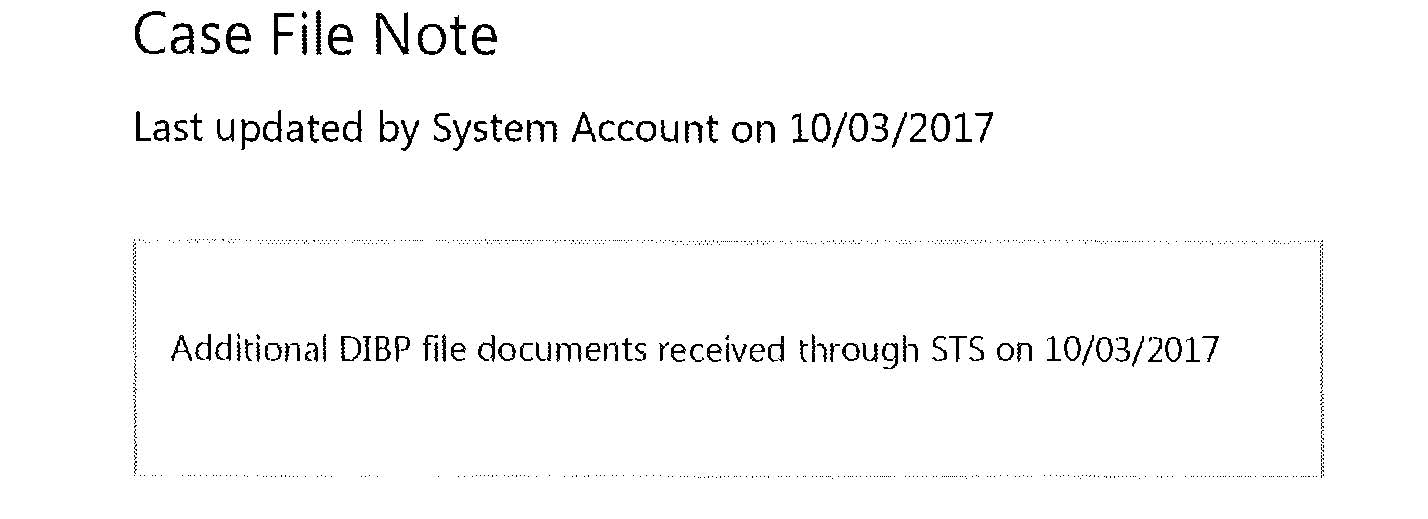
82 None of the documents in the BMH17 appeal book is identified or appears to be an English translation of any of the documents in appeal book which are in Vietnamese or any language other than English. The Authority’s reasons also make no reference to an English translation of any documents in Vietnamese. Further, in reference to the request to attend the police station, the Authority’s reasons state that no translation of that document had been provided: A BMH17 [34]. I infer that none of the documents uploaded to the STS portal on 10 March 2017 in response to the Authority’s post-referral request was an English translation of the document referred to in BMJ17’s protection visa interview.
83 The BMH17 appeal book also includes an internal Department email from the delegate, Ms Katherine Bannister, who conducted BMH17’s protection visa interview dated 8 March 2017. That email is in the following terms:
…
I’m not sure what’s happened here but I cannot find any translation of the document I’m referring to in the interview. I’ve trawled the TRIMs of both [appellants] and my personal file for them but I’ve come up with nothing. As far as I recall the [appellants] did not provide translations of ANY documents to the Department but I note in the recording I specifically refer to having a translation in front of me. I have in my notes that I’m referring to a summons issued on 07/05/2013, the copy of the original document is the first page in the lot of documents (all in Vietnamese) which were provided to the Department by [BMJ17] on 08/10/2013 (ADD2013/1429820). The initial email which is a summary of the info provided by [BMH17] is at ADD2013/1423110.
I note that [BMJ17] stated in her data breach submission on 18/04/2014 (ADD2014/1002374) that she has said “On 07/05/2013 At Rach Gia city, Kien Gian province:
• My father was invited to the police station and he was told that he had to force me to return to Vietnam otherwise my family would have a lot of problems, even being put in jail”
Perhaps this is the ‘translation’ I was referring to but I’m really not sure.
Please apologise to the [Authority] for me.
If they are seeking to see if [BMH17] has the translation I think [BMJ17] would be more likely to have this given she was the one who provided the document.
…
84 During the course of the hearing on 14 July 2022, I asked counsel for the Minister if Ms Bannister’s email of 8 March 2017 had been provided to the Authority. After the adjournment of the hearing, on 16 September 2022, the Minister filed further written submission and made a submission to the effect that ‘there is no evidence that the Bannister email was before the Authority at the time of its decisions’. That is, the decisions with respect to both BMH17 and BMJ17.
85 The Minister’s submissions of 16 September 2022 attach redacted copies of documents described as STS Documents. These documents were not included in the court books in the proceedings before the primary judge in either appellant’s application. The Minister makes submissions to the effect that the STS Documents were the documents uploaded in response to the Authority’s post-referral request for documents. That submission is not supported by affidavit evidence or any formal application for the Court to receive further evidence in the appeal.
86 The Minister submits that although the Authority’s post-referral request for documents was made with respect to the Pt 7AA review of BMH17’s application, BMJ17 provided the documents to the Department and referred to these documents in its reasons with respect to BMJ17: A BMJ17 [17], [30]. The appellants had made an unsuccessful combined protection visa application and Ms Bannister noted in her protection visa decision record for BMH17 that the appellants had consented to the sharing of information between their application and, hence, that information was before her (as delegate) on both applications and for both decisions. The Minister submits that the Court should draw the inference that ‘the STS Documents were treated by the Authority, in the unique circumstances of this case, as having been before it on both matters, just as these documents had been before [delegate]’.
87 The Minister submits that if each of the appellants is given leave to raise the ‘new’ grounds of appeal, the Minister should be given leave to tender the STS Documents as further evidence in each of the appeals. The Minister submits that, in those circumstances, the Court should dispense with the formal requirements of r 36.57 under r 1.34 of the Rules.
Should the appellants be able to advance the ‘new’ grounds of appeal?
88 The translation ground is the principal ground of appeal in each appeal.
89 Counsel for the Minister quite properly assisted the Court to ascertain the gravamen of the appellants’ contentions by drawing attention to the Authority’s post referral request for documents and Ms Bannister’s email of 8 March 2017. The appellants’ contentions are made in a context in which Div 3 of Pt 7AA is taken to be an exhaustive statement of the requirements of the natural justice hearing rule (s 473DA) and, subject to certain provisions, the Authority must review a fast track reviewable decision by considering the review material provided to the Authority (by the Secretary under s 473CA) without accepting or requesting new information and without interviewing the referred applicant (s 473DB). The Authority may ‘get in’ new information by inviting a person to give that information (s 473DC), but must not consider any new information unless certain criteria are satisfied (s 473DD).
90 In that context, as explained later in these reasons, jurisdictional error for a failure to take into account or consider a translation of the relevant document could arise in one or more of three ways based on the evidence that was before the primary judge on BMH17’s application. First, a precondition to the exercise of the Authority’s power to perform its review may not have been satisfied if BMH17 had provided a translation to the delegate and the Secretary failed to give that translation to the Authority: s 473CB(1)(b). Second, in the circumstances, there may have been a legally unreasonable failure of the Authority to exercise its procedural power to ‘get in’ and, if appropriate, consider a translation of the relevant document: ss 473DC, 473DD. Third, absent a translation, the Authority may have failed to ‘review’ the delegate’s decision.
91 As to an alleged jurisdictional error arising from a failure of the Secretary to perform the duty of giving material provided by BMH17 to the delegate before her decision was made, that is a matter I accept could have been met or addressed with further evidence from the Minister. In particular, further evidence of the protection visa interview and the documents that BMH17 provided to the delegate before or at that interview. A factual enquiry is necessary to determine if a translation was provided, if so, by whom and, if so, what has become of it. For the purposes of s 473CB(1)(b) and s 473CB(1)(c) it may be significant for BMH17 if the Secretary is no longer in the possession or control of a translation if it were provided to the delegate by BMJ17, rather than BMH17. The opposite applies and it would be equally significant for BMJ17 if BMH17, rather the BMJ17 provided a translation to the delegate. A factual enquiry is also necessary to identify precisely what material the Secretary gave to the Authority in respect of each of BMH17 and BMJ17 so as to determine if there was compliance with the Secretary’s duty under s 473CB. These are matters that cannot be determined in the appeal and it would not be appropriate to do so. However, the interests of the administration of justice could, in an appropriate circumstance, justify remitting that question to the Circuit Court for determination.
92 As to an alleged jurisdictional error arising from a legally unreasonable failure to exercise the Authority’s procedural powers, I am not persuaded that there is any evidence, in addition to the STS Documents, that Minister could have brought to bear on that issue if it had been identified as an issue raised by the grounds of review that were before the primary judge. Similarly, the absence of a translation of the relevant document raises a question about the extent to which there has been a ‘review’ of the delegate’s decision. That issue also could not be met by further evidence from the Minister other than the STS Documents.
93 Otherwise, for the reasons which follow, the ground has sufficient merit to warrant the grant of leave to raise it as a ‘new’ ground. The failure to identify the ground is explained by the circumstances described earlier. It is in the interests of the administration of justice that the appellants be permitted to argue the principal ground of each appeal.
94 In addition to the principal ground, BMH17’s notice of appeal raises another ground of appeal to the effect that the primary judge erred in failing to find that the Authority had misinterpreted the law relating to his protection claim in that it had not considered that his expulsion from school amounted to ‘serious harm’. Unlike the principal ground, that argument was not obvious on the materials before the primary judge and, therefore, was not able to be identified as a particular of any of the grounds of review in the same way. Therefore, it is truly a new ground. The Minister does not submit it could have been met with evidence below as it appears to turn purely on a question of law. Nonetheless, unlike the principal ground there is no implicit explanation for the failure to raise it and it otherwise lacks sufficient merit to allow it to be raised in the appeal. The lack of merit is addressed later. For these reasons, I would refuse BMH17 leave to raise ground 1 of his notice of appeal.
Conclusions on the preliminary matters
95 BMH17 will be granted leave, to the extent necessary, to raise ground 2 of his notice of appeal. Leave will be refused to allow him to raise ground 1 of his notice of appeal.
96 BMJ17 will be granted an extension of time to file her notice of appeal. Her draft notice of appeal will stand as her notice of appeal. She will be granted leave, to the extent necessary, to raise ground 2 of her notice of appeal.
97 The STS Documents will be received in the appeal as further evidence and I will dispense with the requirements of r 36.57 of the Rules. Having regard to the manner in which the hearings were conducted, the court book, orders and reasons for judgments filed, in substance, as the appeal book in BMJ17’s appeal will be received as further evidence in BMJ17’s appeal and the appeal book filed in BMH17’s appeal will be received as further evidence in BMJ17’s appeal. Although no party sought orders in those terms, I will make these orders in accordance with rr 1.32. 1.34, 1.40 and 36.57 of the Rules. The principles applicable to the receipt of further evidence in an appeal are well-established. These were recently summarised in Frigger v Trenfield (No 3) [2023] FCAFC 49 at [149]-[171] and need not be stated. I have had regard to those principles in receiving the further evidence in the appeals.
Parties’ submissions
Appellants’ submissions
98 BMH17 in his oral submissions said that the Authority was in error for concluding (A BMH17 [29]) that his inability to complete his schooling constituted serious harm for the purposes of his application for a protection visa within the meaning of ‘refugee’ and ‘persecution’ in ss 5H and 5J of the Act. BMH17 did not elaborate in his oral submissions on the reason(s) he considered historical denial of secondary schooling would constitute a well-founded fear of persecution in the form of serious harm if he were to return to Vietnam.
99 BMH17 in his oral submissions said that the Authority was in error for failing to request him to provide it with an English translation of the document said to be a summons issued to his father. Again, he did not elaborate on the legal foundation for that contention. BMJ17, through her husband, made no oral submissions that added to those of BMH17 regarding the asserted error of the Authority concerning the translation of the summons.
100 As to BMJ17’s contention that the primary judge should have granted her an adjournment, the substance of her submissions is to the effect that BMJ17 wanted an opportunity to instruct legal advisors and to produce translations of documents in Vietnamese. Although not framed in this manner, the substance of her submissions is that without legal representation she was not able to properly present her case before the primary judge. Also, she wanted an opportunity to put a translation of the summons before the primary judge, in effect, to demonstrate that the asserted error of the Authority was material and had it requested a translation it could have affected the outcome. She submits that she was not able to produce the translation to the primary judge because the hearing was via Microsoft Teams. However, upon invitation, BMJ17 was not able to identify in the materials now before the Court any translation that she submits she would have, but was not able, to tender before the primary judge as a consequence of his refusal of the adjournment.
Minister’s submissions
101 As to BMH17’s ground relating to misconstruction of the meaning of ‘serious harm’ in s 5J of the Act, the Minister submits that it is unsurprising that the Authority was unable to be satisfied that BMH17’s inability to complete schooling constituted serious harm. The examples given of ‘serious harm’ in s 5J(5) did not apply to BMH17’s circumstances and the gravity of those examples (such as ‘significant physical ill-treatment of the person’ (s 5J(5)(a)) suggest that an inability to complete schooling will not, without more, constitute serious harm. Importantly, and contrary to what is asserted in this ground, there was no evidence before the Authority to suggest that the appellant’s inability to complete schooling had meant BMH17 could not get a job. His evidence was that he had worked in Vietnam across a range of different occupations. The relevant claim was, in any event, incapable of meeting the refugee criteria in circumstances where the Authority plainly did not accept that BMH17’s inability to complete his schooling had arisen because of some form of persecution being inflicted on him because of his race, religion, nationality, membership of a particular social group or political opinion. Such a connection is necessary for a person to satisfy the refugee criterion (s 5J(1)(a)). The Minister submits that ground one should therefore be dismissed.
102 As to BMJ17’s ground relating to a failure to grant her an adjournment, the Minister submits that as the power to adjourn involves the exercise of a discretion, BMJ17 must demonstrate that the primary judge made an error of the kind referred to in House v R [1936] HCA 40; (1936) 55 CLR 499 at 504-505. The primary judge provided reasons for refusing the adjournment (J BMJ17 [33]-[40]) at set out at para [32]. BMJ17 has not established any error in the primary judge’s reasoning that notwithstanding her pregnancy she could participate the hearing via MS Teams, nor that there had been ample opportunity for her to obtain legal representation. As to the latter consideration an adjournment to obtain legal representation is a relevant factor that must be weighed against other considerations such as utility, broader considerations of delay and the administration of justice. The primary judge was correct to take into account the lack of merit as a factor in refusing the adjournment.
103 As to the appellants’ common ground relating to the translation of the summons issued to their father, the Minister submits the following.
104 BMH17 had provided documents to the delegate on 19 December 2016 in the Vietnamese language that were not translated. Neither of the appellants requested the Authority to invite him (her) to provide a translation. The point of that submission appears to be that, as a consequence, the Authority could not be in error for not making an invitation it was not requested to make.
105 In reliance on CHB17 v Minister for Immigration, Citizenship, Migrant Services and Multicultural Affairs [2022] FCA 635 at [61]-[63] (Greenwood J) and the authorities referred to below, the Authority could not be in error for failing to request BMH17 to provide a translation for the following reasons.
(1) The Authority was under no duty to inquire: Minister for Immigration and Citizenship v Le [2007] FCA 1318; (2007) 164 FCR 151 at [63] (Kenny J). Therefore, it had no duty to ‘get in’ or consider if it should ‘get in’ new information.
(2) The statutory scheme under which the Authority operates is consistent with the notion that it is not for the delegate or the Authority to gather information in support of an applicant’s claims, or to make inquiries, or to make out an applicant’s case for them: Abebe v Commonwealth [1999] HCA 14; (1999) 197 CLR 510 at [187]; Minister for Immigration and Citizenship v SZIAI [2009] HCA 39; (2009) 259 ALR 429 at [24]-[25]; Re Minister for Immigration and Multicultural Affairs; ex parte Applicant S154/2002 [2003] HCA 60; (2003) 201 ALR 437 at [57]. In SZIAI, the High Court confirmed that it was only in particular (and exceptional) circumstances that a failure by an administrative decision-maker to make inquiries might lead to some kind of jurisdictional error. While these authorities did not concern the statutory scheme in Pt 7AA of the Act, the principle in Abebe has been applied to the conduct of a review by the Authority: AQF17 v Minister for Immigration and Border Protection [2018] FCA 966 at [53].
(3) By analogy with the Administrative Appeals Tribunal reviews under Pt 5 and Pt 7, the Authority is under no general obligation to obtain a translation of a document given to the Authority that is not in English: Cabal v Minister for Immigration and Multicultural Affairs [2001] FCA 546 at [25] (Wilcox, Whitlam and Marshall JJ) as cited by Judge Egan in EGJ18 & Ors v Minister for Home Affairs & Anor [2019] FCCA 2782 at [17] as support for the proposition that ‘the Authority is not required to translate documentation into English’.
(4) By comparison to the facts in X v Minister for Immigration & Multicultural Affairs [2002] FCAFC 3; (2002) 116 FCR 319 at [53], the appellants were on notice of the need to provide documents to the Authority in English. The Department informed each of them at the time of his (her) visa application that ‘documents in languages other than English should be accompanied by an English translation’. When the matter was referred to the Authority each of the appellants was given a copy of the Authority’s practice direction which confirms that translations should be provided for any documents not in the English language. The Minister submits the provision of the practice direction is a ‘complete answer’ to the appellants’ contentions.
(5) There is no evidence as to what the summons says, as translated into English. Therefore, in reliance on MZAPC v Minister for Immigration and Border Protection [2021] HCA 17; (2021) 273 CLR 506 at [2], the appellants cannot establish that a translation of the document could have realistically resulted in the Authority making a different decision.
106 Notwithstanding the submissions of an absence of any obligation of the Authority to inquire, gather information or obtain translations, the Minister appears to have accepted, by reference to DGZ16 v Minister for Immigration and Border Protection [2018] FCAFC 12; (2018) 258 FCR 551 at [69]-[76] and BVD17 v Minister for Immigration and Border Protection [2019] HCA 34; (2019) 268 CLR 29 at [15], [33]-[34], that there may be circumstances in which a failure to exercise the procedural power to ‘get in’ new information and consider that information under ss 473CD and 473DD is legally unreasonable. If material, that would amount to jurisdictional error. However, by reference to Minister for Immigration and Border Protection v Stretton [2016] FCAFC 11; (2016) 237 FCR 1 at [12], [21]-[23], the Minister submits that the facts of this case do not meet the exceptional and high threshold required for legal unreasonableness in such cases.
107 In that respect, the Minister submits that the STS Documents provide crucial context for how the Authority exercised, or decided not to exercise, its procedural power. Further, it is open to infer from the STS Documents that no translation of the summons was provided to the Department (delegate). Therefore, it was open to the Authority to make findings to that effect in its reasons as it did: A BMH17 [34], A BMJ17 [34]. On the basis of those findings, it was not legally unreasonable for the Authority not to exercise its discretionary power under s 473DC to ‘get in’ new information by inviting each of the appellants to provide a translation of the summons to the Authority.
Consideration
Principles applicable to the exercise of Authority’s review and powers under Pt 7AA
108 The provisions of Div 3 of Pt 7AA govern the conduct of the review by the Authority. These are ‘taken to be an exhaustive statement of the requirements of the natural justice hearing rule in relation to reviews conducted by [the Authority]’: s 473DA. Within Div 3, s 473DB sets out what has been described as the ‘primary requirement’ that, subject to the Part, the Authority is to review a fast track reviewable decision referred to it under s 473CA by considering the review material provided to the Authority under s 473CB without accepting or requesting new information and without interviewing the referred applicant: Plaintiff M174/2016 v Minister for Immigration and Border Protection [2018] HCA 16; (2018) 264 CLR 217 at [22]. Also within Div 3 certain limited exceptions to the primary rule are contained in ss 473DC, 473DD and 473DE.
109 The effect of s 473DA is that the provisions of Div 3 are to be construed as a codification of the incidents of the Authority’s obligation of procedural fairness. ‘The prescription does not preclude all implications. Importantly, it does not preclude an implication that a statutory power within the provisions to which s 473DA(1) refers must be exercised only within the bounds of legal reasonableness.’ ‘The consequence of the codifying effect of s 473DA(1) … is that, except to the extent that procedural fairness overlaps with legal unreasonableness, procedural fairness analysis is not the “lens” through which the content of the procedural obligations imposed on the Authority in the conduct of a review under Pt 7AA is to be determined’: BVD17 at [33]-[34]. However, implication of the other aspect of the common law conception of procedural fairness, impartiality and absence of bias, is not precluded: CNY17 v Minister for Immigration and Border Protection [2019] HCA 50; (2019) 268 CLR 76 at [16].
110 When conducting a review of a fast track reviewable decision the Authority ‘is not concerned with the correction of error on the part of the Minister or delegate but is engaged in a de novo consideration of the merits of the decision that has been referred to it. The task of the Authority under s 473CC(1) is to consider the application for a protection visa afresh and to determine for itself whether or not it is satisfied that the criteria for the grant of the visa have been met’: Plaintiff M174/2016 at [17]. As a consequence, in general, a failure of the Minister or a delegate to comply with the requirements of the code of procedure set out in Subdiv AB or Div 3 of Pt 2 will not affect the Authority’s performance of its statutory function under Pt 7AA: Plaintiff M174/2016 at [45]-[47].
111 A further consequence is that an essential precondition to the performance of the Authority’s statutory function is that the Secretary complies with the duty to give the review material (including material provided by the referred applicant to the Minister or delegate and other material the Secretary considers to be relevant) to the Authority under s 473CB(1). Subject to materiality, failure of the Secretary to comply with that duty, whether by under-compliance or over-compliance, would result in jurisdictional error: CNY17 at [13]-[15]. However, the Authority would not lack power to fashion its procedure so as to ‘get in’ as new information any material necessary to bridge any gaps in the review materials resulting from some failing in the performance of the Secretary’s duty (or a relevant failure of the Minister or delegate to comply with the code of procedure): Plaintiff M174/2016 at [49]. In that manner the Authority may render any non-compliance immaterial. Similarly, the Authority has power to bridge an information gap arising from the nature of the review material that has potential to impact on the Authorities assessment of that material: ABT17 v Minister for Immigration and Border Protection [2020] HCA 34; (2020) 269 CLR 439 at [16].
112 The overriding duty of the Authority to ‘review’ the fast track reviewable decision referred to it by the Minister is accompanied by a procedural duty to conduct that review by ‘considering’ the review material and ‘considering’ any new information that satisfies the applicable criteria. The Authority performs its duty to ‘consider’ that material by examining it and forming its own assessment of the relevance of that material to the review. It is up to the Authority to give each part of the material that it thinks relevant such weight in making findings of fact as it thinks is warranted in arriving at its decision on the review: DVO16 v Minister for Immigration and Border Protection [2021] HCA 12; (2021) 273 CLR 177 at [16]-[17].
113 The de novo review of the Authority is not of a lesser standard than that required by the delegate in making the referred decision. A failure of the Authority to understand and therefore consider the substance of a claim in fact raised by a referred applicant can result in the Authority failing to perform its statutory function according to law and jurisdictional error. Mistranslation of a referred applicant’s claim ‘has the potential to result in the Authority failing to discharge the core element of its overriding duty’: DVO16 at [22]-[23]. Just as mistranslation has that potential, logically, the absence of any translation has that potential. That logic applies equally to written and spoken language.
114 The exercise of the Authority’s decision-making powers, including the procedural powers in ss 473DC, 473DD and 473DE to ‘get in’ and consider new information are subject to an implied requirement of legal reasonableness in the exercise of those powers. In ABT17 the plurality (Kiefel CJ, Bell, Gageler and Keane JJ) explained the nature and extent of the relevant implied condition of legal reasonableness.
20 Compliance with the implied condition of reasonableness in the performance by the Authority of its duty to review the decision of the delegate necessitates not only that the decision to which the Authority comes on the review has an “intelligible justification” but also that the Authority comes to that decision through an intelligible decision-making process. Thus, as has been recognised, there can be circumstances in which the Authority can transgress the bounds of reasonableness by treating particular information as the reason or part of the reason for the decision to which it comes without first exercising its powers to get and if appropriate to consider, as new information, further information capable of being provided by the referred applicant
21 Answering the question therefore requires an examination of the decision-making pathways reasonably open to the Authority in reviewing the decision of a delegate to determine for itself whether the criteria for the grant of a protection visa have been met where the review material that it is obliged to consider in making that determination leaves out information that was available to and required to be considered by the delegate.
22. The mere existence of an informational gap will not necessarily result in the Authority being “disadvantaged in comparison with the delegate”. …
(Citations omitted.)
115 In ABT17 the Authority was found to have acted unreasonably in rejecting the account given by the referred applicant in the audio recorded interview, which the delegate accepted in making the referred decision, wholly or substantially on the basis of its own assessment of the manner in which that account was given. The delegate had found that the referred applicant’s evidence was plausible and broadly consistent with country information pertaining to the events which the referred applicant had described. In the conduct of the review, the Authority listened to the audio recording of the referred applicant’s interview with the delegate. Having found that the referred applicant’s evidence was generally lacking in detail and that at times he sounded vague and hesitant, the Authority departed from the delegate’s findings as to a central part of the account given by the referred applicant. Nevertheless, the Authority affirmed the delegate’s decision.
116 Further relevant explication of legal unreasonableness in the context of the exercise of the Authority’s power under Pt 7AA is provided in Minister for Home Affairs v DUA16 [2020] HCA 46; (2020) 271 CLR 550. In that case the referred applicants had each separately paid a registered migration agent to provide written submissions to the Authority on their behalf. The agent used a template that, in the case of one of the applicants (CHK16), contained none of that applicant’s personal information and the entirety of the personal circumstances concerned a different person. The Authority was found to have acted legally unreasonably for not making further inquiry upon discovery that the submissions provided by the agent concerned a different person, such as by exercising its statutory power under s 473DC to invite the agent to provide the correct submissions containing any new information. When addressing legal unreasonableness, the plurality (Kiefel CJ, Bell, Keane, Gordon and Edelman JJ) said:
26 A requirement of legal reasonableness in the exercise of a decision-maker’s power is derived by implication from the statute, including an implication of the required threshold of unreasonableness, which is usually high. Any legal unreasonableness is to be judged at the time the power is exercised or should have been exercised. It is not to be assessed through the lens of procedural fairness to the applicant. Instead, whether the implied requirements of legal reasonableness have been satisfied requires a close focus upon the particular circumstances of exercise of the statutory power: the conclusion is drawn “from the facts and from the matters falling for consideration in the exercise of the statutory power”.
27 As Griffiths J correctly held in the Full Court, there is no general obligation on the Authority to advise referred applicants of their opportunities to present new information. Nor is there any general obligation upon the Authority to get new information. This is so even if the submissions are hopeless, or if they contain errors, even major errors, about facts or law. However, the power in s 473DC is still subject to the usual implication that it must be exercised within the bounds of legal reasonableness. Hence, this Court has held that a decision can be invalid if it is made in circumstances which exceed the high threshold of legal unreasonableness for the Authority’s failure to exercise the power in s 473DC to get new information.
28 The circumstances of CHK16’s case are extreme. The Authority was aware that CHK16 intended to provide submissions and that the submissions might contain new information. But it was apparent, as the Authority realised, that the submissions provided by the agent concerned a different person and that none of the personal information related to CHK16. As the Authority was aware, this was the only opportunity that CHK16 would have to provide his own new information, which could be of considerable importance. On CHK16’s case before the delegate, the consequences of refusal of his protection visa could place his life at risk. A request from the Authority for the correct submissions and CHK16’s correct personal information would have been a very simple matter. The Authority had, itself, indicated in its Practice Direction that submissions that were too long would be returned with an opportunity given to provide new submissions. These circumstances reflect the observation of six members of this Court in Minister for Immigration and Citizenship v SZIAI:
“The failure of an administrative decision-maker to make inquiry into factual matters which can readily be determined and are of critical significance to a decision made under statutory authority, has sometimes been said to support characterisation of the decision as an exercise of power so unreasonable that no reasonable person would have so exercised it.”
29 The legal unreasonableness of the failure by the Authority to get new information by requesting the correct submissions pursuant to s 473DC is plain when the alternative approach taken by the Authority is considered. Rather than taking the simple route of asking for the correct submissions, consistently with its own procedures for returning submissions that are too long, the Authority filleted the submissions that plainly concerned the wrong person into generic and non-generic information. The Authority then treated the generic information in the submissions concerning another person as though the information had been correctly provided in relation to CHK16’s circumstances. On no view could that have been a reasonable course to take.
(Citations omitted.)
117 In DVO16 each of the referred applicants asserted that translation errors occurred at the interviews between each of them and the respective delegate and, ultimately, the Authority’s failure to ‘get in’ correct translations amounted to jurisdictional error. In each case, the application for a visa was refused and the applications were referred to the Authority for review with the Secretary providing the Authority with recording (as translated) of each interview. The plurality (Kiefel CJ, Gageler, Gordon and Steward JJ) observed that mistranslation could, in an appropriate circumstance, lead to jurisdictional error if the Authority unreasonably failed to exercise its procedural powers to ‘get in’ and consider correct translations as new information, but, on the facts, the referred applicants had not established such unreasonableness and error: DVO16 at [20]-[21], [31], [43].
Common translation ground
118 Neither decision record of the delegate who made the decisions refusing the appellants’ applications for protection visas contains any reference to the summons to their father. The decision record for BMH17 refers to ‘NAATI translations of a number of documents [BMH17] stated supported [the appellants’] land dispute claim’ and that no translations of those documents were provided. That is the only reference to translations and documents in either decision record. Therefore, the appellants could have ascertained from the delegate’s decision records that there was a need to provide translations of documents or that such translations as had been given to the delegate concerning the summons had been ignored. Having been provided with a copy of the Authority’s practice direction, the appellants could have made a submission to the Authority that it ‘get in’ and consider a translation as ‘new information’ or that the Authority should consider any translation that the appellants contend was given to the delegate. The absence of any submissions of that nature is a factor to be taken into account when considering if the Authority acted unreasonably in failing to invite the appellants to make submissions or provide it with a translation.
119 Nonetheless, the documents in the Authority’s BMH17 file indicate that it had identified a reference to a translation of the summons document in the recording of an interview with BMH17 which the Secretary had not given to the Authority. The evidence before the Court is that the Authority requested the Secretary to provide it with that translation. The STS Documents provided in response to that request contain no such translation.
120 The reasons of the Authority refer to the delegate requesting BMH17 to provide NAATI translations at his interview and that no translations were provided: A BMH17 [34]. The Authority’s reasons make no mention of any other translation. The absence of a NAATI translation of the summons document, amongst other things, is used as a reason for the Authority placing ‘no weight’ on the document and the Authority not accepting that the appellants’ father was invited to attend a police station to answer questions about the appellants.
121 The absence of a translation of the summons document was a central component of the Authority’s rejection of a key element of the appellants’ claims to well-founded fears of persecution. Having regard to the importance of a translation of the summons document both to the appellants’ protection claims and the Authority’s reasoning process it was not reasonable for the Authority to assume or infer, if that is what it did, that BMH17 had not given the delegate any translation of the summons document at all. There was an evident inconsistency between what was recorded in BMH17’s protection interview and the materials the Secretary had given to the Authority purportedly in compliance with the duty under s 473CD(1). That created a gap in the information contained in the review materials. It was remarkably simple for the Authority to bridge that gap by an invitation to BMH17 and BMJ17 to give the Authority a copy of the translation referred to in the interview, or another translation if a copy had not been retained. At the very least, there was doubt about the extent to which the Secretary had complied with the duty under s 473D(1) and that doubt could be readily removed through an invitation to BMH17 and BMH17 to ‘get in’ a translation of the summons.
122 The circumstances of this case are not as extreme as those under consideration in DUA16. Further, as observed in ABT17, the existence of an information gap will not necessarily result in the Authority being disadvantaged in comparison to the delegate. However, legal reasonableness requires the Authority to come to its decision through ‘an intelligible decision-making process’. In my view, it was not reasonable for the Authority, in the circumstances of this case, to assume that there was no translation of the summons given to the delegate when a translation of it was evidently identified in the audio recording of BMH17’s interview and the Authority had requested the Secretary provide the translation to which reference was made and the Secretary had failed to do so. There was no apparent ‘good reason’ in those circumstances for the Authority not to exercise the power to ‘get in’ a translation of the summons and, if appropriate, consider it in its review as new information. That error was material having regard to the importance of the document and its translation to the appellants’ protection claims.
123 Having regard to the conclusion I have reached on legal unreasonableness it is not necessary to consider whether there was, in fact, a translation of the document given to the delegate that was not in turn given to the Authority in compliance with the Secretary’s duty under s 473CD(1). Therefore, it is not necessary consider whether a necessary precondition to the exercise of the Authority’s power of review has not been met in the circumstances of this case or whether it would be appropriate to determine that question in this appeal or remit that question to the Circuit Court for determination. Likewise, it is unnecessary to consider if there was a failure to perform the statutory ‘review’ because a translation of the summons BMJ17 provided to the delegate was not considered by the Authority.
BMH17 serious harm ground
124 As I have found that BMH17’s appeal should succeed on ground 2 of his notice of appeal it is unnecessary to deal with ground 1. However, for completeness, for the reasons given in the Minister’s submissions referred to earlier, this ground has no merit. Leave to advance that ‘new’ ground in the appeal will be refused for that reason.
BMJ17 procedural fairness ground
125 As I have found that BMJ17’s appeal should succeed on ground 2, it is unnecessary to deal with ground 1 of her notice of appeal.
Conclusion
126 To the extent necessary, BMH17 will be granted leave to raise ground 2 of his notice appeal. Leave will be refused to allow him to raise ground 1. His appeal will be allowed, the decision of the Authority quashed and the matter remitted to the Authority for determination according to law. There will be no orders as to the costs in the appeal or before the primary judge.
127 BMJ17 will be granted an extension of time within which to appeal. Her draft notice of appeal will stand as her notice of appeal. To the extent necessary, leave is granted for her to raise ground 2 of her notice of appeal. Her appeal will be allowed, the decision of the Authority will be quashed and the matter remitted to the Authority for determination according to law. There will be no orders as to the costs in the appeal or before the primary judge.
I certify that the preceding one-hundred and twenty-seven (127) numbered paragraphs are a true copy of the Reasons for Judgment of the Honourable Justice Feutrill. |
Associate:


