

FEDERAL COURT OF AUSTRALIA
Buckeridge v Littlepay Pty Ltd [2023] FCA 1036
ORDERS
Applicant | ||
AND: | Respondent | |
DATE OF ORDER: |
THE COURT ORDERS THAT:
1. The application be dismissed.
Note: Entry of orders is dealt with in Rule 39.32 of the Federal Court Rules 2011.
O’CALLAGHAN J
INTRODUCTION
1 The applicant, Ms Buckeridge, was employed by the respondent, Littlepay Pty Ltd (Littlepay), as its General Counsel on 1 September 2017.
2 On 3 December 2021, Littlepay terminated her employment, by reason of redundancy.
3 Ms Buckeridge alleged that she was in fact dismissed because she exercised workplace rights within the meaning of s 341(1) of the Fair Work Act 2009 (Cth), in that she:
(a) made a complaint against Mr Paul Griffin, Littlepay’s Global Head of Commercial;
(b) made a complaint against Mr Amin Shayan, Littlepay’s Chief Executive Officer,
and that Littlepay had taken adverse action against her within the meaning of s 342(1), in contravention of s 340(1)(a)(ii).
4 She also alleged that she was dismissed because she had taken sick leave, and that Littlepay had contravened s 352 of the Fair Work Act.
5 She further alleged that Mr Shayan had induced a breach of a share options agreement she had entered into with Littlepay’s UK parent company and that Littlepay was liable for that tort, and that Littlepay had contravened the so-called “whistleblower” provision in s 1317AC of the Corporations Act 2001 (Cth).
THE PLEADED CASE
Fair Work Act claims
6 Ms Buckeridge alleged numerous unlawful reasons for the adverse action in her statement of claim filed 17 June 2022. Counsel for Ms Buckeridge, Mr J Fetter, maintained those reasons throughout the hearing, but narrowed them on the final afternoon of the hearing as follows:
MR FETTER: … I have obtained instructions to narrow the case, given the evidence that we have heard, and maintain only the allegations under the Fair Work Act that Ms Buckeridge was dismissed because she made the bullying complaints against Mr Griffin. Secondly, because she made the complaint against Mr Shayan, and third, because she was absent on sick leave.
7 Those remaining grounds were pleaded as follows:
[Because she made the Griffin Complaint and the Shayan Complaint]
14. During the course of 2021, the Applicant complained to Littlepay that Mr Griffin was bullying her and other employees.
…
16. Commencing on 19 September 2021, the Applicant made complaints to Mr Saville, Ms Pope and Ms Carthew:
(a) that Mr Shayan had bullied and discriminated against her personally …
…
45. By engaging in the conduct pleaded at paragraphs … 14 [and] 16(a) …, the Applicant exercised workplace rights, within the meaning of FWA s.341.
46. Littlepay dismissed the Applicant because, or for reasons including that, she had exercised some or all of the workplace rights pleaded in paragraph 45 above.
[Because she was absent on sick leave]
20. On 18 November 2021, the Applicant commenced a period of unpaid sick leave, which was a temporary absence from work because of illness or injury of a kind prescribed by regulation 3.01(2) of the Fair Work Regulations 2009 (Cth).
…
52. … Littlepay dismissed the Applicant because of, or for reasons including, the matter pleaded at paragraph 20 above.
8 By its amended defence filed 17 April 2023, Littlepay admitted that Ms Buckeridge exercised her workplace rights within the meaning of s 341(1) of the Fair Work Act in making the Griffin Complaint and the Shayan Complaint (as they were referred to in submissions).
9 Littlepay admitted that the dismissal of Ms Buckeridge constituted “adverse action” within the meaning of s 342(1) of the Fair Work Act, but otherwise denied the allegations in relation to the Griffin Complaint and the Shayan Complaint.
10 As to the sick leave plea, Littlepay admitted that Ms Buckeridge commenced a period of paid sick leave on 6 October 2021 and a period unpaid sick leave on 18 November 2021. It denied that Ms Buckeridge “had any legal right to be on ‘unpaid sick leave’” and denied that it dismissed Ms Buckeridge because she was on sick leave.
EVIDENCE
11 The applicant read the following:
(1) Affidavits of Rebecca Buckeridge affirmed 14 September 2022 and 8 December 2022. Ms Buckeridge gave evidence on numerous matters, including her employment at Littlepay, her grant of stock options, the Griffin Complaint, and the Shayan Complaint; and
(2) Affidavits of Emma Montrose affirmed 14 September 2022 and 8 December 2022. Ms Montrose worked at Littlepay as its “People & Culture Lead” and later as “Head of People and Culture” between July 2017 and April 2021.
12 Mr JRM Tracey, counsel for Littlepay, cross-examined Ms Buckeridge, including about her redundancy, the Griffin Complaint, and the Shayan Complaint.
13 Mr Tracey also cross-examined Ms Montrose. Relevantly, Ms Montrose agreed with counsel’s proposition that in giving evidence, she was in court “engaging in advocacy on behalf of Ms Buckeridge” and that she “left [Littlepay] in circumstances where [she was] unsatisfied with [her] employment”. Ultimately, her evidence was not relevant to the issues in dispute.
14 The respondent read the following:
(1) Affidavit of Amin Shayan affirmed 17 November 2022. He gave evidence on numerous topics, including Littlepay’s restructure of its legal function, the Griffin Complaint, and the Shayan Complaint;
(2) Affidavit of Jennifer Tod 17 November 2022. Ms Tod is, and has been since 17 May 2021, “Head of People and Culture” at Littlepay. She gave evidence about issues with Littlepay’s legal function, a meeting between herself, Ms Buckeridge, and Mr Shayan on 18 June 2021, the decision to restructure the legal function, the Griffin Complaint, and the Shayan Complaint; and
(3) Affidavit of Steven Gallagher 17 November 2022. Mr Gallagher is a director of Littlepay. He gave evidence as to the process of making Ms Buckeridge redundant.
15 Mr Fetter cross-examined Mr Shayan at considerable length on numerous topics. Given the narrowing of Ms Buckeridge’s case in closing, much of this cross-examination (which occupied 1.5 days) was ultimately beside the point.
16 Mr Fetter cross-examined Ms Tod about the 18 June 2021 meeting, the Griffin Complaint, and the Shayan Complaint.
17 The following relevant exhibits were filed during the course of the hearing:
(1) Exhibit A1: Email from Sandra Pope to Derek Humphrey-Smith dated 26 November 2021;
(2) Exhibit A3: Email from Amin Shayan to Sandra Pope dated 1 October 2021;
(3) Exhibit A4: Email from Alison Carthew to Amin Shayan dated 26 November 2021;
(4) Exhibit A5: Undated Head of Legal Compliance advertisement; and
(5) Exhibit A6: Jennifer Tod’s meeting notes dated 18 June 2021.
FACTS
Littlepay and Ms Buckeridge’s employment
18 Littlepay is a company registered under the Corporations Act and a national system employer subject to the Fair Work Act. It is wholly-owned by a company based in the United Kingdom, Littlepay Mobility Ltd (Littlepay UK), which is in turn controlled by another company based in the United Kingdom, ICM Mobility Group Ltd (ICM).
19 Littlepay’s Chief Executive Officer is Mr Amin Shayan. Mr Shayan is also a Director of Littlepay and Littlepay UK.
20 On 1 September 2017, Littlepay employed Ms Buckeridge as its General Counsel.
21 Ms Buckeridge was based in Melbourne during her employment and provided internal legal services in relation to matters in Australia, the United Kingdom, the European Union, and the United States.
Options contract
22 On 30 October 2020, Ms Buckeridge entered into an options contract with Littlepay UK.
23 That options contract consisted of a written invitation dated 21 October 2020, which incorporated the “Littlepay Incentive Program Plan Rules” dated 14 October 2020.
24 The Littlepay Incentive Program Plan Rules contained the following relevant clauses:
7 Exercise of an Option
7.1 Manner of exercise
When permitted to do so under this Rule 7 or in an Offer Document, a Participant may exercise an option by:
(a) paying the Exercise Price to or as directed by the Company; and
(b) delivering to the Company
(i) the Participant’s Option certificate; and
(ii) if applicable, a Deed of Accession duly executed by each person required to execute it.
…
7.4 Board discretion
On valid exercise of an Option, the Board must issue Plan Shares in the Company or in any other Group Entity, as it may choose at its absolute discretion.
…
13 Issue and ranking
13.1 Issue of Rights or Plan Shares
If:
…
(b) an Option is properly exercised, or Right properly redeemed (resulting in an entitlement to Plan Shares),
in accordance with the applicable Offer Documents, the Company must within such period as stated in or required by the Offer Documents (or failing that, within 10 Business Days), issue to the Participant each Right or Plan Share to which the Participant is entitled upon such acceptance, exercise or redemption.
…
14 Administration of the Plan
14.1 Board to administer
This Plan will be administered by the Board [of Littlepay UK] …
…
14.3 Board has unfettered discretion
Except as expressly provided otherwise in the Offer Documents, the Board has absolute and unfettered discretion without needing to obtain consent from any person in the exercise of any rights, powers or discretions under each Offer Document and to act or refrain from acting under any Offer Document or in connection with this Plan.
…
17 Terms of Employment
…
17.3 No claims
No Eligible Employee, Nominee Participant or other person has any right to compensation or damages from any Group Entity in respect of any loss of future rights under this Plan, as a consequence of termination of an Eligible Employee’s Employment.
…
19 General
…
19.6 Governing Law
(a) These Rules are governed by and are to be construed in accordance with the laws applicable in England and Wales.
(b) The Company, each Eligible Employee and each Participant irrevocably and unconditionally submits to the non-exclusive jurisdiction of the courts of England and Wales and any courts which have jurisdiction to hear appeals from any of those courts and waives any rights to object to any proceedings being brought in those courts.
25 On 25 March 2021, Littlepay UK notified Ms Buckeridge by letter that a vesting condition of the options contract had been satisfied. That letter relevantly provided as follows:
With reference to the Littlepay Incentive Program Plan Rules (Rules), the Invitation to you to participate in the Littlepay Incentive Program dated 21 October 2020 (Invitation) and your application in response to the Invitation, the Board is pleased to confirm that the First Vesting Condition of 50% of your Plan Shares have been satisfied.
In accordance with the terms stipulated in the ESOP Rules, you may either exercise your Options to purchase Plan Shares, or alternatively take cash under the Option Buy-Back.
Options may be exercised at any time during the Exercise Period after the Exercise Conditions (as set out in the Invitation) have been satisfied by:
[Paying an Exercise Price of AU$0.10 for each Option the participant wishes to exercise, and delivering to Littlepay UK various documents]
Once the Board has verified that you have validly exercised your Option, you will be issued with your Plan Shares. Please note that, subject to the Exercise Conditions being satisfied, you will not be entitled to your Plan Shares until you exercise your Options.
If you do not wish to exercise any vested Options, you may request the Company buy back those vested Options by delivering to the Company an Option Buy Back Request (Annexure C) within 30 days after the date of this notice. The Company will buy back those vested Options at a price of AU$0.50 per vested Option within 90 days after it receives the Option Buy Back Request.
Unless the context otherwise requires, words and phrases used in this letter have the same meaning as given in the Rules and the Invitation.
You should obtain independent advice on the financial, tax and other consequences to each of you of, or relating to, the exercise of the Option and the subsequent rights and obligations as holders of Plan Shares.
Corporate restructure and proposed redundancy
26 By 2021, almost all of Littlepay’s clients were based in Europe. As at 17 November 2022, it had had one Australian client, out of a total of around 300.
27 In January 2021, Littlepay UK employed Mr Paul Griffin as “Global Head of Commercial”. Littlepay had previously contracted Mr Griffin as “Head of Commercial”.
28 In that capacity, Mr Griffin, reported directly to Mr Shayan. Mr Griffin, and the role, is based in London.
29 Littlepay’s commercial team, which was also based in London, generated (and continues to generate) most of the work for Littlepay’s legal function.
30 On 18 June 2021, Mr Shayan and Ms Tod met with Ms Buckeridge to discuss resourcing, including a proposal to hire a UK-based legal counsel.
31 Ms Buckeridge’s recollection of that meeting was as follows:
63. On a date which I think was 19 [sic – it was 18] June 2021, I had a meeting with Jennifer and Amin, in the Melbourne office. In the meeting we discussed a number of things which I had already raised with them, earlier in the year. I cannot say exactly when. That is because in preparing my affidavit I have not had access to my Littlepay email inbox, outbox and calendar, and so it is difficult for me to be precise about the chronology.
64. In the meeting, I complained that Paul was a bully, and told him that at least five women had complained to me about him. Amin said that was untrue, and that no complaints had been made. He said that the complaint was “really about you, not Paul”. He said that I and other women just needed to be more assertive in dealing with Paul. Jennifer agreed with Amin and said that Paul was “clearly” the right person for the job. I started to cry. They did nothing to show any care or concern for me.
65. We also talked about my pay. I again complained about still being paid as a part-timer. Jennifer said I could return to full pay. I said even full pay was not enough, that I was being paid less than market rates, and I reminded Amin that Wex had offered me much more money. Amin replied that I was not “worth” $200,000. That upset me further.
66. In the meeting, we also talked about my workload. I also complained that my workload was excessive, and asked for a full-time Australia-based lawyer to be hired to help me.
67. Amin then proposed hiring a lawyer based in the UK. I said that a UK lawyer was not needed, because the UK was no longer our focus in winning work. I said that if Littlepay wanted a UK-based lawyer, then I would happily return there.
32 Mr Shayan’s recollection of that meeting was as follows:
44. On 18 June 2021, Jennifer, Head of People and Culture, and I had a meeting with Rebecca to discuss resourcing. During the meeting, Rebecca said that she wasn’t coping with the workload and said her life was very difficult as a single mother with two toddlers, one of whom had ongoing health issues, and her ill mother. She was in a very emotional state, and complained about being underpaid, of working long hours across time zones, of aggressive emails from Paul and of me not supporting her to hire additional resources in Australia. While Rebecca’s workload and work hours were not excessive I didn’t say as much to Rebecca because I considered it would not be constructive because of how distressed Rebecca seemed to be at the time, and I was genuinely concerned for her wellbeing. Instead, I said that work wasn’t worth getting this worked up about, and she should put her family needs first, and that we would always be understanding of that. I also said she should keep in mind that as Littlepay expands the demands were likely to only increase. I also said that I had been fully supportive of expanding the legal team as we had discussed previously, but it didn’t make sense to hire further legal support in Australia, and reiterated that the additional resources should be closer to our clients and partners. Rebecca said she would like to move to the UK at some point but she could not for a couple of years until when her kids were a bit older. Given that was a number of years away, it would not address the problems Littlepay was experiencing. Jennifer suggested we accelerate the addition of a paralegal resource, that had been discussed previously, to relieve workload pressure while we advertise for a resource in the UK. Everyone agreed to proceed on this basis. However, I knew this would only be a temporary fix.
45. It made most sense to restructure the legal function and appoint a new senior counsel in the UK, but at the time, although it would not be ideal, I thought that it would be easier to leave Rebecca in the General Counsel position based in Melbourne for the time being and employ someone as a more senior-level legal resource in the UK and not have to restructure or remove the General Counsel position. It was my view that the short-term solution of appointing a senior-level legal counsel role in the UK would give us time to onboard and train the new employee, to confirm we had hired the right person through their probationary period, and to create a smoother transition to a longer-term structure with the legal function based in the UK. That would then probably lead to the redundancy of the GC role in Australia. This approach also meant I did not need to seek board approval for the position and could hire more quickly.
46. We asked Rebecca for her views on having a new legal counsel role in the UK and she was reluctant to agree to appoint someone who would not be based in Melbourne. Rebecca pushed back quite hard on this and said that she did not agree with having someone in the UK as it would mean she would have to work outside normal hours with this person. This didn’t make any sense to me as if we appointed someone else to be based in Melbourne I thought it would only make the problems we were experiencing with the legal function worse, not solve them.
33 Ms Tod’s recollection of that meeting was as follows:
31. On 18 June 2021, Amin and Rebecca were both in the office. I said to Amin that I wanted to join the meeting he was intending to have with Rebecca because I also wanted to discuss Rebecca’s workload and UK recruitment, her working relationship with Paul and to assist in clearing up what I believed may have been a misunderstanding about Rebecca wanting to return to full-time work.
32. I said to Rebecca in this meeting that I had gone through the correspondence between her and Paul and although I thought that some of the correspondence from Paul was quite direct, I didn’t consider that Paul was being aggressive which was the term Rebecca used in a recent discussion with me. Rebecca didn’t request that any further action be taken in relation to Paul at that time. Amin said words to the effect of “I’d like to support you both to have sensible communication with each other.”
33. During the meeting with Rebecca, Amin said that he thought part of Rebecca’s frustration with her role was that she gets confused around her role being advisory rather than an actual decision maker. He said that it was her role to provide the advice, not make the decisions. Amin said it was not Rebecca’s concern if Paul didn’t take Rebecca’s advice because he (Amin) signed off on the contracts. Amin told Rebecca that she was not responsible for the commercial decisions and that she just needed to give the advice.
34. At the meeting on 18 June 2021, we also discussed Rebecca’s part-time arrangement and her return to work full-time. I said to Rebecca that I thought that there was some confusion about what hours Rebecca wanted to work. Rebecca said words to the effect of “I definitely want to go full-time”. Amin immediately said words to the effect of “Well, that’s approved. Start tomorrow, that’s fine.” Rebecca then said words to the effect of “Well, I’ve got to get childcare on a Wednesday.” And I said words to the effect of “Great, well as soon as you let me know you’ve got the childcare we’ll adjust your contract.” Rebecca did not state that she was working more than 4 days a week.
35. At the meeting, we also discussed the issues relating to resourcing and legal work. There was some discussion about the difficulties of time zones with the commercial team and clients based in the UK / EU. Amin said that he wanted the new person to be based in the UK. Rebecca said she wanted the new person to be based in Melbourne due to her concerns with onboarding and management of an offshore staff member.
36. We agreed at the end of the meeting with Rebecca to proceed with the hire of a junior legal administration support to be based in Australia. We also agreed that Rebecca would continue to have external resources in the UK, the US and Australia. Amin said to Rebecca words to the effect of “You’ve got external resources, just use them if you’re feeling overwhelmed.” By “external resources”, I understood that Amin was referring to a number of external law firms in Australia, the US, Europe and the UK which Littlepay used.
34 In Ms Buckeridge’s affidavit affirmed 8 December 2022, she cavilled with some aspects of Mr Shayan and Ms Tod’s recollections, but not with respect to any aspects of significance.
35 Ms Tod took handwritten notes at that meeting and later electronically typed them as follows:
Amin met with RB to discuss UK hire (early June)
RB sent through proposed JD for UK hire to Jen (7 June 2021)
Notes from meeting with RB 18/06/2021
Rebecca requested to meet to discuss her recent interactions with Paul that were creating issues for her. Jen and Amin met with her in a S&C meeting room in response to her request.
Jen reassured RB that we don't want any of our staff to feel as upset as she has been recently, so we are keen to find a solution for some of the problematic communications between her and Paul. However, she had reviewed the recent comms between them and didn't find that Paul's were aggressive, as indicated by RB. The language was considered to be direct but given the context of the negotiations, it wouldn't have been something that Jen considered would fall into "aggressive" or "bullying". RB didn’t request any further action be taken.
RB discussed the creation of contracts outside legal and Amin outlined that her role is an advisory role and that it isn't her responsibility to carry the risk, that it is his role to do this. RB said she thinks she holds individual responsibility for legal advice. This went back and forth for a bit with no overall consensus.
Legal resources were discussed - RB is overwhelmed by the work at the moment.
RB and Amin had previously discussed the need for a UK-based lawyer. There was a broad continuation of discussion around the UK vs AU requirements.
Outcomes:
1. Amin approved a Legal Assistant based in Melbourne (Casual hours) to commence immediately.
2. Amin also approved RB's request to move back to FT hours following a COVID-based reduction in 2020. RB said she would advise once suitable childcare had been arranged.
3. UK based legal role to be clarified at a later date 4. RB also mentioned that she would be interested in relocating to the UK if an additional UK-based lawyer was required but that she wouldn't be able to do this in the short-term.
There was a discussion that the team would move forward with the following structure and this would be reviewed at some stage in the future:
GC (AU-based) to manage the following
- External resources (UK, AU & US)
- Legal Assistant (AU) - proceed to hire
- Lawyer (UK) to be determined
Board Paper Presented with proposed restructure - 14 Sept 2021
(approved 17th Sept by Steve & approved by Nic 20/9)
(Emphasis in original.)
36 The week following that meeting, Mr Shayan and Ms Tod discussed hiring a senior legal resource, which would result in the need to make redundant the General Counsel position.
37 In early July 2021, Mr Shayan decided to proceed with the restructure and therefore that redundancy.
38 On 14 September 2021, Mr Shayan sent an email to the Littlepay board, in which he said “I have concluded that it will be better to restructure the legal function so that it is located in the UK, where it can work more effectively with our partners. This restructure will involve the redundancy of an executive member of the Littlepay team, and I am therefore seeking board approval to proceed”.
39 Attached to that email was a “September board update”, which included a slide to this effect:
Introduction
• Over the past year, Littlepay has expanded significantly with
• exposure to more international markets
• a substantially larger commercial team which has been restructured
• more complex partnering arrangement with ticketing vendors, acquirers and schemes
• As a result of these changes, it is an appropriate time to assess our Legal and Compliance structure which is showing signs of strain and inadequate fit for purpose
• A Legal team fit for our future aspirations would need to:
• be geographically located so that it can collaborate with key stakeholders (primarily EU and Americas)
• have the team management skills to scale with internal and external resources
• take responsibility for our data privacy and compliance (manage DPO role)
• Develop and progress Littlepay’s compliance posture with acquirers so we can become a Payfac, and with schemes so we can directly connect
• The following pages discuss these issues
40 The slides also included the following slides:
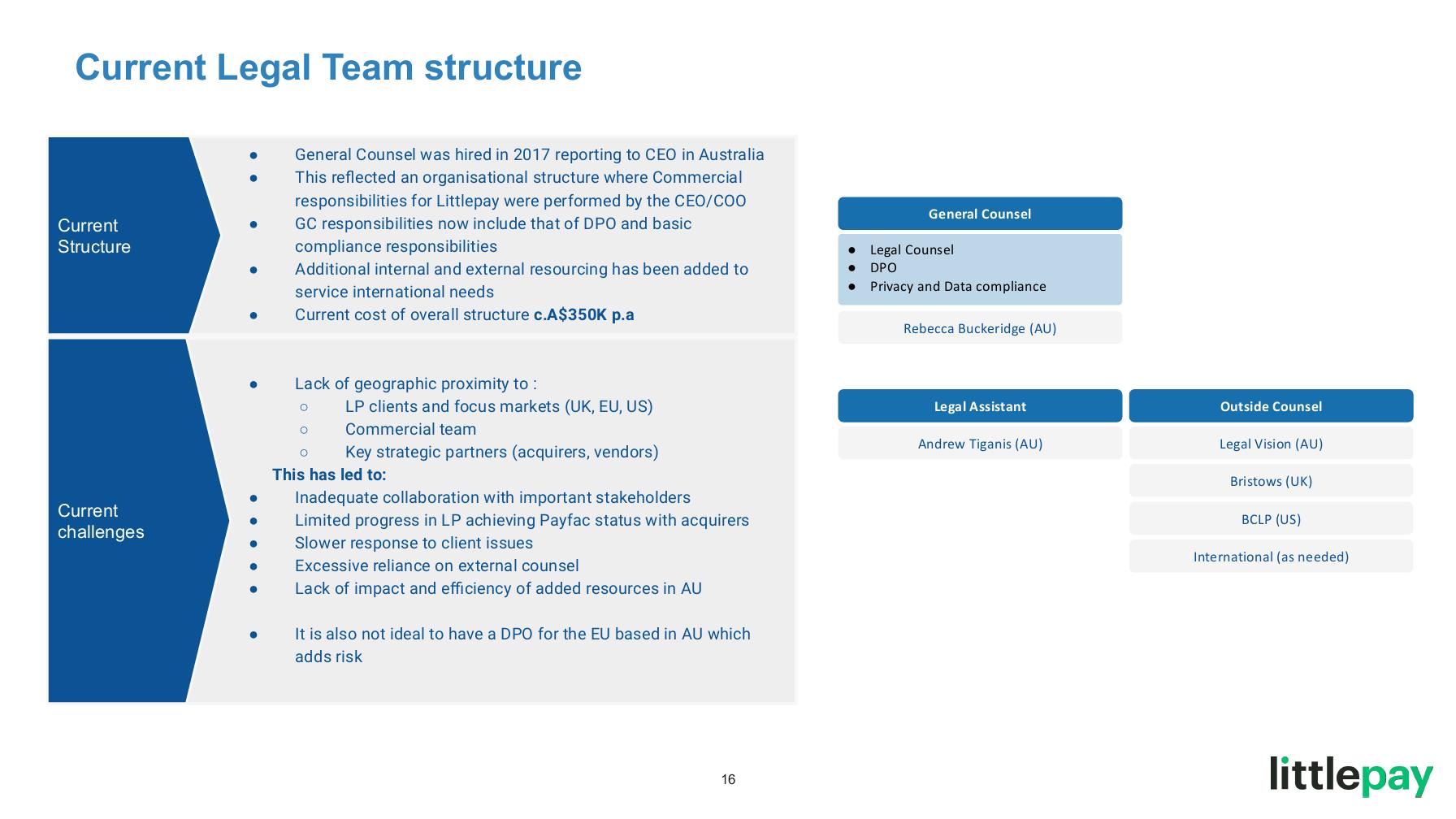
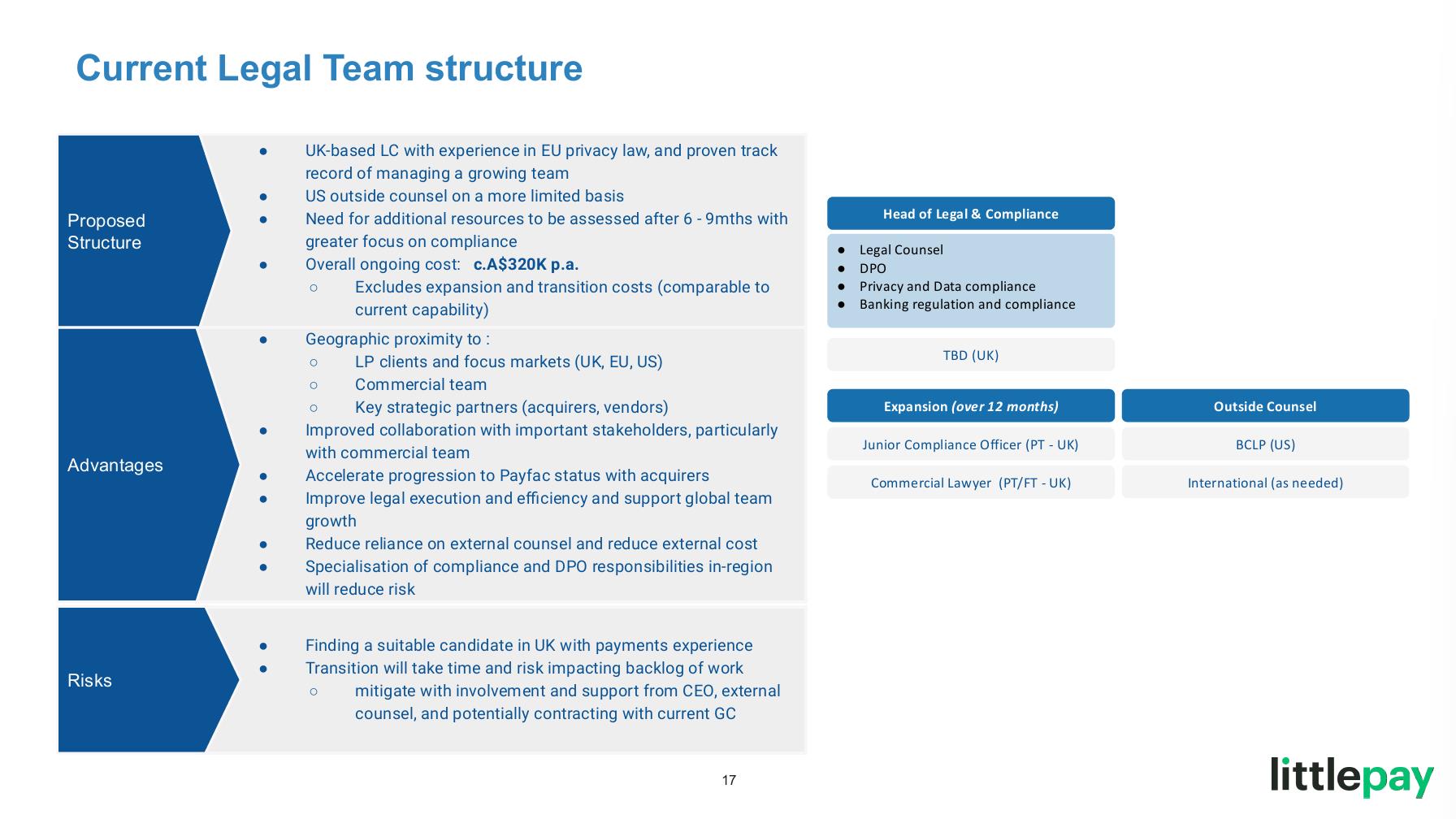
41 The following recommendations were made:
1. Create a new Head of Legal and Compliance role in the UK, reporting to the CEO, with experience in:
• Payments sector
• Commercial contracts
• Data privacy, GDPR and banking compliance
• Managing a scaling team in compliance
2. This new position would make redundant the need for
• General Counsel in Australia
• There is now much greater sensitivity (and some risk) around doing this due to the recent investigation. Though untrue, a redundancy may be perceived by the GC this is a retaliation
• Legal Admin in Australia
3. We would also terminate our relationship with LegalVision Australia and use external counsel as needed on an ad-hoc basis for employment issues
4. Reduce expenses with external UK legal counsel
5. Reassess after 6 months to determine new roles to grow the team
42 On 17 September 2021, Mr Gallagher responded to Mr Shayan’s 14 September 2021 email in the following terms (formal parts omitted):
I am supportive of the Legal restructure proposal but we will need to proceed with caution and obtain good employment law advice on how to handle any claim that may be forthcoming eg wrongful termination from Rebecca given the history.
Another very strong month of progress on all other fronts.
43 On 6 October 2021, Ms Buckeridge commenced a period of paid sick leave.
44 On 18 November 2021, Ms Buckeridge commenced a period of unpaid sick leave.
Griffin Complaint
45 On 19 July 2021, Ms Buckeridge made a complaint against Mr Griffin. She complained via the following email to Mr Shayan and Ms Tod in these terms:
Please see below.
I’m finding this situation increasingly difficult. Paul’s behaviour and aggression is making my job very difficult and a very tense, unsupportive work environment.
Examples:
1. Changing contracts without telling me and then sharing those externally,
2. Telling me I am wrong or inaccurate in multiple emails in front of other employees (see below).
3. To be clear - I have never asked for him to do any contract edits, only to advise on commercial aspects.
I would like to initiate a formal complaint process. Please advise next steps.
Regards,
-Rebecca
46 Ms Buckeridge’s “[p]lease see below” refers to an email chain she forwarded between herself, Mr Griffin. That email chain consists of 13 emails, 11 of which are between Ms Buckeridge and Mr Griffin. The emails concern the preparation of “payment schedules” for one of Littlepay’s clients. The nature of the emails is Mr Griffin asking Ms Buckeridge to undertake work on the payment schedules.
47 The two most recent emails in the chain are in the following terms. First, an email from Ms Buckeridge to Mr Griffin:
Paul
I noticed that there had been some changes to the MSA on file that were not in track changes and had not been reviewed by legal. The changes don’t read well with the rest of the document. I have reverted back to the previous wording.
I’m not sure which version is which from the versions you were working on. I always use a very clear naming convention for documents when there is more than one version. (Let me know if you would like me to share this with you again). The current version is version 01e. I have archived the previous version and incorporated the processing terms. This version of the MSA is ready for sharing externally. See here.
However, I note there are some matters from the SOW dated June 25 that need to be addressed (I had marked them with TBC). These need to be clarified prior to sending out. If you would like any assistance with these (they are commercial in nature but I’m more than happy to help if you are stuck), then please let me know.
As an aside, following your request, the two clauses relating to Back Office and Discounts and Concessions were added to the MSA template. I note that they are subject to review by commercial on each occasion but have not yet been used. I am going to remove these from our templates going forward - please let me know if and when you would like them to be reinserted into the templates.
-Rebecca
48 Second, Mr Griffin’s response to Ms Buckeridge:
Rebecca,
>>I noticed that there had been some changes to the MSA on file that were not in track changes
Can you be more specific please – I made only those changes we discussed or as per email. I’ve just done a compare and there is nothing there that wasn’t previously discussed. Although I can see you have reverted the background note C from the new improved version to the old, inaccurate one. That’s fine if you want to reject that.
Reformatting
I spent good time reformatting the entire data protection section to make it readable and removing all those weird control items that seem to get introduced into drafts from somewhere (similar to SBCAG). The version that has gone into in to the MSA is the old unformatted version and still includes those weird control items.
>> I’m not sure which version is which from the versions you were working on. I always use a very clear naming convention for documents when there is more than one version.
I leave final edits with you including any version changes. I offer edits as suggestions, you have final approval and control over the files - I change only the date on the file. Its [sic] pretty clear from the YYYYMMDD file naming what is what.
>> However, I note there are some matters from the SOW dated June 25 that need to be addressed (I had marked them with TBC). These need to be clarified prior to sending out.
My view was that these would be populated in the course of contract progression. They are mainly just dates and project manager details etc. They are genuinely “TBC”. We are trying to get an MSA approved – the SOW is secondary. Please flag the ones you think are critical prior to sending out.
>>As an aside, following your request, the two clauses relating to Back Office and Discounts and Concessions were added to the MSA template. I note that they are subject to review by commercial on each occasion but have not yet been used. I am going to remove these from our templates going forward - please let me know if and when you would like them to be reinserted into the templates.
They are useful and important placeholders. It makes people think about what needs to be in that section if applicable. Just because they haven’t been applied in the last two occasions doesn’t mean it doesn’t serve a purpose.
General Point on Edits
I don’t think it is productive for me to contribute to any further edits on any further contracts.
Regards,
Paul
49 Ms Buckeridge made the formal complaint at paragraph [45] above 15 minutes after Mr Griffin sent that response.
50 On 20 July 2021, Ms Buckeridge sent a further email to Mr Shayan and Ms Tod, in the following terms:
Further to my email [of 19 July 2021], please find below information about workplace bullying:
https://www.safeworkaustralia.gov.au/bullying
Some examples of workplace bullying include:
• abusive or offensive language or comments
• aggressive and intimidating behaviour
• belittling or humiliating comments
• practical jokes or initiation
• unjustified criticism or complaints.
https://www.gov.uk/workplace-bullying-and-harassment
Examples of bullying or harassing behaviour include:
• spreading malicious rumours
• unfair treatment
• picking on or regularly undermining someone
• denying someone’s training or promotion opportunities
51 Ms Buckeridge’s 19 and 20 July 2021 emails were alleged to constitute the “Griffin Complaint”.
Response to the Griffin Complaint
52 In late July 2021, Littlepay engaged an organisation called Blax Group to investigate the allegations raised by Ms Buckeridge about Mr Griffin. Mr Brett Pomroy conducted the investigation on behalf of Blax Group.
53 Ms Buckeridge spoke to Mr Pomroy in relation to her complaint.
54 On or around 1 September 2021, Blax Group provided its “Investigation Report” to Littlepay, including the following executive summary:
The allegations generally concern the manner in which the Complainant [Ms Buckeridge] alleges they are treated by the Respondent [Mr Griffin], that is, the Respondent undermines the Complainants advice, the Respondent engages in belittling behaviour when they question the advice given by the Complainant, the Respondent is aggressive in the words and tone they use during email and slack conversations they have with the Complainant and the Respondent disregards the Complainants advice, modifies and sends out contracts without the approval of the Complainant.
In a majority of cases, the allegations were not substantiated. While it was clear that the two parties have issues between them, they both engage in inappropriate discussions via email, which includes other employees, both the Complainant and the Respondent demonstrated inappropriate communication skills.
The modification and sending out of contracts, while it was identified that the Respondent did in fact engage in this, they did modify contracts and did send these out, it was identified that it was not the responsibility of the Complainant to approve contracts to be sent out, this approval rested with the CEO.
The Complainant alleged that the Respondent engaged a contractor without following the process.
While this was established, the Complainant position would be to raise this with the CEO, this would not be left to the Complainant to manage.
The Complainant alleged that the Respondent was essentially being difficult and avoiding pre-employment checks when they were engaged, again it was identified that this was substantiated, and again, the Complainant position would be to advise the Respondent of the requirements and report any inaction to the CEO.
In summary the allegations identified that both parties need to improve on their abilities to communicate, communication in a modern workplace needs to be professional and respectful, it was identified that both parties have room for improvement in this respect.
In addition, it would benefit both parties to understand their roles and responsibilities and how to escalate concerns or issues in the future.
Shayan Complaint
55 On 19 September 2021, Ms Buckeridge made a formal complaint against Mr Shayan. She complained via an email to Mr Duncan Saville (copying Ms Sandra Pope and Mr Charles Jillings). (Mr Saville and Mr Jillings were directors of ICM, which had ultimate control over Littlepay. Ms Pope was a director of ICM, but not at the time of receiving the email.)
56 The email was in the following terms (formal parts omitted):
It’s been a long time since we have spoken. I hope you and your family are well - wherever in the world you may be.
I would like to share with you serious concerns I have about the CEO of Littlepay, Amin Shayan. These concerns affect both the company as a whole, and me on a personal level. The leadership of Amin needs to be reviewed at the earliest instance. Amin is not fit to fill the functions of CEO or that of a director. Issues such as discrimination based on gender, pregnancy and family or carer’s responsibilities are occurring at Littlepay which are not only destructive to the business by creating a negative workplace culture, but also can affect the affected employee’s wellbeing, work performance and job security. In addition, Amin continues to ignore legal advice in regards to the operation of Littlepay.
As General Counsel, and as a person who has an interest in Littlepay (by way of the Littlepay Incentive Program / ESOP), I’m very much interested in Littlepay’s success. As a member of the executive / leadership team, I also feel responsible for helping to establish and maintain a safe work environment that is free from discrimination. With this in mind, I attach the following appendix to paint you a picture of how Littlepay is being run by Amin and how the behaviour exhibited could lead to claims being made against the company.
Littlepay’s former Head of People & Culture (HPC), Emma Montrose, has agreed to be contacted regarding Amin’s continued discriminatory practices should you need to corroborate any of these worrying behaviours.
I would urge you to not put me in a position where Amin finds out about this correspondence as this would cause me significant stress and real concern for my personal safety, especially in light of the significant financial interest Amin has in Littlepay. For this reason, I have deliberately not included Steve Gallagher in this correspondence owing to the close nature of their relationship. In addition, Steve is very well connected in Melbourne and Australia and I worry about the implications this could have on my career.
Summary:
Discrimination in the Workplace: All employees have a right to a workplace free from discrimination. I hope you can appreciate that I did not want to have to reach out to you in this way. I am fearful of losing my position, but as General Counsel I have a professional responsibility to do so. Unfortunately, I have not been able to connect with Jennifer Tod, Littlepay’s new HPC, on this matter because Jennifer is in her probationary period and is inexperienced (this is her first role outside of education).
Examples of discriminatory behaviour: lower ESOP allocations awarded to females, removal of partial ESOP allocation owing to pregnancy, forced salary reductions following maternity leave, exclusion of females from leadership team meetings, bonuses and out of cycle pay increased to male leadership team members whilst under investigation.
Assessment: Amin has failed to provide a non-discriminatory work environment.
Recommendation:
I believe Amin should be removed from his position as CEO and from all director roles, and treated as a bad leaver pursuant to the rules of the ESOP Plan Rules.
General comments: I would like to remind you of the concern I have about Amin seeing this email or the attached appendix, especially given he lives in the same suburb as I do and the significant financial interest he has in Littlepay.
Duncan, I really respect you as a leader and have valued our interactions to date. You previously advised me that I can reach out to you directly, and you have also mentioned to me on at least two occasions that ICM is a group where mothers and women are welcome and supported in the workplace. Unfortunately, this is not the case at Littlepay. Amin has been warned multiple times that his behaviour and actions put the company at risk.
I am hard working, loyal and have always been prepared to go the extra mile. I worked up until the day before I delivered twins and continued to work through maternity leave at considerable financial benefit to the company. I cannot leave Littlepay now as I have been relying on my comparatively small share allocation with a view to purchase a house of my own for my children and me to live in. Further, I do not believe I should have to leave Littlepay under these circumstances.
57 Ms Buckeridge attached a five-page document titled “Examples” to that email. That document set out 16 examples of “how Littlepay is being run by [Mr Shayan] and how the behaviour exhibited could lead to claims being made against the company”. The examples included allegations of bullying, discrimination, and breaches of law.
58 On 20 September 2021, Mr Saville responded to Ms Buckeridge’s email and noted that he would “revert soonest”.
59 On 23 September 2021, Ms Buckeridge sent the following further email to Mr Saville:
Thank you Duncan. To be clear, this repeated behaviour exhibited by Amin is in breach of the law. The situation is only getting worse and it’s very difficult to work under these conditions - employees are, by law, protected from adverse action, coercion, undue influence or pressure and misrepresentation. In the last 72 hours:
• I have had multiple people in the UK team reach out to me in confidence, scared for their jobs for raising concerns about Person A
• reports of panic attacks from less senior team members for raising concerns about Person A
• continued refusal by Amin to include me in leadership meetings (now renamed “priority meetings”) despite the concerns I have raised with both Amin and Jennifer Tod (HR) in relation to this threats being made by Jennifer to a UK employee in relation to discussing any issues or concerns about the same individual, “Person A” with the General Counsel (me), including specific threats that raising concerns about Person A would negatively impact her career and “this is a test to see if she can have a career in HR”
• refusal by Amin to assist individuals with issues or concerns raised about Person A
• 10 additional hires being made by a new hire, whilst no hires approved for legal despite continued concerns about workload and multiple new jurisdictions to cover changes being made to the onboarding process (normally led by legal/compliance with input from HR and relevant teams) which I have not been looped in on (and Person A continues not to have a background check on file, which is a requirement under our insurance, contracts, PCI and tender responses)
• exclusion of the data protection officer (me) in relation to data sovereignty issues during TfNSW calls (where I was previously involved, e.g. Helsinki)
• a UK team member who has raised complaints by email about Person A (2 days ago) has not been responded to and has now been invited to a meeting tonight 7PM Melbourne time (Thursday 10am UK time) with Amin and Jennifer - without any detail. When prompted, Amin has said the meeting will be about the complaints made about Person A and this individual’s position (not Person A’s position) at Littlepay - this is highly irregular and unacceptable to incorporate these two items into the one meeting
There are further recent examples of Amin’s blatant exclusion of me and disregard for complying with the law, e.g.
• Not attending Worldpay acquirer calls, despite Worldpay General Counsel attending - highly irregular and makes it difficult for me to do my job.
• Amin continuing to attend the office during lockdown, and providing permits for other staff members to attend the office. This is not compliant with the directions of the Victorian government as Amin is more than capable of doing his job from home.
• Jennifer changing the onboarding process so that no candidates are required to sign an NDA, which is inconsistent with industry standard, and, more importantly, is part of our commitments we have made in contracts, insurance applications, partner agreeements (not an exhaustive list). Again, Jennifer has no relevant industry experience and is not fit to advise in relation to this.
• Jennifer was also present when Amin suggested I might reconsider my position given I’m now a mother. Further, after the meeting, having been at Littlepay for only one month, she said to me that “Paul is clearly the right person for the job”.
This is only the tip of the iceberg. I worked at Uber from 2014 - 2017 and I can advise you with absolute certainty that his behaviour is worse than the behaviours exhibited at Uber whereby dozens of executive team members were publicly removed from their positions.
Littlepay is currently bidding for the TfNSW tender. Having a strong reputation is key to Littlepay’s success, particularly in light of the large number of government contracts we have, and are hoping to have, in the future.
I would urge you to review the management position of Amin Shayan, Paul Griffin and Jennifer Tod as soon as possible. These repeated behaviours are not only outrageous, but illegal, and creating a hostile work environment.
Thank you.
(Emphasis and errors in original.)
60 On 24 September 2021, Mr Saville told Ms Buckeridge via email that he, Ms Pope, and Mr Jillings “have now discussed your two emails which we are taking very seriously. Sandra has undertaken to review & research your various complaints[,] take advice from our HR advisers & if necessary, our legal advisers as well and then revert.”
61 Ms Buckeridge’s 19 and 23 September 2021 emails were alleged to constitute the “Shayan Complaint”.
Response to the Shayan Complaint
62 On 30 September 2021, Mr Gallagher informed Mr Shayan of the Shayan Complaint. At a meeting on the same date, Mr Shayan was asked to suspend further action in relation to the proposed restructure, which he did.
63 On 1 October 2021, Mr Shayan sent Ms Pope an email in which he, among other things, requested:
that regardless of the course of action taken by ICM or the LP board to resolve this matter [sic], that Rebecca’s allegations be investigation (either internally or independently at the boards [sic] discretion) so that my name can be cleared of any allegations or disrepute, and if there are any recommendations as a result to improve our processes we can consider these.
64 Littlepay engaged an organisation called WorkLogic to investigate Ms Buckeridge’s complaints.
65 On 6 October 2021, Ms Alison Carthew (Human Resources Manager at ICM) sent Ms Buckeridge an email which, among other things, requested further particulars of her complaints against Mr Shayan by 11 October 2021.
66 On 18 October 2021, Ms Rebecca Taseff (an investigator at WorkLogic) called Ms Buckeridge and told her that she was conducting the investigation. Ms Buckeridge responded that she “was on sick leave and was not well enough to speak to her”.
67 On 20 October 2021, Ms Carthew sent Ms Buckeridge the following email (formal parts omitted):
Please see attached Investigator’s Understanding of the Allegations document for your information. We wanted to give you an opportunity to provide any comments on this before it is sent to Amin (for his response) and also to Jennifer and Paul (for their general comment as potential witnesses).
The allegations are still missing particulars and some of these parts have been footnoted in the document. If you are able to provide any further clarification regarding the details, that would be useful. Could you please provide any further details in relation to the attached or let me know by 09:00am on Friday 22 October 2021 if there is anything you would like Worklogic to take into account before the document is sent to Amin, Jennifer and Paul.
Alternatively please contact Rebecca Taseff from Worklogic on 0400 632 899 or by email to rtaseff@worklogic.com.au.
Also, I understand that Worklogic called you on Monday about the investigation. I am sorry if this caught you by surprise, but I did notify you that they would be in contact with you and asked you to let me know by 9:00am on Monday 18 October 2021 if you objected to your number being provided to them and to provide alternative contact details and I didn’t hear from you before that time.
Although we appreciate that you are currently on leave, our preference is to have you participate in the investigation. We are also conscious it is now a month since you first raised these complaints against Amin and we want to ensure that the investigation proceeds within a reasonable timeframe and is fair to all involved.
Please let me know if you have any queries or if there is anything we and/or Littlepay can reasonably do to facilitate your participation and assist you during this time.
68 Ms Carthew attached to that email a document titled “Investigator’s Understanding of Allegations made by Rebecca Buckeridge against Amin Shayan of Littlepay Pty Ltd” (Investigator’s Understanding Document). That document set out Ms Taseff’s understanding of each allegation made by Ms Buckeridge, including the context for each allegation.
69 Ms Buckeridge did not provide the further clarification requested.
70 On 22 October 2021, Mr Shayan was provided with the Investigator’s Understanding Document. It is not clear who provided Mr Shayan with that document, although I infer that Ms Carthew did in the course of her duties.
71 On 26 October 2021, Ms Taseff interviewed Mr Shayan.
72 On 27 October 2021, Ms Taseff interviewed Ms Tod.
73 On 10 November 2021, Ms Pope sent Mr Derek Humphrey-Smith (Ms Buckeridge’s lawyer) the following email (formal parts omitted):
The initial stage of the investigation into Rebecca’s allegations has been undertaken and we now have a “contradictory evidence” document prepared by the independent investigator. Please see copy attached.
Could you please provide this to Rebecca to give her the opportunity to comment. Could you please ask Rebecca to provide any comments by 5:00pm on Friday 19 November.
If you would prefer us to send this document to Rebecca directly could you please let me know as soon as possible.
74 On the same day, Mr Humphrey-Smith responded in the following terms (formal parts omitted):
Thank you for your email below and the attachment. I will provide the document to Rebecca at an appropriate time.
My immediate reservation is that Rebecca remains unwell and on sick leave. I attach her latest medical certificate for your reference. It may be a question that we need to ask her treating medical practitioner directly as to whether Rebecca is fit to provide a response to the document in the timeframe indicated.
75 The “contradictory evidence” document was a document prepared by Worklogic which set out each allegation, including context, and contradictory evidence gathered by the investigator.
76 On 16 November 2021, Ms Carthew sent Ms Buckeridge the following email (formal parts omitted):
The investigation being carried out by Worklogic has been continuing.
Since providing details of your complaints on 19 September 2021, 23 September 2021 and 30 September 2021, you have not provided any further information. It is now almost two months since you first raised your complaints and you have not participated in the investigation.
On 18 October 2021, the investigator attempted to speak with you. On 20 October 2021, you were provided with the investigator’s Understanding of the Allegations document, being the investigator’s best effort to articulate your complaint emails into allegations which could be put to the respondent.
You were invited to provide any comments / response in relation to the investigator’s Understanding of the Allegations document by 22 October 2021, but you did not do so.
Following this, the investigator has spoken with the respondent and the other two persons named in your complaint documents. Worklogic has now produced a Contradictory Evidence document which includes your allegations and responses from the respondent and the other two persons.
Based on the information currently available and if no further information is provided, the investigator has noted that it is most likely that your allegations will be unsubstantiated. However, you are being given further time to provide your response to the Contradictory Evidence document before the investigation is concluded.
We provided a copy of the Contradictory Evidence document to your lawyer on 10 November 2021 and asked him to provide this to you and that you be requested to provide any comments by 5:00pm on Friday 19 November 2021. Your lawyer has said that he will provide this to you at an appropriate time, but we do not know if, in fact, it has been provided to you. Please let me know if you would like me to send a copy of the Contradictory Evidence document to you directly by email.
Alternatively, you could obtain a copy of this from your lawyer if you do not already have a copy. If you intend to provide any comments in relation to the content of the Contradictory Evidence document, please ensure that those comments are provided by 5:00pm on Friday 19 November 2021. If you do not provide any response by this time, we expect that the investigation will then be concluded.
77 Ms Carthew also forwarded that email to Mr Humphrey-Smith.
78 On 19 November 2021, Mr Humphrey-Smith sent Ms Pope an email in response to Ms Carthew’s email in the following terms (formal parts omitted):
I refer to your email below and the email sent to by my client by Alison Carthew on 16 November 2021.
As you are aware, my client remains on personal leave, which is directly related to the stress of her employment with Littlepay and this investigation. Under Australian law, my client is entitled to exercise her workplace right to take personal leave unfettered by any pressure applied to her to participate in a workplace investigation by a specific time. You are not lawfully entitled to require my client to respond to any work-related requests by a deadline which falls squarely within a period in which she is certified as unfit to perform her duties as General Counsel of Littlepay. Please ensure that Ms Carthew is not instructed to engage in this unlawful conduct again. My client is already very stressed by this matter and this attempt to apply pressure to her in this way is particularly regrettable.
I remain hopeful that our discussions regarding my client's employment with Littlepay can be resolved amicably.
79 Worklogic’s investigation report is dated 25 November 2021. It is not clear on the evidence when it was provided to Littlepay.
80 The report includes a section titled “Issues Arising”. This states that the investigation was “unusual in that it has proceeded with minimal input from the Complainant [Ms Buckeridge]” and otherwise sets out a timeline of events including information-gathering efforts.
81 The report is thorough. The substantive section titled “Investigation Report” sets out each allegation, including the context of each allegation, and then provides a “Summary of Evidence obtained”, “Analysis of Evidence”, and “Findings of Fact” for each allegation.
82 The report found that none of the allegations was proven on a balance of probabilities.
83 On 26 November 2021, Ms Pope sent Mr Humphrey-Smith the following two emails (formal parts omitted):
[At 12:10pm]
I refer to our recent without prejudice correspondence.
Please note that now that the investigation has been concluded, Duncan Saville, Alison Carthew and I will end our involvement in the matter. Going forward, any further correspondence or queries in relation to Rebecca and her employment should be sent directly to Amin Shayan, CEO or Jennifer Tod, People & Culture Manager. Although my involvement in the matter will cease, I currently expect that a response to Rebecca’s offer will be provided from Littlepay around the end of next week.
***
[At 12:11pm in response to Mr Humphrey-Smith’s email of 19 November 2021]
Your email is inaccurate. It does not accurately reflect the background and we understand that it does not accurately reflect the relevant Australian law.
We reject your assertion that Littlepay has engaged in unlawful conduct.
Complaints and closure of investigation
Your client first raised a number of complaints in relation to this matter on 19 September 2021.
On 6 October 2021, your client was requested to provide further information in relation to her complaints by 09:00am on Monday 11 October 2021. Following this, Rebecca provided an unsigned medical form and has been absent from work since that time.
Rebecca’s accrued personal leave entitlement expired on 18 November 2021.
The investigation into Rebecca’s allegations has now been concluded. Based on the information available, the investigator has concluded that Rebecca’s allegations are unsubstantiated.
The investigation is now closed.
Further communication and next steps
Now that the investigation has been concluded, Duncan Saville, Alison Carthew and I will end our involvement in the matter. Going forward, any further correspondence or queries in relation to Rebecca and her employment should be sent directly to Amin Shayan, CEO or Jennifer Tod, People & Culture Manager.
84 Later on 26 November 2021, Ms Carthew sent Mr Shayan the following email (formal and redacted parts omitted):
Investigation into allegations made about you by Rebecca Buckeridge
On a strictly confidential basis, I wanted to let you know that the investigation into Rebecca Buckeridge’s allegations about you has now been concluded. Although the investigator has not been able to speak with Rebecca in relation to her complaints, based on the information available, the investigator has concluded that the allegations are unsubstantiated.
The investigation into the allegations made against you by Rebecca is now closed.
85 Once the Worklogic investigation concluded, Mr Shayan deposed in his affidavit that he was of the view that Littlepay “should proceed to implement the restructure and removal of [Ms Buckeridge’s] position”.
Termination
86 On 29 November 2021, Ms Tod sent Ms Buckeridge the following email (formal parts omitted):
I have been informed that the investigation into your allegations has now been concluded.
Given this, Amin will be resuming his consideration of the planned restructure and potential redundancy. This was under consideration back in around the middle of September 2021 and I understand that you were notified of this on 30 September 2021. The progression of this was on hold during the investigation period.
You are invited to attend a meeting (via Google Meet) with Amin and me at 10:00am on Friday 3 December 2021 to discuss the restructure and potential redundancy. You should be aware that a decision could be made to terminate your employment at, or following, this meeting. If you do not attend, a decision may be made about your employment without your input.
87 On the same day, Mr Humphery-Smith sent Ms Tod the following email (formal parts omitted):
As you are aware, we act for Ms Buckeridge.
I attach for your reference our client's further medical certificate from Mentone General Practice certifying our client as unfit for any duties associated with her role as General Counsel of Littlepay until Monday 13 December 2021.
I understand that you have written to our client today purporting to set up a meeting this Friday at 10am to discuss a planned restructure and a potential redundancy affecting our client's role as General Counsel. This is scheduled to occur while our client clearly remains unfit to perform her duties. Like ICM did during its investigation into allegations of misconduct against Mr Shayan, you are unlawfully applying pressure to our client while she remains very unwell. I can only assume that you understand the serious consequences which can apply to both you and Littlepay for engaging in this conduct.
I doubt that our client will be available for the meeting on Friday due to the current state of her health. Due to the additional stress caused by your email today, I request that all correspondence from you to Ms Buckeridge now be sent directly to me.
Further, I am very surprised that Mr Shayan would be making any decisions regarding my client's employment so soon after my client's very concerning complaints against him. It is hard to imagine a more obvious example of attempting to victimise our client for having had the courage to bring her complaints against Mr Shayan (some of which continue to have not been investigated). Please confirm that Mr Shayan will have no involvement at any stage in any decisions involving my client's employment as a matter of urgency.
I look forward to hearing from you.
88 On 1 December 2021, Ms Tod sent Mr Humphrey-Smith the following email in response (formal parts omitted):
The assertions in your email about any unlawful conduct are rejected.
Potential resourcing changes were discussed with Rebecca around the middle of 2021. The restructure and potential redundancy was then under consideration in around the middle of September 2021 without Rebecca’s involvement at that stage. I understand that Rebecca was notified of the restructure and potential redundancy on 29 September 2021 and this was discussed with Rebecca again on 30 September 2021. The progression of the restructure and potential redundancy was on hold during the investigation into the complaints made by Rebecca against Amin.
The investigation into Rebecca’s allegations has now been concluded. Rebecca has been informed that based on the information available, the investigator has concluded that the allegations are unsubstantiated and that the investigation is now closed.
Amin, the CEO of Littlepay, will now resume his consideration of the restructure and potential redundancy and make a final decision about these matters. It is, of course, Rebecca’s choice whether or not she wants to attend the meeting. Rebecca has been made aware that a decision could be made to terminate her employment at, or following, this meeting and that if she does not attend, a decision may be made about her employment without her input.
Please note that as Rebecca is a Littlepay employee, we will continue to communicate directly with Rebecca in relation to the administration and management of her employment.
89 Ms Buckeridge did not attend the meeting on 3 December 2021.
90 On 3 December 2021, Littlepay terminated Ms Buckeridge’s employment. The notice of termination was signed by Mr Shayan and was in the following terms (formal parts omitted):
Re: Termination of Employment Due to Redundancy
Per the email sent to you by Jennifer Tod on 29/11/2021, a meeting was scheduled today to discuss the proposed restructure of the Legal function, which you did not attend.
Redundancy
Littlepay Pty Ltd (Littlepay) has determined that we no longer require a legal function in Australia and your position has been made redundant.
This has resulted in your employment with Littlepay being terminated by reason of redundancy, effective immediately on 03 December 2021.
This letter constitutes notice of termination of your employment.
Littlepay does not require you to work during the notice period. This means that your employment will terminate immediately and you will be provided with a payment in lieu of notice.
Redundancy Termination Payments
You will be paid the following employment termination payments today:
• Six (6) weeks’ pay in lieu of notice (as per your Employment Agreement).
• Redundancy pay of eight (8) weeks based on your length of service in accordance with the National Employment Standards.
• Annual leave entitlements accrued (but not used) up to and including your last day of employment.
The above will be subject to tax and all final amounts will be transmitted to your bank account today.
Final superannuation payments will also be paid into your superannuation fund.
Overpayment
As previously notified, an overpayment of 8 days’ pay has been paid to you. We have not deducted this amount from the termination payments made to you but ask that you please contact Jennifer as soon as possible to arrange for this to be repaid. We would like this to be repaid in full within two weeks of today. However, we are willing to consider any reasonable proposal from you to repay this over a slightly longer period if required.
Ongoing Obligations and Return of Property
We take this opportunity to remind you of your ongoing obligations particularly in relation to the protection of Littlepay’s confidential information, intellectual property and post-employment restraints. Your obligations in this regard will continue beyond the termination of your employment.
Please return all documents, records, other Littlepay information including confidential information, keys, access passes, laptops and other property of Littlepay. Also, in the event that you have any documents, records or other Littlepay information including confidential information stored on any electronic storage device, or which are accessible to you by any means outside of the Littlepay IT system please contact Jennifer immediately so that suitable arrangements can be made to retrieve this information.
Please don’t hesitate to email me if you have any questions. Jennifer is also available to speak with you.
Post-termination conduct
91 On 28 February 2022, being the date Ms Buckeridge commenced this proceeding, Ms Buckeridge applied to exercise her options. She paid $3,000 to Littlepay’s bank account, and sent an email with evidence of that transfer, together with necessary execution documents, to Mr Shayan. (This was agreed between the parties but the email was not in evidence).
92 Mr Shayan denied the allegation made in the statement of claim that he advised Littlepay UK not to grant any shares to Ms Buckeridge, in these terms:
I also refer to the allegation at paragraph 35 of the Statement of Claim. I deny the allegation made there that, on or about 28 February 2022, I advised [Littlepay UK] not to grant any shares to the Applicant. This is incorrect. Given the legal matters in progress, I felt the [Littlepay UK] board would need the opportunity to deliberate on this matter. I asked ICM’s Company Secretarial Administrator to “hold off issuing these shares until I get some advice on this and revert”. I was then recused from this matter, and any decisions are those of the remaining directors.
FAIR WORK ACT CLAIMS
93 Section 340(1) of the Fair Work Act proscribes “adverse action” being taken against a person because that person has exercised a workplace right. It relevantly provides:
340 Protection
(1) A person must not take adverse action against another person:
(a) because the other person:
(i) has a workplace right; or
(ii) has, or has not, exercised a workplace right; or
(iii) proposes or proposes not to, or has at any time proposed or proposed not to, exercise a workplace right; or
(b) to prevent the exercise of a workplace right by the other person.
Note: This subsection is a civil remedy provision (see Part 4‑1).
…
94 Section 341 defines the circumstances in which a person has a workplace right. It relevantly provides:
341 Meaning of workplace right
Meaning of workplace right
(1) A person has a workplace right if the person:
…
(c) is able to make a complaint or inquiry:
…
(ii) if the person is an employee—in relation to his or her employment.
…
95 Section 342(1) sets out circumstances in which a person takes adverse action against another person. Relevantly, an employer takes adverse action against an employee if the employer dismisses the employee.
96 Littlepay admitted that it took adverse action against Ms Buckeridge by dismissing her on 3 December 2021. The present issue is whether it did so in contravention of s 340(1)(a)(ii) of the Fair Work Act.
97 Sections 360 and 361 facilitate proof by an applicant of a claim of adverse action. Section 360 provides that “a person takes actions for a particular reason if the reasons for the action include that reason”.
98 Section 361(1) creates a rebuttable presumption (or reverse onus) for claims of adverse action:
361 Reason for action to be presumed unless proved otherwise
(1) If:
(a) in an application in relation to a contravention of this Part, it is alleged that a person took, or is taking, action for a particular reason or with a particular intent; and
(b) taking that action for that reason or with that intent would constitute a contravention of this Part;
it is presumed that the action was, or is being, taken for that reason or with that intent, unless the person proves otherwise.
99 The “plain purpose” of s 361(1) “is to throw[] on to the defendant the onus of proving that which lies peculiarly within his own knowledge”. Board of Bendigo Regional Institute of Technical and Further Education v Barclay (2012) 248 CLR 500 at 520 [50] (French CJ and Crennan J), quoting General Motors–Holden’s Pty Ltd v Bowling (1976) 51 ALJR 235 at 241 (Mason J).
100 Ms Buckeridge alleged that Littlepay contravened s 340(1)(a)(ii) by dismissing her because of her exercise of workplace rights in making complaints. Section 361(1) is therefore engaged.
101 In Alam v National Australia Bank Ltd (2021) 288 FCR 301 at 306-8 [14], the Full Court (White, O’Callaghan and Colvin JJ) noted that several matters bearing upon the application of s 361 in relation to s 340 are settled:
(a) in order to attract the application of s 361, an applicant should allege with sufficient particularity both the action said to constitute “adverse action” and the particular reason or particular intent with which it is said the action was taken: Short v Ambulance Victoria (2015) 249 IR 217 (Dowsett, Bromberg and Murphy JJ) at [55];
(b) the party making the allegation that adverse action was taken “because” of a particular circumstance must establish the existence of that circumstance as an objective fact: Tattsbet Ltd v Morrow (2015) 233 FCR 46 at [119]. That is, it is for the applicant to establish all the elements of the alleged contravention other than the reasons of the respondent for taking the adverse action: Australian Building and Construction Commissioner v Hall (2018) 261 FCR 347 (ABCC v Hall) at [100];
(c) an employer takes adverse action in contravention of s 340 if a proscribed reason is a “substantial and operative” reason for the action or if the reasons for the action include the proscribed reason: Bendigo v Barclay at [104] (Gummow and Hayne JJ);
(d) the discharge of the s 361 onus requires proof on the balance of probabilities and usually requires decision-makers to give direct evidence of their reasons for taking the adverse action: Bendigo v Barclay at [43]-[44];
(e) the determination of why an employer took adverse action against an employee requires an inquiry into the actual reason or reasons of the employer and is to be made in the light of all the circumstances established in the proceeding: Bendigo v Barclay at [41], [45] (French CJ and Crennan J); at [101] (Gummow and Hayne JJ); Construction, Forestry, Mining and Energy Union v BHP Coal Pty Ltd (2014) 253 CLR 243 (CFMEU v BHP Coal) at [7] (French CJ and Kiefel J); Construction, Forestry, Mining and Energy Union v Anglo Coal (Dawson Services) Pty Ltd (2015) 238 FCR 273 (CFMEU v Anglo Coal) at [27]; ABCC v Hall at [19];
(f) while the evidence of the decision-maker as to the reasons for the taking of the adverse action may, if accepted by the Court, satisfy the s 361 onus, such evidence is not a necessary pre-condition: CFMEU v BHP Coal at [192]; Australian Red Cross Society v Queensland Nurses’ Union of Employees (2019) 273 FCR 332 at [72];
(g) the Court’s rejection of the evidence of the decision-maker as to the reasons for the adverse action will ordinarily be “a weighty consideration and often a determinative consideration” in the determination of whether the reason alleged by the applicant was a substantial and operative reason for the action (Cummins South Pacific Pty Ltd v Keenan (2020) 281 FCR 421 at [116]), but such a rejection does not relieve the Court from considering all the evidence probative of whether the reason asserted by the applicant has been negated: ibid; CFMEU v Anglo Coal at [27]; Australian Licenced Aircraft Engineers Association v International Aviation Service Assistance Pty Ltd (2011) 193 FCR 526 at [272]. When there is evidence of a broad range of facts and circumstances, which are not dependent on acceptance of the decision-maker’s evidence about his or her asserted reason for the dismissal, such evidence must be taken into account in assessing whether the reasons asserted by an applicant were a substantial and operative reason for the action; ibid at [113]; TechnologyOne Ltd v Roohizadegan (2021) 309 IR 262 at [105]-[106];
(h) even if the reasons advanced by a respondent as the actual reasons for the decision are accepted, the absence of evidence that there were no additional reasons or that the actual reasons did not include the alleged proscribed reasons, may result in a failure to rebut the presumption: National Tertiary Education Union v Royal Melbourne Institute of Technology (2013) 234 IR 139 at [20]; PIA Mortgage Services Pty Ltd v King (2020) 274 FCR 225 at [154] (Snaden J);
(i) the decision-maker’s knowledge of the circumstance asserted by an applicant to be the reason for the adverse action, and even its consideration, does not require a finding that the action was taken because of that circumstance: Bendigo v Barclay at [62]; Construction, Forestry, Mining and Energy Union v BHP Coal Pty Ltd (No 3) (2012) 228 IR 195 at [80] (Jessup J); Shea v TRUenergy Services Pty Ltd (No 6) (2014) 242 IR 1 at [777]. Nor does the fact that the adverse action has some association with a matter supporting a proscribed reason: CFMEU v BHP Coal at [20], [87]-[88]; Construction, Forestry, Mining and Energy Union v Endeavour Coal Pty Ltd (2015) 231 FCR 150 at [32], [47]-[48] (Jessup J); and
(j) adverse action taken against a person because of conduct resulting from the exercise of workplace rights may not offend the s 340(1) prohibition: CFMEU v BHP Coal; Endeavour Coal at [52] (Perram J).
102 Section 352 is as follows:
Temporary absence – illness or injury
352 An employer must not dismiss an employee because the employee is temporarily absent from work because of illness or injury of a kind prescribed by the regulations.
Note: This section is a civil remedy provision (see Part 4-1).
103 Section 793 is also relevant where it is alleged that a body corporate has engaged in unlawful adverse action. It is as follows:
793 Liability of bodies corporate
Conduct of a body corporate
(1) Any conduct engaged in on behalf of a body corporate:
(a) by an officer, employee or agent (an official) of the body within the scope of his or her actual or apparent authority; or
(b) by any other person at the direction or with the consent or agreement (whether express or implied) of an official of the body, if the giving of the direction, consent or agreement is within the scope of the actual or apparent authority of the official;
is taken, for the purposes of this Act and the procedural rules, to have been engaged in also by the body.
State of mind of a body corporate
(2) If, for the purposes of this Act or the procedural rules, it is necessary to establish the state of mind of a body corporate in relation to particular conduct, it is enough to show:
(a) that the conduct was engaged in by a person referred to in paragraph (1)(a) or (b); and
(b) that the person had that state of mind.
Meaning of state of mind
(3) The state of mind of a person includes:
(a) the knowledge, intention, opinion, belief or purpose of the person; and
(b) the person’s reasons for the intention, opinion, belief or purpose.
…
104 It was common ground that Mr Shayan was the controlling mind of Littlepay.
Disposition
105 As I have already said, Littlepay admitted that it took adverse action within the meaning of s 342(1) of the Fair Work Act against Ms Buckeridge by terminating her employment on 3 December 2021. It was also admitted that Ms Buckeridge made the Griffin Complaint and the Shayan Complaint, and that the making of those Complaints were exercises of her workplace rights.
106 As Littlepay submitted, that meant that:
[T]he Court’s focus can be upon whether the [r]espondent has discharged its onus of showing, on the balance of probabilities, that the Griffin Complaint and the Shayan Complaint (and the [taking of sick leave]) were not substantial or operative reasons for Mr Shayan’s decision, taken on behalf of the [r]espondent, to dismiss the [a]pplicant.
107 As French CJ and Crennan J (with whom Gummow and Hayne JJ agreed) said in Barclay at 517 [44], the central question is “why was the adverse action taken?”
108 As to the sick leave allegation, if the adverse action was taken because Ms Buckeridge was absent on sick leave, then that adverse action was unlawful.
109 Section 361(1) of the Fair Work Act requires the court to presume that the answer to this question is “yes”, unless or until Littlepay proves to the contrary. It therefore falls to Littlepay to establish that Ms Buckeridge’s dismissal was not actuated, in any way, by her having exercised those workplace rights.
110 As Snaden J said in Serpanos v Commonwealth [2022] FCA 1266 at [95], “[m]ore accurately, [s 361(1)] requires evidence as to what did not actuate the dismissal (which is a task most often discharged by proving what did)”. See also Barclay at 546 [146] (Gummow and Hayne JJ).
111 Chief Justice French and Crennan J in Barclay at 517 [45] said that:
This question [why was the adverse action taken] is one of fact, which must be answered in the light of all the facts established in the proceeding. Generally, it will be extremely difficult to displace the statutory presumption in s 361 if no direct testimony is given by the decision-maker acting on behalf of the employer. Direct evidence of the reason why a decision-maker took adverse action, which may include positive evidence that the action was not taken for a prohibited reason, may be unreliable because of other contradictory evidence given by the decision-maker or because other objective facts are proven which contradict the decision-maker’s evidence. However, direct testimony from the decision-maker which is accepted as reliable is capable of discharging the burden upon an employer …
(Citations omitted; emphasis added.)
112 It follows that if Mr Shayan’s direct testimony as to what actuated his reasons for dismissal is accepted as reliable, then Littlepay will have discharged its onus. Mr Fetter accepted as much in his closing address (“You have before you evidence on affidavit as to Mr Shayan’s reasons, which, if they’re to be believed, exonerate him and the company”).
113 As Snaden J said in Serpanos at [124]:
A respondent may rebut the statutory presumption for which s 361(1) provides by leading evidence as to why it engaged in the conduct that an applicant seeks to impugn. The question for determination starts and ends with whether, in fact, those reasons actuated that conduct. … At issue is simply whether [the reasons for which it did] were, in fact, the reasons that animated that conduct.
(Emphasis added.)
114 Ms Buckeridge submitted that she was dismissed because she exercised her workplace rights in making the Griffin Complaint and making the Shayan Complaint, and because she was absent on sick leave.
115 Her closing written submissions on the reasons for dismissal ultimately relied on were as follows:
7. The Court should reject Mr Shayan’s evidence as to his reasons. He was an unimpressive witness.
8. …
9. Things took a turn for the worse in early 2021, when Ms Buckeridge began complaining about Mr Griffin, a “valuable” new hire. Mr Shayan resented the complaints and wanted to shield Mr Griffin from their consequences. It is this which prompted Mr Shayan to consider (after the June 2021 meeting) retrenching Ms Buckeridge.
10. The last straw, it seems, was Ms Buckeridge’s request for a formal investigation, made on 19 July 2021. Mr Shayan resented the “impact” of the investigation on Mr Griffin, and the cost to Littlepay. As soon as the Blax report landed, he decided that Ms Buckeridge’s role should be abolished; although he may be accepted in his evidence that he intended to consult with her about redeployment before taking the final decision to dismiss her.
11. However, on 19 September 2021, Ms Buckeridge complained to ICM about Mr Shayan. Mr Shayan was very upset by the complaints and wanted to be “cleared”.
12. By Friday 26 November 2021, Mr Shayan knew that WorkLogic had found the allegations “unsubstantiated” but only on the basis that Ms Buckeridge had not participated in an interview (which she was not required to attend).
13. Whether he was “cleared” or not, Mr Shayan was still highly aggrieved by the fact that serious allegations had been made against him. He therefore determined to dismiss Ms Buckeridge without consulting with her about redeployment; this would ensure that she could not repeat her offers to redeploy to London, and ensure that the outcome would be her dismissal.
14. He made sure of this outcome by rushing the process, insisting on the Friday meeting (which she was not bound to attend), and then relying on her failure to attend the meeting as a reason to proceed with the dismissal.
15. The fact that Mr Rogers’ job is in substance the same as Ms Buckeridge’s former role shows that “redundancy” was always a fig leaf.
116 Littlepay submitted that Mr Shayan’s reason for dismissing Ms Buckeridge was due to redundancy, and that I should accept Mr Shayan’s sworn evidence in his 17 November 2022 affidavit that:
27. [D]uring 2021, I decided that it was necessary to restructure the legal function due to the following operational reasons:
(a) the commercial function being based in London;
(b) the majority of our contracts being entered into in jurisdictions other than Australia, mainly being in the UK, Europe and the USA;
(c) the difficult difference in time zones between Melbourne, the UK, Europe and the USA;
(d) problems getting legal work completed due to the difficult time zones;
(e) a change in the nature of the legal support required; and
(f) regulatory and compliance aspects of the role, which require close engagement with partners, and being better suited to someone in the jurisdiction.
…
38. Once Paul [Griffin] started, it became increasingly apparent to me that it didn’t make sense for the legal function (the role carried out by Rebecca) to be based in Australia, as these two roles (commercial and legal) required daily collaboration. Prior to hiring Paul when I was managing commercial negotiations, having the legal function in Australia working closely with myself worked well. By the same logic, having the legal function in the UK and close to the commercial activities would be more efficient and effective.
117 Mr Fetter challenged Mr Shayan on the proposition at paragraph [38] of his affidavit in the following exchange:
And you’ve said in your affidavit that there needed to be daily collaboration between Ms Buckeridge and Mr Griffin about that, yes?---I believe that – yes.
Yes. And there’s such a thing as a telephone, isn’t there?---Yes.
Yes. And there’s video and emails and all the other tools of modern communication, yes?---Yes, but the working day of the UK is completely opposite to the working day of Australia. So these were – you know, it was just a very inefficient structure to be having. It would mean that either Ms Buckeridge would be doing lots of late night calls or vice versa, and it just wasn’t very effective.
But Ms Buckeridge had been doing late night calls since she was hired in 2017, hadn’t she?---To some extent, but most of the – as I said, most of the commercial work that involved interactions with Ms Buckeridge was done by myself, and that’s why we hired the role in Australia at that time.
Well, Mr Shayan, what I’m putting to you is nothing really changed in the role. Ms Buckeridge had been dealing with late night calls since 2017 perfectly well. You disagree, don’t you?---I do disagree, and I think it was a very ineffective way to run the operation. I think it – you know, we’ve validated that since we’ve changed the structure.
118 Mr Shayan further deposed that Littlepay had (and has) “very little Australian work” and that its significant contracts are with institutions based in Europe:
40. Littlepay has a small number of very significant contracts. These contracts are typically with government transport agencies, financial institutions such as Visa, Elavon, and Mastercard, and private transit operators. These financial institutions are all based in Europe. Given the nature of the services provided and the nature of the clients, Littlepay is required to engage in very detailed regulatory processes and contracts.
41. Our main business activities are in UK and across Europe. The usually very different time zones to Australia have often made it difficult to arrange and organise meetings with the legal function and to facilitate the smooth flow of legal work. We often have very little control or flexibility over when meetings are held in regulated tenders and we are often sent a meeting time by the clients (or potential clients) and expected to attend the meeting at the time requested.
119 As such:
42. There were significant problems with the legal function in this regard. Given that most of the company’s clients were (and are) based in the UK and Europe, and the new Global Head of Commercial was based in London, to minimise some of the difficulties caused by different time zones, it was not practicable for the General Counsel role to be based in Melbourne on an ongoing basis. I felt Rebecca was unable to process an adequate volume of legal work, partially due to the impracticality to simply go and meet or speak with the legal counterparts at a client or partner.
…
51. The nature of Littlepay’s business means that there are a number of technical compliance and regulatory issues (such as data protection and privacy for example) and I had come to see that it didn’t make sense to have a general counsel based in Melbourne dealing with regulatory stakeholders in the UK and Europe, even ignoring the time zone issues. I am not a data protection expert, but it is my general understanding that the data protection issues in Europe are particularly complex and the UK’s exit from the European Union has made this even more complicated. I was concerned that we might fail to meet our compliance and regulatory requirements if we continued to try and manage UK and European legal compliance and regulatory issues in the way that we had been from Melbourne.
52. In my view, the compliance and regulatory aspects are the most important elements of the business’s legal functions. To me, this is the really important piece. That’s often what takes most of our time in the legal area including contracting. It is the data compliance aspect that is very complicated. The commercial part is really quite straightforward.
120 Mr Fetter also challenged this part of Mr Shayan’s evidence in the following exchange:
All right. Well, let’s come to that. Another reason you advance at paragraph 51 on 302 is that:
The nature of the business means that there are technical compliance and regulatory issues such as data protection which wouldn’t make sense to be done from Melbourne.
You see that?---Yes.
Now, again, you don’t cavil with the proposition that Ms Buckeridge has got the expertise to do that work?---No, I do not.
Okay. And so it’s just a question of whether someone who is based in Melbourne is able to do, for instance, European data protection work, and I suggest to you that that’s routinely done. That Australian lawyers are doing global work; do you agree with that or you can’t say?---I can’t say.
All right. Well, I put to you that, specifically for the Littlepay context, a Melbourne lawyer could deal certainly with non-urgent issues of data protection and privacy on Melbourne time; do you agree with that?---As I said, it’s a question of efficacy, not a question of whether it can be done, but how well it can be done. That’s the issue. And it was my feeling that it could be done better if the position was structured in the time zone with commercial and the partners and the customers.
And just to make sure we’re on the same page, when you say “it could be done better”, we’re only talking about the delay potentially between European time and Australian time. It’s a time delay; yes?---It’s a collaboration delay. It’s being able to sit next to someone and have a discussion. I think face-to-face contact is important. It wasn’t possible at this time, but it is possible now, and that makes a difference. It’s – and being in the same time zone for eight hours in a day, gives you a lot more opportunity to have dialogue. It’s - - -
Well, how are you based here, Mr Shayan?---Well, it’s very difficult. I question my location often. I have to travel to Europe quite a bit, and if I could do it all again, I probably wouldn’t be based here. It’s – it’s not ideal.
Well, Ms Buckeridge could fly if that was important to the company that – the face-to-face meeting. You would send her, wouldn’t you?---Yes, but it wouldn’t be – it would be expensive and not ideal. Again, it could be done, but it’s not effective or efficient or ideal.
121 I do not accept Mr Fetter’s submission that Mr Shayan was an unimpressive witness. On the contrary, in my view Mr Shayan was a reliable witness. Nothing about his demeanour or content of his responses under cross-examination suggested anything other than that he was a witness of truth. His responses under cross-examination were reliable and consistent with his affidavit evidence, and the contemporaneous documents.
122 In particular, I accept the truth of his evidence, including that given in the course of his cross-examination (evidence that was consistent with his affidavit evidence) that Ms Buckeridge’s position was made redundant, and the legal function was restructured, because:
(a) the commercial function was based in London;
(b) the majority of our contracts were entered into in jurisdictions other than Australia, mainly being in the UK, Europe and the USA;
(c) of the difficulties posed by the difference in time zones between Melbourne, the UK, Europe and the USA;
(d) of problems getting legal work completed due to the difficult time zones;
(e) of a change in the nature of the legal support required; and
(f) regulatory and compliance aspects of the role are being better suited to someone in the jurisdiction (not being Australia).
123 Mr Shayan’s oral and affidavit evidence was also consistent with the “September board update” at paragraphs [39]-[41] above, including that Littlepay had expanded into international markets, the desire to have a legal team geographically located to collaborate with stakeholders in the EU and the Americas.
124 The chronology of events is important.
125 Mr Shayan requested that the board approve his proposed restructure of Littlepay’s legal function – including making redundant the General Counsel position – on 14 September 2021.
126 Ms Buckeridge did not send the first email that forms part of the pleaded Shayan Complaint until 19 September 2021 and Mr Shayan was not informed of the Shayan Complaint until 30 September 2021 (see paragraphs [56] and [62] above).
127 It is thus clear that Mr Shayan had resolved to make redundant the General Counsel position, and therefore dismiss Ms Buckeridge, before Ms Buckeridge exercised her workplace right in making the Shayan Complaint, a point that Mr Shayan made persuasively during the course of his cross-examination, as follows:
My view was that the decision [regarding Ms Buckeridge’s employment] had already been made prior to these allegations coming to light and had been approved by the directors. The investigation – the allegations were made. I was asked to put the redundancy on hold. We did that. The investigation ran its course. And once it finished running its course, we resumed with the decision that had been made earlier.
…
[As] my affidavit shows, we were about to proceed with this redundancy several weeks or months earlier. And it was put on pause because of this investigation. So this was simply when the investigation was over and there was nothing, really, for us to consider at that point, we continued with what had been agreed and approved by the board.
128 I am thus satisfied that Littlepay did not dismiss Ms Buckeridge because, or for reasons including that, she made the Shayan Complaint.
129 The gravamen of Ms Buckeridge’s submission that Mr Shayan terminated her employment because she made the Griffin Complaint was as follows:
Things took a turn for the worse in early 2021, when Ms Buckeridge began complaining about Mr Griffin, a “valuable” new hire. Mr Shayan resented the complaints and wanted to shield Mr Griffin from their consequences. It is this which prompted Mr Shayan to consider (after the June 2021 meeting) retrenching Ms Buckeridge.
The last straw, it seems, was Ms Buckeridge’s request for a formal investigation, made on 19 July 2021. Mr Shayan resented the “impact” of the investigation on Mr Griffin, and the cost to Littlepay. As soon as the Blax report landed, he decided that Ms Buckeridge’s role should be abolished; although he may be accepted in his evidence that he intended to consult with her about redeployment before taking the final decision to dismiss her.
130 Mr Fetter pressed Mr Shayan about the allegation of Mr Shayan’s alleged “resentment” in the following exchange:
… I mean, when someone makes a complaint, you accept they have a right to make a complaint in good faith. Yes?---Absolutely.
And it may turn out that what they’re complaining about isn’t substantiated. Yes?---That is correct.
And so when you now in your evidence are fastening upon the fact that some of the allegations that Ms Buckeridge made were not substantiated, I want to suggest to you [that] you were aggrieved by the mere making of the allegations, weren’t you?---No, I was not.
And in part you were aggrieved because it consumed the time and resources of Littlepay, quoting from the email, to investigate them. Yes?---No. That is untrue.
131 Mr Shayan also said in the course of his cross-examination that “before [Ms Buckeridge’s] complaints against Mr Griffin … we had already discussed the abolition of the general counsel role in Australia, but it had not been formalised, written or taken to the board”.
132 This is consistent with Ms Tod’s evidence that, after the 18 June 2021 meeting, she recommended to Mr Shayan that Littlepay “undertake a broader restructure involving abolishing the Australian General Counsel position”, and that by early July 2021, Mr Shayan “had decided to proceed with the restructure to remove [Ms Buckeridge’s] position and to notify [her] of a redundancy accordingly”.
133 I accept the truth of Mr Shayan’s sworn evidence that he was not actuated by resentment or any such thing when he made the decision to make redundant Ms Buckeridge’s position, and that the true and only reasons for doing so were the reasons Mr Shayan gave under his oath.
134 I am thus satisfied that Littlepay did not dismiss Ms Buckeridge because, or for reasons including that, she made the Griffin Complaint.
135 In summary, for the reasons I have given, I accept that:
(1) Mr Shayan terminated Ms Buckeridge’s employment only because of redundancy, as set out at paragraph [116] above and in the termination letter; and
(2) Mr Shayan did not terminate Ms Buckeridge’s employment because, or for reasons including that, she exercised her workplace rights in making the Griffin Complaint or Shayan Complaint.
(3) Littlepay’s termination of Ms Buckeridge’s employment did not contravene s 340(1)(a)(ii) of the Fair Work Act.
136 Littlepay also bears the onus of proving that Ms Buckeridge’s dismissal was actuated by reason of her absence on sick leave. See s 361(1) of the Fair Work Act.
137 The applicant’s written submissions did not address this issue in any meaningful way, other than to say that “[a]s to the absence on sick leave, there is no dispute that the [a]pplicant was protected by [s 352] at the time of dismissal”.
138 Mr Fetter cross-examined Mr Shayan about Ms Tod’s 29 November 2021 email to Ms Buckeridge (set out at paragraph [86] above), relevantly as follows:
Now, again, just to be clear, at this time she’s on – she’s absent on sick leave, yes? Yes.
And so you must have known that it was unreasonable to require her to attend a meeting when she was on sick leave, yes? No, because I think our view was that she had been on sick leave for a very extended period. She had used up all of her sick leave provisions. We had been without any legal resource which was very important to us, for a number of months. And we needed to continue to run the business. So we had to proceed at that point, and we were advised that it was appropriate to do so.
But, Mr Shayan, she had every right to take paid sick leave, didn’t she? Yes. And she did.
Yes? She used all her paid sick leave.
And then she also had the right, to your knowledge – or tell me if you weren’t aware – under the Fair Work Act, even after the sick leave had run out, if she was unwell, she had the right to be absent from work for a period? Yes, but the business also has a right to continue to operate, and we were advised that by that time we were – we were entitled to continue with operating the business.
You say you were advised, were you? Yes. I believe so.
You don’t speak of the advice in your affidavit, do you? I don’t think so. No. But we were – we were, you know – we were engaged with legal advice throughout this process.
All right. Well, unless you really want to tell me what was in the advice, I won’t press you for it. But the – I want to take you up on the idea that there was some sort of hurry to get this done. Ms Buckeridge – there was nothing in front of you that suggested that her absence was going to last months and months, was there? It had already lasted several months. So
I think six weeks, to be fair, at this stage? Six weeks of sick leave and – and no indication of any time to return. So
But you had said earlier in your evidence that it was going to take a long time to hire a replacement anyway in the UK, remember that? Yes, which we had put on pause throughout this period.
Yes. So what I’m putting to you was that there was no hurry on the Monday to sack her by the Friday. Do you agree? There was no reason to not continue with the decision that we had made by – you know, that we had formalised a couple of months earlier. So we just didn’t understand – we didn’t know why we shouldn’t proceed, I think.
Well, you were seizing upon the fact that you had this apparent vindication through the Worklogic report to get rid of her, weren’t you? No. That’s incorrect.
139 As noted at paragraph [10] above, and as is clear from that transcript extract, there was some dispute about whether Ms Buckeridge had a legal entitlement to be on sick leave at the date of her dismissal.
140 That is beside the point.
141 Section 352 of the Fair Work Act prohibits an employer dismissing an employee because they are temporarily absent from work because of illness or injury. It does not does not preclude the dismissal of an employee while the employee is temporarily absent from work because of illness or injury. See, by way of example only, Khiani v Australian Bureau of Statistics [2011] FCAFC 109.
142 I should also note that whether it was “unreasonable to require [Ms Buckeridge] to attend a meeting when she was on sick leave” is also beside the point. A claim under Pt 3-1 of the Fair Work Act “is not a broad inquiry as to whether the applicant has been subjected to a procedurally or substantively unfair outcome”. Ermel v Duluxgroup (Australia) Pty Ltd (No 2) [2015] FCA 17 at [48] (Bromberg J).
143 The only relevant question is whether Ms Buckeridge’s taking of sick leave actuated her dismissal. In my view, it did not. As I have explained, I am satisfied on the evidence that the only reason that Littlepay dismissed Ms Buckeridge was because of redundancy.
144 Accordingly, Littlepay’s termination of Ms Buckeridge’s employment did not contravene s 352 of the Fair Work Act.
145 For those reasons, Ms Buckeridge’s claims under the Fair Work Act must be dismissed.
THE CLAIM OF INDUCING BREACH OF CONTRACT
146 I got very little assistance with this.
147 It is as well, therefore, first to set out the pleaded allegations, and the pleaded defences.
148 In her statement of claim, Ms Buckeridge alleged as follows:
Loss of first tranche of options
31. On 30 October 2020, pursuant to an agreement (Options Contract), [Littlepay UK, a company registered in the United Kingdom and Littlepay’s parent company] granted the Applicant the option to purchase 30,000 shares in [Littlepay UK] if one vesting condition (First Condition) was met, and the option to purchase a further 30,000 shares in [Littlepay UK] if a second vesting condition (Second Condition) was met, provided she was still in employment with Littlepay at that time.
Particulars
The Options Contract was written and consisted, inter alia, of a written invitation dated 21 October 2020 (Invitation), incorporating the Littlepay Incentive Program Plan Rules dated 14 October 2020 (Rules). The vesting conditions are set out in the Invitation.
32. On 25 March 2021, the [Littlepay UK] notified the Applicant that the First Condition was met.
33. On 28 February 2022, the Applicant exercised her option to purchase 30,000 shares in [Littlepay UK], by submitting a notice and tendering a $3,000 payment as required by the Options Contract.
34. Pursuant to the Options Contract, upon the exercise of the option, [Littlepay UK] was obliged to issue 30,000 shares in [Littlepay UK], or else 30,000 shares in another “Group Entity”.
Particulars
Clauses 7.4 and 13.1(b) of the Rules
35. On or about 28 February 2022, Mr Shayan advised [Littlepay UK] not to grant any shares to the Applicant.
36. In doing so, Mr Shayan was acting within the actual or apparent scope of his employment as CEO of Littlepay.
37. Mr Shayan gave that advice because he was aggrieved that the Applicant had, on 23 December 2021, issued an application under FWA s.365 challenging her dismissal.
38. As a result of Mr Shayan’s advice, alternatively as a result of her dismissal, [Littlepay UK] has not, to the date of this Statement of Claim, caused 30,000 shares in [Littlepay UK] or in any other Group Entity to be granted to the Applicant.
39. [Littlepay UK] will not grant those shares to the Applicant in the future.
40. In the premises, the dismissal has caused the Applicant to lose the opportunity to acquire 30,000 shares in [Littlepay UK].
Loss of second tranche of options
41. In or about April 2022, the Second Condition was met.
42. But for her dismissal:
(a) the Applicant would have remained in employment with Littlepay until the Second Condition was met;
(b) the Applicant would have exercised her option to take up a further 30,000 shares under the Option Contract; and
(c) [Littlepay UK] would have granted the Applicant 30,000 shares in [Littlepay UK].
43. In the premises, the dismissal has caused the Applicant to lose the opportunity to acquire a further 30,000 shares in [Littlepay UK].
149 Littlepay denied the allegations in its defence, as follows:
31. As to paragraph 31:
a. it admits that the Applicant and [Littlepay UK] entered into an options contract pursuant to a letter signed by the Applicant on or around 30 October 2020 (Options Letter);
b. it says further that:
i. it is not a party the Options Letter or any other option or share agreement with the Applicant;
ii. the Options Letter provides that the Applicant should “obtain independent advice on the financial, tax and other consequences to each of you of or relating to actual or proposed participation in the Plan, the grant of the Option, the exercise of the Option and the subsequent rights and obligations as holders of Plan Shares”;
iii. the Applicant’s employment with the Respondent ended on 3 December 2021 and the second vesting condition was not met at that time;
iv. on 28 February 2022, the Applicant sent an email with the attachments as referred to in the 25 March 2021 notification letter and payment of $3,000 to exercise her purported options. Clause 7 of the Deed of Accession provided by the Applicant states as follows “This Deed is governed by the laws of the United Kingdom. In relation to it and related non-contractual matters each party irrevocably submits to the non-exclusive jurisdiction of courts with jurisdiction there, and waives any right to object to the venue on any ground”; and
v. in relation to the Littlepay Incentive Plan Rules dated 14 October 2020 (Plan Rules) with [Littlepay UK]:
1. the Respondent is not a party to the Plan Rules;
2. Clause 19.6 of the Plan Rules provides as follows:
19.6 Governing Law
[(See paragraph [24] above)]
3. Clause 14.3 of the Plan Rules provides:
14.3 Board has unfettered discretion
[(See paragraph [24] above)]
4. Clause 14.6 of the Plan Rules provides:
14.6 Board’s decision is final
If there is any dispute or disagreement as to the interpretation of these Rules or as to any right, obligation under or in relation to any Offer Document, the decision of the Board is final and binding on all persons in the absence of manifest error.
5. Clause 17.1 of the Plan Rules provides:
17.1 Employment not affected
These Rules do not:
(a) form part of any contract of Employment or any arrangement in respect of any such contract, between any Eligible Employee and a Group Entity; or
(b) constitute a related condition or collateral arrangement to any such contract or arrangement, and participation in this Plan does not in any way affect the rights and obligations of the Eligible Employee under the terms of their Employment.
6. Clause 17.3 of the Plan Rules provides:
17.3 No claims
[(See paragraph [24] above)]
7. Clause 4.8 of the Plan Rules provides:
4.8 Independent advice
Each Eligible Employee (and their Nominee Participant) should obtain their own independent advice on the financial, tax and other consequences to them of or relating to, as the context requires, their actual or proposed participation in this Plan, their acquisition of a Right, Plan Share or Option under this Plan, their exercise of an Option or redemption of a Right and their rights and obligations as a holder of Plan Shares.
8. Should the Applicant become a shareholder of [Littlepay UK], the Applicant would be required to enter into, and comply with the terms of, the Shareholders Agreement. This includes the following obligation at clause 15.1:
Unless otherwise agreed by the Parties, the terms of this Agreement shall remain confidential. Each Shareholder must, and must procure that the Director or Key Person appointed by that Shareholder must, keep confidential, not use or permit any unauthorised use of, and maintain comprehensive security measures in relation to, all Confidential Information of the Company and the Business.
9. Clause 30 of the Shareholders Agreement provides:
This Agreement is governed by the laws of England and Wales. Each party irrevocably and unconditionally submits to the non- exclusive jurisdiction of the courts operating in England and Wales and any courts which have jurisdiction to hear appeals from any of those courts and waives any right to object to any proceedings being brought in those courts.
10. Should the Applicant become a shareholder of [Littlepay UK], the Applicant would have no right to sell or transfer the shares;
c. it otherwise denies paragraph 31.
32. As to paragraph 32, that paragraph is lacking in particulars and is liable to be struck out on that basis and, under cover of that objection, it does not admit paragraph 32.
33. Save that it admits that the Applicant sent an email with the subject heading “Confidential – ESOP – exercise” with attachments on 28 February 2022, it does not admit paragraph 33.
34. It refers to paragraph 31 herein and does not admit paragraph 34.
35. It denies paragraph 35 and says further that Mr Shayan did not give such advice to [Littlepay UK] and had no authority to make any decision on behalf of [Littlepay UK] in relation to the granting of shares.
36. It refers to paragraph 35 herein and denies paragraph 36.
37. It refers to paragraph 35 herein and denies paragraph 37.
38. It refers to paragraph 35 herein and denies paragraph 38.
39. It does not admit paragraph 39 and says further that whether or not any shares will be granted to the Applicant is a matter for [Littlepay UK], not the Respondent.
40. It denies paragraph 40 and says further that whether or not any shares will be granted to the Applicant is a matter for [Littlepay UK], not the Respondent.
41. It does not admit paragraph 41.
42. It denies paragraph 42.
43. It denies paragraph 43.
150 The fatal difficulty with Ms Buckeridge’s pleaded case is the evidence.
151 It is incumbent on Ms Buckeridge to prove (the onus being on her) that Mr Shayan knew that if Littlepay UK did or failed to do a particular act, that conduct would be a breach of contract and that Mr Shayan intended to induce or procure Littlepay UK to breach its contract with Ms Buckeridge by doing or failing to do that particular act.
152 As Beach J said in Directed Electronics OE Pty Ltd v OE Solutions Pty Ltd (No 8) [2022] FCA 1404 at [217]:
The element of inducement or procurement represents a high bar. It is not enough for the alleged wrongdoer to know that a breach may well happen or is the natural and probable consequence of the alleged wrongdoer’s activities; he must take some step which manifests an intention to induce the breach. What must be shown is some persuasion, encouragement, assistance or pressure that is aimed at the contract such that there is a clear causal link between the respondent’s conduct and the breach.
153 At the core of the allegation that Littlepay induced Littlepay UK to breach its contract with Ms Buckeridge is that Mr Shayan asked ICM’s company secretarial administrator (ICM being the parent company of Littlepay UK) in London to “hold off issuing these shares until I get some advice on this and revert”.
154 As set out above, Mr Shayan deposed in his affidavit at [99] as follows:
I also refer to the allegation at paragraph 35 of the Statement of Claim. I deny the allegation made there that, on or about 28 February 2022, I advised [Littlepay UK] not to grant any shares to the Applicant. This is incorrect. Given the legal matters in progress, I felt the [Littlepay UK] board would need the opportunity to deliberate on this matter. I asked ICM’s Company Secretarial Administrator to “hold off issuing these shares until I get some advice on this and revert”. I was then recused from this matter, and any decisions are those of the remaining directors.
155 Mr Shayan was cross-examined about that evidence, as follows:
MR FETTER: … after the dismissal in February 2022, Ms Buckeridge, you agree, applied for the first tranche of shares that the options contract provided for. Yes? Yes.
Okay. And you – it’s not controversial, it’s from your affidavit, you told [Littlepay UK] not to process the shares until you got some advice. Yes? I told the company secretary to hold until advice was sought, yes.
Okay. Yes. And when you say advice, what sort of advice did you urge [Littlepay UK] to get? The exercise of options is a matter for the board of [Littlepay UK] to decide.
I’m not sure that’s answering my question. What sort of advice? I’m about to answer your question. Because the board decides that, I raised – I asked – I informed the board that the exercise notice had been submitted. I was then told that I will be recused from the decision making around that whether Ms Buckeridge will be entitled to those options or not.
Okay? And the board then proceeded with their deliberations about that issue without my participation.
I’m not sure that answers my question. What sort of advice? Legal advice? Commercial advice? No, I simply told the company secretary that we needed to – “There’s a legal matter in play, let me come back to you on what to do here” and then I passed it to the board. So
Okay. All right? That’s basically what I did.
156 The questions continued, as follows:
I’m asking about your state of belief at the time and what I’m putting to you boils down to this: at the time you put a hold on the shares being granted? I did not put a hold on the shares, just to be clear.
At the time you advised the company secretary not to issue them immediately. You must have understood that the company was bound to grant the shares within a particular time period. Yes? No, not necessarily.
Well, can you point to a clause in the contract that you are familiar with that gave the company any right to sit on its hands for as long as it liked? As I said, that was for the directors to determine. I simply passed the matter to the directors. I – you know, this is a complex legal document and at various points in the document I believe it refers to board discretion on a number of matters. And so those provisions needed to be considered by the directors and I recused myself from that decision-making process.
Well, these are all things that you – have later occurred to you, Mr Shayan, aren’t they? You’re relying? It’s not a decision for me. That’s my point.
Well? I’m not involved in the decision making so whether the decision being made
No? is correct or otherwise, it’s just not my decision.
No. We’re at cross-purposes, Mr Shayan. I will try to explain again what I’m doing. The question for the court is when you had the dealings with the company secretary that you did, what I’m putting to you is that you understood that that would put the company in breach of the options contract. Yes? And I’m disagreeing with you. No. I don’t agree with that.
…
Okay? And I’m not aware whether the board has decided not to issue the shares.
Well, there’s no dispute that the shares haven’t been issued until now? No, there’s no dispute that they have not been issued to date.
…
Yes. And I’m putting – I’m trying to take you back in time to February 2022 when you had your dealings with the company secretary. There wasn’t clause 7.4 in your mind, was it? No. The only thing in my mind was that given that there was a legal proceeding that it was – the board needed to be aware that these options had – a request had been made for these options to be exercised and they needed to make a decision about it. That’s the only thing that was in my mind. I didn’t feel it was appropriate for me to be telling the company secretary to go ahead and issue the shares. It needed to be – given I was implicated in the various investigations. That was the only thing that was on my mind.
Well, more than? A conflict of any kind – I wanted to avoid any kind of conflict on the matter.
…
Yes. I’m asking about your state of mind in February 2022 and I’m putting to you that at that time you had no such belief that Littlepay had any discretion to just not give the shares? It’s not my discretion, so I – it’s just – I’m – I’m not sure I can understand – I can answer the question. I mean, my role was simply to inform the board that they needed to make a decision on this matter and for them to make that decision. What that consider and how they consider and how they go about it, it was determined that I would be recused from that and I have not been involved since.
Well, I’m not sure that’s an answer to my question, but I will go on and put to you that, in fact, you wanted [Littlepay UK] not to issue the shares to Ms Buckeridge as further punishment to her for making the complaints. Yes? It would make no difference to me whatsoever whether Ms Buckeridge had ownership of 30,000 shares or not. Why – why would that – why would I not what that?
…
And so you say you were recused from the decision meaning that – well, I take a step back. Are you aware whether the board has turned its mind again to the issue of the grant of shares or is it simply that the hold that we put on has remained in place without further consideration? I’m not aware.
Well, you attend all the board meetings, don’t you? It’s not a subject that has come up in discussion as I’m recused
Yes? from that so
Well – no. What I’m putting to you is if the question of the shares came up, then you would have a memory of being asked to leave the room. Yes? Yes.
And I’m putting to you that that hasn’t happened? That is correct.
And so I’m putting to you that what you put in place in February 2022, that there be a hold or freeze on the shares, has remained inoperative effect. Yes? I couldn’t tell you that. I know that the directors speak on other matters sometimes where I’m not involved so
No, but you know that any? but it has not come up in a board meeting – a formal board meeting, the topic has not been discussed and I’ve never been asked to leave the room.
(Emphasis added).
157 It suffices to say that none of that evidence is sufficient to found a claim of the type made here. There being no other evidence in support of it, the claim must be dismissed.
WHISTLEBLOWER CLAIM
158 I received even less assistance with this claim.
159 The pleaded case (which was denied) was this:
CLAIMS UNDER [Corporations Act]
Making of Protected Disclosure
54. In making the Misconduct Complaint:
(a) the Applicant was an “eligible whistleblower” (within the meaning of CA s.1317AAA(b)), within a “regulated entity” (within the meaning of CA s.1317AAB(a));
(b) the Applicant made disclosures to an eligible recipient (within the meaning of CA s.1317AAC(1)(a));
(c) the disclosures were about matters which were not personal work-related grievances (within the meaning of CA s.1317AADA);
(d) the Applicant had reasonable grounds to suspect that her disclosure concerned misconduct or an improper state of affairs or circumstances in relation to Littlepay (within the meaning of CA s.1317AA(4);
and therefore the Applicant made a protected disclosure (within the meaning of CA s.1317AA(2)).
Contravention of s.1317AC(1) – dismissal
55. The dismissal of the Applicant caused detriment to her.
56. When Littlepay dismissed the Applicant, it believed or suspected that the Applicant had made the Misconduct Complaint.
Particulars
The Applicant relies on s.1317AD(2B)
57. That belief or suspicion was the reason, or part of the reason, for the dismissal.
Particulars
The Applicant relies on s.1317AD(2B)
58. In the premises, Littlepay contravened CA s.1317AC.
Contravention of s.1317AC(1) – denial of options
59. By reason of the matters pleaded at paragraphs 35 and 36 above, Littlepay is taken by CA s.1317QE to have given [Littlepay UK] the advice not to grant the Applicant her 30,000 shares.
60. The giving of that advice caused detriment to the Applicant, within the meaning of CA s.1317AD.
61. When Littlepay gave the advice, it believed or suspected that the Applicant had made the Misconduct Complaint.
Particulars
The Applicant relies on CA s.1317AD(2B)
62. That belief or suspicion was the reason, or part of the reason, for the giving of the advice.
Particulars
The Applicant relies on CA s.1317AD(2B)
63. In the premises, Littlepay contravened CA s.1317AC.
160 I should add that the “Misconduct Complaint” referred to was a reference to paragraph [16(b)] of the statement of claim. That complaint was abandoned in closing, so it is not clear to me how the pleaded whistleblower claim survives that.
161 In any event, I had the following exchange with Mr Fetter on the afternoon of the final day of the hearing:
HIS HONOUR: But does whistleblower give you any remedy that the Fair Work Act doesn’t?
MR FETTER: The secret that the parties having trouble with your Honour with is that the penalties are much higher. That’s – that’s the secret sauce. But in terms of liability, if your Honour has found that the reason for dismissal was the making of the [Shayan] complaint, it would follow, in my submission, that’s there’s a breach both of the Fair Work Act and of the whistleblower [provisions.]
…
HIS HONOUR: … I still have to be satisfied that the conduct that’s relevant for whistleblower purposes was that which actuated the decision to dismiss.
MR FETTER: Yes. With a reverse onus.
162 In light of Mr Fetter’s concession, and given that I have accepted that the only reason for Ms Buckeridge’s dismissal was redundancy, I need say no more about the claims made under the Corporations Act other than to say that they must be dismissed.
I certify that the preceding one hundred and sixty-two (162) numbered paragraphs are a true copy of the Reasons for Judgment of the Honourable Justice O’Callaghan. |
Associate:


